Please wait
0001803958falseNYNYKKR Capital Markets LLC (the “Distributor”) is the principal underwriter and distributor of the Common Stock and serves in that capacity on a best efforts basis, subject to various conditions. Shares may be offered through Selling Agents that have entered into selling agreements with the Distributor. Selling Agents typically receive the sales load with respect to Class S Shares purchased by their clients. The Distributor does not retain any portion of the sales load or dealer manager fees. Class S Shares are subject to a maximum sales load of up to 3.0% of the offering price. However, purchases of Class S Shares may be eligible for a sales load discount. Class S Shares are subject to a maximum dealer manager fee of 0.5% of the offering price. See “Purchase of Shares—Sales Loads and Dealer Manager Fees.” The Selling Agents may, in their sole discretion and subject to applicable law, reduce or waive the sales load on a non-scheduled basis in individual cases. Class D Shares, Class U Shares and Class I Shares are each not subject to a sales load or dealer manager fee; however, investors purchasing Shares through a Selling Agent could be required to pay transactional or other fees on purchases and sales of Class D Shares, Class U Shares or Class I Shares to their Selling Agents in such amounts as their Selling Agents may determine. Any such fees will be in addition to an investor’s investment in the Fund and not deducted therefrom. Investors should consult with their Selling Agents about the sale load and any additional fees or charges their Selling Agents might impose on each class of shares.Pursuant to the Advisory Agreement, the Adviser receives a Management Fee payable monthly in arrears at the annual rate of 1.25% of the average daily value of the Fund’s net assets.Pursuant to the Advisory Agreement, the Adviser receives an incentive fee that is payable quarterly in arrears in an amount equal to 12.5% of the Fund’s Portfolio Operating Income for the immediately preceding quarter. See “Management of the Fund—Investment Advisory Agreements and Fees.”Class D Shares, Class S Shares and Class U Shares are subject to a Servicing Fee that is payable monthly and accrued daily at an annualized rate of 0.25% of the net assets of the Fund attributable to such classes. The Servicing Fee is for personal services provided to stockholders and/or the maintenance of stockholder accounts and, where applicable, to reimburse the Distributor for related expenses incurred. The Servicing Fee is governed by the Fund’s Shareholder Servicing Plan. All or a portion of the Servicing Fee may be used to pay for sub-transfer agency, sub-accounting and certain other administrative services. The Fund also pays for certain sub-transfer agency, sub-accounting and administrative services outside of the Servicing Fee. The Fund pays the Distributor a Distribution Fee that is payable monthly and accrued daily at an annualized rate of 0.60% of the net assets of the Fund attributable to Class U Shares and Class S Shares. The Distribution Fee is for the sale and marketing of the Class U Shares and Class S Shares and to reimburse the Distributor for related expenses incurred. All or a portion of the Distribution Fee may be used to pay for sub-transfer agency, sub-accounting and certain other administrative services that are not required to be paid pursuant to a service fee under FINRA rules. The Distributor generally will pay all or a portion of the Distribution Fee to the Selling Agents that sell Class U Shares and Class S Shares. Payment of the Distribution Fee is governed by the Fund’s Distribution and Service Plan.The table assumes the average use of leverage by the Fund (including by the Fund’s consolidated subsidiaries) in an amount equal to 5% of the Fund’s total assets (less all liabilities and indebtedness not represented by Investment Company Act leverage) and assumes the annual interest rate on borrowings is 7.2%. The Fund’s actual interest costs associated with leverage may differ from the estimates above. In addition, the Fund also expects that its unconsolidated operating entities will use borrowings, the costs of which will be indirectly borne by stockholders. In December 2022, the Fund entered into a revolving credit facility (the “Credit Agreement”) with Barclays Bank PLC, Goldman Sachs Lending Partners LLC and Wells Fargo Bank N.A. in the amount of $250,000,000. The interest rate on Benchmark Advances under the Credit Agreement is the SOFR plus applicable margin of (a) 3.05% for borrowings in U.S. dollars or (b) 3.00% for borrowings in currencies other than U.S. dollars and Sterling. The Fund pays a non-usage fee equal to 0.35% per annum on the daily unused portion of the committed line. At December 31, 2024, the Fund had no borrowings outstanding under the Credit Agreement.Represents estimated fees and expenses related to property management, disposition expenses, any other expenses related to investments in real property by the Fund’s consolidated subsidiaries for the first year of the Fund’s operations. In addition, the Fund also expects that its unconsolidated operating entities will incur property management, disposition and other expenses related to investments in real property, the costs of which will be indirectly borne by stockholders. The Fund’s real estate operating subsidiaries have and expect in the future to hire third-party or affiliated property managers (who could also be joint venture partners for an investment) at prevailing market rates to perform management and specialized services for the Fund’s commercial real estate investments.“Other Expenses” are estimated based on average Fund net assets of approximately $1,318,000,000 for the current fiscal year. “Other Expenses” include professional fees, offering expenses and other expenses, including, without limitation, filing fees, printing fees, administration fees, custody fees, director fees and insurance costs.Pursuant to an Expense Limitation and Reimbursement Agreement, through April 30, 2026, the Adviser has agreed to waive its fees and/or reimburse expenses of the Fund so that certain of the Fund’s Specified Expenses will not exceed 0.50% of net assets (annualized). The Fund has agreed to repay these amounts, when and if requested by the Adviser, but only if and to the extent that Specified Expenses are less than 0.50% of net assets (annualized) (or, if a lower expense limit is then in effect, such lower limit) within 36 months after the Adviser waived or reimbursed such fees or expenses; provided, however, that the Adviser may recapture a Specified Expense in the same year it is incurred. This arrangement cannot be terminated prior to April 30, 2026 without the Board’s consent. “Specified Expenses” is defined to include all expenses incurred in the business of the Fund, including organizational and offering costs, with the exception of (i) the Management Fee, (ii) the Incentive Fee, (iii) the Servicing Fee, (iv) the Distribution Fee, (v) property level expenses, (vi) brokerage costs or other investment-related out-of-pocket expenses, including with respect to unconsummated investments, (vii) dividend/interest payments (including any dividend payments, interest expenses, commitment fees, or other expenses related to any leverage incurred by the Fund), (viii) taxes, and (ix) extraordinary expenses (as determined in the sole discretion of the Adviser). 0001803958 2025-04-23 2025-04-23 0001803958 ck0001803958:LimitedHistoryOfOperationsMember 2025-04-23 2025-04-23 0001803958 ck0001803958:InvestmentAndMarketRiskMember 2025-04-23 2025-04-23 0001803958 ck0001803958:PrimeSingleTenantRiskMember 2025-04-23 2025-04-23 0001803958 ck0001803958:EmergingMarketsRiskMember 2025-04-23 2025-04-23 0001803958 ck0001803958:LitigationRiskMember 2025-04-23 2025-04-23 0001803958 ck0001803958:InsuranceRiskMember 2025-04-23 2025-04-23 0001803958 ck0001803958:EnvironmentalRiskMember 2025-04-23 2025-04-23 0001803958 ck0001803958:JointVentureRiskMember 2025-04-23 2025-04-23 0001803958 ck0001803958:MortgageLoanRiskMember 2025-04-23 2025-04-23 0001803958 ck0001803958:MezzanineLoanRiskMember 2025-04-23 2025-04-23 0001803958 ck0001803958:CmbsRiskMember 2025-04-23 2025-04-23 0001803958 ck0001803958:RmbsRiskMember 2025-04-23 2025-04-23 0001803958 ck0001803958:RisksRelatedToInvestmentsInPubliclyTradedReitsMember 2025-04-23 2025-04-23 0001803958 ck0001803958:BelowInvestmentGradeHighYieldOrJunkSecuritiesRiskMember 2025-04-23 2025-04-23 0001803958 ck0001803958:CyberSecurityRiskAndIdentityTheftRiskMember 2025-04-23 2025-04-23 0001803958 ck0001803958:IncentiveFeeRiskMember 2025-04-23 2025-04-23 0001803958 ck0001803958:PaymentOfManagementAndIncentiveFeesInSharesRiskMember 2025-04-23 2025-04-23 0001803958 ck0001803958:NonUsInvestmentRisksMember 2025-04-23 2025-04-23 0001803958 ck0001803958:RentalRiskGenerallyMember 2025-04-23 2025-04-23 0001803958 ck0001803958:RiskOfCompetitionForQualityResidentsMember 2025-04-23 2025-04-23 0001803958 ck0001803958:SofrRiskMember 2025-04-23 2025-04-23 0001803958 ck0001803958:DerivativesRiskMember 2025-04-23 2025-04-23 0001803958 ck0001803958:LeverageRiskMember 2025-04-23 2025-04-23 0001803958 ck0001803958:RisksRelatedToDevelopmentsInTheBankingSectorMember 2025-04-23 2025-04-23 0001803958 ck0001803958:PotentialConflictsOfInterestRiskMember 2025-04-23 2025-04-23 0001803958 ck0001803958:AllocationOfInvestmentOpportunitiesRiskMember 2025-04-23 2025-04-23 0001803958 ck0001803958:RecourseFinancingsRiskMember 2025-04-23 2025-04-23 0001803958 ck0001803958:ValuationRiskMember 2025-04-23 2025-04-23 0001803958 ck0001803958:RisksRelatedToSpecificPrivateCommercialRealEstatePropertyTypesMember 2025-04-23 2025-04-23 0001803958 ck0001803958:SingleFamilyRentalMarketRiskMember 2025-04-23 2025-04-23 0001803958 ck0001803958:CapitalMarketsRiskMember 2025-04-23 2025-04-23 0001803958 us-gaap:InterestRateRiskMember 2025-04-23 2025-04-23 0001803958 ck0001803958:PropertyManagerRiskMember 2025-04-23 2025-04-23 0001803958 ck0001803958:RisksRelatedToTheFundsReitStatusMember 2025-04-23 2025-04-23 0001803958 ck0001803958:TaxRisksOfInvestingInTheFundMember 2025-04-23 2025-04-23 0001803958 ck0001803958:CompetitionRiskMember 2025-04-23 2025-04-23 0001803958 ck0001803958:NonDiversificationRiskMember 2025-04-23 2025-04-23 0001803958 ck0001803958:IlliquidInvestmentRiskMember 2025-04-23 2025-04-23 0001803958 ck0001803958:RepurchaseOffersRiskMember 2025-04-23 2025-04-23 0001803958 ck0001803958:InflationRiskMember 2025-04-23 2025-04-23 0001803958 ck0001803958:TradeRiskMember 2025-04-23 2025-04-23 0001803958 ck0001803958:DistributionsRiskMember 2025-04-23 2025-04-23 0001803958 ck0001803958:LiquidityRiskMember 2025-04-23 2025-04-23 0001803958 ck0001803958:RelianceOnTheAdviserAndInvestmentProfessionalsMember 2025-04-23 2025-04-23 0001803958 ck0001803958:RealEstateInvestmentRiskMember 2025-04-23 2025-04-23 0001803958 ck0001803958:CommercialRealEstateIndustryRiskMember 2025-04-23 2025-04-23 0001803958 ck0001803958:PrivateCommercialRealEstateRiskMember 2025-04-23 2025-04-23 0001803958 ck0001803958:DelayInUseOfProceedsRiskMember 2025-04-23 2025-04-23 0001803958 ck0001803958:BestEffortsOfferingRiskMember 2025-04-23 2025-04-23 0001803958 ck0001803958:ClassIMember 2025-04-23 2025-04-23 0001803958 ck0001803958:ClassDMember 2025-04-23 2025-04-23 0001803958 ck0001803958:ClassSMember 2025-04-23 2025-04-23 0001803958 ck0001803958:ClassUMember 2025-04-23 2025-04-23 0001803958 ck0001803958:CommonSharesMember 2025-04-23 2025-04-23 0001803958 ck0001803958:PreferredSharesMember 2025-04-23 2025-04-23 0001803958 dei:BusinessContactMember 2025-04-23 2025-04-23 xbrli:shares xbrli:pure iso4217:USD
As filed with the Securities and Exchange Commission on April 23, 2025
Securities Act Registration
No. 333-264475
Investment Company Registration
No. 811-23575
SECURITIES AND EXCHANGE COMMISSION
|
|
|
|
| |
|
| |
THE SECURITIES ACT OF 1933 |
|
☒ |
|
| |
Pre-Effective Amendment No. |
|
☐ |
|
| |
Post-Effective Amendment No. 3 |
|
☒ |
|
|
|
|
| |
|
| |
THE INVESTMENT COMPANY ACT OF 1940 |
|
☒ |
|
| |
|
|
☒ |
KKR REAL ESTATE SELECT TRUST INC.
(Exact Name of Registrant as Specified in Charter)
(Address of Principal Executive Offices)
(Registrant’s Telephone Number, Including Area Code)
KKR Registered Advisor LLC
(Name and Address of Agent for Service)
Simpson Thacher & Bartlett LLP
Approximate Date of Proposed Public Offering:
As soon as practicable after the effective date of this Registration Statement.
| ☐ |
Check box if the only securities being registered on this Form are being offered pursuant to dividend or interest reinvestment plans. |
| ☒ |
Check box if any securities being registered on this Form will be offered on a delayed or continuous basis in reliance on Rule 415 under the Securities Act of 1933 (“Securities Act”), other than securities offered in connection with a dividend reinvestment plan. |
| ☐ |
Check box if this Form is a registration statement pursuant to General Instruction A.2 or a post-effective amendment thereto. |
| ☐ |
Check box if this Form is a registration statement pursuant to General Instruction B or a post-effective amendment thereto that will become effective upon filing with the Commission pursuant to Rule 462(e) under the Securities Act. |
| ☐ |
Check box if this Form is a post-effective amendment to a registration statement filed pursuant to General Instruction B to register additional securities or additional classes of securities pursuant to Rule 413(b) under the Securities Act. |
It is proposed that this filing will become effective (check appropriate box):
| ☐ |
when declared effective pursuant to Section 8(c) of the Securities Act. |
| ☒ |
immediately upon filing pursuant to paragraph (b) of Rule 486. |
| ☐ |
on (date) pursuant to paragraph (b) of Rule 486. |
| ☐ |
60 days after filing pursuant to paragraph (a) of Rule 486. |
| ☐ |
on (date) pursuant to paragraph (a) of Rule 486. |
If appropriate, check the following box:
| ☐ |
This [post-effective] amendment designates a new effective date for a previously filed [post-effective amendment] [registration statement]. |
| ☐ |
This Form is filed to register additional securities for an offering pursuant to Rule 462(b) under the Securities Act, and the Securities Act registration statement number of the earlier effective registration statement for the same offering is: . |
| ☐ |
This Form is a post-effective amendment filed pursuant to Rule 462(c) under the Securities Act, and the Securities Act registration statement number of the earlier effective registration statement for the same offering is: . |
| ☐ |
This Form is a post-effective amendment filed pursuant to Rule 462(d) under the Securities Act, and the Securities Act registration statement number of the earlier effective registration statement for the same offering is: . |
Check each box that appropriately characterizes the Registrant:
| ☒ |
Registered Closed-End Fund (closed-end company that is registered under the Investment Company Act of 1940 (“Investment Company Act”)). |
| ☐ |
Business Development Company (closed-end company that intends or has elected to be regulated as a business development company under the Investment Company Act). |
| ☐ |
Interval Fund (Registered Closed-End Fund or a Business Development Company that makes periodic repurchase offers under Rule 23c-3 under the Investment Company Act). |
| ☐ |
A.2 Qualified (qualified to register securities pursuant to General Instruction A.2 of this Form). |
| ☐ |
Well-Known Seasoned Issuer (as defined by Rule 405 under the Securities Act). |
| ☐ |
Emerging Growth Company (as defined by Rule 12b-2 under the Securities Exchange Act of 1934 (“Exchange Act”)). |
☐ |
If an Emerging Growth Company, indicate by check mark if the registrant has elected not to use the extended transition period for complying with any new or revised financial accounting standards provided pursuant to Section 7(a)(2)(B) of Securities Act. |
| ☐ |
New Registrant (registered or regulated under the Investment Company Act for less than 12 calendar months preceding this filing). |
KKR REAL ESTATE SELECT TRUST INC.
KKR Real Estate Select Trust Inc. (the “Fund”) is a
non-diversified
closed-end
management investment company that invests primarily in commercial real estate in the United States. KKR Registered Advisor LLC (the “Adviser”) serves as the investment adviser to the Fund. The Adviser is part of the real estate group of Kohlberg Kravis Roberts & Co. L.P. (together with its affiliates, “KKR”), a leading global investment firm. The Fund seeks to provide investors with access to KKR’s leading real estate investment platform with an institutional fee structure and the transparency of a fund registered under the Investment Company Act of 1940, as amended (the “Investment Company Act”). The Fund is a Maryland corporation that has elected and has qualified, and intends to continue to qualify annually, as a real estate investment trust (“REIT”) for U.S. federal income tax purposes under the Internal Revenue Code of 1986, as amended (the “Code”).
. The Fund currently offers four classes of its shares of common stock, par value $0.001 per share (the “Common Stock”), on a continuous basis: Class S shares of Common Stock (“Class S Shares”), Class D shares of Common Stock (“Class D Shares”), Class U shares of Common Stock (“Class U Shares”) and Class I shares of Common Stock (“Class I Shares”). The Fund may offer additional classes of its Common Stock in the future.
KKR Registered Advisor LLC serves as the investment adviser to the Fund pursuant to the terms of an investment advisory agreement with the Fund (the “Advisory Agreement”). The Adviser is a subsidiary of our sponsor, KKR, a leading global investment firm that manages multiple alternative asset classes, including private equity, real estate, energy, infrastructure, and credit. As of December 31, 2024, KKR had assets under management of approximately $638 billion, and KKR Real Estate owned and lent on approximately $257 billion of real estate assets.
The Fund’s primary investment objective is to provide attractive current income with a secondary objective of long-term capital appreciation. There can be no assurance that the Fund will achieve its investment objectives.
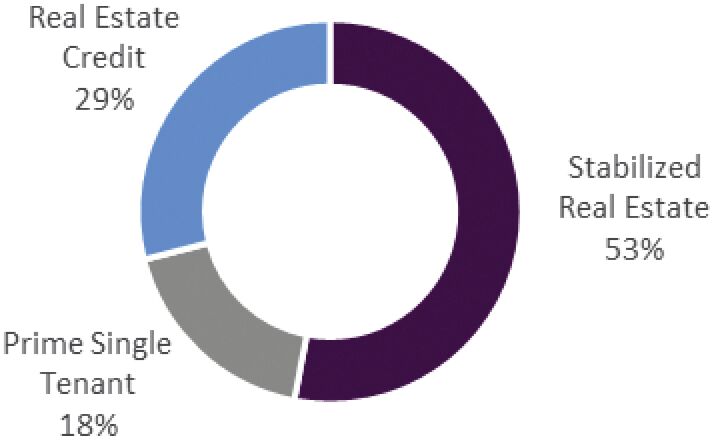
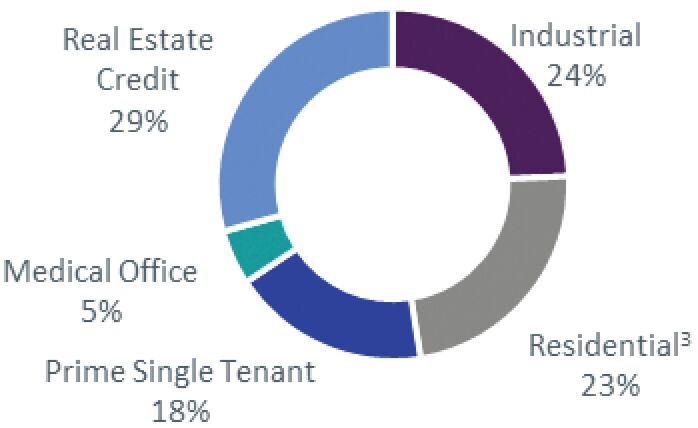
The Fund intends, under normal circumstances, to invest at least 80% of its net assets (plus the amount of its borrowings for investment purposes) in a portfolio of real estate, including in the form of property investments and debt interests and to a lesser extent in traded real estate-related securities. The Fund will target investments in three primary investment strategies: (i) thematically-driven stabilized, income-generating commercial real estate, (ii) prime single tenant real estate and (iii) real estate debt and preferred equity interests. The Fund’s property investments in each primary strategy are structured through privately-owned operating entities that hold whole or partial interests in real properties. To a lesser extent, the Fund may also make investments in traded real estate-related securities such as mortgage-backed securities and equity or debt securities issued by REITs or real estate-related investment companies for the purposes of liquidity management or on an opportunistic basis, for example during periods of dislocation in the trading of such securities.
Investing in the Common Stock involves certain risks. See “
Risks” beginning on page 60 of this prospectus.
|
|
|
|
|
|
|
|
|
|
| |
| |
|
|
|
|
|
|
|
|
|
Class S Common Stock, par value $0.001 per share |
|
Current NAV plus
sales load and
dealer manager fee |
|
3.0% |
|
0.5% |
|
|
Current NAV |
|
Class D Common Stock, par value $0.001 per share |
|
Current NAV |
|
None |
|
None |
|
|
Current NAV |
|
Class U Common Stock, par value $0.001 per share |
|
Current NAV |
|
None |
|
None |
|
|
Current NAV |
|
Class I Common Stock, par value $0.001 per share |
|
Current NAV |
|
None |
|
None |
|
|
Current NAV |
|
| (1) |
Class S Shares, Class D Shares, Class U Shares and Class I Shares are continuously offered at our net asset value (“NAV”) per share, plus, in the case of Class S Shares, a maximum sales load of up to 3.0% of the offering price and a dealer manager fee of 0.5%. Certain participating broker-dealers may offer Class S Shares subject to a dealer manager fee of up to 1.50%, provided that the sum of the sales load and dealer manager fee will not exceed 3.5% of the offering price. Class D Shares, Class U Shares and Class I Shares are each not subject to a sales load; however, investors could be required to pay brokerage commissions on purchases and sales of Class D Shares, Class U Shares or Class I Shares to their selling agents. Investors should consult with their selling agents about the sales load and any additional fees or charges their selling agents might impose on each class of shares. |
| (2) |
Through April 30, 2026, the Adviser has agreed to waive its fees and/or reimburse expenses of the Fund so that certain of the Fund’s expenses (“Specified Expenses”) will not exceed 0.50% of net assets (annualized). The Fund has agreed to repay these amounts, when and if requested by the Adviser, but only if and to the extent that Specified Expenses are less than 0.50% of net assets (annualized) (or, |
| |
if a lower expense limit is then in effect, such lower limit) within the 36 month period after the Adviser waived or reimbursed such fees or expenses; provided, however, that the Adviser is entitled to recapture a Specified Expense in the same year it is incurred. |
Neither the U.S. Securities and Exchange Commission (the “SEC”) nor any state securities commission has approved or disapproved of these securities or determined if this prospectus is truthful or complete. Any representation to the contrary is a criminal offense.
Prospectus dated April 23, 2025.
The Fund intends, but is not obligated, to conduct quarterly tender offers for up to 5.0% of the aggregate NAV of its outstanding Common Stock at the applicable NAV per share as of the applicable valuation date. Repurchases will be made at such times and on such terms as may be determined by the board of directors of the Fund, in its sole discretion. However, repurchases have in the past been and may in the future be oversubscribed, and no assurance can be given that repurchases will occur or that any Common Stock properly tendered will be repurchased by the Fund. There is a risk that investors will not be able to redeem the full amount that they submit to the Fund for redemption in connection with a given tender offer, particularly in periods where there is a high level of redemption requests or where holders of a large number of shares submit requests for redemption. In the event a tender offer is oversubscribed and in accordance with rules promulgated by the SEC, the Fund may accept for purchase additional outstanding shares of Common Stock representing up to 2.0% of the aggregate NAV of its outstanding Common Stock without amending or extending the tender offer. However, the decision whether to accept for purchase additional outstanding shares is solely in the discretion of the Fund and its Board, and there is no guarantee that the Fund and Board will determine to accept any additional shares for purchase. See “
Risks—Repurchase Offers Risk.
”
The Fund may use leverage to provide additional funds to support its investment activities. The Fund itself uses entity level debt
(non-mortgage
debt at the Fund level), such as revolving credit facilities, and its investments utilize property level debt financing (mortgages on the Fund’s properties that are not recourse to the Fund except in extremely limited circumstances). Property level debt is and will be incurred by operating entities held by the Fund and secured by real estate owned by such operating entities. If an operating entity were to default on a loan, the lender’s recourse would be to the mortgaged property and the lender would typically not have a claim to other assets of the Fund or its subsidiaries. The Fund may also incur entity level debt, including unsecured and secured credit facilities from certain financial institutions and other forms of borrowing (collectively, “Borrowings”) and is limited to 33 1/3% of the Fund’s total assets (less all liabilities and indebtedness not represented by Investment Company Act leverage) immediately after such Borrowings. See “
Leverage” and “Risks—Leverage Risk
.”
Investing in the Fund involves a high degree of risk. See “
” beginning on page 60 of this prospectus. For example:
| |
|
|
An investment in the Fund is suitable only for investors who can bear the risks associated with private market investments with potential limited liquidity. The Common Stock should be viewed as a long-term investment within a multi-asset personal portfolio and should not be viewed individually as a complete investment program. |
| |
|
|
The Fund expects to ordinarily pay stable distributions at an attractive distribution yield on a monthly basis; however, the Fund cannot guarantee that it will make distributions and the amount of distributions that the Fund may pay, if any, is uncertain. |
| |
|
|
The Fund may pay distributions from sources other than cash flow from operations, including, without limitation, the sale of assets, borrowings, return of capital, or offering proceeds. |
| |
|
|
Investors will pay offering and organizational expenses and, with regard to Class S Shares, a front-end sales load of up to 3.0% and a dealer manager fee of 0.5% of the offering price. Investors in Class I Shares, Class D Shares and Class U Shares may be charged transaction or other fees directly by financial intermediaries. You will have to receive a total return at least in excess of these expenses to receive an actual return on your investment. |
| |
|
|
The Common Stock has no history of public trading, nor is it currently intended that the Common Stock will be listed on a public exchange or any other trading market in the near future. No organized secondary market is expected to develop for the Fund’s shares, and liquidity for the Common Stock is expected to be provided only through quarterly tender offers of Common Stock at NAV per share of Common Stock. |
| |
|
|
There is no guarantee that repurchases will occur or that an investor will be able to sell all the Common Stock that the investor desires to sell in a tender offer. Due to these restrictions, an investor should consider an investment in the Fund to be illiquid. Investing in the Common Stock may be speculative and involves a high degree of risk, including the risks associated with leverage. |
You should read this prospectus, which contains important information about the Fund that you should know, before deciding whether to invest, and retain it for future reference. A Statement of Additional Information, dated April 23, 2025, as it may be amended (the “SAI”), containing additional information about the Fund, has been filed with the SEC and is incorporated by reference in its entirety into this prospectus. You may request a free copy of the SAI, free copies of the Fund’s annual and semi-annual reports to stockholders, and additional information about the Fund by calling (855)
844-8655,
by writing to the Fund at 30 Hudson Yards, New York, NY 10001 or visiting the Fund’s website at www.krest.reit. The information contained in, or accessed through, the Fund’s website is not part of this prospectus. You may also obtain a copy of the SAI (and other information regarding the Fund) from the SEC’s website (http://www.sec.gov). You may also
e-mail
requests for these documents to publicinfo@sec.gov.
The Common Stock does not represent a deposit or obligation of and is not guaranteed or endorsed by, any bank or other insured depository institution, and is not federally insured by the Federal Deposit Insurance Corporation, the Federal Reserve Board or any other government agency.
|
|
|
|
| |
| |
|
|
|
|
|
|
1 |
|
|
|
|
35 |
|
|
|
|
38 |
|
|
|
|
42 |
|
|
|
|
42 |
|
|
|
|
42 |
|
|
|
|
55 |
|
|
|
|
56 |
|
|
|
|
60 |
|
|
|
|
89 |
|
|
|
|
98 |
|
|
|
|
105 |
|
|
|
|
114 |
|
|
|
|
117 |
|
|
|
|
122 |
|
|
|
|
124 |
|
|
|
|
125 |
|
|
|
|
129 |
|
|
|
|
133 |
|
|
|
|
159 |
|
|
|
|
162 |
|
|
|
|
162 |
|
|
|
|
162 |
|
|
|
|
| |
You should rely only on the information contained in or incorporated by reference into this Prospectus. The Fund has not authorized anyone to provide you with different information. If anyone provides you with different or inconsistent information, you should not rely on it. The Fund is not making an offer of these securities in any jurisdiction where the offer is not permitted.
The Fund’s website at www.krest.reit contains additional information about the Fund, but the contents of the website are not incorporated by reference into or otherwise a part of this prospectus. From time to time, the Fund may use its website as a distribution channel for material Fund information.
i
This is only a summary. This summary may not contain all of the information that you should consider before investing in the Fund. You should review the more detailed information contained in this prospectus and in the Statement of Additional Information (the “SAI”), specially the information under the heading “Risks.”
|
KKR Real Estate Select Trust Inc. (the “Fund”) is a non-diversified closed-end management investment company registered under the Investment Company Act of 1940, as amended (the “Investment Company Act”), that invests primarily in commercial real estate in the United States. KKR Registered Advisor LLC (the “Adviser”) serves as the investment adviser to the Fund. The Adviser is part of the real estate group of Kohlberg Kravis Roberts & Co. L.P. (together with its affiliates, “KKR”), a leading global investment firm. The Fund seeks to provide investors with access to KKR’s leading real estate investment platform with an institutional fee structure and the transparency of a fund registered under the Investment Company Act. The Fund is a Maryland corporation that has elected and has qualified, and intends to continue to qualify annually, as a real estate investment trust (“REIT”) for U.S. federal income tax purposes under the Internal Revenue Code of 1986, as amended (the “Code”). The words “we,” “us,” “our” and “KREST” refer to KKR Real Estate Select Trust Inc. and its subsidiaries, unless the context requires otherwise. See “.” |
Benefits of Investing in Real Estate |
Allocating a portion of your investment portfolio to real estate may provide you with a steady source of income, growth potential, portfolio diversification, a hedge against inflation, and attractive risk-adjusted returns. |
| |
Investors may benefit from adding a diversified real estate component to their investment portfolios for the following reasons: |
| |
• |
|
Stabilized real estate combined with proactive investment management and asset management may create an attractive return profile. |
| |
• |
|
Amidst higher levels of inflation, rising interest rates and lower real yields, investors continue to seek collateral-backed cash flows. Assets linked to nominal gross domestic product (“GDP”) have the ability to appreciate alongside or potentially faster than nominal GDP, which is continuing to drive flows into real estate. |
|
We believe that real estate investments with growth potential and a defensive cash flow base in the largest and most active real estate markets can provide income and sustain growth over the long term. We expect to hold investments in this strategy through economic cycles. By focusing on assets and markets with attractive long-term fundamentals that can support attractively-priced long-term capital structures, we believe that we can generate attractive absolute and relative total returns with a substantial income component. |
1
| |
We believe our investment strategies are attractive for the following reasons: |
| |
• |
|
Amidst higher levels of inflation, rising interest rates and lower real yields, investors continue to seek collateral-backed cash flows. Assets linked to nominal GDP have the ability to appreciate alongside or potentially faster than nominal GDP, which is continuing to drive flows into real estate. In this environment, we expect the strong appetite for real estate to persist driven by the structural yearn for yield as well as an increased desire for the potential inflation hedging benefits offered by the asset class. |
| |
• |
|
Continued demographic, technological and preference changes are accelerating urbanization, and we believe certain real estate markets are poised to be the outsized beneficiaries of future economic growth. The Fund focuses on opportunities within these population centers. |
| |
• |
|
Secular growth trends may benefit our target asset classes, including multifamily properties, single family properties that are professionally managed, industrial properties, prime single tenant offices in innovation markets , and select specialty sectors. KKR has historical experience acquiring and operating each of these asset classes in several markets. |
| |
• |
|
The Fund invests across the real estate capital structure, including credit, which enhances its flexibility and return potential. Through this capability, KKR allocates to senior mortgages, mezzanine loans, preferred equity, and credit securities, which can offer attractive risk-adjusted returns, consistent income, and downside protection through structural seniority. This strategy allows the Fund to remain agile across market cycles and capitalize on dislocations, particularly when credit spreads widen or traditional lenders retrench. |
|
Investors should consider their financial situations and needs, other investments, investment goals, investment experience, time horizons, liquidity needs and risk tolerance before investing in the Fund. An investment in the Fund is not appropriate for all investors, and the Fund is not intended to be a complete investment program. |
| |
Barriers to investing in real estate can be high, which has in the past curbed broad-based participation in the asset class. These include high capital requirements and complex, relatively illiquid transactions. The Fund may be an appropriate investment for long-term investors who are seeking: |
| |
• |
|
a portfolio of high quality commercial real estate and real estate debt with the transparency of a registered investment company; |
| |
• |
|
the operating cash flow, capital appreciation and portfolio diversification benefits that real estate can offer; and |
2
| |
• |
|
the opportunity for attractive current distributions through a tax-efficient structure and the potential for long-term capital appreciation. |
|
The Fund’s primary investment objective is to provide attractive current income with a secondary objective of long-term capital appreciation. There can be no assurance that the Fund will achieve its investment objectives. |
|
The Fund intends, under normal circumstances, to invest at least 80% of its net assets (plus the amount of its borrowings for investment purposes) in a portfolio of real estate, including in the form of property investments and real estate-related debt interests and to a lesser extent in traded real estate-related securities. |
| |
The Fund will target investments in three primary investment strategies: |
| |
|
Thematically-Driven Stabilized Real Estate: Stabilized, income-oriented commercial real estate equity investments in asset classes that we expect to benefit from secular growth trends, including multifamily properties, single family properties that are professionally managed, industrial properties, prime single tenant offices in innovation markets, and select specialty sectors, primarily in U.S. markets that offer the potential to generate high current income and, to a lesser extent, long-term capital appreciation. |
| |
|
: High quality commercial real estate primarily located in or in close proximity to major metropolitan statistical areas and growth markets with favorable economic and demographic conditions and leased for long durations (typically greater than 10 years at acquisition) to single tenants that the Adviser believes have favorable credit profiles and/or performance attributes supporting highly visible long-term cash flows. |
| |
|
Real Estate Debt and Preferred Equity : Privately sourced debt, real estate-related securities such as mortgage-backed securities (“MBS”), and preferred equity interests that offer current income secured or backed by high quality real estate. The Fund intends to originate and selectively acquire mezzanine loans, which are structurally subordinate to senior loans but senior to equity in the borrower and preferred equity, which is subordinated to debt, and to acquire interests in securitized real-estate mortgages. To a lesser extent, the Fund may also originate and selectively acquire senior mortgage loans, which are generally loans secured by a first mortgage lien on a commercial property. |
| |
We plan to own all or substantially all of our property investments through our wholly-owned operating partnership. The property investments of each primary strategy are expected to be structured |
3
| |
through privately-owned operating entities or private real estate operating companies which hold whole or partial interests in real properties. We expect to pursue these investments through various transaction types, such as large single asset purchases, portfolio purchases, platform build-ups and public to private transactions. |
| |
As part of the Fund’s Real Estate Debt and Preferred Equity strategy, the Fund may also make investments in traded real estate-related securities such as MBS and equity or debt securities issued by REITs or real estate-related investment companies for the purposes of (i) making investments that provide current income to the Fund and provide a source of liquidity for tender offers or other liquidity requirements and (ii) opportunistically exploiting periods of market dislocation where the trading value of such securities sufficiently exceeds the relative value of private opportunities available in the Fund’s three primary investment strategies. |
| |
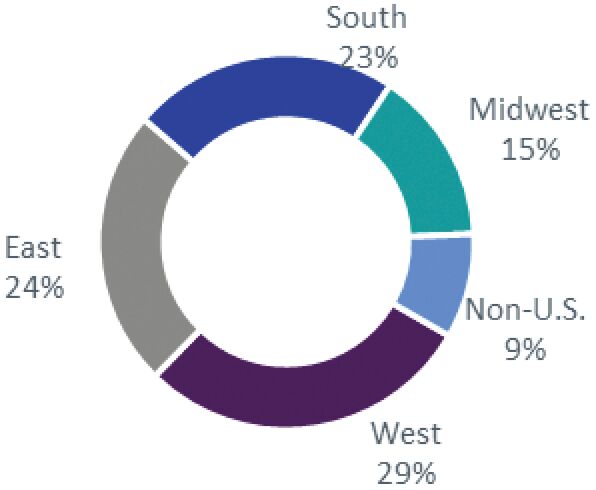
It is expected that the Fund’s portfolio primarily will be comprised of equity or debt interests in commercial properties located in the United States, although the Fund may also make investments in equity or debt interests in properties outside of the United States, with a focus on developed markets in Asia and Europe. |
| |
On a long-term basis, under normal circumstances, KKR expects to allocate the Fund’s portfolio among the Fund’s three primary investment strategies. Since real estate markets are often cyclical in nature, we do not target specific allocations by investment strategy or geography. The Fund will deploy capital into the primary investment strategy that the Adviser believes provides the best opportunities to meet our investment objectives. For the purpose of providing liquidity for periodic share repurchases, we intend to, subject to any limitations and requirements relating to our qualification as a REIT, generally maintain under normal circumstances an allocation to securities, cash, cash equivalents and other short-term investments, which may be up to 20% of our assets. In addition, we may seek to make opportunistic purchases of securities and other real estate-related short-term investments for investment purposes. |
| |
The Fund has received an exemptive relief order (the “Order”) from the U.S. Securities and Exchange Commission (“SEC”) that permits it to, among other things, co-invest with certain other persons, including certain affiliates of the Adviser and certain public or private funds managed by the Adviser and its affiliates, in privately negotiated transactions subject to certain terms and conditions. |
| |
For a more complete discussion of the Fund’s portfolio composition, see “Investment Objectives and Strategies |
|
The Fund currently offers four classes of its shares of common stock, par value $0.001 per share (“Common Stock”), on a continuous basis: |
4
| |
Class S shares of Common Stock (“Class S Shares”), Class D shares of Common Stock (“Class D Shares”), Class U shares of Common Stock (“Class U Shares”) and Class I shares of Common Stock (“Class I Shares”). The Fund may offer additional classes of its Common Stock in the future. The Fund relies on exemptive relief from the SEC granted to an affiliate of the Fund permitting the Fund to issue multiple classes of shares with varying sales loads and asset based service and/or distribution fees. |
| |
Class D Shares, Class U Shares and Class I Shares are offered on a continuous basis at net asset value (“NAV”) per share. Class S Shares are offered on a continuous basis at NAV per share, plus a maximum sales load of up to 3.0% of the offering price and a dealer manager fee of 0.5% of the offering price. Certain participating broker-dealers may offer Class S Shares subject to a dealer manager fee of up to 1.50%, provided that the sum of the sales load and dealer manager fee will not exceed 3.5% of the offering price. Holders of Class S Shares, Class D Shares, Class U Shares and Class I Shares have equal rights and privileges with each other, except that Class I Shares, Class D Shares and Class U Shares do not pay a sales load or dealer manager fees, and the Fund does not pay any Servicing Fees (defined below) or Distribution Fees (defined below) with respect to Class I Shares. See “—Ongoing Distribution and Servicing Fees sub-transfer agency, sub-accounting and certain other administrative services. The Fund also pays for certain sub-transfer agency, sub-accounting and administrative services outside of the Servicing Fee. Class D Shares, Class U Shares and Class I Shares are each not subject to a sales load; however, investors could be required to pay brokerage commissions on purchases and sales of Class D, Class U or Class I Shares to their selling agents. Investors should consult with their selling agents about the sales load and any additional fees or charges their selling agents might impose on each class of shares. |
| |
Proceeds from the offering will be held by the Fund’s custodian and available to fund investments. No arrangements have been made to place such proceeds in an escrow, trust or similar account. The Fund generally expects to invest the proceeds from the offering within three months from receipt thereof. |
| |
The Fund reserves the right to reject a purchase order for any reason. |
|
KKR Registered Advisor LLC, a registered investment adviser under the Investment Advisers Act of 1940, as amended (the “Advisers Act”), serves as the investment adviser to the Fund pursuant to the terms of an investment advisory agreement with the Fund (the “Advisory Agreement”). The Adviser is a subsidiary of our sponsor, Kohlberg Kravis Roberts & Co. L.P. KKR was established in 1976, pioneered the leveraged buyout industry and has remained one of the |
5
| |
world’s largest and most successful investment firms through the past four decades of economic cycles and market changes. |
| |
KKR is a leading global investment firm that manages multiple alternative asset classes, including private equity, energy, infrastructure, real estate and credit, with strategic manager partnerships that manage hedge funds. As of December 31, 2024, KKR had assets under management (“AUM”) of approximately $638 billion. |
| |
KKR founded KKR Real Estate in 2011 believing that a dedicated real estate team (“KKR Real Estate” or the “Real Estate Team”) with access to KKR’s global investment platform, and the support of the KKR balance sheet capital, could create differentiated deal flow and generate compelling risk-adjusted returns for investors. The primary mandate of KKR Real Estate is to leverage the KKR brand, relationships, industry expertise, proprietary knowledge and relationships of the firm and the real estate expertise of the team to identify opportunities where KKR Real Estate can seek to create differentiated risk-adjusted returns for its investors. As of December 31, 2024, KKR Real Estate has approximately 140 dedicated investment and asset management professionals across offices in 16 cities and 11 countries. As of December 31, 2024, KKR Real Estate owned and lent on approximately $257 billion of real estate assets across all property types, including residential, industrial, office, and select specialty sectors. 1 |
Investment Advisory Agreement |
The Fund and the Adviser have entered into the Advisory Agreement pursuant to which the Adviser is entitled to receive a base management fee and an incentive fee. |
| |
The base management fee (the “Management Fee”) is payable monthly in arrears at the annual rate of 1.25% of the average daily value of the Fund’s net assets. |
| |
The incentive fee (the “Incentive Fee”) is payable quarterly in arrears in an amount equal to 12.5% of the Fund’s Portfolio Operating Income for the immediately preceding quarter. |
| |
“Portfolio Operating Income” means (1) the Fund’s share of Net Operating Income from the Fund’s real estate equity investments; plus (2) the Fund’s net investment income (or loss) from debt, preferred equity investments and traded real estate-related securities; minus (3) the Fund’s expenses (excluding the incentive fee and distribution and servicing fees). |
| |
“Net Operating Income” means operating revenue net of operating expenses (inclusive of interest on investment level debt) for the Fund’s operating entities that invest in real estate and excludes |
1 |
Represents current gross asset value across all KKR real estate transactions. |
| |
(i) gains or losses from sales of depreciable real property, (ii) impairment write-downs on depreciable real property, (iii) real estate-related depreciation and amortization for each real estate operating venture and (iv) adjustments for recognizing straight line rent. |
| |
Portfolio Operating Income does not include any component of capital gains or capital appreciation. The Adviser is not entitled to any incentive fee based on the capital gains or capital appreciation of the Fund or its investments. |
| |
The Fund relies on exemptive relief from the SEC that permits the Fund to pay the Adviser all or a portion of its management and incentive fees in shares of Common Stock in lieu of paying the Adviser an equivalent amount of such fees in cash. As a condition of this exemptive relief, the Adviser has committed not to sell any shares of Common Stock received in lieu of a cash payment of its management and incentive fees for at least 12 months from the date of issuance, except in exceptional circumstances. |
| |
See “Management of the Fund—Investment Advisory Agreements and Fees |
|
KKR’s investment approach is rooted in the belief that real estate fundamentals, values and returns are highly dependent on macroeconomic conditions, business and consumer preferences and demographic trends. KKR believes that real estate valuations have diverged significantly across different asset classes, markets and geographies, making theme identification, market selection, asset selection and portfolio construction key to generating attractive real estate returns over the long term. |
| |
KKR takes a thematic approach to investing, seeking to identify high-conviction themes and investing strategies that we believe benefit from a combination of cyclical and/or secular demand trends or market features and may result in attractive risk-adjusted returns. KKR’s research-driven approach to theme and strategy development leverages the broader KKR ecosystem, including KKR Private Equity, KKR Credit, KKR Capital Markets and the KKR Global Macro and Asset Allocation (“GMAA”) to develop and refine its investment themes. KKR believes that its access to differentiated industry expertise and deep global relationships and networks positions KKR to identify attractive demographic and industry trends that affect real estate fundamentals. |
| |
KKR has a research-intensive approach to developing investment themes and strategies, utilizing KKR resources and data, industry research and its deep industry relationships. Proactively identifying these themes and strategies allows KKR to develop in-depth industry expertise, establish deep industry relationships and guide intermediary relationships to opportunities where KKR is most |
| |
convicted and can move expediently. This approach is designed to result in a highly selective and targeted method to investing and allows the Real Estate Team to develop a competitive advantage in sourcing transactions. |
| |
KKR’s theme development process includes the following three steps: |
1. Opportunity Identification
| |
• |
|
Leverage KKR resources (Private Equity and GMAA) |
| |
• |
|
Identify economic and demographic trends that impact real estate fundamentals |
| |
• |
|
Identify markets and asset classes that benefit from trends |
| |
• |
|
Determine whether current valuations present an attractive investment opportunity |
| |
• |
|
Understand key risks and opportunities within thesis |
| |
• |
|
Discuss with market participants to refine thesis |
| |
• |
|
Develop conviction around thesis with KKR Real Estate, investment committee and GMAA |
| |
• |
|
Refine target strategy (i.e., target markets and target asset classes) |
| |
• |
|
Establish target investment approach (i.e., joint venture, platform, etc.) |
| |
• |
|
Identify potential operating partners and management teams |
| |
• |
|
Develop view on size of opportunity, portfolio construction and ability to scale |
| |
• |
|
Establish deep relationships with key intermediaries within target markets and asset classes |
| |
• |
|
Determine if scale can create a competitive advantage |
| |
• |
|
Work with top operators, where relevant, in aligned structure, creating a differentiated operating model |
| |
• |
|
Develop differentiated financing approach |
| |
Upon the establishment of the top down targeted investment themes and strategies, KKR then seeks to source actionable investment opportunities within the parameters of each theme or strategy to perform a detailed bottoms up fundamental due diligence review of each investment opportunity, including: |
| |
• |
|
understanding the underlying macro and micro economic fundamentals that drive the cash flow generating capacity of the |
| |
opportunity, including a stringent evaluation of the market in which a property is located, such as local supply constraints, the quality and nature of the local workforce and prevailing local real estate values; |
| |
• |
|
performing a fundamental analysis of the property and its operating performance, including tenant rosters, lease terms, zoning, operating costs and the asset’s overall competitive position in its market; |
| |
• |
|
understanding leasing market conditions affecting the underlying real estate; |
| |
• |
|
completing physical inspections of the property and/or commissioning/review of third-party reports, including appraisals, engineering reports and environmental reports; |
| |
• |
|
evaluating the appropriateness of estimated costs and timing associated with capital improvements of the property where applicable; |
| |
• |
|
completing detailed modeling of the cash flow in place and projected to be in place over the term of the investment; |
| |
• |
|
in the case of single-tenant investments, evaluating the criticality of the real estate to the tenant’s operations and the ability to release upon a tenant departure; |
| |
• |
|
performing detailed credit analysis on the financial health of key tenants; |
| |
• |
|
completing legal review of all leases and major contracts, including terms of expense reimbursements where applicable and identifying any legal risks and potential mitigants; |
| |
• |
|
identifying the appropriate capital structure to support the investment thesis and business plans; |
| |
• |
|
in the case of equity investments, structuring the proper incentives and governance structure with our operating partners and management teams or, in the case of debt investments, evaluating the operating expertise and financial strength of the sponsor and borrower; |
| |
• |
|
completing a valuation of the investment, including the investment basis relative to its value and the ability to liquidate the investment through a sale or refinancing of the underlying asset; |
| |
• |
|
in the case of debt investments, reviewing the overall structure of the investment and rights in the collateral documentation; |
| |
• |
|
assessing any stakeholder issues affecting the real estate; and |
| |
• |
|
for directly originated loan investments, considering the quality of the underlying property, the location and geographic market of the underlying property, the cash flow of the underlying property, the reputation, experience and financial health of the sponsor that owns the equity of the underlying property, the ratio, the |
| |
structure of the loan and the contractual rights and remedies available to the Fund. |
| |
Each investment opportunity is thoroughly screened and discussed throughout the evaluation process with the KKR Real Estate Investment Committee, represented by the most senior members of the Real Estate Team, who are required to approve each transaction. |
| |
KKR strives to maintain robust processes and accountability to ensure it makes well-informed investment decisions, allocates capital effectively, actively engages in key decisions impacting operational value creation, rigorously monitors investments, and, when relevant, exits prudently. Success requires sophisticated internal processes that continuously test KKR’s performance and leverages the collective skills, experience, and resources across the firm. In addition to a dedicated team whose members have honed their track records in sourcing, executing and managing real estate opportunities, KKR’s Real Estate Team is also supported by the firm’s broader capabilities and experience globally. |
|
In pursuing the Fund’s investment objectives and strategies, the Fund is expected to benefit from the experience, relationships and operational capabilities that KKR has developed over four decades of investing to provide what KKR views as the cornerstone of KKR Real Estate’s competitive advantage in investing. This firm-wide integration is core to KKR’s real estate investment strategy and KKR believes it provides the opportunity for differentiated insights and access to deal flow relative to many standalone real estate investors. |
| |
KKR believes that the Fund will benefit from the following key competitive advantages: |
| |
• |
|
Differentiated “One-Firm Approach” —The experience, relationships and operational capabilities that KKR has developed over four decades of investing combine with the decades of real estate investment and asset management experience of the KKR Real Estate Team to provide what KKR views as the cornerstone of KKR Real Estate’s competitive advantage in the asset class. A substantial number of KKR’s real estate investments to-date have utilized cross-functional teams, with members of KKR Real Estate having worked collaboratively with other KKR professionals throughout the investment process, ranging from idea generation and sourcing, to the execution, value creation, monitoring and harvesting of investments. This integration across KKR is core to its real estate investment strategy and provides what KKR believes to be differentiated insights and tangible advantages across sourcing, due diligence and value creation relative to many standalone real estate investors. KKR’s “One-Firm” approach is based on the following four pillars: |
| |
• |
|
Proprietary sourcing channels; |
| |
• |
|
Differentiated due diligence and analytic capabilities; |
| |
• |
|
Execution capabilities; and |
| |
• |
|
Trusted partnerships with key intermediaries. |
| |
• |
|
Integrated Global Real Estate Platform Across Equity and Credit— KKR has a global, integrated real estate equity and credit investment platform to broaden its sourcing channels and access information about the real estate capital markets. As of December 31, 2024, KKR Real Estate owned and lent on approximately $257 billion of real estate assets across all property types, including residential, industrial, office, and select specialty sectors. 2 KKR believes its existing portfolio provides it with a growing network of proprietary market intelligence and data on valuations, operating fundamentals, liquidity and trends across the real estate industry, leading to sourcing and underwriting advantages. |
| |
• |
|
Established Real Estate Platform —The Fund will benefit from a deep and seasoned team of approximately 140 investment and asset management professionals with a leadership team that has worked together for over 10 years. 3 The Adviser believes the Fund will benefit from KKR Real Estate’s existing relationships, sourcing channels, market knowledge and operating expertise. |
| |
• |
|
KKR’s strategy is designed to construct a portfolio diversified across both equity and credit investments, targeting asset classes, markets, and geographies that KKR believes are supported by long-term secular growth trends. By maintaining flexibility across the capital structure – including direct equity, senior loans, mezzanine debt, preferred equity, and credit securities – KKR aims to deliver a balanced mix of income, capital appreciation, and downside protection. This approach allows KKR to build a portfolio that is resilient across market cycles and actively positioned around KKR’s highest-conviction themes. |
| |
• |
|
Alignment of Interests with Investors —KKR believes that alignment of interests with investors is a fundamental tenet of investing. In the simplest of terms, KKR is one of its own largest investors. KKR initially purchased $159 million of Class I Shares to facilitate the acquisition of the Fund’s initial assets. In addition, on June 4, 2024, KKR Alternative Assets LLC (“KAA”), an affiliate of the Adviser, contractually committed to the Fund to continue to hold approximately 7,732,436 of Class I Shares currently owned by KAA, representing approximately $200 million |
2 |
Figures represent AUM across all KKR real estate strategies as reported by KKR & Co. Inc. (NYSE: KKR) as a public company. Strategies include, as applicable, Real Estate Partners Americas, Real Estate Partners Europe, Asia Real Estate Partners, Property Partners Americas, Property Partners Europe, Asia Property Partners, Real Estate Credit, the estimated value of Global Atlantic assets, Real Estate NBFC, KJRM, KREST and co-investments. |
| |
based on the Fund’s NAV as of May 28, 2024, in KAA-owned shares (“Support Shares”) of the Fund with the objective of supporting a NAV per share of $27.00 on June 1, 2027. If on June 1, 2027 the Fund’s NAV per share is less than $27.00 per share for any share class, KAA will contribute to the Fund as many of the Support Shares as are required, up to the maximum number of Support Shares, to reduce the number of outstanding shares and increase the NAV per share for each class of the Fund’s shares up to $27.00 per share (the “Shareholder Priority Plan”). KAA also invested $50 million in new capital in the Fund during June 2024. See “ Net Asset Value — Shareholder Priority Plan. ” In addition, the Adviser has opted to receive payment of its advisory fee in Class I Shares of the Fund. As of March 31, 2025, the Adviser has acquired approximately $71.3 million of Class I Shares through payment of its advisory fee and incentive fee in shares, and owns approximately 10,428,374 Class I Shares, or $255.2 million of Class I Shares valued as of March 31, 2025. We believe this investment creates a significant alignment of interests with our investors and demonstrates a strong commitment to the Fund’s strategy. Additionally, the Fund relies on exemptive relief from the SEC that permits the Fund to pay the Adviser all or a portion of its management and incentive fees in shares of Common Stock in lieu of paying the Adviser an equivalent amount of such fees in cash. As a condition of this exemptive relief, the Adviser has committed not to sell any shares of Common Stock received in lieu of a cash payment of its management and incentive fees for at least 12 months from the date of issuance, except in exceptional circumstances. |
|
The Fund does not currently intend to list the Common Stock for trading on any securities exchange or any other trading market in the near future. The Fund intends, but is not obligated, to conduct quarterly tender offers for up to 5.0% of the aggregate NAV of its outstanding Common Stock at the applicable NAV per share as of the applicable valuation date in the sole discretion of the Fund’s board of directors (the “Board”). In the event a tender offer is oversubscribed and in accordance with rules promulgated by the SEC, the Fund may accept for purchase additional outstanding shares of Common Stock representing up to 2.0% of the aggregate NAV of its outstanding Common Stock without amending or extending the tender offer. |
| |
In any given quarter, the Adviser may or may not recommend to the Board that the Fund conduct a tender offer. For example, if adverse market conditions cause the Fund’s investments to become more illiquid or trade at depressed prices or if the Adviser believes that conducting a tender offer for 5.0% of the aggregate NAV of the Fund’s outstanding Common Stock would impose an undue burden on stockholders who do not tender compared to the benefits of giving stockholders the opportunity to sell all or a portion of their Common Stock at NAV, the Fund may choose not to conduct a tender offer or |
| |
may choose to conduct a tender offer for less than 5.0% of the aggregate NAV of its outstanding Common Stock. Regardless of the recommendation of the Adviser, the Board may or may not determine to cause the Fund to conduct a tender offer for any given quarter. |
| |
The Fund intends to comply with an exemption under Financial Industry Regulatory Authority (“FINRA”) Rule 5110 that requires the Fund to make at least two tender offers per calendar year. However, there may be quarters in which no tender offer is made, and it is possible that no future tender offers will be conducted by the Fund at all. If a tender offer is not made, stockholders may not be able to sell their Common Stock as it is unlikely that a secondary market for the Common Stock will develop or, if a secondary market does develop, stockholders may be able to sell their Common Stock only at substantial discounts from NAV. If the Fund does continue to conduct tender offers, it may be required to sell its more liquid, higher quality portfolio securities to fund the purchase of shares of Common Stock that are tendered, which may increase risks for remaining stockholders and increase fund expenses as a percent of assets. The Fund is designed primarily for long-term investors and an investment in the Common Stock should be considered illiquid. For more information concerning repurchases, see “” and “.” |
| |
Repurchases will be made at such times and on such terms as may be determined by the Board, in its sole discretion. However, repurchases have in the past been and may in the future be oversubscribed, and no assurance can be given that repurchases will occur or that any Common Stock properly tendered will be repurchased by the Fund. |
|
The Fund may use leverage to provide additional funds to support its investment activities. The Fund itself uses entity level debt (non-mortgage debt at the Fund level), such as revolving credit facilities, and expects its investments will utilize property level debt financing (mortgages on the Fund’s properties that are not recourse to the Fund except in extremely limited circumstances). See “ Risks— Recourse Financings Risk. ” Property level debt is and will be incurred by operating entities held by the Fund and secured by real estate owned by such operating entities. If an operating entity were to default on a loan, the lender’s recourse would be to the mortgaged property and the lender would typically not have a claim to other assets of the Fund or its subsidiaries. The Fund may also incur entity level debt, including unsecured and secured credit facilities from certain financial institutions and other forms of borrowing (collectively, “Borrowings”) and is limited to 33 1/3% of the Fund’s total assets (less all liabilities and indebtedness not represented by Investment Company Act leverage) immediately after such Borrowings. In addition, the Fund may enter into investment management techniques (including reverse repurchase agreements and derivative transactions) that have similar effects as leverage, but |
| |
which are not subject to the foregoing 33 1/3% limitation if effected in compliance with applicable SEC rules and guidance. Furthermore, the Fund may add leverage to its portfolio through the issuance of preferred stock (“Preferred Stock”) in an aggregate amount of up to 50% of the Fund’s total assets (less all liabilities and indebtedness not represented by Investment Company Act leverage) immediately after such issuance. As of the date of this prospectus, the Fund had no Preferred Stock outstanding. See “ ” and “ .” |
| |
Borrowings (and any Preferred Stock) have seniority over Common Stock. Any Borrowings and Preferred Stock (if issued) leverage investments in Common Stock. Holders of Common Stock bear the costs associated with any Borrowings, and if the Fund issues Preferred Stock, holders of Common Stock bear the offering costs of the Preferred Stock issuance. The Board may authorize the use of leverage through Borrowings and Preferred Stock without the approval of the holders of Common Stock. |
| |
There may be times when the Fund does not use leverage, and the amount of leverage may vary depending upon a number of factors, including the Adviser’s outlook for the market and the costs that the Fund would incur as a result of such leverage. There is no assurance that the Fund’s leveraging strategy will be successful. |
|
The Fund has sought and will continue to seek to pay consistent monthly distributions at an attractive distribution yield to stockholders of record. The Fund intends to accrue and declare distributions daily and distribute them on a monthly basis. However, there can be no guarantee that the Fund will pay monthly distributions consistently or at all. In addition, the Fund intends to distribute any net capital gains it earns from the sale of portfolio securities to stockholders no less frequently than annually. Net short-term capital gain distributions may be paid more frequently. The Fund intends to make distributions necessary to maintain its qualification as a REIT. See “.” |
| |
Cash distributions to holders of the Common Stock will automatically be reinvested under our Distribution Reinvestment Plan (the “DRIP”) in additional whole and fractional shares unless you elect to receive your distributions in cash. Investors may terminate their participation in the DRIP with prior written notice to us. Under the DRIP, stockholders’ distributions are reinvested in Common Stock of the same class of Common Stock owned by the stockholder for a purchase price equal to the NAV per share (for the class of Common Stock being purchased) on the date that the distribution is paid. See “Distribution Reinvestment Plan |
Expenses and Reimbursement |
Subject to the terms and conditions outlined in this prospectus, the Fund reimburses the Adviser for any actual third-party expenses |
| |
incurred by the Adviser on behalf of the Fund. Such expenses include, but are not limited to, costs related to valuation, audit, reporting, regulatory, administration, compliance and financing as well as legal services. The Fund also reimburses the Adviser for actual operating and property expenses incurred on behalf of the Fund for property management, acquisitions, dispositions and financings. KKR has hired and expects in the future to hire third-party or affiliated property managers (who could also be joint venture partners for an investment) at prevailing market rates to perform management and specialized services for the Fund’s commercial real estate investments. |
| |
KKR previously funded the Fund’s organizational and offering expenses until the initial sale of Common Stock. The Fund reimbursed these expenses, subject to a specified expense cap and reimbursement limitations (as detailed below). |
| |
Pursuant to an Expense Limitation and Reimbursement Agreement (the “Expense Limitation and Reimbursement Agreement”), through April 30, 2026, the Adviser has agreed to waive its fees and/or reimburse expenses of the Fund so that certain of the Fund’s expenses (“Specified Expenses,” as defined below) will not exceed 0.50% of net assets (annualized). The Fund has agreed to repay these amounts, when and if requested by the Adviser, but only if and to the extent that Specified Expenses are less than 0.50% of net assets (annualized) (or, if a lower expense limit is then in effect, such lower limit) within 36 months after the Adviser waived or reimbursed such fees or expenses; provided, however, that the Adviser may recapture a Specified Expense in the same year it is incurred. This arrangement cannot be terminated prior to April 30, 2026 without the Board’s consent. “Specified Expenses” is defined to include all expenses incurred in the business of the Fund, including organizational and offering costs, with the exception of (i) the Management Fee, (ii) the Incentive Fee, (iii) the Servicing Fee (defined below), (iv) the Distribution Fee (defined below), (v) property level expenses, (vi) brokerage costs or other investment-related expenses, including with respect to unconsummated investments, (vii) dividend/interest payments (including any dividend payments, interest expenses, commitment fees, or other expenses related to any leverage incurred by the Fund), (viii) taxes, and (ix) extraordinary expenses (as determined in the sole discretion of the Adviser). For a more complete discussion of the Fund’s expenses and reimbursement arrangements, see “.” |
|
KKR (in such capacity, the “Administrator”) serves as the Fund’s administrator and accounting agent. The Administrator will provide, or oversee the performance of, administrative and compliance services, including, but not limited to, maintaining financial records, overseeing the calculation of NAV, compliance monitoring (including diligence and oversight of our other service providers), preparing reports to stockholders and reports filed with the SEC, preparing |
| |
materials for and coordinating meetings of the Board, managing the payment of expenses and the performance of administrative and professional services rendered by others and providing office space, equipment and office services. The Administrator has entered into a sub-administration agreement with The Bank of New York Mellon. |
| |
The Fund will bear all other costs and expenses of its operations, administration and transactions, including, the Fund’s allocable portion of compensation, overhead (including rent, office equipment and utilities) and other expenses incurred by the Administrator in performing its duties, including the allocable portion of the compensation paid by the Administrator (or its affiliates) to the Fund’s chief compliance officer and chief financial officer and their respective staffs as well as investor relations, legal, operations and other non-investment professionals at the Administrator that perform duties for the Fund. |
Independent Valuation Advisor |
Altus Group U.S. Inc. (“Altus” or the “Independent Valuation Advisor”), an independent valuation services firm, provides valuation services to the Fund in respect of the Fund’s investments in real estate debt (e.g., mortgage loans and mezzanine loans) and real property (e.g., direct investments in real property and interests in private holding vehicles of real property), which do not have reliable readily available market prices. The Independent Valuation Advisor also periodically coordinates and reviews third-party appraisal reports and updates valuations with respect to each of our properties in accordance with valuation guidelines approved by the Board. The Independent Valuation Advisor assists the Adviser in determining the estimated values of our real estate investments, and the sub-administrator uses the estimated values provided as well as inputs from other sources in its calculation of our daily NAV per share. While the Independent Valuation Advisor provides external valuations of certain investments, the Adviser is ultimately responsible for determining the fair value of our assets in its role as the Fund’s “valuation designee,” subject to the oversight of the Board. |
Custodian and Transfer Agent |
The Bank of New York Mellon serves as the Fund’s custodian. SS&C Global Investor & Distribution Solutions, Inc. serves as the Fund’s transfer agent (the “Transfer Agent”). See “Custodian and Transfer Agent |
|
KKR Capital Markets LLC (the “Distributor”) is the principal underwriter and distributor of the Class S Shares, Class D Shares, Class U Shares and Class I Shares and serves in that capacity on a best efforts basis, subject to various conditions. Other broker-dealers (“Selling Agents”) may be appointed by the Distributor to assist in the sale of the Common Stock on a best efforts basis. Such Selling Agents are authorized to designate other financial intermediaries to receive purchase orders and, if applicable, repurchase requests, from |
| |
investors on behalf of the Fund and its Selling Agents. See “ .” |
Sales Load and Dealer Manager Fees |
Class S Shares are subject to a sales load of up to 3.0% and a dealer manager fee of 0.5%, in each case, of the offering price per Class S Share (including sales load and dealer manager fees). Certain Selling Agents may offer Class S Shares subject to a dealer manager fee of up to 1.50%, provided that the sum of the sales load and dealer manager fee will not exceed 3.5% of the offering price. |
| |
Sales loads may be reduced for certain categories of purchasers and for volume discounts, as disclosed in this prospectus. The Selling Agents may, in their sole discretion, reduce or waive the sales load on a non-scheduled basis in individual cases. |
| |
The Distributor may reallow sales loads and dealer manager fees to Selling Agents. No sales load or dealer manager fee will be paid with respect to purchases of Class D, Class U or Class I Shares or any Common Stock sold pursuant to the DRIP. Selling Agents typically receive the sales load with respect to the Class S Shares purchased by their stockholders. Investors should consult with their Selling Agent about the sales load and any additional fees or charges their Selling Agent might impose on each class of shares. |
Ongoing Distribution and Servicing Fees |
Participating broker-dealers will receive ongoing distribution and servicing fees (a) of 0.85% of NAV per annum for Class S Shares and Class U Shares only (consisting of a 0.60% distribution fee (the “Distribution Fee”) and a 0.25% stockholder servicing fee (the “Servicing Fee”)), accrued daily and payable monthly and (b) of 0.25% for Class D Shares only (all of which constitutes payment for stockholder services, with no payment for distribution services), accrued daily and payable monthly. Class I Shares do not incur Distribution or Servicing Fees. All or a portion of the Servicing Fee may be used to pay for sub-transfer agency, sub-accounting and certain other administrative services. The Fund also pays for certain sub-transfer agency, sub-accounting and administrative services outside of the Servicing Fee. |
Unlisted Closed-End Fund Structure; Limited Liquidity |
The Fund does not currently intend to list the Common Stock for trading on any securities exchange or any other trading market in the near future. There is currently no secondary market for the Common Stock and the Fund does not expect any secondary market to develop for the Common Stock. Stockholders of the Fund are not able to have their Common Stock redeemed or otherwise sell their Common Stock on a daily basis, because the Fund is an unlisted closed-end fund. An investment in the Fund is suitable only for investors who can bear the risks associated with private market investments with potential |
| |
limited liquidity of the Common Stock as described in “Repurchases” above. |
|
Generally, the minimum initial investment is $10,000 for Class S Shares, Class D Shares and Class U Shares, and $1,000,000 for Class I Shares. The minimum subsequent investment is $500 for each class of Common Stock, except for additional purchases pursuant to the DRIP, which are not subject to a minimum purchase amount. The minimum investment for each class of shares can be modified or waived in the sole discretion of the Fund or the Distributor (defined below), including for certain financial firms that submit orders on behalf of their customers, the Fund’s officers and directors and certain employees of KKR, including its affiliates, vehicles controlled by such employees and their extended family members. See “Plan of Distribution—How to Purchase Common Stock |
|
An investment in the Common Stock is most suitable for investors who seek to diversify their personal portfolios with a real estate-based investment and seek to receive current income and obtain the benefits of potential long-term capital appreciation from real estate as an asset class. An investment in the Common Stock is least suitable for persons who require liquidity or guaranteed income. |
| |
Before making your investment decision, you should (i) consider the suitability of this investment with respect to your investment objective and personal financial situation and (ii) consider factors such as your personal net worth, income, age, risk tolerance and liquidity needs. An investment in the Fund should not be viewed as a complete investment program. |
| |
An investment in the Fund involves a considerable amount of risk. It is possible that you may lose part or all of your investment in the Fund. An investment in the Fund is suitable only for investors who can bear the risks associated with private market investments with potential limited liquidity of the Common Stock. Common Stock should be viewed as a long-term investment within a multi-asset personal portfolio and should not be viewed individually as a complete investment program. |
| |
Class S Shares and Class U Shares are available to the general public through Selling Agents and other financial intermediaries that offer such share class. Class D Shares are generally available for purchase only (1) through fee-based programs, also known as wrap accounts, that provide access to Class D Shares, (2) through participating broker-dealers that have alternative fee arrangements with their clients to provide access to Class D Shares, (3) through investment advisers that are registered under the Advisers Act or applicable state law and direct clients to trade with a broker-dealer that offers Class D Shares, (4) through bank trust departments or any other organization or person authorized to act in a fiduciary capacity for its clients or |
| |
customers or (5) other categories of investors that we name in an amendment or supplement to this prospectus. Class I Shares are available only (1) through fee-based programs, known as wrap accounts, of investment dealers that provide access to Class I Shares, (2) through participating broker-dealers that have alternative fee arrangements with their clients, (3) through certain registered investment advisers, (4) through bank trust departments or any other organization or person authorized to act in a fiduciary capacity for its clients or customers, (5) to endowments, foundations, pension funds and other institutional investors for purchase in this offering, (6) to other categories of investors that we name in an amendment or supplement to this prospectus or (7) to the Fund’s officers and directors and their immediate family members, as well as officers and employees of KKR or other affiliates and their immediate family members, and, if approved by the Board, joint venture partners, consultants and other service providers. |
|
We believe that alignment of interests with investors is a fundamental tenet of investing. In the simplest of terms, KKR is one of its own largest investors. KKR initially purchased $159 million of Class I Shares to facilitate the acquisition of the Fund’s initial assets. In addition, on June 4, 2024, KAA, an affiliate of the Adviser, contractually committed to the Fund to continue to hold approximately 7,732,436 of Class I Shares currently owned by KAA, representing approximately $200 million based on the Fund’s NAV as of May 28, 2024, in Support Shares of the Fund with the objective of supporting a NAV per share of $27.00 on June 1, 2027. If on June 1, 2027 the Fund’s NAV per share is less than $27.00 per share for any share class, KAA will contribute to the Fund as many of the Support Shares as are required, up to the maximum number of Support Shares, to reduce the number of outstanding shares and increase the NAV per share for each class of the Fund’s shares up to $27.00 per share. KAA also invested $50 million in new capital in the Fund during June 2024. See “Net Asset Value — Shareholder Priority Plan. |
|
As of March 31, 2025, the Fund’s portfolio had the following composition, based on market value: |
| |
i |
Excludes equity investment deposits. |
| |
ii |
Excludes real estate credit investments and equity investment deposits. |
| |
iii |
“Residential” includes multifamily and other types of rental housing such as single family rental properties. As of March 31, 2025 KREST’s allocation to multifamily and single family rental properties are 15% and 7%, respectively. |
| |
All figures as of March 31, 2025 based on market value. Percentages may not sum to 100% due to rounding. |
| |
For more information, refer to the Fund’s annual report on Form N-CSR for the year ended December 31, 2024 (the “Annual Report”). The composition of the Fund’s portfolio is not static and will change over time. |
|
Investing in the Fund involves risks, including the risk that a stockholder may receive little or no return on his or her investment or that a stockholder may lose part or all of his or her investment. The Fund should be considered a speculative investment that entails substantial risks, and a prospective investor should invest in the Fund only if they can sustain a complete loss of their investment. Below is a summary of some of the principal risks of investing in the Fund. For a more complete discussion of the risks of investing in the Fund, see “.” |
| |
Stockholders should consider carefully the following principal risks before investing in the Fund: |
| |
Limited History of Operations. non-diversified closed-end management investment company with a limited operating history. As a result, prospective investors have limited track record or history on which to base their investment decision. |
| |
Investment and Market Risk. |
| |
As described in this prospectus, the Fund intends, but is not obligated, to conduct quarterly tender offers, also referred to as “repurchase offers,” for up to 5.0% of the aggregate NAV of its outstanding Common Stock at the applicable NAV per share as of the applicable valuation date. However, the repurchase of shares by the Fund decreases the assets of the Fund and, therefore, may have the effect of increasing the Fund’s expense ratio. Repurchase offers and the need to fund repurchase obligations may also affect the ability of the Fund to be fully invested or force the Fund to maintain a higher percentage of its assets in liquid investments, which may harm the Fund’s investment performance. Moreover, diminution in the size of the Fund through repurchases |
| |
may result in untimely sales of portfolio investments, and may limit the ability of the Fund to participate in new investment opportunities. When the Fund uses leverage, repurchases of shares may compound the adverse effects of leverage in a declining market. In addition, if the Fund borrows money to finance repurchases, interest on that borrowing will negatively affect stockholders who do not tender their shares by increasing Fund expenses and reducing any net investment income. Certain stockholders may from time to time own or control a significant percentage of the Fund’s Common Stock. Repurchase requests by these stockholders of these shares of Common Stock of the Fund may cause repurchases to be oversubscribed, with the result that stockholders may only be able to have a portion of their shares repurchased in connection with any repurchase offer. |
| |
Repurchase offers have been oversubscribed in the past and may also be oversubscribed in the future. If a repurchase offer is oversubscribed and the Fund determines not to repurchase additional shares beyond the repurchase offer amount, or if stockholders tender an amount of shares greater than that which the Fund is entitled to purchase, the Fund will repurchase the shares tendered on a pro rata basis, and stockholders will have to wait until the next repurchase offer to make another repurchase request. Stockholders will be subject to the risk of net asset value fluctuations during that period. Thus, there is also a risk that some stockholders, in anticipation of proration, may tender more shares than they wish to have repurchased in a particular quarterly period, thereby increasing the likelihood that proration will occur. The net asset value of shares tendered in a repurchase offer may fluctuate between the date a stockholder submits a repurchase request and the repurchase request deadline, and to the extent there is any delay between the repurchase request deadline and the repurchase pricing date. The net asset value on the repurchase request deadline or the repurchase pricing date may be higher or lower than on the date a stockholder submits a repurchase request. There can be no assurance that the Fund will conduct repurchase offers in any particular period, and stockholders may be unable to tender shares for repurchase for an indefinite period of time. |
| |
. Globally, inflation and rapid fluctuations in inflation rates have in the past had negative effects on economies and financial markets, particularly in emerging economies, and may do so in the future. Wages and prices of inputs increase during periods of inflation, which can negatively impact returns on investments. In an attempt to stabilize inflation, governments may impose wage and price controls, or otherwise intervene in the economy. Governmental efforts to curb inflation often have negative effects on levels of economic activity. |
| |
Inflationary pressures have increased the costs of labor, energy, and raw materials, and have adversely affected consumer spending, economic growth, and the operations of companies in the U.S. and |
|
globally, and have resulted in a tightening of monetary policy by the U.S. Federal Reserve. Inflation may continue in the near to medium-term, particularly in the U.S., with the possibility that monetary policy may tighten further in response. Inflation could become a serious problem in the future and have an adverse impact on the Fund’s returns. |
|
Any provisions of the Fund’s leases designed to mitigate the risk of inflation and unexpected increases in market lease rates, such as periodic rental increases, may not adequately protect the Fund from the impact of inflation or unexpected increases in market lease rates. If subject to below-market lease rates on a significant number of properties pursuant to long-term leases, and operating and other expenses are increasing faster than anticipated, then the Fund’s business, financial condition, results of operations, cash flows and ability to satisfy debt service obligations or pay distributions on Common Stock could be materially adversely affected. |
|
: In recent years, the U.S. government has indicated its intent to alter its approach to international trade policy and in some cases to renegotiate, or potentially terminate, certain existing bilateral or multi-lateral trade agreements and treaties with foreign countries, and has made proposals and taken actions related thereto. Tariffs on imported goods could further increase costs, decrease margins, reduce the competitiveness of products and services offered by current and future tenants and adversely affect the revenues and profitability of the Funds tenants whose businesses rely on goods imported from such impacted jurisdictions. |
|
There is uncertainty as to further actions that may be taken under the current U.S. presidential administration with respect to U.S. trade policy. Further governmental actions related to the imposition of tariffs or other trade barriers or changes to international trade agreements or policies, could further increase costs, decrease margins, reduce the competitiveness of products and services offered by current and future portfolio companies and adversely affect the revenues and profitability of companies whose businesses rely on goods imported from outside of the United States. |
|
There can be no assurance that the Fund will achieve investment results that will allow the Fund to make a specified level of cash distributions or maintain certain levels of cash distributions. All distributions will be paid at the discretion of the Board and may depend on the Fund’s earnings, the Fund’s net investment income, the Fund’s financial condition, compliance with applicable regulations and such other factors as the Board may deem relevant from time to time. |
|
The Fund is designed primarily for long-term investors and an investment in the Common Stock should be considered illiquid. The Common Stock is not currently listed for trading on any |
|
securities exchange. There is currently no public market for the Common Stock and none is expected to develop. Although the Fund may offer to repurchase Common Stock from stockholders, no assurance can be given that these repurchases will occur as scheduled or at all. |
|
Reliance on the Adviser and Investment Professionals. The success of the Fund depends on the ability of the Adviser and its respective affiliates to identify and consummate suitable investments and to, when relevant, exit investments of the Fund prudently. |
|
Delay in Use of Proceeds Risk. Although the Fund currently intends to invest the proceeds from any sale of the Common Stock offered hereby within three months from receipt thereof, the deployment of proceeds may be delayed if suitable investments are unavailable at the time. Delays that the Fund encounters in the selection, due diligence and origination or acquisition of investments would likely limit its ability to pay distributions and lower overall returns. |
|
Best Efforts Offering Risk. This offering is being made on a “best efforts” basis, meaning the Distributor and broker-dealers participating in the offering are only required to use their best efforts to sell our shares and have no firm commitment or obligation to sell any of the shares. |
|
Identifying, completing and realizing attractive portfolio investments is competitive and involves a high degree of uncertainty. In acquiring its target assets, the Fund will compete with a variety of institutional investors, including specialty finance companies, public and private funds (including other funds managed by KKR), REITs, commercial and investment banks, commercial finance and insurance companies and other financial institutions. |
|
Non-Diversification Risk. As a non-diversified investment company, the Fund may invest more than 5% of its total assets in the securities of one or more issuers. The Fund may therefore be more susceptible than a diversified fund to being adversely affected by events impacting a single investment, geographic location, security or investment type. |
|
Illiquid Investment Risk. Many of the Fund’s investments will be illiquid, including the Fund’s commercial real estate investments. A variety of factors could make it difficult for the Fund to dispose of any of its illiquid assets on acceptable terms even if a disposition is in the best interests of the Fund’s stockholders. The Fund cannot predict whether it will be able to sell any asset for the price or on the terms set by it or whether any price or other terms offered by a prospective purchaser would be acceptable to the Fund. |
|
Real Estate Investment Risk. The Fund’s investments will be subject to the risks typically associated with real estate, including but not limited to: |
|
• |
|
local, state, national or international economic conditions, including market disruptions caused by regional concerns, political upheaval, sovereign debt crises and other factors; |
|
• |
|
lack of liquidity inherent in the nature of the asset; |
|
• |
|
reliance on tenants/operators/managers to operate their businesses in a sufficient manner and in compliance with their contractual arrangements with the Fund; |
|
• |
|
ability and cost to replace a tenant/operator/manager upon default; |
|
• |
|
property management decisions; |
|
• |
|
property location and conditions; |
|
• |
|
property operating costs, including insurance premiums, real estate taxes and maintenance costs; |
|
• |
|
competition from comparable properties; |
|
• |
|
the occupancy rate of, and the rental rates charged at, the properties; |
|
• |
|
the ability to collect on a timely basis all rent; |
|
• |
|
the effects of any bankruptcies or insolvencies; |
|
• |
|
changes in interest rates and in the availability, cost and terms of mortgage financing; |
|
• |
|
changes in governmental rules, regulations and fiscal policies; |
|
• |
|
cost of compliance with applicable federal, state, and local laws and regulations; |
|
• |
|
acts of nature, including earthquakes, hurricanes and other natural disasters; |
|
• |
|
the potential for uninsured or underinsured property losses; and |
|
• |
|
other factors which are beyond the Fund’s control. |
|
Commercial Real Estate Industry Risk. The Fund’s business and operations are dependent on the commercial real estate industry generally, which in turn is dependent upon broad economic conditions. Challenging economic and financial market conditions may cause the Fund to experience an increase in the number of commercial real estate investments that result in losses, including delinquencies, non-performing assets and a decrease in the value of the property or, in the case of traded real estate-related securities, collateral which secures its investments, all of which could adversely affect the Fund’s results of operations. |
|
The Fund may in the future enter into joint ventures with third parties to make investments. The Fund may also make investments in partnerships or other co-ownership arrangements or participations. Such investments may involve risks not otherwise present with other methods of investment. In addition, disputes between the Fund and its joint venture partners may result in litigation or arbitration that would increase the Fund’s expenses and prevent the Fund’s officers and directors from focusing their time and efforts on the Fund’s business. The Fund may at times enter into arrangements that provide for unfunded commitments and, even when not contractually obligated to do so, may be incentivized to fund future commitments related to its investments. |
|
Recourse Financings Risk. In certain cases, financings for the Fund’s commercial real estate properties may be recourse to the Fund. Lenders customarily require that a creditworthy parent entity enter into so-called “recourse carveout” guarantees to protect the lender against certain bad-faith or other intentional acts of the borrower in violation of the loan documents. A “bad boy” guarantee typically provides that the lender can recover losses from the guarantors for certain bad acts, such as fraud or intentional misrepresentation, intentional waste, willful misconduct, criminal acts, misappropriation of funds, voluntary incurrence of prohibited debt and environmental losses sustained by lender. Our “bad boy” guarantees could apply to actions of the joint venture partners associated with our investments. |
|
While the Adviser expects to negotiate indemnities from such joint venture partners to protect against such risks, there remains the possibility that the acts of such joint venture partner could result in liability to us under such guarantees. |
|
Within the parameters of the Fund’s valuation guidelines and applicable SEC and accounting rules and guidance, the valuation methodologies used to value the Fund’s assets will involve subjective judgments and projections and that ultimately may not materialize. Ultimate realization of the value of an asset depends to a great extent on economic, market and other conditions beyond the Fund’s control and the control of the Adviser and the Independent Valuation Advisor. Rapidly changing market conditions or material events may not be immediately reflected in our daily NAV. |
|
Risks Related to Specific Commercial Real Estate Property Types. The Fund intends to invest in a variety of commercial real estate property types, which may expose the Fund to risks, as described in greater detail below. |
|
Single Family Rental Market Risk . A portion of the Fund’s investment portfolio will consist of interests in private investment vehicles that own or otherwise have interests in single family rental properties that are professionally managed. The Fund may also have direct interests in single family rental properties or debt instruments or preferred |
|
equity securities providing exposure to such properties. Until recently, the single family rental business consisted primarily of private and individual investors in local markets and was managed individually or by small, non-institutional owners and property managers, many of which may have more specialized market knowledge than the Adviser. Entry into this market by large, well- capitalized investors is a relatively recent trend, so few peer funds or companies exist and none have yet established long-term track records that might assist the Adviser in predicting whether such business model and investment strategy can be implemented and sustained over an extended period of time. A downturn or slowdown in the rental demand for single family housing caused by adverse economic, regulatory, or environmental conditions, or other events may have an impact on the value of the Fund’s assets or operating results. There may be seasonal fluctuations in rental demand, with demand higher in the spring and summer than in the late fall and winter. Such seasonal fluctuations may impact the Fund’s performance. |
|
In addition to general, regional, national and international economic conditions, the Fund’s performance will be impacted by the economic conditions in the markets where the Fund holds single family assets. The Adviser may not be able to select these markets appropriately. |
|
. Lease defaults, terminations by one or more tenants or landlord-tenant disputes may reduce the Fund’s revenues and net income. Any of these situations may result in extended periods during which there is a significant decline in revenues or no revenues generated by a property. If this occurred, it could adversely affect the Fund’s performance. |
|
Risk of Competition for Quality Residents. The Fund depends on rental income from tenants for a substantial amount of its income. As a result, the Fund’s performance in residential investments depends in large part upon its ability to invest in properties that attract and retain qualified residents. |
|
Prime Single Tenant Risk. The Fund depends on its tenants for revenue, and therefore the Fund’s revenue is dependent on the success and economic viability of its tenants. The Fund’s reliance on single tenants in prime single tenant properties may decrease its ability to lease vacated space and could adversely affect its income, performance, operations and ability to pay distributions. Certain of the Fund’s investments in properties will be leased out to single tenants that the Adviser believes have favorable credit profiles and/or performance attributes supporting highly visible long-term cash flows. Adverse impacts to such tenants, businesses or operators, including as a result of changes in market or economic conditions, natural disasters, outbreaks of an infectious disease, pandemic or any other serious public health concern, political events or other factors |
|
that may impact the operation of these properties, may have negative effects on our business and financial results. |
|
The Fund may originate and selectively acquire senior mortgage loans which are generally loans secured by a first mortgage lien on a commercial property and are subject to risks of delinquency and foreclosure and risks of loss that are greater than similar risks associated with loans made on the security of single family residential property. In addition, certain of the mortgage loans in which the Fund invests may be structured so that all or a substantial portion of the principal will not be paid until maturity, which increases the risk of default at that time. The ability of a borrower to repay a loan secured by an income-producing property typically is dependent primarily upon the successful operation of such property rather than upon the existence of independent income or assets of the borrower. In the event of any default under a mortgage loan held directly by the Fund, it will bear a risk of loss of principal to the extent of any deficiency between the value of the collateral and the principal and accrued interest of the mortgage loan, which could have a material adverse effect on the profitability of the Fund. |
|
The Fund may invest in mezzanine loans that take the form of subordinated loans secured by a pledge of the ownership interests of either the entity owning the real property or the entity that owns the interest in the entity owning the real property. These types of investments involve a higher degree of risk than first mortgage loans secured by income producing real property because the investment may become unsecured as a result of foreclosure by the senior lender. As a result, the Fund may not recover some or all of its investment. |
|
. Commercial mortgage-backed securities (“CMBS”) are, generally, securities backed by obligations (including certificates of participation in obligations) that are principally secured by mortgages on real property or interests therein having a multifamily or commercial use, such as regional malls, other retail space, office buildings, industrial or warehouse properties, hotels, nursing homes and senior living centers. CMBS are subject to particular risks, including lack of standardized terms, shorter maturities than residential mortgage loans and payment of all or substantially all of the principal only at maturity rather than regular amortization of principal. The Fund has historically invested a significant portion of its portfolio in CMBS. |
|
. Our investments in residential mortgage-backed securities (“RMBS”) are subject to the risks of defaults, foreclosure timeline extension, fraud, home price depreciation and unfavorable modification of loan principal amount, interest rate and amortization of principal accompanying the underlying residential mortgage loans. In the event of defaults on the residential mortgage loans that underlie |
|
our investments in RMBS and the exhaustion of any underlying or any additional credit support, we may not realize our anticipated return on our investments and we may incur a loss on these investments. We may also acquire non-agency RMBS, which are backed by residential property but, in contrast to agency RMBS, their principal and interest are not guaranteed by federally chartered entities such as Fannie Mae and Freddie Mac and, in the case of the Government National Mortgage Association. |
|
Below Investment Grade (High Yield or Junk) Securities Risk. A material portion of the Fund’s traded real estate-related securities (including both direct and indirect investments) may consist of below investment grade securities. Lower grade securities may be particularly susceptible to economic downturns. Because of the substantial risks associated with investments in lower grade securities, you could lose money on your investment in Common Stock, both in the short-term and the long-term. |
|
The Fund expects to fund a portion of its commercial real estate investments with property-level financing. |
|
There can be no assurance that any financing will be available in the future on acceptable terms, if at all, or that it will be able to satisfy the conditions precedent required to use its credit facilities, if entered into, which could reduce the number, or alter the type, of investments that the Fund would make otherwise. Any failure to obtain financing could have a material adverse effect on the continued development or growth of the Fund’s investments and harm the Fund’s ability to operate and make distributions. |
|
The Fund’s investments will expose it to interest rate risk, meaning that changes in prevailing market interest rates could negatively affect the value of such investments. If interest rates increase, so could the Fund’s interest costs for new debt, including variable rate debt obligations under any credit facility or other financing. This increased cost could make the financing of any development or acquisition more costly. Changes in interest rates may also affect certain of the Fund’s investments in traded real estate-related securities to the extent such debt does not float as a result of floors or otherwise. Factors that will affect market interest rates include, without limitation, inflation, deflation, slow or stagnant economic growth or recession, unemployment, money supply, governmental monetary policies, international disorders and instability in domestic and foreign financial markets. |
|
. The Secured Overnight Financing Rate (“SOFR”) is intended to be a broad measure of the cost of borrowing funds overnight in transactions that are collateralized by U.S. Treasury securities. SOFR is calculated based on transaction-level repo data collected from various sources. For each trading day, SOFR is calculated as a volume-weighted median rate derived from such data. |
|
SOFR is calculated and published by the Federal Reserve Bank of New York (“FRBNY”). If data from a given source required by the FRBNY to calculate SOFR is unavailable for any day, then the most recently available data for that segment will be used, with certain adjustments. If errors are discovered in the transaction data or the calculations underlying SOFR after its initial publication on a given day, SOFR may be republished at a later time that day. Rate revisions will be effected only on the day of initial publication and will be republished only if the change in the rate exceeds one basis point. |
|
Because SOFR is a financing rate based on overnight secured funding transactions, it differs fundamentally from the previously used rate, the London Interbank Offered Rate (“LIBOR”). SOFR is a secured overnight rate reflecting the credit of U.S. Treasury securities as collateral. Thus, it is largely insensitive to credit-risk considerations and to short-term interest rate risks. SOFR is a transaction-based rate, and it has been more volatile than other benchmark or market rates during certain periods. SOFR has a limited history, having been first published in April 2018. The future performance of SOFR, and SOFR-based reference rates, cannot be predicted based on SOFR’s history or otherwise. Levels of SOFR in the future may bear little or no relation to historical levels of SOFR, LIBOR or other rates. |
|
The Fund may invest in derivative instruments, such as options contracts, futures contracts, options on futures contracts, indexed securities, credit linked notes, credit default swaps and other swap agreements for investment, hedging and risk management purposes. |
|
Derivatives are subject to a number of risks described elsewhere in this prospectus, such as liquidity risk, interest rate risk, credit risk, and management risk. Derivatives are also subject to counterparty risk, which is the risk that the other party in the transaction will not fulfill its contractual obligation. Derivative instruments can be illiquid, may disproportionately increase losses, and may have a potentially large impact on Fund performance. |
|
The Fund may use leverage in connection with its investments. Leverage may result in greater volatility of the NAV of, and distributions on, the Common Stock because changes in the value of the Fund’s portfolio investments, including investments purchased with the proceeds from Borrowings or the issuance of Preferred Stock, if any, are borne entirely by holders of Common Stock. |
|
Risks Related to Developments in the Banking Sector . Uncertainty caused by bank failures—and general concern regarding the financial health and outlook for other financial institutions—could have an overall negative effect on banking systems and financial markets generally. The developments could also have other implications for broader economic and monetary policy, including interest rate policy. There can be no assurances that conditions in the banking sector and |
|
in global financial markets will not worsen and/or adversely affect the Fund or one or more of its portfolio investments or its overall performance. |
|
Potential Conflicts of Interest Risk. KKR serves as adviser or sub-adviser to other vehicles that have the same or similar investment objectives and investment strategies to those of the Fund. As a result, the Adviser and the Fund’s portfolio managers may devote unequal time and attention to the management of the Fund and those other funds and accounts. Conflicts of interest exist or could arise in the future as a result of the relationships between us and our affiliates, on the one hand, and our wholly-owned operating partnership or any partner thereof, on the other. KKR has hired and expects in the future to hire third-party or affiliated property managers (who could also be joint venture partners for an investment) at prevailing market rates to perform management and specialized services for the Fund’s commercial real estate investments. For further information on potential conflicts of interest, see “ .” |
|
Allocation of Investment Opportunities Risk . Certain other existing or future funds, investment vehicles and accounts managed by KKR and its affiliates and KKR proprietary entities invest in securities, properties and other assets in which the Fund seeks to invest. The Adviser’s allocation policy is designed to fairly and equitably distribute investment opportunities over time and in accordance with the Order, if required, among funds or pools of capital managed by the Adviser and its affiliates. Allocation of identified investment opportunities among the Fund, KKR and other KKR investment vehicles presents inherent conflicts of interest where demand exceeds available supply. The Adviser expects there could be overlap of investment opportunities for the Fund and other KKR investment vehicles and KKR proprietary accounts, and the Fund’s share of investment opportunities may be materially affected by competition from other KKR investment vehicles and KKR proprietary entities. Investors should note that the conflicts inherent in making such allocation decisions will not always be resolved in favor of the Fund. |
|
See “ Investment Objectives and Strategies—Allocation of Investment Opportunities ” and “ .” |
|
The incentive fee may create an incentive for the Adviser to make investments in order to maximize Portfolio Operating Income under the incentive fee even if such investments may not benefit our NAV, cause us to use more leverage than the Adviser otherwise would in the absence of the incentive fee or to otherwise make riskier investments on our behalf. While the Board does not monitor specific investment decisions by the Adviser and the particular timing of individual investment decisions as they relate to the Incentive Fee, the Board, as part of its fiduciary duties and responsibilities under the Investment Company Act (relating to future |
|
determinations as to whether to renew the Advisory Agreement), considers whether the incentive fee is fair and reasonable. |
|
Payment of Management and Incentive Fees in Shares Risk. The Fund relies on exemptive relief from the SEC that permits the Fund to pay the Adviser all or a portion of its Management Fees and Incentive Fees in shares of Common Stock in lieu of paying the Adviser an equivalent amount of such fees in cash, which may dilute third party interests in the Fund. |
|
Non-U.S. Investment Risks. We have in the past and may continue to invest in real estate located outside of the United States and real estate debt issued in, and/or backed by real estate in, countries outside the United States, including Asia and Europe. Non-U.S. real estate and real estate-related investments involve certain factors not typically associated with investing in real estate and real estate-related investments in the U.S., including risks relating to (i) currency exchange matters; (ii) differences in conventions relating to documentation, settlement, corporate actions, stakeholder rights and other matters; (iii) differences between U.S. and non-U.S. real estate markets, including potential price volatility in and relative illiquidity of some non-U.S. markets; (iv) the absence of uniform accounting, auditing and financial reporting standards, practices and disclosure requirements and differences in government supervision and regulation; (v) certain economic, social and political risks; (vi) the possible imposition of non-U.S. taxes on income and gains and gross sales or other proceeds recognized with respect to such investments; (vii) differing and potentially less well-developed or well-tested corporate laws regarding stakeholder rights, creditors’ rights (including the rights of secured parties), fiduciary duties and the protection of investors; (viii) different laws and regulations including differences in the legal and regulatory environment or enhanced legal and regulatory compliance; (ix) political hostility to investments by foreign investors; (x) less publicly available information; (xi) obtaining or enforcing a court judgement abroad; (xii) restrictions on foreign investment in other jurisdictions; and (xiii) difficulties in effecting repatriation of capital. |
|
The Adviser will hire property managers to manage our properties and leasing agents to lease vacancies in our properties. These property managers may be our affiliates or partners in joint ventures that we enter into. The property managers have significant decision-making authority with respect to the management of our properties. Our ability to direct and control how our properties are managed on a basis may be limited because we engage other parties to perform this function. Thus, the success of our business may depend in large part on the ability of our property managers to manage the operations and the ability of our leasing agents to lease vacancies in our properties. To the extent permitted by the Investment Company Act, such property managers |
|
may also be affiliated with KKR, which could result in conflicts of interest. Any adversity experienced by, or problems in our relationship with, our property managers or leasing agents could adversely impact the operation and profitability of our properties. |
|
Risks Related to the Fund’s REIT Status. The Fund expects to operate so as to qualify as a REIT under the Code. However, qualification as a REIT involves the application of highly technical and complex Code provisions for which only a limited number of judicial or administrative interpretations exist. Notwithstanding the availability of cure provisions in the Code, various compliance requirements could be failed and could jeopardize the Fund’s REIT status. |
|
Tax Risks of Investing in the Fund. Even if the Fund qualifies and maintains its status as a REIT, it may become subject to U.S. federal income taxes and related state and local taxes. |
| |
We have elected to be taxed as a REIT and have qualified, and intend to continue to qualify annually, to be taxed as a REIT for U.S. federal income tax purposes under the Code. In general, a REIT is a company that: |
|
• |
|
acquires or provides financing for real estate assets; |
|
• |
|
offers the benefits of a professionally managed real estate portfolio; |
|
• |
|
satisfies the various requirements of the Code, including a requirement to distribute at least 90% of its REIT taxable income each year to its stockholders; and |
|
• |
|
is generally not subject to U.S. federal corporate income taxes on its net taxable income that it currently distributes to its stockholders, which substantially eliminates the “double taxation” (i.e., taxation at both the corporate and stockholder levels) that generally results from investments in a C corporation. |
Limitation on Ownership Level |
Our charter contains restrictions on the number of shares any one person or group may own. Specifically, our charter will not permit any person or group to beneficially or constructively own more than 9.8% in value or number of shares, whichever is more restrictive, of our outstanding Common Stock or of the aggregate of our outstanding capital stock of all classes or series, and attempts to acquire our Common Stock or our capital stock of all other classes or series in excess of these 9.8% limits would not be effective without an exemption from these limits (prospectively or retroactively) by the Board. These limits may be further reduced if the Board waives these limits for certain holders. See “ Certain Provisions in the Charter and Bylaws—Transfer Restrictions .” These restrictions are designed, among other purposes, to enable us to comply with ownership restrictions imposed on REITs by the Code. Attempted acquisitions in excess of the restrictions described above will, pursuant to the charter, be void from the outset. |
U.S. Federal Income Tax Considerations |
We have elected to be taxed as a REIT and have qualified, and intend to qualify annually, to be taxed as a REIT. |
|
Our qualification and taxation as a REIT depend upon our ability to meet on a continuing basis, through actual operating results, certain qualification tests set forth in the U.S. federal tax laws. Those qualification tests involve the percentage of income that we earn from specified sources, the percentage of our assets that falls within specified categories, the diversity of the ownership of our shares, and the percentage of our taxable income that we distribute. See “ Certain U.S. Federal Income Tax Considerations .” No assurance can be given that the Fund will in fact satisfy such requirements for any taxable year. |
|
If we qualify as a REIT, we generally will be allowed to deduct dividends paid to stockholders and, as a result, we generally will not be subject to U.S. federal income tax on that portion of our ordinary income and net capital gain that we annually distribute to stockholders, as long as we meet the minimum distribution requirements under the Code. We intend to make distributions to stockholders on a regular basis as necessary to avoid material U.S. federal income tax and to comply with the REIT distribution requirements. See “ Certain U.S. Federal Income Tax Considerations .” |
|
In the case of certain U.S. stockholders, we expect IRS Form 1099-DIV tax information, if required, to be sent to stockholders following the end of each year. |
This table illustrates the fees and expenses of the Fund that you will incur if you buy and hold shares of the Common Stock, as a percentage of net assets attributable to each class of shares.
|
|
|
|
|
|
|
|
|
|
|
|
|
|
|
|
| |
| |
|
|
|
|
|
|
|
|
|
|
|
|
Stockholder Transaction Expenses: |
|
|
|
| |
|
|
| |
|
|
| |
|
| |
Maximum Sales Load ( as a percentage of the offering price) 1 |
|
|
None |
|
|
|
None |
|
|
|
3.0 |
% |
|
|
None |
|
Maximum Dealer Manager Fees ( as a percentage of the offering price) 1 |
|
|
None |
|
|
|
None |
|
|
|
0.5 |
% |
|
|
None |
|
Annual Expenses (Percentage of Net Assets Attributable to Shares) |
|
|
|
| |
|
|
| |
|
|
| |
|
| |
| |
|
|
1.25 |
% |
|
|
1.25 |
% |
|
|
1.25 |
% |
|
|
1.25 |
% |
| |
|
|
0.44 |
% |
|
|
0.44 |
% |
|
|
0.44 |
% |
|
|
0.44 |
% |
| |
|
|
None |
|
|
|
0.25 |
% |
|
|
0.25 |
% |
|
|
0.25 |
% |
| |
|
|
None |
|
|
|
None |
|
|
|
0.60 |
% |
|
|
0.60 |
% |
Interest Payments on Borrowed Funds 6 |
|
|
0.49 |
% |
|
|
0.49 |
% |
|
|
0.49 |
% |
|
|
0.49 |
% |
| |
|
|
— |
|
|
|
— |
|
|
|
— |
|
|
|
— |
|
| |
|
|
0.55 |
% |
|
|
0.55 |
% |
|
|
0.55 |
% |
|
|
0.55 |
% |
| Total Annual Fund Operating Expenses |
|
|
2.73 |
% |
|
|
2.98 |
% |
|
|
3.58 |
% |
|
|
3.58 |
% |
Fees Waived and/or Expenses Reimbursed or Recouped 9 |
|
|
(0.03 |
)% |
|
|
(0.03 |
)% |
|
|
(0.03 |
)% |
|
|
(0.03 |
)% |
| Total Annual Fund Operating Expenses After Fee Waiver and/or Expense Reimbursement or Recoupment |
|
|
2.70 |
% |
|
|
2.95 |
% |
|
|
3.55 |
% |
|
|
3.55 |
% |
| 1 |
KKR Capital Markets LLC (the “Distributor”) is the principal underwriter and distributor of the Common Stock and serves in that capacity on a best efforts basis, subject to various conditions. Shares may be offered through Selling Agents that have entered into selling agreements with the Distributor. Selling Agents typically receive the sales load with respect to Class S Shares purchased by their clients. The Distributor does not retain any portion of the sales load or dealer manager fees. Class S Shares are subject to a maximum sales load of up to 3.0% of the offering price. However, purchases of Class S Shares may be eligible for a sales load discount. Class S Shares are subject to a maximum dealer manager fee of 0.5% of the offering price. See “ Purchase of Shares—Sales Loads and Dealer Manager Fees .” The Selling Agents may, in their sole discretion and subject to applicable law, reduce or waive the sales load on a non-scheduled basis in individual cases. Class D Shares, Class U Shares and Class I Shares are each not subject to a sales load or dealer manager fee; however, investors purchasing Shares through a Selling Agent could be required to pay transactional or other fees on purchases and sales of Class D Shares, Class U Shares or Class I Shares to their Selling Agents in such amounts as their Selling Agents may determine. Any such fees will be in addition to an investor’s investment in the Fund and not deducted therefrom. Investors should consult with their Selling Agents about the sale load and any additional fees or charges their Selling Agents might impose on each class of shares. |
| 2 |
Pursuant to the Advisory Agreement, the Adviser receives a Management Fee payable monthly in arrears at the annual rate of 1.25% of the average daily value of the Fund’s net assets. |
| 3 |
Pursuant to the Advisory Agreement, the Adviser receives an incentive fee that is payable quarterly in arrears in an amount equal to 12.5% of the Fund’s Portfolio Operating Income for the immediately preceding quarter. See “ Management of the Fund—Investment Advisory Agreements and Fees. ” |
| 4 |
Class D Shares, Class S Shares and Class U Shares are subject to a Servicing Fee that is payable monthly and accrued daily at an annualized rate of 0.25% of the net assets of the Fund attributable to such classes. The Servicing Fee is for personal services provided to stockholders and/or the maintenance of stockholder accounts and, where applicable, to reimburse the Distributor for related expenses incurred. The Servicing Fee is governed by the Fund’s Shareholder Servicing Plan. All or a portion of the Servicing Fee may be used to pay for sub-transfer agency, sub-accounting and certain other administrative services. The Fund also |
35
| |
pays for certain sub-transfer agency, sub-accounting and administrative services outside of the Servicing Fee. |
| 5 |
The Fund pays the Distributor a Distribution Fee that is payable monthly and accrued daily at an annualized rate of 0.60% of the net assets of the Fund attributable to Class U Shares and Class S Shares. The Distribution Fee is for the sale and marketing of the Class U Shares and Class S Shares and to reimburse the Distributor for related expenses incurred. All or a portion of the Distribution Fee may be used to pay for sub-transfer agency, sub-accounting and certain other administrative services that are not required to be paid pursuant to a service fee under FINRA rules. The Distributor generally will pay all or a portion of the Distribution Fee to the Selling Agents that sell Class U Shares and Class S Shares. Payment of the Distribution Fee is governed by the Fund’s Distribution and Service Plan. |
| 6 |
The table assumes the average use of leverage by the Fund (including by the Fund’s consolidated subsidiaries) in an amount equal to 5% of the Fund’s total assets (less all liabilities and indebtedness not represented by Investment Company Act leverage) and assumes the annual interest rate on borrowings is 7.2%. The Fund’s actual interest costs associated with leverage may differ from the estimates above. In addition, the Fund also expects that its unconsolidated operating entities will use borrowings, the costs of which will be indirectly borne by stockholders. In December 2022, the Fund entered into a revolving credit facility (the “Credit Agreement”) with Barclays Bank PLC, Goldman Sachs Lending Partners LLC and Wells Fargo Bank N.A. in the amount of $250,000,000. The interest rate on Benchmark Advances under the Credit Agreement is the SOFR plus applicable margin of (a) 3.05% for borrowings in U.S. dollars or (b) 3.00% for borrowings in currencies other than U.S. dollars and Sterling. The Fund pays a non-usage fee equal to 0.35% per annum on the daily unused portion of the committed line. At December 31, 2024, the Fund had no borrowings outstanding under the Credit Agreement. |
| 7 |
Represents estimated fees and expenses related to property management, disposition expenses, any other expenses related to investments in real property by the Fund’s consolidated subsidiaries for the first year of the Fund’s operations. In addition, the Fund also expects that its unconsolidated operating entities will incur property management, disposition and other expenses related to investments in real property, the costs of which will be indirectly borne by stockholders. The Fund’s real estate operating subsidiaries have and expect in the future to hire third-party or affiliated property managers (who could also be joint venture partners for an investment) at prevailing market rates to perform management and specialized services for the Fund’s commercial real estate investments. |
| 8 |
“Other Expenses” are estimated based on average Fund net assets of approximately $1,318,000,000 for the current fiscal year. “Other Expenses” include professional fees, offering expenses and other expenses, including, without limitation, filing fees, printing fees, administration fees, custody fees, director fees and insurance costs. |
| 9 |
Pursuant to an Expense Limitation and Reimbursement Agreement, through April 30, 2026, the Adviser has agreed to waive its fees and/or reimburse expenses of the Fund so that certain of the Fund’s Specified Expenses will not exceed 0.50% of net assets (annualized). The Fund has agreed to repay these amounts, when and if requested by the Adviser, but only if and to the extent that Specified Expenses are less than 0.50% of net assets (annualized) (or, if a lower expense limit is then in effect, such lower limit) within 36 months after the Adviser waived or reimbursed such fees or expenses; provided, however, that the Adviser may recapture a Specified Expense in the same year it is incurred. This arrangement cannot be terminated prior to April 30, 2026 without the Board’s consent. “Specified Expenses” is defined to include all expenses incurred in the business of the Fund, including organizational and offering costs, with the exception of (i) the Management Fee, (ii) the Incentive Fee, (iii) the Servicing Fee, (iv) the Distribution Fee, (v) property level expenses, (vi) brokerage costs or other investment-related expenses, including with respect to unconsummated investments, (vii) dividend/interest payments (including any dividend payments, interest expenses, commitment fees, or other expenses related to any leverage incurred by the Fund), (viii) taxes, and (ix) extraordinary expenses (as determined in the sole discretion of the Adviser). |
36
The following example illustrates the expenses that you would pay on a $1,000 investment in Class I Shares and assuming (i) total annual expenses of net assets attributable to the Class I Shares remains the same, (ii) a 5% annual return, (iii) reinvestment of all dividends and distributions at NAV and (iv) application of the Expense Limitation and Reimbursement Agreement through April 30, 2026:
|
|
|
|
|
|
|
|
|
|
|
|
|
|
|
|
| |
| |
|
|
|
|
|
|
|
|
|
|
|
|
Total Expenses Incurred |
|
$ |
27 |
|
|
$ |
84 |
|
|
$ |
143 |
|
|
$ |
305 |
|
The example should not be considered a representation of future expenses. Actual expenses may be greater or less than those shown.
The following example illustrates the expenses that you would pay on a $1,000 investment in Class D Shares and assuming (i) total annual expenses of net assets attributable to the Class D Shares remains the same, (ii) a 5% annual return, (iii) reinvestment of all dividends and distributions at NAV and (iv) application of the Expense Limitation and Reimbursement Agreement through April 30, 2026:
|
|
|
|
|
|
|
|
|
|
|
|
|
|
|
|
| |
| |
|
|
|
|
|
|
|
|
|
|
|
|
Total Expenses Incurred |
|
$ |
30 |
|
|
$ |
91 |
|
|
$ |
156 |
|
|
$ |
328 |
|
The example should not be considered a representation of future expenses. Actual expenses may be greater or less than those shown.
The following example illustrates the expenses that you would pay on a $1,000 investment in Class S Shares and assuming (i) the maximum sales load, (ii) total annual expenses of net assets attributable to the Class S Shares remains the same, (iii) a 5% annual return, (iv) reinvestment of all dividends and distributions at NAV and (v) application of the Expense Limitation and Reimbursement Agreement through April 30, 2026:
|
|
|
|
|
|
|
|
|
|
|
|
|
|
|
|
| |
| |
|
|
|
|
|
|
|
|
|
|
|
|
Total Expenses Incurred |
|
$ |
69 |
|
|
$ |
140 |
|
|
$ |
213 |
|
|
$ |
405 |
|
The example should not be considered a representation of future expenses. Actual expenses may be greater or less than those shown.
The following example illustrates the expenses that you would pay on a $1,000 investment in Class U Shares and assuming (i) total annual expenses of net assets attributable to the Class U Shares remains the same, (ii) a 5% annual return, (iii) reinvestment of all dividends and distributions at NAV and (iv) application of the Expense Limitation and Reimbursement Agreement through April 30, 2026:
|
|
|
|
|
|
|
|
|
|
|
|
|
|
|
|
| |
| |
|
|
|
|
|
|
|
|
|
|
|
|
Total Expenses Incurred |
|
$ |
36 |
|
|
$ |
109 |
|
|
$ |
184 |
|
|
$ |
383 |
|
The example should not be considered a representation of future expenses. Actual expenses may be greater or less than those shown.
37
The selected data below sets forth the per share operating performance and ratios for the periods presented. The financial information was derived from and should be read in conjunction with the Financial Statements of the Fund and Notes thereto, which are incorporated by reference into this prospectus and the SAI. The financial information has been audited by Deloitte & Touche LLP, the Fund’s independent registered public accounting firm, whose unqualified report on such Financial Statements is incorporated by reference into the SAI.
|
|
|
|
|
|
|
|
|
|
|
|
|
|
|
|
|
|
|
|
| |
| |
|
For the Year
ended
December 31,
2024 |
|
|
For the Year
ended
December 31,
2023 |
|
|
For the Year
ended
December 31,
2022 |
|
|
For the Year
ended
December 31,
2021 |
|
|
For the Period
from July 2,
2020 to
December 31,
2020 |
|
|
|
|
| |
Per Share Operating Performance (2) |
|
|
|
| |
|
|
| |
|
|
| |
|
| |
Net asset value, beginning of year |
|
$ |
27.00 |
|
|
$ |
30.39 |
|
|
$ |
29.49 |
|
|
$ |
26.32 |
|
|
$ |
25.00 |
|
Income (Loss) from operations: |
|
|
|
| |
|
|
| |
|
|
| |
|
| |
Net investment income |
|
|
0.79 |
|
|
|
0.83 |
|
|
|
1.02 |
|
|
|
1.37 |
|
|
|
0.35 |
|
Net realized and unrealized gain (loss) |
|
|
(1.37 |
) |
|
|
(2.66 |
) |
|
|
1.44 |
|
|
|
5.09 |
|
|
|
0.97 |
|
|
| |
|
|
|
|
|
|
|
|
|
|
|
|
|
|
|
|
|
|
|
Total income (loss) from operations |
|
|
(0.58 |
) |
|
|
(1.83 |
) |
|
|
2.46 |
|
|
|
6.46 |
|
|
|
1.32 |
|
|
|
|
(1.56 |
) |
|
|
(1.56 |
) |
|
|
(1.56 |
) |
|
|
(3.29 |
) |
|
|
— |
|
|
| |
|
|
|
|
|
|
|
|
|
|
|
|
|
|
|
|
|
|
|
Net asset value, end of year |
|
$ |
24.86 |
|
|
$ |
27.00 |
|
|
$ |
30.39 |
|
|
$ |
29.49 |
|
|
$ |
26.32 |
|
|
| |
|
|
|
|
|
|
|
|
|
|
|
|
|
|
|
|
|
|
|
|
|
|
(2.17 |
)% |
|
|
(6.25 |
)% |
|
|
8.32 |
% |
|
|
26.06 |
% |
|
|
5.29 |
% |
Ratio to average net assets |
|
|
|
| |
|
|
| |
|
|
| |
|
| |
Expenses, before waivers (5) |
|
|
2.44 |
% |
|
|
2.56 |
% |
|
|
3.11 |
% |
|
|
4.09 |
% |
|
|
8.35 |
% |
Expenses, after waivers (5) |
|
|
2.34 |
% |
|
|
2.47 |
% |
|
|
2.58 |
% |
|
|
1.67 |
% |
|
|
0.50 |
% |
Expenses, after waivers and excluding expenses outside the Expense Limitation Agreement (5) |
|
|
0.50 |
% |
|
|
0.50 |
% |
|
|
0.50 |
% |
|
|
0.50 |
% |
|
|
0.50 |
% |
|
|
|
3.09 |
% |
|
|
2.85 |
% |
|
|
3.25 |
% |
|
|
4.91 |
% |
|
|
3.97 |
% |
|
|
|
|
| |
|
|
| |
|
|
| |
|
| |
Net assets, end of year (000’s) |
|
$ |
556,619 |
|
|
$ |
460,975 |
|
|
$ |
511,959 |
|
|
$ |
340,123 |
|
|
$ |
88,863 |
|
Portfolio turnover rate (4)(6) |
|
|
18.23 |
% |
|
|
6.41 |
% |
|
|
7.44 |
% |
|
|
32.00 |
% |
|
|
0.77 |
% |
| (1) |
Class I Shares commenced operations on July 2, 2020. |
| (2) |
Per share calculations were performed using the average shares outstanding for the period. |
| (3) |
Taxed as a return of capital. |
| (4) |
Total return and Portfolio turnover rate are for the period indicated and have not been annualized. Total return assumes a purchase of common stock at the net asset value on the first day and a sale at the net asset value on the last day of each period reported on the table. Total return assumes reinvestment of dividends and distributions at prices obtained pursuant to the Fund’s dividend reinvestment plan. |
| (5) |
Periods less than one year are annualized. |
| (6) |
Portfolio turnover is calculated on the basis of the Fund as a whole. |
38
|
|
|
|
|
|
|
|
|
|
|
|
|
|
|
|
| |
| |
|
For the Year
ended
December 31,
2024 |
|
|
For the Year
ended
December 31,
2023 |
|
|
For the Year
ended
December 31,
2022 |
|
|
For the Period
from July 1,
2021 to
December 31,
2021 |
|
| |
|
|
| |
Per Share Operating Performance (2) |
|
|
|
| |
|
|
| |
|
| |
| Net asset value, beginning of year |
|
$ |
27.00 |
|
|
$ |
30.39 |
|
|
$ |
29.49 |
|
|
$ |
26.71 |
|
| Income (Loss) from operations: |
|
|
|
| |
|
|
| |
|
| |
| Net investment income |
|
|
0.59 |
|
|
|
0.59 |
|
|
|
0.75 |
|
|
|
0.54 |
|
| Net realized and unrealized gain (loss) |
|
|
(1.39 |
) |
|
|
(2.67 |
) |
|
|
1.45 |
|
|
|
2.90 |
|
|
| |
|
|
|
|
|
|
|
|
|
|
|
|
|
|
|
| Total income (loss) from operations |
|
|
(0.80 |
) |
|
|
(2.08 |
) |
|
|
2.20 |
|
|
|
3.44 |
|
| |
|
|
(1.34 |
) |
|
|
(1.31 |
) |
|
|
(1.30 |
) |
|
|
(0.66 |
) |
|
| |
|
|
|
|
|
|
|
|
|
|
|
|
|
|
|
| Net asset value, end of year |
|
$ |
24.86 |
|
|
$ |
27.00 |
|
|
$ |
30.39 |
|
|
$ |
29.49 |
|
|
| |
|
|
|
|
|
|
|
|
|
|
|
|
|
|
|
| |
|
|
(3.00 |
)% |
|
|
(7.04 |
)% |
|
|
7.40 |
% |
|
|
13.03 |
% |
| Ratio to average net assets |
|
|
|
| |
|
|
| |
|
| |
Expenses, before waivers (5) |
|
|
3.29 |
% |
|
|
3.41 |
% |
|
|
3.93 |
% |
|
|
5.10 |
% |
Expenses, after waivers (5) |
|
|
3.19 |
% |
|
|
3.32 |
% |
|
|
3.44 |
% |
|
|
2.81 |
% |
Expenses, after waivers and excluding expenses outside the Expense Limitation Agreement (5) |
|
|
0.50 |
% |
|
|
0.50 |
% |
|
|
0.50 |
% |
|
|
0.50 |
% |
| |
|
|
2.30 |
% |
|
|
2.00 |
% |
|
|
2.39 |
% |
|
|
3.77 |
% |
| Supplemental data |
|
|
|
| |
|
|
| |
|
| |
| Net assets, end of year (000’s) |
|
$ |
703,083 |
|
|
$ |
872,317 |
|
|
$ |
1,091,336 |
|
|
$ |
370,590 |
|
Portfolio turnover rate (4)(6) |
|
|
18.23 |
% |
|
|
6.41 |
% |
|
|
7.44 |
% |
|
|
32.00 |
% |
| (1) |
Class U Shares commenced operations on July 1, 2021. |
| (2) |
Per share calculations were performed using the average shares outstanding for the period. |
| (3) |
Taxed as a return of capital. |
| (4) |
Total return and Portfolio turnover rate are for the period indicated and have not been annualized. Total return assumes a purchase of common stock at the net asset value on the first day and a sale at the net asset value on the last day of each period reported on the table. Total return assumes reinvestment of dividends and distributions at prices obtained pursuant to the Fund’s dividend reinvestment plan. |
| (5) |
Periods less than one year are annualized. |
| (6) |
Portfolio turnover is calculated on the basis of the Fund as a whole. |
39
|
|
|
|
|
|
|
|
|
|
|
|
|
|
|
|
| |
| |
|
For the Year
Ended
December 31,
2024 |
|
|
For the Period
from
September 19,
2023 to
December 31,
2023 |
|
|
For the Period
from
January 1,
2023 to
May 11, 2023 |
|
|
For the Period
from
March 4,
2022 to
December 31,
2022 |
|
|
|
|
| |
Per Share Operating Performance (2) |
|
|
|
| |
|
|
| |
|
| |
Net asset value, beginning of year/period |
|
$ |
27.00 |
|
|
$ |
28.52 |
|
|
$ |
30.39 |
|
|
$ |
30.80 |
|
Income (Loss) from operations: |
|
|
|
| |
|
|
| |
|
| |
Net investment income |
|
|
0.74 |
|
|
|
0.16 |
|
|
|
0.27 |
|
|
|
0.78 |
|
Net realized and unrealized gain (loss) |
|
|
(1.38 |
) |
|
|
(1.26 |
) |
|
|
(0.03 |
) |
|
|
0.03 |
|
|
| |
|
|
|
|
|
|
|
|
|
|
|
|
|
|
|
Total income (loss) from operations |
|
|
(0.64 |
) |
|
|
(1.10 |
) |
|
|
0.24 |
|
|
|
0.81 |
|
|
|
|
(1.50 |
) |
|
|
(0.42 |
) |
|
|
(0.53 |
) |
|
|
(1.22 |
) |
|
| |
|
|
|
|
|
|
|
|
|
|
|
|
|
|
|
Net asset value, end of year/period |
|
$ |
24.86 |
|
|
$ |
27.00 |
|
|
$ |
30.10 |
|
|
$ |
30.39 |
|
|
| |
|
|
|
|
|
|
|
|
|
|
|
|
|
|
|
|
|
|
(2.42 |
)% |
|
|
(3.89 |
)% |
|
|
0.80 |
% |
|
|
2.56 |
% |
Ratio to average net assets |
|
|
|
| |
|
|
| |
|
| |
Expenses, before waivers (5) |
|
|
2.69 |
% |
|
|
2.79 |
% |
|
|
2.80 |
% |
|
|
3.26 |
% |
Expenses, after waivers (5) |
|
|
2.59 |
% |
|
|
2.70 |
% |
|
|
2.73 |
% |
|
|
2.83 |
% |
Expenses, after waivers and excluding expenses outside the Expense Limitation Agreement (5) |
|
|
0.50 |
% |
|
|
0.50 |
% |
|
|
0.50 |
% |
|
|
0.50 |
% |
|
|
|
2.86 |
% |
|
|
2.02 |
% |
|
|
2.52 |
% |
|
|
3.00 |
% |
|
|
|
|
| |
|
|
| |
|
| |
Net assets, end of year/period (000’s) |
|
$ |
169 |
|
|
$ |
173 |
|
|
$ |
— |
|
|
$ |
440 |
|
Portfolio turnover rate (4)(6) |
|
|
18.23 |
% |
|
|
0.47 |
% |
|
|
3.96 |
% |
|
|
7.44 |
% |
| (1) |
Class D Shares commenced operations on March 4, 2022. On May 11, 2023, all outstanding Class D Shares were converted to Class I Shares at $30.10 per share. Class D Shares were reopened on September 19, 2023 at $28.52 per share. |
| (2) |
Per share calculations were performed using the average shares outstanding for the period. |
| (3) |
Taxed as a return of capital. |
| (4) |
Total return and Portfolio turnover rate are for the period indicated and have not been annualized. Total return assumes a purchase of Common Stock at the net asset value on the first day and a sale at the net asset value on the last day of each period reported on the table. Total return assumes reinvestment of dividends and distributions at prices obtained pursuant to the Fund’s dividend reinvestment plan. |
| (5) |
Periods less than one year are annualized. |
| (6) |
Portfolio turnover is calculated on the basis of the Fund as a whole. |
40
|
|
|
|
|
|
|
|
|
|
|
|
| |
| |
|
For the Year
ended
December 31,
2024 |
|
|
For the Year
ended
December 31,
2023 |
|
|
For the Period
from September 9,
2022 to
December 31,
2022 |
|
|
|
|
| |
Per Share Operating Performance (2) |
|
|
|
| |
|
| |
Net asset value, beginning of year |
|
$ |
27.00 |
|
|
$ |
30.39 |
|
|
$ |
31.50 |
|
Income (Loss) from operations: |
|
|
|
| |
|
| |
Net investment income |
|
|
0.59 |
|
|
|
0.59 |
|
|
|
0.21 |
|
Net realized and unrealized loss |
|
|
(1.39 |
) |
|
|
(2.67 |
) |
|
|
(0.93 |
) |
|
| |
|
|
|
|
|
|
|
|
|
|
|
Total loss from operations |
|
|
(0.80 |
) |
|
|
(2.08 |
) |
|
|
(0.72 |
) |
|
|
|
(1.34 |
) |
|
|
(1.31 |
) |
|
|
(0.39 |
) |
|
| |
|
|
|
|
|
|
|
|
|
|
|
Net asset value, end of year |
|
$ |
24.86 |
|
|
$ |
27.00 |
|
|
$ |
30.39 |
|
|
| |
|
|
|
|
|
|
|
|
|
|
|
|
|
|
(3.00 |
)% |
|
|
(7.04 |
)% |
|
|
(2.29 |
)% |
Ratio to average net assets |
|
|
|
| |
|
| |
Expenses, before waivers (5) |
|
|
3.29 |
% |
|
|
3.41 |
% |
|
|
4.32 |
% |
Expenses, after waivers (5) |
|
|
3.20 |
% |
|
|
3.32 |
% |
|
|
3.57 |
% |
Expenses, after waivers and excluding expenses outside the Expense Limitation Agreement (5) |
|
|
0.50 |
% |
|
|
0.50 |
% |
|
|
0.50 |
% |
|
|
|
2.28 |
% |
|
|
2.01 |
% |
|
|
2.26 |
% |
|
|
|
|
| |
|
| |
Net assets, end of year (000’s) |
|
$ |
55 |
|
|
$ |
88 |
|
|
$ |
94 |
|
Portfolio turnover rate (4)(6) |
|
|
18.23 |
% |
|
|
6.41 |
% |
|
|
7.44 |
% |
| (1) |
Class S Shares commenced operations on September 9, 2022. |
| (2) |
Per share calculations were performed using the average shares outstanding for the period. |
| (3) |
Taxed as a return of capital. |
| (4) |
Total return and Portfolio turnover rate are for the period indicated and have not been annualized. Total return assumes a purchase of common stock at the net asset value on the first day and a sale at the net asset value on the last day of each period reported on the table. Total return assumes reinvestment of dividends and distributions at prices obtained pursuant to the Fund’s dividend reinvestment plan. |
| (5) |
Periods less than one year are annualized. |
| (6) |
Portfolio turnover is calculated on the basis of the Fund as a whole. |
41
The Fund is a
non-diversified
closed-end
management investment company that continuously offers the Common Stock. The Fund was organized as a Maryland corporation on February 18, 2020 and has elected and qualified, and intends to continue to qualify annually, as a REIT for U.S. federal income tax purposes under the Code. The Fund has a limited operating history. The Fund’s principal office is located at 30 Hudson Yards, New York, NY 10001 and its telephone number is (212)
750-8300.
The Fund will invest the net proceeds from the sale of the Common Stock in accordance with the Fund’s investment objectives and policies as stated below. The Fund generally expects to invest the proceeds from the offering as soon as practicable; which under normal circumstances is expected to be within three months from receipt thereof. However, in certain limited circumstances, such as in the case of unusually large cash inflows, the Fund may take up to six months or longer to fully invest the proceeds from the offering. Pending investment pursuant to the Fund’s investment objectives and policies, the net proceeds of the offering may be invested in permitted temporary investments, including, without limitation, short-term U.S. government securities, bank certificates of deposits and other short-term liquid investments. In addition, the Fund may maintain a portion of the proceeds in cash to meet operational needs. The Fund may be prevented from achieving its investment objectives during any time in which the Fund’s assets are not substantially invested in accordance with its policies.
INVESTMENT OBJECTIVES AND STRATEGIES
Benefits of Investing in Real Estate
Allocating a portion of your investment portfolio to real estate may provide you with a steady source of income, growth potential, portfolio diversification, a hedge against inflation, and attractive risk-adjusted returns.
Investors may benefit from adding a diversified real estate component to their investment portfolios for the following reasons:
| |
• |
|
Stabilized real estate combined with proactive investment management and asset management may create an attractive return profile. |
| |
• |
|
Amidst higher levels of inflation, rising interest rates and lower real yields, investors continue to seek collateral-backed cash flows. Assets linked to nominal gross domestic product (“GDP”) have the ability to appreciate alongside or potentially faster than nominal GDP, which is continuing to drive flows into real estate. |
We believe that real estate investments with growth potential and a defensive cash flow base in the largest and most active real estate markets can provide income and sustain growth over the long term. We expect to hold investments in this strategy through economic cycles. By focusing on assets and markets with attractive long-term fundamentals that can support attractively-priced long-term capital structures, we believe that we can generate attractive absolute and relative total returns with a substantial income component.
We believe our investment strategies are attractive for the following reasons:
| |
• |
|
Amidst higher levels of inflation, rising interest rates and lower real yields, investors continue to seek collateral-backed cash flows. Assets linked to nominal GDP have the ability to appreciate alongside or |
42
| |
potentially faster than nominal GDP, which is continuing to drive flows into real estate. In this environment, we expect the strong appetite for real estate to persist driven by the structural yearn for yield as well as an increased desire for the potential inflation hedging benefits offered by the asset class. |
| |
• |
|
Continued demographic, technological and preference changes are accelerating urbanization, and we believe certain real estate markets are poised to be the outsized beneficiaries of future economic growth. The Fund focuses on opportunities within these population centers. |
| |
• |
|
Secular growth trends may benefit our target asset classes, including multifamily properties, single family properties that are professionally managed, industrial properties, prime single-tenant offices in innovation markets, and select specialty sectors. KKR has historical experience acquiring and operating each of these asset classes in several markets. |
| |
• |
|
The Fund invests across the real estate capital structure, including credit, which enhances its flexibility and return potential. Through this capability, KKR allocates to senior mortgages, mezzanine loans, preferred equity, and credit securities, which can offer attractive risk-adjusted returns, consistent income, and downside protection through structural seniority. This strategy allows the Fund to remain agile across market cycles and capitalize on dislocations, particularly when credit spreads widen or traditional lenders retrench. |
The Fund’s primary investment objective is to provide attractive current income with a secondary objective of long-term capital appreciation. There can be no assurance that the Fund will achieve its investment objectives.
The Fund’s investment objectives are not fundamental and may be changed by the Board without the approval of the holders of a majority of the outstanding Common Stock or Preferred Stock, if any. The Fund is not required to provide prior notice to stockholders of any change to its investment objectives.
The Fund intends to achieve its investment objectives by investing primarily in a portfolio of real estate through exposure to three primary investment strategies:
| |
|
Thematically-Driven Stabilized Real Estate: Stabilized, income-oriented commercial real estate equity investments in asset classes that we expect to benefit from secular growth trends, including multifamily properties, single family properties that are professionally managed, industrial properties, prime single tenant offices in innovation markets, and select specialty sectors, primarily in U.S. markets that offer the potential to generate high current income and, to a lesser extent, long-term capital appreciation. |
| |
|
High quality commercial real estate primarily located in or in close proximity to major metropolitan statistical areas and growth markets with favorable economic and demographic conditions and leased for long durations (typically greater than 10 years at acquisition) to single tenants that the Adviser believes have favorable credit profiles and/or performance attributes supporting highly visible long-term cash flows. |
| |
|
Real Estate Debt and Preferred Equity: Privately sourced debt, real estate-related securities such as MBS, and preferred equity interests that offer current income secured or backed by high quality real estate. The Fund intends to originate and selectively acquire mezzanine loans, which are structurally subordinate to senior loans but senior to equity in the borrower and preferred equity, which is subordinated to debt, and to acquire interests in securitized real-estate mortgages. To a lesser extent, the Fund may also originate and selectively acquire senior mortgage loans, which are generally loans secured by a first mortgage lien on a commercial property. |
43
The Fund intends, under normal circumstances, to invest at least 80% of its net assets (plus the amount of its borrowings for investment purposes) in a portfolio of real estate, including in the form of property investments and real estate-related debt interests and to a lesser extent in traded real estate-related securities. The Fund’s 80% real estate investment policy may only be changed with 60 days’ prior notice to stockholders of the Fund.
We plan to own all or substantially all of our property investments through our wholly-owned operating partnership. The Fund’s property investments in each primary strategy are expected to be structured through
privately-owned operating entities or private real estate operating companies which hold whole or partial interests in real properties. We expect to pursue these investments through various transaction types, such as large single asset purchases, portfolio purchases, platform
build-ups
and public to private transactions.
As part of the Fund’s Real Estate Debt and Preferred Equity strategy, the Fund may also make investments in traded real estate-related securities such as MBS and equity or debt securities issued by REITs or real estate-related investment companies for the purposes of (i) making investments that provide current income to the Fund and provide a source of liquidity for tender offers or other liquidity requirements and (ii) opportunistically exploiting periods of market dislocation where the trading value of such securities sufficiently exceeds the relative value of private opportunities available in the Fund’s three primary investment strategies.
It is expected that the Fund’s portfolio primarily will be comprised of equity or debt interests in commercial properties located in the United States, although the Fund may also make investments in equity or debt interests in properties outside of the United States, including developed markets in Asia and Europe.
On a long-term basis, under normal circumstances, KKR expects to allocate the Fund’s portfolio among the Fund’s three primary investment strategies. Since real estate markets are often cyclical in nature, we do not target specific allocations by investment strategy or geography. The Fund will deploy capital into the investment strategy that provides the best opportunities to meet our investment objectives. For the purpose of providing liquidity for periodic share repurchases, we intend to, subject to any limitations and requirements relating to our qualification as a REIT, generally maintain an allocation to securities, cash, cash equivalents and other short-term investments, which under normal circumstances may be up to 20% of our assets. In addition, we may seek to make opportunistic purchases of securities and other real estate-related short-term investments for investment purposes. Accordingly, at times the Fund’s investments in securities, including preferred equity in private real estate, traded real estate-related securities, minority investments in real estate owning vehicles, derivatives and other securities, may exceed 40% of the Fund’s assets.
The Fund has received an exemptive relief order (the “Order”) from the SEC that permits it to, among other things,
co-invest
with certain other persons, including certain affiliates of the Adviser and certain public or private funds managed by the Adviser and its affiliates, in privately negotiated transactions subject to certain terms and conditions.
The Fund’s portfolio will be comprised principally of the following types of investments. A more detailed description of the Fund’s investment policies and restrictions and more detailed information about the Fund’s portfolio investments are contained in the SAI.
Investments in Thematically-Driven Stabilized Real Estate and Prime Single Tenant Properties
The Fund intends to make equity investments in stabilized, income-oriented commercial real estate in asset classes that are expected to benefit from secular growth trends, including multifamily properties, single family properties that are professionally managed, industrial properties, prime single-tenant offices in innovation markets, and select specialty sectors, primarily in U.S. markets that offer the potential to generate high current income and, to a lesser extent, long-term capital appreciation. Stabilized income-oriented real estate generally
44
means that a property is well leased to tenants and does not require material capital improvements. The Fund also intends to make equity investments in high quality commercial real estate primarily located in or in close proximity to major metropolitan statistical areas and growth markets with favorable economic and demographic conditions and leased for long durations (typically at least a 10 year-period) to single tenants that the Adviser believes have favorable credit profiles and/or performance attributes supporting highly visible long-term cash flows.
Property Characteristics.
The Fund intends to invest in high-quality, stabilized assets and portfolios with defensive,
in-place
cash flows that require limited near-term capital expenditures.
The Fund intends to invest in major markets, primarily in North America, as well as developed markets in Western Europe and Asia that the Adviser believes offer the most attractive risk-adjusted returns consistent with the objectives of the Fund, typically underpinned with an attractive outlook for secular growth in population and employment.
The Fund intends to invest primarily in the following commercial real estate property types:
Professionally Managed Single Family Properties.
Single Family Properties include both detached single family homes and attached single family homes such as rowhouses or townhouses. The Fund may invest in single family rental properties at any stage of development, from investments in planned single family rental developments prior to construction or entitlement to existing, established single family rental properties.
Multifamily Properties.
Multifamily properties are generally defined as having five or more dwelling units that are part of a single complex and offered for rental use as opposed to detached single-family residential properties.
Industrial Properties.
Industrial properties are generally categorized as warehouse/distribution centers, research and development facilities, flex space or manufacturing.
Office Properties.
Office properties include conventional office properties as well as office properties for specialized use, such as medical or laboratory use.
Select Specialty Sectors.
Select specialty sectors include
sub-segments
of the real estate industry with purpose-built properties, such as student housing or self-storage.
We plan to own all or substantially all of our property investments through our wholly-owned operating partnership. The Fund’s property investments in each primary strategy are expected to be structured through privately-owned operating entities or private real estate operating companies which hold whole or partial interests in real properties. The Fund may also enter into joint ventures with third parties to make investments. The Fund may also make investments in partnerships or other
co-ownership
arrangements or participations arrangements with other investors, including affiliates, to acquire properties. The Fund will generally acquire fee simple interests for the properties (in which we own both the land and the building improvements), but may consider leased fee and leasehold interests if the Adviser believes the investment is consistent with the Fund’s investment objectives and strategies.
Investments in Real Estate Debt and Preferred Equity
In addition to equity investments in the property types listed above, the Fund may also invest in privately sourced debt, real estate-related securities such as mortgage-backed securities, and preferred equity interests that offer current income secured or backed by high quality real estate. The Fund intends to originate and selectively acquire mezzanine loans, preferred equity, and to a lesser extent, senior mortgage loans.
45
The loans may vary in duration, bear interest at fixed or floating rates and amortize, if at all, over varying periods, often with a balloon payment of principal at maturity and in the case of mezzanine and preferred equity may allow for interest to accrue and be added to the principal amount rather than paid on a current basis and may include equity participation rights. The Fund will generally be responsible for engaging one or more servicers to perform servicing obligations for the Fund’s loan investments. In cases where the Fund as lender is responsible for servicing a loan, such obligations will generally consist of collecting, or arranging for the collection of, interest payments and, when applicable, enforcing the Fund’s rights under the loan documentation. There are no limits on the amount of loans the Fund may originate; provided such transactions comply with the Fund’s 80% real estate investment policy and do not impact the Fund’s ability to maintain its status as a REIT.
Mezzanine loans are a type of subordinate loan in which the loan is secured by one or more direct or indirect ownership interests in an entity that directly or indirectly owns real estate. Mezzanine loans are subordinate to a first mortgage or other senior debt. Investors in mezzanine loans are generally compensated for the increased credit risk from a pricing perspective and still benefit from the right to foreclose on its security, in many instances more efficiently than the rights of foreclosure for first mortgage loans. Upon a default by the borrower under a mezzanine loan, the mezzanine lender generally can take control of the property owning entity on an expedited basis, subject to the rights of the holders of debt senior in priority on the property. Rights of holders of mezzanine loans are usually governed by intercreditor or interlender agreements, which may limit the Fund’s ability to pursue remedies.
Preferred equity is a type of interest in an entity that owns real estate or real estate-related investments. Preferred equity interests are generally senior with respect to the payments of dividends and other distributions, redemption rights and rights upon liquidation to such entity’s common equity. Investors in preferred equity are typically compensated for their increased credit risk from a pricing perspective with fixed payments but may also participate in capital appreciation. Upon a default by a general partner of a preferred equity issuer, there typically is a change of control event and the limited partner assumes control of the entity. Rights of holders of preferred equity are usually governed by partnership agreements.
Senior mortgage loans are generally loans secured by a first mortgage lien on a commercial property. Senior mortgage loans generally provide for a higher recovery rate and lower defaults than other debt positions due to the lender’s favorable control features which at times may mean control of the entire capital structure.
Subordinate Mortgage Loans.
Subordinate mortgage loans are loans that have a lower priority to collateral claims. Investors in subordinate mortgages are generally compensated for the increased risk from a pricing perspective as compared to first mortgage loans but still benefit from a direct lien on the related property or a security interest in the entity that owns the real estate. Investors typically receive principal and interest payments at the same time as senior debt unless a default occurs, in which case these payments are made only after any senior debt is repaid in full. The rights of holders of subordinate mortgages are usually governed by participation and other agreements.
Investments in Traded Real Estate-Related Securities
The Fund intends to invest a portion of its portfolio in traded real estate-related securities, which includes MBS and other equity or debt securities issued by REITs or real estate-related investment companies. The Fund has historically invested a significant portion of its portfolio in CMBS. The Fund’s investments in risk retention interests of CMBS generally are illiquid and are subject to restrictions on transferability. See “
.”
The Fund expects that its investments in traded real estate-related securities will primarily be in U.S. securities, but it may also invest in
non-U.S.
securities.
46
The Fund plans to primarily invest in the following traded real estate-related securities:
CMBS are securities backed by obligations (including certificates of participation in obligations) that are principally secured by commercial mortgages on real property or interests therein having a multifamily or commercial use, such as retail, office or industrial properties, hotels, apartments, nursing homes and senior living facilities. CMBS are typically issued in multiple tranches whereby the more senior classes are entitled to priority distributions from the trust’s income to make specified interest and principal payments on such tranches.
Losses and other shortfalls from expected amounts to be received on the mortgage pool are borne by the most subordinate classes, which receive principal payments only after the more senior classes have received all
principal payments to which they are entitled. The credit quality of CMBS depends on the credit quality of the underlying mortgage loans, which is a function of factors such as the principal amount of loans relative to the value of the related properties; the cash flow produced by the property; the mortgage loan terms, such as principal amortization; market assessment and geographic location; construction quality of the property; and the creditworthiness of the borrowers.
Agency RMBS are residential MBS for which a U.S. government agency such as Government National Mortgage Association (“Ginnie Mae”), or a federally chartered corporation such as Federal National Mortgage Association (“Fannie Mae”) or Federal Home Loan Mortgage Corporation (“Freddie Mac”) guarantees payments of principal and interest on the securities. Although the U.S. government guarantees principal and interest payments on securities issued by the U.S. government and some of its agencies, such as securities issued by Ginnie Mae, this guarantee does not apply to losses resulting from declines in the market value of these securities. Some agency RMBS that the Fund may hold are not guaranteed or backed by the full faith and credit of the U.S. government, such as those issued by Fannie Mae and Freddie Mac. Although the U.S. government in the past has provided financial support to Fannie Mae and Freddie Mac, there can be no assurance that it will support these or other government-sponsored enterprises in the future.
Agency RMBS differ from other forms of traditional debt securities, which normally provide for periodic payments of interest in fixed amounts with principal payments at maturity or on specified call dates. Instead, agency RMBS provide for monthly payments, which consist of both principal and interest. In effect, these payments are a “pass-through” of scheduled and prepaid principal payments and the monthly interest made by the individual borrowers on the mortgage loans, net of any fees paid to the issuers, servicers or guarantors of the securities. The principal may be prepaid at any time due to prepayments on the underlying mortgage loans or other assets. These differences can result in significantly greater price and yield volatility than is the case with traditional fixed-income securities.
The Fund’s allocation of agency RMBS collateralized by fixed-rate mortgages (“FRMs”), adjustable rate mortgages (“ARMs”), or hybrid adjustable-rate mortgages (“hybrid ARMs”) will depend on various factors including, but not limited to, relative value, expected future prepayment trends, supply and demand, costs of hedging, costs of financing, expected future interest rate volatility and the overall shape of the United States Treasury (the “Treasury”) and interest rate swap yield curves. The Adviser intends to take these factors into account when making investments on behalf of the Fund. The Fund may also make investments in debentures that are issued and guaranteed by Freddie Mac or Fannie Mae or MBS the collateral of which is guaranteed by Ginnie Mae, Freddie Mac, Fannie Mae or another federally chartered corporation.
Non-agency
RMBS are RMBS that are collateralized by pools of mortgage loans assembled for sale to investors by commercial banks, savings and loan associations and specialty finance companies.
Non-agency
RMBS are not issued or guaranteed by a U.S. government agency or federally chartered corporation. Like agency RMBS,
non-agency
RMBS represent interests in pools of mortgage loans secured by residential real property.
47
The mortgage loan collateral for
non-agency
RMBS consists of residential mortgage loans that do not generally conform to underwriting guidelines issued by a federally chartered corporation, such as Fannie Mae or Freddie Mac, or an agency of the U.S. government, such as Ginnie Mae, due to certain factors, including mortgage balances in excess of agency underwriting guidelines, borrower characteristics, loan characteristics and level of documentation, and therefore are not issued or guaranteed by an agency. The Fund may also invest in credit risk transfer notes that, while not structured products, face similar risks as structured products because they are debt securities issued by governmental agencies but their value depends in part on a pool of mortgage loans.
The
non-agency
and agency RMBS acquired by the Fund could be secured by FRMs, ARMs, hybrid ARMs or interest only mortgages. FRMs have interest rates that are fixed for the term of the loan and do not adjust. The interest rates on ARMs generally adjust annually (although some may adjust more frequently) to an increment
over a specified interest rate index. Hybrid ARMs have interest rates that are fixed for a specified period of time (typically three, five, seven or ten years) and, thereafter, adjust to an increment over a specified interest rate index. ARMs and hybrid ARMs generally have periodic and lifetime constraints on how much the loan interest rate can change on any predetermined interest rate reset date. Interest only securities are backed by mortgages where the borrower pays interest only. Relative value analysis, including consideration of current market conditions, will determine the Fund’s allocation to FRMs, ARMs, hybrid ARMs and interest only mortgages.
The Fund’s allocation of
non-agency
RMBS collateralized by FRMs, ARMs, hybrid ARMs or interest only mortgages will depend on various factors including, but not limited to, relative value, expected future prepayment trends, home price appreciation trends, supply and demand, availability of financing, expected future interest rate volatility and the overall state of the
non-agency
RMBS secondary market. Borrowers of the underlying loans that secure the
non-agency
RMBS assets which the Fund may purchase can be divided into prime,
Alternative-A
(“Alt-A”)
and subprime borrowers based on their credit rating.
Other Fixed-Income Instruments
The Fund may invest in fixed-income instruments, such as investment grade and high-yield corporate debt securities, or junk bonds, or U.S. government debt securities. The issuer of a fixed-income instrument pays the investor a fixed- or variable-rate of interest and normally must repay the amount borrowed on or before maturity. Certain bonds are “perpetual” in that they have no maturity date. Holders of fixed-income bonds as creditors have a prior legal claim over common and preferred stockholders as to both income and assets of the issuer for the principal and interest due them and may have a prior claim over other creditors but are generally subordinate to any existing lenders in the issuer’s capital structure. Fixed-income instruments may be secured or unsecured. The investment return of corporate bonds is generated by payments of interest on the security and changes in the market value of the security. The market value of a corporate bond, especially a fixed-rate bond, will generally rise and fall inversely with interest rates. The value of intermediate- and longer-term corporate bonds normally fluctuates more in response to changes in interest rates than does the value of shorter-term corporate bonds. The market value of a corporate bond also may be affected by the credit rating of the corporation, the corporation’s performance and perceptions of the corporation in the market place. There is a risk that the issuers of the securities may not be able to meet their obligations on interest or principal payments at the time called for by an instrument. Corporate fixed-income instruments usually yield more than government or agency bonds due to the presence of credit risk. The types of MBS in which the Fund may invest include interest-only, inverse-interest only, or principal only residential MBS, commercial MBS, collateralized mortgage obligations (“CMOs”), securities issued by Real Estate Mortgage Investment Conduits (“REMICs”),
Re-securitized
Real Estate Mortgage Investment Conduits
(“Re-REMICs”),
pass-through certificates, credit linked notes, mortgage forwards or “to be announced” transactions, collateralized loan obligations backed by commercial loans and mortgage servicing rights securities. The Fund may invest in a
Re-REMIC
in order to obtain exposure to mortgages with a specific risk profile that could not otherwise be obtained through the purchase of existing REMICs. Pass-through certificates are fixed income securities whereby certificates are issued representing interests in a pool of mortgages or MBS. The Fund may invest in various tranches or classes of MBS.
48
The Fund may invest in publicly traded REITs. REITs are investment vehicles that invest primarily in income-producing real estate or mortgages and other real estate-related loans or interests.
Many publicly traded REITs are listed on major stock exchanges, such as the New York Stock Exchange (“NYSE”) and NASDAQ. Publicly traded REITs typically employ leverage, which magnifies the potential for gains and the risk of loss. They typically pay out all of their taxable income as dividends to stockholders. In turn, stockholders pay the income taxes on those dividends.
The Fund may invest in debt securities that are rated investment grade, debt securities rated below investment grade, and unrated debt securities. The Fund is not required to hold any minimum percentage of its NAV in debt securities rated investment grade.
Generally, derivatives are financial contracts whose value depends upon, or are derived from, the value of an underlying asset, reference rate or index, and may relate to individual debt or equity instruments, interest rates, currencies or currency exchange rates and related indexes.
In the normal course of business, the Fund will be exposed to the effect of interest rate changes, price changes and currency fluctuations and may seek to limit these risks by following established risk management policies and procedures including the use of derivatives. To mitigate exposure to variability in interest rates, derivatives may be used primarily to fix the rate on debt based on floating-rate indices and manage the cost of borrowing obligations.
The Fund may use a variety of commonly used derivative products, including interest rate swaps, caps, collars, floors, options contracts, futures contracts, options (on securities, bonds, currencies, interest rates, indices or swaps), swaps (including interest rate, credit default, equity index and total return swaps) and other swap agreements for investment, hedging and risk management purposes. Subject to the Fund’s 80% investment requirement, the Fund may invest without limitation in Treasury futures, Eurodollar futures, interest rate swaps, swaptions or similar instruments and combinations thereof. The Fund will use the market value, and not the notional value, of any derivatives used for purposes of the 80% test. See “
.” We have a policy of entering into contracts with only major financial institutions based upon minimum credit ratings and other factors. We will periodically review the effectiveness of each hedging transaction.
The Fund will engage in derivative transactions only to the extent such transactions are consistent with the requirements of the Code for maintaining its qualification as a REIT for federal income tax purposes. See “
Certain U.S. Federal Income Tax Considerations.
”
The Fund may be limited in its use of derivatives by rules adopted by the SEC governing derivatives transactions, such as Rule
18f-4
under the Investment Company Act, described below. Although the Fund has the flexibility to make use of derivatives, it may choose not to for a variety of reasons, even under very volatile market conditions.
The Fund has limited its engagement in derivative transactions so as to qualify as a “limited derivatives user” for purposes of Rule
18f-4
such that the Fund is subject to substantially fewer substantive requirements under that rule than would be the case if it did not so qualify. However, there is no guarantee that the Fund will meet or continue to meet such qualifications, and, as a result, there is a risk that the Fund may become subject to more onerous requirements under Rule
18f-4
than currently intended. Further, the Fund could be required to observe more stringent asset coverage and related requirements than were previously imposed by the Investment Company Act, which could adversely affect the value or performance of the Fund relative to the Fund’s prior performance.
49
At times the Adviser may judge that conditions in the markets make pursuing the Fund’s primary investment strategy inconsistent with the best interests of its stockholders. During temporary periods or in order to keep the Fund’s cash fully invested until the net proceeds of this offering of Common Stock can be invested in accordance with our primary investment strategies, the Fund may deviate from its investment policies and objectives. At such times the Adviser may, temporarily, use alternative strategies primarily designed to reduce fluctuations in the value of the Fund’s assets. If the Fund takes a temporary position, it may be unable to achieve its investment objectives. While the Fund would seek to continue to qualify as a REIT during such a period, there can be no guarantee it will be able to do so.
In implementing these temporary strategies, the Fund may invest all or a portion of its assets in fixed income securities; traded real estate-related securities; U.S. government securities, including bills, notes and
bonds differing as to maturity and rates of interest that are either issued or guaranteed by the Treasury or by U.S. government agencies or instrumentalities; certificates of deposit issued against funds deposited in a bank or a savings and loan association; commercial paper; bankers’ acceptances; bank time deposits; shares of money market funds; securities issued or guaranteed by the federal government or any of its agencies, or any state or local government; repurchase agreements with respect to any of the foregoing; or any other securities or cash equivalents that the Adviser considers consistent with this strategy.
It is impossible to predict when, or for how long, the Fund will use these alternative strategies. There can be no assurance that such strategies will be successful.
KKR’s investment approach is rooted in the belief that real estate fundamentals, values and returns are highly dependent on macroeconomic conditions, business and consumer preferences and demographic trends. KKR believes that real estate valuations have diverged significantly across different asset classes, markets and geographies, making theme identification, market selection, asset selection and portfolio construction key to generating attractive real estate returns over the long term.
KKR takes a thematic approach to investing, seeking to identify high-conviction themes and investing strategies that we believe benefit from a combination of cyclical and/or secular demand trends or market features and may result in attractive risk-adjusted returns. KKR’s research-driven approach to theme and strategy development leverages the broader KKR ecosystem, including KKR Private Equity, KKR Credit, KKR Capital Markets and the KKR Global Macro and Asset Allocation (“GMAA”) to develop and refine its investment themes. KKR believes that its access to differentiated industry expertise and deep global relationships and networks positions KKR to identify attractive demographic and industry trends that affect real estate fundamentals.
KKR has a research-intensive approach to developing investment themes and strategies, utilizing KKR resources and data, industry research and its deep industry relationships. Proactively identifying these themes and strategies allows KKR to develop
in-depth
industry expertise, establish deep industry relationships and guide intermediary relationships to opportunities where KKR is most convicted and can move expediently. This approach is designed to result in a highly selective and targeted method to investing and allows the Real Estate Team to develop a competitive advantage in sourcing transactions.
KKR’s theme development process includes the following three steps:
1. Opportunity Identification
| |
• |
|
Leverage KKR resources (Private Equity and GMAA) |
| |
• |
|
Identify economic and demographic trends that impact real estate fundamentals |
50
| |
• |
|
Identify markets and asset classes that benefit from trends |
| |
• |
|
Determine whether current valuations present an attractive investment opportunity |
| |
• |
|
Understand key risks and opportunities within thesis |
| |
• |
|
Discuss with market participants to refine thesis |
| |
• |
|
Develop conviction around thesis with KKR Real Estate, investment committee and GMAA |
| |
• |
|
Refine target strategy (i.e., target markets and target asset classes) |
| |
• |
|
Establish target investment approach (i.e., joint venture, platform, etc.) |
| |
• |
|
Identify potential operating partners and management teams |
| |
• |
|
Develop view on size of opportunity, portfolio construction and ability to scale |
| |
• |
|
Establish deep relationships with key intermediaries within target markets and asset classes |
| |
• |
|
Determine if scale can create a competitive advantage |
| |
• |
|
Work with top operators, where relevant, in aligned structure, creating a differentiated operating model |
| |
• |
|
Develop differentiated financing approach |
| |
• |
|
Maximize value through flexible approach to exit |
Upon the establishment of the top down targeted investment themes and strategies, KKR then seeks to source actionable investment opportunities within the parameters of each theme or strategy to perform a detailed bottoms up fundamental due diligence review of each investment opportunity, including:
| |
• |
|
understanding the underlying macro and micro economic fundamentals that drive the cash flow generating capacity of the opportunity, including a stringent evaluation of the market in which a property is located, such as local supply constraints, the quality and nature of the local workforce and prevailing local real estate values; |
| |
• |
|
performing a fundamental analysis of the property and its operating performance, including tenant rosters, lease terms, zoning, operating costs and the asset’s overall competitive position in its market; |
| |
• |
|
understanding leasing market conditions affecting the underlying real estate; |
| |
• |
|
completing physical inspections of the property and/or commissioning/review of third-party reports, including appraisals, engineering reports and environmental reports; |
| |
• |
|
evaluating the appropriateness of estimated costs and timing associated with capital improvements of the property where applicable; |
| |
• |
|
completing detailed modeling of the cash flow in place and projected to be in place over the term of the investment; |
| |
• |
|
in the case of single-tenant investments, evaluating the criticality of the real estate to the tenant’s operations and the ability to release upon a tenant departure; |
| |
• |
|
performing detailed credit analysis on the financial health of key tenants; |
| |
• |
|
completing legal review of all leases and major contracts, including terms of expense reimbursements where applicable and identifying any legal risks and potential mitigants; |
|
• |
|
identifying the appropriate capital structure to support the investment thesis and business plans; |
|
• |
|
in the case of equity investments, structuring the proper incentives and governance structure with our operating partners and management teams or, in the case of debt investments, evaluating the operating expertise and financial strength of the sponsor and borrower; |
|
• |
|
completing a valuation of the investment, including the investment basis relative to its value and the ability to liquidate the investment through a sale or refinancing of the underlying asset; |
|
• |
|
in the case of debt investments, reviewing the overall structure of the investment and rights in the collateral documentation; |
|
• |
|
assessing any stakeholder issues affecting the real estate; and |
|
• |
|
for directly originated loan investments, considering the quality of the underlying property, the location and geographic market of the underlying property, the cash flow of the underlying property, the reputation, experience and financial health of the sponsor that owns the equity of the underlying property, the ratio, the structure of the loan and the contractual rights and remedies available to the Fund. |
Each investment opportunity is thoroughly screened and discussed throughout the evaluation process with the KKR Real Estate Investment Committee, represented by the most senior members of the Real Estate Team, who are required to approve each transaction.
KKR strives to maintain robust processes and accountability to ensure it makes well-informed investment decisions, allocates capital effectively, actively engages in key decisions impacting operational value creation, rigorously monitors investments, and, when relevant, exits prudently. Success requires sophisticated internal processes that continuously test KKR’s performance and leverages the collective skills, experience, and resources across the firm. In addition to a dedicated team whose members have honed their track records in sourcing, executing and managing real estate opportunities, KKR’s Real Estate Team is also supported by the firm’s broader capabilities and experience globally.
Allocation of Investment Opportunities
The Adviser’s allocation policy is designed to fairly and equitably distribute investment opportunities over time and in accordance with the Order, if required, among funds or pools of capital managed by the Adviser, which may include proprietary accounts, including investment or
co-investment
vehicles established for personnel of KKR or its affiliates. The Adviser’s allocation policy provides that once an investment has been approved it will be allocated to the funds or other pools of capital that have investment strategies suitable for such investment opportunity. If an investment opportunity is suitable for more than one fund or pool of capital, each suitable fund or pool of capital will receive a share of the investment based on its desired hold amount. Determinations as to desired hold amounts are based on such factors as: investment objectives and focus, target investment sizes, available capital, the timing of capital inflows and outflows and anticipated capital commitments and subscriptions, liquidity profile, applicable concentration limits and other investment restrictions, mandatory minimum investment rights and other contractual obligations applicable to participating funds and pools of capital, portfolio diversification, tax efficiencies and potential adverse tax consequences, regulatory restrictions applicable to participating funds and pools of capital, policies and restrictions (including internal policies and procedures) applicable to the participating funds and pools of capital, the avoidance of
odd-lots
or cases where a pro rata or other defined allocation methodology would result in a de minimis allocation to any participating funds and pools of capital, the potential dilutive effect of a new position, the overall risk profile, targeted leverage levels and targeted return of a portfolio, and the potential return available from a debt investment as compared to an equity investment. The outcome of this determination will result in the allocation of all, some or none of an investment opportunity to the Fund, subject to any applicable requirements of the Order. In addition, subject to applicable law, affiliates of the Adviser will, from time to time, invest in one
of the Fund’s portfolio investments and hold a different class of securities than the Fund. To the extent that an affiliate of the Adviser holds a different class of securities than the Fund, its interests might not be aligned with the Fund’s. Notwithstanding the foregoing, the Adviser will act in the best interest of the Fund in accordance with its fiduciary duty to the Fund.
Additionally, certain investment opportunities that may be appropriate for us may be allocated to other existing or future funds, investment vehicles and accounts managed by KKR and its affiliates, subject to any applicable requirements of the Order. Currently, KKR manages funds that invest in “core+” real estate in the United States, Europe and Asia (which are generally substantially stabilized assets generating relatively stable cash flow), with a focus on multifamily housing,
properties, industrial properties, prime single tenant offices in innovation markets, senior housing and student housing (together with future accounts with similar investment strategies, the “Private Core+ Accounts”). KKR expects that there could be overlap of investment opportunities for the Fund and the Private Core+ Accounts. To the extent a potential investment satisfies the investment objectives, targets and restrictions of us and the Private Core+ Accounts on the same terms, including at the lower leverage targeted by the Private Core+ Accounts, such investment will be allocated in accordance with KKR’s prevailing policies and procedures described above, subject to any applicable requirements of the Investment Company Act and the Order. Such policies and procedures generally provide that negotiated investment opportunities in the United States that are deemed suitable for KREST and the Private Core+ Accounts will be shared in accordance with the allocation factors described above and in compliance with the conditions of the Order, while negotiated opportunities in Europe and Asia that are deemed suitable for KREST and the Private Core+ Accounts will be allocated between KREST and the Private Core+ Accounts on a rotational basis, while not precluding occasional participation by KREST alongside Private Core+ Accounts in opportunities in Europe or Asia, as applicable, subject and pursuant to the conditions of the Order. KKR also manages KKR Real Estate Finance Trust Inc. and other investment vehicles and accounts, which invest in loans collateralized by commercial real estate (the “RE Credit Accounts”). KKR believes it is likely that there will be a limited overlap of investment opportunities for the Fund and the RE Credit Accounts because the Fund’s focus on private mezzanine and preferred equity debt interests as compared to the RE Credit Accounts’ investment focus on transitional whole loans. To the extent an investment satisfies the investment objectives of the Fund and the RE Credit Accounts on the same terms, such investment will be allocated in accordance with KKR’s prevailing policies and procedures described above, subject to any applicable requirements of the Investment Company Act and the Order. KKR also manages KKR Opportunistic Real Estate Credit, KKR Real Estate Stabilized Credit Partners L.P. and other vehicles and accounts, which invest in the risk retention securities of commercial mortgage securitizations along with other CMBS securities senior to risk retention tranches in commercial mortgage securitizations secured by institutional quality real estate assets (the “Risk Retention Accounts”). KKR expects there could be overlap of investment opportunities for the Fund and the Risk Retention Accounts for a limited subset of available investments opportunities. To the extent an investment satisfies the investment objectives of the Fund and the Risk Retention Accounts on the same terms, such investment will be allocated in accordance with KKR’s prevailing policies and procedures described above, which in some cases may grant a preferential allocation to the Risk Retention Accounts, subject to any applicable requirements of the Investment Company Act, the Order, and SEC staff interpretive guidance.
KKR has established a platform, My Community Homes (“MCH”), to provide certain management services to permit the institutional ownership of single family residential (“SFR”) homes which the Fund engages. MCH is a platform owned by another
KKR-managed
fund that was established to
non-exclusively
support the accumulation and management SFR homes on behalf of
KKR-affiliated
accounts, including the Fund’s unconsolidated subsidiaries. To ensure the equitable allocation of SFR investment opportunities among KKR funds and accounts, KKR has adopted a rotational investment allocation policy where each investor or group of investors will generally accumulate the optimal value of homes to permit the execution of a securitization before the rotation to the next KKR investor in sequence. MCH does not charge fees to the KKR funds and accounts it manages homes on behalf of, and instead allocates a
pro-rata
share of its actual costs to platform users to achieve a break-even bottom line. Expenses are allocated between the applicable accounts based on homes under
management, homes acquired in a given period, or other reasonable methods. For the year ended December 31, 2024, expenses allocated to KREST totaled $2,533,595.
KKR also formed Strategic Lease Partners (“SLP”) in 2021 as a platform for specific KKR real estate and credit funds to aggregate a diversified portfolio of net lease investments. The SLP platform targets a relatively broad range of properties across (i) manufacturing/food production, (ii) warehouse/logistics, (iii) specialized (lab, R&D, hybrid) and (iv) long-term office. It is contemplated that SLP could be engaged as the property manager for future long-leased industrial/manufacturing properties where relevant on the same market terms as the Fund currently engages the AIP Manager, discussed above. For the year ended December 31, 2024, the Fund did not incur a fee.
Global Atlantic (“GA”) is a U.S. retirement and life insurance company, with a broad range of investment products and access to a network of financial advisers and independent broker-dealers. KKR has a majority ownership stake in GA, which operates as a KKR subsidiary and standalone business. Global Atlantic Distributors, LLC, a subsidiary of GA, serves as a
sub-distributor
of the Fund and provides wholesaling distribution services for the Fund in the independent broker-dealer channel. For the year ended December 31, 2024, the Fund incurred $1,221 for these services.
Sentio Investments, LLC (“Sentio”) is a vertically integrated platform owned by another
KKR-managed
fund that manages a national portfolio of senior housing communities. Sentio has been engaged to serve as property manager for the planned and future purchases of certain senior housing investments by the Fund. During the year ended December 31, 2024, the Fund did not incur a fee.
K-STAR
Asset Management
(“K-STAR”)
is a real estate credit asset management and special servicing platform.
K-STAR
has been engaged to serve as special servicer of certain CMBS trusts where the Fund is the directing certificate holder, and has been appointed by the Fund to carry out the operational aspects of certain directly originated loans held by KREST. During the year ended December 31, 2024, the Fund did not incur a fee.
KKR created Multico, a platform setup under University Partners in 2024. Multico is an operationally-focused asset management platform, which KKR expects to create immediate value across the Fund’s portfolio. Multico’s capabilities are designed to provide maximum, cost efficient leverage at the most impactful points of inefficiency or within operational areas in which KKR has experienced the least amount of consistency from third party operations. The capabilities are primarily operationally focused by design in an effort to drive value at the asset level and be complimentary rather than redundant to the skill set within KKR asset management. It is contemplated that Multico will seek reimbursement for such services a portion of which may be directly or indirectly borne on KREST on arm’s length terms to be approved by the Board. For the year ended December 31, 2024, the Fund did not incur a fee.
K-Star
EMEA is a special servicer for commercial mortgage loans originated in Europe.
K-Star
EMEA provides services to replace external servicers in provision of certain activities and to provide oversight of Primary Servicing Activities performed by Primary Servicers.
K-Star
EMEA will provide many
value-add
services to KKR Lenders (including KREST) previously provided by KKR. It is contemplated that K-Star EMEA will seek reimbursement for such services a portion of which may be directly or indirectly borne on KREST on arm’s length terms to be approved by the Board. For the year ended December 31, 2024, the Fund did not incur a fee.
As of March 31, 2025, the Fund had held the following investments:
By property sector
i,iii
:
|
Excludes equity investment deposits. |
|
Excludes real estate credit investments and equity investment deposits. |
|
“Residential” includes multifamily and other types of rental housing such as single family rental properties. As of March 31, 2025 KREST’s allocation to multifamily and single family rental properties are 26% and 8%, respectively. |
All figures represented above are as of March 31, 2025 and based on market value. Percentages may not sum to 100% due to rounding. For information on the Fund’s investments as of December 31, 2024, including an audited Schedule of Investments of the Fund as of December 31, 2024, refer to the Annual Report. The financial statements included in the Annual Report are incorporated into this prospectus by reference.
The Fund may use leverage to provide additional funds to support its investment activities. The Fund itself uses entity level debt
(non-mortgage
debt at the Fund level), such as revolving credit facilities, and expects its investments will utilize property level debt financing (mortgages on the Fund’s properties that are not recourse to the Fund except in extremely limited circumstances). See “
Risks—Recourse Financings
.”
Property level debt is and will be incurred by operating entities held by the Fund or by joint ventures entered into by one of the Fund’s operating entities and secured by real estate owned by such operating entities. Such operating entities or joint ventures would solely own real estate assets and would borrow from a lender using the owned property as mortgage collateral. If an operating entity or joint venture were to default on a loan, the lender’s recourse would be to the mortgaged property and the lender would typically not have a claim to other assets of the Fund or its subsidiaries. When such property level debt is not recourse to the Fund, the Fund will not treat such borrowings as senior securities (as defined in the Investment Company Act) for purposes of complying with the Investment Company Act’s limitations on leverage unless (i) the operating entity is a wholly-owned subsidiary of the Fund, (ii) the Fund has sole majority control over the governance of a joint venture (which excludes shared control arrangements where the consents of both the Fund and another party are required for all material decisions) or (iii) the financial statements of the operating entity or joint venture holding such debt will be consolidated in the Fund’s financial statements. There is no guarantee that the Fund’s operating entities will be able to obtain mortgage loans on attractive terms or at all. In certain limited cases, property level debt may be recourse to the Fund. See “
Risks—Recourse Financings
.”
The Fund may incur Borrowings representing up to 33
1
/
3
% of the Fund’s total assets (less all liabilities and indebtedness not represented by Investment Company Act leverage) immediately after such Borrowings. In addition, the Fund may enter into investment management techniques (including reverse repurchase agreements and derivative transactions) that have similar effects as leverage, but which are not subject to the foregoing 33
1
/
3
% limitation if effected in compliance with applicable SEC rules and guidance. Furthermore, the Fund may add leverage to its portfolio through the issuance of Preferred Stock in an aggregate amount of up to 50% of the Fund’s (less all liabilities and indebtedness not represented by Investment Company Act leverage) total assets immediately after such issuance. As of the date of this prospectus, the Fund had no Preferred Stock outstanding. See “
.”
There may be times when the Fund does not use leverage, and the amount of leverage may vary depending upon a number of factors, including the Adviser’s outlook for the market and the costs that the Fund would incur as a result of such leverage. Any Borrowings and Preferred Stock would have seniority over the Common Stock. There is no assurance that the Fund’s leveraging strategy will be successful.
Any Borrowings and Preferred Stock (if issued) leverage your investment in our Common Stock. Holders of Common Stock bear the costs associated with any Borrowings, and if the Fund issues Preferred Stock, holders of Common Stock would bear the offering costs of the Preferred Stock issuance. The Board may authorize the use of leverage through Borrowings and Preferred Stock without the approval of the holders of Common Stock.
The Fund is permitted to negotiate with banks or other financial institutions to arrange one or more credit facilities (each, a “Credit Facility”) pursuant to which the Fund would be entitled to borrow an amount equal to approximately 33
1
/
3
% of the Fund’s total assets (less all liabilities and indebtedness not represented by Investment Company Act leverage). See “—
.”
In December 2022, the Fund entered into a revolving credit facility (the “Credit Agreement”) with Barclays Bank PLC, Goldman Sachs Lending Partners LLC and Wells Fargo Bank N.A. in the amount of $250,000,000. The interest rate on Benchmark Advances under the Credit Agreement is the SOFR plus applicable margin of (a) 3.05% for borrowings in U.S. dollars or (b) 3.00% for borrowings in currencies other than U.S. dollars and Sterling. The Fund pays a
non-usage
fee equal to 0.35% per annum on the daily unused portion of the committed
line. In October 2023, the Fund extended the Credit Agreement for two years. The Credit Agreement matures on December 15, 2025. The Credit Agreement also has a one year extension option through December 15, 2026. At December 31, 2024, the Fund had no borrowings outstanding under the Credit Agreement. Under the terms of the Credit Agreement, the Fund is subject to customary affirmative and negative covenants. As of December 31, 2024, the Fund was in compliance with all of its covenants.
With respect to these borrowings, during the year ended December 31, 2024, the average dollar amount of borrowings on the days that the Fund had a loan outstanding was $17,259,259 at an average interest rate of 8.946%. Interest expense of $1,732,146 in connection with these borrowings is included on the Consolidated Statement of Operations of the Annual Report.
Under the Investment Company Act, the Fund is not permitted to incur indebtedness unless immediately thereafter the total asset value of the Fund’s portfolio is at least 300% of the aggregate amount of outstanding indebtedness (i.e., the aggregate amount of outstanding debt may not exceed 33
1
/
3
% of the Fund’s total assets (less all liabilities and indebtedness not represented by Investment Company Act leverage)). In addition, the Fund is not permitted to declare any cash distribution on the Common Stock unless, at the time of such declaration, the NAV of the Fund’s portfolio (determined after deducting the amount of such distribution) is at least 300% of the aggregate amount of such outstanding indebtedness (excluding certain forms of private indebtedness). If the Fund borrows money, the Fund intends, to the extent possible, to retire outstanding debt from time to time to maintain coverage of any outstanding indebtedness of at least 300%. Under the Investment Company Act, the Fund may only issue one class of senior securities representing indebtedness.
The Fund may be required to prepay outstanding amounts or incur a penalty rate of interest upon the occurrence of certain events of default. The Fund’s future Credit Facilities may contain customary covenants that, among other things, limit the Fund’s ability to pay distributions in certain circumstances, incur additional debt, change its fundamental investment policies and engage in certain transactions, including mergers and consolidations, and require asset coverage ratios in addition to those required by the Investment Company Act. In connection with any new Credit Facility, the Fund may be required to pledge some or all of its assets and to maintain a portion of its assets in cash or high-grade securities as a reserve against interest or principal payments and expenses. The Fund’s custodian will retain all assets, including those that are pledged, but the lenders of such Credit Facility may have the ability to foreclose on such assets in the event of a default under the Credit Facility pursuant to a
tri-party
arrangement among the Fund, its custodian and such lenders. The Fund’s custodian is not an affiliate of the Fund, as such term is defined in the Investment Company Act. The Fund expects that any such Credit Facility would have customary covenant, negative covenant and default provisions. There can be no assurance that the Fund will enter into an agreement for any new Credit Facility on terms and conditions representative of the foregoing, or that additional material terms will not apply. In addition, if entered into, the Credit Facility may in the future be replaced or refinanced by one or more Credit Facilities having substantially different terms or by the issuance of Preferred Stock or debt securities.
Changes in the value of the Fund’s portfolio investments, including costs attributable to leverage, are borne entirely by the holders of the Common Stock. If there is a net decrease (or increase) in the value of the Fund’s investment portfolio, the leverage decreases (or increases) the NAV per share of Common Stock to a greater extent than if the Fund were not leveraged.
Utilization of leverage is a speculative investment technique and involves certain risks to holders of Common Stock. These include the possibility of higher volatility of the NAV of the Common Stock. So long as the Fund is able to realize a higher net return on its investment portfolio than the then-current cost of any leverage together with other related expenses, the effect of the leverage is to cause holders of Common Stock to realize a higher rate of return than if the Fund were not so leveraged. On the other hand, to the extent that the then-current cost of any leverage, together with other related expenses, approaches the net return on the Fund’s investment portfolio, the benefit of leverage to holders of Common Stock is reduced, and if the then-current cost of any leverage together with related expenses were to exceed the net return on the Fund’s portfolio, the Fund’s
leveraged capital structure would result in a lower rate of return to holders of Common Stock than if the Fund were not so leveraged.
Under the Investment Company Act, the Fund is not permitted to issue Preferred Stock unless immediately after such issuance the value of the Fund’s asset coverage is at least 200% of the liquidation value of the outstanding Preferred Stock (i.e., such liquidation value may not exceed 50% of the Fund’s assets less all liabilities other than Borrowings and outstanding Preferred Stock). Under the Investment Company Act, the Fund may only issue one class of Preferred Stock.
In addition, the Fund is not permitted to declare any cash dividend or other distribution on the Common Stock unless, at the time of such declaration, the value of the Fund’s assets less liabilities other than Borrowings and outstanding Preferred Stock satisfies the above-referenced 200% coverage requirement. If Preferred Stock is issued, the Fund intends, to the extent possible, to purchase or redeem Preferred Stock from time to time to the extent necessary in order to maintain coverage of at least 200%.
If Preferred Stock is outstanding, two of the Fund’s directors will be elected by the holders of Preferred Stock, voting separately as a class. The remaining directors of the Fund will be elected by holders of Common Stock and Preferred Stock voting together as a single class. In the event that the Fund fails to pay dividends on the Preferred Stock for two years, holders of Preferred Stock would be entitled to elect a majority of the directors of the Fund.
The Fund may be subject to certain restrictions imposed either by guidelines of a lender, if the Fund borrows from a lender, or by one or more rating agencies which may issue ratings for Preferred Stock. These guidelines may impose asset coverage or portfolio composition requirements that are more stringent than those imposed on the Fund by the Investment Company Act. It is not anticipated that these covenants or guidelines will impede the Adviser from managing the Fund’s portfolio in accordance with the Fund’s investment objectives and policies. In addition to other considerations, to the extent that the Fund believes that the covenants and guidelines required by the rating agencies would impede its ability to meet its investment objectives, or if the Fund is unable to obtain its desired rating on Preferred Stock, the Fund will not issue Preferred Stock.
The following table is designed to illustrate the effects of leverage on Common Stock total return, assuming hypothetical annual investment portfolio total returns (comprised of income and changes in the value of investments held in the Fund’s portfolio), of -10%,
-5%,
0%, 5% and 10%. These assumed investment portfolio returns are hypothetical figures and are not necessarily indicative of the investment portfolio returns expected to be experienced by the Fund. See “.” The table further reflects the issuance of leverage representing 5% of the Fund’s total assets (less all liabilities and indebtedness not represented by Investment Company Act leverage), net of expenses and the Fund’s currently projected annual rate of interest on its leverage of 7.2% (calculated net of any applicable interest rate hedging transactions) and approximately 28% utilization of a facility equal to 19% of equity. To cover interest payments on such leverage, the Fund would need to achieve a 0.46% annual return.
|
|
|
|
|
|
|
|
|
|
|
|
|
|
|
|
|
|
|
|
| |
Assumed Portfolio Total Return (Net of Expenses) |
|
|
(10.0 |
)% |
|
|
(5.0 |
)% |
|
|
0.0 |
% |
|
|
5.0 |
% |
|
|
10.0 |
% |
Common Stock Total Return |
|
|
(11.0 |
)% |
|
|
(5.7 |
)% |
|
|
(0.05 |
)% |
|
|
4.8 |
% |
|
|
10.0 |
% |
“Common Stock Total Return” is composed of two elements: (i) the Common Stock dividends and distributions paid by the Fund (the amount of which is largely determined by the net investment income of the Fund after paying interest on its leverage) and (ii) gains or losses on the value of the securities the Fund owns. As required by SEC rules, the table above assumes that the Fund is more likely to suffer capital losses than to enjoy capital appreciation. For example, to assume a total return of 0% the Fund must assume that the return it receives on its investments is entirely offset by losses in the value of those investments.
58
The Fund is a
non-diversified
closed-end
management investment company designed primarily as a long-term investment and not as a trading vehicle. The Fund is not intended to be a complete investment program and, due to the uncertainty inherent in all investments, there can be no assurance that the Fund will achieve its investment objectives. At any point in time, your investment in the Fund may be worth less than you invested, even after taking into account the reinvestment of Fund dividends, distributions or interest payments, as applicable. For a more complete discussion of the risks of investing in the Fund, see “
.”
59
The Fund is a
non-diversified
closed-end
management investment company designed primarily as a long-term investment and not as a trading vehicle. An investment in the Fund is not intended to be a complete investment program and, due to the uncertainty inherent in all investments, there can be no assurance that the Fund will achieve its investment objectives. Your securities at any point in time may be worth less than you invested, even after taking into account the reinvestment of Fund dividends, distributions or interest payments, as applicable.
Limited History of Operations
The Fund is a
non-diversified
closed-end
management investment company with a limited operating history. As a result, prospective investors have limited track record or history on which to base their investment decision.
Investment and Market Risk
An investment in the Fund involves a considerable amount of risk. Before making an investment decision, a prospective investor should (i) consider the suitability of this investment with respect to his or her investment objectives and personal situation and (ii) consider factors such as his or her personal net worth, income, age, risk tolerance and liquidity needs.
Your investment in share of Common Stock represents an indirect investment in the assets owned by the Fund, and the value of these assets will fluctuate, sometimes rapidly and unpredictably, and such investment is subject to investment risk, including the possible loss of the entire principal amount invested. At any point in time, an investment in the Common Stock could be worth less than the original amount invested, even after taking into account distributions paid by the Fund and the ability of stockholders to reinvest dividends. The Fund will also use leverage, which would magnify the Fund’s investment, market and certain other risks.
The Fund will be materially affected by market, economic and political conditions globally and in the jurisdictions and sectors in which it invests or operates, including factors affecting interest rates, the availability of credit, currency exchange rates, tariffs and trade barriers. These factors are outside the Adviser’s control and could adversely affect the liquidity and value of the Fund’s investments and reduce the ability of the Fund to make attractive new investments.
International wars or conflicts (including the ongoing hostilities between Russia and Ukraine and, more recently, the conflict and escalating tensions in the Middle East) and geopolitical developments in foreign countries, along with instability in regions such as Asia, Eastern Europe, and the Middle East, possible terrorist attacks in the United States or around the world, public health epidemics and pandemics such as the outbreak of infectious diseases like the
COVID-19
pandemic, and other similar events could adversely affect the U.S. and foreign financial markets, including increases in market volatility, reduced liquidity in the securities markets and government intervention, and may cause further long-term economic uncertainties in the United States and worldwide generally. Relatively reduced liquidity in credit and fixed income markets could adversely affect issuers worldwide. U.S. and foreign governments have taken a number of unprecedented actions designed to support certain financial institutions and segments of the financial markets that have experienced extreme volatility, and in some cases a lack of liquidity. The impact of these measures, as well as any additional future regulatory actions, is not yet known and cannot be predicted.
In addition, continued uncertainty surrounding the implementation of trade deals between the United Kingdom (the “UK”) and the European Union (the “EU”) following the UK’s departure from the EU, an event commonly referred to as “Brexit,” and uncertainty between the United States and other countries, including China, with respect to trade policies, treaties, and tariffs, among other factors, have caused disruption in the global markets. There can be no assurance that market conditions will not worsen in the future.
60
As described in this prospectus, the Fund intends, but is not obligated, to conduct quarterly tender offers, also referred to as “repurchase offers,” for up to 5.0% of the aggregate NAV of its outstanding Common Stock at the applicable NAV per share as of the applicable valuation date. However, the repurchase of shares by the Fund decreases the assets of the Fund and, therefore, may have the effect of increasing the Fund’s expense ratio. Repurchase offers and the need to fund repurchase obligations may also affect the ability of the Fund to be fully invested or force the Fund to maintain a higher percentage of its assets in liquid investments, which may harm the Fund’s investment performance. Moreover, diminution in the size of the Fund through repurchases may result in untimely sales of portfolio investments, and may limit the ability of the Fund to participate in new investment opportunities. When the Fund uses leverage, repurchases of shares may compound the adverse effects of leverage in a declining market. In addition, if the Fund borrows money to finance repurchases, interest on that borrowing will negatively affect stockholders who do not tender their shares by increasing Fund expenses and reducing any net investment income. Certain stockholders may from time to time own or control a significant percentage of the Common Stock. Repurchase requests by these stockholders of these shares of Common Stock of the Fund may cause repurchases to be oversubscribed, with the result that stockholders may only be able to have a portion of their shares repurchased in connection with any repurchase offer.
Repurchase offers have been oversubscribed in the past and may also be oversubscribed in the future. If a repurchase offer is oversubscribed and the Fund determines not to repurchase additional shares beyond the repurchase offer amount, or if stockholders tender an amount of shares greater than that which the Fund is entitled to purchase, the Fund will repurchase the shares tendered on a pro rata basis, and stockholders will have to wait until the next repurchase offer to make another repurchase request. Stockholders will be subject to the risk of net asset value fluctuations during that period. Thus, there is also a risk that some stockholders, in anticipation of proration, may tender more shares than they wish to have repurchased in a particular quarterly period, thereby increasing the likelihood that proration will occur. The net asset value of shares tendered in a repurchase offer may fluctuate between the date a stockholder submits a repurchase request and the repurchase request deadline, and to the extent there is any delay between the repurchase request deadline and the repurchase pricing date. The net asset value on the repurchase request deadline or the repurchase pricing date may be higher or lower than on the date a stockholder submits a repurchase request. There can be no assurance that the Fund will conduct repurchase offers in any particular period, and stockholders may be unable to tender shares for repurchase for an indefinite period of time.
Globally, inflation and rapid fluctuations in inflation rates have in the past had negative effects on economies and financial markets, particularly in emerging economies, and may do so in the future. Wages and prices of inputs increase during periods of inflation, which can negatively impact returns on investments. In an attempt to stabilize inflation, governments may impose wage and price controls, or otherwise intervene in the economy. Governmental efforts to curb inflation often have negative effects on levels of economic activity.
In the United States and several European economies, although headline rates of inflation have appeared to fall recently, it remains unclear whether substantial inflation will be sustained over an extended period of time or how significant the effect will be on economies. Inflation and rapid fluctuations in inflation rates have had in the past, and may in the future have, negative effects on economies and financial markets. Inflationary pressures have increased the costs of labor, energy, and raw materials, and have adversely affected consumer spending, economic growth, and the operations of companies in the U.S. and globally, and have resulted in a tightening of monetary policy by the U.S. Federal Reserve. Inflation may continue in the near to medium-term, particularly in the U.S., with the possibility that monetary policy may tighten further in response. Inflation could become a serious problem in the future and have an adverse impact on the Fund’s returns.
Continued inflation could have an adverse impact on the Fund’s borrowings and general and administrative expenses of the Fund, as these costs could increase at a rate higher than the Fund’s rental and other revenue.
61
Inflation could also have an adverse effect on consumer spending, which could impact the Fund’s potential tenants’ revenues and, in turn, their ability to pay rent. In addition, leases that have a long-term duration or that include renewal options that specify a maximum rate increase may result in below-market lease rates over time, if the Fund does not accurately estimate inflation or market lease rates. Any provisions of the Fund’s leases designed to mitigate the risk of inflation and unexpected increases in market lease rates, such as periodic rental increases, may not adequately protect the Fund from the impact of inflation or unexpected increases in market lease rates. If subject to below-market lease rates on a significant number of properties pursuant to long-term leases, and operating and other expenses are increasing faster than anticipated, then the Fund’s business, financial condition, results of operations, cash flows and ability to satisfy debt service obligations or pay distributions on Common Stock could be materially adversely affected.
In recent years, the U.S. government has indicated its intent to alter its approach to international trade policy and in some cases to renegotiate, or potentially terminate, certain existing bilateral or multi-lateral trade agreements and treaties with foreign countries, and has made proposals and taken actions related thereto. For example, the U.S. government has imposed, and may in the future further increase, tariffs on certain foreign goods, including from China, such as steel and aluminum. Some foreign governments, including China, have instituted retaliatory tariffs on certain U.S. goods. Most recently, the current U.S. presidential administration has imposed or sought to impose significant increases to tariffs on goods imported into the U.S., including from China, Canada and Mexico. Tariffs on imported goods could further increase costs, decrease margins, reduce the competitiveness of products and services offered by current and future tenants and adversely affect the revenues and profitability of the Funds tenants whose businesses rely on goods imported from such impacted jurisdictions.
There is uncertainty as to further actions that may be taken under the current U.S. presidential administration with respect to U.S. trade policy. Further governmental actions related to the imposition of tariffs or other trade barriers or changes to international trade agreements or policies, could further increase costs, decrease margins, reduce the competitiveness of products and services offered by current and future portfolio companies and adversely affect the revenues and profitability of companies whose businesses rely on goods imported from outside of the United States.
There can be no assurance that the Fund will achieve investment results that will allow the Fund to make a specified level of cash distributions or maintain certain levels of cash distributions. All distributions will be paid at the discretion of the Board and may depend on the Fund’s earnings, the Fund’s net investment income, the Fund’s financial condition, compliance with applicable regulations and such other factors as the Board may deem relevant from time to time. Subject to the requirements of the Investment Company Act, the Fund may make distributions from sources other than cash flow from operations, including, without limitation, the sale of assets, borrowings, return of capital, or offering proceeds. See “
” for a description of return of capital and its impacts.
The Fund is designed primarily for long-term investors and an investment in the Common Stock should be considered illiquid. The Common Stock is not currently listed for trading on any securities exchange. There is no public market for the Common Stock and none is expected to develop. The Common Stock therefore is not readily marketable and stockholders must be prepared to hold Common Stock for an indefinite period of time. Stockholders may not be able to sell their Common Stock at all or at a favorable price. Because the Fund is a
closed-end
management investment company, the Shares may not be redeemed at the option of the stockholder and may not currently be exchanged for shares of any other fund.
62
Although the Fund may offer to repurchase Common Stock from stockholders, no assurance can be given that these repurchases will occur as contemplated or at all. If the Fund conduct repurchase offers it will do so at
times and in amounts that will depend on the Board. The Fund may need to suspend or postpone repurchase offers if it is not able to dispose of portfolio securities or loans in a timely manner.
Even if the Fund makes a tender offer, there is no guarantee that stockholders will be able to sell all of the Common Stock that they desire to sell in any particular tender offer. If a tender offer is oversubscribed by stockholders, the Fund will generally repurchase only a pro rata portion of the Common Stock tendered by each stockholder. A large stockholder in the Fund seeking repurchase may cause a greater likelihood of all stockholders seeking repurchase having their requests reduced pro rata. The potential for proration may cause some stockholders to tender more Common Stock for repurchase than they otherwise would wish to have repurchased, which may adversely affect others wishing to participate in the tender offer. In addition, in extreme cases, a Fund may not be able to complete repurchases due to its inability to liquidate a portion of its portfolio.
In any given quarter, the Adviser may or may not recommend to the Board that the Fund conduct a tender offer. For example, if adverse market conditions cause the Fund’s investments to become illiquid or trade at depressed prices, or if the Adviser believes that conducting a tender offer for 5.0% of the aggregate NAV of the Fund’s outstanding Common Stock would impose an undue burden on stockholders who do not tender compared to the benefits of giving stockholders the opportunity to sell all or a portion of their Common Stock at NAV, the Fund may choose not to conduct a tender offer or may choose to conduct a tender offer for less than 5.0% of the aggregate NAV of its outstanding Common Stock. Regardless of the recommendation of the Adviser, the Board may or may not determine to cause the Fund to conduct a tender offer for any given quarter.
The Fund intends to comply with an exemption under FINRA Rule 5110 that requires the Fund to make at least two tender offers per calendar year. However, there may be quarters in which no tender offer is made, and it is possible that no future tender offers will be conducted by the Fund at all. If a tender offer is not made, stockholders may not be able to sell their Common Stock as it is unlikely that a secondary market for the Common Stock will develop or, if a secondary market does develop, stockholders may be able to sell their Common Stock only at substantial discounts from NAV. If the Fund does continue to conduct tender offers, it may be required to sell its more liquid, higher quality portfolio securities to purchase shares of Common Stock that are tendered, which may increase risks for remaining stockholders and increase fund expenses as a percent of assets. In addition, while the Fund is permitted to borrow money to finance the repurchase of Common Stock pursuant to tender offers, there can be no assurance that the Fund will be able to obtain such financing if it attempts to do so. Moreover, if the Fund’s portfolio does not provide adequate liquidity to fund tender offers, the Fund may extend the last day of any tender offer or choose to pay tendering stockholders with a promissory note, which will cause the stockholder to be paid at a later date than if the tender offer were not extended or if the promissory note were not issued.
Reliance on the Adviser and Investment Professionals
The success of the Fund depends on the ability of the Adviser and its respective affiliates to identify and consummate suitable investments and to dispose of investments of the Fund at a profit. The Adviser and its affiliates will rely on the skill and expertise of the Fund’s investment team, and others providing investment and other advice and services with respect to the Fund. There can be no assurance that these key investment professionals or other persons will continue to be associated with or available to the Adviser or its affiliates throughout the life of the Fund. The loss or reduction of the services of one or more of such persons could have an adverse impact on the Fund. See “
.”
Furthermore, although the Adviser’s team members and other investment professionals intend to devote sufficient time to the Fund so that it can carry out its proposed activities, certain of the Adviser’s team members are also responsible for the
activities and investments of certain other funds, investment vehicles and accounts managed by KKR, as further described in “Potential Conflicts of Interest” below.
63
Except for rights under the Investment Company Act and our charter, investors generally have no right or power to take part in the management of the Fund, and as a result, the investment performance of the Fund will
depend on the actions of the Adviser. In addition, certain changes in the Adviser or its affiliates or circumstances relating to the Adviser or its affiliates may have an adverse effect on the Fund or one or more of its real estate and real estate-related assets including potential acceleration of credit facilities.
Finally, although the Adviser expects to have access to the appropriate resources, relationships, and expertise of KKR (subject to information-sharing policies and procedures with respect to KKR Credit), there can be no assurance that such resources, relationships, and expertise will be available for every transaction. In addition, investment professionals and committee members may be replaced or added, and management, operating, and investment procedures may be modified at any time.
Delay in Use of Proceeds Risk
Although the Fund currently intends to invest the proceeds from any sale of the Common Stock offered hereby as soon as practicable, the deployment of proceeds may be delayed if suitable investments are unavailable at the time. Pending investment, the net proceeds of the offering may be invested in permitted temporary investments, which include short-term U.S. government securities, bank certificates of deposit and other short-term liquid investments. The rate of return on these investments, which affects the amount of cash available to make distributions, may be less than the return obtainable from the type of investments in the real estate industry the Fund seeks to originate or acquire. Such investments may also make it more difficult for us to qualify as a REIT. Therefore, delays the Fund encounters in the selection, due diligence and origination or acquisition of investments would likely limit its ability to pay distributions and lower overall returns. In the event we are unable to find suitable investments such temporary investments may be maintained for longer periods which would be dilutive to overall investment returns. This could cause a substantial delay in the time it takes for your investment to realize its full potential return.
Best Efforts Offering Risk
This offering is being made on a “best efforts” basis, meaning the Distributor and broker-dealers participating in the offering are only required to use their best efforts to sell our shares and have no firm commitment or obligation to sell any of the shares.
Identifying, completing and realizing attractive portfolio investments is competitive and involves a high degree of uncertainty. The Fund’s profitability depends, in large part, on its ability to acquire target assets at attractive prices. In acquiring its target assets, the Fund will compete with a variety of institutional investors, including specialty finance companies, public and private funds (including other funds managed by KKR), REITs, commercial and investment banks, commercial finance and insurance companies and other financial institutions. Also, as a result of this competition, desirable investments in the Fund’s target assets may be limited in the future and the Fund may not be able to take advantage of attractive investment opportunities from time to time, as the Fund can provide no assurance that it will be able to identify and make investments that are consistent with its investment objectives. The Fund cannot assure you that the competitive pressures it faces will not have a material adverse effect on its business, financial condition and results of operations or the Fund’s ability to locate, consummate and exit investments that satisfy its investment objectives.
As a
non-diversified
investment company, the Fund may invest more than 5% of its total assets in the securities of one or more issuers. The Fund may therefore be more susceptible than a diversified fund to being adversely affected by events impacting a single investment, geographic location, security or investment type.
64
In addition, the Fund has not established any investment criteria limiting the geographic concentration of its private commercial real estate investments and does not plan to establish any investment criteria to limit its
exposure to these risks for future investments. As a result, private commercial real estate investments underlying its investments may be overly concentrated in certain geographic areas and the Fund may experience losses as a result. Additionally, the Fund is not limited in the size of any single private commercial real estate investment it may make and certain of its investments may represent a significant percentage of the Fund’s assets. Any such investment may carry the risk associated with a significant asset concentration. Such risks could cause the Fund to experience a material adverse effect, which would result in the value of a stockholder’s investment in the Fund being diminished.
Many of the Fund’s investments will be illiquid, including the Fund’s private commercial real estate investments. A variety of factors could make it difficult for the Fund to dispose of any of its illiquid assets on acceptable terms even if a disposition is in the best interests of the Fund’s stockholders. The Fund cannot predict whether it will be able to sell any asset for the price or on the terms set by it or whether any price or other terms offered by a prospective purchaser would be acceptable to the Fund. The Fund also cannot predict the length of time needed to find a willing purchaser and to close the sale of an asset. The Fund may be required to expend cash to correct defects or to make improvements before an asset can be sold, and there can be no assurance that it will have cash available to correct those defects or to make those improvements. As a result, the Fund’s ability to sell investments in response to changes in economic and other conditions could be limited. Limitations on the Fund’s ability to respond to adverse changes in the performance of its investments may have a material adverse effect on the Fund’s business, financial condition and results of operations and the Fund’s ability to make distributions.
Real Estate Investment Risk
The Fund’s investments will be subject to the risks inherent in the ownership and operation of real estate and real estate-related businesses and assets. These risks include, but are not limited to:
| |
• |
|
the burdens of ownership of real property; |
| |
• |
|
general and local economic conditions (such as an oversupply of space or a reduction in demand for space); |
| |
• |
|
the supply and demand for properties (including competition based on rental rates); |
| |
• |
|
energy and supply shortages; |
| |
• |
|
fluctuations in average occupancy and room rates; |
| |
• |
|
the attractiveness, type and location of the properties and changes in the relative popularity of commercial properties as an investment; |
| |
• |
|
the financial condition and resources of tenants, buyers and sellers of properties; |
| |
• |
|
increased mortgage defaults; |
| |
• |
|
the quality of maintenance, insurance and management services; |
| |
• |
|
changes in the availability of debt financing which may render the sale or refinancing of properties difficult or impracticable; |
| |
• |
|
changes in building, environmental and other laws and/or regulations (including those governing usage and improvements), fiscal policies and zoning laws; |
| |
• |
|
changes in real property tax rates; |
| |
• |
|
changes in interest rates and the availability of mortgage funds which may render the sale or refinancing of properties difficult or impracticable; |
65
| |
• |
|
changes in operating costs and expenses; |
| |
• |
|
energy and supply shortages; |
| |
• |
|
uninsured losses or delays from casualties or condemnation; |
| |
• |
|
negative developments in the economy that depress travel or leasing activity; |
| |
• |
|
environmental liabilities; |
| |
• |
|
contingent liabilities on disposition of assets; |
| |
• |
|
uninsured or uninsurable casualties; |
| |
• |
|
acts of God, including earthquakes, hurricanes and other natural disasters; |
| |
• |
|
social unrest and civil disturbances, epidemics, pandemics or other public crises; |
| |
• |
|
terrorist attacks and war; |
| |
• |
|
risks and operating problems arising out of the presence of certain construction materials, structural or property level latent defects, work stoppages, shortages of labor, strikes, union relations and contracts, fluctuating prices and supply of labor and/or other labor-related factor; and |
| |
• |
|
other factors which are beyond the control of the Adviser and its affiliates. |
In addition, the Fund’s investments will be subject to various risks which could cause fluctuations in occupancy, rental rates, operating income and expenses or which could render the sale or financing of its properties difficult or unattractive. For example, following the termination or expiration of a tenant’s lease, there may be a period of time before the Fund will begin receiving rental payments under a replacement lease. During that period, the Fund will continue to bear fixed expenses such as interest, real estate taxes, maintenance and other operating expenses. In addition, declining economic conditions may impair the Fund’s ability to attract replacement tenants and achieve rental rates equal to or greater than the rents paid under previous leases. Increased competition for tenants may require the Fund to make capital improvements to properties which would not have otherwise been planned. Ultimately, to the extent that the Fund is unable to renew leases or
re-let
space as leases expire, decreased cash flow from tenants will result, which could adversely impact the Fund’s operating results.
Commercial Real Estate Industry Risk
The Fund’s business and operations are dependent on the commercial real estate industry generally, which in turn is dependent upon broad economic conditions. Challenging economic and financial market conditions may cause the Fund to experience an increase in the number of private commercial real estate investments that result in losses, including delinquencies,
non-performing
assets and a decrease in the value of the property or, in the case of real estate debt and traded real estate-related securities, collateral which secures its investments, all of which could adversely affect the Fund’s results of operations. The Fund may need to establish significant provisions for losses or impairment, and be forced to sell assets at undesirable prices, which may result in the Fund’s NAV declining and the Fund incurring substantial losses. Additionally, economic conditions can negatively impact the businesses of tenants of the Fund’s private commercial real estate investments, which in turn could cause the Fund to experience increased delinquencies or decreasing rents, either of which would negatively impact the Fund’s income.
These conditions may increase the volatility of the value of private commercial real estate investments made by the Fund. These developments also may make it more difficult for the Fund to accurately value its investments or to sell its investments on a timely basis. These developments, including rising interest rates, could adversely affect the ability of the Fund to use leverage for investment purposes and increase the cost of such leverage, which would reduce returns. Such developments could, in turn, diminish significantly the Fund’s revenue from investments and adversely affect the Fund’s NAV.
66
Private Commercial Real Estate Risk
Lease defaults, terminations by one or more tenants or landlord-tenant disputes may reduce the Fund’s revenues and net income. Any of these situations may result in extended periods during which there is a significant decline in revenues or no revenues generated by a property. If this occurred, it could adversely affect the Fund’s results of operations.
The Fund’s financial position and its ability to make distributions may also be adversely affected by financial difficulties experienced by any major tenants, including bankruptcy, insolvency or a general downturn in the business, or in the event any major tenants do not renew or extend their relationship as their lease terms expire. A tenant in bankruptcy may be able to restrict the ability to collect unpaid rents or interest during the bankruptcy proceeding. Furthermore, dealing with a tenants’ bankruptcy or other default may divert management’s attention and cause the Fund to incur substantial legal and other costs.
The Fund’s investments in real estate will be pressured in challenging economic and rental market conditions. If the Fund is unable to
re-let
or renew leases for all or substantially all of the space at these properties, if the rental rates upon such renewal or
re-letting
are significantly lower than expected, or if the Fund’s reserves for these purposes prove inadequate, the Fund will experience a reduction in net income and may be required to reduce or eliminate cash distributions.
The Fund may obtain only limited warranties when it purchases an equity investment in private commercial real estate. The purchase of properties with limited warranties increases the risk that the Fund may lose some or all of its invested capital in the property, as well as the loss of rental income from that property if an issue should arise that decreases the value of that property and is not covered by the limited warranties. If any of these results occur, it may have a material adverse effect on the Fund’s business, financial condition and results of operations and the Fund’s ability to make distributions.
The Fund depends on its tenants for revenue, and therefore the Fund’s revenue is dependent on the success and economic viability of its tenants. Certain of the Fund’s investments in prime single tenant properties may be leased out to single tenants that the Adviser believes have favorable credit profiles and/or performance attributes supporting highly visible long-term cash flows. Adverse impacts to such tenants, including as a result of changes in market or economic conditions, natural disasters, outbreaks of an infectious disease, pandemic or any other serious public health concern, political events or other factors that may impact the operation of these properties, may have negative effects on our business and financial results. As a result, such tenants may in the future be, required to suspend operations at our properties for what could be an extended period of time. Further, if such tenants default under their leases, we may not be able to promptly enter into a new lease or operating arrangement for such properties, rental rates or other terms under any new leases or operating arrangement may be less favorable than the terms of the current lease or operating arrangement or we may be required to make capital improvements to such properties for a new tenant, any of which could adversely impact our operating results.
The Fund may invest in emerging markets. These markets tend to be very inefficient and illiquid as well as subject to political and other factors to a heightened degree relative to
non-emerging
markets. Many emerging markets are developing both economically and politically and in some cases have relatively unstable governments and economies based on only a few commodities or industries. Many emerging market countries do not have firmly established product markets and companies in these markets might lack depth of management and can be very vulnerable to political or economic developments such as nationalization of key industries. Additional risks associated with investment in emerging markets include: (i) greater risk of expropriation,
67
confiscatory taxation, nationalization, social and political instability (including the risk of changes of government following elections or otherwise) and economic instability; (ii) the relatively small current size of some of the markets for securities and other investments in emerging markets issuers and the current relatively low volume of trading, resulting in lack of liquidity and in price volatility; (iii) increased risk of national policies which restrict the Fund’s investment opportunities, including restrictions on investing in issuers or industries deemed sensitive to relevant national interests; (iv) the absence of developed legal structures governing private or foreign investment and private property; (v) the potential for higher rates of inflation or hyper-inflation; (vi) increased currency risk and risk of the imposition, extension or continuation of foreign exchange controls including managed adjustments in relative currency values; (vii) increased interest rate risk; (viii) increased credit risk; (ix) lower levels of democratic accountability; (x) greater differences in accounting standards and auditing practices which result in increased risk of unreliable financial information and (xi) different corporate governance frameworks. The emerging markets risks described above also increase counterparty risks for investments in those markets. In addition, investor risk aversion to emerging markets can have a significant adverse effect on the value and/or liquidity of investments made in or exposed to such markets and can accentuate any downward movement in the actual or anticipated value of such investments which is caused by any of the factors described above.
In the ordinary course of its business, the Fund may be subject to litigation from time to time. The outcome of such proceedings may materially adversely affect the value of the Fund and may continue without resolution for long periods of time. Any litigation may consume substantial amounts of the Adviser’s time and attention, and that time and the devotion of these resources to litigation may, at times, be disproportionate to the amounts at stake in the litigation.
The acquisition, ownership and disposition of real properties carries certain specific litigation risks. Litigation may be commenced with respect to a property acquired by the Fund or its subsidiaries in relation to activities that took place prior to the Fund’s acquisition of such property. In addition, at the time of disposition of an individual property, a potential buyer may claim that it should have been afforded the opportunity to purchase the asset or alternatively that such potential buyer should be awarded due diligence expenses incurred or statutory damages for misrepresentation relating to disclosure made, if such buyer is passed over in favor of another as part of the Fund’s efforts to maximize sale proceeds. Similarly, successful buyers may later sue the Fund under various damage theories, including those sounding in tort, for losses associated with latent defects or other problems not uncovered in due diligence.
Certain types of losses, generally of a catastrophic nature, such as earthquakes, floods and hurricanes may be uninsurable or not economically insurable. The Fund may not obtain or be able to require tenants to obtain certain types of insurance if it is deemed commercially unreasonable. Under such circumstances, the insurance proceeds, if any, might not be adequate to restore the economic value of the property, which might decrease the value of the property. As a result, the insured company could lose its investments in, and anticipated profits and cash flows from, a number of properties and, as a result, adversely affect the Fund’s investment performance.
The Fund may be exposed to substantial risk of loss arising from investments involving undisclosed or unknown environmental, health or occupational safety matters, or inadequate reserves, insurance or insurance proceeds for such matters that have been previously identified. Under various U.S. federal, state and local and
non-U.S.
laws, ordinances and regulations, an owner of real property may be liable for the costs of removal or remediation of certain hazardous or toxic substances on or in such property. Such laws may also impose joint and several liability, which can result in a party being obligated to pay for greater than its share, or even all, of the
68
liability involved. Such liability may also be imposed without regard to whether the owner knew of, or was responsible for, the presence of such hazardous or toxic substances and may be imposed on the owner in connection with the activities of a tenant at the property. The cost of any required remediation and the owner’s liability therefore as to any property are generally not limited under such laws and could exceed the value of the property and/or the aggregate assets of the owner. The presence of such substances, or the failure to properly remediate contamination from such substances, would adversely affect the owner’s ability to sell the real estate or to borrow funds using such property as collateral, which could have an adverse effect on the Fund’s return from such investment. Environmental claims with respect to a specific investment could exceed the value of such investment, and under certain circumstances, subject the other assets of the Fund to such liabilities. In addition, some environmental laws create a lien on contaminated property in favor of governments or government agencies for costs they incur in connection with the contamination.
The ongoing presence of environmental contamination, pollutants or other hazardous materials on a property (whether known at the time of acquisition or not) could also result in personal injury (and associated liability) to persons on the property and persons removing such materials, future or continuing property damage (which would adversely affect property value) or claims by third parties, including as a result of exposure to such materials through the spread of contaminants.
In addition, the Fund’s operating costs and performance may be adversely affected by compliance obligations under environmental protection statutes, rules and regulations relating to investments of the Fund, including additional compliance obligations arising from any change to such statutes, rules and regulations. Statutes, rules and regulations may also restrict development of, and use of, property. Certain
clean-up
actions brought by governmental agencies and private parties could also impose obligations in relation to the Fund’s investments and result in additional costs to the Fund. If the Fund is deemed liable for any such environmental liabilities and is unable to seek recovery against its tenant, the Fund’s business, financial condition and results of operations could be materially and adversely affected, and the amount available to make distributions could be reduced.
Further, even in cases where the Fund is indemnified by the seller with respect to an investment against liabilities arising out of violations of environmental laws and regulations, there can be no assurance as to the financial viability of the seller to satisfy such indemnities or the ability of the Fund to achieve enforcement of such indemnities.
The Fund may in the future enter into joint ventures with third parties to make investments. The Fund may also make investments in partnerships or other
co-ownership
arrangements or participations. Such investments may involve risks not otherwise present with other methods of investment, including, for instance, the following risks and conflicts of interest:
| |
• |
|
the joint venture partner in an investment could become insolvent or bankrupt; |
| |
• |
|
fraud or other misconduct by the joint venture partner; |
| |
• |
|
the Fund may share decision-making authority with its joint venture partner regarding certain major decisions affecting the ownership of the joint venture and the joint venture property, such as the sale of the property or the making of additional capital contributions for the benefit of the property, which may prevent the Fund from taking actions that are opposed by its joint venture partner; |
| |
• |
|
under certain joint venture arrangements, neither party may have the power to control the venture and, under certain circumstances, an impasse could result regarding cash distributions, reserves, or a proposed sale or refinancing of the investment, and this impasse could have an adverse impact on the joint venture, which could adversely impact the operations and profitability of the joint venture and/or the amount and timing of distributions the Fund receives from such joint venture; |
69
| |
• |
|
the joint venture partner may at any time have economic or business interests or goals that are or that become in conflict with the Fund’s business interests or goals, including, for instance, the operation of the properties; |
| |
• |
|
the joint venture partner may be structured differently than the Fund for tax purposes and this could create conflicts of interest and risk to the Fund’s ability to qualify as a REIT; |
| |
• |
|
the Fund may rely upon its joint venture partner to manage the operations of the joint venture and underlying assets, as well as to prepare financial information for the joint venture and any failure to perform these obligations may have a negative impact on the Fund’s performance and results of operations; |
| |
• |
|
the joint venture partner may experience a change of control, which could result in new management of the joint venture partner with less experience or conflicting interests to the Fund and be disruptive to the Fund’s business; |
| |
• |
|
such joint venture partner may be in a position to take action contrary to the Fund’s instructions or requests or contrary to the Fund’s policies or objectives, including the Fund’s policy with respect to maintaining its qualification as a REIT; |
| |
• |
|
the terms of the joint ventures could restrict the Fund’s ability to sell or transfer its interest to a third party when it desires on advantageous terms, which could result in reduced liquidity; |
| |
• |
|
the Fund or its joint venture partner may have the right to trigger a buy-sell arrangement, which could cause the Fund to sell its interest, or acquire its partner’s interest, at a time when the Fund otherwise would not have initiated such a transaction; |
| |
• |
|
the joint venture partner may not have sufficient personnel or appropriate levels of expertise to adequately support the Fund’s initiatives; and |
| |
• |
|
to the extent it is permissible under the Investment Company Act for the Fund to partner with other vehicles advised by the Adviser, the Adviser may have conflicts of interest that may not be resolved in the Fund’s favor. |
In addition, disputes between the Fund and its joint venture partner may result in litigation or arbitration that would increase the Fund’s expenses and prevent the Fund’s officers and directors from focusing their time and efforts on the Fund’s business. Any of the above might subject the Fund to liabilities and thus reduce its returns on the investment with the joint venture partner. The Fund may at times enter into arrangements that provide for unfunded commitments and, even when not contractually obligated to do so, may be incentivized to fund future commitments related to its investments.
In certain cases, financings for the Fund’s commercial real estate properties may be recourse to the Fund. Generally, commercial real estate financings are structured as
non-recourse
to the borrower, which limits a lender’s recourse to the property pledged as collateral for the loan, and not the other assets of the borrower or to any parent of borrower, in the event of a loan default. However, lenders customarily will require that a creditworthy parent entity enter into
so-called
“recourse carveout” guarantees to protect the lender against certain
bad-faith
or other intentional acts of the borrower in violation of the loan documents. A “bad boy” guarantee typically provides that the lender can recover losses from the guarantors for certain bad acts, such as fraud or intentional misrepresentation, intentional waste, willful misconduct, criminal acts, misappropriation of funds, voluntary incurrence of prohibited debt and environmental losses sustained by lender. In addition, “bad boy” guarantees typically provide that the loan will be a full personal recourse obligation of the guarantor, for certain actions, such as prohibited transfers of the collateral or changes of control and voluntary bankruptcy of the borrower. These financing arrangements with respect to our investments generally require “bad boy” guarantees from us and/or certain of our subsidiaries and in the event that such a guarantee is called, our assets could be
70
adversely affected. Moreover, our “bad boy” guarantees could apply to actions of the joint venture partners associated with our investments. While the Adviser expects to negotiate indemnities from such joint venture partners to protect against such risks, there remains the possibility that the acts of such joint venture partner could result in liability to us under such guarantees. We may provide “bad boy” guarantees on behalf of other funds, investment vehicles and accounts managed by KKR investing alongside us and as such guarantees are not for borrowed money, they will typically not be included under our leverage limitations.
The price the Fund pays for its private commercial real estate investments will be based on the Adviser’s projections of market demand, occupancy levels, rental income, the costs of any development, redevelopment or renovation of a property, borrower expertise and other factors. If any of the Adviser’s projections are inaccurate or it ascribes a higher value to assets and their value subsequently drops or fails to rise because of market factors, returns on the Fund’s investment may be lower than expected and could experience losses.
For the purposes of calculating the Fund’s NAV, private commercial real estate investments will initially be valued at cost, which the Fund expects to represent fair value at that time. Thereafter, valuations of properties will be derived from independent property appraisals overseen and coordinated by the Adviser in its role as the Fund’s valuation designee.
Within the parameters of the Fund’s valuation guidelines and applicable SEC and accounting rules and guidance, the valuation methodologies used to value the Fund’s private commercial real estate investments will involve subjective judgments and projections that may not materialize. Valuation methodologies will also involve assumptions and opinions about future events, which may or may not materialize. Valuations and appraisals of the Fund’s private commercial real estate investments will be only estimates of fair value. Ultimate realization of the value of an asset depends to a great extent on economic, market and other conditions beyond the Fund’s control and the control of the Adviser and the Independent Valuation Advisor and any third party pricing services. Valuations and appraisals of the Fund’s private commercial real estate investments are only conducted on a periodic basis. If the relevant asset’s value changes after such appraisal, it will be difficult for KKR to quantify the impact of such change and the necessary information to make a full assessment of the value may not be immediately available, which may require the Adviser to make an assessment of fair value with incomplete information. The participation of KKR in our valuation process could result in a conflict of interest, since the Management Fee is based on our average daily net assets and KAA’s obligations under the Shareholder Priority Plan are tied to our NAV per share. Pursuant to the requirements of Rule
2a-5,
the Adviser will ensure that portfolio managers do not exert substantial influence on the valuation of portfolio investments. A material change in a private commercial real estate investment or a new appraisal of a private commercial real estate investment may have a material impact on our overall NAV, resulting in a sudden increase or decrease to our NAV per share. Further, valuations do not necessarily represent the price at which an asset would sell, since market prices of assets can only be determined by negotiation between a willing buyer and seller. As such, the carrying value of an asset may not reflect the price at which the asset could be sold in the market, and the difference between carrying value and the ultimate sales price could be material.
In addition, accurate valuations are more difficult to obtain in times of low transaction volume because there are fewer market transactions that can be considered in the context of the appraisal. It also may be difficult to reflect fully and accurately rapidly changing market conditions or material events that may impact the value of our real property investments between valuations, or to obtain complete information regarding any such events in a timely manner. For example, an unexpected termination or renewal of a material lease, a material increase or decrease in vacancies, an unanticipated structural or environmental event at a property or material changes in market, economic and political conditions globally and in the jurisdictions and sectors in which a property operates, may cause the value of a property to change materially, yet obtaining sufficient relevant information after the occurrence has come to light and/or analyzing fully the financial impact of such an event may be difficult to do and may require some time. As a result, our NAV per share may not reflect a material event until
71
such time as sufficient information is available and the impact of such an event on a property’s valuation is evaluated, such that our NAV may be appropriately updated in accordance with our valuation guidelines. The Adviser will rely on the Independent Valuation Advisor and third party pricing services’ appraisals in determining the fair value of the private commercial real estate investments as well as any Level 2 securities, such as MBS, in which the Fund may invest. There will be no retroactive adjustment in the valuation of such assets, the offering price of the Common Stock, the price the Fund paid to repurchase Common Stock or
NAV-based
fees the Fund paid to KKR and the Distributor to the extent such valuations prove to not accurately reflect the realizable value of the Fund’s assets. Because the price you will pay for Common Stock in this offering, and the price at which your shares may be repurchased in quarterly tender offers by the Fund, are based on NAV per share of Common Stock, you may pay more than realizable value or receive less than realizable value for your investment.
Risks Related to Specific Private Commercial Real Estate Property Types
The Fund intends to invest in a variety of private commercial real estate property types, including multifamily properties, single family properties that are professionally managed, industrial properties, prime single-tenant offices in innovation markets, and select specialty sectors, which may expose the Fund to risks. For example, the Fund’s investments in multifamily properties may be affected by declining rents or may incur vacancies either by the expiration and
non-renewal
of tenant leases or the continued default of tenants under their leases, resulting in reduced revenues and less cash available to distribute to stockholders. Fluctuations in manufacturing activity in the United States may adversely affect the tenants of the Fund’s industrial properties and therefore the demand for and profitability of its industrial properties. Office properties are subject to risks that the tenants of those office properties face, including the overall health of the economy, the possibility of a downturn in the businesses operated by the tenants, lack of demand or obsolescence of the products or services provided by the tenants, and the
non-competitiveness
of the office tenants relative to their competitors. Specialty properties are subject to risks specific to their specialty use. For example, student housing properties are subject to seasonality and increased leasing risk and may be adversely affected by a change in university admission policies.
Single Family Rental Market Risk
A portion of the Fund’s portfolio will consist of interests in private investment vehicles that own or otherwise have interests in single family rental properties, including both detached single family homes and attached single family homes such as rowhouses or townhouses. The Fund may also have direct interests in single family rental properties or debt instruments or preferred equity securities providing exposure to such properties. The Fund’s investment strategy involves sourcing assets through operators that purchase, renovate, maintain, and manage a large number of single family rental properties and leasing them to qualified residents through third-party property managers or leasing agents. Until recently, the single family rental business consisted primarily of private and individual investors in local markets and was managed individually or by small,
non-institutional
owners and property managers, many of which may have more specialized market knowledge than the Adviser. Entry into this market by large, well-capitalized investors is a relatively recent trend, so few peer funds or companies exist and none have yet established long-term track records that might assist the Adviser in predicting whether such business model and investment strategy can be implemented and sustained over an extended period of time. It may be difficult for investors to evaluate the Fund’s potential future performance without the benefit of established long-term track records from companies implementing a similar business model.
A downturn or slowdown in the rental demand for single family housing caused by adverse economic, regulatory, or environmental conditions, or other events may have a significant impact on the value of the Fund’s assets or operating results. There may be seasonal fluctuations in rental demand, with demand higher in the spring and summer than in the late fall and winter. Such seasonal fluctuations may impact the Fund’s performance.
72
In addition to general, regional, national and international economic conditions, the Fund’s performance will be impacted by the economic conditions in the markets where the Fund holds single family assets. The Adviser may not be able to select these markets appropriately. However, certain of these markets have experienced substantial economic downturns in certain years and could experience similar or worse economic downturns in the future. There is no assurance as to the extent property values and operating fundamentals will improve. If historical economic downturns recur, the value of these assets could decline, which could adversely affect the Fund’s performance and its ability to make distributions to stockholders.
Lease defaults, terminations by one or more tenants or landlord-tenant disputes may reduce the Fund’s revenues and net income. Any of these situations may result in extended periods during which there is a significant decline in revenues or no revenues generated by a property. If this occurred, it could adversely affect the Fund’s performance.
Risk of Competition for Quality Residents
The Fund depends on rental income from tenants for a substantial amount of its income. As a result, the Fund’s performance in residential investments depends in large part upon its ability to invest in properties that attract and retain qualified residents. The Fund, and the real estate operators through which the Fund acquires single family rental investments, face competition for residents from other lessors of single family properties, apartment buildings, and condominium units. Competing properties may be newer, better located, and more attractive to residents. Many of these competitors may successfully attract residents with better incentives and amenities. Additionally, some competing housing options may qualify for government subsidies that may make such options more accessible and therefore more attractive than properties the Fund invests in. These sources of competition could adversely affect the ability of the Fund and the relevant real estate operator to obtain quality residents and lease single family properties on favorable terms.
In addition, increases in unemployment levels and other adverse changes in economic conditions in the markets in which the Fund holds single family rental investments may adversely affect the creditworthiness of potential residents, which may decrease the overall number of qualified residents for properties within such markets. The Fund could also be adversely affected by overbuilding or high vacancy rates of homes in such markets, which could result in an excess supply of homes and reduce occupancy and rental rates. Continuing development of apartment buildings and condominium units in many markets will increase the supply of housing and exacerbate competition for residents.
In addition, improving economic conditions, along with the availability of low residential mortgage interest rates and government sponsored programs to promote home ownership, have made home ownership more accessible for potential renters who have strong credit. These factors may encourage potential renters to purchase residences rather than lease them, thereby causing a decline in the number and quality of potential residents available to the Fund.
The Fund may originate and selectively acquire senior mortgage loans which are generally loans secured by a first mortgage lien on a commercial property and are subject to risks of delinquency and foreclosure and risks of loss. that are greater than similar risks associated with loans made on the security of single family residential property. In addition, certain of the mortgage loans in which the Fund invests may be structured so that all or a substantial portion of the principal will not be paid until maturity, which increases the risk of default at that time. The ability of a borrower to repay a loan secured by an income-producing property typically is dependent primarily upon the successful operation of such property rather than upon the existence of independent income or assets of the borrower. If the net operating income of the property is reduced, the borrower’s ability to repay the
73
loan may be impaired. Net operating income of an income-producing property can be affected by, among other things: tenant mix, success of tenant businesses, property management decisions, property location and condition, competition from comparable types of properties, changes in laws that increase operating expense or limit rents that may be charged, any need to address environmental contamination at the property, the occurrence of any uninsured casualty at the property, changes in national, regional or local economic conditions and/or specific industry segments, declines in regional or local real estate values, declines in regional or local rental or occupancy rates, increases in interest rates, real estate tax rates and other operating expenses, changes in governmental rules, regulations and fiscal policies, including environmental legislation, acts of God, terrorism, social unrest, civil disturbances, epidemics and other public crises.
In the event of any default under a mortgage loan held directly by the Fund, it will bear a risk of loss of principal to the extent of any deficiency between the value of the collateral and the principal and accrued interest of the mortgage loan, which could have a material adverse effect on the profitability of the Fund. In the event of the bankruptcy of a mortgage loan borrower, the mortgage loan to such borrower will be deemed to be secured only to the extent of the value of the underlying collateral at the time of bankruptcy (as determined by the bankruptcy court), and the lien securing the mortgage loan will be subject to the avoidance powers of the bankruptcy trustee or
to the extent the lien is unenforceable under state law.
Foreclosure of a mortgage loan can be an expensive and lengthy process which could have a substantial negative effect on our anticipated return on the foreclosed mortgage loan. RMBS evidence interests in or are secured by pools of residential mortgage loans and CMBS evidence interests in or are secured by a single commercial mortgage loan or a pool of commercial mortgage loans. Accordingly, the MBS in which the Fund invests are subject to all of the risks of the underlying mortgage loans.
The Fund may invest in mezzanine loans that take the form of subordinated loans secured by a pledge of the ownership interests of either the entity owning the real property or the entity that owns the interest in the entity owning the real property. These types of investments involve a higher degree of risk than first mortgage lien loans secured by income producing real property because the investment may become unsecured as a result of foreclosure by the senior lender. In the event of a bankruptcy of the entity providing the pledge of its ownership interests as security, the Fund may not have full recourse to the assets of such entity, or the assets of the entity may not be sufficient to satisfy the Fund’s mezzanine loan. If a borrower defaults on the Fund’s mezzanine loan or debt senior to the Fund’s loan, or in the event of a borrower bankruptcy, the Fund’s mezzanine loan will be satisfied only after the senior debt. As a result, the Fund may not recover some or all of its investment. In addition, mezzanine loans may have higher
ratios than conventional mortgage loans, resulting in less equity in the real property and increasing the risk of loss of principal.
CMBS are, generally, securities backed by obligations (including certificates of participation in obligations) that are principally secured by mortgages on real property or interests therein having a multifamily or commercial use, such as regional malls, other retail space, office buildings, industrial or warehouse properties, hotels, nursing homes and senior living centers. CMBS are subject to particular risks, including lack of standardized terms, shorter maturities than residential mortgage loans and payment of all or substantially all of the principal only at maturity rather than regular amortization of principal. The Fund has historically invested a significant portion of its portfolio in CMBS.
In addition, the securitization of investments in the Fund’s portfolio might magnify the Fund’s exposure to losses because any equity interest the Fund retains in the issuing entity would be subordinate to the notes issued to investors and the Fund would, therefore, absorb all of the losses sustained with respect to a securitized pool of assets before the owners of the notes experience any losses. The inability to securitize the Fund’s portfolio may
74
hurt the Fund’s performance and ability to grow its business. At the same time, the securitization of the Fund’s loans or investments might expose the Fund to losses, as the residual loans or investments in which the Fund does not sell interests will tend to be riskier and more likely to generate losses. Moreover, the Dodd-Frank Wall Street Reform and Consumer Protection Act of 2010 (the “Dodd-Frank Act”) contains a risk retention requirement for all asset-backed securities, which requires issuers of both public and private securities to retain not less than 5% of the credit risk of the assets collateralizing any asset-backed security issuance. Significant restrictions exist, and additional restrictions may be added in the future, regarding who may hold risk retention interests, the structure of the entities that hold risk retention interests and when and how such risk retention interests may be transferred. Therefore, such risk retention interests will generally be illiquid. As a result of the risk retention requirements, the Fund may be required to purchase and retain certain interests in a securitization into which the Fund sells mortgage loans or when the Fund acts as issuer, may be required to sell certain interests in a securitization at prices below levels that such interests have historically yielded or may be required to enter into certain arrangements related to risk retention that we have not historically been required to enter into and, accordingly, the risk retention rules may increase the Fund’s potential liabilities or reduce its potential profits in connection with securitization of mortgage loans. It is likely, therefore, that these risk retention rules will increase the administrative and operational costs of asset securitizations.
Additional risks may be presented by the type and use of a particular commercial property. Special risks are presented by certain property types. Commercial property values and net operating income are subject to volatility, which may result in net operating income becoming insufficient to cover debt service on the related mortgage loan. The repayment of loans secured by income-producing properties is typically dependent upon the successful operation of the related real estate asset rather than upon the liquidation value of the underlying real estate. Furthermore, the net operating income from and value of any commercial property is subject to various risks, including changes in general or local economic conditions and/or specific industry segments; the solvency of the related tenants; declines in real estate values; declines in rental or occupancy rates; increases in interest rates, real estate tax rates and other operating expenses; changes in governmental rules, regulations and fiscal policies; acts of God; terrorist threats and attacks; and social unrest, civil disturbances, epidemics and other public crises. Consequently, adverse changes in economic conditions and circumstances are more likely to have an adverse impact on mortgage-related securities secured by loans on commercial properties than on those secured by loans on residential properties. In addition, commercial lending generally is viewed as exposing the lender to a greater risk of loss than
one-to
four-family residential lending. Commercial lending, for example, typically involves larger loans to single borrowers or groups of related borrowers than residential
one-to
four-family mortgage loans.
The exercise of remedies and successful realization of liquidation proceeds relating to CMBS is also highly dependent on the performance of the servicer or special servicer. In many cases, overall control over the special servicing of related underlying mortgage loans will be held by a “directing certificate holder” or a “controlling class representative,” which is appointed by the holders of the most subordinate class of CMBS in such series. The Fund may not have the right to appoint the directing certificate holder. In connection with the servicing of the specially serviced mortgage loans, the related special servicer may, at the direction of the directing certificate holder, take actions with respect to the specially serviced mortgage loans that could adversely affect the Fund’s interests. There may be a limited number of special servicers available, particularly those that do not have conflicts of interest.
The Adviser will value the Fund’s potential CMBS investments based on loss-adjusted yields, taking into account estimated future losses on the mortgage loans included in the securitization’s pool of loans, and the estimated impact of these losses on expected future cash flows. The Adviser’s loss estimates may not prove accurate, as actual results may vary from estimates. In the event that the Adviser overestimates the pool level losses relative to the price the Fund pays for a particular CMBS investment, the Fund may experience losses with respect to such investment. Credit markets, including the CMBS market, have periodically experienced decreased liquidity on the primary and secondary markets during periods of market volatility. Such market conditions could
re-occur
and would impact the valuations of our investments and impair our ability to sell such investments if we
75
were required to liquidate all or a portion of our CMBS investments quickly. Additionally, certain securities investments, such as horizontal or other risk retention investments in CMBS, may have certain holding period and other restrictions that would limit our ability to sell such investments.
RMBS are, generally, securities that represent interest in a pools of residential mortgage loans secured by one to four family residential mortgage loans. Our investments in RMBS are subject to the risks of defaults, foreclosure timeline extension, fraud, home price depreciation and unfavorable modification of loan principal amount, interest rate and amortization of principal accompanying the underlying residential mortgage loans. To the extent that assets underlying our investments are concentrated geographically, by property type or in certain other respects, we may be subject to certain of the foregoing risks to a greater extent. In the event of defaults on the residential mortgage loans that underlie our investments in RMBS and the exhaustion of any underlying or any additional credit support, we may not realize our anticipated return on our investments and we may incur a loss on these investments.
We may also acquire
non-agency
RMBS, which are backed by residential property but, in contrast to agency RMBS, their principal and interest are not guaranteed by federally chartered entities such as the Fannie Mae and Freddie Mac and, in the case of Ginnie Mae, the U.S. government. In addition, we may invest in government mortgage pass-through securities, which represent participation interests in pools of residential mortgage loans purchased from individual lenders by a federal agency or originated by private lenders and guaranteed by a federal agency, including those issued or guaranteed by Ginnie Mae, Fannie Mae and Freddie Mac. Ginnie Mae certificates are direct obligations of the U.S. Government and, as such, are backed by the “full faith and credit” of the United States. Fannie Mae is a federally chartered, privately owned corporation and Freddie Mac is a corporate instrumentality of the United States. Fannie Mae and Freddie Mac certificates are not backed by the full faith and credit of the United States but the issuing agency or instrumentality has the right to borrow, to meet its obligations, from an existing line of credit with the Treasury. The Treasury has no legal obligation to provide such line of credit and may choose not to do so.
Risks Related to Investments in Publicly Traded REITs
The Fund’s investments in the securities of publicly traded REITs will be subject to a variety of risks affecting those REITs directly. Share prices of publicly traded REITs may decline because of adverse developments affecting the real estate industry and real property values, including supply and demand for properties, the economic health of the country or of different regions, the strength of specific industries that rent properties and interest rates. REITs often invest in highly leveraged properties. Returns from REITs, which typically are small or medium capitalization stocks, may trail returns from the overall stock market. In addition, changes in interest rates may hurt real estate values or make REIT shares less attractive than other income-producing investments. REITs are also subject to heavy cash flow dependency and defaults by borrowers and tenants.
Below Investment Grade (High Yield or Junk) Securities Risk
The Fund’s investments in traded real estate-related securities (including both direct and indirect investments) may consist of below investment grade securities. Lower grade securities may be particularly susceptible to economic downturns and are inherently speculative. It is likely that any such economic downturn could adversely affect the ability of the issuers of such securities to repay principal and pay interest thereon and increase the incidence of default for such securities.
Lower grade securities, though high yielding, are characterized by high risk. They may be subject to certain risks with respect to the issuing entity and to greater market fluctuations than certain lower yielding, higher rated securities. The retail secondary market for lower grade securities may be less liquid than that for higher rated
76
securities. Adverse conditions could make it difficult at times to sell certain securities or could result in lower prices than those used in calculating the Fund’s NAV. Because of the substantial risks associated with investments in lower grade securities, you could lose money on your investment in Common Stock, both in the short-term and the long-term.
The Fund expects to fund a portion of its commercial real estate investments with property-level financing. The Fund’s business may be adversely affected by disruptions in the debt and equity capital markets and institutional lending market, including the lack of access to capital or prohibitively high costs of obtaining or replacing capital. The spread of
COVID-19
has had, and may continue to have, a material adverse effect on credit markets. There can be no assurance that any financing will be available to the Fund in the future on acceptable terms, if at all, or that it will be able to satisfy the conditions precedent required to use its credit facilities, if entered into, which could reduce the number, or alter the type, of investments that the Fund would make otherwise. This may reduce the Fund’s income. To the extent that financing proves to be unavailable when needed, the Fund may be compelled to modify its investment strategies to optimize the performance of the portfolio. Any failure to obtain financing could have a material adverse effect on the continued development or growth of the Fund’s business and harm the Fund’s ability to operate and make distributions.
The Fund’s investments will expose it to interest rate risk, meaning that changes in prevailing market interest rates could negatively affect the value of such investments. If interest rates increase, so could the Fund’s interest costs for new debt, including variable rate debt obligations under any credit facility or other financing. This increased cost could make the financing of any development or acquisition more costly. Rising interest rates could limit the Fund’s ability to refinance existing debt when it matures or cause it to pay higher interest rates upon refinancing, which would negatively impact liquidity and profitability. In addition, an increase in interest rates could decrease the access third parties have to credit or the amount they are willing to pay for the Fund’s assets. Factors that will affect market interest rates include, without limitation, inflation, deflation, slow or stagnant economic growth or recession, unemployment, money supply, governmental monetary policies, international disorders and instability in domestic and foreign financial markets.
Changes in the general level of interest rates can affect the Fund’s net interest income, which is the difference between the interest income earned on the Fund’s interest-earning assets and the interest expense incurred in connection with its interest-bearing borrowings and hedges. Changes in the level of interest rates also can affect, among other things, the Fund’s ability to acquire certain traded real estate-related securities at attractive prices and enter into hedging transactions. Interest rates are highly sensitive to many factors, including governmental monetary and tax policies, domestic and international economic and political conditions, and other factors beyond the Fund’s control. If market interest rates increase further in the future, the interest rate on any variable rate borrowings will increase and will create higher debt service requirements, which would adversely affect the Fund’s cash flow and could adversely impact the Fund’s results of operations. Interest rate changes may also impact the Fund’s NAV as certain traded real estate-related securities and hedge derivatives, if any, are marked to market. Generally, as interest rates increase, the value of the Fund’s fixed rate securities decreases, which will decrease the book value of the Fund’s equity.
Furthermore, shifts in the Treasury yield curve reflecting an increase in interest rates would also affect the yield required on certain traded real estate-related securities and therefore their value. For instance, increasing interest rates would reduce the value of the fixed rate assets the Fund holds at the time because the higher yields required by increased interest rates result in lower market prices on existing fixed rate assets in order to adjust the yield upward to meet the market and
. This would have similar effects on the Fund’s real estate-related securities portfolio and the Fund’s financial position and operations as a change in interest rates generally.
77
SOFR is intended to be a broad measure of the cost of borrowing funds overnight in transactions that are collateralized by U.S. Treasury securities. SOFR is calculated based on transaction-level repo data collected from various sources. For each trading day, SOFR is calculated as a volume-weighted median rate derived from such data. SOFR is calculated and published by the FRBNY. If data from a given source required by the FRBNY to calculate SOFR is unavailable for any day, then the most recently available data for that segment will be used, with certain adjustments. If errors are discovered in the transaction data or the calculations underlying SOFR after its initial publication on a given day, SOFR may be republished at a later time that day. Rate revisions will be effected only on the day of initial publication and will be republished only if the change in the rate exceeds one basis point.
Because SOFR is a financing rate based on overnight secured funding transactions, it differs fundamentally from the previously used rate, LIBOR. SOFR is a secured overnight rate reflecting the credit of U.S. Treasury securities as collateral. Thus, it is largely insensitive to credit-risk considerations and to short-term interest rate risks. SOFR is a transaction-based rate, and it has been more volatile than other benchmark or market rates during certain periods. SOFR has a limited history, having been first published in April 2018. The future performance of SOFR, and SOFR-based reference rates, cannot be predicted based on SOFR’s history or otherwise. Levels of SOFR in the future may bear little or no relation to historical levels of SOFR, LIBOR or other rates.
The Fund may invest in derivative instruments, such as options contracts, futures contracts, options on futures contracts, indexed securities, credit linked notes, credit default swaps and other swap agreements for investment, hedging and risk management purposes. The Fund may invest without limitation in Treasury futures, interest rate swaps, swaptions or similar instruments and combinations thereof. A derivative is a financial contract whose value depends on changes in the value of one or more underlying assets or reference rates. Derivatives are subject to a number of risks described elsewhere in this prospectus, such as liquidity risk, interest rate risk, credit risk and management risk. Derivatives are also subject to counterparty risk, which is the risk that the other party in the transaction will not fulfill its contractual obligation. Changes in the credit quality of the companies that serve as the Fund’s counterparties with respect to its derivative transactions will affect the value of those instruments. By using derivatives that expose the Fund to counterparties, the Fund assumes the risk that its counterparties could experience financial hardships that could call into question their continued ability to perform their obligations. In addition, in the event of the insolvency of a counterparty to a derivative transaction, the derivative transaction would typically be terminated at its fair market value. If the Fund is owed this fair market value in the termination of the derivative transaction and its claim is unsecured, the Fund will be treated as a general creditor of such counterparty, and will not have any claim with respect to the underlying security. As a result, concentrations of such derivatives in any one counterparty would subject the Fund to an additional degree of risk with respect to defaults by such counterparty. Derivatives also involve the risk of mispricing or improper valuation and the risk that changes in the value of a derivative may not correlate perfectly with an underlying asset, interest rate or index. Suitable derivative transactions may not be available in all circumstances and there can be no assurance that the Fund will engage in these transactions to reduce exposure to other risks when that would be beneficial. If the Fund invests in a derivative instrument, it could lose more than the principal amount invested.
The Fund has limited its engagement in derivative transactions so as to qualify as a “limited derivatives user” for purposes of Rule
18f-4
under the Investment Company Act such that the Fund is subject to substantially fewer substantive requirements under that rule than would be the case if it did not so qualify. However, there is no guarantee that the Fund will meet or continue to meet such qualifications, and, as a result, there is a risk that the Fund may become subject to more onerous requirements under Rule
18f-4
than currently intended. Further, the Fund could be required to observe more stringent asset coverage and related requirements than were
78
previously imposed by the Investment Company Act, which could adversely affect the value or performance of the Fund relative to the Fund’s prior performance. Although the Fund has the flexibility to make use of derivatives, it may choose not to for a variety of reasons, even under very volatile market conditions.
Derivative instruments can be illiquid, may disproportionately increase losses, and may have a potentially large impact on Fund performance.
The Fund may use leverage in connection with its investments. This leverage may take the form of entity or property level debt. Property level debt is and will be incurred by operating entities held by the Fund or by joint ventures entered into by one of the Fund’s operating entities and secured by real estate owned by such operating entities. Such operating entities would solely own real estate assets and would borrow from a lender using the owned property as mortgage collateral. If an operating entity were to default on a loan, the lender’s recourse would be to the mortgaged property and the lender would typically not have a claim to other assets of the Fund or its subsidiaries. There are no limits under the Investment Company Act on the amount of leverage an operating entity may incur. When such property level debt is not recourse to the Fund, the Fund will not treat such borrowings as senior securities (as defined in the Investment Company Act) for purposes of complying with the Investment Company Act’s limitations on leverage unless (i) the operating entity is a wholly-owned subsidiary of the Fund, (ii) the Fund has sole majority control over the governance of a joint venture (which excludes shared control arrangements where the consents of both the Fund and another party are required for all material decisions) or (iii) the financial statements of the operating entity or joint venture holding such debt will be consolidated in the Fund’s financial statements. Property level debt may include covenants restricting when an operating entity held by the Fund can make distributions to the Fund. Defaults on the property level debt may result in the Fund losing its investment in the applicable property. Defaults on entity level debt may result in limits or restrictions on the Fund’s operations, including the Fund’s ability to pay distributions. The Fund will pay (and stockholders will bear) any costs and expenses relating to the use of leverage by the Fund, to the extent the Fund bears such costs, which will result in a reduction in the NAV of the Common Stock.
Leverage may result in greater volatility of the NAV of, and distributions on, the Common Stock because changes in the value of the Fund’s portfolio investments, including investments purchased with the proceeds from Borrowings or the issuance of Preferred Stock, if any, are borne entirely by holders of Common Stock. Common Stock income may fall if the interest rate on Borrowings or the dividend rate on Preferred Stock rises, and may fluctuate as the interest rate on Borrowings or the dividend rate on Preferred Stock varies. So long as the Fund is able to realize a higher net return on its investment portfolio than the then-current cost of any leverage together with other related expenses, the effect of the leverage will be to cause holders of Common Stock to realize higher current net investment income than if the Fund were not so leveraged. On the other hand, the Fund’s use of leverage will result in increased operating costs. Thus, to the extent that the then-current cost of any leverage, together with other related expenses, approaches the net return on the Fund’s investment portfolio, the benefit of leverage to holders of Common Stock will be reduced, and if the then-current cost of any leverage together with related expenses were to exceed the net return on the Fund’s portfolio, the Fund’s leveraged capital structure would result in a lower rate of return to holders of Common Stock than if the Fund were not so leveraged.
Any decline in the NAV of the Fund will be borne entirely by holders of Common Stock. Therefore, if the market value of the Fund’s portfolio declines, the Fund’s use of leverage will result in a greater decrease in NAV to holders of Common Stock than if the Fund were not leveraged.
Certain types of Borrowings may result in the Fund being subject to covenants in credit agreements relating to asset coverage or portfolio composition or otherwise. In addition, the terms of the credit agreements may also require that the Fund pledge some or all of its assets as collateral. Such restrictions may be more stringent than those imposed by the Investment Company Act and limit the Fund’s ability to effectively manage its portfolio.
79
In addition, the Fund may enter into investment management techniques (including reverse repurchase agreements and derivative transactions) that have similar effects as leverage, but which are not subject to the foregoing 33
1
/
3
% limitation if effected in compliance with applicable SEC rules and guidance. To the extent that the Fund does not effect such transactions in compliance with the requirements of Rule
18f-4,
such transactions may be treated as senior securities representing indebtedness for purposes of the requirement under the Investment Company Act that the Fund may not enter into any such transactions if the Fund’s borrowings would thereby exceed 33
1
/
3
% of its total assets, less all liabilities and indebtedness of the Fund not represented by senior securities. Either way, such transactions may represent a form of economic leverage and will create risks.
There can be no assurance that the Fund’s leveraging strategy will be successful.
The Fund has limited its engagement in derivative transactions so as to qualify as a “limited derivatives user” for purposes of Rule
18f-4
such that the Fund is subject to substantially fewer substantive requirements under that rule than would be the case if it did not so qualify. However, there is no guarantee that the Fund will meet or continue to meet such qualifications, and, as a result, there is a risk that the Fund may become subject to more onerous requirements under Rule
18f-4
than currently intended. Further, the Fund could be required to observe more stringent asset coverage and related requirements than were previously imposed by the Investment Company Act, which could adversely affect the value or performance of the Fund relative to the Fund’s prior performance. Although the Fund has the flexibility to make use of derivatives, it may choose not to for a variety of reasons, even under very volatile market conditions.
Unlike other registered investment companies that use derivatives more significantly, limited derivatives users are not required to adopt a derivatives risk management program, comply with the “value at risk” limit on fund leverage risk, or comply with certain board oversight and reporting requirements. Limited derivatives users are required, however, to adopt and implement written policies and procedures reasonably designed to manage the regulated fund’s derivatives risk. In order for the Fund to qualify as a limited derivatives user, the Fund’s derivatives “exposure” (as defined in Rule
18f-4)
cannot exceed 10% of its net assets, excluding certain currency or interest rate derivatives used for hedging purposes.
Risks Related to Developments in the Banking Sector
In early 2023, bank closures in the U.S. and Europe caused uncertainty for financial services companies—especially in the banking sector, and U.S. middle market banks in particular—and fear of instability in the global financial system generally. Many financial institutions experienced volatile stock prices and significant losses in their equity value, and there is concern that depositors have withdrawn, or could withdraw in the future, significant sums from their accounts at these institutions (each, a “Distress Event”). As a result, U.S. governmental agencies (including the U.S. Federal Deposit Insurance Corporation (the “FDIC”) and the U.S. Federal Reserve Bank) intervened directly and indirectly to protect the uninsured depositors of banks that have recently closed or who have experienced a significant Distress Event. Simultaneously, as a result of depositary outflows and other existential issues, the Swiss Financial Market Supervisory Authority intervened in the collapse of Credit Suisse, one of the global systemically important banks, brokering its partial sale to UBS. There is a risk that other financial institutions could undergo Distress Events as a result of contagion disconnected from market fundamentals or for other reasons, and it is unclear what steps regulators would take, if any, in the event of further bank closures or continuing (or increasing) market distress.
Banks and other financial institutions, including those that could undergo Distress Events could provide credit facilities and/or other forms of financing to the Fund or its portfolio investments. There can be no assurance that such financial institutions will honor their obligations as creditors or that another financial institution would be willing and able to provide replacement financing or similar capabilities and on similar terms.
80
If a financial institution closes, whether as a result of a Distress Event or otherwise, there is no guarantee that its uninsured depositors, which could include the Fund and/or its portfolio investments, will be made whole or, even if made whole, that such deposits will become available for withdrawal in short order. Pursuant to statute, U.S. bank accounts are insured by the FDIC in an amount up to $250,000. While the U.S. government has considered raising that limit, there can be no guarantee that such limit will be increased. As a consequence, for example, if a Distress Event occurs, the Fund or portfolio investments could be delayed or prevented from accessing a portion or all of their bank accounts or making required payments under their debt or other contractual obligations. Stockholders could be impacted in their ability to receive distributions and/or capital gains for related reasons.
Distress Events could have a potentially adverse effect on the ability of the Adviser to manage the Fund and its investments, and on the ability of the Adviser, the Fund and any portfolio investment to maintain operations, which in each case could result in significant losses and in unconsummated investment acquisitions and dispositions. Such losses could include: a loss of funds; an obligation to pay fees and expenses in the event the Fund is not able to close a transaction (whether due to the inability to draw capital on a credit line provided by a financial institution experiencing a Distress Event, the inability of the Fund to access capital contributions or otherwise); the inability of the Fund to acquire or dispose of investments, or acquire or dispose of such investments at prices that the Adviser believes reflect the fair value of such investments; and the inability of portfolio investments to make payroll, fulfill obligations or maintain operations. If a Distress Event leads to a loss of access to a financial institution’s services, it is also possible that the Fund or a portfolio investment will incur additional expenses or delays in putting in place alternative arrangements or that such alternative arrangements will be less favorable than those formerly in place (with respect to economic terms, service levels, access to capital, or otherwise). Although the Adviser expects to exercise contractual remedies under agreements with financial institutions in the event of a Distress Event, there can be no assurance that such remedies will be successful or avoid losses or delays. The Fund and its portfolio investments are subject to similar risks if any financial institution utilized by investors in the Fund or by suppliers, vendors, service providers or other counterparties of the Fund or a portfolio investment becomes subject to a Distress Event, which could have a material adverse effect on the Fund.
Many financial institutions require, as a condition to using their services (including lending services), that the Adviser and/or the Fund maintain all or a set amount or percentage of their respective accounts or assets with the financial institution, which heightens the risks associated with a Distress Event with respect to such financial institutions. Although the Adviser seeks to do business with financial institutions that it believes are creditworthy and capable of fulfilling their respective obligations to the Fund, the Adviser is under no obligation to use a minimum number of financial institutions with respect to the Fund or to maintain account balances at or below the relevant insured amounts.
Uncertainty caused by bank failures—and general concern regarding the financial health and outlook for other financial institutions—could have an overall negative effect on banking systems and financial markets generally. The developments could also have other implications for broader economic and monetary policy, including interest rate policy. For the foregoing reasons, there can be no assurances that conditions in the banking sector and in global financial markets will not worsen and/or adversely affect the Fund or one or more of its portfolio investments or its overall performance.
Potential Conflicts of Interest Risk
The Adviser will experience conflicts of interest in connection with the management of the Fund, relating to the allocation of the Adviser’s time and resources between the Fund and other investment activities; the allocation of investment opportunities by the Adviser and its affiliates; compensation to the Adviser; services provided by the Adviser and its affiliates to issuers in which the Fund invests; investments by the Fund and other clients of the Adviser, subject to the limitations of the Investment Company Act; the formation of additional investment funds by the Adviser; differing recommendations given by the Adviser to the Fund versus other
81
clients; and the Adviser’s use of information gained from issuers in the Fund’s portfolio to aid investments by other clients, subject to applicable law. Certain of the Fund’s unconsolidated subsidiaries utilize KKR affiliates for property management and/or asset management services to the assets owned by such subsidiaries. For their services, such affiliates receive market based compensation on an arms’ length basis. For more information about these arrangements with affiliates, see “
.”
In addition, the Adviser’s investment professionals will, from time to time, acquire confidential or material,
non-public
information concerning an entity in which the Fund has invested, or propose to invest, and the possession of such information generally will limit the Adviser’s ability to buy or sell particular securities of such entity on behalf of the Fund, thereby limiting the investment opportunities or exit strategies available to the Fund. In addition, holdings in the securities of an issuer by the Adviser or its affiliates will affect the ability of the Fund to make certain acquisitions of, or enter into certain transactions with, such issuer. From time to time, broker-dealers and investment advisers affiliated with the Adviser will also acquire confidential or material
non-public
information concerning entities in which the Fund has invested or proposes to invest, which could restrict the Adviser’s ability to buy or sell (or otherwise transact in) securities of such entities, thus limiting investment opportunities or exit strategies available to the Fund. See “
.”
Our directors and officers have duties to our company under applicable Maryland law and our charter in connection with their direction of the management of the Fund. At the same time, we, as sole member, have duties to the general partner of our operating partnership which, in turn, as general partner of our operating partnership, has duties to our operating partnership and to the limited partners under Delaware law in connection with the management of our operating partnership. If there is a conflict between the interests of us or our stockholders, on the one hand, and the interests of the limited partners of our operating partnership other than us or our subsidiaries, on the other, we anticipate that the partnership agreement of our operating partnership will provide that any action or failure to act by us as general partner that gives priority to the separate interests of us or our stockholders that does not result in a violation of the contractual rights of the limited partners of our operating partnership under the partnership agreement will not violate the duties that the general partner owes to our operating partnership and its partners.
Allocation of Investment Opportunities Risk
Certain other existing or future funds, investment vehicles and accounts managed by KKR and its affiliates and KKR proprietary entities invest in securities, properties and other assets in which the Fund seeks to invest. The Adviser’s allocation policy is designed to fairly and equitably distribute investment opportunities over time and in accordance with the Order, if required, among funds or pools of capital managed by the Adviser and its affiliates. Allocation of identified investment opportunities among the Fund, KKR and other KKR investment vehicles presents inherent conflicts of interest where demand exceeds available supply. The Adviser expects there could be overlap of investment opportunities for the Fund and other KKR investment vehicles and KKR proprietary accounts, and the Fund’s share of investment opportunities may be materially affected by competition from other KKR investment vehicles and KKR proprietary entities. Investors should note that the conflicts inherent in making such allocation decisions will not always be resolved in favor of the Fund. See “
Investment Objectives and Strategies – Allocation of Investment Opportunities
” and “Conflicts of Interest.”
Cyber-Security Risk and Identity Theft Risk
Increased reliance on internet-based programs and applications to conduct transactions and store data creates growing operational and security risks. Targeted cyber-attacks or accidental events can lead to breaches in computer and data systems security, and subsequent unauthorized access to sensitive transactional and personal information held or maintained by KKR, its affiliates, and third party service providers or counterparties. Any breaches that occur could result in a failure to maintain the security, confidentiality, or privacy of sensitive data, including personal information relating to investors and the beneficial owners of investors, and could lead to theft, data corruption, or overall disruption in operational systems. Criminals could
82
use data taken in breaches in identity theft, obtaining loans or payments under false identities and other crimes that have the potential to affect the value of assets in which the Fund invests. These risks have the potential to disrupt KKR’s ability to engage in transactions, cause direct financial loss and reputational damage or lead to violations of applicable laws related to data and privacy protection and consumer protection. Cybersecurity risks also necessitate ongoing prevention and compliance costs.
The Incentive Fee may create an incentive for the Adviser to make investments in order to maximize Portfolio Operating Income under the Incentive Fee even if such investments may not benefit our NAV, cause us to use more leverage than the Adviser otherwise would in the absence of the Incentive Fee or to otherwise make riskier investments on our behalf. While the Board does not monitor specific investment decisions by the Adviser and the particular timing of individual investment decisions as they relate to the Incentive Fee, the Board, as part of its fiduciary duties and responsibilities under the Investment Company Act (relating to future determinations as to whether to renew the Advisory Agreement), considers whether the Incentive Fee is fair and reasonable.
Payment of Management and Incentive Fees in Shares Risk
The Fund relies on exemptive relief from the SEC that permits the Fund to pay the Adviser all or a portion of its Management Fees and Incentive Fees in shares of Common Stock in lieu of paying the Adviser an equivalent amount of such fees in cash, which may dilute third party interests in the Fund.
Non-U.S.
Investment Risks
We have in the past and may continue to invest in real estate located outside of the United States and real estate debt issued in, and/or backed by real estate in, countries outside the United States, including Asia and Europe.
Non-U.S.
real estate and real estate-related investments involve certain factors not typically associated with investing in real estate and real estate-related investments in the U.S., including risks relating to (i) currency exchange matters, including fluctuations in the rate of exchange between the U.S. dollar and the various
non-U.S.
currencies in which such investments are denominated, and costs associated with conversion of investment principal and income from one currency into another; (ii) differences in conventions relating to documentation, settlement, corporate actions, stakeholder rights and other matters; (iii) differences between U.S. and
non-U.S.
real estate markets, including potential price volatility in and relative illiquidity of some
non-U.S.
markets; (iv) the absence of uniform accounting, auditing and financial reporting standards, practices and disclosure requirements and differences in government supervision and regulation; (v) certain economic, social and political risks, including potential exchange-control regulations, potential restrictions on
non-U.S.
investment and repatriation of capital, the risks associated with political, economic or social instability, including the risk of sovereign defaults, regulatory change, and the possibility of expropriation or confiscatory taxation or the imposition of withholding or other taxes on dividends, interest, capital gains, other income or gross sale or disposition proceeds, and adverse economic and political developments; (vi) the possible imposition of
non-
U.S. taxes on income and gains and gross sales or other proceeds recognized with respect to such investments; (vii) differing and potentially less well-developed or well-tested corporate laws regarding stakeholder rights, creditors’ rights (including the rights of secured parties), fiduciary duties and the protection of investors; (viii) different laws and regulations including differences in the legal and regulatory environment or enhanced legal and regulatory compliance; (ix) political hostility to investments by foreign investors; (x) less publicly available information; (xi) obtaining or enforcing a court judgement abroad; (xii) restrictions on foreign investment in other jurisdictions; and (xiii) difficulties in effecting repatriation of capital. Economic sanctions and other similar governmental actions or developments could, among other things, restrict or eliminate the Fund’s ability to purchase or sell certain
non-U.S.
securities or other instruments, and the Fund may be forced to sell or otherwise dispose of
non-U.S.
securities or other instruments at inopportune times or prices. Furthermore, while we may have the capacity, but not the obligation, to mitigate such additional risks, including through the utilization of certain foreign exchange hedging instruments, there is no guarantee that we will be successful in mitigating such risks and in turn may introduce additional risks and expenses linked to such efforts.
83
The Adviser hires property managers to manage our properties and leasing agents to lease vacancies in our properties. These property managers may be our affiliates or partners in joint ventures that we enter into. The property managers have significant decision-making authority with respect to the management of our properties. Our ability to direct and control how our properties are managed on a
basis may be limited because we engage other parties to perform this function. Thus, the success of our business may depend in large part on the ability of our property managers to manage the
operations and the ability of our leasing agents to lease vacancies in our properties. Any adversity experienced by, or problems in our relationship with, our property managers or leasing agents could adversely impact the operation and profitability of our properties.
Risks Related to the Fund’s REIT Status
If we do not qualify as a REIT, we will be subject to tax as a regular corporation and could face a substantial tax liability.
We expect to operate so as to qualify as a REIT under the Code. However, qualification as a REIT involves the application of highly technical and complex Code provisions for which only a limited number of judicial or administrative interpretations exist. Notwithstanding the availability of cure provisions in the Code, various compliance requirements could be failed and could jeopardize our REIT status. Furthermore, new tax legislation, administrative guidance or court decisions, in each instance potentially with retroactive effect, could make it more difficult or impossible for us to qualify as a REIT. If we fail to qualify as a REIT in any tax year, then:
| |
• |
|
we would be taxed as a regular domestic corporation, which under current laws, among other things, means being unable to deduct distributions to stockholders in computing taxable income and being subject to federal income tax on our taxable income at regular corporate income tax rates; |
| |
• |
|
any resulting tax liability could be substantial and could have a material adverse effect on our book value; |
| |
• |
|
unless we were entitled to relief under applicable statutory provisions, we would be required to pay taxes, and therefore, our cash available for distribution to stockholders would be reduced for each of the years during which we did not qualify as a REIT and for which we had taxable income; and |
| |
• |
|
we generally would not be eligible to requalify as a REIT for the subsequent four full taxable years. |
To maintain our REIT status, we may have to borrow funds on a short-term basis during unfavorable market conditions.
To qualify as a REIT, we generally must distribute annually to our stockholders a minimum of 90% of our net taxable income, determined without regard to the dividends-paid deduction and excluding net capital gains. We will be subject to regular corporate income taxes on any undistributed REIT taxable income each year. Additionally, we will be subject to a 4% nondeductible excise tax on any amount by which distributions paid by us in any calendar year are less than the sum of 85% of our ordinary income, 95% of our capital gain net income and 100% of our undistributed income from previous years. Payments we make to our stockholders for share repurchases will not be taken into account for purposes of these distribution requirements. If we do not have sufficient cash to make distributions necessary to preserve our REIT status for any year or to avoid taxation, we may be forced to borrow funds or sell assets even if the market conditions at that time are not favorable for these borrowings or sales. These options could increase our costs or reduce our equity.
Compliance with REIT requirements may cause us to forego otherwise attractive opportunities, which may hinder or delay our ability to meet our investment objectives and reduce your overall return.
To qualify as a REIT, we are required at all times to satisfy tests relating to, among other things, the sources of our income, the nature and diversification of our assets, the ownership of our stock and the amounts we
84
distribute to our stockholders. Compliance with the REIT requirements may impair our ability to operate solely on the basis of maximizing profits. For example, we may be required to make distributions to stockholders at disadvantageous times or when we do not have funds readily available for distribution.
Compliance with REIT requirements may force us to liquidate or restructure otherwise attractive investments.
To qualify as a REIT, at the end of each calendar quarter, at least 75% of the value of our assets must consist of cash, cash items, government securities and qualified real estate assets. The remainder of our investments in securities (other than qualified real estate assets and government securities) generally cannot include more than 10% of the voting securities (other than securities that qualify for the straight debt safe harbor) of any one issuer or more than 10% of the value of the outstanding securities of more than any one issuer unless we and such issuer jointly elect for such issuer to be treated as a “taxable REIT subsidiary” under the Code. Debt will generally meet the “straight debt” safe harbor if the debt is a written unconditional promise to pay on demand or on a specified date a certain sum of money, the debt is not convertible, directly or indirectly, into stock, and the interest rate and the interest payment dates of the debt are not contingent on the profits, the borrower’s discretion, or similar factors. Additionally, no more than 5% of the value of our assets (other than government securities and qualified real estate assets) can consist of the securities of any one issuer, and no more than 20% of the value of our assets may be represented by securities of one or more taxable REIT subsidiaries. If we fail to comply with these requirements at the end of any calendar quarter, we must dispose of a portion of our assets within 30 days after the end of the calendar quarter or qualify for certain statutory relief provisions in order to avoid losing our REIT qualification and suffering adverse tax consequences. In order to satisfy these requirements and maintain our qualification as a REIT, we may be forced to liquidate assets from our portfolio or not make otherwise attractive investments. These actions could have the effect of reducing our income and amounts available for distribution to our stockholders.
Our charter does not permit any person or group to beneficially or constructively own more than 9.8% in value or number of shares, whichever is more restrictive, of our outstanding Common Stock or of the aggregate of our outstanding capital stock of all classes or series, and attempts to acquire the Common Stock or our capital stock of all other classes or series in excess of these 9.8% limits would not be effective without an exemption (prospectively or retroactively) from these limits by the Board.
For us to qualify as a REIT under the Code, not more than 50% of the value of our outstanding stock may be owned, directly or indirectly, by five or fewer individuals (including certain entities treated as individuals for this purpose) during the last half of a taxable year. For the purpose of assisting our qualification as a REIT for U.S. federal income tax purposes, among other purposes, our charter prohibits beneficial or constructive ownership by any person or group of more than 9.8%, in value or number of shares, whichever is more restrictive, of the outstanding shares of our Common Stock, or 9.8% in value or number of shares, whichever is more restrictive, of the aggregate of our outstanding capital stock of all classes or series, which we refer to as the “Ownership Limit.” The constructive ownership rules under the Code and our charter are complex and may cause shares of the outstanding Common Stock or capital stock owned by a group of related persons to be deemed to be constructively owned by one person. As a result, the acquisition of less than 9.8% of our outstanding Common Stock or our capital stock by a person could cause another person to constructively own in excess of 9.8% of our outstanding Common Stock or our capital stock, respectively, and thus violate the Ownership Limit. There can be no assurance that the Board, as permitted in the charter, will not decrease this Ownership Limit in the future. Any attempt to own or transfer shares of the Common Stock or capital stock in excess of the Ownership Limit without the consent of the Board will result in the transfer being void.
The Ownership Limit may have the effect of precluding a change in control of us by a third party, even if such change in control would be in the best interests of our stockholders or would result in receipt of a premium to the price of the Common Stock (and even if such change in control would not reasonably jeopardize our REIT status). The exemptions to the Ownership Limit granted to date may limit the Board’s power to increase the Ownership Limit or grant further exemptions in the future.
85
The Board is authorized to revoke our REIT election without stockholder approval, which may cause adverse consequences to our stockholders.
Our charter authorizes the Board to revoke or otherwise terminate our REIT election, without the approval of our stockholders, if it determines that changes to U.S. federal income tax laws and regulations or other considerations mean it is no longer in our best interests to qualify, or attempt to qualify, as a REIT. In this event, we would become subject to U.S. federal income tax on our taxable income and we would no longer be required to distribute most of our net income to our stockholders, which may cause a reduction in the total return to our stockholders.
Tax Risks of Investing in the Fund
Non-U.S.
holders may be subject to U.S. federal income tax upon their disposition of shares of the Common Stock or upon their receipt of certain distributions from us.
In addition to any potential withholding tax on ordinary dividends, a
non-U.S.
holder (as such term is defined below under “Certain U.S. Federal Income Tax Considerations—Taxation of U.S. Holders of Our Common Stock”), other than a “qualified shareholder” or a “qualified foreign pension fund,” that disposes of a
“U.S. real property interest” (“USRPI”) (which includes shares of stock of a U.S. corporation whose assets consist principally of USRPIs), is generally subject to U.S. federal income tax under the Foreign Investment in Real Property Tax Act of 1980, as amended (“FIRPTA”), on the amount received from such disposition. Such tax does not apply, however, to the disposition of stock in a REIT that is “domestically controlled.” Generally, a REIT is domestically controlled if less than 50% of its stock, by value, has been owned directly or indirectly by
non-U.S.
persons during a continuous five-year period ending on the date of disposition or, if shorter, during the entire period of the REIT’s existence, determined by looking through pass through entities and certain U.S. corporations, among others. We cannot assure you that we currently qualify as a domestically controlled REIT or that we will qualify as a domestically controlled REIT at any time in the future. If we were to fail to so qualify, amounts received by a
non-U.S.
holder on certain dispositions of shares of our Common Stock (including a redemption) would be subject to tax under FIRPTA, unless (i) our shares of Common Stock were regularly traded on an established securities market and (ii) the
non-U.S.
holder did not, at any time during a specified testing period, hold more than 10% of our Common Stock. We expect to treat our Common Stock as “regularly traded” on an established securities market for purposes of the preceding test. See “
Certain U.S. Federal Income Tax Considerations—Taxation of
Non-U.S.
Holders of Our Common Stock—Sales of Our Common Stock
.”
A
non-U.S.
holder other than a “qualified shareholder” or a “qualified foreign pension fund,” that receives a distribution from a REIT that is attributable to gains from the disposition of a USRPI as described above, including in connection with a repurchase of our Common Stock, is generally subject to U.S. federal income tax under FIRPTA to the extent such distribution is attributable to gains from such disposition, regardless of whether the difference between the fair market value and the tax basis of the USRPI giving rise to such gains is attributable to periods prior to or during such
non-U.S.
holder’s ownership of our Common Stock. In addition, a repurchase of our Common Stock, to the extent not treated as a sale or exchange, may be subject to withholding as an ordinary dividend. See “
Certain U.S. Federal Income Tax Considerations—Taxation of
Non-U.S.
Holders of Our Common Stock—Distributions, and—Repurchases of our Common Stock
.”
We seek to act in the best interests of the Fund as a whole and not in consideration of the particular tax consequences to any specific holder of our stock. Potential
non-U.S.
holders should inform themselves as to the U.S. tax consequences, and the tax consequences within the countries of their citizenship, residence, domicile, and place of business, with respect to the purchase, ownership and disposition of shares of our Common Stock
86
Investments outside the United States may subject us to additional taxes and could present additional complications to our ability to satisfy the REIT qualification requirements.
Non-U.S.
investments may subject us to various
non-U.S.
tax liabilities, including withholding taxes. In addition, operating in functional currencies other than the U.S. dollar and in environments in which real estate transactions are typically structured differently than they are in the United States or are subject to different legal rules may present complications to our ability to structure
non-U.S.
investments in a manner that enables us to satisfy the REIT qualification requirements.
We may incur tax liabilities that would reduce our cash available for distribution to you.
Even if we qualify and maintain our status as a REIT, we may become subject to U.S. federal income taxes and related state and local taxes. For example, net income from the sale of properties that are “dealer” properties sold by a REIT (a “prohibited transaction” under the Code) will be subject to a 100% tax. We may not make sufficient distributions to avoid excise taxes applicable to REITs. Similarly, if we were to fail an income test (and did not lose our REIT status because such failure was due to reasonable cause and not willful neglect) we would be subject to tax on the income that does not meet the income test requirements. We also may decide to retain net capital gain we earn from the sale or other disposition of our investments and pay income tax directly on such income. In that event, our stockholders would be treated as if they earned that income and paid the tax on it directly. However, stockholders that are
tax-exempt,
such as charities or qualified pension plans, would have no benefit from their deemed payment of such tax liability unless they file U.S. federal income tax returns and thereon seek a refund of such tax. We also may be subject to state and local taxes on our income or property, including franchise, payroll, mortgage recording and transfer taxes, either directly or at the level of the other companies through which we indirectly own our assets, such as our taxable REIT subsidiaries, which are subject to full U.S. federal, state, local and foreign corporate-level income taxes. Any taxes we pay directly or indirectly will reduce our cash available for distribution to you.
You may have current tax liability on distributions you elect to reinvest in our Common Stock.
If you participate in our distribution reinvestment plan, you will be deemed to have received, and for U.S. federal income tax purposes will be taxed on, the amount reinvested in shares of our Common Stock to the extent the amount reinvested was not a
tax-free
return of capital. Therefore, unless you are a
tax-exempt
entity, you may be forced to use funds from other sources to pay your tax liability on the reinvested dividends.
Generally, ordinary dividends payable by REITs do not qualify for reduced U.S. federal income tax rates.
Currently, the maximum tax rate applicable to qualified dividend income payable to certain
non-corporate
U.S. stockholders is 20%. Dividends payable by REITs, however, generally are not eligible for the reduced rate. Although this does not adversely affect the taxation of REITs or dividends payable by REITs, the more favorable rates applicable to regular corporate qualified dividends could cause certain
non-corporate
investors to perceive investments in REITs to be relatively less attractive than investments in the stocks of
non-REIT
corporations that pay dividends, which could adversely affect the value of the shares of REITs, including our Common Stock. However, commencing with taxable years beginning on or after January 1, 2018 and continuing through 2025, individual taxpayers may be entitled to claim a deduction in determining their taxable income of 20% of ordinary REIT dividends (dividends other than capital gain dividends and dividends attributable to certain qualified dividend income received by us), which temporarily reduces the effective tax rate on such dividends. See “
Certain U.S. Federal Income Tax Considerations—Taxation of U.S. Holders of Our Common Stock—Distributions Generally
.” You are urged to consult with your tax advisor regarding the effect of this change on your effective tax rate with respect to REIT dividends.
87
We may be subject to adverse legislative or regulatory tax changes that could increase our tax liability, reduce our operating flexibility and reduce the price of our Common Stock.
In recent years, numerous legislative, judicial and administrative changes have been made in the provisions of U.S. federal income tax laws applicable to investments similar to an investment in shares of our Common Stock. Additional changes to the tax laws are likely to continue to occur, and we cannot assure you that any such changes will not adversely affect the taxation of our stockholders. Any such changes could have an adverse effect on an investment in our shares or on the market value or the resale potential of our assets. You are urged to consult with your tax advisor with respect to the impact of recent legislation on your investment in our shares and the status of legislative, regulatory or administrative developments and proposals and their potential effect on an investment in our shares. Although REITs generally receive certain tax advantages compared to entities taxed as regular corporations, it is possible that future legislation would result in a REIT having fewer tax advantages, and it could become more advantageous for a company that invests in real estate to elect to be treated for U.S. federal income tax purposes as a corporation. As a result, our charter authorizes the Board to revoke or otherwise terminate our REIT election, without the approval of our stockholders, if it determines that changes to U.S. federal income tax laws and regulations or other considerations mean it is no longer in our best interests to qualify, or attempt to qualify, as a REIT. The impact of tax reform on an investment in our shares is uncertain. Prospective investors should consult their own tax advisors regarding changes in tax laws.
In addition, unilateral or internationally agreed or disputed changes in international tax policy, laws or regulations or in the policies or positions of relevant tax authorities, including U.S. tax authorities and the application of tariffs or other U.S. executive actions regarding the dispute, application, administration or interpretation of tax laws, regulations or treaties, could also increase the taxes or levies (including tariffs) payable by us or in respect of our assets and tenants, possibly with retroactive effect or could otherwise have a material impact on international financial or governmental agreements and arrangements or international economic conditions, each of which could negatively impact our business.
The failure of a mezzanine loan to qualify as a real estate asset could adversely affect our ability to qualify as a REIT.
We may acquire mezzanine loans, for which the United States Internal Revenue Service (the “IRS”) has provided a safe harbor but not rules of substantive law. Pursuant to the safe harbor, if a mezzanine loan meets certain requirements, it will be treated by the IRS as a real estate asset for purposes of the REIT asset tests, and interest derived from the mezzanine loan will be treated as qualifying mortgage interest for purposes of the REIT 75% income test. We may acquire mezzanine loans that do not meet all of the requirements of this safe harbor. In the event we own a mezzanine loan that does not meet the safe harbor, the IRS could challenge such loan’s treatment as a real estate asset for purposes of the REIT asset and income tests and, if such a challenge were sustained, we could fail to qualify as a REIT.
If our operating partnership failed to qualify as a partnership or is not otherwise disregarded for U.S. federal income tax purposes, we would cease to qualify as a REIT.
If the IRS were to successfully challenge the status of our operating partnership as a partnership or disregarded entity for U.S. federal income tax purposes, it would be taxable as a corporation. In the event that this occurs, it would reduce the amount of distributions that our operating partnership could make to us. This would also result in our failing to qualify as a REIT and becoming subject to a corporate-level tax on our income, which would substantially reduce our cash available to pay distributions and the yield on your investment.
88
The Adviser will experience conflicts of interest in connection with the management of the Fund, including, but not limited to, those discussed below. Dealing with conflicts of interest is complex and difficult, and new and different types of conflicts may subsequently arise.
| |
• |
|
The members, officers and other personnel of the Adviser allocate their time, resources and other services between the Fund and other investment and business activities in which they are involved, including other funds, investment vehicles and accounts managed by KKR. The Adviser intends to devote such time as shall be necessary to conduct the Fund’s business affairs in an appropriate manner. However, the Adviser will continue to devote the time, resources and other services necessary to managing its other investment and business activities, and the Adviser is not precluded from conducting activities unrelated to the Fund. Substantial time will be spent by such members, officers and personnel monitoring the investments of other funds, investment vehicles and accounts managed by KKR. |
| |
• |
|
The Adviser will, on behalf of the Fund, at times compete with certain of its affiliates, including other entities it manages, for investments for the Fund, subjecting the Adviser to certain conflicts of interest in evaluating the suitability of investment opportunities and making or recommending acquisitions on the Fund’s behalf. The Adviser will receive advisory and other fees from the other entities it manages, and due to fee- offset provisions contained in the management agreements for such entities, the fees, at times, will not be proportionate to such entities’ investment accounts for any given transaction and the Adviser will have an incentive to favor entities from which it receives higher fees. |
| |
• |
|
The Adviser’s allocation policy is designed to fairly and equitably distribute investment opportunities over time and in accordance with the Order, if required, among funds or pools of capital managed by the Adviser, which may include proprietary accounts, including investment or co-investment vehicles established for personnel of KKR or its affiliates. The Adviser’s allocation policy provides that once an investment has been approved it will be allocated to the funds or other pools of capital that have investment strategies suitable for such investment opportunity. If an investment opportunity is suitable for more than one fund or pool of capital, each suitable fund or pool of capital will receive a share of the investment based on its desired hold amount. Determinations as to desired hold amounts are based on such factors as: investment objectives and focus, target investment sizes, available capital, the timing of capital inflows and outflows and anticipated capital commitments and subscriptions, liquidity profile, applicable concentration limits and other investment restrictions, mandatory minimum investment rights and other contractual obligations applicable to participating funds and pools of capital, portfolio diversification, tax efficiencies and potential adverse tax consequences, regulatory restrictions applicable to participating funds and pools of capital, policies and restrictions (including internal policies and procedures) applicable to the participating funds and pools of capital, the avoidance of odd-lots or cases where a pro rata or other defined allocation methodology would result in a de minimis allocation to any participating funds and pools of capital, the potential dilutive effect of a new position, the overall risk profile, targeted leverage levels and targeted return of a portfolio, and the potential return available from a debt investment as compared to an equity investment. The outcome of this determination will result in the allocation of all, some or none of an investment opportunity to the Fund, subject to any applicable requirements of the Order. In addition, subject to applicable law, affiliates of the Adviser will, from time to time, invest in one of the Fund’s portfolio investments and hold a different class of securities than the Fund. To the extent that an affiliate of the Adviser holds a different class of securities than the Fund, its interests might not be aligned with the Fund’s. Notwithstanding the foregoing, the Adviser will act in the best interest of the Fund in accordance with its fiduciary duty to the Fund. Additionally, certain investment opportunities that may be appropriate for us may be allocated to other existing or future funds, investment vehicles and accounts managed by KKR and its affiliates, subject to any applicable requirements of the Order. Currently, KKR manages funds that invest in “core+” real estate in the United States, Europe and Asia (which are generally |
89
| |
substantially stabilized assets generating relatively stable cash flow), with a focus on multifamily housing, properties, industrial properties, prime single tenant offices in innovation markets, senior housing and student housing (together with future accounts with similar investment strategies, the “Private Core+ Accounts”). KKR expects that there could be overlap of investment opportunities for the Fund and the Private Core+ Accounts. To the extent a potential investment satisfies the investment objectives, targets and restrictions of us and the Private Core+ Accounts on the same terms, including at the lower leverage targeted by the Private Core+ Accounts, such investment will be allocated in accordance with KKR’s prevailing policies and procedures described above, subject to any applicable requirements of the Investment Company Act and the Order. Such policies and procedures generally provide that negotiated investment opportunities in the United States that are deemed suitable for KREST and the Private Core+ Accounts will be shared in accordance with the allocation factors described above and in compliance with the conditions of the Order, while negotiated opportunities in Europe and Asia that are deemed suitable for KREST and the Private Core+ Accounts will be allocated between KREST and the Private Core+ Accounts on a rotational basis, while not precluding occasional participation by KREST alongside Private Core+ Accounts in opportunities in Europe or Asia, as applicable, subject and pursuant to the conditions of the Order. KKR also manages KKR Real Estate Finance Trust Inc. and other investment vehicles and accounts, which invest in loans collateralized by commercial real estate (the “RE Credit Accounts”). KKR believes it is likely that there will be a limited overlap of investment opportunities for the Fund and the RE Credit Accounts because the Fund’s focus on private mezzanine and preferred equity debt interests as compared to the RE Credit Accounts’ investment focus on transitional whole loans. To the extent an investment satisfies the investment objectives of the Fund and the RE Credit Accounts on the same terms, such investment will be allocated in accordance with KKR’s prevailing policies and procedures described above, subject to any applicable requirements of the Investment Company Act and the Order. KKR also manages KKR Opportunistic Real Estate Credit, KKR Real Estate Stabilized Credit Partners L.P. and other vehicles and accounts, which invest in the risk retention securities of commercial mortgage securitizations along with other CMBS securities senior to risk retention tranches in commercial mortgage securitizations secured by institutional quality real estate assets (the “Risk Retention Accounts”). KKR expects there could be overlap of investment opportunities for the Fund and the Risk Retention Accounts for a limited subset of available investments opportunities. To the extent an investment satisfies the investment objectives of the Fund and the Risk Retention Accounts on the same terms, such investment will be allocated in accordance with KKR’s prevailing policies and procedures described above, which in some cases may grant a preferential allocation to the Risk Retention Accounts, subject to any applicable requirements of the Investment Company Act, the Order, and SEC staff interpretive guidance. |
| |
• |
|
The appropriate allocation among the Fund and other KKR funds and accounts of expenses and fees generated in the course of evaluating and making investments often will not be clear, especially where more than one KKR fund or account participates. The Adviser will determine, in its sole discretion, the appropriate allocation of investment-related expenses, including broken deal expenses incurred in respect of unconsummated investments and expenses more generally relating to a particular investment strategy, among the funds and accounts participating or that would have participated in such investments or that otherwise participate in the relevant investment strategy, as applicable, which could result in the Fund bearing more or less of these expenses than other participants or potential participants in the relevant investments. |
| |
• |
|
Any expenses that may be incurred by the Fund for actual investments as described herein may also be incurred by the Fund with respect to broken deals (i.e., investments that are not consummated). The Adviser is not required to and in most circumstances will not seek reimbursement of broken deal expenses (i.e., expenses incurred in pursuit of an investment that is not consummated) from third parties, including counterparties to the potential transaction or potential co-investors. Examples of such broken deal expenses include, but are not limited to, reverse termination fees, extraordinary expenses such as litigation costs and judgments, travel and entertainment expenses incurred, costs of negotiating |
90
| |
co-investment documentation, and legal, accounting, tax and other due diligence and pursuit costs and expenses. In such cases, the Fund’s shares of expenses would increase. In the event broken deal expenses are allocated to another KKR fund or a co-investment vehicle, the Adviser may advance such fees and expenses without charging interest until paid by the other KKR fund or co-investment vehicle, as applicable. |
| |
• |
|
The compensation payable by the Fund to the Adviser will be approved by the Board consistent with the exercise of the requisite standard of care applicable to directors under state law and the Investment Company Act. Such compensation is payable, in most cases, regardless of the quality of the assets acquired, the services provided to the Fund or whether the Fund makes distributions to stockholders. |
| |
• |
|
The Adviser and its affiliates will, at times, provide a broad range of financial services to companies in which the Fund invests, in compliance with applicable law, and will generally be paid fees for such services. In addition, from time to time, to the extent consistent with the Investment Company Act, affiliates of the Adviser could act as an underwriter or placement agent in connection with an offering of securities by one of the companies in the Fund’s portfolio or in connection with the arrangement of debt financing for real properties held by real estate operating companies in the Fund’s portfolio. Any compensation received by the Adviser and its affiliates for providing these services, will not be shared with the Fund and could be received before the Fund realizes a return on its investment. The Adviser will face conflicts of interest with respect to services performed for these companies, on the one hand, and investments recommended to the Fund, on the other hand. |
| |
• |
|
From time to time, to the extent consistent with the Investment Company Act, affiliates of the Adviser could act as a lender to the Fund or one of the investments in the Fund’s portfolio pursuant to an unsecured line of credit. KKR may face conflicts of interest in connection with any borrowings or disputes under any similar line of credit that it may enter in the future. |
| |
• |
|
KKR engages in a broad range of business activities and invests in portfolio companies and other issuers whose operations could be substantially similar to the issuers of the Fund’s portfolio investments. The performance and operation of such competing businesses could conflict with and adversely affect the performance and operation of the issuers of the Fund’s portfolio investments and could adversely affect the prices and availability of business opportunities or transactions available to these issuers. |
| |
• |
|
The Fund will bear all other costs and expenses of its operations, administration and transactions. An affiliate of the Adviser serves as the Administrator and will provide, or oversee the performance of, administrative and compliance services for the Fund. From time to time, the Adviser will be required to decide whether costs and expenses are to be borne by the Fund, on the one hand, or the Adviser or the Administrator, on the other, and/or whether certain costs and expenses should be allocated between or among the Fund, on the one hand, and other funds, investment vehicles and accounts managed by the Adviser or its affiliates, on the other hand. The Adviser and Administrator will make all such expense allocation judgments in its fair and reasonable discretion and subject to the oversight of the Board, however, the Adviser and the Administrator will face conflicts of interest in making these determinations. |
| |
• |
|
Affiliates of the Adviser (including portfolio companies owned by funds managed by the Adviser and its affiliates) do and continue to, at times, provide property management or other services with respect to properties in which the Fund invests, in compliance with applicable law, and are and will generally be paid fees for such services. Any compensation received by the Adviser’s affiliates for providing these services will be directly or indirectly borne by the Fund. Although any such arrangements will be subject to the requirements of applicable law, including guidance under the Investment Company Act, and must be approved by our independent directors, the Adviser will face conflicts of interest with respect to recommending the engagement of these service providers by the Fund. |
91
| |
• |
|
From time to time, to the extent consistent with the Investment Company Act and the rules and regulations promulgated thereunder, and in accordance with the Order, if required, the Fund and other clients for which the Adviser or its affiliates provides investment management services or carries on investment activities (including, among others, clients that are employee benefit plans subject to the Employee Retirement Income Security Act of 1974, as amended (“ERISA”) and related regulations) will make investments at different levels of an investment entity’s capital structure or otherwise in different classes of an issuer’s securities. These investments inherently give rise to conflicts of interest or perceived conflicts of interest between or among the various classes of securities held by the Fund and such other clients, including in the case of financial distress of the investment entity. |
| |
• |
|
KKR and the Adviser sponsor and advise, and expect in the future to sponsor and advise, a broad range of investment funds, vehicles and other accounts, including proprietary vehicles, that make investments worldwide. KKR will, from time to time, also make investments for its own account, including, for example, through investment and co-investment vehicles established for KKR personnel and associates. The Adviser and its affiliates are not restricted from forming additional investment funds, from entering into other investment advisory relationships (including, among others, relationships with clients that are employee benefit plans subject to ERISA and related regulations) or from engaging in other business activities, even to the extent such activities are in competition with the Fund and/or involve substantial time and resources of the Adviser. For example, the Adviser could invest, on behalf of an affiliated fund, in a company that is a competitor of one of the Fund’s portfolio investments or that is a service provider, supplier, customer or other counterparty with respect to one of the Fund’s portfolio investments. In providing advice and recommendations to, or with respect to, such investments and in dealing in such investments on behalf of such other affiliated fund, to the extent permitted by law, the Adviser or its affiliates will not take into consideration the interests of the Fund and its portfolio investments and issuers thereof. Accordingly, such advice, recommendations and dealings will result in conflicts of interest for the Adviser. In addition, the Adviser’s ability to effectively implement the Fund’s investment strategies will be limited to the extent that contractual obligations relating to these permitted activities restrict the Adviser’s ability to engage in transactions that it would otherwise be interested in pursuing. Affiliates of the Adviser, whose primary business includes the origination of investments, engage in investment advisory business with accounts that compete with the Fund. |
| |
• |
|
The Adviser and its affiliates will, from time to time, give advice and recommend securities to other clients that differs from, or is contrary to, advice given to or securities recommended or bought for the Fund even though their investment objectives are similar to the Fund’s. |
| |
• |
|
To the extent not restricted by confidentiality requirements or applicable law, the Adviser will, from time to time, apply experience and information gained in providing services to the Fund’s portfolio investments in providing services to competing companies invested in by affiliates’ other clients, which could have adverse consequences for the Fund or its portfolio investments. In addition, in providing services in respect of such portfolio investments and other issuers of portfolio investments, the Adviser or its affiliates will, from time to time, come into possession of information that it is prohibited from acting on (including on behalf of the Fund) or disclosing as a result of applicable confidentiality requirements or applicable law, even though such action or disclosure would be in the interests of the Fund. |
| |
• |
|
As a registered investment company, the Fund will be limited in its ability to invest in any investment in which the Adviser or its affiliates’ other clients have an investment. The Fund will also be limited in its ability to co-invest with the Adviser or one or more of its affiliates. Some of these co-investments may only be made pursuant to the Order. |
| |
• |
|
The Fund depends to a significant extent on the Adviser’s access to the investment professionals and senior management of KKR and the information and deal flow generated by the KKR investment professionals and senior management during the normal course of their investment and portfolio |
92
| |
management activities. The senior management and the investment professionals of the Adviser source, evaluate, analyze and monitor the Fund’s investments. The Fund’s future success will depend on the continued service of the senior management team and investment professionals of the Adviser. |
| |
• |
|
The Adviser’s relationship with other advisory clients and with KKR could create a conflict of interest to the extent the Adviser becomes aware of inside information concerning investments or potential investment targets. KKR has adopted information-sharing policies and procedures which address both (i) the handling of confidential information and (ii) the information barrier that exists between the public and private sides of KKR. KKR has compliance functions to administer KKR’s information-sharing policies and procedures and monitor potential conflicts of interest. The Fund cannot assure its investors, however, that these procedures and practices will be effective. Although the Fund plans to leverage KKR’s firm-wide resources to help source, conduct due diligence on, structure, syndicate and create value for the Fund’s investments (to the extent permitted by applicable law), KKR’s information-sharing policies and procedures referenced above, as well as certain legal, contractual and tax constraints, could significantly limit KKR’s ability to do so. For example, from time to time KKR’s personnel will be in possession of material non-public information with respect to the Fund’s investments or potential investments, and as a result, such professionals will be restricted by KKR’s information-sharing policies or by law or contract, from sharing such information with the KKR professionals responsible for making the Fund’s investment decisions, even where the disclosure of such information would be in the best interest of the Fund or would otherwise influence the decisions taken by such investment professionals with respect to such investment or potential investment. In addition, this conflict and these procedures and practices could limit the freedom of the Adviser to enter into or exit from potentially profitable investments for the Fund which could have an adverse effect on the Fund’s results of operations. Conversely, the Adviser could pursue investments for the Fund without obtaining access to confidential information otherwise in its or KKR’s possession, which information, if reviewed, might otherwise impact the Adviser’s judgment with respect to such investments. Accordingly, as a result of such restrictions, the investment activities of KKR’s other businesses will differ from, or be inconsistent with, the interests of and activities that are undertaken for the Fund and there can be no assurance that the Fund will be able to fully leverage all of the available resources and industry expertise of KKR’s other businesses. Additionally, there will be circumstances in which one or more individuals associated with the Adviser will be precluded from providing services to the Fund because of certain confidential information available to those individuals or to other parts of KKR. |
| |
• |
|
The nature of the Adviser’s businesses and the participation by its employees in creditors’ committees, steering committees or boards of directors of portfolio companies will, from time to time, result in the Adviser receiving material non-public information from time to time with respect to publicly held companies or otherwise becoming an “insider” with respect to such companies. With limited exceptions, KKR does not establish information barriers between its internal investment teams. Trading by KKR on the basis of such information, or improperly disclosing such information, could be restricted pursuant to applicable law and/or internal policies and procedures adopted by KKR to promote compliance with applicable law. Accordingly, the possession of “inside information” or “insider” status with respect to such an issuer by KKR or KKR personnel could, including where an appropriate information barrier does not exist between the relevant investment professionals or has been “crossed” by such professionals, significantly restrict the ability of the Adviser to deal in the securities of that issuer on behalf of the Fund, which could adversely impact the Fund, including by preventing the execution of an otherwise advisable purchase or sale transaction in a particular security until such information ceases to be regarded as material non-public information, which could have an adverse effect on the overall performance of such investment. In addition, affiliates of KKR in possession of such information could be prevented from disclosing such information to the Adviser, even where the disclosure of such information would be in the interests of the Fund. From time to time, the Adviser will also be subject to contractual “stand-still” obligations and/or confidentiality obligations that restrict its ability to trade in certain securities on behalf of the Fund. In certain |
93
| |
circumstances, the Fund or the Adviser will engage an independent agent to dispose of securities of issuers in which KKR could be deemed to have material non-public information on behalf of the Fund. Such independent agent could dispose of the relevant securities for a price that is lower than the Adviser’s valuation of such securities which could take into account the material non-public information known to KKR in respect of the relevant issuer. |
| |
• |
|
The Adviser could develop new businesses such as providing investment banking, advisory and other services to corporations, financial sponsors, management or other persons. Such services could relate to transactions that could give rise to investment opportunities that are suitable for the Fund. In such case, the Adviser’s client would typically require the Adviser to act exclusively on its behalf, thereby precluding the Fund from participating in such investment opportunities. The Adviser would not be obligated to decline any such engagements in order to make an investment opportunity available to the Fund. In addition, the Adviser could come into the possession of information through these new businesses that limits the Fund’s ability to engage in potential transactions. |
| |
• |
|
The Investment Company Act limits the Fund’s ability to invest in, or hold securities of, companies that are controlled by funds managed by KKR. Any such investments could create conflicts of interest between the Fund, the Adviser and KKR. The Adviser will also have, or enter into, advisory relationships with other advisory clients (including, among others, employee benefit plans subject to ERISA and related regulations) that could lead to circumstances in which a conflict of interest between the Adviser’s advisory clients could exist or develop. In addition, to the extent that another client of the Adviser or KKR holds a different class of securities than the Fund, the interest of such client and the Fund might not be aligned. As a result of these conflicts and restrictions, the Adviser could be unable to implement the Fund’s investment strategies as effectively as it could have in the absence of such conflicts or restrictions. In order to avoid these conflicts and restrictions, the Adviser could choose to exit these investments prematurely and, as a result, the Fund would forgo any future positive returns associated with such investments. |
| |
• |
|
Certain other KKR client accounts or proprietary accounts have investment objectives, programs, strategies and positions that are similar to, or conflict with, those of the Fund, or compete with, or have interests adverse to, the Fund. This type of conflict could affect the prices and availability of the assets in which the Fund invests. KKR will, from time to time, give advice or take action with respect to the investments held by, and transactions of, other KKR client accounts or proprietary accounts that could be different from or otherwise inconsistent with the advice given or timing or nature of any action taken with respect to the investments held by, and timing or nature of any action taken with respect to the investments held by, and transactions of, the Fund. Such different advice and/or inconsistent actions could be due to a variety of reasons, including, without limitation, the differences between the investment objective, program, strategy and tax treatment of the other KKR client accounts or proprietary accounts and the Fund or the regulatory status of other KKR client accounts and any related restrictions or obligations imposed on KKR as a fiduciary thereof. Such advice and actions could adversely impact the Fund. |
| |
• |
|
The Investment Company Act prohibits the Fund from participating in certain transactions with certain of its affiliates including an Adviser-affiliated broker-dealer. The Fund generally is prohibited, for example, from buying or selling any security or other property from or to another client of the Adviser or of KKR. The Investment Company Act also prohibits certain “joint” transactions with certain of the Fund’s affiliates, which in certain circumstances could include investments in the same portfolio investment (whether at the same or different times to the extent the transaction involves jointness) or transactions in which a broker-dealer affiliated with the Adviser participates as principal with the Fund. If a person acquires more than 25% of the Fund’s voting securities, the Fund will generally be prohibited from buying or selling any security from or to such person or certain of that person’s affiliates, or entering into prohibited joint transactions with such persons. Similar restrictions limit the Fund’s ability to transact business with its officers or directors or their affiliates. The SEC has interpreted the Investment Company Act rules governing transactions with affiliates to prohibit certain |
94
| |
“joint transactions” involving entities that share a common investment adviser. As a result of these restrictions, the scope of investment opportunities that would otherwise be available to the Fund will be limited. These investment opportunities will generally be made available to other funds, vehicles and accounts advised by the Adviser that are not subject to similar restrictions under the Investment Company Act. |
| |
• |
|
From time to time, the Fund, KKR or its affiliates will recruit an existing or newly formed management team to pursue a new “platform” opportunity expected to lead to the formation of a future portfolio entity. In other cases, the Fund, KKR or its affiliates could form a new portfolio entity and recruit an existing or newly formed management team to build the portfolio entity through acquisitions and organic growth. Finally, in order to augment the Fund team’s capabilities and diligence techniques and, in some instances, operate or service the Fund’s investments, KKR could partner with, including through joint ventures or by making investments in, high-quality operators with significant expertise and the requisite skills to operate or service the Fund’s assets. The structure of each platform portfolio entity and the engagement of each operating partner will vary, including in respect of whether a management or operating team’s services are exclusive to the platform and whether members of the management or operating team are employed directly by such platform or indirectly through a separate management company established to manage such platform, and such structures are subject to change throughout an investment’s hold period, for example, in connection with potential restructurings, refinancings and/or dispositions. To the extent permitted under the Investment Company Act, the Fund would bear the expenses of the management team and/or portfolio entity, as the case may be, including, for example, any overhead expenses, employee compensation, diligence expenses or other expenses in connection with backing the management team and/or the build out of the platform entity. With respect to operating partners, KKR will generally retain, or otherwise enter into a joint venture arrangement with, such operating partner on an ongoing basis through a consulting or joint venture arrangement involving the payment of annual retainer fees. The Fund’s real estate operating companies have made, and the Fund and its real estate operating companies may in the future make, loans to partners in such joint venture arrangements, including vehicles owned by employees of affiliated property managers. In connection with Fund financings and property level debt placements for certain of the Fund’s real estate ventures, the Distributor provides debt arrangement services. In the year ended December 31, 2024, the Distributor received aggregate fees of $426,081 for debt arrangement services. Further, such operating partner will typically receive success fees, performance-based compensation and other compensation for assistance provided by such operators in sourcing and diligencing investments for the Fund and other funds, investment vehicles and accounts managed by KKR. Such annual retainer fees, success fees, performance-based compensation and the other costs of retaining such operating partners would ordinarily be borne directly by the Fund as Fund expenses. |
| |
• |
|
Certain of the Fund’s unconsolidated subsidiaries utilize KKR affiliates for property management and/or asset management services to the assets owned by such subsidiaries. For their services, such affiliates receive market based compensation on an arms’ length basis. The AIP Manager, an industrial property operating platform owned by another KKR-managed fund, provides property management and asset management services to the industrial assets owned by the Fund’s unconsolidated subsidiaries. The property management and asset management fees paid to the AIP Manager by the Fund’s unconsolidated subsidiaries totaled $1,140,634 for the year ended December 31, 2024. Drawbridge is a vertically integrated platform that manages high quality net lease office assets across the United States and provides property management services to the Fund’s unconsolidated subsidiaries for prime single tenant properties. KKR has a majority ownership interest in Drawbridge and Drawbridge is controlled by a board of managers comprised of two KKR members, who are also on the Board, and two non-KKR members. The property management fees paid to Drawbridge by the Fund’s unconsolidated subsidiaries totaled $781,459 for the year ended December 31, 2024. |
| |
• |
|
KKR has established a platform, My Community Homes (“MCH”), to provide certain management services to permit the institutional ownership of SFR homes which the Fund engages. MCH is a |
95
| |
platform owned by another KKR-managed fund that was established to non-exclusively support the accumulation and management SFR homes on behalf of KKR-affiliated accounts, including the Fund’s unconsolidated subsidiaries. To ensure the equitable allocation of SFR investment opportunities among KKR funds and accounts, KKR has adopted a rotational investment allocation policy where each investor or group of investors will generally accumulate the optimal value of homes to permit the execution of a securitization before the rotation to the next KKR investor in sequence. MCH does not charge fees to the KKR funds and accounts it manages homes on behalf of, and instead allocates a pro-rata share of its actual costs to platform users to achieve a break-even bottom line. Expenses are allocated between the applicable accounts based on homes under management, homes acquired in a given period, or other reasonable methods. For the year ended December 31, 2024, expenses allocated to KREST totaled $2,533,595. |
| |
• |
|
KKR also formed Strategic Lease Partners (“SLP”) in 2021 as a platform for specific KKR real estate and credit funds to aggregate a diversified portfolio of net lease investments. The SLP platform targets a relatively broad range of properties across (i) manufacturing/food production, (ii) warehouse/logistics, (iii) specialized (lab, R&D, hybrid) and (iv) long-term office. It is contemplated that SLP could be engaged as the property manager for future long-leased industrial/manufacturing properties where relevant on the same market terms as the Fund currently engages the AIP Manager, discussed above. For the year ended December 31, 2024, the Fund did not incur a fee. |
| |
• |
|
Global Atlantic (“GA”) is a U.S. retirement and life insurance company, with a broad range of investment products and access to a network of financial advisers and independent broker-dealers. GA is wholly-owned by KKR, and operates as a KKR subsidiary and standalone business. Global Atlantic Distributors, LLC, a subsidiary of GA, serves as a sub-distributor of the Fund and provides wholesaling distribution services for the Fund in the independent broker-dealer channel. For the year ended December 31, 2024, the Fund incurred $1,221 for these services. |
| |
• |
|
Sentio Investments, LLC (“Sentio”) is a vertically integrated platform owned by another KKR-managed fund that manages a national portfolio of senior housing communities. Sentio has been engaged to serve as property manager for the planned and future purchases of certain senior housing investments by the Fund. During the year ended December 31, 2024, the Fund did not incur a fee. |
| |
• |
|
K-STAR Asset Management (“K-STAR”) is a real estate credit asset management and special servicing platform. K-STAR has been engaged to serve as special servicer of certain CMBS trusts where the Fund is the directing certificate holder, and has been appointed by the Fund to carry out the operational aspects of certain directly originated loans held by KREST. During the year ended December 31, 2024, the Fund did not incur a fee. |
| |
• |
|
KKR created Multico, a platform setup under University Partners in 2024. Multico is an operationally-focused asset management platform, which KKR expects to create immediate value across the Fund’s portfolio. Multico’s capabilities are designed to provide maximum, cost efficient leverage at the most impactful points of inefficiency or within operational areas in which KKR has experienced the least amount of consistency from third party operations. The capabilities are primarily operationally focused by design in an effort to drive value at the asset level and be complimentary rather than redundant to the skill set within KKR asset management. It is contemplated that Multico will seek reimbursement for such services a portion of which may be directly or indirectly borne on KREST on arm’s length terms to be approved by the Board. For the year ended December 31, 2024, the Fund did not incur a fee. |
| |
• |
|
K-Star EMEA is a special servicer for commercial mortgage loans originated in Europe. K-Star EMEA provides services to replace external servicers in provision of certain activities and to provide oversight of Primary Servicing Activities performed by Primary Servicers. K-Star EMEA will provide many value-add services to KKR Lenders (including KREST) previously provided by KKR. It is contemplated that K-Star EMEA will seek reimbursement for such services a portion of which may be |
96
| |
directly or indirectly borne on KREST on arm’s length terms to be approved by the Board. For the year ended December 31, 2024, the Fund did not incur a fee. |
| |
• |
|
Stockholders of the Fund are based in a wide variety of jurisdictions and take a wide variety of forms. Accordingly, they could have conflicting regulatory, legal, investment, tax and other interests with respect to their investments in the Fund. The conflicting interests of individual stockholders relate to or arise from, among other things, the nature of investments made by the Fund, the selection, structuring, acquisition and management of investments, the timing of disposition of investments, internal investment policies of the stockholders and their target risk/return profiles. As a consequence, conflicts of interest could arise in connection with decisions made by the Adviser, including with respect to the nature or structuring of investments, which could be more beneficial for one stockholder than for another stockholder, especially with respect to stockholders’ individual tax situations. In addition, the Fund could make investments that have a negative impact on related investments made by the Fund in separate transactions. In selecting and structuring investments appropriate for the Fund, the Adviser will consider the investment and tax objectives of the Fund and its stockholders as a whole, not the investment, tax or other objectives of any stockholder individually. |
Each of the Adviser and the other investment advisers and/or investment managers affiliated with KKR will deal with conflicts of interest using its best judgment, but in its sole discretion. When conflicts arise between the
Fund and another affiliated fund, the Adviser will represent the interests of the Fund and the other participating affiliated adviser will represent the interests of the affiliated fund it sponsors, manages or advises. In resolving conflicts, the Adviser and the other affiliated advisers will consider various factors, including applicable restrictions under the Investment Company Act, the interests of the funds and accounts they advise in the context of both the immediate issue at hand and the longer term course of dealing among the Fund and the other affiliated fund. As with all conflicts involving the Fund, the Adviser’s determination as to which factors are relevant and the resolution of such conflicts will be made in the Adviser’s sole discretion except as required by the Investment Company Act or by the governing documents of the Fund. Although the Adviser has established procedures and policies addressing conflicts of interest, there can be no assurance that the Adviser will be able to resolve all conflicts in a manner that is favorable to the Fund.
97
The responsibilities of the Board include, among other things, the oversight of the Adviser’s investment activities, financing arrangements, and role as “valuation designee,” and corporate governance activities. The Board currently has an audit committee and a nominating committee and may establish additional committees from time to time as necessary. As is the case with virtually all registered investment companies, the Fund’s service providers, primarily the Adviser and its affiliates, have responsibility for the Fund’s
management, subject to the investment objectives, restrictions and policies of the Fund and to the general oversight of the Board.
The Board is currently comprised of seven directors. A majority of the directors are not “interested persons” of the Fund (as defined in the Investment Company Act). The name and business address of the directors and officers of the Fund and their principal occupations and other affiliations during the past five years are set forth under “Management of the Fund” in the SAI.
KKR Registered Advisor LLC serves as the Fund’s registered investment adviser, subject to the ultimate oversight of, and any policies established by, the Board, pursuant to the terms of the Advisory Agreement. Under the terms of the Advisory Agreement, the Adviser allocates the Fund’s assets in accordance with the Fund’s investment objectives. The Adviser may reallocate the Fund’s assets subject to the ultimate oversight of, and any policies established by, the Board. The Adviser has also been designated by the Board as the “valuation designee” pursuant to Rule
2a-5
and, pursuant to the policies adopted by the Board, is responsible for making fair value determinations, evaluating the effectiveness of the Fund’s valuation policies and coordinating with the Independent Valuation Advisor, overseeing the calculation of the NAV per share for each class of shares and reporting to the Board and the Valuation Committee of the Board.
The Adviser is a subsidiary of our sponsor, Kohlberg Kravis Roberts & Co. L.P. KKR is a leading global investment firm that manages multiple alternative asset classes, including private equity, energy, infrastructure, real estate and credit. The Adviser is located at 30 Hudson Yards, New York, NY 10001, and its telephone number is (212)
750-8300.
KKR founded KKR Real Estate in 2011 believing that a dedicated real estate team with access to KKR’s global investment platform, and the support of the KKR balance sheet capital, could create differentiated deal flow and generate compelling risk-adjusted returns for investors. The primary mandate of KKR Real Estate is to leverage the KKR brand, relationships, industry expertise, proprietary knowledge and relationships of the firm and the real estate expertise of the team to identify opportunities where KKR Real Estate can seek to create differentiated risk-adjusted returns for its investors. As of December 31, 2024, KKR Real Estate has approximately 140 dedicated investment and asset management professionals. As of December 31, 2024, KKR Real Estate owned and lent on approximately $257 billion of real estate assets across all property types, including residential, industrial, office, and select specialty sectors.
4
KKR operates with a single culture that rewards investment discipline, creativity, determination and patience and the sharing of information, resources, expertise and best practices across offices and asset classes, subject to well-defined information sharing policies and compliance procedures. Its investment professionals provide access to an established platform for evaluating investments, managing risk and focusing on opportunities that seek to generate attractive returns with appropriate levels of risk. This platform allows for
4 |
Represents current gross asset value across all KKR real estate transactions. |
98
intensive due diligence to filter investment opportunities and help select investments that offer the most favorable risk/reward characteristics. Because KKR believes that deep industry knowledge is integral to sourcing deals and creating value for investors, KKR’s investment professionals are organized in industry-specific teams. These teams conduct their own primary research, develop views on industry themes and trends and proactively work to identify companies in which to invest, often on an exclusive basis. KKR believes the industry-specific team approach allows investment teams to become experts within their sectors and build strong relationships with companies needing capital, while covering the full corporate credit space.
Founded in 1976, KKR is a leading global investment firm with 26 offices and approximately 2,800 people, including over 700 investment professionals.
5
It operates an integrated global platform for sourcing and executing investments across multiple industries, asset classes and geographies. KKR is a long-term fundamental investor focused on producing attractive risk-adjusted returns for its clients. As of December 31, 2024, KKR had approximately $638 billion in assets under management.
Investment Management Team
The Fund is positioned, under the management of the Adviser, to take advantage of the full resources of KKR’s global network. The Fund will benefit from a deep and seasoned team of approximately 140 dedicated investment and asset management professionals with a leadership team that has worked together for over 10 years.
6
The Adviser believes the Fund will continue to benefit from KKR Real Estate’s existing relationships, sourcing channels, market knowledge, and operating expertise.
Set forth below is information regarding the team of senior KKR Real Estate investment professionals who are primarily responsible for overseeing the
management of the Fund. In pursuing the Fund’s investment objectives and strategy, the Fund is expected to benefit from the experience, relationships and operational capabilities that KKR has developed over four decades of investing to provide what KKR views as the cornerstone of KKR Real Estate’s competitive advantage in investing. This firm-wide integration is core to KKR’s real estate investment strategy and KKR believes it provides the opportunity for differentiated insights and access to deal flow relative to many standalone real estate investors. The investment professionals who have
responsibility for the Fund are members of KKR’s Real Estate Investment Committees, which includes three regional committees in the Americas, Europe and Asia, and consists of KKR’s senior leadership and
co-founders.
Ralph Rosenberg – Head of KKR Global Real Estate.
Ralph Rosenberg (New York) joined KKR in 2011 and became Chairman of Real Assets in 2025. Prior to that, he was a Partner and the Global Head of KKR’s Real Estate Platform. Mr. Rosenberg is Chairman of the Board of Directors of KKR Real Estate Finance Trust Inc., Chairman of the Board of Directors of KKR Real Estate Select Trust, and a member of the Board of Directors of KKR Realty Japan Management. Prior to joining KKR, he was a partner at Eton Park Capital Management and managed his own firm, R6 Capital Management, which later merged into Eton Park. Previously, Mr. Rosenberg was a partner at Goldman Sachs. Mr. Rosenberg is a Governor of the Urban Land Institute Foundation, and serves on the Brown University Investment Committee and the Investment Committee of the Urban Land Institute. He is a former global and U.S. Trustee of the Urban Land Institute, former chair of the Board of Directors of the Pension Real Estate Association (PREA) and a former member of the Board of Directors of the PREA Foundation. He is an Emeriti Member of the Brown University Corporation and is an Honorary Trustee of the Francis W. Parker School in Chicago, Illinois. He is also a former trustee of the Stanford Graduate School of Business Trust and a former trustee and former vice-chair of the Board of Directors of the Masters School in Dobbs Ferry, New York. Mr. Rosenberg holds an undergraduate degree from Brown University, where he graduated magna cum laude, and holds an M.B.A from the Stanford Graduate School of Business.
5 |
As of December 31, 2024. |
6 |
As of December 31, 2024. |
99
Chris Lee – Head of KKR Real Estate Americas.
Chris Lee (New York) joined KKR in 2012 and is President of KKR’s global real estate business. Mr. Lee also serves as Portfolio Manager for KKR Property Partners Americas. He is currently Vice Chairman of the Board of Directors of KKR Real Estate Finance Trust Inc. (NYSE: KREF) where he previously served as
Co-Chief
Executive Officer and
Co-President
since October 2015 and March 2016, respectively, through March 2020. Mr. Lee sits on KKR’s Operating Committee, KKR’s Real Estate Equity and Credit Investment Committees in the Americas, KKR’s Real Estate Equity and Credit Portfolio Management Committees in the Americas, KKR’s ESG Committee, KKR’s Global Inclusion and Diversity Council,
co-chairs
KKR’s Americas Inclusion and Diversity Council and chairs KKR’s Real Estate Valuation Committee. Previously, he served as Head of Real Estate in the Americas, overseeing both equity and credit investing platforms in the region. Prior to joining KKR, he spent three years at Apollo Global Management on their global real estate team where he focused on real estate acquisitions. Mr. Lee also worked at Goldman Sachs in the merchant banking division’s real estate principal investment area (REPIA) for over five years after spending two years in the investment banking division. He earned his MBA from Harvard Business School and his Bachelor’s degree in Economics from Emory University. Mr. Lee currently serves as a trustee of St. Mark’s School of Texas in Dallas, Texas, as a member of the Board of Directors of Sponsors for Educational Opportunity (SEO) in New York, New York, as a member of the Board of Directors of the PREA Foundation in Hartford, Connecticut, as a trustee of Collegiate School in New York, New York and as a member of the Dean’s Advisory Council for Emory College of Arts and Sciences in Atlanta, Georgia. He is a member of the CRE Finance Council, Pension Real Estate Association, Real Estate Capital Policy Advisory Committee for the Real Estate Roundtable, Real Estate Executive Council, Manhattan Chapter of YPO and Urban Land Institute where he sits on one of its Urban Development and
Mixed-Use
Councils.
Justin Pattner – Head of KKR Real Estate Equity Americas.
Justin Pattner (San Francisco) joined KKR in 2011 to help found the Global Real Estate business. He is a Partner of the firm and is responsible for KKR’s Real Estate Private Equity business in the Americas, overseeing all aspects of the business including investment strategy, asset management and fundraising. Mr. Pattner sits on KKR’s Real Estate Equity and Credit Investment Committees in the Americas and on KKR’s Real Estate Equity and Credit Portfolio Management Committees in the Americas. Prior to joining KKR, Mr. Pattner was at Eton Park Capital Management where he focused on real estate and real estate related opportunities. Prior to Eton Park, he worked at Lehman Brothers in the real estate private equity group (LBREP) as well as at Lubert Adler Partners. Mr. Pattner graduated magna cum laude from the University of Pennsylvania where he received a B.A. in Economics. Mr. Pattner sits on the Americas Executive Committee of ULI and is member of the Executive Committee for the Fisher Center Policy Advisory Board.
Roger Morales – Head of KKR Commercial Real Estate Acquisitions Americas.
Roger Morales (New York) joined KKR in 2011 as part of the founding team that formed KKR’s Real Estate Platform. He is the Head of Commercial Real Estate Acquisitions in the Americas. He sits on KKR’s Real Estate Equity Investment Committee in the Americas and Europe, Credit Investment Committee and Portfolio Management Committee in the Americas. Prior to joining KKR, Mr. Morales worked with Eton Park Capital Management and with Vornado Realty Trust where he focused on real estate and real estate related investment opportunities. Before attending business school, he worked with JP Morgan Partners where he focused on middle market corporate private equity, and with Goldman, Sachs & Co.’s leveraged finance group. He received a B.A. from the University of Miami and an M.B.A. from Harvard Business School. Mr. Morales is a member of the Urban Land Institute and is a member of one of its Industrial and Office Park Development Councils. He is also a member of the University of Miami Real Estate Advisory Board. Mr. Morales is an alumnus and a former board member of Sponsors for Educational Opportunities (SEO).
Matt Salem – Head of KKR Real Estate Credit.
Matt Salem (New York) joined KKR in 2015 and is a Partner and Head of Real Estate Credit. He also serves as Chief Executive Officer and Director on the Board of KKR Real Estate Finance Trust Inc (NYSE: KREF) and Vice Chairman of KKR Real Estate Select Trust Inc. (KREST). Mr. Salem sits on KKR’s Real Estate Investment Committees. Prior to joining KKR, Mr. Salem was a managing director at Rialto Capital Management. Before joining Rialto in 2012, he was a managing director and
100
head of CMBS trading at Goldman Sachs. Before joining Goldman Sachs in 2006, Mr. Salem held positions at Morgan Stanley and Citigroup Alternative Investments where he invested in mezzanine debt and other high yield CRE credit on behalf of the Travelers Insurance Companies. He began his career in 1996 at Midland Loan Services in Kansas City. Mr. Salem has a B.A. in Economics from Bates College. He has served on the Board of Governors of the Commercial Real Estate Finance Council and as Chair of the
B-Piece
Buyer Forum.
Guillaume Cassou – Head of KKR Real Estate Europe.
Guillaume Cassou (London) joined KKR in 2012 and is a Partner. He leads the firm’s European Real Estate business and is a member of the Real Estate Investment Committee, Portfolio Management Committee and Valuation Committee. He is currently a board member of several of the firm’s portfolio companies, including Velero and Activate Capital. Prior to joining KKR, Mr. Cassou was an executive director in Goldman Sachs’ real estate principal investment area in London since 2007, focusing on real estate and real estate-related investments across Europe. Previously, Mr. Cassou worked in Goldman Sachs investment banking group from 2001 to 2007, where he was involved in a number of mergers, acquisitions, and capital market transactions. He holds an M.Sc. from Ecole Polytechnique, Paris. Mr. Cassou is currently Chairman of the Ecole Polytechnique Charitable Trust.
John Pattar – Head of KKR Real Estate Asia.
John Pattar (Hong Kong) joined KKR in 2018 and is a Partner and Head of KKR’s Real Estate business in Asia Pacific. Mr. Pattar played a key role in the fundraise of KKR Asia Real Estate Partners (AREP), KKR’s inaugural
Pan-Asian
real estate investment fund. AREP has a US$1.7 billion corpus and takes a flexible investment approach across assets and platforms in sectors including mixed use, commercial, industrial, hotel, office and retail properties. Prior to joining KKR, Mr. Pattar was the CEO of CLSA Real Estate since 2004. At CLSA, Mr. Pattar built a
Pan-Asian
real estate platform for the firm, consisting of a value added fund, Fudo Capital with equity raised of US$2.2 billion and a Core Fund mandate with MEC (Mitsubishi Estates Corporation) managing US$600m gross AUM. He managed the
operation of Fudo Capital, property funds specifically targeting direct investment in real estate in Asia Pacific. On behalf of funds and principals of CLSA Capital Partners, Mr. Pattar sourced and completed property deals in Asia of approximately US$5 billion. Mr. Pattar has worked in Asian real estate markets for over 27 years; including South East Asia from 1992-1997, and in Hong Kong since 1998 covering principally North Asia. His extensive real estate experience covers property investment, development, capital transactions and asset management in China, Hong Kong, Japan, Singapore, South Korea, Vietnam, Taiwan, Thailand and Australia. Mr. Pattar holds a Bachelor of Laws degree from King’s College London, University of London (LLB) and is a Fellow of the Royal Institution of Chartered Surveyors (F.R.I.C.S.).
Julia Butler – Chief Executive Officer
. Julia Butler (New York) joined KKR in 2017 and is a Managing Director in the firm’s Real Estate group. She serves as Chief Executive Officer of KKR Real Estate Select Trust Inc. (KREST). Prior to moving to the Equity side, Ms. Butler was actively involved in the growth of KKR’s Real Estate Credit business, including sourcing, underwriting, and structuring real estate credit investment opportunities as well as capital formation. Prior to joining KKR, Ms. Butler spent thirteen years at iStar where she was an executive vice president, responsible for sourcing, negotiating and managing debt and equity investments in the U.S. and Europe. Prior to iStar, Ms. Butler worked in the treasury department of The Walt Disney Company in Los Angeles, CA. She
co-leads
the Women’s Network at KKR and is actively involved with several
non-profits
and currently serves on the Board of Directors for WIN (Women in Need), NYC’s largest homeless organization for women and children. Ms. Butler is also a member of several real estate organizations, including the Urban Land Institute where she serves as a national multifamily council leader, the Commercial Real Estate Finance Council, and WX. Ms. Butler graduated cum laude from Harvard College with a B.A. in Government.
The Fund’s SAI provides additional information about each portfolio manager’s compensation structure, other accounts managed by the portfolio manager and the portfolio manager’s ownership of securities in the Fund.
101
Investment Advisory Agreement
Pursuant to the Investment Advisory Agreement, the Adviser is entitled to receive from the Fund a base management fee and an incentive fee.
The Management Fee is payable monthly in arrears at the annual rate of 1.25% of the average daily value of the Fund’s net assets.
The Incentive Fee is payable quarterly in arrears in an amount equal to 12.5% of the Fund’s Portfolio Operating Income for the immediately preceding quarter.
“Portfolio Operating Income” means (1) the Fund’s share of Net Operating Income from the Fund’s real estate equity investments; plus (2) the Fund’s net investment income (or loss) from debt, preferred equity investments and real estate-related securities; minus (3) the Fund’s expenses (excluding Incentive Fees and distribution and servicing fees).
“Net Operating Income” means operating revenue net of operating expenses (inclusive of interest on investment level debt) for the Fund’s operating entities that invest in real estate and excludes (i) gains or losses from sales of depreciable real property, (ii) impairment write-downs on depreciable real property, (iii) real estate-related depreciation and amortization for each real estate operating venture and (iv) adjustments for recognizing straight line rent.
Portfolio Operating Income does not include any component of capital gains or capital appreciation. The Adviser is not entitled to any incentive fee based on the capital gains or capital appreciation of the Fund or its investments.
The Fund relies on exemptive relief from the SEC that permits the Fund to pay the Adviser all or a portion of its Management Fees and Incentive Fees in shares of Common Stock in lieu of paying the Adviser an equivalent amount of such fees in cash. As a condition of this exemptive relief, the Adviser has committed not to sell any shares of Common Stock received in lieu of a cash payment of its management and incentive fees for at least 12 months from the date of issuance, except in exceptional circumstances. The Adviser has directed that KAA, its affiliate, receive these shares on its behalf. A historical record of the Adviser’s compensation will be available on our website: www.krest.reit.
The Advisory Agreement was most recently renewed and approved for an additional year by the Board on November 14, 2024. A discussion regarding the basis for the approval of the Advisory Agreement by the Board is available in the Fund’s annual report on Form
N-CSR
for the period ended December 31, 2024 (the “Annual Report”), which can be found on the SEC’s website at http://www.sec.gov. The basis for any subsequent continuation of the Advisory Agreement will be discussed in the Fund’s annual or semi-annual reports to stockholders for the periods during which such continuations occur.
In addition to the fees paid to the Adviser, the Fund will pay all other costs and expenses of its operations, including compensation of its directors (other than those affiliated with the Adviser), custodial expenses, leveraging expenses, transfer agent expenses, legal fees, expenses of independent auditors, expenses of its periodic repurchases, expenses of preparing, printing and distributing prospectuses, stockholder reports, notices, proxy statements and reports to governmental agencies and taxes, if any.
KKR believes that the Fund will benefit from the following key competitive advantages:
| |
• |
|
Differentiated “One-Firm Approach” — The experience, relationships and operational capabilities that KKR has developed over four decades of investing combine with the decades of real estate |
102
| |
investment and asset management experience of the KKR Real Estate team to provide what KKR views as the cornerstone of KKR Real Estate’s competitive advantage in the asset class. A substantial number of KKR’s real estate investments to-date have utilized cross-functional teams, with members of KKR Real Estate having worked collaboratively with other KKR professionals throughout the investment process, ranging from idea generation and sourcing, to the execution, value creation, monitoring and harvesting of investments. This integration across KKR is core to its real estate investment strategy and provides what KKR believes to be differentiated insights and tangible advantages across sourcing, due diligence and value creation relative to many standalone real estate investors. KKR’s “One-Firm” approach is based on the following four pillars: |
| |
• |
|
Proprietary sourcing channels; |
| |
• |
|
Differentiated due diligence and analytic capabilities; |
| |
• |
|
Execution capabilities; and |
| |
• |
|
Trusted partnerships with key intermediaries. |
| |
• |
|
Integrated Global Real Estate Platform Across Equity and Credit —KKR has a global, integrated real estate equity and credit investment platform to broaden its sourcing channels and access information about the real estate capital markets. As of December 31, 2024, KKR Real Estate owned and lent on approximately $257 billion of real estate assets across all property types, including residential, industrial, office, and select specialty sectors. 7 KKR believes its existing portfolio provides it with a growing network of proprietary market intelligence and data on valuations, operating fundamentals, liquidity and trends across the real estate industry, leading to sourcing and underwriting advantages. |
| |
• |
|
Established Real Estate Platform —The Fund will continue to benefit from a deep and seasoned team of approximately 140 equity and credit investment and asset management professionals with a leadership team that has worked together for over 10 years. 8 The Adviser believes the Fund will benefit from KKR Real Estate’s existing relationships, sourcing channels, market knowledge and operating expertise. |
| |
• |
|
KKR’s strategy is designed to construct a portfolio diversified across both equity and credit investments, targeting asset classes, markets, and geographies that KKR believes are supported by long-term secular growth trends. By maintaining flexibility across the capital structure – including direct equity, senior loans, mezzanine debt, preferred equity, and credit securities – KKR aims to deliver a balanced mix of income, capital appreciation, and downside protection. This approach allows KKR to build a portfolio that is resilient across market cycles and actively positioned around KKR’s highest-conviction themes. |
| |
• |
|
Alignment of Interests with Investors —KKR believes that alignment of interests with investors is a fundamental tenet of investing. In the simplest of terms, KKR is one of its own largest investors. KKR initially purchased $159 million of Class I Shares to facilitate the acquisition of the Fund’s initial assets. In addition, KAA also invested $50 million in new capital in the Fund during June 2024. In addition, the Adviser has opted to receive payment of its advisory fee in Class I Shares of the Fund. As of March 31, 2025, the Adviser has acquired approximately $71.3 million of Class I Shares through payment of its advisory fee and incentive fee in shares, and owns approximately 10,428,374 Class I Shares, or $255.2 million of Class I Shares valued as of March 31, 2025. We believe this investment |
7 |
Figures represent AUM across all KKR real estate strategies as reported by KKR & Co. Inc. (NYSE: KKR) as a public company. Strategies include, as applicable, Real Estate Partners Americas, Real Estate Partners Europe, Asia Real Estate Partners, Property Partners Americas, Property Partners Europe, Asia Property Partners, Real Estate Credit, the estimated value of Global Atlantic assets, Real Estate NBFC, KJRM, KREST and co-investments. |
103
| |
creates a significant alignment of interests with our investors and demonstrates a strong commitment to the Fund’s strategy. |
| |
• |
|
The Fund’s Shareholder Priority Plan — On June 4, 2024, KAA, an affiliate of the Adviser, contractually committed to the Fund to continue to hold approximately 7,732,436 of Class I Shares currently owned by KAA, representing approximately $200 million based on the Fund’s NAV as of May 28, 2024 in Support Shares of the Fund with the objective of supporting a NAV per share of $27.00 on June 1, 2027. If on June 1, 2027 the Fund’s NAV per share is less than $27.00 per share for any share class, KAA will contribute to the Fund as many of the Support Shares as are required, up to the maximum number of Support Shares, to reduce the number of outstanding shares and increase the NAV per share for each class of the Fund’s shares up to $27.00 per share. KAA also invested $50 million in new capital in the Fund during June 2024. See “ Net Asset Value — Shareholder Priority Plan .” |
Expense Limitation and Reimbursement Agreement
Pursuant to the Expense Limitation and Reimbursement Agreement, through April 30, 2026, the Adviser has agreed to waive its fees and/or reimburse expenses of the Fund so that certain of the Fund’s Specified Expenses will not exceed 0.50% of net assets (annualized). The Fund has agreed to repay these amounts, when and if requested by the Adviser, but only if and to the extent that Specified Expenses are less than 0.50% of net assets (annualized) (or, if a lower expense limit is then in effect, such lower limit) within the 36 month period after the Adviser waived or reimbursed such fees or expenses; provided, however, that the Adviser may recapture a Specified Expense in the same year it is incurred. This arrangement cannot be terminated prior to April 30, 2026 without the Board’s consent. “Specified Expenses” is defined to include all expenses incurred in the business of the Fund, including organizational and offering costs, with the exception of (i) the Management Fee, (ii) the Incentive Fee, (iii) the Servicing Fee, (iv) the Distribution Fee, (v) property level expenses, (vi) brokerage costs or other investment-related
expenses, including with respect to unconsummated investments, (vii) dividend/interest payments (including any dividend payments, interest expenses, commitment fees, or other expenses related to any leverage incurred by the Fund), (viii) taxes, and (ix) extraordinary expenses (as determined in the sole discretion of the Adviser).
KKR, located at 30 Hudson Yards, New York, NY 10001, serves as the Administrator and accounting agent. Pursuant to the administration agreement, the Administrator will provide, or oversee the performance of, administrative and compliance services, including, but not limited to, maintaining financial records, overseeing the calculation of NAV, compliance monitoring (including diligence and oversight of our other service providers), preparing reports to stockholders and reports filed with the SEC, preparing materials for and coordinating meetings of the Board, managing the payment of expenses and the performance of administrative and professional services rendered by others and providing office space, equipment and office services. The Administrator has entered into a
sub-administration
agreement with The Bank of New York Mellon.
The Fund bears all other costs and expenses of its operations, administration and transactions, including the Fund’s allocable portion of compensation, overhead (including rent, office equipment and utilities) and other expenses incurred by the Administrator in performing its duties, including the allocable portion of the compensation paid by the Administrator (or its affiliates) to the Fund’s chief compliance officer and chief financial officer and their respective staffs as well as investor relations, legal, operations and other
non-investment
professionals at the Administrator that perform duties for the Fund.
A control person is one who owns beneficially or through controlled companies more than 25% of the voting securities of a company or acknowledges the existence of control. A controlling stockholder’s vote could have a more significant effect on matters presented to stockholders for approval than the vote of other Fund stockholders. To the knowledge of the Fund, as of March 31, 2025, no person or entity beneficially owned more than 25% of the voting securities of the Fund.
104
The Fund currently offers four classes of Common Stock: Class S Shares, Class D Shares, Class U Shares and Class I Shares and may offer additional classes of its Common Stock in the future. Affiliates of the Adviser have been granted exemptive relief from the SEC that permits the Fund to issue multiple classes of shares and to impose asset-based distribution fees and early-withdrawal fees.
Generally, the minimum initial investment is $10,000 for Class S Shares, Class D Shares and Class U Shares and $1,000,000 for Class I Shares. The minimum subsequent investment is $500 for each class of Common Stock, except for additional purchases pursuant to the DRIP, which are not subject to a minimum purchase amount. The minimum investment for each class of shares can be modified or waived in the sole discretion of the Fund or the Distributor, including for certain financial firms that submit orders on behalf of their customers, the Fund’s officers and directors and certain employees of KKR, including its affiliates, vehicles controlled by such employees and their extended family members.
KKR Capital Markets LLC is the principal underwriter and distributor of our Common Stock on a best efforts basis, subject to various conditions, pursuant to the terms of the Distribution Agreement. The Distributor is a subsidiary of our sponsor, Kohlberg Kravis Roberts & Co. L.P. The Distributor, located at 30 Hudson Yards, New York, NY 10001, is a broker-dealer registered with the SEC and is a member of FINRA. Selling Agents may be appointed by the Distributor to assist in the sale of the Common Stock on a best efforts basis. Such Selling Agents are authorized to designate other financial intermediaries to receive purchase orders and, if applicable, repurchase requests, from investors on behalf of the Fund and its Selling Agents.
The Distributor is not obligated to sell any specific amount of shares of Common Stock. The Distribution Agreement also provides that the Fund will indemnify the Distributor and its affiliates and certain other persons against certain liabilities, including certain liabilities arising under the Securities Act of 1933, as amended (the “Securities Act”).
Class D Shares, Class U Shares and Class I Shares are continuously offered at our NAV per share. Class S Shares are offered at our NAV per share, plus a maximum sales load of up to 3.0% of the offering price and a dealer manager fee of 0.5% of the offering price. Certain participating broker-dealers may offer Class S Shares subject to a dealer manager fee of up to 1.50%, provided that the sum of the sales load and dealer manager fee will not exceed 3.5% of the offering price.
Shares of Common Stock are generally offered through other Selling Agents that have entered into selling agreements with the Distributor. The Distributor may reallow the full amount of the sales load with respect to Class S Shares to the brokers or dealers that act as Selling Agents for the Fund. Different Selling Agents may impose different sales loads and dealer manager fees with respect to Class S Shares or offer different ways to reduce sales loads and dealer manager fees. Class I Shares, Class D Shares and Class U Shares are each not subject to a sales load; however, investors could be required to pay brokerage commissions on purchases and sales of Class I Shares, Class D Shares and Class U Shares to their Selling Agents. Investors should consult with their financial intermediaries about any additional fees or charges they might impose.
105
The Fund pays the Distributor a Distribution Fee that accrues daily and is payable monthly at an annualized rate of 0.60% of the net assets of the Fund attributable to Class S Shares and Class U Shares. The Distribution Fee is for the sale and marketing of the Class S Shares and Class U Shares and to reimburse the Distributor for related expenses incurred. All or a portion of the Distribution Fee may be used to pay for
sub-transfer
agency,
sub-accounting
and certain other administrative services that are not required to be paid pursuant to a service fee under FINRA rules. The Distributor may pay all or a portion of the Distribution Fee to the Selling Agents that sell Class S Shares and Class U Shares. Payment of the Distribution Fee is governed by the Fund’s Distribution and Service Plan.
Class D Shares and Class I Shares do not incur a Distribution Fee.
Shareholder Servicing Fees
The Fund pays the Distributor a Servicing Fee that accrues daily and is payable monthly at an annualized rate of 0.25% of the net assets of the Fund attributable to Class S Shares, Class D Shares and Class U Shares. The Servicing Fee is for personal services provided to stockholders and/or the maintenance of stockholder accounts and to reimburse the Distributor for related expenses incurred. The Distributor may pay all or a portion of the Servicing Fee to the Selling Agents that sell Class S Shares, Class D Shares and Class U Shares. Payment of the Servicing Fee is governed by the Fund’s Shareholder Servicing Plan.
Class I Shares do not incur a Servicing Fee.
All or a portion of the Servicing Fee may be used to pay for
sub-transfer
agency,
sub-accounting
and certain other administrative services. The Fund also pays for certain
sub-transfer
agency,
sub-accounting
and administrative services outside of the Servicing Fee.
The following section provides basic information about how to purchase shares of Common Stock of the Fund.
The Distributor acts as the distributor of shares for the Fund on a best efforts basis, subject to various conditions, pursuant to the terms of the Distribution Agreement. The Distributor is not obligated to sell any specific amount of shares of the Fund. Shares of the Fund are offered through the Distributor. As discussed below, the Fund may authorize one or more Selling Agents to receive orders on its behalf. Class S Shares, Class D Shares, Class U Shares, Class I Shares are continuously offered at NAV per share calculated each regular business day, plus any applicable sales load and dealer manager fees. Selling Agents may establish different minimum investment requirements than the Fund and may also independently charge you transaction fees and additional amounts (which may vary) in return for its services, which will reduce your return. Shares you purchase through Selling Agents will normally be held in your account with that firm. A purchase order from the client of a Selling Agent is not received in “good order” by such Selling Agent unless and until the purchase order is approved by the Selling Agent or its delegate, which may not occur until the business day immediately following the business day on which the purchase order was submitted by the client to such Selling Agent.
The Fund and the Distributor will have the sole right to accept orders to purchase shares and reserve the right to reject any order in whole or in part.
No market currently exists for our Common Stock. The Fund does not currently intend to list its Common Stock for trading on any securities exchange in the near future. There is currently no secondary market for our Common Stock and the Fund does not anticipate that a secondary market will develop for its Common Stock. Neither the Adviser nor the Distributor intends to make a market in the Common Stock.
106
Class S Shares and Class U Shares are available to the general public through Selling Agents and other financial intermediaries that have selling agreements to distribute such class of shares.
Class D Shares are generally available for purchase only (1) through
fee-based
programs, also known as wrap accounts, that provide access to Class D Shares, (2) through participating broker-dealers that have alternative fee arrangements with their clients to provide access to Class D Shares, (3) through investment advisers that are registered under the Advisers Act or applicable state law and direct clients to trade with a broker-dealer that offers Class D Shares, (4) through bank trust departments or any other organization or person authorized to act in a fiduciary capacity for its clients or customers or (5) other categories of investors that we name in an amendment or supplement to this prospectus.
Class I Shares are available only (1) through
fee-based
programs, known as wrap accounts, of investment dealers that provide access to Class I Shares, (2) through participating broker-dealers that have alternative fee arrangements with their clients, (3) through certain registered investment advisers, (4) through bank trust departments or any other organization or person authorized to act in a fiduciary capacity for its clients or customers, (5) to endowments, foundations, pension funds and other institutional investors for purchase in this offering, (6) to other categories of investors that we name in an amendment or supplement to this prospectus or (7) to the Fund’s officers and directors and their immediate family members, as well as officers and employees of KKR or other affiliates and their immediate family members, and, if approved by the Board, joint venture partners, consultants and other service providers.
Investors purchasing shares through a retirement plan or employee benefit plan may obtain additional information regarding the plan from their plan sponsor.
Acceptance and Timing of Purchase Orders
A purchase order received by the Fund or its designee prior to the close of the NYSE, on a day the Fund is open for business, together with payment made in one of the ways described above will be effected at that day’s NAV plus any applicable sales charge. An order received after the close of the NYSE will be effected at the NAV determined on the next business day. However, orders received by certain retirement plans and other financial firms on a business day prior to the close of the NYSE and communicated to the Fund or its designee prior to such time as agreed upon by the Fund and financial firm will be effected at the NAV determined on the business day the order was received by the financial firm. The Fund is “open for business” on each day the NYSE is open for trading, which excludes the following holidays: New Year’s Day, Martin Luther King, Jr. Day, Washington’s Birthday, Good Friday, Memorial Day, Juneteenth National Independence Day, Independence Day, Labor Day, Thanksgiving Day and Christmas Day. If the NYSE is closed due to weather or other extenuating circumstances on a day it would typically be open for business, the Fund reserves the right to treat such day as a business day and accept purchase orders in accordance with applicable law. The Fund reserves the right to close if the primary trading markets of the Fund’s portfolio instruments are closed and the Fund’s management believes that there is not an adequate market to meet purchase requests. On any business day when the Securities Industry and Financial Markets Association recommends that the securities markets close trading early, the Fund may close trading early. Purchase orders will be accepted only on days which the Fund is open for business.
For shares purchased through the Distributor, order instructions must be received in good order prior to the close of regular trading on the NYSE (ordinarily 4:00 p.m., Eastern time) in order to receive the current day’s NAV. The Fund will be deemed to have received a purchase order when an authorized broker or, if applicable, a broker’s authorized designee, receives the order. Instructions must include the name and signature of an appropriate person designated on the account application, account name, account number, name of the Fund and dollar amount. Payments received without order instructions could result in a processing delay or a return of wire. Failure to send the accompanying payment on the same day may result in the cancellation of the order.
107
The Fund and the Distributor each reserves the right, in its sole discretion, to accept or reject any order for purchase of shares. The sale of shares may be suspended during any period in which the NYSE is closed other than weekends or holidays, or if permitted by the rules of the SEC, when trading on the NYSE is restricted or during an emergency which makes it impracticable for the Fund to dispose of its securities or to determine fairly the value of its net assets, or during any other period as permitted by the SEC for the protection of investors.
Purchasing Directly From the Fund
The following section provides additional information for investors wishing to purchase shares directly from the Fund. If you are investing through a financial intermediary, please contact your Selling Agent directly for more information.
To purchase shares of Common Stock by mail, simply complete and sign the account application and mail it, or for subsequent purchases include name, fund name and account number along with a check made payable to the Fund:
|
|
| |
|
|
Overnight or Express Mail |
KKR Democratized Access Vehicles c/o: SS&C GIDS, Inc. PO Box 219302 Kansas City, MO 64121-9302 |
|
KKR Democratized Access Vehicles c/o: SS&C GIDS, Inc. 801 Pennsylvania Ave Suite 219302 Kansas City, MO 64105-1307 |
The Fund does not consider the U.S. Postal Service or other independent delivery services to be its agents. Therefore, deposit in the mail or with such services, or receipt at U.S. Bank Global Fund Services post office box does not constitute receipt by the Transfer Agent. Receipt is determined at the time the order is received at the Transfer Agent’s offices.
All purchase checks must be in U.S. dollars drawn on a domestic financial institution. The Fund will not accept payment in cash or money orders. To prevent check fraud, the Fund will not accept third party checks, Treasury checks, credit card checks, traveler’s checks or starter checks for the purchase of shares. The Fund is unable to accept post-dated checks, or any conditional order or payment.
It is the policy of the Fund not to accept applications under certain circumstances or in amounts considered disadvantageous to stockholders. The Fund reserves the right to reject any application. An account application to purchase Fund shares is subject to acceptance by the Fund and is not binding until so accepted. Accounts opened by entities, such as credit unions, corporations, limited liability companies, partnerships or trusts, will require additional documentation. Please note that if any information is missing, your account application will be returned, and your account will not be opened.
Investors may purchase additional shares of Common Stock by calling (855)
844-8655.
If you elected this option on your account application, and your account has been open for at least seven (7) business days, telephone orders will be accepted via electronic funds transfer from your bank account through the Automated Clearing House (“ACH”) network. You must have banking information established on your account prior to making a purchase. If your order is received prior to 4 p.m. Eastern time, your shares will be purchased at the NAV calculated on the day your order is placed.
Telephone trades must be received by or prior to market close. During periods of high market activity, stockholders may encounter higher than usual call waits. Please allow sufficient time to place your telephone transaction. Before executing an instruction received by telephone, the Transfer Agent will use reasonable procedures to confirm that the telephone instructions are genuine. The telephone call may be recorded and the caller may be asked to verify certain personal identification information. If the Fund or its agents follow these procedures, they cannot be held liable for any loss, expense or cost arising out of any telephone redemption
108
request that is reasonably believed to be genuine. This includes fraudulent or unauthorized requests. If an account has more than one owner or authorized person, the Fund will accept telephone instructions from any one owner or authorized person.
Initial Investment—By wire.
To purchase by wire, the Transfer Agent must have a completed account application before your wire is sent. A purchase order will not be accepted until the Fund has received the completed application and any requested documentation in proper form. Wired funds must be received by 4:00 p.m. Eastern Time to be eligible for same day pricing. Call the Transfer Agent at (855)
844-8655
between 9:00 a.m. and 6:00 p.m. Eastern Time on any day the NYSE is open for business to advise of your intent to wire. This will ensure proper credit. Instruct your bank to wire funds to:
ABA #: 101000695
Account #: 9872540085
Further credit: DST as Agent for KKR Real Estate Select Trust Inc.
Stockholder name and account number:
Subsequent Investments—By wire.
Before sending your wire, please contact the Transfer Agent to advise them of your intent to wire funds. This will ensure prompt and accurate credit upon receipt of your wire.
Wired funds must be received prior to 4:00 p.m. Eastern time to be eligible for same day pricing. The Fund and the Transfer Agent are not responsible for the consequences of delays resulting from the banking or Federal Reserve wire system, or from incomplete wiring instructions.
Lost Stockholders, Inactive Accounts and Unclaimed Property.
It is important that the Fund maintains a correct address for each investor. An incorrect address may cause an investor’s account statements and other mailings to be returned to the Fund. Based upon statutory requirements for returned mail, the Fund will attempt to locate the investor or rightful owner of the account. If the Fund is unable to locate the investor, then the Fund will determine whether the investor’s account can legally be considered abandoned. Mutual fund accounts may be transferred to the state government of an investor’s state of residence if no activity occurs within the account during the “inactivity period” specified in the applicable state’s abandoned property laws, which varies by state. The Fund is legally obligated to escheat (or transfer) abandoned property to the appropriate state’s unclaimed property administrator in accordance with statutory requirements. The investor’s last known address of record determines which state has jurisdiction. Please proactively contact the Transfer Agent toll-free at (855)
844-8655
at least annually to ensure your account remains in active status.
Signature guarantees will generally be accepted from domestic banks, brokers, dealers, credit unions, national securities exchanges, registered securities associations, clearing agencies and savings associations, as well as from participants in the New York Stock Exchange Medallion Signature Program and the Securities Transfer Agents Medallion Program (“STAMP”). A notary public is not an acceptable signature guarantor.
A signature guarantee, from either a Medallion program member or a
non-Medallion
program member, is required in the following situations:
| |
• |
|
If ownership is being changed on your account; |
| |
• |
|
When redemption proceeds are payable or sent to any person, address, or bank account not on record; |
| |
• |
|
When a redemption request is received by the Transfer Agent and the account address has changed within the last 15 calendar days; or |
| |
• |
|
For all redemptions in excess of $100,000 where proceeds are requested to be sent by check |
109
The Fund may waive any of the above requirements in certain instances. In addition to the situations described above, the Fund and/or the Transfer Agent reserve the right to require a signature guarantee in other instances based on the circumstances relative to the particular situation.
Non-financial
transactions, including establishing or modifying certain services on an account, may require a signature guarantee, signature verification from a Signature Validation Program member, or other acceptable form of authentication from a financial institution source.
In compliance with the USA Patriot Act of 2001, please note that the Transfer Agent will verify certain information on your account application as part of the Fund’s Anti-Money Laundering Program. As requested on the account application, you must supply your full name, date of birth, social security number and permanent street address. If you are opening the account in the name of a legal entity (e.g., partnership, limited liability company, business trust, corporation, etc.), you must also supply the identity of the beneficial owners. Mailing addresses containing only a P.O. Box will not be accepted. Please contact the Transfer Agent at (855)
844-8655
if you need additional assistance when completing your account application.
If we do not have a reasonable belief of the identity of a customer, the account will be rejected, or the customer will not be allowed to perform a transaction on the account until such information is received. The Fund may also reserve the right to close the account within 5 business days if clarifying information/documentation is not received.
This section includes important information about sales load and sales load reductions available to investors in the Fund’s Class S Shares.
The public offering price of Class S Shares is the NAV per share at the time of purchase, plus any applicable sales load and dealer manager fees. The initial sales load varies depending on the size of your purchase, as set forth in the tables below. The actual sales load paid may vary among and within Selling Agents, as described herein. No sales load is imposed when Class S Shares are issued to you pursuant to the automatic reinvestment of income dividends or capital gains distributions. It is the responsibility of you and/or your financial intermediary to ensure that you obtain the proper breakpoint sales load discount, if any.
Because the offering price is calculated to two decimal places, the dollar amount of the sales charge as a percentage of the offering price and your net amount invested for any particular purchase of Class S Shares may be higher or lower depending on whether downward or upward rounding was required during the calculation process.
Class S Shares of the Fund are sold subject to the following sales load:
|
|
|
|
| |
|
|
Sales Load
as a % of the
offering price |
|
Up to $149,999.99 |
|
|
3.50 |
% |
$150,000.00 to $499,999.99 |
|
|
3.00 |
% |
$500,000.00 to $999,999.99 |
|
|
2.50 |
% |
$1,000,000.00 and over |
|
|
2.00 |
% |
A person eligible for a sales load reduction includes an individual, his or her spouse or equivalent, children under 21 years of age and any corporation, partnership or sole proprietorship which is 100% owned, either alone or in combination, by any of the foregoing, a trustee or other fiduciary purchasing for a single trust or for a single
110
fiduciary account, or a “company” as defined in Section 2(a)(8) of the Investment Company Act. Investors must notify the Fund or their Selling Agent at the time of the purchase order whenever a sales load reduction is applicable to purchases and may be required to provide the Fund, or their Selling Agent, with certain information or records to verify eligibility for a sales load reduction. Such information or records may include account statements or other records for Class S Shares of the Fund of the investor and other eligible persons, as described above.
Upon such notification, an investor will pay the lowest applicable sales load. Sales load reductions may be modified or terminated at any time. Selling Agents may, in their sole discretion and subject to applicable law, reduce or waive the sales load on a
non-scheduled
basis in individual cases. For more information about sales load reductions, investors should contact the Distributor or their Selling Agent.
Qualifying for a Reduced Class S Sales Load
Investors in the Fund may reduce or eliminate sales charges applicable to purchases of Class S Shares through utilization of the Rights of Accumulation, Letter of Intention or Reinvestment Privilege. These programs will apply to purchases of other
closed-end
funds that the Adviser or its affiliates may sponsor in the future as well as any
open-end
funds sponsored by the Adviser or its affiliates that offer Class S Shares (collectively, the “Eligible Funds”). These programs are summarized below.
Any “purchaser” (as defined below) may buy Class S Shares at a reduced sales charge by aggregating the dollar amount of the new purchase and the total net amount invested of all Class S Shares of the Fund then held by the purchaser and applying the sales charge applicable to such aggregate. To obtain such discount, the purchaser must provide sufficient information at the time of purchase to permit verification that the purchase qualifies for the reduced sales charge. The rights of accumulation is subject to modification or discontinuance at any time with respect to all shares purchased thereafter.
For purposes of determining the applicable sales charge discount, a “purchaser” includes an individual, the individual’s spouse and the individual’s children under the age of 21, purchasing Class S Shares for the individual’s own account or account with the individual’s spouse and/or children; or a trustee or other fiduciary purchasing Class S Shares for a single fiduciary account although more than one beneficiary may be involved; or employees of a common employer, provided that purchases are aggregated and submitted by a single source and quarterly confirmation of such purchases can be provided to that single source; or an organized group, provided that the purchases are made through a central administrator, or a single dealer.
A Letter of Intent (a “LOI”) provides an opportunity for an investor to obtain a reduced sales charge by aggregating investments over a
13-month
period, provided that the investor refers to such LOI when placing orders. For purposes of an LOI, the “Amount of Investment” as referred to in the preceding sales charge table includes all purchases of Common Stock over the
13-month
period based on the total amount of intended purchases plus the value of all shares previously purchased and still owned. An alternative is to compute the
13-month
period starting up to 90 days before the date of execution of an LOI. Each investment made during the period receives the reduced sales charge applicable to the total amount of the investment goal. The LOI imposes no obligation to purchase or sell additional shares and provides for a price adjustment depending upon the actual amount purchased within such period. If the total investments under the LOI are less than the intended amount and thereby qualify for a higher sales charge than actually paid, the appropriate number of escrowed shares is redeemed and the proceeds are used towards satisfaction of the obligation to pay the increased sales charge. If a redemption order is received for an account prior to the satisfaction of the LOI, any shares not held in escrow will be redeemed first. Shares held in escrow will then be redeemed and a portion of the proceeds will be used to
111
satisfy the obligation to pay the higher sales charge. Please contact the Transfer Agent to obtain an LOI application at SS&C GIDS, Inc., 430 W 7th Street Suite 219302, Kansas City, MO 64105-1407.
Stockholder’s Responsibility With Respect to Breakpoint Discounts
To obtain the Class S Share sales charge discount set forth above, you must inform your financial intermediary of the existence of any eligible amounts under any Rights of Accumulation in accounts held by family members at the time of purchase. You must inform your financial intermediary of all shares of the Fund held (i) in your account(s) at the financial intermediary, (ii) in your account(s) by another financial intermediary, and (iii) in any other accounts held at any financial intermediary belonging to family members. IF YOU FAIL TO INFORM YOUR FINANCIAL INTERMEDIARY OR THE FUND OF ALL ELIGIBLE HOLDINGS OR PLANNED PURCHASES, YOU MAY NOT RECEIVE A SALES CHARGE DISCOUNT TO WHICH YOU WOULD OTHERWISE BE ENTITLED. The Fund will require the names and account numbers of all accounts claimed in connection with a request for a sales charge discount. You may also be required to provide verification of holdings (such as account statements and/or copies of documents that reflect the original purchase cost of your holdings) that qualify you for a sales charge reduction.
As such, it is very important that you retain all records that may be needed to substantiate an original purchase price of your holdings, because the Fund, the Transfer Agent and financial intermediaries may not maintain this information
.
If you redeem Class S Shares, you may reinvest some or all of the proceeds in the same class of any Eligible Fund on or before the 90th day after the redemption without a sales charge unless the reinvestment would be prohibited by the Adviser’s frequent trading policy (if any). Special tax rules may apply. All accounts involved must have the same registration. This privilege does not apply to purchases made through automatic investment services. The reinvestment privilege only applies to your Class S Shares if you previously paid a
front-end
sales charge in connection with your purchase of such Class S Shares.
Payments to Financial Intermediaries
The Fund may pay service fees to Selling Agents for
sub-administration,
sub-transfer
agency and other stockholders services associated with stockholders whose Common Stock is held of record in omnibus accounts, other group accounts or accounts traded through registered securities clearing agents.
The Adviser, out of its own resources and without additional cost to the Fund or its stockholders, may provide additional cash payments to intermediaries, including affiliates of the Adviser, for the sale of Common Stock and related services. These payments and compensation are in addition to service fees paid by the Fund, if any. Payments are generally made to intermediaries that provide stockholder servicing, marketing and related sales support or access to sales meetings, sales representatives and management representatives of the intermediary. Payments may also be paid to intermediaries for inclusion of the Fund on a sales list, including a preferred or select sales list or in other sales programs. Compensation may be paid as an expense reimbursement in cases in which the intermediary provides stockholder services to the Fund. The Adviser may also pay cash compensation in the form of finder’s fees that vary depending on the dollar amount of the Common Stock sold. The level of such payments may be substantial and may be different for different Selling Agents. These payments may create incentives on the part of a Selling Agents to view the Fund favorably compared with investment funds that do not make these payments, or that make smaller payments.
Share Class Considerations
The Fund currently offers four classes of Common Stock: Class S Shares, Class D Shares, Class U Shares and Class I Shares. When selecting a class of our Common Stock, you should consider the following:
| |
• |
|
Which classes of Common Stock are available to you; |
112
| |
• |
|
The amount you intend to invest; |
| |
• |
|
How long you expect to own our Common Stock; and |
| |
• |
|
The total costs and expenses associates with a particular class of Common Stock. |
Each investor’s financial considerations are different. You should speak with your Selling Agent to help you decide which class of Common Stock is best for you. Not all Selling Agents offer all classes of Shares. In addition, Selling Agents may vary the actual sales load charged, if applicable, as well as impose additional fees and charges on each class of Common Stock. If your Selling Agent offers more than one class of Common Stock, you should carefully consider which class of Common Stock to purchase.
Distribution in Foreign Jurisdictions
The distribution of this prospectus and the offer and sale of Common Stock in certain jurisdictions may be restricted by law. It is the responsibility of any persons wishing to purchase Shares to inform themselves of and to observe all applicable laws and regulations of any relevant jurisdictions. Prospective investors should inform themselves as to the legal requirements and tax consequences within the countries of their citizenship, residence, domicile and place of business with respect to the acquisition, holding or disposal of Shares, and any foreign exchange restrictions that may be relevant thereto.
113
The Fund is a
closed-end
investment company, and as such its stockholders will not have the right to cause the Fund to redeem their Common Stock, other than limited rights of a stockholder’s descendants or estate to request a repurchase of shares in the event of such stockholder’s death. Instead, the Fund expects to provide liquidity to its stockholders through tender offers. Such repurchase may be made, at the Fund’s discretion, in a manner consistent with the Fund’s periodic repurchases or in such other manner permitted by the Exchange Act, the Investment Company Act and the rules thereunder. Documentation for such repurchase request will be required as necessary to confirm the authority of the descendant or estate to make such request on behalf of the deceased stockholder.
The Fund does not currently intend to list its Common Stock for trading on any securities exchange or any other trading market in the near future. In recognition that a secondary market for the Common Stock likely will not exist, the Adviser has in the past recommended and currently intends to continue to recommend to the Board that the Fund conduct quarterly tender offers for up to 5.0% of the aggregate NAV of its outstanding Common Stock in the sole discretion of the Board. The Fund expects to set the price of its tender offers using the NAV per share for each applicable class as of the last day of such tender offer. The Fund’s daily NAV per share will be available on the Fund’s website at www.krest.reit. In the event a tender offer is oversubscribed and in accordance with rules promulgated by the SEC, the Fund may accept for purchase additional outstanding shares of Common Stock representing up to 2.0% of the aggregate NAV of its outstanding Common Stock without amending or extending the tender offer.
However, in any given quarter, the Adviser may or may not recommend to the Board that the Fund conduct a tender offer. For example, if adverse market conditions cause the Fund’s investments to become illiquid or trade at depressed prices or if the Adviser believes that conducting a tender offer for 5.0% or less of the aggregate NAV of the Common Stock then outstanding would impose an undue burden on stockholders who do not tender compared to the benefits of giving stockholders the opportunity to sell all or a portion of their Common Stock at NAV, the Fund may choose not to conduct a tender offer or may choose to conduct a tender offer for less than 5.0% of the aggregate NAV of its outstanding Common Stock. Regardless of the recommendation of the Adviser, the Board may or may not determine not to cause the Fund to conduct a tender offer for any given quarter.
The Fund intends to comply with an exemption under FINRA Rule 5110 that requires the Fund to make at least two tender offers per calendar year. However, there may be quarters in which no tender offer is made, and it is possible that no future tender offers will be conducted by the Fund at all. If a tender offer is not made, stockholders may not be able to sell their Common Stock as it is unlikely that a secondary market for the Common Stock will develop or, if a secondary market does develop, stockholders may be able to sell their Common Stock only at substantial discounts from NAV. If the Fund does continue to conduct tender offers, it may be required to borrow or sell its more liquid, higher quality portfolio securities to purchase shares of Common Stock that are tendered, which may increase risks for remaining stockholders and increase fund expenses as a percent of assets. The Fund is designed primarily for long-term investors and an investment in the Common Stock should be considered illiquid.
The Fund may from time to time engage in discussions with one or more large stockholders of the Fund who express concern that submission of a repurchase request seeking to sell all or a portion of such stockholder’s Common Stock may result in the aggregate amount of repurchase requests from all stockholders exceeding the amount offered by the Fund in a given tender offer. As part of any such discussions, the Fund as a policy will not confirm whether repurchase requests exceed or will exceed the amounts offered.
114
In a tender offer, the Fund repurchases outstanding shares of Common Stock at the NAV per share of each class of Common Stock or at a percentage of such NAV per share on the last day of the offer. The Fund anticipates selling portfolio investments to fund tender offers. However, subject to the Fund’s investment restriction with respect to Borrowings, the Fund may borrow money to finance the repurchase of Common Stock pursuant to any tender offers. However, there can be no assurance that the Fund will be able to obtain such financing for tender offers if it attempts to do so. Moreover, if the Fund’s portfolio does not provide adequate liquidity to fund tender offers, the Fund may extend the last day of any tender offer or choose to pay tendering stockholders with a promissory note, payment on which may be made in cash up to 30 days after the expiration of the tender offer period (as extended). The promissory note will be
non-interest
bearing,
non-transferable
and
non-negotiable.
With respect to the Common Stock tendered, the owner of a promissory note will no longer be a stockholder of the Fund and will not have the rights of a stockholder, including without limitation voting rights. The promissory note may be prepaid, without premium, penalty or notice, at any time. Although tender offers generally would be beneficial to stockholders by providing them with some ability to sell their Common Stock at NAV, the acquisition of Common Stock by the Fund will decrease the total assets of the Fund. Tender offers are, therefore, likely to increase the Fund’s expense ratio, may result in untimely sales of portfolio securities and/or may limit the Fund’s ability to participate in new investment opportunities. To the extent the Fund maintains a cash position to satisfy Fund repurchases, the Fund would not be fully invested, which may reduce the Fund’s investment performance. Furthermore, to the extent the Fund borrows to finance the making of tender offers by the Fund, interest on such borrowings reduces the Fund’s net investment income. In order to fund repurchase requests, the Fund may be required to sell its more liquid, higher quality portfolio securities to purchase shares of Common Stock that are tendered, which may increase risks for remaining stockholders and increase fund expenses. Consummating a tender offer may require the Fund to liquidate portfolio securities, and realize gains or losses, at a time when the Adviser would otherwise consider it disadvantageous to do so.
It is the Board’s policy, which may be changed by the Board, not to purchase Common Stock pursuant to a tender offer if (1) such purchases would impair the Fund’s status as a REIT; (2) the Fund would not be able to liquidate portfolio securities in a manner that is orderly and consistent with the Fund’s investment objectives and policies in order to purchase shares of Common Stock tendered pursuant to the tender offer; or (3) there is, in the Board’s judgment, any (a) legal action or proceeding instituted or threatened challenging the tender offer or otherwise materially adversely affecting the Fund, (b) declaration of a banking moratorium by Federal or state authorities or any suspension of payment by banks in the United States or New York State, which is material to the Fund, (c) limitation imposed by Federal or state authorities on the extension of credit by lending institutions, (d) commencement or escalation of war, armed hostilities, acts of terrorism, natural disasters, public health crises or other international or national calamity directly or indirectly involving the United States that in the sole determination of the Board is material to the Fund, (e) a material decrease in the estimated NAV of the Fund from the estimated NAV of the Fund as of the commencement of the tender offer or (f) other events or conditions that would have a material adverse effect on the Fund or its stockholders if shares of Common Stock tendered pursuant to the tender offer were purchased. Thus, there can be no assurance that the Board will proceed with any tender offer. The Board may modify these conditions in light of circumstances existing at the time. The Fund may not purchase Common Stock to the extent such purchases would result in the asset coverage with respect to any borrowing being reduced below the asset coverage requirement set forth in the Investment Company Act. Accordingly, in order to purchase all shares of Common Stock tendered, the Fund may have to repay all or part of any then outstanding borrowing to maintain the required asset coverage. In addition, the amount of shares of Common Stock for which the Fund makes any particular tender offer may be limited for the reasons set forth above or in respect of other concerns related to the Fund’s portfolio or the impact of the tender offer on those stockholders who do not sell their shares of Common Stock in the tender offer. If a tender offer is oversubscribed by stockholders who tender shares of Common Stock, the Fund will generally repurchase a pro rata portion of the shares of Common Stock tendered by each stockholder. However, the Board, in its discretion, subject to applicable law, may amend a tender offer to include all or part of the oversubscribed amounts. In addition, for any tender offer, third party stockholders may not be given priority over stockholders that are affiliates of KKR, whose holdings in the Fund may be significant and may have the effect of diluting third party stockholders with respect to any tender offer.
115
Each tender offer would be made and stockholders would be notified in accordance with the requirements of the Exchange Act and the Investment Company Act, either by publication or mailing or both. The tender offer documents will contain information prescribed by such laws and the rules and regulations promulgated thereunder. The repurchase of tendered shares of Common Stock by the Fund is a taxable event to stockholders. See “
Certain U.S. Federal Income Tax Considerations.”
Selected securities dealers or other financial intermediaries may charge a processing fee to confirm a repurchase of shares pursuant to a tender offer.
The Fund will assume all fees and expenses related to a repurchase of shares. A stockholder tendering for repurchase less than all of its Common Stock must maintain a minimum account balance after the repurchase is effected, the amount of which will be established by the Fund from time to time and is currently $1,000. If a stockholder tenders a number of Common Stock that would cause the aggregate NAV of the stockholder’s holdings to fall below the required minimum, the Fund reserves the right to reduce the amount to be repurchased from the stockholder so that the required minimum balance is maintained. The Fund may also repurchase all of such a stockholder’s Common Stock in the Fund. The Fund or the Adviser may waive the minimum account balance from time to time.
The Fund’s NAV per share may change materially from the date a tender offer is mailed to the tender valuation date (or any later valuation date if the tender offer is extended), and to the effective date of repurchase, and it also may change materially shortly after a tender is completed. The method by which the Fund calculates its NAV is discussed under the caption “Net Asset Value.” Additional risks are discussed under “Risk—Liquidity Risk.”
Subject to the Investment Company Act, the Fund may redeem shares of Common Stock without consent or other action by the stockholder or other person if the Fund determines that:
| |
• |
|
the Common Stock has been transferred in violation of the Fund’s charter or bylaws, or has vested in any person other than by operation of law as a result of the death, divorce, dissolution, bankruptcy, insolvency or adjudicated incompetence of the stockholder; |
| |
• |
|
ownership of the Common Stock by a stockholder or other person is likely to cause the Fund to be in violation of, or require registration of the Common Stock under, or subject the Fund to additional registration or regulation under, the securities, commodities, or other laws of the U.S. or any other relevant jurisdiction; |
| |
• |
|
continued ownership of the Common Stock by a stockholder may be harmful or injurious to the business or reputation of the Fund, the Board, KKR, or any of their affiliates, or may subject the Fund or any stockholder to an undue risk of adverse tax or other fiscal or regulatory consequences; |
| |
• |
|
any of the representations and warranties made by a stockholder or other person in connection with the acquisition of Common Stock were not true when made or have ceased to be true; or |
| |
• |
|
with respect to a stockholder subject to special laws or compliance requirements, such as those imposed by ERISA, the Bank Holding Company Act or certain Federal Communication Commission regulations (collectively, “Special Laws or Regulations”), the stockholder is likely to be subject to additional regulatory or compliance requirements under these Special Laws or Regulations by virtue of continuing to hold any Common Stock. |
Shares of Common Stock will be redeemed at the NAV per share of the class of Common Stock being redeemed. Stockholders whose shares of Common Stock are redeemed by the Fund will not be entitled to a return of any amount of sales load that was charged in connection with the stockholder’s purchase of such shares.
116
The Fund generally determines the NAV of its shares daily, as of the close of regular trading on the NYSE (normally, 4:00 p.m. Eastern Time). The calculation of NAV will be made by the Fund’s
sub-administrator,
subject to the oversight of the Adviser, based on valuation information provided by the Adviser.
The NAV per share of each class of the Fund’s shares is determined by dividing the total assets of the Fund (the value of investments, plus cash or other assets, including interest and distributions accrued but not yet received) less the value of any liabilities (including accrued expenses or distributions), by the total number of shares outstanding.
The value of the Fund’s investments for which reliable market prices are readily available will be updated daily. The value of the Fund’s investments in real property, real estate debt and real estate-related securities for which reliable market prices are not readily available will be monitored for material changes on a continuous basis for purposes of updating the Fund’s daily NAV and, absent any material changes requiring more frequent updates, will be updated each month as described below.
Each month, the Adviser and the Independent Valuation Advisor will determine an accrual schedule for the daily value of each real property based on an estimated
month-end
value. The Fund will use the daily values determined in such accrual schedule for purposes of calculating its NAV. The Fund’s investments in real property, real estate debt and real-estate related securities for which reliable market prices are not readily available will also be monitored for material changes such that valuations may be updated intra-month to reflect such material changes. Such changes, and related changes to the accrual schedule for any such real property, will be reflected in the Fund’s NAV calculation beginning with the day that a revised valuation is determined.
The Board of the Fund has approved valuation policies and procedures adopted by the Adviser to ensure investments are valued in a manner consistent with generally accepted accounting principles in the United States (“GAAP”) as required by the Investment Company Act. The Board has designated the Adviser as its “valuation designee” pursuant to Rule
2a-5
under the Investment Company Act, and in that role the Adviser is responsible for performing fair value determinations relating to all of the Fund’s investments, including periodically assessing and managing any material valuation risks and establishing and applying fair value methodologies, in accordance with valuation policies and procedures that have been approved by the Board. The Board ultimately is responsible for fair value determinations under the Investment Company Act and satisfies its responsibility through the oversight of the valuation designee in accordance with Rule
2a-5.
The Fund’s investments will be valued at fair value in a manner consistent with GAAP. Fair value is the price that would be received from the sale of an asset or paid to transfer a liability in an orderly transaction between market participants at the measurement date. Where available, fair value is based on observable market prices or parameters, or derived from such prices or parameters. Where observable prices or inputs are not available, valuation models are applied. These valuation techniques involve some level of management estimation and judgment, the degree of which is dependent on the price transparency for the instruments or market and the instruments’ complexity for disclosure purposes.
There is no single standard for determining fair value in good faith. As a result, determining fair value requires that judgment be applied to the specific facts and circumstances of each investment while employing a valuation process that is consistently followed. Determinations of fair value involve subjective judgments and estimates.
117
Independent Valuation Advisor
The Board, including a majority of the independent directors, has appointed an independent valuation advisor (the “Independent Valuation Advisor”) to provide valuation services to the Fund in respect of the Fund’s investments in real estate debt (e.g., mortgage loans and mezzanine loans) and real property (e.g., direct investments in real property and interests in private holding vehicles of real property), which do not have reliable readily available market prices. The Independent Valuation Advisor, subject to the oversight of the Adviser in its capacity as valuation designee of the Fund, is responsible for providing valuations of these investments, as well as coordinating third-party appraisals of the Fund’s real properties on a periodic basis. The Adviser, in its capacity as valuation designee of the Fund, with the approval of the Board, including a majority of the independent directors, may change the Independent Valuation Advisor or engage additional independent valuation advisors in the future.
With the approval of the Board, including a majority of our independent directors, the valuation process of the Fund’s investments in real estate debt (e.g., mortgage loans and mezzanine loans) and real property (e.g., direct investments in real property and interests in private holding vehicles of real property), which do not have reliable readily available market prices, is managed by our Independent Valuation Advisor, Altus, and overseen by our Adviser and ultimately our Board. The Independent Valuation Advisor, a leading global valuation advisory firm, is engaged in the business of rendering opinions regarding the value of commercial real estate properties and real estate debt, and is not affiliated with us or the Adviser. The compensation we pay to the Independent Valuation Advisor is based on the number of properties and investments appraised, and is not based on the estimated values of such properties. The Adviser, with the approval of the Board, including a majority of our independent directors, may engage additional independent valuation advisors in the future as our portfolio grows and diversifies globally. While the Independent Valuation Advisor provides valuations of our real property investments and certain real estate debt investments, it is not responsible for, and does not calculate, our daily NAV.
The Independent Valuation Advisor has provided, and is expected to continue to provide, real estate valuation advisory services to other funds managed by the Adviser and its affiliates, and has received, and is expected to continue to receive, fees in connection with such services. The Independent Valuation Advisor and its affiliates may from time to time in the future perform other commercial real estate and financial advisory services for other funds managed by the Adviser and its affiliates, so long as such other services do not adversely affect the independence of the Independent Valuation Advisor as certified in the applicable appraisal report.
At least annually, the Adviser will review the appropriateness of these policies and procedures and will recommend any proposed changes to the Board. From time to time, the Board, on the recommendation of the Adviser, may adopt changes to the policies and procedures if they determine that such changes are likely to result in a more accurate reflection of estimated fair value.
The Fund’s investments in securities for which market quotations are readily available will be valued using the market value of such securities. Under Rule
2a-5,
a market quotation is readily available when it is a quoted price (unadjusted) in active markets for identical instruments that the Fund can access at the measurement date, provided that such a quotation is not considered to be readily available if it is not reliable.
The Fund’s investments in other securities and assets, including but not limited to real estate debt and real property, will be valued at fair value as determined in good faith and in a manner consistent with GAAP, including ASC Topic 820.
Investments with Reliable Readily Available Market Prices (Level 1)
The Adviser will use reliable market quotations to value the Fund’s investments when such market quotations are in active markets and readily available. An active market is defined as a market in which
118
transactions for the asset or liability occur with sufficient pricing information on an ongoing basis. The Adviser will value exchange-listed securities of REITs or other issuers using the most recent closing public market price. These will generally be “Level 1” assets in the Fund’s fair value hierarchy.
Investments without Reliable Readily Available Market Prices (Levels 2 and 3)
Fair value of our investments that do not have reliable readily available market prices will be determined as described below.
Unlisted Real Estate Securities
In those instances where “Level 1” market quotations are not available, the Adviser may utilize prices that rely on inputs that are observable for the asset or liability, either directly or indirectly (“Level 2” inputs). The Adviser will generally value real estate-related securities or other securities that are not listed on an exchange, but that have an observable secondary trading market through which pricing inputs are available through pricing services or broker-dealer quotations, at prices obtained from one or more third-party pricing services or, if no such third-party pricing service is available, quotations from two or more broker dealers, if available and as determined by the Adviser in accordance with the valuation guidelines adopted by our Board. In the event that quotations from at least two broker-dealers are unavailable, the security will be valued as an asset without a reliable readily available market price, as described below.
Real Property Investments
Real property investments are valued as “Level 3” assets (i.e., where Level 1 or 2 inputs are not available). Subject to the Adviser’s oversight, the Independent Valuation Advisor will administer the real property valuation process for the Fund and will select (subject to the Adviser’s approval) and manage the process associated with third-party appraisal firms with respect to the valuation of the Fund’s real property investments. On a monthly basis, the Adviser and the Independent Valuation Advisor will determine an accrual schedule for the daily value of each real property based on an estimated
month-end
value for the property. The Independent Valuation Advisor will provide valuations for each real property investment (except for investments that are still valued at cost as provided below) that, with oversight from the Adviser, will be used by the Fund absent a pricing challenge from the Adviser.
For the first 45 days after acquisition, investments in newly acquired properties will initially be valued at cost. Except for single family rental properties, each property will then be valued by an independent third-party appraisal firm within the first six months of acquisition and no less frequently than annually thereafter. Upon conclusion of the appraisal, the independent third-party appraisal firm prepares a written report. Each third-party appraisal and review by the Independent Valuation Advisor is performed in accordance with the Uniform Standards of Professional Appraisal Practice, the requirements of the Code of Professional Ethics and Standards of Professional Appraisal Practice of the Appraisal Institute, the Valuation Professional Standards of the Royal Institution of Chartered Surveyors, and the International Valuation Standards, published by the International Valuation Standards Council. Any appraisal provided by an independent third-party appraisal firm will not be used in the valuation of the applicable property until the Adviser and Independent Valuation Advisor have reviewed and confirmed for reasonableness such appraisal.
Except for single family rental properties, each asset will be appraised by a third-party appraiser other than the Independent Valuation Advisor once per year. Each month the Independent Valuation Advisor (or, in the case of certain assets located outside of the United States, a valuation firm designated by the Independent Valuation Advisor and approved by the Adviser) will value the remaining real properties that are not being appraised by a third-party appraiser that month.
119
Single family rental properties that have been acquired leased will be valued by the Independent Valuation Advisor each month following the first 45 days after acquisition. Single family rental properties that have been acquired vacant will be valued at cost until 45 days following the date the property is leased or the later of (a) 45 days following the date the property completes renovations or (b) three months after the acquisition date, and thereafter will be valued by the Independent Valuation Advisor each month.
In addition, the Adviser will regularly monitor the Fund’s real property investments for events that the Adviser believes may have a material impact on the most recent estimated values of such real property investments, and coordinate with the Independent Valuation Advisor to incorporate the impact of those events in estimated fair values, as needed. Possible examples of such a material change include an unexpected termination or renewal of a material lease, a material change in vacancies, an unanticipated structural or environmental event at a property, capital market events, recent financial results or changes in the capital structure of the property, material changes in cap rates or discount rates, any regulatory changes that affect the investment, or a significant industry event or adjustment to the industry outlook that may cause the value of the Fund’s real property to change materially. Upon the occurrence of such a material event and provided that the Adviser is aware that such event has occurred, the Adviser will promptly notify the Independent Valuation Advisor and request that the Independent Valuation Advisor promptly provide an interim valuation adjustment. The Adviser will also periodically set and monitor certain macro level guidelines communicated to the Board from time to time, which may be based on threshold changes to certain indices or other market benchmarks and, if triggered, would cause the Adviser to review the Fund’s real property for potential valuation adjustments.
In addition to interim valuation adjustments, the Independent Valuation Advisor, at its discretion, may perform an interim appraisal to confirm the estimated property value that was previously communicated to the Adviser. The Adviser will instruct the Independent Valuation Advisor to perform any such interim valuation adjustments or interim appraisals as soon as practicable after a determination by the Adviser or the Independent Valuation Advisor, respectively, that a material change has occurred, provided that the financial effects of such change are quantifiable by the Independent Valuation Advisor. However, rapidly changing market conditions or material events may not be immediately reflected in our daily NAV. The resulting potential disparity in our NAV may inure to the benefit of stockholders whose shares are repurchased or new purchasers of our Common Stock, depending on whether our published NAV per share for such class is overstated or understated.
The Independent Valuation Adviser will value the Fund’s real properties (including single family rental properties) using the valuation methodology it deems most appropriate and consistent with industry best practices and market conditions. The Adviser expects the primary methodology used to value the Fund’s real properties will be the income approach, whereby value is derived by determining the present value of an asset’s stream of future cash flows (for example, discounted cash flow analysis). Income related to each property will be accrued on the basis of data extracted from (1) the annual budget for such property and (2) material, unbudgeted
non-recurring
income and expense events such as capital expenditures, prepayment penalties, assumption fees, tenant buyouts, lease termination fees and tenant turnover with respect to such property when the Adviser becomes aware of such events and the relevant information is available. Consistent with industry practices, the income approach incorporates subjective judgments regarding comparable rental and operating expense data, the capitalization or discount rate and projections of future rent and expenses based on appropriate evidence. Other methodologies that may also be used to value properties include sales comparisons and replacement cost approaches. Under the sales comparison approach, the Independent Valuation Advisor or the third-party appraiser, as applicable, develops an opinion of value by comparing the subject property to similar, recently sold properties in the surrounding or competing area. For portfolios of properties, the sales comparison approach could include a portfolio premium or portfolio discount, as applicable. The replacement cost approach relies on the principle of substitution, which holds that when a property is replaceable in the market, its value tends to be set at the cost of acquiring an equally desirable substitute property, assuming that no costly delay is encountered in making the substitution.
120
Real estate appraisals are reported on a free and clear basis, excluding any property-level indebtedness that may be in place. Fund level and property level debt is and will be valued separately in accordance with GAAP.
Properties held through joint ventures will be valued in a manner that is consistent with the methods described above. Once the value of a property held by the joint venture is determined and the Fund determines the fair value of any other assets and liabilities of the joint venture, the value of the Fund’s interest in the joint venture would then be determined by the Adviser using the value that would be received upon the current sale of the Fund’s interest in the joint venture or paid to transfer the Fund’s interest in the joint venture in an orderly transaction between market participants at the measurement date.
Real Estate Debt and Other Debt Investments
Subject to the Adviser’s oversight, the Independent Valuation Advisor will also administer the valuation process for the Fund’s investments in real estate debt (such as mortgage loans and mezzanine loans) and other debt investments that do not have reliable readily available market prices on a daily basis. The Independent Valuation Advisor will provide valuations for each investment in real estate debt and other debt investments (except for investments that are still valued at cost as provided below) that, with oversight from the Adviser, will be used by the Fund absent a pricing challenge from the Adviser.
For the first 45 days after acquisition, the initial value of the Fund’s investments in real estate debt and other debt investments will generally be the acquisition or origination price of such instrument. The Independent Valuation Advisor will determine subsequent revaluations of such loans and other debt instruments by considering, among other factors, the changes in value of the underlying real estate or other collateral, with anticipated sale proceeds (estimated cash flows) discounted to their present value using a discount rate based on current market rates. The Independent Valuation Advisor will value each debt investment at least monthly. The Adviser will regularly monitor events intra-month that may affect the values of the Fund’s real estate debt or other debt, and coordinate with the Independent Valuation Advisor to incorporate the impact of those events in estimated fair values, as needed.
Real Estate-Related Securities and Other Securities
Real estate-related securities (such as mortgage-backed securities) and other securities that do not have reliable readily available market prices (including because of a lack of two or more broker-dealer quotations) will be valued as “Level 3” assets by one or more of the third-party pricing services, or, if a third party pricing service is not able to value the security, by the Adviser in good faith. Where such securities have a single broker-dealer quotation, the third-party pricing services (or the Adviser) will consider such quotation in determining estimated fair value.
Shareholder Priority Plan
On June 4, 2024, KAA, an affiliate of the Adviser, contractually committed to the Fund to continue to hold approximately 7,732,436 of Class I Shares currently owned by KAA, representing approximately $200 million based on the Fund’s NAV as of May 28, 2024, through June 1, 2027 and, to the extent necessary, contribute such shares to the Fund to support a NAV per share of $27.00 on June 1, 2027. If on June 1, 2027 the Fund’s NAV per share is less than $27.00 per share for any share class, KAA will contribute to the Fund as many of the Support Shares as are required, up to the maximum number of Support Shares, to reduce the number of outstanding shares and increase the NAV per share for each class of the Fund’s shares up to $27.00 per share. If the Fund’s NAV per share for any class on June 1, 2027 is less than $27.00 per share and the contribution of all of the Support Shares is not sufficient to cause the NAV per share for each class to equal $27.00 per share, KAA will contribute all such Support Shares to support the Fund’s NAV per share on such date. While the Shareholder Priority Plan is a contractual obligation to support the Fund’s NAV per share, there is no guarantee that the contribution of the Support Shares will be sufficient to achieve a $27.00 per share NAV on June 1, 2027. For the avoidance of doubt, KAA is not obligated to contribute any of the Support Shares prior to June 1, 2027, and KAA is not obligated to contribute any of the Support Shares if the NAV per share for each class equals or exceeds $27.00 per share on June 1, 2027.
121
Beginning with the end of the Fund’s first full calendar month of operations after the date of this prospectus, the Fund has sought and will seek to continue to pay consistent monthly distributions at an attractive distribution yield to stockholders of record. The Fund intends to accrue and declare distributions daily and distribute them on a monthly basis. However, there can be no guarantee that the Fund will pay monthly distributions consistently or at all. In addition, the Fund intends to distribute any net capital gains it earns from the sale of portfolio securities to stockholders no less frequently than annually. Net short-term capital gain distributions may be paid more frequently. The Fund intends to make distributions necessary to maintain its qualification as a REIT.
Cash distributions to holders of our Common Stock will automatically be reinvested under the DRIP in additional whole and fractional shares unless such holders elect to receive distributions in cash. Holders may terminate their participation in the DRIP with prior written notice to us. Under the DRIP, stockholders’ distributions are reinvested in Common Stock of the same class of Common Stock owned by the stockholder for a purchase price equal to the NAV per share (for the class of Common Stock being purchased) on the date that the distribution is paid. See “
Distribution Reinvestment Plan
.”
If, for any monthly distribution, net investment income and net realized gains were less than the amount of the distribution, the difference may be distributed from the Fund’s assets in the form of a return of capital which is applied against and reduces the stockholder’s basis in his or her Common Stock. A “return of capital” merely represents a partial return of your original investment and does not represent a gain on the Fund’s investments. When you sell your Common Stock in the Fund, the amount, if any, by which your sales price exceeds your basis in the Common Stock is gain subject to tax. Because a return of capital reduces your basis in the Common Stock, it will increase the amount of your gain or decrease the amount of your loss when you sell the Common Stock, all other things being equal. To the extent that the amount of any such distribution exceeds the stockholder’s basis in his or her Common Stock, the excess will be treated by the stockholder as gain from a sale or exchange of the Common Stock. As a result, you may be required to pay tax even if selling your investment in the Common Stock at a loss. In addition, in order to make such distributions, the Fund might have to sell a portion of its investment portfolio at a time when independent investment judgment might not dictate such action. The Fund’s final distribution for each calendar year may include any remaining net investment income and net realized gains undistributed during the year. The Fund’s actual financial performance will likely vary significantly from
and from
and there may be extended periods of up to several years when the distribution rate will exceed the Fund’s actual total returns. The Fund’s projected or actual distribution rate is not a prediction of what the Fund’s actual total returns will be over any specific future period.
Various factors will affect the level of the Fund’s income, including the asset mix, the leases on the Fund’s real estate investments and the amount of leverage utilized by the Fund. To permit the Fund to maintain a more stable monthly distribution, the Fund may from time to time distribute less than the entire amount of income earned in a particular period. The undistributed income would be available to supplement future distributions. As a result, the distributions paid by the Fund for any particular month may be more or less than the amount of income actually earned by the Fund during that period. Undistributed income will add to the Fund’s NAV and, correspondingly, distributions from undistributed income will reduce the Fund’s NAV.
In order to qualify as a REIT, the Fund is required to distribute to its stockholders each year an amount equal to at least (a) the sum of (i) 90% of the Fund’s “REIT taxable income” (computed without regard to its dividends-paid deduction and excluding net capital gains) and (ii) the Fund’s net income, if any, (after tax) from foreclosure property, minus (b) the sum of specified items of
non-cash
income. To the extent that the Fund distributes less than 100% of its “REIT taxable income,” as adjusted, the Fund will be subject to tax at the regular corporate tax rates on the retained portion. If the Fund fails to distribute during each calendar year at least the sum of: (i) 85% of the Fund’s REIT ordinary income for such year; (ii) 95% of the Fund’s REIT capital gain net income for such year; and (iii) any undistributed taxable income from prior periods, the Fund would be subject to a 4% excise tax on the excess of such required distribution over the sum of (a) the amounts actually distributed
122
and (b) the amounts of income retained on which it has paid corporate income tax. The Fund intends to make timely distributions sufficient to satisfy the REIT qualification requirements and, when possible, to avoid material income and excise taxes.
Section 19(b) of the Investment Company Act and Rule
19b-1
thereunder generally limit the Fund to one long-term capital gain distribution per year, subject to certain exceptions. For purposes of declaring and paying distributions, the Fund will determine its monthly net investment income to distribute in accordance with GAAP, which may differ from income tax regulations. For tax purposes, a distribution that for purposes of GAAP is composed of return of capital and net investment income may be subsequently
re-characterized
to also include capital gains. Stockholders will be informed of the tax characteristics of any distributions after the close of the Fund’s fiscal year.
123
DISTRIBUTION REINVESTMENT PLAN
Pursuant to the DRIP, income dividends and/or capital gain distributions to stockholders will automatically be reinvested in additional shares of Common Stock by SS&C Global Investor & Distribution Solutions, Inc. (the “DRIP Administrator”) unless a stockholder elects to receive cash. A stockholder may terminate participation in the DRIP at any time by notifying the DRIP Administrator before the record date of the next distribution by telephone at (855)
844-8655
or in writing to SS&C Global Investor & Distribution Solutions, Inc. at KKR Democratized Asset Vehicles, c/o: SS&C GIDS, Inc., PO Box 219302, Kansas City, MO 64121-9302. Stockholders whose shares of Common Stock are held in the name of a broker or other nominee and who wish to elect to receive any dividends and distributions in cash must contact their broker or nominee. All distributions to stockholders who do not participate in the DRIP, or have elected to terminate their participation in the DRIP, are paid by wire or check mailed directly to the record holder by or under the direction of the DRIP Administrator when the Board declares a distribution.
The DRIP Administrator maintains all stockholder accounts in the DRIP and furnishes written confirmations of all transactions in the account, including information needed by stockholders for tax records. Shares in the account of each DRIP participant are held by the DRIP Administrator in
non-certificated
form in the name of the participant, and each stockholder’s proxy includes Common Stock purchased pursuant to the DRIP. The DRIP Administrator will forward all proxy solicitation materials to participants and vote proxies for Common Stock held under the DRIP in accordance with the instructions of the participants.
There is no charge to participants for reinvesting regular distributions and capital gains distributions; however, the Fund reserves the right to amend the DRIP to include a service charge payable by the participants. The fees of the DRIP Administrator for handling the reinvestment of regular distributions and capital gains distributions are included in the fee to be paid by us to our transfer agent. There are no brokerage charges with respect to Common Stock issued directly by us as a result of regular distributions or capital gains distributions payable either in Common Stock or in cash.
The automatic reinvestment of such dividends or distributions does not relieve participants of any income tax that may be payable on such dividends or distributions. See “
Certain U.S. Federal Income Tax Considerations
.”
The Fund reserves the right to amend or terminate the DRIP at any time. Any expenses of the DRIP will be borne by the Fund. All correspondence or questions concerning the DRIP should be directed to SS&C Global Investor & Distribution Solutions, Inc.
For direct stockholders, if you elect to receive distributions and/or capital gains paid in cash, and the U.S. Postal Service cannot deliver the check, or if a check remains outstanding for six months, the Fund reserves the right to reinvest the distribution check in your account, at the Fund’s current NAV, and to reinvest all subsequent distributions. Stockholders that are investor through a financial intermediary should contact their Selling Agent directly.
124
The following description of the terms of the stock of the Fund is only a summary. For a complete description, please refer to the Maryland General Corporation Law (the “MGCL”), and the Fund’s charter and bylaws. The Fund’s charter and bylaws are exhibits to the Fund’s registration statement, of which this prospectus forms a part.
The Fund’s authorized stock consists of 500,000,000 shares of common stock, par value $0.001 per share. Of the total shares of stock authorized, 100,000,000 are designated as Class S Shares, 100,000,000 are designated as Class T shares of Common Stock, 100,000,000 are designated as Class D Shares, 100,000,000 are designated as Class U Shares, and 100,000,000 are designated as Class I Shares. Class S Shares, Class D Shares, Class U Shares and Class I Shares are available for purchase.
There is currently no market for the Fund’s shares, and the Fund does not expect that a market for its shares will develop in the foreseeable future, if ever. A majority of the entire Board may, without any action by the stockholders, amend the charter from time to time to increase or decrease the aggregate number of shares of stock or the number of shares of stock of any class or series that the Fund has authority to issue. Under Maryland law, the Fund’s stockholders generally will not be personally liable for the Fund’s debts or obligations.
All shares of Common Stock offered pursuant to this prospectus will be, upon issuance, duly authorized, fully paid and nonassessable. The Fund currently offers four classes of its shares of Common Stock on a continuous basis: Class S Shares, Class D Shares, Class U Shares and Class I Shares. An investment in any share class of the Fund represents an investment in the same assets of the Fund. Each share class has different fees, as set forth in “Summary of Fund Expenses.” Certain share class details are set forth in “Plan of Distribution.” Common stockholders are entitled to receive distributions when, as and if authorized by the Board and declared by the Fund out of assets legally available for the payment of distributions. Common stockholders have no preference, conversion, exchange, sinking fund or redemption rights, have no preemptive rights to subscribe for any of the Fund’s securities and have no appraisal rights unless the Board determines that appraisal rights apply, with respect to all or any classes of the Fund’s stock, to one or more transactions occurring after the date of such determination in connection with which common stockholders would otherwise be entitled to exercise appraisal rights. All shares of Common Stock have equal earnings, assets, distribution, liquidation and other rights except as provided in the charter and any multiple class plan adopted by the Fund. Stockholders are subject to transfer restrictions and there is no guarantee that they will be able to sell their shares. See “
Certain Provisions in the Charter and Bylaws—Transfer Restrictions
” below.
Distributions may be paid to common stockholders if, as and when authorized by the Board and declared by the Fund out of assets legally available therefor. The amount of dividends and other distributions may vary among the classes of Common Stock based on their NAV per share and differing fees and other expenses.
The Fund does not have any shares of Preferred Stock authorized or outstanding as of the date of this prospectus. If in the future any shares of Preferred Stock are authorized and outstanding, common stockholders generally will not be entitled to receive any distributions from the Fund unless (1) the Fund has paid all accumulated dividends on the Preferred Stock, (2) the Fund has redeemed the full number of shares of Preferred Stock required to be redeemed by any provision for mandatory redemption of such Preferred Stock, (3) immediately after such a distribution, the Fund has an asset coverage of at least 200%, (4) the assets in the Fund’s portfolio meet any asset coverage requirements set forth by the Fund’s lenders or any applicable nationally recognized statistical rating organization (“NRSRO”), in each case, after giving effect to such a
125
distribution and (5) there is no event of default existing under the terms of any of the Fund’s borrowings, in each case, after giving effect to such distributions.
So long as senior securities representing indebtedness of the Fund are outstanding, stockholders generally will not be entitled to receive any distributions from the Fund unless (1) there is no event of default existing under the terms of such indebtedness, (2) immediately after such a distribution, the Fund has an asset coverage of at least 300% and (3) the assets in the Fund’s portfolio meet any asset coverage requirements set forth by the Fund’s lenders or any applicable NRSRO, in each case, after giving effect to such a distribution.
The Fund’s stockholders are entitled to the then-current NAV per share of the assets legally available for distribution to the Fund’s stockholders in the event of the liquidation, dissolution or winding up of the Fund, after payment of or adequate provision for all of the Fund’s known debts and liabilities, including any outstanding debt securities or other borrowings and any interest thereon. These rights are subject to the preferential rights of outstanding shares of any other class or series of the Fund’s stock, including any Preferred Stock.
Each outstanding share of Common Stock generally entitles the holder to cast one vote on all matters submitted to a vote of the Fund’s stockholders, including the election of directors. The presence in person or by proxy of stockholders entitled to cast a majority of all the votes entitled to be cast (without regard to class) at a meeting of the Fund’s stockholders constitutes a quorum at the meeting, unless applicable law or regulatory requirements or the Fund’s charter require a separate vote of one or more classes of the Fund’s stock, in which case the presence in person or by proxy of the stockholders entitled to cast a majority of all the votes entitled to be cast by stockholders of each such class of stock on such a matter will constitute a quorum.
There is no cumulative voting in the election of directors. Consequently, at any meeting of the Fund’s stockholders called for the purpose of electing directors, the holders of a majority of the outstanding shares of Common Stock entitled to vote will be able to elect all of the directors, except that holders of a majority of the outstanding shares of Preferred Stock, if any, will have the right, voting as a separate class, to elect two directors at all times.
Shares of Common Stock are not redeemable at the option of a stockholder. Subject to the Investment Company Act, shares of Common Stock are redeemable at the option of the Fund without consent or other action by the stockholder or other person if the Fund determines that:
| |
• |
|
the Common Stock has been transferred in violation of the Fund’s charter or bylaws, or has vested in any person other than by operation of law as a result of the death, divorce, dissolution, bankruptcy, insolvency or adjudicated incompetence of the stockholder; |
| |
• |
|
ownership of the Common Stock by a stockholder or other person is likely to cause the Fund to be in violation of, or require registration of the Common Stock under, or subject the Fund to additional registration or regulation under, the securities, commodities, or other laws of the U.S. or any other relevant jurisdiction; |
| |
• |
|
continued ownership of the Common Stock by a stockholder may be harmful or injurious to the business or reputation of the Fund, the Board, KKR or any of their affiliates, or may subject the Fund or any stockholder to an undue risk of adverse tax or other fiscal or regulatory consequences; |
| |
• |
|
any of the representations and warranties made by a stockholder or other person in connection with the acquisition of Common Stock were not true when made or have ceased to be true; or |
126
| |
• |
|
with respect to a stockholder subject to special laws or compliance requirements, such as those imposed by the Special Laws or Regulations, the stockholder is likely to be subject to additional regulatory or compliance requirements under these Special Laws or Regulations by virtue of continuing to hold any Common Stock. |
Shares of Common Stock will be redeemed at the NAV per share of the class of Common Stock being redeemed.
The Fund’s charter authorizes the Board to classify and reclassify any unissued shares of Common Stock into shares of other classes or series of stock, including Preferred Stock, without the approval of common stockholders. Common stockholders have no preemptive right to purchase any shares of Preferred Stock that the Fund may issue. As of the date of this prospectus, the Fund had no Preferred Stock authorized or outstanding. The Fund may elect to issue Preferred Stock in the future as part of a leveraging strategy.
Prior to the issuance of shares of any class or series, the Board is required by Maryland law and by the Fund’s charter to set the preferences, conversion and other rights, voting powers, restrictions, limitations as to dividends and other distributions, qualifications and terms and conditions of redemption of each such class or series. Thus, the Board could authorize the Fund to issue shares of Preferred Stock with terms that could have the effect of delaying, deferring or preventing a transaction or a change in control that might involve a premium price for common stockholders or otherwise be in their best interests. Any issuance of Preferred Stock, however, must comply with the requirements of the Investment Company Act. If the Fund elects to issue Preferred Stock (and/or notes or other debt securities), its ability to make distributions to its common stockholders may be limited by the terms of such Preferred Stock or debt securities, the asset coverage requirements and other limitations imposed by the Investment Company Act, Maryland law and the Fund’s lenders.
Under the Investment Company Act, holders of the Preferred Stock would be entitled to elect two directors of the Fund at all times and to elect a majority of the Fund’s directors if at any time accrued dividends on the Preferred Stock are unpaid in an amount equal to two full years’ dividends. Holders of the Preferred Stock would continue to have the right to elect a majority of the Fund’s directors until all dividends in arrears on the Preferred Stock have been paid. In addition, holders of the Preferred Stock would also be entitled to vote separately as a class on certain matters, which may at times give holders of Preferred Stock disproportionate influence over the Fund’s affairs.
Uncertificated Shares; Transfer Agent
The Fund does not issue certificates for shares of its Common Stock. Shares of the Common Stock are held in “uncertificated” form, which will eliminate the physical handling and safekeeping responsibilities inherent in owning transferable share certificates and eliminate the need to return a duly executed share certificate to effect a transfer. The Transfer Agent acts as the Fund’s registrar and as the Transfer Agent for shares of the Common Stock. With respect to shares held by a financial intermediary on behalf of an investor, the financial intermediary will be responsible for the functions of the registrar and transfer agent. Transfers can be effected simply by mailing a transfer and assignment form, which the Fund will provide to you at no charge, to the Transfer Agent. See “
Custodian and Transfer Agent.
”
127
The following table sets forth information about the Fund’s outstanding Shares as of February 28, 2025:
|
|
|
|
|
|
|
|
|
|
|
|
| |
|
|
|
|
|
Amount Held
by the Fund
for its Own
Account |
|
|
|
|
Class I Shares |
|
|
100,000,000 |
|
|
|
None |
|
|
|
23,406,184 |
|
Class D Shares |
|
|
100,000,000 |
|
|
|
None |
|
|
|
6,852 |
|
Class S Shares |
|
|
100,000,000 |
|
|
|
None |
|
|
|
1,724 |
|
Class U Shares |
|
|
100,000,000 |
|
|
|
None |
|
|
|
27,393,123 |
|
128
CERTAIN PROVISIONS IN THE CHARTER AND BYLAWS
As permitted by the MGCL, the Fund’s bylaws provide that the Fund is not required to hold an annual meeting of stockholders in any year in which the election of directors is not required to be acted on under the Investment Company Act. Accordingly, the Fund will not hold an annual meeting of stockholders each year and directors will be elected to serve an indefinite term between annual meetings of stockholders. The Fund’s bylaws provide that a director is elected by a plurality of all the votes cast at a meeting of stockholders at which a quorum is present. Pursuant to the Fund’s charter and bylaws, the Board may amend the bylaws from time to time to alter the vote required to elect a director.
Number of Directors; Vacancies; Removal
The Fund’s charter provides that the number of directors shall be seven, which number may be increased or decreased only by the Board in accordance with the Fund’s charter or bylaws. The Fund’s bylaws provide that a majority of the entire Board may at any time increase or decrease the number of directors. However, the number of directors cannot be less than the minimum number required by the MGCL, which is one, or, unless the Fund’s bylaws are amended, more than fifteen.
Except as may be provided by the Board in setting the terms of any class or series of Preferred Stock or required by the Investment Company Act, any vacancy on the Board for any cause other than an increase in the number of directors may be filled by a majority of the remaining directors, even if such majority is less than a quorum, any vacancy in the number of directors created by an increase in the number of directors may be filled by a majority of the entire Board, and any director elected to fill a vacancy shall serve until the next annual meeting of stockholders and until his or her successor is duly elected and qualifies.
The Fund’s charter provides that, subject to the rights of holders of Preferred Stock, a director may be removed only for cause, as defined in the charter, and then only by the affirmative vote of at least
two-thirds
of the votes entitled to be cast generally in the election of directors.
Under the MGCL, stockholder action can be taken only at an annual or special meeting of stockholders or, unless the charter provides for stockholder action by less than unanimous written consent (which the Fund’s charter does not), by unanimous written consent in lieu of a meeting. These provisions, combined with the requirements of the Fund’s bylaws regarding the calling of a stockholder-requested special meeting of stockholders discussed below, may have the effect of delaying consideration of a stockholder proposal until the next annual meeting of stockholders.
Advance Notice Provisions for Stockholder Nominations and Stockholder Proposals
The Fund’s bylaws provide that, with respect to an annual meeting of stockholders, the nomination of individuals for election as directors and the proposal of other business to be considered by the Fund’s stockholders may be made only (1) pursuant to the Fund’s notice of the meeting, (2) by or at the direction of the Board or (3) by a stockholder who is a stockholder of record at the record date set by the Board for the purpose of determining stockholders entitled to vote at the annual meeting, at the time the stockholder provides the notice required by the Fund’s bylaws and at the time of the annual meeting (and any postponement or adjournment thereof), who is entitled to vote at the meeting in the election of each individual so nominated or on such other business and who has complied with the advance notice requirements of, and provided the information required by, the Fund’s bylaws. With respect to special meetings of the Fund’s stockholders, only the business specified in the notice of the meeting may be brought before the meeting. Nominations of individuals for election as directors
129
at a special meeting of stockholders at which directors are to be elected may be made only (i) by or at the direction of the Board or (ii) if the special meeting has been called in accordance with the Fund’s bylaws for the purpose of electing directors, by any stockholder who is a stockholder of record at the record date set by the Board for the purpose of determining stockholders entitled to vote at the special meeting, at the time the stockholder provides the notice required by the Fund’s bylaws and at the time of the special meeting (and any postponement or adjournment thereof), who is entitled to vote at the meeting in the election of each individual so nominated and who has complied with the advance notice requirements of, and provided the information required by, the Fund’s bylaws.
Calling of Special Meetings of Stockholders
The Fund’s bylaws provide that special meetings of the Fund’s stockholders may be called by the Board, the chairman of the Board and certain of the Fund’s officers. The Fund’s bylaws also provide that, subject to the satisfaction of certain procedural and informational requirements by the stockholders requesting the meeting, a special meeting of stockholders must be called by the secretary of the Fund to act on any matter that may properly be considered at a meeting of stockholders upon the written request of stockholders entitled to cast not less than a majority of all the votes entitled to be cast on such matter at such meeting. The Fund’s secretary will inform the requesting stockholders of the reasonably estimated cost of preparing and mailing the notice of meeting (including the Fund’s proxy materials), and the requesting stockholders must pay the estimated cost before the secretary may prepare and mail notice of the special meeting.
Approval of Extraordinary Corporate Action; Amendment of the Fund’s Charter and Bylaws
Under Maryland law, a Maryland corporation generally cannot dissolve, amend its charter, merge, consolidate, convert into another form of business entity, sell all or substantially all of its assets or engage in a statutory share exchange unless approved by the affirmative vote of stockholders entitled to cast at least
two-thirds
of the votes entitled to be cast on the matter. However, a Maryland corporation may provide in its charter for approval of these matters by a lesser percentage, but not less than a majority of all of the votes entitled to be cast on the matter.
The Fund’s charter generally provides, except for provisions related to removal of directors and as set forth below, for approval of charter amendments and other extraordinary transactions by the affirmative vote of stockholders entitled to cast a majority of all the votes entitled to be cast on the matter. The Fund’s charter provides that the following matters require the approval of stockholders entitled to cast at least 80% of the votes entitled to be cast generally in the election of directors:
| |
• |
|
amendments to the provisions of the Fund’s charter relating to the power of the Board to fix the number of directors, remove directors, fill vacancies on the Board, revoke our REIT election and amend the bylaws or the restrictions on ownership and transfer of shares of stock; |
| |
• |
|
charter amendments or any other proposal that would convert the Fund, whether by merger or otherwise, from a closed-end company to an open-end company (under the Investment Company Act) or make the Common Stock a redeemable security (within the meaning of the Investment Company Act); |
| |
• |
|
the liquidation or dissolution of the Fund or charter amendments to effect the liquidation or dissolution of the Fund; |
| |
• |
|
amendments to the provisions of the Fund’s charter relating to the vote required to approve the dissolution of the Fund, charter amendments and extraordinary transactions; |
| |
• |
|
any merger, consolidation, conversion, statutory share exchange or sale or exchange of all or substantially all of the Fund’s assets that the MGCL requires be approved by the Fund’s stockholders; |
130
| |
• |
|
any sale, lease, exchange, mortgage, pledge, transfer or other disposition by the Fund (in one or a series of transactions in any 12-month period) to or with any person or entity of assets of the Fund having an aggregate fair market value of $1,000,000 or more except for portfolio transactions (including sales of portfolio investments or pledges of portfolio investments in connection with borrowings) in the ordinary course of business; or |
| |
• |
|
any transaction between the Fund, on the one hand, and any person or group of persons acting together that is entitled to exercise or direct the exercise, or acquire the right to exercise or direct the exercise, directly or indirectly (other than solely by virtue of a revocable proxy), of one-tenth or more of the voting power in the election of directors generally, or any person controlling, controlled by or under common control with any such person, or member of such group, on the other hand. |
However, if such amendment, proposal or transaction is approved by at least three-quarters of the Fund’s continuing directors (in addition to approval by the Board), the amendment, proposal or transaction may instead be approved by the affirmative vote of the holders of a majority of the votes entitled to be cast on such amendment, proposal or transaction described in this section, except that any amendment, proposal or transaction that would not otherwise require stockholder approval under the MGCL or the Investment Company Act will not require further stockholder approval unless another provision of the Fund’s charter or bylaws requires such approval. The “continuing directors” are defined in the Fund’s charter as its current directors and directors whose nomination for election by the Fund’s stockholders or whose election by the directors to fill a vacancy on the Board is approved by a majority of the continuing directors serving on the Board.
The Fund’s charter and bylaws provide that the Board will have the exclusive power to adopt, alter or repeal any provision of the Fund’s bylaws and to make new bylaws.
For the Fund to qualify as a REIT, no more than 50% in value of the outstanding shares of the Fund’s stock may be owned, directly or indirectly through the application of certain attribution rules under the Code, by any five or fewer individuals, as defined in the Code to include specified entities, during the last half of any taxable year other than the Fund’s first taxable year. In addition, the outstanding shares of the Fund’s stock must be owned by 100 or more persons independent of us and each other during at least 335 days of a
12-month
taxable year or during a proportionate part of a shorter taxable year, excluding the Fund’s first taxable year for which the Fund elects to be taxed as a REIT. In addition, the Fund must meet requirements regarding the nature of the Fund’s gross income to qualify as a REIT. One of these requirements is that at least 75% of the Fund’s gross income for each calendar year must consist of rents from real property and income from other real property investments.
To assist the Fund in preserving the Fund’s status as a REIT, among other purposes, the Fund’s charter contains limitations on the transfer and ownership of shares of the Fund’s stock which prohibit: (i) any person or group from owning or acquiring, directly, beneficially or constructively, more than 9.8% in value or number of shares, whichever is more restrictive, of the aggregate of the Fund’s then outstanding shares of capital stock of all classes and series or more than 9.8% in value or number of shares, whichever is more restrictive, of the aggregate of the Fund’s then outstanding shares of Common Stock; (ii) any person or group from owning or acquiring, directly, beneficially or constructively, shares of the Fund’s stock to the extent such ownership would result in the Fund’s being “closely held” within the meaning of Section 856(h) of the Code (without regard to whether the ownership interest is held during the last half of a taxable year) or otherwise failing to qualify as a REIT; and (iii) any transfer of or other event or transaction with respect to shares of capital stock that would result in the beneficial ownership of the Fund’s outstanding shares of capital stock by fewer than 100 persons (determined under the principles of Section 856(a)(5) of the Code). The Fund’s charter provides that any transfer of shares of the Fund’s capital stock that, if effective, would result in a violation of the above restrictions, shall be automatically void and the intended transferee shall acquire no rights in such shares of capital stock.
131
Any person who acquires or attempts or intends to acquire shares of the Fund’s capital stock in violation of the foregoing restrictions is required to give immediate written notice to us of such event, or, in the case of such a proposed or attempted transaction, 15 days’ prior written notice prior to such purported transaction. In both cases, such persons must provide to us such other information as we may request to determine the effect, if any, of such event on the Fund’s status as a REIT.
The foregoing restrictions will continue to apply until the Board determines it is no longer in the Fund’s best interest to attempt to, or to continue to, qualify as a REIT or that compliance with the restrictions is no longer required for us to qualify as a REIT.
The ownership limits do not apply to a person or persons that the Board exempts from the ownership limit upon appropriate assurances (including certain representations, covenants and undertakings from the intended transferee) that the Fund’s qualification as a REIT is not jeopardized. In addition, our charter exempts KKR and its affiliates from the Ownership Limit.
Every owner of 5% or more (or such lower percentage as required by the Code or the regulations promulgated thereunder) in the number or value of the Fund’s outstanding stock is required, within 30 days after the end of each taxable year, to give the Fund written notice stating his, her or its name and address, the number of shares which the stockholder beneficially owns and a description of the manner in which the shares are held. Each such owner shall provide the Fund with such additional information as the Fund may request in order to determine the effect, if any, of the stockholder’s beneficial ownership on the Fund’s qualification as a REIT and to ensure compliance with the restrictions noted above. In addition, each stockholder shall upon demand be required to provide the Fund with such information as the Fund may request in order to determine the Fund’s qualification as a REIT and to ensure compliance with the requirements of any taxing or governmental authority and the Ownership Limit.
The Fund’s bylaws provide that, unless the Fund consents in writing to the selection of an alternative forum, the sole and exclusive forum for (a) any Internal Corporate Claim (as defined in the MGCL), (b) any derivative action or proceeding brought on the Fund’s behalf, other than actions arising under federal securities laws, (c) any action asserting a claim of breach of any duty owed by any director or officer or other employee of the Fund to the Fund or to its stockholders, (d) any action asserting a claim against the Fund or any director or officer or other employee of the Fund arising pursuant to any provision of the MGCL or the Fund’s charter or bylaws or (e) any other action asserting a claim against the Fund or any director or officer or other employee of the Fund that is governed by the internal affairs doctrine shall be the Supreme Court of the State of New York (New York County) or the Circuit Court for Baltimore City, Maryland, or, if those courts do not have jurisdiction, the United States District Courts for the Southern District of New York (Manhattan) or the United States District Court for the District of Maryland, Northern Division.
132
CERTAIN U.S. FEDERAL INCOME TAX CONSIDERATIONS
The following summary describes certain of the material U.S. federal income tax considerations relating to the ownership of our Common Stock as of the date hereof by U.S. holders and
non-U.S.
holders, each as defined below. Except where noted, this summary deals only with Common Stock held as a capital asset and does not deal with special situations, such as those of dealers in securities or currencies, financial institutions, regulated investment companies,
tax-exempt
entities (except as described in “—Taxation of
Tax-Exempt
Holders of Our Common Stock” below), insurance companies, persons holding Common Stock as a part of a hedging, integrated, conversion or constructive sale transaction or a straddle, traders in securities that elect to use a
method of accounting for their securities holdings, persons liable for alternative minimum tax, persons who are “foreign governments” within the meaning of Section 892 of the Code, investors in pass-through entities or U.S. holders of Common Stock whose “functional currency” is not the U.S. dollar. Furthermore, the discussion below is based upon the provisions of the Code and regulations, rulings and judicial decisions thereunder as of the date hereof, and such authorities may be repealed, revoked or modified, possibly with retroactive effect, so as to result in U.S. federal income tax consequences different from those discussed below. No ruling on the U.S. federal, state, or local tax considerations relevant to our operation or to the purchase, ownership or disposition of our Common Stock has been requested from the IRS or other tax authority. No assurance can be given that the IRS would not assert, or that a court would not sustain, a position contrary to any of the tax consequences described below. The summary is also based upon the assumption that we and our subsidiaries and affiliated entities will operate in accordance with our and their applicable organizational documents.
The U.S. federal income tax treatment of holders of our Common Stock depends in some instances on determinations of fact and interpretations of complex provisions of U.S. federal income tax law for which no clear precedent or authority may be available. In addition, the tax consequences to any particular stockholder of holding our Common Stock will depend on the stockholder’s particular tax circumstances. You are urged to consult your own tax advisors concerning the U.S. federal income tax consequences in light of your particular situation as well as consequences arising under the laws of any other taxing jurisdiction.
We elected to be taxed as a REIT under the Code commencing with our taxable year ended December 31, 2020. We believe that we have been organized and have operated and will continue to operate in such a manner as to qualify for taxation as a REIT under the applicable provisions of the Code so long as the Board determines that REIT qualification remains in our best interest. We have not received, and do not intend to seek, any rulings from the IRS regarding our status as a REIT or our satisfaction of the REIT requirements. The IRS may challenge our status as a REIT, and a court could sustain any such challenge. Our qualification and taxation as a REIT depend upon our ability to meet on a continuing basis, through actual annual operating results, certain qualification tests set forth in the U.S. federal tax laws. Those qualification tests involve the percentage of income that we earn from specified sources, the percentage of our assets that falls within specified categories, the diversity of the ownership of our shares, and the percentage of our taxable income that we distribute. No assurance can be given that our actual results of operations for any particular taxable year will satisfy such requirements. For a discussion of the tax consequences of our failure to qualify as a REIT, see “—
.”
The sections of the Code and the corresponding regulations that govern the U.S. federal income tax treatment of a REIT and its stockholders are highly technical and complex. The following discussion is qualified in its entirety by the applicable Code provisions, rules and regulations promulgated thereunder, and administrative interpretations thereof.
Taxation of REITs in General
As indicated above, our qualification and taxation as a REIT depends upon our ability to meet, on a continuing basis, various qualification requirements imposed upon REITs by the Code. The material qualification
133
requirements are summarized below under “—Requirements for Qualification as a REIT.” While we intend to operate so that we qualify as a REIT, no assurance can be given that the IRS will not challenge our qualification, or that we will be able to operate in accordance with the REIT requirements in the future. See “—
.”
Provided that we qualify as a REIT, generally we will be entitled to a deduction for dividends that we pay and therefore will not be subject to U.S. federal corporate income tax on our net taxable income that is currently distributed to our stockholders. This treatment substantially eliminates the “double taxation” at the corporate and stockholder levels that generally results from an investment in a C corporation (i.e., a corporation generally subject to U.S. federal corporate income tax). Double taxation means taxation once at the corporate level when income is earned and once again at the stockholder level when the income is distributed. In general, the income that we generate, to the extent declared as a dividend and subsequently paid to our stockholders, is taxed only at the stockholder level.
If we qualify as a REIT, we will nonetheless be subject to U.S. federal tax in the following circumstances:
| |
• |
|
We will pay U.S. federal income tax on our taxable income, including net capital gain, that we do not distribute to stockholders during, or within a specified time after, the calendar year in which the income is earned. |
| |
• |
|
If we have net income from “prohibited transactions,” which are, in general, sales or other dispositions of property held primarily for sale to customers in the ordinary course of business, other than foreclosure property, such income will be subject to a 100% tax. |
| |
• |
|
If we elect to treat property that we acquire in connection with a foreclosure of a mortgage loan or from certain leasehold terminations as “foreclosure property,” we may thereby avoid (a) the 100% tax on gain from a resale of that property (if the sale would otherwise constitute a prohibited transaction) and (b) the inclusion of any income from such property not qualifying for purposes of the REIT gross income tests discussed below, but the income from the sale or operation of the property may be subject to U.S. corporate income tax at the highest applicable rate. |
| |
• |
|
If due to reasonable cause and not willful neglect we fail to satisfy either the 75% gross income test or the 95% gross income test discussed below, but nonetheless maintain our qualification as a REIT because other requirements are met, we will be subject to a 100% tax on the greater of the amount by which we fail the 75% gross income test or the 95% gross income test, multiplied in either case by a fraction intended to reflect our profitability. |
| |
• |
|
If (i) we fail to satisfy the asset tests (other than a de minimis failure of the 5% asset test or the 10% vote or value test, as described below under “—Asset Tests”) due to reasonable cause and not to willful neglect, (ii) we dispose of the assets or otherwise comply with such asset tests within six months after the last day of the quarter in which we identify such failure and (iii) we file a schedule with the IRS describing the assets that caused such failure, we will pay a tax equal to the greater of $50,000 or the net income from the nonqualifying assets during the period in which we failed to satisfy such asset tests multiplied by the highest corporate tax rate. |
| |
• |
|
If we fail to satisfy one or more requirements for REIT qualification, other than the gross income tests and the asset tests, and the failure was due to reasonable cause and not to willful neglect, we will be required to pay a penalty of $50,000 for each such failure. |
| |
• |
|
We may be required to pay monetary penalties to the IRS in certain circumstances, including if we fail to meet recordkeeping requirements intended to monitor our compliance with rules relating to the composition of a REIT’s stockholders, as described below in “—Requirements for Qualification as a REIT.” |
| |
• |
|
If we fail to distribute during each calendar year at least the sum of: |
| |
• |
|
85% of our ordinary income for such calendar year; |
134
| |
• |
|
95% of our capital gain net income for such calendar year; and |
| |
• |
|
any undistributed taxable income from prior taxable years, |
we will pay a 4% nondeductible excise tax on the excess of the required distribution over the amount we actually distributed, plus any retained amounts on which income tax has been paid at the corporate level.
| |
• |
|
We may elect to retain and pay income tax on our net long-term capital gain. In that case, a U.S. holder would include its proportionate share of our undistributed long-term capital gain (to the extent we make a timely designation of such gain to the stockholder) in its income, and would receive a credit or a refund for its proportionate share of the tax we paid. |
| |
• |
|
We will be subject to a 100% excise tax on amounts received by us from a taxable REIT subsidiary (or on certain expenses deducted by a taxable REIT subsidiary) if certain arrangements between us and a taxable REIT subsidiary of ours, as further described below, are not comparable to similar arrangements among unrelated parties. |
| |
• |
|
If we acquire any assets from a non-REIT C corporation in a carry-over basis transaction, we could be liable for specified tax liabilities inherited from that non-REIT C corporation with respect to that corporation’s “built-in gain” in its assets. Built-in gain is the amount by which an asset’s fair market value exceeds its adjusted tax basis at the time we acquire the asset. Applicable Treasury regulations, however, allow us to avoid the recognition of gain and the imposition of corporate-level tax with respect to a built-in gain asset acquired in a carry-over basis transaction from a non-REIT C corporation unless and until we dispose of that built-in gain asset during the 5-year period following its acquisition, at which time we would recognize, and would be subject to tax at the highest regular corporate rate on, the built-in gain. |
| |
• |
|
In addition, notwithstanding our status as a REIT, we may also have to pay certain state and local income taxes, because not all states and localities treat REITs in the same manner that they are treated for U.S. federal income tax purposes. Moreover, as further described below, any domestic taxable REIT subsidiary in which we own an interest will be subject to U.S. federal corporate income tax on its net income. |
Requirements for Qualification as a REIT. The Code defines a REIT as a corporation, trust or association:
| |
(1) |
that is managed by one or more trustees or directors; |
| |
(2) |
the beneficial ownership of which is evidenced by transferable shares, or by transferable certificates of beneficial interest; |
| |
(3) |
that would be taxable as a domestic corporation, but for its election to be subject to tax as a REIT; |
| |
(4) |
that is neither a financial institution nor an insurance company subject to certain provisions of the Code; |
| |
(5) |
the beneficial ownership of which is held by 100 or more persons; |
| |
(6) |
of which not more than 50% in value of the outstanding shares are owned, directly or indirectly, by five or fewer individuals (as defined in the Code to include certain entities) after applying certain attribution rules; |
| |
(7) |
that makes an election to be a REIT for the current taxable year or has made such an election for a previous taxable year, which has not been terminated or revoked; and |
| |
(8) |
that meets other tests described below regarding the nature of its income and assets. |
Conditions (1) through (4), inclusive, must be met during the entire taxable year. Condition (5) must be met during at least 335 days of a taxable year of 12 months, or during a proportionate part of a taxable year of less
135
than 12 months other than the first taxable year for which an election to become a REIT is made. Condition (6) must be met during the last half of each taxable year, but neither conditions (5) nor (6) apply to the first taxable year for which an election to become a REIT is made. We believe that we will maintain sufficient diversity of ownership to allow us to satisfy conditions (5) and (6) above. In addition, our charter contains restrictions regarding the ownership and transfer of our stock that are intended to assist us in continuing to satisfy the share ownership requirements described in (5) and (6) above. The provisions of our charter restricting the ownership and transfer of our stock are described in “Certain Provisions in the Charter and Bylaws— Transfer Restrictions.” These restrictions, however, may not ensure that we will be able to satisfy these share ownership requirements. If we fail to satisfy these share ownership requirements, we will fail to qualify as a REIT.
If we comply with regulatory rules pursuant to which we are required to send annual letters to holders of our stock requesting information regarding the actual ownership of our stock (as discussed below), and we do not know, or exercising reasonable diligence would not have known, whether we failed to meet requirement (6) above, we will be treated as having met the requirement.
To monitor compliance with the share ownership requirements, we generally are required to maintain records regarding the actual ownership of our shares. To do so, we must demand written statements each year from the record holders of significant percentages of our stock pursuant to which the record holders must disclose the actual owners of the shares (i.e., the persons required to include our dividends in their gross income). We must maintain a list of those persons failing or refusing to comply with this demand as part of our records. We could be subject to monetary penalties if we fail to comply with these record-keeping requirements. If you fail or refuse to comply with the demands, you will be required by Treasury regulations to submit a statement with your tax return disclosing your actual ownership of our shares and other information. In addition, we must satisfy all relevant filing and other administrative requirements established by the IRS to elect and maintain REIT status, use a calendar year for U.S. federal income tax purposes, and comply with the record keeping requirements of the Code and regulations promulgated thereunder.
Ownership of Partnership Interests.
In the case of a REIT that is a partner in an entity that is treated as a partnership for U.S. federal income tax purposes, Treasury regulations provide that the REIT is deemed to own its proportionate share of the partnership’s assets and to earn its proportionate share of the partnership’s gross income based on its pro rata share of capital interests in the partnership for purposes of the asset and gross income tests applicable to REITs, as described below. However, solely for purposes of the 10% value test described below (see “—
”), the determination of a REIT’s interest in a partnership’s assets will be based on the REIT’s proportionate interest in any securities issued by the partnership, excluding for these purposes, certain excluded securities as described in the Code. In addition, the assets and gross income of the partnership generally are deemed to retain the same character in the hands of the REIT. Thus, our proportionate share of the assets and items of income of partnerships in which we own an equity interest is treated as assets and items of income of our company for purposes of applying the REIT requirements described below. Consequently, to the extent that we directly or indirectly hold a preferred or other equity interest in a partnership, the partnership’s assets and operations may affect our ability to qualify as a REIT, even though we may have no control or only limited influence over the partnership.
Disregarded Subsidiaries.
If a REIT owns a corporate subsidiary that is a “qualified REIT subsidiary,” the separate existence of that subsidiary is disregarded for U.S. federal income tax purposes. Generally, a qualified REIT subsidiary is a corporation, other than a taxable REIT subsidiary, all of the stock of which is owned directly or indirectly by the REIT. Other entities that are wholly-owned by us, including single member limited liability companies that have not elected to be taxed as corporations for U.S. federal income tax purposes, are also generally disregarded as separate entities for U.S. federal income tax purposes, including for purposes of the REIT income and asset tests. All assets, liabilities and items of income, deduction and credit of qualified REIT subsidiaries and disregarded subsidiaries will be treated as assets, liabilities and items of income, deduction and credit of the REIT itself. A qualified REIT subsidiary of ours is not subject to U.S. federal corporate income taxation, although it may be subject to state and local taxation in some states.
136
In the event that a qualified REIT subsidiary or a disregarded subsidiary ceases to be wholly owned by us (for example, if any equity interest in the subsidiary is acquired by a person other than us or another disregarded subsidiary of us), the subsidiary’s separate existence would no longer be disregarded for U.S. federal income tax purposes. Instead, it would have multiple owners and would be treated as either a partnership or a taxable corporation. Such an event could, depending on the circumstances, adversely affect our ability to satisfy the various asset and gross income tests applicable to REITs, including the requirement that REITs generally may not own, directly or indirectly, more than 10% of the value or voting power of the outstanding securities of another corporation. See “—
” and “—
.”
Taxable REIT Subsidiaries
. A “taxable REIT subsidiary” is an entity that is taxable as a corporation in which we directly or indirectly own stock and that elects with us to be treated as a taxable REIT subsidiary. The separate existence of a taxable REIT subsidiary is not ignored for U.S. federal income tax purposes. Accordingly, a domestic taxable REIT subsidiary generally is subject to U.S. federal corporate income tax on its earnings, which may reduce the cash flow that we and our subsidiaries generate in the aggregate, and may reduce our ability to make distributions to our stockholders. In addition, if a taxable REIT subsidiary owns, directly or indirectly, securities representing 35% or more of the vote or value of a subsidiary corporation, that subsidiary will also be treated as a taxable REIT subsidiary. However, an entity will not qualify as a taxable REIT subsidiary if it directly or indirectly operates or manages a lodging or health care facility or, generally, provides to another person, under a franchise, license or otherwise, rights to any brand name under which any lodging facility or health care facility is operated. We generally may not own more than 10%, as measured by voting power or value, of the securities of a corporation that is not a qualified REIT subsidiary unless we and such corporation elect to treat such corporation as a taxable REIT subsidiary. Overall, no more than 20% of the value of a REIT’s assets may consist of stock or securities of one or more taxable REIT subsidiaries.
Income earned by a taxable REIT subsidiary is not attributable to the REIT. Rather, the stock issued by a taxable REIT subsidiary to us is an asset in our hands, and we treat dividends paid to us from such taxable REIT subsidiary, if any, as income. This income can affect our income and asset tests calculations, as described below. As a result, income that might not be qualifying income for purposes of the income tests applicable to REITs could be earned by a taxable REIT subsidiary without affecting our status as a REIT. For example, we may use taxable REIT subsidiaries to perform services or conduct activities that give rise to certain categories of income such as management fees, or to conduct activities that, if conducted by us directly, would be treated in our hands as prohibited transactions.
Several provisions of the Code regarding the arrangements between a REIT and its taxable REIT subsidiaries ensure that a taxable REIT subsidiary will be subject to an appropriate level of U.S. federal income taxation. For example, a taxable REIT subsidiary is limited in its ability to deduct interest payments made to affiliated REITs. In addition, we would be obligated to pay a 100% penalty tax on some payments that we receive from, or on certain expenses deducted by, a taxable REIT subsidiary if the IRS were to assert successfully that the economic arrangements between us and a taxable REIT subsidiary are not comparable to similar arrangements among unrelated parties.
Deductions are disallowed for business interest expense (even if paid to third parties) in excess of the sum of a taxpayer’s business interest income and 30% of the adjusted taxable income of the business, which is its taxable income computed without regard to business interest income or expense, net operating losses or the pass-through income deduction (and for taxable years before 2022, excludes depreciation and amortization). Such limitations may also impact the amount of U.S. federal income tax paid by any of our taxable REIT subsidiaries.
To qualify as a REIT, we must satisfy two gross income requirements, each of which is applied on an annual basis. First, at least 75% of our gross income, excluding gross income from prohibited transactions and certain
137
hedging and foreign currency transactions, for each taxable year generally must be derived directly or indirectly from:
| |
• |
|
rents from real property; |
| |
• |
|
interest on debt secured by mortgages on real property or on interests in real property; |
| |
• |
|
dividends or other distributions on, and gain from the sale of, stock in other REITs; |
| |
• |
|
gain from the sale of real property or mortgage loans; |
| |
• |
|
abatements and refunds of taxes on real property; |
| |
• |
|
income and gain derived from foreclosure property (as described below); |
| |
• |
|
amounts (other than amounts the determination of which depends in whole or in part on the income or profits of any person) received or accrued as consideration for entering into agreements (i) to make loans secured by mortgages on real property or on interests in real property or (ii) to purchase or lease real property (including interests in real property and interests in mortgages on real property); and |
| |
• |
|
interest or dividend income from investments in stock or debt instruments attributable to the temporary investment of new capital during the one-year period following our receipt of new capital that we raise through equity offerings or public offerings of debt obligations with at least a five-year term. |
Second, at least 95% of our gross income, excluding gross income from prohibited transactions and certain hedging transactions, for each taxable year must be derived from sources that qualify for purposes of the 75% test, and from (i) dividends, (ii) interest and (iii) gain from the sale or disposition of stock or securities, which need not have any relation to real property.
If we fail to satisfy one or both of the 75% and 95% gross income tests for any taxable year, we may nevertheless qualify as a REIT for that year if we are entitled to relief under the Code. These relief provisions generally will be available if our failure to meet the tests is due to reasonable cause and not due to willful neglect, and we attach a schedule of the sources of our income to our U.S. federal income tax return. It is not possible, however, to state whether in all circumstances we would be entitled to the benefit of these relief provisions. For example, if we fail to satisfy the gross income tests because nonqualifying income that we intentionally recognize exceeds the limits on nonqualifying income, the IRS could conclude that the failure to satisfy the tests was not due to reasonable cause. If these relief provisions are inapplicable to a particular set of circumstances, we will fail to qualify as a REIT. Even if these relief provisions apply, a penalty tax would be imposed based on the amount of nonqualifying income. See “—
Taxation of REITs in General.
”
Gross income from our sale of property that we hold primarily for sale to customers in the ordinary course of business is excluded from both the numerator and the denominator in both gross income tests. In addition, certain foreign currency gains will be excluded from gross income for purposes of one or both of the gross income tests. We will monitor the amount of our nonqualifying income, and we will manage our portfolio to comply at all times with the gross income tests. The following paragraphs discuss some of the specific applications of the gross income tests to us.
We may directly or indirectly receive distributions from taxable REIT subsidiaries or other corporations that are not REITs or qualified REIT subsidiaries. These distributions generally are treated as dividend income to the extent of earnings and profits of the distributing corporation. Our dividend income from stock in any corporation (other than any REIT), including any taxable REIT subsidiary, will be qualifying income for purposes of the 95% gross income test, but not the 75% gross income test. Dividends that we receive from any REITs in which we own stock and our gain on the sale of the stock in those REITs will be qualifying income for purposes of both gross income tests. However, if a REIT in which we own stock fails to qualify as a REIT in any year, our income from such REIT would be qualifying income for purposes of the 95% gross income test, but not the 75% gross income test.
138
The term “interest,” as defined for purposes of both gross income tests, generally excludes any amount that is based in whole or in part on the income or profits of any person; however, it generally includes the following: (i) an amount that is received or accrued based on a fixed percentage or percentages of receipts or sales, and (ii) an amount that is based on the income or profits of a debtor, as long as the debtor derives substantially all of its income from the real property securing the debt by leasing substantially all of its interest in the property, and only to the extent that the amounts received by the debtor would be qualifying “rents from real property” if received directly by a REIT.
Interest on debt secured by mortgages on real property or on interests in real property (including, for this purpose, prepayment penalties, loan assumption fees and late payment charges that are not compensation for services) generally is qualifying income for purposes of the 75% gross income test. However, if the highest principal amount of a loan outstanding during a taxable year exceeds the fair market value of the real property securing the loan as of the date we agreed to originate or acquire the loan, a portion of the interest income from such loan will not be qualifying income for purposes of the 75% gross income test but will be qualifying income for purposes of the 95% gross income test. The portion of the interest income that will not be qualifying income for purposes of the 75% gross income test will be equal to the portion of the principal amount of the loan that is not secured by real property—that is, the amount by which the loan exceeds the value of the real estate that is security for the loan.
We expect that the CMBS and RMBS in which we invest generally will be treated either as interests in a grantor trust or as interests in a REMIC for U.S. federal income tax purposes and that all interest income from such CMBS and RMBS will be qualifying income for the 95% gross income test. In the case of CMBS and RMBS treated as interests in grantor trusts, we would be treated as owning an undivided beneficial ownership interest in the mortgage loans held by the grantor trust. The interest on such mortgage loans would be qualifying income for purposes of the 75% gross income test to the extent that the obligation is secured by real property, as discussed above. In the case of CMBS and RMBS treated as interests in a REMIC, income derived from REMIC interests will generally be treated as qualifying income for purposes of the 75% and 95% gross income tests. If less than 95% of the assets of the REMIC are real estate assets, however, then only a proportionate part of our interest in the REMIC and income derived from the interest will qualify for purposes of the 75% gross income test. In addition, some REMIC securitizations include imbedded interest swap or cap contracts or other derivative instruments that potentially could produce nonqualifying income for the holder of the related REMIC securities.
Interest, original issue discount and market discount income that we receive or accrue from mortgage-related assets generally will be qualifying income for purposes of both gross income tests.
We and our subsidiaries may enter into hedging transactions with respect to one or more of our assets or liabilities. Hedging transactions could take a variety of forms, including interest rate swap agreements, interest rate cap agreements, options, futures contracts, forward rate agreements or similar financial instruments. Except to the extent provided by Treasury regulations, any income from a hedging transaction we enter into (i) in the normal course of our business primarily to manage risk of interest rate or price changes or currency fluctuations with respect to borrowings made or to be made, or ordinary obligations incurred or to be incurred, to acquire or carry real estate assets, which is clearly identified as a hedge along with the risk that it hedges within prescribed time periods specified in Treasury regulations, (ii) primarily to manage risk of currency fluctuations with respect to any item of income or gain that would be qualifying income under the 75% or 95% income tests which is clearly identified as a hedge along with the risk that it hedges within prescribed time periods, or (iii) in connection with the effective termination of certain hedging transactions described above will be excluded from gross income for purposes of both the 75% or 95% gross income tests. To the extent that we enter into other types of hedging transactions, the income from those transactions is likely to be treated as nonqualifying income for purposes of both of the 75% and 95% gross income tests. Moreover, to the extent that a position in a hedging transaction has positive value at any particular point in time, it may be treated as an asset that does not qualify for purposes of the asset tests described below. We intend to structure any hedging transactions in a manner that does not jeopardize our qualification as a REIT. No assurance can be given,
139
however, that our hedging activities will not give rise to income or assets that do not qualify for purposes of the REIT tests, or that our hedging will not adversely affect our ability to satisfy the REIT qualification requirements.
We may conduct some or all of our hedging activities through a taxable REIT subsidiary or other corporate entity, the income of which may be subject to U.S. federal income tax, rather than by participating in the arrangements directly or through pass-through subsidiaries.
. Any fee income that we earn will generally not be qualifying income for purposes of either gross income test. Any fees earned by a taxable REIT subsidiary will not be included for purposes of the gross income tests.
Rents from Real Property.
Rents we receive will qualify as “rents from real property” in satisfying the gross income requirements for a REIT described above only if several conditions described below are met. These conditions relate to the identity of the tenant, the computation of the rent payable, and the nature of the property leased and any services provided in connection with the property. First, the amount of rent must not be based in whole or in part on the income or profits of any person. However, an amount received or accrued generally will not be excluded from rents from real property solely by reason of being based on a fixed percentage or percentages of receipts or sales. Second, rents we receive from a “related party tenant” will not qualify as rents from real property in satisfying the gross income tests unless the tenant is a taxable REIT subsidiary, at least 90% of the property is leased to unrelated tenants, the rent paid by the taxable REIT subsidiary is substantially comparable to the rent paid by the unrelated tenants for comparable space and the rent is not attributable to an increase in rent due to a modification of a lease with a “controlled taxable REIT subsidiary” (i.e., a taxable REIT subsidiary in which we own directly or indirectly more than 50% of the voting power or value of the stock). A tenant is a related party tenant if the REIT, or an actual or constructive owner of 10% or more of the REIT, actually or constructively owns 10% or more of the tenant. Whether rents paid by a taxable REIT subsidiary are substantially comparable to rents paid by other tenants is determined at the time the lease with the taxable REIT subsidiary is entered into, extended, or modified, if such modification increases the rents due under such lease. Third, if rent attributable to personal property leased in connection with a lease of real property is greater than 15% of the total rent received under the lease, then the portion of rent attributable to the personal property will not qualify as rents from real property. Finally, for rents to qualify as “rents from real property” for purposes of the gross income tests, we are only allowed to provide services that are both usually or “customarily rendered” in connection with the rental of real property and not otherwise considered “rendered to the occupant” of the property. Examples of these permitted services include the provision of light, heat, or other utilities, trash removal and general maintenance of common areas. We may, however, render services to our tenants through an “independent contractor” who is adequately compensated and from whom we do not derive revenue if certain requirements are satisfied. We may also own an interest in a taxable REIT subsidiary which provides
non-customary
services to tenants without tainting our rental income from the related properties.
Even if a REIT furnishes or renders services that are
non-customary
with respect to a property, if the greater of (i) the amounts received or accrued, directly or indirectly, or deemed received by the REIT with respect to such services, or (ii) 150% of our direct cost in furnishing or rendering the services during a taxable year is not more than 1% of all amounts received or accrued, directly or indirectly, by the REIT with respect to the property during the same taxable year, then only the amounts with respect to such
non-customary
services are not treated as rent for purposes of the REIT gross income tests.
We intend to cause any services that are not usually or “customarily rendered,” or that are for the benefit of a particular tenant in connection with the rental of real property, to be provided through a taxable REIT subsidiary or through an “independent contractor” who is adequately compensated and from which we do not derive revenue, and which meets certain other requirements. However, no assurance can be given that the IRS will concur with our determination as to whether a particular service is usual or customary, or otherwise in this regard.
140
Prohibited Transactions Tax.
A REIT will incur a 100% tax on the net income derived from any sale or other disposition of property, other than foreclosure property, that the REIT holds primarily for sale to customers in the ordinary course of a trade or business. Whether a REIT holds an asset primarily for sale to customers in the ordinary course of a trade or business depends, however, on the facts and circumstances in effect from time to time, including those related to a particular asset. Nevertheless, we intend to conduct our operations so that no asset that we own (or are treated as owning) will be treated as, or as having been, held for sale to customers, and that a sale of any such asset will not be treated as having been in the ordinary course of our business. We cannot assure you that we will comply with certain safe harbor provisions or that we will avoid owning property that may be characterized as property that we hold primarily for sale to customers in the ordinary course of a trade or business. The 100% tax will not apply to gains from the sale of property that is held through a taxable REIT subsidiary or other taxable corporation, although such income will be subject to tax in the hands of such corporation at regular corporate income tax rates. We intend to structure our activities to avoid prohibited transaction characterization.
Foreclosure property is any real property, including interests in real property, and any personal property incident to such real property:
| |
• |
|
that is acquired by a REIT as the result of the REIT having bid on such property at foreclosure, or having otherwise reduced such property to ownership or possession by agreement or process of law, after there was a default or default was imminent on a lease of such property or on indebtedness that such property secured; |
| |
• |
|
for which the related loan was acquired by the REIT at a time when the default was not imminent or anticipated; and |
| |
• |
|
for which the REIT makes a proper election to treat the property as foreclosure property. |
However, a REIT will not be considered to have foreclosed on a property where the REIT takes control of the property as a
and cannot receive any profit or sustain any loss except as a creditor of the mortgagor.
Property generally ceases to be foreclosure property at the end of the third taxable year following the taxable year in which the REIT acquired the property, or longer if an extension is granted by the Secretary of the Treasury. This grace period terminates and foreclosure property ceases to be foreclosure property on the first day:
| |
• |
|
on which a lease is entered into for the property that, by its terms, will give rise to income that does not qualify for purposes of the 75% gross income test, or any amount is received or accrued, directly or indirectly, pursuant to a lease entered into on or after such day that will give rise to income that does not qualify for purposes of the 75% gross income test; |
| |
• |
|
on which any construction takes place on the property, other than completion of a building or any other improvement, if more than 10% of the construction was completed before default became imminent; or |
| |
• |
|
which is more than 90 days after the day on which the REIT acquired the property and the property is used in a trade or business that is conducted by the REIT, other than through an independent contractor from whom the REIT itself does not derive or receive any income. |
We will be subject to tax at the maximum corporate rate on any income from foreclosure property, including gain from the disposition of the foreclosure property, other than income that otherwise would be qualifying income for purposes of the 75% gross income test, less expenses directly connected with the production of that income. However, net income from foreclosure property, including gain from the sale of foreclosure property held for sale in the ordinary course of a trade or business, will qualify for purposes of the 75% and 95% gross income tests. Any gain from the sale of property for which a foreclosure property election has been made will not be subject to the 100% tax on gains from prohibited transactions described above, even if the property would otherwise constitute inventory or dealer property.
141
Due to the nature of the assets in which we will invest, we may be required to recognize taxable income from certain assets in advance of our receipt of cash flow from or proceeds from disposition of such assets, and may be required to report taxable income that exceeds the economic income ultimately realized on such assets.
We may acquire debt instruments in the secondary market for less than their face amount. The amount of such discount generally will be treated as “market discount” for U.S. federal income tax purposes. Accrued market discount is reported as income when, and to the extent that, any payment of principal of the debt instrument is made, unless we elect to include accrued market discount in income as it accrues. Principal payments on certain debt instruments may be made monthly, and consequently accrued market discount may have to be included in income each month as if the debt instrument were assured of ultimately being collected in full. If we collect less on the debt instrument than our purchase price plus the market discount we had previously reported as income, we may not be able to benefit from any offsetting loss deductions.
The terms of the debt instruments that we hold may be modified under certain circumstances. These modifications may be considered “significant modifications” for U.S. federal income tax purposes that give rise to a deemed
exchange upon which we may recognize taxable income or gain without a corresponding receipt of cash.
Some of the debt securities that we acquire may have been issued with original issue discount. In general, we will be required to accrue non-
original issue discount based on the constant yield to maturity of such debt securities, and to treat it as taxable income in accordance with applicable U.S. federal income tax rules even though such yield may exceed cash payments, if any, received on such debt instrument.
In addition, in the event that any debt instruments or debt securities acquired by us are delinquent as to mandatory principal and interest payments, or in the event payments with respect to a particular debt instrument are not made when due, we may nonetheless be required to continue to recognize the unpaid interest as taxable income. Similarly, we may be required to accrue interest income with respect to subordinated mortgage-backed securities at the stated rate regardless of whether corresponding cash payments are received.
Finally, we may be required under the terms of indebtedness that we incur to use cash received from interest payments to make principal payments on that indebtedness, with the effect of recognizing income but not having a corresponding amount of cash available for distribution to our stockholders.
As a result of each of these potential timing differences between income recognition or expense deduction and cash receipts or disbursements, there is a risk that we may have taxable income in excess of cash available for distribution. In that event, we may need to borrow funds or take other action to satisfy the REIT distribution requirements for the taxable year in which this “phantom income” is recognized. See “—
Annual Distribution Requirements Applicable to REITs
.”
At the close of each quarter of our taxable year, we must satisfy the following tests relating to the nature of our assets:
| |
• |
|
At least 75% of the value of our total assets must be represented by the following: |
| |
• |
|
interests in real property, including leaseholds and options to acquire real property and leaseholds; |
| |
• |
|
interests in mortgages on real property; |
| |
• |
|
stock in other REITs and debt instruments issued by publicly offered REITs; |
| |
• |
|
cash and cash items (including certain receivables); |
142
| |
• |
|
investments in stock or debt instruments attributable to the temporary investment of new capital during the one-year period following our receipt of new capital that we raise through equity offerings or public offerings of debt obligations with at least a five-year term; and |
| |
• |
|
regular or residual interests in a REMIC. However, if less than 95% of the assets of a REMIC consists of assets that are qualifying real estate-related assets under U.S. federal income tax laws, determined as if we held such assets directly, we will be treated as holding directly our proportionate share of the assets of such REMIC. |
| |
• |
|
Not more than 25% of our total assets may be represented by securities, other than those in the 75% asset class described above. |
| |
• |
|
Except for securities in taxable REIT subsidiaries and the securities in the 75% asset class described in the first bullet point above, the value of any one issuer’s securities owned by us may not exceed 5% of the value of our total assets. |
| |
• |
|
Except for securities in taxable REIT subsidiaries and the securities in the 75% asset class described in the first bullet point above, we may not own more than 10% of any one issuer’s outstanding voting securities. |
| |
• |
|
Except for securities of taxable REIT subsidiaries and the securities in the 75% asset class described in the first bullet point above, we may not own more than 10% of the total value of the outstanding securities of any one issuer, other than securities that qualify for the “straight debt” exception or other exceptions discussed below. |
| |
• |
|
Not more than 20% of the value of our total assets may be represented by the securities of one or more taxable REIT subsidiaries. |
| |
• |
|
Not more than 25% of the value of our total assets may be represented by nonqualified publicly offered REIT debt instruments. |
Notwithstanding the general rule, as noted above, that for purposes of the REIT income and asset tests we are treated as owning our proportionate share of the underlying assets of a subsidiary partnership, if we hold indebtedness issued by a partnership, the indebtedness will be subject to, and may cause a violation of, the asset tests unless the indebtedness is a qualifying mortgage asset or other conditions are met. Similarly, although stock of another REIT is a qualifying asset for purposes of the REIT asset tests, any
non-mortgage
debt that is issued by another REIT may not so qualify (although such debt will not be treated as “securities” for purposes of the 10% value test, as explained below).
Securities, for purposes of the asset tests, may include debt we hold from other issuers. However, debt we hold in an issuer that does not qualify for purposes of the 75% asset test will not be taken into account for purposes of the 10% value test if the debt securities meet the straight debt safe harbor. Subject to certain exceptions, debt will meet the “straight debt” safe harbor if the debt is a written unconditional promise to pay on demand or on a specified date a sum certain in money, the debt is not convertible, directly or indirectly, into stock, and the interest rate and the interest payment dates of the debt are not contingent on the profits of any person, the borrower’s discretion or similar factors. In the case of an issuer that is a corporation or a partnership, securities that otherwise would be considered straight debt will not be so considered if we, and any of our “controlled taxable REIT subsidiaries” as defined in the Code, hold any securities of the corporate or partnership issuer that (a) are not straight debt or other excluded securities (prior to the application of this rule), and (b) have an aggregate value greater than 1% of the issuer’s outstanding securities (including, in the case of a partnership issuer, our interest as a partner in the partnership).
In addition to straight debt, the Code provides that certain other securities will not violate the 10% asset test. Such securities include (i) any loan made to an individual or an estate, (ii) certain rental agreements pursuant to
143
which one or more payments are to be made in subsequent years (other than agreements between a REIT and certain persons related to the REIT under attribution rules), (iii) any obligation to pay rents from real property, (iv) securities issued by governmental entities that are not dependent in whole or in part on the profits of (or payments made by) a
non-governmental
entity, (v) any security (including debt securities) issued by another REIT and (vi) any debt instrument issued by a partnership if the partnership’s income is of such a nature that the partnership would satisfy the 75% gross income test described above under “—Income Tests.” In applying the 10% asset test, a debt security issued by a partnership (other than straight debt or any other excluded security) is not taken into account to the extent, if any, of the REIT’s proportionate interest as a partner in that partnership.
Any stock that we hold or acquire in other REITs will be a qualifying asset for purposes of the 75% asset test. However, if a REIT in which we own stock fails to qualify as a REIT in any year, the stock in such REIT will not be a qualifying asset for purposes of the 75% asset test. Instead, we would be subject to the second, third, fourth, and fifth asset tests described above with respect to our investment in such a disqualified REIT. We will also be subject to those assets tests with respect to our investments in any
non-REIT
C corporations for which we do not make a taxable REIT subsidiary election.
We will monitor the status of our assets for purposes of the various asset tests and will seek to manage our portfolio to comply at all times with such tests. There can be no assurances, however, that we will be successful in this effort. Independent appraisals may not have been obtained to support our conclusions as to the value of our total assets or the value of any particular security or securities. Moreover, the values of some assets may not be susceptible to a precise determination, and values are subject to change in the future. Furthermore, the proper classification of an instrument as debt or equity for U.S. federal income tax purposes may be uncertain in some circumstances, which could affect the application of the REIT asset requirements. Accordingly, there can be no assurance that the IRS will not contend that our interests in our subsidiaries or in the securities of other issuers will not cause a violation of the REIT asset tests.
However, certain relief provisions are available to allow REITs to satisfy the asset requirements or to maintain REIT qualification notwithstanding certain violations of the asset and other requirements. For example, if we failed to satisfy the asset tests at the end of a calendar quarter, such a failure would not cause us to lose our REIT qualification if (i) we satisfied the asset tests at the close of the preceding calendar quarter and (ii) the discrepancy between the value of our assets and the asset requirements was not wholly or partly caused by an acquisition of nonqualifying assets, but instead arose from changes in the relative market values of our assets. If the condition described in (ii) were not satisfied, we could nevertheless avoid disqualification by eliminating any discrepancy within 30 days after the close of the calendar quarter in which it arose or by making use of the relief provisions described above.
In the case of
violations of the 10% and 5% asset tests, a REIT may maintain its qualification despite a violation of such requirements if (i) the value of the assets causing the violation does not exceed the lesser of 1% of the REIT’s total assets and $10,000,000 and (ii) the REIT either disposes of the assets causing the failure within six months after the last day of the quarter in which it identifies the failure, or the relevant tests are otherwise satisfied within that time frame.
Even if we did not qualify for the foregoing relief provisions, one additional provision allows a REIT which fails one or more of the asset requirements for a particular tax quarter to nevertheless maintain its REIT qualification if (i) the REIT provides the IRS with a description of each asset causing the failure, (ii) the failure is due to reasonable cause and not willful neglect, (iii) the REIT pays a tax equal to the greater of (a) $50,000 per failure and (b) the product of the net income generated by the assets that caused the failure multiplied by the highest applicable corporate tax rate and (iv) the REIT either disposes of the assets causing the failure within six months after the last day of the quarter in which it identifies the failure, or otherwise satisfies the relevant asset tests within that time frame.
144
Annual Distribution Requirements Applicable to REITs
To qualify for taxation as a REIT, we generally must distribute dividends (other than capital gain dividends) to our stockholders in an amount at least equal to:
| |
• |
|
the sum of (i) 90% of our REIT taxable income, computed without regard to the dividends paid deduction and our net capital gain and (ii) 90% of our net income after tax, if any, from foreclosure property; minus |
| |
• |
|
the excess of the sum of specified items of non-cash income (including original issue discount on our mortgage loans) over 5% of our REIT taxable income, computed without regard to the dividends paid deduction and our net capital gain. |
Distributions generally must be made during the taxable year to which they relate. Distributions may be made in the following year in two circumstances. First, if we declare a dividend in October, November or December of any year with a record date in one of these months and pay the dividend on or before January 31 of the following year, we will be treated as having paid the dividend on December 31 of the year in which the dividend was declared. Second, distributions may be made in the following year if the dividends are declared before we timely file our tax return for the year and if made before the first regular dividend payment made after such declaration. These distributions are taxable to our stockholders in the year in which paid, even though the distributions relate to our prior taxable year for purposes of the 90% distribution requirement. To the extent that we do not distribute all of our net capital gain or we distribute at least 90%, but less than 100% of our REIT taxable income, as adjusted, we will be subject to tax on the undistributed amount at regular corporate tax rates.
To the extent that in the future we may have available net operating losses carried forward from prior tax years, such losses may reduce the amount of distributions that we must make in order to comply with the REIT distribution requirements. Such losses, however, will generally not affect the tax treatment to our stockholders of any distributions that are actually made.
If we fail to distribute during a calendar year (or, in the case of distributions with declaration and record dates falling in the last three months of the calendar year, by the end of January following such calendar year) at least the sum of (i) 85% of our ordinary income for such year, (ii) 95% of our capital gain net income for such year and (iii) any undistributed taxable income from prior years, we will be subject to a 4% excise tax on the excess of such required distribution over the sum of (x) the amounts actually distributed (taking into account excess distributions from prior years) and (y) the amounts of income retained on which we have paid corporate income tax.
Although several types of
non-cash
income are excluded in determining the annual distribution requirement, we will incur corporate income tax and the 4% nondeductible excise tax with respect to those
non-cash
income items if we do not distribute those items on a current basis. As a result of the foregoing, we may not have sufficient cash to distribute all of our taxable income and thereby avoid corporate income tax and the excise tax imposed on certain undistributed income. In such a situation, we may need to borrow funds or issue additional stock.
We may elect to retain rather than distribute all or a portion of our net capital gains and pay the tax on the gains. In that case, we may elect to have our stockholders include their proportionate share of the undistributed net capital gains in income as long-term capital gains and receive a credit for their share of the tax paid by us. Our stockholders would then increase the adjusted basis of their stock by the difference between (i) the amounts of capital gain dividends that we designated and that they include in their taxable income, minus (ii) the tax that we paid on their behalf with respect to that income. For purposes of the 4% excise tax described above, any retained amounts for which we elect this treatment would be treated as having been distributed.
We intend to make timely distributions sufficient to satisfy the distribution requirements. However, it is possible that, from time to time, we may not have sufficient cash or other liquid assets to meet the distribution
145
requirements due to timing differences between the actual receipt of income and actual payment of deductible expenses, and the inclusion of items of income and deduction of expenses by us for U.S. federal income tax purposes. In addition, we may decide to retain our cash, rather than distribute it, in order to repay debt, acquire assets or for other reasons. In the event that such timing differences occur, and in other circumstances, it may be necessary in order to satisfy the distribution requirements to arrange for short-term, or possibly long-term, borrowings, or to pay the dividends in the form of other property (including, for example, shares of our own stock).
If our taxable income for a particular year is subsequently determined to have been understated, under some circumstances we may be able to rectify a failure to meet the distribution requirement for a year by paying deficiency dividends to stockholders in a later year, which may be included in our deduction for dividends paid for the earlier year. Thus, we may be able to avoid being taxed on amounts distributed as deficiency dividends. However, we will be required to pay interest based upon the amount of any deduction taken for deficiency dividends.
We may dispose of properties in transactions intended to qualify as like-kind exchanges under the Code. Such like-kind exchanges are intended to result in the deferral of gain for U.S. federal income tax purposes. The failure of any such transaction to qualify as a like-kind exchange could require us to pay U.S. federal income tax, possibly including the 100% prohibited transaction tax, depending on the facts and circumstances surrounding the particular transaction.
Any redetermined rents, redetermined deductions, excess interest or redetermined taxable REIT subsidiary service income we generate will be subject to a 100% penalty tax. In general, redetermined rents are rents from real property that are overstated as a result of any services furnished to any of our tenants by a taxable REIT subsidiary, and redetermined deductions and excess interest represent any amounts that are deducted by a taxable REIT subsidiary for amounts paid to us that are in excess of the amounts that would have been deducted based on arm’s length negotiations. Rents that we receive will not constitute redetermined rents if they qualify for certain safe harbor provisions contained in the Code. Redetermined taxable REIT subsidiary service income is income earned by a taxable REIT subsidiary that is attributable to services provided to us, or on our behalf to any of our tenants, that is less than the amounts that would have been charged based upon arms’ length negotiations.
Record Keeping Requirements
We are required to comply with applicable record keeping requirements. Failure to comply could result in monetary fines. For example, we must request on an annual basis information from our stockholders designed to disclose the actual ownership of our outstanding Common Stock.
If we fail to satisfy one or more requirements of REIT qualification, other than the income tests or asset requirements, then we may still retain REIT qualification if the failure is due to reasonable cause and not willful neglect, and we pay a penalty of $50,000 for each failure.
If we fail to qualify for taxation as a REIT in any taxable year and the relief provisions do not apply, we will be subject to tax on our taxable income as a corporation. This would significantly reduce both our cash available for distribution to our stockholders and our earnings. If we fail to qualify as a REIT, we will not be required to make any distributions to stockholders and any distributions that are made will not be deductible by us. Moreover, all distributions to stockholders would be taxable as dividends to the extent of our current and
146
accumulated earnings and profits, whether or not attributable to capital gains of ours. Furthermore, subject to certain limitations in the Code, corporate distributees may be eligible for the dividends received deduction with respect to those distributions, and individual, trust and estate distributees may be eligible for reduced U.S. federal income tax rates on such dividends. Unless we are entitled to relief under specific statutory provisions, we also will be disqualified from taxation as a REIT for the four taxable years following the year during which qualification was lost.
Tax Aspects of Our Operating Partnership and any Subsidiary Partnerships
All or substantially all of our property investments will be held through our operating partnership, which may be treated as a partnership or a disregarded entity for U.S. federal income tax purposes. In addition, our operating partnership may hold certain investments indirectly through subsidiary partnerships and limited liability companies which are treated as partnerships or disregarded entities for U.S. federal income tax purposes. In general, entities that are treated as partnerships or disregarded entities for U.S. federal income tax purposes are “pass-through” entities which are not required to pay U.S. federal income tax. Rather, partners or members of such entities are allocated their shares of the items of income, gain, loss, deduction and credit of the partnership or limited liability company, and are potentially required to pay tax on this income, without regard to whether they receive a distribution from the partnership or limited liability company. A partner in such entities that is a REIT will include in its income its share of these partnership and limited liability company items for purposes of the various gross income tests, the computation of its REIT taxable income, and the REIT distribution requirements. Pursuant to these rules, for purposes of the asset tests, we will include our pro rata share of assets held by our operating partnership, including our share of its subsidiary partnerships and limited liability companies, based on its capital interest in each such entity.
Our interests in our operating partnership and the subsidiary partnerships and limited liability companies involve special tax considerations, including the possibility that the IRS might challenge the status of these entities as partnerships (or disregarded entities), as opposed to associations taxable as corporations for U.S. federal income tax purposes. For example, an entity that would otherwise be classified as a partnership for U.S. federal income tax purposes may nonetheless be taxable as a corporation if it is a “publicly traded partnership” and certain other requirements are met. A partnership or limited liability company would be treated as a publicly traded partnership if its interests are traded on an established securities market or are readily tradable on a secondary market or a substantial equivalent thereof, within the meaning of applicable Treasury regulations. If our operating partnership or a subsidiary partnership or limited liability company were treated as an association rather than as a partnership, it would be taxable as a corporation and would be required to pay an entity-level tax on its income. In this situation, the character of our assets and items of gross income would change and could prevent us from qualifying as a REIT. See “—
” for a discussion of the effects of our failure to meet the REIT asset and income tests. In addition, a change in the tax status of our operating partnership, a subsidiary partnership or limited liability company might be treated as a taxable event. If so, we might incur a tax liability without any related cash distributions. We do not anticipate that our operating partnership or any subsidiary partnership or limited liability company will be treated as a publicly traded partnership which is taxable as a corporation.
Legislation was enacted that significantly changes the rules for U.S. federal income tax audits of partnerships, such as our operating partnership or any subsidiary partnerships or limited liability companies treated as partnerships for U.S. federal income tax purposes. Such audits will continue to be conducted at the entity level unless such entity qualifies for and affirmatively elects an alternative procedure, any adjustments to the amount of tax due (including interest and penalties) will be payable by the entity itself. Under an alternative procedure, if elected, a partnership would issue information returns to persons who were partners in the audited year, who would then be required to take such adjustments into account in calculating their own tax liability, and the partnership would not be liable for the adjustments. If any of the operating partnership or our subsidiary partnerships or limited liability companies is able to and in fact elects the alternative procedure for a given adjustment, the amount of taxes for which such persons will be liable will be increased by any applicable
147
penalties and a special interest charge. There can be no assurance that any such entities will make such an election for any given adjustment.
Allocations of Income, Gain, Loss and Deduction.
A partnership agreement (or, in the case of a limited liability company treated as a partnership for U.S. federal income tax purposes, the limited liability company agreement) will generally determine the allocation of partnership income and loss among partners. Generally, Section 704(b) of the Code and the Treasury regulations thereunder require that partnership allocations respect the economic arrangement of the partners. If an allocation of partnership income or loss does not comply with the requirements of Section 704(b) of the Code and the Treasury regulations thereunder, the item subject to the allocation will be reallocated in accordance with the partners’ interests in the partnership. This reallocation will be determined by taking into account all of the facts and circumstances relating to the economic arrangement of the partners with respect to such item. Our operating partnership’s allocations of taxable income and loss are intended to comply with the requirements of Section 704(b) of the Code and the Treasury regulations thereunder.
Tax Allocations with Respect to the Properties.
Under Section 704(c) of the Code, income, gain, loss and deduction attributable to appreciated or depreciated property that is contributed to a partnership (including a limited liability company treated as a partnership for U.S. federal income tax purposes) in exchange for an interest in the partnership must be allocated in a manner so that the contributing partner is charged with the unrealized gain, or benefits from the unrealized loss, associated with the property at the time of the contribution, as adjusted from time to time. The amount of the unrealized gain or unrealized loss generally is equal to the difference between the fair market value or book value and the adjusted tax basis of the contributed property at the time of contribution (this difference is referred to as a
book-tax
difference), as adjusted from time to time. These allocations are solely for U.S. federal income tax purposes and do not affect the book capital accounts or other economic or legal arrangements among the partners.
Appreciated property may be contributed to our operating partnership in exchange for operating partnership units in connection with future acquisitions. The partnership agreement requires that allocations be made in a manner consistent with Section 704(c) of the Code. Treasury regulations issued under Section 704(c) of the Code provide partnerships with a choice of several methods of accounting for
book-tax
differences. Any
book-tax
differences will be accounted for using any method approved under Section 704(c) of the Code and the applicable Treasury regulations as chosen by the general partner under the partnership agreement. Any property acquired by our operating partnership in a taxable transaction will initially have a tax basis equal to its fair market value, and Section 704(c) of the Code will not apply.
Taxation of U.S. Holders of Our Common Stock
As used in the remainder of this discussion, the term “U.S. holder” means a beneficial owner of our Common Stock that is for U.S. federal income tax purposes:
| |
• |
|
a citizen or resident of the United States; |
| |
• |
|
a corporation (or an entity treated as a corporation for U.S. federal income tax purposes) created or organized in or under the laws of the United States, any State thereof or the District of Columbia; |
| |
• |
|
an estate the income of which is subject to U.S. federal income taxation regardless of its source; or |
| |
• |
|
a trust if it (i) is subject to the primary supervision of a court within the United States and one or more U.S. persons have the authority to control all substantial decisions of the trust or (ii) has a valid election in effect under applicable Treasury regulations to be treated as a U.S. person. |
If a partnership (or an entity treated as a partnership for U.S. federal income tax purposes) holds our Common Stock, the tax treatment of a partner will generally depend upon the status of the partner and the activities of the partnership. If you are a partner of a partnership holding Common Stock, you should consult your advisors. A
“non-U.S.
holder” is a beneficial owner of our Common Stock that is neither a U.S. holder nor a partnership (or an entity treated as a partnership for U.S. federal income tax purposes).
148
. As long as we qualify as a REIT, distributions made by us to our taxable U.S. holders out of our current or accumulated earnings and profits that are not designated as capital gain dividends or “qualified dividend income” will be taken into account by them as ordinary income taxable at ordinary income tax rates and will not qualify for the reduced capital gains rates that currently generally apply to distributions by
non-REIT
C corporations to certain
non-corporate
U.S. holders. In determining the extent to which a distribution constitutes a dividend for tax purposes, our earnings and profits will be allocated first to distributions with respect to our preferred stock, if any, and then to our Common Stock. Corporate stockholders will not be eligible for the dividends received deduction with respect to these distributions. U.S. holders that are individuals, trusts and estates generally may deduct 20% of “qualified REIT dividends” (i.e., REIT dividends other than capital gain dividends and portions of REIT dividends designated as qualified dividend income eligible for capital gain tax rates). The overall deduction is limited to 20% of the sum of the taxpayer’s taxable income (less net capital gain) and certain cooperative dividends, subject to further limitations based on taxable income. The deduction, if allowed in full, equates to a maximum effective U.S. federal income tax rate on ordinary REIT dividends of 29.6%. The deduction provisions are effective beginning in 2018. Without further legislation, the deduction would sunset after 2025.
Distributions in excess of both current and accumulated earnings and profits will not be taxable to a U.S. holder to the extent that the distributions do not exceed the adjusted basis of the holder’s stock. Rather, such distributions will reduce the adjusted basis of the stock. To the extent that distributions exceed the adjusted basis of a U.S. holder’s stock, the U.S. holder generally must include such distributions in income as long-term capital gain if the shares have been held for more than one year, or short-term capital gain if the shares have been held for one year or less.
Distributions will generally be taxable, if at all, in the year of the distribution. However, if we declare a dividend in October, November or December of any year with a record date in one of these months and pay the dividend on or before January 31 of the following year, we will be treated as having paid the dividend, and the stockholder will be treated as having received the dividend, on December 31 of the year in which the dividend was declared.
We will be treated as having sufficient earnings and profits to treat as a dividend any distribution we pay up to the amount required to be distributed in order to avoid imposition of the 4% excise tax discussed above. Moreover, any “deficiency dividend” will be treated as an ordinary or capital gain dividend, as the case may be, regardless of our earnings and profits. As a result, U.S. holders may be required to treat certain distributions that would otherwise result in a
tax-free
return of capital as taxable dividends.
. We may elect to designate distributions of our net capital gain as “capital gain dividends” to the extent that such distributions do not exceed our actual net capital gain for the taxable year. Capital gain dividends are taxed to U.S. holders of our stock as gain from the sale or exchange of a capital asset held for more than one year. This tax treatment applies regardless of the period during which the stockholders have held their stock. If we designate any portion of a dividend as a capital gain dividend, the amount that will be taxable to the stockholder as capital gain will be indicated to U.S. holders on IRS Form
1099-DIV.
Corporate stockholders, however, may be required to treat up to 20% of capital gain dividends as ordinary income. Capital gain dividends are not eligible for the dividends received deduction for corporations.
Instead of paying capital gain dividends, we may elect to require stockholders to include our undistributed net capital gains in their income. If we make such an election, U.S. holders (i) will include in their income as long-term capital gains their proportionate share of such undistributed capital gains and (ii) will be deemed to have paid their proportionate share of the tax paid by us on such undistributed capital gains and thereby receive a credit or refund to the extent that the tax paid by us exceeds the U.S. holder’s tax liability on the undistributed capital gain. A U.S. holder of our stock will increase the basis in its stock by the difference between the amount of capital gain included in its income and the amount of tax it is deemed to have paid. A U.S. holder that is a corporation will appropriately adjust its earnings and profits for the retained capital gain in accordance with Treasury regulations to be prescribed by the IRS. Our earnings and profits will be adjusted appropriately.
149
We must classify portions of our designated capital gain dividend into the following categories:
| |
• |
|
a 20% gain distribution, which would be taxable to non-corporate U.S. holders of our stock at a federal rate of up to 20%; or |
| |
• |
|
an unrecaptured Section 1250 gain distribution, which would be taxable to non-corporate U.S. holders of our stock at a maximum rate of 25%. |
We must determine the maximum amounts that we may designate as 20% and 25% capital gain dividends by performing the computation required by the Code as if the REIT were an individual whose ordinary income were subject to a marginal tax rate of at least 28%. The IRS currently requires that distributions made to different classes of stock be comprised proportionately of dividends of a particular type.
Passive Activity Loss and Investment Interest Limitation.
Distributions that we make and gains arising from the disposition of our Common Stock by a U.S. holder will not be treated as passive activity income, and therefore U.S. holders will not be able to apply any “passive activity losses” against such income. Dividends paid by us, to the extent they do not constitute a return of capital, will generally be treated as investment income for purposes of the investment income limitation on the deduction of the investment interest.
Qualified Dividend Income.
Distributions that are treated as dividends may be taxed at capital gains rates, rather than ordinary income rates, if they are distributed to an individual, trust or estate, are properly designated by us as qualified dividend income and certain other requirements are satisfied. Dividends are eligible to be designated by us as qualified dividend income up to an amount equal to the sum of the qualified dividend income received by us during the year of the distribution from other C corporations such as taxable REIT subsidiaries, our “undistributed” REIT taxable income from the immediately preceding year, and any income attributable to the sale of a
built-in
gain asset from the immediately preceding year (reduced by any U.S. federal income taxes that we paid with respect to such REIT taxable income and
built-in
gain).
Dividends that we receive will be treated as qualified dividend income to us if certain criteria are met. The dividends must be received from a domestic corporation (other than a REIT or a regulated investment company) or a qualifying foreign corporation. A foreign corporation generally will be a qualifying foreign corporation if it is incorporated in a possession of the United States, the corporation is eligible for benefits of an income tax treaty with the United States which the Secretary of Treasury determines is satisfactory, or the stock on which the dividend is paid is readily tradable on an established securities market in the United States. However, if a foreign corporation is a passive foreign investment company, then it will not be treated as a qualifying foreign corporation, and the dividends we receive from such an entity would not constitute qualified dividend income.
Furthermore, certain exceptions and special rules apply to determine whether dividends may be treated as qualified dividend income to us. These rules include certain holding requirements that we would have to satisfy with respect to the stock on which the dividend is paid, and special rules with regard to dividends received from regulated investment companies and other REITs.
In addition, even if we designate certain dividends as qualified dividend income to our stockholders, the stockholder will have to meet certain other requirements for the dividend to qualify for taxation at capital gains rates. For example, the stockholder will only be eligible to treat the dividend as qualifying dividend income if the stockholder is taxed at individual rates and meets certain holding requirements. In general, in order to treat a particular dividend as qualified dividend income, a stockholder will be required to hold our stock for more than 60 days during the
121-day
period beginning on the date which is 60 days before the date on which the stock becomes
ex-dividend.
Other Tax Considerations.
To the extent that we have available net operating losses and capital losses carried forward from prior tax years, such losses may reduce the amount of distributions that we must make in order to comply with the REIT distribution requirements. Such losses, however, are not passed through to
150
stockholders and do not offset income of stockholders from other sources, nor would such losses affect the character of any distributions that we make, which are generally subject to tax in the hands of stockholders to the extent that we have current or accumulated earnings and profits.
Sales of Our Common Stock.
Upon any taxable sale or other disposition of our Common Stock (except pursuant to a repurchase by us, as described below), a U.S. holder of our Common Stock will recognize gain or loss for U.S. federal income tax purposes in an amount equal to the difference between:
| |
• |
|
the amount of cash and the fair market value of any property received on such disposition; and |
| |
• |
|
the U.S. holder’s adjusted basis in such Common Stock for tax purposes. |
Gain or loss will be capital gain or loss if the Common Stock has been held by the U.S. holder as a capital asset. The applicable tax rate will depend on the holder’s holding period in the asset (generally, if an asset has been held for more than one year, it will produce long-term capital gain) and the holder’s tax bracket.
In general, any loss upon a sale or exchange of our Common Stock by a U.S. holder who has held such stock for six months or less (after applying certain holding period rules) will be treated as a long-term capital loss, but only to the extent of distributions from us received by such U.S. holder that are required to be treated by such U.S. holder as long-term capital gains.
Repurchases of Our Common Stock
. A repurchase of our Common Stock will be treated as a distribution in exchange for the repurchased shares and taxed in the same manner as any other taxable sale or other disposition of our Common Stock discussed above, provided that the repurchase satisfies one of the tests enabling the repurchase to be treated as a sale or exchange. A repurchase will generally be treated as a sale or exchange if it (i) results in a complete termination of the holder’s interest in our Common Stock, (ii) results in a substantially disproportionate redemption with respect to the holder, or (iii) is not essentially equivalent to a dividend with respect to the holder. In determining whether any of these tests has been met, Common Stock actually owned, as well as Common Stock considered to be owned by the holder by reason of certain constructive ownership rules set forth in Section 318 of the Code, generally must be taken into account. The sale of Common Stock pursuant to a repurchase generally will result in a “substantially disproportionate” redemption with respect to a holder if the percentage of our then outstanding voting stock owned by the holder immediately after the sale is less than 80% of the percentage of our voting stock owned by the holder determined immediately before the sale. The sale of Common Stock pursuant to a repurchase generally will be treated as not “essentially equivalent to a dividend” with respect to a holder if the reduction in the holder’s proportionate interest in our stock as a result of our repurchase constitutes a “meaningful reduction” of such holder’s interest.
A repurchase that does not qualify as an exchange under such tests will constitute a dividend equivalent repurchase that is treated as a taxable distribution and taxed in the same manner as regular distributions, as described above under “—Distributions Generally.” In addition, although guidance is sparse, the IRS could take the position that a holder who does not participate in any repurchase treated as a dividend should be treated as receiving a constructive distribution of our Common Stock taxable as a dividend in the amount of their increased percentage ownership of our Common Stock as a result of the repurchase, even though the holder did not actually receive cash or other property as a result of the repurchase.
Certain U.S. holders, including individuals and estates and trusts, are subject to an additional 3.8% Medicare tax on all or a portion of their “net investment income,” which includes net gain from a sale or exchange of Common Stock and income from dividends paid on Common Stock. U.S. holders are urged to consult their own tax advisors regarding the Medicare tax.
Taxation of
Non-U.S.
Holders of Our Common Stock
The rules governing the U.S. federal income taxation of
non-U.S.
holders are complex. This section is only a summary of such rules.
We urge
non-U.S.
holders to consult their own tax advisors to determine the
151
impact of federal, state and local income tax laws on ownership of the Common Stock, including any reporting requirements.
. Distributions by us to a
non-U.S.
holder on our Common Stock that are neither attributable to gain from sales or exchanges by us of “U.S. real property interests” nor designated by us as capital gains dividends will be treated as dividends of ordinary income to the extent that they are made out of our current or accumulated earnings and profits. These distributions generally will be subject to U.S. federal income tax on a gross basis at a rate of 30%, or a lower rate as may be specified under an applicable income tax treaty, unless the dividends are treated as effectively connected with the conduct by the
non-U.S.
holder of a trade or business within the United States. Under some treaties, however, lower rates generally applicable to dividends do not apply to dividends from REITs. Further, reduced treaty rates are not available to the extent the income allocated to the
non-U.S.
holder is excess inclusion income. Dividends that are effectively connected with the
non-U.S.
holder’s conduct of a trade or business within the United States (and, if required by an applicable income tax treaty, are attributable to a U.S. permanent establishment) will be subject to tax on a net basis, that is, after allowance for deductions, at graduated rates, in the same manner as U.S. holders are taxed with respect to these dividends, and are generally not subject to withholding. Applicable certification and disclosure requirements must be satisfied to be exempt from withholding under the effectively connected income exception. Any dividends received by a corporate
non-U.S.
holder that is engaged in a trade or business within the United States may also be subject to an additional branch profits tax at a 30% rate, or lower applicable treaty rate.
A
non-U.S.
holder of our Common Stock who wishes to claim the benefit of an applicable treaty rate and avoid backup withholding, as discussed below, for our ordinary dividends will be required (i) to complete the applicable IRS Form
W-8
and certify under penalty of perjury that such holder is not a U.S. person as defined under the Code and is eligible for treaty benefits or (ii) if our Common Stock is held through certain foreign intermediaries, to satisfy the relevant certification requirements of applicable Treasury regulations. Special certification and other requirements apply to certain
non-U.S.
holders that are pass-through entities rather than corporations or individuals.
A
non-U.S.
holder of our Common Stock eligible for a reduced rate of U.S. withholding tax pursuant to an income tax treaty may obtain a refund of any excess amounts withheld by timely filing an appropriate claim for refund with the IRS.
Distributions that are neither attributable to gain from sales or exchanges of “U.S. real property interests” nor designated as capital gains dividends and that are in excess of our current or accumulated earnings and profits that do not exceed the adjusted basis of the
non-U.S.
holder in its Common Stock will reduce the
non-U.S.
holder’s adjusted basis in its Common Stock and will not be subject to U.S. federal income tax. Distributions that are neither attributable to gain from sales or exchanges of “U.S. real property interests” nor designated as capital gains dividends and that are in excess of current and accumulated earnings and profits that do exceed the adjusted basis of the
non-U.S.
holder in its Common Stock will be treated as gain from the sale of its stock, the tax treatment of which is described below under “—Sales of Our Common Stock.” Because we generally cannot determine at the time we make a distribution whether or not the distribution will exceed our current and accumulated earnings and profits, we normally will withhold tax on the entire amount of any distribution at the same rate as we would withhold on a dividend.
We would be required to withhold at least 15% of any distribution to a
non-U.S.
holder in excess of our current and accumulated earnings and profits if our Common Stock constitutes a U.S. real property interest with respect to such
non-U.S.
holder, as described below under “—Sales of Our Common Stock.” This withholding would apply even if a lower treaty rate otherwise applies or the
non-U.S.
holder is not liable for tax on the receipt of that distribution. However, a
non-U.S.
holder may seek a refund of these amounts from the IRS if the
non-U.S.
holder’s U.S. tax liability with respect to the distribution is less than the amount withheld.
152
Distributions to a
non-U.S.
holder that are designated by us at the time of the distribution as capital gain dividends, other than those arising from the disposition of a U.S. real property interest, generally should not be subject to U.S. federal income taxation unless:
| |
• |
|
The investment in the Common Stock is effectively connected with the non-U.S. holder’s conduct of a trade or business in the United States (and, if required by an applicable income tax treaty, is attributable to a U.S. permanent establishment of the non-U.S. holder), in which case the non-U.S. holder will generally be subject to the same treatment as U.S. holders with respect to any gain, except that a holder that is a foreign corporation also may be subject to the 30% branch profits tax, as discussed above; or |
| |
• |
|
The non-U.S. holder is an individual who is present in the United States for 183 days or more during the taxable year of the distribution and has a “tax home” in the United States, in which case the individual will be subject to a 30% tax on the individual’s capital gains. |
Under FIRPTA, distributions to a
non-U.S.
holder that are attributable to gain from sales or exchanges by us of U.S. real property interests, whether or not designated as capital gain dividends, will cause the
non-U.S.
holder to be treated as recognizing gain that is income effectively connected with the conduct of a trade or business in the United States.
Non-U.S.
holders will be taxed on this gain at the same rates applicable to U.S. holders, subject to a special alternative minimum tax in the case of nonresident alien individuals. Also, this gain may be subject to a 30% (or lower applicable treaty rate) branch profits tax in the hands of a
non-U.S.
holder that is a corporation. A distribution is not attributable to a U.S. real property interest if we held an interest in the underlying asset solely as a creditor.
We will be required to withhold and remit to the IRS the highest rate of U.S. federal income tax applicable to each
non-U.S.
holder, based on the status of such holder, of any distributions to
non-U.S.
holders that are designated as capital gain dividends, or, if greater, the highest rate of U.S. federal income tax applicable to each
non-U.S.
holder, based on the status of such holder, of a distribution that could have been designated as a capital gain dividend, whether or not attributable to sales of U.S. real property interests. Distributions can be designated as capital gain dividends to the extent of our net capital gain for the taxable year of the distribution. The amount withheld, which for individual
non-U.S.
holders may exceed the actual tax liability, is creditable against the
non-U.S.
holder’s U.S. federal income tax liability.
However, the above withholding tax will not apply to any capital gain dividend with respect to (i) any class of our stock which is “regularly traded” on an established securities market located in the United States if the
non-U.S.
holder did not own more than 10% of such class of stock at any time during the
one-year
period ending on the date of such dividend or (ii) a “qualified shareholder” or a “qualified foreign pension fund”. Instead, any capital gain dividend will be treated as a distribution subject to the rules discussed above under “—Distributions.” Also, the branch profits tax would not apply to such a distribution. We expect to treat our Common Stock as “regularly traded” on an established securities market for purposes of the foregoing exemption from withholding tax.
Although the law is not clear on the matter, it appears that amounts we designate as undistributed capital gains in respect of the stock held by U.S. holders generally should be treated with respect to
non-U.S.
holders in the same manner as actual distributions by us of capital gain dividends. Under that approach, the
non-U.S.
holders would be able to offset as a credit against their U.S. federal income tax liability resulting therefrom their proportionate share of the tax paid by us on the undistributed capital gains, and to receive from the IRS a refund to the extent that their proportionate share of this tax paid by us were to exceed their actual U.S. federal income tax liability. If we were to designate a portion of our net capital gain as undistributed capital gain, a
non-U.S.
holder is urged to consult its tax advisor regarding the taxation of such undistributed capital gain.
153
Sales of Our Common Stock
. Subject to the discussion below under “—Repurchases of Our Common Stock,” gain recognized by a
non-U.S.
holder upon the sale or exchange of our stock generally would not be subject to U.S. taxation unless:
| |
• |
|
the investment in our Common Stock is effectively connected with the non-U.S. holder’s conduct of a trade or business in the United States (and, if required by an applicable income tax treaty, is attributable to a U.S. permanent establishment of the non-U.S. holder), in which case the non-U.S. holder will be subject to the same treatment as domestic holders with respect to any gain; |
| |
• |
|
the non-U.S. holder is a nonresident alien individual who is present in the United States for 183 days or more during the taxable year and has a tax home in the United States, in which case the nonresident alien individual will be subject to a 30% tax on the individual’s net capital gains for the taxable year; or |
| |
• |
|
the non-U.S. holder is not a qualified shareholder or a qualified foreign pension fund (each as defined below) and our Common Stock constitutes a U.S. real property interest within the meaning of FIRPTA, as described below. |
We anticipate that our Common Stock will constitute a U.S. real property interest within the meaning of FIRPTA unless we are a domestically-controlled REIT (or our Common Stock is “regularly traded” on an established securities market as described below). We will be a domestically-controlled REIT if, at all times during a specified testing period, less than 50% in value of our stock is held directly or indirectly by
non-U.S.
holders, determined by looking through pass through entities and certain U.S. corporations, among others. No assurance can be given, however, that we are or will be a domestically-controlled REIT at any time in the future.
Even if we were not a domestically-controlled REIT, a sale of Common Stock by a
non-U.S.
holder would nevertheless not be subject to taxation under FIRPTA as a sale of a U.S. real property interest if:
| |
• |
|
our Common Stock were “regularly traded” on an established securities market within the meaning of applicable Treasury regulations; and |
| |
• |
|
the non-U.S. holder did not actually, or constructively under specified attribution rules under the Code, own more than 10% of our Common Stock at any time during the shorter of the five-year period preceding the disposition or the holder’s holding period. |
We expect to treat our Common Stock as “regularly traded” on an established securities market, under the applicable Treasury Regulations. If gain on the sale or exchange of our Common Stock were subject to taxation under FIRPTA, the
non-U.S.
holder would be subject to regular U.S. income tax with respect to any gain in the same manner as a taxable U.S. holder, subject to any applicable alternative minimum tax and special alternative minimum tax in the case of nonresident alien individuals. In such a case, under FIRPTA the purchaser of Common Stock may be required to withhold 15% of the purchase price and remit this amount to the IRS.
Subject to the exception discussed below, a qualified shareholder who holds our Common Stock directly or indirectly (through one or more partnerships) will not be subject to FIRPTA withholding on distributions by us or dispositions of our Common Stock. While a qualified shareholder will not be subject to FIRPTA withholding on distributions by us or dispositions of our Common Stock, certain investors of a qualified shareholder (i.e.,
non-U.S.
persons who hold interests in the qualified shareholder (other than interests solely as a creditor), and hold more than 10% of our Common Stock (whether or not by reason of the investor’s ownership in the qualified shareholder)) may be subject to FIRPTA withholding.
A qualified shareholder is a
non-U.S.
person that (i) either is eligible for the benefits of a comprehensive income tax treaty which includes an exchange of information program and whose principal class of interests is listed and regularly traded on one or more recognized stock exchanges (as defined in such comprehensive income tax treaty), or is a foreign partnership that is created or organized under foreign law as a limited partnership in a jurisdiction that has an agreement for the exchange of information with respect to taxes with the United States
154
and has a class of limited partnership units representing greater than 50% of the value of all the partnership units that is regularly traded on the NYSE or NASDAQ markets, (ii) is a “qualified collective investment vehicle” (within the meaning of Section 897(k)(3)(B) of the Code), and (iii) maintains records on the identity of each person who, at any time during the foreign person’s taxable year, is the direct owner of 5% or more of the class of interests or units (as applicable) described in (i), above.
Qualified Foreign Pension Funds
. Any distribution to a qualified foreign pension fund (or an entity all of the interests of which are held by a qualified foreign pension fund) who holds our Common Stock directly or indirectly (through one or more partnerships) will not be subject to FIRPTA withholding on distributions by us or dispositions of our Common Stock.
A qualified foreign pension fund is any trust, corporation, or other organization or arrangement (i) which is created or organized under the law of a country other than the United States, (ii) which is established (a) by such country (or one or more political subdivisions thereof) to provide retirement or pension benefits to participants or beneficiaries that are current or former employees (including self-employed individuals) or persons designated by such employees, as a result of services rendered by such employees to their employers or (b) by one or more employers to provide retirement or pension benefits to participants or beneficiaries that are current or former employees (including self-employed individuals) or persons designated by such employees in consideration for services rendered by such employees to such employers, (iii) which does not have a single participant or beneficiary with a right to more than 5% of its assets or income, (iv) which is subject to government regulation and with respect to which annual information reporting about its beneficiaries is provided, or is otherwise available, to the relevant tax authorities in the country in which it is established or operates, and (v) with respect to which, under the laws of the country in which it is established or operates, (a) contributions to such organization or arrangement that would otherwise be subject to tax under such laws are deductible or excluded from the gross income of such entity or arrangement or taxed at a reduced rate, or (b) taxation of any investment income of such organization or arrangement is deferred or such income is excluded from the gross income of such entity or arrangement or is taxed at a reduced rate.
We urge
non-U.S.
holders to consult their own tax advisers to determine their eligibility for exemption from FIRPTA withholding and their qualification as a qualified shareholder or a qualified foreign pension fund.
Repurchases of Our Common Stock.
A repurchase of our Common Stock that is not treated as a sale or exchange will be taxed in the same manner as regular distributions under the rules described above. See “—
Taxation of U.S. Holders of Our Common Stock—Repurchases of Our Common Stock
” for a discussion of when a redemption will be treated as a sale or exchange and related matters.
A repurchase of our Common Stock generally will be subject to tax under FIRPTA to the extent the distribution in the repurchase is attributable to gains from our dispositions of U.S. real property interests. To the extent the distribution is not attributable to gains from our dispositions of U.S. real property interests, the excess of the amount of money received in the repurchase over the
non-U.S.
holder’s basis in the repurchased shares will be treated in the manner described above under “—Sales of Our Common Stock.” The IRS has released an official notice stating that repurchase payments may be attributable to gains from dispositions of U.S. real property interests (except when the 10% regularly traded exception would apply), but has not provided any guidance to determine when and what portion of a repurchase payment is a distribution that is attributable to gains from our dispositions of U.S. real property interests. Due to the uncertainty, except when the 10% regularly traded exception would apply, we may withhold at the highest rate of U.S. federal income tax applicable to each
non-U.S.
holder, based on the status of such holder, from all or a portion of repurchase payments to
non-U.S.
holders other than qualified shareholders or qualified foreign pension funds. To the extent the amount of tax we withhold exceeds the amount of a
non-U.S.
holder’s U.S. federal income tax liability, the
non-U.S.
holder may file a U.S. federal income tax return and claim a refund.
155
U.S. Federal Income Tax Returns.
If a
non-U.S.
holder is subject to taxation under FIRPTA on proceeds from the sale of our Common Stock or on distributions we make, the
non-U.S.
holder will be required to file a U.S. federal income tax return. Prospective
non-U.S.
holders are urged to consult their tax advisors to determine the impact of U.S. federal, state, local and foreign income tax laws on their ownership of our Common Stock, including any reporting requirements.
Taxation of
Tax-Exempt
Holders of Our Common Stock
Provided that a
tax-exempt
holder has not held its Common Stock as “debt-financed property” within the meaning of the Code and our shares of stock are not being used in an unrelated trade or business, dividend income from us generally will not be unrelated business taxable income (“UBTI”) to a
tax-exempt
holder. Similarly, income from the sale of our Common Stock will not constitute UBTI unless the
tax-exempt
holder has held its Common Stock as debt-financed property within the meaning of the Code or has used the Common Stock in a trade or business.
Further, for a
tax-exempt
holder that is a social club, voluntary employee benefit association, supplemental unemployment benefit trust or qualified group legal services plan exempt from U.S. federal income taxation under Sections 501(c)(7), (c)(9), (c)(17) and (c)(20) of the Code, respectively, or a single parent title-holding corporation exempt under Section 501(c)(2) the income of which is payable to any of the aforementioned
tax-exempt
organizations, income from an investment in our Common Stock will constitute UBTI unless the organization properly sets aside or reserves such amounts for purposes specified in the Code. These
tax-exempt
holders should consult their own tax advisors concerning these “set aside” and reserve requirements.
Notwithstanding the above, however, a portion of the dividends paid by a “pension-held REIT” are treated as UBTI as to any trust which is described in Section 401(a) of the Code, is
tax-exempt
under Section 501(a) of the Code, and holds more than 10%, by value, of the interests in the REIT.
Tax-exempt
pension funds that are described in Section 401(a) of the Code are referred to below as “pension trusts.”
A REIT is a “pension-held REIT” if it meets the following two tests:
| |
• |
|
it would not have qualified as a REIT but for Section 856(h)(3) of the Code, which provides that stock owned by pension trusts will be treated, for purposes of determining whether the REIT is closely held, as owned by the beneficiaries of the trust rather than by the trust itself; and |
| |
• |
|
either (i) at least one pension trust holds more than 25% of the value of the interests in the REIT, or (ii) a group of pension trusts each individually holding more than 10% of the value of the REIT’s stock, collectively owns more than 50% of the value of the REIT’s stock. |
The percentage of any REIT dividend from a “pension-held REIT” that is treated as UBTI is equal to the ratio of the UBTI earned by the REIT, treating the REIT as if it were a pension trust and therefore subject to tax on UBTI, to the total gross income of the REIT. An exception applies where the percentage is less than 5% for any year, in which case none of the dividends would be treated as UBTI. The provisions requiring pension trusts to treat a portion of REIT distributions as UBTI will not apply if the REIT is not a “pension-held REIT” (for example, if the REIT is able to satisfy the “not closely held requirement” without relying on the “look through” exception with respect to pension trusts).
Distribution Reinvestment Plan
Holders who participate in the distribution reinvestment plan will recognize taxable income in the amount they would have received had they elected not to participate, even though they receive no cash. These deemed
distributions will be treated as actual distributions from us to the participating holders and will retain the character and U.S. federal income tax effects applicable to all distributions. Stock received under the plan will have a holding period beginning with the day after purchase, and a U.S. federal income tax basis equal to its cost,
156
which is the gross amount of the deemed distribution. Because of our charter’s restrictions on the number of shares of our stock that a person may own, we do not anticipate that we will become a “pension-held REIT.”
Backup Withholding Tax and Information Reporting
U.S. Holders of Common Stock.
In general, information-reporting requirements will apply to payments of dividends and proceeds of the sale of our Common Stock held by U.S. holders, unless such U.S. holder is an exempt recipient. A backup withholding tax may apply to such payments if such U.S. holder fails to provide a taxpayer identification number or certification of other exempt status or fails to report in full dividend or interest income. In addition, we may be required to withhold a portion of capital gain distributions to any U.S. holders who fail to certify their U.S. status to us. Any amounts withheld under the backup withholding rules will be allowed as a credit against your U.S. federal income tax liability, provided that the required information is timely furnished to the IRS.
Brokers that are required to report the gross proceeds from a sale of our Common Stock on IRS
Form 1099-B
will also be required to report the customer’s adjusted basis in the Common Stock sold and whether any gain or loss with respect to such stock is long-term or short-term. In some cases, there may be alternative methods of determining the basis in the Common Stock sold, in which case your broker will apply a default method of its choosing if you do not indicate which method you choose to have applied. U.S. holders should consult their own tax advisors regarding these reporting requirements and their election options.
Non-U.S.
Holders of Our Common Stock.
We must report annually to the IRS and to each
non-U.S.
holder the amount of dividends paid to such holder and the tax withheld with respect to such dividends, regardless of whether withholding was required. Copies of the information returns reporting such dividends and withholding may also be made available to the tax authorities in the country in which the
non-U.S.
holder resides under the provisions of an applicable income tax treaty.
A
non-U.S.
holder will be subject to backup withholding for dividends paid to such holder unless such holder certifies under penalty of perjury that it is a
non-U.S.
holder (and the payor does not have actual knowledge or reason to know that such holder is a “United States person” as defined under the Code), or such holder otherwise establishes an exemption.
Information reporting and, depending on the circumstances, backup withholding will apply to the proceeds of a sale of our Common Stock within the United States or conducted through certain U.S.-related financial intermediaries, unless the beneficial owner certifies under penalty of perjury that it is a
non-U.S.
holder (and the payor does not have actual knowledge or reason to know that the beneficial owner is a “United States person” as defined under the Code), or such owner otherwise establishes an exemption.
Any amounts withheld under the backup withholding rules may be allowed as a refund or a credit against a
non-U.S.
holder’s U.S. federal income tax liability provided the required information is timely furnished to the IRS.
Legislative or Other Actions Affecting REITs
The present U.S. federal income tax treatment of REITs may be modified, possibly with retroactive effect, by legislative, judicial or administrative action at any time. The REIT rules are constantly under review by persons involved in the legislative process and by the IRS and the Treasury, which may result in statutory changes as well as revisions to regulations and interpretations. Changes to the U.S. federal tax laws and interpretations thereof could adversely affect an investment in our Common Stock.
157
We and our stockholders may be subject to state or local taxation in various state or local jurisdictions, including those in which we or they transact business or reside. Our state and local tax treatment and that of our stockholders may not conform to the U.S. federal income tax treatment discussed above. Consequently, prospective stockholders should consult their own tax advisors regarding the effect of state and local tax laws on an investment in our Common Stock.
If a stockholder recognizes a loss with respect to stock of $2 million or more for an individual stockholder or $10 million or more for a corporate stockholder, the stockholder must file a disclosure statement with the IRS on Form 8886. Direct stockholders of portfolio securities are in many cases exempt from this reporting requirement, but stockholders of a REIT currently are not excepted. The fact that a loss is reportable under these regulations does not affect the legal determination of whether the taxpayer’s treatment of the loss is proper. Stockholders should consult their tax advisors to determine the applicability of these regulations in light of their individual circumstances.
Additional Withholding Requirements
Under Sections 1471 through 1474 of the Code (such Sections commonly referred to as “FATCA”), a 30% U.S. federal withholding tax may apply to any ordinary dividends and other distributions that we pay to (i) a “foreign financial institution” (as specifically defined in the Code) which does not provide sufficient documentation, typically on IRS Form
evidencing either (x) an exemption from FATCA, or (y) its compliance (or deemed compliance) with FATCA (which may alternatively be in the form of compliance with an intergovernmental agreement with the United States) in a manner that avoids withholding, or (ii) a
“non-financial
foreign entity” (as specifically defined in the Code) which does not provide sufficient documentation, typically on IRS Form
evidencing either (x) an exemption from FATCA, or (y) adequate information regarding certain substantial U.S. beneficial owners of such entity (if any). If a dividend payment is both subject to withholding under FATCA and subject to withholding tax discussed above, the withholding under FATCA may be credited against, and therefore reduce, such other withholding tax.
Non-U.S.
holders should consult their tax advisors to determine the applicability of this legislation in light of their individual circumstances.
158
EMPLOYEE BENEFIT PLAN AND IRA CONSIDERATIONS
The following is a summary of certain considerations associated with the purchase of Common Stock by (i) employee benefit plans within the meaning of Section 3(3) of ERISA that are subject to the fiduciary responsibility provisions of Title I of ERISA (including, without limitation, pension and profit-sharing plans), (ii) plans, individual retirement accounts (“IRAs”) and other arrangements that are subject to Section 4975 of the Code, or provisions under any federal, state, local,
non-U.S.
or other laws or regulations that are similar to such provisions of Title I of ERISA or Section 4975 of the (collectively, “Similar Laws”), and (iii) entities whose underlying assets are considered to include “plan assets” of any of the foregoing described in clauses (i) and (ii) (each of the foregoing described in clauses (i), (ii) and (iii) are referred to herein as, a “Plan”).
General Fiduciary Matters
ERISA and the Code impose certain duties on persons who are fiduciaries of a Plan which is a Benefit Plan Investor (defined below) and prohibit certain transactions involving the assets of Benefit Plan Investor and its fiduciaries or other interested parties. Under ERISA and the Code, any person who exercises any discretionary authority or control over the administration of a Benefit Plan Investor or the management or disposition of the assets of a Benefit Plan Investor, or who renders investment advice for a fee or other compensation to a Benefit Plan Investor, is generally considered to be a fiduciary of the Benefit Plan Investor. The term “benefit plan investor” (“Benefit Plan Investor”) is generally defined to include (i) “employee benefit plans” (within the meaning of Section 3(3) of ERISA) that are subject to Title I of ERISA, (ii) “plans” (within the meaning of Section 4975 of the Code) to which Section 4975 of the Code is applicable (including, without limitation, “Keogh” plans and IRAs), and (iii) entities whose underlying assets are considered to include the assets of any employee benefit plan or plan described in clauses (i) and (ii) above (e.g., an entity of which 25% or more of the total value of any class of equity interests is held by Benefit Plan Investors and which does not satisfy another exception under ERISA).
In considering an investment in the Common Stock of a portion of the assets of any Plan, a fiduciary should determine whether the investment is in accordance with the documents and instruments governing the Plan and the applicable provisions of ERISA, the Code or any Similar Law relating to a fiduciary’s duties to the Plan including, without limitation, the prudence, diversification, delegation of control and prohibited transaction provisions of ERISA, the Code and any other applicable Similar Laws.
Prohibited Transaction Issues
Section 406 of ERISA and Section 4975 of the Code prohibit Benefit Plan Investors from engaging in specified transactions involving plan assets with persons or entities who are “parties in interest,” within the meaning of ERISA, or “disqualified persons,” within the meaning of Section 4975 of the Code, unless an exemption is available. A party in interest or disqualified person who engaged in a
non-exempt
prohibited transaction may be subject to excise taxes and other penalties and liabilities under ERISA and the Code. In addition, the fiduciary of such Benefit Plan Investor that engaged in such a
non-exempt
prohibited transaction may be subject to penalties and liabilities under ERISA and the Code. The acquisition and/or holding of the Common Stock by a Benefit Plan Investor with respect to which the Fund or the Adviser is considered a party in interest or a disqualified person may constitute or result in a direct or indirect prohibited transaction under Section 406 of ERISA and/or Section 4975 of the Code, unless the investment is acquired and is held in accordance with an applicable statutory, class or individual prohibited transaction exemption, of which there are many. Fiduciaries of Benefit Plan Investors considering acquiring Common Stock in reliance on an exemption should carefully review the exemption in consultation with its legal advisers to assure it is applicable.
159
Under ERISA and the regulations promulgated thereunder, as modified by Section 3(42) of ERISA (the “Plan Assets Regulation”), when a Benefit Plan Investor acquires an equity interest in an entity that is neither a “publicly-offered security” (within the meaning of the Plan Assets Regulation) nor a security issued by an investment company registered under the Investment Company Act, the Benefit Plan Investor’s assets include both the equity interest and an undivided interest in each of the underlying assets of the entity unless it is established either that less than 25% of the total value of each class of equity interest in the entity is held by Benefit Plan Investors or that the entity is an “operating company,” each as defined in the Plan Assets Regulation. Because the Fund is registered as an investment company under the Investment Company Act, the underlying assets of the Fund will not be considered to be “plan assets” of any Benefit Plan Investor investing in the Fund for purposes of the fiduciary responsibility and prohibited transaction rules under Title I of ERISA or Section 4975 of the Code. Thus, neither the Fund nor the Adviser will be a “fiduciary,” within the meaning of ERISA or Section 4975 of the Code, with respect to the assets of any Benefit Plan Investor that holds Common Stock, solely as a result of the Benefit Plan Investor’s investment in the Fund.
Certain Plans, such as governmental plans and
non-U.S.
plans, may not be subject to the fiduciary responsibility or prohibited transaction provisions of Title I of ERISA or Section 4975 of the Code, but may be subject to provisions of Similar Laws which may restrict the type of investments such a Plan may make or otherwise have an impact on such a Plan’s ability to invest the Fund. Accordingly, each such Plan, including governmental and foreign plans, considering an investment in the Common Stock should consult with their legal advisers regarding their proposed investment in the Common Stock.
By acceptance of the Common Stock, each purchaser and subsequent transferee of the Common Stock will be deemed to have represented and warranted that either (i) no portion of the assets used by such purchaser or transferee to acquire or hold the Common Stock constitutes assets of any Plan or (ii) the purchase and holding of the Common Stock by such purchaser or transferee will not constitute or result in a
non-exempt
prohibited transaction under Section 406 of ERISA or Section 4975 of the Code or similar violation under applicable Similar Law.
Reporting Of Indirect Compensation
Under ERISA’s general reporting and disclosure rules, Benefit Plan Investors subject to Title I of ERISA are required to file annual reports (Form 5500) with the U.S. Department of Labor regarding their assets, liabilities and expenses. To facilitate a plan administrator’s compliance with these requirements it is noted that the descriptions contained in this prospectus of fees and compensation, including the Management Fee and the Incentive Fee payable to the Adviser are intended to satisfy the disclosure requirements for “eligible indirect compensation” for which the alternative reporting option on Schedule C of Form 5500 may be available.
The provisions of ERISA are subject to extensive and continuing administrative and judicial interpretation and review. The discussion of ERISA contained herein is general in nature and may be affected by future regulations and rulings. Potential investors should consult their legal advisers regarding the consequences under ERISA, the Code or Similar Law of an investment by a Plan in the Fund.
The foregoing discussion of ERISA, the Code and Similar Law issues should not be construed as legal advice. Fiduciaries of Plans should consult their own legal advisers with respect to issues arising under ERISA, the Code and applicable Similar Laws make their own independent decision regarding an investment in the Fund. The foregoing discussion is general in nature and is not intended to be
160
all-inclusive.
Each Plan fiduciary should consult with its legal advisers concerning the considerations discussed above before making an investment in the Fund. As indicated above, Similar Laws governing the investment and management of the assets of Plans that are not subject to the fiduciary responsibility or prohibited transaction provisions of Title I of ERISA or Section 4975 of the Code, such as governmental plans and
non-U.S.
plans, may contain fiduciary responsibility and prohibited transaction requirements similar to those under ERISA and Section 4975 of the Code. All Plans, in consultation with their legal advisers, should consider the impact of their respective laws and regulations on an investment in the Fund and the considerations discussed above, if applicable.
161
CUSTODIAN AND TRANSFER AGENT
The custodian of the assets of the Fund is The Bank of New York Mellon located at 240 Greenwich Street, New York, NY 10286.
SS&C Global Investor & Distribution Solutions, Inc., located at 430 W 7th Street Suite 219302, Kansas City, MO 64105-1407, serves as the Transfer Agent and dividend paying agent with respect to the Common Stock.
Simpson Thacher & Bartlett LLP, Washington, D.C. serves as counsel to the Fund. Venable LLP, 750 East Pratt Street, Suite 900, Baltimore, MD 21202, serves as Maryland counsel to the Fund.
INDEPENDENT REGISTERED PUBLIC ACCOUNTING FIRM
Deloitte & Touche LLP serves as the independent registered public accounting firm of the Fund and audits the financial statements of the Fund. Deloitte & Touche LLP is located at 30 Rockefeller Plaza, New York, NY 10112.
162
KKR REAL ESTATE SELECT TRUST INC.
CLASS S COMMON SHARES
CLASS D COMMON SHARES
CLASS U COMMON SHARES
CLASS I COMMON SHARES
PROSPECTUS
All dealers that buy, sell or trade the Common Stock, whether or not participating in this offering, may be required to deliver a prospectus in accordance with the terms of the dealers’ agreements with the Fund’s Distributor.
You should rely only on the information contained in or incorporated by reference into this prospectus. The Fund has not authorized anyone to provide you with different information. If anyone provides you with different or inconsistent information, you should not rely on it. The Fund is not making an offer to sell these securities in any jurisdiction where the offer is not permitted.
April 23, 2025
KKR REAL ESTATE SELECT TRUST INC.
STATEMENT OF ADDITIONAL INFORMATION
KKR Real Estate Select Trust Inc. (the “Fund”) is a non-diversified closed-end management investment company that invests primarily in commercial real estate in the United States. This Statement of Additional Information relating to the Common Stock does not constitute a prospectus, but should be read in conjunction with the prospectus relating thereto dated April 23, 2025. This Statement of Additional Information, which is not a prospectus, does not include all information that a prospective investor should consider before purchasing Common Stock, and investors should obtain and read the prospectus prior to purchasing such Common Stock. A copy of the prospectus may be obtained without charge by calling (855) 844-8655, by writing to the Fund at 30 Hudson Yards, New York, NY 10001 or visiting the Fund’s website www.krest.reit, when available. You may also obtain a copy of the prospectus on the SEC’s website (http://www.sec.gov). Capitalized terms used but not defined in this Statement of Additional Information have the meanings ascribed to them in the prospectus.
This Statement of Additional Information is dated April 23, 2025.
TABLE OF CONTENTS
1
INVESTMENT OBJECTIVES
The Fund’s primary investment objective is to provide attractive current income with a secondary objective of long-term capital appreciation. There can be no assurance that the Fund will achieve its investment objectives.
INVESTMENT RESTRICTIONS
The Fund’s stated fundamental policies, which may only be changed by the affirmative vote of a majority of the outstanding voting securities of the Fund, are listed below. For the purposes of this SAI, “majority of the outstanding voting securities of the Fund” means the vote, at an annual or special meeting of stockholders, duly called, (a) of 67% or more of the shares present at such meeting, if the holders of more than 50% of the outstanding shares are present or represented by proxy; or (b) of more than 50% of the outstanding shares, whichever is less.
Real Estate Fundamental Policy
The Fund has adopted a fundamental policy permitting it to invest in real estate or interests in real estate, securities that are secured by or represent interests in real estate (e.g. mortgage loans evidenced by notes or other writings defined to be a type of security), mortgage-related securities, investment funds that invest in real estate through entities that may qualify as REITs, or in companies engaged in the real estate business or that have a significant portion of their assets in real estate (including REITs).
Fundamental Restrictions
The Fund may not:
| |
(1) |
Borrow money, except to the extent permitted by the Investment Company Act (which currently limits borrowing to no more than 33 1/3% of the value of the Fund’s total assets (less all liabilities and indebtedness not represented by senior securities)). The Fund may borrow for investment purposes, for temporary liquidity, or to finance repurchases of its Common Stock. |
| |
(2) |
Issue senior securities, except to the extent permitted by Section 18 of the Investment Company Act (which currently limits the issuance of a class of senior securities that is indebtedness to no more than 33 1/3% of the value of the Fund’s total assets (less all liabilities and indebtedness not represented by senior securities) or, if the class of senior security is stock, to no more than 50% of the value of the Fund’s total assets (less all liabilities and indebtedness not represented by senior securities)). |
| |
(3) |
Purchase securities on margin, but may sell securities short and write call options. |
| |
(4) |
Underwrite securities of other issuers, except insofar as the Fund may be deemed an underwriter under the Securities Act in connection with the disposition of its portfolio securities. The Fund may invest in restricted securities (those that must be registered under the Securities Act before they may be offered or sold to the public) to the extent permitted by the Investment Company Act. |
| |
(5) |
Invest more than 25% of the value of its total assets in the securities of companies or entities engaged in any one industry, or group of industries, except the real estate industry. This limitation does not apply to investment in the securities of the U.S. government, its agencies or instrumentalities. Under normal circumstances, the Fund will invest over 25% of its assets in the securities of companies or entities in the real estate industry. |
| |
(6) |
Purchase or sell commodities, commodity contracts, including commodity futures contracts, unless acquired as a result of ownership of securities or other investments, except that the Fund may invest in securities or other instruments backed by or linked to commodities, and invest in companies that are engaged in a commodities business or have a significant portion of their assets in commodities, and may invest in commodity pools and other entities that purchase and sell commodities and commodity contracts. |
1
| |
(7) |
Make loans except (a) through the purchase of debt securities or the origination of real estate-related loans in accordance with its investment objective and policies or (b) or as otherwise permitted by (i) the Investment Company Act, or interpretations or modifications by the SEC, SEC staff or other authority with appropriate jurisdiction or (ii) exemptive or other relief or permission from the SEC, SEC staff or other authority. |
With respect to the limitation regarding the Fund’s ability to borrow set forth in subparagraph (1) above, the Investment Company Act requires the Fund to maintain at all times an asset coverage of at least 300% of the amount of its borrowings. For the purpose of borrowing money, “asset coverage” means the ratio that the value of the Fund’s total assets, minus liabilities other than borrowings, bears to the aggregate amount of all borrowings.
With respect to the limitation regarding the issuance of senior securities set forth in subparagraph (2) above, “senior securities” are defined as any bond, debenture, note, or similar obligation or instrument constituting a security and evidencing indebtedness, and any stock of a class having priority over any other class as to distribution of assets or payment of dividends.
The ability of a closed-end fund to issue senior securities is severely circumscribed by complex regulatory constraints under the Investment Company Act that restrict, for instance, the amount, timing and form of senior securities that may be issued. Certain trading practices and investments, such as derivatives transactions, may be treated as senior securities under the Investment Company Act. Rule 18f-4 under the Investment Company Act provides an exemption from certain limitations on the issuance of senior securities for transactions in derivatives instruments where the Fund complies with the requirements of the rule. See also “Investments in Publicly Traded Real Estate Securities—Derivatives” below.
Under the Investment Company Act, a “senior security” does not include any promissory note or evidence of indebtedness where such loan is for temporary purposes only and in an amount not exceeding 5% of the value of the total assets of the issuer at the time the loan is made. A loan is presumed to be for temporary purposes if it is repaid within 60 days and is not extended or renewed.
With respect to the limitation regarding underwriting the securities of other issuers set forth in subparagraph (4) above, a technical provision of the Securities Act deems certain persons to be “underwriters” if they purchase a security from an issuer and later sell it to the public. Although it is not believed that the application of this Securities Act provision would cause a fund to be engaged in the business of underwriting, the policy set forth in subparagraph (4) will be interpreted not to prevent the Fund from engaging in transactions involving the acquisition or disposition of portfolio securities, regardless of whether the Fund may be considered to be an underwriter under the Securities Act. Under the Securities Act, an underwriter may be liable for material omissions or misstatements in an issuer’s registration statement or prospectus.
With respect to the limitation regarding the purchase or sale of commodities and commodities contracts set forth in subparagraph (6) above, the Investment Company Act does not prohibit a fund from owning commodities, whether physical commodities and contracts related to physical commodities (such as oil or grains and related futures contracts), or financial commodities and contracts related to financial commodities (such as currencies and, possibly, currency futures). The value of commodities and commodity-related instruments may be extremely volatile and may be affected either directly or indirectly by a variety of factors. There also may be storage charges and risks of loss associated with physical commodities.
All limitations applicable to the Fund’s investments (as stated above and elsewhere in this Statement of Additional Information) apply only at the time a transaction is entered into. Any subsequent change in the percentage of the Fund’s assets invested in certain securities or other instruments, resulting from credit rating downgrades, market fluctuations or other changes in the Fund’s total assets, will not require the Fund to dispose of an investment until the Adviser determines that it is practicable to sell or close out the investment without adverse market or tax consequences to the Fund.
2
Non-Fundamental Restrictions
The Fund’s investment objective and investment strategies are not fundamental and may be changed by the Board without stockholder approval. The Fund will provide stockholders with at least 60 days’ notice prior to changing the policy to invest, under normal circumstances, 80% of its net assets (plus the amount of its borrowings for investment purposes) in a portfolio of real estate, including in the form of property investments and debt interests and to a lesser extent in traded real estate-related securities.
INVESTMENT POLICIES AND TECHNIQUES
The following information supplements the discussion of the Fund’s investment policies and techniques in the prospectus.
The Fund intends, under normal circumstances, to invest at least 80% of its net assets (plus the amount of its borrowings for investment purposes) in a portfolio of real estate, including in the form of property investments and debt interests and to a lesser extent in traded real estate-related securities. The Fund will target investments in three primary investment strategies: (i) thematically-driven stabilized, income-generating real estate, (ii) prime single tenant real estate and (iii) real estate debt and preferred equity interests.
On a long-term basis, under normal circumstances, the Adviser expects to allocate the Fund’s portfolio among the Fund’s three primary investment strategies. Since real estate markets are often cyclical in nature, we do not target specific allocations by investment strategy or geography. The Fund will deploy capital into the primary investment strategy that the Adviser believes provides the best opportunities to meet our investment objectives. In addition to investments in real-estate related securities as part of the Fund’s Real Estate Debt and Preferred Equity strategy, and to provide liquidity for periodic share repurchases, we intend to, subject to any limitations and requirements relating to our qualification as a REIT, generally maintain under normal circumstances an allocation to securities, cash, cash equivalents and other short-term investments, which may be up to 20% of our assets. In particular, we may seek to make opportunistic purchases of securities or short-term investments during periods of market dislocation.
Investments in Real Estate
Ground Leases
The Fund may invest from time to time in real estate properties that are subject to ground leases. As a lessee under a ground lease, the Fund may be exposed to the possibility of losing the property upon termination, or an earlier breach by us, of the ground lease, which may adversely impact our investment performance. Furthermore, ground leases generally provide for certain provisions that limit the ability to sell certain properties subject to the lease. In order to assign or transfer rights and obligations under certain ground leases, the Fund will generally need to obtain consent of the landlord of such property, which, in turn, could adversely impact the price realized from any such sale.
Potential Investment Structures
The Fund’s property investments in each primary strategy are expected to be structured through privately-owned operating entities or private real estate operating companies which hold whole or partial interests in real properties. The Fund expects to pursue these investments through various transaction types, such as large single asset purchases, portfolio purchases, platform build-ups and public to private transactions. The Fund may also enter into joint ventures with third parties to make investments. The Fund may also make investments in partnerships or other co-ownership arrangements or participations arrangements with other investors, including affiliates, to acquire properties.
3
The Fund has received an exemptive relief order (the “Order”) from the SEC that permits it to, among other things, co-invest with certain other persons, including certain affiliates of the Adviser and certain public or private funds managed by the Adviser and its affiliates, in privately negotiated transactions subject to certain terms and conditions. The Order imposes extensive conditions on the terms of any negotiated co-investment made by the Fund alongside an affiliate of the Fund.
Wholly Owned Subsidiaries. The Fund intends to invest in commercial real estate through one or more wholly-owned operating entities. Commercial real estate investments through these wholly owned subsidiaries may include fee simple, leasehold ownership, debt instruments or a partnership/limited liability company interest in the underlying real estate. Unlike investments through joint venture entities, the Fund will maintain complete ownership of the underlying commercial real estate held by a wholly owned subsidiary and as a result, the Fund will bear all risks associated with the underlying commercial real estate. However, depending upon the investment structure, the Fund will have greater flexibility as to the renovation, redevelopment, repositioning, disposition, restructuring or payoff of an underlying commercial real estate investment held by the wholly owned subsidiary because the Fund will be in a position to exercise sole decision-making authority with respect to such underlying commercial real estate. Further, investments in real estate made through a wholly owned subsidiary will not be subject to the risk of bankruptcy of a third party or failure of such third party to fund any required capital contributions, or the risk of disputes between the Fund and its joint venture partners that could result in litigation or arbitration that would increase the Fund’s expenses. With regard to debt instruments, the collateral is subject to risks of delinquency, foreclosure and loss of principal. In certain structures, it is common for the rights of debt holders, to be governed by intercreditor or interlender agreements, which may limit the Fund’s ability to pursue remedies.
Joint Venture Entities. The Fund may enter into joint ventures with third parties, including partnerships, co-tenancies and other co-ownership arrangements or participations with mortgage or investment banks, financial institutions, real estate developers, owners, or other non-affiliated third parties for the purpose of owning or operating real estate through joint venture entities. In such event, the Fund would not be in a position to exercise sole decision-making authority regarding the underlying real estate held by the joint venture entity, and as a result the Fund may also be subject to the potential risk of impasses on decisions, such as a sale, foreclosure and restructuring because neither it nor its joint venture partners would have full control over the investments held by the joint venture entity. See “Risks—Joint Venture Risk” in the prospectus. Unlike investments in a wholly owned subsidiary, investments in joint venture entities may, under certain circumstances, involve risks related to the involvement of a third party, including the possibility that the Fund’s joint venture partners might become bankrupt or fail to fund their required capital contributions. The Fund expects that the other unaffiliated third party joint venture partners that will invest alongside the Fund in a joint venture entity will generally be third-party or affiliated property managers or institutional investors such as public pension funds, corporate pension funds, investment funds and companies and qualified trusts forming part of an endowment or charitable foundation.
The Fund has not established safeguards it will apply to, or that will be required in, the joint venture entities. Any particular safeguards the Fund will require for investments in joint venture entities will be determined on a case-by-case basis after the Adviser considers all facts it believes are relevant, such as the nature and attributes of the Fund’s potential joint venture entity partner, the proposed structure of the joint venture entity, the nature of the operations, liabilities and assets the joint venture entity may conduct or own, and the proportion of the size of the Fund’s interest when compared to the interests owned by other joint venture entity party. The Fund expects to consider specific safeguards to address potential consequences relating to:
| |
• |
|
The management of the joint venture, such as obtaining certain approval rights in joint ventures the Fund does not control or providing for procedures to address decisions in the event of an impasse if the Fund shares control of the joint venture. |
| |
• |
|
The Fund’s ability to exit a joint venture, such as requiring buy/sell rights, redemption rights or forced liquidation under certain circumstances. |
4
| |
• |
|
The Fund’s ability to control transfers of interests held by other parties in the joint venture, such as requiring consent, right of first refusal or forced redemption rights in connection with transfers. |
| |
• |
|
The Fund’s qualification as a REIT for U.S. federal income tax purposes. |
Investments in Publicly Traded Real Estate Securities
MBS
The following describes certain characteristics of MBS, which includes RMBS and CMBS. It should be noted that new types of MBS are developed and marketed from time to time and that, consistent with its investment limitations, the Fund may invest in those new types of MBS that the Adviser believes may assist it in achieving the Fund’s investment objectives.
Yield Characteristics. Interest and principal payments on MBS are typically made monthly, and principal may be prepaid at any time because the underlying mortgage loans or other assets generally may be prepaid at any time. As a result, if the Fund purchases such a security at a premium, a prepayment rate that is faster than expected will reduce yield to maturity, while a prepayment rate that is slower than expected will have the opposite effect of increasing yield to maturity. Conversely, if the Fund purchases these securities at a discount, faster than expected prepayments will increase, while slower than expected prepayments will reduce, yield to maturity.
Prepayments on a pool of mortgage loans are influenced by a variety of economic, geographic, social and other factors, including changes in mortgagors’ housing needs, job transfers, unemployment, mortgagors’ net equity in the mortgaged properties and servicing decisions. Generally, however, prepayments on fixed rate mortgage loans will increase during a period of falling interest rates. Accordingly, amounts available for reinvestment by the Fund are likely to be greater during a period of relatively low interest rates and, as a result, are likely to be reinvested at lower interest rates than during a period of relatively high interest rates. MBS may decrease in value as a result of increases in interest rates and may benefit less than other fixed income securities from declining interest rates because of the risk of prepayment.
Guaranteed Mortgage Pass-Through Securities. Mortgage pass-through securities represent participation interests in pools of residential mortgage loans originated by U.S. governmental or private lenders and guaranteed, to the extent provided in such securities, by the U.S. government or one of its agencies or instrumentalities. Any guarantee of such securities runs only to principal and interest payments on the securities and not to the market value of such securities or the principal and interest payments on the underlying mortgages. In addition, the guarantee only runs to the portfolio securities held by the Fund and not to the purchase of Common Stock. Such securities, which are ownership interests in the underlying mortgage loans, differ from conventional debt securities, which provide for periodic payment of interest in fixed amounts (usually semi-annually) and principal payments at maturity or on specified call dates. Mortgage pass-through securities provide for monthly payments that are a “pass-through” of the monthly interest and principal payments (including any prepayments) made by the individual borrowers on the pooled mortgage loans, net of any fees paid to the guarantor of such securities and the servicer of the underlying mortgage loans. Guaranteed mortgage pass-through securities are often sold on a to-be-acquired or “TBA” basis. Such securities are typically sold one to three months in advance of issuance, prior to the identification of the underlying pools of mortgage securities but with the interest payment provisions fixed in advance. The underlying pools of mortgage securities are identified shortly before settlement and must meet certain parameters.
The guaranteed mortgage pass-through securities in which the Fund may invest may include those issued or guaranteed by the Government National Mortgage Association (“Ginnie Mae Certificates”), the Federal National Mortgage Association (“Fannie Mae Certificates”) and the Federal Home Loan Mortgage Corporation (“Freddie Mac Certificates”).
5
Ginnie Mae Certificates. Ginnie Mae is a wholly-owned United States corporation within the Department of Housing and Urban Development. The full faith and credit of the U.S. government is pledged to the payment of amounts that may be required to be paid under any guarantee, but not as to the market value of such securities. The Ginnie Mae Certificates will represent a pro rata interest in one or more pools of the following types of mortgage loans: (i) fixed rate level payment mortgage loans; (ii) fixed rate graduated payment mortgage loans; (iii) fixed rate growing equity mortgage loans; (iv) fixed rate mortgage loans secured by manufactured (mobile) homes; (v) mortgage loans on multifamily residential properties under construction; (vi) mortgage loans on completed multifamily projects; (vii) fixed rate mortgage loans as to which escrowed funds are used to reduce the borrower’s monthly payments during the early years of the mortgage loans (“buydown” mortgage loans); (viii) mortgage loans that provide for adjustments in payments based on periodic changes in interest rates or in other payment terms of the mortgage loans; and (ix) mortgage-backed serial notes. All of these mortgage loans will be Federal Housing Administration Loans (“FHA Loans”) or Veterans’ Administration Loans (“VA Loans”) and, except as otherwise specified above, will be fully amortizing loans secured by first liens on one- to four-family housing units.
Fannie Mae Certificates. Fannie Mae is a government sponsored corporation which is subject to general regulation by the Secretary of Housing and Urban Development. Each Fannie Mae Certificate will entitle the registered holder thereof to receive amounts representing such holder’s pro rata interest in scheduled principal payments and interest payments (at such Fannie Mae Certificate’s pass-through rate, which is net of any servicing and guarantee fees on the underlying mortgage loans), and any principal prepayments on the mortgage loans in the pool represented by such Fannie Mae Certificate and such holder’s proportionate interest in the full principal amount of any foreclosed or otherwise finally liquidated mortgage loan. The full and timely payment of principal of and interest on each Fannie Mae Certificate, but not the market value thereof, will be guaranteed by Fannie Mae, which guarantee is not backed by the full faith and credit of the U.S. government. Each Fannie Mae Certificate will represent a pro rata interest in one or more pools of FHA Loans, VA Loans or conventional mortgage loans (i.e., mortgage loans that are not insured or guaranteed by any governmental agency) of the following types: (i) fixed rate level payment mortgage loans; (ii) fixed rate growing equity mortgage loans; (iii) fixed rate graduated payment mortgage loans; (iv) variable rate California mortgage loans; (v) other adjustable rate mortgage loans; and (vi) fixed rate mortgage loans secured by multifamily projects.
Freddie Mac Certificates. Freddie Mac is a stockholder owned corporation created pursuant to the Emergency Home Finance Act of 1970, as amended (the “FHLMC Act”), and subject to general regulation by the Department of Housing and Urban Development. Freddie Mac guarantees to each registered holder of a Freddie Mac Certificate ultimate collection of all principal of the related mortgage loans, without any offset or deduction, but does not, generally, guarantee the timely payment of scheduled principal or the market value of the securities. Freddie Mac may remit the amount due on account of its guarantee of collection of principal at any time after default on an underlying mortgage loan, but not later than 30 days following: (i) foreclosure sale; (ii) payment of a claim by any mortgage insurer; or (iii) the expiration of any right of redemption, whichever occurs later, but in any event no later than one year after demand has been made upon the mortgagor for accelerated payment of principal. The obligations of Freddie Mac under its guarantee are obligations solely of Freddie Mac and are not backed by the full faith and credit of the U.S. government.
Freddie Mac Certificates represent a pro rata interest in a group of mortgage loans (a “Freddie Mac Certificate group”) purchased by Freddie Mac. The mortgage loans underlying the Freddie Mac Certificates will consist of fixed rate or adjustable rate mortgage loans with original terms to maturity of between ten and thirty years, substantially all of which are secured by first liens on one-to four-family residential properties or multifamily projects. Each mortgage loan must meet the applicable standards set forth in the FHLMC Act. A Freddie Mac Certificate group may include whole loans, participation interests in whole loans and undivided interests in whole loans and participations comprising another Freddie Mac Certificate group.
Although the U.S. government guarantees principal and interest payments on securities issued by the U.S. government and some of its agencies, such as securities issued by Ginnie Mae, this guarantee does not apply to
6
losses resulting from declines in the market value of these securities. Some MBS that the Fund may hold are not guaranteed or backed by the full faith and credit of the U.S. government, such as those issued by Fannie Mae and Freddie Mac. Although the U.S. government has recently provided financial support to Fannie Mae and Freddie Mac, there can be no assurance that it will support these or other government-sponsored enterprises in the future.
Other Investments
Corporate Bonds
The Fund may invest in corporate bonds, including corporate bonds of real estate-related companies. Corporate bonds include a wide variety of debt obligations of varying maturities issued by U.S. and foreign corporations (including banks) and other business entities. Bonds are fixed or variable rate debt obligations, including bills, notes, debentures and similar instruments and securities. The Fund will invest in U.S. dollar-denominated corporate bonds and may also invest in bonds denominated in foreign currencies in accordance with the Fund’s investment objective and policies as described in the prospectus.
The Fund has the flexibility to invest in corporate bonds that are below investment grade quality. Corporate bonds rated below investment grade quality (that is, rated below “BBB-” by Standard & Poor’s Corporation (“S&P”) or Fitch Ratings, Inc. (“Fitch”), below “Baa3” by Moody’s Investors Service, Inc. (“Moody’s”) or comparably rated by another NRSRO) are commonly referred to as “high yield” securities or “junk bonds.” Issuers of securities rated BB+/Ba1 are regarded as having current capacity to make principal and interest payments but are subject to business, financial or economic conditions which could adversely affect such payment capacity. Corporate bonds rated BBB- or Baa3 or above are considered “investment grade” securities. Corporate bonds rated Baa are considered medium grade obligations that lack outstanding investment characteristics and have speculative characteristics, while corporate bonds rated BBB are regarded as having adequate capacity to pay principal and interest. Corporate bonds rated below investment grade quality are obligations of issuers that are considered predominately speculative with respect to the issuer’s capacity to pay interest and repay principal according to the terms of the obligation and, therefore, carry greater investment risk, including the possibility of issuer default and bankruptcy and increased market price volatility. Corporate bonds rated below investment grade tend to be less marketable than higher-quality securities because the market for them is less broad. The market for corporate bonds unrated by any NRSRO is even narrower. During periods of thin trading in these markets, the spread between bid and asked prices is likely to increase significantly and the Fund may have greater difficulty selling its portfolio securities. The Fund will be more dependent on the Adviser’s research and analysis when investing in these securities.
A general description of Moody’s, S&P’s and Fitch’s ratings of bonds is set forth in Appendix A hereto. The ratings of Moody’s, S&P and Fitch generally represent their opinions as to the quality of the bonds they rate. It should be emphasized, however, that such ratings are relative and subjective, are not absolute standards of quality, are subject to change and do not evaluate the market risk and liquidity of the securities. Consequently, bonds with the same maturity, coupon and rating may have different yields while obligations of the same maturity and coupon with different ratings may have the same yield.
Subject to rating agency guidelines, the Fund may invest a significant portion of its assets in broad segments of the bond market. If the Fund invests a significant portion of its assets in one segment, the Fund will be more susceptible to economic, business, political, regulatory and other developments generally affecting issuers in such segment of the corporate bond market.
Zero Coupon Securities and Payment-In-Kind Securities
The Fund may invest in zero coupon securities and payment-in-kind securities. Zero coupon securities are debt securities that pay no cash income and are sold at substantial discounts from their value at maturity. When a zero coupon security is held to maturity, its entire return, which consists of the amortization discount, comes
7
from the difference between its purchase price and its maturity value. This difference is known at the time of purchase, so that investors holding zero coupon securities until maturity know at the time of their investment what the expected return on their investment will be, assuming full repayment of the bond. The Fund also may purchase payment-in-kind securities. Payment-in-kind securities pay all or a portion of their interest in the form of debt or equity securities rather than cash.
Zero coupon securities and payment-in-kind securities tend to be subject to greater price fluctuations in response to changes in interest rates than are ordinary interest-paying debt securities with similar maturities. The value of zero coupon securities appreciates more during periods of declining interest rates and depreciates more during periods of rising interest rates than ordinary interest-paying debt securities with similar maturities. Zero coupon securities and payment-in-kind securities may be issued by a wide variety of corporate and governmental issuers.
Current federal income tax law requires the holder of a zero coupon security, certain payment-in-kind securities, and certain other securities acquired at a discount to accrue income with respect to these securities prior to the receipt of cash payments. Accordingly, to avoid liability for federal income and excise taxes, the Fund may be required to distribute cash attributable to income accrued with respect to these securities and may have to dispose of portfolio securities under disadvantageous circumstances in order to generate cash to satisfy these distribution requirements.
Variable Rate Obligations
The Fund may invest in variable rate obligations. Variable rate obligations bear interest at rates that are not fixed, but vary with changes in specified market rates or indexes, such as the prime rate, and at specified intervals. Such obligations include, but are not limited to, variable rate master demand notes, which are unsecured instruments issued pursuant to an agreement between the issuer and the holder that permit the indebtedness thereunder to vary and provide for periodic adjustments in the interest rate.
Certain of the variable rate obligations that may be purchased by the Fund may carry a demand feature that would permit the holder to tender them back to the issuer of the instrument or to a third party at par value prior to maturity. Some of the demand instruments that may be purchased by the Fund may not trade in a secondary market and would derive their liquidity solely from the ability of the holder to demand repayment from the issuer or third party providing credit support. If a demand instrument is not traded in a secondary market, the Fund will nonetheless treat the instrument as “readily marketable” for the purposes of determining whether the instrument is an illiquid security unless the demand feature has a notice period of more than seven days in which case the instrument will be characterized as “not readily marketable” and therefore illiquid. The Adviser will monitor on an ongoing basis the ability of an issuer of a demand instrument to pay principal and interest on demand.
The Fund’s right to obtain payment at par on a demand instrument could be affected by events occurring between the date the Fund elects to demand payment and the date payment is due that may affect the ability of the issuer of the instrument or the third party providing credit support to make payment when due, except when such demand instruments permit same day settlement. To facilitate settlement, these same day demand instruments may be held in book entry form at a bank other than the Fund’s custodian subject to a sub-custodian agreement approved by the Fund between that bank and the Fund’s custodian.
Below Investment Grade (“High Yield” or “Junk”) Securities
Under rating agency guidelines, medium- and lower-rated securities and comparable unrated securities will likely have some quality and protective characteristics that are outweighed by large uncertainties or major risk exposures to adverse conditions. Medium- and lower-rated securities may have poor prospects of ever attaining any real investment standing, may have a current identifiable vulnerability to default or be in default, may be unlikely to have the capacity to pay interest and repay principal when due in the event of adverse business,
8
financial or economic conditions, and/or may be likely to be in default or not current in the payment of interest or principal. Such securities are considered speculative with respect to the issuer’s capacity to pay interest and repay principal in accordance with the terms of the obligations. Accordingly, it is possible that these types of factors could reduce the value of securities held by the Fund with a commensurate effect on the value of the Common Stock.
Changes by recognized rating services in their ratings of any security and in the ability of an issuer to make payments of interest and principal may also affect the value of these investments. A description of the ratings used by Moody’s, S&P and Fitch is set forth in Appendix A. The ratings of Moody’s, S&P and Fitch generally represent the opinions of those organizations as to the quality of the securities that they rate. Such ratings, however, are relative and subjective, are not absolute standards of quality, are subject to change and do not evaluate the market risk or liquidity of the securities.
The secondary markets for high yield securities are generally not as liquid as the secondary markets for higher rated securities. The secondary markets for high yield securities are concentrated in relatively few market makers and participants in the market are mostly institutional investors, including insurance companies, banks, other financial institutions and mutual funds. In addition, the trading volume for high yield securities is generally lower than that for higher-rated securities, and the secondary markets could contract under adverse market or economic conditions independent of any specific adverse changes in the condition of a particular issuer. These factors may have an adverse effect on the ability of the Fund to dispose of particular portfolio investments, may adversely affect the Fund’s NAV per share and may limit the ability of the Fund to obtain accurate market quotations for purposes of valuing securities and calculating NAV. If the Fund is not able to obtain precise or accurate market quotations for a particular security, it will become more difficult to value the Fund’s portfolio securities, and a greater degree of judgment may be necessary in making such valuations. Less liquid secondary markets may also affect the ability of the Fund to sell securities at their fair value. If the secondary markets for high yield securities contract due to adverse economic conditions or for other reasons, certain liquid securities in the Fund’s portfolio may become illiquid and the proportion of the Fund’s assets invested in illiquid securities may significantly increase.
Prices for high yield securities may be affected by legislative and regulatory developments. These laws could adversely affect the Fund’s NAV and investment practices, the secondary market for high yield securities, the financial condition of issuers of these securities and the value of outstanding high yield securities. For example, federal legislation requiring the divestiture by federally insured savings and loan associations of their investments in high yield bonds and limiting the deductibility of interest by certain corporate issuers of high yield bonds adversely affected the market in recent years. See “Risks—Below Investment Grade (High Yield or Junk) Securities Risk” in the prospectus.
U.S. Government Obligations
Securities issued or guaranteed by U.S. government agencies and instrumentalities include obligations that are supported by: (a) the full faith and credit of the Treasury (e.g., Ginnie Mae Certificates); (b) the limited authority of the issuer or guarantor to borrow from the Treasury (e.g., obligations of Federal Home Loan Banks); or (c) only the credit of the issuer or guarantor (e.g., Freddie Mac Certificates). In the case of obligations not backed by the full faith and credit of the Treasury, the agency issuing or guaranteeing the obligation is principally responsible for ultimate repayment.
Agencies and instrumentalities that issue or guarantee debt securities and that have been established or sponsored by the U.S. government include, in addition to those identified above, the Bank for Cooperatives, the Export-Import Bank, the Federal Farm Credit System, the Federal Intermediate Credit Banks, the Federal Land Banks, Fannie Mae and the Student Loan Marketing Association.
9
Reverse Repurchase Agreements
The Fund may enter into reverse repurchase agreements, under which the Fund will effectively pledge its assets as collateral to secure a short-term loan. Generally, the other party to the agreement makes the loan in an amount equal to a percentage of the market value of the pledged collateral. At the maturity of the reverse repurchase agreement, the Fund will be required to repay the loan and correspondingly receive back its collateral. While used as collateral, the assets continue to pay principal and interest which are for the benefit of the Fund.
Repurchase Agreements
A repurchase agreement is a transaction in which the seller of a security commits itself at the time of the sale to repurchase that security from the Fund, as the buyer, at a mutually agreed upon time and price.
The Fund will enter into repurchase agreements only with dealers, domestic banks or recognized financial institutions which, in the opinion of the Adviser, are deemed creditworthy. The Adviser will monitor the value of the securities underlying the repurchase agreement at the time the transaction is entered into and at all times during the term of the repurchase agreement to ensure that the value of the securities always equals or exceeds the repurchase price. The Fund requires that additional securities be deposited if the value of the securities purchased decreases below their resale price and does not bear the risk of a decline in the value of the underlying security unless the seller defaults under the repurchase obligation. In the event of default by the seller under the repurchase agreement, the Fund could experience losses and experience delays in connection with the disposition of the underlying security. To the extent that, in the meantime, the value of the securities that the Fund has purchased has decreased, the Fund could experience a loss. Repurchase agreements with maturities of more than seven days will be treated as illiquid securities by the Fund.
Loans of Portfolio Securities
The Fund may lend portfolio securities to brokers or dealers or other financial institutions although it has no current intention to do so. The procedure for the lending of securities will include the following features and conditions. The borrower of the securities will deposit cash or liquid securities with the Fund in an amount equal to a minimum of 100% of the market value of the securities lent. The Fund will invest the cash collateral in short-term debt securities or cash equivalents and earn the interest thereon. A negotiated portion of the income so earned may be paid to the borrower and/or the broker who arranged the loan. If the Fund receives securities as collateral, the Fund will receive a fee from the borrower. If the value of the collateral drops below the required minimum at any time, the borrower may be called upon to post additional collateral. If the additional collateral is not paid, the loan will be immediately due and the Fund may use the collateral or its own cash to replace the securities by purchase in the open market charging any loss to the borrower. These will be “demand” loans and may be terminated by the Fund at any time. The Fund will receive any dividends and interest paid on the securities lent and the loans will be structured to assure that the Fund will be able to exercise its voting rights on the securities.
Rule 144A Securities
The Fund may purchase Rule 144A securities for which there is a secondary market of qualified institutional buyers, as defined in Rule 144A promulgated under the Securities Act. Rule 144A provides an exemption from the registration requirements of the Securities Act for the resale of certain restricted securities to qualified institutional buyers. The Board has determined that Rule 144A securities may be considered liquid securities if so determined by the Adviser. The Adviser has adopted policies and procedures for the purpose of determining whether securities that are eligible for resales under Rule 144A are liquid or illiquid. Pursuant to those policies and procedures, the Adviser may make the determination as to whether a particular security is liquid or illiquid with consideration to be given to, among other things, the frequency of trades and quotes for the security, the number of dealers willing to sell the security, the number of potential purchasers, dealer undertakings to make a market in the security, the nature of the security and the time needed to dispose of the security.
10
To the extent that liquid Rule 144A securities that the Fund holds become illiquid, due to the lack of sufficient qualified institutional buyers or market or other conditions, the percentage of the Fund’s assets invested in illiquid assets would increase. The Adviser will monitor Fund investments in Rule 144A securities and will consider appropriate measures to enable the Fund to meet any investment limitations and to maintain sufficient liquidity for operating purposes and to meet redemption requests.
Restricted Securities and Securities with Limited Trading Markets
The Fund may purchase securities for which there is a limited trading market or which are subject to restrictions on resale to the public. If the Fund were to assume substantial positions in securities with limited trading markets, the activities of the Fund could have an adverse effect upon the liquidity and marketability of such securities and the Fund might not be able to dispose of its holdings in those securities at then current market prices. Circumstances could also exist (to satisfy redemptions, for example) when portfolio securities might have to be sold by the Fund at times which otherwise might be considered to be disadvantageous so that the Fund might receive lower proceeds from such sales than it had expected to realize. Investments in securities which are “restricted” may involve added expenses to the Fund should the Fund be required to bear registration costs with respect to such securities. The Fund could also be delayed in disposing of such securities which might have an adverse effect upon the price and timing of sales and the liquidity of the Fund. Restricted securities and securities for which there is a limited trading market may be significantly more difficult to value due to the unavailability of reliable market quotations for such securities, and investment in such securities may have an adverse impact on NAV. As more fully described above, the Fund may purchase Rule 144A securities for which there may be a secondary market of qualified institutional buyers as contemplated by Rule 144A under the Securities Act.
Convertible Securities and Synthetic Convertible Securities
The Fund may invest in convertible securities. A convertible security is a bond, debenture, note, preferred stock or other security that may be converted into or exchanged for a prescribed amount of common stock or other equity security of the same or a different issuer within a particular period of time at a specified price or formula. Before conversion, convertible securities have characteristics similar to nonconvertible income securities in that they ordinarily provide a stable stream of income with generally higher yields than those of common stocks of the same or similar issuers, but lower yields than comparable nonconvertible securities. Similar to traditional fixed income securities, the market values of convertible securities tend to decline as interest rates increase and, conversely, to increase as interest rates decline. However, when the market price of the common stock underlying a convertible security exceeds the conversion price, the convertible security tends to reflect the market price of the underlying common stock. As the market price of the underlying common stock declines, the convertible security tends to trade increasingly on a yield basis and thus may not decline in price to the same extent as the underlying common stock. The credit standing of the issuer and other factors also may have an effect on the convertible security’s investment value. Convertible securities rank senior to common stock in a corporation’s capital structure but are usually subordinated to comparable nonconvertible securities. Convertible securities may be subject to redemption at the option of the issuer at a price established in the convertible security’s governing instrument.
Convertible securities are investments that provide for a stable stream of income with generally higher yields than common stock. There can be no assurance of current income because the issuers of the convertible securities may default on their obligations. Convertible securities, however, generally offer lower interest or dividend yields than non-convertible securities of similar credit quality because of the potential for capital appreciation. A convertible security, in addition to providing current income, offers the potential for capital appreciation through the conversion feature, which enables the holder to benefit from increases in the market price of the underlying common stock.
Synthetic convertible securities differ from convertible securities in certain respects. Unlike a true convertible security, which is a single security having a unitary market value, a synthetic convertible comprises
11
two or more separate securities, each with its own market value. Therefore, the “market value” of a synthetic convertible security is the sum of the values of its debt component and its convertibility component. For this reason, the values of a synthetic convertible and a true convertible security may respond differently to market fluctuations.
Credit Linked Notes
Credit linked notes are structured securities typically issued by banks whose principal and interest payments are contingent on the performance of the reference issuer. Credit linked notes are created by embedding a credit default swap in a funded asset to form an investment whose credit risk and cash flow characteristics resemble those of a bond or loan. These credit linked notes pay an enhanced coupon to the investor for taking on the added credit risk of the reference issuer.
Derivatives
The Fund may use various investment strategies described below to hedge market risks (such as broad or specific market movements, interest rates and currency exchange rates), to manage the effective maturity or duration of debt instruments held by the Fund, or to seek to increase the Fund’s income or gain.
The Fund may purchase and sell interest rate, currency or stock or bond index futures contracts and enter into currency transactions; purchase and sell (or write) exchange listed and over-the-counter (“OTC”) put and call options on securities, currencies, futures contracts, indexes and other financial instruments; enter into interest rate transactions, forward transactions, equity, debt or credit default swaps and related transactions; and invest in indexed securities and other similar transactions, which may be developed to the extent that the Adviser determines that they are consistent with the Fund’s investment objective and policies and applicable regulatory requirements (collectively, these transactions are referred to as “Derivatives”). The Fund’s interest rate transactions may take the form of swaps, caps, floors, collars and other combinations of options, forwards, swaps and/or futures, and the Fund’s currency transactions may take the form of currency forward contracts, currency futures contracts and options thereon, currency swaps and options on currencies or combinations thereof. The Fund may sell certain equities or fixed income securities short including, but not limited to Treasury securities, for investing and/or hedging purposes.
Derivatives involve special risks, including possible default by the other party to the transaction, illiquidity and, to the extent the Adviser’s view as to certain market movements are incorrect, the risk that the use of Derivatives could result in significantly greater losses than if they had not been used. The degree of the Fund’s use of Derivatives may be limited by certain provisions of the Code. For instance, the Fund will use Derivatives only to the extent such Derivatives are consistent with the requirements of the Code for maintaining its qualification as a REIT for federal income tax purposes.
Regulation of the derivatives market presents additional risks to the Fund and may limit the ability of the Fund to use, and the availability or performance of such instruments. The Fund relies on certain exemptions in Rule 18f-4 to enter into derivatives transactions and certain other transactions notwithstanding the restrictions on the issuance of “senior securities” under Sections 18 and 61 of the Investment Company Act. Under Rule 18f-4, “derivatives transactions” include the following: (1) any swap, security-based swap, futures contract, forward contract, option (excluding purchased options), any combination of the foregoing, or any similar instrument, under which the Fund is or may be required to make any payment or delivery of cash or other assets during the life of the instrument or at maturity or early termination, whether as margin or settlement payment or otherwise; (2) any short sale borrowing; and (3) if the Fund relies on the exemption in Rule 18f-4(d)(1)(ii), reverse repurchase agreements and similar financing transactions. The Fund will rely on a separate exemption in Rule 18f-4(e) when entering into unfunded commitment agreements, which includes any commitment to make a loan to a company, including term loans, delayed draw term loans, and revolvers, or to invest equity in a company. To rely on the unfunded commitment agreements exemption, the Fund must reasonably believe, at the time it enters
12
into such agreement, that it will have sufficient cash and cash the equivalents to meet its obligations with respect to all of its unfunded commitment agreements, in each case as they come due. The Fund will rely on the exemption in Rule 18f-4(f) when purchasing when-issued or forward-settling securities (e.g., firm and standby commitments, including to-be-announced (“TBA”) commitments, and dollar rolls) and non-standard settlement cycle securities, if certain conditions are met. In addition, the Fund’s ability to engage in certain derivatives transactions could be limited and/or the costs of such derivatives transactions could increase, which could adversely affect the value or performance of the Fund. The Fund has limited its transactions in derivatives to as to qualify as a limited derivatives user, and intends to continue to do so.
Commodity Pool Operator Exclusion. With respect to the Fund, the Adviser has claimed an exclusion from the definition of “commodity pool operator” (“CPO”) under the Commodity Exchange Act (“CEA”) and the rules of the Commodity Futures Trading Commission (“CFTC”) and, therefore, is not subject to CFTC registration or regulation as a CPO. In addition, with respect to the Fund, the Adviser is relying upon a related exclusion from the definition of “commodity trading advisor” under the CEA and the rules of the CFTC. The terms of the CPO exclusion require the Fund, among other things, to adhere to certain limits on its investments in “commodity interests.” Commodity interests include commodity futures, commodity options and swaps, which in turn include non-deliverable currency forward contracts. The Fund is not intended as a vehicle for trading in the commodity futures, commodity options or swaps markets. The CFTC has neither reviewed nor approved the Adviser’s reliance on these exclusions, or the Fund, its investment strategies or this SAI.
Generally, the exclusion from CPO regulation on which the Adviser relies requires the Fund to meet one of the following tests for its commodity interest positions, other than positions entered into for bona fide hedging purposes (as defined in the rules of the CFTC): either (1) the aggregate initial margin and premiums required to establish the Fund’s positions in commodity interests may not exceed 5% of the liquidation value of the Fund’s portfolio (after taking into account unrealized profits and unrealized losses on any such positions); or (2) the aggregate net notional value of the Fund’s commodity interest positions, determined at the time the most recent such position was established, may not exceed 100% of the liquidation value of the Fund’s portfolio (after taking into account unrealized profits and unrealized losses on any such positions). In addition to meeting one of these trading limitations, the Fund may not be marketed as a commodity pool or otherwise as a vehicle for trading in the commodity futures, commodity options or swaps markets. If, in the future, the Fund can no longer satisfy these requirements, the Adviser would withdraw its notice claiming an exclusion from the definition of a CPO, and the Adviser would be subject to registration and regulation as a CPO with respect to the Fund, in accordance with CFTC rules that apply to CPOs of registered investment companies. Generally, these rules allow for substituted compliance with CFTC disclosure and shareholder reporting requirements, based on the Adviser’s compliance with comparable SEC requirements. However, as a result of CFTC regulation with respect to the Fund, the Fund may incur additional compliance and other expenses.
Futures Contracts. The Fund may trade futures contracts: (1) on domestic and foreign exchanges on currencies, interest rates and bond indexes; and (2) on domestic and, to the extent permitted by the CFTC, foreign exchanges on single stocks and stock indexes. Futures contracts are generally bought and sold on the commodities exchanges on which they are listed with payment of initial and variation margin as described below. The sale of a futures contract creates a firm obligation by the Fund, as seller, to deliver to the buyer the specific type of financial instrument called for in the contract at a specific future time for a specified price (or with respect to certain instruments, the net cash amount). Maintaining a futures contract or selling an option on a futures contract will typically require the Fund to deposit with a financial intermediary, as security for its obligations, an amount of cash or other specified assets (“initial margin”) that is typically calculated as an amount equal to the volatility in market value of a contract over a fixed period. Initial margin requirements are determined by the respective exchanges on which the futures contracts are traded and the relevant financial intermediary. Additional cash or assets (“variation margin”) may be required to be deposited thereafter daily as the mark-to-market value of the futures contract fluctuates. When the futures contract is closed out, if the Fund has a loss equal to or greater than the margin amount, the margin amount is paid to the financial intermediary along with any loss in excess of the margin amount. If the Fund has a loss of less than the margin amount, the
13
excess margin is returned to the Fund. If the Fund has a gain, the full margin amount and the amount of the gain is paid to the Fund.
The CFTC and the various exchanges have established limits referred to as “speculative position limits” on the maximum net long or net short position that any person, such as the Fund, may hold or control in a particular futures contract. Trading limits are also imposed on the maximum number of contracts that any person may trade on a particular trading day. An exchange may order the liquidation of positions found to be in violation of these limits and it may impose other sanctions or restrictions. The regulation of futures, as well as other derivatives, is a rapidly changing area of law.
Futures exchanges may also limit the amount of fluctuation permitted in certain futures contract prices during a single trading day. This daily limit establishes the maximum amount that the price of a futures contract may vary either up or down from the previous day’s settlement price. Once the daily limit has been reached in a futures contract subject to the limit, no more trades may be made on that day at a price beyond that limit. The daily limit governs only price movements during a particular trading day and does not limit potential losses because the limit may prevent the liquidation of unfavorable positions. For example, futures prices have occasionally moved to the daily limit for several consecutive trading days with little or no trading, thereby preventing prompt liquidation of positions and subjecting some holders of futures contracts to substantial losses.
Interest Rate Futures Contracts. The Fund may enter into interest rate futures contracts in order to protect it from fluctuations in interest rates without necessarily buying or selling debt securities. An interest rate futures contract is an agreement to take or make delivery of either: (i) an amount of cash equal to the difference between the value of a particular index of debt securities at the beginning and at the end of the contract period; or (ii) a specified amount of a particular debt security at a future date at a price set at time of the contract. For example, if the Fund owns bonds, and interest rates are expected to increase, the Fund might sell futures contracts on debt securities having characteristics similar to those held in the portfolio. Such a sale would have much the same effect as selling an equivalent value of the bonds owned by the Fund. If interest rates did increase, the value of the debt securities in the portfolio would decline, but the value of the futures contracts to the Fund would increase at approximately the same rate, thereby keeping the NAV of each class of the Fund from declining as much as it otherwise would have. The Fund could accomplish similar results by selling bonds with longer maturities and investing in bonds with shorter maturities when interest rates are expected to increase. However, since the futures market may be more liquid than the cash market, the use of futures contracts as a risk management technique allows the Fund to maintain a defensive position without having to sell its portfolio securities.
Similarly, when the Adviser expects that interest rates may decline, the Fund may purchase interest rate futures contracts in an attempt to hedge against having to make subsequently anticipated purchases of bonds at the higher prices expected to result from declining interest rates. Since the fluctuations in the value of appropriately selected futures contracts should be similar to that of the bonds that will be purchased, the Fund could take advantage of the anticipated rise in the cost of the bonds without actually buying them until the market had stabilized. At that time, the Fund could make the intended purchase of the bonds in the cash market and the futures contracts could be liquidated.
At the time of delivery of securities pursuant to an interest rate futures contract, adjustments are made to recognize differences in value arising from the delivery of securities with a different interest rate from that specified in the contract. In some instances, securities called for by a futures contract may have a shorter term than the term of the futures contract and, consequently, may not in fact have been issued when the futures contract was entered.
Options. In order to hedge against adverse market shifts or to increase income or gain, the Fund may purchase put and call options or write “covered” put and call options on securities, fixed income instruments, interest rates or currencies or on futures contracts on securities, stock indexes, interest rates or currencies. A call
14
option is “covered” if, so long as the Fund is obligated as the writer of the option, it will: (i) own the underlying investment subject to the option; (ii) own securities convertible or exchangeable without the payment of any consideration into the securities subject to the option; (iii) own a call option on the relevant security or currency with an exercise price no higher than the exercise price on the call option written or (iv) deposit with its custodian in a segregated account liquid assets having a value equal to the excess of the value of the security or index that is the subject of the call over the exercise price. A put option is “covered” if, to support its obligation to purchase the underlying investment if a put option that the Fund writes is exercised, the Fund will either (a) deposit with its custodian in a segregated account liquid assets having a value at least equal to the exercise price of the underlying investment or (b) continue to own an equivalent number of puts of the same “series” (that is, puts on the same underlying investment having the same exercise prices and expiration dates as those written by the Fund), or an equivalent number of puts of the same “class” (that is, puts on the same underlying investment) with exercise prices greater than those that it has written (or, if the exercise prices of the puts it holds are less than the exercise prices of those it has written, it will deposit the difference with its custodian in a segregated account). Parties to options transactions must make certain payments and/or set aside certain amounts of assets in connection with each transaction, as described below.
In all cases, except for certain options on interest rate futures contracts, by writing a call, the Fund will limit its opportunity to profit from an increase in the market value of the underlying investment above the exercise price of the option for as long as the Fund’s obligation as writer of the option continues. By writing a put, the Fund will limit its opportunity to profit from a decrease in the market value of the underlying investment below the exercise price of the option for as long as the Fund’s obligation as writer of the option continues. Upon the exercise of a put option written by the Fund, the Fund may suffer an economic loss equal to the difference between the price at which the Fund is required to purchase the underlying investment and its market value at the time of the option exercise, less the premium received for writing the option. Upon the exercise of a call option written by the Fund, the Fund may suffer an economic loss equal to an amount not less than the excess of the investment’s market value at the time of the option exercise over the Fund’s acquisition cost of the investment, less the sum of the premium received for writing the option and the positive difference, if any, between the call price paid to the Fund and the Fund’s acquisition cost of the investment.
In all cases except for certain options on interest rate futures contracts, in purchasing a put option, the Fund will seek to benefit from a decline in the market price of the underlying investment, while in purchasing a call option, the Fund will seek to benefit from an increase in the market price of the underlying investment. If an option purchased is not sold or exercised when it has remaining value, or if the market price of the underlying investment remains equal to or greater than the exercise price, in the case of a put, or remains equal to or below the exercise price, in the case of a call, during the life of the option, the Fund will lose its investment in the option. For the purchase of an option to be profitable, the market price of the underlying investment must decline sufficiently below the exercise price, in the case of a put, and must increase sufficiently above the exercise price, in the case of a call, to cover the premium and transaction costs.
In the case of certain options on interest rate futures contracts, the Fund may purchase a put option in anticipation of a rise in interest rates, and purchase a call option in anticipation of a fall in interest rates. By writing a covered call option on interest rate futures contracts, the Fund will limit its opportunity to profit from a fall in interest rates. By writing a covered put option on interest rate futures contracts, the Fund will limit its opportunity to profit from a rise in interest rates.
The Fund may choose to exercise the options it holds, permit them to expire or terminate them prior to their expiration by entering into closing transactions. The Fund may enter into a closing purchase transaction in which the Fund purchases an option having the same terms as the option it had written or a closing sale transaction in which the Fund sells an option having the same terms as the option it had purchased. A covered option writer unable to effect a closing purchase transaction will not be able to sell the underlying security until the option expires or the underlying security is delivered upon exercise, with the result that the writer will be subject to the risk of market decline in the underlying security during such period. Should the Fund choose to exercise a call
15
option, the Fund will purchase in the open market the securities, commodities or commodity futures contracts underlying the exercised option.
Exchange-listed options on securities and currencies, with certain exceptions, generally settle by physical delivery of the underlying security or currency, although in the future, cash settlement may become available. Frequently, rather than taking or making delivery of the underlying instrument through the process of exercising the option, listed options are closed by entering into offsetting purchase or sale transactions that do not result in ownership of the new option. Index options are cash settled for the net amount, if any, by which the option is “in-the-money” (that is, the amount by which the value of the underlying instrument exceeds, in the case of a call option, or is less than, in the case of a put option, the exercise price of the option) at the time the option is exercised.
Put options and call options typically have similar structural characteristics and operational mechanics regardless of the underlying instrument on which they are purchased or sold. Thus, the following general discussion relates to each of the particular types of options discussed in greater detail below.
A put option gives the purchaser of the option, upon payment of a premium, the right to sell, and the writer of the option the obligation to buy, the underlying security, index, currency or other instrument at the exercise price. The Fund’s purchase of a put option on a security, for example, might be designed to protect its holdings in the underlying instrument (or, in some cases, a similar instrument) against a substantial decline in the market value of such instrument by giving the Fund the right to sell the instrument at the option exercise price. A call option, upon payment of a premium, gives the purchaser of the option the right to buy, and the seller the obligation to sell, the underlying instrument at the exercise price. The Fund’s purchase of a call option on a security, financial futures contract, index, currency or other instrument might be intended to protect the Fund against an increase in the price of the underlying instrument that it intends to purchase in the future by fixing the price at which it may purchase the instrument. An “American” style put or call option may be exercised at any time during the option exercised period. A “European” style put or call option may be exercised only upon expiration. A “Bermudan” style put or call option may be exercised at any time on fixed dates occurring during the term of the option. Exchange-listed options are issued by a regulated intermediary such as the Options Clearing Corporation (the “OCC”), which guarantees the performance of the obligations of the parties to the options. The discussion below uses the OCC as an example, but is also applicable to other similar financial intermediaries.
Index options are cash settled for the net amount, if any, by which the option is “in-the-money” (that is, the amount by which the value of the underlying instrument exceeds, in the case of a call option, or is less than, in the case of a put option, the exercise price of the option) at the time the option is exercised. Frequently, rather than taking or making delivery of the underlying instrument through the process of exercising the option, listed options are closed by entering into offsetting purchase or sale transactions that do not result in ownership of the new option.
The Fund’s ability to close out its position as a purchaser or seller of an OCC-issued or exchange-listed put or call option is dependent, in part, upon the liquidity of the particular option market. Among the possible reasons for the absence of a liquid option market on an exchange are: (1) insufficient trading interest in certain options, (2) restrictions on transactions imposed by an exchange, (3) trading halts, suspensions or other restrictions imposed with respect to particular classes or series of options or underlying securities, including reaching daily price limits, (4) interruption of the normal operations of the OCC or an exchange, (5) inadequacy of the facilities of an exchange or the OCC to handle current trading volume, or (6) a decision by one or more exchanges to discontinue the trading of options (or a particular class or series of options), in which event the relevant market for that option on that exchange would cease to exist, although any such outstanding options on that exchange would continue to be exercisable in accordance with their terms.
16
The hours of trading for listed options may not coincide with the hours during which the underlying financial instruments are traded. To the extent that the option markets close before the markets for the underlying financial instruments, significant price and rate movements can take place in the underlying markets that would not be reflected in the corresponding option markets.
OTC options are purchased from or sold to securities dealers, financial institutions or other parties (collectively referred to as “Counterparties” and individually referred to as a “Counterparty”) through a direct bilateral agreement with the Counterparty. In contrast to exchange-listed options, which generally have standardized terms and performance mechanics, all of the terms of an OTC option, including such terms as method of settlement, term, exercise price, premium, guaranties and security, are determined by negotiation of the parties. It is anticipated that the Fund will generally only enter into OTC options that have cash settlement provisions, although it will not be required to do so.
Unless the parties provide for it, no central clearing or guaranty function is currently expected to be involved in an OTC option. As a result, if a Counterparty fails to make or take delivery of the security, currency or other instrument underlying an OTC option it has entered into with the Fund or fails to make a cash settlement payment due in accordance with the terms of that option, the Fund will lose any premium it paid for the option as well as any anticipated benefit of the transaction. Thus, the Adviser must assess the creditworthiness of each such Counterparty or any guarantor or credit enhancement of the Counterparty’s credit to determine the likelihood that the terms of the OTC option will be met. See “Risks—Derivatives Risk” in the prospectus. The Fund will enter into OTC option transactions only with U.S. government securities dealers recognized by the Federal Reserve Bank of New York as “primary dealers,” or broker-dealers, domestic or foreign banks, or other financial institutions that the Adviser deems to be creditworthy. In the absence of a change in the current position of the SEC, OTC options purchased by the Fund and the amount of the Fund’s obligation pursuant to an OTC option sold by the Fund (the cost of the sell-back plus the in-the-money amount, if any) or the value of the assets held to cover such options will be deemed illiquid.
If the Fund sells a call option, it is foregoing its participation in the appreciation in the value of the underlying asset; however, the premium that it receives may serve as a partial hedge, to the extent of the option premium, against an increase in the value of the underlying securities or instruments held by the Fund and may increase the Fund’s income. Similarly, the sale of put options can also provide gains for the Fund.
The Fund may purchase and sell call options on securities that are traded on U.S. and foreign securities exchanges and in the OTC markets, and on securities indexes, currencies and futures contracts. All calls sold by the Fund must be “covered” (that is, the Fund must own the securities or futures contract subject to the call) for so long as the call is outstanding. Even though the Fund will receive the option premium to help protect it against loss, a call sold by the Fund will expose the Fund during the term of the option to possible loss of opportunity to realize appreciation in the market price of the underlying security or instrument and may require the Fund to hold a security or instrument that it might otherwise have sold.
The Fund reserves the right to purchase or sell options on instruments and indexes which may be developed in the future to the extent consistent with applicable law and the Fund’s investment objective and the restrictions set forth herein.
The Fund may purchase and sell put options on securities (whether or not it holds the securities in its portfolio) and on securities indexes, currencies and futures contracts. In selling put options, the Fund faces the risk that it may be required to buy the underlying security at a disadvantageous price above the market price.
Options on Futures Contracts. The Fund may purchase put and call options and write covered put and call options on futures contracts on stock indexes, interest rates and currencies traded on domestic and, to the extent permitted by the CFTC, foreign exchanges, in order to hedge all or a portion of its investments or to increase income or gain and may enter into closing transactions in order to terminate existing positions. There is no
17
guarantee that such closing transactions can be effected. An option on a stock index futures contract, interest rate futures contract or currency futures contract, as contrasted with the direct investment in such a contract, gives the purchaser the right, in return for the premium paid, to assume a position in the underlying contract at a specified exercise price at any time on or before the expiration date of the option. Upon exercise of an option, the delivery of the futures position by the writer of the option to the holder of the option will be accompanied by delivery of the accumulated balance in the writer’s futures margin account. The potential loss related to the purchase of an option on a futures contract is limited to the premium paid for the option (plus transaction costs). While the price of the option is fixed at the point of sale, the value of the option does change daily and the change would be reflected in the NAV of the Fund.
The purchase of an option on a financial futures contract involves payment of a premium for the option without any further obligation on the part of the Fund. If the Fund exercises an option on a futures contract it will be obligated to post initial margin (and potentially variation margin) for the resulting futures position just as it would for any futures position. Futures contracts and options thereon are generally settled by entering into an offsetting transaction, but no assurance can be given that a position can be offset prior to settlement or that delivery will occur.
Interest Rate and Equity Swaps and Related Transactions. The Fund may enter into interest rate and equity swaps and may purchase or sell (i.e., write) interest rate and equity caps, floors, collars and combinations thereof. The Fund expects to enter into these transactions in order to hedge against either a decline in the value of the securities included in the Fund’s portfolio or against an increase in the price of the securities which it plans to purchase, in order to preserve or maintain a return or spread on a particular investment or portion of its portfolio or to achieve a particular return on cash balances, or in order to increase income or gain. Interest rate and equity swaps involve the exchange by the Fund with another party of their respective commitments to make or receive payments based on a notional principal amount. The purchase of an interest rate or equity cap entitles the purchaser, to the extent that a specified index exceeds a predetermined level, to receive payments on a contractually-based principal amount from the party selling the interest rate or equity cap. The purchase of an interest rate or equity floor entitles the purchaser, to the extent that a specified index falls below a predetermined rate, to receive payments on a contractually-based principal amount from the party selling the interest rate or equity floor. A collar is a combination of a cap and a floor which preserves a certain return within a predetermined range of values.
The Fund may enter into interest rate and equity swaps, caps, floors and collars on either an asset-based or liability-based basis, depending on whether it is hedging its assets or its liabilities, and will usually enter into interest rate and equity swaps on a net basis (i.e., the two payment streams are netted out), with the Fund receiving or paying, as the case may be, only the net amount of the two payments. The net amount of the excess, if any, of the Fund’s obligations over its entitlements with respect to each interest rate or equity swap will be accrued on a daily basis, and an amount of liquid assets having an aggregate NAV at least equal to the accrued excess will be maintained in a segregated account by the Fund’s custodian in accordance with procedures established by the Board. If the Fund enters into an interest rate or equity swap on other than a net basis, the Fund will maintain a segregated account in the full amount accrued on a daily basis of the Fund’s obligations with respect to the swap. The Fund will only enter into interest rate and equity swap, cap, floor or collar transactions with counterparties the Adviser deems to be creditworthy. The Adviser will monitor the creditworthiness of counterparties to its interest rate and equity swap, cap, floor and collar transactions on an ongoing basis. If there is a default by the other party to such a transaction, the Fund will have contractual remedies pursuant to the agreements related to the transaction.
The use of interest rate and equity swaps is a highly specialized activity which involves investment techniques and risks different from those associated with ordinary portfolio securities transactions. If the Adviser is incorrect in its forecasts of market values, interest rates and other applicable factors, the investment performance of the Fund would diminish compared with what it would have been if these investment techniques were not utilized. Moreover, even if the Adviser is correct in its forecasts, there is a risk that the swap position may correlate imperfectly with the price of the asset or liability being hedged.
18
The liquidity of swap agreements will be determined by the Adviser based on various factors, including (1) the frequency of trades and quotations, (2) the number of dealers and prospective purchasers in the marketplace, (3) dealer undertakings to make a market, (4) the nature of the security (including any demand or tender features) and (5) the nature of the marketplace for trades (including the ability to assign or offset the Fund’s rights and obligations relating to the investment). Such determination will govern whether a swap will be deemed within the percentage restriction on investments in securities that are not readily marketable.
The effective use of swaps and related transactions by the Fund may depend, among other things, on the Fund’s ability to terminate the transactions at times when the Adviser deems it desirable to do so. Because swaps and related transactions are bilateral contractual arrangements between the Fund and counterparties to the transactions, the Fund’s ability to terminate such an arrangement may be considerably more limited than in the case of an exchange traded instrument. To the extent the Fund does not, or cannot, terminate such a transaction in a timely manner, the Fund may suffer a loss in excess of any amounts that it may have received, or expected to receive, as a result of entering into the transaction. If the other party to a swap defaults, the Fund’s risk of loss is the net amount of payments that the Fund contractually is entitled to receive, if any. The Fund may purchase and sell caps, floors and collars without limitation, subject to the segregated account requirement described above.
The Dodd-Frank Act and related regulatory developments have imposed comprehensive regulatory requirements on swaps and swap market participants. The regulatory framework includes: (1) registration and regulation of swap dealers and major swap participants; (2) requiring central clearing and execution of standardized swaps; (3) imposing margin requirements on swap transactions; (4) regulating and monitoring swap transactions through position limits and large trader reporting requirements; and (5) imposing record keeping and centralized and public reporting requirements, on an anonymous basis, for most swaps. The CFTC is responsible for the regulation of most swaps. The SEC has jurisdiction over a small segment of the market referred to as “security-based swaps,” which includes swaps on single securities or credits, or narrow-based indices of securities or credits.
Indexed Securities. The Fund may purchase securities whose prices are indexed to the prices of other securities, securities indexes, currencies, or other financial indicators. Indexed securities typically, but not always, are debt securities or deposits whose value at maturity or coupon rate is determined by reference to a specific instrument or statistic. Currency-indexed securities typically are short-term to intermediate-term debt securities whose maturity values or interest rates are determined by reference to the values of one or more specified foreign currencies, and may offer higher yields than U.S. dollar-denominated securities of equivalent issuers. Currency-indexed securities may be positively or negatively indexed; that is, their maturity value may increase when the specified currency value increases, resulting in a security that performs similarly to a foreign currency-denominated instrument, or their maturity value may decline when foreign currencies increase, resulting in a security whose price characteristics are similar to a put on the underlying currency. Currency-indexed securities may also have prices that depend on the values of a number of different foreign currencies relative to each other.
Combined Transactions. The Fund may enter into multiple transactions, including multiple options transactions, multiple futures transactions, multiple currency transactions (including forward currency contracts), multiple interest rate transactions and any combination of futures, options, currency and interest rate transactions, instead of a single Derivative, as part of a single or combined strategy when, in the judgment of the Adviser, it is in the best interests of the Fund to do so. A combined transaction will usually contain elements of risk that are present in each of its component transactions. Although combined transactions will normally be entered into by the Fund based on the Adviser’s judgment that the combined strategies will reduce risk or otherwise more effectively achieve the desired portfolio management goal, it is possible that the combination will instead increase the risks or hinder achievement of the Fund’s objective.
Risk Factors. Derivatives have special risks associated with them, including possible default by the counterparty to the transaction, illiquidity and, to the extent the Adviser’s view as to certain market movements is
19
incorrect, the risk that the use of the Derivatives could result in losses greater than if they had not been used. Use of put and call options could result in losses to the Fund, force the purchase or sale, as the case may be, of written portfolio securities at inopportune times or for prices higher than (in the case of written put options) or lower than (in the case of written call options) current market values, or cause the Fund to hold a security it might otherwise sell.
The use of futures and options transactions entails certain special risks. In particular, the variable degree of correlation between price movements of futures contracts and price movements in the related securities position of the Fund could create the possibility that losses on the hedging instrument are greater than gains in the value of the Fund’s position. In addition, futures and options markets could be illiquid in some circumstances and certain OTC options could have no markets. As a result, in certain markets, the Fund might not be able to close out a transaction without incurring substantial losses. Although the Fund’s use of futures and options transactions for hedging should tend to minimize the risk of loss due to a decline in the value of the hedged position, at the same time it will tend to limit any potential gain to the Fund that might result from an increase in value of the position. There is also the risk of loss by the Fund of margin deposits in the event of bankruptcy of a broker with whom the Fund has an open position in a futures contract or option thereon. Finally, the daily variation margin requirements for futures contracts create a greater ongoing potential financial risk than would purchases of options, in which case the exposure is limited to the cost of the initial premium. However, because option premiums paid by the Fund are small in relation to the market value of the investments underlying the options, buying options can result in large amounts of leverage. This leverage offered by trading in options could cause the Fund’s NAV to be subject to more frequent and wider fluctuation than would be the case if the Fund did not invest in options. See “Leverage” in the prospectus.
As is the case with futures and options strategies, the effective use of swaps and related transactions by the Fund may depend, among other things, on the Fund’s ability to terminate the transactions at times when the Adviser deems it desirable to do so. To the extent the Fund does not, or cannot, terminate such a transaction in a timely manner, the Fund may suffer a loss in excess of any amounts that it may have received, or expected to receive, as a result of entering into the transaction.
Certain standardized swaps are subject to mandatory central clearing and exchange-trading. In a cleared swap, the Fund’s ultimate counterparty is a central clearinghouse rather than a brokerage firm, bank or other financial institution. Uncleared swaps, in contrast, are typically executed bilaterally with a swap dealer rather than traded on exchanges. Performance of an uncleared swap agreement is the responsibility only of the swap counterparty and not of any exchange or clearinghouse. As a result, when the Fund enters into an uncleared swap it is subject to the risk that a counterparty will be unable or will refuse to perform under such agreement, including because of the counterparty’s bankruptcy or insolvency.
The Dodd-Frank Act and implementing rules will ultimately require the clearing and exchange-trading of many swaps. Mandatory exchange-trading and clearing will occur on a phased-in basis based on the type of market participant, CFTC approval of contracts for central clearing and public trading facilities making such cleared swaps available to trade. To date, the CFTC has designated only certain of the most common types of credit default index swaps and interest rate swaps as subject to mandatory clearing and certain public trading facilities have made certain of those cleared swaps available to trade, but it is expected that additional categories of swaps will in the future be designated as subject to mandatory clearing and trade execution requirements. Central clearing is intended to reduce counterparty credit risk and increase liquidity, but central clearing does not eliminate these risks and may involve additional costs and risks not involved with uncleared swaps. The credit risk of cleared swap participants is concentrated in a few clearinghouses, and the consequences of insolvency of a clearinghouse are not clear.
Because the amount of interest and/or principal payments which the issuer of indexed securities is obligated to make is linked to the prices of other securities, securities indexes, currencies, or other financial indicators, such payments may be significantly greater or less than payment obligations in respect of other types of debt
20
securities. As a result, an investment in indexed securities may be considered speculative. Moreover, the performance of indexed securities depends to a great extent on the performance of, and may be more volatile than, the security, currency, or other instrument to which they are indexed, and may also be influenced by interest rate changes in the United States and abroad. At the same time, indexed securities are subject to the credit risks associated with the issuer of the security, and their values may decline substantially if the issuer’s creditworthiness deteriorates.
Losses resulting from the use of Derivatives will reduce the Fund’s NAV, and possibly income, and the losses can be greater than if Derivatives had not been used. See “Risks—Derivatives Risk” in the prospectus.
When conducted outside the United States, Derivatives transactions may not be regulated as rigorously as in the United States, may not involve a clearing mechanism and related guarantees, and will be subject to the risk of governmental actions affecting trading in, or the prices of, foreign securities, currencies and other instruments. In addition, the price of any foreign futures or foreign options contract and, therefore, the potential profit and loss thereon, may be affected by any variance in the foreign exchange rate between the time an order is placed and the time it is liquidated, offset or exercised. The value of positions taken as part of non-U.S. Derivatives also could be adversely affected by: (1) other complex foreign political, legal and economic factors, (2) lesser availability of data on which to make trading decisions than in the United States, (3) delays in the Fund’s ability to act upon economic events occurring in foreign markets during non-business hours in the United States, (4) the imposition of different exercise and settlement terms and procedures and margin requirements than in the United States and (5) lower trading volume and liquidity.
Rule 18f-4 under the Investment Company Act, adopted in October 2020, provides for the regulation of an investment company’s use of derivatives, short sales, reverse repurchase agreements, and certain other instruments. Rule 18f-4 imposes limits on the amount of derivatives a fund can enter into and replaces the asset segregation framework previously used by funds to comply with Section 18 of the Investment Company Act, among other requirements. Subject to certain conditions, funds that do not invest heavily in derivatives may be deemed limited derivatives users and are not subject to the full requirements of Rule 18f-4. The Fund’s ability to engage in certain derivatives transactions could be limited and/or the cost of such derivatives transactions could increase, which could adversely affect the value or performance of the Fund. The Fund has limited its transactions in derivatives to as to qualify as a limited derivatives user, and intends to continue to do so.
Tax Consequences of Hedging
Under applicable tax law, the Fund’s hedging activities may result in the application of the mark-to-market and straddle provisions of the Code. Those provisions could cause the Fund to recognize income or gain without a corresponding receipt of cash with which to satisfy distribution requirements, could result in an increase (or decrease) in the amount of taxable dividends paid by the Fund and could affect whether dividends paid by the Fund are classified as capital gains or ordinary income.
Common Stock
The Fund may invest in common stock. Common stock represents an equity ownership interest in a corporation, providing voting rights and entitling the holder to a share of the company’s success through dividends and/or capital appreciation. In the event of liquidation, common stockholders have rights to a
company’s remaining assets after bond holders, other debt holders, and preferred stockholders have been paid in full. Typically, common stockholders are entitled to one vote per share to elect the company’s board of directors (although the number of votes is not always directly proportional to the number of shares owned). Common stockholders also receive voting rights regarding other company matters such as mergers and certain important company policies, such as issuing securities to management. In addition to voting rights, common stockholders sometimes enjoy what are called “preemptive rights.” Preemptive rights allow common stockholders to maintain their proportional ownership in the company in the event that the company issues another offering of stock. This
21
means that common stockholders with preemptive rights have the right but not the obligation to purchase as many new shares of the stock as it would take to maintain their proportional ownership in the company. An adverse event, such as an unfavorable earnings report, may depress the value of a particular common stock held by the Fund. In addition, the prices of common stocks are sensitive to general movements in the stock market, and a drop in the stock market may depress the prices of common stocks to which the Fund has exposure. Common stock prices fluctuate for several reasons including changes in investors’ perceptions of the financial condition of an issuer or the general condition of the relevant stock market, or when political or economic events affecting an issuer occur. In addition, common stock prices may be particularly sensitive to rising interest rates, as the cost of capital rises and borrowing costs increase. The value of the common stocks in which the Fund may invest will be affected by changes in the stock markets generally, which may be the result of domestic or international political or economic news, changes in interest rates or changing investor sentiment. At times, stock markets can be volatile and stock prices can change substantially. The common stocks of smaller companies are more sensitive to these changes than those of larger companies. Common stock risk will affect the Fund’s NAV per share, which will fluctuate as the value of the securities held by the Fund change.
Preferred Stock
Preferred stock represents an equity interest in a company that generally entitles the holder to receive, in preference to the holders of common stock, dividends and a fixed share of the proceeds resulting from liquidation of the company. Some preferred stock also entitles its holders to receive additional liquidation proceeds on the same basis as holders of a company’s common stock, and thus also represents an ownership interest in the company. Some preferred stock offers a fixed rate of return with no maturity date. Because it never matures, this type of preferred stock acts like a long-term bond and can be more volatile than other types of preferred stock and may have heightened sensitivity to changes in interest rates. Other preferred stock has variable dividends, generally determined on a quarterly or other periodic basis, either according to a formula based upon a specified premium or discount to the yield on particular Treasury securities or based on an auction process, involving bids submitted by holders and prospective purchasers of such stock. Because preferred stock represents an equity ownership interest in a company, its value usually will react more strongly than bonds and other debt instruments to actual or perceived changes in a company’s financial condition or prospects, or to fluctuations in the equity markets. Preferred stocks are typically subordinated to bonds and other debt instruments in a company’s capital structure, in terms of priority to corporate income, and therefore will be subject to greater credit risk than those debt instruments. Unlike interest payments on debt securities, preferred stock dividends are payable only if declared by the issuer’s board of directors. Preferred stocks also may be subject to optional or mandatory redemption provisions. Certain of the preferred stocks in which the Fund may invest may be convertible preferred stocks, which have risks similar to convertible securities.
22
MANAGEMENT OF THE FUND
Board of Directors
The business and affairs of the Fund are managed under the oversight of the Board subject to the laws of the State of Maryland and the Fund’s charter and bylaws. Each member of the Board serves until his or her successor is duly elected and qualifies.
Below is a list of the Fund’s Directors and their present positions and principal occupations during the past five years. Directors who are not deemed to be “interested persons” of the Fund as defined in the Investment Company Act are referred to as “Independent Directors.” Directors who are deemed to be “interested persons” of the Fund are referred to as “Interested Directors.” The term “Fund Complex” includes the registered investment companies advised by the Adviser or its affiliates as of the date of this Statement of Additional Information.
Directors of the Fund
|
|
|
|
|
|
|
|
|
|
| |
| Name, Year of Birth and
Address |
|
Position(s)
with the Fund |
|
Term of
Office
and Length of
Time Served |
|
Principal Occupation(s)
During the Past
Five Years |
|
Number of
Registered
Investment
Companies
in Fund
Complex
Overseen by
Director |
|
Other
Directorships
Held by Director |
| Interested Directors |
|
| |
| |
| |
| |
|
| Ralph Rosenberg (1964) |
|
Chairman and
Director |
|
Since
July 2020 |
|
Chairman of Real Assets (since 2025); Global Head of KKR Real Estate (2011-2024). |
|
1 |
|
KKR Real Estate Finance
Trust Inc. (since October 2014) |
| Julia Butler (1978) |
|
Director, Chief
Executive
Officer and
President |
|
Since
August 2024 |
|
Chief Investment Officer of the Fund (May 2023-August 2024), Managing Director, KKR Real Estate (since 2017). |
|
1 |
|
None |
| Matt Salem (1974) |
|
Director, Vice Chairman |
|
Since August 2024 |
|
Partner, Head of Real Estate Credit (since 2015). |
|
1 |
|
KKR Real Estate Finance Trust Inc. (since February 2022) |
|
|
|
|
|
| |
| Independent Directors |
|
| |
| |
| |
| |
|
| Fran Bermanzohn (1957) |
|
Director |
|
Since
July 2020 |
|
Director, Hertz (January 2023-March 2024) |
|
1 |
|
None |
| Joan Binstock (1954) |
|
Director |
|
Since
July 2020 |
|
Senior Advisor at Lovell Minnick Partners, LLC (since June 2018). |
|
1 |
|
Brown Brother Harriman
US Mutual Funds (since
September 2019);
Morgan Stanley Direct
Lending Fund (since
October 2019); 2023
ETF Trust(s) (since
2023) |
| James Kropp (1949) |
|
Director |
|
Since
July 2020 |
|
Trustee, AMH (formerly American Homes 4 Rent) (since 2012); Director, FS KKR Capital Corp. (since 2018); Director, KKR Real Estate Select Trust Inc. (since 2020); Director, PS Business Parks Inc. (1998-2021); |
|
3 |
|
AMH (formerly American Homes 4 Rent); PS Business Parks, Inc.; FS KKR Capital Corp.; KKR FS Income Trust; KKR FS Income Trust Select; KKR Enhanced US Direct Lending Fund-L Inc. |
| Susan Meaney (1960) |
|
Director |
|
Since
July 2020 |
|
Senior Advisor, KSL
Capital Partners (since
May 2017). |
|
1 |
|
None |
| (1) |
Each Director may be contacted by writing to the Director, c/o KKR Registered Advisor LLC, 30 Hudson Yards, New York, NY 10001, Attn: General Counsel. |
| (2) |
The Fund Complex is comprised of the Fund, KKR Credit Opportunities Portfolio, KKR Income Opportunities Fund, KKR Asset-Based Income Fund and KKR US Direct Lending Fund-U Inc. |
23
Experience of Directors
The Board has concluded, based on experience, qualifications and attributes, that each Director should serve as a Director. Following is a brief summary of the information that led to and/or supports this conclusion. References to the qualifications, attributes and skills of the Directors are pursuant to requirements of the SEC, do not constitute holding out of the Board or any Director as having any special expertise or experience, and shall not impose any greater responsibility or liability on any such person or on the Board by reason thereof.
Fran Bermanzohn, an Independent Director, was previously the Deputy General Counsel of Goldman Sachs, where she was responsible for the firm’s trading, investment banking, merchant banking and commercial banking businesses. She served on numerous firmwide committees, including the firmwide Capital Committee, which oversaw global underwriting commitments; the Principal Investments Committee, which supervised balance sheet investments; and the Partnership Committee, which was involved in leadership development and partnership selection. She joined Goldman Sachs in 1992, was named a Managing Director in 1998 and a Partner in 2002. Prior to joining Goldman Sachs, Ms. Bermanzohn was the Senior Vice President and General Counsel of the Public Securities Association, the trade association representing investment and commercial banks across the global fixed income markets. She also worked at the laws firms of Mintz Levin (Boston) and Webster & Sheffield (NY) where she specialized in structured credit transactions. In addition, Ms. Bermanzohn previously served on the Board of Directors of Hertz Global Holdings, Inc. and on the Boards of Trustees for the Brooklyn Academy of Music, Oxfam America and the Berklee College of Music. Ms. Bermanzohn received her B.A. from Brandeis University and her J.D. from the Boston University School of Law.
Joan Binstock, an Independent Director, was previously a Partner at Lord, Abbett & Co. LLC from 1999 to March 2018, where she served as the Chief Operating Officer and Chief Financial Officer. Previously, Ms. Binstock was the Chief Operating Officer at Morgan Grenfell Asset Management. Prior to that, she was a Principal and National Director of the Regulatory and Risk Management Practice at Ernst & Young LLP, the Chief Administrative Officer at BEA/Credit Suisse, and the Chief Administrative Officer of the Capital Markets Group at Goldman Sachs. She served as a Member of the Association of Institutional Investors Board of Directors, was a Director of the Securities Industry and Financial Markets Association, and was a Member of the Global Board of Managers of Omgeo LLC until January 2018. She was also a Director of SimCorp A/S from 2018 until February 2023. Ms. Binstock also served as an Advisor at Lovell Minnick Partners, LLC, where she was responsible for assisting the firm on deal and operational due diligence activities for portfolio companies. In addition, she has been a Director of the Brown Brother Harriman US Mutual Funds since September 2019 and 2023 ETF Trust(s) since 2023. Ms. Binstock is on the boards of the Greyston Foundation and Greyston Bakery and the Advisory Council of NY/NJ Year Up, nonprofit organizations. Ms. Binstock is a licensed Certified Public Accountant. She holds a M.B.A. from New York University and a B.A. from the University of Binghamton.
James Kropp, an Independent Director, was previously the Chief Financial Officer of U.S. Restaurant Properties (Net lease-focused REIT) and Chief Investment Officer of family office SLKW Investments (focused on REITs and income securities). Mr. Kropp currently serves on the board of AMH (formerly, American Homes 4 Rent), a publicly traded REIT that invests in single family rental homes; FS KKR Capital Corp., a publicly traded business development company, where he is Chair of the Valuation Committee and a member of the Audit Committee; KKR FS Income Trust, a non-exchange traded, perpetual life business development company, where he is Chair of the Valuation Committee and a member of the Audit Committee; KKR FS Income Trust Select, a non-exchange traded, perpetual life business development company, where he is Chair of the Valuation Committee and a member of the Audit Committee; KKR US Direct Lending Fund-U Inc., a registered investment company, where he is Chair of the Audit Committee and a member of the Nominating Committee; KKR Enhanced US Direct Lending Fund-L Inc., a non-exchange traded, perpetual life business development company, where he is Chair of the Audit Committee and a member of the Nominating Committee; and KKR Asset-Based Income Fund, a registered investment company, where he is Chair of the Audit Committee and a
24
member of the Nominating Committee. Mr. Kropp graduated from St. Francis College and has spent more than 40 years in real estate accounting and finance throughout the United States and is a member of the AICPA and NACD (Board Governance Fellow).
Susan Meaney, an Independent Director, was previously a Managing Director at Makena Capital Management from 2006 through 2019. She was a member of the firm’s Management Committee, and one of the firm’s founding partners. Ms. Meaney was responsible for managing the firm’s real estate investments as well as overseeing the real assets portfolio. Prior to joining Makena Capital, Ms. Meaney was the Director of Real Estate and Real Assets Investments for the William & Flora Hewlett Foundation from 2002-2006. She served as a Managing Director at the Stanford Management Company from 1993-2001. Ms. Meaney is currently a Senior Advisor at KSL Capital Partners. In addition, she previously served on the Board of Directors of CBRE and currently serves on the Board of Directors of The Hewlett Foundation and is Chair of the Hewlett Foundation Investment Committee. She is a Trustee of the Urban Land Institute and serves on the Stanford Bing Overseas Study Program Advisory Council. She previously served as an Overseer of the Tuck School at Dartmouth and the Dartmouth Investment Committee. Ms. Meaney graduated from Stanford University in 1982 with an A.B. in Economics, with Honors, and earned her MBA from The Tuck School at Dartmouth in 1986.
Ralph Rosenberg, Ralph Rosenberg (New York) joined KKR in 2011 and became Chairman of Real Assets in 2025. Prior to that, he was a Partner and the Global Head of KKR’s Real Estate Platform. Mr. Rosenberg is Chairman of the Board of Directors of KKR Real Estate Finance Trust Inc., Chairman of the Board of Directors of KKR Real Estate Select Trust, and a member of the Board of Directors of KKR Realty Japan Management. Prior to joining KKR, he was a partner at Eton Park Capital Management and managed his own firm, R6 Capital Management, which later merged into Eton Park. Previously, Mr. Rosenberg was a partner at Goldman Sachs. Mr. Rosenberg is a Governor of the Urban Land Institute Foundation, and serves on the Brown University Investment Committee and the Investment Committee of the Urban Land Institute. He is a former global and U.S. Trustee of the Urban Land Institute, former chair of the Board of Directors of the Pension Real Estate Association (PREA) and a former member of the Board of Directors of the PREA Foundation. He is an Emeriti Member of the Brown University Corporation and is an Honorary Trustee of the Francis W. Parker School in Chicago, Illinois. He is also a former trustee of the Stanford Graduate School of Business Trust and a former trustee and former vice-chair of the Board of Directors of the Masters School in Dobbs Ferry, New York. Mr. Rosenberg holds an undergraduate degree from Brown University, where he graduated magna cum laude, and holds an M.B.A from the Stanford Graduate School of Business.
Julia Butler, an Interested Director, joined KKR in 2017 and is the Chief Executive Officer and President of the Fund. Ms. Butler has more than two decades of real estate investing experience across both real estate equity and credit. Prior to joining the KREST senior leadership team as Chief Investment Officer, Ms. Butler had been actively involved in the growth of KKR’s Real Estate Credit business, including sourcing, underwriting, and structuring real estate credit investment opportunities as well as capital formation. Prior to joining KKR, Ms. Butler spent thirteen years at iStar where she was an executive vice president, responsible for sourcing, negotiating and managing debt and equity investments in the U.S. and Europe. Prior to iStar, Ms. Butler worked in the treasury department of The Walt Disney Company in Los Angeles, CA. She leads the Women’s Network at KKR and is actively involved with several non-profits and currently serves on the Board of Directors for WIN (Women in Need), NYC’s largest homeless organization for women and children. Ms. Butler is also a member of several real estate organizations, including the Urban Land Institute where she serves as a national multifamily council leader, the Commercial Real Estate Finance Council, and WX. Ms. Butler graduated cum laude from Harvard College with a B.A. in Government.
Matt Salem, an Interested Director, joined KKR in 2015 and is a Partner and Head of Real Estate Credit. He has served as a director since February 2022 and as Chief Executive Officer of KKR Real Estate Finance Trust Inc. (KREF) since March 2020. Mr. Salem has also served as the Chief Executive Officer of KREF’s manager since January 2021 and is a member of its investment committee. Mr. Salem previously served as Co-Chief Executive Officer and Co-President of KREF from October 2015 through March 2020, and of KREF’s
25
manager from March 2016 through January 2021. Mr. Salem sits on KKR’s Real Estate Investment Committees. Prior to joining KKR, Mr. Salem was a managing director at Rialto Capital Management. Before joining Rialto in 2012, he was a managing director and head of CMBS trading at Goldman Sachs. Before joining Goldman Sachs in 2006, Mr. Salem held positions at Morgan Stanley and Citigroup Alternative Investments where he invested in mezzanine debt and other high yield CRE credit on behalf of the Travelers Insurance Companies. He began his career in 1996 at Midland Loan Services in Kansas City. Mr. Salem has a B.A. in Economics from Bates College. He has served on the Board of Governors of the Commercial Real Estate Finance Council and as Chair of the B-Piece Buyer Forum.
Director Beneficial Ownership of Fund Shares and Interests in Affiliates
The following table shows the dollar range of equity securities owned by the Directors in the Fund and in other investment companies overseen by the Directors within the same family of investment companies as of February 28, 2025.
|
|
|
|
|
|
|
|
| |
| Name of Director |
|
Dollar Range of
Equity Securities in
the Fund** |
|
|
Aggregate Dollar Range of Equity
Securities in All Registered Investment
Companies Overseen by the Director
in the Family of Registered
Investment Companies |
|
| Interested Directors |
|
|
|
| |
|
| |
| Ralph Rosenberg |
|
|
Over $100,000 |
|
|
|
Over $100,000 |
|
| Julia Butler |
|
|
$50,001-$100,000 |
|
|
|
$50,001-$100,000 |
|
| Matt Salem |
|
|
None |
|
|
|
None |
|
| Independent Directors |
|
|
|
| |
|
| |
| Fran Bermanzohn |
|
|
Over $100,000 |
|
|
|
Over $100,000 |
|
| Joan Binstock |
|
|
Over $100,000 |
|
|
|
Over $100,000 |
|
| James Kropp |
|
|
Over $100,000 |
|
|
|
Over $100,000 |
|
| Susan Meaney |
|
|
Over $100,000 |
|
|
|
Over $100,000 |
|
| ** |
Ranges (None, $1-$10,000, $10,001-$50,000, $50,001-$100,000, or over $100,000). |
| 1. |
“Beneficial Ownership” is determined in accordance with Section 16a-1(a)(2) under the Securities Exchange Act of 1934, as amended (the “Exchange Act”). |
| 2. |
The term “Family of Registered Investment Companies” refers to all registered investment companies advised by the Adviser or an affiliate board. |
Director and Officer Compensation
Each Independent Director is compensated by an annual retainer fee of $150,000 (payable in a combination of $75,000 in cash and $75,000 in shares of the Common Stock issued at a price per share equal to the NAV per share at the time of payment.). The Chairperson of the Audit Committee also receives an annual retainer fee of $10,000. The Independent Directors received from the Fund the amounts set forth below for the Fund’s calendar year ending December 31, 2024.
The Compensation Table below sets forth the total compensation paid to the Directors of the Fund for the fiscal year ended December 31, 2024, before reimbursement of expenses. The Interested Directors and officers receive no direct compensation from the Fund for their services. The Fund reimburses the allocable portion of the compensation paid by the Administrator (or its affiliates) to the Fund’s chief financial officer and may also reimburse such amount for the Fund’s chief compliance officer. No other officers of the Fund received compensation from the Fund during the fiscal year ended December 31, 2024. The aggregate amount of all such
26
reimbursements is determined by the Directors. No other compensation or retirement benefits are received by any Director or officer from the Fund.
|
|
|
|
|
|
|
|
|
|
|
|
|
|
|
|
| |
| Name of Person, Position |
|
Aggregate Compensation
from the Fund |
|
|
Pension or Retirement
Benefits Accrued
As Part of Fund
Expenses |
|
|
Estimated Annual
Benefits Upon
Retirement |
|
|
Total Compensation
from Fund Complex |
|
| Interested Directors |
|
|
|
| |
|
|
| |
|
|
| |
|
| |
| Ralph Rosenberg |
|
$ |
0 |
|
|
$ |
0 |
|
|
$ |
0 |
|
|
$ |
0 |
|
| Julia Butler |
|
$ |
0 |
|
|
$ |
0 |
|
|
$ |
0 |
|
|
$ |
0 |
|
| Matt Salem |
|
$ |
0 |
|
|
$ |
0 |
|
|
$ |
0 |
|
|
$ |
0 |
|
| Independent Directors |
|
|
|
| |
|
|
| |
|
|
| |
|
| |
| Fran Bermanzohn |
|
$ |
150,000 |
|
|
$ |
0 |
|
|
$ |
0 |
|
|
$ |
150,000 |
|
| Joan Binstock |
|
$ |
160,000 |
|
|
$ |
0 |
|
|
$ |
0 |
|
|
$ |
160,000 |
|
| James Kropp |
|
$ |
150,000 |
|
|
$ |
0 |
|
|
$ |
0 |
|
|
$ |
150,000 |
|
| Susan Meaney |
|
$ |
150,000 |
|
|
$ |
0 |
|
|
$ |
0 |
|
|
$ |
150,000 |
|
Board Committees
In addition to serving on the Board, the Independent Directors also serve on the following committees, which have been established by the Board to handle certain designated responsibilities. The Board has designated a chair of each committee. The Board may establish additional committees, change the membership of any committee, fill all vacancies and designate alternate members to replace any absent or disqualified member of any committee or to dissolve any committee.
Audit Committee. The members of the Fund’s Audit Committee are Joan Binstock, Susan Meaney and Fran Bermanzohn; each of whom meets the independence standards established by the SEC for audit committees and is independent for purposes of the Investment Company Act. None of the members of the Audit Committee is an “interested person” of the Fund. Joan Binstock serves as chair of the Audit Committee. The Board has determined that Joan Binstock is an “audit committee financial expert” as that term is defined under Item 407 of Regulation S-K of the Exchange Act. The Audit Committee operates pursuant to a written charter and meets periodically as necessary. A copy of the Audit Committee’s charter is available on our website: www.krest.reit. The Audit Committee is responsible for selecting, engaging and discharging the Fund’s independent registered public accounting firm, reviewing the plans, scope and results of the audit engagement with the Fund’s independent registered public accounting firm, approving professional services provided by the Fund’s independent registered public accounting firm (including compensation therefor), reviewing the independence of the Fund’s independent registered public accounting firm and reviewing the adequacy of the Fund’s internal controls over financial reporting. The Audit Committee met four times during the fiscal year ended December 31, 2024.
Nominating Committee. The members of the Fund’s Nominating Committee are Fran Bermanzohn, Susan Meaney and James Kropp, each of whom meets the independence standards established by the SEC for governance committees and is independent for purposes of the Investment Company Act. None of the members of the Nominating Committee is an “interested person” of the Fund. Fran Bermanzohn serves as chair of the Nominating Committee. The Nominating Committee operates pursuant to a written charter and meets periodically as necessary. A copy of the Nominating Committee’s charter is available on our website: www.krest.reit. The Nominating Committee is responsible for selecting, researching, and nominating directors for election by stockholders, periodically reviewing the composition of the Board in light of the current needs of the Board and the Fund, and determining whether it may be appropriate to add or remove individuals after considering issues of judgment, diversity, age, skills, background and experience. The Nominating Committee will consider proposed nominations for directors by stockholders who have sent nominations (which include the biographical information and the qualifications of the proposed nominee) to the Chief Executive Officer of the Fund, as the Nominating Committee deems appropriate. The Nominating and Governance Committee met one time during the fiscal year ended December 31, 2024.
27
Board Leadership Structure
The Board is currently composed of seven directors, four of whom are Independent Directors. The Fund’s business and affairs are managed under the direction of its Board. Among other things, the Board sets broad policies for the Fund and approves the appointment of the Fund’s administrator and election of the Fund’s officers. The role of the Board, and of any individual director, is one of oversight and not of management of the Fund’s day-to-day affairs.
Under the Fund’s bylaws, the Board may designate one of the directors as chairman of the Board to preside over meetings of the Board and meetings of stockholders, and to perform such other duties as may be assigned to him or her by the Board. Presently, Ralph Rosenberg serves as Chair of the Board and is an Interested Director by virtue of his employment relationship with our sponsor, KKR. The Board believes that it is in the best interests of Fund stockholders for Ralph Rosenberg serve as Chair of the Board because of his significant experience in matters of relevance to the Fund’s business. James Kropp currently serves as Lead Independent Director. The Board believes that flexibility to determine its Chair and to recognize its leadership structure is in the best interests of the Fund and its stockholders at this time.
All of the Independent Directors play an active role on the Board. The Independent Directors compose a majority of the Board and are closely involved in all material deliberations related to the Fund. The Board believes that, with these practices, each Independent Director has an equal involvement in the actions and oversight role of the Board and equal accountability to the Fund and its stockholders. The Independent Directors are expected to meet separately (i) as part of each regular Board meeting and (ii) with the Fund’s chief compliance officer, as part of at least one Board meeting each year.
The Board believes that its leadership structure is the optimal structure for the Fund at this time. The Board, which will review its leadership structure periodically as part of its annual self-assessment process, further believes that its structure is presently appropriate to enable it to exercise its oversight of the Fund.
Board Role in Risk Oversight
The Directors meet periodically throughout the year to discuss and consider matters concerning the Fund and to oversee the Fund’s activities, including its investment performance, compliance program and risks associated with its activities. Risk management is a broad concept comprising many disparate elements (for example, investment risk, issuer and counterparty risk, compliance risk, operational risk and business continuity risk). The Board implements its risk oversight function both as a whole and through its committees. The Board has adopted, and periodically reviews, policies and procedures designed to address risks associated with the Fund’s activities. In the course of providing oversight, the Board and its committees will receive reports on the Fund’s and the Adviser’s activities, including reports regarding the Fund’s investment portfolio and financial accounting and reporting. The Board also receives a quarterly report from the Fund’s chief compliance officer, who reports on the Fund’s compliance with the federal and state securities laws and its internal compliance policies and procedures as well as those of the Adviser, the Fund’s administrator and the Fund’s transfer agent. The Audit Committee’s meetings with the Fund’s independent registered public accounting firm also contribute to its oversight of certain internal control risks. In addition, the Board meets periodically with the Adviser to receive reports regarding the Fund’s operations, including reports on certain investment and operational risks, and the Independent Directors are encouraged to communicate directly with senior members of Fund management.
28
Officers of the Fund
The Fund’s executive officers are elected each year at a regular meeting of the Board to hold office until their respective successors are duly elected and qualify. In addition to Julia Butler, the executive officers of the Fund currently are:
|
|
|
|
|
|
| |
| Name, Year of Birth and Address(1) |
|
Position(s)
with Fund |
|
Term of Office
and Length of Time
Served |
|
Principal Occupation(s) During Past 5 Years |
| Nicholas O’Neill (1989) |
|
Chief
Operating Officer |
|
Since April 2025 |
|
Chief Operating Officer, Goldman Sachs REIT (Since 2021); Vice President, Goldman Sachs Real Estate (2023-2024); Vice president and Associate, Goldman Sachs Real Estate Investing (2018-2020) |
| Megan Gaul (1976) |
|
Treasurer,
Chief
Financial
Officer and
Chief Accounting
Officer |
|
Since July 2020 |
|
Managing Director, KKR Finance group (since 2020); Chief Financial Officer, Chief Operating Officer and Chief Compliance Officer of Willow Tree Credit Partners (2017-2020) |
| Lew Breckenridge (1979)(2) |
|
Chief
Compliance
Officer |
|
Since July 2020 |
|
Managing Director and Chief Compliance Officer of KKR Private Markets (since 2010) |
| Lori Hoffman (1988) |
|
Chief Legal Officer and Secretary |
|
Since July 2020 |
|
Director, KKR Credit Advisors (US) LLC (since 2020); Associate, Dechert LLP (2013-2020) |
| Doug Krupa (1978) |
|
Vice President and
Head of Investor Relations |
|
Since July 2020 |
|
Head of Americas Global Wealth Solutions (since 2024); Managing Director, Client and Partner Group (since 2019) |
| 1. |
Each Officer may be contacted by writing to the Officer, c/o KKR Registered Advisor LLC, 30 Hudson Yards, New York, NY 10001, Attn: General Counsel. |
| 2. |
Lew Breckenridge is also a registered representative of the Distributor. |
The Adviser
The Adviser is KKR Registered Advisor LLC. The Adviser is a subsidiary of our sponsor, Kohlberg Kravis Roberts & Co. L.P. The Adviser is located at 30 Hudson Yards, New York, NY 10001. Pursuant to the Advisory Agreement, the Adviser manages the Fund’s investment portfolio, directs purchases and sales of real estate and real estate-related assets, and reports thereon to the Fund’s officers and directors regularly.
The Advisory Agreement between the Fund and the Adviser was most recently considered and approved by the Board, including a majority of the Independent Directors, at an “in person” meeting held on November 14, 2024. A discussion regarding the basis for the Board’s most recent approval of the continuation of the Advisory Agreement was provided in the Fund’s most recent Annual Report. The basis for subsequent continuations of the
29
Advisory Agreement will be provided in annual or semi-annual reports to stockholders for the periods during which such continuations occur.
Under the Advisory Agreement, the Adviser is entitled to receive a Management Fee and an incentive fee. The Management Fee is payable monthly in arrears at the annual rate of 1.25% of the average daily value of the Fund’s net assets.
The Incentive Fee is payable quarterly in arrears in an amount equal to 12.5% of the Fund’s Portfolio Operating Income for the immediately preceding quarter.
“Portfolio Operating Income” means (1) the Fund’s share of Net Operating Income from the Fund’s real estate equity investments; plus (2) the Fund’s net investment income (or loss) from debt, preferred equity investments and real estate-related securities; minus (3) the Fund’s expenses (excluding Incentive Fees and distribution and servicing fees).
“Net Operating Income” means operating revenue net of operating expenses (inclusive of interest on investment level debt) for the Fund’s operating entities that invest in real estate and excludes (i) gains or losses from sales of depreciable real property, (ii) impairment write-downs on depreciable real property, (iii) real estate-related depreciation and amortization for each real estate operating venture and (iv) adjustments for recognizing straight line rent.
Portfolio Operating Income does not include any component of capital gains or capital appreciation. The Adviser is not entitled to any incentive fee based on the capital gains or capital appreciation of the Fund or its investments.
The Advisory Agreement was initially approved for a period of two years from its effective date of November 22, 2022, and if not sooner terminated, will continue in effect for successive periods of 12 months thereafter, provided that each continuance is specifically approved at least annually by both (1) the vote of a majority of the Board or the vote of a majority of the outstanding securities entitled to vote (as such term is defined in the Investment Company Act) and (2) by the vote of a majority of the Independent Directors, cast in person at a meeting called for the purpose of voting on such approval. The agreement may be terminated at any time, without the payment of any penalty, by the Fund (upon the vote of a majority of the Board or a majority of the outstanding securities entitled to vote) or by the Adviser, upon not more than 60 nor less than 30 days’ written notice by either party to the other which can be waived by the non-terminating party. The Board most recently approved continuation of the Advisory Agreement for an additional year on November 14, 2024. The agreement will terminate automatically in the event of its assignment (as such term is defined in the Investment Company Act and the rules thereunder).
The Advisory Agreement provides that in the absence of willful misfeasance, bad faith, gross negligence or reckless disregard of its obligations thereunder, the Adviser is not liable to the Fund or any of the Fund’s stockholders for any act or omission by the Adviser in the supervision or management of its respective investment activities or for any loss sustained by the Fund or the Fund’s stockholders and provides for indemnification by the Fund of the Adviser, its Directors, officers, employees, agents and control persons for liabilities incurred by them in connection with their services to the Fund, subject to certain limitations and conditions.
Although the professional staff of the Adviser will devote as much time to the management of the Fund as the Adviser deems appropriate to perform its duties in accordance with the Advisory Agreement and in accordance with reasonable commercial standards, the professional staff of the Adviser may have conflicts in allocating its time and services among the Fund and the Adviser’s other investment vehicles and accounts. The Adviser has informed the Board that the services of the Adviser are not exclusive, and the Adviser provides similar services to other clients and may engage in other activities.
30
Pursuant to the Expense Limitation and Reimbursement Agreement, through April 30, 2026, the Adviser has agreed to waive its fees and/or reimburse expenses of the Fund so Specified Expenses will not exceed 0.50% of net assets (annualized). The Fund has agreed to repay these amounts, when and if requested by the Adviser, but only if and to the extent that Specified Expenses are less than 0.50% of net assets (annualized) (or, if a lower expense limit is then in effect, such lower limit) within the 36 month period after the Adviser waived or reimbursed such fees or expenses; provided, however, that the Adviser may recapture a Specified Expense in the same year it is incurred. This arrangement cannot be terminated prior to April 30, 2026 without the Board’s consent.
The Administrator
KKR, located at 30 Hudson Yards, New York, NY 10001, serves as the Administrator and accounting agent. Pursuant to the administration agreement, the Administrator will provide, or oversee the performance of, administrative and compliance services, including, but not limited to, maintaining financial records, overseeing the calculation of NAV, compliance monitoring (including diligence and oversight of our other service providers), preparing reports to stockholders and reports filed with the SEC, preparing materials for and coordinating meetings of the Board, managing the payment of expenses and the performance of administrative and professional services rendered by others and providing office space, equipment and office services. The Administrator has entered into a sub-administration agreement with The Bank of New York Mellon.
We will bear all other costs and expenses of our operations, administration and transactions, including, the Fund’s allocable portion of compensation, overhead (including rent, office equipment and utilities) and other expenses incurred by the Administrator in performing its duties, including the allocable portion of the compensation paid by the Administrator (or its affiliates) to the Fund’s chief compliance officer and chief financial officer and their respective staffs as well as investor relations, legal, operations and other non-investment professionals at the Administrator that perform duties for the Fund.
Legal Proceedings
On January 14, 2025, the Antitrust Division of the Department of Justice (the “DOJ”) filed a civil antitrust complaint (the “DOJ Complaint”) in the U.S. District Court for the Southern District of New York against KKR & Co. Inc. (together with its subsidiaries, “KKR Group”) and various KKR Group-sponsored investment entities (the “KKR Defendants”) alleging violations of the Hart–Scott–Rodino Antitrust Improvements Act of 1976 (the “HSR Act”). The DOJ Complaint requests various relief for the alleged violations of the HSR Act by the KKR Defendants, including civil penalties in an amount to be determined and various equitable relief, including disgorgement and enjoining future violations of the HSR Act.
Portfolio Managers
The portfolio managers primarily responsible for the day-to-day management of the Fund also manage other registered investment companies, other pooled investment vehicles and other accounts, as indicated below. The following table identifies, as of December 31, 2024: (i) the other registered investment companies, pooled investment vehicles and other accounts managed by an investment committee (or equivalent body) on which the corresponding portfolio manager serves and (ii) the AUM of such companies, vehicles and accounts, and (iii) the number and total AUM of such companies, vehicles and accounts with respect to which the advisory fee is based on performance.
31
Ralph Rosenberg
|
|
|
|
|
|
|
|
|
|
|
|
|
|
|
|
| |
| |
|
Account(s)
Managed |
|
|
Assets of
Accounts
(in billions) |
|
|
Number of
Accounts
Subject to a
Performance
Fee |
|
|
Assets
Subject to a
Performance
Fee
(in billions) |
|
| Registered Investment Companies |
|
|
0 |
|
|
|
N/A |
|
|
|
N/A |
|
|
|
N/A |
|
| Pooled Investment Vehicles Other Than Registered Investment Companies |
|
|
69 |
|
|
$ |
26.400 |
|
|
|
44 |
|
|
$ |
24.725 |
|
| Other Accounts |
|
|
0 |
|
|
|
N/A |
|
|
|
N/A |
|
|
|
N/A |
|
Chris Lee
|
|
|
|
|
|
|
|
|
|
|
|
|
|
|
|
| |
| |
|
Account(s)
Managed |
|
|
Assets of
Accounts
(in billions) |
|
|
Number of
Accounts
Subject to a
Performance
Fee |
|
|
Assets
Subject to a
Performance
Fee
(in billions) |
|
| Registered Investment Companies |
|
|
0 |
|
|
|
N/A |
|
|
|
N/A |
|
|
|
N/A |
|
| Pooled Investment Vehicles Other Than Registered Investment Companies |
|
|
69 |
|
|
$ |
26.400 |
|
|
|
44 |
|
|
$ |
24.725 |
|
| Other Accounts |
|
|
0 |
|
|
|
N/A |
|
|
|
N/A |
|
|
|
N/A |
|
Justin Pattner
|
|
|
|
|
|
|
|
|
|
|
|
|
|
|
|
| |
| |
|
Account(s)
Managed |
|
|
Assets of
Accounts
(in billions) |
|
|
Number of
Accounts
Subject to a
Performance
Fee |
|
|
Assets
Subject to a
Performance
Fee
(in billions) |
|
| Registered Investment Companies |
|
|
0 |
|
|
|
N/A |
|
|
|
N/A |
|
|
|
N/A |
|
| Pooled Investment Vehicles Other Than Registered Investment Companies |
|
|
30 |
|
|
$ |
17.241 |
|
|
|
19 |
|
|
$ |
16.378 |
|
| Other Accounts |
|
|
0 |
|
|
|
N/A |
|
|
|
N/A |
|
|
|
N/A |
|
Roger Morales
|
|
|
|
|
|
|
|
|
|
|
|
|
|
|
|
| |
| |
|
Account(s)
Managed |
|
|
Assets of
Accounts
(in billions) |
|
|
Number of
Accounts
Subject to a
Performance
Fee |
|
|
Assets
Subject to a
Performance
Fee
(in billions) |
|
| Registered Investment Companies |
|
|
0 |
|
|
|
N/A |
|
|
|
N/A |
|
|
|
N/A |
|
| Pooled Investment Vehicles Other Than Registered Investment Companies |
|
|
30 |
|
|
$ |
17.241 |
|
|
|
19 |
|
|
$ |
16.378 |
|
| Other Accounts |
|
|
0 |
|
|
|
N/A |
|
|
|
N/A |
|
|
|
N/A |
|
Matt Salem
|
|
|
|
|
|
|
|
|
|
|
|
|
|
|
|
| |
| |
|
Account(s)
Managed |
|
|
Assets of
Accounts
(in billions) |
|
|
Number of
Accounts
Subject to a
Performance
Fee |
|
|
Assets
Subject to a
Performance
Fee
(in billions) |
|
| Registered Investment Companies |
|
|
0 |
|
|
|
N/A |
|
|
|
N/A |
|
|
|
N/A |
|
| Pooled Investment Vehicles Other Than Registered Investment Companies |
|
|
30 |
|
|
$ |
17.241 |
|
|
|
19 |
|
|
$ |
16.378 |
|
| Other Accounts |
|
|
0 |
|
|
|
N/A |
|
|
|
N/A |
|
|
|
N/A |
|
32
Guillaume Cassou
|
|
|
|
|
|
|
|
|
|
|
|
|
|
|
|
| |
| |
|
Account(s)
Managed |
|
|
Assets of
Accounts
(in billions) |
|
|
Number of
Accounts
Subject to a
Performance
Fee |
|
|
Assets
Subject to a
Performance
Fee
(in billions) |
|
| Registered Investment Companies |
|
|
0 |
|
|
|
N/A |
|
|
|
N/A |
|
|
|
N/A |
|
| Pooled Investment Vehicles Other Than Registered Investment Companies |
|
|
21 |
|
|
$ |
4.105 |
|
|
|
13 |
|
|
$ |
3.790 |
|
| Other Accounts |
|
|
0 |
|
|
|
N/A |
|
|
|
N/A |
|
|
|
N/A |
|
John Pattar
|
|
|
|
|
|
|
|
|
|
|
|
|
|
|
|
| |
| |
|
Account(s)
Managed |
|
|
Assets of
Accounts
(in billions) |
|
|
Number of
Accounts
Subject to a
Performance
Fee |
|
|
Assets
Subject to a
Performance
Fee
(in billions) |
|
| Registered Investment Companies |
|
|
0 |
|
|
|
N/A |
|
|
|
N/A |
|
|
|
N/A |
|
| Pooled Investment Vehicles Other Than Registered Investment Companies |
|
|
21 |
|
|
$ |
5.045 |
|
|
|
12 |
|
|
$ |
4.558 |
|
| Other Accounts |
|
|
0 |
|
|
|
N/A |
|
|
|
N/A |
|
|
|
N/A |
|
Julia Butler
|
|
|
|
|
|
|
|
|
|
|
|
|
|
|
|
| |
| |
|
Account(s)
Managed |
|
|
Assets of
Accounts
(in billions) |
|
|
Number of
Accounts
Subject to a
Performance
Fee |
|
|
Assets
Subject to a
Performance
Fee
(in billions) |
|
| Registered Investment Companies |
|
|
0 |
|
|
|
N/A |
|
|
|
N/A |
|
|
|
N/A |
|
| Pooled Investment Vehicles Other Than Registered Investment Companies |
|
|
0 |
|
|
|
N\A |
|
|
|
0 |
|
|
|
N/A |
|
| Other Accounts |
|
|
0 |
|
|
|
N/A |
|
|
|
N/A |
|
|
|
N/A |
|
Portfolio Manager Compensation
Consistent with KKR’s global, integrated culture, KKR has one firm-wide compensation and incentive structure based on a global profit and loss statement, which covers each of the portfolio managers. KKR’s compensation structure is designed to align the interests of the investment personnel serving the Fund with those of the Fund’s stockholders and to give everyone a direct financial incentive to ensure that all of KKR’s resources, knowledge and relationships around the world are utilized to maximize risk-adjusted returns for each strategy.
Each of KKR’s senior executives, including the portfolio manager responsible for the day-to-day management of the Fund, receives a base salary and is eligible for a cash bonus and equity compensation, as well as additional incentives including “dollars at work” in KKR fund investments (other than the Fund) and equity compensation. The cash bonus, equity compensation and “dollars at work” are discretionary, and “dollars at work” and equity awards are typically subject to a vesting period of several years.
All final compensation and other longer-term incentive award decisions are made by the KKR’s senior management based on input from managers. Compensation and other incentives are not formulaic, but rather are judgment and merit driven, and are determined based on a combination of overall firm performance, individual contribution and performance, business unit performance, and relevant market and competitive compensation practices for other businesses and the individual roles/responsibilities within each of the businesses.
33
Securities Ownership of Portfolio Managers
The following is the dollar range of Fund shares beneficially owned by the portfolio managers as of December 31, 2024 (such amounts may change from time to time):
|
|
| |
| Portfolio Manager |
|
Dollar Range of Fund Shares Beneficially Owned** |
| Ralph Rosenberg |
|
Over $1,000,000 |
| Julia Butler |
|
$50,001-$100,000 |
| Chris Lee |
|
None |
| Justin Pattner |
|
None |
| Roger Morales |
|
None |
| Matt Salem |
|
None |
| Guillaume Cassou |
|
None |
| John Pattar |
|
None |
| ** |
Ranges (None, $1-$10,000, $10,001-$50,000, $50,001-$100,000, $100,001-$500,000, $500,001-$1,000,000 or over $1,000,000). |
Conflicts of Interest
The Adviser and portfolio managers will experience conflicts of interest in connection with the management of the Fund, including, but not limited to, those discussed below. Dealing with conflicts of interest is complex and difficult, and new and different types of conflicts may subsequently arise.
| |
• |
|
The members, officers and other personnel of the Adviser allocate their time, resources and other services between the Fund and other investment and business activities in which they are involved, including other funds, investment vehicles and accounts managed by KKR. The Adviser intends to devote such time as shall be necessary to conduct the Fund’s business affairs in an appropriate manner. However, the Adviser will continue to devote the time, resources and other services necessary to managing its other investment and business activities, and the Adviser is not precluded from conducting activities unrelated to the Fund. Substantial time will be spent by such members, officers and personnel monitoring the investments of other funds, investment vehicles and accounts managed by KKR. |
| |
• |
|
The Adviser will, on behalf of the Fund, at times compete with certain of its affiliates, including other entities it manages, for investments for the Fund, subjecting the Adviser to certain conflicts of interest in evaluating the suitability of investment opportunities and making or recommending acquisitions on the Fund’s behalf. The Adviser will receive advisory and other fees from the other entities it manages, and due to fee- offset provisions contained in the management agreements for such entities, the fees, at times, will not be proportionate to such entities’ investment accounts for any given transaction and the Adviser will have an incentive to favor entities from which it receives higher fees. |
| |
• |
|
The Adviser’s allocation policy is designed to fairly and equitably distribute investment opportunities over time and in accordance with the Order, if required, among funds or pools of capital managed by the Adviser, which may include proprietary accounts, including investment or co-investment vehicles established for personnel of KKR or its affiliates. The Adviser’s allocation policy provides that once an investment has been approved it will be allocated to the funds or other pools of capital that have investment strategies suitable for such investment opportunity. If an investment opportunity is suitable for more than one fund or pool of capital, each suitable fund or pool of capital will receive a share of the investment based on its desired hold amount. Determinations as to desired hold amounts are based on such factors as: investment objectives and focus, target investment sizes, available capital, the timing of capital inflows and outflows and anticipated capital commitments and subscriptions, liquidity profile, applicable concentration limits and other investment restrictions, mandatory minimum investment rights and other contractual obligations applicable to participating funds and pools of capital, portfolio diversification, tax efficiencies and potential adverse tax consequences, regulatory |
34
| |
restrictions applicable to participating funds and pools of capital, policies and restrictions (including internal policies and procedures) applicable to the participating funds and pools of capital, the avoidance of odd-lots or cases where a pro rata or other defined allocation methodology would result in a de minimis allocation to any participating funds and pools of capital, the potential dilutive effect of a new position, the overall risk profile, targeted leverage levels and targeted return of a portfolio, and the potential return available from a debt investment as compared to an equity investment. The outcome of this determination will result in the allocation of all, some or none of an investment opportunity to the Fund, subject to any applicable requirements of the Order. In addition, subject to applicable law, affiliates of the Adviser will, from time to time, invest in one of the Fund’s portfolio investments and hold a different class of securities than the Fund. To the extent that an affiliate of the Adviser holds a different class of securities than the Fund, its interests might not be aligned with the Fund’s. Notwithstanding the foregoing, the Adviser will act in the best interest of the Fund in accordance with its fiduciary duty to the Fund. |
| |
• |
|
Additionally, certain investment opportunities that may be appropriate for us may be allocated to other existing or future funds, investment vehicles and accounts managed by KKR and its affiliates, subject to any applicable requirements of the Order. Currently, KKR manages funds that invest in “core+” real estate in the United States, Europe and Asia (which are generally substantially stabilized assets generating relatively stable cash flow), with a focus on multifamily housing, build-to-rent properties, industrial properties, prime single tenant offices in innovation markets, senior housing and student housing (together with future accounts with similar investment strategies, the “Private Core+ Accounts”). KKR expects that there could be overlap of investment opportunities for the Fund and the Private Core+ Accounts. To the extent a potential investment satisfies the investment objectives, targets and restrictions of us and the Private Core+ Accounts on the same terms, including at the lower leverage targeted by the Private Core+ Accounts, such investment will be allocated in accordance with KKR’s prevailing policies and procedures described above, subject to any applicable requirements of the Investment Company Act and the Order. Such policies and procedures generally provide that negotiated investment opportunities in the United States that are deemed suitable for KREST and the Private Core+ Accounts will be shared in accordance with the allocation factors described above and in compliance with the conditions of the Order, while negotiated opportunities in Europe and Asia that are deemed suitable for KREST and the Private Core+ Accounts will be allocated between KREST and the Private Core+ Accounts on a rotational basis, while not precluding occasional participation by KREST alongside Private Core+ Accounts in opportunities in Europe or Asia, as applicable, subject and pursuant to the conditions of the Order. KKR also manages KKR Real Estate Finance Trust Inc. and other investment vehicles and accounts, which invest in loans collateralized by commercial real estate (the “RE Credit Accounts”). KKR believes it is likely that there will be a limited overlap of investment opportunities for the Fund and the RE Credit Accounts because the Fund’s focus on private mezzanine and preferred equity debt interests as compared to the RE Credit Accounts’ investment focus on transitional whole loans. To the extent an investment satisfies the investment objectives of the Fund and the RE Credit Accounts on the same terms, such investment will be allocated in accordance with KKR’s prevailing policies and procedures described above, subject to any applicable requirements of the Investment Company Act and the Order. KKR also manages KKR Opportunistic Real Estate Credit, KKR Real Estate Stabilized Credit Partners L.P. and other vehicles and accounts, which invest in the risk retention securities of commercial mortgage securitizations along with other CMBS securities senior to risk retention tranches in commercial mortgage securitizations secured by institutional quality real estate assets (the “Risk Retention Accounts”). KKR expects there could be overlap of investment opportunities for the Fund and the Risk Retention Accounts for a limited subset of available investments opportunities. To the extent an investment satisfies the investment objectives of the Fund and the Risk Retention Accounts on the same terms, such investment will be allocated in accordance with KKR’s prevailing policies and procedures described above, which in some cases may grant a preferential allocation to the Risk Retention Accounts, subject to any applicable requirements of the Investment Company Act, the Order, and SEC staff interpretive guidance. |
35
| |
• |
|
The appropriate allocation among the Fund and other KKR funds and accounts of expenses and fees generated in the course of evaluating and making investments often will not be clear, especially where more than one KKR fund or account participates. The Adviser will determine, in its sole discretion, the appropriate allocation of investment-related expenses, including broken deal expenses incurred in respect of unconsummated investments and expenses more generally relating to a particular investment strategy, among the funds and accounts participating or that would have participated in such investments or that otherwise participate in the relevant investment strategy, as applicable, which could result in the Fund bearing more or less of these expenses than other participants or potential participants in the relevant investments. |
| |
• |
|
Any expenses that may be incurred by the Fund for actual investments as described herein may also be incurred by the Fund with respect to broken deals (i.e., investments that are not consummated). The Adviser is not required to and in most circumstances will not seek reimbursement of broken deal expenses (i.e., expenses incurred in pursuit of an investment that is not consummated) from third parties, including counterparties to the potential transaction or potential co-investors. Examples of such broken deal expenses include, but are not limited to, reverse termination fees, extraordinary expenses such as litigation costs and judgments, travel and entertainment expenses incurred, costs of negotiating co-investment documentation, and legal, accounting, tax and other due diligence and pursuit costs and expenses. In such cases, the Fund’s shares of expenses would increase. In the event broken deal expenses are allocated to another KKR fund or a co-investment vehicle, the Adviser may advance such fees and expenses without charging interest until paid by the other KKR fund or co-investment vehicle, as applicable. |
| |
• |
|
The compensation payable by the Fund to the Adviser will be approved by the Board consistent with the exercise of the requisite standard of care applicable to directors under state law and the Investment Company Act. Such compensation is payable, in most cases, regardless of the quality of the assets acquired, the services provided to the Fund or whether the Fund makes distributions to stockholders. |
| |
• |
|
The Adviser and its affiliates will, at times, provide a broad range of financial services to companies in which the Fund invests, in compliance with applicable law, and will generally be paid fees for such services. In addition, from time to time, to the extent consistent with the Investment Company Act, affiliates of the Adviser could act as an underwriter or placement agent in connection with an offering of securities by one of the companies in the Fund’s portfolio or in connection with the arrangement of debt financing for real properties held by real estate operating companies in the Fund’s portfolio. Any compensation received by the Adviser and its affiliates for providing these services, will not be shared with the Fund and could be received before the Fund realizes a return on its investment. The Adviser will face conflicts of interest with respect to services performed for these companies, on the one hand, and investments recommended to the Fund, on the other hand. |
| |
• |
|
From time to time, to the extent consistent with the Investment Company Act, affiliates of the Adviser could act as a lender to the Fund or one of the investments in the Fund’s portfolio pursuant to an unsecured line of credit. KKR may face conflicts of interest in connection with any borrowings or disputes under any similar line of credit that it may enter into in the future. |
| |
• |
|
KKR engages in a broad range of business activities and invests in portfolio companies and other issuers whose operations could be substantially similar to the issuers of the Fund’s portfolio investments. The performance and operation of such competing businesses could conflict with and adversely affect the performance and operation of the issuers of the Fund’s portfolio investments and could adversely affect the prices and availability of business opportunities or transactions available to these issuers. |
| |
• |
|
The Fund will bear all other costs and expenses of its operations, administration and transactions. An affiliate of the Adviser serves as the Fund’s administrator and will provide, or oversee the performance of, administrative and compliance services for the Fund. From time to time, the Adviser will be |
36
| |
required to decide whether costs and expenses are to be borne by the Fund, on the one hand, or the Adviser or the Administrator, on the other, and/or whether certain costs and expenses should be allocated between or among the Fund, on the one hand, and other funds, investment vehicles and accounts managed by the Adviser or its affiliates, on the other hand. The Adviser and Administrator will make all such expense allocation judgments in its fair and reasonable discretion and subject to the oversight of the Board, however, the Adviser and the Administrator will face conflicts of interest in making these determinations. |
| |
• |
|
Affiliates of the Adviser (including portfolio companies owned by funds managed by the Adviser and its affiliates) will, at times, provide property management or other services with respect to properties in which the Fund invests, in compliance with applicable law, and will generally be paid fees for such services. Any compensation received by the Adviser’s affiliates for providing these services will be directly or indirectly borne by the Fund. Although any such arrangements will be subject to the requirements of applicable law, including guidance under the Investment Company Act, and must be approved by our independent directors, the Adviser will face conflicts of interest with respect to recommending the engagement of these service providers by the Fund. |
| |
• |
|
From time to time, to the extent consistent with the Investment Company Act and the rules and regulations promulgated thereunder, and in accordance with the Order, if required, the Fund and other clients for which the Adviser or its affiliates provides investment management services or carries on investment activities (including, among others, clients that are employee benefit plans subject to ERISA and related regulations) will make investments at different levels of an investment entity’s capital structure or otherwise in different classes of an issuer’s securities. These investments inherently give rise to conflicts of interest or perceived conflicts of interest between or among the various classes of securities held by the Fund and such other clients, including in the case of financial distress of the investment entity. |
| |
• |
|
KKR and the Adviser sponsor and advise, and expect in the future to sponsor and advise, a broad range of investment funds, vehicles and other accounts, including proprietary vehicles, that make investments worldwide. KKR will, from time to time, also make investments for its own account, including, for example, through investment and co-investment vehicles established for KKR personnel and associates. The Adviser and its affiliates are not restricted from forming additional investment funds, from entering into other investment advisory relationships (including, among others, relationships with clients that are employee benefit plans subject to ERISA and related regulations) or from engaging in other business activities, even to the extent such activities are in competition with the Fund and/or involve substantial time and resources of the Adviser. For example, the Adviser could invest, on behalf of an affiliated fund, in a company that is a competitor of one of the Fund’s portfolio investments or that is a service provider, supplier, customer or other counterparty with respect to one of the Fund’s portfolio investments. In providing advice and recommendations to, or with respect to, such investments and in dealing in such investments on behalf of such other affiliated fund, to the extent permitted by law, the Adviser or its affiliates will not take into consideration the interests of the Fund and its portfolio investments and issuers thereof. Accordingly, such advice, recommendations and dealings will result in conflicts of interest for the Adviser. In addition, the Adviser’s ability to effectively implement the Fund’s investment strategies will be limited to the extent that contractual obligations relating to these permitted activities restrict the Adviser’s ability to engage in transactions that it would otherwise be interested in pursuing. Affiliates of the Adviser, whose primary business includes the origination of investments, engage in investment advisory business with accounts that compete with the Fund. |
| |
• |
|
The Adviser and its affiliates will, from time to time, give advice and recommend securities to other clients that differs from, or is contrary to, advice given to or securities recommended or bought for the Fund even though their investment objectives are similar to the Fund’s. |
| |
• |
|
To the extent not restricted by confidentiality requirements or applicable law, the Adviser will, from time to time, apply experience and information gained in providing services to the Fund’s portfolio |
37
| |
investments in providing services to competing companies invested in by affiliates’ other clients, which could have adverse consequences for the Fund or its portfolio investments. In addition, in providing services in respect of such portfolio investments and other issuers of portfolio investments, the Adviser or its affiliates will, from time to time, come into possession of information that it is prohibited from acting on (including on behalf of the Fund) or disclosing as a result of applicable confidentiality requirements or applicable law, even though such action or disclosure would be in the interests of the Fund. |
| |
• |
|
As a registered investment company, the Fund will be limited in its ability to invest in any investment in which the Adviser or its affiliates’ other clients have an investment. The Fund will also be limited in its ability to co-invest with the Adviser or one or more of its affiliates. Some of these co-investments may only be made pursuant to the Order. |
| |
• |
|
The Fund depends to a significant extent on the Adviser’s access to the investment professionals and senior management of KKR and the information and deal flow generated by the KKR investment professionals and senior management during the normal course of their investment and portfolio management activities. The senior management and the investment professionals of the Adviser source, evaluate, analyze and monitor the Fund’s investments. The Fund’s future success will depend on the continued service of the senior management team and investment professionals of the Adviser. |
| |
• |
|
The Adviser’s relationship with other advisory clients and with KKR could create a conflict of interest to the extent the Adviser becomes aware of inside information concerning investments or potential investment targets. KKR has adopted information-sharing policies and procedures which address both (i) the handling of confidential information and (ii) the information barrier that exists between the public and private sides of KKR. KKR has compliance functions to administer KKR’s information-sharing policies and procedures and monitor potential conflicts of interest. The Fund cannot assure its investors, however, that these procedures and practices will be effective. Although the Fund plans to leverage KKR’s firm-wide resources to help source, conduct due diligence on, structure, syndicate and create value for the Fund’s investments (to the extent permitted by applicable law), KKR’s information-sharing policies and procedures referenced above, as well as certain legal, contractual and tax constraints, could significantly limit KKR’s ability to do so. For example, from time to time KKR’s personnel will be in possession of material non-public information with respect to the Fund’s investments or potential investments, and as a result, such professionals will be restricted by KKR’s information-sharing policies or by law or contract, from sharing such information with the KKR professionals responsible for making the Fund’s investment decisions, even where the disclosure of such information would be in the best interest of the Fund or would otherwise influence the decisions taken by such investment professionals with respect to such investment or potential investment. In addition, this conflict and these procedures and practices could limit the freedom of the Adviser to enter into or exit from potentially profitable investments for the Fund which could have an adverse effect on the Fund’s results of operations. Conversely, the Adviser could pursue investments for the Fund without obtaining access to confidential information otherwise in its or KKR’s possession, which information, if reviewed, might otherwise impact the Adviser’s judgment with respect to such investments. Accordingly, as a result of such restrictions, the investment activities of KKR’s other businesses will differ from, or be inconsistent with, the interests of and activities that are undertaken for the Fund and there can be no assurance that the Fund will be able to fully leverage all of the available resources and industry expertise of KKR’s other businesses. Additionally, there will be circumstances in which one or more individuals associated with the Adviser will be precluded from providing services to the Fund because of certain confidential information available to those individuals or to other parts of KKR. |
| |
• |
|
The nature of the Adviser’s businesses and the participation by its employees in creditors’ committees, steering committees or boards of directors of portfolio companies will, from time to time, result in the Adviser receiving material non-public information from time to time with respect to publicly held companies or otherwise becoming an “insider” with respect to such companies. With limited |
38
| |
exceptions, KKR does not establish information barriers between its internal investment teams. Trading by KKR on the basis of such information, or improperly disclosing such information, could be restricted pursuant to applicable law and/or internal policies and procedures adopted by KKR to promote compliance with applicable law. Accordingly, the possession of “inside information” or “insider” status with respect to such an issuer by KKR or KKR personnel could, including where an appropriate information barrier does not exist between the relevant investment professionals or has been “crossed” by such professionals, significantly restrict the ability of the Adviser to deal in the securities of that issuer on behalf of the Fund, which could adversely impact the Fund, including by preventing the execution of an otherwise advisable purchase or sale transaction in a particular security until such information ceases to be regarded as material non-public information, which could have an adverse effect on the overall performance of such investment. In addition, affiliates of KKR in possession of such information could be prevented from disclosing such information to the Adviser, even where the disclosure of such information would be in the interests of the Fund. From time to time, the Adviser will also be subject to contractual “stand-still” obligations and/or confidentiality obligations that restrict its ability to trade in certain securities on behalf of the Fund. In certain circumstances, the Fund or the Adviser will engage an independent agent to dispose of securities of issuers in which KKR could be deemed to have material non-public information on behalf of the Fund. Such independent agent could dispose of the relevant securities for a price that is lower than the Adviser’s valuation of such securities which could take into account the material non-public information known to KKR in respect of the relevant issuer. |
| |
• |
|
The Adviser could develop new businesses such as providing investment banking, advisory and other services to corporations, financial sponsors, management or other persons. Such services could relate to transactions that could give rise to investment opportunities that are suitable for the Fund. In such case, the Adviser’s client would typically require the Adviser to act exclusively on its behalf, thereby precluding the Fund from participating in such investment opportunities. The Adviser would not be obligated to decline any such engagements in order to make an investment opportunity available to the Fund. In addition, the Adviser could come into the possession of information through these new businesses that limits the Fund’s ability to engage in potential transactions. |
| |
• |
|
The Investment Company Act limits the Fund’s ability to invest in, or hold securities of, companies that are controlled by funds managed by KKR. Any such investments could create conflicts of interest between the Fund, the Adviser and KKR. The Adviser will also have, or enter into, advisory relationships with other advisory clients (including, among others, employee benefit plans subject to ERISA and related regulations) that could lead to circumstances in which a conflict of interest between the Adviser’s advisory clients could exist or develop. In addition, to the extent that another client of the Adviser or KKR holds a different class of securities than the Fund, the interest of such client and the Fund might not be aligned. As a result of these conflicts and restrictions, the Adviser could be unable to implement the Fund’s investment strategies as effectively as it could have in the absence of such conflicts or restrictions. In order to avoid these conflicts and restrictions, the Adviser could choose to exit these investments prematurely and, as a result, the Fund would forgo any future positive returns associated with such investments. |
| |
• |
|
Certain other KKR client accounts or proprietary accounts have investment objectives, programs, strategies and positions that are similar to, or conflict with, those of the Fund, or compete with, or have interests adverse to, the Fund. This type of conflict could affect the prices and availability of the assets in which the Fund invests. KKR will, from time to time, give advice or take action with respect to the investments held by, and transactions of, other KKR client accounts or proprietary accounts that could be different from or otherwise inconsistent with the advice given or timing or nature of any action taken with respect to the investments held by, and timing or nature of any action taken with respect to the investments held by, and transactions of, the Fund. Such different advice and/or inconsistent actions could be due to a variety of reasons, including, without limitation, the differences between the investment objective, program, strategy and tax treatment of the other KKR client accounts or |
39
| |
proprietary accounts and the Fund or the regulatory status of other KKR client accounts and any related restrictions or obligations imposed on KKR as a fiduciary thereof. Such advice and actions could adversely impact the Fund. |
| |
• |
|
The Investment Company Act prohibits the Fund from participating in certain transactions with certain of its affiliates including an Adviser-affiliated broker-dealer. The Fund generally is prohibited, for example, from buying or selling any security or other property from or to another client of the Adviser or of KKR. The Investment Company Act also prohibits certain “joint” transactions with certain of the Fund’s affiliates, which in certain circumstances could include investments in the same portfolio investment (whether at the same or different times to the extent the transaction involves jointness) or transactions in which a broker-dealer affiliated with the Adviser participates as principal with the Fund. If a person acquires more than 25% of the Fund’s voting securities, the Fund will generally be prohibited from buying or selling any security from or to such person or certain of that person’s affiliates, or entering into prohibited joint transactions with such persons. Similar restrictions limit the Fund’s ability to transact business with its officers or directors or their affiliates. The SEC has interpreted the Investment Company Act rules governing transactions with affiliates to prohibit certain “joint transactions” involving entities that share a common investment adviser. As a result of these restrictions, the scope of investment opportunities that would otherwise be available to the Fund will be limited. These investment opportunities will generally be made available to other funds, vehicles and accounts advised by the Adviser that are not subject to similar restrictions under the Investment Company Act. |
| |
• |
|
From time to time, the Fund, KKR or its affiliates will recruit an existing or newly formed management team to pursue a new “platform” opportunity expected to lead to the formation of a future portfolio entity. In other cases, the Fund, KKR or its affiliates could form a new portfolio entity and recruit an existing or newly formed management team to build the portfolio entity through acquisitions and organic growth. Finally, in order to augment the Fund team’s capabilities and diligence techniques and, in some instances, operate or service the Fund’s investments, KKR could partner with, including through joint ventures or by making investments in, high-quality operators with significant expertise and the requisite skills to operate or service the Fund’s assets. The structure of each platform portfolio entity and the engagement of each operating partner will vary, including in respect of whether a management or operating team’s services are exclusive to the platform and whether members of the management or operating team are employed directly by such platform or indirectly through a separate management company established to manage such platform, and such structures are subject to change throughout an investment’s hold period, for example, in connection with potential restructurings, refinancings and/or dispositions. To the extent permitted under the Investment Company Act, the Fund would bear the expenses of the management team and/or portfolio entity, as the case may be, including, for example, any overhead expenses, employee compensation, diligence expenses or other expenses in connection with backing the management team and/or the build out of the platform entity. With respect to operating partners, KKR will generally retain, or otherwise enter into a joint venture arrangement with, such operating partner on an ongoing basis through a consulting or joint venture arrangement involving the payment of annual retainer fees. The Fund’s real estate operating companies have made, and the Fund and its real estate operating companies may in the future make, loans to partners in such joint venture arrangements, including vehicles owned by employees of affiliated property managers. In connection with Fund financings and property level debt placements for certain of the Fund’s real estate ventures, the Distributor provides debt arrangement services. In the year ended December 31, 2024, the Distributor received aggregate fees of $426,081 for debt arrangement services. Further, such operating partner will typically receive success fees, performance-based compensation and other compensation for assistance provided by such operators in sourcing and diligencing investments for the Fund and other funds, investment vehicles and accounts managed by KKR. Such annual retainer fees, success fees, performance-based compensation and the other costs of retaining such operating partners would ordinarily be borne directly by the Fund as Fund expenses. |
40
| |
• |
|
Certain of the Fund’s unconsolidated subsidiaries utilize KKR affiliates for property management and/or asset management services to the assets owned by such subsidiaries. For their services, such affiliates receive market based compensation on an arms’ length basis. The AIP Manager, an industrial property operating platform owned by another KKR-managed fund, provides property management and asset management services to the industrial assets owned by the Fund’s unconsolidated subsidiaries. The property management and asset management fees paid to the AIP Manager by the Fund’s unconsolidated subsidiaries totaled $1,140,634 for the year ended December 31, 2024. Drawbridge is a vertically integrated platform that manages high quality net lease office assets across the United States and provides property management services to the Fund’s unconsolidated subsidiaries for prime single tenant properties. KKR has a majority ownership interest in Drawbridge and Drawbridge is controlled by a board of managers comprised of two KKR members, who are also on the Board, and two non-KKR members. The property management fees paid to Drawbridge by the Fund’s unconsolidated subsidiaries totaled $781,459 for the year ended December 31, 2024. |
| |
• |
|
KKR has established a platform, My Community Homes (“MCH”), to provide certain management services to permit the institutional ownership of SFR homes which the Fund engages. MCH is a platform owned by another KKR-managed fund that was established to non-exclusively support the accumulation and management SFR homes on behalf of KKR-affiliated accounts, including the Fund’s unconsolidated subsidiaries. To ensure the equitable allocation of SFR investment opportunities among KKR funds and accounts, KKR has adopted a rotational investment allocation policy where each investor or group of investors will generally accumulate the optimal value of homes to permit the execution of a securitization before the rotation to the next KKR investor in sequence. MCH does not charge fees to the KKR funds and accounts it manages homes on behalf of, and instead allocates a pro-rata share of its actual costs to platform users to achieve a break-even bottom line. Expenses are allocated between the applicable accounts based on homes under management, homes acquired in a given period, or other reasonable methods. For the year ended December 31, 2024, expenses allocated to KREST totaled $2,533,595. |
| |
• |
|
KKR also formed Strategic Lease Partners (“SLP”) in 2021 as a platform for specific KKR real estate and credit funds to aggregate a diversified portfolio of net lease investments. The SLP platform targets a relatively broad range of properties across (i) manufacturing/food production, (ii) warehouse/logistics, (iii) specialized (lab, R&D, hybrid) and (iv) long-term office. It is contemplated that SLP could be engaged as the property manager for future long-leased industrial/manufacturing properties where relevant on the same market terms as the Fund currently engages the AIP Manager, discussed above. For the year ended December 31, 2024, the Fund did not incur a fee. |
| |
• |
|
Global Atlantic (“GA”) is a U.S. retirement and life insurance company, with a broad range of investment products and access to a network of financial advisers and independent broker-dealers. KKR has a majority ownership stake in GA, which operates as a KKR subsidiary and standalone business. Global Atlantic Distributors, LLC, a subsidiary of GA, serves as a sub-distributor of the Fund and provides wholesaling distribution services for the Fund in the independent broker-dealer channel. For the year ended December 31, 2024, the Fund incurred $1,221 for these services. |
| |
• |
|
Sentio Investments, LLC (“Sentio”) is a vertically integrated platform owned by another KKR-managed fund that manages a national portfolio of senior housing communities. Sentio has been engaged to serve as property manager for the planned and future purchases of certain senior housing investments by the Fund. During the year ended December 31, 2024, the Fund did not incur a fee. |
| |
• |
|
K-STAR Asset Management (“K-STAR”) is a real estate credit asset management and special servicing platform. K-STAR has been engaged to serve as special servicer of certain CMBS trusts where the Fund is the directing certificate holder, and has been appointed by the Fund to carry out the operational aspects of certain directly originated loans held by KREST. During the year ended December 31, 2024, the Fund did not incur a fee. |
41
| |
• |
|
KKR created Multico, a platform setup under University Partners in 2024. Multico is an operationally-focused asset management platform, which KKR expects to create immediate value across the Fund’s portfolio. Multico’s capabilities are designed to provide maximum, cost efficient leverage at the most impactful points of inefficiency or within operational areas in which KKR has experienced the least amount of consistency from third party operations. The capabilities are primarily operationally focused by design in an effort to drive value at the asset level and be complimentary rather than redundant to the skill set within KKR asset management. It is contemplated that Multico will seek reimbursement for such services a portion of which may be directly or indirectly borne on KREST on arm’s length terms to be approved by the Board. For the year ended December 31, 2024, the Fund did not incur a fee. |
| |
• |
|
K-Star EMEA is a special servicer for commercial mortgage loans originated in Europe. K-Star EMEA provides services to replace external servicers in provision of certain activities and to provide oversight of Primary Servicing Activities performed by Primary Servicers. K-Star EMEA will provide many value-add services to KKR Lenders (including KREST) previously provided by KKR. It is contemplated that K-Star EMEA will seek reimbursement for such services a portion of which may be directly or indirectly borne on KREST on arm’s length terms to be approved by the Board. For the year ended December 31, 2024, the Fund did not incur a fee. |
| |
• |
|
Stockholders of the Fund are based in a wide variety of jurisdictions and take a wide variety of forms. Accordingly, they could have conflicting regulatory, legal, investment, tax and other interests with respect to their investments in the Fund. The conflicting interests of individual stockholders relate to or arise from, among other things, the nature of investments made by the Fund, the selection, structuring, acquisition and management of investments, the timing of disposition of investments, internal investment policies of the stockholders and their target risk/return profiles. As a consequence, conflicts of interest could arise in connection with decisions made by the Adviser, including with respect to the nature or structuring of investments, which could be more beneficial for one stockholder than for another stockholder, especially with respect to stockholders’ individual tax situations. In addition, the Fund could make investments that have a negative impact on related investments made by the Fund in separate transactions. In selecting and structuring investments appropriate for the Fund, the Adviser will consider the investment and tax objectives of the Fund and its stockholders as a whole, not the investment, tax or other objectives of any stockholder individually. |
Each of the Adviser and the other investment advisers and/or investment managers affiliated with KKR will deal with conflicts of interest using its best judgment, but in its sole discretion. When conflicts arise between the Fund and another affiliated fund, the Adviser will represent the interests of the Fund and the other participating affiliated adviser will represent the interests of the affiliated fund it sponsors, manages or advises. In resolving conflicts, the Adviser and the other affiliated advisers will consider various factors, including applicable restrictions under the Investment Company Act, the interests of the funds and accounts they advise in the context of both the immediate issue at hand and the longer term course of dealing among the Fund and the other affiliated fund. As with all conflicts involving the Fund, the Adviser’s determination as to which factors are relevant and the resolution of such conflicts will be made in the Adviser’s sole discretion except as required by the Investment Company Act or by the governing documents of the Fund. Although the Adviser has established procedures and policies addressing conflicts of interest, there can be no assurance that the Adviser will be able to resolve all conflicts in a manner that is favorable to the Fund.
Proxy Voting Policy and Proxy Voting Record
The Board has delegated the day-to-day responsibility to the Adviser to vote the Fund’s proxies. The Adviser will vote proxies according to the proxy voting policies and procedures currently in effect as of the date of this Statement of Additional Information, a copy of which appears below. These guidelines are reviewed periodically by the Adviser as well as the Board, and, accordingly, are subject to change.
42
Proxy Policies
The Adviser will have the responsibility of voting proxies and corporate actions that it receives on behalf of the Fund. Proxy proposals received by the Adviser and designated in its Proxy Voting Policies and Procedures (“Proxy Policy”) as “For” or “Against” will be voted by the Adviser in accordance with the Proxy Policy. Proxy proposals received by the Adviser and designated in the Proxy Policy as “Case by Case” (or not addressed in the Proxy Policy) and all corporate actions will be reviewed by the Adviser and voted in the best interest of the Fund. Notwithstanding the foregoing, the Adviser may vote a proxy contrary to the Proxy Policy if the Adviser, with the assistance of the analyst who is in charge of the issuer, determines that such action is in the best interest of the Fund. In the event that the Adviser votes contrary to the Proxy Policy or with respect to “Case by Case” issues, the Adviser, with the assistance of the analyst who is in charge of the issuer, will document the basis for the Adviser’s decision.
In addition, the Adviser may choose not to vote proxies or corporate actions in certain situations, such as: (i) where the Fund has informed the Adviser that it wishes to retain the right to vote the proxy or corporate action; (ii) where the Adviser deems the cost of voting would exceed any anticipated benefit to the Fund; or (iii) where a proxy or corporate action is received by the Adviser for a security it no longer manages on behalf of the Fund. The Adviser with the assistance of the analyst who is in charge of the issuer will document for the basis of the Adviser’s decision not to vote.
The Adviser may occasionally be subject to conflicts of interest in the voting of proxies due to business or personal relationships it maintains with persons having an interest in the outcome of certain votes. The Adviser, its affiliates and/or its employees may also occasionally have business or personal relationships with the proponents of proxy proposals, participants in proxy contests, corporate directors and officers or candidates for directorships. If at any time, the Adviser becomes aware of an existing or potential conflict of interest relating to a particular proxy proposal, the Adviser’s Conflicts Committee (“Conflicts Committee”), or its designee, must be notified. Provided the Conflicts Committee has determined that a conflict or potential for a conflict exists, the proxy must be voted in alignment with the recommendation set forth by Institutional Shareholder Services Inc. Appropriate documentation will be maintained by the Conflicts Committee.
Proxy Voting Records
Information on how the Fund voted proxies (if any) relating to portfolio securities during the most recent 12-month period is available without charge by calling the Fund toll-free at (855) 844-8655 or on the SEC’s website at http://www.sec.gov.
Code of Ethics
The Fund and the Adviser have each adopted codes of ethics pursuant to Rule 17j-1 under the Investment Company Act that establish procedures for personal investments and restrict certain personal securities transactions. Personnel subject to these codes may invest in securities for their personal investment accounts, including securities that may be purchased or held by the Fund, so long as such investments are made in accordance with the code’s requirements. In addition, the code of ethics is available on the EDGAR Database on the SEC’s Internet site at http://www.sec.gov. You may also obtain copies of each code of ethics, after paying a duplicating fee, by electronic request at the following e-mail address: publicinfo@sec.gov.
43
PORTFOLIO TRANSACTIONS AND BROKERAGE
The Adviser has responsibility for decisions to buy and sell securities and other instruments for the Fund, the selection of brokers and dealers to effect the transactions and the negotiation of prices and any brokerage commissions on such transactions. Although the Adviser will be primarily responsible for the placement of the Fund’s portfolio business, the policies and practices in this regard are subject to review by the Board. Many of the Fund’s investments in real estate will not be investments in securities.
With respect to interests in mezzanine loans and senior mortgage loans, the Fund generally will engage in privately negotiated transactions for purchase or sale in which the Adviser will negotiate on behalf of the Fund (although a more developed market may exist for certain loans). The Fund will, from time to time, be required to pay fees, or give up a portion of interest and any fees payable to the Fund, to the lender selling participations or assignments to the Fund. The Adviser will determine the lenders from whom the Fund will purchase assignments and participations by considering their professional ability, level of service, relationship with a borrower, financial condition, credit standards and quality of management. The illiquidity of many senior mortgage loans or mezzanine loans may restrict the ability of the Adviser to locate in a timely manner persons willing to purchase the Fund’s interests in such loans at a fair price should the Fund desire to sell such interests. See “Risks—Mezzanine Loan Risk” and “Risks—Mortgage Loan Risk” the prospectus. Affiliates of the Adviser may participate in the primary and secondary market for mezzanine loans and senior mortgage loans. Because of certain limitations imposed by the Investment Company Act, this may restrict the Fund’s ability to acquire some loans. The Adviser does not believe that this will have a material effect on the Fund’s ability to acquire mezzanine loans and senior mortgage loans consistent with its investment policies.
As most transactions made by the Fund are principal transactions at net prices, the Fund generally incurs little or no brokerage costs. The portfolio securities in which the Fund invests are normally purchased either (1) directly from the Issuer in the Primary Market or (2) in the Secondary OTC market from a market maker for the securities. In the Primary Market, the Issuer is paid a fee by the borrower/sponsor of the transaction. The purchaser of securities in the Primary Market does not pay any fees. In the Secondary Market, market makers earn a spread between the bid and ask prices. Purchases from a market maker are effected at the ask prices and sales to a market maker are effected at the bid prices.
The Fund will, from time to time, also purchase certain money market instruments directly from an issuer, in which case no commissions or discounts are paid (although the Fund could indirectly bear fees and expenses of any money market funds in which it invests), or could purchase and sell listed securities on an exchange, which are effected through brokers who charge a commission for their services.
In effecting securities transactions, the Adviser will seek to obtain the best execution of orders. Commission rates are a component of price and are considered along with other relevant factors. In determining the broker or dealer to be used and the commission rates to be paid, the Adviser will consider the utility and reliability of brokerage services, including execution capability and performance, financial responsibility, investment information, market insights, other research provided by such brokers, and access to analysts, management and idea generation. Accordingly, the commissions charged by any such broker may be greater than the amount another firm might charge if the Adviser determines in good faith that the amount of such commissions is reasonable in relation to the value of the brokerage services and research information provided by such brokers. Consistent with the requirements of best execution, brokerage commissions on accounts may be directed to brokers in recognition of investment research and information furnished as well as for services rendered in execution of orders by such brokers. By allocating transactions in this manner, the Adviser may be able to supplement its research and analysis with the views and information of brokerage firms. The Adviser may also allocate a portion of its brokerage business to firms whose employees participate as brokers in the introduction of investors to the Adviser or who agree to bear the expense of capital introduction, marketing or related services by third parties. Eligible research or brokerage services provided by brokers through which portfolio transactions for the Adviser are executed may include research reports on particular industries and companies, economic surveys
44
and analyses, recommendations as to specific securities, online quotations, news and research services, financial publications and other products and services (e.g., software based applications for market quotes and news, database programs providing investment and industry data) providing lawful and appropriate assistance to the portfolio managers and their designees in the performance of their investment decision-making responsibilities on behalf of the Adviser and other accounts which their affiliates manage (collectively, “Soft Dollar Items”). The Adviser and its affiliates generally use such products and services (if any) for the benefit of all of their accounts. Soft Dollar Items may be provided directly by brokers, by third parties at the direction of brokers or purchased on behalf of the Fund and its affiliates with credits or rebates provided by brokers. Any Soft Dollar Items obtained in connection with portfolio transactions for the Fund are intended to fall within the “safe harbor” of Section 28(e) of the Exchange Act. As noted above, because most of the Fund’s transactions will likely be principal transactions, the Fund will likely not incur significant brokerage commissions (although it will be subject to mark-ups and mark-downs imposed by dealers). Section 28(e) generally only applies with respect to brokerage commissions; as such, the Fund does not expect to benefit from any significant amount of Soft Dollar Items.
The Adviser may also place portfolio transactions, to the extent permitted by law, with brokerage firms affiliated with the Fund or the Adviser if they reasonably believe that the quality of execution and the commission are comparable to those available from other qualified firms. Similarly, to the extent permitted by law and subject to the same considerations on quality of execution and comparable commission rates, the Adviser may direct an executing broker to pay a portion or all of any commissions, concessions or discounts to a firm supplying research or other services.
The Adviser may place portfolio transactions at or about the same time for other advisory accounts, including other investment companies. The Adviser will seek to allocate portfolio transactions equitably whenever concurrent decisions are made to purchase or sell securities for the Fund and another advisory account. In some cases, this procedure could have an adverse effect on the price or the amount of securities available to the Fund. In making such allocations among the Fund and other advisory accounts, the main factors considered by the Adviser are the respective sizes of the Fund and other advisory accounts, the respective investment objectives, the relative size of portfolio holdings of the same or comparable securities, the availability of cash for investment, the size of investment commitments generally held and opinions of the persons responsible for recommending the investment. See “Conflicts of Interest.”
The placing and execution of orders for the Fund also is subject to restrictions under U.S. securities laws, including certain prohibitions against trading among the Fund and its affiliates (including the Adviser or its affiliates). Certain broker-dealers, through which the Fund may effect securities transactions, may be affiliated persons (as defined in the Investment Company Act) of the Fund or affiliated persons of such affiliates. The Board has adopted certain policies incorporating the standards of Rule 17e-1 issued by the SEC under the Investment Company Act which require that the commissions paid to affiliates of the Fund be reasonable and fair compared to the commissions, fees or other remuneration received or to be received by other brokers in connection with comparable transactions involving similar securities during a comparable period of time. The rule and procedures also contain review requirements and require the Adviser to furnish reports to the Directors and to maintain records in connection with such reviews. In addition, the Fund will, from time to time, purchase securities in a placement for which affiliates of the Adviser have acted as agent to or for issuers, consistent with applicable rules adopted by the SEC or regulatory authorization, if necessary. The Fund will not purchase securities from or sell securities to any affiliate of the Adviser acting as principal. The Adviser is prohibited from directing brokerage transactions on the basis of the referral of clients or the sale of shares of advised investment companies.
Portfolio Turnover Rate
The frequency of portfolio transactions of a Fund (the portfolio turnover rate) will vary from year to year depending on many factors. An annual portfolio turnover rate of 100% would occur if all the securities in the
45
Fund were replaced once in a period of one year. Portfolio turnover rate is not considered a limiting factor in the execution of investment decisions for the Fund. Because it is difficult to predict accurately portfolio turnover rates, actual turnover may be higher or lower than expected. Higher portfolio turnover results in increased Fund costs, including brokerage commissions, dealer mark-ups and/or other transaction costs on the sale of securities and on the reinvestment in other securities. Higher portfolio turnover rates also may result in an increase in short-term capital gains or losses.
The Fund experienced a portfolio turnover rate of 6% and 18% in 2023 and 2024, respectively. There can be no assurance that the Fund’s portfolio turnover rate will remain at expected levels.
FINANCIAL STATEMENTS
The Fund’s financial statements as of December 31, 2024 and for the year ended December 31, 2024, incorporated by reference into this Statement of Additional Information from the Annual Report (File No. 811-23575), as filed with the SEC on Form N-CSR on March 5, 2025, have been audited by Deloitte & Touche LLP, an independent registered public accounting firm, as stated in their report which expresses an unqualified opinion on the financial statements.
In addition, the financial statements of the Fund’s significant subsidiaries, incorporated by reference into this Statement of Additional Information from the amended Annual Report (File No. 811-23575), as filed with the SEC on Form N-CSR/A on March 28, 2025, have been audited by one of either Deloitte & Touche LLP or Ernst & Young LLP. The financial statements of KRE HQ at First LLC as of and for the year ended December 31, 2024 and KRE S Core MOB Holdings, LLC and Subsidiaries as of and for the year ended December 31, 2024 have been audited by Deloitte & Touche LLP, independent auditors, as stated in their reports on such financial statements. Further, the financial statements of MCH SFR Venture 3 LP as of and for the year ended December 31, 2024 have been audited by Ernst & Young LLP, independent auditors, as set forth in their report incorporated by reference herein.
The foregoing financial statements and reports are incorporated by reference into this Statement of Additional Information, as filed with the SEC on Form N-CSR and N-CSR/A on March 5, 2025 and March 28, 2025, respectively, in reliance upon such reports given upon the authority of such firms as experts in accounting and auditing.
No other parts of the amended Annual Report or any other annual or semi-annual report of the Fund are incorporated by reference herein. A copy of the amended Annual Report and most recent semi-annual report of the Fund may be obtained upon request and without charge by calling (855) 844-8655 or by writing to the Fund at 30 Hudson Yards, New York, NY 10001.
CERTAIN U.S. FEDERAL INCOME TAX CONSIDERATIONS
The following summary describes certain of the material U.S. federal income tax considerations relating to the ownership of our Common Stock as of the date hereof by U.S. holders and non-U.S. holders, each as defined below. Except where noted, this summary deals only with Common Stock held as a capital asset and does not deal with special situations, such as those of dealers in securities or currencies, financial institutions, regulated investment companies, tax-exempt entities (except as described in “—Taxation of Tax-Exempt Holders of Our Common Stock” below), insurance companies, persons holding Common Stock as a part of a hedging, integrated, conversion or constructive sale transaction or a straddle, traders in securities that elect to use a mark-to-market method of accounting for their securities holdings, persons liable for alternative minimum tax, persons who are “foreign governments” within the meaning of Section 892 of the Code, investors in pass-through entities or U.S. holders of Common Stock whose “functional currency” is not the U.S. dollar. Furthermore, the discussion below is based upon the provisions of the Code and regulations, rulings and judicial decisions thereunder as of the date
46
hereof, and such authorities may be repealed, revoked or modified, possibly with retroactive effect, so as to result in U.S. federal income tax consequences different from those discussed below. No ruling on the U.S. federal, state, or local tax considerations relevant to our operation or to the purchase, ownership or disposition of our Common Stock has been requested from the IRS or other tax authority. No assurance can be given that the IRS would not assert, or that a court would not sustain, a position contrary to any of the tax consequences described below. The summary is also based upon the assumption that we and our subsidiaries and affiliated entities will operate in accordance with our and their applicable organizational documents.
The U.S. federal income tax treatment of holders of our Common Stock depends in some instances on determinations of fact and interpretations of complex provisions of U.S. federal income tax law for which no clear precedent or authority may be available. In addition, the tax consequences to any particular stockholder of holding our Common Stock will depend on the stockholder’s particular tax circumstances. You are urged to consult your own tax advisors concerning the U.S. federal income tax consequences in light of your particular situation as well as consequences arising under the laws of any other taxing jurisdiction.
Our Taxation as a REIT
We elected to be taxed as a REIT under the Code commencing with our taxable year ended December 31, 2020. We believe that we have been organized and have operated and will continue to operate in such a manner as to qualify for taxation as a REIT under the applicable provisions of the Code so long as our board of directors determines that REIT qualification remains in our best interest. We have not received, and do not intend to seek, any rulings from the IRS regarding our status as a REIT or our satisfaction of the REIT requirements. The IRS may challenge our status as a REIT, and a court could sustain any such challenge. Our qualification and taxation as a REIT depend upon our ability to meet on a continuing basis, through actual annual operating results, certain qualification tests set forth in the U.S. federal tax laws. Those qualification tests involve the percentage of income that we earn from specified sources, the percentage of our assets that falls within specified categories, the diversity of the ownership of our shares, and the percentage of our taxable income that we distribute. No assurance can be given that our actual results of operations for any particular taxable year will satisfy such requirements. For a discussion of the tax consequences of our failure to qualify as a REIT, see “—Failure to Qualify.”
The sections of the Code and the corresponding regulations that govern the U.S. federal income tax treatment of a REIT and its stockholders are highly technical and complex. The following discussion is qualified in its entirety by the applicable Code provisions, rules and regulations promulgated thereunder, and administrative interpretations thereof.
Taxation of REITs in General
As indicated above, our qualification and taxation as a REIT depends upon our ability to meet, on a continuing basis, various qualification requirements imposed upon REITs by the Code. The material qualification requirements are summarized below under “—Requirements for Qualification as a REIT.” While we intend to operate so that we qualify as a REIT, no assurance can be given that the IRS will not challenge our qualification, or that we will be able to operate in accordance with the REIT requirements in the future. See “—Failure to Qualify.”
Provided that we qualify as a REIT, generally we will be entitled to a deduction for dividends that we pay and therefore will not be subject to U.S. federal corporate income tax on our net taxable income that is currently distributed to our stockholders. This treatment substantially eliminates the “double taxation” at the corporate and stockholder levels that generally results from an investment in a C corporation (i.e., a corporation generally subject to U.S. federal corporate income tax). Double taxation means taxation once at the corporate level when income is earned and once again at the stockholder level when the income is distributed. In general, the income that we generate, to the extent declared as a dividend and subsequently paid to our stockholders, is taxed only at the stockholder level.
47
If we qualify as a REIT, we will nonetheless be subject to U.S. federal tax in the following circumstances:
| |
• |
|
We will pay U.S. federal income tax on our taxable income, including net capital gain, that we do not distribute to stockholders during, or within a specified time after, the calendar year in which the income is earned. |
| |
• |
|
If we have net income from “prohibited transactions,” which are, in general, sales or other dispositions of property held primarily for sale to customers in the ordinary course of business, other than foreclosure property, such income will be subject to a 100% tax. |
| |
• |
|
If we elect to treat property that we acquire in connection with a foreclosure of a mortgage loan or from certain leasehold terminations as “foreclosure property,” we may thereby avoid (a) the 100% tax on gain from a resale of that property (if the sale would otherwise constitute a prohibited transaction) and (b) the inclusion of any income from such property not qualifying for purposes of the REIT gross income tests discussed below, but the income from the sale or operation of the property may be subject to U.S. corporate income tax at the highest applicable rate. |
| |
• |
|
If due to reasonable cause and not willful neglect we fail to satisfy either the 75% gross income test or the 95% gross income test discussed below, but nonetheless maintain our qualification as a REIT because other requirements are met, we will be subject to a 100% tax on the greater of the amount by which we fail the 75% gross income test or the 95% gross income test, multiplied in either case by a fraction intended to reflect our profitability. |
| |
• |
|
If (i) we fail to satisfy the asset tests (other than a de minimis failure of the 5% asset test or the 10% vote or value test, as described below under “—Asset Tests”) due to reasonable cause and not to willful neglect, (ii) we dispose of the assets or otherwise comply with such asset tests within six months after the last day of the quarter in which we identify such failure and (iii) we file a schedule with the IRS describing the assets that caused such failure, we will pay a tax equal to the greater of $50,000 or the net income from the nonqualifying assets during the period in which we failed to satisfy such asset tests multiplied by the highest corporate tax rate. |
| |
• |
|
If we fail to satisfy one or more requirements for REIT qualification, other than the gross income tests and the asset tests, and the failure was due to reasonable cause and not to willful neglect, we will be required to pay a penalty of $50,000 for each such failure. |
| |
• |
|
We may be required to pay monetary penalties to the IRS in certain circumstances, including if we fail to meet recordkeeping requirements intended to monitor our compliance with rules relating to the composition of a REIT’s stockholders, as described below in “—Requirements for Qualification as a REIT.” |
| |
• |
|
If we fail to distribute during each calendar year at least the sum of: |
| |
• |
|
85% of our ordinary income for such calendar year; |
| |
• |
|
95% of our capital gain net income for such calendar year; and |
| |
• |
|
any undistributed taxable income from prior taxable years, |
we will pay a 4% nondeductible excise tax on the excess of the required distribution over the amount we actually distributed, plus any retained amounts on which income tax has been paid at the corporate level.
| |
• |
|
We may elect to retain and pay income tax on our net long-term capital gain. In that case, a U.S. holder would include its proportionate share of our undistributed long-term capital gain (to the extent we make a timely designation of such gain to the stockholder) in its income, and would receive a credit or a refund for its proportionate share of the tax we paid. |
| |
• |
|
We will be subject to a 100% excise tax on amounts received by us from a taxable REIT subsidiary (or on certain expenses deducted by a taxable REIT subsidiary) if certain arrangements between us and a |
48
| |
taxable REIT subsidiary of ours, as further described below, are not comparable to similar arrangements among unrelated parties. |
| |
• |
|
If we acquire any assets from a non-REIT C corporation in a carry-over basis transaction, we could be liable for specified tax liabilities inherited from that non-REIT C corporation with respect to that corporation’s “built-in gain” in its assets. Built-in gain is the amount by which an asset’s fair market value exceeds its adjusted tax basis at the time we acquire the asset. Applicable Treasury regulations, however, allow us to avoid the recognition of gain and the imposition of corporate-level tax with respect to a built-in gain asset acquired in a carry-over basis transaction from a non-REIT C corporation unless and until we dispose of that built-in gain asset during the 5-year period following its acquisition, at which time we would recognize, and would be subject to tax at the highest regular corporate rate on, the built-in gain. |
| |
• |
|
In addition, notwithstanding our status as a REIT, we may also have to pay certain state and local income taxes, because not all states and localities treat REITs in the same manner that they are treated for U.S. federal income tax purposes. Moreover, as further described below, any domestic taxable REIT subsidiary in which we own an interest will be subject to U.S. federal corporate income tax on its net income. |
Requirements for Qualification as a REIT. The Code defines a REIT as a corporation, trust or association:
| |
(1) |
that is managed by one or more trustees or directors; |
| |
(2) |
the beneficial ownership of which is evidenced by transferable shares, or by transferable certificates of beneficial interest; |
| |
(3) |
that would be taxable as a domestic corporation, but for its election to be subject to tax as a REIT; |
| |
(4) |
that is neither a financial institution nor an insurance company subject to certain provisions of the Code; |
| |
(5) |
the beneficial ownership of which is held by 100 or more persons; |
| |
(6) |
of which not more than 50% in value of the outstanding shares are owned, directly or indirectly, by five or fewer individuals (as defined in the Code to include certain entities) after applying certain attribution rules; |
| |
(7) |
that makes an election to be a REIT for the current taxable year or has made such an election for a previous taxable year, which has not been terminated or revoked; and |
| |
(8) |
that meets other tests described below regarding the nature of its income and assets. |
Conditions (1) through (4), inclusive, must be met during the entire taxable year. Condition (5) must be met during at least 335 days of a taxable year of 12 months, or during a proportionate part of a taxable year of less than 12 months other than the first taxable year for which an election to become a REIT is made. Condition (6) must be met during the last half of each taxable year, but neither conditions (5) nor (6) apply to the first taxable year for which an election to become a REIT is made. We believe that we will maintain sufficient diversity of ownership to allow us to satisfy conditions (5) and (6) above. In addition, our charter contains restrictions regarding the ownership and transfer of our stock that are intended to assist us in continuing to satisfy the share ownership requirements described in (5) and (6) above. The provisions of our charter restricting the ownership and transfer of our stock are described in “Certain Provisions in the Charter and Bylaws— Transfer Restrictions.” These restrictions, however, may not ensure that we will be able to satisfy these share ownership requirements. If we fail to satisfy these share ownership requirements, we will fail to qualify as a REIT.
If we comply with regulatory rules pursuant to which we are required to send annual letters to holders of our stock requesting information regarding the actual ownership of our stock (as discussed below), and we do not know, or exercising reasonable diligence would not have known, whether we failed to meet requirement (6) above, we will be treated as having met the requirement.
49
To monitor compliance with the share ownership requirements, we generally are required to maintain records regarding the actual ownership of our shares. To do so, we must demand written statements each year from the record holders of significant percentages of our stock pursuant to which the record holders must disclose the actual owners of the shares (i.e., the persons required to include our dividends in their gross income). We must maintain a list of those persons failing or refusing to comply with this demand as part of our records. We could be subject to monetary penalties if we fail to comply with these record-keeping requirements. If you fail or refuse to comply with the demands, you will be required by Treasury regulations to submit a statement with your tax return disclosing your actual ownership of our shares and other information. In addition, we must satisfy all relevant filing and other administrative requirements established by the IRS to elect and maintain REIT status, use a calendar year for U.S. federal income tax purposes, and comply with the record keeping requirements of the Code and regulations promulgated thereunder.
Ownership of Partnership Interests. In the case of a REIT that is a partner in an entity that is treated as a partnership for U.S. federal income tax purposes, Treasury regulations provide that the REIT is deemed to own its proportionate share of the partnership’s assets and to earn its proportionate share of the partnership’s gross income based on its pro rata share of capital interests in the partnership for purposes of the asset and gross income tests applicable to REITs, as described below. However, solely for purposes of the 10% value test described below (see “—Asset Tests”), the determination of a REIT’s interest in a partnership’s assets will be based on the REIT’s proportionate interest in any securities issued by the partnership, excluding for these purposes, certain excluded securities as described in the Code. In addition, the assets and gross income of the partnership generally are deemed to retain the same character in the hands of the REIT. Thus, our proportionate share of the assets and items of income of partnerships in which we own an equity interest is treated as assets and items of income of our company for purposes of applying the REIT requirements described below. Consequently, to the extent that we directly or indirectly hold a preferred or other equity interest in a partnership, the partnership’s assets and operations may affect our ability to qualify as a REIT, even though we may have no control or only limited influence over the partnership.
Disregarded Subsidiaries. If a REIT owns a corporate subsidiary that is a “qualified REIT subsidiary,” the separate existence of that subsidiary is disregarded for U.S. federal income tax purposes. Generally, a qualified REIT subsidiary is a corporation, other than a taxable REIT subsidiary, all of the stock of which is owned directly or indirectly by the REIT. Other entities that are wholly-owned by us, including single member limited liability companies that have not elected to be taxed as corporations for U.S. federal income tax purposes, are also generally disregarded as separate entities for U.S. federal income tax purposes, including for purposes of the REIT income and asset tests. All assets, liabilities and items of income, deduction and credit of qualified REIT subsidiaries and disregarded subsidiaries will be treated as assets, liabilities and items of income, deduction and credit of the REIT itself. A qualified REIT subsidiary of ours is not subject to U.S. federal corporate income taxation, although it may be subject to state and local taxation in some states.
In the event that a qualified REIT subsidiary or a disregarded subsidiary ceases to be wholly owned by us (for example, if any equity interest in the subsidiary is acquired by a person other than us or another disregarded subsidiary of us), the subsidiary’s separate existence would no longer be disregarded for U.S. federal income tax purposes. Instead, it would have multiple owners and would be treated as either a partnership or a taxable corporation. Such an event could, depending on the circumstances, adversely affect our ability to satisfy the various asset and gross income tests applicable to REITs, including the requirement that REITs generally may not own, directly or indirectly, more than 10% of the value or voting power of the outstanding securities of another corporation. See “—Asset Tests” and “—Income Tests.”
Taxable REIT Subsidiaries. A “taxable REIT subsidiary” is an entity that is taxable as a corporation in which we directly or indirectly own stock and that elects with us to be treated as a taxable REIT subsidiary. The separate existence of a taxable REIT subsidiary is not ignored for U.S. federal income tax purposes. Accordingly, a domestic taxable REIT subsidiary generally is subject to U.S. federal corporate income tax on its earnings, which may reduce the cash flow that we and our subsidiaries generate in the aggregate, and may reduce our
50
ability to make distributions to our stockholders. In addition, if a taxable REIT subsidiary owns, directly or indirectly, securities representing 35% or more of the vote or value of a subsidiary corporation, that subsidiary will also be treated as a taxable REIT subsidiary. However, an entity will not qualify as a taxable REIT subsidiary if it directly or indirectly operates or manages a lodging or health care facility or, generally, provides to another person, under a franchise, license or otherwise, rights to any brand name under which any lodging facility or health care facility is operated. We generally may not own more than 10%, as measured by voting power or value, of the securities of a corporation that is not a qualified REIT subsidiary unless we and such corporation elect to treat such corporation as a taxable REIT subsidiary. Overall, no more than 20% of the value of a REIT’s assets may consist of stock or securities of one or more taxable REIT subsidiaries.
Income earned by a taxable REIT subsidiary is not attributable to the REIT. Rather, the stock issued by a taxable REIT subsidiary to us is an asset in our hands, and we treat dividends paid to us from such taxable REIT subsidiary, if any, as income. This income can affect our income and asset tests calculations, as described below. As a result, income that might not be qualifying income for purposes of the income tests applicable to REITs could be earned by a taxable REIT subsidiary without affecting our status as a REIT. For example, we may use taxable REIT subsidiaries to perform services or conduct activities that give rise to certain categories of income such as management fees, or to conduct activities that, if conducted by us directly, would be treated in our hands as prohibited transactions.
Several provisions of the Code regarding the arrangements between a REIT and its taxable REIT subsidiaries ensure that a taxable REIT subsidiary will be subject to an appropriate level of U.S. federal income taxation. For example, a taxable REIT subsidiary is limited in its ability to deduct interest payments made to affiliated REITs. In addition, we would be obligated to pay a 100% penalty tax on some payments that we receive from, or on certain expenses deducted by, a taxable REIT subsidiary if the IRS were to assert successfully that the economic arrangements between us and a taxable REIT subsidiary are not comparable to similar arrangements among unrelated parties.
Deductions are disallowed for business interest expense (even if paid to third parties) in excess of the sum of a taxpayer’s business interest income and 30% of the adjusted taxable income of the business, which is its taxable income computed without regard to business interest income or expense, net operating losses or the pass-through income deduction (and for taxable years before 2022, excludes depreciation and amortization). Such limitations may also impact the amount of U.S. federal income tax paid by any of our taxable REIT subsidiaries.
Income Tests
To qualify as a REIT, we must satisfy two gross income requirements, each of which is applied on an annual basis. First, at least 75% of our gross income, excluding gross income from prohibited transactions and certain hedging and foreign currency transactions, for each taxable year generally must be derived directly or indirectly from:
| |
• |
|
rents from real property; |
| |
• |
|
interest on debt secured by mortgages on real property or on interests in real property; |
| |
• |
|
dividends or other distributions on, and gain from the sale of, stock in other REITs; |
| |
• |
|
gain from the sale of real property or mortgage loans; |
| |
• |
|
abatements and refunds of taxes on real property; |
| |
• |
|
income and gain derived from foreclosure property (as described below); |
| |
• |
|
amounts (other than amounts the determination of which depends in whole or in part on the income or profits of any person) received or accrued as consideration for entering into agreements (i) to make loans secured by mortgages on real property or on interests in real property or (ii) to purchase or lease real property (including interests in real property and interests in mortgages on real property); and |
51
| |
• |
|
interest or dividend income from investments in stock or debt instruments attributable to the temporary investment of new capital during the one-year period following our receipt of new capital that we raise through equity offerings or public offerings of debt obligations with at least a five-year term. |
Second, at least 95% of our gross income, excluding gross income from prohibited transactions and certain hedging transactions, for each taxable year must be derived from sources that qualify for purposes of the 75% test, and from (i) dividends, (ii) interest and (iii) gain from the sale or disposition of stock or securities, which need not have any relation to real property.
If we fail to satisfy one or both of the 75% and 95% gross income tests for any taxable year, we may nevertheless qualify as a REIT for that year if we are entitled to relief under the Code. These relief provisions generally will be available if our failure to meet the tests is due to reasonable cause and not due to willful neglect, and we attach a schedule of the sources of our income to our U.S. federal income tax return. It is not possible, however, to state whether in all circumstances we would be entitled to the benefit of these relief provisions. For example, if we fail to satisfy the gross income tests because nonqualifying income that we intentionally recognize exceeds the limits on nonqualifying income, the IRS could conclude that the failure to satisfy the tests was not due to reasonable cause. If these relief provisions are inapplicable to a particular set of circumstances, we will fail to qualify as a REIT. Even if these relief provisions apply, a penalty tax would be imposed based on the amount of nonqualifying income. See “—Taxation of REITs in General.”
Gross income from our sale of property that we hold primarily for sale to customers in the ordinary course of business is excluded from both the numerator and the denominator in both gross income tests. In addition, certain foreign currency gains will be excluded from gross income for purposes of one or both of the gross income tests. We will monitor the amount of our nonqualifying income, and we will manage our portfolio to comply at all times with the gross income tests. The following paragraphs discuss some of the specific applications of the gross income tests to us.
Dividends. We may directly or indirectly receive distributions from taxable REIT subsidiaries or other corporations that are not REITs or qualified REIT subsidiaries. These distributions generally are treated as dividend income to the extent of earnings and profits of the distributing corporation. Our dividend income from stock in any corporation (other than any REIT), including any taxable REIT subsidiary, will be qualifying income for purposes of the 95% gross income test, but not the 75% gross income test. Dividends that we receive from any REITs in which we own stock and our gain on the sale of the stock in those REITs will be qualifying income for purposes of both gross income tests. However, if a REIT in which we own stock fails to qualify as a REIT in any year, our income from such REIT would be qualifying income for purposes of the 95% gross income test, but not the 75% gross income test.
Interest. The term “interest,” as defined for purposes of both gross income tests, generally excludes any amount that is based in whole or in part on the income or profits of any person; however, it generally includes the following: (i) an amount that is received or accrued based on a fixed percentage or percentages of receipts or sales, and (ii) an amount that is based on the income or profits of a debtor, as long as the debtor derives substantially all of its income from the real property securing the debt by leasing substantially all of its interest in the property, and only to the extent that the amounts received by the debtor would be qualifying “rents from real property” if received directly by a REIT.
Interest on debt secured by mortgages on real property or on interests in real property (including, for this purpose, prepayment penalties, loan assumption fees and late payment charges that are not compensation for services) generally is qualifying income for purposes of the 75% gross income test. However, if the highest principal amount of a loan outstanding during a taxable year exceeds the fair market value of the real property securing the loan as of the date we agreed to originate or acquire the loan, a portion of the interest income from such loan will not be qualifying income for purposes of the 75% gross income test but will be qualifying income for purposes of the 95% gross income test. The portion of the interest income that will not be qualifying income
52
for purposes of the 75% gross income test will be equal to the portion of the principal amount of the loan that is not secured by real property—that is, the amount by which the loan exceeds the value of the real estate that is security for the loan.
We expect that the CMBS and RMBS in which we invest generally will be treated either as interests in a grantor trust or as interests in a REMIC for U.S. federal income tax purposes and that all interest income from such CMBS and RMBS will be qualifying income for the 95% gross income test. In the case of CMBS and RMBS treated as interests in grantor trusts, we would be treated as owning an undivided beneficial ownership interest in the mortgage loans held by the grantor trust. The interest on such mortgage loans would be qualifying income for purposes of the 75% gross income test to the extent that the obligation is secured by real property, as discussed above. In the case of CMBS and RMBS treated as interests in a REMIC, income derived from REMIC interests will generally be treated as qualifying income for purposes of the 75% and 95% gross income tests. If less than 95% of the assets of the REMIC are real estate assets, however, then only a proportionate part of our interest in the REMIC and income derived from the interest will qualify for purposes of the 75% gross income test. In addition, some REMIC securitizations include imbedded interest swap or cap contracts or other derivative instruments that potentially could produce nonqualifying income for the holder of the related REMIC securities.
Interest, original issue discount and market discount income that we receive or accrue from mortgage-related assets generally will be qualifying income for purposes of both gross income tests.
Hedging Transactions. We and our subsidiaries may enter into hedging transactions with respect to one or more of our assets or liabilities. Hedging transactions could take a variety of forms, including interest rate swap agreements, interest rate cap agreements, options, futures contracts, forward rate agreements or similar financial instruments. Except to the extent provided by Treasury regulations, any income from a hedging transaction we enter into (i) in the normal course of our business primarily to manage risk of interest rate or price changes or currency fluctuations with respect to borrowings made or to be made, or ordinary obligations incurred or to be incurred, to acquire or carry real estate assets, which is clearly identified as a hedge along with the risk that it hedges within prescribed time periods specified in Treasury regulations, (ii) primarily to manage risk of currency fluctuations with respect to any item of income or gain that would be qualifying income under the 75% or 95% income tests which is clearly identified as a hedge along with the risk that it hedges within prescribed time periods, or (iii) in connection with the effective termination of certain hedging transactions described above will be excluded from gross income for purposes of both the 75% or 95% gross income tests. To the extent that we enter into other types of hedging transactions, the income from those transactions is likely to be treated as nonqualifying income for purposes of both of the 75% and 95% gross income tests. Moreover, to the extent that a position in a hedging transaction has positive value at any particular point in time, it may be treated as an asset that does not qualify for purposes of the asset tests described below. We intend to structure any hedging transactions in a manner that does not jeopardize our qualification as a REIT. No assurance can be given, however, that our hedging activities will not give rise to income or assets that do not qualify for purposes of the REIT tests, or that our hedging will not adversely affect our ability to satisfy the REIT qualification requirements.
We may conduct some or all of our hedging activities through a taxable REIT subsidiary or other corporate entity, the income of which may be subject to U.S. federal income tax, rather than by participating in the arrangements directly or through pass-through subsidiaries.
Fee Income. Any fee income that we earn will generally not be qualifying income for purposes of either gross income test. Any fees earned by a taxable REIT subsidiary will not be included for purposes of the gross income tests.
Rents from Real Property. Rents we receive will qualify as “rents from real property” in satisfying the gross income requirements for a REIT described above only if several conditions described below are met. These conditions relate to the identity of the tenant, the computation of the rent payable, and the nature of the property
53
leased and any services provided in connection with the property. First, the amount of rent must not be based in whole or in part on the income or profits of any person. However, an amount received or accrued generally will not be excluded from rents from real property solely by reason of being based on a fixed percentage or percentages of receipts or sales. Second, rents we receive from a “related party tenant” will not qualify as rents from real property in satisfying the gross income tests unless the tenant is a taxable REIT subsidiary, at least 90% of the property is leased to unrelated tenants, the rent paid by the taxable REIT subsidiary is substantially comparable to the rent paid by the unrelated tenants for comparable space and the rent is not attributable to an increase in rent due to a modification of a lease with a “controlled taxable REIT subsidiary” (i.e., a taxable REIT subsidiary in which we own directly or indirectly more than 50% of the voting power or value of the stock). A tenant is a related party tenant if the REIT, or an actual or constructive owner of 10% or more of the REIT, actually or constructively owns 10% or more of the tenant. Whether rents paid by a taxable REIT subsidiary are substantially comparable to rents paid by other tenants is determined at the time the lease with the taxable REIT subsidiary is entered into, extended, or modified, if such modification increases the rents due under such lease. Third, if rent attributable to personal property leased in connection with a lease of real property is greater than 15% of the total rent received under the lease, then the portion of rent attributable to the personal property will not qualify as rents from real property. Finally, for rents to qualify as “rents from real property” for purposes of the gross income tests, we are only allowed to provide services that are both usually or “customarily rendered” in connection with the rental of real property and not otherwise considered “rendered to the occupant” of the property. Examples of these permitted services include the provision of light, heat, or other utilities, trash removal and general maintenance of common areas. We may, however, render services to our tenants through an “independent contractor” who is adequately compensated and from whom we do not derive revenue if certain requirements are satisfied. We may also own an interest in a taxable REIT subsidiary which provides non-customary services to tenants without tainting our rental income from the related properties.
Even if a REIT furnishes or renders services that are non-customary with respect to a property, if the greater of (i) the amounts received or accrued, directly or indirectly, or deemed received by the REIT with respect to such services, or (ii) 150% of our direct cost in furnishing or rendering the services during a taxable year is not more than 1% of all amounts received or accrued, directly or indirectly, by the REIT with respect to the property during the same taxable year, then only the amounts with respect to such non-customary services are not treated as rent for purposes of the REIT gross income tests.
We intend to cause any services that are not usually or “customarily rendered,” or that are for the benefit of a particular tenant in connection with the rental of real property, to be provided through a taxable REIT subsidiary or through an “independent contractor” who is adequately compensated and from which we do not derive revenue, and which meets certain other requirements. However, no assurance can be given that the IRS will concur with our determination as to whether a particular service is usual or customary, or otherwise in this regard.
Prohibited Transactions Tax. A REIT will incur a 100% tax on the net income derived from any sale or other disposition of property, other than foreclosure property, that the REIT holds primarily for sale to customers in the ordinary course of a trade or business. Whether a REIT holds an asset primarily for sale to customers in the ordinary course of a trade or business depends, however, on the facts and circumstances in effect from time to time, including those related to a particular asset. Nevertheless, we intend to conduct our operations so that no asset that we own (or are treated as owning) will be treated as, or as having been, held for sale to customers, and that a sale of any such asset will not be treated as having been in the ordinary course of our business. We cannot assure you that we will comply with certain safe harbor provisions or that we will avoid owning property that may be characterized as property that we hold primarily for sale to customers in the ordinary course of a trade or business. The 100% tax will not apply to gains from the sale of property that is held through a taxable REIT subsidiary or other taxable corporation, although such income will be subject to tax in the hands of such corporation at regular corporate income tax rates. We intend to structure our activities to avoid prohibited transaction characterization.
54
Foreclosure Property. Foreclosure property is any real property, including interests in real property, and any personal property incident to such real property:
| |
• |
|
that is acquired by a REIT as the result of the REIT having bid on such property at foreclosure, or having otherwise reduced such property to ownership or possession by agreement or process of law, after there was a default or default was imminent on a lease of such property or on indebtedness that such property secured; |
| |
• |
|
for which the related loan was acquired by the REIT at a time when the default was not imminent or anticipated; and |
| |
• |
|
for which the REIT makes a proper election to treat the property as foreclosure property. |
However, a REIT will not be considered to have foreclosed on a property where the REIT takes control of the property as a mortgagee-in-possession and cannot receive any profit or sustain any loss except as a creditor of the mortgagor.
Property generally ceases to be foreclosure property at the end of the third taxable year following the taxable year in which the REIT acquired the property, or longer if an extension is granted by the Secretary of the Treasury. This grace period terminates and foreclosure property ceases to be foreclosure property on the first day:
| |
• |
|
on which a lease is entered into for the property that, by its terms, will give rise to income that does not qualify for purposes of the 75% gross income test, or any amount is received or accrued, directly or indirectly, pursuant to a lease entered into on or after such day that will give rise to income that does not qualify for purposes of the 75% gross income test; |
| |
• |
|
on which any construction takes place on the property, other than completion of a building or any other improvement, if more than 10% of the construction was completed before default became imminent; or |
| |
• |
|
which is more than 90 days after the day on which the REIT acquired the property and the property is used in a trade or business that is conducted by the REIT, other than through an independent contractor from whom the REIT itself does not derive or receive any income. |
We will be subject to tax at the maximum corporate rate on any income from foreclosure property, including gain from the disposition of the foreclosure property, other than income that otherwise would be qualifying income for purposes of the 75% gross income test, less expenses directly connected with the production of that income. However, net income from foreclosure property, including gain from the sale of foreclosure property held for sale in the ordinary course of a trade or business, will qualify for purposes of the 75% and 95% gross income tests. Any gain from the sale of property for which a foreclosure property election has been made will not be subject to the 100% tax on gains from prohibited transactions described above, even if the property would otherwise constitute inventory or dealer property.
Phantom Income. Due to the nature of the assets in which we will invest, we may be required to recognize taxable income from certain assets in advance of our receipt of cash flow from or proceeds from disposition of such assets, and may be required to report taxable income that exceeds the economic income ultimately realized on such assets.
We may acquire debt instruments in the secondary market for less than their face amount. The amount of such discount generally will be treated as “market discount” for U.S. federal income tax purposes. Accrued market discount is reported as income when, and to the extent that, any payment of principal of the debt instrument is made, unless we elect to include accrued market discount in income as it accrues. Principal payments on certain debt instruments may be made monthly, and consequently accrued market discount may have to be included in income each month as if the debt instrument were assured of ultimately being collected in full. If we collect less on the debt instrument than our purchase price plus the market discount we had previously reported as income, we may not be able to benefit from any offsetting loss deductions.
55
The terms of the debt instruments that we hold may be modified under certain circumstances. These modifications may be considered “significant modifications” for U.S. federal income tax purposes that give rise to a deemed debt-for-debt exchange upon which we may recognize taxable income or gain without a corresponding receipt of cash.
Some of the debt securities that we acquire may have been issued with original issue discount. In general, we will be required to accrue non-de minimis original issue discount based on the constant yield to maturity of such debt securities, and to treat it as taxable income in accordance with applicable U.S. federal income tax rules even though such yield may exceed cash payments, if any, received on such debt instrument.
In addition, in the event that any debt instruments or debt securities acquired by us are delinquent as to mandatory principal and interest payments, or in the event payments with respect to a particular debt instrument are not made when due, we may nonetheless be required to continue to recognize the unpaid interest as taxable income. Similarly, we may be required to accrue interest income with respect to subordinated mortgage-backed securities at the stated rate regardless of whether corresponding cash payments are received.
Finally, we may be required under the terms of indebtedness that we incur to use cash received from interest payments to make principal payments on that indebtedness, with the effect of recognizing income but not having a corresponding amount of cash available for distribution to our stockholders.
As a result of each of these potential timing differences between income recognition or expense deduction and cash receipts or disbursements, there is a risk that we may have taxable income in excess of cash available for distribution. In that event, we may need to borrow funds or take other action to satisfy the REIT distribution requirements for the taxable year in which this “phantom income” is recognized. See “—Annual Distribution Requirements Applicable to REITs.”
Asset Tests
At the close of each quarter of our taxable year, we must satisfy the following tests relating to the nature of our assets:
| |
• |
|
At least 75% of the value of our total assets must be represented by the following: |
| |
• |
|
interests in real property, including leaseholds and options to acquire real property and leaseholds; |
| |
• |
|
interests in mortgages on real property; |
| |
• |
|
stock in other REITs and debt instruments issued by publicly offered REITs; |
| |
• |
|
cash and cash items (including certain receivables); |
| |
• |
|
investments in stock or debt instruments attributable to the temporary investment of new capital during the one-year period following our receipt of new capital that we raise through equity offerings or public offerings of debt obligations with at least a five-year term; and |
| |
• |
|
regular or residual interests in a REMIC. However, if less than 95% of the assets of a REMIC consists of assets that are qualifying real estate-related assets under U.S. federal income tax laws, determined as if we held such assets directly, we will be treated as holding directly our proportionate share of the assets of such REMIC. |
| |
• |
|
Not more than 25% of our total assets may be represented by securities, other than those in the 75% asset class described above. |
| |
• |
|
Except for securities in taxable REIT subsidiaries and the securities in the 75% asset class described in the first bullet point above, the value of any one issuer’s securities owned by us may not exceed 5% of the value of our total assets. |
56
| |
• |
|
Except for securities in taxable REIT subsidiaries and the securities in the 75% asset class described in the first bullet point above, we may not own more than 10% of any one issuer’s outstanding voting securities. |
| |
• |
|
Except for securities of taxable REIT subsidiaries and the securities in the 75% asset class described in the first bullet point above, we may not own more than 10% of the total value of the outstanding securities of any one issuer, other than securities that qualify for the “straight debt” exception or other exceptions discussed below. |
| |
• |
|
Not more than 20% of the value of our total assets may be represented by the securities of one or more taxable REIT subsidiaries. |
| |
• |
|
Not more than 25% of the value of our total assets may be represented by nonqualified publicly offered REIT debt instruments. |
Notwithstanding the general rule, as noted above, that for purposes of the REIT income and asset tests we are treated as owning our proportionate share of the underlying assets of a subsidiary partnership, if we hold indebtedness issued by a partnership, the indebtedness will be subject to, and may cause a violation of, the asset tests unless the indebtedness is a qualifying mortgage asset or other conditions are met. Similarly, although stock of another REIT is a qualifying asset for purposes of the REIT asset tests, any non-mortgage debt that is issued by another REIT may not so qualify (although such debt will not be treated as “securities” for purposes of the 10% value test, as explained below).
Securities, for purposes of the asset tests, may include debt we hold from other issuers. However, debt we hold in an issuer that does not qualify for purposes of the 75% asset test will not be taken into account for purposes of the 10% value test if the debt securities meet the straight debt safe harbor. Subject to certain exceptions, debt will meet the “straight debt” safe harbor if the debt is a written unconditional promise to pay on demand or on a specified date a sum certain in money, the debt is not convertible, directly or indirectly, into stock, and the interest rate and the interest payment dates of the debt are not contingent on the profits of any person, the borrower’s discretion or similar factors. In the case of an issuer that is a corporation or a partnership, securities that otherwise would be considered straight debt will not be so considered if we, and any of our “controlled taxable REIT subsidiaries” as defined in the Code, hold any securities of the corporate or partnership issuer that (a) are not straight debt or other excluded securities (prior to the application of this rule), and (b) have an aggregate value greater than 1% of the issuer’s outstanding securities (including, in the case of a partnership issuer, our interest as a partner in the partnership).
In addition to straight debt, the Code provides that certain other securities will not violate the 10% asset test. Such securities include (i) any loan made to an individual or an estate, (ii) certain rental agreements pursuant to which one or more payments are to be made in subsequent years (other than agreements between a REIT and certain persons related to the REIT under attribution rules), (iii) any obligation to pay rents from real property, (iv) securities issued by governmental entities that are not dependent in whole or in part on the profits of (or payments made by) a non-governmental entity, (v) any security (including debt securities) issued by another REIT and (vi) any debt instrument issued by a partnership if the partnership’s income is of such a nature that the partnership would satisfy the 75% gross income test described above under “—Income Tests.” In applying the 10% asset test, a debt security issued by a partnership (other than straight debt or any other excluded security) is not taken into account to the extent, if any, of the REIT’s proportionate interest as a partner in that partnership.
Any stock that we hold or acquire in other REITs will be a qualifying asset for purposes of the 75% asset test. However, if a REIT in which we own stock fails to qualify as a REIT in any year, the stock in such REIT will not be a qualifying asset for purposes of the 75% asset test. Instead, we would be subject to the second, third, fourth, and fifth asset tests described above with respect to our investment in such a disqualified REIT. We will also be subject to those assets tests with respect to our investments in any non-REIT C corporations for which we do not make a taxable REIT subsidiary election.
57
We will monitor the status of our assets for purposes of the various asset tests and will seek to manage our portfolio to comply at all times with such tests. There can be no assurances, however, that we will be successful in this effort. Independent appraisals may not have been obtained to support our conclusions as to the value of our total assets or the value of any particular security or securities. Moreover, the values of some assets may not be susceptible to a precise determination, and values are subject to change in the future. Furthermore, the proper classification of an instrument as debt or equity for U.S. federal income tax purposes may be uncertain in some circumstances, which could affect the application of the REIT asset requirements. Accordingly, there can be no assurance that the IRS will not contend that our interests in our subsidiaries or in the securities of other issuers will not cause a violation of the REIT asset tests.
However, certain relief provisions are available to allow REITs to satisfy the asset requirements or to maintain REIT qualification notwithstanding certain violations of the asset and other requirements. For example, if we failed to satisfy the asset tests at the end of a calendar quarter, such a failure would not cause us to lose our REIT qualification if (i) we satisfied the asset tests at the close of the preceding calendar quarter and (ii) the discrepancy between the value of our assets and the asset requirements was not wholly or partly caused by an acquisition of nonqualifying assets, but instead arose from changes in the relative market values of our assets. If the condition described in (ii) were not satisfied, we could nevertheless avoid disqualification by eliminating any discrepancy within 30 days after the close of the calendar quarter in which it arose or by making use of the relief provisions described above.
In the case of de minimis violations of the 10% and 5% asset tests, a REIT may maintain its qualification despite a violation of such requirements if (i) the value of the assets causing the violation does not exceed the lesser of 1% of the REIT’s total assets and $10,000,000 and (ii) the REIT either disposes of the assets causing the failure within six months after the last day of the quarter in which it identifies the failure, or the relevant tests are otherwise satisfied within that time frame.
Even if we did not qualify for the foregoing relief provisions, one additional provision allows a REIT which fails one or more of the asset requirements for a particular tax quarter to nevertheless maintain its REIT qualification if (i) the REIT provides the IRS with a description of each asset causing the failure, (ii) the failure is due to reasonable cause and not willful neglect, (iii) the REIT pays a tax equal to the greater of (a) $50,000 per failure and (b) the product of the net income generated by the assets that caused the failure multiplied by the highest applicable corporate tax rate and (iv) the REIT either disposes of the assets causing the failure within six months after the last day of the quarter in which it identifies the failure, or otherwise satisfies the relevant asset tests within that time frame.
Annual Distribution Requirements Applicable to REITs
To qualify for taxation as a REIT, we generally must distribute dividends (other than capital gain dividends) to our stockholders in an amount at least equal to:
| |
• |
|
the sum of (i) 90% of our REIT taxable income, computed without regard to the dividends paid deduction and our net capital gain and (ii) 90% of our net income after tax, if any, from foreclosure property; minus |
| |
• |
|
the excess of the sum of specified items of non-cash income (including original issue discount on our mortgage loans) over 5% of our REIT taxable income, computed without regard to the dividends paid deduction and our net capital gain. |
Distributions generally must be made during the taxable year to which they relate. Distributions may be made in the following year in two circumstances. First, if we declare a dividend in October, November or December of any year with a record date in one of these months and pay the dividend on or before January 31 of the following year, we will be treated as having paid the dividend on December 31 of the year in which the dividend was declared. Second, distributions may be made in the following year if the dividends are declared
58
before we timely file our tax return for the year and if made before the first regular dividend payment made after such declaration. These distributions are taxable to our stockholders in the year in which paid, even though the distributions relate to our prior taxable year for purposes of the 90% distribution requirement. To the extent that we do not distribute all of our net capital gain or we distribute at least 90%, but less than 100% of our REIT taxable income, as adjusted, we will be subject to tax on the undistributed amount at regular corporate tax rates.
To the extent that in the future we may have available net operating losses carried forward from prior tax years, such losses may reduce the amount of distributions that we must make in order to comply with the REIT distribution requirements. Such losses, however, will generally not affect the tax treatment to our stockholders of any distributions that are actually made.
If we fail to distribute during a calendar year (or, in the case of distributions with declaration and record dates falling in the last three months of the calendar year, by the end of January following such calendar year) at least the sum of (i) 85% of our ordinary income for such year, (ii) 95% of our capital gain net income for such year and (iii) any undistributed taxable income from prior years, we will be subject to a 4% excise tax on the excess of such required distribution over the sum of (x) the amounts actually distributed (taking into account excess distributions from prior years) and (y) the amounts of income retained on which we have paid corporate income tax.
Although several types of non-cash income are excluded in determining the annual distribution requirement, we will incur corporate income tax and the 4% nondeductible excise tax with respect to those non-cash income items if we do not distribute those items on a current basis. As a result of the foregoing, we may not have sufficient cash to distribute all of our taxable income and thereby avoid corporate income tax and the excise tax imposed on certain undistributed income. In such a situation, we may need to borrow funds or issue additional stock.
We may elect to retain rather than distribute all or a portion of our net capital gains and pay the tax on the gains. In that case, we may elect to have our stockholders include their proportionate share of the undistributed net capital gains in income as long-term capital gains and receive a credit for their share of the tax paid by us. Our stockholders would then increase the adjusted basis of their stock by the difference between (i) the amounts of capital gain dividends that we designated and that they include in their taxable income, minus (ii) the tax that we paid on their behalf with respect to that income. For purposes of the 4% excise tax described above, any retained amounts for which we elect this treatment would be treated as having been distributed.
We intend to make timely distributions sufficient to satisfy the distribution requirements. However, it is possible that, from time to time, we may not have sufficient cash or other liquid assets to meet the distribution requirements due to timing differences between the actual receipt of income and actual payment of deductible expenses, and the inclusion of items of income and deduction of expenses by us for U.S. federal income tax purposes. In addition, we may decide to retain our cash, rather than distribute it, in order to repay debt, acquire assets or for other reasons. In the event that such timing differences occur, and in other circumstances, it may be necessary in order to satisfy the distribution requirements to arrange for short-term, or possibly long-term, borrowings, or to pay the dividends in the form of other property (including, for example, shares of our own stock).
If our taxable income for a particular year is subsequently determined to have been understated, under some circumstances we may be able to rectify a failure to meet the distribution requirement for a year by paying deficiency dividends to stockholders in a later year, which may be included in our deduction for dividends paid for the earlier year. Thus, we may be able to avoid being taxed on amounts distributed as deficiency dividends. However, we will be required to pay interest based upon the amount of any deduction taken for deficiency dividends.
59
Like-Kind Exchanges
We may dispose of properties in transactions intended to qualify as like-kind exchanges under the Code. Such like-kind exchanges are intended to result in the deferral of gain for U.S. federal income tax purposes. The failure of any such transaction to qualify as a like-kind exchange could require us to pay U.S. federal income tax, possibly including the 100% prohibited transaction tax, depending on the facts and circumstances surrounding the particular transaction.
Penalty Tax
Any redetermined rents, redetermined deductions, excess interest or redetermined taxable REIT subsidiary service income we generate will be subject to a 100% penalty tax. In general, redetermined rents are rents from real property that are overstated as a result of any services furnished to any of our tenants by a taxable REIT subsidiary, and redetermined deductions and excess interest represent any amounts that are deducted by a taxable REIT subsidiary for amounts paid to us that are in excess of the amounts that would have been deducted based on arm’s length negotiations. Rents that we receive will not constitute redetermined rents if they qualify for certain safe harbor provisions contained in the Code. Redetermined taxable REIT subsidiary service income is income earned by a taxable REIT subsidiary that is attributable to services provided to us, or on our behalf to any of our tenants, that is less than the amounts that would have been charged based upon arms’ length negotiations.
Record Keeping Requirements
We are required to comply with applicable record keeping requirements. Failure to comply could result in monetary fines. For example, we must request on an annual basis information from our stockholders designed to disclose the actual ownership of our outstanding Common Stock.
Failure to Qualify
If we fail to satisfy one or more requirements of REIT qualification, other than the income tests or asset requirements, then we may still retain REIT qualification if the failure is due to reasonable cause and not willful neglect, and we pay a penalty of $50,000 for each failure.
If we fail to qualify for taxation as a REIT in any taxable year and the relief provisions do not apply, we will be subject to tax on our taxable income as a corporation. This would significantly reduce both our cash available for distribution to our stockholders and our earnings. If we fail to qualify as a REIT, we will not be required to make any distributions to stockholders and any distributions that are made will not be deductible by us. Moreover, all distributions to stockholders would be taxable as dividends to the extent of our current and accumulated earnings and profits, whether or not attributable to capital gains of ours. Furthermore, subject to certain limitations in the Code, corporate distributees may be eligible for the dividends received deduction with respect to those distributions, and individual, trust and estate distributees may be eligible for reduced U.S. federal income tax rates on such dividends. Unless we are entitled to relief under specific statutory provisions, we also will be disqualified from taxation as a REIT for the four taxable years following the year during which qualification was lost.
Tax Aspects of Our Operating Partnership and any Subsidiary Partnerships
General. All or substantially all of our property investments will be held through our operating partnership, which may be treated as a partnership or a disregarded entity for U.S. federal income tax purposes. In addition, our operating partnership may hold certain investments indirectly through subsidiary partnerships and limited liability companies which are treated as partnerships or disregarded entities for U.S. federal income tax purposes. In general, entities that are treated as partnerships or disregarded entities for U.S. federal income tax purposes are “pass-through” entities which are not required to pay U.S. federal income tax. Rather, partners or members of
60
such entities are allocated their shares of the items of income, gain, loss, deduction and credit of the partnership or limited liability company, and are potentially required to pay tax on this income, without regard to whether they receive a distribution from the partnership or limited liability company. A partner in such entities that is a REIT will include in its income its share of these partnership and limited liability company items for purposes of the various gross income tests, the computation of its REIT taxable income, and the REIT distribution requirements. Pursuant to these rules, for purposes of the asset tests, we will include our pro rata share of assets held by our operating partnership, including our share of its subsidiary partnerships and limited liability companies, based on its capital interest in each such entity.
Entity Classification. Our interests in our operating partnership and the subsidiary partnerships and limited liability companies involve special tax considerations, including the possibility that the IRS might challenge the status of these entities as partnerships (or disregarded entities), as opposed to associations taxable as corporations for U.S. federal income tax purposes. For example, an entity that would otherwise be classified as a partnership for U.S. federal income tax purposes may nonetheless be taxable as a corporation if it is a “publicly traded partnership” and certain other requirements are met. A partnership or limited liability company would be treated as a publicly traded partnership if its interests are traded on an established securities market or are readily tradable on a secondary market or a substantial equivalent thereof, within the meaning of applicable Treasury regulations. If our operating partnership or a subsidiary partnership or limited liability company were treated as an association rather than as a partnership, it would be taxable as a corporation and would be required to pay an entity-level tax on its income. In this situation, the character of our assets and items of gross income would change and could prevent us from qualifying as a REIT. See “—Failure to Qualify” for a discussion of the effects of our failure to meet the REIT asset and income tests. In addition, a change in the tax status of our operating partnership, a subsidiary partnership or limited liability company might be treated as a taxable event. If so, we might incur a tax liability without any related cash distributions. We do not anticipate that our operating partnership or any subsidiary partnership or limited liability company will be treated as a publicly traded partnership which is taxable as a corporation.
Legislation was enacted that significantly changes the rules for U.S. federal income tax audits of partnerships, such as our operating partnership or any subsidiary partnerships or limited liability companies treated as partnerships for U.S. federal income tax purposes. Such audits will continue to be conducted at the entity level unless such entity qualifies for and affirmatively elects an alternative procedure, any adjustments to the amount of tax due (including interest and penalties) will be payable by the entity itself. Under an alternative procedure, if elected, a partnership would issue information returns to persons who were partners in the audited year, who would then be required to take such adjustments into account in calculating their own tax liability, and the partnership would not be liable for the adjustments. If any of the operating partnership or our subsidiary partnerships or limited liability companies is able to and in fact elects the alternative procedure for a given adjustment, the amount of taxes for which such persons will be liable will be increased by any applicable penalties and a special interest charge. There can be no assurance that any such entities will make such an election for any given adjustment.
Allocations of Income, Gain, Loss and Deduction. A partnership agreement (or, in the case of a limited liability company treated as a partnership for U.S. federal income tax purposes, the limited liability company agreement) will generally determine the allocation of partnership income and loss among partners. Generally, Section 704(b) of the Code and the Treasury regulations thereunder require that partnership allocations respect the economic arrangement of the partners. If an allocation of partnership income or loss does not comply with the requirements of Section 704(b) of the Code and the Treasury regulations thereunder, the item subject to the allocation will be reallocated in accordance with the partners’ interests in the partnership. This reallocation will be determined by taking into account all of the facts and circumstances relating to the economic arrangement of the partners with respect to such item. Our operating partnership’s allocations of taxable income and loss are intended to comply with the requirements of Section 704(b) of the Code and the Treasury regulations thereunder.
61
Tax Allocations with Respect to the Properties. Under Section 704(c) of the Code, income, gain, loss and deduction attributable to appreciated or depreciated property that is contributed to a partnership (including a limited liability company treated as a partnership for U.S. federal income tax purposes) in exchange for an interest in the partnership must be allocated in a manner so that the contributing partner is charged with the unrealized gain, or benefits from the unrealized loss, associated with the property at the time of the contribution, as adjusted from time to time. The amount of the unrealized gain or unrealized loss generally is equal to the difference between the fair market value or book value and the adjusted tax basis of the contributed property at the time of contribution (this difference is referred to as a book-tax difference), as adjusted from time to time. These allocations are solely for U.S. federal income tax purposes and do not affect the book capital accounts or other economic or legal arrangements among the partners.
Appreciated property may be contributed to our operating partnership in exchange for operating partnership units in connection with future acquisitions. The partnership agreement requires that allocations be made in a manner consistent with Section 704(c) of the Code. Treasury regulations issued under Section 704(c) of the Code provide partnerships with a choice of several methods of accounting for book-tax differences. Any book-tax differences will be accounted for using any method approved under Section 704(c) of the Code and the applicable Treasury regulations as chosen by the general partner under the partnership agreement. Any property acquired by our operating partnership in a taxable transaction will initially have a tax basis equal to its fair market value, and Section 704(c) of the Code will not apply.
Taxation of U.S. Holders of Our Common Stock
U.S. Holder. As used in the remainder of this discussion, the term “U.S. holder” means a beneficial owner of our Common Stock that is for U.S. federal income tax purposes:
| |
• |
|
a citizen or resident of the United States; |
| |
• |
|
a corporation (or an entity treated as a corporation for U.S. federal income tax purposes) created or organized in or under the laws of the United States, any State thereof or the District of Columbia; |
| |
• |
|
an estate the income of which is subject to U.S. federal income taxation regardless of its source; or |
| |
• |
|
a trust if it (i) is subject to the primary supervision of a court within the United States and one or more U.S. persons have the authority to control all substantial decisions of the trust or (ii) has a valid election in effect under applicable Treasury regulations to be treated as a U.S. person. |
If a partnership (or an entity treated as a partnership for U.S. federal income tax purposes) holds our Common Stock, the tax treatment of a partner will generally depend upon the status of the partner and the activities of the partnership. If you are a partner of a partnership holding Common Stock, you should consult your advisors. A “non-U.S. holder” is a beneficial owner of our Common Stock that is neither a U.S. holder nor a partnership (or an entity treated as a partnership for U.S. federal income tax purposes).
Distributions Generally. As long as we qualify as a REIT, distributions made by us to our taxable U.S. holders out of our current or accumulated earnings and profits that are not designated as capital gain dividends or “qualified dividend income” will be taken into account by them as ordinary income taxable at ordinary income tax rates and will not qualify for the reduced capital gains rates that currently generally apply to distributions by non-REIT C corporations to certain non-corporate U.S. holders. In determining the extent to which a distribution constitutes a dividend for tax purposes, our earnings and profits will be allocated first to distributions with respect to our preferred stock, if any, and then to our Common Stock. Corporate stockholders will not be eligible for the dividends received deduction with respect to these distributions. U.S. holders that are individuals, trusts and estates generally may deduct 20% of “qualified REIT dividends” (i.e., REIT dividends other than capital gain dividends and portions of REIT dividends designated as qualified dividend income eligible for capital gain tax rates). The overall deduction is limited to 20% of the sum of the taxpayer’s taxable income (less net capital gain) and certain cooperative dividends, subject to further limitations based on taxable income. The deduction, if
62
allowed in full, equates to a maximum effective U.S. federal income tax rate on ordinary REIT dividends of 29.6%. The deduction provisions are effective beginning in 2018. Without further legislation, the deduction would sunset after 2025.
Distributions in excess of both current and accumulated earnings and profits will not be taxable to a U.S. holder to the extent that the distributions do not exceed the adjusted basis of the holder’s stock. Rather, such distributions will reduce the adjusted basis of the stock. To the extent that distributions exceed the adjusted basis of a U.S. holder’s stock, the U.S. holder generally must include such distributions in income as long-term capital gain if the shares have been held for more than one year, or short-term capital gain if the shares have been held for one year or less.
Distributions will generally be taxable, if at all, in the year of the distribution. However, if we declare a dividend in October, November or December of any year with a record date in one of these months and pay the dividend on or before January 31 of the following year, we will be treated as having paid the dividend, and the stockholder will be treated as having received the dividend, on December 31 of the year in which the dividend was declared.
We will be treated as having sufficient earnings and profits to treat as a dividend any distribution we pay up to the amount required to be distributed in order to avoid imposition of the 4% excise tax discussed above. Moreover, any “deficiency dividend” will be treated as an ordinary or capital gain dividend, as the case may be, regardless of our earnings and profits. As a result, U.S. holders may be required to treat certain distributions that would otherwise result in a tax-free return of capital as taxable dividends.
Capital Gain Dividends. We may elect to designate distributions of our net capital gain as “capital gain dividends” to the extent that such distributions do not exceed our actual net capital gain for the taxable year. Capital gain dividends are taxed to U.S. holders of our stock as gain from the sale or exchange of a capital asset held for more than one year. This tax treatment applies regardless of the period during which the stockholders have held their stock. If we designate any portion of a dividend as a capital gain dividend, the amount that will be taxable to the stockholder as capital gain will be indicated to U.S. holders on IRS Form 1099-DIV. Corporate stockholders, however, may be required to treat up to 20% of capital gain dividends as ordinary income. Capital gain dividends are not eligible for the dividends received deduction for corporations.
Instead of paying capital gain dividends, we may elect to require stockholders to include our undistributed net capital gains in their income. If we make such an election, U.S. holders (i) will include in their income as long-term capital gains their proportionate share of such undistributed capital gains and (ii) will be deemed to have paid their proportionate share of the tax paid by us on such undistributed capital gains and thereby receive a credit or refund to the extent that the tax paid by us exceeds the U.S. holder’s tax liability on the undistributed capital gain. A U.S. holder of our stock will increase the basis in its stock by the difference between the amount of capital gain included in its income and the amount of tax it is deemed to have paid. A U.S. holder that is a corporation will appropriately adjust its earnings and profits for the retained capital gain in accordance with Treasury regulations to be prescribed by the IRS. Our earnings and profits will be adjusted appropriately.
We must classify portions of our designated capital gain dividend into the following categories:
| |
• |
|
a 20% gain distribution, which would be taxable to non-corporate U.S. holders of our stock at a federal rate of up to 20%; or |
| |
• |
|
an unrecaptured Section 1250 gain distribution, which would be taxable to non-corporate U.S. holders of our stock at a maximum rate of 25%. |
We must determine the maximum amounts that we may designate as 20% and 25% capital gain dividends by performing the computation required by the Code as if the REIT were an individual whose ordinary income were subject to a marginal tax rate of at least 28%. The IRS currently requires that distributions made to different classes of stock be comprised proportionately of dividends of a particular type.
63
Passive Activity Loss and Investment Interest Limitation. Distributions that we make and gains arising from the disposition of our Common Stock by a U.S. holder will not be treated as passive activity income, and therefore U.S. holders will not be able to apply any “passive activity losses” against such income. Dividends paid by us, to the extent they do not constitute a return of capital, will generally be treated as investment income for purposes of the investment income limitation on the deduction of the investment interest.
Qualified Dividend Income. Distributions that are treated as dividends may be taxed at capital gains rates, rather than ordinary income rates, if they are distributed to an individual, trust or estate, are properly designated by us as qualified dividend income and certain other requirements are satisfied. Dividends are eligible to be designated by us as qualified dividend income up to an amount equal to the sum of the qualified dividend income received by us during the year of the distribution from other C corporations such as taxable REIT subsidiaries, our “undistributed” REIT taxable income from the immediately preceding year, and any income attributable to the sale of a built-in gain asset from the immediately preceding year (reduced by any U.S. federal income taxes that we paid with respect to such REIT taxable income and built-in gain).
Dividends that we receive will be treated as qualified dividend income to us if certain criteria are met. The dividends must be received from a domestic corporation (other than a REIT or a regulated investment company) or a qualifying foreign corporation. A foreign corporation generally will be a qualifying foreign corporation if it is incorporated in a possession of the United States, the corporation is eligible for benefits of an income tax treaty with the United States which the Secretary of Treasury determines is satisfactory, or the stock on which the dividend is paid is readily tradable on an established securities market in the United States. However, if a foreign corporation is a passive foreign investment company, then it will not be treated as a qualifying foreign corporation, and the dividends we receive from such an entity would not constitute qualified dividend income.
Furthermore, certain exceptions and special rules apply to determine whether dividends may be treated as qualified dividend income to us. These rules include certain holding requirements that we would have to satisfy with respect to the stock on which the dividend is paid, and special rules with regard to dividends received from regulated investment companies and other REITs.
In addition, even if we designate certain dividends as qualified dividend income to our stockholders, the stockholder will have to meet certain other requirements for the dividend to qualify for taxation at capital gains rates. For example, the stockholder will only be eligible to treat the dividend as qualifying dividend income if the stockholder is taxed at individual rates and meets certain holding requirements. In general, in order to treat a particular dividend as qualified dividend income, a stockholder will be required to hold our stock for more than 60 days during the 121-day period beginning on the date which is 60 days before the date on which the stock becomes ex-dividend.
Other Tax Considerations. To the extent that we have available net operating losses and capital losses carried forward from prior tax years, such losses may reduce the amount of distributions that we must make in order to comply with the REIT distribution requirements. Such losses, however, are not passed through to stockholders and do not offset income of stockholders from other sources, nor would such losses affect the character of any distributions that we make, which are generally subject to tax in the hands of stockholders to the extent that we have current or accumulated earnings and profits.
Sales of Our Common Stock. Upon any taxable sale or other disposition of our Common Stock (except pursuant to a repurchase by us, as described below), a U.S. holder of our Common Stock will recognize gain or loss for U.S. federal income tax purposes in an amount equal to the difference between:
| |
• |
|
the amount of cash and the fair market value of any property received on such disposition; and |
| |
• |
|
the U.S. holder’s adjusted basis in such Common Stock for tax purposes. |
64
Gain or loss will be capital gain or loss if the Common Stock has been held by the U.S. holder as a capital asset. The applicable tax rate will depend on the holder’s holding period in the asset (generally, if an asset has been held for more than one year, it will produce long-term capital gain) and the holder’s tax bracket.
In general, any loss upon a sale or exchange of our Common Stock by a U.S. holder who has held such stock for six months or less (after applying certain holding period rules) will be treated as a long-term capital loss, but only to the extent of distributions from us received by such U.S. holder that are required to be treated by such U.S. holder as long-term capital gains.
Repurchases of Our Common Stock. A repurchase of our Common Stock will be treated as a distribution in exchange for the repurchased shares and taxed in the same manner as any other taxable sale or other disposition of our Common Stock discussed above, provided that the repurchase satisfies one of the tests enabling the repurchase to be treated as a sale or exchange. A repurchase will generally be treated as a sale or exchange if it (i) results in a complete termination of the holder’s interest in our Common Stock, (ii) results in a substantially disproportionate redemption with respect to the holder, or (iii) is not essentially equivalent to a dividend with respect to the holder. In determining whether any of these tests has been met, Common Stock actually owned, as well as Common Stock considered to be owned by the holder by reason of certain constructive ownership rules set forth in Section 318 of the Code, generally must be taken into account. The sale of Common Stock pursuant to a repurchase generally will result in a “substantially disproportionate” redemption with respect to a holder if the percentage of our then outstanding voting stock owned by the holder immediately after the sale is less than 80% of the percentage of our voting stock owned by the holder determined immediately before the sale. The sale of Common Stock pursuant to a repurchase generally will be treated as not “essentially equivalent to a dividend” with respect to a holder if the reduction in the holder’s proportionate interest in our stock as a result of our repurchase constitutes a “meaningful reduction” of such holder’s interest.
A repurchase that does not qualify as an exchange under such tests will constitute a dividend equivalent repurchase that is treated as a taxable distribution and taxed in the same manner as regular distributions, as described above under “—Distributions Generally.” In addition, although guidance is sparse, the IRS could take the position that a holder who does not participate in any repurchase treated as a dividend should be treated as receiving a constructive distribution of our Common Stock taxable as a dividend in the amount of their increased percentage ownership of our Common Stock as a result of the repurchase, even though the holder did not actually receive cash or other property as a result of the repurchase.
Medicare Tax. Certain U.S. holders, including individuals and estates and trusts, are subject to an additional 3.8% Medicare tax on all or a portion of their “net investment income,” which includes net gain from a sale or exchange of Common Stock and income from dividends paid on Common Stock. U.S. holders are urged to consult their own tax advisors regarding the Medicare tax.
Taxation of Non-U.S. Holders of Our Common Stock
The rules governing the U.S. federal income taxation of non-U.S. holders are complex. This section is only a summary of such rules. We urge non-U.S. holders to consult their own tax advisors to determine the impact of federal, state and local income tax laws on ownership of the Common Stock, including any reporting requirements.
Distributions. Distributions by us to a non-U.S. holder on our Common Stock that are neither attributable to gain from sales or exchanges by us of “U.S. real property interests” nor designated by us as capital gains dividends will be treated as dividends of ordinary income to the extent that they are made out of our current or accumulated earnings and profits. These distributions generally will be subject to U.S. federal income tax on a gross basis at a rate of 30%, or a lower rate as may be specified under an applicable income tax treaty, unless the dividends are treated as effectively connected with the conduct by the non-U.S. holder of a trade or business within the United States. Under some treaties, however, lower rates generally applicable to dividends do not
65
apply to dividends from REITs. Further, reduced treaty rates are not available to the extent the income allocated to the non-U.S. holder is excess inclusion income. Dividends that are effectively connected with the non-U.S. holder’s conduct of a trade or business within the United States (and, if required by an applicable income tax treaty, are attributable to a U.S. permanent establishment) will be subject to tax on a net basis, that is, after allowance for deductions, at graduated rates, in the same manner as U.S. holders are taxed with respect to these dividends, and are generally not subject to withholding. Applicable certification and disclosure requirements must be satisfied to be exempt from withholding under the effectively connected income exception. Any dividends received by a corporate non-U.S. holder that is engaged in a trade or business within the United States may also be subject to an additional branch profits tax at a 30% rate, or lower applicable treaty rate.
A non-U.S. holder of our Common Stock who wishes to claim the benefit of an applicable treaty rate and avoid backup withholding, as discussed below, for our ordinary dividends will be required (i) to complete the applicable IRS Form W-8 and certify under penalty of perjury that such holder is not a U.S. person as defined under the Code and is eligible for treaty benefits or (ii) if our Common Stock is held through certain foreign intermediaries, to satisfy the relevant certification requirements of applicable Treasury regulations. Special certification and other requirements apply to certain non-U.S. holders that are pass-through entities rather than corporations or individuals.
A non-U.S. holder of our Common Stock eligible for a reduced rate of U.S. withholding tax pursuant to an income tax treaty may obtain a refund of any excess amounts withheld by timely filing an appropriate claim for refund with the IRS.
Distributions that are neither attributable to gain from sales or exchanges of “U.S. real property interests” nor designated as capital gains dividends and that are in excess of our current or accumulated earnings and profits that do not exceed the adjusted basis of the non-U.S. holder in its Common Stock will reduce the non-U.S. holder’s adjusted basis in its Common Stock and will not be subject to U.S. federal income tax. Distributions that are neither attributable to gain from sales or exchanges of “U.S. real property interests” nor designated as capital gains dividends and that are in excess of current and accumulated earnings and profits that do exceed the adjusted basis of the non-U.S. holder in its Common Stock will be treated as gain from the sale of its stock, the tax treatment of which is described below under “—Sales of Our Common Stock.” Because we generally cannot determine at the time we make a distribution whether or not the distribution will exceed our current and accumulated earnings and profits, we normally will withhold tax on the entire amount of any distribution at the same rate as we would withhold on a dividend.
We would be required to withhold at least 15% of any distribution to a non-U.S. holder in excess of our current and accumulated earnings and profits if our Common Stock constitutes a U.S. real property interest with respect to such non-U.S. holder, as described below under “—Sales of Our Common Stock.” This withholding would apply even if a lower treaty rate otherwise applies or the non-U.S. holder is not liable for tax on the receipt of that distribution. However, a non-U.S. holder may seek a refund of these amounts from the IRS if the non-U.S. holder’s U.S. tax liability with respect to the distribution is less than the amount withheld.
Distributions to a non-U.S. holder that are designated by us at the time of the distribution as capital gain dividends, other than those arising from the disposition of a U.S. real property interest, generally should not be subject to U.S. federal income taxation unless:
| |
• |
|
The investment in the Common Stock is effectively connected with the non-U.S. holder’s conduct of a trade or business in the United States (and, if required by an applicable income tax treaty, is attributable to a U.S. permanent establishment of the non-U.S. holder), in which case the non-U.S. holder will generally be subject to the same treatment as U.S. holders with respect to any gain, except that a holder that is a foreign corporation also may be subject to the 30% branch profits tax, as discussed above; or |
66
| |
• |
|
The non-U.S. holder is an individual who is present in the United States for 183 days or more during the taxable year of the distribution and has a “tax home” in the United States, in which case the individual will be subject to a 30% tax on the individual’s capital gains. |
Under FIRPTA, distributions to a non-U.S. holder that are attributable to gain from sales or exchanges by us of U.S. real property interests, whether or not designated as capital gain dividends, will cause the non-U.S. holder to be treated as recognizing gain that is income effectively connected with the conduct of a trade or business in the United States. Non-U.S. holders will be taxed on this gain at the same rates applicable to U.S. holders, subject to a special alternative minimum tax in the case of nonresident alien individuals. Also, this gain may be subject to a 30% (or lower applicable treaty rate) branch profits tax in the hands of a non-U.S. holder that is a corporation. A distribution is not attributable to a U.S. real property interest if we held an interest in the underlying asset solely as a creditor.
We will be required to withhold and remit to the IRS the highest rate of U.S. federal income tax applicable to each non-U.S. holder, based on the status of such holder, of any distributions to non-U.S. holders that are designated as capital gain dividends, or, if greater, the highest rate of U.S. federal income tax applicable to each non-U.S. holder, based on the status of such holder, of a distribution that could have been designated as a capital gain dividend, whether or not attributable to sales of U.S. real property interests. Distributions can be designated as capital gain dividends to the extent of our net capital gain for the taxable year of the distribution. The amount withheld, which for individual non-U.S. holders may exceed the actual tax liability, is creditable against the non-U.S. holder’s U.S. federal income tax liability.
However, the above withholding tax will not apply to any capital gain dividend with respect to (i) any class of our stock which is “regularly traded” on an established securities market located in the United States if the non-U.S. holder did not own more than 10% of such class of stock at any time during the one-year period ending on the date of such dividend or (ii) a “qualified shareholder” or a “qualified foreign pension fund”. Instead, any capital gain dividend will be treated as a distribution subject to the rules discussed above under “—Distributions.” Also, the branch profits tax would not apply to such a distribution. We expect to treat our Common Stock as “regularly traded” on an established securities market for purposes of the preceding test.
Although the law is not clear on the matter, it appears that amounts we designate as undistributed capital gains in respect of the stock held by U.S. holders generally should be treated with respect to non-U.S. holders in the same manner as actual distributions by us of capital gain dividends. Under that approach, the non-U.S. holders would be able to offset as a credit against their U.S. federal income tax liability resulting therefrom their proportionate share of the tax paid by us on the undistributed capital gains, and to receive from the IRS a refund to the extent that their proportionate share of this tax paid by us were to exceed their actual U.S. federal income tax liability. If we were to designate a portion of our net capital gain as undistributed capital gain, a non-U.S. holder is urged to consult its tax advisor regarding the taxation of such undistributed capital gain.
Sales of Our Common Stock. Subject to the discussion below under “—Repurchases of Our Common Stock,” gain recognized by a non-U.S. holder upon the sale or exchange of our stock generally would not be subject to U.S. taxation unless:
| |
• |
|
the investment in our Common Stock is effectively connected with the non-U.S. holder’s conduct of a trade or business in the United States (and, if required by an applicable income tax treaty, is attributable to a U.S. permanent establishment of the non-U.S. holder), in which case the non-U.S. holder will be subject to the same treatment as domestic holders with respect to any gain; |
| |
• |
|
the non-U.S. holder is a nonresident alien individual who is present in the United States for 183 days or more during the taxable year and has a tax home in the United States, in which case the nonresident alien individual will be subject to a 30% tax on the individual’s net capital gains for the taxable year; or |
| |
• |
|
the non-U.S. holder is not a qualified shareholder or a qualified foreign pension fund (each as defined below) and our Common Stock constitutes a U.S. real property interest within the meaning of FIRPTA, as described below. |
67
We anticipate that our Common Stock will constitute a U.S. real property interest within the meaning of FIRPTA unless we are a domestically-controlled REIT (or our Common Stock is “regularly traded” on an established securities market as described below). We will be a domestically-controlled REIT if, at all times during a specified testing period, less than 50% in value of our stock is held directly or indirectly by non-U.S. holders. No assurance can be given, however, that we are or will be a domestically-controlled REIT.
Even if we were not a domestically-controlled REIT, a sale of Common Stock by a non-U.S. holder would nevertheless not be subject to taxation under FIRPTA as a sale of a U.S. real property interest if:
| |
• |
|
our Common Stock were “regularly traded” on an established securities market within the meaning of applicable Treasury regulations; and |
| |
• |
|
the non-U.S. holder did not actually, or constructively under specified attribution rules under the Code, own more than 10% of our Common Stock at any time during the shorter of the five-year period preceding the disposition or the holder’s holding period. |
We expect to treat our Common Stock as “regularly traded” on an established securities market, under the applicable Treasury Regulations. If gain on the sale or exchange of our Common Stock were subject to taxation under FIRPTA, the non-U.S. holder would be subject to regular U.S. income tax with respect to any gain in the same manner as a taxable U.S. holder, subject to any applicable alternative minimum tax and special alternative minimum tax in the case of nonresident alien individuals. In such a case, under FIRPTA the purchaser of Common Stock may be required to withhold 15% of the purchase price and remit this amount to the IRS.
Qualified Shareholders. Subject to the exception discussed below, a qualified shareholder who holds our Common Stock directly or indirectly (through one or more partnerships) will not be subject to FIRPTA withholding on distributions by us or dispositions of our Common Stock. While a qualified shareholder will not be subject to FIRPTA withholding on distributions by us or dispositions of our Common Stock, certain investors of a qualified shareholder (i.e., non-U.S. persons who hold interests in the qualified shareholder (other than interests solely as a creditor), and hold more than 10% of our Common Stock (whether or not by reason of the investor’s ownership in the qualified shareholder)) may be subject to FIRPTA withholding.
A qualified shareholder is a non-U.S. person that (i) either is eligible for the benefits of a comprehensive income tax treaty which includes an exchange of information program and whose principal class of interests is listed and regularly traded on one or more recognized stock exchanges (as defined in such comprehensive income tax treaty), or is a foreign partnership that is created or organized under foreign law as a limited partnership in a jurisdiction that has an agreement for the exchange of information with respect to taxes with the United States and has a class of limited partnership units representing greater than 50% of the value of all the partnership units that is regularly traded on the NYSE or NASDAQ markets, (ii) is a “qualified collective investment vehicle” (within the meaning of Section 897(k)(3)(B) of the Code), and (iii) maintains records on the identity of each person who, at any time during the foreign person’s taxable year, is the direct owner of 5% or more of the class of interests or units (as applicable) described in (i), above.
Qualified Foreign Pension Funds. Any distribution to a qualified foreign pension fund (or an entity all of the interests of which are held by a qualified foreign pension fund) who holds our Common Stock directly or indirectly (through one or more partnerships) will not be subject to FIRPTA withholding on distributions by us or dispositions of our Common Stock.
A qualified foreign pension fund is any trust, corporation, or other organization or arrangement (i) which is created or organized under the law of a country other than the United States, (ii) which is established (a) by such country (or one or more political subdivisions thereof) to provide retirement or pension benefits to participants or beneficiaries that are current or former employees (including self-employed individuals) or persons designated by such employees, as a result of services rendered by such employees to their employers or (b) by one or more
68
employers to provide retirement or pension benefits to participants or beneficiaries that are current or former employees (including self-employed individuals) or persons designated by such employees in consideration for services rendered by such employees to such employers, (iii) which does not have a single participant or beneficiary with a right to more than 5% of its assets or income, (iv) which is subject to government regulation and with respect to which annual information reporting about its beneficiaries is provided, or is otherwise available, to the relevant tax authorities in the country in which it is established or operates, and (v) with respect to which, under the laws of the country in which it is established or operates, (a) contributions to such organization or arrangement that would otherwise be subject to tax under such laws are deductible or excluded from the gross income of such entity or arrangement or taxed at a reduced rate, or (b) taxation of any investment income of such organization or arrangement is deferred or such income is excluded from the gross income of such entity or arrangement or is taxed at a reduced rate.
We urge non-U.S. holders to consult their own tax advisers to determine their eligibility for exemption from FIRPTA withholding and their qualification as a qualified shareholder or a qualified foreign pension fund.
Repurchases of Our Common Stock. A repurchase of our Common Stock that is not treated as a sale or exchange will be taxed in the same manner as regular distributions under the rules described above. See “—Taxation of U.S. Holders of Our Common Stock—Repurchases of Our Common Stock” for a discussion of when a redemption will be treated as a sale or exchange and related matters.
A repurchase of our Common Stock generally will be subject to tax under FIRPTA to the extent the distribution in the repurchase is attributable to gains from our dispositions of U.S. real property interests. To the extent the distribution is not attributable to gains from our dispositions of U.S. real property interests, the excess of the amount of money received in the repurchase over the non-U.S. holder’s basis in the repurchased shares will be treated in the manner described above under “—Sales of Our Common Stock.” The IRS has released an official notice stating that repurchase payments may be attributable to gains from dispositions of U.S. real property interests (except when the 10% regularly traded exception would apply), but has not provided any guidance to determine when and what portion of a repurchase payment is a distribution that is attributable to gains from our dispositions of U.S. real property interests. Due to the uncertainty, except when the 10% regularly traded exception would apply, we may withhold at the highest rate of U.S. federal income tax applicable to each non-U.S. holder, based on the status of such holder, from all or a portion of repurchase payments to non-U.S. holders other than qualified shareholders or qualified foreign pension funds. To the extent the amount of tax we withhold exceeds the amount of a non-U.S. holder’s U.S. federal income tax liability, the non-U.S. holder may file a U.S. federal income tax return and claim a refund.
U.S. Federal Income Tax Returns. If a non-U.S. holder is subject to taxation under FIRPTA on proceeds from the sale of our Common Stock or on distributions we make, the non-U.S. holder will be required to file a U.S. federal income tax return. Prospective non-U.S. holders are urged to consult their tax advisors to determine the impact of U.S. federal, state, local and foreign income tax laws on their ownership of our Common Stock, including any reporting requirements.
Taxation of Tax-Exempt Holders of Our Common Stock
Provided that a tax-exempt holder has not held its Common Stock as “debt-financed property” within the meaning of the Code and our shares of stock are not being used in an unrelated trade or business, dividend income from us generally will not be UBTI to a tax-exempt holder. Similarly, income from the sale of our Common Stock will not constitute UBTI unless the tax-exempt holder has held its Common Stock as debt-financed property within the meaning of the Code or has used the Common Stock in a trade or business.
Further, for a tax-exempt holder that is a social club, voluntary employee benefit association, supplemental unemployment benefit trust or qualified group legal services plan exempt from U.S. federal income taxation
69
under Sections 501(c)(7), (c)(9), (c)(17) and (c)(20) of the Code, respectively, or a single parent title-holding corporation exempt under Section 501(c)(2) the income of which is payable to any of the aforementioned tax-exempt organizations, income from an investment in our Common Stock will constitute UBTI unless the organization properly sets aside or reserves such amounts for purposes specified in the Code. These tax-exempt holders should consult their own tax advisors concerning these “set aside” and reserve requirements.
Notwithstanding the above, however, a portion of the dividends paid by a “pension-held REIT” are treated as UBTI as to any trust which is described in Section 401(a) of the Code, is tax-exempt under Section 501(a) of the Code, and holds more than 10%, by value, of the interests in the REIT. Tax-exempt pension funds that are described in Section 401(a) of the Code are referred to below as “pension trusts.”
A REIT is a “pension-held REIT” if it meets the following two tests:
| |
• |
|
it would not have qualified as a REIT but for Section 856(h)(3) of the Code, which provides that stock owned by pension trusts will be treated, for purposes of determining whether the REIT is closely held, as owned by the beneficiaries of the trust rather than by the trust itself; and |
| |
• |
|
either (i) at least one pension trust holds more than 25% of the value of the interests in the REIT, or (ii) a group of pension trusts each individually holding more than 10% of the value of the REIT’s stock, collectively owns more than 50% of the value of the REIT’s stock. |
The percentage of any REIT dividend from a “pension-held REIT” that is treated as UBTI is equal to the ratio of the UBTI earned by the REIT, treating the REIT as if it were a pension trust and therefore subject to tax on UBTI, to the total gross income of the REIT. An exception applies where the percentage is less than 5% for any year, in which case none of the dividends would be treated as UBTI. The provisions requiring pension trusts to treat a portion of REIT distributions as UBTI will not apply if the REIT is not a “pension-held REIT” (for example, if the REIT is able to satisfy the “not closely held requirement” without relying on the “look through” exception with respect to pension trusts).
Distribution Reinvestment Plan
Holders who participate in the distribution reinvestment plan will recognize taxable income in the amount they would have received had they elected not to participate, even though they receive no cash. These deemed distributions will be treated as actual distributions from us to the participating holders and will retain the character and U.S. federal income tax effects applicable to all distributions. Stock received under the plan will have a holding period beginning with the day after purchase, and a U.S. federal income tax basis equal to its cost, which is the gross amount of the deemed distribution. Because of our charter’s restrictions on the number of shares of our stock that a person may own, we do not anticipate that we will become a “pension-held REIT.”
Backup Withholding Tax and Information Reporting
U.S. Holders of Common Stock. In general, information-reporting requirements will apply to payments of dividends and proceeds of the sale of our Common Stock held by U.S. holders, unless such U.S. holder is an exempt recipient. A backup withholding tax may apply to such payments if such U.S. holder fails to provide a taxpayer identification number or certification of other exempt status or fails to report in full dividend or interest income. In addition, we may be required to withhold a portion of capital gain distributions to any U.S. holders who fail to certify their U.S. status to us. Any amounts withheld under the backup withholding rules will be allowed as a credit against your U.S. federal income tax liability, provided that the required information is timely furnished to the IRS.
Brokers that are required to report the gross proceeds from a sale of our Common Stock on IRS Form 1099-B will also be required to report the customer’s adjusted basis in the Common Stock sold and whether any gain or loss with respect to such stock is long-term or short-term. In some cases, there may be alternative methods of
70
determining the basis in the Common Stock sold, in which case your broker will apply a default method of its choosing if you do not indicate which method you choose to have applied. U.S. holders should consult their own tax advisors regarding these reporting requirements and their election options.
Non-U.S. Holders of Our Common Stock. We must report annually to the IRS and to each non-U.S. holder the amount of dividends paid to such holder and the tax withheld with respect to such dividends, regardless of whether withholding was required. Copies of the information returns reporting such dividends and withholding may also be made available to the tax authorities in the country in which the non-U.S. holder resides under the provisions of an applicable income tax treaty.
A non-U.S. holder will be subject to backup withholding for dividends paid to such holder unless such holder certifies under penalty of perjury that it is a non-U.S. holder (and the payor does not have actual knowledge or reason to know that such holder is a “United States person” as defined under the Code), or such holder otherwise establishes an exemption.
Information reporting and, depending on the circumstances, backup withholding will apply to the proceeds of a sale of our Common Stock within the United States or conducted through certain U.S.-related financial intermediaries, unless the beneficial owner certifies under penalty of perjury that it is a non-U.S. holder (and the payor does not have actual knowledge or reason to know that the beneficial owner is a “United States person” as defined under the Code), or such owner otherwise establishes an exemption.
Any amounts withheld under the backup withholding rules may be allowed as a refund or a credit against a non-U.S. holder’s U.S. federal income tax liability provided the required information is timely furnished to the IRS.
Legislative or Other Actions Affecting REITs
The present U.S. federal income tax treatment of REITs may be modified, possibly with retroactive effect, by legislative, judicial or administrative action at any time. The REIT rules are constantly under review by persons involved in the legislative process and by the IRS and the Treasury, which may result in statutory changes as well as revisions to regulations and interpretations. Changes to the U.S. federal tax laws and interpretations thereof could adversely affect an investment in our Common Stock.
State and Local Taxes
We and our stockholders may be subject to state or local taxation in various state or local jurisdictions, including those in which we or they transact business or reside. Our state and local tax treatment and that of our stockholders may not conform to the U.S. federal income tax treatment discussed above. Consequently, prospective stockholders should consult their own tax advisors regarding the effect of state and local tax laws on an investment in our Common Stock.
Tax Shelter Reporting
If a stockholder recognizes a loss with respect to stock of $2 million or more for an individual stockholder or $10 million or more for a corporate stockholder, the stockholder must file a disclosure statement with the IRS on Form 8886. Direct stockholders of portfolio securities are in many cases exempt from this reporting requirement, but stockholders of a REIT currently are not excepted. The fact that a loss is reportable under these regulations does not affect the legal determination of whether the taxpayer’s treatment of the loss is proper. Stockholders should consult their tax advisors to determine the applicability of these regulations in light of their individual circumstances.
71
Additional Withholding Requirements
Under FATCA, a 30% U.S. federal withholding tax may apply to any ordinary dividends and other distributions that we pay to (i) a “foreign financial institution” (as specifically defined in the Code) which does not provide sufficient documentation, typically on IRS Form W-8BEN-E, evidencing either (x) an exemption from FATCA, or (y) its compliance (or deemed compliance) with FATCA (which may alternatively be in the form of compliance with an intergovernmental agreement with the United States) in a manner that avoids withholding, or (ii) a “non-financial foreign entity” (as specifically defined in the Code) which does not provide sufficient documentation, typically on IRS Form W-8BEN-E, evidencing either (x) an exemption from FATCA, or (y) adequate information regarding certain substantial U.S. beneficial owners of such entity (if any). If a dividend payment is both subject to withholding under FATCA and subject to withholding tax discussed above, the withholding under FATCA may be credited against, and therefore reduce, such other withholding tax. Non-U.S. holders should consult their tax advisors to determine the applicability of this legislation in light of their individual circumstances.
72
CONTROL PERSONS AND PRINCIPAL HOLDERS OF SECURITIES
A control person is one who owns beneficially or through controlled companies more than 25% of the voting securities of a company or acknowledges the existence of control. A controlling stockholder’s vote could have a more significant effect on matters presented to stockholders for approval than the vote of other Fund stockholders. To the knowledge of the Fund, as of March 31, 2025, no person or entity beneficially owned more than 25% of the voting securities of the Fund.
A principal shareholder is any person who owns of record or beneficially 5% or more of any class of outstanding shares of the Fund. The table below sets forth the name, address, and percentage of ownership of each person or entity who to the knowledge of the Fund owned, of record or beneficially, 5% or more of any class of the Fund’s outstanding equity securities as of March 31, 2025:
Class I Shares
|
|
|
|
|
|
| |
| Name and Address |
|
% Ownership |
|
|
Type of
Ownership |
| KKR Alternative Assets LLC 30 Hudson Yards New York, NY 10001 |
|
|
43.28 |
% |
|
Both |
|
|
| |
| ARH Holdings LLC 111 Center Street Little Rock, AR 72201 |
|
|
9.28 |
% |
|
Both |
|
|
| |
| Morgan Stanley Smith Barney LLC FBO its clients 522 Fifth Avenue, 13th Floor New York, NY 10036 |
|
|
7.40 |
% |
|
Record |
|
|
| |
| UBS Financial Services Inc. FBO its clients 1000 Harbor Blvd, 8th Floor Weehawken, NJ 07086 |
|
|
6.85 |
% |
|
Record |
|
|
| |
| National Financial Services 499 Washington Blvd, 5th Floor Jersey City, NJ 07310 |
|
|
14.27 |
% |
|
Record |
|
|
| |
| Charles Schwab & Co., Inc FBO its clients 3000 Schwab Way Westlake, TX 76262-8104 |
|
|
10.41 |
% |
|
Record |
|
| Class U Shares |
| Name and Address |
|
% Ownership |
|
|
Type of
Ownership |
| Morgan Stanley Smith Barney LLC FBO its clients 522 Fifth Avenue, 13th Floor New York, NY 10036 |
|
|
11.90 |
% |
|
Record |
|
|
| |
| UBS Financial Services Inc. FBO its clients 1000 Harbor Blvd, 8th Floor Weehawken, NJ 07086 |
|
|
80.74 |
% |
|
Record |
73
|
|
|
|
|
|
| |
| Class D Shares |
| Name and Address |
|
% Ownership |
|
|
Type of
Ownership |
| Jimenez Maldonado US Investments LLC 3305 Plantation VLG Dorado PR 00646-1960 |
|
|
27.8 |
% |
|
Record |
|
|
| |
| Vinso, LLC Pledged to ML Lender URB La Villa De Torrimar 319 Calle Rey Felipe Guaynabo PR 00969-3255 |
|
|
72.2 |
% |
|
Record |
|
| Class S Shares |
| Name and Address |
|
% Ownership |
|
|
Type of
Ownership |
| Pershing LLC FBO its clients One Pershing Plaza Jersey City, NJ 07399 |
|
|
100 |
% |
|
Record |
| (1) |
“Record” ownership means the shareholder of record, or the exact name of the shareholder on the account, i.e. “ABC Brokerage, Inc.” “Beneficial” ownership refers to the actual pecuniary, or financial, interest in the security, i.e. “Jane Doe Shareholder.” |
As of March 31, 2025, the directors and officers of the Fund as a group beneficially owned less than 1% of the Common Stock.
74
INDEPENDENT REGISTERED PUBLIC ACCOUNTING FIRM
Deloitte & Touche LLP, 30 Rockefeller Plaza, New York, NY 10112, serves as the Fund’s independent registered public accounting firm, whose services include an audit of the Fund’s financial statements and the performance of other related audit and tax services.
CUSTODIAN AND TRANSFER AGENT
The custodian of the assets of the Fund is The Bank of New York Mellon, located at 240 Greenwich Street, New York, NY 10286. The Bank of New York Mellon performs custodial, fund accounting and portfolio accounting services. SS&C Global Investor & Distribution Solutions, Inc., located at 430 W 7th Street Suite 219302, Kansas City, MO 64105-1407, serves as the Fund’s transfer agent and dividend paying agent with respect to the Common Stock.
ADDITIONAL INFORMATION
A registration statement on Form N-2, including amendments thereto, relating to the Common Stock offered hereby, has been filed by the Fund with the SEC in Washington, D.C. The Fund’s prospectus and this Statement of Additional Information do not contain all of the information set forth in the Fund’s registration statement, including any exhibits and schedules thereto. For further information with respect to the Fund and the Common Stock offered hereby, reference is made to the Fund’s registration statement. Statements contained in the Fund’s prospectus and this Statement of Additional Information as to the contents of any contract or other document referred to are not necessarily complete and in each instance reference is made to the copy of such contract or other document filed as an exhibit to the Fund’s registration statement, each such statement being qualified in all respects by such reference. Copies of the Fund’s registration statement may be inspected without charge at the SEC’s principal office in Washington, D.C., and copies of all or any part thereof may be obtained from the SEC upon the payment of certain fees prescribed by the SEC or on the SEC’s website at http://www.sec.gov.
75
APPENDIX A
DESCRIPTION OF S&P, MOODY’S AND FITCH RATINGS
Moody’s Investors Service Inc.—A brief description of the applicable Moody’s Investors Service, Inc. (Moody’s) rating symbols and their meanings (as published by Moody’s) follows:
| 1. |
Long-Term Obligation Ratings |
Moody’s long-term obligation ratings are opinions of the relative credit risk of financial obligations with an original maturity of one year or more. They address the possibility that a financial obligation will not be honored as promised. Such ratings use Moody’s Global Scale and reflect both the likelihood of default and any financial loss suffered in the event of default.
Moody’s Long-Term Rating Definitions:
|
|
| |
| Aaa: |
|
Obligations rated Aaa are judged to be of the highest quality, with minimal credit risk. |
|
| |
| Aa: |
|
Obligations rated Aa are judged to be of high quality and are subject to very low credit risk. |
|
| |
| A: |
|
Obligations rated A are considered upper-medium grade and are subject to low credit risk. |
|
| |
| Baa: |
|
Obligations rated Baa are subject to moderate credit risk. They are considered medium-grade and as such may possess certain speculative characteristics. |
|
| |
| Ba: |
|
Obligations rated Ba are judged to have speculative elements and are subject to substantial credit risk. |
|
| |
| B: |
|
Obligations rated B are considered speculative and are subject to high credit risk. |
|
| |
| Caa: |
|
Obligations rated Caa are judged to be of poor standing and are subject to very high credit risk. |
|
| |
| Ca: |
|
Obligations rated Ca are highly speculative and are likely in, or very near, default, with some prospect of recovery of principal and interest. |
|
| |
| C: |
|
Obligations rated C are the lowest rated class and are typically in default, with little prospect for recovery of principal or interest. |
|
| |
| Note: |
|
Moody’s appends numerical modifiers 1, 2, and 3 to each generic rating classification from Aa through Caa. The modifier 1 indicates that the obligation ranks in the higher end of its generic rating category; the modifier 2 indicates a mid-range ranking; and the modifier 3 indicates a ranking in the lower end of that generic rating category. |
Short-Term Debt Ratings
There are three rating categories for short-term municipal obligations that are considered investment grade. These ratings are designated as Municipal Investment Grade (“MIG”) and are divided into three levels—MIG 1 through MIG 3. In addition, those short-term obligations that are of speculative quality are designated SG, or speculative grade. MIG ratings expire at the maturity of the obligation.
|
|
| |
| MIG 1. |
|
This designation denotes superior credit quality. Excellent protection is afforded by established cash flows, highly reliable liquidity support, or demonstrated broad-based access to the market for refinancing. |
|
| |
| MIG 2. |
|
This designation denotes strong credit quality. Margins of protection are ample, although not as large as in the preceding group. |
A-1
|
|
| |
| MIG 3. |
|
This designation denotes acceptable credit quality. Liquidity and cash-flow protection may be narrow, and market access for refinancing is likely to be less well-established. |
|
| |
| SG. |
|
This designation denotes speculative-grade credit quality. Debt instruments in this category may lack sufficient margins of protection. |
Demand Obligation Ratings
In the case of variable rate demand obligations (“VRDOs”), a two-component rating is assigned; a long- or short-term debt rating and a demand obligation rating. The first element represents Moody’s evaluation of the degree of risk associated with scheduled principal and interest payments. The second element represents Moody’s evaluation of the degree of risk associated with the ability to receive purchase price upon demand (“demand feature”), using a variation of the MIG rating scale, the Variable Municipal Investment Grade or VMIG rating.
When either the long- or short-term aspect of a VRDO is not rated, that piece is designated NR, e.g., Aaa/NR or NR/VMIG 1.
VMIG rating expirations are a function of each issue’s specific structural or credit features.
|
|
| |
| VMIG 1. |
|
This designation denotes superior credit quality. Excellent protection is afforded by the superior short-term credit strength of the liquidity provider and structural and legal protections that ensure the timely payment of purchase price upon demand. |
|
| |
| VMIG 2. |
|
This designation denotes strong credit quality. Good protection is afforded by the strong short-term credit strength of the liquidity provider and structural and legal protections that ensure the timely payment of purchase price upon demand. |
|
| |
| VMIG 3. |
|
This designation denotes acceptable credit quality. Adequate protection is afforded by the satisfactory short-term credit strength of the liquidity provider and structural and legal protections that ensure the timely payment of purchase price upon demand. |
|
| |
| SG. |
|
This designation denotes speculative-grade credit quality. Demand features rated in this category may be supported by a liquidity provider that does not have an investment grade short-term rating or may lack the structural and/or legal protections necessary to ensure the timely payment of purchase price upon demand. |
2. Short-Term Ratings
Moody’s short-term ratings are opinions of the ability of issuers to honor short-term financial obligations. Ratings may be assigned to issuers, short-term programs or to individual short-term debt instruments. Such obligations generally have an original maturity not exceeding thirteen months, unless explicitly noted.
Moody’s employs the following designations to indicate the relative repayment ability of rated issuers:
|
|
| |
| P-1 |
|
Issuers (or supporting institutions) rated Prime-1 have a superior ability to repay short-term debt obligations. |
|
| |
| P-2 |
|
Issuers (or supporting institutions) rated Prime-2 have a strong ability to repay short-term debt obligations. |
|
| |
| P-3 |
|
Issuers (or supporting institutions) rated Prime-3 have an acceptable ability to repay short-term obligations. |
|
| |
| NP |
|
Issuers (or supporting institutions) rated Not Prime do not fall within any of the Prime rating categories. |
|
| |
| NOTE: |
|
Canadian issuers rated P-1 or P-2 have their short-term ratings enhanced by the senior-most long-term rating of the issuer, its guarantor or support-provider. |
A-2
Standard & Poor’s
A brief description of the applicable Standard & Poor’s (S&P) rating symbols and their meanings (as published by S&P) follows:
Issue Credit Rating Definitions
A Standard & Poor’s issue credit rating is a forward-looking opinion about the creditworthiness of an obligor with respect to a specific financial obligation, a specific class of financial obligations, or a specific financial program (including ratings on medium-term note programs and commercial paper programs). It takes into consideration the creditworthiness of guarantors, insurers, or other forms of credit enhancement on the obligation and takes into account the currency in which the obligation is denominated. The opinion reflects Standard & Poor’s view of the obligor’s capacity and willingness to meet its financial commitments as they come due, and may assess terms, such as collateral security and subordination, which could affect ultimate payment in the event of default.
Issue credit ratings can be either long term or short-term. Short-term ratings are generally assigned to those obligations considered short-term in the relevant market. In the U.S., for example, that means obligations with an original maturity of no more than 365 days, including commercial paper. Short-term ratings are also used to indicate the creditworthiness of an obligor with respect to put features on long-term obligations. The result is a dual rating, in which the short-term rating addresses the put feature, in addition to the usual long-term rating. Medium-term notes are assigned long-term ratings.
Long-Term Issue Credit Ratings
Issue credit ratings are based, in varying degrees, on the following considerations:
| |
• |
|
Likelihood of payment-capacity and willingness of the obligor to meet its financial commitment on an obligation in accordance with the terms of the obligation; |
| |
• |
|
Nature of and provisions of the obligation; |
| |
• |
|
Protection afforded by, and relative position of, the obligation in the event of bankruptcy, reorganization, or other arrangement under the laws of bankruptcy and other laws affecting creditors’ rights. |
Issue ratings are an assessment of default risk, but may incorporate an assessment of relative seniority or ultimate recovery in the event of default. Junior obligations are typically rated lower than senior obligations, to reflect the lower priority in bankruptcy, as noted above. (Such differentiation may apply when an entity has both senior and subordinated obligations, secured and unsecured obligations, or operating company and holding company obligations.)
|
|
| |
| AAA: |
|
An obligation rated ‘AAA’ has the highest rating assigned by S&P. The obligor’s capacity to meet its financial commitment on the obligation is extremely strong. |
|
| |
| AA: |
|
An obligation rated ‘AA’ differs from the highest-rated obligations only to a small degree. The obligor’s capacity to meet its financial commitment on the obligation is very strong. |
|
| |
| A: |
|
An obligation rated ‘A’ is somewhat more susceptible to the adverse effects of changes in circumstances and economic conditions than obligations in higher-rated categories. However, the obligor’s capacity to meet its financial commitment on the obligation is still strong. |
A-3
|
|
| |
|
| |
| BBB: |
|
An obligation rated ‘BBB’ exhibits adequate protection parameters. However, adverse economic conditions or changing circumstances are more likely to lead to a weakened capacity of the obligor to meet its financial commitment on the obligation. |
|
| |
| BB, B, CCC, CC and C: |
|
Obligations rated ‘BB’, ‘B’, ‘CCC’, ‘CC’, and ‘C’ are regarded as having significant speculative characteristics. ‘BB’ indicates the least degree of speculation and ‘C’ the highest. While such obligations will likely have some quality and protective characteristics, these may be outweighed by large uncertainties or major exposures to adverse conditions. |
|
| |
| BB: |
|
An obligation rated ‘BB’ is less vulnerable to nonpayment than other speculative issues. However, it faces major ongoing uncertainties or exposure to adverse business, financial, or economic conditions which could lead to the obligor’s inadequate capacity to meet its financial commitment on the obligation. |
|
| |
| B: |
|
An obligation rated ‘B’ is more vulnerable to nonpayment than obligations rated ‘BB’, but the obligor currently has the capacity to meet its financial commitment on the obligation. Adverse business, financial, or economic conditions will likely impair the obligor’s capacity or willingness to meet its financial commitment on the obligation. |
|
| |
| CCC: |
|
An obligation rated ‘CCC’ is currently vulnerable to nonpayment, and is dependent upon favorable business, financial, and economic conditions for the obligor to meet its financial commitment on the obligation. In the event of adverse business, financial, or economic conditions, the obligor is not likely to have the capacity to meet its financial commitment on the obligation. |
|
| |
| CC: |
|
An obligation rated ‘CC’ is currently highly vulnerable to nonpayment. |
|
| |
| C: |
|
A ‘C’ rating is assigned to obligations that are currently highly vulnerable to nonpayment, obligations that have payment arrearages allowed by the terms of the documents, or obligations of an issuer that is the subject of a bankruptcy petition or similar action which have not experienced a payment default. Among others, the ‘C’ rating may be assigned to subordinated debt, preferred stock or other obligations on which cash payments have been suspended in accordance with the instrument’s terms or when preferred stock is the subject of a distressed exchange offer, whereby some or all of the issue is either repurchased for an amount of cash or replaced by other instruments having a total value that is less than par. |
|
| |
| D: |
|
An obligation rated ‘D’ is in payment default. The ‘D’ rating category is used when payments on an obligation, including a regulatory capital instrument, are not made on the date due even if the applicable grace period has not expired, unless Standard & Poor’s believes that such payments will be made during such grace period. The ‘D’ rating also will be used upon the filing of a bankruptcy petition or the taking of similar action if payments on an obligation are jeopardized. An obligation’s rating is lowered to ‘D’ upon completion of a distressed exchange offer, whereby some or all of the issue is either repurchased for an amount of cash or replaced by other instruments having a total value that is less than par. |
|
| |
| Plus (+) or minus (-): |
|
The ratings from ‘AA’ to ‘CCC’ may be modified by the addition of a plus (+) or minus (-) sign to show relative standing within the major rating categories. |
|
| |
| N.R.: |
|
This indicates that no rating has been requested, that there is insufficient information on which to base a rating, or that Standard & Poor’s does not rate a particular obligation as a matter of policy. |
A-4
Short-Term Issue Credit Ratings
|
|
| |
| A-1: |
|
A short-term obligation rated ‘A-1’ is rated in the highest category by Standard & Poor’s. The obligor’s capacity to meet its financial commitment on the obligation is strong. Within this category, certain obligations are designated with a plus sign (+). This indicates that the obligor’s capacity to meet its financial commitment on these obligations is extremely strong. |
|
| |
| A-2: |
|
A short-term obligation rated ‘A-2’ is somewhat more susceptible to the adverse effects of changes in circumstances and economic conditions than obligations in higher rating categories. However, the obligor’s capacity to meet its financial commitment on the obligation is satisfactory. |
|
| |
| A-3: |
|
A short-term obligation rated ‘A-3’ exhibits adequate protection parameters. However, adverse economic conditions or changing circumstances are more likely to lead to a weakened capacity of the obligor to meet its financial commitment on the obligation. |
|
| |
| B: |
|
A short-term obligation rated ‘B’ is regarded as having significant speculative characteristics. Ratings of ‘B-1’, ‘B-2’, and ‘B-3’ may be assigned to indicate finer distinctions within the ‘B’ category. The obligor currently has the capacity to meet its financial commitment on the obligation; however, it faces major ongoing uncertainties which could lead to the obligor’s inadequate capacity to meet its financial commitment on the obligation. |
|
| |
| B-1: |
|
A short-term obligation rated ‘B-1’ is regarded as having significant speculative characteristics, but the obligor has a relatively stronger capacity to meet its financial commitments over the short-term compared to other speculative-grade obligors. |
|
| |
| B-2: |
|
A short-term obligation rated ‘B-2’ is regarded as having significant speculative characteristics, and the obligor has an average speculative-grade capacity to meet its financial commitments over the short-term compared to other speculative-grade obligors. |
|
| |
| B-3: |
|
A short-term obligation rated ‘B-3’ is regarded as having significant speculative characteristics, and the obligor has a relatively weaker capacity to meets its financial commitments over the short-term compared to other speculative-grade obligors. |
|
| |
| C: |
|
A short-term obligation rated ‘C’ is currently vulnerable to nonpayment and is dependent upon favorable business, financial, and economic conditions for the obligor to meet its financial commitment on the obligation. |
|
| |
| D: |
|
A short-term obligation rated ‘D’ is in payment default. The ‘D’ rating category is used when payments on an obligation, including a regulatory capital instrument, are not made on the date due even if the applicable grace period has not expired, unless Standard & Poor’s believes that such payments will be made during such grace period. The ‘D’ rating also will be used upon the filing of a bankruptcy petition or the taking of a similar action if payments on an obligation are jeopardized. |
A-5
PART C
OTHER INFORMATION
| Item 25. |
Financial Statements and Exhibits |
Financial Statements
Part A Financial Highlights are included in Part A of this registration statement.
Part B Incorporated by reference from the Registrant’s Annual Report for the fiscal year ended December 31, 2024, as filed with the Securities and Exchange Commission on Form N-CSR on March 5, 2025 (Accession No. 0001193125-25-045795), as amended on March 28, 2025 (Accession No. 0001133228-25-003229)
| Item 26. |
Marketing Arrangements |
Not applicable.
| Item 27. |
Other Expenses of Issuance and Distribution |
Not applicable.
| Item 28. |
Persons Controlled by or Under Common Control |
None.
| Item 29. |
Number of Holders of Securities |
The following table shows the number of holders of securities of the Registrant as of March 31, 2025.
|
|
|
|
| |
| Title of Class |
|
Number of
Record
Holders |
|
| Class S Shares |
|
|
1 |
|
| Class D Shares |
|
|
2 |
|
| Class U Shares |
|
|
4,974 |
|
| Class I Shares |
|
|
1,988 |
|
Maryland law permits a Maryland corporation to include a provision in its charter eliminating the liability of its directors and officers to the corporation and its stockholders for money damages, except for liability resulting from (a) actual receipt of an improper benefit or profit in money, property or services or (b) active and deliberate dishonesty that is established by a final judgment as being material to the cause of action. The Registrant’s charter contains a provision that eliminates its directors’ and officers’ liability to the maximum extent permitted by Maryland law and the Investment Company Act.
The Registrant’s charter requires it, to the maximum extent permitted by Maryland law and subject to the requirements of the Investment Company Act, to indemnify any present or former director or officer of the Registrant or any individual who, while a director or officer of the Registrant and at the request of the Registrant, serves or has served another corporation, real estate investment trust, partnership, joint venture, limited liability company, trust, employee benefit plan or other enterprise as a director, officer, partner, manager, member or trustee, from and against any claim or liability to which that individual may become subject or which that individual may incur by reason of his or her service in any of the foregoing capacities and to pay or reimburse his or her reasonable expenses in advance of final disposition of a proceeding, without requiring a preliminary determination of the ultimate entitlement to indemnification. The Registrant’s charter also permits it to indemnify and advance expenses to any individual who served any predecessor of the Registrant in any of the capacities described above and any employee or agent of the Registrant or any predecessor of the Registrant. In accordance with the Investment Company Act, the Registrant will not indemnify any person for any liability to which such person would be subject by reason of such person’s willful misfeasance, bad faith, gross negligence or reckless disregard of the duties involved in the conduct of his office.
Maryland law requires a Maryland corporation (unless its charter provides otherwise, which the Registrant’s charter does not) to indemnify a director or officer who has been successful in the defense of any proceeding to which he or she is made or threatened to be made a party by reason of his or her service in that capacity. Maryland law permits a Maryland corporation to indemnify its present and former directors and officers, among others, against judgments, penalties, fines, settlements and reasonable expenses actually incurred by them in connection with any proceeding to or in which they may be made or threatened to be made a party to, or witness in, by reason of their service in those or other capacities unless it is established that (a) the act or omission of the director or officer was material to the matter giving rise to the proceeding and (i) was committed in bad faith or (ii) was the result of active and deliberate dishonesty, (b) the director or officer actually received an improper personal benefit in money, property or services or (c) in the case of any criminal proceeding, the director or officer had reasonable cause to believe that the act or omission was unlawful. A Maryland corporation may not indemnify a director or officer who has been adjudged liable in a suit by or in the right of the corporation or in which the director or officer was adjudged liable to the corporation or on the basis that a personal benefit was improperly received. A court may order indemnification if it determines that the director or officer is fairly and reasonably entitled to indemnification, even though the director or officer did not meet the prescribed standard of conduct, or was adjudged liable on the basis that personal benefit was improperly received; however, indemnification for an adverse judgment in a suit by or in the right of the corporation, or for a judgment of liability on the basis that personal benefit was improperly received, is limited to expenses.
In addition, Maryland law permits a Maryland corporation to advance reasonable expenses to a director or officer upon the corporation’s receipt of (a) a written affirmation by the director or officer of his or her good faith belief that he or she has met the standard of conduct necessary for indemnification by the corporation and (b) a written undertaking by him or her or on his or her behalf to repay the amount paid or reimbursed by the corporation if it is ultimately determined that the standard of conduct was not met.
The Registrant maintains insurance on behalf of any person who is or was an independent director, officer, employee, or agent of the Registrant against certain liability asserted against and incurred by, or arising out of, his or her position. However, in no event will the Registrant pay that portion of the premium, if any, for insurance to indemnify any such person for any act for which the Registrant itself is not permitted to indemnify.
Insofar as indemnification for liabilities arising under the Securities Act may be permitted to directors, officers and controlling persons of the Registrant pursuant to the provisions described above, or otherwise, the Registrant has been advised that in the opinion of the SEC such indemnification is against public policy as expressed in the Securities Act and is, therefore, unenforceable. In the event that a claim for indemnification against such liabilities (other than the payment by the Registrant of expenses incurred or paid by a director, trustee, officer or controlling person of the Registrant in the successful defense of any action, suit or proceeding) is asserted by such director, trustee, officer or controlling person in connection with the securities being registered, the Registrant will, unless in the opinion of its counsel the matter has been settled by controlling precedent, submit to a court of appropriate jurisdiction the question whether such indemnification by it is against public policy as expressed in the Securities Act and will be governed by the final adjudication of such issue.
| Item 31. |
Business and Other Connections of Adviser |
The descriptions of KKR Registered Advisor LLC under the caption “Management of the Fund” in the prospectus and Statement of Additional Information of this registration statement are incorporated by reference herein. Information as to the directors and officers of KKR Registered Advisor LLC together with information as to any other business, profession, vocation or employment of a substantial nature engaged in by the directors and officers of KKR Registered Advisor LLC in the last two years, is included in its Form ADV (File No. 801-119014), filed under the Investment Advisers Act of 1940, as amended, and is incorporated herein by reference. The Adviser’s principal business address is 30 Hudson Yards, New York, NY 10001.
| Item 32. |
Locations of Accounts and Records |
Omitted as provided in the Registrant’s most recent report on Form N-CEN.
| Item 33. |
Management Services |
Not applicable
1. Not applicable.
2. Not applicable.
3. The Registrant undertakes:
a. To file, during any period in which offers or sales are being made, a post-effective amendment to the registration statement:
i. to include any prospectus required by Section 10(a)(3) of the Securities Act;
ii. to reflect in the prospectus any facts or events after the effective date of the registration statement (or the most recent post- effective amendment thereof) which, individually or in the aggregate, represent a fundamental change in the information set forth in the registration statement. Notwithstanding the foregoing, any increase or decrease in volume of securities offered (if the total dollar value of securities offered would not exceed that which was registered) and any deviation from the low or high end of the estimated maximum offering range may be reflected in the form of prospectus filed with the Commission pursuant to Rule 424(b) if, in the aggregate, the changes in volume and price represent no more than 20% change in the maximum aggregate offering price set forth in the “Calculation of Registration Fee” table in the effective registration statement; and
iii. to include any material information with respect to the plan of distribution not previously disclosed in the registration statement or any material change to such information in the registration statement;
b. that, for the purpose of determining any liability under the Securities Act, each such post-effective amendment shall be deemed to be a new registration statement relating to the securities offered therein, and the offering of those securities at that time shall be deemed to be the initial bona fide offering thereof;
c. to remove from registration by means of a post-effective amendment any of the securities being registered which remain unsold at the termination of the offering;
d. that, for the purpose of determining liability under the Securities Act to any purchaser:
i. Not applicable;
ii. if the Registrant is subject to Rule 430C [17 CFR 230.430C]: each prospectus filed pursuant to Rule 424(b) under the Securities Act as part of a registration statement relating to an offering, other than registration statements relying on Rule 430B or prospectuses filed in reliance on Rule 430A under the Securities Act, shall be deemed to be part of and included in the registration statement as of the date it is first used after effectiveness. Provided, however, that no statement made in a registration statement or prospectus that is part of the registration statement or made in a document incorporated or deemed incorporated by reference into the registration statement or prospectus that is part of the registration statement will, as to a purchaser with a time of contract of sale prior to such first use, supersede or modify any statement that was made in the registration statement or prospectus that was part of the registration statement or made in any such document immediately prior to such date of first use; and
e. that for the purpose of determining liability of the Registrant under the Securities Act to any purchaser in the initial distribution of securities, the undersigned Registrant undertakes that in a primary offering of securities of the undersigned Registrant pursuant to this registration statement, regardless of the underwriting method used to sell the securities to the purchaser, if the securities are offered or sold to such purchaser by means
of any of the following communications, the undersigned Registrant will be a seller to the purchaser and will be considered to offer or sell such securities to the purchaser:
i. any preliminary prospectus or prospectus of the undersigned Registrant relating to the offering required to be filed pursuant to Rule 424 under the Securities Act;
ii. free writing prospectus relating to the offering prepared by or on behalf of the undersigned Registrant or used or referred to by the undersigned Registrants;
iii. the portion of any advertisement pursuant to Rule 482 under the Securities Act [17 CFR 230.482] relating to the offering containing material information about the undersigned Registrant or its securities provided by or on behalf of the undersigned Registrant; and
iv. any other communication that is an offer in the offering made by the undersigned Registrant to the purchaser.
4. Not applicable.
5. The undersigned Registrant hereby undertakes that, for purposes of determining any liability under the Securities Act of 1933, each filing of the Registrant’s annual report pursuant to Section 13(a) or Section 15(d) of the Securities Exchange Act of 1934 that is incorporated by reference into the registration statement shall be deemed to be a new registration statement relating to the securities offered therein, and the offering of such securities at that time shall be deemed to be the initial bona fide offering thereof.
6. Not applicable.
7. The Registrant undertakes to send by first class mail or other means designed to ensure equally prompt delivery, within two business days of receipt of a written or oral request, any prospectus or Statement of Additional Information.
SIGNATURES
Pursuant to the requirements of the Securities Act of 1933, as amended (the “Securities Act”), and the Investment Company Act of 1940, as amended, the Registrant certifies that this Registration Statement on Form N-2 meets all of the requirements for effectiveness under Rule 486(b) under the Securities Act and has duly caused this Registration Statement to be signed on its behalf by the undersigned, thereunto duly authorized, in the City of New York, State of New York on the 23rd day of April, 2025.
|
|
| |
| KKR REAL ESTATE SELECT TRUST INC. |
|
| |
| By: |
|
/s/ Julia Butler |
| Name: |
|
Julia Butler |
| Title: |
|
Chief Executive Officer, President and Director |
Pursuant to the requirements of the Securities Act, this Registration Statement has been signed by the following persons in the capacity and on the date indicated.
|
|
|
|
| |
| Signature |
|
Title |
|
Date |
|
|
| |
| /s/ Ralph Rosenberg Ralph Rosenberg |
|
Chairman of the Board |
|
April 23, 2025 |
|
|
| |
| /s/ Julia Butler Julia Butler |
|
Chief Executive Officer, President and Director (Principal Executive Officer) |
|
April 23, 2025 |
|
|
| |
| /s/ Megan Gaul Megan Gaul |
|
Chief Financial Officer, Chief Accounting Officer and Treasurer (Principal Financial and Accounting Officer) |
|
April 23, 2025 |
|
|
| |
| /s/ Matt Salem Matt Salem |
|
Vice Chairman and Director |
|
April 23, 2025 |
|
|
| |
| * Fran Bermanzohn |
|
Director |
|
April 23, 2025 |
|
|
| |
| * Joan Binstock |
|
Director |
|
April 23, 2025 |
|
|
| |
| * James Kropp |
|
Director |
|
April 23, 2025 |
|
|
| |
| * Susan Meaney |
|
Director |
|
April 23, 2025 |
|
|
| |
| *By: |
|
/s/ Lori Hoffman |
|
| |
Lori Hoffman, Attorney-in-Fact |
EXHIBIT INDEX