Filed Pursuant to Rule 433 of the Securities Act of 1933 Free Writing Prospectus dated October 20, 2026 Relating to the Prospectus Supplement dated September 11, 2026 Registration No. 333-295142 On October 20, 2026, DeFi Development Corp. (the “Company”) made available an investor presentation relating to the Company’s offering of shares of its Variable Rate Series C Perpetual Preferred Stock (“CHAD Stock”). A copy of the slides included in the investor presentation and a transcript of the investor presentation are attached hereto as Exhibits A and B, respectively. The Company has filed with the Securities and Exchange Commission (the “SEC”) a registration statement (including a base prospectus) and a prospectus supplement for the offering to which this communication relates. Before you invest, you should read the prospectus supplement, the accompanying base prospectus and the other documents incorporated by reference therein or that the Company has filed with the SEC for more complete information about the Company and this offering. You may obtain these documents for free by visiting EDGAR on the SEC’s website or by visiting www.dfdv.com.
NASDAQ: DFDV NASDAQ: CHAD Maxim Growth Conference October 13, 2026 Exhibit A
Legal Disclaimers This presentation has been prepared by DeFi Development Corp. (“DFDV,” the “Company,” “we,” “us” or “our”) for informational and discussion purposes only. This presentation does not constitute an offer to sell, or a solicitation of an offer to buy, any securities, nor shall there be any sale of securities in any jurisdiction in which such offer, solicitation or sale would be unlawful. The Company has filed a registration statement on Form S-3 (File No. 333-295142) with the U.S. Securities and Exchange Commission (the “SEC”), which has become effective. Any offering of the preferred stock described herein will be made only by means of a prospectus supplement and the accompanying base prospectus forming part of the effective registration statement. Before investing, prospective investors should read the applicable prospectus supplement, the accompanying prospectus and the documents incorporated by reference therein for more complete information about the Company, the offering and the securities being offered. These documents are or will be available free of charge through the SEC’s website at www.sec.gov and from the applicable underwriters or other offering participants identified in the prospectus supplement. This presentation is a summary only and does not purport to contain all information that may be required to evaluate the Company, the preferred stock or the offering. The information in this presentation is qualified in its entirety by the applicable prospectus supplement, the accompanying prospectus and the documents incorporated by reference therein. In the event of any inconsistency between this presentation and such offering materials, the information contained in the applicable prospectus supplement, accompanying prospectus and documents incorporated by reference therein shall control. Investing in the preferred stock involves significant risks. Prospective investors should carefully consider the risks and uncertainties described under “Risk Factors” in the applicable prospectus supplement and accompanying prospectus and in the Company’s Annual Report on Form 10-K, Quarterly Reports on Form 10-Q and other reports filed with the SEC and incorporated by reference into the applicable prospectus supplement and accompanying prospectus, together with all other information contained or incorporated by reference therein, before making an investment decision. Certain information contained in this presentation has been obtained from third-party sources that the Company believes to be reliable. The Company has not independently verified all such information, and no representation or warranty, express or implied, is made as to its accuracy or completeness. Nothing contained in this presentation constitutes investment, legal, tax or accounting advice. Prospective investors should conduct their own independent investigation and evaluation of the Company and the offering and consult their own financial, legal, tax, accounting and other advisers concerning the consequences of an investment in the preferred stock.
Legal Disclaimers (cont.) This presentation contains “forward-looking statements” within the meaning of the safe harbor provisions of the U.S. Private Securities Litigation Reform Act of 1995. Forward-looking statements in this release include statements regarding business strategies and prospects, capital deployment plans, and expectations regarding future financial and operating metric reporting and targets, including regarding SPS and future SOL price, and can be identified by words such as: “anticipate,” “intend,” “plan,” “believe,” “project,” “estimate,” “expect,” “strategy,” “future,” “likely,” “may,” “should,” “will” and similar references to future periods. Forward-looking statements are neither historical facts nor assurances of future performance. Instead, they are based only on the Company’s current beliefs, expectations, and assumptions regarding the future of its business, future plans and strategies, projections, anticipated events and trends, the economy, and other future conditions. Because forward-looking statements relate to the future, they are subject to inherent uncertainties, risks, and changes in circumstances that are difficult to predict and many of which are outside of the Company’s control. The Company’s actual results and financial condition may differ materially from those indicated in the forward-looking statements. Therefore, you should not rely on any of these forward-looking statements. Important factors that could cause our actual results and financial condition to differ materially from those indicated in the forward-looking statements include, among others, the following: (i) fluctuations in the market price of SOL and any associated losses that the Company may incur as a result of a decrease in the market price of SOL; (ii) a failure for the demand for SOL, or activity on the SOL network, to continue to develop and grow as predicted in our DFDV Model or at all; (iii) volatility in our stock price, including due to future issuances of common stock and securities convertible into common stock; (iv) the effect of and uncertainties related the ongoing volatility in interest rates; (v) our ability to achieve and maintain profitability in the future; (vi) the impact on our business of the regulatory environment and complexities with compliance related to such environment including changes in securities laws or other laws or regulations; (vii) changes in the accounting treatment relating to the Company’s SOL holdings; (viii) our ability to respond to general economic conditions; (ix) our ability to manage our growth effectively and our expectations regarding the development and expansion of our business; (x) our ability to access sources of capital, including debt financing and other sources of capital to finance operations and growth and (xi) other risks and uncertainties more fully in the section captioned “Risk Factors” in the Company’s most recent Annual Report on Form 10-K and other reports we file with the Securities and Exchange Commission. As a result of these matters, changes in facts, assumptions not being realized, or other circumstances, the Company’s actual results may differ materially from the expected results discussed in the forward-looking statements contained in this presentation. Forward-looking statements contained in this presentation are made as of this date, and the Company undertakes no duty to update such information except as required under applicable law. CHAD is not collateralized by DFDV’s SOL holdings and only has a preferred claim on the residual assets of the Company. There is no guarantee for CHAD of returns, liquidity, or future performance. CHAD is not FDIC insured and does not have the same regulatory and other protections as bank accounts, money market funds, treasuries, or similar investments and as a result may not be a comparable investment. CHAD’s current variable annualized dividend rate is 13%, based on a $10 stated amount, and the current trading price and effective yield may vary. The current rate is not indicative of future rate that may be set by the board of directors, which may be significantly lower and the cash dividend is not guaranteed. Cash dividends for CHAD will be payable when and if declared by the board of directors of DFDV out of funds legally available for their payment and is not guaranteed. Market and Industry Data. Unless otherwise indicated, market data and certain industry forecast data used in this presentation were obtained from third-party sources, other publicly available information, or internal reports, where appropriate. While the Company believes that each of the publications used throughout this presentation are prepared by reputable sources, the Company has not independently verified market and industry data from third-party sources. In addition, assumptions and estimates of the Company and its industries’ future performance are necessarily subject to a high degree of uncertainty and risk due to a variety of factors. These and other factors could cause future performance to differ materially from assumptions and estimates.
How this differs from GAAP weighted average diluted shares outstanding: GAAP weighted average diluted shares outstanding is a period-average metric reported under U.S. GAAP for purposes of calculating diluted earnings per share. It is weighted across the reporting period and applies the treasury stock method, the if-converted method, and other accounting conventions that may exclude potentially dilutive securities under specific circumstances (for example, when the inclusion of those securities would be anti-dilutive under GAAP). By contrast, Fully Converted Shares Outstanding is a point-in-time figure presented as of a single date. It assumes all outstanding convertible debt instruments convert to common equity at their stated conversion prices, regardless of whether such conversion would be dilutive under GAAP in the current period, and regardless of current market conditions. The metric includes vested stock options and RSUs but excludes shares issuable upon the exercise of outstanding cash warrants. Because the two metrics differ in methodology (point-in-time versus weighted average), measurement framework (assumed full conversion versus GAAP dilution conventions), and purpose, there is no directly comparable GAAP metric to which Fully Converted Shares Outstanding can be reconciled. Investors should not view this metric as a substitute for GAAP weighted average diluted shares outstanding. Fully Converted Shares Outstanding is an operational metric used by management. It represents total common shares outstanding, plus all shares issuable upon the assumed conversion of our outstanding convertible debt instruments at their stated conversion prices, less shares subject to the prepaid forward contract with Cantor Fitzgerald & Co. It is presented as a point-in-time figure as of the date referenced in this presentation. Fully Converted SOL per Share is calculated by dividing our SOL balance by fully converted shares outstanding. ADDITIONAL INFORMATION AND DISCLOSURES DISCLOSURES Additional Information Why management uses this metric: Management views DFDV's outstanding convertible debt as economically equivalent to deferred equity issuance. The Company holds a long-term constructive view on the value of SOL, and therefore expects, over the relevant time horizon, that holders of the Company's convertible debt instruments will exercise their conversion rights. Presenting share count and per-share metrics (including SPS) on a Fully Converted basis allows management and investors to assess the Company's underlying SOL-per-share economics as if that conversion had already occurred, which management believes is a more useful representation of long-term per-share value than reported GAAP share count for purposes of evaluating the Company's treasury strategy. This view reflects management's expectations and judgment, not a commitment or guarantee. Actual conversion of the convertible debt depends on factors outside the Company's control, including the price of SOL, the trading price of the Company's common stock, the decisions of individual noteholders, and the terms of each convertible instrument. Investors should not rely on the assumed full conversion implied by this metric as a forecast of actual conversion. 4
DeFi Development Corp. is the fastest accumulator of Solana in the public markets 01 DFDV: The Levered SOL Engine 02 CHAD: The High Yield Daily Fuel 03 SOL to $10k
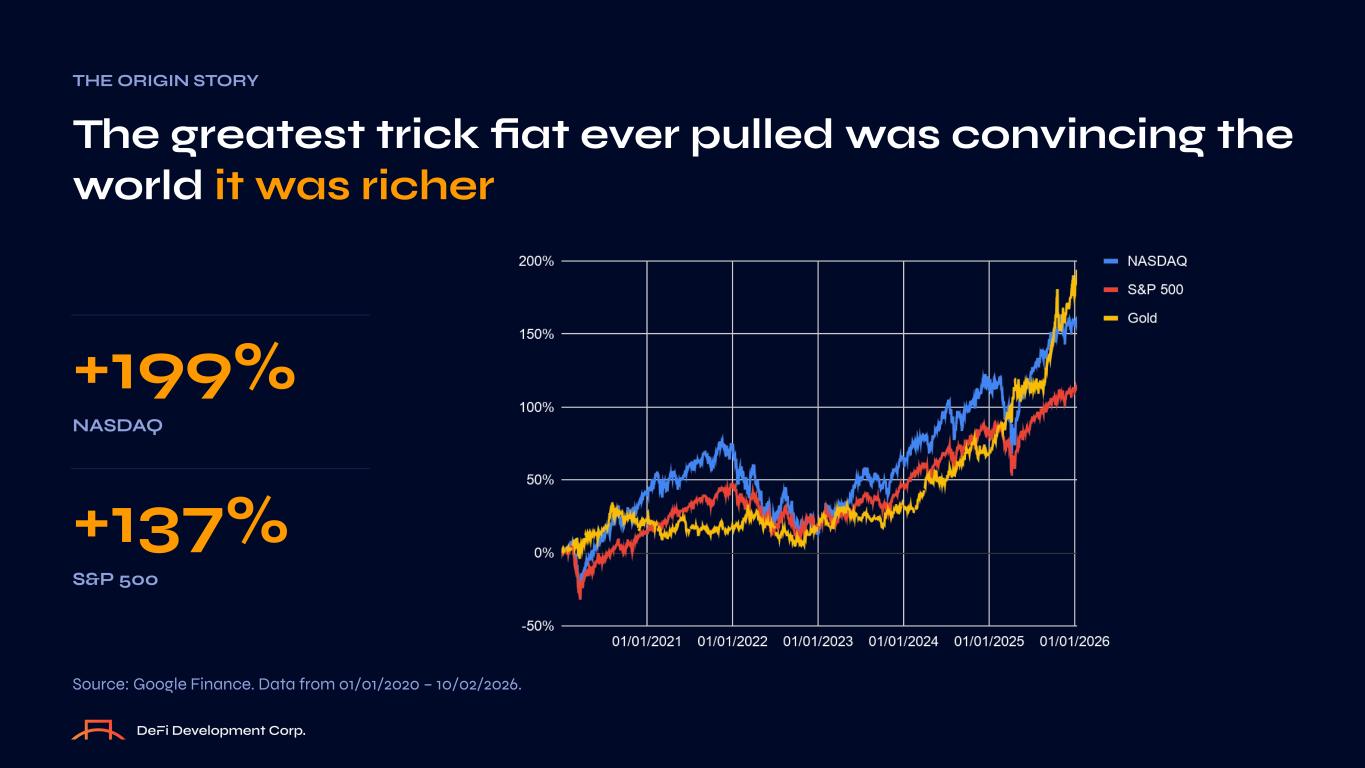
THE ORIGIN STORY The greatest trick fiat ever pulled was convincing the world it was richer +199% NASDAQ +137% S&P 500 Source: Google Finance. Data from 01/01/2020 – 10/02/2026.
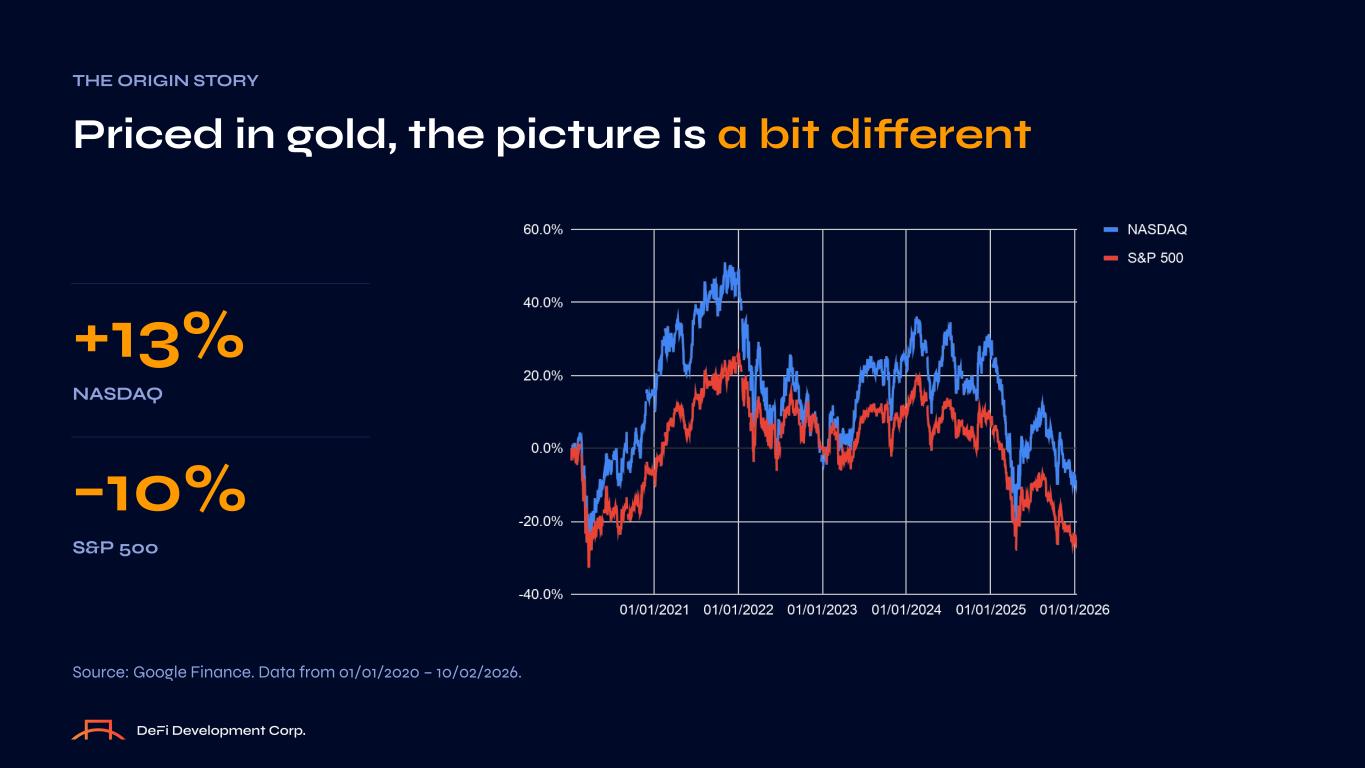
THE ORIGIN STORY Priced in gold, the picture is a bit different +13% NASDAQ −10% S&P 500 Source: Google Finance. Data from 01/01/2020 – 10/02/2026.
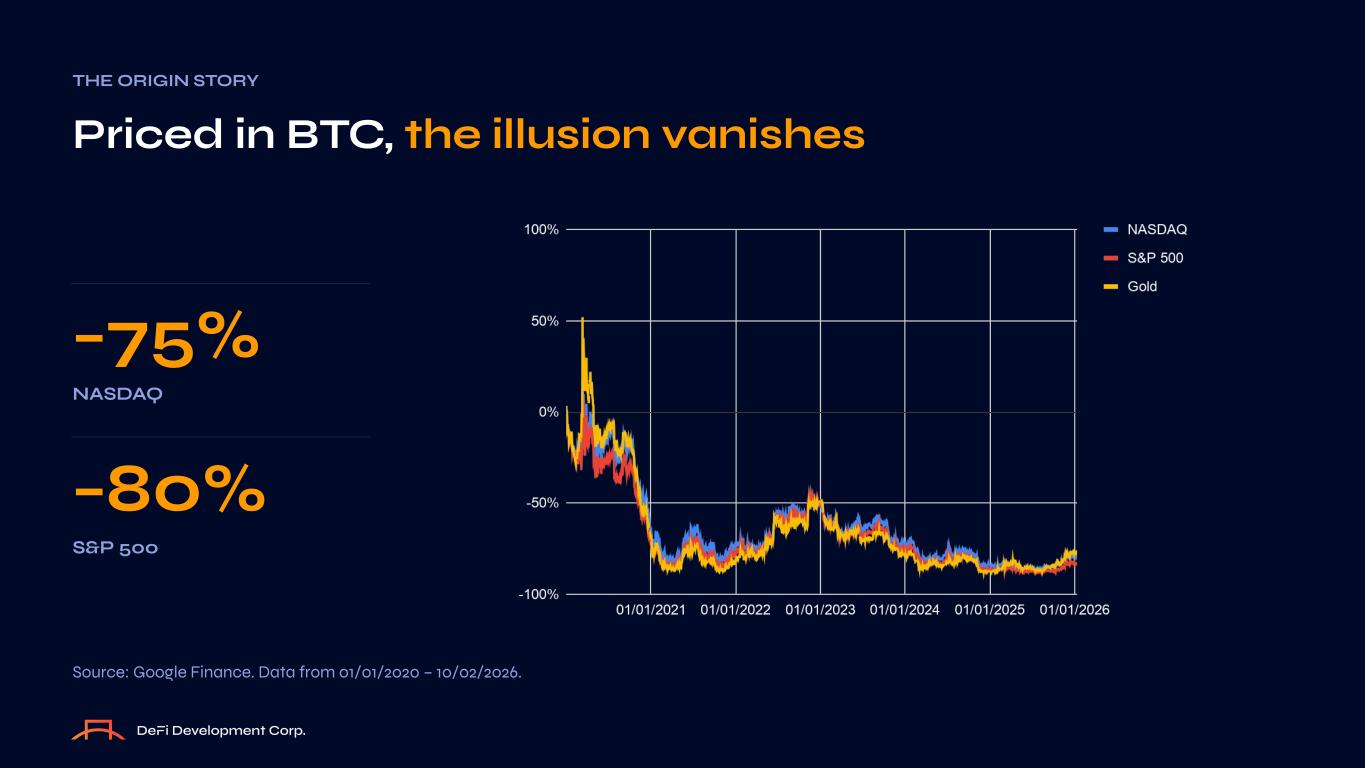
THE ORIGIN STORY Priced in BTC, the illusion vanishes −75% NASDAQ −80% S&P 500 Source: Google Finance. Data from 01/01/2020 – 10/02/2026.
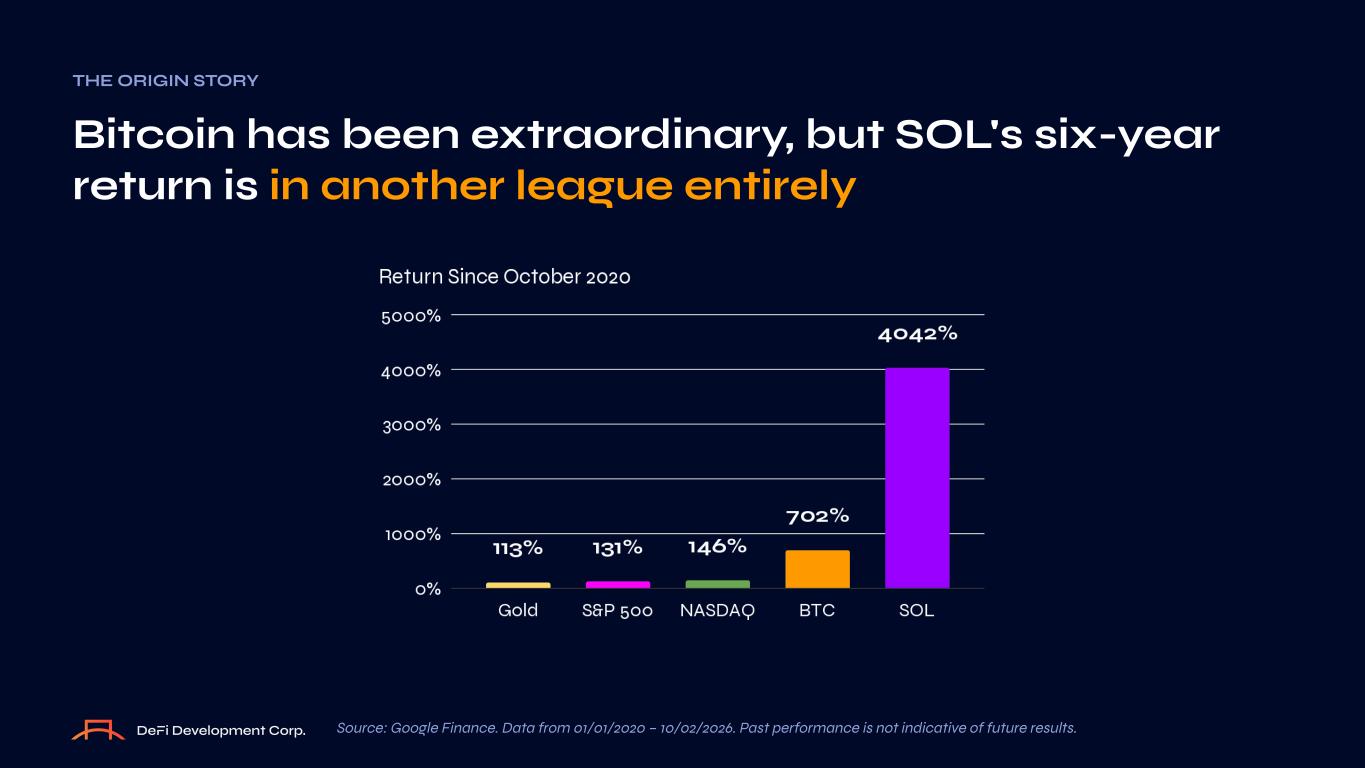
THE ORIGIN STORY Bitcoin has been extraordinary, but SOL's six-year return is in another league entirely Source: Google Finance. Data from 01/01/2020 – 10/02/2026. Past performance is not indicative of future results.
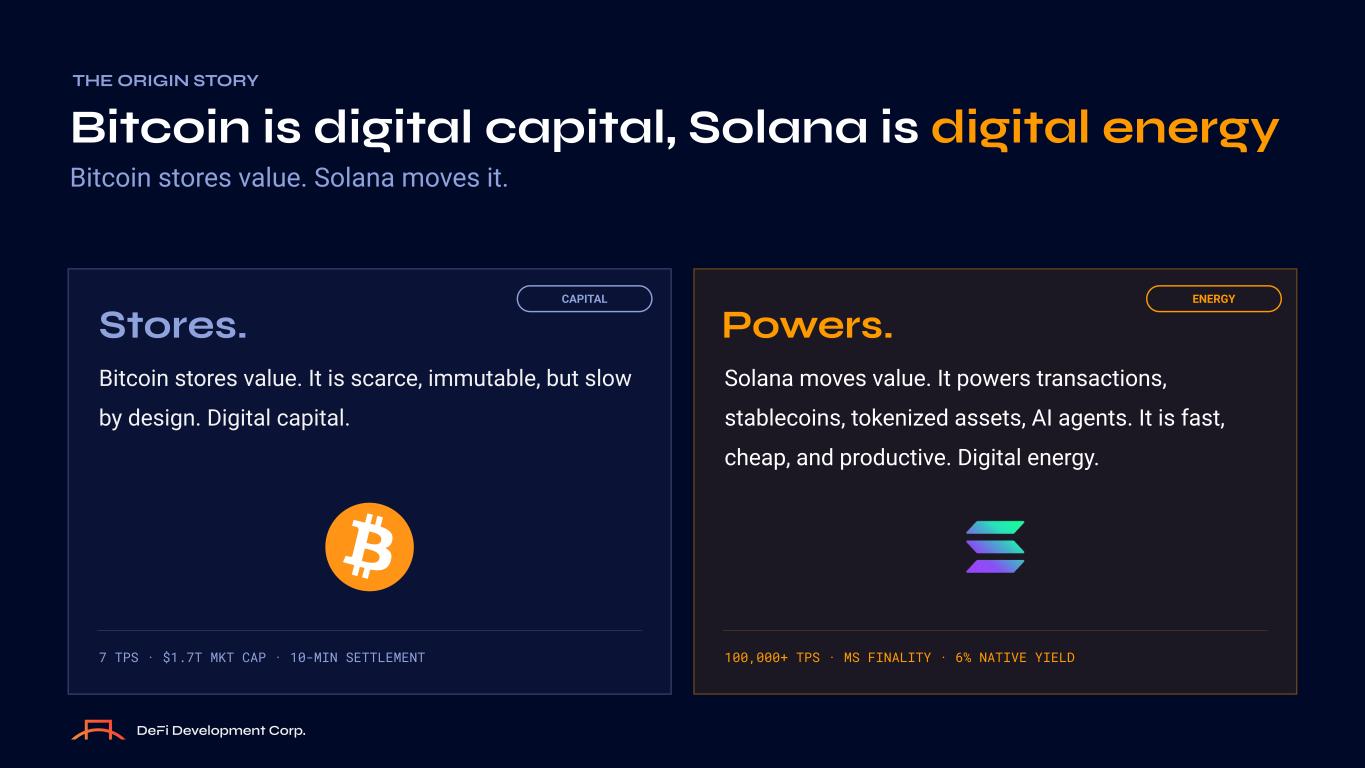
Stores. Bitcoin stores value. It is scarce, immutable, but slow by design. Digital capital. 7 TPS · $1.7T MKT CAP · 10-MIN SETTLEMENT Powers. Solana moves value. It powers transactions, stablecoins, tokenized assets, AI agents. It is fast, cheap, and productive. Digital energy. 100,000+ TPS · MS FINALITY · 6% NATIVE YIELD Bitcoin is digital capital, Solana is digital energy Bitcoin stores value. Solana moves it. ENERGYCAPITAL 10 THE ORIGIN STORY
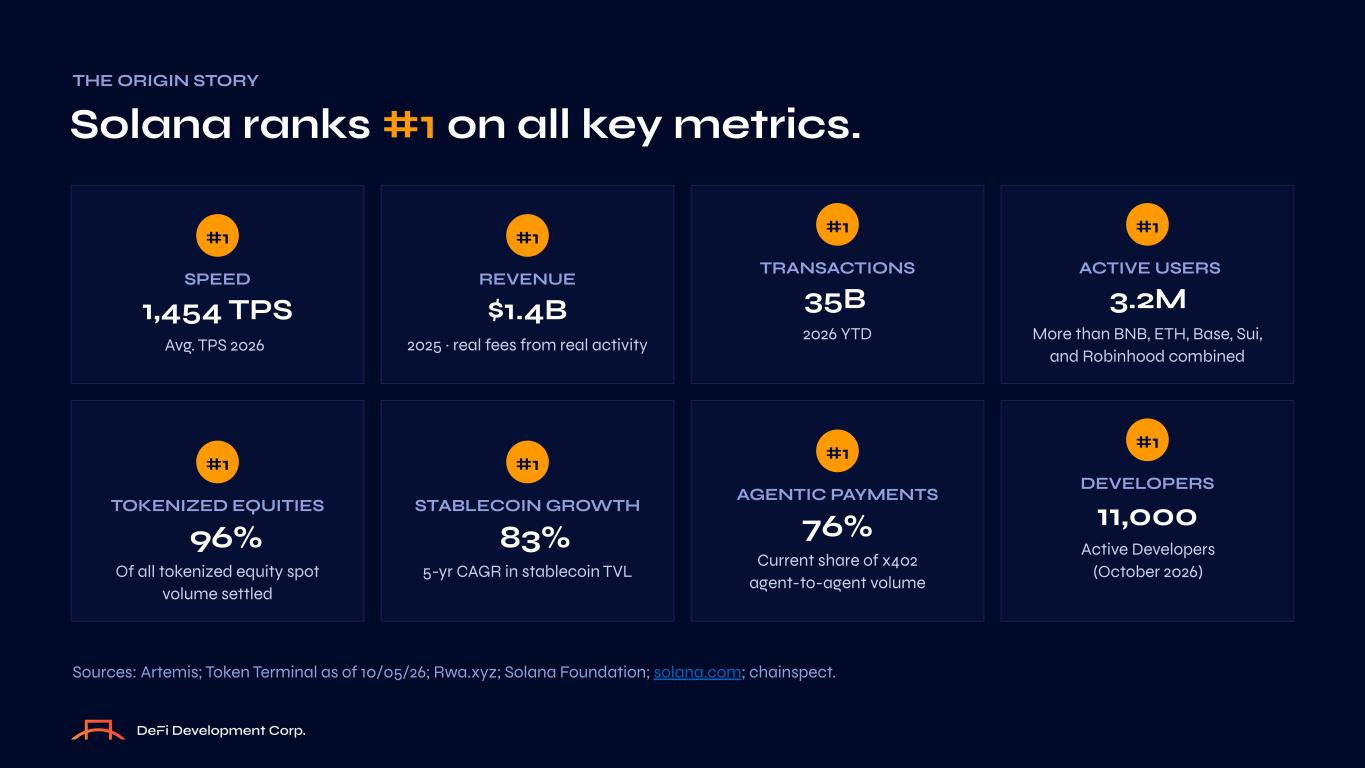
Solana ranks #1 on all key metrics. #1 SPEED 1,454 TPS #1 REVENUE $1.4B 2025 · real fees from real activity #1 TRANSACTIONS 35B 2026 YTD #1 ACTIVE USERS 3.2M More than BNB, ETH, Base, Sui, and Robinhood combined #1 TOKENIZED EQUITIES 96% Of all tokenized equity spot volume settled #1 STABLECOIN GROWTH 83% 5-yr CAGR in stablecoin TVL #1 AGENTIC PAYMENTS 76% Current share of x402 agent-to-agent volume #1 DEVELOPERS 11,000 Active Developers (October 2026) Sources: Artemis; Token Terminal as of 10/05/26; Rwa.xyz; Solana Foundation; solana.com; chainspect. Avg. TPS 2026 THE ORIGIN STORY
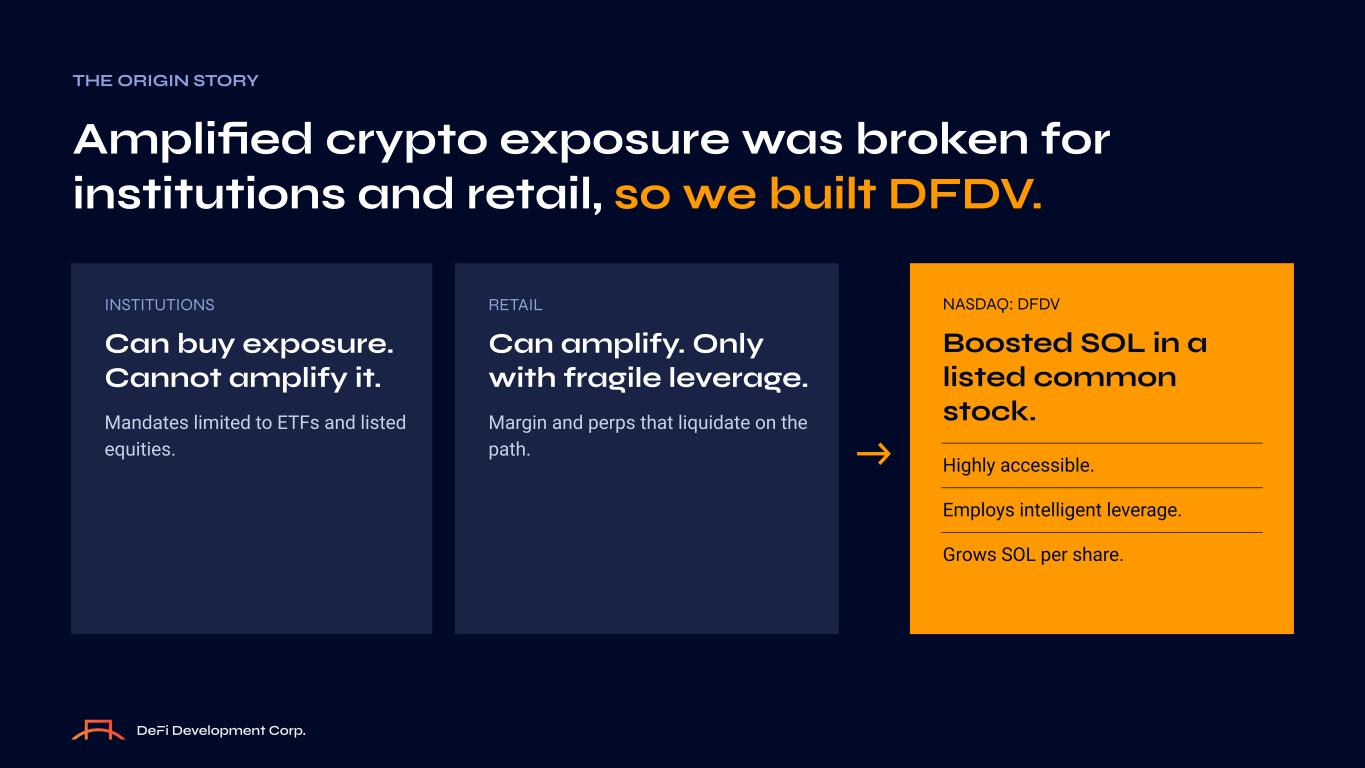
THE ORIGIN STORY Amplified crypto exposure was broken for institutions and retail, so we built DFDV. INSTITUTIONS Can buy exposure. Cannot amplify it. Mandates limited to ETFs and listed equities. RETAIL Can amplify. Only with fragile leverage. Margin and perps that liquidate on the path. → NASDAQ: DFDV Boosted SOL in a listed common stock. Highly accessible. Employs intelligent leverage. Grows SOL per share.
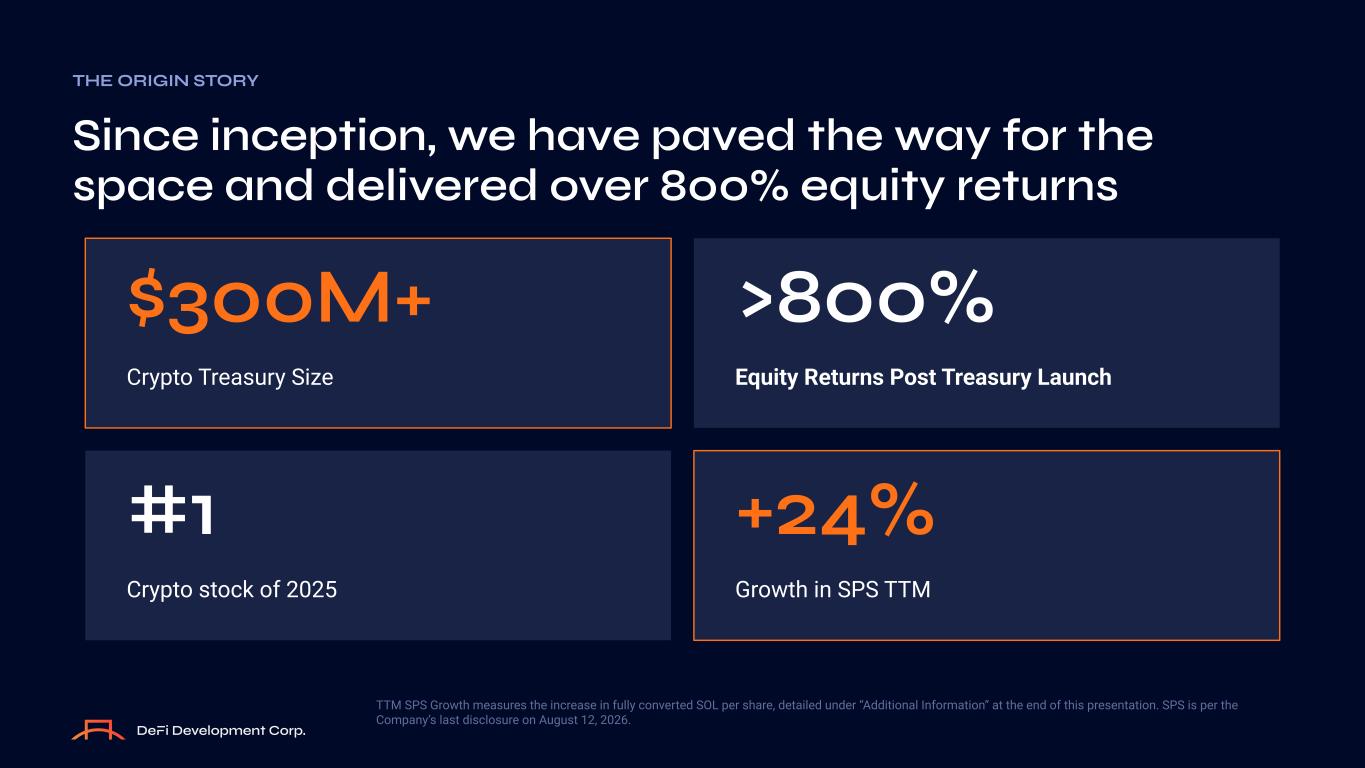
Since inception, we have paved the way for the space and delivered over 800% equity returns $300M+ Crypto Treasury Size >800% Equity Returns Post Treasury Launch #1 Crypto stock of 2025 +24% Growth in SPS TTM TTM SPS Growth measures the increase in fully converted SOL per share, detailed under “Additional Information” at the end of this presentation. SPS is per the Company’s last disclosure on August 12, 2026. THE ORIGIN STORY
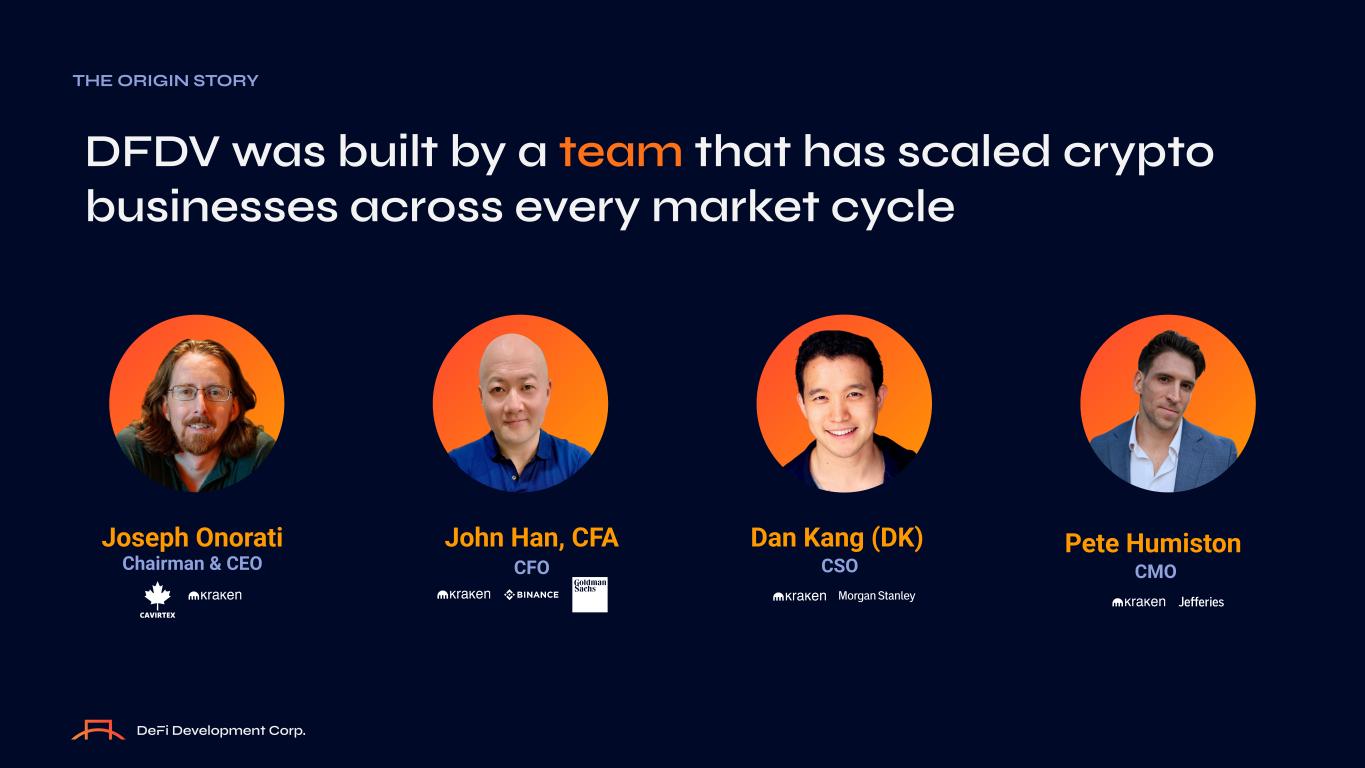
DFDV was built by a team that has scaled crypto businesses across every market cycle Dan Kang (DK) CSO John Han, CFA CFO Joseph Onorati Chairman & CEO Pete Humiston CMO THE ORIGIN STORY
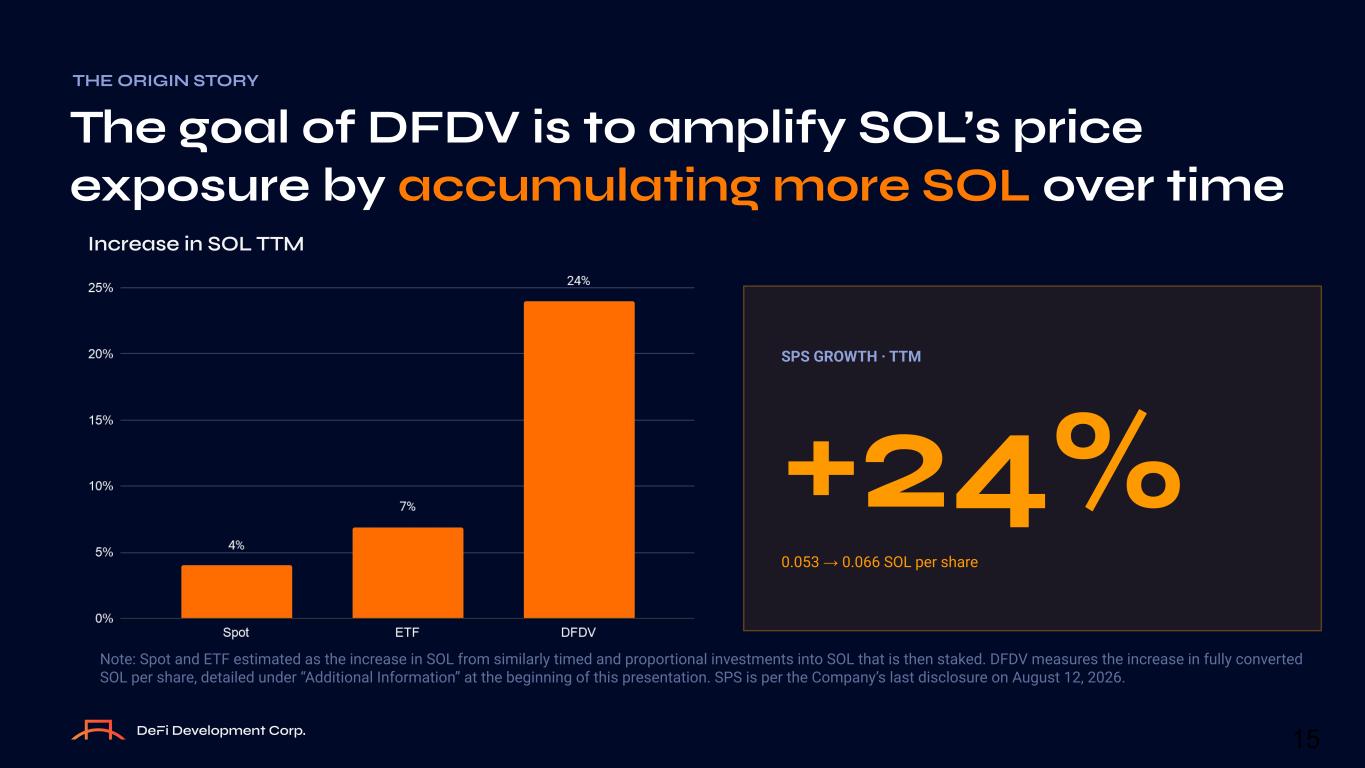
The goal of DFDV is to amplify SOL’s price exposure by accumulating more SOL over time SPS GROWTH · TTM +24% 0.053 → 0.066 SOL per share Note: Spot and ETF estimated as the increase in SOL from similarly timed and proportional investments into SOL that is then staked. DFDV measures the increase in fully converted SOL per share, detailed under “Additional Information” at the beginning of this presentation. SPS is per the Company’s last disclosure on August 12, 2026. Increase in SOL TTM 15 THE ORIGIN STORY
PHASE 01 01 DFDV: The Levered SOL Engine
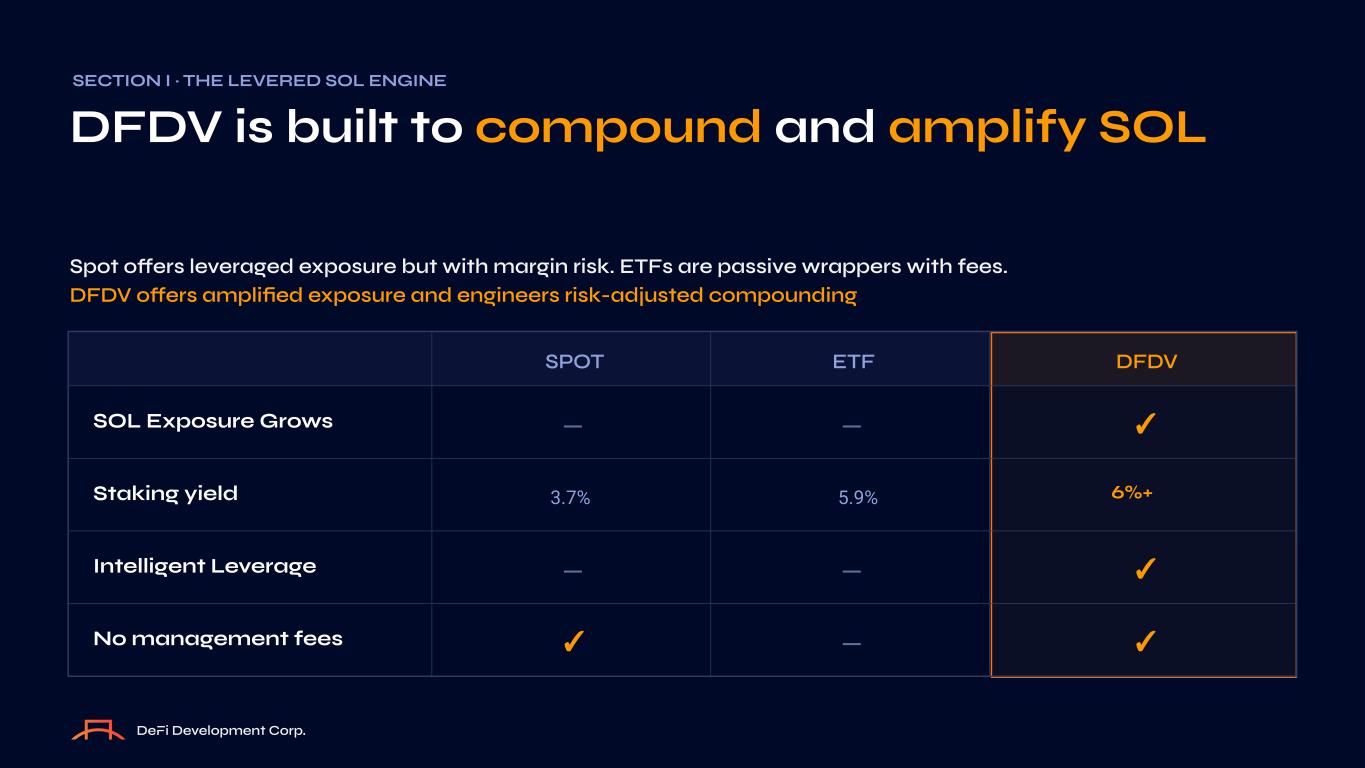
DFDV is built to compound and amplify SOL SPOT ETF DFDV SOL Exposure Grows — — ✓ Staking yield 3.7% 6%+ Intelligent Leverage — — ✓ No management fees ✓ — ✓ Spot offers leveraged exposure but with margin risk. ETFs are passive wrappers with fees. DFDV offers amplified exposure and engineers risk-adjusted compounding 5.9% SECTION I · THE LEVERED SOL ENGINE
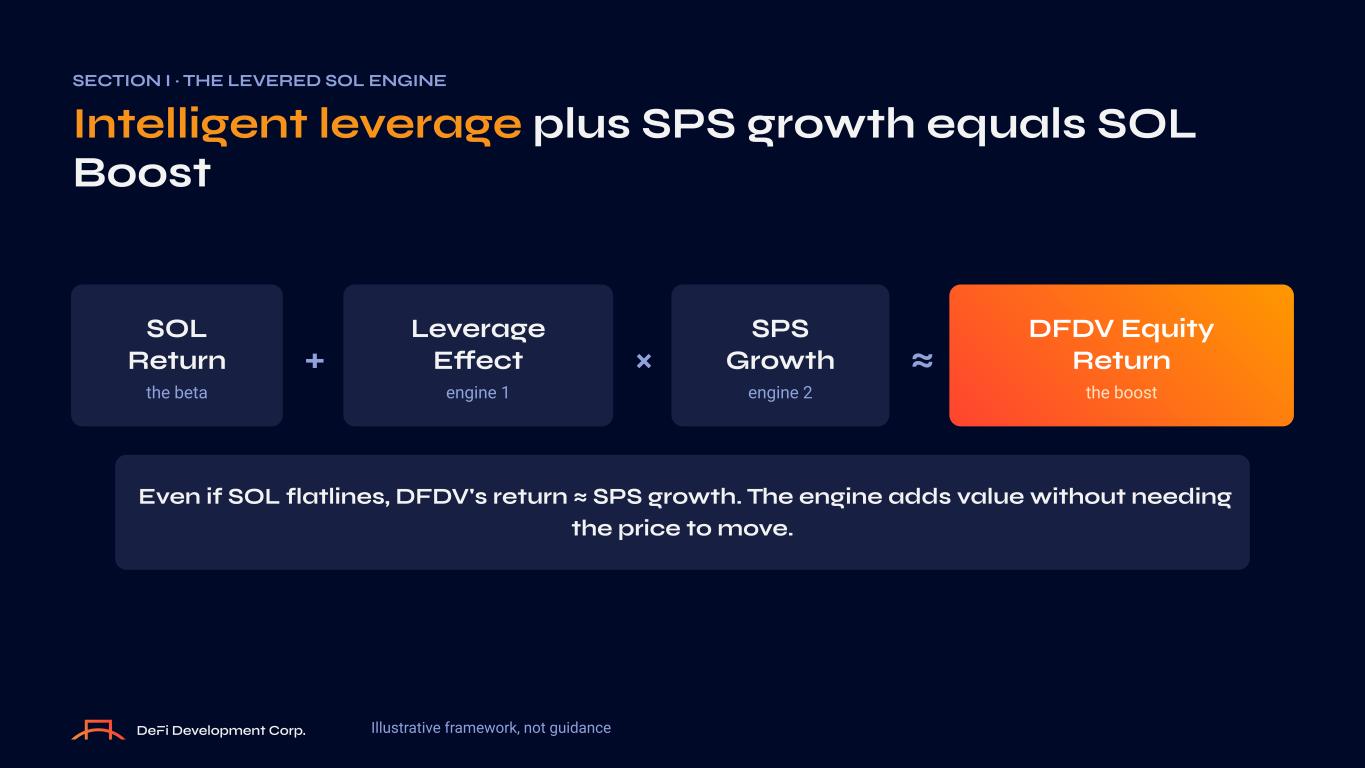
Intelligent leverage plus SPS growth equals SOL Boost SOL Return the beta + Leverage Effect engine 1 × SPS Growth engine 2 ≈ DFDV Equity Return the boost Even if SOL flatlines, DFDV's return ≈ SPS growth. The engine adds value without needing the price to move. Illustrative framework, not guidance SECTION I · THE LEVERED SOL ENGINE
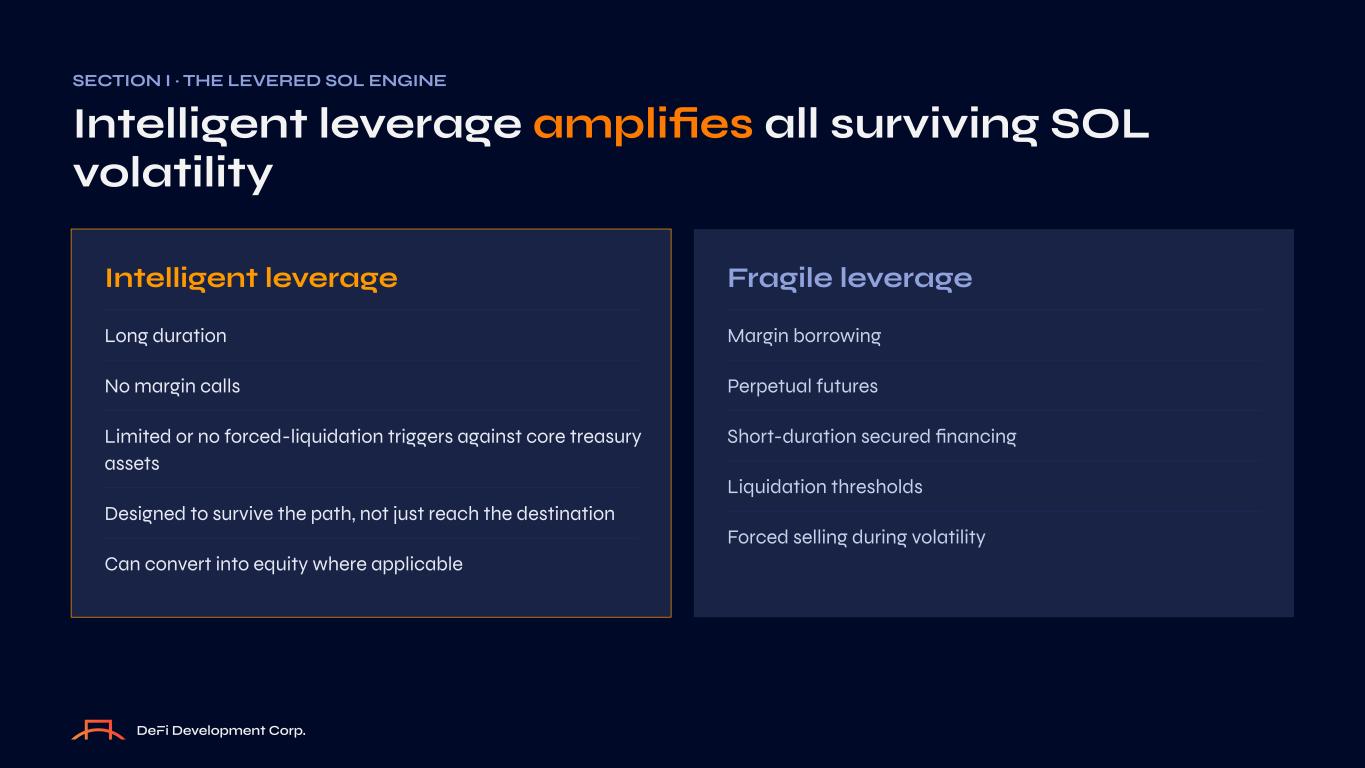
Intelligent leverage amplifies all surviving SOL volatility Intelligent leverage Long duration No margin calls Limited or no forced-liquidation triggers against core treasury assets Designed to survive the path, not just reach the destination Can convert into equity where applicable Fragile leverage Margin borrowing Perpetual futures Short-duration secured financing Liquidation thresholds Forced selling during volatility SECTION I · THE LEVERED SOL ENGINE
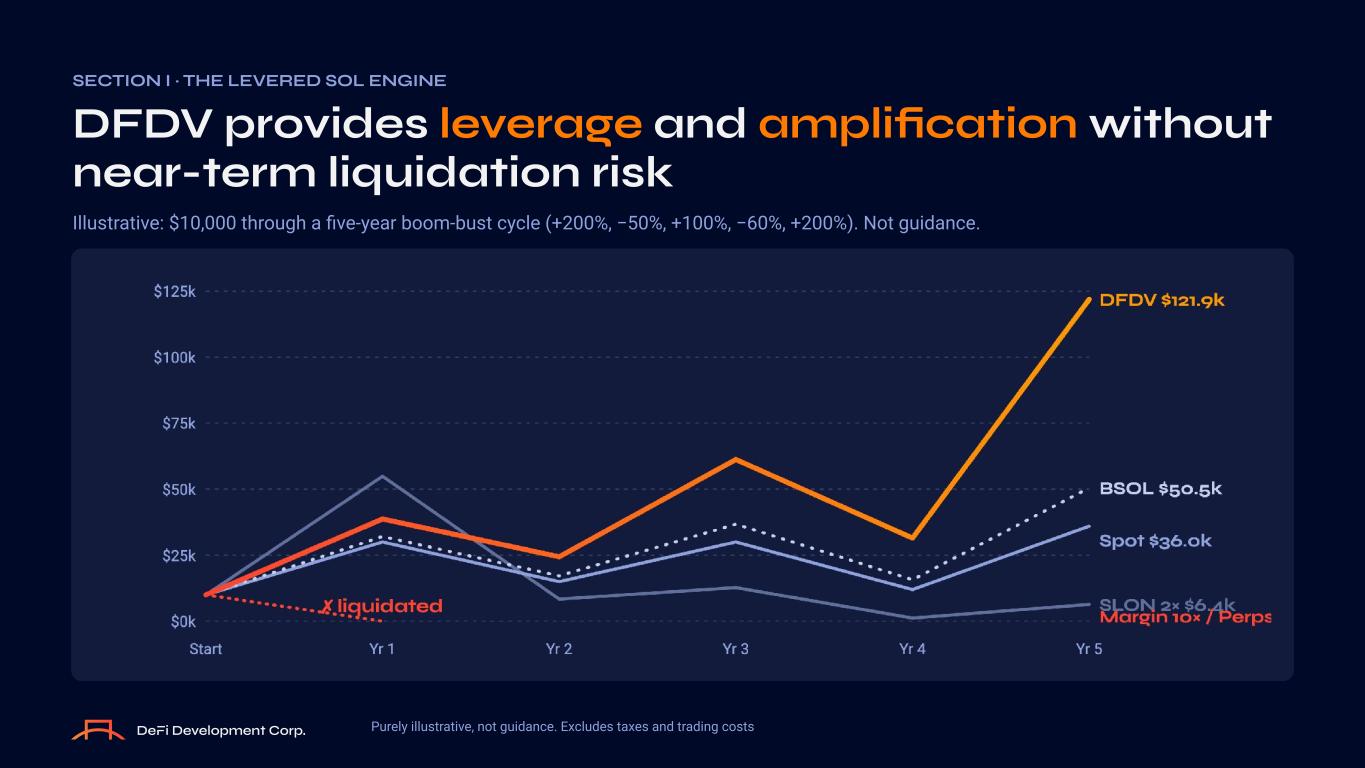
DFDV provides leverage and amplification without near-term liquidation risk Illustrative: $10,000 through a five-year boom-bust cycle (+200%, −50%, +100%, −60%, +200%). Not guidance. Purely illustrative, not guidance. Excludes taxes and trading costs SECTION I · THE LEVERED SOL ENGINE
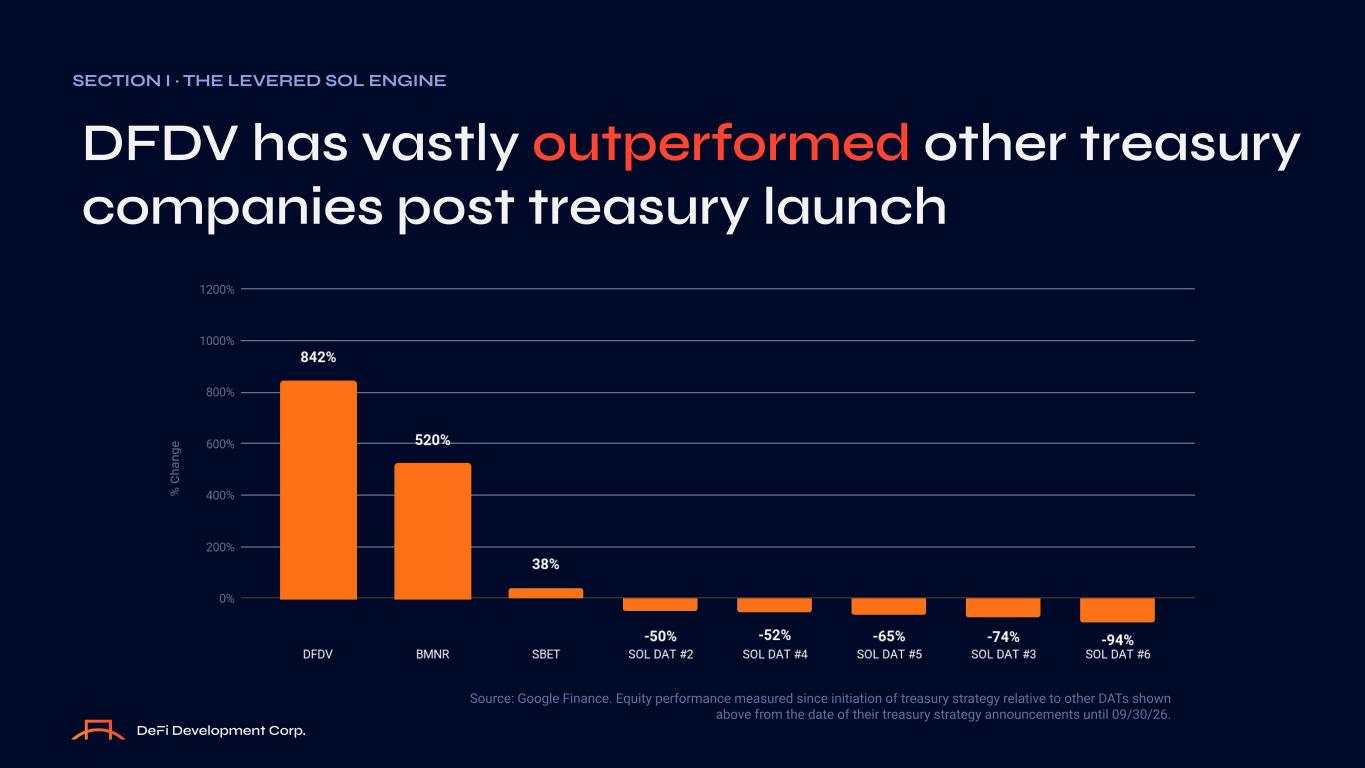
DFDV has vastly outperformed other treasury companies post treasury launch Source: Google Finance. Equity performance measured since initiation of treasury strategy relative to other DATs shown above from the date of their treasury strategy announcements until 09/30/26. SECTION I · THE LEVERED SOL ENGINE
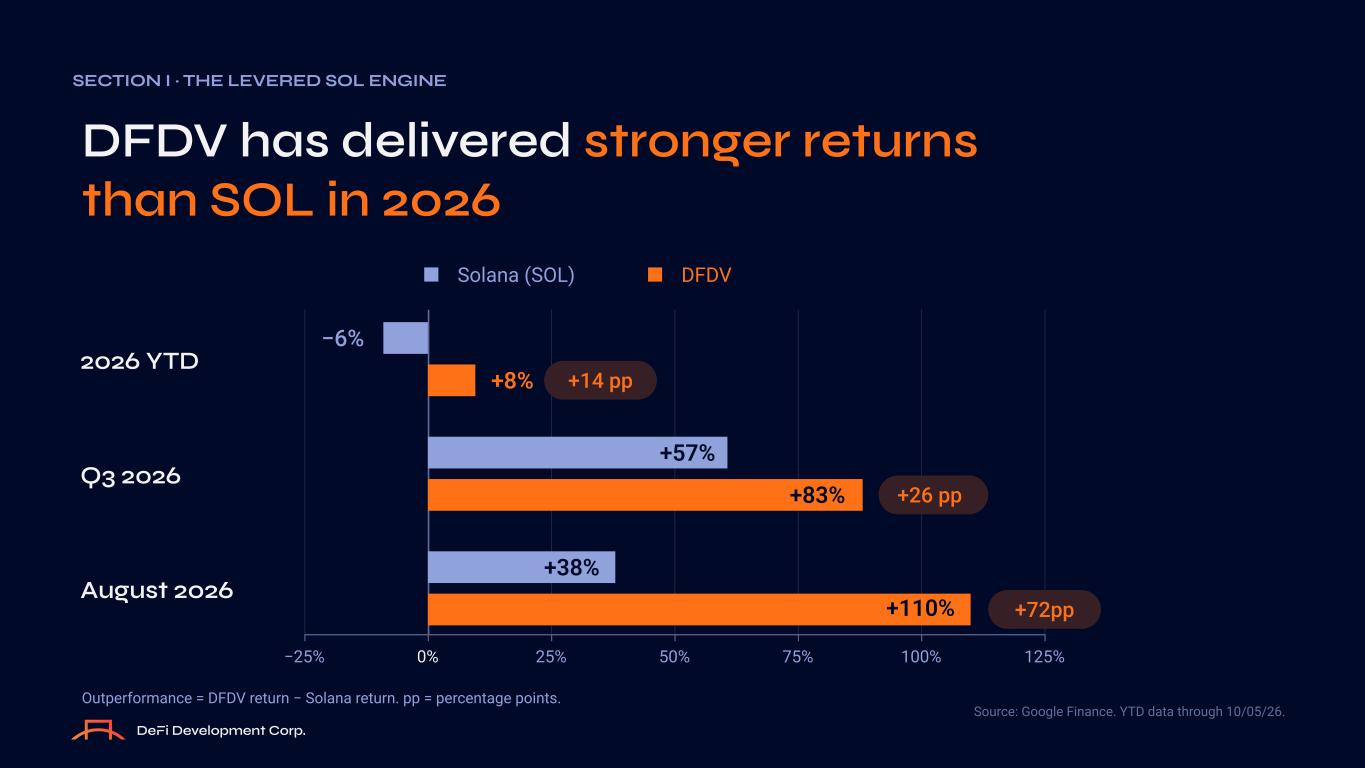
DFDV has delivered stronger returns than SOL in 2026 Source: Google Finance. YTD data through 10/05/26. Outperformance = DFDV return − Solana return. pp = percentage points. −25% 0% 25% 50% 75% 100% 125% Solana (SOL) DFDV 2026 YTD −6% +8% +14 pp Q3 2026 +57% +83% +26 pp August 2026 +38% +110% +72pp SECTION I · THE LEVERED SOL ENGINE
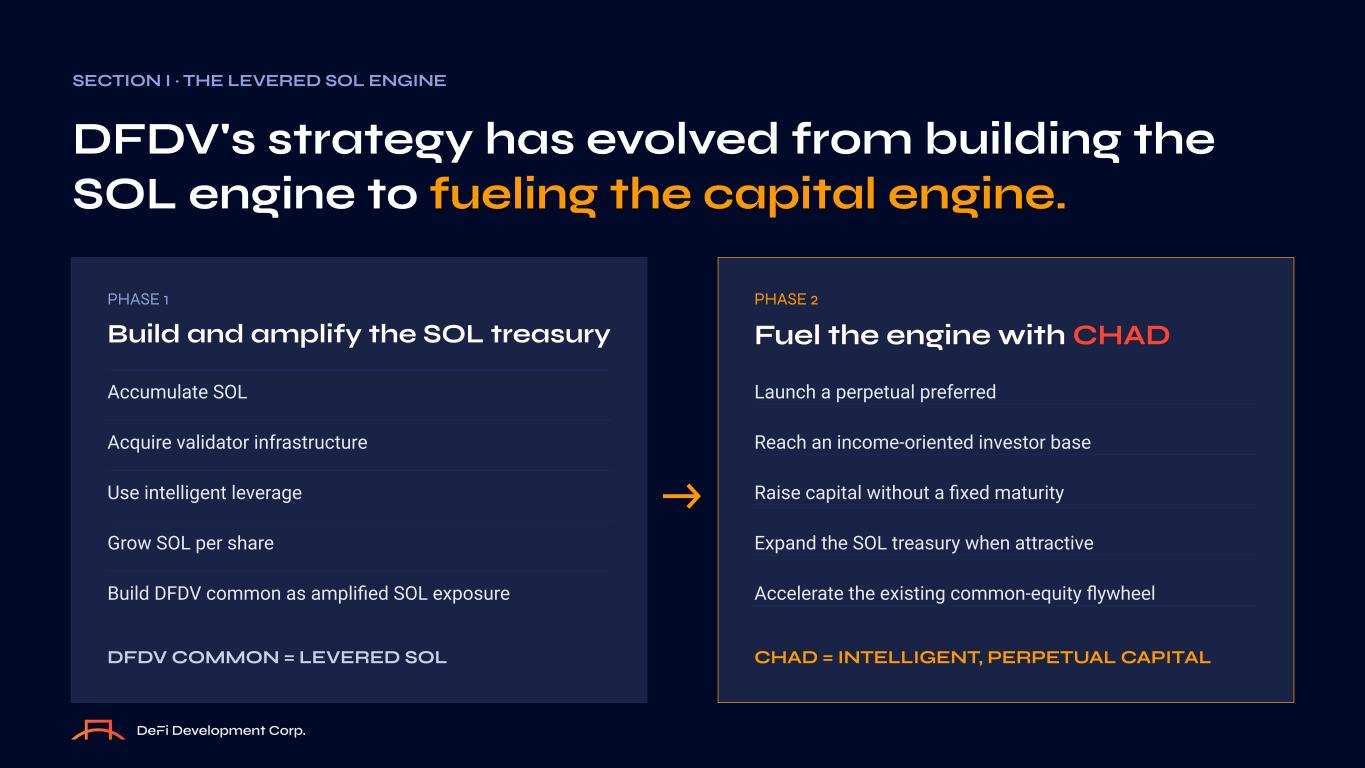
DFDV's strategy has evolved from building the SOL engine to fueling the capital engine. PHASE 1 Build and amplify the SOL treasury Accumulate SOL Acquire validator infrastructure Use intelligent leverage Grow SOL per share Build DFDV common as amplified SOL exposure DFDV COMMON = LEVERED SOL → PHASE 2 Fuel the engine with CHAD Launch a perpetual preferred Reach an income-oriented investor base Raise capital without a fixed maturity Expand the SOL treasury when attractive Accelerate the existing common-equity flywheel CHAD = INTELLIGENT, PERPETUAL CAPITAL SECTION I · THE LEVERED SOL ENGINE
PHASE 02 02 Phase 2 is CHAD: Fuel for the Engine
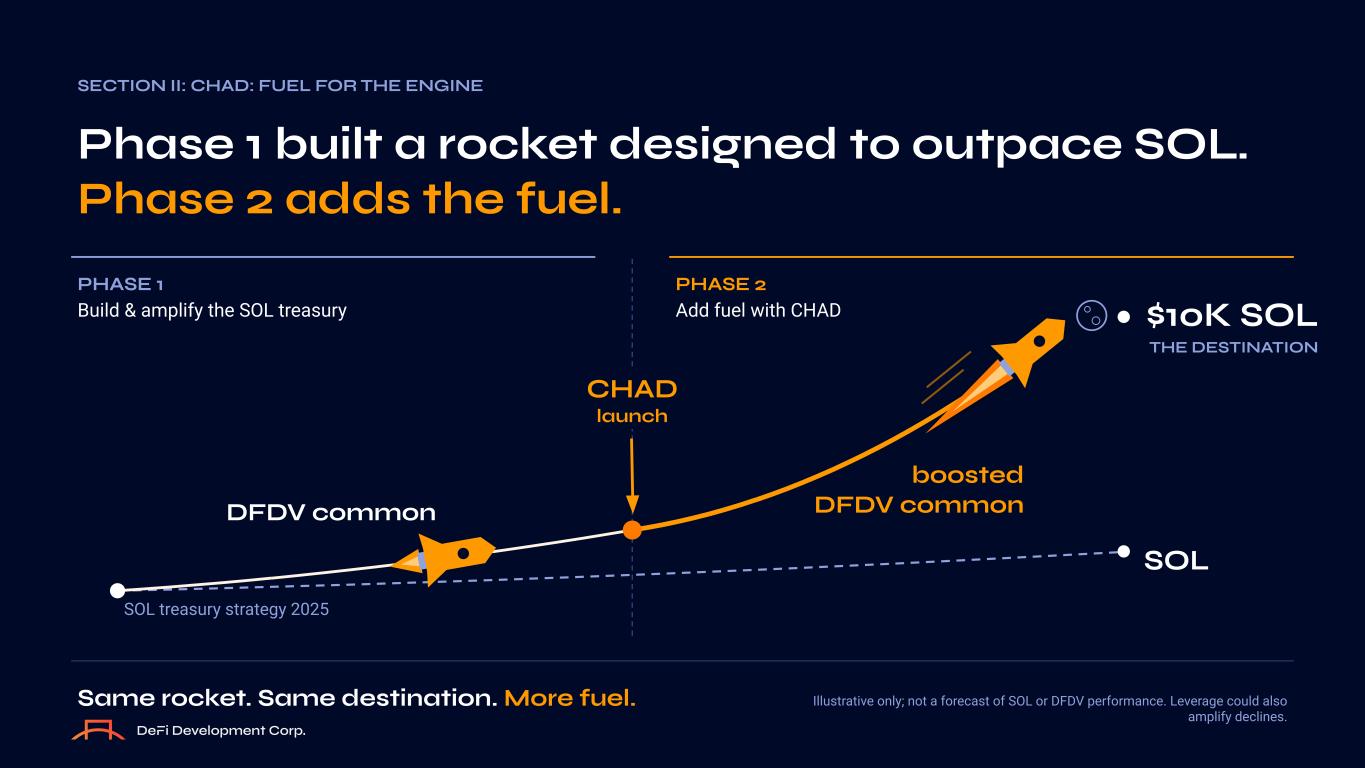
PHASE 1 Build & amplify the SOL treasury PHASE 2 Add fuel with CHAD SOL SOL treasury strategy 2025 DFDV common boosted DFDV common THE DESTINATION $10K SOL CHAD launch Same rocket. Same destination. More fuel. Illustrative only; not a forecast of SOL or DFDV performance. Leverage could also amplify declines. SECTION II: CHAD: FUEL FOR THE ENGINE Phase 1 built a rocket designed to outpace SOL. Phase 2 adds the fuel.
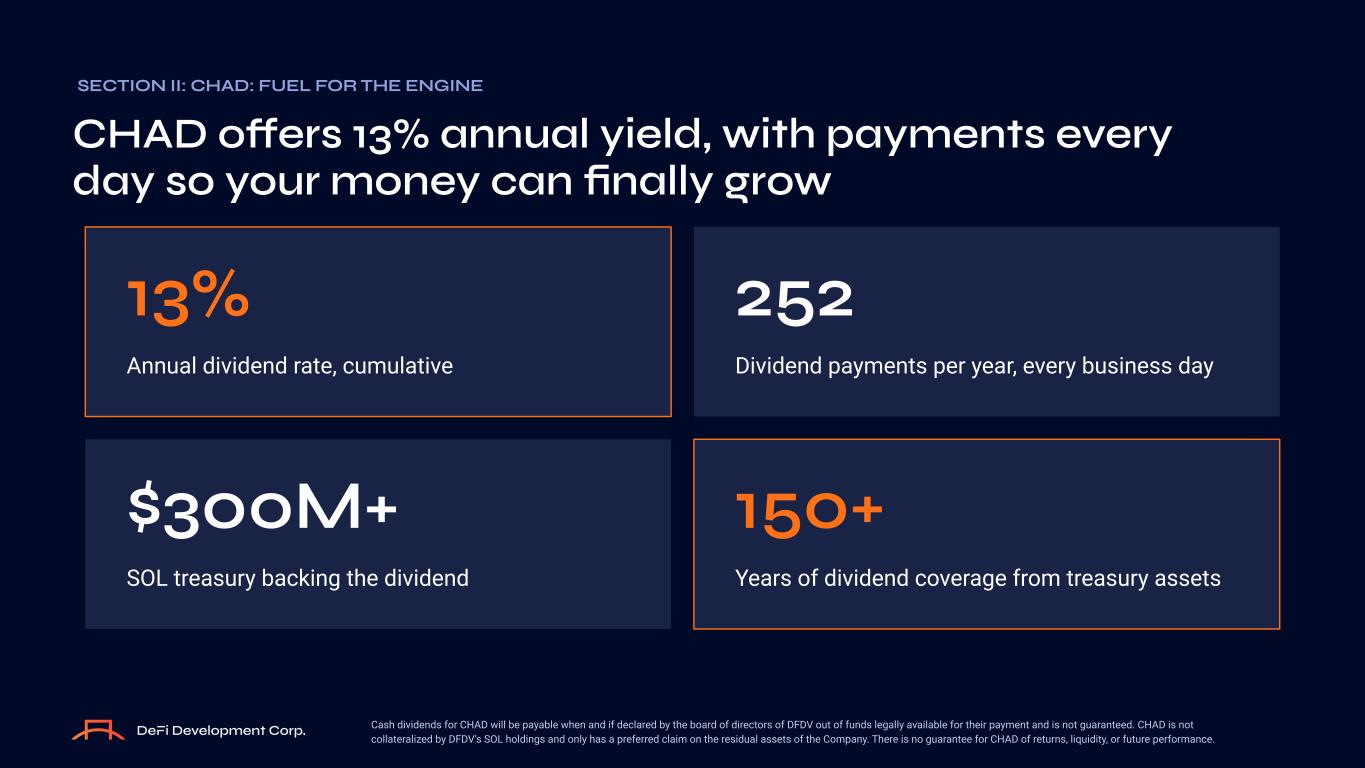
CHAD offers 13% annual yield, with payments every day so your money can finally grow 13% Annual dividend rate, cumulative 252 Dividend payments per year, every business day $300M+ SOL treasury backing the dividend 150+ Years of dividend coverage from treasury assets Cash dividends for CHAD will be payable when and if declared by the board of directors of DFDV out of funds legally available for their payment and is not guaranteed. CHAD is not collateralized by DFDV’s SOL holdings and only has a preferred claim on the residual assets of the Company. There is no guarantee for CHAD of returns, liquidity, or future performance. SECTION II: CHAD: FUEL FOR THE ENGINE
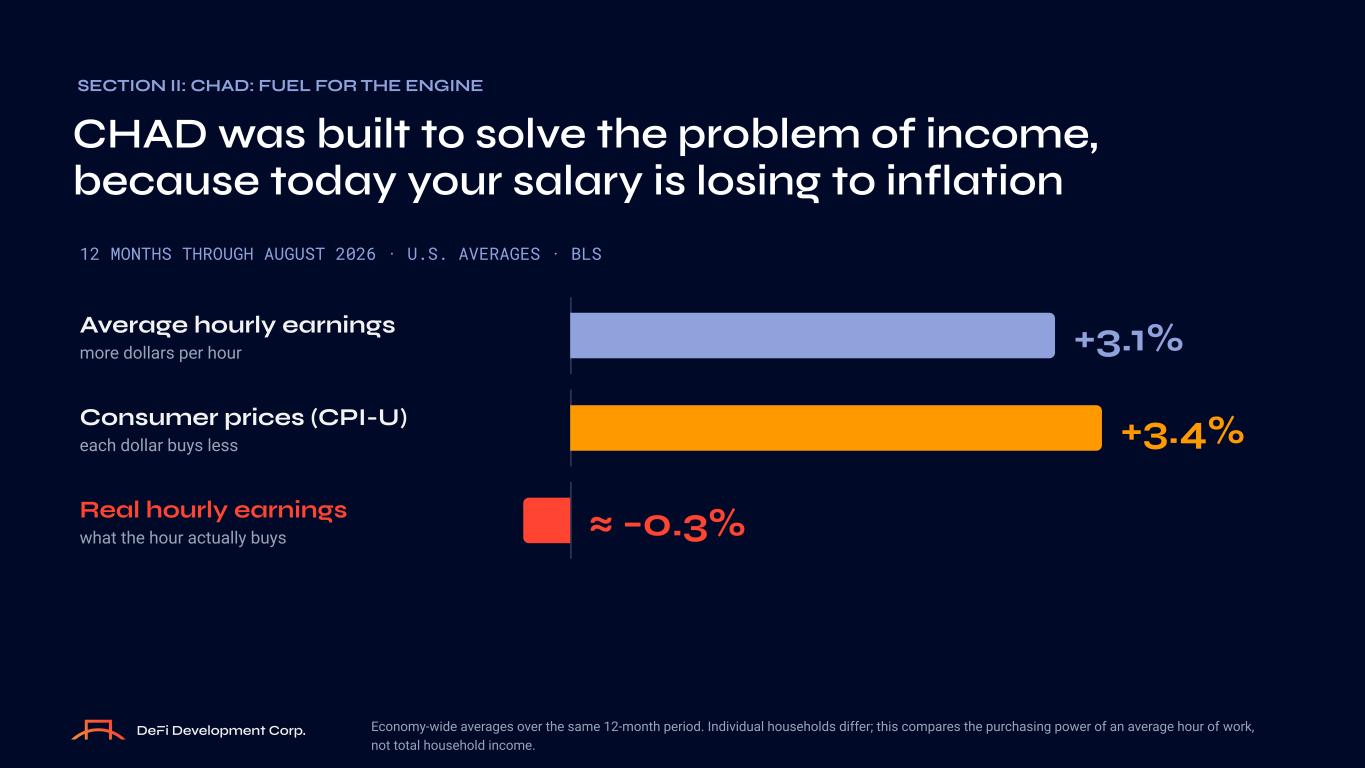
12 MONTHS THROUGH AUGUST 2026 · U.S. AVERAGES · BLS Average hourly earnings more dollars per hour +3.1% Consumer prices (CPI-U) each dollar buys less +3.4% Real hourly earnings what the hour actually buys ≈ −0.3% Economy-wide averages over the same 12-month period. Individual households differ; this compares the purchasing power of an average hour of work, not total household income. CHAD was built to solve the problem of income, because today your salary is losing to inflation SECTION II: CHAD: FUEL FOR THE ENGINE
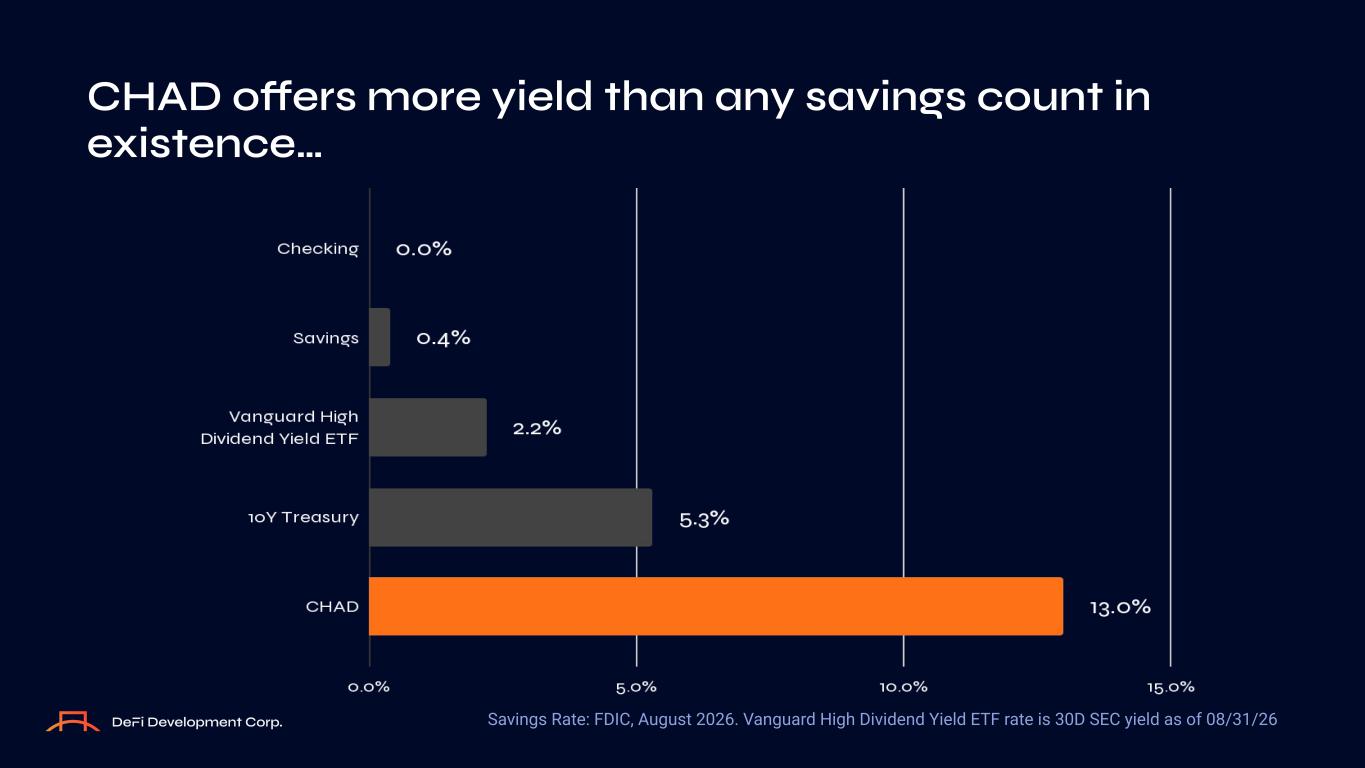
Savings Rate: FDIC, August 2026. Vanguard High Dividend Yield ETF rate is 30D SEC yield as of 08/31/26 CHAD offers more yield than any savings count in existence…
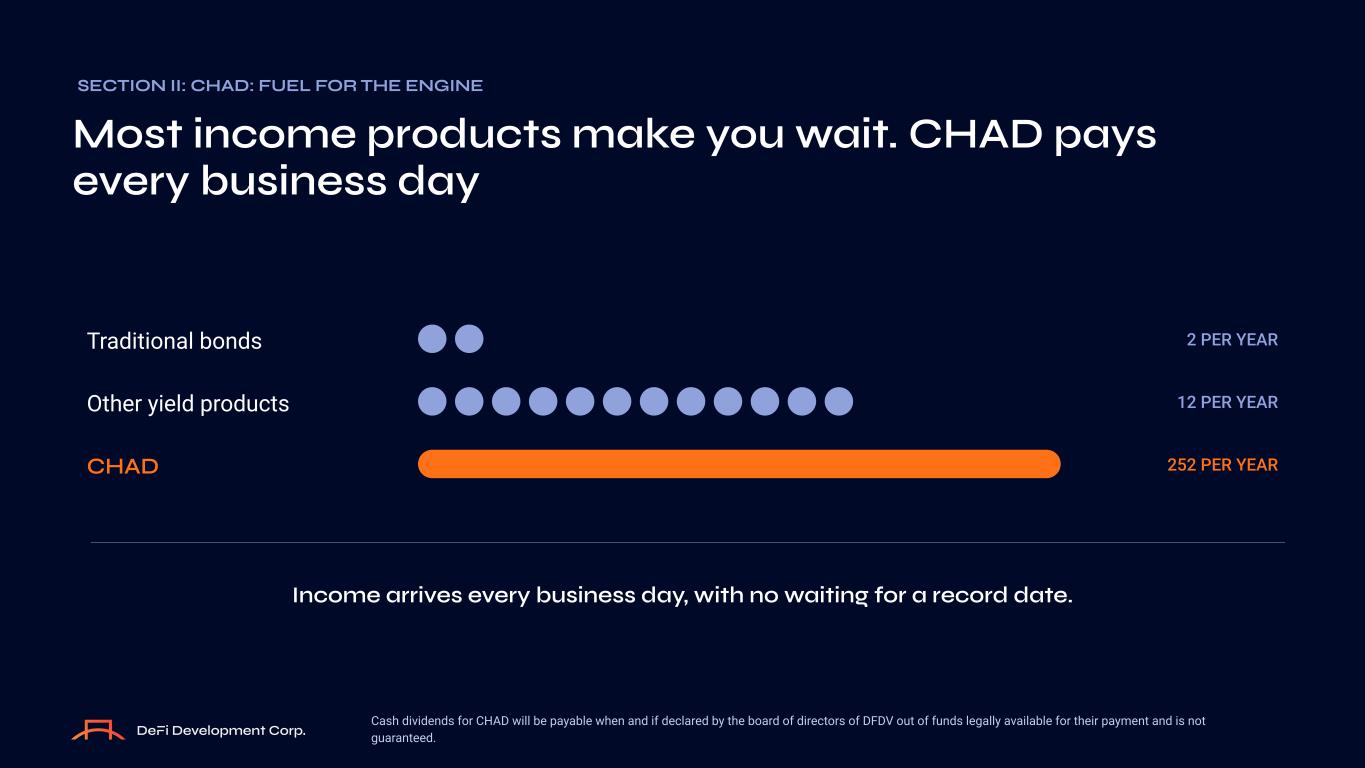
Cash dividends for CHAD will be payable when and if declared by the board of directors of DFDV out of funds legally available for their payment and is not guaranteed. Most income products make you wait. CHAD pays every business day Traditional bonds 2 PER YEAR Other yield products 12 PER YEAR CHAD 252 PER YEAR Income arrives every business day, with no waiting for a record date. SECTION II: CHAD: FUEL FOR THE ENGINE
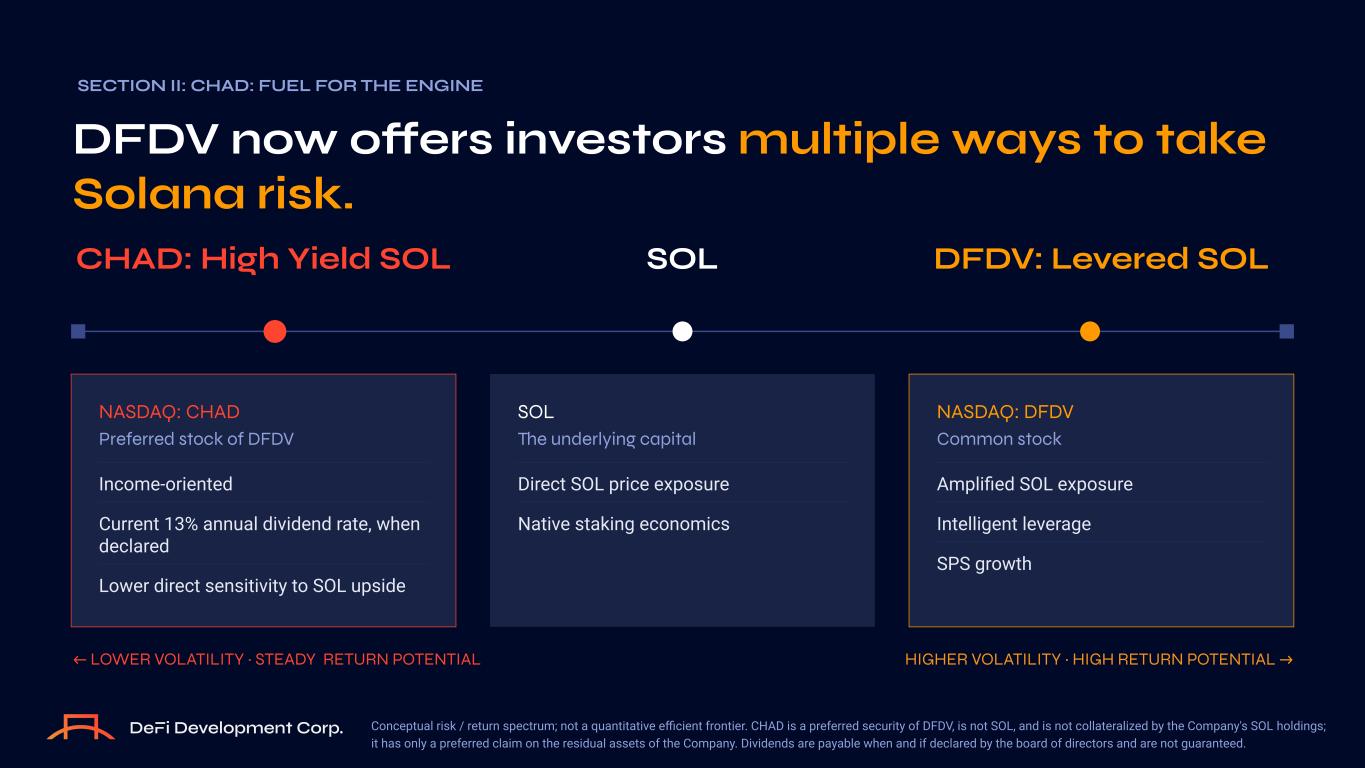
DFDV now offers investors multiple ways to take Solana risk. CHAD: High Yield SOL SOL DFDV: Levered SOL NASDAQ: CHAD Preferred stock of DFDV Income-oriented Current 13% annual dividend rate, when declared Lower direct sensitivity to SOL upside SOL The underlying capital Direct SOL price exposure Native staking economics NASDAQ: DFDV Common stock Amplified SOL exposure Intelligent leverage SPS growth ← LOWER VOLATILITY · STEADY RETURN POTENTIAL HIGHER VOLATILITY · HIGH RETURN POTENTIAL → Conceptual risk / return spectrum; not a quantitative efficient frontier. CHAD is a preferred security of DFDV, is not SOL, and is not collateralized by the Company's SOL holdings; it has only a preferred claim on the residual assets of the Company. Dividends are payable when and if declared by the board of directors and are not guaranteed. SECTION II: CHAD: FUEL FOR THE ENGINE
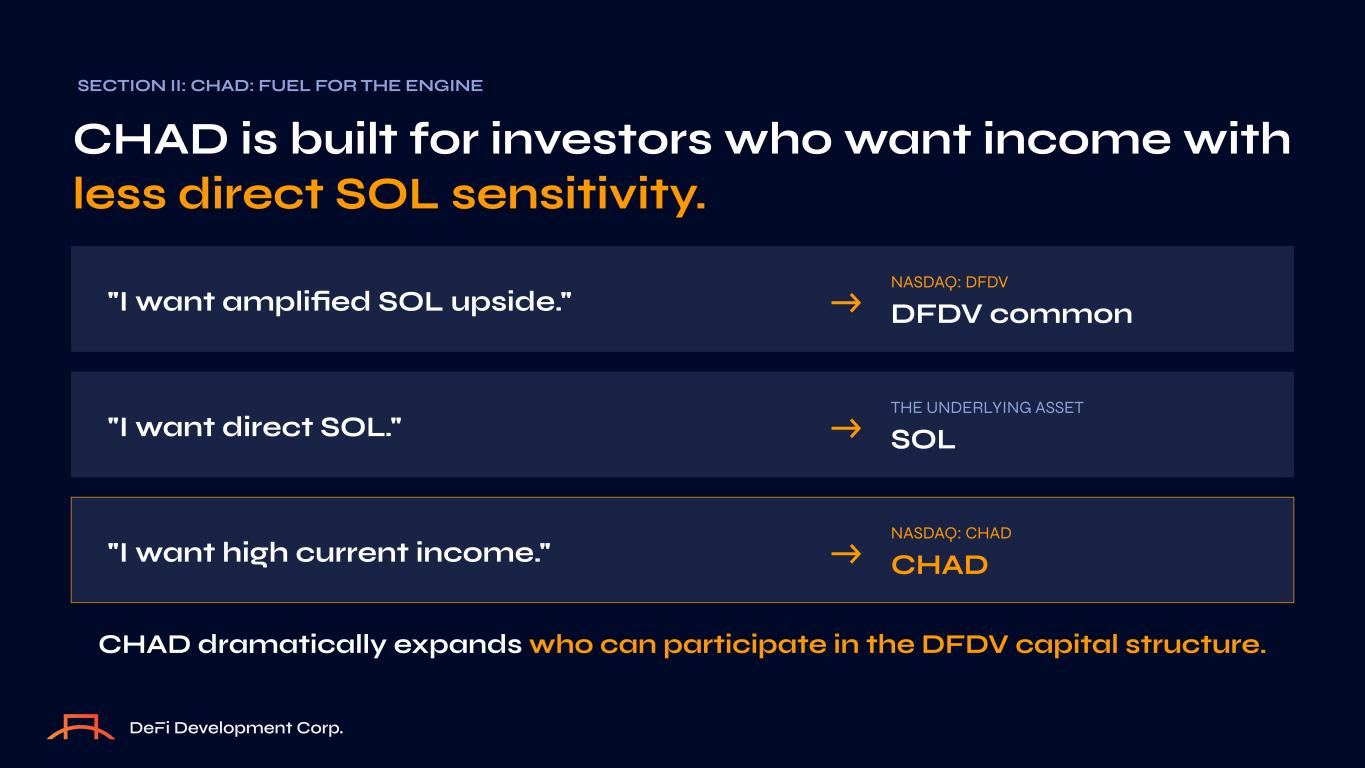
CHAD is built for investors who want income with less direct SOL sensitivity. "I want amplified SOL upside." → NASDAQ: DFDV DFDV common "I want direct SOL." → THE UNDERLYING ASSET SOL "I want high current income." → NASDAQ: CHAD CHAD CHAD dramatically expands who can participate in the DFDV capital structure. SECTION II: CHAD: FUEL FOR THE ENGINE
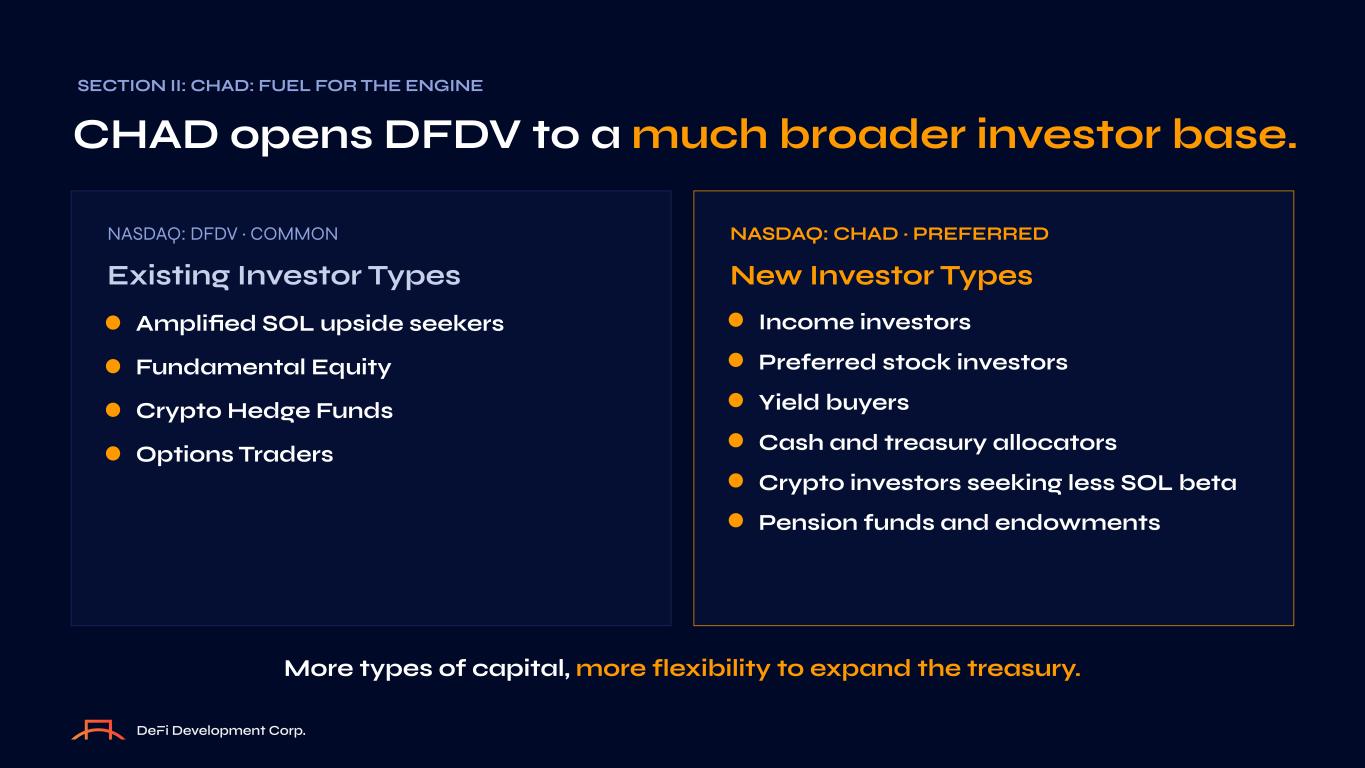
CHAD opens DFDV to a much broader investor base. NASDAQ: DFDV · COMMON Existing Investor Types Amplified SOL upside seekers NASDAQ: CHAD · PREFERRED New Investor Types Income investors Preferred stock investors Yield buyers Cash and treasury allocators Crypto investors seeking less SOL beta More types of capital, more flexibility to expand the treasury. Fundamental Equity Crypto Hedge Funds Options Traders Pension funds and endowments SECTION II: CHAD: FUEL FOR THE ENGINE
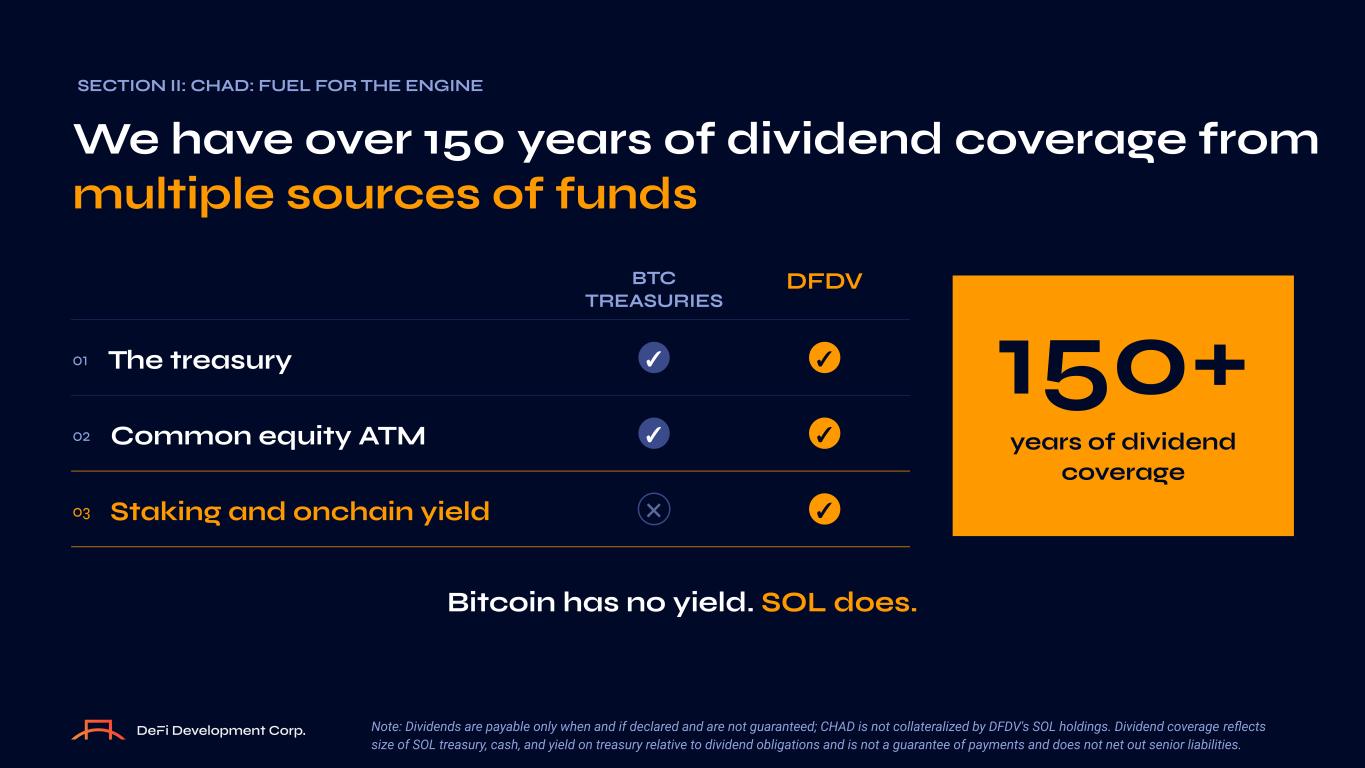
We have over 150 years of dividend coverage from multiple sources of funds BTC TREASURIES DFDV 01 The treasury ✓ ✓ 02 Common equity ATM ✓ ✓ 03 Staking and onchain yield ✕ ✓ 150+ years of dividend coverage Bitcoin has no yield. SOL does. Note: Dividends are payable only when and if declared and are not guaranteed; CHAD is not collateralized by DFDV's SOL holdings. Dividend coverage reflects size of SOL treasury, cash, and yield on treasury relative to dividend obligations and is not a guarantee of payments and does not net out senior liabilities. SECTION II: CHAD: FUEL FOR THE ENGINE
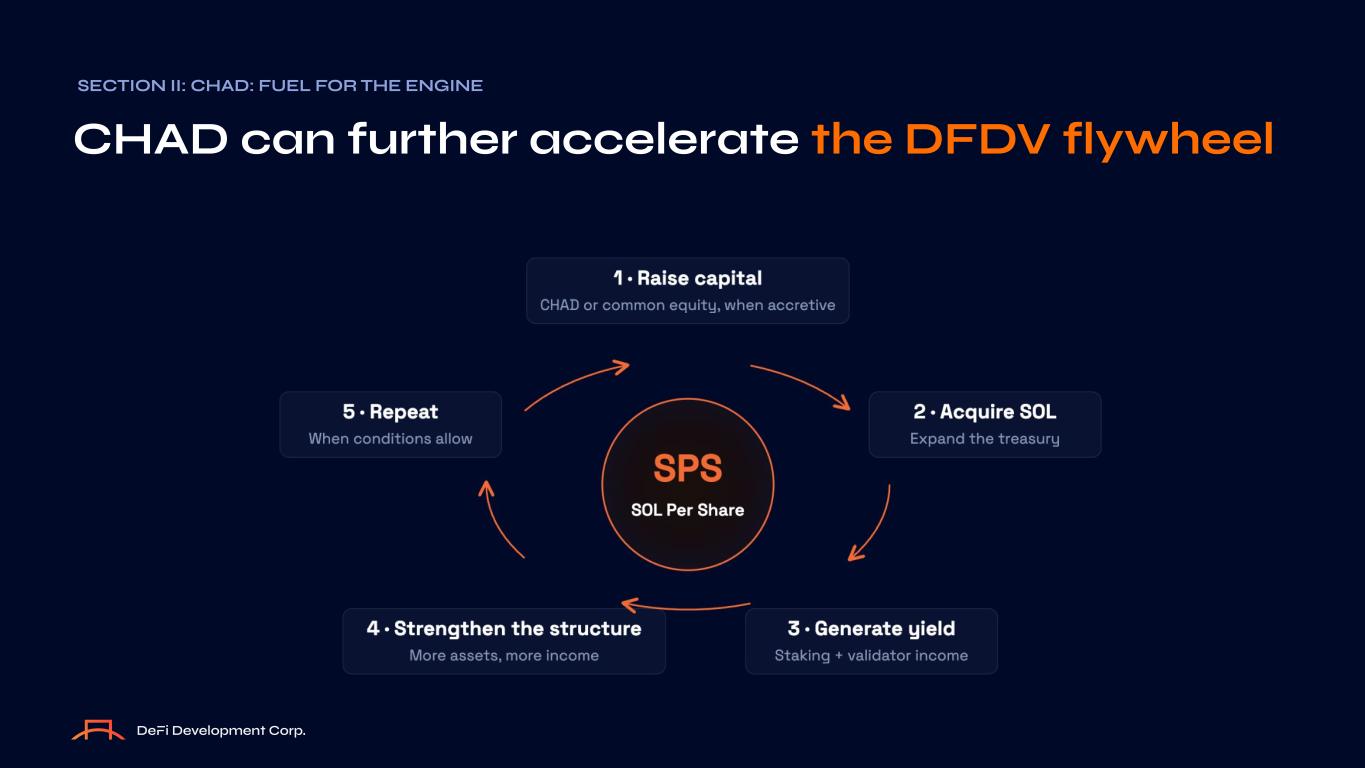
CHAD can further accelerate the DFDV flywheel Insert Pete’s flywheel diagram SECTION II: CHAD: FUEL FOR THE ENGINE

FINAL ACT 03 SOL to $10k
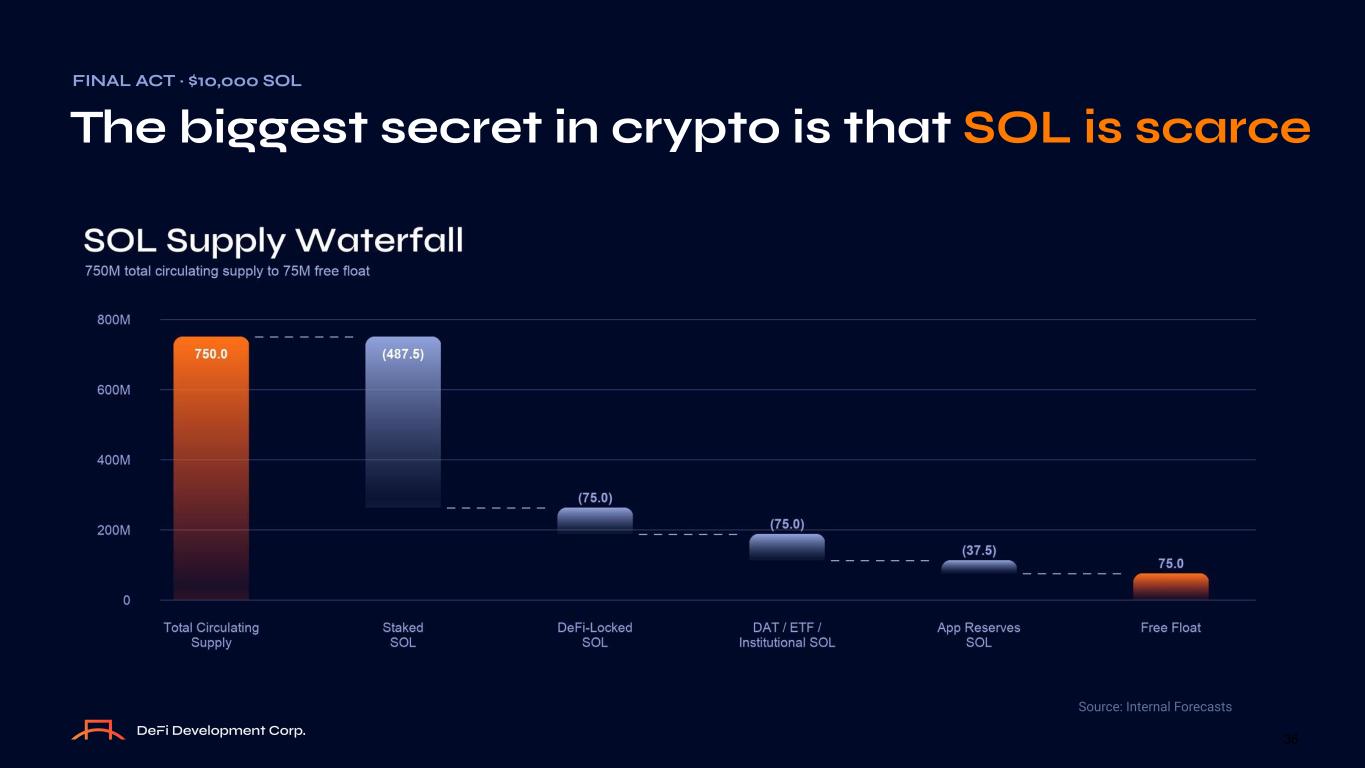
The biggest secret in crypto is that SOL is scarce Source: Internal Forecasts 36 FINAL ACT · $10,000 SOL
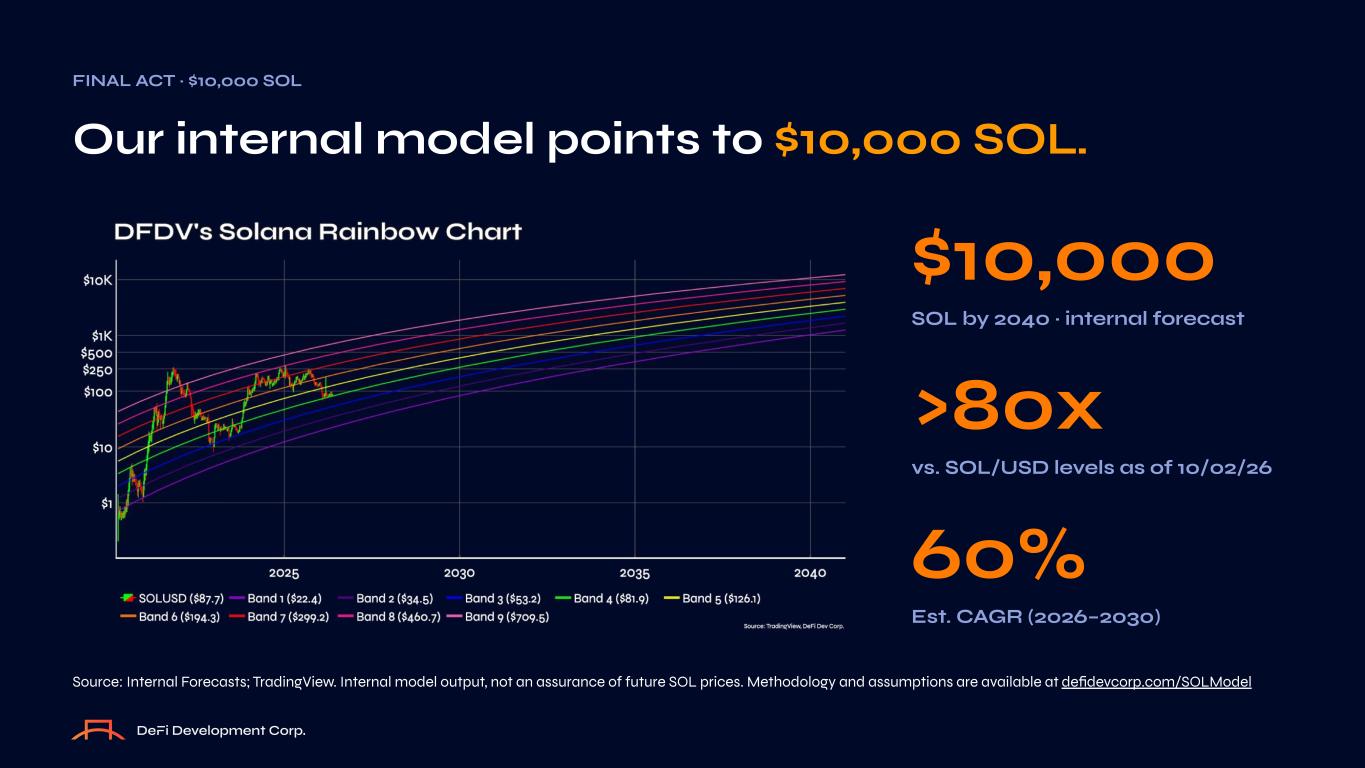
FINAL ACT · $10,000 SOL Our internal model points to $10,000 SOL. $10,000 SOL by 2040 · internal forecast >80x vs. SOL/USD levels as of 10/02/26 60% Est. CAGR (2026–2030) Source: Internal Forecasts; TradingView. Internal model output, not an assurance of future SOL prices. Methodology and assumptions are available at defidevcorp.com/SOLModel
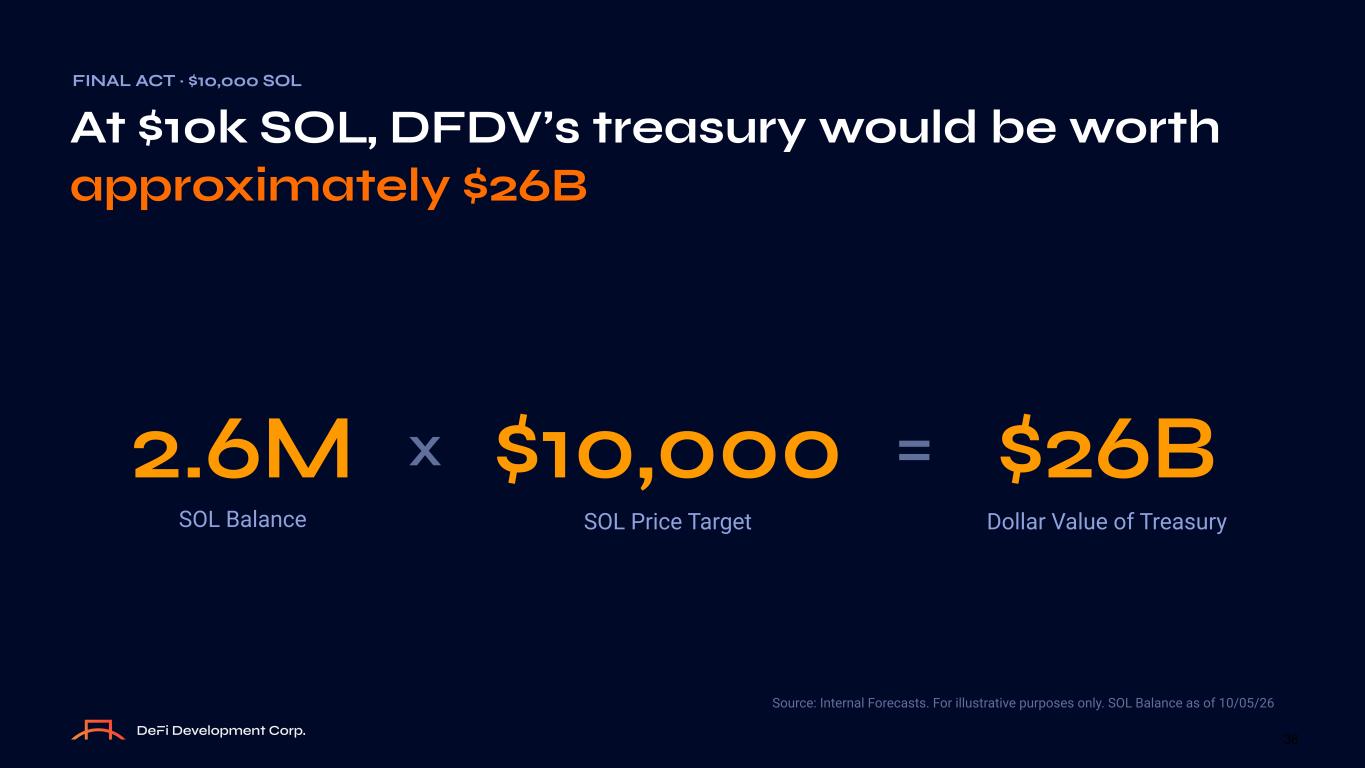
At $10k SOL, DFDV’s treasury would be worth approximately $26B SOL Balance SOL Price Target Dollar Value of Treasury 2.6M $10,000x $26B= Source: Internal Forecasts. For illustrative purposes only. SOL Balance as of 10/05/26 38 FINAL ACT · $10,000 SOL
DeFi Development Corp. NASDAQ: DFDV NASDAQ: CHAD Crypto Born. TradFi Fueled. Built to Stack Solana. INVESTOR RELATIONS ir@defidevcorp.com
DK (00:00) Welcome everyone. Thank you so much for joining us. My name is Dan Kang. I'm Chief Strategy Officer and Head of Investor Relations at DeFi Development Corp. NASDAQ Ticker DFDV for our common equity, and Nasdaq Ticker Chad for our recently listed preferred equity. Joining me today is Joseph Onorati, DFDV's chairman, co-founder, and chief executive officer. Before we begin, I'd like to remind everyone that this presentation contains forward-looking statements that are subject to a number of risks and uncertainties. Actual results may differ materially from those forward-looking statements due to the risks and factors outlined in our SEC filings, including our most recent form 10Q. We also discussed Chad in our internal SOL forecast today, so please review the disclosures on these slides and in our filings. We disclaim no obligation to update any forward-looking statements. DK (00:52) So, we're gonna give you a quick overview of who we are, talk about what we've built, and then spend a good amount of time on what we think is the next phase of DeFi Development Corp. particularly our recently listed preferred equity, Chad. And to start, I wanna take us all the way back and talk about the origin story of DFDV. And the origin story really traces back to one problem, which is money. The problem crypto was originally built to solve was the problem of money, specifically fiat currency. And we like to say at DeFi Dev Corp that the greatest trick Fiat ever pulled was convincing the world that it was actually richer. If you look at the Nasdaq and the S&P since 2020, the returns look incredible on paper. The Nasdaq is up roughly 199%, the S&P up roughly 137%. Those sound like amazing numbers, but they've also occurred against a backdrop of substantial monetary debasement. So one way to think about your actual investment return here is to change the denominator. If instead of pricing the market in dollars, you price it in gold. The picture looks pretty different. The Nasdaq is only up about 13% in gold terms, and the S&P is actually down. And that's with the Nasdaq benefiting tremendously from the recent AI infrastructure boom. Now take that one step further. Instead of pricing those assets in gold, price them at Bitcoin, and the illusion completely disappears. DK (02:14) Since 2020, the NASDAQ is down roughly 75% priced in Bitcoin. The S&P is down about 80%. That tells you nearly everything you need to know about the weakness of Fiat. Bitcoin itself has returned more than 700% since October 2020. And despite that incredible performance, there was one major crypto asset that actually did substantially better. And that asset was SOL, the native token of the Solana Network. SOL is up more than 4,000% over this same period, tracing back six years. For context, that's Exhibit B
not only magnitudes higher than Bitcoin, it's also about two and a half times higher than NVIDIA over the same time horizon, and almost 2x better than Micron. And the question is why? And for those who are newer to crypto, perhaps we should start with what exactly is Solana in the first place? DK (03:05) The simplest way we think about Solana is this: Bitcoin was designed to store value. Solana was designed to move it. Whether that's B2B payments, B2C payments, stablecoin transfers, buying stocks, tokenizing assets, agentic finance, increasingly all of that can happen on the Solana network. So if Bitcoin is digital capital, we think of Solana almost as a digital energy grid and SOL the token like energy itself. And importantly, this isn't just a bet on something that might happen five years from now, 10 years from now. It's happening today. Solana is number one across all of the metrics that matter most for blockchain. Speed, network revenue, transaction count, new users, tokenized equity activity, stablecoin growth, I mean you name it. So basically, Solana is the apex blockchain. It's incredibly fast, it's incredibly cheap, anyone with an internet connection can use it. And when you think about the financial rails of today, they're decades old, riddled with fees, and far too slow. We think Solana is set to disrupt this. In fact, it already has. We refer to this as the extermination of the parasitic rent extraction class, the overhaul of institutions that like charging everyone lots of money, that profit from delays, the ones that need to grant you permission for you to use your own money. Solana will replace these rails and is already a leading disruptor today. And despite that leadership, SOL is just still 4% the market cap of Bitcoin. the analogy I use, and obviously, no analogy is perfect here, but imagine getting the opportunity to go back in time and buy Amazon before e-commerce had meaningful penetration. Except imagine that in that dimension, Amazon was already number one on the operating metrics that mattered. It was already making real num real money, AWS existed, and yet it still traded at a fraction of Walmart's value. You'd probably want as much exposure to that asset as you could get. DK (05:05) And if you had a safe way to amplify that exposure, you'd probably want that too. And that leads directly to why we built DFDV. So before DFDV, amplified crypto exposure was basically broken. Institutions could get some crypto exposure either through some passive equities, ETFs, and other tracking vehicles, but most institutions couldn't really lever that exposure in a meaningful way. Retail had a slightly different problem. Retail can use leverage to amplify, whether that's margin, perps, ten times leverage, but the leverage is incredibly fragile. It basically snaps under the weight of any unfavorable near-term price moves. In other words, you could be completely right on the five-year outcome and still get liquidated during a drawdown on the way there. So DFDV, our common equity, was built to fix the leverage.
It is a highly accessible, listed common stock with resilient leverage embedded at the corporate level, designed to grow the underlying SOL exposure over time. And since we launched the Treasury strategy, we've moved at lightning speed. We've built a crypto treasury worth more than $300 million. Our common equity has delivered more than 800% since the Treasury launch. And we've grown SOL per share by 24% on a trailing 12-month basis. How did we do this? DK (06:29) For starters, this company was built by a team with decades of aggregate experience across crypto and traditional finance. Joseph, John, Pete, and I have operated through multiple crypto cycles. We know what a 70% drawdown looks like. We know it can happen in months, sometimes even weeks. I'm sure Joseph here has memories of when all it took was days. We also know capital markets incredibly well, having worked at institutions like Morgan Stanley, Goldman Sachs, and Jeffries. That combination obviously matters because the entire strategy is about managing a volatile capital asset through a public company capital structure. Put differently, we have more crypto experience than any TradFi team and more TradFi experience than any crypto team. And the output of that strategy is what we call SPS, SOL per share, our North Star. Over the trailing 12 months shown here, our fully converted SOL per share increased 24%. That's a key part of our amplification over SOL price. with DFDV, you don't just own a security that moves with the price of SOL. Our goal is for the amount of SOL represented by each common share to grow over time. So you have the SOL price move, and then you're trying to increase the SOL exposure underneath every single share. And since inception, we've grown SPS well into the triple digits. With that, I'm going to hand it over to Joseph. He's going to walk through how we engineered the common to amplify SOL. And then the piece I think is even more interesting today, the next phase of the company, Chad. Joseph, take it away. Joseph Onorati (08:03) Thanks DK. As DK mentioned, DFDV was designed from the beginning to amplify SOL exposure. And in that sense, Spot Sol an ETF and DFDV are fundamentally different products, even though all three ultimately carry SOL price exposure. DFDV is leveraged sol. It's designed to compound and amplify that exposure. The question we started with was pretty straightforward. How do we amplify SOL without building a structure that blows itself up in the face of unfavorable price movements? And the answer is intelligent leverage. That's the first engine in what we call the SOL Boost. Conceptually the common stock has two things working on top of the underlying SOL return. First, SPS growth, which DK touched on,
and the other leverage. So if SOL rises, leverage is designed to amplify the move. This is the framework and how we think about amplifying the price action of SOL. Joseph (09:08) So what do we mean by intelligent leverage? We mean capital with duration. Capital that doesn't wake up tomorrow and margin call you. Capital that doesn't force you to sell SOL because the token had a bad day. Our convertible notes are a good example. We were the first non Bitcoin treasury company to issue 144A converts, and we harnessed the volatility of SOL to issue them on good terms, including unsecured long duration and a low coupon. Chad's the next evolution of intelligent leverage. Unlike convertible bonds, it's perpetual preferred capital. So there isn't a principal maturity date. The important takeaway is that we have structured leverage to withstand the reality of crypto. Crypto's volatile. And if your financing can't survive the volatility, eventually the financing becomes the problem. Our goal is to make sure that virtually no matter how volatile crypto is in the near term, we can survive and amplify its performance in the long term. This chart (I like this chart), makes this point pretty clear. If you think SOL’s going to the moon and you want to amplify that view, the issue with conventional leverage isn't the final destination, it's about surviving the trip. A leveraged trader can be exactly right about year five, but still wrecked in year one. What we built is something much more resilient, a structure where investors can focus on getting amplified exposure to the long term outcome of SOL. And importantly, we've actually demonstrated that the model can work. Since initiating our treasury strategy, DFDV has substantially outperformed the other treasury companies shown here. Our common was up eight hundred and forty two percent through September thirtieth, compared with a much weaker set of results across the rest of the group. And there's a bunch of reasons for that. But we think a big one is that we didn't simply copy a Bitcoin treasury model and swap in a different token. Joseph Onorati (11:03) We innovated and we found unique ways to design the structure of our business to create amplification. The results have also been clearly demonstrated year to date. DFDV outperformed SOL year to date, delivering positive returns while SOL is down. Specifically we outperformed it in Q three by one point five X. We outperformed Sol off the lows, and during August, when SOL was up thirty eight percent, DFDV was up one hundred and ten percent, delivering nearly three times SOL’s price performance. Obviously that doesn't mean our common will outperform SOL every minute or every day, but it shows that the structure is designed to do over multiple time horizons, irrespective of any near term volatility in the underlying. So that was phase one. We built the engine, we accumulated SOL, we took on intelligent
leverage, and we grew Sol per share. And we built common to be leveraged Sol. But now we're moving on to phase two. And phase two is about adding more fuel to the engine. The fuel is Chad. In phase one or if phase one was about building the rocket ship, phase two is about putting as much high octane fuel into that ship as we can. Same rocket, same near term resilience, same long term destination, but much more fuel. And Chad is, in our view, one of the cleanest forms of intelligent capital ever created. It's perpetual, it doesn't have a debt maturity wall, it doesn't have a margin call. And over time as we raise more capital via Chad and deploy it into SOL, it gives us another way to accelerate the existing strategy. So what exactly is Chad? Chad's our Nasdaq listed variable rate cumulative preferred stock. The current annual dividend rate is thirteen percent based on a ten dollar stated amount, and we pay dividends every trading day when declared. That's two hundred and fifty two potential dividend payments per year. To reiterate, it's perpetual preferred capital. Joseph Onorati (13:06) There's no fixed maturity date, and the current market yield will move around depending on where the security trades. So the thirteen percent dividend and the effective market yield aren't always the same thing. The simple version is high current income paid daily through a publicly traded security. If DFDV solves the problem of fragile leverage, then what problem exactly does Chad solve? Well, Chad solves the problem of income. Over the period shown here, wages increased by three point one percent, but consumer prices increased by three point four percent. So the purchasing power of the average ac hour of work is actually decreasing. It went backwards. You work harder, you make more dollars, and somehow those dollars don't buy more. That's exactly the problem income products are supposed to help solve, but they currently don't. Joseph Onorati (14:00) So what do people do today to earn yield or income? They take their dollars and they put them into savings accounts, paying next to nothing. The national average here shown is roughly forty basis points. The ten year treasury is around five point three percent, but Chad's current dividend is thirteen percent. The simple takeaway is that we designed Chad to make your money work harder. Again, the payment frequency is unique. Traditional yield instruments might pay twice a year. A fair number of income products pay monthly, but Chad's designed to pay every trading day. So instead of waiting six months for your next payment, the income arrives continuously throughout the year, putting us in a class currently consisting of only two instruments.
So what's especially interesting about Chad is that it completes the risk spectrum for us. On the right side you have DFDV Common, that's levered SOL. That's a security for investors who want resilient leverage that amplifies SOL price movements. In the middle is SOL itself. And on the left is Chad. High current income, preferred seniority to the common, and materially less direct sensitivity to SOL’s price. Joseph Onorati (15:12) The instrument's designed to take the volatility out of SOL and bring it as close to zero as possible, while passing on thirteen percent annually, which is, by the way, two point five times more than what you'd get via the ETFs. So in that respect, Chad offers two and a half times the yield of BSOL, but with what we expect will be a fraction of the price volatility. Crucially, we have the ability to flex the dividend up over time. And while we have nothing to say on anticipated increases, investors can look at Stretch and SATA those possible frames of reference for future increases. Joseph Onorati (15:50) So now we have multiple ways for investors to express a view within the same ecosystem. You want levered Sol? There's DFDV. You want high yield with less direct SOL exposure? There's Chad. And strategically, this is incredibly important for DFDV. Chad opens our company to an entirely different investor base: income investors, preferred investors, yield buyers, cash and treasury allocators, crypto investors who like the ecosystem but don't want full SOL beta. Fixed income alone represents a market well over one hundred and sixty trillion, filled with illiquid, low yield products, and Chad can tap into that pool of capital. And the more different forms of capital we can access intelligently, the more avenues we have to scale our treasury. So the obvious question is where's the dividend come from? Comparable instruments to Chad, such as Stretch and SATA, have historically paid their dividends one of two ways. Selling the underlying asset on the balance sheet, or running the common equity ATM to service cash obligations. Joseph Onorati (16:53) While we have both of those options available to us at DFDV, we also have a third funding source that puts Chad in a class of its own: organic yield. Because SOL has native yield, we're able to service our obligations from our productive treasury. In other words, we earn recurring economics from the assets on the balance sheet, which frees us from having to sell the underlying principal Solana, or from diluting common shareholders to service dividends. At Chad's current size and dividend rate, our Treasury and its current yield support more than one hundred and fifty years of annual dividend obligations at today's SOL prices. In other words, Chad doesn't require us to consume the treasury. The Treasury works to pay Chad, and we
have ample room for Chad to scale. At the end of the day, Chad's fuel that we think helps the common. The larger Chad gets, the more Chad can accelerate our flat wheel. For example, when we raise money via Chad, we use the capital to acquire SOL. That expands the treasury. The treasury generates staking and validator income. That strengthens the capital structure of our asset base and improves the coverage metrics for Chad. And then we do it again. Of course, all in service of SOL per share growth. For common shareholders as Chad scales, our expectation is that DFDV common will have more amplification to SOL. In other words, if DFDV is a rocket headed toward the moon, Chad's premium grade fuel that propels us there faster. And with that, I'll pass it back to DK to talk about where we think SOL itself ultimately goes. DK (18:29) Thanks, Joseph. I'll keep this part pretty quick. The punchline is we think SOL ultimately goes to $10,000. And underlying that view is a different way of thinking about both the demand for SOL and especially its actual available supply. For anyone who wants to go much deeper in our methodology, we've published the model and methodology at defidevcorp.com/SOLModel. And for reference, $10,000 SOL is about an 80x increase. From current levels. And the biggest secret in crypto, in our view, is that SOL itself is actually a scarce asset. People tend to look at the headline token supply and assume that's the relevant denominator, and we don't think it is. A very large percentage of SOL is staked, additional SOL is locked in DeFi and various applications, and then you have ETFs, corporate treasuries, institutions, and other strategic owners accumulating SOL that frankly, may not regularly return to the market. So, for example, today more than 5% of SOL is held by treasuries such as DFDV and ETFs, and our expectation is that this percentage will be much larger over time. DK (19:40) So when you move from headline supply in the future, forecasted here at 750 million, to the effective tradable float, our internal framework actually gets you to something much closer to 75 million. Now, of course, some of the underlying assumptions are debatable, but I would note that the assumptions we've thrown in our model are largely consistent with historical patterns and data that we've observed. So the key takeaway is that the amount of SOL actually available to clear the market could be dramatically smaller. Now, put demand against that supply, whether that's tokenization, stable coins, AI agents, payments, other consumer applications. You have all these vectors of demand that now run against a scarce asset, and an asset that has to be held to actually operate the network, no less. And we run that through our internal model, we get to a long-term SOL price target of $10,000. Now that's our internal forecast as always, not financial advice, do your own research. But this is the end state we have in mind, and that's more than 80x versus today's levels. And
given that price target, it might make sense as to why we want to amplify the returns as much as possible. DK (20:43) So, what does $10,000 SOL mean for DFDV? Well, using the roughly 2.6 million SOL balance that we have today, our Treasury would be worth approximately $26 billion at $10,000 SOL. And the important point, of course, is that we don't plan to stop at 2.6 million SOL. The entire company, again, is designed to accumulate more and more over time. For common shareholders, that means potentially more underlying SOL and more amplification towards this $10,000 price target if our framework works. And for Chad, of course, a substantially larger and more productive balance sheet can strengthen the economics supporting the preferred and create room for us to scale that capital base over time. And frankly, that's the whole strategy, right? Continue to make sure the engine is fast and resilient. DK (21:31) Add as much fuel as possible via Chad and buy as much SOL as quickly as possible before the rest of the world catches on that these are bargain prices. And just keep compounding for that long-term $10,000 SOL price target. So with that, Joseph and I want to thank everyone for your time. We think we've built something pretty unique, common equity designed to provide levered SOL exposure, a preferred equity Chad designed to provide high daily income, and one capital structure built around accumulating and putting Solana to work. If you have any questions, please don't hesitate to reach out. Our investor relations email is ir at defidedevcorp.com. Thank you for your time again.