.3
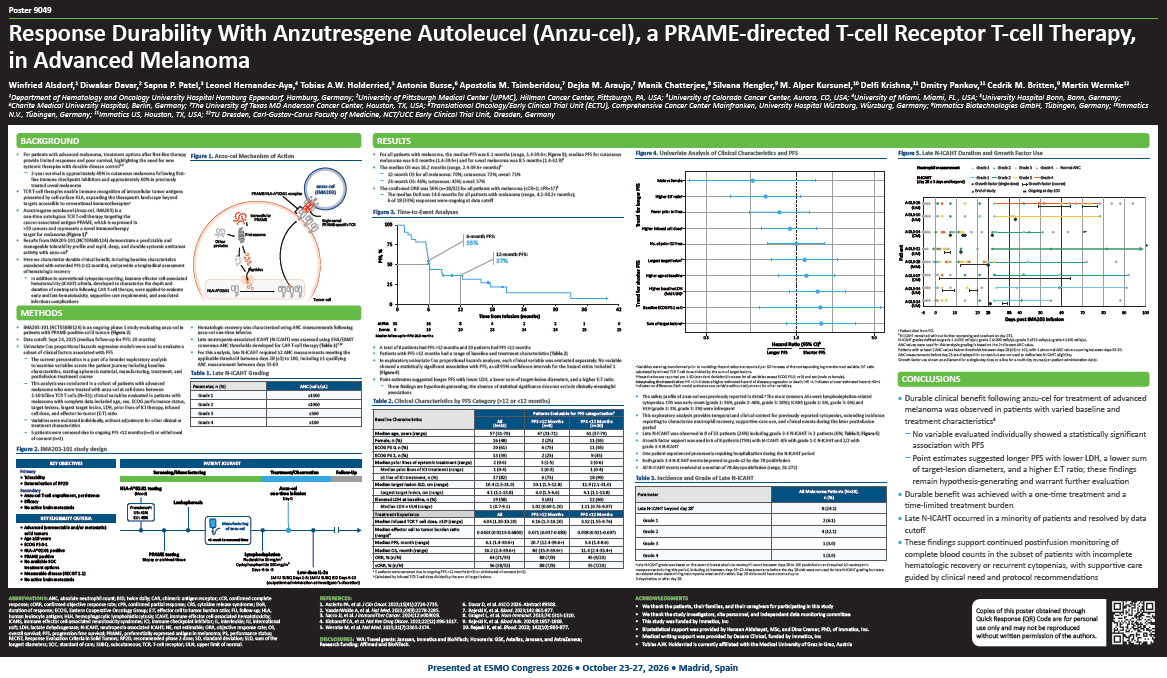
Presented at ESMO Congress 2026 • October 23 - 27, 2026 • Madrid, Spain RESULTS • For all patients with melanoma, the median PFS was 6.1 months (range, 1.4 - 39.6+; Figure 3 ); median PFS for cutaneous melanoma was 6.0 months (1.4 - 39.6+) and for uveal melanoma was 8.5 months (1.4 - 32.9) 6 • The median OS was 16.2 months (range, 2.4 - 39.6+ months) 6 – 12 - month OS for all melanoma: 70%; cutaneous: 72%; uveal: 71% – 24 - month OS: 46%; cutaneous: 45%; uveal: 57% • The confirmed ORR was 56% (n=18/32) for all patients with melanoma (cCR=1; cPR=17) 6 – The median DoR was 14.6 months for all patients with melanoma (range, 4.2 - 38.2+ months); 6 of 18 (33%) responses were ongoing at data cutoff Figure 3. Time - to - Event Analyses 100 75 50 25 0 0 6 12 18 24 Time from Infusion (months) 30 36 42 PFS, % At Risk 33 Events 0 16 15 8 20 4 23 2 24 2 24 1 25 0 25 Median follow - up for PFS: 20.0 months 6 - month PFS: 55% 12 - month PFS: 37% • A total of 8 patients had PFS >12 months and 20 patients had PFS <12 months • Patients with PFS >12 months had a range of baseline and treatment characteristics ( Table 2 ) • In exploratory univariate Cox proportional hazards analyses, each clinical variable was evaluated separately. No variable showed a statistically significant association with PFS, as all 95% confidence intervals for the hazard ratios included 1 ( Figure 4 ) • Point estimates suggested longer PFS with lower LDH, a lower sum of target - lesion diameters, and a higher E:T ratio. – These findings are hypothesis - generating; the absence of statistical significance does not exclude clinically meaningful associations Table 2. Clinical Characteristics by PFS Category (>12 or <12 months) Patients Evaluable for PFS categorization a Baseline Characteristics PFS <12 Months (n=20) PFS >12 Months (n=8) All (N=33) 61 (37 - 79) 47 (31 - 71) 57 (31 - 79) Median age, years (range) 11 (55) 2 (25) 16 (48) Female, n (%) 11 (55) 6 (75) 20 (61) ECOG PS 0, n (%) 9 (45) 2 (25) 13 (39) ECOG PS 1, n (%) 2 (0 - 6) 3 (1 - 5) 2 (0 - 6) Median prior lines of systemic treatment (range) 1 (0 - 4) 1 (0 - 3) 1 (0 - 4) Median prior lines of ICI treatment (range) 18 (90) 6 (75) 27 (82) ≥1 line of ICI treatment, n (%) 11.9 (2.1 - 31.0) 10.1 (1.5 - 12.8) 10.4 (1.5 - 31.0) Median target lesion SLD, cm (range) 4.1 (1.1 - 13.8) 4.0 (1.5 - 6.6) 4.1 (1.1 - 13.8) Largest target lesion, cm (range) 12 (60) 5 (63) 19 (58) Elevated LDH at baseline, n (%) 1.11 (0.76 - 9.07) 1.02 (0.69 - 1.20) 1 (0.7 - 9.1) Median LDH п ULN (range) PFS <12 Months PFS >12 Months All Treatment Experience 3.52 (1.55 - 9.76) 6.16 (1.3 - 10.20) 4.04 (1.30 - 10.20) Median infused TCR T cell dose, п 10 9 (range) 0.038 (0.011 - 0.097) 0.071 (0.037 - 0.680) 0.0433 (0.0113 - 0.6800) Median effector cell to tumor burden ratio (range) b 5.6 (1.4 - 8.6) 20.7 (12.4 - 39.6+) 6.1 (1.4 - 39.6+) Median PFS, month (range) 11.4 (2.4 - 33.4+) NE (15.9 - 39.6+) 16.2 (2.4 - 39.6+) Median OS, month (range) 45 (9/20) 88 (7/8) 64 (21/33) ORR, % (n/N) 35 (7/20) 88 (7/8) 56 (18/32) cORR, % (n/N) a 5 patients were censored due to ongoing PFS <12 months (n=3) or withdrawal of consent (n=2). b Calculated by infused TCR T - cell dose divided by the sum of target lesions. Figure 4. Univariate Analysis of Clinical Characteristics and PFS Male vs female Higher E:T ratio a Fewer prior tx lines Trend for longer PFS Trend for shorter PFS Higher infused cell dose a No. of prior ICI lines Largest target lesion a Higher age at baseline Higher baseline LDH (fold ULN) a Baseline ECOG PS 1 vs 0 0.3 1.0 Hazard Ratio (95% CI) b Longer PFS Shorter PFS 3.0 Sum of target lesions a a Variables were log - transformed prior to modeling; Hazard ratios are reported per SD increase of the corresponding log - transformed variable. E:T ratio calculated by infused TCR T - cell dose divided by the sum of target lesions. b Hazard ratios are reported per 1 - SD (standard deviation) increase for all variables except ECOG PS (1 vs 0) and sex (male vs female). Interpreting the hazard ratios: HR >1 indicates a higher estimated hazard of disease progression or death; HR <1 indicates a lower estimated hazard; HR=1 indicates no difference. Each model evaluates one variable without adjustment for other variables. • The safety profile of anzu - cel was previously reported in detail. 4 The most common AEs were lymphodepletion - related cytopenias. CRS was early - onset (grade 1: 36%, grade 2: 46%, grade 3: 18%); ICANS (grade 1: 6%, grade 3: 6%) and HLH (grade 2: 3%, grade 3: 3%) were infrequent • This exploratory analysis provides temporal and clinical context for previously reported cytopenias, extending incidence reporting to characterize neutrophil recovery, supportive - care use, and clinical events during the later postinfusion period • Late N - ICAHT was observed in 8 of 33 patients (24%) including grade 3 - 4 N - ICAHT in 2 patients (6%; Table 3 ; Figure 5 ) • Growth factor support was used in 6 of 8 patients (75%) with N - ICAHT: 4/6 with grade 1 - 2 N - ICAHT and 2/2 with grade 3 - 4 N - ICAHT • One patient experienced pneumonia requiring hospitalization during the N - ICAHT period • Both grade 3 - 4 N - ICAHT events improved to grade ≤2 by day 78 postinfusion • All N - ICAHT events resolved at a median of 78 days postinfusion (range, 51 - 272) Table 3. Incidence and Grade of Late N - ICAHT All Melanoma Patients (N=33), n (%) Parameter 8 (24.2) Late N - ICAHT beyond day 28 a 2 (6.1) Grade 1 4 (12.1) Grade 2 1 (3.0) Grade 3 1 (3.0) Grade 4 a Late N - ICAHT grade was based on the second - lowest absolute neutrophil count between days 28 to 100 postinfusion and required ≥2 neutropenic measurements during this period, including ≥1 between days 35 – 60. Measurements before the day 28 visit were not used for late N - ICAHT grading but were considered when determining neutropenia onset and duration. Day 28 visits could have occurred up to 3 days before or after day 28. Figure 5. Late N - ICAHT Duration and Growth Factor Use п a b - 6 0 10 20 25 A - DL5 - 26 (UM) Patient A - DL5 - 24 (UM) A - DL5 - 34 (UM) A - DL4 - 07 (CM) A - DL5 - 28 (MM) A - DL5 - 32 (UM) A - DL5 - 14 (CM) A - DL5 - 10 (UM) 35 40 50 60 Days post IMA203 infusion 70 80 90 100 N - ICAHT (day 28 ц 3 days and beyond) Grade 1 Grade 2 Grade 3 Grade 4 Neutrophil measurement Grade 1 Grade 2 Grade 3 Grade 4 Normal ANC Growth factor (course) Ongoing at day 100 Growth factor (single dose) п End of study a Patient died from PD. b N - ICAHT remained without further worsening and resolved on day 272. N - ICAHT grades defined as grade 1 ≤1500 cells/µL; grade 2 ≤1000 cells/µL; grade 3 ≤500 cells/µL; grade 4 ≤100 cells/µL. ANC values were used for this analysis; grading is based on the 2nd lowest ANC value. Patients with at least 2 ANC values below thresholds between days 28 ( ц 3) to 100, with 1 abnormal ANC value occurring between days 35 - 60. ANC measurements before day 25 are displayed for context but are not used to define late N - ICAHT eligibility. Growth factor use shown as a diamond for a single - day dose or a line for a multi - day course (per - patient administration data). Poster 9049 Response Durability With Anzutresgene Autoleucel (Anzu - cel), a PRAME - directed T - cell Receptor T - cell Therapy, in Advanced Melanoma Winfried Alsdorf, 1 Diwakar Davar, 2 Sapna P. Patel, 3 Leonel Hernandez - Aya, 4 Tobias A.W. Holderried, 5 Antonia Busse, 6 Apostolia M. Tsimberidou, 7 Dejka M. Araujo, 7 Manik Chatterjee, 8 Silvana Hengler, 9 M. Alper Kursunel, 10 Delfi Krishna, 11 Dmitry Pankov, 11 Cedrik M. Britten, 9 Martin Wermke 12 1 Department of Hematology and Oncology University Hospital Hamburg Eppendorf, Hamburg, Germany; 2 University of Pittsburgh Medical Center (UPMC), Hillman Cancer Center, Pittsburgh, PA, USA; 3 University of Colorado Cancer Center, Aurora, CO, USA; 4 University of Miami, Miami, FL , USA; 5 University Hospital Bonn, Bonn, Germany; 6 Charite Medical University Hospital, Berlin, Germany; 7 The University of Texas MD Anderson Cancer Center, Houston, TX, USA; 8 Translational Oncology/Early Clinical Trial Unit (ECTU), Comprehensive Cancer Center Mainfranken, University Hospital Würzburg, Würzburg, Germany; 9 Immatics Biotechnologies GmbH, Tübingen, Germany; 10 Immatics N.V., Tübingen, Germany; 11 Immatics US, Houston, TX, USA; 12 TU Dresden, Carl - Gustav - Carus Faculty of Medicine, NCT/UCC Early Clinical Trial Unit, Dresden, Germany CONCLUSIONS • Durable clinical benefit following anzu - cel for treatment of advanced melanoma was observed in patients with varied baseline and treatment characteristics 4 – No variable evaluated individually showed a statistically significant association with PFS – Point estimates suggested longer PFS with lower LDH, a lower sum of target - lesion diameters, and a higher E:T ratio; these findings remain hypothesis - generating and warrant further evaluation • Durable benefit was achieved with a one - time treatment and a time - limited treatment burden • Late N - ICAHT occurred in a minority of patients and resolved by data cutoff • These findings support continued postinfusion monitoring of complete blood counts in the subset of patients with incomplete hematologic recovery or recurrent cytopenias, with supportive care guided by clinical need and protocol recommendations BACKGROUND • For patients with advanced melanoma, treatment options after first - line therapy Figure 1. Anzu - cel Mechanism of Action anzu - cel (IMA203) PRAME - HLA - A*02:01 complex Tumor cell Intracellular PRAME Proteasome Peptides HLA - A*02:01 Other proteins Engineered PRAME - specific TCR provide limited responses and poor survival, highlighting the need for new systemic therapies with durable disease control 1 - 3 – 2 - year survival is approximately 40% in cutaneous melanoma following first - line immune checkpoint inhibitors and approximately 40% in previously treated uveal melanoma • TCR T - cell therapies enable immune recognition of intracellular tumor antigens presented by cell - surface HLA, expanding the therapeutic landscape beyond targets accessible to conventional immunotherapies 4 • Anzutresgene autoleucel (Anzu - cel, IMA203) is a one - time autologous TCR T - cell therapy targeting the cancer - associated antigen PRAME, which is expressed in >50 cancers and represents a novel immunotherapy target for melanoma ( Figure 1 ) 5 • Results from IMA203 - 101 (NCT03686124) demonstrate a predictable and manageable tolerability profile and rapid, deep, and durable systemic antitumor activity with anzu - cel 6 • Here we characterize durable clinical benefit, including baseline characteristics associated with extended PFS (>12 months), and provide a longitudinal assessment of hematologic recovery – In addition to conventional cytopenia reporting, immune effector cell - associated hematotoxicity (ICAHT) criteria, developed to characterize the depth and duration of neutropenia following CAR T - cell therapy, were applied to evaluate early and late hematotoxicity, supportive care requirements, and associated infectious complications METHODS • IMA203 - 101 (NCT03686124) is an ongoing phase 1 study evaluating anzu - cel in patients with PRAME - positive solid tumors ( Figure 2 ) • Data cutoff: Sept 24, 2025 (median follow - up for PFS: 20 months) • Univariate Cox proportional hazards regression models were used to evaluate a subset of clinical factors associated with PFS – The current presentation is a part of a broader exploratory analysis to examine variables across the patient journey including baseline characteristics, starting apheresis material, manufacturing, treatment, and postinfusion treatment course – This analysis was conducted in a cohort of patients with advanced melanoma who were treated with anzu - cel at cell doses between 1 - 10 billion TCR T cells (N=33); clinical variables evaluated in patients with melanoma with complete data included age, sex, ECOG performance status, target lesions, largest target lesion, LDH, prior lines of ICI therapy, infused cell dose, and effector - to - tumor (E:T) ratio – Variables were evaluated individually, without adjustment for other clinical or treatment characteristics – 5 patients were censored due to ongoing PFS <12 months (n=3) or withdrawal of consent (n=2) • Hematologic recovery was characterized using ANC measurements following anzu - cel one - time infusion • Late neutropenia - associated ICAHT (N - ICAHT) was assessed using EHA/EBMT consensus ANC thresholds developed for CAR T - cell therapy ( Table 1 ) 7,10 • For this analysis, late N - ICAHT required ≥2 ANC measurements meeting the applicable threshold between days 28 ( ц 3) to 100, including ≥1 qualifying ANC measurement between days 35 - 60 Table 1. Late N - ICAHT Grading ANC (cells/μL) Parameter, n (%) ≤1500 Grade 1 ≤1000 Grade 2 ≤500 Grade 3 ≤100 Grade 4 Figure 2. IMA203 - 101 study design Primary • Tolerability • Determination of RP2D Secondary • Anzu - cel T - cell engraftment, persistence • Efficacy • No active brain metastasis • Advanced (unresectable and/or metastatic) solid tumors • Age ≥18 years • ECOG PS 0 - 1 • HLA - A*02:01 positive • PRAME positive • No available SOC treatment options • Measurable disease (RECIST 1.1) • No active brain metastasis Screening/Manufacturing Treatment/Observation Follow - Up ≈2 - week turnaround time Manufacturing of anzu - cel HLA - A*02:01 testing (blood) Prevalence 8 : US: 41% EU: 48% PRAME testing Biopsy or archived tissue Lymphodepletion Fludarabine 30 mg/m 2 Cyclophosphamide 500 mg/m 2 Days - 6 to - 3 Low - dose IL - 2a 1M IU SUBQ Days 1 - 5; 1M IU SUBQ BID Days 6 - 10 (outpatient administration at investigator’s discretion) Leukapheresis Anzu - cel one - time infusion Day 0 KEY OBJECTIVES PATIENT JOURNEY KEY ELIGIBILITY CRITERIA ABBREVIATIONS: ANC, absolute neutrophil count; BID, twice daily; CAR, chimeric antigen receptor; cCR, confirmed complete response; cORR, confirmed objective response rate; cPR, confirmed partial response; CRS, cytokine release syndrome; DoR, duration of response; ECOG, Eastern Cooperative Oncology Group; E:T, effector cell to tumor burden ratio; FU, follow - up; HLA, human leukocyte antigen; HLH, hemophagocytic lymphohistiocytosis; ICAHT, immune effector cell - associated hematotoxicity; ICANS, immune effector cell - associated neurotoxicity syndrome; ICI, immune checkpoint inhibitor; IL, interleukin; IU, international unit; LDH, lactate dehydrogenase; N - ICAHT, neutropenia - associated ICAHT; NE, not estimable; ORR, objective response rate; OS, overall survival; PFS, progression - free survival; PRAME, preferentially expressed antigen in melanoma; PS, performance status; RECIST, Response Evaluation Criteria in Solid Tumors; RP2D, recommended phase 2 dose; SD, standard deviation; SLD, sum of the longest diameters; SOC, standard of care; SUBQ, subcutaneous; TCR, T - cell receptor; ULN, upper limit of normal. Copies of this poster obtained through Quick Response (QR) Code are for personal use only and may not be reproduced without written permission of the authors. ACKNOWLEDGMENTS • We thank the patients, their families, and their caregivers for participating in this study • We thank the study investigators, site personnel, and independent data monitoring committee • This study was funded by Immatics, Inc • Biostatistical support was provided by Haneen Aldehayat, MSc, and Dina Cramer, PhD, of Immatics, Inc. • Medical writing support was provided by Decera Clinical, funded by Immatics, Inc • Tobias A.W. Holderried is currently affiliated with the Medical University of Graz in Graz, Austria REFERENCES: 1. Ascierto PA, et al. J Clin Oncol . 2023;15(41):2724 - 2735. 2. VanderWalde A, et al. Nat Med . 2023;29(9):2278 - 2285. 6. Davar D, et al. ASCO 2026. Abstract #9508. 7. Rejeski K, et al. Blood . 2023;142:865 - 877. 3. Sacco JJ, et al. J ImmunoTher Cancer . 2024;12:e009028. 8. Gragert L, et al. Hum Immunol . 2013;74:1313 - 1320. 4. Klebanoff CA, et al. Nat Rev Drug Discov . 2023;22(12):996 - 1017. 9. Rejeski K, et al. Blood Adv . 2024;8:1857 - 1868. 5. Wermke M, et al. Nat Med . 2025;31(7):2365 - 2374. 10. Rejeski K, et al. Blood . 2023; 142(10):865 - 877. DISCLOSURES: WA: Travel grants: Janssen, Immatics and BioNTech; Honoraria: GSK, Astellas, Janssen, and AstraZeneca; Research funding: Affimed and BioNTech.