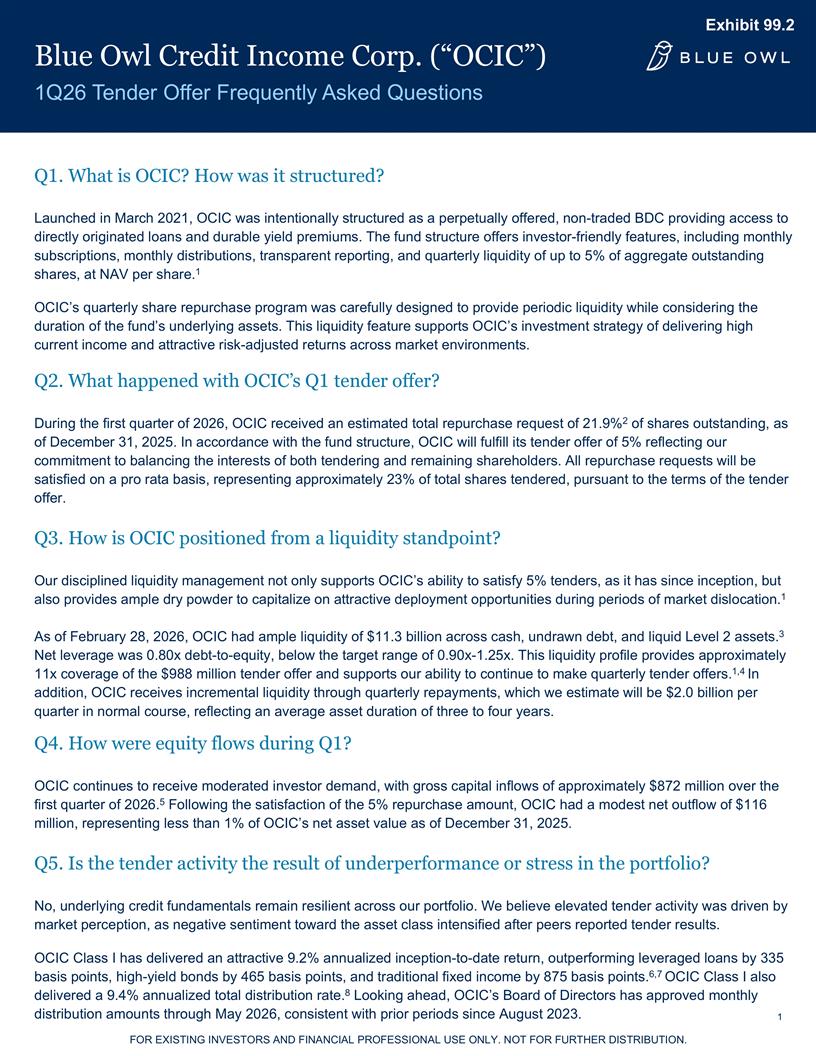
Blue Owl Credit Income Corp. (“OCIC”) 1Q26 Tender Offer Frequently Asked Questions Q1. What is OCIC? How was it structured? Launched in March 2021, OCIC was intentionally structured as a perpetually offered, non-traded BDC providing access to directly originated loans and durable yield premiums. The fund structure offers investor‑friendly features, including monthly subscriptions, monthly distributions, transparent reporting, and quarterly liquidity of up to 5% of aggregate outstanding shares, at NAV per share.1 OCIC’s quarterly share repurchase program was carefully designed to provide periodic liquidity while considering the duration of the fund’s underlying assets. This liquidity feature supports OCIC’s investment strategy of delivering high current income and attractive risk-adjusted returns across market environments. Q2. What happened with OCIC’s Q1 tender offer? During the first quarter of 2026, OCIC received an estimated total repurchase request of 21.9%2 of shares outstanding, as of December 31, 2025. In accordance with the fund structure, OCIC will fulfill its tender offer of 5% reflecting our commitment to balancing the interests of both tendering and remaining shareholders. All repurchase requests will be satisfied on a pro rata basis, representing approximately 23% of total shares tendered, pursuant to the terms of the tender offer. Q3. How is OCIC positioned from a liquidity standpoint? Our disciplined liquidity management not only supports OCIC’s ability to satisfy 5% tenders, as it has since inception, but also provides ample dry powder to capitalize on attractive deployment opportunities during periods of market dislocation.1 As of February 28, 2026, OCIC had ample liquidity of $11.3 billion across cash, undrawn debt, and liquid Level 2 assets.3 Net leverage was 0.80x debt-to-equity, below the target range of 0.90x-1.25x. This liquidity profile provides approximately 11x coverage of the $988 million tender offer and supports our ability to continue to make quarterly tender offers.1,4 In addition, OCIC receives incremental liquidity through quarterly repayments, which we estimate will be $2.0 billion per quarter in normal course, reflecting an average asset duration of three to four years. Q4. How were equity flows during Q1? OCIC continues to receive moderated investor demand, with gross capital inflows of approximately $872 million over the first quarter of 2026.5 Following the satisfaction of the 5% repurchase amount, OCIC had a modest net outflow of $116 million, representing less than 1% of OCIC’s net asset value as of December 31, 2025. Q5. Is the tender activity the result of underperformance or stress in the portfolio? No, underlying credit fundamentals remain resilient across our portfolio. We believe elevated tender activity was driven by market perception, as negative sentiment toward the asset class intensified after peers reported tender results. OCIC Class I has delivered an attractive 9.2% annualized inception-to-date return, outperforming leveraged loans by 335 basis points, high-yield bonds by 465 basis points, and traditional fixed income by 875 basis points.6,7 OCIC Class I also delivered a 9.4% annualized total distribution rate.8 Looking ahead, OCIC’s Board of Directors has approved monthly distribution amounts through May 2026, consistent with prior periods since August 2023. FOR EXISTING INVESTORS AND FINANCIAL PROFESSIONAL USE ONLY. NOT FOR FURTHER DISTRIBUTION. .2
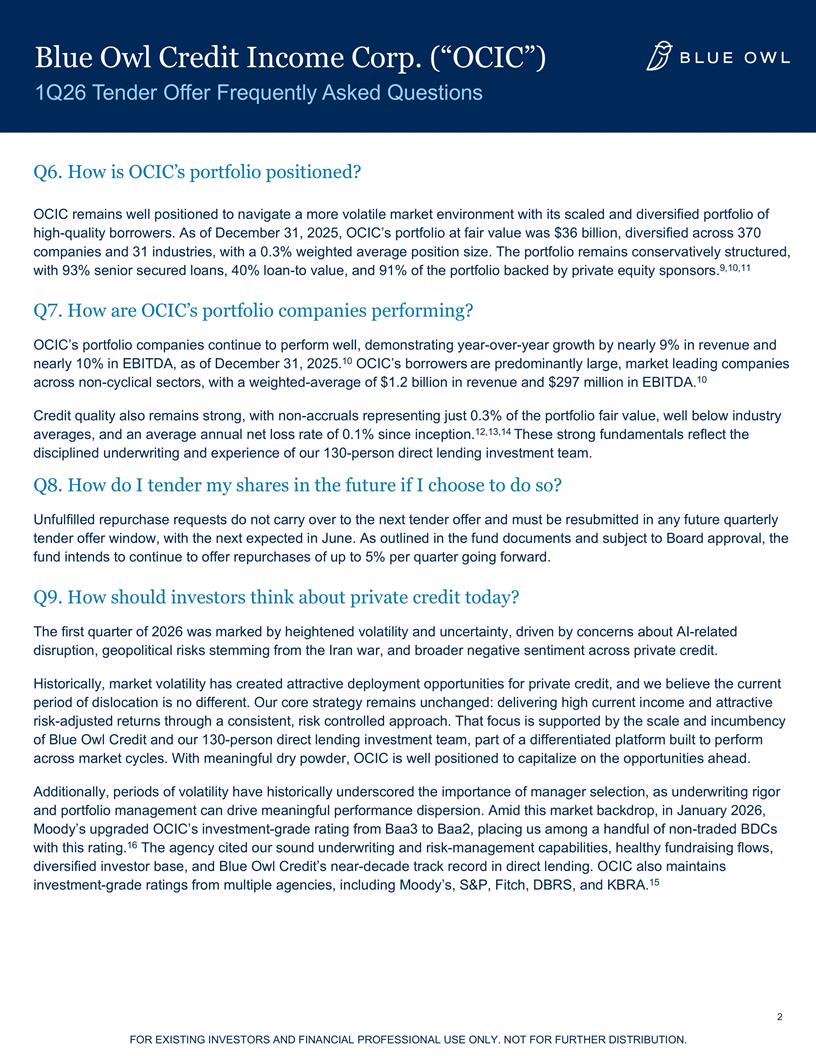
Blue Owl Credit Income Corp. (“OCIC”) Q6. How is OCIC’s portfolio positioned? OCIC remains well positioned to navigate a more volatile market environment with its scaled and diversified portfolio of high-quality borrowers. As of December 31, 2025, OCIC’s portfolio at fair value was $36 billion, diversified across 370 companies and 31 industries, with a 0.3% weighted average position size. The portfolio remains conservatively structured, with 93% senior secured loans, 40% loan-to value, and 91% of the portfolio backed by private equity sponsors.9,10,11 Q7. How are OCIC’s portfolio companies performing? OCIC’s portfolio companies continue to perform well, demonstrating year-over-year growth by nearly 9% in revenue and nearly 10% in EBITDA, as of December 31, 2025.10 OCIC’s borrowers are predominantly large, market leading companies across non-cyclical sectors, with a weighted-average of $1.2 billion in revenue and $297 million in EBITDA.10 Credit quality also remains strong, with non-accruals representing just 0.3% of the portfolio fair value, well below industry averages, and an average annual net loss rate of 0.1% since inception.12,13,14 These strong fundamentals reflect the disciplined underwriting and experience of our 130-person direct lending investment team. Q8. How do I tender my shares in the future if I choose to do so? Unfulfilled repurchase requests do not carry over to the next tender offer and must be resubmitted in any future quarterly tender offer window, with the next expected in June. As outlined in the fund documents and subject to Board approval, the fund intends to continue to offer repurchases of up to 5% per quarter going forward. Q9. How should investors think about private credit today? The first quarter of 2026 was marked by heightened volatility and uncertainty, driven by concerns about AI-related disruption, geopolitical risks stemming from the Iran war, and broader negative sentiment across private credit. Historically, market volatility has created attractive deployment opportunities for private credit, and we believe the current period of dislocation is no different. Our core strategy remains unchanged: delivering high current income and attractive risk-adjusted returns through a consistent, risk controlled approach. That focus is supported by the scale and incumbency of Blue Owl Credit and our 130-person direct lending investment team, part of a differentiated platform built to perform across market cycles. With meaningful dry powder, OCIC is well positioned to capitalize on the opportunities ahead. Additionally, periods of volatility have historically underscored the importance of manager selection, as underwriting rigor and portfolio management can drive meaningful performance dispersion. Amid this market backdrop, in January 2026, Moody’s upgraded OCIC’s investment-grade rating from Baa3 to Baa2, placing us among a handful of non-traded BDCs with this rating.16 The agency cited our sound underwriting and risk-management capabilities, healthy fundraising flows, diversified investor base, and Blue Owl Credit’s near-decade track record in direct lending. OCIC also maintains investment-grade ratings from multiple agencies, including Moody’s, S&P, Fitch, DBRS, and KBRA.15 1Q26 Tender Offer Frequently Asked Questions FOR EXISTING INVESTORS AND FINANCIAL PROFESSIONAL USE ONLY. NOT FOR FURTHER DISTRIBUTION.
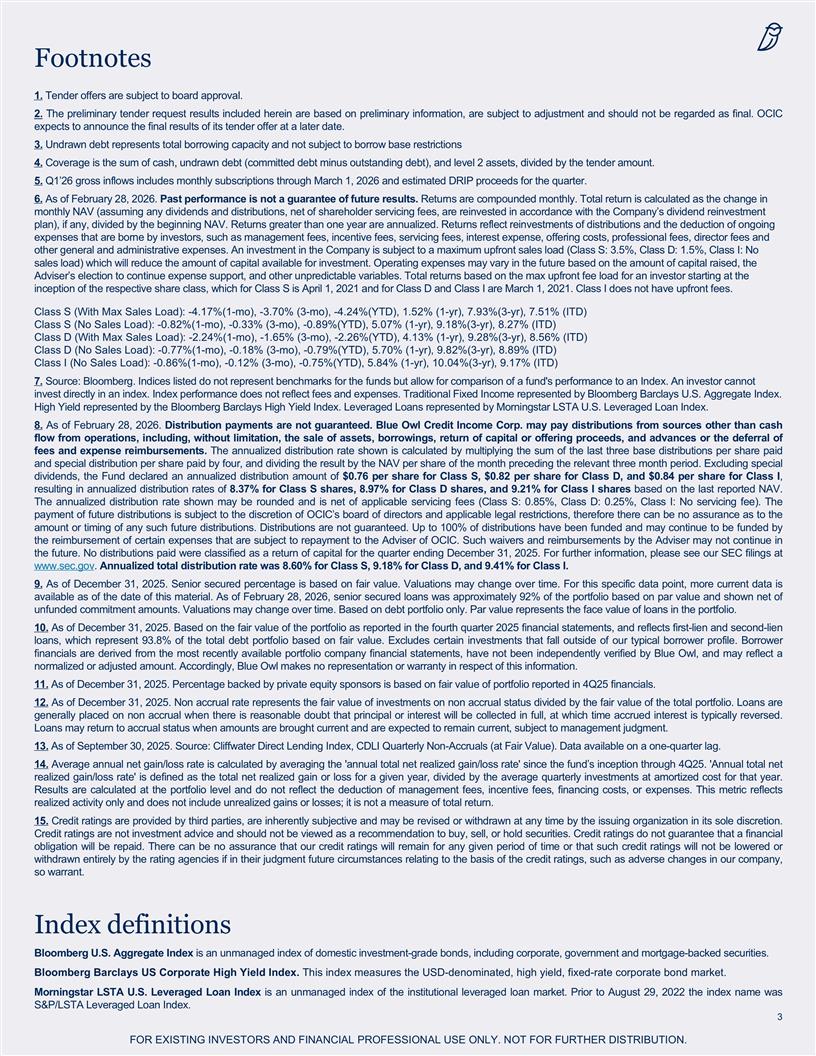
Footnotes 1. Tender offers are subject to board approval. 2. The preliminary tender request results included herein are based on preliminary information, are subject to adjustment and should not be regarded as final. OCIC expects to announce the final results of its tender offer at a later date. 3. Undrawn debt represents total borrowing capacity and not subject to borrow base restrictions 4. Coverage is the sum of cash, undrawn debt (committed debt minus outstanding debt), and level 2 assets, divided by the tender amount. 5. Q1’26 gross inflows includes monthly subscriptions through March 1, 2026 and estimated DRIP proceeds for the quarter. 6. As of February 28, 2026. Past performance is not a guarantee of future results. Returns are compounded monthly. Total return is calculated as the change in monthly NAV (assuming any dividends and distributions, net of shareholder servicing fees, are reinvested in accordance with the Company’s dividend reinvestment plan), if any, divided by the beginning NAV. Returns greater than one year are annualized. Returns reflect reinvestments of distributions and the deduction of ongoing expenses that are borne by investors, such as management fees, incentive fees, servicing fees, interest expense, offering costs, professional fees, director fees and other general and administrative expenses. An investment in the Company is subject to a maximum upfront sales load (Class S: 3.5%, Class D: 1.5%, Class I: No sales load) which will reduce the amount of capital available for investment. Operating expenses may vary in the future based on the amount of capital raised, the Adviser’s election to continue expense support, and other unpredictable variables. Total returns based on the max upfront fee load for an investor starting at the inception of the respective share class, which for Class S is April 1, 2021 and for Class D and Class I are March 1, 2021. Class I does not have upfront fees. Class S (With Max Sales Load): -4.17%(1-mo), -3.70% (3-mo), -4.24%(YTD), 1.52% (1-yr), 7.93%(3-yr), 7.51% (ITD) Class S (No Sales Load): -0.82%(1-mo), -0.33% (3-mo), -0.89%(YTD), 5.07% (1-yr), 9.18%(3-yr), 8.27% (ITD) Class D (With Max Sales Load): -2.24%(1-mo), -1.65% (3-mo), -2.26%(YTD), 4.13% (1-yr), 9.28%(3-yr), 8.56% (ITD) Class D (No Sales Load): -0.77%(1-mo), -0.18% (3-mo), -0.79%(YTD), 5.70% (1-yr), 9.82%(3-yr), 8.89% (ITD) Class I (No Sales Load): -0.86%(1-mo), -0.12% (3-mo), -0.75%(YTD), 5.84% (1-yr), 10.04%(3-yr), 9.17% (ITD) 7. Source: Bloomberg. Indices listed do not represent benchmarks for the funds but allow for comparison of a fund's performance to an Index. An investor cannot invest directly in an index. Index performance does not reflect fees and expenses. Traditional Fixed Income represented by Bloomberg Barclays U.S. Aggregate Index. High Yield represented by the Bloomberg Barclays High Yield Index. Leveraged Loans represented by Morningstar LSTA U.S. Leveraged Loan Index. 8. As of February 28, 2026. Distribution payments are not guaranteed. Blue Owl Credit Income Corp. may pay distributions from sources other than cash flow from operations, including, without limitation, the sale of assets, borrowings, return of capital or offering proceeds, and advances or the deferral of fees and expense reimbursements. The annualized distribution rate shown is calculated by multiplying the sum of the last three base distributions per share paid and special distribution per share paid by four, and dividing the result by the NAV per share of the month preceding the relevant three month period. Excluding special dividends, the Fund declared an annualized distribution amount of $0.76 per share for Class S, $0.82 per share for Class D, and $0.84 per share for Class I, resulting in annualized distribution rates of 8.37% for Class S shares, 8.97% for Class D shares, and 9.21% for Class I shares based on the last reported NAV. The annualized distribution rate shown may be rounded and is net of applicable servicing fees (Class S: 0.85%, Class D: 0.25%, Class I: No servicing fee). The payment of future distributions is subject to the discretion of OCIC’s board of directors and applicable legal restrictions, therefore there can be no assurance as to the amount or timing of any such future distributions. Distributions are not guaranteed. Up to 100% of distributions have been funded and may continue to be funded by the reimbursement of certain expenses that are subject to repayment to the Adviser of OCIC. Such waivers and reimbursements by the Adviser may not continue in the future. No distributions paid were classified as a return of capital for the quarter ending December 31, 2025. For further information, please see our SEC filings at www.sec.gov. Annualized total distribution rate was 8.60% for Class S, 9.18% for Class D, and 9.41% for Class I. 9. As of December 31, 2025. Senior secured percentage is based on fair value. Valuations may change over time. For this specific data point, more current data is available as of the date of this material. As of February 28, 2026, senior secured loans was approximately 92% of the portfolio based on par value and shown net of unfunded commitment amounts. Valuations may change over time. Based on debt portfolio only. Par value represents the face value of loans in the portfolio. 10. As of December 31, 2025. Based on the fair value of the portfolio as reported in the fourth quarter 2025 financial statements, and reflects first‑lien and second‑lien loans, which represent 93.8% of the total debt portfolio based on fair value. Excludes certain investments that fall outside of our typical borrower profile. Borrower financials are derived from the most recently available portfolio company financial statements, have not been independently verified by Blue Owl, and may reflect a normalized or adjusted amount. Accordingly, Blue Owl makes no representation or warranty in respect of this information. 11. As of December 31, 2025. Percentage backed by private equity sponsors is based on fair value of portfolio reported in 4Q25 financials. 12. As of December 31, 2025. Non accrual rate represents the fair value of investments on non accrual status divided by the fair value of the total portfolio. Loans are generally placed on non accrual when there is reasonable doubt that principal or interest will be collected in full, at which time accrued interest is typically reversed. Loans may return to accrual status when amounts are brought current and are expected to remain current, subject to management judgment. 13. As of September 30, 2025. Source: Cliffwater Direct Lending Index, CDLI Quarterly Non-Accruals (at Fair Value). Data available on a one-quarter lag. 14. Average annual net gain/loss rate is calculated by averaging the 'annual total net realized gain/loss rate' since the fund’s inception through 4Q25. 'Annual total net realized gain/loss rate' is defined as the total net realized gain or loss for a given year, divided by the average quarterly investments at amortized cost for that year. Results are calculated at the portfolio level and do not reflect the deduction of management fees, incentive fees, financing costs, or expenses. This metric reflects realized activity only and does not include unrealized gains or losses; it is not a measure of total return. 15. Credit ratings are provided by third parties, are inherently subjective and may be revised or withdrawn at any time by the issuing organization in its sole discretion. Credit ratings are not investment advice and should not be viewed as a recommendation to buy, sell, or hold securities. Credit ratings do not guarantee that a financial obligation will be repaid. There can be no assurance that our credit ratings will remain for any given period of time or that such credit ratings will not be lowered or withdrawn entirely by the rating agencies if in their judgment future circumstances relating to the basis of the credit ratings, such as adverse changes in our company, so warrant. Index definitions Bloomberg U.S. Aggregate Index is an unmanaged index of domestic investment-grade bonds, including corporate, government and mortgage-backed securities. Bloomberg Barclays US Corporate High Yield Index. This index measures the USD-denominated, high yield, fixed-rate corporate bond market. Morningstar LSTA U.S. Leveraged Loan Index is an unmanaged index of the institutional leveraged loan market. Prior to August 29, 2022 the index name was S&P/LSTA Leveraged Loan Index. FOR EXISTING INVESTORS AND FINANCIAL PROFESSIONAL USE ONLY. NOT FOR FURTHER DISTRIBUTION.
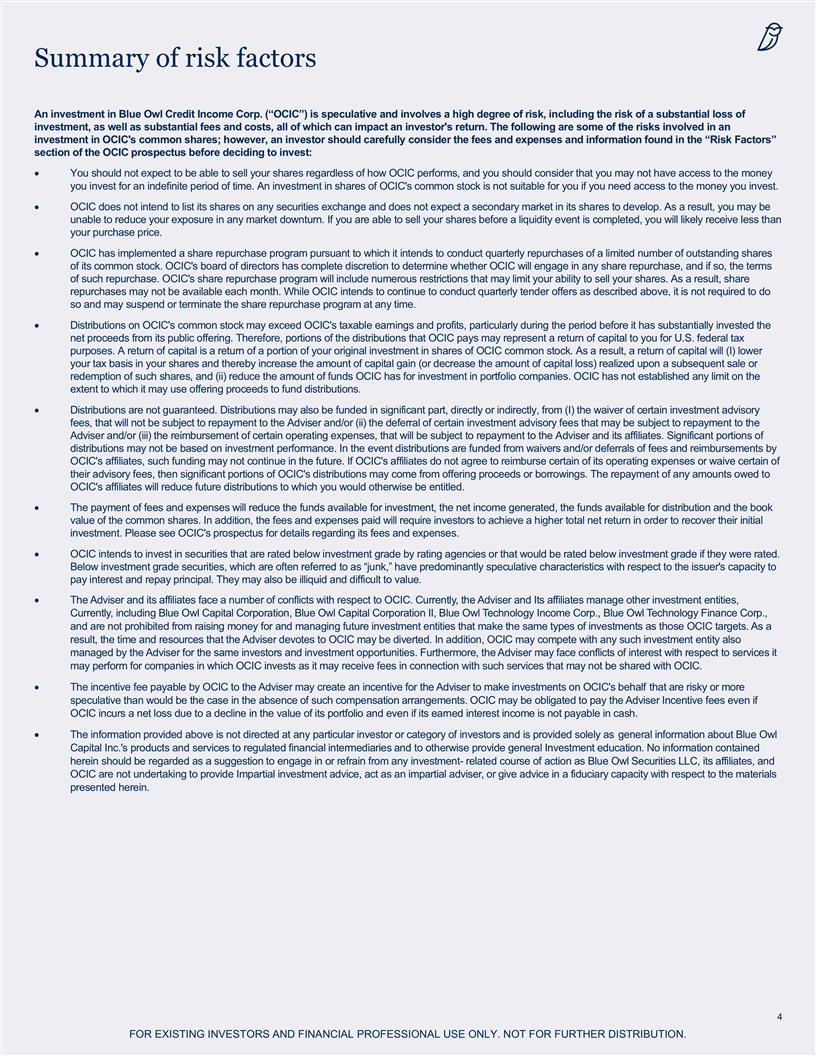
Summary of risk factors An investment in Blue Owl Credit Income Corp. (“OCIC”) is speculative and involves a high degree of risk, including the risk of a substantial loss of investment, as well as substantial fees and costs, all of which can impact an investor's return. The following are some of the risks involved in an investment in OCIC's common shares; however, an investor should carefully consider the fees and expenses and information found in the “Risk Factors” section of the OCIC prospectus before deciding to invest: You should not expect to be able to sell your shares regardless of how OCIC performs, and you should consider that you may not have access to the money you invest for an indefinite period of time. An investment in shares of OCIC's common stock is not suitable for you if you need access to the money you invest. OCIC does not intend to list its shares on any securities exchange and does not expect a secondary market in its shares to develop. As a result, you may be unable to reduce your exposure in any market downturn. If you are able to sell your shares before a liquidity event is completed, you will likely receive less than your purchase price. OCIC has implemented a share repurchase program pursuant to which it intends to conduct quarterly repurchases of a limited number of outstanding shares of its common stock. OCIC's board of directors has complete discretion to determine whether OCIC will engage in any share repurchase, and if so, the terms of such repurchase. OCIC's share repurchase program will include numerous restrictions that may limit your ability to sell your shares. As a result, share repurchases may not be available each month. While OCIC intends to continue to conduct quarterly tender offers as described above, it is not required to do so and may suspend or terminate the share repurchase program at any time. Distributions on OCIC's common stock may exceed OCIC's taxable earnings and profits, particularly during the period before it has substantially invested the net proceeds from its public offering. Therefore, portions of the distributions that OCIC pays may represent a return of capital to you for U.S. federal tax purposes. A return of capital is a return of a portion of your original investment in shares of OCIC common stock. As a result, a return of capital will (I) lower your tax basis in your shares and thereby increase the amount of capital gain (or decrease the amount of capital loss) realized upon a subsequent sale or redemption of such shares, and (ii) reduce the amount of funds OCIC has for investment in portfolio companies. OCIC has not established any limit on the extent to which it may use offering proceeds to fund distributions. Distributions are not guaranteed. Distributions may also be funded in significant part, directly or indirectly, from (I) the waiver of certain investment advisory fees, that will not be subject to repayment to the Adviser and/or (ii) the deferral of certain investment advisory fees that may be subject to repayment to the Adviser and/or (iii) the reimbursement of certain operating expenses, that will be subject to repayment to the Adviser and its affiliates. Significant portions of distributions may not be based on investment performance. In the event distributions are funded from waivers and/or deferrals of fees and reimbursements by OCIC's affiliates, such funding may not continue in the future. If OCIC's affiliates do not agree to reimburse certain of its operating expenses or waive certain of their advisory fees, then significant portions of OCIC's distributions may come from offering proceeds or borrowings. The repayment of any amounts owed to OCIC's affiliates will reduce future distributions to which you would otherwise be entitled. The payment of fees and expenses will reduce the funds available for investment, the net income generated, the funds available for distribution and the book value of the common shares. In addition, the fees and expenses paid will require investors to achieve a higher total net return in order to recover their initial investment. Please see OCIC's prospectus for details regarding its fees and expenses. OCIC intends to invest in securities that are rated below investment grade by rating agencies or that would be rated below investment grade if they were rated. Below investment grade securities, which are often referred to as “junk,” have predominantly speculative characteristics with respect to the issuer's capacity to pay interest and repay principal. They may also be illiquid and difficult to value. The Adviser and its affiliates face a number of conflicts with respect to OCIC. Currently, the Adviser and Its affiliates manage other investment entities, Currently, including Blue Owl Capital Corporation, Blue Owl Capital Corporation II, Blue Owl Technology Income Corp., Blue Owl Technology Finance Corp., and are not prohibited from raising money for and managing future investment entities that make the same types of investments as those OCIC targets. As a result, the time and resources that the Adviser devotes to OCIC may be diverted. In addition, OCIC may compete with any such investment entity also managed by the Adviser for the same investors and investment opportunities. Furthermore, the Adviser may face conflicts of interest with respect to services it may perform for companies in which OCIC invests as it may receive fees in connection with such services that may not be shared with OCIC. The incentive fee payable by OCIC to the Adviser may create an incentive for the Adviser to make investments on OCIC's behalf that are risky or more speculative than would be the case in the absence of such compensation arrangements. OCIC may be obligated to pay the Adviser Incentive fees even if OCIC incurs a net loss due to a decline in the value of its portfolio and even if its earned interest income is not payable in cash. The information provided above is not directed at any particular investor or category of investors and is provided solely as general information about Blue Owl Capital Inc.'s products and services to regulated financial intermediaries and to otherwise provide general Investment education. No information contained herein should be regarded as a suggestion to engage in or refrain from any investment- related course of action as Blue Owl Securities LLC, its affiliates, and OCIC are not undertaking to provide Impartial investment advice, act as an impartial adviser, or give advice in a fiduciary capacity with respect to the materials presented herein. FOR EXISTING INVESTORS AND FINANCIAL PROFESSIONAL USE ONLY. NOT FOR FURTHER DISTRIBUTION.
Important Information Unless otherwise noted the report date referenced herein is as of April 2, 2026. Past performance is not a guarantee of future results. Assets Under Management (“AUM”) refers to the assets that we manage and is generally equal to the sum of (i) net asset value (“NAV”); (ii) drawn and undrawn debt; (iii) uncalled capital commitments; (iv) total managed assets for certain Credit and Real Assets products; and (v) par value of collateral for collateralized loan obligations (“CLOs”) and other securitizations. The material presented is proprietary information regarding Blue Owl Capital Inc. (“Blue Owl”), its affiliates and investment program, funds sponsored by Blue Owl, including the Blue Owl Credit, Real Assets, and the GP Strategic Capital Funds (collectively the “Blue Owl Funds”) as well as investment held by the Blue Owl Funds. An investment in the Fund or other investment vehicle entails a high degree of risk. Investors should consider all of the risk factors set forth in the "Certain Risk Factors and Actual and Potential Conflicts of Interest" of the PPM or Prospectus, each of which could have an adverse effect on the Fund or other investment vehicle and on the value of Interests. An investment in the Fund or other investment vehicle is suitable only for sophisticated investors and requires the financial ability and willingness to accept the high risks and lack of liquidity associated with an investment in the Fund or other investment vehicle. Investors in the Fund or other investment vehicle must be prepared to bear such risks for an indefinite period of time. There will be restrictions on transferring interests in the Fund or other investment vehicle, and the investment performance of the Fund or other investment vehicle may be volatile. Investors must be prepared to hold their interests in the Fund or other investment vehicle until its dissolution and should have the financial ability and willingness to accept the risk characteristics of the Fund's or other investment vehicle’s investments. There can be no assurances or guarantees that the Fund's or other investment vehicles investment objectives will be realized that the Fund's or other investment vehicle investment strategy will prove successful or that investors will not lose all or a portion of their investment in the Fund. Furthermore, investors should not construe the performance of any predecessor funds or other investment vehicle as providing any assurances or predictive value regarding future performance of the Fund. The views expressed and, except as otherwise indicated, the information provided are as of the report date and are subject to change, update, revision, verification, and amendment, materially or otherwise, without notice, as market or other conditions change. Since these conditions can change frequently, there can be no assurance that the trends described herein will continue or that any forecasts are accurate. In addition, certain of the statements contained in this material may be statements of future expectations and other forward-looking statements that are based on the current views and assumptions and involve known and unknown risks and uncertainties (including those discussed below) that could cause actual results, performance, or events to differ materially from those expressed or implied in such statements. These statements may be forward-looking by reason of context or identified by words such as “may, will, should, expects, plans, intends, anticipates, believes, estimates, predicts, potential or continue” and other similar expressions. Neither Blue Owl, its affiliates, nor any of Blue Owl’s or its affiliates' respective advisers, members, directors, officers, partners, agents, representatives or employees or any other person (collectively the “Blue Owl Entities”) is under any obligation to update or keep current the information contained in this document. This material contains information from third party sources which Blue Owl has not verified. No representation or warranty, express or implied, is given by or on behalf of the Blue Owl Entities as to the accuracy, fairness, correctness or completeness of the information or opinions contained in this material and no liability whatsoever (in negligence or otherwise) is accepted by the Blue Owl Entities for any loss howsoever arising, directly or indirectly, from any use of this material or its contents, or otherwise arising in connection therewith. All investments are subject to risk, including the loss of the principal amount invested. These risks may include limited operating history, uncertain distributions, inconsistent valuation of the portfolio, changing interest rates, leveraging of assets, reliance on the investment advisor, potential conflicts of interest, payment of substantial fees to the investment advisor and the dealer manager, potential illiquidity, and liquidation at more or less than the original amount invested. Diversification will not guarantee profitability or protection against loss. Performance may be volatile, and the NAV may fluctuate. Performance Information: Where performance returns have been included in this material, OCIC has included herein important information relating to the calculation of these returns as well as other pertinent performance related definitions. OCIC intends to sell our shares at a net offering price that we believe reflects the net asset value per share as determined in accordance with the Fund’s share pricing policy. This material is for informational purposes only and is not an offer or a solicitation to sell or subscribe for any fund or other investment vehicle and does not constitute investment, legal, regulatory, business, tax, financial, accounting, or other advice or a recommendation regarding any securities of Blue Owl, of any fund or investment vehicle managed by Blue Owl, or of any other issuer of securities. Only a definitive offering document (i.e.: Prospectus or Private Placement Memorandum or other offering material) can make such an offer. Within the United States and Canada, securities are offered through Blue Owl Securities LLC, member of FINRA/SIPC, as Dealer Manager. Copyright© Blue Owl Capital Inc. 2026. All rights reserved. This material is proprietary and may not be reproduced, transferred, or distributed in any form without prior written permission from Blue Owl. It is delivered on an “as is” basis without warranty or liability by accepting the information, you agree to abide by all applicable copyright and other laws, as well as any additional copyright notices or restrictions contained in the information. FOR EXISTING INVESTORS AND FINANCIAL PROFESSIONAL USE ONLY. NOT FOR FURTHER DISTRIBUTION.
8855242.1 OcIC-FAQ-1Q26 FOR EXISTING INVESTORS AND FINANCIAL PROFESSIONAL USE ONLY. NOT FOR FURTHER DISTRIBUTION.