SoFi Reports Fourth Quarter 2025 with Record Net Revenue of $1.0 Billion, Record Member and Product Growth, Net Income of $174 Million
Adjusted Net Revenue up 37% to a record $1.0 billion
Adjusted EBITDA up 60% to a record $318 million
Fee-based Revenue up 53% to a record $443 million
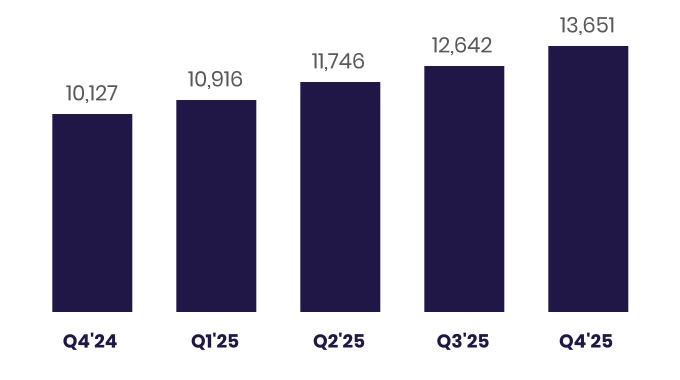
Member growth up 35% to a record 13.7 million members
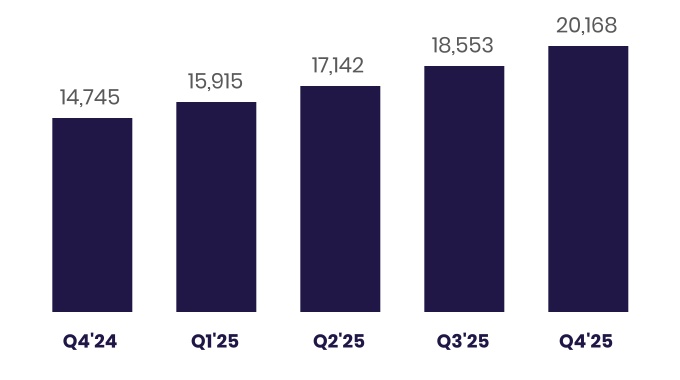
Product growth up 37% to a record 20.2 million products
Management announces 2026 guidance and medium term outlook
SAN FRANCISCO, Calif. – (BUSINESS WIRE) – January 30, 2026 – SoFi Technologies, Inc. (NASDAQ: SOFI), a member-centric, one-stop shop for digital financial services that helps members borrow, save, spend, invest and protect their money, reported financial results today for its fourth quarter and fiscal year ended December 31, 2025.
“2025 was a tremendous year and the fourth quarter was nothing short of exceptional, delivering more than $1 billion in quarterly revenue for the first time in our history,” said Anthony Noto, CEO of SoFi. “Our one-stop shop is scaling exactly as intended and delivering a winning combination of growth and returns. We added a record 1 million new members this quarter and drove record product growth. At the same time, we moved with urgency to lead the next phase of financial services by delivering crypto and blockchain innovation backed by bank-grade stability and security. This combination of scale, innovation, and profitability positions SoFi to drive durable, compounding growth, and deliver superior financial returns in 2026 and for years to come.”
Consolidated Results Summary
Three Months Ended December 31,
% Change
Year Ended December 31,
% Change
($ in thousands, except per share amounts)
2025
2024
2025
2024
Consolidated – GAAP
Total net revenue
$
1,025,051
$
734,125
40
%
$
3,613,354
$
2,674,859
35
%
Net income
173,549
332,473
(48)
%
481,320
498,665
(3)
%
Net income attributable to common stockholders – diluted
173,893
332,473
(48)
%
482,700
434,776
11
%
Earnings per share attributable to common stockholders – diluted
$
0.13
$
0.29
(55)
%
$
0.39
$
0.39
—
%
Consolidated – Non-GAAP(1)
Adjusted net revenue
$
1,012,835
$
739,112
37
%
$
3,591,411
$
2,606,170
38
%
Adjusted EBITDA
317,597
197,957
60
%
1,053,898
666,480
58
%
Adjusted net income
173,549
61,030
184
%
481,320
227,222
112
%
Adjusted net income attributable to common stockholders – diluted
173,893
61,030
185
%
482,700
163,333
196
%
Adjusted earnings per share – diluted
$
0.13
$
0.05
160
%
$
0.39
$
0.15
160
%
___________________
(1)For more information and reconciliations of these non-GAAP measures to the most comparable GAAP measures, see “Non-GAAP Financial Measures” and Table 2 to the “Financial Tables” herein.
Product Highlights
•Delivering the Largest New Members and Products Increase in Company History. SoFi added a record 1.0 million new members in the fourth quarter, leading to a 35% year-over-year increase to 13.7 million members and added a record 1.6 million new products in the fourth quarter, up 37% from the prior year to 20.2 million products.
1
•Achieving Record Revenue and Increased Profitability. Quarterly Adjusted Net Revenue surpassed $1 billion for the first time in company history, reaching $1.013 billion, up 37% year-over-year. SoFi demonstrated the strength of its diversified business by achieving a Rule of 401 score of 68%, reaching record Adjusted EBITDA of $318 million, up 60% year-over-year, representing a 31% Adjusted EBITDA margin.
•Accelerating Growth and Visibility of SoFi's One-Stop Shop. SoFi’s one-stop shop drove exceptional cross-buy, with 40% of new products opened by existing members - a nearly 7-percentage point increase year-over-year. This strength was supported by continued investment in brand building, which drove SoFi's unaided brand awareness to an all-time high of 9.6%.
•Demonstrating Successful Diversification with Record Fee-Based Revenue. Total fee-based revenue across the business surged to a record of $443 million, up more than 50% year-over-year, now generating nearly $1.8 billion on an annualized basis. This was driven by the strong performance of the Loan Platform Business (LPB), which generated $194 million in adjusted net revenue, up 15% from the third quarter and 2.9x from the prior year. LPB is now running at an annualized pace of $15 billion of originations and $774.6 million of high-margin, high-return revenue.
•Leading the Way in Bank-Grade Crypto Innovation. In the fourth quarter, SoFi became the first nationally chartered bank to launch crypto trading for consumers and to launch its own stablecoin, SoFiUSD, on public, permissionless blockchain. SoFi also delivered blockchain-powered international remittances across 30+ countries. These innovations improved money-movement capabilities and established SoFi’s position as the first company providing crypto and blockchain products backed by the bank-grade safety and stability of a nationally chartered bank.
•Increasing Loan Originations to Record-Highs. Total originations reached a record of $10.5 billion in the fourth quarter, up 46% year-over-year. This record was driven by strong performance across all lending segments with record personal loan originations of $7.5 billion, up 43% year-over-year, student loan originations of $1.9 billion, up 38% year-over-year, and record home loan originations of over $1.1 billion, up nearly 2x year-over-year.
•Strong and Consistent Credit Performance. Credit performance remained in-line with expectations, with personal-loan charge-offs down 57 basis points year-over-year and demonstrated continued resilience across a diversified portfolio.
Consolidated Results
SoFi reported a number of record financial achievements. For the fourth quarter of 2025, record GAAP net revenue of $1.0 billion increased 40% relative to the prior-year period's $734.1 million. Record adjusted net revenue of $1.0 billion grew 37% from the corresponding prior-year period of $739.1 million.
For the fourth quarter of 2025, total fee-based revenue reached a record of $443.3 million, a year-over-year increase of 53%. This was driven by strong performance from our Loan Platform Business, as well as referral fee revenue, interchange fee revenue and brokerage fee revenue. Together, the Financial Services and Technology Platform segments generated $579.1 million of net revenue, an increase of 61% from the prior year period.
Net interest income of $617.3 million for the fourth quarter was up 31% year-over-year. This was driven by a 35% increase in average interest-earning assets and a 50 basis point decrease in cost of funds, partially offset by a 74 basis point decrease in average asset yields year-over-year. For the fourth quarter, net interest margin of 5.72% decreased 19 basis points year-over-year from 5.91%, including a modest mix shift from personal loans to home and student loans.
1 Rule of 40 is calculated as the quarterly year-over-year change in adjusted net revenue plus quarterly adjusted EBITDA margin. Adjusted net revenue and adjusted EBITDA margin are non-GAAP financial measures. See “Non-GAAP Financial Measures” section for detailed explanations and definitions.
2
The average rate paid on deposits in the fourth quarter was 181 basis points lower than that paid on warehouse facilities, which translates to approximately $679.8 million of annualized interest expense savings due to the successful remixing of our funding base. In the fourth quarter, SoFi used a portion of the proceeds from its public offering to fully pay down outstanding warehouse lines.
Fourth quarter record adjusted EBITDA of $317.6 million increased 60% from the prior year period's $198.0 million. This represents an adjusted EBITDA margin of 31%. All three segments delivered strong contribution profit, at attractive margins.
SoFi reported its ninth consecutive quarter of GAAP profitability. For the fourth quarter of 2025, GAAP net income reached $173.5 million and diluted earnings per share reached $0.13.
Equity grew by $1.7 billion during the quarter to $10.5 billion and $8.26 of book value per share. Tangible book value grew by $1.7 billion during the quarter, ending the period at $8.9 billion. These increases included the benefit of $1.5 billion of new capital. Tangible book value per share was $7.01 at quarter-end, up from $4.47 per share in the prior year period.
Member and Product Growth
Continued growth in both total members and products in the fourth quarter is the result of our continued investments in innovation and brand building and reflects the benefits of our broad product suite and unique Financial Services Productivity Loop (FSPL) strategy.
SoFi added a record 1,027,000 members in the fourth quarter of 2025, bringing total members to 13.7 million, up 35% from 10.1 million at the end of the same prior year period.
SoFi also achieved record product additions of 1.6 million in the fourth quarter of 2025, bringing total products to nearly 20.2 million, up 37% from 14.7 million at the end of the same prior year period.
Members
Products
In Thousands
In Thousands
3
Products By Segment
Technology Platform Accounts (1)
In Thousands
In Millions
Note: For additional information on our company metrics, including the definitions of "Members", "Total Products" and "Technology Platform Total Accounts", see Table 6 in the “Financial Tables” herein. New member and new product addition metrics for the relevant period reflect actual growth or declines in members and products that occurred in that period whereas the total number of members and products reflects not only the growth or decline of each metric in the current period but also additions or deletions due to prior period factors, if any.
(1)The company includes SoFi accounts on the Galileo platform-as-a-service in its total Technology Platform accounts metric to better align with the presentation of Technology Platform segment revenue.
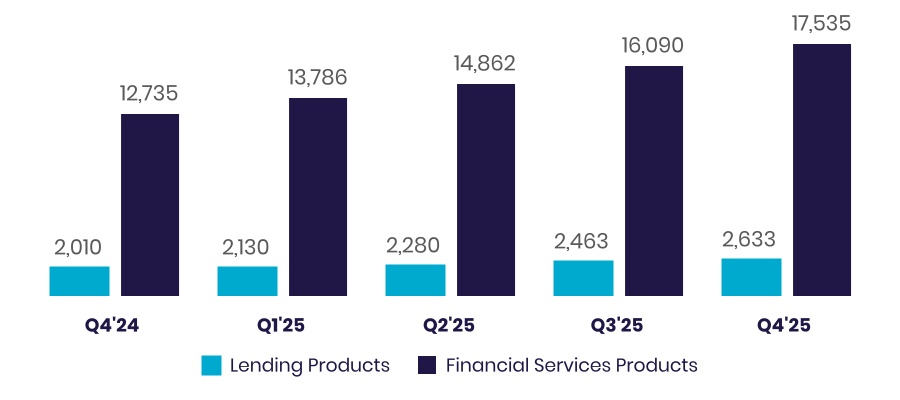
Financial Services products increased by 38% year-over-year to 17.5 million, primarily driven by continued demand for our SoFi Money, Relay and Invest products, and drove 89% of our total product growth.
Lending products increased by 31% year-over-year to 2.6 million, driven by continued demand for personal, student, and home loan products.
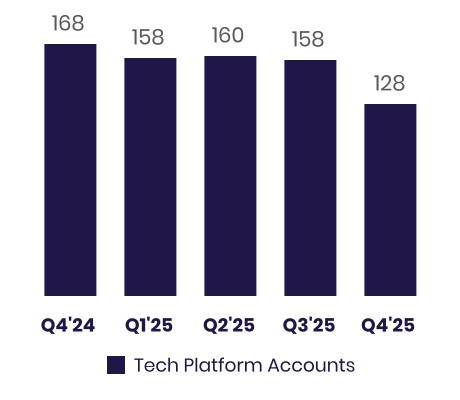
Technology Platform enabled accounts decreased 23% year-over-year to 128 million. This includes the impact from a large client which fully transitioned off the platform prior to year-end.
Financial Services Segment Results
For the fourth quarter of 2025, Financial Services segment net revenue of $456.7 million increased 78% from the prior year period. Noninterest income of $248.9 million increased nearly 2.6x year-over-year. Net interest income of $207.8 million increased 30% year-over-year, primarily driven by growth in consumer deposits.
In the fourth quarter, SoFi's Loan Platform Business added $193.7 million to our consolidated adjusted net revenue. Of this, $190.9 million was driven by $3.7 billion of personal loans originated on behalf of third parties as well as referrals to third parties.
In addition to our Loan Platform Business, SoFi continued to see healthy growth in interchange fee revenue in the fourth quarter, up 66% year-over-year, as a result of over $22 billion in total annualized spend in the quarter across SoFi Money and Credit Card.
Contribution profit for the fourth quarter of 2025 reached $230.8 million, a $115.9 million improvement over the prior year period, while contribution margin grew 6 percentage points year-over-year to 51%. This is a reflection of the strong operating leverage generated in the segment by net revenue growth of 78% with directly attributable expenses increasing only 64%.
4
Financial Services – Segment Results of Operations
Three Months Ended December 31,
Year Ended December 31,
($ in thousands)
2025
2024
% Change
2025
2024
% Change
Net interest income
$
207,810
$
160,337
30
%
$
777,991
$
573,422
36
%
Noninterest income
248,931
96,183
159
%
764,025
248,089
208
%
Total net revenue – Financial Services
456,741
256,520
78
%
1,542,016
821,511
88
%
Provision for credit losses
(5,460)
(6,852)
(20)
%
(30,329)
(31,659)
(4)
%
Directly attributable expenses
(220,493)
(134,813)
64
%
(718,778)
(482,845)
49
%
Contribution profit – Financial Services
$
230,788
$
114,855
101
%
$
792,909
$
307,007
158
%
Contribution margin – Financial Services(1)
51
%
45
%
51
%
37
%
___________________
(1)Contribution margin is defined for each of our reportable segments as contribution profit divided by net revenue.
By continuously innovating with new and relevant offerings, features and rewards for members, SoFi grew total Financial Services products by 4.8 million, or 38%, year-over-year, bringing the total to 17.5 million at quarter-end. SoFi Money reached 6.8 million products, Relay reached 6.7 million products and SoFi Invest reached 3.2 million products by the end of the fourth quarter.
Monetization continues to improve with annualized revenue per product of $104 during the fourth quarter, up 29% year-over-year.
In the fourth quarter of 2025, total deposits grew $4.6 billion to $37.5 billion, driven primarily by member deposits.
Financial Services – Products
December 31,
2025
2024
% Change
Money(1)
6,791,108
5,094,785
33
%
Invest
3,244,143
2,525,059
28
%
Credit Card
435,722
279,360
56
%
Referred loans(2)
149,872
85,205
76
%
Relay
6,687,259
4,636,755
44
%
At Work
163,411
113,917
43
%
Crypto(3)
63,441
—
n/m
Total financial services products
17,534,956
12,735,081
38
%
___________________
(1)Includes checking and savings accounts held at SoFi Bank, and cash management accounts.
(2)Limited to loans wherein we provide third party fulfillment services as part of our Loan Platform Business.
(3)Product counts for Crypto for the fourth quarter of 2025 reflect activity from our product launch on December 22, 2025 through December 31, 2025 and are therefore not representative of a full quarter of performance.
Technology Platform Segment Results
Technology Platform segment net revenue of $122.4 million for the fourth quarter of 2025 increased 19% year-over-year. Contribution profit of $47.9 million reflected a contribution margin of 39%.
5
Technology Platform – Segment Results of Operations
Three Months Ended December 31,
Year Ended December 31,
($ in thousands)
2025
2024
% Change
2025
2024
% Change
Net interest income
$
394
$
473
(17)
%
$
1,505
$
2,158
(30)
%
Noninterest income
121,979
102,362
19
%
448,706
393,020
14
%
Total net revenue – Technology Platform
122,373
102,835
19
%
450,211
395,178
14
%
Directly attributable expenses
(74,439)
(70,728)
5
%
(305,798)
(268,223)
14
%
Contribution profit
$
47,934
$
32,107
49
%
$
144,413
$
126,955
14
%
Contribution margin – Technology Platform(1)
39
%
31
%
32
%
32
%
___________________
(1)Contribution margin is defined for each of our reportable segments as contribution profit divided by net revenue.
Technology Platform total enabled client accounts decreased 23% year-over-year, to 128.5 million down from 167.7 million in the prior-year period. This includes the impact from a large client which fully transitioned off the platform prior to year-end.
Technology Platform
December 31,
2025
2024
% Change
Total accounts
128,461,873
167,713,818
(23)
%
Lending Segment Results
For the fourth quarter of 2025, Lending segment GAAP net revenue of $498.7 million increased 19% from the prior year period, while adjusted net revenue for the segment of $486.5 million increased 15% from the prior year period.
Lending segment performance in the fourth quarter was driven by net interest income, which rose 29% year-over-year, primarily driven by growth in average loan balances of 35%.
Lending segment fourth quarter contribution profit of $271.7 million was up 10% from $246.0 million in the corresponding prior-year period. Lending segment adjusted contribution margin was strong at 56%. This strong performance reflects our ability to capitalize on continued strong demand for our lending products.
Lending – Segment Results of Operations
Three Months Ended December 31,
Year Ended December 31,
($ in thousands)
2025
2024
% Change
2025
2024
% Change
Net interest income
$
444,763
$
345,210
29
%
$
1,606,032
$
1,207,226
33
%
Noninterest income
53,919
72,586
(26)
%
242,917
277,996
(13)
%
Total net revenue – Lending
498,682
417,796
19
%
1,848,949
1,485,222
24
%
Servicing rights – change in valuation inputs or assumptions
(12,224)
4,962
n/m
(22,013)
(6,280)
251
%
Residual interests classified as debt – change in valuation inputs or assumptions
(1)Contribution margin is defined for each of our reportable segments as contribution profit divided by net revenue.
(2)For more information and a reconciliation of these non-GAAP financial measures to the most comparable GAAP measure, see “Non-GAAP Financial Measures” and Table 2 to the “Financial Tables” herein.
Lending – Loans At Fair Value
($ in thousands)
Personal Loans
Student Loans
Home Loans
Total
December 31, 2025
Unpaid principal
$
20,243,217
$
12,875,440
$
1,133,329
$
34,251,986
Accumulated interest
151,079
58,277
4,888
214,244
Cumulative fair value adjustments(1)
1,146,372
723,861
66,898
1,937,131
Total fair value of loans(2)(3)
$
21,540,668
$
13,657,578
$
1,205,115
$
36,403,361
September 30, 2025
Unpaid principal
$
19,456,198
$
11,143,322
$
713,727
$
31,313,247
Accumulated interest
141,384
49,228
2,730
193,342
Cumulative fair value adjustments(1)
1,118,035
635,437
40,260
1,793,732
Total fair value of loans(2)(3)
$
20,715,617
$
11,827,987
$
756,717
$
33,300,321
___________________
(1) During the three months ended December 31, 2025, the cumulative fair value adjustments for personal loans were impacted by a higher unpaid principal balance, a lower weighted average discount rate and a lower weighted average conditional prepayment rate, partially offset by a higher weighted average annual default rate. The lower discount rate was primarily driven by an 8 basis point decrease in benchmark rates. The cumulative fair value adjustments for student loans were impacted by a higher unpaid principal balance, a lower weighted average discount rate, and a lower weighted average conditional prepayment rate, partially offset by lower weighted average coupon and higher weighted average default rate.
(2) Each component of the fair value of loans is impacted by charge-offs during the period. Our fair value assumption for annual default rate incorporates fair value markdowns on loans beginning when they are 10 days or more delinquent, with additional markdowns at 30, 60 and 90 days past due.
(3) Student loans are classified as loans held for investment, and personal loans and home loans are classified as loans held for sale.
The following table summarizes the significant inputs to the fair value model for personal and student loans:
Personal Loans
Student Loans
December 31, 2025
September 30, 2025
December 31, 2025
September 30, 2025
Weighted average coupon rate(1)
13.11
%
13.11
%
5.87
%
5.89
%
Weighted average annual default rate
4.46
%
4.33
%
0.68
%
0.67
%
Weighted average conditional prepayment rate
26.87
%
26.90
%
11.21
%
11.27
%
Weighted average discount rate
4.46
%
4.55
%
3.89
%
3.90
%
Benchmark rate(2)
3.31
%
3.39
%
3.40
%
3.35
%
___________________
(1)Represents the average coupon rate on loans held on balance sheet, weighted by unpaid principal balance outstanding at the balance sheet date.
(2)Corresponds with two-year SOFR for personal loans, and four-year SOFR for student loans.
For the fourth quarter of 2025, record origination volume of $10.5 billion increased 46% year-over-year. This was a result of continued strong member demand for personal loans, student loans and home loans as well as strong demand from capital markets partners.
Record personal loan originations of $7.5 billion in the fourth quarter of 2025 were up 43% year-over-year, inclusive of $3.7 billion originated on behalf of third parties through our Loan Platform Business. Fourth quarter student loan volume of $1.9 billion was up 38% year-over-year. Home equity loan originations were strong during the fourth quarter, accounting for nearly one-third of total home loan volume. In total, home loan volume was $1.1 billion, an increase of 95% year-over-year.
Capital markets activity in the fourth quarter of 2025 was very strong. Overall, SoFi sold, or transferred through our Loan Platform Business, more than $4.5 billion in total of personal loans and home loans. In terms of personal loans, we closed $99.8 million of sales in whole loan form at a blended execution of 106.5%. In terms of home loan sales, we closed $691.7 million at a blended execution of 102.3%.
7
In addition to our personal and home loan sales, SoFi executed a $463 million co-contributor securitization of loans previously originated through our Loan Platform Business. This was the fourth securitization of new collateral under our SoFi Consumer Loan Program (SCLP) since 2021 using collateral originated in the Loan Platform Business. Importantly, this channel provides our partners with meaningful liquidity to support their ongoing investment in the Loan Platform Business. The transaction priced at industry-leading cost-of-funds levels, with a weighted average spread of 101 basis points.
Credit performance remained strong in the fourth quarter, in-line with expectations. The personal loan annualized charge-off rate increased to 2.80% from 2.60% in the prior quarter, including the impact of asset sales, new originations and delinquency sales in the quarter. This increase was driven by portfolio seasoning rather than credit deterioration. Personal loan annualized net charge offs decreased 57 basis points year-over-year.
Had SoFi not sold late stage delinquent loans, it is estimated that, including recoveries, the all-in annualized net charge-off rate for personal loans would have been approximately 4.4% versus 4.2% in the prior quarter.
The student loan annualized charge-off rate increased to 76 basis points from 69 basis points in the prior quarter, driven by seasonality and the impact from a student loan repurchase that concluded during the fourth quarter.
The on-balance sheet 90-day delinquency rates for both personal loans and student loans were consistent with the prior year.
The data continues to support a 7–8% maximum cumulative net loss assumption for personal loans, in line with SoFi's underwriting tolerance.
Recent vintages, originated from the fourth quarter of 2022 to first quarter of 2025 have net cumulative losses of 4.55%, with 37% unpaid principal balance remaining. This is well below the 6.27% observed at the same point in time for the 2017 vintage which is the last vintage that approached our 7-8% tolerance. The gap between the newer cohort curve and the 2017 cohort curve improved by 8 basis points, after improving 29 basis points last quarter, demonstrating continued improvement.
Additionally, of the first quarter of 2020 through the third quarter of 2025 originations, 60% of principal has already been paid down, with 6.8% in net cumulative losses. Therefore, for life-of-loan losses on this entire cohort of loans to reach 8%, the charge-off rate on the remaining 40% of unpaid principal would need to be approximately 10%. This would be well above past levels, providing us further confidence in achieving loss rates below our 8% tolerance.
Lending – Originations and Average Balances
Three Months Ended December 31,
% Change
Year Ended December 31,
% Change
2025
2024
2025
2024
Origination volume ($ in thousands, during period)
Personal loans(1)
$
7,501,068
$
5,251,949
43
%
$
27,495,534
$
17,614,985
56
%
Student loans
1,861,421
1,348,970
38
%
5,537,934
3,780,752
46
%
Home loans
1,127,705
577,362
95
%
3,388,995
1,820,213
86
%
Total
$
10,490,194
$
7,178,281
46
%
$
36,422,463
$
23,215,950
57
%
Average loan balance ($, as of period end)(2)
Personal loans
$
25,810
$
25,377
2
%
Student loans
43,371
42,960
1
%
Home loans
243,916
279,321
(13)
%
_________________
(1)Inclusive of origination volume related to our Loan Platform Business.
(2)Within each loan product category, average loan balance is defined as the total unpaid principal balance of the loans divided by the number of loans that have a balance greater than zero dollars as of the reporting date. Average loan balance includes loans on our balance sheet, as well as transferred loans and referred loans with which SoFi has continuing involvement through our servicing agreements.
8
Lending – Products
December 31,
2025
2024
% Change
Personal loans(1)
1,935,607
1,405,928
38
%
Student loans
644,225
568,612
13
%
Home loans
53,354
35,814
49
%
Total lending products
2,633,186
2,010,354
31
%
_________________
(1)Includes loans which we originate as part of our Loan Platform Business.
Guidance and Outlook
Looking forward to 2026, for the full year, management expects to increase total members by at least 30% year-over-year. Management expects to deliver adjusted net revenue of approximately $4.655 billion which implies approximately 30% annual revenue growth. Management expects adjusted EBITDA of approximately $1.6 billion, which equates to an annual EBITDA margin of approximately 34%. Management expects adjusted net income of approximately $825 million, which equates to a margin of approximately 18%. Lastly, management expects adjusted EPS of approximately 60 cents per share.
In the first quarter of 2026, management expects to deliver adjusted net revenue of approximately $1.04 billion, adjusted EBITDA of approximately $300 million, adjusted net income of approximately $160 million, and adjusted EPS of approximately 12 cents per share.
Over the medium term, management expects to deliver compounded annual growth in adjusted net revenue of at least 30% from 2025 to 2028. Additionally, management expects to deliver compounded annual growth in adjusted earnings per share of 38% to 42% from 2025 to 2028. This guidance assumes there are no meaningful changes in the macroeconomic environment and no significant new business launches or acquisitions.
Management will further address guidance on the quarterly earnings conference call. Management has not reconciled forward-looking non-GAAP measures to their most directly comparable GAAP measures. This is because the company cannot predict with reasonable certainty and without unreasonable efforts the ultimate outcome of certain GAAP components of such reconciliations due to market-related assumptions that are not within our control as well as certain legal or advisory costs, tax costs or other costs that may arise. For these reasons, management is unable to assess the probable significance of the unavailable information, which could materially impact the amount of the future directly comparable GAAP measures.
9
Earnings Webcast
SoFi’s executive management team will host a live audio webcast beginning at 8:00 a.m. Eastern Time (5:00 a.m. Pacific Time) today to discuss the quarter’s financial results and business highlights. All interested parties are invited to listen to the live webcast at https://investors.sofi.com. A replay of the webcast will be available on the SoFi Investor Relations website for 30 days. Investor information, including supplemental financial information, is available on SoFi’s Investor Relations website at https://investors.sofi.com.
Certain of the statements above are forward-looking and as such are not historical facts. This includes, without limitation, statements regarding our expectations for the first quarter of 2026 and full year 2026 adjusted net revenue, annual growth rate, adjusted EBITDA, adjusted EBITDA margin, GAAP net income, GAAP EPS, tangible book value, and new members, our expectations regarding our ability to deliver compounded annual growth in adjusted net revenue and compounded annual growth in adjusted earnings per share from 2025 to 2028, our expectations regarding our ability to continue to grow our business, deliver superior financial returns, build our brand and launch new business lines and products, our ability to continue to drive momentum, deepen member engagement, and increase cross-buy, our expectations regarding the size of our market opportunity, our ability to continue to attract and execute deals, our ability to continue to improve our financials and increase our member, product and total accounts count, our ability to achieve diversified and more durable growth, including our ability to continue to grow our Loan Platform Business, our ability to continue the momentum seen in prior financial periods, our ability to have loss rates below 8%, our ability to navigate the macroeconomic, geopolitical and regulatory environment, any changes in demand for our products, and the financial position, business strategy and plans and objectives of management for our future operations. These forward-looking statements are not guarantees of performance. Such statements can be identified by the fact that they do not relate strictly to historical or current facts. Words such as “achieve”, “believe”, “continue”, “expect”, “capable” “future”, “growth”, “may”, “opportunity”, “plan”, “potential”, “strategy”, “will be”, “will continue”, and similar expressions may identify forward-looking statements, but the absence of these words does not mean that a statement is not forward-looking. Factors that could cause actual results to differ materially from those contemplated by these forward-looking statements include: (i) the effect of and our ability to respond and adapt to changing market and economic conditions, including economic downturns, fluctuating inflation and interest rates, and volatility from macroeconomic, global, and political events, including announced or planned tariffs; (ii) our ability to maintain net income profitability, continue to increase fee-based revenue streams, continue to grow across our segments in the future, as well as our ability to meet our guidance; (iii) the impact on our business of the regulatory environment, changes in governmental policies, changes in personnel and resources of the governmental agencies that regulate us, and complexities with compliance related to such environment; (iv) our ability to realize the benefits of being a bank holding company and operating SoFi Bank, including continuing to grow high quality deposits and our rewards program for members; (v) our ability to continue to drive brand awareness and realize the benefits of our marketing and advertising campaigns; (vi) our ability to vertically integrate our businesses and accelerate the pace of innovation of our financial products; (vii) our ability to manage our growth effectively; (viii) our ability to access sources of capital on acceptable terms or at all; (ix) the success of our continued investments in our business; (x) our ability to expand our member base, increase our product adds and increase cross-buy; (xi) our ability to maintain our leadership position in certain categories of our business and to grow market share in existing markets or any new markets we may enter; (xii) our ability to cater to a broad range of clients and continue to execute deals with current or future business partners; (xiii) our ability to develop new products, features and functionality that are competitive and meet market needs; (xiv) our ability to realize the benefits of our strategy, including what we refer to as our FSPL; (xv) our ability to make accurate credit and pricing decisions or effectively forecast our loss rates; (xvi) our ability to establish and maintain an effective system of internal controls over financial reporting; (xvii) our ability to maintain the security and reliability of our products; and (xviii) the outcome of any legal or governmental proceedings instituted against us. The foregoing list of factors is not exhaustive. You should carefully consider the foregoing factors and the other risks and uncertainties set forth in the section titled “Risk Factors” in our last annual report on Form 10-K, as filed with the Securities and Exchange Commission, and those that are included in any of our future filings with the Securities and Exchange Commission. These forward-looking statements are based on information available as of the date hereof and current expectations, forecasts and assumptions, and involve a
10
number of judgments, risks and uncertainties. Accordingly, forward-looking statements should not be relied upon as representing our views as of any subsequent date, and we do not undertake any obligation to update forward-looking statements to reflect events or circumstances after the date they were made, whether as a result of new information, future events or otherwise, except as may be required under applicable securities laws.
As a result of a number of known and unknown risks and uncertainties, our actual results or performance may be materially different from those expressed or implied by these forward-looking statements. You should not place undue reliance on these forward-looking statements.
Non-GAAP Financial Measures
This press release presents information about certain non-GAAP financial measures provided as supplements to the results provided in accordance with accounting principles generally accepted in the United States (GAAP). Our management and Board of Directors uses these non-GAAP measures to evaluate our operating performance, formulate business plans, help better assess our overall liquidity position, and make strategic decisions, including those relating to operating expenses and the allocation of internal resources. Accordingly, we believe that these non-GAAP measures provide useful information to investors and others in understanding and evaluating our operating results in the same manner as our management and Board of Directors. These non-GAAP measures have limitations as analytical tools, and should not be considered in isolation from, or as a substitute for, the analysis of other GAAP financial measures. Other companies may not use these non-GAAP measures or may use similar measures that are defined in a different manner. Therefore, SoFi's non-GAAP measures may not be directly comparable to similarly titled measures of other companies.
Reconciliations of these non-GAAP measures to the most directly comparable GAAP financial measures are provided in Table 2 to the “Financial Tables” herein.
About SoFi
SoFi Technologies (NASDAQ: SOFI) is a one-stop shop for digital financial services on a mission to help people achieve financial independence to realize their ambitions. 13.7 million members trust SoFi to borrow, save, spend, invest, and protect their money – all in one app – and get access to financial planners, exclusive experiences, and a thriving community. Fintechs, financial institutions, and brands use SoFi’s technology platform Galileo to build and manage innovative financial solutions across 128.5 million global accounts. For more information, visit www.sofi.com or download our iOS and Android apps.
Availability of Other Information About SoFi
Investors and others should note that we communicate with our investors and the public using our website (https://www.sofi.com), the investor relations website (https://investors.sofi.com), and on social media (X and LinkedIn), including but not limited to investor presentations and investor fact sheets, Securities and Exchange Commission filings, press releases, public conference calls and webcasts. The information that SoFi posts on these channels and websites could be deemed to be material information. As a result, SoFi encourages investors, the media, and others interested in SoFi to review the information that is posted on these channels, including the investor relations website, on a regular basis. This list of channels may be updated from time to time on SoFi’s investor relations website and may include additional social media channels. The contents of SoFi’s website or these channels, or any other website that may be accessed from its website or these channels, shall not be deemed incorporated by reference in any filing under the Securities Act of 1933, as amended.
Contact
Investors:
SoFi Investor Relations
IR@sofi.com
Media:
SoFi Media Relations
PR@sofi.com
11
FINANCIAL TABLES
(Unaudited)
1. Condensed Consolidated Statements of Operations and Comprehensive Income
2. Reconciliation of GAAP to Non-GAAP Financial Measures
3. Condensed Consolidated Balance Sheets
4. Average Balances and Net Interest Earnings Analysis
5. Company Metrics
6. Segment Financials
7. Fee-Based Revenue
8. Analysis of Charge-Offs
9. Regulatory Capital
12
Table 1
SoFi Technologies, Inc.
Condensed Consolidated Statements of Operations and Comprehensive Income
(Unaudited)
(In Thousands, Except for Per Share Data)
Three Months Ended December 31,
Year Ended December 31,
2025
2024
2025
2024
Interest income
Loans and securitizations
$
864,402
$
688,723
$
3,146,296
$
2,601,988
Other
63,019
55,214
228,903
205,829
Total interest income
927,421
743,937
3,375,199
2,807,817
Interest expense
Securitizations and warehouses
8,181
23,022
95,824
112,398
Deposits
290,511
238,596
1,014,043
930,154
Corporate borrowings
11,196
12,039
45,723
48,346
Other
254
111
653
438
Total interest expense
310,142
273,768
1,156,243
1,091,336
Net interest income
617,279
470,169
2,218,956
1,716,481
Noninterest income
Loan origination, sales, securitizations and servicing
53,856
72,597
242,947
278,114
Technology products and solutions
93,963
88,376
360,903
350,810
Loan platform fees
190,859
63,235
575,911
141,608
Other
69,094
39,748
214,637
187,846
Total noninterest income
407,772
263,956
1,394,398
958,378
Total net revenue
1,025,051
734,125
3,613,354
2,674,859
Provision for credit losses
5,407
6,877
30,319
31,712
Noninterest expense
Technology and product development
172,836
148,986
648,332
551,787
Sales and marketing
305,614
229,261
1,095,412
796,293
Cost of operations
161,618
128,155
608,998
461,633
General and administrative
194,244
160,922
704,436
600,089
Total noninterest expense
834,312
667,324
3,057,178
2,409,802
Income before income taxes
185,332
59,924
525,857
233,345
Income tax (expense) benefit
(11,783)
272,549
(44,537)
265,320
Net income
$
173,549
$
332,473
$
481,320
$
498,665
Earnings per share
Earnings per share – basic
$
0.14
$
0.31
$
0.42
$
0.46
Earnings per share – diluted
$
0.13
$
0.29
$
0.39
$
0.39
Weighted average common stock outstanding – basic
1,222,750
1,087,863
1,150,140
1,050,219
Weighted average common stock outstanding – diluted
1,346,110
1,151,047
1,251,767
1,101,390
13
Table 2
Non-GAAP Financial Measures
(Unaudited)
Adjusted Net Revenue
Adjusted net revenue is a non-GAAP measure. Adjusted net revenue is defined as total net revenue, adjusted to exclude the fair value changes in servicing rights and residual interests classified as debt due to valuation inputs and assumptions changes, which relate only to our Lending segment, as well as gains and losses on extinguishment of debt. We adjust total net revenue to exclude these items, as they are non-cash charges that are not realized during the period or not indicative of our core operating performance, and therefore positive or negative changes do not impact the cash available to fund our operations. Management believes this measure is useful because it enables management and investors to assess our underlying operating performance and cash available to fund our operations. In addition, management uses this measure to better decide on the proper expenses to authorize for each of our operating segments, to ultimately help achieve target contribution profit margins.
The following table reconciles adjusted net revenue to total net revenue, the most directly comparable GAAP measure:
Three Months Ended December 31,
Year Ended December 31,
($ in thousands)
2025
2024
2025
2024
Total net revenue (GAAP)
$
1,025,051
$
734,125
$
3,613,354
$
2,674,859
Servicing rights – change in valuation inputs or assumptions(1)
(12,224)
4,962
(22,013)
(6,280)
Residual interests classified as debt – change in valuation inputs or assumptions(2)
8
25
70
108
Gain on extinguishment of debt(3)
—
—
—
(62,517)
Adjusted net revenue (non-GAAP)
$
1,012,835
$
739,112
$
3,591,411
$
2,606,170
___________________
(1)Reflects changes in fair value inputs and assumptions on servicing rights, including conditional prepayment, default rates and discount rates. These assumptions are highly sensitive to market interest rate changes and are not indicative of our performance or results of operations. Moreover, these non-cash charges are unrealized during the period and, therefore, have no impact on our cash flows from operations.
(2)Reflects changes in fair value inputs and assumptions on residual interests classified as debt, including conditional prepayment, default rates and discount rates. When third parties finance our consolidated securitization VIEs by purchasing residual interests, we receive proceeds at the time of the closing of the securitization and, thereafter, pass along contractual cash flows to the residual interest owner. These residual debt obligations are measured at fair value on a recurring basis, but they have no impact on our initial financing proceeds, our future obligations to the residual interest owner (because future residual interest claims are limited to contractual securitization collateral cash flows), or the general operations of our business.
(3)Reflects gain on extinguishment of debt. Gains and losses are recognized during the period of extinguishment for the difference between the net carrying amount of debt extinguished and the fair value of equity securities issued.
The following table reconciles adjusted net revenue for the Lending segment to total net revenue, the most directly comparable GAAP measure for the Lending segment:
Three Months Ended December 31,
Year Ended December 31,
($ in thousands)
2025
2024
2025
2024
Lending
Total net revenue – Lending (GAAP)
$
498,682
$
417,796
$
1,848,949
$
1,485,222
Servicing rights – change in valuation inputs or assumptions(1)
(12,224)
4,962
(22,013)
(6,280)
Residual interests classified as debt – change in valuation inputs or assumptions(2)
8
25
70
108
Adjusted net revenue – Lending (non-GAAP)
$
486,466
$
422,783
$
1,827,006
$
1,479,050
___________________
(1)See footnote (1) to the table above.
(2)See footnote (2) to the table above.
Adjusted Noninterest Income
Adjusted noninterest income is a non-GAAP measure. Adjusted noninterest income is defined as noninterest income, adjusted to exclude the fair value changes in servicing rights and residual interests classified as debt due to valuation inputs and assumptions changes, which relate only to our Lending segment, as well as gains and losses on extinguishment of debt. We adjust noninterest income to exclude these items, as they are non-cash charges that are not realized during the period or not indicative of our core operating performance, and therefore positive or negative changes do not impact the cash available to fund our operations.
14
Management believes this measure is useful because it enables management and investors to assess our underlying operating performance and cash available to fund our operations.
The following table reconciles adjusted noninterest income to noninterest income, the most directly comparable GAAP measure:
Three Months Ended December 31,
Year Ended December 31,
($ in thousands)
2025
2024
2025
2024
Noninterest income (GAAP)
$
407,772
$
263,956
$
1,394,398
$
958,378
Servicing rights – change in valuation inputs or assumptions(1)
(12,224)
4,962
(22,013)
(6,280)
Residual interests classified as debt – change in valuation inputs or assumptions(2)
8
25
70
108
Gain on extinguishment of debt(3)
—
—
—
(62,517)
Adjusted noninterest income (non-GAAP)
$
395,556
$
268,943
$
1,372,455
$
889,689
___________________
(1)Reflects changes in fair value inputs and assumptions on servicing rights, including conditional prepayment, default rates and discount rates. These assumptions are highly sensitive to market interest rate changes and are not indicative of our performance or results of operations. Moreover, these non-cash charges are unrealized during the period and, therefore, have no impact on our cash flows from operations.
(2)Reflects changes in fair value inputs and assumptions on residual interests classified as debt, including conditional prepayment, default rates and discount rates. When third parties finance our consolidated securitization VIEs by purchasing residual interests, we receive proceeds at the time of the closing of the securitization and, thereafter, pass along contractual cash flows to the residual interest owner. These residual debt obligations are measured at fair value on a recurring basis, but they have no impact on our initial financing proceeds, our future obligations to the residual interest owner (because future residual interest claims are limited to contractual securitization collateral cash flows), or the general operations of our business.
(3)Reflects gain on extinguishment of debt. Gains and losses are recognized during the period of extinguishment for the difference between the net carrying amount of debt extinguished and the fair value of equity securities issued.
The following table reconciles adjusted noninterest income for the Lending segment to noninterest income, the most directly comparable GAAP measure for the Lending segment:
Three Months Ended December 31,
Year Ended December 31,
($ in thousands)
2025
2024
2025
2024
Lending
Noninterest income – Lending (GAAP)
$
53,919
$
72,586
$
242,917
$
277,996
Servicing rights – change in valuation inputs or assumptions(1)
(12,224)
4,962
(22,013)
(6,280)
Residual interests classified as debt – change in valuation inputs or assumptions(2)
8
25
70
108
Adjusted noninterest income – Lending (non-GAAP)
$
41,703
$
77,573
$
220,974
$
271,824
___________________
(1)See footnote (1) to the table above.
(2)See footnote (2) to the table above.
Adjusted Contribution Margin and Incremental Adjusted Contribution Margin — Lending
Adjusted contribution margin and incremental adjusted contribution margin are non-GAAP measures and relate only to our Lending segment. Adjusted contribution margin is defined as segment contribution profit for the Lending segment, divided by adjusted net revenue for the Lending segment, a non-GAAP measure. Incremental adjusted contribution margin is defined as the change in segment contribution profit for our Lending segment, divided by change in adjusted net revenue for the Lending segment. See ‘Adjusted Net Revenue’ above for a reconciliation of Lending segment adjusted net revenue.
Management believes adjusted contribution margin metrics are useful because they enable management and investors to assess the underlying operating performance of our Lending segment, by removing the impact of changes in volume over periods to present a comparable view of segment contribution profit, which is a measure of the direct profitability of each of our reportable segments, as a percentage of segment adjusted net revenue for the Lending segment during each period.
15
The following table presents a reconciliation of adjusted contribution margin and incremental adjusted contribution margin for our reportable Lending segment:
(1)Contribution margin is defined for each of our reportable segments as contribution profit divided by net revenue. Incremental contribution margin for each of our reportable segments is defined as the change in segment contribution profit divided by change in net revenue.
(2)Refer to ‘Adjusted Net Revenue’ above for reconciliation of this non-GAAP measure.
Adjusted EBITDA, Adjusted EBITDA Margin and Incremental Adjusted EBITDA Margin
Adjusted EBITDA, adjusted EBITDA margin and incremental adjusted EBITDA margin are non-GAAP measures. Adjusted EBITDA is defined as net income, adjusted to exclude, as applicable: (i) corporate borrowing-based interest expense (our adjusted EBITDA measure is not adjusted for warehouse or securitization-based interest expense, nor deposit interest expense and finance lease liability interest expense, as these are direct operating expenses), (ii) income tax expense (benefit), (iii) depreciation and amortization, (iv) share-based expense (inclusive of equity-based payments to non-employees), (v) restructuring charges, (vi) impairment expense (inclusive of goodwill impairments and property, equipment and software abandonments), (vii) transaction-related expenses, (viii) foreign currency impacts related to operations in highly inflationary countries, (ix) fair value changes in each of servicing rights and residual interests classified as debt due to valuation assumptions, (x) gain on extinguishment of debt, and (xi) other charges, as appropriate, that are not expected to recur and are not indicative of our core operating performance.
Adjusted EBITDA margin is computed as adjusted EBITDA divided by adjusted net revenue. Incremental adjusted EBITDA margin is defined as the change in adjusted EBITDA, divided by change in adjusted net revenue. See ‘Adjusted Net Revenue’ above for a reconciliation of this non-GAAP measure.
Management believes adjusted EBITDA, adjusted EBITDA margin and incremental adjusted EBITDA margin are useful measures for period-over-period comparisons of our business. These measures enable management and investors to assess our core operating performance or results of operations by removing the effects of certain non-cash items and charges, as well as the impact of changes in volume over periods as applicable. In addition, management uses these measures to help evaluate cash flows generated from operations and the extent of additional capital, if any, required to invest in strategic initiatives.
16
The following table reconciles adjusted EBITDA to net income, the most directly comparable GAAP measure, and presents the computations of adjusted EBITDA margin and incremental adjusted EBITDA margin:
Three Months Ended December 31,
2025 vs 2024
Year Ended December 31,
2025 vs 2024
($ in thousands)
2025
2024
$ Change
2025
2024
$ Change
Net income (GAAP)
$
173,549
$
332,473
$
(158,924)
$
481,320
$
498,665
$
(17,345)
Non-GAAP adjustments:
Interest expense – corporate borrowings(1)
11,196
12,039
(843)
45,723
48,346
(2,623)
Income tax expense (benefit)(2)
11,783
(272,549)
284,332
44,537
(265,320)
309,857
Depreciation and amortization
62,880
53,545
9,335
234,151
203,498
30,653
Share-based expense
68,577
66,367
2,210
262,058
246,152
15,906
Restructuring charges(3)
20
255
(235)
948
1,530
(582)
Foreign currency impact of highly inflationary subsidiaries(4)
1,808
840
968
7,104
1,683
5,421
Transaction-related expense(5)
—
—
—
—
615
(615)
Servicing rights – change in valuation inputs or assumptions(6)
(12,224)
4,962
(17,186)
(22,013)
(6,280)
(15,733)
Residual interests classified as debt – change in valuation inputs or assumptions(7)
8
25
(17)
70
108
(38)
Gain on extinguishment of debt(8)
—
—
—
—
(62,517)
62,517
Total adjustments
144,048
(134,516)
278,564
572,578
167,815
404,763
Adjusted EBITDA (non-GAAP)
$
317,597
$
197,957
$
119,640
$
1,053,898
$
666,480
$
387,418
Total net revenue (GAAP)
$
1,025,051
$
734,125
$
290,926
$
3,613,354
$
2,674,859
$
938,495
Net income margin (GAAP)
17
%
45
%
13
%
19
%
Incremental net income margin (GAAP)
(55)
%
(2)
%
Adjusted net revenue (non-GAAP)(9)
$
1,012,835
$
739,112
$
273,723
$
3,591,411
$
2,606,170
$
985,241
Adjusted EBITDA margin (non-GAAP)
31
%
27
%
29
%
26
%
Incremental adjusted EBITDA margin (non-GAAP)
44
%
39
%
___________________
(1)Our adjusted EBITDA measure adjusts for corporate borrowing-based interest expense, as these expenses are a function of our capital structure. Corporate borrowing-based interest expense includes interest on our revolving credit facility, as well as interest expense and the amortization of debt discount and debt issuance costs on our convertible notes.
(2)The income tax expense recognized in 2025 is primarily attributable to the Company’s profitability, partially offset by discrete tax benefits for stock compensation recorded in each quarter.
(3)Restructuring charges relate to legal entity restructuring.
(4)Foreign currency charges reflect the impacts of highly inflationary accounting for our operations in Argentina, which are related to our Technology Platform segment and commenced in the first quarter of 2022 with the Technisys Merger.
(5)Transaction-related expense in the 2024 periods included financial advisory and professional services costs associated with our acquisition of Wyndham.
(6)Reflects changes in fair value inputs and assumptions, including market servicing costs, conditional prepayment, default rates and discount rates. This non-cash change is unrealized during the period and, therefore, has no impact on our cash flows from operations. As such, these positive and negative changes in fair value attributable to assumption changes are adjusted out of net income to provide management and financial users with better visibility into the earnings available to finance our operations.
(7)Reflects changes in fair value inputs and assumptions, including conditional prepayment, default rates and discount rates. When third parties finance our consolidated VIEs through purchasing residual interests, we receive proceeds at the time of the securitization close and, thereafter, pass along contractual cash flows to the residual interest owner. These obligations are measured at fair value on a recurring basis, which has no impact on our initial financing proceeds, our future obligations to the residual interest owner (because future residual interest claims are limited to contractual securitization collateral cash flows), or the general operations of our business. As such, these positive and negative non-cash changes in fair value attributable to assumption changes are adjusted out of net income to provide management and financial users with better visibility into the earnings available to finance our operations.
(8)Reflects gain on extinguishment of debt. Gains and losses are recognized during the period of extinguishment for the difference between the net carrying amount of debt extinguished and the fair value of equity securities issued.
(9)Refer to 'Adjusted Net Revenue' above for reconciliation of this non-GAAP measure.
17
Tangible Book Value and Tangible Book Value per Common Share
Beginning in the fourth quarter of 2024, the Company modified the presentation of its tangible book value and tangible book value per share, which are non-GAAP measures. Tangible book value is defined as permanent equity, adjusted to exclude goodwill and intangible assets, net of related deferred tax liabilities. Tangible book value per common share represents tangible book value at period-end divided by common stock outstanding at period-end. Prior periods were revised to conform with this presentation.
These measures are utilized by management in assessing our use of equity and capital adequacy. We believe that tangible book value presents a meaningful measure of net asset value, and tangible book value per share provides additional useful information to investors to assess capital adequacy.
The following table reconciles tangible book value to permanent equity, the most directly comparable GAAP measure, and presents the computation of permanent equity per common share and tangible book value per common share for the periods presented:
($ and shares in thousands, except per share amounts)
December 31, 2025
December 31, 2024
Permanent equity (GAAP)
$
10,489,495
$
6,525,134
Non-GAAP adjustments:
Goodwill
(1,393,505)
(1,393,505)
Intangible assets
(231,919)
(297,794)
Related deferred tax liabilities
44,045
60,088
Tangible book value (as of period end) (non-GAAP)
$
8,908,116
$
4,893,923
Common stock outstanding (as of period end)
1,270,569
1,095,358
Book value per common share (GAAP)
$
8.26
$
5.96
Tangible book value per common share (non-GAAP)
$
7.01
$
4.47
Adjusted Net Income, Adjusted Net Income Margin, Incremental Adjusted Net Income Margin and Adjusted EPS
Adjusted net income, adjusted net income margin, incremental adjusted net income margin and adjusted diluted earnings per share are non-GAAP measures. Adjusted net income is defined as net income, adjusted to exclude, as applicable, goodwill impairment expense and certain income tax benefits that are not expected to recur and are not indicative of our core operating performance.
Adjusted diluted earnings per share (“adjusted EPS”) is a non-GAAP financial measure that adjusts GAAP diluted earnings per share. Adjusted EPS is computed by dividing net income attributable to common stockholders, adjusted to exclude, as applicable, goodwill impairment expense and certain income tax benefits that are not expected to recur and are not indicative of our core operating performance, by the diluted weighted average number of shares of common stock outstanding during the period, excluding the dilutive impact of the 2026 and 2029 convertible notes under the if-converted method for which the 2026 and 2029 capped call transactions, respectively, would deliver cash or shares to offset dilution.
Adjusted net income margin is computed as adjusted net income divided by adjusted net revenue. Incremental adjusted net income margin is defined as the change in adjusted net income, divided by change in adjusted net revenue. See ‘Adjusted Net Revenue’ above for a reconciliation of this non-GAAP measure.
Management believes adjusted net income, adjusted net income margin, incremental adjusted net income margin and adjusted EPS are useful because they enable management and investors to assess our core operating performance or results of operations, by removing the effects of certain non cash items and charges to present a comparable view for period over period comparisons of our business.
18
The following table: (i) reconciles adjusted net income to net income, the most directly comparable GAAP measure, (ii) reconciles adjusted EPS to diluted earnings per share, the most directly comparable GAAP measure, and (iii) presents the computations of adjusted net income margin and incremental adjusted net income margin.
Three Months Ended December 31,
2025 vs 2024
Year Ended December 31,
2025 vs 2024
($ and shares in thousands, except per share amounts)(1)
2025
2024
$ Change
2025
2024
$ Change
Net income (GAAP)
$
173,549
$
332,473
$
(158,924)
$
481,320
$
498,665
$
(17,345)
Non-GAAP adjustments:
Income tax benefit from release of tax valuation allowance
—
(258,401)
258,401
—
(258,401)
258,401
Income tax benefit from restructuring
—
(13,042)
13,042
—
(13,042)
13,042
Goodwill impairment expense
—
—
—
—
—
—
Adjusted net income (non-GAAP)
$
173,549
$
61,030
$
112,519
$
481,320
$
227,222
$
254,098
Numerator:
Net income attributable to common stockholders – diluted (GAAP)(2)
$
173,893
$
332,473
$
482,700
$
434,776
Non-GAAP adjustments:
Income tax benefit from release of tax valuation allowance
—
(258,401)
—
(258,401)
Income tax benefit from restructuring
—
(13,042)
—
(13,042)
Adjusted net income attributable to common stockholders – diluted (non-GAAP)
$
173,893
$
61,030
$
482,700
$
163,333
Denominator:
Weighted average common stock outstanding – diluted
1,346,110
1,151,047
1,251,767
1,101,390
Non-GAAP adjustments:
Dilutive impact of convertible notes(3)
(20,402)
(24,857)
(23,377)
(6,214)
Adjusted weighted average common stock outstanding — diluted (non-GAAP)
1,325,707
1,126,190
1,228,390
1,095,176
Earnings per share – diluted (GAAP)(2)
$
0.13
$
0.29
$
0.39
$
0.39
Impact of adjustments per share
—
(0.24)
—
(0.24)
Adjusted earnings per share – diluted (non-GAAP)(2)
$
0.13
$
0.05
$
0.39
$
0.15
Net income margin (GAAP)
17
%
45
%
13
%
19
%
Adjusted net revenue (non-GAAP)(4)
$
1,012,835
$
739,112
$
3,591,411
$
2,606,170
Adjusted net income margin (non-GAAP)
17
%
8
%
13
%
9
%
Incremental adjusted net income margin (non-GAAP)
41
%
26
%
____________________
(1)Certain amounts may not recalculate exactly using the rounded amounts provided. Earnings per share is calculated based on unrounded numbers.
(2)Diluted earnings per share and diluted net income attributable to common stockholders exclude gain on extinguishment of debt, net of tax, as well as interest expense incurred, net of tax, associated with convertible note activity during the period as evaluated under the if-converted method.
(3)This non-GAAP adjustment excludes the dilutive impact of the 2026 and 2029 convertible notes, to the extent that the 2026 and 2029 capped call transactions, respectively, would deliver cash or shares to offset dilution.
(4)Refer to 'Adjusted Net Revenue' above for reconciliation of this non-GAAP measure.
19
Table 3
SoFi Technologies, Inc.
Condensed Consolidated Balance Sheets
(Unaudited)
(In Thousands, Except for Share Data)
December 31, 2025
December 31, 2024
Assets
Cash and cash equivalents
$
4,929,452
$
2,538,293
Restricted cash and restricted cash equivalents
427,321
171,067
Investment securities (includes available-for-sale securities of $2,454,454 and $1,804,043 at fair value with associated amortized cost of $2,434,627 and $1,807,686, as of December 31, 2025 and December 31, 2024, respectively)
2,575,607
1,895,689
Loans held for sale (includes $22.7 billion and $17.7 billion at fair value, as of December 31, 2025 and December 31, 2024, respectively)
22,862,749
17,684,892
Loans held for investment, at fair value
13,657,578
8,597,368
Loans held for investment, at amortized cost (less allowance for credit losses of $50,934 and $46,684, as of December 31, 2025 and December 31, 2024, respectively)
1,516,736
1,246,458
Servicing rights
378,178
342,128
Property, equipment and software
416,448
287,869
Goodwill
1,393,505
1,393,505
Intangible assets
231,919
297,794
Operating lease right-of-use assets
93,941
81,219
Other assets (less allowance for credit losses of $2,998 and $2,444, as of December 31, 2025 and December 31, 2024, respectively)
2,177,044
1,714,669
Total assets
$
50,660,478
$
36,250,951
Liabilities and permanent equity
Liabilities:
Deposits:
Interest-bearing deposits
$
37,387,350
$
25,861,400
Noninterest-bearing deposits
118,045
116,804
Total deposits
37,505,395
25,978,204
Accounts payable, accruals and other liabilities
743,716
556,923
Operating lease liabilities
106,190
97,389
Debt
1,815,162
3,092,692
Residual interests classified as debt
520
609
Total liabilities
40,170,983
29,725,817
Commitments, guarantees, concentrations and contingencies
Permanent equity:
Common stock, $0.00 par value: 3,100,000,000 and 3,100,000,000 shares authorized; 1,270,568,878 and 1,095,357,781 shares issued and outstanding as of December 31, 2025 and December 31, 2024, respectively
126
109
Additional paid-in capital
11,302,668
7,838,988
Accumulated other comprehensive income (loss)
10,979
(8,365)
Accumulated deficit
(824,278)
(1,305,598)
Total permanent equity
10,489,495
6,525,134
Total liabilities and permanent equity
$
50,660,478
$
36,250,951
20
Table 4
SoFi Technologies, Inc.
Average Balances and Net Interest Earnings Analysis
(Unaudited)
Three Months Ended December 31, 2025
Three Months Ended December 31, 2024
($ in thousands)
Average Balances
Interest Income/Expense
Average Yield/Rate
Average Balances
Interest Income/Expense
Average Yield/Rate
Assets
Interest-earning assets:
Interest-bearing deposits with banks
$
3,804,176
$
33,965
3.54
%
$
2,802,974
$
32,070
4.55
%
Investment securities
2,636,480
30,628
4.61
1,798,995
24,577
5.44
Loans
36,340,613
862,828
9.42
27,068,505
687,290
10.10
Total interest-earning assets
42,781,269
927,421
8.60
31,670,474
743,937
9.34
Total noninterest-earning assets
4,232,294
3,641,532
Total assets
$
47,013,563
$
35,312,006
Liabilities, Temporary Equity and Permanent Equity
Interest-bearing liabilities:
Demand deposits
$
2,701,285
$
5,020
0.74
%
$
2,171,856
$
8,189
1.50
%
Savings deposits
30,320,307
270,098
3.53
21,626,757
216,389
3.98
Time deposits
1,460,588
15,393
4.18
1,184,996
14,018
4.71
Total interest-bearing deposits
34,482,180
290,511
3.34
24,983,609
238,596
3.80
Warehouse facilities
480,361
6,242
5.16
1,462,228
21,050
5.73
Securitization debt
56,004
505
3.58
87,429
680
3.09
Other debt
1,760,289
12,884
2.90
1,754,166
13,442
3.05
Total debt
2,296,654
19,631
3.39
3,303,823
35,172
4.24
Residual interests classified as debt
521
—
—
626
—
—
Total interest-bearing liabilities
36,779,355
310,142
3.35
28,288,058
273,768
3.85
Total noninterest-bearing liabilities
995,803
763,688
Total liabilities
37,775,158
29,051,746
Total temporary equity
—
—
Total permanent equity
9,238,405
6,260,260
Total liabilities, temporary equity and permanent equity
$
47,013,563
$
35,312,006
Net interest income
$
617,279
$
470,169
Net interest margin
5.72
%
5.91
%
21
Year Ended December 31, 2025
Year Ended December 31, 2024
($ in thousands)
Average Balances
Interest Income/Expense
Average Yield/Rate
Average Balances
Interest Income/Expense
Average Yield/Rate
Assets
Interest-earning assets:
Interest-bearing deposits with banks
$
3,115,010
$
115,661
3.71
%
$
2,814,098
$
133,686
4.75
%
Investment securities
2,354,919
119,043
5.06
1,412,821
79,338
5.62
Loans
32,443,566
3,140,495
9.68
25,360,067
2,594,793
10.23
Total interest-earning assets
37,913,495
3,375,199
8.90
29,586,986
2,807,817
9.49
Total noninterest-earning assets
4,033,049
3,305,102
Total assets
$
41,946,544
$
32,892,088
Liabilities, Temporary Equity and Permanent Equity
Interest-bearing liabilities:
Demand deposits
$
2,323,852
$
12,942
0.56
%
$
2,167,328
$
45,117
2.08
%
Savings deposits
26,663,292
962,371
3.61
18,385,550
782,205
4.25
Time deposits
874,108
38,730
4.43
2,060,959
102,832
4.99
Total interest-bearing deposits
29,861,252
1,014,043
3.40
22,613,837
930,154
4.11
Warehouse facilities
1,667,619
88,471
5.31
1,555,603
97,781
6.29
Securitization debt
62,650
2,163
3.45
188,855
7,197
3.81
Other debt
1,757,991
51,566
2.93
1,782,732
56,204
3.15
Total debt
3,488,260
142,200
4.08
3,527,190
161,182
4.57
Residual interests classified as debt
549
—
—
2,495
—
—
Total interest-bearing liabilities
33,350,061
1,156,243
3.47
26,143,522
1,091,336
4.17
Total noninterest-bearing liabilities
923,992
753,979
Total liabilities
34,274,053
26,897,501
Total temporary equity
—
123,221
Total permanent equity
7,672,491
5,871,366
Total liabilities, temporary equity and permanent equity
$
41,946,544
$
32,892,088
Net interest income
$
2,218,956
$
1,716,481
Net interest margin
5.85
%
5.80
%
22
Table 5
Company Metrics
December 31, 2025
September 30, 2025
June 30, 2025
March 31, 2025
December 31, 2024
September 30, 2024
June 30, 2024
March 31, 2024
December 31, 2023
Members
13,651,002
12,642,375
11,745,572
10,915,811
10,127,323
9,372,615
8,774,236
8,131,720
7,541,860
Total Products
20,168,142
18,553,053
17,142,041
15,915,425
14,745,435
13,650,730
12,776,430
11,830,128
11,142,476
Total Products — Lending segment
2,633,186
2,462,588
2,280,368
2,129,833
2,010,354
1,890,761
1,786,580
1,705,155
1,663,006
Total Products — Financial Services segment
17,534,956
16,090,465
14,861,673
13,785,592
12,735,081
11,759,969
10,989,850
10,124,973
9,479,470
Total Accounts — Technology Platform segment
128,461,873
157,859,670
160,046,369
158,432,347
167,713,818
160,179,299
158,485,125
151,049,375
145,425,391
Total Products, excluding digital assets(1)
20,168,142
18,553,053
17,142,041
15,915,425
14,745,435
13,650,730
12,776,430
11,830,128
10,876,881
Total Products, excluding digital assets — Financial Services segment(1)
17,534,956
16,090,465
14,861,673
13,785,592
12,735,081
11,759,969
10,989,850
10,124,973
9,213,875
SoFi Invest, excluding digital assets(1)
3,244,143
3,045,078
2,853,416
2,684,658
2,525,059
2,394,367
2,332,045
2,224,705
2,115,046
___________________
(1)In the fourth quarter of 2023, we transferred the crypto services provided by SoFi Digital Assets, LLC, and began closing existing digital assets accounts and removing the account from Invest products. This process was completed in the first quarter of 2024.
Members
We refer to our customers as “members”. We define a member as someone who has a lending relationship with us through origination and/or ongoing servicing, opened a financial services account, linked an external account to our platform, or signed up for our credit score monitoring service. Our members have access to our CFPs, our member events, our content, educational material, news, and our tools and calculators, which are provided at no cost to the member. We view members as an indication not only of the size and a measurement of growth of our business, but also as a measure of the significant value of the data we have collected over time.
Once someone becomes a member, they are always considered a member unless they are removed in accordance with our terms of service, in which case, we adjust our total number of members. This could occur for a variety of reasons—including fraud or pursuant to certain legal processes—and, as our terms of service evolve together with our business practices, product offerings and applicable regulations, our grounds for removing members from our total member count could change. The determination that a member should be removed in accordance with our terms of service is subject to an evaluation process, following the completion, and based on the results, of which, relevant members and their associated products are removed from our total member count in the period in which such evaluation process concludes. However, depending on the length of the evaluation process, that removal may not take place in the same period in which the member was added to our member count or the same period in which the circumstances leading to their removal occurred. For this reason, our total member count may not yet reflect adjustments that may be made once ongoing evaluation processes, if any, conclude. Beginning in the first quarter of 2024, we aligned our methodology for calculating member and product metrics with our member and product definitions to include co-borrowers, co-signers, and joint- and co-account holders, as applicable. Quarterly amounts for prior periods were determined to be immaterial and were not recast.
Total Products
Total products refers to the aggregate number of lending and financial services products that our members have selected on our platform since our inception through the reporting date, whether or not the members are still registered for such products. Total products is a primary indicator of the size and reach of our Lending and Financial Services segments. Management relies on total products metrics to understand the effectiveness of our member acquisition efforts and to gauge the propensity for members to use more than one product.
In our Lending segment, total products refers to the number of personal loans, student loans and home loans that have been originated through our platform through the reporting date, inclusive of loans which we originate as part of our Loan Platform Business, whether or not such loans have been paid off. If a member has multiple loan
23
products of the same loan product type, such as two personal loans, that is counted as a single product. However, if a member has multiple loan products across loan product types, such as one personal loan and one home loan, that is counted as two products. The account of a co-borrower or co-signer is not considered a separate lending product.
In our Financial Services segment, total products refers to the number of SoFi Money accounts (inclusive of checking and savings accounts held at SoFi Bank and cash management accounts), SoFi Invest accounts, SoFi Credit Card accounts (including accounts with a zero dollar balance at the reporting date), referred loans (which are originated by a third-party partner to which we provide pre-qualified borrower referrals), SoFi At Work accounts, SoFi Relay accounts (with either credit score monitoring enabled or external linked accounts), and SoFi Crypto accounts that have been opened through our platform through the reporting date. Checking and savings accounts are considered one account within our total products metric. Our SoFi Invest service is composed of two products: active investing accounts and robo-advisory accounts. Our members can select any one or combination of the types of SoFi Invest products. If a member has multiple SoFi Invest products of the same account type, such as two active investing accounts, that is counted as a single product. However, if a member has multiple SoFi Invest products across account types, such as one active investing account and one robo-advisory account, those separate account types are considered separate products. The account of a joint- or co-account holder is considered a separate financial services product. In the event a member is removed in accordance with our terms of service, as discussed under “Members” above, the member’s associated products are also removed.
Technology Platform Total Accounts
In our Technology Platform segment, total accounts refers to the number of open accounts at Galileo as of the reporting date. We include intercompany accounts on the Galileo platform as a service in our total accounts metric to better align with the Technology Platform segment revenue which includes intercompany revenue. Intercompany revenue is eliminated in consolidation. Total accounts is a primary indicator of the accounts dependent upon our technology platform to use virtual card products, virtual wallets, make peer-to-peer and bank-to-bank transfers, receive early paychecks, separate savings from spending balances, make debit transactions and rely upon real-time authorizations, all of which result in revenues for the Technology Platform segment. We do not measure total accounts for other products and solutions for which the revenue model is not primarily dependent upon being a fully integrated, stand-ready service.
24
Table 6
Segment Financials
(Unaudited)
Quarter Ended
($ and shares in thousands)
December 31, 2025
September 30, 2025
June 30, 2025
March 31, 2025
December 31, 2024
September 30, 2024
June 30, 2024
March 31, 2024
December 31, 2023
Lending
Net interest income
$
444,763
$
427,973
$
372,675
$
360,621
$
345,210
$
316,268
$
279,212
$
266,536
$
262,626
Total noninterest income
53,919
65,409
70,837
52,752
72,586
79,977
61,493
63,940
90,500
Total net revenue
498,682
493,382
443,512
413,373
417,796
396,245
340,705
330,476
353,126
Adjusted net revenue – Lending(1)
486,466
481,408
446,798
412,334
422,783
391,892
339,052
325,323
346,541
Contribution profit – Lending(2)
271,655
261,600
244,710
238,935
245,958
238,928
197,938
207,719
226,110
Technology Platform
Net interest income
$
394
$
432
$
266
$
413
$
473
$
629
$
555
$
501
$
941
Total noninterest income
121,979
114,146
109,567
103,014
102,362
101,910
94,883
93,865
95,966
Total net revenue(2)
122,373
114,578
109,833
103,427
102,835
102,539
95,438
94,366
96,907
Contribution profit – Technology Platform
47,934
32,371
33,195
30,913
32,107
32,955
31,151
30,742
30,584
Financial Services
Net interest income
$
207,810
$
203,660
$
193,322
$
173,199
$
160,337
$
154,143
$
139,229
$
119,713
$
109,072
Total noninterest income
248,931
215,963
169,211
129,920
96,183
84,165
36,903
30,838
30,043
Total net revenue
456,741
419,623
362,533
303,119
256,520
238,308
176,132
150,551
139,115
Contribution profit – Financial Services(2)
230,788
225,557
188,232
148,332
114,855
99,758
55,220
37,174
25,060
Corporate/Other
Net interest income (expense)
$
(35,688)
$
(46,951)
$
(48,426)
$
(35,507)
$
(35,851)
$
(40,030)
$
(6,412)
$
15,968
$
17,002
Total noninterest income (loss)
(17,057)
(19,032)
(12,508)
(12,653)
(7,175)
59
(7,245)
53,634
9,254
Total net revenue (loss)(2)
(52,745)
(65,983)
(60,934)
(48,160)
(43,026)
(39,971)
(13,657)
69,602
26,256
Consolidated
Net interest income
$
617,279
$
585,114
$
517,837
$
498,726
$
470,169
$
431,010
$
412,584
$
402,718
$
389,641
Total noninterest income
407,772
376,486
337,107
273,033
263,956
266,111
186,034
242,277
225,763
Total net revenue
1,025,051
961,600
854,944
771,759
734,125
697,121
598,618
644,995
615,404
Adjusted net revenue(1)
1,012,835
949,626
858,230
770,720
739,112
689,445
596,965
580,648
594,245
Net income
173,549
139,392
97,263
71,116
332,473
60,745
17,404
88,043
47,913
Adjusted EBITDA(1)
317,597
276,881
249,083
210,337
197,957
186,237
137,901
144,385
181,204
___________________
(1)Adjusted net revenue and adjusted EBITDA are non-GAAP financial measures. For additional information on these measures and reconciliations to the most directly comparable GAAP measures, see “Non-GAAP Financial Measures” and Table 2 to the “Financial Tables” herein.
(2)Technology Platform segment total net revenue includes intercompany fees. The equal and offsetting intercompany expenses are reflected within all three segments’ directly attributable expenses, as well as within expenses not allocated to segments. The intercompany revenues and expenses are eliminated in consolidation. The revenues are eliminated within Corporate/Other and the expenses represent a reconciling item of segment contribution profit (loss) to consolidated income (loss) before income taxes.
25
Table 7
Fee-Based Revenue
(Unaudited)
Three Months Ended December 31,
Year Ended December 31,
($ in thousands)
2025
2024
2025
2024
Loan platform fees
$
171,129
$
46,971
$
495,926
$
89,479
Referrals, loan platform business
19,730
16,264
79,985
52,129
Total Loan platform fees
190,859
63,235
575,911
141,608
Referrals, other
3,641
2,465
12,454
8,197
Interchange
35,912
21,599
114,315
66,829
Brokerage
12,882
5,849
39,666
21,494
Loan origination fees
101,870
106,991
429,621
377,277
Technology services
92,136
86,634
355,721
346,185
Other
5,989
2,696
17,212
8,289
Total fee-based revenue
$
443,289
$
289,469
$
1,544,900
$
969,879
26
Table 8
Analysis of Charge-Offs
(Unaudited)
Three Months Ended December 31, 2025
Three Months Ended December 31, 2024
($ in thousands)
Average Loans
Net Charge-offs
Ratio
Average Loans
Net Charge-offs
Ratio
Personal loans
$
21,177,730
$
149,323
2.80
%
$
17,409,608
$
147,595
3.37
%
Student loans
12,716,877
24,212
0.76
%
8,214,510
12,713
0.62
%
Home loans
981,444
—
—
%
115,123
—
—
%
Secured loans
860,205
—
—
%
902,036
—
—
%
Credit card
431,548
5,090
4.68
%
277,002
8,573
12.31
%
Commercial and consumer banking
172,809
17
0.04
%
150,226
39
0.07
%
Total loans
$
36,340,613
$
178,642
1.95
%
$
27,068,505
$
168,920
2.48
%
Year Ended December 31, 2025
Year Ended December 31, 2024
($ in thousands)
Average Loans
Net Charge-offs
Ratio
Average Loans
Net Charge-offs
Ratio
Personal loans
$
19,800,548
$
566,709
2.86
%
$
16,426,053
$
581,370
3.54
%
Student loans
10,772,729
78,090
0.72
%
7,414,829
47,097
0.64
%
Home loans
541,650
—
—
%
77,912
—
—
%
Secured loans
802,245
—
—
%
1,024,275
—
—
%
Credit card
364,326
26,043
7.15
%
274,093
39,634
14.46
%
Commercial and consumer banking
162,068
26
0.02
%
142,905
89
0.06
%
Total loans
$
32,443,566
$
670,868
2.07
%
$
25,360,067
$
668,190
2.63
%
27
Table 9
Regulatory Capital
(Unaudited)
December 31, 2025
December 31, 2024
($ in thousands)
Amount(1)
Ratio(1)
Amount
Ratio
Required Minimum(2)
SoFi Technologies
CET1 risk-based capital
$
8,473,542
22.8
%
$
4,457,212
16.0
%
7.0
%
Tier 1 risk-based capital
8,473,542
22.8
%
4,457,212
16.0
%
8.5
%
Total risk-based capital
8,524,274
22.9
%
4,503,618
16.2
%
10.5
%
Tier 1 leverage
8,473,542
18.8
%
4,457,212
13.4
%
4.0
%
Risk-weighted assets
37,234,047
27,859,577
Quarterly adjusted average assets
45,007,950
33,234,724
___________________
(1)Estimated.
(2)Required minimums presented for risk-based capital ratios include the required capital conservation buffer.