Please wait
UNITED
STATES
SECURITIES AND EXCHANGE COMMISSION
Washington, D.C. 20549
SCHEDULE
14A
Proxy Statement Pursuant to Section 14(a) of
the
Securities Exchange Act of 1934
| Filed by the Registrant x |
| |
| Filed by a Party
other than the Registrant ¨ |
| |
| Check the appropriate
box: |
| |
| x |
Preliminary
Proxy Statement |
| |
|
| ¨ |
Confidential,
for Use of the Commission Only (as permitted by Rule 14a-6(e)(2)) |
| |
|
| ¨ |
Definitive
Proxy Statement |
| |
|
| ¨ |
Definitive
Additional Materials |
| |
|
| ¨ |
Soliciting
Material Pursuant to Rule 14a-12 |
| |
Stone Point
Credit Corporation |
|
| |
(Name of Registrant as Specified in Its Charter) |
|
| |
|
|
| |
|
|
| |
(Name of Person(s) Filing Proxy Statement if other
than the Registrant) |
|
| Payment
of Filing Fee (Check the appropriate box): |
| |
| x |
No fee required |
| |
|
| ¨ |
Fee
paid previously with preliminary materials |
| |
|
| ¨ |
Fee computed on table in exhibit
required by Item 25(b) per Exchange Act Rules 14a-6(i)(1) and 0-11 |
STONE
POINT CREDIT CORPORATION
20 Horseneck Lane
Greenwich, Connecticut 06830
(203) 862-2900
October 26, 2026
Dear Stockholder:
You are cordially invited to participate in the
2026 Annual Meeting of Stockholders (the “Annual Meeting”) of Stone Point Credit Corporation (the “Company”)
to be held on December 2, 2026, at 10:00 a.m., Eastern Time, via videoconference. To find more information about the Annual Meeting
and to cast your vote, please visit www.cleartrustonline.com/stonepoint or contact SPCreditIR@stonepoint.com.
The Notice of the 2026 Annual Meeting of Stockholders
and Proxy Statement accompanying this letter provide an outline of the business to be conducted at the Annual Meeting. At the Annual
Meeting, you will be asked to: (i) approve an extension of the period in which the Company may consummate a listing of the Company’s
shares of common stock on a national securities exchange until December 31, 2030 (the “Liquidity Period Extension Proposal”);
(ii) approve an extension of the commitment period for each stockholder until December 31, 2028 (the “Commitment Period
Extension Proposal”); (iii) elect two directors of the Company to each serve for a term of three years, or until their successor
is duly elected and qualified; (iv) ratify the appointment of KPMG LLP as the Company’s independent registered public accounting
firm for the year ending December 31, 2026; and (v) to transact such other business that may properly come before the Annual
Meeting (collectively, the “Proposals”).
The Board, including all of the directors that
are not “interested persons” (as defined in the Investment Company Act of 1940, as amended (the “1940 Act”))
(the “Independent Directors”), approved, contingent upon stockholder approval of the Liquidity Period Extension Proposal
and Commitment Period Extension Proposal, an amended and restated investment advisory agreement between Stone Point Credit Adviser LLC
(the “Adviser”) and the Company (the “Amended and Restated Investment Advisory Agreement”1) pursuant
to which: (a) the Base Management Fee payable by the Company to the Adviser would be reduced from an annual rate of 1.30% of the
average value of gross assets (excluding cash and cash equivalents) to an annual rate of 1.00% of the average value of gross assets (excluding
cash and cash equivalents); and (b) the calculation of the Incentive Fee would be revised to provide for a three-year look-back
provision intended to subject the Investment Income Incentive Fee to a cap when the Company incurs net realized losses.
After careful consideration, the Board of Directors,
including all of the Independent Directors, has determined that the Proposals to be considered and voted on at the Meeting are in the
best interests of the Company and its stockholders. The Board, including all of the Independent Directors, unanimously recommends
that you vote “FOR” each of the Proposals.
Details of the business to be conducted at the
Annual Meeting are set forth in the accompanying Notice of 2026 Annual Meeting of Stockholders and Proxy Statement. I, along with other
members of the Company’s management, will be available to respond to stockholders’ questions.
It is important that your shares be represented
at the Annual Meeting. If you are unable to participate in the Annual Meeting during the scheduled time, I urge you to complete,
date and sign the enclosed proxy card and promptly return it in the enclosed postage-paid return envelope provided or authorize your
proxy through the Internet or by telephone as described on the enclosed proxy card as soon as possible even if you plan to attend the
Annual Meeting.
We look forward to your participation in the
Annual Meeting. Your vote and participation in the governance of the Company is very important to us.
| |
Sincerely yours, |
| |
|
| |
/s/ David J. Wermuth |
| |
David J. Wermuth |
| |
Chairman of the Board |
1 Each capitalized term used but not
defined in this paragraph shall have the meaning ascribed to it in the Proxy Statement.
Important Notice Regarding the Availability
of Proxy Materials for the Annual Meeting of Stockholders to Be Held on December 2, 2026.
Our Proxy Statement and Annual Report on Form 10-K
for the year ended December 31, 2025 are available on the internet at www.cleartrustonline.com/stonepoint and will be mailed to
stockholders of record as of the close of business on October 16, 2026 on or around October 26, 2026.
The following information applicable to the Annual
Meeting may be found in the Proxy Statement and accompanying proxy card:
| · | The
date, time, and location of the Annual Meeting; |
| · | A
list of the matters intended to be acted on and our recommendations regarding those matters;
and |
| · | Your
Control Number that you need to vote your proxy card. |
If you are a stockholder of record and share
an address with another stockholder and received only one set of proxy materials but would like to request a separate copy of these materials,
please contact Stone Point Credit Investor Relations at the email address and telephone number listed below. Similarly, if you are a
stockholder of record, you may also contact Stone Point Credit Investor Relations if you received multiple copies of the proxy materials
and would prefer to receive a single copy in the future.
If you have questions about the Annual Meeting
or other information related to the proxy solicitation, you may contact Stone Point Credit Investor Relations at the email address and
telephone number listed below.
20 Horseneck Lane
Greenwich, CT 06830
SPCreditIR@stonepoint.com
(203) 862-2900
STONE POINT CREDIT CORPORATION
20 Horseneck Lane
Greenwich, Connecticut 06830
(203) 862-2900
NOTICE OF THE 2026 ANNUAL MEETING OF STOCKHOLDERS
To be Held on
December 2, 2026, at 10:00 a.m., Eastern Time
To the Stockholders of Stone Point Credit Corporation:
The 2026 Annual Meeting of Stockholders (the
“Annual Meeting”) of Stone Point Credit Corporation (the “Company”) will be held on December 2, 2026, at
10:00 a.m., Eastern Time. To find more information about the Annual Meeting and to cast your vote, please visit www.cleartrustonline.com/stonepoint
or contact SPCreditIR@stonepoint.com.
The Annual Meeting will be held for the following
purposes:
| 1. | To approve an extension of the period
in which the Company may consummate a listing of the Company’s shares of common stock
on a national securities exchange until December 31, 2030 (the “Liquidity Period
Extension Proposal”); |
| 2. | To approve an extension of the commitment
period for each stockholder until December 31, 2028 (the “Commitment Period Extension
Proposal”); |
| 3. | To elect two directors of the Company,
who will each serve for a term of three years or until their successor is duly elected and
qualified; |
| 4. | To ratify the appointment of KPMG LLP
to serve as the Company’s independent registered public accounting firm for the year
ending December 31, 2026; and |
| 5. | To transact such other business as may
properly come before the Annual Meeting (collectively, the “Proposals”). |
The Board, including all of the directors that
are not “interested persons” (as defined in the Investment Company Act of 1940, as amended (the “1940 Act”))
(the “Independent Directors”), approved, contingent upon stockholder approval of the Liquidity Period Extension Proposal
and Commitment Period Extension Proposal, an amended and restated investment advisory agreement between Stone Point Credit Adviser LLC
(the “Adviser”) and the Company (the “Amended and Restated Investment Advisory Agreement”2) pursuant
to which: (a) the Base Management Fee payable by the Company to the Adviser would be reduced from an annual rate of 1.30% of the
average value of gross assets (excluding cash and cash equivalents) to an annual rate of 1.00% of the average value of gross assets (excluding
cash and cash equivalents); (b) the calculation of the Incentive Fee would be revised to provide for a three-year look-back provision
intended to subject the Investment Income Incentive Fee to a cap when the Company incurs net realized losses.
After careful consideration, the Board of Directors,
including all of the Independent Directors, has determined that the Proposals to be considered and voted on at the Meeting are in the
best interests of the Company and its stockholders. The Board, including all of the Independent Directors, unanimously recommends
that you vote “FOR” each of the Proposals.
You have the right to receive notice of and to
vote prior to the Annual Meeting if you were a stockholder of record at the close of business on October 16, 2026.
If you are unable to participate in the Annual
Meeting, we encourage you to vote your proxy by following the instructions provided on the Proxy Materials or the proxy card. In the
event there are not sufficient votes for a quorum at the time of the Annual Meeting, the Annual Meeting may be adjourned in order to
permit further solicitation of proxies by the Company.
2
Each capitalized term used but not defined in this paragraph shall have the meaning ascribed to it in the Amended and Restated Investment
Advisory Agreement.
Thank you for your support of the Company.
| |
By order of the Board of Directors, |
| |
|
| |
/s/ Brian J. Rooder |
| |
Brian J. Rooder |
| |
Chief Compliance Officer and Secretary |
Greenwich, Connecticut
October 26, 2026
THIS IS AN IMPORTANT MEETING. TO ENSURE PROPER
REPRESENTATION AT THE ANNUAL MEETING, PLEASE COMPLETE, SIGN, DATE AND RETURN THE PROXY CARD IN THE ENCLOSED POSTAGE-PAID RETURN ENVELOPE
OR AUTHORIZE YOUR PROXY BY TELEPHONE OR THROUGH THE INTERNET. EVEN IF YOU VOTE YOUR SHARES PRIOR TO THE ANNUAL MEETING, YOU STILL MAY ATTEND
THE ANNUAL MEETING AND VOTE YOUR SHARES AT THE TIME OF THE ANNUAL MEETING IF YOU WISH TO CHANGE YOUR VOTE.
STONE POINT CREDIT CORPORATION
20 Horseneck Lane
Greenwich, Connecticut 06830
(203) 862-2900
PROXY STATEMENT
2026 Annual Meeting of Stockholders
To Be Held on December 2, 2026, at 10:00 a.m., Eastern Time
This Proxy Statement is furnished in connection
with the solicitation of proxies by the Board of Directors (the “Board”) of Stone Point Credit Corporation (the “Company,”
“SPCC,” “we,” “us,” or “our”) for use at the Company’s 2026 Annual Meeting of Stockholders
(the “Annual Meeting”) via videoconference. To find more information about the Annual Meeting and to cast your vote, please
visit www.cleartrustonline.com/stonepoint or contact SPCreditIR@stonepoint.com.
Attending the Annual Meeting Virtually
The Annual Meeting will be held in a virtual
or online meeting format only, via live audio webcast that will provide stockholders with the ability to participate in the Annual Meeting,
vote their shares and ask questions. We are leveraging technology to enhance stockholder access to the Annual Meeting by enabling attendance
and participation from any location around the world. We believe that the virtual meeting format will give stockholders the opportunity
to exercise the same rights as if they had attended the Annual Meeting in-person and believe that these measures will enhance stockholder
access and encourage participation and communication with the Board and management.
To attend the Annual
Meeting virtually, you can register via the registration link in the invitation sent from SPCreditIR@stonepoint.com (or using
the registration link provided when voting proxy). Upon completing your registration, you will receive further instructions via email,
including a link that will allow you access to the Annual Meeting and to vote and submit questions prior to or during the Annual Meeting,
if needed. We encourage all stockholders to vote prior to the Annual Meeting.
On the day of the Annual Meeting, December 2,
2026, stockholders may begin to log in to the Annual Meeting 15 minutes prior to the Annual Meeting. The Annual Meeting will begin promptly
at 10:00 a.m., Eastern Time.
We will have technicians ready to assist you
with any technical difficulties you may have accessing the Annual Meeting. If you encounter any difficulties accessing the Annual Meeting
virtually, including any difficulties voting or submitting questions, you may call the technical support number that will be posted in
your instructional email.
Questions at the Annual Meeting
Our Annual Meeting will allow stockholders to
submit questions before and during the Annual Meeting. During a designated question and answer period at the Annual Meeting, we will
respond to appropriate questions submitted by stockholders. Stockholders who attend the meeting virtually will be able to ask their questions
via the online platform.
We will answer as many appropriate stockholder-submitted
questions as time permits, and any questions that we are unable to address during the Annual Meeting will be answered following the Annual
Meeting, with the exception of any questions that are irrelevant to the purpose of the Annual Meeting or our business or that contain
inappropriate or derogatory references which are not in good taste. If we receive substantially similar questions, we will group such
questions together and provide a single response to avoid repetition.
We encourage you to vote your shares during or
prior to the Annual Meeting, by telephone, through the Internet, or by granting a proxy (i.e., authorizing someone to vote your
shares). If you properly sign and date the accompanying proxy card or authorize your proxy by telephone or through the Internet, and
the Company receives your vote in time for voting at the Annual Meeting, the persons named as proxies will vote your shares in the manner
that you specify.
If you validly sign and return your proxy
card, but give no instructions on the proxy card, the shares covered by the proxy card will be voted FOR the extension of the
period in which the Company may consummate a listing of the Company’s shares of common stock on a national securities exchange
until December 31, 2030, FOR the extension of the commitment period for each stockholder until December 31, 2028, FOR
the election of the nominees for director; and FOR the ratification of the appointment of KPMG LLP to serve as the Company’s
independent registered public accounting firm for the year ending December 31, 2026 in accordance with the recommendation of the
Board.
If you are a “stockholder of record”
(i.e., as of the close of business on October 16, 2026 you hold shares directly with the Company or the Company’s transfer
agent in your name), you may revoke a proxy at any time by (1) notifying the Company, in writing, (2) submitting a properly
executed, later-dated proxy card, or voting via Internet or telephone at a later time or (3) attending the Annual Meeting virtually
and voting your shares at the Annual Meeting.
Purpose of Annual Meeting
At the Annual Meeting, you will be asked to vote
on the following proposals:
| 1. | To approve an extension of the period
in which the Company may consummate a listing of the Company’s shares of common stock
on a national securities exchange until December 31, 2030 (the “Liquidity Period
Extension Proposal”); |
| 2. | To approve an extension of the commitment
period for each stockholder until December 31, 2028 (the “Commitment Period Extension
Proposal”); |
| 3. | To elect two directors of the Company
who will each serve for a term of three years or until their successor is duly elected and
qualified (the “Director Election Proposal”); |
| 4. | To ratify the appointment of KPMG LLP
to serve as the Company’s independent registered public accounting firm for the year
ending December 31, 2026 (the “Auditor Ratification Proposal”); and |
| 5. | To transact such other business as may
properly come before the Annual Meeting. |
Record Date
The record date for the Annual Meeting is the
close of business on October 16, 2026 (the “Record Date”). You may cast one vote for each share of common stock that
you owned as of the Record Date. As of the Record Date, there were [_____] shares of the Company’s common stock issued and outstanding
and entitled to vote.
Quorum and Adjournment
A quorum must be present at the Annual Meeting
for any business to be conducted. The presence at the Annual Meeting, in-person or by proxy, of the holders of one-third of the issued
and outstanding shares of common stock of the Company and entitled to vote as of the Record Date will constitute a quorum for purposes
of the Annual Meeting. Abstentions will be deemed to be present for the purpose of determining a quorum for the Annual Meeting.
If a quorum is not present at the Annual Meeting,
the presiding officer or the holders of a majority of the votes entitled to be cast at the Annual Meeting may adjourn the Annual Meeting
until a quorum is present. Abstentions shall not be counted as votes cast on such adjournment and will have no effect on the adjournment
vote.
Vote Required
Liquidity Period
Extension Proposal. The affirmative vote of a majority of the votes cast at the Annual Meeting is required to approve the
extension of the period in which the Company may consummate an Exchange Listing until December 31, 2030, provided a quorum is present.
Stockholders may not cumulate their votes. Abstentions will not be included in determining the number of votes cast and, as a result,
will have no effect on this proposal.
If you validly sign and return your proxy
card, but give no instructions on the proxy card, the shares covered by the proxy card will be voted FOR the Liquidity Period Extension
Proposal, in accordance with the recommendation of the Board.
Commitment Period
Extension Proposal. The affirmative vote of a majority of the votes cast at the Annual Meeting is required to approve the
extension of the Commitment Period for each stockholder until December 31, 2028, provided a quorum is present. Stockholders may
not cumulate their votes. Abstentions will not be included in determining the number of votes cast and, as a result, will have no effect
on this proposal.
If you validly sign and return your proxy
card, but give no instructions on the proxy card, the shares covered by the proxy card will be voted FOR the Commitment Period Extension
Proposal, in accordance with the recommendation of the Board.
Director Election
Proposal. The election of directors in an uncontested election requires the affirmative vote of a majority of the votes cast
at the Annual Meeting and the election of directors in a contested election requires a plurality of the votes cast at the Annual Meeting,
provided a quorum is present. Stockholders may not cumulate their votes. Abstentions will not be included in determining the number of
votes cast and, as a result, will have no effect on this proposal.
If you validly
sign and return your proxy card, but give no instructions on the proxy card, the shares covered by the proxy card will be voted FOR the
Director Election Proposal, in accordance with the recommendation of the Board.
Auditor Ratification
Proposal. The affirmative vote of a majority of the votes cast at the Annual Meeting is required to ratify the appointment
of KPMG LLP to serve as the Company’s independent registered public accounting firm for the fiscal year ending December 31,
2026 provided a quorum is present. Abstentions will not be included in determining the number of votes cast and, as a result, will have
no effect on this proposal.
If you validly sign and return your proxy
card, but give no instructions on the proxy card, the shares covered by the proxy card will be voted FOR the Auditor Ratification Proposal,
in accordance with the recommendation of the Board.
Additional Solicitation.
If there are not enough votes to approve any proposals at the Annual Meeting, the presiding officer or the holders of a majority
of the votes entitled to be cast at the Annual Meeting may adjourn the Annual Meeting to permit the further solicitation of proxies.
The persons named as proxies will vote those proxies for such adjournment, unless the proxies are marked to be voted against any proposal
for which an adjournment is sought, to permit the further solicitation of proxies. In addition, the presiding officer of the Annual Meeting
will have the authority to adjourn the Annual Meeting from time-to-time without notice and without the vote or approval of the stockholders.
Also, a stockholder vote may be taken on one
or more of the proposals in this Proxy Statement prior to any such adjournment if there are sufficient votes for approval of such proposal(s).
Information Regarding This Solicitation
The Company will bear the expense of the solicitation
of proxies for the Annual Meeting, including the cost of preparing, printing and mailing this Proxy Statement, the accompanying Notice
of 2026 Annual Meeting of Stockholders, and proxy card.
In addition to the solicitation of proxies by
the use of the mail, proxies may be solicited in-person and/or by telephone or facsimile transmission by directors, the director nominees,
or executive officers of the Company and/or officers or personnel of Stone Point Credit Adviser LLC (the “Adviser,” or together
with its credit-focused affiliates “Stone Point Credit,” an affiliate of Stone Point Capital LLC and, collectively “Stone
Point”), the Company’s investment adviser or its affiliates. The Adviser is located at 20 Horseneck Lane, Greenwich, Connecticut
06830. No additional compensation will be paid to directors or executive officers of the Company or personnel of the Adviser or its affiliates
for such services in connection with this meeting.
Security Ownership of Certain Beneficial Owners
and Management and Related Stockholder Matters
The following table sets forth, as of October 16,
2026, the beneficial ownership of each director and executive officer of the Company, and the executive officers and directors as a group.
Beneficial ownership is determined in accordance with the rules of the Securities and Exchange Commission (“SEC”) and
includes voting or investment power with respect to the securities. Unless otherwise indicated, the Company believes that each beneficial
owner set forth in the table has sole voting and investment power and has the same address as the Company.
| | |
Number of | | |
| |
| | |
Shares | | |
| |
| | |
Owned | | |
Percentage | |
| Name
and Address of Beneficial Owner(1) | |
Beneficially(2) | | |
of
Class(3) | |
| Interested Directors | |
| | | |
| | |
| Scott J. Bronner | |
| 37,948 | | |
| * | % |
| David J. Wermuth | |
| — | | |
| — | % |
| Independent Directors | |
| | | |
| | |
| Jennifer J. Burleigh | |
| — | | |
| — | % |
| Scott E. Heberton | |
| — | | |
| — | % |
| Peter E. Roth | |
| — | | |
| — | % |
| Executive Officers | |
| | | |
| | |
| Steven P. Henke | |
| 5,119 | | |
| * | % |
| Brian J. Rooder | |
| — | | |
| — | % |
| All executive officers and directors
as a group (seven persons) | |
| 43,067 | | |
| * | % |
| (1) | The address for each of the Beneficial Owners is 20 Horseneck Lane,
Greenwich, Connecticut 06830. |
| (2) | Beneficial ownership has been determined in accordance with Rule 13d-3
under the Securities Exchange Act of 1934, as amended (the “Exchange Act”). |
| (3) | Based on a total of [_____] shares issued and outstanding on October 16,
2026. |
Set forth below is the dollar range of equity
securities beneficially owned by each of our directors as of October 16, 2026. We are not part of a “family of investment
companies,” as that term is defined in the Investment Company Act of 1940, as amended (the “1940 Act”).
| | |
Dollar |
| | |
Range of |
| | |
Equity |
| | |
Securities |
| | |
Beneficially |
| Name of Director | |
Owned(1)(2) |
| Interested Directors | |
|
| Scott J. Bronner | |
Over $100,000 |
| David J. Wermuth | |
None |
| Independent Directors | |
|
| Jennifer J. Burleigh | |
None |
| Scott E. Heberton | |
None |
| Peter E. Roth | |
None |
| (1) | The dollar ranges are: None, $1 – $10,000, $10,001 – $50,000,
$50,001 – $100,000, or Over $100,000. |
| (2) | Beneficial ownership has been determined in accordance with Rule 16a-
1(a)(2) of the Exchange Act. |
PROPOSAL
I: Extension of THE PERIOD TO CONSUMMATE AN EXCHANGE LISTING UNTIL DECEMBER 31, 2030
The Company is asking its stockholders to approve
an extension of the period in which the Board of Directors of the Company may determine to list the Company’s shares of common
stock, par value $0.001 per share (“Common Stock”), on a national securities exchange (“Exchange Listing”) by
approximately three years from December 21, 2027 (i.e., the seven-year anniversary of the Company’s commencement of operations)
to December 31, 2030 (the “Liquidity Period Extension Proposal”).
The Board believes that such an extension would
enhance the Company’s ability to successfully complete an Exchange Listing, including in a more favorable market environment, and
permit the Company to continue pursuing its investment strategy. The Company has disclosed in its recent public filings that the Company
is operating in a period of capital markets disruption and economic uncertainty, which has impacted general economic and market conditions,
including, among other things, changing interest rates, increased repurchase requests from stockholders in other private credit investment
vehicles and concerns regarding credit quality of certain portfolio companies, including in the software and artificial intelligence
sectors.
As a result of
the current market backdrop, as described further below, the Board of Directors of the Company, including all of the Directors that are
not “interested persons” (as defined in the 1940 Act) of the Company (the “Independent Directors”), in consultation
with their independent legal counsel, determined that it would be in the best interest of the Company and its stockholders to approve
an extension of the period in which the Board may determine to pursue an Exchange Listing by approximately three years from December 21,
2027 to December 31, 2030. An Exchange Listing could occur at any time in the Board’s discretion and will be subject
to a variety of factors, including market conditions.
Background
In connection with the private placement of its
Common Stock (the “Private Offering”), the Company disclosed to its stockholders in the private placement memorandum for
the Private Offering (the “PPM”) that the Board of Directors may in the future determine to pursue an Exchange Listing of
the Common Stock and:
“If the Company has not consummated
an Exchange Listing prior to the seven year anniversary of the Commencement Date (the “Exchange Listing Deadline”), the Company
may determine to (but shall not be obligated to) offer Shareholders the option to restructure their investment in the Company by either
(i) exchanging all or a portion of their shares of Common Stock and any unfunded Capital Commitment in the Company for an interest
in an entity (a “Liquidating Vehicle”) that would seek to liquidate and distribute to its shareholders the proceeds of its
investments over time as such Liquidating Vehicle is liquidated in an orderly manner and/or (ii) exchanging their shares of Common
Stock for shares in a newly formed entity that will elect to be treated as a BDC under the 1940 Act and a RIC under Subchapter M of the
Code, and which may, among other things, seek to publicly list its shares of common stock. Any such restructuring may be predicated upon
the Company obtaining an exemptive order from the SEC, as well as applicable approvals from the Board and/or Shareholders. If the Company
does not effectuate any such restructuring and has not consummated an Exchange Listing prior to the Exchange Listing Deadline, the Board
(subject to any necessary Shareholder approvals and applicable requirements of the 1940 Act) will use its commercially reasonable efforts
to wind down and/or liquidate and dissolve the Company in an orderly manner.”
The Board, including all of the Independent Directors,
regularly reviews the long-term strategic plan of the Company with the goal of maximizing stockholder value. At its regularly scheduled
meeting on August 13, 2026, the Board discussed with representatives from the Adviser various options for a liquidity event for
the Company under current market conditions, including an Exchange Listing, within the period set forth in the PPM.
At a special meeting of the Board held on September 29,
2026, the Board, including all of the Independent Directors, determined that, given current market conditions, seeking an extension of
the period in which the Board may determine to pursue an Exchange Listing would be in the best interests of the Company and its stockholders.
In reaching this determination, the Board, in consultation with representatives of the Adviser, considered the Company’s disclosure
to stockholders during the Private Offering, including in the PPM and in the Company’s current and periodic reports filed under
the Securities Exchange Act of 1934, as amended. The Board discussed that while the Company’s disclosure does not impose an obligation
on the Company to pursue an Exchange Listing or a restructuring of stockholders’ investments in the Company by a certain date or
at all, the Board believes that such an extension would permit the Company to enhance stockholder value by continuing to execute on its
investment strategy while continuing to evaluate potential strategic transactions for the Company, including an Exchange Listing, under
potentially more favorable market conditions. The Board considered that it may not be in the best interests of stockholders to pursue
an Exchange Listing in a volatile market environment. As a result, the Board is requesting that stockholders approve the extension of
the period under which the Board may consummate an Exchange Listing of the Common Stock to December 31, 2030.
In addition, at the special meeting held on September 29,
2026, the Board, including all of the Independent Directors, approved an amended and restated investment advisory agreement between the
Company and the Adviser (the “Amended and Restated Investment Advisory Agreement”), contingent upon stockholder approval
of each of the Liquidity Period Extension Proposal and the Commitment Period Extension Proposal (as described later in this Proxy Statement),
pursuant to which:
| (i) | the
base management fee payable by the Company to the Adviser would be reduced from an annual
rate of 1.30% of the average value of gross assets (excluding cash and cash equivalents)
to an annual rate of 1.00% of the average value of gross assets (excluding cash and cash
equivalents) (the “Base Management Fee”); and |
| (ii) | revise the calculation of the incentive
fee based on income (the “Investment Income Incentive Fee”) to provide for a
three-year look-back provision intended to subject the Investment Income Incentive Fee payment
to a cap (the “Incentive Fee Cap”) equal to (x) 15% of the Cumulative Pre-Incentive
Fee Net Return (as defined below) in respect of the current calendar quarter and the eleven
preceding calendar quarters or the appropriate portion thereof in the case of any of the
Company’s first eleven calendar quarters that commence on or after April 1, 2027
(such period, the “Trailing Twelve Quarters”), less (y) the aggregate Investment
Income Incentive Fees that were paid to the Adviser in the preceding eleven calendar quarters
(or portion thereof) comprising the relevant Trailing Twelve Quarters. “Cumulative
Pre-Incentive Fee Net Return” means the sum of (x) pre-incentive fee net investment
income in respect of the Trailing Twelve Quarters and (y) Adjusted Capital Returns in
respect of the Trailing Twelve Quarters. “Adjusted Capital Returns” in respect
of a particular period means the sum of aggregate realized capital losses and aggregate realized
capital gains in respect of such period. |
The Board considered that the Amended and Restated
Investment Advisory Agreement, including the foregoing provisions, would result in a lower Base Management Fee and Incentive Fees paid
by the Company to the Adviser and that all other material terms of the current Investment Advisory Agreement disclosed later in this
Proxy Statement would be unchanged.
After consideration of these and other factors,
the Board, including all of the Independent Directors, concluded that it would be in the best interests of stockholders to seek approval
from the stockholders of a three-year extension of the period in which the Company may seek to consummate an Exchange Listing. The Board
concluded that such an extension would permit the Company to continue investment operations, uninterrupted, in order to take advantage
of the potential for attractive investment opportunities that may arise in a volatile and uncertain market environment while the Board
would continue to consider the most appropriate timing and structure for an Exchange Listing or alternative strategic transaction for
the Company. During such extension, the Board will continue to discuss with the Adviser the Adviser’s plans for the Company as
the Adviser continues to evaluate and consider potential alternatives for an Exchange Listing or if it is appropriate to commence an
orderly liquidation or wind down of the Company.
Required Vote
The affirmative vote of a majority of the votes
cast by holders of our common stock as of the Record Date present or represented by proxy at the Annual Meeting is required to approve
the Liquidity Period Extension Proposal. Stockholders may not cumulate their votes. Abstentions will not be included in determining the
number of votes cast and, as a result, will have no effect on the Liquidity Period Extension Proposal.
THE BOARD OF DIRECTORS UNANIMOUSLY RECOMMENDS
THAT YOU VOTE “FOR” THE LIQUIDITY PERIOD EXTENSION PROPOSAL.
If you validly
sign and return your proxy card, but give no instructions on the proxy card, the shares covered by the proxy card will be voted FOR the
Liquidity Period Extension Proposal, in accordance with the recommendation of the Board.
PROPOSAL
II: Extension of THE COMMITMENT PERIOD FOR EACH STOCKHOLDER UNTIL DECEMBER 31, 2028
The Company is asking its stockholders to approve
an extension of the Commitment Period (as defined below) by two years from December 31, 2026 to December 31, 2028 (the “Commitment
Period Extension Proposal”).
The Board believes that such an extension, together
with the extension of the period to consummate an Exchange Listing described in the Liquidity Period Extension Proposal, would enhance
the Company’s ability to successfully complete an Exchange Listing or an alternative strategic transaction, including in a more
favorable market environment, and permit the Company to continue pursuing its investment strategy.
As a result of the current market backdrop, which
was described above in the Liquidity Period Extension Proposal and as described further below, the Board of Directors of the Company,
including all of the Independent Directors, determined that it would be in the best interest of the Company and its stockholders to approve
an extension of the Commitment Period from December 31, 2026 (or later such date for certain stockholders) to December 31,
2028 for all stockholders.
Background
In connection with the Private Offering, the
Company’s stockholders irrevocably committed to purchase shares of Common Stock from time to time on or after the date on which
such stockholder’s subscription agreement is accepted by the Company and prior to the expiration of the Commitment Period for an
aggregate purchase price up to such stockholder’s Capital Commitment.
The “Commitment Period” for stockholders
admitted to the Company prior to December 21, 2022 continues until the five year anniversary of the date on which the Company first
issued shares to investors not affiliated with the Company or the Adviser (the “Commencement Date”); provided, however, that
the Commitment Period for any stockholder that made its initial Capital Commitment after December 21, 2022, which was the two year
anniversary of the Commencement Date, extends until the three year anniversary of such stockholder’s initial Capital Commitment.
As described in the Liquidity Period Extension
Proposal, the Board, including all of the Independent Directors, regularly reviews the Adviser’s long-term strategic plan of the
Company with the goal of maximizing stockholder value. At its regularly scheduled meeting on August 13, 2026, the Board considered
that the current volatile market environment may present investment opportunities that would be beneficial to the long-term value of
the Common Stock held by stockholders and that an extension of the Commitment Period would permit the Company to continue to invest proceeds
from the Private Offering and reinvest the proceeds from investment payoffs into new investment opportunities with attractive risk-adjusted
returns. The Board also considered that the extension of the Commitment Period does not alter the terms by which stockholders are required
to fund their Capital Commitment nor require any increase in any stockholder’s Capital Commitment.
At a special meeting of the Board held on September 29,
2026, the Board, including all of the Independent Directors, approved an Amended and Restated Investment Advisory Agreement contingent
upon stockholder approval of each of the Liquidity Period Extension Proposal and the Commitment Period Extension Proposal. For a description
of the terms of the Amended and Restated Investment Advisory Agreement, see the Liquidity Period Extension Proposal above.
The Board considered that the Amended and Restated
Investment Advisory Agreement, including the provisions in the Amended and Restated Investment Advisory Agreement, would result in a
lower Base Management Fee and Incentive Fees (each as defined in the Liquidity Period Extension Proposal) paid by the Company to the
Adviser and that all other material terms of the current Investment Advisory Agreement disclosed later in this Proxy Statement would
be unchanged.
After consideration of these and other factors,
the Board, including all of the Independent Directors, in consultation with their independent legal counsel, concluded that it would
be in the best interests of stockholders to seek approval from the stockholders of an extension of the Commitment Period until December 31,
2028 in order to permit the Company to continue investment operations, uninterrupted, and to seek to take advantage of the potential
for attractive investment opportunities that may arise in a volatile and uncertain market environment.
Required Vote
The affirmative vote of a majority of the votes
cast by holders of our common stock as of the Record Date present or represented by proxy at the Annual Meeting is required to approve
the Commitment Period Extension Proposal. Stockholders may not cumulate their votes. Abstentions will not be included in determining
the number of votes cast and, as a result, will have no effect on this proposal.
THE BOARD OF DIRECTORS UNANIMOUSLY RECOMMENDS
THAT YOU VOTE “FOR” THE COMMITMENT PERIOD EXTENSION PROPOSAL.
If
you validly sign and return your proxy card, but give no instructions on the proxy card, the shares covered by the proxy card will be
voted FOR the COMMITMENT PERIOD extension PROPOSAL, in accordance with the recommendation
of the Board.
PROPOSAL
III: ELECTION OF DIRECTORS
Our business and affairs are managed under the
direction of our Board. Pursuant to our charter, the Board is divided into three classes, designated Class I, Class II, and
Class III. At the Annual Meeting, two Class III directors shall be elected to each serve for a three-year term. Directors are
elected for a staggered term of three years each, with a term of office of one of the three classes of directors expiring each year.
Each director will hold office for the term to which he or she is elected or until his or her respective successor is duly elected and
qualified.
Each of Peter E. Roth and David J. Wermuth has
been nominated for election for a three-year term expiring in 2029. If elected, Messrs. Roth and Wermuth will continue to serve
on the Company’s Board. Messrs. Roth and Wermuth are not being nominated for election pursuant to any agreement or understanding
between Messrs. Roth and Wermuth and the Company or any other person or entity.
Each of Mr. Roth and Mr. Wermuth has
consented to being named in this Proxy Statement and to serving as a director if re-elected at the Annual Meeting. Accordingly, the Board
has no reason to believe that Mr. Roth or Mr. Wermuth will be unable or unwilling to serve.
If the nominees should decline or be unable to
serve as a director, it is intended that the proxy will vote for the election of such person as is nominated by the Board as a replacement.
Information About the Director Nominees and
Current Directors
As described below under “Committees of
the Board of Directors — Nominating and Corporate Governance Committee,” the Board has identified certain desired attributes
for director nominees. Each of our directors and the director nominees have demonstrated high character and integrity, superior credentials
and recognition in his or her field and the relevant knowledge and experience upon which to be able to offer advice and guidance to our
management. Each of our directors and the director nominees have sufficient time available to devote to the affairs of the Company, are
able to work with the other members of the Board and contribute to the success of the Company, and can each represent the long-term interests
of the Company’s stockholders as a whole. Our directors and director nominees have been selected such that the Board represents
a range of backgrounds and experience.
Certain information, as of the Record Date, with
respect to the director nominees for election at the Annual Meeting, as well as each of the current directors, is set forth below, including
their names, ages, a brief description of their recent business experience, including present occupations and employment, certain directorships
that each person holds, the year in which each person became a director of the Company, and a discussion of each person’s particular
experience, qualifications, attributes or skills that lead us to conclude, as of the Record Date, that such individual should serve as
a director of the Company, in light of the Company’s business and structure.
Nominees for Class III Directors—Term
Expiring 2029
Name, Address
and Age (1) | |
Position(s) Held
with Company | |
Terms of
Office and
Length of Time Served | |
Principal
Occupation(s)
During Past 5 Years | |
Number
of Companies in
Fund Complex(2) Overseen
by Director | |
Other Directorships
Held by
Director or Nominee for
Director During Past 5 Years |
| Interested Director | |
| |
| |
| |
| |
|
| David J. Wermuth, 58 | |
Chairman of the Board of
Directors | |
Class III Director since
2020; Term expires 2026. | |
Managing Director and General
Counsel of Stone Point Credit, Co-President, Chief Operating Officer and General Counsel of Stone Point Capital | |
3 | |
Trustee of each of Stone
Point Credit Income Fund and Stone Point Credit Income Fund-Select, Director of AmTrust Financial, Freepoint Commodities, Safe-Guard
Products International, SKY Harbor Capital Management, Tivity Health and Truist Insurance. |
David J. Wermuth is an “interested person”
of the Company as defined in the 1940 Act and has served as a director since November 2020. Mr. Wermuth is the Chairman of
the Board of Directors of the Company, Managing Director and General Counsel of the Adviser, Co-President, Chief Operating Officer and
General Counsel of Stone Point Capital, a member of the Investment Committees of the Adviser and the general partners of the Stone Point
Private Equity Funds, and a member of the Valuation Committee of the Adviser. Mr. Wermuth is also a member of Stone Point’s
Risk and Compliance Committees and currently serves on the board of each of Stone Point Credit Income Fund and Stone Point Credit Income
Fund-Select. He joined the Stone Point platform in 1999 from Cleary, Gottlieb, Steen & Hamilton LLP, where from 1996 to 1999
he was a corporate attorney specializing in mergers and acquisitions. Prior to joining Cleary Gottlieb, Mr. Wermuth served as a
law clerk to a federal judge of the U.S. Court of Appeals for the Ninth Circuit and as an auditor for KPMG Peat Marwick. Mr. Wermuth
holds a B.A. from Yale University, an M.B.A. from the New York University Leonard N. Stern School of Business and a J.D. from Cornell
Law School.
We believe that Mr. Wermuth’s broad
and extensive experience in the investment industry, high personal integrity and strong business judgment supports his membership on
our Board.
Name, Address
and Age (1) |
|
Position(s) Held
with Company |
|
Terms of Office and
Length of Time Served |
|
Principal Occupation(s)
During Past 5 Years |
|
Number of Companies
in
Fund Complex(2) Overseen
by Director |
|
Other Directorships
Held by
Director or Nominee for
Director During Past 5 Years |
| Independent Director | |
| |
| |
| |
| |
|
| Peter E. Roth, 67 | |
Director, Chairman of the
Audit Committee | |
Class III Director since
2020; Term expires 2026. | |
Retired, Managing Partner
of the Rothpoint Group LLC | |
3 | |
Trustee of each of Stone
Point Credit Income Fund and Stone Point Credit Income Fund-Select, Director of St. Mary’s Healthcare System for Children and
City of London Investment Group plc.. |
Peter E. Roth is not an “interested person”
of the Company as defined in the 1940 Act and has served as a director since November 2020. Mr. Roth is Chair of the Audit
Committee of the Company, and also an Independent Trustee and Chair of the Audit Committee of each of Stone Point Credit Income Fund
and Stone Point Credit Income Fund-Select. Mr. Roth is a Non-Executive Director and Senior Independent Director of the City of London
Investment Group plc, a publicly traded (London Stock Exchange) asset management firm. He is also Chairman of the Audit Committee and
a member of the Nominations and Remuneration Committees. In the non-profit sector, he serves on the Board of St. Mary’s Healthcare
System for Children and is Chairman of the Finance Committee and a member of the Executive Committee. Mr. Roth had a 35 year plus
career in the financial services industry. He was the head of investment banking at Fox, Pitt, Kelton Inc for thirteen years and a member
of the firm’s Operating Committee. At Keefe, Bruyette & Woods, he joined as the Head of Insurance Investment Banking and
later became the Chief Executive Officer of KBW Asset Management, an SEC registered investment firm specializing in the financial services
industry. He served on the firm’s Operating Committee and was a member of the Board of Directors of KBW, Inc. at the time
of its initial public offering. Mr. Roth received a Bachelor of Arts degree from the University of Pennsylvania and Master’s
of Business Administration from The Wharton School at the University of Pennsylvania.
We believe that Mr. Roth’s extensive
financial services experience, achievements in public and private sectors, high personal integrity and strong business judgment supports
his membership on our Board.
Current Directors – Not up for election at the Annual Meeting.
Class I Director — Term Expiring
2027
Name, Address
and Age (1) |
|
Position(s) Held
with Company |
|
Terms of Office and
Length of Time Served |
|
Principal Occupation(s)
During Past 5 Years |
|
Number of Companies in
Fund Complex(2) Overseen
by Director |
|
Other Directorships Held by
Director or Nominee
for
Director During Past 5 Years |
| Independent Director | |
| |
| |
| |
| |
|
| Jennifer J. Burleigh, 60 | |
Director, Chairwoman of the
Nominating and Corporate Governance Committee | |
Class I Director
since 2020; Term expires 2027. | |
Retired, Director of Concord
Academy and Director of The Caedmon School (July 2015-July 2021) | |
3 | |
Trustee of each of Stone
Point Credit Income Fund and Stone Point Credit Income Fund-Select, Director of Concord Academy. |
Jennifer J. Burleigh is not an “interested
person” of the Company as defined in the 1940 Act and has served as a director since November 2020. Ms. Burleigh is Chair
of the Nominating and Governance Committee of the Company. Ms. Burleigh is also an Independent Trustee and Chair of the Nominating
and Governance Committee of each of Stone Point Credit Income Fund and Stone Point Credit Income Fund-Select. Ms. Burleigh, a
retired partner of Debevoise & Plimpton, focused her legal practice on advising sponsors of private investment funds covering
a broad array of strategies, including leveraged buyout, energy/infrastructure, real estate, mezzanine and distressed debt and equity.
Ms. Burleigh had significant experience in emerging markets fund formation, including assisting emerging market-based sponsors in
accessing international markets. Ms. Burleigh also advised with respect to asset manager spin-outs, strategic investments in private
investment firms and the establishment of new investment firms. Ms. Burleigh joined Debevoise in 1994, becoming a partner in 2002.
She retired from practice in 2014 and has devoted her time to non-profit work and writing fiction. Ms. Burleigh currently serves
on the board of Concord Academy in Concord, Massachusetts. Ms. Burleigh received her B.A. with honors from Stanford University in
1989, and her J.D. in 1994 from Columbia Law School, where she was a Harlan Fiske Stone Scholar and a managing editor of the Columbia
Law Review.
We believe that Ms. Burleigh’s substantial
experience in the investment industry, including her work with various investment strategies, achievements in the public and private
sectors, high personal integrity and strong business judgment supports her membership on our Board.
Class II Directors — Term Expiring
2028
Name, Address
and Age (1) |
|
Position(s) Held
with Company |
|
Terms of Office and
Length of Time Served |
|
Principal Occupation(s)
During Past 5 Years |
|
Number of Companies in
Fund Complex(2) Overseen
by Director |
|
Other Directorships Held by
Director or Nominee for
Director During Past 5 Years |
| Interested Director | |
| |
| |
| |
| |
|
| Scott J. Bronner, 42 | |
Director and President | |
Class II Director since
2020; Term expires 2028 | |
Head of Stone Point Credit;
Managing Director of Stone Point Capital | |
3 | |
Trustee of each of Stone
Point Credit Income Fund and Stone Point Credit Income Fund-Select, Director of Consilio, Cross Ocean Partners, Gordon
Brothers, OnBoard Partners, Tree Line Capital Partners, Stretto and Vervent, Previously Director of Eagle Point |
Scott J. Bronner is an “interested person”
of the Company as defined in the 1940 Act and has served as a director since November 2020. Mr. Bronner is the President of
the Company, Head of Stone Point Credit and Managing Director of Stone Point Capital, and a member of the Credit Investment Committee,
Allocation Committee and Valuation Committee of the Adviser. Mr. Bronner currently serves on the board of each of Stone Point Credit
Income Fund and Stone Point Credit Income Fund-Select. Prior to joining the Stone Point platform in 2009, Mr. Bronner was an Analyst
in the Private Equity Division at Lehman Brothers Inc. Mr. Bronner holds a B.A. from Amherst College.
We believe that Mr. Bronner’s broad
and extensive experience in the investment industry, high personal integrity and strong business judgment supports his membership on
our Board.
Name, Address
and Age (1) |
|
Position(s) Held
with Company |
|
Terms of Office and
Length of Time Served |
|
Principal Occupation(s)
During Past 5 Years |
|
Number of Companies in
Fund
Complex(2) Overseen
by Director |
|
Other Directorships Held by
Director or Nominee
for
Director During Past 5 Years |
| Independent Director | |
| |
| |
| |
| |
|
| Scott E. Heberton, 60 | |
Director | |
Class II Director since
2020; Term expires 2028 | |
Head of FIG Investment Banking
and Capital Markets at Wells Fargo | |
3 | |
Trustee of each of Stone
Point Credit Income Fund and Stone Point Credit Income Fund-Select |
Scott E. Heberton is not an “interested
person” of the Company as defined in the 1940 Act and has served as a director since November 2020. Mr. Heberton currently
serves as an Independent Trustee of each of Stone Point Credit Income Fund and Stone Point Credit Income Fund-Select. Mr. Heberton
currently serves as an Advisor to Lovell Minnick Partners and a Board Member following his retirement from Wells Fargo Securities in
2019. During his tenure at Wells Fargo Securities, Mr. Heberton served for over 10 years as Head of FIG Investment Banking and Capital
Markets. He was a member of the Investment Bank’s Operating Committee as well as the Investment Banking Commitment Committee and
Advisory Committee. Mr. Heberton’s extensive career in Financial Services has been primarily focused on advisory work and
capital raising for the industry verticals of Specialty Finance, Residential and Commercial Real Estate and Alternative Asset Management.
Mr. Heberton earned his M.B.A. from The Fuqua School of Business at Duke University and holds a Bachelor of Arts degree in Economics
from the University of Virginia.
We believe that Mr. Heberton’s broad
and extensive experience in investment banking and capital markets, high personal integrity and strong business judgment supports his
membership on our Board.
| (1) | The business address
of the director nominees and other directors is c/o Stone Point Credit Corporation, 20 Horseneck
Lane, Greenwich, Connecticut 06830. |
| (2) | The Fund Complex consists
of the Company, Stone Point Credit Income Fund and Stone Point Credit Income Fund –
Select. |
Information about Executive Officers Who Are
Not Directors
The following information, as of the Record Date,
pertains to our executive officers who are not directors of the Company. The executive officers who are not directors of the Company
are elected annually by the Board for such terms as shall be determined from time to time by the Board.
Name,
Address,
and Ages(1) |
|
Position(s) Held
with
Company |
|
Principal
Occupation(s)
During Past 5 Years |
| Steven P. Henke, 42 |
|
Chief Financial Officer (since 2025) |
|
Vice President of Stone Point Credit |
| |
|
|
|
|
| Brian J. Rooder, 50 |
|
Chief Compliance Officer, Secretary (since
2024) |
|
Chief Compliance Officer and Counsel at Stone
Point Credit, Managing Director and Senior Compliance Counsel at TPG Angelo Gordon |
| (1) | The business address
of the executive officers is c/o Stone Point Credit Corporation, 20 Horseneck Lane, Greenwich,
Connecticut 06830. |
Steven P. Henke is the Chief Financial Officer
of the Company and a Vice President of Stone Point Credit. Mr. Henke has been with Stone Point Credit since 2020 and is a member
of the Credit Valuation Committee, the Risk and Compliance Committees, and the Disclosure Controls Committees. Previously, Mr. Henke
was a Controller at TriplePoint Capital and Medley Capital and an Audit Manager at Ernst & Young. Mr. Henke holds a B.S.
in Accounting from Fordham University and is a Certified Public Accountant in New York.
Brian J. Rooder is the Chief Compliance Officer
and Secretary of the Company and Chief Compliance Officer and Counsel at Stone Point Credit. Mr. Rooder is also a member of the
Risk and Compliance Committees, the Disclosure Controls Committees and an observer of the Credit Valuation Committee. Mr. Rooder
joined Stone Point Credit in June 2024 from TPG Angelo Gordon where from 2018 to 2024 he was a Managing Director and Senior Compliance
Counsel. Prior to joining TPG Angelo Gordon, Mr. Rooder was the Chief Compliance Officer & Associate General Counsel of
Pretium Partners from 2017 to 2018. In addition, Mr. Rooder was an Associate at Ropes & Gray and Davis Polk. Mr. Rooder
holds a B.A. from the State University of New York at Albany, and a J.D. from Fordham University School of Law.
Director Independence
Our Board annually determines each director’s
independence. We do not consider a director independent unless the Board has determined that he or she has no material relationship with
us in accordance with Section 2(a)(19) of the 1940 Act. We monitor the relationships of our directors and officers through the activities
of our Nominating and Corporate Governance Committee and through a questionnaire each director completes no less frequently than annually
and updates periodically as information provided in the most recent questionnaire changes.
Our governance guidelines require any director
who has previously been determined to be independent to inform the Chairman of the Board and the Chair of the Nominating and Corporate
Governance Committee of any change in circumstance that may cause his or her status as an Independent Director to change. The Board limits
membership on the Audit Committee and the Nominating and Corporate Governance Committee to Independent Directors.
The Board has determined that each of the directors
and the director nominees is independent and has no material relationship with the Company, except as a director, with the exception
of David J. Wermuth and Scott J. Bronner. David J. Wermuth and Scott J. Bronner are interested persons of the Company due to their positions
as members of management of Stone Point.
Board Leadership Structure
Our business and affairs are managed under the
direction of our Board. Among other things, our Board approves broad policies for us and approves the appointment of our investment adviser,
administrator and officers, reviews and monitors the services and activities performed by our investment adviser and executive officers.
The role of any individual director is one of oversight and not of management of our day-to-day affairs.
Under our amended and restated bylaws, our Board
may designate one of our directors as chair to preside over meetings of our Board and meetings of stockholders and to perform such other
duties as may be assigned to him or her by our Board. We do not have a fixed policy as to whether the Chair of the Board should be an
Independent Director and believe that we should maintain the flexibility to select the Chair and reorganize the leadership structure,
from time to time, based on the criteria that is in the best interests of the Company and our stockholders at such times.
Presently, David J. Wermuth serves as the Chairman
of our Board. Mr. Wermuth is an “interested person” of the Company as defined in Section 2(a)(19) of the 1940 Act
by virtue of his role as Managing Director and General Counsel of the Adviser and Co-President, Chief Operating Officer and General Counsel
of Stone Point Capital. We believe that Mr. Wermuth’s history with the Company, familiarity with its investment platform,
and extensive knowledge of the financial services industry qualify him to serve as the Chairman of our Board. We believe that the Company
is best served through this existing leadership structure, as Mr. Wermuth’s relationship with the Adviser provides an effective
bridge and encourages an open dialogue between management and the Board, ensuring that both groups act with a common purpose.
Our corporate governance policies include regular
meetings of the Independent Directors in executive session without the presence of interested directors and management, the establishment
of the Audit Committee and the Nominating and Corporate Governance Committee, each comprised solely of Independent Directors, and the
appointment of a chief compliance officer, with whom the Independent Directors meet at least once a year without the presence of interested
directors and other members of management, for administering our compliance policies and procedures.
We recognize that different board of directors’
leadership structures are appropriate for companies in different situations. We re-examine our corporate governance policies on an ongoing
basis to ensure that they continue to meet our needs.
All of the Independent Directors play an active
role on the Board. The Independent Directors compose a majority of our Board and are closely involved in all material deliberations related
to us. Our Board believes that, with these practices, each Independent Director has an equal involvement in the actions and oversight
role of our Board and equal accountability to us and our stockholders. Our Independent Directors meet separately (i) as part of
each regular Board meeting with their independent legal counsel and (ii) with our Chief Compliance Officer, as part of at least
one Board meeting each year.
Our Board believes that its leadership structure
is the optimal structure for us at this time. Our Board, which will review its leadership structure periodically as part of its annual
self-assessment process, further believes that its structure is presently appropriate to enable it to exercise oversight of our business
and affairs.
Board of Directors Role in Risk Oversight
Our Board oversees our business and operations,
including certain risk management functions. Risk management is a broad concept comprising many disparate elements (for example, investment
risk, issuer and counterparty risk, compliance risk, operational risk, and business continuity risk). Our Board implements its risk oversight
function both as a whole and through its committees. While providing oversight, our Board and its committees receive reports on the Company’s
and the Adviser’s activities, including among other reports, reports specific to our investment portfolio and financial accounting
and reporting.
As described below in more detail under “Committees
of the Board of Directors,” the Audit Committee and the Nominating and Corporate Governance Committee assist the Board in fulfilling
its risk oversight responsibilities. The Audit Committee’s risk oversight responsibilities include overseeing the Company’s
accounting and financial reporting processes, the Company’s systems of internal control over financial reporting, and audits of
the Company’s financial statements. The Nominating and Corporate Governance Committee’s risk oversight responsibilities include
selecting, researching and nominating directors for election by our stockholders, developing and recommending to the Board a set of corporate
governance principles and overseeing the evaluation of the Board and our management.
Our Board also performs its risk oversight responsibilities
with the assistance of our Chief Compliance Officer. Our Board receives a quarterly report from our Chief Compliance Officer, who reports
on our compliance with the federal securities laws and our internal compliance policies and procedures as well as those of the Adviser.
The Board also reviews annually a written report from the Chief Compliance Officer discussing, in detail, the adequacy and effectiveness
of our compliance policies and procedures and those of our key service providers, including our sub-administrator, custodian and transfer
agent.
The Audit Committee’s meetings with our
independent public accounting firm also contribute to its oversight of certain internal control risks. In addition, our Board meets periodically
with the Adviser to receive reports regarding our operations, including reports on certain investment and operational risks, and our
Independent Directors are encouraged to communicate directly with senior members of our management.
Our Board believes that this role in risk oversight
is effective and appropriate given the extensive regulation to which we are subject as a business development company. As a business
development company, we are required to comply with certain regulatory requirements that control the levels of risk in our business and
operations. For example, our ability to incur indebtedness is limited such that our asset coverage must equal at least 150% immediately
after each time we incur indebtedness, we generally have to invest at least 70% of our total assets in “qualifying assets,”
and there are restrictions regarding investments in any portfolio company in which one of our affiliates currently has an investment.
We believe that we have robust internal processes in place and a strong internal control environment to identify and manage risks. However,
not all risks that may affect us can be identified or eliminated and some risks are beyond the control of us, the Adviser and our other
service providers.
We recognize that different board of directors’
roles in risk oversight are appropriate for companies in different situations. We re-examine the manners in which the Board administers
its oversight function on an ongoing basis to ensure that it continues to meet the Company’s needs.
Committees of the Board of Directors
Our Board currently has two committees: an Audit
Committee and a Nominating and Corporate Governance Committee. The Board does not have a standing compensation committee because our
executive officers do not receive any direct compensation from us. During the fiscal year ended 2025, our Board held four meetings, the
Audit Committee held four meetings, and the Nominating and Corporate Governance Committee held one meeting. We require each director
to make a diligent effort to attend all Board and committee meetings as well as each annual meeting of our stockholders. All directors
attended at least 75% of the aggregate number of meetings of the Board and of the respective committees on which they serve during the
fiscal year ended 2025. One of the Independent Directors attended the Company’s 2025 annual meeting of stockholders, while the
Chairman and President also attended.
Audit Committee.
The Audit Committee is currently composed of all of the Independent Directors. Peter E. Roth serves as Chair of the Audit
Committee. The Board has determined that Mr. Roth is an “audit committee financial expert” as that term is defined under
Item 407 of Regulation S-K, as promulgated under the Exchange Act. Mr. Roth, Ms. Burleigh, and Mr. Heberton meet the current
requirements of Rule 10A-3 under the Exchange Act. The Audit Committee operates pursuant to
a charter approved by the Board, which sets forth the responsibilities of the Audit Committee, a copy of which is attached
to this Proxy Statement as Annex A. The Audit Committee’s responsibilities include
establishing guidelines and making recommendations to the Board regarding the valuation of the Company’s investments; selecting
the Company’s independent registered public accounting firm; reviewing with such independent registered public accounting firm
the planning, scope and results of their audit of the Company’s financial statements; pre-approving the fees for services performed;
reviewing with the independent registered public accounting firm the adequacy of internal control systems; reviewing the Company’s
annual audited financial statements, and periodic filings; and receiving the Company’s audit reports and financial statements.
Nominating and
Corporate Governance Committee. The members of the Nominating and Corporate Governance Committee are the Independent Directors.
Jennifer J. Burleigh serves as Chair of the Nominating and Corporate Governance Committee. The
Nominating and Corporate Governance Committee operates pursuant to a charter approved by the Board, which sets forth the responsibilities
of the Nominating and Corporate Governance Committee, a copy of which is attached to this Proxy Statement as Annex B.
The Nominating and Corporate Governance Committee is responsible for selecting, researching and nominating directors for election
by the stockholders, selecting nominees to fill vacancies on the Board or a committee of the Board, developing and recommending to the
Board a set of corporate governance principles and overseeing the evaluation of the Board and management.
The Nominating and Corporate Governance Committee
is responsible for considering stockholder recommendations for possible nominees for election as members of the Board. In considering
potential candidates, the Nominating and Corporate Governance Committee will discuss the specific experience, qualifications, attributes
and skills that may lead it to the conclusion that such candidate should serve as a director or a committee member for the Company, in
light of the Company’s then-existing business and structure. Nominees for members of the Board must, at a minimum, comply with
the independence and other applicable requirements of any applicable securities exchange listing rules, the 1940 Act and the SEC, all
other applicable laws, rules, regulations and listing standards and the criteria, policies and principles set forth in the Nominating
and Corporate Governance Committee’s charter. Additionally, nominees must have the ability to contribute to the effective management
of the Company, taking into account the needs of the Company and such factors as the individual’s experience, perspective, skills,
and knowledge of the industry in which the Company operates. In evaluating nominees, the Nominating and Corporate Governance Committee
may also consider whether the individual’s professional experience, education, skills and other individual qualities and attributes,
including gender, race or national origin, would provide beneficial diversity of skills, experience or perspective to the Board’s
membership and collective attributes.
Communication with the Board of Directors
Stockholders with questions about the Company
are encouraged to contact the Company’s stockholder relations department. However, if stockholders believe that their questions
have not been addressed, they may communicate with the Company’s Board by sending their communications to the Chairman of the Board
of Directors, c/o Stone Point Credit Corporation, 20 Horseneck Lane, Greenwich, Connecticut 06830. All stockholder communications received
in this manner will be delivered to one or more members of the Board, as appropriate.
Code of Ethics
The Company and the Adviser have adopted a code
of ethics pursuant to Rule 17j-1 under the 1940 Act and Rule 204A-1 under the Investment Advisers Act of 1940, as amended (the
“Advisers Act”), respectively, that establishes procedures for personal investments and restricts certain transactions by
the Company’s personnel. The code of ethics generally will not permit investments by the Company’s and the Adviser’s
personnel in securities that may be purchased or sold by the Company.
Compensation of Executive Officers
The Company does not currently have any employees
and does not expect to have any employees. Each of the Company’s executive officers is an employee of the Adviser and/or one of
its affiliates. The Company’s day-to-day investment operations will be managed by the Adviser. Most of the services necessary for
the origination and management of the Company’s investment portfolio will be provided by investment professionals employed by the
Adviser and/or its affiliates.
None of the Company’s executive officers
will receive direct compensation from the Company. Certain of the Company’s executive officers and other members of the investment
team, through their ownership interest in or management positions with the Adviser, may be entitled to a portion of any profits earned
by the Adviser or its affiliates (including any fees payable to the Adviser under the terms of an investment advisory agreement between
the Company and the Adviser (the “Investment Advisory Agreement”), less expenses incurred by the Adviser in performing its
services under the Investment Advisory Agreement). The Adviser or its affiliates may pay additional salaries, bonuses, and individual
performance awards and/or individual performance bonuses to the Company’s executive officers in addition to their ownership interest.
Compensation of Independent Directors
The Independent Directors’ annual fee is
$100,000 plus $2,500 per each scheduled quarterly Board meeting attended, plus an additional $35,000 per year to be paid to the Chair
of the Audit Committee and an additional $2,500 per year to be paid to the Chair of the Nominating & Corporate Governance Committee.
The Independent Directors also receive reimbursement of reasonable out-of-pocket expenses incurred in connection with attending any meeting.
No compensation is expected to be paid to the Interested Directors with respect to the Company.
The following table sets forth compensation of
the Company’s Independent Directors for the fiscal year ended December 31, 2025.
| Name | |
Fees
Earned(1) | | |
Stock
Awards(2) | | |
All
Other
Compensation | |
| Jennifer J. Burleigh | |
$ | 112,500 | | |
| — | | |
| — | |
| Scott E. Heberton | |
$ | 110,000 | | |
| — | | |
| — | |
| Peter E. Roth | |
$ | 145,000 | | |
| — | | |
| — | |
| (1) | No compensation is paid to our directors who are “interested
persons,” as such term is defined in Section 2(a)(19) of the 1940 Act. |
| (2) | We do not maintain a stock or option plan, non-equity incentive plan
or pension plan for our directors. |
Certain Relationships and Related Party Transactions
As of January 1, 2021, an affiliate of the
Wafra Investment Advisory Group, an SEC-registered alternative investment manager (the “Wafra Investor”), holds an indirect,
passive, minority stake representing approximately 20% of the equity interest in Stone Point Credit’s management company, which
entitles the Wafra Investor to receive a share of the profits and fees received by the investment funds, accounts and investment
vehicles managed by the Adviser, including the Company (the “Credit Vehicles”). The Wafra Investor is an independent third
party that may choose to invest directly in the same companies as the Company or indirectly through other interests it holds, either
at the same time or at different times, and may compete for investments directly and through other interests it holds, so as a potential
competitor and independent party acting in its own interests, its financial and other interests could conflict with the interests
of the Credit Vehicles and their respective limited partners or stockholders. However, the Wafra Investor is a passive stockholder who does
not have the right to participate in the investment process or the day-to-day management of the Adviser or the Credit Vehicles.
Related Party Transactions Policy and Procedure
The Company has procedures in place for the review,
approval and monitoring of transactions involving the Company and certain persons related to it. For example, the Company has a code
of conduct that generally prohibits any employee, officer or director of the Company from engaging in any transaction where there is
a conflict between such individual’s personal interest and the interests of the Company. Waivers to the code of conduct can generally
only be obtained from the Chief Compliance Officer, a majority of the Board or the chairperson of the Audit Committee and are publicly
disclosed as required by applicable law and regulations. In addition, the members of the Audit Committee oversee, on an ongoing basis,
and conduct a prior review of all transactions between the Company and related persons (as defined in Item 404 of Regulation S-K) that
are required to be disclosed in the Company’s proxy statement.
As a business development company, the Company
is also subject to certain regulatory requirements that restrict the Company’s ability to engage in certain related-party transactions.
The Company has separate policies and procedures that have been adopted to ensure that it does not enter into any such prohibited transactions
without seeking necessary approvals, including prohibited transactions under the 1940 Act.
Stone Point Funds
Actions taken by the Adviser and its affiliates
on behalf of the Stone Point Capital private equity funds or other credit private funds and accounts (the “Stone Point Funds”)
may be adverse to the Company and its investments, which could harm the Company’s performance. For example, the Company may invest
in the same credit obligations as other Stone Point Funds, although, to the extent permitted under the 1940 Act and the terms of the
co-investment exemptive order applicable to the Company, as described below under “Co-Investment with Third Parties,” the
Company’s investments may include different obligations or levels of the capital structure of the same issuer. Decisions made with
respect to the securities held by one Stone Point Fund may cause (or have the potential to cause) harm to the different class of securities
of the issuer held by other Stone Point Funds (including the Company).
Material Non-Public Information
Certain members of the Adviser may serve on investment
or similar governing committees of our portfolio companies, including those that engage in asset management. As a result, the Adviser
and its affiliates may from time to time acquire confidential or material non-public information that they will not be able to use for
our benefit, which may lead to us not being able to initiate a transaction that it otherwise might have initiated and not being able
to sell an investment that it otherwise might have sold. Also, in connection with investments by other Stone Point Funds, the Adviser
and its affiliates and/or portfolio companies of such other Stone Point Funds may enter into confidentiality, exclusivity, non-competition
or similar agreements that may limit our ability to pursue an investment in one or more companies. In addition, as a result of existing
investments and activities, the Adviser and the investment team may from time to time acquire confidential information that they will
not be able to use for our benefit. Furthermore, by reason of their responsibilities in connection with their other activities in general,
certain of the Adviser’s personnel may acquire confidential or material non-public information or be restricted from initiating
transactions in certain securities. In those instances, we will not be free to act upon any such information. Due to these restrictions,
we may not be able to initiate a transaction that it otherwise might have initiated and may not be able to sell a portfolio investment
that we otherwise might have sold. Conversely, we may not have access to material non-public information in the possession
of other Stone Point Funds which might be relevant to an investment decision to be made by us, and we may initiate a transaction or sell
a portfolio investment which, if such information had been known to it, may not have been undertaken.
Conflicts of Interest Relating to Certain
Investments
We do not expect to invest in, or hold securities
of, companies that are controlled by the Adviser or an affiliate’s other clients. However, the Adviser or an affiliate’s
other clients may invest in, and gain control over, one of our portfolio companies. If the Adviser or an affiliate’s other client,
or clients, gains control over one of our portfolio companies, it may create conflicts of interest and may subject us to certain restrictions
under the 1940 Act. As a result of these conflicts and restrictions, the Adviser may be unable to implement our investment strategies
as effectively as it could have in the absence of such conflicts or restrictions. For example, as a result of a conflict or restriction,
the Adviser may be unable to engage in certain transactions that it would otherwise pursue. In order to avoid these conflicts and restrictions,
the Adviser may choose to exit such investments prematurely and, as a result, we may forego any positive returns associated with such
investments. In addition, to the extent that an affiliate’s other client holds a different class of securities than us as a result
of such transactions, interests may not be aligned.
Co-investment with Third Parties
We may co-invest in portfolio companies with
third parties (including, in certain circumstances, investment funds, accounts and investment vehicles managed by the Adviser and certain
of its affiliates) through partnerships, joint ventures or other arrangements. Such investments may involve risks not present in investments
where a third party is not involved, including the possibility that a third-party co-venturer or partner may at any time have economic
or business interests or goals that are inconsistent with ours or may be in a position to take action contrary to our investment objectives
or may default on our obligations. In addition, we may under certain circumstances be liable for actions of their third-party co-venturers
or partners.
We may be prohibited under the 1940 Act from
participating in certain transactions with our affiliates without the prior approval of the directors who are not interested persons
and, in some cases, the prior approval of the SEC. On June 14, 2022, the SEC granted us exemptive relief, or the Order, that permits
us to co-invest alongside other funds/vehicles managed by the Adviser or certain of its affiliates, or alongside the Adviser or certain
of its affiliates in a principal capacity, in a manner consistent with our investment objective, positions, policies, strategies and
restrictions as well as regulatory requirements and other pertinent factors. The Order provides that, in connection with any co-investment
transaction, we will receive our pro rata share of any transaction fees, based on our relative share of the amount invested or committed,
as applicable, in the transaction. The Adviser’s investment allocation policy seeks to ensure equitable allocation of investment
opportunities between us and other separately managed accounts, or the Credit Funds, and certain affiliates of the Adviser. While an
affiliated broker-dealer or other financial affiliate, or Financial Affiliate, of the Adviser from time to time may be permitted, subject
to the terms of the Order, to participate as principal in a co-investment transaction in which we also participate, in no event will
the Financial Affiliate acquire any such investment at a price more favorable than that offered to us. As a result of the exemptive relief,
there could be significant overlap in our investment portfolio and the investment portfolio of other Credit Funds that could avail themselves
of the exemptive relief.
In situations when co-investment with other Credit
Funds is not permitted under the 1940 Act and related rules, existing or future staff guidance, or the terms and conditions the Order,
the Adviser and/or its affiliates will need to decide which client or clients will proceed with the investment.
Investment Advisory Agreement
The Company entered into the Investment Advisory
Agreement dated December 1, 2020 with the Adviser. The Board most recently approved the continuance of the Investment Advisory Agreement
in November 2025 and evaluated the contingent changes to the Investment Advisory Agreement discussed above in September 2026.
All information regarding management and incentive fees for the year ended 2025 in the following paragraphs is presented as under the
current agreement.
Pursuant to the current Investment Advisory Agreement,
the Adviser manages the Company’s day-to-day operations and provides the Company with investment advisory services. Among other
things, the Adviser (i) determines the composition and allocation of the Company’s investment portfolio, the nature and timing
of the changes therein and the manner of implementing such changes; (ii) identifies, evaluates and negotiates the structure of the
investments made by the Company; (iii) performs due diligence on prospective portfolio companies; (iv) executes, closes, services
and monitors the Company’s investments; (v) determines the securities and other assets that the Company will purchase, retain
or sell; (vi) arranges financings and borrowing facilities for the Company and (vii) provides the Company with such other investment
advisory, research and related services as the Company may, from time to time, reasonably require for the investment of its funds and
(viii) to the extent permitted under the 1940 Act and the Advisers Act, on the Company’s behalf, and in coordination with
any sub-adviser and any administrator, provides significant managerial assistance to those portfolio companies to which the Company is
required to provide such assistance under the 1940 Act, including utilizing appropriate personnel of the Adviser to, among other things,
monitor the operations of the Company’s portfolio companies, participate in Board and management meetings, consult with and advise
officers of portfolio companies and provide other organizational and financial consultation. The Adviser’s services under the Investment
Advisory Agreement are not exclusive, and the Adviser is generally free to furnish similar services to other entities so long as its
performance under the Investment Advisory Agreement is not adversely affected.
Under the Investment Advisory Agreement, the
Company pays the Adviser (i) a base management fee and (ii) an incentive fee as compensation for the investment advisory and
management services it provides the Company thereunder.
Base Management Fee
The Company pays to the Adviser an asset-based
fee (the “Management Fee”) for management services in an amount equal to an annual rate of 1.30% of the average value of
the Company’s gross assets (excluding cash and cash equivalents) as of the last day of the most recently completed calendar quarter
and the last day of the immediately preceding calendar quarter payable quarterly in arrears. The Management Fee for any partial quarter
will be appropriately prorated and adjusted for any share issuances or repurchases during the relevant calendar months or quarters.
For the year ended December 31, 2025, Management
Fees were $35,043,000.
Incentive Fee
Pursuant to the current Investment Advisory Agreement,
we pay the Adviser an incentive fee, or the Incentive Fee, as set forth below. The Incentive Fee consists of two parts. The first part,
or the Investment Income Incentive Fee, will be calculated and payable following the Incentive Commencement Date on a quarterly basis,
in arrears, and will equal 15% of “pre-incentive fee net investment income” for the immediately preceding calendar quarter,
subject to a quarterly preferred return of 1.75% (i.e., 7% annualized) measured on a quarterly basis and a “catch-up feature”.
For purposes of computing the initial installment of the Investment Income Incentive Fee, because the Incentive Commencement Date does
not fall on the first day of a calendar quarter, the initial payment of the Investment Income Incentive Fee shall be payable for the
period that commences on the Incentive Commencement Date through the last day of the first complete calendar quarter immediately following
the Incentive Commencement Date (March 31, 2025), and, thereafter, at the end of each subsequent calendar quarter as described above.
The second part, or the Capital Gains Incentive Fee, will be an annual fee that will also commence with the period beginning on the Incentive
Commencement Date and will be determined and payable following the Incentive Commencement Date, in arrears, as of the end of each calendar year
(or upon termination of the Investment Advisory Agreement) in an amount equal to 15% of realized capital gains, if any, determined on
a cumulative basis from the Incentive Commencement Date through the end of such calendar year (or upon termination of the Investment
Advisory Agreement), computed net of all realized capital losses and unrealized capital depreciation on a cumulative basis from the Incentive
Commencement Date (based on the fair market value of each investment as of such date) through the end of such calendar year (or
upon termination of the Investment Advisory Agreement), less the aggregate amount of any previously paid Capital Gains Incentive Fees.
For the purpose of computing the Capital Gains Incentive Fees, the calculation methodology will look through derivative financial instruments
or swaps as if the Company owned the reference assets directly.
Pre-incentive fee net investment income means
interest income, dividend income and any other income accrued during the calendar quarter, minus operating expenses for the quarter,
including the Base Management Fee, expenses payable to the Administrator under the Administration Agreement, any interest expense and
distributions paid on any issued and outstanding preferred stock, but excluding (x) the Incentive Fee and (y) any realized
capital gains, realized capital losses or unrealized capital appreciation or depreciation. Pre-incentive fee net investment income includes,
in the case of investments with a deferred interest feature (such as debt instruments with payment-in-kind, or PIK, interest and zero-coupon
securities), accrued income that we have not yet received in cash. The Adviser is not obligated to return to us the Incentive Fee it
receives on PIK interest that is later determined to be uncollectible in cash.
The second component of the Incentive Fee is
the Capital Gains Incentive Fee. The Capital Gains Incentive Fee is payable at the end of each calendar year in arrears and equals,
commencing on the Incentive Commencement Date, and equals 15.0% of cumulative realized capital gains, net of all realized capital losses
and unrealized capital depreciation on a cumulative basis from the Incentive Commencement Date to the end of each calendar year.
Each year, the Capital Gains Incentive Fee will be paid net of the aggregate amount of any previously paid Capital Gains Incentive
Fee for prior periods. We will accrue, but do not pay, a Capital Gains Incentive Fee with respect to unrealized appreciation because
a Capital Gains Incentive Fee would be owed to the Adviser if we were to sell the relevant investment and realize a capital gain. The
fees that are payable under the Investment Advisory Agreement for any partial period will be appropriately prorated. For the purpose
of computing the Capital Gains Incentive Fee, the calculation methodology will look through derivative financial instruments or swaps
as if we owned the reference assets directly. Therefore, realized gains and realized losses on the disposition of any reference assets,
as well as unrealized depreciation on reference assets retained in the derivative financial instrument or swap, will be included on a
cumulative basis in the calculation of the capital gains incentive fee.
For the year ended December 31, 2025, Incentive
Fees were $21,228,000.
The Administrator; Sub-Administrator
Stone Point Credit Adviser LLC also serves as
the administrator of the Company (in such capacity, the “Administrator”). Subject to the supervision of the Board, the Administrator
provides the administrative services necessary for the Company to operate and the Company will utilize the Administrator’s office
facilities, equipment and recordkeeping services. The Company will reimburse the Administrator for all reasonable costs and expenses
incurred by the Administrator in providing these services, facilities and personnel, as provided by the Administration Agreement. There
will be no separate fee paid in connection with the services provided under the Administration Agreement. In addition, the Administrator
is permitted to delegate its duties under the Administration Agreement to affiliates or third parties, and the Company will reimburse
the expenses of these parties incurred directly and/or paid by the Administrator on the Company’s behalf.
The Administration Agreement provides that, absent
willful misfeasance, bad faith or negligence in the performance of its duties or by reason of the reckless disregard of its duties and
obligations, the Administrator and its officers, managers, partners, agents, employees, controlling persons, members and any other person
or entity affiliated with it are entitled to indemnification from us for any damages, liabilities, costs and expenses (including reasonable
attorneys’ fees and amounts reasonably paid in settlement) arising from the rendering of the Administrator’s services under
the Administration Agreement or otherwise as our administrator.
The Administrator has entered into a sub-administration
agreement (the “Sub-Administration Agreement”) with Harmonic Fund Services (the “Sub-Administrator”) under which
the Sub-Administrator provides various accounting and other administrative services with respect to the Company. The Company pays the
Sub-Administrator fees for services the Adviser determines are commercially reasonable in its sole discretion. The Company also reimburses
the Sub-Administrator for all reasonable expenses. To the extent that the Sub-Administrator outsources any of its functions, the Sub-Administrator
pays any compensation associated with such functions. The cost of such compensation, and any other costs or expenses under the Sub-Administration
Agreement, is in addition to the cost of any services borne by the Company under the Administration Agreement.
For the year ended December 31, 2025, the
Company incurred approximately $1.1 million in administrative overhead expenses under the Administration Agreement, which were recorded
in the Consolidated Statements of Operations as professional fees in the Annual Report on Form 10-K for the year ended December 31,
2025, as filed with the SEC.
Delinquent Section 16(a) Reports
Pursuant to Section 16(a) of the Exchange
Act, the Company’s directors and executive officers, and any persons holding more than 10% of its common stock, are required to
report their beneficial ownership and any changes therein to the SEC and the Company. Specific due dates for those reports have been
established, and the Company is required to report herein any failure to file such reports by those due dates. Based solely on a review
of the copies of such reports and written representations delivered to the Company by such persons, we believe that all Section 16(a) filing
requirements applicable to our directors, executive officers, and 10.0% or greater stockholders were satisfied in a timely manner during
the year ended December 31, 2025, with the exception of a Form 3 filing for Steven P. Henke, which was filed late due to an
administrative error.
Required Vote
The election of directors in an uncontested election
requires the affirmative vote of a majority of the votes cast at the Annual Meeting and the election of directors in a contested election
requires a plurality of the votes cast at the Annual Meeting, provided a quorum is present. Stockholders may not cumulate their votes.
Abstentions will not be included in determining the number of votes cast and, as a result, will have no effect on this proposal.
THE BOARD OF DIRECTORS UNANIMOUSLY RECOMMENDS
A VOTE “FOR” THE ELECTION OF EACH OF THE NOMINEES NAMED IN THIS PROXY STATEMENT.
If you validly sign and return a proxy card
but give no instructions on the proxy card, the shares covered by the proxy card will be voted FOR the election of each of the nominees
for director in accordance with the recommendation of the Board.
PROPOSAL
IV: RATIFICATION OF APPOINTMENT
OF KPMG LLP AS OUR INDEPENDENT REGISTERED PUBLIC
ACCOUNTING FIRM FOR THE 2026 YEAR
The Audit Committee and the independent directors
of the Board have selected KPMG LLP (“KPMG”) to serve as the independent registered public accounting firm for the Company
for the fiscal year ending December 31, 2026. While the Audit Committee is responsible for the appointment, compensation, retention,
termination and oversight of the independent auditor, we are requesting, as a matter of good corporate governance, that the stockholders
ratify the appointment of KPMG as our independent registered public accounting firm. If the stockholders fail to ratify the selection,
the Audit Committee will reconsider whether to retain KPMG and may retain that firm or another without re-submitting the matter to our
stockholders. Even if the appointment is ratified, the Audit Committee may, in its discretion, direct the appointment of a different
independent registered public accounting firm at any time during the year.
KPMG has advised us that neither the firm nor
any present member or associate of it has any material financial interest, direct or indirect, in the Company or its affiliates. A representative
of KPMG will be available to answer questions during the Annual Meeting and will have an opportunity to make a statement if he or she
desires to do so.
The following table displays fees for professional
services rendered by KPMG for the fiscal years ended December 31, 2024 and December 31, 2025:
| Service | |
Fiscal
Year Ended
December 31, 2024 | | |
Fiscal
Year Ended
December 31, 2025 | |
| Audit Fees | |
$ | 940,000 | | |
$ | 864,000 | |
| Audit Related Fees | |
| — | | |
| — | |
| Tax Fees | |
| 45,100 | | |
| 48,600 | |
| All Other Fees | |
| — | | |
| — | |
| Total | |
$ | 985,100 | | |
$ | 912,600 | |
Audit Fees: Audit fees consist of fees billed
for professional services rendered for quarterly reviews and services that are normally provided by KPMG in connection with statutory
and regulatory filings.
Audit-Related Fees: Audit-related services consist
of fees billed for assurance and related services that are reasonably related to the performance of the audit or review of our financial
statements and are not reported under “Audit Fees.” These services include attest services that are not required by statute
or regulation and consultations concerning financial accounting and reporting standards.
Tax Services Fees: Tax services fees consist
of fees billed for professional tax services. These services also include assistance regarding federal, state, and local tax compliance.
All Other Fees: Other fees would include fees
for products and services other than the services reported above.
Audit Committee Report
Management is responsible for the Company’s
internal control over financial reporting and the financial reporting process. The Company’s independent registered public accounting
firm is responsible for performing an independent audit of the Company’s financial statements in accordance with Standards of the
Public Company Accounting Oversight Board (“PCAOB”) and expressing an opinion on the conformity of the Company’s financial
statements to U.S. generally accepted accounting principles (“GAAP”). The Audit Committee’s responsibility is to monitor
and oversee these processes. The Audit Committee is also directly responsible for the appointment, compensation and oversight of the
Company’s independent registered public accounting firm.
The Audit Committee has established a pre-approval
policy that describes the permitted audit, audit-related, tax and other services to be provided by KPMG, the Company’s independent
registered public accounting firm. The policy requires that the Audit Committee pre-approve the audit and non-audit services performed
by the independent auditor in order to assure that the provision of such service does not impair the auditor’s independence.
The Audit Committee has reviewed, and discussed
with management, the Company’s audited financial statements. Management has represented to the Audit Committee that the Company’s
financial statements were prepared in accordance with GAAP.
Review and Discussion with Independent Registered
Public Accounting Firm
The Audit Committee reviewed and discussed the
Company’s audited financial statements with management and KPMG, the Company’s independent registered public accounting firm,
with and without management present. The Audit Committee discussed the results of KPMG’s audits, the Company’s internal controls,
and the quality of the Company’s financial reporting. The Audit Committee also reviewed the Company’s procedures and internal
control processes designed to ensure full, fair and adequate financial reporting and disclosures, including procedures for certifications
by the Company’s Principal Executive Officer and Principal Financial Officer that are required in periodic reports filed by the
Company with the SEC. The Audit Committee concluded that the Company employs appropriate accounting and auditing procedures.
The Audit Committee also discussed with KPMG
matters relating to KPMG’s judgments about the quality, as well as the acceptability, of the Company’s accounting principles
as applied in its financial reporting as required by the PCAOB Standard 1301 (Communication with Audit Committees). In addition, the
Audit Committee has discussed with KPMG its independence from management and the Company, as well as the matters in the written disclosures
received from KPMG and required by PCAOB Rule 3520 (Auditor Independence). The Audit Committee received a letter from KPMG confirming
its independence and discussed it with them. The Audit Committee discussed and reviewed with KPMG the Company’s critical accounting
policies and practices, internal controls, other material written communications to management, and the scope of KPMG’s audits
and all fees paid to KPMG during the year. The Audit Committee has adopted guidelines requiring review and pre-approval by the Audit
Committee of audit and non-audit services performed by KPMG for the Company. The Audit Committee has reviewed and considered the compatibility
of KPMG’s performance of non-audit services with the maintenance of KPMG’s independence as the Company’s independent
registered public accounting firm.
Based on the Audit Committee’s review and
discussions with management and the independent registered public accounting firm referred to above, the Audit Committee’s review
of the Company’s audited financial statements, the representations of management and the report of KPMG to the Audit Committee,
the Audit Committee recommended to the Board that the audited financial statements as of and for the year ended December 31, 2025
be included in the Company’s Annual Report on Form 10-K for the year ended December 31, 2025, for filing with the SEC.
The Audit Committee also recommended the appointment of KPMG to serve as the independent registered public accounting firm of the Company
for the year ending December 31, 2026.
| |
Respectfully Submitted, |
| |
The Audit Committee |
| |
Peter E. Roth (Chair) |
| |
Jennifer J. Burleigh |
| |
Scott E. Heberton |
The material contained in the foregoing Audit
Committee Report is not “soliciting material,” is not deemed “filed” with the SEC, and is not to be incorporated
by reference into any filing of the Company under the Securities Act of 1933, as amended, or the Exchange Act, whether made before or
after the date hereof and irrespective of any general incorporation language in any such filing.
Required Vote
The affirmative vote of a majority of the votes
cast by holders of our common stock as of the Record Date present or represented by proxy at the Annual Meeting is required to approve
this proposal. Stockholders may not cumulate their votes. Abstentions will not be included in determining the number of votes cast and,
as a result, will have no effect on this proposal.
THE BOARD OF DIRECTORS UNANIMOUSLY RECOMMENDS
THAT YOU VOTE “FOR” THIS AUDITOR RATIFICATION PROPOSAL.
If you validly sign and return your proxy
card but give no instructions on the proxy card, the shares covered by the proxy card will be voted FOR the Auditor Ratification Proposal,
in accordance with the recommendation of our Board.
OTHER
BUSINESS
The Board knows of no other business to be presented
for action at the Annual Meeting. If any matters do come before the Annual Meeting on which action can properly be taken, it is intended
that the proxies will vote in accordance with the judgment of the person or persons exercising the authority conferred by the proxy prior
to the Annual Meeting. The submission of a proposal does not guarantee its inclusion in this Proxy Statement or presentation at the Annual
Meeting unless certain securities law requirements are met.
AVAILABLE
INFORMATION
We are required to file with or submit to the
SEC annual, quarterly and current periodic reports, proxy statements and other information meeting the informational requirements of
the Exchange Act. The SEC maintains an Internet site at http://www.sec.gov that contains reports, proxy and information statements
and other information filed electronically by us with the SEC. This information will also be available free of charge by contacting
us at Stone Point Credit Corporation, 20 Horseneck Lane, Greenwich, Connecticut 06830, by telephone at (203) 862-2900 or by email at
SPCreditIR@StonePoint.com.
SUBMISSION
OF STOCKHOLDER PROPOSALS
Our amended and restated bylaws provide that
with respect to an annual meeting of stockholders, nominations of persons for election to the Board and the proposal of business to be
considered by stockholders may be made only (a) pursuant to our notice of the meeting, (b) by the Board or (c) by a stockholder
who is entitled to vote at the meeting and who has complied with the advance notice procedures of our bylaws. With respect to special
meetings of stockholders, only the business specified in our notice of the meeting may be brought before the meeting. Nominations of
persons for election to the Board at a special meeting may be made only (a) pursuant to our notice of the meeting, (b) by the
Board or (c) provided that the Board has determined that directors will be elected at the meeting, by a stockholder who is entitled
to vote at the meeting and who has complied with the advance notice provisions of our bylaws.
The purpose of requiring stockholders to give
us advance notice of nominations and other business is to afford our Board a meaningful opportunity to consider the qualifications of
the proposed nominees and the advisability of any other proposed business and, to the extent deemed necessary or desirable by our Board,
to inform stockholders and make recommendations about such qualifications or business, as well as to provide a more orderly procedure
for conducting meetings of stockholders. Although our bylaws do not give our Board any power to disapprove stockholder nominations for
the election of directors or proposals recommending certain action, they may have the effect of precluding a contest for the election
of directors or the consideration of stockholder proposals if proper procedures are not followed and of discouraging or deterring a third
party from conducting a solicitation of proxies to elect its own slate of directors or to approve its own proposal without regard to
whether consideration of such nominees or proposals might be harmful or beneficial to us and our stockholders.
The Company currently expects that the 2027 Annual
Meeting of Stockholders will be held in November 2027. We will consider for inclusion in our proxy materials for the 2027 Annual
Meeting of Stockholders stockholder proposals that are received at our executive offices, in writing, no later than 5:00 p.m. (Eastern
Time) on June 28, 2027, and that comply with all applicable requirements of Rule 14a-8 promulgated under the Exchange Act.
Any stockholder who wishes to propose a nominee
to the Board to be considered by the stockholders (other than a stockholder proposal to be included in our proxy materials pursuant to
Rule 14a-8 of the Exchange Act) must comply with the advance notice provisions relating to stockholder nominees for directors and
other requirements of our bylaws. A stockholder who intends to present a proposal at the next annual meeting regarding the nomination
of a director, must submit the proposal in writing, pursuant to the provision to our bylaws, to Brian J. Rooder, Chief Compliance Officer
and Secretary, Stone Point Credit Corporation, 20 Horseneck Lane, Greenwich, Connecticut 06830, and the proposal should be received by
the Company no later than July 28, 2027 and no earlier than June 28, 2027. In the event that the date of the mailing of the
notice of the 2027 Annual Meeting of Stockholders is advanced or delayed by more than thirty (30) days from the first anniversary of
the mailing of the notice of this Annual Meeting, a timely notice by the stockholder must be delivered no earlier than 120 days prior
to the first anniversary of the notice of mailing for this Annual Meeting and not later than the close of business on the later of (i) the
90th day prior to the date of mailing of the notice for this Annual Meeting or (ii) the tenth day following the day on
which public announcement of the date of mailing of the notice for the 2027 Annual Meeting of Stockholders is first made. The Company
reserves the right to reject, rule out of order or take other appropriate action with respect to any proposal that does not comply
with these and other applicable requirements. Please refer to our bylaws for more information regarding the information required to be
included in a stockholder’s notice.
You are kindly requested to complete, date,
sign and promptly return the accompanying proxy card in the enclosed postage-paid envelope, or to vote by telephone or through the Internet.
Householding of Proxy Materials
In a further effort to reduce printing costs,
postage fees and the impact on the environment, we have adopted a practice approved by the SEC called “householding.” Under
this practice, stockholders who have the same address and last name and do not participate in electronic delivery of proxy materials
will receive only one copy of our proxy materials, unless any of these stockholders notifies us that he or she wishes to continue receiving
individual copies. Stockholders who participate in householding will continue to receive separate proxy cards.
If you are a stockholder of record and share
an address with another stockholder and received only one set of proxy materials, but would like to request a separate copy of these
materials, please contact the Secretary of the Company, Brian J. Rooder, at our principal executive offices located at 20 Horseneck Lane
Greenwich, CT 06830, by email at SPCreditIR@stonepoint.com or by phone at 203-862-2900.
| |
By Order of the Board of Directors |
| |
|
| |
/s/ David J. Wermuth |
| |
David J. Wermuth |
| |
Chairman of the Board |
Greenwich, Connecticut
October 26, 2026
Annex A
STONE POINT CREDIT CORPORATION
AUDIT COMMITTEE CHARTER
The audit committee (the “Audit Committee”)
of Stone Point Credit Corporation, a business development company (the “Company”), is appointed by the board of directors
of the Company (the “Board”) to monitor, pursuant to authority delegated to it by the Board, (i) the integrity
of the financial statements of the Company, (ii) the qualifications and independence of the Company independent registered accounting
firm (the “independent accountants”), (iii) the performance of the Company’s independent accountants and
(iv) the compliance by the Company with legal and regulatory requirements.
The Audit Committee shall be comprised of the
number of Independent Directors as the Board shall determine from time to time, such number not to be less than three. The Audit Committee
shall be comprised solely of Independent Directors. For purposes of this Audit Committee Charter, “Independent Directors”
are members of the Board who (i) are not “interested persons” (as defined in the Investment Company Act of 1940, as
amended (the “1940 Act”)) of the Company, (ii) during such times as the Company’s common equity is listed on a
securities exchange, are “independent directors” as defined under applicable securities exchange rules, and (iii) meet
the independence requirements of Section 10A(m)(3) of the Securities Exchange Act of 1934, as amended (the “Exchange
Act”), and the rules and regulations of the Securities and Exchange Commission (the “SEC”), including the requirements
that such persons not accept directly or indirectly any consulting, advisory, or other compensation from the Company or any subsidiary
thereof (other than fees received in his or her capacity as a member of the board of directors or trustees of the Company or such subsidiary
or the audit committee or another committee of the board of directors or trustees of the Company or such subsidiary), and that such persons
cannot have participated in the preparation of the financial statements of the Company in the previous three years. The Board shall designate
the members of the applicable Audit Committee. The Board shall have the power at any time to change the membership of the Audit Committee,
to fill all vacancies and to designate alternate members to replace any absent or disqualified members, so long as the Audit Committee
shall at all times have at least three members and be composed solely of Independent Directors. The members of the Audit Committee shall
select its chair.
As a matter of best practice, (i) the Audit
Committee shall at all times have at least one member that has accounting or related financial management expertise, as the Board interprets
such qualification in its business judgment and (ii) all members of the Audit Committee must be financially literate, as such qualification
is interpreted by the Board in its business judgment, or must become financially literate within a reasonable period of time after his
or her appointment to the Audit Committee.
As a matter of best practice, the Audit Committee
will endeavor to have at least one of its members with the requisite qualifications to be designated by the Board as an “audit
committee financial expert,” as such term is defined by the Sarbanes-Oxley Act of 2002, as amended, and the rules and regulations
adopted thereunder from time to time (the “Sarbanes-Oxley Act”). To that end, the Audit Committee shall consider at least
annually whether one or more of its members qualifies to be designated by the Board as an “audit committee financial expert.”
The Audit Committee shall report the results of its deliberations to the Board for further action as appropriate, including a determination
by the Board that the Audit Committee membership includes or does not include one or more “audit committee financial expert(s)”
and any related disclosure to be made concerning this matter. If a vacancy on the Audit Committee exists due to the retirement or resignation
of a member of the Audit Committee who has been designated as an “audit committee financial expert,” the applicable Board
will endeavor to fill such vacancy with another “audit committee financial expert,” as soon as reasonably practicable thereafter.
The designation of a member of an Audit Committee as an “audit committee financial expert” does not increase the duties,
obligations or liability of the designee as compared to the duties, obligations and liability otherwise imposed on the designee as a
member of the Audit Committee and of the Board.
The function of the Audit Committee is oversight.
Management3 is primarily responsible for maintaining appropriate systems for accounting and financial reporting principles
and policies and internal controls and procedures that provide for compliance with accounting standards and applicable laws and regulations.
The independent accountants are primarily responsible for planning and carrying out a proper audit of the Company’s annual financial
statements in accordance with generally accepted accounting standards. The independent accountants are accountable to the Board and Audit
Committee, as representatives of the applicable Company’s shareholders. The Board and Audit Committee have the ultimate authority
and responsibility to select, evaluate and, where appropriate, replace the independent accountants (subject, if applicable, to shareholder
ratification).
Members of the Audit Committee are not full-time
employees of the Company or management. Accordingly, it is not the duty or the responsibility of the Audit Committee or its members to
conduct “field work” or other types of auditing or accounting reviews or procedures, to determine that the applicable Company’s
financial statements are complete and accurate and are in accordance with generally accepted accounting principles, or to set auditor
independence standards. The member of each Audit Committee shall be entitled to rely on (i) the integrity of those persons within
and outside the Company and management from which it receives information, (ii) the accuracy of the financial and other information
provided to the Audit Committee absent actual knowledge to the contrary (which shall be promptly reported to the Board) and (iii) statements
made by the officers and employees of the Company, its investment adviser or other third parties as to any information technology, audit
and other non-audit services provided by the independent accountants to the Company. In carrying out its responsibilities, the Audit
Committee’s policies and procedures shall be adapted, as appropriate, to best react to a changing environment.
In discharging its responsibilities, the Audit
Committee shall have authority to retain outside counsel or other consultants as the Audit Committee determines necessary to carry out
its duties. The Audit Committee shall also have sole authority to approve the fees and other retention terms of such consultants and
to terminate such consultants.
The Audit Committee shall have the authority
to create subcommittees with such powers as the Audit Committee shall from time to time confer. The Audit Committee may delegate any
of its responsibilities set forth in Section IV below, including its pre-approval responsibilities, to a subcommittee consisting
of one or more of its members. The member(s) to whom any pre-approval responsibility is delegated must report, for informational
purposes only, any pre-approval decisions to the Audit Committee at its next scheduled meeting.
The Audit Committee shall be given the resources,
as determined by such Audit Committee, for payment of (i) compensation to any registered public accounting firm engaged for the
purpose of preparing or issuing an audit report or performing other audit, review or attest services for the Company and (ii) ordinary
administrative expenses of the Audit Committee that are necessary or appropriate in carrying out its duties.
The following are the general responsibilities
of the Audit Committee and are set forth only for its guidance. The Audit Committee may assume such other responsibilities as it deems
necessary or appropriate in carrying out its purpose. The Audit Committee shall consult, on an ongoing basis, with the applicable management,
the independent accountants and counsel as to legal or regulatory developments affecting its responsibilities, as well as relevant tax,
accounting and industry developments.
Nothing in this Audit Committee Charter shall
be interpreted as diminishing or derogating from the responsibilities of the Board.
| 3 | For purposes of this Charter, the term “management”
means the appropriate officers of the Company, and its investment adviser, administrator,
fund accounting agent and other key service providers (other than the independent accountants).
Also, for purposes of this Charter, the phrase “internal accounting staff”
means the appropriate officers and employees of the Company, and its investment adviser,
administrator, fund accounting agent and other key service providers (other than the independent
accountants). |
Pursuant to authority granted to it by the Board,
the responsibilities of the Audit Committee are:
Retention of Independent Accountants and Approval
of Services
| 1. | to appoint and retain each year a firm
or firms of independent accountants to audit the accounts and records of the Company, to
approve the terms of compensation of such independent accountants and to terminate such independent
accountants as it deems appropriate; |
| 2. | to pre-approve the engagement of the independent
accountants to render audit and/or permissible non-audit services (including the fees charged
and proposed to be charged by the independent accountants), subject to the de minimis exceptions
under Section 10A(i)(1)(B) of the Exchange Act, and as otherwise required by law;4 |
Oversight of the Company’s Relationship
with the Independent Accountants
| 3. | to obtain and review a report from the
independent accountants, at least annually, regarding: |
| (a) | the independent accountants’ internal
quality-control procedures; |
| (b) | any material issues raised by the most recent
internal quality-control review, or peer review, of the independent accountants, or by any
inquiry or investigation by governmental or professional authorities within the preceding
five years respecting one or more independent audits carried out by the independent accountants; |
| (c) | any steps taken to deal with any of the
issues described in clause (b) above; and |
| (d) | all relationships between the independent
accountants and the Company; |
| 4. | to evaluate the qualifications, performance
and independence of the independent accountants, including the following: |
| (a) | evaluating the performance of the lead partner,
and the quality and depth of the professional staff assigned to the Company; |
| (b) | considering whether the independent accountant’s
quality controls are adequate; |
| (c) | considering whether the provision of permitted
non-audit services is compatible with maintaining the independent accountant’s independence;
and |
| (d) | taking into account the opinions of management
and the internal accounting staff; |
| 5. | to ensure the regular rotation of the lead
(or coordinating) audit partner having primary responsibility for the audit and the audit
partner responsible for reviewing the audit as required by law and consider whether, in order
to assure continuing auditor independence, it is appropriate to adopt a policy of rotating
the independent accountants on a regular basis; |
| 4 | In addition to the requirement to pre-approve
audit and permissible non-audit services (subject to the de minimis exceptions under
Section 10A(i)(1)(B) of the Exchange Act) to be rendered to the Company by the independent
accountants, the Audit Committee is required to pre-approve non-audit services (subject to
the de minimis exceptions under Section 10A(i)(1)(B) of the Exchange Act) rendered
by the independent accountants to the Company’s investment adviser and to any entity
controlling, controlled by or under common control with its investment adviser that provides
ongoing services to the Company if the engagement relates directly to the operations and
financial reporting of the Company. |
| 6. | to recommend to the Board, as necessary,
policies for the Company’s hiring of employees or former employees of the independent
accountants who participated in any capacity in the audit of the Company; |
| 7. | to discuss with the national office of
the independent accountants, if appropriate, issues on which they were consulted by the Company’s
audit team and matters of audit quality and consistency; |
| 8. | to consider the effect on the Company of: |
| (a) | any changes in accounting principles or
practices proposed by management or the independent accountants; |
| (b) | any changes in service providers, such as
the Company’s accountants or administrators, that could impact the Company’s
internal controls; |
| (c) | any changes in schedules (such as fiscal
or tax year-end changes) or structures or transactions that require special accounting activities
or resources; and |
| (d) | regulatory and accounting initiatives on
the Company’s financial statements, including any significant legal, compliance or
regulatory matters that may have a material impact on the Company’s business, financial
statements or compliance policies; |
| 9. | to annually review a formal written statement
from the independent accountants delineating all relationships between the independent accountants
and the Company, consistent with applicable standards of the Independence Standards Board,
and discussing with the independent accountants their methods and procedures for insuring
independence; |
| 10. | to interact with the Company’s independent
accountants, including reviewing and, where necessary, assisting in resolution of disagreements
that have arisen between management and the independent accountants regarding financial reporting; |
Financial Statements and Disclosure Matters
| 11. | to review and discuss with management
and the independent accountants the annual audited financial statements, including disclosures
made in management’s discussion and analysis, and recommend to the Board whether the
audited financial statements should be included in the Company’s Annual Report on Form 10-K; |
| 12. | to review and discuss with management
and the independent accountants the Company’s earnings releases and quarterly financial
statements prior to the filing of its Quarterly Reports on Form 10-Q, including the
results of the independent accountants’ reviews of the quarterly financial statements; |
| 13. | to meet with the independent accountants
periodically during each fiscal year, including private meetings, and review written materials
prepared by the independent accountants, and, as appropriate: |
| (a) | to review the arrangements for, and the
scope of, the annual audit and any special audits or other special permissible services; |
| (b) | to review the Company’s financial
statements and to discuss any matters of concern arising in connection with audits of such
financial statements, including any adjustments to such statements recommended by the independent
accountants or any other results of the audits; |
| (c) | to consider and review, as appropriate and
in consultation with the independent accountants, the appropriateness and adequacy of the
Company’s financial and accounting policies, procedures and internal accounting controls
and, as appropriate, the internal controls of key service providers, and to review management’s
responses to the independent accountants’ comments relating to those policies, procedures
and controls, and to any special steps adopted in light of material control deficiencies; |
| (d) | to review with the independent accountants
their opinions as to the fairness of the Company’s financial statements; |
| (e) | to review any accounting adjustments that
were noted or proposed by the independent accountants but were “passed” (as immaterial
or otherwise); |
| (f) | to review any communications between the
audit team and the independent accountants’ national office respecting auditing or
accounting issues presented by the engagement; |
| (g) | to review any “management” or
“internal control” letter issued, or proposed to be issued, by the independent
accountants to the Company; |
| (h) | to review and discuss quarterly reports
from the independent accountants relating to: |
| (1) | all critical accounting policies and practices
to be followed; |
| (2) | all alternative treatment of financial
information within generally accepted accounting principles that have been discussed with
management, ramifications of the use of such alternative disclosures and treatments and the
treatment preferred by the independent accountants; and |
| (3) | other material written communications
between the independent accountant and management, such as any management letter or schedule
of unadjusted differences; and |
| (i) | to review with the independent accountants
the matters required to be discussed by Statements on Auditing Standards or other professional
standards relating to the conduct of an audit. |
| 14. | to prepare the report required by the
SEC to be included in the Company’s annual proxy statement; |
| 15. | to review analyses prepared by management
and/or the independent accountants setting forth significant financial reporting issues and
judgments made in connection with the preparation of the financial statements, including
analyses of the effects of alternative GAAP methods on the financial statements; |
Compliance Oversight
| 16. | to obtain from the independent accountants
assurance that Section 10A(b) of the Exchange Act has not been implicated; |
| 17. | to investigate, when the Audit Committee
deems it necessary, improprieties or suspected improprieties in Company operations; |
| 18. | to establish and maintain procedures for
the following, including considering exceptions to and responding to alleged violations of
such procedures as the Audit Committee shall consider appropriate: |
| (a) | the receipt, retention and treatment of
complaints received by the Company regarding accounting, internal accounting controls or
auditing matters; and |
| (b) | the confidential, anonymous submission by
employees of the Company of concerns regarding questionable accounting or auditing matters; |
| 19. | to discuss with management and the independent
accountants any correspondence with regulators or governmental agencies and any published
reports that raise material issues regarding the Company’s financial statements or
accounting policies; |
| 20. | to discuss with the Company’s counsel
legal matters that may have a material impact on the Company’s financial statements
or compliance policies; |
| 21. | to review, to the extent required by applicable
law, with both management and the independent accountants related-party transactions or dealings
with parties related to the Company; |
| 22. | to review and discuss with management
and the independent accountants all off-balance sheet transactions and obligations; |
| 23. | to consider whether to grant any approvals
or waivers sought under the Company’s Code of Conduct (the “Code”) adopted
pursuant to the Sarbanes-Oxley Act and exchange listing rules; |
| 24. | to review any alleged violations under
the Code and to make any recommendations to the Board with respect thereto as it deems appropriate; |
| 25. | to require the appropriate officers of
the Company and internal accounting staff to meet with the Audit Committee for consultation
on audit, accounting and related financial matters; |
| 26. | to review proposed disclosures in the
Company’s periodic reports to the SEC concerning any significant deficiencies in the
design or operation of the Company’s internal controls or material weaknesses in such
controls, and any fraud involving management or other employees who have a significant role
in the Company’s internal controls, deemed necessary by management during such officers’
certification process for the Company’s Annual Report on Form 10-K and Quarterly
Reports on Form 10-Q; |
| 27. | to discuss with management the Company’s
major financial risk exposures and the steps management has taken to monitor and control
such exposures, including the Company’s risk assessment and risk management policies; |
Other
| 28. | to review and assess the adequacy of this
Audit Committee Charter annually and submit any proposed modifications to the Board for approval; |
| 29. | to evaluate the performance of the Audit
Committee and its members at least annually, including the compliance of the Audit Committee
with this Audit Committee Charter; |
| 30. | to report its activities to the Board
on a regular basis and to make such recommendations with respect to the matters described
above, including presenting to the Board the Audit Committee’s conclusions with respect
to the independent accountants, and other matters as the Audit Committee may deem necessary
or appropriate; and |
| 31. | to review valuation information provided
by the Company’s valuation designee, currently, the Company’s investment adviser,
and any independent valuation firm retained to provide valuations of the Company’s
investments, and assess such valuation recommendations and/or determinations, as applicable. |
Subject to the Company’s bylaws or other
organizational documents and resolutions of the applicable Board, the Audit Committee shall meet as often as it determines, but not less
frequently than quarterly, and is empowered to hold special meetings as circumstances require. The chair of the Audit Committee or any
two members of the Audit Committee may fix the time and place of the Audit Committee’s meetings unless the Board shall otherwise
provide. Members of the Audit Committee may participate in a meeting by means of a conference telephone or similar communications equipment
if all persons participating can hear each other at the same time. Subject to the provisions of the 1940 Act, participation in a meeting
by these means constitutes presence in person at the meeting. Any action required or permitted to be taken at a meeting of the Audit
Committee may also be taken without a meeting if all members of the Audit Committee consent thereto in writing. The Audit Committee shall
keep regular minutes of its meetings and records of decisions taken without a meeting and cause them to be recorded in the Company’s
minute book. The Audit Committee may invite any member of the applicable Board who is not a member of the Audit Committee, management,
counsel, representatives of service providers or other persons to attend meetings of the Audit Committee and provide information as the
Audit Committee, in its sole discretion, considers appropriate.
A majority, but not less than two, of the members
of an Audit Committee shall be present at any meeting of the Audit Committee in order to constitute a quorum for the transaction of business
at such meeting, and the act of a majority present shall be the act of the Audit Committee.
The Audit Committee may diverge from the specific
activities outlined throughout this Audit Committee Charter as appropriate if circumstances or regulatory requirements change. In addition
to these activities, the Audit Committee may perform such other functions as necessary or appropriate under applicable laws, regulations,
the applicable Company’s bylaws or other organizational documents and resolutions and other directives of the Board.
This Audit Committee Charter is in all respects
subject and subordinate to the Company’s bylaws or other organizational documents.
Last approved: March 5, 2026
Prior Version: November 11, 2025
Prior Version: June 27, 2025
Annex B
STONE POINT CREDIT CORPORATION
NOMINATING AND CORPORATE GOVERNANCE COMMITTEE
CHARTER
The nominating and corporate governance committee
(the “Nominating and Corporate Governance Committee”) of the Stone Point Credit Corporation, a business development company
(the “Company”), is appointed by the board of directors of the Company (the “Board”) pursuant to authority delegated
to it by the Board to (i) select, research and nominate qualified nominees to be elected to the Board , (ii) select qualified
nominees to fill any vacancies on the Board or a committee of the Board (consistent with criteria approved by the Board), (iii) develop
and recommend to the Board a set of corporate governance principles applicable to the Company, (iv) oversee the evaluation of the
Board and management and (v) undertake such other duties and responsibilities as may from time to time be delegated by the Board
to the Nominating and Corporate Governance Committee.
The Nominating and Corporate Governance Committee
shall be comprised of the number of Independent Directors as the Board shall determine from time to time, such number not to be less
than two. The Nominating and Corporate Governance Committee shall be comprised solely of Independent Directors. For purposes of this
Nominating and Corporate Governance Committee Charter, “Independent Directors” are members of the Board who (i) are
not “interested persons” (as defined in the Investment Company Act of 1940, as amended (the “1940 Act”)) of the
Company, (ii) during such times as the Company’s common equity is listed on a securities exchange, are “independent
directors” as defined under applicable securities exchange listing rules (the “Listing Rules”), and (iii) meet
any other applicable requirements of the Securities and Exchange Commission (the “SEC”) and any other applicable laws, rules and
regulations with respect to independence, as determined by the Board. The Board shall designate the members of the applicable Nominating
and Corporate Governance Committee. The Board shall have the power at any time to change the membership of the applicable Nominating
and Corporate Governance Committee, to fill all vacancies and to designate alternate members to replace any absent or disqualified members,
so long as the applicable Nominating and Corporate Governance Committee shall at all times have at least two members and be composed
solely of Independent Directors. The members of the Nominating and Corporate Governance Committee shall select its chair.
In discharging its responsibilities, the Nominating
and Corporate Governance Committee shall have authority to retain outside counsel or other consultants in the Nominating and Corporate
Governance Committee’s sole discretion. The Nominating and Corporate Governance Committee shall also have sole authority to approve
the fees and other retention terms of such consultants and to terminate such consultants. The Nominating and Corporate Governance Committee
shall have the authority to create subcommittees with such powers as the Nominating and Corporate Governance Committee shall from time
to time confer.
The following are the general responsibilities
of the Nominating and Corporate Governance Committee and are set forth only for its guidance. The Nominating and Corporate Governance
Committee may assume such other responsibilities as it deems necessary or appropriate in carrying out its purpose. Nothing in this Charter
shall be interpreted as diminishing or derogating from the responsibilities of the Board.
Pursuant to authority granted to it by the Board,
the responsibilities of the Nominating and Corporate Governance Committee are as follows:
| 1. | The Nominating and Corporate Governance
Committee shall consider and recruit candidates to fill positions on the Board (or a committee
thereof), including vacancies resulting from the removal, resignation or retirement of any
member of the Board (or a committee thereof), an increase in the size of the Board (or a
committee thereof) or otherwise. In considering potential candidates, the Nominating and
Corporate Governance Committee shall discuss the specific experience, qualifications, attributes
and skills that may lead it to the conclusion that such candidate should serve as a director
or a committee member for the Company, in light of the Company’s then-existing business
and structure. |
| 2. | The Nominating and Corporate Governance
Committee shall establish the criteria for evaluating (subject to Board approval of those
qualifications) and evaluate the qualifications of individuals for election as members of
the Board (or a committee thereof), which criteria shall include, at a minimum, the following: |
| (a) | to the extent required, compliance with
the independence and other applicable requirements of the Listing Rules, the 1940 Act and
the SEC, all other applicable laws, rules, regulations and listing standards and the criteria,
policies and principles set forth in this Nominating and Corporate Governance Committee Charter;
and |
| (b) | the ability to contribute to the effective
management of the Company, taking into account the needs of the Company and such factors
as the individual’s experience, perspective, skills, and knowledge of the industry
in which the Company operates. |
In addition, the Nominating and Corporate
Governance Committee may consider, with respect to an individual being considered for election or appointment a member of the Board,
whether the individual’s professional experience, education, skills and other individual qualities and attributes, including gender,
race or national origin, would provide beneficial diversity of skills, experience or perspective to the Board’s membership and
collective attributes. Such considerations will vary based on the Board’s existing membership and other factors, such as the strength
of the individual’s overall qualifications relative to diversity considerations.
| 3. | The Nominating and Corporate Governance
Committee shall recommend the director and committee member nominees for approval by the
Board and, if applicable, election by the shareholders of the Company. |
| 4. | The Nominating and Corporate Governance
Committee shall consider shareholder recommendations for possible nominees for election as
members of the Board. |
| 5. | The Nominating and Corporate Governance
Committee shall annually evaluate the qualifications and diversity of current members of
the Board who are available for reelection in light of the characteristics of independence,
age, skills, experience, availability of service to the Company and tenure of its members,
and of the Board’s anticipated needs. |
| 6. | The Nominating and Corporate Governance
Committee shall, upon a significant change in a member of the Board’s personal circumstances
(including a change in principal occupation) or in the event a significant ongoing time commitment
arises that may be inconsistent with a member of the Board’s service to the Board,
review, as appropriate, the continued membership of such member on the Board. |
| 7. | The Nominating and Corporate Governance
Committee shall report to the Board its conclusions with respect to the matters that the
Nominating and Corporate Governance Committee has considered. |
| 8. | The Nominating and Corporate Governance
Committee may from time to time, in its discretion, review the size and composition of the
Board as a whole and the size and composition of the Board’s committees and review
and recommend any changes to the Board for its approval. |
| 9. | The Nominating and Corporate Governance
Committee may establish and recommend to the Board guidelines for the removal of members
of the Board. |
| 10. | The Nominating and Corporate Governance
Committee shall review the desirability of term limits for members of the Board and recommend
to the Board policies in this regard from time to time. |
| 11. | The Nominating and Corporate Governance
Committee shall evaluate the leadership structure of the Board , including the responsibilities
of the Board with respect to the Company’s management and whether the Chairman of the
Board is an “interested person” of the Company, and shall evaluate whether such
leadership structure is appropriate for the Company in light of the Company’s then-existing
business and structure. If the Chairman of the Board is an “interested person”
of the Company, the Nominating and Corporate Governance Committee shall consider whether
appointment of a lead independent director is appropriate and, if such lead independent director
is appointed, establish the role of such director in the leadership of the Company. |
| 12. | The Nominating and Corporate Governance
Committee shall oversee the evaluation of the Board and executive officers of the Company.
In discharging this responsibility, the Nominating and Corporate Governance Committee shall
solicit comments from all members of the Board and report annually to the Board on the results
of such evaluation. |
| 13. | The Nominating and Corporate Governance
Committee shall review and reassess the adequacy of this Charter of the Nominating and Corporate
Governance Committee annually and submit any proposed modifications to the Board for approval. |
| 14. | The Nominating and Corporate Governance
Committee shall conduct an annual evaluation of the Board and each committee thereof to determine
whether each of them is functioning effectively, and submit a report to the full Board or
Directors at the end of such evaluation. The Nominating and Corporate Governance Committee
shall discuss the annual evaluation with the full Board following the end of each fiscal
year. |
| 15. | The Nominating and Corporate Governance
Committee shall monitor compliance with the Company’s Code of Conduct under the Sarbanes-Oxley
Act of 2002, as amended, and the rules and regulations adopted thereunder from time
to time, and the Listing Rules, as applicable, including reviewing with the Chief Compliance
Officer of the Company the adequacy and effectiveness of the Company’s procedures to
ensure proper compliance. The Nominating and Corporate Governance Committee shall also recommend
amendments to the Company’s Code of Conduct to the Board as the Nominating and Corporate
Governance Committee may deem appropriate. |
Subject to the Company’s bylaws or other
organizational documents and resolutions of the Board, the Nominating and Corporate Governance Committee shall meet from time to time
at the direction of its chair, provided that the Nominating and Corporate Governance Committee shall not meet less frequently than annually,
and is empowered to hold special meetings as circumstances require. The chair of the Nominating and Corporate Governance Committee or
any two members of the Nominating and Corporate Governance Committee may fix the time and place of the respective Nominating and Corporate
Governance Committee’s meetings unless the respective Board shall otherwise provide. Members of the Nominating and Corporate Governance
Committee may participate in a meeting by means of a conference telephone or similar communications equipment if all persons participating
can hear each other at the same time. Subject to the provisions of the 1940 Act, participation in a meeting by these means constitutes
presence in person at the meeting. Any action required or permitted to be taken at a meeting of the Nominating and Corporate Governance
Committee may also be taken without a meeting if all members of the Nominating and Corporate Governance Committee consent thereto in
writing. The Nominating and Corporate Governance Committee shall keep regular minutes of its meetings and records of decisions taken
without a meeting and cause them to be recorded in the Company’s minute book. The Nominating and Corporate Governance Committee
may invite any member of the Board who is not a member of the Nominating and Corporate Governance Committee, management, counsel, representatives
of service providers or other persons to attend meetings and provide information as the Nominating and Corporate Governance Committee,
in its sole discretion, considers appropriate.
At least two of the members of the Nominating
and Corporate Governance Committee shall be present at any meeting of the Nominating and Corporate Governance Committee in order to constitute
a quorum for the transaction of business at such meeting, and the act of a majority present shall be the act of the Nominating and Corporate
Governance Committee. In the absence or disqualification of any member of the Nominating and Corporate Governance Committee, the member
or members thereof present at any meeting and not disqualified from voting, whether or not he/she or they constitute a quorum, may unanimously
appoint another member of the Board to act at the meeting in the place of any such absent or disqualified member, so long as such appointee
is an Independent Director.
Last approved: August 13, 2026
Prior Version: March 5, 2026
Prior Version: November 11, 2025
Prior Version: June 27, 2025
| 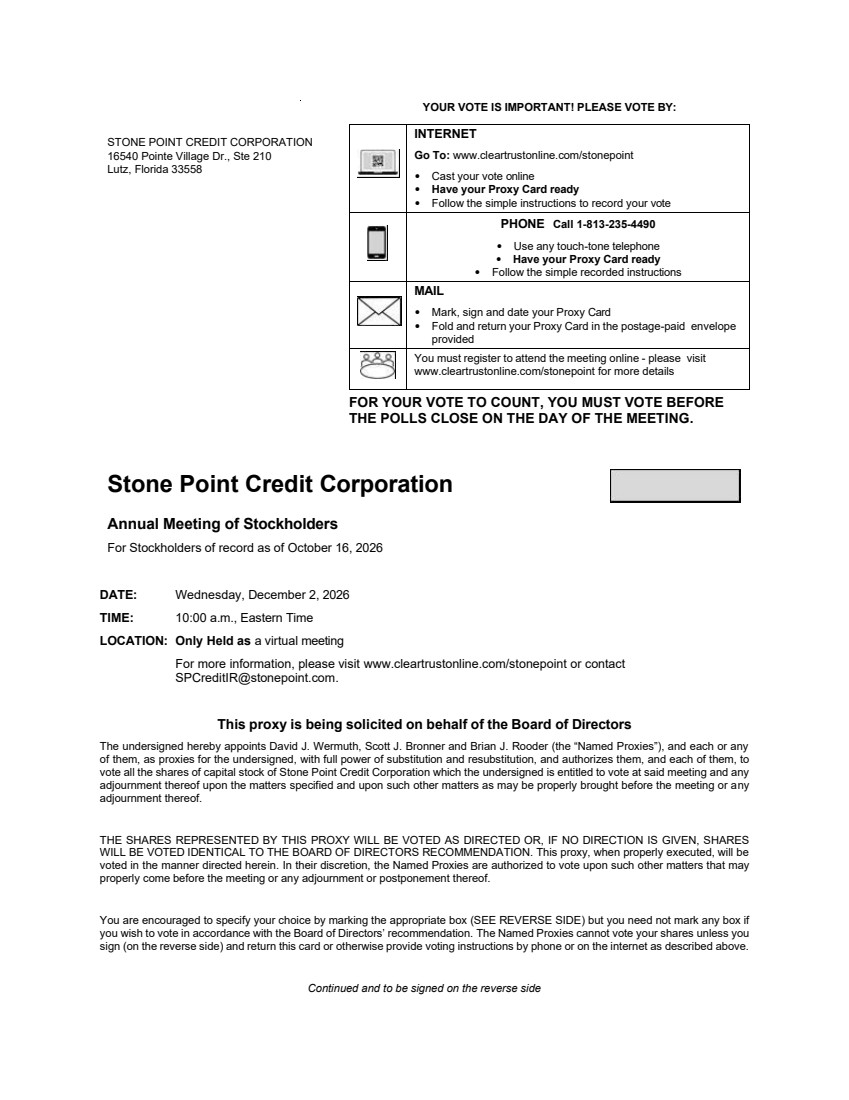
| YOUR
VOTE IS IMPORTANT! PLEASE VOTE BY: STONE POINT CREDIT CORPORATION 16540 Pointe Village Dr.,
Ste 210 Lutz, Florida 33558 INTERNET Go To: www.cleartrustonline.com/stonepoint •
Cast your vote online • Have your Proxy Card ready • Follow the simple instructions
to record your vote PHONE Call 1-813-235-4490 • Use any touch-tone telephone •
Have your Proxy Card ready • Follow the simple recorded instructions MAIL •
Mark, sign and date your Proxy Card • Fold and return your Proxy Card in the postage-paid
envelope provided You must register to attend the meeting online - please visit www.cleartrustonline.com/stonepoint
for more details FOR YOUR VOTE TO COUNT, YOU MUST VOTE BEFORE THE POLLS CLOSE ON THE DAY
OF THE MEETING. Stone Point Credit Corporation Annual Meeting of Stockholders For Stockholders
of record as of October 16, 2026 DATE: Wednesday, December 2, 2026 TIME: 10:00 a.m., Eastern
Time LOCATION: Only Held as a virtual meeting For more information, please visit www.cleartrustonline.com/stonepoint
or contact SPCreditIR@stonepoint.com. This proxy is being solicited on behalf of the Board
of Directors The undersigned hereby appoints David J. Wermuth, Scott J. Bronner and Brian
J. Rooder (the “Named Proxies”), and each or any of them, as proxies for the
undersigned, with full power of substitution and resubstitution, and authorizes them, and
each of them, to vote all the shares of capital stock of Stone Point Credit Corporation which
the undersigned is entitled to vote at said meeting and any adjournment thereof upon the
matters specified and upon such other matters as may be properly brought before the meeting
or any adjournment thereof. THE SHARES REPRESENTED BY THIS PROXY WILL BE VOTED AS DIRECTED
OR, IF NO DIRECTION IS GIVEN, SHARES WILL BE VOTED IDENTICAL TO THE BOARD OF DIRECTORS RECOMMENDATION.
This proxy, when properly executed, will be voted in the manner directed herein. In their
discretion, the Named Proxies are authorized to vote upon such other matters that may properly
come before the meeting or any adjournment or postponement thereof. You are encouraged to
specify your choice by marking the appropriate box (SEE REVERSE SIDE) but you need not mark
any box if you wish to vote in accordance with the Board of Directors’ recommendation.
The Named Proxies cannot vote your shares unless you sign (on the reverse side) and return
this card or otherwise provide voting instructions by phone or on the internet as described
above. Continued and to be signed on the reverse side |
| 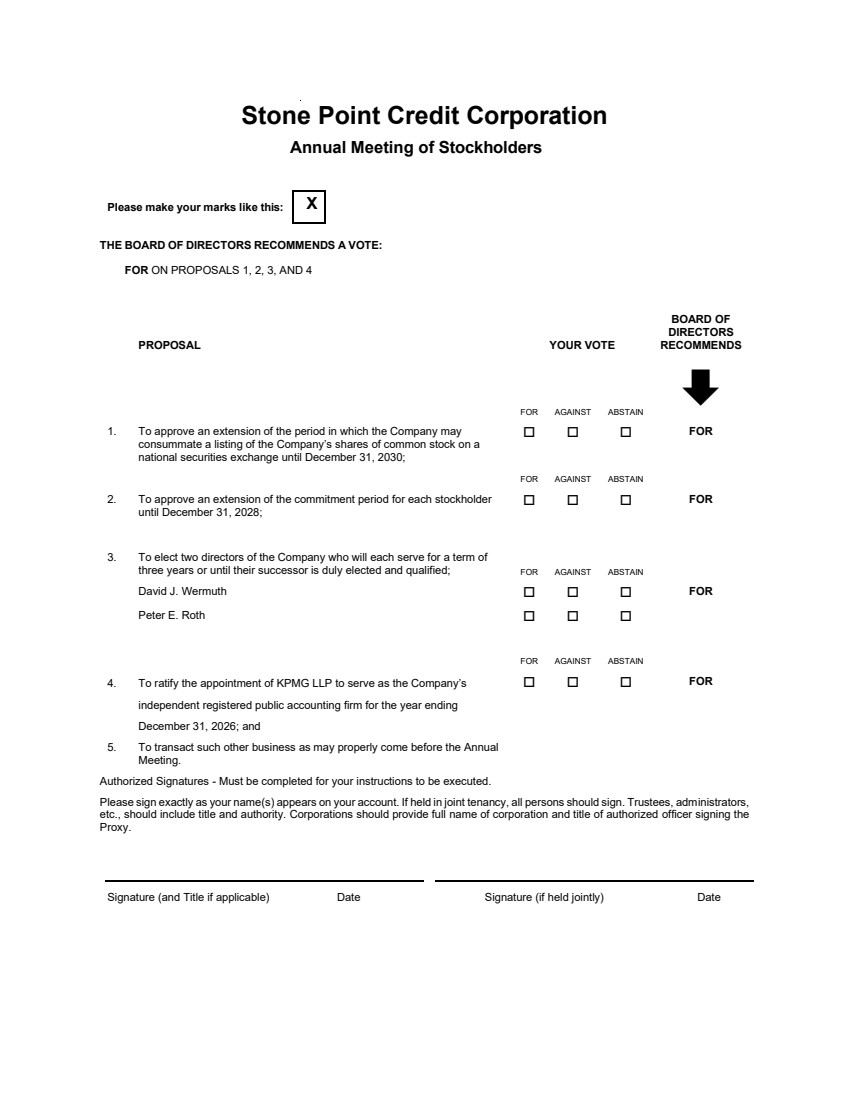
| Stone
Point Credit Corporation Annual Meeting of Stockholders Please make your marks like this:
X THE BOARD OF DIRECTORS RECOMMENDS A VOTE: FOR ON PROPOSALS 1, 2, 3, AND 4 PROPOSAL YOUR
VOTE BOARD OF DIRECTORS RECOMMENDS FOR AGAINST ABSTAIN 1. To approve an extension of the
period in which the Company may consummate a listing of the Company’s shares of common
stock on a national securities exchange until December 31, 2030; FOR FOR AGAINST ABSTAIN
2. To approve an extension of the commitment period for each stockholder until December 31,
2028; FOR 3. To elect two directors of the Company who will each serve for a term of three
years or until their successor is duly elected and qualified; FOR AGAINST ABSTAIN David J.
Wermuth FOR Peter E. Roth FOR AGAINST ABSTAIN 4. To ratify the appointment of KPMG LLP to
serve as the Company’s FOR independent registered public accounting firm for the year
ending December 31, 2026; and 5. To transact such other business as may properly come before
the Annual Meeting. Authorized Signatures - Must be completed for your instructions to be
executed. Please sign exactly as your name(s) appears on your account. If held in joint tenancy,
all persons should sign. Trustees, administrators, etc., should include title and authority.
Corporations should provide full name of corporation and title of authorized officer signing
the Proxy. Signature (and Title if applicable) Date Signature (if held jointly) Date |