P10 Expands into Lower-Middle Market Direct Lending with Acquisition of Stellus Capital Management February 5, 2026 Note: P10, Inc. to become Ridgepost Capital, Inc. on February 11, 2026
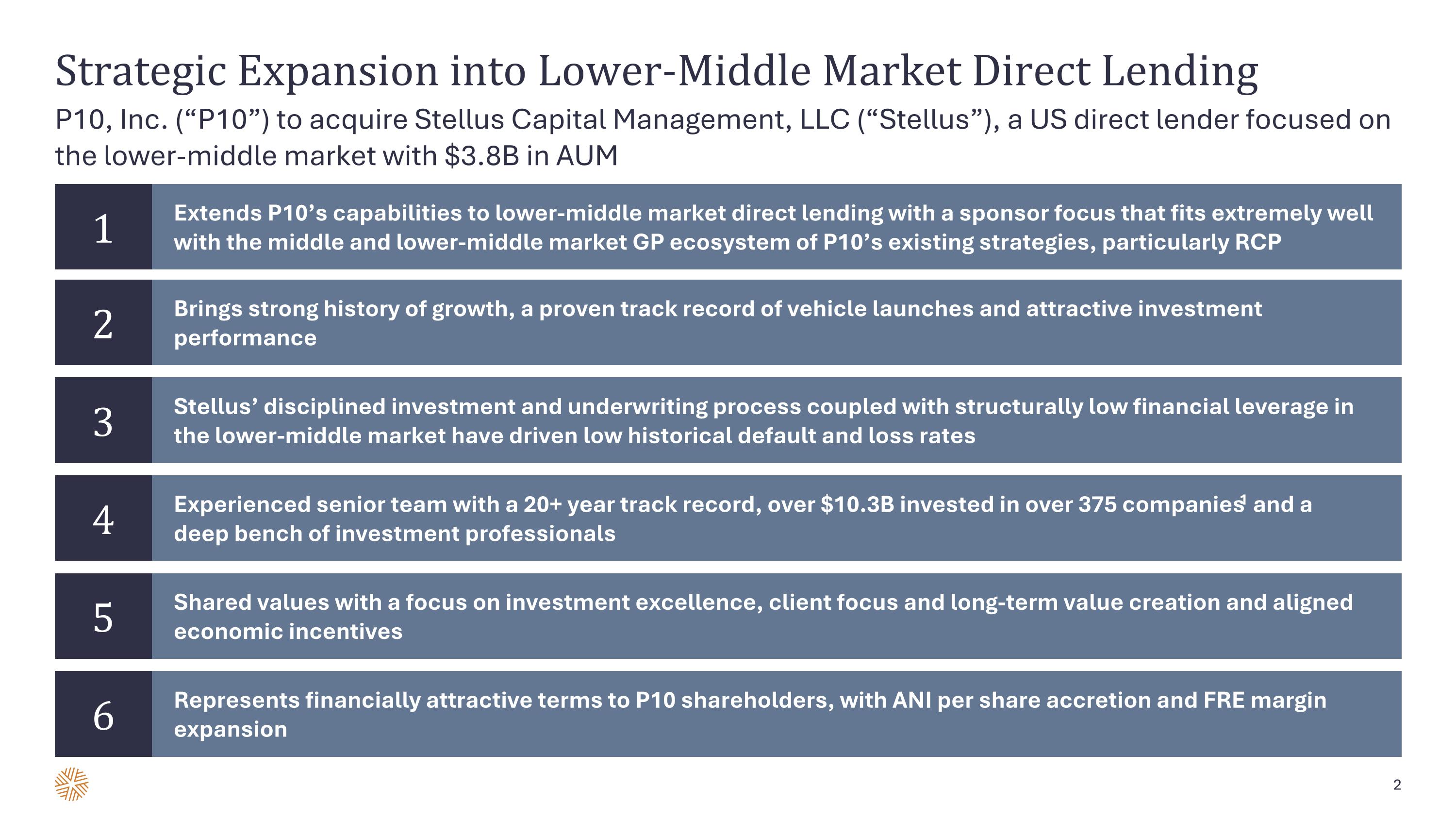
Strategic Expansion into Lower-Middle Market Direct Lending Stellus’ disciplined investment and underwriting process coupled with structurally low financial leverage in the lower-middle market have driven low historical default and loss rates 3 Shared values with a focus on investment excellence, client focus and long-term value creation and aligned economic incentives 5 Experienced senior team with a 20+ year track record, over $10.3B invested in over 375 companies1 and a deep bench of investment professionals 4 Extends P10’s capabilities to lower-middle market direct lending with a sponsor focus that fits extremely well with the middle and lower-middle market GP ecosystem of P10’s existing strategies, particularly RCP 1 Brings strong history of growth, a proven track record of vehicle launches and attractive investment performance 2 Represents financially attractive terms to P10 shareholders, with ANI per share accretion and FRE margin expansion 6 P10, Inc. (“P10”) to acquire Stellus Capital Management, LLC (“Stellus”), a US direct lender focused on the lower-middle market with $3.8B in AUM
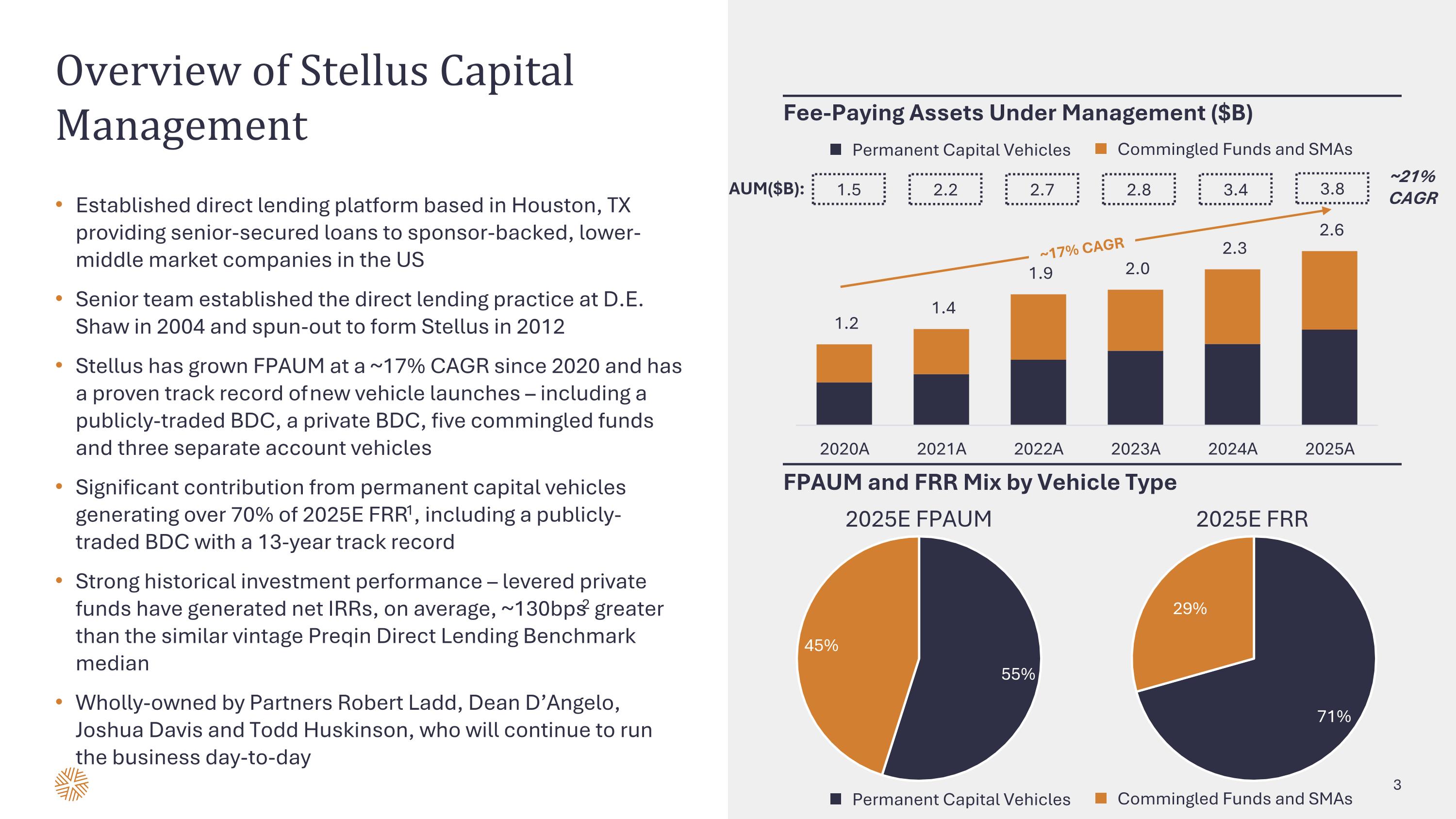
Established direct lending platform based in Houston, TX providing senior-secured loans to sponsor-backed, lower-middle market companies in the US Senior team established the direct lending practice at D.E. Shaw in 2004 and spun-out to form Stellus in 2012 Stellus has grown FPAUM at a ~17% CAGR since 2020 and has a proven track record of new vehicle launches – including a publicly-traded BDC, a private BDC, five commingled funds and three separate account vehicles Significant contribution from permanent capital vehicles generating over 70% of 2025E FRR1, including a publicly-traded BDC with a 13-year track record Strong historical investment performance – levered private funds have generated net IRRs, on average, ~130bps2 greater than the similar vintage Preqin Direct Lending Benchmark median Wholly-owned by Partners Robert Ladd, Dean D’Angelo, Joshua Davis and Todd Huskinson, who will continue to run the business day-to-day Overview of Stellus Capital Management Fee-Paying Assets Under Management ($B) Permanent Capital Vehicles Commingled Funds and SMAs FPAUM and FRR Mix by Vehicle Type 2025E FPAUM 2025E FRR ~17% CAGR Permanent Capital Vehicles Commingled Funds and SMAs 1.5 2.2 2.7 2.8 3.4 3.8 AUM($B): ~21% CAGR
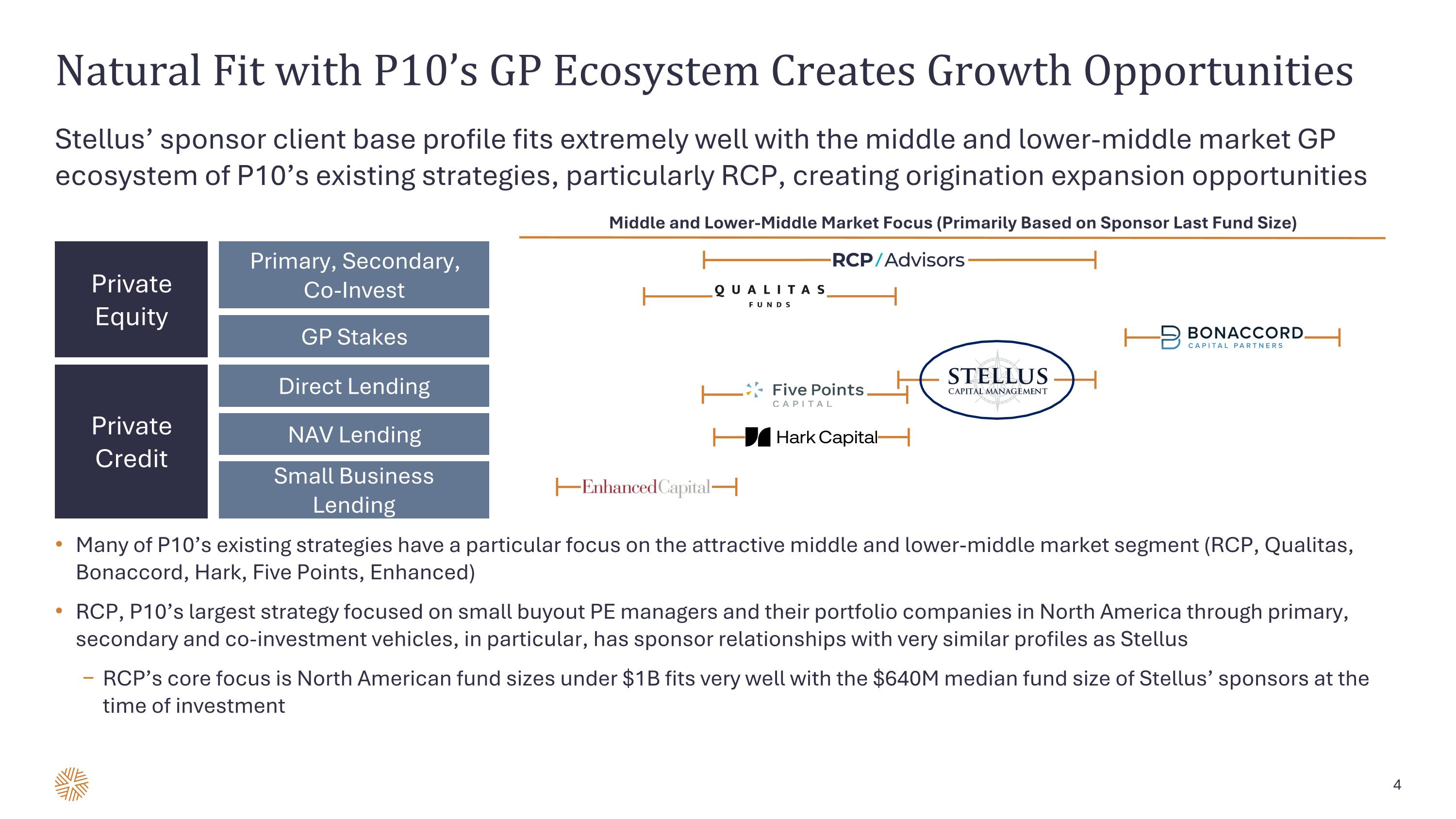
Many of P10’s existing strategies have a particular focus on the attractive middle and lower-middle market segment (RCP, Qualitas, Bonaccord, Hark, Five Points, Enhanced) RCP, P10’s largest strategy focused on small buyout PE managers and their portfolio companies in North America through primary, secondary and co-investment vehicles, in particular, has sponsor relationships with very similar profiles as Stellus RCP’s core focus is North American fund sizes under $1B fits very well with the $640M median fund size of Stellus’ sponsors at the time of investment Stellus’ sponsor client base profile fits extremely well with the middle and lower-middle market GP ecosystem of P10’s existing strategies, particularly RCP, creating origination expansion opportunities Natural Fit with P10’s GP Ecosystem Creates Growth Opportunities Private Equity Private Credit Primary, Secondary, Co-Invest GP Stakes Direct Lending NAV Lending Small Business Lending Middle and Lower-Middle Market Focus (Primarily Based on Sponsor Last Fund Size)
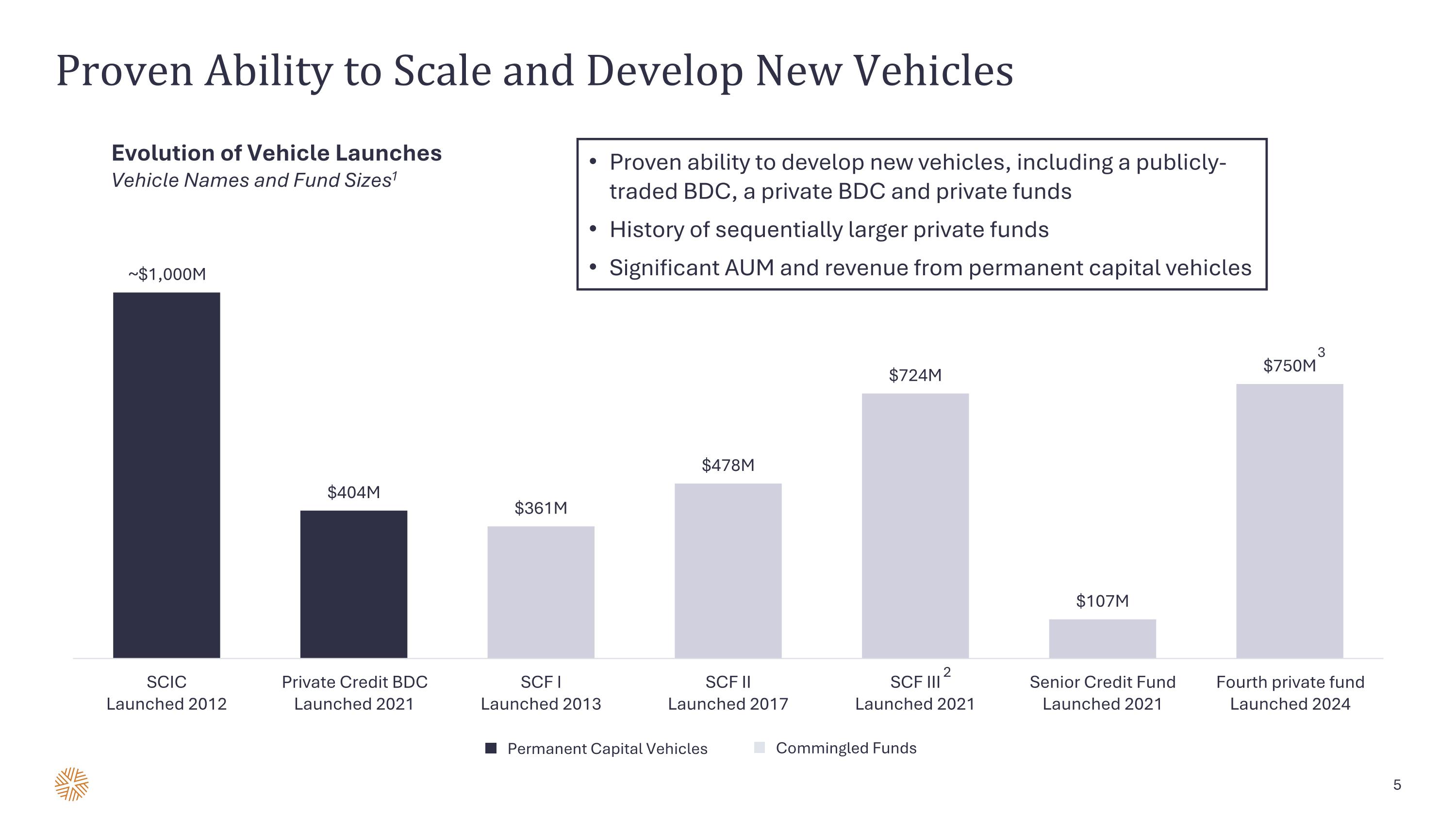
Proven Ability to Scale and Develop New Vehicles Proven ability to develop new vehicles, including a publicly-traded BDC, a private BDC and private funds History of sequentially larger private funds Significant AUM and revenue from permanent capital vehicles Evolution of Vehicle Launches Vehicle Names and Fund Sizes1 Permanent Capital Vehicles Commingled Funds 2 3
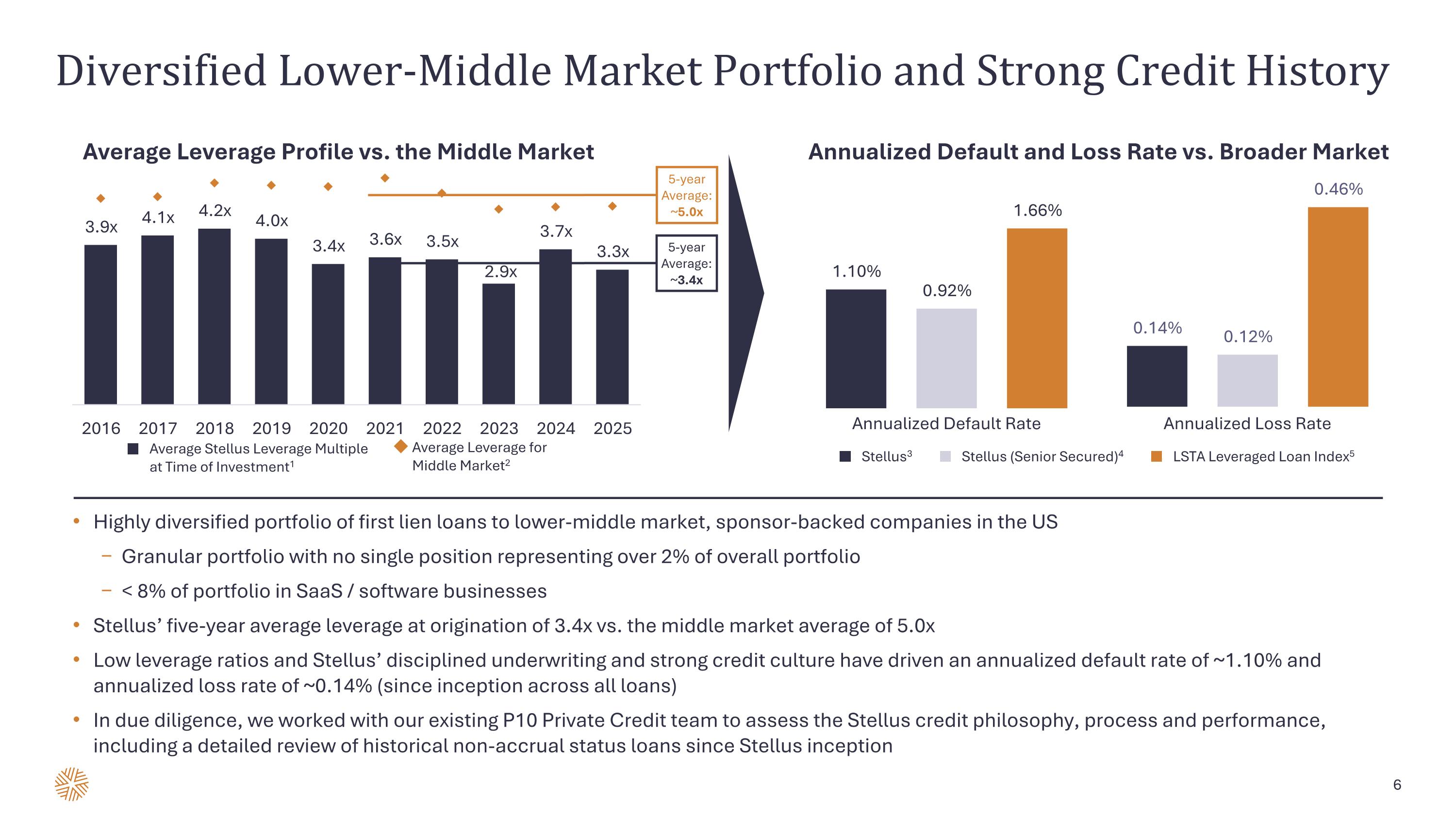
5-year Average: ~3.4x Highly diversified portfolio of first lien loans to lower-middle market, sponsor-backed companies in the US Granular portfolio with no single position representing over 2% of overall portfolio < 8% of portfolio in SaaS / software businesses Stellus’ five-year average leverage at origination of 3.4x vs. the middle market average of 5.0x Low leverage ratios and Stellus’ disciplined underwriting and strong credit culture have driven an annualized default rate of ~1.10% and annualized loss rate of ~0.14% (since inception across all loans) In due diligence, we worked with our existing P10 Private Credit team to assess the Stellus credit philosophy, process and performance, including a detailed review of historical non-accrual status loans since Stellus inception Diversified Lower-Middle Market Portfolio and Strong Credit History Annualized Default Rate Annualized Loss Rate Average Leverage Profile vs. the Middle Market Annualized Default and Loss Rate vs. Broader Market Average Stellus Leverage Multiple at Time of Investment1 Average Leverage for Middle Market2 5-year Average: ~5.0x Stellus3 LSTA Leveraged Loan Index5 Stellus (Senior Secured)4
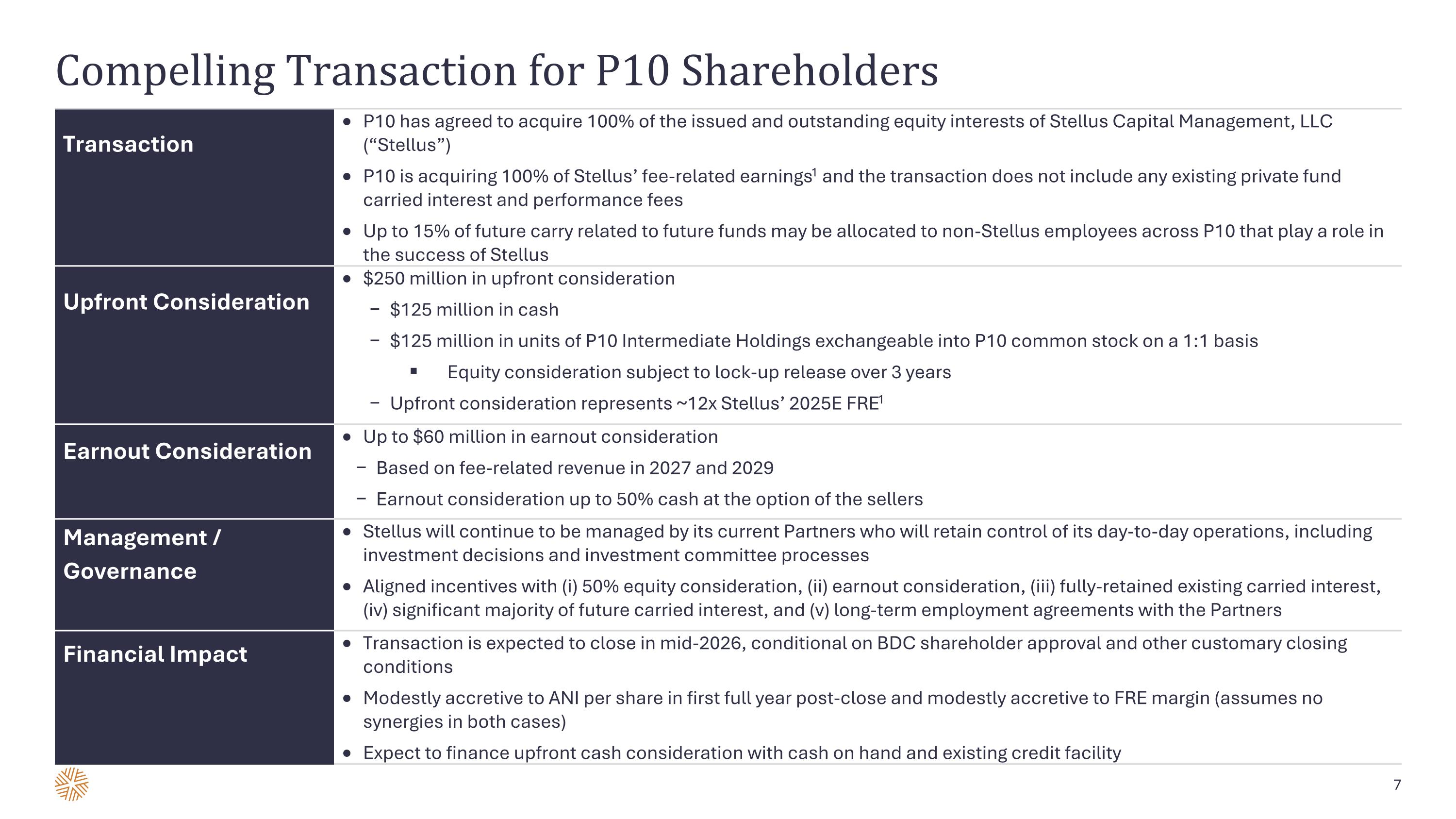
Compelling Transaction for P10 Shareholders Transaction P10 has agreed to acquire 100% of the issued and outstanding equity interests of Stellus Capital Management, LLC (“Stellus”) P10 is acquiring 100% of Stellus’ fee-related earnings1 and the transaction does not include any existing private fund carried interest and performance fees Up to 15% of future carry related to future funds may be allocated to non-Stellus employees across P10 that play a role in the success of Stellus Upfront Consideration $250 million in upfront consideration $125 million in cash $125 million in units of P10 Intermediate Holdings exchangeable into P10 common stock on a 1:1 basis Equity consideration subject to lock-up release over 3 years Upfront consideration represents ~12x Stellus’ 2025E FRE1 Earnout Consideration Up to $60 million in earnout consideration Based on fee-related revenue in 2027 and 2029 Earnout consideration up to 50% cash at the option of the sellers Management / Governance Stellus will continue to be managed by its current Partners who will retain control of its day-to-day operations, including investment decisions and investment committee processes Aligned incentives with (i) 50% equity consideration, (ii) earnout consideration, (iii) fully-retained existing carried interest, (iv) significant majority of future carried interest, and (v) long-term employment agreements with the Partners Financial Impact Transaction is expected to close in mid-2026, conditional on BDC shareholder approval and other customary closing conditions Modestly accretive to ANI per share in first full year post-close and modestly accretive to FRE margin (assumes no synergies in both cases) Expect to finance upfront cash consideration with cash on hand and existing credit facility
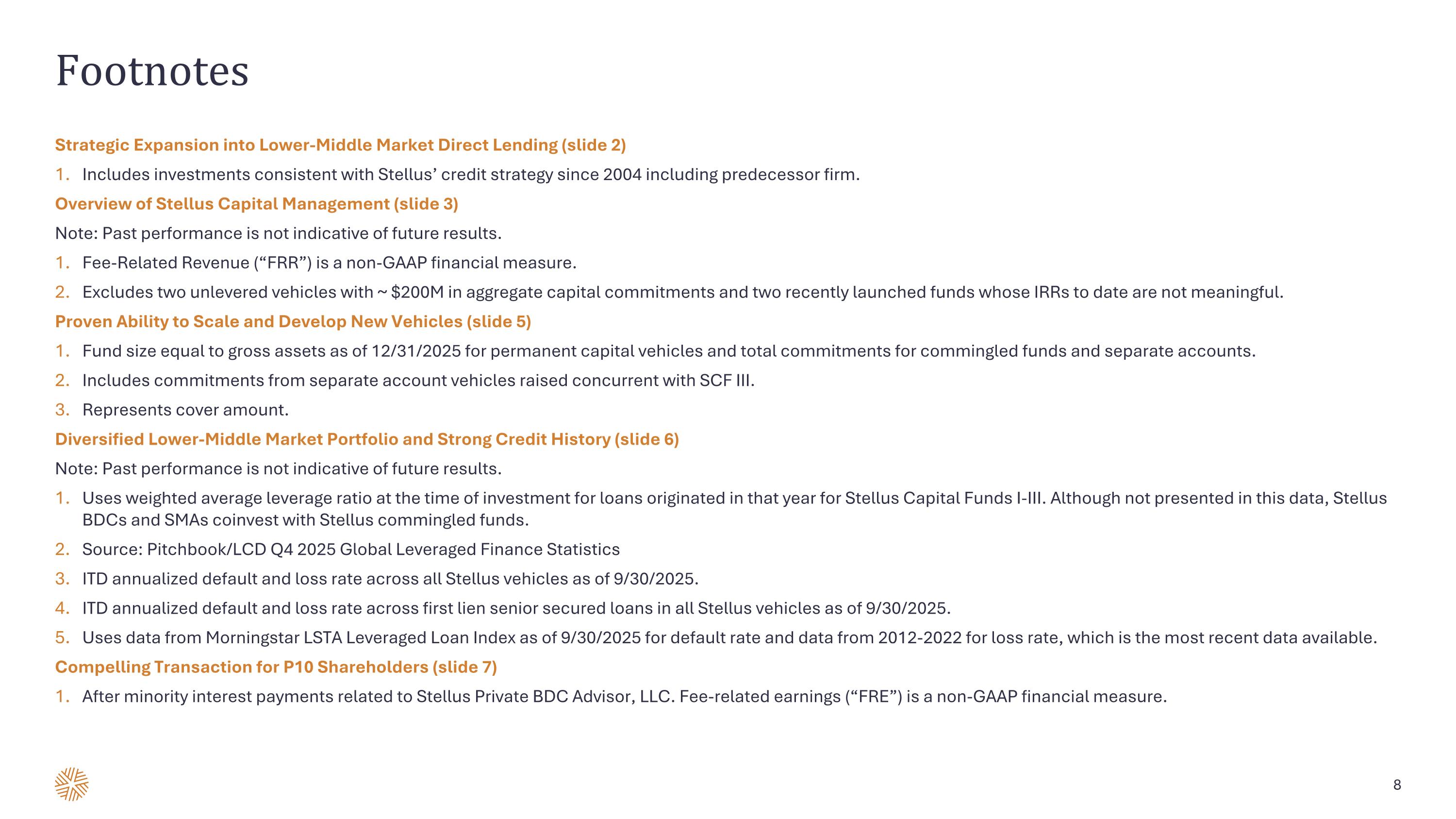
Strategic Expansion into Lower-Middle Market Direct Lending (slide 2) Includes investments consistent with Stellus’ credit strategy since 2004 including predecessor firm. Overview of Stellus Capital Management (slide 3) Note: Past performance is not indicative of future results. Fee-Related Revenue (“FRR”) is a non-GAAP financial measure. Excludes two unlevered vehicles with ~ $200M in aggregate capital commitments and two recently launched funds whose IRRs to date are not meaningful. Proven Ability to Scale and Develop New Vehicles (slide 5) Fund size equal to gross assets as of 12/31/2025 for permanent capital vehicles and total commitments for commingled funds and separate accounts. Includes commitments from separate account vehicles raised concurrent with SCF III. Represents cover amount. Diversified Lower-Middle Market Portfolio and Strong Credit History (slide 6) Note: Past performance is not indicative of future results. Uses weighted average leverage ratio at the time of investment for loans originated in that year for Stellus Capital Funds I-III. Although not presented in this data, Stellus BDCs and SMAs coinvest with Stellus commingled funds. Source: Pitchbook/LCD Q4 2025 Global Leveraged Finance Statistics ITD annualized default and loss rate across all Stellus vehicles as of 9/30/2025. ITD annualized default and loss rate across first lien senior secured loans in all Stellus vehicles as of 9/30/2025. Uses data from Morningstar LSTA Leveraged Loan Index as of 9/30/2025 for default rate and data from 2012-2022 for loss rate, which is the most recent data available. Compelling Transaction for P10 Shareholders (slide 7) After minority interest payments related to Stellus Private BDC Advisor, LLC. Fee-related earnings (“FRE”) is a non-GAAP financial measure. Footnotes
FORWARD-LOOKING STATEMENTS Some of the statements in this presentation constitute “forward-looking statements” within the meaning of Section 27A of the Securities Act of 1933, Section 21E of the Securities Exchange Act of 1934 and the Private Securities Litigation Reform Act of 1995. Words such as “will,” “expect,” “believe,” “estimate,” “continue,” “anticipate,” “intend,” “plan” and similar expressions are intended to identify these forward-looking statements. Forward-looking statements discuss management’s current expectations and projections relating to our financial position, results of operations, plans, objectives, future performance, and business. The inclusion of any forward-looking information in this presentation should not be regarded as a representation that the future plans, estimates, or expectations contemplated will be achieved. Forward-looking statements reflect management’s current plans, estimates, and expectations, and are inherently uncertain. All forward-looking statements are subject to known and unknown risks, uncertainties, assumptions and other important factors that may cause actual results to be materially different; global and domestic market and business conditions; successful execution of business and growth strategies and regulatory factors relevant to our business; changes in our tax status; our ability to maintain our fee structure; our ability to attract and retain key employees; our ability to manage our obligations under our debt agreements; our ability to make acquisitions and successfully integrate the businesses we acquire; assumptions relating to our operations, financial results, financial condition, business prospects and growth strategy; and our ability to manage the effects of events outside of our control. The foregoing list of factors is not exhaustive. For more information regarding these risks and uncertainties as well as additional risks that we face, you should refer to the “Risk Factors” included in our annual report on Form 10-K for the year ended December 31, 2024, filed with the U.S. Securities and Exchange Commission (“SEC”) on February 28, 2025, and in our subsequent reports filed from time to time with the SEC. The forward-looking statements included in this presentation are made only as of the date hereof. We undertake no obligation to update or revise any forward-looking statement as a result of new information or future events, except as otherwise required by law. KEY FINANCIAL & OPERATING METRICS Fee-paying assets under management reflects the assets from which we earn management and advisory fees. Our vehicles typically earn management and advisory fees based on committed capital, and in certain cases, net invested capital, depending on the fee terms. Management and advisory fees based on committed capital are not affected by market appreciation or depreciation. AUM reflects the assets that we manage, and is calculated as the sum of: (i) net asset value (“NAV”) of our clients’ and funds’ underlying investments as of the most recently available date; (ii) drawn and undrawn debt (excluding capital call lines); (iii) uncalled capital commitments (net of deferred purchase price and not in excess of total capital commitments, as applicable) as of the NAV record date; (iv) incremental commitments raised since NAV record date. In situations where NAV data is not available, such as with certain advisory relationships, we use FPAUM. Fee-Related Revenue is calculated as Total Revenues less Non-Fee Related Revenue. Fee-Related Earnings is a non-GAAP performance measure used to monitor our baseline earnings less any incentive fee revenue and excluding any incentive fee-related expenses. Fee-Related Earnings Margin is calculated as Fee-Related Earnings divided by Fee-Related Revenue. Disclaimers