UNITED STATES
SECURITIES AND EXCHANGE COMMISSION
Washington, D.C. 20549
FORM
For the fiscal year ended
Or
For the transition period from ___________ to ___________
Commission file number:
| (Exact name of registrant as specified in charter) |
| (State or other jurisdiction of incorporation or organization) |
(I.R.S. Employer Identification No.) | |
|
|
| |
| (Address of principal executive offices) | (Zip Code) |
| ( |
| (Registrant’s telephone number, including area code) |
Securities registered pursuant to Section 12(b) of the Act: None
Securities registered pursuant to Section 12(g) of the Act: Common stock, par value $0.0001 per share
Indicate
by check mark if the registrant is a well-known seasoned issuer, as defined in Rule 405 of the Securities Act. Yes ☐
Indicate
by check mark if the registrant is not required to file reports pursuant to Section 13 or 15(d) of the Act. Yes ☐
Indicate
by check mark whether the registrant (1) has filed all reports required to be filed by Section 13 or 15(d) of the Securities Exchange
Act of 1934 during the preceding 12 months (or for such shorter period that the registrant was required to file such reports), and (2)
has been subject to such filing requirements for the past 90 days.
Indicate
by check mark whether the registrant has submitted electronically every Interactive Data File required to be submitted pursuant to Rule
405 of Regulation S-T (§ 232.405 of this chapter) during the preceding 12 months (or for such shorter period that the registrant
was required to submit such files).
Indicate by checkmark whether the registrant is a large accelerated filer, an accelerated filer, a non-accelerated filer, or a smaller reporting company. See the definitions of “large accelerated filer,” “accelerated filer” and “smaller reporting company” in Rule 12b-2 of the Exchange Act.
| Large accelerated filer | ☐ | Accelerated filer | ☐ | |
| ☒ | Smaller reporting company | |||
| Emerging growth company |
If
an emerging growth company, indicate by check mark if the registrant has elected not to use the extended transition period for complying
with any new or revised financial accounting standard provided pursuant to Section 13(a) of the Exchange Act.
Indicate
by check mark whether the registrant has filed a report on and attestation to its management’s assessment of the effectiveness of
its internal control over financial reporting under Section 404(b) of the Sarbanes-Oxley Act (15 U.S.C. 7262(b)) by the registered public
accounting firm that prepared or issued its audit report.
If
securities are registered pursuant to Section 12(b) of the Act, indicate by check mark whether the financial statements of the registrant
included in the filing reflect the correction of an error to previously issued financial statements.
Indicate by check mark whether any of those error corrections are restatements that required a recovery analysis of incentive-based compensation received by any of the registrant’s executive officers during the relevant recovery period pursuant to §240.10D-1(b). ☐
Indicate
by check mark whether the registrant is a shell company (as defined in Rule 12b-2 of the Act). Yes ☐
The aggregate market value of the voting and non-voting
common equity held by non-affiliates of the registrant, as of December 29, 2024, the last business day of the registrant’s most
recently completed second fiscal quarter, was approximately $
As of November 30, 2025, the registrant had shares of its common stock, $0.0001 par value per share, outstanding.
| Audit Firm Id | Auditor Name: | Auditor Location: | ||
TABLE OF CONTENTS
i
Unless we state otherwise or the context otherwise requires, the terms the “Company” “Zapata,” “Zapata Quantum,” “we,” “us,” “our” and the “Company” refer to Zapata Quantum, Inc., a Delaware corporation. Solely for convenience, the trademarks and trade names in this report may be referred to without the ® and ™ symbols, but such references should not be construed as any indicator that their respective owners will not assert their rights thereto.
Unless otherwise noted, the description of our business and the discussion of related risk factors reflects Zapata Quantum’s operations and strategic direction as of 2025. The Company underwent significant changes after December 31, 2024, including a restructuring, rebranding, and renewed focus on quantum computing application development.
Cautionary Note Regarding Forward-Looking Statements
This Report contains forward-looking statements, including statements regarding our expectations for prospective future growth, operating results and financial condition, potential future trends and developments within our industry and the U.S. and global economies generally, plans and expectations for our future business plan and capital raising efforts, expectations and plans with respect to our products and services including the potential market for, timing, features, and demand for such products and services, and liquidity and sources of capital. Forward-looking statements are prefaced by words such as “anticipate,” “expect,” “plan,” “could,” “may,” “will,” “should,” “would,” “intend,” “seem,” “potential,” “appear,” “continue,” “future,” believe,” “estimate,” “forecast,” “project,” and similar words. We have based these forward-looking statements largely on our current expectations and assumptions regarding our business, the economy and other future conditions. Because forward-looking statements relate to the future, they are subject to inherent uncertainties, risks and changes in circumstances that are difficult to predict. We caution you, therefore, against relying on any of these forward-looking statements.
Our actual results may differ materially from those contemplated by the forward-looking statements for a variety of reasons, including, without limitation, the possibility that estimates, projections and assumptions on which the forward-looking statements are based prove to be incorrect, our ability to raise the necessary capital to re-establish material operations and generate revenue and the terms and timing of any related transactions, central bank interest rates and future interest rate changes, the risks arising from the impact of inflation, tariffs, the deterioration of the labor market of the United States, a recession which may result on the Company’s business, prospective customers, and on the national and global economy, our ability to attract homeowners to our products and services, the potential for regulatory changes impacting quantum computing, artificial intelligence, data privacy and other areas that impact the Company’s business, and the ability of us and third parties on which we depend to comply with applicable regulatory requirements, the risk that software and technology infrastructure on which we depend fail to perform as designed or intended, and the risks and uncertainties disclosed under Item 1A – Risk Factors contained in this Report. Any forward-looking statement made by us in this presentation speaks only as of the date on which it is made. Factors or events that could cause our actual results to differ may emerge from time to time, and it is not possible for us to predict all of them. We undertake no obligation to publicly update any forward-looking statement, whether as a result of new information, future developments or otherwise, except as may be required by law.
ii
Frequently Used Terms
In this document:
“AI” means artificial intelligence”
“Business Combination Agreement” means the Business Combination Agreement, dated as of September 6, 2023, by and among the Company, Merger Sub and Legacy Zapata, as may be amended from time to time.
“Code” means the Internal Revenue Code of 1986.
“Common Stock” means the common stock of the Company, par value $0.0001 per share.
“DGCL” means the General Corporation Law of the State of Delaware.
“Exchange Act” means the U.S. Securities Exchange Act of 1934.
“IP” means intellectual property.
“Legacy Zapata” means Zapata Computing, Inc., a Delaware corporation.
“Merger” means the merger of Merger Sub with and into Legacy Zapata with Legacy Zapata that occurred on March 28, 2024 with Legacy Zapata surviving the Merger as a wholly owned subsidiary of the Company as contemplated by the Business Combination Agreement.
“Merger Sub” means Tigre Merger Sub, Inc., a Delaware corporation and wholly owned direct subsidiary of the Company prior to the closing of the Merger.
“Nasdaq” means the Nasdaq Stock Market.
“Preferred Stock” means the preferred stock of the Company, par value $0.0001 per share.
“Sarbanes-Oxley Act” means the Sarbanes-Oxley Act of 2002.
“SEC” means the U.S. Securities and Exchange Commission.
“Securities Act” means the Securities Act of 1933.
“Senior Secured Notes” means the senior secured promissory notes issued by Zapata and its subsidiary, the obligations of which are secured by the assets thereof.
iii
PART I
Item 1. Business
Overview
Zapata Quantum is a leading pure-play hardware-agnostic quantum software company. Following a strategic realignment in 2025, the Company will deliver solutions to efficiently deploy and accelerate the development of quantum and hybrid quantum-classical computing applications. Founded in 2017 by researchers from a Harvard University Quantum Computing Lab, Zapata has built one of the industry’s most robust intellectual property portfolios in quantum and hybrid quantum-classical computing and algorithmic methods, with over 60 patents granted and pending developed over eight years.
Zapata’s software platform for quantum computing applications is based on our patented technology and supports a wide range of use cases in cryptography, pharmaceuticals, manufacturing, materials discovery and defense. The Company is the only organization to have participated across all technical areas of the Defense Advanced Research Projects Agency’s (“DARPA”)’s Quantum Benchmarking program and has worked with Fortune 500 enterprises and government agencies to unlock the potential of quantum computing.
On March 28, 2024, we consummated the business combination contemplated by the Business Combination Agreement, dated September 6, 2023, by and among the Company, Merger Sub and Legacy Zapata. Pursuant to the Business Combination Agreement, the Merger took place pursuant to which Merger Sub merged with and into Legacy Zapata resulting in Legacy Zapata becoming a wholly owned subsidiary of the Company.
In late 2024 the Company voluntarily elected to temporarily suspend its operations due to its limited capital resources and inability to access adequate liquidity to continue to fund its operations and meet its outstanding debt obligations. In June 2025, the Company commenced debt restructuring and capital raising transactions and the reinstatement of operations by (1) entering into exchange agreements with unsecured creditors pursuant to which such creditors agreed to exchange outstanding obligations payable to them for common stock and certain rights related thereto, and (2) the Company sold convertible notes and warrants for gross proceeds of $3 million. The Company has since been continuing efforts to negotiate and restructure outstanding obligations and raise capital. In the furtherance of recommencing operations, the Company has also entered into advisory agreements with third parties and agreed to compensate such parties in the form of equity and/or cash compensation. See Note 20, Subsequent Events, in the notes to the consolidated financial statements contained in this Annual Report.
Following a period of broader AI exploration, the Company undertook, in 2024 and 2025, a strategic realignment to refocus on its core quantum mission: developing the software and tooling layer that enables enterprises, governments, and researchers to harness quantum computing for economically meaningful outcomes.
Zapata’s hardware-agnostic approach and proprietary technology address the “software bottleneck” that limits quantum adoption. The Company’s products - Orquestra, Bench-Q, Quantum Graph, and Quantum Pilot - provide the infrastructure and workflow tools that connect problem discovery, algorithm design, and hardware execution. These tools are supported by professional services, partnerships, and licensing programs that collectively form the Company’s business model.
The Company’s business plans and operations described herein, and our ability to execute and continue with such efforts, will depend on our ability to raise capital needed to repay vendors and creditors, rehire various personnel and fund our working capital and growth needs. Further, our capital raising efforts and business and operation generally are subject to numerous risks and uncertainties, as described under “Item 1A – Risk Factors.”
Introduction to Quantum Computing
Quantum computing exploits the principles of quantum mechanics - superposition, entanglement, and interference - to process information in fundamentally new ways. Whereas classical computers operate on bits that are either 0 or 1, quantum computers use quantum bits, or “qubits” that can exist in multiple states simultaneously. This enables exponential scaling of computational possibilities and the potential to solve certain classes of problems - such as molecular simulation, combinatorial optimization, and cryptographic analysis - that are intractable on classical machines.
The field of quantum computing is advancing rapidly, supported by significant broad-based investment. Global governments have announced multibillion-dollar quantum initiatives, venture and public-market investment have accelerated considerably, and major cloud computing providers now offer access to quantum processors. A 2024 Boston Consulting Group analysis estimates that quantum technologies will create $450 billion to $850 billion of economic value globally, sustaining a $90 billion to $170 billion market for hardware and software providers by 2040.
| 1 |
Phases of Quantum Computing Technology Development
The first phase of quantum computing has been the arrival of Noisy Intermediate-Scale Quantum (NISQ) devices, characterized by limited qubit counts and the absence of full error correction. Despite these constraints, NISQ computing can still deliver tangible value especially in areas such as materials, chemical simulations and optimization.
Zapata has contributed significantly to the advancement of NISQ approaches including pioneering the Variational Quantum Eigensolver (VQE), a foundational hybrid quantum-classical algorithm that combines quantum state preparation with classical optimization to estimate molecular and materials properties, with applications to other domains as well.
VQE demonstrated one of the first practical uses of quantum hardware and helped establish the hybrid quantum-classical paradigm that continues to define much of the industry’s progress. Building on this foundation, Zapata develops software and tools that extend hybrid approaches to broader classes of scientific and industrial problems, creating an adaptable framework that evolves with each generation of hardware.
Rapid progress is now being made toward the second phase of quantum computing, known as Fault-Tolerant Quantum Computing (FTQC), where error-corrected qubits enable deep, large-scale algorithms with transformative performance. As these systems come online, the race is underway to display what is known as “quantum advantage” or “quantum supremacy” in an increasing number of key problem areas.
The number of announcements by leading FTQC hardware providers has accelerated considerably in recent months - including improvement in qubit coherence times, falling error rates, the demonstration of prototype logical qubits, and the announcement of quantum advantage for some problems. As these breakthroughs accumulate, the focus of progress is shifting toward the application and software layer - where practical utility will first emerge. This is the domain where Zapata Quantum operates.
Unlocking the full potential of FTQC will depend not only on better hardware, but also a mature software stack which will enhance the development of algorithms, compilers, and workflows that translate real-world problems into quantum form. Zapata has proven itself as a leader in this space, with pioneering work across a variety of domains - including chemistry, materials science, optimization, cryptography and machine learning.
By advancing the software infrastructure and application frameworks that will define the next generation of quantum computing, Zapata plays a critical role in enabling the industry’s evolution toward large-scale, fault-tolerant quantum advantage.
Market Opportunity
The quantum computing market is entering what many observers describe as its “readiness phase,” evidenced by Microsoft’s declaration of 2025 as the year of quantum readiness. In 2024, McKinsey & Co. estimated annual global spend on quantum computing technologies of approximately $2 billion, growing at 35% per year, including about $400 million directed to software and services.
While hardware improvements draw attention, the limiting factor to adoption is the absence of a robust, reusable software infrastructure. Enterprises seeking to explore quantum advantage face steep learning curves, fragmented hardware ecosystems, and scarce talent. Zapata addresses these pain points by providing a coherent, hardware-agnostic software stack and associated technical services.
The potential impact of quantum computing technology spans nearly every high-value computational domain:
| • | Cryptography and cybersecurity - post-quantum encryption, secure communication, and threat assessment; |
| • | Optimization - financial portfolio construction, logistics, manufacturing scheduling, and energy-grid control; |
| • | Discovery and simulation - drug design, materials discovery, and climate modeling; |
| • | Defense and aerospace - signal processing, sensor fusion, and strategic decision optimization. |
We believe the software layer will capture a high share of the value created by these solutions to our planet’s most intractable problems. Zapata’s strategy is to occupy this enabling layer - bridging scientific discovery and commercial deployment.
Products
Zapata’s products are organized around what it refers to as the Generalized Quantum Stack - a three-layer model that defines the end-to-end process of quantum application development and execution. This framework, validated through Zapata’s multi-year leadership across all technical areas of DARPA’s Quantum Benchmarking program, provides the blueprint for accelerating progress from use case identification to implementation on physical hardware.
| 2 |
Zapata Generalized Quantum Stack
Layer 1: WHY - Use-Case and Utility Benchmark Evaluation
Defines the purpose of quantum computing by assessing quantum-amenable problems and related utility benchmarks across domains such as chemistry, optimization, cryptography, and materials science. This layer involves curating high-utility, domain-driven benchmarks that connect abstract industry challenges to well-defined computational instances. Zapata’s work here includes building repositories of potential applications and developing workflows for systematic problem formulation, addressing a critical gap in how enterprises and researchers determine where quantum advantage will emerge.
Layer 2: WHAT - Algorithm Development and Benchmarking
Focuses on the design of quantum applications and algorithms. Zapata’s tools enable modular algorithm composition, evaluation, and benchmarking to translate domain problems into executable quantum circuits. This layer bridges academic innovation with industrial relevance by combining Zapata’s curated algorithm library and benchmarking datasets with methods for performance comparison across algorithms and hardware types.
Layer 3: HOW - Resource Estimation and Execution
Represents the implementation phase, encompassing resource estimation, compilation, and hybrid execution across quantum and classical backends. Zapata’s platform, Orquestra, provides an environment for orchestrating these workflows, allowing developers to simulate, optimize, and run algorithms on real quantum hardware or high-performance classical infrastructure. This layer ensures forward compatibility as the industry transitions from NISQ systems to FTQC architectures.
Together, these layers define the roadmap for scalable quantum application development. Zapata is the only hardware-agnostic quantum software company to have demonstrated leadership across all three layers of this stack - uniquely positioned to lead the acceleration of the field from theoretical research to practical implementation.
Specific Zapata products within these layers include:
Orquestra
Orquestra is Zapata’s software platform for developing, orchestrating, and executing quantum and hybrid classical/quantum applications. It provides a unified environment for constructing computational workflows that combine classical and quantum resources. Orquestra manages the end-to-end lifecycle: from problem definition through algorithm selection, circuit compilation, resource estimation, execution, and results analysis. The platform has been used in commercial and research settings including with BP, BASF, BBVA, and DARPA.
Bench-Q
Bench-Q was developed under the U.S. Defense Advanced Research Projects Agency’s Quantum Benchmarking program, where Zapata uniquely participated across all technical areas (TA-1, TA-1.5 and TA-2). Bench-Q provides a standardized framework and software toolkit for evaluating quantum algorithms and hardware performance against utility-driven benchmarks. It defines metrics and workflows that allow researchers to trace the progression from abstract problem instances to executable circuits. The methods and data models produced in Bench-Q are core to Zapata’s commercial products.
Quantum Graph
Quantum Graph (QG) is a structured knowledge base that catalogs quantum use cases, algorithms, and application instances in a graph-based format. It provides a searchable, modular representation of how problems, algorithms, and hardware resources connect, forming a foundation for composable quantum application development. QG is currently in development.
Quantum Pilot
Quantum Pilot (QP) builds upon Quantum Graph by introducing an AI-assisted development environment that helps users compose, test, and refine hybrid quantum-classical workflows. By leveraging machine-learning models to suggest algorithmic building blocks and resource optimizations, Quantum Pilot aims to accelerate the design of viable quantum applications by orders of magnitude relative to manual methods. QP is currently in development.
Services
In-line with our historical activities prior to the cessation of operations in June 2024, we intend to complement our software offerings with high-value technical services to help customers unlock value using Zapata’s software products. Zapata’s service engagements will be performed by teams of quantum scientists, engineers, and domain experts. We expect that certain projects may evolve into longer-term subscriptions to our products, recurring research programs, or joint development agreements that involve co-created or licensed intellectual property.
| 3 |
These services will be strategically important both in the current noisy intermediate-scale quantum (NISQ) era and as fault-tolerant quantum computers (FTQC) become commercially available. By embedding its software and expertise in customer workflows today, Zapata intends to position itself as a long-term partner through the industry’s transition from research to scalable deployment.
Customer Value Proposition
Zapata’s quantum application development gives enterprises the confidence to invest in quantum computing with clarity and measurable results. It empowers customers to identify where quantum will create real value, validate that potential through data-driven modeling and benchmarking, and prove performance on real hardware before making costly commitments. By uniting discovery, design, and execution in one hardware-agnostic workflow, Zapata delivers readiness by reducing uncertainty, accelerating time-to-insight, and future-proofing quantum adoption. The result is faster innovation, smarter resource allocation, and tangible evidence of competitive advantage, turning quantum ambition into validated business outcomes.
Customers and Go-To-Market Strategy
The Company has previously executed multi-year contracts and collaborative engagements with leading organizations such as BP, BASF, BBVA, Mitsubishi Chemical, BMW, and Andretti Global, spanning industries including energy, chemicals, financial services, and advanced manufacturing.
In the public sector, Zapata has served as a prime contractor and collaborator under the Defense Advanced Research Projects Agency (DARPA) Quantum Benchmarking (QB) program. It was the only provider chosen to contribute to all technical areas - TA1 (use-case identification and benchmark definition), TA1.5 (algorithm design and implementation), and TA2 (hardware resource estimation and execution) - covering the full spectrum from problem formulation through algorithm development to hardware realization.
Through this work, Zapata developed the foundational methodologies and tooling that now underpin its commercial platforms, including Bench-Q, Orquestra, Quantum Graph and Quantum Pilot, in collaboration with leading universities, government research agencies, and hardware partners.
The Company’s go-to-market strategy combines direct enterprise sales, channel partnerships, and ecosystem collaborations. It also partners with strategy consultancies that serve enterprise clients exploring quantum readiness. This partnership-driven approach amplifies reach while keeping the Company focused on its core software and IP development.
Business Model
Our business model is to provide subscription-based offerings that combine Zapata Quantum software—specifically the Orquestra platform and any modules such as Bench-Q, Quantum Pilot or Quantum Graph which are delivered on top of it—as well as related services to develop and efficiently deploy custom quantum or hybrid quantum-classical computing applications designed to resolve our enterprise customers’ specific problems.
Our primary revenue model is based on subscription payments for our offerings which are utilized to develop and efficiently deploy quantum or hybrid quantum-classical computing applications. Based on our prior operating experience, these engagements typically span use case discovery to prototyping, benchmarking, and ultimately production as quantum hardware advances. We will also, consistent with our historical activity, selectively pursue government contracts related to the advancement of quantum computing applications as a complementary revenue source.
Competition
The quantum computing industry remains early and fragmented. Competition arises from (a) hardware manufacturers developing vertically integrated stacks (e.g., IBM, IonQ, Rigetti), (b) software-focused startups (e.g., Classiq, QC Ware, Horizon Quantum), and (c) internal R&D groups within large enterprises.
Management believes that Zapata’s differentiation derives from several advantages:
| • | Hardware agnosticism - Compatibility with all leading quantum hardware architectures |
| • | Comprehensive stack coverage - Participation across every technical area of DARPA’s Quantum Benchmarking Program, providing unique insight into end-to-end application development |
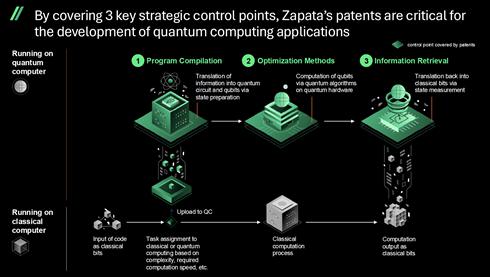
| • | Proprietary IP portfolio - More than 60 issued or pending patents across jurisdictions covering the critical control points of quantum computing - program compilation, optimization methods, and information retrieval - validated by third-party analysis as essential to the emerging quantum software ecosystem |
| • | Scientific leadership - A team of world-class researchers with deep roots in academic quantum computing, collectively holding dozens of publications and thousands of citations |
| • | AI integration - The use of generative-AI and agent-based methods to augment and automate the creation of quantum algorithms, enabling order-of-magnitude gains in efficiency |
These factors position Zapata as the leading pure-play publicly traded quantum software company.
| 4 |
Human Capital
As of October 31, 2025, Zapata had six employees, two of whom are full-time including its Chief Executive Officer. The Company intends to expand its headcount considerably upon raising future financing including the re-hiring of certain employees who were with the Company prior to its restructuring.
To date, Zapata has not experienced any work stoppages and maintains good working relationships with its employees. None of our employees are subject to a collective bargaining agreement or are represented by labor unions at this time.
Culture
Zapata’s culture is built around its people and network: a global cohort of accomplished scientists, engineers and business professionals. Zapata has, since its founding, demonstrated a commitment to hiring people from diverse backgrounds and locations.
One of Zapata’s core strengths is innovation, not only in its offerings, but also with the mindset of its people. Over the course of Zapata’s eight years in business, employees have, and continue to, organically collaborate in open forums with varying degrees of organization. Examples include, but are not limited to:
| • | Weekly science meetings where employees present their work; |
| • | Working groups where cross-functional group of employees converge to discuss how to move the platform forward; and |
| • | A book club, which rotates books and members and serves as a forum to have non-work-related discussions. |
Core Values
The company adheres to five core values:
| • | Integrity: The practice of being honest and showing a consistent and uncompromising adherence to strong moral, ethical, and scientific principles and values. |
| • | Revolutionary Mindset: An attitude towards changing established paradigms and looking for innovative solutions to problems. |
| • | Transparency: Operating in a way that makes it easy for others to see what actions are performed. This manifests itself in a culture of providing feedback and communicating clearly, recognizing our own mistakes, disagreeing in a constructive way. |
| • | Inclusiveness: The quality of including many different types of people and treating them all fairly and equally. We strive to be empathic and to appreciate the unique perspective of other people and teams at Zapata Quantum, their own needs and struggles, and to build processes that intentionally include a broad range of perspectives. |
| • | Thoughtfulness: Making ourselves aware of the needs and feelings of others and acting accordingly. Bringing new depth to solutions takes time and attention. We make decisions with a rounded view, considering the needs of all stakeholders and the impact it will have, with as much data as possible. |
Intellectual Property
Zapata Quantum’s platform is grounded in a broad and growing portfolio of intellectual property that secures its position as a leader in quantum software. The Company’s intellectual property (IP) strategy focuses on protecting core technologies that enable the efficient development, benchmarking, and deployment of quantum and hybrid applications across multiple hardware platforms.
As of October 31, 2025, Zapata Quantum held or had pending more than 60 patents worldwide, spanning the United States, Europe, Canada, Australia, and Israel. These patents and applications cover critical methods and systems that define the key control points in quantum software - including program compilation, optimization methods, and information retrieval between classical and quantum computing systems.
| 5 |
Representative Patents
| • | U.S. Patent No. 11,599,344 - Computer Architecture for Compiling Hybrid AI / Quantum Programs (QIR) - foundational compiler framework enabling concurrent classical-quantum execution through a Quantum Intermediate Representation (QIR). |
| • | U.S. Patent No. 11,615,329 - Hybrid Quantum-Classical Computer for Bayesian Inference - improves probabilistic inference by reducing measurement overhead and enhancing efficiency as hardware scales. |
| • | U.S. Patent No. 11,605,015 - Hybrid Quantum-Classical Computer System for Implementing and Optimizing Quantum Boltzmann Machines - supports hybrid learning models for generative AI and materials discovery. |
| • | U.S. Patent No. 11,663,513 - Quantum Computer with Exact Compression of Quantum States - reduces qubit requirements through mathematically exact state compression. |
| • | U.S. Patent No. 11,169,801 - Hybrid Quantum-Classical Computer for Variational Coupled Cluster Methods - pioneering VQE-based algorithm for molecular and materials simulation. |
| • | U.S. Patent No. 11,681,774 - Classically-Boosted Quantum Optimization System - enhances convergence speed of quantum optimization algorithms using classical heuristics |
The Company’s early and sustained investment in these domains established Zapata as one of the first companies to secure foundational intellectual property for hybrid quantum-classical computing. The Company believes its intellectual property represents a durable competitive advantage that will be increasingly difficult for competitors to replicate. Zapata continues to evaluate opportunities to assert, license, and expand its IP rights globally to maximize shareholder value and maintain leadership in quantum software innovation.
Research and Development
Research and development (“R&D”) are central to Zapata Quantum’s mission of advancing practical quantum computing. The Company’s R&D program focuses on the creation of scalable algorithmic frameworks, benchmarking methodologies, and AI-assisted development tools that enhance the performance and usability of its software platforms. These initiatives support both near-term hybrid computing and the transition to future fault-tolerant quantum systems.
Zapata’s R&D activities are carried out through close collaboration with government agencies, research consortia, leading universities, and quantum hardware providers. The Company has partnered with multiple academic and national research institutions worldwide, engaging in joint projects that span algorithm design, benchmarking, and system integration. These collaborations help validate Zapata’s technologies in real-world settings and ensure alignment with global scientific and industrial standards.
The Company is also supported by a Scientific Advisory Board composed of prominent researchers and technical leaders from across the globe who are recognized authorities in quantum information science, applied mathematics, and computational physics. This board provides guidance on long-term research directions, peer review of core technologies, and input on emerging scientific and policy trends affecting the quantum ecosystem.
Through these efforts, Zapata seeks to accelerate the development of useful quantum applications while deepening its intellectual-property base. The Company’s integrated research program - combining internal innovation, academic collaboration, and global scientific advisory oversight - positions it to contribute meaningfully to the advancement and commercialization of quantum computing technologies.
| 6 |
Legal Proceedings
From time to time, Zapata Quantum may be involved in legal proceedings and claims that arise in the ordinary course of business, including matters relating to intellectual-property protection, contracts, employment, or regulatory compliance. As of the filing of this report, the Company is not a party to any material pending legal proceeding that, if adversely determined, would have a material adverse effect on its financial position or results of operations.
Government Regulation
We may receive, store, and otherwise process personal information and other data from and about our customers, employees, and from other stakeholders like our vendors. There are numerous federal, state, provincial, local, and international laws and regulations regarding privacy, data protection, information security, and the storing, sharing, use, processing, transfer, disclosure, retention, and protection of personal information and other content, the scope of which is rapidly changing, subject to differing interpretations and may be inconsistent among regions, countries and states, or conflict with other legal requirements. We strive to comply with applicable laws, regulations, policies, and other legal obligations relating to privacy, data protection, and information security.
In addition, to the extent we operate in foreign markets, we will be subject to additional laws and regulations relating to those operations and the applicable jurisdictions, in addition to U.S. laws and regulations applicable to the conduct of business in foreign jurisdictions.
For a discussion of certain of the government regulations we currently or may in the future face in conducting our business and the risks and uncertainties relating thereto, see Item 1A – Risk Factors contained in this Report.
Item 1A. Risk Factors
Summary of Risk Factors
Our business is subject to numerous risks and uncertainties that you should consider before investing in our common stock. Some of the principal risk factors that make an investment in the Company speculative or risky are summarized as follows:
Risks Related to our Financial Condition and Status as an Early Stage Company
| • | We will need additional capital to continue as a going concern. |
| • | We have a history of operating losses, which are expected to continue in the future. |
| • | We are an early stage company with a limited operating history in a nascent industry. |
| • | We may not be able to scale our business quickly enough to meet demand. |
| • | Our assets are pledged to the holders of the Secured Notes and we face risks related to the potential failure to repay obligations or any other default events. |
| • | We have identified material weaknesses in our internal control over financial reporting, and may fail to maintain an effective system of disclosure controls and internal control over financial reporting. |
| • | Our ability to use existing or future net operating loss carryforwards and other tax attributes may be limited. |
Risks Related to our Business and Industry
| • | Our business plan could suffer if we are not able to establish and grow contractual relationships with third parties or enter into certain important strategic partnerships. |
| • | Our business plan could suffer if we are not able to enter into important strategic partnerships. |
| • | We are highly dependent on our key employees. |
| • | The failure to attract and retain additional qualified personnel or to maintain our company culture could harm our business and prevent us from executing our business strategy. |
| • | Our business is dependent on growing and retaining qualified personnel. |
| • | Our estimate of market opportunities may prove to be inaccurate. |
| • | Our quantum computing application development solutions may not be widely accepted. |
| • | If the market for our quantum computing application development solutions fails to develop or grow as we expect, our business could be adversely affected. |
| • | Our business plan relies upon the adoption of our quantum computing application development solutions by enterprise customers. |
| • | We could fail to respond to rapid technological changes. |
| • | Would be negatively impacted by delays in development of our software platform. |
| • | Our success could be materially affected by problems with or defects in the Orquestra platform or our other software offerings. |
| • | The pursuit of inorganic growth opportunities could result in harm to our business. |
| 7 |
Risks Related to Competition
| • | Competitors may develop products and technologies that are superior to ours. |
| • | The quantum computing industry is highly competitive, and we may not be successful. |
| • | Our business plan depends on access to public clouds through major cloud providers |
| • | Our business plan depends on access to specialized hardware which we may struggle to access. |
Risks Related to Intellectual Property
| • | Our patent applications may not result in issued patents or our patent rights may be contested, circumvented, invalidated or limited in scope. |
| • | There is no guarantee that our IP will provide the desired competitive advantage. |
| • | We may face patent infringement and other intellectual property claims. |
| • | Our use of third-party open source software could negatively affect our sales efforts. |
| • | Use of open source software may result in be fewer technology barriers to entry. |
Risks Related to Government Regulation and Litigation
| • | We may fail to comply with United States and foreign laws related to privacy, data security, and data protection. |
| • | We are potentially subject to governmental export and import control laws. |
| • | We are subject to U.S. and foreign anti-corruption, anti-bribery, and similar laws. |
| • | We are exposed to risks associated with litigation and regulatory proceedings. |
Risks Outside Our Specific Business
| • | Our business relies on computer systems which are vulnerable to attack and/or failure. |
| • | Widespread damage to the global economy would likely adversely affect our business. |
| • | Risks Relating to Ownership of our Common Stock |
| • | Shares of Common Stock underlying outstanding securities will cause holders to experience substantial future dilution and downward price pressure. |
| • | The market price of our shares of Common Stock is subject to volatility. |
| • | There is currently a limited trading market for the Company’s Common Stock. |
| • | Common Stock is a “penny stock” and thereby is subject to additional restrictions. |
| • | As a former shell company, we face certain disadvantages relative to other companies. |
| • | We will incur significant increased costs as a result of being a public company. |
| • | Due to our size, we have a limited management team. |
| • | We do not currently intend to pay cash dividends on our Common Stock. |
| • | Certain provisions in our Certificate of Incorporation and Bylaws and Delaware law might may adversely affect us and/or certain investors. |
Investing in our Common Stock involves a high degree of risk. Investors should carefully consider the following Risk Factors before deciding whether to invest in the Company. Additional risks and uncertainties not presently known to us, or that we currently deem immaterial, may also impair our business operations or our financial condition. If any of the events discussed in the Risk Factors below occur, our business, consolidated financial condition, results of operations or prospects could be materially and adversely affected. In such case, the value and marketability of our securities could decline.
Risks Related to Zapata’s Financial Condition and Status as an early-stage Company
We will need additional capital to continue as a going concern, implement our business plan or respond to business opportunities or unforeseen circumstances and such financing may not be available.
Through October 31, 2025, we have funded our operations primarily with proceeds from sales of preferred stock, promissory notes and warrants. Our continuation as a going concern is dependent upon our ability to effect or continue to identify future debt or equity financing and generate profitable operations from our operations. Management estimates needing to raise at least an additional $5 million to establish and continue operations over the next 12 months under our current business plan. There can be no assurance that such capital will be available in sufficient amounts or on terms acceptable to us. Further, the Company has not generated any revenue since September 2024, and does not expect to generate any revenue unless and until it can re-commence material operations which will be dependent on our ability to raise sufficient capital. These factors raise substantial doubt about our ability to continue as a going concern.
Our business plan also contemplates a substantial scaling of Zapata across all departments, including science, software engineering, and product design, in order to launch multiple products and/or offerings in a timely manner to obtain and preserve a competitive advantage. This scaling will require substantial capital at a time when we project we will be operating at a loss and in which we have limited capital and other resources with which to execute our business plan, and this process may take longer than we anticipate. Consequently, our expansion is limited in proportion to our growth in revenue and available capital, as well as by our limited personnel and infrastructure. The capital required to sustain our business during this period may be greater than anticipated. In addition, presently unforeseen opportunities or circumstances may require capital beyond what we currently project. The period during which we expect to operate at a loss may be extended by circumstances beyond our control.
| 8 |
We may obtain additional financing through public or private equity or debt financings (subject to the limitations under our outstanding agreements and debt instruments) that may result in dilution to stockholders, the issuance of securities with priority as to liquidation and/or dividend and other rights more favorable than the Common Stock, or the imposition of debt covenants and repayment obligations or other restrictions that may adversely affect our business. For example, as of October 31, 2025, we have outstanding an aggregate principal amount of $4 million in secured promissory notes (collectively, the “Secured Notes”). Included in the Secured Notes is a senior secured promissory note (in the aggregate principal amount of $1 million the “Senior Secured Note”). This Senior Secured Note, among other things, converts at the option of the holder at $8.50 per share of Common Stock and prohibits Legacy Zapata from issuing additional indebtedness and undertaking certain other actions, subject to limited exceptions, which may prevent or limit us from raising further capital or engaging in strategic transactions in the future. In addition, the other Secured Notes (the “2025 Notes”) have a total outstanding principal amount of $3 million, mature on June 12, 2026 (subject to acceleration upon the occurrence of certain customary events of default or a change of control), and bear 10% per annum interest. These 2025 Notes are convertible into shares of Common Stock at the option of the holder based on a conversion price of $0.04 per share, subject to certain adjustments. These 2025 Notes convert automatically upon the Company’s completion of a securities offering resulting in gross proceeds of at least $5 million. The Company also issued warrants to purchase a total of 37,500,000 shares of Common Stock to the investors of the 2025 Notes.
There is no guarantee that future financing will be at financial terms equal to or more favorable than those described above or that our existing indebtedness will not limit or prevent us from raising capital in the future, and we may need to enter into future equity or, if available, debt financing at significantly less favorable terms. Our failure to raise capital as and when needed would have a negative impact on our financial condition and our ability to pursue our business strategy.
We may also seek additional financing even if in our view such additional financing is not required in order to take advantage of favorable market conditions or for strategic considerations. There can be no assurance that additional financing will be available on favorable terms, or at all. The inability to obtain such additional financing if needed may adversely affect our ability to operate at the levels necessary to execute our business plan or may force us into bankruptcy.
We have a history of operating losses, which are expected to continue for the foreseeable future.
We have incurred significant operating losses since our inception. We incurred net losses of $38.2 million and $29.8 million during the years ended December 31, 2024 and 2023, respectively, and we have a cumulative deficit since the formation of Legacy Zapata in November 2017 through December 31, 2024 of approximately $127.7 million. Since 2024, we have continued to incur net losses. We believe that we will continue to incur operating and net losses each quarter at least for the foreseeable future. The size of future losses will depend on several factors, including the degree to which we seek to establish and expand our scientific, product, software engineering, sales and other teams, and the revenue that we can generate from sales of our quantum computing application development solutions. Our operating expenses have increased as a result of becoming a public company and we expect that our expenses will continue to increase as we grow our business, including hiring and re-hiring personnel as we seek to re-establish material operations as part of our ongoing restructuring efforts in 2025.
We are an early stage company with a limited operating history, in a nascent industry, making it difficult to forecast future results.
We were founded in 2017 to develop and provide software with related services and proprietary IP to utilize quantum math on classical and future quantum hardware. In late 2024, due to financial difficulties we temporarily suspended our operations. In June 2025, following restructuring efforts and conversion of certain outstanding indebtedness into equity, we shifted our business focus from artificial intelligence (AI) to quantum computing software and solutions. Our ability to re-establish material operations and generate revenue will be dependent upon our ability to access sufficient capital for such purpose. The market focus for our quantum computing application development solutions and the use of quantum math and algorithms are nascent fields with uncertainty on future market uptake and in technological progress in the field.
There can be no assurance that we can or will meet the challenges commonly faced by early stage companies, including the need to scale operations and to achieve and manage rapid growth. A number of factors could cause our efforts to be adversely impacted, including any inability to raise the necessary capital needed to re-establish material operations and pursue our business objectives, increased competition, lesser-than-expected growth or contraction of our overall market, our inability to accurately forecast demand for our customer offerings, our inability to establish sales or other partnerships with service firms, an inability to develop repeatable solutions, an inability to grow our team, or our failure, for any reason, to capitalize on growth opportunities. We have encountered and will encounter risks and uncertainties frequently experienced by early stage companies in rapidly changing industries, such as the risks and uncertainties described herein. We cannot provide assurance that we can meet the challenges faced by all companies, including established companies, in rapidly changing or nascent industries. The failure to address these challenges successfully or promptly could have a material adverse effect on our future operating results and financial condition.
| 9 |
We may not be able to scale our business and quantum computing application development solutions quickly enough to meet customer and market demand and to remain competitive in the market for quantum computing application development solutions.
In order to establish and grow our business, we will need to re-establish and scale material operations in every area from our existing start-up capacity. These challenges will require that we:
| • | scale our product design team to design and continually re-design our quantum computing application development solutions in order to maintain a competitive position in the market, including increasing the number of employees following our previous reductions in force; |
| • | increase the size of our software engineering team to produce in a competitively timely manner stable quantum computing application development solutions based on the chosen design elements; |
| • | increase the size of our services team to provide ongoing services in connection with our quantum computing application development solutions; |
| • | expand our customer-support services; |
| • | expand our scientific research and development in order to generate IP required or helpful to our business, including IP to develop our quantum computing application development solutions, to provide freedom to operate for our quantum computing application development solutions, and to create barriers to competition, on an accelerated time frame in order to minimize the risk that third-parties might first create potentially blocking IP; |
| • | increase our sales and marketing teams and efforts; |
| • | develop and expand relationships with large service firms to leverage sales of our quantum computing application development solutions; |
| • | develop and expand our operational, financial and legal systems and teams to accommodate increases in customer and partner relationships and additional legal requirements we will face as a result of international data privacy regulations, securities compliance and reporting obligations; |
| • | establish, maintain and scale effective financial disclosure controls and procedures; |
| • | expand our executive and administrative teams in all areas including finance, accounting, operations, human resources, and legal, in order to effectively manage our growth; and |
| • | expand our access to computing hardware and specifically Graphics Processing Unit chips (“GPUS”), which have faced supply limitations. |
If we cannot successfully overcome these challenges and manage the organizational growth required to do so, then our business, including our ability to establish and maintain a competitive place in the market, financial condition, and profitability, may be materially adversely affected.
Our assets are pledged to the holders of the Secured Notes and failure to repay obligations to these noteholders when due, or any other default events, will have a material adverse effect on our business and could result in foreclosure on these assets.
In connection with the issuance of Secured Notes, the Company entered into Security Agreements and an Intercreditor Agreement with Acquiom Agency Services LLC as collateral agent on behalf of the noteholders (collectively, the “Security Agreement”). The Security Agreement creates a security interest in all of the property of Zapata and its subsidiaries, subject to certain exceptions specified in the Security Agreement (the “Collateral”). Pursuant to the Security Agreement, each of Zapata Computing, Inc. and Zapata Government Services, Inc. has agreed to guarantee the obligations of the Company under the Security Agreement and the Secured Notes.
Upon the occurrence of an Event of Default under the Security Agreement, the collateral agent will have certain rights under the Security Agreement, including the right to take control of the Collateral and, in certain circumstances, sell the Collateral to cover obligations owed to the holders of the Secured Notes pursuant to its terms. “Event of Default” under the Security Agreement means (i) any default of the terms, conditions or covenants of the Security Agreement (after giving effect to any applicable grace or cure period) and any event of default under the Secured Notes, which includes any failure to pay any principal or interest payment on the due date or any other payments required under the terms of the Secured Notes, a breach of any other covenant under the Secured Notes, and entering into any voluntary or involuntary bankruptcy or insolvency proceedings. Any such default would have a material adverse effect on Legacy Zapata’s and, by extension, our, business and our stockholders could lose their entire investment in us.
If we fail to maintain an effective system of disclosure controls and internal control over financial reporting, our ability to produce timely and accurate financial statements or comply with applicable regulations could be impaired.
As a public company, we are subject to the reporting requirements of the Exchange Act, the Sarbanes-Oxley Act, including regular attestations by management concerning its internal control over financial reporting. Management may not be able to effectively and timely implement controls and procedures that adequately respond to these increased regulatory compliance and reporting requirements. If we are not able to implement the additional requirements of Section 404 of the Sarbanes-Oxley Act (“Section 404”) in a timely manner or with adequate compliance, we may not be able to assess whether our internal control over financial reporting is effective and may fail to provide timely and accurate financial information to investors. This may subject us to adverse regulatory consequences and could harm investor confidence. We expect that the requirements of these rules and regulations will continue to increase our legal, accounting, and financial compliance costs, make some activities more difficult, time consuming, and costly, and place significant strain on our personnel, systems, and resources. We will need to hire additional accounting and financial personnel in order to achieve these goals.
| 10 |
The Sarbanes-Oxley Act requires, among other things, that we maintain effective disclosure controls and procedures and internal control over financial reporting. The controls required are not currently in place; however, we are working to develop and refine our disclosure controls and other procedures that are designed to ensure that information required to be disclosed by us in the reports that we will file with the SEC is recorded, processed, summarized, and reported within the time periods specified in SEC rules and forms and that information required to be disclosed in reports under the Exchange Act is accumulated and communicated to our principal executive and financial officers. We are also working to design and maintain our internal control over financial reporting.
Our current controls and any new controls that we develop may be inadequate because of changes in conditions in our business. In addition, changes in accounting principles or interpretations could also challenge our internal controls and require that we establish new business processes, systems, and controls to accommodate such changes. We have limited experience with implementing the systems and controls that will be necessary to operate as a public company, as well as adopting changes in accounting principles or interpretations mandated by the relevant regulatory bodies. Additionally, if these new systems, controls, or standards and the associated process changes do not give rise to the benefits that we expect or do not operate as intended, it could adversely affect our financial reporting systems and processes, the effectiveness of internal control over financial reporting, and/or our ability to produce timely and accurate financial reports. Moreover, our business may be harmed if we experience problems with any new systems and controls, resulting in delayed implementation or increased costs to correct any issues.
Further, in addition to the material weaknesses described in the Risk Factor which follows and elsewhere in this Report, weaknesses in our disclosure controls and internal control over financial reporting may be discovered in the future. Any failure to develop or maintain effective controls or any difficulties encountered in their implementation or improvement could harm our business or cause us to fail to meet our reporting obligations. That failure could result in a restatement of our financial statements for prior periods. Any failure to implement and maintain effective internal control over financial reporting could adversely affect the results of periodic management evaluations and annual independent registered public accounting firm attestation reports regarding the effectiveness of our internal control over financial reporting. Those reports will eventually be included in our periodic reports filed with the SEC. Ineffective disclosure controls or internal control over financial reporting could also cause investors to lose confidence in our reported financial and other information, which would likely have a negative effect on the trading price of our Common Stock.
Any failure to maintain effective disclosure controls and internal control over financial reporting could harm our business and could cause a decline in the trading price of our Common Stock.
We have identified material weaknesses in our internal control over financial reporting. If we are unable to remediate these weaknesses, identify additional material weaknesses in the future, or otherwise fail to maintain an effective system of internal control over financial reporting, this may result in misstatements in our financial statements, cause us to fail to meet periodic reporting obligations, or cause our access to capital markets to be impaired.
In connection with the preparation and audit of our financial statements as of and for the year ended December 31, 2024, material weaknesses have been identified in its internal control over financial reporting. A material weakness is a deficiency, or a combination of deficiencies, in internal control over financial reporting such that there is a reasonable possibility that a material misstatement of annual or interim financial statements will not be prevented or detected on a timely basis.
The material weaknesses we identified include:
| • | The Company does not have sufficient segregation of duties within accounting functions, as its Chief Executive Officer is the sole officer as of the date of this Report. |
| • | The Company does not have sufficient or complete written documentation of our internal controls policies and procedures. |
| • | A substantial portion of the Company’s financial reporting is carried out by an outside accounting firm. |
| • | The Company’s human resources, processes and systems are not sufficient to enable the production of timely and accurate financial statements in accordance with US GAAP. |
These material weaknesses could result in a misstatement of account balances or disclosures that would result in a material misstatement to our combined annual or interim financial statements that would not be prevented or detected.
| 11 |
In an effort to remediate the material weaknesses, we have retained an accounting consulting firm to provide additional depth and breadth to our technical accounting and financial reporting capabilities. We intend to engage internal control consultants to assist us in performing a risk assessment to identify relevant risks and specify needed objectives. With their assistance, we intend to formalize and communicate our policies and procedures surrounding our financial close, financial reporting and other accounting processes, and to further develop and document necessary policies and procedures regarding our internal control over financial reporting, such that we are able to perform a Section 404 analysis of our internal control over financial reporting when and as required. We cannot assure that these measures will significantly improve or remediate the material weaknesses described above. We also cannot assure that we have identified all or that we will not have additional material weaknesses in the future. Accordingly, a material weakness may still exist when we report on the effectiveness of our internal control over financial reporting for purposes of our management’s required attestation. Further, while we remain an emerging growth company, we will not be required to include an attestation report on internal control over financial reporting issued by our independent registered public accounting firm.
We have incurred and expect to incur additional costs to remediate these control deficiencies, though there can be no assurance that our efforts will be successful or that we will avoid potential future material weaknesses. If we are unable to successfully remediate our existing or any future material weaknesses in our internal control over financial reporting, or if we identify any additional material weaknesses, the accuracy and timing of our financial reporting may be adversely affected, we may be unable to maintain compliance with securities law requirements regarding timely filing of periodic reports in addition to applicable stock exchange listing requirements, investors may lose confidence in our financial reporting, and our stock price may decline as a result. We also could become subject to investigations by the SEC or other regulatory authorities.
Our ability to use existing or future net operating loss carryforwards and other tax attributes may be limited.
We have incurred net operating losses (“NOLs”) for tax purposes for each year since our incorporation and we expect to continue to operate at a loss for the foreseeable future. As of December 31, 2024 we had a cumulative U.S. federal carryforward of approximately $68.8 million and a cumulative state NOL carryforward of approximately $39.7 million. If not utilized, the state NOLs will expire at various dates through 2044. The U.S. federal NOLs generated after 2017 can be carried forward indefinitely. Under the Code, the deductibility of the U.S. federal NOL carryforward as of December 31, 2024 and all future U.S. federal NOL carryforwards is limited to 80% of taxable income, limiting or delaying in part the use of NOL carryforwards if and when we cease operating at a loss. We may potentially use these U.S. federal and state NOLs to offset taxable income for U.S. federal and state income tax purposes. However, the use of these NOLs may be subject to numerous limitations under the Code and under state tax laws. Among such limitations, Section 382 of the Code may limit the use of these NOLs in any year for U.S. federal income tax purposes in the event of certain past or future changes in ownership of us or Legacy Zapata. An ownership change under Section 382 of the Code, referred to in this discussion as an ownership change, generally occurs if one or more stockholders or groups of stockholders who own at least 5% of a company’s stock increase their ownership by more than 50 percentage points over their lowest ownership percentage within a rolling three-year period. We have not conducted a Section 382 study to determine whether the use of our NOLs is impaired under Section 382 of the Code as a result of any prior ownership change. We may have previously undergone one or more ownership changes. An ownership change in respect of us also could be deemed to be an ownership change in respect of Legacy Zapata. The Merger, or future issuances or sales of our securities, including certain transactions involving our securities that are outside of our control, could result in ownership changes. Ownership changes that have occurred in the past or that may occur in the future could result in the imposition of an annual limit under Section 382 of the Code on the amount of pre ownership change NOLs and other tax attributes that we or Legacy Zapata could use to reduce our taxable income, potentially increasing or accelerating its liability for income taxes, and also potentially causing those tax attributes to expire unused.
States may impose similar limitations on the use of applicable NOLs. We have recorded a valuation allowance related to NOL carryforwards and other deferred tax assets due to the uncertainty of the ultimate realization of the future benefits of those assets.
Any limitation on using NOLs, whether under Section 382 of the Code or otherwise under U.S. federal or state tax laws, could, depending on the extent of such limitation and the NOLs previously used, result in Legacy Zapata or us retaining less cash after payment of U.S. federal and state income taxes in respect of any year in which we have taxable income, rather than losses, than we would be entitled to retain if such NOLs were available as an offset against such income for U.S. federal and state income tax reporting purposes, which could adversely impact our operating results.
| 12 |
Risks Related to our Business and Industry
Failure of quantum computing solutions in general and our quantum computing application development solutions in particular to satisfy customer demands or to achieve increased market acceptance would adversely affect our business, results of operations, financial condition, and growth prospects, and the current state of the quantum computing industry is still new and rapidly evolving, so there is no guarantee that it will succeed.
When we re-commence material operations, we expect to derive substantially all of our revenue from our quantum computing application development software and related services. Accordingly, the market acceptance of quantum computing in general - and our quantum computing solutions in particular - is critical to our continued success.
The market for quantum computing is still in its early stages and is rapidly evolving. Adoption depends on customer awareness of the potential benefits of quantum computing over classical methods, the continued progress of underlying hardware, and the availability of practical quantum algorithms and workflows. There is no assurance that quantum computing will achieve large scale commercial viability or that customers will adopt our products at the rate or in the manner we anticipate.
Demand for our solutions is affected by factors largely beyond our control, including the pace of hardware advancement, competitive product introductions, data-security and regulatory considerations, and general macroeconomic conditions. Further, the use of quantum technology is not widespread and is generally limited to certain specific types of organizations and activities, and our prospective customer base will therefore be limited. We expect the needs of our customers to continue to evolve and grow in complexity as the industry progresses toward fault-tolerant quantum computing. To remain competitive, we must continually enhance the functionality, performance, and usability of our software and services to meet these changing demands.
If the market fails to achieve broad acceptance of quantum computing or our application development solutions do not meet with sufficient customer demand, or if we fail to keep pace with rapid technological change, our business, operating results, and growth prospects could be materially and adversely affected.
While significant progress has been made in advancing quantum hardware, the commercial utility of quantum computing remains largely unproven. As the technology is applied to new domains such as chemistry, materials science, optimization, cryptography, and machine learning, it is possible that performance gains may be more limited than current forecasts suggest. Techniques we or others develop could quickly become obsolete as new methods or architectures emerge. Because many of our competitors are larger companies with greater resources, they may be able to incorporate new techniques or access next-generation hardware more rapidly than we can.
There can also be no assurance that our analysis of the eventual market need for quantum computing is correct. If our assessment proves inaccurate, the future value of our products and services, our competitive position, and our profitability could be materially lower than we currently anticipate.
Our business plan could suffer if we are not able to establish and grow contractual relationships with third parties or enter into certain important strategic partnerships, and if we are unable to ensure that our quantum computing application development solutions interoperate with computing hardware or software that are developed by others, we may become less competitive and our resulting operations may be harmed.
As a quantum computing application development company, our solutions must provide our customers with the ability to use products of third parties, such as quantum processors and classical computing resources, which we do not manufacture. The cost or availability of these dependencies could be adversely affected by a variety of factors, including the transition to a clean energy economy, local and regional environmental regulations, and geopolitical disruptions. Our quantum computing application development solutions must integrate with a variety of hardware and software platforms, and we need to continuously modify and enhance our quantum and classical software libraries to adapt to changes in hardware and software technologies. In particular, we have developed our quantum development frameworks to be able to easily integrate with key third-party applications, including the applications of software providers that compete with us as well as our partners. In general, we are and will be subject to standard terms and conditions of such providers and open source licenses, which govern the distribution, operation, and fees of such software systems, and which are subject to change by such providers from time to time. Our business will be harmed if any provider of such software systems:
| • | discontinues or limits our access to its software; |
| • | modifies its terms of service or other policies, including fees charged to, or other restrictions on us, or other platform and application developers; |
| • | changes or modifies its open source license; |
| • | changes how information is accessed by us or our customers; |
| • | establishes more favorable relationships with one or more of our competitors; or |
| • | develops or otherwise favors its own competitive offerings over AI software libraries. |
| 13 |
Third-party services and products are constantly evolving, and we may not be able to modify our quantum computing application development solutions to assure their compatibility with that of other third parties as they continue to develop or emerge in the future or we may not be able to make such modifications in a timely and cost-effective manner. In addition, some of our competitors may be able to disrupt the operations or compatibility of our quantum development frameworks with their products or services, or exert strong business influence on our ability to, and terms on which we, operate our quantum computing application development solutions. Should any of our competitors modify their products or standards in a manner that degrades the functionality of our quantum development frameworks or gives preferential treatment to our competitors or competitive products, whether to enhance their competitive position or for any other reason, the interoperability of our quantum computing application development solutions with these products could decrease and our business, results of operations, and financial condition would be harmed. If we are not permitted or able to integrate with these and other third-party applications in the future, our business, results of operations, and financial condition would be harmed.
Our business plan could suffer if we are not able to enter into important strategic partnerships.
As part of our growth plans, we expect to expand, sell to, with, and through partners, including developing repeatable solutions built with services firms, and developing partnerships with hardware providers, system integrators and consulting services firms. However, our relationships with these partners may not result in additional business. If we are unable to enter into beneficial and contractual strategic partnerships, or further its relationship with existing partners, or is unable to do so on favorable terms, then its growth could be limited or delayed.
If we cannot manage our growth effectively, we may not become profitable.
Businesses, including development stage companies such as ours which often grow rapidly, tend to have difficulty managing their growth. If we are able to successfully market our products and services, we will likely need to expand our management team and other key personnel by recruiting and employing experienced executives and key employees and/or consultants capable of providing the necessary support.
As described elsewhere in this Report, we are in the process of developing and/or pursuing business plans for relatively novel technology in an industry that remains in its infant stages, and which involves a unique business model and would take substantial time and resources to execute and develop into a revenue generating enterprise. We cannot assure you that our management will be able to manage our growth effectively or successfully. Our failure to meet these challenges could cause us to lose money, and your investment could be lost.
We are highly dependent on our key employees.
Our ability to achieve our goals will depend heavily on our Chief Executive Officer and key employees. In late 2024 and early 2025, most of our key personnel left the Company due to our financial difficulties and suspension of operations. We have since re-hired three such individuals, and will need to re-hire and/or find suitable replacement or supplemental personnel in order to commence material operations and execute on our business plan. The procurement and retention of these key employees and consultants, together with additional key hires, is critical to the long-term success of the Company. All of our personnel, including the are “at will” employees who could leave the Company to accept alternative employment at any time. The more success we achieve serves to increase the risk that competitors, including large, well-established companies with far greater resources, will seek to hire our employees, including key employees. The loss of any key employee, especially to a competitor, could have a material adverse effect on our business, including by delaying the roll-out of products or diminishing the quantity or quality of our scientific output. Further, our industry and operations are highly specialized, and the loss of key personnel would therefore impose substantial challenges on us, and we may be unable to locate and hire suitable replacements on favorable terms or at all, and could lose competitive advantages, market share, and the ability to operate as planned as a result of the loss of certain key personnel.
Our future success is also highly dependent on locating and hiring highly qualified key employees, both to replace any losses of key employees, including following our previous reductions in force, as well as to supplement our current employees. If we are unable to grant sufficient or competitive compensation, including equity awards and bonuses, we may be unable to attract new or retain key employees.
The failure to attract and retain additional qualified personnel or to maintain our company culture could harm our business and prevent us from executing our business strategy.
To execute our business strategy, we must attract and retain highly qualified personnel. Competition for executives, data scientists, engineers, software developers, sales personnel, and other key employees in our industry is intense. In particular, we compete with many other companies for employees with high levels of expertise in quantum computing, computer science, mathematics, and enterprise software, as well as sales and operations professionals, which are specialized fields with limited pools of qualified candidates with the knowledge, education, training and experience needed to fill various roles that will be critical to our operations. As disclosed above, we will need to hire additional personnel to execute our business plan. At times, we have experienced, and we may continue to experience, difficulty in hiring personnel who meet the demands of our selection process and with appropriate qualifications, experience, or expertise, and we may not be able to fill positions as quickly as desired, particularly in light of our previous reductions in workforce. Potential candidates may not perceive our compensation package, including our equity awards, or our future prospects as favorably as employees hired in the past which may render recruiting and retaining qualified individuals more difficult. In addition, our recruiting personnel, methodology, and approach may need to be altered to address a changing candidate pool and profile. We may not be able to identify or implement such changes in a timely manner.
| 14 |
Many of the companies with which we compete for experienced personnel have greater resources than we have, and some of these companies may offer more attractive compensation packages. If the perceived value of our equity awards declines, or if the mix of equity and cash compensation that we offer is unattractive, it may adversely affect our ability to recruit and retain highly skilled employees. Our ability to offer attractive compensation packages to our current and prospective employees is limited by our limited capital resources and our reliance on equity compensation which may be viewed as less attractive based on the prices and lack of liquidity of our Common Stock.
Additionally, laws and regulations, such as restrictive immigration laws, or export control laws, may limit our ability to recruit internationally. We must also continue to retain and motivate existing employees through our compensation practices, company culture, and career development opportunities.
Companies with greater resources than we have in the past recruited or attempted to recruit our employees. If we cannot retain these employees, it may adversely affect our ability to deliver on our quantum computing application development solutions. Furthermore, third-party offers to our employees of greater compensation have in the past forced and may in the future force us to offer significant additional compensation, which may adversely impact our financial performance, and we are limited in issuing equity by the number of shares reserved for issuance under our equity plans. Additionally, continued high inflation, without regard to competition, may require us to increase compensation and failure to do so might impact our employee retention. Such increases would also adversely impact our financial performance.
We believe that a critical component to our success and our ability to retain our best people is our culture. As we continue to grow and develop a public company infrastructure, we may find it difficult to maintain our company culture. If we fail to attract new personnel or to retain our current personnel, our business would be harmed.
Our business is dependent on growing and retaining competitive teams of sufficient size in the areas of algorithm development, product development, and software engineering; the failure to achieve any one of these objectives could materially affect our business.
Our core business model is to develop and sell software capable of delivering quantum computing application development solutions to enterprise customers at scale and services in connection with such software. This requires a science team to develop algorithms, capable of addressing valuable problems using quantum techniques and other mathematics. This requires a product development team that can describe software that not only is able to use the quantum techniques developed by its team, but also is able to handle enterprise production issues at scale. It also requires a software engineering team that can implement the product design through products that comply with the myriad legal and enterprise information technology (“IT”) requirements and are robust enough to function in an enterprise production environment. Finally, these teams must have the capacity to complete their respective tasks in time to be of value to the market.
The ability to hire the personnel required to execute our business plan depends, in part, on the availability of qualified applicants, something which is beyond our control. Quantum information processing is a relatively new field and are inherently difficult. Although the pool of qualified quantum scientists and software engineers is growing, it is limited and competition for that talent is global and aggressive, pitting us against large, well-established companies with larger financial resources than we have, as well as programs sponsored by foreign countries. In addition, limitations in or changes to immigration and work permit laws and regulations or the administration or interpretation of those laws could impair our ability to attract and retain highly qualified employees.
There is no assurance that we will be able to hire and retain an adequate number of quantum scientists, product design specialists, and/or software engineers with the qualifications required to execute our business plan. Our failure to build and maintain any one or more of these requisite teams could have a material adverse effect on our future prospects.
Our estimate of market opportunities may prove to be inaccurate.
At present, there is no mature market for quantum computing solutions. This creates significant uncertainty in determining the potential market for our quantum computing application development solutions. For example, estimates on the current and potential total addressable market for quantum computing as an industry are based on third-party estimates and our own internal judgment, both of which may be materially inaccurate. There can be no assurance that our or third-party estimates of the potential total addressable market for quantum computing are correct, and such numbers do not account for the substantially more limited service obtainable market for our quantum computing application development solutions. Additionally, our market opportunities, future prospects, and future profitability will be materially lessened by delays in widespread enterprise adoption of quantum computing, if enterprises adopt quantum computing at all, which would reduce the relevant total addressable market.
| 15 |
Our business depends on our ability to attract new customers and on our existing customers purchasing additional subscriptions from us and/or renewing their existing subscriptions.
To establish material revenue following the suspension of our operations and to increase our revenue, we must attract new customers. As an early stage company, we have limited experience with sales and, in particular, sales to our target large enterprise customers. Our success will depend to a substantial extent on the level of adoption of our quantum computing application development solutions. Quantum computing is a new and evolving industry, so the level of adoption is uncertain. Numerous factors may impede our ability to add new customers, including but not limited to, our failure to compete effectively against alternative products or services, to attract and effectively train new sales and marketing personnel, to develop relationships with partners, to successfully innovate and deploy new applications and other solutions, to provide a quality customer experience and customer services, including increasing our employee headcount to provide for additional service providers, or to ensure the effectiveness of our marketing programs. If we are not able to attract customers, it will have a material adverse effect on our business, financial condition and results of operations.
Our current quantum computing application development solutions, as well as applications, features, and functionality that we may introduce in the future or that we offer but have not yet sold, may not be widely accepted by our customers or may receive negative attention, each of which may lower our margins and harm our business.
Our ability to engage, retain, and increase our base of customers and to establish and increase our revenue will depend on our ability to successfully market our existing quantum computing application development solutions, as well as create new applications, features, and functionality. We may introduce significant changes to our existing quantum computing application development solutions or develop and introduce new applications, including technologies with which we have little or no prior development or operating experience. These new applications and updates, as well as our existing solutions that we have marketed but not yet sold, may fail to engage, retain, and increase our base of customers or may suffer from lag in adoption. New applications may initially suffer from performance and quality issues that may negatively impact our ability to market and sell such applications to new and existing customers. The short- and long-term impact of any major change to our quantum computing application development solutions, or the introduction of new applications or initial sales of our applications to enterprise customers, is particularly difficult to predict. If new or enhanced applications fail to engage, retain, and increase our base of customers, we may fail to generate sufficient revenue, operating margin, or other value to justify our investments in such applications, any of which may harm our business.
If the market for our quantum computing application development solutions fails to develop or grow as we expect, or if businesses fail to adopt our quantum computing application development solutions, our business, operating results, and financial condition could be adversely affected.
It is difficult to predict customer adoption rates and demand for our quantum computing application development solutions, the entry of competitive software, platforms and services. A substantial majority of our revenue in past periods came from, and we expect future revenue will come from, sales of our subscription-based software and related services, which we expect to continue for the foreseeable future if and when we re-commence sales of our products and services which will depend on our ability to raise sufficient capital. We cannot be sure that the quantum computing market will continue to grow or, even if it does grow, that businesses will adopt our quantum computing application development solutions. Our future success will depend in large part on our ability to create a market for quantum computing application development solutions. Our ability to create such a market depends on a number of factors, including the cost, performance, and perceived value associated with our quantum computing application development solutions. Potential customers may have made significant investments in classical computing systems and may be unwilling to invest in new platforms and applications, and may prefer to work with larger, more established companies that have entered the broader quantum computing market. If the quantum computing market fails to develop or grows more slowly than we currently expect, our business, operating results, and financial condition could be adversely affected.
Our business plan relies upon the adoption of our quantum computing application development solutions by enterprise customers.
Our primary targeted customers are large enterprises with intractable problems that require addressing at scale. The success of our business plan, therefore, materially depends upon our ability to sell our quantum computing application development solutions to such large enterprise customers. Sales to such customers involve risks that are different from or greater than risks involved in selling to smaller customers. Such risks include difficulties associated with longer sales, product, evaluation, and implementation cycles; higher customer-tailored requests and greater bargaining power on the part of the customer; and more intense competition from vendors who have been providing other software and services for years to the customer and are embedded in the customer’s IT infrastructure. If we are not able to overcome these risks and successfully establish a meaningful share of the enterprise market, then its business prospects and future profitability could suffer.
| 16 |
Our sales cycles are expected to be long and unpredictable, and our sales efforts will require considerable time and expense.
Our results of operations may fluctuate, in part, because of the complexity of customer problems that our quantum computing application development solutions address, the resource-intensive nature of our sales efforts, the length and variability of the sales cycle for our offerings, and the difficulty in making short-term adjustments to our operating expenses. The timing of our sales is difficult to predict. The length of our sales cycle, from initial evaluation to payment for our subscriptions and related services can vary substantially from customer to customer and could extend over a number of years for some customers. Our sales efforts are expected to involve educating our customers about the use, technical capabilities, and benefits of our offerings. Customers often undertake a prolonged evaluation process. In addition, the size of potential customers may lead to longer sales cycles. We may also face unexpected deployment challenges with large organizations or more complicated deployment of our offerings. Large organizations may demand additional features, support services, and pricing concessions or require additional security management or control features. Some organizations may also require an on-premise solution rather than a cloud solution, which potentially requires additional implementation time and potentially a longer sales cycle. We may spend substantial time, effort and money on sales efforts to large organizations without any assurance that our efforts will produce any sales. As a result, it is difficult to predict exactly when, or even if, we will make a sale to a potential customer or if we can increase sales to existing customers.
Individual sales can be part of a long sales cycle, which impacts our ability to plan and manage cash flows and margins. These large individual sales have, in some cases, occurred in quarters subsequent to those we anticipated, or have not occurred at all. If our sales cycle lengthens or our substantial upfront investments do not result in sufficient revenue to justify our investments, our operating results could be adversely affected. In addition, within each quarter, it is difficult to project which month a deal will close. Therefore, it is difficult to determine whether we are achieving our quarterly expectations and whether we will achieve annual expectations. We may fail to budget and manage costs and operating expenses or anticipate working capital needs. Therefore, if expectations for our business are not accurate, we may not be able to adjust our cost structure on a timely basis, and our margins and cash flows may differ from expectations.
If we fail to respond to rapid technological changes, extend our quantum computing application development solutions, or develop new features and functionality, our ability to remain competitive could be impaired.
The market for our quantum computing application development solutions is characterized by rapid technological change, particularly since quantum computing is a new and evolving industry, including frequent new hardware and software introductions and enhancements, changing customer demands, and evolving industry standards. The introduction of software embodying new technologies can quickly make existing software obsolete and unmarketable. Quantum computing is inherently complex, and it can take a long time and require significant research and development expenditures to develop and test new or enhanced methods and solutions. The success of any enhancements or improvements to our existing quantum computing application development solutions or any new applications depends on several factors, including timely completion, competitive pricing, adequate quality testing, integration with existing technologies, and overall market acceptance, particularly as we provide custom solutions for specific use cases.
Any failure of our quantum computing application development solutions to operate effectively with future infrastructure platforms and technologies could impact our ability to attain new customers and generate revenue therefrom. If we are unable to respond to these changes in a timely and cost-effective manner, our quantum computing application development solutions may become less marketable, less competitive, or obsolete, and our business may be adversely affected.
The introduction of new quantum computing platforms and applications by competitors or the development of entirely new technologies to replace existing offerings could make our quantum computing application development solutions obsolete or adversely affect our business, results of operations, and financial condition. We may experience difficulties with software development, design, or marketing that could delay or prevent our development, introduction, or implementation of new quantum computing application development solutions, features, or capabilities, applying our existing quantum computing application development solutions to new use cases. Any delays could result in adverse publicity, loss of revenue or market acceptance, or claims by customers brought against us, all of which could harm our business.
Our business could be negatively impacted by delays in development of our software platform.
We have plans, including raising sufficient capital and obtaining adequate staffing and other resources, that we believe if successfully executed will result in the development of and continued improvements to our software platform on a schedule that permits the execution of our business plan in a timely manner. Any delays in platform design and engineering work required to accomplish this could result in corresponding delays in the implementation of our business plan in the market. We are presently unaware of any outstanding design or engineering issues that cannot be resolved in the normal course, but the failure to complete necessary components of or improvements to its platform in a timely manner would have a serious negative impact on the company and might cause the company to fail.
| 17 |
Any failure to offer high-quality support services for our customers may harm our relationships with our customers and, consequently, our business.
Once our quantum computing application development solutions are deployed, customers will depend on our services teams to resolve technical and operational issues relating to our quantum computing application development solutions. Our ability to provide effective support will largely be dependent on our ability to attract, train, and retain qualified personnel with experience in interfacing with customers. If the number of our customers grows, this will put additional pressure on our customer services teams. We may be unable to respond quickly enough to accommodate short-term increases in customer demand for support. We also may be unable to modify the future, scope, and delivery of our support to compete with changes in the services provided by our competitors. Increased customer demand for support services, without corresponding revenue, could increase costs and negatively affect our operating results. In addition, if we experience increased customer demand for support, we may face increased costs that may harm our results of operations. If our customer base expands, we will need to hire additional support staff to deliver and support our quantum computing application development solutions, and our business may be harmed. Our ability to attract and retain customers is highly dependent on our business reputation and on our ability to deliver value to customers. Any failure to deliver value, or a perception that we do not deliver value for our customers, would harm our business.
Sales to government entities and highly regulated organizations are subject to a number of challenges and risks.
We selectively pursue U.S. government contracts as a complementary revenue source. We may also target highly regulated organizations. Sales to such entities are subject to a number of challenges and risks. Selling to such entities can be highly competitive, expensive, and time consuming, often requiring significant upfront time and expense without any assurance that these efforts will generate a sale. Government contracting requirements may change and in doing so restrict our ability to sell into the government sector. Government demand and payment for our quantum computing application development solutions may be affected by public sector budgetary cycles and funding authorizations, with funding reductions or delays adversely affecting public sector demand for our quantum computing application development solutions.
Further, governmental and highly regulated entities may demand contract terms that differ from our standard arrangements and may be less favorable than terms agreed with private sector customers.
Contracts with governmental entities may also include preferential pricing terms, including, but not limited to, “most favored customer” pricing. In the event that we are successful in being awarded a government contract, such award may be subject to appeals, disputes, or litigation, including but not limited to bid protests by unsuccessful bidders.
As a government contractor or subcontractor, we will be required to comply with laws, regulations, and contractual provisions relating to the formation, administration, and performance of government contracts, which affect how we and our partners do business with government agencies. As a result of actual or perceived noncompliance with government contracting laws, regulations, or contractual provisions, we may be subject to non-ordinary course audits and internal investigations which may prove costly to our business financially, divert management time, or limit our ability to continue selling our products and services to our government customers. These laws and regulations may impose other added costs on our business, and failure to comply with these or other applicable regulations and requirements, including non-compliance in the past, could lead to claims for damages from our channel partners, downward contract price adjustments or refund obligations, civil or criminal penalties, and termination of contracts and suspension or debarment from government contracting for a period of time with government agencies. Any such damages, penalties, disruption, or limitation in our ability to do business with a government would adversely impact, and could have a material adverse effect on, our business, results of operations, financial condition, public perception and growth prospects.
Governmental and highly regulated entities may have statutory, contractual, or other legal rights to terminate contracts with us or our partners for convenience or for other reasons. Any such termination may adversely affect our ability to contract with other government customers as well as our reputation, business, financial condition, and results of operations. All these factors can add further risk to business conducted with these customers. If sales expected from a government entity or highly regulated organization for a particular quarter are not realized in that quarter or at all, our business, financial condition, results of operations, and growth prospects could be materially and adversely affected.
Our success could be materially affected by problems with or defects in the Orquestra platform or our other software offerings.
In addition to issues commonly facing all providers of commercial software, the development of our quantum computing application development solutions involves converting novel, complex scientific algorithms into software code. We may experience unintended design and/or implementation defects or other quality issues in our software code. We may also experience defects in the products and services of third parties on which we rely to provide our products and services, including third-party cloud providers. Problems can be caused by a variety of factors, including premature or failed introduction of new products, vulnerabilities or defects in proprietary and open source software, human error or misconduct, design limitations, or denial of service or other security-related incidents. We do not have a contractual right with our public cloud providers that will compensate us for any losses due to availability interruptions in the public cloud.
Any defects in the Orquestra platform or other software offerings, whether caused by defective design, defective coding, or defects introduced through third-party components; any disruptions in our ability to provide our quantum computing application development solutions, including by means of public cloud; and/or any other quality issues with our quantum computing application development solutions could affect our business reputation and brand, could cause us to spend material amounts to address the defects, could cause material delays in the execution of our business plan, and could have a material adverse effect on our business opportunities, revenue, and future profitability.
| 18 |
The pursuit of inorganic growth opportunities could result in harm to our business.
We may pursue growth opportunities by acquiring complementary businesses or other assets for strategic purposes, such as companies with products and services used in, complementary to, or overlapping with our offerings; companies with an IP portfolio that could complement ours; companies with customer lists that could shorten the sales cycle to significant customers. The pursuit of such strategic opportunities could be both expensive and distracting, could have a significant impact on the company’s capital structure, and even if the transaction is completed as desired the results may not be as predicted. To the extent such opportunities may arise, there can be no assurance that the pursuit of any such opportunities will succeed and, if they fail, they could have a material adverse effect on our business and future profitability.
Risks Related to Competition
Competitors may develop products and technologies that are superior to our quantum computing application development solutions.
Our business plan is based on the belief that the value of our quantum computing application development solutions will be enhanced by delivering, in a single unified software platform, the ability to: allow deployment in any desired environment; permit the development or implementation of applications and services that are capable of data handling tasks, including processing data in a manner calculated to maximize the performance of quantum and hybrid computing solutions, and leveraging AI to accelerate quantum application development. While we believe our approach is differentiated, other companies are actively developing quantum software, benchmarking, and workflow tools that may overlap with or compete against ours. Further, a prolonged delay in re-launching material operations and commencing sales will give our competitors a timing advantage to enter and pursue market opportunities which we may have otherwise have had an opportunity to pursue, which delay and resulting disadvantage will continue until we can raise sufficient capital and hire the necessary personnel to pursuant our business plan.
Many of our existing and potential competitors have, or could have, substantial competitive advantages such as:
| • | greater name recognition, longer operating histories, and larger customer bases; |
| • | larger sales and marketing budgets and resources and the capacity to leverage their sales efforts and marketing expenditures across a broader portfolio of products and services; |
| • | existing, broader, deeper, or otherwise more established relationships with sales partners and customers; |
| • | wider geographic presence or greater access to larger customer bases; |
| • | greater focus in specific geographies or industries; |
| • | lower labor and research and development costs; |
| • | larger and more mature intellectual property portfolios; and |
| • | substantially greater financial, technical, and other resources to provide support, make acquisitions, hire talent, and develop and introduce new products and services. |
There can be no guarantee that a competitor will not develop a product superior to ours or one that is perceived by the market to be superior. Nor can there be any guarantee that a combination of products will not be able to provide solutions that are superior, or are perceived to be superior, to our quantum computing application development solutions. The introduction of such a product or combination of products could have a material adverse effect on our business, profitability, and financial condition.
The quantum computing industry is highly competitive and we may not be successful in establishing ourself as a viable competitor without regard to the value of our quantum computing application development solutions.
Quantum computing is an industry with great promise that has attracted global interest and participation. In addition, the recent rapid rise of the quantum computing industry has given rise to less-established public and private companies, including new startups, which may compete, in whole or in part, with our products and services. This competition in the market for quantum computing is already great and is expected to intensify over time.
To compete successfully in this market, we must develop our products and technologies in a timely manner, effectively market these products against multiple competitors, and support these products at levels expected by enterprise customers. Delays in the introduction of products and services may cause potential customers to adopt competitors’ products, making it difficult or impossible for our products later to displace the competitive products without regard to the relative value of the respective products.
There can be no assurance that we will be able to timely deliver products that will result in us having a material share of this market, even if our products are superior. Our inability to establish a position and market share in this highly competitive industry will adversely affect our future prospects and may cause the company to fail.
| 19 |
Our business plan depends, in part, on access to public clouds through major cloud providers and there is no guarantee that access will be available on reasonable terms.
Our quantum computing application development solutions will permit deployment of our software in various scenarios, including on the premises of a customer, hybrid clouds controlled by the customer, or a public cloud controlled by us. Although not necessary in all customer engagements, an important aspect of business plan is to make our quantum computing application development solutions available via a public cloud controlled by us. To accomplish this, we are required to negotiate cloud access with one or more cloud providers. Multiple large public cloud providers, such as Google and Microsoft, are both engaged in their own initiatives that could compete with our quantum computing application development solutions in whole or in part. There is a risk that a cloud provider important to our business plan could use control of their public cloud to deny or place us at a competitive disadvantage by various means, including embedding innovations or privileged interoperating capabilities in products competing with ours, bundling competing products, requiring unfavorable pricing, including terms or conditions or regulatory requirements that make our quantum computing application development solutions uncompetitive, or leveraging their existing relationships with our customers to pressure customers to use their products rather than ours. Further, if we fail to comply with requirements of these third parties, we could be denied access to a critical platform, which would have a material adverse effect on our business.
There can be no guarantee that we will be able to deploy our quantum computing application development solutions on public clouds controlled by competitors. The failure to be able to access public clouds, or the imposition of restrictive terms as a condition to such access, limit the adoption and use of our quantum computing application development solutions by customers, increase our operating expenses, damage our brand, and/or place us at a disadvantage when competing for customer accounts. Any of these could have a material adverse effect on our business operations, market share, and profitability.
Our business plan depends, in part, on access to quantum processing units (QPUs), high-performance classical compute resources, and other specialized hardware either directly through the purchase of computing hardware and installation in data centers, or through third party providers. There is no guarantee that access through either path will be available on reasonable terms, or at all.
Many of the techniques developed by us require the use of specialized hardware to execute an algorithm in a time or cost-efficient manner as required by the constraints of an application. Access to this hardware can be obtained through the purchase of quantum or hybrid computing systems and installation in a data center or on-premise, or through a third-party infrastructure service provider. Hardware could be purchased or accessed from providers such as IBM, IonQ, D-Wave, Rigetti or NVIDIA. Many of these providers are also our competitors in that they operate in the quantum software space in addition to hardware. Supply chain problems, chip shortages, or regulatory or geopolitical conditions beyond our control including tariffs or trade restrictions could all impact our ability to access this hardware, either directly or through a third-party provider, and/or the prices we must pay for the hardware. Additionally, obtaining space in an existing facility and maintaining the hardware would require additional expertise that would need to be either hired or contracted by us, and identifying and hiring such experts could be costly and time-consuming. We could also face difficulties securing terms to host this hardware on reasonable terms, or at all, and we may be forced to incur substantial additional or unforeseen expenses to navigate these challenges.
Alternatively, instead of competing to purchase hardware directly, we could rent time on that hardware from classical or quantum cloud infrastructure service providers, such as Amazon AWS, Amazon Braket, Oracle Cloud, Microsoft Azure, or IBM Quantum. In this case, we would rely on third-party providers to provide cloud-based network access to these systems on an hourly, subscription, or other basis. However, there can be no assurance that these third-party providers could obtain or maintain access to quantum hardware on reasonable terms, or at all. If we are unable to access on favorable terms the necessary hardware to operate our business as needed to establish, sustain or grow our operations as planned, it will have a material adverse effect on our business and results of operations.
| 20 |
Risks Related to Intellectual Property
Our patent applications may not result in issued patents or our patent rights may be contested, circumvented, invalidated or limited in scope, any of which could have a material adverse effect on our ability to prevent others from interfering with our commercialization of our products.
Our patent applications may not result in issued patents, which may have a material adverse effect on our ability to prevent others from commercially exploiting products similar to ours. The status of patents involves complex legal and factual questions and the breadth of claims allowed is uncertain. As a result, we cannot be certain that the patent applications that we file will result in patents being issued, or that our patents and any patents that may be issued to us will afford protection against competitors with similar technology. Numerous patents and pending patent applications owned by others exist relating to quantum computing, quantum inspired classical methods, algorithms and software, differential equations and optimization, and hardware optimization. In addition to those who may have patents or patent applications directed to relevant technology with an effective filing date earlier than any of our existing patents or pending patent applications, any of our existing or pending patents may also be challenged by others on the basis that they are otherwise invalid or unenforceable. Furthermore, patent applications filed in foreign countries are subject to laws, rules and procedures that differ from those of the United States, and thus we cannot be certain that foreign patent applications related to issued U.S. patents will be issued.
Even if our patent applications succeed and we are issued patents in accordance with them, it is still uncertain whether these patents will be contested, circumvented, invalidated or limited in scope in the future. The rights granted under any issued patents may not provide us with meaningful protection or competitive advantages, and some foreign countries provide significantly less effective patent enforcement than in the United States. In addition, the claims under any patents that issue from our patent applications may not be broad enough to prevent others from developing technologies that are similar or that achieve results similar to ours. The intellectual property rights of others could also bar us from licensing and exploiting any patents that issue from our pending applications. In addition, patents issued to us may be infringed upon or designed around by others and others may obtain patents that it needs to license or design around, either of which would increase costs and may adversely affect our business, prospects, financial condition and operating results.
There is no guarantee that our IP will provide the desired competitive advantage.
We seek to provide ourselves with a competitive advantage by making key elements of our quantum computing application development solutions proprietary, through one of two means. First, we pursue patent protection for some inventions that we believe qualify for protection under the patent laws. In cases in which patent protection is sought, the details of the invention eventually will be made public in the normal course, usually within eighteen months of filing. As to these inventions, competitors will eventually know the details of and can use the inventions to compete with us, unless a patent is granted prohibiting such use and we can learn of violations and effectively enforce our patent rights in light of the costs and complexities involved in such enforcement litigation. Second, some elements of our quantum computing application development solutions we seek to protect as trade secrets. As to our trade secrets, competitors will not be able to know our techniques provided the trade secrets are not improperly disclosed, but if a competitor independently develops the same technique and files for and is granted patent protection we could find ourselves prohibited by the patent laws from practicing our trade secret technology.
There is no assurance that our pending or future patent applications will be granted and provide us patent protection as to the claims in those applications. Moreover, we cannot guarantee that our patent rights will not be violated by competitors, that we will be able to detect such violations, or that if violations are detected we will be in a position effectively to enforce our patent rights. Nor can we guarantee that our trade secrets will remain secret and not be disclosed to competitors either inadvertently or through violation of contractual secrecy agreements, or that our trade secrets are not independently developed by competitors. The failure of our IP strategy to protect key elements of our quantum computing application development solutions could materially reduce any competitive advantage we might otherwise have and have a corresponding adverse effect on our market share and/or profitability.
We may face patent infringement and other intellectual property claims that could be costly to defend, result in injunctions and significant damage awards or other costs (including indemnification of third parties or costly licensing arrangements (if licenses are available at all)) and limit our ability to use certain key technologies in the future or require development of non-infringing products, services, or technologies, which could result in a significant expenditure and otherwise harm our business.
We may become subject to intellectual property disputes. Intellectual property litigation is often extremely expensive and entails high legal fees and costs of expert witnesses.
Our success depends, in part, on our ability to develop and commercialize our products, services and technologies without infringing, misappropriating or otherwise violating the intellectual property rights of third parties. However, we may not be aware that our products, services or technologies are infringing, misappropriating or otherwise violating third-party intellectual property rights and such third parties may bring claims alleging such infringement, misappropriation or violation. For example, there may be issued patents of which we are unaware, held by third parties that, if found to be valid and enforceable, could be alleged to be infringed by our current or future products, services or technologies.
| 21 |
There also may be pending patent applications of which we are not aware that may result in issued patents, which could be alleged to be infringed by our current or future products, services or technologies. Because patent applications can take years to issue and are often afforded confidentiality for some period of time, there may currently be pending applications, unknown to us, that later result in issued patents that could cover our current or future products, services or technologies. Lawsuits can be time-consuming and expensive to resolve, and they divert management’s time and attention. Numerous patents and pending patent applications owned by others exist in the fields in which we have developed and are developing our technology. Companies that have developed and are developing technology are often required to defend against litigation claims based on allegations of infringement, misappropriation or other violations of intellectual property rights. Our products, services or technologies may not be able to withstand any third-party claims against their use. In addition, many companies have the capability to dedicate substantially greater resources to enforce their intellectual property rights and to defend claims that may be brought against them. In a patent infringement claim against us, we may assert, as a defense, that we do not infringe the relevant patent claims, that the patent is invalid or both. The strength of our defenses will depend on the patents asserted, the interpretation of these patents, and its ability to invalidate the asserted patents. However, we could be unsuccessful in advancing non-infringement and/or invalidity arguments in its defense. In the United States, issued patents enjoy a presumption of validity, and the party challenging the validity of a patent claim must present clear and convincing evidence of invalidity, which is a high burden of proof. Conversely, the patent owner need only prove infringement by a preponderance of the evidence, which is a lower burden of proof. Our patent portfolio may not be large enough to deter patent infringement claims, and our competitors and others may now and in the future have significantly larger and more mature patent portfolios. Any litigation may also involve patent holding companies or other adverse patent owners that have no relevant solution revenue, and therefore, our patent portfolio may provide little or no deterrence as it would not be able to assert its patents against such entities or individuals. If a third party is able to obtain an injunction preventing us from accessing such third-party intellectual property rights, or if we cannot license or develop alternative technology for any infringing aspect of our business, we may be forced to limit or stop sales of its products, services or technologies or cease business activities related to such intellectual property. Although the Company carries general liability insurance, our insurance may not cover potential claims of this type or may not be adequate to indemnify us for all liability that may be imposed. We cannot predict the outcome of lawsuits and cannot ensure that the results of any such actions will not have an adverse effect on its business, financial condition or results of operations. Any intellectual property litigation to which we might become a party, or for which it is required to provide indemnification, regardless of the merit of the claim or its defenses, may require us to do one or more of the following:
| • | cease selling or using solutions or services that incorporate the intellectual property rights that allegedly infringe, misappropriate or violate the intellectual property of a third party; |
| • | make substantial payments for legal fees, settlement payments or other costs or damages; |
| • | obtain a license, which may not be available on reasonable terms or at all, to sell or use the relevant technology; |
| • | redesign the allegedly infringing solutions to avoid infringement, misappropriation or violation, which could be costly, time-consuming or impossible; or |
| • | indemnify organizations using our services or platform or third-party service providers. |
Even if the claims do not result in litigation or are resolved in our favor, these claims, and the time and resources necessary to resolve them, could divert the resources of its management and harm its business and operating results. Moreover, there could be public announcements of the results of hearings, motions or other interim proceedings or developments and if securities analysts or investors perceive these results to be negative, it could have a substantial adverse effect on the price of our Common Stock. The occurrence of infringement claims may grow as the market for our products, services and technologies grows. Accordingly, our exposure to damages resulting from infringement claims could increase and this could further exhaust its financial and management resources.
Our use of third-party open source software could negatively affect our ability to offer and sell subscriptions to our quantum computing application development solutions and subject us to possible litigation.
A portion of the technologies we use incorporates third-party open source software, and we may incorporate third-party open source software in our solutions in the future. Open source software is generally licensed by its authors or other third parties under open source licenses. From time to time, companies that use third-party open source software have faced claims challenging the use of such open source software and requesting compliance with the open source software license terms. Accordingly, we may be subject to suits by parties claiming ownership of what we believe to be open source software or claiming non-compliance with the applicable open source licensing terms. Some open source software licenses require end users who use, distribute or make available across a network software and services that include open source software to offer aspects of the technology that incorporates the open source software for no cost. We may also be required to make publicly available source code (which in some circumstances could include valuable proprietary code) for modifications or derivative works we create based upon, incorporating or using the open source software and/or to license such modifications or derivative works under the terms of the particular open source license. Additionally, if a third-party software provider has incorporated open source software into software that we license from such provider, we could be required to disclose any of our source code that incorporates or is a modification of our licensed software. While we employ practices designed to monitor our compliance with the licenses of third-party open source software and protect our valuable proprietary source code, we may inadvertently use third-party open source software in a manner that exposes us to claims of non-compliance with the terms of their licenses, including claims of intellectual property rights infringement or for breach of contract. Furthermore, there exists today an increasing number of types of open source software licenses, almost none of which have been tested in courts of law to provide guidance of their proper legal interpretations. If we were to receive a claim of non-compliance with the terms of any of these open source licenses, we could be required to incur significant legal expenses defending against those allegations and could be subject to significant damages, enjoined from offering or selling our solutions that contained the open source software, and required to comply with the foregoing conditions, and we may be required to publicly release certain portions of our proprietary source code. We could also be required to expend substantial time and resources to re-engineer some of our software. Any of the foregoing could disrupt and harm our business.
| 22 |
In addition, the use of third-party open source software typically exposes us to greater risks than the use of third-party commercial software because open source licensors generally do not provide warranties or controls on the functionality or origin of the software. Use of open source software may also present additional security risks because the public availability of such software may make it easier for hackers and other third parties to determine how to compromise our quantum computing application development solutions. Any of the foregoing could harm our business and could help our competitors develop platforms and applications that are similar to or better than ours.
In addition, companies that currently sponsor and maintain open source software may choose to change the terms of their open source software licenses. These license changes could cause us to lose access to upgrades for commercial use that are currently available to us or otherwise restrict the way we are currently using them. These changes could mean that we must invest engineering resources to maintain that library itself, move to a different underlying software library, or engineer a replacement in order to keep the same feature set in its offerings.
Because of the characteristics of open source software, there may be fewer technology barriers to entry by new competitors and it may be relatively easy for new and existing competitors with greater resources than we have to compete with us.
One of the characteristics of open source software is that the governing license terms generally allow liberal modifications of the code and distribution thereof to a wide group of companies and/or individuals. As a result, others could easily develop new platforms and applications based upon those open source programs that compete with existing open source software that we support and incorporate into our quantum computing application development solutions. Such competition with use of the open source projects that we utilize can materialize without the same degree of overhead and lead time required by us, particularly if the customers do not value the differentiation of our proprietary components. It is possible for new and existing competitors with greater resources than ours to develop their own open source software or hybrid proprietary and open source software offerings, potentially reducing the demand for, and putting price pressure on, our quantum computing application development solutions. In addition, some competitors make open source software available for free download and use or may position competing open source software as a loss leader. We cannot guarantee that we will be able to compete successfully against current and future competitors or that competitive pressure and/or the availability of open source software will not result in price reductions, reduced operating margins and loss of market share, any one of which could seriously harm our business.
If open source software programmers, many of whom we do not employ, or our own internal programmers do not continue to develop and enhance open source technologies, we may be unable to develop new technologies, adequately enhance our existing technologies or meet customer requirements for innovation, quality and price.
We rely to a significant degree on a number of open source software programmers, or committers and contributors, to develop and enhance components of our quantum computing application development solutions. Additionally, members of the corresponding Apache Software Foundation Project Management Committees (“PMCs”), many of whom are not employed by us, are primarily responsible for the oversight and evolution of the codebases of important components of the open source data management ecosystem. If the open source data management committees and contributors fail to adequately further develop and enhance open source technologies, or if the PMCs fail to oversee and guide the evolution of open source data management technologies in the manner that we believe is appropriate to maximize the market potential of our solutions, then we would have to rely on other parties, or we would need to expend additional resources, to develop and enhance our quantum computing application development solutions. We also must devote adequate resources to our own internal programmers to support their continued development and enhancement of open source technologies, and if we do not do so, we may have to turn to third parties or experience delays in developing or enhancing open source technologies. We cannot predict whether further developments and enhancements to these technologies would be available from reliable alternative sources. In either event, we may incur additional development expenses and experience delays in technology release and upgrade. Delays in developing, completing, or delivering new or enhanced components to our quantum computing application development solutions could cause our offerings to be less competitive, impair customer acceptance of our solutions, and result in delayed or reduced revenue for our solutions.
| 23 |
Risks Related to Government Regulation and Litigation
If we fail to comply with United States and foreign laws related to privacy, data security, and data protection, it could adversely affect our operating results and financial condition.
We, either directly or through our customers, collaborators or end-users of our products, are or may become subject to a variety of laws and regulations regarding privacy, data protection, and data security. This includes the European Union’s (“EU”) General Data Protection Regulation (the “EU GDPR”) and the United Kingdom’s General Data Protection Regulations (the “UK GDPR”). Other countries where we may seek to do business also may have data privacy laws we will be required to comply with. These laws and regulations are continuously evolving and developing. The scope and interpretation of the laws that are or may be applicable to us are often uncertain and may be conflicting, particularly with respect to foreign laws. The application of these laws and regulations can arise from our e-commerce platform, social media activities, drone technology and applications, relationships with third parties and their operations, or from other activities we undertake now or that we may undertake in the future. Data privacy and protection regulations are frequently broad in terms of scope of the information protected, activities affected, and geographic reach.
In particular, there are numerous United States federal, state, and local laws and regulations and foreign laws and regulations regarding privacy and the collection, sharing, use, processing, disclosure, and protection of personal data. Such laws and regulations often vary in scope, may be subject to differing interpretations, and may be inconsistent among different jurisdictions. For example, the GDPR includes operational requirements for companies that receive or process personal data of residents of the EU that are broader and more stringent than those previously in place in the EU and in most other jurisdictions around the world. The GDPR includes significant penalties for non-compliance, including fines of up to €20 million or 4% of total worldwide revenue. Additionally, in June 2018, California enacted the California Consumer Privacy Act (the “CCPA”). The CCPA requires covered companies to provide California consumers with new disclosures and will expand the rights afforded consumers regarding their data. Fines for noncompliance may be up to $7,500 per violation. In September 2025, California amended the CCPA to (i) regulate technologies that replace or substantially replace human decisions, (ii) require comprehensive risk assessment reports that address specific processing activities that present a significant risk to a consumer’s privacy, and (iii) clarify when a cyber security audit must be conducted. The costs of compliance with, and other burdens imposed by, the GDPR, CCPA, and similar laws may limit the use and adoption of our products and services and/or require us to incur substantial compliance costs, which could have an adverse impact on our business.
Since the CCPA was enacted, the United States currently has at least 20 states – California, Colorado, Connecticut, Delaware, Indiana, Iowa, Kentucky, Maryland, Minnesota, Montana, Nebraska, New Hampshire, New Jersey, Oregon, Rhode Island, Tennessee, Texas, Utah and Virginia, that have comprehensive data privacy laws in place, or enacted comprehensive data privacy laws set to soon take effect. An additional seven states have enacted narrower privacy laws – Florida, Maine, Michigan, Nevada, New York, Vermont, Washington and Wisconsin. During the 2025 legislative cycle, comprehensive federal privacy reform was not prevalent in state legislatures, but at least eight states with existing privacy statutes expanded the scope of their privacy frameworks, including Colorado, Connecticut, Virginia, Utah, Texas, Oregon, Montana, and Kentucky. However, this patchwork approach to privacy legislation could pose compliance and liability risks for companies that have multistate operations. Proposed and enacted bills in various states have similar rights in preexisting privacy legislation but differ in implementation and enforcement. In June 2024, the American Privacy Rights Act of 2024 was introduced in the United States House of Representatives and was subsequently referred to the House Committee on Energy and Commerce has and is not yet adopted. As of November 2025, the House Energy & Commerce Committee has convened a Privacy Working Group to solicit comments from stakeholders on the legislation. As introduced, this proposed legislation would establish requirements for how companies handle personal data by, among other things, limiting the collection, processing, and transfer of personal data, prohibiting companies from transferring individuals’ personal data without their affirmative express consent, establishing a right to access, correct, and delete personal data, requiring companies to provide individuals with a means to “opt out” of the transfer of non-sensitive covered data and the right to opt out of the user of their personal information for targeted advertising, requiring companies to implement security practices aimed at protecting personal data, and imposing enforcement actions and the possibility of civil proceedings for violations. Proposed federal legislation, will likely continue to be debated and, at some point, may be enacted in some form.
We intend to strive to comply with all applicable laws, policies, legal obligations, and industry codes of conduct relating to privacy, data security, and data protection. Our limited resources may adversely affect our compliance effort. Given that the scope, interpretation, and application of these laws and regulations are often uncertain and may be in conflict across jurisdictions, it is possible that these obligations may be interpreted and applied in a manner that is inconsistent from one jurisdiction to another and may conflict with other rules or our practices. Any failure or perceived failure by us, customers, or third-party vendors or end-users involved with our products to comply with our privacy or security policies or privacy-related legal obligations, or any compromise of security that results in the unauthorized release or transfer of personal data, may result in governmental enforcement actions, litigation, or negative publicity, and could have an adverse effect on our operating results and financial condition.
Governments are continuing to focus on privacy and data security, and it is possible that new privacy or data security laws will be passed or existing laws will be amended in a way that is material to our business. Any significant change to applicable laws, regulations, or industry practices regarding the personal data of our employees, agents or customers could require us to modify our practices and may limit our ability to expand or sustain our salesforce or bring our products to market. Changes to applicable laws and regulations in this area could subject us to additional regulation and oversight, any of which could significantly increase our operating costs and materially affect our operating results and financial condition.
| 24 |
Outside the United States, an increasing number of laws, regulations, industry standards and other obligations may govern privacy, data protection and security. For example, the European Union’s General Data Protection Regulation (“EU GDPR”), the United Kingdom’s General Data Protection Regulation (“UK GDPR”), Brazil’s General Data Protection Law (Lei Geral de Proteção de Dados Pessoais, or “LGPD”) (Law No. 13,709/2018), and China’s Personal Information Protection Law (“PIPL”) impose strict requirements for processing personal data.
For example, under the EU GDPR, companies may face temporary or definitive bans on data processing and other corrective actions; fines of up to 20 million Euros or 4% of annual global revenue, whichever is greater; or private litigation related to processing of personal data brought by classes of data subjects or consumer protection organizations authorized at law to represent their interests. Additionally, we also target customers in Asia and may be subject to new and emerging data protection and privacy regimes in Asia, including China’s PIPL, Japan’s Act on the Protection of Personal Information, and Singapore’s Personal Data Protection Act.
In addition to privacy, data protection and security laws, we may become subject to contractually mandated standards and/or industry standards adopted by industry groups, as well as other potential obligations related to privacy, data protection and security, and our efforts to comply with such obligations may not be successful.
Obligations related to privacy, data protection and security are quickly changing, becoming increasingly stringent, and creating regulatory uncertainty. Additionally, these obligations may be subject to differing applications and interpretations, which may be inconsistent or conflict among jurisdictions. Preparing for and complying with these obligations requires us to devote significant resources and may necessitate changes to our services, information technologies, systems, and practices and to those of any third parties that process personal data on our behalf.
We may at times fail, or be perceived to have failed, in our efforts to comply with our privacy, data protection or security obligations. Moreover, despite our efforts, our personnel or third parties on whom we rely may fail, or be perceived to have failed, to comply with such obligations, which could negatively impact our business operations. If we or the third parties on which we rely fail, or are perceived to have failed, to address or comply with applicable privacy, data protection or security obligations, we could face significant consequences, including but not limited to: government enforcement actions (e.g., investigations, fines, penalties, audits, inspections, and similar events); litigation (including class-action claims); additional reporting requirements and/or oversight; bans on processing personal data; and orders to destroy or not use personal data. Any of these events could have a material adverse effect on our reputation, business, or financial condition, including but not limited to: loss of customers; inability to process personal data or to operate in certain jurisdictions; interruptions or stoppages in our business operations or data collection; limited ability to develop or commercialize our products; expenditure of time and resources to defend any claim or inquiry; adverse publicity; or substantial changes to our business model or operations.
Compliance with data use, privacy, and security laws will be an inherent feature in our product design and a change in those laws could negatively affect the value of our quantum computing application development solutions.
We seek to provide quantum computing application development solutions to large enterprise users located anywhere in the world. We anticipate that the data required to be processed by such solutions can be located in different jurisdictions, subject to different and changing data laws. We also anticipate that our future enterprise customers may have their own policies with respect to the manner in which the data they maintain can be handled, stored, and used. Our quantum computing application development solutions are and will continue to be designed to permit compliance with any applicable data laws or internal IT policy of enterprise customers.
| 25 |
There can be no assurance, however, that our software product design is adequate to permit the deployment of our quantum computing application development solutions in compliance with existing data laws or customer policies or that these laws and/or policies will not change in the future in a way that makes deployment of our solutions impossible or more costly. A failure on our part to design and re-design our software platform to permit compliance with applicable data laws and customer policies could limit our sales, harming our growth and profitability, or in the worst case create substantial contract liability to a customer for causing a breach of applicable data laws with respect to the customer’s data.
We are potentially subject to governmental export and import control laws that could negatively impact our business.
As are all U.S.-based businesses, we are subject to various U.S. laws prohibiting the export of certain goods and services and imposing certain trade sanctions. Presently, quantum software including quantum inspired techniques and AI software are not generally subject to the U.S. export control regime but could be subject to those controls depending on the specific application the software would be used to address. Moreover, the list of goods and services subject to the U.S. export control regime is expected to change and grow in the future to include additional items relating to quantum computing. These laws might limit our ability to sell our quantum computing application development solutions to customers.
In addition, under the “deemed export” rules, to the extent the export control laws prohibit a sale of certain technology to non-U.S. customers the laws also prohibit disclosure of that technology to non-U.S. persons. Our workforce is global and includes non-U.S. employees. A prohibition on disclosure of certain of our technology to such employees could be disruptive to our business and cause delays and additional expense in developing, selling, and supporting our quantum computing application development solutions.
There can be no assurance that our efforts to comply with current and future export control laws will be successful and the failure to do so could result in significant expense associated with governmental investigation and/or enforcement action. There also can be no assurance that the export control laws or changes to those laws will not limit our ability to sell our quantum computing application development solutions or affect our internal operations in a way that causes a material adverse impact on our financial condition or profitability.
We are subject to U.S. and foreign anti-corruption, anti-bribery, and similar laws, the violation of which can lead to substantial harm to our business.
We are subject to various anti-corruption and anti-bribery laws in the U.S., including the U.S. Foreign Corrupt Practices Act of 1977, as amended, and the U.S. domestic bribery laws, the U.K. Bribery Act, and other anti-corruption and anti-money laundering laws in the countries in which we conduct activities. Such laws prohibit companies, their employees, and their third-party agents and representatives from authorizing, promising, offering, soliciting, or accepting, directly or indirectly, improper payments or benefits to or form any person whether in the public or private sector. Awareness of and compliance with these laws is of particular concern to us, because we are and intend in the future to be doing business with both U.S. and foreign entities, some of which are affiliates of the U.S. or foreign governments. In addition, our business is likely to require us to seek governmental approvals from time to time. Detecting, investigating, and resolving any actual or alleged violations of these laws can be expensive and time-consuming.
There can be no assurance that our efforts to comply with these laws will be successful and a failure to comply, whether such failure results from the actions of our own employees or a third-party representing us, could result in costly internal or outside investigations, whistleblower complaints, governmental investigations and enforcement actions, substantial financial settlements, fines or other criminal penalties, injunctions or other bans limiting our ability to do business, reputational harm, and other collateral consequences, any of which could have a material adverse effect on our profitability and the value of our Common Stock.
To the extent we have customers outside the United States, we may be subject to increased business and economic risks that could harm our business.
We have in the past and may in the future have customers and business development activities in countries outside of North America, including Asia (e.g., Japan and Singapore) and Europe (e.g., the United Kingdom, Spain and Denmark). Subject to cash availability, we plan to include international markets in addition to prospective U.S.-based customers in our marketing efforts. Any new markets or countries into which we attempt to sell our quantum computing application development solutions may not be receptive. For example, we may not be able to expand further in some markets if we are not able to satisfy certain government-and industry-specific requirements. In addition, our ability to manage our business and conduct our operations internationally in the future may require considerable management attention and resources and is subject to the particular challenges of supporting an early stage company with limited resources in an environment of multiple languages, cultures, customs, legal and regulatory systems, alternative dispute systems, and commercial markets. Future international expansion will require investment of significant funds and other resources. Operating internationally subjects us to new risks and may increase risks that we currently face, including risks associated with:
| • | recruiting and retaining talented and capable employees outside the United States and maintaining our company culture across all of our offices; |
| • | potentially different pricing environments, longer sales cycles, and longer accounts receivable payment cycles and collections issues; |
| • | compliance with applicable international laws and regulations, including laws and regulations with respect to privacy, data protection, and consumer protection, and the risk of penalties to us and individual members of management or employees if our practices are deemed to be out of compliance; |
| • | operating in jurisdictions that do not protect intellectual property rights to the same extent as does the United States and the practical enforcement of such intellectual property rights outside of the United States; |
| • | securing our locally operated systems and our data and the data of our customers and partners accessible from such jurisdictions; |
| • | compliance by us and our business partners with anti-corruption laws, import and export control laws, tariffs, trade barriers, economic sanctions, anti-money laundering laws and other regulatory limitations on our ability to provide our quantum computing application development solutions in certain international markets; |
| • | foreign exchange controls that might require significant lead time in setting up operations in certain geographic territories and might prevent us from repatriating cash earned outside the United States; |
| • | political and economic instability, including military actions affecting Russia, Ukraine and/or surrounding regions, changes in political conditions in China and changes in the state of China-U.S. relations, including any developments or tensions relating to tariffs and “trade wars” between the U.S. and China and potential military conflict between China and Taiwan; |
| 26 |
| • | changes in diplomatic and trade relationships, including the imposition of new trade restrictions, trade protection measures, import or export requirements, trade embargoes, and other trade barriers; |
| • | generally longer payment cycles and greater difficulty in collecting accounts receivable; |
| • | double taxation of our international earnings and potentially adverse tax consequences due to changes in the income and other tax laws of the United States or the international jurisdictions in which we operate; and |
| • | higher costs of doing business internationally, including increased accounting, travel, infrastructure, and legal compliance costs. |
Compliance with laws and regulations applicable to our global operations substantially increases our cost of doing business in international jurisdictions. We may be unable to keep current with changes in laws and regulations as they occur. Although we have implemented policies and procedures designed to support compliance with these laws and regulations, there can be no assurance that we will always maintain compliance or that all of our employees, contractors, partners, and agents will comply. Any violations could result in enforcement actions, fines, civil and criminal penalties, damages, injunctions, or reputational harm. If we are unable to comply with these laws and regulations or manage the complexity of our global operations successfully, we may need to relocate or cease operations in certain foreign jurisdictions.
We are exposed to risks associated with litigation, investigations, and regulatory proceedings.
We may in the future face legal, administrative, regulatory, and/or criminal proceedings that are based on a variety of individual or governmental complaints against us, including by way of example: shareholder direct or derivative actions alleging violations of the securities laws by the company or breach of fiduciary duty by our directors; challenges to our IP brought by competitors; breach of contract claims asserted by customers; employee lawsuits asserting violation of various employment or whistleblower laws; or governmental actions based on alleged violations of securities, tax, anti-trust, export control, data privacy, or other applicable laws. Litigation and regulatory proceedings are inherently uncertain, but in nearly every instance are time-consuming, expensive, and cause reputational damage. The potential outcomes can include substantial monetary awards, limitations on our ability to do business, or criminal liability on the part of the company and/or some of its officers, directors, or employees. In some instances, it may not be possible to obtain insurance against specific risks. Even when insurance is available, we may not have purchased such insurance either by oversight or by a conscious decision that the cost of the insurance did not justify its purchase. We also cannot guarantee that our existing insurance coverage and coverage for errors and omissions will continue to be available on acceptable terms or that our insurers will not deny coverage as to any future claim.
In addition, we may conclude in the future to bring a legal action against a customer or competitor, for example to recover damages caused to us. Such litigation can be lengthy, time-consuming, and expensive and the outcome is uncertain. Because of these considerations, such litigation is often settled for an amount materially less than the actual damage caused.
There can be no assurance that we will not be subject of litigation, investigations, and/or regulatory proceedings which, whether singly or cumulatively, will have a material adverse effect on our financial condition or ability to do business. Nor can there be any assurance that we will prevail in any litigation brought by us or even if we do prevail that an award or settlement will timely or adequately compensate us for the losses the litigation sought to recover.
Risks Outside Our Specific Business
Our business relies on computer systems which are vulnerable to attack and/or failure.
As is the case with nearly every business, we rely on computers and computer networks, both public and private, to perform most of the actions required for us to do business, including internal and external communications, development of our software and IP, storage of our business and financial records, and deployment of our quantum computing application development solutions. Such computer systems are inherently susceptible to unintentional failures as well as various forms of cyber-attack, including denial of service attacks, ransomware attacks, email hacking and phishing, computer malware and viruses, and social engineering attacks. Like other companies, we may also be the subject of unauthorized access resulting from employee misconduct. These risks are potentially greater for us because the nature of our business provides an additional incentive for bad actors, including foreign nation states and domestic and foreign businesses, to attack our systems for the purpose of gaining information about generative AI, quantum computing and quantum algorithms, the development of which currently is a priority for many businesses and countries.
Our Orquestra platform is built to be accessed through third-party public cloud providers such as AWS and Azure. These providers may also experience breaches and attacks to their products which may impact our systems. Data security breaches may also result from non-technical means, such as actions by an employee with access to our systems. While we and our third-party cloud providers have implemented security measures designed to protect against security breaches, these measures could fail or may be insufficient, resulting in the unauthorized disclosure, modification, misuse, destruction, or loss of sensitive or confidential information.
| 27 |
Any of the previously identified or similar threats could cause a security incident or other interruption that could result in unauthorized, unlawful, or accidental acquisition, modification, destruction, loss, alteration, encryption, disclosure of, or access to our sensitive information, or our technology systems, or those of the third parties upon whom we rely. A security incident or other interruption could disrupt our ability (and that of third parties upon whom we rely) to provide our platform or other software. Any actual or potential security breach of our software, our operational systems, our physical facilities, or the systems or facilities of our vendors, or the perception that one has occurred, could result in adverse consequences, such as litigation, indemnity obligations, regulatory enforcement actions, investigations, fines, penalties, mitigation and remediation costs, disputes, reputational harm, diversion of management’s attention, and other liabilities and damage to our business. Even though we do not control the security measures of third parties, we may be perceived or asserted to be responsible for any breach of such measures or suffer reputational harm even where we do not have recourse to the third party that caused the breach. In addition, any failure by our vendors to comply with applicable law or regulations could result in proceedings against us by governmental entities or others, with further financial, operational, and reputational damage.
The costs to respond to a security breach and/or to mitigate any security vulnerabilities that may be identified could be significant, our efforts to address these problems may not be successful, and these problems could result in unexpected interruptions, delays, cessation of service, negative publicity, and other harm to our business and our competitive position. We could be required to fundamentally change our business activities and practices in response to a security breach or related regulatory actions or litigation, which could have an adverse effect on our business. In addition, laws, regulations, government guidance, and industry standards and practices in the United States and elsewhere are rapidly evolving to combat these threats. We may face increased compliance burdens regarding such requirements from regulators and customers regarding our products and services and also incur additional costs for oversight and monitoring of security risks relating to our own services. Most jurisdictions have enacted laws requiring companies to notify individuals, regulatory authorities, and others of security breaches involving certain types of data. In addition, our agreements with certain customers and partners may require us to notify them in the event of a security breach involving customer or partner data on our systems. Such mandatory disclosures are costly, could lead to negative publicity, may cause our customers to lose confidence in the effectiveness of our security measures, and require us to expend significant capital and other resources to respond to or alleviate problems caused by the actual or perceived security breach may cause us to breach customer contracts.
If we (or a third party upon whom we rely) experience a security incident or are perceived to have experienced a security incident, we may experience adverse consequences such as government enforcement actions (for example, investigations, fines, penalties, audits, and inspections); additional reporting requirements and/or oversight; restrictions on processing sensitive information; litigation (including class claims); indemnification obligations; negative publicity; reputational harm; monetary fund diversions; interruptions in our operations (including availability of data); financial loss; and other similar harms. Litigation resulting from security breaches may adversely affect our business. Unauthorized access to our software, systems, networks, or physical facilities could result in litigation with our customers or other relevant stakeholders. These proceedings could force us to spend money in defense or settlement, divert management’s time and attention, increase our costs of doing business, or adversely affect our reputation. We could be required to fundamentally change our business activities and practices or modify our software capabilities in response to such litigation, which could have an adverse effect on our business. If a security breach were to occur, and the confidentiality, integrity or availability of our data or the data of our partners or our customers was disrupted, we could incur significant liability, or our software, systems, or networks may be perceived as less desirable, which could negatively affect our business and damage our reputation.
We may not have adequate insurance coverage for security incidents or breaches, including fines, judgments, settlements, penalties, costs, attorney fees and other impacts that arise out of incidents or breaches. Depending on the facts and circumstances of such an incident, the damages, penalties and costs could be significant and may not be covered by insurance or could exceed our applicable insurance coverage limits. If the impacts of a security incident or breach, or the successful assertion of one or more large claims against us that exceeds our available insurance coverage, or results in changes to our insurance policies (including premium increases or the imposition of large deductible or co-insurance requirements), it could have an adverse effect on our business. In addition, we cannot be sure that our existing insurance coverage and coverage for errors and omissions will continue to be available on acceptable terms or that our insurers will not deny coverage as to all or part of any future claim or loss. Our risks are likely to increase as we grow our customer base, and store, transmit, and otherwise process increasingly large amounts of proprietary and sensitive data. There can be no assurance that we can successfully prevent such occurrences, which could damage our reputation and/or result in the theft our important IP, either of which could damage our business prospects and future profitability.
Widespread damage to the U.S. or global economy and/or our industry would likely adversely affect our business.
The U.S. economy and the global economy as a whole is susceptible to conditions unrelated to us or the computing industry, including the possibility of an economic recession or depression, international trade wars, the imposition of tariffs on our products or third parties’ products on which we rely, political unrest, natural catastrophes, climate change, terrorism, wars between nation states, or other matters that could have a general widespread negative impact on global commerce. In recent times, central bank interest rates, a deteriorating labor market, tariffs and trade tensions and geopolitical hostilities and elevated stock price valuations, have contributed to a growing rhetoric that a recession in the U.S. or abroad could be imminent. Any such condition or development could affect our business in one or more of a variety of ways, including reducing or eliminating the availability of capital at a time when we require such capital, denying us the ability to sell our quantum computing application development solutions in certain countries around the world, restricting our ability to hire qualified employees needed to effectuate our business plan, diminishing our ability to obtain customers, causing customers to reduce or eliminate their expenditures on quantum techniques enhanced software or generative AI computing, and/or preventing customers from paying amounts owed to us.
| 28 |
Further, many market analysts and other stakeholders have voiced growing concerns that the technology sector, including AI and quantum-focused businesses, are currently in a stock market “bubble” characterized by extreme valuations and unsustainable stock price growth over the past few years. If these views prove to be correct, or if the public begins to perceive such concerns as valid, it could result in a severe market correction or downturn, which could materially adversely affect us, including by limiting or preventing us from raising capital and by diminishing our customer base and market for our products and services.
Damage to the global economy could materially harm our business and if we are unable to persevere through such adverse conditions could cause us to fail.
Risks Relating to Ownership of our Common Stock
Because of the number of shares of Common Stock issuable upon conversion and exercise of outstanding securities, holders of our Common Stock will experience substantial future dilution and downward price pressure on our Common Stock.
There are 162,580,506 shares of our Common Stock issued and outstanding as of the date of filing of this Report. We will be obligated to issue all or very many of the following shares of common stock which will dilute our current stockholders: (1) 75,000,000 shares of Common Stock issuable upon conversion of outstanding convertible promissory notes, (2) 63,749,982 shares of Common Stock issuable upon exercise of outstanding warrants, (4) 25,983,000 shares of Common Stock issuable upon conversion of our Series A Convertible Preferred Stock and Series C Convertible Preferred Stock, and (5) 38,503,451 shares of Common Stock issuable upon exercise of outstanding stock options. In addition, we expect to issue additional securities in the near future in order to raise capital and to hire and retain personnel. Of the securities described above, 67,507,667 shares of Common Stock are subject certain Universal Resale and Registration Provisions (the “Resale Provisions”) pursuant to which such recipients agreed to certain lock-up provisions restricting and limiting their sale, transfer, pledge, or disposal of any shares of common stock held by or issuable to such recipients for a period ending 12 months following the date of a resale registration statement with respect to the common stock comprising or underlying such securities is declared effective by the Securities and Exchange Commission (“SEC”) (such period, the “Lock-Up Period”). The Resale Provisions provide that up to 10% of each holder’s shares may be sold or transferred during the first 90 days following such effective date, and up to 25% of such holder’s shares may be sold or transferred in each subsequent 90 day period thereafter for the remainder of the Lock-Up Period; and that during each of the third and fourth ninety 90 day periods referred to above, each holder may sell or transfer up to an additional 10% of its shares, but only to the extent such amount represents shares that were eligible for sale or transfer in prior periods but were not sold or transferred by such holder. The Resale Provisions also contains certain additional limitations and exceptions with respect to such lock-up provisions, including a volume limitation on the holders’ sales of shares pursuant to which the holders collectively may not sell more than 10% of the shares in a given trading day, and the cessation of the Lock-Up Period and termination of such lock-up provisions if certain events do not occur within a specified time and as more particularly set forth therein. Pursuant to the Resale Provisions the Company also agreed to provide the holders with registration rights pursuant to which, if the Company closes a securities offering resulting in gross proceeds of at least $5 million, the holders shall have “piggy back” registration rights for the inclusion for resale of their shares to be registered on any subsequent registration statement filed with the SEC in connection with such offering. The Company also agreed to file a registration statement for the holders’ sales of shares within 180 days after the Company makes the requisite filings under the Securities Exchange Act of 1934, and prepares the requisite audited and unaudited financial statements, as applicable, to become eligible to file a resale registration statement, and to cause such registration statement to be declared effective within 90 days thereafter. The Company also agreed to provide the holders with certain indemnification rights in connection with such registration rights.
Based on our capital structure and anticipated capital raising and other transactions as described above, the issuance of the shares of Common Stock pursuant to the outstanding derivative securities and anticipated transactions, many of which are expected to occur in the near term, will cause significant dilution to the Company’s other investors whereby their respective percentage ownership in our Company will experience a drastic decline. As a result, the voting rights, dividend rights, and other perceived benefits of holding our Common Stock will be diluted due to the new stockholders. Further, a majority of the newly issued shares will be freely tradeable because the transactions are subject to registration rights, so the per-share price of our Common Stock could decline, which decline could be dramatic and long-term or permanent.
In the future, we expect to obtain financing or to further increase our capital resources by issuing additional shares of our capital stock or offering debt (subject to the limitations under the existing agreements) or other equity securities, including senior or subordinated notes, debt securities convertible into equity, or shares of preferred stock. Issuing additional shares of capital stock, other equity securities, or securities convertible into equity may dilute the economic and voting rights of our then-existing stockholders, reduce the market price of our Common Stock, or both. Debt securities convertible into equity could be subject to adjustments in the conversion ratio pursuant to which certain events may increase the number of equity securities issuable upon conversion. Preferred stock, if issued, could have a preference with respect to liquidating distributions or a preference with respect to dividend payments that could limit our ability to pay dividends to the holders of our Common Stock. Our decision to issue securities in any future offering will depend on market conditions and other factors beyond its control, which may adversely affect the amount, timing, or nature of its future offerings. As a result, holders of our Common Stock bear the risk that our future offerings may reduce the market price of our Common Stock and dilute their percentage ownership.
| 29 |
The market price of our shares of Common Stock is subject to volatility.
The market price of our Common Stock has been and may continue to be volatile and fluctuate substantially, which could cause the value of your investment to decline.
Factors that could cause fluctuations in the trading price of our Common Stock include the following:
| • | price and volume fluctuations in the overall stock market from time to time; |
| • | volatility in the trading prices and trading volumes of technology industry stocks; |
| • | changes in operating performance and stock market valuations of other technology companies generally, or those in our industry in particular; |
| • | sales of shares of our Common Stock by stockholders or by us, including sales by the various creditors we exchanged equity for liabilities in 2025; |
| • | failure of securities analysts to maintain coverage of us, changes in financial estimates by securities analysts who follow our company or our failure to meet these estimates or the expectations of investors; |
| • | the financial projections we may provide to the public, any changes in those projections or our failure to meet those projections; |
| • | announcements by us or our competitors of new offerings; |
| • | the public’s reaction to our press releases, other public announcements and filings with the SEC, including the registration statement of which this prospectus is a part; |
| • | rumors and market speculation involving us or other companies in our industry; |
| • | actual or anticipated changes in our results of operations or fluctuations in our results of operations; |
| • | actual or anticipated developments in our business, our competitors’ businesses or the competitive landscape generally; |
| • | litigation involving us, our industry or both, or investigations by regulators into our operations or those of our competitors; |
| • | developments or disputes concerning our intellectual property or other proprietary rights; |
| • | announced or completed acquisitions of businesses, services or technologies by us or our competitors; |
| • | new laws or regulations or new interpretations of existing laws or regulations applicable to our business; |
| • | changes in accounting standards, policies, guidelines, interpretations or principles; |
| • | any significant change in our management; |
| • | economic instability in the global financial markets and slow or negative growth of our markets; and |
| • | other factors described in this “Risk Factors” section. |
In addition, in the past, following periods of volatility in the overall market and the market price of a particular company’s securities, securities class action litigation has often been instituted against these companies. This litigation, if instituted against us, could result in substantial costs and a diversion of our management’s attention and resources.
There is currently a limited trading market for the Company’s Common Stock.
Because we are delinquent in our SEC reports, our Common Stock is currently quoted on the OTC Expert Market under the symbol “ZPTA.” Quotation on the Expert Market means our Common Stock is not eligible for proprietary broker-dealer quotations, all quotes in this stock reflect unsolicited customer orders, and Unsolicited-Only stocks have a higher risk of wider spreads, increased volatility, and price dislocations. Investors may therefore have difficulty selling this stock. An initial review by a broker-dealer under SEC Rule15c2-11 is required for brokers to publish competing quotes and provide continuous market making. While we expect the filing of past-due periodic reports including this Report will enable us to become instead quoted on the OTC Basic Market in the near future, even when that occurs there will be a limited trading market in our Common Stock, and we cannot assure you that a consistent, active trading market will develop. Trading on the OTC Basic Market is less liquid than the leading national securities exchanges and higher tier OTC markets. The lack of an active market may impair your ability to sell your shares at the time you wish to sell them or at a price that you consider reasonable.
| 30 |
Our Common Stock is a “penny stock” and thereby be subject to additional sale and trading regulations that may depress the price of our common stock.
Our Common Stock is a “penny stock” if it does not qualify for one of the exemptions from the definition of “penny stock” under Section 3a51-1 of the Exchange Act. Our Common Stock may be a “penny stock” if it meets one or more of the following conditions: (i) it trades at a price less than $5 per share; (ii) it is not traded on a “recognized” national securities exchange which excludes OTC Markets; or (iii) is issued by a company that has been in business less than three years with net tangible assets less than $5 million. Thus, our Common Stock is a penny stock.
The principal result or effect of being designated a penny stock is that securities broker-dealers participating in sales of our Common Stock are discouraged from soliciting purchases of our Common Stock by the SEC’s rules which generally results in low prices and limited trading volume. For example, SEC Rule 15g-2 requires broker-dealers dealing in penny stocks to provide potential investors with a document disclosing the risks of penny stocks and to obtain a manually signed and dated written receipt of the document at least two business days before effecting any transaction in a penny stock for the investor’s account. Moreover, Rule 15g-9 requires broker-dealers in penny stocks to approve the account of any investor for transactions in such stocks before selling any penny stock to that investor. This procedure requires the broker-dealer to: (i) obtain from the investor information concerning his or her financial situation, investment experience and investment objectives; (ii) reasonably determine, based on that information, that transactions in penny stocks are suitable for the investor and that the investor has sufficient knowledge and experience as to be reasonably capable of evaluating the risks of penny stock transactions; (iii) provide the investor with a written statement setting forth the basis on which the broker-dealer made the determination in (ii) above; and (iv) receive a signed and dated copy of such statement from the investor, confirming that it accurately reflects the investor’s financial situation, investment experience and investment objectives. Compliance with these requirements may make it more difficult and time consuming for holders of our Common Stock to resell their shares to third parties or to otherwise dispose of them in the market or otherwise. In addition, clearing firms, which hold retail accounts dislike penny stocks and through extra compliance efforts and costs they impose, make it hard to sell penny stocks.
As a former shell company, we face certain disadvantages relative to other companies, including ineligibility for certain forms and rules for extended periods.
Until 2024, we were a special purpose acquisition company which is a form of shell company under the rules of the SEC. Shell companies are more highly regulated than non-shell operating companies and face certain restrictions on their activities under federal securities laws. However, companies that were formerly shell companies continue to face disadvantages under SEC rules, including (a) limitations on its stockholders to receive unrestricted stock certificates and use the Rule 144 exemption, (b) the inability to qualify as a “well-known seasoned issuer” and file automatically effective registration statements for three years after ceasing to be a shell company, (c) the inability to “incorporate by reference” information in certain registration statements filed under the Securities Act for a period of three years after ceasing to be a shell company, (d) the inability to use most free writing prospectuses until at least three years after a qualifying business combination, and (e) exclusion from certain safe harbors for offering-related communications under the Securities Act for three years after ceasing to be a shell company, including for research reports and certain communications in connection with business combinations. For more information about Rule 144 and its potential impact on our stockholders, please see the section titled “Securities Act Restrictions on Resale of Common Stock” in this prospectus. We expect that these disadvantages will make it more challenging and expensive, and create greater risks and delays, for us and our stockholders to offer securities. These challenges may make our securities less attractive than those of companies that are not former shell companies and may raise our relative cost of capital.
If securities analysts do not publish research or reports about our business or if they publish negative evaluations of our Common Stock, the market price and trading volume of our Common Stock could decline.
The trading market for our Common Stock will rely, in part, on the research and reports that industry or financial analysts publish about us or our business. We have limited research coverage by industry or financial analysts. If no, or few, additional analysts commence coverage of us, the trading price of our Common Stock would likely decrease. If one or more of the analysts covering our business downgrade their evaluations of our Common Stock, the price of our Common Stock could decline. If one or more of these analysts cease to cover our Common Stock, we could lose visibility in the market for our Common Stock, which in turn could cause our stock price to decline.
We will incur significant increased costs as a result of being a public company, and our management will be required to devote substantial time to new compliance initiatives.
As a public company, we have incurred and will continue to incur significant legal, accounting and other expenses that Legacy Zapata did not incur as a private company. These expenses may increase even more after we are no longer an “emerging growth company.” Our management and other personnel will need to devote a substantial amount of time and incur significant expense in connection with compliance initiatives. For example, we will need to implement additional internal controls, both generally and to address the material weaknesses discussed in “Risks Related to Zapata’s Financial Condition and Status as an Early Stage Company,” and disclosure controls and procedures, retain a transfer agent and adopt an insider trading policy. As a public company, we bear all of the internal and external costs of preparing and distributing periodic public reports in compliance with our obligations under the securities laws.
| 31 |
In addition, regulations and standards relating to corporate governance and public disclosure, including the Sarbanes-Oxley Act, and the related rules and regulations implemented by the SEC, have increased legal and financial compliance costs and will make some compliance activities more time-consuming. We intend to invest resources to comply with evolving laws, regulations and standards, and this investment will result in increased general and administrative expenses and may divert management’s time and attention from our other business activities. If our efforts to comply with new laws, regulations and standards differ from the activities intended by regulatory or governing bodies due to ambiguities related to practice, regulatory authorities may initiate legal proceedings against us, and we could be subject to the delisting of our Common Stock, fines, sanctions and other regulatory action, which may be harmful to its business. In the future, it may be more expensive or more difficult for us to obtain director and officer liability insurance, and we may be required to accept reduced coverage or incur substantially higher costs to obtain coverage. These factors could also make it more difficult for us to attract and retain qualified members of our Board, particularly to serve on its audit committee and compensation committee, and qualified executive officers.
Due to our size, we have a limited management team, which has limited experience in operating a public company.
We presently only have one executive officer, who acts as both our Chief Executive Officer and Chief Financial Officer, and has limited experience in the management of a publicly traded company. Until we are able to raise the capital to broaden our management, we may be handicapped in managing our business and our public company obligations. Executives’ limited experience in dealing with the increasingly complex laws pertaining to public companies could be a significant disadvantage as they will likely need to devote an increasing amount of their time to these activities, resulting in less time being devoted to our management and growth. We may not have adequate personnel with the appropriate level of knowledge, experience, and training in the accounting policies, practices or internal controls over financial reporting required of public companies.
We do not currently intend to pay cash dividends on our Common Stock, so any returns will be substantially limited to the value of our Common Stock.
We have no current plans to pay any cash dividends on our Common Stock. The declaration, amount and payment of any future dividends on shares of our Common Stock will be at the sole discretion of our Board. We currently anticipate that we will retain future earnings for the development, operation and expansion of its business and do not anticipate declaring or paying any cash dividends from future earnings for the foreseeable future. In addition, our ability to pay dividends may be limited by covenants under indebtedness that we or our subsidiaries may incur in the future, as well as other limitations and restrictions imposed by law. As a result, you may not receive any return on an investment in our Common Stock unless you sell our Common Stock at a greater price than that which you paid for it.
Our Certificate of Incorporation designates a state or federal court located within the State of Delaware as the exclusive forum for certain disputes between our stockholders and us, and also provides that the federal district courts will be the exclusive forum for resolving any complaint asserting a cause of action arising under the Securities Act, each of which could limit our stockholders’ ability to choose the judicial forum for disputes with us or our directors, officers, stockholders, or employees.
Our Certificate of Incorporation provides that, unless we consent to the selection of an alternative forum, the Court of Chancery of the State of Delaware will, to the fullest extent permitted by applicable law, be the sole and exclusive forum for any internal or intra-corporate claim or any action asserting a claim governed by the internal affairs doctrine, including, but not limited to, (i) any derivative action brought by a stockholder on our behalf, (ii) any claim of breach of a fiduciary duty owed by any of our directors, officers, stockholders, or employees and (iii) any claim against us arising under our Certificate of Incorporation, Bylaws or the DGCL. The Certificate of Incorporation designates the United States District Court for the District of Delaware as the exclusive forum for the resolution of any complaint asserting a cause of action arising under the Securities Act.
This exclusive forum provision will not apply to claims under the Exchange Act, but will apply to other state and federal law claims including actions arising under the Securities Act. Section 22 of the Securities Act, however, created concurrent jurisdiction for federal and state courts over all suits brought to enforce any duty or liability created by the Securities Act or the rules and regulations thereunder. Accordingly, there is uncertainty as to whether a court would enforce such a forum selection provision as written in connection with claims arising under the Securities Act.
This choice of forum provision may have the effect of increasing costs for investors to bring a claim against us and our directors and officers and of limiting a stockholder’s ability to bring a claim in a judicial forum that it finds favorable for disputes with us or any of our directors, officers, other employees or stockholders, which may discourage (but not prevent) lawsuits with respect to such claims.
| 32 |
Delaware law and provisions in our Certificate of Incorporation and Bylaws might discourage, delay or prevent a change in control of the Company or changes in our management and, therefore, depress the trading price of our Common Stock.
Our status as a Delaware corporation and the anti-takeover provisions of the DGCL may discourage, delay or prevent a change in control by prohibiting us from engaging in a business combination with an interested stockholder for a period of three years after the person becomes an interested stockholder without the approval of holders of two-thirds of the voting power of our stockholders other than the interested stockholder, even if a change of control would be beneficial to our existing stockholders. In addition, our Certificate of Incorporation and Bylaws contain provisions that may make the acquisition of the Company more difficult, including the following:
| • | our Board is classified into three classes of directors with staggered three-year terms, and directors can only be removed from office for cause (which is not defined) by the affirmative vote of holders of at least a majority of the voting power of our then-outstanding capital stock; |
| • | certain amendments to our Certificate of Incorporation will require the approval of stockholders holding two-thirds of the voting power of its then-outstanding capital stock; |
| • | our stockholders will only be able to take action at a meeting of stockholders and will not be able to take action by written consent for any matter; |
| • | vacancies on our Board will be able to be filled only by our Board and not by stockholders; |
| • | certain litigation against us can only be brought in Delaware; |
| • | our Certificate of Incorporation authorizes undesignated preferred stock, the terms of which may be established by our Board, which shares may be issued without the approval of the holders of our capital stock; and |
| • | advance notice procedures apply for stockholders to nominate candidates for election as directors or to bring matters before an annual meeting of stockholders. |
These anti-takeover defenses could discourage, delay, or prevent a transaction involving a change in control of the Company. These provisions could also discourage proxy contests and make it more difficult for stockholders to elect directors of their choosing or to cause us to take other corporate actions they desire, any of which, under certain circumstances, could limit the opportunity for our stockholders to receive a premium for their shares of Common Stock.
We are an “emerging growth company,” and a “smaller reporting company,” and if we take advantage of certain exemptions from disclosure requirements available to emerging growth companies, this could make our securities less attractive to investors and may make it more difficult to compare our performance with other public companies.
We are an “emerging growth company,” as defined in the JOBS Act, and for as long as we continue to be an emerging growth company, we may choose to take advantage of exemptions from various reporting requirements applicable to other public companies but not to emerging growth companies, including not being required to comply with the auditor attestation requirements of Section 404, reduced disclosure obligations regarding executive compensation in our periodic reports and proxy statements, and exemptions from the requirements of holding a nonbinding advisory vote on executive compensation and stockholder approval of any golden parachute payments not previously approved. We will remain an emerging growth company until the earlier of (1) the last day of the fiscal year (a) following the fifth anniversary of the completion of our initial public offering, (b) in which we have total annual gross revenue of over $1.235 billion or (c) in which we are deemed to be a large accelerated filer, which means the market value of our Common Stock held by non-affiliates exceeds $700 million as of the last business day of the second fiscal quarter of such year and (2) the date on which we have issued more than $1.0 billion in non-convertible debt during the prior three-year period. We cannot predict if investors will find our Common Stock less attractive if we choose to rely on these exemptions. If some investors find our Common Stock less attractive as a result of any choices to reduce future disclosure, there may be a less active trading market for our Common Stock, and our stock price may be more volatile.
Further, we are a “smaller reporting company” as defined in the Exchange Act. We may continue to be a smaller reporting company even after we are no longer an emerging growth company. We may take advantage of certain of the scaled disclosures available to smaller reporting companies and will be able to take advantage of these scaled disclosures for so long as the market value of our voting and any non-voting common stock held by non-affiliates is less than $250 million measured on the last business day of our second fiscal quarter, or our annual revenue is less than $100 million during the most recently completed fiscal year and the market value of our voting and any non-voting common stock held by non-affiliates was less than $700 million measured on the last business day of our second fiscal quarter. To the extent we take advantage of such reduced disclosure obligations, it may also make comparison of our financial statements with other public companies difficult or impossible.
Item 1B. Unresolved Staff Comments
Not applicable.
| 33 |
Item 1C. Cybersecurity
Item 2. Properties
None.
Item 3. Legal Proceedings
From time to time, we may be involved in litigation that arises through the normal course of business. As of the date of this filing, we are not aware of any material legal proceedings to which we or any of our subsidiaries is a party or to which any of our property is subject, nor are we aware of any such threatened or pending litigation or any such proceedings known to be contemplated by governmental authorities. We are not aware of any material proceedings in which any of our directors, officers, or affiliates or any registered or beneficial stockholder of more than 5% of our common stock, or any associate of any of the foregoing, is a party adverse to or has a material interest adverse to, us or any of our subsidiaries.
Item 4. Mine Safety Disclosures
Not applicable.
| 34 |
PART II
Item 5. Market for Registrant's Common Equity, Related Stockholder Matters and Issuer Purchases of Equity Securities
Our Common Stock is not listed on any securities exchange, and is quoted on the OTC Expert Market under the symbol “ZPTA.” Because our Common Stock is not listed on a securities exchange and its quotations on OTC Expert Market are limited and sporadic, there is currently no established public trading market for our Common Stock.
Holders
As of November 30, 2025, there were approximately 115 shareholders of record of the Company's Common Stock. We believe that additional beneficial owners of our common stock hold shares in street name.
Shares Eligible for Future Sale
All of the outstanding shares of common stock of the Company are restricted securities and cannot be sold under Rule 144 until at least six months have passed since payment, and the other requirements of Rule 144(i)(1)(ii) have been satisfied, including the Company being current in its SEC periodic reporting obligations.
In general, Rule 144 provides that any non-affiliate of the Company, who has held restricted common stock for at least six-months, is entitled to sell their restricted stock freely, provided that the Company stays current in its SEC filings.
An officer, director or other person in control of the Company may sell after six months with the following restrictions: (i) the Company is current in its SEC filings, (ii) certain manner of sale provisions, (iii) the filing of a Form 144, and (iv) volume limitations limiting the sale of shares within any three-month period to a number of shares that does not exceed 1% of the total number of outstanding shares. A person who has ceased to be an affiliate at least three months immediately preceding the applicable sale and who has owned such shares of common stock for at least one year may sell the shares under Rule 144 without regard to any of the limitations described above.
Such shares may be sold outside of the United States. Further, such shares may be sold to purchasers in the United States under Section 4(a)(1) of the Securities Act if paid for more than two years ago and if the seller is not an affiliate of the Company. However, some broker-dealers and transfer agents will not accept legal opinion relying on Section 4(a)(1).
Dividend Policy
We have not paid cash dividends on our Common Stock and do not plan to pay such dividends in the foreseeable future. Our Board of Directors will determine our future dividend policy on the basis of many factors, including results of operations, capital requirements, and general business conditions.
Unregistered Sales of Equity Securities
All unregistered sales of equity securities through the period covered by this Report have previously been disclosed.
Item 6. [Reserved]
| 35 |
Item 7. Management’s Discussion and Analysis of Financial Condition and Results of Operations
You should read the following discussion and analysis of our financial condition and results of operations together with our consolidated financial statements and the notes thereto included elsewhere in this Annual Report on Form 10-K. Some of the information contained in this discussion and analysis or set forth elsewhere in this Annual Report on Form 10-K, including information with respect to our plans and strategy for our business and related financing, includes forward-looking statements that involve risks, uncertainties and assumptions. You should read the “Cautionary Note Regarding Forward-Looking Statements” and “Risk Factors” sections of this Annual Report on Form 10-K, which describe factors or events that could cause our actual results to differ materially from the results described in or implied by the forward-looking statements contained in the following discussion and analysis. For periods prior to the closing of the Merger (as defined below), the use of “our,” “we”, the “Company” and words of similar import in this Item 7 refer to Zapata Quantum, Inc. (“Zapata”, or “Legacy Zapata”) or Andretti Acquisition Corp. (“AAC”), as the context requires.
Cautionary Note Regarding Forward-Looking Statements
This Report contains forward-looking statements, including statements regarding our expectations for prospective future growth, operating results and financial condition, potential future trends and developments within our industry and the U.S. and global economies generally, plans and expectations for our future business plan and capital raising efforts, expectations and plans with respect to our products and services including the potential market for, timing, features, and demand for such products and services, and liquidity and sources of capital. Forward-looking statements are prefaced by words such as “anticipate,” “expect,” “plan,” “could,” “may,” “will,” “should,” “would,” “intend,” “seem,” “potential,” “appear,” “continue,” “future,” believe,” “estimate,” “forecast,” “project,” and similar words. We have based these forward-looking statements largely on our current expectations and assumptions regarding our business, the economy and other future conditions. Because forward-looking statements relate to the future, they are subject to inherent uncertainties, risks and changes in circumstances that are difficult to predict. We caution you, therefore, against relying on any of these forward-looking statements.
Our actual results may differ materially from those contemplated by the forward-looking statements for a variety of reasons, including, without limitation, the possibility that estimates, projections and assumptions on which the forward-looking statements are based prove to be incorrect, our ability to raise the necessary capital to re-establish material operations and generate revenue and the terms and timing of any related transactions, central bank interest rates and future interest rate changes, the risks arising from the impact of inflation, tariffs, the deterioration of the labor market of the United States, a recession which may result on the Company’s business, prospective customers, and on the national and global economy, our ability to attract homeowners to our products and services, the potential for regulatory changes impacting quantum computing, artificial intelligence, data privacy and other areas that impact the Company’s business, and the ability of us and third parties on which we depend to comply with applicable regulatory requirements, the risk that software and technology infrastructure on which we depend fail to perform as designed or intended, and the risks and uncertainties disclosed under Item 1A – Risk Factors contained in this Report. Any forward-looking statement made by us in this presentation speaks only as of the date on which it is made. Factors or events that could cause our actual results to differ may emerge from time to time, and it is not possible for us to predict all of them. We undertake no obligation to publicly update any forward-looking statement, whether as a result of new information, future developments or otherwise, except as may be required by law.
Forward Looking Statements
This Annual Report on Form 10-K contains forward-looking statements. Statements regarding the potential combination and expectations regarding the combined business are “forward looking statements.” In addition, words such as “estimates,” “expects,” “anticipates,” “assumes,” “suggests,” “projects,” “forecasts,” “seeks,” “plans,” “possible,” “potential,” “aims,” “intends,” “believes,” “seeks,” “may,” “might,” “will,” “would,” “should,” “can”, “could,” “future,” “propose,” “target,” “goal,” “objective,” “outlook” and variations of these words or similar expressions (or the negative versions of such words or expressions) are intended to identify forward-looking statements. Generally, statements that are not historical facts, including statements concerning possible or assumed future actions, business strategies, events or results of operations, and any statements that refer to projections, forecasts or other characterizations of future events or circumstances, including any underlying assumptions, are forward- looking statements. These forward-looking statements are not guarantees of future performance, conditions or results, and involve a number of known and unknown risks, uncertainties, assumptions and other important factors, many of which are outside the control of the parties, that could cause actual results or outcomes to differ materially from those discussed in the forward-looking statements.
The forward-looking statements contained in this Annual Report on Form 10-K are based on our current expectations and beliefs concerning future developments and their potential effects on us. There can be no assurance that future developments affecting us will be those that we have anticipated. These forward-looking statements involve a number of risks, uncertainties (some of which are beyond our control) or other assumptions that may cause actual results or performance to be materially different from those expressed or implied by these forward-looking statements. These risks and uncertainties include, but are not limited to, those factors described under the heading “Risk Factors” in this report. Should one or more of these risks or uncertainties materialize, or should any of our assumptions prove incorrect, actual results may vary in material respects from those projected in these forward-looking statements.
| 36 |
We undertake no obligation to update or revise any forward-looking statements, whether as a result of new information, future events or otherwise, except as may be required under applicable securities laws.
Overview
Zapata Quantum, Inc., formerly known as Zapata Computing Holdings Inc., is a leading pure-play hardware-agnostic quantum software company. Following a strategic realignment in 2025, the Company will deliver subscription-based solutions to efficiently deploy and accelerate the development of quantum and hybrid quantum-classical computing applications. Founded in 2017 by researchers from a Harvard University Quantum Computing Lab, Zapata has built one of the industry’s most robust intellectual property portfolios in quantum and hybrid quantum-classical computing and algorithmic methods, with over 60 patents, granted and pending, developed over eight years.
Recent Developments
2025 Capital Raising and Restructuring Efforts
In late 2024 the Company voluntarily elected to temporarily suspend its operations due to its limited capital resources and inability to access adequate liquidity to continue to fund its operations and meet its outstanding debt obligations. In June 2025, the Company commenced debt restructuring and capital raising transactions and the reinstatement of operations by (1) entering into exchange agreements with unsecured creditors pursuant to which such creditors agreed to exchange outstanding obligations payable to them for common stock and certain rights related thereto, and (2) the Company sold convertible notes and warrants for gross proceeds of $3 million. The Company has since been continuing efforts to negotiate and restructure outstanding obligations and raise capital. In the furtherance of recommencing operations, the Company has also entered into advisory agreements with third parties and agreed to compensate such parties in the form of equity and/or cash compensation. See Note 20, Subsequent Events in the notes to the consolidated financial statements contained in this Annual Report.
Merger with Andretti Acquisition Corp. (“AAC”)
On March 28, 2024, we completed our planned business combination with AAC, pursuant to which, among other things, Legacy Zapata became a wholly owned subsidiary of AAC (the “Merger”). Immediately prior to the Merger, AAC filed an application for deregistration with the Cayman Islands Registrar of Companies, together with the necessary accompanying documents, and filed a certificate of incorporation and a certificate of corporate domestication with the Secretary of State of the State of Delaware, under which AAC was domesticated and continues as a Delaware corporation (the “Domestication”), changing its name to Zapata Computing Holdings Inc. At the effective time of the Domestication, existing holders of ordinary shares of AAC received 7,596,206 shares of our common stock in exchange for their Class A and Class B ordinary shares held immediately prior to the Domestication.
Upon the closing of the Merger, holders of shares of Legacy Zapata common stock and Legacy Zapata Convertible Preferred Stock received an aggregate of 17,696,425 shares of our common stock, and holders of Legacy Zapata options received options to purchase an aggregate of 3,016,409 shares of our common stock, calculated in accordance with the Business Combination Agreement by and among AAC, Legacy Zapata and Tigre Merger Sub, Inc., entered into on September 6, 2023 (the Business Combination Agreement”), by multiplying each share of Convertible Preferred Stock, Legacy Zapata common stock (including shares underlying options) by 0.9141.
For accounting purposes, the Merger was accounted for as a reverse recapitalization whereby Legacy Zapata was treated as the accounting acquirer and AAC was treated as the acquired company. On April 1, 2024, in connection with the consummation of the Merger, our common stock was listed on the Nasdaq Global Market and our warrants (the “Warrants”) were listed on the Nasdaq Capital Market under the new trading symbols “ZPTA” and “ZPTAW,” respectively. Costs paid by us that were directly attributable to the Merger were $7.1 million and were treated as issuance costs and netted against additional paid-in-capital in our consolidated balance sheets. Additionally, upon the consummation of the Merger, the holders of certain outstanding senior secured promissory notes issued by Legacy Zapata pursuant to a Senior Secured Note Purchase Agreement (the “Senior Secured Notes”) elected to convert the principal of their notes and accrued interest thereon into shares of our common stock ( shares to related parties) in accordance with their terms, at a conversion price of $4.50 per share. Aggregate principal and accrued interest of $2.2 million on the Senior Secured Notes remains outstanding as of December 31, 2024.
In connection with the closing of the Merger, the following events occurred as discussed in more detail below:
| 37 |
Unvested Shares
Concurrently with the execution of the Business Combination Agreement, AAC, Legacy Zapata, the Andretti Sponsor LLC (the “Sponsor”), Sol Verano Blocker 1 LLC (the “Sponsor Co-Investor”) and certain key stockholders of the Sponsor entered into a sponsor support agreement. The Sponsor, the Sponsor Co-Investor, key stockholders of the Sponsors and directors owned an aggregate of 5,750,000 Class B ordinary shares of AAC (the “Sponsor Shares”), of which up to 1,423,500 Sponsor Shares were subject to certain vesting and forfeiture provisions as described in the sponsor support agreement. At the closing of the Merger, 1,129,630 Sponsor Shares were determined to be unvested and are subject to forfeiture (the “Unvested Shares”) (see Note 10 in our consolidated financial statements included elsewhere in this Annual Report).
Forward Purchase Agreement
On March 25, 2024, we entered into a Confirmation of an OTC Equity Prepaid Forward Transaction (the “Forward Purchase Agreement”) with Sandia Investment Management LP, acting on behalf of certain funds (collectively, “Sandia” or the “Seller”), pursuant to which Sandia purchased, prior to the closing of the Merger, 1,000,000 shares of AAC’s Class A Ordinary Shares from third parties through a broker in the open market (the “Recycled Shares”) and, concurrently with the closing of the Merger, 500,000 shares of our common stock at a purchase price of $10.99 per share (the “Additional Shares”).
In April 2024, Sandia exercised their optional early termination rights under the Forward Purchase Agreement, pursuant to which 250,000 shares were terminated and we received payments totaling $2.5 million under the early termination obligation prescribed in the Forward Purchase Agreement.
On October 8, 2024, we received notice from Sandia accelerating the Valuation Date to October 8, 2024. As a result, we became obligated to pay Sandia $2.4 million in cash or shares. In June 2025, we settled our obligations under the Forward Purchase Agreement through the issuance of 6,591,000 shares of common stock to Sandia. For additional information, refer to Note 7 in the consolidated financial statements included elsewhere in this Annual Report.
Advisory Agreements
On July 4, 2023, we entered into an engagement letter with a third party, pursuant to which the third party acted as a capital markets advisor to AAC in connection with the Merger. AAC agreed to pay the third party a fee of (i) $0.5 million in cash payable upon the closing of the Merger, plus (ii) $1.0 million in shares of our common stock, payable 180 days after the closing of the Merger plus (iii) $1.0 million payable in either cash or shares of our common stock, payable 270 calendar days following the completion of the Merger. On March 25, 2024, AAC and the third party entered into an amendment to the engagement letter to settle the fee arrangement, such that there is no remaining payment obligation following the Merger.
On September 13, 2023, we entered into an agreement with an additional third party for advisory services to be provided in connection with the Merger. In March 2024, the payment terms of the agreement were amended to provide for a fee of $1.3 million to be paid by the issuance of a Senior Secured Note with a principal amount of $1.0 million and the remaining $0.3 million in six monthly installments in cash of $42 thousand per month commencing on May 15, 2024. During the year ended December 31, 2024, we paid $0.2 million to the third party.
The Senior Secured Note issued to this third party was a modified award issued subsequent to the initial date of grant. The incremental fair value of the Senior Secured Note immediately preceding the award modification was recorded as a loss on issuance of senior secured notes within total other expense, net in the consolidated statements of operations and comprehensive loss. The Senior Secured Note issued to the third party has the same terms as the Senior Secured Notes issued to other noteholders. The third party did not convert the Senior Secured Note into shares of our common stock upon the Closing of the Merger, and the Senior Secured Note remained outstanding at December 31, 2024.
| 38 |
On February 9, 2024, we entered into a capital markets advisory agreement with a third party pursuant to which we agreed to pay the third party i) $0.3 million for capital markets advisory services provided related to the Merger, and ii) $0.2 million for services provided related to the benefit of the holders of AAC and Legacy Zapata securities. On March 27, 2024, we agreed to issue to the third party a Senior Secured Note in the principal aggregate amount of $0.2 million immediately prior to the closing of the Merger in exchange for additional capital markets advisory services provided in connection with the Merger. This Senior Secured Note was then converted into 33,333 shares of our common stock at the closing of the Merger. We recorded a reduction of $0.5 million in additional paid-in capital on the consolidated balance sheet as a transaction cost in connection with the capital markets advisory services provided. During the year ended December 31, 2024, in connection with the 33,333 shares issued for the additional services, we recognized $0.2 million in general and administrative expense in the consolidated statements of operations and comprehensive loss.
On February 9, 2024, we entered into an engagement letter with an additional third party, as amended on February 27, 2024, pursuant to which the third party acted as a capital markets advisor to us in connection with the Merger. We agreed to pay the third party a non-refundable cash fee of $1.8 million, payable by us in monthly payments of $0.1 million commencing on the earlier of May 31, 2024 or the effectiveness of the Lincoln Park Registration Statement, until the full advisory fee of $1.8 million has been paid (the “Term”), with $0.3 million of such payment waivable if we voluntarily prepay $1.5 million to the third party prior to December 31, 2024. The Lincoln Park Registration Statement was declared effective on April 18, 2024. Notwithstanding the foregoing, we will pay the full $1.8 million upon consummation of a financing transaction with proceeds of $15.0 million or more (not including sales under the Purchase Agreement or similar financing) during the Term. Upon the closing of the Merger, we recognized $1.8 million as transaction costs, which we recorded as a reduction in additional paid-in capital. We also recorded an obligation of $1.2 million to the third party in accrued expenses and other current liabilities within the consolidated balance sheet as of December 31, 2024. During the year ended December 31, 2024, we paid $0.6 million to the third party.
In March 2024, Legacy Zapata entered into a placement agent agreement to retain an additional third party for the purpose of raising up to $10.0 million, for a term of 60 days from the execution of the placement agent agreement. Legacy Zapata agreed to pay a cash fee equal to 7.0% of the gross amount of cash proceeds (the “Financing Proceeds”) received by Legacy Zapata from investors introduced by the third party directly to Legacy Zapata. The cash fee is payable within 7 business days following Legacy Zapata’s receipt of proceeds from any investors introduced by the third party. In addition, Legacy Zapata agreed to issue a number of shares of common stock equal to 3.0% of the Financing Proceeds divided by $4.50 upon the closing of the Merger. In connection with the placement agent agreement, we made a cash payment of $0.1 million and issued 11,666 shares of common stock upon the closing of the Merger.
Marketing Services Agreement
On February 9, 2024, prior to the Merger, AAC entered into a marketing services agreement with a third party to promote investor engagement, pursuant to which we agreed to pay the third party in shares of our common stock with a value of $0.3 million upon the closing of the Merger. In connection with our closing of the Merger, we issued 30,706 shares of our common stock to the third party.
Enterprise Solution and Sponsorship Agreements with Andretti Global
One of AAC’s affiliates, Andretti Autosport Holding Company, LLC (f/k/a Andretti Autosport Holding Company, Inc.) (“Andretti Global”) has preexisting contractual relationships with the Company. In February 2022, we entered into i) an enterprise solution subscription agreement and ii) a sponsorship agreement with Andretti Global, both of which expire on December 31, 2024. During the years ended December 31, 2024 and 2023, we recorded $1.3 million and $1.7 million in revenue, respectively, related to the enterprise solution subscription agreement. We also entered into a managed service agreement with Andretti Global in October 2022, which expired on January 3, 2024. For the years ended December 31, 2024 and 2023, we recorded $0 and $0.2 million, respectively, in revenue related to the managed service agreement. For the years ended December 31, 2024 and 2023, we recorded $2.8 million and $2.8 million in sales and marketing expense related to the sponsorship agreement. The remaining committed future payments under the sponsorship agreement at December 31, 2024 include $5.5 million in accounts payable at December 31, 2024. We considered that these agreements were executed prior to the Business Combination Agreement and were not executed in contemplation of the business combination. Accordingly, Andretti Global was not considered a related party prior to the consummation of the Merger with AAC.
On March 28, 2024, we entered into a sponsorship agreement with Andretti Autosport 1, LLC, an affiliate of Andretti Global. The agreement expired on December 31, 2024. We are responsible for payments under the sponsorship agreement totaling $1.0 million.
On March 28, 2024, we entered into an Order Form under the February 2022 enterprise solution subscription agreement with Andretti Global. Pursuant to the agreement, Andretti Global agreed to pay us a total of $1.0 million, subject to our payment of the sponsorship fee to Andretti Autosport 1, LLC. Following the Operational Cessation, the agreement was terminated, and no payments were made.
Purchase Agreements with Lincoln Park
On December 19, 2023, we entered into a purchase agreement (the “Purchase Agreement”) with Lincoln Park Capital Fund, LLC (“Lincoln Park”), pursuant to which Lincoln Park agreed to purchase from us, at our option, an aggregate of up to $75.0 million of our common stock from time to time over a 36-month period following the Commencement Date, subject to certain limitations contained in the Purchase Agreement including, but not limited to, the filing and effectiveness of a registration statement (the “Lincoln Park Registration Statement”). In accordance with the Purchase Agreement, we were required to pay Lincoln Park a commitment fee of $1.7 million (the “Commitment Fee”) as follows: (i) on the business day prior to the filing of the Lincoln Park Registration Statement, $0.6 million in shares of our common stock and (ii) we could elect to pay the remaining $1.1 million amount of the Commitment Fee in either cash or shares of our common stock, with any shares issuable on the business day prior to the filing of the Lincoln Park Registration Statement and any cash due within 90 days of the closing of the Merger. Shares issued as payment for the Commitment Fee are referred to herein as the “Commitment Shares.”
| 39 |
On April 12, 2024, we filed the Lincoln Park Registration Statement, which covers the shares of our common stock that are issuable to Lincoln Park under the Purchase Agreement (including the Commitment Shares). The Lincoln Park Registration Statement registered for resale up to 13,000,000 shares of common stock (inclusive of the Commitment Shares) that have been or may be issued to Lincoln Park pursuant to the Purchase Agreement. On April 11, 2024, we issued 712,025 shares of common stock to Lincoln Park as Commitment Shares at a price of $2.37 per share. As of December 31, 2024, we issued 10,378,780 shares of common stock to Lincoln Park for aggregate proceeds of $7.7 million (excluding the Commitment Fee shares)
On August 13, 2024, we entered into a purchase agreement (the “2024 Purchase Agreement”) with Lincoln Park, pursuant to which Lincoln Park agreed to purchase from us, at our option, an aggregate of up to $10.0 million of shares of our common stock from time to time over a 24-month period upon the satisfaction of certain conditions contained in the 2024 Purchase Agreement including, but not limited to, the filing and effectiveness of a registration statement covering shares of common stock that are issuable to Lincoln Park under the 2024 Purchase Agreement. In accordance with the 2024 Purchase Agreement, we issued 500,000 shares of common stock to Lincoln Park as a Commitment Fee. In connection with the 2024 Purchase Agreement, we also entered into a Registration Rights Agreement (the “2024 Registration Rights Agreement”) with Lincoln Park, pursuant to which we will file a registration statement covering the shares of common stock that are issuable to Lincoln Park under the 2024 Purchase Agreement with the SEC within 15 business days following the date that the 2024 Registration Rights Agreement was executed. We filed the Lincoln Park Registration Statement on September 3, 2024, which was declared effective on September 9, 2024. As of December 31, 2024, the we issued 2,700,000 shares of common stock to Lincoln Park under 2024 Purchase Agreement for aggregate proceeds of $0.9 million (excluding the Commitment Fee shares). In connection with the Operational Cessation described below, the Registration Statement (which is a condition to transactions under the Purchase Agreement) is no longer effective.
2025 Capital Raising and Restructuring Efforts
In June 2025, the Company commenced debt restructuring and capital raising transactions and the reinstatement of operations by (1) entering into exchange agreements with unsecured creditors pursuant to which such creditors agreed to exchange outstanding obligations payable to them for common stock and certain rights related thereto, and (2) the Company sold convertible notes and warrants for gross proceeds of $3 million. The Company has since been continuing efforts to negotiate and restructure outstanding obligations and raise capital. In the furtherance of recommencing operations, the Company has also entered into advisory agreements with third parties and agreed to compensate such parties in the form of equity and/or cash compensation. See Note 20, Subsequent Events in the notes to the consolidated financial statements contained in this Annual Report.
Operational Cessation
On October 7, 2024, our board of directors approved the cessation of our operations (the “Operational Cessation”) due to insufficient financial resources to continue funding ongoing operations and meet existing obligations. In connection with the Operational Cessation, our board of directors approved the termination of all our employees, except for a small number of employees retained to administer termination business activities, including Sumit Kapur, our Chief Financial Officer. All such employees were terminated effective October 9, 2024. Following the Operational Cessation, we maintained minimal day-to-day operations.
On October 25, 2024, trading of our common stock and warrants was suspended and removed from the listing and registration on Nasdaq.
Operations Prior to Operational Cessation
Prior to the Operational Cessation, we offered specialized generative AI solutions which used techniques inspired by quantum physics and were tailored to solving complex industrial problems. These solutions combined software and related services and were subscription based. Our approach utilized mathematical techniques from the quantum physics community to make computation more efficient and to create models that have other advantages over conventional methods. Our primary target customers were enterprise organizations, which generally consist of large businesses that have high revenue, the size and resources to dominate a specific market and a significant number of employees.
We had a suite of three subscription-based specialized generative AI offerings that included software and software tools supported by services. These offerings consist of:
| • | Zapata AI Sense (“Sense”): A suite of algorithms and complex mathematical models to enhance analytics and other data-driven applications. |
| • | Zapata AI Prose (“Prose”): Our set of generative AI solutions based on large language models (“LLMs”), similar to widely used generic chatbot applications but customized to an enterprise’s industry and its unique problems. |
| • | Orquestra: The Company’s specialized generative AI application development platform on which it provides Sense and Prose to customers. |
Restructuring Efforts
As noted above, since the Operational Cessation, we have had minimal day-to-day operations. Management has since concentrated its efforts on restructuring activities aimed at restarting certain aspects of its core business, including capital-raising activities to improve our capital structure and to support the anticipated recommencement of business operations. For additional information regarding these restructuring activities, refer to Note 20 in the consolidated financial statements included elsewhere in this Annual Report.
| 40 |
Since our inception through December 31, 2024, we have financed our operations primarily through sales of our convertible preferred stock, par value $0.0001 per share (the “Convertible Preferred Stock”) and common stock and with issuances of Senior Notes and Senior Secured Notes (each as defined below and, collectively, the “Convertible Notes”). For the year ended December 31, 2024 we have incurred net losses of $38.1 million. As of December 31, 2024 and 2023, we had an accumulated deficit of $127.7 million and $89.5 million, respectively.
Our ability to continue as a going concern is dependent upon our ability to raise capital through future equity or debt financing and generate profits from our operations. We are pursuing all available options for funding, which include seeking public or private investments and funding through the sale of equity and debt securities.
In 2025, we raised an aggregate of $3.0 million through the issuance of Convertible Notes and $1.5 million through the sale of Series A Convertible Preferred Stock. The proceeds from the Convertible Notes were used to repay one of our outstanding Senior Secured Notes. In addition, in 2025, we entered into conversion agreements with certain creditors to settle approximately $9.2 million of liabilities through the issuance of shares of our common stock. We also settled our obligation of $2.4 million under the Forward Purchase Agreement through the issuance of shares of the Company’s common stock. These activities were undertaken as part of our ongoing efforts to improve the Company’s capital structure and provide the liquidity necessary to support restarting certain aspects of our core business.
Although we believe that we will be able to continue to raise funds through the sale of our securities to provide the additional funding needed to meet our obligations, the restructuring activities aimed at restarting certain aspects of our core business will require substantial additional funding and there is no assurance that we will be able to continue raising the additional capital necessary to continue operations and execute on our business plan.
These factors raise substantial doubt about our ability to continue as a going concern.
The accompanying consolidated financial statements have been prepared on a going concern basis, which contemplates the realization of assets and satisfaction of liabilities in the ordinary course of business. The consolidated financial statements do not include any adjustments relating to the recoverability and classification of recorded asset amounts or the amounts and classification of liabilities that might be necessary should we be unable to continue as a going concern. We have evaluated whether there are certain conditions and events, considered in the aggregate, that raise substantial doubt about our ability to continue as a going concern within one year after the date that the consolidated financial statements are issued. We have incurred significant losses and negative cash flows from operations since the inception of Legacy Zapata in November 2017 and expects to continue to incur losses and negative cash flows for the foreseeable future as we expand our penetration of the quantum computing application development solutions market.
See “Liquidity and Capital Resources” below for additional information.
Components of Our Results of Operations
Revenue
Our revenue is generated primarily from sales of subscriptions to our software platform and related services. Subscriptions to our software platform are offered as stand-ready access to our cloud environment on an annual or multi-year basis. We may also offer consulting services in the form of stand-ready scientific and software engineering services, which are typically only offered in conjunction with our software platform. We evaluate our contracts at inception to determine if the terms represent a single, combined performance obligation or multiple performance obligations.
Under our consulting contracts, our deliverables may include integrated quantum, classical or hybrid quantum-classical computing solutions to our customers or to provide research and development services regarding the potential benefits of these solutions to use cases specified by our customer. Our subscription-based solutions consist of our commitment to provide access to our hosted software platform throughout the contract term along with stand-ready scientific and software engineering services.
Revenue from subscriptions to our software platform to date have only been sold as access to the platform in our hosted environment and are therefore recognized over the contract term on a ratable basis, as the commitment represents a stand-ready performance obligation.
| 41 |
Revenue from consulting services is generally recognized over the contract term as performance is completed on the performance obligations identified. Revenue from stand-ready scientific and engineering services are recognized over the contract term on a ratable basis, as the obligation represents a stand-ready obligation.
From time to time, we may enter into arrangements to build license applications that can be used in conjunction with our software platform. To date, the license application built has been delivered as a perpetual license with associated post-contract support. We recognize the license at the time of deployment, and the related post-contract support over the contracted service period on a ratable basis, as it is provided as a stand-ready service.
Our revenue recognition policies are discussed below under the heading “Critical Accounting Policies and Significant Judgments and Estimates” and Note 2, “Summary of Significant Accounting Policies” to our consolidated financial statements, included elsewhere in this Annual Report.
Cost of Revenue
Cost of revenue includes expenses related to supporting product offerings. Our primary cost of revenue is personnel costs, including salaries and other personnel-related expense. Cost of revenue also includes costs relating to our information technology and systems, including depreciation, network costs, data center maintenance, database management and data processing costs. We allocate these overhead expenses based on headcount, and thus are reflected in cost of revenue and each operating expense category.
Sales and Marketing
Sales and marketing expenses consist primarily of personnel-related costs, including salaries and wages, benefits, commissions, bonuses and stock-based compensation expense for our employees engaged in sales and sales support, business development, marketing, corporate partnerships, and customer service functions. Sales and marketing expenses also include costs incurred for market research, tradeshows, branding, marketing, promotional expense, and public relations, as well as facilities and other supporting overhead costs, including depreciation and amortization. Sales and marketing expenses are primarily driven by investments in the growth of our business. We expect sales and marketing expenses, expressed as a percentage of revenue, to vary from period to period for the foreseeable future.
Advertising expenses, which are included in sales and marketing expense, primarily include promotional expenditures, and are expensed as incurred. The amounts incurred for advertising expenses for the years ended December 31, 2024 and 2023 were $3.8 million and $2.8 million, respectively.
Research and Development
Research and development expenses consist primarily of personnel-related costs, including salaries and wages, benefits, bonuses, and stock-based compensation expense for our scientists, engineers and other employees engaged in the research and development of our products. In addition, research and development expenses include third party software subscription costs, facilities and other supporting overhead costs, including depreciation and amortization. Research and development costs are expensed as incurred.
General and Administrative Expenses
General and administrative expenses consist primarily of personnel-related costs, including salaries and wages, bonuses, benefits, and stock-based compensation expense for our finance, legal, information technology, human resources, and other administrative personnel. General and administrative expenses also include facilities and supporting overhead costs, including depreciation and amortization, and external professional services.
Other Expense, Net
Other expense, net consists primarily of fair value adjustments related to our Senior Secured Notes and derivative contract in connection with our Forward Purchase Agreement, loss associated with amendments to capital markets advisory agreements, interest income, interest expense and foreign exchange gains and losses from our international operations.
Income Taxes
For the years ended December 31, 2024 and 2023, we recorded an income tax benefit and provision of $20 thousand and $20 thousand, respectively. These are related to income taxes from our foreign operations with pre-tax income generated from intercompany activities. We recorded a full valuation allowance of our net deferred tax asset position as of December 31, 2024 as we believe it was more likely than not that we would not be able to utilize our deferred tax assets.
| 42 |
Results of Operations
Comparison of the Years Ended December 31, 2024 and 2023
The following table summarizes our results of operations for the years ended December 31, 2024 and 2023:
| Year Ended December 31, | ||||||||||||||||
| 2024 | 2023 | Change | % | |||||||||||||
| (in thousands) | ||||||||||||||||
| Revenue ($1,300 and $1,978 from related parties, respectively) | $ | 3,876 | $ | 5,683 | $ | (1,807 | ) | -32 | % | |||||||
| Cost of revenue | 3,241 | 4,582 | (1,341 | ) | (29 | ) | ||||||||||
| Gross profit | 635 | 1,101 | (466 | ) | (42 | ) | ||||||||||
| Operating expenses: | ||||||||||||||||
| Sales and marketing ($2,873 and $2,873 from related parties, respectively) | 7,120 | 5,885 | 1,235 | 21 | ||||||||||||
| Research and development | 4,420 | 5,915 | (1,495 | ) | (25 | ) | ||||||||||
| General and administrative | 12,141 | 7,409 | 4,732 | 64 | ||||||||||||
| Total operating expenses | 23,681 | 19,209 | 4,472 | 23 | ||||||||||||
| Loss from operations | (23,046 | ) | (18,108 | ) | (4,938 | ) | 27 | |||||||||
| Other income (expense): | ||||||||||||||||
| Interest expense | (962 | ) | — | (962 | ) | — | ||||||||||
| Extinguishment of senior notes | — | (6,864 | ) | |||||||||||||
| Loss on issuance of forward purchase agreement derivative liability | (4,935 | ) | — | (4,935 | ) | — | ||||||||||
| Change in fair value of forward purchase agreement derivative liability | 2,499 | — | 2,499 | — | ||||||||||||
| Change in fair value and loss on issuance of notes | (9,776 | ) | (4,779 | ) | (4,997 | ) | 105 | |||||||||
| Other (expense) income, net | (1,903 | ) | 37 | (1,940 | ) | NM | ** | |||||||||
| Total other expense, net | (15,077 | ) | (11,606 | ) | (3,471 | ) | 30 | |||||||||
| Net loss before income taxes | (38,123 | ) | (29,714 | ) | (8,409 | ) | 28 | |||||||||
| Provision for income taxes | (20 | ) | (20 | ) | — | — | ||||||||||
| Net loss | $ | (38,143 | ) | $ | (29,734 | ) | $ | (8,409 | ) | 28 | % | |||||
** Not meaningful
Revenue
| Year Ended December 31, | ||||||||||||||||
| 2024 | 2023 | Change | % | |||||||||||||
| (in thousands) | ||||||||||||||||
| Revenue ($1,300 and $1,978 from related parties, respectively) | $ | 3,876 | $ | 5,683 | $ | (1,807 | ) | (32 | )% | |||||||
Revenue was $3.9 million for the year ended December 31, 2024, as compared to $5.7 million for the year ended December 31, 2023. The decrease of $1.8 million was primarily attributable to the Operational Cessation and reductions associated with the completion of legacy contracts partially offset by increases from newly initiated projects in 2024.
Cost of Revenue
| Year Ended December 31, | ||||||||||||||||
| 2024 | 2023 | Change | % | |||||||||||||
| (in thousands) | ||||||||||||||||
| Cost of revenue | $ | 3,241 | $ | 4,582 | $ | (1,341 | ) | (29 | )% | |||||||
Cost of revenue was $3.2 million for the year ended December 31, 2024, as compared to $4.6 million for the year ended December 31, 2023. The decrease of $1.4 million was primarily attributable to the Operational Cessation and reductions associated with the completion of legacy contracts partially offset by increases from newly initiated projects in 2024.
| 43 |
Operating Expenses
Sales and Marketing Expenses
| Year Ended December 31, | ||||||||||||||||
| 2024 | 2023 | Change | % | |||||||||||||
| (in thousands) | ||||||||||||||||
| Sales and marketing ($2,873 and $2,873 from related parties, respectively) | $ | 7,120 | $ | 5,885 | $ | 1,235 | 21 | % | ||||||||
Sales and marketing expense was $7.1 million for the year ended December 31, 2024, as compared to $5.9 million for the year ended December 31, 2023. The increase of $1.2 million was primarily driven by a $1.0 million increase in costs related to a sponsorship agreement with Andretti Autosport 1, LLC, and a $0.2 million increase in outbound marketing during 2024.
Research and Development Expenses
| Year Ended December 31, | ||||||||||||||||
| 2024 | 2023 | Change | % | |||||||||||||
| (in thousands) | ||||||||||||||||
| Research and development | $ | 4,420 | $ | 5,915 | $ | (1,495 | ) | (25 | )% | |||||||
Research and development expense was $4.4 million for the year ended December 31, 2024, as compared to $5.9 million for the year ended December 31, 2023. The decrease of $1.5 million was primarily driven by a decrease of $1.1 million in personnel costs related to research and development headcount reductions and $0.8 million related to the Operational Cessation, partially offset by a $0.4 million increase in hosting charges incurred as a result of a collaborative research agreement that commenced in 2024.
General and Administrative Expenses
| Year Ended December 31, | ||||||||||||||||
| 2024 | 2023 | Change | % | |||||||||||||
| (in thousands) | ||||||||||||||||
| General and administrative | $ | 12,141 | $ | 7,409 | $ | 4,732 | 64 | % | ||||||||
General and administrative expenses were $12.1 million for the year ended December 31, 2024, compared to $7.4 million for the year ended December 31, 2023. The increase of $4.7 million was primarily attributable to costs associated with our transition from a private to a public entity. This includes a $2.6 million increase in professional services, a $0.5 million increase in compensation to our board of directors, a $0.8 million increase in directors and officers insurance premiums, and a $0.9 million of costs incurred related to the search and replacement of our general counsel and Chief Financial Officer, and the hiring of our Chief Product Officer.
Other Expense, Net
| Year Ended December 31, | ||||||||||||||||
| 2024 | 2023 | Change | % | |||||||||||||
| (in thousands) | ||||||||||||||||
| Total other expense, net | $ | (15,077 | ) | $ | (11,606 | ) | $ | (3,471 | ) | 30 | % | |||||
We recorded other expense, net of $15.1 million for the year ended December 31, 2024, compared to $11.6 million for the year ended December 31, 2023. The increase in other expense, net of $3.5 million resulted primarily from the loss on issuance of Senior Secured Notes of $9.8 million, a $4.9 million loss on issuance of Forward Purchase Agreement, an increase of $1.8 million in transaction costs incurred related to the Lincoln Park Purchase Agreement, and a $1.0 million increase in interest expense in connection with our Senior Secured Notes. These increases were partially offset from the conversion of Senior Notes to Senior Secured Notes on December 22, 2023, which resulted in no income or loss related to the remeasurement of the notes to fair value during 2024 compared to a $4.8 million loss on remeasurement of the notes to fair value during 2023, a $6.9 million loss on extinguishment of Senior Notes during 2023, and a $2.5 million change in fair value of the forward purchase agreement derivative liability.
Provision for income taxes
The provision for income taxes was not material during the year ended December 31, 2024 and 2023 and was related to our foreign operations.
| 44 |
Liquidity, Going Concern and Capital Resources
Since our inception, we have financed our operations primarily with proceeds from sales of Convertible Preferred Stock and common stock and the issuance of Convertible Notes. As of December 31, 2024, we had cash and cash equivalents of $0.4 million, excluding our restricted cash. Since our inception through December 31, 2024, we have sold 14,222,580 shares of our Convertible Preferred Stock for aggregate net proceeds of $64.7 million, received $14.5 million from the issuance of Senior Notes and Senior Secured Notes and $8.6 million in proceeds under an equity line of credit. Our principal use of cash is to fund our operations and platform development to support our growth.
As of November 30, 2025, we had approximately $2,1 million in cash. We do not have sufficient capital to meet our working capital needs for the 12 months following the date we file this Report.
Senior Secured Notes
In December 2023, prior to the Merger, we entered into a Senior Secured Note Purchase Agreement, pursuant to which we agreed to issue and sell up to $14.4 million in aggregate principal amount of Senior Secured Notes and offered to exchange our outstanding Senior Notes for Senior Secured Notes. All previously issued Senior Notes were canceled in exchange for Senior Secured Notes with a principal amount equal to the principal amount of the Senior Notes of $5.6 million plus accrued and unpaid interest of $0.6 million, through the date immediately prior to the exchange. We received gross proceeds in cash of $8.9 million from the issuance of Senior Secured Notes, excluding funds received upon the issuance of Senior Notes. In addition, we issued $1.1 million in aggregate principal amount of Senior Secured Notes to third party advisors in lieu of cash payment for services related to the Merger.
The Senior Secured Notes bear interest at the compound rate of 15% per annum and are convertible at the option of each noteholder in connection with the Merger at a conversion price of (i) $4.50 per share at the closing of the Merger or (ii) $8.50 per share at any time after the closing of the Merger. The outstanding principal amount of the Senior Secured Notes and all accrued but unpaid interest will be due and payable at the maturity date, December 15, 2026, unless otherwise converted. Upon the closing of the Merger, a portion of the aggregate outstanding Senior Secured Notes with an aggregate principal amount of $14.2 million and associated accrued interest of $0.5 million were converted into shares of our common stock and Senior Secured Notes with aggregate principal and accrued interest of $2.2 million remain outstanding as of December 31, 2024. While any Senior Secured Notes are outstanding, we cannot incur additional indebtedness for borrowed funds, except additional Senior Secured Notes, substantially similar notes or other debt instruments that are pari passu with or subordinate to the Senior Secured Notes.
Notes Payable – Related Parties
To finance transaction costs in connection with the Merger, the sponsor of AAC and certain of AAC’s officers and directors made working capital loans (the “Notes Payable – Related Party”) to AAC prior to the closing of the Merger. The Notes Payable – Related Party would either be repaid upon the consummation of the Merger, without interest, or at AAC’s discretion, up to $1.5 million of such Notes Payable – Related Party could be converted into Private Placement Warrants at a price of $1.00 per warrant on the date of the Merger (see Note 11 to our consolidated financial statements, included elsewhere in this Annual Report).
On March 28, 2024, the terms of the Notes Payable – Related Party were amended, pursuant to which the outstanding principal balance plus the accrued interest of $2.6 million, which was also due per its terms at the closing of the Merger was deferred and became due in monthly installments (including interest accruing from the closing of the Merger through the payment date) for twelve months thereafter beginning thirty days following the effectiveness of the Lincoln Park Registration Statement. The Lincoln Park Registration Statement was declared effective on April 18, 2024. Upon the closing of the Merger, none of the note holders elected to exercise their option of converting their respective loans into warrants. The Notes Payable – Related Party bear interest at a rate of 4.5% per annum. As of December 31, 2024, the outstanding balance of the Notes Payable – Related Party was $1.9 million within our consolidated balance sheet.
Lincoln Park Purchase Agreement
On December 19, 2023, prior to the Merger, we entered into a Purchase Agreement with Lincoln Park Capital Fund, LLC (“Lincoln Park”) pursuant to which Lincoln Park agreed to purchase from us, an aggregate of up to $75.0 million of common stock from time to time over a 36-month period following the closing of the Merger. In addition, we paid Lincoln Park a Commitment Fee through the issuance of 712,025 shares of common stock. In connection with the Purchase Agreement, we also entered into a Registration Rights Agreement with Lincoln Park, pursuant to which we are obligated to file the Lincoln Park Registration Statement that covers the shares of common stock that are issuable to Lincoln Park under the Purchase Agreement (including the Commitment Shares) with the SEC within 45 days following the closing of the Merger. We filed the Lincoln Park Registration Statement on April 12, 2024.
| 45 |
On August 13, 2024, we entered into the 2024 Purchase Agreement with Lincoln Park pursuant to which Lincoln Park agreed to purchase from us, an aggregate of up to $10.0 million of shares of common stock from time to time over a 24-month period upon the satisfaction of certain conditions contained in the 2024 Purchase Agreement including, but not limited to, the filing and effectiveness of a registration statement covering shares of common stock that are issuable to Lincoln Park under the 2024 Purchase Agreement. In accordance with the 2024 Purchase Agreement, we issued 500,000 shares of common stock to Lincoln Park as a commitment fee. In connection with the 2024 Purchase Agreement, we also entered into the 2024 Registration Rights Agreement with Lincoln Park, pursuant to which we will file a registration statement covering the shares of common stock that are issuable to Lincoln Park under the 2024 Purchase Agreement with the SEC within 15 business days following the date that the 2024 Registration Rights Agreement was executed. We filed the Lincoln Park Registration Statement on September 3, 2024, which was declared effective on September 9, 2024. In connection with the Operational Cessation described above, the Registration Statement is no longer effective (which is a condition to transactions under the Purchase Agreement).
See Recent Developments above for additional detail on Lincoln Park Purchase Agreement.
Forward Purchase Agreement
On March 25, 2024, we entered into the Forward Purchase Agreement with Sandia, pursuant to which Sandia purchased, from the open market, 1,000,000 Recycled Shares and 500,000 Additional Shares, which represents the maximum number of shares subject to purchase under the Forward Purchase Agreement, subject to adjustment as described below (the “Maximum Number of Shares”). The number of shares subject to the Forward Purchase Agreement (the “Number of Shares”) is subject to reduction following a termination of the Forward Purchase Agreement with respect to such shares.
Pursuant to the Forward Purchase Agreement, at the closing of the Merger, we prepaid to Sandia (the “Prepayment”), with respect to the Recycled Shares, with proceeds from the trust account, a cash amount equal to the (x) product of the number of Recycled Shares and (y) $10.99 per share, totaling $11.0 million which was paid at the closing of the Merger. With respect to the Additional Shares, a per share amount equal to $10.99 per share was netted against the proceeds from the Additional Shares received from Sandia, resulting in no cash received or paid for the share issuance.
The reset price (the “Reset Price”) was initially $10.00 per share and will be subject to reset on a monthly basis (each a “Reset Date”), with the first such Reset Date occurring 180 days after the closing date of the Merger, to be greater of (a) $4.50 and (b) the 30-day volume weighted average price of shares of our common stock immediately preceding such Reset Date. Except as described below, the Reset Price will be reduced immediately to any lower price at which we close any agreement to sell or grants any right to reprice, or otherwise disposes of or issues (or announces any offer, sale, grant or any option to purchase or other disposition of) any shares of our common stock or securities or any of our subsidiaries convertible, exercisable or exchangeable into, or otherwise entitles the holder thereof to receive, shares of our common stock or other securities (a “Dilutive Offering and, such reset, a Dilutive Offering Reset”).
In the event of a Dilutive Offering Reset, the Maximum Number of Shares will be increased to an amount equal to the quotient of (i) 1,500,000 divided by (ii) the quotient of (a) the price of such Dilutive Offering divided by (b) $10.00. In such event, Sandia has the right to purchase more Additional Shares, up to the Maximum Number of Shares, for which we will be required to provide a cash prepayment to Sandia netted against the purchase price for such shares, and such Additional Shares will be subject to the terms of the Forward Purchase Agreement.
To the extent Sandia does not early terminate shares purchased under the Forward Purchase Agreement, as described below, the parties will settle the then-outstanding shares held by Sandia upon the Valuation Date, such date being two years from the closing of the Merger, March 28, 2026, subject to acceleration under certain circumstances, including the occurrence of a VWAP Trigger Event, defined as an event that occurs if the volume weighted average price per share on any scheduled trading day, for any 20 trading days during a 30 consecutive trading day-period, is below $1.00 per share. On the Cash Settlement Payment Date, which is the tenth business day following the last day of the valuation period commencing on the Valuation Date, as described in the Forward Purchase Agreement (the “Valuation Period”), Sandia will pay to us a cash amount equal to (A) the number of shares subject to the Forward Purchase Agreement as of the Valuation Date less the number of unregistered shares, multiplied by (B) the volume-weighted average price over the Valuation Period (the “Settlement Amount”); provided, that if the amount of the Settlement Amount Adjustment (as defined below) payable by us to Sandia is less than the Settlement Amount, then the Settlement Amount Adjustment will be automatically netted from the Settlement Amount and any remaining amount paid in cash. We will pay to Sandia on the Cash Settlement Payment Date an amount (the “Settlement Amount Adjustment”) equal to (1) the Number of Shares as of the Valuation Date multiplied by $2.00 per share if the amount is to be paid in cash, or (2) if the Settlement Amount Adjustment exceeds the Settlement Amount, the Counterparty may at its election pay the Settlement Amount Adjustment to Sandia in shares of our common stock, in an amount equal to the product of the number of shares, including the Recycled Shares and the Additional Shares as of the Valuation Date multiplied by $2.25; provided, that in certain circumstances as described in the Forward Purchase Agreement, including if a Delisting Event (as defined in the Forward Purchase Agreement) occurs during the Valuation Period, such amount must be paid in cash.
In addition, during the term of the Forward Purchase Agreement, Sandia may elect to terminate the transaction in whole or in part by providing a written notice to us, which will specify the quantity by which the number of shares will be reduced (such election, an “Optional Early Termination” and, the shares subject to the Optional Early Termination, the “Terminated Shares”). We shall be entitled to an amount from Sandia, equal to the product of (x) the number of Terminated Shares and (y) the Reset Price, on the date of notice.
We determined that the Optional Early Termination provision and the Variable Maturity Consideration, which is the amount of the Settlement Amount Adjustment in excess of the Settlement Amount as defined above, within the Forward Purchase Agreement are considered as a freestanding financial instrument as the Optional Early Termination and the Variable Maturity Consideration cannot be legally detachable and separately exercisable from each other and meet the definition of a derivative. We recorded the initial value of the derivative as a loss on issuance of forward purchase agreement derivative liability of $4.9 million in the consolidated statements of operations and comprehensive loss, included elsewhere in this Annual Report. The change in fair value of the forward purchase agreement derivative liability of $2.5 million was recorded during the year ended December 31, 2024, in the consolidated statements of operations and comprehensive loss, included elsewhere in this Annual Report.
The Prepayment Amount is accounted for as a subscription receivable and recorded as a reduction to equity to reflect the substance of the overall arrangement as a net repurchase of the Recycled Shares and the Additional Shares. We recognized a subscription receivable of $11.0 million associated with the Recycled Shares as a reduction to additional paid-in capital in our consolidated balance sheet, included elsewhere in this Annual Report, and a subscription receivable associated with the Additional Shares was fully offset with the proceeds that Sandia paid for the purchase of these shares, resulting in no cash received or paid for such share issuance.
In April 2024, Sandia elected to terminate the transaction in part by exercising the Optional Early Termination provision under the Forward Purchase Agreement, pursuant to which 250,000 shares were terminated. We received payments totaling $2.5 million under the Optional Early Termination provision prescribed in the Forward Purchase Agreement.
| 46 |
In addition, we reimbursed Sandia $0.1 million at the closing of the Merger for reasonable out-of-pocket expenses for costs incurred in connection with the transaction, and $0.1 million in expenses incurred in connection with the acquisition of the Recycled Shares. We will also pay to the third party a quarterly fee of $5 thousand in consideration of certain legal and administrative obligations in connection with this transaction.
Under the Forward Purchase Agreement, Sandia had the right to accelerate the Valuation Date upon the occurrence of a VWAP Trigger Event, defined as our common stock trading below $1.00 per share for 20 trading days within any 30 consecutive trading-day period. Following such an event, Sandia exercised this right and accelerated the Valuation Date to October 8, 2024. Accordingly, we became obligated to pay Sandia $2.4 million in cash or shares. In June 2025, we settled our obligation by issuing 6,591,000 shares of our common stock to Sandia. The Forward Purchase Agreement was thereafter terminated.
Cash Flows
The following table summarizes our sources and uses of cash for each of the periods presented:
| Year Ended December 31, | ||||||||
| 2024 | 2023 | |||||||
| (in thousands) | ||||||||
| Net cash used in operating activities | $ | (18,108 | ) | $ | (14,763 | ) | ||
| Net cash used in investing activities | (34 | ) | — | |||||
| Net cash provided by financing activities | 15,095 | 8,043 | ||||||
| Effect of exchange rate changes on cash, cash equivalents and restricted cash | (63 | ) | (21 | ) | ||||
| Net increase (decrease) in cash, cash equivalents and restricted cash | $ | (3,110 | ) | $ | (6,741 | ) | ||
Operating Activities
Net cash used in operating activities was $18.1 million for the year ended December 31, 2024. The factors affecting our operating cash flows during this period were our net loss of $38.1 million, partially offset by a net change in our operating assets and liabilities of $3.8 million and non-cash charges of $16.3 million. The non-cash charges primarily consisted of $9.8 million in the loss on issuance of Senior Secured Notes, $4.9 million in the loss on the forward purchase contract, $2.0 million in equity line of credit commitment expense, $0.9 million in non-cash interest expense, $0.6 million in stock-based compensation expense, $0.2 million in non-cash vendor payments, $0.2 million in non-cash lease expense, $0.1 million in depreciation and amortization expense and $0.1 million loss on fixed assets disposal, partially offset by $2.5 million in change in fair value of forward purchase contract. The change in operating assets and liabilities was driven by a $7.1 million increase in accounts payable, $2.4 million increase in Forward Purchase Agreement Settlement obligation and $0.1 million increase in deferred revenue, partially offset by a $4.3 million decrease in accrued expenses and other current liabilities and other non-current liabilities, a $0.7 million decrease in deferred legal fees, a $0.5 million increase in prepaid expenses and other current and non-current assets, a $0.3 million decrease in operating lease liabilities and a $0.1 million increase in accounts receivable. The increase in accounts payable was primarily due to higher transaction costs and the delayed vendor and sponsorship payments following the Operational Cessation in the fourth quarter of 2024. The Forward Purchase Agreement Settlement obligation was related to the acceleration of the Valuation Date, requiring recognition of $2.4 million liability in the fourth quarter of 2024. The increase in deferred revenue is due to the timing of billings related to customer contracts and revenue recognition under customer contracts. The decrease in accrued expenses and other current liabilities and other non-current liabilities was primarily reflects payments of legal and audit fees. The decrease in deferred legal fees resulted from payments of fees. The increase in prepaid expenses and other current and non-current assets was primarily due to the timing of vendor invoicing and payments for sponsorship fees. The decrease in operating lease liabilities resulted primarily from lease payments. The increase in accounts receivable is due to the timing of billings and collections from customer contracts.
| 47 |
Net cash used in operating activities was $14.8 million for the year ended December 31, 2023. The factors affecting Legacy Zapata’s operating cash flows during this period were its net loss of $29.7 million, partially offset by a net change in its operating assets and liabilities of $2.0 million and non-cash charges of $12.9 million. The non-cash charges primarily consisted of $0.2 million in depreciation and amortization expense, $4.8 million in the change in fair value of Convertible Notes, $6.9 million in losses on extinguishment of Senior Notes, $0.3 million in non-cash lease expense, and $0.8 million in stock-based compensation expense. The change in operating assets and liabilities was driven by a $3.5 million increase in accounts payable, a $0.5 million increase in accounts receivable, a $0.2 million decrease in prepaid expenses and other current and non-current assets, a $1.0 million decrease in accrued expenses and other current liabilities, a $0.2 million increase in deferred revenue and a $0.4 million decrease in operating lease liabilities. The increase in accounts receivable is due to the timing of billings and collections from customer contracts. The increase in accounts payable was primarily related to the timing of invoicing and payments of sponsorship fees and professional services fees. The decrease in prepaid expenses and other current and non-current assets was primarily due to payment of transaction costs related to the Merger. The decrease in accrued expenses and other current liabilities is primarily due to an increase in accrued legal fees, offset by the payment of consulting and professional fees, the reversal of accrued commissions and reduction in accrued severance, and the payment of sponsorship fees. The decrease in deferred revenue is due to the timing of billings related to customer contracts and the recognition of revenue from customer contracts. The decrease in operating lease liabilities resulted primarily from lease payments.
Investing Activities
During the year ended December 31, 2024, net cash used in investing activities was $34 thousand, primarily consisting of purchases of property and equipment. The purchases of equipment during these periods were primarily related to computer equipment purchases.
There were no investing cash flow activities during the year ended December 31, 2023.
Financing Activities
During the year ended December 31, 2024, net cash provided by financing activities was $15.1 million, which consisted of $12.6 million in proceeds from the closing of the Merger, $6.0 million in proceeds received from the issuance of Senior Secured Notes, $8.6 million in proceeds from issuances of common stock under the equity line of credit, $2.5 million in proceeds from the partial early termination of the Forward Purchase Agreement and $0.1 million in proceeds from exercises of stock options, partially offset by the payment of $0.1 million debt discount, payment of $0.6 million of notes payable to related parties, payment of $2.9 million of deferred offering costs and the prepayment of $11.0 million under the Forward Purchase Agreement.
During the year ended December 31, 2023, net cash provided by financing activities was $8.0 million, which consisted of $37 thousand in proceeds from exercises of stock options and $8.3 million in proceeds received from the issuance of Convertible Notes, offset by $0.3 million of transaction costs related to the Merger.
Off-Balance Sheet Financing Arrangements
We have no obligations, assets or liabilities which would be considered off-balance sheet arrangements during the periods presented. Zapata and Legacy Zapata have not entered into any off-balance sheet financing agreements, established any special purpose entities, guaranteed any debt or commitments of other entities, or purchased any non-financial assets.
Contractual Obligations and Other Commitments
Leases
As of December 31, 2024, the Company did not have any remaining obligations under operating lease agreements.
License and Collaboration Agreements
During 2018, we entered into an exclusive patent license agreement (the “license agreement”) with a term that continued unless terminated by the licensor or by us. The license agreement contained annual license maintenance fee payments, milestone payments, as well as payments based on a percentage of net sales. Under the license agreement, we issued shares of common stock to the licensor representing four percent of our capital stock on a fully diluted basis.
| 48 |
The license agreement obligated us to pay fixed annual license maintenance fees of $0.1 million for the year ended December 31, 2023, and $0.1 million per year thereafter until we or the licensor terminate the license. The license agreement obligated us to pay fixed milestone payments upon the achievement of certain sales thresholds. The milestone payments total $0.2 million, and the maximum sales threshold was $25.0 million. We did not trigger any payments to the licensor during the years ended December 31, 2024 and 2023.
The license agreement obligated us to pay a royalty equal to two percent of net sales. The license agreement also required us to make payments related to any sublicensing agreements, with varying amounts based on the type of sublicense. We did not pay any royalties during the years ended December 31, 2024 and 2023. On February 10, 2023, we terminated the license agreement by written notice to the licensor. Upon termination, all licensing rights held by us under the license agreement were forfeited to the licensor. We did not owe any accrued obligations or payments to the licensor as of the termination of the license agreement or thereafter.
Sponsorship Agreement
During 2022, we entered into a sponsorship agreement with Andretti Global. The total commitment under the sponsorship agreement is $8.0 million and is due and payable over the period of February 2022 through July 2024. The related expenses are amortized by straight-line method over the period. Through December 31, 2024, we paid $3.5 million under the sponsorship agreement and for the years ended December 31, 2024 and 2023, we recorded $2.8 million and $2.8 million in sales and marketing expense related to the sponsorship agreement. There was $5.5 million included in accounts payable as of December 31, 2024 related to the sponsorship agreement.
On March 28, 2024, we entered into an additional sponsorship agreement with Andretti Autosport 1, LLC, an affiliate of Andretti Global. The agreement expired on December 31, 2024. Subject to the agreement, we are responsible for payments under the sponsorship agreement an amount totaling $1.0 million.
Notes Payable—Related Parties
Pursuant to a Deferred Payment Agreement dated as of March 28, 2024, we amended the terms of our notes payable to related parties, pursuant to which the aggregate principal balance of the notes plus accrued interest through the closing of the Merger of $2.6 million was deferred at closing and became due in monthly installments (including interest accruing from the closing of the Merger though the payment date) beginning thirty days following the effectiveness of the Lincoln Park Registration Statement. The balance will be payable over a twelve-month term (including interest accruing from the closing of the Merger though the payment date). The Lincoln Park Registration Statement was declared effective on April 18, 2024. The Convertible Notes bear interest at a rate of 4.5% per annum.
Advisory and Other Agreements
In connection with the Merger, on September 13, 2023, we entered into an agreement with a third party for advisory services. In March 2024, the payment terms were amended to provide for a fee of $1.3 million, to be paid by the issuance of a Senior Secured Note with a principal amount of $1.0 million and the remaining $0.3 million in six monthly installments in cash of $42 thousand per month commencing on May 15, 2024. During the year ended December 31, 2024, we paid $0.2 million to the third party.
On February 9, 2024, we entered into an engagement letter with an additional third party, as amended on February 27, 2024. We agreed to pay the third party a non-refundable cash fee of $1.8 million, payable in monthly payments over the Term (as defined in Recent Developments), with $0.3 million of such payment waivable if we voluntarily prepay $1.5 million to the third party prior to December 31, 2024. Upon the closing of the Merger, we recognized $1.8 million as transaction costs, which was recorded as a reduction in additional paid-in capital. During the year ended December 31, 2024, we paid $0.6 million to the third party.
As of December 31, 2024, there were remaining obligations of $5.0 million recorded in accounts payable, accrued expenses and other current liabilities, and non-current liabilities on our consolidated balance sheet, included elsewhere in this Annual Report. These obligations are expected to be fully repaid by December 31, 2025. During the year ended December 31, 2024, we paid $2.3 million under the agreements.
Legal Services Fees
In connection with the Merger, we incurred $4.0 million of deferred legal fees to be paid to AAC’s legal advisors upon consummation of the Merger, which were recorded as deferred legal fees in the historical audited financial statements as of and for the year ended December 31, 2023. On March 26, 2024, we entered into a fee letter for legal services rendered in connection with the Merger, pursuant to which the total fee of $3.3 million was to be paid in equal monthly installments of $0.3 million per month over the twelve-month period starting on April 18, 2024. During the year ended December 31, 2024, we paid $0.7 million to the legal advisors.
| 49 |
Lincoln Park Purchase Agreement
In accordance with the Purchase Agreement, we paid Lincoln Park a commitment fee of approximately $1.7 million, which was recorded within other (expense) income, net in the consolidated statement of operations for the year ended December 31, 2024, and was payable as follows: (i) on the business day prior to the filing of the Lincoln Park Registration Statement, $0.6 million in shares of common stock and (ii) we elected to pay the remaining $1.1 million amount of the Commitment Fee in either cash or shares of our common stock, with any shares issuable on the business day prior to the filing of the Registration Statement and any cash due within 90 days of the closing date of the Merger. On April 11, 2024, we issued 712,025 shares of common stock to Lincoln Park as consideration for the Commitment Fee.
On August 13, 2024, we entered into a Purchase Agreement (the “2024 Purchase Agreement”) with Lincoln Park, pursuant to which Lincoln Park agreed to purchase from us, at our option, an aggregate of up to $10 million of shares of common stock from time to time over a 24-month period upon the satisfaction of certain conditions contained in the 2024 Purchase Agreement including, but not limited to, the filing and effectiveness of a registration statement covering shares of common stock that are issuable to Lincoln Park under the 2024 Purchase Agreement. In accordance with the 2024 Purchase Agreement, we issued 500,000 shares of common stock to Lincoln Park as a commitment fee. The Company does not intend to make additional sales under the 2024 Purchase Agreement, which would among other conditions require the filing and effectiveness of a new registration statement.
Forward Purchase Agreement
On October 8, 2024, we received notice from Sandia accelerating the Valuation Date to October 8, 2024. Upon acceleration, we became obligated to pay Sandia $2.4 million in cash or in shares. In June 2025, we issued 6,591,000 shares of our common stock in full settlement of our obligation to Sandia. The Forward Purchase Agreement was thereafter terminated.
Recent Financing and Restructuring Transactions
For a description of certain capital raising and restructuring activities we have conducted in 2025, see Note 20, Subsequent Events in the notes to the consolidated financial statements contained in this Annual Report.
Critical Accounting Policies and Significant Judgments and Estimates
Our management’s discussion and analysis of our financial condition and results of operations is based on our consolidated financial statements, which have been prepared in accordance with generally accepted accounting principles in the United States, or U.S. GAAP. The preparation of these consolidated financial statements requires us to make estimates and assumptions that affect the reported amounts of assets and liabilities, the disclosures of contingent assets and liabilities at the date of the consolidated financial statements and the reported amounts of revenues and expenses incurred during the reporting periods. We base our estimates on historical experience, known trends and events, and various other factors that we believe are reasonable under the circumstances, the results of which form the basis for making judgments about the carrying values of assets and liabilities recorded revenues and expenses that are not readily apparent from other sources. We evaluate our estimates and assumptions on an ongoing basis. Actual results may differ from these estimates.
While our significant accounting policies are described in more detail in Note 2 to our consolidated financial statements included elsewhere in this Report, we believe that the following accounting policies are those most critical to the judgments and estimates used in the preparation of our consolidated financial statements.
Revenue Recognition
In accordance with ASC 606, Revenue from Contracts with Customers, we recognize revenue when we satisfy a performance obligation by transferring goods or services promised in a contract to a customer, in an amount that reflects the consideration that we expect to receive in exchange for those goods or services.
We recognize revenue using the following steps: (1) identification of the contract, or contracts with a customer, (2) identification of performance obligations in the contract, (3) determination of the transaction price, (4) allocation of the transaction price to the performance obligations in the contract and (5) recognition of revenue when or as we satisfy the performance obligations.
At contract inception, we assess the goods and services promised in our contracts with customers and identify a performance obligation for each promise, implicit or explicit, to transfer to the customer a good or service (or bundle of goods or services) that is distinct.
| 50 |
We currently earn revenue primarily from subscriptions to our software platform and related services. Subscriptions to our software platform are currently offered as stand-ready access to our cloud environment on an annual or multi-year basis. Our consulting services may result in either single or multiple performance obligations based on the contractual terms. We may also offer services in the form of stand-ready scientific and software engineering services, which are typically only offered in conjunction with the software platform. We evaluate our contracts at inception to determine if the promises represent a single, combined performance obligation, or multiple performance obligations. We allocate the transaction price to the performance obligations identified. Judgment is required to allocate the transaction price to each performance obligation. We utilize a stand-alone selling price methodology based on observable or estimated prices for each performance obligation. We consider market conditions, entity-specific factors, and information about the customer that is reasonably available to the entity when estimating stand-alone selling price for those performance obligations without an observable selling price. Our contracts do not contain rights of return, and any variable consideration as the result of service level agreements has been immaterial. We do not have other contractual terms that give rise to variable consideration.
Revenue from subscriptions to our software platform to date have only been sold as access to the platform in our hosted environment and are therefore recognized over the contract term on a ratable basis, as the promise represents a stand-ready performance obligation.
Revenue from consulting services is generally recognized over time. Our contracts typically contain fixed-fee transaction prices. We determine and record a provision for loss contracts at the contract level when the current estimate of total costs of the contract at completion exceeds the total consideration we expect to receive. We have not recorded any provision for loss contracts at December 31, 2024. For consulting services, we measure progress toward satisfaction of the performance obligation as the services are provided, and revenue is generally recognized based on the labor hours expended over time. Through this method, we recognize revenue based on the actual labor hours incurred to date compared to the current estimate of total labors hours to satisfy the performance obligation. This method requires periodic updates to the total estimated hours to complete the contract, and these updates may include subjective assessments and judgments. We had limited contracts, where based on our determination of the enforceability of payment terms, revenue was recognized at a point in time when payment became enforceable.
From time to time, we may enter into arrangements to build license applications that can be used in conjunction with our software platform. To date, the license application built has been delivered as a perpetual license with associated post-contract support. We recognize the license at the time of deployment, and the related post-contract support over the contracted service period on a ratable basis, as it is provided as a stand-ready service.
Revenue from services sold in the form of stand-ready scientific and software engineering services are recognized over the contract term on a ratable basis, as the obligation represent a stand-ready obligation.
Our payment terms vary by contract and do not contain significant financing components. Amounts collected in advance of revenue recognized are recorded as deferred revenue in the consolidated balance sheets.
Areas of Judgment and Estimation
Our contracts with customers can include multiple promises to transfer goods and services to the customer, which may be provided over one or more specified phases in the contract. Determining whether promises and/or phases are distinct performance obligations that should be accounted for separately or not distinct within the context of the contract and, thus, accounted for together, requires significant judgment. When customer contracts include promises for multiple goods, services and/or phases, we determine whether the nature of our promise is to transfer (a) multiple promised goods, services and/or phases or (b) a combined item that comprises multiple promised services and/or phases.
For consulting services performance obligations that are satisfied over time, we measure progress toward satisfaction of the performance obligation as the services are provided, and revenue is generally recognized based on the labor hours expended over time. Through this method, we recognize revenue based on the actual labor hours incurred to date compared to the current estimate of total labors hours to satisfy the performance obligation. We believe this method best reflects the transfer of control to the customer. This method requires periodic updates to the total estimated hours to complete the contract, and these updates may include subjective assessments and judgments.
Significant estimates and assumptions are used in the determination of the stand-alone selling price when multiple performance obligations are identified. We utilize a stand-alone selling price methodology based on observable or estimated prices for each performance obligation. We consider market conditions, entity-specific factors, and information about the customer that is reasonably available to the entity when estimating stand-alone selling price for those performance obligations without an observable selling price. Actual results could differ from those estimates and such differences could affect our financial position and results of operations.
| 51 |
Stock-Based Compensation Expense
We measure stock-based options granted to employees, directors, and non-employees based on their fair value on the date of the grant using the Black-Scholes option-pricing model for stock options. Compensation expense for those awards is recognized over the requisite service period, which is generally the vesting period of the respective award. Compensation expense for awards to non-employees with service-based vesting conditions is recognized in the same manner as if we had paid cash in exchange for the goods or services, which is generally the over the vesting period of the award. We use the straight-line method to recognize the expense of awards with service-based vesting conditions. We account for forfeitures of stock-based awards as they occur. As of December 31, 2024, all awards have service-based vesting conditions.
Determination of the Fair Value of Legacy Zapata Common Stock
The fair value of the common stock of Legacy Zapata has been determined by management with consideration to a third-party valuation, which contemplates a broad range of factors, including the illiquid nature of the investment in Legacy Zapata’s common stock, our historical financial performance and financial position, our future prospects and opportunity for liquidity events, and recent sale and offer prices of common and Convertible Preferred Stock, if any, in private transactions negotiated at arm’s length.
Senior Notes and Senior Secured Notes
Through December 31, 2024, we have issued $5.6 million in Senior Notes, all of which were canceled and, inclusive of interest of $0.6 million, exchanged for Senior Secured Notes on December 22, 2023, and $10.0 million in Senior Secured Notes to certain lenders. We performed an analysis of all of the terms and features of the Senior Notes and Senior Secured Notes. We elected the Fair Value Option to account for the Senior Notes as we identified embedded derivatives, such as voluntary conversion upon qualified financing, automatic conversion upon a De-SPAC Transaction, defined as a business combination between Legacy Zapata and a special purpose acquisition company, with or without a private investment in public equity (“PIPE”), automatic conversion upon an initial public offering, repayment under a change of control event, and optional conversion under prepayment, all of which would require bifurcation and separate accounting. The Senior Notes were remeasured at fair value at each balance sheet date until they were converted to Senior Secured Notes in December 2023. Changes to the fair value of the Senior Notes was recorded in other (expense) income, net in the consolidated statements of operations and comprehensive loss. We had also elected the option of combining interest expense and the change in fair value as a single line item within the consolidated statements of operations and comprehensive loss. The analysis of the fair value of the Senior Notes contained inherent assumptions related to the market interest rate, the probability of alternate financing, change of control, initial public offering, De-SPAC Transaction with or without a PIPE, maturity extension, and payment at original maturity. Due to the use of significant unobservable inputs, the overall fair value measurement of the Senior Notes was classified as Level 3.
We account for our Senior Secured Note issued to a third party for capital market advisory services in connection with the Merger as a stock-based award granted to non-employees and measure the award based on the merger date fair value using the binomial lattice model. The award is marked to its redemption value, including paid in-kind interest, if such value exceeds the fair value of the award at the merger date and each reporting period thereafter and we will recognize the additional fair value amount over redemption value as necessary.
We account for our remaining Senior Secured Notes at amortized cost, as they were issued at a substantial premium and do not qualify for the Fair Value Option. Legacy Zapata concluded that the optional conversion feature was not required to be bifurcated or separately accounted for as a derivative. Costs related to the issuance of the remaining Senior Secured Notes were recorded as a debt discount as a reduction of the carrying value of the notes and amortized over the term of the notes and are recorded in other (expense) income, net within the consolidated statements of operations and comprehensive loss using the effective interest method.
Upon the closing of the Merger, a portion of the aggregate outstanding Senior Secured Notes converted into 3,257,876 shares of common stock (856,202 to related parties). Upon the conversion of the Senior Secured Notes, the principal balance of the debt of $14.2 million and associated accrued interest of $0.5 million were converted, resulting in an increase in common stock and additional paid-in capital of $14.7 million. Certain holders of the Senior Secured Notes, holding $2.0 million in aggregate principal amount, did not convert their Senior Secured Notes into shares of common stock and are recognized at amortized cost. As of December 31, 2024, the $2.2 million of aggregate principal and accrued interest on the outstanding Senior Secured Notes did not include any associated costs that are being recorded as a debt discount and amortized over the remaining term of the outstanding Senior Secured Notes.
Forward Purchase Agreement Derivative Liability
We utilized a Monte-Carlo simulation to value the Forward Purchase Agreement derivative liability. We determined that the Forward Purchase Agreement contains (i) an Optional Early Termination provision, and (ii) a Variable Maturity Consideration. The Optional Early Termination and the Variable Maturity Consideration, as combined, are considered as a freestanding financial instrument and meet the definition of a derivative instrument. The fair value of the forward purchase agreement derivative liability, consisting of the Optional Early Termination and the Variable Maturity Consideration, was estimated using a Monte-Carlo Simulation in a risk-neutral framework. The fair value of the derivative liability was equal to the difference between the fair value of the Forward Purchase Agreement and the amount of cash receivable at the two-year settlement date, which was calculated as the present value of the initial reset price of $10.00 per share (as defined in the Forward Purchase Agreement) discounted using the term-matched risk-free rate.
| 52 |
We recorded the initial value of the instrument as a loss on issuance of forward purchase agreement derivative liability of $4.9 million in the consolidated statements of operations and comprehensive loss. The change in fair value of the forward purchase agreement derivative liability of $2.5 million was recorded during the year ended December 31, 2024, in the consolidated statements of operations and comprehensive loss.
Recently Issued and Adopted Accounting Pronouncements
A description of recently issued accounting pronouncements that may potentially impact our financial position and results of operations is disclosed in Note 2 to our consolidated financial statements, which are included elsewhere in this Annual Report.
Emerging Growth Company Status
Zapata Quantum Inc. qualifies as an “emerging growth company,” as defined in the Jumpstart Our Business Startups Act of 2012 (the “JOBS Act”). Pursuant to the JOBS Act, an emerging growth company is provided the option to adopt new or revised accounting standards that may be issued by Financial Accounting Standards Board (“FASB”) or the SEC either (i) within the same periods as those otherwise applicable to non-emerging growth companies or (ii) within the same time periods as private companies. We intend to take advantage of the exemption for complying with new or revised accounting standards within the same time periods as private companies. Accordingly, the information contained herein may be different than the information you receive from other public companies. We also intend to take advantage of some of the reduced regulatory and reporting requirements applicable to emerging growth companies pursuant to the JOBS Act so long as it qualifies as an emerging growth company, including, but not limited to, not being required to comply with the auditor attestation requirements of Section 404(b) of the Sarbanes-Oxley Act, reduced disclosure obligations regarding executive compensation and exemptions from the requirements of holding non-binding advisory votes on executive compensation and golden parachute payments.
Item 7A. Quantitative and Qualitative Disclosures About Market Risk
Not applicable to smaller reporting companies
53
Item 8. Financial Statements and Supplementary Data
REPORT OF INDEPENDENT REGISTERED PUBLIC ACCOUNTING FIRM
To the Board of Directors and Stockholders
Zapata Quantum, Inc.
Boston, MA
Opinion on the Financial Statements
We have audited the accompanying balance sheets of Zapata Quantum, Inc. (the “Company”) as of December 31, 2024 and 2023, the related statements of operations, comprehensive loss, stockholders’ deficit, and cash flows for the years then ended and the related notes (collectively referred to as the “financial statements”). In our opinion, the financial statements present fairly, in all material respects, the financial position of the Company as of December 31, 2024 and 2023, and the results of its operations and its cash flows for the years then ended in conformity with accounting principles generally accepted in the United States of America.
Going Concern
The accompanying financial statements have been prepared assuming that the Company will continue as a going concern. As discussed in Note 1, the Company has had recurring losses from operations since inception and has incurred a net loss and used cash in operations during the year ended December 31, 2024. These matters raise substantial doubt about the Company’s ability to continue as a going concern. Management’s plans in regard to these matters are also described in Note 1 to the financial statements. These financial statements do not include any adjustments that might result from the outcome of this uncertainty.
Basis for Opinion
These financial statements are the responsibility of the Company’s management. Our responsibility is to express an opinion on the Company’s financial statements based on our audits. We are a public accounting firm registered with the Public Accounting Oversight Board (United States) (“PCAOB”) and are required to be independent with respect to the Company in accordance with the U.S. federal securities laws and the applicable rules and regulations of the Securities and Exchange Commission and the PCAOB.
We conducted our audits in accordance with the standards of the PCAOB. Those standards require that we plan and perform the audits to obtain reasonable assurance about whether the financial statements are free of material misstatement, whether due to error or fraud. The Company is not required to have, nor were we engaged to perform, an audit of its internal control over financial reporting. As part of our audits we are required to obtain an understanding of internal control over financial reporting but not for the purpose of expressing an opinion on the effectiveness of the Company’s internal control over financial reporting. Accordingly, we express no such opinion.
Our audits included performing procedures to assess the risks of material misstatement, whether due to error or fraud, and performing procedures that respond to those risks. Such procedures included examining, on a test basis, evidence regarding the amounts and disclosures in the financial statements. Our audits also included evaluating the accounting principles used and significant estimates made by management, as well as evaluating the overall presentation of the financial statements. We believe that our audits provide a reasonable basis for our opinion.
We have served as the Company’s auditor since 2025.
/s/ Weinberg & Company, P.A.
Los Angeles, California
December 9, 2025
| F-1 |
ZAPATA QUANTUM, INC.
CONSOLIDATED BALANCE SHEETS
(In thousands, except share and per share amounts)
| December 31, 2024 | December 31, 2023 | |||||||
| Assets | ||||||||
| Current assets: | ||||||||
| Cash and cash equivalents | $ | $ | ||||||
| Accounts receivable ($ | ||||||||
| Prepaid expenses and other current assets | ||||||||
| Total current assets | ||||||||
| Property and equipment, net | ||||||||
| Operating lease right-of-use assets | ||||||||
| Deferred offering costs | ||||||||
| Other non-current assets | ||||||||
| Total assets | $ | $ | ||||||
| Liabilities, Convertible Preferred Stock and Stockholders’ Deficit | ||||||||
| Current liabilities: | ||||||||
| Accounts payable ($ | $ | $ | ||||||
| Accrued expenses and other current liabilities | ||||||||
| Deferred legal fees | ||||||||
| Deferred revenue | ||||||||
| Operating lease liability, current | ||||||||
| Forward purchase agreement settlement liability | ||||||||
| Note payable - related party, current | ||||||||
| Total current liabilities | ||||||||
| Senior secured notes | ||||||||
| Note payable - related party, non-current | ||||||||
| Total liabilities | ||||||||
| Commitments and contingencies (Note 16) | ||||||||
| Convertible preferred stock (Series Seed, A, B-1 and B-2), $ par value; and shares authorized at December 31, 2024 and December 31, 2023, respectively; and shares issued and outstanding at December 31, 2024 and December 31, 2023, respectively | ||||||||
| Stockholders’ deficit: | ||||||||
| Common stock, $ par value; and shares authorized at December 31, 2024 and December 31, 2023, respectively; and shares issued and outstanding at December 31, 2024 and December 31, 2023, respectively | ||||||||
| Additional paid-in capital | ||||||||
| Accumulated other comprehensive loss | ( | ) | ( | ) | ||||
| Accumulated deficit | ( | ) | ( | ) | ||||
| Total stockholders’ deficit | ( | ) | ( | ) | ||||
| Total liabilities, convertible preferred stock and stockholders’ deficit | $ | $ | ||||||
The accompanying notes are an integral part of these consolidated financial statements.
| F-2 |
ZAPATA QUANTUM, INC.
CONSOLIDATED STATEMENTS OF OPERATIONS AND COMPREHENSIVE LOSS
(In thousands, except share and per share amounts)
| Year Ended December 31, | ||||||||
| 2024 | 2023 | |||||||
| Revenue ( $ | $ | $ | ||||||
| Cost of revenue | ||||||||
| Gross profit | ||||||||
| Operating expenses: | ||||||||
| Sales and marketing ($ | ||||||||
| Research and development | ||||||||
| General and administrative | ||||||||
| Total operating expenses | ||||||||
| Loss from operations | ( | ) | ( | ) | ||||
| Other income (expense): | ||||||||
| Interest expense | ( | ) | ||||||
| Extinguishment of senior notes | ( | ) | ||||||
| Loss on issuance of forward purchase agreement derivative liability | ( | ) | ||||||
| Change in fair value of forward purchase agreement derivative liability | ||||||||
| Change in fair value and loss on issuance of notes | ( | ) | ( | ) | ||||
| Other income (expense), net | ( | ) | ||||||
| Total other expense, net | ( | ) | ( | ) | ||||
| Net loss before income taxes | ( | ) | ( | ) | ||||
| Provision for income taxes | ( | ) | ( | ) | ||||
| Net loss | $ | ( | ) | $ | ( | ) | ||
| Net loss per share attributable to common stockholders, basic and diluted | $ | ) | $ | ) | ||||
| Weighted-average common shares outstanding, basic and diluted | 29,434,511 | 5,104,642 | ||||||
| Net loss | $ | ( | ) | $ | ( | ) | ||
| Foreign currency translation adjustment | ( | ) | ( | ) | ||||
| Comprehensive loss | $ | ( | ) | $ | ( | ) | ||
The accompanying notes are an integral part of these consolidated financial statements.
| F-3 |
ZAPATA QUANTUM, INC.
CONSOLIDATED STATEMENTS OF CONVERTIBLE PREFERRED STOCK AND STOCKHOLDERS’ DEFICIT
For the Years Ended December 31, 2024 and 2023
(In thousands, except share amounts)
| Convertible Preferred Stock ($0.0001 par value) | Common Stock ($0.0001 par value) | Additional Paid-in | Accumulated Other Comprehensive | Accumulated | Total Stockholders’ | |||||||||||||||||||||||||||
| Shares | Amount | Shares | Amount | Capital | Loss | Deficit | Deficit | |||||||||||||||||||||||||
| Balances at December 31, 2022 | $ | | $ | $ | $ | ( | ) | $ | ( | ) | $ | ( | ) | |||||||||||||||||||
| Retroactive application of reverse recapitalization | ( | ) | ( | ) | ||||||||||||||||||||||||||||
| Adjusted balance, beginning of period | ( | ) | ( | ) | ( | ) | ||||||||||||||||||||||||||
| Issuance of common stock resulting from exercise of stock options | — | |||||||||||||||||||||||||||||||
| Stock-based compensation expense | — | — | ||||||||||||||||||||||||||||||
| Loss on issuance of Senior Secured Notes | — | — | ||||||||||||||||||||||||||||||
| Net loss | — | — | ( | ) | ( | ) | ||||||||||||||||||||||||||
| Cumulative translation adjustment | — | — | ( | ) | ( | ) | ||||||||||||||||||||||||||
| Balances at December 31, 2023 | $ | $ | $ | $ | ( | ) | $ | ( | ) | $ | ( | ) | ||||||||||||||||||||
| Issuance of common stock resulting from exercise of stock options | — | |||||||||||||||||||||||||||||||
| Loss on issuance of senior secured notes | — | — | ||||||||||||||||||||||||||||||
| Issuance of common stock pursuant to the forward purchase agreement | — | ( | ) | ( | ) | |||||||||||||||||||||||||||
| Issuance of common stock related to the conversion of Senior Secured Notes
( | — | |||||||||||||||||||||||||||||||
| Issuance of common stock in connection with debt issuance costs related to senior secured notes and capital markets advisory agreements | — | |||||||||||||||||||||||||||||||
| Issuance of common stock pursuant to the equity line of credit | — | |||||||||||||||||||||||||||||||
| Conversion of redeemable convertible preferred stock into common stock in connection with the reverse recapitalization | ( | ) | ( | ) | ||||||||||||||||||||||||||||
| Commitment shares issued pursuant to the equity line of credit | — | |||||||||||||||||||||||||||||||
| Issuance of common stock upon the reverse recapitalization | — | |||||||||||||||||||||||||||||||
| Issuance costs in connection with the reverse recapitalization | — | — | ( | ) | ( | ) | ||||||||||||||||||||||||||
| Partial early termination of the forward purchase agreement | — | — | ||||||||||||||||||||||||||||||
| Issuance of common stock under the 2024 Plan | ||||||||||||||||||||||||||||||||
| Vesting of restricted stock units | — | |||||||||||||||||||||||||||||||
| Stock-based compensation expense | — | — | ||||||||||||||||||||||||||||||
| Net loss | — | — | ( | ) | ( | ) | ||||||||||||||||||||||||||
| Cumulative translation adjustment | — | — | ( | ) | ( | ) | ||||||||||||||||||||||||||
| Balances at December 31, 2024 | $ | $ | $ | $ | ( | ) | $ | ( | ) | $ | ( | ) | ||||||||||||||||||||
The accompanying notes are an integral part of these consolidated financial statements.
| F-4 |
ZAPATA QUANTUM, INC.
CONSOLIDATED STATEMENTS OF CASH FLOWS
(In thousands)
| Year Ended December 31, | ||||||||
| 2024 | 2023 | |||||||
| Cash flows from operating activities: | ||||||||
| Net loss | $ | ( | ) | $ | ( | ) | ||
| Adjustments to reconcile net loss to net cash used in operating activities: | ||||||||
| Depreciation and amortization | ||||||||
| Non-cash interest expense | ||||||||
| Non-cash vendor payments | ||||||||
| Loss on issuance of forward purchase agreement derivative liability | ||||||||
| Change in fair value of senior notes | ||||||||
| Change in fair value of forward purchase agreement derivative liability | ( | ) | ||||||
| Stock-based compensation | ||||||||
| Non-cash lease expense | ||||||||
| Equity line of credit commitment expense | ||||||||
| Loss on fixed assets disposal | ||||||||
| Loss on extinguishment of senior notes | ||||||||
| Changes in operating assets and liabilities: | — | — | ||||||
| Accounts receivable | ( | ) | ( | ) | ||||
| Prepaid expenses and other current and non-current assets | ( | ) | ||||||
| Accounts payable | ||||||||
| Accrued expenses and other current liabilities and other non-current liabilities | ( | ) | ( | ) | ||||
| Deferred revenue | ||||||||
| Deferred legal fees | ( | ) | ||||||
| Forward purchase agreement settlement obligation | ||||||||
| Operating lease liabilities | ( | ) | ( | ) | ||||
| Net cash used in operating activities | ( | ) | ( | ) | ||||
| Cash flows from investing activities: | ||||||||
| Purchases of property and equipment | ( | ) | ||||||
| Net cash used in investing activities | ( | ) | ||||||
| Cash flows from financing activities: | ||||||||
| Payment of deferred offering costs | ( | ) | ( | ) | ||||
| Proceeds from the exercise of stock options | ||||||||
| Issuances of common stock under equity line of credit | ||||||||
| Proceeds from the reverse recapitalization | ||||||||
| Proceeds from the partial early termination of the forward purchase agreement | ||||||||
| Proceeds from note payable - related party | ||||||||
| Payment of note payable - related party | ( | ) | ||||||
| Prepayment for forward purchase agreement | ( | ) | ||||||
| Debt discount paid in cash | ( | ) | ||||||
| Proceeds from senior and senior secured notes | ||||||||
| Net cash provided by financing activities | ||||||||
| Effect of exchange rate changes on cash and cash equivalents | ( | ) | ( | ) | ||||
| Net decrease in cash and cash equivalents | ( | ) | ( | ) | ||||
| Cash and cash equivalents and restricted cash at beginning of period | ||||||||
| Cash and cash equivalents and restricted cash at end of period | $ | $ | ||||||
| Supplemental disclosures | ||||||||
| Issuance of common stock in connection with conversion of senior secured notes ($ | $ | $ | ||||||
| Issuance of common stock in connection with debt issuance costs related to senior secured notes and capital markets advisory agreements | $ | $ | ||||||
| Issuance of senior secured notes in lieu of payments for offering costs and capital markets advisory agreements | $ | $ | ||||||
| Deferred offering costs included in accounts payable and accrued expenses and other current liabilities | $ | $ | ||||||
| Debt issuance costs in included in accrued expenses and other current liabilities | $ | $ | ||||||
| Conversion of convertible preferred stock upon the reverse recapitalization | $ | $ | ||||||
| Issuance of common stock uner 2024 Equity and Incentive Plan | $ | $ | ||||||
| Purchases of property and equipment included in accounts payable and accrued expenses | $ | $ | ||||||
| Liabilities assumed from the merger | $ | |||||||
| $ | — | $ | 33 | |||||
The accompanying notes are an integral part of these consolidated financial statements.
| F-5 |
ZAPATA QUANTUM, INC.
NOTES TO CONSOLIDATED FINANCIAL STATEMENTS
(Dollar amounts in thousands, except per share and share amounts)
| 1. | Nature of the Business and Basis of Presentation |
Zapata Quantum, Inc., formerly known as Zapata Computing Holdings Inc. and, prior to that as, as Andretti Acquisition Corp. (“AAC”) was incorporated as a Cayman Islands exempted company on January 20, 2021. Effective August 21, 2025, Zapata Computing Holdings, Inc. changed its name to Zapata Quantum, Inc. On March 28, 2024, AAC filed an application for deregistration with the Cayman Islands Registrar of Companies, together with the necessary accompanying documents, and filed a certificate of incorporation and a certificate of corporate domestication with the Secretary of State of the State of Delaware, under which AAC was domesticated and continues as a Delaware corporation and changed its name to Zapata Computing Holdings Inc. AAC was formed for the purpose of effecting a merger, consolidation share exchange, asset acquisition, share purchase, reorganization or similar business combination with one or more businesses or entities. On March 28, 2024 (the “Closing Date” or “Closing”), AAC consummated a business combination with Zapata Computing, Inc. (“Legacy Zapata”) pursuant to the Business Combination Agreement by and among AAC, Tigre Merger Sub, Inc. and Legacy Zapata entered into on September 6, 2023 (the “Business Combination Agreement”).
Zapata Quantum, Inc. is a holding company whose principal asset is its ownership interest in Legacy Zapata and operates and controls all of the businesses and operations of Legacy Zapata and its subsidiaries. Zapata Quantum, Inc. and its predecessor, AAC, are collectively referred to herein as “Zapata” or the “Company”. On the Closing Date, AAC and Legacy Zapata, consummated a business combination (the “Merger”) (Note 3) pursuant to the Business Combination Agreement. In connection with the Closing of the Merger, AAC changed its name to Zapata Computing Holdings Inc. The Company’s common stock and warrants commenced trading on the Nasdaq Global Market and the Nasdaq Capital Market, respectively, under the new trading symbols “ZPTA” and “ZPTAW”, respectively, on April 1, 2024. The Merger was accounted for as a reverse recapitalization in accordance with U.S. GAAP. Under this method of accounting, AAC, which was the legal acquirer, was treated as the “acquired” company for financial reporting purposes and Legacy Zapata, a direct wholly owned subsidiary of AAC, was treated as the accounting acquirer.
As a result, the consolidated financial statements included herein for the years ended December 31, 2024 and 2023 reflected (i) the historical operating results of Legacy Zapata prior to the Merger, (ii) the combined results of the Company, Legacy Zapata and AAC following the Closing of the Merger, (iii) the assets and liabilities of Legacy Zapata at their historical costs, (iv) the assets and liabilities of the Company and AAC at their historical costs, which approximated fair value, and (v) the Company’s equity structure for all periods presented.
The Company’s equity structure has been
restated in all comparative periods up to the Closing Date, to reflect the number of shares of the Company’s common stock, par value
$, issued to Legacy Zapata’s stockholders in connection with the recapitalization transaction. As such, the Company’s
common stock and the corresponding capital amounts and earnings per share related to Legacy Zapata’s common stock prior to the Merger
have been retrospectively restated as shares reflecting the conversion upon the closing of the Merger calculated in accordance with the
Business Combination Agreement by multiplying each share of Convertible Preferred Stock (as defined below) by
On October 7, 2024, the Board of Directors of the Company approved the cessation of its operations (the “Operational Cessation”) due to insufficient financial resources to continue funding ongoing operations and meet existing obligations. In connection with the Operational Cessation, the Company terminated all employees, except for a limited number of personnel retained for a short transitional period to assist with the wind-down of business activities. Following the Operational Cessation, the Company maintained minimal day-to-day operations.
In 2025, the Company undertook restructuring activities aimed at restarting certain aspects of its core business. For more details on these activities (Note 20).
As of October 31, 2025, following a strategic realignment to refocus on its core quantum mission, the Company will deliver subscription-based solutions to efficiently deploy and accelerate the development of quantum and hybrid quantum-classical computing applications. These solutions include software and software tools supported by services. Its software platform is based on patented technology and supports a wide range of use cases in cryptography, pharmaceuticals, manufacturing, materials discovery and defense. These planned operations are subject to the Company raising sufficient capital. The Company has worked with Fortune 500 enterprises and government agencies to unlock the potential of quantum computing. Prior to October 31, 2025, the Company also offered specialized generative AI solutions which used techniques inspired by quantum physics and were tailored to solving complex industrial problems. These solutions combined software and related services and were subscription based.
| F-6 |
ZAPATA QUANTUM, INC. NOTES TO CONSOLIDATED FINANCIAL STATEMENTS
(Dollar amounts in thousands, except per share and share amounts) |
Going Concern
The Company has evaluated whether there are certain conditions and events, considered in the aggregate, that raise substantial doubt about the Company’s ability to continue as a going concern within one year after the date that the consolidated financial statements are issued. The Company has incurred significant losses and negative cash flows from operations since the inception of Legacy Zapata in November 2017 and expects to continue to incur losses and negative cash flows for the foreseeable future as the Company expands its penetration of the quantum computing application development market.
The Company is subject to risks and uncertainties similar to those of other companies of similar size in its industry, including, but not limited to, the need for successful development of products, competition from substitute products and services from larger companies, protection of proprietary technology, patent litigation, dependence on key individuals, risks associated with changes in information technology, and the ability to raise additional capital to fund operations. The Company’s long-term success is dependent upon its ability to successfully market, deliver, and scale its quantum computing application development solutions, increase revenue, meet its obligations, obtain additional capital when needed and, ultimately, to achieve profitable operations.
Since inception through December 31, 2024, the
Company has financed its operations primarily through sales of its Convertible Preferred Stock, as defined below, and common stock and
with issuances of Senior Notes and Senior Secured Notes, as defined below. The Company has incurred net losses of $
The Company’s ability to continue as a going concern is dependent upon the Company’s ability to raise capital through future equity or debt financing and generate profits from its operations. The Company is pursuing all available options for funding, which include seeking public or private capital raising through the sale equity or debt securities.
In 2025, the Company raised an aggregate of $
Although Management believes that it will be able to continue to raise funds by sale of its securities to provide the additional cash needed to meet the Company’s obligations, the restructuring activities aimed at restarting certain aspects of its core business require substantial funds to implement and there is no assurance that the Company will be able to continue raising the additional capital necessary to continue operations and execute on the Company’s business plan.
These factors raise substantial doubt about the Company’s ability to continue as a going concern.
The accompanying consolidated financial statements have been prepared on a going concern basis, which contemplates the realization of assets and satisfaction of liabilities in the ordinary course of business. The consolidated financial statements do not include any adjustments relating to the recoverability and classification of recorded asset amounts or the amounts and classification of liabilities that might be necessary should the Company be unable to continue as a going concern. The Company has evaluated whether there are certain conditions and events, considered in the aggregate, that raise substantial doubt about the Company’s ability to continue as a going concern within one year after the date that the consolidated financial statements are issued. The Company has incurred significant losses and negative cash flows from operations since the inception of Legacy Zapata in November 2017 and expects to continue to incur losses and negative cash flows for the foreseeable future as the Company expands its penetration of the quantum computing application development solutions market.
The accompanying consolidated financial statements reflect the operations of the Company and its wholly- owned subsidiaries. Intercompany balances and transactions have been eliminated in consolidation.
2. Summary of Significant Accounting Policies
Basis of Presentation
The accompanying consolidated financial statements have been prepared in conformity with Generally Accepted Accounting Principles in the United States of America (“GAAP”). Any reference in these notes to applicable guidance is meant to refer to the authoritative GAAP as found in the Accounting Standards Codification (“ASC”) and Accounting Standards Updates (“ASU”) of the Financial Accounting Standards Board (“FASB”).
| F-7 |
ZAPATA QUANTUM, INC. NOTES TO CONSOLIDATED FINANCIAL STATEMENTS
(Dollar amounts in thousands, except per share and share amounts) |
Use of Estimates
The preparation of the Company’s consolidated financial statements in conformity with U.S. GAAP requires management to make estimates and assumptions that affect the reported amounts of assets and liabilities and the disclosure of contingent assets and liabilities at the date of the consolidated financial statements and the reported amounts of revenues and expenses during the reporting periods. Significant estimates and assumptions reflected within these consolidated financial statements include, but are not limited to, revenue recognition, the Forward Purchase Agreement derivative liability, the valuation of the Company’s common stock, and the fair value of stock-based awards. The Company’s estimates are based on historical information available as of the date of the consolidated financial statements and various other assumptions that the Company believes are reasonable under the circumstances. Actual results may differ materially from those estimates or assumptions.
Foreign Currency and Currency Translation
The functional currency for the Company’s wholly owned foreign subsidiaries in Canada, Japan, Spain and the United Kingdom is United States dollars (“USD”), Japanese Yen, Euro and British Pound, respectively. Assets and liabilities of these subsidiaries are translated into USD at the exchange rate in effect on the balance sheet date. Income and expenses are translated at the average exchange rate in effect during the period. Unrealized translation gains and losses are recorded as a translation adjustment, which is included in the consolidated statements of stockholders’ deficit as a component of accumulated other comprehensive loss. Adjustments that arise from exchange rate changes on transactions denominated in a currency other than the local currency are included in other income (expense), net in the consolidated statements of operations and comprehensive loss.
Concentrations of Credit Risk
Financial instruments that subject the Company to credit risk consist primarily of cash and cash equivalents and accounts receivable. The Company maintains its cash and cash equivalents at high-quality and accredited financial institutions.
The Company performs ongoing credit evaluations of its customers and generally requires no collateral to secure accounts receivable. Accounts receivable is presented after consideration of an allowance for credit losses, which is an estimate of amounts that may not be collectible. In determining the amount of the allowance at each reporting date, the Company makes judgments about general economic conditions, historical write-off experience and any specific risks identified in customer collection matters, including the aging of unpaid accounts receivable and changes in customer financial conditions. Account balances are written off after all means of collection are exhausted and the potential for recovery is determined to not be probable. As of December 31, 2024 and 2023, the Company recorded zero allowance for credit losses.
The following table summarizes customers who represent greater than 10% of the Company’s total revenue during the years ended December 31, 2024 and 2023, as well as customers who represent greater than 10% of the Company’s total accounts receivable as of December 31, 2024 and 2023:
| Percentage of Revenue | Percentage of Accounts Receivable | ||||||||
| Year Ended December 31, | December 31, 2024 |
December 31, 2023 | |||||||
| 2024 | 2023 | ||||||||
| Customer A* | |||||||||
| Customer B | N/A** | N/A** | |||||||
| Customer C | N/A** | ||||||||
| Customer D | N/A** | N/A** | N/A** | ||||||
| Customer E | N/A** | N/A** | |||||||
*Related party
**Less than 10% of total revenue or accounts receivable
Cash and Cash Equivalents
The Company considers all highly liquid investments
with an original maturity of three months or less at the time of initial purchase to be cash equivalents. As of December 31, 2024 and
2023, the amount of cash equivalents included in cash and cash equivalents totaled $
Restricted Cash
Restricted cash consists of cash on deposit to
secure a letter of credit totaling $
| F-8 |
ZAPATA QUANTUM, INC. NOTES TO CONSOLIDATED FINANCIAL STATEMENTS
(Dollar amounts in thousands, except per share and share amounts) |
The following table provides a reconciliation of cash, cash equivalents and restricted cash reported within the consolidated balance sheets that sum to the total of the same such amounts shown in the consolidated statements of cash flows:
| December 31, 2024 | December 31, 2023 | |||||||
| Cash and cash equivalents | $ | $ | ||||||
| Restricted cash | ||||||||
| Total cash, cash equivalents and restricted cash | $ | $ | ||||||
Deferred Offering Costs
The Company capitalized deferred offering costs,
consisting of direct legal, accounting, capital markets advisory and other fees and costs directly attributable to the Company’s
Merger with Legacy Zapata (Notes 3 and 17). Deferred offering costs were $
Fair Value Measurements
Certain assets and liabilities are carried at fair value under U.S. GAAP. Fair value is defined as the exchange price that would be received for an asset or paid to transfer a liability (an exit price) in the principal or most advantageous market for the asset or liability in an orderly transaction between market participants on the measurement date. Valuation techniques used to measure fair value must maximize the use of observable inputs and minimize the use of unobservable inputs. Financial assets and liabilities carried at fair value are to be classified and disclosed in one of the following three levels of the fair value hierarchy, of which the first two are considered observable and the last is considered unobservable:
| Level 1 | — | Quoted prices in active markets for identical assets or liabilities. |
| Level 2 | — | Observable inputs (other than Level 1 quoted prices), such as quoted prices in active markets for similar assets or liabilities, quoted prices in markets that are not active for identical or similar assets or liabilities, or other inputs that are observable or can be corroborated by observable market data. |
| Level 3 | — | Unobservable inputs that are supported by little or no market activity that are significant to determining the fair value of the assets or liabilities, including pricing models, discounted cash flow methodologies and similar techniques. |
Property and Equipment
Property and equipment are stated at cost less accumulated depreciation and amortization. Depreciation and amortization expense is recognized using the straight-line method over the estimated useful life of each asset as follows:
| Estimated Useful Life | ||
| Computer equipment | ||
| Furniture and fixtures | ||
| Leasehold improvements |
Costs for capital assets not yet placed into service are capitalized and are depreciated once placed into service. Upon retirement or sale, the cost of assets disposed of, and the related accumulated depreciation and amortization are removed from the accounts and any resulting gain or loss is included in loss from operations. Expenditures for repairs and maintenance that do not improve or extend the life of the respective assets are charged to expense as incurred.
| F-9 |
ZAPATA QUANTUM, INC. NOTES TO CONSOLIDATED FINANCIAL STATEMENTS
(Dollar amounts in thousands, except per share and share amounts) |
Impairment of Long-Lived Assets
Long-lived assets consist primarily of property and equipment. Long-lived assets to be held and used are tested for recoverability whenever events or changes in business circumstances indicate that the carrying amount of the assets may not be fully recoverable. An impairment loss would be recognized in loss from operations when estimated undiscounted future cash flows expected to result from the use of an asset group are less than its carrying amount. If such asset group is considered to be impaired, the impairment loss to be recognized is measured based on the excess of the carrying value of the impaired asset group over its fair value.
The Company recognized
Leases
In accordance with ASC Topic 842, Leases (“ASC 842”), the Company determines whether an arrangement is or contains a lease at inception. A contract is or contains a lease if the contract conveys the right to control the use of an identified asset for a period of time in exchange for consideration. The Company classifies leases at the lease commencement date, when control of the underlying asset is transferred from the lessor to the lessee, as operating or finance leases and records a right-of-use (“ROU”) asset and a lease liability on the consolidated balance sheets for all leases with a lease term of greater than twelve months. For all asset classes, the Company has elected to not recognize leases with a lease term of twelve months or less on the balance sheet and will recognize lease payments for such short-term leases as an expense on a straight-line basis.
The Company enters into contracts that contain both lease and non-lease components. Non-lease components are items or activities that transfer a good or service to the lessee, and may include items such as maintenance, utilities, or other operating costs. The Company elected to account for the lease and associated non-lease components as a single lease component for all existing classes of underlying assets. Variable costs associated with leases, such as utilities or maintenance costs, are not included in the measurement of ROU assets and lease liabilities, but rather are expensed when the event determining the amount of variable consideration to be paid occurs.
Finance and operating lease assets and liabilities are recognized at the lease commencement date based on the present value of the lease payments over the lease term and are measured using the discount rate implicit in the lease if readily determinable. If the rate implicit in the lease is not readily determinable, the Company uses its incremental borrowing rate based upon the available information at the lease commencement date. The Company’s incremental borrowing rate reflects the fixed rate at which the Company could borrow the amount of lease payments in the same currency on a collateralized basis, for a similar term in a similar economic environment. ROU assets are further adjusted for items such as initial direct costs, prepaid rent, or lease incentives. Operating lease payments are expensed using the straight-line method as an operating expense over the lease term. The Company’s lease terms may include options to extend the lease when it is reasonably certain that the Company will exercise that option.
Accrued Professional Fees
Accrued Professional fees consist of consideration to be paid to AAC’s legal advisors in connection with its initial public offering (“IPO”) and the consummation of the Merger. The deferred legal fees were payable in equal monthly installments over the twelve-month period beginning May 3, 2024. The Company ceased making payments in the fourth quarter of 2024 due to the Operational Cessation, and the remaining balance of 2,621 was subsequently converted into the Company’s common stock in the second quarter of 2025.
Forward Purchase Agreement Derivative Liability
On March 25, 2024, the Company entered into a forward purchase agreement with Sandia Investment Management LP, acting on behalf of certain funds (collectively, “Sandia” or the “Seller”). The Forward Purchase Agreement contains (i) an Optional Early Termination provision, which is considered an in-substance put option (the “Optional Early Termination”) and (ii) a Variable Maturity Consideration which is the amount of the Settlement Amount Adjustment in excess of the Settlement Amount as defined below in Note 7 (the “Variable Maturity Consideration”). The Optional Early Termination and the Variable Maturity Consideration, as combined, are considered a freestanding financial instrument as the Optional Early Termination and the Variable Maturity Consideration cannot be legally detachable and separately exercisable from each other and together, meet the definition of a derivative instrument. Pursuant to the Forward Purchase Agreement, the Seller has the option to early terminate the arrangement in whole or in part by providing written notice to the Company, and the Seller will pay the Company an amount equal to the product of the number of shares that are early terminated and the Reset Price (as defined in Note 7) then in effect. If the Seller exercises an Optional Early Termination, then the Settlement Amount and the Settlement Amount Adjustment to be paid at the Valuation Date, in each case as such term is defined in Note 7, will be reduced in proportion to the number of shares subject to the Optional Early Termination. Additionally, the Company may be obligated to pay consideration to the Seller in cash or, under certain circumstances, in shares of the Company’s common stock, if the Settlement Amount Adjustment exceeds the Settlement Amount. The Company recorded the derivative instrument as a liability on its consolidated balance sheets and measured it at fair value with the initial value of the derivative instrument recorded as a loss on issuance of forward purchase agreement derivative liability in the consolidated statements of operations and comprehensive loss. The forward purchase agreement derivative liability will be subsequently remeasured to fair value at each reporting period, with changes in fair value recognized in the consolidated statements of operations and comprehensive loss.
| F-10 |
ZAPATA QUANTUM, INC. NOTES TO CONSOLIDATED FINANCIAL STATEMENTS
(Dollar amounts in thousands, except per share and share amounts) |
On October 8, 2024, the Company received notice
from Sandia accelerating the Valuation Date to October 8, 2024 and required a settlement of $
Senior Notes and Senior Secured Notes
The Company performed an analysis of all of the terms and features of the Senior Notes and the Senior Secured Notes (as defined in Note 8). The Company elected the Fair Value Option to account for the Senior Notes. The Senior Notes were remeasured at fair value at each balance sheet date until they were extinguished and converted to Senior Secured Notes (Note 8) in December 2023.
The Company accounts for its Senior Secured Note issued to a third party for capital market advisory services in connection with the Merger as a stock-based award granted to non-employees (Note 8) and measured the fair value of the award at the Merger date using the binomial lattice model. The liability portion of the award is carried at redemption value, including paid in-kind interest, as Senior Secured Notes in the accompanying balance sheet. The fair value in excess of the redemption value was recorded to additional paid-in capital and a loss at issuance.
The Company accounts for its remaining Senior Secured Notes at amortized cost, as they were issued at a substantial premium and do not qualify for the Fair Value Option. The Company concluded that the optional conversion features were not required to be bifurcated and separately accounted for as a derivative.
The substantial premium related to the remaining Senior Secured Notes issued is recorded as a loss at issuance within total other expense, net in the consolidated statements of operations and comprehensive loss. Costs related to the issuance of the Senior Secured Notes are recorded as a debt discount as a reduction of the carrying value of the notes and amortized over the term of the Senior Secured Notes and are recorded in other expense, net within the consolidated statements of operations and comprehensive loss using the effective interest method.
Segment Information
The Company manages its business as a single operating
segment for the purposes of assessing performance and making operating decisions. The Company’s chief executive officer, who is
the chief operating decision maker, reviews the Company’s financial information on a consolidated basis for purposes of evaluating
financial performance and allocating resources. As of December 31, 2024 and 2023, the Company does
Classification of Convertible Preferred Stock
Legacy Zapata has classified its Series Seed Preferred
Stock (“Series Seed Preferred Stock”), Series A Preferred Stock (“Series A Preferred Stock”), Series B-1 Preferred
Stock and Series B-2 Preferred Stock (the “Series B Preferred Stock”) and, together with the Series Seed Preferred Stock and
Series A Preferred Stock, the “Convertible Preferred Stock” outside of stockholders’ deficit on the Company’s
consolidated balance sheets because the holders of such stock had redemption features and certain liquidation rights in the event of a
deemed liquidation that, in certain situations, were not solely within the control of Legacy Zapata and would require the redemption of
the then-outstanding Convertible Preferred Stock. Upon the Closing of the Merger on March 28, 2024, shares of Convertible Preferred
Stock were converted into shares of the Company’s common stock using the Exchange Ratio of
Capitalization of Software Development Costs
The Company incurred software development costs related to development of its quantum computing platform. Given that the Company may sell the platform both as a service as well as a license, the Company evaluates software development costs to determine the point where technological feasibility is established. The Company has determined that technological feasibility is typically concurrently with the release, and therefore there have not been costs capitalized through December 31, 2024. Costs incurred in connection with maintenance and customer support are also expensed as incurred.
| F-11 |
ZAPATA QUANTUM, INC. NOTES TO CONSOLIDATED FINANCIAL STATEMENTS
(Dollar amounts in thousands, except per share and share amounts) |
Revenue Recognition
Revenue is recognized when the Company satisfies a performance obligation by transferring goods or services promised in a contract to a customer, in an amount that reflects the consideration that the Company expects to receive in exchange for those goods or services. Performance obligations in contracts represent distinct or separate goods or services that the Company provides to customers.
The Company recognizes revenue using the following steps: 1) identification of the contract, or contracts with a customer, 2) identification of performance obligations in the contract, 3) determination of the transaction price, 4) allocation of the transaction price to the performance obligations in the contract and 5) recognition of revenue when or as the Company satisfies the performance obligations.
At contract inception, the Company assesses the goods and services promised in its contracts with customers and identifies a performance obligation for each promise to transfer to the customer a good or service (or bundle of goods or services) that is distinct.
The Company currently earns revenue primarily from subscriptions to its software platform and related services. Subscriptions to its software platform are currently offered as stand-ready access to its cloud environment on an annual or multi-year basis. The Company’s consulting services may result in either single or multiple performance obligations based on the contractual terms. The Company also offers services in the form of stand-ready scientific and software engineering services, which are typically only offered in conjunction with its software platform. The Company evaluates its contracts at inception to determine if the promises represent a single, combined performance obligation, or multiple performance obligations. It allocates the transaction price to the performance obligations identified. Judgment is required to allocate the transaction price to each performance obligation. The Company utilizes a stand-alone selling price methodology based on observable or estimated prices for each performance obligation. The Company considers market conditions, entity-specific factors, and information about the customer that is reasonably available to the entity when estimating stand-alone selling price for those performance obligations without an observable selling price. The Company’s contracts do not contain rights of return, and any variable consideration as the result of service level agreements has been immaterial. The Company does not have other contractual terms that give rise to variable consideration.
Revenue from subscriptions to the Company’s Orquestra Platform to date have only been sold as access to the platform in its hosted environment and are therefore recognized over the contract term on a ratable basis, as the promise represents a stand-ready performance obligation.
Revenue from consulting services is generally
recognized over time. The Company’s contracts typically contain fixed-fee transaction prices. The Company determines and records
a provision for loss contracts at the contract level when the current estimate of total costs of the contract at completion exceeds the
total consideration the Company expects to receive. The Company has
For consulting services, the Company measures progress toward satisfaction of the performance obligation as the services are provided, and revenue is generally recognized based on the labor hours expended over time. Through this method, the Company recognizes revenue based on the actual labor hours incurred to date compared to the current estimate of total labors hours to satisfy the performance obligation. The Company believes this method best reflects the transfer of control to the customer. This method requires periodic updates to the total estimated hours to complete the contract, and these updates may include subjective assessments and judgments. The Company had limited contracts for which, based on the Company’s determination of the enforceability of payment terms, revenue was recognized at a point in time when payment became enforceable.
Revenue from services sold in the form of stand-ready scientific and software engineering services are recognized over the contract term on a ratable basis, as the obligation represents a stand-ready obligation.
From time to time, the Company may enter into arrangements to build license applications that can be used in conjunction with its Orquestra Platform or separately. To date, the license application built has been delivered as a perpetual license with associated post-contract support. The Company recognizes the license at the time of deployment, and the related post-contract support over the contracted service period on a ratable basis, as it is provided as a stand-ready service.
The Company’s payment terms vary by contract and do not contain significant financing components. Amounts collected in advance of revenue recognized are recorded as deferred revenue in the consolidated balance sheets.
The Company’s balances resulting from contracts with customers include the following:
Contract Acquisition Costs—The Company incurs and pays commissions at the commencement of the contract. The period of the related revenue recognition for the Company’s contracts is typically less than one year in duration, and as such, the Company applies the practical expedient to expense the costs in the period in which they were incurred.
For contracts that have periods that exceed one
year, the Company capitalizes contract acquisition costs. As of December 31, 2024 and 2023, capitalized contract acquisition costs of
$
| F-12 |
ZAPATA QUANTUM, INC. NOTES TO CONSOLIDATED FINANCIAL STATEMENTS
(Dollar amounts in thousands, except per share and share amounts) |
Accounts Receivable—Accounts receivable
represents amounts billed or unbilled to customers that have yet to be collected and represents an unconditional right to receive this
consideration from its customers. Account balances are written off against the allowance in the period in which the Company determines
that is it probable that the receivable will not be recovered. As of December 31, 2024 and 2023, there were accounts receivable due from
related parties amounting to $
Deferred Revenue—Deferred revenue represents payments received for which revenue has not yet been recognized.
All deferred revenue as of December 31, 2023 was recognized as revenue during the year ended December 31, 2024. The decrease in deferred revenue is due to decreased customer billings for revenue not yet delivered for consulting services and subscriptions relating to timing of satisfaction of the Company’s performance obligations.
Balances from contracts with customers for the year ended December 31, 2024, consist of the following:
| End of Year | Beginning of Year | |||||||
| Accounts receivable (including $ | $ | $ | ||||||
| Unbilled accounts receivable (including $ | ||||||||
| Deferred revenue | ||||||||
Balances from contracts with customers for the year ended December 31, 2023, consist of the following:
| End of Year | Beginning of Year | |||||||
| Accounts receivable (including $ | $ | $ | ||||||
| Unbilled accounts receivable (including $ | ||||||||
| Deferred revenue | ||||||||
All revenue from contracts with customers was generated in the U.S. during the years ended December 31, 2024 and 2023. Revenue from contracts with customers recognized for the years ended December 31, 2024 and 2023 consist of the following:
| Year Ended December 31, | ||||||||
| 2024 | 2023 | |||||||
| Point in time | $ | $ | ||||||
| Over time | ||||||||
| Total | $ | $ | ||||||
Cost of Revenue
Cost of revenue includes expenses related to supporting product offerings. The Company’s primary cost of revenue is personnel costs, including salaries and other personnel-related expense. Cost of revenue also includes costs relating to the Company’s information technology and systems, including depreciation, network costs, data center maintenance, database management and data processing costs. The Company allocates these overhead expenses based on headcount, and thus these expenses are reflected in cost of revenue and each operating expense category.
Research and Development Expenses
Research and development expenses consist primarily of expenses and overhead costs incurred in developing new products. The Company expenses all research and development costs as incurred.
Sales and Marketing Expenses
Advertising expenses, which are included in sales
and marketing expense in the consolidated statements of operations and comprehensive loss, primarily include promotional expenditures,
and are expensed as incurred. The amount incurred for advertising expenses for the years ended December 31, 2024 and 2023 were $
| F-13 |
ZAPATA QUANTUM, INC. NOTES TO CONSOLIDATED FINANCIAL STATEMENTS
(Dollar amounts in thousands, except per share and share amounts) |
In addition, sales and marketing expenses consist primarily of personnel-related costs, including salaries and wages, benefits, commissions, bonuses and stock-based compensation expense for the Company’s employees engaged in sales and sales support, business development, marketing, corporate partnerships, and customer service functions. Sales and marketing expenses also include costs incurred for market research, tradeshows, branding, marketing, promotional expense, and public relations, as well as facilities and other supporting overhead costs, including depreciation and amortization.
General and Administrative Expenses
General and administrative expenses consist primarily of salaries, benefits and other related costs, for personnel and consultants in the Company’s executive and finance functions. General and administrative expenses also include professional fees for legal, finance, accounting, intellectual property, auditing, tax and consulting services, travel expenses and facility-related expenses, which include allocated expenses for rent and maintenance of facilities and other operating costs not otherwise included in research and development expenses or sales and marketing expenses.
Warrant Instruments
The Company accounts for warrants as either equity-classified or liability-classified instruments based on an assessment of the instruments’ specific terms and applicable authoritative guidance in ASC 480 and ASC 815. The assessment considers whether the instruments are freestanding financial instruments pursuant to ASC 480, meet the definition of a liability pursuant to ASC 480, and whether the instruments meet all of the requirements for equity classification under ASC 815, including whether the instruments are indexed to the Company’s own common stock and whether the instrument holders could potentially require net cash settlement in a circumstance outside of the Company’s control, among other conditions for equity classification. This assessment, which requires the use of professional judgment, is conducted at the time of warrant issuance and, for liability-classified warrants, at each reporting period end date while the warrants are outstanding.
The Company evaluated its outstanding warrants
and concluded that the warrants to purchase common stock at an exercise price of $
The Company measures all stock-based options granted to employees, directors and non-employees based on the fair value of the awards on the date of grant using the Black-Scholes option-pricing model. The Company measures restricted stock awards using the difference, if any, between the purchase price per share of the award and the fair value of the Company’s common stock at the date of grant.
The Company grants stock options and restricted stock awards that are subject to service-based vesting conditions. Compensation expense for awards to employees and directors with service-based vesting conditions is recognized using the straight-line method over the requisite service period, which is generally the vesting period of the respective award. Compensation expense for awards to non-employees with service-based vesting conditions is recognized in the same manner as if the Company had paid cash in exchange for the goods or services, which is generally over the vesting period of the award. The Company accounts for forfeitures as they occur.
The Company classifies stock-based compensation expense in its consolidated statements of operations and comprehensive loss in the same manner in which the award recipient’s payroll costs are classified or in which the award recipient’s service payments are classified.
Comprehensive Loss
Comprehensive loss includes net loss as well as other changes in stockholders’ deficit that result from transactions and economic events other than those with stockholders. The comprehensive loss for the Company equals its net loss plus changes in foreign currency translation for all periods presented.
| F-14 |
ZAPATA QUANTUM, INC. NOTES TO CONSOLIDATED FINANCIAL STATEMENTS
(Dollar amounts in thousands, except per share and share amounts) |
Income Taxes
The Company accounts for income taxes using the asset and liability method, which requires the recognition of deferred tax assets and liabilities for the expected future tax consequences of events that have been recognized in the consolidated financial statements or in the Company’s tax returns. Deferred tax assets and liabilities are determined based on the differences between the financial statement basis and tax basis of assets and liabilities using enacted tax rates in effect for the years in which the differences are expected to reverse. Changes in deferred tax assets and liabilities are recorded in the provision for income taxes. The Company assesses the likelihood that its deferred tax assets will be recovered from future taxable income and, to the extent it believes, based upon the weight of available evidence, that it is more likely than not that all or a portion of the deferred tax assets will not be realized, a valuation allowance is established through a charge to income tax expense. Potential for recovery of deferred tax assets is evaluated by estimating the future taxable profits expected and considering prudent and feasible tax planning strategies.
The Company accounts for uncertainty in income
taxes recognized in the consolidated financial statements by applying a two-step process to determine the amount of tax benefit to be
recognized. First, the tax position must be evaluated to determine the likelihood that it will be sustained upon external examination
by the taxing authorities. If the tax position is deemed more likely than not to be sustained, the tax position is then assessed to determine
the amount of benefit to recognize in the consolidated financial statements. The amount of the benefit that may be recognized is the largest
amount that has a greater than 50 percent likelihood of being realized upon ultimate settlement. The provision for income taxes includes
the effects of any resulting tax reserves, or unrecognized tax benefits, that are considered appropriate as well as the related net interest
and penalties. The Company had accrued
Emerging Growth Company
From time to time, new accounting pronouncements are issued by the FASB or other standard setting bodies and adopted by the Company as of the specified effective date. The Company qualifies as an “emerging growth company” as defined in the Jumpstart Our Business Startups Act of 2012 (the “JOBS Act”). Pursuant to the JOBS Act, an emerging growth company is provided the option to adopt new or revised accounting standards that may be issued by FASB or the SEC either (i) within the same periods as those otherwise applicable to non-emerging growth companies or (ii) within the same time periods as private companies. The Company intends to take advantage of the exemption for complying with new or revised accounting standards within the same time periods as private companies, which means that when a standard is issued or revised and it has different application dates for public and nonpublic companies, the Company will adopt the new or revised standard at the time nonpublic companies adopt the new or revised standard and will do so until such time that the Company either (i) irrevocably elects to “opt out” of such extended transition period or (ii) no longer qualifies as an emerging growth company. As a result, the Company’s consolidated financial statements may not be comparable to those public companies that comply with new or revised accounting pronouncements as of public company effective dates. The Company may choose to early adopt any new or revised accounting standards whenever such early adoption is permitted for nonpublic companies.
Recently Adopted Accounting Pronouncements
In August 2020, the FASB issued ASU 2020-06, Debt – Debt with Conversion and Other Options (Subtopic 470-20) and Derivatives and Hedging – Contracts in Entity’s Own Equity (Subtopic 815 – 40) (“ASU 2020-06”). ASU 2020-06 simplifies the accounting for certain financial instruments with characteristics of liabilities and equity, including convertible instruments and contracts on an entity’s own equity. The ASU is part of the FASB’s simplification initiative, which aims to reduce unnecessary complexity in U.S. GAAP. The ASU’s amendments became effective for the Company for annual and interim reporting periods beginning after December 15, 2023. The Company adopted ASU 2020-06 on January 1, 2024.
| F-15 |
ZAPATA QUANTUM, INC. NOTES TO CONSOLIDATED FINANCIAL STATEMENTS
(Dollar amounts in thousands, except per share and share amounts) |
In November 2023, the FASB issued ASU 2023-07, Segment Reporting (Topic 280): Improvements to Reportable Segment Disclosures, which requires all public entities, including public entities with a single reportable segment, to provide in interim and annual periods one or more measures of segment profit or loss used by the chief operating decision maker to allocate resources and assess performance. Additionally, the standard requires disclosures of significant segment expenses and other segment items as well as incremental qualitative disclosures. The guidance in this update is effective for fiscal years beginning after December 15, 2023, and interim periods after December 15, 2024. The Company adopted ASU 2023-07 in 2024 and additional required disclosures have been included in Note 14.
Recently Issued Accounting Pronouncements Not Yet Adopted
In December 2023, the FASB issued ASU 2023-09, Income Taxes (Topic 740): Improvements to Income Tax Disclosures, which requires enhanced income tax disclosures, including specific categories and disaggregation of information in the effective tax rate reconciliation, disaggregated information related to income taxes paid, income or loss from continuing operations before income tax expense or benefit, and income tax expense or benefit from continuing operations. The requirements of the ASU are effective for annual periods beginning after December 15, 2024, with early adoption permitted. The Company is currently in the process of evaluating the impact of this pronouncement on its related disclosures.
In March 2024, the FASB issued ASU 2024-02, Codification Improvements—Amendments to Remove References to the Concepts Statements, which amends the Codification to remove references to various concepts statements and impacts various topics in the Codification. The amendments apply to all reporting entities within the scope of the affected accounting guidance, but in most instances the references removed are extraneous and not required to understand or apply the guidance. Generally, the amendments in ASU 2024-02 are not intended to result in significant accounting changes for most entities. The guidance in this update is effective for fiscal years beginning after December 15, 2024. The Company is currently in the process of evaluating the effects of this pronouncement on its related disclosures.
In November 2024, the FASB issued ASU 2024-03, Income Statement—Reporting Comprehensive Income—Expense Disaggregation Disclosures (Subtopic 220-40): Disaggregation of Income Statement Expenses. This ASU requires more detailed disclosures, on an annual and interim basis, about specified categories of expenses (including employee compensation, depreciation, and amortization) included in certain expense captions presented on the face of the income statement. This ASU is effective for fiscal years beginning after December 15, 2026, and interim periods within fiscal years beginning after December 15, 2027. Early adoption is permitted. This ASU may be applied either prospectively or retrospectively. The Company is currently in the process of evaluating the impact of this pronouncement on its related disclosures.
3. Merger
On March 28, 2024, the Company completed its planned Merger with Legacy Zapata, pursuant to which Legacy Zapata became a wholly owned subsidiary of the Company.
In connection with the Merger, AAC filed an application for deregistration with the Cayman Islands Registrar of Companies and filed a certificate of incorporation and a certificate of corporate domestication with the Secretary of State of the state of Delaware, under which AAC was domesticated and continues as a Delaware corporation (the “Domestication”), changing its name to Zapata Computing Holdings Inc. At the effective time of the Domestication, existing holders of ordinary shares of AAC received shares of the Company’s common stock in exchange for their Class A and Class B ordinary shares held immediately prior to the consummation of the Merger.
With the Closing of the Merger, holders of shares
of Legacy Zapata common stock and Legacy Zapata Convertible Preferred Stock received an aggregate of shares of the Company’s
common stock, and holders of Legacy Zapata Options received options to purchase an aggregate of
For accounting purposes, the Merger was accounted for as a reverse recapitalization whereby Legacy Zapata was treated as the accounting acquirer and AAC was treated as the acquired company. This determination was primarily based on the following factors: (i) Legacy Zapata’s existing stockholders had the majority of the voting interest in the combined entity with an approximate voting interest; (ii) the combined company’s board of directors consisted of seven board members with one board member designated by AAC, and each of the remaining six board members were members of the board of directors of Legacy Zapata and one additional independent board member; (iii) Legacy Zapata’s senior management comprised all the senior management of the combined company; and (iv) Legacy Zapata’s existing operations comprised the ongoing operations of the combined company. In accordance with guidance applicable to these circumstances, the Merger was treated as the equivalent of Legacy Zapata issuing stock for the net assets of AAC, accompanied by a recapitalization. The net assets of AAC were stated at historical cost, with no goodwill or other intangible assets recorded. Operations prior to the Merger were those of Legacy Zapata.
On April 1, 2024, in connection with the consummation
of the Merger, the Company’s common stock was listed on the Nasdaq Global Market, and the Public Warrants and the Private Placement
Warrants were listed on the Nasdaq Capital Market, under the new trading symbols “ZPTA” and “ZPTAW,” respectively.
Costs paid by the Company directly attributable to the Merger were $
Merger Consideration
The following table reconciles the elements of
the Merger to the consolidated statement of cash flows and the consolidated statement of changes in equity. Upon the Closing of the Merger,
the Company assumed liabilities of $
| F-16 |
ZAPATA QUANTUM, INC. NOTES TO CONSOLIDATED FINANCIAL STATEMENTS
(Dollar amounts in thousands, except per share and share amounts) |
| March 28, 2024 | ||||
| Cash - AAC Trust (net of redemptions) | $ | |||
| Less: AAC costs paid at Closing | ( | ) | ||
| Less: Notes payable - related party paid at Closing | ( | ) | ||
| Net proceeds from the Merger | ||||
| Less: Liabilities obtained from AAC | ( | ) | ||
| Merger consideration | $ | |||
The number of shares of the Company’s common stock outstanding immediately following the consummation of the Merger was as follows:
| Share Ownership | ||||
| Legacy Zapata equity holders | ||||
| AAC public shareholders | ||||
| AAC Sponsor shares | ||||
| Senior Secured Note holders | ||||
| Additional Shares issued pursuant to the Forward Purchase Agreement | ||||
| Capital markets advisors | ||||
| Total shares of common stock immediately after the Merger | ||||
4. Fair Value Measurements
The following tables present the Company’s fair value hierarchy for its assets and liabilities that are measured at fair value on a recurring basis and indicate the level within the fair value hierarchy of the valuation techniques the Company utilized to determine such fair value:
| Fair Value Measurements at December 31, 2024 | ||||||||||||||||
| Level 1 | Level 2 | Level 3 | Total | |||||||||||||
| Assets: | ||||||||||||||||
| Cash equivalents: | ||||||||||||||||
| Money market mutual funds | $ | $ | $ | $ | ||||||||||||
| $ | $ | $ | $ | |||||||||||||
| Fair Value Measurements at December 31, 2023 | ||||||||||||||||
| Level 1 | Level 2 | Level 3 | Total | |||||||||||||
| Assets: | ||||||||||||||||
| Cash equivalents: | ||||||||||||||||
| Money market mutual funds | $ | $ | $ | $ | ||||||||||||
| $ | $ | $ | $ | |||||||||||||
The Company’s cash equivalents maintained in money market funds are based on quoted market prices in active markets, which represent a Level 1 measurement within the fair value hierarchy. The carrying values of the Company’s accounts receivable, prepaid expenses and other current assets, accounts payable, accrued expenses and other current liabilities, the note payable – related party, deferred revenue, deferred legal fees and the obligation to issue common stock approximate their fair values due to the short-term nature of these instruments. The Forward Purchase Agreement derivative liability is carried at fair value, determined according to Level 3 inputs in the fair value hierarchy (Note 7).
For the year ended December 31, 2024 and 2023, there were no transfers between Level 1, Level 2 and Level 3.
Valuation of Senior Notes
The following table presents the change in fair value of the Senior Notes for the year ended December 31, 2023:
| Amounts | ||||
| Balance as of December 31, 2022 | $ | |||
| Proceeds from issuance of Senior Notes | ||||
| Change in fair value of Senior Notes | ||||
| Extinguishment of Senior Notes | ( | ) | ||
| Balance as of December 31, 2023 | $ | |||
| F-17 |
ZAPATA QUANTUM, INC. NOTES TO CONSOLIDATED FINANCIAL STATEMENTS
(Dollar amounts in thousands, except per share and share amounts) |
The Senior Notes were recorded at fair value upon issuance, equal to the cash proceeds received on the issuance date of the Senior Notes. The loss on extinguishment of the Senior Notes was calculated as the fair value of the Senior Notes immediately after the extinguishment less the fair value of the Senior Notes immediately before the extinguishment, and is recorded within other income (expense), net on the consolidated statement of operations and comprehensive loss.
The fair value of the Senior Notes was based on significant inputs not observable in the market, which represented a Level 3 measurement within the fair value hierarchy. The Company’s valuation of the Senior Notes utilized a probability weighted method with a scenario-based valuation analysis, which incorporated assumptions and estimates to value the Senior Notes and the probability and estimated timing of the conversion or repayment of the Senior Notes. The Company assessed these assumptions and estimates at issuance, on a quarterly basis, and at the date of extinguishment of the Senior Notes, December 15, 2023.
The following table presents the assumptions and estimates incorporated into the valuation of the Senior Notes at the initial issuance date and the date of extinguishment of December 15, 2023:
| December 15, 2023 | Issuance Date | |||||||
| Time to deSPAC closing (in years) | ||||||||
| Probability of deSPAC closing | % | % | ||||||
| Probability of deSPAC not closing | % | % | ||||||
| Market rate without conversion | % | % | ||||||
| Discount rate | % | % | ||||||
Valuation of Forward Purchase Agreement Derivative Liability
As described in Note 7, the Company entered into the Forward Purchase Agreement in connection with the Merger on March 25, 2024. The Forward Purchase Agreement contains (i) an Optional Early Termination provision, and (ii) a Variable Maturity Consideration. The Optional Early Termination and the Variable Maturity Consideration, as combined, are considered as a freestanding financial instrument and meet the definition of a derivative instrument. The fair value of the forward purchase agreement derivative liability, consisting of the Optional Early Termination and the Variable Maturity Consideration, was estimated using a Monte-Carlo Simulation in a risk-neutral framework. The fair value of the derivative liability was equal to the difference between the fair value of the Forward Purchase Agreement and the amount of cash receivable at the two-year settlement date, which was calculated as the present value of the initial reset price of $ per share (as defined in the Forward Purchase Agreement) discounted using the term-matched risk-free rate.
The Forward Purchase Agreement provided that the settlement with respect to the shares held by Sandia will be determined as of the Valuation Date, defined as the earliest to occur of March 28, 2026, or certain other events that may, at the discretion of Sandia or the Company, accelerate the Valuation Date. Such events included a written notice from Sandia following a period in which the Company’s common stock has a volume-weighted average price (“VWAP”) below $1.00 per share for 20 trading days within any 30 consecutive trading-day period. As a result of the VWAP Trigger Event, Sandia obtained the right, but not the obligation, to accelerate the Valuation Date and thereby settle the Forward Purchase Agreement prior to March 28, 2026.
On October 8, 2024, the Company received notice
from Sandia accelerating the Valuation Date to October 8, 2024. Upon acceleration, the Company became obligated to pay to Sandia an amount
in cash equal to the Settlement Amount Adjustment, less any Settlement Amount owed to the Company by Sandia.
As described in Note 20, Subsequent Events, in
June 2025, the
The following table represents the significant inputs used in calculating the forward purchase agreement derivative liability on the issuance date:
| March 28, 2024 | ||||
| Stock price | $ | |||
| Expected volatility | % | |||
| Risk-free interest rate | % | |||
| Expected life (in years) | ||||
| Expected dividend yield | % | |||
The Company determined the initial value
for the forward purchase agreement derivative liability of $
| F-18 |
ZAPATA QUANTUM, INC. NOTES TO CONSOLIDATED FINANCIAL STATEMENTS
(Dollar amounts in thousands, except per share and share amounts) |
The following table presents the change in fair value of the forward purchase agreement derivative liability for the year ended December 31, 2024:
| Amounts | ||||
| Balance as of December 31, 2023 | $ | |||
| Forward purchase agreement derivative liability issuance | ||||
| Partial early termination of forward purchase agreement derivative liability | ( | ) | ||
| Change in fair value of forward purchase agreement derivative liability | ( | ) | ||
| Settlement of forward purchase agreement derivative liability | ( | ) | ||
| Balance as of December 31, 2024 | $ | |||
5. Property and Equipment, Net
Property and equipment, net consisted of the following:
| December 31, 2024 | December 31, 2023 | |||||||
| Computer equipment | $ | $ | ||||||
| Furniture and fixtures | ||||||||
| Leasehold improvement | ||||||||
| Less: Accumulated depreciation and amortization | ( | ) | ( | ) | ||||
| Property and equipment, net | $ | $ | ||||||
Depreciation and amortization expense of property
and equipment for the years ended December 31, 2024 and 2023 was $
6. Accrued Expenses and Other Current Liabilities
Accrued expenses and other current liabilities consisted of the following:
| December 31, 2024 | December 31, 2023 | |||||||
| Accrued employee compensation and benefit | $ | $ | ||||||
| Accrued professional fees | ||||||||
| Other | ||||||||
| Accrued expenses and other current liabilities | $ | $ | ||||||
7. Forward Purchase Agreement
On March 25, 2024, the Company entered into the Forward Purchase Agreement with Sandia, pursuant to which Sandia purchased, from the open market, Recycled Shares and Additional Shares, which represents the maximum number of shares subject to purchase under the Forward Purchase Agreement, subject to adjustment as described below (the “Maximum Number of Shares”). The number of shares subject to the Forward Purchase Agreement (the “Number of Shares”) is subject to reduction following a termination of the Forward Purchase Agreement with respect to such shares as described under “Optional Early Termination” in the Forward Purchase Agreement.
| F-19 |
ZAPATA QUANTUM, INC. NOTES TO CONSOLIDATED FINANCIAL STATEMENTS
(Dollar amounts in thousands, except per share and share amounts) |
Pursuant to the Forward Purchase Agreement, at
the Closing of the Merger, the Company prepaid to Sandia (the “Prepayment”), with respect to the Recycled Shares, with proceeds
from the trust account, a cash amount equal to the (x) product of the number Recycled Shares and (y) $ per share, totaling $
The reset price (the “Reset Price”)
was initially set at $
In the event of a Dilutive Offering Reset, the Maximum Number of Shares will be increased to an amount equal to the quotient of (i) divided by (ii) the quotient of (a) the price of such Dilutive Offering divided by (b) $10.00. In such event, Sandia has the right to purchase more Additional Shares, up to the Maximum Number of Shares, for which the Company will be required to provide a cash prepayment to Sandia netted against the purchase price for such shares, and such Additional Shares will be subject to the terms of the Forward Purchase Agreement.
To the extent Sandia does not early terminate shares purchased under the Forward Purchase Agreement, as described below, the parties will settle the then outstanding shares held by Sandia upon the Valuation Date, such date being two years from the Closing of the Merger, March 28, 2026, subject to acceleration under certain circumstances, including the occurrence of a VWAP Trigger Event, defined as an event that occurs if the volume weighted average price per share on any scheduled trading day, for any trading days during a consecutive trading day-period, is below $1.00 per share. On the Cash Settlement Payment Date, which is the tenth business day following the last day of the valuation period commencing on the Valuation Date, as described in the Forward Purchase Agreement (the “Valuation Period”), Sandia will pay the Company a cash amount equal to (A) the number of shares subject to the Forward Purchase Agreement as of the Valuation Date less the number of unregistered shares, multiplied by (B) the volume-weighted average price over the Valuation Period (the “Settlement Amount”); provided, that if the amount of the Settlement Amount Adjustment (as defined below) payable by the Company to Sandia is less than the Settlement Amount, then the Settlement Amount Adjustment will be automatically netted from the Settlement Amount and any remaining amount paid in cash. The Company will pay to Sandia on the Cash Settlement Payment Date an amount (the “Settlement Amount Adjustment”) equal to (1) the Number of Shares as of the Valuation Date multiplied by $2.00 per share if the amount is to be paid in cash, or (2) if the Settlement Amount Adjustment exceeds the Settlement Amount, the Company may at its election pay the Settlement Amount Adjustment to Sandia in shares of common stock of the Company, in an amount equal to the product of the number of shares, including the Recycled Shares and the Additional Shares as of the Valuation Date multiplied by $2.25; provided, that in certain circumstances as described in the Forward Purchase Agreement, including if a Delisting Event (as defined in the Forward Purchase Agreement) occurs during the Valuation Period, such amount must be paid in cash.
In addition, during the term of the Forward Purchase Agreement, Sandia may elect to terminate the transaction in whole or in part by providing a written notice to the Company, which will specify the quantity by which the number of shares will be reduced (the “Terminated Shares”). The Company shall be entitled to an amount from Sandia, equal to the product of (x) the number of Terminated Shares and (y) the Reset Price, as defined hereafter, on the date of notice.
The Company has determined that the Optional Early
Termination provision and the Variable Maturity Consideration, within the Forward Purchase Agreement as combined are considered a freestanding
financial instrument as the Optional Early Termination and the Variable Maturity Consideration cannot be legally detachable and separately
exercisable from each other and meet the definition of a derivative. The Company recorded the initial value of the instrument recorded
as a loss on issuance of forward purchase agreement derivative liability of $
The Prepayment is accounted for as a subscription receivable and recorded as a reduction to equity to reflect the substance of the overall arrangement as a net repurchase of the Recycled Shares and the Additional Shares. The Company recognized a subscription receivable of $ associated with the Recycled Shares as a reduction to additional paid-in capital in its consolidated balance sheet and a subscription receivable associated with the Additional Shares was fully offset with the proceeds that Sandia paid for the purchase of these shares, resulting in no cash received or paid for such share issuance.
| F-20 |
ZAPATA QUANTUM, INC. NOTES TO CONSOLIDATED FINANCIAL STATEMENTS
(Dollar amounts in thousands, except per share and share amounts) |
In April 2024, Sandia partially exercised the
optional early termination right under the Forward Purchase Agreement, pursuant to which shares were terminated and the Company
received payments totaling $
In addition, the Company reimbursed Sandia $
Sandia had the right to accelerate the Valuation
Date upon the occurrence of a VWAP Trigger Event, defined as the Company’s common stock trading below $1.00 per share for 20 trading
days within any 30 consecutive trading-day period. Following such an event, Sandia exercised this right and accelerated the Valuation
Date to October 8, 2024. As a result, the forward purchase agreement was settled and the
8. Debt
The aggregate principal amount of debt outstanding as of December 31, 2024 and 2023 consisted of the following:
| December 31, 2024 | December 31, 2023 | |||||||
| Senior secured notes | $ | $ | ||||||
| Note payable - related parties | ||||||||
| Total Debt | $ | $ | ||||||
Current and non-current debt obligations reflected in the consolidated balance sheets as of December 31, 2024 and 2023 consisted of the following:
| December 31, 2024 | December 31, 2023 | |||||||
| Current liabilities: | ||||||||
| Note payable - related parties | $ | $ | ||||||
| Debt, current portion | ||||||||
| Non-current liabilities: | ||||||||
| Note payable - related parties | ||||||||
| Senior secured notes | ||||||||
| Debt, net of current portion | ||||||||
| Total Debt | $ | $ | ||||||
Senior Notes
On June 13, 2023, Legacy Zapata entered into a
senior note purchase agreement with and issued senior promissory notes to certain lenders. Under the agreements, Legacy Zapata was permitted
to issue convertible notes in an aggregate principal amount of up to $
| F-21 |
ZAPATA QUANTUM, INC. NOTES TO CONSOLIDATED FINANCIAL STATEMENTS
(Dollar amounts in thousands, except per share and share amounts) |
Senior Secured Notes
On December 22, 2023, Legacy Zapata entered into
a Security Agreement and Senior Secured Note Purchase Agreement (collectively, the “Senior Secured Notes Agreements”) with
new and existing noteholders. Under the Senior Secured Notes Agreements, Legacy Zapata was authorized to issue convertible notes (the
“Senior Secured Notes”) in an aggregate principal amount of up to $
From January through March 2024, Legacy Zapata
issued $
The Senior Secured Notes issued from January 2024
to March 2024 totaling $
The Company issued a Senior Secured Note to a third party for capital market advisory services that vested contingently with the Merger. Upon the satisfaction of the performance condition as described in the agreement, the Company accounted for the Senior Secured Note as a stock-based award granted to a non-employee and measured the award based on the fair value on the Merger date, with the liability portion of the award recorded as Senior Secured Notes at the redemption value, and the excess fair value recorded as a loss on issuance of convertible note within total other expense, net in the consolidated statements of operations and comprehensive loss.
The aggregate premium associated with the Senior
Secured Notes, which was recorded as a loss on the issuance date of $
The aggregate premium associated with the Senior Secured Notes issued during the year ended December 31, 2024 was estimated utilizing a binomial lattice model which includes a combination of the discounted cash flow and optional conversion with De-SPAC features. The following table presents the significant unobservable inputs that were included in the discounted cash flow feature and the optional conversion with De-SPAC feature for the period of January 1, 2024 to March 27, 2024 (the last issuance date):
| Significant Unobservable Input | Input Range | |
| Model | Discounted cash flow | |
| Discount rate | ||
| Model | Optional conversion with De-SPAC | |
| Closing stock price | $ to $ | |
| Expected annual volatility | ||
| Risk free rate | ||
| Dividend yield | ||
| Preferred yield |
| F-22 |
ZAPATA QUANTUM, INC. NOTES TO CONSOLIDATED FINANCIAL STATEMENTS
(Dollar amounts in thousands, except per share and share amounts) |
Upon the Closing of the Merger, a portion of the
aggregate outstanding the Senior Secured Notes converted into shares of the Company’s common stock ( shares to
related parties). Upon the conversion of the Senior Secured Notes, the principal balance of the debt of $
The Company recognizes the remaining Senior Secured Notes at amortized cost. As of December 31, 2024, the $2,237 of aggregate principal and accrued interest on the outstanding Senior Secured Notes did not include any associated costs that are being recorded as a debt discount and amortized over the remaining term of the outstanding Senior Secured Notes. The $2,237 of aggregate principal and accrued interest on the outstanding Senior Secured Notes mature on December 15, 2026.
Notes Payable - Related Parties
To finance transaction costs in connection with
the Merger, the Sponsor and certain of AAC’s officers and directors made working capital loans (the “Notes Payable –
Related Party”) to AAC prior to the Closing. The Notes Payable – Related Party would either be repaid upon the consummation
of the Merger, without interest, or at AAC’s discretion, up to $
On March 28, 2024, the terms of the Notes Payable
– Related Party were amended, pursuant to which the outstanding principal balance plus the accrued interest of $
As of December 31, 2024, future minimum payments required on the Senior Secured Notes and the Notes Payable – Related Party are as follows:
| Year Ending | Amount | |||
| 2025 | ||||
| 2026 | ||||
| Total future minimum payments | ||||
| Less: imputed interest | ( | ) | ||
| Total Debt | $ | |||
As described in Note 20, Subsequent Events, in the second quarter of 2025, the Company satisfied its Notes Payable – Related Party through the issuance of 5,407,000 shares of the Company’s common stock to note holders.
9. Convertible Preferred Stock
In connection with the Merger on March 28, 2024,
each holder of the Convertible Preferred Stock was converted into the right to receive
| F-23 |
ZAPATA QUANTUM, INC. NOTES TO CONSOLIDATED FINANCIAL STATEMENTS
(Dollar amounts in thousands, except per share and share amounts) |
As of December 31, 2023, the authorized, issued, and outstanding Convertible Preferred Stock and their principal terms after retrospectively adjusting for the effect of the reverse recapitalization were as follows:
| December 31, 2023 | ||||||||||||||||||||||||
| Par Value | Preferred Stock Authorized | Preferred Stock Issued and Outstanding | Carrying Value | Liquidation Preference | Common Stock Issuable Upon Conversion | |||||||||||||||||||
| Series Seed Preferred Stock | $ | $ | $ | |||||||||||||||||||||
| Series A Preferred Stock | ||||||||||||||||||||||||
| Series B-1 Preferred Stock | ||||||||||||||||||||||||
| Series B-2 Preferred Stock | ||||||||||||||||||||||||
| $ | $ | |||||||||||||||||||||||
As of December 31, 2023, the holders of the Convertible Preferred Stock had the following rights and preferences:
Voting Rights—The holders of Convertible Preferred Stock voted together with all other classes and series of stock as a single class on an as-converted basis. Each share of Convertible Preferred Stock entitled the holder to such number of votes per share as would equal the number of shares of common stock into which the share was then convertible. The holders of the Series A Preferred stock were entitled to elect one member of the Company’s Board of Directors, holders of the Series B Preferred Stock were entitled to elect one member of the Company’s Board of Directors, the holders of Convertible Preferred Stock, voting together, were entitled to elect two members of the Company’s Board of Directors, and the holders of the common stock were entitled to elect two members of the Company’s Board of Directors.
Dividends—The Convertible Preferred
Stock had the right to receive dividends only when, as and if declared by the Company’s Board of Directors.
Redemption—The Series Seed Preferred Stock, Series A Preferred Stock, and Series B Preferred Stock were not redeemable.
Liquidation—In the event of liquidation,
dissolution or winding up of the Company, the Convertible Preferred Stockholders would be entitled to receive, in preference to all common
stockholders, an amount after retrospectively adjusting for the effect of the reverse recapitalization equal to $
Conversion—Each share of Series Seed
Preferred Stock, Series A Preferred Stock, Series B-1 Preferred Stock, and Series B-2 Preferred Stock was convertible into one share of
common stock based on a conversion price of $2.7524, $4.9433, $5.7626, and $5.4745 per share, respectively, adjustable for certain dilutive
events. Conversion was at the option of the holder. The Convertible Preferred Stock converted automatically upon the closing of an IPO
resulting in net proceeds of at least $
10. Common Stock
As of December 31, 2023, Legacy Zapata had shares of $ par value common stock authorized. The voting, dividend, and liquidation rights of the holders of Legacy Zapata’s common stock were subject to and qualified by the rights, powers and preferences of the holders of the Convertible Preferred Stock set forth above and as designated by resolution of the Board of Directors. Each share of common stock entitles the holder to one vote, together with the holders of the Convertible Preferred Stock, on all matters submitted to the stockholders for a vote. The holders of common stock are entitled to receive dividends, if any, as declared by Legacy Zapata’s Board of Directors, subject to the preferential dividend rights of Convertible Preferred Stock.
As of December 31, 2023, after retrospectively adjusting for the effect of the reverse recapitalization, Legacy Zapata reserved 3,276,076 shares of its common stock to provide for exercise of outstanding stock options, and the future issuance of common stock options and restricted stock awards under the 2018 Equity and Incentive Plan (the “2018 Plan) and shares to provide for the potential conversion of shares of Convertible Preferred Stock into common stock. Following the effectiveness of the 2024 Equity and Incentive Plan (the “2024 Plan”) in March 2024, the 2018 Plan has been terminated and Legacy Zapata will not make any further awards under the 2018 Plan. Under the 2024 Plan, the initial maximum number of shares of common stock reserved and available for issuance is shares, subject to an annual increase on January 1 of each year, beginning January 1, 2025, equal to up to 5% of the total number of shares of common stock outstanding as of the immediately preceding December 31. The Company has reserved 3,491,146 shares of the Company’s common stock for issuance under the 2024 Plan as of December 31, 2024 (Note 12). Under the 2024 Plan, as of December 31, 2024, there are shares of common stock issued and outstanding.
| F-24 |
ZAPATA QUANTUM, INC. NOTES TO CONSOLIDATED FINANCIAL STATEMENTS
(Dollar amounts in thousands, except per share and share amounts) |
In connection with the consummation of the Merger,
the Company’s authorized capital stock consists of shares of the Company’s common stock, par value $ per
share, and shares of preferred stock, par value $ per share. No shares of preferred stock were issued or outstanding
as of December 31, 2024. Upon the Closing, a) shares of the Company’s common stock were issued to Legacy Zapata shareholders
based on the Exchange Ratio of
Under the terms of the Company’s certificate of incorporation, the Company’s Board of Directors is authorized to direct the Company, without any action or vote by its stockholders (except as may be provided by the terms of any class or series of Company preferred stock then outstanding), to issue shares of preferred stock in one or more series without the approval of the Company’s stockholders. The Company’s Board of Directors has the discretion to determine the rights, powers, preferences, privileges and restrictions, including voting rights, dividend rights, conversion rights, redemption privileges and liquidation preferences, of each series of preferred stock.
Unvested Shares
In connection with the Closing on March 28, 2024, shares of Sponsor Shares became unvested and are subject to the forfeiture pursuant to the closing available cash provisions as described in the sponsor support agreement in contemplation of the Merger. All of the Unvested Shares will become vested if, within three years of the Closing, the volume-weighted average price of the Company’s common stock equals or exceeds $ per share (as adjusted for stock splits, stock dividends, reorganizations and recapitalizations) for any trading days within any -trading day period, or if there is a change of control of the Company. If neither of these events occur within three years of the Closing, then the Unvested Shares will be forfeited and shall be transferred by the sponsor and the sponsor co-investor to the Company, without any consideration for such transfer. The Unvested Shares are indexed to the Company’s own stock and are therefore classified as equity in the Company’s consolidated financial statements. Unvested Shares vested during the year ended December 31, 2024.
Lincoln Park Purchase Agreement
On December 19, 2023, AAC and the Company entered
into the Purchase Agreement with Lincoln Park, pursuant to which Lincoln Park agreed to purchase up to $ of shares of common stock
from time to time over a 36-month period following the Closing of the Merger, subject to the satisfaction of the conditions in the Purchase
Agreement. In accordance with the Purchase Agreement, the Company paid Lincoln Park the Commitment Fee of $
In connection with the Purchase Agreement, AAC and the Company also entered into a Registration Rights Agreement with Lincoln Park, pursuant to which the Company is obligated to file the Lincoln Park Registration Statement that covers the shares of common stock that are issuable to Lincoln Park under the Purchase Agreement (including the Commitment Shares) with the SEC within 45 days following the Closing of the Merger. The Company filed the Lincoln Park Registration Statement on April 12, 2024, which was declared effective on April 18, 2024.
As of December 31, 2024, the Company has issued
shares of its common stock to Lincoln Park under Purchase Agreement for aggregate proceeds of $
2024 Lincoln Park Purchase Agreement
On August 13, 2024, the Company entered into a
purchase agreement (the “2024 Purchase Agreement”) with Lincoln Park, pursuant to which Lincoln Park agreed to purchase up
to $
| F-25 |
ZAPATA QUANTUM, INC. NOTES TO CONSOLIDATED FINANCIAL STATEMENTS
(Dollar amounts in thousands, except per share and share amounts) |
In connection with the 2024 Purchase Agreement, the Company also entered into a Registration Rights Agreement with Lincoln Park, (the “2024 Registration Rights Agreement”) with Lincoln Park, pursuant to which the Company will file a registration statement that covers the shares of common stock that are issuable to Lincoln Park under the 2024 Purchase Agreement with the SEC within 15 business days following the date of the execution of the 2024 Registration Rights Agreement. The Company filed the Lincoln Park Registration Statement on September 3, 2024, which was declared effective on September 9, 2024.
As of December 31, 2024, the Company has issued
shares of its common stock to Lincoln Park under 2024 Purchase Agreement for aggregate proceeds of $
As of December 31, 2024 and 2023, shares and shares of the Company’s common stock were outstanding, respectively.
11. Warrants
Public Warrants and Private Placement Warrants
As part of AAC’s IPO, AAC issued
Public Warrants to third-party investors where each whole warrant entitles the holder to purchase one
share of AAC’s common stock at an exercise price of $
The Warrants expire on the fifth anniversary of the Merger or earlier upon redemption or liquidation and are exercisable commencing 30 days after the Merger, provided that the Company has an effective registration statement under the Securities Act covering the shares of the Company’s common stock issuable upon exercise of the Warrants and a current prospectus relating to them is available or a valid exemption is available
The Company may redeem the outstanding warrants:
| a. | in whole and not in part; |
| b. | at a price of $ |
| c. | upon a minimum of |
| d. | if, and only if, the closing price of the common stock equals or exceeds $ per share for any trading days within a -trading day period ending three trading days before the Company can send the notice of redemption to the warrant holders. |
If the Company calls the Public Warrants for redemption
as described above, the Company may elect to require the exercise of the Public Warrants on a “cashless basis” as described
below. If and when the Public Warrants become redeemable by the Company, the Company may exercise its redemption right even if it is unable
to register or qualify the underlying securities for sale under all applicable state securities laws. If the Company calls the Public
Warrants for redemption, as described above, its management will have the option to require any holder that wishes to exercise the Public
Warrants to do so on a “cashless basis”. In such event, each holder would pay the exercise price by surrendering the Public
Warrants for that number of common shares equal to the quotient obtained by dividing (x) the product of the number of the Company’s
common stock underlying the Public Warrants, multiplied by the excess of the “fair market value” (as defined below) of the
Company’s common stock over the exercise price of the Public Warrants by (y) the “fair market value.” Solely for purposes
of this paragraph, the “fair market value” means the volume-weighted average last reported sale price of the Company’s
common stock as reported for the ten trading days ending on the third trading day prior to the date on which the notice of redemption
is sent to the holders of the Public Warrants. However, except as described below, the Public Warrants will not be adjusted for issuances
of the Company’s common stock at a price below their exercise price. Additionally, in no event will the Company be required to net
cash settle the Public Warrants. The Private Placement Warrants are substantially identical to the Public Warrants. There are certain
terms that differ the Private Placement Warrants from the Public Warrants including that the Private Placement Warrants and the Company’s
common stock issuable upon the exercise of the Private Placement Warrants are not transferable, assignable or salable until
As of December 31, 2024 and 2023, there were 11,499,982
and
| F-26 |
ZAPATA QUANTUM, INC. NOTES TO CONSOLIDATED FINANCIAL STATEMENTS
(Dollar amounts in thousands, except per share and share amounts) |
2018 Equity Incentive Plan
In 2018, the Board of Directors adopted the 2018 Stock Incentive Plan. Under the terms of the 2018 Plan, incentive stock options (“ISO”) could be granted to employees of Legacy Zapata and nonqualified stock options (“NQ”), or restricted stock awards (“RSA”) could be granted to directors, consultants, employees and officers of Legacy Zapata. The exercise price of stock options cannot be less than the fair value of Legacy Zapata’s common stock on the date of grant. The options vest over a period determined by the Board of Directors, generally four years, and expire not more than ten years from the date of grant.
After retrospectively adjusting for the effect of the reverse recapitalization, the total number of shares of common stock designated for issuance under the 2018 Plan was as of December 31, 2023. As of December 31, 2023, there were shares remaining available for future grants under the 2018 Plan. Following the effectiveness of the 2024 Plan in March 2024, the 2018 Plan has been terminated and Legacy Zapata will not make any further awards under the 2018 Stock Incentive Plan.
As of December 31, 2024, shares remained outstanding under the 2018 Plan following the Operational Cessation.
2024 Equity and Incentive Plan
In March 2024, the Board of Directors adopted the 2024 Plan, which has been approved by the Company’s shareholders. The 2024 Plan became effective immediately prior to the consummation of the Merger. Under the terms of the 2024 Plan, equity and equity-based incentive awards, as well as cash awards may be granted to employees, directors and consultants. As of December 31, 2024, the Company has reserved shares of the Company’s common stock for issuance under the 2024 Plan. The 2024 Plan provides that the number of shares of the Company’s common stock reserved and available for issuance under the 2024 Plan will automatically increase each January 1, beginning on January 1, 2025 and on each January 1 thereafter, by of the outstanding number of shares of the Company’s common stock on the immediately preceding December 31, or such lesser amount as determined by the plan administrator. Shares of underlying any stock-based awards that are forfeited, canceled, held back upon exercise of an option or settlement of an award to cover the exercise price or tax withholding, or reacquired by the Company prior to vesting, satisfied without the issuance of stock or otherwise terminated (other than by exercise) will be added back to the shares available for the grant of awards under the 2024 Plan.
As of December 31, 2024, a total of shares of common stock were reserved for issuance under the 2024 Plan, of which 175,000 shares of common stock were issued and outstanding, shares were issuable upon the vesting of restricted awards, and shares remained available for future grants and for issuance upon the vesting of restricted awards.
Inducement Awards
The Company issued options exercisable for an aggregate of shares of its common stock as inducement awards outside of the 2024 Plan during the year ended December 31, 2024. Of these, options were forfeited as a result of the Operational Cessation, and options remained outstanding as of December 31, 2024.
Stock Option Valuation
The Company uses the Black-Scholes option-pricing model to value option grants on the date of grant and to determine the related compensation expense. The assumptions used in calculating the fair value of stock-based payment awards represent management’s best estimations. The Company bases its expected volatility on the volatilities of certain publicly-traded peer companies. Management believes that the historical volatility of the Company’s stock price does not best represent the expected volatility of the stock price. The risk-free interest rate is determined by reference to the U.S. Treasury yield curve in effect at the time of grant of the award for time periods approximately equal to the expected term of the stock options granted. The Company uses the simplified method (an expected term based on the midpoint between the vesting date and the end of the contractual term) to calculate the expected term for awards that qualify as “plain-vanilla” options as it does not have sufficient historical exercise data to provide a reasonable basis upon which to estimate the expected term for options granted to employees. The expected dividend yield assumption is based on the Company’s history and expectation of dividend payouts.
In determining the exercise prices for options granted, the Company has considered the fair value of the common stock as of the measurement date. Prior to the Closing of the Merger, the fair value of the common stock was determined by management with consideration to a third-party valuation, which contemplated a broad range of factors, including the illiquid nature of the investment in the Company’s common stock, the Company’s historical financial performance and financial position, the Company’s future prospects and opportunity for liquidity events, and recent sale and offer prices of common and convertible preferred stock, if any, in private transactions negotiated at arm’s length. Following the Closing of the Merger, the fair value of the common stock has been determined based on the traded price of the Company’s common stock.
| F-27 |
ZAPATA QUANTUM, INC. NOTES TO CONSOLIDATED FINANCIAL STATEMENTS
(Dollar amounts in thousands, except per share and share amounts) |
The following table presents the assumptions used in the Black-Scholes option-pricing model to determine the fair value of stock options granted during the year ended December 31, 2024 and 2023:
| Year Ended December 31, | ||||||||
| 2024 | 2023 | |||||||
| Fair value per share of underlying common stock | $ - $ | $ | ||||||
| Risk-free interest rate | - | - | ||||||
| Expected term (in years) | - | |||||||
| Expected volatility | - | |||||||
| Expected dividend yield | ||||||||
Stock Option
Upon the Closing of the Merger,
the outstanding options to purchase shares of Legacy Zapata common stock were converted into options to purchase an aggregate of
shares of the Company’s common stock, determined by giving effect of the Exchange Ratio of
Stock option activity after retrospectively adjusting for the effect of the reverse recapitalization during the year ended December 31, 2024 is as follows:
| Number of Shares | Weighted- Average Exercise Price | Weighted-Average Remaining Contractual Term (Years) | Aggregate Intrinsic Value | |||||||||||||
| Balance at December 31, 2023 | $ | $ | ||||||||||||||
| Granted | ||||||||||||||||
| Exercised | ) | |||||||||||||||
| Forfeited and expired | ) | |||||||||||||||
| Balance at December 31 2024 | $ | $ | ||||||||||||||
| Options vested and exercisable at December 31, 2024 | $ | $ | ||||||||||||||
| Options vested and expected to vest at December 31, 2024 | $ | $ | ||||||||||||||
All
stock options granted have time-based vesting conditions and generally vest over a four-year period, with certain awards vesting over
two or three years. The weighted-average grant-date fair value of awards granted for the year ended December 31, 2024 was $ per share
As of December 31, 2024, there was $ of total unrecognized compensation cost related to unvested stock options. The Company
expects to recognize the unrecognized compensation amount over a remaining weighted-average period of
Restricted Common Stock (“RSU”)
The Company may grant nonvested restricted common stock to employees, directors, and consultants with or without cash consideration. These grants contain certain restrictions on the sale of the shares. Nonvested restricted common stock are not considered issued or outstanding for accounting purposes until they vest. Upon termination of the relationship with a holder of such shares, the Company has the right to repurchase the nonvested restricted common stock shares at the there was no consideration, a price per share defined in the agreement.
Nonvested restricted common stock activity during the year ended December 31, 2024, is as follows:
| Number of Shares | Weighted- Average Grant Date Fair Value | |||||||||
| Balance at December 31, 2023 | $ | |||||||||
| Granted | ||||||||||
| Exercised | ) | |||||||||
| Vested | ) | |||||||||
| Balance at December 31 2024 | ||||||||||
As of December 31, 2024, the total unrecognized
compensation cost related to unvested restricted common stock was $. The Company expects to recognize the unrecognized compensation
amount over a remaining weighted-average period of
| F-28 |
ZAPATA QUANTUM, INC. NOTES TO CONSOLIDATED FINANCIAL STATEMENTS
(Dollar amounts in thousands, except per share and share amounts) |
Employee Stock Purchase Plan
In March 2024, the Board of Directors adopted the 2024 Employee Stock Purchase Plan (the “2024 ESPP”), which has been approved by the Company’s shareholders. The 2024 ESPP provides eligible employees with an opportunity to purchase shares of the Company’s common stock through accumulated contributions, which generally will be made through payroll deductions. The 2024 ESPP permits the administrator of the 2024 ESPP to grant purchase rights that qualify for preferential tax treatment under Section 423 of the Internal Revenue Code of 1986 (the “Code”). In addition, the 2024 ESPP authorizes the grant of purchase rights that do not qualify under Code Section 423 pursuant to rules, procedures or sub-plans adopted by the administrator that are designed to achieve desired tax or other objectives. As of December 31, 2024, shares (the “Initial ESPP Limit”) of the Company’s common stock were reserved for issuance under the 2024 ESPP. The 2024 ESPP provides that the number of shares of the Company’s common stock reserved and available for issuance under such plan will automatically increase each January 1, beginning on January 1, 2025 and on each January 1 thereafter, by the least of the Initial ESPP Limit, of the outstanding number of shares of the Company’s common stock on the immediately preceding December 31, or such lesser amount as determined by the plan administrator.
Each offering of the Company’s common stock under the 2024 ESPP will be for a period of year (the “offering period”). The first offering period under the 2024 ESPP will begin and end on such date or dates as determined by the plan administrator. Subsequent offerings under the 2024 ESPP will generally begin on the first business day occurring on or after each January 1 and July 1 and will end on the last business day occurring before the following July 1 and January 1, respectively. Shares are purchased on the last business day of each offering period (the “exercise date”).
On the exercise date of each offering period, the eligible employee is deemed to have exercised the option, at the exercise price, for the lowest of (i) a number of shares of the Company’s common stock determined by dividing such employee’s accumulated payroll deductions or contributions on such exercise date by the exercise price; (ii) the number of shares of the Company’s common stock determined by dividing $ by the fair market value of the Company’s common stock on the first day of such offering period; or (iii) such lesser number as established by the plan administrator in advance of the offering. The exercise price is equal to the lesser of (i) the fair market value per share of the Company’s common stock on the first day of the offering period or (ii) of the fair market value per share of the Company’s common stock on the exercise date. The maximum number of shares of the Company’s common stock that may be issued to any eligible employee under the 2024 ESPP in a calendar year is a number of shares of the Company’s common stock determined by dividing $by the fair market value of the Company’s common stock, valued at the start of the offering period, or such other lesser number of shares as determined by the plan administrator from time to time.
As of December 31, 2024, the Company has not issued any shares under the 2024 ESPP.
Stock-Based Compensation
The following table below summarizes the classification of the Company’s stock-based compensation expense related to stock options and restricted common stock in the consolidated statements of operations and comprehensive loss:
| Year Ended December 31, | ||||||||
| 2024 | 2023 | |||||||
| Research and development | $ | $ | ||||||
| Sales and marketing | ||||||||
| General and administrative | ||||||||
| Cost of revenue | ||||||||
| $ | $ | |||||||
13. Leases
Operating leases
As a lessee, the Company leases certain office spaces under non-cancelable operating leases located in the United States and Canada. All of the Company’s long-term lease agreements expired prior to and as of December 31, 2024. On May 7, 2024, the Company entered into a month-to-month lease in Canada that commenced on June 1, 2024, which was terminated in connection with the Operational Cessation. On July 19, 2024, the Company entered into a six months lease for office space in the United States commenced on September 3, 2024:
| Year Ended December 31, | ||||||||
| 2024 | 2023 | |||||||
| Operating lease cost | $ | $ | ||||||
| Short-term lease cost | ||||||||
| Total lease costs | $ | $ | ||||||
| F-29 |
ZAPATA QUANTUM, INC. NOTES TO CONSOLIDATED FINANCIAL STATEMENTS
(Dollar amounts in thousands, except per share and share amounts) |
There were
The following table sets forth supplemental information about the leases for the year ended December 31, 2024 and 2023:
| Year Ended December 31, | ||||||||
| 2024 | 2023 | |||||||
| Cash paid for amounts included in the measurement of operating liabilities | $ | $ | ||||||
| Weighted-average remaining lease term – operating leases | — | — | ||||||
| Weighted-average discount rate – operating leases | % | |||||||
14. Segment Information
The Company operates and manages its business activities on a consolidated basis and operates in a single reportable and operating segment. The Company’s Chief Executive Officer, serving as the Chief Operating Decision Maker (“CODM”), oversees operations on an aggregated basis to allocate resources effectively. In assessing the Company’s financial performance, the CODM regularly reviews consolidated net income (loss). Significant expense categories are not presented, as the expense information regularly provided to the CODM is presented on the same basis as the consolidated statements of operations and comprehensive loss. The CODM relies on consolidated net loss as a comprehensive measure of the Company, considering all revenues and expenses, including cost of revenue, research and development expenses, general and administrative expenses and sales and marketing expenses, to assess the Company’s overall performance and inform strategic decisions on cost control, pricing and investments. Additionally, the CODM also reviews total assets to assess the Company's financial position and resource allocation. The measure of segment assets is reported on the balance sheet as total consolidated assets. The Company’s long-lived assets consist primarily of property and equipment, net. As of December 31, 2024 the Company does not have material long-term assets outside the U.S.
15. Income Taxes
The components of (loss) income before provision for income taxes for the years ended December 31, 2024 and 2023 were:
| Year Ended December 31, | ||||||||
| 2024 | 2023 | |||||||
| United States | $ | ( | ) | $ | ( | ) | ||
| Foreign | ||||||||
| Loss before income taxes | $ | ( | ) | $ | ( | ) | ||
The components of the provision for income taxes are as follows:
| Year Ended December 31, | ||||||||
| 2024 | 2023 | |||||||
| Current tax provision | ||||||||
| Federal | $ | $ | ||||||
| State | ||||||||
| Foreign | ||||||||
| Total current tax provision | ||||||||
| Deferred tax provision | ||||||||
| Federal | ||||||||
| State | ||||||||
| Foreign | ||||||||
| Total deferred tax provision | ||||||||
| Total provision for income taxes | $ | $ | ||||||
| F-30 |
ZAPATA QUANTUM, INC. NOTES TO CONSOLIDATED FINANCIAL STATEMENTS
(Dollar amounts in thousands, except per share and share amounts) |
A reconciliation of the Company's statutory income tax rate to the Company’s effective income tax rate for each reporting period is as follows:
| Year Ended December 31, | ||||||||
| 2024 | 2023 | |||||||
| Income at US statutory rate | $ | ( | ) | $ | ( | ) | ||
| State taxes, net of federal benefit | ( | ) | ( | ) | ||||
| Permanent differences | ||||||||
| Tax credits | ( | ) | ||||||
| Change in valuation allowance | ||||||||
| Other | ||||||||
| Loss before income taxes | $ | $ | ||||||
The provision for income taxes differs from the expense that would result from applying statutory rates to income before income taxes. The differences primarily result from changes in valuation allowance.
Deferred income taxes reflect impact of carryforwards and temporary differences between the amounts of assets and liabilities for financial reporting purposes and such amounts as measured by tax laws. The carryforwards and temporary differences, which give rise to a significant portion of the Company’s deferred tax asset as of December 31, 2024 and 2023, are as follows:
| Year Ended December 31, | ||||||||
| 2024 | 2023 | |||||||
| Deferred tax assets: | ||||||||
| Federal and state net operating loss carryforwards | $ | $ | ||||||
| Research and Development Credits | ||||||||
| Section 174 Capitalized R&D | ||||||||
| Lease liability | ||||||||
| Accruals & payables | ||||||||
| Other DTA | ||||||||
| Total deferred tax assets | ||||||||
| Right of use asset | ( | ) | ||||||
| Other DTL | ( | ) | ( | ) | ||||
| Total deferred tax liabilities | ( | ) | ( | ) | ||||
| Valuation allowance | ( | ) | ( | ) | ||||
| Net deferred tax assets (liability) | $ | $ | ||||||
As of December 31, 2024 and 2023, the Company
is in a net deferred tax asset position before valuation allowance. The future realization of the tax benefits from existing temporary
differences and tax attributes ultimately depends on the existence of sufficient future taxable income. In assessing the realization of
the deferred tax assets, the Company considers whether deferred tax assets will not be realized. The Company considers projected future
taxable income, scheduled reversal of existing deferred tax liabilities, and tax planning strategies in making this assessment. As of
December 31, 2024 and 2023, the Company has considered all available evidence, both positive and negative, and determined that it is more
likely than not that the Company’s net deferred tax assets will not be realized. Accordingly, the Company maintained a full valuation
allowance as of December 31, 2024 and 2023. The change in the valuation allowance for years ended December 31, 2024 and 2023 was an increase
of $
As of December 31, 2024, the Company had federal
net operating loss carryforwards totaling $
The future realization of the net operating loss carryforwards may be limited by the change in ownership rules under Section 382 of the Internal Revenue Code (“Section 382”). Under Section 382, if a corporation undergoes an ownership change (as defined), the corporation’s ability to utilize its net operating loss carryforwards and other tax attributes to offset income may be limited. The Company has not completed a study to assess whether a change of ownership has occurred, or whether there have been multiple ownership changes since its formation. Any limitation may result in expiration of a portion of the net operating loss carryforwards or research and development credit carryforward before utilization.
| F-31 |
ZAPATA QUANTUM, INC. NOTES TO CONSOLIDATED FINANCIAL STATEMENTS
(Dollar amounts in thousands, except per share and share amounts) |
The Company files income tax returns in the U.S.
federal tax jurisdiction and in various state and foreign jurisdictions in which it operates and is therefore subject to tax examination
by various taxing authorities. Since the Company is in a loss carryforward position, the Company is generally subject to examination by
the U.S. federal, foreign, state and local income tax authorities for all tax years in which a loss carryforward is available. The Company
is currently not under examination by the Internal Revenue Service or any other jurisdiction for any tax years. The Company has
The Company accounts for uncertain tax positions
recognized in the consolidated financial statements following a more-likely-than-not threshold for financial statement recognition and
measurement of a tax position taken or expected to be taken in a tax return. When uncertain tax positions exist, the Company recognizes
the tax benefit of tax positions to the extent that the benefit will more likely than not be realized. As of December 31, 2024 and 2023,
the Company has
16. Retirement Plan
The Company maintains a defined-contribution plan under Section 401(k) of the Internal Revenue Code of 1986 (the “401(k) Plan”). The Company’s 401(k) Plan covers all eligible employees and allows participants to defer a portion of their annual compensation on a pre-tax basis. Employees of the Company may participate in the 401(k) plan immediately upon hiring, as there are no age or service requirements. The Company does not match employee contributions. The 401(k) Plan was terminated effective December 31, 2024 following the Operational Cessation and termination of employees.
17. Commitments and Contingencies
License and Collaboration Agreements
During 2018, the Company entered into an exclusive patent license agreement (the “license agreement”) with a term that continued unless terminated by the Company or the licensor. The license agreement contained annual license maintenance fee payments, milestone payments, as well as payments based on a percentage of net sales. Under the license agreement, the Company issued shares of its common stock to the licensor representing four percent of the Company’s capital stock on a fully diluted basis.
The license agreement obligated the Company to
pay fixed annual license maintenance fees of $
The license agreement obligated the Company to
pay fixed milestone payments upon the achievement of certain sales thresholds. The payments total $
The license agreement obligated the Company
to pay a royalty calculated as two percent of net sales. The license agreement also required the Company to make payments related
to any sublicensing agreements, with varying amounts based on the type of sublicense. The Company paid $
Andretti Agreements – Related Party
On February 10, 2022, Legacy Zapata entered into
a sponsorship agreement for marketing services to be provided by Andretti Autosport Holding Company, LLC (f/k/a Andretti Autosport Holding
Company, Inc., “Andretti Global”). The total commitment under the sponsorship agreement is $
On March 28, 2024, Legacy Zapata entered into
a sponsorship agreement with Andretti Autosport 1, LLC, an affiliate of Andretti Global. The agreement expires on
| F-32 |
ZAPATA QUANTUM, INC. NOTES TO CONSOLIDATED FINANCIAL STATEMENTS
(Dollar amounts in thousands, except per share and share amounts) |
Advisory and Other Agreements
In connection with the Merger, on September 13,
2023, the Company entered into an agreement with a third party for advisory services. In March 2024, the payment terms were amended to
provide for a fee of $
On February 9, 2024, the Company entered into
an engagement letter with an additional third party, as amended on February 27, 2024. The Company agreed to pay the third party a non-refundable
cash fee of $
The following table reflects the Company’s
obligations in connection with the aforementioned advisory and other agreements recorded in accounts payable, accrued expenses and other
current liabilities, and non-current liabilities within the consolidated balance sheet as of December 31, 2024. During the year ended
December 31, 2024, the Company paid $
| Year ending | Amount | |||||
| 2025 | $ | |||||
| Total | $ | |||||
In the fourth quarter of 2024, due to the Operational Cessation, the Company ceased making payments on the advisory and other agreements described above and the remaining balance was subsequently converted into the Company’s common stock in the second and fourth quarters of 2025.
Collaborative Research Agreement
On February 12, 2024, the Company entered into a
collaborative research agreement with a third party, pursuant to which the Company and the third party partnered to develop a quantum
generative AI application and a hybrid solver over a three-month term. The Company led the development of the application. The third party
also contributed $
The collaborative research agreement effectively terminated in October 2024 in connection with the Company’s operational cessation described in Note 20, Subsequent Events.
Quantum Cloud Service Agreement
On February 12, 2024, the Company entered into an
agreement with a third party under which the third party will host Zapata’s quantum generative AI application on its cloud service
and will provide support services for a period of
The cloud service agreement effectively terminated in October 2024 in connection with the Company’s operational cessation described in Note 20, Subsequent Events.
The Company applies the two-class method when computing net (income) loss per share attributable to common stockholders as the Company has issued shares that meet the definition of participating securities. The two-class method determines net loss per share for each class of common and participating securities according to dividends declared or accumulated and participation rights in undistributed earnings. The two-class method requires income (loss) available to common stockholders for the period to be allocated between common and participating securities based upon their respective rights to share in the undistributed earnings as if all income (loss) for the period had been distributed. There is no allocation required under the two-class method during periods of loss since the participating securities do not have a contractual obligation to share in the losses of the Company. The convertible preferred stock was determined to be participating security, and for all periods presented in which the convertible preferred stock was outstanding, the Company incurred a net loss; therefore, no allocation is required.
| F-33 |
ZAPATA QUANTUM, INC. NOTES TO CONSOLIDATED FINANCIAL STATEMENTS
(Dollar amounts in thousands, except per share and share amounts) |
Basic net loss per share available to common stockholders is computed by dividing the net loss attributable to common stockholders by the weighted-average number of common shares outstanding for the periods presented. The weighted-average number of common stock outstanding excludes any unvested shares that have not met their vesting conditions during the periods presented.
Diluted net loss per share reflects the potential dilution that could occur using the treasury stock and if-converted methods, as applicable. For purposes of this calculation, outstanding stock options and warrants to purchase common stock, Unvested Shares, unvested RSUs, Senior Secured Notes including accrued interest and the potential issuance of common stock upon the conversion of the Convertible Preferred Stock prior to the Closing of the Merger were considered common stock equivalents, but were excluded from the calculation of diluted net loss per share for all periods in which the Company reported a net loss, as their effect was anti-dilutive.
Accordingly, in periods in which the Company reports a net loss available to common stockholders, diluted net loss per share available to common stockholders is the same as basic net loss per share available to common stockholders, since dilutive common shares are not assumed to have been issued if their effect is anti-dilutive.
The following table sets forth the computation of net loss per share:
| Year Ended December 31, | ||||||||
| 2024 | 2023 | |||||||
| Numerator: | ||||||||
| Net loss attributable to common stockholders | $ | ( | ) | $ | ( | ) | ||
| Denominator: | ||||||||
| Weighted-average common shares outstanding, basic and diluted | ||||||||
| Net loss per share attributable to common stockholders, basic and diluted | $ | ) | $ | ) | ||||
The table below presents common stock equivalents that were excluded from the calculation of diluted net loss per share for the periods presented.
| Year Ended December 31, | ||||||||
| 2024 | 2023 | |||||||
| Convertible preferred stock (as converted to common stock) | ||||||||
| Senior Secured Notes, including accrued interest | ||||||||
| Public Warrants | ||||||||
| Private Placement Warrants | ||||||||
| Unvested Shares | ||||||||
| Stock options to purchase common stock | ||||||||
| Restricted stock units | ||||||||
19. Related Party Transactions
Legacy Zapata’s Chief Executive Officer and member of the Company’s Board of Directors, as well as the its Chief Technology Officer, entered into a Second Amended and Restated Right of First Refusal and Co-Sale Agreement on August 31, 2020. This agreement provides for customary rights of first refusal and co-sale related to certain sales of Zapata capital stock. This agreement terminated upon the Closing of the Merger.
A former member of the Board of Directors of Legacy
Zapata that left the Board of Directors in March 2024 also provided consulting services to Legacy Zapata. For the year ended December
31, 2024 and 2023, the Company remitted fees of $
| F-34 |
ZAPATA QUANTUM, INC. NOTES TO CONSOLIDATED FINANCIAL STATEMENTS
(Dollar amounts in thousands, except per share and share amounts) |
On June 13, 2023, Legacy Zapata issued two Senior
Notes with respective principal amounts of $
One of AAC’s affiliates, Andretti Global,
has preexisting contractual relationships with Legacy Zapata. In February 2022, Andretti Global entered into i) an enterprise solution
subscription agreement and ii) a sponsorship agreement with Legacy Zapata (Note 18), both of which expire on December 31, 2024. During
the years ended December 31, 2024 and 2023, the Company recorded $
For the years ended December 31, 2024 and 2023,
the Company recorded $
On March 28, 2024, Legacy Zapata entered into
a sponsorship agreement with Andretti Autosport 1, LLC, an affiliate of Andretti Global, which expires on December 31, 2024. Legacy Zapata
is responsible for payments under the sponsorship agreement total $
On March 28, 2024, Legacy Zapata entered into
an Order Form under the February 2022 enterprise solution subscription agreement with Andretti Global. Pursuant to the agreement, Andretti
Global agreed to pay Legacy Zapata a total of $
20. Subsequent Events
The Company has evaluated all events subsequent to December 31, 2024 and through December 9, 2025, which represents the date these consolidated financial statements were available to be issued.
Forward Purchase Agreement
In June 2025, the Company satisfied its obligations
of $
Convertible Promissory Notes and Warrants
In June 2025 the Company entered into a securities
purchase agreements (the “Purchase Agreements”) with accredited investors pursuant to which the Company sold and issued secured
convertible promissory notes (“Convertible Promissory Notes”) and warrants to purchase
The Convertible Promissory Notes have a principal
amount equal to the loan amount, mature on the one-year anniversary of the issuance date (subject to acceleration upon the occurrence
of certain customary events of default or a change of control), and bear
The Warrants have a term of five years. The Warrants
have an exercise price of $
| F-35 |
ZAPATA QUANTUM, INC. NOTES TO CONSOLIDATED FINANCIAL STATEMENTS
(Dollar amounts in thousands, except per share and share amounts) |
Senior Secured Note Transfer
In January 2025, the senior secured note and related accrued and unpaid interest was assigned from its original note holder to a third-party. The transfer did not modify the terms of the note or its accounting treatment.
Consent and Security Agreement and Intercreditor Agreement
On June 12, 2025, the Company entered into a consent agreement (the “Consent”) with one of its two Secured Senior Notes lenders (the “Existing Lender”). Under the Consent, the Existing Lender agreed to waive certain rights under its outstanding Senior Secured Note Agreement. The waiver covered any default or event of default under the Senior Secured Note Agreement arising from, or in connection with, the transactions contemplated by the Purchase Agreement described above, as well as any defaults existing as of the date of the Consent. In consideration for the waiver, the Company issued shares of common stock to the Existing Lender.
In addition, the Company entered into an Intercreditor Agreement with the collateral agent and the Existing Lender providing for the relative rights with respect to the secured obligations of the Company.
Conversion Agreements and Universal Resale and Registration Provisions
In 2025, the Company entered into a series of
conversion agreements (the “Conversion Agreements”) with certain of its creditors. Pursuant to the
Universal Resale and Registration Provisions
In connection with each of the transactions described above, the Company and counterparties who received common stock or preferred stock entered into certain Universal Resale and Registration Provisions pursuant to which such recipients agreed to certain lock-up provisions restricting and limiting their sale, transfer, pledge, or disposal of any shares of common stock held by or issuable to such recipients.
Termination of a Material Definitive Agreement
In June 2025 the Company used approximately $
Compensatory Arrangements of Certain Officers
On June 13, 2025, the Board of Directors approved
and the Company granted to each of Sumit Kapur, the Company’s Chief Executive Officer and Clark Golestani, the Company’s sole
director, a grant of
Series C Convertible Preferred Stock
On July 18, 2025, the Company filed the Certificate of Designations of Preferences, Rights and Limitations of the Series C Convertible Preferred Stock of the Company with the Delaware Secretary of State designating and authorizing the issuance of up to shares of Series C Convertible Preferred Stock. Subsequently, on November 4, 2025, the Company filed a Certificate of Amendment to the Certificate of Designations (the “Certificate of Amendment”) to increase the number of authorized and designated shares of Series C Convertible Preferred Stock to shares.
Each share of Series C Convertible Preferred Stock is convertible into shares of common stock of the Company at the election of the holder, subject to certain adjustments and to beneficial ownership limitations. Each share of Series C Convertible Preferred Stock shall be entitled to vote with the Company’s common stock on an as-converted basis, subject to beneficial ownership limitations. The holders of Series C Convertible Preferred Stock shall rank pari passu with the holders of common stock with respect to any liquidation, dissolution or winding up of the Company.
| F-36 |
ZAPATA QUANTUM, INC. NOTES TO CONSOLIDATED FINANCIAL STATEMENTS
(Dollar amounts in thousands, except per share and share amounts) |
Stock Options Issued to Certain Advisors
On August 18, 2025, the Company granted
options each to two advisors with an exercise price of $
Change of the Company’s Name
On August 21, 2025, the Company changed its name to “Zapata Quantum, Inc.”.
August 2025 Warrants
In August 2025 the Company entered into a warrant
purchase agreement (the “Warrant Purchase Agreement”) with accredited investor pursuant to which the Company sold and issued
the warrants to purchase up to
Appointment of Certain Officers and Compensatory Agreements of Certain Officers
On October 8, 2025, the Company appointed Mr.
William Klitgaard to the Board of Directors and named him as the sole member of the Audit Committee. In connection with his appointment,
the Company granted Mr. Klitgaard the following compensation: (i) a grant of five-year stock options, vesting in equal monthly
increments over a two-year period, subject to continued services to the Company as of each applicable vesting date, with an exercise price
of $
On October 9, 2025, the Company appointed Mr.
Clark Golestani, a director, to serve as Chairman of the Board of Directors. In connection with his appointment, the Company granted Mr.
Golestani five-year stock options with an exercise price of $
On October 9, 2025, the Company appointed Mr.
Sumit Kapur, Chief Executive Officer of the Company, to the Board of Directors. In connection with his appointment, the
Series A Convertible Preferred Stock
In October and November 2025, the Company entered
into securities purchase Agreements with accredited investors, pursuant to which the Company offered and sold shares of the Company’s
Series A Convertible Preferred Stock at a purchase price of $ per share for total gross proceeds of $
On October 23, 2025, the Company filed the Certificate of Designations of Preferences, Rights and Limitations (the “Certificate of Designations”) of the Series A with the Delaware Secretary of State designating and authorizing the issuance of up to shares of Series A Convertible Preferred Stock.
Each share of Series A is convertible into shares of common stock of the Company at the election of the holder, subject to certain adjustments and to beneficial ownership limitations. Each share of Series A shall be entitled to vote with the Company’s common stock on an as-converted basis, subject to beneficial ownership limitations. All shares of capital stock of the Company, both common stock and any other series of preferred stock, shall be junior in rank to all shares of Series A with respect to payments upon the liquidation, dissolution, and winding up of the Company.
| F-37 |
ZAPATA QUANTUM, INC. NOTES TO CONSOLIDATED FINANCIAL STATEMENTS
(Dollar amounts in thousands, except per share and share amounts) |
Forbearance Agreement
On October 22, 2025, the
The remaining 50% of the Overdue Amount (approximately $1,584) (the “Remaining Overdue Amount,” and together with the Contingent Obligations, the “Obligations”) will continue to be owed, and the creditor has agreed to temporarily forbear from enforcing collection during the forbearance period.
Beginning May 1, 2025, any unpaid portion of the Obligations will accrue a late charge at a rate equal to the lesser of 0.8% per month or the maximum rate permitted by law. The forbearance period will terminate—and the Remaining Overdue Amount, together with any accrued late charges, will become immediately due and payable—upon the occurrence of certain “Forbearance Termination Events,” including specified capital-raising or asset-sale transactions, defaults, or insolvency events.
F-38
Item 9. Changes in and Disagreements with Accountants on Accounting and Financial Disclosures
Not applicable.
Item 9A. Controls and Procedures
Disclosure Controls and Procedures
Disclosure controls and procedures are controls and other procedures that are designed to ensure that information required to be disclosed in our reports filed or submitted under the Securities Exchange Act of 1934, as amended (the “Exchange Act”), is recorded, processed, summarized and reported within the time periods specified in the rules and forms of the Securities and Exchange Commission (the “SEC”). Disclosure controls and procedures include, without limitation, controls and procedures designed to ensure that information required to be disclosed in company reports filed or submitted under the Exchange Act is accumulated and communicated to management, including our Chief Executive Officer and Chief Financial Officer, as appropriate, to allow timely decisions regarding required disclosure.
Management’s Annual Report on Internal Control Over Financial Reporting
Management is responsible for establishing and maintaining adequate internal control over financial reporting, as defined in Rules 13a-15(f) and 15d-15(f) under the Exchange Act. Internal control over financial reporting is a process designed by, or under the supervision of, the Company’s principal executive and principal financial officers and effected by the Company’s board of directors, management, and other personnel, to provide reasonable assurance regarding the reliability of financial reporting and the preparation of financial statements for external purposes in accordance with generally accepted accounting principles. Because of its inherent limitations, internal control over financial reporting might not prevent or detect misstatements.
Management (with the participation of our principal executive officer and principal financial officer) conducted an evaluation of the effectiveness of its internal control over financial reporting based on the framework in Internal Control - Integrated Framework (2013) issued by the Committee of Sponsoring Organizations of the Treadway Commission. Based on this evaluation, management concluded that during the periods presented in the consolidated financial statements at and as of December 31, 2024, our internal control over financial reporting was not effective.
A material weakness is a deficiency, or a combination of deficiencies, in internal control over financial reporting, such that there is a reasonable possibility that a material misstatement of the Company’s annual or interim financial statements will not be prevented or detected on a timely basis.
Material Weaknesses
Management has identified the following material weaknesses which have caused management to conclude that, as of December 31, 2024, our disclosure controls and procedures were not effective: (i) failure to employ sufficient accounting and financial reporting personnel with requisite knowledge and experience in the application of U.S. GAAP and SEC rules to facilitate accurate and timely financial reporting; (ii) lack of an effective risk assessment process, which led to improperly designed controls; (iii) failure to design and maintain appropriate control activities; including those to support the appropriate segregation of duties over the review of account reconciliations, manual journal entries and safeguarding of assets; (iv) failure to design and maintain formal accounting policies, procedures and controls over significant accounts and disclosures to achieve complete, accurate and timely financial accounting, reporting and disclosures; and (v) failure to document, thoroughly communicate, and monitor controls processes and relevant accounting policies and procedures.
Plans for Remediation of Material Weaknesses
Management has taken actions to remediate the deficiencies in its internal controls over financial reporting and implemented additional processes and controls designed to address the underlying causes associated with the above-mentioned material weaknesses. Management is committed to finalizing the remediation of the material weaknesses. Management’s internal control remediation efforts include the following:
| · | We are currently in the process of identifying and engaging internal control consultants to assist us in performing a risk assessment as well as identifying and designing a system of internal controls necessary to mitigate the risks identified, including preparation of written documentation and testing of our internal control policies and procedures, such that we are able to perform a Section 404 analysis of our internal control over financial reporting when and as required; |
| · | We plan to increase our personnel resources and technical accounting expertise within the accounting function to replace our outside service providers; until we have sufficient technical accounting and financial reporting capabilities, we have retained an accounting consulting firm to provide support and to assist us in our evaluation of more complex applications of U.S. GAAP and assist us with financial reporting. |
| 54 |
Changes in Internal Control Over Financial Reporting
Other than with respect to the ongoing remediation efforts on the material weaknesses, there were no changes in our internal control over financial reporting (as defined in Exchange Act Rules 13a-15(f) and 15d-15(f)) during the quarter ended December 31, 2024 that have materially affected, or are reasonably likely to materially affect, our internal control over financial reporting.
Limitations of the Effectiveness of Internal Controls
A control system, no matter how well conceived and operated, can provide only reasonable, not absolute, assurance that the objectives of the internal control system are met. Because of the inherent limitations of any internal control system, no evaluation of controls can provide absolute assurance that all control issues, if any, within a company have been detected.
Item 9B. Other Information
Insider Trading Arrangements and Policies
During the fiscal year ended December 31, 2024,
no director or officer of the Company
Other Information
None.
Item 9C. Disclosure Regarding Foreign Jurisdiction that Prevent Inspections
Not applicable.
| 55 |
Part III
Item 10. Directors, Executive Officers and Corporate Governance
| Name | Age | Title |
| Sumit Kapur | 50 | Chief Executive Officer and Chief Financial Officer, Director |
| Clark Golestani | 59 | Chairman of the Board of Directors |
| William E. Klitgaard | 72 | Director |
Sumit Kapur, has served as Chief Executive Officer of the Company since October 7, 2024, Chief Financial Officer since May 8, 2024, and a director since October 9, 2025. Mr. Kapur previously served as the chief financial officer of 3Degrees Inc., a financial services and technology company in the energy sector, from May 2012 to January 2024. Prior to that, Mr. Kapur served as vice president – structured finance, of Sungevity, a solar electricity company, from May 2010 to September 2011, investment analyst at Stark Investments, an investment management firm, from February 2008 to June 2009, and vice president – structured finance group, of Morgan Stanley from August 2004 to February 2008. Mr. Kapur has served on multiple boards of private entities, including the board of directors of Tulip.ai, a venture backed startup making holistic healthcare solutions more accessible and effective through the application of artificial intelligence models, since January 2021.
Clark Golestani, has served as Chairman of the Board of Directors of the Company (the “Board”) since October 9, 2025, a member of our Board since March 2024 and as a member of the Legacy Zapata Board since September 2018. Mr. Golestani has over 35 years of experience in health, life sciences and technology, and is an active investor, advisor and board member across the healthcare and technology, media, and telecommunications (“TMT”) sectors. Mr. Golestani serves as the Managing Director of C Sensei Group, a business consulting and services company since April 2018, as a Senior Advisor at New Mountain Capital, a private equity firm since April 2018, as an Industry Advisor at Advent, a private equity firm since September 2025. Mr. Golestani also serves as the Managing Director of the K2 Access Fund since October 2020, and as a member of the investment committee of The CXO Fund since August 2018, both venture capital firms that invest in early-stage companies.
Previously, from June 1994 to April 2018, Mr. Golestani served in multiple positions at Merck & Co. (NYSE: MRK) (“Merck”), a multinational pharmaceutical company, where he was responsible for, among other things, Merck’s portfolio of digital health services and solutions companies, most recently as President, Emerging Businesses and Global Chief Information Officer, prior to his retirement in April 2018. Mr. Golestani also serves as a member of the board of directors of a number of companies, including: eMids, a consulting firm that provides IT and business process management solutions to the healthcare industry, since April 2020; Emmes, a clinical research organization, since March 2021; Iridius.ai, a next-generation agentic AI platform accelerating innovation in the world's most regulated industries, since September 2025; Otonoma, a secure platform that powers the next generation of digital operations with its Paranet system, since August 2024. Mr. Golestani also previously served as a director on the boards of a number of companies, including: Sparta Systems, Inc. as Chairman, an enterprise quality management software provider that was acquired by Honeywell, Inc. (April 2018 to February 2021); CIOX Health, a healthcare information management company (September 2018 to October 2021); Molecula Corp., an artificial intelligence and data analytics company which was acquired by Circuit.ai (September 2020 to June 2024); Toposware Inc., a developer of blockchain technology acquired by Polygon Labs (December 2020 to May 2024); TruU, Inc. a cybersecurity company (May 2018 to December 2022); UMUC Ventures Inc., a non-profit that provides innovative technology transformation services to educational organizations (April 2016 to September 2020); Seal Software Limited, a contract discovery and contract management software solutions company that was acquired by DocuSign, Inc. (April 2016 to May 2020); and Liaison Technologies, Inc., a global integration and data management company (November 2011 to September 2015). Mr. Golestani is also a co-founder of Cross Road Technologies, Inc., an IT applications development company. We believe Mr. Golestani is qualified to serve on our Board due to his vast experience and success as a director and executive officer of both public and private companies in the healthcare and TMT sectors and his expertise in finance and venture capital.
William E. Klitgaard, has served as a director of the Company since October 8, 2025 and was previously a member of our Board from March 2024 to October 15, 2024. Mr. Klitgaard has been a member of the Legacy Zapata Board since June 2023. Mr. Klitgaard has served as an operating executive at Avista Capital Partners, a private equity firm, since 2020. Mr. Klitgaard most recently served as President of Enlighten Health, a division of LabCorp (NYSE:LH) that focuses on innovation and creation of new information-based services utilizing core assets of LabCorp and Covance, Inc. Previously, he spent 19 years at Covance, one of the world’s largest contract research organizations, where he served for three years as Corporate Senior Vice President and Chief Information Officer, and nearly twelve years as Corporate Senior Vice President and Chief Financial Officer. Mr. Klitgaard has served as a director and chair of the audit committee of XIFIN, Inc., a healthcare innovative technology company, since January 2020. Mr. Klitgaard previously served as a director of Syneos Health, Inc. (NASDAQ: SYNH), from March 2017 to September 2023, Inform Diagnostics, from December 2019 to April 2022, Liaison Technologies, from August 2013 to December 2018, Bioclinica, Inc., from June 2018 to March 2019, and Certara, L.P., from September 2017 to July 2020. We believe Mr. Klitgaard’s private equity investment and company oversight experience and background, as well as his financial experience, makes him well qualified to serve on our Board.
| 56 |
Corporate Governance
Appointment of Officers
Each executive officer serves at the discretion of our Board and holds office until his successor is duly elected and qualified or until his earlier resignation or removal.
Board Composition
Our business and affairs are organized under the direction of our Board, which consists of three members, with Clark Golestani serving as chair and lead independent director, William Klitgaard and Sumit Kapur. The primary responsibilities of our Board include providing oversight, strategic guidance, counseling and direction to our management. Our Board meets on a regular basis and additionally as required.
In accordance with the terms of our Bylaws, each director, including a director elected to fill a vacancy, shall hold office until the expiration of the term for which elected and until such director’s successor is elected and qualified or until such director’s earlier death, resignation or removal.
Any director may be removed from office by our stockholders as provided in Section 141(k) of the Delaware General Corporation Law (the “DGCL”), our Bylaws and our Certificate of Incorporation.
Our Board consists of three classes, each representing a separate term of directorship. As of the date of this Report, the classification of our Board is as follows: Mr. Kapur is serving a one year term or until the next annual meeting of the Company’s stockholders (“Annual Meeting”), Mr. Klitgaard is serving a two year term or until the second Annual Meeting and Mr. Golestani is serving a three year term or until the third Annual Meeting. After such initial terms expire, the subsequent terms of each class are three years, or the third Annual Meeting following the Annual Meeting at which the applicable director was most recently elected.
Board of Directors
Our business and affairs are managed under the direction of our Board. We currently have three directors.
Director Independence
Our Board has determined that with the exception of Sumit Kapur, each of our directors are considered “independent” as such term is defined under the rules of The Nasdaq Stock Market, LLC.
Role of our Board in Risk Oversight/Risk Committee
One of the key functions of our Board is informed oversight of our risk management process. Our Board does not have a standing risk management committee, but administers this oversight function directly through our Board as a whole, as well as through various standing committees of our Board that address risks inherent in their respective areas of oversight. In particular, our Board is responsible for monitoring and assessing strategic risk exposure and our audit committee has the responsibility to consider and discuss our major financial risk exposures and the steps our management takes to monitor and control such exposures, including guidelines and policies to govern the process by which risk assessment and management is undertaken.
Our audit committee monitors compliance with legal and regulatory requirements, and our compensation committee assesses and monitors whether our compensation plans, policies and programs comply with applicable legal and regulatory requirements.
Family Relationships
There are no family relationships among our directors and executive officers.
Board and Committee Meetings
Our Board has three standing committees—an audit committee, a compensation committee, and a nominating and corporate governance committee. Copies of the charters for each committee are available on our website, www.zapata.ai.
Our Board held 4 meetings during 2024. The Board took formal action by unanimous consent on 15 occasions in 2024. We have no formal policy regarding attendance by directors or officers at our stockholders’ meetings.
During 2024, our audit committee held 2 meetings, the corporate governance and nominating committee held 1 meeting, and the compensation committee held 2 meetings.
| 57 |
Audit Committee
The members of our audit committee are William E. Klitgaard and Clark Golestani. Mr. Klitgaard serves as the chair of the audit committee. Our Board determined that Mr. Klitgaard qualifies as an audit committee financial expert within the meaning of SEC regulations. In making this determination, our Board considered formal education and previous experience in financial roles. Our independent registered public accounting firm and management periodically meets privately with our audit committee.
The functions of this committee include, among other things:
| • | selecting a qualified firm to serve as the independent registered public accounting firm to audit our financial statements; |
| • | meeting periodically with each of our management, internal auditors, and independent auditors; |
| • | helping to ensure the independence and performance of the independent registered public accounting firm; |
| • | discussing the scope and results of our audit with the independent registered public accounting firm, and reviewing, with management and the independent accountants, our interim and year-end operating results; |
| • | developing procedures for employees to submit concerns anonymously about questionable accounting or audit matters; |
| • | reviewing with management and our auditors any earnings press releases and any financial information and earnings guidance provided to analysts and rating agencies; |
| • | reviewing policies on risk assessment and risk management; |
| • | reviewing related party transaction; |
| • | obtaining and reviewing a report by the independent registered public accounting firm at least annually that describes the internal quality-control procedures, any material issues with such procedures, and any steps taken to deal with such issues when required by applicable law, and any government investigation within the past five years regarding any audits carried out by our independent auditors, as well as any steps taken to deal with any issues; and |
| • | approving (or, as permitted, pre-approving) all audit and all permissible non-audit service to be performed by the independent registered public accounting firm. |
The composition and function of the audit committee complies with all applicable requirements of the Sarbanes-Oxley Act and all applicable SEC rules and regulations. Our audit committee operates under a written charter that in accordance with the rules and regulations of the SEC.
Compensation Committee
The members of our Compensation Committee are Clark Golestani and William E. Klitgaard, and Clark Golestani serves as the chairman of the compensation committee. Our Board has determined that each of the members of the compensation committee is a non-employee director, as defined in Rule 16b-3 promulgated under the Exchange Act. The functions of the committee include, among other things:
| • | reviewing and recommending that our Board approve the compensation of our executive officers; |
| • | reviewing and recommending the compensation of directors; |
| • | reviewing and recommending that our Board approves the terms of compensatory arrangements with executive officers; |
| • | administering stock and equity incentive plans; |
| • | selecting independent compensation consultants and assessing whether there are any conflicts of interest with any of the committee’s compensation advisors, and providing oversight of any such advisors; |
| • | reviewing and approving the compensation of the Company’s compensation advisors; |
| • | reviewing and recommending that our Board approves incentive compensation and equity plans, severance agreements, change-of-control protections and any other compensatory arrangements for executive officers and other senior management, as appropriate; |
| • | reviewing and establishing general policies relating to compensation and benefits of employees; and |
| • | reviewing our overall compensation philosophy. |
The composition and function of its compensation committee will comply with all applicable requirements of the Sarbanes-Oxley Act and applicable SEC rules and regulations. Our compensation committee operates under a written charter in accordance with the applicable rules and regulations of the SEC.
| 58 |
Nominating and Corporate Governance Committee
The members of our nominating and corporate governance committee are Clark Golestani and William E. Klitgaard, and Clark Golestani serves as the chairman of the nominating committee.
The functions of this committee include, among other things:
| • | identifying, evaluating and selecting, or recommending that the Board approve, nominees for election as directors; |
| • | approving the retention of director search firms; |
| • | evaluating the performance of the Board and of individual directors; |
| • | reviewing developments in corporate governance practices; |
| • | evaluating the adequacy of corporate governance practices and reporting; |
| • | reviewing management succession plans; and |
| • | developing and making recommendations to the Board regarding corporate governance guidelines and matters. |
The composition and function of the nominating and corporate governance committee complies with all applicable requirements of the Sarbanes-Oxley Act and applicable SEC rules and regulations. Our nominating and corporate governance committee operates under a written charter in accordance with the applicable rules and regulations of the SEC.
Compensation Committee Interlocks and Insider Participation
None of the members of our compensation committee has ever been an executive officer or employee of the Company. None of our executive officers currently serves, or has served during the last completed fiscal year, on the compensation committee or board of directors of any other entity that has one or more executive officers that serve as a member of our Board or compensation committee.
Section 16(a) Beneficial Ownership Reporting Compliance
Section 16(a) of the Securities Exchange Act of 1934, as amended, requires our officers, directors and persons who beneficially own more than ten percent of our ordinary shares to file reports of ownership and changes in ownership with the SEC. These reporting persons are also required to furnish us with copies of all Section 16(a) forms they file. Based solely upon a review of such forms, we believe that during the 12 months ended December 31, 2024, there were no delinquent filers.
Limitation on Liability and Indemnification of Directors and Officers
Our Certificate of Incorporation limits our directors’ liability to the fullest extent permitted under the DGCL. The DGCL provides that directors of a corporation will not be personally liable for monetary damages for breach of their fiduciary duties as directors, except for liability:
| • | for any transaction from which the director derives an improper personal benefit; |
| • | for any act or omission not in good faith or that involves intentional misconduct or a knowing violation of law; |
| • | for any unlawful payment of dividends or redemption of shares; or |
| • | for any breach of a director’s duty of loyalty to the corporation or its stockholders. |
If the DGCL is amended to authorize corporate action further eliminating or limiting the personal liability of directors, then the liability of our directors will be eliminated or limited to the fullest extent permitted by the DGCL, as so amended. The DGCL and our Bylaws provide that we will, in certain situations, indemnify our directors and officers and may indemnify other employees and other agents, to the fullest extent permitted by law. Any indemnified person is also entitled, subject to certain limitations, to advancement, direct payment, or reimbursement of reasonable expenses (including attorneys’ fees and disbursements) in advance of the final disposition of the proceeding.
In addition, we have entered into separate indemnification agreements with our directors and officers. These agreements, among other things, require us to indemnify our directors and officers for certain expenses, including attorneys’ fees, judgments, fines, and settlement amounts incurred by a director or officer in any action or proceeding arising out of their services as one of our directors or officers or any other company or enterprise to which the person provides services at our request.
We maintain a directors’ and officers’ insurance policy pursuant to which our directors and officers are insured against liability for actions taken in their capacities as directors and officers. We believe these provisions in our Certificate of Incorporation and Bylaws and these indemnification agreements are necessary to attract and retain qualified persons as directors and officers.
These provisions may discourage stockholders from bringing a lawsuit against our directors for breach of their fiduciary duties. These provisions also may have the effect of reducing the likelihood of derivative litigation against officers and directors, even though such an action, if successful, might otherwise benefit us and our stockholders. Furthermore, a stockholder’s investment may be adversely affected to the extent we pay the costs of settlement and damage awards against officers and directors pursuant to these indemnification provisions.
Insofar as indemnification for liabilities arising under the Securities Act may be permitted to directors, officers, or control persons, in the opinion of the SEC, such indemnification is against public policy as expressed in the Securities Act and is therefore unenforceable.
| 59 |
Code of Business Conduct and Ethics for Employees, Executive Officers, and Directors
Our Board has adopted a code of business conduct and ethics (the “Code of Conduct”), applicable to all of our employees, executive officers and directors. The Code of Conduct is available on our website at www.zapata.ai. Information contained on or accessible through our website is not a part of this prospectus, and the inclusion of our website address in this prospectus is an inactive textual reference only. Our Board is responsible for overseeing the Code of Conduct and must approve any waivers of the Code of Conduct for employees, executive officers and directors. Any amendments to the Code of Conduct, or any waivers of its requirements, will be disclosed on our website.
Insider Trading Policy
Anti-Hedging Policy
Under the Company’s Insider Trading Policy, all officers, directors and certain identified employees are prohibited from engaging in hedging transactions.
Item 11. Executive Compensation
The following information is related to the compensation paid, distributed or accrued by us for the fiscal years ended December 31, 2024 and 2023 to our Chief Executive Officer (principal executive officer), two other most highly compensated executive officers serving as of December 31, 2024 whose compensation exceeded $100,000, and up to two additional individuals who would have met the above criteria except such individual(s) were not serving as of December 31, 2024 (the “Named Executive Officers”).
Summary Compensation Table
| Name
and Principal Position (a) | Year (b) | Salary
($)(c) | Option Awards ($)(f) | All
Other Compensation ($)(i) | Total
($)(j) | |||||||||||||||
| Sumit Kapur (1) | 2024 | 309,167 | * | 483,434 | 33,758 | 826,358 | ||||||||||||||
| Chief Executive Officer | 2023 | — | — | |||||||||||||||||
| Christopher Savoie (2) | 2024 | 214,615 | * | 24,995 | 239,611 | |||||||||||||||
| Former President and Chief Executive Officer | 2023 | 270,000 | 270,000 | |||||||||||||||||
| Mimi Flanagan (3) | 2024 | 111,199 | * | 25,109 | 136,308 | |||||||||||||||
| Former Chief Financial Officer | 2023 | 280,923 | 280,923 | |||||||||||||||||
| Yudong Cao, Ph.D. (4) | 2024 | 172,596 | * | 15,060 | 187,656 | |||||||||||||||
| Former Chief Technology Officer and Founder | 2023 | 200,000 | 200,000 | |||||||||||||||||
*In connection with the cessation of operations in 2025, the Company paid all employees through October 9, 2024.
| (1) | Mr. Kapur joined the Company on May 13, 2024 with a base salary of $350,000 and bonus target of 30% or $105,000. In the table above his salary for 2024 includes $134,167 standard pay through September 30, 2024 and $175,000 for a six months’ advance/prepayment of salary to retain services to conduct the cessation of operations. Mr. Kapur’s “All Other Compensation” for 2024 includes a payment for his unused paid time off as of the cessation date, $9,898 as well as $23,860 for a six months’ advance/prepayment of health insurance. Mr. Kapur was awarded an Inducement Award on May 8, 2024 which included 656,370 options at an exercise price of $1.12 vesting at “one year cliff, then 36 monthly vest”. These were awarded under the 2018 Plan. The amount under “Option Awards” represents the fair market value of such grant calculated in accordance with ASC 718. This amount does not reflect the actual economic value realized by the officer. |
| (2) | Mr. Savoie resigned from his position as Chief Executive Officer on October 7, 2024. He was paid through October 4, 2024. His salary above includes $210,000 standard pay through September 30, 2024 and $4,615 for the four business days he worked in October. All other compensation of $24,995 includes payment for his unused paid time off hours. |
| (3) | Ms. Flanagan resigned from her position as Chief Financial Officer on May 20, 2024. She was paid through May 20, 2024. “All Other Compensation” of $25,109 includes a payment for her unused paid time off hours. |
| (4) | Mr. Cao was relieved of his position of Chief Technology Officer on October 9, 2024 as part of the cessation of operations. He was paid $162.981 through this date. Mr. Cao’s services were retained for an additional two weeks to support the Company in the cessation of its operations. For his services he was paid $9,615, a prorated portion of his annual salary. “All Other Compensation” of $15,060 includes payment for his unused paid time off hours. |
Employment Agreements
Sumit Kapur. Mr. Kapur is employed by the Company pursuant to an oral agreement under which he receives the compensation described in the table above and such other compensation as may be approved by the Board.
| 60 |
Outstanding Awards at Fiscal Year End
Listed below is information with respect to unexercised options that have not vested and equity incentive plan awards for each named executive officer outstanding as of December 31, 2024.
Outstanding Equity Awards At Fiscal Year-End
| Name | Number of Securities Underlying Unexercised Options (#) Exercisable | Number of Securities Underlying Unexercised Options (#) Unexercisable | Equity Incentive Plan Awards: Number of Securities Underlying Unexercised Unearned Options | Option Exercise Price | Option Expiration Date | Number of Shares or Units of Stock That Have Not Vested | Market Value of Shares or Units of Stock That Have Not Vested | Equity Incentive Plan Awards: Number of Unearned Shares, Units or Other Rights That Have Not Vested | Equity Incentive Plan Awards: Market or Payout Value of Unearned Shares, Units or Other Rights That Have Not Vested | |||||||||||||||||||||
| (a) | (b) | (c) | (d) | ($)(e) | (f) | (g) | ($)(h) | (i) | (j) | |||||||||||||||||||||
| — | N/A | $ | 1/7/2025 | N/A | N/A | N/A | N/A | |||||||||||||||||||||||
| — | N/A | $ | 1/7/2025 | N/A | N/A | N/A | N/A | |||||||||||||||||||||||
| 600,000 | N/A | $ | 5/8/2034 | N/A | N/A | N/A | N/A | |||||||||||||||||||||||
| — | N/A | $ | 2/4/2031 | 50,000 | 28,600 | N/A | N/A | |||||||||||||||||||||||
| — | N/A | $ | 8/1/2033 | — | — | N/A | N/A | |||||||||||||||||||||||
| — | N/A | $ | 1/7/2025 | — | — | N/A | N/A | |||||||||||||||||||||||
| — | N/A | $ | 1/7/2025 | — | — | N/A | N/A | |||||||||||||||||||||||
| — | N/A | $ | 1/7/2025 | — | — | N/A | N/A | |||||||||||||||||||||||
| — | N/A | $ | 1/7/2025 | — | — | N/A | N/A | |||||||||||||||||||||||
| No option award as of 12/31/24 | — | N/A | $ | 1/0/1900 | — | — | N/A | N/A | ||||||||||||||||||||||
| No option award as of 12/31/24 | — | N/A | $ | 1/0/1900 | — | — | N/A | N/A | ||||||||||||||||||||||
| — | N/A | $ | 1/7/2025 | — | — | N/A | N/A | |||||||||||||||||||||||
| — | N/A | $ | 5/20/2029 | N/A | N/A | N/A | N/A | |||||||||||||||||||||||
| — | N/A | $ | 5/20/2029 | N/A | N/A | N/A | N/A | |||||||||||||||||||||||
| — | N/A | $ | 5/20/2029 | N/A | N/A | N/A | N/A | |||||||||||||||||||||||
| — | N/A | $ | 1/7/2025 | N/A | N/A | N/A | N/A | |||||||||||||||||||||||
| — | N/A | $ | 1/7/2025 | N/A | N/A | N/A | N/A | |||||||||||||||||||||||
Compensation of Directors
| 61 |
In the fiscal year ended December 31, 2024, non-employee members of our Board of Directors were compensated for as follows:
| Name (a) | Fees Earned or Paid in Cash ($)(b) | Stock Awards ($)(c)(1) | Total ($)(j) | |||||||||
| Clark Golestani | 95,000 | 57,200 | 152,000 | |||||||||
| William E. Klitgaard | 62,500 | 14,300 | 76,800 | |||||||||
| Dana Jones (2) | 62,500 | 14,300 | 76,800 | |||||||||
| Jeffrey Huber (2) | 60,000 | 14,300 | 74,300 | |||||||||
| Raj Ratnaka (2)r | 60,000 | 14,300 | 74,300 | |||||||||
| William Matthew Brown (2) | 50,000 | 14,300 | 64,300 | |||||||||
(1) Amounts reported represent the aggregate grant date fair value of awards granted without regards to forfeitures granted to the independent members of our Board of Directors during the fiscal year ended December 31, 2024, computed in accordance with ASC 718. This amount does not reflect the actual economic value realized by the director.
(2) Is a former director.
| 62 |
The table below sets forth the unexercised options held by each of our non-employee directors outstanding as of December 31, 2024.
| Name | Aggregate Number of Unexercised Option Awards Outstanding at December 31,2024 | Aggregate Number of Unexercised Stock Awards Outstanding at December 31, 2024 | ||||||
| Clark Golestani | 102,838 | 152,838 | ||||||
| William E. Klitgaard | ||||||||
| Dana Jones | ||||||||
| Jeffrey Huber | ||||||||
| Raj Ratnakar | ||||||||
| William Matthew Brown | ||||||||
Equity Compensation Plan Information
The following table contains information about the Equity Compensation Plan as of December 31, 2024:
Plan category | Number of securities to be issued upon exercise of outstanding
options, warrants | Weighted- exercise price of outstanding options, warrants and rights | Number of securities available for future issuance under equity compensation plans (excluding securities reflected in column (a)) | |||||||||
| (a) | (b) | (c) | ||||||||||
| Equity compensation plans approved by stockholders: | 2,356,812 | 2.13 | 3,266,146 | |||||||||
| Equity Compensation Plan | ||||||||||||
| Equity compensation not approved by stockholders | ||||||||||||
| Total | 2,356,812 | 3,266,146 | ||||||||||
Item 12. Security Ownership of Certain Beneficial Owner and Management and Related Stockholder Matters
PRINCIPAL STOCKHOLDERS
The following table sets forth the number of shares of our common stock beneficially owned as of December 4, 2025 by (i) our named executive officers, (ii) each director, (iii) those persons known by us to be owners of more than 5% of our common stock, and (iv) all of our executive officers and directors as a group. Unless otherwise specified in the footnotes to this table, the address for each person is: c/o Zapata Quantum, Inc., 6 Liberty Square #2488, Boston, MA 02109.
| Beneficial Owner Name & Address | Amount of Class of Stock Beneficially Owned (1) | Percent of Class of Stock Beneficially Owned (1) | Pro Forma Fully Diluted Beneficial Ownership (2) | Pro Forma Fully Diluted Percentage Beneficially Owned (2) | ||||||||||||
Executive Officers and Directors | ||||||||||||||||
| Sumit Kapur, Chief Executive Officer, Chief Financial Officer and Director (3) | 36,962,500 | 22.1 | % | 42,850,000 | 11.7 | % | ||||||||||
| Clark Golestani, Director (4) | 36,654,125 | 22.0 | % | 37,529,125 | 10.2 | % | ||||||||||
| William E. Klitgaard, Director (5) | 4,026,348 | 2.4 | % | 4,901,348 | 1.3 | % | ||||||||||
All directors and executive officers as a group (7 persons) | 77,642,973 | 44.4 | % | 85,280,473 | 23.2 | % | ||||||||||
| 5% beneficial owners | ||||||||||||||||
| Diametric True Alpha Enhanced Market Neutral Master Fund, LP (6) | 11,899,731 | 7.3 | % | 11,899,731 | 3.2 | % | ||||||||||
| Diametric True Alpha Market Neutral Master Fund, LP (7) | 11,250,662 | 6.9 | % | 11,250,662 | 3.1 | % | ||||||||||
| William J. Sandbrook (8) | 15,396,567 | 9.3 | % | 15,396,567 | 4.2 | % | ||||||||||
(1) Applicable percentages are based on 162,580,506 shares of common stock issued and outstanding as of December 4, 2025. Shares of common stock subject to options, warrants, convertible preferred stock and other derivative securities currently exercisable or convertible, or exercisable or convertible within 60 days are deemed outstanding for computing the percentage of the person holding such securities but are not deemed outstanding for computing the percentage of any other person. Unless otherwise indicated in the footnotes to this table, the Company believes that each of the shareholders named in the table has sole voting and investment power with respect to the shares indicated as beneficially owned by them.
(2) Assumes full vesting of all derivative securities held by the individuals listed, based on 366,892,003 shares of Common Stock on a fully-diluted basis which amount assumes and gives effect to full conversion and exercise of all outstanding convertible promissory notes, warrants, convertible preferred stock, options and other derivative securities outstanding as of November 26, 2025.
(3) Sumit Kapur. Common stock beneficially owned consists of (i) 32,500,000 restricted shares of the Issuer's common stock, vesting in equal monthly installments over a two-year period; (ii) 275,000 shares of common stock underlying stock options, which represent a portion of a grant of 600,000 stock options on May 20, 2024 with an exercise price of $1.23 per share, the remainder of which vests in equal monthly increments over three years from March 13, 2025; (iii) 2,500,000 shares of common stock issuable upon conversion of a convertible promissory note in the principal amount of $100,000 with a conversion price of $0.04 per share, (iv) 1,250,000 shares of common stock issuable upon exercise of a five-year warrant to purchase shares of common stock with an exercise price of $0.04 per share, (v) 125,000 shares of common stock underlying stock options, which represent a portion of a grant of 1,000,000 stock options on October 9, 2025 with an exercise price of $0.08 per share, the remainder of which vests in equal monthly increments over two years, and (vi) 312,500 shares of common stock underlying stock options, which represent a portion of a grant of 5,000,000 stock options on October 9, 2025 with an exercise price of $0.08 per share, the remainder of which vests in equal monthly increments over four years.
(4) Clark Golestani. Common stock beneficially owned consists of (i) 32,500,000 restricted shares of the Issuer's common stock, vesting in equal monthly installments over a two-year period, (ii) 176,288 additional shares of the Issuer's common stock, (iii) 34,279 shares of common stock underlying stock options exercisable until February 4, 2031, with an exercise price of $2.02 per share; (iv) 68,558 shares of common stock underlying stock options exercisable until July 31, 2033, with an exercise price of $3.80 per share; (v) 2,500,000 shares of common stock issuable upon conversion of a convertible promissory note in the principal amount of $100,000 with a conversion price of $0.04 per share, (vi) 1,250,000 shares of common stock issuable upon exercise of a five-year warrant to purchase shares of common stock with an exercise price of $0.04 per share, and (vii) 125,000 shares of common stock underlying stock options, which represent a portion of a grant of 1,000,000 stock options on October 9, 2025 with an exercise price of $0.08 per share, the remainder of which vests in equal monthly increments over two years.
(5) William Klitgaard. Common stock beneficially owned consists of 151,348 shares of common stock, (ii) 2,500,000 shares of common stock issuable upon conversion of a convertible promissory note in the principal amount of $100,000 with a conversion price of $0.04 per share, (iii) 1,250,000 shares of common stock issuable upon exercise of a five-year warrant to purchase shares of common stock with an exercise price of $0.04 per share, and (iv) 125,000 shares of common stock underlying stock options, which represent a portion of a grant of 1,000,000 stock options on October 9, 2025 with an exercise price of $0.08 per share, the remainder of which vests in equal monthly increments over two years.
(6) Diametric True Alpha Enhanced Market Neutral Master Fund, LP. Nick Thakore is the Chief Executive Officer of Diametric True Alpha Market Neutral Master Fund, LP and deemed the beneficial owner of its common stock. Address is One Nexus Way, Camana Bay, Grand Cayman, KY1-9005.
(7) Diametric True Alpha Market Neutral Master Fund, LP. Nick Thakore is the Chief Executive Officer of Diametric True Alpha Market Neutral Master Fund, LP and deemed the beneficial owner of its common stock. Address is One Nexus Way, Camana Bay, Grand Cayman, KY1-9005.
(8) William J. Sandbrook. is our former Co-Chief Executive Officer and Chairman. Address is 2500 N. Houston St, Apt 2801, Dallas, TX 75219.
| 63 |
Item 13. Certain Relationships and Related Transactions and Director Independence.
The following is a description of transactions since January 1, 2023 as to which the amount involved exceeds the lesser of $120,000 or one percent (1%) of the average of the Company’s total assets at year-end for the last two completed fiscal years, which is $54,000, and in which any related person has or will have a direct or indirect material interest, other than equity, compensation, termination and other arrangements.
On June 12, 2025, the Company entered into a Securities Purchase Agreement with Sumit Kapur, the Company’s Chief Executive Officer, pursuant to which the Company sold Mr. Kapur a secured convertible promissory note in the original principal amount of $100,000 and warrants to purchase 1,250,000 shares of Common Stock having an exercise price of $0.04, in exchange for total gross proceeds of $100,000.
On June 12, 2025, the Company entered into a Securities Purchase Agreement with Clark Golestani, a director, pursuant to which the Company sold Mr. Golestani a secured convertible promissory note in the original principal amount of $100,000 and warrants to purchase 1,250,000 shares of Common Stock having an exercise price of $0.04, in exchange for total gross proceeds of $100,000.
On October 8, 2025, the Company granted Mr. Klitgaard the following compensation: (i) a grant of 1,000,000 five-year stock options, vesting in equal monthly increments over a two-year period, subject to continued services to the Company as of each applicable vesting date, with an exercise price of $0.08, (ii) cash compensation of $100,000 per year for services as director, and (iii) additional cash compensation of $25,000 per year for services as a chair of the Audit Committee of the Company, with both cash grants subject to Mr. Klitgaard’s continued service to the Company as of each applicable payment date.
On October 9, 2025, the Company granted Mr. Golestani 1,000,000 five-year stock options with an exercise price of $0.08, vesting in equal monthly increments over a two-year period, subject to Mr. Golestani’s continued service to the Company as of each applicable vesting date.
On October 9, 2025, the Company granted Mr. Kapur 1,000,000 five-year stock options with an exercise price of $0.08, vesting in equal monthly increments over a two-year period, subject to Mr. Kapur’s continued service to the Company as of each applicable vesting date, and 5,000,000 five-year stock options with an exercise price of $0.08, vesting in equal monthly installments over four years, subject to his continued services to the Company as of each applicable vesting date.
In connection with the Merger and in accordance with the terms set forth in the Senior Secured Note Purchase Agreement and the Business Combination Agreement, the SPAC entered into exchange agreements with certain holders of Senior Secured Notes, including certain current and former executive officers and members of the Board, and beneficial holders of more than five percent of New Company Common Stock pursuant to which all of the outstanding principal and accrued interest as of March 27, 2024 was converted into shares of New Company Common Stock at a conversion price of $4.50 per share. The following table describes, with respect to each current and former executive officer and member of the Board whose notes converted, the amount of aggregate principal and interest outstanding and the number of shares issued in connection with such conversion.
| 64 |
| Name | Relationship to Surviving Company | Amount of Note (Principal and Interest) ($) | Shares of New Company Common Stock Issued at Closing (#) | |||||||
| William M. Brown | Director; Former President and Chief Financial Officer | 156,349.32 | 34,744 | |||||||
| William E. Klitgaard | Director | 568,568.92 | 126,348 | |||||||
| William J. Sandbrook | Former Co-Chief Executive Officer and Chairman | 1,095,159.13 | 243,368 | |||||||
| Michael M. Andretti | Former Co-Chief Executive Officer and Director | 1,669,153.87 | 370,923 | |||||||
| Gerald D. Putnam(1) | Former Director | 259,452.06 | 57,656 | |||||||
| Peter C. Brown | Brother of William M. Brown. | 104,233.92 | 23,163 | |||||||
| Comcast Ventures LP | 5% Beneficial Owner | 573,994.74 | 127,554 | |||||||
| Prelude Fund LP | 5% Beneficial Owner | 573,994.74 | 127,554 | |||||||
(1) The Senior Secured Notes were purchased on behalf of Mr. Putnam and his wife, Sharron Putnam, through each individual’s respective investment retirement account.
Pursuant to a Deferred Payment Agreement dated as of March 28, 2024, the Surviving Company amended the terms of the outstanding unsecured promissory notes (the “Notes”) issued to the Sponsor on January 25, 2023 and to each of Michael M. Andretti, William J. Sandbrook and William M. Brown on March 27, 2023 (each a “Lender” and, together, the “Lenders”).The table below reflects the aggregate outstanding principal and interest due under the Notes at the Closing Date.
| Lender | Relationship to Surviving Company | Date
of Issuance (as amended) | Total
Due (Principal and Interest) | |||||||
| Sponsor | 5% Beneficial Owner | January 25, 2023 | $ | 256,756.13 | ||||||
| Willam J. Sandbrook | Former Co-Chief Executive Officer and Chairman | May 23, 2023 | $ | 1,177,843.08 | ||||||
| Michael M. Andretti | Former Co-Chief Executive Officer and Director | May 23, 2023 | $ | 1,177,843.08 | ||||||
| William M. Brown | Director; Former President and Chief Financial Officer | May 23, 2023 | $ | 235,220.19 | ||||||
Pursuant to the amended terms, we paid $30,000 to the Sponsor and $100,000 to each Lender for aggregate payments of $330,000 at the Closing. The remaining aggregate balance of the Notes, plus accrued interest through the Closing Date, of approximately $2.5 million was deferred at the Closing and is due in monthly installments (including interest accruing from the Closing Date through the payment date) beginning thirty days following the effectiveness of the Surviving Company’s registration statement on Form S-1 registering shares of New Company Common Stock to be issued pursuant to the Purchase Agreement with Lincoln Park. The balance will be payable over a twelve month term, except for the principal balance due to the Sponsor at closing, which must be repaid (including interest accruing from the Closing Date through the payment date) prior to December 31, 2024. The Notes bear interest at a rate of 4.5% per annum.
On January 28, 2021, our sponsor paid $25,000, or approximately $0.003 per share, to cover certain of our offering and formation costs in consideration of 7,187,500 Class B ordinary shares, par value $0.0001. On March 2, 2021, our sponsor transferred 30,000 founder shares to Cassandra S. Lee and 25,000 founder shares to each of Zakary C. Brown, James W. Keyes, Gerald D. Putnam and John J. Romanelli, resulting in our sponsor holding 7,057,500 founder shares. On November 17, 2021, our sponsor surrendered an aggregate of 1,437,500 Class B ordinary shares for no consideration, thereby reducing the aggregate number of Class B ordinary shares held by our sponsor to 5,620,000 founder shares. Immediately prior to the Initial Public Offering, the Sponsor forfeited 1,430,923 founder shares in connection with the issuance of founder shares to the sponsor co-investor.
Our sponsor and sponsor co-investor purchased 13,550,000 private placement warrants for a purchase price of $1.00 per warrant in a private placement that occurred simultaneously with the closing of the IPO. As such, our sponsor’s interest in the IPO is valued at $13,550,000. Each private placement warrant entitles the holder thereof to purchase one Class A ordinary share at a price of $11.50 per share, subject to adjustment as provided herein. The private placement warrants (including the Class A ordinary shares issuable upon exercise of the private placement warrants) may not, subject to certain limited exceptions, be transferred, assigned or sold by our sponsor until 30 days after the completion of our initial business combination.
We entered into an Administrative Services Agreement pursuant to which we will also pay an affiliate of our sponsor a total of $15,000 per month for office space, administrative and support services. Upon completion of our initial business combination or our liquidation, we will cease paying these monthly fees. Accordingly, in the event the consummation of our initial business combination takes the maximum 24 months, an affiliate of our sponsor will be paid a total of $360,000 ($15,000 per month) for office space, administrative and support services and will be entitled to be reimbursed for any out-of-pocket expenses.
Our sponsor, officers and directors or any of their respective affiliates are reimbursed for any out-of-pocket expenses incurred in connection with activities on our behalf such as identifying potential target businesses and performing due diligence on suitable business combinations. Our audit committee reviews on a quarterly basis all payments that are made by us to our sponsor, officers, directors or our or any of their respective affiliates and determines which expenses and the amount of expenses that would be reimbursed. There is no cap or ceiling on the reimbursement of out-of-pocket expenses incurred by such persons in connection with activities on our behalf.
| 65 |
We have entered into a registration rights agreement with respect to the founder shares, private placement warrants and warrants issued upon conversion of working capital loans (if any). The holders of the founder shares, private placement warrants and warrants that may be issued upon conversion of working capital loans (and any Class A ordinary shares issuable upon the exercise of the private placement warrants or warrants issued upon conversion of the working capital loans and upon conversion of the founder shares) will be entitled to registration rights pursuant to a registration rights agreement, dated as of January 12, 2022, requiring us to register such securities for resale (in the case of the founder shares, only after conversion to Class A ordinary shares). The holders of these securities will be entitled to make up to three demands, excluding short form registration demands, that we register such securities. In addition, the holders have certain “piggy-back” registration rights with respect to registration statements filed subsequent to our completion of our initial business combination and rights to require us to register for resale such securities pursuant to Rule 415 under the Securities Act. However, the registration rights agreement provides that we will not permit any registration statement filed under the Securities Act to become effective until termination of the applicable lock-up period, which occurs: (i) in the case of the founder shares, on the earlier of (A) one year after the completion of our initial business combination and (B) subsequent to our initial business combination, (x) if the last reported sale price of our Class A ordinary shares equals or exceeds $12.00 per share (as adjusted for stock splits, stock dividends, reorganizations, recapitalizations and the like) for any 20 trading days within any 30-trading day period commencing at least 150 days after our initial business combination, or (y) the date following the completion of our initial business combination on which we complete a liquidation, merger, stock exchange, reorganization or other similar transaction that results in all of our public shareholders having the right to exchange their Class A ordinary shares for cash, securities or other property, and (2) in the case of the private placement warrants and the respective Class A ordinary shares underlying such warrants, 30 days after the completion of our initial business combination. We will bear the expenses incurred in connection with the filing of any such registration statements.
Related Party Policy
We had not yet adopted a formal policy for the review, approval or ratification of related party transactions as of the completion of the IPO. Accordingly, the transactions discussed were not reviewed, approved or ratified in accordance with any such policy.
After the completion of the IPO, we adopted a code of ethics requiring us to avoid, wherever possible, all conflicts of interests, except under guidelines or resolutions approved by our board of directors (or the appropriate committee of our board) or as disclosed in our public filings with the SEC. Under our code of ethics, conflict of interest situations would include any financial transaction, arrangement or relationship (including any indebtedness or guarantee of indebtedness) involving the company.
In addition, our audit committee, pursuant to a written charter, was responsible for reviewing and approving related party transactions to the extent that we entered into such transactions. An affirmative vote of a majority of the members of the audit committee present at a meeting at which a quorum is present was required in order to approve a related party transaction. A majority of the members of the entire audit committee constitutes a quorum. Without a meeting, the unanimous written consent of all of the members of the audit committee was required to approve a related party transaction. Our audit committee reviewed on a quarterly basis all payments that were made by us to our sponsor, officers or directors, or our or any of their affiliates.
These procedures were intended to determine whether any such related party transaction impairs the independence of a director or presents a conflict of interest on the part of a director, employee or officer.
To further minimize conflicts of interest, we agreed not to consummate an initial business combination with an entity that is affiliated with any of our sponsor, officers or directors unless we, or a committee of independent and disinterested directors, have obtained an opinion from an independent investment banking firm which is a member of FINRA or an independent accounting firm that our initial business combination is fair to our company from a financial point of view. There would be no finder’s fees, reimbursement, consulting fee, monies in respect of any payment of a loan or other compensation paid by us to our sponsor, officers or directors or our or any of their respective affiliates, for services rendered to us prior to or in connection with the completion of our initial business combination (regardless of the type of transaction that it is). However, the following payments would be, or have been, made to our sponsor, officers or directors, or our or their affiliates, and, if made prior to our initial business combination would be made from (i) funds held outside the trust account or (ii) permitted withdrawals:
| • | payment to an affiliate of our sponsor of a total of $15,000 per month, for up to 24 months, for office space, administrative and support services; |
| • | reimbursement for any out-of-pocket expenses related to identifying, investigating and completing an initial business combination; and |
| • | repayment of loans which may be made by our sponsor, an affiliate of our sponsor or our officers and directors to finance transaction costs in connection with an intended initial business combination, the terms of which have not been determined nor have any written agreements been executed with respect thereto. Up to $1,500,000 of such loans may be convertible into warrants of the post-business combination entity at a price of $1.00 per warrant at the option of the lender. |
These payments may be funded using the net proceeds of the IPO and the sale of the private placement warrants not held in the trust account or, upon completion of the initial business combination, from any amounts remaining from the proceeds of the trust account released to us in connection therewith.
| 66 |
Item 14. Principal Accounting Fees and Services
As we retained Weinberg & Company, our current independent registered public accounting firm, in 2025, we did not pay such firm any fees in 2024 or 2023.
The following table sets forth the aggregate fees paid for or accrued by the Company for audit and other services provided by Deloitte & Touche LLP and Marcum LLP, for the years ended December 31, 2024 and 2023.
2024 ($)(2) | 2023 ($)(3) | |||||||
| Audit Fees (1) | 600,000 | 164,715 | ||||||
| Audit Related Fees | — | — | ||||||
| Tax Fees | — | — | ||||||
| All Other Fees | 1,040,588 | — | ||||||
| Total | 1,640,588 | 164,715 | ||||||
| (1) | Audit Fees – these fees relate to fees billed for professional services rendered for the audit of our year-end financial statements and services that are normally provided by Marcum in connection with regulatory filings. The aggregate fees billed by Marcum for professional services rendered for the audit of our annual financial statements, and other required filings with the SEC for the years ended December 31, 2023 totaled $164,715. The above amounts include interim procedures and audit fees, as well as attendance at audit committee meetings. | |
| (2) | Represents fees paid or accrued to Deloitte & Touche LLP, the Company’s former independent registered public accounting firm, in 2024. | |
| (3) | Represents fees or accrued to Marcum LLP, the Company’s former independent registered public accounting firm, in 2023. | |
| 67 |
Part IV
Item 15. Exhibits, Financial Statement Schedules
EXHIBIT INDEX
| 68 |
|
+
|
Certain schedules, appendices and exhibits to this agreement have been omitted in accordance with Item 601(b)(2) of Regulation S-K. A copy of any omitted schedule and/or exhibit will be furnished supplementally to the SEC Staff upon request. |
| # | Indicates management contract or compensatory plan, contract or agreement. |
| (1) | Filed herein |
| (2) | Furnished herein. |
Item 16. Form 10-K Summary
Not applicable.
| 69 |
SIGNATURES
Pursuant to the requirements of Section 13 or 15(d) of the Securities Exchange Act of 1934, the registrant has duly caused this Report to be signed on its behalf by the undersigned, thereunto duly authorized.
| ZAPATA QUANTUM, INC. | ||
| December 9, 2025 | By: | /s/ Sumit Kapur |
| Sumit Kapur | ||
| Chief Executive Officer, Chief Financial Officer | ||
| (Principal Executive, Financial and Accounting) | ||
Pursuant to the requirements of the Securities Exchange Act of 1934, this Report has been signed below by the following persons on behalf of the registrant and in the capacities and on the dates indicated.
| SIGNATURE | TITLE | DATE | ||
| /s/ Clark Golestani | Chairman of the Board of Directors | December 9, 2025 | ||
| Roger Kornberg | ||||
| /s/ William Klitgaard | Director | December 9, 2025 | ||
| William Klitgaard | ||||
| /s/ Sumit Kapur | Chief Executive Officer, Chief Financial Officer and Director | December 9, 2025 | ||
| Sumit Kapur | (Principal Executive, Financial and Accounting Officer) |
70