Please wait
UNITED STATES
SECURITIES AND EXCHANGE COMMISSION
Washington, D.C. 20549
FORM N-CSR
CERTIFIED SHAREHOLDER REPORT OF REGISTERED MANAGEMENT
INVESTMENT COMPANIES
Investment Company Act file number 811-23818
NC SLF INC.
(Exact name of registrant as specified in charter)
375 Park Avenue, 9th Floor
New York, NY 10152
(Address of Principal Executive Offices)
John D. McCally, Esq.
General Counsel
Churchill Asset Management LLC
8500 Andrew Carnegie Blvd
Charlotte, NC 28262
(Name and address of agent for service)
Registrant’s telephone number, including area code: (212) 478-9200
Date of fiscal year end: December 31, 2025
Date of reporting period: December 31, 2025
Item 1. Reports to Shareholders.
The annual report to shareholders for the year ended December 31, 2025 is filed herewith pursuant to Rule 30e-1 under the Investment Company Act of 1940, as amended.
NC SLF Inc.
Annual Report
December 31, 2025
TABLE OF CONTENTS
NC SLF INC.
Letter to Shareholders and Management’s Discussion of Company Performance
February 27, 2026
Dear Shareholders:
Company Overview
We are pleased to submit to you the report of NC SLF Inc. (“we”, “us”, “our” or the “Company”) for the year ended December 31, 2025. The net asset value (“NAV”) of our shares at that date was $9.63 per share. The total return for the year ended December 31, 2025, as reflected in the Company’s consolidated financial highlights, was 8.73%. Please refer to “Note 9. Consolidated Financial Highlights” in the consolidated financial statements for further details. Investment Objective
Our investment objective is to generate current income and capital appreciation primarily by investing in or originating first lien and unitranche leveraged loans made to private equity-owned U.S. middle market companies that require capital for growth, acquisitions, recapitalizations, refinancings and leveraged buyouts, which we define as companies with approximately $10 million to $200 million of annual earnings before interest, taxes, depreciation, and amortization. We expect to make investments through both primary originations and open-market secondary purchases. We focus on making loans that we directly originate to U.S. middle market companies that operate in non-cyclical industries and demonstrate strong, consistent financial performance, market leadership, and are led by experienced management teams. Our portfolio is expected to comprise primarily first lien senior secured debt and unitranche loans.
Portfolio Review
As of December 31, 2025, we had investments in 106 portfolio companies across 38 industries. Based on fair value as of December 31, 2025, 100.0% of our portfolio was invested in debt bearing a floating interest rate. As of December 31, 2025, our weighted average total yield of investments in debt securities at fair value was 9.09%. The weighted average yield was computed using the effective interest rates as of December 31, 2025, including accretion of original issue discount, but excluding investments on non-accrual status, if any. There were no investments on non-accrual status at December 31, 2025.
For the year ended December 31, 2025, net investment income was approximately $57.2 million, or $0.99 per weighted average common share.
For the year ended December 31, 2025, we recorded a net increase in net assets resulting from operations of approximately $48.0 million, or $0.83 per weighted average common share (inclusive of realized and unrealized gains and losses).
For the year ended December 31, 2025, we made additional investments of approximately $270.3 million, and received approximately $89.8 million from repayments of our investments.
Capital Markets Overview
The U.S. economy concluded 2025 with improving momentum after navigating trade policy uncertainty in the first half of the year. Private equity M&A activity strengthened through the second half, supported by stabilizing market conditions. The Federal Reserve reduced its benchmark interest rate by 25 basis points in December, bringing the rate to the 3.50% to 3.75% range, where it remained following the Federal Reserve's January 28, 2026 meeting. These actions represented cumulative cuts of 75 basis points during 2025, as the Federal Reserve balanced persistent inflationary pressures against signs of labor market softness. Historically, a lower rate environment catalyzes M&A activity by reducing financing costs for private equity-backed businesses, and the improving interest rate environment supported strengthening deal momentum through the fourth quarter.
Despite competitive market dynamics, scaled and relationship-driven managers remained active throughout 2025, supported by robust new transaction activity and continued portfolio company reinvestment. Churchill had another strong year of investment activity, as the firm closed or committed $7.3 billion across 139 transactions, bringing our platform volume over the last twelve months ended December 31, 2025, to $15.9 billion across 384 transactions. Repayment activity remained elevated during the fourth quarter, driven by a combination of new transaction activity and selective refinancings, as borrowers continued to capitalize on investor demand and favorable market conditions.
Given the evolving economic environment and the Federal Reserve's continued focus on monitoring both inflationary pressures and labor market conditions, there remains uncertainty regarding the magnitude and timing of future rate adjustments. While repayment activity may continue to offset new investment deployment, we believe that well-capitalized lenders with available liquidity, existing portfolio company relationships, and strong proprietary sponsor networks are well-positioned to benefit from market opportunities. We believe our portfolio companies have generally demonstrated resilience, and we seek to generate high-quality deal flow and attractive risk-adjusted returns for our investors while maintaining disciplined credit underwriting.
As we look towards 2026, we remain well positioned. Our leadership in the core middle market, differentiated sourcing as a limited partner in over 350 private equity funds, and nearly 20-year track record of investing across interest rate and economic cycles provide a strong foundation for continued success. We remain intensely focused on investing in high-quality assets and delivering attractive risk-adjusted returns for our investors.
Sincerely,
Kenneth Kencel
President and Chief Executive Officer
This letter is intended to assist shareholders in understanding the Company’s performance during the year ended December 31, 2025. The views and opinions in this letter were current as of February 27, 2026. Statements other than those of historical facts included herein may constitute forward-looking statements and are not guarantees of future performance or results and involve a number of risks and uncertainties. Actual results may differ materially from those in the forward-looking statements as a result of a number of factors. See “Forward-Looking Statements” below for more information. The Company undertakes no duty to update any forward-looking statement made herein. Information contained on our website is not incorporated by reference into this shareholder letter and you should not consider information contained on our website to be part of this shareholder letter or any other report we file with the Securities and Exchange Commission (the “SEC”).
_____________________________________________________________________________________________
Important Information
This report is transmitted to the shareholders of the Company and is furnished pursuant to certain regulatory requirements. This report and the information and views herein do not constitute investment advice, or a recommendation or an offer to enter into any transaction with the Company or any of its affiliates. This report is provided for informational purposes only, does not constitute an offer to sell securities of the Company and is not a prospectus.
An investment in the Company is not appropriate for all investors. Shares of closed-end investment companies, such as the Company, frequently trade at a discount from their NAV, which may increase investors’ risk of loss. Past performance is not indicative of, or a guarantee of, future performance. The performance and certain other portfolio information quoted herein represents information as of December 31, 2025. Nothing herein should be relied upon as a representation as to the future performance or portfolio holdings of the Company. Investment return and principal value of an investment will fluctuate, and shares, when sold, may be worth more or less than their original cost. The Company’s performance is subject to change since the end of the period noted in this Annual Report and may be lower or higher than the performance data shown herein.
About NC SLF Inc.
NC SLF Inc. is a registered closed-end management investment company. Its investment objective is to generate current income and capital appreciation primarily by investing in or originating first lien and unitranche leveraged loans made to private equity-owned U.S. middle-market companies that require capital for growth, acquisitions, recapitalizations, refinancings and leveraged buyouts.
Forward-Looking Statements
This report contains forward-looking statements that involve substantial risks and uncertainties. Such statements involve known and unknown risks, uncertainties and other factors and undue reliance should not be placed thereon. These forward-looking statements are not historical facts, but rather are based on our current expectations and estimates, our current and prospective portfolio investments, our industry, our beliefs and opinions, and our assumptions. Words such as “anticipates,” “expects,” “intends,” “plans,” “will,” “may,” “continue,” “believes,” “seeks,” “estimates,” “would,” “could,” “should,” “targets,” “projects,” “outlook,” “potential,” “predicts” and variations of these words and similar expressions are intended to identify forward-looking statements. These statements are not guarantees of future performance and are subject to risks, uncertainties and other factors, some of which are beyond our control and difficult to predict and could cause actual results to differ materially from those expressed or forecasted in the forward-looking statements, including, without limitation:
•our future operating results;
•our business prospects and the prospects of our portfolio companies;
•the dependence of our future success on the general economy and its impact on the industries in which we invest;
•changes in the markets in which we invest and changes in financial and lending markets generally;the impact of a protracted decline in the liquidity of credit markets on our business;
•the impact of increased competition;
•an economic downturn or recession and its impact on the ability of our portfolio companies to operate and the investment opportunities available to us;
•the impact of interest rate volatility on our business, our financial condition and our portfolio companies;
•the impact of supply chain constraints and labor difficulties on our portfolio companies and the global economy;
•the level of inflation and its impact on our portfolio companies and on the industries in which we invest;
•the uncertainty associated with the imposition of tariffs and trade barriers and changes in trade policies and its impact on our portfolio companies and the global economy;
•the impact of geopolitical conditions, including the conflict between Ukraine and Russia and the turmoil in Europe and the Middle East, and their impact on financial market volatility, global economic markets, and various sectors, industries and markets for commodities globally, such as oil and natural gas;
•our contractual arrangements and relationships with third parties;
•the valuation of our investments in portfolio companies, particularly those having no liquid trading market;
•actual and potential conflicts of interest with Churchill Asset Management LLC, our investment adviser (“Churchill” or the “Investment Adviser”) and/or its affiliates;
•the ability of our portfolio companies to achieve their objectives;
•the use of borrowed money to finance a portion of our investments;
•the adequacy of our financing sources and working capital;
•the timing of cash flows, if any, from the operations of our portfolio companies;
•the ability of the Investment Adviser to locate suitable investments for us and to monitor and administer our investments;
•the ability of the Investment Adviser or its affiliates to attract and retain highly talented professionals;
•our ability to qualify and maintain our qualification as a regulated investment company (a “RIC”); and
•the impact of future legislation and regulation on our business and our portfolio companies.
Although we believe that the assumptions on which these forward-looking statements are based on are reasonable, any of those assumptions could prove to be inaccurate, and as a result, the forward-looking statements based on those assumptions also could be inaccurate. Important assumptions include our ability to originate new loans and investments, certain margins and levels of profitability and the availability of additional capital. In light of these and other uncertainties, the inclusion of a forward-looking statement in this report should not be regarded as a representation by us that our plans and objectives will be achieved. These forward-looking statements apply only as of the date of this report. Moreover, we assume no duty and do not undertake to update the forward-looking statements except as otherwise provided by law.
Strategy and Performance Overview
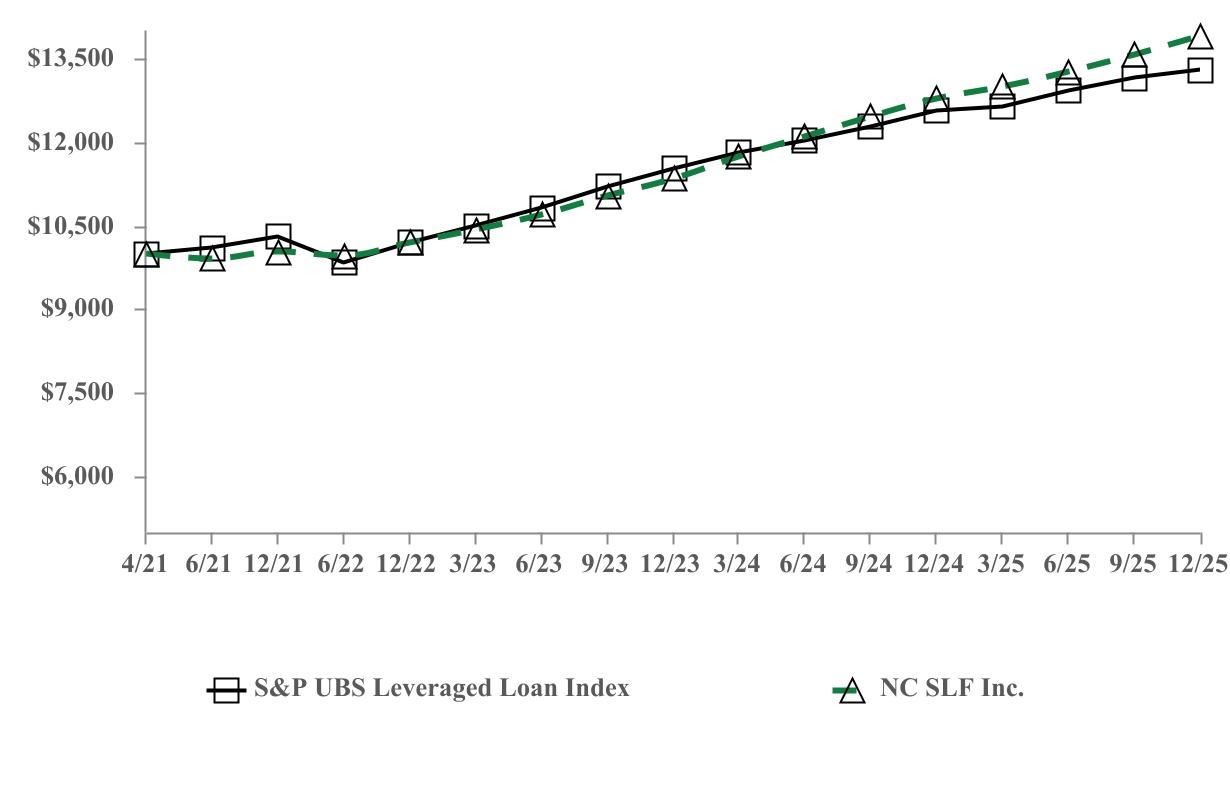
This graph compares the return on our common stock from April 16, 2021 (the inception date) to December 31, 2025 with that of S&P UBS Leveraged Loan Index. Prior to its registration as a closed-end fund under the 1940 Act on August 12, 2022, the Company operated as a business development company (“BDC”) from June 2, 2021 until August 12, 2022, whereupon it withdrew its election to be regulated as a BDC pursuant to Section 54(c) of the 1940 Act. The graph assumes that, on April 16, 2021 a person invested $10,000 in each of our common stock and the S&P UBS Leveraged Loan Index.
The graph measures total shareholder return, which takes into account changes in NAV and distributions. Distributions are assumed, for purposes of this calculation, to be reinvested at prices obtained under the Company’s distribution reinvestment plan (as applicable). Returns do not reflect the deduction of taxes that a shareholder would pay on Company distributions. Past performance is not indicative, or a guarantee, of future performance. Future results may vary and may be higher or lower than the data shown below.
COMPARISON OF INCEPTION TO DATE CUMULATIVE TOTAL RETURN*
NC SLF Inc. and the S&P UBS Leveraged Loan Index
*$10,000 invested on April 16, 2021 (the inception date) in stock or index, including reinvestment of dividends through December 31, 2025. Returns for NC SLF Inc. reflect the impact of waived management fees for the period from July 1, 2021 through October 4, 2022 (Refer to Note 5 to the consolidated financial statements for additional information).
| | | | | | | | | | | | | | | | | | | | |
| Total Return | | 1 Year | | 2 Year | | Since Inception
(April 16, 2021) |
NC SLF Inc. (1) | | 8.73 | % | | 11.28 | % | | 8.26 | % |
S&P UBS Leveraged Loan Index | | 5.94 | % | | 7.75 | % | | 6.99 | % |
(1) Return is calculated as the change in NAV per share during the period, plus distributions per share, if any, divided by the beginning NAV per share. Dividends and distributions, if any, are assumed for purposes of this calculation to be reinvested at the quarter end NAV per share preceding the distribution in accordance with the dividend reinvestment plan. Returns for the Company reflect the impact of waived management fees for the period from July 1, 2021 through October 4, 2022 (Refer to Note 5 to the consolidated financial statements for additional information). Returns longer than one year are annualized. Portfolio Composition
As of December 31, 2025, our investments consisted of the following (dollar amounts in thousands):
| | | | | | | | | | | | | | | | | |
| Amortized Cost | | Fair Value | | % of Fair Value |
| First-Lien Term Loans | $ | 887,863 | | | $ | 882,855 | | | 100.00 | % |
| Equity Investments | 1,059 | | | — | | | — | % |
| Total | $ | 888,922 | | | $ | 882,855 | | | 100.00 | % |
| Largest portfolio company investment | $ | 19,503 | | | $ | 19,512 | | | 2.21 | % |
| Average portfolio company investment | $ | 8,386 | | | $ | 8,329 | | | 0.94 | % |
The industry composition of our portfolio as a percentage of fair value as of December 31, 2025 was as follows:
| | | | | |
| Industry | |
| Aerospace & Defense | 2.19 | % |
| Air Freight & Logistics | 2.11 | % |
| Auto Components | 1.81 | % |
| Beverages | 0.47 | % |
| Building Products | 2.78 | % |
| Chemicals | 1.92 | % |
| Commercial Services & Supplies | 5.05 | % |
| Construction & Engineering | 5.35 | % |
| Construction Materials | 2.47 | % |
| Containers & Packaging | 3.03 | % |
| Distributors | 2.95 | % |
| Diversified Consumer Services | 1.98 | % |
| Diversified Financial Services | 6.04 | % |
| Diversified Telecommunication Services | 0.93 | % |
| Electric Utilities | 0.71 | % |
| Electrical Equipment | 2.42 | % |
| Electronic Equipment, Instruments & Components | 1.13 | % |
| Energy Equipment & Services | 3.24 | % |
| Food Products | 6.71 | % |
| Gas Utilities | 1.69 | % |
| Health Care Equipment & Supplies | 6.52 | % |
| Health Care Providers & Services | 9.31 | % |
| Hotels, Restaurants & Leisure | 0.16 | % |
| Household Durables | 0.63 | % |
| Household Products | 1.04 | % |
| Industrial Conglomerates | 2.08 | % |
| Insurance | 1.62 | % |
| Internet and Direct Marketing Retail | 1.11 | % |
| IT Services | 2.28 | % |
| Leisure Products | 0.82 | % |
| Machinery | 0.80 | % |
| Personal Products | 2.54 | % |
| Pharmaceuticals | 2.22 | % |
| Professional Services | 6.22 | % |
| Road & Rail | 0.82 | % |
| Software | 3.18 | % |
| Transportation Infrastructure | 2.41 | % |
| Wireless Telecommunication Services | 1.26 | % |
| Total | 100.00 | % |
The weighted average yield of our portfolio as of December 31, 2025 was as follows:
| | | | | |
Weighted average yield on debt and income producing investments, at cost (1) | 9.04 | % |
Weighted average yield on debt and income producing investments, at fair value (1) | 9.09 | % |
| Percentage of debt investments bearing a floating rate | 100.00 | % |
| Percentage of debt investments bearing a fixed rate | — | % |
_____________
(1) There were no investments on non-accrual status as of December 31, 2025.
The weighted average yield of our debt and income producing securities is not the same as a return on investment for our shareholders, but rather relates to our investment portfolio and is calculated before deduction of all of our fees and expenses. The weighted average yield was computed using the effective interest rates as of the reporting date, including accretion of original issue discount, but excluding investments on non-accrual status, if any. There can be no assurance that the weighted average yield will remain at its current level.
Asset Quality
In addition to various risk management and monitoring tools, we use the Investment Adviser’s investment rating system to characterize and monitor the credit profile and expected level of returns on each investment in our portfolio. Each investment team utilizes a systematic, consistent approach to credit evaluation, with a particular focus on an acceptable level of debt repayment and deleveraging under a “base case” set of projections (the “Base Case”), which generally reflects a more conservative estimate than the set of projections provided by a prospective portfolio company (the “Management Case”). The following is a description of the conditions associated with each investment rating:
1.Performing - Superior: Borrower is performing significantly above Management Case.
2.Performing - High: Borrower is performing at or near the Management Case (i.e., in a range slightly below to slightly above).
3.Performing - Low Risk: Borrower is operating well ahead of the Base Case to slightly below the Management Case.
4.Performing - Stable Risk: Borrower is operating at or near the Base Case (i.e., in a range slightly below to slightly above). This is the initial rating assigned to all new borrowers.
5.Performing - Management Notice: Borrower is operating below the Base Case. Adverse trends in business conditions and/or industry outlook are viewed as temporary. There is no immediate risk of payment default and only a low to moderate risk of covenant default.
6.Watch List - Low Maintenance: Borrower is operating below the Base Case, with declining margin of protection. Adverse trends in business conditions and/or industry outlook are viewed as probably lasting for more than a year. Payment default is still considered unlikely, but there is a moderate to high risk of covenant default.
7.Watch List - Medium Maintenance: Borrower is operating well below the Base Case, but has adequate liquidity. Adverse trends are more pronounced than in Internal Risk Rating 6 above. There is a high risk of covenant default, or it may have already occurred. Payments are current, although subject to greater uncertainty, and there is a moderate to high risk of payment default.
8.Watch List - High Maintenance: Borrower is operating well below the Base Case. Liquidity may be strained. Covenant default is imminent or may have occurred. Payments are current, but there is a high risk of payment default. Negotiations to restructure or refinance debt on normal terms may have begun. Further significant deterioration appears unlikely and no loss of principal is currently anticipated.
9.Watch List - Possible Loss: At the current level of operations and financial condition, the borrower does not have the ability to service and ultimately repay or refinance all outstanding debt on current terms. Liquidity is strained. Payment default may have occurred or is very likely in the short term unless creditors grant some relief. Loss of principal is possible.
10.Watch List - Probable Loss: At the current level of operations and financial condition, the borrower does not have the ability to service and ultimately repay or refinance all outstanding debt on current terms. Payment default is very likely or may have already occurred. Liquidity is extremely limited. The prospects for improvement in the borrower’s situation are sufficiently negative that loss of some or all principal is probable.
The Investment Adviser regularly monitors and, when appropriate, changes the investment rating assigned to each investment in our portfolio. Each investment team will review the investment ratings in connection with monthly or quarterly portfolio reviews.
The following table shows the investment ratings of the investments in our portfolio as of December 31, 2025 (dollar amounts in thousands):
| | | | | | | | | | | | | | | | | | | | |
| | Fair Value | | % of Portfolio | | Number of Portfolio Companies |
| 1 | | $ | — | | | — | % | | — | |
| 2 | | — | | | — | % | | — | |
| 3 | | 28,622 | | | 3.24 | % | | 3 | |
| 4 | | 704,501 | | | 79.80 | % | | 86 |
| 5 | | 110,888 | | | 12.56 | % | | 13 | |
| 6 | | 38,844 | | | 4.40 | % | | 4 | |
| 7 | | | | — | % | | — | |
| 8 | | — | | | — | % | | — | |
| 9 | | — | | | — | % | | — | |
| 10 | | — | | | — | % | | — | |
| Total | | $ | 882,855 | | | 100.00 | % | | 106 |
As of December 31, 2025, the weighted average Internal Risk Rating of our investment portfolio was 4.2.
Availability of Quarterly Portfolio Schedule
The Company files its complete schedule of portfolio holdings with the SEC for the first and third quarters of each fiscal year as an exhibit to its reports on Form N-PORT. The Company’s filings on Form N-PORT are available on the SEC’s website at www.sec.gov.
TOP TEN HOLDINGS
AS OF DECEMBER 31, 2025
(dollars in thousands)
| | | | | | | | | | | | | | | | | | | | | | | | | | |
| Investment | | Maturity | | Fair Value | | % Total Fair Value | | % of Net Assets |
| Healthspan Buyer, LLC (Thorne HealthTech) | | 10/16/2030 | | $ | 19,512 | | | 2.21 | % | | 3.08 | % |
| PAG Holding Corp. (Precision Aviation Group) | | 12/21/2029 | | $ | 19,307 | | | 2.19 | % | | 3.06 | % |
| Motion & Control Enterprises LLC | | 6/1/2028 | | $ | 19,176 | | | 2.17 | % | | 3.03 | % |
| Nellson Nutraceutical, LLC | | 4/17/2031 | | $ | 19,078 | | | 2.16 | % | | 3.02 | % |
| Ascend Partner Services LLC | | 8/11/2031 | | $ | 19,015 | | | 2.15 | % | | 3.01 | % |
| ACP Maverick Holdings, Inc. | | 3/18/2031 | | $ | 18,812 | | | 2.13 | % | | 2.98 | % |
| AB Centers Acquisition Corporation (Action Behavior Centers) | | 7/2/2031 | | $ | 18,716 | | | 2.12 | % | | 2.96 | % |
| Kenco PPC Buyer LLC | | 11/15/2029 | | $ | 18,648 | | | 2.11 | % | | 2.95 | % |
| Redwood Services Group, LLC (Evergreen Services Group) | | 6/15/2029 | | $ | 18,644 | | | 2.11 | % | | 2.95 | % |
| Heartland Paving Partners, LLC | | 8/9/2030 | | $ | 18,405 | | | 2.08 | % | | 2.91 | % |
| | | | | | 21.43 | % | | 29.95 | % |
NC SLF INC.
CONSOLIDATED STATEMENT OF ASSETS AND LIABILITIES
(dollars in thousands, except share and per share data)
| | | | | |
| December 31, 2025 |
| |
| Assets | |
| Non-controlled/non-affiliated company investments, at fair value (cost of $888,922) | $ | 882,855 | |
| Cash | 4,437 | |
| Cash equivalents | 11,221 | |
| Interest receivable | 5,249 | |
| Receivable for investments sold | 334 | |
| |
| Prepaid expenses | 49 | |
| Total assets | $ | 904,145 | |
| |
| Liabilities | |
| Secured borrowings (net of $2,931 deferred financing costs) | $ | 252,069 | |
| |
| Interest payable | 3,196 | |
| |
Management fees payable (See Note 5) | 998 | |
| Distributions payable | 15,086 | |
Directors' fees payable (See Note 5) | 15 | |
| Accounts payable and accrued expenses | 805 | |
| Total liabilities | 272,169 | |
| |
Commitments and contingencies (See Note 7) | |
| |
| |
| Common stock, par value $0.01 per share, 500,000,000 shares authorized, 65,592,790 shares issued and outstanding as of December 31, 2025 | 656 | |
| Paid-in-capital in excess of par value | 646,321 | |
| Total distributable earnings (loss) | (15,001) | |
| Total net assets | $ | 631,976 | |
| |
Net asset value per share (See Note 9) | $ | 9.63 | |
The accompanying notes are an integral part of these consolidated financial statements.
NC SLF INC.
CONSOLIDATED STATEMENT OF OPERATIONS
(dollars in thousands, except share and per share data)
| | | | | |
| Year Ended December 31, 2025 |
| Investment income: | |
| Non-controlled/non-affiliated company investments: | |
| Interest income | $ | 79,018 | |
| Payment-in-kind interest income | 115 | |
| Other income | 477 | |
| Total investment income | 79,610 | |
| |
| Expenses: | |
| Interest and debt financing expenses | 16,525 | |
| |
| 3,706 | |
| Professional fees | 811 | |
| 59 | |
Administration fees (See Note 5) | 891 | |
| Other general and administrative expenses | 375 | |
| Total expenses | 22,367 | |
| |
| |
| Net investment income (loss) | 57,243 |
| |
| Realized and unrealized gain (loss) on investments: | |
| Net realized gain (loss) on non-controlled/non-affiliated company investments | (6,602) | |
| Net change in unrealized appreciation (depreciation) on non-controlled/non-affiliated company investments | (2,669) | |
| Total net realized and unrealized gain (loss) on investments | (9,271) | |
| |
| Net increase (decrease) in net assets resulting from operations | $ | 47,972 | |
| |
| Per share data: | |
| Net investment income (loss) per share | $ | 0.99 | |
| Net increase (decrease) in net assets resulting from operations per share | $ | 0.83 | |
| Weighted average common shares outstanding | 57,901,195 | |
The accompanying notes are an integral part of these consolidated financial statements.
NC SLF INC.
CONSOLIDATED STATEMENTS OF CHANGES IN NET ASSETS
(dollars in thousands, except share and per share data)
| | | | | | | | | | | | | | | | |
| Year Ended December 31, | | | | | |
| 2025 | | 2024 | | | | | |
| | | | | | | | |
| Increase (decrease) in net assets resulting from operations: | | | | | | | | |
| Net investment income (loss) | $ | 57,243 | | | $ | 49,257 | | | | | | |
| Net realized gain (loss) on investments | (6,602) | | | (4,596) | | | | | | |
| Net change in unrealized appreciation (depreciation) on investments | (2,669) | | | 6,746 | | | | | | |
| Net increase (decrease) in net assets resulting from operations | 47,972 | | | 51,407 | | | | | | |
| Shareholder distributions: | | | | | | | | |
Distributions declared from distributable earnings | (56,196) | | | (48,761) | | | | | | |
| Net increase (decrease) in net assets resulting from shareholder distributions | (56,196) | | | (48,761) | | | | | | |
| Capital share transactions: | | | | | | | | |
| Issuance of common shares | 78,000 | | | 105,000 | | | | | | |
| Reinvestment of shareholder distributions | 53,701 | | | 45,645 | | | | | | |
| Net increase (decrease) in net assets resulting from capital share transactions | 131,701 | | | 150,645 | | | | | | |
| Total increase (decrease) in net assets | 123,477 | | | 153,291 | | | | | | |
| Net assets, beginning of period | 508,499 | | | 355,208 | | | | | | |
| Net assets, end of period | $ | 631,976 | | | $ | 508,499 | | | | | | |
The accompanying notes are an integral part of these consolidated financial statements.
NC SLF INC.
CONSOLIDATED STATEMENT OF CASH FLOWS
(dollars in thousands, except share and per share data)
| | | | | | | |
| Year Ended December 31, 2025 |
| Cash flows from operating activities: | | | |
| Net increase (decrease) in net assets resulting from operations | $ | 47,972 | | | |
| | | |
| Adjustments to reconcile net increase (decrease) in net assets resulting from operations to net cash provided by (used in) operating activities | | | |
| Purchase of investments | (270,339) | | | |
| Proceeds from principal repayments of investments and sales of investments | 89,844 | | | |
| Payment-in-kind interest income | (115) | | | |
| Amortization of premium/accretion of discount, net | (1,515) | | | |
| Net realized (gain) loss on investments | 6,602 | | | |
| Net change in unrealized (appreciation) depreciation on investments | 2,669 | | | |
| Amortization of deferred financing costs | 948 | | | |
| Changes in operating assets and liabilities: | | | |
| Interest receivable | (853) | | | |
| Receivable for investments sold | (155) | | | |
| Prepaid expenses | (3) | | | |
| | | |
| | | |
| | | |
| Interest payable | 449 | | | |
| Management fees payable | 170 | | | |
| | | |
| Accounts payable and accrued expenses | 274 | | | |
| Net cash provided by (used in) operating activities | (124,052) | | | |
| | | |
| Cash flows from financing activities: | | | |
| Proceeds from issuance of common shares | 78,000 | | | |
| Shareholder distributions | (444) | | | |
| Proceeds from secured borrowings | 163,500 | | | |
| Repayments of secured borrowings | (119,500) | | | |
| Payments of deferred financing costs | (1,534) | | | |
| Net cash provided by (used in) financing activities | 120,022 | | | |
| | | |
| Net increase (decrease) in cash and cash equivalents | (4,030) | | | |
| Cash and cash equivalents, beginning of period | 19,688 | | | |
| Cash and cash equivalents, end of period | $ | 15,658 | | | |
| | | |
| Supplemental disclosure of cash flow Information: | | | |
| Cash paid during the period for interest | $ | 16,026 | | | |
| Taxes, including excise tax, paid during the period | $ | 44 | | | |
| Supplemental disclosure of non-cash flow information: | | | |
| Reinvestment of shareholder distributions | $ | 53,701 | | | |
| Distributions payable | $ | 15,086 | | | |
The accompanying notes are an integral part of these consolidated financial statements.
The following table provides a reconciliation of cash and cash equivalents reported on the consolidated statement of assets and liabilities that sum to the total amounts on the consolidated statement of cash flows (dollars in thousands):
| | | | | | | |
| December 31, 2025 | | |
| Cash | $ | 4,437 | | | |
| Cash Equivalents | 11,221 | | | |
| Total Cash and Cash Equivalents Shown on the Consolidated Statement of Cash Flows | $ | 15,658 | | | |
The accompanying notes are an integral part of these consolidated financial statements.
CONSOLIDATED SCHEDULE OF INVESTMENTS
December 31, 2025
(dollar amounts in thousands, except shares)
| | | | | | | | | | | | | | | | | | | | | | | | | | | | | | | | | | | | | | | | | | | | | | | | | | | | | | | | |
Portfolio Company (1) (2) | | Footnotes | | Investment | | Spread Above Reference Rate (3) | | Interest Rate (3) | | Maturity Date | | Par Amount | | Amortized Cost | | Fair Value(4) | | % of Net Assets (5) |
| | | | | | | | | | | | | | | | | | |
| Investments | | | | | | | | | | | | | | | | | | |
Debt Investments (4) | | | | | | | | | | | | | | | | | | |
| Aerospace & Defense | | | | | | | | | | | | | | | | | | |
| PAG Holding Corp. (Precision Aviation Group) | | (10) | | First Lien Debt | | S + 4.75% | | 8.42 | % | | 12/21/2029 | | $ | 14,518 | | | $ | 14,307 | | | $ | 14,500 | | | 2.30 | % |
| PAG Holding Corp. (Precision Aviation Group) | | | | First Lien Debt (Delayed Draw) | | S + 4.75% | | 8.42 | % | | 12/21/2029 | | 4,813 | | | 4,780 | | 4,807 | | 0.76 | % |
| Total Aerospace & Defense | | | | | | | | | | | | | | 19,087 | | 19,307 | | 3.06 | % |
| | | | | | | | | | | | | | | | | | |
| Air Freight & Logistics | | | | | | | | | | | | | | | | | | |
| Kenco PPC Buyer LLC | | (10) | | First Lien Debt | | S + 4.50% | | 8.54 | % | | 11/15/2029 | | 16,154 | | | 15,973 | | 16,081 | | 2.54 | % |
| Kenco PPC Buyer LLC | | | | First Lien Debt (Delayed Draw) | | S + 4.50% | | 8.54 | % | | 11/15/2029 | | 2,581 | | | 2,553 | | 2,569 | | 0.41 | % |
| Kenco PPC Buyer LLC | | (6) | | First Lien Debt (Delayed Draw) | | S + 4.50% | | 8.54 | % | | 11/15/2029 | | 488 | | | (4) | | (2) | | — | % |
| Total Air Freight & Logistics | | | | | | | | | | | | | | 18,522 | | 18,648 | | 2.95 | % |
| | | | | | | | | | | | | | | | | | |
| Auto Components | | | | | | | | | | | | | | | | | | |
| Randys Holdings, Inc. (Randy's Worldwide Automotive) | | (7) | | First Lien Debt | | S + 5.00% | | 8.73 | % | | 11/1/2029 | | 12,731 | | | 12,624 | | 12,540 | | 1.98 | % |
| Randys Holdings, Inc. (Randy's Worldwide Automotive) | | (6) (7) | | First Lien Debt (Delayed Draw) | | S + 5.00% | | 8.73 | % | | 11/1/2029 | | 4,344 | | | 3,537 | | 3,472 | | 0.55 | % |
| Total Auto Components | | | | | | | | | | | | | | 16,161 | | 16,012 | | 2.53 | % |
| | | | | | | | | | | | | | | | | | |
| Beverages | | | | | | | | | | | | | | | | | | |
| Refresh Buyer, LLC (Sunny Sky Products) | | (10) | | First Lien Debt | | S + 4.75% | | 8.35 | % | | 12/23/2028 | | 3,357 | | | 3,335 | | 3,291 | | 0.52 | % |
| Refresh Buyer, LLC (Sunny Sky Products) | | | | First Lien Debt (Delayed Draw) | | S + 4.75% | | 8.35 | % | | 12/23/2028 | | 850 | | | 850 | | 833 | | 0.13 | % |
| Total Beverages | | | | | | | | | | | | | | 4,185 | | 4,124 | | 0.65 | % |
| | | | | | | | | | | | | | | | | | |
| Building Products | | | | | | | | | | | | | | | | | | |
| Clean Solutions Buyer, Inc. | | (10) | | First Lien Debt | | S + 4.50% | | 8.22 | % | | 9/9/2030 | | 4,205 | | | 4,171 | | 4,150 | | 0.66 | % |
| Cobalt Service Partners, LLC | | (6) (7) | | First Lien Debt (Delayed Draw) | | S + 4.75% | | 8.42 | % | | 10/13/2031 | | 12,451 | | | 6,027 | | 5,970 | | 0.94 | % |
| Cobalt Service Partners, LLC | | (7) (10) | | First Lien Debt | | S + 4.75% | | 8.42 | % | | 10/13/2031 | | 7,177 | | | 7,115 | | 7,114 | | 1.13 | % |
| Vertex Service Partners, LLC | | (10) | | First Lien Debt | | S + 6.00% | | 9.67 | % | | 11/8/2030 | | 2,253 | | | 2,253 | | | 2,245 | | | 0.36 | % |
CONSOLIDATED SCHEDULE OF INVESTMENTS
December 31, 2025
(dollar amounts in thousands, except shares)
| | | | | | | | | | | | | | | | | | | | | | | | | | | | | | | | | | | | | | | | | | | | | | | | | | | | | | | | |
Portfolio Company (1) (2) | | Footnotes | | Investment | | Spread Above Reference Rate (3) | | Interest Rate (3) | | Maturity Date | | Par Amount | | Amortized Cost | | Fair Value(4) | | % of Net Assets (5) |
| Vertex Service Partners, LLC | | (6) | | First Lien Debt (Delayed Draw) | | S + 6.00% | | 9.67 | % | | 11/8/2030 | | 4,411 | | | 850 | | | 715 | | | 0.11 | % |
| Vertex Service Partners, LLC | | | | First Lien Debt (Delayed Draw) | | S + 6.00% | | 9.67 | % | | 11/8/2030 | | 4,342 | | | 4,336 | | 4,327 | | 0.68 | % |
| Total Building Products | | | | | | | | | | | | | | 24,752 | | 24,521 | | 3.88 | % |
| | | | | | | | | | | | | | | | | | |
| Chemicals | | | | | | | | | | | | | | | | | | |
| Chroma Color Corporation | | | | First Lien Debt | | S + 4.25% | | 8.09 | % | | 4/23/2029 | | 2,991 | | | 2,954 | | | 2,952 | | | 0.47 | % |
| Chroma Color Corporation | | | | First Lien Debt (Delayed Draw) | | S + 4.25% | | 8.09 | % | | 4/23/2029 | | 660 | | | 656 | | 652 | | 0.10 | % |
| Olympic Buyer, Inc. (Ascensus) | | (7) | | First Lien Debt | | S + 4.35% | | 8.07 | % | | 6/30/2028 | | 13,854 | | | 13,731 | | 11,977 | | 1.90 | % |
| WCI-Momentum Bidco, LLC | | (6) | | First Lien Debt (Delayed Draw) | | S + 4.75% | | 8.42 | % | | 12/31/2032 | | 275 | | | — | | (1) | | — | % |
| WCI-Momentum Bidco, LLC | | (10) | | First Lien Debt | | S + 4.75% | | 8.42 | % | | 12/31/2032 | | 1,376 | | | 1,369 | | 1,370 | | 0.22 | % |
| Total Chemicals | | | | | | | | | | | | | | 18,710 | | 16,950 | | 2.69 | % |
| | | | | | | | | | | | | | | | | | |
| Commercial Services & Supplies | | | | | | | | | | | | | | | | | | |
| Astra Service Partners, LLC | | (6) (7) | | First Lien Debt (Delayed Draw) | | S + 4.75% | | 8.42 | % | | 11/26/2032 | | 1,113 | | | — | | (4) | | — | % |
| Astra Service Partners, LLC | | (7) (10) | | First Lien Debt | | S + 4.75% | | 8.42 | % | | 11/26/2032 | | 3,382 | | | 3,370 | | 3,371 | | 0.53 | % |
| FirstCall Mechanical Group, LLC | | (10) | | First Lien Debt | | S + 4.75% | | 8.42 | % | | 6/27/2031 | | 6,468 | | | 6,417 | | 6,426 | | 1.02 | % |
| FirstCall Mechanical Group, LLC | | (6) | | First Lien Debt (Delayed Draw) | | S + 4.75% | | 8.42 | % | | 6/27/2031 | | 13,031 | | | 10,130 | | 10,057 | | 1.59 | % |
| Integrated Power Services Holdings, Inc. | | | | First Lien Debt | | S + 4.75% | | 8.58 | % | | 11/22/2028 | | 4,890 | | | 4,873 | | 4,890 | | 0.77 | % |
| Olympus US Bidco LLC (Phaidon International) | | (8) | | First Lien Debt | | S + 5.50% | | 9.44 | % | | 8/22/2029 | | 17,063 | | | 16,963 | | 16,492 | | 2.61 | % |
| Safety Infrastructure Services Intermediate LLC | | (6) | | First Lien Debt (Delayed Draw) | | S + 5.00% | | 8.67 | % | | 7/21/2028 | | 1,725 | | | 453 | | 408 | | 0.06 | % |
| Safety Infrastructure Services Intermediate LLC | | (10) | | First Lien Debt | | S + 5.00% | | 8.67 | % | | 7/21/2028 | | 3,061 | | | 3,040 | | 2,975 | | 0.47 | % |
| Total Commercial Services & Supplies | | | | | | | | | | | | | | 45,246 | | 44,615 | | 7.05 | % |
| | | | | | | | | | | | | | | | | | |
| Construction & Engineering | | | | | | | | | | | | | | | | | | |
| CLS Management Services, LLC (Contract Land Staff) | | (10) | | First Lien Debt | | S + 5.00% | | 8.67 | % | | 3/27/2030 | | 3,235 | | | 3,210 | | 3,210 | | 0.51 | % |
| CLS Management Services, LLC (Contract Land Staff) | | (10) | | First Lien Debt (Delayed Draw) | | S + 5.00% | | 8.67 | % | | 3/27/2030 | | 1,301 | | | 1,298 | | 1,290 | | 0.20 | % |
| CLS Management Services, LLC (Contract Land Staff) | | (6) | | First Lien Debt (Delayed Draw) | | S + 5.00% | | 8.67 | % | | 3/27/2030 | | 2,174 | | | 1,953 | | 1,940 | | 0.31 | % |
CONSOLIDATED SCHEDULE OF INVESTMENTS
December 31, 2025
(dollar amounts in thousands, except shares)
| | | | | | | | | | | | | | | | | | | | | | | | | | | | | | | | | | | | | | | | | | | | | | | | | | | | | | | | |
Portfolio Company (1) (2) | | Footnotes | | Investment | | Spread Above Reference Rate (3) | | Interest Rate (3) | | Maturity Date | | Par Amount | | Amortized Cost | | Fair Value(4) | | % of Net Assets (5) |
| ERA Industries, LLC (BTX Precision) | | (10) | | First Lien Debt | | S + 4.75% | | 8.47 | % | | 7/25/2030 | | 675 | | | 668 | | | 677 | | | 0.11 | % |
| ERA Industries, LLC (BTX Precision) | | (10) | | First Lien Debt | | S + 4.75% | | 8.59 | % | | 7/25/2030 | | 362 | | | 358 | | 362 | | 0.06 | % |
| ERA Industries, LLC (BTX Precision) | | (6) | | First Lien Debt (Delayed Draw) | | S + 4.75% | | 8.59 | % | | 7/25/2030 | | 513 | | | 233 | | 237 | | 0.04 | % |
| ERA Industries, LLC (BTX Precision) | | | | First Lien Debt (Delayed Draw) | | S + 4.75% | | 8.47 | % | | 7/25/2030 | | 387 | | | 386 | | 388 | | 0.06 | % |
| Heartland Paving Partners, LLC | | (10) | | First Lien Debt | | S + 5.00% | | 8.67 | % | | 8/9/2030 | | 8,337 | | | 8,268 | | 8,116 | | 1.28 | % |
| Heartland Paving Partners, LLC | | (6) | | First Lien Debt (Delayed Draw) | | S + 5.00% | | 8.67 | % | | 8/9/2030 | | 5,603 | | | 4,980 | | | 4,843 | | | 0.77 | % |
| Heartland Paving Partners, LLC | | | | First Lien Debt (Delayed Draw) | | S + 5.00% | | 8.67 | % | | 8/9/2030 | | 5,595 | | | 5,583 | | 5,446 | | 0.86 | % |
| ICE USA Infrastructure, Inc. | | (10) | | First Lien Debt | | S + 5.75% | | 9.47 | % | | 3/15/2030 | | 789 | | | 783 | | 763 | | 0.12 | % |
| ICE USA Infrastructure, Inc. | | (10) | | First Lien Debt | | S + 5.75% | | 9.47 | % | | 3/15/2030 | | 2,832 | | | 2,810 | | 2,739 | | 0.43 | % |
| MEI Buyer LLC | | (10) | | First Lien Debt | | S + 4.25% | | 7.97 | % | | 6/29/2029 | | 5,415 | | | 5,343 | | 5,416 | | 0.86 | % |
| MEI Buyer LLC | | | | First Lien Debt (Delayed Draw) | | S + 4.25% | | 7.97 | % | | 6/29/2029 | | 866 | | | 864 | | 866 | | 0.14 | % |
| USA Industries Holdings LLC | | (6) | | First Lien Debt (Delayed Draw) | | S + 4.25% | | 7.99 | % | | 12/10/2032 | | 1,367 | | | — | | (7) | | — | % |
| USA Industries Holdings LLC | | (10) | | First Lien Debt | | S + 4.25% | | 7.99 | % | | 12/10/2032 | | 2,393 | | | 2,381 | | 2,381 | | 0.38 | % |
| WSB Engineering Holdings Inc. | | (10) | | First Lien Debt | | S + 4.50% | | 8.32 | % | | 8/31/2029 | | 3,085 | | | 3,055 | | 3,057 | | 0.48 | % |
| WSB Engineering Holdings Inc. | | (6) | | First Lien Debt (Delayed Draw) | | S + 4.50% | | 8.32 | % | | 8/31/2029 | | 14,508 | | | 3,543 | | 3,460 | | 0.55 | % |
| WSB Engineering Holdings Inc. | | | | First Lien Debt (Delayed Draw) | | S + 4.50% | | 8.32 | % | | 8/31/2029 | | 2,027 | | | 2,019 | | 2,008 | | 0.32 | % |
| Total Construction & Engineering | | | | | | | | | | | | | | 47,735 | | 47,192 | | 7.48 | % |
| | | | | | | | | | | | | | | | | | |
| Construction Materials | | | | | | | | | | | | | | | | | | |
| Java Buyer, Inc. (Sciens Building Solutions, LLC) | | (7) | | First Lien Debt (Delayed Draw) | | S + 5.00% | | 8.94 | % | | 12/15/2027 | | 5,185 | | | 5,167 | | 5,185 | | 0.82 | % |
| Java Buyer, Inc. (Sciens Building Solutions, LLC) | | (7) | | First Lien Debt | | S + 5.00% | | 8.94 | % | | 12/15/2027 | | 9,816 | | | 9,742 | | 9,816 | | 1.55 | % |
| SCIC Buyer, Inc. | | (6) | | First Lien Debt (Delayed Draw) | | S + 4.75% | | 8.42 | % | | 3/28/2031 | | 1,352 | | | 205 | | 235 | | 0.04 | % |
| SCIC Buyer, Inc. | | (10) | | First Lien Debt | | S + 4.75% | | 8.42 | % | | 3/28/2031 | | 6,400 | | | 6,340 | | 6,528 | | 1.03 | % |
| Total Construction Materials | | | | | | | | | | | | | | 21,454 | | 21,764 | | 3.44 | % |
| | | | | | | | | | | | | | | | | | |
| Containers & Packaging | | | | | | | | | | | | | | | | | | |
| Impact Parent Corporation (Impact Environmental Group) | | (6) | | First Lien Debt (Delayed Draw) | | S + 5.25% | | 9.02 | % | | 3/23/2029 | | 2,745 | | | 1,919 | | 1,916 | | 0.30 | % |
| Impact Parent Corporation (Impact Environmental Group) | | | | First Lien Debt | | S + 5.25% | | 9.02 | % | | 3/23/2029 | | 3,560 | | | 3,514 | | | 3,544 | | | 0.56 | % |
CONSOLIDATED SCHEDULE OF INVESTMENTS
December 31, 2025
(dollar amounts in thousands, except shares)
| | | | | | | | | | | | | | | | | | | | | | | | | | | | | | | | | | | | | | | | | | | | | | | | | | | | | | | | |
Portfolio Company (1) (2) | | Footnotes | | Investment | | Spread Above Reference Rate (3) | | Interest Rate (3) | | Maturity Date | | Par Amount | | Amortized Cost | | Fair Value(4) | | % of Net Assets (5) |
| Impact Parent Corporation (Impact Environmental Group) | | (10) | | First Lien Debt | | S + 5.25% | | 9.02 | % | | 3/23/2029 | | 730 | | | 720 | | | 726 | | | 0.11 | % |
| Impact Parent Corporation (Impact Environmental Group) | | | | First Lien Debt (Delayed Draw) | | S + 5.25% | | 9.02 | % | | 3/23/2029 | | 1,663 | | | 1,658 | | 1,656 | | 0.26 | % |
| Impact Parent Corporation (Impact Environmental Group) | | | | First Lien Debt (Delayed Draw) | | S + 5.25% | | 9.02 | % | | 3/23/2029 | | 1,504 | | | 1,502 | | 1,498 | | 0.24 | % |
| Impact Parent Corporation (Impact Environmental Group) | | | | First Lien Debt (Delayed Draw) | | S + 5.25% | | 9.02 | % | | 3/23/2029 | | 3,247 | | | 3,237 | | 3,233 | | 0.51 | % |
| New Spartech Holdings LLC | | | | First Lien Debt | | S + 7.00% | | 10.74 | % | | 3/31/2030 | | 956 | | | 939 | | 956 | | 0.15 | % |
| New Spartech Holdings LLC | | (7) | | First Lien Debt | | S + 1.00% | | 4.74% (Cash) 4.25% (PIK) | | 9/30/2030 | | 1,605 | | | 1,605 | | 1,573 | | 0.25 | % |
| Online Labels Group, LLC | | (10) | | First Lien Debt | | S + 4.75% | | 8.42 | % | | 12/19/2029 | | 1,575 | | | 1,564 | | 1,575 | | 0.25 | % |
| Online Labels Group, LLC | | (6) | | First Lien Debt (Delayed Draw) | | S + 4.75% | | 8.42 | % | | 12/19/2029 | | 195 | | | (1) | | — | | — | % |
| Online Labels Group, LLC | | (6) | | First Lien Debt (Delayed Draw) | | S + 4.75% | | 8.42 | % | | 12/19/2029 | | 194 | | | 96 | | 97 | | 0.02 | % |
| Pelican Products, Inc. | | (7) (9) | | First Lien Debt | | S + 4.25% | | 8.18 | % | | 12/29/2028 | | 7,680 | | | 7,642 | | | 6,973 | | | 1.10 | % |
| Performance Packaging Buyer, LLC | | (10) | | First Lien Debt | | S + 4.50% | | 8.34 | % | | 4/15/2031 | | 3,037 | | | 3,009 | | 3,009 | | 0.48 | % |
| Total Containers & Packaging | | | | | | | | | | | | | | 27,404 | | 26,756 | | 4.23 | % |
| | | | | | | | | | | | | | | | | | |
| Distributors | | | | | | | | | | | | | | | | | | |
| Motion & Control Enterprises LLC | | (10) | | First Lien Debt | | S + 6.00% | | 9.77 | % | | 6/1/2028 | | 3,951 | | | 3,924 | | | 3,921 | | | 0.62 | % |
| Motion & Control Enterprises LLC | | | | First Lien Debt (Delayed Draw) | | S + 6.00% | | 9.77 | % | | 6/1/2028 | | 10,876 | | | 10,876 | | 10,793 | | 1.71 | % |
| Motion & Control Enterprises LLC | | | | First Lien Debt (Delayed Draw) | | S + 6.00% | | 9.77 | % | | 6/1/2028 | | 3,951 | | | 3,951 | | 3,921 | | 0.62 | % |
| Motion & Control Enterprises LLC | | (10) | | First Lien Debt | | S + 6.00% | | 9.77 | % | | 6/1/2028 | | 545 | | | 542 | | 541 | | 0.09 | % |
| Rhino Intermediate Holding Company, LLC (Rhino Tool House) | | (10) | | First Lien Debt | | S + 5.25% | | 9.16 | % | | 4/4/2029 | | 5,913 | | | 5,848 | | 5,837 | | 0.92 | % |
| Rhino Intermediate Holding Company, LLC (Rhino Tool House) | | | | First Lien Debt (Delayed Draw) | | S + 5.25% | | 9.16 | % | | 4/4/2029 | | 1,053 | | | 1,050 | | 1,039 | | 0.16 | % |
| Total Distributors | | | | | | | | | | | | | | 26,191 | | 26,052 | | 4.12 | % |
| | | | | | | | | | | | | | | | | | |
| Diversified Consumer Services | | | | | | | | | | | | | | | | | | |
| Excel Fitness Consolidator LLC | | (10) | | First Lien Debt | | S + 4.50% | | 8.42 | % | | 4/29/2030 | | 11,905 | | | 11,826 | | 11,814 | | 1.87 | % |
| Excel Fitness Consolidator LLC | | (6) | | First Lien Debt (Delayed Draw) | | S + 4.50% | | 8.42 | % | | 4/29/2030 | | 826 | | | (5) | | (6) | | — | % |
CONSOLIDATED SCHEDULE OF INVESTMENTS
December 31, 2025
(dollar amounts in thousands, except shares)
| | | | | | | | | | | | | | | | | | | | | | | | | | | | | | | | | | | | | | | | | | | | | | | | | | | | | | | | |
Portfolio Company (1) (2) | | Footnotes | | Investment | | Spread Above Reference Rate (3) | | Interest Rate (3) | | Maturity Date | | Par Amount | | Amortized Cost | | Fair Value(4) | | % of Net Assets (5) |
| Perennial Services Group, LLC | | (6) (7) | | First Lien Debt (Delayed Draw) | | S + 4.50% | | 8.19 | % | | 12/23/2032 | | 4,156 | | | — | | | (20) | | | — | % |
| Perennial Services Group, LLC | | (7) (10) | | First Lien Debt | | S + 4.50% | | 8.19 | % | | 12/23/2032 | | 5,695 | | | 5,666 | | 5,666 | | 0.90 | % |
| Total Diversified Consumer Services | | | | | | | | | | | | | | 17,487 | | 17,454 | | 2.77 | % |
| | | | | | | | | | | | | | | | | | |
| Diversified Financial Services | | | | | | | | | | | | | | | | | | |
| Ascend Partner Services LLC | | (10) | | First Lien Debt | | S + 4.50% | | 8.54 | % | | 8/11/2031 | | 7,175 | | | 7,115 | | | 7,107 | | | 1.12 | % |
| Ascend Partner Services LLC | | (6) | | First Lien Debt (Delayed Draw) | | S + 4.50% | | 8.54 | % | | 8/11/2031 | | 12,399 | | | 11,975 | | 11,908 | | 1.88 | % |
| Cohen Advisory, LLC | | (6) | | First Lien Debt (Delayed Draw) | | S + 4.50% | | 8.17 | % | | 12/31/2031 | | 2,100 | | | 85 | | 94 | | 0.01 | % |
| Cohen Advisory, LLC | | (10) | | First Lien Debt | | S + 4.50% | | 8.17 | % | | 12/31/2031 | | 3,743 | | | 3,710 | | | 3,743 | | | 0.59 | % |
| KRIV Acquisition, Inc. (Riveron) | | (10) | | First Lien Debt | | S + 5.00% | | 8.67 | % | | 7/31/2031 | | 11,072 | | | 10,843 | | | 11,005 | | | 1.74 | % |
| Sagebrush Buyer, LLC (Province) | | (10) | | First Lien Debt | | S + 5.00% | | 8.72 | % | | 7/1/2030 | | 1,947 | | | 1,931 | | | 1,931 | | | 0.31 | % |
| Smith & Howard Advisory LLC | | (6) | | First Lien Debt (Delayed Draw) | | S + 4.75% | | 8.59 | % | | 11/26/2030 | | 1,020 | | | 970 | | | 953 | | | 0.15 | % |
| Smith & Howard Advisory LLC | | (10) | | First Lien Debt | | S + 4.75% | | 8.59 | % | | 11/26/2030 | | 1,259 | | | 1,249 | | | 1,236 | | | 0.20 | % |
| Vensure Employer Services, Inc. | | (7 ) (10) | | First Lien Debt | | S + 5.00% | | 8.67 | % | | 9/27/2031 | | 15,314 | | | 15,211 | | 15,314 | | 2.42 | % |
| Vensure Employer Services, Inc. | | (6) (7) | | First Lien Debt (Delayed Draw) | | S + 5.00% | | 8.67 | % | | 9/27/2031 | | 245 | | | (1) | | — | | — | % |
| Total Diversified Financial Services | | | | | | | | | | | | | | 53,088 | | 53,291 | | 8.42 | % |
| | | | | | | | | | | | | | | | | | |
| Diversified Telecommunication Services | | | | | | | | | | | | | | | | | | |
| Sapphire Telecom, Inc. | | (10) | | First Lien Debt | | S + 5.00% | | 8.67 | % | | 6/27/2029 | | 8,204 | | | 8,152 | | 8,212 | | 1.30 | % |
| Total Diversified Telecommunication Services | | | | | | | | | | | | | | 8,152 | | 8,212 | | 1.30 | % |
| | | | | | | | | | | | | | | | | | |
| Electric Utilities | | | | | | | | | | | | | | | | | | |
| Industrial Air Flow Dynamics, Inc. | | (6) (7) | | First Lien Debt (Delayed Draw) | | S + 5.00% | | 8.67 | % | | 8/14/2030 | | 1,673 | | | — | | (8) | | — | % |
| Industrial Air Flow Dynamics, Inc. | | (7) (10) | | First Lien Debt | | S + 5.00% | | 8.67 | % | | 8/14/2030 | | 6,341 | | | 6,310 | | 6,311 | | 1.00 | % |
| Total Electric Utilities | | | | | | | | | | | | | | 6,310 | | 6,303 | | 1.00 | % |
| | | | | | | | | | | | | | | | | | |
| Electrical Equipment | | | | | | | | | | | | | | | | | | |
| Force Electrical Buyerco, LLC | | (6) | | First Lien Debt (Delayed Draw) | | S + 4.50% | | 8.37 | % | | 10/21/2032 | | 4,537 | | | 48 | | | 29 | | | — | % |
| Force Electrical Buyerco, LLC | | (10) | | First Lien Debt | | S + 4.50% | | 8.37 | % | | 10/21/2032 | | 2,662 | | | 2,649 | | | 2,650 | | | 0.42 | % |
CONSOLIDATED SCHEDULE OF INVESTMENTS
December 31, 2025
(dollar amounts in thousands, except shares)
| | | | | | | | | | | | | | | | | | | | | | | | | | | | | | | | | | | | | | | | | | | | | | | | | | | | | | | | |
Portfolio Company (1) (2) | | Footnotes | | Investment | | Spread Above Reference Rate (3) | | Interest Rate (3) | | Maturity Date | | Par Amount | | Amortized Cost | | Fair Value(4) | | % of Net Assets (5) |
| Matador US Buyer, LLC (Insulation Technology Group) | | (8) (10) | | First Lien Debt | | S + 5.00% | | 8.72 | % | | 6/25/2030 | | 9,633 | | | 9,555 | | | 9,660 | | | 1.53 | % |
| Matador US Buyer, LLC (Insulation Technology Group) | | (8) | | First Lien Debt (Delayed Draw) | | S + 5.00% | | 8.72 | % | | 6/25/2030 | | 2,549 | | | 2,549 | | | 2,556 | | | 0.40 | % |
| RMS Energy Borrower LLC | | (6) | | First Lien Debt (Delayed Draw) | | S + 4.50% | | 8.22 | % | | 9/30/2032 | | 1,182 | | | (3) | | | (6) | | | — | % |
| RMS Energy Borrower LLC | | (10) | | First Lien Debt | | S + 4.50% | | 8.22 | % | | 9/30/2032 | | 6,482 | | | 6,450 | | 6,447 | | 1.02 | % |
| Total Electrical Equipment | | | | | | | | | | | | | | 21,248 | | 21,336 | | 3.37 | % |
| | | | | | | | | | | | | | | | | | |
| Electronic Equipment, Instruments & Components | | | | | | | | | | | | | | | | | | |
| INS Intermediate II, LLC (Ergotech DBA Industrial Networking Solutions) | | (10) | | First Lien Debt | | S + 5.50% | | 9.47 | % | | 1/19/2029 | | 8,403 | | | 8,314 | | 8,280 | | 1.31 | % |
| INS Intermediate II, LLC (Ergotech DBA Industrial Networking Solutions) | | (10) | | First Lien Debt (Delayed Draw) | | S + 5.50% | | 9.47 | % | | 1/19/2029 | | 1,708 | | | 1,677 | | | 1,682 | | | 0.27 | % |
| Total Electronic Equipment, Instruments & Components | | | | | | | | | | | | | | 9,991 | | 9,962 | | 1.58 | % |
| | | | | | | | | | | | | | | | | | |
| Energy Equipment & Services | | | | | | | | | | | | | | | | | | |
| Env Automation Acquisition,LLC | | (6) (7) | | First Lien Debt (Delayed Draw) | | S + 4.50% | | 8.24 | % | | 12/8/2031 | | 2,021 | | | — | | | (10) | | | — | % |
| Env Automation Acquisition,LLC | | (7) (10) | | First Lien Debt | | S + 4.50% | | 8.24 | % | | 12/8/2031 | | 4,176 | | | 4,156 | | | 4,156 | | | 0.66 | % |
| Environ Energy, LLC | | (6) | | First Lien Debt (Delayed Draw) | | S + 5.25% | | 9.07 | % | | 10/1/2031 | | 2,644 | | | (19) | | | (18) | | | — | % |
| Environ Energy, LLC | | (10) | | First Lien Debt | | S + 5.25% | | 9.07 | % | | 10/1/2031 | | 4,495 | | | 4,462 | | | 4,465 | | | 0.71 | % |
| Ovation Holdings, Inc | | (6) | | First Lien Debt (Delayed Draw) | | S + 5.00% | | 8.84 | % | | 2/4/2030 | | 3,412 | | | 3,200 | | | 3,226 | | | 0.51 | % |
| Ovation Holdings, Inc | | (10) | | First Lien Debt | | S + 5.00% | | 8.84 | % | | 2/4/2030 | | 409 | | | 405 | | | 408 | | | 0.06 | % |
| Ovation Holdings, Inc | | | | First Lien Debt | | S + 5.00% | | 8.84 | % | | 2/4/2030 | | 6,889 | | | 6,802 | | 6,883 | | 1.09 | % |
| Ovation Holdings, Inc | | | | First Lien Debt (Delayed Draw) | | S + 5.00% | | 8.84 | % | | 2/4/2030 | | 1,630 | | | 1,618 | | | 1,629 | | | 0.26 | % |
| SI Solutions, LLC | | (6) | | First Lien Debt (Delayed Draw) | | S + 4.75% | | 8.42 | % | | 8/15/2030 | | 2,436 | | | 480 | | | 476 | | | 0.08 | % |
| SI Solutions, LLC | | (10) | | First Lien Debt | | S + 4.75% | | 8.42 | % | | 8/15/2030 | | 5,116 | | | 5,075 | | | 5,098 | | | 0.81 | % |
| SI Solutions, LLC | | (10) | | First Lien Debt | | S + 4.75% | | 8.42 | % | | 8/15/2030 | | 2,264 | | | 2,254 | | | 2,256 | | | 0.36 | % |
| Total Energy Equipment & Services | | | | | | | | | | | | | | 28,433 | | 28,569 | | 4.54 | % |
| | | | | | | | | | | | | | | | | | |
| Food Products | | | | | | | | | | | | | | | | | | |
| AmerCareRoyal, LLC | | (10) | | First Lien Debt | | S + 5.00% | | 8.72 | % | | 9/10/2030 | | 14,042 | | | 13,926 | | 13,795 | | 2.18 | % |
CONSOLIDATED SCHEDULE OF INVESTMENTS
December 31, 2025
(dollar amounts in thousands, except shares)
| | | | | | | | | | | | | | | | | | | | | | | | | | | | | | | | | | | | | | | | | | | | | | | | | | | | | | | | |
Portfolio Company (1) (2) | | Footnotes | | Investment | | Spread Above Reference Rate (3) | | Interest Rate (3) | | Maturity Date | | Par Amount | | Amortized Cost | | Fair Value(4) | | % of Net Assets (5) |
| AmerCareRoyal, LLC | | (6) | | First Lien Debt (Delayed Draw) | | S + 5.00% | | 8.72 | % | | 9/10/2030 | | 3,257 | | | — | | (57) | | (0.01) | % |
| AmerCareRoyal, LLC | | | | First Lien Debt (Delayed Draw) | | S + 5.00% | | 8.72 | % | | 9/10/2030 | | 2,236 | | | 2,227 | | | 2,197 | | | 0.35 | % |
| Commercial Bakeries Corp. | | (8) (10) | | First Lien Debt | | S + 5.25% | | 8.92 | % | | 9/25/2029 | | 7,264 | | | 7,167 | | 7,225 | | 1.14 | % |
| Commercial Bakeries Corp. | | (8) (10) | | First Lien Debt | | S + 5.25% | | 8.92 | % | | 9/25/2029 | | 1,837 | | | 1,826 | | 1,827 | | 0.29 | % |
| Commercial Bakeries Corp. | | (8) (10) | | First Lien Debt | | S + 5.25% | | 8.92 | % | | 9/25/2029 | | 872 | | | 867 | | 868 | | 0.14 | % |
| FoodScience, LLC | | (6) | | First Lien Debt (Delayed Draw) | | S + 4.75% | | 8.62 | % | | 11/14/2031 | | 2,745 | | | 899 | | 888 | | 0.14 | % |
| FoodScience, LLC | | (10) | | First Lien Debt | | S + 4.75% | | 8.62 | % | | 11/14/2031 | | 2,554 | | | 2,532 | | 2,538 | | 0.40 | % |
| Naturpak PPC Buyer LLC | | (6) | | First Lien Debt (Delayed Draw) | | S + 4.50% | | 8.19 | % | | 12/22/2032 | | 816 | | | — | | | (4) | | | — | % |
| Naturpak PPC Buyer LLC | | (10) | | First Lien Debt | | S + 4.50% | | 8.19 | % | | 12/22/2032 | | 3,588 | | | 3,571 | | | 3,571 | | | 0.57 | % |
| Nellson Nutraceutical, LLC | | (7) (10) | | First Lien Debt | | S + 5.75% | | 9.42 | % | | 4/17/2031 | | 11,464 | | | 11,356 | | | 11,476 | | | 1.82 | % |
| Nellson Nutraceutical, LLC | | (6) (7) | | First Lien Debt (Delayed Draw) | | S + 5.75% | | 9.42 | % | | 4/17/2031 | | 595 | | | (1) | | | 1 | | | — | % |
| Nellson Nutraceutical, LLC | | (7) (10) | | First Lien Debt | | S + 5.75% | | 9.42 | % | | 4/17/2031 | | 7,593 | | | 7,522 | | | 7,601 | | | 1.20 | % |
| Sugar PPC Buyer LLC (Sugar Foods) | | (7) (10) | | First Lien Debt | | S + 4.75% | | 8.42 | % | | 10/2/2031 | | 5,767 | | | 5,664 | | | 5,767 | | | 0.91 | % |
| Sugar PPC Buyer LLC (Sugar Foods) | | (7) | | First Lien Debt (Delayed Draw) | | S + 4.75% | | 8.42 | % | | 10/2/2031 | | 1,602 | | | 1,589 | | 1,602 | | 0.25 | % |
| Total Food Products | | | | | | | | | | | | | | 59,145 | | 59,295 | | 9.38 | % |
| | | | | | | | | | | | | | | | | | |
| Gas Utilities | | | | | | | | | | | | | | | | | | |
| DH United Holdings, LLC (D&H United Fueling Solutions) | | (10) | | First Lien Debt | | S + 5.00% | | 8.85 | % | | 9/15/2028 | | 7,156 | | | 7,083 | | | 7,016 | | | 1.11 | % |
| DH United Holdings, LLC (D&H United Fueling Solutions) | | (6) | | First Lien Debt (Delayed Draw) | | S + 5.00% | | 8.85 | % | | 9/15/2028 | | 1,402 | | | (5) | | (27) | | — | % |
| DH United Holdings, LLC (D&H United Fueling Solutions) | | (10) | | First Lien Debt | | S + 5.00% | | 8.85 | % | | 9/15/2028 | | 2,362 | | | 2,334 | | 2,316 | | 0.37 | % |
| DH United Holdings, LLC (D&H United Fueling Solutions) | | (6) (7) | | First Lien Debt (Delayed Draw) | | S + 5.00% | | 8.85 | % | | 9/15/2028 | | 2,831 | | | 2,378 | | 2,331 | | 0.37 | % |
| DH United Holdings, LLC (D&H United Fueling Solutions) | | (10) | | First Lien Debt (Delayed Draw) | | S + 5.00% | | 8.85 | % | | 9/15/2028 | | 2,277 | | | 2,267 | | | 2,233 | | | 0.35 | % |
| DH United Holdings, LLC (D&H United Fueling Solutions) | | (10) | | First Lien Debt (Delayed Draw) | | S + 5.00% | | 8.85 | % | | 9/15/2028 | | 1,071 | | | 1,068 | | 1,050 | | 0.17 | % |
| Total Gas Utilities | | | | | | | | | | | | | | 15,125 | | | 14,919 | | | 2.37 | % |
| | | | | | | | | | | | | | | | | | |
| Health Care Equipment & Supplies | | | | | | | | | | | | | | | | | | |
| ACP Maverick Holdings, Inc. | | (6) (7) | | First Lien Debt (Delayed Draw) | | S + 4.75% | | 8.42 | % | | 3/18/2031 | | 3,575 | | | 2,886 | | 2,885 | | 0.46 | % |
| ACP Maverick Holdings, Inc. | | (7) (10) | | First Lien Debt | | S + 4.75% | | 8.42 | % | | 3/18/2031 | | 15,997 | | | 15,850 | | 15,927 | | 2.52 | % |
CONSOLIDATED SCHEDULE OF INVESTMENTS
December 31, 2025
(dollar amounts in thousands, except shares)
| | | | | | | | | | | | | | | | | | | | | | | | | | | | | | | | | | | | | | | | | | | | | | | | | | | | | | | | |
Portfolio Company (1) (2) | | Footnotes | | Investment | | Spread Above Reference Rate (3) | | Interest Rate (3) | | Maturity Date | | Par Amount | | Amortized Cost | | Fair Value(4) | | % of Net Assets (5) |
| Bridges Consumer Healthcare Intermediate LLC | | (6) | | First Lien Debt (Delayed Draw) | | S + 5.25% | | 8.92 | % | | 12/22/2031 | | 2,099 | | | (9) | | (31) | | — | % |
| Bridges Consumer Healthcare Intermediate LLC | | (6) | | First Lien Debt (Delayed Draw) | | S + 5.25% | | 8.92 | % | | 12/22/2031 | | 1,194 | | | 949 | | | 936 | | | 0.15 | % |
| Bridges Consumer Healthcare Intermediate LLC | | (10) | | First Lien Debt | | S + 5.25% | | 8.92 | % | | 12/22/2031 | | 2,505 | | | 2,483 | | 2,469 | | 0.39 | % |
| HMN Acquirer Corp. | | (6) | | First Lien Debt (Delayed Draw) | | S + 4.50% | | 8.17 | % | | 11/5/2031 | | 1,056 | | | (2) | | (9) | | — | % |
| HMN Acquirer Corp. | | (10) | | First Lien Debt | | S + 4.50% | | 8.17 | % | | 11/5/2031 | | 2,843 | | | 2,819 | | 2,818 | | 0.45 | % |
| Impact Advisors, LLC | | (6) | | First Lien Debt (Delayed Draw) | | S + 4.50% | | 8.17 | % | | 3/19/2032 | | 7,010 | | | (31) | | — | | — | % |
| Impact Advisors, LLC | | (10) | | First Lien Debt | | S + 4.50% | | 8.17 | % | | 3/19/2032 | | 12,524 | | | 12,406 | | 12,524 | | 1.98 | % |
| Tidi Legacy Products, Inc. | | (7) (10) | | First Lien Debt | | S + 4.50% | | 8.22 | % | | 12/19/2029 | | 7,345 | | | 7,292 | | 7,345 | | 1.16 | % |
| Tidi Legacy Products, Inc. | | (7) | | First Lien Debt (Delayed Draw) | | S + 4.50% | | 8.22 | % | | 12/19/2029 | | 1,967 | | | 1,968 | | | 1,967 | | | 0.31 | % |
| YI, LLC (Young Innovations) | | (7) (10) | | First Lien Debt | | S + 5.75% | | 9.49 | % | | 12/3/2029 | | 11,048 | | | 10,970 | | 10,834 | | 1.71 | % |
| Total Health Care Equipment & Supplies | | | | | | | | | | | | | | 57,581 | | 57,665 | | 9.13 | % |
| | | | | | | | | | | | | | | | | | |
| Health Care Providers & Services | | | | | | | | | | | | | | | | | | |
| AB Centers Acquisition Corporation (Action Behavior Centers) | | (10) | | First Lien Debt | | S + 5.25% | | 8.97 | % | | 7/2/2031 | | 6,754 | | | 6,697 | | 6,704 | | 1.06 | % |
| AB Centers Acquisition Corporation (Action Behavior Centers) | | (10) | | First Lien Debt | | S + 5.25% | | 8.97 | % | | 7/2/2031 | | 1,656 | | | 1,649 | | | 1,643 | | | 0.26 | % |
| AB Centers Acquisition Corporation (Action Behavior Centers) | | (6) | | First Lien Debt (Delayed Draw) | | S + 5.25% | | 8.97 | % | | 7/2/2031 | | 1,236 | | | 441 | | 434 | | 0.07 | % |
| AB Centers Acquisition Corporation (Action Behavior Centers) | | (10) | | First Lien Debt | | S + 5.25% | | 8.97 | % | | 7/2/2031 | | 10,009 | | | 9,973 | | | 9,935 | | | 1.57 | % |
| Bluebird PM Buyer, Inc. | | (6) | | First Lien Debt (Delayed Draw) | | S + 4.75% | | 8.42 | % | | 2/3/2032 | | 502 | | | (1) | | 5 | | — | % |
| Bluebird PM Buyer, Inc. | | (10) | | First Lien Debt | | S + 4.75% | | 8.42 | % | | 2/3/2032 | | 3,653 | | | 3,621 | | 3,687 | | 0.58 | % |
| Dermatology Intermediate Holdings III, Inc. (Forefront Dermatology) | | (7) (9) (10) | | First Lien Debt | | S + 4.25% | | 8.09 | % | | 3/30/2029 | | 4,510 | | | 4,468 | | 4,364 | | 0.69 | % |
| Eyesouth Eye Care Holdco LLC | | | | First Lien Debt | | S + 5.50% | | 9.32 | % | | 10/5/2029 | | 7,608 | | | 7,503 | | 7,492 | | 1.19 | % |
| Eyesouth Eye Care Holdco LLC | | | | First Lien Debt (Delayed Draw) | | S + 5.50% | | 9.32 | % | | 10/5/2029 | | 2,494 | | | 2,494 | | 2,456 | | 0.39 | % |
| JKC Buyer, Inc. (J. Knipper and Company Inc) | | (10) | | First Lien Debt | | S + 4.50% | | 8.34 | % | | 2/13/2032 | | 2,631 | | | 2,609 | | 2,613 | | 0.41 | % |
| JKC Buyer, Inc. (J. Knipper and Company Inc) | | (10) | | First Lien Debt (Delayed Draw) | | S + 4.50% | | 8.34 | % | | 2/13/2032 | | 911 | | | 906 | | | 905 | | | 0.14 | % |
CONSOLIDATED SCHEDULE OF INVESTMENTS
December 31, 2025
(dollar amounts in thousands, except shares)
| | | | | | | | | | | | | | | | | | | | | | | | | | | | | | | | | | | | | | | | | | | | | | | | | | | | | | | | |
Portfolio Company (1) (2) | | Footnotes | | Investment | | Spread Above Reference Rate (3) | | Interest Rate (3) | | Maturity Date | | Par Amount | | Amortized Cost | | Fair Value(4) | | % of Net Assets (5) |
| OMERS Relief Acquisition, LLC (Gastro Health) | | | | First Lien Debt | | S + 4.50% | | 8.33 | % | | 7/3/2028 | | 8,080 | | | 8,055 | | | 8,033 | | | 1.27 | % |
| Promptcare Infusion Buyer, Inc. | | (7) | | First Lien Debt | | S + 6.00% | | 9.95 | % | | 9/1/2027 | | 9,026 | | | 9,020 | | | 9,026 | | | 1.43 | % |
| Promptcare Infusion Buyer, Inc. | | (7) | | First Lien Debt (Delayed Draw) | | S + 6.00% | | 9.95 | % | | 9/1/2027 | | 1,406 | | | 1,406 | | | 1,406 | | | 0.22 | % |
| Promptcare Infusion Buyer, Inc. | | (7) | | First Lien Debt (Delayed Draw) | | S + 6.00% | | 9.95 | % | | 9/1/2027 | | 616 | | | 616 | | | 616 | | | 0.10 | % |
| Sandlot Buyer, LLC (Prime Time Healthcare) | | | | First Lien Debt | | S + 6.25% | | 10.17 | % | | 9/19/2028 | | 15,500 | | | 15,248 | | 15,107 | | 2.39 | % |
| VMG Holdings LLC (VMG Health) | | (6) | | First Lien Debt (Delayed Draw) | | S + 5.00% | | 8.67 | % | | 12/23/2031 | | 224 | | | — | | | (2) | | | — | % |
| VMG Holdings LLC (VMG Health) | | (10) | | First Lien Debt | | S + 5.00% | | 8.69 | % | | 4/16/2030 | | 448 | | | 446 | | 444 | | 0.07 | % |
| VMG Holdings LLC (VMG Health) | | (10) | | First Lien Debt | | S + 5.00% | | 8.67 | % | | 4/16/2030 | | 492 | | | 488 | | 488 | | 0.08 | % |
| VMG Holdings LLC (VMG Health) | | (10) | | First Lien Debt | | S + 5.00% | | 8.67 | % | | 4/16/2030 | | 6,849 | | | 6,794 | | | 6,794 | | | 1.08 | % |
| Total Health Care Providers & Services | | | | | | | | | | | | | | 82,433 | | 82,150 | | 13.00 | % |
| | | | | | | | | | | | | | | | | | |
| Hotels, Restaurants & Leisure | | | | | | | | | | | | | | | | | | |
| Davidson Hotel Company LLC | | (6) | | First Lien Debt (Delayed Draw) | | S + 5.00% | | 8.72 | % | | 10/31/2031 | | 458 | | | 17 | | 23 | | — | % |
| Davidson Hotel Company LLC | | (10) | | First Lien Debt | | S + 5.00% | | 8.72 | % | | 10/31/2031 | | 1,374 | | | 1,362 | | 1,388 | | 0.22 | % |
| Total Hotels, Restaurants & Leisure | | | | | | | | | | | | | | 1,379 | | 1,411 | | 0.22 | % |
| | | | | | | | | | | | | | | | | | |
| Household Durables | | | | | | | | | | | | | | | | | | |
| AMS Parent, LLC (All My Sons) | | (9) (10) | | First Lien Debt | | S + 4.75% | | 8.68 | % | | 10/25/2028 | | 5,725 | | | 5,713 | | 5,531 | | 0.88 | % |
| Total Household Durables | | | | | | | | | | | | | | 5,713 | | 5,531 | | 0.88 | % |
| | | | | | | | | | | | | | | | | | |
| Household Products | | | | | | | | | | | | | | | | | | |
| DRS Holdings III, Inc. | | (7) (10) | | First Lien Debt | | S + 5.25% | | 8.97 | % | | 11/1/2028 | | 1,241 | | | 1,236 | | 1,236 | | 0.20 | % |
| MPG Parent Holdings, LLC (Market Performance Group) | | (10) | | First Lien Debt | | S + 5.00% | | 8.99 | % | | 1/8/2030 | | 5,986 | | | 5,942 | | 6,013 | | 0.95 | % |
| MPG Parent Holdings, LLC (Market Performance Group) | | (6) | | First Lien Debt (Delayed Draw) | | S + 5.00% | | 8.99 | % | | 1/8/2030 | | 2,164 | | | 449 | | 463 | | 0.07 | % |
CONSOLIDATED SCHEDULE OF INVESTMENTS
December 31, 2025
(dollar amounts in thousands, except shares)
| | | | | | | | | | | | | | | | | | | | | | | | | | | | | | | | | | | | | | | | | | | | | | | | | | | | | | | | |
Portfolio Company (1) (2) | | Footnotes | | Investment | | Spread Above Reference Rate (3) | | Interest Rate (3) | | Maturity Date | | Par Amount | | Amortized Cost | | Fair Value(4) | | % of Net Assets (5) |
| MPG Parent Holdings, LLC (Market Performance Group) | | | | First Lien Debt (Delayed Draw) | | S + 5.00% | | 8.99 | % | | 1/8/2030 | | 1,470 | | | 1,470 | | | 1,476 | | | 0.23 | % |
| Total Household Products | | | | | | | | | | | | | | 9,097 | | 9,188 | | 1.45 | % |
| | | | | | | | | | | | | | | | | | |
| Industrial Conglomerates | | | | | | | | | | | | | | | | | | |
| ISG Enterprises, LLC (Industrial Service Group) | | | | First Lien Debt | | S + 5.75% | | 9.59 | % | | 12/7/2028 | | 5,594 | | | 5,533 | | | 5,459 | | | 0.86 | % |
| ISG Enterprises, LLC (Industrial Service Group) | | | | First Lien Debt (Delayed Draw) | | S + 5.75% | | 9.59 | % | | 12/7/2028 | | 2,913 | | | 2,906 | | 2,843 | | 0.45 | % |
| ISG Enterprises, LLC (Industrial Service Group) | | | | First Lien Debt (Delayed Draw) | | S + 5.75% | | 9.59 | % | | 12/7/2028 | | 10,283 | | | 10,281 | | | 10,035 | | | 1.59 | % |
| Total Industrial Conglomerates | | | | | | | | | | | | | | 18,720 | | 18,337 | | 2.90 | % |
| | | | | | | | | | | | | | | | | | |
| Insurance | | | | | | | | | | | | | | | | | | |
| Compex Legal Services, Inc. | | (10) | | First Lien Debt | | S + 5.75% | | 9.72 | % | | 3/31/2028 | | 3,636 | | | 3,624 | | | 3,624 | | | 0.57 | % |
| Knight AcquireCo, LLC | | (6) (7) | | First Lien Debt (Delayed Draw) | | S + 4.50% | | 8.37 | % | | 11/8/2032 | | 678 | | | — | | | (1) | | | — | % |
| Knight AcquireCo, LLC | | (7) (10) | | First Lien Debt | | S + 4.50% | | 8.37 | % | | 11/8/2032 | | 2,032 | | | 2,027 | | | 2,028 | | | 0.32 | % |
| Patriot Growth Insurance Services, LLC | | (7) | | First Lien Debt (Delayed Draw) | | S + 5.00% | | 8.82 | % | | 10/16/2028 | | 8,785 | | | 8,740 | | 8,674 | | 1.37 | % |
| Total Insurance | | | | | | | | | | | | | | 14,391 | | 14,325 | | 2.26 | % |
| | | | | | | | | | | | | | | | | | |
| Internet and Direct Marketing Retail | | | | | | | | | | | | | | | | | | |
| XpressMyself.com LLC (SmartSign) | | | | First Lien Debt | | S + 5.50% | | 9.34 | % | | 9/7/2028 | | 7,160 | | | 7,127 | | | 7,160 | | | 1.13 | % |
| XpressMyself.com LLC (SmartSign) | | | | First Lien Debt | | S + 5.75% | | 9.59 | % | | 9/7/2028 | | 2,626 | | | 2,597 | | 2,626 | | 0.42 | % |
| Total Internet and Direct Marketing Retail | | | | | | | | | | | | | | 9,724 | | 9,786 | | 1.55 | % |
| | | | | | | | | | | | | | | | | | |
| IT Services | | | | | | | | | | | | | | | | | | |
| 360 Holdco, Inc. (360 Training) | | (10) | | First Lien Debt | | S + 4.75% | | 8.42 | % | | 8/2/2028 | | 1,481 | | | 1,471 | | 1,467 | | 0.23 | % |
| 360 Holdco, Inc. (360 Training) | | (6) | | First Lien Debt (Delayed Draw) | | S + 4.75% | | 8.42 | % | | 8/2/2028 | | 1,347 | | | — | | (12) | | — | % |
| Redwood Services Group, LLC (Evergreen Services Group) | | (6) (7) | | First Lien Debt (Delayed Draw) | | S + 5.25% | | 8.93 | % | | 6/15/2029 | | 4,763 | | | 3,871 | | 3,890 | | 0.62 | % |
| Redwood Services Group, LLC (Evergreen Services Group) | | (7) (10) | | First Lien Debt | | S + 5.25% | | 8.93 | % | | 6/15/2029 | | 12,622 | | | 12,487 | | | 12,622 | | | 2.00 | % |
CONSOLIDATED SCHEDULE OF INVESTMENTS
December 31, 2025
(dollar amounts in thousands, except shares)
| | | | | | | | | | | | | | | | | | | | | | | | | | | | | | | | | | | | | | | | | | | | | | | | | | | | | | | | |
Portfolio Company (1) (2) | | Footnotes | | Investment | | Spread Above Reference Rate (3) | | Interest Rate (3) | | Maturity Date | | Par Amount | | Amortized Cost | | Fair Value(4) | | % of Net Assets (5) |
| Redwood Services Group, LLC (Evergreen Services Group) | | (7) | | First Lien Debt (Delayed Draw) | | S + 5.25% | | 8.93 | % | | 6/15/2029 | | 2,132 | | | 2,120 | | | 2,132 | | | 0.34 | % |
| Total IT Services | | | | | | | | | | | | | | 19,949 | | 20,099 | | 3.19 | % |
| | | | | | | | | | | | | | | | | | |
| Leisure Products | | | | | | | | | | | | | | | | | | |
| TouchTunes Music Group, LLC (TouchTunes Interactive Network) | | (9) | | First Lien Debt | | S + 4.75% | | 8.42 | % | | 4/2/2029 | | 7,423 | | | 7,379 | | | 7,258 | | | 1.15 | % |
| Total Leisure Products | | | | | | | | | | | | | | 7,379 | | 7,258 | | 1.15 | % |
| | | | | | | | | | | | | | | | | | |
| Machinery | | | | | | | | | | | | | | | | | | |
| Hyperion Materials & Technologies, Inc. | | | | First Lien Debt | | S + 4.50% | | 8.44 | % | | 8/30/2028 | | 4,163 | | | 4,158 | | 3,987 | | 0.63 | % |
| Jetson Buyer, Inc. (E-Technologies Group, Inc.) | | (10) | | First Lien Debt | | S + 5.50% | | 9.17 | % | | 4/9/2030 | | 3,136 | | | 3,111 | | 3,071 | | 0.49 | % |
| Total Machinery | | | | | | | | | | | | | | 7,269 | | 7,058 | | 1.12 | % |
| | | | | | | | | | | | | | | | | | |
| Personal Products | | | | | | | | | | | | | | | | | | |
| Bradford Soap International, Inc. | | (6) | | First Lien Debt (Delayed Draw) | | S + 4.75% | | 8.47 | % | | 8/28/2031 | | 991 | | | — | | | (5) | | | — | % |
| Bradford Soap International, Inc. | | (10) | | First Lien Debt | | S + 4.75% | | 8.47 | % | | 8/28/2031 | | 2,971 | | | 2,957 | | | 2,956 | | | 0.47 | % |
| Healthspan Buyer, LLC (Thorne HealthTech) | | | | First Lien Debt (Delayed Draw) | | S + 4.75% | | 8.42 | % | | 10/16/2030 | | 5,830 | | | 5,816 | | | 5,805 | | | 0.92 | % |
| Healthspan Buyer, LLC (Thorne HealthTech) | | (10) | | First Lien Debt | | S + 4.75% | | 8.42 | % | | 10/16/2030 | | 6,048 | | | 6,019 | | | 6,022 | | | 0.95 | % |
| Healthspan Buyer, LLC (Thorne HealthTech) | | (10) | | First Lien Debt | | S + 4.75% | | 8.42 | % | | 10/16/2030 | | 5,040 | | | 5,002 | | | 5,019 | | | 0.79 | % |
| Healthspan Buyer, LLC (Thorne HealthTech) | | (10) | | First Lien Debt | | S + 4.75% | | 8.42 | % | | 10/16/2030 | | 2,677 | | | 2,666 | | 2,666 | | 0.42 | % |
| Total Personal Products | | | | | | | | | | | | | | 22,460 | | 22,463 | | 3.55 | % |
| | | | | | | | | | | | | | | | | | |
| Pharmaceuticals | | | | | | | | | | | | | | | | | | |
| Lavie Group, Inc. | | (6) (7) | | First Lien Debt (Delayed Draw) | | S + 5.00% | | 8.90 | % | | 10/12/2029 | | 320 | | | 199 | | 197 | | 0.03 | % |
| Lavie Group, Inc. | | (6) | | First Lien Debt (Delayed Draw) | | S + 5.00% | | 8.90 | % | | 10/12/2029 | | 744 | | | (3) | | (6) | | — | % |
| Lavie Group, Inc. | | (10) | | First Lien Debt | | S + 5.00% | | 8.90 | % | | 10/12/2029 | | 2,523 | | | 2,499 | | 2,501 | | 0.40 | % |
| Lavie Group, Inc. | | (7) (10) | | First Lien Debt | | S + 5.00% | | 8.90 | % | | 10/12/2029 | | 1,193 | | | 1,183 | | 1,183 | | 0.19 | % |
CONSOLIDATED SCHEDULE OF INVESTMENTS
December 31, 2025
(dollar amounts in thousands, except shares)
| | | | | | | | | | | | | | | | | | | | | | | | | | | | | | | | | | | | | | | | | | | | | | | | | | | | | | | | |
Portfolio Company (1) (2) | | Footnotes | | Investment | | Spread Above Reference Rate (3) | | Interest Rate (3) | | Maturity Date | | Par Amount | | Amortized Cost | | Fair Value(4) | | % of Net Assets (5) |
| Wellspring Pharmaceutical Corporation | | | | First Lien Debt | | S + 5.00% | | 8.70 | % | | 8/22/2028 | | 3,099 | | | 3,067 | | 3,099 | | 0.49 | % |
| Wellspring Pharmaceutical Corporation | | | | First Lien Debt | | S + 5.00% | | 8.70 | % | | 8/22/2028 | | 2,592 | | | 2,562 | | 2,592 | | 0.41 | % |
| Wellspring Pharmaceutical Corporation | | (10) | | First Lien Debt | | S + 5.00% | | 8.70 | % | | 8/22/2028 | | 3,151 | | | 3,136 | | 3,151 | | 0.50 | % |
| Wellspring Pharmaceutical Corporation | | | | First Lien Debt (Delayed Draw) | | S + 5.00% | | 8.70 | % | | 8/22/2028 | | 1,540 | | | 1,534 | | | 1,539 | | | 0.24 | % |
| Wellspring Pharmaceutical Corporation | | | | First Lien Debt (Delayed Draw) | | S + 5.00% | | 8.70 | % | | 8/22/2028 | | 5,381 | | | 5,367 | | | 5,381 | | | 0.85 | % |
| Total Pharmaceuticals | | | | | | | | | | | | | | 19,544 | | 19,637 | | 3.11 | % |
| | | | | | | | | | | | | | | | | | |
| Professional Services | | | | | | | | | | | | | | | | | | |
| AG Group Holdings, Inc. (Addison Group) | | (9) | | First Lien Debt | | S + 4.25% | | 8.05 | % | | 12/29/2028 | | 5,460 | | | 5,459 | | | 4,949 | | | 0.78 | % |
| ALKU Intermediate Holdings, LLC | | | | First Lien Debt | | S + 6.25% | | 9.92 | % | | 5/23/2029 | | 3,897 | | | 3,845 | | 3,883 | | 0.61 | % |
| All4 Buyer, LLC | | (6) | | First Lien Debt (Delayed Draw) | | S + 4.25% | | 8.11 | % | | 1/23/2032 | | 1,038 | | | 245 | | 239 | | 0.04 | % |
| All4 Buyer, LLC | | (10) | | First Lien Debt | | S + 4.25% | | 8.11 | % | | 1/23/2032 | | 1,236 | | | 1,225 | | 1,225 | | 0.19 | % |
| Archer Acquisition, LLC (ARMstrong) | | (10) | | First Lien Debt | | S + 4.75% | | 8.52 | % | | 10/8/2029 | | 3,280 | | | 3,245 | | 3,253 | | 0.51 | % |
| Archer Acquisition, LLC (ARMstrong) | | (6) | | First Lien Debt (Delayed Draw) | | S + 4.75% | | 8.52 | % | | 10/8/2029 | | 453 | | | 303 | | 302 | | 0.05 | % |
| Cornerstone Advisors of Arizona, LLC | | (7) (10) | | First Lien Debt | | S + 4.75% | | 8.42 | % | | 5/13/2032 | | 8,678 | | | 8,635 | | 8,625 | | 1.36 | % |
| KENG Acquisition, Inc. (Enagage PEO) | | (7) (10) | | First Lien Debt | | S + 4.50% | | 8.34 | % | | 8/1/2029 | | 4,574 | | | 4,526 | | 4,539 | | 0.72 | % |
| KENG Acquisition, Inc. (Enagage PEO) | | (7) | | First Lien Debt (Delayed Draw) | | S + 4.50% | | 8.34 | % | | 8/1/2029 | | 4,451 | | | 4,444 | | 4,417 | | 0.70 | % |
| KENG Acquisition, Inc. (Enagage PEO) | | (7) | | First Lien Debt (Delayed Draw) | | S + 4.50% | | 8.34 | % | | 8/1/2029 | | 2,844 | | | 2,839 | | 2,823 | | 0.45 | % |
| KENG Acquisition, Inc. (Engage PEO) | | (6) (7) | | First Lien Debt (Delayed Draw) | | S + 4.50% | | 8.34 | % | | 8/1/2029 | | 5,346 | | | 301 | | | 281 | | | 0.04 | % |
| LSCS Holdings, Inc. (Dohmen) | | (7) (10) | | First Lien Debt | | S + 4.50% | | 8.17 | % | | 3/4/2032 | | 2,527 | | | 2,515 | | 2,509 | | 0.40 | % |
| Orion Group FM Holdings, LLC (Leo Facilities) | | (10) | | First Lien Debt | | S + 4.75% | | 8.42 | % | | 7/3/2029 | | 7,596 | | | 7,517 | | 7,602 | | 1.20 | % |
| Orion Group FM Holdings, LLC (Leo Facilities) | | (10) | | First Lien Debt | | S + 4.75% | | 8.42 | % | | 7/3/2029 | | 642 | | | 637 | | 642 | | 0.10 | % |
| Orion Group FM Holdings, LLC (Leo Facilities) | | | | First Lien Debt (Delayed Draw) | | S + 4.75% | | 8.42 | % | | 7/3/2029 | | 5,764 | | | 5,756 | | | 5,768 | | | 0.91 | % |
| Orion Group FM Holdings, LLC (Leo Facilities) | | (6) | | First Lien Debt (Delayed Draw) | | S + 4.75% | | 8.42 | % | | 7/3/2029 | | 5,488 | | | 617 | | | 622 | | | 0.10 | % |
CONSOLIDATED SCHEDULE OF INVESTMENTS
December 31, 2025
(dollar amounts in thousands, except shares)
| | | | | | | | | | | | | | | | | | | | | | | | | | | | | | | | | | | | | | | | | | | | | | | | | | | | | | | | |
Portfolio Company (1) (2) | | Footnotes | | Investment | | Spread Above Reference Rate (3) | | Interest Rate (3) | | Maturity Date | | Par Amount | | Amortized Cost | | Fair Value(4) | | % of Net Assets (5) |
| Secretariat Advisors LLC | | (10) | | First Lien Debt | | S + 4.00% | | 7.67 | % | | 2/28/2032 | | 3,262 | | | 3,247 | | | 3,247 | | | 0.51 | % |
| Secretariat Advisors LLC | | (6) | | First Lien Debt (Delayed Draw) | | S + 4.00% | | 7.67 | % | | 2/28/2032 | | 396 | | | — | | (2) | | — | % |
| Total Professional Services | | | | | | | | | | | | | | 55,356 | | 54,924 | | 8.67 | % |
| Road & Rail | | | | | | | | | | | | | | | | | | |
| EVDR Purchaser, Inc. (Alternative Logistics Technologies Buyer, LLC) | | (10) | | First Lien Debt | | S + 4.50% | | 8.23 | % | | 2/14/2031 | | 7,262 | | | 7,257 | | | 7,228 | | | 1.14 | % |
| EVDR Purchaser, Inc. (Alternative Logistics Technologies Buyer, LLC) | | (6) (7) | | First Lien Debt (Delayed Draw) | | S + 4.50% | | 8.23 | % | | 2/14/2031 | | 1,468 | | | — | | (7) | | — | % |
| Total Road & Rail | | | | | | | | | | | | | | 7,257 | | 7,221 | | 1.14 | % |
| | | | | | | | | | | | | | | | | | |
| Software | | | | | | | | | | | | | | | | | | |
| Diligent Corporation (fka Diamond Merger Sub II, Corp.) | | (6) (7) | | First Lien Debt (Delayed Draw) | | S + 5.00% | | 8.82 | % | | 8/2/2030 | | 2,515 | | | (9) | | | (39) | | | (0.01) | % |
| Diligent Corporation (fka Diamond Merger Sub II, Corp.) | | (7) (10) | | First Lien Debt | | S + 5.00% | | 8.82 | % | | 8/2/2030 | | 2,515 | | | 2,505 | | 2,476 | | 0.39 | % |
| Diligent Corporation (fka Diamond Merger Sub II, Corp.) | | (7) (10) | | First Lien Debt | | S + 5.00% | | 8.82 | % | | 8/2/2030 | | 14,670 | | | 14,612 | | 14,444 | | 2.29 | % |
| Exterro, Inc. | | (6) | | First Lien Debt (Delayed Draw) | | S + 5.25% | | 9.02 | % | | 6/1/2027 | | 708 | | | — | | (5) | | — | % |
| Exterro, Inc. | | (10) | | First Lien Debt | | S + 5.25% | | 9.02 | % | | 6/1/2027 | | 2,208 | | | 2,204 | | 2,192 | | 0.35 | % |
| Revalize Inc. (f/k/a AQ Holdco Inc.) | | (7) | | First Lien Debt (Delayed Draw) | | S + 4.75% | | 8.57% (Cash) 1.75% (PIK) | | 4/16/2029 | | 4,947 | | | 4,942 | | 4,568 | | 0.72 | % |
| Revalize Inc. (f/k/a AQ Holdco Inc.) | | (7) | | First Lien Debt (Delayed Draw) | | S + 4.75% | | 8.57% (Cash) 1.75% (PIK) | | 4/16/2029 | | 1,270 | | | 1,267 | | 1,173 | | 0.19 | % |
| Revalize Inc. (f/k/a AQ Holdco Inc.) | | (7) | | First Lien Debt (Delayed Draw) | | S + 4.75% | | 8.57% (Cash) 1.75% (PIK) | | 4/16/2029 | | 282 | | | 281 | | | 260 | | | 0.04 | % |
| VALIDITY INC | | (10) | | First Lien Debt | | S + 5.25% | | 9.18 | % | | 4/12/2032 | | 3,059 | | | 3,031 | | 3,049 | | 0.48 | % |
| Total Software | | | | | | | | | | | | | | 28,833 | | 28,118 | | 4.45 | % |
| | | | | | | | | | | | | | | | | | |
| Transportation Infrastructure | | | | | | | | | | | | | | | | | | |
| FSK Pallet Holding Corp. (Kamps Pallets) | | (10) | | First Lien Debt | | S + 6.25% | | 10.24 | % | | 12/23/2026 | | 7,965 | | | 7,925 | | | 7,851 | | | 1.24 | % |
| Transit Buyer, LLC (Propark Mobility) | | (6) | | First Lien Debt (Delayed Draw) | | S + 5.00% | | 8.72 | % | | 1/31/2029 | | 2,803 | | | 558 | | 570 | | 0.09 | % |
| Transit Buyer, LLC (Propark Mobility) | | | | First Lien Debt | | S + 5.00% | | 8.72 | % | | 1/31/2029 | | 5,775 | | | 5,727 | | 5,775 | | 0.91 | % |
| Transit Buyer, LLC (Propark Mobility) | | | | First Lien Debt (Delayed Draw) | | S + 5.00% | | 8.72 | % | | 1/31/2029 | | 2,658 | | | 2,628 | | 2,658 | | 0.42 | % |
CONSOLIDATED SCHEDULE OF INVESTMENTS
December 31, 2025
(dollar amounts in thousands, except shares)
| | | | | | | | | | | | | | | | | | | | | | | | | | | | | | | | | | | | | | | | | | | | | | | | | | | | | | | | |
Portfolio Company (1) (2) | | Footnotes | | Investment | | Spread Above Reference Rate (3) | | Interest Rate (3) | | Maturity Date | | Par Amount | | Amortized Cost | | Fair Value(4) | | % of Net Assets (5) |
| Transit Buyer, LLC (Propark Mobility) | | | | First Lien Debt (Delayed Draw) | | S + 5.00% | | 8.72 | % | | 1/31/2029 | | 4,384 | | | 4,376 | | 4,384 | | 0.69 | % |
| Total Transportation Infrastructure | | | | | | | | | | | | | | 21,214 | | 21,238 | | 3.35 | % |
| | | | | | | | | | | | | | | | | | |
| Wireless Telecommunication Services | | | | | | | | | | | | | | | | | | |
| Mobile Communications America, Inc. | | (6) | | First Lien Debt (Delayed Draw) | | S + 4.75% | | 8.69 | % | | 10/16/2029 | | 3,258 | | | 412 | | | 397 | | | 0.06 | % |
| Mobile Communications America, Inc. | | (10) | | First Lien Debt | | S + 4.75% | | 8.69 | % | | 10/16/2029 | | 8,757 | | | 8,674 | | | 8,715 | | | 1.38 | % |
| Mobile Communications America, Inc. | | | | First Lien Debt (Delayed Draw) | | S + 4.75% | | 8.69 | % | | 10/16/2029 | | 2,062 | | | 2,052 | | 2,052 | | 0.32 | % |
| Total Wireless Telecommunication Services | | | | | | | | | | | | | | 11,138 | | 11,164 | | 1.76 | % |
| | | | | | | | | | | | | | | | | | |
| Total Debt Investments | | | | | | | | | | | | | | $ | 887,863 | | | $ | 882,855 | | | 139.69 | % |
| | | | | | | | | | | | | | | | | | |
| | | | | | | | | | | | | | | | | | |
| | | | | | | | | | | | | | | | | | | | | | | | | | | | | | | | | | | | | | | | | | | | | | | | |
Portfolio Company (1) (2) | | Footnotes | | Investment | | Acquisition Date | | Shares/Units | | Cost | | Fair Value | | % of Net Assets (5) | | | | |
| Equity Investments | | | | | | | | | | | | | | | | | | |
| Containers & Packaging | | | | | | | | | | | | | | | | | | |
| New Spartech Holdings LLC | | | | Common Stock | | 6/6/2025 | | 209 | | | $ | 1,059 | | | $ | — | | | — | % | | | | |
| Total Containers & Packaging | | | | | | | | | | 1,059 | | — | | — | % | | | | |
| | | | | | | | | | | | | | | | | | |
| Total Equity Investments | | | | | | | | | | $ | 1,059 | | | $ | — | | | — | % | | | | |
| | | | | | | | | | | | | | | | | | |
Total Investments | | | | | | | | | | $ | 888,922 | | | $ | 882,855 | | | 139.69 | % | | | | |
CONSOLIDATED SCHEDULE OF INVESTMENTS
December 31, 2025
(dollar amounts in thousands, except shares)
| | | | | | | | | | | | | | | | | | | | | | | | | | | | | | | | | | | | | | | | | | | | | | | | | | | | | | | | |
Portfolio Company (1) (2) | | Footnotes | | Interest Rate | | Shares | | Cost | | Fair Value | | % of Net Assets (5) |
| Cash Equivalents | | | | | | | | | | | | |
| BlackRock Liquidity Funds T-Fund Institutional Class | | | | 4.21% | | 11,218,230 | | | $ | 11,218 | | | $ | 11,218 | | | 1.78 | % |
| First American Government Obligations Fund - Class Z | | | | 4.22% | | 2,744 | | 3 | | 3 | | — | % |
| Total Cash Equivalents | | | | | | | | $ | 11,221 | | | $ | 11,221 | | | 1.78 | % |
| | | | | | | | | | | | |
| Total Investments & Cash Equivalents | | | | | | | | $ | 900,143 | | | $ | 894,076 | | | 141.47 | % |
________
(1)All investments are non-controlled/non-affiliated investments as defined by the Investment Company Act of 1940, as amended (the "1940 Act"). The 1940 Act classifies investments based on the level of control that the Company maintains in a particular portfolio company. As defined in the 1940 Act, a company is generally presumed to be “non-controlled” when the Company owns 25% or less of the portfolio company’s voting securities and “controlled” when the Company owns more than 25% of the portfolio company’s voting securities. The 1940 Act also classifies investments further based on the level of ownership that the Company maintains in a particular portfolio company. As defined in the 1940 Act, a company is generally deemed as “non-affiliated” when the Company owns less than 5% of a portfolio company’s voting securities and “affiliated” when the Company owns 5% or more of a portfolio company’s voting securities.
(2)Refer to Note 3 for the geographic composition of investments at cost and fair value. (3)The majority of the investments bear interest at rates that may be determined by reference to Secured Overnight Financing Rate ("SOFR" or "S"), which reset monthly or quarterly. For each such investment, the Company has provided the spread over SOFR and the current contractual interest rate in effect at December 31, 2025. As of December 31, 2025, the rate for 1M S, 3M S, 6M S, 12M S was 3.69%, 3.65%, 3.57%, and 3.42% respectively. Certain investments are subject to a SOFR floor. For fixed rate loans, a spread above a reference rate is not applicable.
(4)Investment valued using unobservable inputs (Level 3), unless noted otherwise. See Note 4 “Fair Value Measurements” for more information. (5)Percentage is based on net assets of $631,976 as of December 31, 2025.
(6)Position or portion thereof is an unfunded loan commitment, and no interest is being earned on the unfunded portion. See Note 7 “Commitments and Contingencies” for more information. The investment may be subject to unused commitment fees. (7)Investment is a unitranche position.
(8)This portfolio company is not domiciled in the United States. See Note 3 “Investments” for more information. (9)Investment valued using observable inputs (Level 2).
(10)Denotes that all or a portion of the assets are owned by SPV I (as defined in Note 1 “Organization”), which entered into a loan and security agreement (the “ABL Facility”) on April 27, 2023. The lenders of the ABL Facility have a first lien security interest in substantially all of the assets of SPV I. Accordingly, such assets are not available to creditors of the Company. See Note 6 “Secured Borrowings” for more information.
NC SLF INC.
NOTES TO CONSOLIDATED FINANCIAL STATEMENTS
(dollars amounts in thousands, except per share data)
1.ORGANIZATION
NC SLF Inc. (the “Company”, which refers to either NC SLF Inc. or NC SLF Inc. together with its consolidated subsidiary, as the context may require) is a Maryland corporation that registered under the Investment Company Act of 1940, as amended (the “1940 Act”), on August 12, 2022, and operates as a diversified, closed-end management investment company. Prior to its registration as a closed-end fund under the 1940 Act, the Company was organized as a Maryland corporation on January 29, 2021 and was regulated as a business development company (“BDC”) from June 2, 2021 until August 12, 2022, whereupon it withdrew its election to be regulated as a BDC pursuant to Section 54(c) of the 1940 Act and filed a notice of registration under Section 8 of the 1940 Act in order to register as a closed-end fund (the “1940 Act Registration Statement”). The Company has elected, and intends to qualify annually, to be treated for U.S. federal income tax purposes as a regulated investment company (“RIC”) under subchapter M of the Internal Revenue Code of 1986, as amended (together with the rules and regulations promulgated thereunder, the “Code”).
Churchill Asset Management LLC (the “Investment Adviser” or “Churchill”), a Delaware limited liability company, registered as an investment adviser with the Securities and Exchange Commission (the “SEC”) under the Investment Advisers Act of 1940, as amended (the “Advisers Act”). The Investment Adviser manages the Company’s day-to-day operations and provides it with investment advisory and management services. Churchill BDC Administration LLC (f/k/a Nuveen Churchill Administration LLC) (the “Administrator”) provides the administrative services necessary to conduct the Company's day-to-day operations. Teachers Insurance and Annuity Association of America (“TIAA”) is the ultimate parent company of the Investment Adviser and the Administrator.
The Company's investment objective is to generate current income and capital appreciation primarily by investing in or originating first lien and unitranche leveraged loans made to private equity-owned U.S. middle market companies that require capital for growth, acquisitions, recapitalizations, refinancings and leveraged buyouts, which the Investment Adviser believes have sustainable, leading positions in their respective markets with scalable revenues and operating cash flow, experienced management teams, and other positive business characteristics. The Company defines middle market companies as companies with approximately $10 million to $200 million of annual earnings before interest, taxes, depreciation, and amortization. The Company makes investments through both primary originations and open-market secondary purchases. The Company focuses on making loans that it directly originates to U.S. middle market companies that operate in non-cyclical industries and demonstrate strong, consistent financial performance, market leadership, and are led by experienced management teams. Our portfolio is expected to comprise primarily first lien senior secured debt and unitranche loans.
NC SLF SPV I, LLC (“SPV I”) is a wholly owned subsidiary of the Company and is consolidated in these consolidated financial statements commencing from the date of its formation on August 10, 2021 in accordance with the Company's consolidation policy discussed in Note 2. SPV I commenced operations on May 15, 2023, the date of its first investment transaction.
The Company has entered into separate subscription agreements (the “Subscription Agreements”) with one or more investors providing for the private placement of the Company’s common stock pursuant to a private offering (the “Private Offering”). Each investor makes a capital commitment to purchase shares pursuant to a Subscription Agreement. Each prospective investor in the Company is required to certify that it is an "accredited investor" within the meaning of Rule 501(a) of Regulation D promulgated under the Securities Act of 1933, as amended (the “Securities Act”). Prior to the filing of the 1940 Act Registration Statement, the Company completed its initial closing of capital commitments on June 21, 2021 (the “Initial Closing Date”) and subsequently commenced investment operations. The Company’s investment period (“Investment Period”) commenced on the Initial Closing Date and initially continued through the 48-month anniversary of the Initial Closing Date (i.e., through June 21, 2025). The Investment Period is subject to automatic extensions thereafter, each for an additional one-year period, unless the holders of a majority of the Company’s outstanding shares elect to forego any such extension upon not less than ninety days’ prior written notice. On June 21, 2025, the Investment Period was automatically extended for an additional one-year period through June 21, 2026. Holders of a majority of the Company’s outstanding shares may also terminate the Investment Period as of any earlier anniversary of the Initial Closing Date upon not less than ninety days’ written notice. The Investment Adviser also may terminate the Investment Period of the Company as of an earlier date in its discretion.
NC SLF INC.
NOTES TO CONSOLIDATED FINANCIAL STATEMENTS
(dollars amounts in thousands, except per share data)
2.SIGNIFICANT ACCOUNTING POLICIES
Basis of Presentation
The consolidated financial statements have been prepared on the accrual basis of accounting in accordance with accounting principles generally accepted in the United States (“U.S. GAAP”). The Company is an investment company for the purposes of accounting and financial reporting in accordance with Financial Accounting Standards Board (“FASB”) Accounting Standards Codification (“ASC”) Topic 946, Financial Services—Investment Companies (“ASC Topic 946”), and pursuant to Regulation S-X. In the opinion of management, all adjustments, which are of a normal recurring nature, considered necessary for the fair statement of the consolidated financial statements for the periods presented, have been included. Certain prior period amounts have been reclassified to conform to the current period presentation. U.S. GAAP for an investment company requires investments to be recorded at fair value. The carrying value for all other assets and liabilities approximates their fair value, unless otherwise disclosed within.
Consolidation
As provided under ASC Topic 946, the Company will generally not consolidate its investment in a company other than an investment company subsidiary or a controlled operating company whose business consists of providing services to the Company. Accordingly, the consolidated financial statements include the accounts of the Company and its wholly owned subsidiary, SPV I. All intercompany balances and transactions have been eliminated.
Use of Estimates
The preparation of the consolidated financial statements in conformity with U.S. GAAP requires the Company to make estimates and assumptions that affect the reported amounts of assets and liabilities and disclosure of contingent assets and liabilities at the date of the consolidated financial statements, as well as the reported amounts of revenue and expenses during the reporting period. Actual results could differ from those estimates.
Cash, Restricted Cash and Cash Equivalents
Cash and restricted cash represent cash deposits held at financial institutions, which at times may exceed U.S. federally insured limits. Cash equivalents include short-term highly liquid investments, such as money market funds and money market accounts that are readily convertible to cash and have original maturities of three months or less. Cash, restricted cash and cash equivalents are carried at cost, which approximates fair value. As of December 31, 2025, the Company held $11,221 in cash equivalents and did not hold any restricted cash.
Valuation of Portfolio Investments
Investments are valued in accordance with the fair value principles established by FASB ASC Topic 820, Fair Value Measurement (“ASC Topic 820”) and in accordance with the 1940 Act. ASC Topic 820’s definition of fair value focuses on the amount that would be received to sell the asset or paid to transfer the liability in the principal or most advantageous market, and prioritizes the use of market-based inputs (observable) over entity-specific inputs (unobservable) within a measurement of fair value.
ASC Topic 820 specifies a hierarchy of valuation techniques based on whether the inputs to those valuation techniques are observable or unobservable. ASC Topic 820 also provides guidance regarding a fair value hierarchy, which prioritizes information used to measure fair value and the effect of fair value measurements on earnings, and provides for enhanced disclosures determined by the level within the hierarchy of information used in the valuation. In accordance with ASC Topic 820, these inputs are summarized in the three levels listed below:
•Level 1 — Valuations are based on unadjusted, quoted prices in active markets for identical assets or liabilities that are accessible at the measurement date.
•Level 2 — Valuations are based on quoted prices in markets that are not active or for which all significant inputs are observable, either directly or indirectly.
•Level 3 — Valuations are based on inputs that are unobservable and significant to the overall fair value measurement.
NC SLF INC.
NOTES TO CONSOLIDATED FINANCIAL STATEMENTS
(dollars amounts in thousands, except per share data)
In certain cases, the inputs used to measure fair value may fall into different levels of the fair value hierarchy. In such cases, an investment’s level within the fair value hierarchy is based on the lowest level of observable input that is significant to the fair value measurement. The assessment of the significance of a particular input to the fair value measurement in its entirety requires judgment, and considers factors specific to the investment.
Active, publicly traded instruments are classified as Level 1 and their values are generally based on quoted market prices, even if both the market’s normal daily trading volume is not sufficient to absorb the quantity held and placing orders to sell the position in a single transaction might affect the quoted price.
Fair value is generally determined as the price that would be received for an investment in a current sale, which assumes an orderly market is available for the market participants at the measurement date. If available, fair value of investments is based on directly observable market prices or on market data derived from comparable assets. The Company’s valuation policy considers the fact that no ready market may exist for many of the securities in which it invests and that fair value for its investments must be determined using unobservable inputs.
Pursuant to Rule 2a-5 under the 1940 Act, the Company's board of directors (the “Board”) has designated the Investment Adviser as the Company's valuation designee (the “Valuation Designee”) to determine the fair value of the Company's investments that do not have readily available market quotations. Pursuant to the Company's valuation policy approved by the Board, a valuation committee comprised of employees of the Investment Adviser (the “Valuation Committee”) is responsible for determining the fair value of the Company’s assets for which market quotations are not readily available, subject to the oversight of the Board.
With respect to investments for which market quotations are not readily available (Level 3), the Valuation Designee, subject to the oversight of the Board as described below, defined further below in Note 4, undertakes a multi-step valuation process each quarter, as follows: i.the quarterly valuation process begins with each portfolio company or investment being initially valued by either the professionals of the applicable investment team that are responsible for the portfolio investment or an independent third-party valuation firm;
ii.to the extent that an independent third-party valuation firm has not been engaged by, or on behalf of, the Company to value 100% of the portfolio, then at a minimum, an independent third-party valuation firm will be engaged by, or on behalf of, the Company will provide positive assurance of the portfolio each quarter (such that each investment is reviewed by a third-party valuation firm at least once on a rolling 12-month basis and each watch-list investment will be reviewed each quarter), including a review of management’s preliminary valuation and recommendation of fair value;
iii.the Valuation Committee then reviews and discusses the valuations with any input, where appropriate, from the independent third-party valuation firm(s), and determines the fair value of each investment in good faith based on the Company’s valuation policy, subject to the oversight of the Board; and
iv.the Valuation Designee provides the Board with the information relating to the fair value determination pursuant to the Company’s valuation policy in connection with each quarterly Board meeting, complies with the periodic Board reporting requirements set forth in the Company’s valuation policy, and discusses with the Board its determination of the fair value of each investment in good faith.
NC SLF INC.
NOTES TO CONSOLIDATED FINANCIAL STATEMENTS
(dollars amounts in thousands, except per share data)
The Valuation Designee makes this fair value determination on a quarterly basis and in such other instances when a decision regarding the fair value of the portfolio investments is required. Factors considered by the Valuation Designee as part of the valuation of investments include each portfolio company’s credit ratings/risk, current and projected earnings, current and expected leverage, ability to make interest and principal payments, liquidity, compliance with applicable loan covenants, and price to earnings (or other financial) ratios and those of other comparable companies, as well as the estimated remaining life of the investment and current market yields and interest rate spreads of similar securities as of the measurement date. Other factors taken into account include changes in the interest rate environment and the credit markets that may affect the price at which similar investments would trade. The Valuation Designee also may base its valuation of an investment on recent investments and securities with similar structure and risk characteristics. The Valuation Designee obtains market data from its ongoing investment purchase efforts, in addition to monitoring transactions that have closed or are disclosed in industry publications. External information may include (but is not limited to) observable market data derived from the U.S. loan and equity markets. As part of compiling market data as an indication of current market conditions, management may utilize third-party sources.
The Board is responsible for overseeing the Valuation Designee’s process for determining the fair value of the Company’s assets for which market quotations are not readily available, taking into account the Company’s valuation risks. To facilitate the Board’s oversight of the valuation process, the Valuation Designee provides the Board with quarterly reports, annual reports, and prompt reporting of material matters affecting the Valuation Designee’s determination of fair value. As part of the Board’s oversight role, the Board may request and review additional information to be informed of the Valuation Designee’s process for determining the fair value of the Company's investments.
The values assigned to investments are based on available information and may fluctuate from period to period. In addition, such values do not necessarily represent the amount that ultimately might be realized upon a portfolio investment's sale. Due to the inherent uncertainty of valuation, the estimated fair value of an investment may differ from the value that would have been used had a ready market for the security existed, and the difference could be material.
Investment Transactions and Revenue Recognition
Investment transactions are recorded on the applicable trade date. Any amounts related to purchases, sales and principal paydowns that have traded, but not settled, are reflected as either a receivable for investments sold or payable for investments purchased on the consolidated statement of assets and liabilities. Realized gains or losses are measured by the difference between the net proceeds received from repayments and sales and the cost basis of the investment using the specific identification method without regard to unrealized appreciation or depreciation previously recognized and are included as net realized gain (loss) on investments in the consolidated statement of operations. Net change in unrealized appreciation (depreciation) on investments is recognized in the consolidated statement of operations and reflects the period-to-period change in fair value and cost of investments, including the reversal of previously recorded unrealized appreciation or depreciation when gains or losses are realized.
Interest income, including amortization of premium and accretion of discount on loans, and expenses are recorded on the accrual basis. The Company accrues interest income if it expects that ultimately it will be able to collect such income.
The Company may have loans in its portfolio that contain payment-in-kind (“PIK”) income provisions. PIK represents interest that is accrued and recorded as interest income at the contractual rates, increases the loan principal on the respective capitalization dates, and is generally due at maturity. This non-cash source of income is included when determining what must be paid to shareholders in the form of distributions in order for the Company to maintain its tax treatment as a RIC, even though the Company has not yet collected cash. For the year ended December 31, 2025, the Company earned $115 in PIK income provisions, representing 0.14% of total investment income.
Other income may include income such as consent, waiver, amendment, unused, and prepayment fees associated with the Company’s investment activities, as well as any fees for managerial assistance services rendered by the Company to its portfolio companies. Such fees are recognized as income when earned or the services are rendered. For the year ended December 31, 2025, the Company earned other income of $477, primarily related to amendment fees.
NC SLF INC.
NOTES TO CONSOLIDATED FINANCIAL STATEMENTS
(dollars amounts in thousands, except per share data)
Loans are generally placed on non-accrual status when a payment default occurs or if management otherwise believes that the issuer of the loan will not be able to make contractual interest payments or principal payments. The Company will cease recognizing interest income on that loan until all principal and interest is current through payment or until a restructuring occurs, such that the interest income is deemed to be collectible. However, the Company remains contractually entitled to this interest. The Company may make exceptions to this policy if the loan has sufficient collateral value and is in the process of collection. Accrued interest is written-off when it becomes probable that the interest will not be collected and the amount of uncollectible interest can be reasonably estimated. When a PIK investment is placed on non-accrual status, the accrued, uncapitalized interest is generally reversed through PIK income. As of December 31, 2025, the Company had no investment on non-accrual status.
Deferred Financing Costs
Deferred financing costs include capitalized expenses related to the closing or amendments of borrowings. Amortization of deferred financing costs is computed on the straight-line basis over the term of the borrowings. The unamortized balance of such costs is included in deferred financing costs in the consolidated statement of assets and liabilities. The amortization of such costs is included in interest and debt financing expenses in the accompanying consolidated statement of operations.
Income Taxes
For U.S. federal income tax purposes, the Company has elected, and intends to qualify annually, to be treated as a RIC under the Code. In order to qualify as a RIC, the Company must meet certain minimum distribution, source-of-income and asset diversification requirements. If such requirements are met, then the Company is generally required to pay U.S. federal income taxes only on the portion of its taxable income and capital gains it does not distribute.
The minimum distribution requirements applicable to RICs require the Company to distribute to its shareholders at least 90% of its investment company taxable income (“ICTI”), as defined by the Code, each year. Depending on the level of ICTI earned in a tax year, the Company may choose to carry forward ICTI in excess of current year distributions into the next tax year. Any such carryover ICTI must be distributed before the end of that next tax year through a dividend declared prior to filing the final tax return related to the year which generated such ICTI.
In addition, based on the excise distribution requirements, the Company is subject to a 4% U.S. nondeductible federal excise tax on undistributed income unless the Company distributes in a timely manner an amount equal to at least the sum of (1) 98% of its ordinary income for each calendar year, (2) 98.2% of capital gain net income (both long-term and short-term) for the one-year period ending October 31 in that calendar year and (3) any income realized, but not distributed, in the preceding year. For this purpose, however, any ordinary income or capital gain net income retained by the Company that is subject to U.S. federal income tax at corporate rates is considered to have been distributed. The Company intends to timely distribute to its shareholders substantially all of its annual taxable income for each year, except that the Company may retain certain net capital gains for reinvestment and, depending upon the level of taxable income earned in a year, and may choose to carry forward ICTI for distribution in the following year and pay any applicable U.S. federal excise tax. For the year ended December 31, 2025, the Company incurred no excise tax expense.
The Company evaluates tax positions taken or expected to be taken in the course of preparing its consolidated financial statements to determine whether the tax positions are “more-likely than not” to be sustained by the applicable tax authority. SPV I is a disregarded entity for U.S. federal income tax purposes and is consolidated with the tax return of the Company. All penalties and interest associated with income taxes, if any, are included in income tax expense.
Dividends and Distributions to Common Shareholders
To the extent that the Company has taxable income available, the Company intends to continue to make quarterly distributions to its common shareholders. Dividends and distributions to common shareholders are recorded on the applicable record date. The amount to be distributed to common shareholders is determined by the Board each quarter and is generally based upon the taxable earnings estimated by management and available cash. Net realized capital gains, if any, will generally be distributed at least annually, although the Company may decide to retain such capital gains for investment.
The Company has adopted a distribution reinvestment plan under which shareholders will automatically receive dividends and other distributions in cash unless they elect to have their dividends and other distributions reinvested in
NC SLF INC.
NOTES TO CONSOLIDATED FINANCIAL STATEMENTS
(dollars amounts in thousands, except per share data)
additional shares. As a result of the foregoing, if the Board authorizes, and we declare, a cash dividend or distribution, shareholders that have “opted in” to our distribution reinvestment plan will have their cash distributions automatically reinvested in additional shares rather than receiving cash.
Functional Currency
The functional currency of the Company is the U.S. Dollar, and all transactions were in U.S. Dollars.
Segment Reporting
The Company is externally managed and has a single reportable segment in accordance with ASC Topic 280, Segment Reporting (“ASC 280”), which derives investment income from its portfolio of investments. The Company's accounting policies are further described above in Note 2, Significant Accounting Policies. The chief operating decision makers assess performance for the Company based on net investment income, net realized and unrealized gains (losses) from investments, and net increase (decrease) in net assets resulting from operations, which are reported on the consolidated statement of operations. The chief operating decision makers may also assess the Company's performance by completing an industry benchmarking analysis using the metrics disclosed in Note 9, Consolidated Financial Highlights. The Company's chief operating decision makers are the Company's investment committee, which is comprised of senior investment personnel of the Churchill investment teams, and the Chief Executive Officer and Chief Financial Officer. Subject to the overall supervision of the Company's Board, Churchill manages the day-to-day operations of, and provides investment advisory and management services to the Company. All investment decisions for the Company require the unanimous approval of the members of the investment committee. The information and operating expense categories included in the consolidated statement of operations are fully reflective of the significant expense categories and amounts that are regularly provided to the chief operating decision makers. Recent Accounting Pronouncement
In December 2023, the FASB issued ASU 2023-09, Income Taxes (Topic 740): Improvements to Income Tax Disclosures ("ASU 2023-09"). ASU 2023-09 enhances the transparency and decision usefulness of income tax disclosures by requiring public business entities to disclose specific categories in the rate reconciliation, provide additional information for reconciling items that meet a quantitative threshold, and present disaggregated information about income taxes paid. ASU 2023-09 is effective for fiscal years beginning after December 15, 2024, with early adoption permitted. The amendments should be applied on a prospective basis, although retrospective application is permitted. As the Company has elected to be treated as a RIC under the Code, the Company is not subject to federal income tax on the portion of its taxable income and gains distributed to shareholders, provided it satisfies certain requirements, including minimum distribution requirements. Accordingly, the Company generally does not incur significant federal income tax liability and the enhanced disclosure requirements under ASU 2023-09 related to the federal income tax rate reconciliation are not applicable to the Company. The Company is, however, subject to a federal excise tax and certain state and local taxes. The Company adopted ASU 2023-09 effective December 31, 2025 and concluded that the application of this guidance did not have any material impact on the consolidated financial statements.
In November 2024, the FASB issued Accounting Standard Update (“ASU”) No. 2024-03, Income Statement—Reporting Comprehensive Income—Expense Disaggregation Disclosures (Subtopic 220-40) (“ASU 2024-03”). The amendments in ASU 2024-03 improve financial reporting by requiring that public business entities disclose additional information about specific expense categories in the notes to financial statements at interim and annual reporting periods. This information is generally not presented in the consolidated financial statements today. The amendments in ASU 2024-03 are effective for annual reporting periods beginning after December 15, 2026, and interim reporting periods beginning after December 15, 2027. Early adoption is permitted. The Company does not expect the adoption of ASU 2024-03 to have a material impact on its consolidated financial statements.
NC SLF INC.
NOTES TO CONSOLIDATED FINANCIAL STATEMENTS
(dollars amounts in thousands, except per share data)
3.INVESTMENTS
The composition of the Company’s investment portfolio at cost and fair value as of December 31, 2025 was as follows:
| | | | | | | | | | | | | | | | | |
| Amortized Cost | | Fair Value | | % of Fair Value |
| First-Lien Term Loans | $ | 887,863 | | | $ | 882,855 | | | 100.00 | % |
| Equity Investments | 1,059 | | | — | | | — | % |
| Total | $ | 888,922 | | | $ | 882,855 | | | 100.0 | % |
| | | | | |
| | | | | |
The industry composition of the Company’s investments at fair value as of December 31, 2025 was as follows:
| | | | | |
| Industry | |
| Aerospace & Defense | 2.19 | % |
| Air Freight & Logistics | 2.11 | % |
| Auto Components | 1.81 | % |
| Beverages | 0.47 | % |
| Building Products | 2.78 | % |
| Chemicals | 1.92 | % |
| Commercial Services & Supplies | 5.05 | % |
| Construction & Engineering | 5.35 | % |
| Construction Materials | 2.47 | % |
| Containers & Packaging | 3.03 | % |
| Distributors | 2.95 | % |
| Diversified Consumer Services | 1.98 | % |
| Diversified Financial Services | 6.04 | % |
| Diversified Telecommunication Services | 0.93 | % |
| Electric Utilities | 0.71 | % |
| Electrical Equipment | 2.42 | % |
| Electronic Equipment, Instruments & Components | 1.13 | % |
| Energy Equipment & Services | 3.24 | % |
| Food Products | 6.71 | % |
| Gas Utilities | 1.69 | % |
| Health Care Equipment & Supplies | 6.52 | % |
| Health Care Providers & Services | 9.31 | % |
| Hotels, Restaurants & Leisure | 0.16 | % |
| Household Durables | 0.63 | % |
| Household Products | 1.04 | % |
| Industrial Conglomerates | 2.08 | % |
| Insurance | 1.62 | % |
| Internet and Direct Marketing Retail | 1.11 | % |
| IT Services | 2.28 | % |
| Leisure Products | 0.82 | % |
| Machinery | 0.80 | % |
| Personal Products | 2.54 | % |
| Pharmaceuticals | 2.22 | % |
NC SLF INC.
NOTES TO CONSOLIDATED FINANCIAL STATEMENTS
(dollars amounts in thousands, except per share data)
| | | | | |
| Professional Services | 6.22 | % |
| Road & Rail | 0.82 | % |
| Software | 3.18 | % |
| Transportation Infrastructure | 2.41 | % |
| Wireless Telecommunication Services | 1.26 | % |
| Total | 100.00 | % |
The geographic composition of the Company’s investments at cost and fair value as of December 31, 2025 was as follows:
| | | | | | | | | | | | | | | | | | | | | | | |
| Amortized Cost | | Fair Value | | % of Total Investments at Fair value | | Fair Value as % of Net Assets |
| United States | $ | 849,995 | | | $ | 844,227 | | | 95.63 | % | | 133.58 | % |
| United Kingdom | 16,963 | | | 16,492 | | | 1.87 | % | | 2.61 | % |
| Germany | 12,104 | | | 12,216 | | | 1.38 | % | | 1.93 | % |
| Canada | 9,860 | | | 9,920 | | | 1.12 | % | | 1.57 | % |
| Total | $ | 888,922 | | | $ | 882,855 | | | 100.00 | % | | 139.69 | % |
As of December 31, 2025, on a fair value basis, 100.00% of our debt investments bear interest at a floating rate.
4.Fair Value Measurements
Fair Value Disclosures
The following tables present the fair value measurements of investments, by major class, and cash equivalents as of December 31, 2025, according to the fair value hierarchy:
| | | | | | | | | | | | | | | | | | | | | | | |
| Level 1 | | Level 2 | | Level 3 | | Total |
| Assets: | | | | | | | |
| First Lien Term Loans | $ | — | | | $ | 29,075 | | | $ | 853,780 | | | $ | 882,855 | |
| Equity Investments | — | | | — | | | — | | | — | |
| Cash Equivalents | 11,221 | | | — | | | — | | | 11,221 | |
| Total | $ | 11,221 | | | $ | 29,075 | | | $ | 853,780 | | | $ | 894,076 | |
NC SLF INC.
NOTES TO CONSOLIDATED FINANCIAL STATEMENTS
(dollars amounts in thousands, except per share data)
The following table provides a reconciliation of the beginning and ending balances for investments that use Level 3 inputs for the year ended December 31, 2025:
| | | | | | | | | | | | | | | | | |
| First Lien Term Loans | | Equity Investments | | Total |
| Balance as of December 31, 2024 | $ | 649,423 | | | $ | — | | | $ | 649,423 | |
| Purchase of investments | 271,911 | | | 1,059 | | | 272,970 | |
| Proceeds from principal repayments and sales of investments | (64,848) | | | — | | | (64,848) | |
| Payment-in-kind interest | 115 | | | — | | | 115 | |
| Amortization of premium/accretion of discount, net | 1,445 | | | — | | | 1,445 | |
| Net realized gain on investments | 446 | | | — | | | 446 | |
| Net change in unrealized depreciation on investments | (3,102) | | | (1,059) | | | (4,161) | |
| Transfers out of Level 3 | (5,755) | | | — | | | (5,755) | |
| Transfers to Level 3 | 4,145 | | | — | | | 4,145 | |
| Balance as of December 31, 2025 | $ | 853,780 | | | $ | — | | | $ | 853,780 | |
| | | | | |
| Net change in unrealized appreciation (depreciation) on investments still held as of December 31, 2025 | $ | (2,815) | | | $ | (1,059) | | | $ | (3,874) | |
Transfers between levels, if any, are recognized at the beginning of the period in which the transfers occur. For the year ended December 31, 2025, transfers into and out of Level 3 were a result of changes in the observability of significant inputs for certain portfolio companies.
Significant Unobservable Inputs
ASC Topic 820 requires disclosure of quantitative information about the significant unobservable inputs used in the valuation of assets and liabilities classified as Level 3 within the fair value hierarchy. The valuation techniques and significant unobservable inputs used in Level 3 fair value measurements of assets as of December 31, 2025 were as follows:
| | | | | | | | | | | | | | | | | | | | | | | | | | | | | | | | | | | |
| Investment Type | | Fair Value as of December 31, 2025 | | Valuation Techniques | | Unobservable Inputs | | Ranges | | Weighted Average |
| First Lien Term Loans | | $ | 815,496 | | | Yield Method | | Market Yield Discount Rate | | 7.64 | % | 15.18 | % | | 9.12 | % |
| First Lien Term Loans | | 2,529 | | | Market Approach | | Revenue Multiple | | 0.33x | 0.33x | | 0.33x |
| First Lien Term Loans | | 2,509 | | | Yield Method | | Market Yield Discount Rate | | 8.36 | % | 8.36 | % | | 8.36 | % |
| | | | Recent Transaction | | Transaction Price | | 97.8 | 97.8 | | 97.8 |
| Equity Investments | | — | | | Market Approach | | Revenue Multiple | | 0.33x | 0.33x | | 0.33x |
| | | | | | | | | | | |
| Total | | $ | 820,534 | | | | | | | | | | |
NC SLF INC.
NOTES TO CONSOLIDATED FINANCIAL STATEMENTS
(dollars amounts in thousands, except per share data)
First Lien Term Loans in the amount of $33,246 at December 31, 2025 have been excluded from the table above as the investments are valued using a recent transaction price.
Debt investments are generally valued using the yield method. Under the yield method, a price is ascribed for each investment based upon an assessment of current and expected market yields for similar investments and risk profiles. Additional consideration is given to the expected life, portfolio company performance since close, and other terms and risks associated with an investment. Among other factors, a determinant of risk is the amount of leverage used by the portfolio company relative to its total enterprise value, and the rights and remedies of the Company’s investment within the portfolio company’s capital structure. Debt investments also may be valued using a market approach. The market approach utilizes market value (EBITDA) multiples of publicly traded comparable companies and available precedent sales transactions of comparable companies. Certain factors are considered when selecting the appropriate companies whose multiples are used in the valuation. These factors may include the type of organization, similarity to the business being valued, and relevant risk factors, as well as size, profitability and growth expectations. A recent transaction, if applicable, also may be factored into the valuation if the transaction price is believed to be an indicator of value.
Equity investments are generally valued using a market approach, which utilizes market value (EBITDA or revenue) multiples of publicly traded comparable companies and available precedent sales transactions of comparable companies. The selected multiple is used to estimate the enterprise value of the underlying investment.
The significant unobservable input used in the yield method is a discount rate based on comparable market yields. Significant increases in discount rates in isolation would result in a significantly lower fair value measurement. The significant unobservable input used in the market approach is the performance multiple, which may include a revenue multiple, EBITDA multiple, or forward-looking metrics. The multiple is used to estimate the enterprise value of the underlying investment. An increase or decrease in the multiple would result in an increase or decrease, respectively, in the fair value.
Alternative valuation methodologies may be used as deemed appropriate and may include, but are not limited to, a market analysis, income analysis, or liquidation (recovery) analysis.
Weighted average inputs are calculated based on the relative fair value of the investments.
Financial Instruments disclosed but not carried at fair value
The carrying amount of the Company’s debt obligation approximates fair value. These fair value measurements were based on significant inputs not observable and thus represent Level 3 measurements.
5.RELATED PARTY TRANSACTIONS
Investment Management Agreement
The Company initially entered into an investment advisory and management agreement (the “Prior Investment Management Agreement”) with the Investment Adviser, which became effective on May 31, 2021. In connection with the 1940 Act Registration, the Company entered into a new investment advisory and management agreement with the Investment Adviser, which became effective on October 4, 2022 (as amended on October 25, 2022, the “Investment Management Agreement”). Under the Investment Management Agreement, the Investment Adviser manages the day-to-day operations of, and provides investment advisory and management services to, the Company. On August 2, 2022, the Board, including all of the directors who are not “interested persons” (as defined in Section 2(a)(19) of the 1940 Act) of the Company (the “Independent Directors”), approved the Investment Management Agreement in accordance with, and on the basis of an evaluation satisfactory to such Independent Directors as required by, the 1940 Act. The Investment Management Agreement was unanimously approved by our shareholders on August 9, 2022 and became effective on October 4, 2022. Unless earlier terminated as described below, the Investment Management Agreement was effective for an initial period of two years from October 4, 2022, the date it first became effective, and will remain in effect from year to year thereafter if approved annually by (i) the affirmative vote of a majority of the Board, or by the affirmative vote of a majority of the Company’s outstanding voting securities, and (ii) the affirmative vote of a majority of the Independent Directors. The Investment Management Agreement will automatically terminate in the event of an assignment by the Investment Adviser.
NC SLF INC.
NOTES TO CONSOLIDATED FINANCIAL STATEMENTS
(dollars amounts in thousands, except per share data)
Effective October 4, 2022, the Company pays the Investment Adviser an annual base management fee (the “Management Fee”) for its services under the Investment Management Agreement, payable quarterly in arrears.
During the Investment Period, the Management Fee is calculated at an annual rate with respect to the Company’s Average Total Assets (defined below), such rate being determined as follows: (i) 0.50% in respect of Average Total Assets equal to or less than $500 million, (ii) 0.40% in respect of the portion of Average Total Assets in excess of $500 million and equal to or less than $1 billion, and (iii) 0.35% in respect of the portion of Average Total Assets in excess of $1 billion. The term “Average Total Assets” refers to the average of the Company’s total assets (which excludes cash and cash equivalents and undrawn Capital Commitments, but includes assets financed under leverage) as of the end of each of the two most recently completed calendar quarters. For purpose of this calculation, cash and cash equivalents include any temporary investments in cash-equivalents, U.S. government securities and other high quality investment grade debt investments that mature in 12 months or less from the date of investment.
After the Investment Period, the Management Fee will be calculated at a rate equal to the Applicable Ratio (as defined below) per annum on the basis of the Company's Average Total Assets as of the end of the two most recently completed calendar quarters and shall be payable quarterly in arrears. The term "Applicable Ratio" refers to a percentage calculated by (i) taking the sum of (A) the Average Total Assets equal to or less than $500 million multiplied by 0.50%, plus (B) the Average Total Assets greater than $500 million and equal to or less than $1 billion multiplied by 0.40%, plus (C) the Average Total Assets greater than $1 billion multiplied by 0.35% and dividing such total by (ii) the total Average Total Assets.
Under the Prior Investment Management Agreement and subject to the Fee Waiver Agreement (as described below), prior to the Investment Period, the Management Fee was calculated at an annual blended rate with respect to the Company’s Assets Invested (as defined below) at the end of each quarterly period by reference to (i) 0.75% in case of Assets Invested equal to or less than $500 million, (ii) 0.65% in case of Assets Invested greater than $500 million and equal to or less than $1 billion and (iii) 0.60% in case of Assets Invested greater than $1 billion. The term “Assets Invested” referred to, as of the end of each quarterly period, the sum of the Company’s (i) drawn Capital Commitments (as such term is defined in the subscription agreements executed by each of the Company’s shareholders), and (ii) outstanding principal on borrowings. For the avoidance of doubt, the quarterly Management Fees payable to the Investment Adviser shall be calculated based on the lower of the actual Assets Invested as of the end of any quarter and the target Assets Invested for that quarter as set forth in the Prior Investment Management Agreement.
Prior to the 1940 Act Registration, on November 3, 2021, the Company entered into a management fee waiver agreement (the “Fee Waiver Agreement”) with the Investment Adviser, pursuant to which the Investment Adviser agreed to waive 100% of the management fees payable to the Investment Adviser. The Fee Waiver Agreement did not amend the calculation of the Management Fee and was extended, from time to time, through October 4, 2022, the effective date of the Investment Management Agreement.
For the year ended December 31, 2025, $3,706 of management fees were incurred by the Company. As of December 31, 2025, $998 was unpaid and is included in management fees payable in the accompanying consolidated statement of assets and liabilities.
The Investment Adviser and its affiliates manage other funds that have investment mandates that are similar, in whole or in part, to the Company's investment mandates. The Investment Adviser and its affiliates may determine that an investment is appropriate for the Company or for one or more of those other funds. In such event, depending on the availability of such investment and other appropriate factors, the Investment Adviser or its affiliates may determine that the Company should invest side-by-side with one or more of those other funds. Any such investments will be made only to the extent permitted by applicable law, interpretive positions of the SEC and the Investment Adviser's allocation procedures.
On August 5, 2025, the Company and certain of its affiliates were granted an order for co-investment exemptive relief by the SEC based on an updated model of co-investment order that was recently granted by the SEC (the “Order”). The Order supersedes the prior exemptive order granted on June 7, 2019 and amended on October 14, 2022. The Order permits the Company to participate in negotiated co-investment transactions with other funds managed by the Investment Adviser and certain other affiliates pursuant to the conditions of the Order. The Order requires that a “required majority” (as defined in Section 57(o) of the 1940 Act) of the Board make certain findings with respect to the following, among other things: (1) when the Company co-invests with an affiliated entity (as defined in the exemptive application) in an issuer where an affiliated entity has an existing investment in the issuer under certain circumstances, and (2) if the Company disposes of an
NC SLF INC.
NOTES TO CONSOLIDATED FINANCIAL STATEMENTS
(dollars amounts in thousands, except per share data)
asset acquired in a co-investment transaction unless the disposition is done on a pro rata basis or the disposition is of a tradable security. Pursuant to the Order, the Board will oversee the Company’s participation in the co-investment program. As required by the Order, the Company has adopted, and the Board has approved, policies and procedures reasonably designed to ensure the Company’s compliance with the conditions of the Order, and the Investment Adviser and the Company’s Chief Compliance Officer will provide reporting to the Board.
Administration Agreement
The Company entered into an administration agreement (the “Administration Agreement”) with the Administrator. Pursuant to the Administration Agreement, the Administrator furnishes the Company with office facilities and equipment and provides clerical, bookkeeping and record keeping and other administrative services at such facilities. The Administrator performs, or oversees the performance of, the required administrative services, which include, among other things, assisting the Company with the preparation of the financial records that the Company is required to maintain and with the preparation of reports to shareholders and reports filed with the SEC. At the request of the Investment Adviser, the Administrator also may provide significant managerial assistance on the Company’s behalf to those portfolio companies that have accepted the Company’s offer to provide such assistance. The Administrator has entered into a sub-administration agreement with U.S. Bank National Association (“U.S. Bank”) to provide the Company with certain fund administration and bookkeeping services. For the year ended December 31, 2025, the Company incurred $891 in administration fees. As of December 31, 2025, $251 was unpaid and is included in accounts payable and accrued expenses in the accompanying consolidated statement of assets and liabilities.
Directors’ Fees
The Board currently consists of three members, two of whom are Independent Directors. The Board has established an Audit Committee, a Nominating and Corporate Governance Committee, and a Co-Investment Committee, each solely consisting of the Independent Directors, and may establish additional committees in the future. For the year ended December 31, 2025, the Company incurred $59 in fees which are included in directors’ fees in the accompanying consolidated statement of operations. As of December 31, 2025, $15 was unpaid and is included in directors’ fees payable in the accompanying consolidated statement of assets and liabilities.
Other Related Party Transactions
TIAA SMA Strategies LLC (“TIAA SMA”), an affiliate of the Company, owns shares of the Company’s common stock, see Note 8 for further discussion. From time to time, the Investment Adviser may pay amounts owed by the Company to third-party providers of goods or services and the Company will subsequently reimburse the Investment Adviser for such amounts paid on its behalf. Amounts payable to the Investment Adviser are settled in the normal course of business without formal payment terms. As of December 31, 2025, the Company owed the Investment Adviser $223 for reimbursements, which are included in accounts payable and accrued expenses in the accompanying consolidated statement of assets and liabilities.
NC SLF INC.
NOTES TO CONSOLIDATED FINANCIAL STATEMENTS
(dollars amounts in thousands, except per share data)
6.SECURED BORROWINGS
In accordance with the 1940 Act, the Company is allowed to borrow amounts only to the extent that its asset coverage, as defined in the 1940 Act, is maintained at a level of at least 300% after such borrowings. As of December 31, 2025, asset coverage was 347.83%.
Subscription Facility
On September 9, 2021, the Company entered into a revolving credit agreement (as amended and modified from time to time, the “Credit Agreement” and the senior secured revolving credit facility thereunder, the “Subscription Facility”) with Wells Fargo Bank, National Association (“Wells Fargo”), as the administrative agent for certain secured parties, sole lead arranger, bookrunner, letter of credit issuer and the lender.
The Subscription Facility had a maximum commitment of $50,000, subject to availability under the Borrowing Base (as defined in the Credit Agreement). The Borrowing Base was calculated based on the unfunded capital commitments of certain investors that have subscribed to purchase shares of the Company, to the extent the capital commitments of such investors have also been approved by Wells Fargo for inclusion in the Borrowing Base and meet certain additional criteria. The Subscription Facility expired on December 16, 2025, and the Company fully paid down the outstanding balance including the accrued interest expense.
For the year ended December 31, 2025, the components of interest expense and debt financing expenses related to the Subscription Facility were as follows:
| | | | | |
| Year Ended December 31, 2025 (1) |
| Borrowing interest expense | $ | 1,557 | |
| Unused fees | 76 | |
| Amortization of deferred financing costs | 228 | |
| Total interest and debt financing expenses | $ | 1,861 | |
| |
| |
______________
(1)Represents the period from January 1, 2025 to December 16, 2025 (date of repayment and termination of the Subscription Facility).
ABL Facility
On April 27, 2023, SPV I entered into a loan and security agreement with Wells Fargo as the administrative agent, U.S. Bank Trust Company, National Association, as collateral agent, and U.S. Bank National Association, as custodian, and the lenders party thereto (the “Loan and Security Agreement” and the facility thereunder, the “ABL Facility”, as amended on April 16, 2024, July 9, 2024, July 31, 2024, January 17, 2025, and December 16, 2025). The most recent amendment on December 16, 2025, among other things, reduced the applicable spread from 1.95% to 1.75%. The ABL Facility has a maximum commitment amount of $300,000. The reinvestment period of the ABL Facility will end on January 17, 2028, and the ABL Facility will mature on January 17, 2030. The ABL Facility contains certain financial covenants and events of default. As of December 31, 2025, the Company and SPV I were in compliance with all covenants and other requirements noted in the Loan and Security Agreement.
As of December 31, 2025, the ABL Facility bore interest at a rate of SOFR, reset daily plus 1.75%, per annum.
NC SLF INC.
NOTES TO CONSOLIDATED FINANCIAL STATEMENTS
(dollars amounts in thousands, except per share data)
For the year ended December 31, 2025, the components of interest expense and debt financing expenses related to the ABL Facility were as follows:
| | | | | |
| Year Ended December 31, 2025 |
| Borrowing interest expense | $ | 13,522 | |
| Unused fees | 418 | |
| Amortization of deferred financing costs | 724 | |
| Total interest and debt financing expenses | $ | 14,664 | |
| |
| |
The Company’s borrowing consisted of the following as of December 31, 2025:
| | | | | | | | | | | | | | |
| | ABL Facility | | Total |
| Total Commitment | | $ | 300,000 | | | $ | 300,000 | |
Borrowings Outstanding (1) | | 255,000 | | | 255,000 | |
Unused Portion (2) | | 45,000 | | | 45,000 | |
Amount Available (3) | | 45,000 | | | 45,000 | |
________________
(1)Borrowings outstanding on the consolidated statement of assets and liabilities are net of deferred financing costs.
(2)The unused portion is the amount upon which commitment fees are based.
(3)Available for borrowing based on the computation of collateral to support the borrowings and subject to compliance with applicable covenants and financial ratios.
For the year ended December 31, 2025, the components of interest expense and debt financing expenses related to the Company’s borrowings were as follows:
| | | | | |
| Year Ended December 31, 2025 |
| Borrowing interest expense | $ | 15,079 | |
| Unused fees | 494 | |
| Amortization of deferred financing costs | 952 | |
| Total interest and debt financing expenses | $ | 16,525 | |
Average interest rate (1) | 6.51 | % |
| Average daily borrowings | $ | 239,125 | |
______________
(1)Average interest rate includes borrowing interest expense and unused fees.
Contractual Obligations
The following tables shows the contractual maturities of our debt obligations as of December 31, 2025:
| | | | | | | | | | | | | | | | | | | | | | | | | | | | | |
| Payments Due by Period |
| Total | | Less Than 1 Year | | 1 to 3 Years | | 3 to 5 Years | | More than 5 Years |
| ABL Facility | $ | 255,000 | | | $ | — | | | $ | — | | | $ | 255,000 | | | $ | — | |
| Total debt obligations | $ | 255,000 | | | $ | — | | | $ | — | | | $ | 255,000 | | | $ | — | |
7.COMMITMENTS AND CONTINGENCIES
In the ordinary course of its business, the Company enters into contracts or agreements that contain indemnification or warranties. Future events could occur that might lead to the enforcement of these provisions against the Company. The Company believes that the likelihood of such an event is remote; however, the maximum potential exposure is unknown. No accrual has been made in the consolidated financial statements as of December 31, 2025 for any such exposure.
As of December 31, 2025, the Company had the following unfunded investment commitments:
NC SLF INC.
NOTES TO CONSOLIDATED FINANCIAL STATEMENTS
(dollars amounts in thousands, except per share data)
| | | | | | | | | |
| Portfolio Company | | | |
| 360 Holdco, Inc. (360 Training) - Delayed Draw Loan | | $ | 1,346 | | |
| AB Centers Acquisition Corporation (Action Behavior Centers) - Delayed Draw Loan | | 793 | | |
| ACP Maverick Holdings, Inc. - Delayed Draw Loan | | 673 | | |
| All4 Buyer, LLC - Delayed Draw Loan | | 789 | | |
| AmerCareRoyal, LLC - Delayed Draw Loan | | 3,257 | | |
| Archer Acquisition, LLC (ARMstrong) - Delayed Draw Loan | | 147 | | |
| Ascend Partner Services LLC - Delayed Draw Loan | | 374 | | |
| Astra Service Partners, LLC - Delayed Draw Loan | | 1,113 | | |
| Bluebird PM Buyer, Inc. - Delayed Draw Loan | | 502 | | |
| Bradford Soap International, Inc. - Delayed Draw Loan | | 990 | | |
| Bridges Consumer Healthcare Intermediate LLC - Delayed Draw Loan | | 2,339 | | |
| CLS Management Services, LLC (Contract Land Staff) - Delayed Draw Loan | | 218 | | |
| Cobalt Service Partners, LLC - Delayed Draw Loan | | 6,371 | | |
| Cohen Advisory, LLC - Delayed Draw Loan | | 2,006 | | |
| Davidson Hotel Company LLC - Delayed Draw Loan | | 440 | | |
| DH United Holdings, LLC (D&H United Fueling Solutions) - Delayed Draw Loan | | 1,847 | | |
| Diligent Corporation (fka Diamond Merger Sub II, Corp.) - Delayed Draw Loan | | 2,515 | | |
| Env Automation Acquisition,LLC - Delayed Draw Loan | | 2,021 | | |
| Environ Energy, LLC - Delayed Draw Loan | | 2,644 | | |
| ERA Industries, LLC (BTX Precision) - Delayed Draw Loan | | 277 | | |
| EVDR Purchaser, Inc. (Alternative Logistics Technologies Buyer, LLC) - Delayed Draw Loan | | 1,468 | | |
| Excel Fitness Consolidator LLC - Delayed Draw Loan | | 826 | | |
| Exterro, Inc. - Delayed Draw Loan | | 708 | | |
| FirstCall Mechanical Group, LLC - Delayed Draw Loan | | 2,889 | | |
| FoodScience, LLC - Delayed Draw Loan | | 1,840 | | |
| Force Electrical Buyerco, LLC - Delayed Draw Loan | | 4,489 | | |
| Heartland Paving Partners, LLC - Delayed Draw Loan | | 611 | | |
| HMN Acquirer Corp. - Delayed Draw Loan | | 1,056 | | |
| Impact Advisors, LLC - Delayed Draw Loan | | 7,010 | | |
| Impact Parent Corporation (Impact Environmental Group) - Delayed Draw Loan | | 818 | | |
| Industrial Air Flow Dynamics, Inc. - Delayed Draw Loan | | 1,673 | | |
| Kenco PPC Buyer LLC - Delayed Draw Loan | | 488 | | |
| KENG Acquisition, Inc. (Engage PEO) - Delayed Draw Loan | | 5,025 | | |
| Knight AcquireCo, LLC - Delayed Draw Loan | | 677 | | |
| Lavie Group, Inc. - Delayed Draw Loan | | 864 | | |
| Mobile Communications America, Inc. - Delayed Draw Loan | | 2,846 | | |
| MPG Parent Holdings, LLC (Market Performance Group) - Delayed Draw Loan | | 1,711 | | |
| Naturpak PPC Buyer LLC - Delayed Draw Loan | | 816 | | |
| Nellson Nutraceutical, LLC - Delayed Draw Loan | | 595 | | |
| Online Labels Group, LLC - Delayed Draw Loan | | 292 | | |
| Orion Group FM Holdings, LLC (Leo Facilities) - Delayed Draw Loan | | 4,870 | | |
| Ovation Holdings, Inc - Delayed Draw Loan | | 183 | | |
| Perennial Services Group, LLC - Delayed Draw Loan | | 4,155 | | |
| Randys Holdings, Inc. (Randy's Worldwide Automotive) - Delayed Draw Loan | | 807 | | |
| Redwood Services Group, LLC (Evergreen Services Group) - Delayed Draw Loan | | 873 | | |
| RMS Energy Borrower LLC - Delayed Draw Loan | | 1,181 | | |
NC SLF INC.
NOTES TO CONSOLIDATED FINANCIAL STATEMENTS
(dollars amounts in thousands, except per share data)
| | | | | | | | | |
| Portfolio Company | | | |
| Safety Infrastructure Services Intermediate LLC - Delayed Draw Loan | | 1,269 | | |
| SCIC Buyer, Inc. - Delayed Draw Loan | | 1,144 | | |
| Secretariat Advisors LLC - Delayed Draw Loan | | 396 | | |
| SI Solutions, LLC - Delayed Draw Loan | | 1,951 | | |
| Smith & Howard Advisory LLC - Delayed Draw Loan | | 49 | | |
| Transit Buyer, LLC (Propark Mobility) - Delayed Draw Loan | | 2,234 | | |
| USA Industries Holdings LLC - Delayed Draw Loan | | 1,367 | | |
| Vensure Employer Services, Inc. - Delayed Draw Loan | | 245 | | |
| Vertex Service Partners, LLC - Delayed Draw Loan | | 3,543 | | |
| VMG Holdings LLC (VMG Health) - Delayed Draw Loan | | 224 | | |
| WCI-Momentum Bidco, LLC - Delayed Draw Loan | | 275 | | |
| WSB Engineering Holdings Inc. - Delayed Draw Loan | | 10,917 | | |
| Total Unfunded Commitment | | $ | 103,047 | | |
The Company seeks to carefully consider its unfunded investment commitments for the purpose of planning its ongoing liquidity. As of December 31, 2025, the Company had adequate financial resources to satisfy the unfunded investment commitments.
8.NET ASSETS
The Company has the authority to issue 500,000,000 common shares at $0.01 per share par value. On April 16, 2021, the Company issued 100 common shares for $1 to the Investment Adviser in connection with its formation.
On June 21, 2021, the Company held its Initial Closing and entered into subscription agreements with a number of investors in connection with the Private Offering. Under the terms of the subscription agreements, investors are required to fund drawdowns to purchase the Company's shares of common stock up to the amount of their respective capital commitment each time the Company delivers a drawdown notice. On June 29, 2021, the Investment Adviser transferred its 100 common shares to an affiliated entity of the Company, TIAA SMA.
As of December 31, 2025, the Company had received capital commitments totaling $656,500 ($138,499 remaining undrawn), of which $6,500 ($1,371 remaining undrawn) is from TIAA SMA. As of December 31, 2025, TIAA SMA owned 517,438 shares of the Company's common stock, representing approximately 0.8% of the total outstanding shares of common stock.
The following table summarizes total shares issued and proceeds received related to capital activities for the years ended December 31, 2025 and 2024:
| | | | | | | | | | | | | | | | | | | | | | |
| Date | | Shares Issued | | Proceeds Received | | Issuance Price per Share | | |
| December 23, 2025 | | 2,034,587 | | $20,000 | | $9.83 | | |
| September 26, 2025 | | 3,353,659 | | $33,000 | | $9.84 | | |
| June 27, 2025 | | 1,524,390 | | $15,000 | | $9.84 | | |
| March 27, 2025 | | 1,003,009 | | $10,000 | | $9.97 | | |
| December 27, 2024 | | 2,002,002 | | $20,000 | | $9.99 | | |
| August 23, 2024 | | 3,039,514 | | $30,000 | | $9.87 | | |
| June 28, 2024 | | 3,009,027 | | $30,000 | | $9.97 | | |
| March 28, 2024 | | 2,507,523 | | $25,000 | | $9.97 | | |
| | | | | | | | |
| | | | | | | | |
| | | | | | | | |
| | | | | | | | |
| | | | | | | | |
| | | | | | | | |
| | | | | | | | |
NC SLF INC.
NOTES TO CONSOLIDATED FINANCIAL STATEMENTS
(dollars amounts in thousands, except per share data)
The following table summarizes the Company's dividends declared for the years ended December 31, 2025 and 2024:
| | | | | | | | | | | | | | | | | | | | |
| Date Declared | | Record Date | | Payment Date | | Dividend per Share |
| December 26, 2025 | | December 31, 2025 | | January 12, 2026 | | $0.230 |
| September 27, 2025 | | September 27, 2025 | | October 10, 2025 | | $0.230 |
| June 26, 2025 | | June 27, 2025 | | July 11, 2025 | | $0.240 |
| March 27, 2025 | | March 28, 2025 | | April 11, 2025 | | $0.240 |
| December 23, 2024 | | December 31, 2024 | | January 10, 2025 | | $0.250 |
| September 27, 2024 | | September 27, 2024 | | October 11, 2024 | | $0.270 |
| June 28, 2024 | | June 27, 2024 | | July 12, 2024 | | $0.280 |
| March 28, 2024 | | March 28, 2024 | | April 12, 2024 | | $0.270 |
| | | | | | |
| | | | | | |
| | | | | | |
| | | | | | |
| | | | | | |
| | | | | | |
| | | | | | |
| | | | | | |
See Note 10, Income Taxes, for more information on the federal income tax characterization of distributions declared and paid. The following table reflects the shares issued pursuant to the distribution reinvestment plan for the years ended December 31, 2025 and 2024:
| | | | | | | | | | | | | | | | | | | | | | |
| Date Declared | | Record Date | | Payment Date | | Shares Issued | | |
| December 26, 2025 | | December 31, 2025 | | January 12, 2026 | | 1,554,238 | | |
| September 27, 2025 | | September 27, 2025 | | October 10, 2025 | | 1,470,993 | | |
| June 26, 2025 | | June 27, 2025 | | July 11, 2025 | | 1,411,166 | | |
| March 27, 2025 | | March 28, 2025 | | April 11, 2025 | | 1,329,704 | | |
| December 23, 2024 | | December 31, 2024 | | January 10, 2025 | | 1,326,981 | | |
| September 27, 2024 | | September 27, 2024 | | October 11, 2024 | | 1,343,703 | | |
| June 28, 2024 | | June 27, 2024 | | July 12, 2024 | | 1,187,958 | | |
| March 28, 2024 | | March 28, 2024 | | April 12, 2024 | | 1,122,412 | | |
| December 28, 2023 | | December 29, 2023 | | January 10, 2024 | | 1,059,984 | | |
| | | | | | | | |
| | | | | | | | |
| | | | | | | | |
| | | | | | | | |
| | | | | | | | |
NC SLF INC.
NOTES TO CONSOLIDATED FINANCIAL STATEMENTS
(dollars amounts in thousands, except per share data)
9.CONSOLIDATED FINANCIAL HIGHLIGHTS
The following is a schedule of the Company's consolidated financial highlights for the years ended December 31, 2025, 2024, 2023 and 2022, and for the period from April 16, 2021 (Commencement of Operations) through December 31, 2021:
| | | | | | | | | | | | | | | | | | | | | | | | | | | | | | |
| For the Years Ended | |
| 2025 | | 2024 | | 2023 | | 2022 | | 2021(7) | |
| Per share data: | | | | | | | | | | |
| Net asset value, beginning of period | $ | 9.75 | | | $ | 9.64 | | | $ | 9.61 | | | $ | 10.03 | | | $ | 10.00 | | |
Net investment income (loss) (1) | 0.99 | | | 1.12 | | | 1.03 | | | 0.72 | | | 0.05 | | |
Net realized gain (loss) (1) | (0.11) | | | (0.10) | |
| 0.01 | | | — | | | — | | |
Net change in unrealized appreciation (depreciation) (1) | (0.05) | | | 0.14 | | | (0.01) | | | (0.54) | | | 0.05 | | |
Net increase (decrease) in net assets resulting from operations (1) | 0.83 | | | 1.16 | | | 1.03 | | | 0.18 | | | 0.10 | | |
Shareholder distributions (2) | (0.94) | | | (1.07) | | | (1.00) | | | (0.59) | | | — | | |
Other (3) | (0.01) | | | 0.02 | | | — | | | (0.01) | | | (0.07) | | |
| Net asset value, end of period | $ | 9.63 | | | $ | 9.75 | | | $ | 9.64 | | | $ | 9.61 | | | $ | 10.03 | | |
| | | | | | | | | | |
| Net assets, end of period | $631,976 | | $508,499 | | $355,208 | | $300,135 | | $60,197 | |
Shares outstanding, end of period | 65,592,790 | | 52,138,301 | | 36,866,178 | | 31,233,990 | | 6,000,100 | |
Total Return (4) | 8.73 | % | | 12.77 | % | | 11.16 | % | | 1.65 | % | | 0.33 | % | |
| | | | | | | | | | |
| Ratio to average net assets: | | | | | | | | | | |
Ratio of net expenses to average net assets (5) | 3.97 | % | | 4.69 | % | | 3.31 | % | | 1.62 | % | | 3.15 | % | |
Ratio of net investment income to average net assets (5) | 10.16 | % | | 11.38 | % | | 10.74 | % | | 7.46 | % | | 0.62 | % | |
Portfolio turnover rate (6) | 11.33 | % | | 11.80 | % | | 6.40 | % | | 2.98 | % | | 2.77 | % | |
Asset coverage ratio (8) | 347.83 | % | | 340.99 | % | | 322.70 | % | | 2828.50 | % | | 192.60 | % | |
__________________(1)The per share data was derived by using the weighted average shares outstanding during the period.
(2)The per share data for distributions reflects the actual amount of distributions declared during the period.
(3)Includes the effect of share issuances above (below) NAV and the impact of different share amounts used in calculating per share data as a result of calculating certain per share data based on weighted average shares outstanding during the period and certain per share data based on shares outstanding as of a period end or transaction date.
(4)Total return is calculated as the change in NAV per share during the period, plus distributions per share, if any, divided by the beginning NAV per share. Dividends and distributions, if any, are assumed for purposes of this calculation to be reinvested in accordance with the dividend reinvestment plan.
(5)Ratios are annualized except for amounts relating to organizational costs, and the management fee waiver for the period from April 16, 2021 (Commencement of Operations) through October 4, 2022. The ratio of total expenses to average net assets was 3.97%, 4.69%, 3.31%, 2.34%, and 3.65% for the years ended December 31, 2025, 2024, 2023, 2022 and the period ended December 31, 2021, respectively, on an annualized basis (where applicable), excluding the effect of the management fee waiver which represented 0.00%, 0.00%, 0.00%, (0.72)%, and (0.51)% of average net assets, respectively. Average net assets is calculated utilizing quarterly net assets.
(6)Portfolio turnover rate is calculated using the lesser of year-to-date sales or year-to-date purchases over the average of the invested assets at fair value for the periods presented.
(7)Period from April 16, 2021 (Commencement of Operations) through December 31, 2021. Net asset value of $10.00 represents the issuance price per share of all shares issued and outstanding as of April 16, 2021.
(8)Asset coverage ratio is equal to (i) the sum of (a) net assets at the end of the period and (b) debt outstanding at the end of the period, divided by (ii) total debt outstanding at the end of the period.
NC SLF INC.
NOTES TO CONSOLIDATED FINANCIAL STATEMENTS
(dollars amounts in thousands, except per share data)
10.INCOME TAX
The Company intends to elect to be treated for U.S. federal income tax purposes as a RIC under subchapter M of the Code for the fiscal year ended December 31, 2025 and intends to continue to qualify annually as a RIC. As a result, the Company must distribute substantially all of its net taxable income each tax year as dividends to its shareholders. Accordingly, no provision for federal income tax has been made in the consolidated financial statements.
The Company files income tax returns in U.S. federal and applicable state and local jurisdictions. The Company’s federal income tax return is generally subject to examination for a period of three fiscal years after being filed. State and local tax returns may be subject to examination for an additional period of time depending on the jurisdiction. Management has analyzed the Company’s tax positions taken for the open tax year and has concluded that no provision for income tax is required in the Company’s consolidated financial statements.
Taxable income generally differs from net increase (decrease) in net assets resulting from operations for financial reporting purposes due to the timing of temporary and permanent differences in the recognition of gains and losses on investment transactions. Temporary differences do not require reclassification. As of December 31, 2025, permanent differences that resulted in reclassifications among the components of net assets resulting from operations relate primarily to amendment fees and paydown reallocations. Temporary and permanent differences have no impact on the Company’s net assets.
As of December 31, 2025, the Company's cost of investments for U.S. federal income tax purposes and gross unrealized appreciation and depreciation on investments were as follows:
| | | | | | | | |
| Tax cost of investments | | $ | 888,922 | |
| Gross unrealized appreciation on investments | | 1,442 | |
| Gross unrealized depreciation on investments | | (7,509) | |
| Net unrealized appreciation (depreciation) on investments | | $ | (6,067) | |
As of December 31, 2025, the components of Accumulated Earnings (Losses) on a tax basis were as follows:
| | | | | | | | |
| Undistributed Ordinary Income - Net | | $ | 1,254 | |
| Undistributed Long-Term Income - Net | | — | |
| Total Undistributed Earnings | | $ | 1,254 | |
| Capital loss carryforward | | (10,002) | |
| Unrealized appreciation (depreciation) - Net | | (6,067) | |
| Other book-to-tax differences | | (186) | |
| Total Accumulated Earnings (Losses) - Net | | $ | (15,001) | |
Capital losses in excess of capital gains earned in a tax year generally may be carried forward and used to offset capital gains, subject to certain limitations. Under the Regulated Investment Company Modernization Act of 2010, capital losses incurred after September 30, 2011 will not be subject to expiration. As of December 31, 2025, the Company had $10,002 of capital loss carryforward available for use in future tax years.
For U.S. federal income tax purposes, dividends paid and distributions made to the Company's shareholders are reported by the Company to the shareholders as ordinary income, capital gains, or a combination thereof. The tax character of the distributions paid for the years ended December 31, 2025 and 2024 was as follows:
| | | | | | | | | | | | | | |
| | December 31, 2025 | | December 31, 2024 |
| Distributions paid from: | | | | |
| Ordinary income | | $ | 56,196 | | | $ | 48,378 | |
| Net long-term capital gains | | — | | | 383 | |
| Total taxable distributions | | $ | 56,196 | | | $ | 48,761 | |
NC SLF INC.
NOTES TO CONSOLIDATED FINANCIAL STATEMENTS
(dollars amounts in thousands, except per share data)
The Company is subject to a 4% nondeductible federal excise tax on certain undistributed income unless the Company distributes, in a timely manner as required by the Code, an amount at least equal to the sum of (1) 98% of its respective net ordinary income earned for the calendar year and (2) 98.2% of its respective capital gain net income for the one-year period ending October 31 in the calendar year. For the year ended December 31, 2025, the Company incurred no excise tax expense, and no provision for income tax expense (benefit) is recorded.
The Company accounts for income taxes in conformity with ASC Topic 740, Income Taxes ("ASC 740"). ASC 740 provides guidelines for how uncertain tax positions should be recognized, measured, presented and disclosed in the financial statements. ASC 740 requires the evaluation of tax positions taken in the course of preparing the Company's tax returns to determine whether the tax positions are "more-likely-than-not" to be sustained by the applicable tax authority. Tax positions not deemed to meet the more-likely-than-not threshold are recorded as a tax benefit or expense in the current year. Based on its analysis of its tax position for all open tax years (the current and prior years, as applicable), the Company has concluded that it does not have any uncertain tax positions that met the recognition or measurement criteria of ASC 740.
11. SUBSEQUENT EVENTS
The Company’s management evaluated subsequent events through the date of issuance of the consolidated financial statements. There have been no subsequent events that occurred during such period that would require disclosure in, or would be required to be recognized in, the consolidated financial statements as of December 31, 2025, except as discussed below.
On January 23, 2026, SPV I entered into the sixth amendment to the Loan and Security Agreement (the “Amended Loan and Security Agreement”) relating to the ABL Facility. The Amended Loan and Security Agreement, among other things, increases the commitments available thereunder from up to $300,000 to up to $325,000.
On February 24, 2026, David Kirchheimer notified the Board that he was resigning as a director of the Board, effective as of the same date. In submitting his resignation, Mr. Kirchheimer did not express any disagreement on any matter relating to the Company’s operations, policies or practices.
On February 24, 2026, the Board appointed Stephen Potter to the Board to fill the vacancy created by Mr. Kirchheimer’s resignation, effective as of the same date, for a term expiring at the Company’s 2026 annual meeting of shareholders. There is no arrangement or understanding between Mr. Potter and the Company and any other person or entity in connection with his appointment as a director.
Report of Independent Registered Public Accounting Firm
To the Board of Directors and Shareholders of NC SLF Inc.
Opinion on the Financial Statements
We have audited the accompanying consolidated statement of assets and liabilities, including the consolidated schedule of investments, of NC SLF Inc. and its subsidiary (the “Company”) as of December 31, 2025, the related consolidated statements of operations and cash flows for the year ended December 31, 2025 and the consolidated statement of changes in net assets for each of the two years in the period ended December 31, 2025, including the related notes (collectively referred to as the “consolidated financial statements”). In our opinion, the consolidated financial statements present fairly, in all material respects, the financial position of the Company as of December 31, 2025, the results of its operations and its cash flows for the year then ended and the changes in its net assets for each of the two years in the period ended December 31, 2025 in conformity with accounting principles generally accepted in the United States of America.
Basis for Opinion
These consolidated financial statements are the responsibility of the Company’s management. Our responsibility is to express an opinion on the Company’s consolidated financial statements based on our audits. We are a public accounting firm registered with the Public Company Accounting Oversight Board (United States) (PCAOB) and are required to be independent with respect to the Company in accordance with the relevant ethical requirements relating to our audit, which include standards of the American Institute of Certified Public Accountants (AICPA) Code of Professional Conduct, as well as U.S. federal securities laws and the applicable rules and regulations of the Securities and Exchange Commission.
We conducted our audits of these consolidated financial statements in accordance with the auditing standards of the PCAOB and in accordance with auditing standards generally accepted in the United States of America. Those standards require that we plan and perform the audit to obtain reasonable assurance about whether the consolidated financial statements are free of material misstatement, whether due to error or fraud.
Our audits included performing procedures to assess the risks of material misstatement of the consolidated financial statements, whether due to error or fraud, and performing procedures that respond to those risks. Such procedures included examining, on a test basis, evidence regarding the amounts and disclosures in the consolidated financial statements. Our audits also included evaluating the accounting principles used and significant estimates made by management, as well as evaluating the overall presentation of the consolidated financial statements. Our procedures included confirmation of securities owned as of December 31, 2025 by correspondence with the custodian and agent banks; when replies were not received from agent banks, we performed other auditing procedures. We believe that our audits provide a reasonable basis for our opinion.
/s/ PricewaterhouseCoopers LLP
New York, New York
February 27, 2026
We have served as the Company’s auditor since 2021.
MANAGEMENT
The Board of Directors
The Board has overall responsibility for the management and supervision of the business operations of the Company on behalf of the shareholders. The Board consists of three members, two of whom are Independent Directors. The Board appoints the Company’s officers, who serve at the discretion of the Board. As described herein, the Board has an Audit Committee (the “Audit Committee”), a Nominating and Corporate Governance Committee (the “Nominating Committee”) and a Co-Investment Committee (the “Co-Investment Committee”) and may establish additional committees from time to time as necessary. To the extent permitted by the 1940 Act and other applicable law, the Board may delegate any of its rights, powers and authority to, among others, the officers of the Company, any committee of the Board, service providers or the Investment Adviser.
Each director holds office for a one-year term. At each annual meeting of the Company’s shareholders, the successors to the directors whose terms expire at each such meeting will be elected to hold office for a one-year term expiring at the next annual meeting of shareholders following their election. Each director will hold office for the term to which he is elected and until his successor is duly elected and qualified.
The Company has elected to be subject to the provision of Subtitle 8 of Title 3 of the Maryland General Corporation Law (the “MGCL”), providing that, except as may be provided by the Board in setting the terms of any class or series of preferred stock, any and all vacancies on the Board may be filled only by the affirmative vote of a majority of the remaining directors in office, even if the remaining directors do not constitute a quorum, and any director elected to fill a vacancy will serve for the remainder of the full term of the directorship in which the vacancy occurred and until a successor is elected and qualified, subject to any applicable requirements of the 1940 Act. The Company’s Articles of Amendment and Restatement (the “Charter”) also provides that any director, or the entire Board, may be removed at any time, with or without cause, by the affirmative vote of at least a majority of the votes entitled to be cast generally in the election of directors.
Directors
Information regarding the current members of the Board is set forth below. The directors have been divided into two groups: Independent Directors and interested directors. Interested directors are “interested persons” of the Company as defined in Section 2(a)(19) of the 1940 Act.
| | | | | | | | | | | | | | | | | | | | | | | | | | | | | | | | |
Name, Address and Age(1) | | Position(s) Held with the Company | | Principal Occupation(s) During the Past 5 Years | | Term of Office and Length of Time Served | | Number of Portfolios in Fund Complex Overseen by Director(2) | | Other Directorships Held by Director |
Interested Director(3) | | | | | | | | | | |
Kenneth Kencel, 67 | | Chief Executive Officer, President, Director and Chairman | | Chief Executive Officer and President of Churchill, the Company, Nuveen Churchill Direct Lending Corp., Nuveen Churchill Private Capital Income Fund, and Nuveen Churchill BDC V | | Director since 2021, Term expires in 2026 | | 4 | | Canisius High School |
| Independent Directors | | | | | | | | | | |
Stephen Potter, 69 | | Director | | Director | | Director since 2026, Term expires in 2026 | | 4 | | Miami Corporation
Rush University Medical Center
British American Business Council Solti Foundation American School in London US Foundation
Japan America Society of Chicago
Rush System for Health
Walter Scott & Partners
Insight Investments
BNY Investment Management EMEA
Newton Investment Management Duke University Trinity College (2017-2024)
RAND Corporation Social & Economic Advisory Board (2021-2024)
|
| James J. Ritchie, 71 | | Director | | Director | | Director since 2021, Term expires in 2026 | | 4 | | Kinsale Capital Group, Inc.
|
__________________
(1)The address for each director is c/o NC SLF Inc., 375 Park Avenue, 9th Floor, New York, NY 10152.
(2)The term “Fund Complex” refers to (a) the Company, (b) Nuveen Churchill Direct Lending Corp., a BDC whose investment adviser is affiliated with the Investment Adviser, and whose sub-investment adviser is the Company’s investment adviser, (c) Nuveen Churchill Private Capital Income
Fund, a BDC whose investment adviser is affiliated with the Investment Adviser, and whose sub-investment adviser is the Company’s investment adviser, and (d) Nuveen Churchill BDC V, a BDC whose investment adviser is the Investment Adviser.
(3)Mr. Kencel is an “interested person” of the Company, as defined in Section 2(a)(19) of the 1940 Act, because he is an executive officer of the Company. Mr. Kencel also serves as Elected Manager and Chief Executive Officer of the Investment Adviser.
Dollar Range of Equity Securities Beneficially Owned by Directors
The table below shows the dollar range of equity securities of the Company and the aggregate dollar range of equity securities of the Company that were beneficially owned by each director as of December 31, 2025, stated as one of the following dollar ranges: None; $1 - $10,000; $10,001 - $50,000; $50,001 - $100,000; or Over $100,000.
| | | | | | | | | | | |
| Name | | Dollar Range of Equity Securities in the Company(1) | |
Interested Director | | | |
| Kenneth Kencel | | None | |
| Independent Directors | | | |
David M. Kirchheimer(2) | | None | |
| James J. Ritchie | | None | |
__________________
(1) Beneficial ownership has been determined in accordance with Rule 16a-1(a)(2) of the Exchange Act.
(2) David Kirchheimer was a director as of December 31, 2025. On February 24, 2026, David Kirchheimer notified the Board that he was resigning as a director of the Board, effective as of the same date.
Director Compensation
The table below sets forth the compensation received by each director from the Company for service during the fiscal year ended December 31, 2025:
| | | | | | | | | | | | | | |
| Name of Person, Position | | Aggregate Compensation from the Company | | Total Compensation from Company and Fund Complex Paid to Directors |
| Kenneth Kencel, Chief Executive Officer, President, Director and Chairman | | None | | None |
David M. Kirchheimer, Director(1) | | $29,500 | | $149,500 |
| James Ritchie, Director | | $29,500 | | $349,904 |
(1) David Kirchheimer was a director as of December 31, 2025. On February 24, 2026, David Kirchheimer notified the Board that he was resigning as a director of the Board, effective as of the same date
No compensation is or will be paid to the Company’s interested director. Each Independent Director receives an annual retainer fee of $27,500. In addition, each of the chair of the Audit Committee and the chair of the Co-Investment Committee receive an annual retainer of $2,000. The Company also reimburses each of the Independent Directors for all reasonable out-of-pocket expenses incurred in connection with each meeting attended.
The Company does not currently have any employees and does not expect to have any employees. Services necessary for the Company’s business are provided by individuals who are employees of the Investment Adviser, the Administrator or their respective affiliates, pursuant to the terms of the Investment Management Agreement and the Administration Agreement, as applicable. Therefore, the Company’s day-to-day investment operations are managed by the Investment Adviser, and most of the services necessary for the origination and administration of the Company’s investment portfolio are provided by investment professionals employed by the Investment Adviser or its affiliates.
Each of the Company’s executive officers is an employee of an affiliate of the Administrator. The Company reimburses the Administrator for its allocable portion of expenses incurred by the Administrator in performing its obligations under the Administration Agreement, including its allocable portfolio of the cost of the Company’s Chief Financial Officer and its staff. We also reimburse the Investment Adviser for certain expenses under the Investment Management Agreement.
Executive Officers Who Are Not Directors
Information regarding each person who is an executive officer of the Company but who is not a director is set forth below.
| | | | | | | | | | | | | | |
Name, Address and Age(1) | | Position(s) Held with the Company | | Officer Since |
| Shai Vichness, 43 | | Chief Financial Officer and Treasurer | | 2021 |
| John McCally, 46 | | Vice President, and Secretary | | 2021 |
| Charmagne Kukulka, 36 | | Chief Compliance Officer | | 2024 |
| Marissa Hassen, 42 | | Chief Accounting Officer | | 2021 |
__________________
(1) The address for each executive officer is c/o NC SLF Inc., 375 Park Avenue, 9th Floor, New York, NY 10152.
Biographical Information
Directors
Each of the directors has demonstrated high character and integrity, superior credentials and recognition in his respective field and the relevant expertise and experience upon which to be able to offer advice and guidance to the Company’s management. Each of the directors also has sufficient time available to devote to the Company’s affairs, is able to work with the other members of the Board and contribute to the Company’s success and can represent the long-term interests of the shareholders as a whole. The Company has selected its current directors to provide a range of backgrounds and experience to the Board. Set forth below is biographical information for each director, including a discussion of the director’s particular experience, qualifications, attributes or skills that led the Company to conclude, as of the date of this Memorandum, that the individual should serve as a director, in light of the Company’s business and structure.
Independent Directors
Stephen Potter
Stephen Potter has served as a director of the Company since February 2026, a director of Nuveen Churchill Direct Lending Corp. since December 2019, a trustee of Nuveen Churchill Private Capital Income Fund since March 2022, and a trustee of Nuveen Churchill BDC V since July 2025. From 2008 to 2017, prior to his retirement, Mr. Potter served as President of Northern Trust Asset Management (NTAM), a large global asset management firm, and as CEO of Northern Trust Investments, a registered investment adviser. From 2001-2008, Mr. Potter served as CEO of Northern Trust Global Services, Ltd. and led all of Northern Trust’s business activities outside the United States. In his various leadership roles at Northern Trust Corporation, Mr. Potter actively engaged with the board of directors and regulators focused on business strategy, risk management and long term talent development. Mr. Potter currently serves on the boards of Miami Corporation, Rush University Medical Center, the British American Business Council, the Solti Foundation, the American School in London US Foundation, Japan America Society of Chicago, Walter Scott & Partners in Edinburgh, Rush System for Health, Insight Investments, BNY Investment Management EMEA, and Newton Investment Management. Mr. Potter previously served as a trustee of Nuveen Churchill Private Credit Fund, the board of Duke University Trinity College, and the Social & Economic Advisory Board of the RAND Corporation in Santa Monica, CA. Mr. Potter is currently Chairman of the Japan America Society of Chicago. Mr. Potter holds an A.B. in Economics and History from Duke University and an M.B.A. in Finance and Marketing from Northwestern University.
The Company believes Mr. Potter’s management positions and experiences with business strategy and risk management provide the Board with valuable skills and insight.
James J. Ritchie
James J. Ritchie has served as a director of the Company since March 2021, a director of Nuveen Churchill Direct Lending Corp. since December 2019, a trustee of Nuveen Churchill Private Capital Income Fund since March 2022, and a trustee of Nuveen Churchill BDC V since July 2025. At various times from 2007 to May 2025, he served as Chairman of the board of Acadian Asset Management Inc. (formerly known as Brightsphere Investment Group), a global asset management firm, F&G Life Insurance Company, a life & annuity insurance company and Quanta Capital Holdings, Ltd., a property and casualty insurance holding company. Prior to serving as Chairman of the boards of these firms, he chaired their respective audit committees as well as those of Kinsale Capital Group, Inc., a Richmond-based specialty insurance company, KMG America Corporation, a life and health insurance company, Ceres Group, Inc., a health insurance company, Lloyds Syndicate 4000 and Old Mutual Bermuda, a Bermuda-based financial services company. From 2001 to 2003, he served as CFO of White Mountains Insurance Group, Ltd., a Bermuda-based insurance holding company. Prior thereto, he held senior management positions in Cigna Corporation and Price Waterhouse (now PricewaterhouseCoopers LLP). Mr. Ritchie also previously served as a trustee of Nuveen Churchill Private Credit Fund. He is a member of the National Association of Corporate Directors and the American Institute of Certified Public Accountants. Mr. Ritchie received an MBA from the Rutgers Graduate School of Business Administration and an A.B. economics degree with honors from Rutgers College.
The Company believes Mr. Ritchie's broad experiences in the financial services and accounting sectors provide him with skills and valuable insight in handling complex financial transactions and accounting issues, all of which make him well qualified to serve on the Board.
Interested Directors
Ken Kencel, Chief Executive Officer, President & Chairman
Kenneth Kencel has served as President and Chief Executive Officer of Churchill since 2015. Mr. Kencel has served as the Chief Executive Officer, President and Chairman of the Board of Nuveen Churchill Direct Lending Corp., a BDC, since December 2019, Nuveen Churchill Private Capital Income Fund., a BDC, since March 2022, and Nuveen Churchill BDC V, a BDC, since July 2025. Throughout his over 35-year career in the investment industry, Mr. Kencel has accrued a broad range of experience in leading private credit investment businesses. Previously, Mr. Kencel served as a Managing Director of The Carlyle Group, and from May 2014 to April 2015, he also served as President and a Director of TCG BDC, Inc. (Carlyle’s publicly traded BDC). Prior to Carlyle, he founded and was President and CEO of Churchill Financial Group; and served as Head of Leveraged Finance for Royal Bank of Canada as well as Head of Indosuez Capital—a leading middle market merchant banking and asset management business in partnership with Credit Agricole Group. Mr. Kencel also helped to found the high yield finance business at Chase Securities (now JP Morgan Chase). He began his career in the Mergers & Acquisitions Group at Drexel Burnham Lambert.
Mr. Kencel serves on the Pension Investment Advisory Committee for the Archdiocese of New York, the Board of Trustees and Chairman of the Investment Committee of Canisius High School and the Advisory Board of Teach for America (Connecticut). Mr. Kencel is a guest lecturer at Boston University Questrom School of Business and a former member of the Board of Advisors and Adjunct Professor at the McDonough School of Business at Georgetown University. He earned his B.S. in Business Administration, magna cum laude, from Georgetown University and his J.D. from Northwestern University Pritzker School of Law.
The Company believes Mr. Kencel’s numerous management positions, as well as his depth of experience with corporate finance and middle market investments, give the Board valuable industry-specific knowledge and expertise on these and other matters, and his history with Churchill provides an important skill set and knowledge base to the Board.
Executive Officers Who Are Not Directors
Shai Vichness, Chief Financial Officer and Treasurer
Shai Vichness serves as the Chief Financial Officer and Treasurer of the Company, Nuveen Churchill Direct Lending Corp. Nuveen Churchill Private Capital Income Fund, and Nuveen Churchill BDC V, and as a Senior Managing Director, Chief Financial Officer and Chief Operating Officer of Churchill. Previously, as Managing Director and Head of Senior Leveraged Lending for Nuveen, Mr. Vichness was responsible for initiating Nuveen’s investment program in middle market senior loans and was directly involved in the launch of Churchill as an affiliate in 2015. Since the launch of Churchill, Mr. Vichness has been a member of Churchill’s Investment Committee and has been actively engaged in the management of the firm, including the development of its infrastructure and operations. Mr. Vichness joined Nuveen in 2005 and has spent his entire career in the private debt markets, with a significant amount of time spent in the firm’s workout and restructuring department. Mr. Vichness holds a B.B.A. from Baruch College, CUNY and is a CFA charterholder.
John McCally, Vice President and Secretary
John McCally is a Vice President and the Secretary of the Company, Nuveen Churchill Direct Lending Corp., Nuveen Churchill Private Capital Income Fund, and Nuveen Churchill BDC V, and serves as a Senior Managing Director and General Counsel for Churchill after establishing Churchill with the founders in 2015. Mr. McCally has served in the TIAA and Nuveen legal departments since 2010, including as the head of legal for Nuveen Leveraged Finance. Mr. McCally also provides legal support for various investment and asset management teams within the Nuveen and TIAA businesses, including those engaged in public and private fixed income, derivatives and structured products. Prior to joining the organization in 2010, Mr. McCally was an associate with Cadwalader, Wickersham & Taft LLP, specializing in derivatives, structured products and investment management, based in its Washington, D.C. office. Mr. McCally received a B.A. from Duke University and a juris doctor from The George Washington University Law School.
Marissa Hassen, Chief Accounting Officer
Marissa Hassen joined Churchill in 2018 and serves as Chief Accounting Officer of the Company, Nuveen Churchill Direct Lending Corp., Nuveen Churchill Private Capital Income Fund, and Nuveen Churchill BDC V, and serves as a Managing Director and Chief Financial Officer, Investment Funds of Churchill. Ms. Hassen is a member of Churchill’s Operating Committee, as well as Churchill’s Valuation and Product Committees. Prior to Churchill, she was a senior manager in the Wealth and Asset Management Practice at Ernst & Young LLP, responsible for the planning, implementation, and completion of financial statement audits for alternative investment funds and registered investment companies. Ms. Hassen received her B.S. in Accounting and Business Administration from Lehigh University and is a Certified Public Accountant in the State of New York.
Charmagne Kukulka, Chief Compliance Officer
Charmagne Kukulka serves as the Chief Compliance Officer of the Company, Nuveen Churchill Direct Lending Corp., Nuveen Churchill Private Capital Income Fund, and Nuveen Churchill BDC V, and serves as a Managing Director and Chief Compliance officer of Churchill Asset Management. Ms. Kukulka is responsible for managing the compliance program for the Company and day-to-day regulatory and compliance matters, with a particular focus on regulation of investment companies registered under the 1940 Act. Before joining Churchill in 2023, Ms. Kukulka served as Chief Compliance Officer of a New York-based registered investment adviser. Ms. Kukulka began her compliance career at Blackstone Inc, where she was actively involved in the development and administration of the compliance program for Blackstone’s retail products. Ms. Kukulka received her B.A. in Business and Corporate Communications from Arizona State University’s W.P. Carey School of Business.
Code of Ethics
The Board has adopted a code of ethics that applies to the Company’s executive officers, which forms part of the Company’s broader compliance policies and procedures.
Board Leadership Structure
The Board monitors and performs an oversight role with respect to the Company’s business and affairs, compliance with regulatory requirements and the services, expenses and performance of the Company’s service providers. Among other things, the Board approves the appointment of, and reviews and monitors the services and activities performed by the Investment Adviser, the Administrator and our officers, and approves the engagement, and reviews the performance of, the Company’s independent registered public accounting firm.
Under the Company’s Bylaws, the Board may designate a chairman to preside over the meetings of the Board and meetings of the shareholders and to perform such other duties as may be assigned to the chair by the Board. The Company does not have a fixed policy as to whether the chairman of the Board should be an Independent Director and believes that it should maintain the flexibility to select the chairman and reorganize the leadership structure, from time to time, based on the criteria that is in its best interests and its shareholders, is appropriate at this time.
Kenneth Kencel currently serves as the chairman of the Board. Mr. Kencel is an “interested person” (as defined in Section 2(a)(19) of the 1940 Act) of the Company because he is an officer of the Company and Churchill. The Company believes that Mr. Kencel’s history as a co-founder of Churchill, familiarity with the Company’s investment objective and investment strategies, and extensive knowledge of the financial services industry and the investment valuation process in particular qualify him to serve as the chairman of the Board. The Company believes that, at present, it is best served through this leadership structure, as Mr. Kencel’s relationship with Churchill provides an effective bridge and encourages an open dialogue between the Company’s management and the Board, ensuring that all groups act with a common purpose.
The Company is aware of the potential conflicts that may arise when a non-Independent Director is chairman of the Board, but believes these potential conflicts are offset by its strong corporate governance policies. The Company’s corporate governance policies include regular meetings of the Independent Directors in executive session without the presence of the interested director and management over which the chairman of the Audit Committee presides, the establishment of the Audit Committee, the Nominating Committee, and the Co-Investment Committee, which are comprised solely of Independent Directors and the appointment of a Chief Compliance Officer, with whom the Independent Directors meet regularly without the presence of the interested director and other members of management, and who is responsible for administering the Company’s compliance policies and procedures. The Board views that its leadership structure as appropriate in light of our characteristics and circumstances because the structure allocates areas of responsibility among the individual directors and the committees in a manner that encourages effective oversight. The Board also believes that its size creates a highly efficient governance structure that provides ample opportunity for direct communication and interaction between the Investment Adviser and our Board.
The Company recognizes that different board leadership structures are appropriate for companies in different situations. The Company intends to continue to re-examine its corporate governance policies on an ongoing basis to ensure that they continue to meet its needs.
The Board currently does not have a designated lead Independent Director. However, Mr. Ritchie, the chairman of the Audit Committee, is an Independent Director and acts as a liaison between the independent directors and management between meetings of the Board and is involved in the preparation of agendas for Board and committee meetings.
The Board’s Role in Risk Oversight and Compliance
The Board performs its risk oversight function primarily through (1) the Audit Committee, the Nominating Committee, and the Co-Investment Committee (collectively, the “Committees”) which report to the Board, each of which is comprised solely of Independent Directors and (2) reports received from the Company’s Chief Compliance Officer in accordance with the Company’s compliance policies and procedures.
As described in more detail under the “Audit Committee,” “Nominating Committee” and “Co-Investment Committee” subsections below, the Committees assist the Board in fulfilling its risk oversight responsibilities. The Audit Committee’s risk oversight responsibilities include overseeing the Company’s accounting and financial reporting processes, the Company’s systems of internal controls regarding finance and accounting and audits of the Company’s financial statements and discussing with management the Company’s major financial risk exposures and the steps management has taken to monitor and control such exposures, including the Company’s risk assessment and risk management policies. The Nominating Committee’s risk oversight responsibilities include nominating directors for election by the Company’s shareholders in the event of director vacancies, developing and recommending to the Board a set of corporate governance principles and overseeing the evaluation of the Board and its Committees. The Co-Investment Committee’s risk oversight responsibilities include reviewing and making certain findings in respect of co-investment transactions and monitoring compliance with the conditions of the Order (as defined below), as well as certain other matters pertaining to potential or actual conflicts of interest.
The Board also performs its risk oversight responsibilities with the assistance of the Company’s Chief Compliance Officer. The Chief Compliance Officer prepares a written report quarterly discussing the adequacy and effectiveness of the Company’s compliance policies and procedures and certain of its service providers. The Chief Compliance Officer’s quarterly report addresses at a minimum:
•the operation of the Company’s compliance policies and procedures and its service providers since the last report;
•any material changes to these policies and procedures since the last report;
•any recommendations for material changes to these policies and procedures as a result of the Chief Compliance Officer’s review; and
•any compliance matter that has occurred since the date of the last report about which the Board would reasonably need to know to oversee the Company’s compliance activities and risks.
In addition, the Chief Compliance Officer meets separately in executive session with the Independent Directors periodically, but in no event less than once each year.
The Company believes that the Board’s role in risk oversight is effective and appropriate given the extensive regulation to which it is subject as a registered closed-end fund. The Company is required to comply with certain regulatory requirements that control the levels of risk in its business and operations. For example, the Company’s ability to incur indebtedness is limited such that its asset coverage must equal at least 300% immediately after the Company incurs such indebtedness. In addition, the Company has elected, and intends to qualify annually, to be treated for U.S. federal income tax purposes as a RIC under the Code. As a RIC, the Company must, among other things, meet certain source-of-income and asset diversification requirements.
The Board believes its existing role in risk oversight is appropriate. However, the Board will continue to re-examine the manner in which it administers its oversight function on an ongoing basis to ensure that it continues to meet the Company’s needs.
Committees of the Board of Directors
The Board has an Audit Committee, a Nominating Committee, and a Co-Investment Committee, and may form additional committees in the future. The members of each committee have been appointed by the Board and serve until their respective successor is elected and qualifies, unless they are removed or resign. The Company requires each director to make a diligent effort to attend all board and committee meetings as well as each meeting of the shareholders. A brief description of each Committee is included below.
Audit Committee
The Audit Committee operates pursuant to a charter approved by the Board. The charter sets forth the responsibilities of the Audit Committee. The Audit Committee (a) assists the Board’s oversight of the integrity of the Company’s financial statements, the independent registered public accounting firm’s qualifications, performance, and independence, and the Company’s compliance with legal and regulatory requirements; (b) reviews and approves the Audit Committee report, as required by the SEC, to be included in our proxy statement relating to our annual meeting of shareholders and annual report on Form N-CSR; (c) oversees the scope of the annual audit of the Company’s financial statements, the quality and objectivity of our financial statements, accounting and policies and internal controls over financial reporting; (d) in conjunction with the Board, oversees the valuation process of the Investment Adviser, as the Board’s valuation designee, in determining the fair value of portfolio securities for which current market values are not readily available in accordance with the Company’s valuation policy and Rule 2a-5 under the 1940 Act; (e) determines the selection, appointment, retention and termination of our independent registered public accounting firm, as well as approving the compensation thereof; (f) reviews reports regarding compliance with the Company’s Code of Business Conduct and Ethics; (g) pre-approves all audit and non-audit services provided to the Company by such independent registered public accounting firm; and (h) acts as a liaison between the Company’s independent registered public accounting firm and the Board.
The current members of the Audit Committee are Stephen Potter and James Ritchie, each of whom is not an interested person of the Company or the Investment Adviser for purposes of the 1940 Act and is “independent” as that term is defined under Item 3 of Form N-CSR. Mr. Ritchie serves as the chairman of the Audit Committee, and the Board has determined that James Ritchie is an “audit committee financial expert” (as defined in Item 3 of Form N-CSR). The Company’s Audit Committee members also meet the current independence and experience requirements of Rule 10A-3 of the Securities Exchange Act of 1934, as amended (the “Exchange Act”).
The Audit Committee had eight formal meetings and took actions by unanimous written consent during the fiscal year ended December 31, 2025.
Nominating and Corporate Governance Committee
The Nominating Committee operates pursuant to a charter approved by the Board. The charter sets forth the responsibilities of the Nominating Committee. The Nominating Committee recommends to the Board persons to be nominated by the Board for election on an annual basis and in the event any vacancy on the Board may arise. The Nominating Committee will consider for nomination to the Board candidates submitted by the shareholders or from other sources it deems appropriate. In considering whether to recommend any particular candidate for inclusion in the Board’s slate of recommended director nominees, the Nominating Committee applies the criteria included in its charter. These criteria include the candidate’s standards of character and integrity, knowledge of the Company’s business and industry, conflicts of interest, willingness to devote time to the Company and ability to act in the interests of all shareholders. The Nominating Committee does not assign specific weights to particular criteria and no particular criterion is a prerequisite for
each prospective nominee. The Board does not have a specific diversity policy, but considers diversity of race, religion, national origin, gender, sexual orientation, disability, cultural background and professional experiences in evaluating candidates for board membership. The Board believes diversity is important because a variety of viewpoints contribute to an effective decision-making process.
The Nominating Committee also makes recommendations with regard to the tenure of the directors and is responsible for overseeing an annual evaluation of the Board and its committee structure to determine whether the structure is operating effectively. The current members of the Nominating Committee are Stephen Potter and James Ritchie, each of whom is an Independent Director. Mr. Potter serves as chair of the Nominating Committee.
The Nominating Committee had one formal meeting during the fiscal year ended December 31, 2025.
Co-Investment Committee
The Co-Investment Committee is responsible for reviewing and making certain findings in respect of co-investment transactions under the conditions set forth in Amendment No. 2 to the Application for an Order filed by Nuveen Churchill Direct Lending Corp., et al, on July 7, 2025, which exemptive order was granted by the SEC on August 5, 2025 (the “Order”), which superseded the prior exemptive order issued by the SEC on June 7, 2019 and amended on October 14, 2022, as well as certain other matters pertaining to actual or potential conflicts of interest. The current members of the Co-Investment Committee are Stephen Potter and James Ritchie, each of whom is an Independent Director. Mr. Potter serves as chair of the Co-Investment Committee.
The Co-Investment Committee had no formal meetings and took actions by unanimous written consent during the fiscal year ended December 31, 2025.
BOARD APPROVAL OF THE INVESTMENT MANAGEMENT AGREEMENT
In accordance with Section 15(a) and 15(c) of the 1940 Act, a majority of the Independent Directors are required to approve any written contract between the Company and any person serving or acting as an investment adviser to the Company, and such approval must be at an in-person meeting called for the purpose of voting on such approval. On August 2, 2022, at an in-person meeting, the Board unanimously approved the Investment Management Agreement. The Investment Management Agreement was unanimously approved by our shareholders on August 9, 2022 and became effective on October 4, 2024. Pursuant to the 1940 Act, the Investment Management Agreement initially remained in effect for an initial period of two years from its effective date and will remain in effect on a year-to-year basis thereafter if approved annually either by the Board or by the affirmative vote of the holders of a majority of our outstanding voting securities and, in each case, a majority of our Independent Directors. Most recently, on October 29, 2025, the Board, including a majority of the Independent Directors, approved the renewal of the Investment Management Agreement for a one-year period commencing on December 1, 2025, resulting in the continuation of the Investment Management Agreement until December 1, 2026.
In its consideration of the approval of the Investment Management Agreement, the Board focused on information it had received relating to, among other things:
•the nature, quality and extent of the advisory and other services to be provided to the Company by the Investment Adviser;
•the investment performance of individuals affiliated with the Company and the Investment Adviser;
•comparative data with respect to advisory fees or similar expenses paid by other registered closed-end funds (“CEF”) with similar investment objectives;
•the Company’s projected operating expenses and expense ratio compared to other CEFs with similar investment objectives;
•any existing and potential sources of indirect income to the Investment Adviser from its relationships with the Company and the profitability of those relationships;
•information about the services to be performed and the personnel performing such services under the Investment Management Agreement;
•the organizational capability and financial condition of the Investment Adviser and its affiliates;
•the Investment Adviser’s practices regarding the selection and compensation of brokers that may execute portfolio transactions for the Company and the brokers’ provision of brokerage and research services to the Investment Adviser; and
•the possibility of obtaining similar services from other third party service providers or through an internally managed structure.
No single factor was determinative of the decision of the Board to approve the Investment Management Agreement, and individual directors may have weighed certain factors differently. Based on the information reviewed and its discussions, the Board, including all of the Independent Directors, concluded that the fees to be paid and terms were reasonable in relation to the services to be provided and unanimously approved, and recommended that the shareholders approve, the Investment Management Agreement.
DISTRIBUTION REINVESTMENT PLAN
The Company has adopted a distribution reinvestment plan pursuant to which shareholders may elect to have their cash dividends and other distributions automatically reinvested in additional shares, rather than receiving cash dividends and other distributions. As a result, if the Board authorizes, and we declare, a dividend or other distribution, then our shareholders who have opted in to our distribution reinvestment plan will have their dividend or other distribution automatically reinvested in additional shares rather than receiving the dividend or other distribution in cash. Any fractional share otherwise issuable to a participant in the distribution reinvestment plan will be paid in cash.
No action will be required on the part of a registered shareholder to receive his, her, or its dividend in cash. A registered shareholder that wishes to participate in the distribution reinvestment plan must notify us and U.S. Bank National Association (the “Plan Administrator”) in writing no later than ten calendar days prior to the record date for any dividend or other distribution and such election will remain in place until the shareholder notifies the Plan Administrator otherwise.
The number of shares to be issued to a shareholder under the distribution reinvestment plan will be determined by dividing the total dollar amount of the dividend or other distribution payable to such shareholder by the NAV per share, as of the last day of our fiscal quarter immediately preceding the date such dividend or other distribution was declared.
There are no brokerage charges or other charges to shareholders who participate in the distribution reinvestment plan.
The distribution reinvestment plan is terminable by us upon notice in writing mailed to each shareholder of record at least 30 days prior to any record date for the payment of any dividend or other distribution by us.
ADDITIONAL INFORMATION
Investment Objective
The Company’s investment objective is to generate current income and capital appreciation. The Company seeks to achieve its investment objective primarily by investing in or originating first lien and unitranche leveraged loans to private equity-owned U.S. middle market companies that require capital for growth, acquisitions, recapitalizations, refinancings and leveraged buyouts, which the Investment Adviser believes have sustainable, leading positions in their respective markets with scalable revenues and operating cash flow, experienced management teams, and other positive business characteristics. The Company makes investments through both primary originations and open-market secondary purchases. The Company defines U.S. middle market businesses as those businesses with annual EBITDA of approximately $10 million to $200 million. The Company focuses on privately originated debt to performing U.S. middle market companies, with a portfolio comprised primarily of Senior Loans. The Company plans to invest its available capital, which includes funds available for investment from time to time, including both drawn and undrawn Capital Commitments, but excluding funds set aside for distributions to the Company’s shareholders or reserved for estimated future expenses, in assets that would be considered Senior Loans.
The Company has elected to be treated, and intends to qualify annually, for U.S. federal income tax purposes as a RIC under subchapter M of the Code. To qualify as a RIC, the Company is required to comply with certain regulatory requirements. For example, because the Company intends to continue to qualify as a RIC under the Code, its portfolio will be subject to diversification and other requirements.
In addition to the diversification requirement under the Code, the Company will generally seek not to invest more than 2% of the sum of (i) its investors’ aggregate Capital Commitments plus (ii) Target Leverage (as defined below), as determined at the time of investment, in any single portfolio company. The 1940 Act generally limits the ability of the Company to leverage its investments. In general, the Company may not engage in transactions that result in the issuance of a “senior security” representing indebtedness, unless immediately after the issuance of the senior security, the Company maintains “asset coverage” of at least 300%. For this purpose, “asset coverage” means the ratio that the value of the Company’s total assets, less all liabilities and indebtedness not represented by senior securities (“total net assets”), bears to the aggregate amount of senior securities representing the Company’s indebtedness. This requirement effectively limits the Company’s ability to leverage its portfolio. Specifically, the Company cannot acquire senior securities representing indebtedness to one-third of its total net assets. We refer to this type of leverage as “Target Leverage.”
The Investment Adviser is a Delaware limited liability company registered as an investment adviser with the SEC under the Advisers Act. The Investment Adviser serves as the investment adviser to the Company and manages other middle market investment strategies for affiliated entities such as TIAA, as well as for private funds and accounts. All investment decisions for the Company require the unanimous approval of the Investment Adviser’s investment committee.
Investment Criteria
The Investment Adviser has identified the following investment criteria and guidelines for use in evaluating prospective portfolio companies in the Company’s portfolio. However, not all of these criteria and guidelines will be met in connection with each of the Company’s investments. The Company’s target portfolio companies will typically exhibit some or all of the following characteristics:
•EBITDA of $10 million to $200 million;
•significant cash equity capitalization supported by a private equity sponsor;
•sustainable leading positions in their respective markets;
•scalable revenues and operating cash flow;
•experienced management teams with successful histories and the ability to successfully operate in a leveraged environment and to adapt to challenging economic or business conditions;
•strong recurring revenue or “re-occurring” revenue, with good visibility of backlog and revenue;
•stable, predictable cash flows with low technology and market risks;
•diversified product offering and customer base;
•low capital expenditure requirements;
•a North American base of operations;
•strong customer relationships;
•products, services or distribution channels having distinctive competitive advantages; and
•a defensible niche strategy or other barriers to entry.
While the Investment Adviser believes that the criteria listed above is important in identifying and investing in prospective portfolio investments, not all of these criteria necessarily will be met by each prospective portfolio company. In addition, subject to its Charter and the bylaws, the Company may change its investment objective and/or investment criteria over time without notice to or consent from its shareholders, subject to the limitations under the 1940 Act.
Summary of Key Attributes of the Company’s Middle Market Senior Loans
The Investment Adviser believes that the Company’s investments in first-lien senior secured debt and unitranche loans (other than last-out positions in unitranche loans) (collectively, “Senior Loans”) of middle market corporate borrowers have attributes that offer attractive risk/reward characteristics, including:
•compelling economic and market fundamentals that support the need for Senior Loan capital and improved competitive dynamics for non-traditional lenders;
•“buy-and-hold” investments that emphasize a high-touch relationship alignment with sponsors;
•floating-rate loans that provide protection against increases in interest rates, with middle market loans typically containing floating rate floors in the event a lower interest rate environment returns;
•small lending groups to facilitate more effective restructurings when necessary; and
•higher proportion of sponsor equity and increased likelihood of sponsors supporting troubled situations, with additional equity as compared to public markets;
In assessing the middle market, we anticipate that traditional middle market Senior Loan opportunities will typically, but not exclusively, have the following characteristics relative to lower middle market opportunities and more broadly syndicated loans:
•attractive yield premiums relative to public market credit and broadly syndicated debt strategies;
•strong return potential relative to risk profile;
•significant downside protection due to capital structure seniority, tighter structures than publicly traded debt investments, private equity sponsor backing, and deep due diligence; and
•favorable supply/demand dynamics with strong sponsor relationships and high-hold capacities providing a steady flow of attractive opportunities for well-positioned lenders.
The Company’s Investment Structure
The Company will target debt investments that will yield current income that can support distributions to its shareholders. The Company’s debt investments will typically be structured with the maximum seniority and collateral that the Company can reasonably obtain while seeking to achieve its total return target. The terms of the Company’s debt investments will be tailored to the facts and circumstances of the transaction and prospective portfolio company and structured to protect the Company’s rights and manage its risk while creating incentives for the portfolio company to
achieve its business plan. The cash interest that the Company collects on its debt investments provides a substantial source of return.
First Lien Senior Secured Loans. The Company will typically obtain collateral from portfolio companies in support of the repayment of such loans. This collateral takes the form of first-priority liens on substantially all of the borrower’s assets, including the equity interests of its domestic subsidiaries. The Company’s first-lien senior secured loans may provide for loan amortization in the early years of a loan, with the majority of the amortization deferred until loan maturity, with the expectation, and often a contractual requirement, that the borrower will often pre-pay the loan from cash flows in excess of the scheduled amortization, which is known as an excess cash flow sweep. First-lien senior secured loans generally allow the borrower to make a large lump sum payment of principal at the end of the loan term, and there is a risk of loss if the borrower is unable to pay the lump sum or refinance the amount owed at maturity.
Unitranche Loans. In connection with the Company’s investments in unitranche loans, it is expected that it will obtain security interests in substantially all of the assets of these portfolio companies that will serve as collateral in support of the repayment of unitranche loans. This collateral takes the form of first-priority liens on substantially all of the borrower’s assets, including the equity interests of its domestic subsidiaries. Unitranche loans typically provide for loan amortization in the initial years of the facility, with the majority of the amortization deferred until loan maturity, with a contractual requirement for excess cash flow sweeps that reduce the average life of the loan. Unitranche loans generally allow the borrower to make a large lump sum payment of principal at the end of the loan term, and there is a risk of loss if the borrower is unable to pay the lump sum or refinance the amount owed at maturity. The Company’s investments in unitranche loans may be in participations across the entire loan or through an agreement among lenders in participations in first-out term loans.
When the Company makes a debt investment, it may be granted equity in the portfolio company in the same class of security as the sponsor receives upon funding.
Borrowings
From time to time, and subject to the applicable limitations under Section 18 of the 1940 Act, the Company may also enter into revolving credit facilities, bridge financing commitments, delayed draw commitments or other commitments which can result in providing future financing to a Portfolio Company.
For more information on our borrowings, see Note 6 to the consolidated financial statements in the Report to Shareholders included under Item 1 of this Annual Report on Form N-CSR. Investment Process Overview
Churchill views the investment process employed on our behalf as consisting of four distinct phases described below:
Origination. The Senior Loan Investment Team will source middle market investment opportunities through the investment team’s network of relationships with private equity firms and other middle market lenders. The Senior Loan Investment Team believes that the strength and breadth of its relationships with numerous middle market private equity funds and overall deal sourcing capabilities should enable them to maximize deal flow, support a highly selective investment process, and afford the Company the opportunity to establish favorable portfolio diversification.
Investment Evaluation. The Senior Loan Investment Team intends to utilize a systematic, consistent approach to credit and portfolio company evaluation, with a particular focus on an acceptable level of debt repayment and deleveraging as well as accretive growth and exit assumptions under a “base case” set of projections (the “Base Case”); this Base Case generally reflects a more conservative estimate than the set of projections provided by a prospective portfolio company (the “Management Case”) and that of the private equity sponsor purchasing/financing the portfolio company, as applicable. The key criteria that the Senior Loan Investment Team evaluates include (i) strong and resilient underlying business fundamentals, (ii) a substantial equity cushion in the form of capital ranking junior in right of payment to the Company’s investment and (iii) a conclusion that the overall Base Case and in most cases, the “downside case” allows for adequate debt repayment and deleveraging. In evaluating a particular investment opportunity, the Senior Loan Investment Team will put more emphasis on credit considerations (such as (i) debt repayment and deleveraging under a Base Case set of projections, (ii) the ability of the portfolio company to maintain a modest liquidity cushion under a Base Case set of projections, and (iii) the ability of the portfolio company to service its fixed charge obligations under a Base Case set of
projections) than on profit potential and loan pricing (among other considerations both quantitative and qualitative). The Senior Loan Investment Team’s due diligence process for middle market investments will typically entail:
•a thorough review of historical and pro forma financial information (including both performance metrics and proposed capital structure and growth prospects);
•meetings and discussions with management and financial sponsors and their advisors;
•a review of loan documents and material contracts impactful to the operation and profitability of the business in question;
•third-party “quality of earnings” accounting due diligence;
•when appropriate, background checks on key management and/or sponsors;
•third-party research relating to the company’s business, industry, markets, products and services, customers, competitors, and regulatory exposure/treatment;
•the commission of third-party analyses when appropriate;
•sensitivity of Management Case and “sponsor case” projections; and
•various comprehensive cash flow analyses and sensitivities.
The following chart summarizes the investment process of the Senior Loan Investment Team:
| | | | | | | | |
|
• Assess each potential financing opportunity based on defined screening criteria, or “credit box”, with a commitment to provide initial feedback in a timely manner • Evaluate worthwhile transactions through staged “Early Read” or “Matrix” process which employs proprietary screening and underwriting templates • Selected transactions clear the “Early Read” or “Matrix” process and enter due diligence | • Understand sponsor investment thesis and risk considerations • Assess qualitative factors, e.g., management meetings and site visit • Evaluate industry diligence to determine market position and competitive advantage • Review quarterly earnings, industry reports, and consultant reports • Produce financial models including management projections, proprietary base case projections, and break-even analysis | • Prepare Investment Approval Memorandum for review and approval by the Investment Committee • Review and negotiate transaction documents • Closing Memo documents any changes from approval or provides results of any additional post-approval due diligence • Closing Memo required for funding |
Execution. In executing transactions, the Senior Loan Investment Team will apply what it believes is a thorough, consistent approach to credit evaluation, and maintain discipline with respect to credit, pricing and structure to ensure the ultimate success of the financing. Upon completion of due diligence, the investment professionals working on a proposed portfolio investment will deliver a memorandum to the Investment Committee. Once an investment has been approved by a unanimous vote of the Investment Committee, it will move through a series of steps, including an in-depth review of documentation by deal teams, negotiation of final documentation, including resolution of business points and the execution of original documents held in escrow. Upon completion of final documentation, a portfolio investment is funded after execution of a final closing memorandum.
Monitoring. The Senior Loan Investment Team views active portfolio monitoring as a vital part of the investment process and further considers regular dialogue with company management and sponsors as well as detailed, internally generated monitoring reports to be critical to monitoring performance. The Senior Loan Investment Team will implement a monitoring template designed to reasonably ensure compliance with these standards. This template will be used as a tool by the Senior Loan Investment Team to assess investment performance relative to plan. As part of the monitoring process, the
Senior Loan Investment Team has developed risk policies pursuant to which it will regularly assess the risk profile of each of the Company’s investments. The Senior Loan Investment Team will rate each investment based on the Company’s “internal risk ratings”.
The Senior Loan Investment Team monitors and, when appropriate, changes the investment ratings assigned to each investment in our portfolio. The Senior Loan Investment Team reviews the investment ratings in connection with monthly and quarterly portfolio reviews. In addition, the Senior Loan Investment Team employs what they believe is a proactive monitoring approach as illustrated in the chart below:
| | | | | | | | | | | |
| Daily/ weekly | Monthly | Quarterly | Ongoing |
• Weekly Senior Loan Investment Team pipeline meeting • Senior Loan Investment Team meeting as required • Review news stories on borrowers/industries and market data via news wires and email alerts • Assess potential covenant defaults • Upgrades/downgrades of internal risk ratings evaluated by deal teams and senior management as information is learned | • Monthly meetings to discuss Management Notice and Watchlist Investments • Evaluate internal risk rating • Credit Surveillance Reports and/or Portfolio Review Templates updated monthly or quarterly following review of financials • Conduct analysis of company results, industry trends, key ratios, and liquidity | • Senior management review of portfolio level metrics and trends • Deals covered in portfolio review depend on internal risk rating with downgraded senior loan investments reviewed each quarter • Review quarterly financials and compliance certificates • Complete portfolio valuations • Compare financials to prior year, budget, and the Base Case • Evaluate cushion to breakeven cash flow and covenant default levels • Review and confirmation of internal risk rating | • Amendments and waivers negotiated, approved, documented, and closed by deal team • Conduct calls with agent, sponsor, and borrower as needed • Monitor ESG risks, concerns and opportunities |
Environmental, Social and Governance Policies
Churchill has established a Responsible Investing policy for its investment program. Churchill is focused on delivering attractive risk-adjusted returns to its clients, including the Company, while upholding the highest ethical standards. Churchill assesses material environmental, social and governance ("ESG") factors as part of its investment process, which Churchill believes helps both create and protect value for its clients and is consistent with its fiduciary duties and efforts to maximize returns.
As part of its investment process, Churchill evaluates ESG-related risks that Churchill believes have the potential to damage a company’s operations and reputation. During due diligence, Churchill’s responsible investing team performs an analysis of each proposed portfolio company's operating history to identify material ESG risk factors to potentially minimize defaults and losses in its portfolio. Churchill’s responsible investment team utilizes a proprietary ESG ratings template that applies a set of criteria against each proposed investment, the output of which helps to inform Churchill’s determination of portfolio company suitability.
Churchill's ESG ratings template is designed to provide an assessment of a portfolio company’s ESG risks and is intended to aid Churchill in evaluating the return and risk profile of a given investment. Using a proprietary ESG rating methodology, the template rates individual issuers based on its perceived level of ESG-related risks. Post-investment, portfolio companies are monitored on an ongoing basis. Churchill’s investment teams conduct reviews with management teams and investment partners to discuss developments at the portfolio company, which may include a discussion of legal claims, complaints, or environmental issues, should they arise. When necessary, ESG updates are discussed at periodic portfolio review meetings in order to perform an ongoing risk assessment.
Churchill’s Responsible Investing policy is updated as needed to reflect changing practices and industry standards. The consideration of ESG factors as part of Churchill’s underwriting and portfolio management process, however, does not mean that the Company pursues a specific ESG investment strategy or that an investment will be selected solely on the basis of ESG factors. Investment decisions are made solely on the basis of pecuniary factors, including Churchill’s determination that a particular investment features appropriate risk/reward characteristics, in particular the level of borrower creditworthiness and likelihood of repayment in light of all apparent risk factors, in order to arrive at a prudent assessment of the risk and return characteristics of such investment.Although Churchill’s view is that considering ESG factors as part of the investment process could potentially enhance or protect the performance of investments over the long-term, Churchill cannot guarantee that any consideration of ESG factors will positively impact the performance of the Company.
Brokerage Allocation and Other Practices
The Investment Adviser will generally acquire and dispose of investments in privately negotiated transactions; as a result, it will infrequently use brokers in the normal course of business. Although these transactions will not involve brokers or brokerage commissions, assignment fees are often charged by an administrative agent for particular loans. Fees may be payable when buying and selling loans. The Investment Adviser may buy or sell securities directly from or to a dealer acting as principal at prices that include markups or markdowns.
For the year ended December 31, 2025, the Company paid $0 in brokerage commissions.
Valuation of Portfolio Investments
At all times consistent with U.S. GAAP and under the 1940 Act, the Company will conduct a valuation of its assets, pursuant to which its NAV is determined.
Portfolio investments are valued in accordance with the fair value principles established by FASB ASC Topic 820, Fair Value Measurement (“ASC Topic 820”) and in accordance with the 1940 Act. ASC Topic 820’s definition of fair value focuses on the amount that would be received to sell the asset or paid to transfer the liability in the principal or most advantageous market, and prioritizes the use of market-based inputs (observable) over entity-specific inputs (unobservable) within a measurement of fair value.
Our assets are valued on a quarterly basis, or more frequently if required under the 1940 Act. Pursuant to Rule 2a-5 under the 1940 Act, the Board has designated the Investment Adviser as the Company's valuation designee (the “Valuation Designee”) to determine the fair value of the Company's investments that do not have readily available market quotations. Pursuant to the Company's valuation policy approved by the Board, a valuation committee comprised of employees of the Investment Adviser (the “Valuation Committee”) is responsible for determining the fair value of the Company's assets for which market quotations are not readily available, subject to the oversight of the Board.
Investments for which market quotations are readily available are typically valued at those market quotations. Market quotations are obtained from independent pricing services, where available. Generally investments marked in this manner will be marked at the mean of the bid and ask of the quotes obtained. To validate market quotations, we utilize a number of factors to determine if the quotations are representative of fair value, including the source and number of the quotations.
With respect to investments for which market quotations are not readily available, we or an independent third-party valuation firm engaged by the Valuation Designee, will take into account relevant factors in determining the fair value of our investments, including and in combination of: comparison to publicly traded securities, including factors such as yield, maturity and measures of credit quality; the enterprise value of a portfolio company; the nature and realizable value of any collateral; the portfolio company's ability to make payments and its earnings and discounted cash flows; and the markets in which the portfolio company does business. Investment performance data utilized are the most recently available financial statements and compliance certificates received from the portfolio companies as of the measurement date which in many cases may reflect a lag in information. The independent third-party valuation firm provides a fair valuation report, a description of the methodology used to determine the fair value and their analysis and calculations to support their conclusion.
When an external event such as a purchase transaction, public offering or subsequent sale or paydown occurs, we use the pricing indicated by the external event to corroborate our valuation.
U.S. GAAP establishes a hierarchical disclosure framework which ranks the level of observability of market price inputs used in measuring investments at fair value. The observability of inputs is impacted by a number of factors, including the type of investment and the characteristics specific to the investment and state of the marketplace, including the existence and transparency of transactions between market participants. Investments with readily available quoted prices or for which fair value can be measured from quoted prices in active markets generally have a higher degree of market price observability and a lesser degree of judgment applied in determining fair value. We review pricing and methodologies in order to determine if observable market information is being used, versus unobservable inputs.
Our accounting policy on the fair value of our investments is critical because the determination of fair value involves subjective judgments and estimates. Accordingly, the notes to our consolidated financial statements express the uncertainty with respect to the possible effect of these valuations, and any change in these valuations, on the consolidated financial statements.
Fundamental Policies
The Company’s stated fundamental policies, which may only be changed by the affirmative vote of a majority of the outstanding voting securities of the Company (the “Shares”), are listed below. “Majority of the outstanding voting securities of the Company” means the vote, at an annual or special meeting of shareholders, duly called, (a) of 67% or more of the Shares present at such meeting, if the holders of more than 50% of the outstanding Shares are present or represented by proxy; or (b) of more than 50% of the outstanding Shares, whichever is less. The Company may not:
•Borrow money, except to the extent permitted by the 1940 Act (which currently limits borrowing to no more than 33 1/3% of the value of the Company’s total assets, including the value of the assets purchased with the proceeds of its indebtedness, if any). The Company may borrow for investment purposes, for temporary liquidity, or to finance repurchases of its shares.
•Issue senior securities, except to the extent permitted by Section 18 of the 1940 Act (which currently limits the issuance of a class of senior securities that is indebtedness to no more than 33 1/3% of the value of the Company’s total assets or, if the class of senior security is stock, to no more than 50% of the value of the Company’s total assets).
•Underwrite securities of other issuers, except insofar as the Company may be deemed an underwriter under the Securities Act in connection with the disposition of its portfolio securities. The Company may invest in restricted securities (those that must be registered under the Securities Act before they may be offered or sold to the public).
•Invest 25% or more of the market value of the Company’s total assets in the securities of companies or entities engaged in any one industry or group of industries. This limitation does not apply to investments in the securities of the U.S. Government, its agencies or instrumentalities.
•Purchase or sell commodities, unless acquired as a result of ownership of securities or other investments, except that the Company may purchase and sell forward and futures contracts and options to the full extent permitted under the 1940 Act, sell foreign currency contracts in accordance with any rules of the Commodity Futures Trading Commission, invest in securities or other instruments backed by or linked to commodities, and invest in companies that are engaged in a commodities business or have a significant portion of their assets in commodities, and may invest in commodity pools and other entities that purchase and sell commodities and commodity contracts.
•Make loans to others, except (a) where each loan is represented by a note executed by the borrower, (b) through the purchase of debt securities in accordance with its investment objectives and policies, and (c) to the extent the entry into a repurchase agreement, in a manner consistent with the Company’s investment policies or as otherwise permitted under the 1940 Act, is deemed to be a loan.
•Purchase or sell real estate or interests in real estate in amounts that would impact the Company’s ability to qualify as an “investment company” under the 1940 Act. This limitation is not applicable to investments in marketable securities that are secured by or represent interests in real estate. This limitation does not preclude the Company from investing in securities that are secured by or represent interests in real estate (e.g. mortgage loans evidenced by notes or other writings defined to be a type of security), mortgage-related securities or investing in companies engaged in the real estate business or that have a significant portion of their assets in real estate (including real estate investment trusts).
If a restriction on the Company’s investments is adhered to at the time an investment is made, a subsequent change in the percentage of Company assets invested in certain securities or other instruments, or change in average duration of the Company’s investment portfolio, resulting from changes in the value of the Company’s total assets, will not be considered a violation of the restriction; provided, however, that the asset coverage requirement applicable to borrowings shall be maintained in the manner contemplated by applicable law.
Non-Fundamental Policies
As noted in the Company’s fundamental policy above, the Company will not invest 25% or more of the market value of the Company’s total assets in the securities of companies or entities engaged in any one industry or group of industries. The Company will determine industries or groups of industries by reference to the S&P Global industry classification as it may be amended from time to time.
Principal Risks
Valuation Risk
We have invested, and plan to continue to invest, primarily in illiquid debt and equity securities of private companies. Most of our investments do not have a readily available market price, and we value these investments at fair value as determined in good faith by the Investment Adviser, as Valuation Designee, in accordance with our valuation policy subject to the oversight of the Board, based on, among other things, the input of independent third-party valuation firms engaged at the direction of the Valuation Designee, and in accordance with our valuation policy. There is no single standard for determining fair value. As a result, determining fair value requires that judgment be applied to the specific facts and circumstances of each portfolio investment while employing a consistently applied valuation process for the types of investments we make. If we were required to liquidate a portfolio investment in a forced or liquidation sale, we may realize amounts that are different from the amounts presented and such differences could be material.
Interest Rate Risk
We are subject to interest rate risk. Interest rate risk is defined as the sensitivity of our current and future earnings to interest rate volatility, variability of spread relationships, the difference in re-pricing internals between our assets and liabilities and the effect that interest rates may have on our cash flows. Because we fund a portion of our investments with borrowings, our net investment income is affected by the difference between the rate at which we invest and the rate at which we borrow. Our net investment income is also affected by fluctuations in various interest rates to the extent our debt investments include floating interest rates. As a result, there can be no assurance that a significant change in market interest rates will not have a material adverse effect on our net investment income.
The Federal Reserve reduced its benchmark interest rate by 0.25% on each of September 17, 2025, October 29, 2025, and December 10, 2025, bringing the benchmark rate to the 3.50% to 3.75% range. The Federal Reserve maintained this range at its January 28, 2026 meeting. These reductions represented cumulative cuts of 75 basis points during 2025, as the Federal Reserve balanced persistent inflationary pressures against signs of labor market softness. Core inflation, while moderating from earlier levels, remains above the Federal Reserve's stated target. Given the evolving economic environment and the Federal Reserve's continued focus on monitoring both inflationary pressures and labor market conditions, there can be no assurance regarding the magnitude or timing of future federal funds rate adjustments in either direction. In an elevated interest rate environment, our cost of funds would increase, which could reduce our net investment income absent a corresponding increase in interest income generated by our investment portfolio. Conversely, sustained reductions in interest rates will decrease our gross investment income and could result in lower net investment income if declines in base rates, such as SOFR or other benchmark rates, are not offset by corresponding increases in credit spreads on our portfolio investments, reductions in our operating expenses, or decreases in the interest rates on our borrowings.
As of December 31, 2025 on a fair value basis, 100.00% of our debt investments bear interest at a floating rate. As of December 31, 2025, 99.35% of our floating rate debt investments are subject to interest rate floors. Additionally our ABL Facility bears interest at Daily SOFR plus 1.75% per annum.
The following table estimates the annualized impact of hypothetical base rate changes on net cash flows generated from interest income and expenses, should interest rates increase by 100, 200 or 300 basis points, or decrease by 100, 200 or 300 basis points. Interest income is calculated as revenue from interest generated from our portfolio of investments held on December 31, 2025. Interest expense is calculated based on the terms of the ABL Facility, using the outstanding balance as of December 31, 2025. Interest expense on the ABL Facility is calculated using the interest rate as of December 31, 2025, adjusted for the impact of hypothetical changes in rates, as shown below. The base interest rate case assumes the rates on our portfolio investments remain unchanged from the actual effective interest rates as of December 31, 2025.
Actual results could differ significantly from those estimated in the table (dollar amounts in thousands).
| | | | | | | | | | | | | | | | | |
| Changes in Interest Rate | Interest Income | | Interest Expense | | Net Income |
| -300 Basis Points | $ | (25,278) | | | $ | (7,650) | | | $ | (17,628) | |
| -200 Basis Points | $ | (17,886) | | | $ | (5,100) | | | $ | (12,786) | |
| -100 Basis Points | $ | (8,943) | | | $ | (2,550) | | | $ | (6,393) | |
| | | | | |
| +100 Basis Points | $ | 8,943 | | | $ | 2,550 | | | $ | 6,393 | |
| +200 Basis Points | $ | 17,886 | | | $ | 5,100 | | | $ | 12,786 | |
| +300 Basis Points | $ | 26,830 | | | $ | 7,650 | | | $ | 19,180 | |
Inflation Risk
Certain of our portfolio companies may be impacted by inflation, which may, in turn, impact the valuation of such portfolio companies. If such portfolio companies are unable to pass any increases in their costs along to their customers, it could adversely affect their results and their ability to pay interest and principal on our loans, particularly if interest rates rise in response to inflation. In addition, any projected future decreases in our portfolio companies’ operating results due to inflation could adversely impact the fair value of those investments. Any decreases in the fair value of our investments could result in future unrealized losses and therefore reduce our net assets resulting from operations.
Risks Related to the General Economy
Our portfolio companies are susceptible to economic slowdowns or recessions, and as a result, may be unable to repay our loans during these periods. Therefore, any non-performing assets are likely to increase and the value of our portfolio is likely to decrease during these periods. Adverse economic conditions may decrease the value of collateral securing some of our loans and the value of our equity investments and could lead to financial losses in our portfolio and a corresponding decrease in revenues, net income and assets.
Unfavorable economic conditions also could increase our funding costs, limit our access to the capital markets or result in a decision by lenders not to extend credit to us. These events could prevent us from increasing our investments and harm our operating results.
A portfolio company’s failure to satisfy financial or operating covenants imposed by us or other lenders could lead to defaults and, potentially, acceleration of its loans and foreclosure on its assets, which could trigger cross-defaults under other agreements and jeopardize our portfolio company’s ability to meet its obligations under the debt securities that we hold. We may incur expenses to the extent necessary to seek recovery upon default or to negotiate new terms with a defaulting portfolio company. It is possible that we could become subject to a lender liability claim, including as a result of actions taken if we or Churchill render significant managerial assistance to the borrower. Furthermore, if one of our portfolio companies were to file for bankruptcy protection, even though we may have structured our investment as senior secured debt, depending on the facts and circumstances, including the extent to which we or Churchill provided managerial assistance to that portfolio company or otherwise exercise control over it, a bankruptcy court might re-characterize our debt as a form of equity and subordinate all or a portion of our claim to claims of other creditors.
Tariff Risk
The U.S. government continues to enact and propose the imposition of new tariffs on specific countries and commodities, and may in the future increase or propose additional tariffs. In response, certain foreign trading partners, and others in the future, may impose retaliatory tariffs on certain U.S. goods or take other actions with respect to U.S. trade barriers. Although the Supreme Court recently invalidated the tariffs imposed under the International Emergency Economic Powers Act (“IEEPA”), certain tariff rates and obligations established through trade agreements that were negotiated during active IEEPA tariffs remain in effect, and the current administration has announced widely applicable tariffs pursuant to the Trade Act of 1974, effective February 24, 2026. The administration has indicated that it will continue seeking to implement tariffs through other statutory authorities as well. The scope of the Supreme Court’s decision may create market uncertainty as it relates to the availability of refunds for prior tariffs and the imposition of new tariffs to replace those imposed under IEEPA.
The foregoing trade policy landscape has created significant uncertainty about the future relationship between the United States and certain other countries with respect to trade policies, treaties and new and increased tariffs. These developments, or the continued uncertainty relating to U.S. trade policies, may have a material adverse effect on global economic conditions and the stability of global financial markets, and may significantly reduce global trade and, in particular, trade between the impacted nations and the United States. The uncertainty relating to U.S. trade policies has increased market volatility. Additionally, trade tensions, political disagreements, and regulatory concerns from trading partners may make customers, governments and investors more hesitant to engage with, purchase from, or invest in U.S.-based companies.
Any of these factors could depress economic activity and restrict certain of our portfolio companies’ access to suppliers or customers, and increase costs, decrease margins, and reduce the competitiveness of products and services offered by our portfolio companies. The foregoing may adversely affect the revenues and profitability of such portfolio companies and, in turn, negatively affect our results of operations, which could cause the net asset value of our shares of common stock to decline. It is not possible to predict the impact that these or similar future events will have on the United States and other economies, specific industries, us or our underlying portfolio companies from an economic, tax or regulatory perspective, but any such impact could be material and adverse for us.
Tax Information
For tax purposes, distributions to shareholders during the year ended December 31, 2025 were approximately $56.2 million.
Changes in and Disagreements with Accountants on Accounting and Financial Disclosure
The Company did not have any changes in or disagreements with PricewaterhouseCoopers LLP on accounting and financial disclosure during the year ended December 31, 2025.
Proxy Voting Policies and Procedures
The Board has delegated the responsibility for voting proxies relating to portfolio securities held by the Company to the Investment Adviser, and has directed the Investment Adviser to vote proxies relating to portfolio securities held by the Company consistent with the duties and procedures set forth in the Investment Adviser’s policies and procedures. The Investment Adviser will abstain from voting only in unusual circumstances and where there is a compelling reason to do so (and in all cases subject to any obligations it has under applicable law). The Investment Adviser may retain one or more vendors to review, monitor and recommend how to vote proxies in a manner consistent with the duties and procedures set forth in such policies and procedures, to ensure that such proxies are voted on a timely basis and to provide reporting and/or record retention services in connection with proxy voting for the Company.
The Investment Adviser acts as a fiduciary of the Company and must vote proxies in a manner consistent with the best interests of the Company and its shareholders. In discharging this fiduciary duty, the Investment Adviser must maintain and adhere to its policies and procedures for addressing conflicts of interest and must vote proxies in a manner substantially consistent with its policies, procedures and guidelines, as presented to the Board.
The Investment Adviser’s proxy voting decisions are made by members of the applicable Investment Team who are responsible for monitoring each of our investments. Any actual or potential conflicts of interest between the Company
and the Investment Adviser arising from the proxy voting process will be addressed by the application of the Investment Adviser’s proxy voting procedures. In the event the Investment Adviser determines that a conflict of interest cannot be resolved under the Investment Adviser’s proxy voting procedures, the Investment Adviser is responsible for notifying the Board or the Audit Committee of such irreconcilable conflict of interest and assisting the Board or the Audit Committee with any actions it determines are necessary.
Proxy Policies
The Investment Adviser will vote all proxies relating to our portfolio securities in the best interest of our shareholders. The Investment Adviser reviews on a case-by-case basis each proposal submitted to a shareholder vote to determine its impact on the portfolio securities held by the Company. Although the Investment Adviser will generally vote against proposals that may have a negative impact on our clients’ portfolio securities, Churchill may vote for such a proposal if there exist compelling long-term reasons to do so. The Investment Adviser will abstain from voting only in unusual circumstances and where there is a compelling reason to do so. The Investment Adviser may retain one or more vendors to review, monitor and recommend how to vote proxies in a manner consistent with the duties and procedures set forth in its policies and procedures, to ensure that such proxies are voted on a timely basis and to provide reporting and/or record retention services in connection with proxy voting for the Company.
Proxy Voting Records
You may obtain, without charge, information regarding how the Investment Adviser voted proxies with respect to our portfolio securities by making a written request for proxy voting information to: NC SLF Inc., 375 Park Avenue, 9th Floor, New York, NY 10152, Attention: Chief Compliance Officer, Charmagne Kukulka, or by emailing our investor relations team at Investor.relations@churchillam.com.
Privacy Policy
We are committed to protecting your privacy. This privacy notice, which is required by federal law, explains privacy policies of NC SLF Inc. and its affiliated companies. This notice supersedes any other privacy notice you may have received from NC SLF Inc., and its terms apply both to our current shareholders and to former shareholders as well.
In order to provide investors with individualized service, the Company collects certain nonpublic personal information about potential and current investors from information they provide on their subscription agreement or other forms (such as their address and social security number), as well as information about their account transactions with the Company (such as purchases of shares and account balances). The Company may also collect such information through account inquiries by mail, email, telephone, or web site.
The Company does not disclose any nonpublic personal information about potential investors or shareholders to anyone, except as permitted by law. Specifically, so that the Company, the Investment Adviser and their affiliates may continue to offer services that best meet potential investors’ or shareholders’ investing needs, the Company may disclose the information it collects, as described above, to companies that perform administrative or marketing services on behalf of the Company, such as transfer agents, or printers and mailers that assist the Company in the distribution of investor materials. These companies will use this information only for the services for which they have been hired, and are not permitted to use or share this information for any other purpose.
The Company will continue to adhere to the privacy policies and practices described in this notice if you no longer hold shares of the Company.
The Company and the Investment Adviser maintain internal security procedures to restrict access to personal and account information to those officers and employees who need to know that information to service investors’ account. The Company maintains physical, electronic and procedural safeguards to protect nonpublic personal information.
Item 2. Code of Ethics.
The Company and the Investment Adviser are each subject to a code of ethics pursuant to Rule 17j-1 under the 1940 Act and Rule 204A-1 under the Advisers Act, respectively, that establishes procedures for personal investments and restricts certain personal securities transactions by the Company’s officers and the Investment Adviser’s employees. The
Company also has adopted a separate code of ethics pursuant to Rule 17j-1 under the 1940 Act that establishes procedures for personal investments and restricts certain personal securities transactions by the Company’s independent directors. Individuals subject to these codes are permitted to invest in securities for their personal investment accounts, including securities that may be purchased or held by the Company, so long as such investments are made in accordance with such code’s requirements. You may obtain copies of these codes of ethics without charge on the EDGAR database on the SEC’s website at www.sec.gov, by e-mailing the Investment Adviser at investor.relations@churchillam.com, or by writing to the Investment Adviser at Investor Relations c/o Churchill Asset Management, 375 Park Avenue, 9th Floor, New York, NY 10152.
Item 3. Audit Committee Financial Expert.
The registrant’s board of directors has determined that there is at least one audit committee financial expert serving on its audit committee. James Ritchie qualifies as an “audit committee financial expert” and is considered to be “independent” as each term is defined in Item 3 of Form N‑CSR.
Item 4. Principal Accountant Fees and Services.
The registrant has engaged its principal accountant to perform audit services, audit-related services, tax services and other services during the past two fiscal years. “Audit services” refer to performing an audit of the registrant's annual financial statements or services that are normally provided by the accountant in connection with statutory and regulatory filings or engagements for those fiscal years. “Audit-related services” refer to the assurance and related services by the principal accountant that are reasonably related to the performance of the independent accountant, such as attestation services that are not required by statute or regulation and agreed upon procedures performed by the Company’s principal accountant. “Tax services” refer to professional services rendered by the principal accountant for tax compliance, tax advice, and tax planning. The following table details the aggregate fees billed or expected to be billed for each of the last two fiscal years for audit fees, audit-related fees, tax fees and other fees by the principal accountant.
| | | | | | | | |
| FYE 12/31/2025 | FYE 12/31/2024 |
| (a) Audit Fees | $ | 173,650 | | $ | 173,650 | |
| (b) Audit-Related Fees | $ | 50,880 | | $ | 50,880 | |
| (c) Tax Fees | $ | — | | $ | 38,330 | |
| (d) All Other Fees | $ | — | | $ | — | |
(e)(1) The audit committee has adopted pre-approval policies and procedures that require the audit committee to pre‑approve all audit and non‑audit services of the registrant, including services provided to any entity affiliated with the registrant.
(e)(2) The percentage of fees billed by PwC applicable to non-audit services pursuant to waiver of pre-approval requirement were as follows:
| | | | | | | | |
| FYE 12/31/2025 | FYE 12/31/2024 |
| Audit-Related Fees | — | % | — | % |
| Tax Fees | — | % | — | % |
| All Other Fees | — | % | — | % |
(f) Not applicable.
(g) The following table indicates the non-audit fees billed or expected to be billed by the registrant’s accountant for services to the registrant and to the registrant’s investment adviser (and any other controlling entity, etc.—not sub-adviser) for the last two years.
| | | | | | | | |
| FYE 12/31/2025 | FYE 12/31/2024 |
| Registrant | $ | 50,880 | | $ | 89,210 | |
| Registrant’s Investment Adviser | $ | — | | $ | — | |
(h) The audit committee of the board of directors has considered whether the provision of non-audit services that were rendered to the registrant's investment adviser is compatible with maintaining the principal accountant's independence and has concluded that the provision of such non-audit services by the accountant has not compromised the accountant’s independence.
(i) Not applicable.
(j) Not applicable.
Item 5. Audit Committee of Listed Registrants.
(a) Not applicable.
(b) Not applicable.
Item 6. Investments.
(a) Schedule of Investments is included as part of the report to shareholders filed under Item 1 of this Form.
(b) Not applicable.
Item 7. Financial Statements and Financial Highlights for Open-End Investment Companies.
Not applicable to closed-end investment companies.
Item 8. Changes in and Disagreements with Accountants for Open-End Investment Companies.
Not applicable to closed-end investment companies.
Item 9. Proxy Disclosure for Open-End Investment Companies.
Not applicable to closed-end investment companies.
Item 10. Remuneration Paid to Directors, Officers, and Others of Open-End Investment Companies.
Not applicable to closed-end investment companies.
Item 11. Statement Regarding Basis for Approval of Investment Advisory Contract.
Item 12. Disclosure of Proxy Voting Policies and Procedures for Closed-End Management Investment Companies.
The Board has delegated the responsibility for voting proxies relating to portfolio securities held by the Company to the Investment Adviser, and has directed the Investment Adviser to vote proxies relating to portfolio securities held by the Company consistent with the duties and procedures set forth in the Investment Adviser’s policies and procedures. The Investment Adviser will abstain from voting only in unusual circumstances and where there is a compelling reason to do so (and in all cases subject to any obligations it has under applicable law). The Investment Adviser may retain one or more vendors to review, monitor and recommend how to vote proxies in a manner consistent with the duties and procedures set forth in such policies and procedures, to ensure that such proxies are voted on a timely basis and to provide reporting and/or record retention services in connection with proxy voting for the Company.
The Investment Adviser acts as a fiduciary of the Company and must vote proxies in a manner consistent with the best interests of the Company and its shareholders. In discharging this fiduciary duty, the Investment Adviser must maintain and adhere to its policies and procedures for addressing conflicts of interest and must vote proxies in a manner substantially consistent with its policies, procedures and guidelines, as presented to the Board.
Any actual or potential conflicts of interest between the Company and the Investment Adviser arising from the proxy voting process will be addressed by the application of the Investment Adviser’s proxy voting procedures. In the event the Investment Adviser determines that a conflict of interest cannot be resolved under the Investment Adviser’s
proxy voting procedures, the Investment Adviser is responsible for notifying the Board or the Audit Committee of such irreconcilable conflict of interest and assisting the Board or the Audit Committee with any actions it determines are necessary.
Proxy Policies
The Investment Adviser will vote all proxies relating to our portfolio securities in the best interest of our shareholders. The Investment Adviser reviews on a case-by-case basis each proposal submitted to a shareholder vote to determine its impact on the portfolio securities held by the Company. Although the Investment Adviser will generally vote against proposals that may have a negative impact on our clients’ portfolio securities, Churchill may vote for such a proposal if there exist compelling long-term reasons to do so. The Investment Adviser will abstain from voting only in unusual circumstances and where there is a compelling reason to do so. The Investment Adviser may retain one or more vendors to review, monitor and recommend how to vote proxies in a manner consistent with the duties and procedures set forth in its policies and procedures, to ensure that such proxies are voted on a timely basis and to provide reporting and/or record retention services in connection with proxy voting for the Company.
The Investment Adviser’s proxy voting decisions are made by members of the applicable investment team who are responsible for monitoring each of our investments. Any actual or potential conflicts of interest between the Company and the Investment Adviser arising from the proxy voting process will be addressed by the application of the Investment Adviser’s proxy voting procedures. In the event the Investment Adviser determines that a conflict of interest cannot be resolved under the Investment Adviser’s proxy voting procedures, the Investment Adviser will be responsible for notifying the Board or the audit committee of the Board of such irreconcilable conflict of interest and assisting the Board or the Audit Committee of the Board with any actions it determines are necessary.
Proxy Voting Records
You may obtain, without charge, information regarding how the Investment Adviser voted proxies with respect to our portfolio securities by making a written request for proxy voting information to: NC SLF Inc., 375 Park Avenue, 9th Floor, New York, NY 10152, Attention: Chief Compliance Officer, Charmagne Kukulka, or by emailing our investor relations team at Investor.relations@churchillam.com.
Item 13. Portfolio Managers of Closed-End Management Investment Companies.
Investment Committee
All investment decisions for the Company require the unanimous approval of the members of an investment committee dedicated to management of the Company’s portfolio (the “Investment Committee”), which is currently comprised of Ken Kencel, Randy Schwimmer, Christopher Cox, Mathew Linett, Shai Vichness, Kevin Meyer, Jill White and Kelli Marti (only with respect to upper middle market transactions). The Investment Committee may be advised by certain senior investment professionals dedicated to senior loan investment opportunities (the “Senior Loan Investment Team”) from time to time. The Investment Committee will draw upon the experience of the Senior Loan Investment Team to source and evaluate investments. The members of the Investment Committee have on average over 25 years of industry experience and have focused expertise in originating, underwriting, and monitoring middle market investments. In addition, many of the members of the Senior Loan Investment Team have held senior management and other positions at a number of leading middle market firms and have existing relationships with many of the active participants in the middle market.
Investment Committee Members
Ken Kencel, President and Chief Executive Officer, Churchill Asset Management LLC
Kenneth J. Kencel serves as President and Chief Executive Officer of the Company and as President and Chief Executive Officer of the Investment Adviser. Throughout his over 35-year career in the investment industry, Mr. Kencel has accrued a broad range of experience in leading private credit investment businesses. Previously, Mr. Kencel served as a Managing Director of The Carlyle Group, and from May 2014 to April 2015, he also served as President and a Director of TCG BDC, Inc. (Carlyle’s publicly traded BDC). Prior to Carlyle, he founded and was President and CEO of Churchill Financial Group; and served as Head of Leveraged Finance for Royal Bank of Canada as well as Head of Indosuez Capital, a leading middle market merchant banking and asset management business in partnership with Credit Agricole Group. Mr.
Kencel also helped to found the high yield finance business at Chase Securities (now JP Morgan Chase). He began his career in the Mergers & Acquisitions Group at Drexel Burnham Lambert.
Mr. Kencel serves on the Pension Investment Advisory Committee for the Archdiocese of New York, the Board of Trustees of Canisius High School and the Advisory Board of Teach for America (Connecticut). Mr. Kencel is a former member of the Board of Advisors and Adjunct Professor at the McDonough School of Business at Georgetown University. He earned his B.S. in Business Administration, magna cum laude, from Georgetown University and his J.D. from Northwestern University Pritzker School of Law.
Randy Schwimmer, Vice Chairman, Churchill Asset Management LLC
Durant D. (“Randy”) Schwimmer serves as Vice Chairman and Chief Investment Strategist at Churchill. In his role, he leads the firm’s investment outlook and is dedicated to educating clients and audiences on private capital markets and portfolio strategy. Mr. Schwimmer is the Founder and Publisher of The Lead Left, Churchill’s weekly newsletter reviewing deals and trends in the capital markets, and he also produces Private Capital Call, a monthly podcast. Additionally, Mr. Schwimmer serves on Churchill’s Executive Committee and Senior Lending Investment Committee. Previously, Mr. Schwimmer oversaw Churchill’s Investor Solutions Group, focused on deepening and expanding the firm’s relationships with investors, and prior to that, he served as Co-Head of Senior Lending, responsible for senior lending origination and capital markets. Mr. Schwimmer has broad experience in middle market finance and is widely credited with developing loan syndications for middle market companies. Prior to joining Churchill, he served as a Senior Managing Director and the Head of Capital Markets and Indirect Origination at Churchill Financial, where he was responsible for all loan capital markets activities and managing the firm’s indirect origination platform. Before that, he was a Managing Director and the Head of Leveraged Finance Syndication for BNP Paribas. Mr. Schwimmer spent 15 years at JP Morgan Chase in corporate banking and loan syndications, where he originated, structured, and syndicated leveraged loans. Mr. Schwimmer is frequently quoted in industry publications, a frequent speaker at leading conferences and a regular guest on Bloomberg Radio. In addition, Mr. Schwimmer serves on the LSTA Private Credit Senior Advisory Committee and S&P’s Leveraged Finance Council. Mr. Schwimmer graduated from Trinity College with a cum laude B.A. He earned his M.A. from the University of Chicago.
Christopher Cox, Senior Managing Director, Chief Risk Officer, Churchill Asset Management LLC
Christopher Cox serves on the Investment Committee and as Chief Risk Officer of Churchill. . He is responsible for the firm’s risk management infrastructure, including all risk management processes and policies. He also oversees the workout, portfolio management, valuation, allocation and responsible investing teams. He is a member of Churchill’s Senior Lending Investment Committee, as well as the Operating Committee. Previously, he was a principal of Carlyle Secured Lending, Inc., formerly known as TCG BDC, Inc. and Carlyle GMS Finance (Carlyle’s publicly traded BDC) and was a managing director and Chief Risk Officer for Churchill Financial, which he joined in 2006. In this role, he was responsible for overseeing the company’s risk management infrastructure, including all risk management processes and policies. Prior to this, Mr. Cox was a senior vice president at GE Commercial Finance (a division of GE Capital) from 1997 to 2006, where he held various risk management roles within the corporate lending group, focusing on middle market transactions. Mr. Cox also worked at Gibbs & Cox, Inc. in New York, NY. Mr. Cox received his B.S. in civil engineering from Tufts University and his M.B.A. from Fordham University.
Mathew Linett, Senior Managing Director, Head of Senior Lending, Churchill Asset Management LLC
Mathew Linett serves on the Investment Committee and serves as Senior Managing Director, Head of Senior Lending and supervises originations for Churchill’s Senior Loan Investment Team. Mr. Linett brings over 30 years of leveraged finance experience with a strong emphasis on the middle market. He has invested at all levels of the capital structure including senior secured loans, public and private mezzanine debt, as well as private equity co-investments. In addition, he has significant distressed debt experience both as an investor in the secondary market as well as through direct workouts of middle market loans. Previously, he was a Credit Portfolio Manager at Loeb King Capital and Havens Advisors, a Senior Vice President at Jefferies & Co., as well as a Vice President at Indosuez Capital, a middle market merchant banking and asset management business. Mr. Linett and Mr. Kencel worked closely together at Indosuez Capital. Mr. Linett graduated cum laude from the University of Pennsylvania’s dual degree program with a B.S. in economics from the Wharton School and a B.A. (honors) in international relations from the College of Arts and Sciences.
Shai Vichness, Senior Managing Director and Chief Financial Officer, Churchill Asset Management LLC
Shai Vichness serves on the Investment Committee and serves as Chief Financial Officer and Treasurer of the Company and as a Senior Managing Director, Chief Financial Officer and Chief Operating Officer of the Investment Adviser. Previously, as Managing Director and Head of Senior Leveraged Lending for Nuveen, Mr. Vichness was responsible for initiating Nuveen’s investment program in middle market senior loans and was directly involved in the launch of the Investment Adviser as an affiliate in 2015. Since the launch of the Investment Adviser, Mr. Vichness has been a member of the Investment Committee and has been actively engaged in the management of the firm, including the development of its infrastructure and operations. Mr. Vichness joined Nuveen in 2005 and has spent his entire career in the private debt markets, with a significant amount of time spent in the firm’s workout and restructuring department. Mr. Vichness holds a B.B.A. from Baruch College, CUNY and is a CFA charterholder.
Kevin Meyer, Managing Director, Head of Origination and Capital Markets, Churchill Asset Management LLC
Kevin Meyer serves on the Investment Committee and serves as Managing Director, Head of Origination for Churchill. Mr. Meyer brings over twelve years of experience in middle market leveraged finance. He is responsible for overseeing the firm's deal sourcing for senior lending transactions and building and maintaining relationships with leading U.S. private equity sponsors. Mr. Meyer serves as a member of the Senior Lending Investment Committee, as well as the firm’s Operating Committee. Previously, he was an Assistant Vice President and Underwriter at GE Capital, a financial services institution that is focused on making direct senior, middle market loans. Prior to GE Capital, Mr. Meyer worked in sports marketing and event management at FIFA. Mr. Meyer graduated from Fordham with a B.A. in finance and minor concentration in economics. He received his M.B.A. with specializations in finance and international business from Fairfield University’s Dolan School of Business.
Jill White, Managing Director, Head of Underwriting and Portfolio Management
Jill White serves on the Investment Committee and serves as Managing Director and the Head of Underwriting and Portfolio Management for Churchill, focusing on the firm’s senior lending strategy. Ms. White is responsible for overseeing the screening, staffing and underwriting of new transactions as well as managing ongoing portfolio activity. Ms. White serves on the Senior Lending Investment Committee, as well as the firm’s Operating Committee. Prior to joining Churchill in 2018, Ms. White was an Assistant Vice President at Antares Capital on the underwriting and portfolio management team, where she led processes for senior debt financings. Prior to that, she spent several years on the Antares credit advisory team managing distressed credit situations. Previously, Ms. White completed the GE Capital Investment Analyst program. She graduated summa cum laude from John Carroll University with a B.S. in finance and minor in mathematics.
Kelli Marti, Senior Managing Director, Senior Portfolio Manager, Head of CLO Management, Churchill Asset Management LLC
Kelli Marti serves as Churchill’s Senior Portfolio Manager and the Head of CLO Management. As Head of CLO Management, she is responsible for the management and growth of Churchill’s middle market CLO platform, including day-to-day vehicle oversight, assisting in the sourcing of assets and trading strategy development, as well as participating in fundraising initiatives. As Senior Portfolio Manager, Ms. Marti manages Nuveen Churchill Private Capital income Fund (PCAP), as well as various other Churchill funds. For PCAP, she oversees the day-to-day investment activity and helps to make investment decisions on behalf of the fund. Ms. Marti also serves as a member of Churchill's Senior Lending Investment Committee for upper middle market senior loan transactions, as well as the firm's Operating Committee. Before joining Churchill, Ms. Marti spent eighteen years at Crestline Denali Capital, a CLO asset manager. Most recently she served as Crestline Denali’s Managing Director and Chief Credit Officer where she was responsible for overseeing the firm’s entire credit function including new business underwriting and portfolio management. She also served on the firm’s Investment Committee. Prior to joining Crestline Denali, Kelli was a Vice President at Heller Financial where she was responsible for underwriting and managing middle market loans. Prior to joining Heller, she was an Assistant Vice President at First Source Financial where she underwrote direct middle market transactions on behalf of the firm’s CLO portfolio. She began her career as an auditor at KPMG in Chicago. Ms. Marti graduated magna cum laude with a B.S. in Accounting from the University of Notre Dame and received her M.B.A. with high honors from the Kellogg School of Management at Northwestern University. She previously earned her CPA certification.
Other Accounts Managed by Portfolio Managers
The portfolio managers primarily responsible for the day-to-day management of the Company also manage other registered investment companies, other pooled investment vehicles and other accounts, as indicated below. The following table identifies, except as set forth below, as of December 31, 2025: (i) the number of other registered investment companies, other pooled investment vehicles and other accounts managed by each portfolio manager; (ii) the total assets of such companies, vehicles and accounts; and (iii) the number and total assets of such companies, vehicles and accounts that are subject to an advisory fee based on performance.
Kenneth Kencel
| | | | | | | | | | | | | | | | | | | | | | | | | | |
| Type of Account | | Number of Accounts | | Assets of Accounts
($ in million) | | Number of Accounts Subject to a Performance Fee | | Assets Subject to a Performance Fee
($ in millions) |
| Registered investment companies | | 1 | | | $ | 156 | | | 1 | | | $ | 156 | |
Other pooled investment vehicles:(1) | | 52 | | | $ | 29,490 | | | 34 | | | $ | 22,747 | |
| Other accounts | | 19 | | | $ | 24,540 | | | 9 | | | $ | 3,586 | |
Randy Schwimmer
| | | | | | | | | | | | | | | | | | | | | | | | | | |
| Type of Account | | Number of Accounts | | Assets of Accounts
($ in million) | | Number of Accounts Subject to a Performance Fee | | Assets Subject to a Performance Fee
($ in millions) |
| Registered investment companies | | — | | | $ | — | | | — | | | $ | — | |
Other pooled investment vehicles:(1) | | 29 | | | $ | 20,454 | | | 14 | | | $ | 14,474 | |
| Other accounts | | 16 | | | $ | 10,812 | | | 7 | | | $ | 2,543 | |
Christopher Cox
| | | | | | | | | | | | | | | | | | | | | | | | | | |
| Type of Account | | Number of Accounts | | Assets of Accounts
($ in million) | | Number of Accounts Subject to a Performance Fee | | Assets Subject to a Performance Fee
($ in millions) |
| Registered investment companies | | — | | | $ | — | | | — | | | $ | — | |
Other pooled investment vehicles:(1) | | 26 | | | $ | 15,346 | | | 11 | | | $ | 9,366 | |
| Other accounts | | 16 | | | $ | 10,812 | | | 7 | | | $ | 2,543 | |
Matthew Linett
| | | | | | | | | | | | | | | | | | | | | | | | | | |
| Type of Account | | Number of Accounts | | Assets of Accounts
($ in million) | | Number of Accounts Subject to a Performance Fee | | Assets Subject to a Performance Fee
($ in millions) |
| Registered investment companies | | — | | | $ | — | | | — | | | $ | — | |
Other pooled investment vehicles:(1) | | 29 | | | $ | 20,454 | | | 14 | | | $ | 14,474 | |
| Other accounts | | 16 | | | $ | 10,812 | | | 7 | | | $ | 2,543 | |
Shai Vichness
| | | | | | | | | | | | | | | | | | | | | | | | | | |
| Type of Account | | Number of Accounts | | Assets of Accounts
($ in million) | | Number of Accounts Subject to a Performance Fee | | Assets Subject to a Performance Fee
($ in millions) |
| Registered investment companies | | — | | | $ | — | | | — | | | $ | — | |
Other pooled investment vehicles:(1) | | 26 | | | $ | 15,346 | | | 11 | | | $ | 9,366 | |
| Other accounts | | 16 | | | $ | 10,812 | | | 7 | | | $ | 2,543 | |
Kevin Meyer
| | | | | | | | | | | | | | | | | | | | | | | | | | |
| Type of Account | | Number of Accounts | | Assets of Accounts
($ in million) | | Number of Accounts Subject to a Performance Fee | | Assets Subject to a Performance Fee
($ in millions) |
| Registered investment companies | | — | | | $ | — | | | — | | | $ | — | |
Other pooled investment vehicles:(1) | | 26 | | | $ | 15,346 | | | 11 | | | $ | 9,366 | |
| Other accounts | | 16 | | | $ | 10,812 | | | 7 | | | $ | 2,543 | |
Jill White
| | | | | | | | | | | | | | | | | | | | | | | | | | |
| Type of Account | | Number of Accounts | | Assets of Accounts
($ in million) | | Number of Accounts Subject to a Performance Fee | | Assets Subject to a Performance Fee
($ in millions) |
| Registered investment companies | | — | | | $ | — | | | — | | | $ | — | |
Other pooled investment vehicles:(1) | | 26 | | | $ | 15,346 | | | 11 | | | $ | 9,366 | |
| Other accounts | | 16 | | | $ | 10,812 | | | 7 | | | $ | 2,543 | |
Kelli Marti
| | | | | | | | | | | | | | | | | | | | | | | | | | |
| Type of Account | | Number of Accounts | | Assets of Accounts
($ in million) | | Number of Accounts Subject to a Performance Fee | | Assets Subject to a Performance Fee
($ in millions) |
| Registered investment companies | | — | | | $ | — | | | — | | | $ | — | |
Other pooled investment vehicles:(1) | | 26 | | | $ | 15,346 | | | 11 | | | $ | 9,366 | |
| Other accounts | | 16 | | | $ | 10,812 | | | 7 | | | $ | 2,543 | |
__________________
(1) Includes investment companies that have elected to be regulated as BDCs under the 1940 Act.
Compensation of Investment Committee Members
The compensation of the Investment Committee members generally consists of base salary and a discretionary performance-based bonus, combined with a direct share of any performance fees generated by private client accounts managed by Churchill that are subject to performance-based fees. In addition, certain members of the Investment Committee own a minority interest in Nuveen Private Capital LLC (“NPC”), the direct and sole owner of Churchill (while the majority and controlling interest in NPC is owned by its ultimate parent entity, TIAA). The performance-based bonus portion of the compensation is determined by the overall performance of Churchill and of its client accounts, as well as other qualitative factors. These qualitative factors include, but are not limited to, collaboration across functional areas, ethical behavior, and volume and quality of work product. Performance assessments are based on the overall performance of the employee relative to all funds, accounts and companies managed by Churchill.
Dollar Range of Equity Securities Beneficially Owned by Investment Committee Members
The table below shows the dollar range of equity securities of the Company and the aggregate dollar range of equity securities of the Company that were beneficially owned by each member of the Investment Committee as of December 31, 2025, stated as one of the following dollar ranges: None; $1 - $10,000; $10,001 - $50,000; $50,001 - $100,000; or Over $100,000.
| | | | | | | | |
| | Dollar Range of Equity Securities in the Company (1) |
| Kenneth Kencel | | None |
| Randy Schwimmer | | None |
| Christopher Cox | | None |
| Mathew Linett | | None |
| Shai Vichness | | None |
Kevin Meyer | | None |
Jill White | | None |
Kelli Marti | | None |
__________________
(1) Beneficial ownership has been determined in accordance with Rule 16a-1(a)(2) of the Exchange Act.
Item 14. Purchases of Equity Securities by Closed-End Management Investment Company and Affiliated Purchasers.
Not applicable.
Item 15. Submission of Matters to a Vote of Security Holders.
Not applicable.
Item 16. Controls and Procedures.
(a) The Registrant’s Chief Executive Officer and Chief Financial Officer have reviewed the Registrant's disclosure controls and procedures (as defined in Rule 30a-3(c) under the Investment Company Act of 1940 (the “Act”)) as of a date within 90 days of the filing of this report, as required by Rule 30a-3(b) under the Act and Rules 13a-15(b) or 15d‑15(b) under the Securities Exchange Act of 1934, as amended. Based on their review, such officers have concluded that the disclosure controls and procedures are effective in ensuring that information required to be disclosed in this report is appropriately recorded, processed, summarized and reported and made known to them by others within the Registrant and by the Registrant’s service provider.
(b) There were no changes in the Registrant's internal control over financial reporting (as defined in Rule 30a-3(d) under the Act) that occurred during the period covered by this report that have materially affected, or are reasonably likely to materially affect, the Registrant's internal control over financial reporting.
Item 17. Disclosure of Securities Lending Activities for Closed-End Management Investment Companies.
The registrant did not engage in securities lending activities during the fiscal year reported on this Form N-CSR.
Item 18. Recovery of Erroneously Awarded Compensation.
(a) Not Applicable
(b) Not Applicable
Item 19. Exhibits.
(a)(1) Not applicable.
(2) Not applicable.
(4) Not applicable
(5) There was no change in the registrant’s independent public accountant for the period covered by this report.
* Filed herewith
SIGNATURES
Pursuant to the requirements of the Securities Exchange Act of 1934 and the Investment Company Act of 1940, the registrant has duly caused this report to be signed on its behalf by the undersigned, thereunto duly authorized.
| | | | | | | | |
| NC SLF Inc. |
| | |
| By: | /s/ Kenneth Kencel |
| | Name: Kenneth Kencel |
| | Title: President and Chief Executive Officer |
Date: February 27, 2026
Pursuant to the requirements of the Securities Exchange Act of 1934 and the Investment Company Act of 1940, this report has been signed below by the following persons on behalf of the registrant and in the capacities and on the dates indicated.
| | | | | | | | |
| By: | /s/ Kenneth Kencel |
| | Name: Kenneth Kencel |
| | Title: President and Chief Executive Officer |
| | (Principal Executive Officer) |
| | | | | | | | |
| By: | /s/ Shai Vichness |
| | Name: Shai Vichness |
| | Title: Chief Financial Officer and Treasurer |
| | (Principal Financial Officer) |
Date: February 27, 2026