
1Earnings Presentation Q1'25 ➔ 1Q26Earnings Presentation

21Q26 Earnings Presentation ➔ This presentation may contain forward-looking statements. These forward-looking statements convey dLocal’s current expectations or forecasts of future events, including guidance in respect of total payment volume, gross profit and operating profit. Forward-looking statements regarding dLocal and amounts stated as guidance involve known and unknown risks, uncertainties and other factors that may cause dLocal’s actual results, performance or achievements to be materially different from any future results, performances or achievements expressed or implied by the forward-looking statements. Certain of these risks and uncertainties are described in the “Risk Factors,” and “Cautionary Statement Regarding Forward-Looking Statements” sections of dLocal’s filings with the U.S. Securities and Exchange Commission. Unless required by law, dLocal undertakes no obligation to publicly update or revise any forward-looking statements to reflect circumstances or events after the date hereof. Starting in 2026, we provide guidance in respect of Operating Profit, which management believes is useful as a measure to compare our operating results to the operations of other companies in our industry, and to assess our operating performance independently of our capital structure, tax position, and non-cash depreciation and amortization charges.

31Q26 Earnings Presentation ➔ Pedro Arnt Chief Executive Officer Guillermo Lopez Perez Chief Financial Officer

41Q26 Earnings Presentation ➔ CEO Message
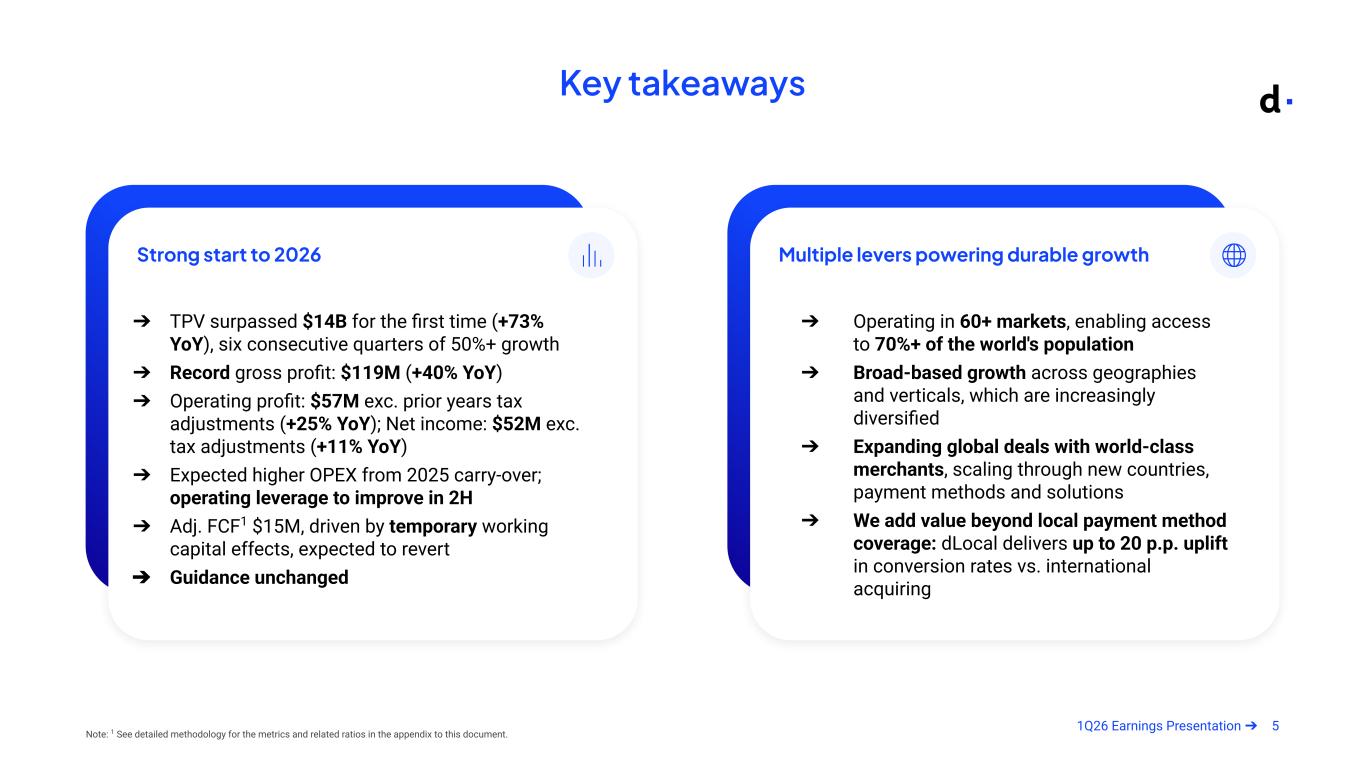
51Q26 Earnings Presentation ➔ Key takeaways Note: 1 See detailed methodology for the metrics and related ratios in the appendix to this document. Strong start to 2026 ➔ TPV surpassed $14B for the first time (+73% YoY), six consecutive quarters of 50%+ growth ➔ Record gross profit: $119M (+40% YoY) ➔ Operating profit: $57M exc. prior years tax adjustments (+25% YoY); Net income: $52M exc. tax adjustments (+11% YoY) ➔ Expected higher OPEX from 2025 carry-over; operating leverage to improve in 2H ➔ Adj. FCF1 $15M, driven by temporary working capital effects, expected to revert ➔ Guidance unchanged Multiple levers powering durable growth ➔ Operating in 60+ markets, enabling access to 70%+ of the world's population ➔ Broad-based growth across geographies and verticals, which are increasingly diversified ➔ Expanding global deals with world-class merchants, scaling through new countries, payment methods and solutions ➔ We add value beyond local payment method coverage: dLocal delivers up to 20 p.p. uplift in conversion rates vs. international acquiring

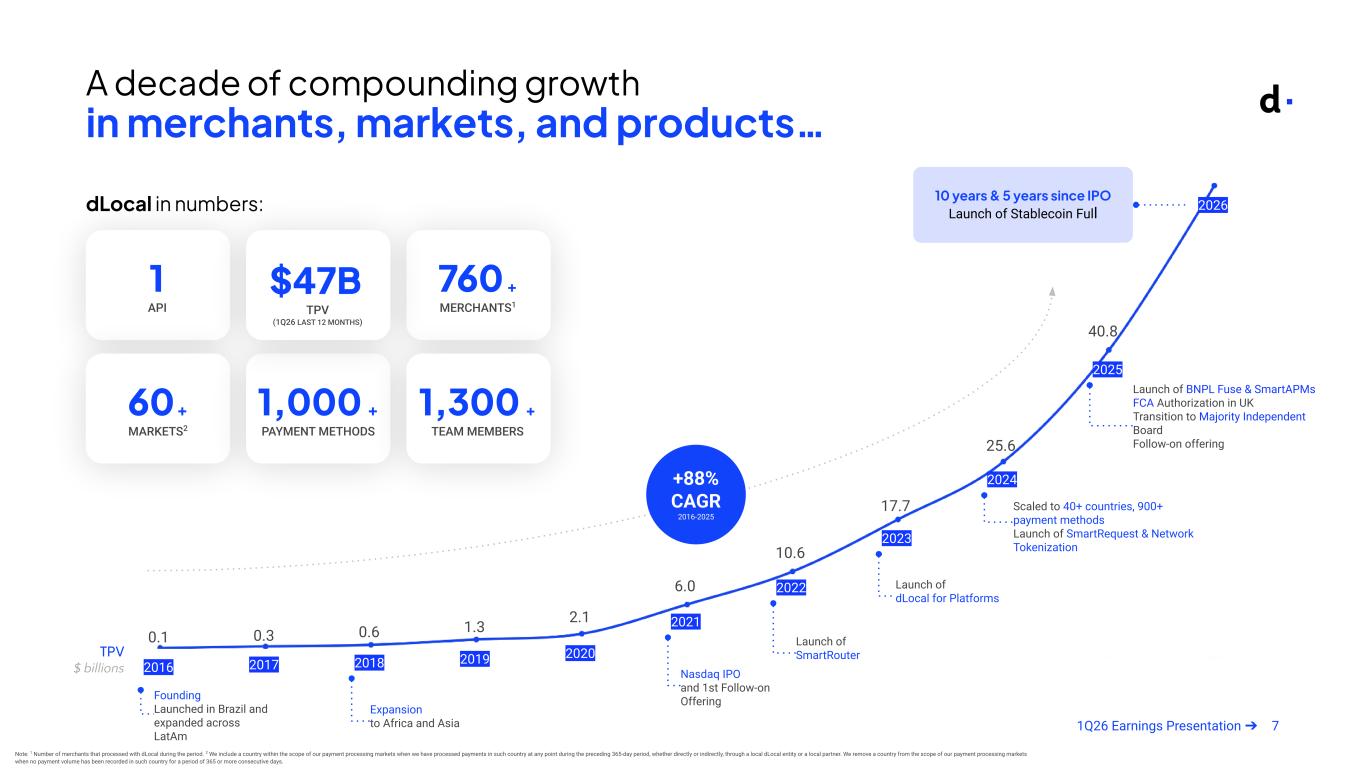
71Q26 Earnings Presentation ➔ 2016 2017 2018 2019 2020 2021 2022 2023 2024 2025 2026 Founding Launched in Brazil and expanded across LatAm Expansion to Africa and Asia Nasdaq IPO and 1st Follow-on Offering Launch of SmartRouter Launch of dLocal for Platforms Scaled to 40+ countries, 900+ payment methods Launch of SmartRequest & Network Tokenization Launch of BNPL Fuse & SmartAPMs FCA Authorization in UK Transition to Majority Independent Board Follow-on offering A decade of compounding growth in merchants, markets, and products… 0.1 40.8 10 years & 5 years since IPO Launch of Stablecoin Full 0.3 0.6 1.3 2.1 17.7 25.6 10.6 6.0 TPV $ billions +88% CAGR 2016-2025 dLocal in numbers: 60+ MARKETS2 1,000 + PAYMENT METHODS 1,300 + TEAM MEMBERS 121 API $47B TPV (1Q26 LAST 12 MONTHS) 760 + MERCHANTS1 Note: 1 Number of merchants that processed with dLocal during the period. 2 We include a country within the scope of our payment processing markets when we have processed payments in such country at any point during the preceding 365-day period, whether directly or indirectly, through a local dLocal entity or a local partner. We remove a country from the scope of our payment processing markets when no payment volume has been recorded in such country for a period of 365 or more consecutive days.
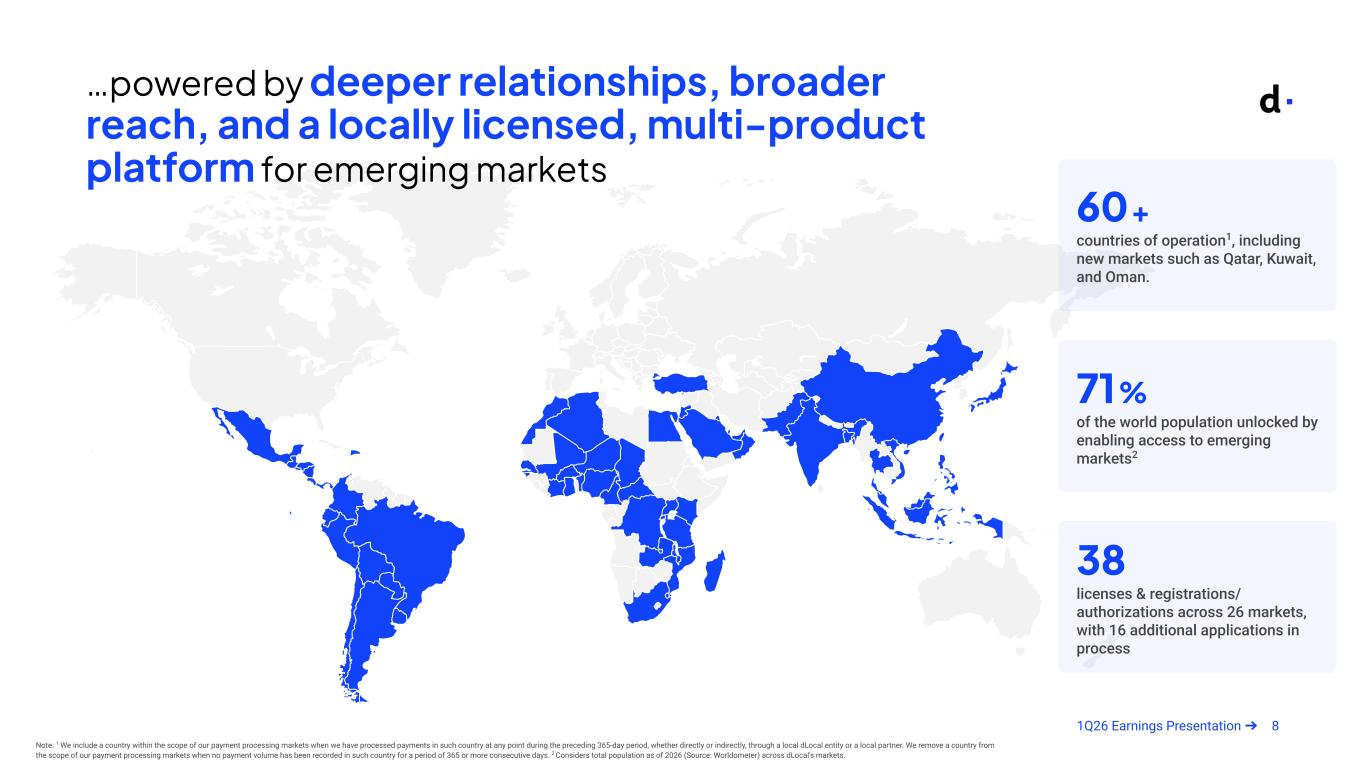
81Q26 Earnings Presentation ➔ …powered by deeper relationships, broader reach, and a locally licensed, multi-product platform for emerging markets Note: 1 We include a country within the scope of our payment processing markets when we have processed payments in such country at any point during the preceding 365-day period, whether directly or indirectly, through a local dLocal entity or a local partner. We remove a country from the scope of our payment processing markets when no payment volume has been recorded in such country for a period of 365 or more consecutive days. 2 Considers total population as of 2026 (Source: Worldometer) across dLocal's markets. 60+ countries of operation1, including new markets such as Qatar, Kuwait, and Oman. 71% of the world population unlocked by enabling access to emerging markets2 38 licenses & registrations/ authorizations across 26 markets, with 16 additional applications in process
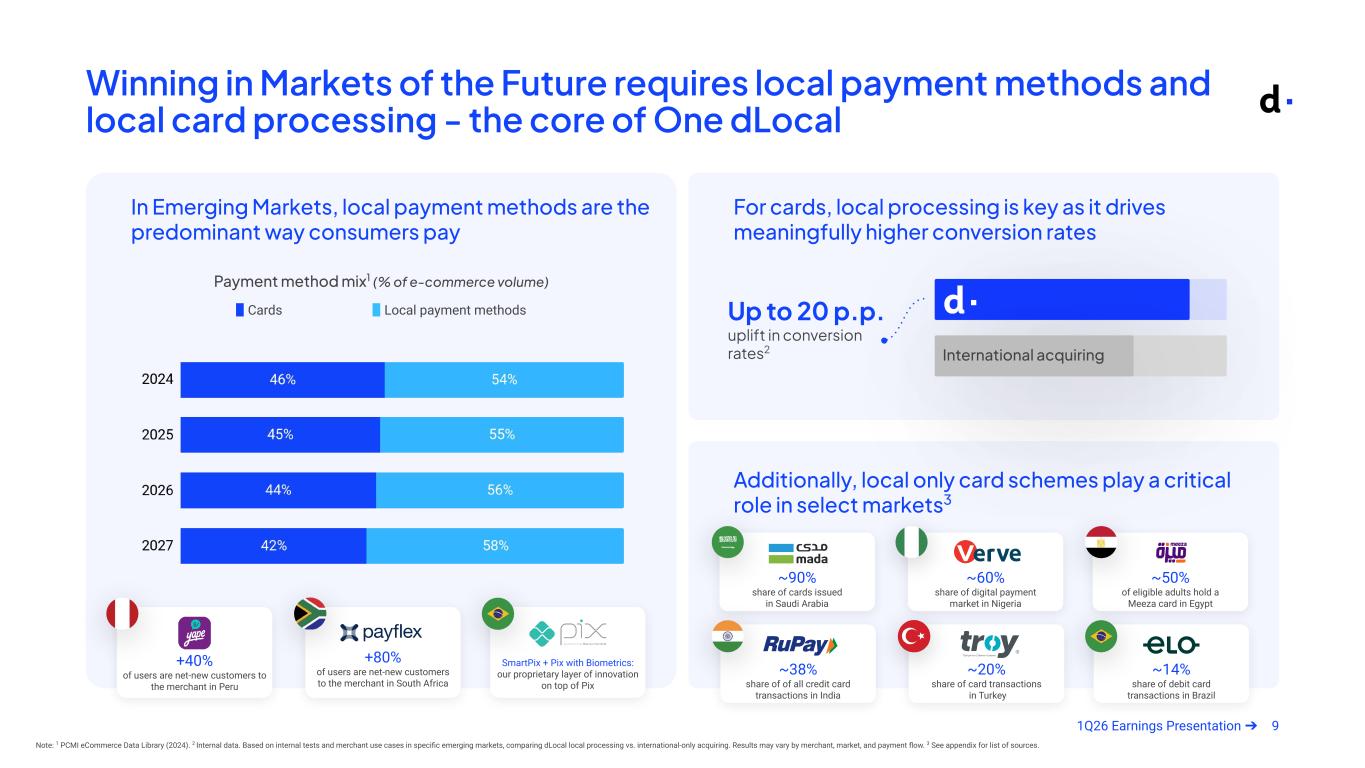
91Q26 Earnings Presentation ➔ Winning in Markets of the Future requires local payment methods and local card processing - the core of One dLocal Note: 1 PCMI eCommerce Data Library (2024). 2 Internal data. Based on internal tests and merchant use cases in specific emerging markets, comparing dLocal local processing vs. international-only acquiring. Results may vary by merchant, market, and payment flow. 3 See appendix for list of sources. Payment method mix1 (% of e-commerce volume) ▉ Cards ▉ Local payment methods In Emerging Markets, local payment methods are the predominant way consumers pay For cards, local processing is key as it drives meaningfully higher conversion rates Additionally, local only card schemes play a critical role in select markets3 Up to 20 p.p. uplift in conversion rates2 ~90% share of cards issued in Saudi Arabia ~60% share of digital payment market in Nigeria ~50% of eligible adults hold a Meeza card in Egypt +40% of users are net-new customers to the merchant in Peru +80% of users are net-new customers to the merchant in South Africa SmartPix + Pix with Biometrics: our proprietary layer of innovation on top of Pix International acquiring ~38% share of of all credit card transactions in India ~20% share of card transactions in Turkey ~14% share of debit card transactions in Brazil
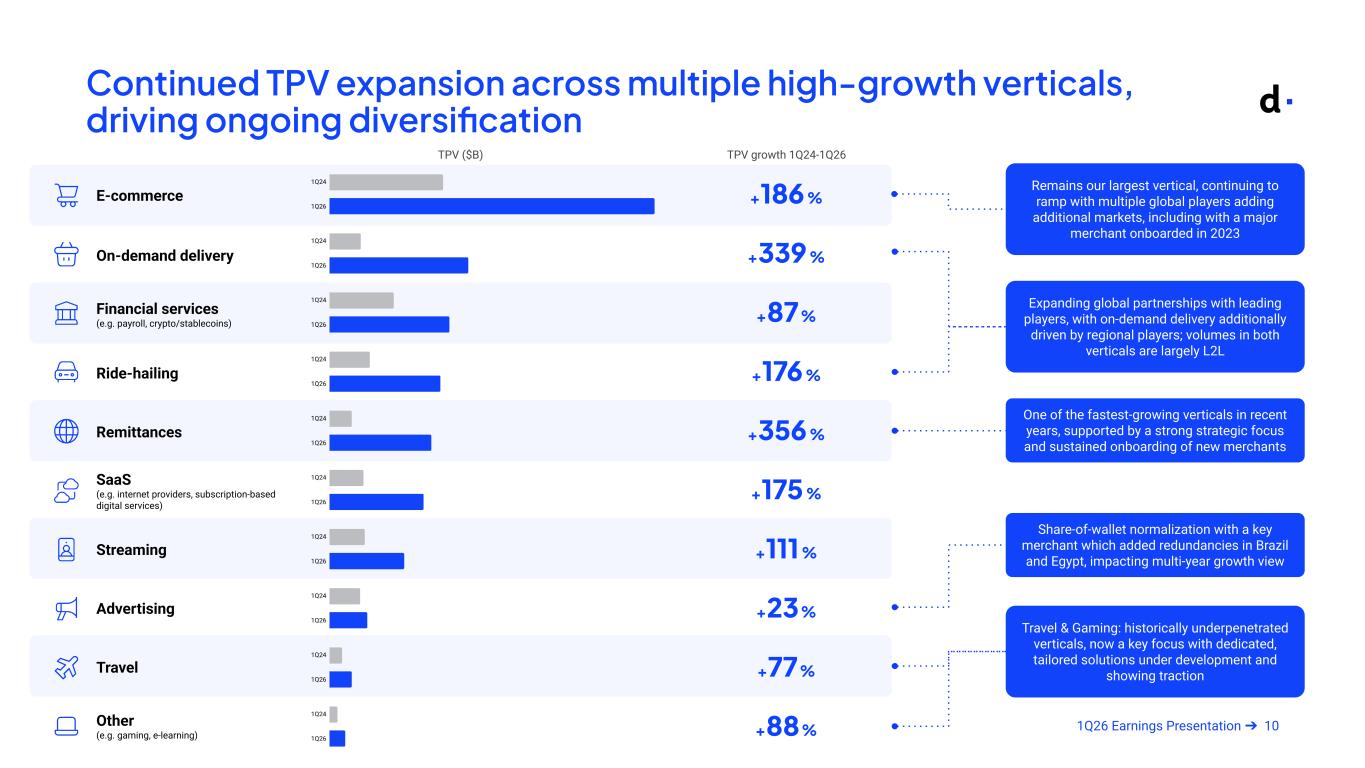
101Q26 Earnings Presentation ➔ Continued TPV expansion across multiple high-growth verticals, driving ongoing diversification E-commerce On-demand delivery Financial services (e.g. payroll, crypto/stablecoins) Ride-hailing Remittances SaaS (e.g. internet providers, subscription-based digital services) Streaming Advertising Travel Other (e.g. gaming, e-learning) TPV growth 1Q24-1Q26 +186% +339% +87% +176% +356% +175% +111% +23% +77% +88% One of the fastest-growing verticals in recent years, supported by a strong strategic focus and sustained onboarding of new merchants Remains our largest vertical, continuing to ramp with multiple global players adding additional markets, including with a major merchant onboarded in 2023 Expanding global partnerships with leading players, with on-demand delivery additionally driven by regional players; volumes in both verticals are largely L2L Travel & Gaming: historically underpenetrated verticals, now a key focus with dedicated, tailored solutions under development and showing traction TPV ($B) Share-of-wallet normalization with a key merchant which added redundancies in Brazil and Egypt, impacting multi-year growth view
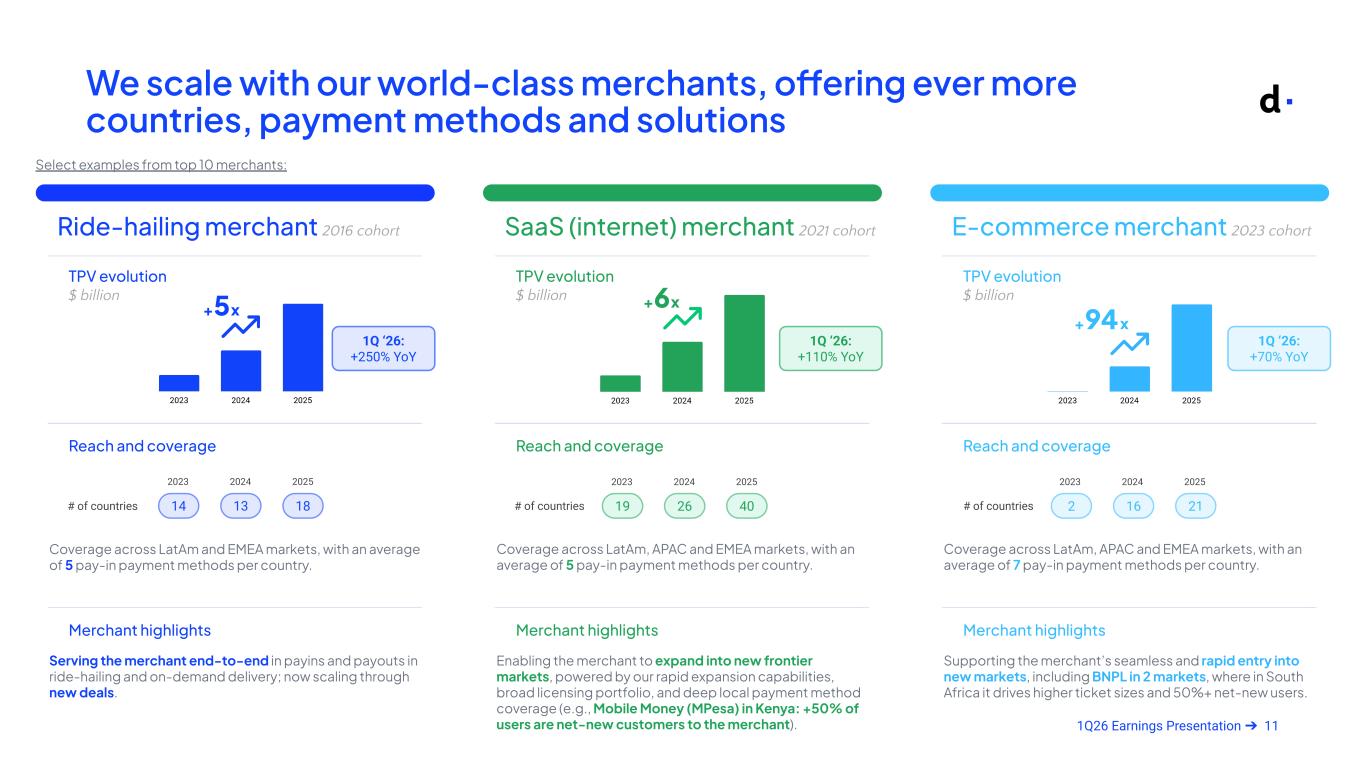
111Q26 Earnings Presentation ➔ Ride-hailing merchant 2016 cohort TPV evolution $ billion Reach and coverage Merchant highlights # of countries 14 13 18 Serving the merchant end-to-end in payins and payouts in ride-hailing and on-demand delivery; now scaling through new deals. Coverage across LatAm and EMEA markets, with an average of 5 pay-in payment methods per country. We scale with our world-class merchants, offering ever more countries, payment methods and solutions E-commerce merchant 2023 cohort TPV evolution $ billion Reach and coverage Merchant highlights # of countries 2 16 21 Supporting the merchant’s seamless and rapid entry into new markets, including BNPL in 2 markets, where in South Africa it drives higher ticket sizes and 50%+ net-new users. Coverage across LatAm, APAC and EMEA markets, with an average of 7 pay-in payment methods per country. SaaS (internet) merchant 2021 cohort TPV evolution $ billion Reach and coverage Merchant highlights # of countries 19 26 40 Enabling the merchant to expand into new frontier markets, powered by our rapid expansion capabilities, broad licensing portfolio, and deep local payment method coverage (e.g., Mobile Money (MPesa) in Kenya: +50% of users are net-new customers to the merchant). Coverage across LatAm, APAC and EMEA markets, with an average of 5 pay-in payment methods per country. +5x 1Q ‘26: +250% YoY +94x 1Q ‘26: +70% YoY 1Q ‘26: +110% YoY +6x 2023 2024 20252023 2024 2025 2023 2024 2025 Select examples from top 10 merchants:

121Q26 Earnings Presentation ➔ Financial Highlights
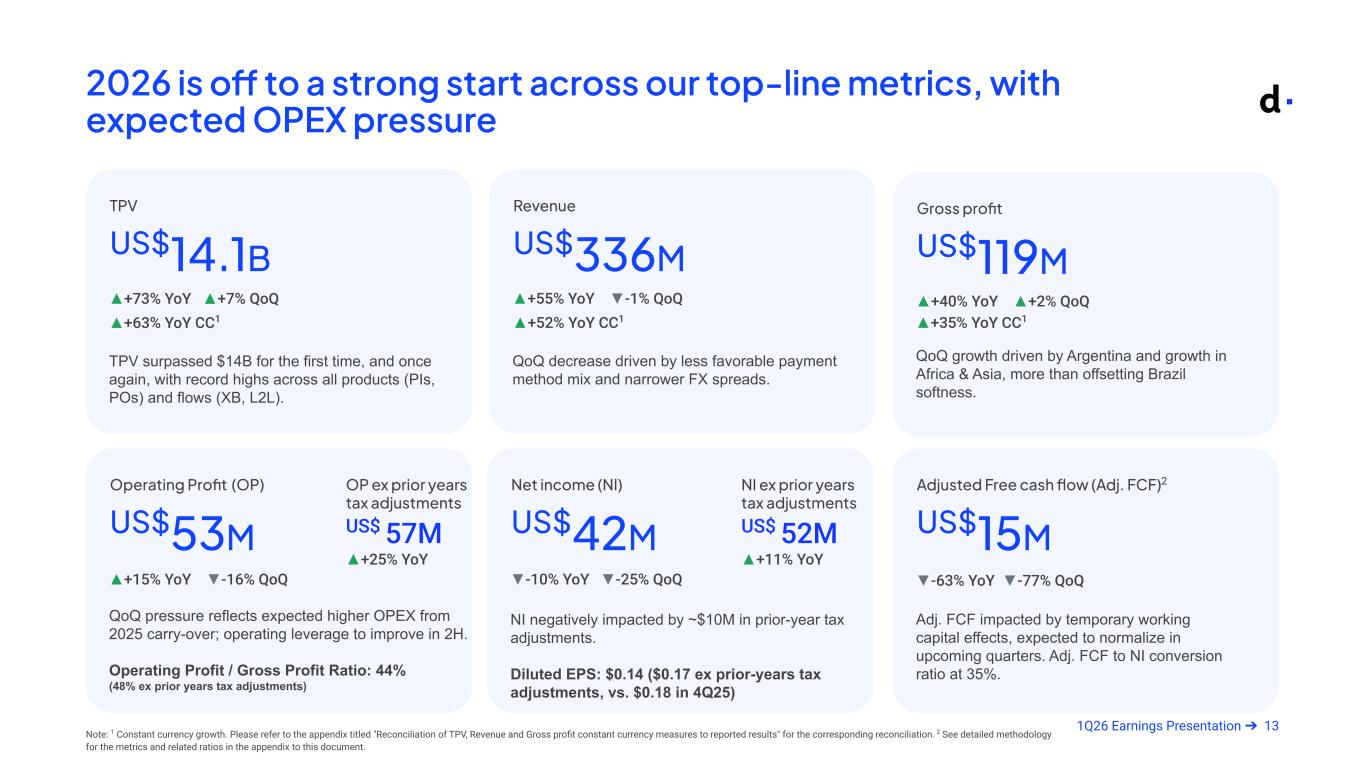
131Q26 Earnings Presentation ➔ 2026 is off to a strong start across our top-line metrics, with expected OPEX pressure TPV surpassed $14B for the first time, and once again, with record highs across all products (PIs, POs) and flows (XB, L2L). US$14.1B ▲+73% YoY ▲+7% QoQ TPV Adj. FCF impacted by temporary working capital effects, expected to normalize in upcoming quarters. Adj. FCF to NI conversion ratio at 35%. US$15M ▼-63% YoY ▼-77% QoQ Adjusted Free cash flow (Adj. FCF)2 QoQ pressure reflects expected higher OPEX from 2025 carry-over; operating leverage to improve in 2H. Operating Profit / Gross Profit Ratio: 44% (48% ex prior years tax adjustments) US$53M ▲+15% YoY ▼-16% QoQ Operating Profit (OP) QoQ growth driven by Argentina and growth in Africa & Asia, more than offsetting Brazil softness. US$119M ▲+40% YoY ▲+2% QoQ Gross profit NI negatively impacted by ~$10M in prior-year tax adjustments. Diluted EPS: $0.14 ($0.17 ex prior-years tax adjustments, vs. $0.18 in 4Q25) US$42M ▼-10% YoY ▼-25% QoQ Net income (NI) QoQ decrease driven by less favorable payment method mix and narrower FX spreads. US$336M ▲+55% YoY ▼-1% QoQ Revenue ▲+63% YoY CC1 ▲+52% YoY CC1 ▲+35% YoY CC1 Note: 1 Constant currency growth. Please refer to the appendix titled "Reconciliation of TPV, Revenue and Gross profit constant currency measures to reported results" for the corresponding reconciliation. 2 See detailed methodology for the metrics and related ratios in the appendix to this document. NI ex prior years tax adjustments US$ 52M ▲+11% YoY OP ex prior years tax adjustments US$ 57M ▲+25% YoY Armado May 7 @ 8pm
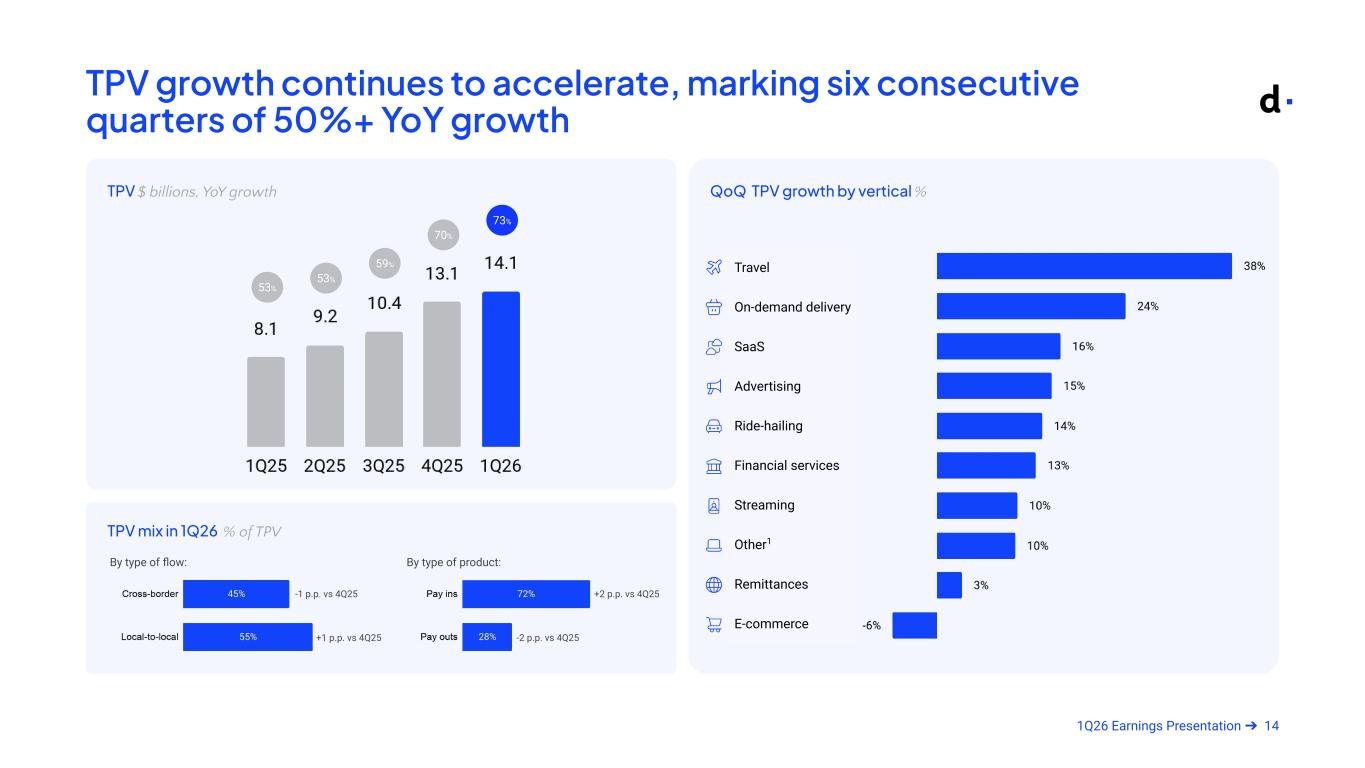
141Q26 Earnings Presentation ➔ TPV growth continues to accelerate, marking six consecutive quarters of 50%+ YoY growth TPV $ billions, YoY growth QoQ TPV growth by vertical % TPV mix in 1Q26 % of TPV 73% 70% 53% 53% 59% Travel On-demand delivery SaaS Advertising Ride-hailing Financial services Streaming Other1 Remittances E-commerce By type of product:By type of flow: +2 p.p. vs 4Q25 -2 p.p. vs 4Q25 -1 p.p. vs 4Q25 +1 p.p. vs 4Q25
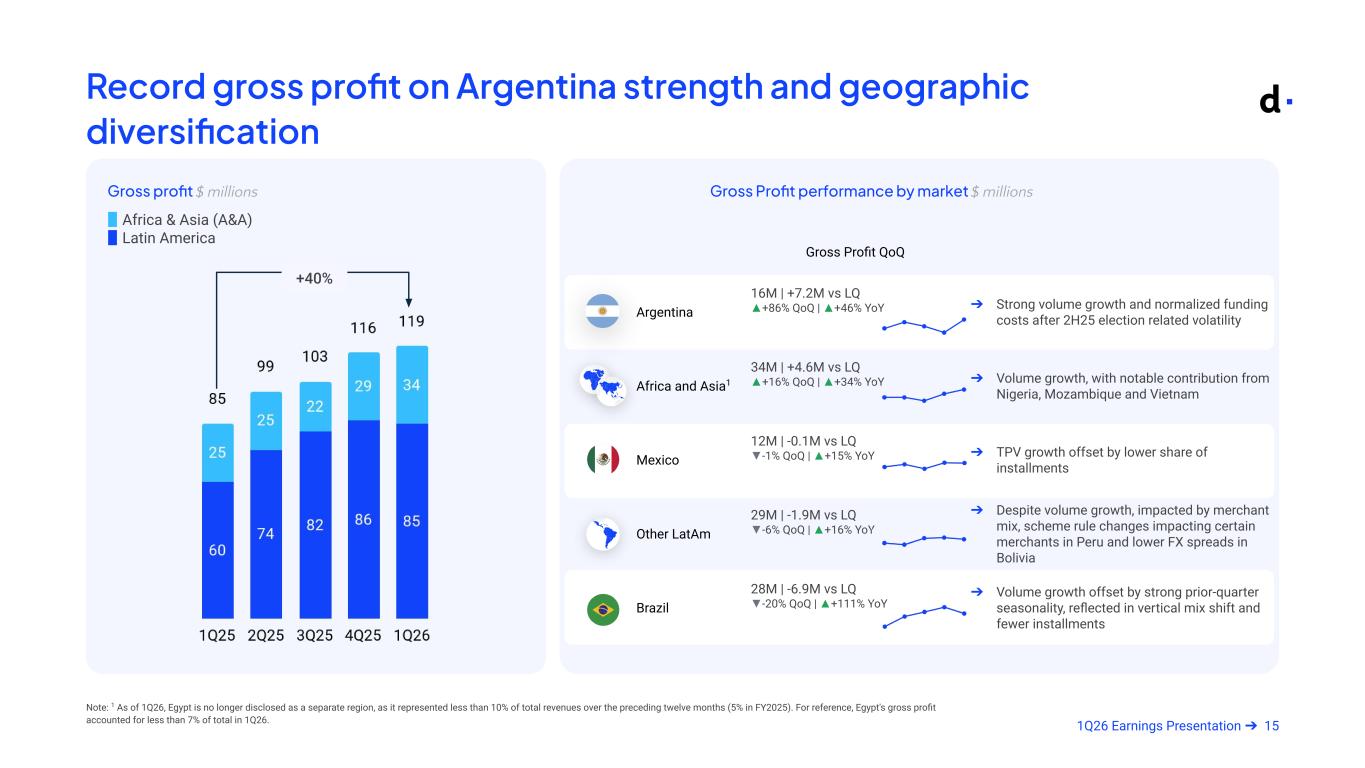
151Q26 Earnings Presentation ➔ Record gross profit on Argentina strength and geographic diversification Note: 1 As of 1Q26, Egypt is no longer disclosed as a separate region, as it represented less than 10% of total revenues over the preceding twelve months (5% in FY2025). For reference, Egypt's gross profit accounted for less than 7% of total in 1Q26. Armado May 7 @ 8pm Gross profit $ millions ▉ Africa & Asia (A&A) ▉ Latin America Gross Profit performance by market $ millions Gross Profit QoQ Argentina 16M | +7.2M vs LQ ▲+86% QoQ | ▲+46% YoY ➔ Strong volume growth and normalized funding costs after 2H25 election related volatility Africa and Asia1 34M | +4.6M vs LQ ▲+16% QoQ | ▲+34% YoY ➔ Volume growth, with notable contribution from Nigeria, Mozambique and Vietnam Mexico 12M | -0.1M vs LQ ▼-1% QoQ | ▲+15% YoY ➔ TPV growth offset by lower share of installments Other LatAm 29M | -1.9M vs LQ ▼-6% QoQ | ▲+16% YoY ➔ Despite volume growth, impacted by merchant mix, scheme rule changes impacting certain merchants in Peru and lower FX spreads in Bolivia Brazil 28M | -6.9M vs LQ ▼-20% QoQ | ▲+111% YoY ➔ Volume growth offset by strong prior-quarter seasonality, reflected in vertical mix shift and fewer installments +40%
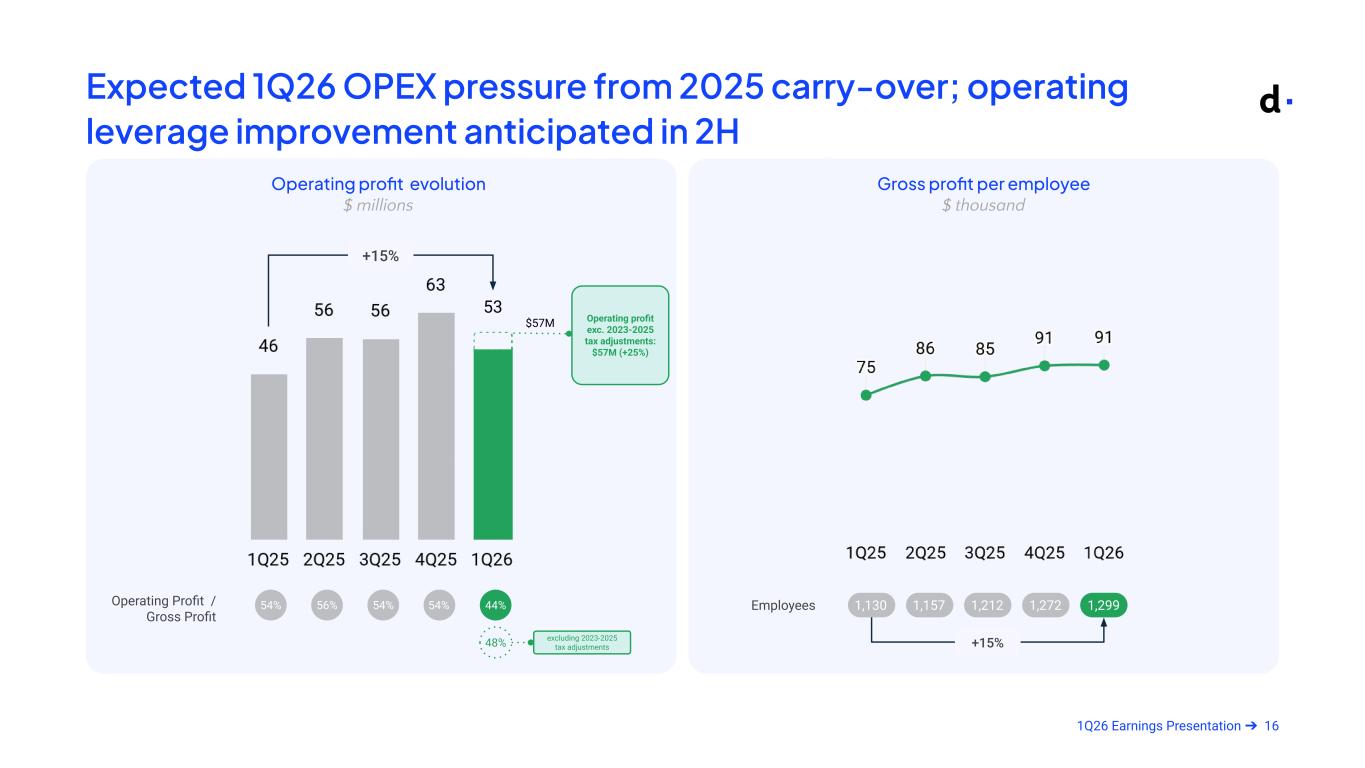
161Q26 Earnings Presentation ➔ Expected 1Q26 OPEX pressure from 2025 carry-over; operating leverage improvement anticipated in 2H Operating profit evolution $ millions 44%54%54% 56% 54%Operating Profit / Gross Profit Gross profit per employee $ thousand +15% Armado Apr 30Armado May 7 @ 8pm 53 Operating profit exc. 2023-2025 tax adjustments: $57M (+25%) 48% excluding 2023-2025 tax adjustments Employees 1,130 1,157 1,212 1,272 1,299 +15% $57M
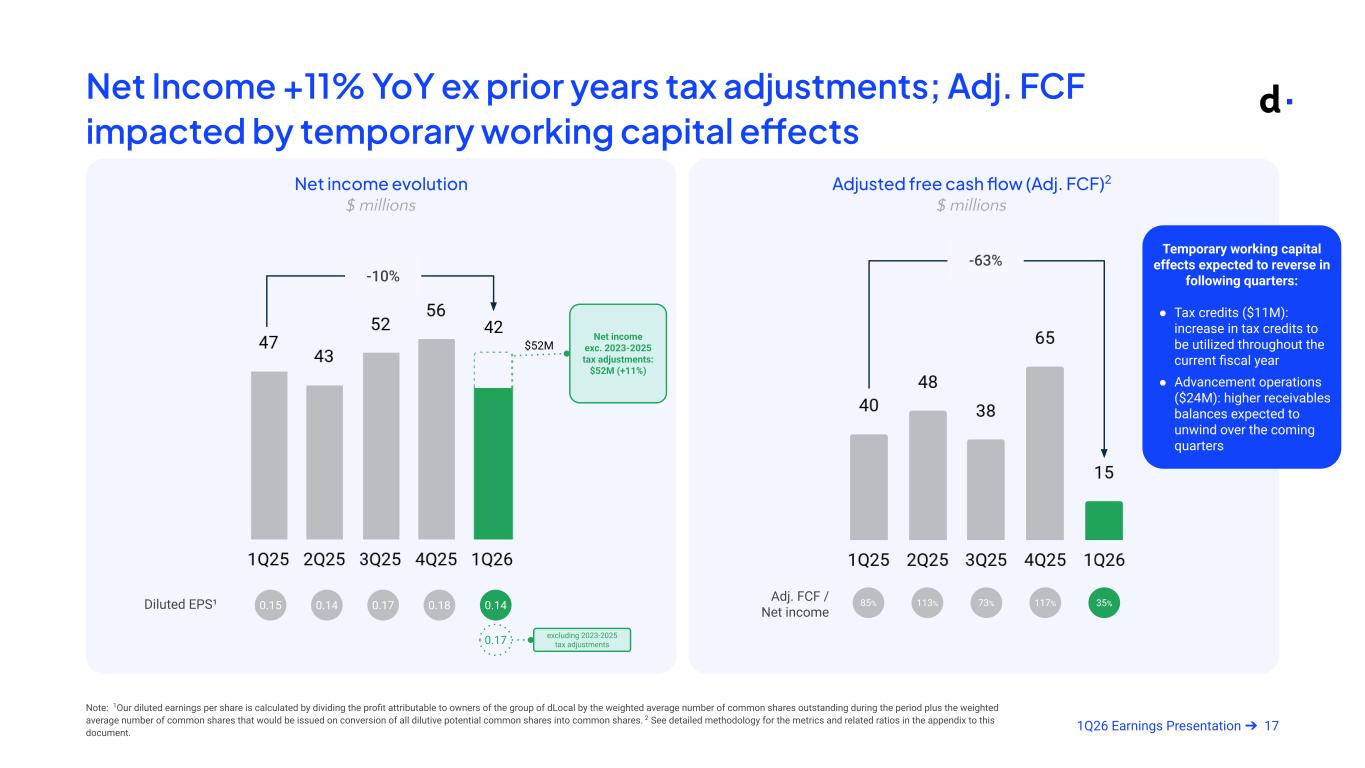
171Q26 Earnings Presentation ➔ Net Income +11% YoY ex prior years tax adjustments; Adj. FCF impacted by temporary working capital effects Net income evolution $ millions Diluted EPS¹ 0.140.180.15 0.14 0.17 Note: 1Our diluted earnings per share is calculated by dividing the profit attributable to owners of the group of dLocal by the weighted average number of common shares outstanding during the period plus the weighted average number of common shares that would be issued on conversion of all dilutive potential common shares into common shares. 2 See detailed methodology for the metrics and related ratios in the appendix to this document. -10% Adj. FCF / Net income 35%117%85% 113% 73% Adjusted free cash flow (Adj. FCF)2 $ millions -63% 42 Armado May 7 @ 8pm 0.17 excluding 2023-2025 tax adjustments Temporary working capital effects expected to reverse in following quarters: ● Tax credits ($11M): increase in tax credits to be utilized throughout the current fiscal year ● Advancement operations ($24M): higher receivables balances expected to unwind over the coming quarters Net income exc. 2023-2025 tax adjustments: $52M (+11%) $52M
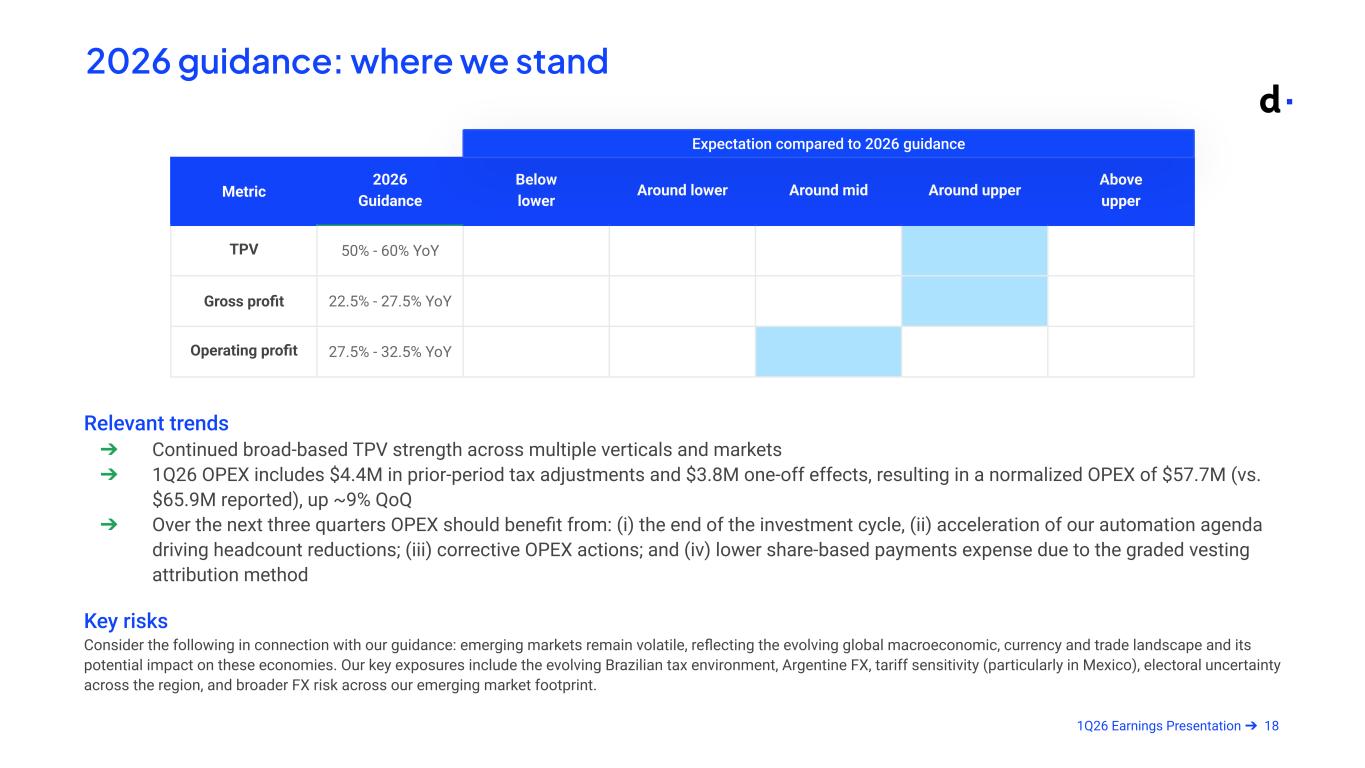
181Q26 Earnings Presentation ➔ Metric 2026 Guidance Below lower Around lower Around mid Around upper Above upper TPV 50% - 60% YoY Gross profit 22.5% - 27.5% YoY Operating profit 27.5% - 32.5% YoY Relevant trends ➔ Continued broad-based TPV strength across multiple verticals and markets ➔ 1Q26 OPEX includes $4.4M in prior-period tax adjustments and $3.8M one-off effects, resulting in a normalized OPEX of $57.7M (vs. $65.9M reported), up ~9% QoQ ➔ Over the next three quarters OPEX should benefit from: (i) the end of the investment cycle, (ii) acceleration of our automation agenda driving headcount reductions; (iii) corrective OPEX actions; and (iv) lower share-based payments expense due to the graded vesting attribution method Key risks Consider the following in connection with our guidance: emerging markets remain volatile, reflecting the evolving global macroeconomic, currency and trade landscape and its potential impact on these economies. Our key exposures include the evolving Brazilian tax environment, Argentine FX, tariff sensitivity (particularly in Mexico), electoral uncertainty across the region, and broader FX risk across our emerging market footprint. Expectation compared to 2026 guidance 2026 guidance: where we stand

191Q26 Earnings Presentation ➔ Q&A

201Q26 Earnings Presentation ➔ Appendix
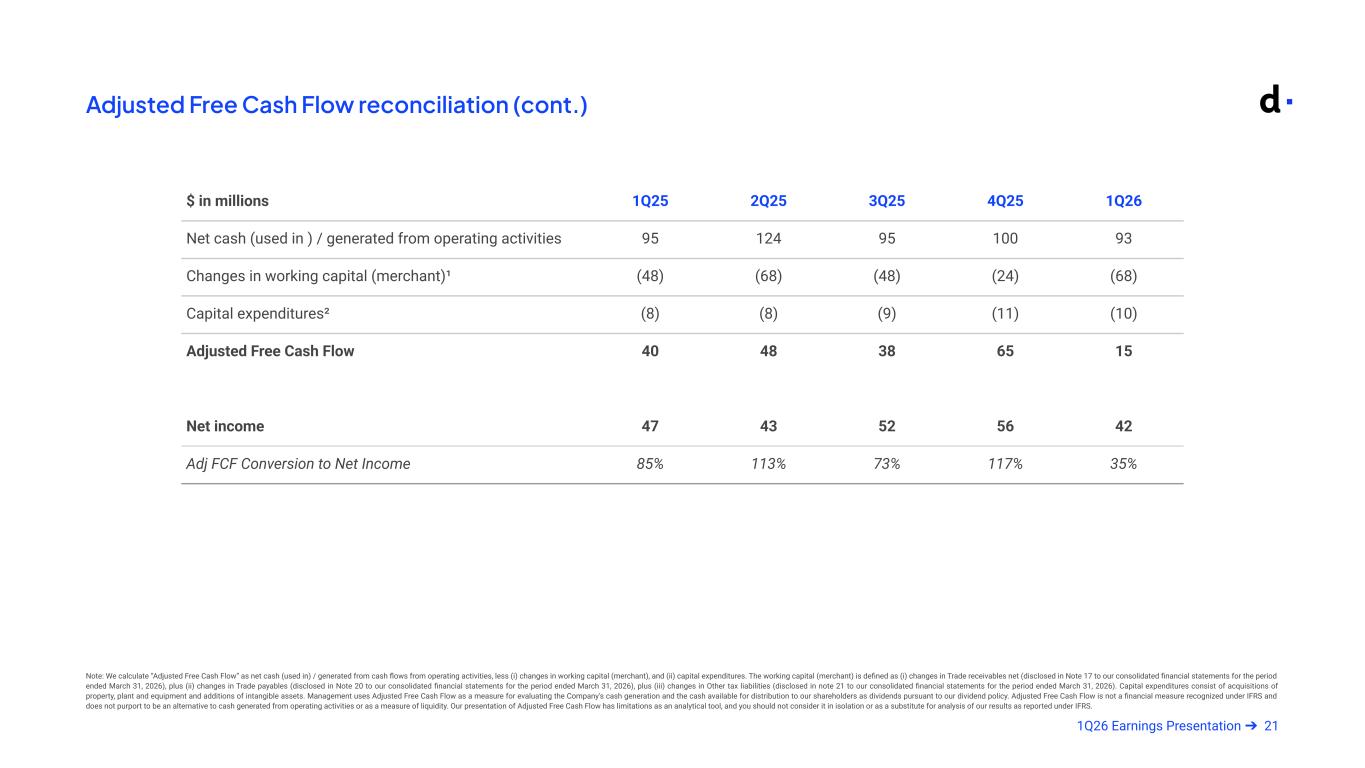
211Q26 Earnings Presentation ➔ Adjusted Free Cash Flow reconciliation (cont.) Note: We calculate “Adjusted Free Cash Flow” as net cash (used in) / generated from cash flows from operating activities, less (i) changes in working capital (merchant), and (ii) capital expenditures. The working capital (merchant) is defined as (i) changes in Trade receivables net (disclosed in Note 17 to our consolidated financial statements for the period ended March 31, 2026), plus (ii) changes in Trade payables (disclosed in Note 20 to our consolidated financial statements for the period ended March 31, 2026), plus (iii) changes in Other tax liabilities (disclosed in note 21 to our consolidated financial statements for the period ended March 31, 2026). Capital expenditures consist of acquisitions of property, plant and equipment and additions of intangible assets. Management uses Adjusted Free Cash Flow as a measure for evaluating the Company's cash generation and the cash available for distribution to our shareholders as dividends pursuant to our dividend policy. Adjusted Free Cash Flow is not a financial measure recognized under IFRS and does not purport to be an alternative to cash generated from operating activities or as a measure of liquidity. Our presentation of Adjusted Free Cash Flow has limitations as an analytical tool, and you should not consider it in isolation or as a substitute for analysis of our results as reported under IFRS. $ in millions 1Q25 2Q25 3Q25 4Q25 1Q26 Net cash (used in ) / generated from operating activities 95 124 95 100 93 Changes in working capital (merchant)¹ (48) (68) (48) (24) (68) Capital expenditures² (8) (8) (9) (11) (10) Adjusted Free Cash Flow 40 48 38 65 15 Net income 47 43 52 56 42 Adj FCF Conversion to Net Income 85% 113% 73% 117% 35% Armado May 7 @ 8pm
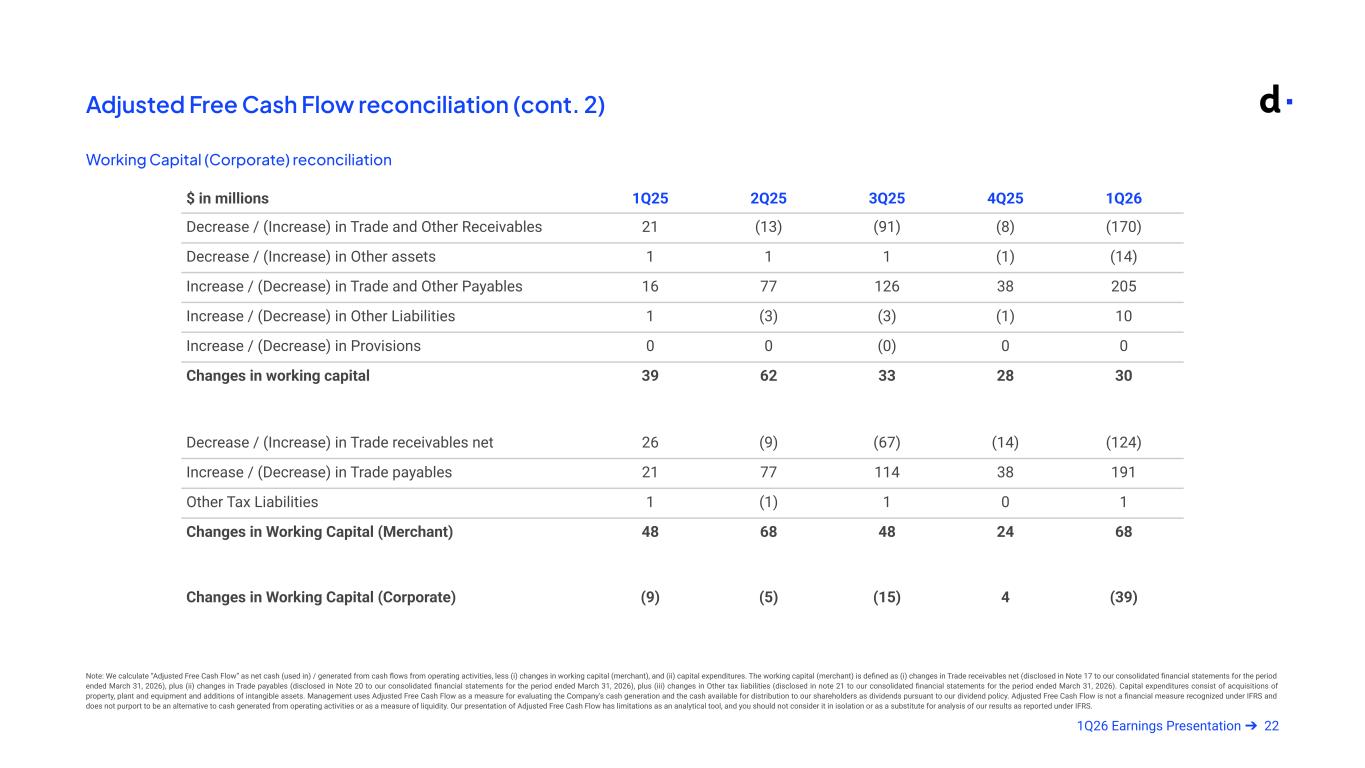
221Q26 Earnings Presentation ➔ Adjusted Free Cash Flow reconciliation (cont. 2) Working Capital (Corporate) reconciliation Note: We calculate “Adjusted Free Cash Flow” as net cash (used in) / generated from cash flows from operating activities, less (i) changes in working capital (merchant), and (ii) capital expenditures. The working capital (merchant) is defined as (i) changes in Trade receivables net (disclosed in Note 17 to our consolidated financial statements for the period ended March 31, 2026), plus (ii) changes in Trade payables (disclosed in Note 20 to our consolidated financial statements for the period ended March 31, 2026), plus (iii) changes in Other tax liabilities (disclosed in note 21 to our consolidated financial statements for the period ended March 31, 2026). Capital expenditures consist of acquisitions of property, plant and equipment and additions of intangible assets. Management uses Adjusted Free Cash Flow as a measure for evaluating the Company's cash generation and the cash available for distribution to our shareholders as dividends pursuant to our dividend policy. Adjusted Free Cash Flow is not a financial measure recognized under IFRS and does not purport to be an alternative to cash generated from operating activities or as a measure of liquidity. Our presentation of Adjusted Free Cash Flow has limitations as an analytical tool, and you should not consider it in isolation or as a substitute for analysis of our results as reported under IFRS. $ in millions 1Q25 2Q25 3Q25 4Q25 1Q26 Decrease / (Increase) in Trade and Other Receivables 21 (13) (91) (8) (170) Decrease / (Increase) in Other assets 1 1 1 (1) (14) Increase / (Decrease) in Trade and Other Payables 16 77 126 38 205 Increase / (Decrease) in Other Liabilities 1 (3) (3) (1) 10 Increase / (Decrease) in Provisions 0 0 (0) 0 0 Changes in working capital 39 62 33 28 30 Decrease / (Increase) in Trade receivables net 26 (9) (67) (14) (124) Increase / (Decrease) in Trade payables 21 77 114 38 191 Other Tax Liabilities 1 (1) 1 0 1 Changes in Working Capital (Merchant) 48 68 48 24 68 Changes in Working Capital (Corporate) (9) (5) (15) 4 (39) Armado May 7 @ 8pm
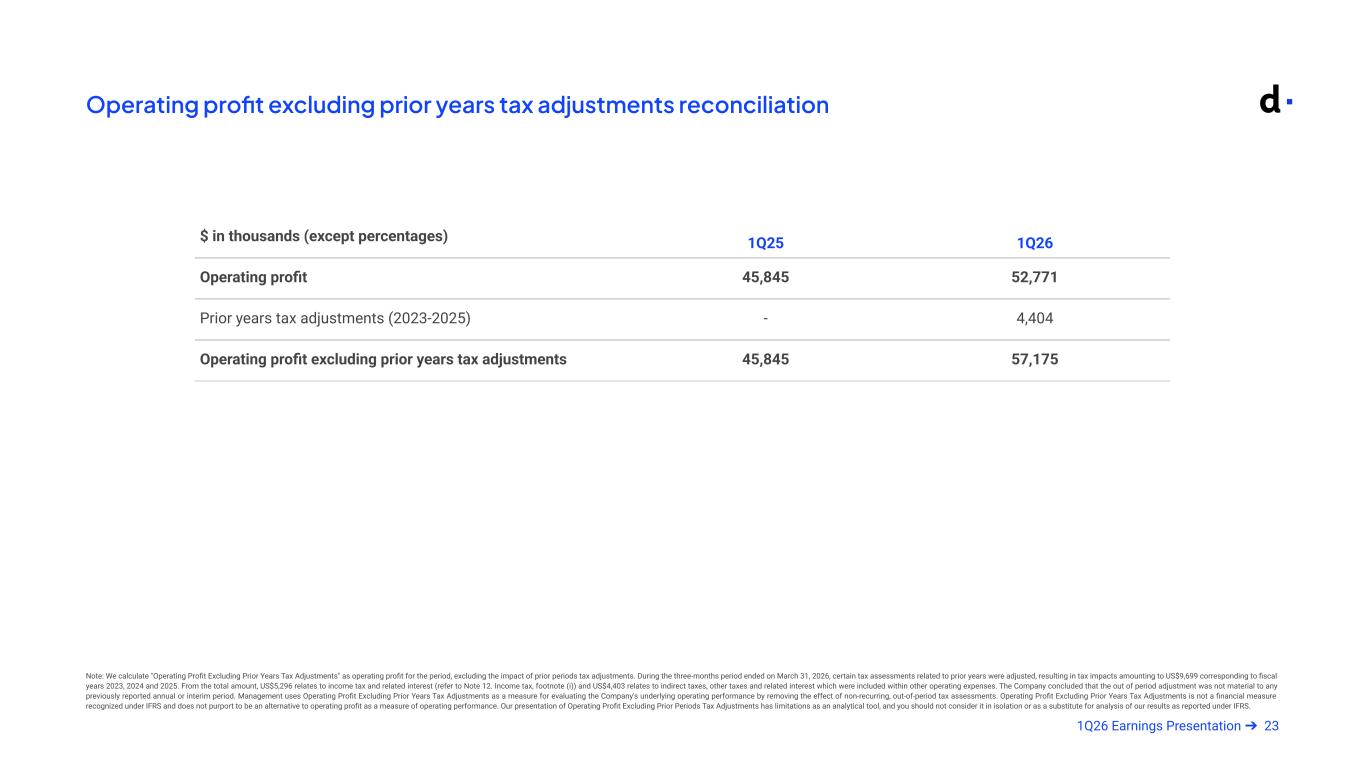
231Q26 Earnings Presentation ➔ Operating profit excluding prior years tax adjustments reconciliation Note: We calculate "Operating Profit Excluding Prior Years Tax Adjustments" as operating profit for the period, excluding the impact of prior periods tax adjustments. During the three-months period ended on March 31, 2026, certain tax assessments related to prior years were adjusted, resulting in tax impacts amounting to US$9,699 corresponding to fiscal years 2023, 2024 and 2025. From the total amount, US$5,296 relates to income tax and related interest (refer to Note 12. Income tax, footnote (i)) and US$4,403 relates to indirect taxes, other taxes and related interest which were included within other operating expenses. The Company concluded that the out of period adjustment was not material to any previously reported annual or interim period. Management uses Operating Profit Excluding Prior Years Tax Adjustments as a measure for evaluating the Company's underlying operating performance by removing the effect of non-recurring, out-of-period tax assessments. Operating Profit Excluding Prior Years Tax Adjustments is not a financial measure recognized under IFRS and does not purport to be an alternative to operating profit as a measure of operating performance. Our presentation of Operating Profit Excluding Prior Periods Tax Adjustments has limitations as an analytical tool, and you should not consider it in isolation or as a substitute for analysis of our results as reported under IFRS. $ in thousands (except percentages) 1Q25 1Q26 Operating profit 45,845 52,771 Prior years tax adjustments (2023-2025) - 4,404 Operating profit excluding prior years tax adjustments 45,845 57,175
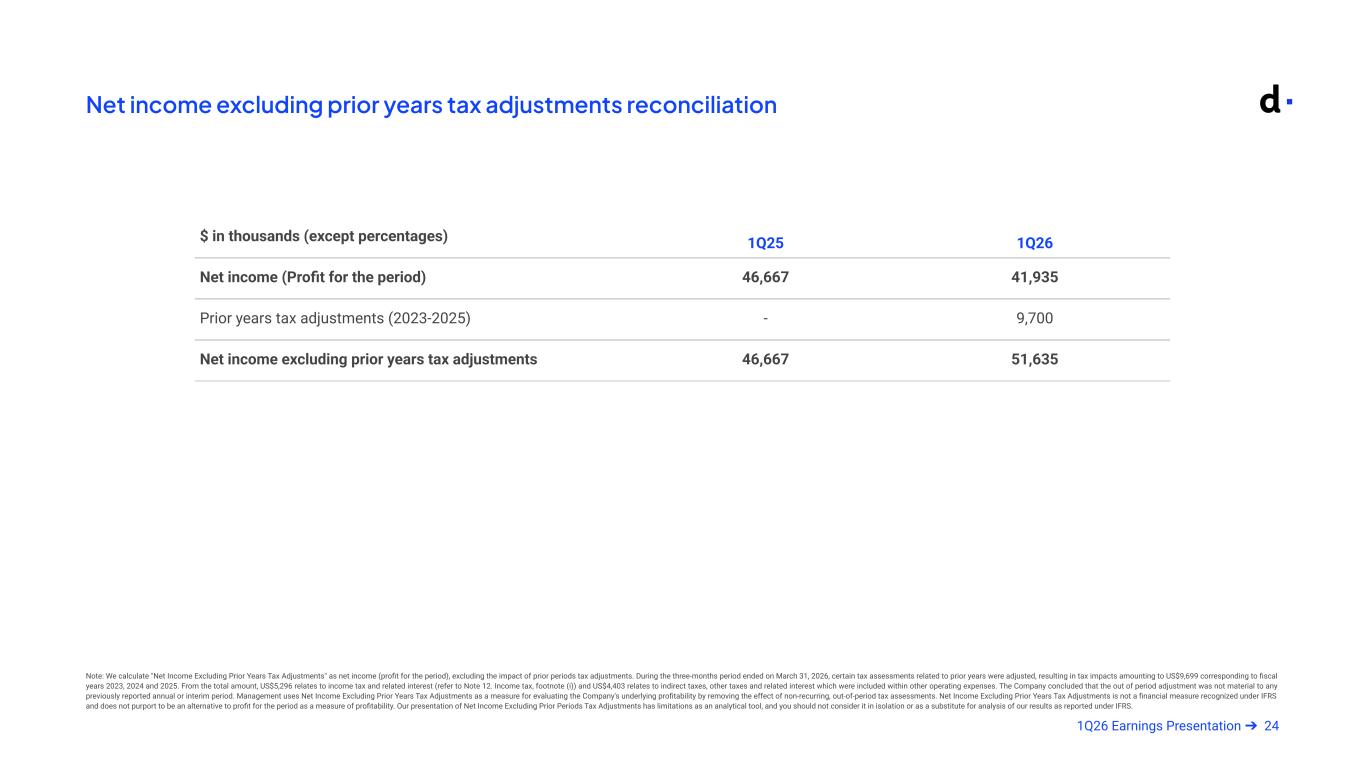
241Q26 Earnings Presentation ➔ Net income excluding prior years tax adjustments reconciliation $ in thousands (except percentages) 1Q25 1Q26 Net income (Profit for the period) 46,667 41,935 Prior years tax adjustments (2023-2025) - 9,700 Net income excluding prior years tax adjustments 46,667 51,635 Note: We calculate "Net Income Excluding Prior Years Tax Adjustments" as net income (profit for the period), excluding the impact of prior periods tax adjustments. During the three-months period ended on March 31, 2026, certain tax assessments related to prior years were adjusted, resulting in tax impacts amounting to US$9,699 corresponding to fiscal years 2023, 2024 and 2025. From the total amount, US$5,296 relates to income tax and related interest (refer to Note 12. Income tax, footnote (i)) and US$4,403 relates to indirect taxes, other taxes and related interest which were included within other operating expenses. The Company concluded that the out of period adjustment was not material to any previously reported annual or interim period. Management uses Net Income Excluding Prior Years Tax Adjustments as a measure for evaluating the Company's underlying profitability by removing the effect of non-recurring, out-of-period tax assessments. Net Income Excluding Prior Years Tax Adjustments is not a financial measure recognized under IFRS and does not purport to be an alternative to profit for the period as a measure of profitability. Our presentation of Net Income Excluding Prior Periods Tax Adjustments has limitations as an analytical tool, and you should not consider it in isolation or as a substitute for analysis of our results as reported under IFRS.
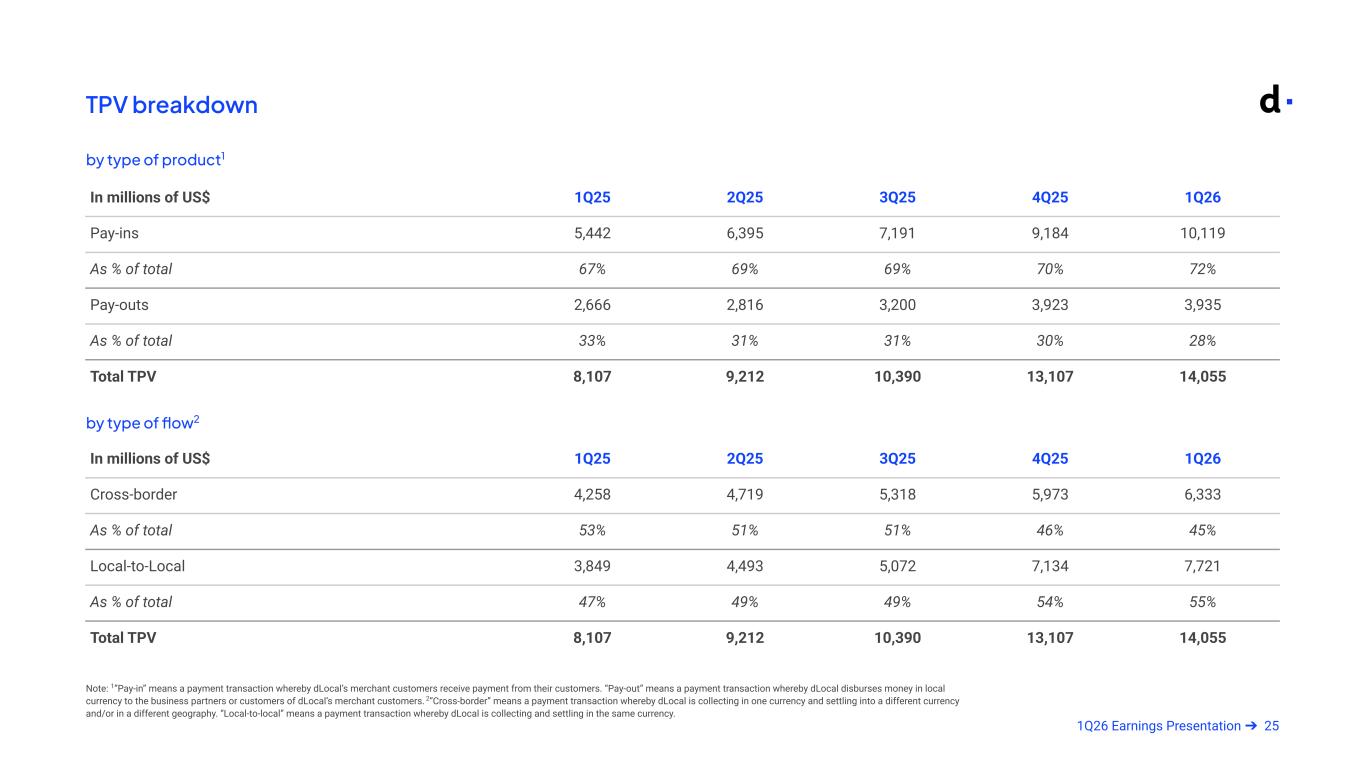
251Q26 Earnings Presentation ➔ TPV breakdown Note: 1”Pay-in” means a payment transaction whereby dLocal’s merchant customers receive payment from their customers. “Pay-out” means a payment transaction whereby dLocal disburses money in local currency to the business partners or customers of dLocal’s merchant customers. 2“Cross-border” means a payment transaction whereby dLocal is collecting in one currency and settling into a different currency and/or in a different geography. “Local-to-local” means a payment transaction whereby dLocal is collecting and settling in the same currency. by type of product1 by type of flow2 In millions of US$ 1Q25 2Q25 3Q25 4Q25 1Q26 Pay-ins 5,442 6,395 7,191 9,184 10,119 As % of total 67% 69% 69% 70% 72% Pay-outs 2,666 2,816 3,200 3,923 3,935 As % of total 33% 31% 31% 30% 28% Total TPV 8,107 9,212 10,390 13,107 14,055 In millions of US$ 1Q25 2Q25 3Q25 4Q25 1Q26 Cross-border 4,258 4,719 5,318 5,973 6,333 As % of total 53% 51% 51% 46% 45% Local-to-Local 3,849 4,493 5,072 7,134 7,721 As % of total 47% 49% 49% 54% 55% Total TPV 8,107 9,212 10,390 13,107 14,055
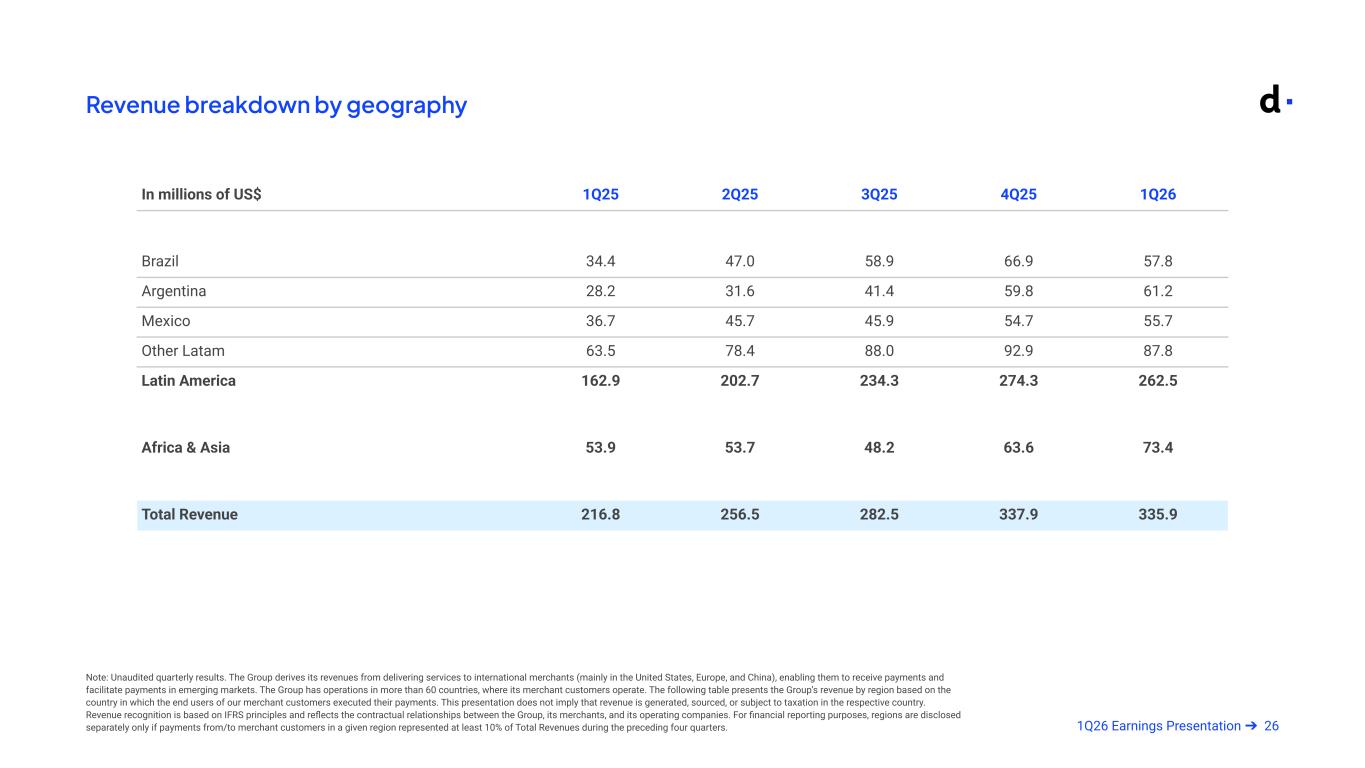
261Q26 Earnings Presentation ➔ Revenue breakdown by geography Note: Unaudited quarterly results. The Group derives its revenues from delivering services to international merchants (mainly in the United States, Europe, and China), enabling them to receive payments and facilitate payments in emerging markets. The Group has operations in more than 60 countries, where its merchant customers operate. The following table presents the Group’s revenue by region based on the country in which the end users of our merchant customers executed their payments. This presentation does not imply that revenue is generated, sourced, or subject to taxation in the respective country. Revenue recognition is based on IFRS principles and reflects the contractual relationships between the Group, its merchants, and its operating companies. For financial reporting purposes, regions are disclosed separately only if payments from/to merchant customers in a given region represented at least 10% of Total Revenues during the preceding four quarters. Armado May 7 @ 8pm In millions of US$ 1Q25 2Q25 3Q25 4Q25 1Q26 Brazil 34.4 47.0 58.9 66.9 57.8 Argentina 28.2 31.6 41.4 59.8 61.2 Mexico 36.7 45.7 45.9 54.7 55.7 Other Latam 63.5 78.4 88.0 92.9 87.8 Latin America 162.9 202.7 234.3 274.3 262.5 Africa & Asia 53.9 53.7 48.2 63.6 73.4 Total Revenue 216.8 256.5 282.5 337.9 335.9
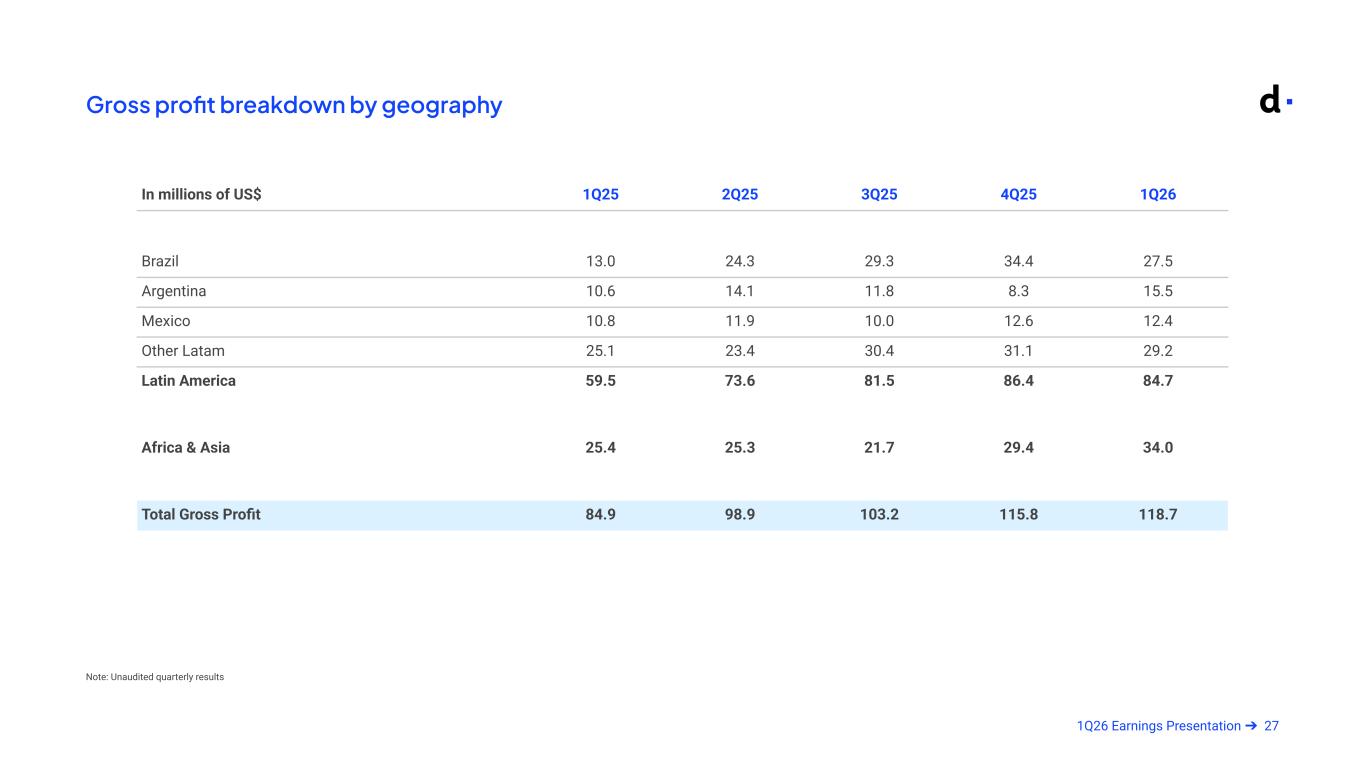
271Q26 Earnings Presentation ➔ Gross profit breakdown by geography Note: Unaudited quarterly results Armado May 7 @ 8pm In millions of US$ 1Q25 2Q25 3Q25 4Q25 1Q26 Brazil 13.0 24.3 29.3 34.4 27.5 Argentina 10.6 14.1 11.8 8.3 15.5 Mexico 10.8 11.9 10.0 12.6 12.4 Other Latam 25.1 23.4 30.4 31.1 29.2 Latin America 59.5 73.6 81.5 86.4 84.7 Africa & Asia 25.4 25.3 21.7 29.4 34.0 Total Gross Profit 84.9 98.9 103.2 115.8 118.7
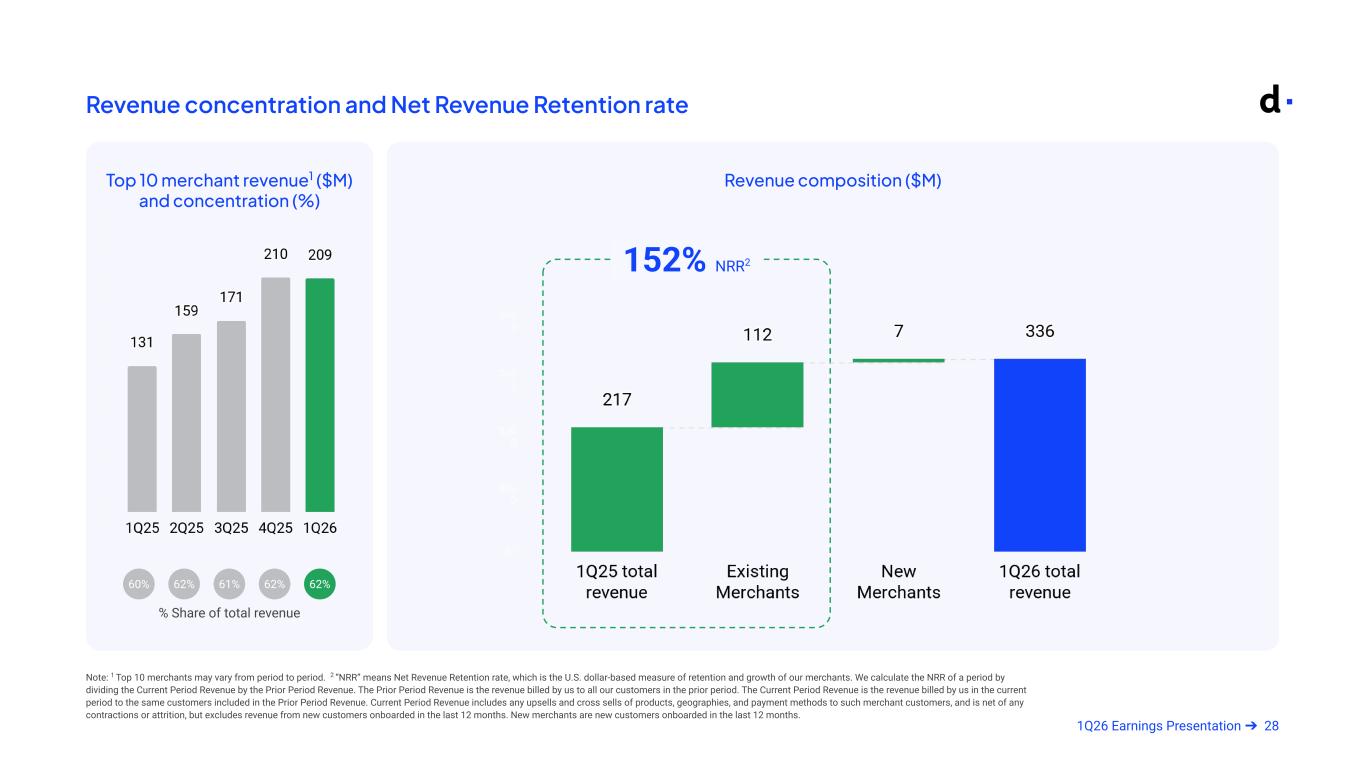
281Q26 Earnings Presentation ➔ Revenue concentration and Net Revenue Retention rate Note: 1 Top 10 merchants may vary from period to period. 2 “NRR” means Net Revenue Retention rate, which is the U.S. dollar-based measure of retention and growth of our merchants. We calculate the NRR of a period by dividing the Current Period Revenue by the Prior Period Revenue. The Prior Period Revenue is the revenue billed by us to all our customers in the prior period. The Current Period Revenue is the revenue billed by us in the current period to the same customers included in the Prior Period Revenue. Current Period Revenue includes any upsells and cross sells of products, geographies, and payment methods to such merchant customers, and is net of any contractions or attrition, but excludes revenue from new customers onboarded in the last 12 months. New merchants are new customers onboarded in the last 12 months. Top 10 merchant revenue1 ($M) and concentration (%) Revenue composition ($M) % Share of total revenue 62%62%60% 62% 61% 152% NRR2 Armado May 7 @ 8pm
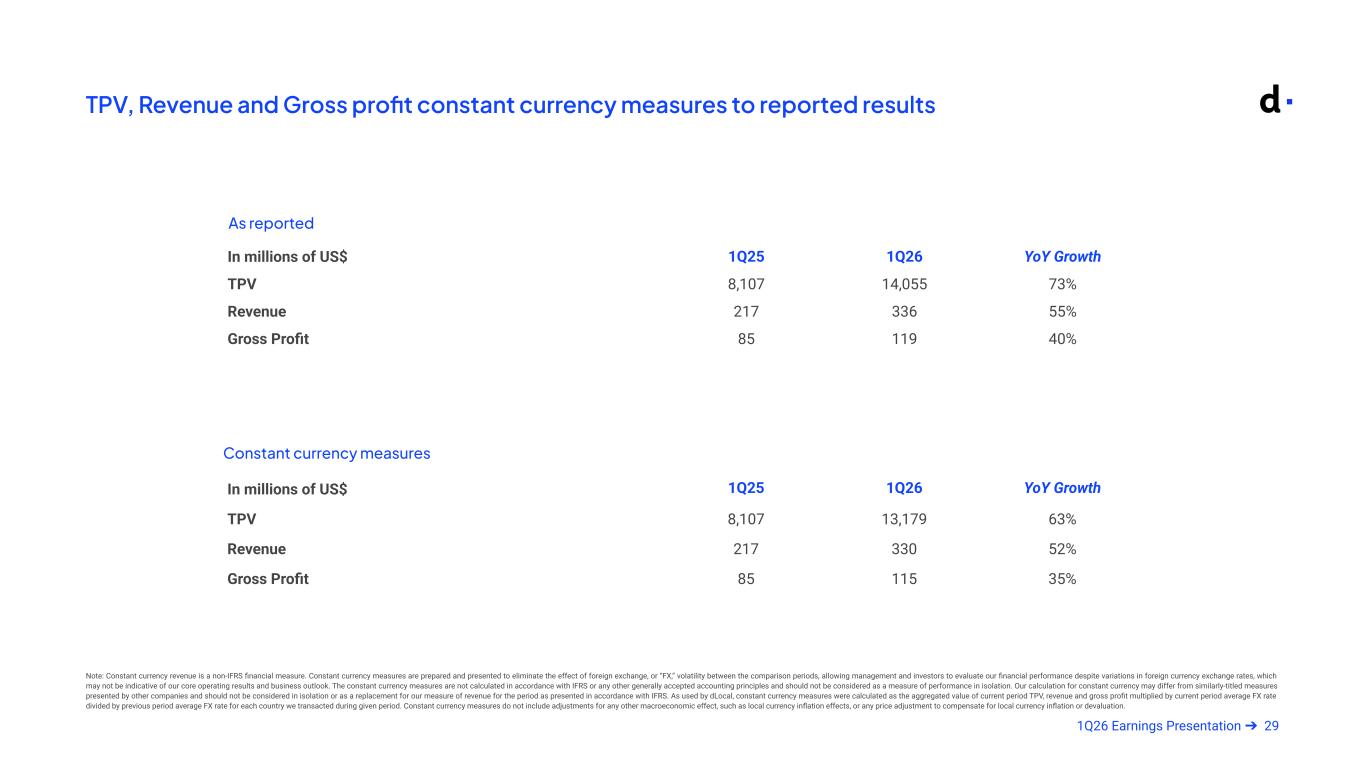
291Q26 Earnings Presentation ➔ TPV, Revenue and Gross profit constant currency measures to reported results As reported Constant currency measures Note: Constant currency revenue is a non-IFRS financial measure. Constant currency measures are prepared and presented to eliminate the effect of foreign exchange, or “FX,” volatility between the comparison periods, allowing management and investors to evaluate our financial performance despite variations in foreign currency exchange rates, which may not be indicative of our core operating results and business outlook. The constant currency measures are not calculated in accordance with IFRS or any other generally accepted accounting principles and should not be considered as a measure of performance in isolation. Our calculation for constant currency may differ from similarly-titled measures presented by other companies and should not be considered in isolation or as a replacement for our measure of revenue for the period as presented in accordance with IFRS. As used by dLocal, constant currency measures were calculated as the aggregated value of current period TPV, revenue and gross profit multiplied by current period average FX rate divided by previous period average FX rate for each country we transacted during given period. Constant currency measures do not include adjustments for any other macroeconomic effect, such as local currency inflation effects, or any price adjustment to compensate for local currency inflation or devaluation. In millions of US$ 1Q25 1Q26 YoY Growth TPV 8,107 14,055 73% Revenue 217 336 55% Gross Profit 85 119 40% In millions of US$ 1Q25 1Q26 YoY Growth TPV 8,107 13,179 63% Revenue 217 330 52% Gross Profit 85 115 35%
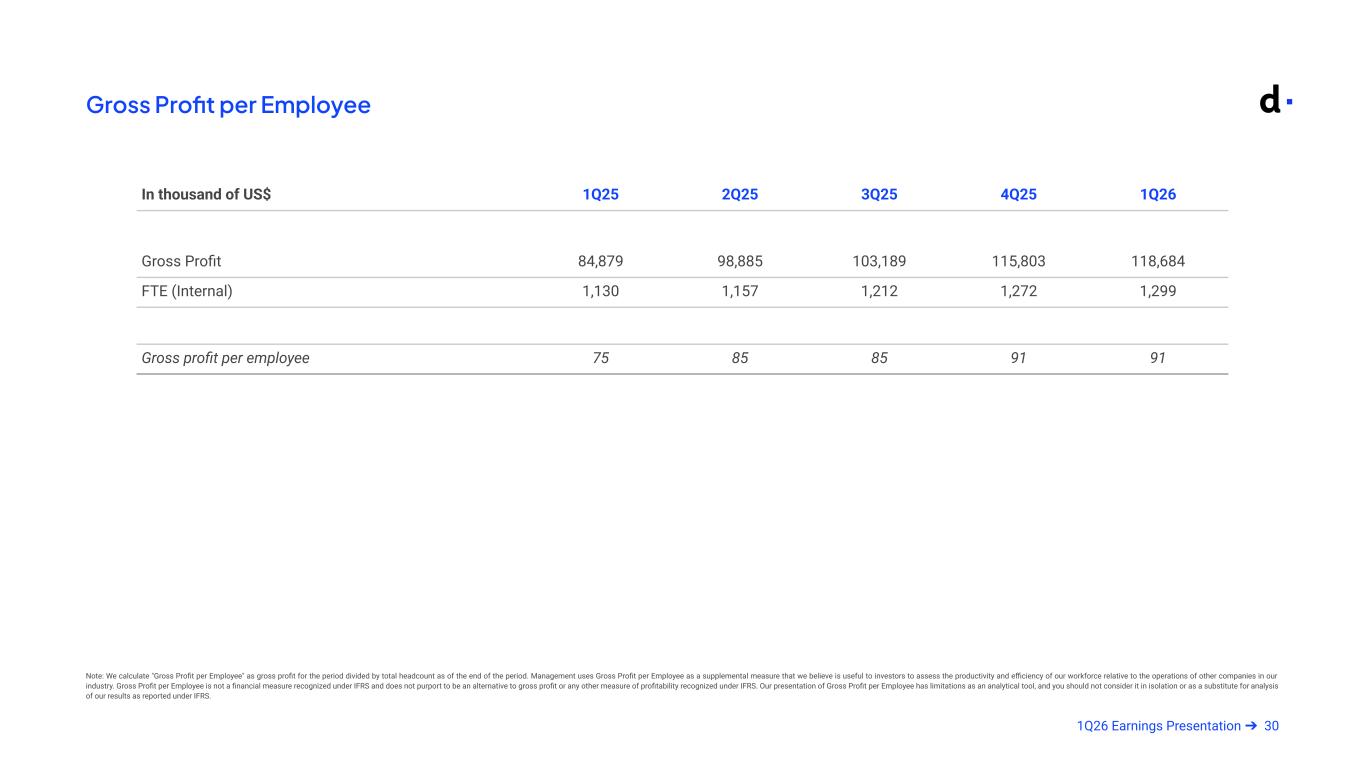
301Q26 Earnings Presentation ➔ Gross Profit per Employee Note: We calculate "Gross Profit per Employee" as gross profit for the period divided by total headcount as of the end of the period. Management uses Gross Profit per Employee as a supplemental measure that we believe is useful to investors to assess the productivity and efficiency of our workforce relative to the operations of other companies in our industry. Gross Profit per Employee is not a financial measure recognized under IFRS and does not purport to be an alternative to gross profit or any other measure of profitability recognized under IFRS. Our presentation of Gross Profit per Employee has limitations as an analytical tool, and you should not consider it in isolation or as a substitute for analysis of our results as reported under IFRS. Armado May 7 @ 8pm In thousand of US$ 1Q25 2Q25 3Q25 4Q25 1Q26 Gross Profit 84,879 98,885 103,189 115,803 118,684 FTE (Internal) 1,130 1,157 1,212 1,272 1,299 Gross profit per employee 75 85 85 91 91
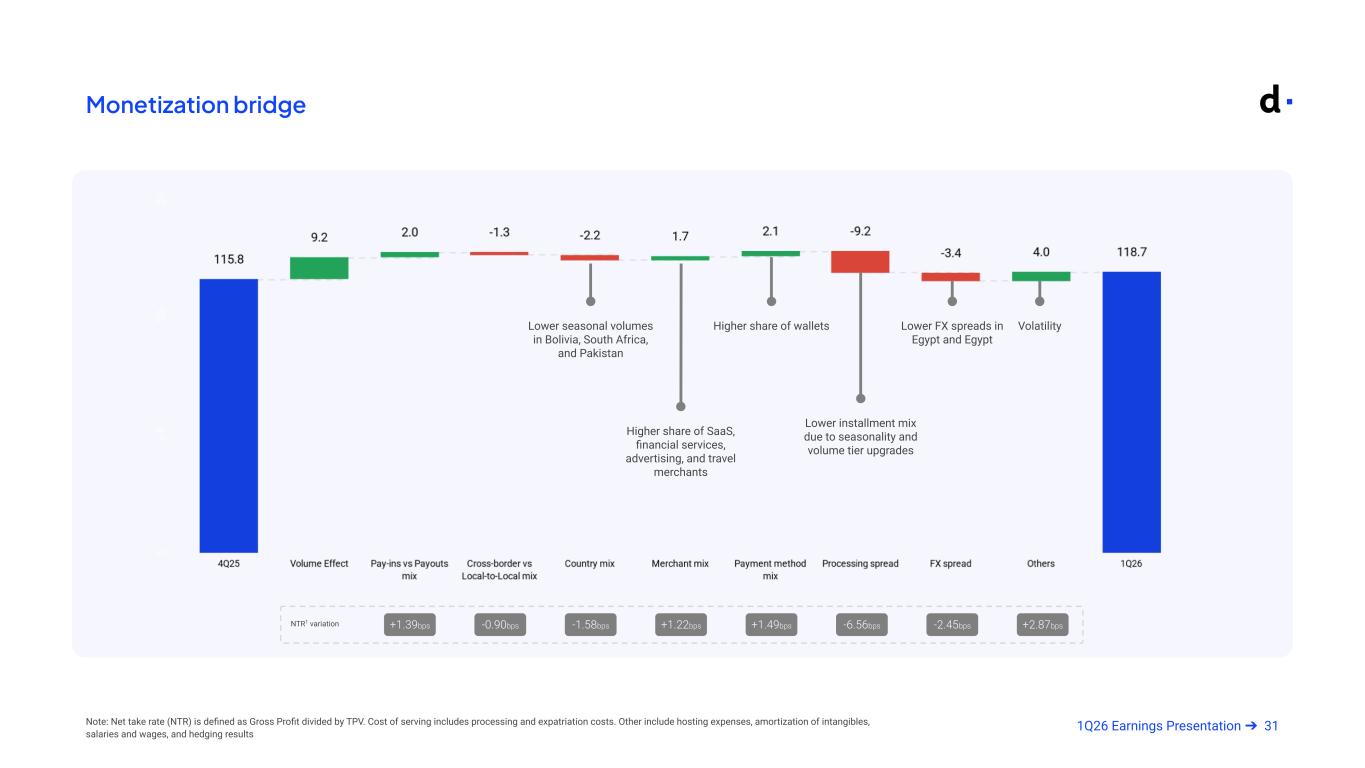
311Q26 Earnings Presentation ➔Note: Net take rate (NTR) is defined as Gross Profit divided by TPV. Cost of serving includes processing and expatriation costs. Other include hosting expenses, amortization of intangibles, salaries and wages, and hedging results Monetization bridge +1.39bps -1.58bps +1.22bps +1.49bps -6.56bps -2.45bps +2.87bpsNTR1 variation -0.90bps Lower FX spreads in Egypt and Egypt Lower seasonal volumes in Bolivia, South Africa, and Pakistan Higher share of SaaS, financial services, advertising, and travel merchants Higher share of wallets Lower installment mix due to seasonality and volume tier upgrades Volatility
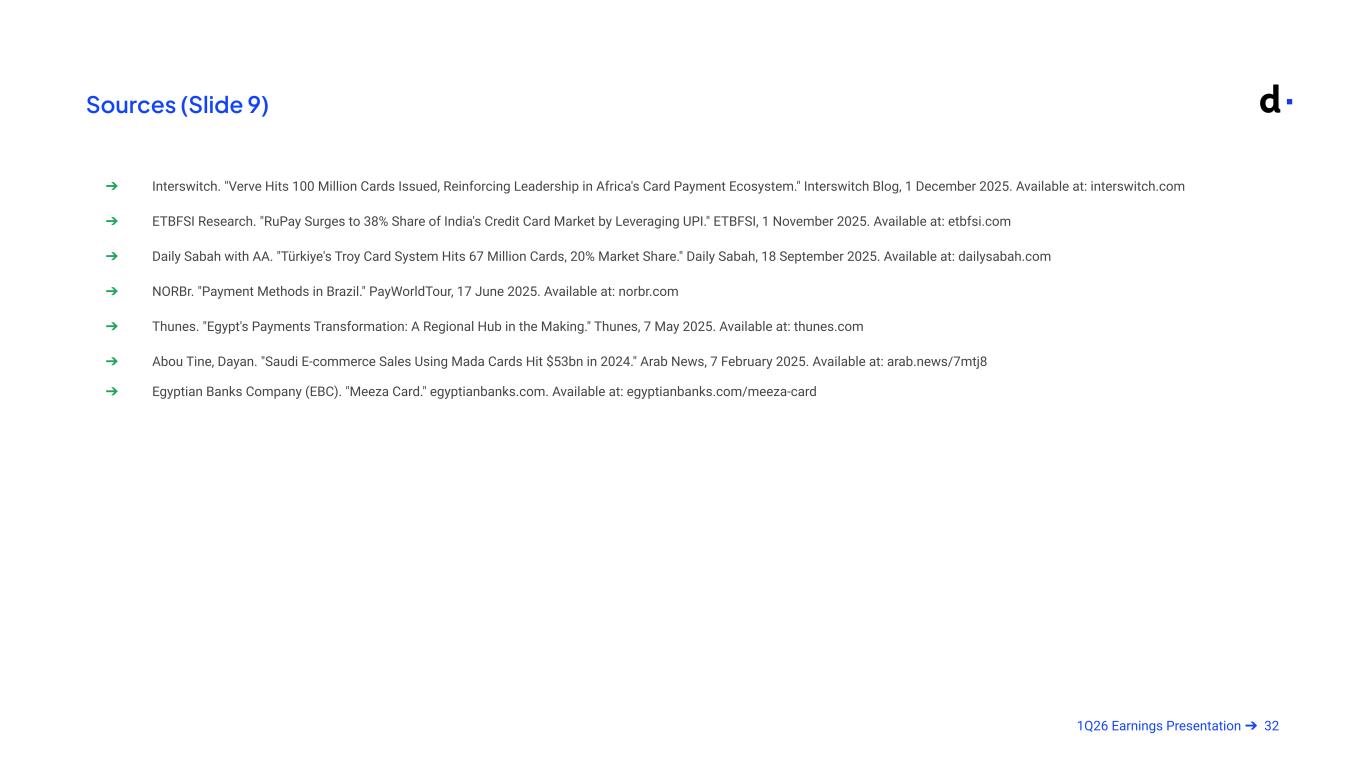
321Q26 Earnings Presentation ➔ Sources (Slide 9) ➔ Interswitch. "Verve Hits 100 Million Cards Issued, Reinforcing Leadership in Africa's Card Payment Ecosystem." Interswitch Blog, 1 December 2025. Available at: interswitch.com ➔ ETBFSI Research. "RuPay Surges to 38% Share of India's Credit Card Market by Leveraging UPI." ETBFSI, 1 November 2025. Available at: etbfsi.com ➔ Daily Sabah with AA. "Türkiye's Troy Card System Hits 67 Million Cards, 20% Market Share." Daily Sabah, 18 September 2025. Available at: dailysabah.com ➔ NORBr. "Payment Methods in Brazil." PayWorldTour, 17 June 2025. Available at: norbr.com ➔ Thunes. "Egypt's Payments Transformation: A Regional Hub in the Making." Thunes, 7 May 2025. Available at: thunes.com ➔ Abou Tine, Dayan. "Saudi E-commerce Sales Using Mada Cards Hit $53bn in 2024." Arab News, 7 February 2025. Available at: arab.news/7mtj8 ➔ Egyptian Banks Company (EBC). "Meeza Card." egyptianbanks.com. Available at: egyptianbanks.com/meeza-card

Investor Relations Contact investor@dlocal.com Media Contact media@dlocal.com This presentation does not contain sufficient information to constitute an interim financial report as defined in International Accounting Standards 34, “Interim Financial Reporting” nor a financial statement as defined by International Accounting Standards 1 “Presentation of Financial Statements”. The first quarter financial information in this press release has not been audited nor has it been subject to any limited review procedures, whereas the annual results for the year ended December 31, 2025 are audited.