Please wait
Exhibit 99.3
HIGH TIDE INC.
Annual Information Form
For the Fiscal Year Ended October 31, 2025 Dated: January 29, 2026
TABLE OF CONTENTS
| | | | | |
| |
| |
| |
| |
| |
| |
| |
| |
| |
| 18 |
| |
| 28 |
U.K. CBD ACTIVITIES DISCLOSURE | 38 |
GERMANY REGULATORY OVERVIEW | 44 |
RISK FACTORS | 45 |
| 45 |
| 45 |
| |
| 48 |
| 48 |
| |
| 52 |
| 52 |
| 52 |
| |
| 53 |
| 53 |
| 54 |
| 55 |
|
77 |
| 86 |
ANNUAL INFORMATION FORM
This Annual Information Form (as defined below) is dated as of January 29, 2026 (the “AIF Date”), and unless otherwise indicated, the information contained herein is dated as of the last day of the most recently completed financial year of High Tide Inc. ended October 31, 2025 (the “Fiscal Year-End Date”).
In this Annual Information Form, unless otherwise indicated or if the context otherwise requires, (i) “High Tide” means High Tide Inc., and where the context so requires, includes its predecessors, (ii) the “Corporation”, “we”, “us” and “our” means, collectively, High Tide and its Subsidiaries (as defined below), together with their respective predecessors (where the context so requires), (iii) “Material Adverse Effect” means a material adverse effect on the Business (as defined below), the properties, assets, liabilities (including contingent liabilities), results of operations, financial performance, financial condition, or the market and trading price of the securities, of the Corporation and its Subsidiaries, taken as a whole, and (iv) “Hemp” means the plant Cannabis sativa L. and any part of that plant, including the seeds thereof, and all derivatives, extracts, cannabinoids, isomers, acids, salts, and salts of isomers, whether growing or not, with a THC (as defined below) concentration of not more than 0.3% on a dry weight basis.
All financial information and all dollar amounts in this Annual Information Form are prepared in Canadian dollars, unless otherwise indicated, and in accordance with IFRS (as defined below) as issued by the International Accounting Standards Board, and as set out in Part I of the Handbook of the Chartered Professional Accountants of Canada.
On May 13, 2021, the Corporation consolidated all of its issued and outstanding Common Shares (as defined below) on a 15:1 basis (the “Consolidation”). All references to the Common Shares and securities issuable into Common Shares in this Annual Information Form, other than in documents dated prior to May 13, 2021 that are incorporated by reference in this Annual Information Form, reflect post-Consolidation amounts unless otherwise indicated or the context otherwise requires. All documents dated prior to May 13, 2021 that are incorporated by reference in this Annual Information Form reflect pre-Consolidation amounts unless otherwise indicated or the context otherwise requires.
GLOSSARY OF TERMS
The following is a glossary of certain terms used in this Annual Information Form. Words importing the singular, where the context requires, include the plural and vice versa, and words importing any gender include all genders.
“2014 Farm Bill” means the Agricultural Act of 2014 (U.S.), including any regulations promulgated thereunder, as amended.
“2018 Farm Bill” means the Agriculture Improvement Act of 2018 (U.S.), including any regulations promulgated thereunder, as amended.
“2023 ATM Program” means the at-the-market equity offering program of the Corporation established pursuant to the 2023 ATM Prospectus Supplement on August 31, 2023, which allowed the Corporation to issue up to $30,000,000 (or the equivalent in U.S. dollars) of Common Shares from its treasury to the public from time to time, at the Corporation’s discretion and subject to regulatory requirements.
“ABCA” means the Business Corporations Act (Alberta), including any regulations promulgated thereunder, as amended.
“AGCO” means the Alcohol and Gaming Commission of Ontario.
“AGLC” means the Alberta Gaming, Liquor and Cannabis Commission (formerly, Alberta Gaming, and Liquor Commission).
“AGLC Handbook” means the Retail Cannabis Store Handbook published by the AGLC.
“Annual Financial Statements” means the audited consolidated financial statements of the Corporation for the years ended October 31, 2025, and 2024 and the notes thereto, together with the auditor’s report thereon.
“Annual Information Form” means this annual information form of High Tide for the financial year ended October 31, 2025, dated January 29, 2026.
“Applicable Securities Laws” means, as applicable, the securities legislation, securities regulation and securities rules, and the policies, notices, instruments and blanket orders of each Canadian securities regulator having the force of applicable Law and in force from time to time.
“ASA” means the U.K. Advertising Standards Agency.
“Audit Committee Charter” means the charter for the Audit Committee, as adopted.
“Audit Committee” means the audit committee of the Board, as constituted from time to time.
“Authorizations” means, collectively, all consents, licenses, registrations, permits, authorizations, permissions, orders, approvals, clearances, waivers, certificates, and declarations issued, granted, given or otherwise made available by or under the authority of any Government Entity or pursuant to any requirement under applicable Law.
“Awards” means Options, Stock Appreciation Rights, restricted share awards, RSUs, performance shares, performance units, cash- based awards and other share-based awards issuable pursuant to the Omnibus Plan.
“Base Shelf Prospectus” means the final short form base shelf prospectus of the Corporation dated August 11, 2025 allowing the issuance from time-to-time of up to $100,000,000 in securities during a 25-month period.
“BC Handbook” means the Cannabis Retail Terms and Conditions.
“Bill 26” means Bill 26, An Act to Control and Regulate Cannabis (Alberta).
“Bill 36” means Bill 36, An Act to enact a new Act and make amendments to various other Acts respecting the use and sale of cannabis and vapour products in Ontario.
“Bill 6” means the Gaming and Liquor Statues Amendment Act, 2018.
“Blessed” means Enigmaa Ltd., operating as ‘Blessed CBD’.
“Board” means the board of directors of High Tide, as constituted from time to time.
“Business” means the business carried on by High Tide and its Subsidiaries as at AIF Date, and where the context so requires, includes the business carried on by High Tide and its Subsidiaries prior to the AIF Date.
“Canna Cabana” means Canna Cabana Inc., a wholly owned Subsidiary.
“Cannabis Act” means the Cannabis Act (Canada), including any regulations promulgated thereunder, as amended.
“Cannabis Laws” means, all applicable State, provincial, municipal, or federal legislation and regulations governing cannabis, cannabis paraphernalia, cannabis products, cannabis accessories, cannabis extracts, and activities related thereto in the United States, Canada and other jurisdictions in which the Corporation operates the Business, together with any successor legislation and regulations thereto, and for greater certainty, includes the Cannabis Act and Cannabis Regulations.
“Cannabis Regulations” means the Cannabis Regulations (Canada), including any regulations promulgated thereunder, as amended.
“Cannabis” or “cannabis” means the plant Cannabis sativa L.
“Cash-Based Awards” means an Award denominated in cash and granted pursuant to the Omnibus Plan.
“CBD” means industrial Hemp-derived cannabidiol.
“CBPM” means an unlicensed cannabis-based product for medicinal use.
“CCA” means the Cannabis Control Act (Ontario).
“CCAA” means the Companies’ Creditors Arrangement Act (Alberta), including any regulations promulgated thereunder, as amended.
“CCLA” means the Cannabis Control and Licensing Act (British Columbia).
“CCSA” means the Cannabis Control (Saskatchewan) Act.
“CDA” means the Cannabis Distribution Act (British Columbia).
“CLA” means Cannabis Licence Act, 2018 (Ontario).
“CLR” means the Cannabis Licensing Regulation.
“Common Shares” means the common shares in the capital of High Tide.
“Compensation Committee” means the compensation committee of the Board, as constituted from time to time.
“connect First” means Connect First Credit Unition Ltd.
“Daily High Club” means DHC Supply LLC, operating as ‘Daily High Club’.
“Dankstop” means DS Distribution Inc., operating as ‘DankStop.com’.
“DEA” means the U.S Drug Enforcement Administration.
“Delta-8” means Delta-8 tetrahydrocannabinol.
“DSHEA” means the Dietary Supplement Health and Education Act of 1994 (United States).
“EBITDA” means earnings before interest, taxes, depreciation, and amortization.
“FABCBD” means Fab Nutrition, LLC.
“Fair Market Value” means, at any date when the fair market value of Common Shares is to be determined, the Market Price of the Common Shares, or if the Common Shares are not listed on any stock exchange, the value as is determined solely by the committee or subcommittee of the Board, acting reasonably and in good faith.
“FDA” means U.S. Food and Drug Administration.
“FDCA” mean Federal Food, Drug and Cosmetic Act (United States).
“Federal Paraphernalia Law” means U.S. Code Title 21 Section 863.
“FOFI” means future oriented financial information.
“forward-looking statements” means statements contained in this Annual Information Form, and in the documents incorporated by reference in this Annual Information Form, which constitute “forward-looking information” and “forward-looking statements” within the meaning of Applicable Securities Laws and are based on assumptions, expectations, estimates and projections as at the AIF Date.
“FSA” means the U.K. Food Standards Agency.
“FSE” means the Frankfurt Stock Exchange.
“FTC” means the U.S. Federal Trade Commission.
“FTCA” means the Federal Trade Commission Act (United States).
“GLCA” means the Gaming, Liquor and Cannabis Act.
“GLCR” means the Gaming, Liquor and Cannabis Regulation.
“GMC” means the U.K.’s General Medical Council.
“Governmental Entities” means: (a) any international, multi-national, national, federal, provincial, territorial, State, regional, municipal, local or other government, governmental or public department, central bank, court, tribunal, arbitral body, commission, board, bureau, commissioner, minister, cabinet, governor in council, ministry, agency or instrumentality, domestic or foreign, including, for greater certainty, the AGCO, the Saskatchewan Liquor and Gaming Authority, the LGCA, and AGLC, (b) any subdivision or authority of any of the foregoing, (c) any quasi-governmental or private body exercising any regulatory, expropriation or taxing authority under or for the account of any of the foregoing, or (d) any stock exchange, including, for greater certainty, the TSXV.
“Grasscity” means collectively, High Tide Inc. B.V., SJV B.V. and SJV 2 B.V.
“High Tide” means High Tide Inc., a corporation incorporated under the ABCA, and where the context so requires, includes its predecessors.
“High Tide Germany” means High Tide Germany GmbH.
“HMR” means the Human Medicines Regulations 2012 (U.K.).
“Home Office” means the U.K. Home Office
“IFR” means Interim Final Rule.
“IFRS” means International Financial Reporting Standards.
“IND Preclusion” means section 201(ff)(3)(B)(ii) of the FDCA.
“IND” means Investigational New Drug Application.
“Jimmy’s Cannabis” means 1171882 B.C. Ltd., operating as ‘Jimmy’s Cannabis Shop BC’.
“Junior Secured Loan” means the loan agreement with a wholly owned subsidiary of Cronos Group Inc. (“Cronos”) to secure convertible debt with a principal amount of $30 million.
“Key Personnel” means collectively Management and certain consultants.
“Laws” means, with respect to any Person, any and all applicable law (statutory, common or otherwise), constitution, treaty, convention, ordinance, code, rule, regulation, order, injunction, judgment, decree, ruling or similar requirement, whether domestic or foreign, enacted, adopted, promulgated or applied by a Governmental Entity that is binding upon or applicable to such Person or its business, undertaking, property or securities, and to the extent that they have the force of law, policies, guidelines, notices and protocols of any Governmental Entity, as amended, unless expressly specified otherwise, and for greater certainty, includes Cannabis Laws.
“LCRB” means the British Columbia Liquor and Cannabis Regulation Branch.
“LGCA” means the Liquor, Gaming and Cannabis Authority of Manitoba.
“Licensed Producers” means any Person duly authorized by Health Canada pursuant to applicable Laws to engage in the cultivation, production, growth or distribution of cannabis.
“Management” means the management of High Tide, as constituted from time to time.
“Manitoba Cannabis Regulation” means the Cannabis Regulation, 120/2018 (Manitoba).
“MBLL” means the Manitoba Liquor and Lotteries Company.
“MDA” means Misuse of Drugs Act 1971 (U.K.).
“MDR 2001” means The Misuse of Drugs Regulations 2001 (U.K.).
“Meta Growth” means Meta Growth Corp., a wholly owned Subsidiary incorporated under the ABCA.
“MHRA” means the U.K. Medicines and Healthcare Products Regulatory Agency.
“Nasdaq” means the Nasdaq Stock Market.
“NFR” means Regulation (EU) 2015/2283.
“NI 52-110” means National Instrument 52-110 – Audit Committees.
“NuLeaf” means NuLeaf Naturals, LLC.
“OCS” means the Ontario Cannabis Store.
“Omnibus Plan” means the fixed 20% equity incentive omnibus plan of the Corporation, as amended.
“Ontario Cannabis Regulations” means the General Regulation under the CLA.
“Options” means the incentive stock options of High Tide granted pursuant to the Omnibus Plan.
“Participants” means all directors, officers, employees, management company employees and consultants of the Corporation or its affiliates.
“Performance Award” means an Award of performance shares or performance units.
“Person” includes any individual, partnership, association, body corporate, organization, trust, estate, trustee, executor, administrator, legal representative or government (including any Governmental Entity), syndicate or other entity, whether or not having legal status.
“POCA” means the U.K. Proceeds of Crime Act 2002.
“Predecessor Plans” means the previous Stock Option Plan and RSU Plan of the Corporation.
“Product Safety Regulations” means the Product Safety and Metrology etc. (Amendment to Extent and Meaning of Market) (European Union Exit) Regulations 2019 and subsequent amendments.
“Remexian” means Remexian Pharma GmbH.
“Retail Store Authorization” means, collectively, the Authorizations required to engage in the retail sale and distribution of adult-use cannabis and cannabis products at licensed premises.
“Retail Store Operator Licence” means a retail operator licence.
“SCPN” means U.K.’s ‘Submit Cosmetic Product Notifications Service’.
“SEC” means the U.S. Securities and Exchanges Commission.
“Secured Debenture” means the secured convertible debentures of High Tide.
“SEDI” means the System for Electronic Disclosure by Insiders.
“Sessions Memorandum” means the U.S. Department of Justice Memorandum issued by former Attorney General James Jeff Sessions on January 4, 2018.
“September 2022 Credit Facility” means a $19,000,000 senior secured credit facility with connectFirst with an initial 5- year term, at connectFirst’s floor interest rate.
“SLGA” means the Saskatchewan Liquor and Gaming Authority.
“Smoke Cartel” means Smoke Cartel USA Inc.
“Smoker’s Corner” means Smoker’s Corner Ltd.,.
“Staff Notice 51-352” means Staff Notice 51-352 (Revised) – Issuers with U.S. Marijuana-Related Activities.
“State” means a state in the United States.
“Stock Appreciation Rights” means a right granted to a Participant pursuant the Omnibus Plan to receive payment, for each Common Share subject to such Award, of an amount equal to the excess, if any, of the Fair Market Value of a Common Share on the date of exercise of the Award over the exercise price thereof.
“Supremacy Clause” means the supremacy clause in Article VI of the U.S. Constitution.
“THC” means Delta-9 tetrahydrocannabinol.
“TSXV” means the TSX Venture Exchange.
“U.K.” means the United Kingdom.
“U.S. CSA” means the Controlled Substance Act of 1970 (U.S.).
“U.S. GAAP” means U.S. generally accepted accounting principles.
“United States” or “U.S.” means the United States of America and its territories and possessions.
“USDA” means the U.S. Department of Agriculture.
“Valiant Canada” means Valiant Distribution Canada Inc., a wholly owned Subsidiary formed under the ABCA.
“Valiant” means Valiant Distribution Inc., a wholly owned Subsidiary, incorporated under the Laws of the State of Delaware on April 6, 2019.
“Warrants” means the Common Share purchase warrants of High Tide.
MARKET AND INDUSTRY DATA
Unless otherwise indicated, information contained in this Annual Information Form (or in a document incorporated or deemed to be incorporated by reference herein) concerning the industry and the markets in which the Corporation operates, including its general expectations and market position, market opportunities and market share, is, or may be, based on information from independent industry organizations, other third-party sources (including industry publications, surveys and forecasts) and the studies and estimates of Management.
Unless otherwise indicated, the Corporation’s estimates are derived from publicly available information released by independent industry analysts and third-party sources as well as data from the Corporation’s internal research, and include assumptions made by Management which Management believe to be reasonable based on their knowledge of the relevant industry and markets. Such internal research and assumptions have not been verified by any independent source, and the Corporation and Management have not independently verified any third-party information. While Management believes the market position, market opportunity and market share information included, or which may be included, in this Annual Information Form or in a document incorporated or deemed to be incorporated by reference herein is generally reliable, such information is inherently imprecise. In addition, projections, assumptions and estimates of the Corporation’s future performance and the future performance of the industry and markets in which the Corporation operates are subject to a high degree of uncertainty and risk due to a variety of factors, including those described under the headings “Cautionary Note Regarding Forward-Looking Information” and “Risk Factors”.
CAUTIONARY NOTE REGARDING FORWARD-LOOKING INFORMATION
Certain statements contained in this Annual Information Form, and in the documents incorporated by reference in this Annual Information Form, constitute “forward-looking information” and “forward-looking statements” (together, “forward-looking statements”) within the meaning of Applicable Securities Laws and are based on assumptions, expectations, estimates and projections as at the AIF Date. Forward-looking statements relate to future events or future performance and reflect Management’s expectations or beliefs regarding future events. In certain cases, forward-looking statements can be identified by the use of words such as “plans”, “expects” or “does not expect”, “is expected”, “budget”, “scheduled”, “estimates”, “forecasts”, “intends”, “anticipates” or “does not anticipate”, or “believes”, or variations of such words and phrases or statements that certain actions, events or results “may”, “could”, “would”, “might” or “will be taken”, “occur” or “be achieved” or the negative of these terms or comparable terminology.
Forward-looking statements in this Annual Information Form and in documents incorporated by reference herein include, but are not limited to, statements with respect to:
•the Business objectives and milestones and the anticipated timing of, and costs in connection with, the execution or achievement of such objectives and milestones;
•the Corporation’s future growth prospects and intentions to pursue one or more viable business opportunities;
•the development of the Business and future activities following the AIF Date;
•expectations relating to market size and anticipated growth in the jurisdictions within which the Corporation may from time to time operate or contemplate future operations;
•expectations with respect to economic, business, regulatory or competitive factors related to the Corporation or the cannabis industry generally;
•the market for the Corporation’s current and proposed product offerings, as well as the Corporation’s ability to capture market share;
•the Corporation’s strategic investments and capital expenditures, and related benefits;
•the distribution methods expected to be used by the Corporation to deliver its product offerings;
•the competitive landscape within which the Corporation operates and the Corporation’s market share or reach;
•the performance of the Business and the operations and activities of the Corporation;
•the Corporation’s ability to generate cash flow from operations and from financing activities;
•the Corporation’s ability to obtain, maintain, and renew or extend, applicable Authorizations, including the timing and impact of the receipt thereof;
•the realization of cost savings, synergies or benefits from the Corporation’s recent and proposed acquisitions, and the Corporation’s ability to successfully integrate the operations of any business acquired within the Business;
•the Corporation’s intention to devote resources to the protection of its intellectual property rights, including by seeking and obtaining registered protections and developing and implementing standard operating procedures;
•the intention of the Corporation to complete any additional offering of securities of the Corporation and the aggregate amount of the total proceeds that the Corporation will receive pursuant to the September 2022 Credit Facility, the Junior Secured Loan, or any future offering;
•the Corporation’s expected use of the net proceeds from the September 2022 Credit Facility, the Junior Secured Loan, or any future offering;
•the anticipated effects of the September 2022 Credit Facility, the Junior Secured Loan, or any future offering on the Business and operations of the Corporation;
•the listing of Common Shares offered in any future offering; and
•the Corporation’s ability to generate cash flow from operations and from financing activities.
Forward-looking statements are subject to certain risks and uncertainties. Although Management believes that the expectations reflected in these forward-looking statements are reasonable in light of, among other things, its perception of trends, current conditions and expected developments, as well as other factors that Management believes to be relevant and reasonable in the circumstances at the date that such statements are made, readers are cautioned not to place undue reliance on forward-looking statements, as forward- looking statements may prove to be incorrect. A number of factors could cause actual results to differ materially from a conclusion, forecast or projection contained in the forward-looking statements. Importantly, forward-looking statements contained in this Annual Information Form and in documents incorporated by reference are based upon certain assumptions that Management believes to be reasonable based on the information currently available to Management, including, but not limited to, the assumptions that:
◦current and future members of Management will abide by the Business objectives and strategies from time to time established by the Corporation;
◦the Corporation will retain and supplement its Board and Management, or otherwise engage consultants and advisors having knowledge of the industries (or segments thereof) within which the Corporation may from time to time participate;
◦the Corporation will have sufficient working capital and the ability to obtain the financing required in order to develop and continue its business and operations;
◦the Corporation will continue to attract, develop, motivate and retain highly qualified and skilled consultants or employees, as the case may be;
◦no adverse changes will be made to the regulatory framework governing cannabis, taxes and all other applicable matters in the jurisdictions in which the Corporation conducts business and any other jurisdiction in which the Corporation may conduct business in the future;
◦the Corporation will be able to generate cash flow from operations, including, where applicable, distribution and sale of cannabis and cannabis products;
◦the Corporation will be able to execute on its business strategy as anticipated;
◦the Corporation will be able to meet the requirements necessary to obtain or maintain Authorizations required to conduct the Business;
◦general economic, financial, market, regulatory, and political conditions will not negatively affect the Corporation or its Business;
◦the Corporation will be able to successfully compete in the cannabis industry;
◦cannabis prices will not decline materially;
◦the Corporation will be able to effectively manage anticipated and unanticipated costs;
◦the Corporation will be able to maintain internal controls over financial reporting and disclosure, and procedures in order to ensure compliance with applicable Laws;
◦the Corporation will be able to conduct its operations in a safe, efficient and effective manner;
◦general market conditions will be favourable with respect to the Corporation’s future plans and goals;
◦the Corporation will use the net proceeds from the September 2022 Credit Facility, the Junior Secured Loan or any future offering as outlined;
◦the Corporation will list the Common Shares offered in any future offering;
•the Corporation will make interest payments for the September 2022 Credit Facility and the Junior Secured Loan;
•the September 2022 Credit Facility, the Junior Secured Loan, or any future offering will have the anticipated effects on the Business and operations of the Corporation;
•the Corporation will reach the anticipated sales from continuing operations;
•the Corporation will complete its proposed acquisitions;
•same-store sales and consolidated gross margins will continue to increase;
•the Corporation will make meaningful increases to its revenue profile;
•the Corporation will continue to increase its revenue;
•the Corporation will hit its forecasted revenue and sales projections;
•the Corporation will complete the development of its cannabis retail stores; and
•the Corporation will continue to grow its online retail portfolio through further strategic and accretive acquisitions.
By their very nature forward-looking statements involve known and unknown risks, uncertainties and other factors which may cause the actual results, performance or achievements of the Corporation to be materially different from any future results, performance or achievements expressed or implied by the forward-looking statements. Although Management believes that the expectations reflected in, and assumptions underlying, such forward-looking statements are reasonable, it can give no assurance that such expectations will prove to have been correct. New factors emerge from time to time, and it is not possible for Management to predict all of those factors or to assess in advance the impact of each such factor on the Business or the extent to which any factor, or combination of factors, may cause actual results to differ materially from those contained in any forward-looking statement. Some of the risks that could cause
results to differ materially from those expressed in forward-looking statements in this Annual Information Form and in documents incorporated by reference herein include:
◦the Corporation’s inability to attract and retain qualified members of Management to grow the Business and its operations;
◦unanticipated changes in economic and market conditions or in applicable Laws;
◦the impact of the publications of inaccurate or unfavourable research by securities analysts or other third parties;
◦the Corporation’s failure to complete future acquisitions or enter into strategic business relationships;
◦interruptions or shortages in the supply of cannabis from time to time available to support the Corporation’s operations from time to time;
◦unanticipated changes in the cannabis industry in the jurisdictions within which the Corporation may from time to time conduct its Business and operations, including the Corporation’s inability to respond or adapt to such changes;
◦the Corporation’s inability to secure or maintain favourable lease arrangements or the required Authorizations necessary to conduct the Business and operations and meet its targets;
◦the Corporation’s inability to secure desirable retail cannabis store locations on favourable terms;
◦risks relating to projections of the Corporation’s operations;
◦the Corporation’s inability to effectively manage unanticipated costs and expenses, including costs and expenses associated with product recalls and judicial or administrative proceedings against the Corporation;
◦the Corporation’s inability to list the Common Shares offered in any future offering;
◦the Corporation’s failure to utilize the use of proceeds from the September 2022 Credit Facility, the Junior Secured Loan or any future offering as expected;
◦the Corporation’s inability to make interest payments for the September 2022 Credit Facility or the Junior Secured Loan;
◦the Corporation inability to complete its proposed acquisitions;
◦same-store sales or consolidated gross margins will not increase, but decease or plateau;
◦the Corporation will not hit its forecasted revenue and sales projections;
◦the Corporation will be unable to increase its revenue, but that it will decease or plateau;
◦the Corporation will be unable to continue to integrate and expand its CBD brands;
◦the Corporation will be unable to complete the development of any or all of its cannabis retail stores;
◦risks surrounding the legality of Delta-8 derived from Hemp;
◦risks surrounding the uncertainty and legality of Delta-8 and Delta-9 state to state;
◦risks surrounding the legality of Delta-9 THC-A;
◦risks surrounding the change to the federal definition of “Hemp” as contained in the Continuing Resolution and Appropriations Package (H.R. 5371), which may limit sales of the Corporation’s products;
◦risk that the DEA could consider Delta-8 products an illegal controlled substance under the U.S. CSA or Federal Analogue Act in the United States;
◦risk that changes to state laws and regulations could render hemp products unlawful or significantly narrow the scope of permissible products;
◦risk that that state or federal regulators or law enforcement could take the position that the Delta-8 and Delta-9 products or this in-process Hemp extract are/is a Schedule I controlled substance in violation of the U.S. CSA and similar State laws;
◦risk that the Corporation’s Delta-9 products could be considered by state law enforcement and state regulators to be marijuana illegal under state laws criminalizing the possession, distribution, trafficking and sale of marijuana;
◦risk that should the Corporation become subject to enforcement action by federal or state agencies, the Corporation could: (i) be forced to stop offering some or all of it Delta-8 and Delta-9 products or stop all Business operations, (ii) be subject to other civil or criminal sanctions or (iii) be required to defend against such enforcement and if unsuccessful could cause the Corporation to cease its operations; and
◦risk that enforcement or regulatory action at the United States federal or state level could adversely impact the listings of the Common Shares on the TSXV and Nasdaq.
Readers are cautioned that the foregoing list of factors are not exhaustive. The Corporation provides no assurance that forward-looking statements will prove to be accurate, as actual results and future events could differ materially from those anticipated in such statements. Accordingly, readers should not place undue reliance on forward-looking statements, and, in evaluating these forward- looking statements, readers should specifically consider various factors, including the risks outlined under the heading “Risk Factors”, and in documents incorporated by reference herein, which may cause actual results to differ materially from the results, performance or achievements of the Corporation expressed or implied by any forward-looking statements.
The forward-looking statements contained herein are made as of the AIF Date, and except as required by Applicable Securities Laws, the Corporation does not intend, and does not assume any obligation, to update these forward-looking statements.
CAUTIONARY NOTE REGARDING FUTURE ORIENTED FINANCIAL INFORMATION
This Annual Information Form, and documents incorporated by reference herein, may contain FOFI within the meaning of Applicable Securities Laws and analogous U.S. securities Laws, about prospective results of operations, financial position or cash flows, based on
assumptions about future economic conditions and courses of action, which FOFI is not presented in the format of a historical balance sheet, income statement or cash flow statement. The FOFI has been prepared by Management to provide an outlook of the Corporation’s activities and results and has been prepared based on a number of assumptions including the assumptions discussed under the heading “Cautionary Note Regarding Forward-Looking Information” and assumptions with respect to the costs and expenditures to be incurred by the Corporation, capital expenditures and operating costs, taxation rates for the Corporation and general and administrative expenses. Management does not have, or may not have had at the relevant date, firm commitments for all of the costs, expenditures, prices or other financial assumptions which may have been used to prepare the FOFI or assurance that such operating results will be achieved and, accordingly, the complete financial effects of all of those costs, expenditures, prices and operating results are not, or may not have been at the relevant date of the FOFI, objectively determinable.
Importantly, the FOFI contained in this Annual Information Form, and in documents incorporated by reference herein are, or may be, based upon certain additional assumptions that Management believes to be reasonable based on the information currently available to Management, including, but not limited to, assumptions about: (i) the future pricing for the Corporation’s products, (ii) the future market demand and trends within the jurisdictions in which the Corporation may from time to time conduct the Business, (iii) the Corporation’s ongoing inventory levels, and operating cost estimates, (iv) the Corporation’s net proceeds from the September 2022 Credit Facility and the Junior Secured Loan. The FOFI or financial outlook contained in Annual Information Form, and in documents incorporated by reference herein do not purport to present the Corporation’s financial condition in accordance with IFRS as issued by the International Accounting Standards Board, and there can be no assurance that the assumptions made in preparing the FOFI will prove accurate. The actual results of operations of the Corporation and the resulting financial results will likely vary from the amounts set forth in the analysis presented in any such document, and such variation may be material (including due to the occurrence of unforeseen events occurring subsequent to the preparation of the FOFI). The Corporation and Management believe that the FOFI has been prepared on a reasonable basis, reflecting Management’s best estimates and judgments as at the applicable date. However, because this information is highly subjective and subject to numerous risks including the risks discussed under the heading “Risk Factors”, FOFI or financial outlook within this Annual Information Form, and in documents incorporated by reference herein, should not be relied on as necessarily indicative of future results.
Readers are cautioned not to place undue reliance on the FOFI, or financial outlook contained in this Annual Information Form, and in documents incorporated by reference herein. Except as required by Applicable Securities Laws, the Corporation does not intend, and does not assume any obligation, to update such FOFI.
NOTE TO U.S. READERS REGARDING DIFFERENCES BETWEEN UNITED STATES AND CANADIAN REPORTING PRACTICES
The Corporation prepares its financial statements in accordance with IFRS, which differs from U.S. GAAP. Accordingly, the financial statements incorporated by reference in this Annual Information Form, and in the documents incorporated by reference in this Annual Information Form, may not be comparable to financial statements of United States companies prepared in accordance with U.S. GAAP.
CERTAIN DOCUMENTS INCORPORATED BY REFERENCE
Information has been incorporated by reference in this Annual Information Form from documents filed with the various securities commissions or similar regulatory authorities in Canada and the SEC. Copies of the documents incorporated herein by reference may be obtained on request without charge from the Chief Financial Officer of the Corporation at Unit 112, 11127-15 Street N.E. Calgary, Alberta T3K 2M4, Telephone: 1-403-703-4272, Email: ir@hightideinc.com, and are also accessible under the Corporation’s issuer profile on SEDAR+ at www.sedarplus.ca and on EDGAR at www.sec.gov/edgar.
The following documents, filed with the various securities commission or similar securities regulatory authorities in Canada are specifically incorporated by reference in, and form an integral part of, this Annual Information Form:
(a)the material change report of the Corporation dated October 6, 2022 in respect of the entering into of the Jimmy’s Cannabis Definitive Agreement;
(b)the material change report of the Corporation dated January 6, 2023 in respect of the closing of the Jimmy’s Cannabis Acquisition;
(c)the material change report of the Corporation dated March 10, 2023 in respect of the departure of Rahim Kanji and appointment of Sergio Patino;
(d)the material change report of the Corporation dated September 11, 2023 in respect of the Corporation launching the 2023 ATM Program;
(e)the material change report of the Corporation dated November 17, 2023 in respect of the Debt Restructuring Agreement;
(f)the material change report of the Corporation dated May 1, 2024 relating to the resignation of Sergio Patino and the appointment of Mayank Mahajan as CFO;
(g)the material change report of the Corporation dated June 20, 2024 relating to the announcement of the Debenture Facility;
(h)the material change report of the Corporation dated July 31, 2024 in respect of the closing of the initial tranche of the Debenture Facility;
(i)the material change report of the Corporation dated November 14, 2024 in respect of the closing of the final tranche of the Debenture Facility;
(j)the material change report of the Corporation dated December 2, 2024 relating to the expansion of the Cabana Club to the US, UK, and EU;
(k)the Shareholder Rights Plan;
(l)the management information circular of the Corporation dated April 17, 2025 (the “2025 Information Circular”);
(m)the Junior Secured Loan;
(n)the Registration Rights Agreement dated July 16, 2025 relating to the Junior Secured Loan (the “Registration Rights Agreement”);
(o)the Support Agreement dated July 16, 2025 relating to the Junior Secured Loan;
(p)the material change report of the Corporation dated July 16, 2025 in respect of the closing of the Junior Secured Loan;
(q)the Base Shelf Prospectus;
(r)the material change report of the Corporation dated August 12, 2025 in respect of an investor relations service agreement with IR Agency;
(s)the material change report of the Corporation dated August 14, 2025 relating to the entering of the Remexian Purchase Agreement;
(t)the Remexian Purchase Agreement;
(u)the Remexian Voting Support Agreements;
(v)the material change report of the Corporation dated September 1, 2025 in respect of the closing of the acquisition of 51% of Remexian;
(w)the material change report of the Corporation dated December 19, 2025 in respect of an investor relations service agreement with IR Agency;
(x)the Annual Financial Statements; and
(y)the management’s discussion and analysis of the Corporation for the Annual Financial Statements.
Any statement contained in this Annual Information Form or in a document incorporated or deemed to be incorporated by reference herein shall be deemed to be modified or superseded, for purposes of this Annual Information Form, to the extent that a statement contained herein or in any other subsequently filed document which also is or is deemed to be incorporated by reference herein modifies or supersedes such statement. The modifying or superseding statement need not state that it has modified or superseded a prior statement or include any other information set forth in the document that it modifies or supersedes. The making of a modifying or superseding statement shall not be deemed an admission for any purposes that the modified or superseded statement, when made, constituted a misrepresentation, an untrue statement of a material fact or an omission to state a material fact that is required to be stated or that is necessary to make a statement not misleading in light of the circumstances in which it was made. Any statement so modified or superseded shall not be deemed in its unmodified or superseded form to constitute part of this Annual Information Form.
CORPORATE STRUCTURE
Name, Address and Incorporation
High Tide was incorporated under the ABCA on February 8, 2018, under the name “High Tide Ventures Inc.” Effective October 4, 2018, High Tide amended its articles of incorporation and changed its name to “High Tide Inc.” On October 4, 2018, High Tide also amended its articles of incorporation and completed a share split of its then outstanding pre-split Common Shares, on the basis of 2.76 post-split Common Shares for each one pre-split Common Share issued and outstanding. On May 13, 2021, the Corporation completed the Consolidation.
The head office of High Tide is located at Unit 112, 11127 – 15 Street N.E., Calgary, Alberta, T3K 2M4 and the registered office of High Tide is located at 100 – 4838 Richard Road SW, Calgary, Alberta, T3E 6L1.
High Tide is a reporting issuer in Canada, in the provinces of British Columbia, Alberta, Saskatchewan, Manitoba, Ontario, Quebec, New Brunswick, Nova Scotia, Prince Edward Island, Newfoundland and Labrador, Northwest Territories, Yukon and Nunavut.
Effective June 2, 2021, the Corporation became a reporting company within the U.S. upon the Corporation’s Form 40-F registration statement being declared effective, which occurred concurrently with listing on the Nasdaq.
The Common Shares are listed on the TSXV, under the trading symbol “HITI”, on the Nasdaq, under the trading symbol “HITI”, and on the FSE, under the trading symbol “2LYA”. Effective May 13, 2021, the Corporation’s FSE symbol was updated in connection with the Consolidation from “2LY” to “2LYA”. Prior to November 19, 2020, the Common Shares were listed on the Canadian Securities Exchange under the trading symbol “HITI” from December 17, 2018 to November 18, 2020.
Effective November 19, 2020, certain warrants and debentures began trading on the TSXV under the symbols “HITI.WT” and “HITI.DB”, respectively. As of close of business on September 16, 2021, such debentures were delisted from the TSXV, and as of the close of business on February 6, 2023, such warrants were delisted from the TSXV. Effective February 25, 2021, certain warrants began trading on the TSXV under the symbol “HITI.WR”, and as of close of business on February 22, 2024, they were delisted from the TSXV.
Intercorporate Relationships
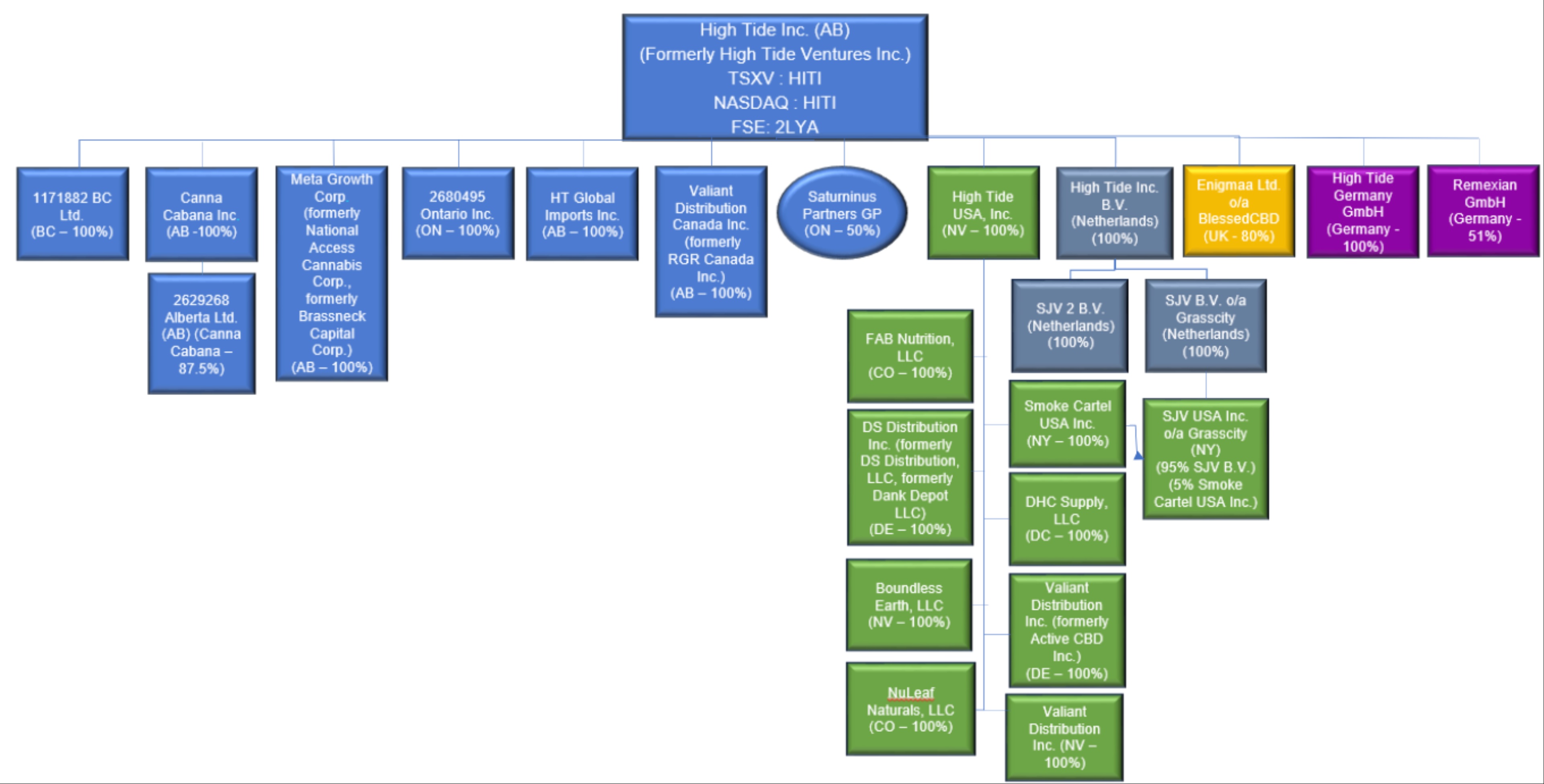
As at the AIF Date, High Tide has 9 direct and 19 indirect wholly-owned Subsidiaries, 2 direct, majority-owned Subsidiaries, and 2 indirect, majority-owned Subsidiaries. High Tide also holds a 100% indirect interest in a limited partnership existing under the Laws of the Province of Alberta, a 50% direct interest in a general partnership existing under the Laws of the Province of Ontario, and 49% indirect interest in 2 partnerships existing under the Laws of the Province of Manitoba.
As at the AIF Date, the Corporation operates the Business through the following wholly-owned Subsidiaries:
•Canna Cabana, formed under the ABCA.
•Meta Growth, incorporated under the ABCA.
•2680495 Ontario Inc., incorporated under the Business Corporations Act (Ontario).
•1171882 BC Ltd., incorporated under the Business Corporations Act (British Columbia).
•Valiant Canada, formed under the ABCA.
•Valiant, incorporated under the Laws of the State of Delaware.
•High Tide Inc. B.V., incorporated under the Laws of the Netherlands.
•Smoke Cartel, incorporated under the Laws of the State of New York.
•FABCBD, incorporated under the Laws of the State of Colorado.
•Daily High Club, incorporated under the Laws of the District of Columbia.
•Dankstop, incorporated under the Laws of Delaware.
•NuLeaf, incorporated under the Laws of Colorado.
•High Tide Germany, incorporated under the Laws of Germany.
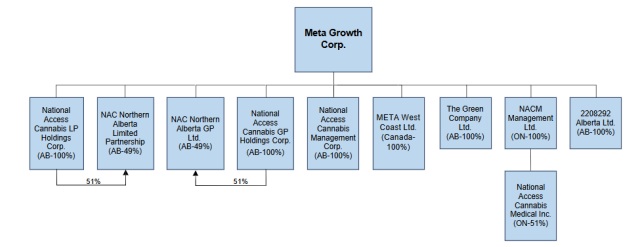
The following charts set out the material intercorporate relationships of the Corporation as at the AIF Date:
GENERAL DEVELOPMENT OF THE BUSINESS
The following is a description of the general development of the Business during the last three financial years:
Developments during the Financial Year ended October 31, 2023
•December 29, 2022: the Corporation acquired a 100% interest in Jimmy’s Cannabis (the “Jimmy’s Cannabis Acquisition”) pursuant to a share purchase agreement dated September 28, 2022 (the “Jimmy’s Cannabis Definitive Agreement”). The Corporation acquired two retail cannabis stores in British Columbia, located at 1225 Cranbrook Street North, Cranbrook and 1543 Victoria Street, Prince George. Pursuant to the terms of the Jimmy’s Cannabis Definitive Agreement, the Corporation acquired a 100% interest in Jimmy’s Cannabis in consideration for 2,595,533 Common Shares, valued at $5,300,000, on the basis of a deemed price of $2.0365 per Common Share (the “Jimmy’s Cannabis Consideration”). The working capital adjustment was $352,000 and was paid effective April 28, 2023.
•January 11, 2023: Omar Khan was promoted to the position of Chief Communications and Public Affairs Officer after serving as Senior Vice President of Corporate and Public Affairs since joining High Tide in January 2021.
•February 28, 2023: Following the departure of Rahim Kanji from Chief Financial Officer, Sergio Patino was appointed interim Chief Financial Officer for High Tide. Mr. Patino’s appointment was made permanent on August 1, 2023. He subsequently parted ways with the Corporation on May 1, 2024.
•May 15, 2023: The Corporation closed on the remaining 20% interest of FabCBD not held by High Tide at an enterprise value equal to the trailing twelve months of EBITDA multiplied by six, which was satisfied by the Corporation by issuing 386,035 Common Shares valued at US$560,380 on the basis of a deemed price per share of CAD$1.9372.
•August 31, 2023: High Tide established the 2023 ATM Program which allowed the Corporation to issue up to $30,000,000 (or the equivalent in U.S. dollars) of Common Shares from treasury to the public from time to time, at the Corporation’s discretion and subject to regulatory requirements. Any Common Shares sold through the 2023 ATM Program were sold at prevailing market prices when issued (i) in ordinary brokers’ transactions on the Nasdaq or another U.S. marketplace on which the Common Shares are listed, quoted or otherwise traded or (ii) in ordinary brokers’ transactions on the TSXV, or another Canadian marketplace on which the Common Shares are listed, quoted or otherwise traded. The 2023 ATM Program terminated on expiry of the Corporation’s 2023 base shelf prospectus and is no longer in effect.
•October 31, 2023: High Tide completed a restructuring of approximately $8.9 million of the Corporation’s outstanding debt held by a key industry lender under a senior secured convertible debenture issued on July 23, 2020, as amended, maturing on January 1, 2025 (the “Debenture”) pursuant to a debt restructuring agreement dated July 23, 2020, as amended, entered into between the parties (the “Debt Restructuring Agreement”). Pursuant to the Debt Restructuring Agreement, the parties agreed to settle the outstanding structured installment payments of $5,024,546 (the “Outstanding Structured Payment”) in Common Shares at a deemed price of $2.0168 per Common Share (the “Installment Shares”), to the key lender. Upon the Outstanding Structured Payment being satisfied, the outstanding amount of the Debenture was reduced proportionately. Future structured payments were changed from a quarterly obligation to semi-annually, and each such payment may be paid in cash or satisfied in free-trading Common Shares priced at the 10-day VWAP ending on the day prior to public announcement of such issuance, provided that High tide provides the key lender thirty (30) days prior written notice of its intention to pay in Common Shares, and the key lender, in its sole discretion, does not provide notice to High Tide at least 10 days before the applicable payment it due, that a portion or all of such payment is to be paid in cash. The Installment Shares and any Common Shares issued in settlement of any future structured payments shall be subject to certain resale, volume, and trading restrictions as agreed by the parties. High Tide’s obligations under the Debenture are secured by the assets of High Tide and certain of its subsidiaries pursuant to a subordinated security interest (ranking behind senior creditors) granted in favour of the key lender and such other persons who may from time to time become a party to the security agreement.
Developments during the Financial Year ended October 31, 2024
•November 27, 2023: High Tide acquired certain assets of Canadian Cannabis Media Corp. related to its store located at 1208 Davie Street in Vancouver, British Columbia for a total purchase price of $1.33 Million, paid via 658,754 Common Shares valued at $1.16 million and $167,003.26 cash.
•December 29, 2023: The Corporation paid down $2.8 million from its debt balance held by a key industry leader under a senior secured convertible debenture, issued on July 23, 2020, maturing on January 1, 2025, using cash on hand.
•February 13, 2024: Valiant Canada signed an agreement with the Manitoba Liquor and Lotteries Corporation (MBLL) for distribution of cannabis products to cannabis retailers in Manitoba.
•March 28, 2024: High Tide closed its acquisition of the brand Queen of Bud, including all IP, trademarks, and other assets, pursuant to the terms of an asset purchase agreement dated March 15, 2024. The consideration for the Transaction consisted of 378,486 Common Shares valued at $900,000 on the basis of a deemed price of C$2.3779 per High Tide Share, representing the 10-day volume weighted average price on the TSXV ending on March 22, 2024, and $100,000 in cash.
•April 5, 2024: Pursuant to the terms of a plan of merger agreement dated November 29, 2021 between High Tide Inc., Nuleaf Acquisition Corp., Bo Shirley, as member representative and NuLeaf, the Corporation granted NuLeaf an option to put to the Corporation, the remaining equity interest in NuLeaf not held by the Corporation, at an enterprise value equal to the trailing twelve months of adjusted EBITDA multiplied by 7.1 (the “NuLeaf Put Option”). On April 5, 2024, High Tide closed on the NuLeaf Put Option. Notice of the intention to exercise the NuLeaf Put Option was delivered by NuLeaf’s members on June 2, 2023, and the transaction was completed on April 5, 2024. High Tide had previously assigned its
ownership interest in NuLeaf to its subsidiary, High Tide USA, Inc., so the remaining 20% interest was also acquired by High Tide USA, Inc. The aggregate purchase price for the remaining 20% interest in NuLeaf was $1,575,000 USD, to be paid by High Tide in cash in fifteen (15) equal monthly installments of $105,000 USD, beginning on April 7, 2024.
•May 1, 2024: Following the departure of Sergio Patino, Mayank Mahajan was appointed as Chief Financial Officer of the Corporation.
•June 13, 2024: Binding subscription agreements were entered by the Corporation with arm’s length institutional credit providers for aggregate gross proceeds of $15 million in a subordinated debt facility of $1,000 principal subordinate secured debentures (the “Debentures”) at a price of $900 per debenture (the “Debenture Facility”). Pursuant to the terms of the subscription agreements, the funds were drawn in two tranches: (i) $10 million on July 31, 2024 and (ii) $5 million on November 13, 2024. The final tranche, until it was drawn, was subject to a 1% per annum standby fee. In connection with the closing of the initial tranche, the Corporation issued an aggregate of 230,760 Common Shares at a price of $3.47 per Common Share to the lenders. The Debentures will mature on July 31, 2029, and bear interest at a fixed rate of 12% per annum on drawn amounts, payable quarterly. The Debentures are governed by the terms and conditions of a debenture trust indenture between the Corporation and Olympia Trust Company in its capacity as trustee and collateral agent (the “Debenture Facility Trust Indenture”). The Corporation may redeem the Debentures at any time prior to maturity, in whole or in part, upon sixty days’ notice and payment of certain penalties as applicable. The Corporation’s obligations under the Debentures are collaterally secured by general security and guarantee agreements from the Corporation and certain subsidiaries of the Corporation and rank in second position to the Corporation’s existing senior lender.
•August 8, 2024: High Tide acquired a retail cannabis store in Mississauga, Ontario for $600,000 paid in cash. The purchase price represents 1.5x annualized Adjusted EBITDA for the three months ended May 31, 2024. An amount equal to approximately $150,000 will be held in escrow for a period of twelve (12) months by High Tide’s lawyers to satisfy the seller’s indemnity with respect to possible claims based on breaches of representation and warranties.
•September 10, 2024: High Tide announced a joint venture with Positive Intent Events (PIE) for cannabis sales at adults-only events, such as music festivals, comedy shows, and business conferences, following Alberta’s decision to allow licensed cannabis pop-up stores at adults-only festivals and events.
Developments during the Financial Year ended October 31, 2025
•December 2, 2024: The Corporation expanded its Cabana Club membership program across the United States, European Union, and United Kingdom, and added international snacks and confectionary to its e-commerce offerings.
•December 31, 2024: The Corporation repaid the $13 million principal balance of notes payable to Opaskwayak Cree Nation.
•January 13, 2025: High Tide signed a definitive agreement to acquire 51% of Purecan GmbH, for approximately €4.8 Million. During due diligence, the Corporation paused its acquisition to explore alternative arrangements to enter the German medical cannabis market.
•April 9, 2025: the Board approved the adoption of a shareholder rights plan (the “Shareholder Rights Plan”) pursuant to a shareholder rights plan agreement entered into with Olympia Trust Company, as Rights Agent, dated April 10, 2025 to ensure the Corporation maintains compliance with applicable cannabis laws and is able to maintain its cannabis licenses, and to ensure that all shareholders are treated fairly in connection with any offer to acquire the outstanding common shares of the Corporation and that the Board has the opportunity to identify, solicit, develop and negotiate value-enhancing alternatives to any unsolicited take-over bid. On May 29, 2025, the Shareholder Rights Plan was ratified by shareholders of the Corporation and will be in effect for a term of three years.
•April 17, 2025: the Corporation changed its auditors from Ernst & Young LLP, Chartered Professional Accountants to Davidson & Company LLP, Chartered Professional Accountants, upon the audit committee’s recommendation, and their appointment was ratified by the shareholders of the Corporation on May 29, 2025.
•May 29, 2025: the Corporation opened its 200th Canna Cabana location.
•July 16, 2025: High Tide closed the Junior Secured Loan. The Junior Secured Loan is secured by a third priority lien on certain of High Tide’s assets and bears interest at 4% per annum. Pursuant to the terms of the Loan Agreement, Cronos may, with the agreement of High Tide, from time to time, convert the Junior Secured Loan, excluding the amounts attributed to the original issuance discount, into Common Shares at a price of $4.20 per Common Share. The Junior Secured Loan has a 5-year term and may be repaid, in whole or in part, at any time, at High Tide’s option with no penalty. Additionally, Cronos received a Common Share purchase warrant (the “Cronos Warrant”). The Cronos Warrant is exercisable into up to
3,836,317 Common Shares (the “Warrant Shares”) at an exercise price of $3.91 per Warrant Share, for a period of five years, at Cronos’ option.
In connection with the Junior Secured Loan, Cronos entered into a support agreement with High Tide (the “Cronos Support Agreement”), where they agreed to vote their securities of High Tide in favour of, or against, voting matters that the board and management of the Corporation recommends voting in favour for, or against, as applicable. Cronos also agreed not to transfer their securities without prior written consent of the Corporation.
•July 28, 2025: the Corporation surpassed 2 million Cabana Club members.
•August 12, 2025: in order to replace its prior base shelf prospectus that was expiring on September 3, 2025, the Corporation filed the Base Shelf Prospectus to provide it with the flexibility to take advantage of financing opportunities and favourable market conditions, if and when needed, during the 25-month period that the Base Shelf Prospectus remains effective. The Base Shelf Prospectus has been filed in each of the provinces and territories in Canada. The Base Shelf Prospectus enables the Corporation to offer, issue and sell, from time to time: common shares, warrants, units, subscription receipts, debt securities, convertible securities, or any combination of such securities for up to an aggregate offering price of C$100,000,000 (or its equivalent), in one or more transactions. The Corporation also filed a corresponding shelf registration statement relating to the Securities with the United States of America Securities and Exchange Commission under the U.S. Canada Multijurisdictional Disclosure System. The Corporation may also use the Base Shelf Prospectus in connection with an “at-the-market distribution” in accordance with applicable securities laws, which would permit securities to be sold on behalf of the Corporation through the TSX Venture Exchange, the Nasdaq Stock Exchange, (or other existing trading markets) as further described in the applicable prospectus supplement. To date, no agreement has been entered into with respect to such a distribution. The Corporation may use the net proceeds from the sale of Securities for general corporate purposes, capital projects, internal expansion, or for the acquisition of other businesses, assets or securities by the Corporation or one of its subsidiaries.
•August 14, 2025: the Corporation retained IR Agency to provide investor relations services, supporting the Corporation’s communications with existing and prospective shareholders, the investment community and stakeholders. For a term of one month, IR Agency will undertake activities including communicating information about the Corporation to the financial community, creating company profiles, media distribution, and building a digital community, all in compliance with applicable laws. In consideration for these services, IR Agency will receive a fee of USD $140,000, paid strictly on a fee-for-service basis, consistent with TSX Venture Exchange Policy 3.4 and in proportion to the Corporation’s operational scope and financial resources. The Agency, located in Newark, New Jersey, with Rafael Pereira as the principal, is arm’s-length to the Corporation and neither the Agency nor its principals hold an equity interest in the Corporation’s securities, either directly or indirectly, or the right to acquire any equity interest.
•September 2, 2025: pursuant to a definitive agreement dated August 14, 2025 (the “Remexian Purchase Agreement”), High Tide closed its acquisition of 51% of Remexian for an estimated purchase price of €26.4 million, such amount still subject to finalization due to working capital and net debt calculations, and will have a five-year option to acquire the remaining 49% of Remexian at any time after 24 months. The purchase price is broken down as follows:
◦5,864,373 Common Shares valued at €11.1 million priced at US$2.1912, representing the volume weighted average price per High Tide Share on the Nasdaq for the 10 trading days ending August 8, 2025 (the “Remexian Consideration Shares”).
◦€7.65 million in cash.
◦€7.65 million via loans from the sellers (the “Vendor Loans”). The Vendor Loans will mature on December 31, 2029, bear 7% annual interest (paid quarterly), and be prepayable at any time by the Corporation with no penalty.
In addition to the foregoing, Remexian’s owners (the “Remexian Vendors”) have agreed to grant High Tide an option to acquire the remaining interests in Remexian not held by High Tide, (the “Remexian Call Option”). The Remexian Call Option will be exercisable at any time for a period of five (5) years, following the twenty-four (24) month anniversary of the Closing (the “Remexian Call Option Term”). The Remexian Call Option is exercisable at an enterprise value equal to the trailing twelve months of Adjusted EBITDA multiplied by (i) 4 if the Remexian Call Option is exercised in the first twelve (12) months of the Remexian Call Option Term, or (ii) 3.64065 if exercised thereafter. In addition, High Tide has agreed to grant Remexian’s owners an option to put to High Tide the remaining interests in Remexian not held by High Tide (the “Remexian Put Option”), at the same enterprise value as the Remexian Call Option during the same time periods. The consideration under the Remexian Call Option or the Remexian Put Option, if exercised, will be satisfied in a combination of cash and Common Shares, at High Tide’s discretion. The Remexian Call Option has a minimum price of €15 million, and is subject to a minimum cash payment of at least 40%, and the Remexian Put Option is subject to a minimum cash payment of at least 30%.
In connection with the Remexian Purchase Agreement and receipt of the Remexian Consideration Shares, the Remexian Vendors each entered into voting support and standstill agreements with High Tide (the “Remexian Voting Support Agreements”), where they agreed to vote the Remexian Consideration Shares in favour of, or against, voting matters that the board and management of the Corporation recommends voting in favour for, or against, as applicable. The Remexian Vendors also agreed not to transfer their Remexian Consideration Shares to any person who is hostile to the Company, or to a licensed producer.
Developments subsequent to the Financial Year ended October 31, 2025
•December 19, 2025: the Corporation reengaged IR Agency to provide investor relations services, supporting the Corporation’s communications with existing and prospective shareholders, the investment community and stakeholders. Pursuant to the agreement, for a term of up to one year, the Agency will undertake activities including communicating information about the Corporation to the financial community, creating company profiles, media distribution, and building a digital community, all in compliance with applicable laws. In consideration for these services, the Agency will receive a fee of USD$140,000 per month for months that the Corporation decides to use the Agency, paid strictly on a fee-for-service basis, consistent with TSX Venture Exchange Policy 3.4 and in proportion to the Corporation’s operational scope and financial resources.
DESCRIPTION OF THE BUSINESS
General
The Corporation is an Alberta-based, retail-focused cannabis company. As at the AIF Date, the Corporation is one of the largest cannabis retailers in Canada, with 218 operating retail cannabis locations (including jointly-owned store locations) across Canada. The Corporation is engaged in the Canadian cannabis market through a portfolio of Subsidiaries.
The Corporation was incorporated under the ABCA on February 8, 2018, under the name “High Tide Ventures Inc.”. Effective October 4, 2018, the Corporation amended its articles of incorporation and changed its name to “High Tide Inc.” Since its inception, the Corporation has grown, both organically and via strategic acquisitions (including its acquisitions of Meta Growth, Smoke Cartel, FABCBD, Daily High Club, Dankstop, Blessed, and NuLeaf) to emerge as a leader in the evolving cannabis market within Canada. As one of Canada’s largest and fastest-growing retail-focused cannabis companies, the Corporation continues to pursue rapid growth to expand its presence across various jurisdictions in Canada, with its principal business focused on bricks-and-mortar distribution and sale of cannabis and cannabis products in the provinces of Alberta, Ontario, Saskatchewan, Manitoba, and British Columbia.
The Corporation has three operating segments: (i) the “bricks-and-mortar” segment, which includes the Corporation’s Canadian bricks-and-mortar locations, inclusive of the Canadian warehouse which supports the distribution of accessories and other items to the Canadian stores; (ii) the “e-commerce” segment, which includes the Corporation’s U.S. and international subsidiaries, inclusive of the U.S. warehouse which supports the distribution of accessories and other items to the U.S. and international subsidiaries; and (iii) the “medical cannabis distribution” segment, which includes the medical cannabis distribution operations acquired as part of the Corporation’s acquisition of Remexian.
During the financial year of High Tide ended October 31, 2025, (i) approximately 96% (2024 – 93%) of the total revenues of High Tide were derived from sales within the bricks-and-mortar segment of the Business to customers outside of High Tide and its Subsidiaries, and (ii) approximately 3% (2024 – 7%) of the total revenues of High Tide were derived from sales within the e-commerce segment of the Business to customers outside of High Tide and its Subsidiaries, and (iii) approximately 1% (2024 – N/A) of the total revenues of High Tide were derived from the medical cannabis distribution segment of the Business.
High Tide offers a suite of proprietary brands which have over time become well known amongst consumers, including “Dopezilla”, “Atomik”, “Puff Puff Pass”, “Vodka Glass”, “Queen of Bud”, and “Cabana Cannabis Co.”.
The followings sections are intended to provide a summary of the business and operations of High Tide’s material operating subsidiaries, as at the AIF Date.
Canna Cabana
Canna Cabana is the successor entity to all previously wholly owned ABCA Subsidiaries, wherein all wholly owned Subsidiaries were amalgamated into Canna Cabana pursuant to the ABCA. Canna Cabana is High Tide’s primary retail cannabis business, offering for retail sale various cannabis products and accessories through its provincially authorized cannabis retail store locations. As at the AIF Date, Canna Cabana operates a retail cannabis chain with 216 branded stores operating across Canada, in the provinces of Alberta, British Columbia, Manitoba, Ontario, and Saskatchewan.
Canna Cabana’s flagship retail concept is an industry-leading, loyalty-focused discount club model that was built to serve consumers for the long term, by focusing on value, innovation, and community. Its mission is to make quality cannabis accessible and affordable for every Canadian adult consumer.
Meta Growth
Meta Growth is High Tide’s secondary retail cannabis business offering for retail sale various cannabis products and accessories through its provincially authorized cannabis retail store locations.
Grasscity
Based in Amsterdam, Netherlands, Grasscity operates Grasscity.com, one of the world’s premier online stores for consumption accessories and cannabis lifestyle products. Established in 2000, Grasscity.com is one of the most searched and visited consumption accessories retailers. Grasscity.com offers an extensive selection of hand-picked consumption accessories and cannabis lifestyle products, from grinders and rolling papers to one-of-a-kind glass bongs, smoking pipes, oil rigs and bubblers and Hemp-derived products, such as CBD flower and CBD gummies. The Grasscity.com e-commerce platform generates the majority of its revenues from customers located in the United States.
Valiant Canada and Valiant
Valiant Canada is the successor entity to RGR Canada Inc. and Famous Brandz Inc., both of which were wholly owned Subsidiaries and were amalgamated in November 2020 pursuant to the ABCA to form Valiant Canada. Valiant was incorporated under the Laws of the State of Delaware on April 6, 2019.
Through its relationships with its manufacturers, based in Asia, Canada, the United States, and elsewhere, which specialize in various areas of assembly and manufacturing, Valiant Canada continues to deliver to market a suite of high quality, proprietary products (such as high-quality rolling papers) as well as third-party branded products (such as Raw, Zig Zag, and Pax).
Valiant Canada and Valiant are established leaders in the e-commerce fulfillment and warehousing of consumption accessories and other alternative lifestyle products. Valiant Canada and Valiant distribute products through business-to-customer retail e-commerce platforms. Valiant Canada and Valiant have established relationships with a wide network of distributors, wholesalers and retailers with a presence across Canada, the United States and Europe.
Smoke Cartel
Smoke Cartel is one of the leading online retailers of glass water pipes, vaporizers, consumption accessories, and Hemp-derived products. Smoke Cartel provides a marketplace with a wide variety of high-quality products, subscription boxes, reliable customer service, and rapid dependable shipping. Smoke Cartel leverages its proprietary marketplace technology to seamlessly connect brands & vendors with its growing customer base built over the last nine years. Smoke Cartel’s website at www.smokecartel.com offers fast load times and optimizations, making the customer experience quick, seamless, and engaging. Smoke Cartel conducts its operations within States of the U.S. in which the sale of Hemp-derived products does not violate state- controlled substance Laws.
FABCBD
FABCBD is one of the leading online retailers of Hemp-derived products. FABCBD provides a wide variety of high-quality products and formulas, affordable pricing, rapid dependable shipping, and surprisingly personable customer service. FABCBD’s website at www.fabcbd.com.
Founded in 2017 with its headquarters in Denver, Colorado, FABCBD has quickly grown to become one of the most popular brands for Hemp-derived products across the U.S., including CBD oils, topicals, gummies, as well as pet products. FABCBD only conducts its operations within States of the U.S. in which the sale of Hemp-derived products does not violate State-controlled substance Laws.
Daily High Club
With over one million consumption accessories sold, Daily High Club is one of the leading online retailers of glass water pipes, vaporizers, and other in demand consumption accessories. Daily High Club provides a marketplace with a wide variety of high-quality products and subscription boxes. Daily High Club has an active social media presence with numerous influencer and celebrity endorsements. The company’s website at www.dailyhighclub.com offers an engaging and fun shopping experience.
Dankstop
Dankstop is a leading online consumption accessories retailer. With an industry leading and innovative website at www.Dankstop.com, and dedicated support team, Dankstop has raised the bar for the online consumption supply industry since 2014. Leveraging its in-house technology, Dankstop now offers a variety of business-to-business services for the cannabis industry in addition to its retail websites ranging from drop shipping to third party logistics.
Blessed
Blessed is one of the leading online retailers of Hemp-derived products in the U.K. The company provides a marketplace with a wide variety of high-quality products and formulas, affordable pricing, rapid dependable shipping, and surprisingly personable customer service. Blessed has been featured as the best U.K. CBD Oil in several publications including The Mirror, Reader’s Digest, and Maxim Magazine.
NuLeaf
NuLeaf is one of America’s leading cannabinoid companies. Since 2014, NuLeaf has been committed to creating the world’s highest quality cannabinoid products in their most pure and potent form. NuLeaf’s manufacturing facility is cGMP certified, enabling them to create innovative cannabinoid formulations while exceeding the highest levels of regulatory requirement. The company is committed to creating safe, consistent, and effective products and has proudly received over 36,000 verified five-star customer reviews through their e-commerce platform. NuLeaf only conducts its operations within States of the U.S. in which the sale of Hemp-derived products does not violate State-controlled substance Laws.
Remexian
Founded in 2018 and headquartered just outside of Berlin, Germany, Remexian is an established medical cannabis pharmaceutical company specializing in the importation and wholesale of medical cannabis. As part of its business model, Remexian has a fully certified EU GDP warehouse. Remexian is currently licensed to import medical cannabis products into Germany from 19 countries, including Canada, which represents approximately 33% of their total imports into Germany.
Retail Cannabis Stores
As at the AIF Date, High Tide operates a total of 218 cannabis retail stores, consisting of (i) 91 cannabis retail stores in the Province of Alberta, (ii) 94 cannabis retail stores in the Province of Ontario, (iii) 13 cannabis retail stores in the Province of Saskatchewan, (iv) 12 cannabis retail stores in the Province of Manitoba, (v) and 8 cannabis retail stores in the Province of British Columbia.
The following chart sets out the retail cannabis stores operated by the Corporation as at the AIF Date:
| | | | | | | | | | | | | | | | | |
Municipality and Province | Number of Stores | Store Brand | Municipality and Province | Number of Stores | Store Brand |
| Airdrie, AB | 2 | Canna Cabana | Lucan, ON | 1 | Canna Cabana |
| Ajax, ON | 2 | Canna Cabana | Markdale, ON | 1 | Canna Cabana |
| Ancaster, ON | 1 | Canna Cabana | Martensville, SK | 1 | Canna Cabana |
| Banff, AB | 1 | Canna Cabana | Medicine Hat, AB | 2 | Canna Cabana |
| Barrie, ON | 1 | Canna Cabana | Milton, ON | 1 | Canna Cabana |
| Beaumont, AB | 1 | Canna Cabana | Mississauga, ON | 7 | Canna Cabana |
| Belleville, ON | 1 | Canna Cabana | Moose Jaw, SK | 1 | Canna Cabana |
| Blackfalds, AB | 1 | Canna Cabana | Morden, MB | 1 | Canna Cabana |
| Bonnyville, AB | 1 | Canna Cabana | Morinville, AB | 1 | Canna Cabana |
| Bracebridge, ON | 2 | Canna Cabana | Nepean, ON | 1 | Canna Cabana |
| Brampton, ON | 3 | Canna Cabana | Niagara Falls, ON | 2 | Canna Cabana |
| Brandon, MB | 1 | Canna Cabana | North York, ON | 2 | Canna Cabana |
| Brantford, ON | 1 | Canna Cabana | Okotoks, AB | 1 | Canna Cabana |
| Brooks, AB | 1 | Canna Cabana | Olds, AB | 1 | Canna Cabana |
| Burlington, ON | 3 | Canna Cabana | Opaskwayak Cree Nation, MB | 1 | Meta Growth |
| Calgary, AB | 36 | Canna Cabana | Oshawa, ON | 1 | Canna Cabana |
| | | | | | | | | | | | | | | | | |
| Cambridge, ON | 1 | Canna Cabana | Ottawa, ON | 5 | Canna Cabana |
| Camrose, AB | 1 | Canna Cabana | Owen Sound, ON | 1 | Canna Cabana |
| Canmore, AB | 1 | Canna Cabana | Pembroke, ON | 1 | Canna Cabana |
| Cochrane, AB | 2 | Canna Cabana | Pickering, ON | 1 | Canna Cabana |
| Cold Lake, AB | 2 | Canna Cabana | Prince George, BC | 1 | Canna Cabana |
| Collingwood, ON | 1 | Canna Cabana | Red Deer, AB | 2 | Canna Cabana |
| Cornwall, ON | 2 | Canna Cabana | Regina, SK | 5 | Canna Cabana |
| Cranbrook, BC | 1 | Canna Cabana | Richmond, ON | 1 | Canna Cabana |
| Drayton Valley, AB | 1 | Canna Cabana | Saskatoon, SK | 3 | Canna Cabana |
| Drumheller, AB | 1 | Canna Cabana | Scarborough, ON | 2 | Canna Cabana |
| East York, ON | 1 | Canna Cabana | Selkirk, MB | 1 | Canna Cabana |
| Edenwold, SK | 1 | Canna Cabana | Sherwood Park, AB | 2 | Canna Cabana |
| Edmonton, AB | 9 | Canna Cabana | Slave Lake, AB | 1 | Canna Cabana |
| Edson, AB | 1 | Canna Cabana | St. Albert, AB | 2 | Canna Cabana |
| Etobicoke, ON | 1 | Canna Cabana | St. Paul, AB | 1 | Canna Cabana |
| Fort Erie, ON | 1 | Canna Cabana | St. Thomas, ON | 1 | Canna Cabana |
| Fort McMurray, AB | 2 | Canna Cabana | Stittsville, ON | 1 | Canna Cabana |
| Fort SK, AB | 1 | Canna Cabana | Stoney Creek, ON | 1 | Canna Cabana |
| Fort St. John, BC | 1 | Canna Cabana | Stratford, ON | 1 | Canna Cabana |
Grande Prairie, AB | 3 | Canna Cabana | Sudbury, ON | 1 | Canna Cabana |
| Guelph, ON | 2 | Canna Cabana | Swift Current, SK | 1 | Canna Cabana |
| Hamilton, ON | 5 | Canna Cabana | Thompson, MB | 1 | Meta Growth |
| Hanover, ON | 1 | Canna Cabana | Thunder Bay, ON | 1 | Canna Cabana |
| Hinton, AB | 1 | Canna Cabana | Tisdale, SK | 1 | Canna Cabana |
| Huntsville, ON | 1 | Canna Cabana | Toronto, ON | 11 | Canna Cabana |
| Innisfil, ON | 1 | Canna Cabana | Tsuutina, AB | 1 | Canna Cabana |
| Kamloops, BC | 1 | Canna Cabana | Vancouver, BC | 4 | Canna Cabana |
| Kanata, ON | 2 | Canna Cabana | Vegreville, AB | 1 | Canna Cabana |
| Kingston, ON | 1 | Canna Cabana | Waterloo, ON | 2 | Canna Cabana |
| Kitchener, ON | 5 | Canna Cabana | Westlock, AB | 1 | Canna Cabana |
| Lacombe, AB | 1 | Canna Cabana | Whitecourt, AB | 1 | Canna Cabana |
| Lasalle, ON | 1 | Canna Cabana | Windsor, ON | 2 | Canna Cabana |
| Leduc, AB | 1 | Canna Cabana | Winnipeg, MB | 7 | Canna Cabana |
| Lethbridge, AB | 3 | Canna Cabana | Woodstock, ON | 1 | Canna Cabana |
| Lloydminster, AB | 1 | Canna Cabana | York, ON | 1 | Canna Cabana |
| London, ON | 4 | Canna Cabana | | | |
Production and Sales
Certain of the Corporation’s subsidiaries manufacture hemp-derived products in the United States. Valiant and Valiant Canada conduct warehousing and fulfillment operations of consumption accessories that are sold through the Corporation’s bricks-and-mortar retail cannabis stores and online.
Specialized Skill and Knowledge
All aspects of the Business require specialized skills and knowledge, including in, among other things, the retail sale of cannabis and cannabis products within various jurisdictions in Canada, in accordance with applicable Laws. The Management team is comprised of individuals (including consultants and advisors), who bring together strong complementary skills, expertise and experience in various aspects of the cannabis, retail, wholesale and manufacturing industries, as well as strong capital markets experience. The experienced Management team, along with its other employees, subcontractors and consultants, have the required expertise and specialized knowledge and are well-positioned to implement the Corporation’s retail-focused cannabis business strategy.
Competitive Conditions
The Corporation faces, and will continue to face, intense competition from existing and new retailers, wholesalers, and producers of adult-use cannabis, and other applicable participants in the cannabis industry whose services overlap with the business which the Corporation may from time to time be engaged in. Some of the competitors of the Corporation may have greater financial resources, market access and manufacturing and marketing experience than the Corporation.
Increased competition by numerous independent cannabis retail outlets and larger and better financed competitors (including new entrants), could have a Material Adverse Effect.
The Corporation believes that its competition can be broadly grouped into the following four categories:
(a)Existing Retailers: This class of competitors includes early-stage and semi-developed retail cannabis businesses, as well as established retail cannabis businesses, which may be well capitalized, and which may also have an established and longer retail operating history in Canada. These competitors are able to compete directly with the Corporation in the cannabis markets in the provinces of Alberta, Ontario, Saskatchewan, Manitoba, and British Columbia, as the case may be.
(b)Government Competition: This class of competitors includes government wholesalers that sell directly to consumers, such as the OCS in the Province of Ontario, the AGLC in the Province of Alberta and British Columbia Liquor Distribution Branch in the Province of British Columbia. These competitors are able to compete directly with the Corporation in the cannabis markets in the provinces of Alberta, British Columbia, and Ontario, as the case may be.
(c)Illicit Market: This class of competitors includes Persons and businesses operating in the illicit market within various jurisdictions across Canada. These competitors, who Management believes continue to divert a sizeable number of commercial opportunities from the Corporation, are able to compete directly with the Corporation in the cannabis markets in the provinces of Alberta, Ontario, Saskatchewan, Manitoba, and British Columbia, as the case may be.
(d)Existing Wholesalers: This class of competitors includes early-stage and semi-developed wholesalers, as well as established wholesalers, which may be well capitalized, and which may also have an established and longer retail operating history in Canada. These competitors are able to compete directly with the Corporation in the cannabis markets in the provinces of Alberta, Ontario, British Columbia, and Saskatchewan within Canada, as well as in the United States, United Kingdom, and Europe. As of the AIF Date, most of the Corporation’s wholesale competitors operate primarily as product distributors, whereas Valiant Canada designs, directly sources, imports and distributes its product offerings. As a result, Management believes that this provides High Tide with a competitive advantage through vertical integration, enabling Valiant Canada to bring to market unique product designs and offer wholesale customers favourable and flexible pricing.
To remain competitive, High Tide will require a continued high level of investment in research and development, marketing, sales and client support. High Tide may not have sufficient resources to maintain research and development, marketing, sales and client support efforts on a competitive basis which could have a Material Adverse Effect. However, High Tide believes that the experience of Management in the retail cannabis spaces has and will continue to provide High Tide with a competitive advantage in navigating the complexities of a highly regulated, evolving marketplace and that its competitive position is at least equivalent to that of other cannabis retailers in Canada of a similar size and at a similar stage of development.
Cycles
The Business is not cyclical or seasonal. However, the Business may, from time to time, be affected by supply constraints and disruptions and seasonal variations that impact the supply of cannabis and cannabis products. The impact of such supply constraints and disruptions and seasonal variations on the Business and its operating results cannot be predicted at this time.
Intangible Properties
High Tide’s consumer-focused brands, Canna Cabana, Meta Growth, Fastendr™, Grasscity, Smoke Cartel, FABCBD, Daily High Club, Dankstop, Blessed, Queen of Bud™, and NuLeaf have been an important part of the operation of the Corporation, and trademarks and other intellectual property rights continue to be essential to maintain the success and competitive position of the Corporation.
The Corporation’s portfolio of registered trademarks and designs continue to be valuable assets that distinguish the Corporation’s brand and reinforce customers’ positive perception of its products and stores. As such, the Corporation has devoted, and expects to continue to devote, significant resources to the protection of its intellectual property rights, through, among other things, trade secrets, technical know-how and proprietary information. The Corporation will continue to seek protection of its intellectual property by
seeking and obtaining registered protection (including patents) where possible, developing and implementing standard operating procedures and entering into agreements with parties that have access to the Corporation’s inventions, trade secrets, technical know- how and proprietary information such as business partners, collaborators, employees and consultants, to protect the confidentiality and ownership of intellectual property.
Foreign Operations
As at the AIF Date, High Tide conducts operations in the United States through Valiant, NuLeaf, FABCBD, Smoke Cartel, Daily High Club, Grasscity, and Dankstop, within States in which they sell branded consumption accessories and other alternative lifestyle products that are permitted under applicable Laws. Approximately 3% (previous year – 6%) of High Tide’s annual sales from continuing operations for the financial year of High Tide ended the Fiscal Year-End Date were attributable to the operations of Subsidiaries operating in the United States.
As at the AIF Date, High Tide also conducts operations in the Netherlands through Grasscity, in accordance with applicable Laws. Less than 1% (previous year – less than 2%) of High Tide’s annual sales from continuing operations for the financial year of High Tide ended the Fiscal Year-End Date were attributable to the operations of Grasscity in the Netherlands.
As at the AIF Date, High Tide also conducts operations in the U.K. through Blessed, in accordance with applicable Laws. Less than 1% (previous year – less than 1%) of High Tide’s annual sales from continuing operations for the financial year of High Tide ended the Fiscal Year-End Date attributable to the operations of Blessed in the U.K.
As at the AIF Date, High Tide also conducts operations in Germany through Remexian, and High Tide Germany, in accordance with applicable Laws. Less than 2% (previous year – N/A) of High Tide’s annual sales from continuing operations for the financial year of High Tide ended the Fiscal Year-End Date were attributable to the operations in Germany.
Employees
As at the AIF Date, the Corporation has approximately 1,832 employees.
CANADIAN REGULATORY OVERVIEW
The following summary is intended to provide a general overview of the primary Canadian federal and provincial Laws and regulations in respect of the distribution and sale of adult-use cannabis, cannabis products and cannabis accessories. The provincial and territorial regulatory frameworks relating to cannabis are complex and rapidly evolving, with provincial and territorial governments in Canada having taken different approaches to regulating cannabis and cannabis-related activities. The below summary is not intended to be exhaustive and does not address the Laws and regulations of any other jurisdiction. The Corporation continues to monitor regulatory developments and their impact on the Business, including the Corporation’s proposed plans for further expansion and growth.
Federal Framework
On October 17, 2018, the Cannabis Act and the Cannabis Regulations came into force in Canada, replacing the Access to Cannabis for Medical Purposes Regulations and the Controlled Drugs and Substances Act as the governing Laws and regulations in respect of the production, processing, sale and distribution of cannabis for medical and adult recreational use.
The Cannabis Act provides a licensing and permitting framework for the cultivation, processing, importation, exportation, testing, packaging, labelling, sending, delivery, transportation, sale, possession and disposal of cannabis for adult recreational use, which is implemented by the Cannabis Regulations. Among other things, the Cannabis Act:
•Contains restrictions on the amounts of cannabis that individuals can possess and distribute, on public consumption and use.
•Prohibits the sale of cannabis unless authorized by the Cannabis Act.
•Permits individuals 18 years of age or older to cultivate, propagate, and harvest up to and including four (4) cannabis plants in their dwelling-house, propagated from a seed or plant material authorized by the Cannabis Act
•Restricts (but does not strictly prohibit) the promotion and display of cannabis, cannabis accessories and services related to cannabinoids to consumers, including restrictions on branding and a prohibition on false or misleading promotion and on sponsorships.
•Permits the informational promotion of cannabis in specified circumstances to individuals 18 years of age and older (or any older age specified by applicable provincial legislation).
•Contains packaging and labelling requirements for cannabis and cannabis accessories.
•Prohibits the sale of cannabis or cannabis accessories in packaging or with labelling that could be appealing to young persons.
•Provides the designated Minister with the power to recall any cannabis or class of cannabis on reasonable grounds that such a recall is necessary to protect public health or public safety.
•Establishes the cannabis tracking and licensing system.
•Provides powers to designated inspectors for the purpose of administering and enforcing the Cannabis Act and a system for administrative monetary penalties.
The Cannabis Regulations, among other things:
•Provide for the issuance of cultivation licences for standard cultivation, micro-cultivation, and nursery cultivation, licences for standard processing and micro-processing, as well as sales licences for medical or non-medical use.
•Contain requirements for all cannabis products to be packaged in a tamper-evident and child-resistant manner.
•Require specified product information on cannabis product labels (such as the name of the party who packaged the products, the product lot number, and the THC and CBD content).
•Prohibit testimonials, lifestyle branding, and packaging that is appealing to youth.
The Cannabis Act provides provincial and municipal governments the authority to prescribe regulations regarding retail and distribution, as well as the ability to alter some of the existing baseline requirements, such as increasing the minimum age for the purchase and consumption of cannabis. As of the AIF Date, various provincial and municipal governments in Canada have enacted legislation to regulate the storefront and online sale of cannabis produced by Licensed Producers.
Provincial Framework
The following section provides a general overview of the applicable laws and regulations governing the retail sale and distribution of adult-use cannabis, cannabis products and cannabis accessories in the five key provinces within which the Corporation conducts the Business as at the AIF Date.
Alberta
The Province of Alberta has passed two bills pertaining to the authorization and regulation of cannabis activities: (i) Bill 26, which received Royal Assent on December 15, 2017; and (ii) and Bill 6, which received Royal Assent on June 11, 2018. Bill 26 and Bill 6 both amend the GLCA. Bill 26 and Bill 6 were substantially proclaimed into force effective July 14, 2018. The remaining provisions came into force effective October 17, 2018, concurrent with the Cannabis Act and Cannabis Regulations. AR 13/2018 was published on February 16, 2018 and also came into force effective July 14, 2018. AR 13/2018 amended the Gaming, Liquor and Cannabis Regulation (GLCR).
The AGLC (re-named the Alberta Gaming, Liquor and Cannabis Commission, but retaining the same acronym) is responsible for managing provincial oversight of the private retail adult-use cannabis industry. The AGLC is exclusively authorized to purchase adult- use cannabis products from Licensed Producers, which it then distributes to licensed private retailers for sale from licensed premises. The AGLC is also responsible for issuing licences to private retailers authorizing the sale of adult-use cannabis products in accordance with the GLCA, the GLCR and the AGLC’s policies and conditions. The GLCA authorizes the AGLC to establish policies, including in respect to the advertising and promoting of cannabis and cannabis retail licences. The AGLC Handbook sets out the AGLC’s policies and guidelines related to cannabis retail licences.
The GLCA prohibits: (i) agreements between cannabis licensees and suppliers to sell or promote the sale of the supplier’s cannabis, except as provided by the GLCR; (ii) individuals under the age of eighteen (18) from entering licensed premises or from purchasing or attempting to purchase, obtain or possess cannabis; (iii) the sale of adult-use cannabis products to an intoxicated person; and (iv) the use of a term commonly associated with medicine, health or pharmaceuticals including “pharmacy”, “dispensary”, “apothecary”, “drug store”, “medicine”, “medicinal”, “health”, “therapeutic”, or “clinic” in any signage for a licensed premises or the name of a licensee. The GLCA also prohibits issuance of a cannabis retail licence unless the sale of cannabis will be conducted as a separate business from any other activities of the applicant and in a location where only cannabis products, cannabis accessories (as defined in the Cannabis Act) or other prescribed items are sold.
In late 2021, the Legislative Assembly of Alberta passed legislation allowing licensed cannabis retailers in Alberta to offer online sales and delivery of cannabis products effective March 8, 2022. Licensed cannabis retailers are required to apply to the AGLC to have their licenses expanded to allow for online sales and must have their website approved by AGLC inspectors.
The GLCR sets out detailed rules regarding: (i) the ownership and operation of licensed cannabis retail stores; (ii) where such stores may be located; (iii) staffing, security and safety requirements for licensed stores; and (iv) the process for review and approval of applications for cannabis retail store licences. The GLCR prohibits a licensed cannabis retail store from being located within one hundred (100) metres of a provincial health care facility, a school, or land designated as a school reserve or municipal and school reserve; however, municipalities may expressly vary such restrictions on the location of cannabis retail stores in their land use by- laws.
The AGLC Handbook requires that only cannabis accessories that promote the responsible and legal storage and consumption of cannabis be sold at cannabis retail stores, and that the majority of sales of a retail cannabis store must be cannabis. Non-cannabis items that may not be sold at cannabis retail stores include consumable products other than cannabis, products intended to be mixed, applied or consumed with cannabis, organic solvents and products or promotional material related to the medical use of cannabis. The AGLC has published a list of cannabis accessories it considers to be approved for sale in licensed cannabis retail stores.
The GLCR initially prohibited the issuance of a licence if it would result in more than fifteen percent (15%) of the total number of issued retail cannabis licences in Alberta being held by one person or a group of persons having common control. However, that prohibition was lifted on October 17, 2020 and there is no longer a limitation on the number of cannabis licences that may be held by one person or a group of persons having common control.
Each municipality in Alberta is responsible for establishing its own land use and business licensing by-laws governing the issuance of development permits, building permits and business licences to prospective cannabis retail store licensees. Some municipalities have implemented a random selection process for determining the order and priority of review of initial cannabis retail store applications; others have adopted a first-come, first-served approach.
Most municipalities have adopted additional separation requirements beyond the GLCR requirements including separation requirements between competing cannabis retail stores, and between a cannabis retail store and other sensitive uses such as schools, hospitals, treatment centres, public parks and/or payday loan or pawn stores. Variances from the prescribed separation distances may, in some cases, be granted by the duly appointed development officer, or by the Subdivision and Development Appeal Board pursuant to the Municipal Government Act.
British Columbia
The Province of British Columbia has adopted two bills pertaining to the authorization and regulation of cannabis activities: (i) Bill 30, the CCLA; and (ii) Bill 31, the CDA, both of which received Royal Assent on May 31, 2018 and were proclaimed into force on July 12, 2018, with the exception of certain provisions to come into force in accordance with regulations or certain other instruments. The CCLA (including regulations made thereunder such as the CLR) and CDA, provide the legal framework for adult-use cannabis sales in British Columbia.
In addition, the LCRB has provided guidance to the industry, including through the B.C. Cannabis Private Retail Licensing Guide, the BC Handbook, and the Marketing Terms and Conditions Handbook, all of which are regularly updated.
The CCLA and CLR regulate the possession, sale, promotion, supply and production of adult recreational use cannabis within British Columbia and provides the scheme for licensing and certain rules for the retailing of cannabis, including inducements. Three (3) classes of licences are established pursuant to this legislative regime: the Cannabis Retail Store Licence, which authorizes the sale of adult-use cannabis through a private retail store; the Producer Retail Store Licence, which authorizes a Licensed Producer to sell adult- use cannabis at a location that is adjacent or proximate to the federally-licensed area; and the Marketing Licence, which authorizes the licence holder to promote cannabis for the purpose of selling it.
The CCLA prohibits: (i) consumption of cannabis on school properties and in vehicles; (ii) smoking and vaping cannabis anywhere that tobacco smoking and vaping are prohibited, in addition to playgrounds, sports fields, skate parks, and other places where children commonly gather; (iii) public intoxication; (iv) the sale of adult-use cannabis to an intoxicated person; (v) minors under the age of 19 from possessing, consuming, purchasing or attempting to purchase cannabis; and (vi) vertical arrangements with Licensed Producers, including exclusivity agreements and payments to promote, induce or further the sale of a particular class or brand of cannabis. The Lieutenant Governor in Council may also make regulations, including with respect to marketing, advertisement and promotion of cannabis or sponsorship involving advertising or promoting of cannabis or a licensee.
Under the CCLA and CDA, adult-use cannabis may be sold by both private and government-owned retailers pursuant to licences to be awarded by the LCRB. The British Columbia Liquor Distribution Branch is the exclusive wholesaler responsible for distribution of cannabis products in British Columbia.
With the exception of the Producer Retail Store Licence, the CCLA prohibits the LCRB from issuing a licence to a person closely associated with a Licensed Producer such that they are likely to promote the sale of such Licensed Producer’s cannabis products. The BC Handbook indicates that a cannabis retailer may not be permitted to sell a Licensed Producer’s products if either the retailer or Licensed Producer holds a twenty percent (20%) or greater voting interest in the other, or if any person holds a twenty percent (20%) or greater voting interest in both the retailer and Licensed Producer. Relationships reflecting a less than twenty percent (20%) voting interest must nonetheless be disclosed, and the LCRB must be satisfied that the retailer is not likely to promote the sale of cannabis of the Licensed Producer.
No maximum limit or target for the number of cannabis retail store licenses to be issued has been set in British Columbia; however, the Cannabis Licensing Regulation prohibits the LCRB from issuing a license to an applicant if it would result in the applicant or a group of related persons holding more than eight (8) retail store licenses.
No provincial requirements have been established for the location of cannabis retail stores. The LCRB defers to municipalities to set restrictions on the location of cannabis retail stores in their communities through land use by-laws.
The BC Handbook sets out detailed requirements for cannabis retail store licensees, including: (a) prohibitions on (i) associations with, use of the name of or joint advertising with another business, other than another licensed adult-use cannabis store – the BC Handbook specifically sets out restrictions on names that: (1) use the words “pharmacy”, “apothecary” or “dispensary” (in a traditional or non- traditional spelling); (2) have graphics associated with a pharmacy (e.g. green cross); and (3) include language that encourages intoxication; (ii) customer loyalty programs; and (iii) in-store games or entertainment; and (b) restrictions on gift card programs. Though online sales of cannabis were initially not permitted, in August 2020 the provincial government amended the CCLA and its regulations to permit the sale of cannabis products online for pickup in store. Furthermore, beginning on July 15, 2021 the provincial government enacted further amendments to allow cannabis retailers to offer limited cannabis delivery services, providing appropriate identification and age verification procedures are complied with at the point of delivery.
The BC Handbook prohibits Licensed Producers or marketers from buying shelf space, offering weight discounts or other discounted product in exchange for marketing benefits. Cannabis retail stores must carry and make available to consumers a representative selection of brands of cannabis from a variety of suppliers that are not associated with or connected with each other. Cannabis retail stores are prohibited from selling snacks, tobacco or other items not related to cannabis.
Potential retailers are required to receive municipal government approval before the LCRB will issue a cannabis retail licence. Each municipality is responsible for implementing their own land use, development and business licensing by-laws, and the status of such efforts varies by municipality.
Ontario
On September 27, 2018, the government of Ontario tabled Bill 36, which received Royal Assent on October 17, 2018. Bill 36 enacted the CCA and CLA which created a licensing regime for privately-owned retail cannabis outlets administered by the AGCO. On November 14, 2018, the government of Ontario released the Ontario Cannabis Regulations.
The AGCO has also published the Registrar’s Standards for Cannabis Retail Stores, pursuant to the rule-making authority and power to establish standards and requirements regarding advertising and promotional activities, training related to cannabis, security, and other matters granted to it under the CLA.
The legal age for possession and consumption of cannabis in Ontario is nineteen (19). Cannabis smoking or vaping is permitted anywhere that tobacco smoking or e-cigarette use is permitted in the province. Homegrown cannabis for personal use is permitted in accordance with the Cannabis Act.
Legislation authorizing private retail sales was not in place in Ontario upon the coming into force of the Cannabis Act on October 17, 2018. Consequently, adult-use cannabis was initially distributed in Ontario exclusively through online sales by government stores controlled by a provincial corporation known as the OCS, a subsidiary of the Liquor Control Board of Ontario, which had entered into supply agreements with a number of Licensed Producers. Following the implementation of private retail storefronts, the OCS maintained its monopoly as the exclusive distributor between Licensed Producers and retailers in the province. Licensed cannabis retail stores in Ontario are only permitted to sell cannabis products obtained from the OCS, cannabis accessories, and items that relate in some direct way to cannabis or its use (such as an item that depicts cannabis or its use or is cannabis-themed), but not any food or drink that is not cannabis.
There are two types of licences and one type of authorization under the CLA; (i) Retail Store Operator Licence; (ii) Manager Licence; and (iii) a Retail Store Authorization. A cannabis retail store may only open once a Retail Store Authorization is received in respect of that specific location. Only applicants for or holders of an Operator Licence may apply for a Retail Store Authorization. In addition, any individual, other than the holder of the Operator Licence, acting in a management function within a cannabis retail store (e.g., supervising employees, overseeing sales, managing compliance issues) must obtain a Retail Manager Licence.
Certain eligibility criteria must be met with respect to each licence and authorization. Retail Store Authorizations will not be issued for proposed locations that are within prescribed distances from schools or for locations within municipalities that have opted out of having cannabis stores located within their boundaries prior to January 22, 2019. The AGCO can also refuse an applicant if it is not satisfied that the applicant will exercise sufficient control (directly or indirectly) over its retail business, including over the premises, equipment and facilities.
On December 12, 2019, amendments to the Ontario Cannabis Regulations removed previous regional distribution limits and retail stores were permitted to be opened in all Ontario municipalities that have not “opted out” of the retail cannabis system. Effective September 1, 2021, holders of an Operator License were permitted to have up to seventy-five (75) retail stores. Effective January 2, 2025, this limit was increased, allowing for up to one hundred fifty (150) store authorizations.
On February 7, 2022, the AGCO announced new updates to the Registrar’s Standards for Cannabis Retail Stores regarding more detailed prohibitions around retailers accepting or requesting inducements from Licensed Producers, which came into effect on June 30, 2022.
Additional limits are imposed under the Ontario Cannabis Regulations on Licensed Producers. A corporation is not eligible to be issued an Operator Licence if more than twenty-five percent (25%) of the corporation is owned or controlled, directly or indirectly, by one or more Licensed Producers or their affiliates (as defined under the Ontario Cannabis Regulations). A corresponding limit is placed on ownership of Licensed Producers by holders of Operator Licenses. Licensed Producers themselves are permitted to apply to licence one cannabis retail store, but the store must be located at their production site.
In November 2020, in response to the COVID-19 pandemic, the Registrar’s Standards for Cannabis Retail Stores were temporarily amended to allow cannabis retail stores to complete sales through curbside pick-up and delivery services. On October 7, 2021 the Ontario government announced proposed amendments to the CCA and CLA that would allow authorized cannabis retailers to provide curbside pick-up and delivery services on a permanent basis. Such amendments came into force on March 15, 2022.
Saskatchewan
The CCSA and the Cannabis Control (Saskatchewan) Regulations allow private cannabis retailers to sell cannabis, cannabis accessories and ancillary items in standalone storefront operations and deliver province-wide.
The SLGA is responsible for managing provincial oversight of the private retail adult use cannabis industry, including the issuance of private retail licences, private wholesale permits and the registration of Licensed Producers. The SLGA is not directly engaged in wholesale or retail distribution, or sales of adult-use cannabis.
Cannabis retailers in Saskatchewan are permitted to purchase cannabis from a Saskatchewan permitted wholesaler or retailer, or a Licensed Producer who is registered with the SLGA to sell to Saskatchewan retailers. The CCSA provides for the issuance of cannabis permits for the purchase, possession, sale, transport and distribution of cannabis and also provides for the prescription, from time to time, of the maximum number of cannabis permits of each class of permit that can be issued. The SLGA issues the following three classes of cannabis permits and registrations: (i) Cannabis Retail Store Permits, which authorize the retail sale of cannabis for consumption and use off premises; (ii) Cannabis Wholesale Permits, which authorize the wholesale purchase and distribution of cannabis to holders of Cannabis Retail Store Permits (but not the general public); and (iii) the registrations to Licensed Producers authorizing them to ship directly from an existing warehouse facility to a holder of a Cannabis Retail Store Permit or a Cannabis Wholesale Permit. Although the Government of Saskatchewan had previously allocated a limited number of cannabis retail licences amongst municipalities across the province, the SLGA moved to an open licensing framework effective September 2020.
The CCSA prohibits: (a) individuals under the age of nineteen (19) from entering licensed cannabis retail premises or purchasing (or attempting to purchase), possessing, consuming, selling or distributing cannabis; (b) the sale of adult-use cannabis to an intoxicated person; and (c) possession or consumption of cannabis at a school or childcare facility or at a campground for which a cannabis ban has been declared. The CCSA authorizes the SLGA to establish terms and conditions for cannabis permits, including respecting the display, packaging or promotion of cannabis, and authorizes municipalities to fully or partially opt out of any cannabis activities authorized by a cannabis permit. The CCSA does not establish requirements for the location of cannabis retail stores and instead
defers to municipalities to set restrictions on the number and location of cannabis retail stores in their communities through land use by-laws. The Lieutenant Governor in Council may also limit the maximum number of permits that may be issued.
The SLGA has released a Guide to Saskatchewan’s Cannabis Retail, a Guide to Saskatchewan’s Cannabis Wholesalers & LPs, and a Cannabis Regulatory Policy Manual.
Cannabis retail stores may only sell cannabis accessories and ancillary items that directly relate to cannabis, such as cannabis cookbooks, magazines and branded or themed apparel. A cannabis retailer may not sell tobacco products, lottery tickets, snack foods and beverages, products or equipment typically associated with the extraction of cannabinoids through the use of organic solvents, or other items that may encourage the overconsumption of cannabis, the consumption of illicit cannabis or the consumption of cannabis by minors. The SLGA has not issued a list of prohibited or permitted cannabis accessories or ancillary items.
The CCSA does not prohibit vertical integration or other close relationships between cannabis retailers and Licensed Producers. Rather, the SLGA explicitly authorizes a company to have an interest in both a producer and a retailer, and businesses that can demonstrate access to both supply and purchase commitments from Licensed Producers and permitted retailers are prioritized in the SLGA’s review queue.
A permitted cannabis retail store may also sell its products online for delivery throughout the province using an approved delivery service or common carrier. Certain requirements apply to online sale, including proof of age of the recipient and that all sales must be made only to persons located in Saskatchewan.
Manitoba
Manitoba has legislated a hybrid public/private retail model for adult-use cannabis under the Liquor, Gaming and Cannabis Control Act and Manitoba Liquor and Lotteries Corporation Act) and the Manitoba Gaming Liquor and Cannabis Regulation and Manitoba Cannabis Regulation. Licensed private retailers operate all cannabis retail locations in Manitoba, selling cannabis supplied by MBLL. Licensed retailers in Manitoba are also authorized to conduct online sales. The LGCA is responsible for regulating Manitoba’s cannabis industry. This includes licensing cannabis retail stores and distributors and ensuring that licensees comply with all regulatory requirements through regular inspections and audits.
The legislation establishes two categories of retail cannabis licence that may be issued by the LCGA. The Controlled-Access Licence and the Age-Restricted Licence. The Controlled-Access Licence authorizes the operation of a cannabis retail store that does not allow for customers to view or access cannabis until after purchase. The cannabis in a controlled-access store must be stored behind a counter or behind shelving with covers to prevent customers from viewing it. The Manitoba government has imposed a moratorium on the issuance of Controlled-Access Licences until December 31, 2025. The Age-Restricted Licence authorizes the operation of a cannabis retail store that persons under the age of 19 are prohibited from entering. Cannabis, cannabis accessories, and cannabis promotional materials must not be visible from outside of an age-restricted store.
On June 1, 2020 Manitoba moved to Phase III of its retail cannabis framework, being an open-market for non-medical cannabis sales. In Phase III, the restrictions on who may apply for a retail cannabis licence and the lottery process have been eliminated in favour of a process that allows for any person or company to apply to establish a cannabis retail store in the province.
The Manitoba Cannabis Regulation sets out requirements for licensed retailers and distributors, including particulars of store security, store layout, sale transactions, record-keeping requirements, restrictions on promotion and advertising, online sales and so on. These regulations are supplemented by the Terms and Conditions published by the LGCA on September 13, 2018 (and last amended on July 1, 2023), with which retailers must comply.
MBLL applies a wholesale mark-up on adult-use cannabis, including a $0.75 per gram mark-up as a placeholder to the provincial share under the Canada-Manitoba Coordinated Tax Agreement, and a 9 percent mark-up applied on top of the $0.75 per gram. The Manitoba government also used to collect a cannabis retailer Social Responsibility Fee on the annual revenues from the sale of non- medical cannabis by all provincially-licensed cannabis retailers. On July 6, 2023, the Manitoba government proclaimed legislation under the Gaming and Cannabis Control Amendment Act (Social Responsibility Fee Repealed) eliminating the Social Responsibility Fee retroactively to January 1, 2022.
On May 1, 2025, amendments to the Liquor, Gaming and Cannabis Act came into effect, allowing the personal cultivation of up to four cannabis plants in an individual's residence. Municipalities may hold plebiscites to prohibit the local sale of cannabis in that municipality (or to repeal such prohibition).
U.S. CANNABIS-RELATED ACTIVITIES DISCLOSURE
In accordance with Staff Notice 51-352, the below discussion is intended to assist readers in understanding the extent of the Corporation’s involvement, and the risks inherent, in the U.S. cannabis industry, and address the disclosure expectations outlined in Staff Notice 51-352. In accordance with Staff Notice 51-352, the Corporation will evaluate, monitor and reassess this disclosure, and any related risks, on an ongoing basis and intends to supplement and amend the same to investors in public filings, including in the event of government policy changes or the introduction of new or amended guidance, Laws or regulations regarding cannabis regulation.
Although the Business activities are materially compliant with applicable State and local Law, strict compliance with State and local Laws with respect to cannabis-related activities may neither absolve the Corporation and/or its Subsidiaries of liability under U.S. federal Law, nor may it provide a defense to any federal proceeding which may be brought against the Corporation and/or its Subsidiaries.
Nature of Involvement in the U.S. Cannabis Industry
The Corporation indirectly derives a portion of its revenues from the cannabis industry in the U.S., which industry is illegal under U.S. federal Law. As at the AIF Date, the Corporation and its Subsidiaries are not directly or indirectly engaged in the manufacture, importation, possession, use, sale, or distribution of cannabis in the adult-use or medical cannabis industry in the U.S. However, the Corporation and its Subsidiaries may be considered to have ancillary involvement in the U.S. cannabis industry in the following respects:
(a)in the U.S. cannabis industry at large, by virtue of the operations of Valiant Canada and Valiant, which involve the warehousing and fulfillment of consumption accessories and other alternative lifestyle products in the U.S.;
(b)in the U.S. cannabis industry at large, by virtue of the operations of Grasscity, Smoke Cartel, Daily High Club, and Dankstop, which involve the warehousing and fulfillment of consumption accessories and cannabis lifestyle products (such as grinders, rolling papers, glass water pipes, smoking pipes, oil rigs and bubblers), through Grasscity.com and smokecartel.com, in the U.S.; and
(c)in the U.S. Hemp industry, by virtue of the operations of Grasscity, FABCBD, and NuLeaf, which involve the distribution of Hemp-derived oils and capsules; CBD skin care products; CBD edibles and pet treats; consumption accessories such as vaporizers; and Hemp products that contain, for example, hemp-derived Delta-9 THC, but less than 0.3% on a “dry weight basis,” and which may elicit psychoactive effects in consumers in the same manner as Delta-9 THC derived from cannabis. Each of the foregoing products are only sold within States in which the sale of the products does not expressly violate the state-controlled substance or state food and drug Laws of the state(s) in which the applicable product(s) are sold.
On June 14, 2022, the Corporation, through its Subsidiaries decided to restart sales in certain states in the United States of products containing Hemp-derived cannabinoids, including Delta-8 and Delta-9, extracted from cannabis plants that the Corporation understands to meet the definition of "Hemp" under the 2018 Farm Bill. The Corporation does not currently sell products containing Delta-8, but continues to sell products containing Hemp-derived Delta-9. The legality of Delta-8 derived from Hemp is uncertain and varies from state to state, with some states banning the sale of products containing Delta-8. The DEA has issued a statement that some have interpreted as making all Delta-8 illegal, while it has issued other statements that some interpret to the contrary. Moreover, the DEA has announced additional rulemaking is forthcoming, that may impact Delta-8. Likewise, there is uncertainty regarding the legality of certain Hemp-derived intoxicating Delta-9 products under the CSA and other federal and state laws. As a result, there is a risk that the DEA, other federal agencies or state law enforcement authorities could consider Subsidiaries’ Delta-8 and Delta-9 products an illegal controlled substance under the U.S. CSA, the Federal Analogue Act, or respective state laws in the United States, which could subject the Corporation or its Subsidiaries to criminal or civil penalties.
Approximately 2.7% of the Corporation’s assets, 1.8% of the Corporation’s liabilities, and 3.1% of the Corporation’s revenues for the financial year ended the Fiscal Year-End Date related to the U.S. cannabis industry.
Cannabis is Illegal under U.S. Federal Laws
In the U.S., cannabis is largely regulated at the state level with certain States having authorized the medical and/or adult use of, and activities relating to, cannabis under certain circumscribed circumstances. However, as at the AIF Date, the cultivation, distribution, selling, and possession of cannabis is illegal under U.S. federal Law pursuant to the U.S. CSA, subject to limited exceptions in respect of Hemp under certain circumscribed circumstances, discussed below (see “United States Federal Regulation of Hemp”). As of the date of this AIF, the U.S. CSA classifies cannabis as a Schedule I controlled substance with a high potential for abuse and no currently accepted medical use, which cannot be safely prescribed. However, the FDA has approved Epidiolex, which contains a purified form of CBD, a non- psychoactive cannabinoid in the cannabis plant, for the treatment of seizures associated with two epilepsy conditions. The FDA has not approved cannabis or cannabis derived compounds as a safe and effective drug for any other condition as at the AIF Date. Consequently, a range of activities, including cultivation and the personal use of cannabis, are prohibited by U.S. federal Law
notwithstanding the existence of State-level Laws permitting such activities in respect of medical and/or adult use cannabis at the State-level in the U.S. Such activities, as well as attempting or conspiring to violate the U.S. CSA, or aiding and abetting in a violation of the U.S. CSA, are criminal acts under U.S. federal Law.
On December 18, 2025, U.S. President Donald Trump signed Executive Order 14370, instructing the Attorney General to expedite the rescheduling of cannabis under the U.S. CSA. The Executive Order directs that the Attorney General take all necessary steps to complete the rulemaking process related to moving cannabis from Schedule I to Schedule III, a category reserved for substances with accepted medical uses and lower abuse potential, such as ketamine and testosterone. Similarly, the final Fiscal Year 2026 appropriations bill for the U.S. Departments of Commerce and Justice, the Office of Science and Technology Policy, and related agencies, which was released on January 5, 2026, removed language that would have blocked the DOJ from using funds to reclassify cannabis, preserving the executive branch’s authority to act.
Executive Order 14370 also addressed the fact that Section 781 of Public Law 119-37 (H.R. 5371), which reversed a government shutdown on November 12, 2025, will prospectively change the definition of Hemp in a manner that causes some full-spectrum CBD Products to fall under the U.S. CSA. Executive Order 14370 directed the Centers for Medicare and Medicaid (CMM), among other agencies, to develop research methods and models to improve access to hemp-derived cannabinoid products, but CMM must propose and adopt final rules before it can do so. Implementing the law change as it relates to CMM will require a change to the federal Hemp policy framework in greater detail.
Enforcement of U.S. Federal Laws is a Significant Risk
The Supremacy Clause establishes that the U.S. Constitution and federal Laws made pursuant to it are paramount, and in case of conflict between federal and State Law, the federal Law shall apply. Strict compliance with state and local Laws with respect to cannabis may neither absolve the Corporation of liability under U.S. federal Law, nor may it provide a defense to any federal proceeding which may be brought against the Corporation. In particular, there is a significant risk that U.S. federal prosecutors may enforce U.S. federal Laws, or interpret Laws regarding Hemp differently than the Corporation, and seek to prosecute actors involved in activities related to cannabis in the U.S. despite the fact that such activities may be in compliance with applicable State-level Laws. Any enforcement of current U.S. federal Laws by U.S. federal prosecutors could cause significant financial damage to the Corporation and shareholders of the Corporation.
United States Federal Regulation of Hemp
The 2018 Farm Bill became Law on December 20, 2018. Prior to this Law, all non-exempt cannabis parts grown in the U.S. were scheduled as a controlled substance under the U.S. CSA, and as a result, the cultivation of Hemp for any purpose in the U.S. without a Schedule I registration with the DEA was illegal, unless exempted by the 2014 Farm Bill. The passage of the 2018 Farm Bill materially changed federal Laws governing Hemp by removing Hemp from the U.S. CSA and establishing a federal regulatory framework for Hemp production. Among other changes, the 2018 Farm Bill: (a) explicitly amended the U.S. CSA to exclude all parts of the cannabis plant (including cannabinoids, derivatives, and extracts) containing a THC concentration of not more than 0.3% Delta-9 on a dry weight basis from the definition of cannabis; (b) allows the commercial production and sale of Hemp in interstate commerce; and (c) establishes the USDA as the primary federal agency regulating the cultivation of Hemp in the U.S., while allowing states to adopt their own plans to regulate the same. The 2018 Farm Bill also creates a specific exemption from the U.S. CSA for THC found in Hemp. By defining Hemp to include its “cannabinoids, derivatives, and extracts,” the DEA no longer has regulatory authority to interfere with the interstate commerce of Hemp products, so long as the DEA determines such products meet the definition of Hemp as amended by the 2018 Farm Bill and the Hemp was grown and processed by a person holding a license issued by either (i) USDA or (ii) in a state with a USDA-approved Hemp plan, the applicable state agency.
The provisions of the 2018 Farm Bill governing Hemp expired on September 23, 2023. On November 16, 2023, former President Biden signed into law H.R. 6363 (the Further Continuing Appropriations and Other Extensions Act, 2024) which extended the 2018 Farm Bill through September 30, 2024. While the 2018 Farm Bill expired on September 30, 2024, U.S. Congress passed H.R. 9746 (the Continuing Appropriations and Extension Act, 2025) on September 25, 2024, which extended federal spending for some of these programs through December 30, 2024. On December 21, 2024, former President Biden signed H.R. 10545 (the American Relief Act), which further extends the 2018 Farm Bill through September 30, 2025. On November 12, 2025, President Donald Trump signed the Continuing Appropriations, Agriculture, Legislative Branch, Military Construction and Veterans Affairs, and Extensions Act, 2026 (H.R. 5371), which extended the 2018 Farm Bill through September 30, 2026. Notably, regardless of the 2018 Farm Bill’s expiration date, the definition of “hemp” is still codified in law.
Despite the passing of the 2018 Farm Bill, without additional federal clarification, there remains some ambiguity as to the permissibility of certain products in the United States, including, without limitation (i) certain Hemp-derived products; (ii) products containing, for example, 5 mg of Hemp-derived Delta-9 per serving, but less than 0.3% THC on a “dry weight basis,” and which may elicit psychoactive effects in consumers in the same manner as Delta-9 THC derived from cannabis; and (iii) certain products containing Delta-8. Much of this ambiguity is due to federal Laws and regulations other than the 2018 Farm Bill and/ or the U.S. CSA,
including, without limitation, the DEA IFR, FDCA, and Federal Analogue Act, and the enforcement priorities (or lack thereof) of the federal agencies tasked with enforcing such Laws and regulations.
For example, on August 21, 2020, the DEA issued a DEA IFR concerning implementation of the 2018 Farm Bill. Even though the 2018 Farm Bill removed Hemp and THC in Hemp from scheduling under the U.S. CSA, the DEA IFR purports to clarify that material that exceeds 0.3% THC remains controlled in Schedule I of the U.S. CSA. Additionally, the DEA IFR states that the 2018 Farm Bill does not impact the control status of synthetically derived THC, which the DEA claims is a controlled substance if present in any amount. “Synthetically derived” is not defined in the DEA IFR. It is worth noting that many States have defined “synthetically derived” to include Delta-8. Further, in a public presentation in May of 2023, the Chief of DEA’s Drug and Chemical Evaluation Section, stated that the DEA intends to propose new rules clarifying which types of cannabinoids are synthetic cannabinoids and therefore are prohibited controlled substances. As of the AIF Date, the DEA has not proposed such clarifying rules.
In addition, under the Federal Analogue Act, chemicals that are “substantially similar” to controlled substances and which have a “stimulant, depressant, or hallucinogenic effect on the central nervous system (CNS) that is substantially similar to or greater than” the controlled substance, are treated as controlled under U.S. federal law.”
Finally, although the 2018 Farm Bill removes “Hemp” from the U.S. CSA, the 2018 Farm Bill explicitly preserves the authority and jurisdiction of the FDA, under the FDCA, to regulate the manufacture, marketing, and sale of food, drugs, dietary supplements, and cosmetics, including products that contain Hemp extracts and derivatives, such as CBD and Delta-9. The FDCA will therefore continue to apply to Hemp-derived food, drugs, dietary supplements, cosmetics, and devices introduced, or prepared for introduction, into interstate commerce. The FDA has taken the position that it is unlawful to introduce food containing added CBD or THC into interstate commerce, or to market CBD or THC products as, or in, dietary supplements, regardless of whether the substances are Hemp-derived.
The FTC also regulates the labeling and advertising of certain CBD products under the Federal Trade Commission Act. The FDA and FTC have focused their enforcement efforts on companies selling CBD products which the agencies deem to be most likely to put consumers at risk. To date, a majority of these enforcement actions have come in the form of joint warning letters to companies selling CBD products making unapproved drug claims which state that such products prevent, diagnose, treat, or cure serious diseases, such as cancer. The FDA has sent similar letters to companies for selling products containing Delta-8. In recent years, the FTC has initiated numerous investigations of companies and their products containing CBD based on allegedly deceptive or misleading claims. Notably, on December 17, 2020, the FTC announced its first law enforcement crackdown on deceptive claims in the growing market for CBD products. The FTC took action against six sellers of CBD products for allegedly making a wide range of scientifically unsupported claims about their ability to treat serious health conditions. Among other things, each of these CBD-selling companies, and individuals behind them, were required to stop making such unsupported health claims immediately, and several will pay or have paid monetary judgments to the agency. By contrast, the FDA has not generally taken any enforcement action against CBD companies with respect to companies whose CBD products are devoid of such claims.
In addition, the FDA has issued policy statements expressing concerns about Delta-8’s psychoactive and intoxicating effects; noting that products containing Delta-8 have not been evaluated or approved by the FDA for safe use and may be marketed in ways that put the public health at risk; and highlighting that it has received adverse event reports involving products containing Delta-8.
At the end of the 118th congressional session, there was one piece of pending federal legislation that may have offered clarity on which hemp-derived consumable products are lawful in the U.S. On September 25, 2024, Senator Ron Wyden (D-OR) introduced a bill to regulate hemp and hemp products for human consumption and animal use. Known as the “Cannabinoid Safety and Regulation Act” (S.5243, 118th Congress (2024)), Wyden’s bill, if passed, would have set the minimum age to purchase hemp-derived products in the U.S. to 21 years of age, amended the FDCA, established national concentration, labeling, packaging and testing standards to protect the public health and safety, and imposed regulations to keep hemp-derived cannabis products out of the hands of minors. The Cannabinoid Safety Regulation Act was not passed during the 2024 lame duck session.
On June 23, 2025, the U.S. House Appropriations Committee approved a version of the Fiscal Year 2026 Agriculture, Rural Development, Food and Drug Administration, and Related Agencies Appropriations Bill (“2026 Agriculture Spending Bill”), introduced by Representative Andy Harris (R-MD), that includes language that would alter the federal definition of Hemp from the current 0.3 percent delta-9 THC concentration threshold to a 0.3 percent total THC concentration threshold inclusive of THCA. Additionally, the proposed language in the 2026 Agriculture Spending Bill excludes Hemp-derived cannabinoid products containing a “quantifiable amount” of THC, including THCA, or any cannabinoid with an effect similar to THC on humans or animals. The 2026 Agriculture Spending Bill was silent on the definition of “quantifiable amount” and tasked the Secretary of Health and Human Services, in consultation with the Secretary of Agriculture, to determine the threshold. The 2026 Agriculture Spending Bill and its related federal efforts would have not only prohibited hemp-derived products containing synthetically derived THC, including Delta-8 THC, but would have additionally modified the federal definition of Hemp to federally outlaw most Hemp-derived products containing “quantifiable” amounts of THC.
Although similar language was initially included in the Senate version of the bill, it was removed in late July 2025 following opposition led by Senator Rand Paul (R-KY). No parallel change was made to the House version. Both chambers then passed conflicting versions and failed to reconcile them into a single enacted bill. As a result, a government shutdown began on October 1, 2025. That shutdown was ended by the passage of the Continuing Appropriations, Agriculture, Legislative Branch, Military Construction and Veterans Affairs, and Extensions Act, 2026 (H.R. 5371), on November 12, 2025.
H.R. 5371 changed the definition of “Hemp” from the 2018 Farm Bill’s 0.3% Delta-9 THC standard, to a 0.3% Total THC standard that exempts certain other products from the definition of “Hemp.” However, the resolution explicitly delayed the effective date of the new definition until November 12, 2026. The new definition excludes (a) any viable seeds from a cannabis plant that exceeds a Total THC (including THCA) of 0.3% on a dry weight basis; (b) any intermediate hemp-derived cannabinoid products (also known as “work in progress” or “WIP”) containing (i) synthetic cannabinoids, (ii) semisynthetic cannabinoids, or (iii) more than 0.3% Total THC (including THCA and other cannabinoids having effects similar to THC); (c) and intermediate hemp-derived cannabinoid products marketed or sold as a final product; (d) any final hemp-derived cannabinoid products containing (i) synthetic cannabinoids, (ii) semi-synthetic cannabinoids, (iii) more than 0.4 milligrams of Total THC (including THCA and other cannabinoids having effects similar to THC) per container. In addition to creating a distinct definition for “Industrial Hemp,” H.R. 5371 also directed the FDA to publish lists of cannabinoids and THC-class cannabinoids known to be capable of natural production by the cannabis plant by February 10, 2026. Additionally, under the resolution, the FDA must also publish a list of all other known cannabinoids with similar effects to THC-class cannabinoids by the same date. As of the date of this AIF, the FDA has not published these three lists nor provided any additional guidance on what constitutes a “container” for purposes of the 0.4 milligram of Total THC restriction.
Nonetheless, several bills have been introduced and other draft legislation exists in both chambers of Congress, which would either repeal or delay the effective date of the Hemp provisions contained in H.R. 5371. Of note, Senate Bill 3686 and H.R. 7010 both seek to delay the effective date of the hemp provisions in H.R. 5371 by an additional two years. Additionally, H.R. 6209 seeks to outright repeal the hemp provisions included in H.R. 5371. Notably, Executive Order 14370, signed by President Donald Trump on December 18, 2025, instructed the Assistant to the President and Deputy Chief of Staff for Legislative, Political, and Public Affairs to work with Congress to update the federal definition of final hemp-derived cannabinoid products to allow Americans to benefit from access to full-spectrum CBD products while preserving the intent to restrict the sale of products that pose serious health risks.
In sum, there remain a number of considerations, potential changes in Laws, and uncertainties regarding the cultivation, sourcing, production and distribution of Hemp and products containing Hemp derivatives. Applicable Laws and regulations in the U.S. remain subject to change as there are different interpretations among federal, state and local regulatory agencies, legislators, academics and businesses with respect to the treatment of the importation of derivatives from exempted portions of the cannabis plant, the scope of operation of the 2014 Farm Bill and the 2018 Farm Bill, and the authorizations granted to 2018 Farm Bill-compliant Hemp growers and licensed CBD or Delta-8 or Delta-9 producers. These different federal, state, and local agency interpretations touch on, among other things, the regulation of cannabinoids by the DEA, FDA and/or the FTC. These uncertainties likely cannot be resolved without further federal and state legislation, regulation or a definitive judicial interpretation of existing legislation and rules, and in the interim period, there continue to be several legal barriers to selling Hemp-derived products, including, but not limited to barriers arising from, (i) the fact that Hemp and cannabis are both derived from the cannabis plant, (ii) the rapidly changing patchwork of state Laws governing Hemp and Hemp-derived products, (iii) the lack of FDA approval for CBD or THC as a Lawful food ingredient, food additive or dietary supplement, (iv) the uncertain legal status of Delta-8 products, as well as products containing, for example, 5 mg of Delta-9 per serving, but less than 0.3% THC on a “dry weight basis,” and which may elicit psychoactive effects in consumers in the same manner as Delta-9 THC derived from cannabis, and (v) what legally constitutes a “synthetically derived” cannabinoid.
In addition to the above federal considerations, many States have enacted Laws and regulations prohibiting the production, distribution, and/or sale of certain Hemp-derived products or regulating the production, sale, distribution and marketing of such Hemp- derived products. Legislation has been pre-filed or introduced in states to further regulate or outright ban Hemp products as a result of H.R. 5371, with some state legislation seeking to mirror the definition of Hemp contained in H.R. 5371.
The Corporation derives a minor portion of its revenue from the sale of what it understands to be Hemp. Nevertheless, the uncertainty involving federal and state Laws and regulations creates a risk of enforcement of current or future U.S. federal Laws by U.S. federal prosecutors, or companion state Laws by state prosecutors. Such enforcement could cause significant financial damage to the Corporation and shareholders of the Corporation.
History of Legal Developments in the U.S. Cannabis Industry
In the U.S., cannabis containing in excess of 0.3% THC on a dry-weight basis is categorized as a Schedule I controlled substance and is illegal under U.S. federal Law, specifically the U.S. CSA. Even in States that have legalized the sale and use of cannabis, such activities and certain related activities remain in violation of U.S. federal Law and are punishable by imprisonment, substantial fines, and forfeiture. The Corporation does not sell products containing in excess of 0.3% THC on a dry-weight basis.
The Cole Memorandums
In August 2013, then Deputy Attorney General James Cole authored a memorandum (the “Cole Memorandum”), which outlined the priorities for the DOJ relating to the prosecution of cannabis offenses. The Cole Memorandum acknowledged that, notwithstanding the designation of cannabis as a controlled substance at the federal level in the U.S., several States had enacted Laws relating to cannabis for medical purposes. In particular, the Cole Memorandum noted that in jurisdictions that have enacted Laws legalizing cannabis in some form and implemented strong and effective regulatory and enforcement systems to control the cultivation, distribution, sale and possession of cannabis, conduct in compliance with those Laws and regulations is less likely to be a priority at the federal level. In light of limited investigative and prosecutorial resources, the Cole Memorandum concluded that the DOJ should be focused on addressing only priority cannabis-related conduct to enforce the U.S. CSA. States where medical cannabis had been legalized were not characterized as a priority. The enforcement priorities of the Cole Memorandum were reaffirmed, again, in a 2014 memorandum of the DOJ (the “2014 Cole Memorandum”).
The Sessions Memorandum
On January 4, 2018, former U.S. Attorney General Jeff Sessions issued the Sessions Memorandum, which rescinded previous guidance from the U.S. Department of Justice specific to cannabis enforcement in the U.S., including the Cole Memorandum and the 2014 Cole Memorandum. While the Sessions Memorandum did not indicate that the prosecution of cannabis-related offenses would be priority for the DOJ under the Trump Administration, in rescinding the Cole Memorandum and the 2014 Cole Memorandum, the Sessions Memorandum granted U.S. federal prosecutors’ discretion in determining whether or not to prosecute cannabis and cannabis- related violations of U.S. federal Law.
In the event that U.S. federal prosecutors exercise their discretion and pursue prosecutions against the Corporation, alleging cannabis and cannabis-related violations of U.S. federal Law, then the Corporation could potentially face (i) the arrest of its employees, directors, officers, managers and investors, (ii) charges of ancillary criminal violations of the U.S. CSA, for federal money laundering, racketeer influenced and corrupt organizations act violations, and aiding and abetting and conspiring to violate the U.S. CSA by virtue of providing financial support, services, or goods to participants in the cannabis industry, including State-licensed or permitted cultivators, processors, distributors, and/or retailers of cannabis, (iii) restrictions on the entry of employees, directors, officers, managers and investors who are not U.S. citizens from entry into the U.S. for life, or (d) suspension of its U.S. business operations.
The Biden Administration
Former U.S. Attorney General Jeff Sessions resigned on November 7, 2018, at the request of President Trump. Following Mr. Sessions’ resignation and the brief tenure of Matthew Whitaker as Acting U.S. Attorney General, William Barr was confirmed as the
U.S. Attorney General on February 14, 2019. Mr. Barr resigned as Attorney General on December 23, 2020. Former President Biden nominated federal judge Merrick Garland to serve as his Attorney General. During his confirmation hearings in the Senate on February 22, 2021, former Attorney General Mr. Garland confirmed that he would not prioritize pursuing cannabis prosecutions in States that have legalized and that are regulating the use of cannabis, both for medical and adult use. On March 11, 2021, Mr. Garland was sworn in as U.S. Attorney General. Former President Biden issued a statement on October 6, 2022, announcing a pardon of prior Federal offenses of simple possession of cannabis, encouraging state governors to issue pardons for equivalent state-level offenses, and requesting the Secretary of Health and Human Services (HHS) and Mr. Garland to review the classification of cannabis under the
U.S. CSA. Notably, this directive resulted in a recommendation by the HHS that the U.S. Drug Enforcement Agency reschedule marijuana. Mr. Garland testified on March 1, 2023, before the Senate Judiciary Committee that the enforcement priorities for the DOJ relating to the prosecution of cannabis offenses going forward would be very similar to those outlined by the Cole Memorandum.
The Second Trump Administration
On January 20, 2025, President Donald Trump was sworn into office for a second term. As of the AIF date, U.S. Attorney General, Pam Bondi, has not advised on the administration’s priorities pertaining to cannabis enforcement.
Unless and until an amendment to the U.S. CSA with respect to medical or adult-use cannabis (and there can be no assurance as to the timing or scope of any such potential amendments, if any), there is a significant risk that federal authorities may enforce current
U.S. Federal Law. If the U.S. federal government begins to enforce U.S. federal Laws relating to cannabis in states where the sale and use of cannabis is currently legal, or if existing applicable state Laws are repealed or curtailed, any such occurrence could have a Material Adverse Effect.
There can be no assurance that State Laws which removed cannabis from state-controlled substances Laws and regulate the sale and use of cannabis will not be repealed or overturned, or that local governmental authorities will not limit the applicability of State Laws within their respective jurisdictions.
The Leahy Amendment and Medical Cannabis
Although the Cole Memorandum and 2014 Cole Memo have been rescinded, one legislative safeguard for the medical cannabis industry remains in place in the U.S. Since 2014, the U.S. Congress has passed appropriations bills which included provisions to prevent the federal government from using congressionally appropriated funds to enforce U.S. federal Cannabis Laws against regulated medical cannabis actors operating in compliance with state and local Law (currently the “Leahy Amendment”, but also sometimes referred to as the Rohrabacher-Farr Amendment” or the “Joyce-Leahy Amendment”).
The Leahy Amendment was included in the fiscal year 2019 omnibus appropriations bill signed by former U.S. President, Donald Trump on February 15, 2019, to prevent the U.S. federal government from using congressionally appropriated funds to enforce federal Cannabis Laws against regulated medical cannabis actors operating in compliance with state and local Law. This extended the Leahy Amendment until September 30, 2019, and, subsequent to this date, the Leahy Amendment has remained effective pursuant to various continuing resolutions. Another continuing resolution, signed into effect on March 15, 2025, further extended the Leahy Amendment through September 30, 2025. However, the U.S. government shutdown on October 1, 2025, due to Congress’ failure to pass appropriations legislation in time for the 2026 fiscal year. Notably, H.R. 5371, which temporarily funded the government until January 30, 2026, did not include the usual language that prevents the federal government from utilizing funds to enforce U.S. federal Cannabis Laws against regulated medical cannabis actors operating in compliance with state and local Law. This means that as of the date of this AIF, state compliant medical cannabis actors are not protected from federal enforcement in the way they historically have been. Notably, however, as of the date of this AIF, H.R. 6938 (Commerce, Justice, Science; Energy and Water Development; and Interior and Environment Appropriations Act, 2026) has been passed by both chambers of Congress and is awaiting signature by President Donald Trump. Importantly, H.R. 6938 contains the usual Leahy Amendment language at Section 531. However, H.R. 6938 expressly excludes Nebraska from the list of states where the federal government is prevented from expending funds to enforce federal cannabis laws against state-compliant medical marijuana operations.
Until H.R. 6938, or another appropriations bill with the Leahy Amendment language, is signed into law by the President, state- compliant medical marijuana operators do not enjoy the usual protections from federal prosecution historically offered under the Leahy Amendment, and even if H.R. 6938 is signed, it will not protect such operators in Nebraska.
Additionally, even if the Leahy Amendment or similar language is included in future appropriations bills, it is important to note that the Leahy Amendment provides no protection against businesses operating in compliance with a U.S. state’s adult-use Cannabis Laws.
DEA Rescheduling Proceedings
In October 2022, President Biden asked the U.S. Department of Health and Human Services (HHS) and the Drug Enforcement Administration (DEA) to review how marijuana is scheduled under the U.S. CSA. In August 2023, HHS recommended to the DEA that marijuana be transferred from Schedule I to Schedule III, based on HHS’ scientific and medical evaluation. As part of that evaluation, HHS used a new, two-part inquiry to determine that marijuana has a “currently accepted medical use” under the U.S. CSA. In April 2024, the Office of Legal Counsel, within the DOJ issued an opinion concluding that the two-part inquiry that HHS used is sufficient to establish that a drug has a “currently accepted medical use” under the U.S CSA. In May 2024, the Attorney General issued a proposed rule that, if finalized, would move marijuana from Schedule I to Schedule III. Numerous parties submitted requests for hearings, with over 42,000 written comments submitted. In August 2024, the DEA announced that it would hold a hearing on the proposal. The hearing was scheduled to begin on January 21, 2025. But on January 13, 2025, the hearing’s Administrative Law Judge postponed the hearing indefinitely while an appeal by an involved party is resolved. On July 23, 2025, the DEA issued a Notice to the Parties explaining that the rescheduling hearing remained under stay.
On December 18, 2025, President Trump issued an Executive Order instructing the Attorney General to expedite and complete the process of rescheduling marijuana from Schedule I to Schedule III. However, as of the date of this AIF, neither the DEA nor current Attorney General, Pam Bondi, have taken any steps to meaningfully move the rescheduling process forward.
Recap and Summary
Cannabis remains illegal under federal Law in the U.S. However, despite the current state of U.S. federal Law, several States (including states within which the Corporation might indirectly derive a portion of its revenues from) have legalized adult-use of cannabis. In addition, well over half of the States have enacted legislation to legalize and regulate the sale and use of medical cannabis without limits on cannabis derived THC, while other States have legalized and regulated the sale and use of medical cannabis with strict limits on the levels of cannabis derived THC.
The conflict between U.S. federal Law and U.S. state-level Laws amid the presence of the Supremacy Clause, described above, has significant implications for the U.S. cannabis industry at large and for the Corporation. First, notwithstanding the existence of U.S. state-level Laws permitting medical or adult-use cannabis activities, and notwithstanding the fact that the Corporation, or industry partners may be in compliance with such U.S. state-level Laws, there is a significant risk that U.S. federal prosecutors may enforce
U.S. federal Laws, or interpret Laws regarding Hemp differently than the Corporation, and seek to prosecute actors involved in activities related to cannabis. Any enforcement of current U.S. federal Laws by U.S. federal prosecutors could cause significant financial damage to the Corporation and shareholders of the Corporation. Violations of any U.S. federal Laws and regulations could result in significant fines, penalties, administrative sanctions, convictions or settlements arising from civil proceedings conducted by either the U.S. federal government or private citizens, or criminal charges, including, but not limited to, disgorgement of profits, cessation of business activities or divestiture. This could have a Material Adverse Effect and may affect the Corporation’s reputation and ability to conduct business, its financial position, operating results, profitability or liquidity or the market price of its publicly traded securities. In addition, it is difficult to estimate the time or resources that would be needed for the investigation of any such matters or its final resolution because, in part, the time and resources that may be needed are dependent on the nature and extent of any information requested by the applicable authorities involved, and such time or resources could be substantial.
Second, insofar as the activities of the Corporation relate to Hemp, there remain a number of considerations, potential changes in Laws, and uncertainties regarding the cultivation, sourcing, production and distribution of Hemp and products containing Hemp derivatives. Applicable Laws and regulations in the U.S. remain subject to change as there are different interpretations among federal, state and local regulatory agencies, legislators, academics and businesses with respect to the treatment of the importation of derivatives from exempted portions of the cannabis plant, the scope and the products permitted under the 2018 Farm Bill, and the authorizations granted to 2018 Farm Bill-compliant Hemp growers and licensed Hemp-derived producers. These different federal, state and local agency interpretations, as discussed above, touch on the regulation of Hemp products by the FDA, FTC, DEA, and other regulatory agencies and the extent to which certain products are permissible under federal or state Law. Additionally, Congress has enacted a resolution that stands to redefine “Hemp” at the federal level starting November 12, 2026, absent additional legislative changes. If existing applicable state or federal Laws in respect of Hemp in the U.S. are repealed, amended, or curtailed, or otherwise interpreted in a manner adverse to the activities of the Corporation as they relate to Hemp, any such occurrence could have a Material Adverse Effect.
In addition, described more fully in the section titled “Risk Factors – Discretion in the Use of Proceeds,” the Corporation has decided to start the sale of products containing, for example, 5 mg of Hemp-derived Delta-9 per serving, but less than 0.3% THC on a “dry weight basis,” and which may elicit psychoactive effects in consumers in the same manner as Delta-9 THC derived from cannabis. The foregoing decisions could have a Material Adverse Effect.
There can be no guarantee that U.S. state Laws legalizing and regulating the sale and use of cannabis or Hemp will not change or be repealed or overturned, or that local government authorities in the U.S. will not limit the applicability of U.S. state Laws within their respective jurisdictions. There is a significant risk that current and future developments in the U.S. cannabis industry could result in third-party service providers suspending or withdrawing services essential to the Corporation to continue operations in the U.S., and a significant risk that regulatory bodies may impose certain restrictions on the Corporation’s ability to operate in the U.S.
Ability to Access Capital
The continued development of the Corporation’s U.S. operations may require additional financing. The failure to raise such capital could result in the delay or indefinite postponement of the Corporation’s current business strategy in the U.S. or the Corporation ceasing to carry on business in the U.S. There can be no assurance that additional capital or other types of financing will be available if needed or that, if available, the terms of such financing will be favourable to the Corporation. Specifically, given the current Laws regarding cannabis at the federal level in the U.S., traditional bank financing is typically not available to issuers engaged in the U.S. cannabis industry. The federal illegality of cannabis in the U.S. means that financial transactions involving proceeds generated by cannabis-related conduct can form the basis for prosecution under several U.S. statutes, including money laundering statutes. As a result, the Corporation may not be able to secure financing on terms acceptable to it, or at all.
In the event that the Corporation raises funds to support its U.S. operations through the issuances of equity or convertible debt securities, existing shareholders of the Corporation could suffer significant dilution, and any new equity securities issued could have rights, preferences and privileges superior to those of holders of Common Shares. In addition, from time to time, the Corporation may enter into transactions to acquire assets or the shares of other companies in furtherance of its U.S. operations. These transactions may be financed wholly or partially with debt, which may temporarily increase the Corporation’s debt levels above industry standards. Any debt financing secured in the future could involve restrictive covenants relating to capital raising activities and other financial and operational matters, which may make it more difficult for the Corporation to obtain additional capital and to pursue business opportunities, including potential acquisitions.
Table of Concordance
In accordance with Staff Notice 51-352, the following is a table of concordance, which is intended to assist readers in identifying those parts of this AIF that address the disclosure expectations outlined in Staff Notice 51-352. Unless otherwise indicated, all cross references in the below table of concordance refer to subheadings under the heading “U.S. Cannabis-Related Activities Disclosure”.
| | | | | | | | |
Industry Involvement | Specific Disclosure Necessary to Fairly Present All Material Facts, Risks and Uncertainties | Cross References / Notes |
All Issuers with U.S. Cannabis- Related Activities | Describe the nature of the issuer’s involvement in the U.S. cannabis industry and include the disclosures indicated for at least one of the direct, indirect and ancillary industry involvement types noted in this table. | See: “Nature of Involvement in the U.S. Cannabis Industry” |
Prominently state that cannabis is illegal under U.S. federal Law and that enforcement of relevant Laws is a significant risk. | See: •“Nature of Involvement in the U.S. Cannabis Industry” •“Cannabis is Illegal under U.S. Federal Laws” “Recap and Summary” |
Discuss any statements and other available guidance made by federal authorities or prosecutors regarding the risk of enforcement action in any jurisdiction where the issuer conducts U.S. cannabis-related activities. | See: “History of Legal Developments in the U.S. Cannabis Industry” |
Outline related risks including, among others, the risk that third-party service providers could suspend or withdraw services and the risk that regulatory bodies could impose certain restrictions on the issuer’s ability to operate in the U.S. | See: •“Nature of Involvement in the U.S. Cannabis Industry” •“Cannabis is Illegal under U.S. Federal Laws” •“History of Legal Developments in the U.S. Cannabis Industry” “Recap and Summary” |
Given the illegality of cannabis under U.S. federal Law, discuss the issuer’s ability to access both public and private capital and indicate what financing options are / are not available in order to support continuing operations. | See: “Ability to Access Capital” |
Quantify the issuer’s balance sheet and operating statement exposure to U.S. cannabis-related activities. | Approximately 3% of the Corporation’s assets, 2% of the Corporation’s liabilities, and 3% of the Corporation’s revenues for the Fiscal Year End Date related to the U.S. cannabis industry. |
Disclose if legal advice has not been obtained, either in the form of a legal opinion or otherwise, regarding (a) compliance with applicable state regulatory frameworks and (b) potential exposure and implications arising from U.S. federal Law. | The Corporation has received legal advice from U.S. attorneys regarding (i) compliance with applicable U.S. State regulatory frameworks and (ii) potential exposure and implications arising from U.S. federal Law. The Corporation and its U.S. counsel continue to monitor compliance carefully on an ongoing basis. |
| | | | | | | | |
U.S. Cannabis Issuers with direct involvement in cultivation or distribution | Outline the regulations for States in which the issuer operates and confirm how the issuer complies with applicable licensing requirements and the regulatory framework enacted by the applicable U.S. state. | N/A |
| Discuss the issuer’s program for monitoring compliance with U.S. state Law on an ongoing basis, outline internal compliance procedures and provide a positive statement indicating that the issuer is in compliance with U.S. state Law and the related licensing framework. Promptly disclose any non-compliance, citations or notices of violation which may have an impact on the issuer’s licence, business activities or operations. | N/A |
U.S. Cannabis Issuers with indirect involvement in cultivation or distribution | Outline the regulations for States in which the issuer’s investee(s) operate. | N/A |
Provide reasonable assurance, through either positive or negative statements, that the investee’s business is in compliance with applicable licensing requirements and the regulatory framework enacted by the applicable U.S. state. Promptly disclose any noncompliance, citations or notices of violation, of which the issuer is aware, that may have an impact on the investee’s licence, business activities or operations. | N/A |
U.S. Cannabis Issuers with material ancillary involvement | Provide reasonable assurance, through either positive or negative statements, that the applicable customer’s or investee’s business is in compliance with applicable licensing requirements and the regulatory framework enacted by the applicable U.S. state. | The Corporation takes commercially reasonable steps to (i) regularly monitor the development of applicable federal and state Laws within the U.S., licensing requirements and regulatory frameworks, (ii) engage U.S. legal counsel, where appropriate, to ensure it is operating in compliance with all applicable Laws and permits, and (ii) ensure that all third parties with which the Corporation engage in business dealings with are in compliance with the applicable cannabis regulatory framework enacted by the applicable State. The Corporation believes that it is, and to the best of its knowledge, believes that each third party with which it has a working business relationship is, as at the AIF Date, in compliance with the applicable cannabis regulatory framework in the States in which it operates. |
U.K. CBD ACTIVITIES DISCLOSURE
Background to the CBD/Wellness Industry
CBD is derived from the Hemp plant which is a species of the cannabis genus. Hemp generally has a high CBD content and a low THC content. In 1973, a protocol amended the United Nations Single Convention on Narcotic Drugs 1961, pursuant to which it was recommended that industrial Hemp (non-drug related cannabis) should not be classified as a narcotic substance. Consequently, U.K. and European Union agricultural policies currently permit the cultivation of certain approved varieties of Hemp with a THC content not exceeding 0.2%.
As a result of its cannabinoid composition, high volumes of CBD oil are capable of being extracted from the Hemp plant. However, the Home Office prevents the extraction of CBD oil in the U.K., as Hemp farmers are prevented from using the bud and flower of the plant. These are the areas of the plant which yield the highest quality and largest volume of CBD. Due to this restriction, all of the CBD in the U.K. is imported, mainly from the U.S. and Europe. Although the Home Office does not allow extraction to take place in the U.K., CBD oils can lawfully be brought into and sold in the U.K. provided that the controlled cannabinoid content observes the limit set out in Regulation 2 of the Misuse of Drugs Regulations 2001 (MDR 2001).
The sale of CBD products is now widespread in the U.K. and European Union, and such products are predominantly available for sale online, and in specialist health food shops such as Holland & Barrett. CBD products are thought to provide therapeutic benefits without the intoxicating effects commonly associated with other cannabis products and in particular, THC.
CBD has widespread potential for commercial use in that it can be ingested as oils or edibles and inhaled in vape products. CBD can also be infused into cosmetics and topical creams.
For a number of years, the CBD industry in the U.K. and European Union has been relatively unregulated. However, due to the increasing popularity of the products, the legislative framework in the U.K. and European Union has developed substantially to ensure the quality and safety of CBD products being sold to consumers. The industry is closely monitored by a number of regulators to ensure that the general policy restricting the sale of certain narcotics, and specifically THC, is maintained. Any company failing to comply with the restrictions in relation to controlled cannabinoids can expect to face a range of criminal penalties for contraventions of national narcotics legislation.
Application of the Proceeds of Crime Act 2002 (POCA) to CBD Business
POCA makes it a criminal offence to handle funds derived from criminal conduct. Such offence relates to criminal conduct taking place in the U.K., but also extends to business activities undertaken lawfully overseas, but which would constitute an offence if they occurred in the U.K.
The global cannabis industry can be segregated into three distinct sectors: CBD wellness, medicinal cannabis and recreational cannabis. Both CBD wellness and medicinal cannabis activities are legal in the U.K. Therefore, income derived from such activities undertaken lawfully overseas should not create any risk of an offence under POCA.
The use of cannabis for recreational purposes is not legal in the U.K. Therefore, income derived from recreational cannabis business activities undertaken in overseas jurisdictions would if undertaken by the Corporation risk a breach of the relevant provisions of POCA, even if such business activities were lawful in such overseas jurisdiction.
Failure to monitor and control funds derived from recreational cannabis activities overseas, could result in intervention by the National Crime Agency. It is a risk that the Board has taken very seriously and the Board will continue to do.
CBD/Wellness Business Activities in the U.K.
The principal legislation which will governs CBD/Wellness Activities in the U.K. is set out as follows:
Misuse of Drugs Act 1971 (MDA 1971) and MDR 2001
The MDR 2001 were created pursuant to section 7(1) of the MDA 1971 to regulate the availability of controlled substances in the
U.K. Such substances are identified in Schedule 1 of the MDR 2001. Generally, a Schedule 1 controlled substance cannot be sold in or into the U.K. with or without a licence.
A substance identified in Schedule 2 of the MDR 2001 may, provided that it satisfies certain conditions, be sold legally in or into the
U.K. with a licence issued by the Home Office.
In the U.K., cannabis is classified as a Class B controlled drug under Part II, Schedule 2, of the MDA 1971. It is also listed in Schedule 1 to the MDR 2001 and designated under the Misuse of Drugs (Designation) (England, Wales and Scotland) Order 2015. As such, it is
unlawful to possess, supply, produce, import or export this drug except under a Home Office licence. It is also an offence to cultivate any plant of the genus Cannabis except under a Home Office licence.
Pure CBD is not a “controlled substance” or “controlled drug” pursuant to the MDR 2001 and is therefore unregulated in the U.K., so that in principle it can lawfully be imported and sold in the U.K. without a licence.
However, although pure CBD is not regulated by the MDR 2001 it is generally accepted that CBD products will contain trace elements of controlled cannabinoids such as THC. A CBD product containing a substance or drug which is controlled under Schedule 2 will itself be deemed to be “controlled” and will require a Home Office licence before importation, commercialisation or sale to the public in the U.K. unless it falls within certain recognised exemptions.
Regulation 2 of the MDR 2001, provides that some products may, in limited circumstances, be considered ‘exempt’ from control, notwithstanding their ‘controlled drug’ content.
Pursuant to Regulation 2:
An “exempt product” means a preparation or other product consisting of one or more component parts, any of which contains a controlled drug, where—
(a)the preparation or other product is not designed for administration of the controlled drug to a human being or animal;
(b)the controlled drug in any component part is packaged in such a form, or in combination with other active or inert substances in such a manner, that it cannot be recovered by readily applicable means or in a yield which constitutes a risk to health; and
(c)no one component part of the product or preparation contains more than one milligram of the controlled drug or one microgram in the case of lysergide or any other N-alkyl derivative of lysergamide.
To meet the criteria of an exempted product all three limbs of the definition must be met:
1.The preparation or other product is not designed for administration of the controlled drug to a human being or animal;
The CBD products are marketed and sold as wellness products and their packaging contains the following warning: ‘This product is not intended to diagnose, treat, cure or prevent any disease.’ They are therefore clearly not being sold for medicinal use.
2.The controlled drug in any component part is packaged in such a form, or in combination with other active or inert substances in such a manner, that it cannot be recovered by readily applicable means or in a yield which constitutes a risk to health;
The Home Office has issued formal guidance in respect of CBD and cannabinoids which provides that the 1mg rule means ‘1mg per container’. Whether the container is small or large, the maximum amount of controlled cannabinoid content is 1mg.
CBD products are sold in 10ml bottles. 1mg of controlled cannabinoids in a 10ml container equates to 0.01% THC content per container. That means the controlled cannabinoid content of the packaged products will be exceptionally low.
The packaging of the CBD products contains a warning that the consumer should not exceed a daily dose of 70mg CBD.
3.No one component part of the product or preparation contains more than one milligram of the controlled drug or one microgram in the case of lysergide or any other N-alkyl derivative of lysergamide;
The CBD products are heavily remediated during the manufacturing process to remove any controlled cannabinoid content. Any trace cannabinoid content left in the products is at such a minute level that they cannot be readily recovered, or even be detected by the most sophisticated laboratories. The Board believe that it is not scientifically or technologically possible to remediate these samples any further in private business operations. All the CBD products are regularly tested by third party specialist laboratories to ensure that controlled cannabinoids are at non-detectable levels and that the composite amount of controlled cannabinoid content will be below 1mg in a 10ml container.
CBD products can be distributed and/or sold commercially in the U.K. without the requirement for a Home Office controlled drugs licence on the basis that they fall within the definition of an ‘exempted product’ under the MDR 2001.
Novel Foods
In 2015, the European Parliament and the European Council implemented the Novel Foods Regulation (NFR) on Novel Foods. The NFR defines a ‘Novel Food’ as any substance or product ingested by humans that was not used for human consumption to a significant degree within the European Union before May 15, 1997 and which falls within one of the specified categories amounting to a ‘Novel Food’, including (but not limited to) a food with a new or intentional modification (“Novel Food”).
Under the NFR, Novel Foods must be authorised and included in the “Union List” before they can be marketed or used in foods sold in the European Union. The NFR provide for a centralised assessment and authorisation procedure for registering new Novel Foods including a risk assessment on the product’s safety by the European Food Safety Authority, which assesses the compositional, nutritional, toxicological and allergenic properties of the product as well as its production processes and its proposed use and levels of use.
The NFR are only applicable to ingestible products. An ingestible product is any substance or product, whether processed, partially processed or unprocessed, intended to be or reasonably expected to be ingested by humans. This will include products which are ingested orally. Certain products are excluded from the Novel Foods regime as they are not ingested. Inhalation is not ingestion, and therefore vape products are not subject to the Novel Foods regime.
For the same reason cosmetic products are also not subject to the Novel Foods regime.
The European Union maintains a Novel Foods “catalogue”, which is a non-legally binding database which lists foods whose Novel Foods status is based on information provided by the European Union member states. The catalogue contains an entry for cannabinoids which therefore categorises ingestible products containing cannabinoids, including CBD, as a Novel Food.
As the catalogue is advisory only, it is left to individual member states as to whether they choose to implement the Novel Foods regime and processes for any food entered in the catalogue. To date, no CBD ingestible product has been authorised and included on the ‘Union List’ according to the processes outlined in the NFR.
The U.K. left the European Union on January 31, 2020 and on February 13, 2020, the Food Standards Agency (FSA) issued guidance as to the safe use of CBD products and confirmed that (a) compliance with the Novel Foods regime would be required for ingestible CBD products to be sold lawfully in the U.K.; and (b) the safety analysis required to compile a Novel Foods dossier submission for authorisation of CBD products as ingestibles in the U.K. would be the same as set out in the NFR. However, the route to compliance for the U.K. would be substantially different to that of the European Union.
Novel foods, like CBD food products, must be authorized before they are put on the market to ensure they have been through an independent safety assessment. Applications for authorization of CBD food products are required as these products are considered a novel food having no history of consumption before May 1997.
Under the U.K.’s Novel Foods regime, full marketing authorisation is required before CBD ingestible products can be lawfully sold in the U.K. Obtaining full marketing authorisation is a lengthy and expensive process. To allow existing CBD businesses to continue trading while seeking Novel Foods authorisation, the FSA has provided an exemption to allow existing CBD businesses to continue to sell their ingestible products in the U.K. while their Novel Foods submissions are being considered.
To benefit from the FSA exemption, existing CBD businesses in the U.K. market must satisfy two criteria:
1their ingestible products must have been included in a Novel Foods dossier submitted to the FSA prior to March 31, 2021; and each product included in the dossier must have been on sale in the U.K. prior to February 13, 2020; and
2To ensure its compliance with the FSA’s Novel Foods regime a CBD company can engage its supplier to make a dossier submission to the FSA. Under the FSA regime, there is no requirement for the company to make its own submission. It is acceptable for the company’s products to be named in its supplier’s dossier submission. This was confirmed by the FSA in March 2021 in their website update which stated that authorization applied to products and were not specific to applicants:
“The authorisation itself is not specific to the applicant and the final product may be branded in different ways.” (https:// www.food.gov.uk/business-guidance/cannabidiol-cbd )
On March 31, 2022, the FSA published a list of CBD food products on sale in England and Wales which have a credible application for authorization. The FSA has recommended that the CBD products on the list marked as ‘Validated’ or ‘Awaiting evidence’ may stay on the market in England and Wales, pending further consideration. Any products which do not appear on the list or are marked as ‘Removed’ must be withdrawn from the market, as the related novel food application/dossier has not been submitted or has been deemed unsuitable for progressing to authorization.
The FSA guidance on product status provides the following definitions:
Validated: Validation requires checking that an application contains all information required by law to allow it to proceed through the authorisation process. This information includes the necessary evidence to carry out a risk assessment. If any of this information is
missing, the application cannot be legally validated. If applications are ‘validated’ in the initial stage of the novel food authorisation process they are passed on to the risk assessment phase.
Awaiting evidence: Some applications that have not been validated are progressing well towards providing this information, with evidence of plans to complete the studies required for a risk assessment. These studies must be of an acceptable quality and with a clear agreed deadline for submission for validation. Products linked to these applications are included in the ‘awaiting evidence’ category.
Removed: If a novel food application has not made sufficient progress towards validation in the agreed time or has not made it to the next stage of the authorization process, we will update the status of the CBD products linked to this application to ‘Removed’.
The FSA’s CBD product list applies to England and Wales only.
The FSA is shortly expecting to receive significant scientific evidence from the applicants on the list from which to assess safety of the relevant product. Applications must go through a full risk assessment and, if successful, risk management process before a recommendation on authorisation can be made. For those products whose applications are successful, authorisation is expected later in 2026, although the FSA has not provided any timeline.
The list is updated regularly by the FSA to reflect the status of the products in the process.
Inclusion of a CBD product on the list does not mean it is authorized, only that the applicant is seeking authorization. Further, a validated application does not mean that the application will be authorized.
Products which do not appear on the list may not lawfully be sold in the U.K. and outlets which do so risk enforcement action by their local authority:
“Local authorities are responsible for enforcing the legislation but we have asked that they take account of the products on the list as suppliers of such products have shown an interest in moving towards compliance. We expect companies which have not applied for authorisation or those rejected from the process to withdraw their products from the market voluntarily. If this does not happen, local authorities can use the list to inform their enforcement decisions.”2
The FSA’s guidance makes it clear that the FSA does not consider non-ingestible CBD products, such as cosmetics and vapes, as falling within the scope of the FSA’s Novel Foods regime.
There are currently no authorised CBD extracts or isolates on the market.
The Medicines and Healthcare Products Regulatory Agency (MHRA) Guidelines
The MHRA issued a statement entitled ‘MHRA statement on products containing cannabidiol’ on October 13, 2016 which advises that CBD wellness products are currently not regulated as a medicine and therefore no medical claims can be made about CBD products sold in the wellness supplements market in the U.K. There is very little guidance around what might be considered a ‘medical claim’ for these purposes but the ASA provided guidance on its website entitled ‘Cannabidiol (CBD) containing products’ on July 28, 2021, of what it might consider to be a medical claim:
“If the product is not a licensed medicine, marketers should not make any medicinal claims in their ads. The Advertising Standards Agency (ASA) and Committees of Advertising Practice (CAP) considers that claims that a product can “cure”, “restore”, “prevent”, “avoid”, “fight” or “heal” are likely to be considered as medicinal and advertisers of non-licensed CBD containing products should avoid making reference to them.”2
Although the ASA has no rights of enforcement, its guidance on specific claims for food supplements continues to be useful. Advertising that proclaims the relaxation and tranquillity attributes of the advertised products will not be considered to make a medical claim. However, any advertising or marketing which refers to recognised medical conditions such as anxiety, insomnia or post- traumatic stress disorder will be deemed to be of a medical nature.
The MHRA has enforcement rights and has been known to issue ‘cease and desist’ type notices to any business making what they deem to be medical claims relating to CBD products.
U.K. regulations applicable to cosmetic products
Products containing CBD in the U.K. which fall within the general description of a ‘cosmetic’ product, such as shampoos and lip balms, are governed by The Cosmetic Products Enforcement Regulations 2013 and the European Union Cosmetics Regulation (EC) No 1223/2009 on Cosmetic Products, as amended by the Product Safety Regulations.
The definition of a cosmetic product is as follows:
“A “cosmetic product” shall mean any substance or mixture intended to be placed in contact with the various external parts of the human body (epidermis, hair system, nails, lips and external genital organs) or with the teeth and mucous membranes of the oral cavity with a view exclusively or mainly to cleaning them, perfuming them, changing their appearance and/or correcting body odours and/or protecting them or keeping them in good condition.”
It is lawful to sell cosmetics containing CBD in the U.K., provided that certain regulatory requirements are met.
Previously, when the U.K. was a member of the European Union, cosmetic products had to be registered on the European Commission Cosmetics Product Notification Portal.
Following the U.K.’s exit from the European Union on January 31, 2020, in accordance with Article 13 of The Product Safety and Metrology etc. (Amendment to Extent and Meaning of Market) (European Union Exit) Regulations 2019, cosmetic products are required to be registered with the SCPN portal (through the U.K. Government’s department Office for Product Safety and Standards), prior to March 31, 2021.
Pursuant to the Product Safety Regulations, the cosmetic product can either be registered with the SCPN by the manufacturer, the importer or retailer, but the product itself and not the name of the brand must be registered. This provides traceability compliance for all cosmetic products sold in the U.K.
It is a legal requirement to nominate a Responsible Person whose obligation it is to ensure that cosmetic products sold in the U.K. are safe for use and compliant with Schedule 34 of the Product Safety Regulations.
Medicinal Cannabis Activities in the U.K.
The MDR 2001 provides a legal framework for access to controlled drugs for legitimate purposes in the U.K. As referred above, pursuant to Schedule 2, Part II MDA 1971, cannabis is classed as a Class B ‘controlled drug’ and under Schedule 1 of MDR 2001 and may, provided that it satisfies certain conditions, be sold legally in or into the U.K. with a licence issued by the Home Office.
The regulation of medicines in the U.K. is undertaken by the MHRA in accordance with the Human Medicines Regulations 2012 (HMR).
In accordance with the HMR, licensed medicinal products placed on the market in the U.K. must be subject to marketing authorisation (product licencing). Marketing authorisation means that the product is a licenced medicine, as approved by the MHRA. A product will only achieve marketing authorisation after undergoing stringent pre-clinical research and clinical trials to ensure that such products satisfy criteria for safety, quality and efficacy.
Regulation 167 of the HMR provides an exemption from the prohibition on the sale or supply of medicinal products without marketing authorisation. Exempt products are required to meet the following specific conditions as well as meet the requirements specified in Regulation 167(2) to (8) of the HMR:
•the medical product must be supplied in response to an unsolicited order;
•the medical product must be manufactured and assembled in accordance with the specification of a person who is a doctor, dentist, nurse independent prescriber, pharmacist independent prescriber or supplementary prescriber; and
•the medical product must be intended for use by a patient for whose treatment that person is directly responsible in order to fulfil the special needs of that patient.
As cannabis-based products for medicinal use (CBPM - a defined category of cannabis, cannabis resin, cannabinol and cannabinol derivatives listed in Schedule 2 to the MDR 2001) may only be prescribed to meet the “special needs” of an individual patient, an unlicensed CBPM should not be prescribed in circumstances where a licenced medical product is capable of meeting the needs of the patient.
Pursuant to Regulation 16A of MDR 2001, specialist doctors can prescribe CBPMs without requiring a Home Office licence to lawfully write a prescription. A “specialist doctor” means a doctor included in the register of specialist doctors maintained by the General Medical Council (GMC) Specialist Register in accordance with section 34D Medical Act 1983. The GMC guidance states that a specialist doctor
should only make a decision to prescribe within their own area of practice and training and the decision to prescribe should be taken by a multidisciplinary team.
A Home Office licence is also required to import or export-controlled drugs to and from the U.K. The Corporation does not currently have a Home Office licence. As the Corporation is selling CBD products as food supplements, not as a product with medicinal benefits, a Home Office licence is not required. In addition, as the Corporation’s main CBD oils, capsules, creams and gummies do not contain THC, their products would not fall under the category of being a “controlled drug” and therefore no Home Office licence is required.
If necessary, the Corporation will be able to sell the unlicensed medicinal cannabis products in accordance with the Regulation 167 exemption provided that the parties undertaking the manufacture, distribution, importation and production of those unlicensed medicinal cannabis products hold all relevant authorisations and consents. In particular, the unlicensed medicinal cannabis products must be manufactured in accordance with European Union Good Manufacturing Practices standards and must be clearly packaged and labelled to confirm that such products are unlicensed, and no marketing authorisation has been granted.
The range of uses for unlicensed medicinal cannabis products in the U.K. is therefore relatively narrow in scope.
The FSA consumer advice on CBD
On October 12, 2023, the FSA and Food Standards Scotland issued new precautionary advice on CBD, recommending that healthy adults should limit their consumption of CBD from food to10mg per day, which is about 4-5 drops of 5% CBD oil. 3 This change in advice is based on new evidence from the industry and updated advice from the FSA’s independent scientific committee.4
The position paper concludes that “the provisional acceptable daily intake (ADI) of 0.15 mg/kg bw/day (10 mg CBD/day for a 70kg adult) will act as a basis for risk assessments of novel food products containing Pure Form CBD as an ingredient. Dependent upon the nature of the food type, further considerations and information on bioavailability of CBD in humans in different food matrices may also need to be factored into product specific risk assessments”.
The FSA consumer advice states that some food products currently on the market contain more than 10mg of CBD per serving and that the FSA will work with industry to agree a way forward on these products. The FSA is releasing updated consumer advice “to allow the public to make informed decisions about their intake of products containing CBD”.
Whilst the FSA has not provided a timeline for the completion of authorizations, the FSA’s precautionary consumer advice will likely impact the assessment process and therefore the date for completion. The Board notes the updated FSA consumer advice and that this could also have a Material Adverse Effect.
The Board also notes that on 3 July 2025, the FSA published updated guidance5, requiring businesses to make product and packaging changes to meet the safe upper limit for THC of 0.07mg per day and the provisional acceptable daily intake ( ADI) for CBD of 10mg per day, a reduction for 70mg set in October 2023. The Board considers that this underscores the gravity of the FSA’s regulations and their impact on the industry.
Safety assessment: Synthetic Cannabidiol (CBD) as a novel food for use in food supplements
The Board notes that on 30 April 2024, the FSA granted its first positive safety assessment to a synthetic CBD product intended for use as a novel food supplement, to the company Pureis® for its Ultra-Pure CBD product. The Board also notes the executive summary published by the FSA and the Safety Assessment. 6
Since early 2025, five new applications have passed the FSA and FSS assessments.
The Board notes that the FSA and CBD Policy Team published a report7 on the status of the novel foods application process and risk management of CBD. The report stated that the current timetable is to make the first recommendations to Ministers in Spring/Summer 2025 based on the principles and approach outlined in the report and detailed below.
The FSA Board has been invited to agree on five core principles underpinning the risk management of CBD applications:
•Consumer Safety: Clear advice on safe CBD consumption
•Proportionality: Balancing public safety with consumer choice and industry viability
•Ensuring Compliance: Only authorized CBD novel foods will be permitted on the market
•Supporting Enforcement: Facilitating retailer and enforcement colleague efforts to prevent non-compliant products
•Maintaining Trust: Upholding consumer trust in food safety and the FSA
Once these principles have been established, potentially with the industry’s input, they will be used to ‘guide the FSA’s approach to the risk management of CBD’ in two key areas- THC and protecting vulnerable groups, including under 18s.
| | |
The FSA will make recommendations on CBD applications to Ministers in England and Wales, and FSS to Ministers in Scotland. |
1 https://www.food.gov.uk/business-guidance/cbd-products-linked-to-novel-food-applications
2 https://www.asa.org.uk/advice-online/cannabidiol-cbd-containing-products.html#Medicine
3 Food Standards Agency and Food Standards Scotland update consumer advice for CBD | Food Standards Agency.
4 Joint position paper from ACNFP & COT on establishing provisional ADI for pure form CBD in foods | Advisory Committee on Novel Foods and Processes
5 https://www.food.gov.uk/business-guidance/cannabidiol-cbd
6 Safety Assessment: Synthetic Cannabidiol (CBD) as a novel food for use in food supplements.
7 https://www.food.gov.uk/board-papers/cbd-novel-food-applications
GERMANY REGULATORY OVERVIEW
In 2024, Germany revised its legal framework regarding cannabis by passing the Cannabis Act (Cannabisgesetz) (“CanG”), which introduced the law on handling cannabis for consumption (Konsumcannabisgesetz) (“KCanG”), the Medical Cannabis Act (Medizinal-Cannabisgesetz) (“MedCanG”) and amended other related laws, inter alia the German Federal Law on Narcotic Drugs (Betäubungsmittelgesetz) (“BtMG”). As a result, Cannabis is no longer a narcotic drug within the meaning of Section 1 of the BtMG, and legal cannabis is primarily governed by the CanG framework, however a number of adjacent regulatory regimes continue to apply (pharmaceutical law, food law, tax law, customs law, and EU regulations).
Cannabis for Medical Purposes
In Germany, Cannabis may be prescribed by doctors for medical purposes. Prior to 2017, cannabis for medical purposes was available in Germany through individual patient permits. The formal medical regime for prescribing medical cannabis introduced in Germany in 2017 is now articulated in the MedCanG and is overseen by the Federal Ministry of Health. The MedCanG aims to facilitate the access of patients to medicinal cannabis and prevent its misuse. In principle, a license is required by anyone wishing to cultivate, produce, trade, import, export, dispense, sell, otherwise place on the market, obtain or acquire cannabis for medical purposes or for medical-scientific purposes. The license is issued by the Cannabis Agency as part of the Bundesinstitut für Arzneimittel und Medizinprodukte and is subject to numerous conditions, including that the cannabis must be cultivated in accordance with the guidelines on Good Agricultural and Collection Practices). The previous procedure of issuing licenses by tender for the cultivation of cannabis for medical purposes has been abolished. An extensive tendering procedure after which the Cannabis Agency concludes supply and services contacts under civil law with the successful bidders, then buys the cannabis produced and subsequently sells it to pharmacies, wholesalers, etc., is no longer applicable. Rather, the distribution of domestically harvested cannabis for medical purposes will be carried out under the market economy, legal responsibility and decisions of the economic operators holding a cultivation license or marketing authorization. Cannabis is no longer limited to a “last-resort” therapy and may be prescribed earlier in treatment pathways. This has led to the emergence of a significant self-pay market alongside reimbursed prescriptions. A distinction must be made between voluntary self-pay patients and patients who remain eligible for reimbursement but are unable to access reimbursed treatment in practice. Misrepresentation toward prescribing physicians constitutes a criminal offense.
Medical cannabis is currently predominantly handled as a pharmacy-compounded preparation (Rezepturausgangsstoff). Dronabinol-based and CBD-based medicinal products are available, and at least one finished cannabis-based medicinal product is in the process of market authorization. Domestic cultivation is supervised by the German Cannabis Agency within BfArM, while imports are handled via the Federal Opium Agency. Cultivation and imports are subject to EU GACP standards, with further processing and distribution governed by pharmaceutical law (including GMP where applicable). The former tender system has been discontinued and replaced by a licensing-based regime. The main barrier is that local doctors are not willing to work with the topic.
Non-Medical Cannabis
The KCanG establishes a framework combining partial decriminalization with narrowly defined legal supply pathways. While Germany has not implemented a broad commercial pilot regime for adult-use cannabis, the current legal framework already permits non-medical scientific research involving cannabis. Such research projects may, under strictly defined conditions, include the controlled provision of cannabis to study participants where this is necessary to achieve the scientific objectives of the project. These activities are not designed as market supply, but as narrowly framed research settings with clearly defined participant groups, quantity limits, prevention measures and scientific oversight.
Private Cultivation and Cultivation Associations
For private cultivation for personal use, it is now permitted for adults aged 18 and older to possess up to 25 grams of dried cannabis in public and up to 50 grams in private. The cultivation of up to three flowering cannabis plants per person is permitted. Additionally, non-commercial cultivation associations, referred to as cannabis social clubs, with up to 500 members can be founded. These associations are allowed to cultivate raw cannabis (flowers or seeds) collectively and distribute it among their members, and are subject to extensive operational restrictions. A license is required, which is subject to numerous conditions, including prohibitions to consumer cannabis in certain areas (e.g. near schools, in the premises of cultivation associations, and in pedestrian zones between 7:00 am and 8:00 pm). Additional THC-related limitations apply to adults aged 18-21.
CBD, Hemp, and Seeds
The legal treatment of CBD products depends on THC content, form and intended use and is further determined by EU law (e.g. Novel Food, cosmetics and medicinal product regulations). Germany clearly distinguishes cannabis from industrial hemp.
Moreover, dealing of cannabis seeds is permitted as long as the cannabis seeds are not intended for unauthorized cultivation. However, the import of cannabis seeds for the purpose of private home cultivation of cannabis or the communal home cultivation of cannabis in cultivation associations is only permitted from Member States of the European Union.
Despite the legislative reforms, challenges remain. There remains significant bureaucratic hurdles faced by cultivation associations when established and some political parties have announced their intention to reverse the legislation.
RISK FACTORS
The Corporation is subject to a number of risks. A non-exhaustive list of certain specific and general risks that Management is aware of and believe to be material to, and could affect, the business, results of operations, prospects and financial condition of the Corporation (the “Non-Exhaustive List of Risk Factors”) is attached as Schedule “A” to this Annual Information Form. When reviewing forward-looking statements and other information contained in this Annual Information Form, readers should carefully consider the Non-Exhaustive List of Risk Factors, as well as other uncertainties, potential events and industry and company-specific factors that may have a Material Adverse Effect on the Corporation.
The Non-Exhaustive List of Risk Factors are not a definitive list of all risk factors associated with an investment in High Tide or in connection with the Business. Additional risks and uncertainties not presently known to Management or that Management does not currently anticipate will be material may impair the Business operations and its operating results, and as a result could materially impact the Business, results of operations, prospects and financial condition of the Corporation. Further, the Corporation operates in a regulated and rapidly changing environment. New risk factors emerge from time to time and it is not possible for Management to predict all risk factors or the impact of such factors on the Business. Except as required by Applicable Securities Laws, the Corporation does not intend, and does not assume any obligation, to update or revise the Non-Exhaustive List of Risk Factors or other information contained in this Annual Information Form.
DIVIDENDS AND DISTRIBUTIONS
To date, the Corporation has not declared or paid any cash dividends on any of its issued securities. Other than requirements imposed under applicable corporate Law, there are no other restrictions on the ability of the Corporation to pay dividends under the articles and other constating documents of the Corporation.
As at the AIF Date, the Corporation does not have any intention of paying dividends in the foreseeable future. Any determination to pay any future dividends in any of the Corporation’s issued securities will remain at the discretion of the respective Board and will be made based an assessment of various factors, including, the Corporation’s earnings, financial requirements and other conditions deemed relevant by the respective Board.
DESCRIPTION OF CAPITAL STRUCTURE
High Tide’s authorized share capital consists of an unlimited number of Common Shares without par value. As at the Fiscal Year-End Date, there were 87,235,986 Common Shares issued and outstanding, and as at the AIF Date, there were 87,839,735.
Common Shares
Holders of Common Shares are entitled to one vote for each Common Share held at all meetings of the shareholders of High Tide, to receive dividends if, as and when declared by the Board at its discretion from funds legally available for the payment of dividends, and, upon the liquidation, dissolution or winding up of High Tide, to participate rateably in any distribution of the remaining property or assets
of High Tide, in each case subject to the rights, privileges, restrictions and conditions attaching to any other series or class of shares of High Tide ranking senior in priority to, or on a pro rata basis with, the holders of Common Shares with respect to dividends or liquidation.
The Common Shares do not carry any pre-emptive rights, conversion or exchange rights, or redemption, retraction, repurchase rights, nor do they contain any sinking fund or purchase fund provisions. There are no provisions requiring a holder of Common Shares to contribute additional capital, and there are no restrictions on the issuance of additional Common Shares by High Tide.
Options
As at the AIF Date, High Tide has an aggregate of 2,380,082 unexercised Options issued and outstanding. The following table describes the material terms of the issued and outstanding Options:
| | | | | | | | | | | |
Date Issued | Number of Underlying Common Shares | Exercise Price | Expiry Date |
February 15, 2023 | 61,500 | $1.86 | February 15, 2026 |
March 17, 2023 | 12,000 | $1.53 | March 17, 2026 |
September 29, 2023 | 1,932,457 | $2.75 | September 29, 2026 |
May 1, 2024 | 19,250 | $3.16 | May 1, 2027 |
July 31, 2024 | 84,500 | $2.52 | July 31, 2027 |
| Sept 5, 2024 | 25,000 | $2.89 | Sept 5, 2027 |
Sept 19, 2024 | 8,000 | $2.89 | Sept 19, 2027 |
| March 10, 2025 | 25,000 | $3.44 | March 13, 2027 |
| April 17, 2025 | 107,875 | $3.31 | April 17, 2028 |
| July 31, 2025 | 51,000 | $3.05 | July 31, 2028 |
| October 30, 2025 | 53,500 | $4.16 | October 30, 2028 |
RSUs
As at the AIF Date, High Tide has an aggregate of 483,070 RSUs issued and outstanding under the Omnibus Plan.
Warrants, Secured Debentures, and Convertible Debt
In addition to the Awards issued under the Omnibus Plan, the Corporation issues Warrants, Secured Debentures, and Convertible Debt.
Warrants
As at the AIF Date, High Tide has an aggregate of 8,598,877 unexercised Warrants issued and outstanding. The following table describes the material terms of the issued and outstanding Warrants:
| | | | | | | | | | | |
Date Issued | Number of Underlying Common Shares | Exercise Price | Expiry Date |
July 22, 2022 | 4,762,560 | $2.73 | July 22, 2027 |
| July 16, 2025 | 3,836,317 | $3.91 | July 16, 2030 |
Secured Debentures
The following table describes the material terms of the issued and outstanding Secured Debentures:
| | | | | | | | |
Date Issued | Aggregate Principal Amount of Secured Debentures |
Expiry Date |
July 31, 2024 | $10,000,000 | July 31, 2029 |
Nov 13, 2024 | $5,000,000 | July 31, 2029 |
MARKET FOR SECURITIES
Convertible Debt
The following table describes the material terms of the issued and outstanding Convertible Debt:
| | | | | | | | |
Date Issued | Aggregate Principal Amount of Convertible Debt |
Expiry Date |
July 16, 2025 | $30,000,000 | July 16, 2030 |
Trading Price and Volume
The Common Shares are listed on the TSXV under the trading symbol “HITI”. The Common Shares are currently also listed and posted for trading on the FSE, under the symbol “2LYA”, and on the Nasdaq, under the symbol “HITI”.
The following tables sets forth information relating to the trading of the Common Shares on the TSXV and Nasdaq for the months indicated:
TSXV
| | | | | | | | | | | |
Month | High ($) | Low ($) | Trading Volume |
January 2026(1) | 3.96 | 3.36 | 1,201,799 |
December 2025 | 4.13 | 3.41 | 2,517,085 |
November 2025 | 4.37 | 3.49 | 1,308,377 |
October 2025 | 5.30 | 4.20 | 1,924,980 |
September 2025 | 5.59 | 4.35 | 4,367,282 |
August 2025 | 5.04 | 2.95 | 2,470,837 |
July 2025 | 3.47 | 2.94 | 748,169 |
June 2025 | 3.26 | 2.85 | 705,384 |
May 2025 | 3.43 | 3.01 | 688,058 |
April 2025 | 3.35 | 2.37 | 1,210,181 |
March 2025 | 3.70 | 2.59 | 1,627,908 |
February 2025 | 4.26 | 3.37 | 1,167,608 |
January 2025 | 5.00 | 3.77 | 1,688,905 |
December 2024 | 5.08 | 4.13 | 2,491,668 |
November 2024 | 4.60 | 3.51 | 3,614,648 |
Note:
(1) From January 1, 2026 to January 27, 2026.
NASDAQ
| | | | | | | | | | | |
Month | High ($) | Low ($) | Trading Volume |
January 2026(1) | 2.88 | 2.45 | 6,250,288 |
December 2025 | 3.01 | 2.47 | 15,642,900 |
November 2025 | 3.10 | 2.47 | 9,032,324 |
October 2025 | 3.80 | 3.04 | 12,284,650 |
September 2025 | 4.06 | 3.15 | 24,567,613 |
August 2025 | 3.66 | 2.13 | 19,775,376 |
July 2025 | 2.52 | 2.12 | 6,787,216 |
June 2025 | 2.39 | 2.10 | 5,757,987 |
May 2025 | 2.46 | 2.17 | 6,468,156 |
April 2025 | 2.44 | 1.64 | 11,746,015 |
March 2025 | 2.57 | 1.80 | 12,402,540 |
February 2025 | 2.98 | 2.35 | 12,738,548 |
January 2025 | 3.47 | 2.60 | 14,518,954 |
December 2024 | 3.62 | 2.87 | 15,524,268 |
November 2024 | 3.30 | 2.47 | 18,280,616 |
Note:
(1)From January 1, 2026 to January 27, 2026.
Prior Sales
During the financial year ended the Fiscal Year-End Date and up to the AIF Date, High Tide issued the following securities, which are convertible into Common Shares but are not listed or quoted on a marketplace:
Options and RSUs
| | | | | | | | | | | |
Date Issued | Type of Security | Number of Common Shares Issuable Upon Exercise | Exercise Price (per Common Share) |
| December 2, 2024 | RSUs | 918,688 | $3.98 |
| March 10, 2025 | Options | 25,000 | $3.44 |
| April 17, 2025 | Options | 136,000 | $3.31 |
| July 16, 2025 | Equity conversion option on convertible debt | 6,000,000 | $4.20 |
| July 31, 2025 | Options | 58,500 | $3.05 |
| October 30, 2025 | Options | 61,000 | $4.16 |
ESCROWED SECURITIES AND SECURITIES SUBJECT TO CONTRACTUAL RESTRICTIONS ON TRANSFER
As of at the Fiscal Year-End Date, there were no securities of High Tide that were, to the knowledge of High Tide, subject to escrow or subject to a contractual restriction on transfer, other than the four month and one day hold on the Remexian Consideration Shares, and pursuant to the Remexian Voting Support Agreements.
DIRECTORS AND OFFICERS
Name, Occupation and Security Holding
The following table sets out certain information with respect to the directors and officers of High Tide. Each director of High Tide is elected to hold office until the next annual meeting of the shareholders of High Tide or until their successor is duly elected or appointed:
| | | | | | | | | | | |
Name, and Province and Country of Residence | Position | Principal Occupation(s) for Past Five Years(1) | Director or Officer Since |
Harkirat (Raj) Grover (Alberta, Canada) | Director, President and Chief Executive Officer | Mr. Grover is the founder of High Tide, and has served as the President, Chief Executive Officer, and the Executive Chairman of the Board since the incorporation of High Tide in February 2018. Since 2009, Mr. Grover has served as a director and officer of Valiant Canada and Canna Cabana, each of which are wholly-owned Subsidiaries. | Feb 8, 2018 |
Mayank Mahajan (Alberta, Canada) | Chief Financial Officer | Mr. Mahajan brings an exceptional range of expertise from a career in financial services, technology, manufacturing, trading and leasing that spans more than 15 years post-qualification. Before joining High Tide, Mayank worked with Everyday People Financial Corp, Metamaterial Inc., Jubilant Bhartiya Group (Canada, India and USA), Genpact, and S.P. Nagrath & Co. Mr. Mahajan is a registered Chartered Professional Accountant in Canada, Certified Public Accountant. | May 1, 2024 |
Aman Sood (Alberta, Canada) | Chief Operating Officer | Mr. Sood is a seasoned leader with over two decades of experience in retail sector project management, operations, technology, and cost optimization. He joined High Tide in March of 2021 as High Tide’s Chief Operating Officer and immediately began leading a major strategic shift to transform High Tide’s information and technology systems to support High Tide as a global company. Previously he was the Director of Operations with Meta Growth leading the building and management of 25 New Leaf Cannabis retail locations. Mr. Sood holds a master’s degree in business administration, as well as post-graduate education in computer applications, merchandising, and cannabis. Mr. Sood has several certifications including cyber security specialization in business and a master’s certificate in cannabis. | Mar 15, 2021 |
Andy Palalas (Alberta, Canada) | Chief Marketing Officer | Mr. Palalas served as the Chief Revenue Officer of High Tide since May 2018, and in November 2023, his title changed to Chief Marketing Officer to better reflect his position in the Corporation. From July 2016 to August 2019, Mr. Palalas was the Director of Sales at Famous Brandz Inc. He is responsible for developing distribution channels, sourcing new market opportunities and overseeing the revenue portfolio of High Tide. Mr. Palalas is a business growth and sales professional with a decade of experience in implementing sales programs for established corporations and start-ups alike. With extensive experience in the loyalty marketing sector, a track record of explosive growth in franchise sales and operations, and a holistic mastery of ground-level business development through to overarching marketing strategy. | Nov 20, 2018 |
Nitin Kaushal(2)(4)(5) (Ontario, Canada) | Director | Mr. Kaushal has served as a member of the Board since October 2018. Mr. Kaushal is the President of Anik Capital Corp. and has over 35 years of experience in the financial services industry. He is retired from PricewaterhouseCoopers LLP (Canada), where he was a Managing Director in their Corporate Finance Practice. | Oct 16, 2018 |
| | | | | | | | | | | |
Arthur Kwan(2)(3)(4)(5) (Alberta, Canada) | Director | Mr. Kwan was most recently the Co-Founder, President & CEO of The Newly Institute and, prior thereto, the Co-Founder, President & CEO of Seven Leaf Ventures. Previously, he was the Managing Director of Investment Banking for both Paradigm Capital and PI Financial (now Ventum Financial). Mr. Kwan has over 20 years of investment banking, capital markets, and corporate growth experience. He holds the CFA and ICD.D professional designations and is an alumnus of Harvard Business School. | Aug 24, 2018 |
Christian Sinclair(2)(3)(4)(5) (Manitoba, Canada) | Director | Mr. Sinclair is a proud member of the Opaskwayak Cree Nation (OCN). He graduated from Margaret Barbour Collegiate Institute in 1988 and subsequently went on to serve in the Canadian military from 1988 to 1995, participating in tours of duty in Cyprus (1990 Recon) and Somalia (1992-93 Special Forces). In 2003, Mr. Sinclair was named as one of Canada’s Top 40 under 40. He was the co- founder of the Manitoba Indigenous Summer Games and the General Manager for the 2002 North American Indigenous Games in Winnipeg. In 2016, Mr. Sinclair was elected as Onekanew (Chief) for the OCN. Since then, he has been appointed as one of the co-chairs of a task force created to lead the process of implementing the Government of Manitoba’s Northern Economic Development Strategy and is presently working as an economic development consultant for First Nations major resource projects. | Nov 18, 2020 |
Andrea Elliott(2)(3)(5) (Ontario, Canada) | Director | Ms. Elliott is the Executive Vice President, Retail – North America, UK & Europe, Wholesale - Americas at Moose Knuckles Canada – a successful global Canadian luxury outerwear brand. Previously, Ms. Elliott founded r2 retail resources, an independent consultancy that supported domestic and international retailers with strategic initiatives, growth plans, e-commerce ideation and SG&A improvements. Ms. Elliott was also previously Vice President and General Manager of PVH Canada Retail (Calvin Klein, Van Heusen, IZOD & Bass), an Executive Vice President at PricewaterhouseCoopers LLP (Canada) and Chief Operating Officer with Karabus Management – a wholly-owned Subsidiary of PricewaterhouseCoopers LLP (Canada) focused on the retail industry. | Jan 4, 2021 |
Joy Avzar (Ontario, Canada) | Senior Vice President, Legal & Compliance | From October 2018 to November 2020, Ms. Avzar acted as the Vice President and Legal Counsel to Meta Growth. Prior to joining Meta Growth, Ms. Avzar occupied the role of the Director, Real Estate and Corporate Services and Director, Legal at Royal & Sun Alliance Insurance Corporation of Canada. Ms. Avzar began her legal career at the law firm of Fogler, Rubinoff LLP. | Nov 18, 2020 |
Omar Khan (Ontario, Canada) | Chief Corporate and Public Affairs Officer | Prior to his role with High Tide, Mr. Khan held the positions of Vice President and National Cannabis Sector Lead at Hill + Knowlton Strategies, from November 2016 until December 2020. Prior to that, Mr. Khan served as Chief of Staff to the Province of Ontario’s Minister of Health and Long-Term Care, from July 2014 until October 2016. | Jan 11, 2021 |
Sandy Sharma (Alberta, Canada) | Vice President, Human Resources | Sandy Sharma is the heart of the High Tide community, responsible for curating and developing the talented leaders that proudly represent our brands. With over 15 years of experience managing human capital across Oil & Gas, Banking, the Canadian Armed Forces, and Health Services, Sandy has built her profession around enabling leadership within a stable, team-focused corporate culture. | Nov 7, 2022 |
Notes:
1.Information with respect to the principal occupation, business or employment is not within the knowledge of High Tide and has been furnished by the respective director or officer.
2.Member of the Nominating and Corporate Governance Committee.
3.Member of the Compensation Committee.
4.Member of the Audit Committee.
5.Member of the Special Committee.
As at the AIF Date, based on High Tide’s review of insider reports filed with SEDI and from information furnished by each director and officer of High Tide, the directors and officers of High Tide, as a group, beneficially owned, directly or indirectly, and exercised control or direction over approximately 7,807,976 Common Shares, representing approximately 8.89% of the issued and outstanding Common Shares as at the AIF Date.
Cease Trade Orders, Bankruptcies, Penalties or Sanctions
Cease Trade Orders
Other than as described below, no director or executive officer of High Tide is, as at the AIF Date, or has been within 10 years before the AIF Date, a director, chief executive officer or chief financial officer of any company (including High Tide), that:
a)was the subject of a cease trade or similar order or an order that denied the relevant company access to any exemption under securities legislation, for a period of more than 30 consecutive days that was issued while the director or executive officer was acting in the capacity as director, chief executive officer or chief financial officer; or
b)was subject to a cease trade or similar order or an order that denied the relevant company access to any exemption under securities legislation, for a period of more than 30 consecutive days that was issued after the director or executive officer ceased to be a director, chief executive officer or chief financial officer and which resulted from an event that occurred while that Person was acting in the capacity as director, chief executive officer or chief financial officer.
Nitin Kaushal, a director of High Tide, was a director of 3 Sixty Risk Solutions Ltd. (“3 Sixty”) on July 15, 2020, on which date the Ontario Securities Commission issued a failure-to-file cease trade order (“FFCTO”) against 3 Sixty, ordering that, subject to a limited exception specified in the failure-to-file cease trade order, all trading in the securities of 3 Sixty cease until the company filed (i) its audited annual financial statements for the financial year ended December 31, 2019, (ii) its management’s discussion and analysis for the financial year ended December 31, 2019, and (iii) the certification of the foregoing filings as required by Applicable Securities Laws (the foregoing, collectively, the “Outstanding 3 Sixty Filings”). On October 8, 2020, the Ontario Securities Commission issued an order (the “3 Sixty Partial Revocation Order”) partially revoking its failure-to-file cease trade order, solely to permit trades in securities of 3 Sixty that are necessary for and are in connection with a private placement to be undertaken by 3 Sixty for aggregate gross proceeds of up to
$6,750,000 and in order to raise the funds necessary to complete and file the Outstanding 3 Sixty Filings and fund certain expenses outlined in the 3 Sixty Partial Revocation Order. The FFCTO was lifted subsequent to Mr. Kaushal’s resignation from the board in April 2021.
Mr. Kaushal served as a director of Flower One Holdings Inc. (“Flower One”) from December 28, 2020 to March 31, 2023. On October 17, 2022, Flower One announced that it had commenced a voluntary proceeding under the Companies Creditors Arrangement Act in the Supreme Court of British Columbia to go private. A monitor was appointed on October 25, 2022. Flower One went private and Mr. Kaushal resigned from the board on March 31, 2023.
Bankruptcies
No director or executive officer of High Tide, nor a shareholder holding a sufficient number of securities of High Tide to affect materially the control of High Tide:
a)is, as at the AIF Date, or has been within the 10 years before the AIF Date, a director or executive officer of any company (including High Tide) that, while that Person was acting in that capacity, or within a year of that Person ceasing to act in that capacity, became bankrupt, made a proposal under any legislation relating to bankruptcy or insolvency or was subject to or instituted any proceedings, arrangement or compromise with creditors or had a receiver, receiver manager or trustee appointed to hold its assets; or
b)has, within the 10 years before the AIF Date, become bankrupt, made a proposal under any legislation relating to bankruptcy or insolvency, or become subject to or instituted any proceedings, arrangement or compromise with creditors, or had a receiver, receiver manager or trustee appointed to hold the assets of the director, executive officer or shareholder.
Penalties or Sanctions
No director or executive officer of High Tide, nor a shareholder of High Tide holding a sufficient number of securities of High Tide to affect materially the control of High Tide, has been subject to:
a)any penalties or sanctions imposed by a court relating to securities legislation or by a securities regulatory authority or has entered into a settlement agreement with a securities regulatory authority; or
b)any other penalties or sanctions imposed by a court or regulatory body that would likely be considered important to a reasonable investor in making an investment decision.
Conflicts of Interest
High Tide’s directors and officers may serve as directors or officers, or may be associated with, other reporting companies, or have significant shareholdings in other public companies. To the extent that such other companies may participate in business or asset acquisitions, dispositions, or ventures in which the Corporation may participate, the directors and officers of High Tide may have a conflict of interest in negotiating and concluding terms respecting the transaction. High Tide’s directors and officers may, from time to time, also be engaged in certain outside business interests that do not materially or adversely interfere with their duties to the Corporation. In some cases, High Tide’s directors and officers may have fiduciary obligations associated with such outside business interests, that could interfere with their ability to devote time to the Business and affairs and that could adversely affect the Corporation’s operations. Further, such outside business interests could require significant time and attention of High Tide’s directors and officers.
In addition, the Corporation may also become involved in other transactions which conflict with the interests of High Tide`s directors and officers who, may from time to time deal with persons, firms, institutions or companies with which the Corporation may be dealing, or which may be seeking investments similar to those desired by it. The interests of these persons could conflict with those of the Corporation. In addition, from time to time, these persons may be competing with the Corporation for available investment opportunities.
Conflicts of interest, if any, will be subject to the procedures and remedies provided under applicable Laws. In particular, in the event that such a conflict of interest arises at a meeting of High Tide’s directors, a director who has such a conflict will abstain from voting for or against the approval of such participation or such terms. In accordance with applicable Laws, the directors of High Tide are required to act honestly, in good faith and in the best interests of High Tide.
PROMOTERS
Except as disclosed below, no Person has, during the two most recently completed financial years of High Tide ended October 31, 2025 and 2024 or during the current financial year of High Tide, been a promoter of High Tide.
Mr. Harkirat (Raj) Grover, the President, Chief Executive Officer, and a director of High Tide, took the initiative of founding and organizing High Tide and its business and operations, including the business and operations of certain of its Subsidiaries. As at the AIF Date, Mr. Grover continues to be responsible for, among other things, identifying new business opportunities for the Corporation. Accordingly, Mr. Grover may be considered a promoter of High Tide within the meaning of Applicable Securities Laws.
As at the AIF Date, Mr. Grover beneficially owns, controls, and directs (i) an aggregate of 6,918,420 Common Shares (representing approximately 7.88% of the issued and outstanding Common Shares as at the AIF Date), and (ii) an aggregate of 900,000 Options, exercisable at an exercise price of $2.75, expiring on September 29, 2026.
During the financial year of High Tide ended the Fiscal Year-End Date, Mr. Grover received an annual salary from High Tide in the amount of $825,000 pursuant to the terms of his executive employment agreement with High Tide. In addition, High Tide leases an office and a warehouse in Calgary, Alberta that is owned by Grover Properties Inc., a company that is controlled by Mr. Grover. The lease was established by an independent real estate valuations services company at prevailing market rates and has annual lease payments totaling $386,000 per annum. The primary lease term is 5 years with one additional 5-year term extension exercisable at the option of High Tide.
LEGAL PROCEEDINGS AND REGULATORY ACTIONS
Legal Proceedings
There are no legal proceedings where the amount involved, exclusive of interest and costs, exceeded ten per cent of the current assets of the Corporation nor are there any material regulatory actions to which the Corporation is or was a party to, or to which any of its respective property is or was the subject of, during the financial year ended the Fiscal Year-End Date, and to the knowledge of High Tide,
no such proceedings are contemplated. From time to time, however, the Corporation may become subject to various claims and legal actions arising in the ordinary course of the Business.
Regulatory Actions
There were no penalties or sanctions imposed against the Corporation by a court relating to securities legislation, or by a securities regulatory authority, during the financial year ended the Fiscal Year-End Date, and to the knowledge of High Tide, no such penalties or sanctions are contemplated. Further, there are no penalties or sanctions imposed by a court or regulatory body against the Corporation that would likely be considered important to a reasonable investor in making an investment decision.
The Corporation did not enter into any settlement agreement before a court relating to securities legislation, or with a securities regulatory authority, during the financial year ended the Fiscal Year-End Date.
INTEREST OF MANAGEMENT AND OTHERS IN MATERIAL TRANSACTIONS
Other than as disclosed in this Annual Information Form, High Tide is not aware of any material interest, direct or indirect, of (i) any Person that beneficially owns, or exercises control or direction over, directly or indirectly, more than ten percent of the voting rights attached to the Common Shares, (ii) any director or officer of the Corporation, or (iii) any associate or affiliate of any of the foregoing, in any transaction which has been entered into within the three most recently completed financial years, or during the current financial year, that has materially affected or is reasonably expected to materially affect the Corporation.
TRANSFER AGENTS AND REGISTRARS
The transfer agent and registrar for the securities of the Corporation is Olympia Trust Company at its principal offices in Calgary, Alberta.
MATERIAL CONTRACTS
Except for contracts entered into in the ordinary course of business, there were no contracts entered into by the Corporation during the 12-month period ended the Fiscal Year-End Date which are material, or entered into before the 12-month period ended the Fiscal Year-End Date, but are still in effect and which are required to be filed with Canadian securities regulators in accordance with Section 12.2 of National Instrument 51-102 – Continuous Disclosure Obligations, other than the following contracts:
▪the September 2022 Credit Facility;
▪the Debenture Facility Trust Indenture;
▪the Shareholder Rights Plan;
▪the Junior Secured Loan;
▪the Cronos Support Agreement;
▪the Registration Rights Agreement;
▪the Remexian Purchase Agreement; and
▪the Remexian Voting Support Agreements.
Copies of the above-listed material contracts are available for inspection at the offices of High Tide’s legal counsel, Garfinkle Biderman LLP, 1 Adelaide Street East, Suite 801, Toronto, ON M5C 2V9, at any time during ordinary business hours. Copies of the above-listed material contracts are also available under High Tide’s profile on SEDAR+ at www.sedarplus.ca.
INTERESTS OF EXPERTS
The following are the persons or companies who were named as having prepared or certified a statement, report or valuation in this Annual Information Form, either directly, or in a document incorporated by reference and whose profession or business gives authority to the statement, report or valuation made by the Person:
The prior auditors were Ernst & Young LLP, who audited the Corporation’s annual consolidated financial statements as at and for the year ended October 31, 2024. Ernst & Young LLP has confirmed that, at the time of their audit, they were independent of High Tide in the context of the Rules of Professional Conduct of the Chartered Professional Accountants of Alberta and within the meaning of the applicable rules and regulations adopted by the SEC and PCAOB.
The current auditors of the Corporation are Davidson & Company, who audited the Annual Financial Statements, have advised that they are independent with respect to the Corporation within the meaning of the Rules of Professional Conduct of the Chartered Professional Accountants of Alberta.
AUDIT COMMITTEE
Audit Committee Charter
High Tide has adopted the Audit Committee Charter, which sets out, among other things, the composition of the Audit Committee, as well as its responsibilities, duties, principles and procedures. A copy of the Audit Committee Charter is attached as Schedule “C” to this Annual Information Form.
Composition of the Audit Committee
The Audit Committee is comprised of the following members:
| | | | | | | | |
Name | Independence (1) | Financial Literacy (2) |
Nitin Kaushal (Chair) | Independent | Financially literate |
Arthur Kwan | Independent | Financially literate |
Christian Sinclair | Independent | Financially literate |
Notes:
(1)Within the meaning of subsection 1.4 of NI 52-110.
(2)Within the meaning of subsection 1.6 of NI 52-110.
Relevant Education and Experience
All members of the Audit Committee have the education or practical experience required to understand and evaluate financial statements that present a breadth and level of complexity of accounting issues that are generally comparable to the breadth and complexity of issues that can reasonably be expected to be raised by High Tide’s financial statements.
The following is a summary of the relevant education and experience of the current members of the Audit Committee:
•Nitin Kaushal, CPA, CA – Mr. Kaushal is the President of Anik Capital Corp. and has over 35 years of experience in the financial services industry. He retired from PricewaterhouseCoopers LLP (Canada), where he was a Managing Director in their Corporate Finance Practice. He has worked in a number of senior roles with a number of Canadian investment banks including Desjardins Securities Inc., Orion Securities Inc, Vengate Capital, HSBC Securities Inc., and Gordon Capital in the venture capital industry with MDS Capital Corp. Mr. Kaushal sits on a number of public and private company boards and has a BSc from the University of Toronto and is a Chartered Professional Accountant.
•Arthur Kwan, MBA, CFA, ICD.D – Mr. Kwan has over 20 years of investment banking, capital markets, and financial services experience. He was formerly the Managing Director of Investment Banking for both Paradigm Capital and PI Financial (now Ventum Financial). Mr. Kwan began his investment career in 1997 with TD Asset Management. He holds the Chartered Financial Analyst professional designation from the CFA Institute, the ICD.D professional designation from the Institute of Corporate Directors, and is an alumnus of Harvard Business School.
•Christian Sinclair – Mr. Sinclair is a proud member of the OCN. He graduated from Margaret Barbour Collegiate Institute in 1988 and subsequently went on to serve in the Canadian military from 1988 to 1995, participating in tours of duty in Cyprus (1990 Recon) and Somalia (1992-93 Special Forces). In 2003, Mr. Sinclair was named as one of Canada’s Top 40 under 40. He was the co-founder of the Manitoba Indigenous Summer Games and the General Manager for the 2002 North American Indigenous Games in Winnipeg. In 2016, Mr. Sinclair was elected as Onekanew (Chief) for the OCN. Since then, he has been appointed as one of the co-chairs of a task force created to lead the process of implementing the Government of Manitoba’s Northern Economic Development Strategy and is presently working as an economic development consultant for First Nations major resource projects.
External Auditor Service Fees
The aggregate fees billed by High Tide’s external auditors during the financial years ended October 31, 2025 and 2024 are as follows:
| | | | | | | | |
| Fiscal Year ended October 31, 2025 | Fiscal Year ended October 31, 2024 |
Audit Fees(1) | $1,140,000 | $1,843,000 |
Audit-related Fees(2) | Nil | Nil |
Tax Fees(3) | Nil | Nil |
All Other Fees(4) | $200,000 | $215,000 |
Total | $1,340,000 | $2,058,000 |
Notes:
(1)“Audit fees” include aggregate fees billed by the Corporation’s external auditor in each of the last two fiscal years for audit fees.
(2)“Audited related fees” include the aggregate fees billed in each of the last two fiscal years for assurance and related services by the Corporation’s external auditor that are reasonably related to the performance of the audit or review of the Corporation’s financial statements and are not reported under “Audit fees” above. The services provided include NI 52-109 engagements, employee benefit audits, due diligence related to mergers and acquisitions, non-attest internal control reviews, attest services that are not required by statute or regulation, specified procedures, special audits for grants, statutory audit fees (if the services provided relate to entities outside the scope of the consolidated audit), and translation fees related to documents other than financial statements.
(3)“Tax fees” include the aggregate fees billed in each of the last two fiscal years for professional services rendered by the Corporation’s external auditor for tax compliance, tax advice and tax planning. The services provided include tax planning and tax advice includes assistance with tax audits and appeals, tax advice related to mergers and acquisitions, and requests for rulings or technical advice from tax authorities.
(4)“All other fees” include the aggregate fees billed in each of the last two fiscal years for products and services provided by the Corporation’s external auditor, other than “Audit fees”, “Audit related fees” and “Tax fees” above.
ADDITIONAL INFORMATION
Additional information relating to the Corporation is available under High Tide’s profile on SEDAR+ at www.sedarplus.ca.
Additional information concerning the Corporation, including the remuneration and indebtedness, of the directors and officers of High Tide, the principal holders of High Tide’s securities, and the securities authorized for issuance under High Tide’s equity compensation plans, is contained in the 2025 Information Circular, which is incorporated by reference herein, and are available under High Tide’s profile on SEDAR+ at www.sedarplus.ca.
Additional financial information concerning the Corporation, including the Annual Financial Statements and related management’s discussion and analysis for the financial year ended the Fiscal Year-End Date, can be found on High Tide’s profile on SEDAR+ at www.sedarplus.ca.
The statement of executive compensation of the Corporation for the year ended the Fiscal Year-End Date is attached hereto as Schedule “B”.
SCHEDULE “A”
NON-EXHAUSTIVE LIST OF RISK FACTORS
Capitalized terms used in this Schedule “A” and defined in the annual information form to which this Schedule “A” is attached have the meanings defined in the Annual Information Form unless otherwise defined herein.
Cash Flow from Operations
As at the Fiscal Year-End Date, the Corporation’s cash and net working capital balances were approximately $47,883,029.60 and
$36,967,153.77, respectively. Although the Corporation anticipates it will have positive cash flow from operating activities in future periods, to the extent that the Corporation has negative cash flow in any future period, certain of the net proceeds from future offerings may be used to fund such negative cash flow from operating. If the Corporation experiences future negative cash flow, the Corporation may also be required to raise additional funds through the issuance of equity or debt securities. There can be no assurance that the Corporation will be able to generate positive cash flow from its operations, that additional capital or other types of financing will be available when needed, or that these financings will be on terms favourable to the Corporation. In addition, the Corporation expects to achieve positive cash flow from operating activities in future periods. However, this is based on certain assumptions and subject to significant risks.
Regulatory Compliance Risks
Achievement of the Business objectives is subject to compliance with regulatory requirements enacted and enforced by Governmental Entities and obtaining and maintaining all required regulatory approvals. The Corporation may incur costs and obligations related to regulatory compliance. Failure to comply with applicable Laws, regulations and permitting, license or approval requirements may result in enforcement actions thereunder, including orders issued by regulatory or judicial authorities causing operations to cease or be curtailed, and may include corrective measures requiring capital expenditures, installation of additional equipment, or remedial actions. The Corporation may be required to compensate those suffering loss or damage by reason of its operations and may have civil or criminal fines or penalties imposed for violations of applicable Laws or regulations.
The Corporation cannot predict the timeline required to secure all appropriate regulatory approvals or licenses for the intended Business or the extent of testing and documentation that may be required by Governmental Entities. Any delays in obtaining, or failing to obtain, required regulatory approvals or licenses may significantly delay or impact the research and development activities and could have a Material Adverse Effect. In addition, changes in regulations, more vigorous enforcement thereof or other unanticipated events could require extensive changes to the Corporation’s operations, increased compliance costs or give rise to material liabilities, which could have a Material Adverse Effect.
The impact of the various legislative regimes, on the Business plans and operations is uncertain. There is no guarantee that the applicable legislation regulating the Business will create or allow for the growth opportunities the Corporation currently anticipates.
Due to the nature of the Corporation’s operations, various legal and tax matters may be outstanding from time to time. If the Corporation is unable to resolve any of these matters favorably, there may be a Material Adverse Effect.
Changes in Laws and Regulations
The Corporation is subject to a variety of applicable Laws, including but not limited to, those relating to the marketing, acquisition, manufacturing, management, transportation, storage, sale, packaging and labeling, and disposal of cannabis and cannabis products. The Corporation is also subject to applicable Laws relating to health and safety, the conduct of operations, taxation of products and the protection of the environment. As applicable Laws pertaining to the cannabis industry are relatively new, it is possible that significant legislative amendments may still be enacted – either provincially or federally – that address current or future regulatory issues or perceived inadequacies in the regulatory framework. Changes to applicable Laws could have a Material Adverse Effect.
The legislative framework pertaining to the Canadian adult-use cannabis market is subject to significant provincial and territorial regulation. The legal framework varies across provinces and territories and results in asymmetric regulatory and market environments. Different competitive pressures, additional compliance requirements, and other costs may also limit the Corporation’s ability to participate in such market.
Environmental, Health and Safety Laws
The Corporation is subject to environmental, health and safety laws and regulations in each jurisdiction in which the Corporation operates. Such regulations govern, among other things, emissions of pollutants into the air, wastewater discharges, waste disposal, the investigation and remediation of soil and groundwater contamination, and the health and safety of the Corporation’s employees. For example, the
Corporation’s products and the raw materials used in its production processes are subject to numerous environmental laws and regulations. The Corporation may be required to obtain environmental permits from Governmental Entities for certain of its current or proposed operations. The Corporation may not have been, nor may it be able to be at all times, in full compliance with such laws, regulations and permits. If the Corporation violates or fails to comply with these laws, regulations or permits, the Corporation could be fined or otherwise sanctioned by regulators.
As with other companies engaged in similar activities or that own or operate real property, the Corporation faces inherent risks of environmental liability at its current and historical production sites. Certain environmental laws impose strict and, in certain circumstances, joint and several liability on current or previous owners or operators of real property for the cost of the investigation, removal or remediation of hazardous substances as well as liability for related damages to natural resources. In addition, the Corporation may discover new facts or conditions that may change its expectations or be faced with changes in environmental laws or their enforcement that would increase its liabilities.
The Corporation’s costs of complying with current and future environmental and health and safety laws, liabilities arising from past or future releases of, or exposure to, regulated materials, or more vigorous enforcement of environmental and employee health and safety laws, may have a Material Adverse Effect.
Risks Associated with Numerous Laws and Regulations
The production, labeling and distribution of the products that the Corporation distributes are regulated by various federal, state and local agencies. These Governmental Entities may commence regulatory or legal proceedings, which could restrict the permissible scope of the Corporation’s product claims or the ability to sell its products in the future. The FDA regulates the Corporation’s products to ensure that the products are not adulterated or misbranded.
The Corporation is subject to regulation by various agencies as a result of the manufacture and sale of its Hemp-derived products. The shifting compliance environment and the need to build and maintain robust systems to comply with different regulations in multiple jurisdictions increases the possibility that the Corporation may violate one or more of the requirements. If the Corporation’s operations are found to be in violation of any of such laws or any other governmental regulations, or perceived to be in violation, the Corporation may be subject to penalties or other negative effects, including, without limitation, civil and criminal penalties, damages, fines, the curtailment or restructuring of the Corporation’s operations or asset seizures and the denial of regulatory applications (including those regulatory regimes outside of the scope of FDA jurisdiction, but which may rely on the positions of the FDA in the application of its regulatory regime), any of which could adversely affect the Business and financial results. In addition, the FDA is expected to make determinations as to how certain CBD products will be regulated and is expected to, in the long term, consider modernization in its regulation of dietary supplements generally.
Failure to comply with FDA requirements may result in, among other things, injunctions, product withdrawals, recalls, product seizures, fines and criminal prosecutions. The Corporation’s advertising is subject to regulation by the FTC under the FTCA as well as subject to regulation by the FDA under the Dietary Supplement Health and Education Act of 1994 (DSHEA). In recent years, the FTC has initiated numerous investigations of dietary and nutritional supplement products and companies based on allegedly deceptive or misleading claims. On December 17, 2020, the FTC announced the first law enforcement proceedings against companies making deceptive claims related to CBD products. The six companies targeted entered into settlement agreements with the FTC and five of the companies paid a fine to the FTC. At any point, enforcement strategies of a given agency can change as a result of other litigation in the space or changes in political landscapes, and could result in increased enforcement efforts, which would materially impact the Business. Additionally, some states also permit advertising and labeling laws to be enforced by state attorney generals, who may seek relief for consumers, class action certifications, class wide damages and product recalls of products sold by the Corporation. Private litigants may also seek relief for consumers, class action certifications, class wide damages and product recalls of products sold by the Corporation. Any actions against the Corporation by Governmental Entities or private litigants could have a Material Adverse Effect.
Compliance with Changes in Legal, Regulatory and Industry Standards May Adversely Affect the Business
The formulation, manufacturing, packaging, labelling, handling, distribution, importation, exportation, licensing, sale and storage of the Corporation’s products are affected by extensive Laws, governmental regulations, administrative determinations, court decisions and similar constraints. Such laws, regulations and other constraints may exist at the federal, state or local levels. There is currently no
uniform regulation applicable to natural health products worldwide. There can be no assurance that the Corporation is in compliance with all of these Laws, regulations and other constraints, and changes to such Laws, regulations and other constraints may have a Material Adverse Effect.
The United States federal government could change the definition of Hemp to prohibit Hemp cannabinoid products generally or to prohibit synthetic hemp cannabinoid products.
As of the date of this AIF, the 2018 Farm Bill has been extended multiple times and is currently set to expire on September 30, 2026. The extensions allow existing programs, including those related to Hemp production, to continue operating under current regulations. That said, however, H.R. 5371, which most recently extended the 2018 Farm Bill, changed the federal definition of Hemp as explained under the heading “U.S. Cannabis-Related Activities Disclosure” under the subheading “United States Federal Regulation of Hemp”; however, as explained under that subheading, the new definition of “Hemp” has a delayed effective date of November 12, 2026, unless it is further delayed or repealed or otherwise nullified by one of the multiple bills that currently, or in the future, seek to do so.
The upcoming Farm Bill, which may be enacted before the current extension expires, is under active discussion. Various stakeholders are lobbying for changes that could materially change the federal definition of legal hemp, and there is no certainty that the provisions permitting the extraction of cannabinoids from Hemp and production of consumable Hemp-derived cannabinoid products will once again be authorized in the new legislation. If the next Farm Bill or other legislation, repeals the federal definition of Hemp contained in H.R. 5371 prior to November 12, 2026, that new definition could materially and adversely affect the Corporation’s business operations and the trading price of our common stock, as well as have an impact on the stability and viability of the industry.
Incorrect Interpretation of the 2018 Farm Bill
The Corporation’s position is that the 2018 Farm Bill permanently removed Hemp from the USDA and is now deemed an agricultural commodity, and accordingly the DEA no longer has any claim to interfere with the interstate commerce of Hemp-derived products, so long as the THC level is at or below 0.3% on a dry weight basis and the Hemp and its derivatives were grown and processed by a person holding a license issued by either (i) USDA or a (ii) in a state with a USDA-approved Hemp plan, the applicable state agency. There is a risk that the Corporation’s interpretation of the 2018 Farm Bill is inaccurate or that it will be successfully challenged by federal or state authorities. A successful challenge to such position by a state or federal authority could have a Material Adverse Effect, including civil and criminal penalties, damages, fines, the curtailment or restructuring of the Corporation’s operations or asset seizures and the denial of regulatory applications.
The Market for Hemp-derived Products is Tightly Regulated
Hemp-derived product businesses operate in a tight, and fast-moving, regulatory environment. As such, the Corporation relies on Management’s continuing assessment of the regulatory requirements of the products and jurisdictions in which the Corporation operates and its ability to comply with these regulatory requirements. Should there be unexpected changes to the regulations in a specific existing or targeted jurisdiction or even delays to anticipated changes to the current regulations; this could have a material impact on the Corporation’s future growth prospects. The Board is aware of this risk and seeks to mitigate it by keeping well informed of the regulatory environment in the relevant jurisdictions, will seek to diversify the current business in terms of product and jurisdiction and will ensure that they continue to meet the regulatory requirements in the jurisdictions in which they operate.
The Market for Hemp-derived Products is Relatively New
The Hemp-derived product industry is in its infancy. Companies will compete with established competitors who may have more resources or a more recognizable brand presence in the market. The Corporation’s success will depend upon the Board’s ability to manage the Business and to identify and take advantage of further opportunities which may arise. While the Board believes that they have the experience and connections to ensure that the Business is able to compete with established rivals and take advantage of market opportunities they have identified, there is no guarantee that they will be able to do so.
FDA Interpretation of IND Preclusion
The FDA has taken the position that CBD cannot be added to food or marketed as a dietary supplement because it has been the subject of investigation as a new drug (i.e., IND Preclusion). According to the FDA, the submission of the IND application for Epidiolex by Greenwich Biosciences, the U.S. subsidiary of London-based GW Pharmaceuticals, preceded the sales and marketing of CBD as a dietary supplement. It is the FDA’s interpretation of the IND Preclusion that the preclusion date is the date in which it authorized the drug for investigation. If the FDA were to enforce the IND Preclusion based on its interpretation of the legislation, this would have a Material Adverse Effect.
FDA Enforcement Letters
The FDA continues to enforce against violations of the FDCA by issuing warning letters to companies marketing and selling Hemp- derived products, including CBD products and Delta-8 products. Over the past several years, the FDA has issued warning letters to companies marketing and selling unapproved Hemp-derived product, primarily to companies selling CBD products. The letters reiterate the agency’s position that CBD cannot be added to food and dietary supplements and targeted companies whose products violated the FDCA’s prohibition against: i) marketing CBD as or in a dietary supplement, human and animal food, or food additives;
ii) marketing a dietary supplement, human and animal food, or cosmetic with disease or drug claims (i.e., claims suggesting that a product is intended to treat, cure, or prevent disease); iii) including a substance in human or animal food when that substance is not generally recognized as safe; and iv) selling products that are misbranded due to their failure to include “adequate directions for use by a layperson”. The FDA also issued a consumer update reaffirming its position that CBD cannot lawfully be added to a food or marketed as a dietary supplement due to existing provisions of the FDCA and outlines the data and potential safety issues it is considering as part of its ongoing evaluation of potential regulatory frameworks for CBD. Notably, the FDA states that it could not conclude based on available data that CBD is “generally recognized as safe” for use in human or animal food. While this is broad and may not be applicable in all instances, it nevertheless could materially and adversely impact the Business. Further, the FDA has
recently stated that it will continue to police the market and enforce against CBD products, and on March 22, 2021, the agency issued warning letters to two companies for selling over-the-counter products labeled as containing CBD, alleging the products are illegally marketed unapproved drugs and misbranded due to prominent featuring of CBD on the labeling. The FDA’s enforcement against the unlawful sale and marketing of CBD products has to date been limited to the issuance of warning letters, but they have a number of other enforcements means available to them, including civil and criminal penalties. The FDA’s current prohibition on certain Hemp- derived products and the unknowns and associated risks of potential future regulations governing Hemp-derived products create risk for the Business.
Of note, on May 4, 2022, the FDA for the first time sent similar warning letters to five companies selling Delta-8 products. In those letters, the FDA asserted that Delta-8 products claiming to diagnose, cure, mitigate, treat, or prevent diseases are considered unapproved new drugs. Among other statements, these warning letters, as well as their accompanying press release, noted Delta-8’s “psychoactive and intoxicating effects” and that FDA is “very concerned about the growing popularity of delta-8 THC products.”
FTC Enforcement
FTC and FDA often coordinate enforcement efforts where the agencies have overlapping jurisdiction, including with respect to the advertising, labeling, and promotion of food, cosmetics, medical devices, and over-the-counter drugs. In the CBD product marketplace, FTC has joined FDA in the issuance of a number of warning letters to companies warning that the companies’ advertisements were not supported by competent and reliable scientific evidence and thus violate the FTCA, 15 U.S.C. § 41 et. seq. FTC has also issued independent warning letters to companies selling CBD products. These warning letters allege the companies make exaggerate or false and misleading claims about their CBD products without rigorous scientific evidence to substantiate the claims. While historically, FTC enforcement actions related to CBD have been limited to warning letters, the FTC, in December 2020, initiated its first law enforcement administrative action against six companies selling CBD products. These companies were considered in violation of the FTCA for allegedly making unsupported health claims. FTC entered into settlement agreements with these companies, which required, among other things, that the companies stop making such unsupported health claims and pay a monetary judgment to the FTC. The FTC’s enforcement was publicized by the agency as part of its ongoing effort to protect consumers from false, deceptive, and misleading health claims made in advertisements on websites and through social media companies such as Twitter. The unknowns and associated risks of potential future FTC enforcement actions create risk for the Business.
DEA Interpretation of Synthetically Derived Cannabinoid Products, Delta-8, and Delta-9 Products That May Elicit Psychoactive Effects
Through the DEA IFR, the DEA takes the position that material that exceeds 0.3% THC remains controlled in Schedule I of the U.S. CSA. It also takes the position that the 2018 Farm Bill does not impact the control status of synthetically derived THCs, for which the DEA claims that the amount of THC is not a determining factor in whether the material is a controlled substance. The DEA IFR may create risk for the Business. Enforcement of the DEA IFR, or any Final Rule that carries forward the rulemaking in the DEA Rule, may result in, among other things, injunctions, product withdrawals, recalls, product seizures, fines, and criminal prosecutions. Additionally, enforcement of the DEA IFR could jeopardize the legality of the Corporation’s synthetically derived cannabinoid products. As synthetically is not a clearly defined term, any cannabinoid, such as Hemp-derived cannabigerol or Delta-8, could be interpreted by the DEA to be an unlawful controlled substance.
In addition, DEA could consider the Corporation’s Delta-8 products illegal controlled substance under U.S. federal law.
Finally, the Corporation sells in certain states products containing more than 5 mg of Delta-9 THC per serving, but less than 0.3% THC on a “dry weight basis,” and which may elicit psychoactive effects in consumers in the same manner as Delta-9 THC derived from cannabis. The DEA may also consider such products illegal controlled substances under U.S. federal law.
The unknowns of DEA’s interpretation of “synthetically derived,” and position with respect to Delta-8 products and Delta-9 products that may elicit psychoactive effects, create risk for the Business.
DEA Interpretation and Enforcement of the DEA IFR
Through the DEA’s IFR, the DEA takes the position that material that exceeds 0.3% THC remains controlled in Schedule I of the U.S. CSA. It also takes the position that the 2018 Farm Bill does not impact the control status of synthetically derived THCs, for which the DEA claims that the amount of THC is not a determining factor in whether the material is a controlled substance. The DEA IFR may create risk for the Business. Enforcement of the DEA IFR, or any Final Rule that carries forward the rulemaking in the DEA Rule,
may result in, among other things, injunctions, product withdrawals, recalls, product seizures, fines, and criminal prosecutions. Additionally, enforcement of the DEA IFR could jeopardize the legality of the Corporation’s synthetically derived products. As synthetically is not a clearly defined term, any cannabinoid, such as Delta-8, could be interpreted by the DEA to be an unlawful controlled substance. The unknowns of DEA’s interpretation of “synthetically derived” create risk for the Business.
Regulatory Uncertainty Regarding the Sale of THC-A Products
The Company’s sale of THC-A products is subject to significant legal and regulatory uncertainty and evolving interpretations of federal and state Law. Although the 2018 Farm Bill legalized Hemp and certain Hemp-derived products containing no more than 0.3% Delta-9 THC on a dry-weight basis, the DEA and various state regulators have taken the position that THC-A must be considered in determining compliance with the Hemp standard because it converts to Delta-9 THC when heated or otherwise decarboxylated. As a result, regulators may evaluate products under a “total THC” standard, under which products that are compliant at the time of manufacture or sale may nonetheless be deemed to exceed applicable THC thresholds.
If the Company’s THC-A products are reclassified as marijuana under federal or state Law, it could materially and adversely affect the Company’s business operations and the trading price of our common stock.
Risks Relating to Suppliers
Cannabis retailers are dependent on the supply of cannabis products from Licensed Producers. There can be no assurance that there will be a sufficient supply of cannabis available to the Corporation to purchase and to operate the Business or satisfy demand. Licensed Producers’ growing operations are dependent on a number of key inputs and their related costs, including raw materials and supplies. Any significant interruption or negative change in the availability or economics of the supply chain for key inputs could materially impact Licensed Producers and, in turn, could have a Material Adverse Effect. Any inability of Licensed Producers to secure required supplies and services or to do so on appropriate terms could also have a Material Adverse Effect. The facilities of the Licensed Producers could be subject to adverse changes or developments, including but not limited to a breach of security, which could have a Material Adverse Effect. Any breach of the security measures and other facility requirements, including any failure to comply with recommendations or requirements arising from inspections by Health Canada or other legal or regulatory requirements could also have an impact on the ability of Licensed Producers supplying the Corporation to continue operating under their Authorizations or the prospect of renewing their Authorizations or on the ability or willingness of the Corporation to sell product sourced from one or more Licensed Producers, which could have a Material Adverse Effect.
In addition to the foregoing, one or more of the risk factors contemplated in this Annual Information Form may also directly apply to, and impact, the business, operations, and financial condition of the Licensed Producers supplying the Corporation, resulting in such Licensed Producers to experience operational slowdowns or other barriers to operations (including as a result of protective measures associated with COVID-19) which may affect the ability of the Corporation to obtain and sell product sourced from such Licensed Producers. In turn, such events could have an indirect Material Adverse Effect.
Third Party Relationships
From time to time, the Corporation may enter into strategic alliances with third parties that the Corporation believes will complement or augment the Business or will have a beneficial impact on the Corporation. Strategic alliances with third parties could present unforeseen integration obstacles or costs, may not enhance the Business, and may involve risks that could adversely affect the Corporation, including the risk that significant amounts of Management’s time may be diverted from operations in order to pursue and complete such transactions or maintain such strategic alliances. Future strategic alliances could result in the Corporation incurring additional debt, costs and contingent liabilities, and there can be no assurance that future strategic alliances will achieve, or that the Corporation’s existing strategic alliances will continue to achieve, the expected benefits to the Business or that the Corporation will be able to consummate future strategic alliances on satisfactory terms, or at all. Any of the foregoing could have a Material Adverse Effect.
Reliance on Established Cannabis Retail Stores
The Retail Store Authorizations held by the Corporation are specific to individual cannabis retail stores. Any adverse changes or disruptions to the functionality, security and operation of the Corporation’s sites or any other form of non-compliance may place the Retail Store Authorizations held by the Corporation at risk, and have a Material Adverse Effect. As the Business continues to grow, any expansion to or update of the current operating cannabis retail stores of the Corporation, or the introduction of new cannabis retail
stores, will require the approval of the applicable cannabis regulatory authority. There can be no guarantee that the applicable cannabis regulatory authority will approve any such expansions or renovations, which could have a Material Adverse Effect.
Failure or Significant Delays in Obtaining Regulatory Approvals
The ability of the Corporation to achieve its business objectives are contingent, in part, upon compliance with the regulatory requirements enacted by applicable Governmental Entities, including those imposed by applicable cannabis and Hemp regulatory authorities, and obtaining and maintaining all Authorizations, where necessary. The Corporation cannot predict the time required to secure all appropriate Authorizations for the product offerings of the Corporation in place from time to time, or the extent of testing and documentation that may be required by Governmental Entities. The impact of regulatory compliance regimes and any delays in obtaining, or failure to obtain, the required Authorizations may significantly delay or impact the development of the Corporation and Business. Non-compliance could also have a Material Adverse Effect.
The impact of the various legislative regimes, on the Business plans and operations is uncertain. There is no guarantee that the applicable legislation regulating the Business activities will create or allow for the growth opportunities the Corporation currently anticipates.
Due to the nature of the Corporation’s operations, various legal and tax matters may be outstanding from time to time. If the Corporation is unable to resolve any of these matters favorably, there may be a Material Adverse Effect.
United States Public Company Compliance Efforts
As a public company in the United States, the Corporation will incur additional legal, accounting, reporting and other expenses that it did not incur as a public company in Canada. The additional demands associated with being a U.S. public company may disrupt regular operations of the Business by diverting the attention of some of its senior Management team away from revenue- producing activities to additional Management and administrative oversight, adversely affecting its ability to attract and complete business opportunities and increasing the difficulty in both retaining professionals and managing and growing the Business. Any of these effects could harm the Business, results of operations, and financial condition.
If its efforts to comply with new United States laws, regulations and standards differ from the activities intended by regulatory or governing bodies, such regulatory bodies or third parties may initiate legal proceedings against the Corporation and the Business may be adversely affected. As a public company in the United States, it is more expensive for the Corporation to obtain director and officer liability insurance, and it will be required to accept reduced coverage or incur substantially higher costs to continue our coverage. These factors could also make it more difficult for the Corporation to attract and retain qualified directors.
The U.S. Sarbanes-Oxley Act of 2002 (SOX) requires that the Corporation maintain effective disclosure controls and procedures and internal control over financial reporting. In the event that the Corporation is not able to demonstrate compliance with SOX, that its internal control over financial reporting is perceived as inadequate, or that it is unable to produce timely or accurate financial statements, investors may lose confidence in its operating results and the price of the Common Shares may decline. In addition, if the Corporation is unable to continue to meet these requirements, it may not be able to remain listed on Nasdaq.
Following a transition period permitted for a newly public company in the United States, the Corporation’s independent registered public accounting firm will be required to attest to the effectiveness of our internal control over financial reporting. Even if Management concludes that our internal controls over financial reporting are effective, its independent registered public accounting firm may issue a report that is qualified if it is not satisfied with the Corporation’s controls or the level at which its controls are documented, designed, operated or reviewed, or if it interprets the relevant requirements differently than the Corporation does.
U.S. Federal Paraphernalia Law
Under U.S. Code Title 21 Section 863, the term “drug paraphernalia” means “any equipment, product or material of any kind which is primarily intended or designed for use in manufacturing, compounding, converting, concealing, producing, processing, preparing, injecting, ingesting, inhaling, or otherwise introducing into the human body a controlled substance.” That law exempts “(1) any person authorized by local, State, or Federal law to manufacture, possess, or distribute such items” and “(2) any item that, in the normal lawful course of business, is imported, exported, transported, or sold through the mail or by any other means, and traditionally intended for use with tobacco products, including any pipe, paper, or accessory.” Any non-exempt drug paraphernalia offered or sold by any person in violation of the Federal Paraphernalia Law can be subject to seizure and forfeiture upon the conviction of such person for such violation, and a convicted person can be subject to fines under the Federal Paraphernalia Law and even imprisonment. Any
actions against the Corporation by Governmental Entities related to the Federal Paraphernalia Laws could have a Material Adverse Effect.
U.S. “Foreign Private Issuer” Status
The Corporation is a “foreign private issuer”, as such term is defined in Rule 405 under the U.S. Securities Act, and is permitted, under a multijurisdictional disclosure system adopted by the United States and Canada, to prepare its disclosure documents filed under the Exchange Act in accordance with Canadian disclosure requirements. Under the Exchange Act, the Corporation is subject to reporting obligations that, in certain respects, are less detailed and less frequent than those of U.S. domestic reporting companies. As a result, the Corporation will not file the same reports that a U.S. domestic issuer would file with the SEC, although it will be required to file or furnish to the SEC the continuous disclosure documents that it is required to file in Canada under Applicable Securities Laws. In addition, the Corporation’s officers, directors, and principal shareholders are exempt from the reporting and “short swing” profit recovery provisions of Section 16 of the Exchange Act. Therefore, its shareholders may not know on as timely a basis when the Corporation’s officers, directors and principal shareholders purchase or sell shares, as the reporting deadlines under the corresponding Canadian insider reporting requirements are longer.
As a foreign private issuer, the Corporation is exempt from the rules and regulations under the Exchange Act related to the furnishing a content of proxy statements. The Corporation is also exempt from Regulation FD, which prohibits issuers from making selective disclosures of material non-public information. While the Corporation expects to comply with the corresponding requirements relating to proxy statements and disclosure of material non-public information under Applicable Securities Laws, these requirements differ from those under the Exchange Act and Regulation FD, and shareholders should not expect to receive in every case the same information at the same time as such information is provided by U.S. domestic companies.
In addition, as a foreign private issuer, the Corporation has the option to follow certain Canadian corporate governance practices, except to the extent that such laws would be contrary to U.S. securities laws, and provided that it discloses the requirements it is not following and describe the Canadian practices it follows instead. The Corporation plans to rely on this exemption. As a result, the Corporation’s shareholders may not have the same protections afforded to shareholders of U.S. domestic companies that are subject to all U.S. corporate governance requirements.
Regulatory or Agency Proceedings, Investigations and Audits
The Business requires compliance with many Laws. Failure to comply with these Laws could subject the Corporation to regulatory or agency proceedings or investigations and could also lead to damage awards, fines and penalties. The Corporation may become involved in a number of government or agency proceedings, investigations and audits. The outcome of any regulatory or agency proceedings, investigations, audits and other contingencies could harm the Corporation’s reputation, require the Corporation to take, or refrain from taking, actions that could harm its operations or require the Corporation to pay substantial amounts of money, harming its financial condition. There can be no assurance that any pending or future regulatory or agency proceedings, investigations and audits will not result in substantial costs or a diversion of Management’s attention and resources or have a Material Adverse Effect.
Product Recalls
Manufacturers and distributors of products are sometimes subject to the recall or return of their products for a variety of reasons, including product defects such as contamination, unintended harmful side effects or interactions with other substances, packaging safety and inadequate or inaccurate labeling disclosure. If any of the Corporation’s products are recalled due to an alleged product defect or for any other reason, the Corporation could be required to incur the unexpected expense of the recall and any legal proceedings that might arise in connection with the recall. The Corporation may lose a significant number of sales and may not be able to replace those sales at an acceptable margin or at all. In addition, a product recall may require significant Management attention. Recall of products could lead to adverse publicity, decreased demand for the Corporation’s products and could have significant reputational and brand damage. Although the Corporation has detailed procedures in place for testing its products, there can be no assurance that any quality, potency or contamination problems will be detected in time to avoid unforeseen product recalls, regulatory action or lawsuits. A recall for any of the foregoing reasons could lead to decreased demand for the Corporation’s products and could have a Material Adverse Effect. Additionally, product recalls may lead to increased scrutiny of the Corporation’s operations by regulatory agencies, requiring further Management attention and potential legal fees and other expenses.
Product Liability
The Corporation’s Hemp-derived products are sold directly to end consumers, and therefore there is an inherent risk of exposure to product liability claims, regulatory action and litigation if the products are alleged to have caused loss or injury. In addition, the manufacture and sale of cannabis and cannabis products involve the risk of injury to consumers due to tampering by unauthorized third parties or product contamination. Previously unknown adverse reactions resulting from human consumption of cannabis and cannabis products alone or in combination with other medications or substances could also occur. The Corporation may be subject to various product liability claims, including that the products they sell caused injury or illness, include inadequate instructions for use or include inadequate warnings concerning possible side effects or interactions with other substances.
A product liability claim or regulatory action against the Corporation could result in increased costs to the Corporation, could adversely affect the reputation of the Corporation with its clients and consumers generally, and could have a Material Adverse Effect. There can be no assurance that the Corporation or its suppliers will be able to obtain or maintain product liability insurance on acceptable terms or with adequate coverage against potential liabilities. Such insurance is expensive and may not be available in the future on acceptable terms, or at all. The inability to obtain sufficient insurance coverage on reasonable terms or to otherwise protect against potential product liability claims could prevent or inhibit the commercialization of the products of the Corporation. The Corporation holds directors’ & officers’ insurance and general liability insurance.
Sales of Products Containing Delta-8 Could have a Material Adverse Effect
The Corporation sold in certain states in the United States, products containing cannabinoids, including Delta-8 and Delta-9, extracted from cannabis plants that meet the definition of “Hemp” under the 2018 Farm Bill. The legality of Delta-8 derived from Hemp is uncertain and varies from state to state, with some states banning the sale of products containing Delta-8. The Corporation does not sell into any states where the sale of Delta-8 is prohibited at the state level. At the federal level in the United States, the legality of Delta-8 remains unclear. The DEA has issued a statement that some have interpreted as making Hemp- derived Delta-8 illegal, while it has issued other statements that some interpret to the contrary. As a result, there is a risk that the DEA could consider the Corporation’s Delta-8 products an illegal controlled substance under the U.S. CSA or Federal Analogue Act in the United States.
The 2018 Farm Bill was signed into law on December 20, 2018. The 2018 Farm Bill removed Hemp from the U.S. CSA and established a federal regulatory framework for Hemp production in the United States. Among other provisions, the 2018 Farm Bill explicitly amended the U.S. CSA to exclude all parts of the cannabis plant (including its cannabinoids, derivatives, and extracts) containing a Delta-9 THC concentration of not more than 0.3% on a dry weight basis from the U.S. CSA’s definition of “marijuana,” and defines such parts of the cannabis plant as “Hemp.” Marijuana, Delta-9 derived from marijuana, and any Hemp-derived products containing more than 0.3% Delta-9 THC concentration on a dry weight basis continue to be classified as a Schedule I substance under the U.S. CSA. Possession, distribution, sale, or trafficking of any Schedule I controlled substance is subject to substantial criminal penalties. However, as discussed in detail in subheading “United States Federal Regulation of Hemp” under heading “U.S. Cannabis-Related Activities Disclosure”, H.R. 5371 will change the federal definition of Hemp on the provisions’ effective date of November 12, 2026, unless that definition is repealed or amended by Congress prior to that date. Under the new definition of Hemp, Delta 8-THC is likely considered a prohibited synthetic or semi-synthetic cannabinoid. This could lead to increased enforcement activity related to Hemp and Hemp-derived products.
Regardless of whether the new definition of Hemp contained in H.R. 5371 becomes effective on November 12, 2026, should the Corporation become subject to enforcement action by federal or state agencies, the Corporation could: (i) be forced to stop offering some or all of it Delta-8 products or stop all business operations, (ii) be subject to other civil or criminal sanctions, (iii) be required to defend against such enforcement and if unsuccessful could cause the Corporation to cease its operations, which could have a Material Adverse Effect. Further enforcement or regulatory action at the United States federal or state level could adversely impact the listings of the Common Shares on the TSXV and Nasdaq.
The Sale of Hemp-Derived High THC Products is Not Lawful in All 50 States, and Such Products Could have a Material Adverse Effect and May Elicit Psychoactive Effects
The Corporation sells Hemp-derived Delta-9 THC products which contain THC but less than 0.3% Delta-9 THC on a “dry weight basis” (“High THC Products”). The Corporation does not sell into any states where the sale of High THC Products is a violation of state controlled substance laws. The High THC Products may elicit psychoactive effects in consumers in the same manner as Delta-9 THC derived from cannabis. The Corporation believes these products meet the definition of “hemp” under the U.S. CSA, as amended by the 2018 Farm Bill, but federal agencies may disagree with that interpretation. Some states have limited the amount of Delta-9 THC per serving or per container that may be lawfully sold in state. In addition, the processing of Delta-9 products also may temporarily create in-process Hemp extracts with Delta-9 concentrations that exceed 0.3% by dry weight volume during the interim processing phases. There is risk that state or federal regulators or law enforcement could take the position that these products or this in-process Hemp extract are/is a Schedule I controlled substance in violation of the U.S. CSA and similar state laws. There also is risk that the Corporation’s Delta-9 products could be considered by state law enforcement and state regulators to be marijuana illegal under state laws criminalizing the possession, distribution, trafficking and sale of marijuana.
Although the Corporation’s High THC Products are derived from cannabis plants that meet the definition of “hemp” under the Agriculture Improvement Act of 2018 – i.e., such plants contain less than 0.3% THC on a “dry weight basis” – the legality of the Corporation’s High THC Products is uncertain at the federal level in the United States, and unlawful or uncertain at the state level in many states in the United States. For example, many states have banned the sale of High THC Products or only allow these products to be sold through regulated adult-use dispensaries. Other states expressly permit High THC Products. At the federal level, the legality of High THC Products remains unclear, including, without limitation, under the U.S. CSA, Federal Analogue Act, and FDCA. As a result, there is a risk that state agencies and federal agencies (including, without limitation, the DEA and FDA) could consider the Corporation’s High THC Products illegal. However, regardless of the current federal uncertainty, if the new federal definition of Hemp contained in H.R. 5371 becomes effective on November 12, 2026, the Corporation’s High-THC Products will no longer be permissible under federal Law, unless they
contain 0.4 milligrams or less of Total THC per container. It is important to note that FDA has yet to clarify what constitutes a “container” for purposes of the new definition of Hemp.
Possession, distribution, sale, or trafficking of any Schedule I controlled substance is subject to substantial criminal penalties and could have a Material Adverse Effect.
In addition to federal considerations, many states have enacted Laws and regulations prohibiting the production, distribution, and/or sale of certain Hemp-derived products or regulating the production, sale, distribution and marketing of such Hemp-derived products. Legislation introduced in states to further regulate or outright ban Hemp products has increased since H.R. 5371 became law on November 12, 2025, with some state legislation seeking to mirror the definition of Hemp contained in H.R. 5371. Examples of jurisdictions that have banned certain Hemp-derived products since November 12, 2025, include Ohio, which banned most intoxicating hemp products in December 2025, and the City of Chicago, which banned many similar products in January 2026 with a delayed effective date of April 2026.
In addition, the Corporation’s High THC Products may elicit psychoactive effects in consumers in the same manner as Delta-9 THC derived from “marihuana.” Should the Corporation become subject to any enforcement action by any federal or state agencies, the Corporation could be: (i) forced to stop offering some or all of its High THC Products, or (ii) subject to civil or criminal sanctions or other enforcement actions. Any of the foregoing could have a Material Adverse Effect. In addition, any enforcement action at the federal or state level could adversely impact the Corporation’s listings on the TSXV and Nasdaq.
NDI Objection by FDA
There is substantial uncertainty and different interpretations among state and federal regulatory agencies, legislators, academics and businesses as to whether CBDs were present in the food supply and marketed prior to October 15, 1994, or whether such inclusion of CBDs is otherwise approved by the FDA as dietary ingredients. Under DSHEA dietary ingredients marketed in the U.S. prior to October 15, 1994, may be used in dietary supplements without notifying the FDA. “New” dietary ingredients (i.e., dietary ingredients “not marketed in the United States before October 15, 1994”) must be the subject of a new dietary ingredient notification submitted to the FDA unless the ingredient has been “present in the food supply as an article used for food” and is not “chemically altered.” Any new dietary ingredient notification must provide the FDA with evidence of a “history of use or other evidence of safety” establishing that use of the dietary ingredient “will reasonably be expected to be safe.” There is substantial uncertainty and different interpretations as to whether CBDs are by definition an impermissible adulterant due to cannabis being a controlled substance under the U.S. CSA. The uncertainties cannot be resolved without further federal legislation, regulation or a definitive judicial interpretation of existing legislation and rules. A determination that Hemp products containing CBDs were not present in the food supply, marketed prior to October 15, 1994, are not otherwise permissible for use as a dietary ingredient or are adulterants would have a Material Adverse Effect. The Corporation could be required to submit an NDI notification to the FDA with respect to Hemp extracts. If FDA objects to the Corporation’s NDI notification, this would have a Material Adverse Effect.
Public Company Consequences
The Corporation’s status as a reporting issuer may increase price volatility due to various factors, including the ability to buy or sell its Common Shares, different market conditions in different capital markets and different trading volumes. In addition, low trading volume may increase the price volatility of the Common Shares. The increased price volatility could have a Material Adverse Effect.
In addition, as a reporting issuer, the Corporation and the Business activities will be subject to the reporting requirements of Applicable Securities Laws, and the listing requirements of the TSXV, Nasdaq and such other stock exchanges on which its Common Shares may from time to time be listed. Compliance with such rules and regulations will increase the Corporation’s legal and financial costs making some activities more difficult, time consuming or costly and increase demand on its systems and resources.
Market for Securities
There is currently no market through which the securities of the Corporation (other than the Common Shares and a limited number of Warrants) may be sold. This may affect the pricing of the securities of the Corporation in the secondary market, the transparency and availability of trading prices, the liquidity of such securities and the extent of issuer regulation. There can be no assurance that an active trading market of securities of the Corporation, other than the Common Shares, will develop or, if developed, that any such market will be sustained. There is no guarantee that an active trading market for the Common Shares will be maintained on the TSXV and Nasdaq. Investors may not be able to sell their Common Shares quickly, at all, or at the latest market price if trading in the securities is not active.
Market Price of Securities
Securities markets have a high level of price and volume volatility, and the market price of securities of many companies have experienced substantial volatility in the past, and recently, often based on factors unrelated to the financial performance or prospects of the companies involved. These factors included macroeconomic developments in North America and globally, and market perceptions of the attractiveness of particular industries. The price of the Corporation’s securities (including the Common Shares) is also likely to be affected
by the Corporation’s financial condition or results of operations as reflected in its financial statements. Other factors unrelated to the performance of the Corporation that may have an effect on the price of the Corporation’s securities include, but are not limited to, the following: the extent of analytical coverage available to investors concerning the Business may be limited if investment banks with research capabilities do not follow the Corporation’s securities, lessening in trading volume and general market interest in the Corporation’s securities may affect an investor’s ability to trade significant numbers of the Corporation’s securities, and a substantial decline in the price of the Corporation’s securities that persists for a significant period of time could cause the Corporation’s securities, if listed on an exchange, to be delisted from such exchange, further reducing market liquidity. As a result of any of these factors, the market price of the Corporation’s securities at any given point in time may not accurately reflect the long-term value of the Corporation. Class action litigation often has been brought against companies following periods of volatility in the market price of their securities. The Corporation may in the future be the target of similar litigation. Securities litigation could result in substantial costs and damages and divert Management’s attention and resources.
The Corporation is Dependent Upon a Limited Number of Key Suppliers
In the event that their suppliers are unable or unwilling to manufacture the Corporation’s products then this may cause disruption to the Corporation’s operations. To mitigate this risk the Corporation has established relationships with a number of additional suppliers, however, switching production to these suppliers may cause delays which will impact the Corporation’s revenues and therefore its financial position may be negatively affected.
Conflicts of Interest
The Corporation may, from time to time, be subject to various potential conflicts of interest due to the fact that some of its officers, directors and consultants may be engaged in a range of outside business activities. The executive officers, directors and consultants of the Corporation may devote time to their outside business interests, so long as such activities do not materially or adversely interfere with their duties to the Corporation. In some cases, the executive officers, directors and consultants of the Corporation may have fiduciary obligations associated with these outside business interests that interfere with their ability to devote time to the Business and that could have a Material Adverse Effect. These outside business interests could also require significant time and attention of the Corporation’s executive officers, directors and consultants.
In addition, the Corporation may also become involved in other transactions which conflict with the interests of its directors, officers and consultants who may from time to time deal with persons, firms, institutions or companies with which the Corporation may be dealing, or which may be seeking investments similar to those desired by the Corporation. The interests of these persons could conflict with those of the Corporation. Further, from time to time, these persons may also be competing with the Corporation for available investment opportunities.
Conflicts of interest, if any, will be subject to the procedures and remedies provided under applicable Laws. In particular, in the event that such a conflict of interest arises at a meeting of the Board, a director who has such a conflict will abstain from voting for or against the approval of such participation or such terms. In accordance with applicable Laws, the directors of the Corporation are required to act honestly, in good faith and in the best interests of the Corporation.
Product Viability
If the Hemp products the Corporation sells are not perceived to have the effects intended by the end user, the Business may suffer. Many of the Corporation’s products contain innovative ingredients or combinations of ingredients. There is little long-term data with respect to efficacy, unknown side effects or interaction with individual human biochemistry. Moreover, there is little long-term data with respect to efficacy, unknown side effects or its interaction with individual animal biochemistry. As a result, the Corporation’s products could have certain side effects if not taken as directed or if taken by an end user that has certain known or unknown medical conditions.
Fraudulent or Illegal Activity
The Corporation is exposed to the risk that its employees, independent contractors, consultants, service providers and licensors may engage in fraudulent or other illegal activity. Misconduct by these parties could include intentional undertakings of unauthorized
activities, or reckless or negligent undertakings of authorized activities, in each case on the Corporation’s behalf or in their services that violate (a) various applicable Laws, including healthcare Laws, (b) applicable Laws that require the true, complete and accurate reporting of financial information or data, or (c) the terms of the Corporation’s agreements with third parties. Such misconduct could expose the Corporation to, among other things, class actions and other litigation, increased regulatory inspections and related sanctions, and lost sales and revenue or reputational damage.
The Corporation cannot always identify and prevent misconduct by its employees and other third parties, including third party service providers, and the precautions taken by the Corporation to detect and prevent this activity may not be effective in controlling unknown, unanticipated or unmanaged risks or losses or in protecting it from governmental investigations or other actions or lawsuits stemming from such misconduct. If any such actions are instituted against the Corporation, and it is not successful in defending itself or asserting its rights, those actions could have a significant impact on the Business, including the imposition of civil, criminal or administrative penalties, damages, monetary fines and contractual damages, reputational harm, diminished profits and future earnings or curtailment of its operations.
Internal Controls
Effective internal controls are necessary for the Corporation to provide reliable financial reports and to help prevent fraud. Although the Corporation has, and will continue to develop and implement, a number of procedures and safeguards in order to help ensure the reliability of its financial reports, including those imposed on the Corporation under applicable Laws, in each case the Corporation cannot be certain that such measures will ensure that the Corporation maintains adequate control over financial processes and reporting. Any failure to implement required, new, or improved controls, or difficulties encountered in their implementation, could have a Material Adverse Effect or cause the Corporation to fail to meet its reporting obligations under applicable Laws. Further, in the event that the Corporation or its auditors discover a material weakness, the disclosure of that fact, even if quickly remedied, could reduce the market’s confidence in the Corporation’s consolidated financial statements and could have a Material Adverse Effect.
Success of Quality Control Systems
The quality and safety of the Corporation’s products are critical to the success of the Business and operations. As such, it is imperative that the Corporation’s (and its service provider’s) quality control systems operate effectively and successfully. Quality control systems can be negatively impacted by the design of the quality control systems, the quality training program, and adherence by employees to quality control guidelines. Any significant failure or deterioration of such quality control systems could have a Material Adverse Effect.
Banking
Since the production and possession of cannabis is currently illegal under U.S. federal law and the Corporation relies on exemptions promulgated pursuant to the 2014 and the 2018 Farm Bills, it is possible that banks may refuse to open bank accounts for the deposit of funds from businesses involved with the cannabis industry. The inability to open bank accounts with certain institutions could have a Material Adverse Effect.
On December 3, 2019, the Federal Reserve Board, Federal Deposit Insurance Corporation, Financial Crimes Enforcement Network, and Office of the Comptroller of the Currency in consultation with the Conference of State Bank Supervisors, issued a statement to provide clarity regarding the legal status of commercial growth and production of Hemp and relevant requirements for banks under the Bank Secrecy Act. The statement emphasized that banks were no longer required to file suspicious activity reports for customers solely because they are engaged in the growth or cultivation of Hemp in accordance with applicable Laws and regulations. Regulatory uncertainty in respect of the laws, rules, regulations and directives facing banks which provide services to CBD and cannabis industry participants, if revised or resolved unfavorably to the Corporation’s interest, may have a Material Adverse Effect.
General Economic Risks
The operations of the Corporation could be affected by the economic context should interest rates, inflation or the unemployment level reach levels that influence consumer trends and spending and, consequently, impact the sales and profitability of the Corporation. Investors should further consider, among other factors, the prospects for success, of the Corporation, in light of the risks and uncertainties encountered by companies that, like the Corporation, are in their early stages. The Corporation may not be able to effectively or successfully address such risks and uncertainties or successfully implement operating strategies to mitigate the impact of such risks and uncertainties. In the event that the Corporation fails to do so, such failure could materially harm the Business and could result in a Material Adverse Effect.
Management of Growth
To manage growth effectively and continue the sale and distribution of cannabis and cannabis products at the same pace as currently undertaken, or at all, the Corporation will need to continue to implement and improve its operational and financial systems and to expand, train and manage its larger employee base. The ability of the Corporation to manage growth effectively may be affected by a number of factors, including, among other things, non-performance by third party contractors and suppliers, increases in materials or labour costs, and labour disputes. The inability of the Corporation to manage or deal with growth could have a Material Adverse Effect.
Additional Capital
The continued development of the Business may require additional financing, and any failure to raise such capital could result in the delay or indefinite postponement of the current and future business strategy of the Corporation, or result in the Corporation ceasing to carry on business. There can be no assurance that additional capital or other types of financing will be available if needed or that, if available, the terms of such financing will be available on favorable terms. If additional funds are raised through issuances of equity or convertible debt securities, existing shareholders of the Corporation could suffer significant dilution, and any new equity securities issued could have rights, preferences, and privileges superior to those of the Common Shares. The failure to raise or procure such additional funds or the failure to achieve positive cash flow could result in the delay or indefinite postponement of current business objectives.
In addition, from time to time, the Corporation may enter into transactions to acquire assets or the shares of other companies. These transactions may be financed wholly or partially with debt, which may increase the debt levels of the Corporation above industry standards and impact the ability of the Corporation to service such debt. Any debt financing obtained in the future could involve restrictive covenants relating to capital raising activities and other financial and operational matters, which could make it more difficult for the Corporation to obtain additional capital and pursue business opportunities, including potential acquisitions. Debt financings may contain provisions, which, if breached, entitle lenders to accelerate repayment of debt and there is no assurance that the Corporation would be able to repay such debt in such an event or prevent the enforcement of security, if any, granted pursuant to such debt financing.
Sales of a Significant Number of Securities
The Corporation cannot predict the size of future issuances of debt or equity securities or the effect, if any, that such future issuances will have on the market price of the Corporation’s securities. Sales of a substantial number of securities in the public markets by the Corporation or its significant securityholders, or the perception that such sales could occur, could depress the market price of the Corporation’s securities and impair its ability to raise capital through the sale of additional securities. The Corporation cannot predict the effect that future sales of securities would have on the market price of the securities. The price of the securities could be affected by possible sales of the securities by hedging or arbitrage trading activity which the Corporation expects to occur involving its securities. With any additional sale or issuance of equity securities, investors will suffer dilution of their voting power and may experience dilution in our earnings per security.
Inability to Develop New Products or Find Market
The cannabis industry is in its early stages of development and it is likely that the Corporation, and existing and future competitors, will seek to introduce new products in the future. In attempting to keep pace with any new market developments, the Corporation may need to expend significant amounts of capital in order to successfully develop and generate revenues from new products introduced by the Corporation. In addition, the Corporation may be required to obtain additional regulatory approvals from applicable cannabis and Hemp regulatory authorities and any other applicable regulatory authorities, which may take significant amounts of time and entail significant costs. On October 17, 2019, new regulations under the Cannabis Act came into force, permitting the production and sale of cannabis edibles, extracts, and topicals. The impact of these regulatory changes on the Business is unknown. The Corporation may not be successful in developing effective and safe new products, bringing such products to market in time to be effectively commercialized, or obtaining any required regulatory approvals, which, together with any capital expenditures made in the course of such product development and regulatory approval processes, could have a Material Adverse Effect.
Product Obsolescence
The cannabis market and associated products and technology are rapidly evolving, both domestically and internationally. As a result, the Corporation may be unable to anticipate or respond to developments in a timely and cost-efficient manner. The process of
developing new products is complex and requires significant costs, development efforts, and third-party commitments. Any failure on the part of the Corporation to develop new products and technologies or the potential disuse of the existing products of the Corporation and technologies could have a Material Adverse Effect. The success of the Corporation will depend, in part, on the ability of the Corporation to continually invest in research and development and enhance existing technologies and products in a competitive manner. However, there can be no guarantee that the Corporation will be able to invest in research and development and enhance existing technologies and products in a competitive and timely manner, and any failure to do so could have a Material Adverse Effect
Restrictions on Branding and Advertising
The success of the Corporation depends on the ability of the Corporation to attract and retain customers. applicable Laws strictly regulate the way cannabis is packaged, labelled, and displayed. The associated provisions are quite broad and are subject to change. As at AIF Date, applicable Laws prohibit the use of testimonials and endorsements, depiction of people, characters and animals and the use of packaging that may be appealing to young people. Existing and future restrictions on the packaging, labelling, and the display of cannabis and cannabis products may adversely impact the ability of the Corporation to establish brand presence, acquire new customers, retain existing customers and maintain a loyal customer base. This could ultimately have a Material Adverse Effect.
Unfavorable Publicity or Consumer Perception
The success of the cannabis industry may be significantly influenced by the public’s perception of cannabis. In general, cannabis continues to be a controversial topic, and there is no guarantee that future scientific research, publicity, regulations, medical opinion, and public opinion relating to cannabis will be favorable. Consumer perception of the products of the Corporation may, from time to time, be significantly influenced by scientific research or findings, regulatory investigations, litigation, media attention and other publicity regarding the consumption of cannabis and cannabis products. There can be no assurance that future scientific research, findings, regulatory proceedings, litigation, media attention or other research findings or publicity will be favorable to the cannabis market or any particular product, or consistent with earlier publicity. Future scientific research, findings, regulatory proceedings, litigation, media attention or other research findings or publicity that are perceived as less favorable than, or that question, earlier research reports, findings or publicity could have a Material Adverse Effect, including by affecting the demand for the Corporation’s products and Business. In particular, adverse scientific research, findings, regulatory proceedings, litigation, media attention or other research findings or publicity, whether or not accurate or with merit, could have a Material Adverse Effect, and could affect the demand for the products of the Corporation. Further, adverse publicity reports or other media attention regarding the safety, efficacy and quality of cannabis in general, or the products of the Corporation specifically, or associating the consumption of cannabis with illness or other negative effects or events, could have a Material Adverse Effect. Such adverse publicity reports or other media attention could arise even if the adverse effects associated with such products resulted from consumers’ failure to consume such products legally, appropriately, or as directed.
Lastly, the parties with which the Corporation does business from time to time may perceive that they are exposed to reputational risk as a result of the Business, which could make it difficult for the Corporation to establish or maintain banks and other business relationships. Any failure to establish or maintain such business relationships could have a Material Adverse Effect.
Acquisitions or Dispositions
Since its inception, the Corporation has completed a number of significant acquisitions. Material acquisitions, dispositions, and other strategic transactions involve a number of risks, including (a) the risk that there could be a potential disruption of the Business, (b) the risk that the anticipated benefits and cost savings of those transactions may not be realized fully, or at all, or may take longer to realize than expected (including the risk that perceived synergies associated with such transactions may not eventuate or are less pronounced than originally expected), (c) the risk that the transactions will result in an increase in the scope and complexity of the operations of the Corporation which the Corporation may not be able to managed effectively, and (d) the risk of a loss or reduction of control over certain assets of the Corporation.
The presence of one or more material liabilities or commitments of an acquired company that are unknown to the Corporation at the time of acquisition could have a Material Adverse Effect. A strategic transaction may also result in a significant change in the nature of the Business, operations and strategy of the Corporation. In addition, the Corporation may encounter unforeseen obstacles or costs in implementing a strategic transaction or integrating any acquired business into the existing operations of the Corporation.
Further, the Corporation intends to continue to seek viable market opportunities to grow the Business both organically and through acquisitions, dispositions, and other strategic transactions. Any inability, on the Corporation’s part, to successfully identify or execute on such transactions in a timely manner could have a Material Adverse Effect. In particular, the Corporation may, in pursuing
such transactions, devote considerable resources and incur significant expenses (including on, among other things, conducting due diligence and negotiating the relevant agreements and instruments). In the event that a proposed acquisition or disposition is not completed on the terms and within the timelines anticipated, such expenses may reduce the profitability of the Corporation and could have a Material Adverse Effect.
Holding Company Risk
The Corporation is a holding company. Essentially, all of the Corporation’s operating assets are the capital stock of its Subsidiaries, and substantially all of the Business is conducted through its Subsidiaries which are separate legal entities. Consequently, the Corporation’s cash flows and ability to pursue future business and expansion opportunities are dependent on the earnings of the Corporation’s Subsidiaries and the distribution of those earnings to the Corporation. The ability of the Corporation to pay dividends and other distributions will depend on the operating results of its Subsidiaries and will be subject to applicable Laws (which require that certain solvency and capital standards be maintained by the Corporation), and applicable contractual restrictions contained in the instruments governing their debt. In the event of a bankruptcy, liquidation or reorganization of any of its Subsidiaries, holders of indebtedness and trade creditors will generally be entitled to payment of their claims from the assets of such Subsidiaries before any assets are made available for distribution to the Corporation.
Challenging Global Financial Conditions
Global financial conditions have been characterized by increased volatility, with numerous financial institutions having either gone into bankruptcy or having to be rescued by Governmental Entities. Global financial conditions could suddenly and rapidly destabilize in response to future events as Governmental Entities may have limited resources to respond to future crises. Global capital markets have continued to display increased volatility in response to global events. Future crises may be precipitated by any number of causes including natural disasters, the outbreak of communicable disease, geopolitical instability, and changes to energy prices or sovereign defaults. Any sudden or rapid destabilization of global economic conditions could negatively impact the ability of the Corporation, or the ability of the operators of the companies in which the Corporation may, from time to time, hold interests, to obtain equity or debt financing or make other suitable arrangements to finance their projects. In the event that increased levels of volatility continue or in the event of a rapid destabilization of global economic conditions, such events could result in a Material Adverse Effect.
Litigation
The Corporation may, from time to time, become party to regulatory proceedings, litigation, mediation, or arbitration from time to time in the ordinary course of business, which could have a Material Adverse Effect. Monitoring and defending against legal actions, whether or not meritorious, can be time-consuming, can divert Management’s attention and resources and can cause the Corporation to incur significant expenses. In addition, legal fees and costs incurred in connection with such activities may be significant and the Corporation could, in the future, be subject to judgments or enter into settlements of claims for significant monetary damages. While the Corporation may have insurance that may cover the costs and awards of certain types of litigation, the amount of insurance may not be sufficient to cover any costs or awards. Substantial litigation costs or an adverse result in any litigation could have a Material Adverse Effect. Litigation may also create a negative perception of the Corporation. Any decision resulting from any such litigation could have a Material Adverse Effect.
Dividend Policy
The declaration, timing, amount and payment of dividends are at the discretion of the Board and will depend upon the Corporation’s future earnings, cash flows, acquisition capital requirements and financial condition, and other relevant factors. There can be no assurance that the Corporation will declare a dividend on a quarterly, annual or other basis.
Customer Acquisitions
The success of the Corporation depends, in part, on the ability of the Corporation to attract and retain customers. There are many factors which could impact the Corporation’s ability to attract and retain customers, including but not limited to the ability to continually source desirable and effective product, the successful implementation of customer-acquisition plans and the continued growth in the aggregate number of customers. Any failure to acquire and retain customers would have a Material Adverse Effect.
Risks Inherent in an Agricultural Business
The business of certain suppliers of the Corporation involves the growth and cultivation of cannabis. Cannabis is an agricultural product, and as such, the business of growing and cultivating cannabis is subject to the customary risks inherent in the agricultural business, such as insects, plant diseases and similar agricultural risks. Weather conditions, which can vary substantially from year to year, may from time to time also have a significant impact on the size and quality of the harvest of the crops processed and sold by certain suppliers of the Corporation. Significant fluctuations in the total harvest could impact the ability of the Corporation to operate. Further, high degrees of quality variance can also affect the ability of the Corporation to obtain and retain customers. There can be no assurance that natural elements will not have a material adverse effect on the cannabis and cannabis products produced by suppliers of the Corporation, which could have a Material Adverse Effect.
Uninsured or Uninsurable Risks
While the Corporation may have insurance to protect its assets, operations, and employees, such insurance is subject to coverage limits and exclusions and may not be available for the risks and hazards to which the Corporation is exposed. No assurance can be given that such insurance will be adequate to cover the liabilities of the Corporation or that it will be available in the future or at all, and that it will be commercially justifiable. The Corporation may be subject to liability for risks against which the Corporation cannot insure or against which the Corporation may elect not to insure due to the high cost of insurance premiums or other factors. The payment of any such liabilities would reduce the funds available to the Corporation for normal business activities. Payment of liabilities for which the Corporation does not carry insurance could have a Material Adverse Effect.
Wholesale Price Volatility
The cannabis industry is a margin-based business in which gross profits depend, among other things, on the excess of sales prices over costs. Consequently, profitability is sensitive to fluctuations in wholesale and retail prices caused by changes in supply (which itself depends on other factors such as weather, fuel, equipment and labour costs, shipping costs, economic situation and demand), taxes, government programs and policies for the cannabis industry (including price controls and wholesale price restrictions that may be imposed by provincial agencies responsible for the sale of cannabis) and other market conditions, all of which are factors beyond the control of the Corporation, and which could have a Material Adverse Effect.
Intellectual Property
The success of the Corporation depends, in part, on the ability to protect the Corporation’s ideas and technologies. As such, the ownership and protection of current and future trademarks, patents, trade secrets and intellectual property rights of the Corporation, as applicable, are currently, and are expected to be, key aspects of the future success of the Corporation. However, registration of trademarks, patents and other intellectual property could potentially be rejected by the governing authorities of the regions in which the Corporation is currently pursuing, or will from time to time pursue, business opportunities and the validity of any registrations granted may subsequently be challenged by third-parties. The outcome of these registration and validity challenge processes is unpredictable.
In addition, unauthorized parties may attempt to replicate or otherwise obtain and use the current and future products and technologies of the Corporation. Policing the unauthorized use of the current or future trademarks, patents, trade secrets or intellectual property rights of the Corporation could be difficult, expensive, time-consuming and unpredictable, as may be enforcing these rights against unauthorized use by others. Identifying unauthorized use of intellectual property rights is difficult as the Corporation may be unable to effectively monitor and evaluate the products being distributed by its competitors, including parties such as unlicensed dispensaries, and the processes used to produce such products. In addition, in any infringement proceeding, some or all of the trademarks, patents or other intellectual property rights or other proprietary know-how, or arrangements or agreements seeking to protect the same may be found invalid, unenforceable, anti-competitive or not infringed. An adverse result in any litigation or defense proceedings could put one or more of the trademarks, patents or other intellectual property rights at risk of being invalidated or interpreted narrowly and could put existing intellectual property applications at risk of not being issued. Any or all of such events, to the extent involving the Corporation, could have a Material Adverse Effect.
Finally, other parties may claim that the products of the Corporation infringe on their proprietary and perhaps patent-protected rights. Such claims, whether or not meritorious, may result in the expenditure of significant financial and managerial resources, legal fees, injunctions, temporary restraining orders or require the payment of damages. As well, the Corporation may need to obtain licenses from third parties who allege that the Corporation may have infringed on their lawful rights. However, such licenses may not be available on terms acceptable to the Corporation or at all. In addition, the Corporation may not be able to obtain or utilize on terms that are favorable, or at all, licenses or other rights with respect to intellectual property that the Corporation does not own.
Vulnerability to Rising Energy Costs
The Corporation’s extraction and manufacturing operations consume considerable energy, making the Corporation vulnerable to rising energy costs. Rising or volatile energy costs may have a Material Adverse Effect and impact the ability of the Corporation to operate profitably.
Transportation Risks
In order for customers of the Corporation to receive their product, the Corporation relies on third party transportation services. The Corporation faces risks related to the transportation of Hemp and Hemp-derived products and its reliance on third party transportation services. This can cause logistical problems with, and delays in, end users obtaining their orders which the Corporation cannot control. Any delay by third party transportation services may adversely affect the Corporation’s financial performance. Due to the nature of the Business, security of product during transport is of the utmost concern. A breach of security during transport or delivery could have a Material Adverse Effect. Any breach of the security measures during transport or delivery, including any failure to comply with recommendations or requirements of applicable cannabis regulatory and Hemp authorities or other regulatory agencies, could also have an impact on the ability of the Corporation, as well as its suppliers’ ability to continue operating. Other risks related to the transportation of the Corporation’s products include but are not limited to, risks resulting from the continually evolving federal and state regulatory environment governing Hemp production, THC testing, and transportation.
Leases
The Corporation may, from time to time, enter into lease agreements for locations in respect of which at the time of entering such agreement, the Corporation does not have a license or permit to sell cannabis and cannabis products. In the event the Corporation is unable to obtain Authorizations to sell cannabis and cannabis products at such locations in compliance with applicable Laws, such leases may
become a liability of the Corporation without a corresponding revenue stream. In the event that the Corporation is unable to obtain permits or licenses at numerous locations for which the Corporation has or will have a lease obligation, this could have a Material Adverse Effect.
International Sales and Operations
The Corporation conducts a portion of the Business in foreign jurisdictions such as the United States, U.K. and Netherlands, and is subject to regulatory compliance in the jurisdictions in which it operates from time to time. The sales operations of the Corporation in foreign jurisdictions are subject to various risks, including, but not limited to, exposure to currency fluctuations, political and economic instability, increased difficulty of administering business, and the need to comply with a wide variety of international and domestic Laws and regulatory requirements. Further, there are a number of risks inherent in the Corporation’s international activities, including, but not limited to, unexpected changes in the governmental policies of Canada, the United States, U.K., Netherlands, or other foreign jurisdictions concerning the import and export of goods, services and technology and other regulatory requirements, tariffs and other trade barriers, costs and risks of localizing products for foreign languages, longer accounts receivable payment cycles, limits on repatriation of earnings, the burdens of complying with a wide variety of foreign Laws, and difficulties supervising and managing local personnel. The financial stability of foreign markets could also affect the Corporation’s international sales. Such factors may have a Material Adverse Effect. In addition, international income may be subject to taxation by multiple jurisdictions, which could also have a Material Adverse Effect.
Regulatory Intervention Impacting on the Marketability of CBD Products in the UK
All of Blessed’s products that are ingestible and that contain CBD are regarded by the U.K. and European food standards regulators as novel foods. On February 13, 2020, the FSA issued a statement confirming that in order for CBD products to be sold in the U.K. after March 31, 2021, that a novel foods application must be submitted to it prior to March 31, 2021. Blessed has submitted a number of Novel Foods applications in respect of its products prior to the March 31, 2021 deadline. Some of Blessed’s products have been validated by the FSA and others are marked as awaiting evidence. When the validation process is complete the FSA will spend up to nine months (on a start/stop the clock basis if further information is needed) to carry out a risk assessment of the products and then up to a further seven months for any subsequent risk management considerations and an authorization decision.
The Board expects the FSA to validate those products marked as awaiting evidence by late 2026. The Board expects the FSA to formally approve the applications by the end of 2026. However, the Board notes that the FSA has not provided any timeline. The Board is therefore confident that Blessed’s applications will be successful although there are no guarantees. While the Board believes this is unlikely, if the application for any product is not successful then Blessed will have to cease marketing such product in the U.K. This will inevitably decrease the Corporation’s revenues from the U.K. market and have a negative financial impact on the Corporation.
Delays in Obtaining, or Failure to Obtain Regulatory Approvals in Germany
The Corporation is subject to governmental regulations in Germany and any delays in obtaining, or failure to obtain regulatory approvals could significantly delay the development of markets and products and could have a material adverse effect on the business, results of operations, financial condition and prospects of the Corporation.
Legalization in Germany applies only to cannabis stemming from cultivation for medicinal purposes under state control and in preparations as finished medicinal products. Currently, the production, distribution, exportation and importation of medical cannabis products in Germany is legal, subject to regulations and licensing requirements. Medical cannabis in Germany must comply with the corresponding monographs of the German and European pharmacopoeia.
The import, export and distribution of medical cannabis currently requires a wholesale permit pursuant to the German Medicines Act (the “AMG”) and a distribution permit for narcotics pursuant to the Federal Narcotics Act (“BtMG”). Manufacturing operations require authorizations pursuant to AMG. All BtMG permit applications must specify the strains and estimated quantities of medical cannabis involved and any subsequent changes must be reported to the BfArM. The import of medical cannabis from other EU and non-EU countries requires quantity-based import licenses pursuant to the BtMG. In addition, for imports from a non-EU country, an import certificate pursuant to the AMG is required and in certain circumstances, depending on the import source, a general import permit may also be required under the AMG.
Federal Opium Agency of Germany’s Federal Institute for Drugs and Medical Devices (“BfArM”) formed a cannabis division (the “Cannabis Agency”) responsible for overseeing the cultivation, harvesting, processing, quality control, storage, packaging and distribution to wholesalers, pharmacists and manufacturers. The Cannabis Agency also regulates pricing of German-produced medical cannabis products and serves as an intermediary of medical cannabis product sales between manufacturers, wholesalers and pharmacies on a non-profit basis. The Cannabis Agency has no influence on the actual retail price of medical cannabis products. The Cannabis Agency is not responsible for the import of medical cannabis products and will therefore neither purchase nor distribute imported medical cannabis products. As a wholesaler, the Cannabis Agency sells German-based medical cannabis products in its own name. The Cannabis Agency
contracted with a distributor that was selected in a Europe-wide tender procedure and commissioned it to carry out the distribution of medical cannabis products in accordance with all pharmaceutical and narcotic legal requirements.
The current regime permits the importation of cannabis plants and plant parts for medicinal purposes under state control. Germany must estimate the expected demand of medical cannabis products for medical and research purposes for the following year and report such estimates to the International Narcotics Control Board pursuant to the United Nations 1961 Single Convention on Narcotic Drugs (“Narcotics Convention”). The estimates are also required to be reported by the BfArM by June 30th of each year.
As a prerequisite to obtaining a German import license, the supplier must grow and harvest in compliance with European Union “Good Agricultural and Collection Practice” guidelines and manufacture in compliance with European Union “Good Manufacturing Practice” guidelines and certifications. All medical cannabis products imported to Germany must derive from plant material cultivated in a country whose regulations comply with the Narcotic Convention and must comply with the relevant monographs described in the German and European pharmacopeias. While these requirements also apply to the exportation of medical cannabis products, the current German regime does not allow domestically cultivated medical cannabis products to be directly sold to commercial entities other than the Cannabis Agency. Medical cannabis products imported pursuant to an import license under the BtMG and AMG permits are sold exclusively to pharmacies for final dispensing to patients on a prescription basis as ‘magistral preparations’, a term used in Europe to refer to medical products prepared in a pharmacy in accordance to a medical prescription for an individual patient. In addition to magistral preparations, medical cannabis products are also marketable as pre-packaged, licensed drugs.
Failure to comply with the laws and regulations applicable to the Corporation's operations may lead to possible sanctions, including revocation or suspension of licences (and thus the Corporation's inability to operate), recalls and withdrawals (both regulatory and as a result of competition law proceedings), the loss of eligibility as a corporate body of a corporation or as a medicinal product or narcotics law functionary (and thus the Corporation’s inability to operate), flanked by administrative fines for regulatory offences, fines and imprisonment for criminal offences as well as administrative orders (requirements, prohibitions, etc.) as well as competition law warnings and proceedings (such as injunctions).
Loss of Suppliers, Service Providers, or Distributors for its Germany Business
The Corporation relies in Germany on various supply and distribution agreements with third-parties, such as cannabis cultivators, packaging suppliers, service providers and distribution partners. The loss of such suppliers or service providers and/or distributors or their timely service would have a material adverse effect on the Corporation’s business and operational results.
The Corporation relies on its sales and distribution agreements to supply products to distribution partners in Germany, which are then distributed to German pharmacies for sales to medical cannabis patients and also on direct sales of products to German pharmacies.
The Corporation relies on supply agreements with cannabis cultivators and producers in order to meet the demands of their respective sales agreements with distribution partners and pharmacies. Consequently, the Corporation relies on the suppliers of such supply agreements to provide necessary cannabis products to the Corporation. If any suppliers fail to supply any contracted materials to the Corporation, the Corporation may fail to meet purchase commitments from their distribution partners and this could result a material adverse effect on the Corporation’s business, financial and operational results.
Corruption and Anti-Bribery Law Violations
The Corporation is subject to applicable Laws which generally prohibit companies and employees from engaging in bribery or other prohibited payments to foreign officials for the purpose of obtaining or retaining business. In addition, the Corporation is subject to the anti-bribery and anti-money laundering laws of foreign jurisdictions in which it may from time to time conduct the Business. The Corporation’s employees or other agents may, without its knowledge and despite its efforts, engage in prohibited conduct, whether prohibited under the Corporation’s policies and procedures or under anti-bribery laws, for which the Corporation may be directly or indirectly held responsible. There can be no assurance that the Corporation’s internal control policies and procedures from time to time in effect will protect it from recklessness, fraudulent behavior, dishonesty or other inappropriate acts committed by its affiliates, employees, contractors or agents. If the Corporation’s employees or other agents are found to have engaged in such practices, the Corporation could suffer severe penalties and other consequences that may have a Material Adverse Effect.
Applicable Privacy Laws
The Corporation may from time to time collect and store personal information about its customers and will be responsible for protecting that information from privacy breaches. A privacy breach may occur through procedural or process failure, information technology malfunction, or deliberate unauthorized intrusions. Theft of data for competitive purposes, particularly client lists and preferences, is an ongoing risk whether perpetrated via employee collusion or negligence or through deliberate cyber-attack. Any such theft or privacy breach could have a Material Adverse Effect.
Failure to Manage Growth Successfully
The Business has grown rapidly in the last year. The Corporation’s growth places a strain on managerial, financial, and human resources. The Corporation will need to provide adequate operational, financial and management controls and reporting procedures to manage the continued growth in the number of employees, scope of operations, and financial systems as well as the geographic area of operations. Expanding the Business into new geographic areas requires the Corporation to incur costs, which may be significant, before any associated revenues materialize. Future growth beyond the next 12 months will depend upon several factors, including but not limited to the Corporation’s ability to:
•issue further equity or take on further debt to fund the completion of the Corporation’s expansion plans, including the build- out of new recreational cannabis stores and the expansion of its client base.
•hire, train, and manage additional employees to provide agreed upon services.
•execute on and successfully integrate acquisitions; and
•expand the Corporation’s internal Management to maintain control over operations and provide support to other functional areas within High Tide.
High Tide’s inability to achieve any of these objectives could harm the Business, financial condition, reputation, and operating results.
Dependence on Key Personnel
The success of the Corporation is dependent upon the ability, expertise, judgment, discretion and good faith of Key Personnel. The future success of the Corporation depends on their continuing ability to attract, develop, motivate, and retain the Key Personnel. Qualified individuals for Key Personnel positions are in high demand, and the Corporation may incur significant costs to attract and retain them. The loss of the services of Key Personnel, or an inability to attract other suitably qualified persons when needed, could have a Material Adverse Effect, and the Corporation may be unable to find adequate replacements on a timely basis, or at all. While employment and consulting agreements are customarily used as a primary method of retaining the services of Key Personnel, these agreements cannot assure the continued services of such individuals and consultants.
Ancillary Business in the United States Cannabis Industry
The Corporation derives a portion of its revenues from the cannabis industry in certain States. The Corporation is not directly or indirectly engaged in the manufacture, importation, possession, use, sale, or distribution of cannabis in the recreational or medical cannabis industry in the U.S., however, the Corporation may be considered to have ancillary involvement in the U.S. cannabis industry. Due to the current Business and any future opportunities, the Corporation may become the subject of heightened scrutiny by regulators, stock exchanges and other authorities in Canada. As a result, the Corporation may be subject to significant direct or indirect interaction with public officials. There can be no assurance that this heightened scrutiny will not in turn lead to the imposition of certain restrictions on the Corporation’s ability to invest in the United States or any other jurisdiction, in addition to those described in this Annual Information Form.
Competition
The market for businesses in the Hemp and Hemp-derived industries are competitive and evolving. In particular, the Corporation faces strong competition from both existing and emerging companies, that offer similar products. Some of the Corporation’s current and potential competitors may have longer operating histories and greater financial resources (including technical, marketing, and other resources compared to the Corporation). Such companies may be able to devote greater resources to the development, promotion, sale and support of their respective products and services. Such companies may also have more extensive customer bases and broader customer relationships and may make it increasingly difficult for the Corporation to, among other things, enter into favorable business agreements, negotiate favourable prices, recruit, or retain qualified employees, and acquire the capital necessary to fund capital investments by the Corporation.
In addition, Management estimates that, as at AIF Date, there may be currently hundreds of applications for Retail Store Authorizations being processed by applicable cannabis regulatory authorities. The number of Authorizations granted, and the number of retail cannabis store operators ultimately authorized by applicable cannabis regulatory authorities, could have an adverse impact on the ability of the Corporation to compete for market share in the cannabis market within various jurisdictions in Canada. The Corporation also faces competition from illegal cannabis dispensaries, engaged in the sale and distribution of cannabis to individuals without valid Authorizations.
Given the rapid changes affecting the global, national, and regional economies generally and the Hemp-derived product industry, in particular, the Corporation may not be able to create and maintain a competitive advantage in the marketplace. The Corporation’s success
will depend on its ability to keep pace with any changes in such markets, especially in light of legal and regulatory changes. Its success will depend on the Corporation’s ability to respond to, among other things, changes in the economy, market conditions, and competitive pressures. Any failure by the Corporation to anticipate or respond adequately to such changes could have a Material Adverse Effect.
Lastly, as the cannabis market continues to mature, both domestically and internationally, the overall demand for products and the number of competitors may be expected to increase significantly. Such increases may also be accompanied by shifts in market demand, and other factors that Management cannot currently anticipate, and which could potentially reduce the market for the products of the Corporation, and ultimately have a Material Adverse Effect.
In order to remain competitive in the evolving cannabis market, the Corporation will need to invest significantly in, among other things, research and development, market development, marketing, production expansion, new client identification, distribution channels, and client support. In the event that the Corporation is not successful in obtaining sufficient resources to invest in these
areas, the ability of the Corporation to compete in the cannabis market may be adversely affected, which could have a Material Adverse Effect.
Failure to Secure Retail Locations
One of the factors in the growth of the Corporation’s cannabis retail business depends on the Corporation’s ability to secure attractive locations on terms acceptable to the Corporation. The Corporation faces competition for retail locations from its competitors and from operators of other businesses. There is no assurance that future locations will produce the same results as past locations.
Cyber Risks
The Corporation and its third-party services provider’s information systems are vulnerable to an increasing threat of continually evolving cybersecurity risks. These risks may take the form of malware, computer viruses, cyber threats, extortion, employee error, malfeasance, system errors or other types of risks, and may occur from inside or outside of the respective organizations. The operations of the Corporation depend, in part, on how well networks, equipment, information technology systems and software are protected against damage from several threats. The failure of information systems or a component of information system could, depending on the nature of any such failure, could have a Material Adverse Effect.
Risk of Enforcement of U.S. Federal Laws
There can be no assurance that the U.S. federal government will not seek to prosecute cases involving cannabis businesses, including those of the Corporation, notwithstanding compliance with the securities laws of the applicable State. Such proceedings could have a Material Adverse Effect.
Further, violations of any U.S. federal laws could result in significant fines, penalties, administrative sanctions, convictions, or settlements arising from civil proceedings conducted by either the U.S. federal government or private citizens, or criminal charges, including, but not limited to, disgorgement of profits, cessation of business activities or divestiture. This could have a Material Adverse Effect, including on its reputation and ability to conduct business, its ability to list its securities on stock exchanges, its financial position, its operating results, its profitability or liquidity or the value of its securities. In addition, the time of Management and advisors of the Corporation and resources that would be needed for the investigation of any such matters, or their final resolution could be substantial.
Epidemics and Pandemics
The Corporation faces risks related to health epidemics, pandemics, and other outbreaks of communicable diseases, which could significantly disrupt its operations and could have a Material Adverse Effect. Such events may result in a period of business disruption, and in reduced operations, any of which could have a Material Adverse Effect. There can be no assurance that the personnel of the Corporation will not be impacted by such events and ultimately see its workforce productivity reduced or incur increased costs because of these health risks.
Licenses and Permits
The ability of the Corporation to continue the Business is dependent on the good standing of various Authorizations from time to time possessed by the Corporation and adherence to all regulatory requirements related to such activities. The Corporation will incur ongoing costs and obligations related to regulatory compliance, and any failure to comply with the terms of such Authorizations, or to renew the Authorizations after their expiry dates, could have a Material Adverse Effect.
Although Management believes that the Corporation will meet the requirements of applicable Laws for future extensions or renewals of the applicable Authorizations, there can be no assurance that applicable Governmental Entities will extend or renew the applicable
Authorizations, or if extended or renewed, that they will be extended or renewed on the same or similar terms. If the applicable Governmental Entities do not extend or renew the applicable Authorizations, or should they renew the applicable Authorizations on different terms, any such event or occurrence could have a Material Adverse Effect.
The Corporation remains committed to regulatory compliance. However, any failure to comply with applicable Laws may result in additional costs for corrective measures, penalties, or restrictions on the operations of the Corporation. In addition, changes in
applicable Laws or other unanticipated events could require changes to the operations of the Corporation, increased compliance costs or give rise to material liabilities, which could have a Material Adverse Effect.
Cannabis Prices
A major part of the Corporation’s revenue is derived from the sale and distribution of cannabis, as such, the profitability of the Corporation may be regarded as being directly related to the price of cannabis. The cost of production, sale, and distribution of cannabis is dependent on several key inputs and their related costs, including equipment and supplies, labour and raw materials related to the growing operations of cannabis suppliers, as well other overhead costs such as electricity, water, and utilities. Any significant interruption or negative change in the availability or economics of the supply chain for key inputs could have a Material Adverse Effect. Further, any inability to secure required supplies and services or to do so on favourable terms could have a Material Adverse Effect. This includes, among other things, changes in the selling price of cannabis and cannabis products set by the applicable province or territory. There is currently no established market price for cannabis and the price of cannabis is affected by numerous factors beyond the Corporation’s control. Any price decline could have a Material Adverse Effect.
The operations of the Corporation may be sensitive to changes in the price of cannabis and the overall condition of the cannabis industry
Difficulty to Forecast
The Corporation relies, and will need to rely, largely on its own market research to forecast industry statistics as detailed forecasts are not generally obtainable, if obtainable at all, from other sources at this early stage of the adult-use cannabis industry. Failure in the demand for the adult-use cannabis products because of competition, technological change, change in the regulatory or legal landscape or other factors could have a Material Adverse Effect.
Political and Other Risks Operating in Foreign Jurisdictions
The Corporation has operations in various foreign markets and may have operations in additional foreign and emerging markets in the future. Such operations expose the Corporation to the socioeconomic conditions as well as the laws governing the controlled substances industry in such foreign jurisdictions. Inherent risks with conducting foreign operations include, but are not limited to, high rates of inflation; fluctuations in currency exchange rates, military repression, war or civil unrest, social and labour unrest, organized crime, terrorism, violent crime, expropriation and nationalization, renegotiation or nullification of existing Authorizations, changes in taxation policies, restrictions on foreign exchange and repatriation, and changes political norms, currency controls and governmental regulations that favour or require the Corporation to award contracts in, employ citizens of, or purchase supplies from, the jurisdiction.
Loss of entire investment
An investment in the Common Shares is speculative and may result in the loss of an investor’s entire investment. Only potential investors who are experienced in high-risk investments and who can afford to lose their entire investment should consider an investment in the Corporation.
There can be no assurance regarding the amount of income to be generated by the Corporation. Common Shares are equity securities of the Corporation and are not fixed income securities. Unlike fixed income securities, there is no obligation of the Corporation to distribute to shareholders a fixed amount or any amount at all, or to return the initial purchase price of the Common Shares on any date in the future. The market value of the Common Shares may deteriorate if the Corporation is unable to generate sufficient positive returns, and that deterioration may be significant.
Forward-looking information may prove to be inaccurate
Investors should not place undue reliance on forward-looking information. By their nature, forward-looking information involve numerous assumptions, known and unknown risks and uncertainties, of both general and specific nature, that could cause actual results to differ materially from those suggested by the forward-looking information or contribute to the possibility that predictions, forecasts or projections will prove to be materially inaccurate. Additional information on the risks, assumptions and uncertainties can be found in this under the heading “Cautionary Note Regarding Forward-Looking Information”.
Future issuances or actual or potential sales of securities
The issuance by the Corporation of the Common Shares could result in significant dilution in the equity interest of existing shareholders and adversely affect the market price of the Common Shares. In addition, in the future, the Corporation may issue additional Common Shares or securities convertible into Common Shares, which may dilute existing shareholders. The Corporation’s articles permit the issuance of an unlimited number of Common Shares, and shareholders will have no pre-emptive rights in connection with such further issuances. Further, additional Common Shares may be issued by the Corporation upon the exercise of Options and upon the exercise or conversion of other securities convertible into Common Shares. The issuance of these additional equity securities may have a similar dilutive effect on then existing holders of Common Shares.
The market price of the Common Shares could decline as a result of future issuances by the Corporation, including issuance of Common Shares issued in connection with strategic alliances, or sales by its existing holders of Common Shares, or the perception that these sales could occur. Sales by shareholders might also make it more difficult for the Corporation to sell equity securities at a time and price that it deems appropriate, which could reduce its ability to raise capital and have an adverse effect on the Business.
Discretion over the Use of Proceeds
The Corporation intends to use the net proceeds from any sale of securities under its Base Shelf Prospectus for general corporate purposes, capital projects, internal expansion, or for the acquisition of other businesses, assets or securities by the Corporation or one of its subsidiaries, however, the Corporation maintains broad discretion concerning the use of the net proceeds as well as the timing of their expenditure. The Corporation may re-allocate the net proceeds if Management believes it would be in the Corporation’s best interest to do so and in ways that a purchaser may not consider desirable. The results and the effectiveness of the application of the net proceeds are uncertain. If the net proceeds are not applied effectively, the Corporation’s results of operations may suffer, which could adversely affect the price of the Common Shares on the open market.
Sales of a Significant Number of Securities
The Corporation cannot predict the size of future issuances of debt or equity securities or the effect, if any, that such future issuances will have on the market price of the Corporation’s securities. Sales of a substantial number of securities in the public markets by the Corporation or its significant securityholders, or the perception that such sales could occur, could depress the market price of the Corporation’s securities and impair its ability to raise capital through the sale of additional securities. The Corporation cannot predict the effect that future sales of securities would have on the market price of the securities. The price of the securities could be affected by possible sales of the securities by hedging or arbitrage trading activity which the Corporation expects to occur involving its securities. With any additional sale or issuance of equity securities, investors will suffer dilution of their voting power and may experience dilution in our earnings per security.
Additional Financing
The continued development of the Corporation will require additional financing. There is no guarantee that the Corporation will be able to achieve its Business objectives. The Corporation intends to fund its future Business activities by way of additional offerings of equity or debt financing as well as through anticipated positive cash flow from operations in the future. The failure to raise or procure such additional funds or the failure to achieve positive cash flow could result in the delay or indefinite postponement of current Business objectives. There can be no assurance that additional capital or other types of financing will be available if needed or that, if available, will be on terms acceptable to the Corporation. If additional funds are raised by offering equity securities, existing shareholders could suffer significant dilution. Any debt financing secured in the future could involve the granting of security against assets of the Corporation and also contain restrictive covenants relating to capital raising activities and other financial and operational matters, which may make it more difficult for the Corporation to obtain additional capital and to pursue business opportunities, including potential acquisitions. The Corporation will require additional financing to fund its operations until positive cash flow is achieved. See “Non-Exhaustive List of Risk Factors – Cash Flow from Operations”.
The Market Price of the Common Shares is Volatile and May Not Accurately Reflect the Long-Term Value of the Corporation
Securities markets have a high level of price and volume volatility, and the market price of securities of many companies has experienced substantial volatility in the past. This volatility may affect the ability of holders of Common Shares to sell their securities at an advantageous price. Market price fluctuations in the Common Shares may be due to the Corporation’s operating results failing to meet expectations of securities analysts or investors in any period, downward revision in securities analysts’ estimates, adverse changes in general market conditions or economic trends, acquisitions, dispositions or other material public announcements by the
Corporation or its competitors, along with a variety of additional factors. These broad market fluctuations may adversely affect the market price of the Common Shares.
Financial markets historically at times experienced significant price and volume fluctuations that have particularly affected the market prices of equity securities of companies and that have often been unrelated to the operating performance, underlying asset values or prospects of such companies. Accordingly, the market price of the Common Shares may decline even if the Corporation’s operating results, underlying asset values or prospects have not changed. Additionally, these factors, as well as other related factors, may cause decreases in asset values that are deemed to be other than temporary, which may result in impairment losses. There can be no assurance that continuing fluctuations in price and volume will not occur. If such increased levels of volatility and market turmoil continue, the Corporation’s operations could be adversely impacted, and the trading price of the Common Shares may be materially adversely affected.
No Guarantee of an Active Liquid Market for Securities
There is no guarantee that an active trading market for the Common Shares will be maintained on the TSXV and Nasdaq. Investors may not be able to sell their Common Shares quickly, at all, or at the latest market price if trading in the securities is not active.
Trading of the Common Shares May Be Restricted by the SEC’s “Penny Stock” Regulations Which May Limit a Stockholder’s Ability to Buy and Sell the Common Shares
The SEC has adopted regulations which generally define “penny stock” to be any equity security that has a market price (as defined) less than USD$5.00 per share or an exercise price of less than USD$5.00 per share, subject to certain exceptions. The Common Shares are covered by the penny stock rules, which impose additional sales practice requirements on broker-dealers who sell to persons other than established customers and “accredited investors” (as defined in the U.S. Securities Act). The penny stock rules require a broker- dealer to provide very specific disclosure to a customer who wishes to purchase a penny stock, prior to the purchase. These disclosure requirements may have the effect of reducing the level of trading activity in the secondary market for the stock that is subject to these penny stock rules. Consequently, these penny stock rules may affect the ability of broker-dealers to trade the Corporation’s securities.
Credit Risk
The maximum credit exposure is the carrying amount of cash and cash equivalents, trade receivables and other current assets. The Corporation does not have significant credit risk with respect to outstanding trade receivables. All cash and cash equivalents are placed with major Canadian financial institutions.
Loan receivable credit risk is managed by each loan separately according to the Corporation policy, procedures and control relating to the borrower’s credit risk management. At the end of each period, the individual loan values are assessed based on a credit risk analysis.
The expected credit loss analysis is generally based on Management’s understanding of the borrower’s experience/integrity, financial health, business plans, capacity, products, customers, contracts, competitive advantages/disadvantages, and other pertinent factors when assessing credit risk. This would also include the assessment of the borrower’s forecasts as well as taking into consideration any security and/or collateral the Corporation has on the outstanding balance.
Liquidity Risk
As at the Fiscal Year-End Date, the Corporation’s financial liabilities with liquidity risk consist of trade payables and other accounts payable which have contractual maturity dates within one year, bank loans and, checks receivables and lease liabilities. The Corporation manages its liquidity risk by reviewing its capital requirements on an ongoing basis. Based on the tight margins of the industry in which the Corporation operates in, Management considers liquidity risk to be high.
Foreign Currency Risk
The functional currency of the Corporation’s United States (“U.S.”) subsidiaries is the U.S. dollar (“USD”), of the Corporation’s European subsidiaries is the Euro (“EUR”), and of the Corporation’s United Kingdom subsidiaries is the British Pound Sterling (“GBP”). Transactions denominated in currencies other than the functional currency are translated at the rate prevailing at the date of transaction. Monetary assets and liabilities that are denominated in foreign currencies are translated at the rate prevailing at each reporting date. Income and expense amounts are translated at the dates of the transactions.
As of October 31, 2025, the Canadian dollar carrying amounts of the Corporation’s foreign currency denominated monetary assets and monetary liabilities were as follows: GBP($191,744); EUR($20,971,060); and USD($186,647). The Corporation's objective in managing its foreign currency risk is to minimize its net exposure to foreign currency cash flows by transacting, to the greatest extent possible, with third parties in the Canadian Dollar. The Corporation does not currently use foreign exchange contracts to hedge its exposure of its foreign currency cash flows as Management has determined that this risk is not significant at this point of time.
Tax Remittance
The Corporation is subject to the provisions of the Tax Act and to review by CRA. The Corporation files its annual tax compliance based on its interpretation of the Tax Act and CRA’s guidance. There is no certainty that the returns and tax position of the Corporation will be
accepted by CRA as filed. Any difference between the Corporation’s tax filings and CRA’s final assessment could impact the Corporation’s results and financial position.
There can be no assurance that income tax laws or the interpretation thereof in any of the jurisdictions in which the Corporation operates will not be changed or interpreted or administered in a manner which adversely affects the Corporation and its shareholders. In addition, there is no assurance that CRA will agree with the manner in which the Corporation calculates taxes payable or that any of the other tax agencies will not change their administrative practices to the detriment of the Corporation or its shareholders.
Conflict and Political Instability in Eastern Europe
Since the first part of 2023, there has been significantly higher levels of volatility in global markets due to market participants’ reactions to, and uncertainty surrounding, the magnitude and timing of government and central bank action to be taken in response to heightened inflation, as well as Russia’s invasion of Ukraine. This volatility has resulted in a decline in the level of activity in the financial markets. Continued market volatility or uncertainty related to actions taken or to be taken by central banks, a decline in the global macroeconomic outlook, including as a result of Russia’s invasion of Ukraine and the threat, or outbreak of more widespread armed conflict in Eastern Europe would cause financial market activity to continue to decrease, which would negatively affect the Corporation’s revenues and capital markets activity.
SCHEDULE “B”
HIGH TIDE INC. STATEMENT OF EXECUTIVE COMPENSATION
(FOR THE YEAR ENDED OCTOBER 31, 2025)
Compensation Discussion and Analysis Introduction
The purpose of this Compensation Discussion and Analysis is to provide information about High Tide Inc.’s (the “Corporation”) philosophy, objectives and processes regarding executive compensation. This disclosure is intended to communicate the compensation provided to: (i) the Chief Executive Officer of the Corporation (the “CEO”), (ii) the Chief Financial Officer of the Corporation (the “CFO”), (iii) each of the three most highly compensated executive officers of the Corporation, if any, whose individual total compensation was more than $150,000 for the year ended October 31, 2025 (the “Previous Fiscal Year”), (iv) each individual who satisfies the criteria under paragraph (iii) but for the fact the individual was not an executive officer of the Corporation, nor acting in a similar capacity, at as October 31, 2025 (collectively, the “Named Executive Officers”) and (v) the directors of the Corporation. During the Previous Fiscal Year, the Named Executive Officers of the Corporation were Harkirat (Raj) Grover, Mayank Mahajan, Andy Palalas, Aman Sood, and Omar Khan. The description of the Corporation’s compensation philosophy and objectives and the elements of such compensation for the Previous Fiscal Year is set forth below:
Compensation Governance
The compensation practices of the Corporation are based upon the recommendations of the Compensation Committee of the Board, which formally approves those recommendations as appropriate.
The Compensation Committee of the Corporation comprises of Ms. Andrea Elliott (Chair), Mr. Christian Sinclair and Mr. Arthur Kwan, each of whom is considered to be independent. Each of the Compensation Committee members have familiarity with compensation practices across publicly listed companies owing to their experience as investors in the retail and Cannabis sectors.
Further details as to the professional experience of the members of the Compensation Committee is contained in the section “Election of Directors.”
The Compensation Committee is responsible for recommending the levels of and nature of compensation paid to the directors and officers of the Corporation, as well as the management working in its subsidiaries. It meets throughout the year as required and on an ad hoc basis. Typically, it makes recommendations to the Board on an annual basis as regards levels of compensation and any changes in practices. To the degree it believes is appropriate, the Compensation Committee seeks advice from independent practitioners with expertise in the field of compensation matters.
In the third quarter of the Previous Financial Year, the Compensation Committee retained Global Governance Advisors Inc. (“GGA”) an independent compensation and governance advisory firm, with substantial experience working in the Cannabis sector. GGA’s mandate for the Compensation Committee was to review the Change of Control provisions for the NEOs.
The Compensation Committee led a review of Change of Control provisions amongst a peer group it considered relevant in terms of size and industry for Change of control provisions which resulted in revisions to change of control provision for NEO’s. In addition, the Compensation Committee considered the compensation results published in multiple compensation survey sources related to the cannabis sector when determining compensation for this Fiscal Year.
Compensation Philosophy and Objectives
The philosophy of the Corporation in determining compensation is that the compensation should (i) reflect the Corporation’s current state of maturity, (ii) reflect the Corporation’s performance, (iii) reflect the individual performance, (iv) align the interests of
executives with those of the Shareholders, (v) assist the Corporation in retaining key individuals, and (vi) reflect the Corporation’s overall financial status.
The executive compensation program adopted by the Corporation and applied to its executive officers is designed to attract and retain qualified and experienced executives who will contribute to the success of the Corporation. The executive compensation program attempts to ensure that the compensation of the senior executive officers provides a competitive base compensation package and a strong link between corporate performance and compensation. Senior executive officers are motivated through the program to enhance long-term shareholder value and rewarded for their yearly individual contribution in the context of overall annual corporate performance.
Elements of Compensation
The executive compensation program during the Previous Fiscal Year consisted of three principal components: base compensation, discretionary cash bonuses and long-term compensation in the form of compensation securities consisting of stock options (“Options”) and restricted share units (“RSUs”) issued pursuant to the Corporation’s 20% fixed equity incentive plan (the “Omnibus Plan”). For the
Previous Fiscal Year, all executive compensation was determined and administered by the board of directors of the Corporation (the “Board”) based on recommendations by the compensation committee of the Corporation (the “Compensation Committee”).
Information with respect to the Compensation Committee and its policies and practices for the compensation of the directors and executive officers of the Corporation can be found in Schedule “E” to the Corporation’s management information circular dated April 17, 2025 prepared in connection with the annual and special meeting of shareholders of the Corporation (“Shareholders”) which took place on May 29, 2025.
Compensation Peer Group
To ensure market competitiveness, the Compensation Committee considers comparable compensation data from Canadian cannabis and consumer packaged goods companies that are generally of similar size and scope and that may represent the market in which the Corporation competes for executive talent. The composition of the external compensation peer group is reviewed periodically by the Compensation Committee for its ongoing business relevance to the Corporation. The publicly available compensation data from the external compensation peer group was used as a main factor in the review and consideration of compensation levels and the composition of compensation for the Corporation’s executive officers and directors.
The factors assessed by the Compensation Committee in determining the external compensation peer group included operational and geographical focus, exchanges where issuers’ securities are listed, market capitalization, total revenue, total assets, annual cash flows, and annual levels of capital expenditures.
The following table reflects the composition of the Corporation’s external compensation peer group for the Previous Fiscal Year:
| | | | | |
External Compensation Peer Group |
Andrew Peller Ltd. | Organigram Holdings Inc. |
Canopy Growth Corp. | Planet 13 Holdings Inc. |
CareRx Corp. | Sundial Inc |
Charlotte’s Web Holdings Inc. | Terrascend Corp |
Container Store Group Inc. | Tilray Brands Inc |
Corby Spirit and Wine Ltd. | Trulieve Cannabis Corp |
Cresco Labs Inc. | Turning Points Brands Inc |
Lanthus Capital Holdings Inc. | Village Farms International Inc. |
At the time of selecting the peer group, High Tide’s size was positioned at the 44th, 55th, and 47th percentile on a market cap, revenue, and EBITDA basis, respectively.
Base Compensation
Base compensation for the Named Executive Officers is set annually, having regard to the individual’s job responsibilities, contribution, experience and proven or expected performance, market conditions, as well as to the current and future financial condition of the Corporation. It is designed to provide income certainty and to attract and retain executives. In setting base compensation levels, consideration is given to such factors as level of responsibility, experience and expertise. Subjective factors such as leadership, commitment and attitude are also considered. Management and the Board have generally considered publicly available information regarding the compensation levels of executives of similarly sized companies within the industry in setting compensation. To ensure that the Named Executive Officers’ compensation is strongly competitive within the industry, the base compensation will, from time to time, be reviewed by independent external advisors and correlated with operational results.
Named Executive Officers and directors are not permitted to purchase financial instruments (including prepaid variable forward contracts, equity swaps, collars, or units of exchange funds) that are designed to hedge or offset a decrease in market value of equity securities granted as compensation or held, directly or indirectly, by the Named Executive Officer or director.
Discretionary Cash Bonus
The executive compensation program for the Named Executive Officers includes eligibility for discretionary incentive cash bonuses. The bonus criteria are set at the beginning of the performance period by the Board at their discretion. Bonuses may be awarded based on the attainment of corporate objectives and the executive’s performance and contribution, at the final discretion of the Board. Objectives may include strategic, financial, and operational performance goals, as well as personal performance objectives, including implementation of
new strategic initiatives, the development of innovations, organizational development and other factors. The resulting bonus entitlements, if any, will therefore vary between Named Executive Officers.
Cash Bonus Plan Changes for Financial Year October 31, 2025
The Compensation Committee, in collaboration with Global Governance Advisors (GGA), developed a corporate balanced scorecard to determine bonus awards for the financial year ending October 31, 2025. Together, the Compensation Committee and GGA have established defined performance categories, criteria, and weightings, utilizing a formula-based performance bonus structure tied to specific corporate objectives for the full financial year.
Omnibus Plan
On April 19, 2022, the Board approved the Omnibus Plan, which was effective June 2, 2022, upon the Corporation receiving disinterested Shareholder approval (the “Effective Date”), pursuant to which the Corporation is able to issue share-based and cash- based long-term incentives to eligible participants. The Omnibus Plan replaced the former option plan and RSU plan of the Corporation (together, the “Predecessor Plans”). A copy of the Omnibus Plan is available under the Corporation’s SEDAR+ profile at www.sedarplus.ca.
All directors, officers, employees, management company employees and consultants of the Corporation or its affiliates (“Participants”) are eligible to receive Awards (as defined below) under the Omnibus Plan, subject to the terms of the Omnibus Plan. Awards include Options, stock appreciation rights, restricted share awards, RSUs, performance shares, performance units, cash-based awards and other share-based awards (collectively, the “Awards”), under the Omnibus Plan.
To provide a long-term component to the executive compensation program, the Corporation adopted the Omnibus Plan. During the year ended October 31, 2025, the Corporation granted an aggregate total of 708,164 Awards to Named Executive Officers and directors, comprised of 0 Options and 708,164 RSUs. The maximization of Shareholder value is encouraged by granting Awards. Recommendations for Awards have historically considered factors such as Awards made in previous years, the number of Awards outstanding per individual and the individual’s level of responsibility.
Risk Analysis
The Board and Compensation Committee considered risks associated with executive compensation and do not believe that the Corporation’s executive compensation policies and practices encourage its executive officers to take inappropriate or excessive risks. Aside from a fixed base salary, Named Executive Officers are compensated through the granting of Awards, which are compensation that is both “at risk” and associated with long-term value creation. The value of such compensation is dependent upon Shareholder
return over Award vesting periods which reduces the incentive for executives to take inappropriate or excessive risks as their long- term compensation is at risk.
Performance Graph
The following graph compares the total cumulative return to a Shareholder who invested $100 in common shares of the Corporation (“Common Shares”) on December 17, 2018, with the cumulative total returns of the S&P/TSX Composite Index and Horizons Marijuana Life Sciences Index ETF as at the October 31 year end date of the Corporation for each year following December 17, 2018:
Notes:
1.As at December 18, 2018, the Corporation was trading on Canadian Securities Exchange under the symbol “HITI”.
2.Effective market opening on November 19, 2020, the Common Shares commenced trading on the TSX Venture Exchange under the stock symbol “HITI”.
As described herein, the compensation policy for the Corporation’s directors and Named Executive Officers is primarily tied to the financial performance of the business and long-term Shareholder value and not specifically to Common Share performance.
SUMMARY COMPENSATION TABLE
The following table provides information concerning compensation of the Named Executive Officers for the years ended October 31, 2025, 2024, and 2023:
| | | | | | | | | | | | | | | | | | | | | | | | | | | | | |
Name and Position |
Year |
Salary ($) | Share-Based Awards ($) |
Option- Based Awards ($)(1) | Non-Equity Incentive Plan Compensation |
Pension Value ($) | All Other Compensation ($)(3) |
Total Compensation ($) |
Annual Incentive Plans ($)(2) | Long- Term Incentive Plans ($) |
Harkirat (Raj) Grover(4) President, CEO and Director | 2025 2024 2023 | 825,000 750,000 550,000 | 1,540,111 1,423,418 224,999 | 163,788 Nil 851,175 | - 950,445 412,500 | Nil Nil Nil | Nil Nil Nil | 165,635(5) 87,585(6) 85,606 | 2,694,533 2,261,003 2,124,280 |
Mayank Mahajan(7) CFO | 2025 2024 2023 | 355,311 184,808 Nil | 214,848 42,956 Nil | 36,354 52,065 Nil | - 77,519 Nil | Nil Nil Nil | Nil Nil Nil | 40,457(8) 27,431(9) Nil | 645,225 307,260 Nil |
Andy Palalas Chief Marketing Officer | 2025 2024 2023 | 261,000 225,000 212,000 | 194,933 62,355 26,500 | 27,298 Nil 141,862 | - 87,543 79,500 | Nil Nil Nil | Nil Nil Nil | 14,269(10) 6,470 5,767 | 497,500 293,825 465,629 |
Aman Sood Chief Operating Officer | 2025 2024 2023 | 360,024 300,020 280,000 | 259,799 83,146 35,001 | 18,682 Nil 42,431 | - 116,732 105,000 | Nil Nil Nil | Nil Nil Nil | 16,559(11) 2,712 2,155 | 655,065 385,878 564,587 |
Omar Khan Chief Communications and Public Affairs Officer | 2025 2024 2023 | 280,000 231,000 214,148 | 200,244 64,018 27,501 | 18,882 Nil 119,875 | - 89,878 82,500 | Nil Nil Nil | Nil Nil Nil | 2,212 2,212 2,255 | 501,337 297,230 446,279 |
Notes:
1.Based on the grant date fair value determined in accordance with International Financial Reporting Standards 2, Share-based Payment and estimated using the Black Scholes pricing model, with the following key assumptions for grants during 52 weeks ended: October 31, 2023: risk-free interest rate 3.11% to 4.97% and expected volatility of 66% to 92%; October 31, 2024: risk-free interest rate 2.87% to 3.01% and expected volatility of 58.42 to 65.33%; October 31, 2025: risk-free interest rate 2.52% to 2.55% and expected volatility of 58.92% to 62.53%%.
2.Annual incentive plan compensation amounts were awarded based on performance relative to established performance targets. Annual incentive plan compensation has not yet been finalized for the Previous Fiscal Year.
3.Represents the fair value of other allowances provided.
4.Mr. Grover does not receive any compensation as a director of the Corporation.
5.Includes $24,000 car allowance and $126,923 in vacation time payout.
6.Includes $24,000 car allowance and $48,873 in home security costs.
7.Mr. Mahajan was appointed as CFO on May 1, 2024.
8.Includes $35,797 in moving expenses.
9.Includes $19,200 in moving expenses.
10.Includes $4,788 car allowance and $6,790 in vacation time payout.
11.Includes $13,847 in vacation time payout.
OUTSTANDING OPTION-BASED AND SHARE-BASED AWARDS
The following table sets forth information with respect to the Awards held by the Named Executive Officers which were outstanding as of October 31, 2025:
| | | | | | | | | | | | | | | | | | | | | | | |
| Option-Based Awards | Share-Based Awards |
Name and Position | Number of Securities Underlying Unexercised Options (#) | Option Exercise Price ($) | Option Expiration Date | Value of unexercised in-the- money Options ($)(1) | Number of Shares or Units of Shares that have not vested (#) | Market Value or payout value of Share-Based Awards that have not vested ($)(2) | Market value or payout value of vested Share- Based Awards not paid out or distributed ($) |
Harkirat (Raj) Grover President, CEO & Director | 900,000 - | 2.75 - | Sept. 29, 2026 - | 1,467,000 - | - 376,884 | - 1,650,752 | - Nil |
Mayank Mahajan CFO | 25,000 - | 2.89 - | Sept 5, 2027 - | 37,250 - | - 88,682 | - 388,427 | - Nil |
Andy Palalas Chief Marketing Officer | 75,000 - | 2.75 - | Sept 29, 2026 - | 122,250 - | - 72,200 | - 316,236 | - Nil |
Aman Sood Chief Operating Officer | - | - | - | - | 96,273 | 421,676 | Nil |
Omar Khan Chief Communications and Public Affairs Officer | 100,000 -
25,000 | 2.75 -
2.01 | Sept 29, 2026 -
Jan 11, 2026 | 163,000 -
59,250 | - - 74,125 | - - 324,668 | - - Nil |
Notes:
1.The value of unexercised in-the-money options is calculated by multiplying the number of outstanding options with an exercise price below market price (i.e., options in the money) by the delta between the market value at October 31, 2025 less the exercise price.
2.Market Value or payout value of Share-Based Awards that have not vested, is calculated by multiplying the number of unvested Share-Based Awards by the market value as of October 31, 2025.
STOCK OPTION PLANS AND OTHER INCENTIVE PLANS
Omnibus Plan
On April 19, 2022, the Board approved the Omnibus Plan, which was effective as at the Effective Date. The Omnibus Plan replaced the Predecessor Plans. A summary of the material terms of the Processor Plans can be found in the Corporation’s management information circular for the year 2022.
Purpose of the Omnibus Plan
The Omnibus Plan serves several purposes for the Corporation. One purpose is to advance the interests of the Corporation by developing the interests of Participants in the growth and development of the Corporation by providing such persons with the opportunity to acquire a proprietary interest in the Corporation. All Participants are considered eligible to be selected to receive an Award under the Omnibus Plan. Another purpose is to attract and retain key talent and valuable personnel, who are necessary to the Corporation’s success and reputation, with a competitive compensation mechanism. Finally, the Omnibus Plan aligns the interests of Participants with those of Shareholders by devising a compensation mechanism which encourages the prudent maximization of distributions to Shareholders and long-term growth. The Omnibus Plan is administered by the Board, or if applicable, a committee of the Board.
Omnibus Plan Maximum, Limits and Vesting Restrictions
The maximum number of Common Shares available and reserved for issuance, at any time, under the Omnibus Plan, together with any other security-based compensation arrangements adopted by the Corporation, including the Predecessor Plans, was fixed at 20% of the issued and outstanding Common Shares on the Effective Date, namely 12,617,734 Common Shares.
Common Shares underlying outstanding Awards that for any reason expire or are terminated, forfeited or cancelled shall again be available for issuance under the Omnibus Plan. Also, any Common Shares forfeited, cancelled or otherwise not issued for any reason under the predecessor Options or predecessor RSUs pursuant to the Predecessor Plans, respectively, shall be available for grants under the Omnibus Plan. Any predecessor Options or predecessor RSUs outstanding under the Predecessor Plans shall remain subject to the terms of those awards and the Predecessor Plans, respectively.
Awards that by their terms are to be settled solely in cash shall not be counted against the maximum number of Common Shares available for the issuance of Awards under the Omnibus Plan.
No Awards, other than Options, may vest before the date that is one year following the date it is granted or issued, although the vesting required of any such Awards may be accelerated for a Participant who dies or who ceases to be an eligible Participant under the Omnibus Plan in connection with a Change in Control (as such term is defined in the Omnibus Plan), take-over bid, reverse takeover or other similar transaction.
The aggregate number of Awards which may be granted to any one Participant that is a consultant of the Corporation in any 12-month period must not exceed 2% of the issued Common Shares calculated at the first such grant date. In addition, the aggregate number of Options granted to all persons retained to provide investor relations activities must not exceed 2% of the issued Common Shares in any 12-month period calculated at the first such grant date (and including any Participant that performs investor relations activities or whose role or duties primarily consist of investor relations activities) and any such Options granted to any person retained to provide investor relations activities must vest in a period of not less than 12 months from the date of grant of the Award and with no more than 25% of the Options vesting in any three month period notwithstanding any other provision of the Omnibus Plan. The maximum aggregate number of Common Shares that are issuable pursuant to all Awards granted or issued to Insiders (as such term is defined in the Omnibus Plan), as a group, must not exceed 10% of the issued and outstanding Common Shares at any point in time, unless the Corporation has obtained the requisite disinterested Shareholder approval. The maximum aggregate number of Common Shares that are issuable pursuant to all Awards granted or issued in any 12-month period to Insiders, as a group, must not exceed 10% of the issued and outstanding Common Shares, calculated as at the date any Award is granted or issued to any Insider, unless the Corporation has obtained the requisite disinterested Shareholder approval. The maximum aggregate number of Common Shares issuable pursuant to Awards granted to any one Participant in any 12-month period must not exceed 5% of the issued and outstanding Common Shares, calculated on the date the Award is granted or issued to the Participant, unless the Corporation has obtained the requisite disinterested Shareholder approval. Participants who provide investor relations activities may not receive any Awards other than Options.
As at October 31, 2025, the Corporation had issued an aggregate total of 3,422,145 Awards outstanding under the Omnibus Plan, comprised of 2,503,457 Options and 918,688 RSUs and a total of 9,195,598 Common Shares remained authorized for issuance under the Omnibus Plan.
EMPLOYMENT, CONSULTING AND MANAGEMENT AGREEMENTS AND TERMINATION AND CHANGE OF CONTROL BENEFITS
Other than as provided for at common law and as disclosed below, (i) there is no agreement or arrangement that provides for payments to the Named Executive Officers or directors at, following or in connection with any termination (whether voluntary, involuntary or constructive), resignation, retirement, a change of control of the Corporation or a change in the Named Executive Officers’ or directors’ responsibilities and (ii) there are no contracts, agreements, plans or arrangements that provide for payments to a Named Executive Officer or director at, following or in connection with respect to change of control of the Corporation, or severance, termination or constructive dismissal of or a change in a Named Executive Officer’s or director’s responsibilities.
Harkirat (Raj) Grover – President, CEO and Director
Pursuant to an executive employment agreement, effective January 1, 2019, as amended in 2021 and on August 12, 2025, between the Corporation and Harkirat (Raj) Grover (the “Grover Agreement”), Mr. Grover may terminate his employment with the Corporation for any reason by giving a minimum of 120 days written notice to the Corporation. In the event the Corporation chooses to waive the 120-day written notice period, in whole or in part, Mr. Grover is entitled to receive pay in lieu of notice for the remainder of the notice period, which was not worked, paid based solely on his base salary. In the event of a resignation, Mr. Grover is entitled to 12 months of his then base salary.
In the event of termination upon a change of control, Mr. Grover is entitled to be paid a lumpsum payment equal to 24 months of his then base salary. In addition, all granted Options and RSUs will become immediately vested. In the event of termination without cause, Mr. Grover is entitled to be paid a lumpsum payment equal to 24 months of his then base salary. The final payment would also
include all accrued but unpaid base salary, vacation pay, and expenses properly incurred in the carrying out of his duties to the date of termination less required withholdings.
Mayank Mahajan – CFO
Pursuant to an executive employment agreement with Mayank Mahajan effective August 10, 2025, (the “Mahajan Agreement”), in the event of a termination upon a change of control, Mr. Mahajan is entitled to be paid a lumpsum payment equal to 12 months of his then base salary, and up to 100% of his target bonus. In addition, all granted Options and RSUs will become immediately vested. In the event of a termination without cause, Mr. Mahajan is entitled to be paid a lumpsum payment equal to 12 months of his then base salary. The final payment would also include all accrued but unpaid base salary, vacation pay, and expenses properly incurred in the carrying out of his duties to the date of termination less required withholdings. In the event of a resignation, Mr. Mahajan is entitled to 3 months of his then base salary.
Andy Palalas – Chief Marketing Officer
Pursuant to an executive employment agreement, effective August 10, 2018, as amended in 2021, and on August 12, 2025, between the Corporation and Andy Palalas (the “Palalas Agreement”), in the event of termination upon a change of control, Mr. Palalas is entitled to be paid a lumpsum payment equal to 12 months of his then base salary, and up to 100% of his target bonus. In addition, all granted Options and RSUs will become immediately vested. In the event of termination without cause, Mr. Palalas is entitled to be paid a lumpsum payment equal to 12 months of his then base salary. The final payment would also include all accrued but unpaid base salary, vacation pay, and expenses properly incurred in the carrying out of his duties to the date of termination less required withholdings. In the event of a resignation, Mr. Palalas is entitled to 3 months of his then base salary.
Aman Sood – Chief Operating Officer
Pursuant to an executive employment agreement, effective March 21, 2021, as later amended and as further amended on August 12, 2025, between the Corporation and Aman Sood (the “Sood Agreement”), in the event of termination upon a change of control, Mr. Sood is entitled to be paid a lumpsum payment equal to 18 months of his then base salary, and up to 100% of his target bonus. In addition, all granted Options and RSUs will become immediately vested. In the event of termination without cause, Mr. Sood is entitled to be paid a lumpsum payment equal to 12 months of his then base salary. The final payment would also include all accrued but unpaid base salary, vacation pay and expenses properly incurred in the carrying out of his duties to the date of termination less required withholdings. In the event of a resignation, Mr. Sood is entitled to 3 months of his then base salary.
Omar Khan – Chief Communications and Public Affairs Officer
Pursuant to an executive employment agreement, effective January 11, 2023, as amended on August 12, 2025, between the Corporation and Omar Yar Khan (the “Khan Agreement”), in the event of a termination upon a change of control, Mr. Khan is entitled to be paid a lumpsum payment equal to 12 months of his then base salary, and up to 100% of his target bonus. In addition, all granted Options and RSUs will become immediately vested. In the event of a termination without cause, Mr. Khan is entitled to be paid a lumpsum payment equal to 12 months of his then base salary. The final payment would also include all accrued but unpaid base salary, vacation pay and expenses properly incurred in the carrying out of his duties to the date of termination less required withholdings. In the event of a resignation, Mr. Khan is entitled to 3 months of his then base salary.
PENSION DISCLOSURE
The Corporation does not have a pension plan or any other plan that provides for payments or benefits at, following or in connection with retirement and is not currently providing a pension to any directors of the Corporation or Named Executive Officers. The Corporation does not have a deferred compensation plan.
INCENTIVE PLAN AWARDS – VALUE VESTED OR EARNED DURING THE YEAR
The following table sets forth information with respect to the value of Awards granted pursuant to the Omnibus Plan and Predecessor Plans to the Named Executive Officers that vested during the Previous Fiscal Year:
| | | | | | | | |
Name and Position | Option-Based Awards – Value vested during year ($) | Share-Based Awards – Value Vested During Year ($) |
Harkirat (Raj) Grover President, CEO & Director | 163,788 | 1,540,111 |
Mayank Mahajan CFO | 36,354 | 214,849 |
Andy Palalas Chief Marketing Officer | 27,298 | 194,933 |
Aman Sood Chief Operating Officer | 18,682 | 259,799 |
Omar Khan Chief Communications and Public Affairs Officer | 18,882 | 200,244 |
DIRECTOR COMPENSATION
Compensation of Directors
Our directors’ compensation program is designed to attract and retain the most qualified individuals to serve on the Board. The Board, through the Compensation Committee, will be responsible for reviewing and approving any changes to the directors’ compensation arrangements. Director compensation is structured to recognize Directors for their skills, knowledge, experience and attention in overseeing the governance of the Corporation, and to align with Shareholders’ interests. The Compensation Committee reviews Director compensation and recommends any changes to the Board to ensure that Director compensation is competitive. In making its recommendation, the Compensation Committee considers:
•The level of compensation required to fairly reflect the risks and responsibilities of serving as a Director; and
•The alignment of the interests of Directors and Shareholders by setting the retainers within a reasonable and competitive range of the Corporation’s Peer Group.
In consideration for serving on the Board, each Director that is not an employee is paid an annual cash retainer and an annual equity retainer, and is reimbursed for their reasonable out-of-pocket expenses incurred while serving as Directors.
In the financial year October 31, 2025, non-employee Directors of the Corporation were entitled to be paid as members of the Board, and, if applicable, as members of any committee of the Board.
The Corporation does not provide a meeting fee for Board members. The total retainer is deemed to be full payment for the role of Director. An exception to this approach would be made in the event of a special transaction or other special circumstance that would require more meetings than are typically required.
The equity retainers are paid in stock options and RSUs on an annual basis. The cash retainers are paid on a quarterly basis.
The following table sets forth all compensation to the non-Named Executive Officer directors during the year ended October 31, 2025:
| | | | | | | | | | | | | | | | | | | | | | | |
Name | Fees Earned ($) | Share-Based Awards ($)(1) | Option- Based Awards ($) | Annual Incentive Plans ($) | Pension Value ($) | All Other Compensation ($)(2) | Total Compensation ($) |
Nitin Kaushal | 216,667(3) | 181,599 | 25,782 | Nil | Nil | 9,357 | 433,405 |
Arthur Kwan | 171,667(4) | 181,599 | 22,748 | Nil | Nil | Nil | 376,014 |
Andrea Elliott | 186,667(5) | 186,918 | 6,824 | Nil | Nil | 2,135 | 382,544 |
Christian Sinclair | 166,667(6) | 181,599 | 15,924 | Nil | Nil | Nil | 364,190 |
Notes:
1.Share-Based Awards consist of RSUs issued in the period.
2.All other compensation consists of expense reimbursements for travel other expenses incurred by Officers on behalf of the Corporation to attend required meetings.
3.Includes $25,000 as chair compensation, and $91,667 for being the chair and member of the Special Committee.
4.Includes $5,000 as chair compensation, and $66,667 for being a member of the Special Committee.
5.Includes $20,000 as chair compensation, and $66,667 for being a member of the Special Committee.
6.Includes $66,667 for being a member of the Special Committee.
See “Director Compensation - Outstanding Option-Based and Share-Based Awards” below for disclosure of outstanding Awards held by the directors who were not also a Named Executive Officers as at October 31, 2025.
DIRECTOR COMPENSATION – OUTSTANDING OPTION-BASED AND SHARE-BASED AWARDS
The following table sets forth information with respect to the Awards granted pursuant to the Omnibus Plan and Predecessor Plans to the non-Named Executive Officer directors that were outstanding as of October 31, 2025:
| | | | | | | | | | | | | | | | | | | | | | | |
| | Option-Based Awards | Sh | are-Based Awards |
Name | Number of Securities Underlying Unexercised Options (#) | Option Exercise Price ($) | Option Expiration Date | Value of unexercised in-the-money Options ($)(1) | Number of Shares or Units of Shares that have not vested (#) | Market Value or payout value of Share- Based Awards that have not vested ($) | Market value or payout value of vested Share- Based Awards not paid out or distributed ($) |
Nitin Kaushal | N/A 141,667 | N/A 2.75 | N/A Sept 29 2026 | N/A 230,917 | 32,663 N/A | 143,064 N/A | Nil N/A |
Arthur Kwan | N/A 125,000 | N/A 2.75 | N/A Sept 29 2026 | N/A 203,750 | 32,663 N/A | 143,064 N/A | Nil N/A |
Andrea Elliott | N/A 37,500 | N/A 2.75 | N/A Sept 29 2026 | N/A 61,125 | 32,663 N/A | 143,064 N/A | Nil N/A |
Christian Sinclair | N/A 87,501 | N/A 2.75 | N/A Sept 29 2026 | N/A 142,627 | 32,663 N/A | 143,064 N/A | Nil N/A |
Notes:
1.The value of unexercised in-the-money options is calculated by multiplying the number of outstanding options with an exercise price below market price (i.e., options in the money) by the delta between the market value at October 31, 2025 less the exercise price.
2.Market Value or payout value of Share-Based Awards that have not vested, is calculated by multiplying the number of unvested Share-Based Awards by the market value as of October 31, 2025.
DIRECTOR COMPENSATION – INCENTIVE PLAN AWARDS – VALUE VESTED OR EARNED DURING THE YEAR
The following table sets forth information with respect to the value of Awards granted pursuant to the Omnibus Plan and Predecessor Plans to the non-Named Executive Officer directors that vested during the Previous Fiscal Year:
| | | | | | | | |
Name | Option-Based Awards – Value vested during year ($) | Share-Based Awards – Value Vested During Year ($) |
Nitin Kaushal | 25,782 | 181,599 |
Arthur Kwan | 22,748 | 181,599 |
Andrea Elliott | 6,824 | 186,918 |
Christian Sinclair | 15,924 | 181,599 |
SCHEDULE “C”
AUDIT COMMITTEE CHARTER
1.PURPOSE
The Audit Committee (the “Committee”) shall be established by resolution of the board of directors (the “Board”) of High Tide Inc., a corporation existing under the laws of Alberta (the “Corporation”).
The Committee is responsible for:
1.Assisting the Board in fulfilling its oversight responsibilities as they relate to the Corporation’s accounting policies and internal controls, financial reporting practices and legal and regulatory compliance, including, among other things:
(a)Monitoring the integrity of the Corporation’s financial statements, corporate accounting and financial reporting processes and financial information that will be provided to shareholders and others;
(b)Reviewing the Corporation’s compliance with certain legal and regulatory requirements;
(c)Evaluating the independent auditors’ qualifications and independence; and
(d)Monitoring the performance of the Corporation’s internal audit function and the Corporation’s independent auditors as well as any other public accounting firm engaged to perform other audit, review or attest services.
2.Providing an open avenue of communication among the independent auditors, financial and senior management and the Board; and
3.Annually evaluating the performance of the Committee.
While the Committee has the duties and responsibilities set forth in this Charter, the role of the Committee is oversight. The Committee is not responsible for planning or conducting the audit or determining whether the Corporation’s financial statements are complete and accurate and in accordance with applicable accounting rules. Such activities are the responsibility of the Corporation’s independent auditors and management. The Committee has direct responsibility for the appointment, compensation, oversight and replacement, if necessary, of the independent auditors, including the resolution of disagreements between management and the independent auditors regarding financial reporting, and any other registered public accounting firm with respect to which the Committee is required to have such responsibility.
The Committee also oversees the activities of the internal audit function, including hiring and performance management in respect of the most senior internal audit executive, who maintains a direct reporting relationship with the Chair of the Committee (“Chair”).
The Committee and each of its members shall be entitled to rely on:
1.The integrity of those persons and organizations within and outside of the Corporation from which it receives information;
2.The accuracy of the financial and other information provided to the Committee by such persons or organizations absent actual knowledge to the contrary (which shall be promptly reported to the Board);
3.Representations made by management as to any audit and non-audit services provided by the independent auditors to the Corporation.
2.COMPOSITION AND QUALIFICATIONS
The Committee shall be appointed by the Board and shall be comprised of at least three directors (as determined from time to time by the Board), one of whom shall be appointed by the Board as Chair. If a Chair is not so appointed, the members of the Committee may elect a Chair by majority vote. Committee members may be removed by the Board in its discretion.
Unless otherwise permitted by applicable phase-in rules and exemptions, each member of the Committee shall meet the ‘independence’ requirements of Section 10A-3 of the Securities Exchange Act of 1934, as amended, the National Association of Securities Dealers Automated Quotations (“NASDAQ”) and all other applicable laws and regulations. The Committee may avail itself of any phase-in compliance periods available to the Corporation that are afforded by applicable rules of the NASDAQ, and all other
applicable laws and regulations. The Committee may also avail itself of exemptions available to U.S. listed issuers under National Instrument 52-110 – Audit Committees of the Canadian Securities Administrators.
All members of the Committee must be able to read and understand financial statements, including a balance sheet, income statement and cash flow statement. All members of the Committee shall have a working familiarity with basic finance and accounting practices, and at least one member of the Committee shall, be an “audit committee financial expert” as defined by the Securities and Exchange Commission or otherwise have accounting or related financial management expertise as interpreted by the Board in its business judgment.
A Committee member invited to sit on another public company’s audit committee must notify the Board. If a Committee member or proposed Committee member simultaneously serves on the audit committees of two other public companies, the Board must determine whether or not such simultaneous service would impair the ability of such member to effectively serve on the Committee.
No member of the Committee shall receive from the Corporation or any of its affiliates any compensation other than the fees to which he or she is entitled as a director of the Corporation or a member or chair of a committee of the Board. Such fees may be paid in cash or shares, options or other in-kind consideration ordinarily available to directors.
3.MEETINGS
The Committee shall meet as frequently as the Chair deems appropriate subject to the provisions of this Charter, which be at least quarterly. The Committee may meet with the independent auditors, internal auditors, and management separately, to the extent the Committee deems necessary and appropriate.
A.Frequency
The Committee shall hold regularly scheduled meetings at least quarterly and such special meetings as circumstances dictate. The Chair, any member of the Committee, the independent external auditors, the Chair of the Board, Chief Executive Officer (“CEO”) or Chief Financial Officer (“CFO”) may call a meeting of the Committee by notifying the Corporate Secretary, who will notify the members of the Committee.
B.Agenda and Notice
The Chair shall establish the meeting dates and the meeting agenda. The Chair or Corporate Secretary shall send proper notice of each Committee meeting and information concerning the business to be conducted at the meeting, to the extent practical, to each member prior to each meeting.
Any written material provided to the Committee shall be appropriately balanced (i.e. relevant and concise) and shall be distributed in advance of the respective meeting with sufficient time to allow Committee members to review and understand the information.
C.Holding and Recording Meetings
Committee meetings may be held in person or telephonically or by video conference. The Committee shall keep written minutes of its meetings and submit such minutes to the Board.
D.Quorum
A majority of the members of the Committee shall constitute a quorum.
E.Executive Sessions
The Committee will meet periodically (not less than annually) in separate executive sessions with each of the CFO or any other executive officer, the principal accounting officer or the senior internal auditing executive (or any other personnel responsible for the internal audit function), and the independent auditors.
4.COMPENSATION
The compensation of Committee members shall be determined by the Board or a subcommittee of the Board.
5.RESPONSIBILITIES OF THE COMMITTEE
A.System of Financial Controls
The Committee shall oversee the process by which management shall design, implement, amend, maintain, and enforce a comprehensive system of financial controls (including the right internal and external people and resources, policies, processes and enforcement) aimed at ensuring the integrity and compliance of the Corporation’s books and records with International Financial Reporting Standards (“IFRS”) as issued by the International Accounting Standards Board, and sound business practices, as well as protecting the value of the Corporation’s assets and safeguarding the credibility of its brand, employees, management team, Board, and shareholders.
System of financial controls will embody the adoption of best practices in financial controls and foster honesty, integrity, accuracy, and transparency in all aspects of the Corporation. Best practices include but are not limited to: setting the right tone at the top; active review of business performance by executive management, with regular reporting to and oversight by the Board; an accurate, stable and reliable general ledger; a robust internal audit function; unambiguous compliance with IFRS; and full transparency and ongoing dialogue with the Board, management and external auditors.
B.Annual Audit Review
The Committee shall review and discuss the annual audited financial statements including the independent auditors’ audit and audit report thereon, and the annual management’s discussion and analysis of financial condition and results of operations of the Corporation with management and the independent auditors. In connection with such review, the Committee will:
1.Review the scope of the audit, the audit plan and audit procedures utilized;
2.Review with the independent auditors any audit problems or difficulties encountered during their audit, including any change in the scope of the planned audit, any restrictions placed on the scope of the audit or access to requested information, and any significant disagreements with management, and management’s response to such problems or difficulties;
3.Resolve any differences in financial reporting between management and the independent auditors;
4.Review with management, internal auditors, and independent auditors, the adequacy of the Corporation’s internal controls, including information systems controls and security and bookkeeping controls and any significant findings and recommendations with respect to such controls;
5.Review reports required to be submitted by the independent auditors concerning:
(a)All critical accounting policies and practices used in the preparation of the Corporation’s financial statements;
(b)All alternative treatments of financial information within IFRS that have been discussed with management, ramifications of such alternatives, and the accounting treatment preferred by the independent auditors; and
(c)Any other material written communications between the independent auditors and management, such as any management letter or schedule of unadjusted differences.
6.Review and discuss:
(a)The integrity of the annual audited financial statements and quarterly financial statements with management and the independent auditors, including the notes thereto and all matters required by applicable auditing standards, and the written disclosures required by applicable auditing standards regarding the independent auditors’ independence;
(b)Major issues regarding accounting principles and financial statement presentations, including any significant changes in the Corporation’s selection or application of accounting principles, and major issues as to the adequacy
of the Corporation’s internal controls and any special audit steps adopted in light of material control deficiencies; and
(c)Analyses prepared by management or the independent auditors setting forth significant financial reporting issues and judgments made in connection with the preparation of the financial statements, including analysis of the effects of
alternative IFRS methods on the financial statements and the effects of regulatory and accounting initiatives, as well as off-balance sheet structures, on the financial statements of the Corporation.
7.Inquire about and review with management and the independent auditors any significant risks or exposures faced by the Corporation and discuss with management the steps taken to minimize such risk or exposure. Such risks and exposures include, but are not limited to, threatened and pending litigation, claims against the Corporation, tax matters, regulatory compliance and correspondence from regulatory authorities, and environmental exposure; and
8.Discuss policies and procedures concerning earnings press releases and review the type and presentation of information to be included in earnings press releases (paying particular attention to any use of “pro forma” and “adjusted” or other non-IFRS information), as well as financial information and earnings guidance provided to analysts and rating agencies.
C.Quarterly Reviews
Review and discuss the quarterly financial statements and the quarterly management’s discussion and analysis of financial condition and results of operations of the Corporation with management and the internal auditors, and the independent auditors, together with the independent auditors’ review thereof pursuant to professional standards and procedures for conducting such reviews, as established by IFRS and applicable securities laws. In connection with the quarterly reviews, the Committee shall inquire about and review with management and the independent auditors any significant risks or exposures faced by the Corporation and discuss with management the steps taken to minimize such risk or exposure.
D.Other Financial Information
Review and discuss with management, where appropriate, financial information contained in any prospectuses, annual information forms and Form 40-F, annual reports to shareholders, management proxy circulars, material change disclosure and Form 6-K of a financial nature and similar disclosure and other documents prior to the filing or public disclosure of such documents or information.
E.Oversight of Independent External Auditors
The Corporation’s independent auditors shall report directly to and are ultimately accountable to the Committee. In connection with its oversight of the performance and independence of the independent auditors, the Committee will:
1.Have the sole authority and direct responsibility to appoint, retain, compensate, oversee and replace (subject to shareholder approval, if deemed advisable by the Board or if required under applicable law) the independent auditors;
2.Have authority to approve the engagement letter and all audit, audit-related, tax and other permissible non-audit services proposed to be performed by the independent auditors and the related fees for such;
3.Obtain confirmation and assurance as to the independent auditors’ independence, including ensuring that they submit on a periodic basis (not less than annually) to the Committee a formal written statement delineating all relationships between the independent auditors and Corporation. The Committee shall actively engage in a dialogue with the independent auditors with respect to any disclosed relationships or services that may impact the objectivity and independence of the independent auditors and shall take appropriate action in response to the independent auditors’ report to satisfy itself of their independence;
4.At least annually, obtain and review a report by the independent auditors describing the firm’s internal quality-control procedures, any material issues raised by the most recent internal quality-control review or peer review of the firm, or by any inquiry or investigation by governmental or professional authorities, within the preceding five years, respecting one or more independent audits carried out by the firm, and any steps taken to deal with any such issues;
5.Meet with the independent auditors prior to the annual audit to discuss planning and staffing of the audit;
6.Review and evaluate the performance of the independent auditors, as the basis for a decision to reappoint or replace the independent auditors;
7.Set clear hiring policies for employees or former employees of the independent auditors, including but not limited to, as required by all applicable laws and listing rules; and
8.Assure regular rotation of the lead audit partner and consider whether rotation of the independent auditors is required to ensure independence.
F.Oversight of Internal Audit
In connection with its oversight responsibilities, the Committee shall have authority over and direct responsibility for the internal audit function at the Corporation at all times. In the Committee’s discretion, the internal audit function or parts thereof may be outsourced to a third-party vendor, provided that such vendor follows the standards and guidelines established by the Committee. The Head of Internal Audit (or the third-party vendor providing internal audit function support, if applicable) will report directly to the Committee or its designee. The Head of Internal Audit or relationship manager of the vendor providing internal audit function support, as applicable, shall report at least annually to the Committee regarding the internal audit function’s organizational structure and personnel.
In overseeing internal audit, the Committee will:
1.Review the appointment or replacement of the senior internal auditing executive, if any, or, if outsourced, the third-party vendor providing internal audit services;
2.Review, in consultation with management, the independent auditors and senior internal auditing executive, if any, the plan and scope of internal audit activities;
3.Review internal audit activities, budget and staffing; and
4.Review significant reports to management prepared by the internal auditing department and management’s responses to such reports.
G.Disclosure Controls & Procedures (“DC&P”) and Internal Controls over Financial Reporting (“ICFR”)
1.Monitor and review the Corporation’s disclosure policy and the mandate of its nominating and corporate governance committee (the “Nominating and Corporate Governance Committee”), on an annual basis;
2.Receive and review the quarterly report of the Nominating and Corporate Governance Committee on its activities for the quarter;
3.On a quarterly basis, review management’s assessment of the design effectiveness of the Corporation’s DC&P and ICFR including any significant control deficiencies identified and the related remediation
4.Review management’s assessment of the operating effectiveness of the Corporation’s DC&P (quarterly) and ICFR (annually) including any significant control deficiencies identified and the related remediation plans;
5.Review and discuss any fraud or alleged fraud involving management or other employees who have a role in Corporation’s ICFR and the related corrective and disciplinary actions to be taken;
6.Discuss with management any significant changes in the ICFR that are disclosed, or considered for disclosure on a quarterly basis; and
7.Review and discuss with the CEO and CFO the procedures undertaken in connection with the CEO and CFO’s certifications for the annual and interim filings with the securities commissions.
H.Risk Assessment and Risk Management
The Committee shall discuss the Corporation’s major business, operational, and financial risk exposures and the guidelines, policies and practices regarding risk assessment and risk management, including derivative policies, insurance programs and steps management has taken to monitor and control major business, operational and financial risks.
I.Ethical Standards
The Committee shall establish, maintain and oversee the Corporation’s code of business conduct and ethics (the “Code”), a copy of which is attached hereto as Appendix I to Schedule “B”. The Committee shall be responsible for reviewing and evaluating the Code periodically and will recommend any necessary or appropriate changes thereto to the Board for consideration. The Committee shall
also assist the Board with the monitoring of compliance with the Code and consider any waivers of the Code (other than waivers applicable to the directors or executive officers, which shall be subject to review by the Board as a whole).
J.Related Party Transactions
The Committee shall review and approve related-party transactions or recommend related-party transactions for review by independent members of the Board.
K.Submission of Complaints
The Committee shall establish procedures for receipt, retention and treatment of complaints received by the Corporation regarding accounting, internal accounting controls or auditing matters; the confidential, anonymous submission by directors, officers, employees, consultants and contractors of the Corporation of concerns regarding questionable accounting or auditing matters and the investigation of such matters with appropriate follow-up actions.
L.Legal Compliance
On at least an annual basis, the Committee shall review with the Corporation’s legal counsel and management, all legal and regulatory matters and litigation, claims or contingencies, including tax assessments, licence or concession defaults or notifications, health and safety violations or environmental issues, that could have a material effect upon the financial position of the Corporation, and the manner in which these matters may be, or have been, disclosed in the financial statements.
M.Regulatory Developments
The Committee shall monitor and provide reports to the Board with respect to developments in accounting rules and practices, income tax laws and regulations, and other regulatory requirements that affect matters within the scope of the Committee’s authority and responsibilities.
N.Other Responsibilities
The Committee shall perform such other duties as may be required by law or requested by the Board or deemed appropriate by the Committee. The Committee shall discharge its responsibilities, and shall assess the information provided to the Committee, in accordance with its business judgment. The Committee shall have the authority to conduct or authorize investigations into any matters within the scope of its responsibilities as it shall deem appropriate.
6.COMMITTEE ADMINISTRATIVE MATTERS
A.Independent Advisors
The Committee shall have authority to engage, provide appropriate funding for and cause the Corporation to pay the compensation to obtain advice and assistance from outside legal, accounting or other advisors to carry out its responsibilities.
B.Funding
The Corporation shall provide appropriate funding, as determined by the Committee, for payment of compensation to the independent auditors or any other registered public accounting firm engaged for the purpose of rendering or issuing an audit report or performing
other audit, review or attest services for the Corporation; to any other advisors engaged by the Committee; and for ordinary administrative expenses of the Committee that are necessary or appropriate in carrying out its duties.
C.Access to Records and Personnel
The Committee shall have full access to any relevant records of the Corporation that it deems necessary to carry out its responsibilities. The Committee may request that any officer or other employee of the Corporation or any advisor to the Corporation meet with members of the Committee or its advisors, as it deems necessary to carry out its responsibilities.
D.Reports to Board
The Committee shall report regularly to the Board with respect to Committee activities and its conclusions with respect to the independent auditors, with recommendations to the Board as the Committee deems appropriate.
E.Annual Meeting Planner
Prior to the beginning of a fiscal year, the Committee shall submit an annual planner for the meetings to be held during the upcoming fiscal year, for review and approval by the Board to ensure compliance with the requirements of this Charter.
F.Education and Orientation
Members of the Committee shall be provided with appropriate and timely training to enhance their understanding of auditing, accounting, regulatory and industry issues applicable to the Corporation.
New Committee members shall be provided with an orientation program to educate them on the Corporation’s business, their responsibilities and the Corporation’s financial reporting and accounting practices.
G.Review of This Charter
The Committee shall review and reassess annually the adequacy of this Charter and recommend any proposed changes to the Board.
H.Evaluation of Committee
The Committee is responsible for developing and conducting an annual self-assessment of its performance. The Committee shall report to the full Board on the results of its assessment each year and shall make any appropriate recommendations to further enhance the Committee’s performance.
This Charter was approved by the Board on June 21, 2021.