UNITED STATES
SECURITIES AND EXCHANGE COMMISSION
Washington, D.C. 20549
FORM
(Mark One)
For
the fiscal year ended
OR
For the transition period from _______ to _______
Commission
file number
(Exact name of registrant as specified in its charter)
(State or other jurisdiction of incorporation or organization) |
(I.R.S. Employer Identification No.) |
| (Address of Principal Executive Offices) | (Zip Code) |
Registrant’s telephone number, including area code
Securities registered pursuant to Section 12(b) of the Act:
| Title of each class | Trading Symbol(s) | Name of each exchange on which registered | ||
| The Capital Market | ||||
| The
|
Securities registered pursuant to Section 12(g) of the Act: None.
Indicate
by check mark if the registrant is a well-known seasoned issuer, as defined in Rule 405 of the Securities Act. Yes ☐
Indicate
by check mark if the registrant is not required to file reports pursuant to Section 13 or Section 15(d) of the Act. Yes ☐
Indicate
by check mark whether the registrant: (1) has filed all reports required to be filed by Section 13 or 15(d) of the Securities Exchange
Act of 1934 during the preceding 12 months (or for such shorter period that the registrant was required to file such reports); and (2)
has been subject to such filing requirements for the past 90 days.
Indicate
by check mark whether the registrant has submitted electronically every Interactive Data File required to be submitted pursuant to Rule
405 of Regulation S-T during the preceding 12 months (or for such shorter period that the registrant was required to submit such files).
Indicate by check mark whether the registrant is a large accelerated filer, an accelerated filer, a non-accelerated filer, or a smaller reporting company. See the definitions of “large accelerated filer,” “accelerated filer” and “smaller reporting company” in Rule 12b-2 of the Exchange Act. (Check one):
If
an emerging growth company, indicate by check mark if the registrant has elected not to use the extended transition period for complying
with any new or revised financial accounting standards provided pursuant to Section 13(a) of the Exchange Act.
| Emerging growth company | ||||
| Large accelerated filer | ☐ | Accelerated filer | ☐ | |
| ☒ | Smaller reporting company |
Indicate
by check mark whether the registrant has filed a report on and attestation to its management’s assessment of the effectiveness
of its internal control over financial reporting under Section 404(b) of the Sarbanes-Oxley Act (15 U.S.C. 7262(b)) by the registered
public accounting firm that prepared or issued its audit report.
If
securities are registered pursuant to Section 12(b) of the Act, indicate by check mark whether the financial statements of the registrant
included in the filing reflect the correction of an error to previously issued statements.
Indicate by check mark whether any of those error corrections are restatements that required a recovery analysis of incentive-based compensation received by any of the registrant’s executive officers during the relevant recovery period pursuant to Section 240.10D-1(b). ☐
Indicate
by check mark whether the registrant is a shell company (as defined in Rule 12b-2 of the Act). Yes ☐ No
The
aggregate market value of voting stock held by non-affiliates of the Registrant on June 30, 2025, based on the closing price of $1.64
for shares of the registrant’s common stock as reported by the Nasdaq Capital Market, was approximately $
As of March 26, 2026, there were shares of the registrant’s common stock, par value $ per share, issued and outstanding.
Documents incorporated by reference:
On December 18, 2025, we effected a 1-for-10 reverse stock split of our outstanding shares of common stock. Unless specifically provided otherwise herein, all share and per share information in this Annual Report on Form 10-K has been adjusted to reflect the reverse stock split.
| i |
CAUTIONARY NOTE REGARDING FORWARD-LOOKING STATEMENTS
This Annual Report on Form 10-K contains forward-looking statements made pursuant to the safe harbor provisions of the Private Securities Litigation Reform Act of 1995 under Section 27A of the Securities Act of 1933, as amended (the “Securities Act”), and Section 21E of the Securities Exchange Act of 1934, as amended. Forward-looking statements include statements with respect to our beliefs, plans, objectives, goals, expectations, anticipations, assumptions, estimates, intentions and future performance, and involve known and unknown risks, uncertainties and other factors, which may be beyond our control, and which may cause our actual results, performance or achievements to be materially different from future results, performance or achievements expressed or implied by such forward-looking statements. All statements other than statements of historical fact are statements that could be forward-looking statements. You can identify these forward-looking statements through our use of words such as “may,” “can,” “anticipate,” “assume,” “should,” “indicate,” “would,” “believe,” “contemplate,” “expect,” “seek,” “estimate,” “continue,” “plan,” “point to,” “project,” “predict,” “could,” “intend,” “target,” “potential” and other similar words and expressions of the future.
There are a number of important factors that could cause the actual results to differ materially from those expressed in any forward-looking statement made by us. These factors include, but are not limited to:
| ● | our ability to service our outstanding indebtedness and comply with the financial covenants in our loan agreement, the failure of which could allow our lenders to accelerate payment under our loan agreement, which would have a material adverse effect on our ability to operate and could require us, among other things, to reduce operations, sell off our assets, seek the protection of bankruptcy courts or shut down our operations and dissolve; |
| ● | the potential impact of the conversion and the terms of our outstanding Series B Convertible Stock (the “Series B Preferred Stock”) on the market price of our common stock and our ability to redeem and make dividend payments with respect to our Series B Preferred Stock; |
| ● | our ability to raise additional capital to fund our operations; |
| ● | our ability to successfully increase market penetration into target markets; |
| ● | our ability to maintain the listing of our common stock and public warrants on the Nasdaq Capital Market; |
| ● | the addressable markets that we intend to target do not grow as expected; |
| ● | the potential for events or circumstances that result in our failure to timely achieve the anticipated benefits of our customer arrangements; |
| ● | our ability to generate revenue from future product sales in our existing markets or new markets that we enter, including the trucking and industrials markets, and our ability to achieve and maintain profitability; |
| ● | the loss of any members of our senior management team or other key personnel; |
| ● | the loss of any relationships with key suppliers, including suppliers in China; |
| ● | the loss of any relationships with key customers; |
| ● | our ability to protect our patents and other intellectual property; |
| ● | our ability to engage target customers and successfully retain these customers for future orders; |
| ● | the failure to successfully optimize solid-state cells or to produce commercially viable solid-state cells in a timely manner or at all, or to scale to mass production; |
| ● | the failure to produce lithium battery cells in the United States in a timely manner or at all, or to scale to mass production; |
| ● | the outcome of pending litigation and potential product liability claims; |
| ● | the failure to timely achieve the anticipated benefits of our licensing arrangement with Stryten Energy LLC (“Stryten”); |
| ● | changes in applicable laws or regulations, including changes in the rates of tariffs or any adjustments to the amounts payable by us to customs as a result of improperly identifying the applicable tariff rate payable on our products; |
| ● | the possibility that we may be adversely affected by other economic, business and/or competitive factors (including an economic slowdown or inflationary pressures); |
| ● | our ability to sell the desired amounts of shares of common stock at desired prices under our committed equity facility; |
| ● | the accuracy of our projections and estimates regarding our expenses, capital requirements, cash utilization, and need for additional financing; |
| ● | developments relating to our competitors and our industry; |
| ● | the reliance on two suppliers for our lithium iron phosphate cells and a single supplier for the manufacture of our battery management system; |
| ● | our current dependence on one manufacturing facility; and |
| ● | the potential impact of global and macroeconomic conditions, including economic, political and social instability, including the Russia-Ukraine conflict, the India-Pakistan conflict, Hamas’ attack on Israel and the Iranian conflict, and their effects on our operations. |
The foregoing does not represent an exhaustive list of matters that may be covered by the forward-looking statements contained herein or risk factors that we are faced with that may cause our actual results to differ from those anticipated in such forward-looking statements. Please see “Part I-Item 1A-Risk Factors” for additional risks which could adversely impact our business and financial performance.
All forward-looking statements are expressly qualified in their entirety by this cautionary notice. You are cautioned not to place undue reliance on any forward looking statements, which speak only as of the date of this report or the date of the document incorporated by reference into this report. We have no obligation, and expressly disclaims any obligation, to update, revise or correct any of the forward-looking statements, whether as a result of new information, future events or otherwise. We have expressed our expectations, beliefs and projections in good faith and believe they have a reasonable basis. However, we cannot assure you that our expectations, beliefs or projections will result or be achieved or accomplished.
| ii |
Part I
Item 1. Business
All references in this report to “Dragonfly,” the “Company,” “we,” “us,” or “our” mean Dragonfly Energy Holdings Corp. and its subsidiaries unless stated otherwise or the context otherwise indicates.
Overview
We are a manufacturer of non-toxic deep cycle lithium-ion batteries that caters to customers in the consumer industry (including the recreational vehicle (“RV”), marine vessel, industrial, and trucking markets), with proprietary, patented and disruptive battery cell manufacturing and non-flammable solid-state cell technology currently under development. Our goal is to develop technology to deliver environmentally impactful solutions for energy storage to everyone globally. We believe that the innovative design of our lithium-ion batteries is ideally suited for the demands of modern customers who rely on consumer electronics, connected devices and smart appliances that require continuous, reliable electricity, regardless of location.
Our deep cycle lithium iron phosphate (“LFP”) batteries provide numerous advantages compared to incumbent products, such as lead-acid batteries. LFP batteries are non-toxic and environmentally friendly, do not rely on scarce or controversial metals and are a highly cost-effective storage solution. LFP batteries use lithium iron phosphate (“LiFePO4”) as the cathode material for lithium-ion cells rather than nickel or cobalt. Although the energy density of LFP batteries is lower, they have a longer cycle life and experience a slower rate of capacity loss. LFP is also intrinsically safer than sulfide gases due to its thermal and chemical stability, meaning our LFP batteries are less flammable than alternative products. As we develop our proprietary solid-state cell technology, we believe our use of LFP will continue to provide significant advantages over the lithium-ion technology in development by most other companies that still incorporate less stable components in their chemistries (such as sulfide gases, which are chemically unstable and form hydrogen sulfide when exposed to air).
Recently, we have moved away from our dual-brand strategy for battery products, Dragonfly Energy (“Dragonfly Energy”) and Battle Born® Batteries (“Battle Born”). Moving forward, Battle Born is the brand under which we sell our energy storage products and related power system components. Battle Born products are sold across multiple channels, including original equipment manufacturers (“OEM”), distributor, dealer, fleet, and direct-to-consumer relationships, depending on the application and customer requirements. As adoption of lithium-based energy storage has expanded, Battle Born products have been increasingly integrated into factory-installed and system-level applications across a range of end markets. Our product portfolio includes LFP battery packs, integrated battery management systems, integrated heating capability for cold-temperature operation, and system-level communication and monitoring enabled through our Dragonfly IntelLigence® technology. We source LFP cells from a limited number of carefully selected suppliers that meet our quality and performance requirements, and we design, assemble, and test the majority of our battery products in the United States, supported by long-term supplier relationships that promote consistent supply and product reliability.
Reflecting the strength of our Battle Born brand, we signed a brand licensing contract in July of 2024 with Stryten Energy for the Battle Born brand to be deployed in B2B sales within Stryten’s target market. The contract is expected to bring $30 million of licensing revenues within a seven year period. Additionally, we signed a contract manufacturing agreement that allows for us to assemble battery packs to be sold by Stryten under the Battle Born label. Both licensing and contract manufacturing revenues from these contracts began in 2025 and are expected to continue into 2026.
Founded as an aftermarket-focused company, we initially targeted direct-to-consumer (“DTC”) sales within the recreational vehicle (“RV”) market. Since 2020, we have successfully sold over 370,000 batteries. For the fiscal years ended December 31, 2025, and December 31, 2024, we sold 43,129 and 42,447 batteries, respectively, generating revenues of $58.6 million and $50.6 million for each year.
Our innovative battery products have contributed to the ongoing transition from traditional lead-acid batteries to lithium-based energy storage solutions. Historically, demand from our DTC channel, combined with our efforts to educate and engage original equipment manufacturers (“OEMs”), supported our initial market penetration and brand development.
| 1 |
As our business has evolved, our growth strategy has increasingly shifted toward OEM, fleet, and industrial channels, where we can deliver integrated energy storage solutions at scale. While DTC continues to support brand awareness and aftermarket demand, it is no longer the primary driver of our growth strategy.
Historically and currently, we have driven total sales growth through the following strategies:
| 1. | Expansion of OEM and Fleet Partnerships: Increasing adoption of our battery systems in factory-installed and commercial applications across RV, trucking, and industrial markets. | |
| 2. | Market Diversification: Expanding into adjacent markets, including marine, industrial, and heavy-duty trucking applications, where demand for reliable, long-life energy storage continues to grow. | |
| 3. | Distributor and Dealer Engagement: Strengthening relationships with distributors and dealers to support broader market access and customer reach across both consumer and commercial segments. | |
| 4. | System-Level Product Expansion: Expanding our portfolio of integrated power system components, including power conversion, monitoring, and control solutions, to deliver complete energy storage systems. | |
| 5. | DTC Channel Optimization: Maintaining a targeted DTC presence to support brand visibility, customer education, and aftermarket sales, while reducing reliance on this channel as a primary growth driver. |
Our valued RV OEM partners currently include industry leaders such as Airstream, Tiffin Motorhomes, Forest River, Triple E RV, REV Group, Keystone RV Company (“Keystone”), Ember, nuCamp RV, ATC, and THOR Industries (“THOR”).
For the year ended December 31, 2025, we experienced a return to revenue growth following the market correction that affected our end markets in 2024. This improvement was driven primarily by increased adoption of our products by OEM customers, supported by modest growth in underlying RV market activity and expanded integration of our products across additional OEM models and configurations. OEM adoption continued to shift toward higher-content, non-entry-level platforms, which are more closely aligned with our product offerings.
Macroeconomic factors, including persistent inflation, elevated interest rates, and reduced consumer confidence, continued to impact discretionary spending and direct-to-consumer demand during 2025. As a result, demand within our DTC channels remained pressured, particularly within price-sensitive segments. Despite these headwinds, OEM sales represented a growing portion of our revenue mix, reflecting deeper penetration within existing OEM relationships and continued program expansion.
In addition to RV OEM growth, we continued to expand our presence in industrial applications and the heavy-duty trucking market. Within these markets, customers progressed from initial evaluations and pilot programs toward broader adoption, contributing to increased system deployments and revenue diversification.
In 2026, we expect continued growth to be driven by expanded adoption within our existing customer base, with a focus on OEM customers, including increased system content per unit, broader deployment of complementary power system components, and continued penetration of premium product platforms. We also anticipate further growth in our industrial and heavy-duty trucking markets as customer adoption expands and additional use cases transition from evaluation to commercial deployment.
We offer a growing portfolio of energy storage products and power system components under the Battle Born brand, with battery product lines differentiated by form factor, capacity, and application requirements. Our battery systems incorporate advanced features such as advanced battery management, integrated heating capability for cold-temperature operation, and system-level communication and monitoring enabled through our Dragonfly IntelLigence technology.
In addition to our battery products, we offer a range of complementary power system components, including charging, power conversion, monitoring, and control solutions, which enable customers to deploy complete and integrated energy storage systems. These components include both Battle Born-branded products and select third-party components that meet our performance and quality standards.
We also continue to leverage our expertise in alternator charging and power management as a result of our prior acquisition of the Wakespeed assets, which enables us to integrate advanced alternator regulation and charging control into the systems we design and support. This system-level capability allows us to address more complex power requirements across mobile and industrial applications.
| 2 |
Our battery packs are designed and assembled in-house in the United States. In November 2024, we relocated from our 99,000 square foot facility in Reno, Nevada to our new 390,240 square foot facility also in Reno, Nevada, which has allowed us to increase our production capacity and gives us the ability to increase sales to existing customers and penetrate new markets. Our 390,240 square foot facility provides a streamlined, partially autonomous production process for our current batteries, which comprises module assembly and battery assembly, with the availability to expand the number of lines to handle increased volumes and the additional battery modules we intend to introduce in the near future.
Through our Battle Born and Wakespeed brands, we serve several core end markets, including recreational vehicles, marine vessels, and other mobile and stationary power applications. In addition to these core markets, we are expanding our presence in trucking, including heavy-duty trucks and work truck applications, as well as industrial markets such as oil and gas and other infrastructure-related uses.
Across these markets, our products are designed to replace traditional lead-acid batteries with lithium-based energy storage solutions that deliver longer service life, improved safety, and more consistent power performance. Our Battle Born portfolio is engineered to support reliable, long-duration power in applications requiring dependable operation under demanding conditions.
We execute a multi-channel go-to-market strategy that leverages OEM relationships, industry education, and system-level expertise to support both consumer and commercial sales. Our OEM presence and longstanding partnerships serve as a foundational channel for product adoption, while thought leadership and technical education help drive broader market awareness and demand.
We maintain an extensive digital presence focused on education and system design, including technical documentation, instructional content, and search-optimized resources intended to inform customers and support purchasing decisions across both e-commerce and B2B channels. These efforts are complemented by targeted digital advertising initiatives designed to reach high-intent customers and support demand generation in priority markets.
We also work closely with dealer and distributor partners to extend market reach through in-store point-of-sale materials, product training, and technical support. Our sales organization is relationship-focused, emphasizing long-term customer engagement built around product quality, system integration expertise, and high levels of technical and post-sale support. We believe this approach results in more durable customer relationships and supports repeat adoption across applications and platforms.
Drawing upon our success in collaborating with RV and marine OEMs, we have begun expanding into the heavy-duty trucking market. We are leveraging our expertise in designing and supporting lithium-ion storage systems to tailor solutions meeting specific requirements for fleets. These solutions have been adopted as factory options, demonstrating their value proposition for truck fleets seeking to:
| ● | Reduce diesel fuel costs: our technology delivers significant fuel savings, offering a rapid return on investment. |
| ● | Comply with anti-idling regulations: Lithium-ion batteries enable efficient power management eliminating the need for long haul truck drivers to idle, thus aligning with increasingly stringent regulations. |
| ● | Enhance sustainability efforts: Transitioning to long lasting and greener lithium-ion solutions contributes to improved environmental impact. |
This strategic approach has led to expanded adoption of our products by large fleet operators, including Highway Transport, Stevens Transport, and Werner Enterprises, as these customers have progressed from initial evaluations to broader system deployments. In parallel, we continue to engage in pilot programs with additional fleets, which remain an important driver of future customer adoption and expansion opportunities. We also support fleet adoption through industry collaboration and thought leadership, including co-authoring a technical whitepaper with PACCAR focused on electrification and energy storage applications in heavy-duty trucking.
| 3 |
To augment our core lithium-ion battery pack business, we rely on our research and development department. The team has successfully developed innovative manufacturing processes for dry-electrode manufacturing of lithium-ion cells, and continues development efforts relating to next-generation solid-state technology. Since our inception, we have built a comprehensive patent portfolio around our proprietary dry-electrode battery manufacturing process, which eliminates the use of harmful solvents and energy-intensive drying ovens compared to traditional methods. This translates to significant environmental and cost benefits, including reduced energy consumption, smaller space requirements, and a lower carbon footprint.
Moreover, our solid-state technology in development removes the need for a liquid electrolyte, thereby addressing safety concerns related to flammability. Our unique competitive edge lies in the combination of solid-state technology with its scalable dry-electrode manufacturing process. This enables the rapid production of cells having an intercalation anode (like graphite or silicon), unlike many competitors reliant on less stable lithium metal anodes. We believe this design offers superior cyclability and safety, serving as a key differentiator in the energy storage market. Furthermore, internal production of both conventional and solid-state cells streamlines our supply chain and enables vertical integration, ultimately driving down production costs.
Industry Background
For decades, lead-acid batteries have been the dominant player in power and energy markets worldwide. Since the introduction of the absorbed glass mat (“AGM”) lead-acid battery in the mid-1970s, the technological advancements in lead-acid battery technology have been limited. LFP batteries have numerous advantages over the incumbent lead-acid batteries used in today’s markets:
| ● | Environmentally Friendly, Socially Responsible and Safer. Lead-acid batteries that are not recycled or disposed of properly are extremely toxic and can cause areas of poisonous groundwater and lead buildups, impacting both humans and the environment. Research by EcoMENA shows that a single lead-acid battery disposed of incorrectly into a municipal solid waste collection system could contaminate 25 tonnes of municipal solid waste and prevent recovery of organic resources due to high lead levels. Lithium-ion batteries, specifically LFP batteries, have no toxic elements, offering a much safer environmental alternative to lead-acid batteries. LFP batteries also do not rely on controversial elements such as cobalt as part of their chemistry. Compared to lead-acid batteries, there is no concern of “off-gassing,” or the emission of noxious gases, for lithium-ion batteries, and therefore no need to take into consideration required ventilation or off-gas related fire risk when installing or recharging our LFP batteries. |
| ● | Longer Lifespan. Lithium-ion batteries have longer lifecycles compared to lead-acid batteries. LFP batteries are able to cycle (i.e., discharge and charge) 3,000 to 5,000 times before hitting the 80% capacity mark. Comparatively, lead-acid batteries degrade quickly, only cycling 300-500 times before hitting 50% of their original capacity. Our third-party validated internal research suggests that if a typical AGM lead-acid battery and our LFP battery were cycled once every day, the AGM battery and our LFP battery would have a respective lifespan of 1.98 years and 19.18 years before reaching 80% depth of discharge (i.e., 80% of our battery would have been discharged relative to the overall capacity of the battery in that lifespan). In many storage applications, lithium-ion batteries have a lifespan exceeding the lifetime of the project with very limited maintenance requirements, compared to lead-acid batteries, which have a one- to two-year useful life in most applications. |
| ● | Power and Performance. As new technologies evolve and people consume more electricity, the importance of battery power and performance increases. Compared to lead-acid batteries, lithium-ion batteries can discharge power at a higher voltage and more consistently through the discharge cycle (i.e., until they are 100% discharged) while utilizing a smaller physical space and weighing less. In addition, unlike lead-acid batteries, lithium-ion batteries can be discharged below 50% capacity without causing irreparable harm to the battery. Lithium-ion batteries also provide the same energy capacity with one-fifth the weight of a standard lead-acid battery. Lithium-ion batteries are also significantly more reliable and efficient, especially in cold temperatures, allowing for year-round all-climate usage. |
| 4 |
| ● | Charging. Lead-acid batteries were the first rechargeable batteries on the market. However, due to new advancements in energy density (i.e., the amount of energy stored by mass volume) and charge/discharge rates, lithium-ion batteries now significantly outperform traditional lead-acid batteries. LFP batteries currently charge five times faster than their lead-acid counterparts, with even faster charging rates expected for the next generation of lithium-ion cells. With the appropriate battery management system, lithium-ion batteries can be charged in cold temperatures, something lead-acid batteries are unable to do, resulting in two to three times more power delivered. |
| ● | Maintenance-Free. LFP batteries provide the benefit of being a maintenance-free option compared to lead-acid batteries. Unlike lead-acid batteries which have no battery management system to regulate current flow and charging rates, all our LFP battery packs include a proprietary battery management system that regulates current and provides temperature, short circuit and cold charging protection. Our LFP batteries also do not require cleaning or water, eliminating the need for periodic maintenance found in today’s lead-acid batteries. While our LFP batteries are generally designed to replace and physically fit into racks made for existing lead-acid batteries, our batteries can be installed in any position and without the need for venting. |
End Markets
Current Markets
We operate across multiple end markets that are undergoing a transition from traditional lead-acid batteries to lithium-based energy storage solutions, driven by increasing power demands, space and weight constraints, and a growing need for reliable, maintenance-free energy storage.
| ● | Recreational Vehicles. The recreational vehicle market continues to be an important driver of demand for lithium iron phosphate (LFP) energy storage batteries as RV designs and usage patterns evolve. According to data published by the RV Industry Association (“RVIA”), approximately 342,000 RV units were shipped in the United States during 2025, with towable RVs representing the substantial majority of total wholesale shipments. RV ownership and usage trends continue to support increased onboard power requirements, as RV interiors become more electrically intensive with the addition of appliances, electronics, and connectivity features associated with extended-stay and full-time RV use.
The need for greater onboard power generation and energy storage is contributing to a shift away from incumbent lead-acid batteries toward LFP batteries. Traditional lead-acid batteries are heavy, occupy significant space, exhibit inefficient discharge characteristics, and require ventilation. LFP batteries address these limitations by enabling faster charging, significantly reduced weight, consistent power delivery, and maintenance-free operation.
Historically, our RV market focus has been concentrated on motorized RVs; however, OEMs have increasingly integrated advanced electrical systems and energy storage solutions into towable RVs. The continued dominance of towable RV shipments, combined with increasing electrification across RV platforms, represents a growing opportunity for LFP battery adoption. |
| ● | Marine Vessels. As boating becomes more popular in North America, the need for a reliable, non-flammable energy storage system is becoming increasingly apparent. According to the 2020 Recreational Boating Statistics and the 2020 National Recreational Boating Safety Survey, in 2018 over 84 million Americans participated in some form of boating activity. There were a total of over 11.6 million registered boats on the water as of 2023. Similar to the RV market, customers are becoming more technologically advanced and are adding more electronics to their vessels, in turn driving demand for larger and more reliable energy storage, such as LFP batteries. Tightening marina regulations are also driving the need for electric docking motors on more vessels and increasing the focus on safety, which LFP batteries are well-suited to address. |
| 5 |
| ● | Industrial. We serve a growing range of industrial and commercial applications that require reliable, stationary energy storage in both grid-connected and remote environments. These applications include power systems supporting municipalities, energy and infrastructure operators, transportation networks, and communications providers, where dependable power is required to support monitoring equipment, communications systems, control and relay equipment, safety and security systems, lighting, and other critical electrical loads. Demand in these applications is driven by the need for long service life, low maintenance requirements, and consistent performance across a wide range of operating conditions. Lithium iron phosphate (LFP) batteries are well-suited to these use cases due to their safety profile, durability, and ability to deliver reliable power in environments where traditional lead-acid batteries are constrained by weight, maintenance, or performance limitations. As electrification and remote monitoring continue to expand across industrial and commercial infrastructure, these stationary energy storage applications represent an increasingly important component of our current end markets. |
| ● | Heavy Duty Truck. The heavy-duty truck market encompasses a broad range of vehicles designed for extensive commercial and industrial use, such as long-haul transport, construction, and logistics. Even in the midst of a historic freight recession, more than 200,000 Class 8 units sold in 2025. A surge in Class 8 units at the end of 2025 indicates a recovery in the market for vehicles that are integral to the backbone of global commerce and infrastructure projects. As the demand for more efficient, sustainable, and reliable transportation solutions grows, the use of Auxiliary Power Units (“APUs”) in heavy duty trucks is becoming increasingly significant. APUs provide an alternative energy source for powering onboard systems and maintaining cabin comfort during rest periods, without the need for the main engine to run-thereby reducing fuel consumption and emissions. Additionally, the market opportunity extends to the electrification of Transport Refrigeration Units (“TRUs”) on trailers and smaller class refrigerated vehicles, which are crucial for the cold chain logistics sector. This shift towards electrification is driven by the need for more sustainable and efficient cooling solutions, reducing the carbon footprint of refrigerated transport. The expansion of global trade and the continuous push for lower emissions standards are driving the demand for heavy duty trucks equipped with APUs, as well as for the electrification of TRUs, highlighting a considerable market opportunity. This trend emphasizes the potential for advanced battery technologies not only as an environmental solution but also as a competitive advantage in the heavy-duty truck and refrigerated transport markets, offering a substantial retrofitting and market penetration opportunity for battery manufacturers and suppliers with the requisite expertise and product offerings. |
●
|
Industrial Vehicles and Work Trucks. The industrial vehicle market includes work trucks, service and utility vehicles, material handling and warehousing equipment, and other specialty fleet vehicles that support commercial, municipal, and industrial operations. These vehicles increasingly rely on onboard electrical systems to power tools, monitoring and communications equipment, safety systems, lighting, and other auxiliary loads.
Demand in this market is driven by increased automation, electrification of onboard equipment, and the need for reliable power in duty-cycle intensive environments. Lithium iron phosphate (LFP) batteries are well-suited for these applications due to their long service life, safety profile, and ability to deliver consistent power with minimal maintenance compared to traditional lead-acid batteries. As fleet operators seek to improve reliability, reduce maintenance requirements, and support expanded electrical functionality, adoption of LFP-based energy storage solutions across industrial vehicles and work truck platforms continues to expand. |
| 6 |
Addressable Adjacent Markets
Our addressable markets are areas with significant growth potential that we will be positioned to penetrate as customers turn towards LFP and other lithium-ion batteries as replacements for traditional lead-acid batteries. As these medium- and long-term markets mature, we intend to deploy our solid-state technology, once developed, while concurrently continuing to further displace the incumbent lead-acid technology.
| ● | Emergency and Standby Power. Demand for reliable emergency and standby power sources is expected to continue to drive demand for effective power storage for residential, commercial and industrial uses. Power outages in the United States cost an estimated $150 billion per year, according to the Department of Energy, increasing the demand for uninterrupted power sources. The need for reliable emergency and standby power exists in both hazardous and non-hazardous environments and is particularly acute in areas where the existing grid service is subject to intermittencies or is otherwise inefficient (including as a result high peak electricity usage, grid and related equipment age or severe weather and other environmental factors). LFP batteries are able to offset grid-related intermittencies and inefficiencies and assist in providing grid stabilization. Importantly, LFP batteries achieve these benefits in a clean, reliable and safe manner by supplanting or reducing the use of fossil fuel backup generators. |
| ● | Data Centers. Data centers have seen strong growth in recent years, with over 5,000 data centers in the United States as of September 2023 according to Statista. Constant technological advancements and larger amounts of data generated and stored by companies for increasingly longer periods of time are driving growth in the importance, and the amount, of physical space dedicated to data centers. As software companies, such as Google and Oracle, continue to develop new technologies, such as artificial intelligence, data centers where the computer and storage functions are co-located also continue to grow. As the industry seeks to cut operating costs, become more efficient and minimize dedicated physical space, we expect there to be a shift towards light, compact lithium-ion batteries that can reduce overall costs and provide a reliable power supply without sacrificing performance. Lithium-ion batteries are designed to operate in environments with higher ambient temperatures than incumbent energy storage methods (such as lead-acid batteries). This ability for lithium-ion batteries to withstand and operate at higher temperatures can also reduce cooling costs. |
| ● | On-grid Storage. On-grid energy storage is used on a large-scale platform within an electrical power grid in conjunction with variable renewable energy sources such as solar and wind projects. These storage units (including large-scale stationary batteries) store energy when electricity is plentiful, and discharge energy at peak times when electricity is scarce. Because of the low cost of fossil fuels, the adoption of large-scale batteries has been slow. However, according to the U.S. Energy Information Administration 2021 report on battery storage in the United States, lithium-ion battery installations in large-scale storage grew from less than 50 MWh of energy capacity annual additions in 2010 to approximately 400 MWh in 2019. As lithium-ion battery production scales, the related cost of storage for all lithium-ion batteries will decline and the cost of renewable energy (including associated storage costs) is expected to approach $0.05 per kWh, which is the amount required to be cost competitive with the price of power from the electrical grid. We believe our ability to cost-effectively develop and manufacture LFP solid-state batteries will position renewable energy projects deploying these batteries to reach “grid parity” sooner. |
Our Competitive Strengths
We believe that we possess the largest share in the markets we operate in due to our following business strengths, which distinguish us in this competitive landscape and position us to capitalize on the anticipated continued growth in the energy storage market:
| ● | Premier Lithium-Ion Battery Technology. Each of our innovative batteries features custom designed components to enhance power and performance in any application or setting. Our batteries feature LFP chemistry that is environmentally friendly, does not heat up or swell when charging or discharging, and generates more power in less physical space than competing lead-acid batteries. Unlike our competitors, our internal heating technology keeps our batteries within optimal internal conditions without drawing unnecessary energy and sustaining minimal energy drain. To protect our products, our batteries possess a proprietary battery management system that shuts off the ability to charge at 24 degrees Fahrenheit. This technology increases performance in cold weather conditions while possessing a unique heating solution that does not require an external energy source. |
| ● | Extensive, Growing Patent Portfolio. We have developed and filed patent applications on commercially relevant aspects of our business including chemical compositions systems and production processes. To date, we have owned 50 issued patents, with an additional 38 patent applications pending, in the United States, Canada, Australia, Korea, Japan, India, China, and Europe (with individual patents in Germany, France and the United Kingdom). |
| 7 |
| ● | Proven Go-To-Market Strategy. We have developed strong working relationships with major OEMs and fleets across the RV, marine, and heavy-duty trucking markets, which represent the primary focus of our commercial strategy. We custom design and engineer storage systems for new and existing applications and continue to expand relationships with leading OEMs, fleets, and distributors. Our established DTC platform supports brand awareness, customer education, and aftermarket demand. Extensive informational content and customer support resources provide technical guidance and facilitate customer transition from traditional lead-acid or incumbent lithium-ion batteries to our products. |
| ● | Established Customer Base with Brand Recognition. We have established a broad and diversified customer base that includes OEMs, distributors, upfitters, fleet operators, and end consumers across multiple end markets. Our products are deployed in a wide range of applications, including recreational vehicles, marine vessels, industrial and commercial power systems, and other mobile and stationary energy storage use cases.
Brand recognition developed through our aftermarket presence has supported increased adoption by OEMs and fleet customers, many of whom integrate our products into factory-installed or system-level solutions. We believe this combination of channel diversity, repeat customer engagement, and expanding OEM and fleet relationships provides visibility into future growth opportunities as we continue to deepen existing partnerships and broaden system-level offerings |
| ● | High Quality Manufacturing Process. Unlike competitors that outsource their manufacturing processes, our batteries are designed, assembled and tested in the United States, ensuring that our manufacturing process is thoroughly tested and our batteries are of the highest quality as a result of governmental regulations for performance and safety. |
| ● | Drop-in Replacement. Our battery modules are largely designed to be “drop-in replacements” for traditional lead-acid batteries, which means that they are designed to fit standard RV or marine vessel configurations without any adjustments. Our target applications are powering devices and appliances in larger vehicles and low speed industrial vehicles. We offer a full line of compatible components and accessories to simplify the replacement process and provide consumers with customer service to ensure a seamless transition to our significantly safer and environmentally friendly battery. Over their lifetime, our batteries are significantly cheaper from both an absolute cost and a cost per energy perspective. These lifetime costs, at current costs and capacity, will naturally drop as we continue to take advantage of economies of scale. |
Our Growth Strategy
We intend to leverage our competitive strengths, technology leadership and market share position to pursue our growth strategy through the following:
| ● | Expand Product Offerings. In the near term, our strategy is to expand and deepen our product offerings by providing customers with integrated power solutions rather than standalone components. We continue to broaden our portfolio of LFP batteries across existing voltage platforms and capacities while expanding the complementary components that enable complete power systems. These components include power management, monitoring, and communication technologies that support seamless system integration across a range of applications.
In 2024, we began selling batteries equipped with Dragonfly IntelLigence, a proprietary monitoring and communication platform that enables system-level visibility, optimization, and data collection across battery banks. Building on this foundation, we are focused on delivering a more comprehensive and interoperable power ecosystem that simplifies system design, installation, and operation for OEMs, distributors, and end customers. We believe this system-oriented approach enhances customer value, supports repeat adoption across applications, and expands our opportunity within our existing customer base. |
| 8 |
| ● | Expand End Markets. We have identified additional end markets that we believe will increasingly adopt lithium-based energy storage solutions, including LFP batteries, as demand for reliable and efficient power grows. These markets include industrial and heavy-duty trucking applications, where adoption has progressed from pilot programs to early commercial deployments. While revenue contribution remains in the early stages, we have seen initial validation through production orders and expanding customer engagement. We aim to build on this momentum by continuing to develop products tailored to these end users. |
| ● | Commercialize our Dry Electrode Cell Manufacturing Technology. We have developed and continue to advance our proprietary and patented dry electrode cell manufacturing technology, which is designed to enable the production of lithium-based battery cells across multiple chemistries using a less capital-intensive and more energy-efficient process than conventional wet coating methods. The dry deposition process is chemistry agnostic and supports manufacturing in a smaller physical footprint, contributing to lower total production costs. An independent third-party assessment found that this dry electrode manufacturing approach has the potential to be more scalable, cost-effective, and environmentally sustainable than conventional slurry-based processes. We have demonstrated the ability to manufacture both anode and cathode materials using this process and have produced sample cells incorporating PFAS-free binders and automotive-grade electrode loadings. Ongoing development efforts are focused on process optimization and equipment scaling to support future commercial deployment |
| ● | Develop and Commercialize Solid-State Technology. We believe solid-state technology presents a significant advantage to all products currently on the market, with the potential to be lighter, smaller, safer and cheaper. Once we have optimized the chemistry of our LFP solid-state batteries to enhance conductivity and power, we intend to scale up for mass production of separate solid-state batteries for various applications and use cases. |
Our Products and Technology
Chemistry Comparison
Lead-acid batteries were the first form of rechargeable battery to be developed and modified across different platforms for a variety of uses, from powering small electronics to use for energy storage in back-up power supplies in cell phone towers. Since the development in the 1970s of AGM lead-acid batteries, a form of sealed lead-acid battery that enables operation in any position, there has been limited innovation in lead-acid battery technology. The push to develop longer-lasting, lower-cost, more environmentally-friendly and faster-charging batteries has led to the development of lithium-ion batteries and, within the lithium-ion battery market, different chemistries.
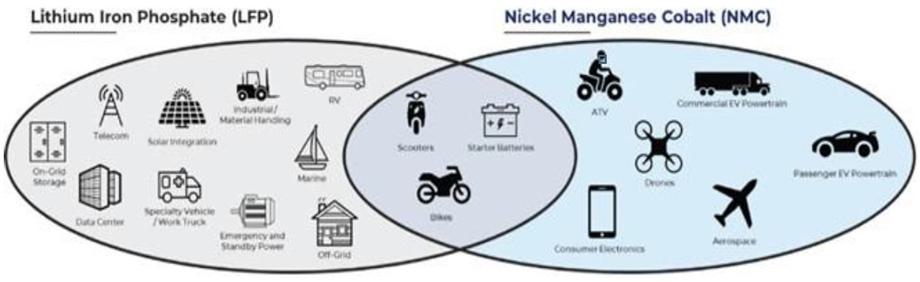
There are several dominant battery chemistries in the lithium-ion market that can be used for different purposes. Two widely adopted chemistries found in the market today are nickel manganese cobalt (“NMC”), and nickel cobalt aluminum (“NCA”). The higher energy density and shorter cycle life found in NMC and NCA batteries are suitable for markets where fast charging and high energy density are required, such as electric vehicle (“EV”) powertrains and consumer electronics. LFP batteries are best suited for energy storage markets where long life and affordability are paramount, such as RV, marine vessel, off-grid storage, onboard tools, material handling, utility-grade storage, telecom, rail and data center markets.
| 9 |
NMC batteries are highly dependent on two metals that present significant constraints - nickel, which is facing an industry-wide shortage, and cobalt, a large percentage of which comes from conflict-ridden countries. As a result, a growing number of companies are expected to transition to LFP batteries. Both of these elements are also subject to commodity price fluctuations, making NMC and NCA batteries less cost-effective than LFP batteries. LFP batteries do not contain these elements and materials can be sourced domestically, and are therefore not subject to these shortages, geopolitical concerns or commodity price fluctuations. In fact, LFP batteries have no toxic elements, offering a much safer environmental alternative. The temperature threshold for thermal runaway (i.e., lithium-ion battery overheating that can result in an internal chemical reaction) is higher for LFP batteries as compared to NMC and NCA batteries, making LFP batteries less flammable and safer.
LFP batteries have a useful life of approximately 10 to 15 years compared to one to two years for lead-acid batteries, and typically charge up to five times faster. LFP batteries are also not constrained by weight (having the same energy capacity at one-fifth of the weight) or temperature (having the ability to generate power even in low temperatures and to not swell or heat up when charging or discharging) and are generally maintenance free.
In the electric vehicle market, the race to provide the highest energy density facilitating frequent, rapid acceleration, greatest range and fastest charging battery - all while competing on cost - is where many new battery companies are prioritizing their efforts. Success in the electric vehicle market requires use of chemistries capable of optimization to these requirements. In our targeted stationary storage markets, the ideal solution requires a safe, long-lasting battery in terms of discharge/charge cycles with a focus on providing a steady power stream. LFP batteries are better suited for the stationary storage market compared to NMC and NCA batteries, as LFP batteries are safer and have a significantly longer life cycle making them more cost-effective. The market for utility grade storage, particularly for clean energy projects, and the related adoption of lithium-ion batteries (including LFP batteries) is expected to increase as the fully loaded cost of energy (production and storage) approaches cost parity with inexpensive fossil fuel energy provided through the electric grid. Compared to NMC and NCA batteries, LFP batteries are at or much closer to grid parity.
Dry Electrode Cell Manufacturing Technology
Since our inception, we have been developing proprietary dry-electrode manufacturing processes for which we have issued patents and pending patent applications, where appropriate. Dry-electrode manufacturing eliminates the use of toxic and expensive solvents and energy-intensive drying ovens in the cell manufacturing process. This in turn reduces the energy usage, space requirements, carbon footprint, and overall cost as compared to conventional slurry-based methods. Furthermore, the manufacturing technology is chemistry agnostic - meaning it can produce battery cells across a variety of different chemistries and application use cases. In 2023, we completed the construction of our dry-electrode manufacturing pilot line, demonstrated the ability to produce Anode and Cathode electrode tapes at scale using this manufacturing process. We have developed sample cells for prospective customers across a variety of chemistries and end-markets and are designing equipment for scaled production of full cells.
Solid-State Cells
LFP batteries are not without their disadvantages. While less flammable than other chemistries, the existence of a flammable liquid electrolyte still poses safety risks. Like all liquid-based lithium-ion batteries, LFP batteries have a potential to produce solid lithium dendrites, icicle-like formations which can pierce the physical separators in LFP batteries, which are necessary in LFP batteries to separate the positively charged liquid electrolyte from the negatively charged liquid electrolyte, and which, over time, will degrade the performance of LFP batteries and potentially result in fire-related risks. The next phase in the development of lithium-ion batteries is solid-state cell development, which contains a solid, rather than a liquid, electrolyte, eliminating many of the current disadvantages to LFP batteries while increasing the safety of the battery cells. We believe that the development of our solid-state technology will provide us with a unique competitive advantage.
Compared to current lithium-ion technology, where lithium-ions cross a liquid electrolyte barrier between a battery’s anode (negative electrode) and cathode (positive electrode), solid-state batteries aim to use a solid electrolyte to regulate the lithium-ions. As a battery charges and discharges, an electrochemical reaction occurs creating a flow of electrical energy between the cathode, electrolyte and anode as the electrodes lose and reacquire electrons. In addition to the use of non-toxic electrode components, the removal of a liquid electrolyte will eliminate the risk of fire, making solid-state cells inherently safe. The move to a non-liquid electrolyte also means that solid-state batteries will be, on average, smaller and lighter than existing lithium-ion batteries. The process for manufacturing our solid-state cells is described below under “- Research and Development”.
| 10 |
Our Products
We provide various industries with clean, reliable, and efficient power solutions through our comprehensive product portfolio. These products and solutions are sold to both OEMs and aftermarket customers.
Our lead product line is Battle Born Batteries product line, respected for its exceptional performance and durability. When compared to traditional lead-acid options, Battle Born Batteries deliver two to three times the power in the same physical space, one-fifth the weight for equal usable power, and up to five times faster charging. Additionally, these batteries have extended lifespans of 3,000-5,000 cycles, translating to ten to fifteen years of reliable use under typical conditions. This longevity is backed by our 10-year warranty, showcasing our commitment to quality. The Battle Born Batteries product line currently features various sizes and configurations including models with proprietary built-in heating for cold weather charging and Dragonfly IntelLigence®, a communication technology that unlocks real-time monitoring, instant notifications, various protocol integration and superior battery protection. A focus on safety is central to our products, and all Battle Born Battery products utilize LiFePO4 chemistry, the safest lithium-ion chemistry available on the market. Additionally, our battery products undergo rigorous testing under stringent industry standards like UL Standard 2054, IEC 62133, UN 38.3 and IP65 to ensure safety and reliability.
Looking beyond batteries, we also offer a diverse range of power products.
| ● | Battle Born Inverters and Inverter/Chargers. Our inverter and inverter/charger products provide pure sine wave AC power from DC battery systems and are designed for use in mobile, off-grid, and industrial applications. These systems support reliable power delivery for onboard electronics, appliances, and critical loads, and include features such as integrated transfer switching, configurable charging profiles, and compatibility with lithium and lead-acid battery chemistries. These products are designed to integrate with our battery systems as part of complete energy storage solutions. |
| ● | Wakespeed Power Management Solutions. Our Wakespeed product line includes advanced power management and charging solutions designed to optimize battery system performance in mobile and industrial applications. The WS500 Advanced Alternator Regulator and WS500 Pro utilize real-time current, voltage, and temperature inputs to precisely control alternator output and battery charging. These systems support both lithium and lead-acid battery chemistries and are designed to improve charging efficiency, protect system components, and simplify installation and operation. In addition, we offer a 48V–12V bi-directional converter, which enables power transfer between voltage systems to support integrated, multi-voltage energy storage architectures. |
| ● | Battle Born All-Electric APU and DualFlow Power Pack. Designed for heavy-duty trucking applications, our lithium-powered auxiliary power solutions provide stored energy to support hotel loads, including HVAC systems, appliances, and onboard electronics during driver rest periods. These systems are designed to reduce engine idling, lower fuel consumption, and improve driver comfort. Our DualFlow Power Pack integrates battery storage with vehicle power systems to enable efficient energy management while maintaining battery charge during operation. These solutions are pre-assembled and designed for streamlined integration into commercial vehicle platforms. |
Additionally, as a distributor of leading brands like Victron, Rich Solar, and REDARC, we act as a one-stop shop for full system integration, catering to both OEMs and retail customers. Our complete offering allows customers to benefit from clean and sustainable power, extended lifespans, reduced costs, increased efficiency, and seamless integration - all backed by expert service and support.
| 11 |
Battery Management System
Our proprietary battery management system is developed and tested in-house. It offers a complete solution for monitoring and controlling our complex battery systems and is designed to protect battery cells from damage in various scenarios. We believe our battery management system is industry-leading as it:
| ● | enables batteries to draw power under 135 degrees Fahrenheit, and is designed to cut off charging at 24 degrees Fahrenheit to protect cells; |
| ● | actively monitors the rate of change of currents to detect and prevent short circuiting, and also protects against potential ground faults; |
| ● | allows for up to an average of 300 amps continuously, 500 amp surges for 30 seconds, and momentary, half second maximum capacity surges; |
| ● | enables batteries to recharge even if completely drained; |
| ● | utilizes larger resistors to ensure balanced loads to improve performance and extend useful life; and |
| ● | facilitates scalability by enabling batteries to be combined in parallel and in series. |
Battery Communication System
We have developed a complete communication system branded Dragonfly IntelLigence, for which a U.S. non-provisional patent application and an international PCT patent application have been filed, to be used with Dragonfly Energy OEM systems and Battle Born batteries and bundles. This communication system will enable end customers to monitor each battery in real time, providing information on energy input and output and current or voltage imbalances. The communication system will be able to communicate with up to 24 batteries in a bank at one time and aggregate the data received from these batteries into a central system such as a phone or tablet. We began offering the Dragonfly IntelLigence product line to OEMs in the third quarter of 2024, and to retail consumers in the fourth quarter of 2024.
Alternator Regulation
Charging batteries in a vehicle, such as a boat or RV, often requires pulling electrical current off of the vehicle’s alternator. Alternator regulation is important to ensure that the alternator does not get unduly stressed during the current delivery to the batteries, and that the current delivery remains within the operating limits of the onboard battery bank. The acquisition of the assets of Wakespeed has allowed us to deliver our own proprietary solution to alternator regulation while also leveraging an established brand name. Wakespeed is especially popular in the marine industry, and our ability to offer this complete solution sets the stage for further penetration into marine markets.
Product Pipeline
Beyond our current battery modules, we have several LFP products in development that will enable us to access additional end markets.
| ● | New Products. Our current offerings feature battery products that serve the RV, marine vessel and off-grid markets. Although manufacturing operations were previously capacity constrained the expansion into our new manufacturing facility will allow us to add production capacity and increase product offerings and scale based on demand. |
| ● | The majority of our current batteries are 12 volt batteries, which provide 100 amp hours of energy and are an affordable solution to customers utilizing smaller or lower power applications. The smaller stature and drop-in replacement nature of these batteries have made these popular within the RV and marine vessel markets. Through the expansion of our 12 voltage battery product offerings, we will be able to penetrate further into additional applications including towable RVs, truck campers and trolling motors for small boats. |
| 12 |
| ● | We also offer 24 voltage batteries, which currently deliver 50 amp hours, and plan to further expand our 24 voltage battery offerings to provide additional drop-in replacements for AGM batteries. A single 24 voltage battery is more efficient than two 12 voltage batteries due to the ability to power directly from the source without sacrificing power through cables and connectors. This attractive power source is ideal for off-grid housing, telecommunication, solar, marine and motorized home markets, providing enhanced power to larger scale applications. A vast majority of telecommunication cell sites utilize 24 voltage batteries, greatly expanding our addressable market. |
| ● | We intend to expand our portfolio of 48 volt battery systems designed to improve efficiency and support larger-scale energy storage applications. These systems are expected to incorporate our Dragonfly IntelLigence platform to enable system monitoring, control, and performance optimization. These higher-voltage solutions are well-suited for applications requiring greater power capacity, including mobile, off-grid, and industrial use cases. |
| ● | System Integrator. A natural evolution of our business is to offer customers a system integration solution providing more efficient power solutions at a cost-effective price point. We currently offer components and accessories necessary to build out complete lithium power systems, including solar panels, chargers and inverters, system monitoring, Wakespeed’s alternator regulators, accessories, and more. We have an in-house expert customer service team that assists customers in fully integrating their applications to our technologies for a seamless transition to lithium-based energy storage systems. Through our evolving technology and the customized architecture and application of our products, we are able to offer customers a seamless transition to creating a centralized coordinated system. |
Research and Development
Our research and development team has built up its efforts to support two main initiatives - (1) scale up of our patented dry electrode process for cell manufacturing and (2) the advanced manufacturing of solid-state lithium-ion batteries. We believe the dry electrode process can be leveraged to help us vertically integrate from a pack supplier to a cell supplier - positioning ourselves for long-term competitiveness in the given geopolitical, economic, and technological landscapes. Our innovations in dry electrode processing result in reduced manufacturing costs, CO2 equivalents, and factory footprint while eliminating the need for solvents like N-Methyl-2-pyrrolidone (“NMP”). A third-party assessment conducted by Sphere Energy confirming these benefits has been completed in the first quarter of 2024 relating to cost effectiveness and sustainability of our dry electrode battery manufacturing process (the “Sphere Energy Assessment”).
The Sphere Energy Assessment concluded that our dry electrode battery manufacturing process resulted in a 9% reduced carbon footprint of cell manufacturing with no toxic NMP solvent required, resulting in a significantly more sustainable process. This sustainability advantage is further augmented by a 71% reduction in energy usage during electrode manufacturing using our process (spray drying, coating, calendaring) compared to standard cell manufacturing operations (slurry casting, drying, calendaring). By removing the need for large and expensive drying ovens, our manufacturing process requires 22% less square footage. The culmination of these advantages results in a 25% reduction in emissions from energy use, making our manufacturing process more sustainable and much more environmentally friendly as compared to conventional manufacturing methods.
In addition to the energy savings, the cost assessment found our process to be highly cost-effective with an estimated 5% savings (depending on cell chemistry) on process-related costs compared to conventional methods. Importantly, these savings were calculated without the additional cost benefits provided by domestically manufacturing battery cells such as Inflation Reduction Act tax credits (issued by the IRS), tariffs, and shipping.
The dry electrode battery manufacturing process we employ uses a patented spray coating technology to adhere the anode and cathode electrodes, eliminating the need for large, energy-intensive equipment such as slurry coaters, conveyor dryers, and NMP processing equipment. This process is chemistry agnostic, allowing for the various applications, such as electric vehicles, consumer electronics, and energy storage, which is expected to enable us to expand into new markets and to achieve our goal of domestically producing nonflammable all-solid-state battery cells.
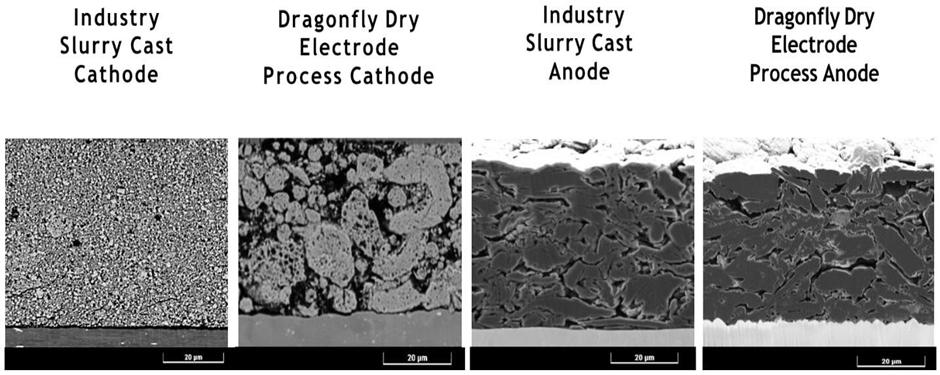
We have successfully produced anode and cathode electrode reels at scale using the dry electrode process and are now qualifying prototype cells for the core business and potential partners. When compared to slurry cast electrode tapes, which is the conventional manufacturing method, electrode tapes produced using the dry electrode process match or surpass mechanical integrity and electrochemical performance. We are considering joint development agreements, licensing agreements, and offtake agreements as instruments of partnership with interested parties.
| 13 |
In comparison with traditional manufacturing methods, our patented process leverages two off-the-shelf technologies to deliver the stated cell manufacturing benefits - spray drying and electrostatic powder coating. Technical risk is reduced by using off-the-shelf equipment and both unit operations continue to be optimized in 2025. A new set of spray dryers have arrived at our facility in the second quarter of 2024, enabling us to produce larger volumes of material for the electrode coating lines. However, we have delayed the deployment of these spray dryers until at least the third quarter of 2027 as we focus on designing larger-scale electrode coating equipment.
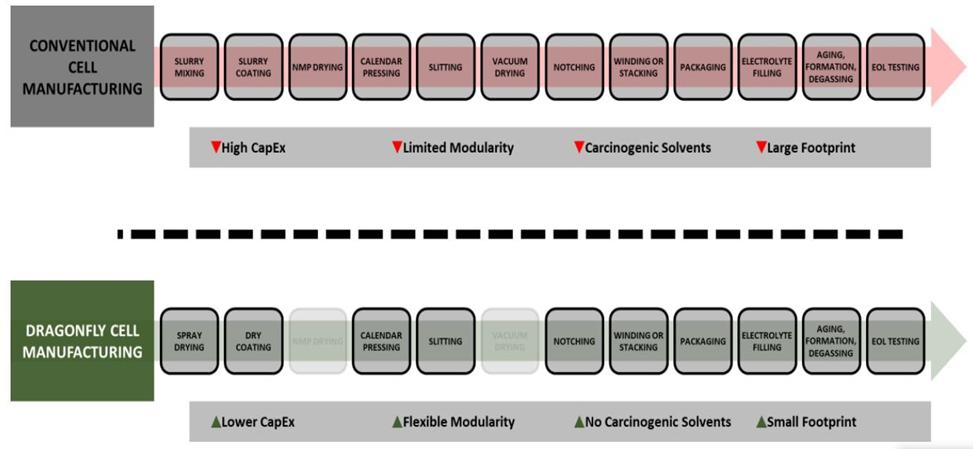
We have developed our patented to be chemistry agnostic and capable of producing current cell chemistries (graphite, LCO, LFP, LTO, NCA, NMC, LTO, silicon, etc.) and next generation cell chemistries (sodium-ion, solid-state, ionic liquid electrolytes, etc.). We believe this flexibility and our robust intellectual property protection internationally positions us well for potential partnerships with cell manufacturers, EV companies, and other pack suppliers in need of cell capacity. The next stage in technical development is to produce larger volumes of sample cells for qualification. These production runs will be completed with partners in the United States and at our own facilities. We have invested significant resources into developing an in-house comprehensive understanding of cell manufacturing - raw material qualification, quality control such as, cell failure diagnostics, aging, and formation processes. Our research and development Lab is equipped with over $20 million in research infrastructure to support the development of new cell chemistries, process quality control, failure diagnostics, and more. This equipment includes quality control instruments (ex. moisture analysis, particle size analysis, peel testing and titrations) and cutting-edge research instrumentation such as en operando nuclear magnetic resonance (“NMR”), electron microscopes with lithium-tracking capabilities, and en operando x-ray diffraction. This infrastructure has allowed us to optimize the dry-electrode process, allowing our team to match or surpass traditional electrode tape performance and mechanical integrity. Because our process is dry and the active material is coated directly onto the current collector, interfacial and composite resistivity of the electrode tapes often surpass the quality of slurry cast equivalents.
| 14 |
Our solid-state technology continues to progress as we qualify new chemistries and refine the dry electrode process for solid-state applications. Currently, we are cycling solid-state coin cells, although we have delayed the production of prototype pouch cells until at least the beginning of 2027. These cell chemistries are nonflammable, solid-state, and an LFP/graphite cell chemistry. We believe these cells will be a pivotal technology in grid storage applications once fully deployed. We intend to integrate our conventional and solid-state cells produced using our dry-electrode process into the existing Dragonfly Energy and Battle Born Batteries product portfolios.
Headquarters, Manufacturing, and Production
On February 8, 2022, we entered into a 124-month lease for an additional 390,240 square foot warehouse. In November 2024, we relocated our headquarters from our 99,000 square foot facility in Reno, Nevada to our new 390,240 square foot facility also in Reno, Nevada, which has allowed us to increase our production capacity and gives us the ability to increase sales to existing customers and penetrate new markets. Our 390,240 square foot facility provides a streamlined, partially autonomous production process for our current batteries, which comprises module assembly and battery assembly, with the availability to expand the number of lines to handle increased volumes and the additional battery modules we intend to introduce in the near future. We do not own any real estate property. We currently have four production lines. We continue to have the capability to expand our production volumes and line quantities to support increased volumes of new products we intend to introduce soon.
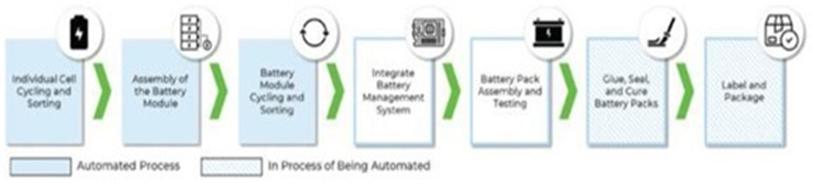
Our manufacturing process is divided into two aspects - (1) module assembly and (2) battery assembly. We use a combination of trained employees and automated processes to increase production capacity and lower costs while maintaining the same level of quality our customers expect from our products. Module assembly is a significantly automated process, implementing custom-designed equipment and systems to suit our production needs. This includes cycling of individual cells to detect faulty components and to enable sorting by capacity. Our custom-designed automated welders spot weld individual cells that are assembled into specified module jigs based on the desired amp hour. Completed modules are then fully discharged, recharged fully, and sorted by capacity. Battery assembly is performed largely by hand by our trained employees, although we continue to look for innovative ways to integrate automation into this process. Our proprietary battery management system is thoroughly tested for quality cutoffs, then mounted onto individual modules, before the modules are bolted into its casing. We aim to automate the battery management system testing and installation process, which we expect could increase production capacity fourfold. We are currently implementing an automated process for the gluing and sealing process, which would incorporate a two-robot system for gluing and epoxying, as well as a glue pallet system to move finished batteries. After the assembled batteries are tested and sealed, they are processed for outbound distribution.
| 15 |
Supplier Relationships
We have a well-established, global supply chain that underlies the sourcing of the components for our products, although we source domestically wherever possible. We aim to maintain approximately six months’ worth of all components, other than cells, which we pre-order in advance for the year to ensure adequate supply. For nearly all of our components, other than our battery management system, we ensure that we have alternative suppliers available. Our battery management system is sourced from a single supplier based in China who we have a nearly 10-year relationship with and who manufactures this component exclusively for us based on our proprietary design. Our cells are sourced from two different, carefully selected cell manufacturers in China who are able to meet our demanding quality standards. As a result of our long-standing relationships with these suppliers, we are able to source LFP cells on favorable terms and within reasonable lead-times.
As we look toward the production of our traditional and solid-state cells, we have signed a Commercial Offtake Agreement with a lithium mining company and a lithium recycling company, both located in Nevada for the supply of lithium.
Customers; RV OEM Strategic Arrangements
We currently serve more than 23,000 customers in North America. Our existing customers consist of leading OEMs (such as Keystone, THOR, REV Group and Airstream); distributors (who purchase large quantities of batteries from us and sell to consumers); upfitters (who augment or customize vehicles for specific needs); and retail customers (who purchase from us directly). For the years ended December 31, 2025 and 2024, OEM sales represented 63.0% and 54.5% of our total revenues, respectively.
We have deep, long-standing relationships with many of our customers. We also have a diverse customer base, with our top 10 customers accounting for 57.5% of our revenue for the year ended December 31, 2025, in which only two customers accounted for more than 10% of our revenue. Our customers primarily utilize our products for RVs, marine vessels and off-grid residences. We work directly with OEMs to ensure compatibility with existing designs and also collaborate on custom designs for new applications.
The RV market is characterized by low barriers to entry. In North America, there are two large publicly traded RV companies, THOR Industries and REV Group, in addition to a number of independent RV OEMs. THOR and REV each own a number well-known RV OEM brands and their related companies. These brands compete on a number of factors such as format (e.g., motorized or towable), price, design, value, quality and service. On November 19, 2021, we entered into a long-term Manufacturing Supply Agreement with Keystone, a member of the THOR group and the largest towable RV OEM in North America (the “Supply Agreement”). Under the Supply Agreement, we will be the exclusive supplier to Keystone for certain of its future LFP battery requirements, solidifying our long standing relationship with Keystone.
| 16 |
In July 2022, we strengthened our ties with the THOR group of RV OEMs when (i) THOR Industries made a $15,000,000 strategic investment in us and (ii) we agreed to enter into a future, mutually agreed distribution arrangement and joint IP development arrangement. This arrangement helps facilitate our ongoing efforts to drive adoption of our products (leveraging the trend of LFP batteries increasingly replacing lead-acid batteries) by, among other things, increasing the number of RV OEMs that “design in” our batteries as original equipment and entering into arrangements with members of the various OEM dealer networks to stock our batteries for service and for aftermarket replacement sales. Once the distribution agreement has been negotiated and signed, during a to-be-agreed transition period, we will use commercially reasonable efforts to cease marketing and selling our products to other RV OEMs and suppliers to RV OEMs in North America. Although the full distribution agreement with THOR has not been executed and is subject to negotiation in the future, its terms are expected to include: (i) an initial term of 24 months, which THOR may renew for successive one-year periods; (ii) a requirement that we be the sole provider of lithium-ion batteries to the US-based THOR family of companies for THOR sales in the United States, subject to agreed exceptions; (iii) favored pricing for products and negotiated rebates or other incentives; (iv) a requirement that THOR and its North American OEMs be our exclusive RV OEM customers for our products in North America, subject to agreed exceptions; and (v) agreeable terms with respect to registered and unregistered intellectual property rights and technology rights (which do not include our existing intellectual property, including our solid-state battery technologies and related IP rights), including necessary licenses between the parties, third party licenses, and allocation of ownership of any intellectual property rights and/or technology rights developed as a result of development efforts jointly undertaken between THOR and us, subject to certain limitations.
We continue to seek to grow our customer base within our existing segments; however, we also believe that our products are well suited to address the needs in additional segments, including residential, commercial and/or industrial standby power, long-haul trucking, industrial vehicles (such as forklifts, material handling equipment and compact construction equipment) and specialty vehicles (such as emergency vehicles, utility vehicles and municipal vehicles) and we will seek to expand our market share in these segments in the future.
Sales and Marketing
Our proven sales and marketing strategy has allowed us to penetrate our current end markets efficiently. We have established a highly efficient sales and marketing strategy, to penetrate targeted end markets and ensuring prominent visibility for our Battle Born Batteries and Wakespeed brands. We prioritize educating our customer base about the benefits of LFP batteries as a superior investment compared to traditional lead-acid options. Informational videos published on our website and social media platforms highlight these advantages, complemented by written guides that assist customers in configuring, installing, and utilizing battery systems and accessories. This messaging is further reinforced through our active presence at tradeshows, live webinars, and other in-person training events with dealers and customers, fostering direct engagement and ensuring comprehensive product understanding. Participation in these events fosters strong relationships with both OEMs and retail customers, keeping us attuned to evolving preferences. By leveraging this customer feedback, we collaborate with major OEMs to design solutions tailored to new and existing applications.
Additionally, we foster relationships with key industry publications, securing valuable editorial coverage that showcases our innovative power solutions and how they are used. We believe these strategic collaborations position our brands as industry leaders within our markets and to the general public as a whole, further strengthening brand awareness and consumer confidence.
We also leverage targeted pay-per-click advertising campaigns across various platforms, including search engines, and social media. This data driven approach ensures efficient conversion of high-intent customers at the bottom of the purchase funnel, maximizing return on investment and driving targeted brand awareness among potential buyers.
Direct relationships with retail customers remain a core value. Our user-friendly website facilitates direct purchases of Battle Born Batteries and Wakespeed products, along with well-known third-party components, allowing customers to explore and acquire complete system solutions in one convenient location. Furthermore, a dedicated team of in-house experts provides comprehensive sales, technical, and service support to ensure our valued customers receive exceptional care and expertise.
Competition
The energy storage market is highly competitive, with traditional lead-acid batteries still dominating. However, lithium-ion adoption continues to grow as customers seek better performance and longer lifespans. We compete with traditional lead-acid manufacturers and distributers, such as East Penn, Trojan, and Interstate and companies importing and white-labeling low-cost lithium products. This influx of inexpensive overseas batteries has intensified price competition. We believe our products stand out through American design and assembly, premium components, superior customer service, and full system design capabilities. Our batteries are lighter and longer-lasting compared to traditional lead-acid batteries, and easy to install as direct replacements for lead-acid batteries. Proprietary technologies, including advanced battery management systems, integrated heat capabilities, and intelligent battery communication, ensure reliable, high-performance energy storage as compared to traditional lead-acid batteries and other lithium-ion products.
| 17 |
With regard to solid-state technology, we have two main competitors, QuantumScape and Solid Power. While both of these competitors are focused on the development of solid-state technology for use in the propulsion of electric vehicles, we are focused on power storage applications, which has different requirements. We believe that our proprietary processes, systems and materials provide us with a significant competitive advantage in developing a fully solid-state, non-toxic and highly cost-effective energy solution.
As our solid-state technology comes to fruition and we begin to commercialize this product, we intend to become a vertically integrated battery company, internalizing all aspects of the manufacturing and assembly process. This is comparable to companies such as Tesla, BYD Limited and Li-Cycle. Our solid-state technology will also enable us to further penetrate the energy storage market, and we expect to compete with technology-focused energy storage companies such as EOS Energy, ESS and STEM.
Intellectual Property
The success of our business and our technology leadership is supported by our proprietary battery technology. We have received patents and filed patent applications in the United States and other jurisdictions to provide protection for our technology. We rely upon a combination of patent, trademark and trade secret laws in the United States and other jurisdictions, as well as license agreements and other contractual protections, to establish, maintain and enforce rights in our proprietary technologies. In addition, we seek to protect our intellectual property rights through non-disclosure and invention assignment agreements with our employees and consultants and through non-disclosure agreements with business partners and other third parties.
As of December 31, 2025, we owned 50 issued patents and 38 filed and pending patent applications. The pending patent applications are down from prior year since we abandoned 9 that were no longer useful. The patents and patent applications cover the United States, Canada, Australia, Korea, Japan, India, China, and Europe (with individual patents in Germany, France and the United Kingdom). We periodically review and update our patent portfolio to protect our products and newly developed technologies. Currently, we have a combination of issued patents and pending patent applications covering the ornamental design of our GC2 and GC3 batteries, a device and method for monitoring battery systems, pre-coated solid-state electrolyte and electroactive powders and their methods of manufacture, methods and systems for the dry spray deposition of materials in an electrochemical cell; a thermal fuse; battery systems implementing a mesh network communication protocol; a power charging system for use during towing of a vehicle; and a power charging system with temperature based charging control. These patents are expected to have expired or expire between May 2033 and 2043, absent any patent term adjustments or extensions.
We periodically review our development efforts to assess the existence and patentability of new intellectual property. We pursue the registration of our domain names and trademarks and service marks in the United States and other jurisdictions.
In an effort to protect our brand, as of December 31, 2025, we owned 41 trademarks globally. Dragonfly owns 18 trademark registrations to cover our house marks in the United States, including 8 registered trademarks for our design marks in the United States and we have 23 registered trademarks internationally.
Government Regulation and Compliance
We currently operate from a dedicated leased manufacturing facility located in Reno, Nevada as well as a leased R&D facility in Sparks, Nevada. We have never owned any facility at which we operated. Operations at our facilities are subject to a variety of environmental, health and safety regulations, including those governing the generation, handling, storage, use, transportation, and disposal of hazardous materials. To conduct our operations, we have to obtain environmental, health, and safety permits and registrations and prepare plans. We are subject to inspections and possible citations by federal, state, and local environmental, health, and safety regulators. In transit, lithium-ion batteries are subject to rules governing the transportation of “dangerous goods.” We have policies and programs in place to assure compliance with our obligations, such as policies relating to workplace safety, fire prevention, hazardous material management and other emergency action plans. We train our employees and conduct audits of our operations to assess our fulfillment of these policies.
| 18 |
We are also subject to laws imposing liability for the cleanup of releases of hazardous substances. Under the law, we can be liable even if we did not cause a release on real property that we lease. We believe we have taken commercially reasonable steps to avoid such liability with respect to our current leased facilities.
Employees and Human Capital Resources
As of December 31, 2025, we had 141 employees: 137 full-time, 1 part-time and 3 interns. We have adopted our Code of Ethics to support and protect our culture, and we strive to create a workplace culture in line with our values: “Tell the Truth,” “Be Fair,” “Keep Your Promises,” “Respect Individuals,” and “Encourage Intellectual Curiosity.” As part of our initiative to retain and develop our talent, we focus on these key areas:
| ● | Safety - Employees are regularly educated in safety around their workspaces, and employees participate in volunteer roles on a safety committee, and in emergency readiness roles. We have a dedicated safety coordinator who tracks and measures our performance, and helps us benchmark our safety programs against our peers. |
| ● | Diversity, Equity & Inclusion - Our culture has benefitted from the diversity of our workforce from the very beginning. Inclusion and equity are “baked into the bricks” of our values, which our employees demonstrate every day. Our human resources department and all our corporate officers and directors have an open door policy, and are able to constructively communicate with employees to resolve issues when they arise. |
| ● | Collaboration - As we grow, opportunities for cross-functional collaboration are not as organic as they used to be. We have responded to that change by staying mindful and acting intentionally to gather cross-functional input on new initiatives and continuous improvement efforts. |
| ● | Continuous Improvement - We apply continuous improvement measures to processes as well as people. We encourage professional development of our employees, through ongoing learning, credentialing, and collaboration with their industry peers. |
Attracting and retaining high quality talent at every level of our business is crucial to our continuing success. We have developed relationships with the University of Nevada Reno and the Nevada System of Higher Education to further our recruitment reach. We provide competitive compensation and benefits packages, including performance-based compensation that rewards individual and organizational achievements.
Recent Developments
In March 2026, we implemented a strategic cost realignment designed to reduce operating expenses, better align incentives with shareholders and sharpen our focus on our commercial channels, including OEM, trucking, and industrial end markets. We expect the initiative to generate approximately $8.9 million in annualized savings. Key elements of the initiative include:
| ● | Board and Executive Leadership Compensation Adjustments: Each member of our executive leadership team and Board of Directors has agreed to reduce their cash compensation by approximately 20% for the remainder of fiscal 2026, effective April 1, 2026. In lieu of cash compensation, they have received equity-based incentives, aligning incentives with long-term shareholder value. | |
| ● | Workforce and Compensation Adjustments: We have implemented a 20% reduction in total payroll expense through a combination of targeted workforce reductions and salary adjustments. Non-executive employees participating in salary reductions have received equity-based compensation. | |
| ● | Reduction in Discretionary Spending: We are reducing discretionary spending, including a reduction in DTC-focused marketing expenses, as we shifts resources towards growing commercial revenues. | |
| ● | Facility Consolidation: We are consolidating our rental space, which is expected to result in a $4.0 million reduction in expenses. |
Corporate Information
In October 2022, we completed the merger in connection with our business combination. On March 31, 2023, we changed our state of incorporation from the State of Delaware to the State of Nevada (the “Reincorporation”) pursuant to a plan of conversion dated March 30, 2023.The mailing address of our principal executive office is 12915 Old Virginia Road, Reno, Nevada 89521, and our telephone number is (775) 622-3448.
On December 18, 2025, we effected a reverse stock split of our issued and outstanding common stock at a ratio of 1-for-10 (the “Reverse Stock Split”). Shares of common stock underlying outstanding stock options and other equity instruments convertible into common stock were proportionately reduced and the respective exercise prices, if applicable, were proportionately increased in accordance with the terms of the agreements governing such securities in connection with the Reverse Stock Split. No fractional shares were issued in connection with the Reverse Stock Split. The Company paid cash in lieu of any fractional shares to which a stockholder of record was otherwise entitled as a result of the Reverse Stock Split. All of our historical share and per share information related to issued and outstanding common stock and outstanding options and warrants exercisable for common stock included or incorporated by reference in this prospectus have been adjusted, on a retroactive basis, to reflect the Reverse Stock Split.
We file periodic reports, proxy statements and other information with the SEC. Such reports, proxy statements and other information may be obtained, free of charge, by visiting the SEC’s website at www.sec.gov that contains all of the reports, proxy and information statements, and other information that we electronically file or furnish to the SEC. We also maintain a website at www.dragonflyenergy.com where we make available the proxy statements, press releases, registration statements and reports on Forms 3, 4, 8-K, 10-K and 10-Q that we (and in the case of Section 16 reports, our insiders) file with the SEC. These forms are made available as soon as reasonably practicable after such material is electronically filed with or furnished to the SEC. Press releases are also issued via electronic transmission to provide access to our financial and product news, and we provide notification of and access to voice and internet broadcasts of our quarterly and annual results. Our website also includes investor presentations and corporate governance materials.
| 19 |
Item 1A. Risk Factors
An investment in our common stock is speculative and illiquid and involves a high degree of risk including the risk of a loss of your entire investment. You should carefully consider the risks and uncertainties described below and the other information contained in this report and our other reports filed with the Securities and Exchange Commission (the “SEC”). The risks set forth below are not the only ones facing us. Additional risks and uncertainties may exist that could also adversely affect our business, operations and financial condition. If any of the following risks actually materialize, our business, financial condition and/or operations could suffer. In such event, the value of our common stock could decline, and you could lose all or a substantial portion of the money that you pay for our common stock.
Summary of Risk Factors
Risks Related to Our Existing Lithium-Ion Battery Operations
| ● | Our business and future growth depends on the needs and success of our customers. |
| ● | We operate in a competitive industry. We expect that the level of competition will increase and the nature of our competitors will change as we develop new LFP battery products for, and enter into, new markets, and as the competitive landscape evolves. |
| ● | We may not succeed in our medium- and long-term strategy of entering into new end markets for LFP batteries and our success depends, in part, on our ability to successfully develop and manufacture new products for, and acquire customers in, these new markets and successfully grow our operations and production capabilities (including, in time, our ability to manufacture solid-state cells in-house). |
| ● | We currently rely on two suppliers to provide our LFP cells and a single supplier for the manufacture of our battery management system. Any disruption in the operations of these key suppliers could adversely affect our business and results of operations. |
| ● | We are currently, and likely will continue to be, dependent on a single manufacturing facility. If our facility becomes inoperable for any reason, or our automation and expansion plans do not yield the desired effects, our ability to produce our products could be negatively impacted. |
Risks Related to Our Solid-State Technology Development
| ● | We face significant engineering challenges in our attempts to develop and manufacture solid-state battery cells and these efforts may be delayed or fail which could negatively impact our business. |
| ● | We expect to make significant investments in our continued research and development of solid-state battery technology development, and we may be unable to adequately control the costs associated with manufacturing our solid-state battery cells. |
| ● | If our solid-state batteries fail to perform as expected, our ability to further develop, market and sell our solid-state batteries could be harmed. |
Risks Related to Supply chain and Third-Party Vendors
| ● | We rely on components and other inputs that are sourced from a variety of domestic and international vendors. |
| ● | We rely on long-term relationships with our suppliers but have not significant long-term contracts with such suppliers. |
| ● | Our future success will depend in large measure upon our ability to maintain our existing supplier relationships and/or develop new ones. |
| ● | This reliance exposes us to the risk of inadequate and untimely supplies of various products due to political, economic, social, health, or environmental conditions, transportation delays, or changes in laws and regulations affecting distribution. |
| ● | Our vendors may be forced to reduce their production, shut down their operations or file for bankruptcy protection, which could make it difficult for us to serve the market needs and could have a material adverse effect on our business. |
| 20 |
Risks Related to Intellectual Property
| ● | We rely heavily upon our intellectual property portfolio. If we are unable to protect our intellectual property rights, our business and competitive position would be harmed. |
| ● | We may need to defend ourselves against intellectual property infringement claims, which may be time-consuming and could cause us to incur substantial costs. |
General Risk Factors
| ● | The uncertainty in global and macroeconomic conditions, including economic, political and socials instability, could reduce consumer spending and disrupt our supply chain which could negatively affect our results of operations. |
| ● | The loss of one or more members of our senior management team, other key personnel or our failure to attract additional qualified personnel may adversely affect our business and our ability to achieve our anticipated level of growth. |
| ● | If we fail to manage our growth effectively, we may be unable to execute our business plan, maintain high levels of customer service, or adequately address competitive challenges. |
| ● | Changes in applicable laws or regulations could impact our operations, including changes in the rates of tariffs or any adjustments to the amounts payable by us to customs as a result of improperly identifying the applicable tariff rate payable on our products. |
Risks Related to Being a Public Company
| ● | We will continue to incur significant increased expenses and administrative burdens as a public company, which could have an adverse effect on our business, financial condition and operating results. |
| ● | Our management team has limited experience managing a public company. |
Risks Related to Our Financial Position and Capital Requirements related our ability to continue as a going concern
| ● | We, as well as our independent registered public accounting firm, have expressed substantial doubt about our ability to continue as a going concern. |
| ● | Our business is capital intensive, and we may not be able to raise additional capital on attractive terms, if at all. Any further indebtedness we incur may limit our operational flexibility in the future. |
| ● | Our ability to service our outstanding indebtedness and comply with the financial covenants in our loan agreement, the failure of which could allow our lenders to accelerate payment under our loan agreement, which would have a material adverse effect on our ability to operate and could require us, among other things, to reduce operations, sell off our assets, seek the protection of bankruptcy courts or shut down our operations and dissolve. |
| ● | Restrictions imposed by our outstanding indebtedness and any future indebtedness may limit our ability to operate our business and to finance our future operations or capital needs or to engage in acquisitions or other business activities necessary to achieve growth. |
Risks Related to Ownership of Our Common Stock
| ● | If we do not continue to meet the Nasdaq Stock Market continued listing standards our common stock and Public Warrants may be delisted from the Nasdaq Stock Market; |
| ● | Future issuances of debt securities and equity securities may adversely affect us and may be dilutive to existing stockholders. |
| ● | We may issue additional shares of our common stock or other equity securities without your approval, which would dilute your ownership interests and may depress the market price of your shares. |
| 21 |
Risks Related to Our Existing Lithium-Ion Battery Operations
Our business and future growth depends on the needs and success of our OEM’s and similar customers.
The demand for our products, including sales to OEMs, ultimately depends on consumers in our current end markets (primarily owners of RVs, marine vessels and off-grid residences). The performance and growth of these markets is impacted by numerous factors, including macro-economic conditions, consumer spending, travel restrictions, fuel costs and energy demands (including an increasing trend towards the use of green energy). Increases or decreases in these variables may significantly impact the demand for our products. If we fail to accurately predict demand, we may be unable to meet our customers’ needs, resulting in the loss of potential sales, or we may produce excess products, resulting in increased inventory and overcapacity in our production facilities, increasing our unit production cost and decreasing our operating margins.
An increasing proportion of our revenue has been and is expected to continue to be derived from sales to RV OEMs. Our RV OEM sales have been on a purchase order basis, without firm revenue commitments, and we expect that this will likely continue to be the case. For example, under our Supply Agreement with Keystone RV Company, or Keystone, the largest manufacturer of towable RVs in North America, Keystone has agreed to fulfill certain of its LFP battery requirements exclusively through us for at least one year, with automatic annual renewals. However, although in time we expect Keystone to be significant contributor to our projected growth in RV OEM battery sales, this arrangement may not deliver the anticipated benefits, as there are no firm purchase commitments, sales will continue to be made on a purchase order basis, Keystone is permitted to purchase other LFP batteries from third parties and this arrangement may not be renewed. Increased overall RV OEM sales in the future may not materialize as expected or at all and we may fail to achieve our targeted sales levels. Future RV OEM sales are subject to a number of risks and uncertainties, including the number of RVs that these OEMs manufacture and sell (which can be impacted by a variety of events including those disrupting our OEM customers’ operations due to supply chain disruptions or labor constraints); the degree to which our OEM customers incorporate/design-in our batteries into their RV product lines and renew our supply agreements; the extent to which RV owners, if applicable, opt to purchase our batteries upon initial purchase of their RV or in the aftermarket; and our continued ability to successfully develop and introduce reliable and cost-effective batteries meeting evolving industry standards and customer specifications and preferences. Our failure to adequately address any of these risks may result in lost sales which could have a material adverse effect on our business, financial condition and results of operations.
In addition, our near-term growth depends, in part, on the continued growth of the end markets in which we currently operate. According to third-party industry data, the global recreational vehicle market was approximately $62.9 billion in 2024 and is projected to grow to approximately $168.3 billion by 2033. However, these markets may not grow as expected or at all, and we may be unable to maintain existing customers and/or attract new customers in these markets. Our failure to maintain or expand our share of these markets could have a material adverse effect on our business, financial condition and results of operations.
We may not be able to engage target customers successfully and convert these customers into meaningful orders in the future.
Our success, and our ability to increase sales and operate profitably, depends on our ability to identify target customers and convert these customers into meaningful orders, as well as our continued development of existing customer relationships. Although we have developed a multi-pronged sales and marketing strategy to penetrate our end markets and reach a range of customers, this strategy may not continue to be effective in reaching or converting target customers into orders, or as we expand into additional markets. Recently, we have also dedicated more resources to developing relationships with certain key RV OEMs, such as Keystone, which we aim to convert into collaborations on custom designs and/or long-term contractual arrangements. We may be unable to convert these relationships into meaningful orders or renew these arrangements going forward, which may require us to expend additional cost and management resources to engage other target customers.
Our sales to any future or current customers may decrease for reasons outside our control, including loss of market share by customers to whom we supply products, reduced or delayed customer requirements, supply and/or manufacturing issues affecting production, reputational harm or continued price reductions. Furthermore, in order to attract and convert customers we must continue to develop batteries that address our current and future customers’ needs. Our failure to achieve any of the foregoing could have a material adverse effect on our business, financial condition and results of operations.
| 22 |
We operate in a competitive industry. We expect that the level of competition will increase and the nature of our competitors will change as we develop new LFP battery products for, and enter into, new markets, and as the competitive landscape evolves. These competitive and other factors could result in lost potential sales and lower average selling prices and profitability for our products.
We compete with traditional lead-acid battery manufacturers and lithium-ion battery manufacturers, who primarily either import their products or components or manufacture products under a private label. As we continue to expand into new markets, develop new products and move towards production of our solid-state cells, we will experience competition with a wider range of companies. These include companies focused on solid-state cell production, vertically integrated energy companies and other technology-focused energy storage companies. We believe our main competitive advantage in displacing incumbent lead-acid batteries is that we produce a lighter, safer, higher performing, cost-effective battery with a longer lifespan. We believe our go-to-market strategy, established brands, proven reliability and relationships with OEMs and end consumers both (i) enable us to compete effectively against other battery manufacturers and (ii) position us favorably to expand into new addressable markets. However, OEM sales typically result in lower average selling prices and related margins, which could result in overall margin erosion, affect our growth or require us to raise our prices. As a result, we may be unable to maintain this competitive advantage given the rapidly developing nature of the industry in which we operate.
Our current competitors have, and future competitors may have, greater resources than we do. Our competitors may be able to devote greater resources to the development of their current and future technologies. These competitors may also be able to devote greater resources to sales and marketing efforts, affording them greater access to customers, and may be able to establish cooperative or strategic relationships amongst themselves or with third parties that may further enhance their competitive positioning. In addition, foreign producers may be able to employ labor at significantly lower costs than producers in the United States, expand their export capacity and increase their marketing presence in our major end markets. We expect actual and potential competitors to continue their efforts to develop alternative battery technologies and introduce new products with more desirable, attractive features. These new technologies and products may be introduced sooner than our offerings and could gain greater market acceptance. Although we believe we are a leader in developing solid-state battery technology (particularly for energy storage applications) new competitors may emerge, alternative approaches to solid-state battery technology may be developed and competitors may seek to market solid-state battery technologies better suited for other applications such as EV’s to our target markets.
Additional competitive and other factors may result in lost sales opportunities and declines in average sales prices and overall product profitability. These include rapidly evolving technologies, industry standards, economic conditions and end-customer preferences. Our failure to adapt to or address these factors as they arise could have a material adverse effect on our business, financial condition and results of operations.
We may not succeed in our medium- and long-term strategy of entering into new end markets for LFP batteries and our success depends, in part, on our ability to successfully develop and manufacture new products for, and acquire customers in, these new markets and successfully grow our operations and production capabilities (including, in time, our ability to manufacture solid-state cells in-house).
Our future success depends, in part, upon our ability to expand into additional end markets identified by us as opportunities for our LFP batteries. These markets include heavy-duty trucking, industrial solar integration, specialty and work vehicles, material handling, rail, and emergency and standby power in the medium term, and data centers, telecom and distributed on-grid storage in the longer term. Our ability to expand into these markets depends on a number of factors, including the continued growth of these markets, having sufficient capital to expand our product offerings (including in the longer term batteries incorporating, once developed, our solid-state cells) and manufacturing capacity, developing products adapted to customer needs and preferences in these markets, our successful expansion of our manufacturing capabilities in order to meet customer demand, our ability to identify and convert potential customers within these markets and our ability to attract and retain qualified personnel to assist in these efforts. Although we intend to devote resources and management time to understanding these new markets, we may face difficulties in understanding and accurately predicting the demographics, preferences and purchasing habits of customers and consumers in these markets. If we fail to execute on our growth strategies in accordance with our expectations, our sales growth would be limited to the growth of existing products and existing end markets, and this could have a material adverse effect on our business, financial condition and results of operations.
| 23 |
Further, if we are unable to manage the growth of our operations effectively to match the growth in sales, we may incur unexpected expenses and be unable to meet our customers’ requirements, which could materially adversely affect our business, financial condition and results of operations. A key component of our growth strategy is the expansion and automation of our manufacturing sales capacity to address expected growing product demand and to accommodate our production of solid-state cells at scale. We have experienced supply delays in obtaining the necessary components to implement our automated adhesive application systems, as well as our pilot production line for our solid-state cells, and we may continue to experience component shortages in the future, which may negatively impact our ability to achieve these aspects of our growth strategy on time or at all. The costs of our expansion and automation efforts may be greater than expected, and we may fail to achieve anticipated cost efficiencies, which could have a material adverse effect on our business, financial condition and results of operations. We must also attract, train and retain a significant number of skilled employees, including engineers, sales and marketing personnel, customer support personnel and management, and the availability of such personnel may be constrained. Failure to effectively manage our growth could also lead us to over-invest or under-invest in development and operations; result in weaknesses in our infrastructure, systems or controls; give rise to operational mistakes, financial losses, loss of productivity or business opportunities; and result in loss of employees and reduced productivity of remaining employees, any of which could have a material adverse effect on our business, financial condition and results of operations.
We currently rely on two suppliers to provide our LFP cells and a single supplier for the manufacture of our battery management system. Any disruption in the operations of these key suppliers could adversely affect our business and results of operations.
We currently rely on two carefully selected cell manufacturers located in China, and a single supplier, also located in China, to manufacture our proprietary battery management system, and we intend to continue to rely on these suppliers going forward.
Our dependence on a limited number of key third-party suppliers exposes us to challenges and risks in ensuring that we maintain adequate supplies required to produce our LFP batteries. Although we carefully manage our inventory and lead-times, we may experience a delay or disruption in our supply chain and/or our current suppliers may not continue to provide us with LFP cells or our battery management systems in our required quantities or to our required specifications and quality levels or at attractive prices. Our close working relationships with our China-based LFP cell suppliers to-date, reflected in our ability to increase our purchase order volumes (qualifying us for related volume-based discounts) and to order and receive delivery of cells in advance of required demand, has helped us moderate or offset increased supply-related costs associated with inflation, currency fluctuations and tariffs imposed on our battery cell imports by the U.S. government and avoid potential shipment delays. If we are unable to enter into or maintain commercial agreements with these suppliers on favorable terms, or if any of these suppliers experience unanticipated delays, disruptions or shutdowns or other difficulties ramping up their supply of products or materials to meet our requirements, our manufacturing operations and customer deliveries would be seriously impacted, potentially resulting in liquidated damages and harm to our customer relationships. Although we believe we could locate alternative suppliers to fulfill our needs, we may be unable to find a sufficient alternative supply in a reasonable time or on commercially reasonable terms.
Further, our dependence on these third-party suppliers entails additional risks, including:
| ● | inability, failure or unwillingness of third-party suppliers to comply with regulatory requirements; |
| ● | breach of supply agreements by the third-party suppliers; |
| ● | misappropriation or disclosure of our proprietary information, including our trade secrets and know-how; |
| ● | relationships that third-party suppliers may have with others, which may include our competitors, and failure of third-party suppliers to adequately fulfill contractual duties, resulting in the need to enter into alternative arrangements, which may not be available, desirable or cost-effective; and |
| ● | termination or nonrenewal of agreements by third-party suppliers at times that are costly or inconvenient for us. |
| 24 |
We may not be able to accurately estimate future demand for our LFP batteries, and our failure to accurately predict our production requirements could result in additional costs or delays.
We seek to maintain approximately a six-month supply of LFP cells and other critical components by pre-ordering in advance of expected demand. However, our business and customer product demand is impacted by trends and factors that may be outside our control. Therefore, our ability to predict our manufacturing requirements is subject to inherent uncertainty. Lead times for materials and components that our suppliers order may vary significantly and depend on factors such as the specific supplier, contract terms and demand for each component at a given time. If we fail to order sufficient quantities of product components in a timely manner, the delivery of our batteries to our customers could be delayed, would harm our business, financial condition and results of operations.
To meet our delivery deadlines, we generally make significant decisions on our production level and timing, procurement, facility requirements, personnel needs and other resources requirements based on our estimate of demand, our past dealings with such customers, economic conditions and other relevant factors. Although we monitor our slow-moving inventory, if customer demand declines significantly, we may have excess inventory which could result in unprofitable sales or write-offs. Expediting additional material to make up for any shortages within a short time frame could result in increased costs and a delay in meeting orders, which would result in lower profits and negatively impact our reputation. In either case, our results of operations would fluctuate from period to period.
In addition, certain of our competitors may have long-standing relationships with suppliers, which may provide them with a competitive pricing advantage for components and reduce their exposure to volatile raw material costs, including due to inflation. As a result, we may face market-driven downward pricing pressures in the future, which may run counter to the cost of the components required to produce our products. During 2022 in particular, we experienced rising materials costs due to inflation, which we partially mitigated through increases in our product prices, where we thought it to be prudent. Our customers may not view this favorably and expect us to cut our costs further and/or to lower the price of our products. We may be unable to increase our sales volumes to offset lower prices (if we choose to implement lower prices), develop new or enhanced products with higher selling prices or margins, or reduce our costs to levels enabling us to remain competitive. Our failure to accomplish any of the foregoing could have a negative impact on our profitability and our business, financial condition and results of operations may ultimately be materially adversely affected.
We are currently dependent on one manufacturing facility. If our facility becomes inoperable for any reason, or our automation and expansion plans do not yield the desired effects, our ability to produce our products could be negatively impacted.
All of our battery assembly currently takes place at our 390,240 square foot headquarters and manufacturing facility located in Reno, Nevada. We currently operate three LFP battery production lines, which has been sufficient to meet customer demand. If one or several production lines were to become inoperable for any period of time, we would face delays in meeting orders, which could prevent us from meeting demand or require us to incur unplanned costs, including capital expenditures.
Our facilities may be harmed or rendered inoperable by natural or man-made disasters, including earthquakes, flooding, fire and power outages, utility and transportation infrastructure disruptions, acts of war or terrorism, or by public health crises, which may render it difficult or impossible for us to manufacture our products for an extended period of time. The inability to produce our products or the backlog that could develop if our manufacturing facility is inoperable for even a short period of time may result in increased costs, harm to our reputation, a loss of customers or a material adverse effect on our business, financial condition or results of operations. Although we maintain property damage and business interruption insurance, this insurance may not be sufficient to cover all of our potential losses and may not continue to be available to us on acceptable terms, if at all.
Over the next several years we plan to automate additional aspects of existing LFP battery production lines, add additional LFP battery production lines (as required) and construct and operate a pilot production line for our solid-state cells, all designed to maximize the capacity of our manufacturing facility. In November 2024, we relocated our headquarters and production lines to a 390,240 square foot facility. Our plans for automation and expansion may experience delays, incur additional costs or cause disruption to our existing production lines. For example, we have experienced supply delays in obtaining the necessary components to implement our automated adhesive application systems, as well as our pilot production line for our solid-state cells, and we may continue to experience component shortages in the future. The costs to successfully achieve our expansion and automation goals may be greater than we expect, and we may fail to achieve our anticipated cost efficiencies, which could have a material adverse effect on our business, financial condition and results of operations. Furthermore, while we are generally responsible for delivering products to the customer, we do not maintain our own fleet of delivery vehicles and outsource this function to third parties. Any shortages in trucking capacity, any increase in the cost thereof or any other disruption to the highway systems could limit our ability to deliver our products in a timely manner or at all.
| 25 |
Lithium-ion battery cells have been observed to catch fire or release smoke and flame, which may have a negative impact on our reputation and business.
Our LFP batteries use lithium iron phosphate (LiFePO4) as the cathode material for lithium-ion cells. LFP is intrinsically safer than other battery technologies due to its thermal and chemical stability and LFP batteries are less flammable than lead-acid batteries or lithium-ion batteries using different chemistries. On rare occasions, however, lithium-ion cells can rapidly release the energy they contain by releasing smoke and flames in a manner that can ignite nearby materials and other lithium-ion cells. This faulty result could subject us to lawsuits, product recalls, or redesign efforts, all of which would be time consuming and expensive. Further, negative public perceptions regarding the suitability or safety of lithium-ion cells or any future incident involving lithium-ion cells, such as a vehicle or other fire, even if such incident does not involve our products, could seriously harm our business and reputation.
To facilitate an uninterrupted supply of battery cells, we store a significant number of lithium-ion cells at our facility. While we have implemented enhanced safety procedures related to the handling of the cells, any mishandling, other safety issue or fire related to the cells could disrupt our operations. In addition, any accident, whether occurring at our manufacturing facility or from the use of our batteries, may result in significant production interruption, delays or claims for substantial damages caused by personal injuries or property damage. Such damage or injury could lead to adverse publicity and potentially a product recall, which could have a material adverse effect on our brand, business, financial condition and results of operations.
We currently are and may in the future be subject to product liability claims, which could harm our financial condition and liquidity if we are not able to successfully defend or insure against such claims.
Product liability claims, even those without merit or that do not involve our products, could result in adverse publicity or damage to our brand, decreased partner and end-customer demand, and could have a material adverse effect on our business, financial condition and results of operations. The occurrence of any defects in our products could make us liable for damages and legal claims. In addition, we could incur significant costs to correct such issues, potentially including product recalls. We face an inherent risk of exposure to claims in the event that our products do not perform or are claimed not to have performed as expected. We also face risk of exposure to claims because our products may be installed on vehicles (including RVs and marine vessels) that may be involved in crashes or may not perform as expected resulting in death, personal injury or property damage. Liability claims may result in litigation, the occurrence of which could be costly, lengthy and distracting and could have a material adverse effect on our business, financial condition and results of operations.
In the future, we may voluntarily or involuntarily initiate a recall if any products prove to be defective or non-compliant with then-applicable safety standards. Such recalls may involve significant expense and diversion of management attention and other resources, which could damage our brand image in our target end markets, as well as have a material adverse effect on our business, financial condition and results of operations.
A successful product liability claim against us could require us to pay a substantial monetary award. While we maintain product liability insurance, the insurance that we carry may not be sufficient or it may not apply to all situations. Moreover, a product liability claim against us or our competitors could generate substantial negative publicity about our products and business and could have a material adverse effect on our brand, business, financial condition and results of operations.
| 26 |
We currently rely on software and hardware that is complex and technical, and we expect that our reliance will increase in the future with the introduction of future products. If we are unable to manage the risks inherent in these complex technologies, or if we are unable to address or mitigate technical limitations in our systems, our business could be adversely affected.
Each of our batteries include our proprietary battery management system, which relies on software and hardware manufactured by third parties that is complex and technical. In addition, Dragonfly IntelLigence, our battery communications system which we launched in the first quarter 2023, utilizes third-party software and hardware to store, retrieve, process and manage data. The software and hardware utilized in these systems may contain errors, bugs, vulnerabilities or defects, which may be difficult to detect and/or manage. Although we attempt to remedy any issues that we observe in our products as effectively and rapidly as possible, such efforts may not be timely, may hamper production, or may not be to the satisfaction of our customers. If we are unable to prevent or effectively remedy errors, bugs, vulnerabilities or defects in the software and hardware that we use, we may suffer damage to our brand, loss of customers, loss of revenue or liability for damages, any of which could adversely affect our business, financial condition and results of operations.
Risks Related to Our Solid-State Technology Development
We face significant engineering challenges in our attempts to develop and manufacture solid-state battery cells and these efforts may be delayed or fail which could reduce consumer spending which could negatively impact our business.
Our solid-state battery development efforts are still ongoing, and we may fail to meet our goal of commercially selling LFP batteries incorporating our manufactured solid-state cells, or at all. We may encounter delays in the design, manufacture and launch of our solid-state battery cells, and in increasing production to scale.
Development and engineering challenges could delay or prevent our production of solid-state battery cells. These difficulties may arise in connection with current and future efforts to optimize the chemistry or physical structure of our solid-state batteries with the goal of enhancing conductivity and power; maximizing cycling capabilities and power results; reducing costs; and developing related mass production manufacturing processes. If we are unable to overcome developmental and engineering challenges, our solid-state battery efforts could fail.
We currently purchase the battery cells incorporated into our LFP batteries and have limited experience in manufacturing battery cells at a commercial scale. To cost-effectively and rapidly manufacture our solid-state cells at scale for incorporation into our LFP batteries, we plan to utilize currently available spray powder deposition equipment and other commercially available equipment modified to utilize our proprietary dry spray deposition and other technologies and processes. We may experience delays or additional costs in adapting our facility, existing production equipment and LFP battery manufacturing processes (for example, designing a dry room to accommodate our dry spraying processes) to manufacture solid-state cells. Even if we achieve the development and volume production of our solid-state battery that we anticipate, if the cost, cycling and power results or other technology or performance characteristics of the solid-state battery fall short of our targets, our business and results of operations would likely be materially adversely affected.
We expect to make significant investments in our continued research and development of solid-state battery technology development, and we may be unable to adequately control the costs associated with manufacturing our solid-state battery cells.
We will require significant capital to fund our solid-state cell research and development activities, pilot line construction and expansion of our manufacturing capabilities to accommodate large-scale production of solid-state cells. We have not yet produced any solid-state battery cells at volume and our forecasted cost advantage for the production of these cells at scale, compared to conventional lithium-ion cells, will require us to achieve rates of throughput, use of electricity and consumables, yield, and rate of automation demonstrated for mature battery, battery material, and ceramic manufacturing processes, that we have not yet achieved. We may not be able to achieve our desired cost benefits and, in turn, we may not be able to provide our solid-state cells at a cost that is attractive to customers. If we are unable to cost-efficiently design, manufacture, market, sell and distribute our solid-state batteries and services, our margins, profitability and prospects would be materially and adversely affected.
| 27 |
If our solid-state batteries fail to perform as expected, our ability to further develop, market and sell our solid-state batteries could be harmed.
Our solid-state battery cells may contain defects in design and manufacture that may cause them to not perform as expected or that may require repairs, recalls and design changes. Our solid-state batteries will incorporate components that have not been used individually or in combination in the same manner as the design of our solid-state cells, and that may result in defects and errors, particularly when produced at scale. We may be unable to detect and fix any defects in our solid-state battery cells prior to their incorporation into our solid-state LFP batteries and sale to potential consumers. If our solid-state batteries fail to perform as expected, we could lose customers, or be forced to delay deliveries, terminate orders or initiate product recalls, each of which could adversely affect our sales and brand and would have a material adverse effect on our business, financial condition and results of operations.
We expect to rely on machinery used in other large-scale commercial applications, modified to incorporate our proprietary technologies and processes, in order to mass produce solid-state battery cells, which exposes us to a significant degree of risk and uncertainty in terms of scaling production, operational performance and costs.
We expect to rely on machinery used in other large-scale commercial applications to mass produce our solid-state battery cells. Doing so will require us to work closely with the equipment provider to modify this machinery to effectively integrate our proprietary solid-state technology and processes in order to create the equipment we need for the production of solid-state cells. This integration work will involve a significant degree of uncertainty and risk and may result in delays in scaling up production of our solid-state cells or result in additional cost to us.
Such machinery is likely to suffer unexpected malfunctions from time to time and will require repairs and spare parts to resume operations, which may not be available when needed. Unexpected malfunctions may significantly affect the intended operational efficiency of, and therefore expected cost-efficiency associated with, our production equipment. In addition, because this machinery has not been used to manufacture and assemble solid-state battery cells, the operational performance and costs associated with repairing and maintaining this equipment can be difficult to predict and may be influenced by factors outside of our control, including failures by suppliers to deliver necessary components of our products in a timely manner and at prices acceptable to us, the risk of environmental hazards and the cost of any required remediation and damages or defects already present in the machinery.
Operational problems with our manufacturing equipment could result in personal injury to or death of workers, the loss of production equipment or damage to our manufacturing facility, which could result in monetary losses, delays and unanticipated fluctuations in production. In addition, we may be subject to administrative fines, increased insurance costs or potential legal liabilities. Any of these operational problems could have a material adverse effect on our business, financial condition and results of operations.
Risks Related to Supply Chain and Third-Party Vendors
We face risks associated with vendors from whom our products are sourced.
The products we sell rely on components and other inputs that are sourced from a variety of domestic and international vendors. We rely on long-term relationships with our suppliers but have no significant long-term contracts with such suppliers. Our future success will depend in large measure upon our ability to maintain our existing supplier relationships and/or to develop new ones. This reliance exposes us to the risk of inadequate and untimely supplies of various products due to political, economic, social, health, or environmental conditions, transportation delays, or changes in laws and regulations affecting distribution. Our vendors may be forced to reduce their production, shut down their operations or file for bankruptcy protection, which could make it difficult for us to serve the market needs and could have a material adverse effect on our business.
While we select these third-party vendors carefully, we do not control their actions or the manufacture of their products. Any problems caused by these third parties, or issues associated with their products or workforce, including customer or governmental complaints, breakdowns or other disruptions in communication services provided by a vendor, failure of a vendor to handle current or higher volumes, and cyber-attacks or security breaches at a vendor could subject us to litigation and adversely affect our ability to deliver products and services to its customers and have a material adverse effect on our results of operations and financial condition.
| 28 |
We rely on foreign manufacturers for various products that are incorporated into the products we sell. In addition, many of our domestic suppliers purchase a portion of their products from foreign sources. As an importer, our business is subject to the risks generally associated with doing business internationally, such as domestic and foreign governmental regulations, economic disruptions, global or regional health epidemics, delays in shipments, transportation capacity and costs, currency exchange rates, and changes in political or economic conditions in countries from which we purchase products. If any such factors were to render the conduct of business in particular countries undesirable or impractical or if additional U.S. quotas, duties, tariffs, taxes, or other charges or restrictions were imposed upon the importation of our products in the future, our financial condition and results of operations could be materially adversely affected.
The political landscape in the U.S. contains uncertainty with respect to tax and trade policies, tariffs and regulations affecting trade between the U.S. and other countries. We source a portion of our merchandise from manufacturers located outside the U.S., primarily in Asia. Major developments in tax policy or trade relations, such as the disallowance of tax deductions for imported merchandise or the imposition of tariffs on imported products, could have a material adverse effect on our business, results of operations, and financial condition.
We rely on manufacturers located in foreign countries, including China, for merchandise. Additionally, a portion of our domestically purchased merchandise is manufactured abroad. Our business may be materially adversely affected by risks associated with international trade, including the impact of current or potential tariffs by the U.S. with respect to certain consumer goods imported from China.
Changes in U.S. trade policy, including recently announced tariffs, could have a material adverse impact on our business, financial condition, and results of operations. We source a portion of our merchandise from manufacturers located outside the U.S., primarily in Asia, and many of our domestic vendors have a global supply chain. The U.S. has imposed tariffs on certain products imported into the U.S. from China and could propose additional tariffs. The imposition of tariffs on imported products could result in reduced sales and profits. It remains unclear how tax or trade policies, tariffs or trade relations may further evolve under the current U.S. administration, and how such policies could adversely affect our business, results of operations, effective income tax rate, liquidity, and net income.
In addition, the imposition of tariffs by the U.S. has resulted in the adoption of retaliatory tariffs by China on U.S. exports and could result in the adoption of tariffs by other countries as well. A resulting trade war could have a significant adverse effect on world trade and the global economy.
We continue to evaluate the impact of the effective and potential tariffs on our supply chain, costs, sales, and profitability as well as our strategies to mitigate any negative impact, including negotiating with our vendors, and seeking alternative sourcing options. Given the uncertainty regarding the scope and duration of the current and potential tariffs, as well as the potential for additional trade actions by the U.S. or other countries, the impact on our business, results of operations, and financial condition is uncertain but could be significant. Thus, we can provide no assurance that any strategies we implement to mitigate the impact of such tariffs or other trade actions will be successful in whole or in part. To the extent that our supply chain, costs, sales, or profitability are negatively affected by the tariffs or other trade actions, our business, financial condition, and results of operations may be materially adversely affected. In 2024, we identified an underpayment of tariffs to U.S. Customs and Border Protection (“CBP”) in the amount of approximately $1.58 million in the aggregate, related to the improper classification and valuation of certain of the products used in our batteries. The underpayment related to years 2021 through 2023. We have reported the underpayment to CBP. In the event CBP determines that we owe additional amounts or any penalties or determines in the future that we have not paid the correct duties, our results of operations could be materially impacted.
| 29 |
Changes in geopolitical conditions, U.S.-China trade relations and other factors beyond our control may adversely impact our business and operating results.
Our operations and performance depend, in part, on global and regional economic and geopolitical conditions, given that we have suppliers located in China. Changes in U.S.-China trade policies, and a number of other economic and geopolitical factors both in China and abroad could have a material adverse effect on our business, financial condition, results of operations or prospects. Such factors may include:
| ● | instability in political or economic conditions, such as inflation, recession, foreign currency exchange restrictions and devaluations, restrictive governmental controls on the movement and repatriation of earnings and capital, and actual or anticipated military or political conflicts, particularly in emerging markets; |
| ● | expanded jurisdiction of the Committee for Foreign Investment in the U.S.; and |
| ● | intergovernmental conflicts or actions, such as the armed conflicts between Russia and Ukraine, in Iran and elsewhere in the Middle East, trade wars, retaliatory tariffs, and acts of terrorism or war. |
As a result of these events, our ability to obtain supplies from our China-based suppliers may be limited or adversely affected, and we may incur operational constraints.
A significant disruption to the timely receipt of inventory could adversely impact sales or increase our transportation costs, which would decrease our profits.
We rely on our distribution and transportation network, including third-party logistics providers, to provide goods in a timely and cost-effective manner through deliveries to our distribution facilities from vendors and then from the distribution facilities or direct ship vendors to our stores or customers by various means of transportation, including shipments by sea, air, rail, and truck. Any disruption, unanticipated expense, or operational failure related to this process could negatively affect our operations. For example, unexpected delivery delays (including delays due to weather, fuel shortages, work stoppages, global or regional health epidemics, product shortages from vendors, or other reasons) or increases in transportation costs (including increased fuel costs or a decrease in transportation capacity for overseas shipments) could significantly decrease our ability to provide adequate products to meet increased customer demand. In addition, labor shortages or work stoppages in the transportation industry or long-term disruptions to the national and international transportation infrastructure that lead to delays or interruptions of deliveries could negatively affect our business. Also, a fire, tornado, or other disaster at one of our distribution facilities could disrupt our timely receiving, processing, and shipment of merchandise to our stores which could adversely affect our business. While we believe there are adequate reserve quantities and alternative suppliers available, shortages or interruptions in the receipt or supply of products caused by unanticipated demand, problems in production or distribution, financial or other difficulties of supplies, inclement weather or other economic conditions, including the availability of qualified drivers and distribution center team members, could adversely affect the availability, quality and cost of products, and our operating results.
Risks Related to Our Intellectual Property
We rely heavily upon our intellectual property portfolio. If we are unable to protect our intellectual property rights, our business and competitive position would be harmed.
We may not be able to prevent unauthorized use of our intellectual property, which could harm our business and competitive position. We rely upon a combination of the intellectual property protections afforded by patent, copyright, trademark and trade secret laws in the United States and other jurisdictions to establish, maintain and enforce rights in our proprietary technologies. In addition, we seek to protect our intellectual property rights through non-disclosure and invention assignment agreements with our employees and consultants, and through non-disclosure and joint development agreements with business partners and other third parties. Despite our efforts to protect our proprietary rights, third parties may attempt to copy or otherwise obtain and use our intellectual property. Monitoring unauthorized use of our intellectual property is difficult and costly, and the steps we have taken or will take to prevent unauthorized use may not be sufficient. Any enforcement efforts we undertake, including litigation, could be time-consuming and expensive and could divert management’s attention, which could harm our business, results of operations and financial condition.
In addition, available intellectual property laws and contractual remedies in some jurisdictions may afford less protection than needed to safeguard our intellectual property portfolio. Intellectual property laws vary significantly throughout the world. The laws of a number of foreign countries do not protect intellectual property rights to the same extent as do the laws of the United States. Therefore, our intellectual property rights may not be as strong, or as easily enforced, outside of the United States, and efforts to protect against the unauthorized use of our intellectual property rights, technology and other proprietary rights may be more expensive and difficult to undertake outside of the United States. In addition, while we have filed for and obtained certain intellectual property rights in commercially relevant jurisdictions, we have not sought protection for our intellectual property rights in every possible jurisdiction. Failure to adequately protect our intellectual property rights could result in competitors using our intellectual property to make, have made, use, import, develop, have developed, sell or have sold their own products, potentially resulting in the loss of some of our competitive advantage and a decrease in our revenue, which would adversely affect our business, prospects, financial condition and operating results.
| 30 |
We may need to defend ourselves against intellectual property infringement claims, which may be time-consuming and could cause us to incur substantial costs.
Companies, organizations or individuals, including our current and future competitors, may hold or obtain intellectual property rights that would prevent, limit or interfere with our ability to make, have made, use, import, develop, have developed, sell or have sold our products, which could make it more difficult for us to operate our business. From time to time, we may receive inquiries from holders of intellectual property rights inquiring whether we are infringing their rights and/or seek court declarations that they do not infringe upon our intellectual property rights. Entities holding intellectual property rights relating to our technology, including, but not limited to, batteries, battery materials, encapsulated powders, spray deposition of battery materials, and alternator regulators, may bring suits alleging infringement of such rights or otherwise asserting their rights and seeking licenses. For example, patents and patent applications owned by third parties may present freedom to operate (“FTO”) questions with regards to the precoated feedstock materials for the spray deposition process depending on the final material selections that are used, although we own a patent application that pre-dates their patents and patent applications of interest such that our patent application may act as a basis for an invalidity position. However, it is possible that a court may not agree that our patent application invalidates the patents and patent applications of interest. Any such litigation or claims, whether or not valid or successful, could result in substantial costs and diversion of resources and our management’s attention. In addition, if we are determined to have infringed upon a third party’s intellectual property rights, we may be required to do one or more of the following:
| ● | cease using, making, having made, selling, having sold, developing, having developed or importing products that incorporate the infringed intellectual property rights; |
| ● | pay substantial damages; |
| ● | obtain a license from the holder of the infringed intellectual property rights, which license may not be available on reasonable terms or at all; or |
| ● | redesign our processes or products, which may result in inferior products or processes. |
In the event of a successful claim of infringement against us and our failure or inability to obtain a license to or design around the infringed intellectual property rights, our business, prospects, operating results and financial condition could be materially adversely affected.
Our current and future patent applications may not result in issued patents or our patent rights may be contested, circumvented, invalidated or limited in scope, any of which could have a material adverse effect on our ability to prevent others from commercially exploiting products similar to ours.
Our current and future patent applications may not result in issued patents, which may have a material adverse effect on our ability to prevent others from commercially exploiting products or technology similar to ours. The outcome of patent applications involves complex legal and factual questions and the breadth of claims that will be allowed is uncertain. As a result, we cannot be certain that the patent applications that we file will result in patents being issued, or that our current issued patents, and any patents that may be issued to us in the future, will afford protection that covers our commercial processes, systems and products or that will afford protection against competitors with similar products or technology. Numerous prior art patents and pending patent applications owned by others, as well as prior art non-patent literature, exist in the fields in which we have developed and are developing our technology, which may preclude our ability to obtain a desired scope of protection in the desired fields. In addition to potential prior art concerns, any of our existing patents, pending patent applications, or future issued patents or patent applications may also be challenged on the basis that they are invalid or unenforceable. Furthermore, patent applications filed in foreign countries are subject to laws, rules, and procedures that differ from those of the United States, and thus we cannot be certain that foreign patent applications related to issued U.S. patents will be issued.
| 31 |
Even if our current or future patent applications succeed and patents are issued, it is still uncertain whether our current or future patents will be contested, circumvented, invalidated or limited in scope in the future. The rights granted under any issued patents may not provide us with meaningful protection or competitive advantages, and some foreign countries provide significantly less effective patent enforcement than the United States. In addition, the claims under our current or future patents may not be broad enough to prevent others from developing technologies that are similar or that achieve results similar to ours. The intellectual property rights of others could also bar us from licensing and exploiting our current or future patents. In addition, our current or future patents may be infringed upon or designed around by others and others may obtain patents that we need to license or design around, either of which would increase costs and may adversely affect our business, prospects, financial condition and operating results.
General Risk Factors
The uncertainty in global and macroeconomic conditions, including economic, political and social instability, including the Russia-Ukraine conflict, the India-Pakistan conflict, Hamas’ attack on Israel and the Iranian conflict, could reduce consumer spending and disrupt our supply chain which could negatively affect our results of operations.
The global credit and financial markets have recently experienced extreme volatility and disruptions including severely diminished liquidity and credit availability, disruptions in access to bank deposits and lending commitments due to bank failures, declines in economic growth, increases in unemployment rates, supply chain disruptions, heightened interest rates and inflation, stock volatility and uncertainty about economic stability. Such conditions may continue or worsen in the future. The financial markets and the global economy may also be adversely affected by the current or anticipated impact of military conflict including Russia’s invasion of Ukraine, the conflict between Hamas and Israel and the Iranian conflict, terrorism or other geopolitical events. Sanctions imposed by the U.S. and other countries in response to such conflicts, including sanctions imposed in connection with the war in Ukraine, the India-Pakistan conflict, and the conflict between Hamas and Israel, the effect of tariffs and/or any resulting trade wars, increasing interest rates, or other factors may also adversely impact the financial markets and the global economy and any economic countermeasures by affected countries and others could exacerbate market and economic instability. For example, in late 2024 and early 2025, the United States, China, and the European Union each announced either new tariffs, non-tariff barriers, or export controls. Any of these risks, ensuing retaliation, or the further deterioration of trade relations between countries could have an adverse impact on our financial condition and results of operations. Additional tariffs or further retaliatory trade measures taken by China or other countries in response could affect the demand for any of our products, impact the competitive position of our products, prevent us from being able to sell products in certain countries or otherwise adversely impact our results of operations. Growing tensions, protectionist trade policies, and tariffs may also lead to a fragmentation of the global economy, a general reduction of international trade in goods and services, and a reduction in the integration of financial markets, any of which could materially and adversely affect our financial condition, or prospects. There can be no assurance that further deterioration in credit and financial markets and confidence in economic conditions will not occur.
As a result of sanctions imposed in relation to the Russia-Ukraine conflict, gas prices in the United States have become much more volatile and, in some cases, risen to historic levels. This rise in price may cause a decrease in RV travel, which could ultimately negatively impact sales of our batteries for RVs. Further escalation of the Russia-Ukraine conflict and the subsequent response, including further sanctions or other restrictive actions, by the United States and/or other countries could also adversely impact our supply chain, partners or customers. The extent and duration of the situation in Ukraine, resulting sanctions and resulting future market disruptions are impossible to predict but could be significant. Any such disruptions caused by Russian military action or other actions (including cyberattacks and espionage) or resulting actual and threatened responses to such activity, boycotts or changes in consumer or purchaser preferences, sanctions, tariffs or cyberattacks, may impact the global economy and adversely affect commodity prices.
Our general business strategy as well as our suppliers’ ability to provide us with raw materials and components, may be adversely affected by any such economic downturn, volatile business environment or continued unpredictable and unstable market conditions, which could directly affect our ability to attain our operating goals on schedule and on budget, including requiring us to delay or abandon certain development plans and could have a material adverse effect on our growth strategy, financial performance and stock price. In addition, there is a risk that one or more of our current suppliers may not survive an economic downturn, which could directly affect our ability to attain our operating goals on schedule and within budget.
| 32 |
Changes in trade policies, including the imposition of tariffs or other trade restrictions, could materially impact our ability to obtain the raw materials, active pharmaceutical ingredients, and other components necessary for the manufacturing of our product candidates used in our clinical development activities. Some of these materials may be sourced from foreign suppliers, and any increase in tariffs or duties on imported goods could significantly raise the cost of doing business. Additionally, retaliatory tariffs, trade disputes, trade wars, or changes in international trade agreements may lead to supply chain disruptions, including delays in obtaining critical components or the need to seek alternative suppliers. If we are unable to mitigate the impact of increased costs or supply chain disruptions, our financial condition, and ability to develop our product candidates in a timely manner, could be adversely affected.
The cost of our components is a key element in the cost of our products. Increases in the prices of our components, including if our suppliers choose to pass through their increased costs to us, would result in increased production costs, which may result in a decrease in our margins and may have a material adverse effect on our business financial condition and results of operations. We have historically offset cost increases through careful management of our inventory of supplies, ordering six months to a year in advance, and increasing our purchase order volumes to qualify for volume-based discounts, rather than increase prices to customers. However, we may increase prices from time to time, which may not be sufficient to offset material price inflation and which may result in loss of customers if they believe our products are no longer competitively priced. In addition, if we are required to spend a prolonged period of time negotiating price increases with our suppliers, we may be further delayed in receiving the components necessary to manufacture our products and/or implement aspects of our growth strategy.
Adverse global conditions, including economic uncertainty, may negatively impact our financial results.
Global conditions, dislocations in the financial markets, any negative financial impacts affecting U.S. as a result of tax reform or changes to existing trade agreements or tax conventions, may adversely impact our business.
In addition, the global macroeconomic environment has been and may continue to be negatively affected by, among other things, instability in global economic markets, increased U.S. trade tariffs and trade disputes with other countries, instability in the global credit markets, supply chain weaknesses, instability in the geopolitical environment and political tensions, and foreign governmental debt concerns. Such challenges have caused, and may continue to cause, uncertainty and instability in local economies and in global financial markets, which may adversely affect our business.
The loss of one or more members of our senior management team, other key personnel or our failure to attract additional qualified personnel may adversely affect our business and our ability to achieve our anticipated level of growth.
We are highly dependent on the talent and services of Denis Phares, our Chief Executive Officer and Interim Chief Financial Officer, and other senior technical and management personnel, including our executive officers, who would be difficult to replace. The loss of Dr. Phares or other key personnel could disrupt our business and harm our results of operations, and we may not be able to successfully attract and retain senior leadership necessary to grow our business.
Our future success also depends on our ability to attract and retain other key employees and qualified personnel, and our operations may be severely disrupted if we lost their services. As we become more well known, there is increased risk that competitors or other companies will seek to hire our personnel. The failure to attract, integrate, train, motivate, and retain these personnel could impact our ability to successfully grow our operations and execute our strategy.
| 33 |
Our website, systems, and the data we maintain may be subject to intentional disruption, security incidents, or alleged violations of laws, regulations, or other obligations relating to data handling that could result in liability and adversely impact our reputation and future sales.
We expect to face significant challenges with respect to information security and maintaining the security and integrity of our systems, as well as with respect to the data stored on or processed by these systems. Advances in technology, and an increase in the level of sophistication, expertise and resources of hackers, could result in a compromise or breach of our systems or of security measures used in our business to protect confidential information, personal information, and other data.
The availability and effectiveness of our batteries, and our ability to conduct our business and operations, depend on the continued operation of information technology and communications systems, some of which we have yet to develop or otherwise obtain the ability to use. Systems used in our business (including third-party data centers and other information technology systems provided by third parties) are and will be vulnerable to damage or interruption. Such systems could also be subject to break-ins, sabotage and intentional acts of vandalism, as well as disruptions and security incidents as a result of non-technical issues, including intentional or inadvertent acts or omissions by employees, service providers, or others. Some of the systems used in our business will not be fully redundant, and our disaster recovery planning cannot account for all eventualities. Any data security incidents or other disruptions to any data centers or other systems used in our business could result in lengthy interruptions in our service.
If we fail to manage our growth effectively, we may be unable to execute our business plan, maintain high levels of customer service, or adequately address competitive challenges.
We have experienced significant growth in our business, and our future success depends, in part, on our ability to manage our business as it continues to expand. We have dedicated resources to expanding our manufacturing capabilities, exploring adjacent addressable markets and our solid-state cell research and development. If not managed effectively, this growth could result in the over-extension of our operating infrastructure, management systems and information technology systems. Internal controls and procedures may not be adequate to support this growth. Failure to adequately manage growth in our business may cause damage to our brand or otherwise have a material adverse effect on our business, financial condition and results of operations.
We may expand our business through acquisitions in the future, and any future acquisition may not be accretive and may negatively affect our business.
As part of our growth strategy, we may make future investments in businesses, new technologies, services and other assets that complement our business. We could fail to realize the anticipated benefits from these activities or experience delays or inefficiencies in realizing such benefits. Moreover, an acquisition, investment or business relationship may result in unforeseen operating difficulties and expenditures, including disruption to our ongoing operations, management distraction, exposure to additional liabilities and increased expenses, any of which could adversely impact our business, financial condition and results of operations. Our ability to make these acquisitions and investments could be restricted by the terms of our current and future indebtedness and to pay for these investments we may use cash on hand, incur additional debt or issue equity securities, each of which may affect our financial condition or the value of our stock and could result in dilution to our stockholders. Additional debt would result in increased fixed obligations and could also subject us to covenants or other restrictions that would impede our ability to manage our operations.
Our operations are subject to a variety of environmental, health and safety rules that can bring scrutiny from regulatory agencies and increase our costs.
Our operations are subject to environmental, health and safety rules, laws and regulations and we may be subject to additional regulations as our operations develop and expand. There are significant capital, operating and other costs associated with compliance with these environmental laws and regulations. While we believe that the policies and programs we have in place are reasonably designed and implemented to assure compliance with these requirements and to avoid hazardous substance release liability with respect to our manufacturing facility, we may be faced with new or more stringent compliance obligations that could impose substantial costs.
| 34 |
We are subject to anti-corruption, anti-bribery, anti-money laundering, financial and economic sanctions and similar laws, and non-compliance with such laws can subject us to administrative, civil and criminal fines and penalties, collateral consequences, remedial measures and legal expenses, all of which could adversely affect our business, results of operations, financial condition and reputation.
We are subject to anti-corruption, anti-bribery, anti-money laundering, financial and economic sanctions and similar laws and regulations in various jurisdictions in which we conduct or in the future may conduct activities, including the U.S. Foreign Corrupt Practices Act (“FCPA”). The FCPA prohibits us and our officers, directors, employees and business partners acting on our behalf, including agents, from corruptly offering, promising, authorizing or providing anything of value to a “foreign official” for the purposes of influencing official decisions or obtaining or retaining business or otherwise obtaining favorable treatment. The FCPA also requires companies to make and keep books, records, and accounts that accurately reflect transactions and dispositions of assets and to maintain a system of adequate internal accounting controls. A violation of these laws or regulations could adversely affect our business, results of operations, financial condition and reputation. Our policies and procedures designed to ensure compliance with these regulations may not be sufficient and our directors, officers, employees, representatives, consultants, agents and business partners could engage in improper conduct for which we may be held responsible.
Non-compliance with anti-corruption, anti-bribery, anti-money laundering or financial and economic sanctions laws could subject us to whistleblower complaints, adverse media coverage, investigations, and severe administrative, civil and criminal sanctions, collateral consequences, remedial measures and legal expenses, all of which could materially and adversely affect our reputation, business, financial condition and results of operations.
From time to time, we may be involved in legal proceedings and commercial or contractual disputes, which could have an adverse impact on our profitability and consolidated financial position.
We may be involved in legal proceedings and commercial or contractual disputes that, from time to time, are significant and which may harm our reputation. These are typically claims that arise in the normal course of business including, without limitation, commercial or contractual disputes, including warranty claims and other disputes with customers and suppliers; intellectual property matters; personal injury claims; environmental issues; tax matters; and employment matters. It is difficult to predict the outcome or ultimate financial exposure, if any, represented by these matters, and any such exposure may be material. Regardless of outcome, legal proceedings can have an adverse impact on us because of defense and settlement costs, diversion of management resources and other factors.
Environmental, social and governance matters may cause us to incur additional costs.
Some legislatures, government agencies and listing exchanges have mandated or proposed, and others may in the future further mandate, certain environmental, social and governance (“ESG”) disclosure or performance. For example, the Securities and Exchange Commission has enacted rules that will mandate certain companies to provide certain climate-related disclosures. In addition, we may face reputational damage in the event our corporate responsibility initiatives or objectives do not meet the standards or expectations of shareholders, prospective investors, lawmakers, listing exchanges or other stakeholders. Failure to comply with ESG-related laws, exchange policies or stakeholder expectations could materially and adversely impact the value of our stock and related cost of capital, and limit our ability to fund future growth, or result in increased investigations and litigation.
| 35 |
Risks Related to Being a Public Company
We incur significant increased expenses and administrative burdens as a public company, which could have an adverse effect on our business, financial condition and operating results.
We face significant legal, accounting, administrative and other costs and expenses as a public company, and these expenses may increase even more after we are no longer an “emerging growth company.” The Sarbanes-Oxley Act, including the requirements of Section 404, as well as rules and regulations subsequently implemented by the SEC, the Dodd-Frank Wall Street Reform and Consumer Protection Act of 2010 and the rules and regulations promulgated and to be promulgated thereunder, the PCAOB and the securities exchanges and the listing standards of Nasdaq, impose additional reporting and other obligations on public companies. Compliance with public company requirements is costly and make certain activities more time-consuming. A number of those requirements require us to carry out activities we have not done previously. For example, we have created new board committees, entered into new insurance policies and adopted new internal controls and disclosure controls and procedures. In addition, we incur expenses associated with SEC reporting requirements. Furthermore, if any issues in complying with those requirements are identified (for example, if management or our independent registered public accounting firm identifies additional material weaknesses in the internal control over financial reporting), we could incur additional costs rectifying those issues, the existence of those issues could adversely affect our reputation or investor perceptions of it and it may be more expensive to obtain director and officer liability insurance. Risks associated with our status as a public company may make it more difficult to attract and retain qualified persons to serve on our board of directors or as executive officers. In addition, as a public company, we may be subject to stockholder activism, which can lead to substantial costs, distract management and impact the manner in which we operate our business in ways we cannot currently anticipate. As a result of disclosure of information in this Annual Report and in filings required of a public company, our business and financial condition is more visible, which may result in threatened or actual litigation, including by competitors and other third parties. If such claims are successful, our business and results of operations could be materially adversely affected and even if the claims do not result in litigation or are resolved in our favor, these claims and the time and resources necessary to resolve them could divert the resources of our management and adversely affect our business and results of operations. The additional reporting and other obligations imposed by these rules and regulations increase our legal and financial compliance costs and the costs of related legal, accounting and administrative activities. These increased costs require us to divert a significant amount of money that could otherwise be used to expand the business and achieve strategic objectives. Advocacy efforts by stockholders and third parties may also prompt additional changes in governance and reporting requirements, which could further increase costs.
Our management team has limited experience managing a public company.
Most of the members of our management team have limited experience managing and operating a publicly traded company, interacting with public company investors and complying with the increasingly complex laws pertaining to public companies. Our management team may not successfully or efficiently manage our role as a public company subject to significant regulatory oversight and reporting obligations under the federal securities laws and the continuous scrutiny of securities analysts and investors.
These obligations and constituents require significant attention from our senior management and could divert their attention away from the day-to-day management of our business, which could adversely affect our business, financial condition, and operating results.
Risks Related to Our Financial Position and Capital Requirements
Our business is capital intensive, and we may not be able to raise additional capital on attractive terms, if at all. Any further indebtedness we incur may limit our operational flexibility in the future.
As of December 31, 2025, we had cash totaling $18.3 million. Our net loss for the year ended December 31, 2025 was $69.9 million and our net loss for the year ended December 31, 2024 was $40.6 million. We will need to raise additional funds, including through the issuance of equity, equity-related or debt securities or by obtaining credit from financial institutions to fund, together with our principal sources of liquidity, ongoing costs, such as research and development relating to our solid-state batteries, expansion of our facilities, and new strategic investments. We cannot be certain that additional capital will be available on attractive terms, if at all, when needed, which could be dilutive to stockholders. If we raise additional funds through the issuance of equity or convertible debt or other equity-linked securities, our existing stockholders could experience significant dilution. Any equity securities issued may provide for rights, preferences, or privileges senior to those of common stockholders. If we raise funds by issuing debt securities, these debt securities would have rights, preferences, and privileges senior to those of common stockholders. We intend to use the Term Loan and our at-the-market (ATM) facility with Canaccord to provide additional capital to us. However, market conditions and certain restrictions contained in the agreements governing the Term Loan and ATM facility may limit our ability to access equity and debt under such agreements.
| 36 |
The incurrence of additional debt could adversely impact our business, including limiting our operational flexibility by:
| ● | making it difficult for us to pay other obligations; |
| ● | increasing our cost of borrowing from other sources; |
| ● | making it difficult to obtain favorable terms for any necessary future financing for working capital, capital expenditures, investments, acquisitions, debt service requirements, or other purposes; |
| ● | restricting us from making acquisitions or causing us to make divestitures or similar transactions; |
| ● | requiring us to dedicate a substantial portion of our cash flow from operations to service and repay our indebtedness, reducing the amount of cash flow available for other purposes; |
| ● | placing us at a competitive disadvantage compared to our less leveraged competitors; and |
| ● | limiting our flexibility in planning for and reacting to changes in our business. |
Failure to service our outstanding debt or comply with the financial covenants in our loan agreement could allow our lenders to accelerate payment under our loan agreement, which would have a material adverse effect on our results of obligations and financial position and raise substantial doubt about our ability to continue as a going concern. This could require us, to among other things, reduce operations, sell off our assets, seek the protection of bankruptcy courts or shut down our operations and dissolve.
For the year ended December 31, 2025, we incurred losses and had a negative cash flow from operations. As of December 31, 2025, we had approximately $18.3 million in cash and cash equivalents and working capital of $30.4 million. As of December 31, 2025, we had $19.3 million in principal outstanding under our Term Loan Agreement.
On October 20, 2025, we entered into the Sixth Amendment to the Term Loan Agreement, pursuant to which we (i) prepaid $45.0 million of principal using proceeds from the Second October 2025 Offering (as defined below), (ii) exchanged $25.0 million of principal for Series B Preferred Stock (convertible at $31.50 per share, with 8% cash and 2% “in kind” dividends), and (iii) had $5.0 million of principal forgiven by the Term Loan Lenders. Following these transactions, approximately $19.4 million of principal remained outstanding under the Term Loan, bearing 12% interest payable monthly and maturing in October 2027. We paid $0.9 million in fees (half in cash, half added to principal) and obtained covenant waivers through December 2026, subject to maintaining $5.0 million of minimum liquidity.
The Sixth Amendment significantly improved our liquidity by reducing total debt from $93.1 million to approximately $19.4 million and deferring near-term cash interest requirements through the preferred stock exchange and covenant waivers. However, our ability to achieve profitability and positive cash flow continues to depend on our ability to increase revenue, contain our expenses and maintain compliance with the financial covenants in our outstanding indebtedness agreements once the convent waivers expire.
In addition, we will need to raise additional debt and/or equity financing to fund our operations and strategic plans and meet our financial covenants. We have historically been able to raise additional capital through issuance of equity and/or debt financing and we intend to use the ATM (as defined herein) with Canaccord Genuity, LLC and raise additional capital as needed. However, we cannot guarantee that we will be able to raise additional equity, contain expenses, or increase revenue, and comply with the financial covenants under the Term Loan. If such financings are not available, or if the terms of such financings are less desirable than we expect, we may be forced to take actions to reduce our capital or operating expenditures, including by not seeking potential acquisition opportunities, eliminating redundancies, or reducing or delaying our production facility expansions, which may adversely affect our business, operating results, financial condition and prospects. Further, any future debt or equity financings may adversely affect us, including the market price of our common stock and may be dilutive to our current stockholders. Additionally, any convertible or exchangeable securities as well as preferred stock that we issue in the future may have rights, preferences and privileges more favorable than those of our common stock. If we are unable to raise additional capital or service our debt, we may be forced to reduce operations, seek the protection of bankruptcy courts or shut down our operations and dissolve. If we liquidate our assets and the values we receive for our assets in liquidation or dissolution could be significantly lower than the values reflected in our financial statements.
| 37 |
Restrictions imposed by our outstanding indebtedness and any future indebtedness may limit our ability to operate our business and to finance our future operations or capital needs or to engage in acquisitions or other business activities necessary to achieve growth.
The agreements governing our indebtedness restrict us from engaging in specified types of transactions. These restrictive covenants restrict our ability to, among other things:
| ● | incur additional indebtedness; |
| ● | create or incur encumbrances or liens; |
| ● | engage in consolidations, amalgamations, mergers, acquisitions, liquidations, dissolutions or dispositions; |
| ● | sell, transfer or otherwise dispose of assets; and |
| ● | pay dividends and distributions on, or purchase, redeem, defease, or otherwise acquire or retire for value, our stock. |
Under the agreements governing our indebtedness, we are also subject to certain financial covenants, including maintaining minimum levels of Adjusted EBITDA, minimum liquidity, maximum capital expenditure levels and a minimum fixed charge coverage ratio. We cannot guarantee that we will be able to maintain compliance with these covenants or, if we fail to do so, that we will be able to obtain waivers from the applicable lender(s) and/or amend the covenants. Even if we comply with all of the applicable covenants, the restrictions on the conduct of our business could adversely affect our business by, among other things, limiting our ability to take advantage of financing opportunities, mergers, acquisitions, investments, and other corporate opportunities that may be beneficial to our business.
A breach of any of the covenants in the agreements governing our existing or future indebtedness could result in an event of default, which, if not cured or waived, could trigger acceleration of our indebtedness, and may result in the acceleration of or default under any other debt we may incur in the future to which a cross- acceleration or cross-default provision applies, which could have a material adverse effect on our business, financial condition and results of operations. In the event of any default under our existing or future credit facilities, the applicable lenders could elect to terminate borrowing commitments and declare all borrowings and loans outstanding, together with accrued and unpaid interest and any fees and other obligations, to be immediately due and payable. In addition, our obligations under our indebtedness are secured by, among other things, a security interest in our intellectual property. During the existence of an event of default under our credit agreements, the applicable lender could exercise its rights and remedies thereunder, including by way of initiating foreclosure proceedings against any assets constituting collateral for our obligations under such credit facility.
We have in the past identified material weaknesses in our internal control over financial reporting. These material weaknesses in the future could adversely affect our ability to report our results of operations and financial condition accurately and in a timely manner
Our management is responsible for establishing and maintaining adequate internal control over financial reporting designed to provide reasonable assurance regarding the reliability of financial reporting and the preparation of financial statements for external purposes in accordance with the generally accepted accounting principles generally accepted in the United States of America (“U.S. GAAP”). As a public company, we are required, on a quarterly basis, to evaluate the effectiveness of our internal controls and to disclose any changes and material weaknesses identified through such evaluation in those internal controls. A material weakness is a deficiency, or a combination of deficiencies, in internal control over financial reporting, such that there is a reasonable possibility that a material misstatement of our annual or interim financial statements will not be prevented or detected on a timely basis.
Our efforts to remediate these material weaknesses in internal controls over financial reporting may not be successful, and may not prevent additional material weaknesses from being identified in the future. Failure to implement and maintain effective internal control over financial reporting could result in errors in our consolidated financial statements that could result in a restatement of our consolidated financial statements, and could cause it to fail to meet our reporting obligations, any of which could diminish investor confidence in us and cause a decline in our equity value. Additionally, ineffective internal controls could expose us to an increased risk of financial reporting fraud and the misappropriation of assets, and may further subject us to potential delisting from Nasdaq, or to other regulatory investigations and civil or criminal sanctions.
| 38 |
As a public company, we are required pursuant to Section 404(a) of the Sarbanes-Oxley Act to furnish a report by management on, among other things, the effectiveness of our internal control over financial reporting for each annual report on Form 10-K to be filed with the SEC. This assessment will need to include disclosure of any material weaknesses identified by our management in internal control over financial reporting. If in the future we are no longer classified under the definition of an “emerging growth company,” and/or a “non-accelerated filer”, our independent registered public accounting firm will also be required, pursuant to Section 404(b) of the Sarbanes-Oxley Act, to attest to the effectiveness of our internal control over financial reporting in each annual report on Form 10-K to be filed with the SEC. We will be required to disclose material changes made in our internal control over financial reporting on a quarterly basis. Failure to comply with the Sarbanes-Oxley Act could potentially subject us to sanctions or investigations by the SEC, Nasdaq, or other regulatory authorities, which would require additional financial and management resources.
If we do not continue to meet the continued listing requirements for The Nasdaq Capital Market, our common stock may be delisted, which could affect the market price and liquidity for our common stock and reduce our ability to raise additional capital.
Our common stock and Public Warrants are currently listed for trading on The Nasdaq Capital Market. Continued listing of a security on the Nasdaq Capital Market is conditioned upon compliance with various continued listing standards. In the past, we have received notices from Nasdaq’s Listing Qualifications Department indicating that we had not complied with certain of the Nasdaq Capital Market’s continued listing standards, including compliance with the $1.00 minimum bid price for our common stock (the “Minimum Bid Price”) and market value of listed securities. While we have regained compliance for each instance, there can be no assurance that we will continue to maintain compliance with the Nasdaq listing requirements, including the Minimum Bid Price, market value of listed securities and stockholder equity standards. A delisting could substantially decrease trading in our common stock, adversely affect the market liquidity of our common stock as a result of the loss of market efficiencies associated with Nasdaq and the loss of federal pre-emption of state securities laws, result in a default under the terms of our outstanding indebtedness, adversely affect its ability to obtain financing on acceptable terms, if at all, and may result in the potential loss of confidence by investors, suppliers, customers and employees and fewer business development opportunities. Additionally, the market price of our common stock may decline further and stockholders may lose some or all of their investment. There can be no assurance that we will be able to maintain compliance with the continued listing standards of the Nasdaq Capital Market.
Future resales of our outstanding securities may cause the market price of our securities to drop significantly, even if our business is doing well.
We have filed registration statements registering the resale of up to approximately 0.2 million shares of common stock underlying outstanding warrants that may be sold and/or issued into the public markets by certain securityholders. The shares being registered for resale into the public markets represent a significant number of shares in respect to our outstanding common stock. The securityholders selling pursuant to the registration statements will determine the timing, pricing and rate at which they sell such shares into the public market and such sales could have a significant negative impact on the trading price of our common stock. As such, while sales by the securityholders selling pursuant to such registration statements may experience a positive rate of return based on the trading price at the time they sell their shares, public securityholders may not experience a similar rate of return on the securities they purchased due to differences in the prices at which such public securityholders purchased their shares and the trading price. Given the substantial number of shares of common stock being registered for potential resale by the securityholders selling pursuant to such registration statements, the sale of shares by such securityholders, or the perception in the market that the securityholders of a large number of shares intend to sell shares, may increase the volatility of the market price of our common stock, and may cause the trading prices of our securities to experience a decline.
Further, we have registered up to $50.0 million of shares of common stock to be issued and sold from time to time through Canaccord Genuity LLC, acting as sales agent, in connection with the ATM. Any sales of such shares into the public market could have a significant negative impact on the trading price of our common stock. If the trading price of our common stock does not recover or experiences a further decline, sales of shares of common stock pursuant to the ATM may be a less attractive source of capital and/or may not allow us to raise capital at rates that would be possible if the trading price of our common stock were higher.
| 39 |
Risks Related to Ownership of Our Common Stock
If securities or industry analysts do not publish research or reports about us, or publish negative reports, our stock price and trading volume could decline.
The trading market for our common stock will depend, in part, on the research and reports that securities or industry analysts publish about us. We will not have any control over these analysts. If our financial performance fails to meet analyst estimates or one or more of the analysts who cover us downgrade our common stock or change their opinion, our stock price would likely decline. If one or more of these analysts cease coverage of us or fail to regularly publish reports on us, we could lose visibility in the financial markets, which could cause our stock price or trading volume to decline.
If we do not meet the expectations of investors, stockholders or securities analysts, the market price of our securities may decline. In addition, fluctuations in the price of our securities could contribute to the loss of all or part of your investment.
The trading price of our common stock may fluctuate substantially and may be lower than its current price. This may be especially true for companies like ours with a small public float. If an active market for our securities develops and continues, the trading price of our securities could be volatile and subject to wide fluctuations. The trading price of our common stock depends on many factors, including those described in this “Risk Factors” section, many of which are beyond our control and may not be related to our operating performance. These fluctuations could cause you to lose all or part of your investment in our common stock. Any of the factors listed below could have a material adverse effect on your investment in our securities and our securities may trade at prices significantly below the price you paid for them. In such circumstances, the trading price of our securities may not recover and may experience a further decline.
Factors affecting the trading price of our securities may include:
| ● | actual or anticipated fluctuations in our quarterly financial results or the quarterly financial results of companies perceived to be similar to ours; |
| ● | changes in the market’s expectations about our operating results; |
| ● | the public’s reaction to our press releases, other public announcements and filings with the SEC; |
| ● | speculation in the press or investment community; |
| ● | actual or anticipated developments in our business, competitors’ businesses or the competitive landscape generally; |
| ● | innovations or new products developed by us or our competitors; |
| ● | manufacturing, supply or distribution delays or shortages; |
| ● | any changes to our relationship with any manufacturers, suppliers, licensors, future collaborators, or other strategic partners; |
| ● | the operating results failing to meet the expectation of securities analysts or investors in a particular period; |
| ● | changes in financial estimates and recommendations by securities analysts concerning us or the market in general; |
| ● | operating and stock price performance of other companies that investors deem comparable to ours; |
| ● | changes in laws and regulations affecting our business; |
| ● | commencement of, or involvement in, litigation involving us; |
| ● | changes in our capital structure, such as future issuances of securities or the incurrence of additional debt; |
| ● | the volume of our common stock available for public sale; |
| ● | any major change in our board of directors or management; |
| ● | sales of substantial amounts of our common stock by our directors, officers or significant stockholders or the perception that such sales could occur; and |
| ● | general economic and political conditions such as recessions, interest rates, “trade wars,” pandemics (such as COVID-19) and acts of war or terrorism (including the Russia-Ukraine conflict, the India-Pakistan conflict, Hamas’ attack on Israel and the Iranian conflict). |
| 40 |
Broad market and industry factors may materially harm the market price of our securities irrespective of our operating performance. The stock market in general and Nasdaq have experienced extreme price and volume fluctuations that have often been unrelated or disproportionate to the operating performance of the particular companies affected. The trading prices and valuations of these stocks, and of our securities, may not be predictable. A loss of investor confidence in the market for the stocks of other companies which investors perceive to be similar to us could depress our stock price regardless of our business, prospects, financial conditions or results of operations. Broad market and industry factors, including the impact of global pandemics, as well as general economic, political and market conditions such as recessions or interest rate changes, may seriously affect the market price of our common stock, regardless of our actual operating performance. A decline in the market price of our securities also could adversely affect our ability to issue additional securities and our ability to obtain additional financing in the future.
In addition, in the past, following periods of volatility in the overall market and the market prices of particular companies’ securities, securities class action litigations have often been instituted against these companies. Litigation of this type, if instituted against us, could result in substantial costs and a diversion of our management’s attention and resources. Any adverse determination in any such litigation or any amounts paid to settle any such actual or threatened litigation could require that we make significant payments.
An active trading market for our securities may not be available on a consistent basis to provide stockholders with adequate liquidity.
We cannot assure you that an active trading market for our common stock will be sustained. Accordingly, we cannot assure you of the liquidity of any trading market, your ability to sell your shares of our common stock when desired or the prices that you may obtain for your shares.
The exercise of outstanding warrants or conversion of the Series B Preferred Stock to acquire our common stock would increase the number of shares eligible for future resale in the public market and result in dilution to our stockholders.
The exercise of outstanding warrants or conversion of the Series B Preferred Stock to acquire our common stock will increase the number of shares eligible for future resale in the public market and result in dilution to our stockholders. As of March 26, 2026, there are currently (i) 104,695 shares of common stock issuable upon the exercise of outstanding public warrants at an exercise price of $180.00 per share (the “Public Warrants”); (ii) 16,083 shares of common stock issuable upon the exercise of outstanding private warrants at an exercise price of $180.00 per share (the “Private Warrants”); (iii) 103,947 shares of common stock issuable upon exercise of outstanding Penny Warrants at an exercise price of $0.01 per share; (iv) 500,000 shares of common stock issuable upon the exercise of outstanding pre-funded warrants at an exercise price of $0.0001 per share. As of March 26, 2026, there are currently 799,835 share of common stock issuable upon the conversion of the outstanding Series B Preferred Stock.
In addition, the Penny Warrants have price-based anti-dilution protection against certain subsequent equity sales or distributions at below $900.00 per share of common stock, subject to exclusions including for issuances upon conversion exercise or exchange of securities outstanding as of October 7, 2022, the closing date of the Business Combination, issuances pursuant to agreements in effect as of the closing date of the Business Combination, issuances pursuant to employee benefit plans and similar arrangements, issuances in joint ventures, strategic arrangements or other non-financing type transactions and issuances pursuant to any public equity offerings. Depending on the nature and price of any equity issuances by us, the number of shares issuable upon the exercise of such Penny Warrants could be increased and the exercise price of the Penny Warrants could be adjusted down. Under the terms of the Penny Warrants, no adjustment will be made in connection with any sale of shares of up to $150.0 million in gross proceeds under the Purchase Agreement (or any replacement thereof) if the sales price is higher than $450.00 (appropriately adjusted for stock splits, combinations and the like). The Sponsor has agreed that the Private Warrants may not be exercised to the extent the Sponsor and any affiliate of the Sponsor is deemed to beneficially own, or it would cause the Sponsor and such affiliates to be deemed to beneficially own, more than 7.5% of our common stock.
| 41 |
The rights of holders of our Series B Preferred Stock rank senior to the rights of the holders of our common stock.
The rights of the holders of shares of our Series B Preferred Stock, while such shares remain outstanding, rank senior to the rights of the holders of shares of our common stock as to dividends, distributions and payments upon the liquidation, dissolution and winding up of the Company. Upon liquidation, dissolution or winding up of our affairs, the holders of shares of our Series B Preferred Stock are entitled to receive a liquidation preference of one thousand dollars ($1,000), plus (2) the aggregate amount of all PIK Dividends (as defined below) paid since the date of issuance of the Series B Preferred Stock (the “Initial Issuance Date”), plus (3) the aggregate amount of all Cash Dividends and PIK Dividends that have accrued and remain unpaid since the Initial Issuance Date (the “B”). In addition, the holders of the Series B Preferred Stock are entitled to receive dividends, which will accrue at 10% per annum, commencing from the Initial Issuance Date, payable (i) 80% in cash (the “Cash Dividends”) and (i) 20% “in kind” and added the Liquidation Preference of such holder’s Series B Preferred Stock (“PIK Dividends”). Such dividends are payable quarterly in arrears on the first trading day of each fiscal quarter commencing on the first trading day of the initial fiscal quarter after the date of issuance. Upon the occurrence of certain events, the dividend rate may automatically increase, as described in the Certificate of Designation of the Powers, Preferences and Relative, Participating, Optional and Other Restrictions of Series B Convertible Preferred Stock of the Company (the “Certificate of Designation”).
These dividend payment obligations could impact our liquidity and reduce the amount of cash available to us for our working capital needs, capital expenditures, funding growth opportunities, acquisitions, and other general corporate purposes. Our obligations to the holders of the Series B Preferred Stock could also limit our ability to obtain additional financing or increase our borrowing costs, which could have an adverse effect on our financial condition. The preferential rights could also result in divergent interests between the holders of the Series B Preferred Stock and holders of our common stock.
Our operating results may fluctuate significantly, which makes our future operating results difficult to predict and could cause our operating results to fall below expectations or any guidance we may provide.
Our quarterly and annual operating results may fluctuate significantly, which makes it difficult for us to predict our future operating results. These fluctuations may occur due to a variety of factors, many of which are outside of our control, including, but not limited to:
| ● | our ability to engage target customers and successfully convert these customers into meaningful orders in the future; |
| ● | our reliance on two suppliers for LFP cells and a single supplier for the manufacture of our battery management system; |
| ● | the size and growth of the potential markets for our batteries and its ability to serve those markets; |
| ● | challenges in our attempts to develop and produce solid state battery cells; |
| ● | the level of demand for any products, which may vary significantly; |
| ● | future accounting pronouncements or changes in our accounting policies; |
| ● | macroeconomic conditions, both nationally and locally; and |
| ● | any other change in the competitive landscape of our industry, including consolidation among our competitors or partners. |
| 42 |
The cumulative effects of these factors could result in large fluctuations and unpredictability in our quarterly and annual operating results. As a result, comparing our operating results on a period-to-period basis may not be meaningful. Investors should not rely on its past results as an indication of our future performance.
This variability and unpredictability could also result in our failing to meet the expectations of industry or financial analysts or investors for any period. If our revenue or operating results fall below the expectations of analysts or investors or below any forecasts we may provide to the market, or if the forecasts we provide to the market are below the expectations of analysts or investors, the price of our common stock could decline substantially. Such a stock price decline could occur even when it has met any previously publicly stated revenue or earnings guidance it may provide.
Changes in laws, regulations or rules, or a failure to comply with any laws, regulations or rules, may adversely affect our business, investments and results of operations.
We are subject to laws, regulations and rules enacted by national, regional and local governments and Nasdaq. In particular, we are required to comply with certain SEC, Nasdaq and other legal or regulatory requirements. Compliance with, and monitoring of, applicable laws, regulations and rules may be difficult, time consuming and costly. Those laws, regulations or rules and their interpretation and application may also change from time to time and those changes could have a material adverse effect on our business, investments and results of operations. In addition, a failure to comply with applicable laws, regulations or rules, as interpreted and applied, could have a material adverse effect on our business and results of operations.
Our Articles of Incorporation designates specific courts as the exclusive forum for substantially all stockholder litigation matters, which could limit the ability of our stockholders to obtain a favorable forum for disputes with us or our directors, officers or employees.
Our Articles of Incorporation provide that, unless we consent in writing to the selection of an alternative forum, to the fullest extent permitted by applicable law the Second Judicial District Court of Washoe County, Nevada is the sole and exclusive forum for any or all actions, suits or proceedings, whether civil, administrative or investigative or that asserts any claim or counterclaim: (a) brought in our name or right or on our behalf; (b) asserting a claim for breach of any fiduciary duty owed by any of our directors, officers, employees or agents to us or our stockholders; (c) arising or asserting a claim arising pursuant to any provision of the Nevada Revised Statutes (the “NRS”) Chapters 78 or 92A or any provision of our Articles of Incorporation or our Bylaws; (d) to interpret, apply, enforce or determine the validity of our Articles of Incorporation or our Bylaws; or (e) asserting a claim governed by the internal affairs doctrine. The choice of forum provision may limit a stockholder’s ability to bring a claim in a judicial forum that it finds favorable for disputes with us or our directors, officers, or other employees, which may discourage such lawsuits against us and our directors, officers and other employees. Alternatively, if a court were to find the choice of forum provision contained in our Articles of Incorporation to be inapplicable or unenforceable in an action, we may incur additional costs associated with resolving such action in other jurisdictions, which could adversely affect our business, financial condition and results of operations.
Our Articles of Incorporation also provides that, unless we consent in writing to the selection of an alternative forum, the federal district courts of the United States shall be the exclusive forum for the resolution of any complaint asserting a cause of action arising under the Securities Act. This provision may limit a stockholder’s ability to bring a claim in a judicial forum that it finds favorable for disputes with us and our directors, officers or other employees and may have the effect of discouraging lawsuits against our directors, officers and other employees. Furthermore, stockholders may be subject to increased costs to bring these claims, and the exclusive forum provision could have the effect of discouraging claims or limiting investors’ ability to bring claims in a judicial forum that they find favorable.
Our Articles of Incorporation could discourage another company from acquiring us and may prevent attempts by our stockholders to replace or remove our management.
Provisions in our Articles of Incorporation and our Bylaws may discourage, delay, or prevent, a merger, acquisition or other change in control that stockholders may consider favorable, including transactions in which stockholders might otherwise receive a premium for their shares. These provisions could also limit the price that investors might be willing to pay in the future for shares of our common stock, thereby depressing the market price of our common stock. In addition, these provisions may frustrate or prevent any attempts by our stockholders to replace or remove our current management by making it more difficult for stockholders to replace members of our board of directors. As our board of directors is responsible for appointing the members of our management team, these provisions could in turn affect any attempt by our stockholders to replace current members of our management team. These provisions provide, among other things, that:
| ● | our board of directors will be divided into three classes, with each class serving staggered three-year terms, which may delay the ability of stockholders to change the membership of a majority of our board of directors; |
| 43 |
| ● | our board of directors has the exclusive right to expand the size of its board of directors and to elect directors to fill a vacancy created by the expansion of the board of directors or the resignation, death or removal of a director, which prevents stockholders from being able to fill vacancies on our board of directors; |
| ● | our stockholders may not act by written consent, which forces stockholder action to be taken at an annual or special meeting of stockholders; |
| ● | a special meeting of stockholders may be called only by a majority of our board of directors, which may delay the ability of our stockholders to force consideration of a proposal or to take action, including the removal of directors; |
| ● | our Articles of Incorporation prohibits cumulative voting in the election of directors, which limits the ability of minority stockholders to elect director candidates; |
| ● | our board of directors may alter certain provisions of our Bylaws without obtaining stockholder approval; |
| ● | the approval of the holders of at least sixty-six and two-thirds percent (66 2⁄3%) of our common shares entitled to vote at an election of our board of directors is required to adopt, amend, alter or repeal our Bylaws or amend, alter, change or repeal or adopt any provision of our Articles of Incorporation inconsistent with the provisions of our Articles of Incorporation regarding the election and removal of directors; |
| ● | stockholders must provide advance notice and additional disclosures to nominate individuals for election to our board of directors or to propose matters that can be acted upon at a stockholders’ meeting, which may discourage or deter a potential acquirer from conducting a solicitation of proxies to elect the acquirer’s own slate of directors or otherwise attempting to obtain voting control of our common stock; and |
| ● | our board of directors is authorized to issue shares of preferred stock and to determine the terms of those shares, including preferences and voting rights, without stockholder approval, which could be used to significantly dilute the ownership of a hostile acquirer. |
We are an emerging growth company and any decision to comply only with certain reduced reporting and disclosure requirements applicable to emerging growth companies could make our common stock less attractive to investors.
We are an “emerging growth company,” as defined in the JOBS Act. For as long as we continue to be an emerging growth company, we may choose to take advantage of exemptions from various reporting requirements applicable to other public companies but not to “emerging growth companies,” including:
| ● | not being required to have an independent registered public accounting firm audit our internal control over financial reporting under Section 404 of the Sarbanes-Oxley Act; |
| ● | reduced disclosure obligations regarding executive compensation in our periodic reports and annual report on Form 10-K; and |
| ● | exemptions from the requirements of holding non-binding advisory votes on executive compensation and stockholder approval of any golden parachute payments not previously approved. |
| 44 |
As a result, the stockholders may not have access to certain information that they may deem important. Our status as an emerging growth company will end as soon as any of the following takes place:
| ● | the last day of the fiscal year in which we have at least $1.235 billion in annual revenue; |
| ● | the date we qualify as a “large accelerated filer,” with at least $700.0 million of equity securities held by non-affiliates; |
| ● | the date on which we have issued, in any three-year period, more than $1.0 billion in non-convertible debt securities; or |
| ● | the last day of the fiscal year ending after the fifth anniversary of our IPO. |
Under the JOBS Act, emerging growth companies can also delay adopting new or revised accounting standards until such time as those standards apply to private companies. We may elect to take advantage of this extended transition period and as a result, our financial statements may not be comparable with similarly situated public companies.
We cannot predict if investors will find our common stock less attractive if we choose to rely on any of the exemptions afforded emerging growth companies. If some investors find our common stock less attractive because we rely on any of these exemptions, there may be a less active trading market for our common stock and the market price of our common stock may be more volatile and may decline.
If we fail to maintain an effective system of disclosure controls and internal control over financial reporting, our ability to produce timely and accurate financial statements or comply with applicable regulations could be impaired, which may adversely affect investor confidence in us and, as a result, the market price of our common stock.
As a public company, we will be required to comply with the requirements of the Sarbanes-Oxley Act, including, among other things, that we maintain effective disclosure controls and procedures and internal control over financial reporting. We are continuing to develop and refine our disclosure controls and other procedures that are designed to ensure that information required to be disclosed by us in the reports that we file with the SEC is recorded, processed, summarized and reported within the time periods specified in SEC rules and forms and that information required to be disclosed in reports under the Exchange Act is accumulated and communicated to our management, including our principal executive and financial officers.
We must continue to improve our internal control over financial reporting. We will be required to make a formal assessment of the effectiveness of our internal control over financial reporting and once we cease to be an emerging growth company, we will be required to include an attestation report on internal control over financial reporting issued by our independent registered public accounting firm. To achieve compliance with these requirements within the prescribed time period, we will be engaging in a process to document and evaluate our internal control over financial reporting, which is both costly and challenging. In this regard, we will need to continue to dedicate internal resources, potentially engage outside consultants and adopt a detailed work plan to assess and document the adequacy of our internal control over financial reporting, validate through testing that controls are functioning as documented and implement a continuous reporting and improvement process for internal control over financial reporting. There is a risk that we will not be able to conclude, within the prescribed time period or at all, that our internal control over financial reporting is effective as required by Section 404 of the Sarbanes-Oxley Act. Moreover, our testing, or the subsequent testing by our independent registered public accounting firm, may reveal additional deficiencies in our internal control over financial reporting that are deemed to be material weaknesses.
Any failure to implement and maintain effective disclosure controls and procedures and internal control over financial reporting, including the identification of one or more material weaknesses, could cause investors to lose confidence in the accuracy and completeness of our financial statements and reports, which would likely adversely affect the market price of our common stock. In addition, we could be subject to sanctions or investigations by Nasdaq, the SEC and other regulatory authorities.
Unanticipated changes in effective tax rates or adverse outcomes resulting from examination of our income or other tax returns could adversely affect our financial condition and results of operations.
We will be subject to income taxes in the United States, and our tax liabilities will be subject to the allocation of expenses in differing jurisdictions. Our future effective tax rates could be subject to volatility or adversely affected by a number of factors, including:
| ● | changes in the valuation of our deferred tax assets and liabilities; |
| ● | expected timing and amount of the release of any tax valuation allowances; |
| ● | tax effects of stock-based compensation; |
| ● | costs related to intercompany restructurings; |
| ● | changes in tax laws, regulations or interpretations thereof; or |
| ● | lower than anticipated future earnings in jurisdictions where we have lower statutory tax rates and higher than anticipated future earnings in jurisdictions where we have higher statutory tax rates. |
In addition, we may be subject to audits of our income, sales and other transaction taxes by taxing authorities. Outcomes from these audits could have an adverse effect on our financial condition and results of operations.
| 45 |
Item 1B. Unresolved Staff Comments
Not applicable.
Item 1C. Cybersecurity
We,
like other companies in our industry, face several cybersecurity risks in connection with our business. Our business strategy, results
of operations, and financial condition have not, to date, been affected by risks from cybersecurity threats. During the reporting period,
we have
In the ordinary course of our business, we use, store and process data including data of our employees, partners, collaborators, and vendors. To effectively prevent, detect, and respond to cybersecurity threats, we maintain a cyber risk management program, which is comprised of a wide array of policies, standards, architecture, and processes. The cyber risk management program falls under the responsibility of our Chief Executive Officer, who in turn, manages our outsourced experts in information technology (“IT”) and cybersecurity. Under the guidance of our Chief Executive Officer, we task reputable third-party IT experts that utilize a wide variety of software to secure the environment. We also utilize a variety of cybersecurity software from reputable vendors in the industry.
We
have implemented a cybersecurity risk management program that is designed to
We
periodically
The underlying processes and controls of our cyber risk management program incorporate recognized best practices and standards for cybersecurity and IT, including the National Institute of Standards and Technology, or NIST, Cybersecurity Framework, or CSF, and processes and controls supporting data protection requirements under applicable law. The NIST CSF offers a thorough set of guidelines and best practices to help establish a strong cybersecurity posture. Utilizing NIST CSF enables us to systemically identify, assess, and manage cybersecurity risks most relevant and impactful to our business operations. It is important to note that using the NIST CSF as a guide does not imply our cybersecurity program meets any specific technical standards or requirements.
Our
Board of Directors (the “Board”) is
| 46 |
Item 2. Properties
On February 8, 2022, we entered into a 124-month lease for an additional 390,240 square foot warehouse. In November, 2024, we relocated our headquarters to our new 390,240 square foot warehouse at 12915 Old Virginia Road in Reno, Nevada 89521. The current monthly rent is $237,149 payable monthly.
We are currently leasing a 99,000 square foot facility at 1190 Trademark Drive #108, Reno, Nevada, which was the prior location of our headquarters until November 2024. The lease for this building was entered into on March 1, 2021 and expires on April 30, 2026. As of September 30, 2025, management has determined to further consolidate our warehousing and operations into our headquarters location, which resulted in the full impairment of the Trademark Drive lease agreement. Subsequent to December 31, 2025 the lease termination agreement was executed and no further monthly rents are due.
We are also currently leasing a 59,500 square foot warehouse facility at 12815 Old Virginia Road in Reno, Nevada. The lease for this space was entered into on December 1, 2021, and expires December 31, 2026; the current monthly rent is $45,244. As of December 31, 2025, management has determined to further consolidate our warehousing and operations into our headquarters location, which resulted in the full impairment of the Old Virginia Road lease agreement.
On April 12, 2024, we entered into a lease agreement, effective April 1, 2024, for the approximately 64,000 square foot premises located at 2275 East Newlands Road, Fernley, Nevada (the “Fernley Lease Agreement”). As of December 31, 2025, management has determined to further consolidate our warehousing and operations into our headquarters location, which resulted in the full impairment of the Fernley Lease Agreement. The current monthly rent is $46,144.
Our Research & Development lab is a 9,600 square foot facility located in Sparks, Nevada. The lease for these premises was entered into on July 27, 2020 and expires on July 31, 2025. On May 8, 2025, we entered into a sixth lease amendment with our landlord to extend the lease term for an additional sixty-four (64) month period. Under the terms of the amended lease, the base rent due shall be fully abated for the four (4) month period commencing on August 1, 2025, and ending on November 30, 2025. The lease is set to expire on November 30, 2030. The current monthly rent is $12,480.
Our podcast studio was a 1,772 square foot facility located in Sparks, Nevada. The lease for this space expired on September 20, 2024.
Item 3. Legal Proceedings
On February 13, 2026, a putative consumer class action captioned Berdner et al v. Dragonfly Energy Holdings Corp. d/b/a Battle Born, was filed against the Company in the Superior Court of the State of California, County of Sonoma, Case No. 26CV01247, however, the Company has yet to be served with the complaint. The plaintiffs purport to represent four classes of purchasers of certain “Battle Born” branded 100 amp-hour 12V LiFePo4 batteries. They allege that the products share a uniform design defect related to the positive terminal connection that can result in overheating, premature failure, and safety risk. The complaint asserts violations of various state consumer protection statutes, breach of express and implied warranties (including under California law), and false advertising, and seeks damages, restitution, injunctive relief, punitive damages, and attorneys’ fees.
The Company believes that the claims are without merit and intends to vigorously defend this matter. No trial date has been set as of the date of this report. The Company is unable at this time to reasonably estimate a range of possible loss or determine whether an adverse outcome is probable; accordingly, no liability has been recorded related to this matter as of the date of this report.
Item 4. Mine Safety Disclosures
Not applicable.
| 47 |
Part II
Item 5. Market for Registrant’s Common Equity, Related Stockholder Matters and Issuer Purchases of Equity Securities
Market Information
Our common stock is currently listed on the Nasdaq Capital Market under the symbol “DFLI” and our Public Warrants are currently listed on the Nasdaq Capital Market under the symbol “DFLIW”. As of March 26, 2026, the closing price of our common stock and warrants was $1.94 and $0.05, respectively. As of March 26, 2026, there were 77 holders of record of our common stock and 2 holders of record of our Public Warrants.
Dividend Policy
We currently intend to retain all available funds and any future earnings to fund the growth and development of our business. We have never declared or paid any cash dividends on our common stock. We do not intend to pay cash dividends to our common stockholders in the foreseeable future. Investors should not purchase our common stock with the expectation of receiving cash dividends.
The holders of the Series B Preferred Stock are entitled to receive dividends, which will accrue at 10% per annum, commencing from the Initial Issuance Date, payable (i) 80% in cash and (i) 20% “in kind” and added the Liquidation Preference of such holder’s Series B Preferred Stock. Such dividends are payable quarterly in arrears on the first trading day of each fiscal quarter commencing on the first trading day of the initial fiscal quarter after the date of issuance. Upon the occurrence of certain events, the dividend rate may automatically increase, as described in the Certificate of Designation.
Any future determination to declare dividends will be made at the discretion of our board of directors and will depend on our financial condition, operating results, capital requirements, general business conditions, and other factors that our board of directors may deem relevant.
Item 6. [Reserved]
Item 7. Management’s Discussion and Analysis of Financial Condition and Results of Operations
All statements other than statements of historical fact included in this section regarding our financial position, business strategy and the plans and objectives of management for future operations, are forward- looking statements. When used in this section, words such as “anticipate,” “believe,” “estimate,” “expect,” “intend” and similar expressions, as they relate to our management, identify forward-looking statements. Such forward-looking statements are based on the beliefs of management, as well as assumptions made by, and information currently available to, our management. Actual results could differ materially from those contemplated by the forward- looking statements as a result of certain factors detailed herein. All subsequent written or oral forward-looking statements attributable to us or persons acting on our behalf are qualified in their entirety by this paragraph.
Some of the information contained in this discussion and analysis or set forth elsewhere, including information with respect to our plans and strategy for our business include forward-looking statements that involve risks, uncertainties and assumptions. You should read the sections titled “Cautionary Note Regarding Forward-Looking Statements” and “Risk Factors” for a discussion of important factors that could cause actual results to differ materially from the results described in or implied by the forward-looking statements contained in the following discussion and analysis.
On December 18, 2025, we effected a reverse stock split for our issued and outstanding Common Stock at a ratio of 1-for-10. All of our historical share and per share information related to issued and outstanding Common Stock and outstanding options and warrants exercisable for Common Stock included in this prospectus have been adjusted, on a retroactive basis, to reflect the reverse stock splits. See “Corporate Information.”
| 48 |
Overview
We are a manufacturer of non-toxic deep cycle lithium-ion batteries that caters to customers in the consumer industry (including the RV, marine vessel, solar and off-grid residence industries), and trucking, industrial and energy storage markets, with proprietary, patented and disruptive battery cell manufacturing and non-flammable solid-state cell technology currently under development.
Since 2020, we have sold over 370,000 batteries. For the years ended December 31, 2025 and 2024, we sold 43,129 and 42,447 batteries, respectively, and had $58.6 million and $50.6 million in net sales, respectively. We currently offer several lines of batteries across our two brands, each differentiated by size, power and capacity, consisting of seven different models, which come with an option for internal heat for cold temperature operation or an option for wireless communication using our Dragonfly IntelLigence feature. As a result of changes to our marketing focus and corporate objectives, we our focusing our selling efforts of “Battle Born” branded batteries primarily to OEMs as well as DTC customers.
Our increase in sales is a reflection of a slight recovery in the motorized RV market and increased market penetration as compared to the prior year. Although our existing RV OEM customers have only slightly increased their year-over-year production rates, the incorporation of lithium storage systems has accelerated faster than the increase in RV units shipped. This is in contrast to the de-contenting trend that had occurred over the previous 18 months. DTC sales remained relatively flat, indicating generally constant consumer sentiment in the space. During the second half of 2025, we continued to implement our corporate optimization initiative, prioritizing product development to drive near term revenue and profit. For instance, this strategic shift is accelerating our development of purpose-built solutions for the trucking and industrial markets, resulting in the recent launch of our Battle Born DualFlow Power Pack, a practical, cost-effective hybrid electrification solution for the trucking industry.
We currently source the LFP cells incorporated into our batteries from a limited number of carefully selected suppliers that can meet our demanding quality standards and with whom we have developed long-term relationships.
To supplement our battery offerings, we are also a reseller of accessories for battery systems. These include chargers, inverters, monitors, controllers and other system accessories from brands such as Victron Energy, Progressive Dynamics, Magnum Energy and Sterling Power. Pursuant to the Asset Purchase Agreement dated April 22, 2022 by and among us and Thomason Jones and the other parties thereto, we also acquired the assets, including Wakespeed of Thomason Jones, allowing us to include our own alternator regulator in systems that we sell.
In addition to our conventional LFP batteries, we have been developing proprietary dry electrode cell manufacturing processes and solid-state cell technology. We believe that our solid-state technology design allows for a much safer, more efficient battery cell that we believe will be a key differentiator in the energy storage market.
In July 2023, we completed the construction of our proprietary and patented cell electrode manufacturing pilot line. Our patented dry deposition process is chemistry agnostic - meaning it can produce battery cells across a variety of chemistries - and is less capital intensive, uses less energy, and can produce cells in a smaller manufacturing footprint, leading to a lower total cost of manufacturing. In August 2023, we successfully demonstrated the ability to produce anode material at scale using this manufacturing process and did the same with cathode material in October 2023. We have since produced sample cells using PFAS-free binders and automotive-grade electrode loadings and C-rates and are now working on the design and deployment of scaled-up coating equipment that can be applied to a GWh-scale factory, reflecting the shift in industry priorities from cell performance to cost-effective scalability.
As of December 31, 2025, we had cash totaling $18.3 million. Our net loss for the years ended December 31, 2025 and December 31, 2024, were $69.9 million and $40.6 million, respectively. In the year ended December 31, 2025, we raised an aggregate of $90.9 million in net proceeds in connection with our various financings, as described below. As discussed under “-Liquidity and Capital Resources” below we expect that we will need to raise additional funds, including through the issuance of equity, equity-related or debt securities or by obtaining additional credit from financial institutions to fund, together with our principal sources of liquidity, ongoing costs. If such financings are not available, or if the terms of such financings are less desirable than we expect, we may be forced to take actions to reduce our capital or operating expenditures, including not seeking potential acquisition opportunities, eliminating redundancies, or reducing or delaying our production facility expansions, reduce operations, sell off our assets, seek the protection of bankruptcy courts or shut down our operations and dissolve.
| 49 |
License Agreement with Stryten
On July 29, 2024, Legacy Dragonfly and Battle Born Battery Products, LLC (“Battle Born LLC”), a wholly-owned subsidiary of Legacy Dragonfly, entered into a License Agreement (the “License Agreement”) with Stryten. Pursuant to the License Agreement, Battle Born LLC granted Stryten an exclusive, worldwide license to use certain trademarks relating to Legacy Dragonfly’s lithium-ion battery brand, Battle Born Batteries® (the “Licensed Trademarks”) for business-to-business sales of batteries to customers within the following markets: (i) automative, (ii) marine, (iii) powersports, (iv) lawn and garden, (v) golf cart, and (vi) military and defense (such industries, the “Stryten Market”). In exchange for the licensing rights, Stryten agreed to pay Battle Born LLC an initial licensing fee of five million dollars ($5,000,000) (the “Initial Licensing Fee”), which was paid on August 29, 2024.
The License Agreement provides for mid-single digit royalty payments based on net sales using the Licensed Trademarks, with a tiered structure reaching up to twenty-five million dollars ($25,000,000), at which point Stryten will be required to pay a nominal annual license fee. Additional fees will apply for battery design and contract manufacturing services outside of the License Agreement. The License Agreement is perpetual in term, unless terminated by: (i) Battle Born LLC if Stryten fails to pay the royalty payments required by the License Agreement and such royalty payments remain unpaid thirty (30) days after notice of such overdue payments (provided that Battle Born LLC uses reasonable efforts to discuss such overdue payments with Stryten), or (ii) either party (x) if the other party materially breaches the License Agreement and fails to cure such material breach within thirty (30) days of notice of such breach, (y) upon the occurrence of certain bankruptcy-related events, or (z) under certain circumstances, if the aggregate royalty payments received by Battle Born LLC under the License Agreement are less than fifteen million dollars ($15,000,000) after five (5) years.
Earnout Merger Consideration
In addition to the initial merger consideration in connection with our business combination in October of 2022, up to 444,445 additional shares of common stock (“Earnout Shares”) may be issued based on achieving specified milestones in three tranches:
| 1. | First Tranche (166,667 shares): Issuable if 2023 total audited revenue is at least $250 million and audited operating income is at least $35 million. This milestone was not achieved for 2023. |
| 2. | Second Tranche (138,889 shares): Issuable if the volume-weighted average trading price of common stock reaches $2,025.00 over any 20 trading days within a 30-day period, on or before December 31, 2026. |
| 3. | Third Tranche (138,889 shares): Issuable if the volume-weighted average trading price of common stock reaches $2,925.00 over any 20 trading days within a 30-day period, on or before December 31, 2028. |
If a change of control occurs during the second or third earnout periods, unachieved milestones will be automatically deemed satisfied if the share price at the time of the transaction meets or exceeds $2,025.00 for the second period or $2,925.00 for the third period.
ChEF Equity Facility
We and Chardan Capital Markets LLC, a New York limited liability company (“CCM LLC”) entered into a purchase agreement (as amended, the “ChEF Purchase Agreement”) and a Registration Rights Agreement in connection with our merger in October 2022 (the “Business Combination”). Pursuant to the Original Purchase Agreement, we had the right to sell to CCM LLC an amount of shares of common stock, up to a maximum aggregate purchase price of $150 million, pursuant to the terms of the ChEF Purchase Agreement (the “ChEF Equity Facility”), subject to certain restrictions set forth in the Term Loan Agreement (as defined below). The ChEF Purchase Agreement terminated in December 2025.
February 2025 Registered Direct Offering and Concurrent Private Placement, Fifth Amendment to Term Loan Agreement and April 2025 Private Placement
On February 26, 2025, we entered into a securities purchase agreement with a single institutional investor, pursuant to which we sold in a registered direct offering (the “Registered Direct Offering”) 18 shares of Series A Convertible Preferred Stock, par value $0.001 per share (the “Series A Preferred Stock”), at a price of $100,000 per share, initially convertible into shares of our common stock, at a conversion price of $23.32 per share of common stock. The Series A Preferred Stock was also convertible by the investor at an adjusted conversion price, subject to the applicable floor price.
| 50 |
Concurrently with the sale of the Series A Preferred Stock in the Registered Direct Offering, in a private placement offering pursuant to the Purchase Agreement (the “Private Placement” and, together with the Registered Direct Offering, the “Offerings”), we sold, at the initial closing of the Private Placement (the “Initial Closing” and, together with the Registered Direct Offering, the “Initial Offerings”), (i) an additional 17 shares of Series A Preferred Stock at the same offering price as the Series A Preferred Stock offered in the Registered Direct Offering, initially convertible into shares of common stock at a conversion price of $23.32 per share, and (ii) warrants (the “Private Placement Convertible Preferred Warrants”) to purchase up to an aggregate of 400 shares of Series A Preferred Stock (the “Private Placement Warrant Shares”), with an exercise price of $100,000 per share of Series A Preferred Stock, and a term as described below.
The exercise price under each Private Placement Convertible Preferred Warrant was $100,000 per share of Series A Preferred Stock. Each Private Placement Convertible Preferred Warrant was exercisable for 20 shares of Series A Preferred Stock in minimum increments of $500,000. The Private Placement Convertible Preferred Warrants had a term beginning on the issuance date and ending on or prior to the earlier of (i) the thirty-three (33) month anniversary of the date the shares of common stock issued or issuable upon the conversion of the Series A Preferred Stock issued in the concurrent Private Placement were registered for resale (“Registration Effectiveness”) pursuant to an effective registration statement under the Securities Act of 1933, as amended, (the “Securities Act”) (such date, the “Registration Effectiveness Date”) and (ii) (A) the consummation of a Change of Control (as defined in the certificate of designation) and (B) the consummation of a redemption of the then outstanding Series A Preferred Stock in full. The exercise price and number of shares of Series A Preferred Stock issuable upon exercise was subject to appropriate adjustment in the event of share dividends, share splits, reorganizations or similar events affecting shares of our common stock.
On April 28, 2025, pursuant to the Purchase Agreement, we sold to the Purchaser, in the second closing of the Private Placement (the “Second Closing”) 45 Preferred Shares at a price of $100,000 per share, initially convertible into shares of common stock at a conversion price of $5.95 per share, subject to adjustment.
The net proceeds to us from the Initial Offerings and the Second Offering, after deducting the placement agent’s fees and expenses and estimated offering expenses, were approximately $3.2 million and $4.2 million, respectively, excluding the net proceeds, if any, from the exercise of the Private Placement Convertible Preferred Warrants.
As a condition precedent to the closing of the Initial Offerings, on February 26, 2025, we entered into the Fifth Amendment (the “Fifth Amendment”) to the Term Loan Agreement with the Term Loan Lenders. Under the Fifth Amendment, the Term Loan Lenders agreed to, among other matters (i) receive no principal or interest payments under the Term Loan Agreement through March 31, 2026, and (ii) remove certain financial covenant tests under the Term Loan, provided that we maintain cash and cash equivalents equal to at least $2.5 million through such date.
On June 23, 2025, we and the holder of Private Placement Convertible Preferred Warrants agreed to cancel such holder’s Private Placement Convertible Preferred Warrants to purchase up to an aggregate of 400 shares of Series A Preferred Stock, with an exercise price of $100,000 per share of Series A Preferred Stock. As a result, the Private Placement Convertible Preferred Warrants are no longer outstanding.
On July 20, 2025, we entered into a Settlement and Release Agreement (the “Release Agreement”) with the holder of the outstanding shares of Series A Preferred Stock. Pursuant to the terms of the Release Agreement, we issued and delivered 210,000 shares of common stock to the holder and the holder surrendered to the Company all of the outstanding shares of Series A Preferred Stock. In addition, under the Release Agreement, upon the issuance of the shares of common stock, our obligations under the Purchase Agreement, the Certificate of Designation governing the Series A Preferred Stock and the other agreements entered into in connection with the offering of the Series A Preferred Stock were satisfied in full and the Purchase Agreement and the other agreements were deemed terminated and any remaining shares of Series A Preferred Stock that were outstanding or deemed to be outstanding were deemed cancelled and no longer outstanding. We have no further obligation to issue any shares of common stock or Series A Preferred Stock to the holder under the Purchase Agreement or otherwise. Under the Release Agreement, each party also provided a full release to the other party.
| 51 |
July 2025 Offering
On July 30, 2025, we entered into an underwriting agreement with Canaccord Genuity LLC (“Canaccord”), as representative of the several underwriters named in the certain underwriting agreement, relating to an underwritten public offering (the “July 2025 Public Offering”) of 2,198,000 shares of common stock, at a price to the public of $2.50 per share. On July 31, 2025, we completed the July 2025 Public Offering raising gross proceeds of approximately $5.5 million and net proceeds of $4.7 million after deducting underwriting discounts and commissions and other estimated offering expenses payable by us.
October 2025 Offerings
On October 6, 2025, we entered into an underwriting agreement with Canaccord, as representative of the several underwriters (the “First Offering Underwriters”) named in the underwriting agreement dated October 6, 2025, relating to an underwritten public offering (the “First October 2025 Offering”) of 2,000,000 shares of common stock at a price to the public of $12.50 per share, which includes the First Offering Underwriters’ option to purchase an additional 300,000 shares of common stock, at a public offering price of $12.50 per share. On October 8, 2025, we completed the First October 2025 Offering, including the full exercise of the additional 300,000 shares of common stock, raising gross proceeds of approximately $28.8 million and net proceeds of $26.9 million after deducting underwriting discounts and commissions and other estimated offering expenses payable by us. On October 8, 2025 upon a request from our Term Loan Lenders under the term loan agreement, we repaid $4.0 million of principal to satisfy a portion of its outstanding principal under the Term Loan Agreement.
On October 16, 2025, we entered into an additional underwriting agreement with Canaccord, as representative of the several underwriters (the “Second Offering Underwriters”) named in the underwriting agreement, dated October 17, 2025 (the “Second Offering Underwriting Agreement”), relating to an underwritten public offering (the “Second October 2025 Offering”) of 3,600,000 shares of common stock at a price to the public of $13.50 per share, and (ii) prefunded warrants (the “October 2025 Pre-Funded Warrants”) to purchase up to 500,000 shares of common stock (the “Pre-Funded Warrant Shares”) at a price to the public of $13.50 per October 2025 Pre-Funded Warrant, which represents the per share public offering price for the Shares (as defined below) less the $0.001 per share exercise price for each such Pre-Funded Warrant.
Sixth Amendment to Term Loan, Series B Preferred Stock Issuance and 2025 Debt Restructuring
On October 20, 2025, we entered into the Sixth Amendment to the Term Loan Agreement with the Term Loan Lenders to, among other matters, (i) adjust the fixed interest rate of the remaining outstanding principal amount under the Term Loan Agreement to a fixed interest rate of 12% per annum, payable monthly commencing December 31, 2025 that will mature in October 2027, and (ii) waive any applicable financial covenants (except for a financial covenant requiring us to maintain cash and cash equivalents equal to or greater than $5.0 million) through December 31, 2026. In connection with the Sixth Amendment, (i) we made a prepayment of $45.0 million of outstanding indebtedness under the Term Loan Agreement from the net proceeds from the Second October 2025 Offering (the “Loan Prepayment”), (ii) the Term Loan Lenders forgave the repayment of $5.0 million of the outstanding principal under the Term Loan Agreement, (iii) we paid a fee to the Term Loan Lenders equal to approximately $450,000 in cash and $450,000 added to principal outstanding amount of the loan under the Term Loan Agreement; and (iv) we issued 25,000 shares of Series B Preferred Stock in exchange for $25.0 million outstanding principal amount of the Term Loan. The remaining outstanding principal amount under the Term Loan Agreement of approximately $19.0 million, after the repayment and forgiveness disclosed above, will have a fixed interest rate of 12% per annum, payable monthly commencing December 31, 2025 and will mature in October 2027. In addition, certain covenants under the Term Loan Agreement have been waived through December 31, 2026, and we have agreed to a minimum liquidity covenant of $5.0 million calculated on a monthly basis.
On November 4, 2025, we filed a Certificate of Designation of the Powers, Preferences and Relative, Participating, Optional and Other Restrictions of Series B Convertible Preferred Stock (the “Series B Certificate of Designation”) with the Secretary of State of the State of Nevada to establish the rights, privileges, preferences, and restrictions of the Series B Preferred Stock. As set forth in the Certificate of Designation, we designated 25,000 shares of preferred stock as Series B Preferred Stock with a stated value of $1,000 per share. The Series B Preferred Stock is convertible into shares of common stock at the option of the Term Lenders at a conversion price of $31.50 per share, or an aggregate of 793,651 shares of common stock.
| 52 |
On November 4, 2025, we entered into the Exchange Agreement with the Term Loan Lenders pursuant to we issued 25,000 shares of newly created Series B Preferred Stock in exchange for $25.0 million outstanding principal amount of the Term Loan. The Series B Preferred Stock (i) is convertible into shares of common stock at the option of the Term Loan Lenders at a conversion price of $31.50 per share, or an aggregate of 793,651 shares of common stock, (ii) has a dividend of 8% per annum payable quarterly in cash and (iii) has a dividend of 2% per annum payable quarterly in kind (“PIK Dividends”), which includes the aggregate amount of all paid PIK Dividends and any accrued and unpaid PIK Dividends on the applicable dividend date. In addition, we have a right to redeem any outstanding shares of the Series B Preferred Stock at our option at the greater of (i) the stated value plus any outstanding dividends and (ii) the as-converted value of the shares of common stock underlying the Series B Preferred Stock (the “Optional Redemption Price”). The Term Loan Lenders have also agreed not to convert any shares of the Series B Preferred Stock for a period of six months following the issuance of the Series B Preferred Stock. In connection with any future equity offerings, we will be required to use 50% of the net proceeds from such offering to redeem outstanding shares of the Series B Preferred Stock at the Optional Redemption Price. In the event we have not redeemed the outstanding shares of Series B Preferred Stock by October 7, 2027 or upon the occurrence of a Non-Payment Event (as defined in the Series B Certificate of Designation), the holders will have the right to require us to redeem the Series B Preferred Stock at the Optional Redemption Price.
Equity Distribution Agreement
In January 2026, we entered into an Equity Distribution Agreement with Canaccord Genuity LLC (“Canaccord”) under which we may offer and sell, from time to time, shares of our common stock through an at-the-market equity offering program (the “ATM”) for up to $50.0 million in gross proceeds. Subsequent to December 31, 2025, we did not sell any shares of our common stock pursuant to the ATM.
Key Factors Affecting Our Operating Results
Our financial position and results of operations depend to a significant extent on the following factors:
End Market Consumers
The demand for our products ultimately depends on demand from consumers in our current end markets. We generate sales through (1) direct-to-customer and (2) through OEMs, particularly in the RV market. As our business has evolved, our growth strategy has increasingly shifted toward OEM, fleet, and industrial channels, where we can deliver integrated energy storage solutions at scale.
An increasing proportion of our sales has been and is expected to continue to be derived from sales to RV OEMs, driven by continued efforts to develop and expand sales to RV OEMs with whom we have longstanding relationships. Our RV OEM sales have been on a purchase order basis, without firm revenue commitments, and we expect that this will likely continue to be the case. Therefore, future RV OEM sales will be subject to risks and uncertainties, including the number of RVs these OEMs manufacture and sell, which in turn may be driven by the expectations these OEMs have around end market consumer demand.
Demand from end market consumers is impacted by a number of factors, including travel restrictions, fuel costs and energy demands (including an increasing trend towards the use of green energy), as well as overall macro-economic conditions and inflation. Sales of our batteries have benefited from the increased adoption of the RV lifestyle, the demand for and inclusion of additional appliances and electronics in RVs, and the accelerating trend of solar power adoption among RV customers. However, macro-economic conditions and increased competition from imported battery packs have led to a decrease in direct to consumer sales. We have focused on product diversification, including the introduction of batteries equipped with our Dragonfly IntelLigence technology and the expansion of complementary system components that support integrated power solutions across our end markets. We expect that direct to consumer sales will remain relatively flat through 2026. However, we expect growth among our existing RV OEM customers to be driven by expanded adoption of our products across additional models and configurations, as well as increased system content per unit, rather than solely by changes in overall RV shipment volumes. In addition, we anticipate increased revenue from continued expansion within existing customer relationships across other end markets, including industrial and commercial energy storage applications and the heavy-duty trucking market, where fleet customers have begun to adopt our systems and expand deployments following initial pilot programs
| 53 |
Supply
We currently rely on two carefully selected cell manufacturers located in China, and a single supplier, also located in China, to manufacture our proprietary battery management system. Our close working relationships with our China-based LFP cell suppliers, reflected in our ability to increase our purchase order volumes (qualifying us for related volume-based discounts) and order and receive delivery of cells in anticipation of required demand, has helped us moderate increased supply-related costs associated with inflation, currency fluctuations and U.S. government tariffs imposed on our imported battery cells and to avoid potential shipment delays. To mitigate against potential adverse production events, we opted to build our inventory of key components, such as battery cells. However, as many of the supply chain challenges and delays that were prevalent over the last several years have eased, we are actively working down our inventory to more appropriate safety stock levels.
As a result of our battery chemistry and active steps we have taken to manage our inventory levels, we have not been subject to the shortages or price impacts that have been present for manufacturers of nickel manganese cobalt and nickel cobalt aluminum batteries. As we look toward the production of our solid-state cells, we have signed a Commercial Offtake Agreement with a lithium mining company located in Nevada for the supply of lithium, which we expect will enable us to further manage our cost of goods over time.
Product and Customer Mix
Our product sales consist of sales of numerous models of LFP batteries, along with accessories for battery systems (individually or bundled). These products are sold to different customer types (e.g., consumers, OEMs and distributors) and at different prices and involve varying levels of costs. In any particular period, changes in the mix and volume of particular products sold and the prices of those products relative to other products will impact our average selling price and our cost of goods sold. Despite our work to moderate increased supply-related costs, the price of our products may also increase as a result of increases in the cost of components due to inflation, currency fluctuations and tariffs. OEM sales typically result in lower average selling prices and related margins, which could result in margin erosion, negatively impact our growth or require us to raise our prices. However, this reduction is typically offset by the benefits of increased sales volumes. Sales of third-party sourced accessories typically have lower related margin. We expect accessory sales to increase as we further develop full-system design expertise and product offerings and consumers increasingly demand more sophisticated systems, rather than simple drop-in replacements. In addition to the impacts attributable to the general sales mix across our products and accessories, our results of operations are impacted by the relative margins of products sold. As we continue to introduce new products at varying price points, our overall gross margin may vary from period to period as a result of changes in product and customer mix.
Production Capacity
All of our battery assembly currently takes place at our 390,240 square foot headquarters and manufacturing facility located in Reno, Nevada. We currently operate four LFP battery production lines. Consistent with our operating history, we plan to continue to automate additional aspects of our battery production lines. Our existing facility has the capacity to add up to four additional LFP battery production lines and construct and operate a pilot production line for our solid-state cells, all designed to maximize the capacity of our manufacturing facility. Although our automation efforts are expected to reduce our costs of goods, we may not fully recognize the anticipated savings when planned and could experience additional costs or disruptions to our production activities. We have also focused on optimizing our manufacturing efficiency and throughput, enabling us to increase our production capacity without the need for increased headcount.
| 54 |
Competition
We compete with traditional lead-acid battery manufacturers and lithium-ion battery manufacturers, who primarily either import their products or components or manufacture products under a private label. As we continue to expand into new markets, develop new products and move towards production of our own conventional LFP cells and, in the longer term, solid state cells, we will experience competition with a wider range of companies. These competitors may have greater resources than we do and may be able to devote greater resources to the development of their current and future technologies. Our competitors may be able to source materials and components at lower costs, which may require us to evaluate measures to reduce our own costs, lower the price of our products or increase sales volumes in order to maintain our expected levels of profitability.
Research and Development
Our research and development is currently primarily focused on the scaling our proprietary dry electrode process for domestic production of full LFP cells. Although we have reallocated resources from the advanced manufacturing of solid-state lithium-ion batteries in order to focus on conventional cells, we expect to return to the solid-state chemistry as capital becomes more available for these longer term projects.
Components of Results of Operations
Net Sales
Net sales are primarily generated from the sale of our LFP batteries to OEMs and directly to consumers, as well as chargers and other accessories, either individually or bundled, and recognition of deferred licensing revenue.
Cost of Goods Sold
Cost of goods sold includes the cost of cells and other components of our LFP batteries, labor and overhead, logistics and freight costs, and depreciation of manufacturing equipment.
Gross Profit
Gross profit, calculated as net sales less cost of goods sold, may vary between periods and is primarily affected by various factors including average selling prices, product costs, product mix and customer mix.
Operating Expenses
Research and development
Research and development costs include personnel-related expenses for scientists, experienced engineers and technicians as well as the material and supplies to support the development of new products and our solid-state technology.
General and administrative
General and administrative costs include personnel-related expenses attributable to our executive, finance, human resources, engineering and product development organizations, certain facility and information technology costs, and fees for professional services.
Selling and marketing
Selling and marketing costs include outbound freight, personnel-related expenses, as well as trade show, industry event, marketing, customer support, and other indirect costs. We expect to continue to make the necessary sales and marketing investments to enable the execution of our strategy, which includes expanding into additional end markets.
| 55 |
Total Other Expense
Other expense consist primarily of debt extinguishment, interest expense, the change in fair value of the warrant liability and amortization of debt issuance costs.
Results of Operations
Comparisons for the Years Ended December 31, 2025 and 2024
The following table sets forth our results of operations for the years ended December 31, 2025 and 2024. This data should be read together with our financial statements and related notes included elsewhere in this Annual Report, and is qualified in its entirety by reference to such financial statements and related notes.
| Years ended December 31, | ||||||||||||||||
| 2025 | % Net Sales | 2024 | % Net Sales | |||||||||||||
| (in thousands) | ||||||||||||||||
| Net Sales | $ | 58,630 | 100.0 | $ | 50,645 | 100.0 | ||||||||||
| Cost of Goods Sold | 42,983 | 73.3 | 39,019 | 77.0 | ||||||||||||
| Gross profit | 15,647 | 26.7 | 11,626 | 23.0 | ||||||||||||
| Operating expenses | ||||||||||||||||
| Research and development | 2,981 | 5.1 | 5,451 | 10.8 | ||||||||||||
| General and administrative | 22,992 | 39.2 | 21,909 | 43.3 | ||||||||||||
| Sales and marketing | 10,180 | 17.4 | 10,025 | 19.8 | ||||||||||||
| Loss on impairment of right-of-use assets | 2,667 | 4.5 | - | - | ||||||||||||
| Total Operating expenses | 38,820 | 66.2 | 37,385 | 73.8 | ||||||||||||
| Loss From Operations | (23,173 | ) | (39.5 | ) | (25,759 | ) | (50.9 | ) | ||||||||
| Other Income (Expense) | ||||||||||||||||
| Other (expense) income | 131 | 0.2 | (36 | ) | (0.1 | ) | ||||||||||
| Interest expense, net | (20,265 | ) | (34.6 | ) | (21,504 | ) | (42.5 | ) | ||||||||
| Debt Extinguishment | (31,843 | ) | (54.3 | ) | - | - | ||||||||||
| Change in fair market value of warrant liability | 5,117 | 8.7 | 6,684 | 13.2 | ||||||||||||
| Total Other (Expense) Income | (46,860 | ) | (79.9 | ) | (14,856 | ) | (29.3 | ) | ||||||||
| Loss Before Taxes | (70,033 | ) | (119.4 | ) | (40,615 | ) | (80.2 | ) | ||||||||
| Income Tax Benefit | (94 | ) | (0.2 | ) | - | - | ||||||||||
| Net Loss | $ | (69,939 | ) | (119.3 | ) | $ | (40,615 | ) | (80.2 | ) | ||||||
| Less: Preferred Stock Dividends | (869 | ) | (1.5 | ) | - | - | ||||||||||
| Net Loss Attributable to Common Shareholders | (70,808 | ) | (120.8 | ) | $ | (40,615 | ) | (80.2 | ) | |||||||
| Years ended December 31, | ||||||||||||||||
| 2025 | % Net Sales | 2024 | % Net Sales | |||||||||||||
| (in thousands) | ||||||||||||||||
| DTC | $ | 20,696 | 35.3 | $ | 22,616 | 44.7 | ||||||||||
| OEM | 36,934 | 63.0 | 27,612 | 54.5 | ||||||||||||
| Licensing Revenue | 1,000 | 1.7 | 417 | 0.8 | ||||||||||||
| Net Sales | $ | 58,630 | 100.0 | $ | 50,645 | 100.0 | ||||||||||
Net Sales
Net sales increased by $8.0 million, or 15.8%, to $58.6 million for the year ended December 31, 2025, as compared to $50.6 million for the year ended December 31, 2024. This increase was primarily due to higher OEM battery and accessory sales of new models to existing customers and licensing revenue which is part of the Stryten Licensing Agreement entered into the second half of 2024. For the year ended December 31, 2025, DTC revenue decreased by $1.9 million as a result of decreased customer demand for our products due to rising interest rates and inflation. We expect our sales to increase in the next 12 months as our customers expand the number of models they include our battery systems in for the new model year and our entrance into new markets, trucking and industrials, with new product offerings.
| 56 |
Cost of Goods Sold
Cost of goods sold increased by $4.0 million, or 10.2%, to $43.0 million for the year ended December 31, 2025, as compared to $39.0 million for the year ended December 31, 2024. This increase was to higher unit volume of batteries and accessories. Overhead increased due to allocation of expense related to the new building and lease. We expect our cost of goods sold to increase over the next 12 months in conjunction with the anticipated increase in revenue and higher tariffs but will be slightly offset with some automation initiatives in the second quarter of 2026.
Gross Profit
Gross profit increased by $4.0 million, or 34.6%, to $15.7 million for the year ended December 31, 2025, as compared to $11.6 million for the year ended December 31, 2024. The increase in gross profit was primarily due to a higher unit volume of battery and accessory sales. Gross Profit percentage increased by 3.7% to 26.7% primarily due to sales of higher margin accessory units and assemblies.
Research and Development Expenses
Research and development expenses decreased by $2.5 million, or 45.3%, to $3.0 million for the year ended December 31, 2025, as compared to $5.5 million for the year ended December 31, 2024. The decrease was primarily a result of lower employee related expenses in the amount of $1.5 million due to reduced headcount along with lower rent, travel and supplies. We expect Research and Development expenses to be relatively stable over the next year.
General and Administrative Expenses
General and administrative expenses increased by $3.8 million, or 17.1%, to $25.7 million for the year ended December 31, 2025, as compared to $21.9 million for the year ended December 31, 2024. This increase was primarily due to $3.2 million in expenses for the debt restructure and preferred stock financing along with $1.6 million in higher personnel costs related to increase in engineering and product development staffing. Additionally, we saw an increase in the allocation of building and depreciation expense of $1.7 million on our properties and impairment of three leases and related leasehold improvements of $2.9 million. These increases were partially offset by a reduction in legal, investor relations, insurance, board, audit and accounting support fees of $1.8 million. Prior year included non-recurring costs for patent litigation and settlement costs of $3.1 million and asset impairment of $0.9 million. We expect General and Administrative Expenses, as a percentage of revenue, to decrease over the next 12 months as a result of cost reduction measures beginning in the second quarter of 2026.
Selling and Marketing Expenses
Sales and marketing expenses increased by $0.2 million, or 1.5%, to $10.2 million for the year ended December 31, 2025, as compared to $10.0 million for the year ended December 31, 2024. This increase was primarily due to higher shipping costs due to higher unit sales volume. We expect our Selling and Marketing Expenses to decrease as a result of cost reduction measures beginning in the second quarter of 2026.
Total Other Income (Expense)
Other expense totaled $46.9 million for the year ended December 31, 2025 as compared to total other expense of $14.9 million for the year ended December 31, 2024. Other expense in 2025 is comprised primarily of debt extinguishment expense of $31.8 million related to our debt restructure and $20.3 million in interest expense related to our debt securities. The $31.8 million loss on debt extinguishment is comprised of a (i) pro rata debt discount of $26.2 million, (ii) Series B Preferred shares issued in settlement of $25.0 million of principal, with a fair value of $21.7 million netting a $3.3 gain, and a pro rata debt discount reduction of $13.0 million, resulting in a net loss of $9.7 million, (iii) amendment fees of $0.9 million, (iv) offset by a gain on the debt principal forgiven of $5.0 million. These increases are partially offset by a change in fair market value of warrant liability in the amount of $5.1 million. Other expense in 2024 is comprised primarily of interest expense of $21.5 million related to our debt securities partially offset by a change in fair market value of warrant liability in the amount of $6.7 million.
| 57 |
Income Tax Benefit
The income tax benefit for the years ended December 31, 2024 and December 31, 2025 were immaterial. The income tax benefit reflects our expected use of losses in the period against future tax obligations. Management evaluated the positive and negative evidence bearing upon the realizability of its deferred tax assets and determined that it is more likely than not that we will not recognize the benefits of the deferred tax assets primarily due to us entering into a 3-year cumulative loss position. As a result, a full valuation allowance totaling $29.4 million was recorded as of December 31, 2024 revalued at $37.7 million for the year ended December 31, 2025
Net Loss
We generated a net loss of $69.9 million for the year ended December 31, 2025, as compared to a net loss of $40.6 million for the year ended December 31, 2024. As described above, this result was mainly due to debt extinguishment, partially offset by higher sales of higher margin accessory sales.
Critical Accounting Estimates
Our consolidated financial statements have been prepared in accordance with accounting principles generally accepted in the United States. The preparation of these consolidated financial statements requires us to make judgments and estimates that affect the reported amounts of assets, liabilities, revenues and expenses, and the disclosure of contingent assets and liabilities. We base our estimates on historical experience, known trends and events, and other factors we believe to be reasonable under the circumstances. These estimates form the basis for judgments about the carrying values of assets and liabilities that are not readily apparent from other sources, and actual results may differ from these estimates under different assumptions or conditions. On a recurring basis, we evaluate our judgments and estimates in light of changes in circumstances, facts and experience. The effects of material revisions in an estimate, if any, are reflected in the consolidated financial statements prospectively from the date of the change in the estimate.
We consider an accounting estimate to be critical if: (1) the accounting estimate requires us to make assumptions about matters that involve a significant degree of estimation uncertainty at the time the estimate is made; and (2) changes in the estimate that are reasonably likely to occur from period to period, or the use of different estimates that we reasonably could have used in the current period, would have a material impact on our financial condition or results of operations.
Management has discussed the development and selection of these critical accounting estimates with the Audit Committee of our board of directors. In addition to the estimates described below, there are other items within our financial statements that require estimation, but that we do not consider critical under the definition above. Changes in estimates used in these and other items could have a material impact on our financial statements.
We believe that the following accounting estimates are the most critical to the judgments and assumptions used in the preparation of our financial statements because they involve significant estimation uncertainty and have had, or are reasonably likely to have, a material impact on our financial condition and results of operations.
Inventory Valuation
We maintain reserves for excess and obsolete inventory and for inventory that is carried at amounts in excess of its estimated realizable value. These reserves are inherently judgmental and involve significant estimates regarding expected future demand, product life cycles, pricing, and the recoverability of costs through future sales. In estimating these reserves, we consider factors such as recent sales experience, forecasted demand, the aging of inventories and specific identification of items that may be obsolete or slow-moving.
Changes in these assumptions, including adverse changes in customer demand, technological developments, or pricing pressures, could result in materially different reserve levels and related cost of goods sold in future periods. For example, a decrease in expected demand or sales prices, or an increase in the aging of inventory, could require us to increase our reserves, which would negatively affect our gross margin. Conversely, if actual demand is higher than currently estimated, our reserves could prove to be overstated, resulting in lower cost of goods sold in future periods.
Warrants
We issue warrants to purchase our common stock in connection with certain financing and other transactions. We apply the relevant guidance in ASC 480 and ASC 815 in determining whether warrants should be classified as liabilities or equity. Warrants that are classified as liabilities are initially recorded at fair value and remeasured at fair value at each reporting date, with changes in fair value recognized in earnings.
The fair value of liability-classified warrants involves significant judgment, as it is based on valuation models that incorporate various inputs, including our common stock price, expected stock price volatility, expected term, risk-free interest rates and, as applicable, other market-based or contractual features. These inputs are subject to estimation uncertainty and can change over time in response to our operating performance, changes in our capital structure, market conditions or other factors.
Because changes in these inputs directly affect the fair value of the warrants, they can result in material volatility in our reported earnings from period to period. For example, an increase in the price or volatility of our common stock generally increases the fair value of liability-classified warrants and may result in a loss recognized in our statement of operations, whereas decreases in stock price or volatility may result in a gain.
| 58 |
Income Taxes
We account for income taxes using the asset and liability method. Deferred tax assets and liabilities are recognized for the future tax consequences of temporary differences between the carrying amounts and tax bases of assets and liabilities and for operating loss and tax credit carryforwards. We measure deferred tax assets and liabilities using enacted tax rates expected to apply to taxable income in the years in which those temporary differences are expected to be recovered or settled.
We recognize the financial statement effect of an uncertain tax position when it is more likely than not, based on the technical merits, that the position will be sustained upon examination. Recognized tax positions are measured at the largest amount of benefit that has a greater than 50% likelihood of being realized upon ultimate settlement. We also establish a valuation allowance to reduce deferred tax assets to an amount that is more likely than not to be realized.
The assessment of the realizability of deferred tax assets and the recognition and measurement of uncertain tax positions involve significant judgment and estimation, including projections of future taxable income, the timing and character of that income, the reversal of existing temporary differences, the outcome of tax examinations and the interpretation of tax laws and regulations in multiple jurisdictions. Our projections of future taxable income are inherently uncertain and subject to change due to changes in our business, our industry, and the overall economic environment.
If actual results differ from our estimates, or if we adjust our estimates in future periods, we may need to increase or decrease our valuation allowance or adjust our uncertain tax positions, which could have a material impact on our effective tax rate, income tax expense and results of operations. For example, evidence of sustained profitability in one or more jurisdictions could result in a reduction of the valuation allowance and a related decrease in income tax expense, whereas evidence of sustained losses or unfavorable changes in tax law could result in an increase in the valuation allowance and higher income tax expense.
Leases
We recognize right-of-use assets and lease liabilities for our operating leases based on the present value of lease payments over the expected lease term. Because our leases generally do not provide an implicit rate, we estimate an incremental borrowing rate to determine the present value of lease payments. Our incremental borrowing rate is derived from market data, including current borrowing rates available to us for similar terms and collateral, as well as broader market interest rate information. We also make judgments regarding the lease term, including renewal and termination options, when it is reasonably certain that such options will be exercised.
These estimates are subjective and can significantly affect the measurement of our right-of-use assets, lease liabilities and related lease cost recognized in the statement of operations. Changes in our assessment of the incremental borrowing rate, or our expectations about exercising renewal or termination options, could result in material changes to the recorded lease liabilities and right-of-use assets and affect the pattern of lease expense recognition over time.
License Arrangement
We have entered into license arrangements under which we receive upfront compensation. We recognize this compensation as revenue over a five-year period, which we believe reflects the pattern in which control of the licensed rights and related services is transferred and the period over which we expect to realize the economic benefits of the arrangement.
The determination of the appropriate recognition pattern involves significant judgment, including our assessment of the nature and timing of performance obligations, the expected duration and level of customer engagement, and the likelihood of renewal or modification of the arrangement. These factors are inherently uncertain and may change over time as we gain more experience with the arrangements or as customer behavior evolves.
If our expectations regarding the timing or amount of the benefits to be provided under these arrangements change, or if we modify or renew the arrangements on terms different from those originally anticipated, we may be required to adjust the recognition pattern, which could result in a material increase or decrease in revenue in one or more reporting periods.
Tariffs
We import certain components used in the manufacturing of our products and are responsible for calculating and paying applicable tariffs and customs duties. Determining the appropriate tariffs involves judgment, including the interpretation and application of customs classifications, trade agreements and dutiable values.
Changes in customs regulations, interpretations by authorities, trade policies, or our sourcing and supply chain strategies could affect the applicable tariff rates or classifications and result in additional assessments, refunds or penalties. To the extent that we are required to pay higher tariffs or duties than currently estimated, or if we are unable to effectively mitigate increases through pricing or supply chain actions, our cost of goods sold and gross margin could be materially affected.
| 59 |
Non-GAAP Financial Measures
This Annual Report includes a non-GAAP measure that we use to supplement our results presented in accordance with U.S. GAAP. EBITDA is defined as earnings before interest and other income (expenses), income taxes, and depreciation and amortization. Adjusted EBITDA is calculated as EBITDA adjusted for stock-based compensation, change in fair market value of warrant liabilities, non-recurring costs associated with strategic financing, reverse stock split, litigation and loss on settlement. Adjusted EBITDA is a performance measure that we believe is useful to investors and analysts because it illustrates the underlying financial and business trends relating to our core, recurring results of operations and enhances comparability between periods.
Adjusted EBITDA is not a recognized measure under U.S. GAAP and is not intended to be a substitute for any U.S. GAAP financial measure and, as calculated, may not be comparable to other similarly titled measures of performance of other companies in other industries or within the same industry. Investors should exercise caution in comparing our non-GAAP measure to any similarly titled measure used by other companies. This non-GAAP measure excludes certain items required by U.S. GAAP and should not be considered as an alternative to information reported in accordance with U.S. GAAP.
The table below presents our adjusted EBITDA, reconciled to net loss for the years ended December 31, 2025 and 2024.
| Years ended December 31, | ||||||||
| 2025 | 2024 | |||||||
| (in thousands) | ||||||||
| Net loss Attributable to Common Shareholders | $ | (70,808 | ) | $ | (40,615 | ) | ||
| Interest Expense | 20,265 | 21,504 | ||||||
| Taxes | (94 | ) | - | |||||
| Depreciation | 2,236 | 1,372 | ||||||
| EBITDA | (48,401 | ) | (17,739 | ) | ||||
| Adjusted for: | ||||||||
| Stock-Based Compensation(1) | 714 | 1,020 | ||||||
| Loss on Disposal of Assets | 126 | 69 | ||||||
| Change in fair market value of warrant liability (2) | (5,117 | ) | (6,684 | ) | ||||
| Non-Recurring/One-Time Expenses: | ||||||||
| Tariff Investigation | 463 | |||||||
| Patent Litigation and loss on settlement(3) | 862 | 3,124 | ||||||
| Reverse Stock Split (4) | 76 | 90 | ||||||
| Stryten Licensing Agreement | 284 | |||||||
| Debt Extinguishment(5) | 31,843 | |||||||
| Debt Restructure Expenses(6) | 2,291 | |||||||
| ChEF Equity Facility termination fee(7) | 891 | - | ||||||
| Preferred Stock Financing Expenses(8) | 686 | |||||||
| Loss on Impairment of Assets(9) | 3,043 | 873 | ||||||
| Prior year tariff estimate adjustment(10) | 287 | |||||||
| Severance | 35 | |||||||
| Preferred Stock Dividend(11) | 869 | |||||||
| Adjusted EBITDA | $ | (11,795 | ) | $ | (18,500 | ) | ||
| (1) | Stock-Based Compensation is comprised of costs associated with option and RSU grants made to our employees, consultants and Board members. |
| 60 |
| (2) | Change in fair market value of warrant liabilities represents the change in fair value from the date the warrants were issued through December 31, 2025. |
| (3) | Litigation Fees and Loss on Settlement includes legal fees and expenses and settlement related to the International Trade Commission ‘ITC’ LithiumHub patent infringement case and others. |
| (4) | Reverse Stock Split are transfer agent and legal expenses and fees related to the reverse stock split with the SEC. |
| (5) | Debt discount expensed as part of the restructuring. |
| (6) | Debt Restructure expenses including legal and professional services. |
| (7) | Termination fee related to the ChEF Equity Facility. |
| (8) | Preferred Stock Financing is comprised of the expense relating to the Offerings. |
| (9) | In 2025, impairment of ROU assets and leasehold improvements from our previous main office, as well as Fernley location and prior storage warehouse. In 2024, impairment of asset previously classified as held for sale. |
| (10) | Revision to estimate of prior year tariff underpayment. |
| (11) | Series B Preferred Stock Dividend. |
Liquidity and Capital Resources
Liquidity describes the ability of a company to generate sufficient cash flows to meet the cash requirements of its business operations, including working capital needs, debt service, acquisitions, contractual obligations and other commitments. We assess liquidity in terms of our cash flows from operations and their sufficiency to fund our operating and investing activities. As of December 31, 2025, we had cash totaling $18.3 million. We believe that our cash at December 31, 2025 will fund our operations through the end of 2026.
In the year ended December 31, 2025, we raised an aggregate of $90.9 million in net proceeds in connection with our various financings and capital raises throughout the year, as described per raise in the “Overview” section above.
In connection with increased sales year over year, we increased our purchase activities in 2025. As a result, our inventory balance at December 31, 2025 increased by $2.5 million to $24.2 million, compared to $21.7 million at December 31, 2024.
We expect that we will need to raise additional funds, including through the issuance of equity, equity-related or debt securities or by obtaining additional credit from financial institutions to fund, together with our principal sources of liquidity, ongoing costs, such as research and development relating to our solid-state batteries, expansion of our facilities, and new strategic investments. If such financings are not available, or if the terms of such financings are less desirable than we expect, we may be forced to take actions to reduce our capital or operating expenditures, including by not seeking potential acquisition opportunities, eliminating redundancies, or reducing or delaying our production facility expansions, reduce operations, sell off our assets, seek the protection of bankruptcy courts or shut down our operations and dissolve. Further, any future debt or equity financings may be dilutive to our current stockholders.
| 61 |
Financing Obligations and Requirements
On November 24, 2021, we issued $45.0 million of fixed rate senior notes, secured by among other things, a security interest in our intellectual property. As part of the Business Combination, we entered into a senior secured term loan facility in an aggregate principal amount of $75 million (the “Term Loan”) pursuant to the Term Loan, Guarantee and Security Agreement (the “Original Term Loan Agreement” and, as amended, the “Term Loan Agreement”) by and among, us, Legacy Dragonfly, Alter Domus (US) LLC, as the Agent to the lenders time-to-time party thereto (such lenders, the “Term Loan Lenders”), the proceeds of which were used to repay the $45.0 million fixed rate senior notes, and ChEF Equity Facility.
As described in “-Liquidity and Capital Resources” above, under the Sixth Amendment, we (i) prepaid $45.0 million of principal using proceeds from the Second October 2025 Offering, (ii) exchanged $25.0 million of principal for redeemable Series B Preferred Stock (convertible at $31.50 per share, with 8% cash and 2% “in kind” dividends), which is redeemable in October 2027 unless otherwise converted by the holder, and (iii) had $5.0 million of principal forgiven by the Term Loan Lenders. Following these transactions, approximately $19.4 million of principal remained outstanding under the Term Loan, bearing 12% interest payable monthly and maturing in October 2027. We paid $0.9 million in fees (half in cash, half added to principal) and obtained covenant waivers through December 2026, subject to maintaining $5.0 million of minimum liquidity.
The Sixth Amendment significantly improved our liquidity by reducing total debt from $93.1 million to approximately $19.4 million and deferring near-term cash interest requirements through the preferred stock exchange and covenant waivers.
The Term Loan proceeds were used to: (i) support the Business Combination, (ii) prepay the fixed rate senior notes at closing of the Business Combination, (iii) pay fees and expenses in connection with the foregoing, (iv) to provide additional growth capital and (v) for other general/corporate purposes. The Term Loan will mature on October 7, 2027, or the Maturity Date, and will be subject to quarterly amortization of 5% per annum beginning 24 months after issuance. The definitive documents for the Term Loan incorporate certain mandatory prepayment events and certain affirmative and negative covenants and exceptions hereto. The financial covenants for the Term Loan include a maximum senior leverage ratio covenant, a minimum liquidity covenant, a springing fixed charge coverage ratio covenant, and a maximum capital expenditures covenant. In accordance with U.S. GAAP, we reclassified our notes payable from a long-term liability to a current liability. The Term Loan accrues interest as follows: (i) until April 1, 2024, at a per annum rate equal to adjusted secured overnight financing rate (“SOFR”) plus 7% payable in cash plus an amount ranging from 4.5% to 6.5%, depending on our senior leverage ratio; (ii) effective April 1, 2024 and thereafter, interest payable to certain lenders subject to regulations of the U.S. Small Business Administration (“SBA”) with outstanding principal on that date of $30,846 will be limited to 14.0% per annum (except for default interest permitted under SBA regulations, as applicable); and (iii) the other outstanding principal will accrue interest from April 1, 2024 thereafter until October 1, 2024, at a per annum rate equal to adjusted SOFR plus 7% payable in cash plus an amount ranging from 4.5% to 6.5%, depending on the senior leverage ratio of the consolidated company, and at all times thereafter, at a per annum rate equal to adjusted SOFR plus a margin ranging from 11.5% to 13.5%, depending on our senior leverage ratio.
The Term Loan is secured by substantially all assets of the Company, Battle Born LLC and Legacy Dragonfly, and we pledged our equity interests in Battle Born LLC and Legacy Dragonfly as additional collateral. In connection with the Business Combination, the Term Loan Lenders also received Penny Warrants and $10 Warrants.
During the year ended December 31, 2025, we issued 2,316 shares pursuant to the ChEF Purchase Agreement with CCM LLC for aggregate proceeds to us of $0.06 million. The ChEF Purchase Agreement terminated in December 2025. In connection with the July 2025 Offering, we agreed not to sell shares of our common stock for a period of 90 days following the closing of the offering, subject to certain exceptions
In 2024, we identified an underpayment of tariffs to U.S. Customs and Border Protection (“CBP”) in the amount of approximately $1.66 million in the aggregate, related to the improper classification and valuation of certain of the products used in our batteries. We have reported the underpayment to CBP. In June 2025, after a comprehensive review of this tariff calculation, an additional $0.29 million was discovered and also reported to CBP and a payment plan of $0.05 million per week was put into place and as of December 31, 2025, the remaining balance due is $0.6 million.
| 62 |
Going Concern
For the year ended December 31, 2025, we incurred losses and had a negative cash flow from operations. As of December 31, 2025, we had approximately $18.3 million in cash and cash equivalents and a working capital of $ 30.4 million. The Company’s ability to achieve profitability and positive cash flow depends on its ability to increase revenue, contain its expenses and maintain compliance with the financial covenants in its outstanding indebtedness agreements.
Under the Term Loan Agreement, we are obligated to comply with certain financial covenants, which include maintaining a maximum senior leverage ratio, minimum liquidity, a springing fixed charge coverage ratio, and maximum capital expenditures. On March 31, 2024, April 29, 2024, May, 30, 2024, June 28, 2024, July 31, 2024, August 31, 2024, September 30, 2024, October 31, 2024, November 30, 2024 and December 31, 2024, we obtained waivers from the Term Loan administrative agent and lenders of its failures to satisfy the liquidity requirement under the Term Loan for the quarters ended March 31, 2024, June 30, 2024, September 30, 2024, and December 31, 2024 and the fiscal months ended April 30, 2024, May 31, 2024, July 31, 2024, August 31, 2024, October 31, 2024, and November 30, 2024, as applicable. In connection with the License Agreement, on July 29, 2024, us, Legacy Dragonfly and Battle Born LLC entered into the Second Amendment. Pursuant to the Second Amendment, the Term Loan Lenders (i) consented to the transactions contemplated by the License Agreement and the Trademark Transfer Agreement and (ii) agreed to waive the mandatory prepayment under the Loan Agreement that would have been due to the Lenders under the Term Loan upon Battle Born LLC’s receipt of the Initial Licensing Fee. In connection with the Second Amendment, Battle Born LLC entered into the Joinder.
On September 30, 2024, we entered into the Third Amendment, which: (i) reduced the liquidity requirement under the Term Loan to be $7.0 million as of the last day of the month ended September 30, 2024, and $10.0 million as of the last day of each fiscal month thereafter commencing with the fiscal month ended July 31, 2024 and (ii) on October 1, 2024, interest is payable (a) $1,500,000 in cash for the pro rata benefit of the Lenders and (b) the remaining interest in-kind, to be capitalized and added to the principal. For Payment Dates occurring on or after January 1, 2025 (including interest accruing from October 1, 2024, through December 31, 2024), all interest shall be paid in cash at a rate equal to Adjusted Term SOFR plus the Applicable Margin.
On December 31, 2024, we entered into the Fourth Amendment, which: (i) reduced the liquidity requirement under the Term Loan to be $3.5 million as of the last day of the month ended December 31, 2024, and $10.0 million as of the last day of each fiscal month thereafter commencing with the fiscal month ended January 31, 2025 and (ii) on January 1, 2025, interest is payable in-kind, to be capitalized and added to the principal. For Payment Dates occurring on or after April 1, 2025 (including interest accruing from January 1, 2025, through March 31, 2025), all interest shall be paid in cash at a rate equal to Adjusted Term SOFR plus the Applicable Margin.
On February 26, 2025, we entered into a Securities Purchase agreement (“Purchase Agreement”). The Purchase Agreement called for us to authorize a new series of convertible preferred stock of the Company designated as the Series A Convertible Preferred Stock, par value $0.0001 per share (the “Series A Preferred Stock”), which shall be convertible into shares of the Company’s common stock, and sell to each Buyer an aggregate number of shares of Series A Preferred Stock and 20 warrants, to each buyer, that are convertible to common stock. During the year ended December 31, 2025, we received proceeds of $8,000 less $670 in costs for net proceeds of $7,330 due to the conversion of for the conversion of 800 shares of Series A Preferred Stock for 3,231,462 shares of common stock which we have been using for working capital and general corporate purposes. As of December 31, 2025, all Series A Convertible Preferred Stock has been converted into common stock.
In addition to the Purchase Agreement, the Term Loan was amended on February 26, 2025 to (i) extend the maturity date by one (1) year to October 2027, (ii) defer all principal and interest payments to April 2026 and (iii) remove any applicable financial covenants (except for a financial covenant requiring us to maintain cash and cash equivalents equal to or greater than $2,500) through June 30, 2026.
In addition, investors received warrants to purchase up to 4,000 shares of Series A Preferred Stock at $10,000 per share, potentially providing up to $40 million in future capital, however, these warrants were cancelled on June 23, 2025.
| 63 |
On July 30, 2025, we received proceeds of $5,495 less $811 in costs, which we have been using for working capital and other general corporate purposes, including the repayment of indebtedness in the ordinary course. Investors received an aggregate of 2,198,000 shares of common stock.
On October 6, 2025, we received proceeds of $26,925, net of costs, in connection with the issuance of 2,300,000 shares of common stock and option to purchase 300,000 shares of common stock. On October 17, 2025, we received additional proceeds of $51,928, net of costs, from the issuance of 3,600,000 shares of common stock and 500,000 pre-funded warrants to purchase shares of common stock. We used the aggregate net proceeds for working capital and other general corporate purposes, including the repayment of indebtedness in the ordinary course of business. Additionally, on October 20, 2025, the Term Loan was restructured and we entered into the Sixth Amendment (the “Sixth Amendment”) with the Term Loan lenders, which included new interest payment terms, $45,000 prepayment in October, and $5,000 debt cancellation. Lastly, as part of the restructuring, on November 4, 2025, we and the lenders entered into an exchange agreement (the “Exchange Agreement”) pursuant to which we issued 25,000 shares of Series B Preferred Stock in exchange for $25,000 outstanding principal amount of the Term Loan. Please see Notes 6 & 10 in our accompanying condensed consolidated financial statements for more information regarding the offerings, term loan amendment, and exchange agreement that occurred in October and November 2025.
Subsequent to year end, on January 30, 2026, weentered into an Equity Distribution Agreement with Canaccord Genuity LLC, as lead agent and representative of the other sales agents, establishing an at-the-market equity offering program under which we may, at our discretion, offer and sell from time to time up to $50 million of its common stock. While we are not obligated to issue any shares under the agreement and retain full control over the timing, amount, pricing, and terms of any sales effected through the lead agent, this agreement provides us with a flexible, readily accessible source of capital to support its liquidity needs, subject to customary closing conditions, a 3% sales commission and reimbursement of specified expenses payable to the agents, and standard indemnification and contribution provisions.
As presented above, strategic initiatives were executed in 2025 and early 2026 in order to alleviate the substantial doubt regarding our ability to continue as a going concern. These initiatives include multiple capital raises totaling a net cash increase of $90.0 million and Term Loan restructuring to reduce principal and interest owed, including a significant principal paydown, partial debt cancellation, and partial principal conversion into preferred shares, along with the at-the-market equity offering program entered into January 2026. With these strong initiatives, along with continued revenue generation anticipated in the next twelve months and our ability to maintain covenant compliance with a monthly liquidity minimum of $5,000, management has concluded that the substantial doubt regarding our ability to continue as a going concern has been mitigated.
In addition, we may need to raise additional debt and/or equity financing to fund our operations, strategic plans, meet our financial covenants under the Term Loan and our redemption obligations under the Series B Preferred Stock and repay our outstanding indebtedness under the Term Loan. We have historically been able to raise additional capital through issuance of equity and/or debt financing and we intend to raise additional capital as needed. However, we cannot guarantee that we will be able to raise additional equity, contain expenses, or increase revenue, and comply with the financial covenants under the Term Loan.
Cash Flows for the Years ended December 31, 2025 and 2024
| Years ended December 31, | ||||||||
| 2025 | 2024 | |||||||
| Net Cash provided by/(used in): | (in thousands) | |||||||
| Operating Activities | $ | (25,968 | ) | $ | (7,190 | ) | ||
| Investing activities | $ | (1,949 | ) | $ | (2,676 | ) | ||
| Financing activities | $ | 41,338 | $ | 2,002 | ||||
| 64 |
Operating Activities
Net cash used in operating activities was $26.0 million for the year ended December 31, 2025, primarily due to a net loss of during the period and the change in fair market value of the warrant liability, partially offset by a loss on extinguishment of debt and a payment in-kind interest accrued on the Term Loan.
Net cash used in operating activities was $7.2 million for the year ended December 31, 2024, primarily due to a net loss during the period and the change in fair market value of the warrant liability, partially offset by a decrease in inventory as a result of management’s decision to lower overall stocking levels to adjust for more modest demand.
Investing Activities
Net cash used in investing activities was $2.0 million for the year ended December 31, 2025, as compared to $2.7 million for the year ended December 31, 2024. The cash used in investing activities was primarily due to capital expenses to support our core battery business.
Financing Activities
Net cash provided by financing activities was $41.3 million for the year ended December 31, 2025, primarily as a result of net proceeds of $26.9 million from the First October 2025 Offering, $51.9 million from the Second Offering Underwriting Agreement, $7.3 million as part of the Purchase Agreement entered into in February 2025 and $4.7 million as part of the public offering in July 2025 partially offset by $49.1 million partial repayment of the Term Loan.
Net cash provided by financing activities was $2.0 million for the year ended December 31, 2024, primarily as a result of proceeds $2.0 million from the utilization of the ChEF Equity Facility.
Contractual Obligations
Our estimated future obligations consist of short-term and long-term operating and financing lease liabilities. As of December 31, 2025, we had $2.6 million in short-term operating and financing lease liabilities and $20.5 million in long-term operating and financing lease liabilities.
As disclosed above, we have a Term Loan and as of December 31, 2025, the principal amount outstanding under the Term Loan was $19.3 million.
Additionally, we are required to pay to the holders of the Series B Preferred Stock dividends, which will accrue at 10% per annum, commencing from the Initial Issuance Date, payable (i) 80% in cash and (i) 20% “in kind” and added the Liquidation Preference of such holder’s Series B Preferred Stock. Such dividends are payable quarterly in arrears on the first trading day of each fiscal quarter commencing on the first trading day of the initial fiscal quarter after the date of issuance. Upon the occurrence of certain events, the dividend rate may automatically increase, as described in the Certificate of Designation. Additionally, in connection with any future equity offerings, we are required to use 50% of the net proceeds from such offering to redeem outstanding shares of the Series B Preferred Stock at the Optional Redemption Price. In the event we have not redeemed the outstanding shares of Series B Preferred Stock by October 7, 2027 or upon the occurrence of a Non-Payment Event (as defined in the Certificate of Designation), the holders will have the right to require us to redeem the Series B Preferred Stock at the Optional Redemption Price.
JOBS Act Accounting Election
As an emerging growth company under the JOBS Act, we are eligible to take advantage of certain exemptions from various reporting requirements that are applicable to other public companies that are not emerging growth companies. We have elected not to opt out of such extended transition period. Accordingly, when an accounting standard is issued or revised and it has different application dates for public or private companies, we, as an emerging growth company, will adopt the new or revised accounting standard at the time private companies adopt the new or revised accounting standard, unless early adoption is permitted by the accounting standard, and we elect early adoption. This may make comparison of our financial statements with another public company which is neither an emerging growth company nor an emerging growth company which has opted out of using the extended transition period difficult or impossible because of the potential differences in accounting standards used.
| 65 |
Item 7A. Quantitative and Qualitative Disclosures about Market Risk
Not applicable.
Item 8. Financial Statements and Supplementary Data
Our consolidated audited financial statements as of and for the years ended December 31, 2025 and December 31, 2024, together with the report of the independent registered public accounting firm thereon and the notes thereto, are presented beginning at page F-2.
Item 9. Changes in and Disagreements with Accountants on Accounting and Financial Disclosure
None.
Item 9A. Controls and Procedures
Evaluation of Disclosure Controls and Procedures
We maintain disclosure controls and procedures that are designed to ensure that information required to be disclosed in our reports under the Exchange Act, and the rules and regulations thereunder, is recorded, processed, summarized and reported within the time periods specified in the SEC’s rules and forms and that such information is accumulated and communicated to our management, including our principal executive officer and principal financial officer, as appropriate, to allow for timely decisions regarding required disclosure. In designing and evaluating the disclosure controls and procedures, management recognizes that any controls and procedures, no matter how well designed and operated, can provide only reasonable assurance of achieving the desired control objectives, and management is required to apply its judgment in evaluating the cost-benefit relationship of possible controls and procedures.
As required by Rule 13a-15(b) under the Exchange Act, our management, under the supervision and with the participation of our principal executive officer and principal financial officer, has evaluated the effectiveness of the design and implementation of our disclosure controls and procedures (as such term is defined in Rules 13a-15(e) and 15d-15(e) under the Exchange Act) as of December 31, 2025. Based on that evaluation, management concluded that as of December 31, 2025, the Company did maintain effective disclosure controls and procedures.
Management’s Annual Report on Internal Control Over Financial Reporting
Our management is responsible for establishing and maintaining adequate internal control over financial reporting as such term is defined in Exchange Act Rules 13a-15(f) and 15d-15(f). Our internal control over financial reporting is a process designed under the supervision of our principal executive officer and principal financial officer to provide reasonable assurance regarding the reliability of financial reporting and preparation of our financial statements for external purposes in accordance with generally accepted accounting principles.
Due to its inherent limitations, internal control over financial reporting may not prevent or detect misstatements and, even when determined to be effective, can only provide reasonable, not absolute, assurance with respect to financial statement preparation and presentation. Projections of any evaluation of effectiveness to future periods are subject to risk that controls may become inadequate as a result of changes in conditions or deterioration in the degree of compliance.
Under the supervision and with the participation of our management, including our Chief Executive Officer, who is also acting as our Interim Chief Financial Officer, we conducted an evaluation of the effectiveness of our internal control over financial reporting based on the framework in Internal Control - Integrated Framework issued by the Committee of Sponsoring Organizations of the Treadway Commission (“COSO”) issued in May 2013 and related COSO guidance. Based on our evaluation under this framework, management concluded that, as of December 31, 2025, our internal control over financial reporting was considered effective.
This Annual Report on Form 10-K does not include an attestation report of our registered public accounting firm on our internal control over financial reporting due to an exemption established by the JOBS Act for “emerging growth companies.” In addition, we are currently a non-accelerated filer and are therefore not required to provide an attestation report on our internal control over financial reporting until such time as we are an accelerated filer or large accelerated filer.
Changes in Internal Control over Financial Reporting
No changes in our internal control over financial reporting (as defined by Rules 13a015(f) and 15d-15(f) under the Exchange Act) occurred during the fiscal quarter ended December 31, 2025, that has materially affected, or is reasonably likely to materially affect, our internal control over financial reporting.
Item 9B. Other Information
(a) None.
(b)
During the fiscal quarter ended December 31, 2025, none of our directors or “officers” (as defined in Rule 16a-1(f) under
the Exchange Act)
Item 9C. Disclosure Regarding Foreign Jurisdiction that Prevent Inspections
Not applicable.
| 66 |
PART III
Item 10. Directors, Executive Officers, and Corporate Governance
The following table provides information regarding our executive officers and members of our Board of Directors (the “Board”) with their respective ages as of March 26, 2026:
| Name | Age | Position(s) Held With Dragonfly | ||
| Denis Phares | 53 | President, Chief Executive Officer, Interim Chief Financial Officer and Chairman of the Board | ||
| Wade Seaburg | 46 | Chief Commercial Officer | ||
| Tyler Bourns | 37 | Chief Marketing Officer | ||
| Vickram Singh | 32 | Chief Operating Officer | ||
| Luisa Ingargiola | 58 | Lead Independent Director | ||
| Brian Nelson | 55 | Director | ||
| Perry Boyle | 62 | Director |
Executive Officers
Dr. Denis Phares has served as our Chief Executive Officer and Chairman of our Board since October 2022. Since April 2024, Dr. Phares has served as our Interim Chief Financial Officer. Dr. Phares is the co-founder of Dragonfly Energy Corp., a Nevada corporation (“Legacy Dragonfly”) and has served as Legacy Dragonfly’s Chief Executive Officer and Chairman of the board of directors since 2012. From 2005 until 2012, Dr. Phares served as a faculty member of the Aerospace & Mechanical Engineering Department at the University of Southern California, where he worked extensively on renewable energy technologies and received tenure in 2010. Dr. Phares holds an M.B.A. from the University of Nevada - Reno, an M.S. and a Ph.D. in Environmental Engineering Science from the California Institute of Technology and a B.S. in Physics from Villanova University. Dr. Phares is qualified to serve on our Board based on his substantial business, leadership, and management experience as the Chief Executive Officer and Chairman of our Board.
Wade Seaburg has served as our Chief Commercial Officer since February 2025. Prio to that, Mr. Seaburg served as our Chief Revenue Officer from November 2022. Prior to the Business Combination contemplated by that certain Agreement and Plan of Merger, dated May 15, 2022, as amended on July 12, 2022, by and among Chardan NexTech Acquisition 2 Corporation (“CNTQ”) Merger Sub and Legacy Dragonfly, Mr. Seaburg served as an outside contractor for Legacy Dragonfly from December 2018 through May 2021 and as the Director of Outside Sales and Business Development of Legacy Dragonfly from June 2021 through October 2022. Previously, Mr. Seaburg served as a senior account representative within the Distribution Manufactured Structures Division at WESCO International, Inc. (“WESCO”) (NYSE: WCC) from February 2004 to April 2016. After Mr. Seaburg’s time with WESCO, he served as the founder and president of Structure Sales, a company focused on representing industry-leading suppliers to OEMs in the RV and Marine markets, from May 2016 to May 2021. Mr. Seaburg graduated from Purdue University in May 2002 with a B.A. in Industrial Engineering. After graduating from Purdue, Mr. Seaburg completed the Eaton Corporation’s (NYSE: ETN) distinguished Technical Sales Training Program.
Tyler Bourns has served as our Chief Marketing Officer since November 2022. Prior to the Business Combination, Mr. Bourns served as the Senior Vice President of Marketing of Legacy Dragonfly from December 2021 through October 2022. Previously, Mr. Bourns is the owner and serves as the present of Bourns Productions Inc., a video production and marketing company focused on content creation, messaging and strategy for various brands across multiple industries, for twelve years. At Bourns Productions Inc., he oversaw the day-to-day business of the company, worked closely with clients and provided hands-on service in the creation of video, photography and graphic content, including for Legacy Dragonfly for the marketing of our Battle Born Batteries brand. In 2018, he was awarded the AAF Reno Ad Person of the Year. A three-time Emmy Award Winner, he has produced and filmed thought-leading content for companies such as Panasonic, GE Energy and Terrasmart. Mr. Bourns has also served on the Board of Directors for the Cordillera International Film Festival since its inception in 2018.
| 67 |
Dr. Vickram Singh has served as our Chief Operating Officer since February 2025. Prior to the Business Combination, Dr. Singh served as Director of Research and Development. In that capacity, he has been instrumental in overseeing the development of next-generation lithium-ion batteries and manufacturing processes and optimizing all-solid-state battery chemistries for deep-cycle applications. After the Business Combination, Dr. Singh transitioned to overseeing all technical efforts at Dragonfly Energy Corporation - R&D, automation engineering, and pack development. Before joining Dragonfly Energy Corporation, Dr. Vick Singh was a Postdoctoral Research Fellow at the Lawrence Livermore National Laboratory’s Center for Global Security Research. His research focused on international energy development and its impact on foreign policy. Dr. Singh also served as a Nuclear Regulatory Commission Fellow during his Ph.D. studies at the University of Nevada, Reno, and holds a BS in Chemical Engineering from the University of Tennessee, Knoxville.
Non-Employee Directors
Luisa Ingargiola has served as a member of our Board since October 2022. Prior to the Business Combination, Ms. Ingargiola served on the board of directors of Legacy Dragonfly from August 2021 to October 2022. Since February 2017, Ms. Ingargiola has served as Chief Financial Officer of Avalon GloboCare Corp. (NASDAQ: ALBT), a publicly listed bio-tech health care company. Prior to joining Avalon GloboCare Corp., Ms. Ingargiola served as the Chief Financial Officer and Co-Founder of MagneGas Corporation from 2007 to 2018. Ms. Ingargiola has also served as a director and Audit Committee Chair for various over-the-counter and Nasdaq companies. Ms. Ingargiola has served as a member of the board of directors and as Audit Committee Chair for Progress Acquisition Corporation from November 2020 to February 2023, as a member of the board of directors and as Audit Committee Chair for AgEagle Aerial Systems Inc. (NYSE American: UAVS) from May 2018 to November 2022, as the audit committee chair of Siyata Mobile (NASDAQ: SYTA) from December 2020 to December 2021, as a member of the board of directors, the Compensation Committee Chair and as audit committee chair for Electrameccanica Vehicles Corp. (Nasdaq: SOLO) since March 2018, as a member of the board and Audit Committee Chair for BioCorRx Inc. (OTC: BICX) since April 2018, and as a member of the board and Audit Committee Chair of Vision Marine Technologies, Inc. (NASDAQ: VMAR) since December 2020. Ms. Ingargiola holds a M.B.A. in Health from the University of South Florida and a B.S. in Finance from Boston University. Ms. Ingargiola is qualified to serve on our Board based on her previous roles serving as Chief Financial Officer for multiple companies and extensive experience serving on multiple boards of directors for Nasdaq companies.
Brian Nelson has served as a member of our Board since October 2022. Prior to the Business Combination, Mr. Nelson served on the board of directors of Legacy Dragonfly from April 2022 to October 2022. Mr. Nelson has served as the Chief Executive Officer of Precision Surfacing Solutions Group (formerly known as the Lapmaster Group) since 2003 and as the President since 2002. Mr. Nelson was hired in the sales department of Lapmaster in 1996 and he purchased the company in 2003. In 1996, Mr. Nelson served as a Sales Engineer for TII Technical Education Systems, and from 1993 to 1995, he served as a Staff Engineer for Rust Environment & Infrastructure. Mr. Nelson holds an M.B.A. in Entrepreneurship from the DePaul University Charles H. Kellstadt School of Business and a B.S. in Civil & Environmental Engineering from Marquette University. He is a member of the Association of Manufacturing Technology and Young President’s Organization. Mr. Nelson is qualified to serve on our Board based on his years of business experience as President and Chief Executive Officer of Precision Surfacing Solutions Group and Lapmaster.
Perry Boyle has served as a member of our Board since October 2022. Prior to the Business Combination, he served on the board of directors of CNTQ from August 2021 to October 2022. Mr. Boyle is the CEO of MITS Capital, a defense technology investment group he founded in New York and Kyiv in 2024. He is also the non-executive chairman of MITS Industries A/S, a Danish defense technology company. From 2009 to the end of 2025, Mr. Boyle served as Chair of BOMA.ngo, the largest African provider of poverty graduation programs. Mr. Boyle was with Point72 and its affiliates and predecessors from 2004 through March 2020. For most of that time, he managed the firm’s global long/short equity investing business. He helped lead Point72’s launch as a registered investment advisor, raising over $6 billion in external capital. Mr. Boyle was a founding partner of Thomas Weisel Partners from 1999 until 2004, and a managing director at Alex Brown & Sons from 1992 to 1999. He began his career as an investment banker with Salomon Brothers Inc. Mr. Boyle received a B.A. in Economics from Stanford University, an M.B.A. from Dartmouth College, and an M.A. from the Fletcher School of Law and Diplomacy at Tufts University. He has a PGCert in Security Studies from King’s College London. He participated in Stanford’s Directors College and executive education in board governance at Wharton. He is a Chartered Financial Analyst. Mr. Boyle is qualified to serve on our Board based on his financial industry leadership, governance expertise, and international capital markets experience.
| 68 |
Board Composition
Our Board currently consists of three classes of a total of four directors. Our directors each serve staggered three-year terms with one class being elected at each year’s annual meeting of stockholders, as follows:
| ● | Class A, which consists of Perry Boyle, whose term will expire at the 2026 annual meeting of stockholders; |
| ● | Class B, which consists of Brian Nelson, whose term will expire at the 2027 annual meeting of stockholders; and |
| ● | Class C, which consists of Denis Phares and Luisa Ingargiola, whose terms will expire at the 2028 annual meeting of stockholders. |
We have no formal policy regarding board diversity. Our priority in selecting our board members is the identification of members who will further the interests of our stockholders through their established record of professional accomplishment, the ability to contribute positively to the collaborative culture among board members, knowledge of our business and understanding of the competitive landscape.
The Board oversees our business and monitors the performance of our management. In accordance with our corporate governance procedures, the Board does not involve itself in our day-to-day operations. Our executive officers and management oversee our day-to-day operations. Our directors fulfill their duties and responsibilities by attending meetings of the Board, which are usually held on at least a quarterly basis. Our directors also discuss business and other matters with other key executives and our principal external advisers (legal counsel, auditors, financial advisors and other consultants).
Board Committees
Our Board has three standing committees - an Audit Committee, a Compensation Committee, and a Nominating and Corporate Governance Committee. Copies of the charters for each committee are posted under the “Investors” tab on our website, which is located at https://dragonflyenergy.com/.
Audit Committee
The Board has formed an Audit Committee, which currently consists of Luisa Ingargiola, Brian Nelson and Perry Boyle. Each member of the Audit Committee is “independent” as that term is defined under the applicable rules of the SEC and Nasdaq. The Board has determined that each Audit Committee member has sufficient knowledge in financial and auditing matters to serve on the Audit Committee. In addition, our Board has determined that Ms. Ingargiola qualifies as an audit committee financial expert within the meaning of SEC regulations and the Nasdaq Marketplace Rules.
Luisa Ingargiola serves as the chair of the Audit Committee. The Audit Committee oversees and monitors our financial reporting process and internal control system, reviews and evaluates the audit performed by our registered independent public accountants and reports to our Board any substantive issues found during the audit. The Audit Committee will be directly responsible for the appointment, compensation and oversight of the work of our registered independent public accountants. The Audit Committee reviews and approves all transactions with affiliated parties. The Board has adopted a written charter for the Audit Committee.
Compensation Committee
The Board has formed a Compensation Committee which consists of Luisa Ingargiola, Brian Nelson and Perry Boyle, all of whom are independent (as that term is defined under the Nasdaq Marketplace Rules). Brian Nelson serves as the chair of the Compensation Committee. The Compensation Committee assists the Board in fulfilling its oversight responsibilities relating to (i) corporate governance practices and policies and (ii) compensation matters, including our directors and senior management’s compensation and the administration of our compensation plans. Our Board determined that each of the members of the compensation committee are a non-employee director, as defined in Rule 16b-3 promulgated under the Exchange Act and satisfies the independence requirements of Nasdaq.
| 69 |
Nominating and Corporate Governance Committee
The Board has formed a Nominating and Corporate Governance Committee, which currently consists of Luisa Ingargiola, Brian Nelson and Perry Boyle, all of whom are independent (as that term is defined under the Nasdaq Marketplace Rules). Brian Nelson serves as the chair of the Nominating and Corporate Governance Committee. The Nominating and Corporate Governance Committee assesses potential candidates to fill perceived needs on the Board for required, skills, expertise, independence and other factors.
Nomination of Directors
The Nominating and Corporate Governance Committee of the Board assesses potential candidates to fill perceived needs on the Board of Directors for required skills, expertise, independence and other factors. A director candidate recommended by our stockholders will be considered in the same manner as a nominee recommended by a Board member, management or other sources. Stockholders wishing to recommend a candidate for nomination should contact our Secretary in writing at the Secretary of Dragonfly at 12915 Old Virginia Road, Reno, Nevada 89521. Our Nominating and Corporate Governance Committee has discretion to decide which individuals to recommend for nomination as directors.
Board Leadership Structure and Role in Risk Oversight
Periodically, our Board will assess the roles of Chairman and Chief Executive Officer, and the Board leadership structure to ensure the interests of Dragonfly and our stockholders are best served. Our Board believes the current combination of the two roles is satisfactory at present. Dr. Phares, as our President, Chief Executive Officer and Chairman, has extensive knowledge of all aspects of Dragonfly and our business. Our Board has appointed Ms. Ingargiola as Lead Independent Director. We have no policy requiring the combination or separation of leadership roles and our governing documents do not mandate a particular structure. This has allowed, and will continue to allow, our Board the flexibility to establish the most appropriate structure for us at any given time.
Our Board is primarily responsible for overseeing our risk management processes. The Board receives and reviews periodic reports from management, auditors, legal counsel, and others, as considered appropriate regarding our assessment of risks. The Board focuses on the most significant risks we face and our general risk management strategy, and also ensures that risks undertaken by us are consistent with the Board’s risk strategy. While the Board oversees our risk management, management is responsible for day-to-day risk management processes. We believe this division of responsibilities is the most effective approach for addressing the risks we face and that our Board leadership structure supports this approach.
Family Relationships
There are no family relationships among any of our directors or executive officers.
Code of Ethics
We have adopted a Code of Business Conduct and Ethics that applies to all of our executive officers, financial and accounting officers, our directors, our financial managers and all of our employees. The Board is committed to a high standard of corporate governance practices and, through its oversight role, encourages and promotes a culture of ethical business conduct. A copy of our Code of Business Conduct and Ethics is posted under the “Investors” tab on our website, which is located at https://dragonflyenergy.com/.
Insider trading arrangements and policies.
We
have
| 70 |
Item 11. Executive Compensation
Our Board has formed a Compensation Committee. The Compensation Committee is responsible for reviewing and approving management compensation, including salaries, bonuses, and equity compensation. We seek to provide competitive compensation arrangements that attract and retain key talent necessary to achieve our business objectives.
Summary Compensation Table
The following table presents information regarding the total compensation awarded to, earned by, or paid to each person serving as our Chief Executive Officer during the fiscal year ended December 31, 2025, the two most highly-compensated executive officers (other than the Chief Executive Officer) who were serving as executive officers as of December 31, 2025, and up to two additional individuals for whom disclosure would have been provided but for the fact that such individuals were not serving as an executive officer as of December 31, 2025 for services rendered in all capacities to us for the fiscal year ended December 31, 2025. These individuals are our named executive officers (“NEOs”) for fiscal year 2025.
| Non-Equity | Non-Qualified | |||||||||||||||||||||||||||||||||||
| Incentive | Deferred | |||||||||||||||||||||||||||||||||||
| Stock | Option | Plan | Compensation | All Other | ||||||||||||||||||||||||||||||||
| Name and | Salary(1) | Bonus(2) | Awards | Awards | Compensation | Earnings | Compensation | Total | ||||||||||||||||||||||||||||
| Principal Position | Year | ($) | ($) | ($) | ($) | ($) | ($) | ($) | ($) | |||||||||||||||||||||||||||
| Dr. Denis Phares | 2025 | 622,000 | - | - | - | - | - | - | 622,000 | |||||||||||||||||||||||||||
| Chief Executive Officer, Interim Chief Financial Officer, President | 2024 | 622,000 | - | - | - | - | - | - | 622,000 | |||||||||||||||||||||||||||
| Wade Seaburg | 2025 | 340,000 | - | - | - | - | - | - | 340,000 | |||||||||||||||||||||||||||
| Chief Commercial Officer | 2024 | 340,000 | - | - | - | - | - | - | 340,000 | |||||||||||||||||||||||||||
| Dr. Vickram Singh | 2025 | 351,188 | 5,000 | - | - | - | - | - | 356,188 | |||||||||||||||||||||||||||
Chief Operating Officer | 2024 | 225,000 | - | - | - | - | - | - | 225,000 | |||||||||||||||||||||||||||
| (1) | Subsequent to fiscal year ended December 31, 2025, each of Dr. Phares, Mr. Seaburg and Dr. Singh agreed to reduce their salary by approximately 20% for the remainder of fiscal 2026, effective April 1, 2026. As a result of these reductions, the salaries for the NEOS for the remainder of fiscal 2026 shall be: (i) $497,600 for Dr. Phares; (ii) $221,000 for Mr. Seaburg, and (iii) $280,000 for Dr. Singh. |
| (2) | The amounts reported in this column represent discretionary bonuses awarded to each executive for performance during the fiscal year ended December 31, 2025. |
In 2022, the Compensation Committee engaged Compensia, Inc. as our independent compensation consultant. Compensia, Inc. viewed both executive and director compensation and did not provide us any other services. Compensia, Inc. reported directly to the Compensation Committee and provided guidance on trends in executive and non-employee director compensation, the development of specific executive compensation programs, the composition of our compensation peer group and other matters as directed by the Compensation Committee. Dragonfly Energy Holdings Corp. did not engage an independent compensation consultant for years ended December 31, 2024 or December 31, 2025.
| 71 |
Named Executive Officer Employment Agreements
We have entered into employment agreements with Dr. Phares, dated as of October 11, 2022, Mr. Seaburg, dated as of November 7, 2022, and Dr. Singh, dated as of February 1, 2025.
Each agreement provides for a three-year initial employment term, with automatic three-year renewal terms thereafter, subject to 90 days’ notice of non-renewal by either party. Each agreement also provides for the executive to receive an annual base salary (Dr. Phares - $622,000; Mr. Seaburg - $340,000; Dr. Singh - $350,000) and to be eligible for an annual bonus of up to a specified percentage of the executive’s base salary (Dr. Phares - 100%; Mr. Seaburg - 92%; Dr. Singh - 65%). The executive is generally eligible for an annual bonus only if he remains employed with us through the date the bonus is paid (or if the executive’s employment terminates due to his death or disability during the year). The executive is also eligible to receive a long-term incentive award each fiscal year with a grant-date value not less than a dollar amount specified in the agreement (Dr. Phares - $1,532,000; Mr. Seaburg - $490,000; Dr. Singh - $550,000), with the terms and conditions of each such award to be determined by the Compensation Committee. Each agreement also includes non-competition and non-solicitation covenants that apply for 12 months following the executive’s termination of employment, and certain confidentiality and other covenants.
If the executive’s employment is terminated by us without “cause” or by the executive for “good reason” (as such terms are defined in the employment agreement) and other than a termination in connection with a change in control as described below, the executive would be entitled to receive (i) cash severance equal to 1.5 times the executive’s annual base salary (in the case of Dr. Phares) or 1.0 times the executive’s annual base salary (in the case of Mr. Seaburg and Dr. Singh), payable in installments over two years following the termination date, (ii) reimbursement of monthly COBRA premiums for the executive and his dependents for up to 18 months (in the case of Dr. Phares) or 12 months (in the case of Mr. Seaburg, and Dr. Singh), and (iii) vesting in full of any time-based equity awards granted by us to the executive (with any performance-based awards to remain eligible to vest following termination if the applicable performance conditions are satisfied). In such circumstances, Dr. Phares would also be entitled to receive payment of 1.5 times the annual bonus he would have received for the fiscal year in which his termination occurs, pro-rated to reflect the portion of the fiscal year he was employed prior to his termination.
If, during the period commencing three months before a change in control and ending 12 months after a change in control, the executive’s employment is terminated by us without cause (or as a result of us not renewing the term of the agreement) or by the executive for good reason, the executive would be entitled to receive the severance benefits described in the preceding paragraph (except that the cash severance would be 1.5 times the executive’s base salary for Mr. Seaburg and Dr. Singh, the severance in each case would be payable in a lump sum rather than installments, and the pro-rated bonus provision for Dr. Phares described above would not apply). In addition, the executive’s outstanding stock options granted by us would fully vest and be exercisable for the remainder of the term of the option. In the event any of the executive’s benefits under the agreement would be subject to an excise tax as a “parachute payment” under U.S. tax laws, the executive would be entitled to an additional payment equal to the sum of the excise tax and any additional amount necessary to put the executive in the same after-tax position as if no excise tax has been imposed.
In each case, the executive’s right to receive the severance benefits described above is subject to him providing a release of claims to us and his continued compliance with the restrictive covenants in favor of us in the agreement.
Effective April 12, 2024, we entered into amendments to the employment agreements with Dr. Phares and Mr. Seaburg to amend the terms of their annual equity compensation (the “Amended Employee Agreements”). The Amended Employee Agreements allow us to issue a combination of cash and equity awards on an annual basis up to a specified amount ($1,532,000 for Dr. Phares and $490,000 for Mr. Seaburg), subject to approval and such other terms and conditions imposed by the compensation committee of the board of directors.
On March 15, 2026, Dr. Phares, Mr. Seaburg and Dr. Singh, each agreed to reduce their salary by approximately 20% for the remainder of fiscal 2026, effective April 1, 2026. As a result of these reductions, the salaries for the following executive officers for fiscal 2026 shall be: (i) $497,600 for Dr. Phares; (ii) $221,000 for Mr. Seaburg, and (iii) $280,000 for Dr. Singh.
| 72 |
Outstanding Equity Awards at Fiscal Year-End
The following table provides information regarding outstanding options to acquire our common stock held by each of the NEOs as of December 31, 2025, including the vesting dates for the portions of these awards that had not vested as of that date. The NEOs did not hold any other outstanding equity awards as of that date.
| Option Awards | ||||||||||||||||||
| Equity | ||||||||||||||||||
| Incentive | ||||||||||||||||||
| Plan Awards: | ||||||||||||||||||
| Number of | Number of | Number of | ||||||||||||||||
| Securities | Securities | Securities | ||||||||||||||||
| Underlying | Underlying | Underlying | ||||||||||||||||
| Unexercised | Unexercised | Unexercised | Option | Option | ||||||||||||||
| Options (#) | Options (#) | Unearned | Exercise | Expiration | ||||||||||||||
| Name | Exercisable | Unexercisable | Options (#) | Price ($) | Date | |||||||||||||
| Dr. Denis Phares | — | — | 4,203 | (1) | — | 04/12/2034 | ||||||||||||
| Wade Seaburg | — | — | 1,344 | (1) | — | 04/12/2034 | ||||||||||||
| 82 | — | — | 53.16 | 06/09/2030 | ||||||||||||||
| 71 | — | — | 53.26 | 10/19/2030 | ||||||||||||||
| 985 | — | — | 260.28 | 08/04/2031 | ||||||||||||||
| 353 | — | — | 260.38 | 12/06/2031 | ||||||||||||||
| 50 | — | — | 263.23 | 12/06/2031 | ||||||||||||||
| Dr. Vickram Singh | 132 | — | — | 53.10 | 06/09/2030 | |||||||||||||
| 57 | — | — | 53.15 | 10/19/2030 | ||||||||||||||
| 525 | — | — | 260.30 | 12/06/2031 | ||||||||||||||
| — | — | 222 | (2) | — | 08/19/2034 | |||||||||||||
| (1) | Restricted stock units vest annually as to 1/3rd on April 12, 2025, with the remaining shares vesting in equal annual installments over a period of 2 years. |
| (2) | Restricted stock units vest annually as to 1/3rd on August 9, 2025, with the remaining shares vesting in equal annual installments over a period of 2 years. |
Equity Grants
For services performed during the year ended December 31, 2023, on April 12, 2024, Dr. Phares was granted 6,304 restricted stock units (“RSUs”) and Mr. Seaburg was granted 2,016 RSUs. Each of the RSUs granted will vest in three equal annual installments, with the first vesting date on the one (1) year anniversary of the date of issuance and the following two vesting dates on each subsequent anniversary of the date of issuance, subject to each employees’ continued employment as of each vesting date. In addition to the RSU awards, our Board also approved the following cash awards to the above referenced employees: (i) $510,666.67 to Dr. Phares; and (ii) $163,333.33 to Mr. Seaburg. Each of the approved cash awards will not be paid out to the employees until we have achieved a minimum cash balance of $30,000,000, and are subject to each employee’s continued employment on the date of payment.
For services performed during the year ended December 31, 2022, on February 10, 2023, Dr. Phares was granted 2,269 RSUs and Mr. Seaburg was granted 726 RSUs. Each grant vested in full on the date of grant.
Prior to his appointment as Chief Operating Officer, Dr. Singh was granted 1,111 RSUs, in which 1,111 vested on February 5, 2024 and 333 RSU’s, in which 111 vested on August 19, 2025, and the remaining shares vest in two equal installments on the first and second anniversaries of the first vesting date.
Subsequent to December 31, 2025, Dr. Phares, Mr. Seaburg and Dr. Singh were each granted option awards under the 2022 Plan (as defined below) as follows: (i) Dr. Phares received options to purchase 38,269 shares of common stock, (ii) Mr. Seaburg received options to purchase 36,607 shares of common stock, and (iii) Dr. Singh received options to purchase 21,534 shares of common stock, in each case at an exercise price of $2.99 per share. The options vest in three equal annual installments, with one-third of the options vesting on April 1, 2026, one-third vesting on April 1, 2027, and the remaining one-third vesting on April 1, 2028, in each case subject to such NEO’s continued service through the applicable vesting date and the terms of the 2022 Plan.
| 73 |
Policies and Practices Related to the Grant of Certain Equity Awards Close in Time to the Release of Material Nonpublic Information
We do not have any formal policy that requires us to grant, or avoid granting, stock options at particular times. We have in the past typically granted RSUs to our officers and directors and do not typically grant stock options but may do so in the future. The timing of any stock option grants in connection with new hires, promotions, or other non-routine grants is tied to the event giving rise to the award (such as an employee’s commencement of employment or promotion effective date). As a result, in all cases, the timing of grants of stock options occurs independent of the release of any material nonpublic information, and we do not time the disclosure of material nonpublic information for the purpose of affecting the value of executive compensation.
No stock options were issued to executive officers in 2025 during any period beginning four business days before the filing of a periodic report or current report disclosing material non-public information and ending one business day after the filing or furnishing of such report with the SEC.
Director Compensation
We have adopted a policy that provides for cash and equity compensation for members of our Board of directors who are not employed by us or any of our subsidiaries (our “Non-Employee Directors”). The policy provides that each Non-Employee Director is entitled to receive the following cash compensation for board service, as applicable:
| ● | $58,800 annual retainer for service as a Board member; |
| ● | $20,000 additional annual retainer for service as Lead Independent Director; and |
| ● | $20,000 additional annual retainer for service as Chair of the Audit Committee, $15,000 additional annual retainer for service as Chair of the Compensation Committee, and $10,000 additional annual retainer for service as Chair of the Nominating and Corporate Governance Committee. |
Under the policy, directors are not paid fees for service as members on any of our standing committees, apart from the Chair fees discussed above. Further, directors must attend at least 75% of all meetings of the Board and all meetings of each committee on which the director sits to be eligible to receive any of the retainers specified above. These annual retainers are paid on a quarterly basis and pro-rated if the director commences service in the applicable position after the start of a fiscal quarter.
Our Compensation Committee also has discretion under the director compensation policy to grant Non-Employee Directors equity-based awards under our Dragonfly Energy Holdings 2022 Equity Incentive Plan (“2022 Plan”) (or any successor equity compensation plan approved by our stockholders). It is currently expected that Non-Employee Directors will receive an award of options, RSUs and/or cash with a value of $300,000 upon their initial appointment to the Board and an award of options, RSUs and/or cash with a value of $100,000 on an annual basis thereafter. For each award, the Compensation Committee will determine at the time of grant the methodology for converting the foregoing dollar amounts to shares and the vesting schedule. The Compensation Committee may approve other grants of equity-based awards to Non-Employee Directors from time to time, on such terms as the Compensation Committee may determine and subject to the applicable provisions of our equity compensation plan then in effect.
Under the policy, Non-Employee Directors are entitled to reimbursement from us for their reasonable travel (including airfare and ground transportation), lodging and meal expenses incident to meetings of the Board or committees thereof or in connection with other Board-related business.
Our Board may change the terms of our director compensation policy from time to time.
Effective on October 7, 2022, we granted each of our Non-Employee Directors then serving of the Board (i.e. Perry Boyle, Luisa Ingargiola, and Brian Nelson) an award of 333 RSUs under the 2022 Plan that are eligible to vest on the first anniversary of the grant date, subject to the director’s continued service on the Board through the vesting date.
On April 12, 2024, we granted each of our Non-Employee Directors then serving on the Board (i.e. Perry Boyle, Luisa Ingargiola, and Brian Nelson) an award of 2,469 RSUs units under the 2022 Plan that are eligible to vest in three equal annual installments, beginning on the first anniversary of the grant date, subject to the director’s continued service on the Board through each vesting date.
| 74 |
Effective on April 1, 2026, each Non-Employee Director agreed to reduce their cash compensation by approximately 20% for the remainder of fiscal 2026. In lieu of such cash compensation, the Non-Employee Directors were granted 13,364 RSUs in the aggregate under the Plan (Mr. Boyle – 4,204 RSUs, Ms. Edmonds – 4,956, and Mr. Nelson – 4,204). The RSUs vest in three equal annual installments, with one-third of the options vesting on April 1, 2026, one-third vesting on April 1, 2027, and the remaining one-third vesting on April 1, 2028, in each case subject to the directors continued service on the Board through the applicable vesting date.
Director Compensation Table - Fiscal 2025
The following table sets forth certain information concerning compensation awarded to, earned by, or paid to our Non-Employee Directors for services on our board during the year ended December 31, 2025. Dr. Phares did not receive any additional compensation for his service on the Board during the year ended December 31, 2025.
| Name | Fees Earned or Paid in Cash ($) | Stock Awards ($)(1) | Option Awards ($)(2) | All Other Compensation ($) | Total ($) | |||||||||||||||
| Jonathan Bellows | — | — | — | — | — | |||||||||||||||
| Perry Boyle | 79,750 | — | — | — | 79,750 | |||||||||||||||
| Karina Montilla Edmonds, Ph.D. | — | — | — | — | — | |||||||||||||||
| Luisa Ingargiola | 98,800 | — | — | — | 98,800 | |||||||||||||||
| Brian Nelson | 60,350 | — | — | — | 60,350 | |||||||||||||||
| Rick Parod | 14,700 | — | — | — | 14,700 | |||||||||||||||
| (1) | The amount reported in this column reflects the grant date fair value of the stock option and/or RSUs granted to the Non-Employee Directors for services performed during the year ended December 31, 2024 under the 2022 Plan as described above and is accounted for in accordance with FASB ASC Topic 718. Please see the section titled “Stock-Based Compensation” in our Notes to Consolidated Financial Statements included in our Annual Report. As of March 26, 2026, Luisa Ingargiola held 6,602 unvested RSUs and Brian Nelson and Perry Boyle held 5,850 unvested RSUs. | |
| (2) | As of December 31, 2025, the following options remained outstanding: (i) Luisa Ingargiola held options exercisable for 1,083 shares of common stock; and (ii) Brian Nelson held options exercisable for 788 shares of common stock. |
Item 12. Security Ownership of Certain Beneficial Owners and Management and Related Stockholder Matters
The following table sets forth certain information as of March 26, 2026, with respect to the beneficial ownership of common stock by the following:
| ● | Each other person, or group of affiliated persons, known by us to beneficially own more than 5% of any class of our outstanding shares of common stock; |
| ● | each of our named executive officers; |
| ● | each of our current directors; and |
| ● | all of our executive officers and directors as a group. |
Information relating to beneficial ownership of the voting securities by our principal stockholders and management is based upon each person’s information using “beneficial ownership” concepts under the SEC rules. Under these rules, a person is deemed to be a beneficial owner of a security if that person has or shares voting power, which includes the power to vote or direct the voting of the security, or investment power, which includes the power to vote or direct the voting of the security. For purposes of computing the number and percentage of shares beneficially owned by a security holder, any shares which such person has the right to acquire within 60 days of March 26, 2026 (“Presently Exercisable Securities”), are deemed to be outstanding, but those shares are not deemed to be outstanding for the purpose of computing the percentage ownership of any other security holder.
| 75 |
The table reflects 12,148,783 shares common stock outstanding as of March 26, 2026 plus any shares issuable upon exercise of Presently Exercisable Securities held by such person or entity.
Under the SEC rules, more than one person may be deemed to be a beneficial owner of the same securities and a person may be deemed to be a beneficial owner of securities as to which he or she may not have any pecuniary beneficial interest. Except as noted below, ownership consists of sole ownership, voting and investment rights, and the address for each stockholder listed is c/o 12915 Old Virginia Rd, Reno, Nevada 89521.
| Name and Address of Beneficial Owner | Amount and Nature of Beneficial Ownership | Percent of Class | ||||||
| 5% Holders: | ||||||||
| Alyeska Investment Group, L.P. | 1,195,792 | 9.84 | % | |||||
| Named Executive Officers and Directors: | ||||||||
| Dr. Denis Phares(2)(3)(4) | 194,463 | 1.60 | % | |||||
| Wade Seaburg(5) | 16,280 | * | ||||||
| Dr. Vickram Singh(6) | 9,336 | * | ||||||
| Luisa Ingargiola(7) | 4,713 | * | ||||||
| Brian Nelson(8) | 4,167 | * | ||||||
| Perry Boyle(9) | 3,623 | * | ||||||
| All Executive Officers and Directors as a group (7 persons): | 240,831 | 1.98 | % | |||||
* Less than one percent.
| (1) | Based on the Schedule 13D filed by Alyeska Investments Group, L.P. (“Alyeska”) on February 17, 2026. The business address of Alyeska is 77 West Wacker Drive, 7th Floor, Chicago, IL 60601. |
| (2) | Excludes 2,500,000 shares of common stock not yet payable as the earnout contingencies have not yet been met and will not be met within 60 days of March 26, 2026. |
| (3) | Includes 13,532 shares held on behalf of the Phares 2021 GRAT dated July 9, 2021, of which Dr. Phares is the trustee. |
| (4) | Includes 12,756 shares of common stock issuable upon exercise of outstanding stock options and 2,102 of restricted stock units exercisable within 60 days of March 26, 2026. |
| (5) | Includes 13,733 shares of common stock issuable upon exercise of outstanding stock options and 672 of restricted stock units exercisable within 60 days of March 26, 2026. |
| (6) | Includes 7,178 of restricted stock units exercisable within 60 days of March 26, 2026. |
| (7) | Includes 1,083 shares of common stock issuable upon exercise of outstanding stock options and 2,475 of restricted stock units exercisable within 60 days of March 26, 2026. |
| (8) | Includes 788 shares of common stock issuable upon exercise of outstanding stock options and 2,224 of restricted stock units exercisable within 60 days of March 26, 2026. |
| (9) | Includes 2,224 shares of common stock issuable upon exercise of restricted stock units exercisable within 60 days of March 26, 2026. |
| 76 |
Securities Authorized for Issuance Under Equity Compensation Plans
In connection with our Business Combination, our Board and stockholders adopted the 2022 Plan, which provides for the grant of incentive stock options and non-qualified stock options to purchase shares of our common stock and other types of awards, as well as the Dragonfly Energy Holdings Corp. Employee Stock Purchase Plan (the “ESPP”).
The general purpose of the 2022 Plan is to provide a means whereby eligible employees, officers, non-employee directors and other individual service providers develop a sense of proprietorship and personal involvement in our development and financial success, and to encourage them to devote their best efforts to our business, thereby advancing our interests and the interests of our stockholders. By means of the 2021 Plan, we seek to retain the services of such eligible persons and to provide incentives for such persons to exert maximum efforts for our success and the success of our subsidiaries.
The general purpose of the ESPP is to provide an additional means to attract, motivate, retain and reward employees and other eligible persons by allowing them to purchase additional shares of our common stock. The ESPP is designed to allow our eligible employees and the eligible employees of our participating subsidiaries to purchase shares of our common stock, at semi-annual intervals, with their accumulated payroll deductions.
Also, in connection with the Business Combination, our Board and stockholders approved the adoption of the Dragonfly Energy Corp. 2019 Stock Incentive Plan (the “2019 Plan”) and the Dragonfly Energy Corp. 2021 Stock Incentive Plan (the “2021 Plan”) in connection with the consummation of the Business Combination.
The following table summarizes the number of shares of our common stock authorized for issuance under our equity compensation plans as of December 31, 2025.
| Number of securities to be issued upon exercise of outstanding options, warrants and rights | Weighted-average exercise price of outstanding options, warrants and rights | Number of securities remaining available for future issuances under equity compensation plans under equity compensation (excluding) securities reflected in column (a) | ||||||||||
| Plan Category | (a) | (b) | (c)(2) | |||||||||
| Equity compensation plans approved by security holders (1) | 41,926 | $ | 122,87 | 1,005,470 | ||||||||
| Equity compensation plans not approved by security holders | — | — | — | |||||||||
| Total | 41,926 | $ | 122,87 | 1,005,470 | ||||||||
(1) The amounts shown in this row include securities under the 2022 Plan, 2021 Plan and 2019 Plan.
(2) In accordance with the “evergreen” provision in the 2022 Plan, an additional 483,149 shares were automatically made available for issuance on the first trading day of 2026, which represents an amount equal 4% of the number of shares outstanding on December 31, 2025. In accordance with the “evergreen” provision in the ESPP, an additional 120,787 shares were automatically made available for issuance on the first trading day of 2026, which represents an amount equal to 1% of the number of shares of common stock issued and outstanding on December 31, 2025. The shares made available pursuant to the “evergreen” provisions are excluded from this calculation.
| 77 |
Item 13. Certain Relationships and Related Transactions, and Director Independence
Related Party Transactions
Other than compensation arrangements for our Named Executive Officers and directors, which are described in the section entitled “Executive Compensation,” we have had the following transactions or series of similar transactions, since January 1, 2024, to which we were a party or will be a party, in which:
| ● | the amounts involved exceeded or will exceed $120,000; and |
| ● | any of our directors, executive officers or holders of more than 5% of our capital stock, or any member of the immediate family of the foregoing persons, had or will have a direct or indirect material interest. |
Agreements with Directors and Officers
Promissory Notes with Brian Nelson
On January 30, 2024, we issued an unsecured convertible promissory note (the “January Note”) in the principal amount of $1.0 million (the “January Principal Amount”) to Brian Nelson, one of our directors, in a private placement in exchange for cash in an equal amount. The January Note became due and payable in full on February 2, 2024. We were also obligated to pay $50,000 (the “January Loan Fee”) to Mr. Nelson on February 2, 2024. We paid the January Principal Amount and the January Loan Fee in full on February 2, 2024.
On February 27, 2024 we issued a convertible promissory (the “February Note”) in the amount of $1.7 million (the “February Principal Amount”) to Mr. Nelson, in a private placement in exchange for cash in an equal amount. The February Note became due and payable in full on March 1, 2024. We were also obligated to pay a $85,000 loan fee (the “February Loan Fee”) to Mr. Nelson on March 1, 2024. We paid the February Principal Amount and the February Loan Fee on March 1, 2024.
Related Person Transactions Policy
Our Board adopted a written Related Person Transactions Policy on October 7, 2022 (the “Policy”) that sets forth our policies and procedures regarding the identification, review, consideration and oversight of “related person transactions.” For purposes of the Policy only, a “related person transaction” is a transaction, arrangement or relationship (or any series of similar transactions, arrangements or relationships) in which (i) we (including any of our subsidiaries, if any) was, is or will be a participant, (ii) the aggregate amount involved exceeds or may be expected to exceed $120,000, and (iii) a related person has or will have a direct or indirect material interest.
Subject to certain limitations, transactions involving compensation for services provided to us as an employee or director will not be considered related person transactions under the Policy. A related person is any executive officer, director, nominee to become a director or a holder of more than 5% of any class of our voting securities (including the common stock), including any of their immediate family members and affiliates, including entities owned or controlled by such persons. A related person is also someone who has a position or relationship with any firm, corporation or other entity that engages in the transaction if (i) such person is employed or is a general partner or principal or in a similar position with significant decision making influence, or (ii) the direct or indirect ownership by such person and all other foregoing persons, in the aggregate, is 10% or greater in another person which is party to the transaction.
| 78 |
Under the Policy, any related person, or any director, officer or employee of ours who knows of the transaction, must report the information regarding the proposed related person transaction to our Chief Financial Officer and chairperson of the Audit Committee for review. To identify related person transactions in advance, we will rely on information supplied by our executive officers, directors and certain significant stockholders. In considering related person transactions, our audit committee will take into account the relevant available facts and circumstances, which may include, but are not limited to:
| ● | the nature of the related person’s interest in the transaction; |
| ● | the impact on a director’s independence in the event the related person is a director, immediate family member of a director or an entity with which a director is affiliated; |
| ● | the terms of the transaction; |
| ● | the availability of other sources for comparable services or products; and |
| ● | the terms available to or from, as the case may be, unrelated third parties. |
All related party transactions may be consummated or continued only if approved or ratified by our Audit Committee. No director or member of our audit committee may participate in the review, approval or ratification of a transaction with respect to which he or she is a related party, except that such member may be counted for purposes of a quorum and shall provide such information with respect to the transaction as may be reasonably requested by other members of our Audit Committee.
All of the transactions entered into since the adoption of the Policy have been approved or ratified by our Audit Committee.
Director Independence
Our common stock is listed on Nasdaq. Under the rules of Nasdaq, a director will only qualify as an “independent director” if, in the opinion of that company’s board of directors, that person does not have a relationship that would interfere with the exercise of independent judgment in carrying out the responsibilities of a director. In order to be considered independent for purposes of Rule 10A-3 of the Exchange Act, a member of an audit committee of a listed company may not, other than in his or her capacity as a member of the audit committee, the board of directors, or any other board committee, accept, directly or indirectly, any consulting, advisory, or other compensatory fee from the listed company or any of its subsidiaries or otherwise be an affiliated person of the listed company or any of its subsidiaries.
Our Board of Directors has determined that Perry Boyle, Brian Nelson, and Luisa Ingargiola are an “independent directors” as such term is defined under the applicable rules of Nasdaq.
We have established an Audit Committee, a Compensation Committee and a Nominating and Corporate Governance Committee. Our Board of Directors has determined that Ms. Ingargiola is an “audit committee financial expert,” as defined under the applicable rules of the SEC, and that all members of the Audit Committee are “independent” within the meaning of the applicable Nasdaq rule and the independence standards of Rule 10A-3 of the Exchange Act. Each of the members of the Audit Committee meets the requirements for financial literacy under the applicable rules and regulations of the SEC and Nasdaq.
| 79 |
Item 14. Principal Accounting Fees and Services
Audit Fees
On March 31, 2025, CBIZ CPAs P.C. (“CBIZ”) was appointed as our independent registered public accounting firm. Marcum LLP (“Marcum”), which was acquired by CBIZ, served as our independent registered public accounting firm from November 15, 2023 until March 31, 2025. The following table summarizes the aggregate fees billed, or reasonably expected to be billed, to us by CBIZ and Marcum for professional services rendered during the twelve months ended December 31, 2025, and 2024:
| Fee Category | Twelve months ended December 31, 2025 | Twelve months ended December 31, 2024 | ||||||
| Audit fees (1) | $ | 723,282 | $ | 605,440 | ||||
| Audit-related fees (2) | — | - | ||||||
| Tax fees (3) | — | - | ||||||
| All other fees (4) | — | - | ||||||
| Total Fees (5) | $ | 723,282 | $ | 605,440 | ||||
| (1) | Audit fees consist of fees incurred for professional services rendered for the audit of financial statements, for reviews of our interim consolidated financial statements included in our quarterly reports on Form 10-Q, and for services that are normally provided in connection with statutory or regulatory filings or engagements. |
| (2) | Audit-related fees consist of fees billed for professional services that are reasonably related to the performance of the audit or review of our financial statements but are not reported under “Audit fees.” |
| (3) | Tax fees consist of fees billed for professional services relating to tax compliance, tax planning, and tax advice. |
| (4) | All other fees consist of fees billed for services not associated with audit or tax. |
| (5) | For the year ended December 31, 2025, the above audit fees were all billed by CBIZ CPAs P.C. For the year ended December 31, 2024, the above audit fees were all billed by Marcum LLP. |
Pre-Approval Practices and Procedures
Our Audit Committee has established a policy governing our use of the services of our independent registered public accounting firm. The purpose of the Audit Committee is to assist the Board of Directors in fulfilling its responsibilities as it relates to our financial accounting, reporting and controls. The Audit Committee’s principal functions are to assist the Board of Directors in its oversight of:
| ● | the integrity of our accounting and financial reporting processes and the audits of our financial statements by our independent auditors (the “Independent Auditors”); |
| ● | the periodic reviews of the adequacy of the accounting and financial reporting processes and systems of internal control that are conducted by the Independent Auditors and our senior management; |
| ● | the independence and performance of the Independent Auditors; and |
| ● | our compliance with legal and regulatory requirements. |
In accordance with applicable laws, rules and regulations, our Audit Committee charter and pre-approval policies established by the Audit Committee require that the Audit Committee review in advance and pre-approve all audit and permitted non-audit fees for services provided to us by our independent registered public accounting firm. The services performed by, and the fees to be paid to, the Independent Auditors were preapproved by the Audit Committee.
| 80 |
Part IV
Item 15. Exhibit and Financial Statement Schedules
(a) The following documents are filed as part of this report:
| 1. | Financial Statements |
The list of consolidated financial statements set forth in the accompanying Index to the Consolidated Financial Statements at page F-1 of this Annual Report on Form 10-K is incorporated herein by reference. Such consolidated financial statements are filed as part of this Annual Report on Form 10-K.
| 2. | Financial Statement Schedules |
All schedules have been omitted because the required information is either not required, not applicable or because the information required is included in the consolidated financial statements or notes thereto.
| 3. | Exhibits |
| 81 |
| 82 |
| 83 |
| 84 |
* Filed herewith.
** Furnished herewith.
# Portions of schedules and exhibits to the agreement have been omitted pursuant to Item 601(b)(2) of Regulation S-K. A copy of any omitted schedule and/or exhibit will be furnished to the Securities and Exchange Commission upon request.
++ Indicates a management contract or compensatory plan.
Item 16. Form 10-K Summary
None.
| 85 |
SIGNATURES
Pursuant to the requirements of the Securities Act of 1933, the registrant has duly caused this Annual Report to be signed on its behalf by the undersigned, thereunto duly authorized, in Reno, Nevada, on the 30th day of March, 2026.
| DRAGONFLY ENERGY HOLDINGS CORP. | ||
| By: | /s/ Denis Phares | |
| Denis Phares | ||
| Chief Executive Officer, Interim Chief Financial Officer and President | ||
| (Principal Executive Officer and Principal Financial and Accounting Officer) | ||
Pursuant to the requirements of the Securities Act of 1933, this Annual Report has been signed by the following persons in the capacities and on the dates indicated:
| 86 |
Dragonfly Energy Holdings Corp.
| Signature | Title | Date | ||
| /s/ Denis Phares | Chief Executive Officer, Interim Chief Financial Officer, President and Chairman | March 30, 2026 | ||
| Denis Phares | (Principal Executive Officer and Principal Financial and Accounting Officer) | |||
| /s/ Perry Boyle | Director | March 30, 2026 | ||
| Perry Boyle | ||||
| /s/ Luisa Ingargiola | Director | March 30, 2026 | ||
| Luisa Ingargiola | ||||
| /s/ Brian Nelson | Director | March 30, 2026 | ||
| Brian Nelson |
| 87 |
Item 8. Financial Statements and Supplemental Data
DRAGONFLY ENERGY HOLDINGS CORP.
INDEX TO CONSOLIDATED FINANCIAL STATEMENTS
| F-1 |
Dragonfly Energy Holdings Corp.
Report of Independent Registered Public Accounting Firm
To the Stockholders and Board of Directors of
Dragonfly Energy Holdings Corp.
Opinion on the Financial Statements
Basis for Opinion
These financial statements are the responsibility of the Company’s management. Our responsibility is to express an opinion on the Company’s financial statements based on our audit. We are a public accounting firm registered with the Public Company Accounting Oversight Board (United States) (“PCAOB”) and are required to be independent with respect to the Company in accordance with the U.S. federal securities laws and the applicable rules and regulations of the Securities and Exchange Commission and the PCAOB.
We conducted our audit in accordance with the standards of the PCAOB. Those standards require that we plan and perform the audit to obtain reasonable assurance about whether the financial statements are free of material misstatement, whether due to error or fraud. The Company is not required to have, nor were we engaged to perform, an audit of its internal control over financial reporting. As part of our audit we are required to obtain an understanding of internal control over financial reporting but not for the purpose of expressing an opinion on the effectiveness of the Company’s internal control over financial reporting. Accordingly, we express no such opinion.
Our audit included performing procedures to assess the risks of material misstatement of the financial statements, whether due to error or fraud, and performing procedures that respond to those risks. Such procedures included examining, on a test basis, evidence regarding the amounts and disclosures in the financial statements. Our audit also included evaluating the accounting principles used and significant estimates made by management, as well as evaluating the overall presentation of the financial statements. We believe that our audit provides a reasonable basis for our opinion.
/s/ CBIZ CPAs P.C.
We have served as the Company’s auditor since 2023 (such date takes into account the acquisition of the attest business of Marcum llp by CBIZ CPAs P.C. effective November 1, 2024).
March 30, 2026
| F-2 |
Dragonfly Energy Holdings Corp.
Report of Independent Registered Public Accounting Firm
To the Stockholders and Board of Directors of
Dragonfly Energy Holdings Corp.
Opinion on the Financial Statements
We have audited the accompanying consolidated balance sheet of Dragonfly Energy Holdings Corp. (the “Company”) as of December 31, 2024, the related consolidated statements of operations, stockholders’ equity and cash flows for the year ended December 31, 2024, and the related notes (collectively referred to as the “financial statements”). In our opinion, based on our audit, the financial statements present fairly, in all material respects, the financial position of the Company as of December 31, 2024, and the results of its operations and its cash flows for the year ended December 31, 2024, in conformity with accounting principles generally accepted in the United States of America
Explanatory Paragraph – Going Concern
The accompanying consolidated financial statements have been prepared assuming that the Company will continue as a going concern. As more fully described in Note 2, the Company has incurred significant losses and needs to raise additional funds to meet its obligations and sustain its operations. These conditions raise substantial doubt about the Company’s ability to continue as a going concern. Management’s plans in regard to these matters are also described in Note 2. The consolidated financial statements do not include any adjustments that might result from the outcome of this uncertainty.
Basis for Opinion
These financial statements are the responsibility of the Company’s management. Our responsibility is to express an opinion on the Company’s financial statements based on our audit. We are a public accounting firm registered with the Public Company Accounting Oversight Board (United States) (“PCAOB”) and are required to be independent with respect to the Company in accordance with the U.S. federal securities laws and the applicable rules and regulations of the Securities and Exchange Commission and the PCAOB.
We conducted our audit in accordance with the standards of the PCAOB. Those standards require that we plan and perform the audit to obtain reasonable assurance about whether the financial statements are free of material misstatement, whether due to error or fraud. The Company is not required to have, nor were we engaged to perform, an audit of its internal control over financial reporting. As part of our audit we are required to obtain an understanding of internal control over financial reporting but not for the purpose of expressing an opinion on the effectiveness of the Company’s internal control over financial reporting. Accordingly, we express no such opinion.
Our audit included performing procedures to assess the risks of material misstatement of the financial statements, whether due to error or fraud, and performing procedures that respond to those risks. Such procedures included examining, on a test basis, evidence regarding the amounts and disclosures in the financial statements. Our audit also included evaluating the accounting principles used and significant estimates made by management, as well as evaluating the overall presentation of the financial statements. We believe that our audit provides a reasonable basis for our opinion.
/s/ Marcum llp
We have served as the Company’s auditor from 2023 to 2025.
March 31, 2025, except for the effect of the reverse stock split described in Note 1, as to which the date is March 30, 2026
| F-3 |
Dragonfly Energy Holdings Corp.
Consolidated Balance Sheets
(in thousands, except share and per share data)
| 2025 | 2024 | |||||||
| Current Assets | ||||||||
| Cash and cash equivalents | $ | $ | ||||||
| Accounts receivable, net of allowance for credit losses | ||||||||
| Inventory | ||||||||
| Prepaid expenses | ||||||||
| Prepaid inventory | ||||||||
| Prepaid income tax | ||||||||
| Assets held for sale | ||||||||
| Other current assets | ||||||||
| Total Current Assets | ||||||||
| Property and Equipment | ||||||||
| Machinery and equipment | ||||||||
| Office furniture and equipment | ||||||||
| Leasehold improvements | ||||||||
| Vehicle | ||||||||
| Total | ||||||||
| Less accumulated depreciation and amortization | ( | ) | ( | ) | ||||
| Property and Equipment, Net | ||||||||
| Operating lease right of use asset, net | ||||||||
| Other assets | ||||||||
| Total Assets | $ | $ | ||||||
| Current Liabilities | ||||||||
| Accounts payable | $ | $ | ||||||
| Accrued payroll and other liabilities | ||||||||
| Accrued tariffs | ||||||||
| Accrued settlement, current portion | ||||||||
| Customer deposits | ||||||||
| Deferred revenue, current portion | ||||||||
| Uncertain tax position liability | ||||||||
| Dividends Payable | ||||||||
| Notes payable, current portion, net of debt issuance costs | ||||||||
| Operating lease liability, current portion | ||||||||
| Financing lease liability, current portion | ||||||||
| Total Current Liabilities | ||||||||
| Long-Term Liabilities | ||||||||
| Deferred revenue, net of current portion | ||||||||
| Warrant liabilities | ||||||||
| Accrued settlement, net of current portion | ||||||||
| Notes payable, non current portion, net of debt issuance costs | ||||||||
| Operating lease liability, net of current portion | ||||||||
| Financing lease liability, net of current portion | ||||||||
| Total Long-Term Liabilities | ||||||||
| Total Liabilities | ||||||||
| Commitments and Contingencies (See Note 5) | ||||||||
| Redeemable Preferred Stock | ||||||||
| Preferred stock-Series A, shares at $ par value, authorized, shares issued and outstanding as of December 31, 2025 and 2024, respectively | ||||||||
| Preferred stock-Series B, shares at $ par value, authorized, and shares issued and outstanding as of December 31, 2025 and 2024, respectively | ||||||||
| Stockholders’ Equity (Deficit) | ||||||||
| Preferred stock, shares at $ par value, authorized, shares issued and outstanding as of December 31, 2025 and 2024, respectively | ||||||||
| Common stock, shares at $ par value, authorized, and shares issued and outstanding as of December 31, 2025 and 2024, respectively | ||||||||
| Additional paid in capital | ||||||||
| Accumulated deficit | ( | ) | ( | ) | ||||
| Total Stockholders’ Equity (Deficit) | ( | ) | ||||||
| Total Liabilities, Series B Preferred Stock and Stockholders’ Equity (Deficit) | $ | $ | ||||||
The accompanying notes are an integral part of the consolidated financial statements.
| F-4 |
Dragonfly Energy Holdings Corp.
Consolidated Statements of Operations
Years Ended December 31, 2025 and 2024
(in thousands, except share and per share data)
| 2025 | 2024 | |||||||
| Net Sales | $ | $ | ||||||
| Cost of Goods Sold | ||||||||
| Gross Profit | ||||||||
| Operating Expenses | ||||||||
| Research and development | ||||||||
| General and administrative | ||||||||
| Selling and marketing | ||||||||
| Loss on impairment of right-of-use assets | ||||||||
| Total Operating Expenses | ||||||||
| Loss From Operations | ( | ) | ( | ) | ||||
| Other (Expense) Income | ||||||||
| Interest expense, net | ( | ) | ( | ) | ||||
| Other (expense) income | ( | ) | ||||||
| Change in fair market value of warrant liability | ||||||||
| Debt extinguishment | ( | ) | ||||||
| Total Other Expense | ( | ) | ( | ) | ||||
| Net Loss Before Taxes | ( | ) | ( | ) | ||||
| Income Tax Expense (Benefit) | ( | ) | ||||||
| Net Loss | $ | ( | ) | $ | ( | ) | ||
| Less: Preferred Stock Dividends | ( | ) | ||||||
| Net Loss Attributable to Common Shareholders | $ | ( | ) | $ | ( | ) | ||
| Loss Per Share- Basic & Diluted | $ | ) | $ | ) | ||||
| Weighted Average Number of Shares - Basic & Diluted | ||||||||
The accompanying notes are an integral part of the consolidated financial statements.
| F-5 |
Dragonfly Energy Holdings Corp.
Consolidated Statements of Shareholders’ Equity (Deficit)
Years Ended December 31, 2025 and 2024
(in thousands, except share data)
| Series A Redeemable Preferred Stock | Common Stock | Additional Paid-In | Accumulated | |||||||||||||||||||||||||
| Shares | Amount | Shares | Amount | Capital | (Deficit) | Total | ||||||||||||||||||||||
| Balance - January 1, 2024 | $ | $ | $ | ( | ) | $ | ||||||||||||||||||||||
| Net loss | - | - | ( | ) | ( | ) | ||||||||||||||||||||||
| Adjustment due to the rounding impact from the reverse stock split in lieu of issuing fractional shares | - | |||||||||||||||||||||||||||
| Common stock issued in public offering (ATM), net of costs | - | |||||||||||||||||||||||||||
| Share issuance under ESPP | - | |||||||||||||||||||||||||||
| Share cancellation | - | ( | ) | |||||||||||||||||||||||||
| Exercise of stock options | - | |||||||||||||||||||||||||||
| Shares issued for vested restricted stock units | - | |||||||||||||||||||||||||||
| Stock compensation expense | - | - | ||||||||||||||||||||||||||
| Balance - December 31, 2024 | ( | ) | ( | ) | ||||||||||||||||||||||||
| Net loss | - | - | ( | ) | ( | ) | ||||||||||||||||||||||
| Adjustment due to the rounding impact from the reverse stock split in lieu of issuing fractional shares | - | ( | ) | |||||||||||||||||||||||||
| Common stock issued in public offering (ATM), net of costs | - | |||||||||||||||||||||||||||
| Common stock issued in public offering, net of costs | - | |||||||||||||||||||||||||||
| Redeemable preferred stock issued, net | - | |||||||||||||||||||||||||||
| Share issuance under ESPP | - | |||||||||||||||||||||||||||
| Shares issued for vested restricted stock units | - | |||||||||||||||||||||||||||
| Conversion of preferred to common | ( | ) | ( | ) | ||||||||||||||||||||||||
| Dividends Preferred Series B - Paid-in-kind | - | - | ( | ) | ( | ) | ||||||||||||||||||||||
| Dividends Preferred Series B | - | - | ( | ) | ( | ) | ||||||||||||||||||||||
| Accretion of discount on Series B Preferred | - | - | ( | ) | ( | ) | ||||||||||||||||||||||
| Stock compensation expense | - | - | ||||||||||||||||||||||||||
| Balance - December 31, 2025 | $ | $ | $ | ( | ) | $ | ||||||||||||||||||||||
The accompanying notes are an integral part of the consolidated financial statements.
| F-6 |
Dragonfly Energy Holdings Corp.
Consolidated Statements of Cash Flows
Years Ended December 31, 2025 and 2024
(in thousands)
| 2025 | 2024 | |||||||
| Cash flows from Operating Activities | ||||||||
| Net Loss | $ | ( | ) | $ | ( | ) | ||
| Adjustments to Reconcile Net Loss to Net Cash | ||||||||
| Used in Operating Activities | ||||||||
| Stock based compensation | ||||||||
| Amortization of debt discount | ||||||||
| Change in fair market value of warrant liability | ( | ) | ( | ) | ||||
| Non-cash interest expense (paid-in kind) | ||||||||
| Debt restructuring fees (paid-in-kind) | ||||||||
| Provision for credit losses | ||||||||
| Depreciation and amortization | ||||||||
| Amortization of right of use of assets | ||||||||
| Loss on disposal of property and equipment | ||||||||
| Loss on impairment of right-of-use assets | ||||||||
| Loss on impairment of assets | ||||||||
| Loss on extinguishment of debt | ||||||||
| Write-off of prepaid inventory | ||||||||
| Changes in Assets and Liabilities | ||||||||
| Accounts receivable | ( | ) | ( | ) | ||||
| Inventories | ( | ) | ||||||
| Prepaid expenses | ( | ) | ||||||
| Prepaid inventory | ( | ) | ||||||
| Prepaid income tax | ( | ) | ||||||
| Other current assets | ( | ) | ( | ) | ||||
| Other assets | ( | ) | ||||||
| Accounts payable and accrued expenses | ( | ) | ||||||
| Operating lease liabilities | ( | ) | ( | ) | ||||
| Accrued tariffs | ( | ) | ||||||
| Accrued settlement | ( | ) | ||||||
| Deferred revenue | ( | ) | ||||||
| Uncertain tax position liability | ( | ) | ( | ) | ||||
| Customer deposits | ( | ) | ||||||
| Total Adjustments | ||||||||
| Net Cash Used in Operating Activities | ( | ) | ( | ) | ||||
| Cash Flows From Investing Activities | ||||||||
| Proceeds from sale of property and equipment | ||||||||
| Purchase of property and equipment | ( | ) | ( | ) | ||||
| Net Cash Used in Investing Activities | ( | ) | ( | ) | ||||
The accompanying notes are an integral part of the consolidated financial statements.
| F-7 |
Dragonfly Energy Holdings Corp.
Consolidated Statements of Cash Flows (continued)
Years Ended December 31, 2025 and 2024
(in thousands)
| (continued from previous page) | 2025 | 2024 | ||||||
| Cash Flows From Financing Activities | ||||||||
| Proceeds from public offering | ||||||||
| Proceeds from public offering (ATM), net | ||||||||
| Proceeds from note payable, related party | ||||||||
| Repayment of note payable, related party | ( | ) | ||||||
| Repayment of note payable | ( | ) | ||||||
| Proceeds from preferred stock offering, net of fees | ||||||||
| Principal payments on finance leases | ( | ) | ( | ) | ||||
| Proceeds from exercise of options | ||||||||
| Payment of debt financing fees | ( | ) | ||||||
| Net Cash Provided by Financing Activities | ||||||||
| Net Increase (Decrease) in cash and cash equivalents | ( | ) | ||||||
| Beginning Cash and cash equivalents - beginning of year | ||||||||
| Ending Cash and cash equivalents - end of year | $ | $ | ||||||
| Supplemental Disclosures of Cash Flow Information: | ||||||||
| Cash paid for income taxes | $ | $ | ||||||
| Cash paid for interest | $ | $ | ||||||
| Supplemental Non-Cash Investing and Financing Activities | ||||||||
| Purchases of property and equipment, not yet paid | $ | $ | ||||||
| Recognition of right of use asset obtained in exchange for operating lease liability | $ | $ | ||||||
| Recognition of leasehold improvements obtained in exchange for operating lease liability | $ | $ | ||||||
| Recognition of machinery & equipment obtained in exchange for financing lease liability | $ | $ | ||||||
| Recognition of warrant liability - Investor Warrants | $ | $ | ||||||
| Conversion of preferred stock to common stock | $ | $ | ||||||
| Accrued dividends | $ | $ | ||||||
| Dividends paid in kind | $ | $ | ||||||
| Accretion of preferred stock discount | $ | $ | ||||||
| Conversion of notes payable to preferred shares | $ | $ | ||||||
| Recognition of warrant liability - Penny Warrants | $ | $ | ||||||
| Settlement of accrued liability for employee stock purchase plan | $ | $ | ||||||
| Reclassification of assets held for sale to machinery and equipment | $ | $ | ||||||
| Reclassification of assets held for sale | $ | $ | ||||||
The accompanying notes are an integral part of the consolidated financial statements.
| F-8 |
Dragonfly Energy Holdings Corp.
Notes to Consolidated Financial Statements
(in thousands, except share and per share data)
Note 1 - Nature of Business
Dragonfly Energy Holdings Corp. (the “Company”) sells lithium ion battery packs for use in a wide variety of applications. The Company sells to distributors under the Dragonfly Energy brand name, and sells direct to consumers under the trade name Battleborn Batteries. In addition, the Company develops technology for improved lithium ion battery manufacturing and assembly methods.
On
November 12, 2024, the Company’s Board of Directors approved a
On
December 15, 2025, the Company’s Board of Directors approved a
All
shares of Common Stock, stock option awards and per share amounts contained in the Consolidated Financial Statements and Notes have been
retroactively adjusted to reflect the
Note 2 – Summary of Significant Accounting Policies
Basis of presentation
The accompanying consolidated financial statements and related notes have been prepared pursuant to the rules and regulations of the Securities and Exchange Commission (“SEC”) and in accordance with generally accepted accounting principles generally accepted in the United States of America (“U.S. GAAP”) and present the consolidated financial statements of the Company and its wholly owned subsidiary.
Principles of consolidation
The accompanying consolidated financial statements and related notes have been prepared in accordance with accounting principles generally accepted in the United States of America (“U.S. GAAP”) and present the consolidated financial statements of the Company and its wholly owned subsidiary. All significant intercompany transactions and balances are eliminated in consolidation.
| F-9 |
Dragonfly Energy Holdings Corp.
Notes to Consolidated Financial Statements
(in thousands, except share and per share data)
Note 2 – Summary of Significant Accounting Policies (continued)
Going Concern
The accompanying consolidated financial statements have been prepared on a going concern basis, which contemplates the realization of assets and the satisfaction of liabilities in the normal course of business. The condensed consolidated financial statements do not include any adjustments that might result from the outcome of this uncertainty.
For
the years ended December 31, 2025 and 2024, the Company incurred losses from operations and had negative cash flow from operations. As
of December 31, 2025, the Company had $
In
connection with the Company’s senior secured term loan facility in an aggregate principal amount of $
On
February 26, 2025, the Company entered into a Securities Purchase agreement (“Purchase Agreement”). The Purchase Agreement
called for the Company to authorize a new series of convertible preferred stock of the Company designated as the Series A Convertible
Preferred Stock, par value $ per share (the “Series A Preferred Stock”), which shall be
In
addition to the Purchase Agreement, the
On
July 30, 2025, the Company received proceeds of $
| F-10 |
Dragonfly Energy Holdings Corp.
Notes to Consolidated Financial Statements
(in thousands, except share and per share data)
Note 2 – Summary of Significant Accounting Policies (continued)
Going Concern (Continued)
On
October 6, 2025, the Company received proceeds of $
Subsequent to year end, on January 30, 2026, the Company entered into an Equity Distribution Agreement with Canaccord Genuity LLC, as lead agent and representative of the other sales agents, establishing an at-the-market equity offering program under which the Company may, at its discretion, offer and sell from time to time up to $50 million of its common stock. While the Company is not obligated to issue any shares under the agreement and retains full control over the timing, amount, pricing, and terms of any sales effected through the lead agent, this agreement provides the Company with a flexible, readily accessible source of capital to support its liquidity needs, subject to customary closing conditions, a 3% sales commission and reimbursement of specified expenses payable to the agents, and standard indemnification and contribution provisions.
As
presented above, strategic initiatives were executed in 2025 and early 2026 in order to alleviate the substantial doubt regarding the
Company’s ability to continue as a going concern. These initiatives include multiple capital raises totaling a net cash increase
of $
Cash and Cash Equivalents
The
Company considers all short-term debt securities purchased with a maturity of three months or less to be cash equivalents. As of December
31, 2025 and 2024, the Company held
From time to time the Company has amounts on deposit with financial institutions that exceed federally insured limits. The Company has not experienced any significant losses in such accounts.
| F-11 |
Dragonfly Energy Holdings Corp.
Notes to Consolidated Financial Statements
(in thousands, except share and per share data)
Note 2 – Summary of Significant Accounting Policies (continued)
Accounts Receivable
The Company’s trade receivables are recorded when billed and represent claims against third parties that will be settled in cash. Generally, payment is due from customers within 30-90 days of the invoice date and the contracts do not have significant financing components. Trade accounts receivables are recorded gross and are net of any applicable allowance. The allowance for credit losses as of December 31, 2025 and 2024 were not material.
Inventory
Inventories (Note 4), which consist of raw materials and finished goods, are stated at the lower of cost (first in, first out) or net realizable value, net of reserves for obsolete inventory. The Company continually analyzes its slow moving and excess inventories. Based on historical and projected sales volumes and anticipated selling prices, the Company established reserves. Inventory that is in excess of current and projected use is reduced by an allowance to a level that approximates its estimate of future demand. Products that are determined to be obsolete are written down to net realizable value.
Assets Held for Sale
Assets held for sale are valued at the lower of the carrying amount or the net realizable value estimated at December 31, 2025. Impairment to carrying amounts are recognized to non-operating expenses. The Assets held for sale, or the disposal group, consists of two research and development pieces of equipment that were not in use yet. Due to the nature of the disposal group being long-lived assets, the disposal group qualifies for the held for sale classification, as defined in ASC 360. Due to the Company shifting its focus from research and development efforts to product development, these assets would be put into service at an undeterminable time in the future and therefore, a search for a potential buyer was conducted. The sale was expected to be completed in the second quarter, but unforeseen circumstances forced the buyer to back out. Due to not being able to locate another buyer, the assets held for sale were reclassified as Property and Equipment as of December 31, 2025.
Property and Equipment
Property
and equipment are stated at cost, including the cost of significant improvements and renovations. Cost includes the purchase price and
any costs directly attributable to bringing the asset to the location and condition necessary for it to be capable of operating as intended,
which may include internal labor and related benefits of employees directly involved in the design, construction and installation of
property and equipment, as well as applicable allocated overhead. Costs of routine repairs and maintenance are charged to expense as
incurred. Depreciation and amortization are calculated by the straight-line method over the estimated useful lives for owned property
or, for leasehold improvements, over the shorter of the asset’s useful life or the term of the lease. Depreciation expense for
the years ended December 31, 2025 and 2024 was $
During the year ended December 31, 2025, the Company began capitalizing certain internal engineering labor costs directly attributable to the construction of property and equipment; the impact of this change on the Company’s financial statements was not material.
The various classes of property and equipment and estimated useful lives are as follows:
| Office furniture and equipment | |
| Vehicles | |
| Machinery and equipment | |
| Leasehold improvements |
| F-12 |
Dragonfly Energy Holdings Corp.
Notes to Consolidated Financial Statements
(in thousands, except share and per share data)
Note 2 – Summary of Significant Accounting Policies (continued)
Use of Estimates
The preparation of financial statements in conformity with U.S GAAP requires management to make estimates and assumptions that affect the reported amounts of assets and liabilities and disclosure of contingent assets and liabilities at the date of the financial statements and the reported amounts of revenues and expenses during the reporting period. Actual results could differ from those estimates. The Company utilizes the use of estimates in its calculations for the reserve for obsolete or slow moving inventory, going concern, right of use asset, warrant liability, equity based compensation, income taxes, leases, right-of-use asset impairment, and license arrangement.
Impairment of Long-Lived Assets
The
Company evaluates its long-lived assets, including property and equipment, for impairment whenever events or changes in circumstances
indicate that the carrying amount of these asset may not be recoverable. Recoverability of these assets is measured by comparison of
the carrying amount of each asset to the future undiscounted cash flows the asset is expected to generate over its remaining life. When
indications of impairment are present and the estimated undiscounted future cash flows from the use of these assets is less than the
assets’ carrying value, the related assets will be written down to fair value. For the years ended December 31, 2025, and December
31, 2024, the Company recorded an impairment of $ and $
Warrants
The Company applies relevant accounting guidance for warrants to purchase the Company’s stock based on the nature of the relationship with the counterparty. For warrants issued to investors or lenders in exchange for cash or other financial assets, the Company follows guidance issued within ASC 480, Distinguishing Liabilities from Equity (“ASC 480”), and ASC 815, Derivatives and Hedging (“ASC 815”), to assist in the determination of whether the warrants should be classified as liabilities or equity. Warrants that are determined to require liability classification are measured at fair value upon issuance and are subsequently remeasured to their then fair value at each subsequent reporting period with changes in fair value recorded in current earnings. Warrants that are determined to qualify equity classification are measured at fair value upon issuance and are not subsequently remeasured unless they are required to be reclassified.
| F-13 |
Dragonfly Energy Holdings Corp.
Notes to Consolidated Financial Statements
(in thousands, except share and per share data)
Note 2 – Summary of Significant Accounting Policies (continued)
Commitments and Contingencies
Liabilities for loss contingencies arising from claims, assessments, litigation, fines, and penalties and other sources are recorded when it is probable that a liability has been incurred and the amount can be reasonably estimated. Legal costs incurred in connection with loss contingencies are expensed as incurred.
Revenue Recognition
Under Topic 606, an entity recognizes revenue when its customer obtains control of promised goods or services, in an amount that reflects the consideration that the entity expects to receive in exchange for those goods or services. To determine revenue recognition for arrangements that an entity determines are within the scope of Topic 606, the entity performs the following five steps: (i) identify the contract(s) with a customer; (ii) identify the performance obligations in the contract; (iii) determine the transaction price; (iv) allocate the transaction price to the performance obligations in the contract; and (v) recognize revenue when (or as) the entity satisfies a performance obligation. The Company only applies the five-step model to contracts when it is probable the entity will collect the consideration it is entitled to in exchange for the goods or services it transfers to the customer.
Revenue is recognized when control of the promised goods is transferred to the customer or reseller, in an amount that reflects the consideration the Company expects to be entitled to in exchange for those goods and services. Revenue associated with products holding rights of return are recognized when the Company concludes there is not a risk of significant revenue reversal in the future periods for the expected consideration in the transaction. There are no material instances including discounts and refunds where variable consideration is constrained and not recorded at the initial time of sale. Generally, our revenue is recognized at a point in time for standard promised goods at the time of shipment when title and risk of loss pass to the customer.
The Company recognizes revenue from right-to-access license agreements upon the transfer of control to the customer. Upfront fees are deferred and recognized over the estimated period of benefit. Royalties are recognized as revenue when the customer’s underlying sales occur. The transaction price and timing of revenue recognition are adjusted as necessary to reflect changes in expectations.
The
Company may receive payments at the onset of the contract before delivery of goods for customers in the retail channel. Payment terms
for distributors and OEMs are typically due within
During the year ended December 31, 2025, the Company recognized $
On
July 29, 2024, Dragonfly Energy Corp. (“Legacy Dragonfly”), a wholly-owned subsidiary of the Company, and Battle Born Battery
Products, LLC (“Battle Born LLC”), a wholly-owned subsidiary of Legacy Dragonfly, entered into a License Agreement (the “License
Agreement”) with Stryten Energy LLC (“Stryten”) (Note 7). The $
| F-14 |
Dragonfly Energy Holdings Corp.
Notes to Consolidated Financial Statements
(in thousands, except share and per share data)
Note 2 – Summary of Significant Accounting Policies (continued)
Disaggregation of Revenue
The following table present our disaggregated revenues by distribution channel:
| December 31, | ||||||||
| Sales | 2025 | 2024 | ||||||
| Direct to customer | ||||||||
| Original equipment manufacture | ||||||||
| License fee revenue | ||||||||
| Total | $ | $ | ||||||
Shipping and Handling
Shipping
and handling fees paid by customers are recorded within net sales, with the related expenses recorded in cost of sales. Shipping and
handling costs associated with outbound freight are included in sales and marketing expenses. Shipping and handling costs associated
with outbound freight totaled $
Product Warranty
The
Company offers assurance type warranties from
| December 31, | ||||||||
| 2025 | 2024 | |||||||
| Beginning warranty obligation | ||||||||
| Provision of warranty expense | ||||||||
| Settlement of warranty claims | ( | ) | ( | ) | ||||
| Ending warranty obligation | $ | $ | ||||||
Concentrations
As
of December 31, 2025, receivables from Customer A comprised approximately
Sales
from Customer A comprised approximately
| F-15 |
Dragonfly Energy Holdings Corp.
Notes to Consolidated Financial Statements
(in thousands, except share and per share data)
Note 2 – Summary of Significant Accounting Policies (continued)
Concentrations (Continued)
As
of December 31, 2025, payables to Vendor A, Vendor B, and Vendor C comprised approximately
For
the year ended December 31, 2025, Vendor A, Vendor B, and Vendor E accounted for approximately
Deferred Financing Costs
The incremental cost, including the fair value of warrants, directly associated with obtaining debt financing is capitalized as deferred financing costs upon the issuance of the debt and amortized over the term of the related debt agreement using the effective-interest method with such amortized amounts included as a component of interest expense in the consolidated statement of operations. Unamortized deferred financing costs are presented on the consolidated balance sheets as a direct deduction from the carrying amount of the related debt obligation.
Research and Development
Research and development costs are expensed as incurred. Research and development expenses include salaries, contractor and consultant fees, supplies and materials, as well as costs related to overhead such as depreciation, facilities, utilities and other departmental expenses. Costs related to internally developed technology and engineering services are generally included in research and development expenses as incurred. However, internal engineering and other personnel costs that are directly attributable to the acquisition or construction of property and equipment or other assets with alternative future uses are capitalized as part of the cost of those assets and depreciated over their estimated useful lives.
Advertising
The
Company expenses advertising costs as they are incurred and are included in selling and marketing expenses. Advertising expenses amounted
to $
The Company accounts for stock based compensation arrangements with employees and non-employee consultants using a fair value method which requires the recognition of compensation expense for costs related to all stock based payments, including stock options (Note 12). The fair value method requires the Company to estimate the fair value of stock based payment awards to employees and non-employees on the date of grant using an option pricing model. Stock based compensation costs are based on the fair value of the underlying option calculated using the Black Scholes option pricing model and recognized as expense on a straight line basis over the requisite service period, which is the vesting period. Restricted stock unit awards are valued based on the closing trading value of the Company’s common stock on the date of grant and then amortized on a straight-line basis over the requisite service period of the award. The Company measures equity-based compensation awards granted to non-employees at fair value as the awards vest and recognizes the resulting value as compensation expense at each financial reporting period.
| F-16 |
Dragonfly Energy Holdings Corp.
Notes to Consolidated Financial Statements
(in thousands, except share and per share data)
Note 2 – Summary of Significant Accounting Policies (continued)
Stock-Based Compensation (continued)
Determining the appropriate fair value model and related assumptions requires judgment, including estimating stock price volatility, expected dividend yield, expected term, risk free rate of return, and the estimated fair value of the underlying common stock. Due to the lack of company specific historical and implied volatility data, the Company has based its estimate of expected volatility on the historical volatility of a group of similar companies that are publicly traded. The historical volatility is calculated based on a period of time commensurate with the expected term assumption. The group of representative companies have characteristics similar to the Company, including stage of product development and focus on the lithium ion battery industry. The Company uses the simplified method, which is the average of the final vesting tranche date and the contractual term, to calculate the expected term for options granted to employees as it does not have sufficient historical exercise data to provide a reasonable basis upon which to estimate the expected term. The risk free interest rate is based on a treasury instrument whose term is consistent with the expected term of the stock options. The Company uses an assumed dividend yield of zero as the Company has never paid dividends and has no current plans to pay any dividends on its common stock. The Company accounts for forfeitures as they occur.
Income Taxes
Deferred income tax assets and liabilities (Note 13) are determined based on the estimated future tax effects of net operating loss, credit carryforwards and temporary differences between the tax basis of assets and liabilities and their respective financial reporting amounts measured at the current enacted tax rates.
The
Company recognizes a tax benefit for an uncertain tax position only if it is more likely than not that the tax position will be sustained
on examination by taxing authorities, based on the technical merits of the position. The Company had a liability of $ and $
The Company’s accounting policy is to include penalties and interest related to income taxes if any, in selling, general and administrative expenses. The Company regularly assesses the need to record a valuation allowance against net deferred tax assets if, based upon the available evidence, it is more likely than not that some or all of the deferred tax assets will not be realized.
On July 4, 2025, the One Big Beautiful Bill (the “OBBB”) Act was signed into law in the United States. The OBBB Act includes significant provisions, such as the permanent extension and modification of certain provisions of the U.S. Tax Cuts and Jobs Act of 2017, modifications to the international tax framework and the restoration of favorable tax treatment for certain business provisions. The legislation has multiple effective dates, with certain provisions beginning in 2025 and others beginning at various dates through 2027. The Company does not expect the OBBB Act to materially impact the Company’s income tax position in 2025.
Basic net loss per share is calculated by dividing net loss by the weighted-average number of common shares outstanding during the period. Diluted net loss earnings per share is calculated using the weighted-average number of common shares outstanding during the period and, if dilutive, the weighted-average number of potential shares of common stock.
The weighted-average number of common shares included in the computation of diluted net loss gives effect to all potentially dilutive common equivalent shares, including outstanding stock options and warrants.
Common stock equivalent shares are excluded from the computation of diluted net loss per share if their effect is antidilutive. In periods in which the Company reports a net loss, diluted net loss per share is generally the same as basic net loss per share since dilutive common shares are not assumed to have been issued if their effect is anti-dilutive.
| F-17 |
Dragonfly Energy Holdings Corp.
Notes to Consolidated Financial Statements
(in thousands, except share and per share data)
Note 2 – Summary of Significant Accounting Policies (continued)
Net Loss per Common Share (continued)
| December 31, | ||||||||
| 2025 | 2024 | |||||||
| Warrants | ||||||||
| Restricted stock units | ||||||||
| Options | ||||||||
| Weighted average number of common shares-basic | ||||||||
Reclassifications
Certain amounts in the prior year’s consolidated financial statements have been reclassified to conform to the current year’s presentation. These reclassifications were immaterial to the financial statements and had no impact on previously reported net loss, total assets, total liabilities, stockholders’ equity, or the previously reported net decrease in cash and cash equivalents.
Leases
At the inception of an arrangement, the Company determines whether the arrangement is or contains a lease based on the unique facts and circumstances present in the arrangement including the use of an identified asset(s) and the Company’s control over the use of that identified asset. The Company elected, as allowed under FASB ASU 2016-02, Leases (“ASC 842”), to not recognize leases with a lease term of one year or less on its balance sheet. Leases with a term greater than one year are recognized on the balance sheet as right-of-use (“ROU”) assets and current and non-current lease liabilities, as applicable.
Segment Reporting
Operating segments are identified (Note 14) as components of the Company for which separate discrete financial information is available and that are regularly reviewed by the Company’s Chief Executive Officer, the chief operating decision maker, to make decisions about resource allocation and assess performance. The Company currently manages its business through two operating and reportable segments. Beginning in 2024, the Company’s internal reporting structure and management’s decision-making processes evolved such that the Company now reports two operating segments. Prior-period segment information has been recast to conform to the current period presentation, where applicable.
Recently adopted accounting pronouncements:
In December 2023, the FASB issued ASU 2023-09, Income Taxes (Topic 740): Improvements to Income Tax Disclosures (“ASU 2023-09”). The Company adopted Accounting Standards Update on a prospective basis. This standard improves the transparency of income tax disclosures by requiring consistent categories and greater disaggregation of information in the effective tax rate reconciliation and income taxes paid disaggregated by jurisdiction. It also includes certain other amendments to improve the effectiveness of income tax disclosures. The adoption of this new standard did not have a material impact on our consolidated financial statements. For additional information, see Note 13 — Income Taxes.
| F-18 |
Dragonfly Energy Holdings Corp.
Notes to Consolidated Financial Statements
(in thousands, except share and per share data)
Note 2 – Summary of Significant Accounting Policies (continued)
Recently issued accounting pronouncements:
In November 2024, the FASB issued ASU 2024-03, Income Statement - Reporting Comprehensive Income - Expense Disaggregation Disclosures (Subtopic 220-40): Disaggregation of Income Statement Expenses, which requires a public entity to disclose additional information about specific expense categories in the notes to the financial statements on an annual and interim basis. It is effective for fiscal years beginning after December 15, 2026, and interim periods within fiscal years beginning after December 15, 2027. In January 2025, the FASB issued ASU 2025-01 to clarify that all public entities, including non-calendar year-end entities, should adopt the disclosure requirements of ASU 2024-03. The Company is currently evaluating the impact.
In July 2025, the FASB issued ASU 2025-05, Financial Instruments - Credit Losses (Topic 326): Measurement of Credit Losses for Accounts Receivable and Contract Assets, which provides a practical expedient related to the estimation of expected credit losses for certain financial assets measured on an amortized cost basis, including current accounts receivable and current contract assets under FASB Accounting Standards Codification 606 - Revenues from Contracts with Customers. Under the practical expedient, a public entity may assume that current conditions as of the balance sheet date remain unchanged over the remaining life of the financial asset when developing reasonable and supportable forecasts used to estimate expected credit losses. This ASU is effective for the Company on January 1, 2026, with early adoption permitted. The Company is currently evaluating the potential impact on its consolidated financial statements upon adoption.
In December 2025, the FASB issued ASU 2025-11, Interim Reporting (Topic 270): Narrow-Scope Improvements, which clarifies interim disclosure requirements and the applicability of Topic 270. This ASU is effective for the Company on January 1, 2028, with early adoption permitted. The Company does not expect the adoption of this ASU to have a material impact on its consolidated financial statements.
Note 3 - Fair Value Measurements
ASC 820, Fair Value Measurements and Disclosures (“ASC 820”), establishes a fair value hierarchy for instruments measured at fair value that distinguishes between assumptions based on market data (observable inputs) and the Company’s own assumptions (unobservable inputs). Observable inputs are inputs that market participants would use in pricing the asset or liability based on market data obtained from sources independent of the Company. Unobservable inputs are inputs that reflect the Company’s assumptions about the inputs that market participants would use in pricing the asset or liability and are developed based on the best information available in the circumstances.
ASC 820 identifies fair value as the exchange price, or exit price, representing the amount that would be received to sell an asset or paid to transfer a liability in an orderly transaction between market participants. As a basis for considering market participant assumptions in fair value measurements, ASC 820 establishes a three-tier fair value hierarchy that distinguishes between the following:
| ● | Level 1 inputs are quoted prices (unadjusted) in active markets for identical assets or liabilities. |
| ● | Level 2 inputs are inputs other than quoted prices included within Level 1 that are observable for a similar asset or liability, either directly or indirectly. |
| ● | Level 3 inputs are unobservable inputs that reflect the Company’s own assumptions about the inputs that market participants would use in pricing the asset or liability. |
| F-19 |
Dragonfly Energy Holdings Corp.
Notes to Consolidated Financial Statements
(in thousands, except share and per share data)
Note 3 - Fair Value Measurements (continued)
Financial assets and liabilities are classified in their entirety based on the lowest level of input that is significant to the fair value measurement. To the extent that the valuation is based on models or inputs that are less observable or unobservable in the market, the determination of fair value requires more judgment. Accordingly, the degree of judgment exercised by the Company in determining fair value is greatest for instruments categorized in Level 3. A financial instrument’s level within the fair value hierarchy is based on the lowest level of any input that is significant to the fair value measurement.
The following table presents assets and liabilities that were measured at fair value in the Consolidated Balance Sheets on a recurring basis as of December 31, 2025:
| Carrying Amount |
Fair Value |
(Level 1) |
(Level 2) |
(Level 3) | ||||||||||||||||
| As of December 31, 2025 | ||||||||||||||||||||
| Liabilities | ||||||||||||||||||||
| Warrant liability- Term Loan | $ | $ | $ | $ | $ | |||||||||||||||
| Warrant liability- June Public Offering | ||||||||||||||||||||
| Total liabilities | $ | $ | $ | $ | $ | |||||||||||||||
The following table presents assets and liabilities that were measured at fair value in the Consolidated Balance Sheets on a recurring basis as of December 31, 2024:
| Carrying Amount | Fair Value | (Level 1) | (Level 2) | (Level 3) | ||||||||||||||||
| As of December 31, 2024 | ||||||||||||||||||||
| Liabilities | ||||||||||||||||||||
| Warrant liability- Term Loan | $ | $ | $ | $ | $ | |||||||||||||||
| Warrant liability- June Public Offering | ||||||||||||||||||||
| Total liabilities | $ | $ | $ | $ | $ | |||||||||||||||
Due to Black Scholes calculation being utilized on all fair value measurement of warrant liabilities as of December 31, 2025 and 2024, the fair value warrant liabilities were transferred from Level 3 to Level 2 as of December 31, 2024. This is due to the observable inputs (such as the Company’s stock price and comparable company volatility calculations) included in the Black Scholes calculation, which makes the fair value measurement of the warrant liabilities more closely aligned with Level 2.
The carrying amounts of accounts receivable and accounts payable are considered level 1 and approximate fair value as of December 31, 2025 and 2024 because of the relatively short maturity of these instruments.
The carrying value of the term loan as of December 31, 2025 and 2024 approximates fair value as the interest rate does not differ significantly from the current market rates available to the Company for similar debt and is considered Level 2.
| F-20 |
Dragonfly Energy Holdings Corp.
Notes to Consolidated Financial Statements
(in thousands, except share and per share data)
Note 3 - Fair Value Measurements (continued)
The loss on impairment of right-of-use assets recognized during the year ended December 31, 2025 and the loss on impairment of assets recognized during the year ended December 31, 2024 were measured at fair value on a nonrecurring basis and are classified within Level 3 of the fair value hierarchy, as they were based on unobservable inputs, as further described in Note 2.
Level 3 Roll forward
Fair value measurements categorized within Level 3 are sensitive to changes in assumptions or methodology used to determine fair value, and such changes could result in a significant increase or decrease in the fair value.
There was no Level 3 activity for the year ended December 31, 2025.
The changes for Level 3 items measured at fair value on recurring basis using significant unobservable inputs are as follows:
Warrant Liability - Term Loan | Warrant liability- June Public Offering | |||||||
| Fair value as of January 1, 2024 | $ | $ | ||||||
| Warrants Issued | ||||||||
| Change in fair value, gain included in net loss(1) | ( | ) | ( | ) | ||||
| Transfers from Level 3 to Level 2(2) | ( | ) | ( | ) | ||||
| Fair value as of December 31, 2024 | $ | $ | ||||||
| (1) |
| (2) |
| F-21 |
Dragonfly Energy Holdings Corp.
Notes to Consolidated Financial Statements
(in thousands, except share and per share data)
Note 4 - Inventory
Inventory consists of the following:
| December 31, 2025 | December 31, 2024 | |||||||
| Raw material | $ | $ | ||||||
| Finished goods | ||||||||
| Total inventory | $ | $ | ||||||
Note 5 - Commitments and Contingencies
Litigation
From time to time the Company may be named in claims arising in the ordinary course of business. Currently, no legal proceedings, governmental actions, administrative actions, investigations or claims are pending against the Company or involve the Company that, in the opinion of the Company’s management, could reasonably be expected to have a material adverse effect on the Company’s business and financial condition.
Operating Leases
The
Company has leases related to the main office, warehouse space, research and development lab, engineering office, and sales office, all
located in Reno, Nevada. The leases require annual escalating monthly payments ranging from $
On
April 12, 2024 the Company entered into a lease agreement, pursuant to which the Company agreed to lease an approximately
| F-22 |
Dragonfly Energy Holdings Corp.
Notes to Consolidated Financial Statements
(in thousands, except share and per share data)
Note 5 - Commitments and Contingencies (continued)
On May 8, 2025, the Company entered into a sixth lease amendment with its landlord to extend the lease term for an additional sixty-four (64) month period for the research and development lab in Sparks, Nevada. Under the terms of the amended lease, the base rent due shall be fully abated for the four (4) month period commencing on August 1, 2025, and ending on November 30, 2025. The lease is set to expire on November 30, 2030.
The following table presents the breakout of the operating leases as of:
| December 31, 2025 | December 31, 2024 | |||||||
| Operating lease right-of-use assets | $ | $ | ||||||
| Short-term operating lease liabilities | ||||||||
| Long-term operating lease liabilities | ||||||||
| Total operating lease liabilities | $ | $ | ||||||
| Weighted average remaining lease term | ||||||||
| Weighted average discount rate | % | % | ||||||
Assumptions used in determining our incremental borrowing rate include our implied credit rating and an estimate of secured borrowing rates based on comparable market data.
At December 31, 2025, the future minimum lease payments under these operating leases are as follows:
| Fiscal Years Ending | ||||
| December 31, 2026 | ||||
| December 31, 2027 | ||||
| December 31, 2028 | ||||
| December 31, 2029 | ||||
| December 31, 2030 | ||||
| Thereafter | ||||
| Total lease payments | ||||
| Less imputed interest | ||||
| Total operating lease liabilities | $ |
During
the year ended December 31, 2025, the Company identified indicators of impairment related to certain right-of-use assets. As a result,
the Company recognized aggregate impairment charges of $
| For The Years Ended December 31, | ||||||||||
| Lease cost | Classification | 2025 | 2024 | |||||||
| Operating lease cost | Cost of goods sold | $ | $ | |||||||
| Operating lease cost | Research and development | |||||||||
| Operating lease cost | General and administration | |||||||||
| Operating lease cost | Selling and marketing | |||||||||
| Total lease cost | $ | $ | ||||||||
All lease costs included in the schedule above are fixed.
| F-23 |
Dragonfly Energy Holdings Corp.
Notes to Consolidated Financial Statements
(in thousands, except share and per share data)
Note 5 - Commitments and Contingencies (continued)
Financing Leases
The
Company entered into finance lease agreements for equipment to support the Company’s operations. Payments under the finance lease
agreements are fixed for a term of
The following table presents the breakout of the financing leases as of:
| December 31, 2025 | December 31, 2024 | |||||||
| Finance lease right-of-use assets | $ | $ | ||||||
| Short-term finance lease liabilities | ||||||||
| Long-term finance lease liabilities | ||||||||
| Total finance lease liabilities | $ | $ | ||||||
| Weighted average remaining lease term | ||||||||
| Weighted average discount rate | % | % | ||||||
Assumptions used in determining our incremental borrowing rate include our implied credit rating and an estimate of secured borrowing rates based on comparable market data.
At December 31, 2025, the future minimum lease payments under these financing leases are as follows:
| Fiscal Years Ending | ||||
| December 31, 2026 | ||||
| December 31, 2027 | ||||
| December 31, 2028 | ||||
| December 31, 2029 | ||||
| Total lease payments | ||||
| Less imputed interest | ||||
| Total financing lease liabilities | $ |
Other Contingencies
In
March 2025, the Company agreed to pay LithiumHub a total of $
| F-24 |
Dragonfly Energy Holdings Corp.
Notes to Consolidated Financial Statements
(in thousands, except share and per share data)
Note 6 - Long Term Debt
Term Loan Agreement
As
of December 31, 2025 and 2024, the Company had an outstanding term loan (the “Term Loan”) under a Term Loan, Guarantee and
Security Agreement (the “Term Loan Agreement”), dated October 7, 2022, with EICF Agent LLC, as agent, and certain lenders.
As amended, the Term Loan matures on
Interest
Prior
to any amendments, the Term Loan accrued interest based on the Company’s senior leverage ratio. From inception through September
30, 2024, interest accrued at a per annum rate equal to adjusted SOFR (subject to a floor of 1.0%) plus
During
the year ended December 31, 2025, the Company recognized interest expense of $
Waivers and Amendments
After the original execution of the Term Loan Agreement, the Company entered into several amendments which modified certain terms of the facility, including, but not limited to, interest rate mechanics, the timing of principal payments, and certain financial and operational covenants. These amendments were in effect as of December 31, 2025.
| F-25 |
Dragonfly Energy Holdings Corp.
Notes to Consolidated Financial Statements
(in thousands, except share and per share data)
Note 6 - Long Term Debt (continued)
Term Loan Agreement (continued)
Waivers and Amendments (continued)
May 2024 Waiver
On
May 13, 2024, the Company received a waiver from its Administrative Agent and Term Loan Lenders (the “May 2024 Waiver”) in
regards to its compliance with the Senior Leverage Ratio and Fixed Charge Coverage Ratio tests (the “Tests”) as of the last
day of the quarter ended March 31, 2024. The May 2024 Waiver provided for a one-time issuance of penny warrants (the “May 2024
Penny Warrants”) to purchase up to
First Amendment
On
June 28, 2024, the Company entered into a Limited Waiver and First Amendment (the “Term Loan Amendment” and, together with
the Term Loan Agreement, the “Term Loan Agreement”) to the Term Loan with the lenders in regards to its compliance with the
Tests as of the last day of the quarter ended June 30, 2024 and certain amendments to the Term Loan. The Term Loan Amendment provided
for a one-time issuance of Penny Warrants to purchase up to
In
addition, the First Amendment (i) reduced the liquidity requirement under the Term Loan to be $
Second Amendment
In connection with the License Agreement, on July 29, 2024, the Company, Legacy Dragonfly and Battle Born LLC entered into a Limited Waiver, Consent and Second Amendment (the “Second Amendment”) to Term Loan.
Pursuant to the Second Amendment, the Term Loan Lenders (i) consented to the transactions contemplated by the License Agreement and the Trademark Transfer Agreement and (ii) agreed to waive the mandatory prepayment under the Term Loan that would have been due to the Lenders under the Loan Agreement upon Battle Born LLC’s receipt of the Initial Licensing Fee.
In connection with the Second Amendment, Battle Born LLC entered into a Joinder Agreement with the Term Lenders whereby Battle Born LLC became a guarantor and credit party to the Term Loan.
| F-26 |
Dragonfly Energy Holdings Corp.
Notes to Consolidated Financial Statements
(in thousands, except share and per share data)
Note 6 - Long Term Debt (continued)
Term Loan Agreement (continued)
Waivers and Amendments (continued)
Third Amendment
On
September 30, 2024, the Company entered into a Limited Waiver and Third Amendment (the “Third Amendment”, together with the
Original Term Loan Agreement, the First Amendment and the Second Amendment, the “Term Loan Agreement”) to the Term Loan Agreement
with the Term Loan Lenders in regards to its compliance with the Tests as of the last day of the quarter ended September 30, 2024 and
certain amendments to the Term Loan Agreement. The Third Amendment provided for a one-time issuance of penny warrants (the “September
2024 Penny Warrants”) to purchase up to
In
addition, the Third Amendment (i) reduced the liquidity requirement under the Term Loan to be $
Fourth Amendment
On
December 31, 2024, the Company entered into a Limited Waiver and Fourth Amendment (the “Fourth Amendment”, together with
the Original Term Loan Agreement, the First Amendment, the Second Amendment, and the Third Amendment the “Term Loan Agreement”)
to the Term Loan Agreement with the Term Loan Lenders in regards to its compliance with the Tests as of the last day of the quarter ended
December 31, 2024 and certain amendments to the Term Loan Agreement. The Fourth Amendment provided for a one-time issuance of penny warrants
(the “December 2024 Penny Warrants”) to purchase up to
In
addition, the Fourth Amendment (i) reduced the liquidity requirement under the Term Loan to be $
| F-27 |
Dragonfly Energy Holdings Corp.
Notes to Consolidated Financial Statements
(in thousands, except share and per share data)
Note 6 - Long Term Debt (continued)
Term Loan Agreement (continued)
Waivers and Amendments (continued)
Fifth Amendment
In
February 2025, in connection with the Securities Purchase Agreement, the Company entered into the Fifth Amendment to the Term Loan. This
amendment extended the loan’s maturity date by one year to October 2027 and deferred all principal and interest payments until
April 2026. Additionally, the amendment postponed certain covenant requirements, significantly reducing the likelihood of a breach and
the lender’s ability to accelerate repayment based on prior noncompliance, thereby allowing the Company to reclassify the debt
as long-term as of December 31, 2024. The Fifth Amendment provided for a one-time issuance of penny warrants (the “February 2025
Penny Warrants”) to purchase up to
Sixth Amendment
On
October 20, 2025, the Company entered into the Sixth Amendment to the Term Loan Agreement to, among other matters, (i) adjust the fixed
interest rate of the remaining outstanding principal amount under the Term Loan Agreement to a fixed interest rate of
On
November 4, 2025, the Company and the lenders entered into the Exchange Agreement pursuant to which the Company issued shares
of newly created Series B Preferred Stock in exchange for $
The
Company evaluated the accounting guidance for debt modifications under ASC 470-50, Modifications and Extinguishments, and ASC
470-60, Troubled Debt Restructurings by Debtors, and determined that the debt restructuring pursuant to the Sixth Amendment did not
meet the definition of a troubled debt restructuring under ASC 470-60. The Company also evaluated the significance of the change in
cash flows based on ASC 470-50 and determined the debt restructuring was a debt modification. However, since the Company paid down a
significant portion of its debt in accordance with the agreed-upon prepayment, the Company measured the loss on extinguishment due
to partial settlement of the debt. As noted in Note 2, the Company adopted the accounting policy of expensing the portion of
unamortized debt issuance costs as partially settled pro rata based on the partial settlement of debt principal in the amount of $
| F-28 |
Dragonfly Energy Holdings Corp.
Notes to Consolidated Financial Statements
(in thousands, except share and per share data)
Note 6 - Long Term Debt (continued)
Term Loan Agreement (continued)
Waivers and Amendments (continued)
Sixth Amendment (continued)
The calculation of the loss on partial extinguishment of debt principal was as follows:
Reacquisition price:
| Voluntary prepayment | $ | |||
| Series B preferred stock (at fair value) | ||||
| Amendment fees (paid in kind) | ||||
| Amendment fees (paid in cash) | ||||
| $ | ||||
| Less: carrying amount of debt settled | ( | ) | ||
| Loss on extinguishment | $ |
The loss on extinguishment is composed of a (i) pro
rata debt discount of $
Financial Covenants
As of December 31, 2024, the Company is subject to certain restrictive financial covenants, and the Company was not in compliance with its financial covenants pertaining to the fixed charge coverage ratio, liquidity, and the maximum senior leverage ratio. On March 31, 2024, April 29, 2024, May 30, 2024, June 28, 2024, July 31, 2024, August 30, 2024, September 30, 2024, October 31, 2024, November 30, 2024 and December 31, 2024 the Company obtained waivers from the Term Loan Lenders and administrative agent in regards to its failure to satisfy the liquidity requirement under the Term Loan for the quarters ended March 31, 2024, June 30, 2024, September 30, 2024, and December 31, 2024 and the fiscal months ended April 30, 2024, May 31, 2024 July 31, 2024, August 31, 2024, October 31, 2024 and November 30, 2024, as applicable.
Due
to the Sixth Amendment to the Term Loan Agreement described above, as of December 31, 2025, the Company is subject to two restrictive
financial covenants, one which pertains to liquidity, requiring the Company to maintain cash and cash equivalents equal to or greater
than $
At December 31, 2025, the future debt maturities are as follows:
| For Year Ended December 31, | ||||
| 2026 | ||||
| 2027 | ||||
| Total debt | ||||
| Less: Unamortized debt issuance costs | ( | ) | ||
| Total carrying amount | ||||
| Less: Current portion of debt | ( | ) | ||
| Total long-term debt | $ | |||
| F-29 |
Dragonfly Energy Holdings Corp.
Notes to Consolidated Financial Statements
(in thousands, except share and per share data)
Note 7 - License Agreement
On
July 29, 2024, Legacy Dragonfly and Battle Born LLC, a wholly-owned subsidiary of Legacy Dragonfly, entered into the License Agreement
with Stryten. Under the terms of the License Agreement, Battle Born LLC granted Stryten an exclusive, worldwide license to use certain
trademarks associated with the Company’s lithium-ion battery brand, Battle Born Batteries®, for business-to-business battery
sales in specified markets. In exchange, Stryten paid an initial licensing fee of $
Note 8 - RELATED PARTY
On
January 26, 2024 the Company entered into a convertible promissory note (the “January Note”) with a board member in the amount
of $
On
February 27, 2024 the Company entered into a convertible promissory note (the “February Note”) with a board member in the
amount of $
Effective April 12, 2024, the Company entered into amendments to the employment agreements with its Chief Executive Officer, its Chief Revenue Officer and its Chief Marketing Officer to amend the terms of their annual equity compensation (the “Amended Employee Agreements”). The Amended Employee Agreements allow the Company to issue a combination of cash and equity awards on an annual basis up to a specified amount ($ for the Chief Executive Officer, $ for the Chief Revenue Officer and $ for the Chief Marketing Officer), subject to approval and such other terms and conditions imposed by the compensation committee of the board of directors.
| F-30 |
Dragonfly Energy Holdings Corp.
Notes to Consolidated Financial Statements
(in thousands, except share and per share data)
Note 9 - WARRANTS
Common Stock Warrants classified as Equity
Public Warrants
Each
Public Warrant entitles the holder to the right to purchase one share of common stock at an exercise price of $ per share. No fractional
shares will be issued upon exercise of the Public Warrants. The Company may elect to redeem the Public Warrants subject to certain conditions,
in whole and not in part, at a price of $ per Public Warrant if (i) 30 days’ prior written notice of redemption is provided
to the holders, and (ii) the last reported sale price of the Company’s common stock equals or exceeds $ per share (as adjusted
for stock splits, stock dividends, reorganizations, recapitalizations and the like) for any 20 trading days within a 30-trading day period
ending on the third business day prior to the date on which the Company sends the notice of redemption to the warrant holders. Upon issuance
of a redemption notice by the Company, the warrant holders have a period of 30 days to exercise for cash, or on a cashless basis. On
the Closing Date, there were
The measurements of the Public Warrants after the detachment of the Public Warrants from the Units are classified as Level 1 due to the use of an observable market quote in an active market under the ticker DFLIW. For periods subsequent to the detachment of the Public Warrants from the Units, the close price of the Public Warrant price was used as the fair value of the Warrants as of each relevant date.
The Company’s Public Warrants are classified as equity and as of December 31, 2025 and 2024, there were Public Warrants issued and outstanding.
During each year ended December 31, 2025 and 2024, public warrants were exercised.
June 2023 Offering (Underwriter and Investor Warrants)
In
connection with the entry into the underwriting agreement as further described in Note 11 of the financial statements, (the “June
2023 Offering”) the Company issued (i) underwriters warrants to purchase up to an aggregate of
| F-31 |
Dragonfly Energy Holdings Corp.
Notes to Consolidated Financial Statements
(in thousands, except share and per share data)
Note 9 - Warrants (Continued)
June 2023 Offering (Underwriter and Investor Warrants) (continued)
The
Company also granted the underwriters a 45-day over-allotment option to purchase up to an additional shares of Common Stock and/or
Investor Warrants to purchase up to
October 2025 Offering (Pre-Funded Underwriter Warrants)
In
connection with the entry into the Second Offering Underwriting Agreement as further described in Note 11 of the financial statements,
(the “October 2025 Public Offering”) the Company issued pre-funded warrants to purchase up to an aggregate of
The following table presents a roll-forward of the Company’s equity warrants from January 1, 2025 to December 31, 2025 and January 1, 2024 to December 31, 2024:
| Public Warrants | Underwriters’ Warrants | Pre-Funded Underwriters’ Warrants | ||||||||||
| Warrants Outstanding, January 1, 2025 | ||||||||||||
| Exercise of warrants | ||||||||||||
| Warrants issued | ||||||||||||
| Underwriters’ Warrants Outstanding, December 31, 2025 | ||||||||||||
| Warrants Outstanding, January 1, 2024 | ||||||||||||
| Exercise of warrants | ||||||||||||
| Warrants issued | ||||||||||||
| Underwriters’ Warrants Outstanding, December 31, 2024 | ||||||||||||
| F-32 |
Dragonfly Energy Holdings Corp.
Notes to Consolidated Financial Statements
(in thousands, except share and per share data)
Note 9 - Warrants (Continued)
Common Stock Warrants classified as Liability
Private Placement Warrants
On
October 7, 2022, in connection with the merger, the Company assumed the outstanding private placement warrants of CNTQ. There were no
Private Placement Warrants outstanding prior to the merger. The Private Placement Warrants (the “Private Warrants”) may not
be redeemed by the Company so long as the Private Placement Warrants are held by the initial purchasers, or such purchasers’ permitted
transferees. The Private Warrants: (i) will be exercisable either for cash or on a cashless basis at the holders’ option and (ii)
will not be redeemable by the Company, in either case as long as the Private Warrants are held by the initial purchasers or any of their
permitted transferees (as prescribed in the Subscription Agreement). The Private Warrants may not be sold, transferred, assigned, pledged
or hypothecated, or be the subject of any hedging, short sale, derivative, put, or call transaction that would result in the effective
economic disposition of, the Private Warrants (or any securities underlying the Private Warrants) for a period of one hundred eighty
(180) days following the effective date of the Registration Statement to anyone other than any member participating in the Public Offering
and the officers or partners thereof, if all securities so transferred remain subject to the lock-up restriction for the remainder of
the time period. During the year ended December 31, 2023, private placement warrant holders exercised
With each such re-measurement, the warrant liabilities will be adjusted to its current fair value, with the change in fair value recognized in the Company’s statement of operations. The Company will reassess the classification at each balance sheet date.
The Private Placement Warrants are classified as Level 2 within the fair value hierarchy. Although these instruments are not actively traded, they are valued based on observable inputs, including the market price of the Company’s publicly traded warrants. The Company used a Black-Scholes model to estimate the fair value of the Private Placement Warrants, applying a discount to the value of the Public Warrants to account for the difference in remaining life. Because the valuation primarily relies on observable market data with limited adjustments, the Company determined that classification within Level 2 is appropriate.
Term Loan Warrants
In
connection with the entry into the Term Loan Agreement on October 7, 2022, and as a required term and condition thereof,
On
May 13, 2024, the Company received the May 2024 Waiver in regards to its compliance with the Tests as of the last day of the quarter
ended March 31, 2024. The May 2024 Waiver provided for a one-time issuance of the May 2024 Penny Warrants to purchase up to
| F-33 |
Dragonfly Energy Holdings Corp.
Notes to Consolidated Financial Statements
(in thousands, except share and per share data)
Note 9 - Warrants (Continued)
Common Stock Warrants classified as Liability (Continued)
On
June 28, 2024, the Company entered into the First Amendment to the Term Loan with the Term Loan Lenders in regards to its compliance
with the Tests for the quarter ended June 30, 2024. The First Amendment provided for a one-time issuance of the June 2024 Penny Warrants
to purchase up to
On
September 30, 2024, the Company entered into the Third Amendment to the Term Loan with the Term Loan Lenders in regards to its compliance
with the Tests for the quarter ended September 30, 2024. The Third Amendment provided for a one-time issuance the September 2024 Penny
Warrants to purchase up to
On
December 31, 2024, the Company entered into the Fourth Amendment to the Term Loan with the Term Loan Lenders in regards to its compliance
with the Tests for the quarter ended December 31, 2024. The Fourth Amendment provided for a one-time issuance the December 2024 Penny
Warrants to purchase up to
On
February 26, 2025, the Company entered into the Fifth Amendment to the Term Loan with the Term Loan Lenders in connection with the February
2025 securities purchase agreement (see Note 10). The Fifth Amendment provided for a one-time issuance the February 2025 Penny
Warrants to purchase up to
May 2024 penny warrants | June 2024 penny warrants | September 2024 penny warrants | December 2024 penny warrants | February 2025 penny warrants | ||||||||||||||||
| Stock price | $ | $ | $ | $ | $ | |||||||||||||||
| Strike price | $ | $ | $ | $ | $ | |||||||||||||||
| Term | years | years | years | years | years | |||||||||||||||
| Volatility | % | % | % | % | % | |||||||||||||||
| Risk-free rate | % | % | % | % | % | |||||||||||||||
The Company concluded the Penny Warrants are not considered indexed to the Company’s Common Stock and to be accounted for as liabilities under ASC 815. As such, the estimated fair value is recognized as a liability each reporting period, with changes in the fair value recognized within income each period. There were no Term Loan Warrants outstanding prior to the merger.
| F-34 |
Dragonfly Energy Holdings Corp.
Notes to Consolidated Financial Statements
(in thousands, except share and per share data)
Note 9 - Warrants (continued)
Common Stock Warrants classified as Liability (Continued)
| As of December 31, 2025 | As of December 31, 2024 | |||||||
| Common stock price | $ | $ | ||||||
| Exercise price | ||||||||
| Dividend yield | % | % | ||||||
| Term | - | |||||||
| Volatility | % | % | ||||||
| Risk-free rate | % - | % | % | |||||
| Fair value | $ | $ | ||||||
The following table provides the significant inputs to the Black-Scholes method for the fair value of the Investor Warrants issued in the June 2023 Offering:
| As of December 31, 2025 | As of December 31, 2024 | |||||||
| Common stock price | $ | $ | ||||||
| Exercise price | $ | $ | ||||||
| Dividend yield | % | % | ||||||
| Term | ||||||||
| Volatility | % | % | ||||||
| Risk-free rate | % | % | ||||||
| Fair value | $ | $ | ||||||
| Private Warrants | Term Loan Warrants | Investor Warrants | ||||||||||
| Warrants Outstanding, January 1, 2025 | ||||||||||||
| Exercise of warrants | ||||||||||||
| Warrants issued | ||||||||||||
| Warrants Outstanding, December 31, 2025 | ||||||||||||
| Warrants Outstanding, January 1, 2024 | ||||||||||||
| Exercise of warrants | ||||||||||||
| Warrants issued | ||||||||||||
| Warrants Outstanding, December 31, 2024 | ||||||||||||
| F-35 |
Dragonfly Energy Holdings Corp.
Notes to Consolidated Financial Statements
(in thousands, except share and per share data)
Note 9 - Warrants (continued)
Common Stock Warrants classified as Liability (Continued)
The following table presents a roll forward of the aggregate fair values of the Company’s warrant liabilities for which fair value is determined by Level 2 Inputs. The only class of warrants that were determined to be Level 2 were the term loan and June offering investor warrants. Due to Black Scholes calculation being utilized on all fair value measurement of warrant liabilities as of December 31, 2024, the fair value warrant liabilities were transferred from Level 3 to Level 2. This is due to the observable inputs (such as the Company’s stock price and comparable company volatility calculations) included in the Black Scholes calculation, which makes the fair value measurement of the warrant liabilities more closely aligned with Level 2.
| Warrant Liability | ||||
| Balances, January 1, 2025 | $ | |||
| Issuance of warrants | ||||
| Exercise of warrants | ||||
| Change in fair value of warrants | ( | ) | ||
| Balances, December 31, 2025 | $ | |||
| Balances, January 1, 2024 | $ | |||
| Issuance of warrants | ||||
| Exercise of warrants | ||||
| Change in fair value of warrants | ( | ) | ||
| Balances, December 31, 2024 | $ | |||
Private Placement Convertible Preferred Warrants classified as Liability
In
February 2025, in connection with a private placement offering of Series A Convertible Preferred Stock (see Note 10), the Company
issued Private Placement Warrants. Each warrant entitles the holder to purchase up to
The
Company accounts for the Private Placement Convertible Preferred Warrants issued in connection with the initial offering in accordance
with the guidance contained in ASC 815-40. Such guidance provides that because the Private Placement Convertible Preferred Warrants do
not meet the criteria for equity treatment thereunder, each Private Placement Convertible Preferred Warrant must be recorded as a derivative
liability with the initial fair value of approximately $
| F-36 |
Dragonfly Energy Holdings Corp.
Notes to Consolidated Financial Statements
(in thousands, except share and per share data)
Note 9 - Warrants (continued)
The following table presents a roll-forward of the Company’s Private Placement Convertible Preferred Warrants from January 1, 2025 to December 31, 2025:
| Number of Warrants | Preferred Shares Underlying Warrants | Common Shares Underlying (at $1.00 floor) | ||||||||||
| Warrants Outstanding, January 1, 2025 | ||||||||||||
| Exercise of warrants | ||||||||||||
| Warrants issued | ||||||||||||
| Cancellation of warrants | ( | ) | ( | ) | ( | ) | ||||||
| Warrants Outstanding, December 31, 2025 | ||||||||||||
NOTE 10 – REDEEMABLE PREFERRED STOCK
Series A Convertible Preferred Stock
In
February 2025, the Company entered into the Purchase Agreement with an institutional investor. Pursuant to the Purchase Agreement, the
investor agreed to purchase in a registered direct offering (the “Registered Direct Offering”) from the Company shares
of Series A Preferred Stock, at a price of $ per share, initially convertible into shares of common stock of the Company, at a
conversion price of $
The
Company conducted an initial offering (the “Initial Closing”), which included the sale of Series A Preferred Stock through
a Registered Direct Offering (the “Registered Direct Offering”) and a Private Placement pursuant to the Purchase Agreement
(the “Private Placement”). In the Private Placement, the Company agreed to sell: (i) additional shares of Series A Preferred
Stock at the same price as in the Registered Direct Offering, with a conversion price of $
In
total, the Company sold shares of Series A Preferred Stock and Private Placement Convertible Preferred Warrants, raising $
On
April 28, 2025, the Company completed the second closing of the Private Placement (the “Second Closing”) pursuant to the
Purchase Agreement. In connection with the Second Closing, the investor purchased an additional shares of Series A Preferred Stock
at a price of $ per share, resulting in net proceeds of $
The
terms of the Series A Preferred Stock issued in the Second Closing were substantially similar to those issued in the Initial Closing,
except that the initial conversion price was set at $
| F-37 |
Dragonfly Energy Holdings Corp.
Notes to Consolidated Financial Statements
(in thousands, except share and per share data)
NOTE 10 - REDEEMABLE PREFERRED STOCK (CONTINUED)
Series A Convertible Preferred Stock (continued)
While
the host contract is considered as an equity classified instrument, it includes provisions that allow the investor to redeem the instrument
for cash or other assets upon the occurrence of events that are not solely within the company’s control. Because of the Series
A Preferred Stock containing this redemption feature, it was originally classified as mezzanine equity. From the issuance date through
December 31, 2025, shares of Series A Preferred Stock were converted into shares of common stock. As a result, $
At
June 30, 2025, the Company did not have a sufficient number of registered shares to fully satisfy the conversion of the remaining
Series A Preferred Stock under either the floor conversion price of $
On July 20, 2025, the Company entered into a Settlement and Release Agreement (the “Release Agreement”) with the holder of the outstanding shares of Series A Preferred Stock. Pursuant to the terms of the Release Agreement, the Company issued and delivered shares of common stock to the holder and the holder surrendered to the Company all of the outstanding shares of Series A Preferred Stock. In addition, under the Release Agreement, upon the issuance of the shares of common stock, the Company’s obligations under the Purchase Agreement, the Certificate of Designation governing the Series A Preferred Stock and the other agreements entered into in connection with the offering of the Series A Preferred Stock were satisfied in full and the Purchase Agreement and the other agreements were deemed terminated and any remaining shares of Series A Preferred Stock that were outstanding or deemed to be outstanding were deemed cancelled and no longer outstanding. The Company has no further obligation to issue any shares of common stock or Series A Preferred Stock to the holder under the Purchase Agreement or otherwise. Under the Release Agreement, each party also provided a full release to the other party.
During the year ended December 31, 2025, all of the Company’s Series A preferred stock was converted into shares of common stock in accordance with their respective terms. As of December 31, 2025, Series A preferred stock remains outstanding.
Series B Convertible Preferred Stock
On
October 20, 2025, the Company entered into the Sixth Amendment to the Term Loan (see Note 6). Under this amendment, the Company
agreed to enter into a series of transactions with the lenders. The Company and the lenders agreed to exchange $
The
Company is authorized to issue shares of Series B Preferred Stock, each with a base liquidation preference of $
| F-38 |
Dragonfly Energy Holdings Corp.
Notes to Consolidated Financial Statements
(in thousands, except share and per share data)
NOTE 10 - REDEEMABLE PREFERRED STOCK (CONTINUED)
Series B Convertible Preferred Stock (continued)
Each
share of Series B Preferred Stock is convertible, at the option of the holder, into shares of the Company’s common stock at a fixed
conversion price of $
The Series B Preferred Stock is redeemable under certain circumstances. At the Company’s option, the Company may redeem all or a portion of the outstanding Series B Preferred Stock at a price per share equal to the greater of (i) the liquidation preference of such share, plus any accrued but unpaid dividends thereon, and (ii) the As-Converted Value (as defined below) of such share, with the redemption amount effectively varying based on the volume-weighted average price (“VWAP”) of the Company’s common stock during the two-year period following issuance. Prior to the end of such two-year period (or earlier upon a default in dividend payments), any such redemption by the Company is at its option. In addition, if the Company consummates an equity issuance, it is required to use a portion of the net proceeds to redeem Series B Preferred Stock in an amount equal to 50% of such net proceeds if the redemption occurs prior to the maturity date and 75% of such net proceeds if the redemption occurs after the maturity date, in each case at a price per share equal to the greater of (1) the liquidation preference of the shares being redeemed as of the applicable equity issuance redemption date and (2) the As-Converted Value of the shares being redeemed as of such date (the “Equity Issuance Redemption Price”). This feature represents a contingent redemption obligation that becomes mandatory upon the occurrence of an equity issuance, an event that is within the control of the Company. Beginning two years after the original issuance date (or earlier upon non-payment of dividends), each holder has the right to require the Company to redeem all or a portion of such holder’s outstanding Series B Preferred Stock.
As-Converted Value. With respect to each share of Series B Preferred Stock as of any date of determination, an amount equal to the product of (A) the number of shares of common stock into which the liquidation preference of such share would be convertible on such date pursuant to the then-applicable conversion rate and (B) the arithmetic average of the VWAPs of the Company’s common stock for each of the five trading days immediately preceding such date of determination.
Fundamental Transaction. Generally includes certain mergers, consolidations, asset sales and similar transactions. Unless all outstanding shares of Series B Preferred Stock have been redeemed prior to the consummation of a Fundamental Transaction, the Company may not consummate such transaction unless it ensures that holders of Series B Preferred Stock will receive, in the surviving or successor entity, securities having rights, preferences and privileges that are, in the aggregate, substantially equivalent to those of the Series B Preferred Stock prior to such transaction. In addition, in a Fundamental Transaction, holders are entitled to receive the same number of shares of common stock (or equivalent successor securities) that they would have received had all shares of Series B Preferred Stock been converted into common stock immediately prior to the transaction, in lieu of any other assets otherwise distributable with respect to the Series B Preferred Stock.
Upon the occurrence of a Change in Control (as defined in the Certificate of Designation), unless all outstanding shares of Series B Preferred Stock have been previously redeemed, each holder may require the Company, at or immediately after (but not before) the closing of such Change in Control, to exchange all or a portion of such holder’s outstanding Series B Preferred Stock for consideration per share equal to the greater of (i) the liquidation preference of such share, plus any accrued but unpaid dividends thereon, and (ii) the As-Converted Value of such share, in each case plus any other amounts then owed to such holder under the Certificate of Designation or any related transaction document that have not otherwise been paid or satisfied.
| F-39 |
Dragonfly Energy Holdings Corp.
Notes to Consolidated Financial Statements
(in thousands, except share and per share data)
NOTE 10 - REDEEMABLE PREFERRED STOCK (CONTINUED)
Series B Convertible Preferred Stock (continued)
The Company evaluated the features of the Series B Preferred Stock to determine whether the contract should be classified as a liability, temporary or permanent equity, or if the underlying conversion option or redemption features would require them to be bifurcated from the host contract as embedded derivatives. The Company concluded that the Series B Preferred Stock was not a liability under the provisions of ASC 480, Distinguishing Liabilities from Equity, as the stock was not mandatorily redeemable and did not otherwise meet the definition of a liability based on that guidance. The Company then evaluated the relevant guidance under ASC 815, Derivatives and Hedging. The Company determined that the host contract was more akin to debt and therefore concluded that while the redemption features are clearly and closely related to the host contract, the conversion feature is not, and therefore it was assessed for bifurcation as a derivative. Based on the Company’s assessment, the conversion feature met the scope exceptions for being considered indexed to the Company’s stock and for the settlement provision since the conversion price is fixed. While the host contract is considered as an equity classified instrument, it includes provisions that allow the investor to redeem the instrument for cash or other assets upon the occurrence of events that are not solely within the company’s control, therefore the Series B Preferred Stock is classified as temporary equity, and is presented in them mezzanine, or temporary, equity section of the balance sheet.
Temporary
equity is measured initially at fair value, therefore the Company determined the fair value by measuring the present value of the contractual
redemption feature by discounting the redemption value of $
Note 11 - COMMON STOCK
The Company is authorized to issue up to shares of common stock with $ par value. Common stockholders are entitled to dividends if and when declared by the Board of Directors subject to the rights of the preferred stockholders. As of December 31, 2025 and 2024, there were and shares issued and outstanding.
No dividends on common stock had been declared by the Company.
For the years ended December 31, 2025 and 2024, the Company had reserved shares of common stock for issuance as follows:
| December 31, 2025 | December 31, 2024 | |||||||
| Options issued and outstanding | ||||||||
| Common stock outstanding | ||||||||
| Warrants outstanding | ||||||||
| Earnout shares | ||||||||
| Shares available for future issuance | ||||||||
| Total | ||||||||
| F-40 |
Dragonfly Energy Holdings Corp.
Notes to Consolidated Financial Statements
(in thousands, except share and per share data)
Note 11 - Common Stock (Continued)
ChEF Equity Facility
The
Company and Chardan Capital Markets LLC, a New York limited liability company (“CCM LLC”) entered into a purchase agreement
(the “Original Purchase Agreement”) and a Registration Rights Agreement in connection with the merger. Pursuant to the Original
Purchase Agreement, the Company has the right to sell to CCM LLC an amount of shares of common stock, up to a maximum aggregate purchase
price of $
July 2025 Public Offering
On
July 30, 2025, the Company entered into an underwriting agreement with Canaccord Genuity LLC, as underwriter, relating to an underwritten
public offering of shares of common stock at a price to the public of $ per share raising proceeds of $
October 2025 Public Offering
On
October 6, 2025, the Company entered into the First Offering Underwriting Agreement with Canaccord, as representative of the First Offering
Underwriters, relating to the First October 2025 Offering of shares of common stock, at a price to the public of $ per
share. Pursuant to the terms of the First Offering Underwriting Agreement, the Company granted to the First Offering Underwriters a 30-day
option to purchase up to an additional shares of common stock in the First October 2025 Offering at the public price which the
First Offering Underwriters exercised. On October 7, 2025, the Company completed the First October 2025 Offering of shares
of common stock raising gross proceeds of approximately $
On
October 16, 2025, the Company entered into the Second Offering Underwriting Agreement with Canaccord, as representative of the Second
Offering Underwriters, relating to the Second October 2025 Offering of (i) shares of common stock, at a price to the public
of $ per share and (ii) pre-funded warrants to purchase up to
| F-41 |
Dragonfly Energy Holdings Corp.
Notes to Consolidated Financial Statements
(in thousands, except share and per share data)
Note 11 - Common Stock (Continued)
Reverse Stock Split and Recasting of Per-Share Amounts
On November 12, 2024, the Company filed a Certificate of Amendment to the Company’s Articles of Incorporation with the Secretary of State of the State of Nevada to be effected at 6:00 a.m. Eastern Time on November 22, 2024, a one-for-nine reverse stock split of the Company’s issued and outstanding shares of common stock, par value $ per share. As a result of the reverse stock split, every nine shares of common stock issued and outstanding, including shares held as treasury shares, were automatically combined into one share of common stock. The number of authorized shares of Common Stock remained the same at authorized shares.
Shares of the Common Stock began trading on a split-adjusted basis at market open on November 22, 2024. The $ par value per share of Common Stock and any other rights associated with the Common Stock were not affected by the reverse stock split.
On December 15, 2025, the Company filed a Certificate of Amendment to the Company’s Articles of Incorporation with the Secretary of State of the State of Nevada to be effected at 6:00 a.m. Eastern Time on December 18, 2025, a one-for-ten reverse stock split of the Company’s issued and outstanding shares of common stock, par value $ per share. As a result of the reverse stock split, every ten shares of the Company’s issued and outstanding common stock was converted into one share of common stock. The number of authorized shares of Common Stock remained the same at authorized shares.
The Common Stock began trading on a Reverse Stock Split-adjusted basis when the market opens on December 18, 2025. The Reverse Stock Split did not change the par value of the Common Stock or the authorized number of shares of Common Stock.
| F-42 |
Dragonfly Energy Holdings Corp.
Notes to Consolidated Financial Statements
(in thousands, except share and per share data)
Note 11 - Common Stock (Continued)
All shares of Common Stock, stock option awards and per share amounts in the accompanying Consolidated Financial Statements and related Notes have been retrospectively restated to reflect the effect of the reverse stock split.
Preferred shares outstanding were not affected by the reverse stock split and as such, those shares have not been adjusted in the accompanying Consolidated Financial Statements and related Notes.
In July of 2021, the Board of Directors approved the 2021 Stock Incentive Plan (the “2021 Plan” and, together with the 2019 Plan, the “Prior Plans”) with a term of . The Plan was administered by the Board of Directors, which was authorized to grant, at its discretion, awards to employees, directors, and consultants. The maximum number of common shares reserved for grants of awards under the Plan was shares which was amended and increased to in May of 2022. The Plan provides for the grant of stock options (both incentive stock options and nonqualified stock options), and the grants and sale of RSUs. Shares issued under this Plan may be drawn from authorized and unissued shares, or shares reacquired by the Company.
In connection with the merger, shareholders and board members approved the Dragonfly Energy Holdings 2022 Equity Incentive Plan (the “2022 Plan”). A total of shares of common stock was initially reserved for issuance under the 2022 Plan, with the potential for additional shares to be issued under the plan. The 2022 Plan replaced the Prior Plans, which the Company assumed in the merger. Following the Closing, no additional awards will be granted under the Prior Plans, although all stock awards granted under the Prior Plans that are outstanding immediately prior to the Closing will be assumed by the Company and continue to be subject to the terms and conditions as set forth in the agreements evidencing such stock awards and the terms of the applicable Prior Plan.
If an incentive award granted under the 2022 Plan expires, terminates, is unexercised or is forfeited, or if any shares are surrendered to us in connection with an incentive award, the shares subject to such award and the surrendered shares will become available for future awards under the 2022 Plan. The number of shares subject to the 2022 Plan, and the number of shares and terms of any Incentive Award may be adjusted in the event of any change in our outstanding common stock by reason of any stock dividend, spin-off, stock split, reverse stock split, recapitalization, reclassification, merger, consolidation, liquidation, business combination or exchange of shares, or similar transaction.
On October 15, 2025 at the 2025 Annual Meeting of Stockholders (the “Annual Meeting”) of the Company, the Company’s stockholders approved an amendment (the “Plan Amendment”) to the Company’s 2022 Equity Incentive Plan (the “2022 Plan”) increasing the number of shares available for issuance under the 2022 Plan by shares. The Plan Amendment became effective following its approval by the Company’s stockholders.
The Company maintains the Dragonfly Energy Holdings Corp. Employee Stock Purchase Plan (the “ESPP”) which is designed to allow eligible employees and the eligible employees of the Company’s participating subsidiaries to purchase shares of the Company’s common stock, at semi-annual intervals, with their accumulated payroll deductions. A total of shares of the Company’s common stock were initially available for issuance under the ESPP. The share limit will automatically increase on the first trading day in January of each year by an amount equal to lesser of (1) % of the total number of outstanding shares of the Company’s common stock on December 31 in the prior year, (2) shares, or (3) such number as determined by the Company’s board of directors.
| F-43 |
Dragonfly Energy Holdings Corp.
Notes to Consolidated Financial Statements
(in thousands, except share and per share data)
Note 12 - Stock-Based Compensation (Continued)
| Number of Options | Weighted-Average Exercise Price | Weighted-Average Grant Date Fair Value | Weighted-Average Remaining Contractual Life (in years) | Aggregate intrinsic value | ||||||||||||||||
| Balances, January 1, 2024 | $ | $ | $ | |||||||||||||||||
| Options granted | - | |||||||||||||||||||
| Options forfeited | ( | ) | - | |||||||||||||||||
| Options expired | ( | ) | - | |||||||||||||||||
| Options exercised | ( | ) | - | |||||||||||||||||
| Balances, December 31, 2024 | $ | $ | $ | |||||||||||||||||
| Balances, January 1, 2025 | $ | $ | $ | |||||||||||||||||
| Options granted | - | |||||||||||||||||||
| Options forfeited | ( | ) | - | |||||||||||||||||
| Options expired | ( | ) | - | |||||||||||||||||
| Options cancelled due to reverse stock split | ( | ) | - | |||||||||||||||||
| Balances, December 31, 2025 | $ | $ | $ | |||||||||||||||||
| At December 31, 2025 | ||||||||||||||||||||
| Vested and Exercisable | $ | $ | ||||||||||||||||||
| Vested and expected to vest | $ | $ | ||||||||||||||||||
During
the year ended December 31, 2025, stock options were exercised. During the year ended December 31, 2024, the Company issued shares
as a result of exercised stock options upon the receipt of proceeds of approximately $
Share-based compensation expense for options and RSUs totaling $ and $ was recognized in the Company’s consolidated statements of operations for the years ended December 31, 2025 and 2024, respectively.
Of the $ of share-based compensation incurred during the year ended December 31, 2025, $ is allocated to cost of goods sold, $ to research and development, $ to selling and marketing, and $ to general and administrative expenses. Of the $ of share-based compensation incurred during the year ended December 31, 2024, $ is allocated to cost of goods sold, $ to research and development, $ to selling and marketing, and $ to general and administrative expenses.
| F-44 |
Dragonfly Energy Holdings Corp.
Notes to Consolidated Financial Statements
(in thousands, except share and per share data)
Note 12 - Stock-Based Compensation (continued)
The valuation methodology used to determine the fair value of the options issued during the year was the Black Scholes option pricing model. The Black Scholes model requires the use of a number of assumptions including volatility of the stock price, the fair value of the underlying stock, the average risk free interest rate, and the weighted average expected life of the options. The expected term was estimated using the simplified method due to lack of sufficient history of option exercises. options were granted during the years ended December 31, 2025 and 2024.
Restricted Stock Units
On
February 5, 2024, the Company granted restricted stock units of which vested immediately. The fair value of the restricted
stock units was $
On
April 12, 2024, the Company issued a total of RSUs to the following employees: (i) RSUs to the Chief Executive Officer; (ii)
RSUs to the Chief Revenue Officer; and (iii) RSUs to the Chief Marketing Officer. Each of the RSUs granted will vest in three
equal annual installments, with the first vesting date on the one (1) year anniversary of the date of issuance and the following two
vesting dates on each subsequent anniversary of the date of issuance, subject to each employees’ continued employment as of each
vesting date. The fair value of the RSUs was $
On
April 12, 2024, the board of directors authorized the issuance of RSUs to each director in connection with their service as directors
for the year ended December 31, 2023. The RSUs will vest in three equal annual installments, with the first vesting date on the one (1)
year anniversary date of their issuance, subject to the directors continued service on with the Company on each vesting date. The fair
value of the RSUs issued to directors in total was $
On
June 24, 2024, the Company granted restricted stock units. The fair value of the RSUs was $
| F-45 |
Dragonfly Energy Holdings Corp.
Notes to Consolidated Financial Statements
(in thousands, except share and per share data)
Note 12 - Stock-Based Compensation (continued)
Restricted Stock Units (Continued)
In
addition to the restricted stock unit awards, the Board also approved the following cash awards to the above referenced employees: (i)
$
On
August 19, 2024, the Company issued a total of RSUs. Each of the RSUs granted will vest in three equal annual installments, with
the first vesting date on the one (1) year anniversary of the date of issuance and the following two vesting dates on each subsequent
anniversary of the date of issuance, subject to each employees’ continued employment as of each vesting date. The fair value of
the RSUs was $
On
August 26, 2024, the Company issued a total of RSUs. Each of the RSUs granted will vest in three equal annual installments, with
the first vesting date on the one (1) year anniversary of the date of issuance and the following two vesting dates on each subsequent
anniversary of the date of issuance, subject to each employees’ continued employment as of each vesting date. The fair value of
the RSUs was $
On
April 1, 2025 and May 19, 2025, the Company granted and restricted stock units, respectively. The fair value of the RSUs was $
The following table presents the restricted stock units activity for the years ended December 31, 2025 and 2024:
| Number of Shares | Weighted-Average Fair Market Value | |||||||
| Unvested shares, January 1, 2024 | $ | |||||||
| Granted and unvested | ||||||||
| Forfeited | ( | ) | ||||||
| Vested | ( | ) | ||||||
| Unvested shares, December 31, 2024 | $ | |||||||
| Unvested shares, January 1, 2025 | $ | |||||||
| Granted and unvested | ||||||||
| Forfeited | ( | ) | ||||||
| Vested | ( | ) | ||||||
| Cancelled due to reverse stock split | ( | ) | ||||||
| Unvested shares, December 31, 2025 | $ | |||||||
As
of December 31, 2025 and 2024 there were
| F-46 |
Dragonfly Energy Holdings Corp.
Notes to Consolidated Financial Statements
(in thousands, except share and per share data)
Note 12 - Stock-Based Compensation (continued)
Employee Stock Purchase Plan
The
Company maintains the Dragonfly Energy Corporation, Inc. Employee Stock Purchase Plan which permits eligible employees to purchase shares
at not less than 85% of the market value of the Company’s common stock on the offering date or the purchase date of the applicable
offering period, whichever is lower. The plan was adopted by the Company’s Board of Directors on May 13, 2022. On April 24, 2024,
the Company issued common shares in connection with its Employee Stock Purchase Plan for a total consideration of approximately
$
On
April 1, 2024, the Company commenced a second offering under the Employee Stock Purchase Plan (ESPP), which ran through September 30,
2024, with the same terms as the first offering. As of September 30, 2024, the Company had issued common shares in connection with
its Employee Stock Purchase Plan for a total consideration of approximately $
On
April 8, 2025, the Company issued common shares in connection with its Employee Stock Purchase Plan for a total consideration of
approximately $
On
October 8, 2025, the Company issued common shares in connection with its Employee Stock Purchase Plan for a total consideration
of approximately $
| F-47 |
Dragonfly Energy Holdings Corp.
Notes to Consolidated Financial Statements
(in thousands, except share and per share data)
Note 13 - INCOME TAXES
The Company accounts for income taxes in accordance with ASC 740, which requires an asset and liability approach for measuring deferred taxes based on temporary differences between the financial statements and tax bases of assets and liabilities existing at each balance sheet date using enacted tax rates for the years in which taxes are expected to be paid or recovered.
Pre-tax income (loss) from continuing operations for the years ended December 31, 2025 and 2024 is as follows (in thousands):
| 2025 | 2024 | |||||||
| Domestic | $ | ( | ) | $ | ( | ) | ||
| Foreign | ||||||||
| Total | $ | ( | ) | $ | ( | ) | ||
The (provision) benefit for income taxes for the years ended December 31, 2025 and 2024 was as follows (in thousands):
| 2025 | 2024 | |||||||
| Current - Federal | $ | ( | ) | $ | ||||
| Current - State | ||||||||
| Total tax expense | $ | ( | ) | $ | ||||
Cash paid for income taxes, net of refunds received, by jurisdiction pursuant to the disclosure requirements of ASU 2023-09 for the year ended December 31, 2025 is as follows (in thousands):
| 2025 | ||||
| Federal | $ | |||
| State | ||||
| Foreign | ||||
| Cash paid for income taxes, net of refunds received | $ | |||
| F-48 |
Dragonfly Energy Holdings Corp.
Notes to Consolidated Financial Statements
(in thousands, except share and per share data)
Note 13 - Income Taxes (Continued)
Deferred income taxes reflect the net tax effects of temporary differences between the carrying amounts of the assets and liabilities for financial reporting purposes and the amounts used for income tax purposes. The tax effects of significant temporary differences are as follows (in thousands):
| 2025 | 2024 | |||||||
| Deferred tax assets: | ||||||||
| Start up costs | $ | $ | ||||||
| Lease liability | ||||||||
| Stock based compensation | ||||||||
| Accrued expenses | ||||||||
| Allowance for bad debt | ||||||||
| Research and development credit | ||||||||
| Fixed assets and intangibles | ||||||||
| Interest expense | ||||||||
| Prepaid expenses | ||||||||
| Settlement accrual | ||||||||
| Deferred revenue | ||||||||
| Net Operating Loss | ||||||||
| Inventory (Sec. 263A) | ||||||||
| Deferred tax asset | $ | $ | ||||||
| Deferred tax liabilities: | ||||||||
| Right of Use Asset | ||||||||
| Fixed assets and intangibles | ||||||||
| Deferred tax liability | ||||||||
| Net deferred tax asset (liability) | ||||||||
| Valuation Allowance | ( | ) | ( | ) | ||||
| Net deferred tax asset | $ | $ | ||||||
| F-49 |
Dragonfly Energy Holdings Corp.
Notes to Consolidated Financial Statements
(in thousands, except share and per share data)
Note 13 - Income Taxes (Continued)
Reconciliation between the effective tax rate on income from continuing operations and the statutory rate for the year ending December 31, 2025 and 2024, is as follows:
| 2025 | ||||||||
| Tax | Percentage | |||||||
| Book loss before taxes | $ | ( | ) | % | ||||
| Permanent differences (other than tax) | ||||||||
| Loss on extinguishment of debt | ( | )% | ||||||
| Term loan principal forgiven | ( | )% | ||||||
| Warrants | ( | ) | % | |||||
| Stock based compensation | ( | )% | ||||||
| Nontaxable and nondeductible items | ( | )% | ||||||
| State taxes, net(1) | ( | )% | ||||||
| Research and development credits | % | |||||||
| Uncertain tax positions | ( | ) | % | |||||
| Other | % | |||||||
| Deferred true-up | ( | )% | ||||||
| Change in valuation allowance | ( | )% | ||||||
| Total | $ | ( | ) | |||||
| Effective tax rate | % | |||||||
| (1) |
| 2024 | ||||||||
| Tax | Percentage | |||||||
| Book loss before taxes | $ | ( | ) | % | ||||
| Permanent differences (other than tax) | ||||||||
| Nontaxable and Nondeductible items | ( | ) | % | |||||
| State taxes, net | ( | ) | % | |||||
| Research and development credits | ( | ) | % | |||||
| Uncertain tax positions | ( | ) | % | |||||
| Other | ( | )% | ||||||
| Deferred true-up | ( | ) | % | |||||
| Change in valuation allowance | ( | )% | ||||||
| Total | $ | |||||||
| Effective tax rate | % | |||||||
The tax returns of the Company are open for three years from the date of filing. At the report date, federal tax returns are open for the Company for 2022, 2023 and 2024.
In 2025, the Company paid the state of Texas in the amount of $
Under the provisions of the Internal Revenue Code, the net operating loss and tax credit carryforwards are subject to review and possible adjustment by the Internal Revenue Service and state tax authorities. Net operating loss and tax credit carryforwards may become subject to an annual limitation in the event of certain cumulative changes in the ownership interest of significant shareholders over a three-year period in excess of 50 percent, as defined under Sections 382 and 383 of the Internal Revenue Code, respectively, as well as similar state provisions. This could limit the amount of tax attributes that can be utilized annually to offset future taxable income or tax liabilities. The amount of the annual limitation is determined based on the value of the Company immediately prior to the ownership change. Subsequent ownership changes may further affect the limitation in future years. The Company has not yet evaluated if section 382 was triggered.
Subject
to the limitations described below, as of December 31, 2025, the Company had federal net operating loss carryforwards of approximately
$
Management
of the Company evaluated the positive and negative evidence bearing upon the realizability of its deferred tax assets and determined
that it is more likely than not that the Company will not recognize the benefits of the deferred tax assets. As a result, a full valuation
allowance was recorded as of December 31, 2025. The valuation allowance as of December 31, 2025 was $
| F-50 |
Dragonfly Energy Holdings Corp.
Notes to Consolidated Financial Statements
(in thousands, except share and per share data)
Note 13 - Income Taxes (Continued)
As part of the Tax Cuts and Jobs Act enacted in December 2017, taxpayers were required to capitalize research and experimental expenditures under Section 174 and amortize them over five years if incurred in the United States and over fifteen years if incurred in a foreign jurisdiction for tax years beginning on or after January 1, 2022. In 2025, the One Big Beautiful Bill (Public Law 119-21) introduced Section 174A, which permits taxpayers, for tax years beginning after December 31, 2024, to currently deduct qualifying domestic research and experimental expenditures or, at the taxpayer’s election, capitalize and amortize such expenditures over a period of not less than 60 months, while the requirement to capitalize and amortize foreign research and experimental expenditures over fifteen years remains in effect. The change in tax law reduces deferred tax assets associated with previously capitalized domestic research and experimental expenditures and increases the current deductibility of such costs for the year ended December 31, 2025. Provisions of this law did not have a material effect on our financial statements.
The roll-forward of the Company’s gross uncertain tax positions is as follows:
| Gross Uncertain Tax Position | ||||
| Balance at January 1, 2024 | $ | |||
| Additions for current year tax positions | ( | ) | ||
| Balance at December 31, 2024 | ||||
| Expiration | ( | ) | ||
| Balance at December 31, 2025 | $ | |||
Note 14 - REPORTABLE SEGMENTS
The
Company has
The accounting policies of the segments are the same as those described in the summary of significant accounting policies. The Company evaluates performance for all of its reportable segments based on both segment gross and net profit or loss from operations.
For the DTC and OEM, the Chief Operating Decision Maker (“CODM”) uses both segment gross and net profit and loss from operations to allocate resources (including employees, property, and financial or capital resources) for each segment predominantly in the annual budget and forecasting process.
Assets information for the reported segments is not disclosed as it is not used by the Chief Operating Decision Maker CODM in evaluating the performance of, or making decisions about, the reported segments.
The Company’s reportable segments are strategic business units that offer different branded products. They are managed separately because each segment requires different technology and marketing strategies.
The Company’s CODM is the Chief Executive Officer.
| F-51 |
Dragonfly Energy Holdings Corp.
Notes to Consolidated Financial Statements
(in thousands, except share and per share data)
Note 14 - Reportable Segments (continued)
The following table presents the reportable segments information as of December 31, 2025:
| DTC | OEM | Other | Total | |||||||||||||
| Net Sales | $ | $ | $ | (1) | $ | |||||||||||
| Reconciliation of Net Sales | ||||||||||||||||
| Reconciling items | ||||||||||||||||
| Consolidated Net Sales | $ | |||||||||||||||
| Direct material | ||||||||||||||||
| Direct labor | ||||||||||||||||
| Direct overhead and depreciation | ||||||||||||||||
| Total Cost of Goods Sold | ||||||||||||||||
| Gross profit | ||||||||||||||||
| Operating Expenses | ||||||||||||||||
| Research & development | (2) | |||||||||||||||
| Sales tax adjustment | ||||||||||||||||
| Credit card & amazon transaction fees | ||||||||||||||||
| Other general & administrative | (3) | |||||||||||||||
| Loss on impairment of right-of-use assets | ||||||||||||||||
| Shipping | ||||||||||||||||
| Sales and marketing stock compensation | ||||||||||||||||
| Sales and marketing wages | ||||||||||||||||
| Marketing spend | ||||||||||||||||
| Rent | ||||||||||||||||
| Unallocated sales and marketing stock compensation | (4) | |||||||||||||||
| Unallocated sales and marketing wages | (4) | |||||||||||||||
| Other sales & marketing | (4) | |||||||||||||||
| Total Operating Expenses | ||||||||||||||||
| Loss from operations | ( | ) | ( | ) | ( | ) | ||||||||||
| Other income (expense) | ||||||||||||||||
| Interest expense, net | ( | ) | ( | ) | ||||||||||||
| Loss on extinguishment of debt | ( | ) | ( | ) | ||||||||||||
| Change in FMV of warrant liability | ||||||||||||||||
| Total Other Income (Expense) | ( | )(5) | ( | ) | ||||||||||||
| Net Loss Before Taxes | ( | ) | ( | ) | ( | ) | ||||||||||
| Income Tax Benefit | ( | ) | ( | ) | ||||||||||||
| Net Income (Loss) | $ | ( | ) | $ | $ | ( | ) | $ | ( | ) | ||||||
| Reconciliation of net loss | ||||||||||||||||
| Reconciling items | ||||||||||||||||
| Consolidated net loss | $ | ( | ) | |||||||||||||
| F-52 |
Dragonfly Energy Holdings Corp.
Notes to Consolidated Financial Statements
(in thousands, except share and per share data)
Note 14 - Reportable Segments (continued)
| (1) |
| (2) |
| (3) |
| (4) |
| (5) |
There were no significant customer revenues from the Company’s DTC segment for the year ended December 31, 2025.
Revenues
from one customer of the Company’s OEM segment represents approximately $
| F-53 |
Dragonfly Energy Holdings Corp.
Notes to Consolidated Financial Statements
(in thousands, except share and per share data)
Note 14 - Reportable Segments (continued)
The following table presents the reportable segments information as of December 31, 2024:
| DTC | OEM | Other | Total | |||||||||||||
| Net Sales | $ | $ | $ | (1) | $ | |||||||||||
| Reconciliation of Net Sales | ||||||||||||||||
| Reconciling items | ||||||||||||||||
| Consolidated Net Sales | $ | |||||||||||||||
| Direct material | ||||||||||||||||
| Direct labor | ||||||||||||||||
| Direct overhead and depreciation | ||||||||||||||||
| Total Cost of Goods Sold | ||||||||||||||||
| Gross profit | ||||||||||||||||
| Operating Expenses | ||||||||||||||||
| Research & development | (2) | |||||||||||||||
| Sales tax adjustment | ||||||||||||||||
| Credit card & amazon transaction fees | ||||||||||||||||
| Loss on settlement | (5) | |||||||||||||||
| Other general & administrative | (3) | |||||||||||||||
| Shipping | ||||||||||||||||
| Sales and marketing stock compensation | ||||||||||||||||
| Sales and marketing wages | ||||||||||||||||
| Marketing spend | ||||||||||||||||
| Rent | ||||||||||||||||
| Unallocated sales and marketing stock compensation | (4) | |||||||||||||||
| Unallocated sales and marketing wages | (4) | |||||||||||||||
| Other sales & marketing | (4) | |||||||||||||||
| Total Operating Expenses | ||||||||||||||||
| Loss from operations | ( | ) | ( | ) | ( | ) | ||||||||||
| Other income (expense) | ( | ) | ( | ) | ||||||||||||
| Interest expense, net | ( | ) | ( | ) | ||||||||||||
| Change in FMV of warrant liability | ||||||||||||||||
| Total Other Income (Expense) | ( | )(6) | ( | ) | ||||||||||||
| Net Loss Before Taxes | ( | ) | ( | ) | ( | ) | ||||||||||
| Income Tax Benefit | ||||||||||||||||
| Net Income (Loss) | $ | ( | ) | $ | $ | ( | ) | $ | ( | ) | ||||||
| Reconciliation of net loss | ||||||||||||||||
| Reconciling items | ||||||||||||||||
| Consolidated net loss | $ | ( | ) | |||||||||||||
| F-54 |
Dragonfly Energy Holdings Corp.
Notes to Consolidated Financial Statements
(in thousands, except share and per share data)
Note 14 - Reportable Segments (continued)
| (1) |
| (2) |
| (3) |
| (4) |
| (5) |
| (6) |
There were no significant customer revenues from the Company’s DTC segment for the year ended December 31, 2024.
Revenues
from one customer of the Company’s OEM segment represents approximately $
Note 15 - SUBSEQUENT EVENTS
On
January 30, 2026, the Company entered into an Equity Distribution Agreement with Canaccord Genuity LLC (the “Lead Agent”),
as representative of the several sales agents identified on Schedule 1 thereto, pursuant to which the Company may offer and sell, from
time to time, through the Lead Agent, up to $
On March 15, 2026, the Company’s executive leadership team agreed to reduce their salaries by approximately 20% for the remainder of fiscal 2026, effective April 1, 2026. The adjusted salaries are as follows: Dr. Phares - $; Mr. Seaburg - $; Mr. Bourns - $; and Dr. Singh - $.
In lieu of cash compensation, the executives were granted stock options under the Company’s 2022 Plan at an exercise price of $ per share: Dr. Phares - shares; Mr. Seaburg - shares; Mr. Bourns - shares; and Dr. Singh shares. The options vest in three equal annual installments beginning April 1, 2026, subject to continued service and the terms of the Plan.
Additionally, each non-employee director agreed to a comparable 20% reduction in cash compensation for the remainder of fiscal 2026. In lieu thereof, the directors were granted and aggregated of RSUs under the Plan, subject to the same vesting terms and continued Board service.
Subsequent to December 31, 2025, certain securityholders exercised an aggregate of penny warrants for an aggregate of shares of Common Stock on a cashless basis at an exercise price of $ per share.
| F-55 |