![[MISSING IMAGE: lg_continental-4c.jpg]](tm2624191d1_ex-a1bimg03.jpg)
Exhibit (a)(1)(B)
LETTER OF TRANSMITTAL
To Tender Ordinary Shares (CUSIP Number G6529J209)
Pursuant to the Offer to Purchase for Cash
Dated August 31, 2026
by
GDEV INC.
of
Up to $20,000,000 in Value
of its Ordinary Shares
(or
up to 1,813,236 Ordinary Shares)
at a Purchase Price of $11.03 per share
| THE OFFER, PRORATION PERIOD AND WITHDRAWAL RIGHTS WILL EXPIRE AT 5:00 P.M., EASTERN TIME, ON SEPTEMBER 28, 2026, UNLESS THE OFFER IS EXTENDED (SUCH DATE AND TIME, AS IT MAY BE EXTENDED, THE “EXPIRATION TIME”). |
The depositary for the Offer (the “Depositary”) is:
If delivering by mail, or by hand, express mail,
courier
or other expedited service:
Continental Stock Transfer & Trust Company
1 State Street, 30th FL
Attention: Reorg Department
New York, NY 10004
YOU SHOULD READ CAREFULLY THIS LETTER OF TRANSMITTAL, INCLUDING THE ACCOMPANYING INSTRUCTIONS, BEFORE YOU COMPLETE IT. FOR THIS LETTER OF TRANSMITTAL TO BE VALIDLY DELIVERED, IT MUST BE RECEIVED BY THE DEPOSITARY AT THE ABOVE ADDRESS BEFORE OUR OFFER EXPIRES (IN ADDITION TO THE OTHER REQUIREMENTS DETAILED IN THIS LETTER OF TRANSMITTAL AND ITS INSTRUCTIONS). DELIVERY OF THIS INSTRUMENT TO AN ADDRESS OTHER THAN AS SET FORTH ABOVE DOES NOT CONSTITUTE A VALID DELIVERY. DELIVERIES TO THE COMPANY, D.F. KING & CO., INC. (THE “INFORMATION AGENT”), OR THE DEPOSITORY TRUST COMPANY (“DTC”) WILL NOT BE FORWARDED TO THE DEPOSITARY AND WILL NOT CONSTITUTE A VALID DELIVERY.
| DESCRIPTION OF SHARES TENDERED (See Instructions 3 and 4) | ||
| Name(s) and Address(es) of Registered Holder(s)* (Please fill in, if blank) |
Total Number of Shares** | Number of Shares Tendered |
| Total Shares | ||
¨ CHECK HERE IF TENDERED SHARES ARE BEING DELIVERED BY BOOK-ENTRY TRANSFER MADE TO AN ACCOUNT MAINTAINED BY THE DEPOSITARY WITH DTC AND COMPLETE THE FOLLOWING (ONLY PARTICIPANTS IN DTC MAY DELIVER SHARES BY BOOK-ENTRY TRANSFER):
| Name of Tendering Institution: | ||
| DTC Participant Number: | ||
| Account Number: | ||
| Transaction Code Number: | ||
| Delivered by book-entry transfer: |
* For purposes of this Letter of Transmittal, a registered holder includes (a) any shareholder who holds ordinary shares of GDEV Inc. (the “Company,” “we,” “us” or “our”), no par value per ordinary share (each, a “share”) in its own name with Continental Stock Transfer & Trust Company, our transfer agent and share registrar (the “Transfer Agent”) (such holder, a “registered shareholder”) and (b) any participant in DTC whose name appears on a security position listing (as defined in Rule 13e-4 under the Securities Exchange Act of 1934 (as amended, the “Exchange Act”) as the holder of the shares (a “DTC participant”).
** Unless otherwise indicated in the column labeled “Number of Shares Tendered” and subject to the terms and conditions of the Offer to Purchase, a holder will be deemed to have tendered the entire number of shares indicated in the column labeled “Total Number of Shares”. See Instruction 4.
This Letter of Transmittal is to be used only (a) if you desire to effect the tender transaction yourself, (b) if you intend to request your broker, dealer, commercial bank, trust company or other nominee to effect the transaction for you and the shares are not registered in the name of such broker, dealer, commercial bank, trust company or other nominee, or (c) by a broker, dealer, commercial bank, trust company or other nominee effecting the transaction as a registered holder or on behalf of a registered holder.
As to a registered shareholder, a properly completed and duly executed Letter of Transmittal (or photocopy thereof bearing original signature(s) and any required signature guarantees) and any other documents required by this Letter of Transmittal should be mailed, by express or overnight delivery, or delivered to the Depositary at the appropriate address set forth herein. As to a DTC participant, a confirmation of a book-entry transfer of all tendered shares into the Depositary’s account at DTC, together with a properly completed and duly executed Letter of Transmittal, any required signature guarantees and any other documents required by this Letter of Transmittal, or a properly transmitted agent’s message in lieu of the Letter of Transmittal, must be received by the Depositary prior to 5:00 p.m., Eastern Time, on September 28, 2026, or such later time and date to which the Offer is extended.
Any shareholder who desires to tender shares and who cannot comply with the procedures for delivery of shares described in the Offer to Purchase on a timely basis, or who cannot deliver all required documents to the Depositary prior to the expiration of the Offer, may nevertheless tender such shares by following the procedures for guaranteed delivery set forth in Section 3 of the Offer to Purchase. See Instruction 2.
We urge shareholders who hold shares through brokers, dealers, commercial banks, trust companies or other nominees to consult their respective brokers, dealers, commercial banks, trust companies or other nominees to determine whether transaction costs are applicable if they tender shares through such brokers, dealers, commercial banks, trust companies or other nominees and not directly to the Depositary.
QUESTIONS AND REQUESTS FOR ASSISTANCE OR FOR ADDITIONAL COPIES OF THE OFFER TO PURCHASE OR THIS LETTER OF TRANSMITTAL MAY BE DIRECTED TO THE INFORMATION AGENT. ITS ADDRESS AND TELEPHONE NUMBERS ARE SET FORTH AT THE END OF THIS LETTER OF TRANSMITTAL.
NOTE: SIGNATURES MUST BE PROVIDED BELOW.
PLEASE READ THE ACCOMPANYING INSTRUCTIONS CAREFULLY.
Ladies and Gentlemen:
The undersigned hereby tenders to GDEV Inc., a British Virgin Islands business company (the “Company,” “we,” “us” or “our”), the above-described ordinary shares, no par value per ordinary share, of the Company that are issued and outstanding, at a price of $11.03 per share, net to the seller in cash, without interest, less any applicable withholding taxes, upon the terms and subject to the conditions described in the Company’s offer to purchase, dated August 31, 2026 (together with any amendments or supplements hereto, the “Offer to Purchase”), and this letter of transmittal (together with any amendments or supplements thereto, the “Letter of Transmittal” and which, together with the Offer to Purchase, constitute the “Offer”), receipt of which is hereby acknowledged. Unless the context otherwise requires, all references to “shares” shall refer to the ordinary shares of the Company. Capitalized terms used herein but not defined shall have the meanings given to them in the Offer to Purchase.
Subject to and effective upon acceptance for payment of the shares tendered with this Letter of Transmittal in accordance with the terms and subject to the conditions of the Offer (including, if the Offer is extended or amended, the terms or conditions of any such extension or amendment), the undersigned hereby sells, assigns and transfers to the Company, all right, title and interest in and to all the shares that are being tendered hereby, and hereby irrevocably constitutes and appoints Continental Stock Transfer & Trust Company as the Depositary, the true and lawful agent and attorney-in-fact of the undersigned with respect to such shares, with full power of substitution (such power of attorney being deemed to be an irrevocable power coupled with an interest) to:
(a) present instructions for cancellation and transfer of such shares on the Company’s books;
(b) receive all benefits and otherwise exercise all rights of beneficial ownership of such shares, all in accordance with the terms and subject to the conditions of the Offer; and
(c) as to DTC participants, transfer ownership of such shares on the account books maintained by DTC, together, in any such case, with all accompanying evidence of transfer and authenticity to, or upon the order of the Company, upon receipt by the Depositary, as the undersigned’s agent, of the purchase price with respect to such shares.
The undersigned hereby represents and warrants that:
(a) the undersigned has full power and authority to tender, sell, assign and transfer the shares tendered hereby, and when the same are accepted for payment by the Company, the Company will acquire good, marketable and unencumbered title thereto, free and clear of all security interests, liens, restrictions, claims, charges, encumbrances and other obligations relating to the sale or transfer of the shares, and the same will not be subject to any adverse claim or right;
(b) the undersigned will, on request by the Depositary or the Company, execute and deliver any additional documents deemed by the Depositary or the Company to be necessary or desirable to complete the sale, assignment and transfer of the shares tendered hereby, all in accordance with the terms and subject to the conditions of the Offer;
(c) the undersigned understands that tendering shares pursuant to any one of the procedures set forth in Section 3 of the Offer to Purchase and in the instructions hereto will constitute the undersigned’s acceptance of the terms and conditions of the Offer, including the undersigned’s representation and warranty that: (i) the undersigned has a “net long position” in shares at least equal to the shares tendered within the meaning of Rule 14e-4 under Exchange Act, and (ii) such tender of shares complies with Rule 14e-4 under the Exchange Act; and
(d) the undersigned understands that all shares properly tendered and not properly withdrawn will be purchased at the purchase price of $11.03 per share in cash, without interest, less any applicable withholding taxes, upon the terms and subject to the conditions of the Offer, including the proration provisions thereof, and that the Company will promptly return all other shares, including shares not purchased because of proration.
The undersigned understands that tendering shares pursuant to any one of the procedures described in Section 3 of the Offer to Purchase and in the instructions hereto will constitute a binding agreement between the undersigned and the Company upon the terms and subject to the conditions of the Offer.
The undersigned recognizes that, under certain circumstances set forth in the Offer to Purchase, the Company may terminate or amend the Offer or may not be required to accept for payment any of the shares tendered herewith or may accept for payment, fewer than all the shares tendered herewith in accordance with the proration provisions described in Section 1 of the Offer to Purchase.
All authority conferred or agreed to be conferred in this Letter of Transmittal shall survive the death or incapacity of the undersigned, and any obligation of the undersigned hereunder shall be binding upon the heirs, personal representatives, successors and assigns of the undersigned. Except as stated in the Offer, this tender is irrevocable.
In participating in the Offer to purchase for cash, the undersigned acknowledges that: (1) the Offer is established voluntarily by the Company, it is discretionary in nature and it may be extended, modified, suspended or terminated by the Company as provided in the Offer; (2) the undersigned is voluntarily participating in the Offer; (3) the future value of the Company’s shares is unknown and cannot be predicted with certainty; (4) any foreign exchange obligations triggered by the undersigned’s tender of shares or the recipient of proceeds are solely his or her or its responsibility; and (5) regardless of any action that the Company takes with respect to any or all income/capital gains tax, social security or insurance, transfer tax or other tax-related items (“Tax Items”) related to the Offer and the disposition of shares, the undersigned acknowledges that the ultimate liability for all Tax Items is and remains his or her or its sole responsibility. In that regard, the undersigned authorizes the Company to withhold all applicable Tax Items legally payable by the undersigned.
The undersigned consents to the collection, use and transfer, in electronic or other form, of the undersigned’s personal data as described in this document by and among, as applicable, the Company, its subsidiaries, and third-party administrators for the exclusive purpose of implementing, administering and managing his or her participation in the Offer.
The undersigned understands that the Company holds certain personal information about him or her, including, as applicable, but not limited to, the undersigned’s name, home address and telephone number, date of birth, social security or insurance number or other identification number, nationality, any shares held in the Company, details of all options or any other entitlement to shares outstanding in the undersigned’s favor, for the purpose of implementing, administering and managing his or her share ownership (“Data”). The undersigned understands that Data may be transferred to any third parties assisting in the implementation, administration and management of the Offer, that these recipients may be located in his or her country or elsewhere, and that the recipient’s country may have different data privacy laws and protections than his or her country. The undersigned understands that he or she may request a list with the names and addresses of any potential recipients of the Data by contacting the Company. The undersigned authorizes the recipients to receive, possess, use, retain and transfer the Data, in electronic or other form, for the purposes of implementing, administering and managing his or her participation in the Offer, including any requisite transfer of such Data as may be required to a broker or other third-party with whom held any shares. The undersigned understands that Data will be held only as long as is necessary to implement, administer and manage his or her participation in the Offer. The undersigned understands that he or she may, at any time, view Data, request additional information about the storage and processing of Data, require any necessary amendments to Data or refuse or withdraw the consents herein, in any case without cost, by contacting the Company in writing. The undersigned understands, however, that refusing or withdrawing his or her consent may affect his or her ability to participate in the Offer. For more information on the consequences of his or her refusal to consent or withdrawal of consent, the undersigned understands that he or she may contact the Company.
Unless otherwise indicated under “Special Payment Instructions” or “Special Wire Transfer Instructions,” please issue the check for the aggregate purchase price in the name(s) of the registered holder(s) appearing under “Description of Shares Tendered”. Similarly, unless otherwise indicated under “Special Delivery Instructions” or “Special Wire Transfer Instructions,” please mail the check for the aggregate purchase price and to the address(es) of the registered holder(s) appearing under “Description of Shares Tendered”. In the event that both the “Special Delivery Instructions” and the “Special Payment Instructions” (but not the “Special Wire Instructions”) are completed, please issue the check for the aggregate purchase price in the name(s) of, and deliver said check to, the person or persons so indicated. In the event that all three of the “Special Payment Instructions,” “Special Delivery Instructions” and “Special Wire Transfer Instructions” are completed, please wire the funds for the aggregate purchase price as specified on the “Special Wire Transfer Instructions.” Any shares not accepted for payment should be credited to the DTC participants’ account maintained at DTC or remain with the registered shareholder(s)’ account maintained at the Transfer Agent.
PLEASE READ THE ACCOMPANYING INSTRUCTIONS CAREFULLY
SPECIAL
DELIVERY INSTRUCTIONS
(See Instructions 4 and 8)
To be completed ONLY if the check for the aggregate purchase price of shares purchased is to be mailed to someone other than the undersigned or to the undersigned at an address other than that shown below the undersigned’s signature.
| Mail check to: | |
| Name | |
| (Please Print) | |
| Address | |
| (Please Include Zip Code) |
SPECIAL PAYMENT INSTRUCTIONS
(See Instructions 1, 4, 5, 6, and 8)
To be completed ONLY if the check for the aggregate purchase price of shares purchased is to be issued in the name of someone other than the undersigned.
| Issue any check to: | |
| Name | |
| (Please Print) | |
| Address | |
| (Please Include Zip Code) |
(Taxpayer Identification Number)
SPECIAL WIRE TRANSFER INSTRUCTIONS
(See Instructions 1, 5, 6 and 8)
To be completed ONLY if payment of the purchase price for shares of Common Stock tendered and accepted is to be made by wire transfer.
PLEASE NOTE THAT THE DEPOSITARY WILL DEDUCT A $75.00 FEE FOR EACH WIRE TRANSFER. IF YOU DO NOT WISH FOR THIS FEE TO BE DEDUCTED, DO NOT COMPLETE THIS SECTION, AND YOUR PAYMENT WILL BE ISSUED VIA CHECK.
IF WIRE DETAILS ARE INCORRECT, INCOMPLETE, ILLEGIBLE OR OTHERWISE DEFICIENT*, A CHECK WILL BE AUTOMATICALLY ISSUED AND MAILED TO THE ADDRESS ON RECORD, OR TO THE ADDRESS SPECIFIED IN THE SECTIONS “SPECIAL PAYMENT INSTRUCTIONS” OR “SPECIAL DELIVERY INSTRUCTION,” IF COMPLETED.
* The ABA Routing Number for “incoming FED WIRES” is in many times different than the ABA Routing Number used for direct deposit or the ABA Routing Number on the bottom of your check or deposit slip. Please always check with your bank to obtain the correct ABA Routing Number and wire instructions.
If wire is to be sent to an account in a different name from the name of the security holder, complete the SPECIAL PAYMENT INSTRUCTION and have the signature on this letter of transmittal MEDALLION GUARANTEED.
The Depositary is hereby authorized and instructed to make payment of the Purchase Price by wire transfer of immediately available funds as instructed below:
| Payee: | ||||
| Bank Name: | ||||
| Address: | ||||
| ABA Number: | ||||
| Account Name: | ||||
| Account Number: | ||||
| For Further Credit Name and Account # (to the extent applicable): | ||||
| If Foreign, IBAN and SWIFT: | ||||
| Please provide the contact information where the Depositary may contact you for verbal wire confirmation or if there are any questions or issues regarding the wire transfer information provided above. | ||||
| Contact Information: | ||||
| Address: | ||||
| Telephone: | Email: | |||
SIGN
HERE
(See Instructions 1 and 5)
(Please complete Form W-9 or appropriate Form W-8, as applicable)
By signing below, the undersigned expressly agrees to the terms and
conditions set forth above.
| Signature(s) of Holder(s) | |
| Name(s) | |
| (Please Print) | |
| Capacity (full title) | |
| Address | |
| (Include Zip Code) | |
| Area Code and Telephone Number | |
| Taxpayer Identification or | |
| Social Security Number | |
| (See Instruction 9) | |
| Dated |
(If this Letter of Transmittal is signed by a registered shareholder whose name is shown as the holder of the shares tendered hereby, the signature must correspond with the name shown on the books of the Transfer Agent as the holder of such shares. If this Letter of Transmittal is signed by a DTC participant whose name is shown as the holder of the shares tendered hereby, the signature must correspond with the name shown on the security position listing as the holder of such shares. If the shares are registered in the names of two or more joint holders, each holder must sign this Letter of Transmittal. If this Letter of Transmittal is signed by a trustee, executor, administrator, guardian, attorney in fact, officer of a corporation or any other person acting in a fiduciary or representative capacity, that person should so indicate when signing and must submit proper evidence satisfactory to GDEV Inc. of his or her authority to so act. See Instruction 5.)
GUARANTEE OF SIGNATURE(S)
(See Instructions 1 and 5)
| Authorized Signature | |
| Name(s) | |
| (Please Print) | |
| Title | |
| Name of Firm | |
| Address | |
| (Include Zip Code) | |
| Area Code and | |
| Telephone Number | |
| Dated |
IMPORTANT TAX INFORMATION
U.S. federal income tax laws generally require a tendering shareholder that is a U.S. Holder (as defined in Section 13 of the Offer to Purchase) to provide the Depositary with such shareholder’s correct taxpayer identification number (“TIN”) and a certification that such shareholder is not subject to backup withholding on Internal Revenue Service (“IRS”) Form W-9, which is provided below, or, alternatively, to establish another basis for exemption from backup withholding. In addition to penalties, failure to provide the Depositary with the correct information and certification or an adequate basis for an exemption from backup withholding may result in backup withholding at a current rate of 24% on all payments made to noncompliant shareholders or other payees pursuant to the Offer. Any amounts withheld under the backup withholding rules will be allowed as a credit against the shareholder’s or other payee’s U.S. federal income tax liability. If withholding results in an overpayment of taxes, the shareholder or other payee may obtain a refund if the required information is timely provided to the IRS. In order to avoid backup withholding, each tendering shareholder that is a U.S. Holder must provide (1) its correct TIN by completing IRS Form W-9, certifying, under penalties of perjury, (a) that the TIN provided is correct (or that such shareholder is awaiting a TIN), (b) that (I) the shareholder is exempt from backup withholding, (II) the IRS has not notified the shareholder that such shareholder is subject to backup withholding as a result of a failure to report all interest or dividends, or (III) the IRS has notified the shareholder that such shareholder is no longer subject to backup withholding, and (c) that the shareholder is a U.S. person (including a U.S. resident alien), or (2), if applicable, an adequate basis for exemption. If the tendering shareholder has not been issued a TIN and has applied for one or intends to apply for one in the near future, such shareholder should write “Applied For” in the space provided for the TIN in Part I of IRS Form W-9, and sign and date IRS Form W-9. If “Applied For” is written in Part I and the Depositary is not provided with a TIN by the time of payment, the Depositary will withhold 24% from any payments made to such shareholder pursuant to the Offer. Certain shareholders (including, among others, corporations and certain foreign persons) are not subject to these backup withholding and reporting requirements. Exempt shareholders should indicate their exempt status on IRS Form W-9. For further information concerning backup withholding and instructions for completing IRS Form W-9 (including how to obtain a TIN if you do not have one and how to complete the IRS Form W-9 if shares are held in more than one name), consult the enclosed IRS Form W-9 and related instructions.
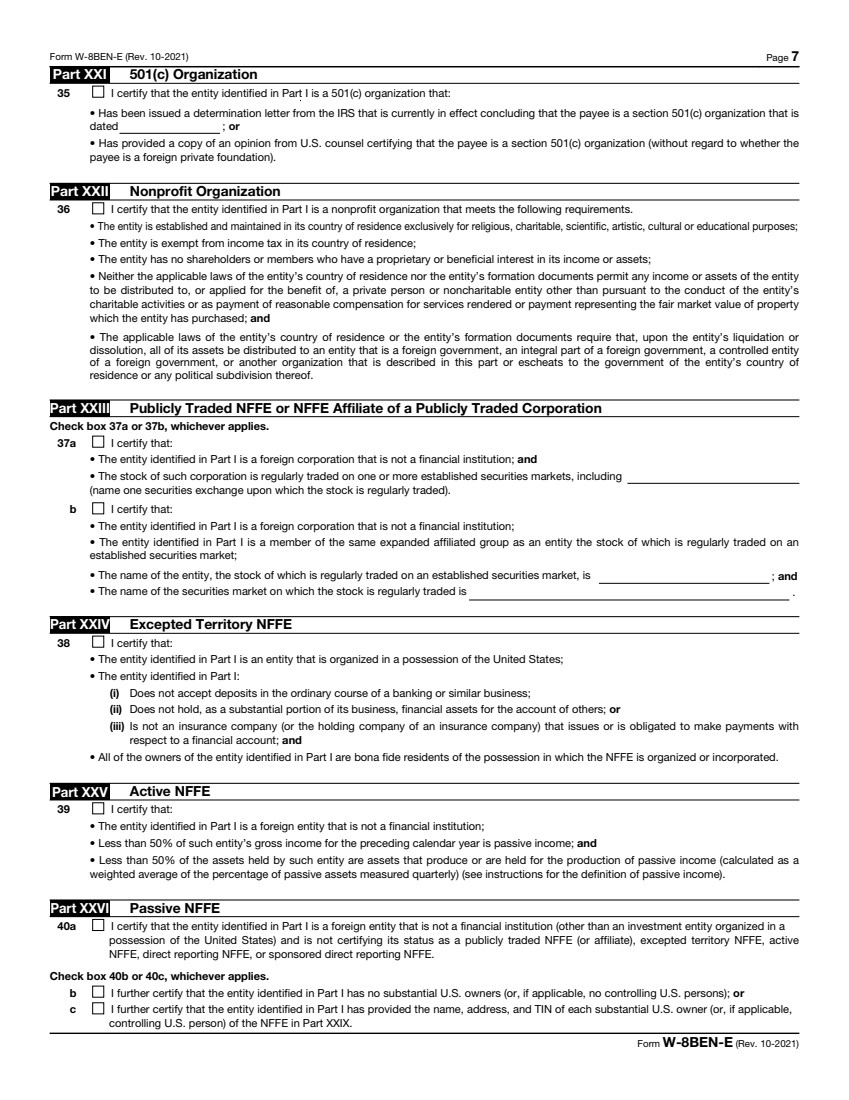
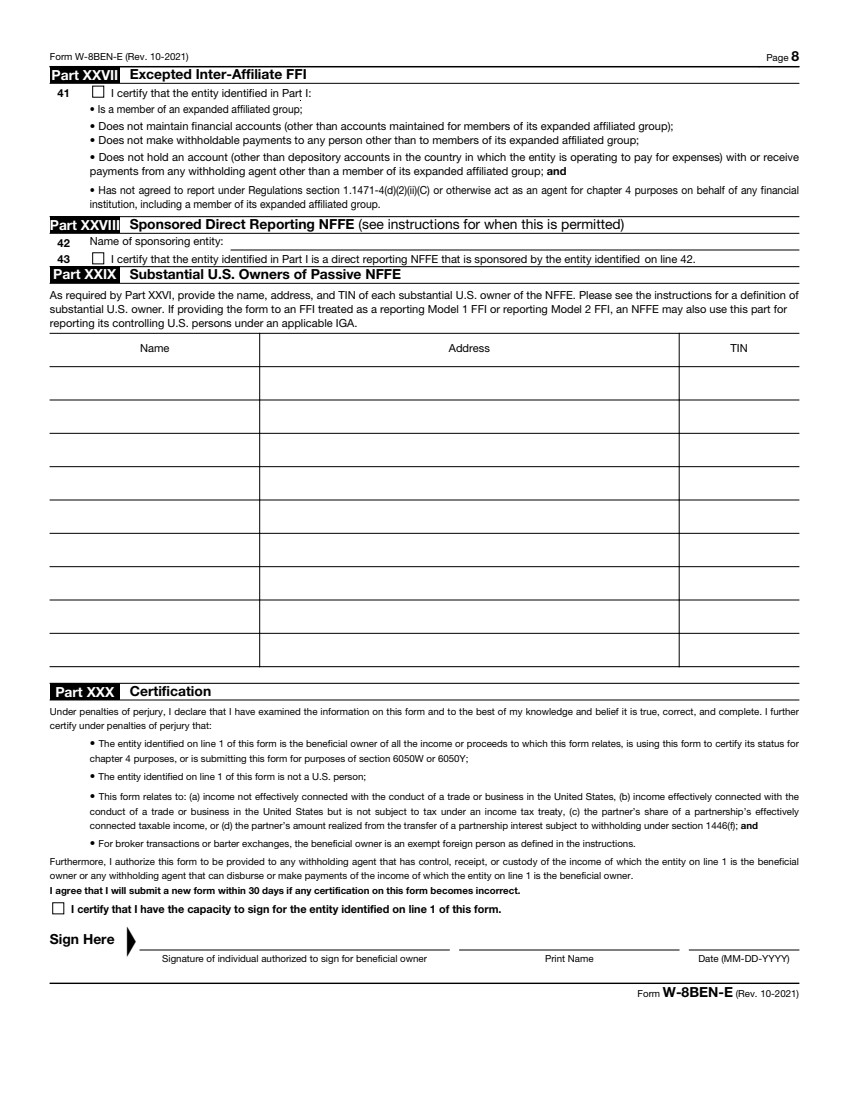
In order for a tendering shareholder that is a Non-U.S. Holder (as defined in Section 13 of the Offer to Purchase) to qualify as an exempt recipient with respect to backup withholding, such shareholder generally must submit to the Depositary a properly completed IRS Form W-8BEN, IRS Form W8-BEN-E, IRS Form W-8ECI or IRS Form W-8IMY, as applicable (instead of IRS Form W-9), signed under penalties of perjury, attesting to such shareholder’s foreign status. IRS Forms W-8BEN and W-8BEN-E are included in this Letter of Transmittal and other applicable forms can be obtained from the Depositary or from www.irs.gov.
Where shares are tendered on behalf of the shareholder by a broker or other DTC participant, the foregoing IRS Forms and certifications generally must be provided by the shareholder to the DTC participant, instead of the Depositary, in accordance with the DTC participant’s applicable procedures.
FAILURE TO COMPLETE AND RETURN THE IRS FORM W-9 OR AN APPROPRIATE IRS FORM W-8 MAY RESULT IN BACKUP WITHHOLDING ON ANY PAYMENTS MADE TO YOU PURSUANT TO THE OFFER.
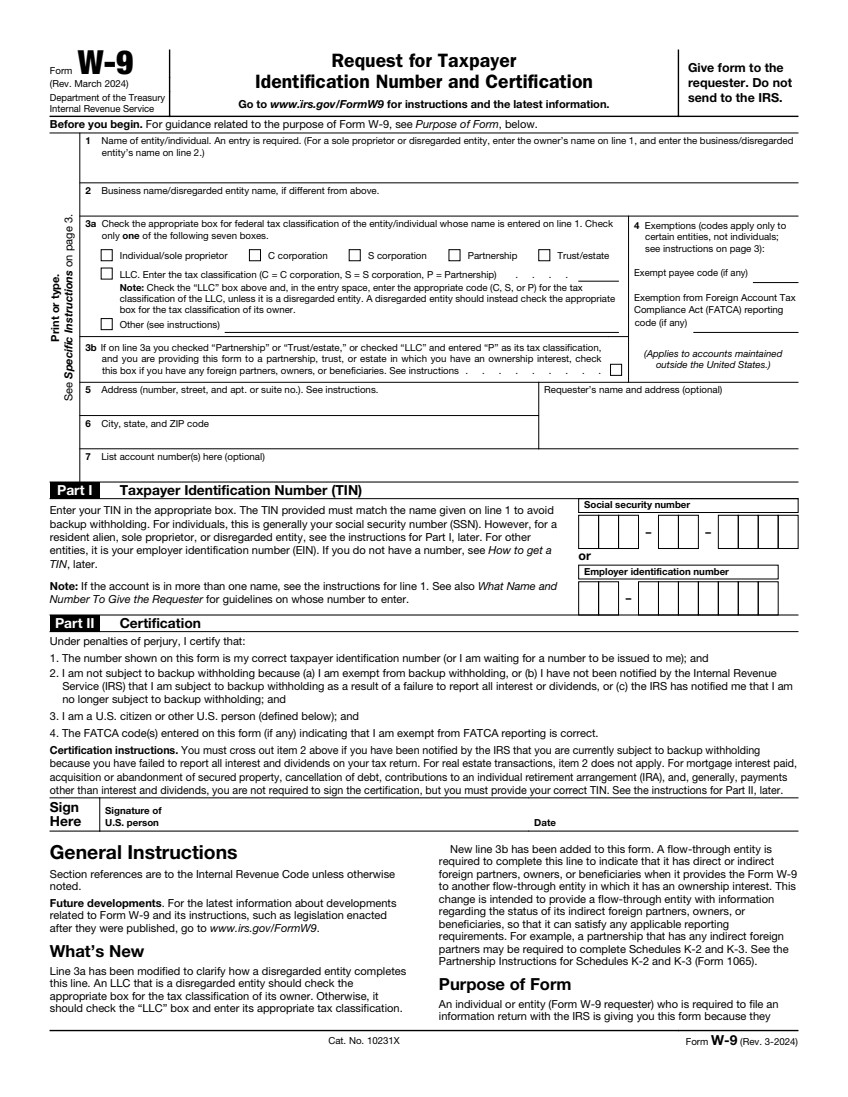
| Form W-9 (Rev. March 2024) Request for Taxpayer Identification Number and Certification Department of the Treasury Internal Revenue Service Go to www.irs.gov/FormW9 for instructions and the latest information. Give form to the requester. Do not send to the IRS. Before you begin. For guidance related to the purpose of Form W-9, see Purpose of Form, below. Print or type. See Specific Instructions on page 3. 1 Name of entity/individual. An entry is required. (For a sole proprietor or disregarded entity, enter the owner’s name on line 1, and enter the business/disregarded entity’s name on line 2.) 2 Business name/disregarded entity name, if different from above. 3a Check the appropriate box for federal tax classification of the entity/individual whose name is entered on line 1. Check only one of the following seven boxes. Individual/sole proprietor C corporation S corporation Partnership Trust/estate LLC. Enter the tax classification (C = C corporation, S = S corporation, P = Partnership) . . . . Note: Check the “LLC” box above and, in the entry space, enter the appropriate code (C, S, or P) for the tax classification of the LLC, unless it is a disregarded entity. A disregarded entity should instead check the appropriate box for the tax classification of its owner. Other (see instructions) 3b If on line 3a you checked “Partnership” or “Trust/estate,” or checked “LLC” and entered “P” as its tax classification, and you are providing this form to a partnership, trust, or estate in which you have an ownership interest, check this box if you have any foreign partners, owners, or beneficiaries. See instructions . . . . . . . . . 4 Exemptions (codes apply only to certain entities, not individuals; see instructions on page 3): Exempt payee code (if any) Exemption from Foreign Account Tax Compliance Act (FATCA) reporting code (if any) (Applies to accounts maintained outside the United States.) 5 Address (number, street, and apt. or suite no.). See instructions. 6 City, state, and ZIP code Requester’s name and address (optional) 7 List account number(s) here (optional) Part I Taxpayer Identification Number (TIN) Enter your TIN in the appropriate box. The TIN provided must match the name given on line 1 to avoid backup withholding. For individuals, this is generally your social security number (SSN). However, for a resident alien, sole proprietor, or disregarded entity, see the instructions for Part I, later. For other entities, it is your employer identification number (EIN). If you do not have a number, see How to get a TIN, later. Note: If the account is in more than one name, see the instructions for line 1. See also What Name and Number To Give the Requester for guidelines on whose number to enter. Social security number – – or Employer identification number – Part II Certification Under penalties of perjury, I certify that: 1. The number shown on this form is my correct taxpayer identification number (or I am waiting for a number to be issued to me); and 2. I am not subject to backup withholding because (a) I am exempt from backup withholding, or (b) I have not been notified by the Internal Revenue Service (IRS) that I am subject to backup withholding as a result of a failure to report all interest or dividends, or (c) the IRS has notified me that I am no longer subject to backup withholding; and 3. I am a U.S. citizen or other U.S. person (defined below); and 4. The FATCA code(s) entered on this form (if any) indicating that I am exempt from FATCA reporting is correct. Certification instructions. You must cross out item 2 above if you have been notified by the IRS that you are currently subject to backup withholding because you have failed to report all interest and dividends on your tax return. For real estate transactions, item 2 does not apply. For mortgage interest paid, acquisition or abandonment of secured property, cancellation of debt, contributions to an individual retirement arrangement (IRA), and, generally, payments other than interest and dividends, you are not required to sign the certification, but you must provide your correct TIN. See the instructions for Part II, later. Sign Here Signature of U.S. person Date General Instructions Section references are to the Internal Revenue Code unless otherwise noted. Future developments. For the latest information about developments related to Form W-9 and its instructions, such as legislation enacted after they were published, go to www.irs.gov/FormW9. What’s New Line 3a has been modified to clarify how a disregarded entity completes this line. An LLC that is a disregarded entity should check the appropriate box for the tax classification of its owner. Otherwise, it should check the “LLC” box and enter its appropriate tax classification. New line 3b has been added to this form. A flow-through entity is required to complete this line to indicate that it has direct or indirect foreign partners, owners, or beneficiaries when it provides the Form W-9 to another flow-through entity in which it has an ownership interest. This change is intended to provide a flow-through entity with information regarding the status of its indirect foreign partners, owners, or beneficiaries, so that it can satisfy any applicable reporting requirements. For example, a partnership that has any indirect foreign partners may be required to complete Schedules K-2 and K-3. See the Partnership Instructions for Schedules K-2 and K-3 (Form 1065). Purpose of Form An individual or entity (Form W-9 requester) who is required to file an information return with the IRS is giving you this form because they Cat. No. 10231X Form W-9 (Rev. 3-2024) |
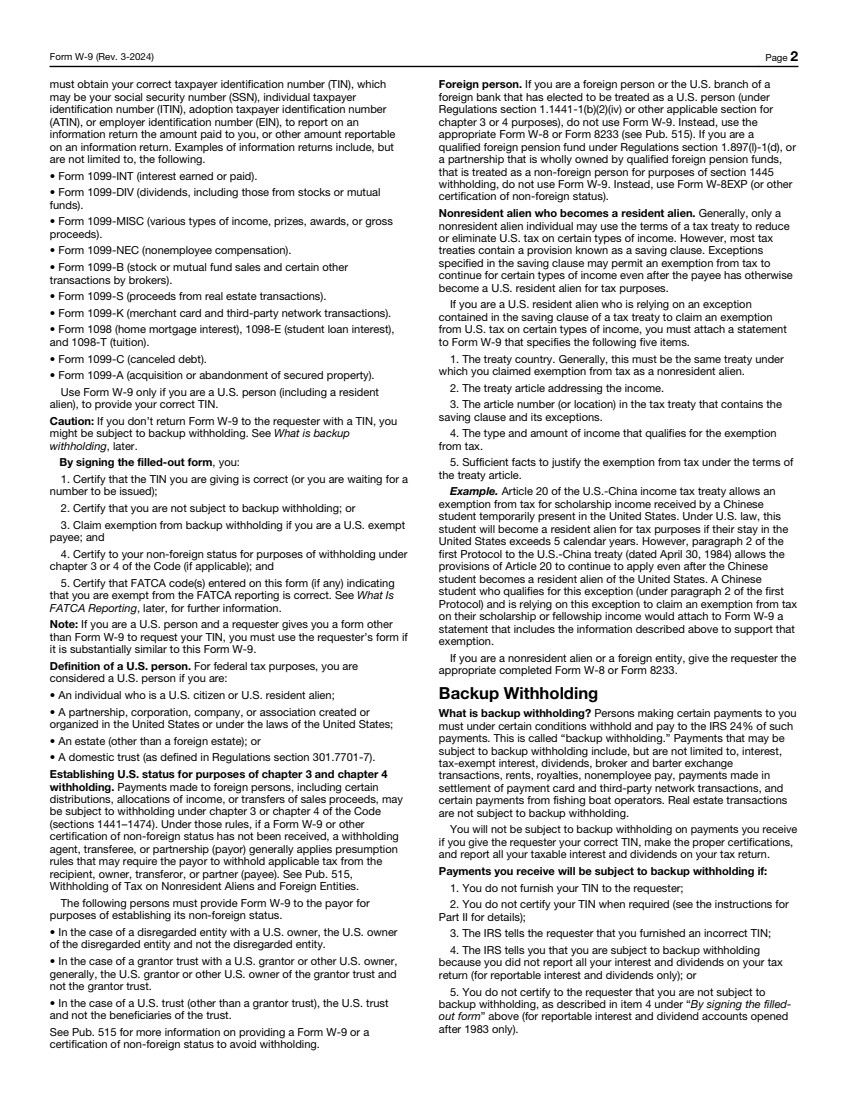
| Form W-9 (Rev. 3-2024) Page 2 must obtain your correct taxpayer identification number (TIN), which may be your social security number (SSN), individual taxpayer identification number (ITIN), adoption taxpayer identification number (ATIN), or employer identification number (EIN), to report on an information return the amount paid to you, or other amount reportable on an information return. Examples of information returns include, but are not limited to, the following. • Form 1099-INT (interest earned or paid). • Form 1099-DIV (dividends, including those from stocks or mutual funds). • Form 1099-MISC (various types of income, prizes, awards, or gross proceeds). • Form 1099-NEC (nonemployee compensation). • Form 1099-B (stock or mutual fund sales and certain other transactions by brokers). • Form 1099-S (proceeds from real estate transactions). • Form 1099-K (merchant card and third-party network transactions). • Form 1098 (home mortgage interest), 1098-E (student loan interest), and 1098-T (tuition). • Form 1099-C (canceled debt). • Form 1099-A (acquisition or abandonment of secured property). Use Form W-9 only if you are a U.S. person (including a resident alien), to provide your correct TIN. Caution: If you don’t return Form W-9 to the requester with a TIN, you might be subject to backup withholding. See What is backup withholding, later. By signing the filled-out form, you: 1. Certify that the TIN you are giving is correct (or you are waiting for a number to be issued); 2. Certify that you are not subject to backup withholding; or 3. Claim exemption from backup withholding if you are a U.S. exempt payee; and 4. Certify to your non-foreign status for purposes of withholding under chapter 3 or 4 of the Code (if applicable); and 5. Certify that FATCA code(s) entered on this form (if any) indicating that you are exempt from the FATCA reporting is correct. See What Is FATCA Reporting, later, for further information. Note: If you are a U.S. person and a requester gives you a form other than Form W-9 to request your TIN, you must use the requester’s form if it is substantially similar to this Form W-9. Definition of a U.S. person. For federal tax purposes, you are considered a U.S. person if you are: • An individual who is a U.S. citizen or U.S. resident alien; • A partnership, corporation, company, or association created or organized in the United States or under the laws of the United States; • An estate (other than a foreign estate); or • A domestic trust (as defined in Regulations section 301.7701-7). Establishing U.S. status for purposes of chapter 3 and chapter 4 withholding. Payments made to foreign persons, including certain distributions, allocations of income, or transfers of sales proceeds, may be subject to withholding under chapter 3 or chapter 4 of the Code (sections 1441–1474). Under those rules, if a Form W-9 or other certification of non-foreign status has not been received, a withholding agent, transferee, or partnership (payor) generally applies presumption rules that may require the payor to withhold applicable tax from the recipient, owner, transferor, or partner (payee). See Pub. 515, Withholding of Tax on Nonresident Aliens and Foreign Entities. The following persons must provide Form W-9 to the payor for purposes of establishing its non-foreign status. • In the case of a disregarded entity with a U.S. owner, the U.S. owner of the disregarded entity and not the disregarded entity. • In the case of a grantor trust with a U.S. grantor or other U.S. owner, generally, the U.S. grantor or other U.S. owner of the grantor trust and not the grantor trust. • In the case of a U.S. trust (other than a grantor trust), the U.S. trust and not the beneficiaries of the trust. See Pub. 515 for more information on providing a Form W-9 or a certification of non-foreign status to avoid withholding. Foreign person. If you are a foreign person or the U.S. branch of a foreign bank that has elected to be treated as a U.S. person (under Regulations section 1.1441-1(b)(2)(iv) or other applicable section for chapter 3 or 4 purposes), do not use Form W-9. Instead, use the appropriate Form W-8 or Form 8233 (see Pub. 515). If you are a qualified foreign pension fund under Regulations section 1.897(l)-1(d), or a partnership that is wholly owned by qualified foreign pension funds, that is treated as a non-foreign person for purposes of section 1445 withholding, do not use Form W-9. Instead, use Form W-8EXP (or other certification of non-foreign status). Nonresident alien who becomes a resident alien. Generally, only a nonresident alien individual may use the terms of a tax treaty to reduce or eliminate U.S. tax on certain types of income. However, most tax treaties contain a provision known as a saving clause. Exceptions specified in the saving clause may permit an exemption from tax to continue for certain types of income even after the payee has otherwise become a U.S. resident alien for tax purposes. If you are a U.S. resident alien who is relying on an exception contained in the saving clause of a tax treaty to claim an exemption from U.S. tax on certain types of income, you must attach a statement to Form W-9 that specifies the following five items. 1. The treaty country. Generally, this must be the same treaty under which you claimed exemption from tax as a nonresident alien. 2. The treaty article addressing the income. 3. The article number (or location) in the tax treaty that contains the saving clause and its exceptions. 4. The type and amount of income that qualifies for the exemption from tax. 5. Sufficient facts to justify the exemption from tax under the terms of the treaty article. Example. Article 20 of the U.S.-China income tax treaty allows an exemption from tax for scholarship income received by a Chinese student temporarily present in the United States. Under U.S. law, this student will become a resident alien for tax purposes if their stay in the United States exceeds 5 calendar years. However, paragraph 2 of the first Protocol to the U.S.-China treaty (dated April 30, 1984) allows the provisions of Article 20 to continue to apply even after the Chinese student becomes a resident alien of the United States. A Chinese student who qualifies for this exception (under paragraph 2 of the first Protocol) and is relying on this exception to claim an exemption from tax on their scholarship or fellowship income would attach to Form W-9 a statement that includes the information described above to support that exemption. If you are a nonresident alien or a foreign entity, give the requester the appropriate completed Form W-8 or Form 8233. Backup Withholding What is backup withholding? Persons making certain payments to you must under certain conditions withhold and pay to the IRS 24% of such payments. This is called “backup withholding.” Payments that may be subject to backup withholding include, but are not limited to, interest, tax-exempt interest, dividends, broker and barter exchange transactions, rents, royalties, nonemployee pay, payments made in settlement of payment card and third-party network transactions, and certain payments from fishing boat operators. Real estate transactions are not subject to backup withholding. You will not be subject to backup withholding on payments you receive if you give the requester your correct TIN, make the proper certifications, and report all your taxable interest and dividends on your tax return. Payments you receive will be subject to backup withholding if: 1. You do not furnish your TIN to the requester; 2. You do not certify your TIN when required (see the instructions for Part II for details); 3. The IRS tells the requester that you furnished an incorrect TIN; 4. The IRS tells you that you are subject to backup withholding because you did not report all your interest and dividends on your tax return (for reportable interest and dividends only); or 5. You do not certify to the requester that you are not subject to backup withholding, as described in item 4 under “By signing the filled-out form” above (for reportable interest and dividend accounts opened after 1983 only). |
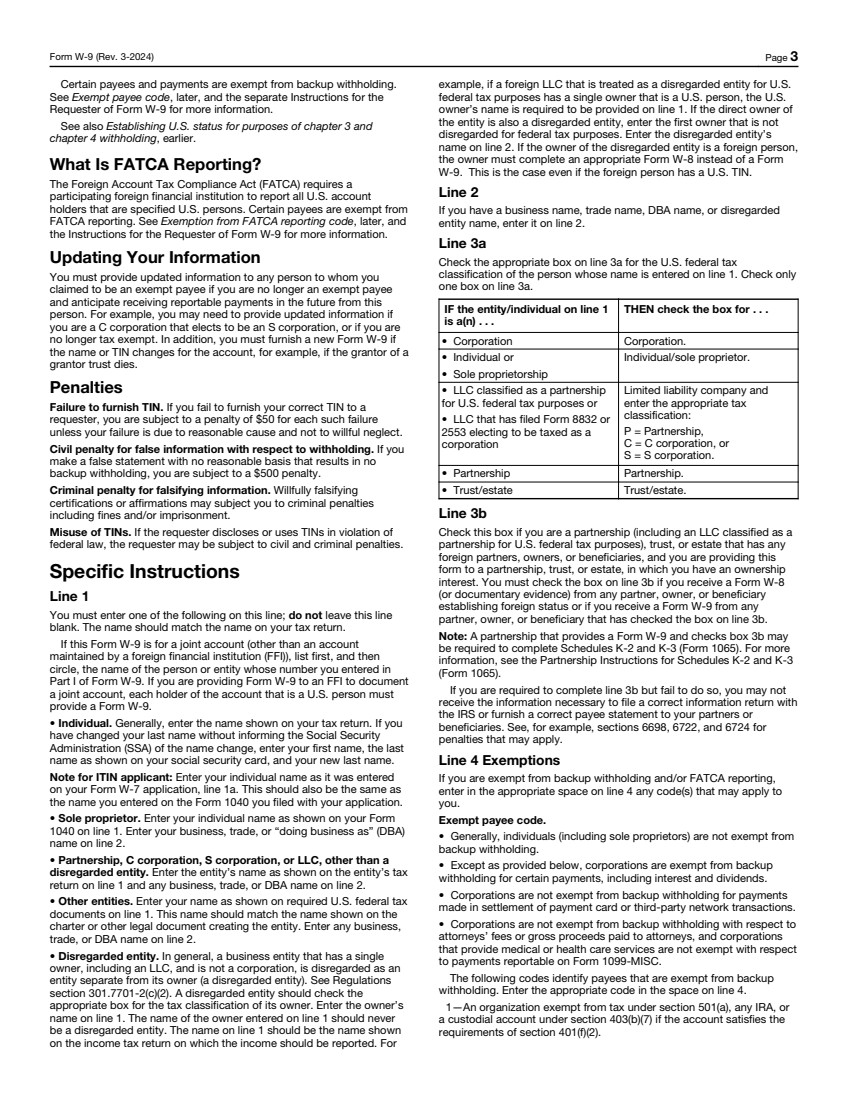
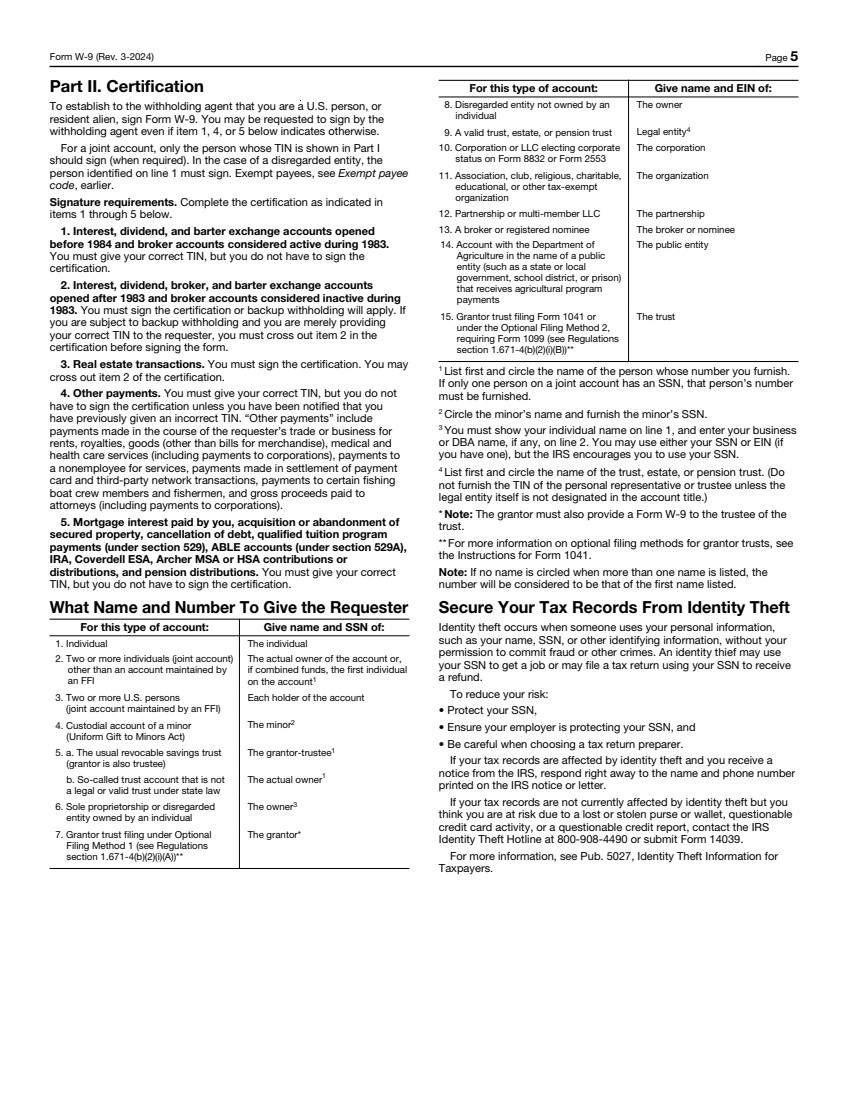
| Form W-9 (Rev. 3-2024) Page 3 Certain payees and payments are exempt from backup withholding. See Exempt payee code, later, and the separate Instructions for the Requester of Form W-9 for more information. See also Establishing U.S. status for purposes of chapter 3 and chapter 4 withholding, earlier. What Is FATCA Reporting? The Foreign Account Tax Compliance Act (FATCA) requires a participating foreign financial institution to report all U.S. account holders that are specified U.S. persons. Certain payees are exempt from FATCA reporting. See Exemption from FATCA reporting code, later, and the Instructions for the Requester of Form W-9 for more information. Updating Your Information You must provide updated information to any person to whom you claimed to be an exempt payee if you are no longer an exempt payee and anticipate receiving reportable payments in the future from this person. For example, you may need to provide updated information if you are a C corporation that elects to be an S corporation, or if you are no longer tax exempt. In addition, you must furnish a new Form W-9 if the name or TIN changes for the account, for example, if the grantor of a grantor trust dies. Penalties Failure to furnish TIN. If you fail to furnish your correct TIN to a requester, you are subject to a penalty of $50 for each such failure unless your failure is due to reasonable cause and not to willful neglect. Civil penalty for false information with respect to withholding. If you make a false statement with no reasonable basis that results in no backup withholding, you are subject to a $500 penalty. Criminal penalty for falsifying information. Willfully falsifying certifications or affirmations may subject you to criminal penalties including fines and/or imprisonment. Misuse of TINs. If the requester discloses or uses TINs in violation of federal law, the requester may be subject to civil and criminal penalties. Specific Instructions Line 1 You must enter one of the following on this line; do not leave this line blank. The name should match the name on your tax return. If this Form W-9 is for a joint account (other than an account maintained by a foreign financial institution (FFI)), list first, and then circle, the name of the person or entity whose number you entered in Part I of Form W-9. If you are providing Form W-9 to an FFI to document a joint account, each holder of the account that is a U.S. person must provide a Form W-9. • Individual. Generally, enter the name shown on your tax return. If you have changed your last name without informing the Social Security Administration (SSA) of the name change, enter your first name, the last name as shown on your social security card, and your new last name. Note for ITIN applicant: Enter your individual name as it was entered on your Form W-7 application, line 1a. This should also be the same as the name you entered on the Form 1040 you filed with your application. • Sole proprietor. Enter your individual name as shown on your Form 1040 on line 1. Enter your business, trade, or “doing business as” (DBA) name on line 2. • Partnership, C corporation, S corporation, or LLC, other than a disregarded entity. Enter the entity’s name as shown on the entity’s tax return on line 1 and any business, trade, or DBA name on line 2. • Other entities. Enter your name as shown on required U.S. federal tax documents on line 1. This name should match the name shown on the charter or other legal document creating the entity. Enter any business, trade, or DBA name on line 2. • Disregarded entity. In general, a business entity that has a single owner, including an LLC, and is not a corporation, is disregarded as an entity separate from its owner (a disregarded entity). See Regulations section 301.7701-2(c)(2). A disregarded entity should check the appropriate box for the tax classification of its owner. Enter the owner’s name on line 1. The name of the owner entered on line 1 should never be a disregarded entity. The name on line 1 should be the name shown on the income tax return on which the income should be reported. For example, if a foreign LLC that is treated as a disregarded entity for U.S. federal tax purposes has a single owner that is a U.S. person, the U.S. owner’s name is required to be provided on line 1. If the direct owner of the entity is also a disregarded entity, enter the first owner that is not disregarded for federal tax purposes. Enter the disregarded entity’s name on line 2. If the owner of the disregarded entity is a foreign person, the owner must complete an appropriate Form W-8 instead of a Form W-9. This is the case even if the foreign person has a U.S. TIN. Line 2 If you have a business name, trade name, DBA name, or disregarded entity name, enter it on line 2. Line 3a Check the appropriate box on line 3a for the U.S. federal tax classification of the person whose name is entered on line 1. Check only one box on line 3a. IF the entity/individual on line 1 is a(n) . . . THEN check the box for . . . • Corporation Corporation. • Individual or • Sole proprietorship Individual/sole proprietor. • LLC classified as a partnership for U.S. federal tax purposes or • LLC that has filed Form 8832 or 2553 electing to be taxed as a corporation Limited liability company and enter the appropriate tax classification: P = Partnership, C = C corporation, or S = S corporation. • Partnership Partnership. • Trust/estate Trust/estate. Line 3b Check this box if you are a partnership (including an LLC classified as a partnership for U.S. federal tax purposes), trust, or estate that has any foreign partners, owners, or beneficiaries, and you are providing this form to a partnership, trust, or estate, in which you have an ownership interest. You must check the box on line 3b if you receive a Form W-8 (or documentary evidence) from any partner, owner, or beneficiary establishing foreign status or if you receive a Form W-9 from any partner, owner, or beneficiary that has checked the box on line 3b. Note: A partnership that provides a Form W-9 and checks box 3b may be required to complete Schedules K-2 and K-3 (Form 1065). For more information, see the Partnership Instructions for Schedules K-2 and K-3 (Form 1065). If you are required to complete line 3b but fail to do so, you may not receive the information necessary to file a correct information return with the IRS or furnish a correct payee statement to your partners or beneficiaries. See, for example, sections 6698, 6722, and 6724 for penalties that may apply. Line 4 Exemptions If you are exempt from backup withholding and/or FATCA reporting, enter in the appropriate space on line 4 any code(s) that may apply to you. Exempt payee code. • Generally, individuals (including sole proprietors) are not exempt from backup withholding. • Except as provided below, corporations are exempt from backup withholding for certain payments, including interest and dividends. • Corporations are not exempt from backup withholding for payments made in settlement of payment card or third-party network transactions. • Corporations are not exempt from backup withholding with respect to attorneys’ fees or gross proceeds paid to attorneys, and corporations that provide medical or health care services are not exempt with respect to payments reportable on Form 1099-MISC. The following codes identify payees that are exempt from backup withholding. Enter the appropriate code in the space on line 4. 1—An organization exempt from tax under section 501(a), any IRA, or a custodial account under section 403(b)(7) if the account satisfies the requirements of section 401(f)(2). |
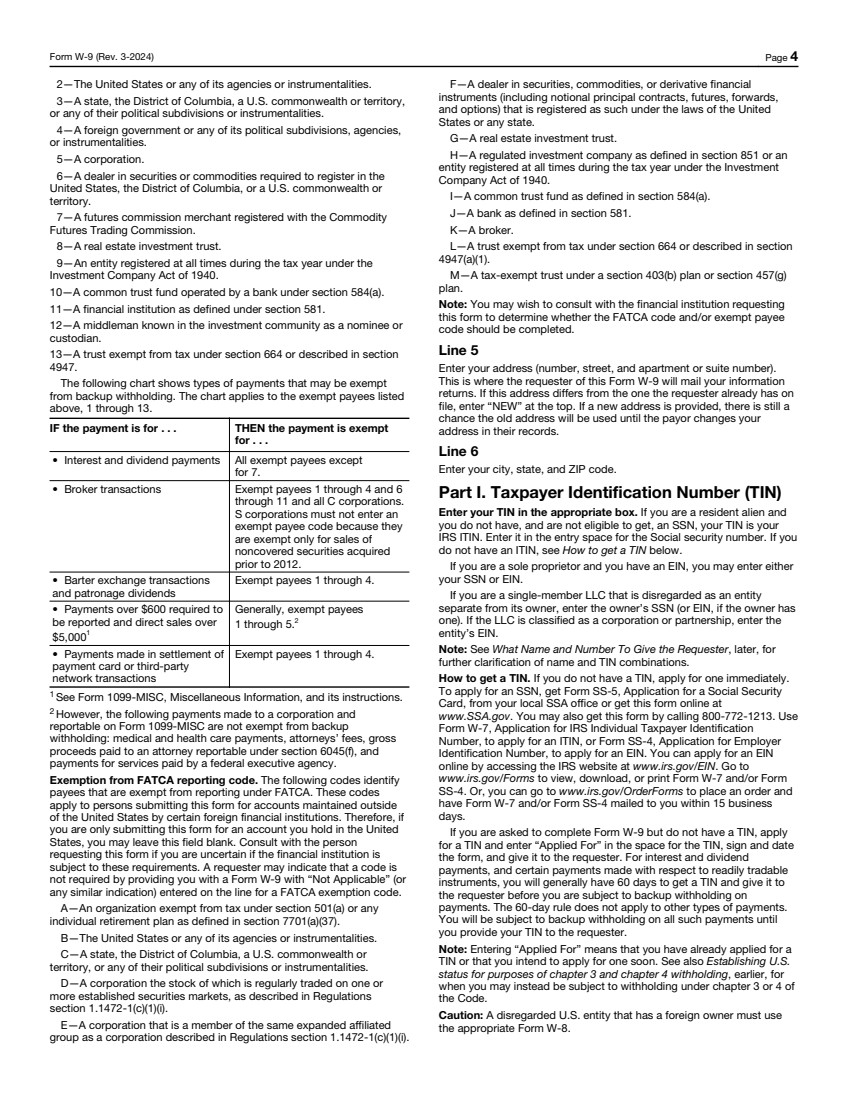
| Form W-9 (Rev. 3-2024) Page 4 2—The United States or any of its agencies or instrumentalities. 3—A state, the District of Columbia, a U.S. commonwealth or territory, or any of their political subdivisions or instrumentalities. 4—A foreign government or any of its political subdivisions, agencies, or instrumentalities. 5—A corporation. 6—A dealer in securities or commodities required to register in the United States, the District of Columbia, or a U.S. commonwealth or territory. 7—A futures commission merchant registered with the Commodity Futures Trading Commission. 8—A real estate investment trust. 9—An entity registered at all times during the tax year under the Investment Company Act of 1940. 10—A common trust fund operated by a bank under section 584(a). 11—A financial institution as defined under section 581. 12—A middleman known in the investment community as a nominee or custodian. 13—A trust exempt from tax under section 664 or described in section 4947. The following chart shows types of payments that may be exempt from backup withholding. The chart applies to the exempt payees listed above, 1 through 13. IF the payment is for . . . THEN the payment is exempt for . . . • Interest and dividend payments All exempt payees except for 7. • Broker transactions Exempt payees 1 through 4 and 6 through 11 and all C corporations. S corporations must not enter an exempt payee code because they are exempt only for sales of noncovered securities acquired prior to 2012. • Barter exchange transactions and patronage dividends Exempt payees 1 through 4. • Payments over $600 required to be reported and direct sales over $5,0001 Generally, exempt payees 1 through 5.2 • Payments made in settlement of payment card or third-party network transactions Exempt payees 1 through 4. 1See Form 1099-MISC, Miscellaneous Information, and its instructions. 2However, the following payments made to a corporation and reportable on Form 1099-MISC are not exempt from backup withholding: medical and health care payments, attorneys’ fees, gross proceeds paid to an attorney reportable under section 6045(f), and payments for services paid by a federal executive agency. Exemption from FATCA reporting code. The following codes identify payees that are exempt from reporting under FATCA. These codes apply to persons submitting this form for accounts maintained outside of the United States by certain foreign financial institutions. Therefore, if you are only submitting this form for an account you hold in the United States, you may leave this field blank. Consult with the person requesting this form if you are uncertain if the financial institution is subject to these requirements. A requester may indicate that a code is not required by providing you with a Form W-9 with “Not Applicable” (or any similar indication) entered on the line for a FATCA exemption code. A—An organization exempt from tax under section 501(a) or any individual retirement plan as defined in section 7701(a)(37). B—The United States or any of its agencies or instrumentalities. C—A state, the District of Columbia, a U.S. commonwealth or territory, or any of their political subdivisions or instrumentalities. D—A corporation the stock of which is regularly traded on one or more established securities markets, as described in Regulations section 1.1472-1(c)(1)(i). E—A corporation that is a member of the same expanded affiliated group as a corporation described in Regulations section 1.1472-1(c)(1)(i). F—A dealer in securities, commodities, or derivative financial instruments (including notional principal contracts, futures, forwards, and options) that is registered as such under the laws of the United States or any state. G—A real estate investment trust. H—A regulated investment company as defined in section 851 or an entity registered at all times during the tax year under the Investment Company Act of 1940. I—A common trust fund as defined in section 584(a). J—A bank as defined in section 581. K—A broker. L—A trust exempt from tax under section 664 or described in section 4947(a)(1). M—A tax-exempt trust under a section 403(b) plan or section 457(g) plan. Note: You may wish to consult with the financial institution requesting this form to determine whether the FATCA code and/or exempt payee code should be completed. Line 5 Enter your address (number, street, and apartment or suite number). This is where the requester of this Form W-9 will mail your information returns. If this address differs from the one the requester already has on file, enter “NEW” at the top. If a new address is provided, there is still a chance the old address will be used until the payor changes your address in their records. Line 6 Enter your city, state, and ZIP code. Part I. Taxpayer Identification Number (TIN) Enter your TIN in the appropriate box. If you are a resident alien and you do not have, and are not eligible to get, an SSN, your TIN is your IRS ITIN. Enter it in the entry space for the Social security number. If you do not have an ITIN, see How to get a TIN below. If you are a sole proprietor and you have an EIN, you may enter either your SSN or EIN. If you are a single-member LLC that is disregarded as an entity separate from its owner, enter the owner’s SSN (or EIN, if the owner has one). If the LLC is classified as a corporation or partnership, enter the entity’s EIN. Note: See What Name and Number To Give the Requester, later, for further clarification of name and TIN combinations. How to get a TIN. If you do not have a TIN, apply for one immediately. To apply for an SSN, get Form SS-5, Application for a Social Security Card, from your local SSA office or get this form online at www.SSA.gov. You may also get this form by calling 800-772-1213. Use Form W-7, Application for IRS Individual Taxpayer Identification Number, to apply for an ITIN, or Form SS-4, Application for Employer Identification Number, to apply for an EIN. You can apply for an EIN online by accessing the IRS website at www.irs.gov/EIN. Go to www.irs.gov/Forms to view, download, or print Form W-7 and/or Form SS-4. Or, you can go to www.irs.gov/OrderForms to place an order and have Form W-7 and/or Form SS-4 mailed to you within 15 business days. If you are asked to complete Form W-9 but do not have a TIN, apply for a TIN and enter “Applied For” in the space for the TIN, sign and date the form, and give it to the requester. For interest and dividend payments, and certain payments made with respect to readily tradable instruments, you will generally have 60 days to get a TIN and give it to the requester before you are subject to backup withholding on payments. The 60-day rule does not apply to other types of payments. You will be subject to backup withholding on all such payments until you provide your TIN to the requester. Note: Entering “Applied For” means that you have already applied for a TIN or that you intend to apply for one soon. See also Establishing U.S. status for purposes of chapter 3 and chapter 4 withholding, earlier, for when you may instead be subject to withholding under chapter 3 or 4 of the Code. Caution: A disregarded U.S. entity that has a foreign owner must use the appropriate Form W-8. |
| Form W-9 (Rev. 3-2024) Page 5 Part II. Certification To establish to the withholding agent that you are a U.S. person, or resident alien, sign Form W-9. You may be requested to sign by the withholding agent even if item 1, 4, or 5 below indicates otherwise. For a joint account, only the person whose TIN is shown in Part I should sign (when required). In the case of a disregarded entity, the person identified on line 1 must sign. Exempt payees, see Exempt payee code, earlier. Signature requirements. Complete the certification as indicated in items 1 through 5 below. 1. Interest, dividend, and barter exchange accounts opened before 1984 and broker accounts considered active during 1983. You must give your correct TIN, but you do not have to sign the certification. 2. Interest, dividend, broker, and barter exchange accounts opened after 1983 and broker accounts considered inactive during 1983. You must sign the certification or backup withholding will apply. If you are subject to backup withholding and you are merely providing your correct TIN to the requester, you must cross out item 2 in the certification before signing the form. 3. Real estate transactions. You must sign the certification. You may cross out item 2 of the certification. 4. Other payments. You must give your correct TIN, but you do not have to sign the certification unless you have been notified that you have previously given an incorrect TIN. “Other payments” include payments made in the course of the requester’s trade or business for rents, royalties, goods (other than bills for merchandise), medical and health care services (including payments to corporations), payments to a nonemployee for services, payments made in settlement of payment card and third-party network transactions, payments to certain fishing boat crew members and fishermen, and gross proceeds paid to attorneys (including payments to corporations). 5. Mortgage interest paid by you, acquisition or abandonment of secured property, cancellation of debt, qualified tuition program payments (under section 529), ABLE accounts (under section 529A), IRA, Coverdell ESA, Archer MSA or HSA contributions or distributions, and pension distributions. You must give your correct TIN, but you do not have to sign the certification. What Name and Number To Give the Requester For this type of account: Give name and SSN of: 1. Individual The individual 2. Two or more individuals (joint account) other than an account maintained by an FFI The actual owner of the account or, if combined funds, the first individual on the account1 3. Two or more U.S. persons (joint account maintained by an FFI) Each holder of the account 4. Custodial account of a minor (Uniform Gift to Minors Act) The minor2 5. a. The usual revocable savings trust (grantor is also trustee) The grantor-trustee1 b. So-called trust account that is not a legal or valid trust under state law The actual owner1 6. Sole proprietorship or disregarded entity owned by an individual The owner3 7. Grantor trust filing under Optional Filing Method 1 (see Regulations section 1.671-4(b)(2)(i)(A))** The grantor* For this type of account: Give name and EIN of: 8. Disregarded entity not owned by an individual The owner 9. A valid trust, estate, or pension trust Legal entity4 10. Corporation or LLC electing corporate status on Form 8832 or Form 2553 The corporation 11. Association, club, religious, charitable, educational, or other tax-exempt organization The organization 12. Partnership or multi-member LLC The partnership 13. A broker or registered nominee The broker or nominee 14. Account with the Department of Agriculture in the name of a public entity (such as a state or local government, school district, or prison) that receives agricultural program payments The public entity 15. Grantor trust filing Form 1041 or under the Optional Filing Method 2, requiring Form 1099 (see Regulations section 1.671-4(b)(2)(i)(B))** The trust 1 List first and circle the name of the person whose number you furnish. If only one person on a joint account has an SSN, that person’s number must be furnished. 2Circle the minor’s name and furnish the minor’s SSN. 3You must show your individual name on line 1, and enter your business or DBA name, if any, on line 2. You may use either your SSN or EIN (if you have one), but the IRS encourages you to use your SSN. 4 List first and circle the name of the trust, estate, or pension trust. (Do not furnish the TIN of the personal representative or trustee unless the legal entity itself is not designated in the account title.) *Note: The grantor must also provide a Form W-9 to the trustee of the trust. **For more information on optional filing methods for grantor trusts, see the Instructions for Form 1041. Note: If no name is circled when more than one name is listed, the number will be considered to be that of the first name listed. Secure Your Tax Records From Identity Theft Identity theft occurs when someone uses your personal information, such as your name, SSN, or other identifying information, without your permission to commit fraud or other crimes. An identity thief may use your SSN to get a job or may file a tax return using your SSN to receive a refund. To reduce your risk: • Protect your SSN, • Ensure your employer is protecting your SSN, and • Be careful when choosing a tax return preparer. If your tax records are affected by identity theft and you receive a notice from the IRS, respond right away to the name and phone number printed on the IRS notice or letter. If your tax records are not currently affected by identity theft but you think you are at risk due to a lost or stolen purse or wallet, questionable credit card activity, or a questionable credit report, contact the IRS Identity Theft Hotline at 800-908-4490 or submit Form 14039. For more information, see Pub. 5027, Identity Theft Information for Taxpayers. |
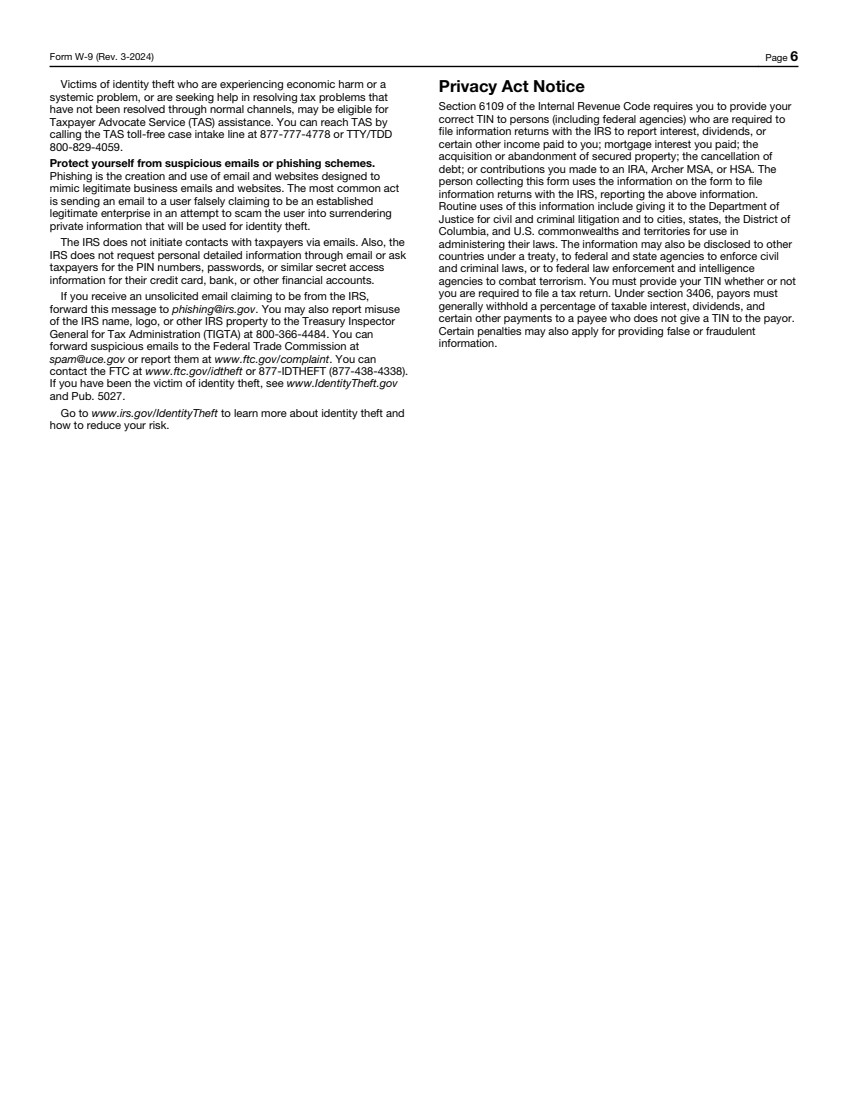
| Form W-9 (Rev. 3-2024) Page 6 Victims of identity theft who are experiencing economic harm or a systemic problem, or are seeking help in resolving tax problems that have not been resolved through normal channels, may be eligible for Taxpayer Advocate Service (TAS) assistance. You can reach TAS by calling the TAS toll-free case intake line at 877-777-4778 or TTY/TDD 800-829-4059. Protect yourself from suspicious emails or phishing schemes. Phishing is the creation and use of email and websites designed to mimic legitimate business emails and websites. The most common act is sending an email to a user falsely claiming to be an established legitimate enterprise in an attempt to scam the user into surrendering private information that will be used for identity theft. The IRS does not initiate contacts with taxpayers via emails. Also, the IRS does not request personal detailed information through email or ask taxpayers for the PIN numbers, passwords, or similar secret access information for their credit card, bank, or other financial accounts. If you receive an unsolicited email claiming to be from the IRS, forward this message to phishing@irs.gov. You may also report misuse of the IRS name, logo, or other IRS property to the Treasury Inspector General for Tax Administration (TIGTA) at 800-366-4484. You can forward suspicious emails to the Federal Trade Commission at spam@uce.gov or report them at www.ftc.gov/complaint. You can contact the FTC at www.ftc.gov/idtheft or 877-IDTHEFT (877-438-4338). If you have been the victim of identity theft, see www.IdentityTheft.gov and Pub. 5027. Go to www.irs.gov/IdentityTheft to learn more about identity theft and how to reduce your risk. Privacy Act Notice Section 6109 of the Internal Revenue Code requires you to provide your correct TIN to persons (including federal agencies) who are required to file information returns with the IRS to report interest, dividends, or certain other income paid to you; mortgage interest you paid; the acquisition or abandonment of secured property; the cancellation of debt; or contributions you made to an IRA, Archer MSA, or HSA. The person collecting this form uses the information on the form to file information returns with the IRS, reporting the above information. Routine uses of this information include giving it to the Department of Justice for civil and criminal litigation and to cities, states, the District of Columbia, and U.S. commonwealths and territories for use in administering their laws. The information may also be disclosed to other countries under a treaty, to federal and state agencies to enforce civil and criminal laws, or to federal law enforcement and intelligence agencies to combat terrorism. You must provide your TIN whether or not you are required to file a tax return. Under section 3406, payors must generally withhold a percentage of taxable interest, dividends, and certain other payments to a payee who does not give a TIN to the payor. Certain penalties may also apply for providing false or fraudulent information. |
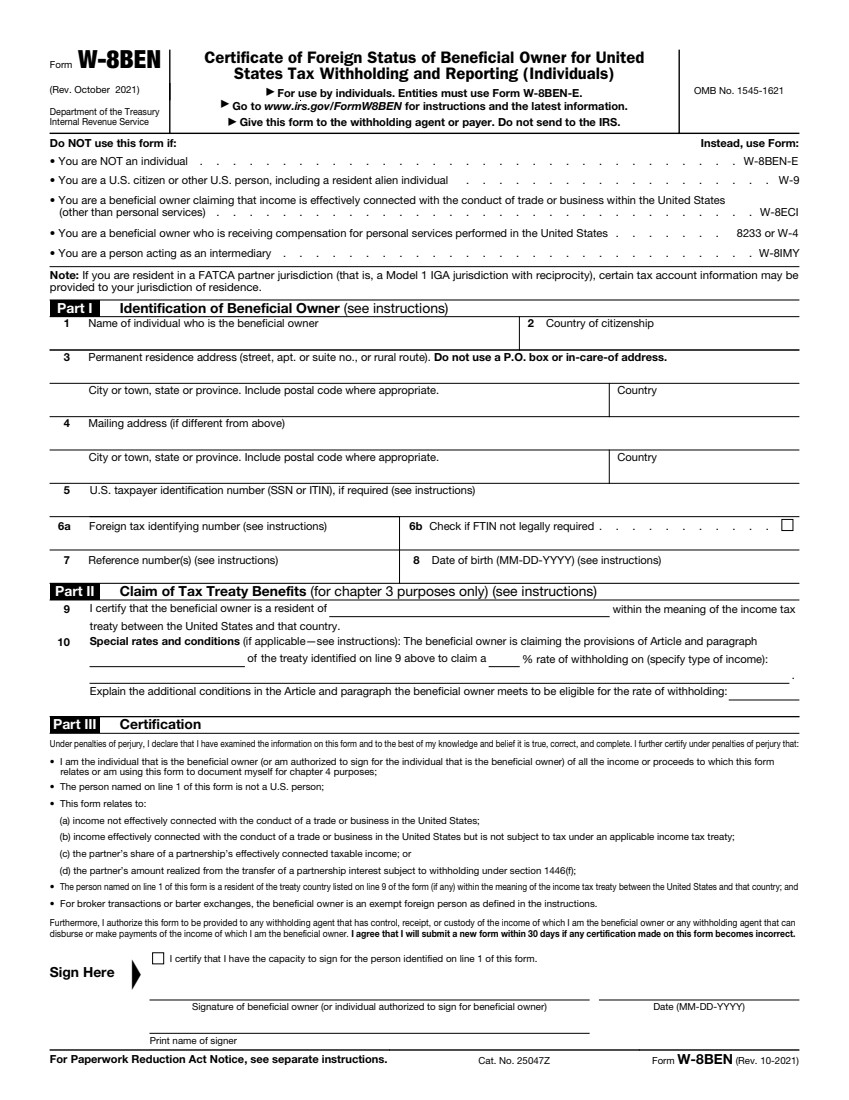
| Form W-8BEN (Rev. October 2021) Department of the Treasury Internal Revenue Service Certificate of Foreign Status of Beneficial Owner for United States Tax Withholding and Reporting (Individuals) ▶ For use by individuals. Entities must use Form W-8BEN-E. ▶ Go to www.irs.gov/FormW8BEN for instructions and the latest information. ▶ Give this form to the withholding agent or payer. Do not send to the IRS. OMB No. 1545-1621 Do NOT use this form if: Instead, use Form: • You are NOT an individual . . . . . . . . . . . . . . . . . . . . . . . . . . . . . . . . . W-8BEN-E • You are a U.S. citizen or other U.S. person, including a resident alien individual . . . . . . . . . . . . . . . . . . . W-9 • You are a beneficial owner claiming that income is effectively connected with the conduct of trade or business within the United States (other than personal services) . . . . . . . . . . . . . . . . . . . . . . . . . . . . . . . . . W-8ECI • You are a beneficial owner who is receiving compensation for personal services performed in the United States . . . . . . . 8233 or W-4 • You are a person acting as an intermediary . . . . . . . . . . . . . . . . . . . . . . . . . . . . . W-8IMY Note: If you are resident in a FATCA partner jurisdiction (that is, a Model 1 IGA jurisdiction with reciprocity), certain tax account information may be provided to your jurisdiction of residence. Part I Identification of Beneficial Owner (see instructions) 1 Name of individual who is the beneficial owner 2 Country of citizenship 3 Permanent residence address (street, apt. or suite no., or rural route). Do not use a P.O. box or in-care-of address. City or town, state or province. Include postal code where appropriate. Country 4 Mailing address (if different from above) City or town, state or province. Include postal code where appropriate. Country 5 U.S. taxpayer identification number (SSN or ITIN), if required (see instructions) 6a Foreign tax identifying number (see instructions) 6b Check if FTIN not legally required . . . . . . . . . . . 7 Reference number(s) (see instructions) 8 Date of birth (MM-DD-YYYY) (see instructions) Part II Claim of Tax Treaty Benefits (for chapter 3 purposes only) (see instructions) 9 I certify that the beneficial owner is a resident of within the meaning of the income tax treaty between the United States and that country. 10 Special rates and conditions (if applicable—see instructions): The beneficial owner is claiming the provisions of Article and paragraph of the treaty identified on line 9 above to claim a % rate of withholding on (specify type of income): . Explain the additional conditions in the Article and paragraph the beneficial owner meets to be eligible for the rate of withholding: Part III Certification Under penalties of perjury, I declare that I have examined the information on this form and to the best of my knowledge and belief it is true, correct, and complete. I further certify under penalties of perjury that: • I am the individual that is the beneficial owner (or am authorized to sign for the individual that is the beneficial owner) of all the income or proceeds to which this form relates or am using this form to document myself for chapter 4 purposes; • The person named on line 1 of this form is not a U.S. person; • This form relates to: (a) income not effectively connected with the conduct of a trade or business in the United States; (b) income effectively connected with the conduct of a trade or business in the United States but is not subject to tax under an applicable income tax treaty; (c) the partner’s share of a partnership’s effectively connected taxable income; or (d) the partner’s amount realized from the transfer of a partnership interest subject to withholding under section 1446(f); • The person named on line 1 of this form is a resident of the treaty country listed on line 9 of the form (if any) within the meaning of the income tax treaty between the United States and that country; and • For broker transactions or barter exchanges, the beneficial owner is an exempt foreign person as defined in the instructions. Furthermore, I authorize this form to be provided to any withholding agent that has control, receipt, or custody of the income of which I am the beneficial owner or any withholding agent that can disburse or make payments of the income of which I am the beneficial owner. I agree that I will submit a new form within 30 days if any certification made on this form becomes incorrect. Sign Here ▲ I certify that I have the capacity to sign for the person identified on line 1 of this form. Signature of beneficial owner (or individual authorized to sign for beneficial owner) Date (MM-DD-YYYY) Print name of signer For Paperwork Reduction Act Notice, see separate instructions. Cat. No. 25047Z Form W-8BEN (Rev. 10-2021) |
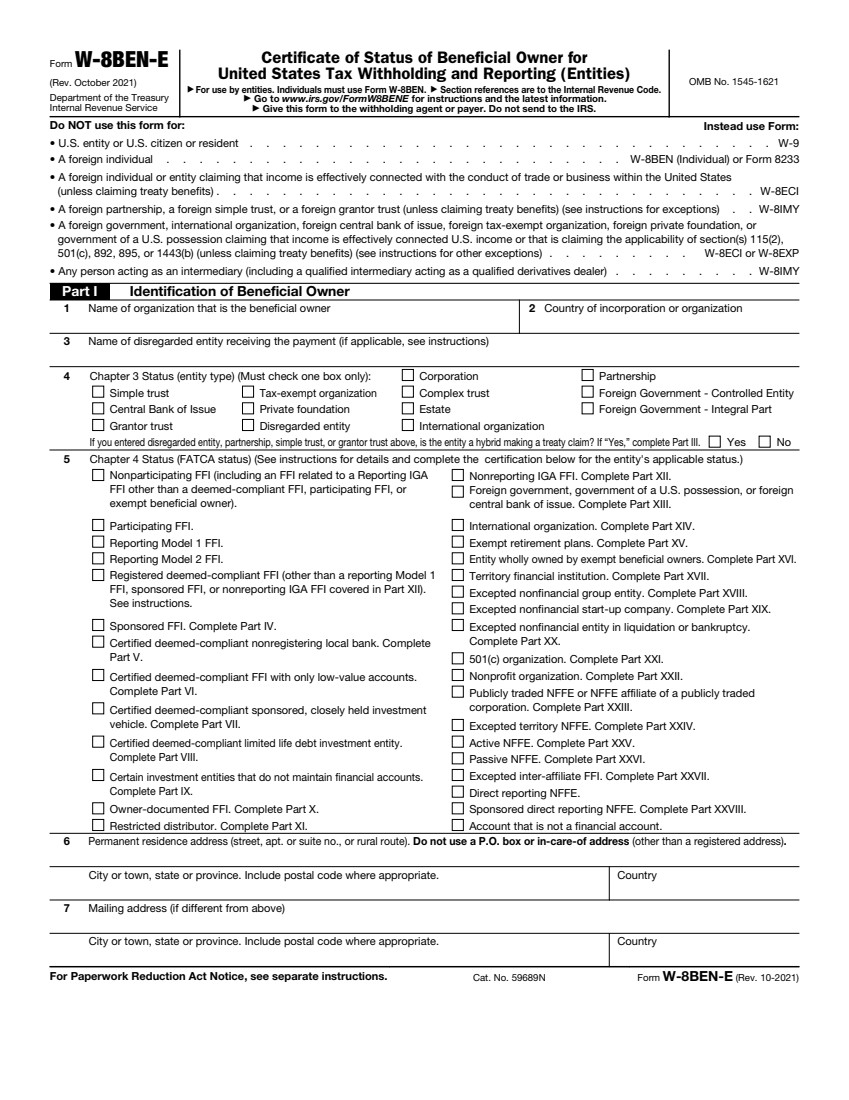
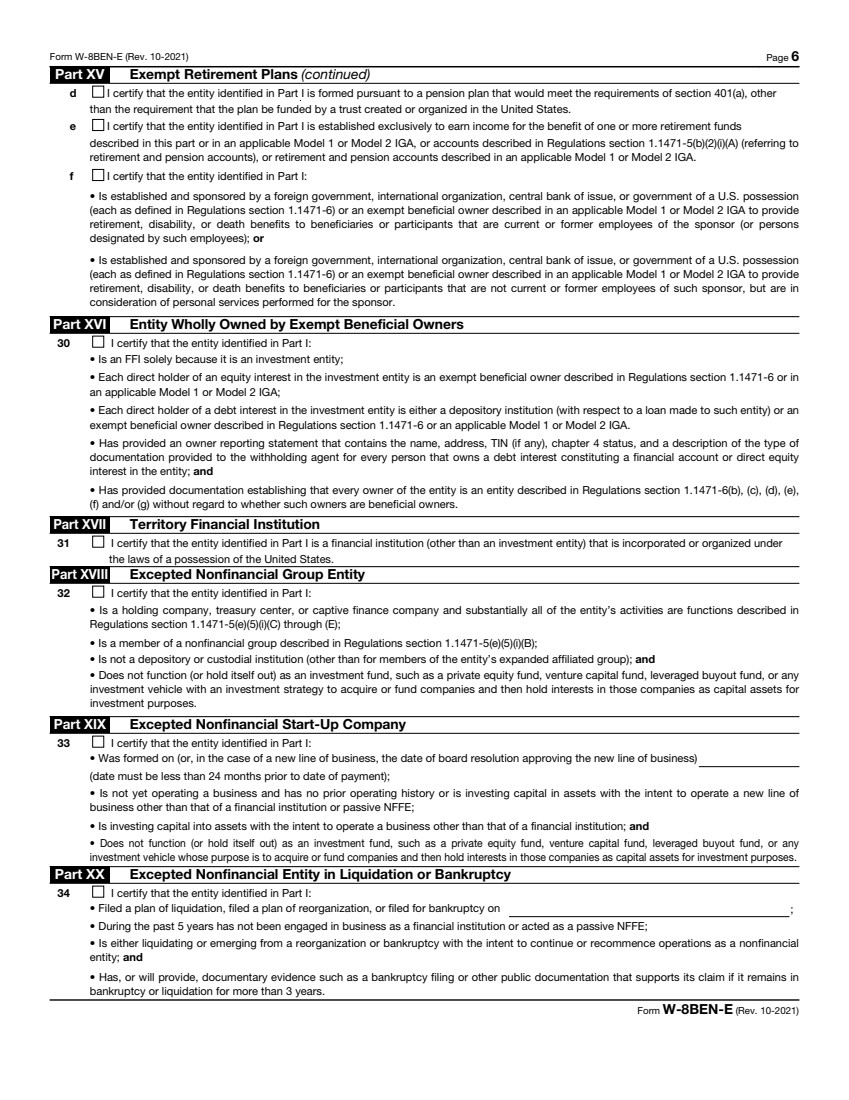
| Form W-8BEN-E (Rev. October 2021) Department of the Treasury Internal Revenue Service Certificate of Status of Beneficial Owner for United States Tax Withholding and Reporting (Entities) ▶ For use by entities. Individuals must use Form W-8BEN. ▶ Section references are to the Internal Revenue Code. ▶ Go to www.irs.gov/FormW8BENE for instructions and the latest information. ▶ Give this form to the withholding agent or payer. Do not send to the IRS. OMB No. 1545-1621 Do NOT use this form for: Instead use Form: • U.S. entity or U.S. citizen or resident . . . . . . . . . . . . . . . . . . . . . . . . . . . . . . . . W-9 • A foreign individual . . . . . . . . . . . . . . . . . . . . . . . . . . . . W-8BEN (Individual) or Form 8233 • A foreign individual or entity claiming that income is effectively connected with the conduct of trade or business within the United States (unless claiming treaty benefits) . . . . . . . . . . . . . . . . . . . . . . . . . . . . . . . . . W-8ECI • A foreign partnership, a foreign simple trust, or a foreign grantor trust (unless claiming treaty benefits) (see instructions for exceptions) . . W-8IMY • A foreign government, international organization, foreign central bank of issue, foreign tax-exempt organization, foreign private foundation, or government of a U.S. possession claiming that income is effectively connected U.S. income or that is claiming the applicability of section(s) 115(2), 501(c), 892, 895, or 1443(b) (unless claiming treaty benefits) (see instructions for other exceptions) . . . . . . . . . W-8ECI or W-8EXP • Any person acting as an intermediary (including a qualified intermediary acting as a qualified derivatives dealer) . . . . . . . . . W-8IMY Part I Identification of Beneficial Owner 1 Name of organization that is the beneficial owner 2 Country of incorporation or organization 3 Name of disregarded entity receiving the payment (if applicable, see instructions) 4 Chapter 3 Status (entity type) (Must check one box only): Corporation Partnership Simple trust Tax-exempt organization Complex trust Foreign Government - Controlled Entity Central Bank of Issue Private foundation Estate Foreign Government - Integral Part Grantor trust Disregarded entity International organization If you entered disregarded entity, partnership, simple trust, or grantor trust above, is the entity a hybrid making a treaty claim? If “Yes,” complete Part III. Yes No 5 Chapter 4 Status (FATCA status) (See instructions for details and complete the certification below for the entity's applicable status.) Nonparticipating FFI (including an FFI related to a Reporting IGA FFI other than a deemed-compliant FFI, participating FFI, or exempt beneficial owner). Participating FFI. Reporting Model 1 FFI. Reporting Model 2 FFI. Registered deemed-compliant FFI (other than a reporting Model 1 FFI, sponsored FFI, or nonreporting IGA FFI covered in Part XII). See instructions. Sponsored FFI. Complete Part IV. Certified deemed-compliant nonregistering local bank. Complete Part V. Certified deemed-compliant FFI with only low-value accounts. Complete Part VI. Certified deemed-compliant sponsored, closely held investment vehicle. Complete Part VII. Certified deemed-compliant limited life debt investment entity. Complete Part VIII. Certain investment entities that do not maintain financial accounts. Complete Part IX. Owner-documented FFI. Complete Part X. Restricted distributor. Complete Part XI. Nonreporting IGA FFI. Complete Part XII. Foreign government, government of a U.S. possession, or foreign central bank of issue. Complete Part XIII. International organization. Complete Part XIV. Exempt retirement plans. Complete Part XV. Entity wholly owned by exempt beneficial owners. Complete Part XVI. Territory financial institution. Complete Part XVII. Excepted nonfinancial group entity. Complete Part XVIII. Excepted nonfinancial start-up company. Complete Part XIX. Excepted nonfinancial entity in liquidation or bankruptcy. Complete Part XX. 501(c) organization. Complete Part XXI. Nonprofit organization. Complete Part XXII. Publicly traded NFFE or NFFE affiliate of a publicly traded corporation. Complete Part XXIII. Excepted territory NFFE. Complete Part XXIV. Active NFFE. Complete Part XXV. Passive NFFE. Complete Part XXVI. Excepted inter-affiliate FFI. Complete Part XXVII. Direct reporting NFFE. Sponsored direct reporting NFFE. Complete Part XXVIII. Account that is not a financial account. 6 Permanent residence address (street, apt. or suite no., or rural route). Do not use a P.O. box or in-care-of address (other than a registered address). City or town, state or province. Include postal code where appropriate. Country 7 Mailing address (if different from above) City or town, state or province. Include postal code where appropriate. Country For Paperwork Reduction Act Notice, see separate instructions. Cat. No. 59689N Form W-8BEN-E (Rev. 10-2021) |
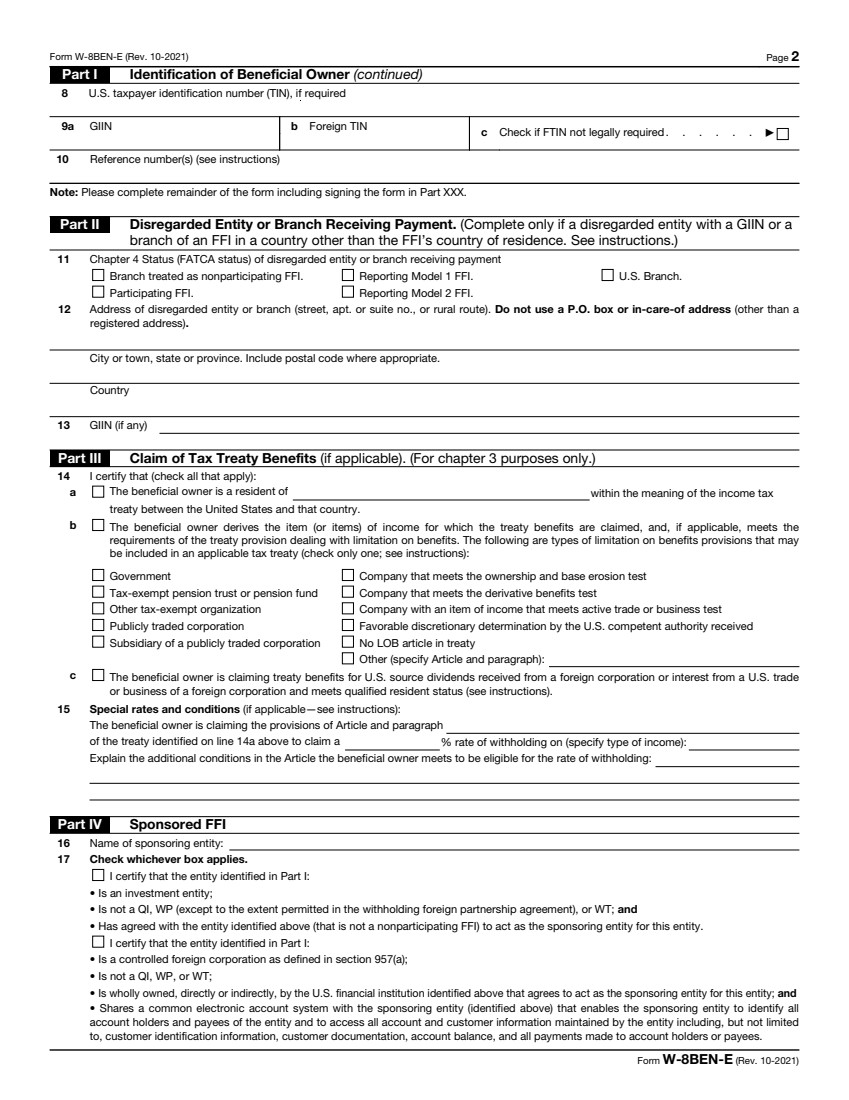
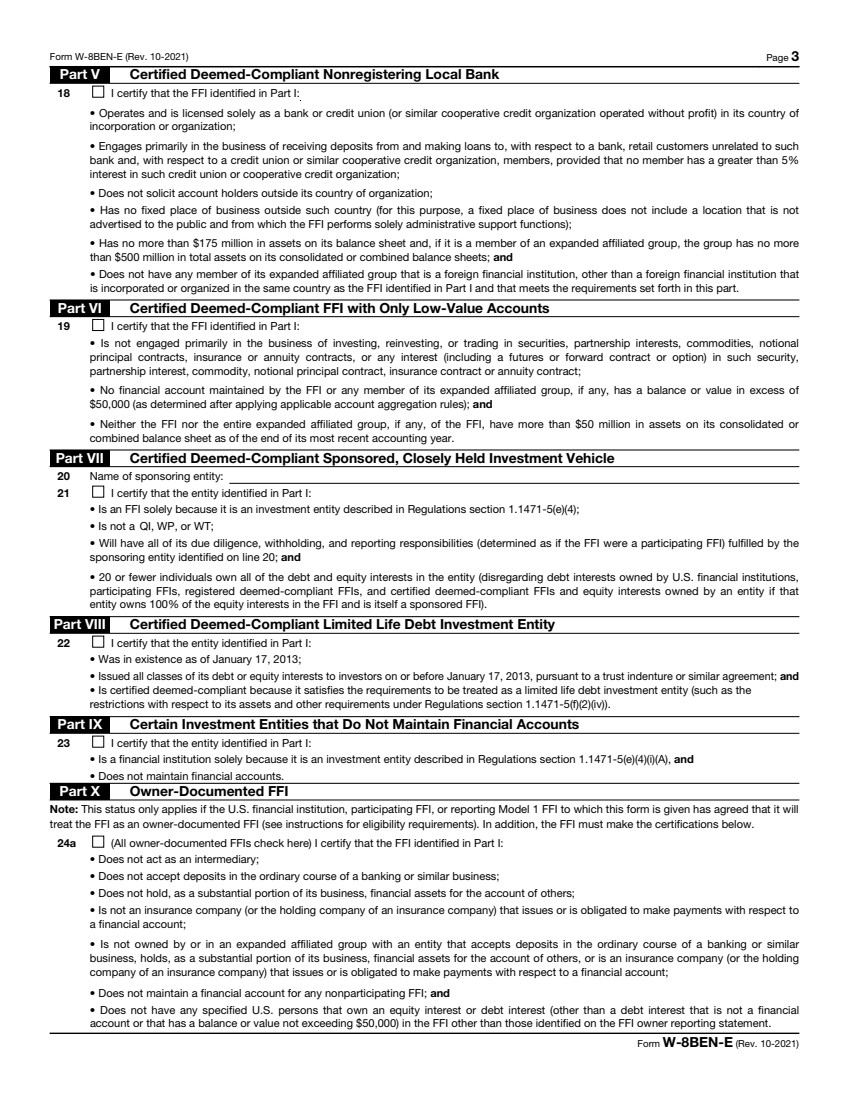
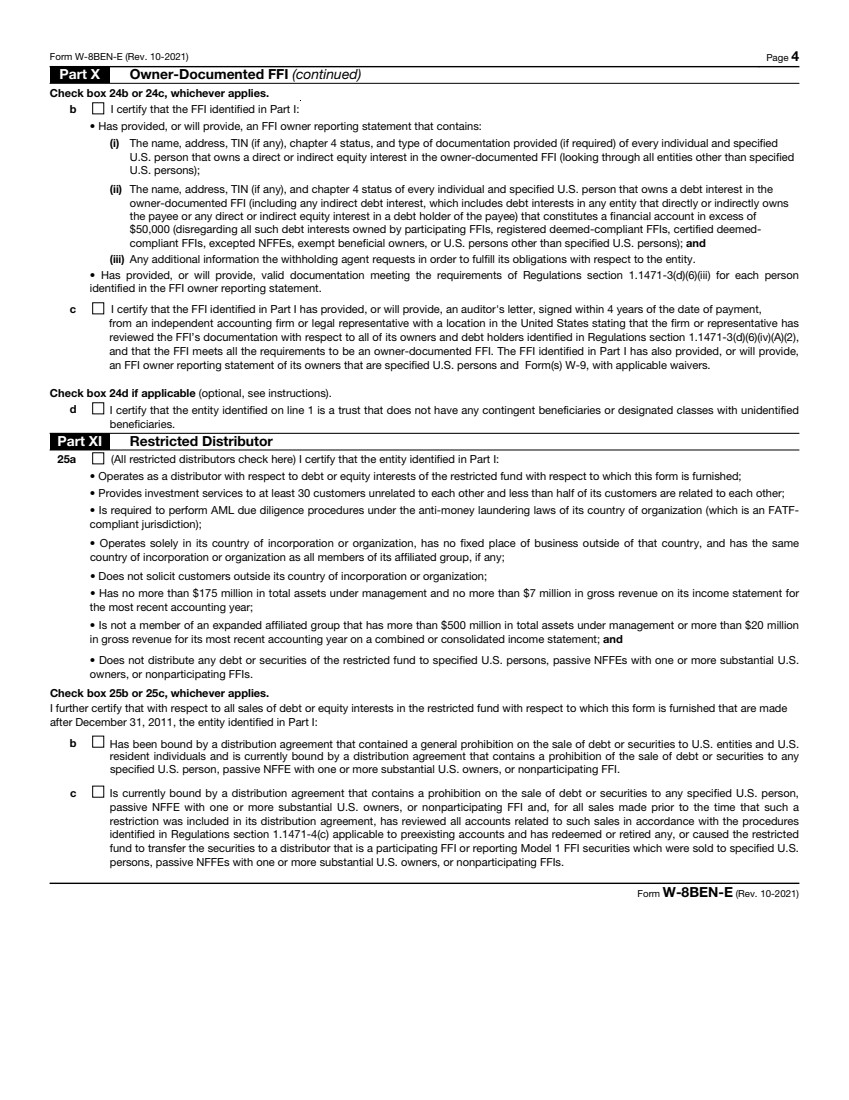
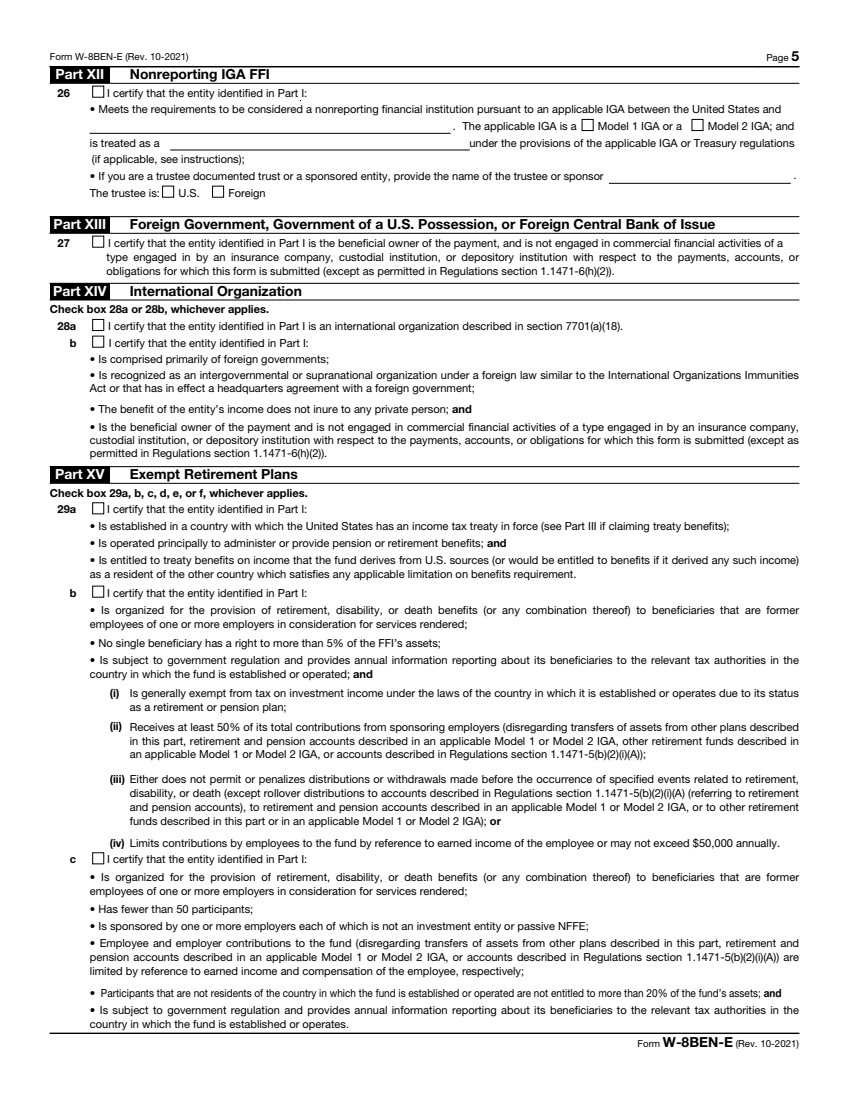
| Form W-8BEN-E (Rev. 10-2021) Page 2 Part I Identification of Beneficial Owner (continued) 8 U.S. taxpayer identification number (TIN), if required 9a GIIN b Foreign TIN c Check if FTIN not legally required. . . . . . ▶ 10 Reference number(s) (see instructions) Note: Please complete remainder of the form including signing the form in Part XXX. Part II Disregarded Entity or Branch Receiving Payment. (Complete only if a disregarded entity with a GIIN or a branch of an FFI in a country other than the FFI’s country of residence. See instructions.) 11 Chapter 4 Status (FATCA status) of disregarded entity or branch receiving payment Branch treated as nonparticipating FFI. Participating FFI. Reporting Model 1 FFI. Reporting Model 2 FFI. U.S. Branch. 12 Address of disregarded entity or branch (street, apt. or suite no., or rural route). Do not use a P.O. box or in-care-of address (other than a registered address). City or town, state or province. Include postal code where appropriate. Country 13 GIIN (if any) Part III Claim of Tax Treaty Benefits (if applicable). (For chapter 3 purposes only.) 14 I certify that (check all that apply): a The beneficial owner is a resident of within the meaning of the income tax treaty between the United States and that country. b The beneficial owner derives the item (or items) of income for which the treaty benefits are claimed, and, if applicable, meets the requirements of the treaty provision dealing with limitation on benefits. The following are types of limitation on benefits provisions that may be included in an applicable tax treaty (check only one; see instructions): Government Tax-exempt pension trust or pension fund Other tax-exempt organization Publicly traded corporation Subsidiary of a publicly traded corporation Company that meets the ownership and base erosion test Company that meets the derivative benefits test Company with an item of income that meets active trade or business test Favorable discretionary determination by the U.S. competent authority received No LOB article in treaty Other (specify Article and paragraph): c The beneficial owner is claiming treaty benefits for U.S. source dividends received from a foreign corporation or interest from a U.S. trade or business of a foreign corporation and meets qualified resident status (see instructions). 15 Special rates and conditions (if applicable—see instructions): The beneficial owner is claiming the provisions of Article and paragraph of the treaty identified on line 14a above to claim a % rate of withholding on (specify type of income): Explain the additional conditions in the Article the beneficial owner meets to be eligible for the rate of withholding: Part IV Sponsored FFI 16 Name of sponsoring entity: 17 Check whichever box applies. I certify that the entity identified in Part I: • Is an investment entity; • Is not a QI, WP (except to the extent permitted in the withholding foreign partnership agreement), or WT; and • Has agreed with the entity identified above (that is not a nonparticipating FFI) to act as the sponsoring entity for this entity. I certify that the entity identified in Part I: • Is a controlled foreign corporation as defined in section 957(a); • Is not a QI, WP, or WT; • Is wholly owned, directly or indirectly, by the U.S. financial institution identified above that agrees to act as the sponsoring entity for this entity; and • Shares a common electronic account system with the sponsoring entity (identified above) that enables the sponsoring entity to identify all account holders and payees of the entity and to access all account and customer information maintained by the entity including, but not limited to, customer identification information, customer documentation, account balance, and all payments made to account holders or payees. Form W-8BEN-E (Rev. 10-2021) |
| Form W-8BEN-E (Rev. 10-2021) Page 3 Part V Certified Deemed-Compliant Nonregistering Local Bank 18 I certify that the FFI identified in Part I: • Operates and is licensed solely as a bank or credit union (or similar cooperative credit organization operated without profit) in its country of incorporation or organization; • Engages primarily in the business of receiving deposits from and making loans to, with respect to a bank, retail customers unrelated to such bank and, with respect to a credit union or similar cooperative credit organization, members, provided that no member has a greater than 5% interest in such credit union or cooperative credit organization; • Does not solicit account holders outside its country of organization; • Has no fixed place of business outside such country (for this purpose, a fixed place of business does not include a location that is not advertised to the public and from which the FFI performs solely administrative support functions); • Has no more than $175 million in assets on its balance sheet and, if it is a member of an expanded affiliated group, the group has no more than $500 million in total assets on its consolidated or combined balance sheets; and • Does not have any member of its expanded affiliated group that is a foreign financial institution, other than a foreign financial institution that is incorporated or organized in the same country as the FFI identified in Part I and that meets the requirements set forth in this part. Part VI Certified Deemed-Compliant FFI with Only Low-Value Accounts 19 I certify that the FFI identified in Part I: • Is not engaged primarily in the business of investing, reinvesting, or trading in securities, partnership interests, commodities, notional principal contracts, insurance or annuity contracts, or any interest (including a futures or forward contract or option) in such security, partnership interest, commodity, notional principal contract, insurance contract or annuity contract; • No financial account maintained by the FFI or any member of its expanded affiliated group, if any, has a balance or value in excess of $50,000 (as determined after applying applicable account aggregation rules); and • Neither the FFI nor the entire expanded affiliated group, if any, of the FFI, have more than $50 million in assets on its consolidated or combined balance sheet as of the end of its most recent accounting year. Part VII Certified Deemed-Compliant Sponsored, Closely Held Investment Vehicle 20 Name of sponsoring entity: 21 I certify that the entity identified in Part I: • Is an FFI solely because it is an investment entity described in Regulations section 1.1471-5(e)(4); • Is not a QI, WP, or WT; • Will have all of its due diligence, withholding, and reporting responsibilities (determined as if the FFI were a participating FFI) fulfilled by the sponsoring entity identified on line 20; and • 20 or fewer individuals own all of the debt and equity interests in the entity (disregarding debt interests owned by U.S. financial institutions, participating FFIs, registered deemed-compliant FFIs, and certified deemed-compliant FFIs and equity interests owned by an entity if that entity owns 100% of the equity interests in the FFI and is itself a sponsored FFI). Part VIII Certified Deemed-Compliant Limited Life Debt Investment Entity 22 I certify that the entity identified in Part I: • Was in existence as of January 17, 2013; • Issued all classes of its debt or equity interests to investors on or before January 17, 2013, pursuant to a trust indenture or similar agreement; and • Is certified deemed-compliant because it satisfies the requirements to be treated as a limited life debt investment entity (such as the restrictions with respect to its assets and other requirements under Regulations section 1.1471-5(f)(2)(iv)). Part IX Certain Investment Entities that Do Not Maintain Financial Accounts 23 I certify that the entity identified in Part I: • Is a financial institution solely because it is an investment entity described in Regulations section 1.1471-5(e)(4)(i)(A), and • Does not maintain financial accounts. Part X Owner-Documented FFI Note: This status only applies if the U.S. financial institution, participating FFI, or reporting Model 1 FFI to which this form is given has agreed that it will treat the FFI as an owner-documented FFI (see instructions for eligibility requirements). In addition, the FFI must make the certifications below. 24a (All owner-documented FFIs check here) I certify that the FFI identified in Part I: • Does not act as an intermediary; • Does not accept deposits in the ordinary course of a banking or similar business; • Does not hold, as a substantial portion of its business, financial assets for the account of others; • Is not an insurance company (or the holding company of an insurance company) that issues or is obligated to make payments with respect to a financial account; • Is not owned by or in an expanded affiliated group with an entity that accepts deposits in the ordinary course of a banking or similar business, holds, as a substantial portion of its business, financial assets for the account of others, or is an insurance company (or the holding company of an insurance company) that issues or is obligated to make payments with respect to a financial account; • Does not maintain a financial account for any nonparticipating FFI; and • Does not have any specified U.S. persons that own an equity interest or debt interest (other than a debt interest that is not a financial account or that has a balance or value not exceeding $50,000) in the FFI other than those identified on the FFI owner reporting statement. Form W-8BEN-E (Rev. 10-2021) |
| Form W-8BEN-E (Rev. 10-2021) Page 4 Part X Owner-Documented FFI (continued) Check box 24b or 24c, whichever applies. b I certify that the FFI identified in Part I: • Has provided, or will provide, an FFI owner reporting statement that contains: (i) The name, address, TIN (if any), chapter 4 status, and type of documentation provided (if required) of every individual and specified U.S. person that owns a direct or indirect equity interest in the owner-documented FFI (looking through all entities other than specified U.S. persons); (ii) The name, address, TIN (if any), and chapter 4 status of every individual and specified U.S. person that owns a debt interest in the owner-documented FFI (including any indirect debt interest, which includes debt interests in any entity that directly or indirectly owns the payee or any direct or indirect equity interest in a debt holder of the payee) that constitutes a financial account in excess of $50,000 (disregarding all such debt interests owned by participating FFIs, registered deemed-compliant FFIs, certified deemed-compliant FFIs, excepted NFFEs, exempt beneficial owners, or U.S. persons other than specified U.S. persons); and (iii) Any additional information the withholding agent requests in order to fulfill its obligations with respect to the entity. • Has provided, or will provide, valid documentation meeting the requirements of Regulations section 1.1471-3(d)(6)(iii) for each person identified in the FFI owner reporting statement. c I certify that the FFI identified in Part I has provided, or will provide, an auditor's letter, signed within 4 years of the date of payment, from an independent accounting firm or legal representative with a location in the United States stating that the firm or representative has reviewed the FFI’s documentation with respect to all of its owners and debt holders identified in Regulations section 1.1471-3(d)(6)(iv)(A)(2), and that the FFI meets all the requirements to be an owner-documented FFI. The FFI identified in Part I has also provided, or will provide, an FFI owner reporting statement of its owners that are specified U.S. persons and Form(s) W-9, with applicable waivers. Check box 24d if applicable (optional, see instructions). d I certify that the entity identified on line 1 is a trust that does not have any contingent beneficiaries or designated classes with unidentified beneficiaries. Part XI Restricted Distributor 25a (All restricted distributors check here) I certify that the entity identified in Part I: • Operates as a distributor with respect to debt or equity interests of the restricted fund with respect to which this form is furnished; • Provides investment services to at least 30 customers unrelated to each other and less than half of its customers are related to each other; • Is required to perform AML due diligence procedures under the anti-money laundering laws of its country of organization (which is an FATF-compliant jurisdiction); • Operates solely in its country of incorporation or organization, has no fixed place of business outside of that country, and has the same country of incorporation or organization as all members of its affiliated group, if any; • Does not solicit customers outside its country of incorporation or organization; • Has no more than $175 million in total assets under management and no more than $7 million in gross revenue on its income statement for the most recent accounting year; • Is not a member of an expanded affiliated group that has more than $500 million in total assets under management or more than $20 million in gross revenue for its most recent accounting year on a combined or consolidated income statement; and • Does not distribute any debt or securities of the restricted fund to specified U.S. persons, passive NFFEs with one or more substantial U.S. owners, or nonparticipating FFIs. Check box 25b or 25c, whichever applies. I further certify that with respect to all sales of debt or equity interests in the restricted fund with respect to which this form is furnished that are made after December 31, 2011, the entity identified in Part I: b Has been bound by a distribution agreement that contained a general prohibition on the sale of debt or securities to U.S. entities and U.S. resident individuals and is currently bound by a distribution agreement that contains a prohibition of the sale of debt or securities to any specified U.S. person, passive NFFE with one or more substantial U.S. owners, or nonparticipating FFI. c Is currently bound by a distribution agreement that contains a prohibition on the sale of debt or securities to any specified U.S. person, passive NFFE with one or more substantial U.S. owners, or nonparticipating FFI and, for all sales made prior to the time that such a restriction was included in its distribution agreement, has reviewed all accounts related to such sales in accordance with the procedures identified in Regulations section 1.1471-4(c) applicable to preexisting accounts and has redeemed or retired any, or caused the restricted fund to transfer the securities to a distributor that is a participating FFI or reporting Model 1 FFI securities which were sold to specified U.S. persons, passive NFFEs with one or more substantial U.S. owners, or nonparticipating FFIs. Form W-8BEN-E (Rev. 10-2021) |
| Form W-8BEN-E (Rev. 10-2021) Page 5 Part XII Nonreporting IGA FFI 26 I certify that the entity identified in Part I: • Meets the requirements to be considered a nonreporting financial institution pursuant to an applicable IGA between the United States and . The applicable IGA is a Model 1 IGA or a Model 2 IGA; and is treated as a under the provisions of the applicable IGA or Treasury regulations (if applicable, see instructions); • If you are a trustee documented trust or a sponsored entity, provide the name of the trustee or sponsor . The trustee is: U.S. Foreign Part XIII Foreign Government, Government of a U.S. Possession, or Foreign Central Bank of Issue 27 I certify that the entity identified in Part I is the beneficial owner of the payment, and is not engaged in commercial financial activities of a type engaged in by an insurance company, custodial institution, or depository institution with respect to the payments, accounts, or obligations for which this form is submitted (except as permitted in Regulations section 1.1471-6(h)(2)). Part XIV International Organization Check box 28a or 28b, whichever applies. 28a I certify that the entity identified in Part I is an international organization described in section 7701(a)(18). b I certify that the entity identified in Part I: • Is comprised primarily of foreign governments; • Is recognized as an intergovernmental or supranational organization under a foreign law similar to the International Organizations Immunities Act or that has in effect a headquarters agreement with a foreign government; • The benefit of the entity’s income does not inure to any private person; and • Is the beneficial owner of the payment and is not engaged in commercial financial activities of a type engaged in by an insurance company, custodial institution, or depository institution with respect to the payments, accounts, or obligations for which this form is submitted (except as permitted in Regulations section 1.1471-6(h)(2)). Part XV Exempt Retirement Plans Check box 29a, b, c, d, e, or f, whichever applies. 29a I certify that the entity identified in Part I: • Is established in a country with which the United States has an income tax treaty in force (see Part III if claiming treaty benefits); • Is operated principally to administer or provide pension or retirement benefits; and • Is entitled to treaty benefits on income that the fund derives from U.S. sources (or would be entitled to benefits if it derived any such income) as a resident of the other country which satisfies any applicable limitation on benefits requirement. b I certify that the entity identified in Part I: • Is organized for the provision of retirement, disability, or death benefits (or any combination thereof) to beneficiaries that are former employees of one or more employers in consideration for services rendered; • No single beneficiary has a right to more than 5% of the FFI’s assets; • Is subject to government regulation and provides annual information reporting about its beneficiaries to the relevant tax authorities in the country in which the fund is established or operated; and (i) Is generally exempt from tax on investment income under the laws of the country in which it is established or operates due to its status as a retirement or pension plan; (ii) Receives at least 50% of its total contributions from sponsoring employers (disregarding transfers of assets from other plans described in this part, retirement and pension accounts described in an applicable Model 1 or Model 2 IGA, other retirement funds described in an applicable Model 1 or Model 2 IGA, or accounts described in Regulations section 1.1471-5(b)(2)(i)(A)); (iii) Either does not permit or penalizes distributions or withdrawals made before the occurrence of specified events related to retirement, disability, or death (except rollover distributions to accounts described in Regulations section 1.1471-5(b)(2)(i)(A) (referring to retirement and pension accounts), to retirement and pension accounts described in an applicable Model 1 or Model 2 IGA, or to other retirement funds described in this part or in an applicable Model 1 or Model 2 IGA); or (iv) Limits contributions by employees to the fund by reference to earned income of the employee or may not exceed $50,000 annually. c I certify that the entity identified in Part I: • Is organized for the provision of retirement, disability, or death benefits (or any combination thereof) to beneficiaries that are former employees of one or more employers in consideration for services rendered; • Has fewer than 50 participants; • Is sponsored by one or more employers each of which is not an investment entity or passive NFFE; • Employee and employer contributions to the fund (disregarding transfers of assets from other plans described in this part, retirement and pension accounts described in an applicable Model 1 or Model 2 IGA, or accounts described in Regulations section 1.1471-5(b)(2)(i)(A)) are limited by reference to earned income and compensation of the employee, respectively; • Participants that are not residents of the country in which the fund is established or operated are not entitled to more than 20% of the fund’s assets; and • Is subject to government regulation and provides annual information reporting about its beneficiaries to the relevant tax authorities in the country in which the fund is established or operates. Form W-8BEN-E (Rev. 10-2021) |
| Form W-8BEN-E (Rev. 10-2021) Page 6 Part XV Exempt Retirement Plans (continued) d I certify that the entity identified in Part I is formed pursuant to a pension plan that would meet the requirements of section 401(a), other than the requirement that the plan be funded by a trust created or organized in the United States. e I certify that the entity identified in Part I is established exclusively to earn income for the benefit of one or more retirement funds described in this part or in an applicable Model 1 or Model 2 IGA, or accounts described in Regulations section 1.1471-5(b)(2)(i)(A) (referring to retirement and pension accounts), or retirement and pension accounts described in an applicable Model 1 or Model 2 IGA. f I certify that the entity identified in Part I: • Is established and sponsored by a foreign government, international organization, central bank of issue, or government of a U.S. possession (each as defined in Regulations section 1.1471-6) or an exempt beneficial owner described in an applicable Model 1 or Model 2 IGA to provide retirement, disability, or death benefits to beneficiaries or participants that are current or former employees of the sponsor (or persons designated by such employees); or • Is established and sponsored by a foreign government, international organization, central bank of issue, or government of a U.S. possession (each as defined in Regulations section 1.1471-6) or an exempt beneficial owner described in an applicable Model 1 or Model 2 IGA to provide retirement, disability, or death benefits to beneficiaries or participants that are not current or former employees of such sponsor, but are in consideration of personal services performed for the sponsor. Part XVI Entity Wholly Owned by Exempt Beneficial Owners 30 I certify that the entity identified in Part I: • Is an FFI solely because it is an investment entity; • Each direct holder of an equity interest in the investment entity is an exempt beneficial owner described in Regulations section 1.1471-6 or in an applicable Model 1 or Model 2 IGA; • Each direct holder of a debt interest in the investment entity is either a depository institution (with respect to a loan made to such entity) or an exempt beneficial owner described in Regulations section 1.1471-6 or an applicable Model 1 or Model 2 IGA. • Has provided an owner reporting statement that contains the name, address, TIN (if any), chapter 4 status, and a description of the type of documentation provided to the withholding agent for every person that owns a debt interest constituting a financial account or direct equity interest in the entity; and • Has provided documentation establishing that every owner of the entity is an entity described in Regulations section 1.1471-6(b), (c), (d), (e), (f) and/or (g) without regard to whether such owners are beneficial owners. Part XVII Territory Financial Institution 31 I certify that the entity identified in Part I is a financial institution (other than an investment entity) that is incorporated or organized under the laws of a possession of the United States. Part XVIII Excepted Nonfinancial Group Entity 32 I certify that the entity identified in Part I: • Is a holding company, treasury center, or captive finance company and substantially all of the entity’s activities are functions described in Regulations section 1.1471-5(e)(5)(i)(C) through (E); • Is a member of a nonfinancial group described in Regulations section 1.1471-5(e)(5)(i)(B); • Is not a depository or custodial institution (other than for members of the entity’s expanded affiliated group); and • Does not function (or hold itself out) as an investment fund, such as a private equity fund, venture capital fund, leveraged buyout fund, or any investment vehicle with an investment strategy to acquire or fund companies and then hold interests in those companies as capital assets for investment purposes. Part XIX Excepted Nonfinancial Start-Up Company 33 I certify that the entity identified in Part I: • Was formed on (or, in the case of a new line of business, the date of board resolution approving the new line of business) (date must be less than 24 months prior to date of payment); • Is not yet operating a business and has no prior operating history or is investing capital in assets with the intent to operate a new line of business other than that of a financial institution or passive NFFE; • Is investing capital into assets with the intent to operate a business other than that of a financial institution; and • Does not function (or hold itself out) as an investment fund, such as a private equity fund, venture capital fund, leveraged buyout fund, or any investment vehicle whose purpose is to acquire or fund companies and then hold interests in those companies as capital assets for investment purposes. Part XX Excepted Nonfinancial Entity in Liquidation or Bankruptcy 34 I certify that the entity identified in Part I: • Filed a plan of liquidation, filed a plan of reorganization, or filed for bankruptcy on ; • During the past 5 years has not been engaged in business as a financial institution or acted as a passive NFFE; • Is either liquidating or emerging from a reorganization or bankruptcy with the intent to continue or recommence operations as a nonfinancial entity; and • Has, or will provide, documentary evidence such as a bankruptcy filing or other public documentation that supports its claim if it remains in bankruptcy or liquidation for more than 3 years. Form W-8BEN-E (Rev. 10-2021) |
| Form W-8BEN-E (Rev. 10-2021) Page 7 Part XXI 501(c) Organization 35 I certify that the entity identified in Part I is a 501(c) organization that: • Has been issued a determination letter from the IRS that is currently in effect concluding that the payee is a section 501(c) organization that is dated ; or • Has provided a copy of an opinion from U.S. counsel certifying that the payee is a section 501(c) organization (without regard to whether the payee is a foreign private foundation). Part XXII Nonprofit Organization 36 I certify that the entity identified in Part I is a nonprofit organization that meets the following requirements. • The entity is established and maintained in its country of residence exclusively for religious, charitable, scientific, artistic, cultural or educational purposes; • The entity is exempt from income tax in its country of residence; • The entity has no shareholders or members who have a proprietary or beneficial interest in its income or assets; • Neither the applicable laws of the entity’s country of residence nor the entity’s formation documents permit any income or assets of the entity to be distributed to, or applied for the benefit of, a private person or noncharitable entity other than pursuant to the conduct of the entity’s charitable activities or as payment of reasonable compensation for services rendered or payment representing the fair market value of property which the entity has purchased; and • The applicable laws of the entity’s country of residence or the entity’s formation documents require that, upon the entity’s liquidation or dissolution, all of its assets be distributed to an entity that is a foreign government, an integral part of a foreign government, a controlled entity of a foreign government, or another organization that is described in this part or escheats to the government of the entity’s country of residence or any political subdivision thereof. Part XXIII Publicly Traded NFFE or NFFE Affiliate of a Publicly Traded Corporation Check box 37a or 37b, whichever applies. 37a I certify that: • The entity identified in Part I is a foreign corporation that is not a financial institution; and • The stock of such corporation is regularly traded on one or more established securities markets, including (name one securities exchange upon which the stock is regularly traded). b I certify that: • The entity identified in Part I is a foreign corporation that is not a financial institution; • The entity identified in Part I is a member of the same expanded affiliated group as an entity the stock of which is regularly traded on an established securities market; • The name of the entity, the stock of which is regularly traded on an established securities market, is ; and • The name of the securities market on which the stock is regularly traded is . Part XXIV Excepted Territory NFFE 38 I certify that: • The entity identified in Part I is an entity that is organized in a possession of the United States; • The entity identified in Part I: (i) Does not accept deposits in the ordinary course of a banking or similar business; (ii) Does not hold, as a substantial portion of its business, financial assets for the account of others; or (iii) Is not an insurance company (or the holding company of an insurance company) that issues or is obligated to make payments with respect to a financial account; and • All of the owners of the entity identified in Part I are bona fide residents of the possession in which the NFFE is organized or incorporated. Part XXV Active NFFE 39 I certify that: • The entity identified in Part I is a foreign entity that is not a financial institution; • Less than 50% of such entity’s gross income for the preceding calendar year is passive income; and • Less than 50% of the assets held by such entity are assets that produce or are held for the production of passive income (calculated as a weighted average of the percentage of passive assets measured quarterly) (see instructions for the definition of passive income). Part XXVI Passive NFFE 40a I certify that the entity identified in Part I is a foreign entity that is not a financial institution (other than an investment entity organized in a possession of the United States) and is not certifying its status as a publicly traded NFFE (or affiliate), excepted territory NFFE, active NFFE, direct reporting NFFE, or sponsored direct reporting NFFE. Check box 40b or 40c, whichever applies. b I further certify that the entity identified in Part I has no substantial U.S. owners (or, if applicable, no controlling U.S. persons); or c I further certify that the entity identified in Part I has provided the name, address, and TIN of each substantial U.S. owner (or, if applicable, controlling U.S. person) of the NFFE in Part XXIX. Form W-8BEN-E (Rev. 10-2021) |
| Form W-8BEN-E (Rev. 10-2021) Page 8 Part XXVII Excepted Inter-Affiliate FFI 41 I certify that the entity identified in Part I: • Is a member of an expanded affiliated group; • Does not maintain financial accounts (other than accounts maintained for members of its expanded affiliated group); • Does not make withholdable payments to any person other than to members of its expanded affiliated group; • Does not hold an account (other than depository accounts in the country in which the entity is operating to pay for expenses) with or receive payments from any withholding agent other than a member of its expanded affiliated group; and • Has not agreed to report under Regulations section 1.1471-4(d)(2)(ii)(C) or otherwise act as an agent for chapter 4 purposes on behalf of any financial institution, including a member of its expanded affiliated group. Part XXVIII Sponsored Direct Reporting NFFE (see instructions for when this is permitted) 42 Name of sponsoring entity: 43 I certify that the entity identified in Part I is a direct reporting NFFE that is sponsored by the entity identified on line 42. Part XXIX Substantial U.S. Owners of Passive NFFE As required by Part XXVI, provide the name, address, and TIN of each substantial U.S. owner of the NFFE. Please see the instructions for a definition of substantial U.S. owner. If providing the form to an FFI treated as a reporting Model 1 FFI or reporting Model 2 FFI, an NFFE may also use this part for reporting its controlling U.S. persons under an applicable IGA. Name Address TIN Part XXX Certification Under penalties of perjury, I declare that I have examined the information on this form and to the best of my knowledge and belief it is true, correct, and complete. I further certify under penalties of perjury that: • The entity identified on line 1 of this form is the beneficial owner of all the income or proceeds to which this form relates, is using this form to certify its status for chapter 4 purposes, or is submitting this form for purposes of section 6050W or 6050Y; • The entity identified on line 1 of this form is not a U.S. person; • This form relates to: (a) income not effectively connected with the conduct of a trade or business in the United States, (b) income effectively connected with the conduct of a trade or business in the United States but is not subject to tax under an income tax treaty, (c) the partner’s share of a partnership’s effectively connected taxable income, or (d) the partner’s amount realized from the transfer of a partnership interest subject to withholding under section 1446(f); and • For broker transactions or barter exchanges, the beneficial owner is an exempt foreign person as defined in the instructions. Furthermore, I authorize this form to be provided to any withholding agent that has control, receipt, or custody of the income of which the entity on line 1 is the beneficial owner or any withholding agent that can disburse or make payments of the income of which the entity on line 1 is the beneficial owner. I agree that I will submit a new form within 30 days if any certification on this form becomes incorrect. I certify that I have the capacity to sign for the entity identified on line 1 of this form. Sign Here ▲ Signature of individual authorized to sign for beneficial owner Print Name Date (MM-DD-YYYY) Form W-8BEN-E (Rev. 10-2021) |
INSTRUCTIONS
Forming Part of the Terms and Conditions of the Offer
1. Guarantee of Signatures. Signatures on this Letter of Transmittal must be guaranteed by a firm which is a member of the Securities Transfer Agent Medallion Program, the New York Stock Exchange Medallion Signature Program, or the Stock Exchange Medallion Program (each, an “eligible institution”), except in cases where shares are tendered (i) by a registered holder (which term, for purposes of this Letter of Transmittal, will include any participant in DTC whose name appears on a security position listing as the holder of the shares) of shares who has not completed either the box entitled “Special Payment Instructions” or the box entitled “Special Delivery Instructions” on this Letter of Transmittal or (ii) for the account of an eligible institution. See Instruction 5.
2. Delivery of Letter of Transmittal and Shares; Guaranteed Delivery Procedures. This Letter of Transmittal is to be used only if delivery of shares is to be made pursuant to the procedure set forth in Section 3 of the Offer to Purchase for either a registered shareholder or a DTC participant.
A registered shareholder should deliver a completed and signed Letter of Transmittal in accordance with the instructions to the Letter of Transmittal, have the shareholder’s signature on the Letter of Transmittal guaranteed if Instruction 1 so requires, and mail or deliver the Letter of Transmittal, together with any other required documents, to the Depositary, at the address set forth on the front page of this Letter of Transmittal.
As to DTC participants, the Depositary must receive the confirmation of a book-entry transfer of all tendered shares into the Depositary’s account at DTC pursuant to the book-entry transfer procedures set forth in Section 3 of the Offer to Purchase, together with a properly completed and duly executed Letter of Transmittal, any required signature guarantees and any other documents required by the Letter of Transmittal at the address set forth on the front page of this Letter of Transmittal, or pursuant to a properly transmitted agent’s message in lieu of the Letter of Transmittal, prior to the Expiration Time. Delivery of documents to DTC does not constitute delivery to the Depositary.
Shareholders who cannot follow the procedures for delivery of shares on a timely basis or who cannot transmit this Letter of Transmittal and all other required documents to reach the Depositary before the Expiration Time may nevertheless tender their shares pursuant to the guaranteed delivery procedure set forth in Section 3 of the Offer to Purchase. Pursuant to such procedure: (a) such tender must be made by or through an eligible institution, (b) the Depositary must receive by mail, express or overnight delivery, before the Expiration Time, a properly completed and duly executed notice of guaranteed delivery substantially in the form the Company has provided with the Offer to Purchase (the “Notice of Guaranteed Delivery”), and (c) the Depositary must receive within the period of two business days after the date of execution of that Notice of Guaranteed Delivery, either: (i) as to a registered shareholder, a Letter of Transmittal, which has been properly completed and duly executed and includes all signature guarantees required thereon and all other required documents; or (ii) as to a DTC participant, a book-entry confirmation evidencing all tendered shares, in proper form for transfer, in each case together with the Letter of Transmittal, validly completed and duly executed, with any required signature guarantees (or an agent’s message), and any other documents required by the Letter of Transmittal.
The method of delivery of this Letter of Transmittal and all other required documents to the Depositary, including delivery through DTC, and any acceptance of an agent’s message transmitted through Automated Tender Offer Program (ATOP), is at the election and risk of the tendering shareholder. If delivery is by mail, registered mail with return receipt requested, properly insured, is recommended. In all cases, sufficient time should be allowed to ensure timely delivery to the Depositary prior to the Expiration Time. Except as otherwise provided below, the delivery will be made when actually received by the Depositary. This Letter of Transmittal, agent’s message and any other required documents should be sent only to the Depositary, not to the Company, the Information Agent or DTC.
No alternative, conditional or contingent tenders will be accepted, and no fractional shares will be purchased. By executing this Letter of Transmittal, each tendering shareholder waives any right to receive any notice of the acceptance of such shareholder’s tender.
3. Inadequate Space or Signature Pages. If the space provided in the box captioned “Description of Shares Tendered” is inadequate, then you should list relevant information on a separate signed schedule attached to this Letter of Transmittal. Signature pages may be replicated as needed in accordance with Instruction 5.
4. Partial Tenders and Unpurchased Shares
The shares may be tendered and accepted only in whole shares. If fewer than all of the shares owned by a registered holder are tendered, the registered holder must fill in the number of shares tendered in the column of the box titled “Description of Shares Tendered” herein. The entire number of shares delivered to the Depositary will be deemed to have been tendered, unless otherwise indicated.
5. Signatures on Letter of Transmittal.
(a) If this Letter of Transmittal is signed by the registered holder(s) of the shares tendered hereby, the signature(s) must correspond exactly with the name(s) that appears on a security position listing, or appears on the books of the Transfer Agent, as the holder of the shares without any change whatsoever;
(b) If any of the shares tendered hereby are owned of record by two or more joint owners, each such holder must sign this Letter of Transmittal;
(c) If this Letter of Transmittal is signed by a trustee, executor, administrator, guardian, attorney-in-fact, agent, officer of a corporation or other person acting in a fiduciary or representative capacity, such person should so indicate when signing and proper evidence satisfactory to the Company of the authority of such person so to act must be submitted with this Letter of Transmittal.
6. Share Transfer Taxes. The Company will pay any share transfer taxes with respect to the transfer and sale of shares to it or its order pursuant to the Offer. If, however, payment of the purchase price is to be made to, or if book entries for shares not tendered or accepted for payment are to be registered in the name of, any person(s) other than the registered holder(s), or if shares tendered hereby are registered in the name(s) of any person(s) other than the person(s) signing this Letter of Transmittal, the amount of any share transfer taxes (whether imposed on the registered holder(s) or such person(s)) payable on account of the transfer to such person(s) will be deducted from the purchase price unless satisfactory evidence of the payment of such taxes or exemption therefrom is submitted with this Letter of Transmittal. Except as provided in this Instruction 6, no share transfer tax stamps or funds to cover such stamps need to accompany this Letter of Transmittal.
7. Irregularities. All questions as to the price to be paid for the shares to be accepted and the validity, form, eligibility (including time of receipt) and acceptance for payment of any tender of shares will be determined by the Company in its reasonable discretion, which determination shall be final and binding on all parties. The Company reserves the absolute right to reject any and all tenders reasonably determined by it not to be in proper form or the acceptance for payment of which may, in the opinion of its counsel, be unlawful. The Company also reserves the absolute right to waive any condition of the Offer or any defect or irregularity in the tender of any particular shares or any particular shareholder, whether or not similar defects or irregularities are waived in the case of other shareholders, and the Company’s reasonable interpretation of the terms and conditions of the Offer (including these instructions) will be final and binding on all persons. No tender of shares will be deemed to have been properly made until all defects and irregularities have been cured or waived to the satisfaction of the Company. The Company will not be liable for failure to waive any condition of the Offer, or any defect or irregularity in any tender of shares. Neither the Company, nor any other person will be under any duty to give notification of any defects or irregularities in tenders or incur any liability for failure to give any such notification. The Company’s reasonable interpretation of the terms of and conditions to the Offer, including this Letter of Transmittal and the instructions hereto, will be final and binding on all persons participating in the Offer. Any determination by the Company as to the validity, form, eligibility and acceptance of shares for payment, or any interpretation by the Company as to the terms and conditions of the Offer, is subject to applicable law and, if challenged by shareholders in a lawsuit, to the judgment of a court of competent jurisdiction.
8. Special Payment and Delivery Instructions. If the check for the aggregate purchase price of any shares purchased is to be issued to, or any shares not tendered or not purchased are to be returned in the name of, a person other than the person(s) signing this Letter of Transmittal or if the check is to be mailed to someone other than the person(s) signing this Letter of Transmittal or to the person(s) signing this Letter of Transmittal at an address other than that shown in the box entitled “Descriptions of Shares Tendered”, or if the payment of the purchase price is to be made by wire transfer, the boxes entitled “Special Payment Instructions,” “Special Delivery Instructions” and/or “Special Wire Transfer Instructions” on this Letter of Transmittal should be completed.
9. Requests for Assistance or Additional Copies. Requests for assistance or additional copies of the Offer to Purchase, this Letter of Transmittal or the Notice of Guaranteed Delivery may be directed to the Information Agent. Its address, telephone numbers and email address are set forth below.
10. Form W-9. Except as provided above under “Important Tax Information”, each tendering shareholder is required to provide the Depositary with a correct TIN on Form W-9, which is provided under “Important Tax Information” above. Failure to provide the information on the form may subject the tendering shareholder to a penalty and a 24% backup withholding tax may be imposed on the payments made to the shareholder or other payee with respect to shares purchased pursuant to the Offer.
11. Non-U.S. Holder Withholding. Non-U.S. Holders should note that the 30% U.S. withholding tax generally applicable to distributions by U.S. corporations should not apply to the proceeds payable pursuant to the Offer (however, as indicated above under “Important Tax Information”, U.S. backup withholding tax may be applicable). Non-U.S. Holders should not use Form W-9. Instead, Non-U.S. Holders must provide an appropriate Form W-8 or suitable substitute.
IMPORTANT. A properly completed and duly executed Letter of Transmittal, any required signature guarantees and any other documents required by this Letter of Transmittal at the address set forth below must be received by the Depositary prior to the Expiration Time, or the tendering shareholder must comply with the procedures for guaranteed delivery.
The Depositary for the Offer is:
![[MISSING IMAGE: lg_continental-4c.jpg]](tm2624191d1_ex-a1bimg01.jpg)
If delivering by mail, or by hand, express mail,
courier
or other expedited service:
Continental Stock Transfer & Trust Company
1 State Street, 30th FL
Attention: Reorg Department
New York, NY 10004
Delivery of this Letter of Transmittal to an address other than as set forth above will not constitute a valid delivery to the Depositary.
Questions and requests for assistance may be directed to the Information Agent at the address set forth below. Additional copies of the Offer to Purchase, this Letter of Transmittal and the Notice of Guaranteed Delivery may be obtained from the Information Agent. You may also contact your broker, dealer, commercial bank, trust company or other nominee for assistance concerning the Offer.
The Information Agent for the Offer is:

D.F.
King & Co., Inc.
28 Liberty Street, 53rd Floor
New York, New York 10005
Banks and brokers call
collect: (212) 257-2639
All others, please call toll free: (800) 549-6864
By email: gdev@dfking.com