Exhibit 4.2
CENTERRA GOLD INC. BYLAW NO. 2 A BYLAW RELATING GENERALLY TO THE CONDUCT OF THE BUSINESS AND AFFAIRS OF CENTERRA GOLD INC.
Exhibit 4.2
CENTERRA GOLD INC. BYLAW NO. 2 A BYLAW RELATING GENERALLY TO THE CONDUCT OF THE BUSINESS AND AFFAIRS OF CENTERRA GOLD INC.
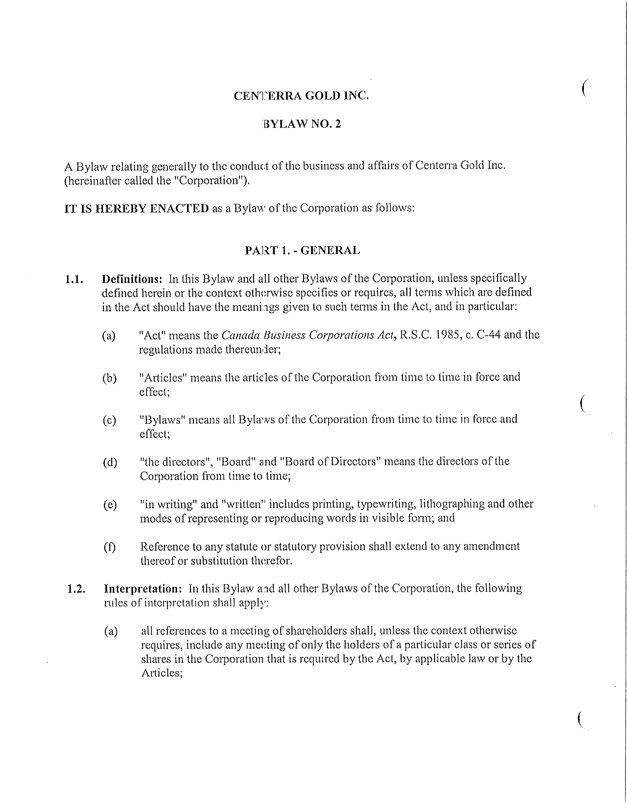
CENTERRA GOLD INC. BYLAW NO. 2 A Bylaw relating generally to the conduct of the business and affairs of Centerra Gold Inc. (hereinafter called the “Corporation”). IT IS HEREBY ENACTED as a Bylaw of the Corporation as follows: PART 1. - GENERAL 1.1. Definitions: In this Bylaw and all other Bylaws of the Corporation, unless specifically defined herein or the context otherwise specifies or requires, all terms which are defined in the Act should have the meanings given to such terms in the Act, and in particular: (a) “Act” means the Canada Business Corporations Act, R.S.C. 1985, c. C-44 and the regulations made thereunder; (b) “Articles” means the articles of the Corporation from time to time in force and effect; (c) “Bylaws” means all Bylaws of the Corporation from time to time in force and effect; (d) “the directors”, “Board” and “Board of Directors” means the directors of the Corporation from time to time; (e) “in writing” and “written” includes printing, typewriting, lithographing and other modes of representing or reproducing words in visible form; and (f) Reference to any statute or statutory provision shall extend to any amendment thereof or substitution therefor. 1.2. Interpretation: In this Bylaw and all other Bylaws of the Corporation, the following rules of interpretation shall apply: (a) all references to a meeting of shareholders shall, unless the context otherwise requires, include any meeting of only the holders of a particular class or series of shares in the Corporation that is required by the Act, by applicable law or by the Articles;
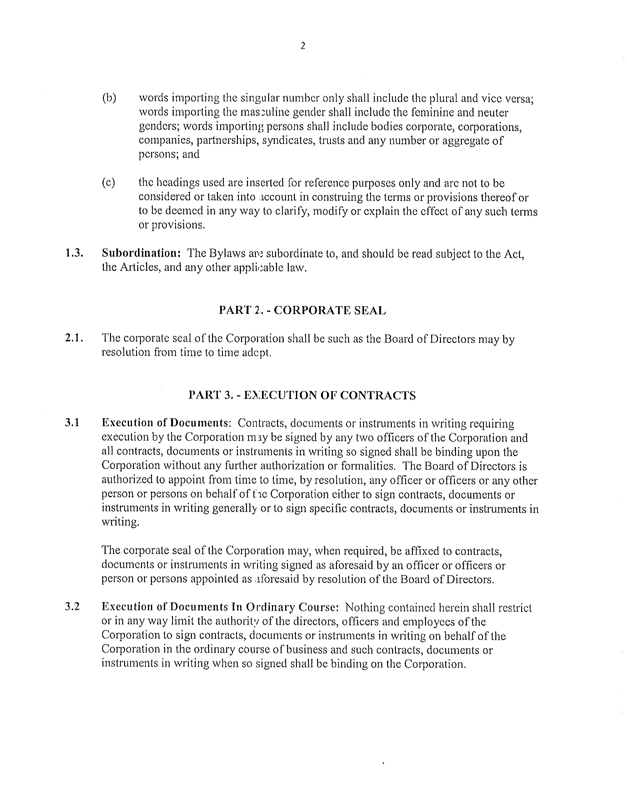
(b) words importing the singular number only shall include the plural and vice versa; words importing the masculine gender shall include the feminine and neuter genders; words importing persons shall include bodies corporate, corporations, companies, partnerships, syndicates, trusts and any number or aggregate of persons; and (c) the headings used are inserted for reference purposes only and are not to be considered or taken into account in construing the terms or provisions thereof or to be deemed in any way to clarify, modify or explain the effect of any such terms or provisions. 1.3. Subordination: The Bylaws are subordinate to, and should be read subject to the Act, the Articles, and any other applicable law. PART 2. - CORPORATE SEAL 2.1. The Corporate seal of the Corporation shall be such as the Board of Directors may by resolution from time to time adept. PART 3. - EXECUTION OF CONTRACTS 3.1 Execution of Documents: Contracts, documents or instruments in writing requiring execution by the Corporation may be signed by any two officers of the Corporation and all contracts, documents or instruments in writing so signed shall be binding upon the Corporation without any further authorization or formalities. The Board of Directors is authorized to appoint from time to time, by resolution, any officer or officers or any other person or persons on behalf of the Corporation either to sign contracts, documents or instruments in writing generally or to sign specific contracts, documents or instruments in writing. The corporate seal of the Corporation may, when required, be affixed to contracts, documents or instruments in writing signed as aforesaid by an officer or officers or person or persons appointed as aforesaid by resolution of the Board of Directors. 3.2 Execution of Documents In Ordinary Course: Nothing contained herein shall restrict or in any way limit the authority of the directors, officers and employees of the Corporation to sign contracts, documents or instruments in writing on behalf of the Corporation in the ordinary course or business and such contracts, documents or instruments in writing when so signed shall be binding on the Corporation.
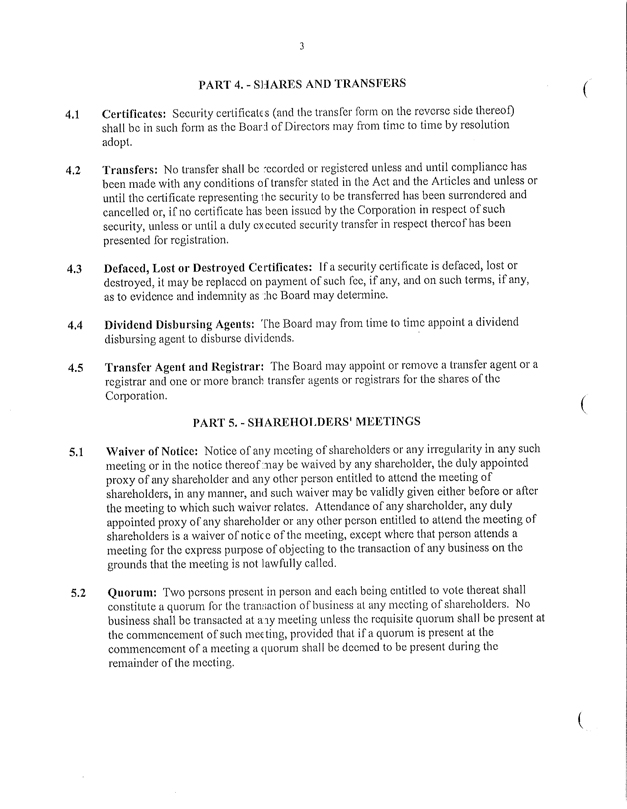
PART 4. - SHARES AND TRANSFERS 4.1 Certificates: Security certificates (and the transfer form on the reverse side thereof) shall be in such form as the Board of Directors may from time to time by resolution adopt. 4.2 Transfers: No transfer shall be recorded or registered unless and until compliance has been made with any conditions of transfer stated in the Act and the Articles and unless or until the certificate representing the security to be transferred has been surrendered and cancelled or, if no certificate has been issued by the Corporation in respect of such security, unless or until a duly executed security transfer in respect thereof has been presented for registration. 4.3 Defaced, Lost or Destroyed Certificates: If a security certificate is defaced, lost or destroyed, it may be replaced on payment of such fee, if any, and on such terms, if any, as to evidence and indemnity as the Board may determine. 4.4 Dividend Disbursing Agents: The Board may from time to time appoint a dividend disbursing agent to disburse dividends. 4.5 Transfer Agent and Registrar: The Board may appoint or remove a transfer agent or a registrar and one or more branch transfer agents or registrars for the shares of the Corporation. PART 5. - SHAREHOLDERS’ MEETINGS 5.1 Waiver of Notice: Notice of any meeting of shareholders or any irregularity in any such meeting or in the notice thereof may be waived by any shareholder, the duly appointed proxy of any shareholder and any other person entitled to attend the meeting of shareholders, in any manner, and such waiver may be validly given either before or after the meeting to which such waiver relates. Attendance of any shareholder, any duly appointed proxy of any shareholder or any other person entitled to attend the meeting of shareholders is a waiver of notice of the meeting, except where that person attends a meeting for the express purpose of objecting to the transaction of any business on the grounds that the meeting is not lawfully called. 5.2 Quorum: Two persons present in person and each being entitled to vote thereat shall constitute a quorum for the transaction of business at any meeting of shareholders. No business shall be transacted at any meeting unless the requisite quorum shall be present at the commencement of such meeting, provided that if a quorum is present at the commencement of a meeting a quorum shall be deemed to be present during the remainder of the meeting.
5.3 Scrutineers: At any meeting of shareholders, the chair of the meeting may with the consent of the meeting appoint one or more persons, who may be shareholders, to serve as scrutineers. 5.4 Votes to Govern: At any meeting of shareholders, unless a special resolution or some other special majority is required by the Act, applicable law or the Articles, all questions shall be decided by the majority of votes cast on the question. In case of an equality of votes, either upon a show of hands or its functional equivalent or by ballot, the chair or the meeting shall be entitled to a second or casting vote. 5.5 Electronic Meeting and Voting: Electronic Meeting and Voting: If the directors call a meeting of shareholders, they may determine that the meeting of shareholders shall be held entirely by means of a telephonic, electronic or other communication facility that permits all participants to communicate adequately with each other during the meeting, and any vote at that meeting of shareholders shall be held entirely by means of that communication facility. A meeting of shareholders may also be held at which some, but not all, persons entitled to attend may participate and vote by means of such a communication facility, if the Corporation makes one available. A person participating in a meeting by such means is deemed to be present at the meeting. Any vote at a meeting of shareholders may be also held entirely by means of a telephonic, electronic or other communication facility, if the Corporation makes one available, even if none of the persons entitled to attend otherwise participates in the meeting by means of a communication facility. For the purpose of voting, a communication facility that is made available by the Corporation must enable the votes to be gathered in a manner that permits their subsequent verification and permits the tallied votes to be presented to the Corporation without it being possible for the Corporation to identify how each shareholder or group of shareholders voted. 5.6 Voting: Subject to the Act, applicable law and the Articles, and unless a ballot is demanded or required, voting at a meeting or shareholders shall be by way of a show of hands or the functional equivalent of a show of hands by means of electronic, telephonic or other communication facility Upon a show of hands, or its functional equivalent, each person present and entitled to vote at a meeting shall have one vote and a declaration by the chair of the meeting that any question has been carried, carried by a particular majority or not carried and an entry to that effect in the minutes of the meeting shall be conclusive evidence of the fact without proof of the number or proportion of votes recorded in favour of or against the motion and the result of the vote so taken and declared shall be the decision of the shareholders upon the said question. 5. 7 Ballot: The chair of the meeting or any shareholder or proxy entitled to vote thereat may require or demand a ballot upon any question, either before or after any vote by show of hands, but such requirement or demand may be withdrawn at any time prior to the taking of the ballot. Any ballot shall be taken in such manner as the chair of the meeting shall direct or as provided by the electronic, telephonic or other communication facility through which votes may be cast. On a ballot, each shareholder present in person or by proxy shall be entitled, in respect of the shares which such shareholder is entitled to vote
at the meeting upon the question, to the number of votes provided by the Articles and the result of the ballot so taken shall be the decision of the shareholders upon the said question. 5.7 Proxy: An instrument of proxy shall be in writing executed by the shareholder or the shareholder’s attorney and shall conform with the requirements of the Act and any requirements established by the Board or shall be otherwise acceptable to the chair of the meeting at which the instrument of proxy is to be used. 5.8 Presiding Officers: The chair of any meeting of shareholders shall be the first mentioned of such of the following persons who is also a director, and is present at the meeting; the Chair of the Board, the Chief Executive Officer or the President. In the absence of any such persons, the shareholders shall choose one of their number to chair the meeting. The secretary of the meeting shall be the Secretary of the Corporation, or if the Secretary is not present, any Assistant Secretary of the Corporation. Notwithstanding the above, the chair of the meeting, at the chair’s sole discretion, may appoint a person, who need not be a shareholder, to act as secretary of the meeting. 5.9 Persons Entitled to the Present: The only persons entitled to be present at a meeting of shareholders shall be those entitled to vote thereat, the directors and auditors of the Corporation and others who, although not entitled to vote, are entitled or required by the Act, applicable law, the Articles or the Bylaws to be present. Any other person may be admitted only with the consent of the chair of the meeting or with the consent of the meeting. PART 6. - DIRECTORS 6.1 Number: The number of directors shall be the number fixed by the Articles, or where the Articles specify a variable number, the number shall not be less than the minimum and not more than the maximum number so specified and shall be determined from time to time within such limits by resolution of the Board of Directors. At least twenty-five percent of the directors of the Corporation shall be resident Canadians. 6.2 Vacancies: Where there is a vacancy or vacancies in the Board of Directors, the remaining directors may exercise all the powers of the Board so long as a quorum of the Board remains in office. Subject to the Act, where a vacancy occurs in the Board of Directors, and a quorum of directors remains, the directors remaining in office may appoint a qualified person to fill the vacancy for the remainder of the term. 6.3 Election: A director may be elected for an expressly stated term, and if so elected ceases to hold office at the expiration of such term. A director not elected for an expressly stated term of office shall hold office from the date of the meeting at which he is elected until the annual meeting next following; provided that a retiring director shall retain office until the adjournment or termination of the meeting at which his successor is elected or appointed unless such meeting was called for the purpose of removing him from office as a director in which case the director so removed shall vacate office
forthwith upon the passing of the resolution for his removal. Retiring directors, if qualified, are eligible for re-election or reappointment. 6.4 Remuneration and Expenses: The directors shall be paid such remuneration for their services as the Board may from time to time determine. The directors shall also be paid their reasonable out-of-pocket expenses incurred in attending meetings of the directors, shareholders or committees of the Board or otherwise in the performance of their duties. PART 7.—MEETINGS OF DIRECTORS 7.1 Convening of Meetings: A meeting of the Board of Directors may be convened by the Chair of the Board, the Chief Executive Officer, the President or any two (2) directors at any time and the Secretary shall, upon direction of any of the foregoing, convene a meeting of the Board of Directors. A meeting of any committee may be convened by the chair of the committee or any two (2) members of the committee and the Secretary shall, upon the direction of either of the foregoing, convene a meeting of the said committee. Except as otherwise provided by the Act and the Bylaws, the directors, either as a Board or as a committee thereof, may convene, adjourn and otherwise regulate their meetings as they think fit. 7.2 Canadian Residency Requirement: The directors shall not transact business at a meeting, other than filling a vacancy in the board, unless at least twenty-five percent of the directors present are resident Canadians or if a resident Canadian director who is unable to be present approves in writing or by telephonic, electronic or other communication facility, the business transacted at the meeting and the required number of resident Canadian directors would have been present had that director been present. 7.3 Meetings by Telephonic or Electronic Facility: Subject to the requirements of the Act, any director may participate in a meeting of the Board or any committee by means of a telephonic, electronic or other communication facility that permits all persons participating in the meeting to communicate adequately with each other. Each director so participating shall be deemed to be present at such meeting and such meeting shall be deemed to be held at the place specified in the notice calling such meeting. 7.4 Notice: Notice of the time and place of each meeting of the Board and of any committee of the Board shall be given in the manner provided in Part 13 to each director or member, as the case maybe. If notice is given by personal delivery, by electronic mail, facsimile or other like form of electronic communication, it must be given not less than forty-eight (48) hours before the time where the meeting is to be held. If notice is given by mail, it must be given not less than ninety-six (96) hours before the time when the meeting is to be held. Notwithstanding the foregoing, meetings of the Board or of any committee of the Board may be held at any time without formal notice if all the directors are present (including being present by way of any of the means specified in Section 7.3) or if all of the absent directors waive notice.
For the first meeting of the Board of Directors or of any committee of the Board to be held immediately following the election of directors at an annual or general meeting of the shareholders or for a meeting of the Board of Directors or a committee thereof at which a director or member is appointed to fill a vacancy in the Board or committee, no notice need be given to the newly elected or appointed directors or members in order for the meeting to be duly constituted, provided a quorum is present. 7.5 Waiver: Notice of any meeting of the Board of Directors or of any committee of the Board of Directors or any irregularity in any meeting or in the notice thereof may be waived by any director in any manner, and such waiver may be validly given either before or after the meeting to which such waiver relates. 7.6 Adjournment: Any meeting of the Board of Directors or of any committee of the Board of Directors may be adjourned from time to time by the chair of the meeting, with the consent of the meeting, to an announced time and place and no notice of the time and place for the holding of the adjourned meeting need be given to any director. Any adjourned meeting shall be duly constituted if held in accordance with the terms of the adjournment and if a quorum is present thereat. The directors who formed a quorum at the original meeting are not required to form the quorum at the adjourned meeting. If there is no quorum present at the adjourned meeting, the original meeting shall be deemed to have terminated forthwith after its adjournment. 7.7 Quorum: A quorum for any meeting of the Board of Directors of the Corporation shall consist of a majority of the directors of the Corporation or such other number as the directors may by resolution from time to time determine. Notwithstanding any vacancy among the directors, a quorum of directors may exercise all the powers of the directors. 7.8 Voting: Questions arising at any meeting of directors shall be determined by a majority of votes of the directors present, and in the case of an equality of votes the chair of the meeting shall not have a second or casting vote. 7.9 Presiding Officers: The chair of any meeting of the Board shall be the Chair of the Board. If he is not present at the meeting, the directors shall choose one of their number to chair the meeting. PART 8.- OFFICERS 8.1 Appointment of Officers: The directors shall from time to time appoint a Chief Executive Officer, a President, and a Secretary. The directors may from time to time, as deemed advisable, appoint a Chair of the Board, a Chief Operating Officer, one or more Executive Vice-Presidents, one or more Senior Vice-Presidents, a Chief Financial Officer, a Vice-Chair, and one or more Assistant Secretaries. The directors may additionally from time to time designate other offices and appoint persons to such offices, as deemed necessary. Subject to the provisions of the Act, the directors may by resolution designate, vary, add to or limit the duties and powers of any officer.
8 A director may be appointed to any office of the Corporation; but none of the officers except the Chair of the Board need be a director of the Corporation. Two or more offices of the Corporation may be held by the same person. In addition to the Chair of the Board, only the Chief Executive Officer and the President shall be eligible to be elected to the Board. 8.2 Chair of the Board: The Chair of the Board shall, if present, preside as chair at all meetings of the Board of Directors and of shareholders. He shall sign such contracts, documents and instruments in writing as require his signature and shall have such other powers and shall perform such other duties as may from time to time be assigned to him by resolution of the Board of Directors. 8.3 Chief Executive Officer: The Chief Executive Officer shall report to the directors and shall exercise overall management and direction of the Corporation. In the absence of the Chair of the Board, the Chief Executive Officer shall, when present, preside as chair at all meetings of shareholders. He shall sign such contracts, documents or instruments in writing as require his signature and shall have such other powers and shall perform such other duties as may from time to time be assigned to him by resolution of the directors or as are incident to his office. 8.4 President: The President shall report to the Chief Executive Officer and shall, subject to the direction of the Chief Executive Officer, have general supervision and control over the business and affairs of the Corporation. In the absence of the Chair of the Board and the Chief Executive Officer, the President shall, when present, preside as chair at all meetings or shareholders. He shall sign such contracts, documents or instruments in writing as require his signature and shall have such other powers and shall perform such other duties as may from time to time be assigned to him by resolution of the directors or as are incident to his office. 8.5 Chief Operating Officer: If the Chief Operating Officer is not also the President he shall report to the President and shall, subject to the direction of the President, have the general supervision of the operations of the Corporation. 8.6 Executive Vice-President: The Executive Vice-President or, if more than one, the Executive Vice-Presidents in order of their appointment, or as otherwise determined by the directors, shall be vested with all the powers and shall perform all the duties of the President in the absence or inability or refusal to act as the President. The Executive Vice-President or, if more than one, the Executive Vice-Presidents shall sign such contracts, documents or instruments in writing as shall require his or their signatures and shall also have such other powers and shall perform such other duties as may from time to time be assigned to him or them by resolution of the directors. 8.7 Chief Financial Officer: The Chief Financial Officer shall report to the President and shall, subject to the direction of the President, have the general supervision of the financial affairs of the Corporation. In addition, subject to the provisions of any
9 resolution of the directors, the Chief Financial Officer shall have the care and custody of all the funds and securities of the Corporation and shall deposit the same in the name of the Corporation in such bank or banks or with such other depositary or depositaries as the directors may by resolution direct. He shall prepare and maintain adequate accounting records. He shall sign such contracts, documents or instruments in writing as require his signature and shall have such other powers and shall perform such other duties as may from time to time be assigned to him by resolution of the directors or as are incident to his office. 8.8 Secretary: The Secretary shall give or cause to be given notices for all meetings of directors, any committee of directors and shareholders when directed to do so and shall, subject to the provisions of the Act, maintain the records, documents and registers of the Corporation. He shall sign such contracts, documents or instruments in writing as require his signature and shall have such other powers and shall perform such other duties as may from time to time he assigned to him by resolution of the directors or as are incident to his office. 8.9 Duties of Officers may be Delegated: In case of the absence or inability or refusal to act of any officer of the Corporation or for any other reason that the Board may deem sufficient, the directors may delegate all or any of the powers of such officer to any other officer or to any director for the time being.
PART 9. - COMMITTEES 9.1 The Board may create, and prescribe the duties and terms of reference of, such committee or committees of directors as it may from time to time determine necessary to more effectively permit the efficient direction of the business and affairs of the Corporation. The Board may delegate to such committee or committees any of the powers of the Board except those which under the Act must be exercised by the Board itself, provided that any such delegation shall not limit the ability of the Board to make decisions on any subject matter so delegated. The procedures of any such committee or committees of the Board shall, except as otherwise determined by the Board, be those applicable to the Board, as set out in Part 7 of these Bylaws. PART 10. - PROTECTION AND INDEMNITY OF DIRECTORS, OFFICERS AND OTHERS 10.1 Disclosure of Conflict of Interest: A director or officer of the Corporation who is a party to a material contract or material transaction, whether made or proposed, with the Corporation, or is a director or an officer or an individual acting in a similar capacity of a party to a material contract or material transaction, whether made or proposed, with the Corporation, or has a material interest in any person who is a party to a material contract or material transaction, whether made or proposed, with the Corporation shall disclose the nature and extent of his interest at the time and in the manner provided in the Act. Except as provided in the Act, no such director of the Corporation shall vote on any resolution to approve such contract or transaction. 10.2 Validity of Agreements and Transactions where Conflict of Interest Exists: A contract or transaction for which the disclosure in section 10.1 is required is not invalid, and the director or officer is not accountable to the Corporation or its shareholders for any profit realized from the contract or transaction, because of the director’s or officer’s interest in the contract or transaction or because the director was present at or was counted to determine the presence of a quorum at a meeting of directors or committee of directors that considered the contract or transaction, if: A. the director or officer disclosed his interest in accordance with the provisions of the Act; B. the contract or transaction was approved by the directors; and C. the contract or transaction was reasonable and fair to the Corporation at the time it was approved.
Even if the conditions of A to C above are not met, a director or officer, acting honestly and in good faith, is not accountable to the Corporation or to its shareholders for any profit realized from a contract or transaction for which the disclosure in section 10.1 is required and the contract or transaction is not invalid by reason only of the interest of the director or officer in the contract or transaction, if: A. the contract or transactior is approved or confirmed by special resolution at a meeting of the shareholders; B. disclosure of the interest was made to the shareholders in a manner sufficient to indicate its nature before the contract or transaction was approved or confirmed; and C. the contract was reasonable and fair to the Corporation at the time it was approved or confirmed. 10.3 Non-Liability for Acts: Subject to the Act, no director or officer shall be liable for the acts, receipts, neglects or default; of any other person or for joining in any receipt or act for conformity or for any loss, damage or expense happening to the Corporation through the insufficiency or deficiency of title to any property acquired by, for or on behalf of the Corporation or for the insufficiency or deficiency of any security in or upon which any moneys of the Corporation are invested or for any loss or damages arising from the bankruptcy, insolvency or tortious act of any person with whom any moneys, securities or other properties of the Corporation are lodged or deposited or for any other loss, damage or misfortune whatever which may arise out of the execution of the duties of his office or in relation thereto. 10.4 Approval of Contracts by Shareholders: Subject to the Act, any contract entered into or action taken or omitted by or on behalf of the Corporation shall, if approved by a resolution of the shareholders, be deemed for all purposes to have had the prior authorization of all the shareholders. 10.5 Indemnification: To the fullest extent permitted by the Act or otherwise by law, the Corporation shall indemnify a director or officer of the Corporation, a former director or officer of the Corporation, or another individual who acts or acted at the Corporation’s request as a director or officer or an individual acting in a similar capacity of another entity, against all costs, charges and expenses, including an amount paid to settle an action or satisfy a judgment, reasonably incurred by the individual in respect of any civil, criminal, administrative, investigative or other proceeding in which the individual is involved because of that association with the Corporation or other entity, provided the individual: A acted honestly and in good faith with a view to the best interests of the Corporation, or, as the case may be, to the best interests of the other entity for
which the individual acted as director or officer or in a similar capacity at the Corporation’s request; and B. in the case of a criminal or administrative action or proceeding that is enforced by a monetary penalty, the individual had reasonable grounds for believing that the individual’s conduct was lawful. The Corporation shall advance moneys to a director, officer or other individual for the costs, charges and expenses of such proceedings. The individual shall repay the moneys if the individual does not fulfill the conditions of A and B above. 10.6 No Limitation of Rights: The foregoing provisions of this Part 10 shall be in amplification of and in addition to, and not by way of limitation of or substitution for, any rights, immunities or protection conferred upon by any director, officer or other person by any statute, law, matter or thing whatsoever. PART 11. – DIVIDENDS 11.1 Dividends: The Board may from time to time declare and the Corporation may pay dividends on its issued shares to its shareholders according to their respective shareholdings in the Corporation as they appear from the Corporation’s register. 11.2 Cash Dividends: A dividend payable in cash shall be paid by cheque drawn either on the bankers of the Corporation or the bankers of its dividend disbursing agent to the order of each registered holder of shares of the class or series in respect of which the dividend has been declared, and mailed by pre-paid ordinary mail to such registered holder at his recorded address or to such other address as the holder directs. In the case of joint holders, the cheque shall, unless such joint holders otherwise direct, be made payable to the order of all such joint holders. The mailing of such cheque as aforesaid, unless the same is not paid on due presentation, shall satisfy and discharge the liability for the dividend to the extent of the sum represented thereby plus the amount of any tax which the Corporation is required to and does withhold. All dividends unclaimed for six (6) years after the date of declaration shall be forfeited to the Corporation. 11.3 Record Date for Dividends and other Rights: For the purpose of determining the person entitled to receive payment of any dividend or for any other purpose, except the right to receive notice of or to vote at a meeting of shareholders, the Board may fix in advance a date preceding the date for the particular action by not more than sixty (60) days for the determination of such persons. Notice of such date shall be given not less than seven (7) days prior to such date: A. by advertisement in a newspaper distributed in the place where the Corporation has its registered office and in each place in Canada where it has a transfer agent or where a transfer of its shares may be recorded; and
B. by written notice to each stock exchange in Canada on which the shares of the Corporation are listed for trading. PART 12. - VOTING SECURITIES IN OTHER BODIES CORPORATE 12.1 All securities of any other body corporate carrying voting rights held from time to time by the Corporation may be voted at all meetings of shareholders, bondholders, debenture holders or holders of such securities, as the case may be, of such other body corporate, in such manner and by such person or persons as the Board of Directors of the Corporation shall from time to time determine by resolution. Any two officers of the Corporation may also from time to time execute and deliver for and on behalf of the Corporation instruments of proxy and/or arrange for the issuance of voting certificates and/or other evidences of the right to vote in such names as may determine without the necessity of a resolution or other action by the Board of Directors. PART 13. – NOTICES 13.1 Manner of Notice: Any notice (which includes any communication or document) to be given (which term includes sent, delivered or served) pursuant to the Act, applicable law, the Articles, the Bylaws, or otherwise to a shareholder, director, officer, auditor or member of a committee of the Board shall be sufficiently given, if delivered personally to the person to whom it is to be given or if delivered to his latest address as shown on the records of the Corporation, or if mailed to him at his said address by prepaid ordinary or air mail, or if sent to him by facsimile at his said address. A notice so delivered shall be deemed to have been given when it is delivered personally or to the said address as aforesaid; a notice so mailed shall be deemed to have been given when deposited in a post office or public letter box, a notice so sent by facsimile shall be deemed to have been given when dispatched. The Secretary may change or cause to be changed the recorded address of any shareholder, director, officer, auditor or member of a committee of the Board in accordance with any information believed by the Secretary to be reliable. 13.2 Electronic Delivery: Provided the addressee has consented in writing or electronically in accordance with the Act, the Corporation may satisfy the requirement to send any notice or document referred to in section 13.1 by creating and providing an electronic document in compliance with the Act. An electronic document is deemed to have been received when it enters the information system designated by the addressee or, if the document is posted on or made available through a generally accessible electronic source, when the addressee receives notice in writing of the availability and location of that electronic document, or, if such notice is sent electronically, when it enters the information system designated by the addressee.
13.3 Notice Computation: In computing the time when notice must be given under any provision requiring a specified number of hours notice of any meeting or other event, the hour of giving the notice and the hour of commencement of the meeting shall be excluded, and in computing the date when notice must be given under any provision requiring a specified number or days’ notice of any meeting or other event, the date of giving the notice shall be excluded and the date of the meeting or other event shall be included. 13.4 Returned Notices: Where notices or other documents required to be given by the Corporation to its shareholders have been mailed to a shareholder at the shareholder’s latest address as shown on the records of the Corporation and where, on two (2) consecutive occasions, notices or other documents have been returned, the Corporation is not required to send to the shareholder any further notices or other documents until such time as the Corporation receives written notice from the shareholder requesting that notices and other documents be sent to the shareholder at a specified address. 13.5 Joint Holders: All notices or other documents shall, with respect to any shares in the capital of the Corporation registered in more than one name, be given to whichever of such persons is named first in the records of the Corporation and any notice or other document so given shall be sufficient notice or delivery of such document to all the holders of such shares. 13.6 Successor Bound: Every person who by operation of law, transfer or by any other means whatsoever shall become entitled to any shares in the capital of the Corporation shall be bound by every notice or other document in respect of such shares which prior to his name and address being entered on the records of the Corporation shall have been duly given to the person or persons from whom he derives his title to such shares. 13.7 Deceased Holder: Any notice or other document given by mail shall, notwithstanding that such shareholder be then deceased and whether or not the Corporation has notice of his death, be deemed to have been duly served in respect of the shares held by such shareholder (whether held solely or with other persons) until some other person be entered in his stead in the records of the Corporation as the holder or one of the holders thereof and such service shall for all purposes be deemed a sufficient service of such notice or other document on his heirs, executors or administrators and all persons (if any), interested with him is such shares. 13.8 Signature: The signature of any director or officer of the Corporation to any notice may be written, stamped, typewritter or printed, or partly written, stamped, typewritten or printed. 13.9 Certificate of Office: A certificate of any officer of the Corporation holding office at the time of the making of the certificate or of a transfer officer or any transfer agent or branch transfer agent of shares of any class of the Corporation as to facts in relation to the mailing or delivery or service of any notice or other document to any shareholder, director, officer, auditor or member of any committee of the Board or publication of any notice or other document shall be conclusive evidence thereof, and shall be binding on
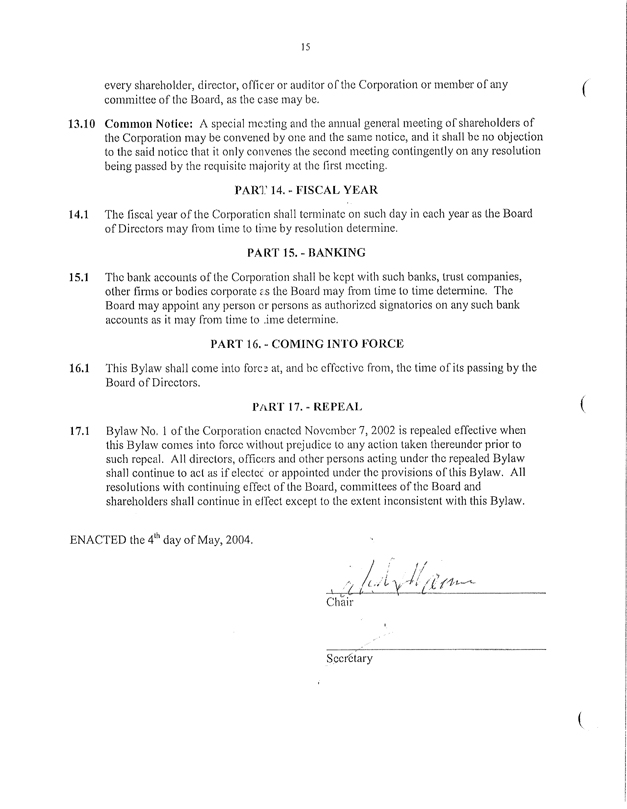
every shareholder, director, officer or auditor of the Corporation or member of any committee of the Board, as the case may be. 13.10 Common Notice: A special meeting and the annual general meeting of shareholders of the Corporation may be convened by one and the same notice, and it shall be no objection to the said notice that it only convenes the second meeting contingently on any resolution being passed by the requisite majority at the first meeting. PART 14. - FISCAL YEAR 14.1 The fiscal year of the Corporation shall terminate on such day in each year as the Board of Directors may from time to time by resolution determine. PART 15. - BANKING 15.1 The bank accounts of the Corporation shall be kept with such banks, trust companies, other firms or bodies corporate as the Board may from time to time determine. The Board may appoint any person or persons as authorized signatories on any such bank accounts as it may from time to time determine. PART 16. - COMING INTO FORCE 16.1 This Bylaw shall come into force at, and be effective from, the time of its passing by the Board of Directors. PART 17. - REPEAL 17.1 Bylaw No. 1 of the Corporation enacted November 7, 2002 is repealed effective when this Bylaw comes into force without prejudice to any action taken thereunder prior to such repeal. All directors, officers and other persons acting under the repealed Bylaw shall continue to act as if elected or appointed under the provisions of this Bylaw. All resolutions with continuing effect of the Board, committees of the Board and shareholders shall continue in effect except to the extent inconsistent with this Bylaw. ENACTED the 4th day of May, 2004. Chair Secretary
CENTERRA GOLD INC.
BYLAW NO. 3
A Bylaw (the “By-Law Amendment”) to amend By-Law No. 2 of Centerra Gold Inc. (the “Corporation”).
| 1. | Section 5.2 Quorum of By-Law No. 2 of the Corporation is repealed in its entirety and replaced with the following: |
5.2 Quorum: The quorum for the transaction of business at any meeting of the shareholders shall be two persons present at the opening of the meeting who are entitled to vote thereat either as shareholders or as proxy holders and holding or representing not less than twenty-five per cent of the outstanding shares of the Corporation carrying the right to vote at such meeting. If a quorum is not present within such reasonable time (determined by the chairman of the meeting) after the time fixed for the meeting, the persons present and entitled to vote thereat may adjourn the meeting to a fixed time and place.
| 2. | The following section is added as a new section to Part 6 of By-Law No. 2: |
| 6.5 | Nomination of Directors. |
| (a) | Only persons who are nominated in accordance with the procedures set out in this paragraph 6(a) shall be eligible for election as directors to the board of directors (the “Board”) of the Corporation. Nominations of persons for election to the Board may only be made at an annual meeting of shareholders, or at a special meeting of shareholders called for any purpose which includes the election of directors to the Board, as follows: |
| (i) | by or at the direction of the Board or an authorized officer of the Corporation, including pursuant to a notice of meeting; |
| (ii) | by or at the direction or request of one or more shareholders pursuant to a proposal made in accordance with the provisions of the Canada Business Corporations Act (the “Act”) or a requisition of shareholders made in accordance with the provisions of the Act; or |
| (iii) | by any person entitled to vote at such meeting (a “Nominating Shareholder”), who: (A) is, at the close of business on the date of giving notice provided for in paragraph (c) below and on the record date for notice of such meeting, either entered in the |
- 2 -
| securities register of the Corporation as a holder of one or more shares carrying the right to vote at such meeting or who beneficially owns shares that are entitled to be voted at such meeting; and (B) has given timely notice in proper written form as set forth in this Part 6. |
| (b) | For the avoidance of doubt, the foregoing paragraph (a) shall be the exclusive means for any person to bring nominations for election to the Board before any annual or special meeting of shareholders of the Corporation, provided, however, that nothing in this By-Law shall be deemed to preclude discussion by a shareholder (as distinct from the nomination of directors) at a meeting of shareholders of any matter this is properly before such meeting pursuant to the provisions of the Act or the discretion of the Chairman. |
| (c) | For a nomination made by a Nominating Shareholder to be timely notice (a “Timely Notice”), the Nominating Shareholder’s notice must be received by the corporate secretary of the Corporation at the principal executive offices of the Corporation: |
| (i) | in the case of an annual meeting of shareholders, not later than the close of business on the 30th day and not earlier than the opening of business on the 65th day before the date of the meeting: provided, however, if the first public announcement made by the Corporation of the date of the annual meeting is less than 50 days prior to the meeting date, not later than the close of business on the 10th day following the day on which the first public announcement of the date of such annual meeting is made by the Corporation; and |
| (ii) | in the case of a special meeting (which is not also an annual meeting) of shareholders called for any purpose which includes the election of directors to the board, not later than the close of business on the 15th day following the day on which the first public announcement of the date of the special meeting is made by the Corporation. |
| (d) | The time periods for giving of a Timely Notice shall in all cases be determined based on the original date of the annual meeting or the first public announcement of the annual or special meeting, as applicable. In no event shall an adjournment or postponement of an annual meeting or special meeting of shareholders or any announcement thereof commence a new time period for the giving of a Timely Notice. |
- 3 -
| (e) | To be in proper written form, a Nominating Shareholder’s notice to the corporate secretary must comply with all the provisions of this paragraph (e) and: |
| (i) | disclose or include, as applicable, as to each person whom the Nominating Shareholder proposes to nominate for election as a director (a “Proposed Nominee”): |
| (A) | their name, age, business and residential address, principal occupation or employment for the past five years, status as a “resident Canadian” (as such term is defined in the Act); |
| (B) | their direct or indirect beneficial ownership in, or control or direction over, any class or series of securities of the Corporation, including the number or principal amount and the date (s) on which such securities were acquired; |
| (C) | any relationships, agreements or arrangements, including financial, compensation and indemnity related relationships, agreements or arrangements, between the Proposed Nominee or any affiliates or associates of, or any person or entity acting jointly or in concert with, the Proposed Nominee and the Nominating Shareholder; and |
| (D) | any other information that would be required to be disclosed in a dissident proxy circular or other filings required to be made in connection with the solicitation of proxies for election of directors pursuant to the Act or applicable securities law. |
| (ii) | disclose or include, as applicable, as to each Nominating Shareholder giving the notice and each beneficial owner, if any, on whose behalf the nomination is made: |
| (A) | their name, business and residential address and direct or indirect beneficial ownership in, or control or direction over, any class or series of securities of the Corporation, including the number or principal amount and the date(s) on which such securities were acquired; |
| (B) | their interests in, or rights or obligations associated with, an agreement, arrangement or understanding, the purpose or effect of which is to alter, directly or |
- 4 -
| indirectly, the person’s economic interest in a security of the Corporation or the person’s economic exposure to the Corporation; |
| (C) | any relationships, agreements or arrangements, including financial, compensation and indemnity related relationships, agreements or arrangements, between the Nominating Shareholder or any affiliates or associates of, or any person or entity acting jointly or in concert with, the Nominating Shareholder and any Proposed Nominee; |
| (D) | any proxy, contract, arrangement, agreement or understanding pursuant to which such person, or any of its affiliates or associates, or any person acting jointly or in concert with such person, has any interests, rights or obligations relating to the voting of any securities of the Corporation or the nomination of directors to the board; |
| (E) | a representation and proof that the Nominating Shareholder is a holder of record of securities of the Corporation, or a beneficial owner, entitled to vote at such meeting, and intends to appear in person or by proxy at the meeting to propose such nomination; |
| (F) | a representation as to whether such person intends to deliver a proxy circular and/or form of proxy to any shareholder of the Corporation in connection with such nomination or otherwise solicit proxies or votes from shareholders of the Corporation in support of such nomination; and |
| (G) | any other information relating to such person that would be required to be included in a dissident proxy circular or other filings required to be made in connection with solicitations of proxies for election of directors pursuant to the Act or as required by applicable securities law; |
| (f) | All information to be provided in a Timely Notice pursuant to paragraph (e) shall be provided as of the record date for determining shareholders entitled to vote at the meeting (if such date shall then have been publicly announced) and as of the date of such Timely Notice. The Nominating Shareholder shall update such information |
- 5 -
| forthwith if there are any material changes in the information previously disclosed. |
| (g) | Any notice, or other document or information required to be given to the corporate secretary pursuant to this By-Law may only be given by personal delivery, facsimile transmission or by email (at such email address as may be stipulated from time to time by the corporate secretary for purposes of this notice), and shall be deemed to have been given and made only at the time it is served by personal delivery to the corporate secretary at the address of the principal executive offices of the Corporation, email (at the address as aforesaid) or sent by facsimile transmission (provided that receipt of confirmation of such transmission has been received); provided that if such delivery or electronic communication is made on a day which is a not a business day or later than 5:00 p.m. (Toronto time) on a day which is a business day, then such delivery or electronic communication shall be deemed to have been made on the next following day that is a business day. |
| (h) | The chair of any meeting of shareholders of the Corporation shall have the power to determine whether any proposed nomination is made in accordance with the provisions of this By-Law, and if any proposed nomination is not in compliance with such provisions, to declare that such defective nomination shall not be considered at any meeting of shareholders. |
| (i) | Despite any other provision of this By-Law, if the Nominating Shareholder (or a qualified representative of the Nominating Shareholder) does not appear at the meeting of shareholders of the Corporation to present the nomination of the Proposed Nominee, such nomination shall be disregarded, notwithstanding that proxies in respect of such nomination may have been received by the Corporation. |
| (j) | Nothing in this By-Law shall obligate the Corporation or the board to include in any proxy statement or other shareholder communication distributed by or on behalf of the Corporation or board any information with respect to any proposed nomination or any Nominating Shareholder or Proposed Nominee. |
| (k) | The board may, in its sole discretion, waive any requirement of this By-Law. |
| (l) | For the purposes of this By-Law, “public announcement” means disclosure in a press release disseminated by the Corporation through |
- 6 -
| a national news service in Canada, or in a document filed by the Corporation for public access under its profile on the System of Electronic Document Analysis and Retrieval at www.sedar.com. |
| (m) | This By-Law is subject to, and should be read in conjunction with, the Act and the articles. If there is any conflict or inconsistency between any provision of the Act or the articles and any provision of this By- Law, the provision of the Act or the articles will govern. |