Abbreviations: LS = Least squares; SE = Standard error; Q-LES-Q-SF = Quality of Life,
Enjoyment, and Satisfaction Questionnaire-Short Form. Table 2: Mean Change from Baseline in Secondary Efficacy Endpoints for Patients who Completed the 6-Month Open-Label Extension (N=63) GH001 (N=37) Placebo (N=40) Results Demographics
and baseline characteristics are presented in Table 1 Table 1. Patient Disposition and Baseline Characteristics Background Treatment-resistant depression (TRD) is associated with persistent symptoms of depression, anxiety, and reduced
quality of life, despite a limited number of treatments being available1-3 Patients with TRD frequently report greater anxiety burden and poorer health-related quality of life compared with patients with treatment-responsive depression,
underscoring the need for treatments that address these domains1-3 GH001, a synthetic formulation of mebufotenin (5-MeO-DMT) administered via pulmonary inhalation, was evaluated for efficacy and safety in a Phase 2b clinical trial
(NCT05800860) in patients with TRD4 Change in Montgomery-Åsberg Depression Rating Scale (MADRS) score from baseline to Day 8 was significantly greater for GH001 vs placebo (least squares mean difference [SE], −15.5 [1.7]; P<0.001),
supporting further evaluation of its effects on illness severity (Clinical Global Impression-Severity [CGI-S]), anxiety (Hamilton Anxiety Rating Scale [HAM-A]), and quality of life (Quality of Life Enjoyment and Satisfaction Questionnaire-Short
Form [Q-LES-Q-SF])4 Objective This analysis reports the effects of GH001 on secondary efficacy endpoints (CGI-S, HAM-A, and Q-LES-Q-SF) from the double-blind (DB) part and the 6-month label extension (OLE) of a Phase 2b trial in patients with
TRD Methods This multicenter trial (NCT05800860) included a 7-day, randomized, DB, placebo-controlled part (Part 1) and a 6-month OLE (Part 2). In Part 1, patients received an individualized dosing regimen (IDR) of up to three escalating
doses of GH001 (6, 12, and 18 mg) or placebo. In Part 2, patients could receive up to five GH001 IDR treatments based on MADRS score criteria. The trial design is summarized in Figure 1 Secondary efficacy assessments included CGI-S, HAM-A, and
Q-LES-Q-SF at Day 1 (baseline and 2 hours post-dose), Day 2, Day 8, and all scheduled OLE visits (Day 15 and monthly to Month 6). Clinician-rated assessments were completed by an independent blinded rater Efficacy results were summarized
descriptively Figure 1. Clinical Trial Design References Kubitz N, et al. PLoS One. 2013;8(10):e76882. Johnston KM, et al. J Affect Disord. 2019;242:195-210. McIntyre RS, et al. World Psychiatry. 2023;22:394-412. Cubała WJ, et al. JAMA
Psychiatry. Published online March 25, 2026. doi:10.1001/jamapsychiatry.2026.0096. Marks RM, et al. Exp Clin Psychopharmacol. 2022;30(6):841-852 Acknowledgments This trial was sponsored by GH Research Ireland Limited. The sponsor would like
to thank the participants in the trial. The sponsor would also like to thank the investigators who conducted this trial. Under the guidance of the authors, medical writing and editorial support were provided by Brian Brennan, PhD, of GH
Research. Disclosures Presenting Author Disclosures: WJC: Grants: Acadia, Angelini, Beckley Psytech, BMS, Compass Pathways, GH Research, HMNC Brain Health, IntraCellular Therapies, Janssen, MindMed, MSD, Neumora, Novartis, Otsuka, Recognify
Life Sciences, Seaport. Honoraria: Angelini, GH Research, Janssen, Novartis. Advisory Boards: Douglas Pharmaceuticals, GH Research, Janssen, MSD, Novartis, Polpharma, Tasman Therapeutics. Presented at the American Society of Clinical
Psychopharmacology Annual Meeting | Miami, FL, USA | May 26−29, 2026 Conclusions GH001 demonstrated rapid, statistically significant improvements across all secondary efficacy endpoints at Day 8 versus placebo (all P<0.0001), with
converging clinician-rated (CGI-S, HAM-A) and patient-reported (Q-LES-Q-SF) measures corroborating the primary endpoint effect, consistent with meaningful, multidimensional recovery beyond core depressive symptoms Among OLE completers,
improvements in illness severity, anxiety, and quality of life were sustained at Month 6 after infrequent treatment, supporting the potential of GH001 to deliver durable, clinically meaningful improvements Wiesław J. Cubała1*, Brian Brennan2,
Tiffanie Benway2, David Gregory2, Rachael MacIsaac2, Michael E. Thase3,4 1Department of Psychiatry, Faculty of Medicine, Medical University of Gdańsk, Gdańsk, Poland. 2GH Research, Dublin, Ireland. 3Department of Psychiatry, University of
Pennsylvania, Philadelphia, PA, USA. 4Corporal Michael J. Crescenz Veterans Affairs Medical Center, Philadelphia, PA, USA. Impact of GH001 on Depressive Symptoms, Anxiety, and Quality of Life in Treatment-Resistant Depression: Results from a
Phase 2b Trial aA second or third dose was administered if the previous dose was well tolerated (based on vital signs and adverse events) and if the patient did not achieve an intense psychoactive effect (peak experience; defined as a mean
score of ≥75 on the Peak Experience Scale) following the previous dose. bEfficacy assessments were carried out by independent blinded raters in the double-blind part. Abbreviations: BL = Baseline; CGI-S = Clinical Global Impression –
Severity; D = Day; H = Hour; HAM-A = Hamilton Rating Scale for Anxiety; IDR = Individualized dosing regimen; MADRS = Montgomery–Åsberg Depression Rating Scale; Q-LES-Q-SF = Quality of Life, Enjoyment, and Satisfaction Questionnaire-Short Form.
Abbreviations: SD = Standard deviation. At Day 8, LS mean (SE) change in CGI-S score from baseline was −2.4 (0.2) for GH001 vs 0.1 (0.2) for placebo (LS mean [SE] difference: −2.5 [0.3]; P<0.0001) (Figure 2) At Month 6, 66.7% of OLE
completers were rated as normal on the CGI-S, compared to none of these patient’s rated as normal at baseline Baseline mean (SD) HAM-A total scores (21.1 [6.2] in both groups) indicated moderate-to-severe anxiety. GH001 significantly improved
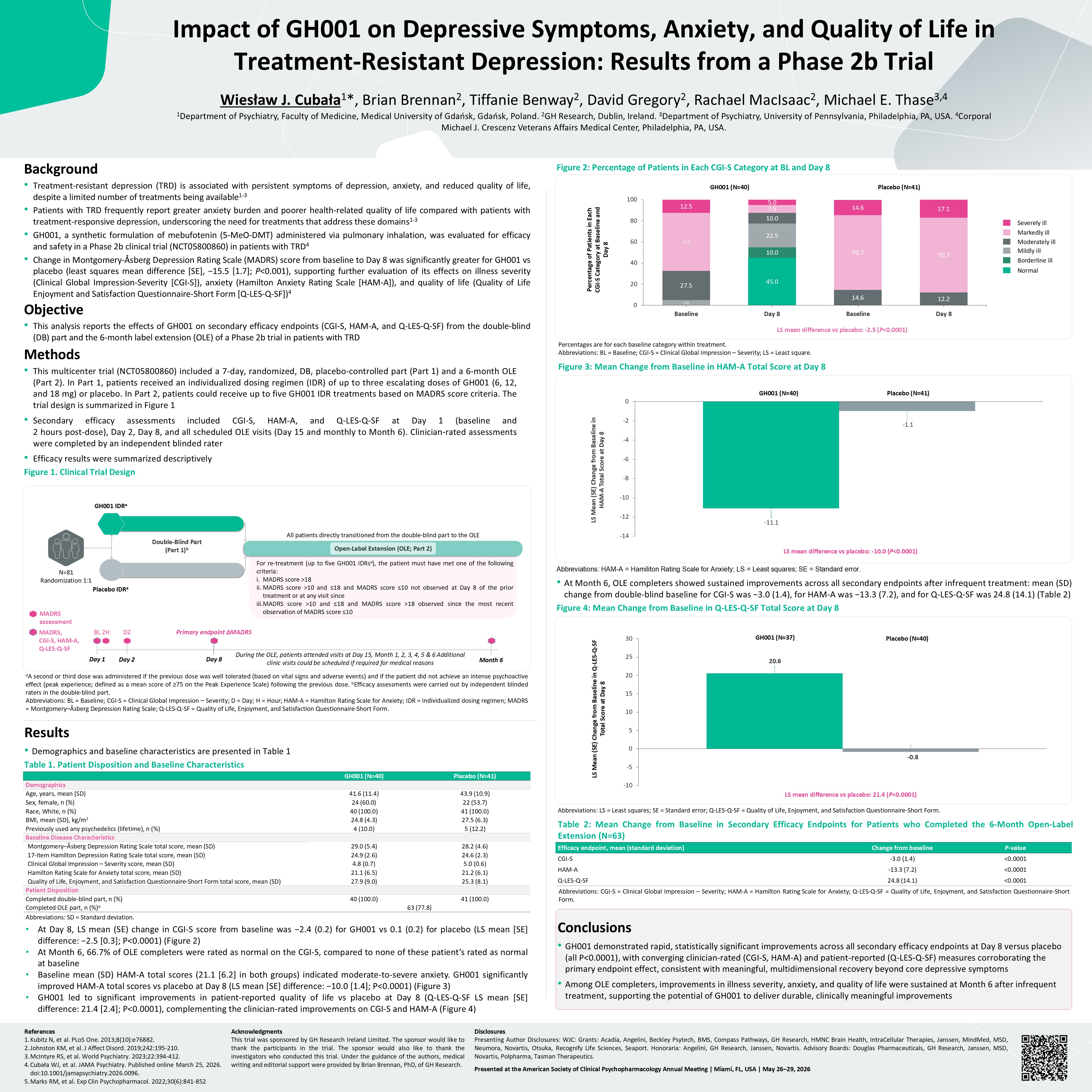
HAM-A total scores vs placebo at Day 8 (LS mean [SE] difference: −10.0 [1.4]; P<0.0001) (Figure 3) GH001 led to significant improvements in patient-reported quality of life vs placebo at Day 8 (Q-LES-Q-SF LS mean [SE] difference: 21.4
[2.4]; P<0.0001), complementing the clinician-rated improvements on CGI-S and HAM-A (Figure 4) Figure 2: Percentage of Patients in Each CGI-S Category at BL and Day 8 Percentages are for each baseline category within treatment.
Abbreviations: BL = Baseline; CGI-S = Clinical Global Impression – Severity; LS = Least square. Figure 3: Mean Change from Baseline in HAM-A Total Score at Day 8 Abbreviations: HAM-A = Hamiliton Rating Scale for Anxiety; LS = Least squares;
SE = Standard error. At Month 6, OLE completers showed sustained improvements across all secondary endpoints after infrequent treatment: mean (SD) change from double-blind baseline for CGI-S was −3.0 (1.4), for HAM-A was −13.3 (7.2), and for
Q-LES-Q-SF was 24.8 (14.1) (Table 2) Figure 4: Mean Change from Baseline in Q-LES-Q-SF Total Score at Day 8 During the OLE, patients attended visits at Day 15, Month 1, 2, 3, 4, 5 & 6 Additional clinic visits could be scheduled if
required for medical reasons For re-treatment (up to five GH001 IDRsa), the patient must have met one of the following criteria: MADRS score >18 MADRS score >10 and ≤18 and MADRS score ≤10 not observed at Day 8 of the prior treatment
or at any visit since MADRS score >10 and ≤18 and MADRS score >18 observed since the most recent observation of MADRS score ≤10 Open-Label Extension (OLE; Part 2) N=81 Randomization 1:1 Double-Blind Part (Part 1)b All patients
directly transitioned from the double-blind part to the OLE Placebo IDRa GH001 IDRa BL 2H Day 1 Primary endpoint ΔMADRS Day 8 MADRS assessment Month 6 D2 Day 2 MADRS, CGI-S, HAM-A, Q-LES-Q-SF GH001 (N=40) Placebo
(N=41) Demographics Age, years, mean (SD) 41.6 (11.4) 43.9 (10.9) Sex, female, n (%) 24 (60.0) 22 (53.7) Race, White, n (%) 40 (100.0) 41 (100.0) BMI, mean (SD), kg/m2 24.8 (4.3) 27.5 (6.3) Previously used any psychedelics
(lifetime), n (%) 4 (10.0) 5 (12.2) Baseline Disease Characteristics Montgomery–Åsberg Depression Rating Scale total score, mean (SD) 29.0 (5.4) 28.2 (4.6) 17-Item Hamilton Depression Rating Scale total score, mean (SD) 24.9 (2.6) 24.6
(2.3) Clinical Global Impression – Severity score, mean (SD) 4.8 (0.7) 5.0 (0.6) Hamilton Rating Scale for Anxiety total score, mean (SD) 21.1 (6.5) 21.2 (6.1) Quality of Life, Enjoyment, and Satisfaction Questionnaire-Short Form total
score, mean (SD) 27.9 (9.0) 25.3 (8.1) Patient Disposition Completed double-blind part, n (%) 40 (100.0) 41 (100.0) Completed OLE part, n (%)a 63 (77.8) Percentage of Patients in Each CGI-S Category at Baseline and Day 8 LS mean
difference vs placebo: -2.5 (P<0.0001) GH001 (N=40) Placebo (N=41) Normal Borderline ill Mildly ill Moderately ill Markedly ill Severely ill LS mean difference vs placebo: -10.0 (P<0.0001) GH001 (N=40) Placebo (N=41) LS Mean
(SE) Change from Baseline in HAM-A Total Score at Day 8 LS mean difference vs placebo: 21.4 (P<0.0001) LS Mean (SE) Change from Baseline in Q-LES-Q-SF Total Score at Day 8 Efficacy endpoint, mean (standard deviation) Change from
baseline P-value CGI-S -3.0 (1.4) <0.0001 HAM-A -13.3 (7.2) <0.0001 Q-LES-Q-SF 24.8 (14.1) <0.0001 Abbreviations: CGI-S = Clinical Global Impression – Severity; HAM-A = Hamilton Rating Scale for Anxiety; Q-LES-Q-SF = Quality
of Life, Enjoyment, and Satisfaction Questionnaire-Short Form.