ANNUAL INFORMATION FORM
for the twelve month period ended December 31, 2025
Dated: March 11, 2026
ANNUAL INFORMATION FORM
for the twelve month period ended December 31, 2025
Dated: March 11, 2026
TABLE OF CONTENTS
| INTRODUCTION |
1 | |||
| CAUTIONARY NOTE REGARDING FORWARD-LOOKING INFORMATION |
1 | |||
| MARKET AND INDUSTRY DATA |
3 | |||
| CORPORATE STRUCTURE |
3 | |||
| DESCRIPTION OF THE BUSINESS |
5 | |||
| RISK FACTORS |
22 | |||
| DIVIDENDS |
51 | |||
| DESCRIPTION OF CAPITAL STRUCTURE |
51 | |||
| MARKET FOR SECURITIES |
58 | |||
| AGREEMENTS WITH SHAREHOLDERS |
60 | |||
| ESCROWED SECURITIES AND SECURITIES SUBJECT TO CONTRACTUAL RESTRICTIONS ON TRANSFER |
61 | |||
| DIRECTORS AND EXECUTIVE OFFICERS |
61 | |||
| LEGAL PROCEEDINGS AND REGULATORY ACTIONS |
69 | |||
| INTEREST OF MANAGEMENT AND OTHERS IN MATERIAL TRANSACTIONS |
69 | |||
| TRANSFER AGENT, REGISTRAR AND WARRANT AGENT |
69 | |||
| MATERIAL CONTRACTS |
69 | |||
| INTEREST OF EXPERTS |
73 | |||
| ADDITIONAL INFORMATION |
73 | |||
| APPENDIX A CHARTER OF THE AUDIT COMMITTEE |
74 | |||
(i)
ANNUAL INFORMATION FORM
INTRODUCTION
Unless otherwise indicated, all references in this annual information form (the “Annual Information Form”) to “Algoma,” “we,” “our,” “us,” “the Company” or similar terms refer to Algoma Steel Group Inc. and its consolidated subsidiaries.
We publish our consolidated financial statements in Canadian dollars. In this Annual Information Form, unless otherwise specified, all monetary amounts are in Canadian dollars, all references to “C$” mean Canadian dollars and all references to “$” or “US$” mean U.S. dollars. Unless otherwise indicated, the information contained herein is given as at December 31, 2025.
Effective November 5, 2024, the Company’s board of directors approved a change in the Company’s fiscal year-end from March 31 to December 31, effective as of December 31, 2024. Unless otherwise indicated in this Annual Information Form, all references to: “fiscal 2025” are to the twelve month period ended December 31, 2025, the fiscal year ended December 31, 2024 is referred to as the “nine month period ended December 31, 2024”, and “fiscal 2024” are to the twelve month period ended March 31, 2024.
CAUTIONARY NOTE REGARDING FORWARD-LOOKING INFORMATION
This Annual Information Form contains “forward-looking statements” within the meaning of the U.S. Private Securities Litigation Reform Act of 1995 and “forward-looking information” under applicable Canadian securities legislation (collectively, “forward-looking statements”), that are subject to risks and uncertainties. These forward-looking statements include information about imposed and threatened tariffs, including the impact, timing and resolution thereof, possible or assumed future results of our business, financial condition, results of operations, liquidity, plans and strategic objectives, Algoma’s expectation to pay a quarterly dividend, the expected timing of the EAF (as defined below) transformation and the resulting increase in raw steel production capacity and reduction in carbon emissions. In some cases, you can identify forward-looking statements by the words “believe,” “project,” “expect,” “anticipate,” “estimate,” “intend,” “strategy,” “future,” “opportunity,” “plan,” “pipeline,” “may,” “should,” “will,” “would,” “will be,” “will continue,” “will likely result” or the negative of these terms or other similar expressions. In addition, any statements that refer to expectations, intentions, projections or other characterizations of future events or circumstances contain forward-looking information. Statements containing forward-looking information are not historical facts but instead represent management’s expectations, estimates and projections regarding future events or circumstances. In addition, our business and operations involve numerous risks and uncertainties, many of which are beyond our control, which could result in our expectations not being realized or otherwise materially affect our financial position, financial performance and cash flows. Although management believes that expectations reflected in forward-looking statements are reasonable, such statements involve risks and uncertainties and should not be regarded as a representation by the Company or any other person that the anticipated results will be achieved. The Company cautions you not to place undue reliance upon any such forward-looking statements, which speak only as of the date they are made. Our forward-looking statements are not guarantees of future performance, and actual events, results and outcomes may differ materially from our expectations suggested in any forward-looking statements due to a variety of factors, including, among others, those set forth in the section entitled “Risk factors.” Although it is not possible to identify all of these factors, they include, among others, the following:
| • | future financial performance; |
| • | future cash flow and liquidity; |
| • | future capital investment; |
- 2 -
| • | low-priced steel imports, decreased trade regulation, and other trade barriers including tariffs and/or trade wars; |
| • | our ability to operate our business, remain in compliance with debt covenants and make payments on our indebtedness, with a substantial amount of indebtedness; |
| • | restrictive covenants in debt agreements limit our discretion to operate our business; |
| • | significant domestic and international competition; |
| • | macroeconomic pressures such as inflation and interest rates in the markets in which we operate; |
| • | increased use of competitive products; |
| • | a protracted fall in steel prices resulting in reduced revenue and/or impairment of assets; |
| • | excess capacity, resulting in part from expanded production in China and other developing economies; |
| • | protracted declines in steel consumption caused by poor economic conditions in North America or by the deterioration of the financial position of our key customers; |
| • | increases in annual funding obligations resulting from our under-funded Pension Plans and Wrap Plan (each as defined herein); |
| • | supply and cost of raw materials and energy; |
| • | impact of a downgrade in credit rating, including our access to sources of liquidity; |
| • | currency fluctuations, including an increase in the value of the Canadian dollar against the U.S. dollar; |
| • | environmental compliance and remediation; |
| • | unexpected equipment failures and other business interruptions; |
| • | a protracted global recession or depression; |
| • | changes in or interpretation of royalty, tax, environmental, greenhouse gas (“GHG”), carbon, accounting and other laws or regulations, including potential environmental liabilities that are not covered by an effective indemnity or insurance; |
| • | risks associated with existing and potential lawsuits and regulatory actions against the Company; |
| • | impact of disputes arising with our partners; |
| • | our ability to implement and realize our business plans, including our ability to fully implement, stabilize and optimize electric arc furnace (“EAF”) steelmaking operations and realize the anticipated operational, financial and strategic benefits of the transformation; |
| • | our ability to operate the EAF and related melt shop and downstream equipment at sustainable production rates consistent with planned capacity, quality specifications and cost performance; |
| • | expected increases in liquid steel capacity and productivity as a result of the transformation to EAF steelmaking; |
| • | expected cost savings associated with the transformation to EAF steelmaking; |
| • | reliance on a single primary steelmaking route following the cessation of blast furnace operations; |
| • | the realization, measurement and regulatory recognition of expected reductions in carbon dioxide (“CO₂”) emissions associated with the transition to EAF steelmaking, including impacts on carbon compliance obligations, carbon pricing regimes and government support arrangements such as the Federal SIF EAF Loan (as defined herein) |
| • | the availability, reliability, and cost of electrical power required for EAF operations, including the risks that higher cost of internally generated power and market pricing for electricity sourced from our current grid in Northern Ontario could have an adverse impact on our production and financial performance; |
| • | the timing and completion of planned local and regional electricity transmission and distribution infrastructure upgrades necessary to support the Company’s long-term power requirements, including the risk of delays, capacity constraints or changes in project scope; |
| • | the potential for Indigenous rights, claims, consultation requirements or related matters to affect ongoing operations, infrastructure, energy supply arrangements or future development initiatives; |
| • | risks relating to scrap pricing, metallics supply, consumable usage and overall conversion costs; |
| • | access to an adequate supply of the various grades of steel scrap; |
| • | the risks associated with the steel industry generally; |
| • | economic, social and political conditions in North America and certain international markets; |
| • | changes in general economic conditions, including ongoing market uncertainty and global geopolitical instability; |
| • | risks inherent in the Company’s corporate guidance; |
- 3 -
| • | failure to achieve cost and efficiency initiatives; |
| • | risks inherent in marketing operations; |
| • | risks associated with technology, including electronic, cyber and physical security breaches; |
| • | construction risks, including delays and cost overruns; |
| • | our ability to enter into contracts to source steel scrap and the availability of steel scrap; |
| • | the availability of alternative metallic supply; |
| • | the Company’s expectation to declare and pay a quarterly dividend; |
| • | decommissioning and environmental risks associated with closed blast furnace and coke oven facilities; |
| • | business interruption or unexpected technical difficulties, including impact of weather; |
| • | counterparty and credit risk; |
| • | labour interruptions and difficulties; and |
| • | changes in capital markets. |
The preceding list is not intended to be an exhaustive list of all of our forward-looking statements. The forward-looking statements are based on our beliefs, assumptions and expectations of future performance, taking into account the information currently available to us. These statements are only predictions based upon our current expectations and projections about future events. There are important factors that could cause our actual results, levels of activity, performance or achievements to differ materially from the results, levels of activity, performance or achievements expressed or implied by the forward-looking statements. In particular, you should consider the risks provided under “Risk Factors” in this Annual Information Form.
You should not rely upon forward-looking statements as predictions of future events. Although we believe that the expectations reflected in the forward- looking statements are reasonable, we cannot guarantee that future results, levels of activity, performance and events and circumstances reflected in the forward-looking statements will be achieved or will occur. Despite a careful process to prepare and review the forward-looking information, there can be no assurance that the underlying assumptions will prove to be correct. Except as required by law, we undertake no obligation to update publicly any forward-looking statements for any reason after the date of this Annual Information Form, to conform these statements to actual results or to changes in our expectations.
MARKET AND INDUSTRY DATA
Market and industry data presented in this Annual Information Form was obtained from third-party sources and industry reports and publications, websites and other publicly available information, including Statistics Canada, as well as industry and other data prepared by us or on our behalf on the basis of our knowledge of the markets in which we operate, including information provided by suppliers, partners, clients and other industry participants. We believe that the market and economic data presented in this Annual Information Form is accurate and, with respect to data prepared by us or on our behalf that our estimates and assumptions are currently appropriate and reasonable, but there can be no assurance as to the accuracy or completeness thereof. The accuracy and completeness of the market and economic data presented in this Annual Information Form are not guaranteed and we do not make any representation as to the accuracy of such data. Actual outcomes may vary materially from those forecasts in such reports or publications, and the prospect for material variation can be expected to increase as the length of the forecast period increases. Although we believe it to be reliable, we have not independently verified any of the data from third-party sources referred to in this Annual Information Form, analyzed or verified the underlying studies or surveys relied upon or referred to by such sources, or ascertained the underlying market, economic and other assumptions relied upon by such sources. Market and economic data is subject to variations and cannot be verified due to limits on the availability and reliability of data inputs, the voluntary nature of the data gathering process and other limitations and uncertainties inherent in any statistical survey.
CORPORATE STRUCTURE
Name, Address and Incorporation
Algoma, a corporation organized under the Business Corporations Act (British Columbia) (the “BCA”) in March 2021, is the parent holding company of Algoma Steel Inc., our operating company (“Opco”). Opco was incorporated
- 4 -
in 2016 for the purpose of purchasing substantially all of the operating assets and liabilities of Essar Steel Algoma Inc. (“Old Steelco”) and its subsidiaries in connection with Old Steelco’s restructuring (the “Restructuring Transaction”) under the Canadian Companies’ Creditors Arrangement Act (the “CCAA”). The Restructuring Transaction was completed on November 30, 2018. Prior to November 30, 2018, Opco had no operations, and was capitalized with one common share with a nominal value. On October 19, 2021, Algoma consummated a business combination with Legato, a special purpose acquisition company, and became a publicly traded company with its common shares (the “Common Shares”) and warrants to purchase Common Shares (the “IPO Warrants”) trading on each of the Toronto Stock Exchange (the “TSX”) (under the symbols “ASTL” and “ASTL.WT”, respectively) and The Nasdaq Select Global Market (“Nasdaq”) (under the symbols “ASTL” and “ASTLW”, respectively).
Our principal office is located at 105 West Street, Sault Ste. Marie, Ontario P6A 7B4, Canada and our telephone number is (705) 945-2351. Our website address is www.algoma.com. Information contained on, or accessible through, our website is not a part of this disclosure document and the inclusion of our website address in this document is an inactive textual reference.
Intercorporate Relationships
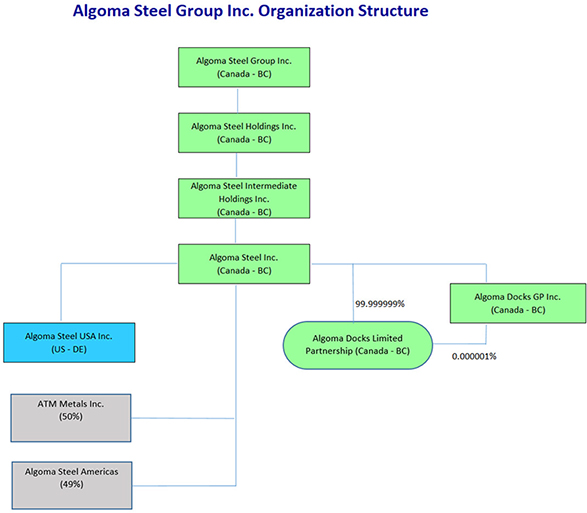
The following diagram illustrates the inter-corporate relationships between the Company and its material subsidiaries (which are all wholly owned by the Company) as at the date of this Annual Information Form:
- 5 -
Description of the Business
Algoma is a producer of hot and cold rolled steel products, including coiled sheet and plate, located on the Great Lakes in Sault Ste. Marie, Ontario, Canada. The Company is a flat-rolled steel producer in North America and the only producer of discrete plate in Canada, with an estimated annual liquid steel production capacity of approximately 2.8 million tons as of December 31, 2025. Algoma supplies customers primarily in the automotive, construction, energy, defense and manufacturing sectors.
The Company currently operates one EAF. Construction of a second EAF is expected to be completed in the first half of 2026, with commissioning and ramp-up anticipated thereafter. The transition to EAF steelmaking has replaced production from Blast Furnace No. 7, which was decommissioned in January 2026. Blast Furnace No. 6 remains idled.
Algoma’s downstream facilities include its Direct Strip Production Complex (“DSPC”) for production of sheet steel products, constructed in 1995 at an approximate cost of C$450 million, and which integrates continuous casting and hot rolling. We also operate Canada’s only discrete plate rolling mill, which is 166 inches wide, as well as discrete plate heat treating.
The Company’s sheet steel products include a wide variety of widths, gauges and grades, and are available in unprocessed form as hot rolled coil (“HRC”). Primary end users of sheet products include service centers, automotive, manufacturing, construction and tubular industries. Sheet steel products represented approximately 77% of the Company’s total steel shipment volumes for the twelve-month period ended December 31, 2025. As of December 31, 2025, the Company had idled its cold mill facilities, including pickling, hot rolled steel tempering, cold reduction rolling and annealing operations.
Recent modernization of the 166-inch wide plate mill is expected to support annual plate capacity of approximately up to 700,000 tons. In 2024, we completed a modernization of our plate mill, which has allowed us to increase capacity and further improve product quality and capability, which we believe will allow us to optimize margins by the sale of premium quality plate products, and build on our market position as the only domestic discrete plate producer in the Canadian market. Our plate steel products consist of various carbon-manganese, high-strength and low-alloy grades, and are sold in the as-rolled condition as well as subsequent value-added heat-treated conditions. The primary end-user of our plate products is the fabrication industry, which uses our plate products in the manufacture or construction of railcars, buildings, bridges, off-highway equipment, storage tanks, ships, defense and military applications (including armored plate), large diameter pipelines and power generation equipment. Plate steel products have represented approximately 23% of our total steel shipment volumes in the twelve month period ended December 31, 2025.
We sell our finished products to a geographically diverse customer base across North America. For the twelve month period ended December 31, 2025, our shipment volume by product category, geography and end markets were as follows:
|
Twelve month period ending December 31, 2025 Product Shipment Mix |
Twelve month period ending December 31, 2025 Geographic Shipments |
|||||||||||
| Product | Volume | Country | Volume | |||||||||
| Hot Roll | 70% | United States | 51% | |||||||||
| Cold Roll | 7% | Canada | 48% | |||||||||
| Plate | 23% | Mexico | 1% | |||||||||
- 6 -
| End Market Volume | |||||||||||||||
|
Segment |
|
Twelve month period ended Decemeber 31, 2025 |
|
Nine month period ended Decemeber 31, 2024 |
|
Twelve month period ended March 31, 2024 |
|||||||||
|
Transportation1 |
27% | 41% | 43% | ||||||||||||
|
Manufacturing and Construction |
21% | 28% | 30% | ||||||||||||
|
Tubular |
13% | 13% | 10% | ||||||||||||
|
Distribution |
39% | 18% | 17% | ||||||||||||
|
Total |
100% | 100% | 100% | ||||||||||||
1Includes 35-40% automotive
Corporate Strategy and Culture
Our corporate strategy aims to maximize stakeholder value through strategic investments in our business that provide and enhance a sustainable competitive cost position. Key investments include our EAF transformation, the modernization of our plate mill and our completed Ladle Metallurgy Furnace No. 2 (“LMF2”) investment. Through these strategic initiatives, we are seeking to ensure the long-term success and growth of our business. We anticipate that these investments will enhance our leading presence in the Canadian market and allow us to actively contribute to a more sustainable and environmentally responsible steel industry. In addition to the above, we are committed to fostering an entrepreneurial culture within our organization. This culture is rooted in values such as safety, productivity, and a caring attitude, which guide our decisions and interactions. Safety is our top priority, ensuring the well-being of our employees and stakeholders at all times. Productivity is pursued through a culture of continuous improvement, empowering our teams to innovate and optimize processes, resulting in increased efficiency and operational excellence. Lastly, a caring attitude permeates our organization, promoting a supportive and inclusive environment where everyone feels valued and respected. By nurturing this entrepreneurial culture, we aim to foster a strong sense of ownership and accountability among our employees, driving our business towards long-term success while prioritizing the well-being of our people and the communities we serve.
EAF Transformation
On November 10, 2021, our board of directors authorized the Company to construct two state-of-the-art EAFs to replace our existing Blast Furnace No. 7 steelmaking operations (the “EAF Transformation”). The EAF Transformation is expected to reduce our annual carbon emissions by approximately 70%. EAF steelmaking is a method of producing steel by melting scrap metal and other metallic inputs using an electric arc, and is widely used in modern steel production. Our EAF steelmaking facility is being built on vacant land adjacent to our current steelmaking facility to mitigate disruption to current operations, and will be integrated into existing downstream equipment and facilities, thereby reducing capital expenditure requirements.
In early July 2025, the Company achieved its first steel production at Unit One of the EAFs as well as successful electric arc testing and tuning, including individual and tandem tests of all nine Q-One transformer modules. This was a major operational and strategic milestone that marks the start of a new era for Algoma, positioning the Company to produce Volta™, our proprietary green steel brand, at scale. It reflects the successful execution of a key phase in the EAF Transition and demonstrates the performance of the technology platform that underpins our decarbonization strategy. With EAF production now underway, Algoma is advancing toward a more flexible, cost-effective, and environmentally responsible steelmaking model that supports long-term shareholder value.
The Company had planned to continue blast furnace production through 2027 during a staged transition to EAF steelmaking. However, beginning in early 2025 and intensifying in June 2025, unprecedented USA tariff measures and escalating trade tensions with the United States materially and adversely affected the North American steel market. These measures included substantial tariffs on direct steel imports into the United States as well as on certain derivative and downstream steel-containing products.
- 7 -
The scope and magnitude of these trade actions was unprecedented and fundamentally disrupted the Company’s established U.S. sales channels. In addition, tariffs on derivative products reduced demand for Canadian-manufactured finished goods exported into the United States, which in turn materially impacted domestic Canadian steel demand. The combined effect was a material contraction in addressable markets for the Company’s integrated blast furnace production. These external market conditions represented a fundamental change to the commercial assumptions underlying continued operation of the Company’s integrated blast furnace and coke oven facilities. As a result, sustained operation of these facilities became unviable. Accordingly, the Company was required to accelerate the wind-down of blast furnace steelmaking operations and ceased production through this route shortly after December 31, 2025. The Company is now relying on liquid steel production from the EAF.
Ramp-up activities for the EAF Transformation are progressing in line with expectations. The Unit One furnace and associated melt shop assets are performing as designed, with quality metrics achieved across a range of plate and hot-rolled coil product grades. The Q-One power system and other key process components have demonstrated stable and reliable performance, supporting consistent metallurgical quality and process control. Operations are currently running on a full 24-hour-per-day schedule.
The EAF Transformation also includes installation of vacuum tank degassing for steel used in plate products. Vacuum tank degassing offers several significant benefits for steel plate products, including reduced hydrogen content crucial for improving the steel’s resistance to cracking and brittleness, improved cleanliness to reduce impurities and inclusions leading to better surface finish and enhanced mechanical properties, and enhanced homogeneity promoting a more uniform distribution of alloys within the steel to improve consistency and reduce localized variations in properties. Construction is ongoing with the aim of commissioning in mid 2026.
The Company’s Response to Tariffs
The current President of the United States has issued various executive orders imposing tariffs on products imported from Canada. These include tariffs under the International Emergency Economic Powers Act (“IEEPA Tariffs”), applying a 25% duty on most imports from Canada, with a reduced 10% rate on energy products; and tariffs under Section 232 of the Trade Expansion Act of 1962 (“S232 Tariffs”), imposing a 25% ad valorem tariff on all steel and aluminum articles and their derivatives, without exclusions. The tariffs were effective March 4, 2025, paused on March 6, 2025, and then reinstated March 12, 2025. On April 2, 2025, the President announced a minimum 10% tariff (“Reciprocal Tariffs”) on all U.S. imports, effective April 5, 2025 and higher tariffs on imports from 57 countries. Canada was excluded from the application of Reciprocal Tariffs, and the order further clarified that the IEEPA Tariffs and S232 Tariffs would not aggregate on Canadian goods compliant with the United States-Mexico-Canada Agreement (“USMCA”). On June 4, 2025, the tariffs under S232 Tariffs were increased to 50% for all steel and aluminum imports to the United States. At present, the Company is only subject to the S232 Tariffs that imposes a 50% tariff on steel the Company imports into the United States. The ruling by the Supreme Court of the United States on February 20, 2026 regarding the IEEPA Tariffs does not impact the S232 Tariffs.
The ongoing tariffs and trade uncertainty has contributed to volatility in steel demand and pricing in both the U.S. and Canadian markets, with concerns over supply chain disruptions leading to fluctuations in purchasing patterns. Additionally, the uncertainty surrounding trade policies has affected the U.S. dollar exchange rate, which in turn impacts the Company’s sales and cost structure by influencing raw material costs, pricing competitiveness, and cross-border trade dynamics. In most cases, it is not feasible for the Company to pass on the tariff cost to its customers. Unlike the U.S. market which is predominantly contract-based, the Canadian steel market is more focused on spot transactions. As a result, the Company has been experiencing an increasing demand and pricing imbalance between the U.S. and Canadian markets, resulting in Canadian transactional pricing below U.S. pricing, which we expect is due to the increased supply of the Canadian market from domestic producers, the continuance of steel shipped into Canada by U.S. steel manufacturers and increased import offers from other countries priced at less-than-fair-value. During the three month period ended December 31, 2025 the Company’s Average Net Sales Realization (“NSR”), defined as steel revenue less freight revenue per steel tons shipped, for Canadian sales was up to 40% lower than its U.S. results across many product categories. This is a significantly greater discrepancy than historical averages and resulted in approximately C$27.0 million lower revenue on Canadian sales during the three month period ended December 31, 2025. During the three and twelve month periods ended December 31, 2025, the Company incurred tariff costs of C$60.6 million and C$225.0 million, respectively. During the three and twelve month periods ended
- 8 -
December 31, 2025, steel shipments to the United States represented 45% and 51% of total steel shipments, respectively.
The S232 Tariffs in the United States have effectively closed the US market to Canadian steel producers, and resulted in an oversupply of steel coil in Canada, significantly influencing the selling price of domestic steel coil in Canada. The resulting price volatility and trade uncertainty has fundamentally disrupted the business model for Canadian steel production.
On September 28, 2025, in response to sustained market disruption, volatility and uncertainty arising from prolonged and expanded tariff measures, the Company’s board of directors approved a plan to accelerate the wind-down and decommissioning of the Company’s blast furnace and coke oven operations and transition fully to EAF steelmaking. In connection with this plan, on December 1, 2025, the Company issued layoff notices (the “Layoffs”) to 1,005 unionized employees, effective March 23, 2026. The Layoffs resulted in expected severance costs totaling C$45.8 million, which were recognized in the consolidated statements of net loss for the and twelve-month period ended December 31, 2025. To align production with prevailing market conditions, the Company intends to focus on the manufacturing and sale of discrete plate and to scale back coil production, with predominant emphasis on the Canadian market. As EAF production ramps up, the Company expects to align product offerings with domestic demand. As a result of the tariff measures and the resulting market disruption, the Company provided notice to certain primary raw material suppliers and customers asserting that these unforeseen trade measures have fundamentally altered the commercial basis of certain agreements. The Company has initiated, and is responding to, related legal proceedings in connection with certain supply agreements, including proceedings concerning the Company’s position that certain agreements have been frustrated. The Company believes it has valid legal remedies and defenses in these matters and intends to defend its position. Management continues to monitor these proceedings and will recognize provisions where a present obligation exists and a reliable estimate of loss can be made in accordance with applicable accounting standards.
The Company is further exploring liquidity tools and funding programs that could support its current operations and enable strategic diversification of products, including the LETL Facilities, as defined and described further below.
LETL Facilities
On November 14, 2025, the Company entered into agreements with Canada Enterprise Emergency Funding Corporation under the Large Enterprise Tariff Loan program and the Ministry of Northern Economic Development and Growth to secure a C$500 million governmental loan comprised of a C$400 million loan facility from the Government of Canada and a C$100 million loan facility from the Province of Ontario (collectively, the “LETL Facilities”). The LETL Facilities are provided proportionately for which 20% is secured, ranking junior to the Company’s existing first lien Revolving Credit Facility and its 9.125% Senior Secured Lien Notes, with the remaining 80% of the Facilities being unsecured. The LETL Facilities have a seven-year term, with interest at CORRA + 200 bps for the first three years, stepping up by 200 bps each year thereafter, and include customary positive and negative covenants, including a restriction on capital distributions.
In connection with the LETL Facilities, the Company issued 6,768,953 Common Share purchase warrants (the “LETL Warrants”) to Canada Enterprise Emergency Funding Corporation (5,415,162 LETL Warrants) and His Majesty the King in Right of Ontario (1,353,791 LETL Warrants). Each LETL Warrant is exercisable for one Common Share at an exercise price of $11.08, vesting proportionately as unsecured draws are made and subject to customary anti-dilution adjustments in the event of share reorganizations, rights offerings, distributions or certain other corporate transactions. The LETL Warrants have a term expiring at 5:00 p.m. (Toronto time) on November 14, 2035, unless earlier repurchased, exercised or terminated in accordance with their terms. The Company also retains certain rights to repurchase the LETL Warrants following repayment of the LETL Facility.
For further details please refer to “Material Contracts - LETL Facilities”.
- 9 -
IPO Warrants
On October 19, 2021, Algoma consummated a business combination with Legato, a special purpose acquisition company, and its common shares and the IPO Warrants became listed on the TSX and Nasdaq. The IPO Warrants and LETL Warrants are referred to collectively in this Annual Information Form as Warrants (the “Warrants”), unless context otherwise requires or as specifically states.
DSPC Production Process
Our DSPC hot mill provides a cost advantage over the traditional integrated hot rolling manufacturing process. Current annualized production capacity of the DSPC complex is 2.3 million tons.
A hot strip mill coupled to direct casting can provide a significant competitive advantage in the steel industry. This technology integration eliminates the need for intermediate processes such as slab reheating. By leveraging the advantages of a hot strip mill coupled to direct casting, we achieve cost savings, improve operational efficiency, enhance product quality and reduce environmental impact. As the DSPC is ideally designed to integrate into our new EAFs, we have transformed into a state-of-the-art mini mill production facility.
The DSPC enables us to offer superior products, meet customer needs more effectively and strengthen our position in the steel industry. This technology offers key advantages, including:
| • | Cost Efficiency: Direct casting eliminates the need for costly and time-consuming slab reheating processes. The continuous production method reduces energy consumption and operational costs associated with reheating furnaces, resulting in improved cost efficiency. |
| • | Time Savings: By eliminating intermediate processes, a hot strip mill coupled to direct casting significantly reduces the production cycle time. This allows for faster turnaround and shorter lead times, giving us a competitive edge in meeting customer demands and achieving just-in-time delivery. |
| • | Improved Quality: Direct casting technology allows for better control over our steel products’ microstructure and mechanical properties. The continuous casting process results in improved product consistency and surface quality, reducing defects and enhancing the overall quality of our steel products. |
| • | Environmental Benefits: The integration of direct casting minimizes the environmental impact of steel production by reducing energy consumption and greenhouse gas emissions. This aligns with sustainability goals and enhances our reputation as an environmentally responsible producer. |
| • | Flexibility and Customization: With a hot strip mill coupled to direct casting, we are able adapt to market demands more efficiently. The continuous process enables quick changes in steel grades, sizes, and specifications, allowing for greater flexibility and customization options to meet customer requirements. |
Discrete Plate Production
We are the only discrete plate producer in Canada, with current capacity of up to 700,000 tons per year.
Recent modernization of the Company’s 166-inch wide plate mill is expected to support annual plate production capacity of up to approximately 700,000 tons. The modernization, completed in 2024, enhanced rolling capability, dimensional tolerances, product quality and heat-treatment processing capability.
The Company produces a broad range of carbon-manganese, high-strength and low-alloy plate grades. Plate products are supplied in the as-rolled condition as well as in value-added heat-treated conditions, including normalized and quenched-and-tempered grades designed for demanding structural and industrial applications.
The Company’s plate products are used across a wide range of end markets including construction infrastructure (such as bridges and structural components), energy and pressure vessel applications, shipbuilding and marine equipment,
- 10 -
rail transportation equipment, heavy machinery and mining equipment, storage tanks and power generation equipment, large-diameter pipe and tubular products, and defense applications including armored plate. The primary end-users of the Company’s plate products are fabricators and manufacturers serving the construction, energy, mining, transportation, industrial and defense sectors. Plate steel products represented approximately 23% of the Company’s total steel shipment volumes for the twelve-month period ended December 31, 2025. The primary end users of the Company’s plate products are fabricators and manufacturers serving the construction, energy, mining, transportation, industrial and defense sectors.
Employment and Government Support
We are the largest employer in Sault Ste. Marie, Ontario. As of December 31, 2025, the Company had 2,400 full-time employees, of which approximately 95% are represented by two locals of the United Steelworkers Unions under two collective bargaining agreements expiring July 31, 2027. As discussed above, in connection with EAF Transition and the Company’s response to the S232 Tariffs, on December 1, 2025, the Company issued layoff notices to 1,005 unionized employees, effective March 23, 2026. As a result of the Company’s good relationship with its unionized workforce, there has not been a work disruption in approximately 30 years, and we have achieved contract terms that are competitive to those achieved by our peers.
As a result of our significant contribution to the Canadian steelmaking industry, we benefit from strong federal and provincial government support in various forms including the LETL Facilities. For example, to support political policies of the governments of Canada and Ontario, we have received financial support in the form of loans and grants, which have enabled us to undertake various capital expenditures to reinvest in the Company.
Environmental, Social and Governance
As part of our commitment to continue to augment our transparency and accountability on environmental, social and governance (“ESG”), the Company published its third annual sustainability report, (the “Sustainability Report”) in June 2025. Algoma aims to be a climate change leader and contributor toward a sustainable and environmentally responsible future for Canadian steel production. The report was designed to align with market-leading, investor-preferred ESG disclosure frameworks, such as the Sustainability Accounting Standards Board and the recommendations of the Task Force on Climate-related Financial Disclosures. The Sustainability Report sets out the Company’s ESG strategy, and its approach to mitigating ESG risks and capturing ESG opportunities, and provides an update on the Company’s ESG performance. We intend to publish our next report in June 2026.
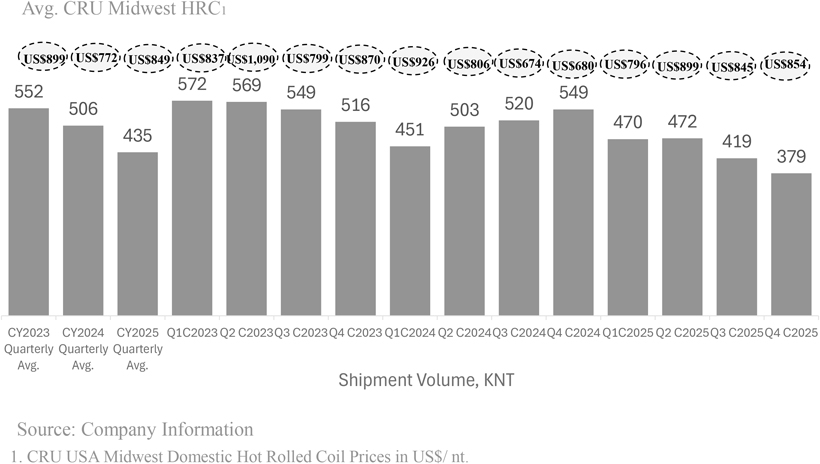
Quarterly Shipment Volume
- 11 -
Our Competitive Strengths
Strategically Located in Close Proximity to Customers and Suppliers
We are strategically located on Lake Superior with close proximity to major steel-consuming regions in Canada, including Southern Ontario, and historically to key markets in the United States, including the U.S. Midwest and Northeast. This geographic position has historically allowed the Company to serve customers across the Great Lakes region at competitive costs and, where trade conditions permit, provides strategic access to U.S. markets. Our location also provides efficient access to significant sources of post-consumer steel scrap, which is expected to be an important raw material input for our operations.
Historically approximately 84% of our customers are located within a 500-mile radius of our facility. In addition, our location on the Great Lakes provides access to multiple transportation modes, including marine, rail and truck, supporting our ability to negotiate competitive rates for inbound raw materials and outbound steel products. Our adjacent port facility, the fourth largest Canadian port on the Great Lakes by volume, has historically handled nearly 450 vessels per year and more than 4.5 million tons of shipments, facilitating efficient access to low-cost marine transportation across the Great Lakes and supporting our distribution network.
We sell steel products to a diverse base of approximately 235 customers across multiple sectors in North America, with no single customer accounting for more than 10% of revenues. Our top ten customers accounted for approximately 52% of total revenue in the year ended December 31, 2025. Our geographic, sector and customer diversification reduces our exposure to shifts in demand, and we have built strong customer relationships, with the average tenure of our top ten customers ranging from approximately 20 to 25 years.
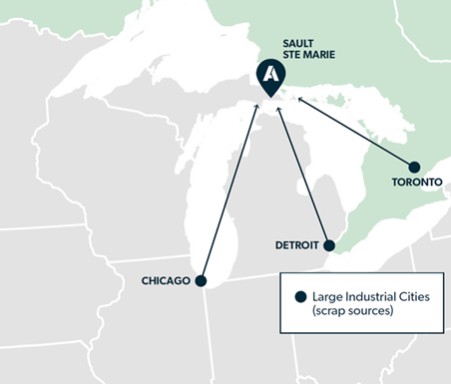
The following map illustrates the Company’s advantageous location at the junction of Lake Superior and Lake Huron, with access to scrap metals anticipated to be sourced from the large industrial zones surrounding the Great Lakes (including Chicago, Detroit and Toronto), with additional supply from Western Canada and Quebec, and efficient shipping routes to customers throughout the Great Lakes region, including Canada and, where trade conditions permit, the Midwestern United States.
- 12 -
Operations Designed to Provide Superior Product Quality and Serve Diversified Blue-Chip Customer Base in Attractive End Markets
Plate products accounted for 23% of shipments, hot rolled sheet for 70% and cold rolled sheet for 7% of shipments for the twelve month period ended December 31, 2025. Additionally, flexible union labor contracts allow us to optimize manpower allocation across the entire facility to meet changes in demand. Our facilities have the flexibility to produce varying product widths, gauges and strengths, which allows us to serve a broad customer base across various end markets, including service centers, automotive, manufacturing, construction and tubular markets. Furthermore, our research and development investments support higher quality, lower cost products and drive a value proposition for customers.
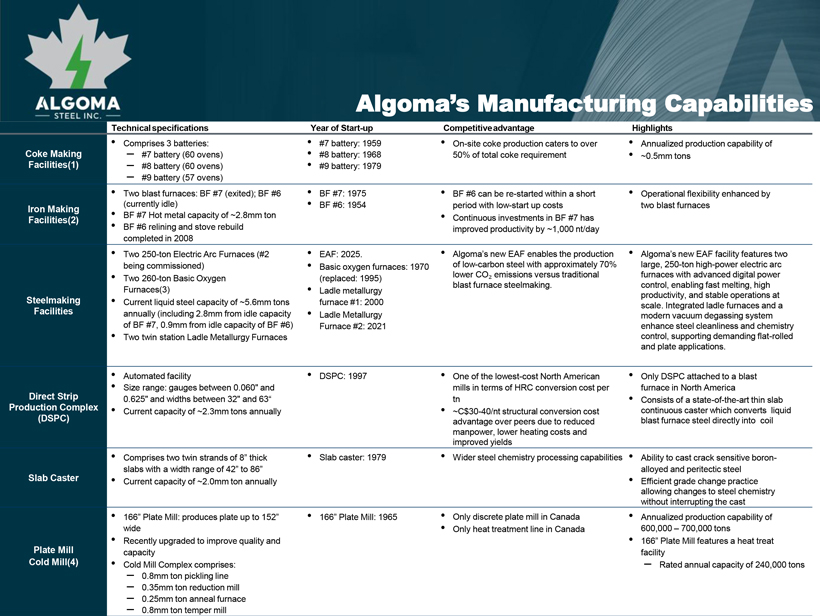
(1) Cokemaking Facility Closed January 2026; (2) No. 7 Blast Furnace Closed January 2026; (3) Basic
Oxygen Furnaces Closed January 2026; (4) Idled in January 2026 in response to U.S. tariffs
Source: Company information.
We serve a diverse and blue-chip customer base with over 235 customers across multiple industries in North America. No single customer makes up more than 10% of our sales. In the twelve month period ended December 31, 2025, 27% of our sales were to transportation customers (35-40% of which were in the automotive market), 21% of sales were to manufacturing and construction markets, 13% of sales were to tubular markets (primarily serving oil and gas customers), and 39% of sales were sold to distribution customers. Our geographical sales are divided between the
- 13 -
United States and Canada, serving high-quality industrial customers generally located on or near the Great Lakes given our logistical advantages. While the geographical sales mix varies year-by-year depending on relative demand, in the twelve month period ended December 31, 2025, 51% of our products were sold into the United States market while 48% were sold within Canada.
Low Cost Operations Underpinned by Scrap Flexibility and Stable Conversion Costs
As an EAF producer, we convert recycled ferrous scrap into steel, employing a flexible production model with a highly variable cost structure. This approach allows for alignment of raw material procurement, production, optimizing working capital, and reducing inventory risk. Underpinning this flexibility is a rigorous management of conversion costs. The Company strives to maintain consistent per-ton conversion costs, ensuring a resilient and competitive cost structure through-the-cycle.
During the EAF Transition and pending completion of local and regional 230 kV transmission upgrades, the Company supplements electricity supplied from the provincial grid with generation from its Lake Superior Power (“LSP”) facility. This capability provides operational reliability and flexibility while supporting grid stability during a period of transmission constraint.
Flexible Cost Structure Positions Algoma to Generate Cash Flow Through-the-Cycle
The combination of a flexible cost structure and the reduction in fixed costs positions the Company to potentially generate positive cash flow through the steel economic cycle, including at HRC prices significantly lower than in the current pricing environment.
Legacy Liabilities Sustainably De-Risked from CCAA Process
In connection with the Company’s acquisition of substantially all of the operating assets of the Algoma steelmaking business pursuant to a court-approved restructuring under the CCAA completed on November 30, 2018 (the “Restructuring Transaction”), the Company addressed certain legacy environmental liabilities associated with historical operations at its Sault Ste. Marie facility. As part of the Restructuring Transaction, the Company entered into an agreement with the Province of Ontario, as represented by the Minister of the Environment, Conservation and Parks (the “LEAP Agreement”), relating to historical soil, groundwater and sediment impacts at the site arising from more than a century of steelmaking activity. Under the LEAP Agreement, the Province provided the Company with a release from legacy environmental liabilities associated with historical contamination at the Sault Ste. Marie site. In exchange, the Company committed to fund C$3.8 million annually for a period of 21 years into a financial assurance fund to support approved legacy environmental remediation and related projects. The Company also provided a C$10 million letter of credit to the MECP as financial assurance for these obligations.
Experienced Management Team with Extensive Industry Experience
We have an experienced management team with significant operating experience in the global steel industry. Our executives collectively have almost 200 years of steel industry experience with a number of leading steel companies. Under the leadership of our current management team, we have made significant capital expenditures and have achieved significant operating performance improvements by employing benchmarking and implementing industry best practices. Furthermore, we maintain a strong relationship with our skilled unionized workforce, which allows us to benefit from favorable collective bargaining agreements that provide flexibility to adapt to changes in operational and production needs.
Products
Sheet Steel: Our flat/sheet steel products include a wide variety of widths, gauges, and grades, and are available unprocessed and with value-added processing such as temper rolling, cold rolled in both full-hard and annealed, hot-rolled pickled and oiled products, floor plate and cut-to-length products. The primary end-users of our flat/sheet products are the automotive industry, hollow structural tube manufacturers and the light manufacturing and transportation industries. For the last five years, sheet steel products have represented approximately 86% of our total
- 14 -
steel shipment volumes. Over the same period, value-added applications represented approximately 46% of total steel volume.
Plate Steel: Our plate steel products consist of various carbon-manganese, high-strength, low-alloy grades that are produced in as-rolled, hot-rolled and heat-treated. The primary end-user market of our as-rolled plate products is the fabrication industry, which uses our plate products in the construction or manufacture of railcars, buildings, bridges, off-highway equipment, and storage tanks. The primary end-user of our heat-treated plate products is ship building, defense industries, including armored products for military applications, as well as infrastructure and wind energy generation equipment. For the last five years, plate steel products have represented approximately 14% of our total steel shipment volumes.
Sales by Major Product Lines
Total sales, accounted for by each of our major product lines for the periods indicated below, were as follows:
| Twelve months ended | Nine months ended | Twelve months ended | ||||||||||
| December 31, 2025 | December 31, 2024 | March 31, 2024 | ||||||||||
| Sheet & Strip |
C$1,311.8 | C$1,346.7 | C$2,035.8 | |||||||||
| Plate |
565.8 | 324.1 | 506.2 | |||||||||
| Slab |
0.8 | 1.3 | 3.3 | |||||||||
| Freight |
175.3 | 142.7 | 198.3 | |||||||||
| Non-steel sales |
32.0 | 26.3 | 52.2 | |||||||||
| Total |
C$2,085.7 | C$1,841.1 | C$2,795.8 | |||||||||
Sales and Marketing
The principal markets for our products are steel service centers, the automotive industry, manufacturing and construction. We historically market our sheet and plate products mainly through distributors in Canada and the United States with growing exposure to the end use application. We are focused on leveraging various competitive attributes of our process and product technologies to improve market and customer segmentation. We pursue the development of applications and markets for our high strength and light gauge products to respond to application design factors. We are also focused on increasing the Company’s product portfolio to include more value-added products.
The Company pursues a diversified market and customer strategy to manage earnings volatility in the North American steel market. It is critical that a North American steel producer provide products to customers in all sectors of the economy given the industry dynamics, strong competition and global overcapacity. Focusing on more than one commodity to one sector is key to ensuring earnings stability through the business cycle and achieving greater stability in economic downturns. The Company believes it has strong customer loyalty which helps it to manage through the volatility of the steel pricing cycle.
The distribution of total steel revenue by principal markets for the periods indicated below, was as follows:
Total North American Revenue by Major Markets
- 15 -
| January 1, 2025 to December 31, 2025 |
April 1, 2024 to December 31, 2024 |
April 1, 2023 to March 31, 2024 |
||||||||||
| % | % | % | ||||||||||
| Steel service center |
39 | 18 | 17 | |||||||||
| Transportation1 |
27 | 41 | 43 | |||||||||
| Manufacturing & Construction |
21 | 28 | 30 | |||||||||
| Tubular and other |
13 | 13 | 10 | |||||||||
| Total |
100 | 100 | 100 | |||||||||
| 1Includes 35-40% automotive |
||||||||||||
Competition
The global steel industry is highly competitive and characterized by significant production capacity. There has been a substantial increase in global steelmaking capacity over the past two decades, particularly in China, which is now the largest producer and consumer of steel in the world. Periods of slower domestic economic growth in China or production levels that exceed domestic consumption may result in surplus steel being exported into international markets, including North America.
Trade measures in the United States have also affected competitive dynamics in the North American steel market. Tariffs and other trade restrictions imposed by the United States on steel imports have curtailed direct imports into the U.S. market, which may result in foreign producers seeking alternative export markets, including Canada. This trade diversion has increased competition from rest-of-world (“ROW”) steel imports into the Canadian market. Canadian trade policies, including the use of tariff rate quotas, safeguard measures and remission frameworks applicable to certain products and countries, have provided some support to domestic producers; however, these measures have not fully mitigated the impact of increased import competition in Canada.
We compete with numerous domestic and foreign steel producers, including both integrated producers and EAF producers. Competition is primarily based on delivered price, product quality, reliability of supply and customer service. EAF producers typically require lower capital expenditures for construction and maintenance of facilities and may operate with lower employment costs; however, these advantages may be reduced when scrap prices are elevated.
The Company operates as an independent steel producer. Certain of our competitors in the North American market are subsidiaries of large multinational steel producers or industrial groups with operations across multiple jurisdictions. These organizations may benefit from broader access to capital, internal supply chains, global procurement networks and coordinated commercial strategies across affiliated operations, which may enhance their ability to compete in certain markets.
Although freight costs for steel products can limit competition from distant producers, foreign producers with lower labor, raw material or energy costs, or those benefiting from government support or subsidies, may still compete effectively in our markets, particularly on the east and west coasts of Canada. Increased imports into North America could result in downward pressure on domestic steel prices, which could adversely affect our revenues, margins and profitability.
Our competitive position benefits from our location on the Great Lakes, which provides access to efficient marine transportation for both inbound raw materials and outbound finished steel products. Approximately 84% of our customers are located within a 500-mile radius of our facility in key steel-consuming regions of the Midwest and Northeast United States and southern Ontario, enabling us to serve customers at competitive transportation costs. As is common industry practice, we may assume additional shipping costs in certain circumstances in order to remain competitive in markets outside our immediate geographic region.
- 16 -
Trade
Our business has been materially impacted by tariffs and other trade restrictions imposed on steel exports from Canada to the United States (see “The Company’s Response to Tariffs”). Historically, the United States has been a strategically important market for the Company given our geographic proximity to major industrial regions in the U.S. Midwest and Northeast and the integrated nature of the North American steel market. Measures that materially restrict or effectively close access to the U.S. market may significantly reduce the Company’s ability to sell products into that market.
Tariffs imposed by the United States on imported steel and certain derivative steel products have created uncertainty regarding the Company’s ability to access the U.S. market. If such measures persist or are expanded, they may materially limit or prevent the Company from exporting steel products to the United States for an extended period. In addition, tariffs imposed by the United States on steel imports may redirect steel exports from other countries into alternative markets, including Canada. Such trade diversion can increase the volume of foreign steel entering the Canadian market, potentially leading to increased supply and downward pressure on domestic pricing and demand. These factors could adversely affect the Company’s financial condition and results of operations.
The Canadian government has imposed retaliatory surtaxes on certain steel products imported from the United States. The government has also issued remission orders exempting certain products, businesses and applications from these surtaxes, which may reduce the overall effectiveness of these measures in protecting the domestic steel market.
USMCA, which came into force in July 2020, governs trade among Canada, the United States and Mexico. The agreement includes provisions requiring higher levels of North American automotive content, including steel, for vehicles to qualify for duty-free treatment and requiring that at least 70% of steel used in automobiles be melted and poured in North America. The agreement will undergo its first six-year review in July 2026, at which time the parties will assess its operation and consider potential amendments. The agreement also contains a sunset provision under which it will terminate in 2036 unless the parties agree to extend it. The upcoming review process, and the possibility of renegotiation or modification of certain provisions of the agreement, creates additional uncertainty regarding the future trade framework governing steel trade within North America.
Our business has historically been affected by the importation of steel products into North America at prices below cost or below prices prevailing in the exporting country’s domestic market (“Dumping”). Dumping may result in suppressed prices, lost sales, reduced profitability and lower production levels for domestic steel producers. In some cases, foreign steel producers are owned, controlled or supported by their governments, and production decisions may be influenced by policy objectives rather than market conditions, contributing to global excess steel capacity. In addition to Dumping, we compete with imported steel products that may be offered at material discounts to prevailing market prices in our principal markets. These imports may place downward pressure on domestic pricing and reduce margins for domestic producers.
Recent trade dynamics have also contributed to a divergence between Canadian steel pricing and broader North American pricing benchmarks. While key input costs for EAF steelmaking, including scrap, are generally priced based on North American indices, increased import competition in Canada may result in domestic steel prices that are lower than prevailing prices in other North American markets. This pricing disconnect may adversely affect margins for Canadian steel producers.
Over time, the Canadian and U.S. steel industries have successfully pursued trade remedy actions to address unfairly traded imports. Although these measures have reduced certain import volumes, they may not be sufficient to prevent future unfair import pricing practices. Weakening of Canadian or U.S. trade laws, or the expiration or modification of existing trade remedies, could increase imports into North American markets and materially adversely affect our business and financial performance. There remain numerous anti-dumping and countervailing duty findings covering imports of hot rolled sheet, cold rolled sheet and plate products into both Canada and the United States from various countries, including China, India, South Korea and other jurisdictions. These trade measures are intended to mitigate the effects of unfairly traded imports but may not fully eliminate competitive pressures from global steel producers.
- 17 -
The Company continues to monitor imports of competing steel products into its markets and may pursue appropriate trade remedies where warranted.
The Government of Canada has implemented several additional measures since late 2024 intended to address offshore steel imports:
| • | October 22, 2024: Canada imposed an additional 25% surtax on certain steel and aluminum products produced in China and imported into Canada, in addition to existing anti-dumping and countervailing duties. |
| • | July 31, 2025: The surtax was expanded to apply to certain products manufactured using steel melted and poured in China. |
| • | June 27, 2025: Canada introduced tariff rate quotas (“TRQs”) on imports of certain steel products from countries other than Canada’s USMCA partners. These TRQs have subsequently been amended to adjust covered product categories and restrict quota volumes, including reductions in allowable import levels and surtaxes on over-quota imports and certain derivative steel products. |
The Canadian government also retains the authority to issue remission orders that may reduce the application of certain trade measures.
Information Systems
Our information technology landscape supports a high level of business automation across three distinct segments of business processes: management decision systems, manufacturing execution/scheduling systems and process control systems. Our management decision systems, including the full order-to-cash cycle, are running on the SAP (Windows/Oracle) platform. Our manufacturing execution/scheduling systems run on the IBM mainframe environment. Our process control systems run on Windows, Vax, and Honeywell environments. Our infrastructure includes a LAN/WAN data network, desk/mobile phone services, approximately 650 physical/virtual servers, approximately 1,200 PCs and two main datacenters (SAP at the Sault Ste. Marie, ON and Mainframe at Markham, ON). Daily incremental and full back-ups, including offsite replication and storage, are created for disaster recovery purposes.
Enterprise Risk Management
The Company employs an enterprise risk management (“ERM”) process to coordinate risk management among departments to manage the organization’s full range of risks as a whole. ERM offers a framework for effectively managing uncertainty, responding to risk and harnessing opportunities as they arise. A comprehensive ERM framework consolidates and improves risk reporting to identify key risks that may affect the Company, quantify and manage them better, and implement the proper controls to eliminate or reduce the threat.
Algoma employs an enterprise risk management program that proactively identifies and manages strategic risks to the organization. ERM follows a very distinct and ongoing process, where it actively identifies and reassesses the various strategic and major risks to ensure financial security for our business. The framework leverages systemization of the risk registers for prioritization and tracking; and applying effective mitigation strategies to manage risks. The ERM program extends its reach to evaluate strategic decisions and plans for the organization, as well as developing a risk culture to ensure longevity and sustainability of Algoma’s competitiveness.
Growth Strategies
In addition to our strategic goals focused on the ramp-up of our EAF Transformation and other key investment projects, we are constantly focused on applying a forward-looking value-focused lens on growth, increasing our participation in key sustainable markets, generating a competitive return on capital, and meeting our financial and other obligations for all stakeholders. The Company is exploring alternative products and income streams as means to diversify from traditional cyclical steel commodity exposure.
- 18 -
We are committed to improving our quality, cost competitiveness and customer service, as well as developing a diverse organization to support our long-term success, while maintaining safety excellence and environmental stewardship as key performance objectives.
Continuous Margin Stability Enhancement and Cost Improvement. We are striving to continue reducing our costs and improving our operating performance. Cost improvements include maintenance effectiveness, operations reliability, operational cost reductions, workforce effectiveness, power efficiency improvements, process yield improvements, improvements in product quality and optimization of gas usage.
Capitalize on Low-Cost Growth Opportunities. Our goal is to continue enhancing our productivity and profitability through prudent capital investment projects, and we will continue to evaluate opportunities of this nature. The LMF2, which debottlenecked our process flow and the additional capacity that we anticipate to add with our plate mill modernization, are strong examples of how we seek to deploy capital to high return projects.
Maintaining a Prudent Financial Policy. We are committed to maintaining a strong financial profile for the Company. Our management is focused on generating disciplined growth while maintaining a strong credit profile, limiting net long-term debt and enhancing liquidity. The Company seeks to maintain adequate cash and available liquidity throughout the seasonality in its business cycle.
Additionally, our capital allocation strategy is focused on low-cost growth opportunities to enhance the capabilities and low-cost operating position of our steel mill and related works. These investments include the development of our EAF and internal investments such as the LMF2 debottlenecking project and the plate mill modernization.
Focus on Safety and Environmental Compliance. Management remains firmly committed to maintaining safe, healthy, and environmentally responsible operations. We continue to advance initiatives that enhance worker health and safety, strengthen environmental performance at the plant level, and support the wellbeing of the broader community. As part of this commitment, we have significantly reduced our carbon footprint and, as of January 2026, eliminated coke oven emissions through the cessation of operations at our #7 Blast Furnace and all three coke oven batteries. Our focus on safety has also delivered measurable results. Since the fiscal year ended March 31, 2015, we have reduced our Lost Time Injury Frequency Rate (LTIFR) - measured as lost time incidents per 200,000 hours worked - from 0.72 to approximately 0.16 for the calendar year ending December 31, 2025. The wellbeing of our employees and the communities in which we operate remains our highest priority, as reflected in our core values: Safety, Teamwork, Integrity, and Caring.
We are committed to being responsible environmental stewards and encourage open communication and reporting to our communities with regard to our environmental performance. Through our participation in the Canadian Steel Producers Association, we have committed to pursue the aspirational goal of carbon neutrality by 2050. We continue to evaluate and pursue strategies to both meet this goal and maintain our competitiveness, including through the modernization of our existing facilities and the adoption of other technologies such as less carbon-intensive iron making or EAF steelmaking. We estimate that the transition to EAF steelmaking will result in a reduction of 3.0 million tonnes of CO2 emissions per year, representing a 70% reduction to historical emissions levels with a goal of eliminating all coal use in our steelmaking operations over time, which we believe will allow us to become one of the greenest producers in North America and reduce the potential impact of the Canadian carbon tax regime on our business.
All of our facilities are qualified under the global ISO 14001 Environmental Management System Standard. We are supporting open dialogue on environmental issues with the community by establishing community outreach initiatives and ensuring frequent reporting on our environmental performance. For example, we have established a Community Liaison Committee as a forum for exchanging relevant environmental information with the public, conducting meetings on a quarterly basis and publishing meeting notes on our website.
The Company instituted an environmental community liaison committee (“CLC”) to solicit representation from community organizations, agencies and public bodies, with the objective of keeping the local community informed about the operations of our facilities in relation to environmental regulations in effect, and to keep the Company informed of any community concerns about the operations of our facilities.
- 19 -
The CLC also serves as a forum for dissemination, review and exchange of information related to the environmental impact of our facilities. In order to ensure the objectives of the CLC are met, the Company provides information to the members as necessary on an ongoing basis.
Sources and Availability of Raw Materials
EAF steel production requires the use of large volumes of bulk raw materials and energy, in particular ferrous scrap, as well as natural gas, electricity, alloys, oxygen, and other inputs, the prices of which can be subject to significant fluctuation. The prices of ferrous scrap can vary greatly from time to time. Prior to becoming an EAF producer, our results have historically been impacted by movements in coal and iron ore prices. Iron ore and coal prices have been volatile in recent years.
Scrap Metal and Iron Units
In 2021 we entered into a joint venture with Giampaolo Group Inc., the parent company of Triple M Metal LP and one of North America’s largest privately owned ferrous and non-ferrous metal recycling companies, establishing a jointly owned company known as ATM Metals Inc. The new entity sources prime scrap metal and other iron units to meet the Company’s business needs, including in connection with its transformation to EAF steelmaking.
Other Raw Materials
We purchase limestone, alloys and other raw materials for our manufacturing operation at what we believe to be competitive prices. We generate a portion of our scrap requirements internally and the balance is purchased from third parties, primarily from regional sources where we have a pricing advantage over other markets due to our proximity to the suppliers.
Energy
We purchase all of our natural gas from independent suppliers at market pricing. We may use fixed price contracts to manage exposure to natural gas price changes traditionally seen during peak winter months (January to March). We purchase under both variable and fixed price contracts for both volume and delivery.
As an EAF producer, we purchase our electricity needs from the Independent Electricity System Operator in Ontario supplemented with our internal natural gas-fired LSP generation facility. We also are eligible for electricity rebates under the Northern Energy Advantage Program.
Oxygen is supplied by Linde Canada Inc. through a supply agreement that extends to mid-2026.
See “Risk Factors – Electricity supply constraints and power costs in Northern Ontario could adversely affect our operations and financial performance..”
Government Regulation
The Company’s environmental policy is to conduct our business in a manner that ensures the Company and its personnel act reasonably and responsibly within applicable legislation and regulations with respect to the protection of the environment. Where appropriate, we have introduced environmental accountability to all employees. Activities that may have an impact on the natural environment have been identified and managed through the implementation of our ISO14001 compliant environmental management system. Our Environment Department regularly reviews and audits our operating practices to monitor compliance with our environmental policies and legal requirements.
The Company is required to comply with a stringent and evolving body of federal, provincial and local environmental laws concerned with, among other things, emissions into the air, carbon and greenhouse gas emissions, discharges to surface and ground water, the investigation and remediation of contaminated property, noise and odor control, waste management, recycling and disposal. Significant expenditures could be required for compliance with current or future laws or regulations relating to environmental compliance and remediation.
- 20 -
In the United States and Canada, environmental laws and regulations may impose joint and several or comparable liability on current and former owners, operators and other responsible parties for the investigation and remediation of contaminated properties. Such liability may arise regardless of fault or the legality of the original management or disposal of substances or wastes. Some of the Company’s current and former facilities have been in operation for many years and, over time, have used substances and generated wastes that may require investigation or remediation under applicable environmental laws. As a result, the Company could incur costs associated with investigating and remediating contamination at its current or former sites or at third-party locations where wastes were disposed. In connection with the Restructuring Transaction, the Company entered into LEAP Agreement addressing certain legacy environmental conditions at its Sault Ste. Marie facility. Under that agreement, the Company received a release from certain historical environmental liabilities in exchange for commitments to fund specified remediation and monitoring activities (see “Legacy Liabilities Sustainably De-Risked from CCAA Process”). Notwithstanding this arrangement, the Company remains subject to ongoing environmental regulation and could incur additional costs associated with environmental compliance, remediation, or other environmental matters, including previously unidentified contamination, emissions to air or water, waste disposal, or the storage of materials, which could be substantial and adversely affect the Company’s financial condition, operating results or cash flows.
In 2021, the Company became subject to the Canadian federal Output Based Pricing System (“OBPS”) for emissions, which requires payment for emissions above the OBPS benchmarks from the previous calendar year. In 2022, there was a transition from the federal OBPS to the Ontario Emissions Performance Program (“EPS Program”) for GHG emitters in Ontario. The price of carbon under the EPS Program increases by $15 per tonne per year until 2030, and increased to a price of $95 per tonne in 2025. Provincial regulatory developments are currently underway for the 2023-2030 compliance periods to reflect Algoma’s transformation to EAF steelmaking and the associated GHG emission reduction that this project is expected to achieve.
See “Risk Factors – Increased regulation associated with climate change and greenhouse gas emissions could impose significant additional costs on our operations.”
The Company was previously subject to requirements under a Notice issued pursuant to subsection 56(1) of the Canadian Environmental Protection Act (“CEPA”) relating to the reduction of sulphur dioxide (“SO₂”) emissions associated with the combustion of coke oven gas by-product. In early 2026, the Company permanently ceased coke-making operations as part of its transition to EAF steelmaking. As a result, the combustion of coke oven gas and the associated SO₂ emission source have been eliminated from the Company’s operations.
See “Risk Factors - Environmental compliance and site remediation obligations could result in substantially increased costs and could materially adversely affect our competitive position.
From time to time, operational upsets or equipment failures may occur that could result in spills, releases of effluent, or exceedances of regulatory limits under environmental permits or approvals. Such incidents may lead to investigations by regulatory authorities and may result in administrative penalties, regulatory orders, charges or other enforcement actions under applicable provincial or federal environmental legislation.
On October 18, 2019, a rupture of a steam drain line located below an electrical room in the Company’s cokemaking by-products plant (“BP”) resulted in a loss of power to the facility. In accordance with emergency procedures, coke oven gas bleeders were ignited to flare excess coke oven gas. The loss of power also caused the cokemaking south raw liquor tank and tar running tanks to overflow, resulting in raw liquor being conveyed through a sewer system to the Company’s Main Water Filter Plant (“MWFP”). This resulted in exceedances in MWFP effluent for phenol, ammonia and total cyanide, as well as a toxicity failure for rainbow trout. Following regulatory investigations, on October 2, 2023 the Company pleaded guilty to an offence under section 30(1) of the Ontario Water Resources Act relating to the discharge of material that impaired water quality in the St. Mary’s River.
Separately, on June 9, 2022, a quantity of gear oil was released from the MWFP to the St. Mary’s River following a spill that occurred during the night shift in the Plate & Strip Mill complex. Federal and provincial regulators investigated the incident and charges were laid under applicable environmental legislation. The Company has reached an agreement in principle with federal and provincial authorities to resolve these matters, subject to final
- 21 -
documentation and required approvals. While the settlement process is not yet complete, the Company does not expect the final outcome to have a material adverse effect on its financial position.
On January 20, 2024, a structural failure of a pipe utility corridor supporting the Company’s cokemaking facility resulted in the release of a quantity of effluent, primarily raw cooling liquor, from the site into an adjacent waterway. The release was contained by the evening of January 20, 2024. The Company has received an environmental penalty, as well as various charges laid in connection with this incident under applicable Ontario environmental legislation. The Company intends to defend against the charges, while working towards an alternate resolution with the Crown.
On January 5, 2026, Algoma suffered a pump failure at its #7 Blast Furnace resulting in a quantity of impaired effluent leaving the site and entering an adjacent waterway, and on January 7, 2026, Algoma suffered a separate pump failure at its cokemaking by-products facility that also resulted in the release of impaired effluent that left the site entering an adjacent waterway. In both cases, the equipment was promptly repaired and effluent quality was restored. To date we have not received any orders or notices of offence pursuant to provincial, Canadian or United States Law however, the Company may in the future be subject to penalties, orders, offenses, fines or other negative consequences.
These may have an adverse effect on our business, financial condition or results of operations. The full economic impact of these incident remains unknown, but such incident may subject us to the liabilities described above. In connection with these incident and similar incidents that may occur from time to time, we may need to make significant capital and operating expenditures to detect, repair and/or control discharges or to perform certain corrective actions to meet the conditions of the permits issued pursuant to applicable environmental laws.
These incidents may result in regulatory orders, penalties, fines or other consequences under applicable provincial or federal environmental laws. In addition, such events may require the Company to incur capital or operating expenditures to investigate, remediate or implement corrective actions to ensure compliance with applicable environmental permits and regulatory requirements. Such costs could adversely affect the Company’s business, financial condition or results of operations.
See “Risk Factors – All of our operations are currently conducted at one facility using a single primary steelmaking route and are subject to unexpected equipment failures and other business interruptions.” for further details.
- 22 -
RISK FACTORS
The following information is a summary only of certain risk factors and is qualified in its entirety by reference to, and must be read in conjunction with, the detailed information appearing elsewhere in this Annual Information Form. These risks and uncertainties are not the only risks and uncertainties that we face. Additional risks and uncertainties not presently known to us, or that we currently deem immaterial may also impair our business operations. If any of those risks actually occur, our business, prospects, financial position, financial performance and cash flow would suffer. The risks discussed below also include forward-looking statements, and our actual results may differ substantially from those discussed in these forward-looking statements. See “Cautionary Note Regarding Forward-Looking Information”.
Risks Related to our Business
Market and industry volatility could have a material adverse effect on our results. A protracted fall in steel prices, or any significant and sustained increase in the price of raw materials in the absence of corresponding steel price increases, would have a material adverse effect on our results.
The steel market is a cyclical commodity business with significant volatility in prices in response to various factors, including market demand, supply chain inventory levels, and imports. Factors specific to our business include a prolonged cyclical downturn in the steel industry, macroeconomic trends such as global or regional recessions and trends in credit and capital markets more generally. Market price volatility results in a high level of cash flow volatility with prolonged periods of negative cash flow. Steel prices are volatile and the global steel industry has historically been cyclical. During 2015, hot-rolled coil prices fell sharply by approximately $200/ton to $354/ton in the North American market, as a result of a significant increase in imports, driven primarily by the strengthening of the U.S. dollar against other currencies. In 2018, hot-rolled coil prices rose to over $900/ton over a short period then fell to under $500/ton in the fall of 2019. Hot-rolled coil prices recovered slightly, but fell to under $500/ton once again as a result of the COVID-19 pandemic and the related global economic slowdown. Since that low in 2020, hot-rolled coil prices rose to an all-time high of $1,958/ton by the end of 2021. Subsequently prices fell to below $1,000/ton by March 2022, and thereafter below $700/ton by December 2022. (CRU U.S. Midwest Hot-Rolled Coil). This volatility continued in 2023, when prices rose over $1,100/ton by April, fell back to $700/ton by October, and finally returned to over $1,000/ton by the end of the calendar year. In 2024, prices steadily declined from the strong year-end 2023 level of over $1,000 per ton to approximately $650 per ton by June, where they bottomed out and remained largely unchanged through the rest of the year. By the end of 2025, prices rebounded back up to $900/ton, reflecting the structurally cyclical volatility characteristic of steel markets. (CRU U.S. Midwest Hot-Rolled Coil). These significant market price fluctuations also affect the cost of our raw material inputs and thus affect our bottom line. Any miscorrelation between finished product pricing and raw material inputs can have a material effect on our profitability. Protracted pricing or volume declines in the future would adversely affect our cash flow and ability to pay for our fixed costs, capital expenditures and other funding obligations.
Recent trade dynamics have also contributed to the potential for divergence between Canadian steel pricing and broader North American pricing benchmarks. In particular, tariffs and other trade measures affecting steel imports into the United States may redirect certain foreign steel exports into Canada, increasing competitive pressure in the Canadian market and placing downward pressure on domestic steel prices. At the same time, key raw material inputs for EAF steelmaking, including ferrous scrap, are generally priced based on North American market indices. If Canadian finished steel prices become disconnected from broader North American pricing while raw material inputs continue to reflect North American market pricing, margins for Canadian steel producers could be adversely affected.
Steel production requires the use of significant quantities of bulk raw materials and energy, including ferrous scrap, alloys, oxygen, natural gas and electricity, the prices of which can be subject to significant fluctuation. As an EAF steel producer, the Company relies primarily on ferrous scrap and other metallic inputs, the prices of which may vary substantially from time to time depending on market demand, global supply conditions and broader economic factors. In addition, to the extent that the Company has quoted prices to customers and accepted orders prior to purchasing the necessary raw materials or energy inputs, the Company may be unable to increase product prices to fully offset increases in input costs. Conversely, the Company may have agreed to purchase raw materials or energy at prices above prevailing market levels or in volumes greater than required. The availability and pricing of scrap, alloys,
- 23 -
energy and other inputs may also be affected by changes in laws or regulations, supplier allocation, accidents or natural disasters, exchange rate movements, inflationary pressures and the availability and cost of transportation. There can be no assurance that adequate supplies of electricity, natural gas, scrap or other inputs will be available in the future, or that increases in the cost of such materials will not adversely affect the Company’s financial condition or results of operations.
As the Company transitions to EAF steelmaking, the procurement of sufficient quantities of high-quality scrap steel has become a critical factor in operational efficiency and cost competitiveness. Access to scrap depends on collection volumes, regional recycling rates, industrial activity, and competition among regional EAF producers. The Company’s geographic location provides proximity to major scrap markets and waterborne transportation routes; however, economic access to scrap sources and freight logistics across the Great Lakes system are key to maintaining reliable supply and cost-effective delivery. Market dislocations, export restrictions, or transportation constraints could adversely affect the Company’s ability to secure scrap at competitive prices.
North American steel pricing is determined largely by global supply-demand conditions, international trade policies, import volumes, and regional economic performance. Competitive pressures are influenced by global steelmaking overcapacity, fluctuations in raw material costs, and domestic and foreign trade policies of various trading countries. North American producers compete with producers in Europe, China, and other Asian countries—regions where export decisions are sometimes guided more by domestic economic or political policies than by prevailing market forces. Trade policies between Canada and the United States, as well as import measures affecting the broader North American market, have a material impact on domestic demand, selling prices, and overall industry margins.
Tariffs and trade restrictions may limit market access and adversely affect demand.
The Company has historically relied on the United States as a significant market for its steel products. For the twelve-month period ended December 31, 2025, approximately 51% of the Company’s revenue was derived from customers located in the United States. As a result, the Company’s business, financial condition and results of operations are sensitive to changes in trade policies affecting steel imports into the United States.
Recent tariff actions and other trade restrictions imposed by the United States have materially restricted the ability of Canadian steel producers to access the U.S. market on sustainable competitive terms. These measures increase the cost of Canadian steel imported into the United States relative to domestically produced steel and adversely affect the Company’s ability to compete with U.S.-based producers.
In particular, on February 1, 2025, the President of the United States issued executive orders implementing tariff actions pursuant to the IEEPA Tariffs on imports from Canada, Mexico and China. On March 12, 2025, the United States imposed 25% S232 Tariffs on steel articles, aluminum articles and certain derivative products. On June 4, 2025, these S232 Tariffs were increased to 50% for steel and aluminum products imported into the United States. See “The Company’s Response to Tariffs”. These measures have had, and may continue to have, a material adverse effect on the Company’s financial position, results of operations and liquidity.
In addition to tariffs imposed directly on steel imports, the United States has imposed tariffs on certain derivative products containing steel, including downstream manufactured goods. These tariffs increase the cost of exporting Canadian manufactured products containing steel into the United States and may reduce the competitiveness of Canadian manufacturers and fabricators that rely on domestically produced steel. In certain circumstances, exemptions from S232 Tariffs may be available for derivative products manufactured using steel melted and poured in the United States. These exemptions may create incentives for manufacturers to source steel from U.S. producers rather than Canadian producers. As a result, these measures may reduce demand for steel within Canada by limiting export opportunities for Canadian manufacturers that incorporate steel into finished products destined for the United States.
Tariffs restricting access to the U.S. market may also result in foreign steel producers redirecting exports into alternative markets, including Canada, increasing competitive pressure from imports in the Canadian market. Increased import competition may place downward pressure on domestic steel prices and reduce margins for Canadian steel producers.
- 24 -
Trade policy uncertainty may also contribute to volatility in exchange rates, purchasing patterns and supply chains across the North American steel market. In addition, tariffs affecting key steel-consuming industries, including the automotive and manufacturing sectors, may reduce demand for steel products. Any reduction in demand for steel in Canada or the United States could adversely affect the Company’s sales volumes, pricing and operating margins.
USMCA governs trade among Canada, the United States and Mexico and includes provisions requiring higher levels of North American content, including steel, for vehicles to qualify for duty-free treatment. The agreement will undergo its first six-year review in July 2026, and the potential renegotiation or modification of provisions of the agreement introduces additional uncertainty regarding the future framework governing steel trade within North America.
The continuation, expansion or modification of tariffs or other trade restrictions, or the failure to reach agreement on future trade arrangements, could materially and adversely affect the Company’s financial condition, results of operations and liquidity.
We face significant domestic and international competition, which may adversely affect our sales, pricing and profitability.
The steel industry is highly competitive, both domestically and globally. We compete with numerous foreign and domestic steel producers, including integrated steel producers and EAF steel producers. Significant global steelmaking capacity growth, including new and expanded production facilities, has periodically resulted in global supply exceeding demand, which may contribute to lower steel prices and reduced shipment volumes. Some of our competitors have greater financial, technical and capital resources than we do and may benefit from integrated global production networks, broader access to capital, or internal supply chains. These competitors may continue to invest in production efficiency, product quality and technology, which could enhance their competitive position.
Competition in our markets is primarily based on delivered price, product quality, reliability of supply and customer service. While freight costs can limit competition from distant producers, foreign steel producers may be able to compete successfully in North American markets if their lower labor, raw material or energy costs offset higher transportation costs. Increased imports into Canada or the United States could place downward pressure on domestic steel prices and reduce margins for domestic producers.
In addition, new electric arc furnace steelmaking capacity has been commissioned in North America in recent years. EAF steel producers may benefit from lower capital investment requirements and greater operational flexibility compared to traditional integrated steelmaking operations, which may increase competitive pressure in the markets in which we operate.
Steel products may also face competition from substitute materials, including aluminum, plastics and composite materials. Advances in technology, changes in relative pricing or increased adoption of alternative materials could reduce demand for certain steel products.
In addition, ongoing technological developments in steelmaking processes and materials science may enable competitors to achieve lower production costs or develop new products. If competitors adopt new technologies or production methods that we do not implement or are unable to implement, our competitive position could be adversely affected.
Any of these factors could result in reduced sales volumes, lower prices or reduced margins, which could have a material adverse effect on our business, financial condition and results of operations.
Macroeconomic pressures in the markets in which we operate, including, but not limited to, the effects of tariffs and/or trade wars, inflation, high interest rates and changes brought about by global health crises or pandemics may adversely affect consumer spending and our financial results.
To varying degrees, our products are sensitive to changes in macroeconomic conditions that impact pricing for consumer products and consumer spending. As a result, consumers may be affected in many different ways, including for example:
- 25 -
| • | whether or not they make a purchase; |
| • | their choice of brand, model or price-point; and |
| • | how frequently they upgrade or replace their products containing steel, such as appliances and automobiles. |
Real GDP growth, consumer confidence, inflation, tariffs and/or trade wars, employment levels, oil prices, interest rates, tax rates, housing market conditions, foreign currency exchange rate fluctuations, costs for items such as fuel and food and other macroeconomic trends can adversely affect consumer demand for the products that we offer. In the current trade environment, the U.S. government has imposed steel tariffs of up to 50% on steel and aluminum imports, including those from Canada, effective June 4, 2025. These measures have restricted, and are expected to continue to restrict, the Company’s access to U.S. markets on a competitive basis. These tariffs have had a material impact on business. For a more detailed discussion of the risks associated with this announcement, please see “Risk Factors – Tariffs and trade restrictions may limit market access and adversely affect demand.”. Geopolitical conflicts and other issues around the world and how our markets are positioned can also impact the macroeconomic conditions and could have a material adverse impact on our financial results.
Our business operations and financial results are also subject to the risk of adverse impact due to significant disruption or curtailment in production, market demand, supply chains and advancement of capital projects in the event of a pandemic or similar global public health crisis, such as the COVID-19 pandemic. These events can lead to a range of adverse impacts on our operations, financial performance and prospects. Additionally, interventions and regulations implemented by government or health authorities to mitigate the spread of disease in the event of a pandemic or similar global health crisis, such as quarantine requirements, travel restrictions and lockdown measures, may prevent us from operating efficiently, or at all, and may further exacerbate the risk of adverse impacts on our business operations and financial results.
The Company may be subject to significant inflationary pressures and rising costs of the raw materials used to produce its products, which could have a material adverse impact on the Company’s business and results of operations.
From time to time the Company may be subject to significant inflationary pressures, in particular with respect to increases in commodity prices, including the price of ferrous scrap, electricity and natural gas, which are used in its manufacturing processes, as well as general increases in labor and other administrative costs. The timing and magnitude of any future increases in applicable commodity prices or other costs is uncertain at this time. Moreover, the Company is generally unable to pass through cost increases to customers because it sells its products at the prevailing market prices for steel products, which are determined in part by factors unrelated to the cost of underlying commodities. To the extent that such costs increase due to general inflationary pressures or otherwise, such increases could have a material impact on the Company’s business and results of operations.
Economic, social and political conditions in North America and certain international markets could adversely affect demand for the products we sell.
Sales of our products involve discretionary spending by consumers as well as our customers. Unfavorable economic conditions due to economic, social and political conditions in North America and certain international markets could result in less discretionary purchases by consumers, and discretionary project spending by our customers. Consumer spending may be affected by many economic and other factors outside of the Company’s control. Some of these factors include consumer disposable income levels, consumer confidence in current and future economic conditions, levels of employment, consumer credit availability, consumer debt levels, inflation, political conditions and the effect of weather, natural disasters, public health crises, decreased sales and widespread temporary closures. Adverse economic changes in any of the regions in which we sell our products could reduce consumer confidence and adversely affect our ability to sell our products.
- 26 -
A protracted global recession or depression would have a material adverse effect on the steel industry and therefore our business and operations.
Our activities and financial performance are affected by international, national and regional economic conditions. A significant and prolonged recession or depression in the United States, Canada or Europe, or significantly slower growth or the spread of recessionary conditions in emerging economies that are substantial consumers of steel (such as China, Brazil, Russia and India, as well as emerging Asian markets, the Middle East and the Commonwealth of Independent States) would exact a heavy toll on the steel industry. Financial weakness among substantial consumers of steel products, such as the automotive industry and the construction industry, or the bankruptcy of any large companies in such industries, would have a negative impact in market conditions. Protracted declines in steel consumption caused by poor economic conditions in North America or by the deterioration of the financial position of our key customers would have a material adverse effect on demand for our products and our operational and financial results.
Steel companies have significant fixed costs, which are difficult to reduce in response to reduced demand. However, we could implement a variety of measures in response to a market downturn and a decline in demand for steel products. These measures might include: curtailing the purchase of raw materials; reducing capital spending; negotiating reduced pricing for major inputs, reducing headcount through temporary layoffs, limiting overtime and reducing use of contractors; managing fixed costs with changes in production levels; improving operational practices to reduce lead time; and venturing into export markets in order to increase capacity utilization. However, these initiatives may not prove sufficient, in terms of cost reduction or in realigning our production levels with reduced demand, to achieve profitability and maintain cash flow necessary to pay for capital expenditures and other funding needs.
Failure to fully implement, stabilize and optimize the Company’s EAF Transformation could adversely affect our business and prospects.
There are significant risks and uncertainties associated with the EAF Transformation, and the Company may fail to realize the anticipated operational, financial and strategic benefits of this transformation. The EAF Transformation requires substantial capital investment and management attention.
Although the Company has commenced steel production from the first EAF unit, the successful completion and optimization of the EAF Transformation, including the commissioning of additional equipment, operational stabilization and integration with downstream facilities, remains subject to various risks. The EAF Transformation may experience delays, operational challenges or further cost overruns. Failure to complete the project as planned, or to achieve expected operating performance, could adversely affect the Company’s business, financial condition, results of operations and prospects. As of December 31, 2025, the Company had invested approximately C$920.7 million in capital expenditures related to the development and construction of its EAF facilities. If the EAF Transformation does not achieve the anticipated operational performance, cost efficiencies or production capabilities, the expected returns on these investments may not be realized.
The EAF Transformation required various regulatory approvals and permits, including environmental compliance approvals relating to sewage works and air and noise emissions, which have been issued by the applicable authorities. The Company must continue to comply with the conditions of these approvals and may be required to obtain amendments or additional approvals as operations evolve. Failure to comply with regulatory requirements or challenges related to regulatory approvals could result in operational restrictions, additional costs or enforcement actions.
In addition, there is no assurance that the EAF Transformation will achieve the anticipated reductions in operating costs or greenhouse gas emissions. If the Company is not successful in fully integrating the EAF technology and associated processes into its operations or in achieving expected efficiencies, its cost competitiveness and financial performance could be adversely affected.
- 27 -
Construction projects are subject to risks, including delays and cost overruns, which could have an adverse impact on our liquidity and results of operations.
As part of our growth strategy with EAF steelmaking, we must contract for the procurement of technology and construction services. Our construction projects are subject to the risks of delay or cost overruns inherent in any large construction project, including costs or delays resulting from the following:
| • | unexpected long delivery times for, or shortages of, key equipment, parts and materials; |
| • | shortages of skilled labor and other shipyard personnel necessary to perform the work; |
| • | unforeseen increases in the cost of equipment, labor and raw materials, particularly steel; |
| • | unforeseen design and engineering problems; |
| • | unanticipated actual or purported change orders; |
| • | work stoppages; |
| • | latent damages or deterioration to equipment and machinery in excess of engineering estimates and assumptions; |
| • | failure or delay of third-party service providers and labor disputes; |
| • | disputes with fabricators and other suppliers; |
| • | delays and unexpected costs of incorporating parts and materials needed for the completion of projects; |
| • | financial or other difficulties of suppliers; |
| • | adverse weather conditions; and |
| • | inability to obtain required permits or other approvals. |
If we experience other similar delays and cost overruns in the construction of the EAF furnaces due to certain of the factors listed above, it could also adversely affect our business, financial condition and results of operations.
Electricity supply constraints and power costs in Northern Ontario could adversely affect our operations and financial performance.
The Company’s operations are highly dependent on the availability of reliable and competitively priced electricity. Changes in Ontario’s electricity supply mix, including the retirement or refurbishment of nuclear generating facilities prior to the addition of new low-cost generating capacity, could result in periods of reduced supply and increased electricity prices in the provincial power market. Increases in electricity prices, capacity constraints, or volatility in the Ontario electricity market could materially increase the Company’s operating costs and adversely affect its financial condition, results of operations, and competitiveness relative to steel producers located in jurisdictions with lower energy costs.
Electricity is a significant input required for EAF steelmaking. Many competing EAF steel producers operate in jurisdictions with access to long-term fixed-price electricity contracts or lower-cost power markets. The Company’s operations in Northern Ontario are exposed to electricity sourced from the provincial grid and from internally generated power, which may be subject to higher and more variable costs.
At present, the Company has limited access to additional electricity from the regional transmission system. As a result, the Company relies in part on generation from its LSP natural gas-fired generating facility to supplement electricity supplied from the provincial grid. Operating an internal generating facility exposes the Company to risks associated with fuel costs, maintenance requirements and planned or unplanned outages, any of which could disrupt EAF steelmaking operations.
The Company’s ability to access additional grid electricity is dependent in part on the completion of local and regional transmission infrastructure projects. The Independent Electricity System Operator (“IESO”) and the Ontario Energy Board (“OEB”) have approved the Northeast Bulk System Reinforcement project, a transmission expansion from Sudbury to Sault Ste. Marie that has been designated by the Province of Ontario as a priority transmission project. The project, which includes the North Shore Link and the Northeast Power Line, is currently expected to be completed by approximately 2029. Delays in the completion of these projects could limit the availability of grid power to the Company and require continued reliance on internally generated electricity.
- 28 -
In addition, the Company is pursuing local transmission infrastructure upgrades intended to increase available grid power in Sault Ste. Marie. These upgrades have received regulatory approvals and are expected to be placed in service in approximately 2027. Any delays in the construction or commissioning of these upgrades could adversely affect the Company’s ability to access additional grid electricity and may impact the scale or efficiency of its EAF steelmaking operations.
If electricity supply constraints persist, or if electricity costs increase significantly, the Company’s production costs, operating flexibility and financial performance could be adversely affected.
Energy Commodity and Geopolitical Risk
The Company is exposed to fluctuations in global energy markets, including the price and availability of oil, natural gas and other energy commodities. Geopolitical developments, including conflicts, sanctions, or instability involving major energy-producing regions or countries, may disrupt global energy markets and result in significant price volatility. For example, escalating tensions and military conflict involving the United States and Iran have resulted in increases in global energy prices and heightened volatility in oil and natural gas markets. Such conflicts may continue to contribute to higher energy prices and uncertainty in global supply.
In particular, a disruption to shipping through the Strait of Hormuz, a critical global transit route for oil and liquefied natural gas exports from the Middle East, could materially constrain global energy supply. Any blockage, restriction, or military escalation affecting this shipping corridor could significantly reduce the availability of energy commodities in global markets. Because energy production and transportation systems cannot be rapidly expanded or restarted once curtailed, supply disruptions could result in prolonged periods of elevated energy prices.
The Company operates a natural gas-fired power generation facility and relies on natural gas as a key energy input. Sustained increases in natural gas prices, or broader increases in energy costs driven by geopolitical events, could materially increase the Company’s operating costs and adversely impact its financial condition and results of operations. In addition, increases in crude oil prices may increase transportation, logistics and supply chain costs, including the cost of shipping raw materials, consumables and finished steel products. These increased costs may not always be recoverable through higher steel prices or contractual pricing mechanisms, which could adversely affect the Company’s financial condition and results of operations.
Indigenous groups’ claims and rights to consultation and accommodation may affect our ability to fully transition the EAF to electrical power.
Governments in many jurisdictions must consult and enter into consensus seeking with indigenous groups with respect to grants of property rights and the issuance or amendment of project authorizations. These requirements are subject to change from time to time. As examples, certain provinces and the Canadian federal government have introduced legislation to implement the United Nations Declaration on the Rights of Indigenous Peoples, which legislation requires further legislative changes to ensure that other acts are consistent with such Declaration. Our EAF Transformation includes permitting and required upgrades to the electricity transmission infrastructure in Northern Ontario, including in areas where indigenous groups may be affected, and as a result, we will be required to consult and consider such indigenous groups’ rights in connection with the project development. Failure to properly consult and consider indigenous groups’ rights in the development of the electricity transmission infrastructure in Northern Ontario or other similar projects could result in legal challenges which may lead to uncertainty, increased project costs, redesigns, mitigation measures, compensation for impacts on indigenous lands, reputational damage and/or delays in obtaining necessary permits and approvals. Should such adverse effects occur, we may be unable to transition the EAF to full reliance on electrical power, which could cause the anticipated benefits of the EAF Transformation to not be fully realized, or realized at all.
In connection with the EAF Transformation, our access to an adequate supply of the various grades of steel scrap at competitive prices may result in a disruption to our operations and/or financial performance.
The principal raw material of EAF steelmaking operations will be scrap metal derived from internal operations within our steel mills and industrial scrap generated as a by-product of manufacturing; obsolete scrap recovered from end-
- 29 -
of-life manufactured goods such as automobiles, appliances, and machinery; and demolition scrap recovered from obsolete structures, containers and machines. Scrap is a global commodity influenced by economic conditions in a number of industrialized and emerging markets throughout Asia, Europe and North America.
The markets for scrap metals are highly competitive, both in the purchase of raw or unprocessed scrap, and processed scrap. As a result, we will need to compete with other steel mills in attempting to secure scrap supply through direct purchasing from scrap suppliers. Any failure to secure access to an adequate supply of the various grades of steel scrap at competitive prices may result in a disruption to our operations and/or financial performance.
We will also need to supplement our EAF operations with higher-purity substitutes for ferrous scrap which may be sourced from higher-quality-lower-residual prime scrap, or iron units such as pig iron, pelletized iron, hot briquetted iron, direct reduced iron, and other forms of processed iron. Any failure to secure access to an adequate supply of the substitutes for ferrous scrap at competitive prices may result in a disruption to our operations and/or financial performance. Furthermore, we may not be able to source competitive modes of freight transportation for inbound scrap and other materials.
As we have transitioned our current product offerings to steel produced from EAF steelmaking, we require a blend of various grades of scrap and higher-purity substitutes which, depending on product chemistry specifications and requirements may result in an uncompetitive cost relative to our competitors with respect to similar products. In addition, as we transition production to EAF steelmaking, we may not be able to transition all current grades of steel at a competitive metallics cost, thereby resulting in reduced margins.
Many variables can impact ferrous scrap prices, including the level of Canadian steel production, the level of exports of scrap from the United States and Canada, and the amount of obsolete scrap production. Canadian ferrous scrap prices generally have a strong correlation and spread to global pig iron pricing. Generally, as Canadian steel demand increases, so does scrap demand and resulting scrap prices. The reverse is also typically true with scrap prices following steel prices downward when supply exceeds demand, but this is not always the case. When scrap prices greatly accelerate, this can challenge one of the principal elements of an EAF based steel mill’s traditional lower cost structure, the cost of its metallic raw material.
Furthermore, the presence of ice and/or snow in steel scrap materials as they are introduced to EAF steelmaking could result in explosions which may result in further unplanned outages and/or health and safety consequences. We are installing 4 scrap bucket dryers to mitigate the risk ice or snow in scrap materials.
Even if we are able to complete the EAF Transformation, we may fail to achieve the anticipated benefits due to reduced product qualities.
Even if we are to complete the EAF Transformation, we may fail to achieve the anticipated benefits. For example, as a result of residual chemistry attributes of finished steel from the EAF processing of scrap, we may be limited in our ability to competitively produce the range of product types and qualities that we were previously able to produce using our blast furnace. This may result in a less competitive product or a more limited range of products that we are able to competitively produce, either of which could result in reduced sales and have a material adverse effect on our results of operations and/or adversely affect our reputation with existing and potential customers.
The ongoing Russia-Ukraine conflict and the consequent wave of international sanctions against Russia are expected to reduce the supply of steelmaking raw materials and steel products in international markets.
Armed conflict commenced between Russia and Ukraine in February 2022 and has continued through the date of this Annual Information Form. In response, Canada, the United States, the United Kingdom and the European Union, among others, have imposed a wave of sanctions against certain Russian institutions, companies and citizens. As a result of the conflict and related sanctions, energy prices have continually climbed and foreign trade transactions involving Russian and Ukrainian counterparties have been severely affected.
The extent and duration of the conflict, resulting sanctions and resulting future market disruptions are impossible to predict, but could be significant. Our board of directors is monitoring the potential impacts of the conflict in Ukraine,
- 30 -
as well as the current conflict in the Middle East, on our business overall and in particular, risks related to cybersecurity, sanctions and market disruptions.
Although we do not have business operations or customers in Russia or Ukraine, sanctions, an increase in cyberattacks and increases in energy costs, among other potential impacts on regional and global economic environment and currencies, may cause demand for our products and services to be volatile, cause abrupt changes in our customers’ buying patterns, interrupt our ability to obtain raw materials from those regions. In addition, in challenging economic times, our current or potential future customers may experience cash flow problems and as a result may modify, delay or cancel plans to purchase our products.
Russia has a significant participation in the international trade of steel slabs, iron ore, pig iron, metallurgical coal and pulverized coal for injection and alloys. In addition, Ukraine has a significant participation in the international trade of pig iron, steel slabs and iron ore. The availability and pricing of these inputs in the international markets are expected to be volatile and could result in limitations to our production levels and higher costs, affecting our profitability and results of operations. As a result of the economic sanctions imposed on Russia, we may be required to purchase raw materials at increased prices.
In addition, there may be an increased risk of cyberattacks by state actors due to the current conflict between Russia and the Ukraine. Any increase in such attacks on us or our systems could adversely affect our operations. Although we maintain cybersecurity policies and procedures to manage risk to our information technology systems, continuously adapt our systems and processes to mitigate such threats, and plan to enhance our protections against such attacks, we may not be able to address these cybersecurity threats proactively or implement adequate preventative measures and we may be unable to promptly detect and address any such disruption or security breach, if at all.
We have a recent history of losses and may not return to or sustain profitability in the future.
We have incurred a substantial net loss during the year ended December 31, 2025 and to a lesser extent, during the nine month period ended December 31, 2024, and in other past reporting periods. This history of our business incurring significant losses, among other things, led predecessor operators of our business to seek creditor protection and/or to complete corporate restructuring proceedings. See “Risk Factors - Predecessor operators of our business have sought creditor protection and completed corporate restructurings on a number of occasions.” We may not maintain profitability in future periods, our earnings could decline or grow more slowly than we expect and we may incur significant losses in the future for a number of reasons, including the risks described in this Annual Information Form.
We have aging process infrastructure and other production lines.
As some of our existing infrastructure and production lines age, we face several related risks, including unplanned outages, technological obsolescence of key operating systems, reduced availability of replacement parts, reduced product capability and ultimately lower cost and quality competitiveness in the market. As a result, we may be unable to maintain profitability in future periods, our earnings could decline or grow more slowly than we expect and we may incur significant losses.
Our cost and operational improvements plan may not continue to be effective.
Our cost and operational improvements strategy has resulted in reduced costs. However, there can be no assurance that we will continue to achieve such savings in the future or that we will realize the estimated future benefits of these plans. Moreover, our continued implementation of these plans may disrupt our operations and performance. Additionally, our estimated cost savings for these plans are based on several assumptions that may prove to be inaccurate and, as a result, there can be no assurance that we will realize these cost savings.
Our utilization rates may decline as a result of increased global steel production and imports.
In addition to economic conditions and prices, the steel industry is affected by other factors such as worldwide production capacity and fluctuations in steel imports/exports and tariffs. Historically, the steel industry has suffered from substantial overcapacity. If demand for steel products was to rapidly decline, it is possible that global production
- 31 -
levels will fail to adjust fully. If production increases outstrip demand increases in the market, an extended period of depressed prices and market weakness may result.
China is now the largest worldwide steel producing country by a significant margin and has significant unused capacity. In the future, any significant excess capacity utilization in China and increased exports by Chinese steel companies would depress steel prices in many markets.
We expect that consolidation in the steel sector in recent years should, as a general matter, help producers to maintain more consistent performance through the down cycles by preventing fewer duplicate investments and increasing producers’ utilization and therefore efficiency and economies of scale. However, overcapacity in the industry may re-emerge.
Increased imports of steel products into North America could reduce steel prices and adversely affect our operating results.
The North American steel market is affected by imports of steel products from foreign producers. Imports of flat-rolled steel into the United States accounted for approximately 13% of the U.S. market in 2025, while imports into Canada accounted for approximately 31% of the Canadian market during the same period (Statistics Canada, American Iron and Steel Institute, Phoenix SPI and U.S. Census Bureau). Increased import penetration may place downward pressure on steel prices and reduce demand for domestically produced steel, which could adversely affect our sales volumes, pricing and profitability.
Our business has historically been affected by “Dumping,” which occurs when steel is sold into Canadian or U.S. markets at prices below cost or below the price prevailing in the exporting country’s domestic market. Dumping may result in suppressed prices, lost sales, reduced profitability and lower production levels for domestic steel producers. In some cases, foreign steel producers are owned, controlled or subsidized by their governments, and production decisions may be influenced by industrial or economic policy objectives rather than prevailing market conditions, contributing to global excess steel capacity.
Although Canada and the United States maintain trade remedy regimes intended to address unfairly traded imports, including anti-dumping and countervailing duty measures, such mechanisms may not fully offset the effects of unfair trade practices. If trade remedy measures are weakened, expire, or prove ineffective in limiting unfairly priced imports, the market share of imported steel products in Canada and the United States could increase, which could adversely affect our financial condition, results of operations and cash flows.
The Government of Canada has implemented various measures to address offshore steel imports, including surtaxes on certain steel products produced in China and broadened measures applying to products made with steel melted and poured in China. These measures apply in addition to existing anti-dumping and countervailing duties. However, there can be no assurance that such measures will sufficiently limit imports or offset the impact of global excess steel capacity. Increased import volumes or pricing pressure resulting from foreign competition could materially adversely affect our business, financial position and results of operations.
All of our operations are currently conducted at one facility using a single primary steelmaking route and are subject to unexpected equipment failures and other business interruptions.
All of the Company’s steelmaking and rolling operations are conducted at a single production complex in Sault Ste. Marie, Ontario. As a result, our operations are exposed to risks associated with equipment failures, operational disruptions or other events affecting this facility.
Our manufacturing processes depend on the reliable operation of critical equipment, including electric arc furnaces, continuous casters, rolling mills, transformers and other electrical and mechanical systems. Unanticipated equipment failures, maintenance issues or other operational disruptions could result in temporary shutdowns or reduced production levels. Because steelmaking operations are highly integrated, an interruption in one part of the production process may affect other downstream operations. Any unplanned or prolonged outage affecting our steelmaking facilities could impair
- 32 -
our ability to produce steel, fulfill customer orders and maintain normal shipment volumes, which could adversely affect our revenues, operating margins and cash flows.
In addition, our operations may be disrupted by other unforeseen events, including power outages, fires, explosions, equipment malfunctions, environmental incidents, severe weather, cyberattacks, labour disruptions or other events beyond our control. Depending on the duration and severity of any such disruption, our production volumes, operating costs and financial performance could be adversely affected. Unexpected interruptions in production capabilities and unexpected failures in our computer systems would adversely affect productivity and financial performance for the affected period. No assurance can be given that a significant shutdown will not occur in the future or that such a shutdown will not have a material adverse effect on our business, financial position or financial performance.
While the Company maintains insurance coverage for certain property damage and business interruption risks, such coverage may not fully compensate for all losses resulting from operational disruptions.
Our insurance coverage may not fully compensate us for losses resulting from operational disruptions or other events.
The Company maintains insurance coverage intended to address certain risks associated with its operations, including property damage and business interruption insurance. However, such insurance coverage is subject to deductibles, coverage limits, exclusions and other conditions, and may not fully compensate the Company for all losses arising from operational disruptions or other adverse events. In addition, certain types of losses or events may not be insured or may exceed applicable coverage limits. Insurance policies may also be subject to delays in recovery, disputes regarding coverage or other limitations that could affect the timing or amount of any insurance proceeds received.
As a result, the occurrence of a significant operational disruption, accident, natural disaster, equipment failure, or other unexpected event could result in losses or costs that are not fully recoverable under the Company’s insurance policies. Any such uninsured or underinsured losses could have a material adverse effect on the Company’s business, financial condition, results of operations and cash flows.
On January 20, 2024, a structural corridor carrying various utilities crucial for the Company’s coke oven battery and blast furnace operations suffered an unexpected collapse. The collapse disrupted the flow of coke oven gas from the batteries to the rest of the steelworks, as well as a portion of the natural gas and oxygen flow to specific facilities, most critically the blast furnace. The unforeseen structural collapse did not result in any injuries, but for safety reasons, various areas near the collapse were evacuated and blast furnace operations were suspended at the time of the incident. Due to the unexpected shutdown and delayed restart, the blast furnace experienced operational challenges culminating in a chilled hearth, which suspended production for a period of three weeks, during which roughly 150,000 tons of hot metal production was lost. All necessary repairs to the blast furnace have been completed.
An independent investigation revealed an unforeseen escalating overload condition, resulting in a failure of a structural support member of the utility corridor, thereby causing the subsequent cascading collapse of other support structures. Minimal production of coke resumed at all three coke oven batteries on January 23, 2024 to maintain asset integrity. When combined with inventories on hand and the availability of third party coke supplies, the Company satisfied its coke requirements for normal steelmaking operations while the repairs to the utility corridor were completed. Reconstruction of the utility corridor and commissioning of the suction main have been completed, delivery and distribution of by-product gas to the steelworks has been restored, and coke production levels have stabilized at roughly 90% of pre-outage volumes. Efforts continue to restore full operational functionality to the coke oven batteries, most notably re-conditioning ovens to restore production to >90% of pre-outage volumes.
The Company has standard insurance coverage that is intended to address events such as these, including business interruption and property damage insurance. The Company has engaged its insurers, and is in the process of submitting claims under its insurance policies for covered losses.
Management’s current estimate for the expected combined impact of lower revenues and higher costs for the duration of the outage is in the range of C$120.0 million to C$130.0 million, which was concentrated heavily in the fourth quarter of fiscal 2024. This impact was driven primarily by lost shipment volume restricted by lower blast furnace production. In addition, higher production costs experienced post-chill were driven by greater reliance on purchased furnace coke and
- 33 -
natural gas, in the absence of normal volumes of internally produced coke and by-product gasses, along with greater utilization of purchased slabs. These higher costs were mitigated in part by lower labour cost enabled by a temporary partial layoff of unionized workers. Also included in this figure is higher carbon tax expense resulting from the incident.
The Company and its insurers continue to review the impact of the structural collapse and subsequent lost production as it relates to the insurance claim. During the three and twelve month periods ended December 31, 2025, the Company received insurance proceeds totalling C$25.0 million and C$75.0 million, respectively, which have been presented in other income in the consolidated statements of net loss. During the three and nine month periods ended December 31, 2024, the Company received insurance proceeds totalling nil and C$32.1 million, respectively.
We could incur significant cash expenses for temporary and potential permanent idling and exiting of facilities.
We perform strategic reviews of our business, which may include evaluating each of our plants and operating units to assess their viability and strategic benefits. As part of these reviews, we may idle or exit, whether temporarily or permanently, certain of our existing facilities in order to reduce participation in markets where we determine that our returns are not acceptable. If we decide to permanently idle any facility or assets, we are likely to incur significant cash expenses, including those relating to labor benefit obligations, as well as substantial non-cash charges for impairment of those assets. If we elect to permanently idle material facilities or assets, it could adversely affect our operations, financial results and cash flows. In the past, certain of our facilities have been idled as a result of poor profitability.
For any temporarily idled facilities, we may not be able to respond in an efficient manner when restarting these to fully realize the benefits from changing market conditions that are favorable to EAF steel producers. When we restart idled facilities, we incur certain costs to replenish raw material inventories, prepare the previously idled facilities for operation, perform the required repair and maintenance activities and prepare employees to return to work safely and resume production responsibilities. The amount of any such costs can be material, depending on a variety of factors, such as the period of time during which the facilities remained idle, necessary repairs and available employees, and is difficult to project.
The North American steel industry and certain industries we serve, such as the automotive, construction, appliance, machinery and equipment, and transportation industries, are cyclical, and prolonged economic declines would have a material adverse effect on our business.
The North American steel industry is cyclical in nature and sensitive to general economic conditions, periods of high inflation and high interest rates. The financial position and financial performance of companies in the steel industry are generally affected by macroeconomic fluctuations in the Canadian, U.S. and global economies. Due mainly to our product mix, we have a higher exposure to spot markets than most of our North American competitors. We are therefore subject to more volatility in selling prices. In addition, steel prices are sensitive to trends in cyclical industries such as the North American automotive, construction, appliance, machinery and equipment, and transportation industries, which are significant markets for our products.
In addition, many of our customers are also affected by economic downturns, high inflation and high interest rates, which may in the future result in defaults in the payment of accounts receivable owing to us and a resulting negative impact on our financial results and cash flows.
There can be no assurance that economic or market conditions will be favorable to the steel industry or any of the end-use industries that we intend to serve in the future. Economic downturns, a stagnant economy or otherwise unfavorable economic or market conditions may adversely affect our business, financial performance and financial position.
The lag between the time an order is placed and when it is fulfilled can have a material impact on our financial results, which could be adverse.
As we have a substantial portion of spot-based sales, orders are priced at current prices, subject to discounts, incentives and other negotiated terms, for production and delivery in the future. Generally, there is a lag of approximately six to eight weeks between when an order is booked and ultimately delivered. At certain times, particularly in rapidly
- 34 -
increasing price environments, lead times could grow even longer based on increased customer demand and orders. As a result, our financial performance generally lags changes in market price, both positive and negative. Furthermore, in the circumstances where market prices are falling, our customers may seek to cancel orders or seek to renegotiate more favorable pricing to reflect the changes in market price. Our financial position and financial performance could be materially adversely affected in such circumstances.
Predecessor operators of our business have sought creditor protection and completed corporate restructurings on a number of occasions.
Old Steelco’s predecessor company initiated a bankruptcy proceeding in 1990 and subsequently emerged from bankruptcy protection by way of a C$60 million bridge loan from the Government of Ontario. As a result of business, operational and financial challenges, Old Steelco’s predecessor company later filed for protection under the CCAA in April 2001 and emerged from creditor protection in 2002 following the completion of a corporate restructuring.
In 2014, as a result of depressed steel prices, a legacy iron ore supply contract that contained above-market pricing terms, substantial pension funding obligations and a significant amount of debt and related interest expense, all of which negatively impacted Old Steelco’s operations, financial position and liquidity, Old Steelco implemented an arrangement under section 192 of the Canada Business Corporations Act (“CBCA”). The CBCA proceedings enabled Old Steelco to restructure its unsecured notes, refinance its secured debt and obtain a significant capital infusion. Old Steelco also commenced a recognition proceeding in the United States under Chapter 15 of the United States Bankruptcy Code, in order to recognize and enforce the arrangement in the United States. On September 15, 2014, the Canadian court issued a final order approving the arrangement, which order was recognized by the U.S. court on September 24, 2014. The arrangement was completed in November 2014.
On November 9, 2015, Old Steelco sought and obtained CCAA protection as a result of, among other things, a dispute with a critical supplier of iron ore, a significant decrease in steel prices, an inability to comply with payment and other obligations under its credit agreements, and operational cost issues. Old Steelco carried out a sale and investment solicitation process that ultimately resulted in Opco’s acquisition of substantially all of the operating assets of Old Steelco on November 30, 2018 in the Restructuring Transaction. The Restructuring Transaction resulted in a significant capital structure deleveraging and negotiated arrangements with a number of labor, pension, and governmental stakeholders. The CCAA proceedings and the Restructuring Transaction were given effect in the United States pursuant to a recognition proceeding under Chapter 15 of the United States Bankruptcy Code.
There can be no assurance that we will not experience serious financial difficulties in the future that would necessitate the commencement of restructuring proceedings, which could have a material adverse effect on our business, financial position, financial performance and prospects and the legal and economic entitlements of our stakeholders.
Our operations could be materially affected by labor interruptions and difficulties.
We had 2,400 full-time employees as of December 31, 2025, of which approximately 95% are represented by two locals of the United Steelworkers of Canada (“USW”) under two collective bargaining agreements. On August 30, 2022, the Company reported it has been notified by USW Local 2251, the union representing Algoma’s hourly employees that their members have successfully ratified the terms of the new 5-year collective agreement, expiring July 31, 2027. This agreement follows the ratified agreement with the United Steelworkers Local 2724, the union representing its technical, professional, and front-line supervisory employees ratified on July 26, 2022.
Our customers, or companies upon whom we are dependent for raw materials, transportation or other services, could also be affected by labor difficulties. Any such activities, disruptions or difficulties could result in a significant loss of production and sales and could have a material adverse effect on our financial position or financial performance.
We are reliant on information technology systems, including cyber security systems, and any failure or breach of such systems could disrupt our operations.
We are reliant on the continuous and uninterrupted operation of our Information Technology (“IT”) systems. User access and security of all sites and corporate IT systems can be critical elements to our operations. Protection against
- 35 -
cyber security incidents, cloud security and security of all of our IT systems are critical to our operations. Any IT failure pertaining to availability, access or system security could result in disruption for personnel and could adversely affect our reputation, operations or financial performance.
We may fall victim to successful cyber-attacks and may incur substantial costs and suffer other negative consequences as a result, which may include, but are not limited to, a material disruption in our ability to produce and/or ship steel products, excessive remediation costs that may include liability for stolen assets or information, repairing system damage that may have been caused, and potentially making ransom payments in connection with a cyber-attack. We and our business partners maintain significant amounts of data electronically in locations on and off our site. This data relates to all aspects of our business, including current and future products, and also contains certain customer, consumer, supplier, partner and employee data. We maintain systems and processes designed to protect this data, including operating in the Cloud and contracting with third-party system security providers, but notwithstanding such protective measures, there is a risk of intrusion, cyber-attacks or tampering that could compromise the integrity and privacy of this data. In addition, we provide confidential and proprietary information to our third-party business partners in certain cases where doing so is necessary to conduct our business. While we obtain assurances from those parties that they have systems and processes in place to protect such data, and where applicable, that they will take steps to assure the protections of such data by third parties, nonetheless those partners may also be subject to data intrusion or otherwise compromise the protection of such data. Any compromise of the confidential data of our customers, consumers, suppliers, partners, employees or ourselves, or failure to prevent or mitigate the loss of or damage to this data through breach of our information technology systems or other means could substantially disrupt our operations, including production delays or downtimes, harm our customers, consumers, employees and other business partners, damage our reputation, violate applicable laws and regulations, subject us to potentially significant costs and liabilities and result in a loss of business that could be material.
Increased global information technology security requirements, vulnerabilities, threats and a rise in sophisticated and targeted cybercrime pose a risk to the security of our systems, our information networks, and to the confidentiality, availability and integrity of our data, as well as to the functionality of our automated and electronically controlled manufacturing operating systems and data collection and analytics capabilities, which our management believes are important and are expected to contribute to our ability to efficiently operate and compete. Although we have adopted procedures and controls, including operating in the Cloud and contracting with third-party system security providers, to protect our information and operating technology, including sensitive proprietary information and confidential and personal data, there can be no assurance that a system or network failure, or security breach, will not occur. This could lead to system interruption, production delays or downtimes and operational disruptions and/or the disclosure, modification or destruction of proprietary and other key information, which could have an adverse effect on our reputation, financial results and financial performance.
Changes to global data privacy laws and cross-border transfer requirements could adversely affect our business and operations.
Our business depends on the transfer of data between our affiliated entities, to and from our business partners, and with third-party service providers, which may be subject to global data privacy laws and cross-border transfer restrictions. While we take steps to comply with these legal requirements, changes to the applicability of those laws may impact our ability to effectively transfer data across borders in support of our business operations.
Changes in accounting standards and subjective assumptions, estimates and judgments by management related to complex accounting matters could significantly affect our financial results or financial position.
IFRS® Accounting Standards and related accounting pronouncements, implementation guidelines and interpretations with regard to a wide range of matters that are relevant to our business, including but not limited to revenue recognition, inventory, impairment, income taxes and litigation, are highly complex and involve many subjective assumptions, estimates and judgments. Changes in these rules or their interpretation or changes in underlying assumptions, estimates or judgments could significantly change our financial performance or financial position in accordance with IFRS Accounting Standards.
- 36 -
Our products may not benefit from intellectual property protection and we must respect intellectual property rights of others.
Some information about our products including product chemistries and methods and processes of production are publicly known. Thus, other facilities could produce competitive products using such information. As a result, we may not be able to distinguish our products from competitors that use the same publicly known chemistries, methods and processes that we use. Other information related to our products including product chemistries and methods and processes used to make them are proprietary to third parties who hold intellectual property rights such as patents or trade secrets therein. Our commercial success depends on our ability to operate without infringing the patents and other proprietary rights of third parties, and there can be no assurance that our operations, product chemistries and methods and processes of production do not or will not infringe the patents or proprietary rights of others. Further, if our competitors use their own proprietary intellectual property rights in their products that we do not have access to, such competitors may have an advantage over us which could have an adverse effect on our business.
Our operations, production levels, sales, financial results and cash flows could be adversely affected by transportation, raw material or energy supply disruptions, or poor quality of raw materials.
Due to our location on Lake Superior, we are dependent on seasonally available waterways for the delivery of substantial amounts of raw materials, including ferrous scrap. The waterways close from approximately mid-January to the end of March each year. Extreme cold weather conditions in the United States and Canada impact shipping on the Great Lakes and could disrupt the delivery of raw materials to us and/or increase our costs related to raw materials. Failure to have adequate ferrous scrap on site prior to the closure of the waterways would adversely affect our ability to operate during such closure and could have a material adverse effect on our production levels, business, financial position, financial performance and prospects. For example, during the period from January through April 2014, the upper Great Lakes suffered a severe freeze-over, which resulted in the waterways being generally inaccessible for shipping until early May 2014. As a result, raw material supply was depleted and production was therefore reduced. In addition, extreme weather conditions may limit the availability of railcars or otherwise affect our capacity to receive inbound raw materials, and/or ship products to our customers, which may have a material impact on increasing our costs and /or realizing our revenues. Finally, such disruptions or quality issues, whether the result of severe financial hardships or bankruptcies of suppliers, natural or man-made disasters or other adverse weather events, or other unforeseen circumstances or events, could reduce production or increase costs at our plants and potentially adversely affect customers or markets to which we sell our products. Any resulting financial impact could constrain our ability to fund additional capital investments and maintain adequate levels of liquidity and working capital.
Our business requires substantial capital investment, capital commitments and maintenance expenditures, which we may have difficulty in meeting and will cause us to incur operating costs.
Our operations are capital intensive. We expect to make ongoing capital and maintenance expenditures to achieve and maintain competitive levels of capacity, cost, productivity and product quality. We may not generate sufficient future operating cash flow and external financing sources may not be available in an amount sufficient to enable us to make anticipated capital expenditures, service or refinance our indebtedness, or fund other liquidity needs. Failure to make sufficient capital investment, capital commitments and maintenance expenditures could have a material adverse effect on our business, financial position, financial performance and prospects.
In addition, our profitability and competitiveness are, in large part, dependent upon our ability to maintain low production costs for products with prices that fluctuate based on factors beyond our control. Through our participation in the Canadian Steel Producers Association, we have committed to pursue the aspirational goal of carbon neutrality by 2050. We continue to evaluate strategies to both meet this goal and maintain our competitiveness, including through the modernization of our existing facilities and/or the adoption of other technologies such as less carbon-intensive iron making or EAF steel- making. Unless we continue to invest in newer technologies and equipment such as modernized plants and information technology systems and are successful at integrating such newer technologies and equipment to make our operations more efficient, our cost of production relative to our competitors may increase and we may cease to be profitable or competitive. However, newer technologies and equipment are expensive and the necessary investments may be substantial. Moreover, such investments entail additional risks as to whether the newer technologies and equipment will reduce our cost of production sufficiently to justify the capital expenditures to obtain
- 37 -
them. Any failure to make sufficient or appropriate investments in newer technologies and equipment or in integrating such newer technologies and equipment in our operations could have a material adverse effect on our business, financial position, financial performance or prospects.
In addition, the restrictive covenants in the indenture governing our 9.125% Senior Secured Second Lien Notes due April 15, 2029 and other agreements governing our existing and future indebtedness could limit our ability to incur debt to finance sustaining or strategic capital investments, which may limit our ability to maintain or grow the business.
Our revenues depend on a relatively concentrated customer base, and the loss of key customers or changes in market access may adversely affect our business.
The Company served approximately 235 customers across multiple sectors in North America. For the twelve-month period ended December 31, 2025, the Company’s top ten customers accounted for approximately 52% of total revenue, and sales to one customer did not represent greater than 10% of revenue. As a result, the loss of one or more significant customers, or a reduction in purchase volumes from such customers, could have a material adverse effect on the Company’s revenues, financial condition and results of operations.
While we benefit from diverse end market exposure with limited customer concentration, we rely on certain key customers for a material portion of our revenues. These customers may not consistently purchase our products at a particular rate over any subsequent period. The loss of one or more significant customers, or a decline in steel demand for customers operating in particular industries as a result of macroeconomic or industry-specific factors, could have a material adverse effect on our revenues, financial performance and financial position, particularly if we are unable to replace such lost business with new customer orders. In addition, certain of our top customers may be able to exert pricing and other influences on us, requiring us to produce, market, deliver and promote our products in a manner that may be more costly to us.
The composition of the Company’s customer base may change over time as market conditions evolve. In particular, recent tariffs and trade restrictions affecting steel imports into the United States have materially impacted the Company’s ability to continue to supply certain U.S. customers. As a result, the Company has reduced or discontinued certain U.S. sales channels, including direct supply relationships with certain automotive original equipment manufacturers and other downstream customers. There can be no assurance that these customer relationships can be re-established in the future or that the Company will be able to replace lost volumes with sales into other markets.
In addition, certain key customers may have significant purchasing power and may seek to influence pricing, delivery terms or product specifications. Any loss of major customers, reduced demand from key industries, or inability to develop new customer relationships could materially adversely affect the Company’s revenues, margins and financial performance.
Any increases in annual funding obligations resulting from our under-funded Pension Plans and Wrap Plan could have a material adverse effect on us.
We are the sponsor of The Algoma Steel Inc. Pension Plan for Hourly Employees (the “Hourly Plan”) and The Algoma Steel Inc. Pension Plan for Salaried Employees (the “Salaried Plan” and, together with the Hourly Plan, the “Pension Plans”), each of which is registered under the Ontario Pension Benefits Act (the “PBA”) which we assumed in connection with the Restructuring Transaction. The most recent actuarial valuations of the Pension Plans are dated April 1, 2024, and indicate that the Pension Plans are underfunded on a solvency basis. The most recent actuarial valuations indicate that the Hourly Plan had a solvency ratio of 88% and that the Salaried Plan had a solvency ratio of 83%. Furthermore, the most recent actuarial valuations indicate that both the Hourly Plan and the Salaried Plan have a going concern funding deficit as at April 1, 2025. The most recent actuarial valuations indicate that the Hourly Plan has a going concern funding ratio of 97% and that the Salaried Plan had a going concern funding ratio of 90%. Although, both plans are fully funded on a going concern basis prior to the prescribed provision for adverse deviations.
In connection with the Restructuring Transaction, Ontario Regulation 484/18: Essar Steel Algoma Inc. Pension Plans for Salaried Employees and Hourly Employees, as filed on November 30, 2018 (the “2018 Pension Regulations”)
- 38 -
was implemented to provide a funding framework for the Pension Plans. Under the 2018 Pension Regulations, among other things, the aggregate going concern and solvency special payments to the Pension Plans are capped at C$31 million per annum.
Benefits from the Pension Plans are subject to the Pension Benefits Guarantee Fund (the “PBGF”), which requires us to make annual assessment payments to the PBGF determined based on a formula that includes, among other factors, the funding status and number of members of the pension plan. The 2018 Pension Regulations provide that subsection 57(4) of the PBA does not apply to the Pension Plans and that subsection 57(3) of the PBA does not apply to us in respect of contributions due and not paid into the Pension Plans before the 2018 Pension Regulations came into force. The C$31 million funding cap will cease to apply on the earlier of the year in which we elect to have the funding rules in the General Regulations apply or in 2039.
In addition, we are the sponsor of a closed defined benefit pension plan for pensioners who retired prior to January 1, 2002 (the “Wrap Plan”) that provides a pension benefit in excess of the limits provided by the PBGF. We assumed the Wrap Plan in connection with the completion of the Restructuring Transaction, subject to transitional provisions pending the implementation of regulatory measures. Ontario Regulation 207/19, which was filed on June 20, 2019 (the “Wrap Regulations”), was implemented to provide a funding framework for the Wrap Plan. The Wrap Regulations require us to make monthly contributions to the Wrap Plan equal to the lesser of C$416,667 and the amount of the prior month’s benefit payments from the Wrap Plan fund until the Wrap Plan’s solvency ratio is 100%. This funding requirement supersedes the normal funding requirements under the PBA and the General Regulations. The Wrap Regulations provide that subsection 57(4) of the PBA does not apply to the Wrap Plan and that subsection 57(3) of the PBA does not apply to us in respect of contributions due and not paid into the Wrap Plan before the Wrap Regulations came into force.
While our near-term funding obligations in respect of the Pension Plans and the Wrap Plan are determined in large part based on the 2018 Pension Regulations and the Wrap Regulations, changes to our collective bargaining agreements, the cost of pension benefits paid to plan members, the impact of market outcomes (including interest rates and investment returns), the occurrence of any adverse deviations or changes to governmental regulations affecting the Pension Plans or the Wrap Plan, among other things, could affect the funding status of such pension plans and/or the contributions that we are required to make to the pension plans. We could be adversely impacted by any adverse changes to the funding status of the pension plans or increases in our annual funding obligations.
The closing or relocation of customer facilities could adversely affect us.
Our ability to meet delivery requirements and the overall cost of our products as delivered to customer facilities are important competitive factors. If customers close or move their production facilities further away from our production facility, it could have an adverse effect on our ability to meet competitive conditions, which could result in the loss of sales. Likewise, if customers move their production facilities outside North America, it could result in the loss of potential sales for us.
We depend on third parties to supply sophisticated and complex machinery for our plants and we are exposed to risks relating to the timing or quality of their services, equipment and supplies.
We have purchased in the past, and propose to purchase going forward, equipment, machinery and services from third parties in relation to our plant. Given that we do not have any direct control over these third parties, we rely on them to provide goods and services in a timely manner and in accordance with our specifications. In addition, we require continued and timely support of certain original equipment manufacturers to supply necessary services and parts to maintain our plants at reasonable cost. If we are unable to procure the required services or parts from these manufacturers for any reason (including the closure of operations or bankruptcy of such manufacturers), if the cost of these services or parts exceeds our budget or if the services or parts provided are deficient or sub-standard, there may be an adverse effect on our business, financial position, financial performance, cash flows and prospects.
- 39 -
We depend on third parties for transportation services, and increases in costs or the availability of transportation, including as a result of government-imposed fees, may adversely affect our business and operations.
Our business depends on the transportation of a large number of products, both domestically and internationally. We rely primarily on third parties (including the Canadian Pacific Railway, Canadian National Railway, McKeil Marine and Purvis Marine) to provide freighter, shipping and rail transportation services, as well as dock capacity, for the products we manufacture as well as delivery of our raw materials. Any increase in the cost of the transportation of our raw materials or products, as a result of increases in fuel or labor costs, higher demand for logistics services, consolidation in the transportation industry or otherwise, may adversely affect our financial performance as we may not be able to pass such cost increases on to our customers.
If any of these providers were to fail to deliver raw materials to us in a timely manner (including due to weather-related problems, strikes, lock-outs or other labor issues, logistical problems or other events), we may be unable to manufacture and deliver our products in response to customer demand in a timely manner or at all. Further, increases in transportation costs, decreased availability of ocean vessels or changes in such costs relative to transportation costs incurred by our competitors, could make our products less competitive, restrict our access to certain markets and have an adverse effect on our production levels, sales, margins and profitability. In addition, if any of these third parties were to cease operations or cease doing business with us, we may be unable to replace them at a reasonable cost. Such failure or disruption of a third-party transportation provider could harm our reputation, negatively affect our customer relationships and have a material adverse effect on our business, financial position, financial performance and prospects.
Parties with whom we do business may be subject to insolvency risks or may otherwise become unable or unwilling to perform their obligations to us.
We are a party to business relationships, transactions and contracts with various third parties, pursuant to which such third parties have performance, payment and other obligations to us. If any of these third parties were to become subject to insolvency, bankruptcy, receivership or similar proceedings, our rights and benefits in relation to our business relationships, contracts and transactions with such third parties could be terminated, modified in a manner adverse to us, or otherwise impaired. We cannot make any assurances that we would be able to arrange for alternate or replacement business relationships, transactions or contracts on terms as favorable as our existing business relationships, transactions or contracts if at all. Any inability on our part to do so could have a material adverse effect on our business and financial performance.
A change in our relationship with counterparties to any of our joint ventures may have an adverse effect on that joint venture.
We have entered into and may, in the future, enter into, develop and operate various joint ventures. We believe an important element in the success of any joint venture is a solid relationship between the members of that joint venture. If there is a change in ownership, a change of control, a change in management or management philosophy, a change in business strategy or another event with respect to a member of a joint venture that adversely impacts the relationship between the joint venture members, it could adversely impact that joint venture, which may have a resulting adverse impact on our business and financial performance. In addition, joint ventures necessarily involve special risks. Whether or not we hold a majority interest or maintain operational control in a joint venture, our counterparties may have economic or business interests or goals that are inconsistent with our interests or goals. For example, such parties may exercise veto rights to block actions that we believe to be in our best interests, may take action contrary to our policies or objectives with respect to our investments, or may be unable or unwilling to fulfill their obligations or commitments to the joint venture.
We are dependent on the operation of our port facility to receive raw materials and deliver steel shipments.
In the twelve month period ended December 31, 2025, we received approximately 100% of our raw material inputs and shipped approximately 20% of our total steel shipments and approximately 100% of our by-products through our captive port facility located on-site at our steel plant in Sault Ste. Marie, Canada. Any material or prolonged disruption
- 40 -
in our ability to receive or send shipments through the port facility would have a material adverse effect on our business and financial performance.
Post-employment benefits owed to our retirees could increase and obligate us to make greater payments.
We provide certain post-employment benefits to our retirees. These benefits include drug, life insurance and hospitalization coverage. We do not pre-fund these obligations. Our obligations for these benefits could increase in the future due to a number of factors including changes in interest rates, changes to collective bargaining agreements, increasing costs for these benefits, particularly drugs, and any transfer of costs currently borne by the Canadian government to us.
Currency fluctuations, including a significant increase in the value of the Canadian dollar, could have a materially adverse effect on our financial performance and financial position.
For the twelve month period ended December 31, 2025, 51% of our revenue was from customers located in the United States. Increases in the value of the Canadian dollar relative to the U.S. dollar make Canadian steel products less competitive in U.S. markets and also encourage steel imports from the United States into Canada. Our revenue is driven by U.S. dollar-based indices. In 2025, 61% of our cost is based on U.S. dollar-indices and 39% of our cost is in Canadian dollars, which is impacted by exchange rate fluctuation. The increase in the value of the Canadian dollar relative to the U.S. dollar will also have a negative impact on expenditures in Canadian dollars. Therefore, a significant increase in the value of the Canadian dollar could adversely affect our financial performance and financial position.
Limited availability of raw materials and energy may constrain operating levels and reduce profit margins.
We and other steel producers have periodically been faced with problems in obtaining sufficient raw materials and energy in a timely manner due to delays, defaults or force majeure events by suppliers, shortages or transportation problems (such as shortages of barges, vessels, rail cars or trucks, or disruption of rail lines, waterways or natural gas transmission lines), resulting in production curtailments. For example, we faced an increase in the price of natural gas throughout the fourth quarter of our 2014 fiscal year, due to disruptions in supply as a result of extreme weather conditions, including the bursting of the pipeline that supplies the region in which we are located. We may be exposed to additional risks concerning pricing and availability of raw materials from third parties. Any curtailments and escalated costs may further reduce profit margins. Specifically, if demand is such that our blast furnaces are at full production capacity, we may become dependent upon outside purchased coke, especially if some of our existing coke facilities produce at less than capacity.
Environmental compliance and site remediation obligations could result in substantially increased costs and could materially adversely affect our competitive position.
Steel producers such as the Company are subject to numerous environmental laws and regulations, including federal and provincial, relating to the protection of the environment. We are required to comply with an evolving body of Canadian federal, provincial and local environmental, health and safety laws concerned with, among other things, GHG emissions, other emissions into the air, discharges to surface and ground water, the investigation and remediation of contaminated property, noise control, waste management and disposal, mine closure and rehabilitation, and the generation, handling, storage, transportation, discharge, presence and disposal of, or exposure to pollutants, contaminants and hazardous substances. Specifically, the Company can incur regulatory liability as well as civil liability for breaches or violations of environmental law, including contamination on-site (soil, groundwater, indoor air), contaminant migration and impacts off-site including in respect of groundwater, rivers, lakes, other waterways, and air emissions. Significant expenditures could be required for compliance with any laws or regulations relating to environmental protection and remediation, which may have an adverse effect on our financial performance and financial position.
In the United States and Canada, certain environmental laws and regulations impose joint and several liabilities on certain classes of persons for the costs of investigation, management and remediation of contaminated properties and for the management of emissions into the environment. Liability may attach regardless of fault or the legality of the release or disposal of the substance or waste at the time it occurred. Some of our present and former facilities have
- 41 -
been in operation for many years and, over such time, have used substances and disposed of wastes that may require management, investigation, mitigation and remediation. We could be liable for the costs of such investigations and remediation. Costs for any investigation, management, mitigation and remediation of contamination, on or off site, whether known or not yet discovered, or to address other issues relating to pollution and waste disposal, emissions into the air or water, or the storage or handling of materials, could be substantial and could have an adverse effect on our financial performance. In addition, while we are subject to GHG emissions tax liability in Canada, we need to compete alongside foreign competitors in Canada and the United States that may not be similarly subject to such carbon tax liabilities, resulting in our reduced competitiveness in the market which may affect revenues and profitability.
Our Environmental Department regularly reviews and audits our operating practices to monitor compliance with our environmental policies and legal requirements. Our environmental management system is ISO 14001-2015 registered. No assurance can be given that unforeseen changes, such as new laws or stricter enforcement policies, including in respect of carbon pricing, the use of compliance payments, or an incident at one of our properties or operations, will not have a material adverse effect on our business, estimated capital or operating costs, financial position, or financial performance.
Our operations are required to have governmental permits and approvals. Any of these permits or approvals may be subject to denial, revocation, expiry or modification under various circumstances. Failure to obtain or comply with the conditions and terms of permits or approvals may adversely affect our operations and may subject us to regulatory orders, penalties and fines. In addition, if environmental laws are amended or are interpreted or enforced differently, or if new environmental legislation is enacted, we may be required to obtain additional permits or approvals and incur additional costs. There can be no assurance that we will be able to meet all applicable regulatory requirements. In addition, we may be subject to regulatory orders, penalties, fines or other liabilities arising from our actions imposed under environmental laws, including as a result of actions or other proceedings commenced by third parties, such as neighbors or government regulators, including with respect to an emissions incident at the BP.
Carbon pricing and emissions performance standards may increase our compliance costs during our transition to electric arc furnace steelmaking.
The Company’s operations are subject to federal and provincial greenhouse gas emissions regulations, including EPS program. During the transition period to full EAF steelmaking and accelerated exit from blast furnace iron and cokemaking operations, the Company may operate certain facilities in a hybrid or sub-optimal configuration that could result in emissions levels exceeding applicable benchmarks under the EPS program. As a result, the Company may be required to purchase emissions performance units, offset credits or other compliance instruments in order to satisfy its regulatory obligations. Although the Company has engaged with the Ontario Ministry of the Environment, Conservation and Parks regarding potential pathways to address emissions performance standards during the transition period, there can be no assurance that regulatory adjustments or other relief will be granted. If emissions compliance costs increase or if the Company is required to purchase additional compliance instruments, the Company’s operating costs and financial performance could be adversely affected.
Increased regulation associated with climate change and greenhouse gas emissions could impose significant additional costs on our operations.
The effects of government policy, legislation or regulation enacted to address climate change may adversely impact our operations as well as those of our suppliers and our customers, including the transportation of the associated raw materials and products. In addition, government action to address climate change may, among other things, reduce the demand for our products. Although we have made efforts to mitigate the effects of government action related to climate change on our business, there can be no assurance that these efforts will be effective or that the effects of climate change policies will not adversely impact our operations, business and financial results.
- 42 -
Our industry and company could be subject to increased regulatory oversight or changes in government policies that could have adverse effects.
Our industry could be subject to increased regulatory oversight. Changing regulatory policies and other actions by governments and third parties may all have the effect of limiting our revenues and increasing our operating costs, which could have a material adverse effect on our business, financial position and financial performance. Due to regulatory restructuring initiatives at the federal, provincial and state levels, the steel industry has undergone changes over the past several years. Future government initiatives will further change the steel industry. Some of these initiatives may delay or reverse the movement towards competitive markets. We cannot predict the ultimate effect that on-going regulatory changes will have on our business prospects, financial position and financial performance.
Canada’s new Forced and Child Labour in Supply Chains Act requires covered Canadian entities, including Algoma, to release board-approved reports detailing their efforts to prevent and mitigate forced labor and child labor in their supply chains. It also includes new penalties for companies and officers that fail to make these reports or in the event that the reports include misleading statements. Accordingly, we will need to allocate additional resources to supply chain due diligence, as well as to assemble supporting records to prepare accurate reports and minimize supply chain risks.
Impairment in the carrying value of long-lived assets could negatively affect our operating results and reduce our earnings.
We have a significant amount of long-lived assets on our consolidated statements of financial position. Under IFRS Accounting Standards, we periodically evaluate long-lived assets for potential impairment whenever events or changes in circumstances have occurred that indicate that impairment may exist, or the carrying amount of the long-lived asset may not be recoverable. An impairment loss is recognized if the carrying amount of a long-lived asset is not recoverable based on its estimated future discounted cash flows. Events and conditions that could result in impairment in the value of our long-lived assets include cash flow or operating losses, other negative events or long-term outlook, cost factors that have negative effect on earnings and cash flows, changes in business conditions or strategy, as well as significantly deteriorating industry, market, and general economic conditions.
During the year ended December 31, 2025, as a result of current economic conditions there were two indicators of impairment in regard to the Company’s single Cash Generating Unit (“CGU”). The carrying value of the net assets of the Company exceeded its market capitalization on September 30, 2025 and S232 Tariffs imposed by the United States pertaining to the steel manufacturing industry were the two indicators identified. The Company performed an impairment test to determine whether the recoverable amount of the CGU was greater than its carrying amount. The recoverable amount was calculated based on its value-in-use (“VIU”), determined using the income approach based on discounted cash flows projected over a period of six years. A terminal growth rate was determined and applied to the projected future cash flows after the sixth year of 2.5%. The present value of the expected cash flows from the CGU are determined by applying a suitable discount rate reflecting current market assessments of the time value of money and the risks specific to the CGU.
The following key assumptions were used in calculating the projected cash flows:
| • | Probability weighted scenarios for tariff costs were considered with the tariff rate remaining at 50% in the near to mid-term and continuing indefinitely at a lower rate in the longer term; |
| • | U.S. shipment volume significantly lower than the Company’s historical U.S. shipment volume in the near to mid-term; |
| • | Total shipment volume significantly lower compared to the Company’s historical total shipment volume in the near to mid-term, specifically for sheet product, and returning to the Company’s historic capacity in the longer term; and |
| • | Cash flows discounted at an after-tax discount rate of 15.0% based on the Company’s weight average cost of capital and risks specific to the CGU. |
As a result of the impairment test, the Company determined that the carrying amount of C$2,413.4 million at September 30, 2025 exceeded the Company’s recoverable amount of C$1,910.0 million and an impairment loss
- 43 -
totalling C$503.4 million was recorded in the consolidated statements of net loss. The impairment loss was allocated to property, plant, equipment and intangible assets pro rata on the basis of the carrying amount of each asset.
Further impairment in the carrying value of long- lived assets could negatively affect our operating results and reduce our earnings.
We face increased competition from alternative materials, which could impact the price of steel and adversely affect our profitability and cash flow.
As a result of increasingly stringent regulatory requirements, designers, engineers and industrial manufacturers, especially those in the automotive industry, are increasing their use of lighter weight and alternative materials, such as aluminum, composites, plastics and carbon fiber in their products. Increased government incentives and requirements for the use of such materials to meet regulatory requirements could reduce the demand for steel products, which could potentially reduce our profitability and cash flows.
Pending or threatened litigation or claims could negatively affect our profitability and cash flow in a particular period.
We are subject to litigation arising in the normal course of business and may be involved in legal disputes or matters with other parties, including governments and their agencies, regulators and members of our workforce, which may result in litigation. The causes of potential litigation cannot be known and may arise from, among other things, business activities, employment matters, including compensation issues, or grievances under our collective bargaining agreements, environmental, health and safety laws and regulations, tax matters and securities matters.
In addition, recent changes in market conditions and trade measures affecting the North American steel market have resulted in disputes relating to certain commercial and supply agreements. The Company has asserted that certain agreements have been frustrated or otherwise affected by these developments, and related legal proceedings have been initiated or may arise. The outcome of these matters is uncertain and may involve complex legal and factual determinations.
The timing of resolutions to such matters, should they arise, is uncertain and we may incur expenses in defending them and the possible outcomes or resolutions could include adverse judgments, orders or settlements or require us to implement corrective measures any of which could require substantial payments and adversely affect our reputation and operations, and may also negatively affect our profitability and cash flow in a particular period.
Failure to maintain our current senior management or inability to attract additional senior management could have an adverse effect on our operations.
Our operations and prospects depend, in large part, on the performance of our senior management team. We cannot assure that such individuals will remain as employees. In addition, we can make no assurance that we would be able to find qualified replacements for any of these individuals if their services were no longer available. The loss of the services of one or more members of senior management or difficulty in attracting, retaining and maintaining additional senior management personnel could have a material adverse effect on our business, financial position and financial performance.
A failure to maintain adequate insurance could have a materially adverse effect on our operations.
To date, we have been able to obtain insurance for the operation of our business. However, there can be no assurance that our existing insurance will be adequate, or that it will be able to be maintained, or that all possible claims that may be asserted against us will be covered by insurance. The occurrence of a significant adverse event that causes losses in excess of limits specified under the relevant policy or losses arising from events not covered by insurance policies, could materially adversely affect our business, financial position, financial performance and prospects.
- 44 -
Our income tax filing positions may be subject to challenge by tax authorities, which could subject us to increased tax liabilities.
We file tax returns that may contain interpretations of tax law and estimates. Positions taken and estimates utilized by us may be challenged by applicable tax authorities. Rulings that alter filed tax returns may have an adverse impact on income. In addition, we are involved in and potentially subject to regular audits from Canadian federal and provincial tax authorities relating to income, capital and commodity taxes and, as a result of these audits, may receive assessments and reassessments.
The Canada Revenue Agency (the “CRA”) has completed its audit and has issued notices of reassessment for the Company’s Goods and Services Tax/Harmonized Sales Tax (GST/HST) for the calendar years 2019 and 2020. The Company disagrees with their findings pertaining to assessed HST on the Company’s pension plan and has filed a notice of objection which is currently being reviewed by the CRA. Further, the CRA is currently reviewing the Company’s Scientific Research and Experimental Development (“SR&ED”) claim for calendar year 2022.
We are subject to risks related to shifting steel supplies.
As traditional steel-consuming markets are negatively impacted from reduced demand due to a variety of factors, high inflation and interest rates, or other regulatory changes (such as, for instance, the revocation in January 2021 of the presidential permit necessary to construct and operate the Keystone oil pipeline at the international border of Canada and the United States), suppliers of steel products into these affected sectors will divert their sales efforts to markets where we traditionally participate, thereby creating pressure on lowering pricing in response to increased supply. The oil and gas industry is a significant end market for steel, and has experienced and continues to experience a significant amount of disruption and oversupply at a time of declining demand, resulting in more competition in other sectors of the economy.
Changes in our credit profile may affect our relationships with our suppliers, which could have a material adverse effect on our liquidity.
Changes in our credit profile may affect the way our suppliers view our ability to make payments and may induce them to shorten the payment terms of their invoices or require us to prepay, particularly given our high level of outstanding indebtedness. Given the large dollar amounts and volume of our purchases from suppliers, a change in payment terms may have a material adverse effect on our liquidity and our ability to make payments to our suppliers, and consequently may have a material adverse effect on our business, financial performance and financial position.
Our operations involve significant safety risks that could result in injuries, fatalities or regulatory penalties.
The industrial activities conducted at our facilities involve heavy equipment, high temperatures, molten metal, high-voltage electrical systems and other hazardous processes that present risks of serious injury or death to employees, contractors, customers or other visitors to our operations. Despite our safety programs, training initiatives and compliance efforts, accidents may occur. For example, in June 2023, a fatal incident occurred involving an employee of a contractor retained to perform specialized maintenance work on an out-of-service gas line. The Company has received charges from the Ontario Ministry of Labour, Immigration, Training and Skills Development in connection with that incident. The outcome of these proceedings remains uncertain.
Safety incidents may result in regulatory investigations, charges, fines or other penalties, as well as civil liability, operational disruptions, increased insurance costs and reputational harm. Although the Company maintains workers’ compensation coverage and other insurance, such coverage may not fully offset the costs associated with workplace accidents. Any significant safety incident could have a material adverse effect on our business, financial condition and results of operations.
Our cross-border operations require us to comply with anti-corruption laws and regulations of the U.S. government and various non-U.S. jurisdictions.
Doing business in multiple countries requires us and our subsidiaries to comply with Canadian and other laws and regulations governing corruption and bribery, including the Canadian Corruption of Foreign Public Officials Act. The
- 45 -
laws generally prohibit companies and their officers, directors, employees and agents acting on their behalf from corruptly offering, promising, authorizing or providing anything of value to foreign officials for the purposes of influencing official decisions or obtaining or retaining business or otherwise obtaining favorable treatment. As a result, business dealings between our employees or our agents and any such public official could expose us to the risk of violating anti-corruption laws. Violations of these legal requirements are punishable by criminal fines and imprisonment, civil penalties, disgorgement of profits, injunctions, debarment from government contracts as well as other remedial measures. We have established policies and procedures designed to assist us and our personnel in complying with applicable laws and regulations; however, we cannot assure investors that these policies and procedures will completely eliminate the risk of a violation of these legal requirements. Any such violation (inadvertent or otherwise) could have a material adverse effect on our business prospects, financial position and financial performance.
Shortages of skilled labor, increased labor costs, or our failure to attract and retain other highly qualified personnel in the future could disrupt our operations and adversely affect our financial results.
We depend on skilled labor for the manufacture of our products. Our continued success depends on the active participation of our key employees. Shortages of some types of skilled labor could restrict our ability to maintain or increase production rates, lead to production inefficiencies and increase our labor costs. The competitive nature of the labor markets in which we operate, the cyclical nature of the steel industry and the resulting employment needs increase our risk of not being able to recruit, train and retain the employees we require at efficient costs and on reasonable terms, particularly when the economy expands, production rates are high or competition for such skilled labor increases. Many companies, including ours, have had employee lay-offs as a result of reduced business activities in an industry downturn. The loss of our key people or our inability to attract new key employees could adversely affect our operations. Additionally, layoffs or other adverse actions could result in an adverse relationship with our workforce. If we are unable to recruit, train and retain adequate numbers of qualified employees on a timely basis or at a reasonable cost or on reasonable terms, our business and financial performance could be adversely affected.
The expansion of social media platforms present new risks and challenges.
The expansion of social media platforms presents new risks and challenges. The inappropriate use of certain social media vehicles could cause brand damage or information leakage or could lead to legal implications from the improper collection and/or dissemination of personally identifiable information or the improper dissemination of material information. In addition, negative posts or comments about us and/or any of our key personnel on any social networking web site could seriously damage our reputation. If our sensitive information is disclosed or if our reputation or that of our key personnel is seriously damaged through social media, it could have a material adverse effect on our business, financial position and financial performance.
If we are unable for any reason to meet the continued listing requirements of Nasdaq or the TSX, such action or inaction could result in a delisting of the Common Shares or Warrants.
If we fail to satisfy the continued listing requirements of Nasdaq or the TSX (for example, the Nasdaq corporate governance requirements or the Nasdaq minimum closing bid price requirement), such exchanges may take steps to delist the Common Shares or Warrants. Such a delisting would likely have a negative effect on the price of the Common Shares or Warrants and would impair your ability to sell or purchase the Common Shares or Warrants when you wish to do so. In the event of a delisting, we can provide no assurance that any action taken by us to restore compliance with listing requirements would allow the Common Shares or Warrants to become listed again, stabilize the market price or improve the liquidity of the Common Shares or Warrants, prevent such securities from dropping below any minimum bid price requirement or prevent future non-compliance with Nasdaq’s or the TSX’s listing requirements.
If securities and industry analysts do not publish research or reports about our business or publish negative reports about our business, our share price and trading volume may suffer.
The trading market for the Common Shares is and will be influenced by the research and reports that securities or industry analysts publish about us or our business. We do not have control over such analysts and cannot provide any
- 46 -
assurance that analysts will continue to cover Algoma or provide favorable coverage. If one or more of the analysts who cover us downgrade our shares or change their opinion of our shares, our share price would likely decline. If one or more of these analysts cease coverage of Algoma or fail to regularly publish reports on Algoma, we could lose visibility in the financial markets, which could cause our share price or trading volume to decline.
The market price and trading volume of our securities may be volatile.
The market price of our securities may be subject to significant volatility and may fluctuate widely in response to a variety of factors, many of which are beyond our control. These factors may include changes in steel prices, industry conditions, global trade policies and tariffs, macroeconomic developments, changes in commodity input costs, variations in our operating results, announcements by us or our competitors, and changes in financial market conditions.
The trading price of our securities may also be affected by investor perceptions of the steel industry, changes in analyst recommendations, fluctuations in broader equity markets and other factors unrelated to our underlying operating performance. In addition, securities markets have experienced periods of significant price and volume volatility that have affected the market prices of securities of many companies, including companies in the steel industry, which may occur without regard to the operating performance of those companies.
As a result of these factors, the market price of our securities may decline or experience significant fluctuations, which could adversely affect the value of an investment in our securities.
There is a risk that we will fail to maintain an effective system of internal controls and our ability to produce timely and accurate financial statements or comply with applicable regulations could be adversely affected. We may identify material weaknesses in our internal controls over financing reporting which we may not be able to remedy in a timely manner.
As a public company, we operate in an increasingly demanding regulatory environment, which requires us to comply with the Sarbanes-Oxley Act of 2002 (the “Sarbanes-Oxley Act”), the regulations of Nasdaq and the TSX, the rules and regulations of the U.S. Securities and Exchange Commission (the “SEC”) and Canadian securities regulators, expanded disclosure requirements, accelerated reporting requirements and more complex accounting rules. Company responsibilities required by the Sarbanes-Oxley Act include establishing corporate oversight and adequate internal control over financial reporting and disclosure controls and procedures. Effective internal controls are necessary for us to produce reliable financial reports and are important to help prevent financial fraud.
The process of maintaining our accounting and financial functions and infrastructure requires significant professional fees, internal costs and management efforts. Any disruptions or difficulties in using our internal systems could adversely affect our controls and harm our business. Moreover, such disruption or difficulties could result in unanticipated costs and diversion of management’s attention. In addition, we may discover additional weaknesses in our system of internal financial and accounting controls and procedures that could result in a material misstatement of our financial statements. Our internal control over financial reporting will not prevent or detect all errors and all fraud. A control system, no matter how well designed and operated, can provide only reasonable, not absolute, assurance that the control system’s objectives will be met. Because of the inherent limitations in all control systems, no evaluation of controls can provide absolute assurance that misstatements due to error or fraud will not occur or that all control issues and instances of fraud will be detected.
If we are not able to comply with the requirements of Section 404 of the Sarbanes-Oxley Act in a timely manner, or if we are unable to maintain proper and effective internal controls, we may not be able to produce timely and accurate financial statements. If we cannot provide reliable financial reports or prevent fraud, our business and results of operations could be harmed, investors could lose confidence in our reported financial information and we could be subject to sanctions or investigations by Nasdaq, the TSX, the SEC, Canadian securities regulators or other regulatory authorities.
- 47 -
We have incurred and expect to continue to incur increased costs as a result of our operation as a public company, and our management is and will continue to be required to devote substantial time and resources to employing new compliance initiatives in order to comport with the regulatory requirements applicable to public companies.
We have incurred and expect to continue to incur significant legal, accounting and other expenses as a public company. We are subject to the reporting requirements of the United States Securities Exchange Act of 1934 (the “Exchange Act”), the Sarbanes-Oxley Act, the Dodd-Frank Wall Street Reform and Consumer Protection Act, as well as rules adopted, and to be adopted, by the SEC, Canadian securities regulators, Nasdaq and the TSX. Our management and other personnel need to devote a substantial amount of time to these compliance initiatives. Moreover, these rules and regulations have substantially increased our legal and financial compliance costs and to have made some activities more time-consuming and costly. For example, these rules and regulations have and are expected to continue to make it more difficult and more expensive for us to obtain director and officer liability insurance and we have or may be forced to accept reduced policy limits or incur substantially higher costs to maintain the same or similar coverage. The impact of these requirements could also make it more difficult for us to attract and retain qualified persons to serve on our board of directors, our board committees or as executive officers. We are continuously evaluating and monitoring developments with respect to these rules and regulations, and we cannot predict or estimate the amount or timing of additional costs we may incur to respond to any new requirements we may be subject to in the future.
Our Investor Rights Agreement provides certain IRA Parties the right to nominate up to four of our directors.
In connection with the consummation of our merger (the “Merger”) with Legato Merger Corp. (“Legato”), we entered into an Investor Rights Agreement pursuant to which, among other things, certain parties to the Investor Rights Agreement (“IRA Parties”) that previously had board designation rights with respect to Algoma Steel Holdings Inc. have the right to nominate, in the aggregate, four directors to our board for so long as they beneficially own at least 7.36% of our outstanding Common Shares. As of the date of this Annual Information Form, none of the IRA Parties meet the requisite ownership threshold required to nominate a director for election to our board, and, in addition, we have been advised that one of the IRA Parties, Barclays Bank PLC, has permanently surrendered its nomination rights under the Investor Rights Agreement. If such IRA Parties are able to exert significant influence over the board as a result of their nomination rights pursuant to the Investor Rights Agreement, other holders of Common Shares may have limited ability to influence corporate matters and, as a result, we may take action that other holders of Common Shares do not view as beneficial.
We are a foreign private issuer and, as a result, are not subject to U.S. proxy rules and are subject to Exchange Act reporting obligations that, to some extent, are more lenient and less frequent than those of a U.S. domestic public company.
We report under the Exchange Act as a non-U.S. company with foreign private issuer status. Because we qualify as a foreign private issuer under the Exchange Act, we are exempt from certain provisions of the Exchange Act that are applicable to U.S. domestic public companies, including (1) the sections of the Exchange Act regulating the solicitation of proxies, consents or authorizations in respect of a security registered under the Exchange Act, (2) the sections of the Exchange Act requiring insiders to file public reports of their share ownership and trading activities and liability for insiders who profit from trades made in a short period of time and (3) the rules under the Exchange Act requiring the filing with the SEC of quarterly reports on Form 10-Q containing unaudited financial and other specified information, although we are subject to Canadian laws and regulations with regard to certain of these matters and intend to furnish comparable quarterly information on Form 6-K. In addition, foreign private issuers are not required to file their annual report on Form 40-F until 90 days (the due date of an annual information form for Canadian foreign private issuers utilizing the multijurisdictional disclosure system, or MJDS) after the end of each fiscal year, while U.S. domestic issuers that are accelerated filers are required to file their annual report on Form 10-K within 75 days after the end of each fiscal year and U.S. domestic issuers that are large accelerated filers are required to file their annual report on Form 10-K within 60 days after the end of each fiscal year. Foreign private issuers are also exempt from Regulation FD, which is intended to prevent issuers from making selective disclosures of material information. As a result of all of the above, you may not have the same protections afforded to shareholders of a company that is not a foreign private issuer.
- 48 -
As we are a “foreign private issuer” and follow certain home country corporate governance practices, our shareholders may not have the same protections afforded to shareholders of companies that are subject to all Nasdaq corporate governance requirements.
As a foreign private issuer, we have the option to follow certain home country corporate governance practices rather than those of Nasdaq, provided that we disclose the requirements we are not following and describe the home country practices we are following. We rely on this “foreign private issuer exemption” with respect to the Nasdaq rules for shareholder meeting quorums and Nasdaq rules requiring shareholder approval. We may in the future elect to follow home country practices with regard to other matters. As a result, our shareholders do not have the same protections afforded to shareholders of companies that are subject to all Nasdaq corporate governance requirements.
Algoma may lose its foreign private issuer status in the future, which could result in significant additional costs and expenses.
As discussed above, Algoma is a foreign private issuer, and therefore is not required to comply with all of the periodic disclosure and current reporting requirements of the Exchange Act and may take advantage of certain exemptions to Nasdaq’s corporate governance rules. The determination of foreign private issuer status is made annually on the last business day of an issuer’s most recently completed second fiscal quarter, and, accordingly, the next determination will be made with respect to Algoma on June 30, 2026. In the future, Algoma would lose its foreign private issuer status if (1) more than 50% of its outstanding voting securities are owned by U.S. residents and (2) a majority of its directors or executive officers are U.S. citizens or residents, or it fails to meet additional requirements necessary to avoid loss of foreign private issuer status. If Algoma loses its foreign private issuer status, it will be required to file with the SEC periodic reports and registration statements on U.S. domestic issuer forms, which are more detailed and extensive than the forms available to a foreign private issuer. Algoma would also have to mandatorily comply with U.S. federal proxy requirements, and its officers, directors and principal shareholders will become subject to the short-swing profit disclosure and recovery provisions of Section 16 of the Exchange Act. In addition, it would lose its ability to rely upon exemptions from certain corporate governance requirements under the listing rules of Nasdaq. As a U.S. listed public company that is not a foreign private issuer, Algoma would incur significant additional legal, accounting and other expenses that it will not incur as a foreign private issuer.
We may be required to take write-downs or write-offs, restructuring and impairment or other charges that could have a significant negative effect on our financial condition and results of operations.
For a variety of potential factors, which are currently unforeseen, we may be forced to write-down or write-off assets, restructure its operations, or incur impairment or other charges that could result in us reporting losses. Even though these charges may be non-cash items and would not have an immediate impact on Algoma’s liquidity, the fact that Algoma would report charges of this nature could contribute to negative market perceptions of Algoma or its securities. In addition, charges of this nature may cause Algoma to violate net worth or other covenants to which Algoma may be subject as a result of Algoma obtaining debt financing. Accordingly, securityholders could suffer a reduction in the value of their Common shares and Warrants and such securityholders are unlikely to have a remedy for such reduction in value. See “Risk Factors - Impairment in the carrying value of long-lived assets could negatively affect our operating results and reduce our earnings.”
The grant and future exercise of registration rights may adversely affect the market price of Common Shares.
The Investor Rights Agreement provides that we will, under certain circumstances, agree to file a registration statement as soon as practicable upon a request from certain IRA Parties to register the resale of certain registrable securities under the United States Securities Act of 1933, as amended (the “U.S. Securities Act”), and applicable Canadian securities laws (such request, a “demand registration”). Algoma has also agreed to provide customary “piggyback” registration rights with respect to any valid demand registration request. We have, and intend to continue to maintain, a registration statement in respect of certain registrable securities under the Investor Rights Agreement.
The registration of these securities permits the public sale of such securities. The registration and availability of such a significant number of securities for trading in the public market may have an adverse effect on the market price of Common Shares. See “Risk Factors - A significant portion of our total outstanding Common Shares may be sold into
- 49 -
the market at any time. This could cause the market price of Common Shares and Warrants to drop significantly, even if our business is doing well.”
Risks Related to Ownership of Common Shares and Warrants
We may issue additional Common Shares or other securities without shareholder approval, which would dilute existing ownership interests and may depress the market price of Common Shares.
We may issue additional Common Shares or other equity securities of equal or senior rank in the future in connection with, among other things, our equity incentive plan, without shareholder approval, in a number of circumstances. Our issuance of additional Common Shares or other equity securities of equal or senior rank would have the following effects:
| • | our existing shareholders’ proportionate ownership interest in Algoma may decrease; |
| • | the amount of cash available per share, including for payment of dividends in the future, may decrease; |
| • | the relative voting strength of each previously outstanding Common Share may be diminished; and |
| • | the market price of Common Shares may decline. |
In addition, in connection with certain financing arrangements, the Company may issue securities that are exercisable into Common Shares. For example, on November 14, 2025, the Company entered into the LETL Facilities which provided for the issuance of the LETL Warrants.
The exercise of these warrants, or the issuance of additional securities in the future, could result in dilution to existing shareholders.
The price of our Common Shares may be volatile and may decline regardless of our operating performance.
The market price of the Common Shares may fluctuate significantly in response to numerous factors and may continue to fluctuate for these and other reasons, many of which are beyond our control, including:
| • | actual or anticipated fluctuations in our revenue and results of operations; |
| • | our ability to successfully transition to EAF steelmaking; |
| • | the impact of tariffs on our business; |
| • | accidents or other events that contribute to shutdowns of our facilities; |
| • | the financial projections we may provide to the public, any changes in these projections or our failure to meet these projections; |
| • | failure of securities analysts to maintain coverage of Algoma, changes in financial estimates or ratings by any securities analysts who follow Algoma or its failure to meet these estimates or the expectations of investors; |
| • | announcements by Algoma or its competitors of significant technical innovations, acquisitions, strategic partnerships, joint ventures, results of operations or capital commitments; |
| • | changes in operating performance and stock market valuations of other steel companies; |
| • | price and volume fluctuations in the overall stock market, including as a result of trends in the economy as a whole, including periods of inflation, interest rates, tariffs and trade wars; |
| • | trading volume of the Common Shares; |
| • | the inclusion, exclusion or removal of the Common Shares from any indices; |
| • | changes in our board of directors or management; |
| • | transactions in the Common Shares by directors, officers, affiliates and other major investors; |
| • | lawsuits threatened or filed against us; |
| • | changes in laws or regulations applicable to our business; |
| • | changes in our capital structure, such as future issuances of debt or equity securities; |
| • | short sales, hedging and other derivative transactions involving our capital stock; |
| • | general economic conditions in the United States and Canada; |
| • | pandemics or other public health crises; |
- 50 -
| • | other events or factors, including those resulting from war, incidents of terrorism or responses to these events; and |
| • | the other factors described in this “Risk Factors” section. |
The stock market has recently experienced extreme price and volume fluctuations. The market prices of securities of companies have experienced fluctuations that often have been unrelated or disproportionate to their operating results. In the past, stockholders have sometimes instituted securities class action litigation against companies following periods of volatility in the market price of their securities. Any similar litigation against us could result in substantial costs, divert our management’s attention and resources, and harm our business, financial condition, and results of operations.
An active, liquid trading market for Common Shares and Warrants may not be maintained, which may limit your ability to sell Common Shares and Warrants.
Although the Common Shares and Warrants are currently listed on Nasdaq and the TSX, an active, liquid trading market for Common Shares and Warrants may not be sustained. A public trading market having the desirable characteristics of depth, liquidity and orderliness depends upon the existence of willing buyers and sellers at any given time, such existence being dependent upon the individual decisions of buyers and sellers over which neither we nor any market maker has control. The failure of an active and liquid trading market to continue would likely have a material adverse effect on the value of Common Shares and Warrants. The market price of Common Shares may decline, and you may not be able to sell your Common Shares at or above the price at which you purchased them, or at all. An inactive market may also impair our ability to raise capital to continue to fund operations by issuing Common Shares or Warrants.
A significant portion of our total outstanding Common Shares may be sold into the market at any time. This could cause the market price of Common Shares and Warrants to drop significantly, even if our business is doing well.
Sales of a substantial number of Common Shares and Warrants in the public market could occur at any time. These sales, or the perception in the market that the holders of a large number of holders intend to sell Common Shares or Warrants, could reduce the market price of Common Shares or Warrants. No existing lock-up remains in place with respect to securities issued as a result of the Merger and, moreover, certain holders of our securities continue to have certain registration rights with respect to their securities. Such sales by such holders could be significant. As restrictions on resale end, the market price of Common Shares and Warrants could decline if the holders of currently restricted Common Shares or Warrants sell them or are perceived by the market as intending to sell them. Any issuance of preferred shares could make it difficult for another company to acquire us or could otherwise adversely affect shareholders, which could depress the price of the Common Shares.
Any issuance of preferred shares could make it difficult for another company to acquire us or could otherwise adversely affect shareholders, which could depress the price of the Common Shares.
Our board of directors has the authority to issue preferred shares and to determine the preferences, limitations, and relative rights of preferred shares and to fix the number of shares constituting any series and the designation of such series, without any further vote or action by our shareholders. Our preferred shares could be issued with liquidation, dividend, and other rights superior to the rights of the Common Shares. The potential issuance of preferred shares may delay or prevent a change in control of us, discourage bids for the Common Shares at a premium over the market price and adversely affect the market price and other rights of the holders of the Common Shares.
Changes to tax laws may have an adverse impact on holders of the Common Shares.
Changes from time-to-time in the interpretation of, amendments to, or guidance relating to, existing tax laws, or the introduction of new tax legislation may have a material adverse effect on us and on the value of the Common Shares. Changes in enacted tax rates, legislation or regulations, and the Company’s interpretations of income tax legislation may result in material tax adjustments. In addition, the Company and tax authorities could disagree on tax filing positions and any reassessment of the Company’s tax filings could result in material adjustments of tax expense, income taxes payable and deferred income taxes.
- 51 -
If securities or industry analysts publish inaccurate or unfavourable research about us or our business, our trading price and volume could decline.
The trading market for the Common Shares will depend in part on the research and reports that securities or industry analysts publish about us or our business. If one or more of the analysts who cover us downgrade the Common Shares or publish inaccurate or unfavourable research about our business, our trading price may decline. If one or more of these analysts cease coverage of us or fail to publish reports on us regularly, demand for the Common Shares could decrease, which could cause our trading price and volume to decline.
DIVIDENDS
For each quarter commencing with the quarter ended March 31, 2022, Algoma paid a quarterly dividend payment of US$0.05 per Common Share to its shareholders. However, subsequent to the payment of dividends on May 30, 2025, the Board of Directors decided to suspend the regular quarterly dividend to preserve liquidity and provide financial flexibility in the face of evolving market conditions. The determination to pay dividends in the future will depend on many factors, including, among others, Algoma’s financial condition, current and anticipated cash requirements, contractual restrictions and financing agreement covenants, solvency tests imposed by applicable corporate law and other factors that Algoma’s board of directors may deem relevant. In addition, the LETL Facilities restrict the Company from making any capital distributions.
DESCRIPTION OF CAPITAL STRUCTURE
The following description of our share capital summarizes certain provisions contained in the restated articles of Algoma (the “Restated Articles”). These summaries do not purport to be complete and are subject to, and are qualified in their entirety by reference to, all of the provisions of our Restated Articles, which have been filed under the Company’s profiles on SEDAR+ at www.sedarplus.com and on the SEC’s EDGAR website at www.sec.gov.
Description of Common Shares
General
This section summarizes the material rights of shareholders of Algoma under the BCA and the material provisions of the Restated Articles.
Share Capital
The authorized share capital of Algoma consists of an unlimited number of Common Shares without par value and an unlimited number of preferred shares without par value issuable in series (the “Algoma Preferred Shares”).
As of December 31, 2025, there were 104,933,802 Common Shares issued and outstanding, and no Algoma Preferred Shares issued and outstanding.
Under the Restated Articles, holders of the Common Shares are entitled to receive notice of, and to attend and vote at all meetings of shareholders, except meetings at which only holders of a specified class of shares are entitled to vote. Each Common Share entitles its holder to one vote. Under the Restated Articles, Algoma’s board of directors has the authority to create and issue one or more series of Algoma Preferred Shares, with such special rights and restrictions to be attached to such series as are authorized by the directors of Algoma.
Dividend Rights
Under the BCA, a corporation may pay a dividend out of profits, capital or otherwise: (1) by issuing shares or warrants by way of dividend or (2) in property, including money. Further, under the BCA, a corporation cannot declare or pay a dividend if there are reasonable grounds for believing that the corporation is insolvent or payment of the dividend would render the corporation insolvent.
- 52 -
Holders of Common Shares will be entitled to receive dividends as and when declared by Algoma’s board of directors at its discretion out of funds properly applicable to the payment of dividends, subject to the rights, if any, of shareholders holding shares with special rights to dividends. The timing, declaration, amount and payment of future dividends will depend on our financial condition, earnings, capital requirements and debt service obligations, as well as legal requirements, regulatory constraints, industry practice and other factors that Algoma’s board of directors deems relevant. Under the Restated Articles, a resolution declaring a dividend may direct payment of the dividend wholly or partly by the distribution of specific assets or of fully paid shares or of bonds, debentures or other securities of Algoma, or in any one or more of those ways.
Subject to the special rights and restrictions attached to the Algoma Preferred Shares, the holders of Common Shares shall receive the remaining property of Algoma upon dissolution in equal rank with the holders of all other Common Shares.
Pre-emptive Rights
There are no pre-emptive rights relating to Common Shares.
Amendment of Notice of Articles and Articles and Alteration of Share Capital
Under the BCA, Algoma may amend the Restated Articles by (1) the type of resolution specified in the BCA, (2) if the BCA does not specify a type of resolution, then by the type specified in the Restated Articles, or (3) if the Restated Articles do not specify a type of resolution, then by special resolution, which requires two-thirds of the votes cast by shareholders in order to pass. The BCA permits many substantive changes to a corporation’s articles (such as a change in the corporation’s authorized share structure or a change in the special rights or restrictions that may be attached to a certain class or series of shares) to be changed by the resolution specified in that company’s articles. The Restated Articles provide that alterations to Algoma’s authorized share structure (other than a subdivision or consolidation of all or any of its shares) and the applicable alteration to its Notice of Articles may be authorized by special resolution. A subdivision or consolidation of all or any of its shares or a change in Algoma’s name may be authorized by a resolution of the directors. Furthermore, the Restated Articles state that, if the BCA does not specify the type of resolution required for an alteration, and if the Restated Articles do not specify a type of resolution, Algoma may resolve to alter the Restated Articles by ordinary resolution, which requires a majority of shareholder votes cast in order to pass.
Dissent Rights
Under the BCA, shareholders of a corporation are entitled to exercise dissent rights in respect of certain matters and to be paid the fair value of their shares in connection therewith. The dissent right is applicable where the company resolves to: (1) alter its articles to alter the restrictions on the powers of the company or on the business it is permitted to carry on; (2) approve certain amalgamations; (3) approve a statutory arrangement, where the terms of the arrangement permit dissent; (4) sell, lease or otherwise dispose of all or substantially all of its undertaking; or (5) continue the company into another jurisdiction. The BCA provides that beneficial owners of shares who wish to exercise their dissent rights with respect to their shares must dissent with respect to all of the shares beneficially owned by them, whether or not they are registered in their name.
Annual Meetings
The Restated Articles provide that, unless an annual general meeting is deferred or waived in accordance with the BCA, Algoma must hold its first annual general meeting within 18 months after the date on which it was incorporated or otherwise recognized, and after that must hold an annual general meeting at least once in each calendar year and not more than 15 months after the last annual reference date at such time and place as may be determined by the directors. An annual general meeting may be partially or entirely virtual.
- 53 -
Board and Shareholder Ability to Call Special Meetings
The Restated Articles provide that meetings of the shareholders may be called by the board of directors at any time. In addition, under the BCA, the holders of not less than 5% of the issued shares of a corporation that carry the right to vote at a general meeting may requisition that the directors call a meeting of shareholders for such purposes as stated in the requisition. Upon meeting the technical requirements set out in the BCA, the directors must, within 21 days after receiving the requisition, call a meeting of shareholders to be held not more than four months after receiving the requisition. If the directors do not call such a meeting within 21 days after receiving the requisition, the requisitioning shareholders or any of them holding in aggregate more than 2.5% of the issued shares of the company that carry the right to vote at general meetings may send notice of a meeting to be held to transact the business stated in the requisition.
Shareholder Meeting Quorum
The Restated Articles provide that two persons who are, or who represent by proxy, shareholders who, in the aggregate, hold at least 25% of the issued shares of Algoma entitled to be voted at the meeting, constitute a quorum at any annual or special meeting of the shareholders.
Voting Rights
Under the BCA, at any meeting of shareholders at which a quorum is present, any action that must or may be taken or authorized by the shareholders, except as otherwise provided under the BCA and Restated Articles, may be taken or authorized by an “ordinary resolution,” which is a simple majority of the votes cast by shareholders voting shares that carry the right to vote at general meetings. The Restated Articles provide that every motion put to a vote at a meeting of shareholders will be decided by a show of hands or the functional equivalent unless a poll is directed by the chair or demanded by any shareholder entitled to vote who is present in person or by proxy. Votes by a show of hands or functional equivalent result in each person having one vote (regardless of the number of shares such person is entitled to vote). If voting is conducted by poll, each holder of Common Shares is entitled to one vote for each Common Share held.
There are no limitations on the right of non-resident or foreign owners to hold or vote Algoma securities imposed by Canadian law or by the charter or other constituent document of Algoma.
Shareholder Action by Written Consent
Under the BCA, shareholder action without a meeting may be taken by a “consent resolution” of shareholders, which requires that, after being submitted to all shareholders entitled to vote at a general meeting, the resolution is consented to in writing by: (1) in the case of a matter that would normally require an ordinary resolution, shareholders who, in the aggregate, hold shares carrying at least 66 2/3% of the votes entitled to be cast on such consent resolution, or (2) in the case of any other resolution of the shareholders, all of the shareholders entitled to vote on such resolution. A consent resolution of shareholders is deemed to be a proceeding at a meeting of those shareholders and to be as valid and effective as if it had been passed at a meeting of shareholders that satisfies all the requirements of the BCA and its related regulations, and all the requirements of the Restated Articles, relating to meetings of shareholders.
Inspection of Corporation Records
Algoma must keep at its records office, or at such other place as the BCA may permit, the documents, copies, registers, minutes and other records which Algoma is required by the BCA to keep at such places. Algoma must keep adequate accounting records to record properly its financial affairs and condition in compliance with the provisions of the BCA. Under the BCA, any director or shareholder may, without charge, inspect certain of Algoma’s records at Algoma’s records office or such other place where such records are kept during the corporation’s statutory business hours. Former shareholders and directors may also inspect certain records, free of charge, but only those records pertaining to the times that they were shareholders or directors. Further, a public company must allow all persons to inspect certain records of the company free of charge. As permitted by the BCA, the Restated Articles prohibit shareholders from inspecting any accounting records of Algoma, unless the directors determine otherwise.
- 54 -
Election and Appointment of Directors
The Restated Articles do not provide for the board of directors to be divided into classes.
Pursuant to the Restated Articles, any casual vacancy occurring on the board of directors may be filled by the remaining directors. If Algoma has fewer directors in office than the number set by the Restated Articles as the necessary quorum for the directors, the directors may only act for the purpose of appointing directors up to that number or of calling a meeting of shareholders for the purpose of filling any vacancies on the board of directors. If Algoma has no directors or fewer directors in office than the number set by the Restated Articles as the necessary quorum for the directors, the shareholders may elect or appoint, by ordinary resolution, directors to fill the vacancies on the board. Pursuant to the Restated Articles, the Algoma directors may appoint one or more additional directors, but the number of additional directors shall not exceed one third the number of the first directors and, thereafter, one third of the number of current directors who were elected or appointed other than as such additional directors. The filling of a casual vacancy by the Algoma directors shall not be counted against such cap.
Removal of Directors
Pursuant to the Restated Articles, the shareholders of Algoma may remove any director before the expiration of his or her term of office by special resolution, which requires a special majority requirement of two-thirds of the votes cast in favor of the resolution. In that event, the shareholders may elect, or appoint by ordinary resolution, another individual as director to fill the resulting vacancy. If the shareholders do not appoint a director to fill the vacancy contemporaneously with removal, then either the directors or the shareholders by ordinary resolution may appoint an additional director to fill that vacancy.
The directors of Algoma may remove a director before the expiration of his or her period of office if the director is convicted of an indictable offence or otherwise ceases to qualify as a director and the directors may appoint a director to fill the resulting vacancy.
Proceedings of Board of Directors
A resolution of the directors or of any committee of the directors consented to in writing by all of the directors entitled to vote on it is as valid and effective as if it had been passed at a meeting of the directors or of the committee of the directors duly called and held.
Requirements for Advance Notification of Shareholder Nominations
Pursuant to the Restated Articles, shareholders of record may nominate persons for election to our Board only by providing notice to Algoma’s secretary that is both timely and in proper written form. To be timely, a shareholder’s notice shall be received by the secretary of Algoma (a) in the case of an annual general meeting of shareholders, not less than 30 days prior to the date of the annual general meeting of shareholders; provided, however, that in the event that the annual general meeting of shareholders is to be held on a date that is less than 50 days after the date (the “Notice Date”) on which the first public announcement of the date of the annual general meeting was made, notice by the nominating shareholder may be made not later than the close of business on the tenth day following the Notice Date, and (b) in the case of a special meeting (which is not also an annual general meeting) of shareholders called for the purpose of electing directors (whether or not called for other purposes as well), not later than the close of business on the 15th day following the day on which the first public announcement of the date of the special meeting of shareholders was made. To be in proper written form, such notice must include, among other information, certain information with respect to each proposed nominee and each shareholder nominating persons for elections to the Board and must disclose about any contract, agreement, arrangement, understanding or relationship pursuant to which the nominating shareholder has a right to vote shares of Algoma or between the proposed nominee and the nominating shareholder and any other information relating to the proposed nominee or nominating shareholder that would be required to be disclosed in a dissident’s proxy circular under applicable securities laws.
- 55 -
Approval of Mergers and Other Corporate Transactions
Under the BCA, certain corporate actions, such as: (1) amalgamations (other than with certain affiliated corporations); (2) continuances; (3) sales, leases or exchanges of all, or substantially all, the undertaking of a corporation other than in the ordinary course of business; (4) reductions of paid-up capital for any purpose, e.g. in connection with the payment of special distributions (subject, in certain cases, to the satisfaction of solvency tests); and (5) other actions such as liquidations or arrangements, are required to be approved by “special resolution.” A “special resolution” is a resolution passed by not less than two-thirds of the votes cast by the shareholders who voted in respect of the resolution or signed by all shareholders entitled to vote on the resolution.
In certain cases where share rights or special rights may be prejudiced or interfered with, a special separate resolution of shareholders of the affected class or series, including a class or series of shares not otherwise carrying voting rights, to approve the corporate action in question is also required. In specified extraordinary corporate actions, such as approval of plans of arrangement and amalgamations, all shares have a vote, whether or not they generally vote and, in certain cases, have separate class votes.
Limitations on Director Liability
Under the BCA, no provision in a contract or the articles may relieve a director or officer from (1) the duty to act in accordance with the BCA and its related regulations, or (2) liability that by virtue of any enactment or rule of law or equity would otherwise attach to that director or officer in respect of any negligence, default, breach of duty or breach of trust of which the director or officer may be guilty in relation to a corporation.
A director is not liable under the BCA for certain acts if the director relied, in good faith, on (1) financial statements of the corporation represented to the director by an officer of the corporation or in a written report of the auditor of the corporation to fairly reflect the financial position of the corporation, (2) a written report of a lawyer, accountant, engineer, appraiser or other person whose profession lends credibility to a statement made by that person, (3) a statement of fact represented to the director by an officer of the corporation to be correct, or (4) any record, information or representation that the court considers provides reasonable grounds for the actions of the director, whether or not the record was forged, fraudulently made or inaccurate or the information or representation was fraudulently made or inaccurate. Further, a director is not liable for certain acts if the director did not know and could not reasonably have known that the act done by the director or authorized by the resolution voted for or consented to by the director was contrary to the BCA.
Derivative Actions and Other Remedies
Under the BCA, a complainant (a director or shareholder of a corporation, which includes a beneficial shareholder, and any other person that a court considers to be an appropriate person to make such an application) may apply to the Supreme Court of the Province of British Columbia for leave to bring an action in the name and on behalf of Algoma for the purpose of prosecuting or defending an action on behalf of Algoma.
The court may grant leave if: (1) the complainant has made reasonable efforts to cause the directors of Algoma to prosecute or defend the action; (2) notice of the application for leave has been given to Algoma and any other person that the court may order; (3) the complainant is acting in good faith; and (4) it appears to the court to be in the best interests of Algoma for the action to be brought, prosecuted or defended.
Under the BCA, the court in a derivative action may make any order it determines to be appropriate. In addition, under the BCA, a court may order a corporation to pay the shareholder’s interim costs, including legal fees and disbursements. However, the shareholder may be held accountable for the costs on final disposition of the action.
The BCA also contains an oppression remedy, which enables a court to make almost any order to rectify the matters complained of if the court is satisfied upon application by a shareholder (including a beneficial shareholder and any other person that the court considers to be an appropriate person to make such an application) that the affairs of Algoma are being or have been conducted, or that the powers of the directors are being or have been exercised, in a manner that is oppressive to one or more shareholders, or that some action has been or may be taken that is unfairly prejudicial
- 56 -
to one or more shareholders. The applicant must be one of the persons being oppressed or prejudiced and the application must be brought in a timely manner.
The oppression remedy provides the court with extremely broad and flexible jurisdiction to intervene in corporate affairs to protect shareholders. While conduct that is in breach of fiduciary duties of directors or that is contrary to the legal right of a complainant would normally be expected to trigger the court’s jurisdiction under the oppression remedy, the exercise of that jurisdiction does not depend on a finding of a breach of such legal and equitable rights.
Exclusive Forum
The Restated Articles do not provide for an exclusive forum.
Description of Warrants
IPO Warrants
Each Warrant currently entitles the registered holder to purchase one Common Share at a price of $11.50 per share, subject to adjustment as discussed below, at any time. However, no Warrants will be exercisable for cash unless Algoma has an effective and current registration statement covering the Common Shares issuable upon exercise of the Warrants and a current prospectus relating to such Common Shares, which Algoma currently intends to maintain. Notwithstanding the foregoing, during any period when we shall have failed to maintain an effective registration statement covering the Common Shares issuable upon exercise of the IPO Warrants, warrant holders may, until such time as there is an effective registration statement, exercise Warrants on a cashless basis pursuant to the exemption provided by Section 3(a)(9) of the U.S. Securities Act, provided that such exemption is available. If that exemption, or another exemption, is not available, holders will not be able to exercise their Warrants on a cashless basis. In the event of such cashless exercise, each holder would pay the exercise price by surrendering the Warrants for that number of Common Shares equal to the quotient obtained by dividing (x) the product of the number of Common Shares underlying the Warrants, multiplied by the difference between the exercise price of the Warrants and the “fair market value” (defined below) by (y) the fair market value. The “fair market value” for this purpose will mean the average reported last sale price of the Common Shares for the 5 trading days ending on the trading day prior to the date of exercise. The Warrants will expire on the fifth anniversary of the completion of the Merger, or October 19, 2026, at 5:00 p.m., New York City time, or earlier upon redemption or liquidation.
The Private Warrants are identical to the IPO Warrants except that the Private Warrants are exercisable for cash or on a cashless basis, at the holder’s option, and are not redeemable by Algoma, in each case so long as they are still held by the founders of Legato, EarlyBirdCapital, or their permitted transferees.
We may call the Warrants for redemption (excluding the Private Warrants), in whole and not in part, at a price of $0.01 per Warrant,
| • | at any time after the Warrants became exercisable, |
| • | upon not less than 30 days’ prior written notice of redemption to each Warrant holder, |
| • | if, and only if, the reported last sale price of the Common Shares equals or exceeds $18.00 per Common Share (as adjusted for stock splits, stock dividends, reorganizations and recapitalizations), for any 20 trading days within a 30 trading day period commencing at any time after the Warrants become exercisable and ending on the third business day prior to the notice of redemption to warrant holders; and |
| • | if, and only if, there is a current registration statement in effect with respect to the Common Shares underlying such Warrants. |
The right to exercise will be forfeited unless the Warrants are exercised prior to the date specified in the notice of redemption. On and after the redemption date, a record holder of a Warrant will have no further rights except to receive the redemption price for such holder’s Warrant upon surrender of such Warrant.
- 57 -
The redemption criteria for the Warrants have been established at a price which is intended to provide warrant holders a reasonable premium to the initial exercise price and provide a sufficient differential between the then-prevailing Common Share price and the Warrant exercise price so that if the Common Share price declines as a result of a redemption call, the redemption will not cause the Common Share price to drop below the exercise price of the Warrants.
If we call the Warrants for redemption as described above, our management will have the option to require all holders that wish to exercise Warrants to do so on a “cashless basis.” In such event, each holder would pay the exercise price by surrendering the Warrants for that number of Common Shares equal to the quotient obtained by dividing (x) the product of the number of Common Shares underlying the Warrants, multiplied by the difference between the exercise price of the Warrants and the “fair market value” (defined below) by (y) the fair market value. The “fair market value” for this purpose shall mean the average reported last sale price of the Common Shares for the 5 trading days ending on the third trading day prior to the date on which the notice of redemption is sent to the holders of Warrants.
The Warrants are in registered form and are governed by a Warrant Agreement (the “Warrant Agreement”) between Continental Stock Transfer & Trust Company, as warrant agent, and Legato, as amended and assigned to Algoma pursuant to an amendment agreement, dated as of the closing of the Merger, among Algoma, Legato, Continental Stock Transfer & Trust Company, as warrant agent and TSX Trust Company, as Canadian co-warrant agent. The Warrant Agreement will provides that the terms of the Warrants may be amended without the consent of any holder to cure any ambiguity or correct any defective provision, but requires the approval, by written consent or vote, of the holders of at least a majority of the then outstanding Warrants in order to make any change that adversely affects the interests of the registered holders.
The exercise price and number of Common Shares issuable on exercise of the Warrants may be adjusted in certain circumstances including in the event of a stock dividend, extraordinary dividend or Algoma’s recapitalization, reorganization, merger or consolidation. However, except as described below, the Warrants will not be adjusted for issuances of Common Shares at a price below their respective exercise prices.
The Warrants may be exercised upon surrender of the warrant certificate on or prior to the expiration date at the offices of the warrant agent, with the exercise form on the reverse side of the warrant certificate completed and executed as indicated, accompanied by full payment of the exercise price, by certified or official bank check payable to us, for the number of Warrants being exercised. The warrant holders do not have the rights or privileges of holders of Common Shares and any voting rights until they exercise their Warrants and receive Common Shares. After the issuance of Common Shares upon exercise of the Warrants, each holder will be entitled to one vote for each share held of record on all matters to be voted on by shareholders.
Warrant holders may elect to be subject to a restriction on the exercise of their Warrants such that an electing Warrant holder would not be able to exercise their Warrants to the extent that, after giving effect to such exercise, such holder would beneficially own in excess of 9.8% of the Common Shares outstanding.
LETL Warrants
In connection with the LETL Facilities, Algoma issued the LETL Warrants.
Algoma issued 5,415,162 warrants to CEEFC and 1,353,791 warrants to the Province of Ontario. Each LETL Warrant entitles the holder to purchase one Common Share at an exercise price of $11.08 per share, subject to adjustment as discussed below. The LETL Warrants are governed by warrant agreements dated November 14, 2025 between Algoma and CEEFC and between Algoma and the Province of Ontario (collectively, the “Government Warrant Agreements”).
The LETL Warrants may be exercised at any time following vesting and prior to November 14, 2035, after which time any unexercised vested warrants will expire and be of no further force or effect. The number of LETL Warrants that are vested at any time is determined based on the aggregate principal amount of advances made under the applicable unsecured loan agreement relative to the total unsecured commitment under the LETL Facilities. Any LETL Warrants that have not vested as of the day following the end of the applicable availability period under the relevant
- 58 -
LETL Facilities will expire and terminate. During the first year following the closing of the LETL Facilities, holders may only exercise up to one-half of their vested LETL Warrants at any time.
Provided that Algoma repays in full all obligations under the LETL Facilities on or prior to November 14, 2032, Algoma will have a one-time right, exercisable within 15 days of such repayment, to repurchase all LETL Warrants then held by the applicable holder.
The exercise price and the number of Common Shares issuable upon exercise of the LETL Warrants are subject to adjustment in certain circumstances, including in the event of stock dividends, extraordinary dividends, share subdivisions or consolidations, rights offerings, special distributions, or certain recapitalizations, reorganizations, mergers or consolidations involving Algoma.
The LETL Warrants are not transferable prior to the expiry of Algoma’s repurchase right, except to affiliates of the applicable holder. Following the expiry of such repurchase right, the holders may transfer the LETL Warrants to any person other than a competitor of Algoma, subject to compliance with applicable securities laws.
WKSI Eligibility
The securities regulatory authorities in each of the provinces and territories of Canada have published amendments to National Instrument 44-102 “Shelf Distributions” (“NI 44-102”) and certain related securities law instruments implementing a permanent expedited shelf prospectus regime for well-known seasoned issuers (the “WKSI Rules”), which came into force on November 28, 2025.
As at December 31, 2025 and as at the date hereof, the Company qualifies as a “well-known seasoned issuer” (“WKSI”) by virtue of its “qualifying public equity” (as defined in NI 44-102) and is eligible to rely on the WKSI Rules.
MARKET FOR SECURITIES
Common Shares
The Common Shares are listed and posted for trading on the TSX and Nasdaq under the symbol “ASTL”. The following tables show the monthly range of high and low prices per Common Share and total monthly volumes traded on the TSX and Nasdaq for the twelve month period ended December 31, 2025.
TSX
| Month | High | Low | Volumes | |||
| January 2025 | C$13.98 | C$11.76 | 1,546,894 | |||
| February 2025 | C$12.25 | C$10.08 | 1,674,054 | |||
| March 2025 | C$9.90 | C$7.81 | 4,115,982 | |||
| April 2025 | C$8.03 | C$6.16 | 4,991,367 | |||
| May 2025 | C$8.74 | C$7.26 | 3,604,650 | |||
| June 2025 | C$9.54 | C$6.76 | 13,232,083 | |||
| July 2025 | C$9.67 | C$7.40 | 7,147,901 | |||
| August 2025 | C$7.09 | C$6.04 | 7,948,869 | |||
| September 2025 | C$7.11 | C$4.94 | 17,193,742 | |||
| October 2025 | C$6.48 | C$4.47 | 28,247,777 | |||
| November 2025 | C$5.91 | C$4.62 | 18,393,775 | |||
| December 2025 | C$6.32 | C$5.44 | 9,979,333 |
- 59 -
Nasdaq
| Month | High | Low | Volumes | |||
| January 2025 | US$9.70 | US$8.16 | 13,188,431 | |||
| February 2025 | US$8.58 | US$7.03 | 15,572,110 | |||
| March 2025 | US$6.84 | US$5.42 | 30,350,032 | |||
| April 2025 | US$5.63 | US$4.33 | 24,251,344 | |||
| May 2025 | US$6.26 | US$5.27 | 14,339,623 | |||
| June 2025 | US$6.89 | US$4.94 | 28,396,502 | |||
| July 2025 | US$7.11 | US$5.35 | 20,364,931 | |||
| August 2025 | US$5.14 | US$4.36 | 22,887,929 | |||
| September 2025 | US$5.13 | US$3.55 | 29,235,490 | |||
| October 2025 | US$4.63 | US$3.19 | 65,241,066 | |||
| November 2025 | US$4.27 | US$3.28 | 33,143,857 | |||
| December 2025 | US$4.61 | US$3.89 | 21,373,400 |
IPO Warrants
The IPO Warrants are listed and posted for trading on the TSX and Nasdaq under the symbols “ASTL.WT” and “ASTLW”, respectively. The following tables show the monthly range of high and low prices per IPO Warrant and total monthly volumes traded on the TSX and Nasdaq for the twelve month period ended December 31, 2025.
TSX
| Month | High | Low | Volumes | |||
| January 2025 | C$2.24 | C$1.44 | 36,144 | |||
| February 2025 | C$1.88 | C$1.16 | 46,392 | |||
| March 2025 | C$1.15 | C$0.55 | 102,000 | |||
| April 2025 | C$0.58 | C$0.40 | 48,490 | |||
| May 2025 | C$0.66 | C$0.47 | 102,702 | |||
| June 2025 | C$0.95 | C$0.35 | 187,978 | |||
| July 2025 | C$0.68 | C$0.35 | 170,500 | |||
| August 2025 | C$0.37 | C$0.25 | 81,871 | |||
| September 2025 | C$0.35 | C$0.15 | 178,300 | |||
| October 2025 | C$0.45 | C$0.22 | 661,819 | |||
| November 2025 | C$0.25 | C$0.16 | 447,074 | |||
| December 2025 | C$0.20 | C$0.11 | 478,500 |
Nasdaq
| Month | High | Low | Volumes | |||
| January 2025 | US$1.50 | US$1.07 | 682,400 | |||
| February 2025 | US$1.30 | US$0.76 | 378,182 | |||
| March 2025 | US$0.78 | US$0.37 | 583,908 | |||
| April 2025 | US$0.42 | US$0.21 | 461,846 |
- 60 -
| May 2025 | US$0.45 | US$0.33 | 139,915 | |||||||
| June 2025 | US$0.60 | US$0.25 | 401,232 | |||||||
| July 2025 | US$0.53 | US$0.22 | 1,238,982 | |||||||
| August 2025 | US$0.31 | US$0.19 | 495,634 | |||||||
| September 2025 | US$0.27 | US$0.13 | 1,222,051 | |||||||
| October 2025 | US$0.34 | US$0.17 | 1,498,613 | |||||||
| November 2025 | US$0.17 | US$0.11 | 881,912 | |||||||
| December 2025 | US$0.16 | US$0.08 | 2,227,073 |
Base Shelf Prospectus
On July 18, 2025, the Company filed a short form base shelf prospectus (“Base Shelf Prospectus”) under Part 9B of NI 44-102. The Base Shelf Prospectus allows Algoma to offer, from time to time, Common Shares, Algoma Preferred Shares, debt securities, subscription receipts, units and warrants or any combination thereof in Canada, the U.S. and elsewhere as permitted by law. The Base Shelf Prospectus will expire in August 2027. Distributions under the Base Shelf Prospectus are subject to market conditions and will be made on the terms set out in the applicable prospectus supplement.
In connection with the Base Shelf Prospectus, the Company filed a prospectus supplement dated July 18, 2025 (the “Prospectus Supplement”) with the securities regulatory authorities in each of the provinces and territories of Canada. Concurrently, the Company filed a U.S. prospectus supplement to the Company’s U.S. base prospectus included in its registration statement on Form F-10 with the U.S. Securities and Exchange Commission.
The Prospectus Supplement provides for the issuance of (i) up to 26,650,426 Common Shares and (ii) up to 160,254 Private Warrants, together with up to 160,254 Common Shares issuable upon exercise of the Private Warrants, in each case during the remainder of the 25-month period for which the Base Shelf Prospectus, as it may be amended or supplemented, remains valid.
AGREEMENTS WITH SHAREHOLDERS
Voting Rights
In connection with the consummation of our Merger with Legato, we entered into an Investor Rights Agreement pursuant to which, among other things, certain IRA Parties that previously had board designation rights with respect to Algoma Steel Holdings Inc. have the right to nominate, in the aggregate, four directors to our board for so long as they beneficially own at least 7.36% of our outstanding Common Shares. See “Risk Factors - Our Investor Rights Agreement provides certain IRA Parties the right to nominate up to four of our directors.”– Investor Rights Agreement”. As of the date of this Annual Information Form, none of the IRA Parties meet the requisite ownership threshold required to nominate a director for election to our board, and, in addition, the we have been advised that one of the IRA Parties, Barclays Bank PLC, has permanently surrendered its nomination rights under the Investor Rights Agreement.
Investor Rights Agreement
On October 19, 2021, Algoma, the IRA Parties entered into an Investor Rights Agreement. The Investor Rights Agreement provides that the Warrants and Common Shares held by the IRA Parties, including the Common Shares issuable upon the exercise of Warrants and other derivative securities, shall bear customary registration rights and nomination rights. Specifically, Algoma agreed to file a registration statement as soon as practicable upon a request from certain IRA Parties to register the resale of certain registrable securities under the U.S. Securities Act and applicable Canadian securities laws, subject to required notice provisions to other IRA Parties; provided, Algoma shall not be obligated to effect a demand registration (i) unless the aggregate proceeds expected to be received from the sale of the registrable securities equals or exceeds C$50,000,000 or (ii) if Algoma has effected a demand registration within
- 61 -
the six-month period prior to receipt of the request therefor. Algoma also agreed to provide customary “piggyback” registration rights with respect to any valid demand registration request. Algoma will pay certain expenses relating to such registrations and indemnify the IRA Parties against certain liabilities. Additionally, certain IRA Parties that currently have board designation rights with respect to Algoma Steel Holdings Inc. will have the right to nominate, in the aggregate, four directors to the Algoma board for so long as they beneficially own at least 7.36% of our outstanding Common Shares.
Indemnification Agreements
We have entered into indemnification agreements with our directors and certain officers to indemnify such individuals, to the fullest extent permitted by law and subject to certain limitations, against all liabilities, costs, charges and expenses reasonably incurred by such individuals in an action or proceeding to which any such individual was made a party by reason of such party being or having been (i) an officer or director of (i) Algoma, or (ii) an officer or director of another corporation, or a similar role with another entity, including a partnership, trust, joint venture or other unincorporated entity, if such party serves such organization at Algoma’s request.
ESCROWED SECURITIES AND SECURITIES SUBJECT TO CONTRACTUAL RESTRICTIONS ON TRANSFER
The Company had no escrowed securities, or securities that are subject to a contractual restriction on transfer, outstanding as at December 31, 2025.
DIRECTORS AND EXECUTIVE OFFICERS
The following table sets forth the names and jurisdiction of residence of the directors and executive officers of the Company as at the date hereof, their respective positions and offices held with the Company and their principal occupation for the last five or more years.
Michael Garcia, former Chief Executive Officer and former member of the board of directors, retired at the end of 2025 after successfully leading Algoma through a period of major transformation. Effective November 1, 2025, Rajat Marwah, formerly Chief Financial Officer, assumed the role of President and Chief Financial Officer, and on January 1, 2026, he became Chief Executive Officer. Effective January 1, 2026, Michael Moraca, formerly Vice President, Corporate Development and Treasurer, was appointed Chief Financial Officer. These appointments reflect the Company’s structured succession plan and the depth of leadership experience within Algoma’s management team.
| Name & Municipality of Residence |
Position with the Company as at December 31, 2025 |
Office Held Since |
Principal Occupation During the Previous Five Years | |||
| Michael Garcia (1) Sault Ste. Marie, Ontario, Canada |
Chief Executive Officer and Director |
June 2022 | Chief Executive Officer and Director, Algoma Steel Group Inc. | |||
| Rajat Marwah (2) Sault Ste. Marie, Ontario, Canada |
President and Chief Financial Officer |
March 2014 | Chief Financial Officer, Algoma Steel Group Inc. | |||
| John Naccarato Sault Ste. Marie, Ontario, Canada |
Vice President Strategy and Chief Legal Officer (2022) |
June 2019 | Vice President Strategy and Chief Legal Officer, Algoma Steel Group Inc. | |||
| Danielle Baker Sault Ste. Marie, Ontario, Canada |
Chief Human Resources Officer | March 2023 | Chief Human Resources Officer, Ontario Northland Transportation Commission | |||
| Mike Panzeri |
Senior Vice President, Production | June 2023 | Chief Operating Officer, JSW Steel |
- 62 -
| Name & Municipality of Residence |
Position with the Company as at December 31, 2025 |
Office Held Since |
Principal Occupation During the Previous Five Years | |||
| Cranberry Township, Pennsylvania, United States |
||||||
| Chris Ford Savage, Minnesota, United States |
Chief Commercial Officer | December 2023 | Vice President, Sales, Algoma Steel Group Inc. | |||
| Andy Harshaw(3)(4)(7) Grimsby, Ontario, Canada |
Director | August 2021 | Retired | |||
| Eric S. Rosenfeld(3)(5)(6) Harrison, New York, United States |
Director | October 2021 | President and Chief Executive Officer, Crescendo Partners, L.P. | |||
| Mary Anne Bueschkens(3)(5)(6) Oakville, Ontario, Canada |
Director | October 2021 | Corporate director and attorney | |||
| Gale Rubenstein(3)(5)(6) Toronto, Ontario, Canada |
Director | October 2021 | Counsel, Goodmans LLP | |||
| James Gouin(3)(4)(5) Belle River, Ontario, Canada |
Director | October 2021 | Corporate director
Former President and Chief Executive Officer, Tower International, (2017-2019) | |||
| Sanjay Nakra(3)(5)(6) Toronto, Ontario, Canada |
Director | September 2022 | Former Managing Director and Co-Group Head, Diversified Industries for TD Securities (2010-2021) | |||
| Sean Donnelly(3)(4)(7) Stoney Creek, Ontario, Canada |
Director | September 2024 | Retired
Former Chief Executive Officer, ArcelorMittal Dofasco | |||
| Melinda Newman(3)(4)(7) Brooklyn, New York, United States |
Director | June 2025 | Corporate director Former SVP Fixed Income, TCW (2015-2021) |
Notes:
| (1) | Mr. Garcia retired as Chief Executive Officer effective December 31, 2025. |
| (2) | Mr. Marwha was appointed as President on November 1, 2025, and as Chief Executive Officer on January 1, 2026. |
| (3) | Independent director for the purposes of National Instrument 58-101 – Disclosure of Corporate Governance Practices of the Canadian Securities Administrators. |
| (4) | Member of the Audit Committee. |
| (5) | Member of the Human Resources and Compensation Committee. |
| (6) | Member of the Nominating and Corporate Governance Committee. |
| (7) | Member of the Operations and Capital Projects Committee. |
As a group, the directors and executive officers of the Company owned, controlled or directed, directly or indirectly, 7,285,425 Common Shares, representing approximately 6.9% of the issued and outstanding Common Shares, as of December 31, 2025. The foregoing does not take into account Common Shares to be issued upon the potential exercise of Warrants or other securities convertible, exchangeable or exercisable into Common Shares.
Biographical Information Regarding Directors and Executive Officers
Officers
- 63 -
Michael Garcia has served as Chief Executive Officer of Algoma Steel Group Inc. since June 2022 and retired from that position, and as a member of the Company’s board of directors, effective December 31, 2025. Under his leadership, Algoma Steel advanced its transformation into a leading producer of low-carbon steel in North America, emphasizing operational efficiency, sustainability, and strategic growth. A seasoned executive with extensive global experience, Mr. Garcia has a proven track record of driving corporate strategy, leading large-scale operational transformations, and fostering high-performance cultures. Over his distinguished career, he has held senior leadership roles at premier industrial and energy companies, including Alcoa Inc., Gerdau Ameristeel Inc., Evraz Inc./Evraz Highveld Steel & Vanadium Co., Domtar Inc., and Alliant Energy Corporation. Before joining Algoma, Mr. Garcia served as President of Pulp & Paper at Domtar Inc., where he led a business with over 6,500 employees across 30 manufacturing and distribution sites, generating more than $4.2 billion in annual revenue. He successfully executed major capital investments exceeding $300 million, enhanced operational efficiency, and developed a 10-year strategic roadmap to adapt to shifting market dynamics. Mr. Garcia also has deep boardroom experience. Since 2020, he has been an Independent Director at Alliant Energy Corporation, a Nasdaq-listed energy holding company, where he contributes to strategic oversight as a member of the Operations Committee and Compensation and Personnel Committee. Additionally, he has served on the Board of the Federal Reserve Bank of Richmond, offering economic insights to inform U.S. monetary policy. Earlier in his career, he held CEO and senior executive roles at Evraz North America, Evraz Highveld Steel, and Gerdau Ameristeel, where he spearheaded initiatives to improve financial performance, optimize global supply chains, and implement lean manufacturing practices. His experience spans the steel, energy, and materials sectors across North America, South America, Europe, and Asia. A West Point graduate, Mr. Garcia holds a Bachelor of Science in Computer Science from the United States Military Academy and earned a Master of Business Administration from Harvard University. He began his career as an officer in the United States Army, serving in Operation Desert Storm before transitioning to the private sector.
Rajat Marwah, Chief Executive Officer, President and a member of the Company’s board of directors, is responsible for overseeing all aspects of Algoma’s business, including leading Algoma through its next chapter as it completes its transition to EAF steelmaking and advances its position as a leading producer of green Canadian steel. Mr. Marwah joined Algoma in 2008 as General Manager of Finance and Cost with accountability for the credit, cost, budget, pricing, planning, and financial accounting divisions within his portfolio. He was appointed Vice President of Finance in 2012 and became Chief Financial Officer in 2014. President in 2025 and Chief Executive Officer as of January 1, 2026. He also served as the Chief Risk Officer for Algoma Steel. Rajat is a Chartered Accountant and began his career with KPMG and subsequently entered the steel industry with ArcelorMittal as Head of Internal Audit in Romania moving on to become Financial Controller with Arcelor Mittal, Czech Republic. He has vast international experience in Europe, Asia and North America and holds a Bachelor of Commerce from the Sir Ram College of Commerce in Delhi, India.
Mike Moraca, Chief Financial Officer, effective January 1, 2026. Mr. Moraca will lead the Company’s financial strategy during a pivotal period of operational transition and diversification focused on long-term value creation. Mr. Moraca brings more than two decades of experience across corporate finance, strategic planning, capital markets, and restructuring. As Vice President, Corporate Development and Treasurer, he has led Algoma’s Integrated Business Planning framework and supported major initiatives, including the transition to EAF steelmaking and modernization of plate-mill operations. He also played a key role in taking Algoma public in 2021 and establishing its public-company capital structure and governance framework. Since joining Algoma, Mr. Moraca has helped strengthen the company’s financial foundation through periods of market volatility, with responsibilities spanning treasury and liquidity management, capital allocation, restructuring-related initiatives, and the evaluation of strategic diversification opportunities. Mr. Moraca is a Chartered Professional Accountant (CPA) and holds a Bachelor’s degree in Finance and Administration from Western University.
John Naccarato, Vice President Strategy and Chief Legal Officer, is responsible for stewarding the Company’s strategic planning process and supporting the execution of its strategic priorities and growth initiatives, while also leading the Company’s legal, corporate governance, compliance and regulatory functions. Prior to rejoining Algoma, Mr. Naccarato accumulated more than 30 years of experience in the steel and engineering sectors, serving in progressively senior commercial, strategic and legal roles focused on market and product development, facilities development, mergers and acquisitions and strategic growth initiatives. He has been involved in the development of entrepreneurial businesses and complex industrial projects. Mr. Naccarato previously served as Executive Vice President and General Counsel of Bracknell Corporation, a publicly listed company, and has held commercial and
- 64 -
legal positions with Dofasco Inc. and Algoma Steel Inc., where he previously served as Director of Market and Product Development. Mr. Naccarato holds a Bachelor of Engineering (Materials Engineering) from the University of Western Ontario and a Bachelor of Laws (LL.B.) from the University of Windsor.
Danielle Baker, Chief Human Resources Officer joined Algoma Steel in March 2023 as Chief Human Resources Officer responsible for leading Algoma’s People and Culture team and supporting the organization through its transformation to electric arc steelmaking. Danielle brings to the role over 25 years of broad-based experience in labour and employee relations, people and culture strategy, organizational change, and health and safety. Prior to her role at Algoma, she served as the Chief Human Resources Officer at Ontario Northland Transportation Commission. Previously, she was with North Bay Regional Health Centre, where she held a series of progressive positions leading human resources, risk management, and occupational health, safety, security and emergency response. Danielle is a certified Human Resources Leader (CHRL) and holds a Masters of Industrial Relations and Bachelor of Arts from Queens University.
Michael Panzeri, Senior Vice President Production, joined Algoma Steel in June 2023. With more than 35 years in the industry, Michael has a wealth of experience and expertise with both integrated and electric arc steelmaking. Most recently, Mr. Panzeri served as Chief Operating Officer of JSW Steel’s Mingo Junction facility and before that, he spent nine years at TMK Ipsco in progressive roles culminating in General Manager of Operations. His proven track record for driving continuous improvement in safety, quality and throughput makes him an invaluable addition to the Algoma Steel team. Michael holds a Masters of Business Administration from the University of Maryland and a Bachelor of Science in Materials Engineering from Rensselaer Polytechnic Institute.
Chris Ford, Chief Commercial Officer, brings over 25 years of steel industry experience to his role at Algoma Steel Inc. With a proven track record in sales, Chris has been a dedicated and integral part of Algoma’s success for over two decades. Beginning his journey with Algoma Steel in 1997 as a sales representative, Chris quickly demonstrated his commitment and talent in driving sales growth and business development. Over the years, he has risen through the sales organization, showcasing his strategic vision, leadership skills, and deep understanding of the North American steel market. In his most recent role, Director of US Sales and Customer Service, Chris played a pivotal role in expanding Algoma’s presence in North America and ensuring exceptional customer service.
Directors
Andy Harshaw, Director, was most recently ArcelorMittal USA Flat Carbon’s Chief Executive Officer, a role from which he retired in 2016. Prior to his tenure as CEO, he held increasing levels of responsibility within Dofasco up until its sale to ArcelorMittal, starting as an entry-level metallurgical engineer and working his way up to Works Manager and then Vice President, Manufacturing. Following the transition to ArcelorMittal USA, he was named Vice President of Operations where he managed all operations including technology, safety and quality for all flat rolled and plate operations. Mr. Harshaw graduated from McMaster University with a degree in Metallurgical Engineering.
Eric S. Rosenfeld, Director, has been the president and CEO of Crescendo Partners, L.P., an investment firm, since 1998. Mr. Rosenfeld serves as a director of Aecon Group Inc. (TSX:ARE), and Pangaea Logistics Solutions (NASDAQ:PANL). Mr. Rosenfeld has served on a total of 27 public company boards and was a managing director at CIBC Oppenheimer and its predecessor company for 15 years. Mr. Rosenfeld holds an MBA from Harvard Business School and a BS from Brown University.
Mary Anne Bueschkens, Director, is a seasoned business executive, corporate director, and attorney with over 25 years of global experience in strategic business transformation, international expansion, R&D commercialization, risk management, and corporate governance in the manufacturing and automotive industries. She champions sustainability, safety, and talent management as essential pillars for corporate success.
Mary Anne held key progressive positions, including General Counsel, President, CEO and Vice-Chair of the Board of Directors, at ABC Technologies Inc., (now TI Automotive), a leading global Tier 1 automotive parts supplier with 36 facilities located in 10 countries. She also served on the board and audit committee of ACPS, (formerly Bosal), a private equity owned Tier 1 European automotive parts supplier.
- 65 -
Prior to her role at ABC Technologies, Mary Anne was a senior tax partner at a national Canadian law firm, where she led the National Tax Group and served on the Executive Management Committee, advising clients on international business structuring, governance, risk management, and succession planning. She earned a B.Sc., B.Comm., and MBA from the University of Windsor, and a J.D. Law from Osgoode Hall Law School, York University, Toronto.
Mary Anne holds the ICD.D designation from the Institute of Corporate Directors and the GCB.D designation in Sustainability and ESG from Global Competent Boards. She has also completed certificate courses in Board Oversight of Business Strategy, Artificial Intelligence, HRCC Board Effectiveness, and Climate Change for public company boards. Mary Anne currently serves on the Board of Governors of the Royal Ontario Museum in Toronto.
Gale Rubenstein, Director, is an experienced board director with expertise in corporate pensions and regulatory matters, corporate governance, restructuring, and crisis management. She has spent the last 40 years of her career with Goodmans LLP, including as a partner in the firm since 1986. Ms. Rubenstein’s board experience includes the University Pension Plan Ontario – Inaugural Chair Board of Trustees since 2019, currently serves on the board of the Scarborough Health Network, was a director of Hydro One from 2007-2018, and of the Canadian Lawyers Liability Assurance Society from 1990-2012. Ms. Rubenstein is a member of the Law Society of Ontario and a Fellow of the Insolvency Institute of Canada. She received her LL. B. from Osgoode Hall Law School.
James Gouin, Director, is a finance and executive business leader with extensive board and governance experience developed during his four-decade career in the global manufacturing sector. Mr. Gouin has an advanced level of expertise in risk oversight, sales and marketing, and is an “audit committee financial expert” as defined in Item 407(d)(5)(ii) of Regulation S-K.
Mr. Gouin joined Tower International, Inc. in November 2007 as Executive Vice President and Chief Financial Officer and served as President beginning in 2016. He became Chief Executive Officer and a member of Tower’s Board of Directors in 2017, serving until the company’s sale in 2019. Prior to Tower, Mr. Gouin served as a Senior Managing Director of the corporate finance practice of FTI Consulting, Inc., a business advisory firm. Mr. Gouin spent 28 years at Ford Motor Company in a variety of senior positions, including Vice President, Finance and Global Corporate Controller, and Vice President of Finance, Strategy and Business Development for Ford Motor Company’s international operations.
Mr. Gouin served on the boards of Azure Dynamics, a hybrid electric drive train company, until 2012, and the Board of Trustees of the University of Detroit Mercy until October 2017. He served as Chair of the Board of Vista Maria, a non-profit corporation, until 2019. Mr. Gouin served on the board, audit committee, and compensation committee of Exterran Corporation, and upstream oil and gas service provider, from 2015 until its sale to Enerflex Ltd in 2022, at which time he was elected a director at Enerflex and continues to serve on the Company’s board and audit committee.
Mr. Gouin received a B.B.A. from the Detroit Institute of Technology and an M.B.A. from the University of Detroit Mercy.
Sean Donnelly, Director, earned a Metallurgical Engineering degree at McMaster University in 1981, and subsequently joined Dofasco as in the role of Production Engineer in the galvanizing manufacturing facility and gained increasing production supervision responsibilities. Sean has experience with new facility construction. Sean’s 40-year career in the steel industry, spent entirely at Dofasco (acquired by ArcelorMittal SA in 2006) expanded into managerial roles focused on product development and market growth. As Vice President of Technology from 2009 to 2012, he drove crucial technological advancements, and as Vice President of Manufacturing from 2012 to 2014, he managed operations, including EAF steel production.
As President and Chief Executive Officer of ArcelorMittal Dofasco from 2014 to 2021 (when he retired), Sean implemented enhanced safety measures, navigated challenges with US trade tariffs and COVID-19. Additionally, he chaired the Canadian Steel Producers Association from 2016 to 2021, and joined the Board of Alectra Inc., an Ontario electric utility company, showcasing his versatile expertise and significant industry contributions. In addition to his role as a Director on the Alectra board of directors, Sean is a past chair of the Corporate Governance and Nominating Committee, a past chair of the People and Safety Committee, the current chair of the Development Committee, and a current member of the Audit Finance and Risk Management Committee. In October 2025, Sean joined the Board of
- 66 -
Directors of Stella-Jones Inc., a Canadian infrastructure manufacturing company that services Canada and the US, where he serves on the Governance and Nominating Committee and the Environment, Health and Safety Committee.
Sanjay Nakra, Director, is a senior corporate finance leader with over two decades of investment banking experience in Europe, the US, and Canada. He held progressively senior roles including Managing Director and Co-Group Head, Diversified Industries for TD Securities. He also served as Managing Director and Group Head, Technology and Infrastructure, Investment Banking at TD Securities. Mr. Nakra serves on the Board of Directors of C&C Group PLC, Canadian General Investments, Limited and NuraLogix Corporation, and is the Vice Chair of the Board of Directors and Co-Chair of Women Centre Stage of Soulpepper Theatre Company and Co-Chair of the University Health Network (UHN) Annual Gala: Diwali — A Night to Shine.
Mr. Nakra holds a Chartered Accountant (CA) designation from the Institute of Chartered Accountants of Ontario, a Master of Business Administration from Schulich School of Business, and a Bachelor of Arts from York University.
Melinda Newman, Director, is a senior asset management executive with over 20 years of institutional investing experience, focusing on cyclicals and resource-intensive sectors such as metals and mining, other materials sectors, energy, industrials, and power and utilities. Ms. Newman has an advanced level of expertise in risk oversight and is an “audit committee financial expert” as defined in Item 407(d)(5)(ii) of Regulation S-K. She has invested extensively in steel producers, service centers, and in iron ore and metallurgical coal miners, successfully deploying billions of dollars in the largest North American and European steelmakers and their predecessors. Melinda was a senior portfolio manager at Post Advisory Group, a high yield institutional boutique previously owned by Fortune 500 member Principal Financial Group, where oversaw assets under management of $12 billion. She also held leadership roles at First Pacific Advisors and TCW Group, where her team was responsible for $15 billion of credit investments. Her background includes corporate finance, capital markets, leveraged credit, risk management, and financial restructuring, alongside significant experience collaborating with technology teams and focusing on talent development. She currently serves as an independent director at FRMO Corporation, where she sits on the Audit and Nominating and Governance Committees, and at the RENN Fund, where she serves on the Audit, Nominating and Corporate Governance, and Pricing Committees. Melinda is designated as Directorship Certified by the National Association of Corporate Directors, and is actively engaged in corporate governance education initiatives. She holds an MBA with Honors in Finance from The Wharton School of the University of Pennsylvania, where she was named a Palmer Scholar, a BA with Honors in General Scholarship from Wesleyan University, and a Doctor of Musical Arts degree from the State University of New York at Stony Brook.
Corporate Cease Trade Orders or Bankruptcies
To the knowledge of the Company, other than as set out below, during the past 10 years, no director or executive officer of the Company (nor any personal holding company of any of such individuals) is, as of the date of this Annual Information Form, or has been within 10 years before the date of this Annual Information Form, a director, chief executive officer or chief financial officer of any company that:
| (a) | was subject to a cease trade order or similar order or an order that denied the company access to any exemption under securities legislation for a period of more than 30 consecutive days while the person was acting in such capacity; or |
| (b) | was subject to a cease trade order or similar order or an order that denied the company access to any exemption under securities legislation for a period of more than 30 consecutive days that was issued after the person ceased to act in such capacity and which resulted from an event that occurred while the person was acting in such capacity. |
On August 13, 2018, the New York Stock Exchange (the “NYSE) determined to commence proceedings to delist the common stock of Hill International, Inc. (“Hill”) and suspended trading in Hill’s common stock on the NYSE (the “Trading Suspension”), as a result of Hill’s failure to file its annual report for the period ended December 31, 2017, quarterly reports for the period ended March 31, 2018 and June 30, 2018. The NYSE did not pursue delisting proceedings and lifted the Trading Suspension on October 18, 2018, upon Hill filing the required periodic reports with the SEC.
- 67 -
To the knowledge of the Company, none of the directors or executive officers of the Company, and no shareholder holding a sufficient number of securities of the Company to affect materially the control of the Company is, as at the date of this Annual Information Form, or has been within the 10 years before the date of this Annual Information Form, a director or executive officer of any company that, while the person was acting in such capacity, or within a year of the person ceasing to act in such capacity, became bankrupt, made a proposal under any legislation relating to bankruptcy or insolvency or was subject to or instituted any proceedings, arrangement or compromise with creditors or had a receiver, receiver manager or director appointed to hold its assets.
Personal Bankruptcies
To the knowledge of the Company, none of the directors or executive officers of the Company, and no shareholder holding a sufficient number of securities of the Company to affect materially the control of the Company has, within the 10 years prior to the date of this Annual Information Form, become bankrupt or made a proposal under any legislation relating to bankruptcy or insolvency, or been subject to or instituted any proceedings, arrangement or compromise with creditors, or had a receiver, receiver manager or director appointed to hold the assets of such person.
Penalties or Sanctions
None of the directors or executive officers of the Company, and no shareholder holding a sufficient number of securities of the Company to affect materially the control of the Company, has been subject to any penalties or sanctions imposed by a court relating to securities legislation or by a securities regulatory authority or has entered into a settlement agreement with a Canadian securities regulatory authority or been subject to any other penalties or sanctions imposed by a court or regulatory body that would likely be considered important to a reasonable investor making an investment decision.
Conflicts of Interest
To the knowledge of the Company, there are no existing or potentially material conflicts of interest between Company or a subsidiary of the Company and any director or officer of Company or of a subsidiary of Company, other than as described elsewhere in this Annual Information Form.
Audit Committee Information
Composition and Charter
The Company’s audit and risk management committee (the “Audit Committee”) consists of a minimum of three and a maximum of five directors. The Company’s board of directors has adopted a written charter, the text of which is reproduced in its entirety in Appendix A, setting forth the purpose, composition, authority and responsibility of the Audit Committee, consistent with National Instrument 52-110 – Audit Committees (“NI 52-110”). The Audit Committee currently consists of Messrs. Harshaw, Gouin, Donnelly, and Ms. Newman. Mr. Gouin serves as the chair of the committee.
Relevant Education and Experience
The board of directors of Algoma has determined that each member of the Audit Committee is independent within the meaning of the Nasdaq corporate governance rules, NI 52-110 and the U.S. Securities Exchange Act of 1934, and free from any relationship that, in the view of the board of directors, could be reasonably expected to interfere with the exercise of his independent judgment as a member of the committee.
Each member of the Audit Committee has direct experience relevant to the performance of his responsibilities as an Audit Committee member. All members of our Audit Committee are financially literate (which is defined as the ability to read and understand a set of financial statements that present a breadth and level of complexity of accounting issues that are generally comparable to the breadth and complexity of the issues that can reasonably be expected to be raised by Algoma’s financial statements). See “Directors and Executive Officers” for further details. In addition, one member of the Audit Committee is required to have accounting or related financial management expertise, qualifying as an
- 68 -
audit committee financial expert as defined by the rules of the SEC, which our board of directors has determined is Mr. Gouin.
Reliance on Certain Exemptions
At no time since the commencement of the Company’s most recently completed financial year has the Company relied on the exemption in Sections 2.4 (De Minimis Non-audit Services), 3.2 (Initial Public Offerings), 3.3(2) (Controlled Companies), 3.4 (Events Outside Control of Members), 3.5 (Death, Disability or Resignation of Audit Committee Member), 3.6 (Temporary Exemption for Limited and Exceptional Circumstances), 3.8 (Acquisition of Financial Literacy) of NI 52-110, or an exemption from NI 52-110, in whole or in part, granted under Part 8 thereof.
Audit Committee Oversight
At no time since the commencement of the Company’s most recently completed financial year has the Audit Committee made a recommendation to nominate or compensate an external auditor not adopted by the board of directors.
Pre-Approval Policies and Procedures
The Audit Committee, as part of its function in assisting the board of directors in fulfilling its oversight responsibilities (and without limiting the generality of the Audit Committee’s role), has the power and authority to pre-approve all non-audit services to be provided by the external auditor, or delegate such pre-approval of non-audit services to the Chair of the Audit Committee; provided that the Chair must notify the Audit Committee at each committee meeting of the non-audit services they approved since the last Audit Committee meeting.
External Auditor Service Fees
The external auditor of the Company, Deloitte LLP, reports directly to the Audit Committee. The following table presents, by category, the fees billed by Deloitte LLP to us in the twelve month period ended December 31, 2025 and nine month period ended December 31, 2024:
| Category of Fees | Year Ended December 31, 2025 |
Nine month period ended December 31, 2024 | ||
|
Audit fees(1) |
C$1,999,830 | C$2,010,530 | ||
|
Audit-related fees(2) |
C$68,908 | C$66,876 | ||
|
Tax fees(3) |
C$306,577 | C$229,523 | ||
|
Total |
C$2,375,315 | C$2,306,928 | ||
Notes:
| (1) | “Audit fees” means the aggregate of fees billed in each of the fiscal periods for professional services rendered by Deloitte LLP for the audit of our annual financial statements and review of our interim financial statements. |
| (2) | “Audit-related fees” includes assurance and related services reasonably related to the financial statement audit and not included in audit services, including those pertaining to the audit of the Company’s pension plan. |
| (3) | “Tax fees” means the aggregate fees billed in each of the fiscal periods for professional services rendered by Deloitte LLP for tax compliance and tax advice. |
- 69 -
LEGAL PROCEEDINGS AND REGULATORY ACTIONS
In the ordinary course of business, the Company from time to time becomes involved in various claims and legal proceedings. Litigation is subject to inherent uncertainties and the outcome of individual matters cannot be predicted with certainty. The Company is currently party to various outstanding, threatened or pending claims and legal proceedings. While management believes that it has valid defenses to these claims, an adverse outcome in certain matters could have a material adverse effect on the Company’s consolidated financial condition or results of operations.
INTEREST OF MANAGEMENT AND OTHERS IN MATERIAL TRANSACTIONS
To the knowledge of the Company, there are no material interests, direct or indirect, of any of the Company’s directors or executive officers, any shareholder that beneficially owns, or controls or directs (directly or indirectly), more than 10% of any class or series of the Company’s outstanding voting securities, or any associate or affiliate of any of the foregoing persons, in any transaction within the three years before the date hereof that has materially affected or is reasonably expected to materially affect the Company or any of its subsidiaries.
TRANSFER AGENT, REGISTRAR AND WARRANT AGENT
The transfer agent and registrar for Common Shares is TSX Trust Company. Its address is 301 – 100 Adelaide Street West, Toronto, Ontario M5H 4H1 and its telephone number is (416) 261-0930. The U.S. co-transfer agent and registrar for Common Shares is Continental Stock Transfer & Trust Company. Its address is 1 State Street, 30th Floor, New York, New York 10004, and its telephone number is 212-509-4000.
The warrant agent for the Warrants is Continental Stock Transfer & Trust Company. Its address is 1 State Street, 30th Floor, New York, New York 10004, and its telephone number is 212-509-4000. The Canadian co-warrant agent for the Warrants is TSX Trust Company. Its address is 301 – 100 Adelaide Street West, Toronto, Ontario M5H 4H1 and its telephone number is (416) 261-0930.
MATERIAL CONTRACTS
The following are the only material agreements of the Company entered into within the last financial year or still in effect, other than contracts entered into in the ordinary course of business, and each as described further below:
| • | Investor Rights Agreement; |
| • | Warrant Agreement; |
| • | the Revolving Credit Facility; |
| • | the SIF Funding; and |
| • | the LETL Facilities. |
Investor Rights Agreement
For a description of the Investor Rights Agreement, see “Agreements with Shareholders – Voting Rights – Investor Rights Agreement”.
Warrant Agreement
For a description of the Warrant Agreement, see “Description of Capital Structure – Description of Warrants”.
- 70 -
Revolving Credit Facility
Algoma Steel Inc. (“ASI”), the Company’s operating subsidiary, is the borrower under a secured asset-based revolving credit facility (the “Revolving Credit Facility”) made available pursuant to an amended and restated revolving credit agreement dated May 23, 2024 among ASI, as borrower, Algoma Steel Intermediate Holdings Inc. and certain subsidiaries of ASI, as guarantors, Wells Fargo Capital Finance Corporation Canada, as administrative agent and collateral agent (the “RCF Agent”), and the lenders party thereto from time to time.
The maximum availability under the Revolving Credit Facility is $375 million. The Revolving Credit Facility includes a sublimit for letters of credit and a sublimit for borrowings on same-day notice, referred to as swingline loans.
At December 31, 2025, the Company had drawn C$170.2 million (US$124.2 million), and there was C$194.5 million (US$141.9 million) of unused availability after taking into account C$66.1 million (US$48.2 million) of outstanding letters of credit, and borrowing base reserves.
Interest Rate and Fees
Loans under the Revolving Credit Facility bear interest at an annual rate equal to, at the Borrower’s option, Base Rate, Secured Overnight Financing Rate (“SOFR”), Canadian Base Rate or Canadian Dollar Offered Rate (“CDOR”), plus the “Applicable Margin”. The Applicable Margin is determined on a quarterly basis based on the type of loan and historical excess availability under the Revolving Credit Facility.
Interest is payable quarterly in arrears in respect of Base Rate Loans and Canadian Base Rate Loans and on the last date of each interest period, which may be, at the borrower’s option one or three months in the case of CDOR Loans and one, three or six months in the case of SOFR Loans, in each case subject to a requirement to pay accrued interest in connection with certain repayments of applicable loans or at maturity.
In addition to paying interest on outstanding principal under the Revolving Credit Facility, the Company is required to pay a commitment fee in respect of unutilized commitments and a letter of credit fee and facing fee in respect of outstanding letters of credit. These fees are payable quarterly in arrears.
Algoma is exposed to interest rate benchmark, CDOR, which is subject to interest rate benchmark reform. The exposure arises on financial liabilities bearing interest at CDOR plus basis points including Algoma’s Revolving Credit Facility. Algoma is closely monitoring the market and the output from the various industry working groups managing the transition to new benchmark interest rates including announcements made by the Canadian Alternative Reference Rate Working Group.
The referenced benchmark rates applicable to Algoma are expected to be published until at least June of 2024 and prior to their expiry, Algoma will work with the administrative agent of its various CDOR exposed credit agreements to replace CDOR with a fallback reference rate at similar commercial terms to today’s rates.
Availability and repayments
Availability under the Revolving Credit Facility is governed by a conventional borrowing base calculation comprised of eligible accounts receivable, eligible inventory and cash, subject to various customary reserves. We are required to maintain a minimum borrowing base. Any shortfall in the borrowing base will trigger a mandatory loan repayment in the amount of the shortfall, subject to certain cure rights.
Maturity
The Revolving Credit Facility has a maturity date of May 23, 2028.
Guarantees and security
- 71 -
All obligations under the Revolving Credit Facility are required to be jointly and severally guaranteed by Algoma Steel Intermediate Holdings Inc. and each of ASI’s subsidiaries on a first lien secured basis.
Certain Covenants and Events of Default
The Revolving Credit Facility contains covenants that, among other things, restrict, subject to certain exceptions, our ability to:
| • | incur liens; |
| • | engage in mergers, consolidations or amalgamations; |
| • | make certain investments or acquisitions; |
| • | make certain restricted payments, including the payment of dividends, the repurchase of our capital stock, and the repayment of junior indebtedness prior to maturity; |
| • | incur additional indebtedness; |
| • | engage in certain transactions with our affiliates; |
| • | amend or modify certain indebtedness; |
| • | sell or transfer assets; |
| • | in the case of Algoma Steel Intermediate Holdings Inc., engage in any material business or operations; and |
| • | make changes to our defined benefit pension plans. |
In addition, if availability under the Revolving Credit Facility falls below a specified threshold, we are required to maintain compliance with a springing minimum fixed charge coverage ratio test of 1.00:1.00.
The Revolving Credit Facility also contains certain customary affirmative covenants and events of default, including an event of default upon the occurrence of a change of control.
Green Steel Funding
On September 20, 2021, the Company secured an agreement with the Minister of Industry of the Government of Canada, whereby we will receive up to C$200.0 million in the form of a loan to support our EAF Transformation (the “Federal SIF EAF Loan”). The loan is provided through the Net Zero Accelerator initiative of the Federal Strategic Innovation Fund. The Federal SIF EAF Loan is guaranteed by Algoma Steel Group Inc. The repayment period will commence upon the earlier of the Company having access to full power from the grid to operate the EAFs independently, or January 1, 2030. The annual repayment is further dependent on our performance in reducing GHG emissions. As of December 31, 2025, the Company had applied for reimbursements of C$200.0 million and recognized a benefit, net of accretion, in respect of the SIF EAF Funding of C$116.9 million. Accordingly, C$200.0 million was outstanding on the SIF EAF Funding as of December 31, 2025, and the carrying value of the SIF EAF Funding was C$83.1 million as of such date.
On November 29, 2021 the Company, entered into an agreement of which a benefit of up to C$220.0 million would flow to the Company in the form of a loan from the Canada Infrastructure Bank (“CIB”). CIB is a federal Crown corporation established under the Canada Infrastructure Bank Act which is not an agency of the government of Canada, but is accountable to the government of Canada through the Minister of Infrastructure and Communities. Under the terms of the CIB agreement, the Company had the option to draw on a non-revolving construction credit
- 72 -
facility. As at December 31, 2023, the Company has not drawn on this credit facility, and on March 7, 2024 the CIB Facility was terminated.
The Company has recognized the governmental loan claims receivable, governmental loan payable and benefit associated with these agreements because the Company has fulfilled its obligations under the respective agreements.
LETL Facilities
Algoma Steel Inc. has entered into financing arrangements with the Canada Enterprise Emergency Funding Corporation (“CEEFC”) under the Large Enterprise Tariff Loan Facility (“LETL”) and with the Province of Ontario, providing up to $500 million in aggregate loan facilities to support the Company’s liquidity and operations in response to tariffs affecting the Canadian steel industry. The facilities provide up to: C$400 million from CEEFC under the LETL program; and C$100 million from the Province of Ontario under a parallel facility.
Each facility consists of: 20% secured loan facility; and 80% unsecured loan facility. Amounts may be drawn monthly for up to 36 months following closing, subject to satisfaction of customary conditions precedent. Individual monthly advances are capped and may be suspended if: tariffs affecting the Company’s exports to the United States fall below certain thresholds for a sustained period; or the Company’s liquidity exceeds $700 million.
Maturity. The facilities mature seven years from the closing date, with no scheduled amortization prior to maturity.
Interest. Interest accrues at Term CORRA (3-month) + 200 basis points, increasing by 200 basis points on each anniversary after year three. The Company may elect to capitalize interest (PIK) during the first two years, subject to certain conditions.
Ranking and Security. The secured portion of the facilities ranks third-lien, junior to the Company’s existing asset-based lending facility and second-lien secured notes, and pari passu with certain other government facilities. The unsecured portion ranks pari passu with other unsecured indebtedness of the Company.
Use of Proceeds. Loan proceeds may be used for operating expenses; ordinary course obligations; and capital expenditures consistent with the Company’s business plan. Proceeds may not be used to repay existing indebtedness, fund acquisitions or make investments outside the ordinary course of business, subject to certain exceptions.
Warrants. In connection with the unsecured portion of the facilities, the Company issued warrants to purchase common shares of Algoma Steel Group Inc. The principal terms include: exercise price of CAD $11.08 per share; 10-year term; and vesting proportionately as advances are drawn under the unsecured facility. The warrants also include customary anti-dilution protections, registration rights, and a repurchase right allowing the Company to repurchase the warrants following repayment of the facilities at fair market value or the in-the-money amount.
Covenants and Restrictions. While the facilities remain outstanding, the Company is subject to customary covenants, including restrictions relating to: payment of dividends and share repurchases; incurrence of additional indebtedness; transactions with non-arm’s length parties; mergers, acquisitions and asset sales; and transfers of Canadian operations outside Canada. The Company must also maintain compliance with certain financial covenants under its existing credit facilities.
Executive Compensation Restrictions. For a specified period, the Company is subject to limitations on executive compensation for named executive officers.
The facilities contain customary representations, warranties, reporting obligations, and events of default, including cross-default provisions, insolvency events and change-of-control triggers.
Copies of the foregoing documents are available under the Company’s profiles on SEDAR+ at www.sedarplus.com and on the SEC’s EDGAR website at www.sec.gov.
- 73 -
INTEREST OF EXPERTS
Deloitte LLP has audited the consolidated financial statements of the Company as at December 31, 2025 and December 31, 2024 and for the fiscal periods then ended. Deloitte LLP is independent with respect to the Company within the meaning of the Rules of Professional Conduct of the Chartered Professional Accountants of Ontario and within the meaning of the U.S. Securities Act, and the applicable rules and regulations thereunder adopted by the SEC and the Public Company Accounting Oversight Board (United States).
ADDITIONAL INFORMATION
Additional information relating to the Company may be found under the Company’s profiles on SEDAR+ at www.sedarplus.com and on the SEC’s EDGAR website at www.sec.gov, or on our website at www.algoma.com. Additional information, including directors’ and officers’ remuneration and indebtedness, principal holders of the Company’s securities and securities authorized for issuance under equity compensation plans, if applicable, will be contained in the Company’s information circular for its upcoming annual meeting of shareholders. Additional financial information is provided in the Company’s financial statements and management’s discussion and analysis for the twelve month period ended December 31, 2025.
APPENDIX A
ALGOMA STEEL GROUP INC.
CHARTER OF THE AUDIT & RISK MANAGEMENT COMMITTEE
| 1. | Purpose |
The Audit & Risk Management Committee (the “Committee”) is a committee of the Board of Directors (the “Board”) of Algoma Steel Group Inc. (the “Company”). The members of the Committee, including the chair of the Committee (the “Chair”), are appointed by the Board on an annual basis (or until their successors are duly appointed) for the purpose of overseeing the Company’s accounting, financial controls and financial reporting processes and the audits of the financial statements of the Company and monitoring whether the Company complies with financial covenants and legal and regulatory requirements governing financial disclosure matters and financial risk management.
The Committee will also oversee the Company’s enterprise risk management (“ERM”) program to assist the Board in providing oversight of the ERM activities of the Company and its subsidiaries and to advise the Board with respect to the effectiveness of the ERM framework of the Company.
| 2. | COMPOSITION |
| (1) | The Committee should be comprised of a minimum of three directors and a maximum of five directors. |
| (2) | The Committee must be constituted as required under each of the Business Corporations Act (British Columbia), National Instrument 52-110 – Audit Committees, as it may be amended or replaced from time to time (“NI 52-110”), the Nasdaq Stock Market LLC rules (the “Nasdaq Rules”) and applicable rules under the U.S. Securities Exchange Act of 1934, as amended (the “SEC Rules” and, collectively with NI 52-110 and the Nasdaq Rules, the “Applicable Regulations”). |
| (3) | All members of the Committee must (except to the extent permitted by the Applicable Regulations) be independent (within the meaning of the Applicable Regulations), and free from any relationship that, in the view of the Board, could be reasonably expected to interfere with the exercise of his or her independent judgment as a member of the Committee. |
| (4) | No members of the Committee shall receive, other than for service on the Board, the Committee or other committees of the Board, any consulting, advisory, or other compensatory fee from the Company or any of its related parties or subsidiaries. |
| (5) | All members of the Committee must (except to the extent permitted by the Applicable Regulations) be financially literate (which is defined as the ability to read and understand a set of financial statements that present a breadth and level of complexity of accounting issues that are generally comparable to the breadth and complexity of the issues that can reasonably be expected to be raised by the Company’s financial statements). In addition, one member of the Committee must have accounting or related financial management expertise, qualifying as an |
| audit committee financial expert (within the meaning of the Applicable Regulations). |
| (6) | Any member of the Committee may be removed or replaced at any time by the Board and shall cease to be a member of the Committee on ceasing to be a director. The Board may fill vacancies on the Committee by election from among the Board. If and whenever a vacancy shall exist on the Committee, the remaining members may exercise all powers of the Committee so long as a quorum remains. |
| (7) | Any action taken by the Committee during a period in which one or more of the members subsequently is determined to have failed to meet the membership qualifications shall nevertheless constitute duly authorized actions of the Committee and shall be valid and effective for all purposes, except to the extent required by applicable law or determined appropriate by the Committee to satisfy applicable US or Canadian regulatory requirements. |
| 3. | LIMITATIONS ON COMMITTEE’S DUTIES |
In contributing to the Committee’s discharge of its duties under this Charter, each member of the Committee shall be obliged only to exercise the care, diligence and skill that a reasonably prudent person would exercise in comparable circumstances. Nothing in this Charter is intended or may be construed as imposing on any member of the Committee a standard of care or diligence that is in any way more onerous or extensive than the standard to which any member of the Board may be otherwise subject.
Members of the Committee are entitled to rely, absent actual knowledge to the contrary, on (i) the integrity of the persons and organizations from whom they receive information, (ii) the accuracy and completeness of the information provided, (iii) representations made by management of the Company as to the non-audit services provided to the Company by the external auditor, (iv) financial statements of the Company represented to them by a member of management or in a written report of the external auditors to present fairly the financial position of the Company in accordance with applicable generally accepted accounting principles, and (v) any report of a lawyer, accountant, engineer, appraiser or other person whose profession lends credibility to a statement made by any such person.
| 4. | MEETINGS |
The Committee should meet not less than four times annually. Meetings may be held in person, by telephone conference, video conference, or by other electronic or other communications equipment that permits all persons participating in the meeting to communicate with each other during the meeting, as needed to conduct the business of the Committee. The Committee should meet within 45 days following the end of the first three financial quarters of the Company and shall meet within 90 days following the end of the fiscal year of the Company. A quorum for the transaction of business at any meeting of the Committee shall be a majority of the members of the Committee or such greater number as the Committee shall by resolution determine, and the affirmative vote of the majority of those present shall be necessary for any action by the Committee. The Committee shall keep minutes of each meeting of the Committee. A copy of the minutes shall be provided to each member of the Committee.
The Committee shall also meet not less than four times annually to specifically review enterprise risk management and risk related matters within the organization.
Meetings of the Committee shall be held from time to time and at such place as any member of the Committee shall determine upon two days’ prior notice to each of the other Committee members. The members of the Committee may waive the requirement for notice. In addition, each of the Chief Executive Officer, the Chief Financial Officer and the external auditor of the Company shall be entitled to request that the Chair call a meeting.
The Committee may ask members of management and employees of the Company (including, for greater certainty, its affiliates and subsidiaries) or others (including the external auditor) to attend meetings and provide such information as the Committee requests. Members of the Committee shall have full access to information and records of the Company (including, for greater certainty, its affiliates, subsidiaries and their respective operations) and shall be permitted to discuss such information and any other matters relating to the results of operations and financial position of the Company with management, employees, the external auditor and others as they consider appropriate.
The Committee or its Chair should meet every quarter with management and the external auditor of the Company in separate sessions to discuss any matters that the Committee or either of these groups desires to discuss privately. In addition, the Committee should meet with management and the external auditor to review and discuss the Company’s annual audited financial statements and quarterly financial statements.
Subject to the Company’s Articles, the Committee may form and delegate authority to individual members and subcommittees where the Committee determines it is appropriate to do so, provided that such delegation is consistent with applicable laws, rules and regulations and Nasdaq and TSX listing standards.
The Committee shall determine any desired agenda items and may seek input from Committee members and/or the Executive Management Team in doing so.
| 5. | COMMITTEE ACTIVITIES |
The following shall be the common recurring duties and responsibilities of the Committee in carrying out its oversight functions. These duties and responsibilities are not intended to be exhaustive, and are set forth below as a guide to the Committee with the understanding that the Committee may, subject to the Articles, alter or supplement them as directed by the Board or as appropriate under the circumstances to the extent permitted by applicable law.
| A. | DISCLOSURE |
| (1) | Review, approve and recommend for Board approval the Company’s quarterly financial statements, including any certification, report, opinion or review rendered by the external auditor and the related management’s discussion and analysis and press release. |
| (2) | Review, approve and recommend for Board approval the Company’s annual financial statements, |
| including any certification, report, opinion or review rendered by the external auditor, the annual information form, and the related management’s discussion and analysis and press release. |
| (3) | Review and approve any other press releases that contain material financial information and such other financial information of the Company provided to the public or any governmental body as the Committee requires. |
| (4) | Satisfy itself that adequate procedures have been put in place by management for the review of the Company’s public disclosure of financial information extracted or derived from the Company’s financial statements and the related management’s discussion and analysis. |
| (5) | Review any litigation, claim or other contingency and any regulatory or accounting initiatives that could have a material effect upon the financial position or operating results of the Company and the appropriateness of the disclosure thereof in the documents reviewed by the Committee. |
| (6) | Receive periodically management reports assessing the adequacy and effectiveness of the Company’s disclosure controls and procedures. |
| (7) | Review and make recommendations to the Board in respect of the mandate of the Company’s Disclosure Committee (the “Disclosure Committee”). |
| (8) | Review the Disclosure Committee’s quarterly reports to the Committee pertaining to the Disclosure Committee’s activities for the previous quarter. |
| (9) | Prepare such disclosures and reports required to be prepared by the Committee by any applicable law, regulation, rule or listing standard. |
| B. | INTERNAL CONTROL |
| (1) | Review material prepared by management regarding the Company’s financial strategy considering current and future capital and operating plans and budgets, the Company’s capital structure, including debt and equity components, current and expected financial leverage, interest rate and foreign currency exposures and in the Committee’s discretion, make recommendations to the Board. |
| (2) | Review management’s process to identify, monitor and manage the significant risks associated with the activities of the Company, as well as the steps taken by management to report such risks. |
| (3) | Review the effectiveness of the internal control systems for monitoring compliance with applicable laws and regulations. |
| (4) | Have the authority to communicate directly with the internal auditor and the Chief Risk Officer, if applicable. |
| (5) | Have direct oversight over the Chief Risk Officer (and the Chief Risk Officer shall report directly to the Committee). |
| (6) | Review the performance, compliance and financial risk practices of the Company’s pension programs. |
| (7) | Receive periodical management reports assessing the adequacy and effectiveness of the Company’s internal control systems. |
| (8) | Assess the overall effectiveness of the internal control and risk management frameworks through discussions with management and the external auditors and assess whether recommendations made by the external auditors have been implemented by management. |
| C. | RELATIONSHIP WITH THE EXTERNAL AUDITOR |
| (1) | Assess the qualifications and independence of the external auditor and be directly responsible for the appointment, compensation, retention and oversight of the work of any registered public accounting firm engaged (including resolution of disagreements between management of the Company and the auditor regarding financial reporting) for the purpose of preparing or issuing an audit report or performing other audit, review or attest services for the Company, and each such registered public accounting firm must report directly to the Committee. |
| (2) | Have the authority to communicate directly with the external auditor and arrange for the external auditor to be available to the Committee and the Board as needed. |
| (3) | Advise the external auditor that it is required to report to the Committee, and not to management. |
| (4) | Monitor the relationship between management and the external auditor, including reviewing any management letters or other reports of the external auditor, discussing any material differences of opinion between management and the external auditor and resolving disagreements between the external auditor and management. |
| (5) | Review and discuss with the external auditor all critical accounting policies and practices to be used in the Company’s financial statements, all alternative treatments of financial information within generally accepted accounting principles that have been discussed with management, the ramifications of the use of such alternative treatments and the treatment preferred by the external auditor. |
| (6) | Review and discuss with management and with the external auditor (a) any major issues regarding, or significant changes in, accounting principles and financial statement presentation with the external auditor and management, including any significant changes in the Company’s selection or application of accounting principles, (b) any significant financial reporting issues and judgments made in connection with the preparation of the Company’s financial statements, (c) the effect of regulatory and accounting initiatives, as well as off-balance sheet structures, on the financial statements of the Company, and (d) the type and presentation of information to be included in earnings press releases and any financial information and earnings guidance provided to analysts and rating agencies. |
| (7) | If considered appropriate, establish separate systems of reporting to the Committee by each of management and the external auditor. |
| (8) | Obtain and review a formal written statement, at least annually, from the external auditor delineating all relationships between external auditor and the Company, management or employees, actively engaging in a dialogue with external auditor with respect to any disclosed relationships or services that may impact or interfere with the objectivity and independence of external auditor and for taking, or recommending that the full Board take, appropriate action to oversee the independence of the external auditor. |
| (9) | Establish policies and procedures with respect to the pre-approval of all audit and non-audit services to be provided by the external auditor. |
| (10) | Pre-approve all audit and non-audit services to be provided by the external auditor, or delegate such pre-approval of audit and non-audit services to the Chair of the Committee; provided that the Chair shall notify the Committee at each Committee meeting of the audit and non-audit services they approved since the last Committee meeting. |
| (11) | Review the performance of the external auditor, including the lead audit partner, and recommend any replacement of the external auditor when the Committee determines that circumstances warrant. In making its evaluation, the Committee should take into account the opinions of management and the internal audit group. |
| (12) | Periodically consult with the external auditor out of the presence of management about (a) any significant risks or exposures facing the Company, (b) internal controls and other steps that management has taken to control such risks, and (c) the fullness and accuracy of the financial statements of the Company, including the adequacy of internal controls to expose any payments, transactions or procedures that might be deemed illegal or otherwise improper. |
| (13) | Obtain and review a report, at least annually, from the external auditor describing (a) the external auditor’s internal quality-control procedures and (b) any material issues raised by the most recent internal quality-control review, or peer review, of the external auditor’s firm, or by any inquiry or investigation by governmental or professional authorities, within the preceding five years respecting one or more independent audits carried out by the firm and any steps taken to deal with such issues. |
| (14) | Review and approve any proposed hiring of current or former partners or employees of the current (and any former) external auditor of the Company. |
| (15) | Establish policies with respect to audit partner rotation in compliance with applicable laws and regulations. |
| D. | AUDIT PROCESS |
| (1) | Review the scope, plan and results of the external auditor’s audit and reviews, including the auditor’s engagement letter, the post-audit management letter, if any, and the form of the audit report. Review, based on the recommendation of the external auditor and the person responsible |
| for the Company’s internal audit group, the scope and plan of the work to be done by the internal audit group and the responsibilities, budget, audit plan, activities, organizational structure and staffing of the internal audit group as needed. The Committee may authorize the external auditor to perform supplemental reviews, audits or other work as deemed desirable. |
| (2) | Following completion of the annual audit and quarterly reviews, review separately with each of management and the external auditor any significant changes to planned procedures, any difficulties encountered during the course of the audit and, if applicable, reviews, including any restrictions on the scope of work or access to required information and the cooperation that the external auditor received during the course of the audit and, if applicable, reviews. |
| (3) | Review any significant disagreements among management and the external auditor in connection with the preparation of the financial statements. |
| (4) | Where there are significant unsettled issues between management and the external auditor that do not affect the audited financial statements, the Committee shall seek to ensure that there is an agreed course of action leading to the resolution of such matters. |
| (5) | Review with the external auditor and management significant findings and the extent to which changes or improvements in financial or accounting practices, as approved by the Committee, have been implemented. |
| (6) | Review the system in place to seek to ensure that the financial statements, management’s discussion and analysis and other financial information disseminated to regulatory authorities and the public satisfy applicable requirements. |
| E. | FINANCIAL REPORTING PROCESS |
| (1) | Review the quality and integrity of the Company’s financial reporting processes, both internal and external, in consultation with the external auditor. |
| (2) | Monitor and review the effectiveness of the Company’s internal audit function, including ensuring that any internal auditors have adequate monetary and other resources to complete their work and appropriate standing within the Company and, if the Company has no internal auditors, consider, on an annual basis, whether the Company requires internal auditors, report to the Board on the internal auditors’ performance and make related recommendations to the Board. |
| (3) | Review all material balance sheet issues and all material off-balance sheet transactions, arrangements, obligations (including contingent obligations) and other relationships of the Company with unconsolidated entities or other persons. |
| (4) | Develop and recommend to the Board for approval policies and procedures for the review, approval or ratification of related party transactions. Oversee the implementation of and compliance with such policies regarding related party transactions and review and approve all related party transactions required to be disclosed pursuant to applicable rules prior to the |
| Company entering into such transactions. |
| (5) | Review with management and the external auditor the Company’s accounting policies and any changes that are proposed to be made thereto, including all critical accounting policies and practices used, any alternative treatments of financial information that have been discussed with management, the ramification of their use and the external auditor’s preferred treatment and any other material communications with management with respect thereto. Review the disclosure and impact of contingencies and the reasonableness of the provisions, reserves and estimates that may have a material impact on financial reporting. |
| F. | ERM Program |
| (1) | Ensure that management of the Company (“Management”) has established an appropriate tone and culture with respect to risk identification, risk awareness, risk-taking and risk mitigation. |
| (2) | Review, monitor, report and, where appropriate, provide recommendations to the Board on the Company’s major enterprise and financial risk exposures and the guidelines, policies and practices regarding enterprise and financial risk assessment and management, including the Company’s processes for identifying, assessing and managing an effective and comprehensive risk management framework that covers operational, financial and strategic risks (including regarding those risks related to credit, liquidity, legal, regulatory and reputational matters, information security, cyber security and data protection), and crisis management and business continuity planning, and the steps taken by the Company to monitor and control such risk exposures. |
| (3) | Receive reports from Management on potential emerging risks to the business and how these may interrelate with or compound known risks. |
| (4) | Review and discuss with Management, at least annually, the Company’s overall risk appetite and tolerance and make recommendations to the Board with respect thereto. |
| (5) | Review, with legal counsel where required, such litigation, claims, tax assessments and other tax-related matters, transactions, material inquiries from regulators and governmental agencies or other contingencies which may have a material impact on financial results, the Company’s reputation or which may otherwise adversely affect the financial well-being of the Company. |
| (6) | Review and evaluate, at least annually, the Company’s susceptibility to fraud and corruption and management of the Company’s processes for identifying and managing the risks of fraud and corruption, and ensure that investigations are undertaken if fraud is detected. |
| (7) | Review and discuss with management the Company’s information governance policies and programs, privacy, information technology and cyber security risk exposures identified by the management, and the adequacy of the steps the Company has taken to monitor and mitigate such privacy, information technology and cyber security risks. |
| (8) | Review and evaluate the Company’s overall process for the identification and evaluation of |
| principal business and operational risks and the prevention and/or mitigation thereof. |
| (9) | Ensure that the due diligence appraisal process on all proposed strategic transactions, including acquisitions, disposals, and project developments includes the identification and assessment of risk exposures and their implications for the risk appetite and tolerance of the Company. |
| (10) | Review and evaluate the development and implementation of appropriate policies, processes and systems to manage the Company’s principal enterprise and financial risks within its approved risk tolerance, to monitor the effectiveness of such policies, processes and systems and to ensure that the Board receives sufficient information about the Company’s risk exposures. |
| (11) | Review the Company’s public disclosures in respect of risk governance and the Company’s principal risks. |
| (12) | Annually, together with Management assess the overall effectiveness of the enterprise risk management frameworks through discussions with management, and, if applicable, the external auditor or internal auditor, and assess whether recommendations made by management and, if applicable, the external auditor or internal auditor, have been implemented by management of the Company. |
| (13) | Perform a review and evaluation of the performance of the Chief Risk Officer. |
| G. | Risk Management Compliance and Disclosure |
| (1) | Monitor and review the Company’s risk management compliance and obtain reasonable assurance that the risk management policies for significant non-financial risks are being adhered to. |
| (2) | Review, provide input and approve the disclosure of risks in the documents sent by the Company to shareholders, made available to the public or filed with securities regulators. |
| H. | Project Pre-Approvals and Approvals |
| (1) | Review all project proposals and contracts that: (a) are not included in the approved business plan of Algoma; and are anticipated to have a value, in the aggregate, greater than $10,000,000 or as otherwise specified in a policy of the Committee; or (b) determined by the Board or Management to warrant additional risk review due to complexity and/or increased probability of risk to the Company. |
| I. | Insurance Coverage |
| (1) | Review and monitor the adequacy of the Company’s insurance coverage. |
| (2) | Review with Management, annually, the Company’s insurance coverage and insurance report, including its risk retention philosophy and resulting uninsured exposure, if any, and provide assurances and recommendations to the Board with respect thereto. |
| J. | OTHER |
| (1) | Identify and inform the Board of matters that may significantly impact on the financial condition or affairs of the business, including irregularities in the Company’s business administration, and, where applicable, suggest corrective measures to the Board. |
| (2) | Review the public disclosure regarding the Committee required from time to time by the Applicable Regulations. |
| (3) | Review in advance, and approve, the hiring and appointment of the Company’s Chief Financial Officer and the Company’s Chief Risk Officer. |
| (4) | Establish and oversee the effectiveness of procedures for the receipt, retention and treatment of complaints received by the Company regarding accounting, auditing matters, internal accounting controls or management of the Company’s business under the Company’s whistleblower policy, including the confidential, anonymous submission by employees of the Company of concerns regarding questionable accounting or auditing matters. |
| (5) | Direct and supervise the investigation into any matter brought to the Committee’s attention within the scope of the Committee’s duties. |
| (6) | Review with the external auditor, management and the legal advisors of the Company, as applicable, any other legal, regulatory or compliance matters as the Committee or the Board deems necessary or appropriate. |
| (7) | Perform any other activities as the Committee or the Board deems necessary or appropriate. |
| 6. | INDEPENDENT ADVICE |
In discharging its mandate, the Committee shall have the authority to retain or terminate, at its sole discretion to assist the Committee as it determines to be necessary to permit it to carry out its duties, compensation consultants, independent legal counsel or other advisors (collectively, “Advisors”). The Committee shall be directly responsible for the appointment, compensation and oversight of the work of any Advisor retained by the Committee. The Company must provide for appropriate funding, as determined by the Committee, for payment of reasonable compensation to Advisor retained by the Committee. The Committee may select, or receive advice from, Advisors, other than in-house legal counsel, only after taking into consideration the following factors:
| (a) | the provision of other services to the Company by the person that employs the Advisor; |
| (b) | the amount of fees received from the Company by the person that employs the Advisor, as a percentage of the total revenue of the person that employs the Advisor; |
| (c) | the policies and procedures of the person that employs the Advisor that are designed to prevent conflicts of interest; |
| (d) | any business or personal relationship of Advisor with a member of the Committee; |
| (e) | any securities of the Company owned by the Advisor; and |
| (f) | any business or personal relationship of the Advisor or the person employing the Advisor with an Executive Officer of the Company. |
| 7. | FUNDING |
The Company must provide for appropriate funding, as determined by the Committee, in its capacity as a committee of the Board, for payment of:
| (1) | Compensation to any registered public accounting firm engaged for the purpose of preparing or issuing an audit report or performing other audit, review or attest services for the Company. |
| (2) | Compensation to any counsel or advisors employed by the Committee under Section 6 above. |
| (3) | Ordinary administrative expenses of the Committee that are necessary or appropriate in carrying out its duties. |
| 8. | ANNUAL EVALUATION |
At least annually, the Committee shall, in a manner it determines to be appropriate:
| (1) | Perform a review and evaluation of the performance of the Committee and its members, including the compliance of the Committee with this Charter. |
| (2) | Review and assess the adequacy of this Charter and recommend to the Board any improvements to this Charter that the Committee believes to be appropriate. |
| 9. | NO RIGHTS CREATED |
This Charter is a broad policy statement and is intended to be part of the Committee’s flexible governance framework. While this Charter should comply with all applicable law and the Company’s Articles, this Charter does not create any legally binding obligations on the Committee, the Board, any director or the Company.
| Dated as of March 11, 2026 |