BRAGG GAMING GROUP INC.
ANNUAL INFORMATION FORM
FOR THE FINANCIAL YEAR ENDED DECEMBER 31, 2025
DATED: March 31, 2026
| | PAGE |
| 1 | |
| 1 | |
| 2 | |
| 4 | |
| 5 | |
| 7 | |
| 12 | |
| 31 | |
| 55 | |
| 55 | |
| 57 | |
| 58 | |
| 63 | |
| 64 | |
| 64 | |
| 64 | |
| 64 | |
| 64 | |
| 66 | |
| A-1 |
-i-
EXPLANATORY NOTES AND OTHER INFORMATION
In this annual information form (“AIF” or “Annual Information Form”), unless the context otherwise requires, all references to the “Company”, “Bragg”, “we”, “us”, or “our” refer to Bragg Gaming Group Inc., together with its wholly-owned subsidiaries and entities.
In this AIF, unless the context otherwise requires, all references to “Oryx” refer to Oryx Gaming International LLC, together with its wholly owned subsidiaries and entities on a consolidated basis.
This AIF applies to the business activities and operations of the Company for the year ended December 31, 2025, unless otherwise indicated.
This AIF contains company names, product names, trade names, trademarks and service marks of the Company and other organizations, all of which are the property of their respective owners.
Except as otherwise indicated in this AIF, references to “Canadian dollars” or “C$” are to the currency of Canada, references to “U.S. dollars” or “US$” are to the currency of the United States, references to “GBP” or “£” are to the currency of the United Kingdom, references to “EUR” or “€” are to European Euros, and references to “BRL” or “R$” are to the currency of Brazil.
The following table sets forth, for the periods indicated, the high, low, average and period-end rates of exchange for one U.S. dollar, expressed in Canadian dollars, published by the Bank of Canada (based on the daily average rates as reported by the Bank of Canada).
| | Year Ended | | Year Ended |
| | December 31, | | December 31, |
| | 2025 | | 2024 |
High |
| 1.4603 |
| 1.4416 |
Low |
| 1.3558 |
| 1.3316 |
Average rate per period |
| 1.3978 |
| 1.3698 |
Rate at end of period |
| 1.3706 |
| 1.4389 |
The following table sets forth, for the periods indicated, the high, low, average and period-end rates of exchange for one Euro, expressed in Canadian dollars, published by the Bank of Canada (based on the daily average rates as reported by the Bank of Canada).
| | Year Ended | | Year Ended |
| | December 31, | | December 31, |
| | 2025 | | 2024 |
High |
| 1.6399 |
| 1.5141 |
Low |
| 1.4714 |
| 1.4490 |
Average rate per period |
| 1.5782 |
| 1.4818 |
Rate at end of period |
| 1.6089 |
| 1.4928 |
1
The following table sets forth, for the periods indicated, the high, low, average and period-end rates of exchange for one British pound sterling, expressed in Canadian dollars, published by the Bank of Canada (based on the daily average rates as reported by the Bank of Canada).
| | Year Ended | | Year Ended |
| | December 31, | | December 31, |
| | 2025 | | 2024 |
High |
| 1.8869 |
| 1.8184 |
Low |
| 1.7512 |
| 1.6816 |
Average rate per period |
| 1.8420 |
| 1.75043 |
Rate at end of period |
| 1.8428 |
| 1.80297 |
The following table sets forth, for the periods indicated, the high, low, average and period-end rates of exchange for one Brazilian real, expressed in Canadian dollars, published by the Bank of Canada (based on the daily average rates as reported by the Bank of Canada).
| | Year Ended | | Year Ended |
| | December 31, | | December 31, |
| | 2025 | | 2024 |
High |
| 0.2650 |
| 0.2758 |
Low |
| 0.2333 |
| 0.2315 |
Average rate per period |
| 0.2503 |
| 0.2553 |
Rate at end of period |
| 0.2502 |
| 0.2327 |
CAUTIONARY STATEMENT REGARDING FORWARD LOOKING STATEMENTS
This AIF contains certain “forward-looking information” and “forward-looking statements” (collectively, “forward-looking statements”) which are based upon the Company’s current internal expectations, estimates, projections, assumptions and beliefs which are inherently subject to significant business, economic and competitive uncertainties and contingencies, many of which are beyond the Company’s control and many of which, regarding future business decisions, are subject to change. Such forward-looking information may include information regarding our financial position, business strategy, growth strategies, status of acquisitions, status of licensing and certification in new markets, addressable markets, budgets, operations, financial results, taxes, dividend policy, plans and objectives. Particularly, statements regarding our expectations of future results, management’s interpretation of laws, performance, achievements, prospects or opportunities or the markets in which we operate, as well as statements relating to expectations regarding industry trends, regulatory developments in new markets, our ability to continually diversify and reduce our exposure to any single market, our growth rates, the achievement of advances in and expansion of our platforms, expectations regarding our revenue and the revenue generation potential of our business, expected acquisition outcomes and synergies, management’s interpretation of regulatory regimes and future developments, our business plans and strategies, and our competitive position in our industry are forward-looking statements.
In some cases, such statements can be identified by the use of forward-looking terminology such as “expect”, “likely”, “may”, “will”, “should”, “would”, “intend” or “anticipate”, “potential”, “proposed”, “estimate” and other similar words, including negative and grammatical variations thereof, or statements that certain events or conditions “may” or “will” happen, or by discussions of strategy. Forward-looking statements include estimates, plans, expectations, opinions, forecasts, projections, targets, guidance, or other statements that are not statements of historical fact. Such forward-looking statements are made as of the date of this AIF.
2
Although the Company believes that the expectations reflected in the forward-looking statements are reasonable, there can be no assurance that such expectations will prove to be correct. The Company is unable to guarantee future results, levels of activity, performance or achievements. Moreover, neither the Company nor any other person assumes responsibility for the outcome of the forward-looking statements. Many of the risks and other factors which could cause results to differ materially from those expressed in the forward-looking statements contained in this AIF are beyond the control of the Company. The risks and other factors include, but are not limited to:
3
| ● | any other factors discussed under “Risk Factors” herein. |
Readers are cautioned that the foregoing list of factors is not exhaustive and that additional information on these and other factors that could affect the Company’s operations or financial results is discussed in this AIF. Copies of this AIF are available electronically under the Company’s profile on SEDAR+ at www.sedarplus.ca and from EDGAR at www.sec.gov/search - filings. The above summary of risks related to forward-looking statements is included in this AIF in order to provide readers with a more complete perspective on the future operations of the Company. Readers are cautioned that this information may not be appropriate for other purposes.
With respect to forward-looking statements contained in this AIF, the Company has made assumptions regarding, among other things: the regulatory regimes governing the business of the Company and the Company’s ability to obtain and maintain licenses; market demand for online gaming services; present and future business strategies; the impact of increasing competition; conditions in general economic and financial markets; the environment in which the Company will operate in the future, including the ability to obtain services and supplies in a timely manner to carry out the Company’s activities; current technology; cash flow; future exchange rates; timing and amount of capital expenditures; effects of regulation by governmental agencies; future operating costs; and the Company’s ability to obtain financing on acceptable terms.
If any of these risks or uncertainties materialize, or if the opinions, estimates or assumptions underlying the forward-looking statements prove incorrect, actual results or future events might vary materially from those anticipated in the forward-looking statements. The opinions, estimates or assumptions referred to above and described in greater detail in “Risk Factors” should be considered carefully by prospective investors.
In addition, statements that “we believe” and similar statements reflect our beliefs and opinions on the relevant subject. Forward-looking information is provided for the purpose of presenting information about management’s current expectations and plans relating to the future and allowing investors and others to get a better understanding of our anticipated financial position, results of operations and operating environment. Readers are cautioned that such information may not be appropriate for other purposes.
Although we have attempted to identify important risk factors that could cause actual results to differ materially from those contained in forward-looking statements, there may be other risk factors not presently known to us or that we presently believe are not material that could also cause actual results or future events to differ materially from those expressed in such forward-looking statements. There can be no assurance that such statements will prove to be accurate, as actual results and future events could differ materially from those anticipated in such statements. Accordingly, prospective investors should not place undue reliance on forward-looking statements, which speak only as of the date made.
The forward-looking statements contained in this AIF are expressly qualified by this cautionary statement. The Company is not under any duty to update or revise any of the forward-looking statements except as expressly required by applicable securities laws.
This AIF makes reference to certain non-IFRS measures and metrics. These non-IFRS measures and metrics are not recognized measures under IFRS® Accounting Standards (“IFRS”) as issued by the International Accounting Standards Board (“IASB”) and do not have a standardized meaning prescribed by IFRS and are therefore unlikely to be comparable to similar measures and metrics presented by other companies.
The Company uses such non-IFRS financial measures and metrics in evaluating its operating results and for financial and operational decision-making purposes. The Company believes that such measures and metrics help identify underlying trends in its business that could otherwise be masked by the effect of the expenses that it excludes in such measures.
4
The Company also believes that such measures provide useful information about its operating results, enhance the overall understanding of its past performance and future prospects and allow for greater transparency with respect to key metrics used by management in its financial and operational decision-making. However, these measures should not be considered in isolation from, or as a substitute for, financial information prepared in accordance with IFRS. There are a number of limitations related to the use of such non-IFRS measures as opposed to their nearest IFRS equivalents. Accordingly, these non-IFRS measures should not be considered in isolation nor as a substitute for analysis of our financial information reported under IFRS. The Company uses the non-IFRS financial measures and metrics “EBITDA”, “Adjusted EBITDA” and “Adjusted EBITDA Margin” (each as defined below) in this AIF. The most directly comparable financial measure to each of EBITDA and Adjusted EBITDA is Net Income or Loss. These non-IFRS measures are used to provide investors with supplemental measures of our operating performance and thus highlight trends in our core business that may not otherwise be apparent when relying solely on IFRS measures. The Company also believes that securities analysts, investors and other interested parties frequently use non-IFRS measures in the evaluation of issuers. The Company’s management uses non-IFRS measures in order to facilitate operating performance comparisons from period to period, to prepare annual operating budgets and forecasts and to determine components of management compensation. The Company defined such non-IFRS measures as follows:
“EBITDA” means net income (loss) plus interest, taxes, depreciation and amortization; provided that all revenue, costs and expenses shall be recorded on an accrual basis. The Company’s method of calculating EBITDA may differ from the method used by other issuers and, accordingly, the Company’s EBITDA calculation may not be comparable to similarly titled measures used by other issuers.
“Adjusted EBITDA” means EBITDA after: (i) adding back share based compensation; (ii) adding back or deducting gain (loss) on lease modification; (iii) deducting lease payments recorded as a depreciation of right-of-use assets and lease interest expense; (iv) adding back or deducting gain (loss) on lease modification; (v) adding back or deducting gain (loss) on re-measurement of deferred consideration; (vi) adding back or deducting gain (loss) on re-measurement of derivative liability; (vii) adding back or deducting gain (loss) on settlement of convertible debt; (viii) adding back certain exceptional costs; (ix) adding back transaction and acquisition costs; and (x) adding back or deducting gain (loss) on disposal of tangible assets. “Adjusted EBITDA Margin” means Adjusted EBITDA divided by revenue.
For information on the most directly comparable IFRS measures, composition of the measures and applicable reconciliations refer to the “Other Financial Information” section of our current management’s discussion and analysis (“MD&A”), available on the Company’s profile on SEDAR+ at www.sedarplus.ca, which is incorporated by reference into this AIF.
Name, Address and Incorporation
The Company was incorporated on March 17, 2004, under the name “Rockies Financial Corporation” pursuant to the Canada Business Corporations Act (“CBCA”). On December 21, 2018, the Company filed articles of amendment to change the name of the Company to “Bragg Gaming Group Inc.”. The Common Shares trade on the Toronto Stock Exchange (“TSX”) and on the Nasdaq Global Select Market (“Nasdaq”) under the ticker symbol “BRAG”.
The registered office of the Company is located at 130 King Street West, Suite 1955, Toronto, Ontario M5X 1E3.
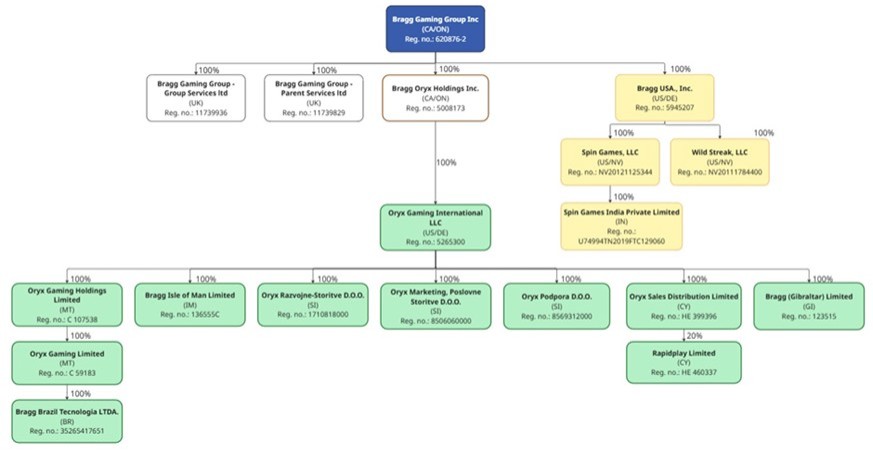
The Company’s principal subsidiary is Oryx, which was incorporated in the State of Delaware and is headquartered in Las Vegas, Nevada. Oryx is wholly-owned by the Company and, together with its subsidiaries, carries on substantially all of the business of the consolidated enterprise. Oryx’s primary operations are provided through its wholly-owned subsidiaries in Cyprus, Malta and Slovenia.
In June 2021, Bragg acquired Wild Streak Games LLC (“Wild Streak”), an interactive gaming (“iGaming”) content studio based in Las Vegas, Nevada with a portfolio of proprietary titles distributed globally, including in regulated markets in the United States and Europe.
5
In June 2022, Bragg acquired Spin Games, LLC (“Spin”), a Reno, Nevada-based iGaming technology supplier and content provider licensed and active in key regulated North American jurisdictions.
In June 2023, Bragg incorporated a new subsidiary, Bragg (Gibraltar) Limited (“Bragg Gib”). Bragg Gib is a Gibraltar-based technology and content provider supplying Bragg proprietary content to key European markets. Since April 2025, Bragg Gib has ceased to be used for the provision of content and services for commercial reasons, without any impact on Bragg’s business operations, which have continued uninterrupted through other entities within the Group. In September 2023, Bragg incorporated a new subsidiary, Bragg Isle of Man Limited (“Bragg IOM”). Bragg IOM is an Isle of Man-based licensed technology and content provider supplying Bragg’s products and services to global operators.
In November 2024, Bragg incorporated a new subsidiary, Bragg Brazil Tecnologia Ltda (“Bragg Brazil”). Bragg Brazil is a Brazilian-based technology and content provider supplying Bragg’s products and services to Brazilian operators.
The following table sets out material inter-corporate relationships (including the percentage equity interest) of the Company and its material subsidiaries as of the date of this AIF:

6
GENERAL DEVELOPMENT OF THE BUSINESS
This section discusses the major events or conditions that have influenced the general development of the Company.
2023
Personnel Changes
On November 10, 2023, the Company announced that then President and Chief Operating Officer, Lara Falzon, would resign effective December 31, 2023.
On August 28, 2023, the Company announced that Matevž Mazij was appointed Chief Executive Officer, effective that day.
Distribution Agreements
On January 30, 2023, the Company launched new content with DraftKings in New Jersey.
On February 6, 2023, the Company signed a content distribution agreement with European operator Betsson.
On February 27, 2023, the Company launched additional new content in New Jersey with Caesar’s Sportsbook & Casino.
On March 1, 2023, the Company increased its presence in Switzerland, launching content with Swiss Casinos and Grand Casino Basel.
On March 6, 2023, the Company continued its new content rollout in New Jersey with launches on ResortsCasino.com and MoheganSunCasino.com.
On July 5, 2023, the Company entered the Georgian iGaming market with Adjarabet, the local market leader.
On July 12, 2023, the Company launched its content with Swiss4Win.ch, the online operation of Casino Lugano in Switzerland. The launch marked the Company’s ninth customer in the territory out of eleven total licensees, with the Company’s Swiss customers now representing an estimated 88% of the online casino market in Switzerland.
On July 26, 2023, the Company entered into new global distribution agreements with 888casino, William Hill and PokerStars, launching in the Eurasian territory of Georgia, and growing its customer base in Switzerland and Spain. The new agreement with PokerStars will expand the reach of Bragg’s content.
On August 8, 2023, the Company entered into a global content distribution agreement with PokerStars, spanning the United Kingdom, Italy, Portugal, Spain, Denmark, Sweden and the Czech Republic, as well as regulated territories in the United States.
On August 16, 2023, the Company rolled out its content in the United Kingdom with Unibet, a brand from multi-national operator Kindred Group. The Company also launched content with online casino operator bet365 in Ontario, Canada. The Company also launched content with Italian online casino operator Snaitech.
On September 5, 2023, the Company obtained a business-to-business (“B2B”) remote gambling license in Gibraltar, home to multiple international online gambling businesses.
On November 2, 2023, the Company launched its new content and remote games server (“RGS”) technology with BetMGM in New Jersey. Through this launch, the Company has extended its existing collaboration with BetMGM, a North American operator. Bragg also provides iGaming content for BetMGM players in Michigan and Pennsylvania.
7
2024
Personnel Changes
On April 5, 2024, the Company announced that then Chief Financial Officer, Ronen Kannor, would resign effective June 3, 2024.
On May 1, 2024, the Company announced that Neil Whyte was appointed Chief Commercial Officer effective May 1, 2024.
On June 3, 2024, the Company announced that Robbie Bressler was appointed interim Chief Financial Officer effective July 1, 2024. On November 14, 2024, the Company announced that Robbie Bressler was appointed Chief Financial Officer, effective from November 12, 2024.
On July 30, 2024, the Company announced that Tommaso Di Chio was appointed Chief Compliance and Legal Officer, effective July 28, 2024.
Financing Arrangement – Secured Note
On April 26, 2024, the Company announced the issuance of a secured promissory note in the principal amount of US$7 million (the “Note”) to certain entities controlled by Doug Fallon, Managing Director of Group Content of the Company and the Founder of Wild Streak. The Note, as extended, matured on September 15, 2025. During the nine months ended September 30, 2025, the Company fully repaid the Note. In connection with the issuance of the Note, the Company received a waiver from Lind Global Fund II LP and The Lind Partners, in connection with the funding agreement entered into in September 2022.
Strategic Review
On March 26, 2024, the Company announced that the Board of Directors (the “Board”) had formed an ad hoc special committee, chaired by independent Board member Don Robertson (the “Special Committee”) to consider and explore strategic alternatives, including the sale of the Company or of its assets, a merger, financing, further acquisitions, or other strategic alternatives.
On November 14, 2024, the Company announced that the Board unanimously decided to conclude its review of strategic alternatives. After extensive evaluation and deliberation, the Board determined that the ongoing execution of the Company’s strategic plan is the best way to maximize value for shareholders. The Special Committee, together with its advisors Oakvale Capital LLP and Blake, Cassels & Graydon LLP, evaluated a wide range of strategic alternatives for maximizing shareholder value including a potential sale or merger of the Company. Bragg solicited interest from a significant number of potential counterparties and received multiple non-binding proposals. After careful consideration, the Board, on recommendation from the Special Committee, unanimously determined that none of the proposals received reflect the Company’s intrinsic value or current and projected financial performance, and therefore elected to conclude its review and disband the Special Committee.
Distribution Agreements
On February 22, 2024, the Company announced that it went live with its newest games and remote games server (“RGS”) technology at Golden Nugget Online in Michigan.
On April 22, 2024, the Company entered into an international online casino content distribution agreement with Light & Wonder for the addition of high-performing games from Bragg’s proprietary studios Atomic Slot Lab, Indigo Magic, Wild Streak Gaming and Spin Games to Light & Wonder’s online ecosystem.
On June 14, 2024, the Company announced that it had entered into an agreement with Czech land-based casino operator Kings Entertainment A.S. to launch a full turnkey solution to support the operation of their online business in the Czech Republic under the brand Kingsbet. Under the terms of the agreement, Bragg will, among other things, provide Kingsbet with PAM technology, exclusive
8
content from Bragg studios, aggregated online casino content via the Bragg HUB (as defined herein) content delivery and casino game aggregation platform (the “Bragg HUB”) and a fully localized sportsbook integration in partnership with Altenar.
On June 26, 2024, the Company announced it went live with its newest games and RGS technology with BetMGM in Pennsylvania.
On July 2, 2024, the Company announced that it entered into an agreement with Hard Rock Casino NL in the Dutch market, its sixth PAM software and turnkey operator. The agreement also allows for content aggregation, with Hard Rock Casino NL gaining access to the Bragg HUB which brings together more than 10,000 casino titles, including exclusive games built on the RGS and games from other iGaming suppliers.
On August 20, 2024, the Company announced that it expanded its partnership with Caesars Digital by launching RGS technology in Pennsylvania and Ontario.
Gaming Licenses
On February 27, 2024, the Company obtained a license to supply its technology, content and services in Peru.
On February 20, 2024, the Company obtained an approval from the Isle of Man Gambling Supervision Commission to supply its technology, content, and services to the operations of gaming operators serving global markets.
On June 17, 2024, the Company obtained an approval from the Delaware State Lottery to supply its technology, content and services in Delaware.
On December 5, 2024, the Company obtained an approval from the West Virginia Lottery to supply its technology, content and services in West Virginia.
2025
Personnel Changes
On April 30, 2025, the Company announced that Holly Gagnon was appointed Chair of the Board of Directors. Matevž Mazij continued in his roles as Chief Executive Officer and as a member of the Board.
Financing Arrangements
On April 25, 2025, the Company announced it had agreed with certain entities controlled by Doug Fallon to repay US$5 million of the Note and to extend the maturity of the remaining US$2 million to June 6, 2025.
On June 6, 2025, the Company announced it had obtained requisite approvals from a Tier One Canadian financial institution for a senior secured revolving credit facility of up to US$6 million, to be available following repayment of the remaining US$2 million under the Note.
In June and July, 2025, the Company announced further extensions of the Note maturity and indicated continued progress toward securing the US$6 million senior secured revolving credit facility.
On September 12, 2025, the Company announced that it had repaid in full the outstanding Note and entered into a new financing agreement with a Tier One Canadian financial institution, pursuant to which such Tier One Canadian financial institution has made available to the Company certain credit facilities in a maximum aggregate amount of up to US$6.0 million to support its ongoing working capital and general corporate requirements.
9
Licensing Agreements
On January 14, 2025, the Company announced a content and technology partnership with Caesars Entertainment for the United States and Canada markets, including an exclusive game development collaboration and a technology licensing framework relating to the Company’s Remote Gaming Server technology and certain other platform solutions.
On February 20, 2025, the Company announced that it had entered into an online casino content agreement with Canadian operator Loto-Québec. Pursuant to the agreement, Loto-Québec will benefit from access to exclusive content, including titles from the Company’s in-house proprietary content development studios.
On April 10, 2025, the Company announced that it had acquired a strategic equity stake in RapidPlay and entered into an exclusive content partnership and exclusive commercial distribution arrangement with that studio in connection with the Brazilian market.
On June 11, 2025, the Company announced that it had entered into a content development agreement with Hard Rock Digital to develop exclusive online casino game titles for Hard Rock Bet Casino.
Distribution Agreements and Market Launches
On January 7, 2025, the Company announced that it had gone live as a supplier of proprietary and aggregated online casino content in Brazil’s newly regulated iGaming market, initially with approximately one-third of licensed operators including Superbet, KTO, Betano, Novibet, Sportingbet and Betboo.
On May 27, 2025, the Company launched “Big Ticket Bonanza”, a new gamification-led campaign tool within its Fuze™ player engagement toolset, with an initial roll-out at Senator Group in Croatia and availability to the Company’s content, aggregation and PAM partners.
On June 11, 2025, the Company signed a content development agreement with Hard Rock Digital to develop a series of exclusive online casino game titles for Hard Rock Bet Casino, with an initial launch in New Jersey.
On July 2, 2025, the Company launched its newest games and remote gaming server technology with Fanatics Casino across New Jersey, Michigan and Pennsylvania.
On September 29, 2025, the Company entered into a global strategic partnership with 7777 gaming to integrate the studio’s portfolio of more than 200 certified games (including slots, instant wins and innovative mechanics) into the Bragg HUB content delivery platform for distribution across multiple regulated markets worldwide.
On October 1, 2025, the Company launched exclusive and bespoke online casino content with Caesars Entertainment in West Virginia, the Company’s sixth U.S. iGaming state.
On December 3, 2025, the Company entered into a content distribution agreement with the Brazino777 network to supply exclusive online casino content across regulated Latin American markets, including Mexico and Brazil.
On December 10, 2025, the Company entered into a global agreement extension with 711 Group and the launch of the 711.be brand in Belgium, expanding the Company’s turnkey PAM platform, content and Fuze™ player engagement toolset into the Belgian market.
On December 16, 2025, the Company’s proprietary and exclusive content went live on Blaze.com in Brazil, including approximately 80 certified games.
10
New Gaming Licenses
On May 26, 2025, Bragg Gaming Group Inc. obtained an approval as a Gaming Service Provider from the Gaming Policy and Enforcement Branch in British Columbia.
On October 4, 2025, the MGA Critical Gaming Supply Licence of Oryx Gaming Limited was renewed and extended for another 10 years.
On October 23, 2025, Bragg Gaming Group Inc. obtained the Connecticut Online Gaming Service Provider license.
Other Events
On August 17, 2025, the Company announced a cybersecurity incident affecting its internal computer environment; which on September 12, 2025, the Company announced was resolved. Immediately following detection, the Company took appropriate steps to mitigate any potential impact of the breach, including consulting independent cybersecurity experts and following industry best practices to resolve the incident. The Company applied the knowledge gathered from the investigation of the event to enhance its cyber security defenses. There was no indication personal information was affected and operations and financial performance were not negatively impacted. The Company has also provided assurances to its customers regarding the security of its game titles.
Recent Updates
On January 6, 2026, the Company announced a strategic partnership with Golden Whale Productions to accelerate its artificial intelligence (“AI”) transformation, integrating Golden Whale’s machine-learning models into Bragg’s PAM platform to enable predictive, hyper-personalized player engagement across the Company’s regulated markets.
On January 8, 2026, the Company announced a strategic restructuring intended to improve operating performance, including a reduction of approximately 12% of its global workforce, expected restructuring charges of approximately €1.0 million in the first quarter of 2026, and anticipated annualized cash savings of approximately €4.5 million.
On January 9, 2026, the Company announced that it extended its previously extended agreement with Entain Plc to supply Entain Plc’s Dutch iGaming operator, BetCity.nl, with the Company’s player account management (“PAM”) platform until May 31, 2026. BetCity.nl will continue to utilize Bragg’s content and product delivery services on an exclusive basis for the duration of the extended PAM agreement, allowing Bragg to provide its proprietary, exclusive, and aggregated casino content as well as the delivery of sports betting products to customers of the Dutch market operator. In addition, Bragg will integrate with several new iGaming suppliers to further enhance the localized content portfolio the Company provides to the market in the Netherlands.
On February 27, 2026, the Company facilitated an executive block trade pursuant to a limited blackout waiver, permitting Chief Executive Officer Matevž Mazij to sell 1,039,000 Common Shares at C$2.00 per share to a single purchaser under a six-month lock-up and non-disclosure agreement. Following the sale, Matevž Mazij (together with his holding company) held approximately 13.55% of the issued and outstanding Common Shares, down from 17.70%.
On March 3, 2026, the Company appointed Morten Tonnesen as Chief Operating Officer and promoted Garrick Morris to Executive Vice President, Global Content, U.S. & Canada, to support the Company’s content-led growth strategy and its AI-driven operating model.
On March 19, 2026, the Company announced the appointment of Thomas Winter to its Board, who succeeded Kent Young, who retired from the Board.
11
General
Bragg Gaming Group is an iGaming content and platform technology solutions provider serving both online and land-based gaming operators with proprietary and exclusive casino content as well as cutting-edge Player Account Management (PAM) technology. The Company operates in a dynamic global market characterized by rapid regulatory evolution, technological innovation, and shifting consumer preferences. Bragg Studios develop high-performing, data-driven casino game titles through its in-house brands, including Wild Streak Gaming, Atomic Slot Lab and Indigo Magic. This proprietary content portfolio is complemented by exclusive titles from carefully selected studio partners under the Powered By Bragg program. Games built on Bragg’s Remote Gaming Server (RGS) technology are distributed exclusively to Bragg customers via the Bragg HUB content delivery platform.
Bragg’s powerful, modular PAM technology powers multiple leading iCasino and sportsbook brands and is supported by expert in-house managed operational and marketing services. Content delivered via the Bragg HUB (either exclusively or from the aggregated games portfolio) is managed from a single back-office supported by a cutting-edge data platform and the Company’s award-winning Fuze™ player engagement toolset. Collectively, Bragg’s content, technology and services comprise a complete turnkey solution. As of early 2026, the Company is licensed, certified or otherwise approved and operational in 38 regulated iCasino markets globally, with a strong footprint across North America, Europe and LATAM.
Strategic Progress
Bragg’s goal as a business is to be a profitable and successful provider of iGaming content and technology solutions. This objective is achieved by positioning the Company as a leading provider, developer and licensor of iGaming services, technology and casino games content for the iGaming industry.
In 2025 the Company advanced this strategy through a number of targeted initiatives. It implemented a change to a regional structure designed to place greater emphasis and focus on the core markets that drive the business. North America and LATAM were identified and actively pursued as the primary new and emerging growth markets for Bragg during the year. The Company worked to accelerate proprietary content growth in order to deliver higher margins, particularly in the U.S. markets, while continuing to harness the potential of its distribution network by expanding exclusive and aggregated content delivery across its established customer base and onboarding additional leading operators in these high-growth regions. These actions, underpinned by the Company’s large content delivery network, strategic partnerships and ongoing innovation, enabled Bragg to capture a greater share of the expanding regulated iGaming markets while driving sustainable revenue and margin improvement. Bragg is continuously focused on progressing in the following key strategic business areas:
The rollout of Bragg’s content portfolio in the United States
Throughout 2025, the Company continued to roll out its latest portfolio of exclusive online casino games, delivered via its newest RGS technology, in the largest regulated iGaming jurisdictions in the United States.
In the first quarter of 2025 Bragg expanded its existing Powered by Bragg programme in the United States market with the addition of 4 Leaf Gaming King Show Games, Las Vegas-based studios which have established brand recognition in the market through their long-standing land-based and online gaming presence. The Company also launched its games and RGS technology with additional partners in the United States and expanded its market coverage into Delaware and West Virginia. As a result, Bragg operates in 6 of the 7 regulated states in the United States.
During 2025 and into the first quarter of 2026, Bragg expanded its partnership with Caesars Entertainment by concluding a technology platform and exclusive games development partnership for the United States and Canada. The enhanced partnership includes a strategic technology licensing framework for Caesars to licence Bragg’s RGS, as well as options to licence the Bragg HUB product delivery and casino game aggregation platform and Bragg’s Fuze™ player engagement platform.
12
The Company also built on its bespoke content strategy by developing a series of bespoke games for key customers in the United States. Q1 2026 has seen the Company receive multiple requests for additional bespoke content from FanDuel, BetMGM, Hard Rock, and Bet365. This is an area that Bragg will continue to focus on during the course of 2026.
Entry into regulated Brazilian Market
Bragg Gaming Group entered Brazil’s newly regulated iGaming market immediately following the market launch on January 1, 2025. On January 7, 2025, the Company announced that its proprietary, exclusive and aggregated casino content, delivered through the Bragg HUB platform, together with its Fuze™ player engagement tools, was live with approximately one-third of licensed online casino operators in Brazil. Early partners included Superbet, KTO, Betano and Novibet. Supported by a dedicated local team providing fully localized service, the Company launched titles including Almighty Pegasus and ThunderBlitz, positioning itself strongly in a market with significant projected growth.
Building on this initial launch, the Company expanded its presence in Brazil throughout 2025 through targeted strategic initiatives and deeper market integration. In April 2025, the Company acquired an equity interest in RapidPlay, a Brazilian game development studio, together with exclusive distribution rights to RapidPlay’s localized content portfolio, enhancing the Company’s offering of culturally relevant content tailored to Brazilian players. This partnership complemented the Company’s mobile-first strategy, football-themed promotional activity and data-driven personalization capabilities. By the second quarter of 2025, the Company was on track to reach more than half of the licensed operators in the Brazilian market. Additional launches during the year, including with Blaze, Entain and Aposta Ganha, further expanded the Company’s footprint and accelerated onboarding of operators.
The Company’s strategy in Brazil contributed meaningfully to its growth in 2025. Through a combination of proprietary and exclusive content, local partnerships, advanced technology and rapid market penetration, the Company strengthened its geographic diversification, increased higher-margin revenue opportunities and expanded operator relationships. As the Brazilian iGaming sector continues to develop, the Company believes its early market entry, localized expertise and strategic execution position it well for continued growth in Latin America.
Continued expansion in other markets
In 2025, Bragg continued to advance its strategic objective of geographic expansion and revenue diversification, ensuring its suite of online casino content and technology solutions is available in more than 30 regulated iGaming jurisdictions globally. The Company’s year-over-year revenue growth was primarily driven by the onboarding of new customers across various jurisdictions, development work with partners, and strong performance from its existing U.S. customer base.
Proprietary Bragg Studios content development
Throughout 2025, Bragg continued to grow and expand its portfolio of proprietary Bragg Studios content, as part of a wider business strategy of generating revenue growth from casino content developed in-house. Proprietary content generates a higher gross profit margin for Bragg when compared to third-party content, due to the fact that no royalties are payable to third party studio owners.
Bragg’s proprietary studios released 44 new content titles globally during the full year 2025, compared to 37 in 2024. In line with Bragg’s strategy of driving high-margin revenue through proprietary content, the Company has become more localized in its content development approach and has placed greater focus on core regulated markets where it maintains dominant distribution, including the Netherlands, United Kingdom, United States, Brazil, and Greece. A significant number of these new proprietary titles were launched across multiple regulated U.S. iGaming states, including major roll-outs with Fanatics Casino in New Jersey, Michigan and Pennsylvania, the expansion of exclusive and bespoke content with Caesars Entertainment into West Virginia (the Company’s sixth U.S. state), as well as continued delivery of exclusive titles developed for Hard Rock Bet Casino.
13
Exclusive portfolio expansion via Powered by Bragg content partners
Bragg has continued to expand its games portfolio from partner studios offered exclusively by Bragg to its customers throughout 2025. Online casino titles, which have been built on the Bragg RGS and distributed on an exclusive basis by the Company, increase the number of in-demand games titles offered to customers. In addition, exclusive games from third-party partners allow Bragg to offer highly localized game portfolios, such as through the offering of exclusive online titles in the North American market from casino brands with established land-based footprints like King Show Games and Bluberi.
Bragg continued its expansion of its games portfolio from partner studios offered exclusively from Bragg to its customers throughout 2025. Online casino titles, which have been built on the Bragg RGS and distributed on an exclusive basis by the Company, increase the number of in-demand games titles offered to customers. Additionally, exclusive games from third-party partners allow Bragg to offer highly localized game portfolios tailored to specific regulatory requirements and player preferences in its core markets.
Bragg released significantly more new global titles from partners during 2025 (73, compared to 40 in the full year 2024), an increase driven by the onboarding of new partners and the expanded delivery of localized content into key regulated markets such as the United Kingdom, United States, Brazil and Europe. In general, the Company aims to keep a balanced portfolio with approximately half of released titles coming from the higher margin, in-house studios, and half coming from carefully selected partner studios which enrich and diversify the Company’s exclusive games portfolio.
PAM & full product suite
In 2025, the Company continued to enhance its PAM and full turnkey offering through product development and platform innovation. During the year, the Company introduced a new Bonus System and a new CMS solution, Web Factory, further strengthening the functionality and flexibility of its turnkey platform. The Company also advanced the use of artificial intelligence across its product suite to support improved automation, personalization and operational efficiency. Together, these enhancements reinforced the Company’s integrated offering of PAM, content, Fuze™ player engagement and sportsbook solutions in regulated markets.
In the second quarter of 2024, Bragg added its second PAM customer in the Czech Republic, providing full turnkey solutions, iGaming content, PAM and its Fuze™ marketing toolset with Kingsbet.cz as well as sportsbook technology via Altenar. Bragg continues to be a leading PAM supplier, according to management estimates, in the Netherlands, launching with a sixth PAM customer, HardRockCasino.nl, during 3Q24.
In 2025, the Company also launched the sports betting vertical with three existing PAM customers in the Netherlands, launching sportsbook solutions with BetNation.nl, ComeOn.nl and 711.nl. Bragg also onboarded Kero Sports suite of micro betting options onto its sportsbook offering, providing both new and existing sportsbook partners with an engaging range of betting options for players.
Operating Segment
The majority of the Company’s revenue is derived from a single operating segment: B2B online gaming, and as of December 31, 2025, it derived 84.0% of its revenue from its games and content services, with the remainder of its revenue coming from iGaming platform and Turnkey solutions. The Company’s customer base consists of online and land-based gaming operators. The principal products and services provided by the Company are the licensing of its iGaming technology, games and content, and managed services. For the year ended December 31, 2025, the Company’s operating revenue is geographically based in Europe, North America and LatAm. This segmentation is not correlated to the geographical location of the Company’s worldwide end-user base.
Products and Services
The Company offers a full range of games including slot games, table games, card games, video bingo, scratch card games, virtual sports and live dealer games. These games are featured on the PAM, as standalone through our HUB solution and are also available for use on other gaming platforms offered by third parties.
14
PAM Platform Licensing & full product suite
The Company offers a multi-channel and cross-product PAM that enables operators to manage their entire product suite using one shared account and one wallet for casino, lottery, sportsbook, and other operations. The PAM allows operators to maximize cross-sale opportunities and increase player value by using the fully-integrated set of tools and solutions to manage users, transactions, campaigns, reporting, and analytics. The PAM features games from proprietary studios and content developed by third parties. The PAM offers a full payment solution integrated with a large number of payment solution providers covering local and global markets; and it also includes a player risk profile level and an advanced rule engine for customization.
Through a single account across all products and channels, operators get a complete overview and history of customer activities, transactions, balance, and personal data. This enables a personalized approach in communication with players and tailor-made offers. The platform also offers player protection features such as deposit limits, play-time limits, loss limits, and reality checks to allow operators to encourage responsible gaming.
The PAM has an integrated chat function which enables quick access to customer data and enables operators to provide strong customer support as well as up-selling and cross-selling opportunities. The platform also has bonus and wagering management, whereby the platform can enable automatically triggered bonuses for deposits and signup promotions, manual bonuses given to players by customer support, bonus code and many other flexible bonus configurations. In addition, the platform provides for loyalty management wherein operators can set different levels for different game limits, transaction limits, bonuses, levels of service and predefined deposit amounts. The platform also allows for dynamic campaign management whereby operators can create automated or bespoke campaigns to maximize cross-selling opportunities to increase player value.
The PAM has a sophisticated business intelligence tool which can create insightful dashboards and reports on customer behavior, financial transactions, gaming income, bets, and detailed statistics of gameplay, all with flexible filtering and grouping options, as well as campaign performance reporting. The PAM contains an affiliate management system and portal to enable operators to build productive relationships with affiliates using redirect or download links, coupon codes, and real-time earning and payment reporting. Further, the PAM provides for an integrated land-based, self-serve, betting system with support for anonymous play (cash and cashless play support), and account play (registration, login, deposit, and fund transfers). Development and maintenance of the PAM is completed in-house by employees and contractors of the Company and its subsidiaries.
Turnkey and Managed Services
The Company offers a complete solution for its PAM customers where it can manage an operator’s customers and marketing communications. The operational managed services assist with hosting and security, know-your-client requirements, payment and transaction management, customer support, and risk and fraud management. The Company’s marketing managed services address retention and conversion marketing programs, VIP marketing and management and provide a personalized approach to players. These services are based on player data and correspondence history and aim to create a strong relationship and customer loyalty. The Company’s analytics and business intelligence services aggregate, manage and utilize significant amounts of data and prepare periodic and per-request reports and insights.
Proprietary Bragg Studios Games and Content
The Company offers proprietary, exclusive, and third-party gaming content, all delivered through a single integrated platform and supported by data platform functionality and its FUZE™ player engagement toolset. The Company has five proprietary studios, two located in Europe and the other three in the United States, with a combined portfolio of over 162 casino gaming titles as of December 31, 2025.
The Company also holds exclusive content distribution rights through partnerships with selected third-party studios. These studios offer differentiated and localized content that is not available elsewhere in specific markets. The Company has such arrangements with several third-party studios including Gamomat, Kalamba Games, Bluberi, Free Slots of Las Vegas, Gaming Arts, King Show Games,
15
Sega Sammy Creation, Incredible Technologies, 4 Leaf Gaming, Boomerang, Reflex and Galaxy Gaming, with over 350 Bragg-exclusive games from third-party partner studios live at the end of 2025.
To meet the needs of the market, the Company’s casino game aggregator is integrated with and distributes non-exclusive games from additional third-party studios including leading brands such as Evolution, Playtech and Play’N Go. Content is constantly updated on this platform, with new games added and obsolete titles removed on a regular basis. During 2025, the Company added 4,480 new third-party game titles to its portfolio (approximately 1,000+ titles per quarter) and onboarded 19 new third-party studios. As at 31 December 2025, the platform hosted a total of 14,300 live game titles from 86 third-party studios.
Locations
Bragg is licensed, certified or otherwise compliant to offer online casino content in 38 jurisdictions globally.
Bragg’s four key markets, covering 11 jurisdictions, are:
| 1. | The United States, where the Company is licensed and operational in Connecticut, Delaware, Michigan, New Jersey, Pennsylvania, and West Virginia. |
| 2. | Brazil, where the Company is certified to offer online casino content. |
| 3. | The Netherlands, where the Company is certified to offer online casino content and its player account management (PAM) iGaming platform technology. |
| 4. | Canada, where the Company is licensed and operational in Ontario, is compliant and operational in Québec, and has a license in British Columbia. |
The Company is also licensed, certified or otherwise compliant and operational in 15 further core jurisdictions:
| ● | in Europe in Belgium, Croatia, Czech Republic, Germany, Greece, Italy, Portugal, Romania, Serbia, Spain, Sweden, Switzerland and the United Kingdom. |
| ● | in LatAm, Mexico and Peru. |
Additionally, Bragg holds licenses, certificates or is otherwise compliant in 12 further jurisdictions in North America (including the Caribbean), Europe, LatAm and Africa.
Customers
The Company’s customer base includes leading business-to-consumer (“B2C”) operators in the online casino industry such as Caesars, BetMGM, Entain, Gamesys, Betsson, Superbet, ComeOn, LeoVegas, DraftKings, Golden Nugget, Hard Rock, Betano, Loto-Québec and Penn National Gaming, among others.
Revenue
The Company derives its revenue from operators using its platforms and proprietary and third-party content, whereby it earns a percentage of the gross gaming revenue generated by the operators. As such, the success of Bragg is tied to the performance of its operators. For the year ended December 31, 2025, 57.7% of revenue was derived from 10 clients, compared to 58.1% for the year ended December 31, 2024.
The Company’s revenue for the year ended December 31, 2025, increased from the same period in the previous year by 4.0% to €106.1 million (2024: €102.0 million) continuing yearly growth since fiscal year 2022. The Company’s positive year-over-year revenue growth was derived mainly from the onboarding of new customers in various jurisdictions, development work with our partners and a strong revenue performance from its proprietary casino games studio and existing U.S. customer base.
16
Other financial information
Gross profit increased compared to the previous year by 7.9% to €58.3 million (2024: €54.0 million) with gross margins also increased by 2.0% to 55.0% (2024: 53.0%). The gross profit and gross profit margin increases are mainly as a result of the shift in the product mix towards proprietary products.
The Company’s Adjusted EBITDA increased from the previous year by 4.8% to €16.6 million (2024: €15.8 million). Total operating loss for the year amounted to €5.3 million (2024: loss of €3.5 million), an increase in loss of €1.8 million as a result of an increase in selling, general and administrative expenses of €6.1 million, partially offset by an increase in gross profit of €4.3 million. For information on the most directly comparable IFRS measures, composition of the measures and applicable reconciliations refer to the “Other Financial Information” section of our MD&A.
Operations
Oryx Gaming Limited (Malta) (“OGL”) is a wholly-owned subsidiary of Oryx, and holds its gaming supply license, being its Maltese B2B license (“Critical Gaming Supply License”) to supply ‘Type 1’ games (casino-games), which is regulated by the Malta Gaming Authority (“MGA”), and its “class 2” Romanian license (“Class 2 License”), which is regulated by the Romanian Gaming Authority. In addition, OGL is licensed by the UK Gambling Commission to manufacture, supply, install, or adapt gambling software and to provide facilities for casino gaming via remote communication in the UK. OGL also holds a Category A1 Manufacturer’s License issued by the Hellenic Gambling Commission (“HGC”), which authorizes it to develop, supply, and support gaming products and services for licensed operators in Greece. OGL further holds a Class E license issued by the Belgian Gaming Commission, allowing it to provide services related to the operation of games of chance in Belgium. It has a permission issued by the Swedish Gaming Authority, allowing it to manufacture, supply, install, and modify gambling software used in online gambling in Sweden. Furthermore, OGL has a permission issued by the Peruvian Ministry of Commerce and Tourism, authorizing it to license and supply proprietary and third-party gambling software products in Peru.
Through these licenses, OGL serves as a key provider of gaming technology and services across multiple regulated markets. OGL generates revenue for Oryx by being the main arm through which it uses its gaming approvals to license and/or supply proprietary and third-party gambling software products.
Oryx Sales Distribution Limited (Cyprus)
Oryx Sales Distribution Limited (Cyprus) (“OSD”), is a wholly-owned subsidiary of Oryx, and is a sales and distribution company for the license and/or supply of proprietary and third-party gambling software products to operators in non-regulated markets. OSD holds no gambling license as this is not required for its operations. The purpose of OSD is the distribution and sale of gaming software and content to markets that are not regulated by the MGA. The regulatory framework of the MGA does not permit MGA licensees to provide services to businesses that do not hold a valid MGA license. The Company incorporated the OSD subsidiary to provide non-regulated services. OSD is managed in a similar fashion to OGL, since both subsidiaries provide many of the same services. OGL, however, sells gaming software and content to MGA licensees, while OSD sells gaming software and content to non-MGA licensees. OSD is unregulated, requires and retains no licensees or certificates, has no physical office space, and retains no employees. Oryx retains a corporate services firm in Cyprus that provides resident directors, as Cyprus has director residency requirements, and houses the minute book and constituting documents of OSD. The nominee director of OSD can be removed or replaced by Oryx, the legal and beneficial owner of all of the issued and outstanding shares of OSD.
ORYX razvojne storitve d.o.o. (Slovenia)
ORYX razvojne storitve d.o.o. (“ORS”) is a wholly-owned subsidiary of Oryx, and its principal function is as the development arm of the Company. ORS develops and implements gambling software products for Oryx and other subsidiaries for further licensing and/or supply to operators. ORS holds no gambling license as this is not required for its operations. ORS is licensed by the UK Gambling
17
Commission to manufacture, supply, install, or adapt gambling software and has a permission issued by the Swedish Gaming Authority, allowing it to manufacture, supply, install, and modify gambling software used in online gambling in Sweden.
ORS holds, together with OGL, the ISO/IEC 27001 2022 certificate. The ISO/IEC 27001 is an international standard on how to manage information security. The standard was originally published jointly by the International Organization for Standardization (ISO) and the International Electrotechnical Commission (IEC) in 2005 and then revised in 2013 and 2022. It details requirements for establishing, implementing, maintaining and continually improving an information security management system (ISMS) – the aim of which is to help organizations make the information assets they hold more secure. A European update of the standard was published in 2017. Organizations that meet the standard’s requirements can choose to be certified by an accredited certification body following successful completion of an audit.
The ISO/IEC 27001 certificate is widely known, providing requirements for an ISMS, though there are more than a dozen standards in the ISO/IEC 27000 family. Using them enables organizations of any kind to manage the security of assets such as financial information, intellectual property, employee details or information entrusted by third parties.
Wild Streak Games LLC
Wild Streak is a subsidiary of Bragg USA Inc. and is a Nevada-based content creation studio that focuses on the design and creation of premium and custom-slot content for global online real money gaming and land based operators. Wild Streak generates revenue by contracting with leading operators for games royalties. In addition, Wild Streak contracts with land based operators for development work for design of content and a fee for its deployment in the land based casinos.
Spin Games, LLC
Spin is a subsidiary of Bragg USA Inc. and is a Nevada-based B2B content and distribution company. Spin builds a wide range of casino games focused on the United States market, including popular ‘stepper’ slots, keno and table games. Spin delivers comprehensive iGaming experience to its customers with its interactive technology and customized content.
Development
With respect to development, the Company develops some of its own products and subcontracts out certain development activities. Software development know-how and expertise for online gambling are contained within the Company. The main input in the development of its products is human capital in the form of employees or contractors. Bragg’s proprietary technology includes its PAM, an omni-channel platform enabling the operation of casino, sports betting and lottery businesses, plus a fully owned RGS, its Bragg HUB content delivery and aggregation platform, data platform and its FUZE™ player engagement promotional toolset. In addition, the Company houses five proprietary online casino game studios:
| 1. | Wild Streak Gaming is the Company’s established slots studio based in Las Vegas, Nevada, which develops slots for both online and land-based casinos in North America and in Europe |
18
All intellectual property is owned by the Company, while physical assets for software development are owned by the Company’s subsidiaries.
Real Property
The Company holds no real property or mortgages. The Company leases office space in Slovenia, the United Kingdom, the United States and India.
Employees
As of December 31, 2025, the Company had a total workforce of 534, including employees, contractors and sub-contractors (December 31, 2024: 502), across Europe, North America and India.
Bragg is a gaming solutions provider selling to gaming operators in North America, including in the United States and Canada, in LatAM, including Brazil, Mexico and Peru, and in Europe, including in Belgium, Croatia, Czech Republic, Germany, Greece, Italy, Portugal, Romania, Serbia, Spain, Sweden, Switzerland and the United Kingdom. While historically a large portion of revenue derived from the Dutch facing operations in fiscal year 2025, the Company has seen growth in other markets, such as the United States and Brazil which demonstrates the Company’s ability to continually diversify and reduce its exposure to any single country. The Company intends to maintain its position by providing compliant, localized, and unique solutions, highly adaptable to regulatory requirements and third-party integrations. See “Risk Factors – Risks Factors Related to the Company” for related risks including with respect to operating in different jurisdictions.
Competition
The online gaming market is growing rapidly and is extremely competitive. Bragg provides content for operators targeting North America, including in the United States and Canada, in LatAm, including Brazil, Mexico and Peru, and in Europe, including in Belgium, Croatia, Czech Republic, Germany, Greece, Italy, Portugal, Romania, Serbia, Spain, Sweden, Switzerland and the United Kingdom.
The Company’s major competitors in its market are:
| ● | EveryMatrix Software Limited |
| ● | Relax Gaming Limited |
| ● | Playtech Plc |
| ● | Light & Wonder Inc. |
| ● | Gaming Innovation Group |
| ● | Games Global Pragmatic Solutions MT Limited |
| ● | International Game Technology Plc |
| ● | Evolution Gaming Group |
Management believes that, while most customers have the option of internalizing their content development, it is not likely to happen given the specialized skills required to develop content and the need of operators to supply end-users with a large variety of games.
19
The Company licenses software that is copyright protected in favour of the software provider. In addition, the Company knowledge base is considered a trade secret and it imposes non-disclosure agreements on any party it transacts with. The Company has trademarks registered in various jurisdictions globally.
Licenses & Operational Jurisdictions
The Company’s B2B services are licensed, certified or otherwise compliant in the following jurisdictions:
20
Bragg holds all necessary supplier gaming licenses and complies with the conditions of these licenses, as well as all local regulations and legislation within its operating jurisdictions. It provides all required certificates with respect to its software and operations, delivering its fully certified products and services approved by either accredited independent testing labs or Gaming Boards/Commissions’ testing labs in each jurisdiction in which it holds a supplier license, in addition to other jurisdictions in which Bragg delivers its products and services (supplier licenses are not offered or required in every jurisdiction).
The following table summarizes relevant information regarding Bragg’s operating licenses:
License Type | Issuing Authority | License Holder | Date Granted | Expiry Date | Jurisdiction |
|---|---|---|---|---|---|
Gaming-Related Supplier - Manufactures | Alcohol and Gaming Commission of Ontario - AGCO | Bragg Gaming Group Inc. | 04-04-2025 | 04-03-2026 (Renewal pending) | Ontario, Canada |
Supplier license | Gaming Board for Bahamas | Bragg Gaming Group Inc. | 02-22-2025 | Expected, 02-21-2026 (Renewal pending) | The Bahamas |
Casino Service Industry Enterprise | New Jersey Division of Gaming Enforcement | Transactional waivers to: Spin Games, LLC, Oryx Gaming International, LLC | 12-01-2025 | 06-01-2026 | New Jersey, USA |
Interactive Gaming Manufacturer License | Pennsylvania Gaming Control Board | Spin Games, LLC | 02-25-2026 | 02-24-2031 | Pennsylvania, USA |
Internet Gaming Supplier License | Michigan Gaming Control Board | Oryx Gaming International, LLC | 08-09-2022 | 08-08-2027 | Michigan, USA |
Internet Gaming Supplier License | Michigan Gaming Control Board | Spin Games, LLC | 08-09-2022 | 08-08-2027 | Michigan, USA |
Online Gaming Service Provider | Connecticut Department of Consumer Protection | Bragg Gaming Group Inc. | 10-23-2025 | 10-22-2028 | Connecticut, USA |
Gaming Vendor License | State of Delaware Lottery | Spin Games, LLC | 06-17-2024 | 06-30-2027 | Delaware, USA |
i-Gaming Supplier License | West Virginia Lottery | Spin Games, LLC | 12-05-2025 | 12-05-2026 | West Virginia, USA |
Combined Remote Operating License | UK Gambling Commission | Oryx Gaming Ltd. | 11-19-2021 | 11-18-2026 | United Kingdom |
Remote Gambling Software | UK Gambling Commission | Oryx Razvojne Storitve d.o.o | 11-19-2021 | 11-18-2026 | United Kingdom |
Critical Gaming Supply license | Malta Gaming Authority | Oryx Gaming Ltd. | 10-04-2025 | 10-04-2035 | Malta |
Category A1 Manufacturer’s License | Hellenic Gambling Commission | Oryx Gaming Ltd. | 08-05-2021 | 08-04-2028 | Greece |
21
License Type | Issuing Authority | License Holder | Date Granted | Expiry Date | Jurisdiction |
|---|---|---|---|---|---|
RO Class 2_Software license RO Class 2_Platform license | The Romanian National Gambling Office | Oryx Gaming Ltd. | 04-27-2018 | 04-27-2028 | Romania |
Class E License | Belgium Gambling Commission | Oryx Gaming Ltd. | 11-16-2022 | 11-15-2032 | Belgium |
Gaming Services Provider | Gaming Policy and Enforcement Branch of British Columbia | Bragg Gaming Group Inc. | 05-26-2025 | 05-25-2029 | British Columbia, Canada |
Game Software License | Swedish Gaming Authority - Spelinspektionen | Oryx Gaming Limited | 07-01-2023 | 06-30-2028 | Sweden |
Game Software License | Swedish Gaming Authority - Spelinspektionen | Oryx Razvojne Storitve d.o.o | 07-01-2023 | 06-30-2028 | Sweden |
Remote Gambling License | Gibraltar Licensing Authority | Bragg (Gibraltar) Limited | 08-21-2023 | 03-31-2025 (Surrendered on this date) | Gibraltar |
OGRA License | Isle of Man Gambling Supervision Commission | Bragg Isle of Man Limited | 02-20-2024 | 02-19-2029 | Isle of Man |
B2B Service Provider | Ministerio de Comercio Exterior y Turismo | Oryx Gaming Ltd | 02-27-2024 | indefinite term | Peru |
Regulatory Environment and Regulatory Compliance
European Regulatory Landscape
All the Company’s European regulated activities are conducted through Bragg and its subsidiaries. Generally, the development, distribution and use of gaming software in the jurisdictions where the Company conducts business are subject to licensing and local regulation. Online casino gambling is generally authorized under local license, with local gaming authorities generating revenue from license fees and taxation. In order to develop and distribute the Company’s software, which is targeted to the gaming operator market, the Company must comply with the applicable regulations of each jurisdiction in which the Company seeks to conduct business activities, which in some circumstances includes the jurisdictions from where the Company’s customers, being operators, derive their revenues.
Most European jurisdictions have enacted legislation that specifically criminalizes the activities conducted by an unlicensed online gambling operator and supplier, and that we believe, it is not susceptible to challenge (e.g., on the basis that the legislation has been enacted in contravention of previously issued advice from the European Commission).
Other European jurisdictions, however, have enacted such legislation that may be susceptible to such a challenge. Moreover, in certain jurisdictions, a gaming operator without a local license who accepts business from players located in those jurisdictions would not necessarily contravene the laws of that jurisdiction (e.g., on the basis that there is a gap in the legislation because it has not been updated to contemplate remote supply of gaming services or it does not apply to extra-territorial gaming operators). In such scenarios, the risk to the Company (as a supplier of software, its technology and services to such an operator) of committing any accessory offenses is tied to whether the B2C operator is committing the underlying offense.
Nearly all of the jurisdictions in which the Company provides its products to B2C operators regulate B2B gaming software developers and distributors, such as the Company. Where B2B licensure is not required, the Company coordinates with B2C customers to deliver products to them in a way so they may comply with their local regulatory commitments. While certain jurisdictions require B2B gaming
22
software companies, such as the Company, to be licensed, the focus, rigor, and licensure process, and ongoing regulation, is significantly more onerous for B2C businesses operating in those jurisdictions.
The Company also takes precautions through common industry contract provisions and the use of a compliance plan to only do business with customers who do not derive revenue from end users located in so-called prohibited jurisdictions. As the Company grows and expands into new markets or as jurisdictions regulate or change regulations for their markets, the Company may require additional gaming licenses and may be required to comply with different regulatory regimes.
Gaming regulations applicable to the Company are generally focused on two areas of the Company’s operations:
In order to maintain the Company’s licenses and registrations (the “Licenses and Registrations”), the Company must submit to regular monitoring of its business by gaming authorities, including regular compliance audits. In some jurisdictions, the Company is required to submit monthly, quarterly and annual reports that detail its business activity, financial matters, compliance processes and product certificates. Certain material events with respect to Bragg, such as key employee, director or officer appointments and dismissals, regulatory actions, share transfers, material transactions and loans, or material litigation must be reported within short timeframes (typically within 5 and 30 days of the event).
The jurisdictions that have granted the Licenses and Registrations have regulations requiring B2B suppliers like the Company to establish internal controls to identify potential business circumstances, companies, and people that could be harmful to the gaming industry and to take appropriate action to avoid or remove themselves from such situations. As a result, the Company must monitor risks and review itself and its customers to avoid involvement in situations where the Company should reasonably know that its activities or the Company’s customers activities are incompatible with its licensing requirements, which includes the ongoing use or offering of the Company’s products in jurisdictions where gambling or interactive gaming is prohibited.
The Company’s compliance plan is a set of comprehensive internal policies and procedures that outline jurisdictional regulatory parameters for certain aspects of the Company’s business operations.
The Company maintains and regularly updates its restricted territories policy that includes the list for jurisdictions where gambling or interactive gaming is prohibited and regulated, which currently includes operating without a license in the United States, Canada, and France, among others. Some jurisdictions prohibit gaming in all or certain forms. In addition, by statute or other operation of law, certain jurisdictions provide a gaming licensee with a right to terminate a contract if a counterparty is determined by the gaming licensee to be unfit for the gaming industry. The Company does not permit its customers to offer its products to end users located in jurisdictions where there are prohibitions that clearly apply to their activities and the business models they have adopted. The Bragg PAM uses third party geo-IP services to reveal the location of the player, based on the IP address through which the player is accessing the platform. Geo-location of the player is checked at the time the player registers on the platform and at every login. The platform enforces geo-blocking procedures based on the identified location of the player and our list of prohibited jurisdictions. The Company also implements IP and RGS blocking based on business risk assessments and to prevent its own product and services to be available in the markets where iGaming is prohibited as well as to follow its own restricted territories policy.
The Company’s B2C customers are required by regulation to have certain protective measures to prevent fraud and money laundering. Therefore, the Company has adopted a fraud management policy and anti-money laundering policy to assist Bragg’s customers,
23
partners and regulators to prevent or identify illegal activity. Measures adopted under such policies include the creation of a dedicated fraud management team to monitor suspected fraudulent activity, the implementation of internal fraud reporting procedures and the use of fraud management software to timely communicate relevant information to other stakeholders. The Company appointed CFT/MLRO officers wherever it holds its B2B license and as per local regulatory requirements. When contracting and integrating directly with licensed casino operators and/or third party content suppliers, the Company performs due diligence following the jurisdictional regulations and as part of the contracting process. If any suspicious activities are detected, the Company reports such activities to the relevant authorities and terminates the contracting process.
The Company, through its various subsidiaries, is licensed, certified or otherwise compliant to offer online casino content in 38 jurisdictions globally.
Bragg’s four key markets, covering 11 jurisdictions, are:
| 1. | The United States, where the Company is licensed and operational in Connecticut, Delaware, Michigan, New Jersey and Pennsylvania, and West Virginia |
| 2. | Brazil, where the Company is certified to offer online casino content |
| 3. | The Netherlands, where the Company is certified to offer online casino content and its player account management (PAM) iGaming platform technology |
| 4. | Canada, where the Company is licensed and operational in Ontario and British Columbia, and compliant and operational in Québec. |
The Company is also licensed, certified or otherwise compliant and operational in 15 further core jurisdictions:
Additionally, Bragg holds licenses, certificates or is otherwise compliant in 13 further jurisdictions in North America (including the Caribbean), Europe, LatAm and Africa.
In these jurisdictions, the Company is either licensed, certified or otherwise compliant and approved to provide its products and services to locally licensed customers.
The Malta Gaming Authority (“MGA”) is the regulatory body that is responsible for the governance of all gaming activities in Malta. The MGA issues licenses for the provision of gaming services (B2C) or the provision of a critical gaming supply (B2B), denoted as types 1-4 depending on the type of gaming service. MGA licenses cover all types of online gambling, from online casino games, games of chance, online sports betting and general games of chance that use a random number generator, to player-to-player games and controlled skill games. Pursuant to the Gaming Act 2018 and corresponding regulatory framework and directives, any person who provides or carries out a gaming service or provides a critical gaming supply from Malta or to any person in Malta, through a Maltese legal entity, must obtain the appropriate license from the MGA. To qualify for a license or recognition notice, an applicant must be a body corporate registered and incorporated in the European Union (“EU”) or the European Economic Area (“EEA”), or a state which is deemed by MGA to offer safeguards largely equivalent to those offered by Maltese law.
License applicants must provide information to MGA for every director and key official of the applicant and for every ultimate beneficial owner with 10% or more ownership of, or controlling interest in, the applicant, including, but not limited to:
24
The MGA may, at its sole discretion, require that all beneficial owners of shares in the applicant’s company provide such information. The MGA does not request this information for publicly traded companies.
B2C operators are required to pay a gaming tax to the Maltese authorities of 5% on the gross gaming revenue generated from Malta. In addition, B2C operators are required to also pay a compliance contribution which varies depending on the type of games offered by the operator. B2B operators are not required to pay any gaming tax or compliance contribution.
A license must be renewed every ten years from the date of issue. The MGA requires that the licensee commence the renewal process at least 60 days from the date of expiry of the license. There is a mandatory compliance audit that has to be carried out by the MGA before the renewal date and successfully passed as a prerequisite to proceed with the renewal.
On June 21, 2023, the Maltese Parliament approved amendments to the Gaming Act through Bill 55, reinforcing Malta’s longstanding public policy of protecting MGA-licensed operators from unfounded legal challenges. The amendments clarify that foreign judgments conflicting with Malta’s gaming framework will not be recognized or enforced if they are deemed contrary to Malta’s public policy. While Bill 55 remains in effect, its alignment with broader EU legal frameworks is under scrutiny. The European Court of Justice (“ECJ”) has been called upon to assess its compatibility with EU law, particularly in response to concerns raised by certain member states regarding cross-border regulatory enforcement. The pending outcome of these legal proceedings may have implications for the future application of the amendment.
Other Regulatory Regimes and Future Developments
While certain European countries, such as Malta and Isle of Man, have adopted “point-of-supply” regimes which generally permit their licensees to accept wagers from any jurisdiction that does not expressly prohibit the supply of online gaming from outside such jurisdiction, other countries, including for example the United Kingdom, Italy, the Netherlands, Sweden, France, Spain, and Denmark, have implemented, or are in the process of implementing, “point-of-consumption” regimes which only permit the targeting of the domestic market, provided the appropriate local license is obtained and local taxes accounted for (regardless of where the operator’s legal entity is incorporated and their assets, infrastructure and employees may be located). Such licensing regimes can apply onerous compliance requirements and/or introduce product restrictions or advertising restrictions that could have an adverse effect on Bragg’s operations (and correspondingly on its financial performance) were it to obtain and maintain such licenses.
In the Netherlands, B2C operators can only target the Dutch market if they have obtained a license by the Dutch regulator. For B2B gaming offering, no license is required. However, the B2B supply of remote gambling solutions to unlicensed operators, constitutes a violation under Dutch law.
Other European territories maintain limited licensing regimes that protect monopoly providers and, in certain jurisdictions, have combined this with an attempt to prohibit or otherwise restrict all other supplies into the territory. Restrictive approaches to the regulation of remote online gambling may yet be deemed to be in potential conflict (in any specific jurisdiction) with the Treaty for the Functioning of the European Union (“TFEU”) treaty laws (governing the free movement of trade and services throughout the EU) and case law rendered by the European Court of Justice (“ECJ”).
A challenge to the validity of any EU jurisdiction’s approach to gambling regulation would focus on restrictions on the freedoms of establishment or the freedom to provide services. Restrictions usually take one of a number of forms, including: (i) granting exclusive rights in certain, or all, gambling activities to one or a few providers; (ii) implementing a blanket exclusion of all gambling activities; (iii) prohibiting, on pain of criminal penalties, the pursuit of activities in the betting and gaming sector without a license or police authorization issued by the relevant member state; (iv) limiting the number of licenses available to conduct particular gambling activities; (v) limiting the duration of licenses; (vi) unfair or discriminatory procedures for awarding licenses; and/or (vii) requirement for local establishment.
25
A series of ECJ decisions over the course of the last 15 years or so have given EU member states wide latitude in regulating the online gambling market. However, restrictions imposed by regulations established by a member state must meet four criteria in order to be justified: (i) non- discriminatory; (ii) for the public interest; (iii) suitable (i.e., that it achieves the purposes for which the restriction is introduced); and (iv) necessary (i.e., does not go beyond the intended purposes).
Initiatives of the European Commission over the last 10 years that would harmonize the regulation of online gambling within the EU in line with the TFEU’s stated objective of encouraging a free and open cross-border market have been unsuccessful.
The European Commission has initiated infringement proceedings against various member states for allegedly presiding over legislation and/or regulations that do not comply with the relevant EU member states’ TFEU obligations. However, in 2017, the European Commission withdrew various infringement proceedings against various EU member states on the basis that complaints could be more efficiently handled by national courts. This may encourage certain EU member states (who no longer have infringement proceedings against them) to try to enforce their national legislation. There can be no assurance that the ECJ will continue to apply EU freedom principles to the online gambling industry in the future. Consequently, remote gambling operators need to obtain any requisite local licenses in affected jurisdictions. There is uncertainty as to how jurisdictions regulate remote gambling, including product restrictions, licensing requirements and taxation regimes, any of which could limit or prevent the Company’s customers from being able to supply their services within such territories on profitable terms or at all. While we believe that we are in compliance in all material respects with all applicable iGaming laws, licenses and regulatory requirements, we cannot assure that our activities or the activities of our users will not become the subject of any regulatory or law enforcement, investigation, proceeding or other governmental action or that any such proceeding or action, as the case may be, would not have a material adverse impact on us or our business, financial condition or results of operations. See “Risk Factors”.
United States Regulatory Landscape
Government Regulation
The Company is licensed in the following U.S. states: Connecticut, Michigan, New Jersey, Delaware, West Virginia and Pennsylvania. The Company and certain subsidiaries are subject to various United States laws and regulations that affect its ability to operate in the iGaming industry.
The United States gaming industry (including Bragg iGaming product offerings) is highly regulated and Bragg is required to maintain licenses in each jurisdiction from which it operates in order to continue its operations. The Company’s business is subject to extensive regulation under the laws, rules, and regulations of the jurisdictions in which it operates. These laws, rules, and regulations generally concern the responsibility, financial stability, integrity and character of the owners, managers and persons with material financial interests in the gaming operations, along with the integrity and security of the iGaming product offering. Violations of laws or regulations in one jurisdiction could result in disciplinary action in that and other jurisdictions.
United States gaming laws are generally based upon declarations of public policy designed to protect gaming consumers and the viability and integrity of the gaming industry. Gaming laws may also be designed to protect and maximize state and local tax revenues, as well as to enhance economic development and tourism. To accomplish these public policy goals, gaming laws establish stringent procedures to ensure that participants in the gaming industry meet certain standards of character and responsibility. Among other things, gaming laws require gaming industry participants to:
26
Typically, a state regulatory environment is established by statute and underlying regulations and is administered by one or more regulatory agencies (typically a gaming commission or state lottery) which regulate the affairs of owners, managers and persons with financial interests in gaming operations. Among other things, gaming authorities in the various jurisdictions in which the Company conducts its business:
While the Company believes that it is in compliance in all material respects with all applicable iGaming laws, licenses and regulatory requirements, the Company cannot assure that its activities or the activities of its customers will not become the subject of any regulatory or law enforcement, investigation, proceeding or other governmental action or that any such proceeding or action, as the case may be, would not have a material adverse impact on the Company or its business, financial condition or results of operations. See “Risk Factors”.
Licensing and Suitability Determinations
In order to operate in certain jurisdictions in the United States, the Company must obtain either a temporary or permanent license or determination of suitability from the responsible authorities. The Company seeks to ensure that it obtains all necessary licenses to develop and put forth its offerings in the jurisdictions in which its customers operate and where their end users are located.
Gaming laws require the Company, and each of its subsidiaries engaged in gaming operations, certain of its directors, officers and employees, and in some cases, certain shareholders, to obtain licenses from gaming authorities. Licenses typically require a determination that the applicant qualifies or is suitable to hold the license. Where not mandated by statute, rule or regulation, gaming authorities typically have broad discretion in determining who must apply for a license or finding of suitability and whether an applicant qualifies for licensing or should be deemed suitable to conduct operations within a given jurisdiction. When determining to grant a license to an applicant, gaming authorities generally consider: (i) the financial stability, integrity and responsibility of the applicant (including verification of the applicant’s sources of funding); (ii) the quality and security of the applicant’s online real-money gaming platform, hardware and related software, including the platform’s ability to operate in compliance with local regulation, as applicable; (iii) the applicant’s history; (iv) the applicant’s ability to operate its gaming business in a socially responsible manner; and (v) in certain circumstances, the effect on competition.
Gaming authorities may, subject to certain administrative procedural requirements, (i) deny an application or limit, condition, revoke or suspend any license issued by them; (ii) impose fines, either on a mandatory basis or as a consensual settlement of regulatory action; (iii) demand that named individuals or shareholders be disassociated from a gaming business; and (iv) in serious cases, liaise with local prosecutors to pursue legal action, which may result in civil or criminal penalties.
Events that may trigger revocation of a gaming license or another form of sanction vary by jurisdiction. However, typical events include, among others: (i) conviction in any jurisdiction of certain persons with an interest in, or key personnel of, the licensee of an offense
27
that is punishable by imprisonment or may otherwise cast doubt on such person’s integrity; (ii) failure without reasonable cause to comply with any material term or condition of the gaming license; (iii) declaration of, or otherwise engaging in, certain bankruptcy, insolvency, winding-up or discontinuance activities, or an order or application with respect to the same; (iv) obtaining the gaming license by a materially false or misleading representation or in some other improper way; (v) violation of applicable anti-money laundering or terrorist financing laws or regulations; (vi) failure to meet commitments to users, including social responsibility commitments; (vii) failure to pay in a timely manner all gaming or betting taxes or fees due; or (viii) determination by the gaming authority that there is another material and sufficient reason to revoke or impose another form of sanction upon the licensee.
Gaming authorities generally have the right to investigate not only the Company and its direct and indirect subsidiaries engaged in gaming operations, but also individuals or entities having a material relationship with, or material involvement with, the Company or any of its subsidiaries, to determine whether such individual or entity is suitable as a business associate. Specifically, as part of the Company’s obtaining iGaming licenses, certain of its officers, directors, and employees and in some cases, certain Company’s shareholders (typically, beneficial owners of more than 5% of a company’s outstanding equity, with most jurisdictions providing that “institutional investors” (as defined by a particular jurisdiction) can seek a waiver of these requirements) must file applications with the gaming authorities and may be required to be licensed or to qualify or be found suitable in many jurisdictions. Qualification and suitability determinations generally require the submission of extensive and detailed personal and financial disclosures followed by a thorough investigation. The applicant must pay all the costs of the investigation. Changes with respect to the individuals who occupy licensed positions must be reported to gaming authorities and in addition to the authority to deny an application for licensure, qualification, or a finding of suitability, gaming authorities have jurisdiction to disapprove a change in a corporate position. If any director, officer, employee or significant shareholder is found unsuitable (including due to the failure to submit required documentation) by a gaming authority, the Company may deem it necessary, or be required, to sever its relationship with such person (which may be difficult in the case of a significant shareholder). See “Risk Factors”.
Generally, any person who fails or refuses to apply for a finding of suitability or a license within the prescribed period after being advised that it is required by gaming authorities may be denied a license or found unsuitable, as applicable. Furthermore, the Company may be subject to disciplinary action or its licenses may be in peril if, after it receives notice that a person is unsuitable to be a shareholder or to have any other relationship with the Company or any of our subsidiaries, the Company: (i) pays that person any dividend or interest upon its voting securities; (ii) allows that person to exercise, directly or indirectly, any voting right conferred through securities held by that person; (iii) pays remuneration in any form to that person for services rendered or otherwise; or (iv) fails to pursue all lawful efforts to require such unsuitable person to relinquish their voting securities.
Canadian Regulatory Landscape
General Background
The Company is subject to Canadian gaming and betting law that affects its ability to offer its platform for use within Canada. Canadian gaming and betting law derives from the Criminal Code (Canada) (“Criminal Code”) and gaming legislation in effect in various Canadian provinces. The Criminal Code generally prohibits offering gaming or betting services to the public or producing or selling products related to gaming or betting. However, section 207(1)(h) of the Criminal Code provides certain exemptions from the general prohibitions where the gaming- or betting-related products are being provided by an entity in Canada to anyone in a jurisdiction outside of Canada that uses those products in a lawful manner in that jurisdiction. This exemption allows entities in Canada to create and transmit materials related to gaming and betting, including software, to entities in jurisdictions outside of Canada without contravening the gaming and betting-related prohibitions under the Criminal Code. This provision allows the Company to offer B2B solutions to operators based outside of Canada without contravening the gaming and betting-related prohibitions under the Criminal Code or requiring any gaming or betting-related form of licensing or government authorization from within Canada, provided that the applicable operators use these solutions in a lawful manner in their jurisdiction. See “Risk Factors”.
Additionally, Section 207(1)(a) of the Criminal Code exempts from the federal prohibition on gaming and betting, a lottery scheme operated by the government of a province. Currently such online gaming and betting services are only offered to the public by Canadian provincial governments or their agencies, which conduct and manage gaming and betting offerings within their jurisdictions. Provincial governments or their agencies may engage third-party, private sector operators to provide gaming-related operational
28
services in their jurisdictions for and on behalf of a provincial government or their agencies. As it relates to iGaming, and as further discussed below, Ontario is the only Canadian province that has a provincial regulatory regime that allows for private, third-party operators to secure a registration to offer iGaming services within Ontario on a B2C basis for and on behalf of the Province of Ontario.
British Columbia
British Columbia enacted the Gaming Control Act which authorizes the government of British Columbia, through the British Columbia Lottery Corporation (“BCLC”) to conduct and manage all casino gaming in the province, including owning and operating the province’s only authorized online gambling site. The Gaming Control Act established the Gaming Policy and Enforcement Branch (“GPEB”) as an independent regulator to regulate all gambling in British Columbia, ensure the integrity of gaming industry companies, and investigate wrongdoing. GPEB also has regulatory oversight of BCLC and sets operating standards, policies and procedures for the overall marketplace in the province. Bragg, through its subsidiary Spin, holds a Class B Supplier Registration issued by GPEB, which permits Bragg to supply gaming content to BCLC.
Ontario
Ontario’s online gaming and betting regime allows private, third-party operators to offer gaming services directly to the public as B2C operators or indirectly as B2B suppliers, under the authority iGaming Ontario (“iGO”). The principal regulator in Ontario for all gaming and gambling is the Alcohol and Gaming Commission of Ontario (“AGCO”). In the past, the Ontario Lottery and Gaming Corporation was the sole entity responsible for conducting and managing all gaming activity in and for the province. The province established iGO to conduct and manage the online gaming market in Ontario, including by allowing private operators to secure a registration to lawfully provide their products and services to Ontario residents. The regulated online gaming market went live and open to Ontarians on April 4, 2022. Bragg is registered in Ontario with the AGCO under the category Gaming-Related Supplier – Manufactures, which permits Bragg to supply gaming content to registered operators in Ontario.
Québec
The Société des lotteries du Québec (the Québec Lotteries Corporation, hereinafter “Loto-Québec”), is a public corporation, whose mission is to conduct and manage gaming and to operate businesses which are incidental to the operation of gaming in the province. The principal regulator for gaming and gambling in Québec is the Régie des alcools de courses et des jeux (the “Régie”). The Company has games certified in Québec, which permits the Company to supply gaming content to Loto-Québec.
LatAm Regulatory Landscape
General Background
Latin America’s online gambling market is undergoing a major regulatory shift, with several jurisdictions moving toward structured licensing systems. Countries such as Brazil, Colombia and Peru have already established clear regulatory frameworks, while others are finalizing their policies. This shift represents a departure from previously monopolized or loosely regulated markets, creating new opportunities and challenges for operators.
Argentina
Argentina continues to operate under a decentralized regulatory model, with each province authorized to regulate online gambling independently. The most developed frameworks are found in Buenos Aires Province and Buenos Aires City, where local regulators have aligned operational and advertising criteria aiming to standardize compliance requirements across jurisdictions. Licensing processes remain active, with most major domestic and international operators securing approval through local partnerships. Regulatory enforcement includes blacklisting unauthorized sites and requiring locally hosted platforms. Advertising regulations have also been updated, placing restrictions on content, placement, and target demographics. Taxation varies by province, but most jurisdictions impose a tax on gross gaming revenue, ranging from 10% to 15%, in addition to federal digital services taxes. Despite the
29
fragmented structure, Argentina remains one of the region’s largest online gambling markets, though operators continue to face challenges in navigating multiple regulatory environments simultaneously.
Colombia
Colombia remains a model for regulatory stability in the region. Since its introduction of online gambling licensing in 2016, the country has maintained a well-defined framework that includes ISP blocking of unauthorized operators, rigorous AML and responsible gaming measures, and an effective licensing system under Coljuegos, the national regulator. In 2024, the country introduced advertising restrictions that limit operators’ marketing budgets based on a percentage of their gross gaming revenue, a policy currently being challenged in court. In addition, Colombia has implemented a temporary 19% Value Added Tax (VAT) on online gambling. This measure, which became effective on February 14, 2025, is set to remain in force until December 31, 2026. The tax applies to deposits made by users into online gambling platforms, including payments in cash, bank transfers, or cryptocurrencies. This initiative aims to generate additional revenue to address security challenges in regions like Catatumbo.
Peru
Peru has rapidly emerged as one of the most competitive regulated markets in Latin America. With its licensing framework finalized in 2023, the Ministry of Foreign Commerce and Tourism (Mincetur) has efficiently processed approvals, ensuring operators meet compliance obligations before going live. The speed of licensing issuance has resulted in a highly competitive landscape, with numerous operators securing approvals within a short timeframe. While taxation and regulatory stability remain key concerns, Peru is now positioned as one of the leading markets in the region.
Mexico
Mexico’s regulatory model remains tethered to land-based gambling licenses, where physical casino operators can extend their licenses to online platforms. Recent amendments to Mexico’s federal gambling decree, issued in November 2023, have introduced stricter licensing requirements that limit the expansion of online gambling. The decree reduces the ability of license holders to operate multiple online brands (“skins”) under a single license, a practice that had previously allowed major operators to expand their presence in the market through partnerships. Authorities have signaled an increased focus on responsible gambling, with proposals to tighten restrictions on gambling-related promotions and sponsorships, particularly in relation to sports betting. In addition, discussions are ongoing about potential amendments to tax policies for online gambling operators, which could increase the cost of compliance for license holders. Despite these challenges, Mexico remains one of the largest online gambling markets in Latin America, attracting international operators through local partnerships with licensed land-based casinos.
Paraguay
Paraguay maintains a monopoly-based model for online sports betting, with a single concession granted to a private operator under exclusive rights. Currently, Daruma Sam S.A., which operates the Apostala brand, holds the exclusive license for online sports betting, following a renewal of its concession in January 2023. This monopoly structure has faced increasing criticism from both industry stakeholders and lawmakers, who argue that it limits market competition and reduces consumer choice. In response, Paraguay enacted a new gambling law in December 2024, establishing CONAJZAR as the centralized gambling regulator. While this reform strengthens regulatory oversight, it has not yet altered the existing monopoly model for online sports betting. However, legislative discussions remain active, with a key proposal under review calling for a multi-license system, similar to those seen in Colombia and Peru, where multiple operators could obtain permits through a competitive process. In parallel, Paraguay continues to apply a tethered licensing model for online casino gaming, allowing only land-based casino operators to offer online services. Overall, Paraguay’s regulatory model still favours a tightly controlled, state-sanctioned approach. However, recent legal reforms and growing pressure from stakeholders suggest the country may eventually move toward a more competitive structure.
30
Brazil
Brazil, the largest and most anticipated regulated market in Latin America, officially launched its regulated online gambling market on January 1, 2025, following the passage of Law 14.790/2023. This legislation introduced a federal licensing framework for both sports betting and online casino gaming, marking a significant milestone for the industry. Taxation continues to be a key issue in Brazil’s regulatory landscape. The base GGR tax remains set at 12%, but additional levies, including PIS/COFINS social security taxes and municipal service taxes, have pushed the effective tax rate to between 23% and 26.5%. Discussions within the government continue regarding potential further tax increases, such as the proposed 10% tax on dividends paid to foreign entities, aiming to capture a greater share of gaming profits that flow to international investors. The political debate surrounding gambling addiction concerns, integrity in sports betting, and financial transparency remains ongoing, with potential regulatory changes anticipated throughout 2025. Despite the regulatory and enforcement challenges, Brazil’s market is on track to become one of the largest globally. Initial reports suggest that the market could surpass US$2.9 billion in gross revenue in 2026, with projections doubling by 2028 as more operators enter the sector and consumer adoption of legal platforms increases.
The following are certain factors relating to the business and structure of the Company and the industry within which it operates. These risks and uncertainties are not the only ones facing the Company. Additional risks and uncertainties not presently known to the Company, or that the Company currently deem immaterial, may also impair the operations of the Company. If any such additional risks actually occur, the business, financial condition, liquidity and results of operations of the Company could be materially adversely affected.
Risks Relating to Investment in the Company and in our Common Shares
There is no guarantee that our Common Shares will earn any positive return in the short term or long term.
In general, a holding of our Common Shares is speculative and involves a high degree of risk and should be undertaken only by holders whose financial resources are sufficient to enable them to assume such risks and who have no need for immediate liquidity in their investment. A holding of our Common Shares is appropriate only for holders who have the capacity to absorb a loss of some or all of their holdings.
The market price of our Common Shares may be volatile and subject to wide fluctuations in response to numerous factors, many of which are beyond our control.
The trading price of our Common Shares has been, and is likely to continue to be, volatile, and may be influenced by market conditions and other factors, some of which are beyond our control and cannot be predicted. In recent years, the securities markets in Canada and the United States have experienced a high level of price and volume volatility, and the market prices of securities of many companies have experienced wide fluctuations which have not necessarily been related to the operating performance, underlying asset values or prospects of such companies. As a result, investment in our Common Shares is inherently risky and as a holder, you might not be able to sell your Common Shares at or above the price that you paid for them.
Other factors that may contribute to market price fluctuations of our Common Shares include the following:
| ● | actual or anticipated fluctuations in our quarterly results of operations and/or future prospects; |
| ● | recommendations by securities research analysts; |
| ● | changes in the economic performance or market valuations of companies in the industry in which we operate; |
| ● | addition to or departure of our executive officers, directors and/or other key personnel; |
| ● | sales or perceived sales of additional Common Shares, or securities convertible into Common Shares; |
| ● | operating and financial performance that vary from the expectations of management, securities analysts and investors; |
| ● | regulatory changes affecting our industry generally and our business and operations; |
| ● | announcements of developments and other material events by us or our competitors; |
31
| ● | fluctuations to the costs of vital products or services used by us in our business; |
| ● | changes in global financial markets and global economies and general market conditions, such as interest rates, inflation, or the threat or imposition of new or increased tariffs; |
| ● | significant acquisitions or business combinations, strategic partnerships, joint ventures or capital commitments by or involving us or our competitors; |
| ● | litigation or regulatory action against us; |
| ● | operating and share price performance of other companies that investors deem comparable to us or from a lack of market comparable companies; |
| ● | news reports, investor speculation, social media, chat rooms and other methods of information dissemination concerning trends, concerns, technological or competitive developments, regulatory matters and other related issues in our industry or target markets; |
| ● | the level of short interest in our stock; and |
| ● | current and future global economic, political and social conditions. |
Securities class action litigation has often been brought against companies following periods of volatility in the market price of their securities. We may be the target of similar litigation in the future. Securities litigation could result in substantial costs and damages and divert management’s attention and resources.
Requirements to comply with public company reporting obligations, as well as those of any stock exchange, may strain the Company’s systems and resources and there is no guarantee that the Company will maintain any stock exchange listing.
As a publicly traded company, the Company is subject to the reporting requirements and related rules and regulations of the Canadian provincial securities regulators, as well as the rules of any stock exchange on which the Company’s securities may be listed from time to time. These requirements may place a strain on the Company’s systems and resources. The applicable securities legislation requires that the Company file annual, quarterly and event- driven reports with respect to its business and financial condition and operations and requires that the Company maintain effective disclosure controls and procedures and internal controls over financial reporting. In order to maintain and improve the effectiveness of the Company’s disclosure controls and procedures, significant resources and management oversight is required. The Company has implemented additional procedures and processes for the purpose of addressing the standards and requirements applicable to public companies. These activities may divert management’s attention from other business concerns, which could have a material adverse effect on the Company’s business, financial condition, results of operations and cash flows and the Company cannot assure shareholders that these procedures and processes will be sufficient to allow it to satisfy its obligations as a public company on a timely basis or that the Company will be able to maintain a listing on any stock exchange on which the Company’s securities may be listed from time to time.
The Company incurs increased costs as a result of being a public company in the United States, and the Company’s management will be required to devote substantial time to United States public company compliance efforts.
As a public company in the United States, the Company incurs additional legal, accounting, reporting, and other expenses that the Company would not incur as a public company solely in Canada. The additional demands associated with being a United States public company may disrupt regular operations of the Company’s business by diverting the attention of some of the Company’s senior management team away from revenue-producing activities to additional management and administrative oversight, adversely affecting the Company’s ability to attract and complete business opportunities and increasing the difficulty in both retaining professionals and managing and growing the Company’s business. Any of these effects could harm the Company’s business, results of operations and financial condition.
If our efforts to comply with United States laws, regulations, and standards differ from the activities intended by regulatory or governing bodies, such regulatory bodies or third parties may initiate legal proceedings against the Company and its business may be adversely affected. As a public company in the United States, it is more expensive for the Company to obtain director and officer liability insurance, and the Company will be required to accept reduced coverage or incur substantially higher costs to continue its coverage. These factors could also make it more difficult for the Company to attract and retain qualified directors.
32
As a foreign private issuer, the Company is subject to different United States securities laws and rules than a domestic United States issuer, which may limit the information publicly available to its shareholders.
The Company is a “foreign private issuer”, as such term is defined in Rule 405 under the United States Securities Act of 1933, as amended, and is not subject to the same requirements that are imposed upon United States domestic issuers by the United States Securities and Exchange Commission (“SEC”). Under the United States Securities Exchange Act of 1934, as amended, (the “Exchange Act”), the Company is subject to reporting obligations that, in certain respects, are less detailed and less frequent than those of United States domestic reporting companies. As a result, the Company does not file the same reports that a United States domestic issuer would file with the SEC, although it is required to file or furnish to the SEC the continuous disclosure documents that the Company is required to file in Canada under Canadian securities laws. In addition, the Company’s officers, directors, and significant shareholders are exempt from the reporting and “short swing” profit recovery provisions of Section 16 of the Exchange Act. Therefore, the Company’s shareholders may not know on as timely a basis when its officers, directors, and principal shareholders purchase or sell shares, as the reporting deadlines under the corresponding Canadian insider reporting requirements are longer.
As a foreign private issuer, the Company is currently exempt from the rules and regulations under the Exchange Act related to the furnishing and content of proxy statements. The Company is also exempt from Regulation FD, which prohibits issuers from making selective disclosures of material non-public information. While the Company will comply with the corresponding requirements relating to proxy statements and disclosure of material non-public information under Canadian securities laws, these requirements differ from those under the Exchange Act and Regulation FD and shareholders should not expect to receive the same information at the same time as such information is provided by United States domestic companies. In addition, the Company is not required under the Exchange Act to file annual and quarterly reports with the SEC as promptly as United States domestic companies whose securities are registered under the Exchange Act.
In addition, as a foreign private issuer, the Company has the option to follow certain Canadian corporate governance practices, except to the extent that such laws would be contrary to United States securities laws, and provided that the Company discloses the requirements it is not following and describes the Canadian practices it follows instead. The Company currently relies on this exemption with respect to requirements regarding the quorum for any meeting of its shareholders. The Company may in the future elect to follow home country practices in Canada with regard to other matters. As a result, the Company’s shareholders may not have the same protections afforded to shareholders of United States domestic companies that are subject to all United States corporate governance requirements.
The Company may lose foreign private issuer status in the future, which could result in significant additional costs and expenses. The Company may in the future lose its foreign private issuer status if a majority of the Company’s shares are held in the United States and it fails to meet the additional requirements necessary to avoid loss of foreign private issuer status, such as if: (1) a majority of its directors or executive officers are United States citizens or residents; (2) a majority of its assets are located in the United States; or (3) its business is administered principally in the United States. The regulatory and compliance costs to the Company under securities laws as a United States domestic issuer will be significantly more than the costs incurred as a Canadian foreign private issuer. If the Company were not a foreign private issuer, it would not be eligible to use foreign issuer forms and would be required to file periodic and current reports and registration statements on United States domestic issuer forms with the SEC, which are generally more detailed and extensive than the forms available to a foreign private issuer. In addition, the Company may lose its ability to rely upon exemptions from certain corporate governance requirements on United States stock exchanges that are available to foreign private issuers.
It may be difficult to enforce civil liabilities in Canada under United States securities laws.
The Company was incorporated in Canada, and its corporate headquarters are located in Canada. Some directors and executive officers reside or are based principally in Canada and the substantial portion of the Company’s assets are located outside of the United States. It may be difficult for investors who reside in the United States to effect service of process upon these persons in the United States, or to enforce a United States court judgment predicated upon the civil liability provisions of the United States federal securities laws against the Company or any of these persons. There is substantial doubt whether an action could be brought in Canada in the first instance predicated solely upon United States federal securities laws. Canadian courts may refuse to hear a claim based on an alleged violation of United States securities laws against the Company or these persons on the grounds that Canada is not the most
33
appropriate forum in which to bring such a claim. Even if a Canadian court agrees to hear a claim, it may determine that Canadian law and not United States law is applicable to the claim. If United States law is found to be applicable, the content of applicable United States law must be proved as a fact, which can be a time-consuming and costly process. Certain matters of procedure will also be governed by Canadian law.
The rights of holders of Common Shares may be subordinated to those of our debtholders and other securityholders in certain circumstances.
In any liquidation, dissolution or winding up of the Company, our Common Shares would rank below all debt claims against us. In addition, any convertible or exchangeable securities or other equity securities that we may issue in the future may have rights, preferences and privileges more favourable than those of our Common Shares. As a result, holders of Common Shares will not be entitled to receive any payment or other distribution of assets upon the liquidation or dissolution until after our obligations to our debt holders and holders of equity securities that rank senior to the Common Shares, if any, have been satisfied.
Concentration of ownership of our Common Shares and other factors could limit shareholders’ influence on our business and the price that investors are willing to pay in the future for our Common Shares.
As of the date of this AIF, the directors, executive officers, and significant shareholders of the Company collectively held Common Shares representing approximately 14.95% of the total number of outstanding Common Shares. If the insiders of the Company sell substantial amounts of Common Shares in the public market, the market price of the Common Shares could fall. The perception among the public that these sales will occur could also produce such an effect.
As a result of their ownership interest in the Company, the directors, executive officers, and significant shareholders of the Company may be able to exert significant influence over the Company’s management and matters that are to be determined by approval of the shareholders, such as elections of directors, amendments of our organizational documents, or approval of any business combination, sale of assets or other major corporate transaction. This could delay or prevent a transaction that would be attractive to, or provide liquidity for, shareholders and could limit the price that investors are willing to pay in the future for Common Shares.
The Company had positive cash flow from operations and may have negative cash flow in the future.
The Company had a positive operating cash flow for the year ended December 31, 2025. To the extent that the Company has negative cash flow in any future period, the Company may be required to undertake additional financing activities to fund such negative cash flow from operating activities. There can be no assurance that the Company will be successful in obtaining additional financing, if needed. If the Company does not achieve or maintain profitability or positive cash flow from operating activities, or is not able to secure additional financing on commercially reasonable or favourable terms, then there could be a material adverse effect on the Company’s business, financial condition and results of operation.
We have not declared and paid dividends in the past and may not declare and pay dividends in the future.
The Company has not paid dividends and currently intends to reinvest all future earnings to finance the development and growth of its business. As a result, the Company does not intend to pay dividends on our Common Shares in the foreseeable future. Any future determination to pay dividends will be at the discretion of the Board and will depend on the financial condition, business environment, operating results, capital requirements, any contractual restrictions on the payment of dividends and any other factors that the Board deems relevant. The Company is not bound or limited in any way to pay dividends in the event that the Board determined that a dividend was in the best interest of its shareholders.
34
Risks Related to the Company’s Business, Operations, Industry, and Market Conditions
The Company depends on a small number of significant customers for a large portion of revenue.
The business of the Company was dependent on 10 customers for approximately 57.7% in the fiscal year ended December 31, 2025 and 58.1% in the fiscal year ended December 31, 2024. The Company’s largest customer accounted for approximately 16.1% of the Company’s revenue for the year ended December 31, 2025 and 22.2% in the fiscal year ended December 31, 2024. The Company’s accounts receivables tend to be concentrated within a small group of customers and this is expected to improve while the Company is growing its customer base in various jurisdictions.
The loss of any significant customer, a significant decrease in business from any such customer or a reduction in customer revenue due to adverse changes in the terms of contractual arrangements or other factors could harm the Company’s results of operations and financial condition. Revenue from individual customers may fluctuate from time to time.
Our business is sensitive to reductions in discretionary consumer spending, which may be adversely impacted by downturns in the economy and other factors outside of our control
Our business is particularly sensitive to downturns in the economy and the associated impact on discretionary spending on leisure activities. Decreases in discretionary consumer spending or changes in consumer preferences, including as a result of perceived or actual adverse economic conditions or inflation, changes in interest or unemployment rates, tight credit conditions, increased housing, energy, food and travel costs, global hostilities or conflicts, supply chain disruptions, trade disputes, including the imposition of new or increased tariffs, political or social unrest, widespread illnesses, or other factors beyond our control, could adversely affect our industry and demand for our products and services, which could materially and adversely affect our business, financial condition, and results of operations.
The Company currently relies on third-parties for some of its gaming content and has no control over the providers of its content. Our business could be adversely affected if our access to games is limited or delayed.
The control of content by our major providers means that even one entity, or a small number of entities working together, may unilaterally affect our access to games and other content. We cannot guarantee that these providers will always choose to license to us. Our business may be adversely affected if our access to games is limited or delayed because of deterioration in our relationships with one or more of these providers or if they choose not to license to us for any other reason.
Even if we are able to secure rights to gaming content from providers or creators, external groups may object and may exert pressure on third parties to discontinue licensing rights to us, hold back content from us, or increase content fees. Content providers also may attempt to take advantage of their market power to demand onerous financial terms from us. If any of these content providers were to not renew their contracts at the expiration of their current service terms, fail to meet their contractual obligations or cease operations for any reason, and if no suitable alternative providers were available, we could be unable to operate our gaming platform. Our inability to retain such third-party providers or find suitable alternate providers in a timely manner could lead to significant costs and disruptions that could reduce our revenue, harm our business reputation, and have a material adverse effect on our financial condition and results of operations.
To the extent that we are unable to license a large amount of content or the content of certain popular games, our business, operating results, and financial condition could be materially harmed.
The industry within which the Company operates are intensely competitive, characterized by low barriers to entry, and are subject to changing technology, shifting user needs, and frequent introductions of new offerings.
The Company’s current and potential competitors include large and established companies as well as other start-up companies. Certain competitors have more established relationships and greater financial resources and they can use their resources against the Company in a variety of competitive ways, including by making acquisitions, investing aggressively in research and development and
35
advertising. Emerging start-ups may be able to innovate and provide offerings faster than the Company can. As a result of developments in digital and internet gaming, the cost of entry to the gaming market has decreased significantly. This has resulted in a highly competitive environment. Digital and internet gaming have emerged as substantial methods of competition from existing competitors and, increasingly, new competitors as a result of the lower cost of entry. The increased competition may result in increased pricing pressures on a number of the Company’s products and services. If competitors are more successful than the Company in developing compelling offerings or navigating regulatory hurdles, the Company’s revenue and growth rates could be negatively affected. There is no assurance that the Company will be able to maintain or grow its position in the marketplace.
The integrity, reliability and operational performance of the Company’s content aggregation, parsing and distribution and other operational information technology systems are critical to the Company’s ability to serve its businesses.
The Company’s information technology (“IT”) systems may be damaged or interrupted by increases in usage, human error, unauthorized access, natural hazards or disasters or similarly disruptive events. Any failure of these IT systems or the telecommunications and/or other third party infrastructure on which such systems rely, as described in “— Reliance on Third-Party Owned Communication Networks” could lead to significant costs and disruptions that could reduce the Company’s revenue, harm the Company’s business reputation and have a material adverse effect on the Company’s prospects, business, financial condition or results of operations.
The Company incurs significant costs to maintain, transfer and receive personal data across jurisdictions.
The Company has procedures and measures in place to protect against network or IT system failure or disruption. However, those procedures and measures may not be effective to ensure that the Company is able to carry on its business in the ordinary course if they fail or are disrupted. In addition, the Company’s IT systems may not be effective in detecting any intrusion or other security breaches, or safeguarding against sabotage, hackers, denial of service attacks, viruses or cybercrime. Any failure in these protections could harm the Company’s business reputation and have a material adverse effect on the Company’s business, financial condition, results of operations and prospects.
With regard to transfers to the United States of personal data (as such term is defined under the European Union’s General Data Protection Regulation 679/2016 (the “GDPR”)) from the Company’s European and United Kingdom employees, customers, users and other persons, the Company has relied until recently upon the EU – United States Privacy Shield, and the Company currently attempts to rely upon EU standard contractual clauses in certain circumstances. Both the EU – United States Privacy Shield and EU standard contractual clauses have been subject to legal challenge, resulting in the EU – United States Privacy Shield being invalidated, in July 2020, by the Court of Justice of the European Union (the “CJEU”). The United States Department of Commerce and the European Commission have initiated discussions to evaluate the potential for an enhanced EU – United States Privacy Shield framework that would comply with the CJEU decision; however, such an enhancement may not be created, or any such enhancement could be subject to further challenge before the European courts. While the validity of the EU standard contractual clauses was confirmed by the CJEU, the use of the standard clauses with respect to data transfers to countries outside of the EEA or the United Kingdom, including the United States, may be subject to further challenge. On 4 June 2021, the European Commission issued revised EU standard contractual clauses which intend to address the decision of the CJEU and recommendations made by the European Data Protection Board. Parties currently relying, or wishing to rely, upon EU standard contractual clauses therefore face operational and administrative challenges to implement these revised clauses, and/or any equivalent clauses issued by the relevant competent authority in the United Kingdom. Due to the unsettled nature of data export from the EEA and the United Kingdom to the United States (and other third countries), the Company may experience reluctance or refusal by current or prospective European customers to use the Company’s products, and the Company may find it necessary or desirable to make further changes to its handling of personal data of EEA residents, including arrangements to store and process such data outside the United States. The regulatory environment applicable to the handling of EEA or United Kingdom residents’ personal data, and our actions taken in response, may cause the Company to assume additional liabilities or incur additional costs, and could result in the Company’s business, operating results and financial condition being harmed. Additionally, should the Company continue to transfer the personal data of EEA or United Kingdom residents to the United States or other country outside of the EEA or the United Kingdom, without a solution that complies with the GDPR and other applicable data privacy laws, the Company and its customers may face a risk of enforcement actions by data protection authorities in the EEA or the United Kingdom relating to personal data transfers to the Company and by the Company from the EEA or the United Kingdom. Any
36
such enforcement actions could result in substantial fines, costs, legal orders to stop transfers and diversion of resources, distract management and technical personnel and negatively affect the Company’s business, operating results and financial condition.
The Company may require the registration of its users or end users prior to accessing its offerings or certain features of its offerings and it may be subject to increased legislation and regulations on the collection, storage, retention, transmission and use of user-data that is collected.
The Company’s efforts to protect the personal information of its users may be unsuccessful due to the actions of third parties, software bugs or technical malfunctions, employee error or malfeasance, or other factors. In addition, third parties may attempt to fraudulently induce employees or users to disclose information in order to gain access to the Company’s data or its user’s data. If any of these events occur, users’ information could be accessed or disclosed improperly. Any incidents involving the unauthorized access to or improper use of the information of users or incidents involving violation of the Company’s terms of service or policies, could damage the Company’s reputation and the Company’s brands and diminish its competitive position. In addition, the affected users or governmental authorities could initiate legal or regulatory action against the Company in connection with such incidents, which could cause the Company to incur significant expense and liability or result in orders or consent decrees forcing the Company to modify its business practices and remediate the effects of any such incidents of unauthorized access or use. Any of these events could have a material adverse effect on the Company’s prospects, business, financial condition or results of operations.
The Company transmits and stores a large volume of data in the course of supporting its offerings. The interpretation of privacy and data protection laws and their application to the Internet is unclear and subject to rapid change in numerous jurisdictions. There is a risk that these laws may be interpreted and applied in a manner that is not consistent with the Company’s data protection practices and results in additional compliance or changes in the Company’s business practices, or both, and liability or sanction under these laws. In addition, because its offerings are accessible in many jurisdictions, certain foreign jurisdictions may claim that the Company is required to comply with local laws, even where the Company has no local operating entity, employees, infrastructure or other physical presence in those jurisdictions.
Cyberattacks and security vulnerabilities could result in serious harm to our reputation, business, and financial condition.
Threats to network and data security are constantly evolving and becoming increasingly diverse and sophisticated. Our products and services, as well as our servers and computer systems and those of third parties that we rely on in our operations could be vulnerable to cybersecurity risks. As such, we may be subject to risks inherent to companies that process personal data. An increasing number of organizations have disclosed breaches of their information security systems, some of which have involved sophisticated and highly targeted attacks.
We are the target of attempts to identify and exploit system vulnerabilities and/or penetrate or bypass our security measures in order to gain unauthorized access to our data, intellectual property, internal and/or production systems. Actual or perceived breaches of our security could subject us to regulatory investigations and orders, litigation, indemnity obligations, damages, penalties, fines and other costs in connection with actual and alleged contractual breaches, violations of applicable laws and regulations and other liabilities. If any of these events occur, users’, employees’ or others’ personal data, and also business data, including intellectual property, could be accessed or disclosed improperly. Any incidents involving the unauthorized access to or improper use of the personal data used by the Company or incidents involving violation of the Company’s terms of service or policies, or the Company’s contractual obligations, could damage the Company’s reputation and the Company’s brands and diminish its competitive position. The Company has been affected by cybersecurity incidents in the past, and may be again. We experienced a cybersecurity incident in August, 2025. Immediately following detection, Bragg took appropriate steps to mitigate any potential impact of the breach. With the assistance of independent cybersecurity experts, the Company has followed industry leading practices and considers that the incident has been resolved. There continues to be no indication that any personal information was affected and the breach has had no impact on the ability of the Company to continue its operations. Bragg has also provided assurances to its customers regarding the security of its game titles. The Company has experienced no negative impact on its revenue or profitability and does not expect that the cost of responding to the incident will have a material financial impact on the Company. We have taken steps to address this incident in accordance with our legal, contractual, and regulatory requirements. We employ multiple methods at different layers of our systems to defend against intrusion and attack, to protect our systems and to resolve and mitigate the impact of any incidents. Despite our
37
efforts to keep our systems secure and to remedy identified vulnerabilities, future attacks could be successful and could result in access and / or exfiltration of personal data or intellectual property and, in turn, substantial liability or business risk. Third parties will continue to attempt to gain unauthorized access to our systems or facilities through various means, including hacking into our systems or facilities, or those of our customers or vendors, or attempting to fraudulently induce our employees, customers, vendors or other users of our systems into disclosing information, which may in turn be used to access our IT systems or to facilitate cybercrimes such as social engineering attacks. We may also experience breaches of our security measures due to human error, malfeasance, system errors or vulnerabilities, or other irregularities. Our cybersecurity program and efforts to protect our systems and data, and to prevent, detect and respond to data security incidents, may not prevent these threats or provide adequate security. Further, we may be subject to additional liability risks associated with data security breaches or other incidents by virtue of the private right of action granted to individuals under certain data privacy laws for actions arising from certain data security incidents. For example, the affected users, persons or governmental authorities could initiate legal or regulatory action against the Company in connection with such incidents, which could cause the Company to incur significant expense and liability, including fines, or result in orders or consent decrees forcing the Company to modify its business practices and remediate the effects of any such incidents of unauthorized access or use. Fines for certain breaches of the GDPR are significant; up to the greater of €20 million / £17.5 million or 4% of total global annual turnover. Any of these events could have a material adverse effect on the Company’s business, financial condition, results of operations and prospects.
While we maintain cyber liability insurance as part of our overall risk management approach, such coverage may not fully cover all liabilities or costs arising from a cyber incident. As a result, any liabilities actually incurred could lead to additional costs, require the diversion of resources, and affect management and technical personnel, which could adversely impact our business, operating results, and financial condition.
The Company’s customers may have difficulty accessing the service of banks, credit card issuers and payment processing service providers, which may make it difficult for the Company’s customers to sell their products and services and, as a result, indirectly harm the Company’s operations.
Although financial institutions and payment processors are permitted to provide services to the Company’s customers and others in their industry, banks, credit card issuers and payment processing service providers may be hesitant to offer banking and payment processing services to real-money gaming and fantasy sports businesses. Consequently, those customers’ businesses involved in the industry may encounter difficulties in establishing and maintaining banking and payment processing relationships with a full scope of services and generating market rate interest. Furthermore, credit card companies have tightened restrictions on the use of credit cards for interactive gambling transactions, including treating payments as cash advances, additional limits on credit and bans. If the Company’s customers were unable to maintain their bank accounts, it would make it difficult for the Company’s customers to operate their businesses, increasing their operating costs, and posing additional operational, logistical and security challenges, which could result in indirect harm to the Company’s business.
The success of the Company is dependent on the services and performance of key executives, including the directors and officers of the Company and a small number of highly skilled and experienced executives and personnel.
The Company depends on the business and technical expertise of its management and key personnel. The loss of any of these individuals or the Company’s inability to attract and retain additional highly skilled employees may adversely affect its business and future operations. Additionally, the competition for highly skilled technical, research and development, design, management and other employees is high and there can be no assurance that the Company will be able to engage the services of such personnel or retain its current personnel. An inability to hire suitable personnel will have a negative impact on the Company’s business and financial results, including inhibiting our ability to take advantage of increased customer demand and growth opportunities.
38
There are rapid technological developments in the gaming industry and failure to adapt to those developments could cause a material negative impact on the Company’s business, financial condition, results of operations and prospects.
The industries within which the Company operates are characterized by rapid technological change, evolving industry standards, frequent new product introductions and short product life cycles. To keep pace with the technological developments, achieve product acceptance and remain relevant to users and therefore attractive to customers, the Company will need to continue developing new and upgraded functionality of its offerings and adapt to new business environments and competing technologies and offerings developed by its competitors. The process of developing new technology is complex and uncertain. If the Company is not able to adapt to new technologies and/or standards, experiences delays in implementing adaptive measures or fails to accurately predict emerging technological trends and the changing needs of end-users, this could have a material adverse effect on the Company’s business, financial condition, results of operations and prospects. The development and application of new technologies involve time, substantial costs and risks. There can be no certainty that the Company will be able to develop new offerings and technologies to keep up-to-date with developments in the industries within which it operates and, in particular, to launch such offerings or technologies in a timely manner or at all.
We may use AI in our business and challenges with properly managing its use could result in reputational harm, competitive harm, legal liability and adversely affect our results of operations.
We may incorporate AI solutions into our information technology infrastructure to enhance product capabilities and streamline production. We may not be able to successfully deploy AI to achieve these results or improve operational efficiency. Furthermore, our competitors or other third parties may incorporate AI into their services more quickly or more successfully than us, which could impair our ability to compete effectively and adversely affect our results of operations. Additionally, if the content, analyses, search results or recommendations that AI applications assist in producing are, or are alleged to be, deficient, inaccurate, or biased, our business, reputation, financial condition, and results of operations could be adversely affected.
The use of AI applications may also result in cybersecurity incidents which could adversely affect our reputation and results of operations. AI also presents emerging ethical issues, such as the proper use of copyrighted material with AI applications, and if our use of AI becomes controversial, we may experience brand or reputational harm, competitive harm or legal liability. Due to the rapid evolution of AI, including potential government regulation of AI, we may require significant resources to develop, test and maintain our information technology infrastructure and systems to ensure we implement AI ethically and minimize any unintended and harmful impacts.
The Company may require additional capital in order to carry out its business objectives.
The Company may require additional equity or debt financing in order to carry out its business objectives and to execute on its strategy. There can be no assurance that debt or equity financing or cash generated by operations would be available or sufficient to meet these requirements or for other corporate purposes or, if debt or equity financing is available, that it would be on terms acceptable to the Company. Failure to obtain sufficient financing may result in the delay or indefinite postponement of development or production on any or all of the Company’s offerings which could have a material adverse effect on the Company’s business, financial condition, results of operations and prospects.
The Company’s ability to compete effectively depends, among other things, on the Company’s ability to protect, and where applicable and industry standard, register, its proprietary interests and trade secrets, including, in particular, the Company’s intellectual property rights relating to the Company’s software.
The Company currently has no registered patents and protects its intellectual property through registered and unregistered trademarks, unregistered copyright, and trade secrets. Initiating and maintaining suits against third parties that may infringe upon the Company’s intellectual property rights will require substantial financial resources. The Company may not have the financial resources to bring such suits and if the Company does bring such suits, the Company may not prevail. The Company’s inability to protect these rights and related expenses involved could have an adverse impact on the Company’s business, financial condition, results of operations and prospects.
39
The Company faces the risk that the Company’s intellectual property rights may be infringed by a third-party, and there can be no assurance that the Company will successfully prevent or restrict any such infringing activity. The costs incurred in bringing or defending any infringement actions may be substantial, regardless of the merits of the claim, and an unsuccessful outcome for the Company may result in royalties or damages being payable and/or the Company being required to cease using any infringing intellectual property or embodiments of any such intellectual property (such as software). If any of the Company’s intellectual property is held to be infringing, there can be no assurance that the Company will be able to develop or obtain (on favourable terms or at all) alternative non-infringing intellectual property.
The Company may receive, from time to time, letters from intellectual property holders alleging that certain of the Company’s products and services infringe the intellectual property rights of third parties. Some of these may result in litigation proceedings being commenced against any member of the Company and the Company’s directors, or settlements for amounts that may be material to the Company. The Company will need to divert resources to address any such claims that may arise. If any of the Company’s solutions infringe a valid intellectual property claim, the Company could be prevented from distributing that particular product, unless and until the Company can obtain a license or redesign the product in question to avoid infringement. A license may not be available or may require payment by the Company of substantial royalties. Additionally, the Company may not be successful in any attempt to redesign the infringing product. Infringement and other intellectual property claims, with or without merit, can be expensive and time-consuming to litigate, and the Company may not have the financial and human resources to defend itself against any infringement suits that may be brought against the Company.
There can be no assurance that third parties will not independently develop or have not so developed similar or equivalent software to the Company’s software, or will not otherwise gain access to the Company’s source code, software or technology.
There can be no assurance that the Company’s registered and unregistered intellectual property is valid or enforceable and such intellectual property may be subject to challenge or circumvention by third parties. The Company has not registered all intellectual property rights that are registrable and which are material to the Company’s business and no assurance can be given that any applications for registration made by the Company will be successful, as applied for or at all.
Moreover, due to the differences in foreign patent, trademark, trade dress, copyright and other laws concerning rights, the Company’s intellectual property may not receive the same degree of protection in foreign countries as it would in Canada or the United States. The Company’s failure to possess, obtain or maintain adequate protection of the Company’s intellectual property rights for any reason in these jurisdictions could have a material adverse effect on the Company’s business, financial condition, results of operations and prospects.
The Company relies on collaborative partners and there can be no assurance that the Company will be able to negotiate acceptable collaborative arrangements, that such collaborative arrangements will be successful or that the Company would not be required to relinquish certain material rights to its offerings.
The Company expects to rely on collaborative arrangements to provide services and to develop and commercialize some of its offerings in the future. There can be no assurance that the Company will be able to negotiate acceptable collaborative arrangements, that such collaborative arrangements will be successful or that the Company would not be required to relinquish certain material rights to its offerings. In addition, there can be no assurance that the Company’s collaborative partners will not pursue alternative technologies or develop alternative offerings either on their own or in collaboration with others, including the Company’s competitors. To the extent that the Company succeeds in entering into collaborative arrangements, it will be dependent on the efforts of third parties for the continued development of certain offerings.
Additionally, the Company employs agents and subcontractors as part of the delivery of the Company’s services to its customers and as part of the development and commercialization of the Company’s offerings. The ultimate liability for the performance of the agents or subcontractors lies with the Company. Further, the Company’s business model is based on the distribution of its products and services by third parties, including communication network providers, web hosting providers and operating system manufacturers. If these third parties are not successful in distributing the Company’s products and services it could have a material adverse effect on the Company’s business, financial condition, results of operations and prospects.
40
There is no guarantee that the third-party geolocation and identity verification systems that the Company relies on will perform adequately, or be effective.
The Company relies on third-party providers to validate the identity and identify the location of the Company’s users, and if such providers fail to perform adequately or provide accurate information, or the Company does not maintain business relationships with them, the Company’s business, financial condition, results of operations and prospects could be adversely affected. The Company relies on its geolocation and identity verification systems to ensure it is in compliance with certain laws and regulations. Any service disruption to those systems would prohibit the Company from operating its platform and would adversely affect its business. Additionally, incorrect or misleading geolocation and identity verification data with respect to current or potential users received from third-party service providers may result in the Company inadvertently allowing access to its offerings to individuals who should not be permitted to access them, or otherwise inadvertently deny access to individuals who should be able to access the Company’s offerings, in each case based on inaccurate identity or geographic location determination. The Company’s third-party geolocation services provider relies on its ability to obtain information necessary to determine geolocation from mobile devices, operating systems, and other sources. Changes, disruptions or temporary or permanent failure to access such sources by the Company’s third-party service providers may result in their inability to accurately determine the location of its users. Moreover, the Company’s inability to maintain its existing contracts with third-party service providers, or to replace them with equivalent third parties, may result in the Company’s inability to access geolocation and identity verification data necessary for its day-to-day operations. If any of these risks materializes, the Company may be subject to disciplinary action, fines, lawsuits, and the Company’s business, financial condition and results of operations could be adversely affected.
Directors and officers of the Company may become associated with other reporting issuers or other companies which may give rise to conflicts of interest.
In accordance with the CBCA, directors who have a material interest or any person who is a party to a material contract or a proposed material contract with the Company are required, subject to certain exceptions, to disclose that interest and generally abstain from voting on any resolution to approve the contract. In addition, the directors are required to act honestly and in good faith with a view to the best interests of the Company, as the case may be. Certain of the directors have either other employment or other business or time restrictions placed on them and accordingly, these directors will only be able to devote part of their time to the affairs of the Company.
Current global financial and economic conditions have been subject to increased volatility and access to equity financing has been, or may be, negatively impacted
Current global financial and economic conditions have been subject to increased volatility and access to equity financing has been, or may be, negatively impacted. These factors, which include the nature, effects and timing of administrative and legislative change, may impact the ability of the Company to obtain equity or debt financing in the future whether on terms favourable to the Company or at all. If these increased levels of volatility and market turmoil continue, or worsen, the Company’s operations could be adversely impacted and the trading price of the Common Shares could be adversely affected.
Recent inflationary pressures have increased interest rates and the costs of labour, and have adversely affected consumer spending and economic growth. While Canada, the United States, Europe and other developed economies are experiencing higher-than-normal inflation rates, it remains uncertain whether substantial inflation will be sustained over an extended period of time or have a significant effect on the Canadian, American, European or other economies. Governmental efforts to curb inflation often have negative effects on the level of economic activity. In an attempt to stabilize inflation, certain countries have imposed wage and price controls at times. Past governmental efforts to curb inflation have also involved more drastic economic measures that have had a materially adverse effect on the level of economic activity in the countries where such measures were employed. There can be no assurance that continued and more wide-spread inflation will not become a serious problem in the future and have a material adverse impact on us.
41
Trade tariffs could negatively impact our business by creating or heightening geopolitical and economic instability.
Economic, tax and trade policies may have significant implications for Canadian, United States and global economies. The imposition of trade tariffs by the United States on imports from Canada and other countries, together with retaliatory tariffs by Canada and other countries on imports from the United States, and other potential measures (including trade tariffs between Canada and other countries), including import and export duties, fees, economic sanctions or other trade measures, present risks to the Company’s business and operations and may create or heighten geopolitical and economic instability and increase market volatility. Such measures, the nature, extent, and timing of which are uncertain, could lead to increased costs, facilitate changes in interest rates and inflation, impact commodity prices, or currency exchange rates, and lower economic growth and equity prices, any or all of which could adversely impact the Company’s business, financial condition and results of operations.
The legal framework, ways of working and conduct of business affairs in certain jurisdictions can differ from what may be considered as standard market practice in other jurisdictions in which the Company operates.
If agreements with counterparties in such jurisdictions are subject to any default, dispute or enforcement action, the Company’s recourse to local courts or other enforcement bodies to enforce its rights under such agreements may be limited by virtue of such differences. Any inability on the Company’s part to enforce its contracts could have a direct effect on the revenue generated under such contracts. Furthermore, any deterioration, for any reason, in the strong business relationships which the Company currently enjoys with its customers could harm its reputation and have a material adverse effect on its business, financial condition, results of operations and prospects.
The Company’s growth strategy is dependent upon expanding its offerings into new business areas or new geographic markets. There can be no assurance that these new business areas and geographic markets will generate the anticipated volume of customers, users or revenue.
In addition, any expansion into new business areas or geographic markets could expose the Company to new risks, including: compliance with applicable laws and regulations; changes in the regulatory or legal environment; different customer preferences or habits; adverse exchange rate fluctuations; adverse tax consequences; differing technology standards or end-user requirements and capabilities; difficulties staffing and managing foreign operations; infringement of third party intellectual property rights; the cost of localizing software (including translations) or otherwise adapting products and services for new markets; difficulties collecting accounts receivable; or difficulties associated with repatriating cash generated or held abroad in a tax-efficient manner. These factors could cause the Company’s expansion into new business areas or geographic markets to be unsuccessful or less profitable than its existing markets, or could cause the Company’s operating costs to increase unexpectedly or its revenues to decrease, any of which could have a material adverse effect on the Company’s business, financial condition, results of operations and prospects. The Company expects that a majority of its future revenue will be derived from its business operations outside of Canada. Execution of this business strategy is subject to a variety of risks, including operating and technical problems, regulatory uncertainties and possible delays.
The Company may be subject to growth-related risks including capacity constraints and pressure on its internal systems and controls.
The Company may experience growth in the number of its employees and the scope of its operating and financial systems, resulting in increased responsibilities for the Company’s personnel, the hiring of additional personnel and, in general, higher levels of operating expenses. The Company’s ability to manage its growth effectively will require it to continue to implement and improve its operational and financial systems and to expand, train and manage its employee base. Managing such growth can be expensive and may divert the time and attention of management from the operation of the business. The inability of the Company to deal with this growth could have a material adverse impact on its business, financial condition, results of operations and prospects.
42
The Company may invest in or acquire other businesses, and the Company’s business may suffer if it is unable to successfully integrate acquired businesses into the Company or otherwise manage the growth associated with multiple acquisitions.
As part of the Company’s business strategy, it has made, and it intends to continue to make, acquisitions as opportunities arise to add new or complementary businesses, products, brands, technologies, or strategic alliances. In some cases, the costs of such acquisitions may be substantial, including as a result of professional fees and due diligence efforts. There is no assurance that the time and resources expended on pursuing a particular acquisition will result in a completed transaction, or that any completed transaction will ultimately be successful. In addition, the Company may be unable to identify suitable acquisition or strategic investment opportunities, or may be unable to obtain any required financing or regulatory approvals, and therefore may be unable to complete such acquisitions or strategic investments on favourable terms, if at all. The Company may decide to pursue acquisitions with which the Company’s investors may not agree and the Company cannot assure investors that any acquisition or investment will be successful or otherwise provide a favourable return on investment. In addition, acquisitions, and the integration thereof, require significant time and resources and place significant demands on the Company’s management, as well as on its operational and financial infrastructure. In addition, if the Company fails to successfully close transactions or integrate new teams, or integrate the products and technologies associated with these acquisitions into the Company, it risks spending time and money investigating and negotiating with potential acquisition or alliance partners, but not completing transactions and its business could be harmed. Acquisitions may expose the Company to operational challenges and risks, including:
| ● | the ability to profitably manage acquired businesses or successfully integrate the acquired businesses’ operations, personnel, financial reporting, accounting and internal controls, technologies and products into the Company’s business; |
| ● | increased indebtedness and the expense of integrating acquired businesses, including significant administrative, operational, economic, geographic or cultural challenges in managing and integrating the expanded or combined operations; |
| ● | entry into jurisdictions or acquisition of products or technologies with which the Company has limited or no prior experience, and the potential of increased competition with new or existing competitors as a result of such acquisitions; diversion of management’s attention and the over-extension of the Company’s operating infrastructure and its management systems, information technology systems, and internal controls and procedures, which may be inadequate to support growth; |
| ● | the ability to fund the Company’s capital needs and any cash flow shortages that may occur if anticipated revenue is not realized or is delayed, whether by general economic or market conditions, or unforeseen internal difficulties; and |
| ● | the ability to retain or hire qualified personnel required for expanded operations. |
If an acquired business, technology or an alliance does not meet the Company’s expectations, or the Company is unable to successfully integrate an acquired businesses, there could be material adverse effects on the Company’s business, financial condition, results of operations and prospects.
Maintaining and enhancing the Company’s brands is critical to expanding the Company’s base of customers, users, end users, advertisers and partners, as applicable.
The brand identities that the Company has developed have significantly contributed to the success of its businesses. Maintaining and enhancing its brands is critical to expanding the Company’s base of customers, users, end users, advertisers and partners, as applicable. The Company believes that the importance of brand recognition will increase due to the relatively low barriers to entry in its industries. The Company’s brands may be negatively impacted by many factors, including product malfunctions, delivery of incorrect information, data privacy and security issues. If the Company fails to maintain and enhance its brands, or if the Company incurs excessive expenses in this effort, it could have a material adverse effect on the Company’s business, financial condition, results of operations and prospects. Maintaining and enhancing its brands will depend largely on the Company’s ability to be a technology leader and to continue to provide high-quality products and services, which the Company may not do successfully.
43
The Company may be liable for product defects or other claims relating to our products.
The Company’s products could be defective, fail to perform as designed or otherwise cause harm to the Company’s customers, their equipment or their products. If any of the Company’s products are defective, the Company may be required to recall the products and/or repair or replace them, which could result in substantial expenses and affect the Company’s profitability. Any problem with the performance of the Company’s products, such as an incorrect payout or other such technical or coding error, could harm the Company’s reputation, which could result in a loss of sales to customers and/or potential customers. In addition, the occurrence of errors in, or fraudulent manipulation of, the Company’s products or software may give rise to claims by the Company’s customers or by the Company’s customers’ patrons, including claims by the Company’s customers for lost revenues and related litigation that could result in significant liability. Any claims brought against the Company by customers may result in diversion of management’s time and attention, expenditure of large amounts of cash on legal fees and payment of damages, lower demand for the Company’s products or services, or injury to the Company’s reputation. The Company’s insurance may not sufficiently cover a judgment against the Company or a settlement payment and is subject to customary deductibles, limits and exclusions. In addition, a judgment against the Company or a settlement could make it difficult for the Company to obtain insurance in the coverage amounts necessary to adequately insure the Company’s businesses, or at all, and could materially increase the Company’s insurance premiums and deductibles. In addition, software bugs or malfunctions, errors in distribution or installation of the Company’s software, failure of the Company’s products to perform as approved by the appropriate regulatory bodies or other errors or malfunctions, may subject the Company to investigation or other action by gaming regulatory authorities, including fines.
Online transactions may be subject to sophisticated schemes or collusion to defraud, launder money or other illegal activities.
There is a risk that the Company’s products or systems may be used for illegal purposes by the Company’s customers’ players. There is also a risk that the Company will be subject to fraudulent activities by the Company’s employees. Any exposure to fraud or money laundering, or both, could subject the Company to financial losses, business disruption and damage to the Company’s reputation. In addition, there is a risk that the Company may be subject to investigation and sanctions by a regulator and/or to civil and criminal liability if the Company has failed to comply with the Company’s legal obligations relating to the reporting of money laundering or other offenses. The Company has implemented policies and procedures designed to minimize the risk of fraud and money laundering, including conducting anti-money laundering checks on the Company’s customers. However, there can be no guarantee that these policies and procedures will be effective in all cases.
The delivery of the Company’s offerings and a significant portion of the Company’s revenues are dependent on the continued use and expansion of third-party-owned communication networks, including wireless networks and the internet. No assurance can be given of the continued use and expansion of these networks as a medium of communications for the Company.
Effective delivery of the Company’s products and services through the internet is dependent on Internet service providers continuing to expand high-speed internet access, maintaining reliable networks with the necessary speeds, data capacity and security, and developing complementary products and services for providing reliable and timely access and services. Changes in access fees (for example, revising the application of bandwidth caps or other metered usage schemes) to users may adversely affect the ability or willingness of users to access the Company’s content. Changes in access fees to distributors, such as the Company or its service providers, or a departure from “net neutrality” (the principle that all forms of Internet traffic (including video, voice, and text) are subject to equal treatment in transmission speed and quality) or its governing regulations, as described in “Governmental Regulation of the internet” below, could result in increased costs to the Company. All of these factors are out of the Company’s control and the manifestation of any of them could ultimately have a material adverse effect on the Company’s prospects, business, financial condition or results of operations.
In addition, increasing traffic, user numbers or bandwidth requirements may result in a decline in internet (or a subset thereof, including, in particular mobile internet) performance and/or Internet reliability. Internet outages or delays, loss of network connectivity, or the failure of Internet service providers to roll out new or upgraded services (e.g., 5G or 6G) may result in partial or total failure of the Company’s offerings, additional and unexpected expenses to fund further development or to add programming personnel to complete a development project, loss of revenue which could have a material adverse effect on the Company’s prospects, business, financial condition or results of operations.
44
The Company experiences the reputational challenge of dealing in the gaming industry.
The gaming industry is subject to negative publicity relating to perceptions of underage gaming, exploitation of vulnerable customers and the historical link of the gaming industry to criminal enterprise. As a supplier to the industry, such negative publicity can affect the Company’s reputation and correspondingly affect the Company’s financial performance.
Typically, under the terms of the applicable laws and the Licenses and Registrations, the Company must avoid making the promotion or advertisement of gaming that is directed at or could be directed at underage players. To the extent that the Company’s respective sites are accessed by minors and/or problem gamblers, brand reputation could be tarnished. Situations can arise where minors or compulsive gamblers could access the Company’s websites or those of the Company’s customers. Where they do so, we will be exposed to negative publicity and potential regulatory censure, all of which would have a corresponding detrimental effect on the Company.
The Company may experience a concentration of credit risk.
Credit risk is the risk of financial loss to the Company if a customer or counterparty to a financial instrument fails to meet its contractual obligations, and arises principally from the Company’s receivables from customers. The Company’s exposure to credit risk is influenced by the individual characteristics of each customer. Although the Company expects to establish an allowance for doubtful accounts that represents its estimate of potential credit losses in respect of accounts receivables and historically has not experienced any significant losses related to individual customers or groups of customers in any particular industry or geographical area, there is no assurance that the allowance for doubtful accounts will be sufficient to cover credit losses in the future and future credit losses could have a material adverse effect on the Company’s prospects, business, financial condition and results of operations.
There is a risk that the Company will not be able to meet its financial obligations as they fall due.
Liquidity risk is the risk that the Company will not be able to meet its financial obligations as they fall due. The Company’s approach to managing liquidity is to ensure it will always have sufficient liquidity to meets its liabilities when due, under both normal and distressed conditions, without incurring unacceptable losses or risking damage to the Company’s reputation. There is no assurance that the Company’s approach to managing liquidity will prove successful and should the Company be unable to meet its liabilities when due it could have a material adverse effect on the Company’s prospects, business, financial condition and results of operations.
The Company and its third-party suppliers and collaborative partners make use of Free and Open Source Software (“FOSS”) in the development of the Company’s products and systems which may lead to unintended legal consequences and may have a material adverse effect on the Company’s business.
The law surrounding the use of FOSS is in a state of evolution and the legal ramifications of such use remain uncertain in the United States, Canada and in other countries. The use of FOSS may therefore lead to unintended legal consequences that may have a material adverse effect on the Company’s proprietary technology and intellectual property, or those of the Company’s third-party suppliers and collaborative partners, including potential tainting and a loss of the Company’s or its suppliers’ or partners’ proprietary positions in relation to the said applications, properties and systems, and the possibility of intellectual property infringement claims or breach of contract claims from FOSS licensors or from the Company’s third-party suppliers or collaborative partners.
The Company’s business may be subject to, or required to obtain, government permits, approvals, or licenses.
The Company’s business may be subject to extensive federal, provincial, state, or local laws. Compliance with, or changes to, the requirements under these legal and regulatory regimes may cause the Company to incur significant additional costs or adversely impact the Company’s ability to compete on favourable terms with competitors. Failure to comply with such requirements could result in the shutdown of a non-complying facility, the imposition of liens, fines, and/or civil or criminal liability and/or costly litigation before the agencies and/or in state or federal court.
45
Currency fluctuations may impact the revenue the Company reports.
The Company’s reporting currency is Euros but an increasing proportion of the Company’s revenue may be earned and expenses may be incurred in other currencies, including the Canadian dollar, the pound sterling, and the American dollar. The movement of any of these currencies against the Euro could have a material adverse effect on the Company’s prospects, business, financial condition and results of operations.
The Company’s internal controls cannot provide absolute assurances with respect to the reliability of its financial reporting.
Internal controls over financial reporting are procedures designed to provide reasonable assurance that transactions are properly authorized, recorded and reported and assets are safeguarded against unauthorized or improper use. A control system, no matter how well designed and operated, can provide only reasonable, and not absolute, assurance with respect to the reliability of financial reporting and financial statement preparation.
Jurisdictions throughout the lottery and charitable gaming markets are increasingly expanding the requirements and legislation surrounding the need for formal responsible gaming initiatives through legislative, policy and other processes.
The Company fully supports and advocates for responsible gaming standards, however, these additional requirements may in the future result in reduced levels of opportunities for the Company to pursue and grow its revenue as authorities limit or reduce the level or amount of gaming allowed or the types of products offered within their jurisdictions.
The Company’s reputation is critical to its on-going success and its businesses face increasing scrutiny from a constantly widening stakeholder base.
Social risk management strategies can be extremely complex undertakings that must account for and balance numerous conditions, perspectives and variables across its businesses. The Company’s reputation, and as an extension its businesses, could be damaged in cases where it is viewed as operating in ways that are not socially responsible.
The Company’s growth prospects depend on the legal status of real-money gaming in various jurisdictions.
The Company’s growth prospects depend on the legal status of real-money gaming in various jurisdictions, and predominantly within the United States, which is an area of focus, and legalization may not occur in as many states as the Company expects, or may occur at a slower pace than the Company anticipates. Additionally, even if jurisdictions legalize real-money gaming, this may be accompanied by legislative or regulatory restrictions and/or taxes that make it impracticable or less attractive to operate in those jurisdictions, or the process of implementing regulations or securing the necessary licenses to operate in a particular jurisdiction may take longer than the Company anticipates, which could materially and adversely affect the Company’s future results of operations and make it more difficult to meet its expectations for financial performance.
Several American states have legalized, or are currently considering legalizing, real-money gaming, and the Company’s business, financial condition and results of operations are significantly dependent upon legalization of real-money gaming. The Company’s business plan is partially based upon the legalization of real-money gaming for a specific percent of the population on a yearly basis and the legalization may not occur as the Company has anticipated. Additionally, if a large number of additional American states or the United States federal government enact real-money gaming legislation and the Company is unable to obtain or its key customers are unable to obtain, or are otherwise delayed in obtaining, the necessary licenses to operate iGaming, online casino suites, sportsbook and insurance-based lottery betting websites in United States jurisdictions where such games are legalized, the Company’s future growth in iGaming, online casino suites, sportsbook and insurance-based lottery betting could be materially impaired.
As the Company enters into new jurisdictions, governments in those jurisdictions may legalize real-money gaming in a manner that is unfavourable to the Company. Further, authorities overseeing businesses and jurisdictions in which the Company already operates might pass legislation or construe existing law in an unfavourable matter. As a result, the Company may encounter legal, regulatory
46
and political challenges that are difficult or impossible to foresee and which could result in an unforeseen adverse impact on planned revenues or costs associated with operations in existing jurisdictions or opportunities in new jurisdictions.
Additionally, certain American states require the Company to have a relationship with a land-based, licensed casino for online sportsbook access, which tends to increase the Company’s costs of revenue. States that have established state-run monopolies may limit opportunities for private sector participants like the Company. States also impose substantial tax rates on iGaming, online casino suites, sportsbook and insurance-based lottery betting wagering revenue, in addition to sales taxes in certain jurisdictions and a federal excise tax of 25 basis points on the amount of each wager. As most state product taxes apply to various measures of modified gross profit, tax rates, whether federal- or state-based, that are higher than the Company expects, will make it more costly and less desirable for the Company to launch in a given jurisdiction. Additionally, tax increases in any of the Company’s existing jurisdictions may adversely impact the Company’s profitability.
Even in cases in which a jurisdiction purports to license and regulate iGaming, online casino suites, sportsbook and insurance-based lottery betting, the licensing and regulatory regimes can vary considerably in terms of their business-friendliness and at times may be intended to provide incumbent operators with advantages over new licensees.
The Company expects to be subject to a variety of American and foreign laws and regulations, many of which are unsettled and still developing and which could subject the Company to claims or otherwise harm its business.
As the Company seeks to expand in the United States and foreign markets, the Company expects to be subject to a variety of American and foreign laws and regulations, many of which are unsettled and still developing and which could subject the Company to claims or otherwise harm its business. Any change in existing regulations or their interpretation, or the regulatory climate applicable to the Company’s products and services, or changes in tax laws and regulations or the interpretation thereof related to the Company’s products and services, could adversely impact the Company’s ability to operate its business as currently conducted or as the Company seeks to operate in the future, which could have a material adverse effect on the Company’s business, financial condition and results of operations.
While the Canadian courts have yet to clarify the scope of certain aspects of the exemption provided by section 207(1)(h) of the Criminal Code for offshore gaming services provided from Canada, and a risk exists that the Canadian authorities may commence enforcement proceedings against the Company for its activities, the Company is not aware of such proceedings against B2B solutions providers operating in Canada who solely export their products to lawful jurisdictions. Although the Company believes it is compliant with all applicable laws and regulations, there is a risk that certain activities of the Company could be found to be in contravention of any such law or regulation in Canada and the penalties for any such contravention are unknown. Additionally, changes in applicable laws or regulations or evolving interpretations of existing law could, in certain circumstances, result in increased compliance costs or capital expenditures, which could affect the Company’s profitability, or impede the Company’s ability to carry on its business which could affect its revenues. Violations of the Criminal Code or any other regulation, whether foreign or domestic, could negatively affect the reputation of the Company and the ability of the Company to obtain required regulatory licenses and registrations in Canada and elsewhere, and cause financial harm to the Company.
The Company is generally subject to laws and regulations relating to online gaming, online casino suites, sportsbook and insurance-based lottery betting in the jurisdictions in which the Company or the Company’s customers conduct their businesses or in some circumstances, of those jurisdictions in which their services are offered or available, as well as the general laws and regulations that apply to all online businesses, such as those related to privacy and personal information, tax and consumer protection. These laws and regulations vary from one jurisdiction to another and future legislative and regulatory action, court decisions or other governmental action, which may be affected by, among other things, political pressures, attitudes and climates, as well as personal biases, may have a material impact on the Company’s operations and financial results. In particular, some jurisdictions have introduced regulations attempting to restrict or prohibit online gaming, while others have taken the position that online gaming should be licensed or otherwise permitted and regulated and have adopted, or are in the process of considering, legislation and regulations to enable that to happen. Additionally, some jurisdictions in which the Company may operate could presently be unregulated or partially regulated, and therefore more susceptible to the enactment or change of laws and regulations.
47
Certain of the Company’s customers may, from time to time, provide gaming services to players in unregulated markets. This activity by any of the Company’s customers does not necessarily amount to an infringement of laws or regulation in a given jurisdiction, but it is not uncommon for customers to cease providing interactive gaming services in an unregulated market in response to changes or intimated changes to laws or regulation. If a customer is found to have infringed laws or regulations in an unregulated jurisdiction this could materially adversely affect the Company’s operations, financial performance and prospects.
While the Company has reasonable safeguards in place, the Company cannot be certain that its customers will not provide interactive gaming services to end-users in markets which prohibit interactive gambling. The Company may be considered by a regulatory body in such a restricted jurisdiction as infringing the laws or regulations of that jurisdiction on the basis that the Company is aiding the infringement by providing products or services to that customer. If a customer is found to be operating in a prohibited market, this could materially adversely affect the Company’s operations, financial performance, reputation and prospects, as well as jeopardize any one or all of the Licenses and Registrations by virtue of the Company’s association with, or provision of products or services to, such customer.
The Company operates in regulated jurisdictions and there can be no assurance that regulations will be consistent in different jurisdictions that the Company operates. Some countries from which the online gambling industry has historically derived revenue have introduced regulations attempting to restrict and/or prohibit online gaming and gambling, while other jurisdictions have taken the position that online gaming and gambling should be regulated and have adopted or are in the process of considering legislation to enable that regulation. The introduction of new gambling regulations or changes to the nature and scope of existing gaming and gambling regulations (and applicable laws and regulations more generally) in the territories in which the Company’s customers operates or may operate or from where the Company derives or may derive revenue could have a material adverse effect on the Company’s business, financial condition, results of operations and prospects.
Future legislative initiatives and court decisions may have a material impact on the Company’s operations and financial results. There is a risk that governmental authorities may view the Company as having violated their local gaming regulations and laws if the Company fails to comply with local rules and requirements, including those relating to the licenses it holds. There is also a risk that civil and criminal proceedings, including class actions brought by or on behalf of prosecutors or public entities, incumbent monopoly providers, or private individuals, could be initiated against the Company and its internet service providers, credit card processors, advertisers and others involved in the online gaming and gambling industry. Such potential proceedings could involve substantial litigation expense, penalties, fines, seizure of assets, injunctions or other restrictions being imposed on the Company or its business partners, and may divert the attention of key executives of the Company. Such proceedings could have a material adverse effect on the Company’s business, financial condition, results of operations and prospects as well as its reputation.
There can be no assurance that prohibitive legislation will not be proposed and passed in jurisdictions relevant or potentially relevant to the Company’s business to regulate various aspects of the internet or the online gaming and gambling industry (or that existing laws in those jurisdictions will not be interpreted negatively). Compliance with any such legislation may have a material adverse effect on the Company’s business, financial condition and results of operations, either as a result of determining that a jurisdiction should be blocked, or because a local license may be costly to obtain and/or such licenses may contain other commercially undesirable conditions.
In addition, certain countries in which laws currently prohibit or restrict online gaming or the marketing of those services, or protect monopoly providers of gaming or gambling services, may implement changes to open their markets through the adoption of competitive licensing and regulatory frameworks. While these changes may provide growth opportunities for the Company, a new licensing and regulatory regime adopted in any such country may not grant a license to the Company or may impose onerous conditions such as a requirement to locate significant technical infrastructure within the relevant territory or establish and maintain real-time data interfaces with the regulator, together with enforcement sanctions for breach thereof, taxation liabilities that make the market unattractive to the Company, or impose restrictions that limit its ability to offer certain of its key products or to market its products in the way it would wish to do so. There is also an associated cost with creating specific bespoke, localized platforms.
If regulation is liberalized or clarified in some jurisdictions, then the Company may face increased competition from other providers. The opening of new markets, and the clarification of restrictions surrounding online gaming and gambling in other markets where the
48
legal position is currently unclear, may encourage new entrants to the online gaming sector or strengthen the position of competing operators. A significant increase in competition may have a material adverse effect on the Company’s business, prospects, revenues, operating results and financial condition.
Legislative interpretation may result in criminality of activities in jurisdictions where the Company supplies operation gaming software.
The Company generates the majority of its income through licensing the Company’s technology and games to enable gaming operators to provide gaming services to customers where such services are dependent on that software and the functionality it provides. One of the consequences of the Company’s supply of operational gaming software to customers is the potential regulatory risk associated with doing so. While in many jurisdictions laws and regulations may not specifically apply to gaming software licensors (as distinct from its customers’ delivery to end customers), this is not universally the case and, indeed, some jurisdictions have sought to regulate or prohibit such supply explicitly.
Furthermore, the Company relies on the continuity of supply by the Company’s customers to their end-users using the gaming related software and technology which the Company licenses. Laws and regulations relating to the supply of gaming services are complex, inconsistent and evolving and the Company may be subject to such laws either directly through explicit service provision or indirectly insofar as it has assisted the supply to customers who are themselves subject to such laws.
Operators within the remote gaming industry have sought, in the past, to justify their activities by asserting that if remote gaming is permitted from the country of origin (i.e., from the point of supply) then the laws in the country of receipt would have to specifically outlaw the activity of the customer (remotely accessing interactive gaming services) or an entity in that jurisdiction or have the authority to implement laws that impacted outside the jurisdiction in order to render the activity illegal, or entitle the country of receipt to assert jurisdiction. Operators have sought to reduce any associated risks of jurisdictions forming a contrary view by limiting or omitting to have physical presence in such jurisdictions where any connected activities are not clearly legal. Several jurisdictions consider this rationale to be unjustified. Indeed, in some jurisdictions, laws have been passed to expressly criminalize the provision of (and sometimes the participation in) gaming, irrespective of where the operator is located and licensed. There is a corresponding, continuing risk to any participant in the gaming industry (be they an operator, supplier or other service provider) that jurisdictions in which customers are located may seek to argue that such a participant was acting illegally in accepting or assisting in the acceptance of wagers from its citizens or in the manner in which it operates gaming networks. This could lead to actions being brought against customers which, in turn, could have a detrimental effect on the financial performance and the Company’s reputation. Similarly, where supply by the Company to the customer is critical to the gaming transaction, one cannot rule out the risk that direct enforcement action will be taken against the Company or any of the Company’s employees and directors.
Many jurisdictions have not updated their laws to address the supply of remote gaming, which by its nature is a multi-jurisdictional activity. Moreover, the legality of interactive gaming and the provision of software, services and gaming network management is subject to uncertainties arising from differing approaches by legislatures, regulators and enforcement agents including in relation to determining in which jurisdiction the gaming takes place and therefore which law applies. This uncertainty creates a risk for the Company that even in instances where older laws have not been updated to address new technology, courts may interpret older legislation in an unfavourable way and determine customers’ and/or the Company’s activities to be illegal. This could lead to actions being brought against customers and/or the Company or any of the Company’s employees and directors, all or any of which may, individually or collectively, have a detrimental effect on the Company’s financial performance and the Company’s reputation.
The Company seeks to keep abreast of legal and regulatory developments affecting the gaming industry as a whole. However, the Company does not necessarily monitor, on a continuous basis, the laws and regulations in every jurisdiction where the Company’s customers derive business and, correspondingly, from where the Company may derive revenue. The Company adapts its regulatory policy and, therefore, the scope of the Company’s ongoing monitoring on the basis that an individual market’s materiality to both any relevant customer and to the Company may change. As such, the Company may receive revenue from customers’ dealing in jurisdictions where the Company may be unaware of the full extent of enforcement risk.
49
Despite the monitoring undertaken by the Company and the precautions the Company takes as to the location of employees or assets, there remains a prospect that, in the event of legislation being interpreted in an unfavourable or unanticipated way, such measures are not sufficient and result in actions being brought against the Company or the Company’s employees and directors, all of which would have a detrimental effect on financial performance and the Company’s reputation. Furthermore, similar actions could be brought against customers with the consequence that revenue streams from such customers may be frozen or traced at the behest of authorities even if none of the Company’s entities are made a party to any legal proceedings against any such customer. Customers may also face problems in legitimately moving monies in and out of certain jurisdictions which will impact upon payments from customers. Finally, there is also a risk that the Company’s directors or employees or individuals engaged by the Company (or directors, employees or individuals connected to any customer) may face extradition, arrest and/or detention in (or from) such territories even if they are only temporarily present.
The application of laws designed to enshrine trade freedoms is the subject of ongoing and developing jurisprudence which, ultimately, may result in a regulatory environment that impacts negatively on multi-national stakeholders in the gaming industry such as the Company and its customers.
The way in which gaming laws are evolving is unpredictable and, in some instances, laws have appeared to have been fully implemented by certain jurisdictions in contravention of the jurisprudence and guidance given by related jurisdictions, even following review and comment on draft laws and regulations. As a result, the Company and its customers remain subject to some ongoing uncertainty and to the associated risks that such laws may, ultimately, be interpreted and implemented in a disadvantageous way.
While much global legislative action focuses on liberalizing interactive gambling regulations, in many cases these efforts move slowly, and it may take many years for markets to actually open up to licensed competitors even after laws pass. In addition, there is still potential for legislation that is intended to reduce or eliminate interactive gambling.
Regulatory perception of gaming operators and suppliers can differ from jurisdiction to jurisdiction, and the Company’s operations may subject to regulatory scrutiny if perceptions shift.
While from a gaming regulatory perspective, operators that directly provide gaming services to their customers are generally perceived to be exposed to a greater degree of enforcement risk than their suppliers, in some jurisdictions laws extend to directly impact such gaming suppliers. Furthermore, a supplier’s nexus with a particular jurisdiction may expose it to specific enforcement risks, irrespective of whether there has been an attempt to bring proceedings against any supported operator.
The interactive gaming market has developed such that the nature of some of the services undertaken by suppliers on behalf of operators places them closer to the actual customer transaction, arguably rendering them quasi-operators in their own right. A number of fundamental points have begun to emerge from these market developments. Suppliers cannot claim ignorance of, or indifference to, the origin of an operator’s business. Indeed, enforcement proceedings brought against an operator may result in action being taken against a supplier (and even brought in the absence of the former). From a reputational and risk perspective, therefore, it is not sufficient for a supplier to avoid evaluating the risks associated with the businesses of the entities it supplies.
Ultimately, the market may view, or in the future may view, the regulatory risk associated with the business of supplying software and services to gaming operators as being comparable with the regulatory risk attaching to operators themselves. In such circumstances, there is an associated risk that investors may apply valuation methods to any such supplier that are the same as the valuation methods used to value operators, and which build in the same regulatory risk even though, in many territories, such suppliers would be considered sufficiently removed from the transactional activity to warrant the application of a discrete risk analysis. Any such actions could have a material adverse effect on the market price of our Common Shares.
The Company derives revenues from players located in jurisdictions in which the Company does not hold a license.
Operators within the online gambling industry, including the Company, traditionally have based their own risk rationales on a remoteness of supply, adopting a “country of origin” / point-of-supply approach that justifies supplying gambling services into a jurisdiction unless there was something within the laws of that jurisdiction that explicitly outlawed such provision, and explicitly
50
applied to such inward supply emanating from outside its borders. Many jurisdictions have historically been unable to prevent inward remote supply due to a lack of extra-territorial enforceability of their laws. As a result, many jurisdictions have sought to regulate online gambling while a small number of other jurisdictions have sought to expand their existing legislation to explicitly prohibit such inward supply. Some jurisdictions include wording in their legislation which explicitly purports to apply extra territorially, thereby challenging the point-of-supply approach.
In certain jurisdictions, online gaming and gambling is either not regulated at all, is subject to very limited regulation, or its legality is unclear. These jurisdictions are commonly referred to in the gaming industry as “unregulated jurisdictions”. It is perhaps misleading to refer to the Company’s derivation of revenues from such jurisdictions as being “unregulated”. It is the Company’s position that the relevant transactions and the associated player relationships that underpin them are, in fact, regulated in either Malta or Gibraltar, being the jurisdictions in which the Company either holds point-of-supply licenses or in which its commercial partners and customers frequently do. As such, such transactions are in fact heavily regulated but in the instance of unregulated jurisdictions, are not themselves regulated in the jurisdiction within which the player is ultimately located. There is a risk that such jurisdictions may enact regulations relating to online real money or social gaming and that the Company may be required to register its activities or obtain licenses (or obtain further registrations or licenses, as applicable), pay taxes, royalties or fees, or that the operation of online gaming and gambling businesses in such jurisdictions may be prohibited entirely. The implementation of additional regulatory requirements or payments in such jurisdictions may have an adverse effect on the viability of the Company’s operations, business, or financial performance. Where the Company or its partners fail to obtain the necessary registrations or licenses, make the necessary payments, or operate in a jurisdiction where online gaming and gambling is deemed to be or becomes prohibited, the Company or its partners may be subject to investigation, penalties or sanctions, or be forced to discontinue operations entirely, which may jeopardize any one or all of the Licenses and Registrations and negatively impact the Company’s business, prospects, revenues, operating results and financial condition.
While certain European countries, such as Malta, Gibraltar and isle of Man, have adopted “point-of-supply” regimes which generally permit their licensees to accept wagers from any jurisdiction that does not expressly prohibit the supply of online gaming from outside such jurisdiction, other countries, including for example the United Kingdom, Italy, the Netherlands, Sweden, France, Spain, and Denmark, have implemented, or are in the process of implementing, “point-of-consumption” regimes which only permit the targeting of the domestic market, provided the appropriate local license is obtained and local taxes accounted for (regardless of where the operator’s legal entity is incorporated and their assets, infrastructure and employees may be located). Such licensing regimes can apply onerous compliance requirements and/or introduce product restrictions or advertising restrictions that could have an adverse effect on Bragg’s operations (and correspondingly on its financial performance) were it to obtain and maintain such licenses.
Certain European territories continue to maintain licensing regimes that protect monopoly providers and, in certain jurisdictions, have combined this with an attempt to prohibit or otherwise restrict all other supplies into the territory.
Certain of the Company’s technology providers, payment processing partners, or other suppliers of content or services (collectively, “Infrastructure Services”) may cease to provide, or limit the availability of, such Infrastructure Services to the extent the Company derives revenue from, or makes such Infrastructure Services available to customers in, unregulated jurisdictions. Were the Company’s access to such Infrastructure Services to become unavailable or limited as a result of operations servicing customers located in unregulated jurisdictions, the Company’s business, prospects, revenues, operating results and financial condition may be adversely affected. There is also a risk that they may not be able to source suitable or economical replacements if such Infrastructure Services become unavailable.
Unregulated jurisdictions may lack or have diminished regulations relating to, amongst other things, consumer protection, the prevention of money-laundering, game fairness and technology or data security which may be detrimental to customers. There is a risk that unscrupulous online gaming and gambling operators that actually operate from within unregulated jurisdictions may fail to maintain effective policies, procedures and safeguards in the aforementioned areas and that the actions or omissions of such unscrupulous operators may damage the reputation of all online gaming and gambling businesses operating in unregulated jurisdictions or lead to the adoption of new regulations. This may negatively impact the Company’s business, prospects, revenues, operating results and financial condition.
51
If any gaming authority with jurisdiction over the Company’s business were to find an applicable officer, director, employee or significant shareholder of the Company unsuitable for licensing or unsuitable to continue having a relationship with the Company, the Company may be required to sever its relationship with that person.
As part of obtaining real-money gaming licenses, the responsible authority will generally assess an applicant’s directors, officers, and employees and, in some instances, significant shareholders, to determine an applicant’s suitability to conduct gaming operations. The criteria used by gaming authorities to make this determination varies among jurisdictions, but generally requires extensive and detailed application disclosures followed by a thorough investigation. If any gaming authority with jurisdiction over the Company’s business were to find an applicable officer, director, employee or significant shareholder of the Company unsuitable for licensing or unsuitable to continue having a relationship with the Company, the Company may be required to sever its relationship with that person (which may be difficult in the case of a significant shareholder), and the Company may be subject to disciplinary action or risk losing its license if it fails to sever such relationship or if it pays that shareholder dividends on its voting securities, allows that shareholder to exercise, directly or indirectly, any voting rights on its securities, or fails to pursue all lawful efforts to require the shareholder to relinquish its voting securities.
Additionally, a gaming regulatory body may refuse to issue or renew a gaming license or restrict or condition the same, based on the Company’s present activities or the past activities of the Company or one of its subsidiaries, or the past or present activities of their or the Company’s directors, officers, employees, significant shareholders or third parties with whom the Company has relationships, which could adversely affect the Company’s operations or financial condition.
If additional gaming regulations are adopted in a jurisdiction in which the Company operates, such regulations could impose restrictions or costs that could have a significant adverse effect on the Company. From time to time, various proposals are introduced in the legislatures of some of the jurisdictions in which the Company has existing or planned operations that, if enacted, could adversely affect the Company’s directors, officers, key employees, or other aspects of the Company’s operations. The Company can give no assurance that any additional licenses, permits and approvals that may be required will be given or that existing ones will be renewed or will not be revoked. Renewal is subject to, among other things, continued satisfaction of suitability requirements of the Company’s directors, officers, key employees and significant shareholders. Any failure to renew or maintain the Company’s licenses or to receive new licenses when necessary would have a material adverse effect on the Company.
The Company may become subject to any number of laws and regulations that may be adopted with respect to the internet and electronic commerce generally.
In addition to regulations pertaining specifically to online gambling, the Company may become subject to any number of laws and regulations that may be adopted with respect to the internet and electronic commerce generally. New laws and regulations that address issues such as consumer protection, user privacy, pricing, online content regulation, taxation, advertising, intellectual property, information security and the characteristics and quality of online products and services may be enacted. As well, current laws, which predate or are incompatible with the internet and electronic commerce, may be applied and enforced in a manner that restricts the electronic commerce market. The application of such pre-existing laws regulating communications or commerce in the context of the internet and electronic commerce is fluid and uncertain. Moreover, it may take years to determine the extent to which existing laws relating to issues such as intellectual property ownership and infringement, libel and personal privacy are actually applicable to the remote supply of online gambling content and products. The adoption of new laws or regulations relating to the internet, or particular applications or interpretations of existing laws, could decrease the growth in the use of the internet for gaming and gambling, and result in a decrease in the demand for the Company’s products and services, increase the Company’s cost of doing business or could otherwise have a material adverse effect on the Company’s business, financial condition, results of operations and prospects.
52
The scope, enforcement and interpretation of the laws that are or may be applicable to the Company and its subsidiaries are often uncertain and may be conflicting.
The Company and its subsidiaries are incorporated under the laws of, and/or will operate offices in, Canada, the United Kingdom, the United States, Slovenia, Malta, and Cyprus. The Company and its subsidiaries are and will be subject to a variety of laws in Canada, the United Kingdom, the United States, Slovenia, Malta, jurisdictions where it holds the Licenses and Registrations, and abroad, including laws regarding privacy, intellectual property, taxation and distribution that are continuously evolving and developing. It is also likely that as business grows and expands, the Company will become subject to laws and regulations in additional jurisdictions. Compliance with applicable laws or regulations could be very difficult or liability could arise under these laws or regulations, including due to amendments to or evolving interpretation and enforcement of such laws and regulations. As a result, the Company could be directly harmed, and may be forced to implement new measures to reduce the exposure to this liability. This may require substantial resources to be expended, which could harm the Company’s business, financial condition, results of operations and prospects.
Governments and regulatory authorities in some jurisdictions in which the Company’s content originates or its users reside, impose rules and regulations affecting the third-party-owned communications networks over which the Company’s services are accessed, including internet and mobile connectivity, and affecting the content distributed to the public as part of the Company’s offerings.
In certain circumstances governmental regulation of the internet, which is frequently controversial, protects the Company’s activities from certain tactics by competitors or potential competitors. Should efforts to overturn this governmental regulation prove successful, network service providers could impose restrictions that adversely impact the Company’s ability to deliver content on an equal footing with other audiovisual media providers, which could have an adverse effect on the Company’s business, financial condition, results of operations and prospects.
Network services and media distribution are frequently subject to particular rules or regulations. Guidelines or rules are in place in many jurisdictions, with varying degrees of enforcement, with respect to both network services (including network neutrality) and media (including content exclusivity and standards). However, although regulatory schemes can vary significantly from jurisdiction to jurisdiction, the Company is not aware of regulations in any material jurisdiction that would require it to be licensed to carry on its activities over the public Internet in those jurisdictions, except with respect to the Licenses and Registrations.
The Company is subject to governmental regulation and other legal obligations related to privacy, data protection and information security, and the processing of user data and personal data. If the Company is unable to comply with these, the Company may be subject to governmental enforcement actions, litigation, fines and penalties or adverse publicity. The Company collects and processes personal, financial and other data about individuals including when individuals register for the Company’s newsletters, visit the Company’s websites, and participate in the Company’s products and generally when the Company performs its administrative functions (e.g., information about employees and job applicants) for various business purposes, including marketing and promotional purposes. The collection, use and processing of such information about individuals are governed by data privacy laws and regulations enacted in the European Union, United States (federal and state), and other jurisdictions around the world, including the GDPR, the Federal Trade Commission Act, the Controlling the Assault of Non-Solicited Pornography And Marketing Act and Telephone Consumer Protection Act, and state laws regarding unfair and deceptive business acts and practices, and the California Consumer Privacy Act. These data privacy laws and regulations are complex, continue to evolve, and on occasion may be inconsistent between jurisdictions leading to uncertainty in interpreting such laws and it is possible that these laws, regulations and requirements may be interpreted and applied in a manner that is inconsistent with the Company’s existing information processing practices, and many of these laws are significantly litigated and/or subject to regulatory enforcement. Most of the jurisdictions in which the Company operates have established their own data privacy and security legal frameworks.
The Company may require the registration of its users or end users prior to their accessing its offerings or certain features of its offerings and, in any event, it may be subject to legislation and regulations on the collection, storage, retention, transmission and use of user data and/or personal data that is collected. For example, in the EEA, the Company is subject to the GDPR, national implementing laws of the GDPR and, in the United Kingdom, the Company is subject to the United Kingdom data protection regime consisting primarily of the United Kingdom General Data Protection Regulation and the United Kingdom Data Protection Act 2018, in each case in relation to the Company’s collection, control, processing, sharing, disclosure and other use of personal data, with each
53
regime having the ability to fine up to the greater of €20 million/£17 million or 4% of global annual turnover. Such penalties are in addition to any civil litigation claims by data controllers, data processors, customers and data subjects. In recent years, European lawmakers and regulators have expressed concern over electronic marketing and the use of nonessential cookies, web beacons and similar technology for online behavioral advertising, or tracking technologies, leading to an effort to replace the current rules on e-marketing (currently set out in the ePrivacy Directive and national implementing laws) with a new ePrivacy Regulation. When implemented, the new ePrivacy Regulation is expected to alter rules on tracking technologies and significantly increase fining powers to the same levels as the GDPR. Also, other jurisdictions have also adopted regulations governing electronic marketing and the use of “cookies” and other tracking technologies, which may apply to the Company and could adversely impact the way the Company serves users or customers and advertises in these jurisdictions. The Company’s efforts to comply with such legislation and regulations and/or protect personal information may be unsuccessful due to a variety of factors, including inadequate notification to users, insufficient internal documentation, software bugs or technical malfunctions, employee error or malfeasance.
The Company transmits and stores a large volume of data in the course of supporting its offerings. The interpretation of privacy and data protection laws and their application to the Internet is unclear and subject to rapid change in numerous jurisdictions. There is a risk that these laws may be interpreted and applied in a manner that is not consistent with the Company’s data protection practices and results in additional compliance or changes in the Company’s business practices, or both, and liability or sanction under these laws. In addition, because its offerings are accessible in many jurisdictions, the Company may be required to comply with local laws, even where the Company has no local operating entity, employees, infrastructure or other physical presence in those jurisdictions.
We have invested, and expect to continue to invest, significant resources to comply with the GDPR and other data privacy laws and regulations. Failure to meet any of the requirements of these laws and regulations could result in significant penalties or legal liability, adverse publicity and/or damage to our reputation, which could negatively affect our business, results of operations and financial condition.
In addition, the implication of this includes that various federal, state and foreign legislative or regulatory bodies may enact or adopt new or additional laws and regulations concerning data privacy, data retention, data transfer, and data protection. Such laws may further continue to restrict or dictate how we collect, maintain, combine and disseminate information and could have a material adverse effect on our business, results of operations, financial condition and prospects.
Changes in taxation rates or law, or misinterpretation of the law or any failure to manage tax risks adequately could result in increased charges, financial loss, including penalties and reputational damage, and which could have a material adverse effect on the Company’s prospects, business, financial condition and results of operations.
End-users are located in a number of different jurisdictions. Revenues earned from end-users located in a particular jurisdiction may give rise to the imposition of direct, indirect or turnover taxes in that jurisdiction. In addition, as customers need to continue to obtain local licenses to enable them to target specific markets, they may be obliged to pay non-gaming local taxes too. This potentially could erode customers’ margins for particular markets, which in turn may affect the financial viability of a specific market, and/or result in the customer wishing to renegotiate its arrangements with the Company.
If the Company is found to be, or one of the Company’s subsidiaries is found to be, or to have been, a tax resident in any jurisdiction other than that in which it is incorporated or domiciled or to have a taxable permanent establishment or other taxable presence elsewhere, this may have a material adverse effect on the amount of tax payable by the Company. Furthermore, any change in the Company’s tax status or in taxation legislation, practice or its interpretation could adversely affect the post-tax returns to shareholders.
With regard to regulated gaming activities, generally speaking, such activities will not only be subject to direct corporate taxation, but also indirect taxes and gaming duties. As the regulatory environment continues to develop, it is becoming clear that the taxation environment may become less favourable, as jurisdictions seek to impose their own regulation and taxation regimes on what was, traditionally, an offshore activity. As a consequence of an increased taxation burden affecting customers and/or Bragg, the Company may see a reduction in related revenue share or a pressure to re-negotiate with key customers.
54
The loss of a license or registration from one of the Company’s customers may have a material adverse impact on the Company’s operations, financial performance, and prospects.
The Licenses and Registrations and the gaming licenses of any of its customers may not be renewed or may be revoked for a variety of reasons, including the failure by the Company’s directors, officers or senior management or significant shareholders or other investors to adequately comply with the suitability, information reporting or other requirements of licensing and regulatory authorities. Such revocation or non-renewal may materially adversely affect the Company’s operations, financial performance, and prospects. The revocation of a gaming license could also result in reputational damage to the Company, may cause the Company’s other licenses to be subject to review and could materially adversely affect the Company’s operations, financial performance and prospects.
The Company has neither declared nor paid any dividends on its Common Shares since the date of its incorporation. Any payments of dividends on the Common Shares will be made in accordance with the CBCA and will be dependent upon the financial requirements of the Company to finance future growth, the financial condition of the Company and other factors which the Board may consider appropriate under the circumstances. It is unlikely that the Company will pay dividends in the immediate or foreseeable future.
DESCRIPTION OF CAPITAL STRUCTURE
The authorized share capital of the Company consists of an unlimited number of Common Shares without nominal or par value. As of the date of this AIF, there are 25,574,284 Common Shares issued and outstanding. The holders of Common Shares are entitled to one vote per Common Share at any meeting of the Shareholders and to receive the property of the Company on liquidation, dissolution or winding-up. The Common Shares carry no special rights or restrictions.
Advance Notice Provisions
The Company’s by-laws include certain advance notice provisions with respect to the election of our directors (the “Advance Notice Provisions”). The Advance Notice Provisions are intended to facilitate orderly and efficient annual meetings or, where the need arises, special meetings; ensure that all shareholders receive adequate notice of Board nominations and sufficient information with respect to all director nominees; and allow shareholders to register an informed vote. Only persons who are nominated by shareholders in accordance with the Advance Notice Provisions will be eligible for election as directors at any annual meeting of shareholders, or at any special meeting of shareholders if one of the purposes for which the special meeting was called was the election of directors.
Under the Advance Notice Provisions, a shareholder wishing to nominate a director would be required to provide us with notice, in the prescribed form, within the prescribed time periods. The Advance Notice Provisions provide requirements for proper written form of notice, which notice shall include information relating to: (i) the person whom a shareholder proposes to nominate for election as a director (the “proposed nominee”), which such information includes, among others, the number of securities beneficially owned, or controlled or directed, directly or indirectly, by the proposed nominee and the relationship between the Nominating Shareholder and the person nominated as a director; and (ii) the shareholder who is providing the notice and each beneficial owner, if any, on whose behalf the nomination is made (the “Nominating Shareholder”), which such information includes, among others, the number of securities beneficially owned, or controlled or directed, directly or indirectly, by the Nominating Shareholder and its joint actors, if any; any interests in, or rights or obligations associated with any agreement which alters the person’s economic interest in a security of the Company or economic exposure to the Company; representation as to whether such person intends to deliver a proxy circular and/or form of proxy, and in each case, any other information that may be required by applicable laws. The prescribed time periods under the Advance Notice Provisions include: (i) in the case of an annual meeting of shareholders (including annual and special meetings), not less than 30 days prior to the date of the annual meeting of shareholders; provided, that if the first public announcement of the date of the annual meeting of shareholders (the “Notice Date”) is less than 50 days before the meeting date, not later than the close of business on the 10th day following the Notice Date; and (ii) in the case of a special meeting (which is not
55
also an annual meeting) of shareholders called for any purpose, which includes electing directors, not later than the close of business on the 15th day following the Notice Date; and (ii) if notice-and-access (as defined in National Instrument 54-101—Communication with Beneficial Owners of Securities of a Reporting Issuer) is used for delivery of proxy related materials in respect of a meeting described above, not less than 40 days prior to the date of the meeting (and, in any event, not prior to Notice Date); provided that in the event that the meeting is to be held on a date that is less than 50 days after Notice Date, (a) in the case of an annual meeting of shareholders, notice by the Nominating Shareholder shall be made not later than the close of business on the 10th day following the Notice Date, and (ii) in the case of a special meeting of shareholders, notice by the Nominating Shareholder shall be made not later than the close of business on the 15th day following the Notice Date.
In addition to streamlining the administration of equity incentives, the purpose of the Company’s Omnibus Equity Incentive Plan (“Omnibus Plan”) is to advance the interests of the Company and its affiliates by: (a) attracting, rewarding and retaining highly competent persons as directors, officers, employees and consultants of the Company; (b) providing additional incentives to such persons by aligning their interests with those of the shareholders; and (c) promoting the success of the Company’s business.
The Omnibus Plan is a “fixed” security-based compensation plan, and the Company has authorized up to 3,965,000 Common Shares available for issuance under the Omnibus Plan, less stock options (“Options”) and deferred share units (“DSUs”) previously awarded and outstanding under former stock option plans.
The number of Common Shares issuable to insiders of the Company within any one-year period under the Omnibus Plan, together with any other security-based compensation arrangement, may not exceed 10% of the issued and outstanding Common Shares (on a non-diluted basis). In addition, the aggregate number of Common Shares issuable to any one person in any one-year period under the Omnibus Plan, together with any other security based compensation arrangement, may not exceed 5% of the outstanding Common Shares (on a non-diluted basis).
The Omnibus Plan provides for the grant of Fixed Stock Options (“FSOs”), DSUs, restricted share units (“RSUs”), stock appreciation rights (“SARs”) and other share-based awards (each an “Award” and collectively, the “Awards”). All Awards are granted by an agreement or other instrument or document evidencing the Award granted under the Omnibus Plan (an “Award Agreement”). Awards may be granted alone, in addition to, or in tandem with any other Award or any award granted under another plan of the Company or an affiliate. Awards granted in addition to or in tandem with other Awards may be granted either at the same time or at different times. The date of grant, the number of Common Shares, the vesting period and any other terms and conditions of Awards granted pursuant to the Omnibus Plan are to be determined by the Board, subject to the express provisions of the Incentive Plan and the applicable award agreement. The Omnibus Plan also gives the Board discretion to make other equity incentive awards, subject to the approval of the TSX.
As of the date of this AIF, with respect to equity settled incentives, there are 877,176 FSOs, 100,000 RSUs and 26,666 DSUs outstanding pursuant to the Omnibus Plan.
Additional information regarding the Omnibus Plan and the criteria the Board uses in determining grants of equity awards is discussed in the Company’s current management information circular filed on www.sedarplus.ca under the Company’s profile.
As of the date of this AIF, the Company has 979,048 warrants issued and outstanding as a result of issuance of convertible debt. Warrants are convertible to one Common Share with an exercise price of C$9.28.
56
On December 27, 2018, the Common Shares were listed and posted for trading on the TSX Venture Exchange (“TSXV”) under the symbol “BRAG”. On January 27, 2021, the Common Shares began trading on the TSX under the ticker symbol “BRAG” and ceased trading on the TSXV. On August 27, 2021, the Common Shares began trading on the Nasdaq under the ticker symbol “BRAG”. The following table sets out trading information for the Common Shares for the periods indicated as reported by the TSX and Nasdaq for the most recently completed financial year.
On April 29, 2021, the Company filed articles of amendment to affect the consolidation of the Common Shares on the basis of one new post-consolidation Common Share for every 10 pre-consolidation Common Shares. Changes in share volumes and share prices as a result of the consolidation have been applied retrospectively to this Annual Information Form.
TSX
Period | | High (C$/share) | | Low (C$/share) | | Volume |
2025 | | | | | | |
December |
| 3.15 | | 2.72 | | 238,478 |
November |
| 3.56 | | 2.77 | | 535,285 |
October |
| 4.22 | | 3.09 | | 290,510 |
September |
| 4.45 | | 3.57 | | 404,268 |
August |
| 5.79 | | 3.67 | | 565,376 |
July |
| 6.52 | | 5.50 | | 377,441 |
June |
| 6.19 | | 5.58 | | 159,775 |
May |
| 6.68 | | 5.50 | | 182,267 |
April |
| 6.03 | | 4.80 | | 309,331 |
March |
| 6.81 | | 5.78 | | 252,364 |
February |
| 8.68 | | 6.68 | | 541,448 |
January |
| 7.38 | | 4.73 | | 787,874 |
Nasdaq
Period | | High (US$/share) | | Low (US$/share) | | Volume |
2025 | | | | | | |
December |
| 2.29 | | 1.95 | | 162,517 |
November |
| 2.55 | | 1.98 | | 512,331 |
October |
| 3.01 | | 2.22 | | 314,952 |
September |
| 3.20 | | 2.59 | | 281,683 |
August |
| 4.22 | | 2.67 | | 650,684 |
July | | 4.76 | | 3.97 | | 230,525 |
June | | 4.50 | | 4.10 | | 221,366 |
May | | 4.81 | | 3.92 | | 201,600 |
April | | 4.20 | | 3.42 | | 218,662 |
March | | 4.71 | | 4.05 | | 191,319 |
February | | 6.12 | | 4.64 | | 360,519 |
January | | 5.10 | | 3.29 | | 488,604 |
57
No securities were granted during the year ended December 31, 2025.
As of the date of this AIF, our Board consists of six directors. All directors are elected by shareholders at each annual meeting of the Company’s shareholders and hold office for a term expiring at the close of the next annual meeting or until their respective successors are elected or appointed.
At the date of this AIF, in respect of each director of the Company, the following table sets out such director’s municipality of residence, the positions held by such director and their principal occupation during the past five years.
Name, City, Province and Country of Residence | Position | Principal Occupation(s) During the Five Preceding Years | Director / Officer Since |
|---|---|---|---|
Chief Executive Officer Member of Governance and Nomination Committee | Founder and Managing Director of Oryx Gaming | January 20, 2021 | |
Holly Gagnon | Chair of the Board Member of Audit Committee Member of Compensation Committee Member of Governance and Nomination Committee Member of Technology Committee | Distinguished Fellow for the International Gaming Institute at the University of Nevada, Las Vegas President of HGC Hospitality Gaming Consulting CEO of Seneca Gaming Group Senior strategic advisor for Spectrum Gaming Group | May 11, 2021 |
Mark Clayton | Director Chair of Governance and Nomination Committee Chair of Compliance Committee Member of Audit Committee Member of Compensation Committee | Chair, Global Gaming Practice Greenberg Traurig, LLP Independent member of several gaming Compliance Committees | July 25, 2022 |
Don Robertson | Director Chair of Audit Committee Member of Compensation Committee Member of Governance and Nomination Committee Member of Technology Committee | Board Member at Kraken Robotics Inc. Vice-Chair of the Board at Orillia Power Generation Corporation President of Hawkestone Advisory Services Managing Director and Head of Global Mergers and Acquisitions at Scotiabank | June 22, 2023 |
58
Name, City, Province and Country of Residence | Position | Principal Occupation(s) During the Five Preceding Years | Director / Officer Since |
|---|---|---|---|
Thomas Winter | Director Member of Audit Committee Member of Compensation Committee | Board Member, Rush Street Interactive General Manager, DraftKings Founder and President, Golden Nugget Online Gaming Corporate Director | March 15, 2026 |
Ron Baryoseph | Director Member of Governance and Nomination Committee Member of Compliance Committee | President of RBY Gaming | June 22, 2023 |
Matevž Mazij, Chief Executive Officer
Mr. Mazij founded Oryx Gaming in Slovenia in 2010, building the company into a full turnkey iGaming technology provider which was acquired by Bragg Gaming Group in 2018. Mr. Mazij continued to serve as Chief Executive Officer of Oryx Gaming throughout the post-acquisition integration period until 2021, when he moved on to join Bragg’s Board. He was appointed Chief Executive Officer in August 2023 and served as Chair of the Board from June 2023 until April 2025.
Holly Gagnon, Chair of the Board
Ms. Gagnon is a casino industry veteran with 34 years of gaming experience at the executive level. She is currently the president of HGC Hospitality Gaming Consulting. From 2017 to 2020, Ms. Gagnon served as Chief Executive Officer of Seneca Gaming Corporation, which manages the gaming operations of the Seneca Nation of Indians. Prior to this, she served as Chief Executive Officer for Chumash Enterprises for the Santa Ynez Band of Chumash Indians from 2015 to 2017. Before joining Chumash Enterprises, Ms. Gagnon served as the President and Chief Executive Officer of Pearl River Resort from 2012 to 2015 and, prior to that, in a number of key financial and operational roles with Caesars Entertainment Corporation, MGM Resorts International and Harrah’s Entertainment Inc. In addition, she is a founding board member of Global Gaming Women where she currently serves on the advisory committee and is a Trustee for the Conference Board and the Committee for Economic Development where she co-chaired the Women in Leadership Committee. She is a Distinguished Fellow for the International Gaming Institute at the University of Nevada, Las Vegas. She lectures at the University of Massachusetts Isenberg School of Management on leadership and hospitality/gaming. Ms. Gagnon holds a B.S. in Accounting from Bentley University in Massachusetts and an MBA from Chaminade University of Honolulu and is a Certified Public Accountant.
Mark Clayton, Director
Mr. Clayton is an internationally recognized gaming attorney whose experience includes serving as a Member of the Nevada Gaming Control Board, as Chief of the Nevada Gaming Control Board’s Corporate Securities Division, as General Counsel and Company Secretary for several United States listed gaming companies, and as a gaming and corporate attorney for a number of gaming companies. From 2014 to 2022, he served as Chair of Greenberg Traurig L.P.’s global gaming practice where he oversaw the firm’s international gaming practice for clients including Genting Berhad, Caesars Entertainment, Las Vegas Sands, 888 Holdings, DraftKings, Flutter and Entain, as well as various investment banks and lenders to the industry. He was a member of the Nevada State Gaming Control Board from 2005-2008. Mr. Clayton currently serves as an independent member of several gaming compliance committees and during his career he also served on the compliance committees at Caesars Entertainment, The Cosmopolitan of Las Vegas, and Silicon Gaming. Mr. Clayton holds a J.D., with honors, from the Pepperdine University School of Law and a B.S. in Business Administration, Accounting and Finance from Washington University in St. Louis. He is a Member of the State Bar of Nevada and has served as Vice Chair for its Gaming Law Section.
59
Don Robertson, Director
Don Robertson has over 30 years of corporate finance, risk management and governance experience. He recently retired from his role as Managing Director and Head of Global Mergers & Acquisitions at Scotiabank. Mr. Robertson was previously Vice-Chair of the Board of Directors at Orillia Power Generation Corporation and is currently on the Board of Directors of Kraken Robotics Inc.. Prior to joining Scotiabank, Mr. Robertson served as Chief Executive Officer, Canada and Head of Corporate Finance, Americas at Standard Chartered Bank. Don has also held senior investment banking roles at Credit Suisse and RBC Capital Markets. He holds an Honors Bachelor of Commerce from Laurentian University, an MBA from the Schulich School of Business (York University), and a Juris Doctor from Osgoode Hall Law School (York University). He was called to the Bar of Ontario in 1998.
Thomas Winter, Director
Thomas Winter has deep experience in the iGaming and wagering industry, with a career spanning nearly two decades. He is currently a Board Member of Rush Street Interactive, whose brands include BetRivers, PlaySugarHouse and RushBet, and which was an early entrant into several regulated jurisdictions. In 2013, Mr. Winter founded Golden Nugget Online Gaming, where he served as President. Under his leadership, the business became a leading online gaming operator in New Jersey, achieved significant market share and industry recognition, went public, and was later sold to DraftKings for over $1.5 billion. Following that transaction, he joined DraftKings, where he developed its multi-brand online casino strategy and led its online casino business until September 2023. Prior to founding Golden Nugget Online Gaming, Mr. Winter served as Chief Executive Officer and director of Betclic and Expekt, both within the Betclic Group, having previously held the role of Chief Operating Officer at both businesses before his appointment as Chief Executive Officer.
Ron Baryoseph, Director
Mr. Baryoseph has over 30 years of experience in the North American regulated land based and online gaming sectors. He is president of RBY Gaming and has provided distribution, sales and consulting services to companies including Cammegh, Playtech, Inspired Gaming, Suzo Happ, Softweave, e Connect, Tangiamo, Apt Pay Armour Cyber and Rafflebox technologies. He previously served as SVP of Amaya Gaming during which time Amaya acquired The Stars Group as well as Cadillac Jack which was subsequently sold to AGS. He has also held senior positions with Aristocrat Technologies, IGT and TCS John Huxley.
Officers
The following table sets forth certain information regarding each executive officer of the Company as of the date of this AIF.
Name, City, Province and Country of Residence | Position | Principal Occupation(s) During the Five Preceding Years | Officer Since |
|---|---|---|---|
Matevž Mazij | Chief Executive Officer Member of Governance and Nomination Committee | Founder and Managing Director of Oryx Gaming | January 20, 2021 |
Robbie Bressler | Chief Financial Officer | Chief Financial Officer of ForumPay Senior Vice President of Finance/Corporate Controller for Bally’s Corp | July 1, 2024 |
60
Name, City, Province and Country of Residence | Position | Principal Occupation(s) During the Five Preceding Years | Officer Since |
|---|---|---|---|
Morten Tonnensen | Chief Operating Officer | Chief Growth Officer, Xtremepush Chief Commercial Officer, Shape Games Co-founder, BetWarrior Held various roles over six years at PokerStars | March 3, 2026 |
Tommaso Di Chio | Chief Legal and Compliance Officer | Chief Legal and Compliance Officer for Strive Gaming SVP Legal on Regulatory Affairs & Compliance for Kambi | July 29, 2024 |
Peter Lavrič | Chief Technology Officer | Chief Technology Officer of Bragg Gaming | July 1, 2021 |
Neill Whyte | Chief Commercial Officer | Chief Commercial Officer B2B for Digital Gaming Corporation Head of Business Development at Apricot Investments Head of Product Channels at Microgaming | May 1, 2024 |
Robbie Bressler, Chief Financial Officer
Robbie has over 18+ years of finance experience in financial reporting, corporate governance, M&A, cash management, and strategic planning both in the financial service and the online gaming industry. Previous to Bragg, Robbie served in senior finance roles (Senior Vice President of Finance/Corporate Controller) for 8 years, within the online gaming industry, at NYSE listed Bally’s Corp (previously LSE listed Gamesys Group plc/JPJ Group Ltd.). He most recently served as CFO of ForumPay, a crypto payment processor company. Robbie also worked in Ernst and Young’s financial service audit practice and is a Chartered Professional Accountant and an active member of the Chartered Professional Accountants of Ontario.
Morten Tonnesen, Chief Operating Officer
Morten joined Bragg as Chief Operating Officer in March 2026 with more than 17 years of leadership experience across the iGaming, sports betting and technology sectors. Prior to joining Bragg, he served as Chief Growth Officer at Xtremepush, Chief Commercial Officer at Shape Games which was subsequently sold to Kambi and co-founded and successfully exited the sports betting operator BetWarrior. In addition, he spent six years in various roles at PokerStars.
Tommaso Di Chio, Chief Legal and Compliance Officer
Tommaso is an experienced international attorney with over 15 years of expertise across the iGaming, technology, and commercial sectors. Prior to joining Bragg, he spent more than nine years at Kambi Group, a publicly listed sports betting technology provider on Nasdaq First North, where he progressed to the position of Senior Vice President of Legal, Regulatory Affairs, and Compliance. During his tenure at Kambi, he also served on advisory committees for various industry bodies across the United States, Canada, and Europe. Most recently, Tommaso held the position of Chief Legal and Compliance Officer at Strive Gaming, a fully service omni-channel iGaming platform designed for the North American markets, which he joined in April 2023. Earlier in his career, Tommaso worked in private practice, advising clients in the technology, media, and regulatory sectors.
61
Peter Lavrič, Chief Technology Officer
Peter joined Oryx Gaming in 2010 and has served as CTO since July 2021. He holds over 15 years’ experience in the gaming industry. As CTO at Bragg, he is responsible for the product and technology stack. Prior to joining Oryx as a consultant technical product manager, Peter developed scalable solutions for the electric power and news industries.
Neill Whyte, Chief Commercial Officer
Neill joined Bragg as Chief Commercial Officer in May 2024. Over the past 18 years, he has occupied a number of senior executive roles within the iGaming industry, including 11 years in various product and commercial roles within Microgaming. Prior to joining Bragg, he has served as Chief Commercial Officer at Digital Gaming Corporation.
Ownership Interest
At the date of this AIF, 3,823,352 Common Shares were beneficially owned, or controlled or directed, directly or indirectly, by the current directors and executive officers of the Company as a group, representing 14.95% of the issued and outstanding Common Shares on a non-diluted basis.
Cease Trade Orders, Bankruptcies, Penalties or Sanctions
Cease Trade Orders
To the Company’s knowledge, none of the directors or executive officers of the Company is, or has been within the 10 years before the date of this AIF, a director, chief executive officer or chief financial officer of any company that (i) while such person was acting in that capacity was the subject of a cease trade order, an order similar to a cease trade order; an order that denied the company access to any statutory exemption under Canadian securities legislation, in each case for a period of more than 30 consecutive days (each, an “Order”) or (ii) was subject to an Order that was issued after such person ceased to be a director, chief executive officer or chief financial officer and which resulted from an event that occurred while such person was acting in the capacity as director, chief executive officer or chief financial officer.
Bankruptcies
To the Company’s knowledge, no director or executive officer of the Company, and no shareholder holding a sufficient number of securities of the Company to affect materially the control of the Company:
| ● | is, or has been within the ten years before the date of this AIF, a director or executive officer of any company that, while that person was acting in that capacity, or within a year of that person ceasing to act in that capacity, became bankrupt, made a proposal under any legislation relating to bankruptcy or insolvency or was subject to or instituted any proceedings, arrangement or compromise with creditors or had a receiver, receiver manager or trustee appointed to hold its assets; or |
| ● | has, within the ten years before the date of this AIF become bankrupt, made a proposal under any legislation relating to bankruptcy or insolvency or become subject to or instituted any proceedings, arrangement or compromise with creditors, or had a receiver, receiver manager or trustee appointed to hold the assets of the director, executive officer or shareholder. |
Penalties or Sanctions
To the Company’s knowledge, no director or executive officer of the Company or a shareholder holding a sufficient number of securities of the Company to affect materially the control of the Company, has been subject to any penalties or sanctions imposed by a court relating to Canadian securities legislation or by a securities regulatory authority or has entered into a settlement agreement
62
with a securities regulatory authority or has been subject to any other penalties or sanctions imposed by a court, or regulatory body that would likely be considered important to a reasonable investor in making an investment decision.
Conflicts of Interest
Some of the directors or officers of the Company are also directors, officers and/or promoters of other reporting and non-reporting issuers. Accordingly, conflicts of interest may arise which could influence these persons in evaluating possible acquisitions or in general acting on behalf of the Company, notwithstanding that they will be bound by the provisions of the CBCA to act at all times in good faith in the interest of the Company and to disclose such conflicts to the Company if and when they arise. To the best of its knowledge, the Company is not aware of the existence of any material conflicts of interest between the Company and any of its directors and officers as of the date of this AIF. The Shareholders must appreciate that they will be required to rely on the judgment and good faith of its directors and officers in resolving any conflicts of interest that may arise.
LEGAL PROCEEDINGS AND REGULATORY ACTIONS
Other than as provided in this AIF, the Company is not involved in any ongoing material legal proceedings. From time to time, we may be involved in certain legal proceedings, as well as demands, claims and threatened litigation, that arise in the normal course of our business. We believe that the ultimate amount of liability, if any, for any pending claims of any type (either alone or combined) will not materially affect our financial position or results of operations. However, the ultimate outcome of any litigation is uncertain and, regardless of outcome, litigation can have an adverse impact on our business because of defense costs, negative publicity, diversion of management resources and other factors.
On August 11, 2017, shareholders of Full Color Games, Inc. (“FCGI”) filed a derivative lawsuit for self-dealing, embezzling money from FCGI, and defrauding the shareholders of FCGI in District Court, Clark County, Nevada against David Mahon, the CEO of FGCI (“Mahon”), and his solely-owned companies (the “Lawsuit”). On November 13, 2019, Mahon, on behalf of FCGI, filed a complaint, which brought claims against the Company and its subsidiaries, employees and former employees. The claims alleged generally that the Company intended to steal intellectual property from Mahon, and usurp opportunities from Mahon by way of wrongful conduct.
On September 15, 2023, prior to the dismissal of the first action, Full Color Games entities and related parties filed a complaint in Nevada’s Eighth Judicial District Court against Spin Games, LLC, Bragg Gaming Group, Inc., Oryx Gaming International, LLC, and associated individuals (the “Second Action”). The claims mirrored those in the initial lawsuit. On October 5, 2023, the Bragg Parties filed a Joinder to a Motion to Dismiss. Subsequently, Plaintiffs filed a Motion to Stay pending the outcome of the first action. The Court granted a 90-day stay on December 20, 2023, which was later extended indefinitely.
On July 17, 2024 the Court entered Findings of Fact, Conclusions of Law, and Judgment Dismissing the claims without Prejudice against the Company. Mahon and his companies have appealed this ruling. On November 7, 2024, the Company filed a Motion seeking to recoup its fees and costs related to the Lawsuit as the third-party complaint was brought or maintained without reasonable ground and to harass the Company under NRS 18.010(2)(b).
On February 10, 2025, the Court issued a Minute Order denying the Motion for Attorneys’ Fees, but granting the Application for Costs.
On April 4, 2025, the Court issued an Order Granting in part and Denying in part Third-party Defendants’ Motions for Attorney Fees and Memorandums of Cost. On April 21, 2025, Mahon and his companies appealed this ruling as well as the underlying motion to dismiss the litigation. The Company in turn filed an appeal that the dismissal should have been with prejudice and that the fees should have been granted. The parties unsuccessfully participated in a court-ordered mediation in the appeal of the first action on May 12, 2025. The parties are currently briefing the appeal in the First Action. The Second Action remains stayed.
63
INTEREST OF MANAGEMENT AND OTHERS IN MATERIAL TRANSACTIONS
Other than as disclosed in this AIF, no director or executive officer of the Company or any shareholder holding, of record or beneficially, directly or indirectly, more than 10% of the issued Common Shares, or any of their respective associates or affiliates, had any material interest, directly or indirectly, in any material transaction with the Company within the three years preceding the date of this AIF or in any proposed transaction, which has materially affected or would materially affect Company.
The Company’s transfer agent and registrar is Computershare Investor Services Inc. at its principal office in Toronto, Ontario.
The following are the material contracts entered into by the Company, including certain contracts entered into in the last fiscal year and material contracts entered into before the last fiscal year which are still in effect:
| ● | On June 2, 2021, the Company entered into a purchase agreement with Wild Streak to acquire 100% of the membership interests in Wild Streak. The Company agreed to pay a purchase price consisting of: (i) US$10 million in cash; and (ii) US$20 million in Common Shares, of which US$10 million worth of Common Shares will be payable on the first anniversary of the closing date of the Wild Streak Acquisition and US$5 million worth of Common Shares will be payable on each of the next two anniversaries of the closing date of the Wild Streak Acquisition. |
| ● | On May 12, 2021, the Company entered into a purchase agreement with Spin to acquire 100% of the membership interests in Spin. The Company agreed to pay a purchase price consisting of: (i) US$10 million in cash; and (ii) US$20 million in Common Shares, of which US$5 million worth of Common Shares will be payable on closing and US$5 million worth of Common Shares will be payable on each of the next three anniversaries of the closing date of the Spin Acquisition. The transaction closed on June 1, 2022. |
There is no person or company whose profession or business gives authority to a statement made by such person or company and who is named as having prepared or certified a statement, report or valuation described or included in a filing, or referred to in a filing, made under National Instrument 51-102 by the Company during, or related to, the Company’s most recently completed financial year other than MNP LLP, the Company’s auditors. MNP LLP is independent in accordance with the auditor’s rules of professional conduct of the Institute of Chartered Accountants of Ontario.
In addition, none of the aforementioned persons or companies, nor any director, officer or employee of any of the aforementioned persons or companies, is or is expected to be elected, appointed or employed as a director, officer or employee of the Company or of any associate or affiliate of the Company. Neither MNP LLP nor its partners or associates beneficially own, directly or indirectly, any of the outstanding Common Shares of the Company.
The following information regarding the audit committee of the Board (the “Audit Committee”) is required to be disclosed pursuant to National Instrument 52-110 – Audit Committees (“NI 52-110”).
Pursuant to applicable laws, the policies of the TSX and NI 52-110, the Company is required to have an audit committee comprised of not less than three directors, all of which are not officers, control persons or employees of the Company or an affiliate of the Company. NI 52-110 requires the Company to disclose annually in its information circular certain information concerning the constitution of its audit committee and its relationship with its independent auditor.
64
The Audit Committee is responsible for the Company’s financial reporting process and the quality of its financial reporting. In addition to its other duties, the Audit Committee reviews all financial statements, annual and interim, intended for circulation among Shareholders and reports upon these to the Board. In addition, the Board may refer to the Audit Committee other matters and questions relating to the financial position of the Company. In performing its duties, the Audit Committee maintains effective working relationships with the Board, management and the external auditors and monitors independence of those auditors.
Audit Committee’s Charter
The Board is responsible for reviewing and approving the consolidated financial statements together with other financial information of the Company and for ensuring that management fulfills its financial reporting responsibilities. The Audit Committee assists the Board in fulfilling this responsibility. The Audit Committee meets with management to review the financial reporting process and the unaudited interim financial statements together with other financial information of the Company. The Audit Committee reports its findings to the Board for its consideration in approving the unaudited interim financial statements together with other financial information of the Company for issuance to the Shareholders.
The Audit Committee has the general responsibility to review and make recommendations to the Board on the approval of the Company’s annual and interim financial statements, the management discussion and analysis and the other financial information or disclosure of the Company. More particularly, it has the mandate to:
| (a) | Oversee all the aspects pertaining to the process of reporting and divulging financial information, the internal controls and the insurance coverage of the Company; |
| (b) | Oversee the implementation of the Company’s rules and policies pertaining to financial information and internal controls and management of financial risks and to insure that the certifications process of annual and interim financial statements is conformed with the applicable regulations; and |
| (c) | Evaluate and supervise the risk control program and review all related party transactions. |
The Audit Committee makes sure that the external auditors are independent from management. The Audit Committee reviews the work of outside auditors, evaluates their performance, evaluates their remuneration and makes recommendations to the Board. The Audit Committee also authorizes non- related audit work. A copy of the Charter of the Audit Committee is annexed hereto as Schedule “A”.
Composition of the Audit Committee
The following are the members of the Audit Committee:
Name | | Independence and Financial Literacy(2) |
Holly Gagnon | | Independent and Financially Literate |
Don Robertson(1) | | Independent and Financially Literate |
Mark Clayton | | Independent and Financially Literate |
Thomas Winter | | Independent and Financially Literate |
Notes:
| (1) | Chair of Audit Committee. |
| (2) | Within the meaning of NI 52-110. |
The education and experience of each Audit Committee member that is relevant to the performance of their responsibilities as an Audit Committee member is set out above under “Directors and Officers – Directors”.
65
Audit Committee Oversight
At no time since the commencement of the fiscal year ended December 31, 2025 was a recommendation of the Audit Committee to nominate or compensate an external auditor not adopted by the Board.
Reliance on Certain Exemptions
At no time since the commencement of the fiscal year ended December 31, 2025 has the Company relied on the exemption in Section 2.4 of NI 52-110 (De Minimis Non-Audit Services), or an exemption from NI 52-110, in whole or in part, granted under Part 8 of NI 52-110.
Pre-Approval Policies and Procedures
The Audit Committee has not adopted specific policies and procedures for the engagement of non-audit services.
External Auditor Service Fees (By Category)
Aggregate fees from the Auditor for the fiscal year ended December 31, 2025 and fiscal year ended December 31, 2024 were as follows:
| | Fiscal Year Ended | | Fiscal Year Ended |
| | December 31, 2025 | | December 31, 2024 |
| | (C$) | | (C$) |
Audit Fees |
| 649,247 | | 758,340 |
Audit-related Fees |
| 235,775 | | 192,600 |
Tax Fees(1) | | 230,866 | | 243,953 |
Notes:
| (1) | Fees charged for tax compliance, tax advice and tax planning services. |
Additional information, including particulars of directors’ and officers’ remuneration and indebtedness, principal holders of the Company’s securities and interests of insiders in material transactions, where applicable, is contained in the Company’s management information circular filed on SEDAR+ at www.sedarplus.ca. Additional financial information is contained in the Company’s audited financial statements and MD&A for the Company’s most recently completed financial year, copies of which have been filed with the securities regulatory authorities in the provinces of British Columbia, Alberta, Ontario and Québec.
Such documents, as well as additional information about the Company, may be found on SEDAR+ at www.sedarplus.ca and on the EDGAR section of the SEC website at www.sec.gov/search-filings under the Company’s name.
66
BRAGG GAMING GROUP INC.
AUDIT COMMITTEE CHARTER
1.PURPOSE
This Audit Committee charter (the “Charter”) sets forth the purpose, composition, responsibilities, duties, powers and authority of the Audit Committee (the “Committee”) of the Board of Directors (the “Board”) of Bragg Gaming Group Inc. (the “Company”). As delegated by the Board, the Committee shall attend to the responsibilities set out in this Charter.
The purpose of the Committee is to assist the Board in fulfilling its oversight responsibilities with respect to:
| (a) | financial reporting and disclosure requirements; |
| (b) | ensuring that an effective risk management and financial control framework has been implemented by management of the Company; and |
| (c) | external and internal audit processes. |
2.COMPOSITION AND MEMBERSHIP
| (a) | The members (collectively, the “Members”, and individually, a “Member”) of the Committee shall be appointed by the Board promptly following the completion of each meeting of shareholders at which members of the Board are elected. The Members shall be appointed to serve one-year terms or such other terms as the Board may determine and shall serve until a successor is duly appointed by the Board or until the Member’s earlier death, resignation, disqualification or removal, provided that if the composition of the Committee is not so determined, each director who was then serving as a member of the Committee shall continue as a member of the Committee until their successor is appointed. The Board may remove a Member at any time with or without cause and may fill any vacancy occurring on the Committee. A Member may resign at any time and a Member will cease to be a Member upon ceasing to be a director of the Company. If a vacancy on the Committee exists, the remaining Members shall exercise all of the Committee’s powers so long as a quorum exists. |
| (b) | The Committee will consist of at least three Members, who must be directors of the Company. Each Member shall be independent within the meaning of the provisions of National Instrument 52-110 – Audit Committees, as may be amended or replaced from time to time. |
| (c) | The Board shall appoint a chair of the Committee (the “Chair”) from the Members. If a Chair is not appointed by the Board, the Members shall designate a Chair by majority vote of the full Committee membership, provided that if the designation of the Chair is not made, then the director who was then serving as Chair shall continue as Chair until their successor is appointed. The Chair must have such accounting or related financial management expertise as the Board or Committee may determine in their business judgment is necessary. The Chair must be financially literate to the extent required by (and subject to the exemptions and other provisions set out in) the Company’s governing corporate statute, applicable Canadian securities laws, any exchange upon which securities of the Company are listed, or any government or regulatory body exercising authority over the Company, as are in effect from time to time by relevant authorities (collectively, the “Applicable Requirements”). In this Charter, the terms “independent” and “financially literate” have the meanings ascribed to such terms in the Applicable Requirements and include the meanings given to similar terms in the Applicable Requirements to the extent such similar terms are used in this Charter and are applicable under the Applicable Requirements. |
| (d) | At the time of their appointment to the Committee, each Member shall have, or shall acquire within a reasonable time following appointment to the Committee, the ability to read and understand a set of financial statements that present a breadth and level of complexity of accounting issues that are generally comparable to the breadth and complexity of the issues that can reasonably be expected to be raised by the Company’s financial statements. |
A-3
| (e) | Further, at least one Member shall have experience as a certified public accountant, chief financial officer or corporate controller of similar experience, or demonstrably meaningful experience overseeing such functions as a senior executive officer. |
3.MEETINGS
| (a) | Meetings of the Committee will be held at such times and places as the Chair may determine and as often as the Committee considers appropriate to fulfill its responsibilities, but in any event not less than four (4) times per year. Any Member may call a meeting of the Committee at any time upon not less than forty-eight (48) hours advance notice being given to each Member orally, by telephone, by facsimile or by email, unless all Members are present and waive notice, or if those absent waive notice before or after a meeting. Members may attend all meetings either in person or by conference call. |
| (b) | The Company’s external auditors, the Chair of the Board, the Lead Director (if any), the Chief Executive Officer or the Chief Financial Officer may call a meeting of the Committee by notifying the Company’s Corporate Secretary who will notify the Members. |
| (c) | The Chair, if present, will act as the Chair of meetings of the Committee. If the Chair is not present at a meeting of the Committee, then the Members present may select one of their number to act as chair of the meeting. |
| (d) | No business may be transacted by the Committee at a meeting unless a quorum of the Committee is present. A majority of Members will constitute a quorum for a meeting of the Committee. Each Member will have one vote and decisions of the Committee will be made by an affirmative vote of the majority of Members present at the meeting at which the vote is taken. The Chair will not have a deciding or casting vote in the case of an equality of votes. Powers of the Committee may also be exercised by written resolution signed by all Members. |
| (e) | The Committee may invite to a meeting any officers or employees of the Company, legal counsel, advisors and other persons as the Committee considers necessary or desirable in order to carry out its responsibilities, except to the extent the exclusion of certain persons is required pursuant to this Charter or by the Applicable Requirements. |
| (f) | In advance of every regular meeting of the Committee, the Chair will prepare and distribute to the Members and others as deemed appropriate by the Chair, an agenda of matters to be addressed at the meeting together with appropriate briefing materials. The Committee may require officers and employees of the Company to produce such information and reports as the Committee may deem appropriate in order to fulfill its duties. |
| (g) | At every Committee meeting, the Committee shall hold an in camera session, at which management and non-independent directors of the Board are not present, and the agenda for each Committee meeting will afford an opportunity for such a session. |
| (h) | The Committee shall also meet separately, at every Committee meeting, with the Company’s auditors (if present) and management (if present), as the Committee deems appropriate, to discuss any matters that the Committee or such individuals consider appropriate. |
A-4
4.DUTIES AND RESPONSIBILITIES
The Committee shall have the functions and responsibilities set out below as well as any other functions that are specifically delegated to the Committee by the Board and that the Board is authorized to delegate by applicable laws and regulations. In addition to these functions and responsibilities, the Committee shall perform the functions and responsibilities required of an audit committee by the Applicable Requirements or as the Board otherwise deems necessary or appropriate.
To fulfill its responsibilities with respect to financial reporting and disclosure matters, the Committee shall:
| (a) | review the audited annual financial statements of the Company, including the auditors’ report thereon, the management’s discussion and analysis (“MD&A”) of the Company prepared in connection with the annual financial statements, financial reports of the Company, and any initial public release of financial information of the Company through press release or otherwise, and after completing its review, if advisable, the Committee shall approve and recommend the foregoing for Board approval, with such documents to indicate whether such information has been reviewed by the Board or the Committee; |
| (b) | review the interim financial statements of the Company, the auditors’ review report thereon, if any, and the related MD&A. After completing its review, if advisable, the Committee shall approve and recommend the interim financial statements and the related MD&A for Board approval, with such documents to indicate whether such information has been reviewed by the Board or the Committee; |
| (c) | review financial information contained in any prospectuses or other securities offering document of the Company, annual information forms, annual reports to shareholders, management proxy circulars, material change disclosures of a financial nature, as well as press releases disclosing, or based on, financial results of the Company and any other publicly disseminated material financial disclosure, including, in accordance with the Company’s Disclosure Policy, material financial outlook (e.g., earnings guidance) and forward-oriented financial information (e.g., forecasted financial statements) provided to ratings agencies or otherwise publicly disseminated, and material non-GAAP financial measures, non-GAAP ratios, total segments measures, capital management measures, and supplementary financial measures (each as defined in National Instrument 52-112 – Non-GAAP and Other Financial Measures Disclosure); |
| (d) | review with management and with the external auditors significant accounting principles and disclosure issues and alternative treatments under International Financial Reporting Standards (“IFRS”) all with a view to gaining reasonable assurance that financial statements are accurate, complete and present fairly the Company’s financial position and the results of its operations in accordance with IFRS; |
| (e) | with respect to its review of the annual financial statements or the interim financial statements: |
| (i) | meet with management and the auditors to discuss the financial statements and the MD&A; |
| (ii) | review the disclosures in the financial statements; |
| (iii) | review the audit report or review report, if any, prepared by the external auditors; |
| (iv) | discuss with management, the auditors and internal legal counsel, as requested, any litigation claim or other contingency that could have a material effect on the Company’s financial statements; |
| (v) | regularly review the Company’s critical accounting policies followed and critical accounting and other significant estimates and judgments underlying the financial statements as presented by management; |
A-5
| (vi) | consider the effect of significant accounting policies in controversial or emerging areas for which there is a lack of authoritative guidance or consensus; |
| (vii) | review management’s process for formulating sensitive accounting estimates and the reasonableness of these estimates; |
| (ix) | review any material effects of regulatory accounting initiatives or off-balance sheet structures on the financial statements as presented by management, including requirements relating to complex or unusual transactions, significant changes to accounting principles and alternative treatments under applicable generally accepted accounting principles (“GAAP”); |
| (x) | review any material changes in accounting policies and any significant changes in accounting practices and their impact on the financial statements as presented by management; |
| (xi) | inquire at least annually of both the Company’s management and the Company’s auditors as to whether either has any concerns relative to the quality or aggressiveness of management’s accounting policies; |
| (xii) | review with the auditors alternative accounting treatments that have been discussed with management; |
| (xv) | review management’s report on the effectiveness of internal controls over financial reporting; |
| (f) | ensure that satisfactory procedures are in place for the review of the Company’s public disclosure of financial information extracted or derived from the Company’s financial statements and periodically assessing those procedures, including annually reviewing the Company’s Disclosure Policy and recommending any proposed changes to the Board for consideration. |
A-6
4.2Internal Controls and Audit
To fulfill its responsibilities with respect to internal controls and audit matters, the Committee shall:
| (a) | require management to implement and maintain appropriate systems of internal controls in accordance with Applicable Requirements, including internal controls over financial reporting and disclosure and to review, evaluate and approve these procedures to ensure compliance with the Applicable Requirements. At least annually, the Committee shall periodically consider and review with management and the auditors: |
| (i) | the effectiveness of, or weaknesses or deficiencies in: the design or operation of the Company’s internal controls (including computerized information system controls and security); the overall control environment for managing business risks; and accounting, financial and disclosure controls (including, without limitation, controls over financial reporting), non-financial controls, and legal and regulatory controls and the impact of any identified weaknesses in internal controls on management’s conclusions; |
| (ii) | any significant changes in internal controls over financial reporting that are disclosed, or considered for disclosure, including those in the Company’s periodic regulatory filings; |
| (iii) | any material issues raised by any inquiry or investigation by the Company’s regulators; |
| (iv) | the Company’s fraud prevention and detection program, including deficiencies in internal controls that may impact the integrity of financial information, or may expose the Company to other significant internal or external fraud losses and the extent of those losses and any disciplinary action in respect of fraud taken against management or other employees who have a significant role in financial reporting; and |
| (v) | any related significant issues and recommendations of the auditors together with management’s responses thereto, including the timetable for implementation of recommendations to correct weaknesses in internal controls over financial reporting and disclosure controls; |
| (b) | ensure, through discussions with management and the external auditor of the Company, that the Company maintains the necessary books, records and accounts in sufficient detail to accurately and fairly reflect the Company’s transactions. From time to time the Committee will assess whether a formal internal audit department is necessary or desirable having regard to the size and stage of development of the Company at any particular time, with any such internal audit department reporting directly to the Committee; and |
| (c) | review and assess annually, and in the Committee’s discretion make recommendations to the Board regarding, the investment policy, if any, of the Company. |
4.3External Audit
To fulfill its responsibilities with respect to external audit matters, the Committee shall:
| (a) | be directly responsible for the oversight of the work of the auditors appointed by the shareholders of the Company with respect to preparing and issuing an audit report or performing other audit, review or attest services or any other related work for the Company; |
| (b) | review the reasons for any proposed change in the auditors and all issues related to the change, including the information required to be disclosed by applicable legal requirements and the planned steps for an orderly transition, including the response of the incumbent auditors, and enquire as to the qualifications of the proposed auditors before making its recommendations to the Board; |
A-7
| (c) | review and, if advisable, recommend for Board approval the Company’s external auditors to be engaged by the Company; |
| (d) | review and approve the compensation of the external auditors, and the scope and timing of the audit and other related services rendered by the external auditors; |
| (e) | review and approve all audit engagement terms, including the audit plan of the external auditors prior to the commencement of the audit, and, at least annually, review a summary of the auditors’ annual audit plan, and consider and review with the auditors any material changes to the scope of the plan; |
| (f) | assess the effectiveness of the working relationship of the Company’s external auditors with management and resolve any issues between management of the Company and the external auditors as to the financial reporting matters brought to its attention; |
| (g) | review all reportable events, including disagreements, unresolved issues and consultations with the Company’s auditors, whether or not there is to be a change of auditors, and receive and review the results of the external audit and all reports prepared by the auditors, including, without limitation: |
| (i) | a discussion with the external auditors as to the quality of accounting principles used and any alternative treatments of financial information that have been discussed with management of the Company and the ramifications of their use, as well as any other material changes; |
| (ii) | a report describing all material written communication between management and the auditors such as management letters and schedule of unadjusted differences; and |
| (iii) | a report prepared by the auditors in respect of each of the interim financial statements of the Company; |
| (h) | ensure the external auditors report directly to the Committee on a regular basis, and, at least annually, discuss with the auditors such matters as are required by applicable auditing standards to be discussed by the auditors with the Committee; |
| (i) | discuss with the external auditors their perception of the Company’s financial and accounting personnel, records and systems, the cooperation which the external auditors received during their course of their review and availability of records, data and other requested information and any recommendations with respect thereto; |
| (j) | at least annually, and before the auditors issue their report on the annual financial statements, review and evaluate the qualifications, performance and independence of the auditors, including the lead partner(s) of the auditors and the senior members of the independent auditor team. In making its evaluation, the Committee shall: |
| (i) | obtain from the auditors a formal written report respecting their independence, describing all relationships between the auditors and the Company; discuss with the auditors any disclosed relationships or services that may affect the objectivity and independence of the auditors; and obtain written confirmation from the auditors that they are objective and independent within the meaning of the applicable Rules of Professional Conduct/Code of Ethics adopted by the provincial institute or order of chartered accountants to which the auditors belong and other Applicable Requirements; and |
| (ii) | take into account the opinions of management and the Company’s internal auditors; and |
| (k) | the Committee shall present to the Board on its conclusions and any actions taken. The Committee shall also periodically consider whether it is appropriate to adopt a policy of rotating, on a regular basis, the auditors, the lead audit partner or the reviewing audit partner, as applicable; review and approve the Company’s hiring policies regarding partners, employees and former partners and employees of the present and former external auditors of the Company; and |
| (l) | review and discuss with management the appointment of key financial executives and recommend qualified candidates to the Compensation Committee, as appropriate. |
A-8
4.4Risk Management
The Committee shall be responsible for overseeing management’s identification and assessment of the principal risks to the operations of the Company and the establish and management of appropriate steps to monitor and control such risks with a view to achieving a proper balance between risks incurred and potential return to holders of securities of the Company and to the long-term viability of the Company, including the use of any financial derivatives and hedging activities.
In this regard, the Committee shall require management to report on a quarterly basis to the Committee, and the Committee shall review such reports provided by management, on the risks inherent in the business of the Company (including appropriate crisis preparedness, business continuity, information system controls, cybersecurity, information security, and disaster recovery plans), the appropriate degree of risk mitigation and risk control, overall compliance with and the effectiveness of the Company’s risk management policies, and residual risks remaining after implementation of risk controls.
The Committee shall report to the Board on a quarterly basis, with respect to the principal risks faced by the Company and the steps implemented by management to manage these risks, and in the Committee’s discretion make recommendations to the Board regarding, the adequacy of the Company’s risk management policies and procedures with regard to the identification of the Company’s principal risks and implementation of appropriate systems to manage such risks including an assessment of the adequacy of insurance coverage maintained by the Company.
4.5ESG Matters
The Committee shall oversee the establishment and maintenance by management of a system of processes and controls to ensure the integrity, accuracy and reliability of any material sustainability disclosures included in any (a) sustainability or similar climate report or (b) other disclosure material of the Company to be (i) sent to its securityholders or (ii) in accordance with the Applicable Requirements, filed with a regulatory authority or made public.
4.6Compliance with Regulatory Requirements
The Committee shall review reports from the Company’s Corporate Secretary and other management members on: (a) legal or compliance matters that may have a material impact on the Company; (b) the effectiveness of the Company’s compliance policies; and (c) any material communications received from regulators. The Committee shall review management’s evaluation of and representations relating to compliance with specific applicable law and guidance, and management’s plans to remediate any deficiencies identified.
4.7Whistleblower Procedures
The Committee shall establish procedures for (a) the receipt, retention, and treatment of complaints received by the Company regarding accounting, internal accounting controls, or auditing matters; and (b) the confidential, anonymous submission by employees of the Company of concerns regarding questionable accounting or auditing matters.
Any such complaints or concerns that are received shall be reviewed by the Committee and, if the Committee determines that the matter requires further investigation, it will direct the Chair to engage outside advisors, as necessary or appropriate, to investigate the matter and will work with management and the Company’s General Counsel to reach a satisfactory conclusion.
4.8Audit Committee Disclosure
The Committee shall review and approve any audit committee disclosure of the Company before it is sent to securityholders of the Company or publicly disclosed in accordance with the Applicable Requirements.
A-9
4.9Delegation
The Committee may, to the extent permissible by Applicable Requirements, designate a sub-committee to review any matter within this mandate as the Committee deems appropriate.
4.10Non-Audit Services
The Committee shall pre-approve any and all audit services and permissible non-audit services to be provided to the Company or any subsidiary entities by its external auditors or by the external auditors of such subsidiary entities that it deems advisable in accordance with the Applicable Requirements and Board approved policies and procedures, and adopt and implement policies for such pre-approval. The Committee shall consider the impact of such service and fees on the independence of the auditor. The Committee may delegate pre-approval authority to a Member, but pre-approval so delegated shall be presented to the full Committee at its first scheduled meeting following such pre-approval.
4.11Oversight Function
The Committee is responsible for the responsibilities and powers set forth in this Charter and for overseeing the Company’s financial statements and financial disclosures, and is not accountable or responsible for the day-to-day operation or performance of such activities and nor is it the duty of the Committee to plan or conduct audits or to determine that the Company’s financial statements are complete or accurate or in accordance with accounting principles and the Applicable Requirements. Management is responsible for the preparation, presentation and integrity of the Company’s financial statements and financial disclosures and for the appropriateness of the accounting principles and the reporting policies used by the Company. The Company’s external auditors are responsible for auditing the Company’s annual financial statements and for reviewing the Company’s unaudited interim financial statements.
5.CONFLICTS OF INTEREST
The Committee shall review the Company’s policies relating to the avoidance of conflicts of interest and review and approve all payments to be made pursuant to any related party transactions involving executive officers and members of the Board of the Company or any significant shareholders of the Company, as may be necessary or desirable under the Applicable Requirements. The Committee shall consider the results of any review of these policies and procedures by the Company’s external auditors.
6.REPORTING
The Committee shall provide the Board with a verbal or written summary of all actions taken at each Committee meeting or by written resolution. The Committee shall produce and provide the Board with all reports or other information required to be prepared under the Applicable Requirements.
The Chair shall maintain minutes or other records of meetings and activities of the Committee in sufficient detail to convey the substance of all discussions held.
7.ACCESS TO INFORMATION AND AUTHORITY
The Committee shall have free and unrestricted access at all times, either directly or through its duly appointed representatives, to all information regarding the Company, the Company’s management and employees and the books and records of the Company, and all directors, officers and employees will be directed to cooperate as requested by Members.
The Committee may conduct or authorize investigations into or studies of matters within the Committee’s scope of responsibilities and duties as described above, and may seek, retain, and terminate, at the Company’s expense, accounting, legal, consulting, financial and other advisors, consultants and experts, from a source independent of management, to assist the Committee in fulfilling its duties and responsibilities, as deemed appropriate by the Committee. In furtherance of the foregoing, the Committee shall have the sole
A-10
authority to retain and terminate, from a source independent of management, any such consultant or advisor to be used to assist in the evaluation of such matters and shall have the sole authority to approve the consultant or advisor’s fees and other retention terms.
The Committee also has the authority to communicate directly with external and, if applicable, internal auditors of the Company.
8.NO RIGHTS CREATED
This Charter is a statement of broad policies and is intended as a component of the flexible governance framework within which the committees of the Board assist the Board in directing the affairs of the Company. While it should be interpreted in the context of all Applicable Requirements, as well as in the context of the Company’s Articles and By-laws, it is not intended to establish any legally binding obligations.
9.REVIEW OF MANDATE
The Committee will annually review and assess the adequacy of this Charter and recommend any proposed changes to the Board for consideration.
A-11