UNITED STATES
SECURITIES AND EXCHANGE COMMISSION
WASHINGTON, DC 20549
FORM
(Mark One)
| QUARTERLY REPORT PURSUANT TO SECTION 13 OR 15(d) OF THE SECURITIES EXCHANGE ACT OF 1934 |
For
the quarterly period ended
OR
| TRANSITION REPORT PURSUANT TO SECTION 13 OR 15(d) OF THE SECURITIES EXCHANGE ACT OF 1934 |
For the transition period from _________to ___________
Commission
File Number:
(Exact Name of Registrant as Specified in its Charter)
(State or other jurisdiction of incorporation or organization) |
(I.R.S. Employer Identification No.) |
| (Address of principal executive offices) | (Zip Code) |
(Registrant’s telephone number, including area code)
Not applicable
(Former name, former address and former fiscal year, if changed since last report)
Securities registered pursuant to Section 12(b) of the Act:
| Title of each class | Trading Symbol(s) | Name of each exchange on which registered | ||
| The
|
Indicate
by check mark whether the registrant (1) has filed all reports required to be filed by Section 13 or 15(d) of the Securities Exchange
Act of 1934 during the preceding 12 months (or for such shorter period that the registrant was required to file such reports), and (2)
has been subject to such filing requirements for the past 90 days.
Indicate
by check mark whether the registrant has submitted electronically every Interactive Data File required to be submitted pursuant to Rule
405 of Regulation S-T (§ 232.405 of this chapter) during the preceding 12 months (or for such shorter period that the registrant
was required to submit such files).
Indicate by check mark whether the registrant is a large accelerated filer, an accelerated filer, a non-accelerated filer, a smaller reporting company or an emerging growth company. See the definitions of “large accelerated filer,” “accelerated filer,” “smaller reporting company,” and “emerging growth company” in Rule 12b-2 of the Exchange Act.
| Large accelerated filer | ☐ | Accelerated filer | ☐ | |
| ☒ | Smaller reporting company | |||
| Emerging growth company |
If
an emerging growth company, indicate by check mark if the registrant has elected not to use the extended transition period for complying
with any new or revised financial accounting standards provided pursuant to Section 13(a) of the Exchange Act.
Indicate
by check mark whether the registrant is a shell company (as defined in Rule 12b-2 of the Exchange Act). Yes ☐ No
Number of shares of common stock outstanding as of April 30, 2026 was .
| 2 |
CAUTIONARY NOTE REGARDING FORWARD-LOOKING STATEMENTS AND INDUSTRY DATA
This Quarterly Report on Form 10-Q contains forward-looking statements which are made pursuant to the safe harbor provisions of Section 27A of the Securities Act of 1933, as amended (the “Securities Act”), and Section 21E of the Securities Exchange Act of 1934, as amended (the “Exchange Act”). These statements may be identified by such forward-looking terminology as “may,” “should,” “expects,” “intends,” “plans,” “anticipates,” “believes,” “estimates,” “predicts,” “potential,” “continue” or the negative of these terms or other comparable terminology. Our forward-looking statements are based on a series of expectations, assumptions, estimates and projections about our company, are not guarantees of future results or performance and involve substantial risks and uncertainty. We may not actually achieve the plans, intentions or expectations disclosed in these forward-looking statements. Actual results or events could differ materially from the plans, intentions and expectations disclosed in these forward-looking statements. Our business and our forward-looking statements involve substantial known and unknown risks and uncertainties, including the risks and uncertainties inherent in our statements regarding:
| ● | our projected financial position and estimated cash burn rate; | |
| ● | our estimates regarding expenses, future revenues and capital requirements; | |
| ● | our ability to maintain the listing of our common stock, par value $0.0001 per share (the “common stock”), on the Nasdaq Capital Market (“Nasdaq”); | |
| ● | our need to raise substantial additional capital to fund our operations, the availability and terms of such funding, and dilution caused thereby;
| |
| ● | the success, cost and timing of our clinical trials; | |
| ● | our dependence on third parties in the conduct of our clinical trials; | |
| ● | our ability to obtain the necessary regulatory approvals to market and commercialize our product candidates; | |
| ● | the potential that results of pre-clinical and clinical trials indicate our current product candidates or any future product candidates we may seek to develop are unsafe or ineffective; | |
| ● | the results of market research conducted by us or others; | |
| ● | our ability to obtain and maintain intellectual property protection for our current and future product candidates; | |
| ● | our ability to protect our intellectual property rights and the potential for us to incur substantial costs from lawsuits to enforce or protect our intellectual property rights; |
| 3 |
| ● | the possibility that a third party may claim we or our third-party licensors have infringed, misappropriated or otherwise violated their intellectual property rights and that we may incur substantial costs and be required to devote substantial time defending against claims against us; | |
| ● | our reliance on third-party suppliers and manufacturers; | |
| ● | the success of competing therapies and products that are or become available; |
| ● | our ability to expand our organization to accommodate potential growth and our ability to retain and attract key personnel; |
| ● | regulatory or legal developments in the United States and other countries; | |
| ● | the effects of a potential recession, market volatility, geopolitical tensions and macroeconomic factors on our business, our suppliers and our customers; | |
| ● | our competitive position and ability to leverage the clinical, regulatory and manufacturing advancements to accelerate our clinical trials and regulatory approval of product candidates; | |
| ● | the potential for us to incur substantial costs resulting from product liability lawsuits against us and the potential for these product liability lawsuits to cause us to limit our commercialization of our product candidates; | |
| ● | our ability to quickly leverage our initial product candidates and to progress additional candidates; | |
| ● | market acceptance of our product candidates, the size and growth of the potential markets for our current product candidates and any future product candidates we may seek to develop, and our ability to serve those markets; and | |
| ● | the successful development of our commercialization capabilities, including sales and marketing capabilities. |
All of our forward-looking statements are as of the date of this Quarterly Report on Form 10-Q only. In each case, actual results may differ materially from such forward-looking information. We can give no assurance that such expectations or forward-looking statements will prove to be correct. An occurrence of, or any material adverse change in, one or more of the risk factors or risks and uncertainties referred to in our Annual Report on Form 10-K for the year ended December 31, 2025, filed with the U.S. Securities and Exchange Commission (the “SEC”) on March 25, 2026, as amended by that Form 10-K/A filed with the SEC on March 27, 2026, this Quarterly Report on Form 10-Q or included in our other public disclosures or our other periodic reports or other documents or filings filed with or furnished to the SEC could materially and adversely affect our business, prospects, financial condition and results of operations. Except as required by law, we do not undertake or plan to update or revise any such forward-looking statements to reflect actual results, changes in plans, assumptions, estimates or projections or other circumstances affecting such forward-looking statements occurring after the date of this Quarterly Report on Form 10-Q, even if such results, changes or circumstances make it clear that any forward-looking information will not be realized. Any public statements or disclosures by us following this Quarterly Report on Form 10-Q that modify or impact any of the forward-looking statements contained in this Quarterly Report on Form 10-Q will be deemed to modify or supersede such statements in this Quarterly Report on Form 10-Q.
This Quarterly Report on Form 10-Q may include market data and certain industry data and forecasts, which we may obtain from internal company surveys, market research, consultant surveys, publicly available information, reports of governmental agencies and industry publications, articles and surveys. Industry surveys, publications, consultant surveys and forecasts generally state that the information contained therein has been obtained from sources believed to be reliable, but the accuracy and completeness of such information is not guaranteed. While we believe that such studies and publications are reliable, we have not independently verified market and industry data from third-party sources.
| 4 |
PART I – FINANCIAL INFORMATION
ITEM 1. FINANCIAL STATEMENTS.
Immix Biopharma, Inc.
Condensed Consolidated Balance Sheets
| March 31, 2026 | December 31, 2025 | |||||||
| (Unaudited) | ||||||||
| ASSETS | ||||||||
| Current assets: | ||||||||
| Cash and cash equivalents | $ | $ | ||||||
| Short-term investments | ||||||||
| Prepaid expenses and other current assets | ||||||||
| Total current assets | ||||||||
| Other assets | ||||||||
| Deferred offering costs | ||||||||
| Right-of-use asset, net | ||||||||
| Property and equipment, net | ||||||||
| Total assets | $ | $ | ||||||
| LIABILITIES AND STOCKHOLDERS’ EQUITY | ||||||||
| Current liabilities: | ||||||||
| Accounts payable and accrued expenses | $ | $ | ||||||
| Operating lease liability - current | ||||||||
| Total current liabilities | ||||||||
| Operating lease liability – long term | ||||||||
| Total liabilities | ||||||||
| Commitments and contingencies | ||||||||
| Stockholders’ equity: | ||||||||
| Preferred stock, $ par value; shares authorized; shares issued and outstanding | ||||||||
| Common stock, $ par value; shares authorized; shares issued and shares outstanding at March 31, 2026 and shares issued and shares outstanding at December 31, 2025 | ||||||||
| Additional paid-in capital | ||||||||
| Accumulated other comprehensive income | ||||||||
| Accumulated deficit | ( | ) | ( | ) | ||||
| Treasury stock at cost, shares as of March 31, 2026 and December 31, 2025 | ( | ) | ( | ) | ||||
| Total stockholders’ equity | ||||||||
| Total liabilities and stockholders’ equity | $ | $ | ||||||
See accompanying notes to the unaudited condensed consolidated financial statements.
| 5 |
Immix Biopharma, Inc.
Condensed Consolidated Statements of Operations and Comprehensive Loss
(Unaudited)
| For the Three Months Ended | ||||||||
| March 31, | ||||||||
| 2026 | 2025 | |||||||
| Operating expenses: | ||||||||
| General and administrative expenses | $ | $ | ||||||
| Research and development | ||||||||
| Total operating expenses | ||||||||
| Loss from operations | ( | ) | ( | ) | ||||
| Other income (expense): | ||||||||
| Interest income | ||||||||
| Total other income (expense), net | ||||||||
| Loss before provision for income taxes | ( | ) | ( | ) | ||||
| Provision for income taxes | ||||||||
| Net loss | ( | ) | ( | ) | ||||
| Other comprehensive income: | ||||||||
| Unrealized gains on available-for-sale securities | ||||||||
| Foreign currency translation | ( | ) | ||||||
| Total other comprehensive income | ||||||||
| Comprehensive loss | $ | ( | ) | $ | ( | ) | ||
| Loss per common share - basic and diluted | $ | ) | $ | ) | ||||
| Weighted average shares outstanding - basic and diluted | ||||||||
See accompanying notes to the unaudited condensed consolidated financial statements.
| 6 |
Immix Biopharma, Inc.
Condensed Consolidated Statements of Stockholders’ Equity
For the Three Months Ended March 31, 2026 and 2025
(Unaudited)
| Common | Additional | Accumulated Other | Treasury | Total | ||||||||||||||||||||||||||||
| Common | Stock | Paid-in | Comprehensive | Accumulated | Treasury | Stock | Stockholders’ | |||||||||||||||||||||||||
| Shares | Amount | Capital | Income | Deficit | Shares | Amount | Equity | |||||||||||||||||||||||||
| Balance December 31, 2025 | $ | $ | $ | $ | ( | ) | ( | ) | $ | ( | ) | $ | ||||||||||||||||||||
| Shares issued for exercise of stock options | - | |||||||||||||||||||||||||||||||
| Shares issued for cashless exercise of warrants | ( | ) | - | |||||||||||||||||||||||||||||
| Shares issued for services | - | |||||||||||||||||||||||||||||||
| Stock-based compensation | - | - | ||||||||||||||||||||||||||||||
| Net loss | - | ( | ) | - | ( |
) | ||||||||||||||||||||||||||
| Unrealized gains on available-for-sale securities | - | - | ||||||||||||||||||||||||||||||
| Foreign currency translation adjustment | - | ( | ) | - | ( |
) | ||||||||||||||||||||||||||
| Balance March 31, 2026 | $ | $ | $ | $ | ( | ) | ( | ) | $ | ( | ) | $ | ||||||||||||||||||||
| Balance December 31, 2024 | $ | $ | $ | ( | ) | $ | ( | ) | ( | ) | $ | ( | ) | $ | ||||||||||||||||||
| Shares issued for vested restricted stock awards | ( | ) | - | |||||||||||||||||||||||||||||
| Shares issued for services | - | |||||||||||||||||||||||||||||||
| Stock-based compensation | - | - | ||||||||||||||||||||||||||||||
| Net loss | - | ( | ) | - | ( |
) | ||||||||||||||||||||||||||
| Foreign currency translation adjustment | - | - | ||||||||||||||||||||||||||||||
| Balance March 31, 2025 | $ | $ | $ | $ | ( | ) | ( | ) | $ | ( | ) | $ | ||||||||||||||||||||
See accompanying notes to the unaudited condensed consolidated financial statements.
| 7 |
Immix Biopharma, Inc.
Condensed Consolidated Statements of Cash Flows
(Unaudited)
| For the Three Months Ended | ||||||||
| March 31, | ||||||||
| 2026 | 2025 | |||||||
| Operating Activities: | ||||||||
| Net loss | $ | ( | ) | $ | ( | ) | ||
| Adjustments to reconcile net loss to net cash used in operating activities: | ||||||||
| Stock-based compensation | ||||||||
| Depreciation | ||||||||
| Amortization of right of use asset | ||||||||
| Loss on disposal of fixed assets | ||||||||
| Realized gain on available-for-sale securities | ( | ) | ||||||
| Changes in operating assets and liabilities: | ||||||||
| Tax receivable | ( | ) | ||||||
| Prepaid expenses and other current assets | ( | ) | ( | ) | ||||
| Accounts payable and accrued expenses | ||||||||
| Operating lease liability | ( | ) | ( | ) | ||||
| Net cash used in operating activities | ( | ) | ( | ) | ||||
| Investing Activities: | ||||||||
| Purchase of property and equipment | ( | ) | ( | ) | ||||
| Proceeds from the sale of short-term investments | ||||||||
| Purchase of short-term investments | ( | ) | ||||||
| Net cash used in investing activities | ( | ) | ( | ) | ||||
| Financing Activities: | ||||||||
| Proceeds from exercise of stock options | ||||||||
| Payments of deferred offering costs | ( | ) | ||||||
| Net cash provided by financing activities | ( | ) | ||||||
| Effect of foreign currency on cash | ( | ) | ( | ) | ||||
| Net change in cash and cash equivalents | ( | ) | ( | ) | ||||
| Cash and cash equivalents – beginning of period | ||||||||
| Cash and cash equivalents – end of period | $ | $ | ||||||
| Supplemental Disclosures of Cash Flow Information: | ||||||||
| Income taxes paid | $ | $ | ||||||
| Supplemental Disclosures of Noncash Financing Information: | ||||||||
| Purchase of property and equipment included in accounts payable and accrued expenses | $ | $ | ||||||
| Exercise of cashless warrants | $ | $ | ||||||
| Shares issues for vested restricted stock awards | $ | $ | ||||||
See accompanying notes to the unaudited condensed consolidated financial statements.
| 8 |
Immix Biopharma, Inc.
Notes to the Condensed Consolidated Financial Statements
(Unaudited)
Note 1 – Nature of Business
Immix Biopharma, Inc. (the “Company”) is a clinical-stage biopharmaceutical pharmaceutical company organized as a Delaware corporation on January 7, 2014, which is focused on developing cell therapies in AL Amyloidosis and select immune-mediated diseases. In August 2016, the Company established a wholly-owned Australian subsidiary, Immix Biopharma Australia Pty Ltd. (“IBAPL”), in order to conduct various preclinical and clinical activities for its development candidates. In November 2022, the Company established a majority-owned subsidiary, Nexcella, Inc. (“Nexcella”), its cell therapy division, which subsequently merged into the Company in May 2024, with the Company continuing as the surviving entity.
Note 2 – Summary of Significant Accounting Policies
Basis of Presentation - The accompanying condensed consolidated financial statements and related notes have been prepared in accordance with accounting principles generally accepted in the United States of America (“U.S. GAAP”) and in accordance with the rules and regulations of the United States Securities and Exchange Commission (the “SEC”). The Company’s fiscal year end is December 31.
The condensed consolidated financial statements and related disclosures as of March 31, 2026, and for the three months ended March 31, 2026 and 2025 are unaudited, pursuant to the rules and regulations of the SEC. Certain information and footnote disclosures normally included in financial statements prepared in accordance with U.S. GAAP have been condensed or omitted pursuant to such rules and regulations. In the Company’s opinion, these unaudited condensed consolidated financial statements include all adjustments (consisting only of normal recurring adjustments) necessary for the fair statement of the results for the interim periods. These unaudited condensed consolidated financial statements should be read in conjunction with the audited financial statements of the Company for the years ended December 31, 2025 and 2024 which are included in the Company’s Annual Report on Form 10-K filed with the SEC on March 25, 2026. The results of operations for the three months ended March 31, 2026 are not necessarily indicative of the results to be expected for the full year ending December 31, 2026.
Risk and Uncertainties - The Company operates in a dynamic and highly competitive industry and is subject to risks and uncertainties common to early-stage companies in the biotechnology industry, including, but not limited to, development by competitors of new technological innovations, protection of proprietary technology, dependence on key personnel, contract manufacturer and contract research organizations, compliance with government regulations and the need to obtain additional financing to fund operations. Product candidates currently under development will require significant additional research and development efforts, including extensive preclinical studies and clinical trials and regulatory approval, prior to commercialization. These efforts require significant amounts of additional capital, adequate personnel infrastructure and extensive compliance and reporting. The Company believes that changes in any of the following areas could have a material adverse effect on the Company’s future financial position, results of operations, or cash flows; ability to obtain future financing; advances and trends in new technologies and industry standards; results of clinical trials; regulatory approval and market acceptance of the Company’s products; development of sales channels; certain strategic relationships; litigation or claims against the Company based on intellectual property, patent, product, regulatory, or other factors; and the Company’s ability to attract and retain employees necessary to support its growth.
Products developed by the Company require approvals from the U.S. Food and Drug Administration (“FDA”) or other international regulatory agencies prior to commercial sales. There can be no assurance that the Company’s research and development will be successfully completed, that adequate protection for the Company’s intellectual property will be obtained or maintained, that the products will receive the necessary approvals, or that any approved products will be commercially viable. If the Company was denied approval, approval was delayed or the Company was unable to maintain approval, it could have a material adverse impact on the Company. Even if the Company’s product development efforts are successful, it is uncertain when, if ever, the Company will generate revenue from product sales. The Company operates in an environment of rapid change in technology and substantial competition from other pharmaceutical and biotechnology companies. In addition, the Company is dependent upon the services of its employees, consultants and other third parties.
| 9 |
The Company has expended and will continue to expend substantial funds to complete the research, development and clinical testing of product candidates. The Company also will be required to expend additional funds to establish commercial-scale manufacturing arrangements and to provide for the marketing and distribution of products that receive regulatory approval. The Company may require additional funds to commercialize its products. The Company is unable to entirely fund these efforts with its current financial resources. If adequate funds are unavailable on a timely basis from operations or additional sources of financing, the Company may have to delay, reduce the scope of or eliminate one or more of its research or development programs which may materially and adversely affect its business, financial condition and operations.
Use of Estimates in Financial Statement Presentation - The preparation of these condensed consolidated financial statements in conformity with U.S. GAAP requires management to make estimates and assumptions that affect the reported amounts of assets and liabilities at the date of the financial statements and the reported amounts of revenues and expenses during the reporting periods. The Company uses significant judgments when making estimates related to the valuation of deferred tax assets and related valuation allowances, accrual and prepayment of research and development expenses, and the valuation of stock-based compensation. Actual results could differ from those estimates.
Principles
of Consolidation – The accompanying condensed consolidated financial statements include the accounts of Immix Biopharma, Inc.,
the accounts of its
Segment Reporting - The Company manages its operations as a single segment for the purposes of assessing performance and making operating decisions. The Company’s Chief Operating Decision Maker (“CODM”) is its Chief Executive Officer. The CODM allocates resources and evaluates the performance of the Company at the consolidated level using information about its revenues, gross profit, income from operations, and other key financial data. All significant operating decisions are based upon an analysis of the Company as one operating segment, which is the same as its reporting segment.
Liquidity
and Going Concern – These condensed consolidated financial statements have been prepared on a going concern basis, which assumes
the Company will continue to realize its assets and discharge its liabilities in the normal course of business. The condensed consolidated
financial statements do not include any adjustments to reflect the possible future effects on the recoverability and classification of
assets or the amounts of liabilities that may result from uncertainty related to the Company’s ability to continue as a going concern.
The Company had a net loss of $
On
July 25, 2024, the Company was awarded an $
| 10 |
On
June 3, 2025, the Company entered into an At The Market Offering Agreement (the “June 2025 ATM Agreement”) with Citizens
JMP Securities, LLC (“Citizens”) under which the Company may offer and sell, from time to time at its sole discretion, up
to $
On
September 5, 2025 and September 11, 2025, the Company entered into Securities Purchase Agreements (the “September 2025 Securities
Purchase Agreements”) and Registration Rights Agreements with certain accredited investors (the “Purchasers”), pursuant
to which the Company sold to the Purchasers in a private placement transaction (the “Private Placement”) (i) shares
of the Company’s common stock, par value $, and (ii) non-transferable warrants to purchase
In
December 2025, the Company conducted an underwritten public offering (the “2025 Underwritten Offering”) of
As
of March 31, 2026, the Company had cash, cash equivalents and short-term investments of approximately $
| 11 |
Concentration
of Credit Risk – Periodically, the Company may carry cash and cash equivalents balances at financial institutions in excess
of the United States federally insured limit of $
Cash and Cash Equivalents – The Company’s cash equivalents include short-term highly liquid investments with an original maturity of 90 days or less when purchased and are carried at fair value.
Short-term
Investments – Short-term investments consist of debt securities with original maturities greater than three months and remaining
maturities of less than one year at the time of purchase. The Company’s short-term investment portfolio primarily includes U.S.
Treasury securities classified as available-for-sale and recorded at fair value. As of March 31, 2026 and December 31, 2025, the Company
held approximately $
The Company classifies its short-term investments as available-for-sale debt securities in accordance with Accounting Standards Codification (“ASC”) 320, Investments—Debt Securities. These securities are recorded at fair value in the condensed consolidated balance sheets. Unrealized gains and losses, net of tax, are recorded in accumulated other comprehensive income (loss) until realized.
Interest income, including amortization of premiums and accretion of discounts, is recognized using the effective interest method and included in interest income in the condensed consolidated statements of operations.
The Company evaluates its available-for-sale debt securities for expected credit losses in accordance with ASC 326, Financial Instruments—Credit Losses. For securities in an unrealized loss position, the Company assesses whether the decline in fair value is attributable to credit-related factors. If the Company intends to sell the security or it is more likely than not that the Company will be required to sell the security before recovery of its amortized cost basis, the entire unrealized loss is recognized in earnings. Otherwise, the credit-related portion of the unrealized loss is recognized through an allowance for credit losses, with the remaining unrealized loss recognized in other comprehensive income. The Company limits its credit exposure by investing primarily in investment-grade securities and by diversifying its investment portfolio.
Fair Value of Financial Instruments – The carrying value of short-term instruments, including cash and cash equivalents, tax receivable, accounts payable and accrued expenses approximate fair value due to the relatively short period to maturity for these instruments.
Fair value is defined as the exchange price that would be received for an asset or paid to transfer a liability (an exit price) in the principal or most advantageous market for the asset or liability in an orderly transaction between market participants on the measurement date. Valuation techniques used to measure fair value maximize the use of observable inputs and minimize the use of unobservable inputs. The Company utilizes a three-level valuation hierarchy for disclosures of fair value measurements, defined as follows:
Level 1 – inputs to the valuation methodology are quoted prices (unadjusted) for identical assets or liabilities in active markets.
Level 2 – inputs to the valuation methodology include quoted prices for similar assets and liabilities in active markets, and inputs that are observable for the assets or liability, either directly or indirectly, for substantially the full term of the financial instruments.
Level 3 – inputs to the valuation methodology are unobservable and significant to the fair value.
| 12 |
The following fair value hierarchy table presents information about the Company’s assets measured at fair value on a recurring basis:
| Fair Value Measurements at March 31, 2026 | ||||||||||||
| Level 1 | Level 2 | Level 3 | ||||||||||
| Assets: | ||||||||||||
| Cash equivalents (money market funds) | $ | $ | $ | |||||||||
| Cash equivalents (US Treasuries) | $ | $ | ||||||||||
| Short-term investments (US Treasuries) | ||||||||||||
| $ | $ | $ | ||||||||||
As of March 31, 2026, the Company had no liabilities required to be measured at fair value on a recurring basis.
| Fair Value Measurements at December 31, 2025 | ||||||||||||
| Level 1 | Level 2 | Level 3 | ||||||||||
| Assets: | ||||||||||||
| Cash equivalents (money market funds) | $ | $ | $ | |||||||||
| Cash equivalents (US Treasuries) | $ | $ | ||||||||||
| $ | $ | $ | ||||||||||
As of December 31, 2025, the Company had no liabilities required to be measured at fair value on a recurring basis.
Australian
Tax Incentive – IBAPL is eligible to receive a cash refund from the Australian Taxation Office for eligible research and development
(“R&D”) expenditures under the Australian R&D Tax Incentive Program (the “Australian Tax Incentive”).
The Australian Tax Incentive is recognized as a reduction to R&D expense when there is reasonable assurance that the relevant expenditure
has been incurred, the amount can be reliably measured and that the Australian Tax Incentive will be received. The Company recognized
reductions to R&D expense of $
Deferred
Offering Costs – The Company has capitalized qualified legal, accounting and other direct costs related to its efforts to raise
capital through the sale of its common stock under the Amended June 2025 ATM Agreement. Deferred offering costs will be deferred and
amortized ratably upon sales under the Amended June 2025 ATM Agreement, and upon completion, they will be reclassified to additional
paid-in capital as a reduction of the proceeds. If the Company terminates the Amended June 2025 ATM Agreement or there is a significant
delay, all of the deferred offering costs will be immediately written off to operating expenses. As of March 31, 2026 and December 31,
2025, $
Stock-Based Compensation – Stock-based compensation expense represents the estimated grant date fair value of the Company’s equity awards, consisting of stock options issued under the Company’s stock option plan and restricted common stock (see Note 6). The fair value of equity awards is recognized over the requisite service period of such awards (usually the vesting period) on a straight-line basis. The Company estimates the fair value of stock options using the Black-Scholes option pricing model on the date of grant and recognizes forfeitures as they occur. For stock awards for which vesting is subject to performance-based milestones, the expense is recorded over the remaining service period after the point when the achievement of the milestone is probable, or the performance condition has been achieved.
Research and Development Costs – Research and development costs are expensed as incurred. Research and development costs consist primarily of clinical research fees paid to consultants and outside service providers, other expenses relating to design, development and testing of the Company’s therapy candidates, and for license and milestone costs related to in-licensed products and technology. Research and development costs also include grant reimbursements under government contracts. Costs incurred in obtaining technology licenses are charged to research and development expense if the technology licensed has not reached commercial feasibility and has no alternative future use. Such licenses purchased by the Company require substantial completion of research and development, regulatory and marketing approval efforts in order to reach commercial feasibility and has no alternative future use.
| 13 |
Clinical trial costs are a component of research and development expenses. The Company estimates expenses incurred for clinical trials that are in process based on services performed under contractual agreements with clinical research organizations and actual clinical investigators. Included in the estimates are (1) the fee per patient enrolled as specified in the clinical trial contract with each institution participating in the clinical trial and (2) progressive data on patient enrollments obtained from participating clinical trial sites and the actual services performed. Changes in clinical trial assumptions, such as the length of time estimated to enroll all patients, rate of screening failures, patient drop-out rates, number and nature of adverse event reports, and the total number of patients enrolled can impact the average and expected cost per patient and the overall cost of the clinical trial. The Company monitors the progress of the trials and their related activities and adjusts expense accruals, when applicable. Adjustments to accruals are charged to expense in the period in which the facts give rise to the adjustments become known.
Other Comprehensive Income (Loss) – Other comprehensive income (loss) includes foreign currency translation gains and losses and unrealized gains and losses, net of tax, on available-for-sale securities. The cumulative amount of translation gains and losses are reflected as a separate component of stockholders’ equity in the condensed consolidated balance sheets, as accumulated other comprehensive income. Unrealized gains and losses, net of tax, are recorded in accumulated other comprehensive income (loss) until realized.
Foreign
Currency Translation and Transaction Gains (Losses) – The Company maintains its accounting records in U.S. Dollars. The Company’s
operating wholly-owned subsidiary, IBAPL, is located in Australia and maintains its accounting records in Australian Dollars, which is
its functional currency. Assets and liabilities of the subsidiary are translated into U.S. dollars at exchange rates at the balance sheet
date, equity accounts are translated at historical exchange rates and revenues and expenses are translated by using the average exchange
rates for the period. Translation adjustments are reported as a separate component of other comprehensive income (loss) in the condensed
consolidated statements of operations and comprehensive loss. Foreign currency denominated transactions are translated at exchange rates
approximating those in effect at the transaction dates. Exchange gains and (losses) are recognized in income and were $(
Property and Equipment - Included in property and equipment is construction-in-progress which consists of manufacturing space improvements and includes the costs of construction, machinery and equipment, and any interest charges arising from borrowings used to finance these assets during the period of construction or installation of the assets. No provision for depreciation is made on construction-in-progress until such time as the relevant assets are completed and ready for their intended use.
Estimated useful lives of the Company’s assets are as follows:
| Useful Life | ||
| Operating equipment | ||
| Electronic equipment | ||
| Office equipment | ||
| Leasehold improvements |
| 14 |
The cost and related accumulated depreciation of assets sold or otherwise retired are eliminated from the accounts, and any gain or loss are included in the Company’s results of operations. The costs of maintenance and repairs are recognized to expenses as incurred; significant renewals and betterments are capitalized.
Leases - At the inception of a contract the Company determines if the arrangement is, or contains a lease. Operating lease right-of-use (“ROU”) assets represent the Company’s right to use an underlying asset for the lease term and lease liabilities represent its obligation to make lease payments arising from the lease. Operating lease ROU assets and liabilities are recognized at commencement date based on the present value of the lease payments over the lease term. Lease expense is recognized on a straight-line basis over the lease term.
The Company has made certain accounting policy elections whereby it (i) does not recognize ROU assets or lease liabilities for short-term leases (those with original terms of 12-months or less) and (ii) separates lease and non-lease elements of its operating leases as separate lease components. As of March 31, 2026 and December 31, 2025, the Company did not have any finance leases.
Patent Costs – Although the Company believes that its patents have continuing value, the amount of future benefits to be derived from the patents is uncertain. Accordingly, patent costs are expensed as incurred.
Advertising Costs – The Company expenses advertising costs as incurred. Advertising costs were not significant during the three months ended March 31, 2026 and 2025.
Grant Income – The Company records grant income when both the following conditions are met; all terms and conditions for disbursement milestones have been met and the related co-funding disbursement is probable. Grant income is recorded as an offset to research and development expense.
Emerging Growth Company Status - The Company is an “emerging growth company” (“EGC”) as defined in the Jumpstart Our Business Startups Act (the “JOBS Act”), and may take advantage of certain exemptions from various reporting requirements that are applicable to other public companies that are not EGCs. Based on its evaluation of Section 107 of the JOBS Act, the Company expects to no longer qualify as an EGC on December 31, 2026, which is the last day of our fiscal year following the fifth anniversary of the date of the completion of our initial public offering. The Company may take advantage of these exemptions until it is no longer an EGC and has elected to use the extended transition period for complying with new or revised accounting standards. As a result of this election, the Company’s financial statements may not be comparable to companies that comply with public company Financial Accounting Standards Board (“FASB”) standards’ effective dates.
Recent Accounting Pronouncements
In November 2024, the FASB issued ASU 2024-03, Disaggregation of Income Statement Expenses, and in January 2025, the FASB issued ASU 2025-01, Clarifying the Effective Date (“ASU 2025-01”). The amendments are intended to enhance disclosures regarding an entity’s costs and expenses by requiring additional disaggregated information disclosures about certain income statement expense line items. The amendments, as clarified by ASU 2025-01, are effective for fiscal years beginning after December 15, 2026 and interim periods within fiscal years beginning after December 15, 2027. Early adoption is permitted. The Company is currently evaluating the effect of this pronouncement on its disclosures.
In December 2025, the FASB issued ASU 2025-10, Government Grants (Topic 832): Accounting for Government Grants Received by Business Entities. For public business entities, this ASU is effective for annual periods beginning after December 15, 2028, including interim periods within those periods, with early adoption permitted. The amendments provide guidance on recognition, measurement, presentation, and disclosures of government grants received. The Company is currently evaluating the impact of this standard on the Company’s financial statements and disclosures.
| 15 |
Note 3 – Prepaid Expenses and Other Current Assets
Prepaid expenses and other current assets consist of the following as of March 31, 2026 and December 31, 2025:
| March 31, 2026 | December 31, 2025 | |||||||
| Prepaid research and development expenses | $ | $ | ||||||
| Prepaid insurance expense | ||||||||
| Other current assets | ||||||||
| Total prepaid expenses and other current assets | $ | $ | ||||||
Note 4 – Accounts Payable and Accrued Expenses
Accounts payable and accrued expenses consist of the following as of March 31, 2026 and December 31, 2025:
| March 31, 2026 | December 31, 2025 | |||||||
| Accounts payable | $ | $ | ||||||
| Accrued research and development expenses | ||||||||
| Accrued professional services | ||||||||
| Accrued compensation and related expenses | ||||||||
| Other accrued expenses | ||||||||
| Total accounts payable and accrued expenses | $ | $ | ||||||
Note 5 – Property and Equipment
Property and equipment at March 31, 2026 and December 31, 2025 consisted of:
| March 31, 2026 | December 31, 2025 | |||||||
| Operating equipment | $ | $ | ||||||
| Office equipment | ||||||||
| Leasehold improvements | ||||||||
| Less: Accumulated depreciation | ( | ) | ( | ) | ||||
| Property and Equipment, net | $ | $ | ||||||
For
the three months ended March 31, 2026 and 2025, depreciation expense amounted to $
Note 6 – Stockholders’ Equity
The Company has authorized shares of common stock and shares of preferred stock, each with a par value of $ per share.
Amended June 2025 ATM Agreement
On
June 3, 2025, the Company and Citizens entered into the June 2025 ATM Agreement, which was amended on March 25, 2026 by the June 2025
ATM Amendment No. 1, pursuant to which the Company may offer and sell, from time to time, at its option, shares of its common stock,
through Citizens, as the sales agent, having an aggregate offering price of up to $ in an “at the market offering”
as defined in Rule 415(a)(4) under the Securities Act. During the three months ended March 31, 2026, the Company sold no shares of common
stock pursuant to the June 2025 ATM Agreement or Amended June 2025 ATM Agreement. As of March 31, 2026, the Company has sold an aggregate
of shares of common stock pursuant to the Amended June 2025 ATM Agreement for net proceeds of $
| 16 |
Common Stock Issuance – Public Offerings
On
September 5, 2025 and September 11, 2025, the Company entered into the September 2025 Securities Purchase Agreements and Registration
Rights Agreements with the Purchasers, pursuant to which the Company sold to the Purchasers in the Private Placement transaction (i)
shares of the Company’s common stock, and (ii) non-transferable Warrants to purchase
Each
Pre-Funded Warrant has an exercise price per share of common stock equal to $ per share. The exercise price and the number of shares
of common stock issuable upon exercise of each Pre-Funded Warrant is subject to appropriate adjustments in the event of certain stock
dividends and distributions, stock splits, stock combinations, reclassifications or similar events affecting the common stock. Each Pre-Funded
Warrant was exercisable immediately as of the date of issuance and will remain exercisable until the date the Pre-Funded Warrant is exercised
in full. Each Pre-Funded Warrant will be exercisable, in the holder’s discretion, by (i) payment in full in immediately available
funds for the number of shares of common stock purchased upon such exercise or (ii) a cashless exercise, in which case the holder would
receive upon such exercise the net number of shares of common stock determined according to the formula set forth in the Pre-Funded Warrant.
Under the Pre-Funded Warrants, the Company may not effect the exercise of any Pre-Funded Warrant, and a holder will not be entitled to
exercise any portion of any Pre-Funded Warrant that, upon giving effect to such exercise, would cause:
Other Common Stock Issuances
During
the three months ended March 31, 2026, the Company issued shares of restricted common stock, valued at $
During
the three months ended March 31, 2026, the Company issued shares of common stock upon the exercise of certain common stock options
for cash proceeds of $
During the three months ended March 31, 2026, the Company issued shares of common stock upon the cashless exercise of common stock warrants.
Restricted Stock Awards
Pursuant to the merger of the Company’s subsidiary, Nexcella. into the Company in May 2024, the Company issued to the former participants in the Nexcella 2022 Equity Incentive Plan, restricted stock awards to receive common stock in the Company. The shares were issued on a pro-rata basis and resulted in no change in fair value.
| 17 |
During the three months ended March 31, 2025, the Company recorded stock-based compensation expense of $ related to the total fair value of the previously issued restricted stock awards, which was included in general and administrative expenses. As of December 31, 2025, there were unvested restricted shares.
Stock Options
In 2016, the Board of Directors of the Company approved the Immix Biopharma, Inc. 2016 Equity Incentive Plan (the “2016 Plan”). The 2016 Plan initially allowed for the Board of Directors to grant various forms of incentive awards covering up to shares of common stock. During the year ended December 31, 2021, the Board of Directors amended the 2016 Plan to increase the aggregate number of shares available for issuance under the 2016 Plan to shares of common stock. On September 10, 2021, the Board of Directors approved the 2021 Equity Incentive Plan (as amended and restated, the “2021 Plan”) pursuant to which it initially reserved and made available for future issuance under the 2021 Plan (i) shares of common stock, plus (ii) the number of shares of common stock reserved, but unissued under the 2016 Plan, and (iii) the number of shares of common stock underlying forfeited awards under the 2016 Plan, provided that shares of common stock issued under the 2021 Plan with respect to an Exempt Award (as defined in the 2021 Plan) would not count against such share limit. Subsequent to September 10, 2021, no further awards were issued under the 2016 Plan, but all awards under the 2016 Plan which were outstanding as of September 10, 2021 (including any Grandfathered Arrangement (as defined in the 2021 Plan)) continue to be governed by the terms, conditions and procedures set forth in the 2016 Plan and any applicable award agreement until forfeited, expired or terminated.
On April 24, 2023, the Company’s Board of Directors adopted the Immix Biopharma, Inc. Amended and Restated 2021 Omnibus Equity Incentive Plan (the “Amended 2021 Plan”) which, among other things, increased the number of shares of common stock that may be issued under such plan by shares, subject to stockholder approval. On June 7, 2023, stockholders of the Company approved the Amended 2021 Plan. On April 18, 2024, our Board of Directors approved amendments to the 2021 Plan to (i) increase the number of shares of common stock available for issuance under the 2021 Plan by to a total share reserve of and (ii) the adoption of an evergreen provision to the 2021 Plan to provide for an automatic annual increase in the shares of common stock available for issuance under the 2021 Plan over the next ten years (the “2021 Plan Amendments”). Pursuant to the evergreen provision, the number of shares available for issuance under the 2021 Plan shall automatically increase on January 1st of each year for a period of ten years, commencing on January 1, 2025 and ending on (and including) January 1, 2034, in an amount equal to five percent (%) of the total number of shares of Common Stock outstanding on December 31st of the preceding calendar year. On June 11, 2024, stockholders of the Company approved the 2021 Plan Amendments, and the Company amended and restated the Amended 2021 Plan (as so amended, the “2nd Amended and Restated 2021 Plan”). As of March 31, 2026, there were shares of the Company’s common stock remaining to be issued under the 2nd Amended and Restated 2021 Plan.
The Company recognized stock-based compensation of $ and $ related to stock options for the three months ended March 31, 2026 and 2025, respectively, which is included in general and administrative expenses.
As of March 31, 2026, the Company had unrecognized stock-based compensation expense of $, related to unvested stock options, which is expected to be recognized over the weighted-average vesting period of years.
| 2026 | ||||
| Volatility | % | |||
| Expected life (years) | ||||
| Risk-free interest rate | % | |||
| Dividend rate | % | |||
| 18 |
| Options | Weighted- Average Exercise Price Per Share | |||||||
| Outstanding, January 1, 2026 | $ | |||||||
| Granted | $ | |||||||
| Exercised | ( | ) | $ | |||||
| Forfeited | ( | ) | $ | |||||
| Expired | ( | ) | $ | |||||
| Outstanding and expected to vest, March 31, 2026 | $ | |||||||
| Outstanding | Exercisable | |||||||||||||||||||||
| Exercise Price Range | Number of Option Shares | Weighted Average Exercise Price | Weighted Average Remaining Life (Years) | Number of Option Shares | Weighted Average Exercise Price | |||||||||||||||||
| $ | - | $ | $ | |||||||||||||||||||
| - | ||||||||||||||||||||||
| - | ||||||||||||||||||||||
| - | ||||||||||||||||||||||
| - | ||||||||||||||||||||||
| $ | $ | |||||||||||||||||||||
Aggregate intrinsic value is calculated as the difference between the exercise price of the underlying stock option and the fair value of the Company’s common stock for stock options that were in-the-money at period end. As of March 31, 2026, the aggregate intrinsic value for the options vested and outstanding was $.
Stock Warrants
The following table summarizes the stock warrant activity for the three months ended March 31, 2026:
| Warrants | Weighted-Average Exercise Price Per Share | |||||||
| Outstanding and exercisable, January 1, 2026 | $ | |||||||
| Granted | $ | |||||||
| Exercised | ( | ) | $ | |||||
| Forfeited | $ | |||||||
| Expired | $ | |||||||
| Outstanding and exercisable, March 31, 2026 | $ | |||||||
| Outstanding | Exercisable | |||||||||||||||||||||
| Exercise Price | Number of Option Shares | Weighted Average Exercise Price | Weighted Average Remaining Life (Years) | Number of Option Shares | Weighted Average Exercise Price | |||||||||||||||||
| $ | $ | - | $ | |||||||||||||||||||
| $ | $ | |||||||||||||||||||||
| 19 |
Aggregate intrinsic value is calculated as the difference between the exercise price of the underlying stock warrant and the fair value of the Company’s common stock for stock warrants that were in-the-money at period end. As of March 31, 2026, the intrinsic value for the warrants vested and outstanding was $.
Note 7 – Licenses Acquired
Research and License Agreement with HADASIT and BIRAD
On
December 8, 2022, Nexcella entered into a Research and License agreement with HADASIT and BIRAD (collectively, the “Licensors”)
to acquire intellectual property rights pertaining to CAR-T (the “H&B License”). Pursuant to the H&B License, Nexcella
paid the Licensors an upfront license fee of $
During
the three months ended March 31, 2026 and 2025, the Company recorded research and development expenses of $
Patent License Agreement with U.S. Medical Research Foundation
In
August 2024, the Company entered into a Patent License Agreement (“License Agreement”) with a U.S. medical research foundation
pursuant to which the Company was granted certain exclusive and nonexclusive licenses and sublicenses to intellectual and tangible property
for the development and commercialization of cell therapy products (“Licensed Products”). Pursuant to the terms of the License
Agreement, the Company shall pay an up-front payment in three installments of $
Note 8 - CIRM Grants
On
July 25, 2024, the Company was awarded an $
| 20 |
Note 9 – Leases
In
January 2024, the Company entered into a long-term operating lease agreement for
The components of lease cost for operating leases, which are recorded in general and administrative expenses in the accompanying condensed consolidated statement of operations, for the three months ended March 31, 2026 and 2025 were as follows:
Three months Ended March 31, 2026 | Three months Ended March 31, 2025 | |||||||
| Operating lease cost | $ | $ | ||||||
| Short-term lease cost | ||||||||
| Total lease cost | $ | $ | ||||||
The following table summarizes the lease-related assets and liabilities recorded in the condensed consolidated balance sheets at March 31, 2026 and December 31, 2025:
| March 31, 2026 | December 31, 2025 | |||||||
| Operating Leases | ||||||||
| Operating lease right-of-use assets | $ | $ | ||||||
| Right of use liability operating lease current portion | $ | $ | ||||||
| Right of use liability operating lease long term | ||||||||
| Total operating lease liabilities | $ | $ | ||||||
The
Company utilizes the incremental borrowing rate in determining the present value of lease payments unless the implicit rate is readily
determinable. The Company estimated its incremental borrowing rate to be
The following table provides the maturities of lease liabilities at March 31, 2026:
| Operating | ||||
| Leases | ||||
| 2026 (remaining 9 months) | $ | |||
| 2027 | ||||
| 2028 | ||||
| 2029 | ||||
| 2030 | ||||
| 2031 and thereafter | ||||
| Total future undiscounted lease payments | ||||
| Less: Interest | ( | ) | ||
| Present value of lease liabilities | $ | |||
| 21 |
Note 10 – Commitments and Contingencies
Indemnifications
In the normal course of business, the Company enters into contracts and agreements that contain a variety of representations and warranties and may provide for indemnification of the counterparty. The Company’s exposure under these agreements is unknown because it involves claims that may be made against it in the future but have not yet been made. To date, the Company has not been subject to any claims or been required to defend any action related to its indemnification obligations.
The Company indemnifies each of its directors and officers for certain events or occurrences, subject to certain limits, while the director is or was serving at the Company’s request in such capacity, as permitted under Delaware law and in accordance with its certificate of incorporation and bylaws. The term of the indemnification period lasts as long as the director or officer may be subject to any proceeding arising out of acts or omissions of such individual in such capacity. The maximum amount of potential future indemnification is unlimited. The Company believes that the fair value of these indemnification obligations is minimal. Accordingly, the Company has not recognized any liabilities relating to these obligations as of March 31, 2026 and December 31, 2025.
Legal Proceedings
From time to time, the Company may be involved in claims that arise during the ordinary course of business. Although the results of litigation and claims cannot be predicted with certainty, the Company does not currently have any pending litigation to which it is a party or to which its property is subject that the Company believes to be material. Regardless of the outcome, litigation can be costly and time consuming, and it can divert management’s attention from important business matters and initiatives, negatively impacting the Company’s overall operations.
Employment Agreements
On
June 18, 2021, the Company entered into an Employment Agreement with Ilya Rachman (as amended, the “Rachman Employment Agreement”),
effective for a three-year term. Pursuant to the Rachman Employment Agreement, the Company employs Dr. Rachman as Chief Executive Officer
and Dr. Rachman initially was entitled to a base salary of $
Unless
terminated by the Company without “cause” or by Dr. Rachman with “good reason” (as such terms are defined in
the Rachman Employment Agreement), upon termination, Dr. Rachman will be entitled only to his base salary through the date of termination,
valid expense reimbursements and unused vacation pay. If terminated by the Company without “cause” or by Dr. Rachman with
“good reason,” he is entitled to be paid his base salary through the end of the term at the rate of
| 22 |
On June 18, 2024, the stated term of Dr. Rachman’s Employment Agreement expired; however, the Rachman Employment Agreement provides that upon its expiration, and unless the Company and Dr. Rachman have otherwise agreed in writing, if Dr. Rachman continues to work for the Company after the expiration of the term (which he has), his employment shall be under the same terms and conditions provided for in the Rachman Employment Agreement, except that his employment will be on an “at will” basis and the provisions of the agreement allowing for Dr. Rachman to terminate the agreement for “good reason” and for Dr. Rachman to be paid severance in the event his employment is terminated by the Company without cause or by Dr. Rachman for good reason will no longer apply. Dr. Rachman continues to work for the Company, and subject to the foregoing exceptions, his employment remains subject to the terms and conditions provided by the Rachman Employment Agreement.
On
March 24, 2021, the Company entered into a Management Services Agreement with Alwaysraise LLC (“Alwaysraise”), an entity
which Gabriel Morris, the Company’s Chief Financial Officer and a member of the Board, is sole member, which was amended effective
June 18, 2021 (as amended, the “Morris MSA”). The Morris MSA had an initial two-year term which was automatically renewable
thereafter for successive one year terms unless terminated by either party. However, in the June 18, 2021 amendment, the term was amended
to a three-year term, which was automatically renewable thereafter for successive one year terms unless terminated by either party. The
Morris MSA currently has a term through March 24, 2027. Pursuant to the Morris MSA, the Company engages Mr. Morris as its Chief Financial
Officer. As compensation for the services Mr. Morris performs, the Company pays Alwaysraise a monthly management services fee. For purposes
of this description, we have annualized such monthly fee and characterized it as base salary. Under the MSA, Mr. Morris initially was
entitled to an annual base salary of $
If
terminated by the Company for “Cause” (as such term is defined in the Morris MSA) or by Alwaysraise other than as set forth
in the proviso at the end of this sentence, upon termination, Alwaysraise will be entitled only to the monthly management fees and expenses
accrued through the date of termination and valid accrued expense reimbursements; provided, that if a substantial and material adverse
change in the nature of Mr. Morris’ title, duties or responsibilities with the Company takes place, immediately upon delivery of
written notice from Alwaysraise or Mr. Morris, the Company shall terminate the Morris MSA immediately without Cause. If terminated by
the Company without “Cause,” Alwaysraise is entitled to be paid the monthly management fees through the end of the term at
the rate of
Note 11 – Related Party Transactions
On
March 16, 2025, the Company entered into a marketing services and investor relations agreement with Robinhood II LP. Nancy Chang, a member
of the Company’s Board of Directors, is the general manager of Robinhood II, LP and in such capacity has the right to vote and
dispose of the securities held by such entity. During the three months ended March 31, 2026, the Company recorded $
Note 12 – Subsequent Events
Common Stock Issuance – Marketing Services Agreements
Subsequent
to March 31, 2026, the Company issued shares of restricted common stock, valued at $
| 23 |
ITEM 2. MANAGEMENT’S DISCUSSION AND ANALYSIS OF FINANCIAL CONDITION AND RESULTS OF OPERATIONS.
You should read the following discussion and analysis of our financial condition and results of operations together with our unaudited interim condensed consolidated financial statements and the related notes appearing elsewhere in this Quarterly Report on Form 10-Q. In addition to historical information, this discussion and analysis contains forward-looking statements that involve risks, uncertainties and assumptions. Our actual results may differ materially from those discussed below. Factors that could cause or contribute to such differences include, but are not limited to, those identified below in “Risk Factors”,, and those discussed in the section titled “Risk Factors” included in our Annual Report on Form 10-K for the fiscal year ended December 31, 2025, as may be amended, supplemented or superseded from time to time by other reports we file with the SEC. All amounts in this report are in U.S. dollars, unless otherwise noted.
Throughout this Quarterly Report on Form 10-Q, references to “we,” “our,” “us,” the “Company,” “Immix,” or “Immix Biopharma” refer to Immix Biopharma, Inc., individually, or as the context requires, collectively with its subsidiaries.
Our logo and some of our trademarks and tradenames are used in this Quarterly Report on Form 10-Q. This Quarterly Report on Form 10-Q also includes trademarks, tradenames and service marks that are the property of others. Solely for convenience, trademarks, tradenames and service marks referred to in this Quarterly Report on Form 10-Q may appear without the ®, ™ and SM symbols. References to our trademarks, tradenames and service marks are not intended to indicate in any way that we will not assert to the fullest extent under applicable law our rights or the rights of the applicable licensors if any, nor that respective owners to other intellectual property rights will not assert, to the fullest extent under applicable law, their rights thereto. We do not intend the use or display of other companies’ trademarks and trade names to imply a relationship with, or endorsement or sponsorship of us by, any other companies.
Certain capitalized terms used below and otherwise defined below, have the meanings given to such terms in the footnotes to our unaudited condensed consolidated financial statements included above under “Part I – Financial Information” – “Item 1. Financial Statements”.
Unless the context otherwise requires and for the purposes of this Quarterly Report on Form 10-Q only:
| ● | “Exchange Act” refers to the Securities Exchange Act of 1934, as amended; | |
| ● | “SEC” or the “Commission” refers to the United States Securities and Exchange Commission; and | |
| ● | “Securities Act” refers to the Securities Act of 1933, as amended. |
Available Information
We file annual, quarterly, and current reports, proxy statements and other information with the Securities and Exchange Commission. Our SEC filings (reports, proxy information statements, and other information) are available to the public over the Internet at the SEC’s website at www.sec.gov and are available for download, free of charge, soon after such reports are filed with or furnished to the SEC, on the “Investor & News,” “SEC Filings” page of our website at www.immixbio.com. Copies of documents filed by us with the SEC are also available from us without charge, upon oral or written request to our Secretary, who can be contacted at the address and telephone number set forth on the cover page of this Report. The information contained on the websites referenced in this Quarterly Report on Form 10-Q is not incorporated by reference into this filing. Further, the Company’s references to website URLs are intended to be inactive textual references only.
| 24 |
Overview
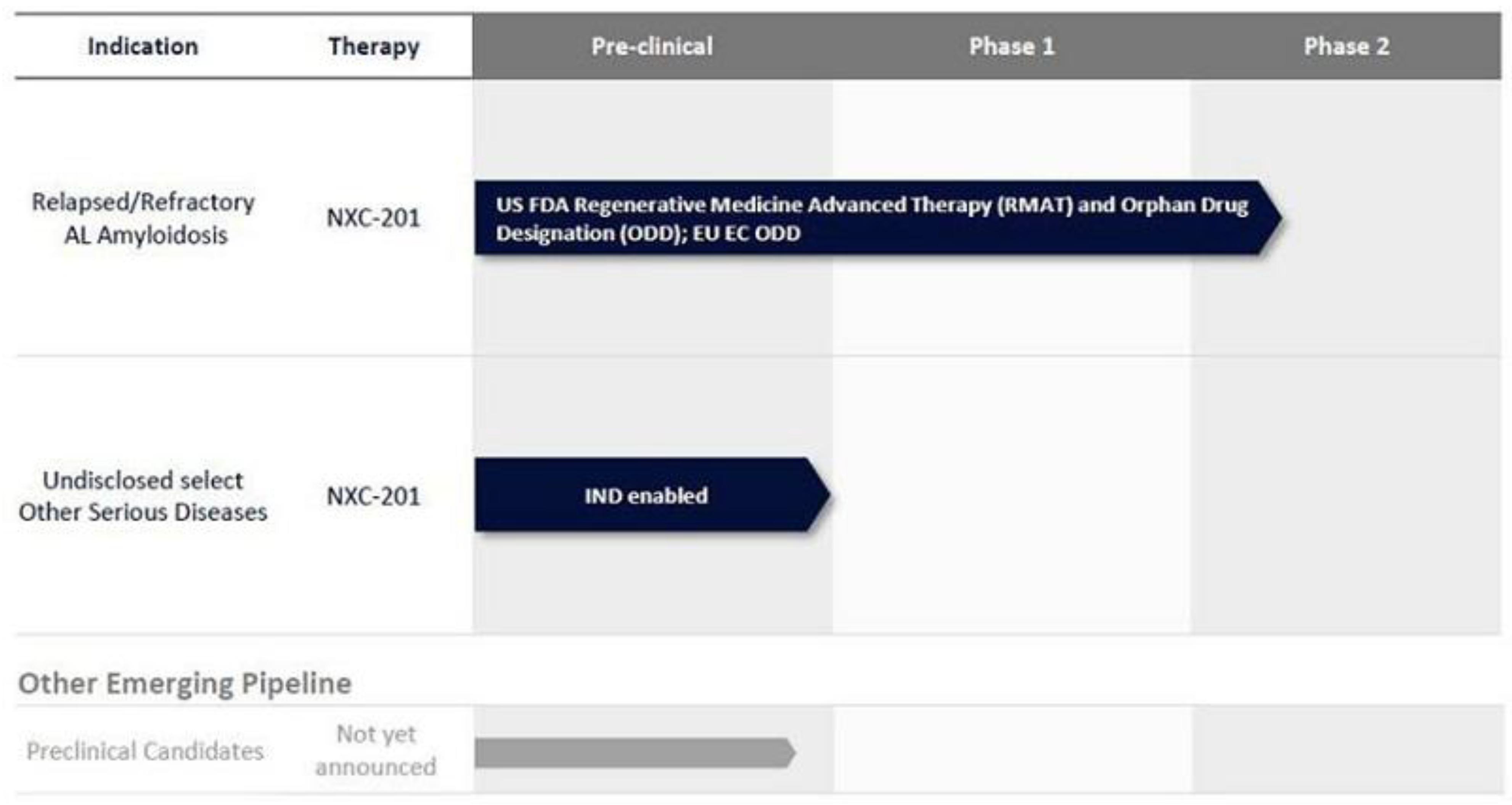
Immix Biopharma, Inc. is a clinical-stage biopharmaceutical company focused on the application of chimeric antigen receptor cell therapy (“CAR-T”) in light chain (“AL”) Amyloidosis and other serious diseases. Our lead cell therapy candidate is CAR-T NXC-201 (“NXC-201”), which is currently being evaluated in our ongoing United States Phase 1b/2 NEXICART-2 (NCT06097832) clinical trial and an ex-U.S. phase 1b/2a NEXICART-1 (NCT04720313) clinical trial. NEXICART-2 is expected to enroll 40 patients, with final readout and Biologics License Application (“BLA”) submission planned thereafter.
NXC-201 has been awarded Regenerative Medicine Advanced Therapy (“RMAT”) Designation by the FDA, Orphan Drug Designation (“ODD”) by both the FDA and European Commission (“EC”) in AL Amyloidosis and, most recently, in January 2026, Breakthrough Therapy designation by the FDA for the treatment of relapsed/refractory AL amyloidosis.
Our mission is to harness the immune system through innovative cell therapies and other modalities to deliver widely accessible cures in AL Amyloidosis and other serious diseases, as we believe patients are waiting.
Our strategy is to:
| ● | Develop our lead candidate NXC-201 in AL Amyloidosis and other serious diseases; and | |
| ● | Pursue development of NXC-201 and additional cell therapy candidates in other applicable indications where CAR-T is not an approved therapy today. |
Our N-GENIUS platform (discussed below) has produced our clinical-stage lead candidate NXC-201, a next-generation CAR-T being designed to treat AL Amyloidosis and other serious diseases.
Figure 1: ImmixBio Pipeline
| 25 |
AL amyloidosis is a life-threatening immunological disorder in which an abnormal protein called amyloid builds up in tissues and organs. This abnormal protein is produced by long-lived plasma cells (“LLPCs”), a type of immune B-cell. The signs and symptoms of AL amyloidosis vary among patients because build-up may occur in the heart (most frequent cause of mortality), liver, kidneys, intestines, muscles, joints, nerves, or spleen, according to the National Institutes of Health (“NIH”). Diagnosis is frequently delayed, due to varied and non-specific symptoms including: fatigue, weight loss, shortness of breath, dizziness, and numbness in hands and feet. Upon diagnosis, many patients already have late-stage disease, and are not aware of available treatment options and clinical trials.
In December 2025, we announced positive interim phase 2 safety and efficacy data from our Phase1/2 NEXICART-2 clinical trial, the first U.S. trial of CAR-T in relapsed/refractory light chain AL, evaluating NXC-201. The results were as of November 13, 2025 and were presented by Heather Landau, MD, of Memorial Sloan Kettering Cancer Center in an oral presentation at the American Society of Hematology’s ASH 2025 Annual Meeting. Prior to NXC-201 treatment, all patients were exposed to an anti-CD38 antibody and a proteasome inhibitor. Median prior lines of therapy were four (range: 1-10). All patients had baseline relapsed/refractory AL Amyloidosis organ involvement.
In January 2026, the FDA granted Breakthrough Therapy designation to sterically-optimized CAR-T NXC-201 for the treatment of relapsed/refractory AL amyloidosis. Per FDA, Breakthrough Therapy designation aims to expedite the development and review of drugs that are intended to treat a serious condition and preliminary clinical evidence indicates that the drug may demonstrate substantial improvement over available therapy on a clinically significant endpoint.
After NXC-201 treatment, complete responses (“CRs”) were observed in 75% (at s/u IFE(-) level) (15 out of 20) patients as determined by an independent review committee. In four out of five pending patients, minimum residual disease (MRD) negativity in bone marrow suggests a future complete response may be expected. Downstream clinical improvement, including organ responses, were observed in 70% of evaluable patients (7/10). No neurotoxicity has been observed. Grade 2 cytokine release syndrome was observed in four patients, Grade 1 cytokine release syndrome was observed in 11 patients, with a median duration of one day.
Our Other Programs
Our other programs include NXC-201 for treatment of select other serious diseases and other preclinical candidates.
Since inception, we have devoted substantially all of our resources to developing product and technology rights, conducting research and development, organizing and staffing our Company, business planning and raising capital. We operate as one business segment and have incurred recurring losses, the majority of which are attributable to research and development activities and negative cash flows from operations. We have funded our operations primarily through the sale of equity securities and grant proceeds. Currently, our primary use of cash and short-term investment is to fund operating expenses, which consist primarily of research and development expenditures, and to a lesser extent, general and administrative expenditures. We expect to continue to incur significant expenses and operating losses for the foreseeable future as we advance our product candidates through all stages of development and clinical trials and, ultimately, seek regulatory approval. In addition, if we obtain regulatory approval for any of our product candidates, we expect to incur significant commercialization expenses related to product manufacturing, marketing, sales and distribution. Furthermore, we incur costs associated with operating as a public company, including significant legal, accounting, investor relations and other expenses. Our net losses may fluctuate significantly from quarter-to-quarter and year-to-year, depending on the timing of our clinical trials and our expenses on other research and development activities.
Research and License Agreement with Hadasit and BIRAD
On December 8, 2022, our subsidiary Nexcella entered into a Research and License Agreement (the “Agreement”) with Hadasit Medical Research Services & Development, Ltd. and BIRAD – Research and Development Company Ltd. (collectively, the “Licensors”) pursuant to which the Licensors granted to Nexcella an exclusive, worldwide, royalty-bearing license throughout the world, except Israel, Cyprus and other countries in the Middle East (the “Territory”), to an invention entitled “Anti-BCMA CAR-T cells to target plasma cell” to develop, manufacture, have manufactured, use, market, offer for sale, sell, have sold, export and import the Licensed Product (as defined in the Agreement). Pursuant to the Agreement, Nexcella paid the Licensors an upfront fee of $1,500,000 in December 2022. Additional quarterly payments totaling approximately $13.0 million are due through September 2026 along with an annual license fee of $50,000. Upon the merger of Nexcella with and into Immix, we assumed all of Nexcella’s rights and obligations pursuant to the Agreement.
| 26 |
We are required to pay royalties to the Licensors equal to 5% of Net Sales (as defined in the Agreement) during the Royalty Period. “Royalty Period” means for each Licensed Product, on a country-to-country basis, the period commencing on December 8, 2022 and ending on the later of (a) the expiration of the last to expire Valid Claim (as defined in the Agreement) under a Licensed Patent (as defined in the Agreement), if any, in such country, (b) the date of expiration of any other Exclusivity Right (as defined in the Agreement) or data protection period granted by a regulatory or other governmental authority with respect to a Licensed Product or (c) 15 years from the date of First Commercial Sale (as defined in the Agreement) of a Licensed Product in such country.
In addition, we are required to pay milestone payments of up to $20.0 million upon the achievement of certain Net Sales milestones as set forth in the Agreement. Pursuant to the Agreement, Nexcella committed to funding NXC-201 clinical trials in Israel for a period of four years for an estimated total cost of approximately $13.0 million, spread on a quarterly basis over that period, the payment of which has been, and will be, paid by us since the merger in May 2024. We expect that the clinical trial data generated by the NXC-201 clinical trials in Israel will be owned by us. The term of the Agreement commenced on December 8, 2022 and, unless earlier terminated pursuant to the terms thereof, will continue in full force and effect until the later of the expiration of the last Valid Claim under a Licensed Patent or a Joint Patent (as defined in the Agreement) or Exclusivity Right covering a Licensed Product or the expiration of a continuous period of 15 years during which there shall not have been a First Commercial Sale of any Licensed Product in any country in the world. Licensors may terminate the Agreement immediately if we or our affiliates or sublicensees commences an action in which the validity, enforceability or scope of any of the Licensed Patents or Joint Patents is challenged. In addition, either party may terminate the Agreement if the other party materially breaches the Agreement and fails to cure such breach within 30 days. Additionally, Licensors may terminate the Agreement if we become insolvent or file for bankruptcy.
On December 16, 2024, our wholly-owned subsidiary, Nexcella, Inc., entered into the First Amendment to the Research and License Agreement (the “First Amendment”) with the Licensors. The First Amendment includes terms specific to new licensed products and requires an additional upfront license fee of $1.5 million, which has been paid in full as of December 31, 2025, as well as development milestone payments of up to $4.5 million upon the Company’s achievement of certain milestones.
CIRM Grant
On July 25, 2024, we were awarded an $8.0 million grant from the California Institute for Regenerative Medicine (“CIRM”) to support the clinical development of chimeric antigen receptor T-cell therapy NXC-201 for the treatment of relapsed/refractory AL Amyloidosis. The award is payable to us upon achievement of milestones that are primarily based on patient enrollment in our clinical trials. Additionally, if CIRM determines, in its sole discretion, that we have not complied with the terms and conditions of the grant, CIRM may suspend or permanently cease disbursements. Funds received under this grant may only be used for allowable project costs specifically identified with the CIRM-funded project. Such costs can include, but are not limited to, salary for personnel, itemized supplies, consultants, and itemized clinical study costs. Under the terms of the grant, both CIRM and we will co-fund the research project and the amount of our co-funding requirement is predetermined as a part of the award. We signed the grant agreement in November 2024 and began receiving funds from the grant in November of 2024. As of April 30, 2026, we have received $6.7 million in grant reimbursements under the grant agreement.
Amended June 2025 ATM Agreement
On June 3, 2025, the Company entered into an At The Market Offering Agreement (the “June 2025 ATM Agreement”) with Citizens JMP Securities, LLC (“Citizens”), which was amended on March 25, 2026 (the “June 2025 ATM Amendment No. 1” and, together with the June 2025 ATM Agreement, the “Amended June 2025 ATM Agreement”), pursuant to which we may offer and sell, from time to time, at our option, shares of our common stock, through Citizens, as the sales agent, having an aggregate offering price of up to $100,000,000 in an “at the market offering,” as defined in Rule 415(a)(4) under the Securities Act. During the three months ended March 31, 2026, we sold no shares of common stock pursuant to the June 2025 ATM Agreement and Amended June 2025 ATM Agreement. As of April 30, 2026, we have sold an aggregate of 3,062,504 shares of common stock pursuant to the Amended June 2025 ATM Agreement for net proceeds of $17,101,938, after offering expenses.
| 27 |
Results of Operations
Three Months Ended March 31, 2026 compared to the Three Months Ended March 31, 2025
General and Administrative Expense
General and administrative expense was $4,823,378 for the three months ended March 31, 2026, compared to $2,707,851 for the three months ended March 31, 2025.
The expenses incurred in both periods were related to salaries, patent maintenance costs and general accounting and other general consulting expenses, which were higher for the three months ended March 31, 2026, due to increased investor relations and professional fees of $1,174,910 related to the Company’s efforts to raise capital, increased compensation of $607,006 due to hiring of additional employees, and increased other general expenses of $355,724.
Research and Development Expense
Research and development expense was $5,980,477 for the three months ended March 31, 2026, compared to $1,975,074 for the three months ended March 31, 2025.
The increased research and development expenses were related to our ongoing Phase 1b/2a clinical trial and our CAR-T clinical trial, including, but not limited to, CRO and related costs for maintaining and treating patients in the clinical trial, as well as site onboarding costs and license fees. We were able to increase spending on research and development in 2026 as a result of funding from multiple share offerings during the year ended December 31, 2025. Additionally, the Company received approximately $1.5 million in CIRM grant reimbursement, which is recorded as an offset to research and development expenses.
Interest Income
Interest income was $717,168 for the three months ended March 31, 2026, compared to $150,219 for the three months ended March 31, 2025. Interest income was related to interest received on investments in money market funds and US Treasuries. The increase is a result of the Company maintaining higher balances during the current period.
Provision for Income Taxes
Provision for income taxes for the three months ended March 31, 2026 was $0 compared to $9,822 for the three months ended March 31, 2025, due to withholding taxes relating to our Australian subsidiary.
Net Loss
Net loss for the three months ended March 31, 2026 was $10,086,687 compared to $4,542,528 for the three months ended March 31, 2025, which increase was due primarily to the increase in research and development expenses, as discussed above.
| 28 |
Liquidity and Capital Resources
Sources of Liquidity
We do not have any approved products for commercial sale and have never generated revenue from product sales and have incurred significant net losses since our inception and expect to continue to incur net operating losses for the foreseeable future. We do not expect to receive any revenue from any product candidates that we develop unless and until we obtain regulatory approval and commercialize our product candidates or enter into collaborative arrangements with third parties. We currently have no credit facility or committed sources of capital.
Our primary use of cash, cash equivalents, and short-term investments is to fund operating expenses, which consist of clinical research and development expenses, manufacturing expenses, legal and compliance expenses, compensation and related expenses, and general overhead costs. Cash, cash equivalents, and short-term investments used to fund operating expenses are impacted by the timing of when we pay or prepay these expenses. We expect our expenses to increase in connection with our ongoing activities, particularly as we expand our clinical programs, continue the research and development of, and seek marketing approval for our product candidates. In addition, if we obtain marketing approval for any of our product candidates, we expect to incur significant commercialization expenses related to product sales, marketing, manufacturing and distribution.
Because of the numerous risks and uncertainties associated with research, development and commercialization of pharmaceutical products, we are unable to estimate the exact amount of our operating capital requirements. Our future funding requirements will depend on many factors, including, but not limited to:
| ● | the scope, timing, progress and results of discovery, pre-clinical development, laboratory testing and clinical trials for our product candidates; | |
| ● | the costs of manufacturing our product candidates for clinical trials and in preparation for regulatory approval and commercialization; | |
| ● | the extent to which we enter into collaborations or other arrangements with additional third parties in order to further develop our product candidates; | |
| ● | the costs of preparing, filing and prosecuting patent applications, maintaining and enforcing our intellectual property rights and defending intellectual property-related claims; | |
| ● | the costs and fees associated with the discovery, acquisition or in-license of additional product candidates or technologies; | |
| ● | expenses needed to attract and retain skilled personnel; | |
| ● | the costs associated with being a public company; | |
| ● | the costs required to scale up our clinical, regulatory and manufacturing capabilities; | |
| ● | the costs of future commercialization activities, if any, including establishing sales, marketing, manufacturing and distribution capabilities, for any of our product candidates for which we receive regulatory approval; and | |
| ● | revenue, if any, received from commercial sales of our product candidates, should any of our product candidates receive regulatory approval. |
As discussed above, on July 25, 2024, the Company was awarded an $8.0 million grant from CIRM to support the clinical development of chimeric antigen receptor T-cell therapy NXC-201 for the treatment of relapsed/refractory AL Amyloidosis. As of April 30, 2026, we have received $6.7 million in grant reimbursements under the grant agreement.
On March 25, 2026, the Company and Citizens entered into the June 2025 ATM Agreement Amendment No. 1, pursuant to which, effective March 25, 2026, the Company may offer and sell, from time to time, at its option, shares of its common stock, through Citizens, as the sales agent, having an aggregate offering price of up to $100,000,000 in an “at the market offering” as defined in Rule 415(a)(4) under the Securities Act. During the three months ended March 31, 2026, we sold no shares of common stock pursuant to the June 2025 ATM Agreement and Amended June 2025 ATM Agreement. As of April 30, 2026, we have sold an aggregate of 3,062,504 shares of common stock pursuant to the Amended June 2025 ATM Agreement for net proceeds of $17,101,938, after offering expenses.
| 29 |
In September 2025, we sold to certain accredited investors, in private placement transaction, pursuant to Securities Purchase Agreements (i) an aggregate of 3,915,604 shares of common stock, and (ii) non-transferable warrants to purchase up to an aggregate of 2,936,709 shares of common stock for gross proceeds of approximately $9.3 million, before deducting fees and offering expenses payable by us.
In December 2025, we conducted an underwritten public offering of 19,117,646 shares of our common stock, at a public offering price of $5.10 per share, and pre-funded warrants to purchase 490,196 shares of common stock, at a public offering price of $5.09 per pre-funded warrant, for net proceeds of approximately $93.7 million, after underwriting discounts and offering expenses.
Material Cash Requirements
Our primary use of cash, cash equivalents and short-term investments is to fund operating expenses, which consist of clinical research and development expenses, manufacturing expenses, legal and compliance expenses, compensation and related expenses, and general overhead costs. Cash, cash equivalents and short-term investments used to fund operating expenses are impacted by the timing of when we pay or prepay these expenses. We expect our expenses to increase in connection with our ongoing activities, particularly as we expand our clinical programs, continue the research and development of, and seek marketing approval for our product candidates. In addition, if we obtain marketing approval for any of our product candidates, we expect to incur significant commercialization expenses related to product sales, marketing, manufacturing and distribution.
As of March 31, 2026, we had total assets of approximately $95.8 million and working capital of approximately $81.7 million. As of March 31, 2026, our liquidity included approximately $90.6 million of cash and cash equivalents and short-term investments. We believe that our cash, cash equivalents and short-term investments on hand as of the date of this report, will be sufficient to fund our planned operations over the 12-month period following the date of this report; however, there can be no assurance we will not need additional capital sooner. In addition, we believe that we will need additional capital to continue our planned operations beyond the 12-month period following the filing date of this Quarterly Report on Form 10-Q. We intend to seek additional funds through various financing sources, including the sale of our equity and debt securities, government or other third-party funding, commercialization, marketing and distribution arrangements, other collaborations, strategic alliances and licensing arrangements. In addition, we will consider alternatives to our current business plan that may enable us to achieve revenue producing operations and meaningful commercial success with a smaller amount of capital. However, there can be no guarantees that such funds will be available on commercially reasonable terms, if at all. If such financing is not available on satisfactory terms, we may be unable to further pursue our business plan and we may be unable to continue operations.
To the extent that we raise additional capital through the sale of equity or convertible debt securities, your ownership interest will be diluted, and the terms of these securities may include liquidation or other preferences that adversely affect your rights as a common stockholder. Debt financing and preferred equity financing, if available, may involve agreements that include covenants limiting or restricting our ability to take specific actions, such as incurring additional debt, making acquisitions or capital expenditures or declaring dividends. If we raise additional funds through collaborations, strategic alliances or marketing, distribution or licensing arrangements with third parties, we may have to relinquish valuable rights to our technologies, future revenue streams, research programs or product candidates, or grant licenses on terms that may not be favorable to us. If we are unable to raise additional funds through equity or debt financings or other arrangements when needed, we may be required to delay, limit, reduce or terminate our research, product development or future commercialization efforts, or grant rights to develop and market product candidates that we would otherwise prefer to develop and market ourselves.
The continuation of the Company as a going concern is dependent upon its ability to obtain continued financial support from its stockholders, necessary equity financing to continue operations and the attainment of profitable operations.
| 30 |
In January 2024, the Company entered into a long-term operating lease agreement for biopharmaceutical manufacturing space in California under a non-cancelable operating lease that expires in December 2033. Under the terms of the lease, we expect to make total lease payments of approximately $1.3 million through December 2033.
We enter into contracts in the normal course of business with third-party contract organizations for preclinical and clinical studies, manufacture and supply of our preclinical and clinical materials and providing other services and products for operating purposes. Contracts for preclinical and clinical studies and other services generally provide for termination following a certain period after notice, and therefore we believe that our non-cancelable obligations under these agreements are not material. We do not have any long-term manufacturing and supply agreements with our third-party contract manufacturers, but we enter into specific contracts on an as needed basis for individual batch production runs.
Cash Flows
Cash used in operating activities
Net cash used in operating activities was $9,817,073 for the three months ended March 31, 2026 and $1,685,140 for the three months ended March 31, 2025. Net cash used for the three months ended March 31, 2026 was primarily related to our net loss of $10,086,687, offset by non-cash items of stock-based compensation expense of $575,565, depreciation expense of $91,577, right of use asset amortization of $39,189, loss on disposal of fixed assets of $34,153, slightly offset by realized gain on available-for-sale securities of $10,648. Operating activities also included an increase in accounts payable and accrued expenses of $443,059 and an increase in prepaid expenses of $867,320. Net cash used for the three months ended March 31, 2025 was primarily related to our net loss of $4,542,528, offset by non-cash items of stock-based compensation expense of $868,359, depreciation expense of $38,153 and right of use asset amortization of $21,027. Operating activities also included a decrease in the tax receivable of $2,003,580, an increase in accounts payable and accrued expenses of $258,718, and an increase in prepaid expenses of $316,622.
Cash used in investing activities
Net cash used in investing activities was $4,800,836 for the three months ended March 31, 2026, consisting of $7,768,350 in purchases of short-term investments offset by $3,000,000 in sales of short-term investments. In addition, there was $32,486 in purchases of property and operating equipment. Net cash used in investing activities was $67,713 for the three months ended March 31, 2025, consisting solely of purchase of property and operating equipment.
Cash provided by financing activities
Net cash used in financing activities in the three months ended March 31, 2026 of $37,561 was mainly related to $71,093 in payments of deferred offering costs, offset by $33,532 from cash proceeds received from the exercise of common stock options. There were no financing cash flows during the three months ended March 31, 2025.
JOBS Act
On April 5, 2012, the Jumpstart Our Business Startups Act (the “JOBS Act”) was enacted. Section 107 of the JOBS Act provides that an “emerging growth company” can take advantage of the extended transition period provided in Section 7(a)(2)(B) of the Securities Act for complying with new or revised accounting standards. In other words, an “emerging growth company” can delay the adoption of certain accounting standards until those standards would otherwise apply to private companies.
We have chosen to take advantage of the extended transition periods available to emerging growth companies under the JOBS Act for complying with new or revised accounting standards until those standards would otherwise apply to private companies provided under the JOBS Act. As a result, our financial statements may not be comparable to those of companies that comply with public company effective dates for complying with new or revised accounting standards.
| 31 |
Subject to certain conditions set forth in the JOBS Act, as an “emerging growth company,” we intend to rely on certain of these exemptions, including, without limitation, (i) providing an auditor’s attestation report on our internal controls over financial reporting pursuant to Section 404(b) of the Sarbanes-Oxley Act of 2002, as amended, and (ii) complying with the requirement adopted by the Public Company Accounting Oversight Board regarding the communication of critical audit matters in the auditor’s report on financial statements. We will remain an “emerging growth company” until the earliest of (i) the last day of the fiscal year in which we have total annual gross revenues of $1.235 billion or more; (ii) the last day of our fiscal year following the fifth anniversary of the date of the completion of our initial public offering (December 31, 2026); (iii) the date on which we have issued more than $1 billion in nonconvertible debt during the previous three years; or (iv) the date on which we are deemed to be a large accelerated filer under the rules of the SEC.
Critical Accounting Policies and Use of Estimates
Our financial statements are prepared in accordance with U.S. GAAP. The preparation of these financial statements requires management to make estimates and judgments that affect the reported amounts of assets, liabilities, revenues and expenses. Management regularly evaluates its estimates and judgments, including those related to revenue recognition, intangible assets, long-lived assets valuation, variable interest entities, and legal matters. Actual results may differ from these estimates which may be material. “Note 2 – Summary of Significant Accounting Policies” in Part I, Item 1 of this Quarterly Report on Form 10-Q and in the Notes to Condensed Consolidated Financial Statements in Part II, Item 8 of our Annual Report on Form 10-K for the year ended December 31, 2025 (the “2025 Form 10-K”), as filed with the SEC on March 25, 2026, and “Critical Accounting Policies” in Part II, Item 7 of the 2025 Form 10-K describe the significant accounting policies and methods used in the preparation of the Company’s financial statements. There have been no material changes to the Company’s critical accounting policies and estimates since the 2025 Form 10-K.
ITEM 3. QUANTITATIVE AND QUALITATIVE DISCLOSURES ABOUT MARKET RISK.
We are not required to provide the information required by this Item as we are a “smaller reporting company,” as defined in Rule 12b-2 of the Exchange Act.
ITEM 4. CONTROLS AND PROCEDURES.
Evaluation of Disclosure Controls and Procedures
Our management, with the participation of our principal executive officer and principal financial officer, evaluated the effectiveness of our “disclosure controls and procedures” (as defined in Exchange Act Rules 13a-15(e) and 15d-15(e)) as of March 31, 2026, the end of the period covered by this Quarterly Report on Form 10-Q. The term “disclosure controls and procedures” as defined in Rules 13a-15(e) and 15d-15(e) under the Exchange Act, means controls and other procedures of a company that are designed to ensure that information required to be disclosed by a company in the reports that it files under the Exchange Act is recorded, processed, summarized and reported, within the time periods specified in the SEC’s rules and forms. Disclosure controls and procedures include, without limitation, controls and procedures designed to ensure that information required to be disclosed by a company in the reports that it files under the Exchange Act is accumulated and communicated to a company’s management, including its principal executive officer and principal financial officer, as appropriate to allow timely decisions regarding required disclosure. In designing and evaluating the disclosure controls and procedures, management recognizes that any controls and procedures, no matter how well designed and operated, cannot provide absolute assurance that the objectives of the controls system are met, and no evaluation of controls can provide absolute assurance that all control issues and instances of fraud, if any, within a company have been detected. Based on the evaluation of our disclosure controls and procedures as of March 31, 2026, our management, with the participation of our principal executive officer and principal financial officer has concluded that, based on such evaluation, as of the end of the period covered by this Quarterly Report on Form 10-Q, our disclosure controls and procedures were effective at the reasonable assurance level as of March 31, 2026.
Changes in Internal Control
There have been no changes in our internal control over financial reporting that occurred during the quarter ended March 31, 2026 that have materially affected, or are reasonably likely to materially affect, our internal control over financial reporting.
| 32 |
PART II — OTHER INFORMATION
ITEM 1. LEGAL PROCEEDINGS.
From time to time, we may become involved in various lawsuits and legal proceedings, which arise in the ordinary course of business. Litigation is subject to inherent uncertainties and an adverse result in these or other matters may arise from time to time that may harm our business. We are currently not aware of any such legal proceedings or claims that will have, individually or in the aggregate, a material adverse effect on our business, financial condition or operating results.
ITEM 1A. RISK FACTORS.
Risk factors that affect our business and financial results are discussed in Part I, Item 1A “Risk Factors,” in our 2025 Form 10-K, as filed with the SEC on March 25, 2026. There have been no material changes in our risk factors from those previously disclosed in our 2025 Form 10-K. You should carefully consider the risks described in our 2025 Form 10-K, which could materially affect our business, financial condition or future results. The risks described in our Annual Report are not the only risks we face. Additional risks and uncertainties not currently known to us or that we currently deem to be immaterial also may materially adversely affect our business, financial condition, and/or operating results. If any of the risks actually occur, our business, financial condition, and/or results of operations could be negatively affected.
ITEM 2. UNREGISTERED SALES OF EQUITY SECURITIES AND USE OF PROCEEDS.
Unregistered Sales of Equity Securities
During the three months ended March 31, 2026, the Company issued 10,966 shares of restricted common stock, valued at $67,500 for investor relations services based on the average closing price for the prior 10 trading days pursuant to a marketing services agreement entered into on July 25, 2023.
The issuance described above was exempt from registration pursuant to Section 4(a)(2), and/or Rule 506 of Regulation D of the Securities Act, since the foregoing issuances did not involve a public offering, the recipient took the securities for investment and not resale, we took take appropriate measures to restrict transfer, and the recipient was (a) an “accredited investor”; and/or (b) had access to similar documentation and information as would be required in a Registration Statement under the Securities Act. The securities are subject to transfer restrictions, and the securities contain an appropriate legend stating that such securities have not been registered under the Securities Act and may not be offered or sold absent registration or pursuant to an exemption therefrom. The securities were not registered under the Securities Act and such securities may not be offered or sold in the United States absent registration or an exemption from registration under the Securities Act and any applicable state securities laws.
Purchases of Equity Securities by the Issuer and Affiliated Purchasers
None.
ITEM 5. OTHER INFORMATION.
Rule
10b5-1 Trading Plans. During the quarter ended March 31, 2026, none of the Company’s directors or officers (as defined in Rule
16a-1(f))
| 33 |
ITEM 6. EXHIBITS.
| * | Filed herewith. |
| ** | Furnished herewith. |
| 34 |
SIGNATURES
Pursuant to the requirements of the Securities Exchange Act of 1934, the Registrant has duly caused this report to be signed on its behalf by the undersigned thereunto duly authorized.
| IMMIX BIOPHARMA, INC. | ||
| Date: May 7, 2026 | By: | /s/ Ilya Rachman |
| Ilya Rachman | ||
| Chief Executive Officer | ||
| (Principal Executive Officer) | ||
| Date: May 7, 2026 | By: | /s/ Gabriel Morris |
| Gabriel Morris, | ||
| Chief Financial Officer | ||
| (Principal Financial and Accounting Officer) | ||
| 35 |