 | Ivanhoe Electric Inc. S-K 1300 Preliminary Feasibility Study & |  |
Forward-Looking Statements
Certain statements in this Technical Report Summary constitute “forward-looking statements” or “forward-looking information” within the meaning of applicable US and Canadian securities laws. Such statements and information involve known and unknown risks, uncertainties and other factors that may cause the actual results, performance or achievements of Ivanhoe Electric, its projects, or industry results, to be materially different from any future results, performance or achievements expressed or implied by such forward-looking statements or information. Such statements can be identified by the use of words such as “may,” “would,” “could”, “will,” “intend,” “expect,” “believe,” “plan,” “anticipate,” “estimate,” “scheduled,” “forecast,” “predict” and other similar terminology, or state that certain actions, events or results “may,” “could,” “would,” “might” or “will” be taken, occur or be achieved. These statements reflect Ivanhoe Electric’s current expectations regarding future events, performance and results and speak only as of the date of this Technical Report Summary.
Such statements in this Technical Report Summary include, without limitation: the projections, assumptions and estimates related to the Santa Cruz Copper Project, including, without limitation, those relating to development, capital and operating costs, production, grade, recoveries, metal prices, life of mine, mine sequencing, economic assumptions such as capital expenditures, cash flow and revenue, mine design, mining techniques and processes, timing of estimated production, equipment, staffing, emissions, use of land, estimates of mineral resources, use of energy storage technologies; the ability to produce 99.99% pure copper cathode; and the ability to secure state and local permits for the Santa Cruz Copper Project.
Forward-looking statements are based on the author’s beliefs and assumptions and on information currently available. Such statements are subject to significant risks and uncertainties, and actual results may differ materially from those expressed or implied in the forward-looking statements due to various factors, including fluctuations in metal prices; risks related to inflation and changes in interest rates, discount rates, exchange rates, and taxes; risks due to the inherently hazardous nature of mining- related activities; uncertainties due to health and safety considerations; uncertainties related to environmental considerations, including, without limitation, climate change; uncertainties relating to obtaining approvals and permits, including renewals, from governmental regulatory authorities; uncertainties related to changes in law; uncertainty related to the availability and terms of capital; and those risk factors described in Ivanhoe Electric’s Annual Report on Form 10-K and other disclosures made by Ivanhoe Electric with the U.S. Securities and Exchange Commission and Canadian securities regulators.
Although the authors believes that the assumptions and factors used in preparing the forward-looking statements in this Technical Report are reasonable, undue reliance should not be placed on such forward-looking statements, which only apply as of the date of this Technical Report, and no assurance can be given that such events will occur in the disclosed time frames or at all. The authors disclaim any intention or obligation to update or revise any forward-looking statements, whether as a result of new information, future events, or otherwise, other than as required by applicable law.
| SEPTEMBER 2026 |
| Ivanhoe Electric Inc. S-K 1300 Preliminary Feasibility Study & | |
Date and Signature Page
Report Date: September 23, 2026
Prepared by Qualified Persons from the following Third-Party Companies:
| /s/ BBA Consultants USA LP | |
| BBA Consultants USA LP September 23, 2026 |
|
| /s/ Worley Group Inc. | |
| Worley Group Inc. September 23, 2026 |
|
| /s/ Burns & McDonnell Engineering Company, Inc. | |
| Burns & McDonnell
Engineering Company, Inc. September 23, 2026 |
|
| /s/ Haley & Aldrich, Inc. | |
| Haley & Aldrich, Inc.
September 23, 2026 |
|
| /s/ INTERA Incorporated | |
| INTERA Incorporated September 23, 2026 |
|
| SEPTEMBER 2026 | SCP-SR-REP-0010 |
| Ivanhoe Electric Inc. S-K 1300 Preliminary Feasibility Study & | |
| /s/ KCB Consultants Ltd. | |
| KCB Consultants Ltd. September 23, 2026 |
|
| /s/ Life Cycle Geo, LLC | |
| Life Cycle Geo, LLC September 23, 2026 |
|
| /s/ Met Engineering, LLC | |
| Met Engineering, LLC September 23, 2026 |
|
| /s/ Paterson & Cooke USA, Ltd. | |
| Paterson & Cooke USA, Ltd.
September 23, 2026 |
|
| /s/ Stantec Consulting Services Inc. | |
| Stantec Consulting Services
Inc. September 23, 2026 |
|
| /s/ Tetra Tech, Inc. | |
| Tetra Tech, Inc. September 23, 2026 |
| SEPTEMBER 2026 | SCP-SR-REP-0010 |
| Ivanhoe Electric Inc. S-K 1300 Preliminary Feasibility Study & | |
TABLE OF CONTENTS
| 1. | Executive Summary | 1-1 | ||
| 1.1 | Introduction | 1-1 | ||
| 1.2 | Terms of Reference | 1-1 | ||
| 1.3 | Property Setting | 1-2 | ||
| 1.4 | Mineral Tenure, Ownership, Surface Rights, and Royalties | 1-4 | ||
| 1.4.1 | Agreements & Permits | 1-4 | ||
| 1.4.2 | Mineral Tenure | 1-4 | ||
| 1.4.3 | Surface & Water Rights | 1-6 | ||
| 1.4.4 | Royalties | 1-7 | ||
| 1.5 | History | 1-8 | ||
| 1.6 | Geology & Mineralization | 1-8 | ||
| 1.7 | Exploration, Drilling & Sampling | 1-9 | ||
| 1.8 | Data Verification | 1-10 | ||
| 1.9 | Metallurgical Testwork | 1-11 | ||
| 1.10 | Mineral Resource Estimate | 1-11 | ||
| 1.10.1 | Estimation Methodology | 1-11 | ||
| 1.10.2 | Mineral Resource Statement | 1-12 | ||
| 1.10.3 | Factors That May Affect the Mineral Resource Estimate | 1-15 | ||
| 1.11 | Mineral Reserve Estimate | 1-15 | ||
| 1.11.1 | Estimation Methodology | 1-15 | ||
| 1.11.2 | Mineral Reserve Statement | 1-17 | ||
| 1.11.3 | Factors That May Affect the Mineral Reserve Estimate | 1-19 | ||
| 1.12 | Mining Methods | 1-19 | ||
| 1.13 | Recovery Methods | 1-23 | ||
| 1.14 | Infrastructure | 1-27 | ||
| 1.15 | Market Studies & Contracts | 1-29 | ||
| 1.16 | Environmental, Closure & Permitting | 1-30 | ||
| 1.17 | Capital & Operating Cost Estimates | 1-32 | ||
| 1.17.1 | Capital Cost Estimate | 1-32 | ||
| SEPTEMBER 2026 | i |
| Ivanhoe Electric Inc. S-K 1300 Preliminary Feasibility Study & | |
| 1.17.2 | Operating Cost Estimate | 1-33 | ||
| 1.18 | Economic Analysis | 1-33 | ||
| 1.19 | Risks & Opportunities | 1-35 | ||
| 1.20 | Conclusions | 1-35 | ||
| 1.21 | Recommendations | 1-35 | ||
| 2. | Introduction | 2-1 | ||
| 2.1 | Registrant for Whom the Report was Prepared | 2-1 | ||
| 2.2 | Purpose of the Report | 2-1 | ||
| 2.3 | Terms of Reference | 2-1 | ||
| 2.4 | Report Date | 2-2 | ||
| 2.5 | Previous Technical Report Summaries | 2-2 | ||
| 2.6 | Qualified Persons | 2-2 | ||
| 2.7 | Site Visits & Scope of Personal Inspection | 2-2 | ||
| 2.8 | Information Sources | 2-2 | ||
| 3. | Property Description | 3-1 | ||
| 3.1 | Location | 3-1 | ||
| 3.2 | Property & Mineral Title | 3-1 | ||
| 3.2.1 | Fee Simple | 3-1 | ||
| 3.2.2 | Lode Mining Claims | 3-1 | ||
| 3.2.3 | Arizona State Land Department Mineral Exploration Permits | 3-2 | ||
| 3.2.4 | Stock-Raising Homestead Act | 3-2 | ||
| 3.3 | Ownership | 3-3 | ||
| 3.3.1 | Mineral Title Ownership | 3-3 | ||
| 3.3.2 | Surface Title Ownership | 3-13 | ||
| 3.3.3 | Water Rights | 3-14 | ||
| 3.4 | Royalties | 3-14 | ||
| 3.5 | Encumbrances | 3-15 | ||
| 3.5.1 | Environmental Assessments | 3-15 | ||
| 3.6 | Violations & Fines | 3-16 | ||
| 3.7 | Significant Factors & Risks that May Affect Access, Title, or Work Programs | 3-16 | ||
| SEPTEMBER 2026 | ii |
| Ivanhoe Electric Inc. S-K 1300 Preliminary Feasibility Study & | |
| 4. | Accessibility, Climate, Local Resources, Infrastructure and Physiography | 4-1 | ||
| 4.1 | Climate | 4-1 | ||
| 4.2 | Local Resources | 4-1 | ||
| 4.3 | Physiography | 4-2 | ||
| 5. | History | 5-1 | ||
| 5.1 | Historical Exploration | 5-1 | ||
| 6. | Geological Setting, Mineralization & Deposit | 6-1 | ||
| 6.1 | Regional Geology | 6-1 | ||
| 6.2 | Metallogenic Setting | 6-2 | ||
| 6.3 | Santa Cruz Copper Project Geology | 6-4 | ||
| 6.3.1 | Santa Cruz Bedrock Lithologies | 6-5 | ||
| 6.3.2 | Basin Fill Lithologies | 6-6 | ||
| 6.3.3 | Alteration | 6-9 | ||
| 6.3.4 | Structural Geology | 6-10 | ||
| 6.3.5 | Property Mineralization | 6-10 | ||
| 6.4 | Deposit Types | 6-16 | ||
| 7. | Exploration and Drilling | 7-1 | ||
| 7.1 | Geophysics and Geochemistry | 7-1 | ||
| 7.1.1 | Geophysical Exploration | 7-1 | ||
| 7.1.2 | Geochemical Exploration | 7-7 | ||
| 7.1.3 | Qualified Person’s Interpretation of the Exploration Information | 7-8 | ||
| 7.2 | Drilling | 7-8 | ||
| 7.2.1 | Historical Drilling | 7-8 | ||
| 7.2.2 | Ivanhoe Electric Drilling Programs | 7-10 | ||
| 7.3 | Geotechnical | 7-18 | ||
| 7.3.1 | Sampling Methods & Laboratory Determinations | 7-18 | ||
| 7.3.2 | Comment on Results | 7-19 | ||
| 7.4 | Hydrogeological Investigations | 7-19 | ||
| 7.4.1 | Hydrogeological Data Collection | 7-19 | ||
| 7.4.2 | Hydrogeological Conceptual Site Model | 7-22 | ||
| SEPTEMBER 2026 | iii |
| Ivanhoe Electric Inc. S-K 1300 Preliminary Feasibility Study & | |
| 7.4.3 | Groundwater Flow Model & Results | 7-23 | ||
| 7.4.4 | Comment on Results | 7-25 | ||
| 8. | Sample Preparation, Analysis & Security | 8-1 | ||
| 8.1 | Assay Laboratory Selection | 8-1 | ||
| 8.1.1 | 2021 to 2022 | 8-2 | ||
| 8.1.2 | 2023 to 2026 | 8-2 | ||
| 8.1.3 | Ionic Leach | 8-2 | ||
| 8.2 | Sample Preparation & Analysis | 8-3 | ||
| 8.2.1 | Skyline Assayers & Laboratories | 8-3 | ||
| 8.2.2 | SGS Laboratories | 8-3 | ||
| 8.2.3 | ALS Laboratories | 8-4 | ||
| 8.2.4 | American Assay Laboratories | 8-5 | ||
| 8.2.5 | Historical Core Assay Sample & Analysis | 8-5 | ||
| 8.3 | Quality Assurance/Quality Control Procedures | 8-5 | ||
| 8.3.1 | 2021 to 2022 | 8-5 | ||
| 8.3.2 | 2023 to 2026 | 8-5 | ||
| 8.3.3 | Santa Cruz Sampling | 8-6 | ||
| 8.3.4 | East Ridge & Texaco Sampling | 8-8 | ||
| 8.4 | Density | 8-8 | ||
| 8.5 | Security & Storage | 8-9 | ||
| 8.6 | BBA Opinion | 8-9 | ||
| 9. | Data Verification | 9-1 | ||
| 9.1 | Data Verification Procedures | 9-1 | ||
| 9.2 | BBA Site Visit | 9-1 | ||
| 9.3 | Field Collar Validation | 9-2 | ||
| 9.4 | Core Logging, Sampling & Storage Facilities | 9-2 | ||
| 9.5 | Independent Sampling | 9-4 | ||
| 9.6 | Twin Hole Analysis | 9-5 | ||
| 9.7 | Database Validation | 9-5 | ||
| 9.8 | Review of Company’s QA/QC | 9-6 | ||
| SEPTEMBER 2026 | iv |
| Ivanhoe Electric Inc. S-K 1300 Preliminary Feasibility Study & | |
| 9.9 | BBA Opinion | 9-6 | ||
| 10. | Mineral Processing & Metallurgical Testing | 10-1 | ||
| 10.1 | Test Laboratories | 10-1 | ||
| 10.2 | Metallurgical Testwork | 10-1 | ||
| 10.2.1 | Column Leach Testing | 10-1 | ||
| 10.3 | Metallurgical Variability | 10-14 | ||
| 10.4 | Deleterious Elements | 10-14 | ||
| 10.5 | Met Engineering Opinion | 10-15 | ||
| 11. | Mineral Resource Estimates | 11-1 | ||
| 11.1 | Deposits | 11-1 | ||
| 11.2 | Drillhole Database | 11-1 | ||
| 11.3 | Geological Domaining | 11-2 | ||
| 11.4 | Data Preparation | 11-7 | ||
| 11.4.1 | Exploratory Data Analysis | 11-7 | ||
| 11.4.2 | Assay Intervals at Minimum Detection Limits | 11-8 | ||
| 11.4.3 | Compositing | 11-8 | ||
| 11.4.4 | Outlier Analysis & Capping | 11-8 | ||
| 11.4.5 | Density | 11-8 | ||
| 11.4.6 | Block Model Strategy & Analysis | 11-10 | ||
| 11.4.7 | Assessment of Spatial Grade Continuity | 11-10 | ||
| 11.4.8 | Block Model Definition | 11-15 | ||
| 11.4.9 | Search Strategy | 11-15 | ||
| 11.5 | Block Model Validation | 11-19 | ||
| 11.5.1 | Statistical Comparison | 11-19 | ||
| 11.5.2 | Visual Comparison | 11-19 | ||
| 11.5.3 | Swath Plots | 11-23 | ||
| 11.6 | Mineral Resource Classification | 11-24 | ||
| 11.7 | Commodity Pricing | 11-25 | ||
| 11.8 | Reasonable Prospects of Economic Extraction | 11-25 | ||
| 11.9 | Net Smelter Return Cutoff | 11-28 | ||
| SEPTEMBER 2026 | v |
| Ivanhoe Electric Inc. S-K 1300 Preliminary Feasibility Study & | |
| 11.10 | Mineral Resource Estimate | 11-29 | ||
| 11.11 | Mineral Resource Sensitivity to Reporting Cutoff | 11-36 | ||
| 11.12 | Differences in Resource Model Iterations | 11-37 | ||
| 11.13 | Factors That May Affect Mineral Resources | 11-37 | ||
| 11.14 | BBA Opinion | 11-38 | ||
| 12. | Mineral Reserve Estimate | 12-1 | ||
| 12.1 | Basis of Estimate | 12-1 | ||
| 12.2 | Underground Mine Estimates | 12-1 | ||
| 12.2.1 | Santa Cruz | 12-2 | ||
| 12.2.2 | Verde | 12-4 | ||
| 12.2.3 | East Ridge | 12-5 | ||
| 12.3 | Net Smelter Return & Cutoff Value | 12-6 | ||
| 12.4 | Mineral Reserve Estimate | 12-7 | ||
| 12.5 | Factors That May Affect Mineral Reserves | 12-10 | ||
| 13. | Mining Methods | 13-1 | ||
| 13.1 | Introduction | 13-1 | ||
| 13.2 | Geotechnical Considerations | 13-1 | ||
| 13.3 | Mining Zones | 13-3 | ||
| 13.4 | Ground Support | 13-4 | ||
| 13.5 | Secondary Support | 13-8 | ||
| 13.6 | Boxcut & Decline Access | 13-8 | ||
| 13.7 | Groundwater | 13-8 | ||
| 13.7.1 | Faults & Grouting Program | 13-8 | ||
| 13.7.2 | Ramp Dewatering | 13-8 | ||
| 13.7.3 | Mining Area Dewatering | 13-9 | ||
| 13.8 | Mining Areas | 13-10 | ||
| 13.8.1 | Dilution | 13-10 | ||
| 13.8.2 | Longhole Stoping Dilution | 13-11 | ||
| 13.8.3 | Drift-and-Fill Dilution | 13-11 | ||
| 13.8.4 | Mining Recovery Factor | 13-11 | ||
| SEPTEMBER 2026 | vi |
| Ivanhoe Electric Inc. S-K 1300 Preliminary Feasibility Study & | |
| 13.8.5 | Development Allowance | 13-12 | ||
| 13.9 | Mine Design | 13-12 | ||
| 13.9.1 | Santa Cruz Orebody – Transverse Longhole Stoping | 13-12 | ||
| 13.9.2 | Verde Orebody – Longhole Stoping | 13-14 | ||
| 13.9.3 | East Ridge Orebody– Longitudinal Longhole Stoping | 13-14 | ||
| 13.9.4 | East Ridge – Drift-and-Fill | 13-15 | ||
| 13.9.5 | Development | 13-16 | ||
| 13.10 | Production Schedule | 13-19 | ||
| 13.11 | Mining Operations | 13-22 | ||
| 13.11.1 | Capital vs. Operating Development | 13-22 | ||
| 13.11.2 | Underground Material Handling System | 13-23 | ||
| 13.11.3 | Backfill | 13-26 | ||
| 13.11.4 | Grade Control | 13-29 | ||
| 13.11.5 | Mine Ventilation & Refrigeration | 13-29 | ||
| 13.11.6 | Underground Infrastructure | 13-33 | ||
| 13.11.7 | Personnel | 13-33 | ||
| 13.11.8 | Mining Equipment Fleet | 13-34 | ||
| 14. | Process & Recovery Methods | 14-1 | ||
| 14.1 | Process Method Selection | 14-1 | ||
| 14.1.1 | Processing Overview & Flowsheets | 14-1 | ||
| 14.2 | Metallurgical Design Basis | 14-2 | ||
| 14.3 | Process Description | 14-3 | ||
| 14.3.1 | Major Process Equipment Design Criteria and Selection | 14-3 | ||
| 14.4 | Crushing, Agglomeration & Stacking | 14-4 | ||
| 14.4.1 | Crushing | 14-4 | ||
| 14.4.2 | Agglomeration | 14-5 | ||
| 14.4.3 | Stacking | 14-5 | ||
| 14.5 | On/Off Heap Leach | 14-5 | ||
| 14.5.1 | On/Off Heap Leach Pad | 14-5 | ||
| 14.5.2 | Solution Management | 14-6 | ||
| 14.5.3 | Heap Leach Process | 14-9 | ||
| SEPTEMBER 2026 | vii |
| Ivanhoe Electric Inc. S-K 1300 Preliminary Feasibility Study & | |
| 14.5.4 | Spent Ore Management | 14-11 | ||
| 14.5.5 | Copper Separation (Solvent Extraction) | 14-11 | ||
| 14.6 | Electrowinning | 14-12 | ||
| 14.6.1 | Reagent Preparation & Distribution | 14-13 | ||
| 14.7 | Raw Water | 14-13 | ||
| 14.8 | Air Supply | 14-14 | ||
| 14.9 | Power | 14-14 | ||
| 14.10 | Personnel | 14-14 | ||
| 15. | Infrastructure | 15-1 | ||
| 15.1 | Surface Infrastructure | 15-1 | ||
| 15.1.1 | Roads & Logistics | 15-2 | ||
| 15.1.2 | On/Off Leach Pads | 15-2 | ||
| 15.1.3 | Spent Ore Storage Facilities | 15-3 | ||
| 15.1.4 | Power & Electrical | 15-3 | ||
| 15.1.5 | Gas Pipelines | 15-5 | ||
| 15.1.6 | Water Supply | 15-5 | ||
| 15.1.7 | Water Management | 15-6 | ||
| 15.1.8 | Built Infrastructure | 15-8 | ||
| 15.2 | QP Opinion | 15-9 | ||
| 16. | Market Study | 16-1 | ||
| 16.1 | Market Information | 16-1 | ||
| 16.2 | Study Price & Sales Terms | 16-1 | ||
| 16.3 | Contracts | 16-2 | ||
| 17. | Environmental Studies, Permitting & Plans, Negotiations or Agreements with Local Individuals or Groups | 17-1 | ||
| 17.1 | Baseline & Supporting Studies | 17-1 | ||
| 17.1.1 | Flora & Fauna | 17-1 | ||
| 17.1.2 | Special Status Species | 17-2 | ||
| 17.1.3 | Migratory Bird Treaty Act | 17-3 | ||
| 17.1.4 | Surface Water Mapping | 17-3 | ||
| 17.1.5 | Cultural Heritage | 17-5 | ||
| SEPTEMBER 2026 | viii |
| Ivanhoe Electric Inc. S-K 1300 Preliminary Feasibility Study & | |
| 17.1.6 | Air Quality | 17-5 | ||
| 17.1.7 | Carbon Intensity | 17-6 | ||
| 17.1.8 | Surface Water Monitoring | 17-8 | ||
| 17.1.9 | Groundwater Monitoring & Water Quality | 17-9 | ||
| 17.1.10 | Material Characterization & Water Quality Predictions | 17-10 | ||
| 17.1.11 | Mine Material Environmental Behavior | 17-12 | ||
| 17.1.12 | Soil Handling | 17-14 | ||
| 17.2 | Permitting & Authorizations | 17-15 | ||
| 17.3 | Waste & Spent Ore Disposal, Site Monitoring, & Water Management | 17-18 | ||
| 17.4 | Post-Performance or Reclamations Bonds | 17-20 | ||
| 17.5 | Status of Permit Applications | 17-20 | ||
| 17.5.1 | Arizona State Mine Inspector – Reclamation Plan | 17-20 | ||
| 17.5.2 | Arizona Department of Environmental Quality – Aquifer Protection Permit | 17-21 | ||
| 17.5.3 | Known Requirements for Post-Performance or Reclamation Bonds | 17-21 | ||
| 17.6 | Mine Closure | 17-21 | ||
| 17.6.1 | Waste, Development Rock, Heap Leach & Spent Ore Closure & Reclamation Approach | 17-22 | ||
| 17.6.2 | General Grading & Revegetation Approach | 17-22 | ||
| 17.6.3 | Process Area & Pond Closure Reclamation Approach | 17-22 | ||
| 17.6.4 | Structural Decommissioning Approach | 17-23 | ||
| 17.6.5 | Underground Operations Closure Approach | 17-23 | ||
| 17.6.6 | Aquifer Restoration & Post-Closure Monitoring Approach | 17-24 | ||
| 17.7 | Local Individuals & Groups | 17-25 | ||
| 17.8 | QP Opinion | 17-26 | ||
| 18. | Capital & Operating Costs | 18-1 | ||
| 18.1 | Basis for Cost Estimates | 18-1 | ||
| 18.1.1 | Mining Costs | 18-1 | ||
| 18.1.2 | Process and Infrastructure Costs | 18-2 | ||
| 18.2 | Capital Cost Estimate | 18-3 | ||
| 18.2.1 | Mining Capital Costs | 18-4 | ||
| 18.2.2 | Process Facilities & Infrastructure Capital Costs | 18-5 | ||
| 18.2.3 | Owner’s Costs and Indirects | 18-5 | ||
| SEPTEMBER 2026 | ix |
| Ivanhoe Electric Inc. S-K 1300 Preliminary Feasibility Study & | |
| 18.2.4 | Engineering Procurement and Construction Management | 18-6 | ||
| 18.3 | Operating Cost Estimate | 18-6 | ||
| 18.3.1 | Mine Operating Costs | 18-7 | ||
| 18.3.2 | Process and Infrastructure Operating Costs | 18-10 | ||
| 18.3.3 | General & Administrative Operating Costs | 18-12 | ||
| 19. | Economic Analysis | 19-1 | ||
| 19.1 | Methodology Used | 19-1 | ||
| 19.2 | Financial Model Parameters | 19-1 | ||
| 19.2.1 | Pricing | 19-2 | ||
| 19.2.2 | Royalties | 19-2 | ||
| 19.2.3 | Taxes | 19-2 | ||
| 19.2.4 | Working Capital | 19-2 | ||
| 19.3 | Economic Analysis | 19-3 | ||
| 19.4 | Sensitivity Analysis | 19-8 | ||
| 20. | Adjacent Properties | 20-1 | ||
| 21. | Other Relevant Data & Information | 21-1 | ||
| 22. | Interpretations & Conclusions | 22-1 | ||
| 22.1 | Introduction | 22-1 | ||
| 22.2 | Property Setting | 22-1 | ||
| 22.3 | Mineral Tenure, Surface Rights, Water Rights, Royalties & Agreements | 22-1 | ||
| 22.4 | Geology & Mineralization | 22-2 | ||
| 22.5 | History | 22-2 | ||
| 22.6 | Exploration, Drilling & Sampling | 22-2 | ||
| 22.7 | Data Verification | 22-3 | ||
| 22.8 | Metallurgical Testwork | 22-3 | ||
| 22.9 | Mineral Resource Estimates | 22-4 | ||
| 22.10 | Mineral Reserve Estimates | 22-4 | ||
| 22.11 | Mining Methods | 22-5 | ||
| 22.12 | Recovery Methods | 22-5 | ||
| 22.13 | Infrastructure | 22-5 | ||
| SEPTEMBER 2026 | x |
| Ivanhoe Electric Inc. S-K 1300 Preliminary Feasibility Study & | |
| 22.14 | Market Studies | 22-6 | ||
| 22.15 | Environmental, Permitting & Social Considerations | 22-6 | ||
| 22.16 | Capital Cost Estimates | 22-7 | ||
| 22.17 | Operating Cost Estimates | 22-7 | ||
| 22.18 | Economic Analysis | 22-7 | ||
| 22.19 | Risks & Opportunities | 22-8 | ||
| 22.19.1 | Risks | 22-8 | ||
| 22.19.2 | Opportunities | 22-13 | ||
| 22.20 | Conclusions | 22-14 | ||
| 23. | Recommendations | 23-1 | ||
| 23.1 | Recommended Work Program Budget | 23-1 | ||
| 23.2 | Permitting & Environmental | 23-1 | ||
| 23.3 | Detailed Engineering | 23-2 | ||
| 23.3.1 | Surface | 23-2 | ||
| 23.3.2 | Underground | 23-2 | ||
| 23.4 | Long-Lead Items | 23-3 | ||
| 23.5 | Project Support | 23-3 | ||
| 24. | References | 24-1 | ||
| 24.1 | List of References | 24-1 | ||
| 24.2 | Units of Measurement & Abbreviations | 24-5 | ||
| 25. | Reliance on Information Provided by the Registrant | 25-1 | ||
| 25.1 | Introduction | 25-1 | ||
| 25.2 | Macroeconomic Trends | 25-1 | ||
| 25.3 | Markets | 25-1 | ||
| 25.4 | Legal Matters | 25-1 | ||
| 25.5 | Environmental Matters | 25-2 | ||
| 25.6 | Stakeholder Accommodations | 25-2 | ||
| 25.7 | Governmental Factors | 25-2 | ||
| SEPTEMBER 2026 | xi |
| Ivanhoe Electric Inc. S-K 1300 Preliminary Feasibility Study & | |
LIST OF TABLES
| Table 1-1: Summary of Ivanhoe Electric’s Mineral Control | 1-4 |
| Table 1-2: Royalties Applying to the Santa Cruz Copper Project | 1-7 |
| Table 1-3: In-situ Mineral Resource Estimate Inclusive of Reserves | 1-13 |
| Table 1-4: In-situ Mineral Resource Estimate Exclusive of Reserves | 1-14 |
| Table 1-5: NSR Parameters | 1-16 |
| Table 1-6: Operating Costs for Cutoff Value Calculations | 1-17 |
| Table 1-7: Santa Cruz Copper Project Mineral Reserve Estimate | 1-18 |
| Table 1-8: Santa Cruz Scheduled Production Summary | 1-21 |
| Table 1-9: Commodity Price Summary | 1-30 |
| Table 1-10: Estimated Total Capital Cost | 1-32 |
| Table 1-11: Estimated Operating Costs | 1-33 |
| Table 1-12: Financial Analysis Summary | 1-34 |
| Table 1-13: Recommended Work Program Budget | 1-35 |
| Table 2-1: Qualified Person Contributions | 2-3 |
| Table 2-2: Site Visit | 2-4 |
| Table 3-1: Summary of Ivanhoe Electric’s Mineral Title | 3-4 |
| Table 3-2: Unpatented Mining Lode Claims | 3-5 |
| Table 3-3: Royalties Applying to the Santa Cruz Copper Project | 3-14 |
| Table 5-1: Project History | 5-2 |
| Table 6-1: Deposit & Mineralization Summary of the Santa Cruz Copper Project | 6-11 |
| Table 7-1: Geophysical Assessments Conducted on the Santa Cruz and Texaco Deposits | 7-2 |
| Table 7-2: Summary of Available Data by Region | 7-9 |
| Table 7-3: Drillhole Summary by Year | 7-13 |
| Table 7-4: Drillhole Summary by Deposit | 7-13 |
| Table 7-5: Number of Assays by Assay Type & Deposit | 7-13 |
| Table 7-6: Drilling Equipment & Contractors | 7-16 |
| Table 7-7: HGU Hydraulic Conductivity Estimates from Current & Historical Tests | 7-22 |
| Table 8-1: Labs Used for Analysis & Time Periods | 8-1 |
| SEPTEMBER 2026 | xii |
| Ivanhoe Electric Inc. S-K 1300 Preliminary Feasibility Study & | |
| Table 8-2: Santa Cruz Copper Project Density Measurements | 8-9 |
| Table 9-1: Original Assay Values vs. BBA Check Sample Assay Values | 9-4 |
| Table 10-1: Sample Selection for Master Composites for Column Leach Testing | 10-3 |
| Table 10-2: Master Composite Samples | 10-7 |
| Table 10-3: Selected Leach Residue Samples | 10-7 |
| Table 10-4: Estimated Sequential Copper Recoveries to Cathode | 10-13 |
| Table 11-1: Santa Cruz, East Ridge & Texaco Geological Domains | 11-2 |
| Table 11-2: Volume of Santa Cruz Wireframe Domains | 11-6 |
| Table 11-3: Density Values Measured for the Project by Geological and Resource Domain | 11-9 |
| Table 11-4: Santa Cruz Variography Parameters | 11-12 |
| Table 11-5: East Ridge Variography Parameters | 11-14 |
| Table 11-6: Texaco Variography Parameters | 11-14 |
| Table 11-7: Block Model Definition Parameters | 11-15 |
| Table 11-8: Santa Cruz Block Model Search Parameters | 11-16 |
| Table 11-9: East Ridge Block Model Search Parameters | 11-17 |
| Table 11-10: Texaco Block Model Search Parameters | 11-18 |
| Table 11-11: Input Parameter Assumptions | 11-27 |
| Table 11-12: Smelting Terms – Copper Concentrate Input Assumptions | 11-28 |
| Table 11-13: In-situ Mineral Resource Estimate Inclusive of Mineral Reserves | 11-30 |
| Table 11-14: In-situ Mineral Resource Estimate Exclusive of Mineral Reserves | 11-31 |
| Table 11-15: In-situ Santa Cruz Deposit Mineral Resource Estimate Exclusive of Reserves | 11-32 |
| Table 11-16: In-situ East Ridge Deposit Mineral Resource Estimate Exclusive of Reserves | 11-33 |
| Table 11-17: In-situ Texaco Deposit Mineral Resource Estimate | 11-34 |
| Table 12-1: Summary of Stope Sizes by Domain & Sequence | 12-2 |
| Table 12-2: NSR Parameters | 12-6 |
| Table 12-3: Operating Costs for Cutoff Value Calculations | 12-7 |
| Table 12-4: Santa Cruz Copper Project Mineral Reserve Estimate | 12-9 |
| Table 13-1: Geotechnical Domains | 13-2 |
| Table 13-2: Ground Support Categories for Conventional (Drill & Blast) Development | 13-6 |
| Table 13-3: Ground Support Categories for Roadheader Development | 13-7 |
| SEPTEMBER 2026 | xiii |
| Ivanhoe Electric Inc. S-K 1300 Preliminary Feasibility Study & | |
| Table 13-4: Summary of Mining Recoveries by Stope Type | 13-11 |
| Table 13-5: Santa Cruz Orebody Stope Sizes | 13-12 |
| Table 13-6: Santa Cruz Mine Lateral & Vertical Development Dimensions | 13-18 |
| Table 13-7: Santa Cruz Production Summary | 13-21 |
| Table 13-8: Paste Strength Requirements | 13-28 |
| Table 13-9: Peak Equipment Quantities Per Year – Owner's Fleet | 13-34 |
| Table 13-10: Total Equipment Quantities Per Year – Contractor’s Fleet – Other Capital Development | 13-35 |
| Table 14-1: Key Metallurgical Testwork Parameters | 14-2 |
| Table 14-2: Major Process Design Criteria | 14-3 |
| Table 14-3: Major Process Equipment | 14-4 |
| Table 14-4: Proposed Reagent & Process Consumables | 14-13 |
| Table 16-1: Copper Price Summary | 16-1 |
| Table 16-2: Commodity Price Summary | 16-2 |
| Table 17-1: Permits Table | 17-16 |
| Table 18-1: Estimated Total Capital Cost | 18-3 |
| Table 18-2: Estimated Mining Capital Cost | 18-4 |
| Table 18-3: Estimated Process Facilities and Infrastructure Capital Cost Summary | 18-5 |
| Table 18-4: Estimated Operating Costs | 18-6 |
| Table 18-5: Paste Preparation Operating Cost Primary Inputs | 18-9 |
| Table 18-6: SX/EW and Infrastructure Operating Cost Summary for the Life of Mine | 18-10 |
| Table 19-1: Summary of Working Capital | 19-3 |
| Table 19-2: Economic Analysis Results | 19-4 |
| Table 19-3: Cash Flow Model | 19-7 |
| Table 22-1: Project Risks | 22-9 |
| Table 22-2: Project Opportunities | 22-13 |
| Table 23-1: Recommended Work Program Budget | 23-1 |
| SEPTEMBER 2026 | xiv |
| Ivanhoe Electric Inc. S-K 1300 Preliminary Feasibility Study & | |
LIST OF FIGURES
| Figure 1-1: Santa Cruz Copper Project Location | 1-3 |
| Figure 1-2: Santa Cruz Copper Project Mineral Control Map | 1-5 |
| Figure 1-3: Ivanhoe Electric Surface Control Map | 1-6 |
| Figure 1-4: Extent of Royalties | 1-8 |
| Figure 1-5: Mining Zones of Santa Cruz and East Ridge Deposits, View looking North | 1-20 |
| Figure 1-6: Santa Cruz Tonnes of Mined Material | 1-22 |
| Figure 1-7: Simplified Process Flowsheet | 1-23 |
| Figure 1-8: Seven-Cell Heap Leach and Solution Management | 1-25 |
| Figure 1-9: Solution Management Ponds, Leach Pad, and Spent Ore Piles | 1-26 |
| Figure 1-10: Santa Cruz Site Plan | 1-28 |
| Figure 3-1: Santa Cruz Copper Project Mineral Control Map | 3-4 |
| Figure 3-2: Ivanhoe Electric Surface Control Map | 3-13 |
| Figure 3-3: Extent of Royalties | 3-15 |
| Figure 5-1: Historical Drill Collars, Deposit, & Exploration Area Names | 5-1 |
| Figure 6-1: Regional Geology of the Southwestern Porphyry Belt & the Copper Porphyry | 6-3 |
| Figure 6-2: Generalized Cross-Section of the Santa Cruz – Sacaton System | 6-4 |
| Figure 6-3: Simplified Stratigraphic Section of Santa Cruz Copper Project | 6-7 |
| Figure 6-4: Geological Cross-Section of Santa Cruz Deposit looking Northwest | 6-13 |
| Figure 6-5: Geological Cross-Section of the East Ridge Deposit, looking Northwest | 6-14 |
| Figure 6-6: Geological Cross-Section of the Texaco Deposit, looking North | 6-15 |
| Figure 6-7: Simplified Alteration and Mineralization Zonation Model | 6-16 |
| Figure 6-8: Schematic Representation of an Exotic Copper Deposit | 6-17 |
| Figure 6-9: Typical Copper Porphyry Cross-Section and Associated Minerals | 6-18 |
| Figure 7-1: 2022 Gravity Survey Station Plan (Left) & Gravity Survey Results (Right) | 7-4 |
| Figure 7-2: Ground Magnetics Survey Results | 7-5 |
| Figure 7-3: Quantum Audio Magnetotellurics Survey Lines | 7-6 |
| Figure 7-4: Geochemical Exploration Map – Copper | 7-7 |
| Figure 7-5: Geochemical Exploration Map – Molybdenum | 7-8 |
| SEPTEMBER 2026 | xv |
| Ivanhoe Electric Inc. S-K 1300 Preliminary Feasibility Study & | |
| Figure 7-6: Plan Map of Historical Drillhole Collars | 7-9 |
| Figure 7-7: Plan Map of the Twinned Drillholes & Historical Drillhole Collars | 7-12 |
| Figure 7-8: Plan Map of Historical & Ivanhoe Electric Drillhole Collar Locations | 7-14 |
| Figure 7-9: Plan Map of Historical & Ivanhoe Electric Drill Collar Locations by Program | 7-15 |
| Figure 7-10: Historical (Pre-Ivanhoe Electric) & Current Groundwater | 7-21 |
| Figure 7-11: Residual Passive Inflows to Mine Workings | 7-24 |
| Figure 7-12: Model Estimates of Maximum Residual Passive Inflows to Mine Workings | 7-25 |
| Figure 8-1: Certified Reference Material Performance Charts for Santa Cruz Deposit | 8-7 |
| Figure 9-1: Core Logging Facility, Casa Grande, Arizona | 9-3 |
| Figure 10-1: Spatial Distribution of the Variability & Master Composite Samples | 10-5 |
| Figure 10-2: Copper Leach Rate Profiles for all the MC’s | 10-11 |
| Figure 11-1: Plan View of Santa Cruz Copper Project Diamond Drilling by Deposit | 11-1 |
| Figure 11-2: Santa Cruz Primary Mineralization Domains, Domains & Subdomains | 11-4 |
| Figure 11-3: Santa Cruz Deposit Domain Idealized Cross-section | 11-5 |
| Figure 11-4: Santa Cruz Block Model Validation with Drillholes & Total Copper Percent | 11-20 |
| Figure 11-5: East Ridge Block Model Validation with Drillholes & Total Copper Percent | 11-21 |
| Figure 11-6: Texaco Block Model Validation of Total Copper Percent | 11-22 |
| Figure 11-7: Santa Cruz High-Grade Oxide Domain Swath Plot, Total Copper % in Y-Direction | 11-23 |
| Figure 11-8: Plan View of Resource Classification for Santa Cruz | 11-24 |
| Figure 11-9: Oblique View of Santa Cruz, East Ridge & Texaco Resources | 11-35 |
| Figure 11-10: Copper Cutoff Sensitivity for Santa Cruz & East Ridge | 11-36 |
| Figure 11-11: Copper Cutoff Sensitivity for Santa Cruz, East Ridge & Texaco | 11-37 |
| Figure 12-1: Santa Cruz North-South Divide | 12-2 |
| Figure 12-2: Santa Cruz Mining Areas (looking Northeast) | 12-3 |
| Figure 12-3: Verde Mining Region | 12-4 |
| Figure 12-4: East Ridge Mining Areas (looking West) | 12-5 |
| Figure 13-1: Santa Cruz Geotechnical Domain Profile, North-South Section, looking East | 13-2 |
| Figure 13-2: Mining Infrastructure and Stopes of Santa Cruz Copper Project | 13-3 |
| Figure 13-3: Bolting Pattern Associated with Conventional (Drill & Blast) | 13-4 |
| Figure 13-4: Transverse Longhole Stoping in the Santa Cruz Orebody | 13-13 |
| SEPTEMBER 2026 | xvi |
| Ivanhoe Electric Inc. S-K 1300 Preliminary Feasibility Study & | |
| Figure 13-5: Longitudinal Longhole Stoping in East Ridge Zone | 13-15 |
| Figure 13-6: Drift-and-Fill Mining in the East Ridge Zone | 13-16 |
| Figure 13-7: Section View of TBM Decline Excavation | 13-17 |
| Figure 13-8: Santa Cruz Tonne – Grade Graph | 13-20 |
| Figure 13-9: Santa Cruz Tonnes of Mined Material | 13-22 |
| Figure 13-10: Santa Cruz Mine Capital vs. Operating Development & Production | 13-23 |
| Figure 13-11: Santa Cruz Material Handling System | 13-25 |
| Figure 13-12: Ventilation Cooling/Heat Load Throughout Life of Mine | 13-30 |
| Figure 13-13: Life of Mine Ventilation Schematic | 13-32 |
| Figure 14-1: Simplified Process Flowsheet | 14-2 |
| Figure 14-2: 7-Cell Heap Solution Management | 14-8 |
| Figure 14-3: Solution Management Ponds, Leach Pad & Spent Ore Stockpile | 14-10 |
| Figure 15-1: Santa Cruz Site Plan | 15-2 |
| Figure 15-2: Transmission Lines Near the Santa Cruz Copper Project | 15-4 |
| Figure 15-3: Water Supply and Demand Over Time for the Project | 15-8 |
| Figure 17-1: Scope 1 & 2 CO2e Emissions & Avoided Emissions | 17-7 |
| Figure 17-2: Annual CO2e Emissions & Intensities | 17-8 |
| Figure 19-1: Annual and Cumulative Cash Flow | 19-6 |
| Figure 19-2: Sensitivity Analysis Results | 19-8 |
| SEPTEMBER 2026 | xvii |
| Ivanhoe Electric Inc. S-K 1300 Preliminary Feasibility Study & | |
| 1. | Executive Summary |
| 1.1 | Introduction |
This report was prepared as a technical report summary on the Santa Cruz Copper Project (“the Project”) in accordance with the Securities and Exchange Commission S-K regulations (Title 17, Part 229, Items 601 and 1300 through 1305) for Ivanhoe Electric by the following third-party qualified persons: BBA Consultants USA LP (“BBA”), Worley Group Inc. (“Worley”), Burns & McDonnell Engineering Company, Inc. (“Burns & McDonnell”), Haley & Aldrich, Inc. (“H&A”), INTERA Incorporated (“INTERA”), KCB Consultants Ltd. (“KCB”), Life Cycle Geo, LLC (“LCG”), Met Engineering, LLC (“Met Engineering”), Paterson & Cooke USA, Ltd. (“P&C”), Stantec Consulting Services Inc. (“Stantec”), and Tetra Tech, Inc. (“Tetra Tech”). None of the qualified persons is affiliated with the Company or any other entity that has an ownership, royalty, or other interest in the Property.
| 1.2 | Terms of Reference |
Unless otherwise indicated, all financial values are reported in United States dollars (currency abbreviation: USD; currency symbol: US$) including all operating costs, capital costs, cash flows, taxes, revenues, expenses, and overhead distributions.
All capital and operating cost estimates meet the requirements of S-K 1300 with an expected accuracy of -20% to +25%. A contingency of <15% has been applied to capital cost estimates.
All pricing is considered in second quarter (“Q2”) 2026 dollars.
Unless otherwise indicated, capital and operating costs do not include tariffs or escalations.
Totals may not sum correctly due to rounding.
This report uses U.S. English. Units may be in either metric or US customary units as identified in the text. A list of abbreviations and units of measure is provided in Section 24.
Mineral Resources and Mineral Reserves are reported using the definitions in Subpart 229.1300 – Disclosure by Registrants Engaged in Mining Operations in Regulation S-K 1300 (“S-K 1300”).
This report contains forward-looking information; refer to the note regarding forward-looking information at the front of the report.
| SEPTEMBER 2026 | 1-1 |
| Ivanhoe Electric Inc. S-K 1300 Preliminary Feasibility Study & | |
| 1.3 | Property Setting |
The Project is a 92 km drive south of the greater Phoenix metropolitan area and is accessed via the West Gila Bend Highway (“Highway 84”) 11 km west of the city of Casa Grande, which has a population of approximately 57,700.
The greater Phoenix area is a major population center, with approximately 4.8 million people, and features an international airport, Phoenix Sky Harbor International Airport, and well-developed infrastructure and services that support the mining industry (Figure 1-1).
The climate in the Project area is typical of the Sonoran Desert, with temperatures ranging from -7 °C to 47 °C (19 °F to 117 °F) and an annual precipitation average ranging from 76 to 500 mm (3 to 30 inches) per year. Mining and exploration activities can be performed year-round, as there are no limiting weather or accessibility factors.
| SEPTEMBER 2026 | 1-2 |
| Ivanhoe Electric Inc. S-K 1300 Preliminary Feasibility Study & | |
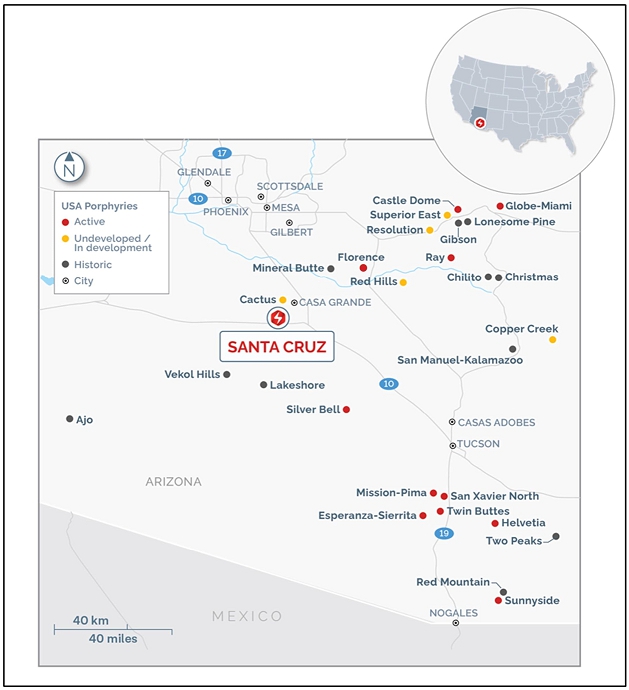
Source: Ivanhoe Electric, 2026
Figure 1-1: Santa Cruz Copper Project Location
| SEPTEMBER 2026 | 1-3 |
| Ivanhoe Electric Inc. S-K 1300 Preliminary Feasibility Study & | |
| 1.4 | Mineral Tenure, Ownership, Surface Rights, and Royalties |
| 1.4.1 | Agreements & Permits |
The Santa Cruz Copper Project is 100% owned by Ivanhoe Electric through its wholly-owned subsidiary, Mesa Cobre Holding Corporation (“Mesa Cobre”).
| 1.4.2 | Mineral Tenure |
In 2021, Ivanhoe Electric acquired 238 unpatented mining lode claims from Central Arizona Resources, Ltd. (“CAR”). In addition, Ivanhoe Electric acquired fee simple mineral title for two further land parcels: “CG100” and “Skull Valley”. In 2022, Ivanhoe Electric acquired the 0.08 km2 (20-acre) “Skull Valley” property from Skull Valley Capital, LLC in the southeastern area of the Project and the 0.41 km2 (100.33-acre) “CG100” from CG 100 Land Partners LLC in the northeastern area of the Project.
In 2023, Ivanhoe Electric acquired 16 Arizona State Land Department mineral exploration permits covering 27.95 km2 (~6,900 acres) of state mineral land. In 2024, Ivanhoe Electric exercised the agreement with D.R. Horton Phoenix East Construction, Inc. (“DRH”), granting Ivanhoe Electric, through Mesa Cobre, 100% of the mineral title for 26.0 km2 (~6,425 acres) of fee simple mineral estate, 39 federal unpatented mining lode claims (bringing the total claims controlled by Ivanhoe Electric to 277), and 26.6 km2 (~642.5 acres) of Stock-Raising Homestead Act lands.
The total Project area comprises fee simple land along with unpatented mining lode claims and Arizona State Land Department Mineral Exploration Permits. Annual renewal fees for the unpatented mining lode claims and mineral exploration permits have been made as required. The area of proposed mine activity lies on fee simple land. Mineral control is summarized in Table 1-1 and shown on Figure 1-2.
Table 1-1: Summary of Ivanhoe Electric’s Mineral Control
| Land Designation | Area (km2) |
| Fee Simple Mineral Ownership | 25.98 |
| Unpatented Mining Lode Claims (277 claims) | 19.30 |
| Arizona State Land Department Mineral Exploration Permits (16 permits) | 30.47 |
| SEPTEMBER 2026 | 1-4 |
| Ivanhoe Electric Inc. S-K 1300 Preliminary Feasibility Study & | |
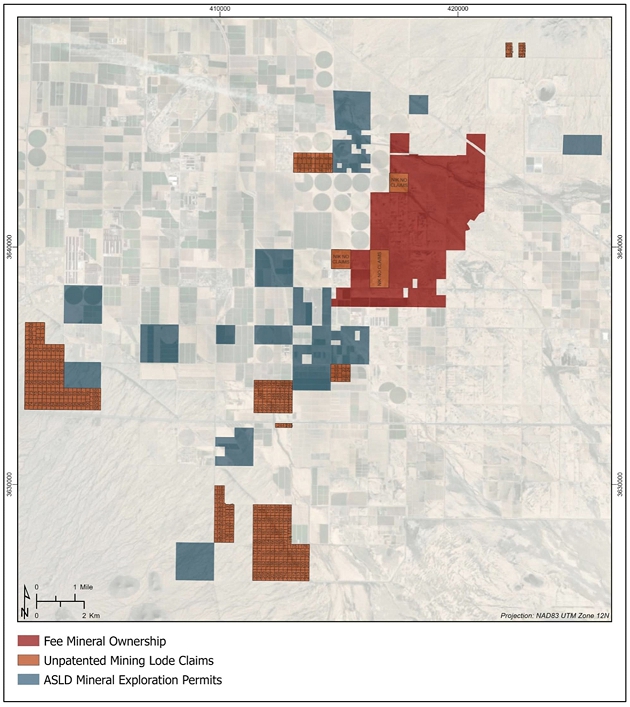
Source: Ivanhoe Electric, 2026
Figure 1-2: Santa Cruz Copper Project Mineral Control Map
| SEPTEMBER 2026 | 1-5 |
| Ivanhoe Electric Inc. S-K 1300 Preliminary Feasibility Study & | |
| 1.4.3 | Surface & Water Rights |
In 2022, Ivanhoe Electric acquired the surface rights to two land parcels: the 0.08 km2 (20-acre) Skull Valley property from Skull Valley Capital, LLC in the southeastern area of the Project and a 0.41 km2 (100.33-acre) land parcel “CG100” from CG 100 Land Partners LLC in the northeastern area of Project. In August 2024, Ivanhoe Electric acquired the surface title to three 0.04 km2 (10-acre) parcels located in various areas of the Project along with the mineral rights from DRH. The majority of the surface rights for the Santa Cruz Copper Project were acquired in 2023. Surface rights are shown in Figure 1-3. Ivanhoe Electric acquired both Grandfathered Irrigation Rights (“GFR”) and Grandfathered Type 1 Non-irrigation Water Rights as part of its 2023 private land purchase. These rights provide approximately 3,600 acre-feet (“acre-ft”) per year of water for Project use.
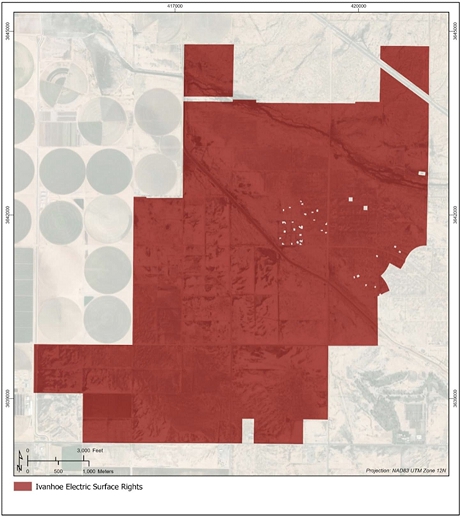
Source: Ivanhoe Electric, 2026
Figure 1-3: Ivanhoe Electric Surface Control Map
| SEPTEMBER 2026 | 1-6 |
| Ivanhoe Electric Inc. S-K 1300 Preliminary Feasibility Study & | |
| 1.4.4 | Royalties |
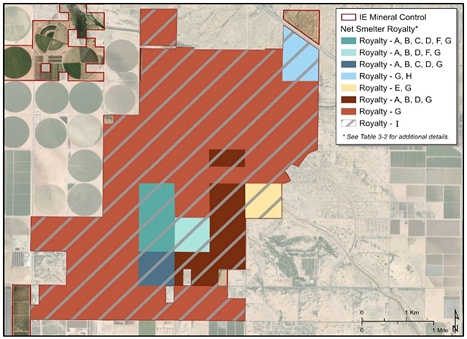
Noted royalties on future mineral development of the Project are summarized in Table 1-2 and Figure 1-4.
Table 1-2: Royalties Applying to the Santa Cruz Copper Project
| Royalty Owner | Royalty Description |
| Royalty Owner A | 10% of 1/800th of the fair market value for refined copper, which amount is set by the value listed in the successor index to Metals Week as of the date the solution extraction / electrowinning (“SX/EW”) process is completed |
| Royalty Owner B | 60% of 1/800th of the fair market value for refined copper, which amount is set by the value listed in the successor index to Metals Week as of the date the SX/EW process is completed |
| Royalty Owner C | 2% NSR |
| Royalty Owner D | 0.15% net smelter return |
| Royalty Owner E | ½ of 1% net smelter return or ½ of 1% of 60% net smelter return if product is disposed of other than to a commercial smelter |
| Royalty Owner F | 10% net smelter return (capped at $7 million) |
| Royalty Owner G | 5% net smelter return |
| Royalty Owner H | 1% net smelter return |
| Royalty Owner I | $0.015/lbs of copper of additional mineable reserve copper over 2 billion pounds (“Blbs”) as determined by the “Definitive Feasibility Study” or by production beyond the amount estimated in the “Definitive Feasibility Study”; the royalty owner has the option to require payment in Ivanhoe Electric common stock at a 10% discount to the five-day volume weighted average price |
| SEPTEMBER 2026 | 1-7 |
| Ivanhoe Electric Inc. S-K 1300 Preliminary Feasibility Study & | |
Source: Ivanhoe Electric, 2026
Figure 1-4: Extent of Royalties
| 1.5 | History |
Copper mineralization, first discovered in the region in the 1960s, led to extensive drill programs across the Project area. Exploration programs by several companies and joint ventures included diamond drilling and several geophysical surveys from the 1960s through the 1990s.
Ivanhoe Electric gained access to the land in August 2021 to start drill programs, completed a Mineral Resource estimate in 2022, an updated Mineral Resource estimate in early 2023, an initial assessment in September 2023, and a preliminary feasibility study in June 2025.
| 1.6 | Geology & Mineralization |
The Santa Cruz Copper Project is situated within the Southwestern Porphyry Copper Belt, which is home to numerous productive copper deposits. Notable examples in Arizona include Mineral Park, Bagdad, Resolution, Miami-Globe, San Manuel-Kalamazoo, Ray, Morenci, Sierrita, Twin Buttes, and the historically significant Sacaton Mine. These deposits are part of the larger physiographical area known as the Basin and Range Province, which covers much of the southwestern United States.
| SEPTEMBER 2026 | 1-8 |
| Ivanhoe Electric Inc. S-K 1300 Preliminary Feasibility Study & | |
The porphyry copper deposits in the Southwestern Porphyry Copper Belt are the result of igneous activity during the Laramide Orogeny, which occurred between 50 and 80 million years ago. This geological event was driven by the subduction of the Farallon Tectonic Plate beneath the North American Tectonic Plate, resulting in the formation of a magmatic arc and the development of associated porphyry copper systems.
The Project comprises four separate areas along a southwest-northeast corridor. These areas from southwest to northeast are known as the Southwest exploration area, the Santa Cruz deposit, the East Ridge deposit, and the Texaco deposit, all of which represent portions of one or more large porphyry copper systems separated by extensional Basin and Range normal faults. Each area has experienced variable periods of erosion, supergene enrichment, fault displacement, and tilting into their present positions.
Mineralization in the Project area is divided into the following:
| ■ | Supergene copper oxide mineralization mainly consists of atacamite and chrysocolla, with smaller amounts of cuprous goethite, copper-bearing smectite clays, tenorite, cuprite, copper wad, and native copper; |
| ■ | Secondary supergene sulfide mineralization is dominantly chalcocite, which replaces hypogene sulfide; |
| ■ | Primary hypogene sulfide mineralization consists of chalcopyrite and molybdenite hosted within quartz-sulfide stringers, veins, and breccias. |
| 1.7 | Exploration, Drilling & Sampling |
Ivanhoe Electric has completed geophysical surveys including two-dimensional, three-dimensional, multichannel seismic, reprocessing of proprietary Typhoon™ three-dimensional perpendicular pole dipole induced polarization data, and ambient noise tomography. The geophysical datasets from these surveys were used to assist with geological interpretation and improved drill targeting.
A comprehensive surface ionic leach sampling program has also been completed across the Project to assess in detecting copper mineralization at depth.
Drilling within the Santa Cruz Copper Project property totals 484 drillholes for 354,655 m of drilling. Of this total, 329 drillholes for 279,164 m were used in support of the Mineral Resource. The 155 drillholes excluded from the estimation do not intersect the deposit or did not have relevant information for estimation, such as shallow sonic holes with no assay samples taken.
Detailed core logging is performed by Ivanhoe Electric geologists through digital data input into MX Deposit. Data that are logged include lithology, alteration, mineralization, veining,
| SEPTEMBER 2026 | 1-9 |
| Ivanhoe Electric Inc. S-K 1300 Preliminary Feasibility Study & | |
petrophysical data, and geotechnical parameters, such as faults, joints, fractures, hardness, and rock quality (Q-system) parameters. Additional characterization fields such as rock colors, grain sizes, textures, and supergene weathering features were also captured. Approximately 6,295 density measurements from 210 drillholes were measured for the Santa Cruz, East Ridge, and Texaco deposits.
Quality assurance and quality control (“QA/QC”) for the Ivanhoe Electric drill programs consisted of inserting duplicates, blanks, and certified reference materials (standards) into the sample stream at set sampling intervals. BBA’s review of the data indicated no material issues.
Ivanhoe Electric used 222 drillholes totaling over 70 km of geotechnical drilling to analyze geotechnical characterization of the Santa Cruz and East Ridge deposits. Historical drillholes were selected based on availability of rock quality designation data.
The groundwater flow model was calibrated and used to predict the residual passive inflows for the prefeasibility study mine plan. The predicted residual passive inflows resulting from the updated model, with grouting applied, indicate that the residual passive inflows for the first 10 years of the mine are at or below 7,200 gallons per minute (“gal/min”), compared to the 12,000 gal/min estimated in the initial assessment (“IA”) model, in addition to 2 years of 3,000 gal/min of active pumping. From Years 11 through 25, the residual passive inflows in the updated model range from approximately 3,500 to 7,200 gal/min, compared to 15,000 to 18,000 gal/min predicted in the IA model.
| 1.8 | Data Verification |
BBA personnel in the disciplines of geology, Mineral Resource estimation, Mineral Reserve estimation, and mining visited the Project site in 2024. During the visit, BBA personnel reviewed and verified data acquisition procedures with Ivanhoe Electric personnel, visited active drill sites, and performed several other verification checks to ensure data integrity.
Based on the data made available, BBA considers that a reasonable level of verification has been completed and that no material issues were identified from the programs. It is BBA’s opinion that the geological data collection and QA/QC procedures used by Ivanhoe Electric are consistent with current industry practices and that the geological database is of suitable quality to support a Mineral Resource estimate.
| SEPTEMBER 2026 | 1-10 |
| Ivanhoe Electric Inc. S-K 1300 Preliminary Feasibility Study & | |
| 1.9 | Metallurgical Testwork |
Metallurgy and processing test work were directed by Met Engineering, LLC and conducted at McClelland Labs (“MLI”) in Sparks, Nevada, USA, at Blue Coast Research (“BCR”) in Parksville, British Columbia, Canada and at Kappes, Cassidy and Associates (“KCA”) in Reno, Nevada, USA.
Metallurgical testwork included the following:
| ■ | Establishing copper recoveries, based on sequential coppers for chloride-assisted, weak-sulfuric acid, heap leaching of mineralized material at the Santa Cruz Copper Project. |
| ■ | Determining commercial operating parameters for heap leaching mineralized material at the Santa Cruz Copper Project, including salt usage, sulfuric acid usage, ore cure/agglomeration practices, leach cell cycle times for an on/off leach pad design, annual pregnant leach solution grades, and pregnant leach solution flow rate to solvent extraction. |
| ■ | Additional testing at KCA in 2025-2026 answered a number of questions related to the process design criteria for value engineering: Extraction (PLS)/recovery (to cathode) at 8-m lift, optimal chloride level, use ILS or not, use rest-rinse or continuous irrigation, copper level in the irrigation solution, particle size, etc. |
A grade-recovery equation was developed based on sequential copper assays. For the life-of-mine processing, this equation produces a weighted average of 92.3% total copper recovery to cathode for leaching an 8 m lift of ore crushed to 100% passing 9.5 mm for 220 days of irrigation utilizing an on/off leach pad.
There are no deleterious elements or factors that could have a significant effect on economic extraction of the copper in the mineralized material.
| 1.10 | Mineral Resource Estimate |
| 1.10.1 | Estimation Methodology |
The Santa Cruz deposit has approximately 194,000 m of drilling in 226 drillholes; East Ridge has approximately 49,000 m of drilling in 62 holes; and Texaco has approximately 36,000 m of drilling in 41 holes.
Geological domains were developed for the Project based on alteration, lithological, and mineralogical characteristics, incorporating regional and local structural information. Normal faults separate the mineralization at the Santa Cruz, East Ridge, and Texaco deposits.
The Santa Cruz deposit was divided into several mineral domains: exotic domain, verde domain, leach cap, oxide domain, chalcocite enriched domain, and primary mineralization domain. The
| SEPTEMBER 2026 | 1-11 |
| Ivanhoe Electric Inc. S-K 1300 Preliminary Feasibility Study & | |
East Ridge deposit consists of a mix of oxide and chalcocite enriched domains. The Texaco deposit consists of all domains except for leach cap and exotic. The domains were further divided into subdomains based on individual grade profiles, which align with controls on mineralization. The following terms are assigned to the subdomains; these represent a local definition of the grade profile: high-grade, medium-grade, and low-grade.
Exploratory data analysis was conducted to determine the nature of element distribution and correlation of grades within individual lithological units, and to identify high-grade outlier samples. Capping was not applied to copper values as significant outliers were not identified. Samples were composited to 2 m intervals. Variograms were completed by subdomain for each deposit.
The resource estimation methodology constrains the mineralization by using hard wireframe boundaries. Ordinary kriging (“OK”) was employed for the Santa Cruz deposit, and inverse distance squared (“ID2”) was selected for the East Ridge and Texaco deposits. Multiple search passes were used for each deposit. Search parameters were based on variography and continuity of mineralization.
Validation checks were completed on the Mineral Resource estimates. These included visual comparison of estimated grade to composite grade, domain conformity, swath plots, and comparisons to alternate estimation methods.
Indicated and Inferred classification was applied to the Santa Cruz, East Ridge, and Texaco deposits based on BBA’s review that included the examination of drill spacing, visual comparison, kriging variance, distance to the nearest composite, and search pass, along with the search ellipsoid ranges. Collectively, this information was used to produce an initial classification script followed by manual wireframe application to further limit the Mineral Resource classification.
Mineral Resources used commodity prices based on long-term analyst and bank forecasts. In the opinion of BBA, this price is generally aligned with pricing over the last 1, 3, and 5 years; forward-looking pricing from internationally recognized banks is appropriate for use in a Mineral Resource estimate. Section 16 provides an explanation of the commodity price forecasts. The commodity price considered 3-year trailing averages.
| 1.10.2 | Mineral Resource Statement |
The Mineral Resources in this estimate were independently prepared, including estimation and classification, by BBA in accordance with the definition for Mineral Resources in S-K 1300 regulations. The in-situ Mineral Resource estimates for the Santa Cruz, East Ridge, and Texaco deposits, inclusive and exclusive of reserves, are presented in Table 1-3 and Table 1-4, respectively.
| SEPTEMBER 2026 | 1-12 |
| Ivanhoe Electric Inc. S-K 1300 Preliminary Feasibility Study & | |
Table 1-3: In-situ Mineral Resource Estimate Inclusive of Reserves for Santa Cruz, East Ridge & Texaco
| Deposit | Classification | Tonnes (kt) |
Total
Copper (%) |
Acid
Soluble Copper (%) |
Cyanide Leach Copper (%) |
Residual Copper (%) |
Gold (g/t) |
Silver (g/t) |
Contained Copper (kt) |
Total
Acid Soluble Copper (kt) |
Total Cyanide Cu (kt) |
Total
Residual Cu (kt) |
Contained Gold (koz) |
Contained Silver (koz) |
Contained Copper (Mlbs) |
| Santa Cruz | Indicated | 317,709 | 0.95 | 0.48 | 0.30 | 0.17 | 0.027 | 1.62 | 3,017 | 1,517 | 956 | 543 | 279 | 16,513 | 6,650 |
| Inferred | 31,998 | 0.73 | 0.21 | 0.17 | 0.34 | 0.021 | 1.78 | 232 | 68 | 54 | 110 | 21 | 1,832 | 512 | |
| East Ridge | Indicated | 8,742 | 1.00 | 0.45 | 0.39 | 0.16 | 0.014 | 0.68 | 88 | 40 | 34 | 14 | 4 | 191 | 193 |
| Inferred | 48,676 | 0.89 | 0.44 | 0.12 | 0.33 | 0.006 | 0.40 | 436 | 216 | 57 | 163 | 9 | 623 | 960 | |
| Texaco | Inferred | 341,345 | 0.78 | 0.06 | 0.27 | 0.45 | 0.028 | 0.81 | 2,664 | 218 | 920 | 1,537 | 302 | 8,850 | 5,873 |
| All Deposits | Indicated | 326,450 | 0.95 | 0.48 | 0.30 | 0.17 | 0.027 | 1.59 | 3,104 | 1,557 | 989 | 558 | 283 | 16,704 | 6,844 |
| All Deposits | Inferred | 422,020 | 0.79 | 0.12 | 0.24 | 0.43 | 0.025 | 0.83 | 3,332 | 503 | 1,030 | 1,809 | 333 | 11,304 | 7,346 |
Notes on Mineral Resources:
| 1. | The Mineral Resources in this estimate were independently prepared, including estimation and classification, by BBA Consultants USA LP, and are reported in accordance with the definition for Mineral Resources in S-K 1300. | |
| 2. | Mineral Resources that are not Mineral Reserves do not have demonstrated economic viability. | |
| 3. | Mineral Resources are reported in situ, inclusive of Mineral Reserves. | |
| 4. | The Mineral Resources for Santa Cruz, East Ridge, and Texaco deposit were completed using Datamine Studio RM software. | |
| 5. | The Mineral Resources are current at September 23, 2026. | |
| 6. | Mineral Resources constrained assuming underground mining methods for the Santa Cruz deposit are reported at an NSR cutoff of US$32.00 for heap leach and US$34.00 for concentrator; Texaco deposit is reported at an NSR cutoff of US$32.00 for heap leach and US$34.00 for concentrator; and East Ridge deposit is reported at an NSR cutoff of US$40.00 for longhole stoping and US$50.00 for drift-and-fill. The cutoff reflects the total operating costs to define reasonable prospects for economic extraction by conventional underground mining methods. Material from within mineable shape-optimized wireframes has been included in the Mineral Resource. Underground mineable shapes optimization parameters include a long-term copper price of US$4.00/lb, gold price of US$1,900/oz, and silver price of US$24.00/oz. Process costs of US$7.00 to US$9.00 per processed tonne; direct mining costs between US$22.00 to US$40.00 per processed tonne reflecting various mining method costs (leach, longhole or drift-and-fill), mining general and administration costs of US$2.63 per processed tonne, on-site processing costs between US$31.63 to US$49.63 per processed tonne, along with variable royalties between 5.01% to 6.96% NSR, and a mining recovery of 100%. | |
| 7. | Mineral Resources are estimated using metallurgical recoveries for heap leach of 96% for acid-soluble copper, 83% for cyanide-soluble copper, 22% for residual copper, 0% for gold and 0% for silver. Recoveries for concentrator are 0% for acid-soluble copper, 90% for cyanide-soluble copper, 90% for residual copper, 59% for gold, and 69% for silver. | |
| 8. | Density was applied using weighted averages by deposit subdomain. | |
| 9. | Rounding, as required by reporting guidelines, may result in apparent summation differences between tonnes, grade, and contained metal content. |
| SEPTEMBER 2026 | 1-13 |
| Ivanhoe Electric Inc. S-K 1300 Preliminary Feasibility Study & | |
Table 1-4: In-situ Mineral Resource Estimate Exclusive of Reserves for Santa Cruz, East Ridge & Texaco
| Deposit | Classification | Tonnes
(kt) |
Total
Copper (%) |
Acid
Soluble Copper (%) |
Cyanide Leach Copper (%) |
Residual Copper (%) |
Gold (g/t) |
Silver (g/t) |
Contained Copper (kt) |
Total
Acid Soluble Cu (kt) |
Total Cyanide Cu (kt) |
Total
Residual Cu (kt) |
Contained Gold (koz) |
Contained Silver (koz) |
Contained Copper (Mlbs) |
| Santa Cruz | Indicated | 177,547 | 0.79 | 0.32 | 0.20 | 0.27 | 0.025 | 1.45 | 1,403 | 570 | 362 | 471 | 140 | 8,279 | 3,092 |
| Inferred | 31,998 | 0.73 | 0.21 | 0.17 | 0.34 | 0.021 | 1.78 | 232 | 68 | 54 | 110 | 21 | 1,832 | 512 | |
| East Ridge | Indicated | 4,412 | 0.94 | 0.43 | 0.31 | 0.20 | 0.015 | 0.71 | 41 | 19 | 14 | 9 | 2 | 101 | 91 |
| Inferred | 48,676 | 0.89 | 0.44 | 0.12 | 0.33 | 0.006 | 0.40 | 436 | 216 | 57 | 163 | 9 | 623 | 960 | |
| Texaco | Inferred | 341,345 | 0.78 | 0.06 | 0.27 | 0.45 | 0.028 | 0.81 | 2,664 | 218 | 920 | 1,537 | 302 | 8,850 | 5,873 |
| All Deposits | Indicated | 182,959 | 0.79 | 0.32 | 0.21 | 0.26 | 0.024 | 1.43 | 1,444 | 589 | 376 | 480 | 143 | 8,380 | 3,184 |
| All Deposits | Inferred | 422,020 | 0.79 | 0.12 | 0.24 | 0.43 | 0.025 | 0.83 | 3,332 | 503 | 1,030 | 1,809 | 333 | 11,304 | 7,346 |
Notes on Mineral Resources:
| 1. | The Mineral Resources in this estimate were independently prepared, including estimation and classification, by BBA Consultants USA LP, and are reported in accordance with the definition for Mineral Resources in S-K 1300. | |
| 2. | Mineral Resources that are not Mineral Reserves do not have demonstrated economic viability. | |
| 3. | Mineral Resources are reported in situ, exclusive of Mineral Reserves. | |
| 4. | The Mineral Resources for Santa Cruz, East Ridge, and Texaco deposit were completed using Datamine Studio RM software. | |
| 5. | The Mineral Resources are current at September 23, 2026. | |
| 6. | Mineral Resources constrained assuming underground mining methods for the Santa Cruz deposit are reported at an NSR cutoff of US$32.00 for heap leach and US$34.00 for concentrator; Texaco deposit is reported at an NSR cutoff of US$32.00 for heap leach and US$34.00 for concentrator; and East Ridge deposit is reported at an NSR cutoff of US$40.00 for longhole stoping and US$50.00 for drift-and-fill. The cutoff reflects the total operating costs to define reasonable prospects for economic extraction by conventional underground mining methods. Material from within mineable shape-optimized wireframes has been included in the Mineral Resource. Underground mineable shapes optimization parameters include a long-term copper price of US$4.00/lb, gold price of US$1,900/oz, and silver price of US$24.00/oz. Process costs of US$7.00 to US$9.00 per processed tonne; direct mining costs between US$22.00 to US$40.00 per processed tonne reflecting various mining method costs (leach, longhole or drift-and-fill), mining general and administration costs of US$2.63 per processed tonne, on-site processing costs between US$31.63 to US$49.63 per processed tonne, along with variable royalties between 5.01% to 6.96% NSR, and a mining recovery of 100%. | |
| 7. | Mineral Resources are estimated using metallurgical recoveries for heap leach of 96% for acid-soluble copper, 83% for cyanide-soluble copper, 22% for residual copper, 0% for gold and 0% for silver. Recoveries for concentrator are 0% for acid-soluble copper, 90% for cyanide-soluble copper, 90% for residual copper, 59% for gold, and 69% for silver. | |
| 8. | Density was applied using weighted averages by deposit subdomain. | |
| 9. | Rounding, as required by reporting guidelines, may result in apparent summation differences between tonnes, grade, and contained metal content. |
| SEPTEMBER 2026 | 1-14 |
| Ivanhoe Electric Inc. S-K 1300 Preliminary Feasibility Study & | |
The current resource model iterations have not changed when compared to the iterations released in the 2025 PFS. Differences presented in Mineral Resources Exclusive of Mineral Reserves are due to the addition of stopes at the top of the mine.
| 1.10.3 | Factors That May Affect the Mineral Resource Estimate |
Areas of uncertainty that may materially impact the Mineral Resource estimates are as follows:
| ■ | Changes to long-term metal price assumptions; |
| ■ | Changes to the input values for mining, processing, and general and administrative (“G&A”) costs to constrain the estimate; |
| ■ | Changes to local interpretations of mineralization geometry and continuity of mineralized subdomains; |
| ■ | Changes to the density values applied to the mineralized zones; |
| ■ | Changes to metallurgical recovery assumptions; |
| ■ | Changes in assumptions of marketability of the final product; |
| ■ | Variations in geotechnical, hydrogeological, and mining assumptions; |
| ■ | Changes to assumptions with an existing agreement or new agreements; |
| ■ | Changes to environmental, permitting, and social license assumptions; |
| ■ | Logistics of securing and moving adequate services, labor, and supplies could be affected by epidemics, pandemics, and other public health crises, or geopolitical influence. |
| 1.11 | Mineral Reserve Estimate |
| 1.11.1 | Estimation Methodology |
Underground Mineral Reserves were estimated by BBA. Estimates were prepared for the Santa Cruz deposit, a portion of the East Ridge deposit, and the Verde domain located within the Santa Cruz deposit. The primary mining method for both deposits employs longhole stoping without pillars, utilizing a primary and secondary stoping sequence. Additionally, a few small lenses within the East Ridge deposit use a drift-and-fill mining method. Stopes will be backfilled after mining with paste backfill for the duration of the mine life. Indicated Mineral Resources were converted to Probable Mineral Reserves. Inferred Mineral Resources were not converted to Mineral Reserves; however, if Inferred Mineral Resources fell within the Mineral Reserve designs, they were assumed to have zero grade.
The underground mine approach was designed using zones that were amenable to different mining methods based on geotechnical considerations, access requirements, deposit shape,
| SEPTEMBER 2026 | 1-15 |
| Ivanhoe Electric Inc. S-K 1300 Preliminary Feasibility Study & | |
orientation and grade, and mining depths. Waste or low-grade blocks in the stope shapes were treated as internal dilution. Mine designs were modified by including the capital and operating development needed to access the stopes, and the applicable infrastructure requirements.
Net smelter return (“NSR”) represents the gross revenue generated from the sale of a refined metal product (in this case, copper cathodes) after deducting all associated off-site costs. For a mine producing copper cathodes via heap leaching and SX/EW, the traditional "smelter" and "refining" charges inherent in concentrate sales are not applicable. Instead, the off-site deductions are specific to the direct sale of cathodes.
The primary metal produced at the Santa Cruz Copper Project is copper. While byproducts of gold and silver are present, the current heap leach SX/EW process does not recover these precious metals. As is common with polymetallic deposits, the cutoff value for Mineral Reserves is determined and expressed in terms of net smelter return value per tonne.
The NSR is calculated based on unit metal values, utilizing representative smelter contract terms, freight costs, and forecasted metal prices. The metal prices and metallurgical recovery rates used for NSR calculations are summarized in Table 1-5. Operating cost for cutoff value calculations are summarized in Table 1-6. Royalties are factored into each block of the Mineral Resource model.
Mineral Reserves are assessed using commodity prices derived from long-term forecasts from analysts and banks. According to BBA, this pricing generally reflects the trends observed over the past 1, 3, and 5 years, and the forward-looking prices from internationally recognized banks are deemed appropriate for Mineral Reserve estimates.
Table 1-5: NSR Parameters
| Product | Unit | Value |
| Acid Soluble Copper Recovery | % | 98.8 |
| Cyanide Soluble Copper Recovery | % | 85.4 |
| Residual Copper Recovery | % | 35.1 |
| Recoverable Copper | % | 90.9 |
| Net Recoverable Copper | % | 90.0 |
| Copper Price | $/lb | 4.00 |
| SEPTEMBER 2026 | 1-16 |
| Ivanhoe Electric Inc. S-K 1300 Preliminary Feasibility Study & | |
Table 1-6: Operating Costs for Cutoff Value Calculations
| Criteria | Unit | Santa Cruz | East Ridge | East Ridge |
| 30 m Longhole | Drift-and-fill | 15 m Longhole | ||
| Leach | Leach | Leach | ||
| Cathode Split | % | 100.0 | 100.0 | 100.0 |
| On-site Costs | ||||
| Mining Costs – Direct | $/t processed | 31.00 | 47.05 | 47.05 |
| Processing Costs | $/t processed | 10.32 | 10.32 | 10.32 |
| G&A | $/t processed | 2.63 | 2.63 | 2.63 |
| On-site Total | $/t processed | 43.95 | 60.00 | 60.00 |
| On-site Rounded NSR Breakeven Cutoff | $/t | 44.00 | 60.00 | 60.00 |
| 1.11.2 | Mineral Reserve Statement |
Indicated Mineral Resources were converted to Probable Mineral Reserves. Inferred Mineral Resources were excluded from the Mineral Reserve estimate. Mineral Reserves for the Santa Cruz Copper Project are estimated for the Santa Cruz deposit and a portion of the East Ridge deposit, as well as the Verde domain within the Santa Cruz deposit.
Mineral Reserves are supported by a mine plan, engineering analysis, and modifying factors.
The point of reference for the Mineral Reserves is the point where the ore is delivered to the processing plant. Mineral Reserves are reported on a 100% basis.
The Mineral Reserve estimate for the Santa Cruz Copper Project is shown in Table 1-7. A small increase between the 2025 Mineral Reserve and the 2026 Mineral Reserve is attributed to the initial mine ramp-up and sequencing. This adjustment, which represents an increase of approximately 2% of the contained copper, facilitated access to several stopes within the 2026 mine plan that were not available in the 2025 mine plan.
| SEPTEMBER 2026 | 1-17 |
| Ivanhoe Electric Inc. S-K 1300 Preliminary Feasibility Study & | |
Table 1-7: Santa Cruz Copper Project Mineral Reserve Estimate
| Deposit | Classification | Tonnes (kt) |
Total Copper (%) |
Acid
Soluble Copper (%) |
Cyanide Leach Copper (%) |
Residual Copper (%) |
Contained Copper (kt) |
Total
Acid Soluble Cu (kt) |
Total
Cyanide Cu (kt) |
Total
Residual Cu (kt) |
| Santa Cruz | Probable | 136,022 | 1.09 | 0.63 | 0.40 | 0.05 | 1,477 | 863 | 547 | 66 |
| East Ridge | Probable | 4,107 | 1.03 | 0.46 | 0.44 | 0.13 | 42 | 19 | 18 | 5 |
| Total | Probable | 140,129 | 1.08 | 0.63 | 0.40 | 0.05 | 1,519 | 882 | 566 | 71 |
Notes on Mineral Reserves:
| 1. | The Mineral Reserves in this estimate are current to September 23, 2026, and were independently prepared, including estimation and classification, by BBA Consultants USA LP. They are reported in accordance with the definitions for Mineral Reserves in S-K 1300. | |
| 2. | The point of reference for the estimate is the point of delivery to the process facilities. | |
| 3. | The Mineral Reserves for the Santa Cruz and East Ridge deposits were completed using Deswik mining software. Mineral Reserves are defined within stope designs that are prescribed by rock mechanics, considering the specific characteristics of deposits, mineral domains, mining methods, and the mining sequence. Transverse longhole stoping is the optimal mining method with uppers and cut & fill methods used where appropriate. Mining will occur in blocks, extracting ore from the bottom upwards, with paste backfill providing ground support to sustain a production rate of 20,000 tonnes per day for the first 15 years of operation. | |
| 4. | Mineral Reserves are estimated at an NSR cutoff value of US$43.95/t for longhole stoping and US$60.00/t for longitudinal retreat stopes and drift-and-fill. The NSR values reflect the discrete metallurgical responses for each Mineral Reserve block using metallurgical recoveries for heap leach of 96% for acid-soluble copper, 83% for cyanide-soluble copper, 22% for residual copper. Underground mineable shapes optimization parameters include a long-term copper price of US$4.00/lb. | |
| 5. | Mineral Reserves account for mining loss and dilution. | |
| 6. | Mineral Reserves are a subset of the Indicated Mineral Resource and do not include the inferred Mineral Resource. | |
| 7. | Rounding, as required by the guidelines, may result in apparent summation differences between tonnes, grade, and contained metal content. |
| SEPTEMBER 2026 | 1-18 |
| Ivanhoe Electric Inc. S-K 1300 Preliminary Feasibility Study & | |
| 1.11.3 | Factors That May Affect the Mineral Reserve Estimate |
Factors that may affect the Mineral Reserve estimate include the following:
| ■ | Changes to long-term metal price assumptions; |
| ■ | Changes to metallurgical recovery assumptions; |
| ■ | Changes to the input assumptions used to derive the mineable shapes applicable to the assumed underground and open pit mining methods used to constrain the estimates; |
| ■ | Changes to the forecast dilution and mining recovery assumptions; |
| ■ | Changes to the cutoff grades used to constrain the estimates; |
| ■ | Variations in geotechnical (including seismicity), hydrogeological, mining, and processing recovery assumptions; |
| ■ | Changes to environmental, permitting, and social license assumptions. |
| 1.12 | Mining Methods |
The Santa Cruz Copper Project is an undeveloped greenfield project where Mineral Reserves have been identified for two deposits: Santa Cruz and East Ridge.
The Santa Cruz deposit is located approximately 480 to 940 m below the surface. Based on the mineralization's geometry and supporting geotechnical data, transverse underground longhole stoping has been selected as the most suitable mining method. Mining will be conducted in blocks, with ore being extracted from the bottom upward within each block while utilizing paste backfill to provide ground support. A sill pillar will be maintained between the blocks. The paste backfill is designed to be strong enough to allow adjacent filled stopes to be mined without requiring additional pillars.
The stopes for the Santa Cruz deposit will have varying widths of 12 to 18 m and lengths ranging from 10 to 17 m, depending on the geotechnical domain, zone, and mining sequence (primary or secondary). The levels in the mine are spaced 30 m apart. The Verde zone is a subdomain within the Santa Cruz deposit, and the production stopes in this area will be accessed from the Santa Cruz mine levels, featuring standard dimensions of 20 m (height) x 15 m (width) x 20 m (length).
The East Ridge deposit is situated to the north of the main Santa Cruz deposit, approximately 310 to 790 m below the surface. It consists of multiple tabular lenses and will be mined using a hybrid approach that combines longhole stoping and the drift-and-fill method, depending on the geometry of the orebody in each zone. At East Ridge, longhole stopes will measure 15 m (height) x 10 m (width) x 8 m (length), accessed via longitudinal entries. For zones using the drift-and-fill method, the drifts will have dimensions of 5 m (height) x 5 m (width), with variable lengths
| SEPTEMBER 2026 | 1-19 |
| Ivanhoe Electric Inc. S-K 1300 Preliminary Feasibility Study & | |
determined by the local rock mass condition. Mining will begin with a drift sized at 5 m (height) x 5 m (width), followed by paste backfill and curing before the development of the next adjacent drift in the orebody.
Mine access will be provided through a single tunnel boring machine (“TBM”) decline from the surface. Ore will be transported from the stopes by load-haul-dump (“LHD”) equipment to an orepass system, which will transfer the ore from a chute to a conveyor system. The conveyor system will transfer the material to surface. Main intake and exhaust raises will be developed to ensure the mine workings are adequately ventilated. The combined production target for the Santa Cruz and East Ridge deposits is approximately 20,000 t/d at peak production and approximately 14,000 t/d life of mine (“LOM”).
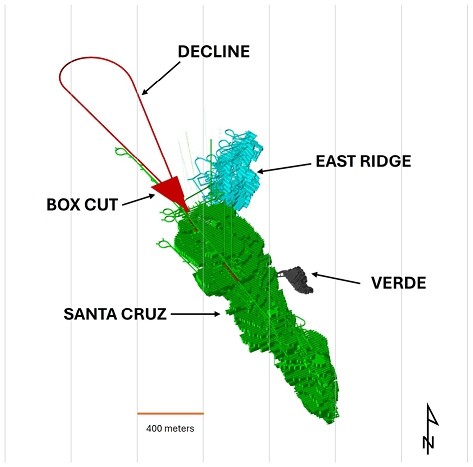
The Santa Cruz Copper Project encompasses three mining zones: Santa Cruz, Verde, and East Ridge (Figure 1-5). The Santa Cruz zone is the primary production area and is structurally divided into northern and southern regions.
Source: Ivanhoe Electric, 2026
Figure 1-5: Mining Zones of Santa Cruz and East Ridge Deposits, View looking North
| SEPTEMBER 2026 | 1-20 |
| Ivanhoe Electric Inc. S-K 1300 Preliminary Feasibility Study & | |
Primary (first-pass) support will be installed in conjunction with the advance of excavation and will provide support and reinforcement. Any support applied at a later stage will be considered secondary (or second-pass) support. Excavation in rock will be performed via conventional (drill and blast) methods or with a roadheader machine.
The Santa Cruz Copper Project mine life is expected to be 24 years with construction from 2027 to mid-2029 followed by schedule production to 2052. Table 1-8 summarizes the production in the mine plan. The “Ore” column represents the total development and production ore for Santa Cruz, Verde, and East Ridge mining zones.
Table 1-8: Santa Cruz Scheduled Production Summary
| Year | Ore (kt) |
Total
Copper (%) |
AsCu (%) |
CNCu (%) |
Cu_Res (%) |
Ratio
ASCU:TCU |
| 2027 | 0 | 0.00 | 0.00 | 0.00 | 0.00 | |
| 2028 | 101 | 0.54 | 0.13 | 0.44 | 0.00 | 0.82 |
| 2029 | 1,403 | 0.82 | 0.13 | 0.56 | 0.12 | 0.69 |
| 2030 | 4,684 | 1.37 | 0.22 | 1.09 | 0.05 | 0.80 |
| 2031 | 6,819 | 1.23 | 0.34 | 0.86 | 0.04 | 0.70 |
| 2032 | 7,286 | 1.10 | 0.47 | 0.58 | 0.05 | 0.53 |
| 2033 | 7,155 | 1.17 | 0.55 | 0.59 | 0.03 | 0.50 |
| 2034 | 7,245 | 1.16 | 0.49 | 0.62 | 0.04 | 0.54 |
| 2035 | 7,775 | 1.07 | 0.43 | 0.60 | 0.04 | 0.56 |
| 2036 | 7,679 | 1.09 | 0.31 | 0.75 | 0.03 | 0.69 |
| 2037 | 7,850 | 0.98 | 0.28 | 0.67 | 0.03 | 0.68 |
| 2038 | 8,003 | 1.02 | 0.31 | 0.66 | 0.05 | 0.65 |
| 2039 | 7,804 | 1.08 | 0.48 | 0.55 | 0.05 | 0.51 |
| 2040 | 7,105 | 1.18 | 0.64 | 0.45 | 0.09 | 0.38 |
| 2041 | 7,210 | 1.16 | 0.59 | 0.49 | 0.08 | 0.42 |
| 2042 | 7,672 | 1.09 | 0.48 | 0.57 | 0.05 | 0.52 |
| 2043 | 8,011 | 1.01 | 0.41 | 0.57 | 0.03 | 0.56 |
| 2044 | 7,447 | 1.01 | 0.32 | 0.62 | 0.08 | 0.00 |
| 2045 | 3,315 | 0.93 | 0.24 | 0.64 | 0.05 | 0.00 |
| 2046 | 3,625 | 0.98 | 0.49 | 0.46 | 0.03 | 0.47 |
| 2047 | 3,706 | 1.10 | 0.40 | 0.67 | 0.03 | 0.61 |
| 2048 | 3,647 | 1.02 | 0.27 | 0.68 | 0.07 | 0.66 |
| 2049 | 3,742 | 1.02 | 0.28 | 0.70 | 0.04 | 0.68 |
| 2050 | 3,659 | 1.05 | 0.39 | 0.58 | 0.07 | 0.55 |
| 2051 | 3,648 | 0.97 | 0.42 | 0.50 | 0.05 | 0.52 |
| 2052 | 3,537 | 1.03 | 0.21 | 0.74 | 0.08 | 0.72 |
| Total | 140,129 | 1.08 | 0.40 | 0.63 | 0.05 | - |
| SEPTEMBER 2026 | 1-21 |
| Ivanhoe Electric Inc. S-K 1300 Preliminary Feasibility Study & | |
Figure 1-6 shows tonnes of material mined over the LOM from the orebodies and development.
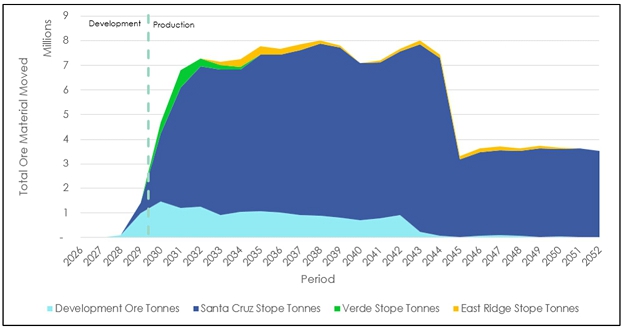
Source: BBA, 2026
Figure 1-6: Santa Cruz Tonnes of Mined Material
Cemented paste backfill is used as the primary means of backfill to support the mining cycle and allow excavation of the adjacent voids. Spent ore from the on/off leach pad is the primary material source to produce paste. Due to the lag between the initial availability of spent ore from the on/off pad and the demand for paste, Oracle granite from the decline construction or an off-site source is used during the initial months of mine production. Milled spent ore will then be used for the remainder of the mine life. The spent ore requires conditioning and milling prior to use in the backfill system to establish suitable properties for use as paste backfill.
Grade control at the Santa Cruz mine will be enhanced through technology integrated into the materials handling system, such as cross-belt analyzers. Additionally, production hole sampling and on-site testing at the surface assay laboratory will be employed to reconcile results with the mine plan.
The underground ventilation system is designed to ensure efficient airflow and maintain appropriate working temperatures underground throughout the LOM. Using a “push-pull” system with main intake and exhaust fans, the system has a capacity of 880 m3/s, supported by one decline and three primary ventilation shafts. All main fans are planned to be installed on the surface at the shaft collars, while booster fans will be needed to regulate ventilation flow underground. Due to high ambient temperatures, mechanical cooling is provided by a central
| SEPTEMBER 2026 | 1-22 |
| Ivanhoe Electric Inc. S-K 1300 Preliminary Feasibility Study & | |
refrigeration plant with a peak capacity of 20 MW of refrigeration. The system features variable frequency drives and regulators to allow ventilation control underground, ensuring adequate air quality and efficient clearance of mine blast gases.
| 1.13 | Recovery Methods |
Process for the Santa Cruz Copper Project has been designed to cycle oxide and secondary sulfide ores through an on/off heap leach pad to produce a copper-rich pregnant leach solution (“PLS”) that will be processed in the on-site solvent extraction and electrowinning circuit for recovery.
The process plant and refinery designs were based on proven technologies and established operating practices, and commercially available equipment. The process and refinery plant designs are based on the results of metallurgical testwork on the mineralized material at the Santa Cruz Copper Project. The designs are conventional.
The simplified overall process flow diagram is presented in .
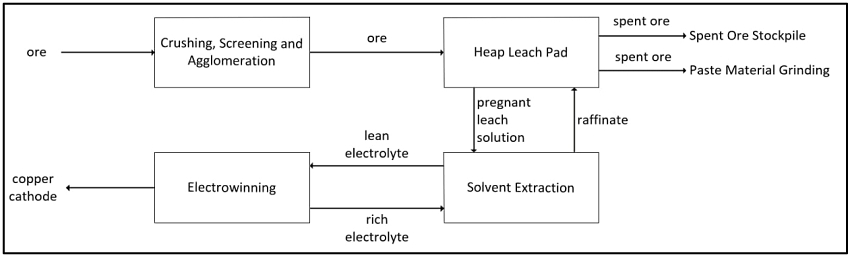
Source: Worley, 2026
Figure 1-7: Simplified Process Flowsheet
Ore produced from the underground mine will be processed using a heap leach and solvent extraction and electrowinning flowsheet to produce London Metal Exchange (“LME”) grade copper cathode. The heap leaching process will take place on an on/off pad. Spent ore will be removed from the leach pad and processed for paste backfill or stacked on a spent ore pile. Approximately 50% of the spent ore will be processed for use in paste backfill. Operations will be conducted 24 hours per day, 365 days per year for approximately 26 years at a design stacking rate of up to 22,000 t/d.
Run of mine (“ROM”) ore will be delivered to surface at a diameter of less than 254 mm via the conveyor. Ore from underground will be conveyed to the coarse ore stockpile for further 2-stage
| SEPTEMBER 2026 | 1-23 |
| Ivanhoe Electric Inc. S-K 1300 Preliminary Feasibility Study & | |
crushing. Fine ore (undersize from the crushing circuit) will be trucked to the agglomeration drums where sulfuric acid and sodium chloride can be added to facilitate agglomeration and leaching.
Crushed and agglomerated ore will be delivered to the leach pad via a combination of overland conveying and stacking equipment. The final mobile conveyor will feed two self-propelled indexing conveyors in series, which in turn will feed the self-propelled mobile radial stacker. The cells will be ‘retreat’ stacked by the radial stacker in a 65.5-meter-wide (half-cell) half-moon shape.
The on/off heap leach pad will be divided into seven cells, each approximately 130 x 730 meters (Figure 1-8). The cells will be separated by divider berms located near their base so that solution flow from each cell can be segregated for collection. The liner for the leach pad is comprised of a high-density polyethylene geomembrane overlaying a geosynthetic clay liner overlaying prepared native foundation materials or grading fill.
Ore will be stacked at up to 22,000 t/d, while unloading will consider a constant rate of 22,000 t/d; based on a typical interior half-cell strip (i.e., not the end cell strips on the north or south sides of the pad), it will take approximately 25 days to stack each half-cell strip at the design production rate. Each of the cells (and more specifically, each of the half-cell strips) will cycle through the following processes in sequence with an entire cell cycle, under the design production rates and idealized cell sizing, taking approximately 320 days.
The cycles are as follows:
| ■ | Stacking (25 days); |
| ■ | Piping connections and stacker relocation (3 days); |
| ■ | Irrigation (220 days); |
| ■ | Solution drain, water rinse, drain down, and piping removal (23 days); |
| ■ | Spent ore removal (25 days); |
| ■ | Inspection and maintenance (empty cell time) (26 days). |
The cells will be irrigated with raffinate (depleted pregnant leach solution from the solution extraction process) or secondary leach solution (“SLS”) produced from leaching. Leach solution will report to the solution collection ponds. At the end of the leach cycle, spent ore will be removed to the spent ore stockpile or the paste plant using dozers, loaders, grasshopper / link conveyors and trucks (Figure 1-8).
| SEPTEMBER 2026 | 1-24 |
| Ivanhoe Electric Inc. S-K 1300 Preliminary Feasibility Study & | |
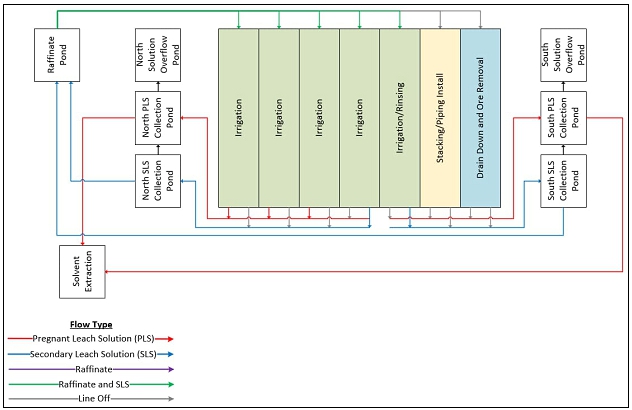
Source: KCB, 2026
Figure 1-8: Seven-Cell Heap Leach and Solution Management
Solution will be managed in a series of lined ponds, including the raffinate pond, PLS and SLS collection ponds, solution overflow ponds, and spent ore stockpile collection pond. The pond system has been sized to contain normal operating solutions and stormwater and to maintain separation between contact and non-contact water. The proposed locations of the solution management ponds are depicted in Figure 1-9.
| SEPTEMBER 2026 | 1-25 |
| Ivanhoe Electric Inc. S-K 1300 Preliminary Feasibility Study & | |
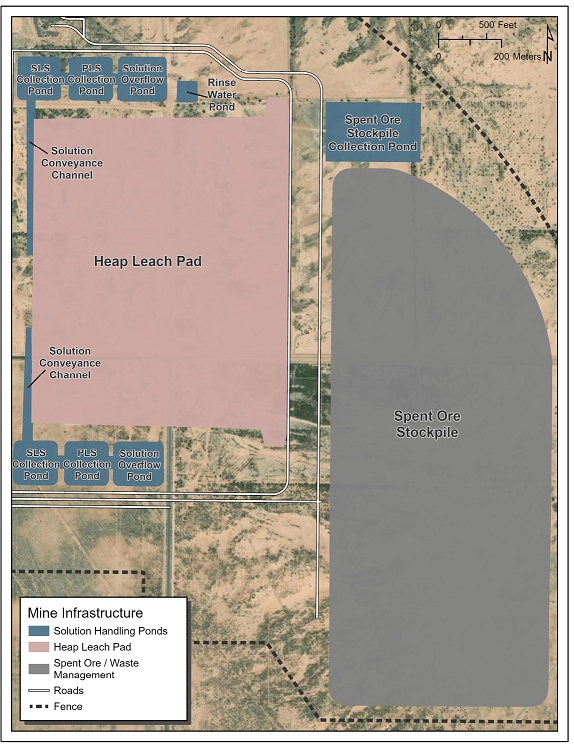
Source: Ivanhoe Electric, 2026
Figure 1-9: Solution Management Ponds, Leach Pad, and Spent Ore Piles
| SEPTEMBER 2026 | 1-26 |
| Ivanhoe Electric Inc. S-K 1300 Preliminary Feasibility Study & | |
The solvent extraction circuit design comprises two parallel trains. Each train will consist of two extraction stages, two wash stages, and one strip stage.
The copper electrowinning tankhouse will comprise electrowinning cells with lead anodes and stainless-steel cathode blanks. Cathodes (copper electroplated onto stainless steel blanks) will be harvested manually using an overhead crane and bail. Cathodes will be stripped in an industry standard automated stripping machine and the washed blanks will be returned to the cells. Product cathode copper will be bundled, sampled, weighed, labeled, and shipped.
| 1.14 | Infrastructure |
The Santa Cruz Copper Project site surface infrastructure comprises the following:
| ■ | An open excavation 30-meter-deep “boxcut” ramp for accessing a decline portal to the underground mine workings; |
| ■ | Three ventilation shafts for airflow and cooling to the underground mine workings; |
| ■ | Primary mine ventilation fans, hardware, and ducting to control ventilation to the underground mine workings; |
| ■ | Refrigeration plant to control temperatures in the underground mine workings; |
| ■ | Rock crushing, stockpiles and process plant; |
| ■ | Spent ore stockpile; |
| ■ | On/off leach pad with associated collection ponds and mobile stacking; |
| ■ | Solution extraction and electrowinning process facilities; |
| ■ | Mobile cement batch plant facility; |
| ■ | Paste backfill batch facility; |
| ■ | Maintenance, and warehouse facilities; |
| ■ | First aid/rescue building; |
| ■ | Multiple various ancillary outbuildings; |
| ■ | Entry security shack and various visitor and project parking spaces; |
| ■ | Equipment delivery and open laydown/storage area; |
| ■ | Multiple improved and unimproved access roads; |
| ■ | Piping and pumping systems for process and water services; |
| ■ | Explosives storage facility; |
| ■ | High-voltage transmission line, substations and medium-voltage distribution; |
| ■ | Environmental monitoring facilities; |
| ■ | Emergency power generation facility. |
| SEPTEMBER 2026 | 1-27 |
| Ivanhoe Electric Inc. S-K 1300 Preliminary Feasibility Study & | |
Key infrastructure locations are shown on Figure 1-10.
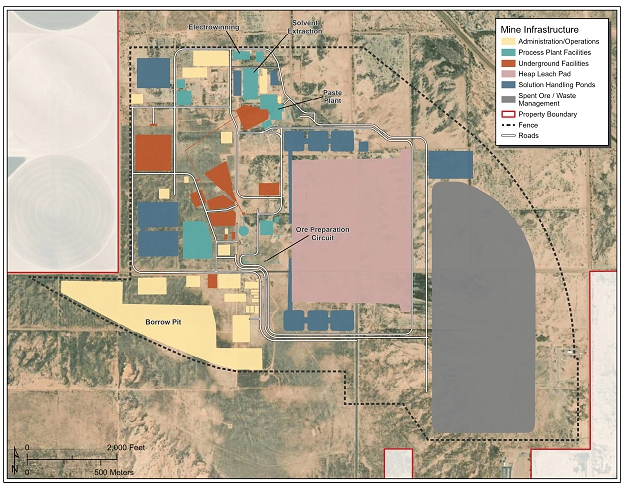
Source: Ivanhoe Electric, 2026
Figure 1-10: Santa Cruz Site Plan
Power for the Project will be provided from the utility grid supply. The goal of the mine development is to achieve a minimum of 70% of the energy supply from clean sources via a “Green Select Energy Rider” provided through the local power utility, Electrical District No. 3 (“ED3”).
The Santa Cruz Copper Project will have an estimated operating load of 74 MW during peak production years (2031-2044) and a forecast annual consumption of 647,000 MWh/y during peak production years and 690,000 MWh in 2039.
| SEPTEMBER 2026 | 1-28 |
| Ivanhoe Electric Inc. S-K 1300 Preliminary Feasibility Study & | |
Water supply for process operations will be sourced from existing grandfathered Type I non-irrigation rights and mine dewatering. Potable water will be trucked in from the city. Trucked water will be stored in a tank to service the surface facilities.
Water management operations include systems of underground dewatering, water collection and conveyance facilities, water storage, water use, and various management options for discharge of excess water. Water not used for underground mining, the paste backfill plant, the process plant, and the on/off heap leach pad can be pumped to storage reservoirs. Rapid infiltration basins are used to capture non-contact stormwater runoff to prevent stormwater from coming into contact with mining operations.
Testwork confirmed the extracted groundwater quality will be acceptable for irrigation use when applied to suitable crops (e.g., cotton, alfalfa, pasture grasses) commonly grown in the vicinity of the Project. The water distribution system is designed to distribute water to agricultural end-users, without treatment, and includes a side-stream water treatment process that may be used if the extracted groundwater does not meet the standards defined by end-users.
On-site accommodations facilities are neither required nor planned. Personnel will reside in nearby settlements including Casa Grande, Maricopa, the Phoenix metropolitan area, and Tucson, and will commute to site by vehicle. Parking, security, fencing, and a gatehouse are included in the design.
The infrastructure buildings to be built on site include explosive magazine storage; cap magazine storage; core shack; process laboratory; security and main gate; fueling station; mine, plant operations building, changehouse, and mine dry; first aid and emergency rescue facilities; mining facility warehouse.
| 1.15 | Market Studies & Contracts |
Copper is a globally traded commodity that has established benchmark pricing in the form of exchanges such as the London Metals Exchange or Commodity Exchange Inc. The Santa Cruz Copper Project aims to produce copper cathode. Ivanhoe Electric plans to sell the copper in the United States.
Refined copper cathodes will be sold with reference to the prices on the Commodity Exchange or London Metals Exchange at an agreed-upon quotational period. An additional premium to the price will be negotiated with potential buyers. Factors affecting the premium will include the shape and chemical specification of the cathode, together with the geographical location of the delivery point in relation to where the cathode is going to be consumed.
| SEPTEMBER 2026 | 1-29 |
| Ivanhoe Electric Inc. S-K 1300 Preliminary Feasibility Study & | |
The Economic Model uses a base copper price of $4.75 per pound, which is based on a review of the 1-, 3-, and 5-year trailing averages, as well as consensus forecasts from major banks and a market study completed by Ocean Partners for Ivanhoe Electric.
Due to the shape, chemical composition, and origin point of the cathode, it is expected that a premium to the price will be negotiated with potential buyers that is marginally above the historical average. For financial modeling purposes, this premium is estimated at $0.14 per pound ($300 per tonne) (Ocean Partners, 2025).
Table 1-9 summarizes the 1-, 3-, and 5-year trailing price for copper using the LME Grade A monthly average as well as consensus forecasts from the major banks (CIBC, 2025).
Table 1-9: Commodity Price Summary
| LME Trailing Average ($/lb) | Forecast ($/lb) | |||||||
| 1-Year | 3-Year | 5-Year | 2026 | 2027 | 2028 | 2029 | Long-term | |
| BBA1 | 5.66 | 4.64 | 4.39 | |||||
| Banks Forecast2 | 5.97 | 5.94 | 5.78 | 5.69 | 5.03 | |||
Notes:
1BBA, Metal Pricing_R00, September 2026.
2CIBC Consensus Commodity Prices – September 2026.
LME = London Metals Exchange.
A limited number of contracts with vendors, contractors, or manufacturers including for the TBM with The Robbins Company, along with long lead items to support on-site power and the SX/EW plant, have been executed. Additional major contracts will be required. Copper cathode will be sold at mine gate.
| 1.16 | Environmental, Closure & Permitting |
Environmental studies have included examination of flora and fauna, threatened and endangered species, migratory birds, surface water mapping, cultural heritage, air quality, carbon intensity, surface water monitoring, groundwater monitoring, water quality, climate risk, soils, material characterization, and mine material environmental behavior.
Much of the Property has been previously disturbed from its natural state. These disturbances include flood control features, such as the canal identified as the Santa Cruz Wash Canal, paved and unpaved roads, and agricultural practices. These disturbances have removed all potential natural surface water features that may have existed in this area. The only features within the Property that possess characteristics of an ordinary high-water mark and may be potential Waters of the United States are the north branch of the Santa Cruz Wash and the constructed Santa Cruz Wash Canal.
| SEPTEMBER 2026 | 1-30 |
| Ivanhoe Electric Inc. S-K 1300 Preliminary Feasibility Study & | |
The Project is committed to responsible environmental management, with a particular focus on minimizing air quality impacts. The Project is located within the West Pinal County PM10 (particulate matter emissions with a diameter less than 10 microns) nonattainment area. Accordingly, the Project will take specific measures to control and effectively mitigate dust. These measures will be in alignment with both local and state requirements.
A groundwater monitoring program to continue collecting baseline water quality data was developed and implemented in October 2023. The objective of the monitoring plan is to establish a current baseline water quality profile for the site and help inform Ivanhoe Electric on best management practices for groundwater monitoring during and after mining operations.
The major permits for the Project will require state, county, and local authorizations. Several of these permits have been issued for early construction. Other permits for full construction and operations activities are in preparation or have been submitted.
The eventual closure and reclamation of the Santa Cruz Copper Project will be directed and regulated under two separate but interconnected regulatory programs in Arizona: the Arizona State Mine Inspector (“ASMI”) and the Arizona Department of Environmental Quality (“ADEQ”). Both programs are well-established and statutes and rules are subject to licensing timeframes.
Three General Aquifer Protection Permits (“APP”) to support construction activities have been approved by ADEQ. The Areawide Aquifer Protection Program permit application was submitted to ADEQ and has been deemed administratively complete. Substantive review is in progress. A construction level Mined Land Reclamation Plan (“MLRP”) has been approved by the ASMI.
Although an operational MLRP has not yet been developed for the Project, a preliminary closure cost estimate has been developed. Based on the conceptual design plan in this report, the closure costs for the Santa Cruz Copper Project are estimated at $27 million.
In alignment with Ivanhoe Electric’s community engagement and partnership standards, the Project is being developed with a well-defined strategy to establish and uphold the support of the surrounding communities. At present, the Project is continuing outreach with Native American communities that have ancestral ties to the land. In addition, community outreach with local stakeholders, and community involvement continues, and potential partnerships are actively being pursued and/or assessed.
| SEPTEMBER 2026 | 1-31 |
| Ivanhoe Electric Inc. S-K 1300 Preliminary Feasibility Study & | |
| 1.17 | Capital & Operating Cost Estimates |
| 1.17.1 | Capital Cost Estimate |
For the Santa Cruz Copper Project, capital and operating costs were determined based on the mine plan and SX/EW plant design. The estimation process incorporated assessments of material and labor requirements derived from the design, analysis of the process flowsheet, and anticipated consumption of power and supplies.
Cost estimation is based on a combination of vendor and consumable quotes and an internal database. Approximately 80% of the capital estimate is based on detailed quotes with estimated labor installation. For the purposes of this study, initial capital expenditure is assumed to be costs incurred in 2027, 2028 and mid-2029. By mid-2029, ore production from stopes has been established and the SX/EW plant has been installed to begin copper production. Additional mine and plant capital costs are incurred from 2029 and 2052 to continue meeting mine ramp up and production demands and are included in sustaining capital costs.
Total LOM capital costs are $2.85 billion: $1.43 billion in initial capital and $1.42 billion in sustaining capital. Capital costs are summarized in Table 1-10.
Table 1-10: Estimated Total Capital Cost
| Capital Costs Summary | Initial
Cost ($M) |
Sustaining
Cost ($M) |
Total
LOM Capital Cost ($M) |
| Pre-production Mining Costs | 50 | - | 50 |
| Mining | 790 | 1,465 | 2,255 |
| Process | 384 | 60 | 444 |
| Owners Cost | 17 | - | 17 |
| Indirects | 55 | 15 | 70 |
| EPCM | 49 | 5 | 54 |
| Contingency | 79 | 0 | 79 |
| Total Initial Capital | 1,423 | - | - |
| Total Sustaining Capital | - | 1,545 | - |
| Reclamation and Closure Costs* | 3 | -121 | -119 |
| Total Life of Mine Capital Costs | 1,426 | 1,424 | 2,850 |
Note: Closure costs include land sales at the end of life of mine. Totals may not sum due to rounding.
| SEPTEMBER 2026 | 1-32 |
| Ivanhoe Electric Inc. S-K 1300 Preliminary Feasibility Study & | |
| 1.17.2 | Operating Cost Estimate |
Total LOM operating costs are $4.53 billion, as summarized in Table 1-11.
Table 1-11: Estimated Operating Costs
| Category | $M Total | $/t Ore Processed | $/lb Copper Produced |
| Mining | |||
| Consumables | 1,452 | 10.40 | 0.47 |
| Mobile Equipment | 465 | 3.33 | 0.15 |
| Labor | 741 | 5.31 | 0.24 |
| Power | 251 | 1.80 | 0.08 |
| Mine Services and Indirect | 157 | 1.12 | 0.05 |
| Subtotal | 3,066 | 21.95 | 0.99 |
| SX/EW Plant and Infrastructure | |||
| Consumables | 285 | 2.04 | 0.09 |
| Hauling and Mobile Equipment | 171 | 1.22 | 0.06 |
| Labor | 158 | 1.13 | 0.05 |
| Power | 365 | 2.61 | 0.12 |
| Maintenance | 68 | 0.49 | 0.02 |
| Subtotal | 1,047 | 7.50 | 0.34 |
| G&A | 418 | 2.99 | 0.14 |
| Total | 4,532 | 32.45 | 1.47 |
Note: Totals may not sum due to rounding. Direct operating costs are exclusive of royalty payments.
| 1.18 | Economic Analysis |
Based on the cash flow model, the after-tax financial model resulted in an internal rate of return (“IRR”) of 18.7% and a net present value (“NPV”) of $1.52 billion using an 8% discount rate. The after-tax payback period, after start of operations, is 4.8 years. The pre-tax base case financial model resulted in an IRR of 20.2% and an NPV of $1.90 billion using an 8% discount rate.
The Santa Cruz Copper Project contemplates average annual copper cathode production of approximately 75,000 tonnes for the first 15 years of copper production and the average annual production is approximately 58,000 tonnes for the life of mine.
The total life of mine is 24 years at an average C1 cash cost of $1.47 per pound of copper and sustaining cash costs of $2.28 per pound of copper.
| SEPTEMBER 2026 | 1-33 |
| Ivanhoe Electric Inc. S-K 1300 Preliminary Feasibility Study & | |
The financial analysis summary is shown in Table 1-12.
Table 1-12: Financial Analysis Summary
| Description | Units | Life of Mine | First 15 Years |
| Production Data | |||
| Mine Life | years | 24 | 15 |
| Reserve Tonnes | Mt | 140 | 110 |
| Copper Grade | % | 1.08 | 1.11 |
| Daily Throughput | t/d | 15,346 | 20,030 |
| Annual Copper Production | t/y | 58,385 | 74,722 |
| Total Copper Cathode Produced | kt | 1,401 | 1,121 |
| Recovery | % | 92.3 | 92.3 |
| Capital Costs | |||
| Initial Capital | $M | 1,426 | 1,426 |
| Sustaining Capital | $M | 1,546 | 1,463 |
| Unit Costs | |||
| Mining Cost | $/t processed | 21.95 | 21.52 |
| Processing Cost | $/t processed | 7.50 | 7.45 |
| General and Administrative Cost | $/t processed | 2.99 | 3.11 |
| Royalties | $/t processed | 6.90 | 6.93 |
| Total Operating Cost | $/t processed | 39.35 | 39.00 |
| Operating + Sustaining Cost | $/t processed | 50.41 | 52.50 |
| C1 Cash Cost | $/lb of copper | 1.47 | 1.42 |
| All-in-Sustaining Cost | $/lb of copper | 2.28 | 2.27 |
| Financial Analysis | |||
| Copper Price | $/lb | 4.75 | 4.75 |
| Domestic Cathode Premium1 | $/lb | 0.14 | 0.14 |
| Pre-Tax Cashflow | $M | 6,761 | 4,971 |
| Pre-Tax Net Present Value (8%) | $M | 1,898 | - |
| Pre-Tax Internal Rate of Return | % | 20.2 | - |
| After-Tax Cashflow | $M | 5,575 | 4,133 |
| After-Tax Net Present Value (8%) | $M | 1,519 | - |
| After-Tax Internal Rate of Return | % | 18.7 | - |
| After-Tax Payback Period | year | 4.8 | - |
1 See Section 16 for a discussion on copper premium.
| SEPTEMBER 2026 | 1-34 |
| Ivanhoe Electric Inc. S-K 1300 Preliminary Feasibility Study & | |
| 1.19 | Risks & Opportunities |
Common to mining projects are internal and external risks that could affect the Project's reliability, confidence, and/or economic viability. External risks are generally applicable to all mining projects, such as the political situation in the Project’s region, metal prices, exchange rates, and government legislation.
Ivanhoe Electric retained BBA to facilitate a scored likelihood × consequence matrix workshop to identify development risks. Table 22-1 identifies what are currently deemed to be the most significant Project risks, potential impacts, and possible mitigation approaches that could reasonably affect the reliability or confidence of the Project.
Opportunities that could enhance the Project's economics and timing are summarized in Table 22-2, excluding those typical to all mining projects, such as changes in metal prices, exchange rates, etc. Further information and assessments are needed before including these opportunities in the Project economics.
| 1.20 | Conclusions |
Under the assumptions presented in this report, the Santa Cruz Copper Project consists of Mineral Resource and Mineral Reserve estimates that support a positive cash flow.
| 1.21 | Recommendations |
The recommended work programs to advance detailed engineering, operational readiness, permitting, and critical long-lead items total $60 million. The budget for recommended work is summarized in Table 1-13.
Table 1-13: Recommended Work Program Budget
| Discipline | Cost ($M) |
| Permitting & Environmental | 2.0 |
| Detailed Engineering – Surface & Underground | 5.0 |
| Long-Lead Items | 49.0 |
| Project Support | 4.0 |
| Total | 60.0 |
| SEPTEMBER 2026 | 1-35 |
| Ivanhoe Electric Inc. S-K 1300 Preliminary Feasibility Study & | |
| 2. | Introduction |
| 2.1 | Registrant for Whom the Report was Prepared |
This technical report summary was prepared for Ivanhoe Electric, Inc. (“Ivanhoe Electric”) on the Santa Cruz Copper Project located in Arizona, United States (Figure 3-1).
The Report was prepared by BBA Consultants USA LP (“BBA”), Worley Group Inc. (“Worley”), Burns & McDonnell Engineering Company, Inc. (“Burns & McDonnell”), Haley & Aldrich, Inc. (“H&A”), INTERA Incorporated (“INTERA”), KCB Consultants Ltd. (“KCB”), Life Cycle Geo, LLC (“LCG”), Met Engineering, LLC (“Met Engineering”), Paterson & Cooke USA, Ltd. (“P&C”), Stantec Consulting Services Inc. (“Stantec”), and Tetra Tech, Inc. (“Tetra Tech”). None of the qualified persons is affiliated with the Company or any other entity that has an ownership, royalty, or other interest in the property.
| 2.2 | Purpose of the Report |
This Report was prepared to be attached as an exhibit to support mineral property disclosure, including Mineral Resource estimates and Mineral Reserve estimates, for the Santa Cruz Copper Project in certain of Ivanhoe Electric’s filings with the Securities and Exchange Commission.
Mineral Resources are reported for the Santa Cruz, East Ridge, and Texaco deposits. Mineral Reserves are reported for the Santa Cruz and East Ridge deposits.
| 2.3 | Terms of Reference |
Unless otherwise indicated, all financial values are reported in United States dollars (currency abbreviation: USD; currency symbol: US$) including all operating costs, capital costs, cash flows, taxes, revenues, expenses, and overhead distributions.
All capital and operating cost estimates meet the requirements of S-K 1300 with an expected accuracy of -20% to +25%. A contingency of <15% has been applied to capital cost estimates.
All pricing is considered in Q2 2026 dollars.
Unless otherwise indicated, capital and operating costs do not include tariffs or escalations.
Totals may not sum due to rounding.
This Report uses U.S. English. Units may be in either metric or US customary units as identified in the text. A list of abbreviations and units of measure is provided in Section 24.
| SEPTEMBER 2026 | 2-1 |
| Ivanhoe Electric Inc. S-K 1300 Preliminary Feasibility Study & | |
Mineral Resources and Mineral Reserves are reported using the definitions in Subpart 229.1300 – Disclosure by Registrants Engaged in Mining Operations in Regulation S-K 1300 (“S-K1300”).
This Report contains forward-looking statements; refer to the note regarding forward-looking statements at the front of the Report.
| 2.4 | Report Date |
Information in the Report is current as of September 23, 2026.
| 2.5 | Previous Technical Report Summaries |
This technical report summary supersedes the previous technical report summary, “S-K 1300 Preliminary Feasibility Study & Technical Report Summary, Santa Cruz Copper Project, Arizona” (“2025 PFS”).
| 2.6 | Qualified Persons |
This Report was authored and compiled by third-party firms who are mining experts who meet the criteria for such according to 17 CFR § 229.1302(b)(1). Table 2-1 lists the contributions of each third-party firm.
In addition to their individual sections, the third-party firms also contributed to Section 1, Executive Summary; Section 2.6, Qualified Persons, Section 2.7, Site Visits & Scope of Personal Inspection, Section 22, Interpretation and Conclusions; Section 23, Recommendations; and Section 24, References, according to their area of expertise.
A portion of the information was provided by the registrant, Ivanhoe Electric, as set forth in Section 25. The third-party firms have relied on the registrant for the information specified in Section 25.
| 2.7 | Site Visits & Scope of Personal Inspection |
Consulting QPs and support staff visited the Project site. The scope of inspection by each discipline area is summarized in Table 2-2.
| 2.8 | Information Sources |
The reports and documents listed in Sections 24 and 25 were used to support the preparation of the Report.
| SEPTEMBER 2026 | 2-2 |
| Ivanhoe Electric Inc. S-K 1300 Preliminary Feasibility Study & | |
Table 2-1: Qualified Person Contributions
| Legal Company Name | Abbreviation | Report Sections and Subsection Responsibility |
| BBA Consultants USA LP | BBA | 1.1 to 1.8, 1.10 to 1.12, 1.15, 1.17 to 1.21, 2.1 to 2.8, 3.1 to 3.7, 4.1 to 4.3, 5.1, 6.1 to 6.4, 7.1 to 7.3, 8.1 to 8.6, 9.1 to 9.9, 11.1 to 11.14, 12.1 to 12.5, 13.1 to 13.11 (except 13.11.3 and 13.11.5), 14.7, 16.1 to 16.3, 18.1, 18.1.1, 18.2, 18.2.1, 18.2.3, 18.2.4, 18.3, 18.3.1, 18.3.3, 19.1 to 19.4, 20, 21, 22.1 to 22.7, 22.9 to 22.11, 22.14, 22.16 to 22.20, 23.1, 23.3, 23.3.2, 23.4, 23.5, 24, 25 |
| Worley Group Inc. | Worley | 1.1, 1.2, 1.13, 1.14, 1.17, 1.19, 1.21, 2.1 to 2.4, 2.6 to 2.8, 14.1 to 14.6 (except 14.5.1, 14.5.2, 14.5.4), 14.8 to14.10, 15.1 (except 15.1.4 and 15.1.7), 15.2, 18.1, 18.1.2, 18.2, 18.2.2, 18.2.3, 18.2.4, 18.3, 18.3.2, 18.3.3, 21, 22.1, 22.12, 22.13, 22.16, 22.17, 22.19, 23.1, 23.3, 23.3.1, 23.4, 24, 25 |
| Burns & McDonnell Engineering Company, Inc. | Burns & McDonnell | 1.1, 1.2, 1.14, 1.19, 1.21, 2.1 to 2.4, 2.6 to 2.8, 15.1.4, 15.2, 21, 22.1, 22.13, 22.19, 23.1, 23.4, 24, 25 |
| Haley & Aldrich, Inc. | H&A | 1.1, 1.2, 1.16, 1.19, 1.21, 2.1 to 2.4, 2.6 to 2.8, 17.4 to 17.6, 17.8, 21, 22.1, 22.15, 22.19, 23.1, 24, 25 |
| INTERA Incorporated | INTERA | 1.1, 1.2, 1.7, 1.19, 1.21, 2.1 to 2.4, 2.6 to 2.8, 7.4, 21, 22.1, 22.6, 22.19, 23.1, 24, 25 |
| KCB Consultants Ltd. | KCB | 1.1, 1.2, 1.13, 1.19, 1.21, 2.1 to 2.4, 2.6 to 2.8, 14.5.1, 14.5.2, 14.5.4, 21, 22.1, 22.19, 23.1, 24, 25 |
| Life Cycle Geo, LLC | LCG | 1.1, 1.2, 1.14, 1.16, 1.19, 1.21, 2.1 to 2.4, 2.6 to 2.8, 15.1.7, 15.2, 17.1.8, 17.1.9, 17.3, 17.8, 21, 22.1, 22.15, 22.19, 23.1, 24, 25 |
| Met Engineering, LLC | Met Engineering | 1.1, 1.2, 1.9, 1.19, 1.21, 2.1 to 2.4, 2.6 to 2.8, 10.1 to 10.5, 21, 22.1, 22.8, 22.19, 23.1, 24, 25 |
| Paterson & Cooke USA, Ltd. | P&C | 1.1, 1.2, 1.12, 1.19, 1.21, 2.1 to 2.4, 2.6 to 2.8, 13.11.3, 18.3.1.1, 21, 22.1, 22.11, 22.19, 23.1, 23.3.1, 24, 25 |
| Stantec Consulting Services Inc. | Stantec | 1.1, 1.2, 1.12, 1.19, 1.21, 2.1 to 2.4, 2.6 to 2.8, 13.11.5, 21, 22.1, 22.19, 23.1, 23.3.2, 23.4, 24, 25 |
| Tetra Tech, Inc. | Tetra Tech | 1.1, 1.2, 1.16, 1.19, 1.21, 2.1 to 2.4, 2.6to 2.8, 17.1 (except for 17.1.8 and 17.1.9), 17.2, 17.7, 17.8, 21, 22.1, 22.15, 22.19, 23.1, 23.2, 23.3, 24, 25 |
| SEPTEMBER 2026 | 2-3 |
| Ivanhoe Electric Inc. S-K 1300 Preliminary Feasibility Study & | |
Table 2-2: Site Visit
| Area of Investigation | Company | Site Visit Date | Scope of Personal Inspection |
| Mineral Resource Estimates; Mineral Reserve Estimates; Geology; Geotechnical; Mine Planning; Underground Infrastructure | BBA | February 27, 2024 April 22 to 23, 2024 July 16 to 17, 2024 August 22 to 23, 2024 |
Reviewed past work, active work, active drill sites, geology controls, data capture processes, sample chain of custody, and drill logs and core. Verified data entry process and collar locations. |
| Process; Infrastructure | Worley | August 14, 2026 | Site tour and inspected proposed sites for processing facilities and surface infrastructure. Inspected geology samples. |
| Metallurgical Testwork; Mineral Recovery; Infrastructure | Met Engineering | February 23, 2023, August 14, 2026 | Reviewed core and inspected proposed sites for processing facilities. |
| Spent Ore Facility and Heap Leach Pad; Foundation Conditions – Geotechnical | KCB | July 13, 2023 January 14, 2024 |
Visited locations within the footprints of these structures for visual observation. Observed drilling and recovered drill core. |
| Hydrogeology | INTERA | August 10, 2023 November 5, 2023 May 27 to 29, 2024 |
Site tour, reviewed core and geology, hydrogeology drilling and testing kick-off, reviewed and developed the site hydrogeology model and discussed the groundwater model development. |
| Environmental | Tetra Tech | August 24, 2023 | Site examination, visited core facility, and reviewed environmental components of the proposed Project. |
| Geochemistry and Water Quality | LCG | July 13, 2022 | Site examination, visited core facility, reviewed core and associated environmental and geochemical properties, discussed historical water quality and received Project overview. |
| Closure | H&A | August 23, 2023 | Site examination, visited core facility, overview of the Project and discussed reclamation and closure components. |
| Power Sources | Burns & McDonnell | April 28, 2025 August 12, 2026 |
Viewed proposed location for renewables campus. |
| Ventilation | Stantec | February 28, 2025 | Reviewed general site layout and topography. |
| Backfill | P&C | February 20, 2025 | Site tour to proposed boxcut and paste plant locations. Visited nearby sources of potential paste feed. |
| SEPTEMBER 2026 | 2-4 |
| Ivanhoe Electric Inc. S-K 1300 Preliminary Feasibility Study & | |
| 3. | Property Description |
| 3.1 | Location |
The Santa Cruz Copper Project is located 11 km west of Casa Grande, Arizona, approximately 92 km south of Phoenix (Figure 1-1). It is approximately 9 km southwest of the Sacaton deposit, which was previously mined by ASARCO. The Project includes a cluster of deposits and exploration areas that measure approximately 11 km long by 1.6 km wide.
Project centroid coordinates are at approximately -111.88212, 32.89319 (WGS84) in Township 6 S, Range 4 E, Section 24, NE Quarter. The Santa Cruz exploration area, including the Santa Cruz Copper Project, covers 82.37 km2.
| 3.2 | Property & Mineral Title |
BBA has not independently verified the following information which is in the public domain and have sourced the data from Ivanhoe Electric including Hall (2025) and LaLonde (2025).
| 3.2.1 | Fee Simple |
“Fee simple” is the most common and absolute type of property ownership in the United States. By owning a fee simple estate, the property owner has control over the surface, subsurface, and mineral rights, as well as the rights to the air above the property. These rights can be split to different owners. Each of these rights (or all of them together) can then be sold, gifted, or bequeathed to another individual or entity by the property owner. No fees or renewals are due on owned fee simple land, only property taxes.
| 3.2.2 | Lode Mining Claims |
Unpatented Mining Lode Claims Federal (30 USC and 43 CFR) laws concerning mining claims on Federal land are based on an 1872 Federal law titled “An Act to Promote the Development of Mineral Resources of the United States.” Mining claim procedures are still based on this law, but the original scope of the law has been reduced by several legislative changes.
Most details regarding procedures for locating claims on Federal lands have been left to individual states, providing that state laws do not conflict with Federal laws (30 USC 28; 43 CFR 3831.1).
Mineral deposits are located either by lode or placer claims (43 CFR 3840). The 1872 Federal law requires a lode claim for “veins or lodes of quartz or other rock in place” (30 USC 26; 43 CFR 3841.1), and a placer claim for all “forms of deposit, excepting veins of quartz or other rock in place” (30
| SEPTEMBER 2026 | 3-1 |
| Ivanhoe Electric Inc. S-K 1300 Preliminary Feasibility Study & | |
USC 35). The maximum size of a lode claim is 1,500 ft (457 m) in length and 600 ft (183 m) in width, whereas an individual or company can locate a placer claim as much as 20 acres (8 ha) in area.
Ivanhoe Electric controls 277 Unpatented Mining Lode Claims as part of the Santa Cruz property package. Unpatented Mining Lode Claims have annual maintenance fee requirements due on or before September 1st of every calendar year. Unpatented Mining Lode Claims give the claimant exclusive rights to the federal mineral estate on which they are located. All claims are currently in good standing and a table of claims is provided in Table 3-2 in Section 3.3.1.
| 3.2.3 | Arizona State Land Department Mineral Exploration Permits |
Mineral exploration permits are for lands held by Arizona State Trust and managed by Arizona State Land Department. Revenue generated goes to several public entities including kindergarten to grade 12 public education and state universities.
Mineral exploration permits are granted for a five-year maximum term, provided annual renewals applications and fees are submitted. The permit holder can submit for a new mineral exploration permit at the end of the five-year term and will be “first in line” for another five-year mineral exploration permit term. A permit grants the holder the exclusive right to explore for minerals during the permit term. A permit does NOT grant exclusive access to surface, nor the right to mine (this would occur via a land auction or a mineral lease).
Arizona State Land Department (“ASLD”) mining exploration permits are held for five years and subject to annual renewal fees, which include $500 per permit plus $1 per acre rent plus work expenditures or an in-lieu fee of $10 per acre for Years 1 and 2 and $20 per acre for Years 3 through 5. If additional time beyond five years is required to continue characterization of an ore deposit, a new application for a mineral exploration permit must be submitted prior to the expiry of the permit.
| 3.2.4 | Stock-Raising Homestead Act |
The Stock-Raising Homestead Act of 1916 provided settlers patented surface ownership of federal lands for ranching purposes. Unlike previous homestead acts, the 1916 Act separated surface rights from subsurface rights, resulting in split estates.
Some of Ivanhoe Electric’s 277 Unpatented Mining Lode Claims are located on the federal mineral rights associated with certain Stock-Raising Homestead Act Lands.
| SEPTEMBER 2026 | 3-2 |
| Ivanhoe Electric Inc. S-K 1300 Preliminary Feasibility Study & | |
| 3.3 | Ownership |
The Santa Cruz Copper Project lies primarily on fee simple land. Surface and mineral titles, and associated rights, were acquired by Ivanhoe Electric as purchases and options on private parcels.
In 2019, Ivanhoe Electric’s predecessor, High Power Exploration Inc. (“HPX”), entered into an agreement with Central Arizona Resources, Ltd. (“CAR”) to access historical data, and stake 238 unpatented mining lode claims on the area around, and including, the Santa Cruz Copper Project. In 2021, Ivanhoe Electric was formed from a split from HPX, and then, through CAR, signed an Option Agreement with D.R. Horton Phoenix East Construction, Inc. (“DRH”) for the option to purchase the mineral, certain surface parcels, 39 unpatented claims on split estate land, and associated rights for the Santa Cruz Copper Project. Also in 2021, Ivanhoe Electric, through CAR, signed a Surface Use Agreement with Legends Property, LLC (“Legends”) to enable access and exploration on the lands encompassed by the DRH Option. In 2022, Ivanhoe Electric consolidated 100% ownership of the Project from CAR by assigning the agreements to its wholly-owned subsidiary, Mesa Cobre Holding Corporation (“Mesa Cobre”). In 2023, Legends formed Wolff-Harvard Ventures, LP (“Wolff-Harvard”) as the party of title to the land.
| 3.3.1 | Mineral Title Ownership |
In 2021, Ivanhoe Electric acquired 238 unpatented mining lode claims from CAR. In addition, Ivanhoe Electric acquired fee simple mineral title for two further land parcels: “CG100” and “Skull Valley”. In 2022, Ivanhoe Electric acquired the 20-acre “Skull Valley” property from Skull Valley Capital, LLC in the southeastern area of the Project and a 100.33-acre “CG100” from CG 100 Land Partners LLC in the northeastern area of the Project.
In 2023, Ivanhoe Electric acquired 16 Arizona State Land Department mineral exploration permits covering 27.95 km2 (~6,900 acres) of state mineral land with exploration potential. The permits expire at various dates ranging from September 2030 to May 2031.
In 2024, Ivanhoe Electric exercised the agreement with DRH, granting Ivanhoe Electric, through Mesa Cobre, 100% of the mineral title for 26.0 km2 (~6,425 acres) of fee simple mineral estate, 39 federal unpatented mining lode claims, and 2.6 km2 (~642.5 acres) of Stock-Raising Homestead Act lands.
Unpatented mineral lode claims renew annually on September 1, with a fee of $200 per claim. Mineral title is summarized in Table 3-1 and shown in Figure 3-1. Claims are listed in Table 3-2.
| SEPTEMBER 2026 | 3-3 |
| Ivanhoe Electric Inc. S-K 1300 Preliminary Feasibility Study & | |
Table 3-1: Summary of Ivanhoe Electric’s Mineral Title
| Land Designation | Area (km2) |
| Fee Simple Mineral Ownership | 25.98 |
| Unpatented Mining Lode Claims (277 claims) | 19.30 |
| Arizona State Land Department Mineral Exploration Permits (16 permits) | 30.47 |
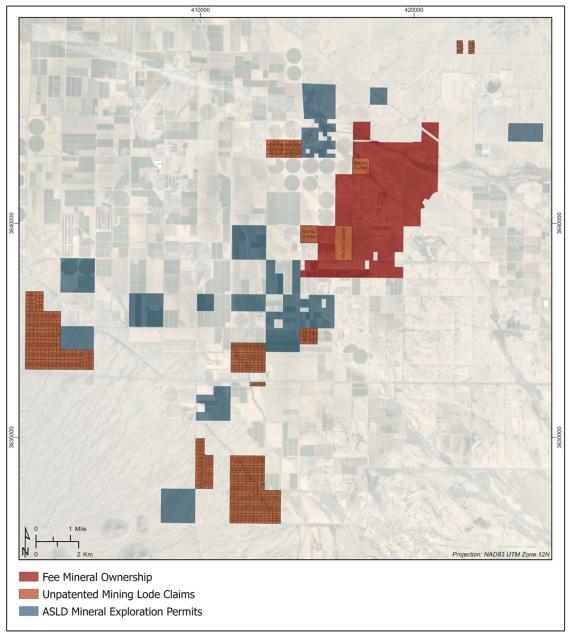
Source: Ivanhoe Electric, 2026
Figure 3-1: Santa Cruz Copper Project Mineral Control Map
| SEPTEMBER 2026 | 3-4 |
| Ivanhoe Electric Inc. S-K 1300 Preliminary Feasibility Study & | |
Table 3-2: Unpatented Mining Lode Claims
| Serial Number | Lead File Number | Legacy Serial Number | Legacy Lead File Number | Claim Name | Case Disposition | Claim Type | Next Payment Due Date |
| AZ101424918 | AZ101424918 | AMC47328 | AMC47300 | CHAVO NO 55 | ACTIVE | LODE CLAIM | 2027-09-01 |
| AZ101339292 | AZ101339292 | AMC47333 | AMC47300 | NIK NO 5 | ACTIVE | LODE CLAIM | 2027-09-01 |
| AZ101421434 | AZ101421434 | AMC47334 | AMC47300 | NIK NO 6 | ACTIVE | LODE CLAIM | 2027-09-01 |
| AZ101315626 | AZ101315626 | AMC47335 | AMC47300 | NIK NO 7 | ACTIVE | LODE CLAIM | 2027-09-01 |
| AZ101423475 | AZ101423475 | AMC47336 | AMC47300 | NIK NO 8 | ACTIVE | LODE CLAIM | 2027-09-01 |
| AZ101314482 | AZ101314482 | AMC47337 | AMC47300 | NIK NO 9 | ACTIVE | LODE CLAIM | 2027-09-01 |
| AZ101513061 | AZ101513061 | AMC47338 | AMC47300 | NIK NO 10 | ACTIVE | LODE CLAIM | 2027-09-01 |
| AZ101404184 | AZ101404184 | AMC47339 | AMC47300 | NIK NO 11 | ACTIVE | LODE CLAIM | 2027-09-01 |
| AZ101422640 | AZ101422640 | AMC47340 | AMC47300 | NIK NO 12 | ACTIVE | LODE CLAIM | 2027-09-01 |
| AZ102524120 | AZ102524120 | AMC47341 | AMC47300 | NIK NO 13 | ACTIVE | LODE CLAIM | 2027-09-01 |
| AZ101315734 | AZ101315734 | AMC47342 | AMC47300 | NIK NO 14 | ACTIVE | LODE CLAIM | 2027-09-01 |
| AZ101403486 | AZ101403486 | AMC47347 | AMC47300 | NIK NO 19 | ACTIVE | LODE CLAIM | 2027-09-01 |
| AZ101401035 | AZ101401035 | AMC47348 | AMC47300 | NIK NO 20 | ACTIVE | LODE CLAIM | 2027-09-01 |
| AZ101422533 | AZ101422533 | AMC47349 | AMC47300 | NIK NO 21 | ACTIVE | LODE CLAIM | 2027-09-01 |
| AZ101310451 | AZ101310451 | AMC47350 | AMC47300 | NIK NO 22 | ACTIVE | LODE CLAIM | 2027-09-01 |
| AZ101404654 | AZ101404654 | AMC47351 | AMC47300 | NIK NO 23 | ACTIVE | LODE CLAIM | 2027-09-01 |
| AZ101403046 | AZ101403046 | AMC47352 | AMC47300 | NIK NO 24 | ACTIVE | LODE CLAIM | 2027-09-01 |
| AZ101400680 | AZ101400680 | AMC47353 | AMC47300 | NIK NO 25 | ACTIVE | LODE CLAIM | 2027-09-01 |
| AZ101426616 | AZ101426616 | AMC47354 | AMC47300 | NIK NO 26 | ACTIVE | LODE CLAIM | 2027-09-01 |
| AZ101420451 | AZ101420451 | AMC47355 | AMC47300 | NIK NO 27 | ACTIVE | LODE CLAIM | 2027-09-01 |
| AZ101340104 | AZ101340104 | AMC47356 | AMC47300 | NIK NO 28 | ACTIVE | LODE CLAIM | 2027-09-01 |
| AZ101339901 | AZ101339901 | AMC47357 | AMC47300 | NIK NO 29 | ACTIVE | LODE CLAIM | 2027-09-01 |
| AZ101319426 | AZ101319426 | AMC47358 | AMC47300 | NIK NO 30 | ACTIVE | LODE CLAIM | 2027-09-01 |
| AZ101515736 | AZ101515736 | AMC47359 | AMC47300 | NIK NO 31 | ACTIVE | LODE CLAIM | 2027-09-01 |
| AZ101422970 | AZ101422970 | AMC47360 | AMC47300 | NIK NO 32 | ACTIVE | LODE CLAIM | 2027-09-01 |
| AZ101424011 | AZ101424011 | AMC47361 | AMC47300 | NIK NO 33 | ACTIVE | LODE CLAIM | 2027-09-01 |
| AZ101425394 | AZ101425394 | AMC47362 | AMC47300 | NIK NO 34 | ACTIVE | LODE CLAIM | 2027-09-01 |
| AZ101425654 | AZ101425654 | AMC47363 | AMC47300 | NIK NO 35 | ACTIVE | LODE CLAIM | 2027-09-01 |
| AZ102521618 | AZ102521618 | AMC47364 | AMC47300 | NIK NO 36 | ACTIVE | LODE CLAIM | 2027-09-01 |
| AZ101513001 | AZ101513001 | AMC47365 | AMC47300 | NIK NO 37 | ACTIVE | LODE CLAIM | 2027-09-01 |
| AZ101313279 | AZ101313279 | AMC47366 | AMC47300 | NIK NO 38 | ACTIVE | LODE CLAIM | 2027-09-01 |
| AZ101510534 | AZ101510534 | AMC47367 | AMC47300 | NIK NO 39 | ACTIVE | LODE CLAIM | 2027-09-01 |
| AZ101376637 | AZ101376637 | AMC47368 | AMC47300 | NIK NO 40 | ACTIVE | LODE CLAIM | 2027-09-01 |
| AZ101406903 | AZ101406903 | AMC47369 | AMC47300 | NIK NO 41 | ACTIVE | LODE CLAIM | 2027-09-01 |
| AZ101316806 | AZ101316806 | AMC47370 | AMC47300 | NIK NO 50 | ACTIVE | LODE CLAIM | 2027-09-01 |
| AZ101515425 | AZ101515425 | AMC47371 | AMC47300 | NIK NO 51 | ACTIVE | LODE CLAIM | 2027-09-01 |
| SEPTEMBER 2026 | 3-5 |
| Ivanhoe Electric Inc. S-K 1300 Preliminary Feasibility Study & | |
| Serial Number | Lead File Number | Legacy Serial Number | Legacy Lead File Number | Claim Name | Case Disposition | Claim Type | Next Payment Due Date |
| AZ101511715 | AZ101511715 | AMC47372 | AMC47300 | NIK NO 52 | ACTIVE | LODE CLAIM | 2027-09-01 |
| AZ101515428 | AZ101515428 | AMC47373 | AMC47300 | NIK NO 53 | ACTIVE | LODE CLAIM | 2027-09-01 |
| AZ101400730 | AZ101400730 | AMC47374 | AMC47300 | NIK NO 54 | ACTIVE | LODE CLAIM | 2027-09-01 |
| AZ101871129 | AZ101871129 | AMC460163 | AMC460163 | SCX 1 | ACTIVE | LODE CLAIM | 2027-09-01 |
| AZ101871130 | AZ101871130 | AMC460164 | AMC460163 | SCX 2 | ACTIVE | LODE CLAIM | 2027-09-01 |
| AZ101871131 | AZ101871131 | AMC460165 | AMC460163 | SCX 3 | ACTIVE | LODE CLAIM | 2027-09-01 |
| AZ101871132 | AZ101871132 | AMC460166 | AMC460163 | SCX 4 | ACTIVE | LODE CLAIM | 2027-09-01 |
| AZ101871133 | AZ101871133 | AMC460167 | AMC460163 | SCX 5 | ACTIVE | LODE CLAIM | 2027-09-01 |
| AZ101871134 | AZ101871134 | AMC460168 | AMC460163 | SCX 6 | ACTIVE | LODE CLAIM | 2027-09-01 |
| AZ101871135 | AZ101871135 | AMC460169 | AMC460163 | SCX 7 | ACTIVE | LODE CLAIM | 2027-09-01 |
| AZ101871136 | AZ101871136 | AMC460170 | AMC460163 | SCX 8 | ACTIVE | LODE CLAIM | 2027-09-01 |
| AZ101871137 | AZ101871137 | AMC460171 | AMC460163 | SCX 9 | ACTIVE | LODE CLAIM | 2027-09-01 |
| AZ101871138 | AZ101871138 | AMC460172 | AMC460163 | SCX 10 | ACTIVE | LODE CLAIM | 2027-09-01 |
| AZ101871139 | AZ101871139 | AMC460173 | AMC460163 | SCX 11 | ACTIVE | LODE CLAIM | 2027-09-01 |
| AZ101871140 | AZ101871140 | AMC460174 | AMC460163 | SCX 12 | ACTIVE | LODE CLAIM | 2027-09-01 |
| AZ101871141 | AZ101871141 | AMC460175 | AMC460163 | SCX 13 | ACTIVE | LODE CLAIM | 2027-09-01 |
| AZ101871142 | AZ101871142 | AMC460176 | AMC460163 | SCX 14 | ACTIVE | LODE CLAIM | 2027-09-01 |
| AZ101871143 | AZ101871143 | AMC460177 | AMC460163 | SCX 15 | ACTIVE | LODE CLAIM | 2027-09-01 |
| AZ101871144 | AZ101871144 | AMC460178 | AMC460163 | SCX 16 | ACTIVE | LODE CLAIM | 2027-09-01 |
| AZ101871947 | AZ101871947 | AMC460179 | AMC460163 | SCX 17 | ACTIVE | LODE CLAIM | 2027-09-01 |
| AZ101871948 | AZ101871948 | AMC460180 | AMC460163 | SCX 18 | ACTIVE | LODE CLAIM | 2027-09-01 |
| AZ101871949 | AZ101871949 | AMC460181 | AMC460163 | SCX 19 | ACTIVE | LODE CLAIM | 2027-09-01 |
| AZ101871950 | AZ101871950 | AMC460182 | AMC460163 | SCX 20 | ACTIVE | LODE CLAIM | 2027-09-01 |
| AZ101871951 | AZ101871951 | AMC460183 | AMC460163 | SCX 21 | ACTIVE | LODE CLAIM | 2027-09-01 |
| AZ101871952 | AZ101871952 | AMC460184 | AMC460163 | SCX 22 | ACTIVE | LODE CLAIM | 2027-09-01 |
| AZ101871953 | AZ101871953 | AMC460185 | AMC460163 | SCX 23 | ACTIVE | LODE CLAIM | 2027-09-01 |
| AZ101871954 | AZ101871954 | AMC460186 | AMC460163 | SCX 24 | ACTIVE | LODE CLAIM | 2027-09-01 |
| AZ101871955 | AZ101871955 | AMC460187 | AMC460163 | SCX 25 | ACTIVE | LODE CLAIM | 2027-09-01 |
| AZ101871956 | AZ101871956 | AMC460188 | AMC460163 | SCX 26 | ACTIVE | LODE CLAIM | 2027-09-01 |
| AZ101871957 | AZ101871957 | AMC460189 | AMC460163 | SCX 27 | ACTIVE | LODE CLAIM | 2027-09-01 |
| AZ101871958 | AZ101871958 | AMC460190 | AMC460163 | SCX 28 | ACTIVE | LODE CLAIM | 2027-09-01 |
| AZ101871959 | AZ101871959 | AMC460191 | AMC460163 | SCX 29 | ACTIVE | LODE CLAIM | 2027-09-01 |
| AZ101871960 | AZ101871960 | AMC460192 | AMC460163 | SCX 30 | ACTIVE | LODE CLAIM | 2027-09-01 |
| AZ101871961 | AZ101871961 | AMC460193 | AMC460163 | SCX 31 | ACTIVE | LODE CLAIM | 2027-09-01 |
| AZ101871962 | AZ101871962 | AMC460194 | AMC460163 | SCX 32 | ACTIVE | LODE CLAIM | 2027-09-01 |
| AZ101871963 | AZ101871963 | AMC460195 | AMC460163 | SCX 33 | ACTIVE | LODE CLAIM | 2027-09-01 |
| AZ101871964 | AZ101871964 | AMC460196 | AMC460163 | SCX 34 | ACTIVE | LODE CLAIM | 2027-09-01 |
| SEPTEMBER 2026 | 3-6 |
| Ivanhoe Electric Inc. S-K 1300 Preliminary Feasibility Study & | |
| Serial Number | Lead File Number | Legacy Serial Number | Legacy Lead File Number | Claim Name | Case Disposition | Claim Type | Next Payment Due Date |
| AZ101871965 | AZ101871965 | AMC460197 | AMC460163 | SCX 35 | ACTIVE | LODE CLAIM | 2027-09-01 |
| AZ101871966 | AZ101871966 | AMC460198 | AMC460163 | SCX 36 | ACTIVE | LODE CLAIM | 2027-09-01 |
| AZ101871967 | AZ101871967 | AMC460199 | AMC460163 | SCX 37 | ACTIVE | LODE CLAIM | 2027-09-01 |
| AZ101872776 | AZ101872776 | AMC460200 | AMC460163 | SCX 38 | ACTIVE | LODE CLAIM | 2027-09-01 |
| AZ101872777 | AZ101872777 | AMC460201 | AMC460163 | SCX 39 | ACTIVE | LODE CLAIM | 2027-09-01 |
| AZ101872778 | AZ101872778 | AMC460202 | AMC460163 | SCX 40 | ACTIVE | LODE CLAIM | 2027-09-01 |
| AZ101872779 | AZ101872779 | AMC460203 | AMC460163 | SCX 41 | ACTIVE | LODE CLAIM | 2027-09-01 |
| AZ101872780 | AZ101872780 | AMC460204 | AMC460163 | SCX 42 | ACTIVE | LODE CLAIM | 2027-09-01 |
| AZ101872781 | AZ101872781 | AMC460205 | AMC460163 | SCX 43 | ACTIVE | LODE CLAIM | 2027-09-01 |
| AZ101872782 | AZ101872782 | AMC460206 | AMC460163 | SCX 44 | ACTIVE | LODE CLAIM | 2027-09-01 |
| AZ101872783 | AZ101872783 | AMC460207 | AMC460163 | SCX 45 | ACTIVE | LODE CLAIM | 2027-09-01 |
| AZ101872784 | AZ101872784 | AMC460208 | AMC460163 | SCX 46 | ACTIVE | LODE CLAIM | 2027-09-01 |
| AZ101872785 | AZ101872785 | AMC460209 | AMC460163 | SCX 47 | ACTIVE | LODE CLAIM | 2027-09-01 |
| AZ101872786 | AZ101872786 | AMC460210 | AMC460163 | SCX 48 | ACTIVE | LODE CLAIM | 2027-09-01 |
| AZ101872787 | AZ101872787 | AMC460211 | AMC460163 | SCX 49 | ACTIVE | LODE CLAIM | 2027-09-01 |
| AZ101872788 | AZ101872788 | AMC460212 | AMC460163 | SCX 50 | ACTIVE | LODE CLAIM | 2027-09-01 |
| AZ101872789 | AZ101872789 | AMC460213 | AMC460163 | SCX 51 | ACTIVE | LODE CLAIM | 2027-09-01 |
| AZ101872790 | AZ101872790 | AMC460214 | AMC460163 | SCX 52 | ACTIVE | LODE CLAIM | 2027-09-01 |
| AZ101872791 | AZ101872791 | AMC460215 | AMC460163 | SCX 53 | ACTIVE | LODE CLAIM | 2027-09-01 |
| AZ101872792 | AZ101872792 | AMC460216 | AMC460163 | SCX 54 | ACTIVE | LODE CLAIM | 2027-09-01 |
| AZ101872793 | AZ101872793 | AMC460217 | AMC460163 | SCX 55 | ACTIVE | LODE CLAIM | 2027-09-01 |
| AZ101872794 | AZ101872794 | AMC460218 | AMC460163 | SCX 56 | ACTIVE | LODE CLAIM | 2027-09-01 |
| AZ101872795 | AZ101872795 | AMC460219 | AMC460163 | SCX 57 | ACTIVE | LODE CLAIM | 2027-09-01 |
| AZ101872796 | AZ101872796 | AMC460220 | AMC460163 | SCX 58 | ACTIVE | LODE CLAIM | 2027-09-01 |
| AZ101873617 | AZ101873617 | AMC460221 | AMC460163 | SCX 59 | ACTIVE | LODE CLAIM | 2027-09-01 |
| AZ101873618 | AZ101873618 | AMC460222 | AMC460163 | SCX 60 | ACTIVE | LODE CLAIM | 2027-09-01 |
| AZ101873619 | AZ101873619 | AMC460223 | AMC460163 | SCX 61 | ACTIVE | LODE CLAIM | 2027-09-01 |
| AZ101873620 | AZ101873620 | AMC460224 | AMC460163 | SCX 62 | ACTIVE | LODE CLAIM | 2027-09-01 |
| AZ101873621 | AZ101873621 | AMC460225 | AMC460163 | SCX 63 | ACTIVE | LODE CLAIM | 2027-09-01 |
| AZ101873622 | AZ101873622 | AMC460226 | AMC460163 | SCX 64 | ACTIVE | LODE CLAIM | 2027-09-01 |
| AZ101873623 | AZ101873623 | AMC460227 | AMC460163 | SCX 65 | ACTIVE | LODE CLAIM | 2027-09-01 |
| AZ101873624 | AZ101873624 | AMC460228 | AMC460163 | SCX 66 | ACTIVE | LODE CLAIM | 2027-09-01 |
| AZ101873625 | AZ101873625 | AMC460229 | AMC460163 | SCX 67 | ACTIVE | LODE CLAIM | 2027-09-01 |
| AZ101873626 | AZ101873626 | AMC460230 | AMC460163 | SCX 68 | ACTIVE | LODE CLAIM | 2027-09-01 |
| AZ101873627 | AZ101873627 | AMC460231 | AMC460163 | SCX 69 | ACTIVE | LODE CLAIM | 2027-09-01 |
| AZ101873628 | AZ101873628 | AMC460232 | AMC460163 | SCX 70 | ACTIVE | LODE CLAIM | 2027-09-01 |
| AZ101873629 | AZ101873629 | AMC460233 | AMC460163 | SCX 71 | ACTIVE | LODE CLAIM | 2027-09-01 |
| SEPTEMBER 2026 | 3-7 |
| Ivanhoe Electric Inc. S-K 1300 Preliminary Feasibility Study & | |
| Serial Number | Lead File Number | Legacy Serial Number | Legacy Lead File Number | Claim Name | Case Disposition | Claim Type | Next Payment Due Date |
| AZ101873630 | AZ101873630 | AMC460234 | AMC460163 | SCX 72 | ACTIVE | LODE CLAIM | 2027-09-01 |
| AZ101873631 | AZ101873631 | AMC460235 | AMC460163 | SCX 73 | ACTIVE | LODE CLAIM | 2027-09-01 |
| AZ101873632 | AZ101873632 | AMC460236 | AMC460163 | SCX 74 | ACTIVE | LODE CLAIM | 2027-09-01 |
| AZ101873633 | AZ101873633 | AMC460237 | AMC460163 | SCX 75 | ACTIVE | LODE CLAIM | 2027-09-01 |
| AZ101873634 | AZ101873634 | AMC460238 | AMC460163 | SCX 76 | ACTIVE | LODE CLAIM | 2027-09-01 |
| AZ101873635 | AZ101873635 | AMC460239 | AMC460163 | SCX 77 | ACTIVE | LODE CLAIM | 2027-09-01 |
| AZ101873636 | AZ101873636 | AMC460240 | AMC460163 | SCX 78 | ACTIVE | LODE CLAIM | 2027-09-01 |
| AZ101873637 | AZ101873637 | AMC460241 | AMC460163 | SCX 79 | ACTIVE | LODE CLAIM | 2027-09-01 |
| AZ101874470 | AZ101874470 | AMC460242 | AMC460163 | SCX 80 | ACTIVE | LODE CLAIM | 2027-09-01 |
| AZ101874471 | AZ101874471 | AMC460243 | AMC460163 | SCX 81 | ACTIVE | LODE CLAIM | 2027-09-01 |
| AZ101874472 | AZ101874472 | AMC460244 | AMC460163 | SCX 82 | ACTIVE | LODE CLAIM | 2027-09-01 |
| AZ101874473 | AZ101874473 | AMC460245 | AMC460163 | SCX 83 | ACTIVE | LODE CLAIM | 2027-09-01 |
| AZ101874474 | AZ101874474 | AMC460246 | AMC460163 | SCX 84 | ACTIVE | LODE CLAIM | 2027-09-01 |
| AZ101874475 | AZ101874475 | AMC460247 | AMC460163 | SCX 85 | ACTIVE | LODE CLAIM | 2027-09-01 |
| AZ101874476 | AZ101874476 | AMC460248 | AMC460163 | SCX 86 | ACTIVE | LODE CLAIM | 2027-09-01 |
| AZ101874477 | AZ101874477 | AMC460249 | AMC460163 | SCX 87 | ACTIVE | LODE CLAIM | 2027-09-01 |
| AZ101874478 | AZ101874478 | AMC460250 | AMC460163 | SCX 88 | ACTIVE | LODE CLAIM | 2027-09-01 |
| AZ101874479 | AZ101874479 | AMC460251 | AMC460163 | SCX 89 | ACTIVE | LODE CLAIM | 2027-09-01 |
| AZ101874480 | AZ101874480 | AMC460252 | AMC460163 | SCX 90 | ACTIVE | LODE CLAIM | 2027-09-01 |
| AZ101874481 | AZ101874481 | AMC460253 | AMC460163 | SCX 91 | ACTIVE | LODE CLAIM | 2027-09-01 |
| AZ101874482 | AZ101874482 | AMC460254 | AMC460163 | SCX 92 | ACTIVE | LODE CLAIM | 2027-09-01 |
| AZ101874483 | AZ101874483 | AMC460255 | AMC460163 | SCX 93 | ACTIVE | LODE CLAIM | 2027-09-01 |
| AZ101874484 | AZ101874484 | AMC460256 | AMC460163 | SCX 94 | ACTIVE | LODE CLAIM | 2027-09-01 |
| AZ101874485 | AZ101874485 | AMC460257 | AMC460163 | SCX 95 | ACTIVE | LODE CLAIM | 2027-09-01 |
| AZ101874486 | AZ101874486 | AMC460258 | AMC460163 | SCX 96 | ACTIVE | LODE CLAIM | 2027-09-01 |
| AZ101874487 | AZ101874487 | AMC460259 | AMC460163 | SCX 97 | ACTIVE | LODE CLAIM | 2027-09-01 |
| AZ101874488 | AZ101874488 | AMC460260 | AMC460163 | SCX 98 | ACTIVE | LODE CLAIM | 2027-09-01 |
| AZ101874489 | AZ101874489 | AMC460261 | AMC460163 | SCX 99 | ACTIVE | LODE CLAIM | 2027-09-01 |
| AZ101874490 | AZ101874490 | AMC460262 | AMC460163 | SCX 100 | ACTIVE | LODE CLAIM | 2027-09-01 |
| AZ101875304 | AZ101875304 | AMC460263 | AMC460163 | SCX 101 | ACTIVE | LODE CLAIM | 2027-09-01 |
| AZ101875305 | AZ101875305 | AMC460264 | AMC460163 | SCX 102 | ACTIVE | LODE CLAIM | 2027-09-01 |
| AZ101875306 | AZ101875306 | AMC460265 | AMC460163 | SCX 103 | ACTIVE | LODE CLAIM | 2027-09-01 |
| AZ101875307 | AZ101875307 | AMC460266 | AMC460163 | SCX 104 | ACTIVE | LODE CLAIM | 2027-09-01 |
| AZ101875308 | AZ101875308 | AMC460267 | AMC460163 | SCX 105 | ACTIVE | LODE CLAIM | 2027-09-01 |
| AZ101875309 | AZ101875309 | AMC460268 | AMC460163 | SCX 106 | ACTIVE | LODE CLAIM | 2027-09-01 |
| AZ101875310 | AZ101875310 | AMC460269 | AMC460163 | SCX 107 | ACTIVE | LODE CLAIM | 2027-09-01 |
| AZ101875311 | AZ101875311 | AMC460270 | AMC460163 | SCX 108 | ACTIVE | LODE CLAIM | 2027-09-01 |
| SEPTEMBER 2026 | 3-8 |
| Ivanhoe Electric Inc. S-K 1300 Preliminary Feasibility Study & | |
| Serial Number | Lead File Number | Legacy Serial Number | Legacy Lead File Number | Claim Name | Case Disposition | Claim Type | Next Payment Due Date |
| AZ101875312 | AZ101875312 | AMC460271 | AMC460163 | SCX 109 | ACTIVE | LODE CLAIM | 2027-09-01 |
| AZ101875313 | AZ101875313 | AMC460272 | AMC460163 | SCX 110 | ACTIVE | LODE CLAIM | 2027-09-01 |
| AZ101875314 | AZ101875314 | AMC460273 | AMC460163 | SCX 111 | ACTIVE | LODE CLAIM | 2027-09-01 |
| AZ101875315 | AZ101875315 | AMC460274 | AMC460163 | SCX 112 | ACTIVE | LODE CLAIM | 2027-09-01 |
| AZ101875316 | AZ101875316 | AMC460275 | AMC460163 | SCX 113 | ACTIVE | LODE CLAIM | 2027-09-01 |
| AZ101875317 | AZ101875317 | AMC460276 | AMC460163 | SCX 114 | ACTIVE | LODE CLAIM | 2027-09-01 |
| AZ101875318 | AZ101875318 | AMC460277 | AMC460163 | SCX 118 | ACTIVE | LODE CLAIM | 2027-09-01 |
| AZ101875319 | AZ101875319 | AMC460278 | AMC460163 | SCX 119 | ACTIVE | LODE CLAIM | 2027-09-01 |
| AZ101875320 | AZ101875320 | AMC460279 | AMC460163 | SCX 120 | ACTIVE | LODE CLAIM | 2027-09-01 |
| AZ101875321 | AZ101875321 | AMC460280 | AMC460163 | SCX 121 | ACTIVE | LODE CLAIM | 2027-09-01 |
| AZ101875322 | AZ101875322 | AMC460281 | AMC460163 | SCX 122 | ACTIVE | LODE CLAIM | 2027-09-01 |
| AZ101875323 | AZ101875323 | AMC460282 | AMC460163 | SCX 123 | ACTIVE | LODE CLAIM | 2027-09-01 |
| AZ101875324 | AZ101875324 | AMC460283 | AMC460163 | SCX 124 | ACTIVE | LODE CLAIM | 2027-09-01 |
| AZ101876144 | AZ101876144 | AMC460284 | AMC460163 | SCX 125 | ACTIVE | LODE CLAIM | 2027-09-01 |
| AZ101876145 | AZ101876145 | AMC460285 | AMC460163 | SCX 126 | ACTIVE | LODE CLAIM | 2027-09-01 |
| AZ101876146 | AZ101876146 | AMC460286 | AMC460163 | SCX 127 | ACTIVE | LODE CLAIM | 2027-09-01 |
| AZ101876147 | AZ101876147 | AMC460287 | AMC460163 | SCX 128 | ACTIVE | LODE CLAIM | 2027-09-01 |
| AZ101876148 | AZ101876148 | AMC460288 | AMC460163 | SCX 129 | ACTIVE | LODE CLAIM | 2027-09-01 |
| AZ101876149 | AZ101876149 | AMC460289 | AMC460163 | SCX 130 | ACTIVE | LODE CLAIM | 2027-09-01 |
| AZ101876150 | AZ101876150 | AMC460290 | AMC460163 | SCX 131 | ACTIVE | LODE CLAIM | 2027-09-01 |
| AZ101876151 | AZ101876151 | AMC460291 | AMC460163 | SCX 132 | ACTIVE | LODE CLAIM | 2027-09-01 |
| AZ101876152 | AZ101876152 | AMC460292 | AMC460163 | SCX 133 | ACTIVE | LODE CLAIM | 2027-09-01 |
| AZ101876153 | AZ101876153 | AMC460293 | AMC460163 | SCX 134 | ACTIVE | LODE CLAIM | 2027-09-01 |
| AZ101876154 | AZ101876154 | AMC460294 | AMC460163 | SCX 135 | ACTIVE | LODE CLAIM | 2027-09-01 |
| AZ101876155 | AZ101876155 | AMC460295 | AMC460163 | SCX 136 | ACTIVE | LODE CLAIM | 2027-09-01 |
| AZ101876156 | AZ101876156 | AMC460296 | AMC460163 | SCX 137 | ACTIVE | LODE CLAIM | 2027-09-01 |
| AZ101876157 | AZ101876157 | AMC460297 | AMC460163 | SCX 138 | ACTIVE | LODE CLAIM | 2027-09-01 |
| AZ101876158 | AZ101876158 | AMC460298 | AMC460163 | SCX 139 | ACTIVE | LODE CLAIM | 2027-09-01 |
| AZ101876159 | AZ101876159 | AMC460299 | AMC460163 | SCX 140 | ACTIVE | LODE CLAIM | 2027-09-01 |
| AZ101876160 | AZ101876160 | AMC460300 | AMC460163 | SCX 141 | ACTIVE | LODE CLAIM | 2027-09-01 |
| AZ101876161 | AZ101876161 | AMC460301 | AMC460163 | SCX 142 | ACTIVE | LODE CLAIM | 2027-09-01 |
| AZ101876162 | AZ101876162 | AMC460302 | AMC460163 | SCX 143 | ACTIVE | LODE CLAIM | 2027-09-01 |
| AZ101876163 | AZ101876163 | AMC460303 | AMC460163 | SCX 144 | ACTIVE | LODE CLAIM | 2027-09-01 |
| AZ101876164 | AZ101876164 | AMC460304 | AMC460163 | SCX 145 | ACTIVE | LODE CLAIM | 2027-09-01 |
| AZ101717758 | AZ101717758 | AMC460305 | AMC460163 | SCX 146 | ACTIVE | LODE CLAIM | 2027-09-01 |
| AZ101717759 | AZ101717759 | AMC460306 | AMC460163 | SCX 147 | ACTIVE | LODE CLAIM | 2027-09-01 |
| AZ101717760 | AZ101717760 | AMC460307 | AMC460163 | SCX 148 | ACTIVE | LODE CLAIM | 2027-09-01 |
| SEPTEMBER 2026 | 3-9 |
| Ivanhoe Electric Inc. S-K 1300 Preliminary Feasibility Study & | |
| Serial Number | Lead File Number | Legacy Serial Number | Legacy Lead File Number | Claim Name | Case Disposition | Claim Type | Next Payment Due Date |
| AZ101717761 | AZ101717761 | AMC460308 | AMC460163 | SCX 149 | ACTIVE | LODE CLAIM | 2027-09-01 |
| AZ101717762 | AZ101717762 | AMC460309 | AMC460163 | SCX 150 | ACTIVE | LODE CLAIM | 2027-09-01 |
| AZ101717763 | AZ101717763 | AMC460310 | AMC460163 | SCX 151 | ACTIVE | LODE CLAIM | 2027-09-01 |
| AZ101717764 | AZ101717764 | AMC460311 | AMC460163 | SCX 152 | ACTIVE | LODE CLAIM | 2027-09-01 |
| AZ101717765 | AZ101717765 | AMC460312 | AMC460163 | SCX 153 | ACTIVE | LODE CLAIM | 2027-09-01 |
| AZ101717766 | AZ101717766 | AMC460313 | AMC460163 | SCX 154 | ACTIVE | LODE CLAIM | 2027-09-01 |
| AZ101717767 | AZ101717767 | AMC460314 | AMC460163 | SCX 155 | ACTIVE | LODE CLAIM | 2027-09-01 |
| AZ101717768 | AZ101717768 | AMC460315 | AMC460163 | SCX 156 | ACTIVE | LODE CLAIM | 2027-09-01 |
| AZ101717769 | AZ101717769 | AMC460316 | AMC460163 | SCX 157 | ACTIVE | LODE CLAIM | 2027-09-01 |
| AZ101717770 | AZ101717770 | AMC460317 | AMC460163 | SCX 158 | ACTIVE | LODE CLAIM | 2027-09-01 |
| AZ101717771 | AZ101717771 | AMC460318 | AMC460163 | SCX 159 | ACTIVE | LODE CLAIM | 2027-09-01 |
| AZ101717772 | AZ101717772 | AMC460319 | AMC460163 | SCX 160 | ACTIVE | LODE CLAIM | 2027-09-01 |
| AZ101717773 | AZ101717773 | AMC460320 | AMC460163 | SCX 161 | ACTIVE | LODE CLAIM | 2027-09-01 |
| AZ101717774 | AZ101717774 | AMC460321 | AMC460163 | SCX 162 | ACTIVE | LODE CLAIM | 2027-09-01 |
| AZ101717775 | AZ101717775 | AMC460322 | AMC460163 | SCX 163 | ACTIVE | LODE CLAIM | 2027-09-01 |
| AZ101717776 | AZ101717776 | AMC460323 | AMC460163 | SCX 164 | ACTIVE | LODE CLAIM | 2027-09-01 |
| AZ101717777 | AZ101717777 | AMC460324 | AMC460163 | SCX 165 | ACTIVE | LODE CLAIM | 2027-09-01 |
| AZ101717778 | AZ101717778 | AMC460325 | AMC460163 | SCX 166 | ACTIVE | LODE CLAIM | 2027-09-01 |
| AZ101718617 | AZ101718617 | AMC460326 | AMC460163 | SCX 167 | ACTIVE | LODE CLAIM | 2027-09-01 |
| AZ101718618 | AZ101718618 | AMC460327 | AMC460163 | SCX 168 | ACTIVE | LODE CLAIM | 2027-09-01 |
| AZ101718619 | AZ101718619 | AMC460328 | AMC460163 | SCX 169 | ACTIVE | LODE CLAIM | 2027-09-01 |
| AZ101718620 | AZ101718620 | AMC460329 | AMC460163 | SCX 170 | ACTIVE | LODE CLAIM | 2027-09-01 |
| AZ101718621 | AZ101718621 | AMC460330 | AMC460163 | SCX 171 | ACTIVE | LODE CLAIM | 2027-09-01 |
| AZ101718622 | AZ101718622 | AMC460331 | AMC460163 | SCX 172 | ACTIVE | LODE CLAIM | 2027-09-01 |
| AZ101718623 | AZ101718623 | AMC460332 | AMC460163 | SCX 173 | ACTIVE | LODE CLAIM | 2027-09-01 |
| AZ101718624 | AZ101718624 | AMC460333 | AMC460163 | SCX 174 | ACTIVE | LODE CLAIM | 2027-09-01 |
| AZ101718625 | AZ101718625 | AMC460334 | AMC460163 | SCX 175 | ACTIVE | LODE CLAIM | 2027-09-01 |
| AZ101718626 | AZ101718626 | AMC460335 | AMC460163 | SCX 176 | ACTIVE | LODE CLAIM | 2027-09-01 |
| AZ101718627 | AZ101718627 | AMC460336 | AMC460163 | SCX 177 | ACTIVE | LODE CLAIM | 2027-09-01 |
| AZ101718628 | AZ101718628 | AMC460337 | AMC460163 | SCX 178 | ACTIVE | LODE CLAIM | 2027-09-01 |
| AZ101718629 | AZ101718629 | AMC460338 | AMC460163 | SCX 179 | ACTIVE | LODE CLAIM | 2027-09-01 |
| AZ101718630 | AZ101718630 | AMC460339 | AMC460163 | SCX 180 | ACTIVE | LODE CLAIM | 2027-09-01 |
| AZ101718631 | AZ101718631 | AMC460340 | AMC460163 | SCX 181 | ACTIVE | LODE CLAIM | 2027-09-01 |
| AZ101718632 | AZ101718632 | AMC460341 | AMC460163 | SCX 182 | ACTIVE | LODE CLAIM | 2027-09-01 |
| AZ101718633 | AZ101718633 | AMC460342 | AMC460163 | SCX 183 | ACTIVE | LODE CLAIM | 2027-09-01 |
| AZ101718634 | AZ101718634 | AMC460343 | AMC460163 | SCX 184 | ACTIVE | LODE CLAIM | 2027-09-01 |
| AZ101718635 | AZ101718635 | AMC460344 | AMC460163 | SCX 185 | ACTIVE | LODE CLAIM | 2027-09-01 |
| SEPTEMBER 2026 | 3-10 |
| Ivanhoe Electric Inc. S-K 1300 Preliminary Feasibility Study & | |
| Serial Number | Lead File Number | Legacy Serial Number | Legacy Lead File Number | Claim Name | Case Disposition | Claim Type | Next Payment Due Date |
| AZ101718636 | AZ101718636 | AMC460345 | AMC460163 | SCX 186 | ACTIVE | LODE CLAIM | 2027-09-01 |
| AZ101718637 | AZ101718637 | AMC460346 | AMC460163 | SCX 187 | ACTIVE | LODE CLAIM | 2027-09-01 |
| AZ101719456 | AZ101719456 | AMC460347 | AMC460163 | SCX 188 | ACTIVE | LODE CLAIM | 2027-09-01 |
| AZ101719457 | AZ101719457 | AMC460348 | AMC460163 | SCX 189 | ACTIVE | LODE CLAIM | 2027-09-01 |
| AZ101719458 | AZ101719458 | AMC460349 | AMC460163 | SCX 190 | ACTIVE | LODE CLAIM | 2027-09-01 |
| AZ101719459 | AZ101719459 | AMC460350 | AMC460163 | SCX 191 | ACTIVE | LODE CLAIM | 2027-09-01 |
| AZ101719460 | AZ101719460 | AMC460351 | AMC460163 | SCX 192 | ACTIVE | LODE CLAIM | 2027-09-01 |
| AZ101719461 | AZ101719461 | AMC460352 | AMC460163 | SCX 193 | ACTIVE | LODE CLAIM | 2027-09-01 |
| AZ101719462 | AZ101719462 | AMC460353 | AMC460163 | SCX 194 | ACTIVE | LODE CLAIM | 2027-09-01 |
| AZ101719463 | AZ101719463 | AMC460354 | AMC460163 | SCX 195 | ACTIVE | LODE CLAIM | 2027-09-01 |
| AZ101719464 | AZ101719464 | AMC460355 | AMC460163 | SCX 196 | ACTIVE | LODE CLAIM | 2027-09-01 |
| AZ101719465 | AZ101719465 | AMC460356 | AMC460163 | SCX 197 | ACTIVE | LODE CLAIM | 2027-09-01 |
| AZ101719466 | AZ101719466 | AMC460357 | AMC460163 | SCX 198 | ACTIVE | LODE CLAIM | 2027-09-01 |
| AZ101719467 | AZ101719467 | AMC460358 | AMC460163 | SCX 199 | ACTIVE | LODE CLAIM | 2027-09-01 |
| AZ101719468 | AZ101719468 | AMC460359 | AMC460163 | SCX 200 | ACTIVE | LODE CLAIM | 2027-09-01 |
| AZ101719469 | AZ101719469 | AMC460360 | AMC460163 | SCX 201 | ACTIVE | LODE CLAIM | 2027-09-01 |
| AZ101719470 | AZ101719470 | AMC460361 | AMC460163 | SCX 202 | ACTIVE | LODE CLAIM | 2027-09-01 |
| AZ101719471 | AZ101719471 | AMC460362 | AMC460163 | SCX 203 | ACTIVE | LODE CLAIM | 2027-09-01 |
| AZ101719472 | AZ101719472 | AMC460363 | AMC460163 | SCX 204 | ACTIVE | LODE CLAIM | 2027-09-01 |
| AZ101719473 | AZ101719473 | AMC460364 | AMC460163 | SCX 205 | ACTIVE | LODE CLAIM | 2027-09-01 |
| AZ101719474 | AZ101719474 | AMC460365 | AMC460163 | SCX 206 | ACTIVE | LODE CLAIM | 2027-09-01 |
| AZ101719475 | AZ101719475 | AMC460366 | AMC460163 | SCX 207 | ACTIVE | LODE CLAIM | 2027-09-01 |
| AZ101719476 | AZ101719476 | AMC460367 | AMC460163 | SCX 208 | ACTIVE | LODE CLAIM | 2027-09-01 |
| AZ101720299 | AZ101720299 | AMC460368 | AMC460163 | SCX 209 | ACTIVE | LODE CLAIM | 2027-09-01 |
| AZ101720300 | AZ101720300 | AMC460369 | AMC460163 | SCX 210 | ACTIVE | LODE CLAIM | 2027-09-01 |
| AZ101720301 | AZ101720301 | AMC460370 | AMC460163 | SCX 211 | ACTIVE | LODE CLAIM | 2027-09-01 |
| AZ101720302 | AZ101720302 | AMC460371 | AMC460163 | SCX 212 | ACTIVE | LODE CLAIM | 2027-09-01 |
| AZ101720303 | AZ101720303 | AMC460372 | AMC460163 | SCX 213 | ACTIVE | LODE CLAIM | 2027-09-01 |
| AZ101720304 | AZ101720304 | AMC460373 | AMC460163 | SCX 214 | ACTIVE | LODE CLAIM | 2027-09-01 |
| AZ101720305 | AZ101720305 | AMC460374 | AMC460163 | SCX 215 | ACTIVE | LODE CLAIM | 2027-09-01 |
| AZ101720306 | AZ101720306 | AMC460375 | AMC460163 | SCX 216 | ACTIVE | LODE CLAIM | 2027-09-01 |
| AZ101720307 | AZ101720307 | AMC460376 | AMC460163 | SCX 217 | ACTIVE | LODE CLAIM | 2027-09-01 |
| AZ101720308 | AZ101720308 | AMC460377 | AMC460163 | SCX 218 | ACTIVE | LODE CLAIM | 2027-09-01 |
| AZ101720309 | AZ101720309 | AMC460378 | AMC460163 | SCX 219 | ACTIVE | LODE CLAIM | 2027-09-01 |
| AZ101720310 | AZ101720310 | AMC460379 | AMC460163 | SCX 220 | ACTIVE | LODE CLAIM | 2027-09-01 |
| AZ101720311 | AZ101720311 | AMC460380 | AMC460163 | SCX 221 | ACTIVE | LODE CLAIM | 2027-09-01 |
| AZ101720312 | AZ101720312 | AMC460381 | AMC460163 | SCX 222 | ACTIVE | LODE CLAIM | 2027-09-01 |
| SEPTEMBER 2026 | 3-11 |
| Ivanhoe Electric Inc. S-K 1300 Preliminary Feasibility Study & | |
| Serial Number | Lead File Number | Legacy Serial Number | Legacy Lead File Number | Claim Name | Case Disposition | Claim Type | Next Payment Due Date |
| AZ101720313 | AZ101720313 | AMC460382 | AMC460163 | SCX 223 | ACTIVE | LODE CLAIM | 2027-09-01 |
| AZ101720314 | AZ101720314 | AMC460383 | AMC460163 | SCX 224 | ACTIVE | LODE CLAIM | 2027-09-01 |
| AZ101720315 | AZ101720315 | AMC460384 | AMC460163 | SCX 225 | ACTIVE | LODE CLAIM | 2027-09-01 |
| AZ101720316 | AZ101720316 | AMC460385 | AMC460163 | SCX 226 | ACTIVE | LODE CLAIM | 2027-09-01 |
| AZ101720317 | AZ101720317 | AMC460386 | AMC460163 | SCX 227 | ACTIVE | LODE CLAIM | 2027-09-01 |
| AZ101720318 | AZ101720318 | AMC460387 | AMC460163 | SCX 228 | ACTIVE | LODE CLAIM | 2027-09-01 |
| AZ101720319 | AZ101720319 | AMC460388 | AMC460163 | SCX 229 | ACTIVE | LODE CLAIM | 2027-09-01 |
| AZ101871145 | AZ101871145 | AMC460389 | AMC460163 | SCX 230 | ACTIVE | LODE CLAIM | 2027-09-01 |
| AZ101871146 | AZ101871146 | AMC460390 | AMC460163 | SCX 231 | ACTIVE | LODE CLAIM | 2027-09-01 |
| AZ101871147 | AZ101871147 | AMC460391 | AMC460163 | SCX 232 | ACTIVE | LODE CLAIM | 2027-09-01 |
| AZ101871148 | AZ101871148 | AMC460392 | AMC460163 | SCX 233 | ACTIVE | LODE CLAIM | 2027-09-01 |
| AZ101871149 | AZ101871149 | AMC460393 | AMC460163 | SCX 244 | ACTIVE | LODE CLAIM | 2027-09-01 |
| AZ101871150 | AZ101871150 | AMC460394 | AMC460163 | SCX 245 | ACTIVE | LODE CLAIM | 2027-09-01 |
| AZ101871151 | AZ101871151 | AMC460395 | AMC460163 | SCX 246 | ACTIVE | LODE CLAIM | 2027-09-01 |
| AZ101871152 | AZ101871152 | AMC460396 | AMC460163 | SCX 247 | ACTIVE | LODE CLAIM | 2027-09-01 |
| AZ101871153 | AZ101871153 | AMC460397 | AMC460163 | SCX 248 | ACTIVE | LODE CLAIM | 2027-09-01 |
| AZ101871154 | AZ101871154 | AMC460398 | AMC460163 | SCX 249 | ACTIVE | LODE CLAIM | 2027-09-01 |
| AZ101871155 | AZ101871155 | AMC460399 | AMC460163 | SCX 250 | ACTIVE | LODE CLAIM | 2027-09-01 |
| AZ101871156 | AZ101871156 | AMC460400 | AMC460163 | SCX 251 | ACTIVE | LODE CLAIM | 2027-09-01 |
| SEPTEMBER 2026 | 3-12 |
| Ivanhoe Electric Inc. S-K 1300 Preliminary Feasibility Study & | |
| 3.3.2 | Surface Title Ownership |
In 2022, Ivanhoe Electric acquired the surface rights to two land parcels: the 0.08 km2 (20 acre) “Skull Valley” property from Skull Valley Capital, LLC in the southeastern area of the Project and a 0.41 km2 ( 100.33 acre) land parcel “CG100” from CG 100 Land Partners LLC in the northeastern area of Project. In August 2024, Ivanhoe Electric acquired the surface title to 3 0.04 km2 (10-acre) parcels located in various areas of the Project as part of the subject property in the DRH purchase. A surface title map is shown in Figure 3-2.
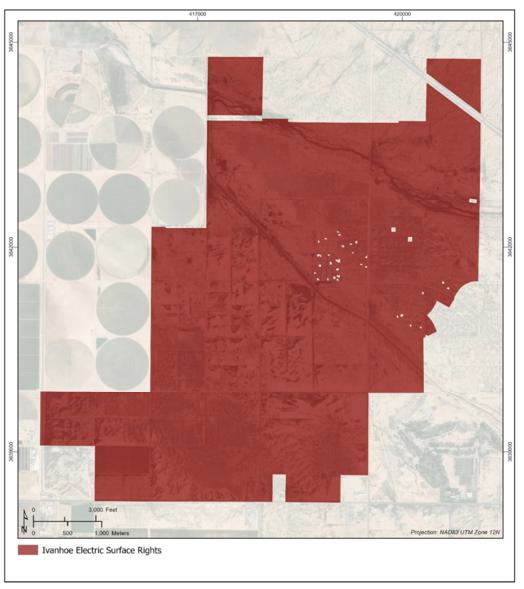
Source: Ivanhoe Electric, 2026
Figure 3-2: Ivanhoe Electric Surface Control Map
| SEPTEMBER 2026 | 3-13 |
| Ivanhoe Electric Inc. S-K 1300 Preliminary Feasibility Study & | |
In May 2023, Ivanhoe Electric exercised the option to acquire the surface title to ~24.2 km2 (5,975 acres) encompassing the Santa Cruz Copper Project from Wolff-Harvard. To close the purchase, Ivanhoe Electric paid $34.3 million, including $5.1 million of previously paid deposits. Ivanhoe Electric also issued a secured promissory note to the seller in the principal amount of approximately $82.6 million over a period of 4.5 years. The promissory note includes an annual interest rate of prime plus 1.0%. As of November 2025, all remaining payments have been made to Wolff-Harvard; there is no balance remaining.
| 3.3.3 | Water Rights |
Ivanhoe Electric acquired both Grandfathered Irrigation Rights (“GFR”) and Grandfathered Type 1 Non-irrigation Water Rights as part of its 2023 private land purchase. These rights provide approximately 3,600 acre-ft per year of water for Project use. Water is further discussed in Sections 7, 13, 15, and 17.
| 3.4 | Royalties |
Noted royalties on future mineral development of the Project are summarized in Table 3-3 and Figure 3-3.
Table 3-3: Royalties Applying to the Santa Cruz Copper Project
| Royalty Owner | Royalty Description |
| Royalty Owner A | 10% of 1/800th of the fair market value for refined copper, which amount is set by the value listed in the successor index to Metals Week as of the date the SX/EW process is completed |
| Royalty Owner B | 60% of 1/800th of the fair market value for refined copper, which amount is set by the value listed in the successor index to Metals Week as of the date the SX/EW process is completed |
| Royalty Owner C | 2% NSR |
| Royalty Owner D | 0.15% NSR |
| Royalty Owner E | ½ of 1% NSR or ½ of 1% of 60% NSR if product is disposed of other than to a commercial smelter |
| Royalty Owner F | 10% NSR (capped at $7 million) |
| Royalty Owner G | 5% NSR |
| Royalty Owner H | 1% NSR |
| Royalty Owner I | $0.015/pound of copper of Additional Mineable Reserve Copper over 2 billion pounds as determined by the “Definitive Feasibility Study” or by production beyond the amount estimated in the “Definitive Feasibility Study”; the royalty owner has the option to require payment in Ivanhoe Electric common stock at a 10% discount to the five-day volume weighted average price |
| SEPTEMBER 2026 | 3-14 |
| Ivanhoe Electric Inc. S-K 1300 Preliminary Feasibility Study & | |
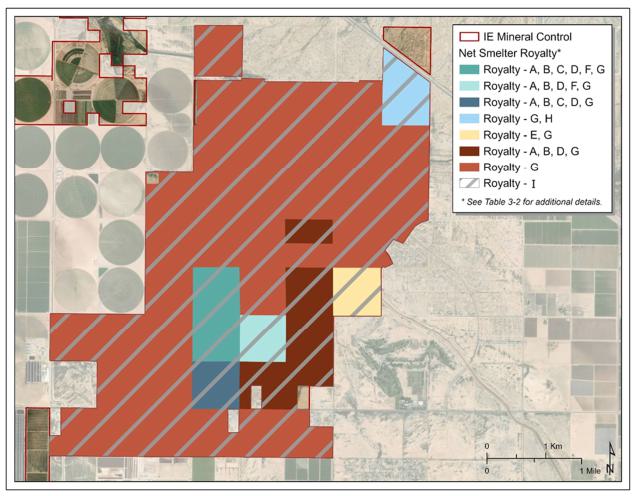
Source: Ivanhoe Electric, 2026
Figure 3-3: Extent of Royalties
| 3.5 | Encumbrances |
The Santa Cruz Copper Project is located on a large private land package which may reduce lengthy permitting timelines that result from federal land management permitting processes.
Permitting and permitting conditions are discussed in Section 17.2 of this report.
| 3.5.1 | Environmental Assessments |
A 2023 Phase I Environmental Site Assessment, completed by Environmental Site Assessments, Inc., identified an aquifer exemption on a small portion of the Property and agrochemical contamination of soils in former crop fields. While the aquifer exemption is representative of a controlled recognized environmental condition, Ivanhoe Electric is completing site-specific
| SEPTEMBER 2026 | 3-15 |
| Ivanhoe Electric Inc. S-K 1300 Preliminary Feasibility Study & | |
assessments of soil contamination prior to earthwork to characterize agrochemical conditions and confirm management of soil disturbance relative to Arizona Department of Environmental Quality Soil Remediation Limits. Sampling and analysis have been completed in the box-cut and road improvements areas in the southeast portion of Section 24. Soil pesticide detections indicate that contamination is not widespread at the site, as exceedances have been limited and generally near the residential soil remediation threshold. A companion industrial hygiene evaluation of soil-disturbing work concluded that worker inhalation exposures during soil-disturbing activities are not expected to exceed occupational exposure limits and recommended standard dust and hygiene controls. The agrochemical contamination issue remains a localized soil management consideration, not a Project environmental constraint. Further assessment or management of agrochemical contamination may be warranted prior to earthwork or for post-mining redevelopment of specific affected areas, as needed.
| 3.6 | Violations & Fines |
Ivanhoe Electric advised BBA that as of August 31, 2026, no material violations or fines were imposed during 2025 by any regulatory authority that would affect the planned work for the Santa Cruz Copper Project as presented in this report.
| 3.7 | Significant Factors & Risks that May Affect Access, Title, or Work Programs |
To the extent known to BBA, there are no other known significant factors and risks that may affect access, title, or the right or ability to perform work on the properties that comprise the Santa Cruz Copper Project that are not discussed in this report.
| SEPTEMBER 2026 | 3-16 |
| Ivanhoe Electric Inc. S-K 1300 Preliminary Feasibility Study & | |
| 4. | Accessibility, Climate, Local Resources, Infrastructure and Physiography |
| 4.1 | Accessibility |
The Project is approximately 92 km south of the greater Phoenix metropolitan area and is accessed via the West Gila Bend Highway (Highway 84) 11 km west of the city of Casa Grande, which has a population of approximately 57,700. The greater Phoenix area is a major population center, with approximately 4.8 million people, and features an airport, Phoenix Sky Harbor International Airport, and well-developed infrastructure and services that support the mining industry.
| 4.1 | Climate |
The climate in the Project area is typical of the Sonoran Desert, with temperatures ranging from -7 °C to 47 °C (19 °F to 117 °F) and an annual precipitation average ranging from 76 to 500 millimeters (3 to 30 inches) per year. Precipitation occurs as frequent low-intensity winter rains during December and January and violent summer “monsoon” thunderstorms during July and August.
The Santa Cruz Copper Project site contains no surface water resources. Storm runoff water from the site is drained toward the Santa Cruz River by minor tributaries to the Santa Rosa and North Santa Cruz washes.
Any future mining operation will be conducted year-round. Exploration activities can be performed year-round as there are no limiting weather or accessibility factors.
| 4.2 | Local Resources |
Electrical power is available along Midway Road with a high-voltage line running beside the Maricopa-Casa Grande Highway, along the northern edges of the Santa Cruz Copper Project area. An east-west rail line parallels the highway and passes through Casa Grande. A natural gas line is available along Clayton Road on the southern side of the Project area.
The cities of Casa Grande, Maricopa, and Phoenix can supply sufficient electricity, skilled labor, and supplies for the Project.
Infrastructure that will be required to support any future operations is discussed in Sections 13, 14, and 15 of this report. These report sections also discuss potential water sources, electricity, personnel, and supplies for the life-of-mine plan in the prefeasibility study.
| SEPTEMBER 2026 | 4-1 |
| Ivanhoe Electric Inc. S-K 1300 Preliminary Feasibility Study & | |
| 4.3 | Physiography |
The Santa Cruz Copper Project is in the Middle Gila Basin, entirely within the Sonoran Desert Ecoregion of the Basin and Range Physiographic Province. The area is characterized by low, jagged, mountain ranges separated by broad, alluvial-filled basins. This portion of the Sonoran Desert is sparsely vegetated with greater variability near washes and in areas that have long lain fallow. Catclaw acacia, mesquite, creosote bush, bursage, and salt cedar are common near washes and abandoned areas.
The Project area is flat and featureless. It has an elevation of 403 ±5 meters above sea level (“masl”) and slopes gently to the northwest. Much of the Project area has been used for irrigated agriculture; the decaying remnants of an extensive system of wells and concrete-lined ditches are still present, as are the alignments of furrows despite decades of lying fallow. Efforts at real estate development in the 1990s and 2000s have also left visible remnants with preliminary roadworks and some planting (palm trees) overlying the previous agricultural remains. Soils proximal to washes tend to be more sand- and gravel-rich, while soils in old agricultural areas are more silt- and clay-rich.
| SEPTEMBER 2026 | 4-2 |
| Ivanhoe Electric Inc. S-K 1300 Preliminary Feasibility Study & | |
| 5. | History |
| 5.1 | Historical Exploration |
Three main deposits, shown on Figure 5-1, form part of the Project area: Texaco (in the northeast), Santa Cruz North (southwest of Texaco), and Casa Grande West / Santa Cruz South (the southernmost deposit).
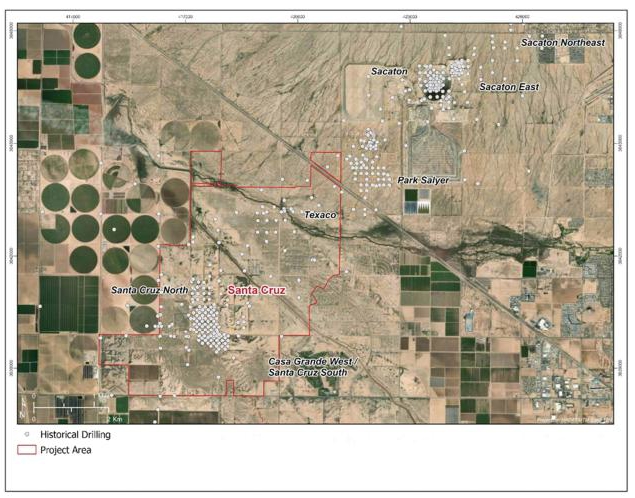
Source: Ivanhoe Electric, 2024
Figure 5-1: Historical Drill Collars, Deposit, & Exploration Area Names
Work completed on the Project area is summarized in Table 5-1.
| SEPTEMBER 2026 | 5-1 |
| Ivanhoe Electric Inc. S-K 1300 Preliminary Feasibility Study & | |
Table 5-1: Project History
| Year | Operator | Comment |
| 1961–1962 | ASARCO | Discovered copper mineralization; completed geophysical surveys (induced polarization (“IP”), resistivity, seismic reflection, and magnetics). Completed six drillholes and identified the Sacaton deposit. |
| 1964 –1965 | ASARCO | Expanded exploration efforts across the Casa Grande Valley. Completed 16 drillholes but no additional mineralization was discovered. |
| 1970 –1971 | ASARCO | Reviewed available data and concluded additional exploration was warranted. |
| 1973 | Newmont Mining, Hanna Mining, Getty Oil Corp. (“Getty Oil”) and Quintana Corp. | Initiated the Covered Area Project (“CAP”) managed by David Lowell. |
| 1974 –1980 | ASARCO Santa Cruz Inc. and Freeport McMoRan Copper & Gold Inc. (“ASARCO-Freeport”) | Initiated Santa Cruz Joint Venture (“SCJV”). Acquired additional ground around the Santa Cruz North deposit area. 1974: Three drillholes, encountered porphyry-style mineralization over what became the Santa Cruz North deposit. 1975: Four drillholes at Santa Cruz North, one at Texaco. 1976: One drillhole at Casa Grande, six at Texaco. 1977: Drilled six holes at Texaco and 12 at Casa Grande. 1979: Four drillholes at Santa Cruz North. 1980: Six drillholes at Santa Cruz North. |
| 1974 –1984 | ASARCO | Mined the Sacaton deposit using open pit methods. Initiated underground mining, but this was discontinued due to low copper prices. |
| 1974 –1992 | Hanna Mining, Getty Oil | CAP project team focused their attention on the Santa Cruz system (referred to as the Casa Grande Project).
Evidence for porphyry-style mineralization, in the form of a leached cap, was found around what became the Casa Grande West deposit.
Hanna Mining took over as project operator in 1977, with Getty Oil providing funding. Tightly spaced drilling continued until 1982, when a combination of factors, including low copper prices, led to the project being mothballed. |
| SEPTEMBER 2026 | 5-2 |
| Ivanhoe Electric Inc. S-K 1300 Preliminary Feasibility Study & | |
| Year | Operator | Comment |
1975: Drilled two holes at Casa Grande, 2 holes at Santa Cruz North and 1 hole at Texaco. 1976: Drilled two holes at Casa Grande North, 14 holes at Casa Grande. 1977: One hole drilled at Texaco, 45 at Casa Grande. 1978: One hole drilled at Santa Cruz, 31 holes at Casa Grande. 1979: Drilled six holes at Casa Grande and Santa Cruz North. 1981: Two drillholes at Santa Cruz North. 1982: Two drillholes at Santa Cruz North. | ||
| 1990 | ASARCO-Freeport, Texaco | Entered into a joint venture on the Texaco land position. |
| 1988 – 1998 | US Bureau of Reclamation, ASARCO-Freeport | Joint venture in-situ copper mining leach project between ASARCO-Freeport, and the US Bureau of Reclamation. Field testing began in 1988, and the test wells were constructed in 1989 in a five-point pattern with one injection well centered between four extraction wells. Salt tracer tests were conducted in 1991; permits for the use of sulfuric acid were received in 1994; and the solvent extraction-electrowinning (“SX/EW”) pilot plant was completed in 1995. Leach testing commenced in 1996, continued until December 1997 when congressional funding through the US Bureau of Reclamation ceased. Pumping continued until the end of February 1998. Plant placed on care and maintenance. The final research report was never made public; however, a newsletter from the project was circulated in March 1998, which noted that 35,000 pounds of copper were extracted. |
| 1996 | ASARCO-Freeport | 11 drillholes at Texaco. |
| 2003 | D.R. Horton (“DRH”) | Purchased from ASARCO-Freeport. |
| 2007 | DRH and Legends | Legends acquires surface rights from DRH. |
| 2019 | High Power Exploration, Ltd. (“HPX”) | Ivanhoe Electric predecessor, HPX, signs an agreement with Central Arizona Resources (“CAR”) for access to historical data throughout the area as well as 238 unpatented mining lode claims. |
| 2021 | Ivanhoe Electric | Ivanhoe Electric is formed via a split from HPX. All Santa Cruz agreements are transferred to Ivanhoe Electric. |
| 2021 | Ivanhoe Electric-CAR | Agreements signed with DRH and Legends for subsurface and surface rights. Work programs including drilling, geochemical, geophysical, and geological exploration commence. |
| 2021 | Ivanhoe Electric | Issues first Mineral Resource estimate. |
| 2022 | Ivanhoe Electric | Ivanhoe Electric consolidates 100% ownership of the project from CAR. |
| SEPTEMBER 2026 | 5-3 |
| Ivanhoe Electric Inc. S-K 1300 Preliminary Feasibility Study & | |
| Year | Operator | Comment |
| 2022 | Ivanhoe Electric | Issues updated Mineral Resource estimate. |
| 2023 | Legends | Legends is acquired by Wolff-Harvard Ventures, LP (“Wolff-Harvard”). |
| 2023 | Ivanhoe Electric | Issues initial assessment. |
| 2024 | Ivanhoe Electric | Exercises options with DRH and Wolff-Harvard to complete acquisition of subsurface and surface ownership. |
| 2025 | Ivanhoe Electric | Issues Preliminary Feasibility Study with updated Mineral Resource estimate. |
| SEPTEMBER 2026 | 5-4 |
| Ivanhoe Electric Inc. S-K 1300 Preliminary Feasibility Study & | |
| 6. | Geological Setting, Mineralization & Deposit |
| 6.1 | Regional Geology |
The Santa Cruz Copper Project is located within an approximately 600 km long northwest-to-southeast-trending metallogenic belt known as the Southwestern Porphyry Belt, which extends from northern Mexico into the southwestern United States. The belt includes many productive porphyry copper deposits in Arizona, such as Mineral Park, Bagdad, Resolution, Miami-Globe, San Manuel-Kalamazoo, Ray, Morenci, and the neighboring Sacaton Mine (Figure 6-1).
These porphyry copper deposits are located within a broader physiographic region known as the Basin and Range Province which occupies the majority of the southwestern United States and northwestern Mexico. This region is predominantly characterized by alternating linear sub-parallel mountain chains separated by broad, flat valleys formed by regional tectonic extension during the mid- to late-Cenozoic period.
The basement geological units of Arizona consist of formations developed during the Paleoproterozoic collisional orogeny that were subsequently stitched together by anorogenic granitic plutonic suites within the Mesoproterozoic. Basement Proterozoic lithologies at the Santa Cruz site are represented by three primary units: Pinal schist, Oracle granite, and diabase intrusions.
The Pinal schist is a metasedimentary to metavolcanic schist that represents the oldest and most expansive basement rock within southern Arizona. Proterozoic anorogenic granitic complexes were emplaced into the Pinal schist between 1450 to 1350 Ma. Continental rifting during the Mesoproterozoic introduced both Paleo- and early-Mesoproterozoic granitic complexes to the surface, where they were subsequently buried beneath younger Neoproterozoic rocks of the Apache Group, which represent a very shallow intracontinental basin. These rocks were intruded and dilated by successive diabase intrusions, around 1100 Ma, related to the separation of the Rodinia supercontinent. Throughout the Paleozoic era, Arizona was situated within a craton characterized by significant disconformities in the stratigraphy, interpreted to represent relative transgressive and regressive changes in sea level. Continental shortening throughout the Cretaceous is contemporaneous with diachronous magmatism within the same location (Tosdal and Wooden, 2015). Cessation of magmatic activity during the Paleocene period marked the onset of erosion of the uplifted arc, which is presently located southwest of the Colorado Plateau.
| SEPTEMBER 2026 | 6-1 |
| Ivanhoe Electric Inc. S-K 1300 Preliminary Feasibility Study & | |
| 6.2 | Metallogenic Setting |
The porphyry copper deposits of the Southwestern Porphyry Belt are the genetic product of igneous activity during the Laramide Orogeny (80 to 50 Ma). Laramide porphyry systems near the Santa Cruz Copper Project define a prominent southwest-to-northeast linear trend orthogonal to the trend of the Laramide magmatic arc environment.
During the tectonic extension of the mid-Cenozoic period, the Laramide volcanic arc and associated porphyry copper systems were variably dismembered, tilted, and buried beneath a complex mixture of basin sediments such as the Casa Grande Valley. However, before burial and concealment by sedimentary cover, many of Arizona's Laramide porphyry copper systems underwent supergene enrichment processes, which significantly enhanced their economic value as mineral deposits.
| SEPTEMBER 2026 | 6-2 |
| Ivanhoe Electric Inc. S-K 1300 Preliminary Feasibility Study & | |
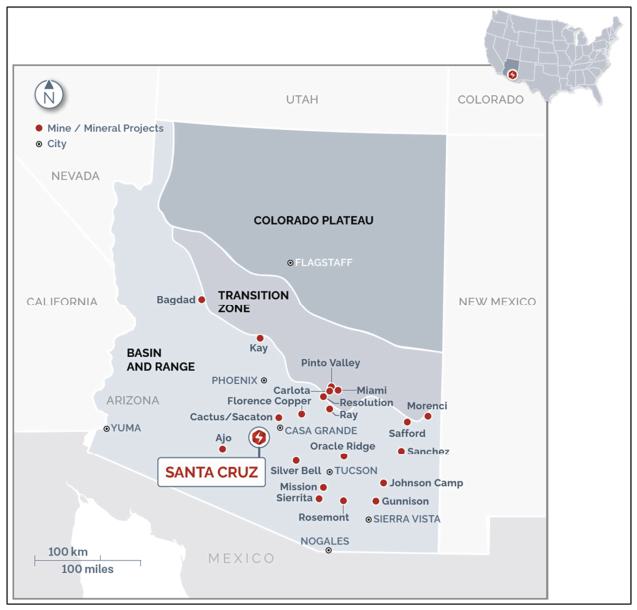
Source: Ivanhoe Electric, 2023
Figure 6-1: Regional Geology of the Southwestern Porphyry Belt & the Copper Porphyry Deposits Adjacent to the Project
| SEPTEMBER 2026 | 6-3 |
| Ivanhoe Electric Inc. S-K 1300 Preliminary Feasibility Study & | |
Supergene enrichment in the Project area demonstrates evidence of multiple enrichment cycles, indicated by the presence of several obliquely oriented chalcocite and oxide-copper blankets formed from successive syn-tilting enrichment events. These obliquely oriented blankets are interpreted to have formed due to syn-rotation enrichment and subsequent overprinting of newer supergene blankets over the previous ones. Cycled supergene enrichment processes such as these are observed throughout the Tertiary period and subsequently ceased with the deposition of basin sediments and concealment of the bedrock below which altered the hydrology. The earliest supergene enrichment at the Santa Cruz deposit is believed to have occurred during the Eocene epoch (Tosdal and Wooden, 2015). Supergene alunite from the nearby Sacaton porphyry copper deposit, approximately 8.5 km from the Santa Cruz deposit, was potassium-argon (“K-Ar”) dated to 41 Ma (Cook, 1994).
| 6.3 | Santa Cruz Copper Project Geology |
The Santa Cruz Copper Project consists of four separate areas of interest along a southwest-northeast trend which continues in line with the neighboring historical Sacaton mine. These areas, from southwest to northeast, are referred to as (1) the Southwest exploration area, (2) the Santa Cruz deposit, (3) the East Ridge deposit, and (4) the Texaco deposit. Each of these deposits or areas represents portions of one or more porphyry copper systems that have been dissected and separated as a result of extensional Basin and Range normal faulting. Likewise, each area has experienced variable periods of erosion, supergene enrichment, fault displacement, and tilting into their present positions due to Basin and Range extensional faulting (Figure 6-2).
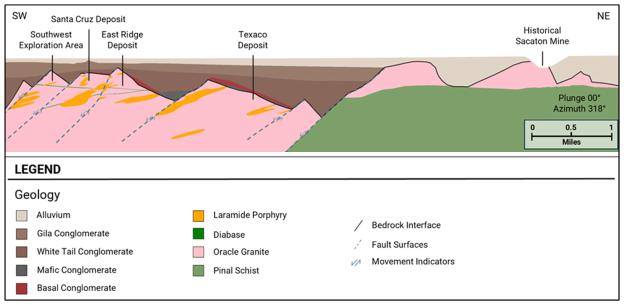
Source: Ivanhoe Electric, 2024
Figure 6-2: Generalized Cross-Section of the Santa Cruz – Sacaton System
| SEPTEMBER 2026 | 6-4 |
| Ivanhoe Electric Inc. S-K 1300 Preliminary Feasibility Study & | |
| 6.3.1 | Santa Cruz Bedrock Lithologies |
Bedrock geology at the Santa Cruz Copper Project is largely dominated by Oracle granite (1450 to 1350 Ma) with lesser proportions of Proterozoic diabase intrusions (1100 Ma), variably dipping 15° to the south-southeast, and Laramide porphyry intrusions (75 Ma), dipping at ~30° to 40° to the north-northwest.
| 6.3.1.1 | Oracle Granite |
The Oracle granite is predominantly characterized as a coarse-grained biotite granite with large pink- or salmon-colored orthoclase feldspars approximately 32 to 38 mm across, which gives the rock a pink- to pink-gray mottled appearance on fresh surfaces.
The groundmass comprises uniformly sized 5 mm grains of clear white feldspar and glassy quartz with greenish-black masses of biotite and magnetite. Composition suggests it should be classed as quartz monzonite rather than granite. Surface exposures are typically of light-buff color. Alteration minerals include sericite, secondary biotite, and secondary orthoclase.
| 6.3.1.2 | Diabase |
The Proterozoic diabase is a coarse-grained rock characterized by a composition predominantly of plagioclase feldspar, pyroxene, and olivine. Plagioclase feldspar and pyroxene, ranging from labradorite to bytownite, often exhibit crystal twinning and characteristic lathy ophitic to subophitic textures. Accessory minerals include minor amounts of iron-titanium oxides, magnetite and ilmentite, which contribute to the magnetic properties of the rock, apatite, and occasionally biotite or hornblende.
The diabase intrusions are interpreted to have been emplaced as horizontal to sub-horizontal sills, rather than vertical to subvertical dykes, though infrequent subvertical dykes are recognized in nearby locales. Due to its iron and magnesium-rich composition, occurrences of diabase are often congruent with increased hypogene and supergene copper mineralization, relative to other lesser reactive rocks.
Petrographic thin section analysis indicates that the diabase is predominantly associated with secondary biotite and epidote as hydrothermal alteration products.
| 6.3.1.3 | Laramide Porphyry |
The Laramide porphyry intrusions are variable in composition but are collectively regarded as the causative intrusive for primary hypogene mineralization within the Santa Cruz Copper Project. The porphyry intrusions are typically characterized as a quartz monzonite composition (35% quartz, 6%
| SEPTEMBER 2026 | 6-5 |
| Ivanhoe Electric Inc. S-K 1300 Preliminary Feasibility Study & | |
biotite, 29% feldspar, 30% K-feldspar, and plagioclase) with 40% phenocrysts averaging 1.5 mm and 60% aplitic to aphanitic groundmass. Quartz phenocrysts are less than 10 mm, sub-spherical, and comprise approximately 25% of the phenocrysts. Biotite makes up 15% of the phenocrysts and are less than 5 mm. Subhedral plagioclase phenocrysts, 60%, are generally less than 7 mm.
There are two distinct groups of Laramide-aged porphyry intrusions. One contains quartz phenocrysts of less than 5% by volume and is generally associated with increased biotite phenocrysts, as well as increased biotite content in the groundmass, typically resulting in a darker color for this unit. The other variant contains a greater abundance of quartz phenocrysts (>5%) and is often described as being more siliceous and lighter in color. These two distinct groups of Laramide-aged porphyry are formally referred to as the “granodiorite porphyry” and “latite porphyry,” respectively.
A third Laramide porphyry consists of a biotite-quartz feldspar monzonite porphyry comprising 15% biotite, 25% K-feldspar, 40% plagioclase and 20% quartz, with 15% phenocrysts consisting of 20% biotite, 70% plagioclase and 10% quartz in an aphanitic 15% biotite, 30% K-feldspar, 35% plagioclase, 20% and quartz groundmass with an 0.06 mm average crystal size.
Alteration minerals within mineralized Laramide intrusions are variable depending on the porphyry endmember but are dominated by hydrothermal biotite, sericite, and lesser orthoclase feldspar.
| 6.3.1.4 | Pinal Schist |
The Pinal schist has not been intersected within the Project area but is interpreted to occur at depth based on the regional geology. The unit typically consists of medium- to high-grade metamorphic rocks derived from sedimentary to volcanic protoliths. As part of the broader suite of Proterozoic metamorphic rocks in southern Arizona, the Pinal schist is exposed in mountain ranges such as the Santa Catalina and Rincon Mountains. Structurally, the unit is often intensely deformed, exhibiting multiple generations of folding and faulting, and is intruded by younger granitic bodies such as the Oracle granite.
| 6.3.2 | Basin Fill Lithologies |
Directly overlying the erosional surface of the bedrock units is a series of sedimentary and volcaniclastic rocks. These rocks consist of predominantly syn-extensional erosional sediments and cobble conglomerates, airfall volcanic tuffs, and andesitic basalts associated with flows or volcaniclastic deposits. The sediments and cobble conglomerate units include alluvium, Gila conglomerate, Whitetail conglomerate, and basal conglomerate. The Gila and Whitetail conglomerates are separated stratigraphically and conformably by a narrow marker bed of rhyolitic Apache Leap tuff (20 Ma), usually of no greater thickness than 1 m. Basaltic flows and
| SEPTEMBER 2026 | 6-6 |
| Ivanhoe Electric Inc. S-K 1300 Preliminary Feasibility Study & | |
volcaniclastic deposits are represented by the mafic conglomerate which exists variably above, below, or intercalated within the basal conglomerate and/or lower Whitetail conglomerate.
The syn-extensional sedimentary units and morphology are well-understood across the Project area through numerous core-from-surface drilling intersections. A simplified stratigraphic column is shown in Figure 6-3.
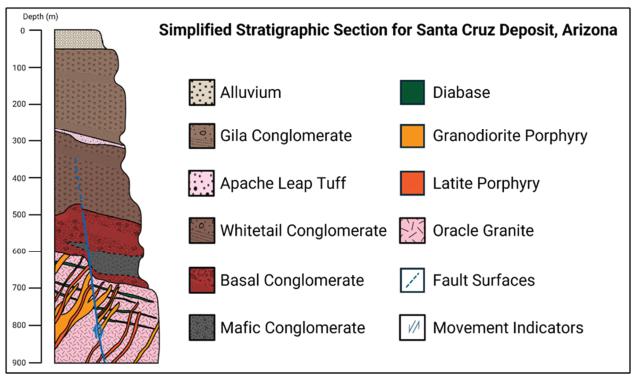
Source: Ivanhoe Electric, 2025
Figure 6-3: Simplified Stratigraphic Section of Santa Cruz Copper Project
| 6.3.2.1 | Alluvium |
The Project area is characterized by an extensive layer of Quaternary alluvium, ranging from 80 to 100 m in thickness. This geological formation primarily comprises alternating layers of fine-grained sand, silt, and clay, interspersed with occasional fragments of caliche and iron oxides. Minimal variation is observed within the vertical profile, which indicates consistent depositional conditions across the Project area. The presence of caliche fragments and subtle iron oxide staining within the alluvium points towards periodic episodes of soil formation and diagenetic alterations under semi-arid climatic conditions typical of Arizona.
| SEPTEMBER 2026 | 6-7 |
| Ivanhoe Electric Inc. S-K 1300 Preliminary Feasibility Study & | |
| 6.3.2.2 | Gila Conglomerate |
The Tertiary Gila conglomerate consists of alternating beds of rounded to sub-rounded to sub-angular cobble to lesser boulder conglomerates, composed of mixed lithologies specific to the regional area, and beds of moderately sorted sand and gravel pebble conglomerates. These beds collectively average 150 to 300 m in thickness across the Project area, reach their thickest intersections over paleo-valleys controlled by buried extensional structural block configurations, and exhibit a conformable relationship with the underlying Apache Leap tuff.
The regional aquifer starts about 150 m below the surface in the Gila conglomerate, extending through different layers until it reaches bedrock. This water table is consistent across the Project area.
| 6.3.2.3 | Apache Leap Tuff |
The Tertiary Apache Leap tuff, characterized as a rhyolitic airfall tuff, primarily consists of a devitrified quartzofeldspathic cryptocrystalline groundmass with infrequent compressed pumice fragments observable within thicker and less weathered intersections. This unit, interpreted to be horizontal to sub-horizontal across the Casa Grande Valley, can occur as multiple layers within a single section. The tuff displays a conformable relationship with the underlying Whitetail conglomerate.
| 6.3.2.4 | Whitetail Conglomerate |
The Tertiary Whitetail conglomerate, temporally and characteristically regarded as the stratigraphically lower and earlier equivalent of the Gila conglomerate, consists of alternating beds of mostly angular to sub-angular cobble to boulder conglomerates, composed of mixed lithologies specific to the regional area, with periodically interbedded layers of moderately to poorly sorted sand and gravel pebble conglomerates. Interpreted to represent a period of higher intensity erosion, the unit collectively averages 100 to 400 m in thickness across the Project area. The thickest intersections are found over paleo-valleys controlled by extensional structural block configurations. It displays a conformable relationship with the underlying basal conglomerate or mafic conglomerate and an unconformable relationship with the underlying Oracle granite or Laramide porphyry.
| SEPTEMBER 2026 | 6-8 |
| Ivanhoe Electric Inc. S-K 1300 Preliminary Feasibility Study & | |
| 6.3.2.5 | Mafic Conglomerate |
The Tertiary mafic conglomerate is characterized as a monomictic volcaniclastic unit composed of tightly compacted angular to sub-angular pebble- to cobble-sized clasts of basaltic material. The unit is markedly distinguished from other sedimentary units by the sharp difference in clast composition and clast abundance, with little matrix support. Within the lower sedimentary sequence of the Santa Cruz deposit, the unit typically forms thin and relatively flat layers ranging from 1 to 3 m thick, which can be found above, below, or intercalated with the basal conglomerate and/or Whitetail conglomerate. These thin layers generally dip to the southeast at ~5° to 15°. The unit shows a conformable relationship with the underlying basal conglomerate or Whitetail conglomerate and an unconformable relationship with the underlying Oracle granite or Laramide porphyry.
| 6.3.2.6 | Basal Conglomerate |
The Tertiary basal conglomerate is characterized as a tightly compacted, monomictic conglomerate consisting of angular cobble- to boulder-sized clasts of Oracle granite. The unit is also markedly distinguished from other units by a sharp and significant introduction or increase in total hematitic iron oxidation throughout the rock mass. The unit averages 25 to 100 m thickness across the Project area, reaching the thickest intersections at the base of paleo-valleys due to surface erosion, slope degradation, or mass wasting. The unit displays a conformable relationship with the underlying mafic conglomerate or an unconformable relationship with the underlying Oracle granite.
| 6.3.3 | Alteration |
Hydrothermal alteration at the Santa Cruz Copper Project is variable across the Project area and largely dependent on the proximity and position relative to causative Laramide porphyry intrusions. Hypogene hydrothermal alteration assemblages consist predominantly of quartz, secondary biotite, secondary orthoclase, magnetite, sericite, and phengite. Low-temperature broad overprints are present consisting of illite and smectite, lesser kaolinite (which occurs primarily in the Oracle granite), and late chlorite and calcite. Rare subordinate phases such as epidote, albite, and tremolite may also occur locally.
Supergene alteration is the latest overprint, which is the product of surface weathering, oxidation, and heated meteoric groundwater. The breakdown of sulfides results in sulfuric acid that can lead to the formation of limonite, alunite, jarosite, and kaolinite-bearing assemblages. Supergene alteration, as a result of heated meteoric groundwater, occurs as smectite clay alteration of mafic- to intermediate-composition igneous rocks, smectite alteration along Miocene Basin and Range faults, and broad pervasive illite-smectite alteration overprints.
| SEPTEMBER 2026 | 6-9 |
| Ivanhoe Electric Inc. S-K 1300 Preliminary Feasibility Study & | |
| 6.3.4 | Structural Geology |
The Project area lies within the Basin and Range geological province, within a domain that has experienced a high degree of extensional tectonism. Faulting is intimately associated with mineralization and the current deposit configuration in several ways. The extensional fault systems that are recognized in the Project area have a transport direction towards the southwest.
Major, deep-seated, northeast-to-southwest-striking basement structures controlled Laramide-age intrusive emplacement and metal endowment during transpressional arc magmatism. These structures are interpreted as detachment faults that have been reactivated multiple times, potentially serving as transfer faults for dextral offset during Basin and Range extension. Post-mineral faulting in the Project area shows evidence of two generations of normal faulting in a northwest-southeast direction. This caused significant rotation and offset of fault blocks, with the earliest generation exhibiting a sub-horizontal configuration and the latest showing a sub-vertical configuration. The detachment fault has not been intersected within the Project area but is believed to be at depth based on regional geology and fault block orientation.
Post-emplacement faulting has controlled and affected groundwater dynamics and the mobilization and deposition of copper through supergene enrichment processes. These faults also played a role in shaping the paleotopographical landscape and had a controlling influence on the development and distribution of exotic copper mineralization within paleodrainages. Internal faults in the Santa Cruz deposit have been modeled using active seismic geophysics, geotechnical analysis, and geological diamond drillhole logs.
| 6.3.5 | Property Mineralization |
Mineralization at the Santa Cruz Copper Project is summarized in Table 6-1. Figure 6-4 to Figure 6-6 show cross-sections of the Santa Cruz, East Ridge, and Texaco deposits, respectively.
| SEPTEMBER 2026 | 6-10 |
| Ivanhoe Electric Inc. S-K 1300 Preliminary Feasibility Study & | |
Table 6-1: Deposit & Mineralization Summary of the Santa Cruz Copper Project
| Deposit | Dimensions | Lithology | Structure | Alteration | Mineralization |
| Santa Cruz Deposit | The Santa Cruz deposit is approximately 2,000 m long and 700 m wide. Mineralization occurs from about 400 m below the surface at 0 m above sea level to a depth of approximately -600 m below sea level. |
Precambrian Oracle granite, Laramide porphyry, Precambrian diabase | Basin
and Range extensional faulting |
Pervasive sericite overprint associated with moderate density stockwork quartz veinlets. Higher temperature alteration is displayed as secondary biotite, chlorite, and minor secondary orthoclase. Low-temperature supergene weathering overprints hydrothermal alteration as illite, smectite, and lesser kaolinite. |
Supergene: The uppermost exotic copper mineralization is primarily hosted in overlying clastic and volcanic rocks. The supergene stratigraphy comprises zoned mineralization, with chrysocolla at the top, followed by atacamite, and then chalcocite. There is evidence of post-rotational supergene enrichment horizons, indicating two or more supergene sulfide events. Hypogene: Primary sulfide mineralization includes chalcopyrite, pyrite, and minor molybdenite, which are hosted in quartz-sulfide stringers, veinlets, veins, and breccias. Additionally, finely to coarsely disseminated copper sulfides are found within vein envelopes associated with hydrothermal porphyry mineralization. |
| East Ridge Deposit | The East Ridge deposit consists of discrete subparallel zones. East Ridge North occurs as four dipping, subparallel zones from 4 to 8 m thick, 500 to 700 m long along strike, and 300 to 600 m extent along dip with an average dip of 35° to 45°. East Ridge South consists of two shallowly dipping, subparallel zones from 5 to 15 m thick, approximately 300 m long along strike and 600 m in extent down dip with an average dip of 15°. | Precambrian Oracle granite, Laramide porphyry, Precambrian diabase | Basin
and Range extensional faulting |
Pervasive sericite overprint associated with low to moderate density stockwork quartz veinlets. Higher temperature alteration is displayed as secondary biotite, magnetite, and minor secondary orthoclase. Low-temperature supergene weathering overprints hydrothermal alteration as illite, smectite, and lesser kaolinite. |
Supergene: Correlative and partially displaced from the Santa Cruz deposit. Supergene sulfide mineralization consists of thin, stacked intervals displaced from those in the Santa Cruz deposit by Basin and Range faulting. Chrysocolla and atacamite is broadly distributed near the fault-controlled paleo valley between the Santa Cruz and East Ridge deposits. Hypogene: Primary sulfide mineralization is correlative and displaced from the Santa Cruz deposit and includes broad zones of low to moderate density quartz-sulfide veins consisting of chalcopyrite, pyrite, and molybdenite. Small zones of mineralized hydrothermal breccia are in the north portion of East Ridge. |
| SEPTEMBER 2026 | 6-11 |
| Ivanhoe Electric Inc. S-K 1300 Preliminary Feasibility Study & | |
| Deposit | Dimensions | Lithology | Structure | Alteration | Mineralization |
| Texaco Deposit | The Texaco deposit is approximately 1,500 m long and 650 m wide. The highest intercept of mineralization occurs at about 450 m below surface at -50 m below sea level, while the deepest intercept is at approximately -720 m below sea level. The deposit is tabular and dipping, and these dimensions represent the highest and lowest intersections of mineralization with an average thickness of 150 m. | Precambrian
Oracle granite, Laramide porphyry, Precambrian diabase |
Basin
and Range extensional faulting |
Pervasive sericite in groundmass and stockwork quartz-sericite-pyrite veins. Higher temperature alteration is associated with quartz-molybdenite veins, secondary, biotite and magnetite within thin veinlets. Low-temperature supergene weathering overprints hydrothermal alteration as illite, smectite, and lesser kaolinite. |
Supergene: Supergene mineralization at Texaco contains significantly less copper oxide and copper chloride mineralization compared to the Santa Cruz deposit, although a well-developed leached cap exists. Veined and disseminated chalcocite exists in sub-horizontal blankets that have been tilted due to faulting and extension. Hypogene: Primary sulfide mineral assemblages consist of chalcopyrite, pyrite, molybdenite hosted in quartz-sulfide veins, veinlets, vein breccia and breccias, as well as fine to coarsely disseminated sulfides within vein envelopes. Chalcopyrite and pyrite occur as sulfide cement within breccias. Hypogene mineralization at Texaco forms a distinct zoning pattern of chalcopyrite-molybdenite to chalcopyrite to pyrite from core to shell. |
| Southwest Exploration Area | The dimensions of the Southwest exploration area are yet to be determined as the deposit boundaries remain undefined. | Precambrian Oracle granite, Laramide porphyry | Basin
and Range extensional faulting |
Higher
temperature alteration assemblage consisting of sericite, secondary biotite, Significant supergene weathering is not observed within the Southwest exploration area. |
Supergene: Supergene mineralization at the Southwest exploration area consists of weakly disseminated and partially enriched sulfides with chalcocite and/or bornite rims. Hypogene: Hypogene mineralization within the Southwest exploration area is characterized by limited drilling that encountered bedrock at approximately 1,000 m depth. Sulfide mineralization includes pyrite and chalcopyrite that occur as chemical cement within a magmatic-hydrothermal breccia and sparse quartz-sulfide veining. |
| SEPTEMBER 2026 | 6-12 |
| Ivanhoe Electric Inc. S-K 1300 Preliminary Feasibility Study & | |
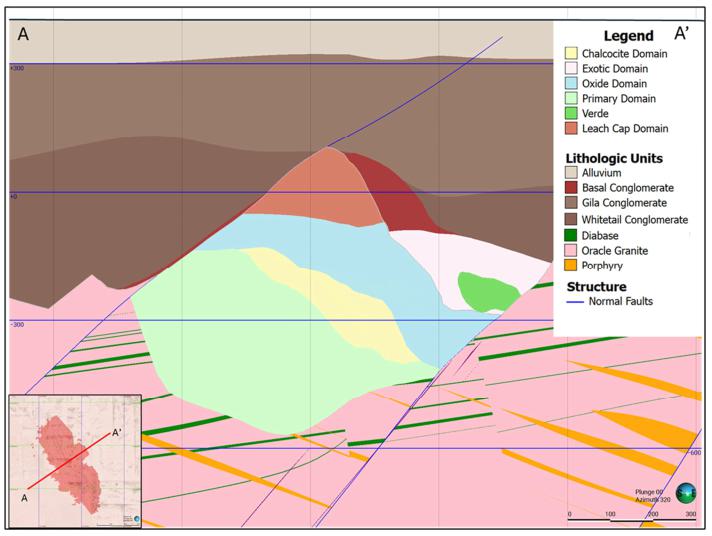
Source: Ivanhoe Electric, 2025
Figure 6-4: Geological Cross-Section of Santa Cruz Deposit looking Northwest
| SEPTEMBER 2026 | 6-13 |
| Ivanhoe Electric Inc. S-K 1300 Preliminary Feasibility Study & | |
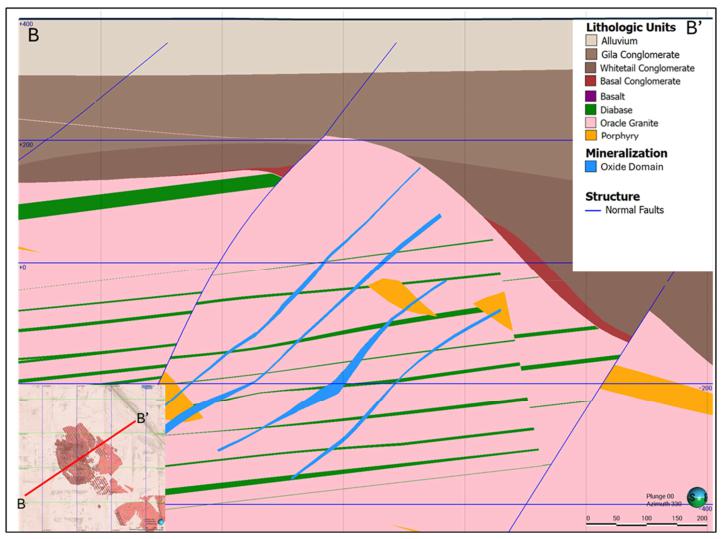
Source: Ivanhoe Electric, 2025
Figure 6-5: Geological Cross-Section of the East Ridge Deposit, looking Northwest
| SEPTEMBER 2026 | 6-14 |
| Ivanhoe Electric Inc. S-K 1300 Preliminary Feasibility Study & | |
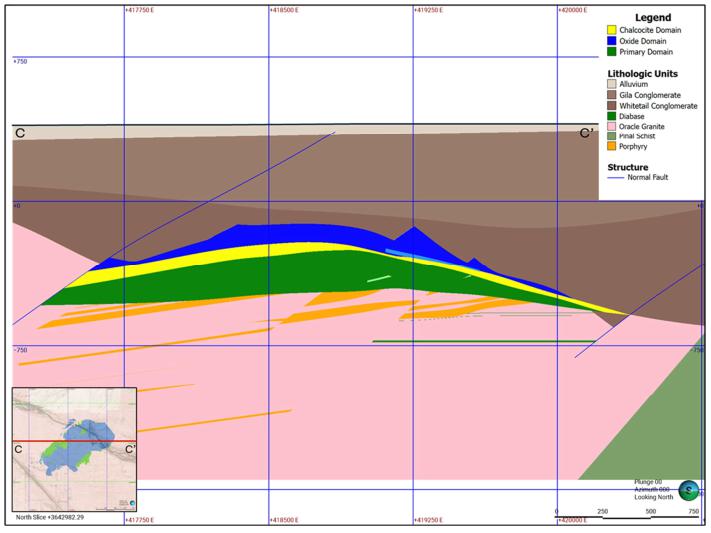
Source: Ivanhoe Electric, 2025
Figure 6-6: Geological Cross-Section of the Texaco Deposit, looking North
| SEPTEMBER 2026 | 6-15 |
| Ivanhoe Electric Inc. S-K 1300 Preliminary Feasibility Study & | |
| 6.4 | Deposit Types |
Porphyry copper deposits (Figure 6-7) form in areas of shallow magmatism within subduction-related tectonic environments (Sillitoe, 2010).
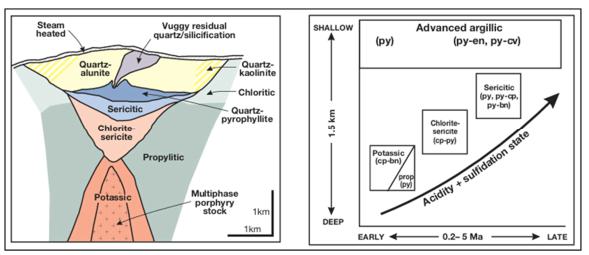
Source: Sillitoe, 2010
Figure 6-7: Simplified Alteration and Mineralization Zonation Model of a Porphyry Copper Deposit
As shown in Figure 6-7, the deposits in the Project area have the typical characteristics of a porphyry copper deposit defined by Berger et al. (2008):
| ■ | Copper-bearing sulfides are localized in a network of fracture-controlled stockwork veinlets and as disseminated grains in the adjacent altered rock matrix. |
| ■ | Alteration and mineralization at 1 to 4 km depth are genetically related to magma reservoirs emplaced into the shallow crust (6 to over 8 km), predominantly intermediate to silicic in composition, in magmatic arcs above subduction zones. |
| ■ | Intrusive rock complexes associated with porphyry copper mineralization and alteration are predominantly in the form of upright-vertical cylindrical stocks and/or complexes of dykes. |
| ■ | Zones of phyllic-argillic and marginal propylitic alteration overlap or surround a potassic alteration assemblage. |
| ■ | Copper may also be introduced during overprinting phyllic-argillic alteration events. |
Primary hypogene mineralization occurs as disseminations and in stockworks of veins, in hydrothermally altered, shallow intrusive complexes and their adjacent country rocks (Berger et al., 2008). Sulfides of the hypogene zone are dominantly chalcopyrite and pyrite. The hydrothermal alteration zones and vein paragenesis of porphyry copper deposits are well-known and provide an excellent tool for advancing exploration. Schematic cross-sections of typical alteration zones and associated minerals are presented in Figure 6-8.
| SEPTEMBER 2026 | 6-16 |
| Ivanhoe Electric Inc. S-K 1300 Preliminary Feasibility Study & | |
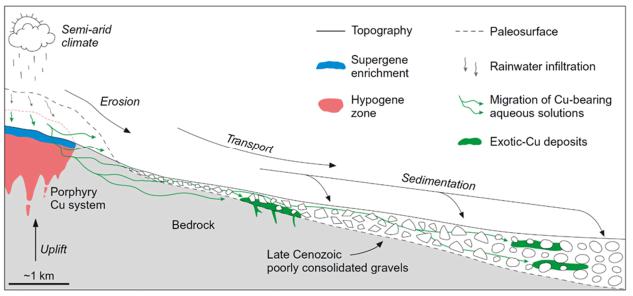
Source: Mote et al. (2018); modified after Münchmeyer (1998) and Sillitoe (2010)
Figure 6-8: Schematic Representation of an Exotic Copper Deposit
Supergene enrichment processes are a common feature of many porphyry copper systems located in certain physiogeographical regions (semi-arid). It can result in upgrading of low-grade porphyry copper sulfide mineralization into economically significant accumulations of supergene copper species (copper oxides, halides, carbonates, etc.). This is particularly important in the southwestern United States. Supergene enrichment occurs when a porphyry system is uplifted to shallow depths and is exposed to surface oxidation processes. This leads to the copper being leached from the hypogene mineralization during weathering of primarily pyrite, which generates significant sulfuric acid in oxidizing conditions, and redeposits the copper below the water table as supergene copper sulfides such as chalcocite and covellite. Figure 6-9 illustrates a schematic section through a secondary enriched porphyry copper deposit, identifying the main mineral zones formed as an overprint from the weathering of the hypogene system.
The Project area has a history of oxidation and leaching that resulted in the formation of enriched chalcocite horizons, and later stages of oxidation and leaching, which modified the supergene copper mineralization by oxidizing portions of it in place and mobilizing some of the chalcocite to a greater depth (Figure 6-9). This process is associated with descending water tables and or erosion and uplift of the system, or changes in climate, or hydrogeological systematics.
| SEPTEMBER 2026 | 6-17 |
| Ivanhoe Electric Inc. S-K 1300 Preliminary Feasibility Study & | |
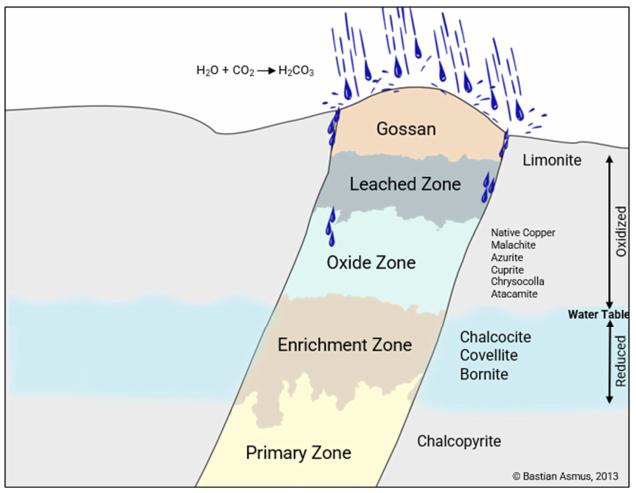
Source: modified from Asmus, B. (2013)
Figure 6-9: Typical Copper Porphyry Cross-Section and Associated Minerals
| SEPTEMBER 2026 | 6-18 |
| Ivanhoe Electric Inc. S-K 1300 Preliminary Feasibility Study & | |
| 7. | Exploration and Drilling |
| 7.1 | Geophysics and Geochemistry |
Various exploration programs have been conducted in the Project area by different operators starting in the 1960s. These are summarized in Section 5 and, where relevant to the Santa Cruz Copper Project, are also summarized in the following sub-sections.
| 7.1.1 | Geophysical Exploration |
| 7.1.1.1 | Historical Surveys |
Ivanhoe Electric compiled historical geophysical survey information on the Project area completed by previous operators (refer to Table 5-1).
Historical induced polarization (“IP”) survey reports indicate that extraneous responses in IP surveys at Sacaton and Santa Cruz resulted from groundwater present in the valley sediments and conglomerates. Controlled source audio-frequency magnetotelluric surveys were considered promising for tracking leachate detectability with salt doping/tracing.
| 7.1.1.2 | Ivanhoe Electric |
Ivanhoe Electric has completed geophysical surveys including ground gravity, seismic refraction tomography, proprietary Typhoon™ three-dimensional perpendicular pole dipole induced polarization (“3D PPD IP”), ground magnetics, multichannel analysis surface wave, and controlled source audio-frequency magnetotellurics. The geophysical datasets from these surveys were used to assist with geological interpretation and improved drill targeting. The surveys and results are summarized in Table 7-1. Maps detailing the location of the surveys, survey design, and sample results are shown in Figure 7-1 through Figure 7-3.
| SEPTEMBER 2026 | 7-1 |
| Ivanhoe Electric Inc. S-K 1300 Preliminary Feasibility Study & | |
Table 7-1: Geophysical Assessments Conducted on the Santa Cruz and Texaco Deposits from 2022 to 2026
| Year | Technique | Purpose | Results |
| 2022 | Ground gravity | To understand the depth to basement, the characteristics of the post-mineral cover, and the pre-mineral basement. When integrated with seismic data, which provides superior vertical resolution, the combination yields high-resolution insights into key geological relationships in the subsurface. | Gravity data, combined with seismic datasets, was used to estimate depths to basement outside of drilled domains. This data helped improve the modeling of geological contacts, structures, and post-mineral cover geometries, aiding in drillhole planning and mine design optimization. |
| 2D surface seismic refraction tomography | To determine bedrock depth and subsurface topography within a discrete 1.5 by 1.2 km region northwest of the Santa Cruz deposit. | The seismic tomographic survey helped model the depth to basement within the survey area. It revealed that the cover sequence generally consists of low-velocity materials, which enabled the delineation of the basement contact in nearby zones. Certain gravels near the basement interface exhibited high seismic velocities due to varying degrees of induration and lithification. Some domains of crystalline basement showed anomalously low velocities, attributed to extensive hydrothermal alteration and supergene leaching. | |
| Typhoon™ (3D PPD IP) | The aim was to address subsurface chargeability anomalies from disseminated sulfides and to analyze resistivity and conductivity data from the 3D PPD survey. This would help define geological features like lithological, alteration, mineralization domains, and water table configuration. | Results revealed strong chargeability anomalies that correspond with areas of known porphyry-style mineralization, previously confirmed through drilling such as disseminated sulfide mineralization, e.g., pyrite and chalcopyrite. | |
| Ground magnetics | To resolve structures and geological relationships in the subsurface. | The results revealed subsurface features such as faults and magnetic variations. Interpretation in Santa Cruz and Texaco deposits faced interference from steel drill casings and possibly abandoned rods. Despite this, magnetic anomalies at historical drill sites helped verify the accuracy of recorded collar locations. |
| SEPTEMBER 2026 | 7-2 |
| Ivanhoe Electric Inc. S-K 1300 Preliminary Feasibility Study & | |
| Year | Technique | Purpose | Results |
| 2023 | Quantum-audio magnetotellurics | To obtain broad magnetic and resistivity datasets across the Property for regional context and interpretation of subsurface structural and alteration features. | The survey sensor, suspended beneath the helicopter, experienced vibrational and rotational noise, leading to low-quality data with a poor signal-to-noise ratio. Consequently, the dataset was unusable for creating higher-order derivative products like resistivity models or magnetic inversions and was excluded from operational workflows. |
| 2024 | 3D and 2D seismic and multichannel analysis surface wave | High-resolution seismic imaging was conducted to de-risk capital development and provide interpretive data on stratigraphic contacts and structures. Additionally, two multichannel surface wave survey lines were completed to inform near-surface shear wave velocity for planned infrastructure. | The integration of 2D, 3D seismic, and multichannel analysis surface wave survey results reduced geological uncertainty by clarifying lithological boundaries and fault geometries, improving capital planning. |
| Typhoon™ data reprocessing | The 2022 Santa Cruz Copper Project Typhoon™ 3D PPD IP survey data was reprocessed using a new suite of QA/QC tools and newly introduced machine learning techniques to identify and filter erroneous readings within the raw data. | The refined data served as updated input for creating a new 3D chargeability and resistivity inversions. The resulting 3D inversions and report featured smoother geometries with less distortion from cultural noise. | |
| Ambient noise tomography | To map the thickness of the conglomerates, detect any lateral velocity variation within the bedrock, and detect structural features for additional geological context. | The modeled results showed that the passive seismic data delineated stratigraphic and structural features relevant to porphyry copper exploration, increasing confidence in geologic interpretations. | |
| 2026 | Multichannel Analysis of Surface Waves | To provide more granular data for the uppermost alluvium for detailed engineering of Santa Cruz and East Ridge vent shafts. | Pending. |
| SEPTEMBER 2026 | 7-3 |
| Ivanhoe Electric Inc. S-K 1300 Preliminary Feasibility Study & | |
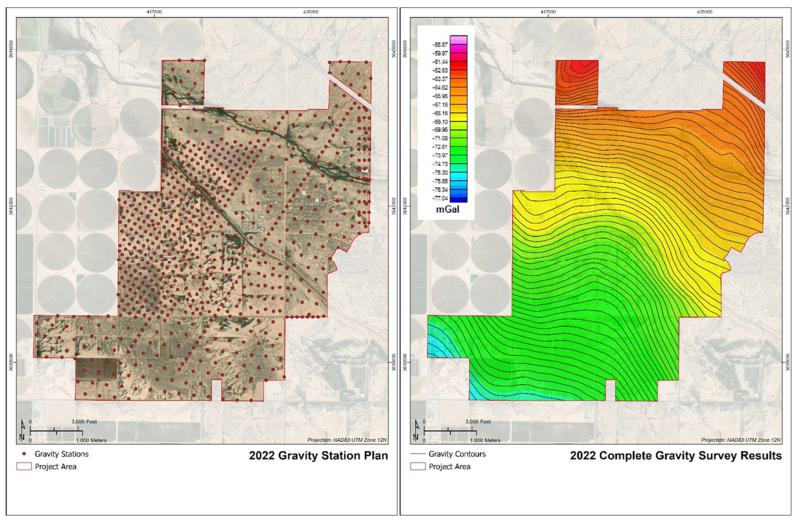
Note: Shows complete Bouguer gravity anomaly at reduction
density of 2.3 g/cm3.
Source: Ivanhoe Electric, 2025.
Figure 7-1: 2022 Gravity Survey Station Plan (Left) & Gravity Survey Results (Right)
| SEPTEMBER 2026 | 7-4 |
| Ivanhoe Electric Inc. S-K 1300 Preliminary Feasibility Study & | |
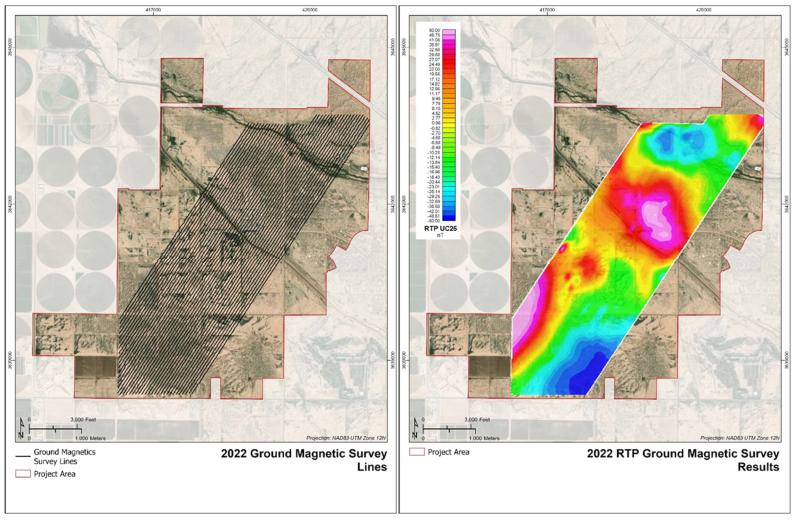
Note: Ground magnetics survey lines are shown on the left
and ground magnetics results are shown on the right.
Source: Ivanhoe Electric, 2025.
Figure 7-2: Ground Magnetics Survey Results
| SEPTEMBER 2026 | 7-5 |
| Ivanhoe Electric Inc. S-K 1300 Preliminary Feasibility Study & | |
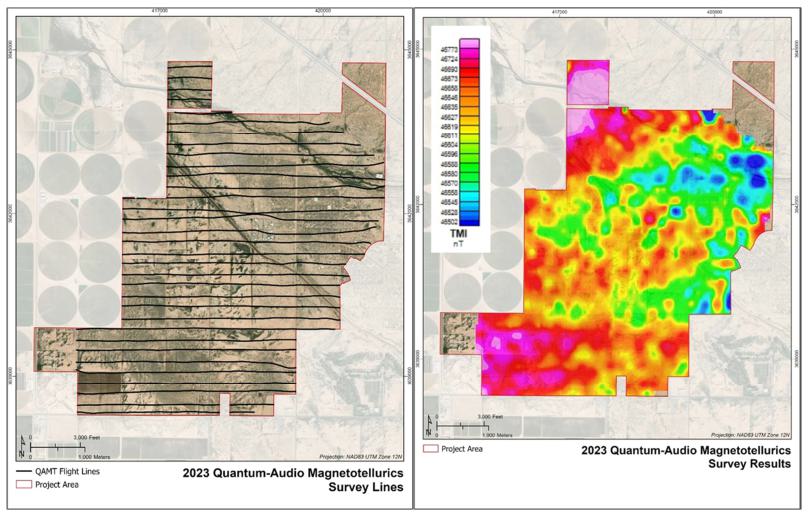
Source: Ivanhoe Electric, 2025.
Figure 7-3: Quantum Audio Magnetotellurics Survey Lines
| SEPTEMBER 2026 | 7-6 |
| Ivanhoe Electric Inc. S-K 1300 Preliminary Feasibility Study & | |
| 7.1.2 | Geochemical Exploration |
The deposits at the Santa Cruz Copper Project are deep and most sampling has been the result of drilling. Drilling results are discussed in Section 7.2.
Ivanhoe Electric conducted a partial ionic leach sampling survey through ALS Laboratories in Tucson, Arizona. The geochemical datasets have been used to assist with geological interpretation and improved drill targeting.
A comprehensive surface ionic leach sampling program was completed across the entire Project area, in two phases, to assess the utility of this survey method in detecting copper mineralization at depth. A total of 815 surface samples were collected by Ivanhoe Electric along approximately 30 sampling lines across both sampling phases. The program aimed to validate the survey methodology and explore its potential to enhance targeting and geological interpretation efforts.
Survey sample sites were collected from approximately 30 northeast-southwest oriented sampling lines, with each line spaced approximately 223 m apart in the northwest-southeast direction, with samples collected at roughly 130 to 150 m spacing in the northeast-southwest direction. Line lengths were variable to conform to the Property boundary. Samples were not collected from a small residential area within the Property. Each sample was analyzed for 61 elements using a static sodium cyanide leach method in conjunction with various common chelating leaching agents. The sampling results for copper and molybdenum are shown in Figure 7-4 and Figure 7-5, respectively.
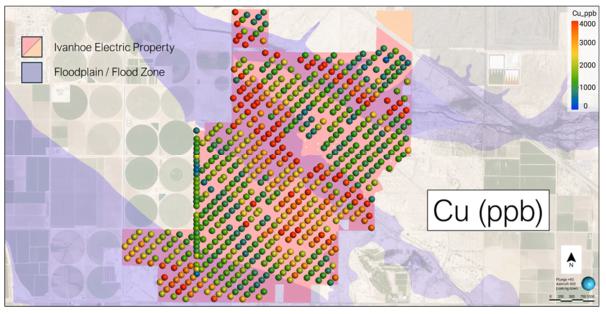
Source: Ivanhoe Electric, 2024.
Figure 7-4: Geochemical Exploration Map – Copper
| SEPTEMBER 2026 | 7-7 |
| Ivanhoe Electric Inc. S-K 1300 Preliminary Feasibility Study & | |
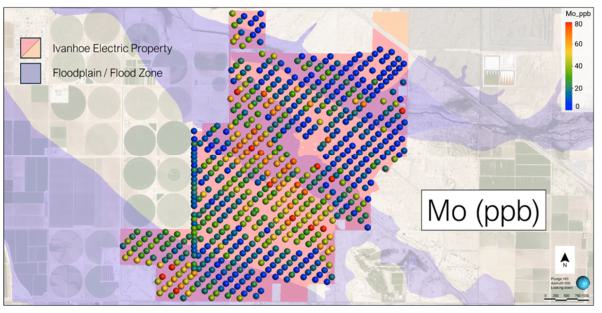
Source: Ivanhoe Electric, 2024.
Figure 7-5: Geochemical Exploration Map – Molybdenum
| 7.1.3 | Qualified Person’s Interpretation of the Exploration Information |
The exploration primarily conducted by Ivanhoe Electric provided vectors to geophysical and geochemical anomalies that were drill tested. This work further developed the understanding of copper mineralization within the Project area.
| 7.2 | Drilling |
Drilling within the Santa Cruz Copper Project property totals 484 drillholes for 354,655 m of drilling. Of this total, 329 drillholes for 279,164 m were used in support of the Mineral Resource. The 155 drillholes excluded from the estimation do not intersect the deposit or did not have relevant information for estimation, such as shallow sonic holes with no assay samples taken.
| 7.2.1 | Historical Drilling |
The historical drilling within the Project area can be separated into several series: CG (Hanna-Getty), SC (ASARCO), and T and HC drilling (related to the in-situ program described in Section 5). A summary of drilling production by each series is provided in Table 7-2; collar locations are shown in Figure 7-6.
| SEPTEMBER 2026 | 7-8 |
| Ivanhoe Electric Inc. S-K 1300 Preliminary Feasibility Study & | |
Table 7-2: Summary of Available Data by Region
| Description | Dataset Region | Total | |||
| CG | SC | HC | T | ||
| Total Number of Holes | 122 | 80 | 5 | 5 | 212 |
| Total Drilled (m) | 102,563 | 62,754 | 3,622 | 2,295 | 165,317 |
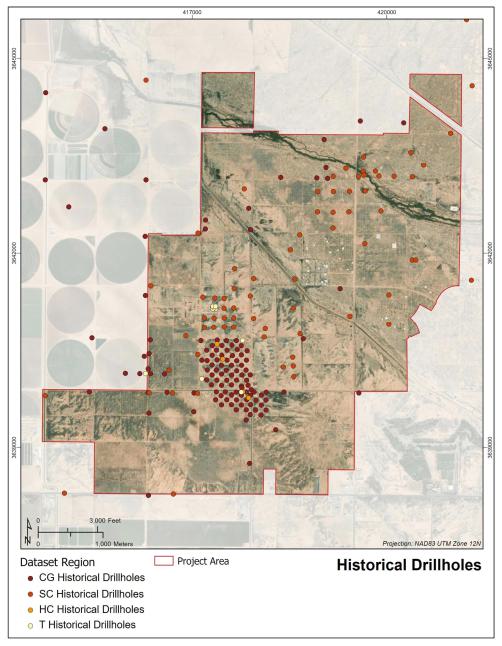
Source: Ivanhoe Electric, 2026
Figure 7-6: Plan Map of Historical Drillhole Collars
| SEPTEMBER 2026 | 7-9 |
| Ivanhoe Electric Inc. S-K 1300 Preliminary Feasibility Study & | |
| 7.2.1.1 | Santa Cruz & East Ridge Deposits |
Historical drilling at the Santa Cruz deposit consisted of 108,301 m of core from 126, 47.26 mm diameter (“NQ”) drillholes completed between 1965 to 1996. Historically, these two deposits were undifferentiated, thus drilling totals are cumulative for both deposits. The historical drill core is currently unavailable for review except for sparse, skeletonized core boxes from a single historical drillhole CG-037.
A program was conducted to check the collar locations of a selection from the drillhole database using a professionally licensed surveying company, D2 Land Surveying. Based on the transformation for these spot-checked drillholes, collar locations were adjusted. All historical drilling was conducted vertically. For the Santa Cruz deposit, the drilling was completed along 100 m spaced section lines with drillholes spaced 90 to 100 m apart on each section line.
| 7.2.1.2 | Texaco Deposit |
Historical Texaco deposit drilling consists of 23,848 m of core from 27 NQ drillholes completed between 1975 and 1997. The drillholes in this deposit area are in the “SC” drillhole series. The historical core is predominantly unavailable for review with the exception of sparse, skeletonized boxes from historical drillholes SC-066 and SC-069A. A program was conducted to check the collar locations of a selection of historical drillholes from the database using a professionally licensed surveying company, D2 Land Surveying. Based on the transformation for these spot-checked drillholes, collar locations were adjusted. All historical drilling was conducted vertically. For the Texaco deposit, the drilling was completed along 100 to 200 m spaced section lines with drillholes spaced 200 m apart on each section line. The average drill section and spacing in the Texaco deposit is approximately 200 m and varies between approximately 90 and 250 m.
| 7.2.2 | Ivanhoe Electric Drilling Programs |
| 7.2.2.1 | Overview |
Ivanhoe Electric has completed 306 holes totaling more than 182 km of combined drilling since initiating activity on the Santa Cruz Copper Project in 2021 (Table 7-3).
| 7.2.2.1.1 | Historical Data Twin Hole Validation Drilling |
In 2021, Ivanhoe Electric initially completed five core drillholes totaling 4,739 m within the Santa Cruz deposit to twin historical drillholes for data validation (Figure 7-7). Drilling was a mixture of rotary pre-collar through the barren tertiary sediments and core drilling through the target areas and shoulders. All samples from within the interpreted mineralized zone were assayed for total
| SEPTEMBER 2026 | 7-10 |
| Ivanhoe Electric Inc. S-K 1300 Preliminary Feasibility Study & | |
copper (%), acid soluble copper (%), cyanide soluble copper (%), and molybdenum (%). The collar locations, downhole surveys, geological logging, sampling, and assaying between the two sets of drillholes were used to determine if historical data were valid and would not bias the geological model or Mineral Resource estimate.
All five historical hole assays aligned with the 2021 Ivanhoe Electric core drilling assays. The 2021 core drilling assays were of higher resolution due to smaller sample sizes and validated the ASARCO assays.
Further validation drilling was completed in 2023 and 2024, which replicated the historical data to an acceptable degree and expanded the data set.
| SEPTEMBER 2026 | 7-11 |
| Ivanhoe Electric Inc. S-K 1300 Preliminary Feasibility Study & | |
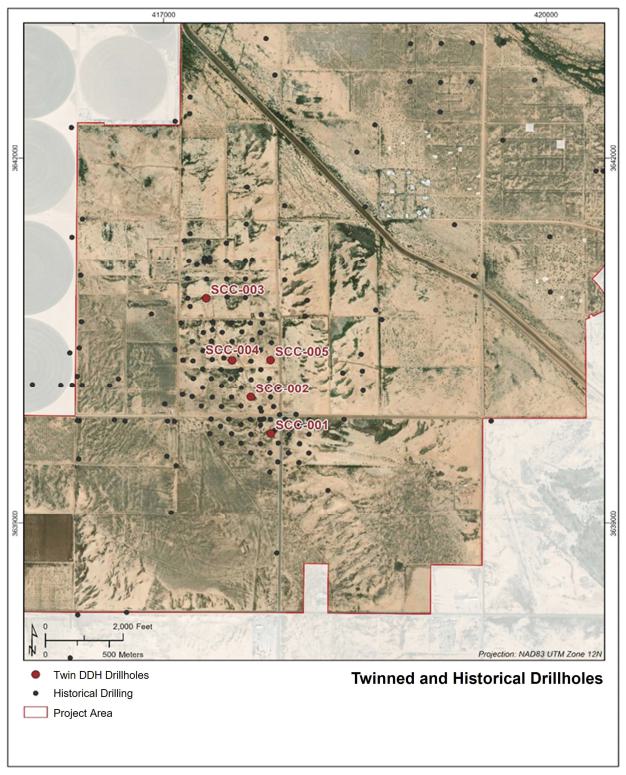
Source: Ivanhoe Electric, 2026
Figure 7-7: Plan Map of the Twinned Drillholes & Historical Drillhole Collars
| SEPTEMBER 2026 | 7-12 |
| Ivanhoe Electric Inc. S-K 1300 Preliminary Feasibility Study & | |
| 7.2.2.1.2 | Exploration and Development Drilling |
The total number of drillholes and meters drilled per year are presented in Table 7-3.
Table 7-3: Drillhole Summary by Year
| Year | Number of Holes | Total Meters Drilled |
| 2021 | 7 | 7,225 |
| 2022 | 78 | 49,795 |
| 2023 | 87 | 65,381 |
| 2024 | 115 | 55,966 |
| 2025 | 12 | 480 |
| 2026 | 7 | 4,028 |
| Total | 306 | 182,876 |
Drilling occurred in multiple areas of the Project, including in the Southwest exploration area, Santa Cruz deposit, East Ridge deposit, and Texaco deposit (Table 7-4).
Table 7-4: Drillhole Summary by Deposit
| Deposit | Number of Drillholes | Meters |
| Santa Cruz | 238 | 134,558 |
| East Ridge | 38 | 22,564 |
| Texaco | 21 | 18,768 |
| Total | 297 | 175,890 |
Much of the drilling was focused on definition and metallurgical drilling within the Santa Cruz and East Ridge deposit areas with secondary exploration drilling in the other Project areas. The number of assays, by deposit, are shown in Table 7-5.
Table 7-5: Number of Assays by Assay Type & Deposit
| Assay Type | Santa Cruz Deposit | East Ridge Deposit | Texaco Deposit |
| Total Copper (“TCu”) | 33,326 | 5,221 | 4,282 |
| Acid Soluble Copper (“ASCu”) | 33,294 | 5,221 | 4,282 |
| Cyanide Soluble Copper (“CNCu”) | 33,293 | 5,221 | 4,282 |
| Gold (“Au”) | 18,395 | 936 | 2,208 |
| Silver (“Ag”) | 32,362 | 5,114 | 4,270 |
| SEPTEMBER 2026 | 7-13 |
| Ivanhoe Electric Inc. S-K 1300 Preliminary Feasibility Study & | |
Drill collar locations for Ivanhoe Electric’s and historical drilling are identified on Figure 7-8. Drill collar locations by program are shown on Figure 7-9.
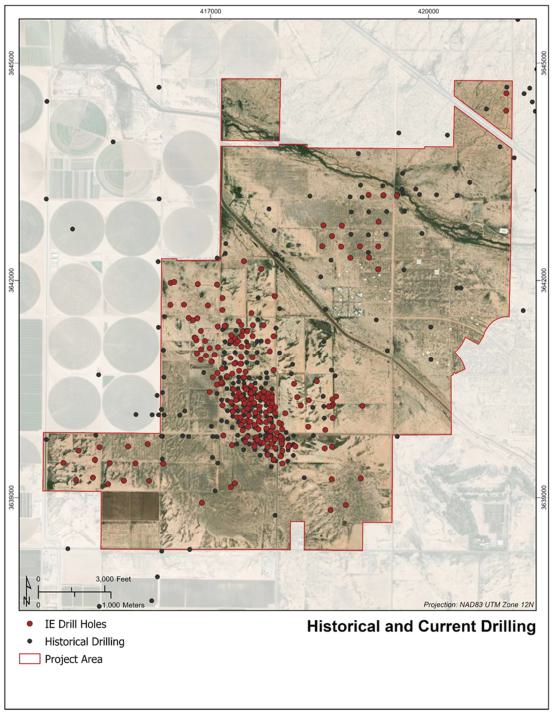
Source: Ivanhoe Electric, 2024
Figure 7-8: Plan Map of Historical & Ivanhoe Electric Drillhole Collar Locations
| SEPTEMBER 2026 | 7-14 |
| Ivanhoe Electric Inc. S-K 1300 Preliminary Feasibility Study & | |
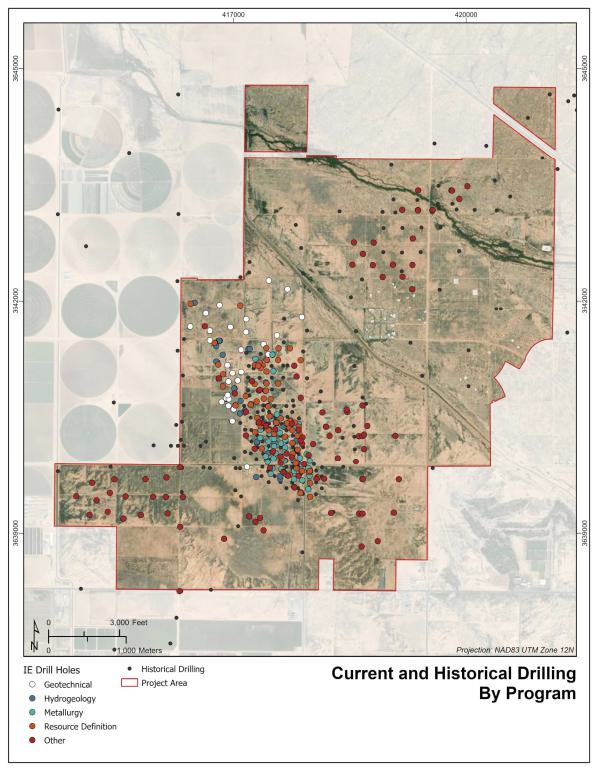
Source: Ivanhoe Electric, 2026
Figure 7-9: Plan Map of Historical & Ivanhoe Electric Drill Collar Locations by Program
| SEPTEMBER 2026 | 7-15 |
| Ivanhoe Electric Inc. S-K 1300 Preliminary Feasibility Study & | |
| 7.2.2.2 | Drilling Methods |
Drilling was performed using a variety of drilling equipment and methodologies including coring, reverse circulation, tricone rotary, and shallow sonic boring (Table 7-6). The drilling equipment and methodology used was dependent on the target objective and target depth. Most drilling performed during 2021 and 2022 used standard PQ diamond coring from the surface to maximize the amount of core sample recovered for use in multiple sampling and testing programs. Tricone or rotary with HQ core tails was used when targets did not require large-diameter coring for bulk material, allowing for a more cost-efficient approach.
Reverse-circulation (“RC”) and sonic drilling were also used in 2022 for rapid characterization of bedrock interface underneath sedimentary cover, soil, and clay horizons in the upper alluvial and overburden sediments, and conglomerate units. Table 7-6 also summarizes drilling contractors and equipment who performed operations for the Project.
Drillhole abandonment procedures were designed to meet or exceed Arizona’s mandated requirements. Most drilling reached or exceeded depths over 100 m and followed state-approved borehole abandonment methods.
Table 7-6: Drilling Equipment & Contractors
| Drilling Contractor | Drilling Type | Equipment Models |
| Major Drilling Internation Inc. | Core, rotary with core tails | LF160, LF230, LF350 |
| National EWP | Core, rotary with core tails, well | Schramm T-130, LF230 |
| T&J Enterprises, Inc. | Reverse circulation | HRC 1500 (Custom) |
| Layne Christensen Company | Well | Atlas Copco RD-20, Schramm T-130, Schramm T-200, 60T |
| Cascade Environmental | Sonic | LF600 |
| 7.2.2.3 | Logging |
Detailed core logging is performed by Ivanhoe Electric geologists through digital data input into MX Deposit. Data logged included lithology, alteration, mineralization, veining, petrophysical data, and geotechnical parameters such as faults, joints and fractures, hardness, and rock quality designation (“RQD”). Additional characterization fields such as rock colors, stain colors, grain sizes, textures, and supergene weathering features were also captured.
The core logging and geological database consists of five major rock types, including 47 major lithologies congruent with historically logged lithologies, 21 lithological textures, 17 alteration types, and 15 lithological structures. There are 28 unique economic and gangue minerals recorded in the current database.
| SEPTEMBER 2026 | 7-16 |
| Ivanhoe Electric Inc. S-K 1300 Preliminary Feasibility Study & | |
Photographs of all drill core were taken, both wet and dry, and are stored digitally in Imago software.
| 7.2.2.4 | Recovery |
Recovery was collected by logging geologists digitally into MX Deposit for all core drilled. Recovery was measured as a percentage of the length of rock measured by core loggers over the drilled interval. The average recovery is 90% with areas of lower recovery typically seen in sedimentary overburden units and structures.
| 7.2.2.5 | Collar Surveying |
Collar surveying was performed by Environmental Field Services, LLC, upon completion and abandonment of the drillholes. Each survey job used the National Geodetic Survey (“NGS”) benchmark “CZ2366” as the primary benchmark for all subsequent work. Data collection was done by an Arizona-state-licensed land surveyor and survey technician using a Trimble R8S Integrated GNSS and Trimble TC83 data collector with collected data validated to fall within acceptable tolerances of Arizona State minimum standards for survey work.
Data were delivered after the completion of a job and data validation via email in MS Excel spreadsheets as positional coordinates for drillhole collars in NAD 83 United States State Plane coordinate system in international feet. These were then converted from State Plane to UTM Zone 12N and from international feet to meters using ESRI ArcPro by Ivanhoe Electric. The converted survey coordinates then entered MX Deposit and superseded any other existing collar information for use in geographical and modeling software.
| 7.2.2.6 | Downhole Surveying |
Downhole surveying during the 2021 to 2024 drilling programs was conducted using a REFLEX EZ Gyro and IMDEX OMNIx42 multi-shot gyroscopic surveying tool taken within each drillhole during drilling at 30 m increments for continuous tracking, and then after hole completion from the bottom in 150 m increments as the tool is being pulled from the completed drillhole for check analysis.
Depending on technical utility, many drillholes were also surveyed using borehole geophysical surveying probes through Southwest Exploration Services, LLC. or International Directional Services Inc. Each borehole was surveyed for 4RX sonic-gamma (sampled every 0.06 m), acoustic televiewer (sampled every 0.003 m), E-logs-gamma (sampled every 0.06 m), and a gamma caliper test for fluid temperature conduction (sampled every 0.06 m). The downhole surveying has also allowed for the calibration of post-drilling information to ensure that deviation surveying was
| SEPTEMBER 2026 | 7-17 |
| Ivanhoe Electric Inc. S-K 1300 Preliminary Feasibility Study & | |
correct and lithological and mineralogical contacts were logged properly. The downhole surveying was also used to collect accurate oriented structural measurements.
| 7.2.2.7 | Density |
There are no records of density measurements from historical drill core from the Santa Cruz and Texaco deposits. Further details on density by Ivanhoe Electric are in Section 8.4.
| 7.2.2.8 | Comment on Material Results & Interpretation |
Drill spacing varies from approximately 60 to 100 m in most of the deposit areas to about 200 m spacing in the less drilled areas. Procedures for 2021-2024 drilling, collar surveying, and geological and geotechnical logging are consistent with industry-standard practices. Procedures for pre-2021 data collection are not recorded in the information provided to BBA.
Review of recovery data indicated no correlation between grade and zones of lower recovery. Overall, the QP considers the drill data to be acceptable to support Mineral Resource and Mineral Reserve estimation.
| 7.3 | Geotechnical |
Ivanhoe Electric has used 222 modern drillholes totaling over 70 km of drilling, with geotechnical data metrics captured serving as the basis for analysis supporting geotechnical characterization of the Santa Cruz and East Ridge deposits. Drill core and photos are not available for any of the historical drillholes, and Q-system parameters are not available. In earlier studies, prior to robust internal drilling by Ivanhoe Electric and release of the June 2025 PFS, historical drilling data (n = 83) were combined with available Ivanhoe Electric drilling to create a more complete database. The historical drilling database is considered disparate and, due to the inability to conduct QA/QC, the historical drilling data has been excluded from subsequent analysis
| 7.3.1 | Sampling Methods & Laboratory Determinations |
Ivanhoe Electric processed diamond drill core to collect RQD data, Q-prime data (quality of a rock mass), rock hardness, fracture statistics, and samples for laboratory strength testing. Point load testing, uniaxial compressive strength (“UCS”), triaxial compressive strength, unified soils classification system, small-scale direct shear, Cerchar abrasivity, and Brazilian disc tension testing were determined by laboratory testing at multiple geotechnical laboratories including Call & Nicholas, Inc. in Tucson, Arizona, WSP labs in Lakewood, Colorado, San Diego, California, and Burnaby, Alta E and I lab in Tempe, Arizona, and Terracon Lab in Tempe, Arizona. Laboratory tests were performed in accordance with the American Society of Testing and Materials (“ASTM”), the
| SEPTEMBER 2026 | 7-18 |
| Ivanhoe Electric Inc. S-K 1300 Preliminary Feasibility Study & | |
International Society for Rock Mechanics (“ISRM”), and the British Standards (“BS”), and testing equipment calibrations were provided as a quality control measure.
Five sonic drillholes assessed and characterized the alluvium and sediments through sampling, sediment logging, and Atterburg limits for clay behavior under the Unified Soil Classification System.
Acoustic borehole image logs from televiewer surveys from 72 core holes helped to orient and identify the dominant joint orientation and fabric in the overburden and bedrock rock masses.
Results were grouped by lithology and mode of failure. Laboratory results for point load testing, uniaxial compression strength, and triaxial testing in which the failure took place through pre-existing weak planes or joints were not used for parameter estimations.
| 7.3.2 | Comment on Results |
Logging data and laboratory testing results are generally consistent with the description of the rock mass. Methods and data collected are consistent with generally accepted industry standards of practice as described in using the Q-System (Norwegian Geotechnical Institute, 2022). Laboratory testing is in accordance with standard ASTM guidelines.
| 7.4 | Hydrogeological Investigations |
The area around the Santa Cruz Copper Project has undergone numerous hydrogeological studies since the 1970s to evaluate the geological and hydrogeological properties and the mining feasibility of the area. Historical wells, where hydraulic tests were conducted and the hydrogeology data was available for the prefeasibility-level hydrogeology investigation, are shown in Figure 7-10. The historical data combined with recently collected hydrogeological data, have informed the hydrogeological conceptual site model for the Project and were incorporated into the groundwater flow model to estimate the projected groundwater inflows for the mine plan.
| 7.4.1 | Hydrogeological Data Collection |
To support the initial assessment, a baseline hydrogeological model was developed in 2022 and 2023, incorporating Lugeon packer test data from exploration boreholes conducted by Ivanhoe Electric and Montgomery & Associates (Montgomery & Associates, 2023). The Lugeon packer tests were completed at depths ranging from 182.1 to 684.6 m below ground surface in exploration boreholes SCC-101, -106, -111, -124, and -128 (Figure 7-10).
The prefeasibility study hydraulic testing program was conducted from October 2023 through October 2024 by Ivanhoe Electric and INTERA and included 56 additional hydraulic tests
| SEPTEMBER 2026 | 7-19 |
| Ivanhoe Electric Inc. S-K 1300 Preliminary Feasibility Study & | |
performed at 14 locations (Figure 7-10). The hydraulic testing was conducted in six new groundwater monitoring wells (SCH-001, -002, -003, -004, -005, and -006) and TW-1 using several different types of test methods, including packer tests, step tests, and constant rate pumping tests depending on the location and formation properties (INTERA, 2025). To test areas within the mine plan for the Santa Cruz Copper Project, slug packer tests were also conducted in six exploration boreholes (SCC-235A, 237, -239, -240, -243, and -247) (Figure 7-10). Geosyntec Consultants, Inc. (“Geosyntec”) also performed a constant rate test in borehole SCH-007 (Figure 7-10). Three additional hydraulic tests were conducted in borehole SCC26-009 in June 2026 for purposes of characterizing the bedrock along the new path of the decline, for a total of 59 hydraulic tests conducted recently at site (Figure 7-10) (INTERA, 2026).
A total of 51 prefeasibility study tests, 23 initial assessment tests, and 30 re-analyzed historical tests were used to determine the hydraulic properties of the hydrogeological units, along with two tests from the Pinal Active Management Area Model (Pinal model). Seventeen (17) tests were used to define the hydraulic properties of the overburden units and 87 tests were used to define the hydraulic properties of the bedrock units (Table 7-7). The three additional tests conducted in June 2026 were all in the leach cap and were included in the data used to update the hydraulic properties. Since the alluvium is not saturated in the vicinity of the Project area, the hydraulic properties for the alluvium are from the Pinal model (ADWR, 2019) and not from the hydraulic testing program. The historical and recent hydraulic test analysis results were used to refine the hydrogeological conceptual site model and groundwater flow characteristics, improving the predictive capability of the groundwater flow model for the Project.
A total of 109 grouted-in vibrating wire piezometers (“VWPs”) were installed within 25 core holes (Figure 7-10). These instruments were installed to provide pressure responses during the prefeasibility study hydraulic tests in 2023 and 2024.
| SEPTEMBER 2026 | 7-20 |
| Ivanhoe Electric Inc. S-K 1300 Preliminary Feasibility Study & | |
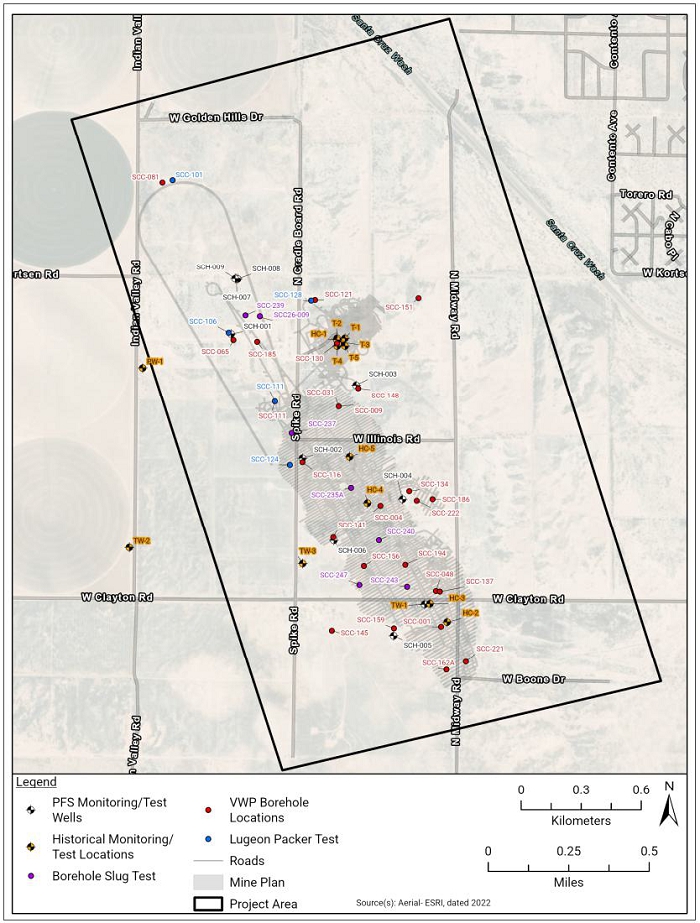
Source: INTERA, 2026
Figure 7-10: Historical (Pre-Ivanhoe Electric) & Current Groundwater Monitoring & Testing Locations
| SEPTEMBER 2026 | 7-21 |
| Ivanhoe Electric Inc. S-K 1300 Preliminary Feasibility Study & | |
| 7.4.2 | Hydrogeological Conceptual Site Model |
For the hydrogeological conceptual site model and the Project area groundwater flow model, the overburden geology, and mineral domains in both the Santa Cruz mine area and East Ridge mine area were subdivided into hydrogeological units based on specific hydraulic properties with distinct influence on storage or movement of groundwater, such as hydraulic conductivity or specific storage. Thirteen hydrogeological units were identified in the Project area in the 2025 groundwater model (INTERA, 2025) that align with the geological domains and included four overburden units and nine bedrock units. In the 2026 model update, two of the conglomerate overburden units were combined into a single conglomerate unit (INTERA, 2026). The hydraulic conductivity values presented in Table 7-7 were determined from the hydraulic tests conducted in the area, including re-analyzed historical test data as well as recent test data from the initial assessment, prefeasibility study, and the recent characterization from three hydraulic tests conducted in bedrock near the proposed decline.
Table 7-7: HGU Hydraulic Conductivity Estimates from Current & Historical Tests Conducted in the Project Area
| Hydrogeological
Unit (“HGU”) |
Hydraulic Conductivity Minimum (cm/s) |
Hydraulic Conductivity Maximum (cm/s) |
Hydraulic Conductivity Geometric Mean (cm/s) |
No. of
Hydraulic Conductivity Tests |
| Alluvium* | 1.2E-02 | 2.3E-02 | 1.7E-02 | 2 |
| Conglomerate | 1.4E-04 | 5.2E-02 | 2.0E-02 | 14 |
| Basal Conglomerate | 3.3E-06 | 1.3E-04 | 1.9E-05 | 3 |
| Leach Cap | 3.5E-08 | 2.7E-03 | 1.3E-05 | 26 |
| Santa Cruz Oxide | 2.2E-09 | 3.1E-04 | 1.1E-06 | 9 |
| Santa Cruz Chalcocite | 1.5E-08 | 7.1E-06 | 4.4E-07 | 5 |
| Santa Cruz Primary Mineralized | 1.2E-06 | 2.7E-05 | 6.4E-06 | 5 |
| Santa Cruz Primary Unmineralized | 9.7E-08 | 1.0E-04 | 3.1E-06 | 8 |
| Santa Cruz Unmineralized | 2.9E-06 | 1.6E-04 | 1.6E-05 | 5 |
| East Ridge Mineralized | 5.2E-06 | 6.4E-05 | 1.8E-05 | 17 |
| East Ridge Unmineralized | 1.6E-07 | 9.9E-07 | 4.7E-07 | 4 |
| Fault Zone | 2.6E-06 | 3.8E-03 | 1.4E-04 | 8 |
*Hydraulic conductivity estimates for alluvium are from Liu et al. (2014).
| SEPTEMBER 2026 | 7-22 |
| Ivanhoe Electric Inc. S-K 1300 Preliminary Feasibility Study & | |
Groundwater flow characterization of the Project area was informed by both the regional data from wells surrounding the Project area and data collected within the Project area as part of the hydrogeological investigations during the initial assessment and prefeasibility study. Groundwater movement within the conglomerate units generally flows westward toward areas of historically high groundwater withdrawal for agricultural irrigation.
| 7.4.3 | Groundwater Flow Model & Results |
To develop a groundwater flow model, the Pinal model (ADWR, 2019) was modified to enable the simulation of the bedrock head field and to more accurately represent the water supply pumping stresses after 2015. Then, using the USGS MODFLOW-6 groundwater flow code (MF6) (Langevin et al., 2017), the groundwater flow model was developed as an inset model to the modified regional Pinal model and calibrated with recent water level observations to reflect current flow conditions within the Project area. The spatial extent of the inset groundwater flow model was developed to ensure sufficient distance from the mine to assess potential regional effects from bedrock dewatering. The hydraulic properties within the inset groundwater flow model were assigned based on the spatial distribution and hydraulic properties of the hydrogeological units (Table 7-7).
The groundwater flow model integrates both the known hydraulic properties of the hydrogeological units and inferred geology, geology from outside the Project area, along with hydraulic properties from the surficial alluvium down to the bedrock, using parameters calibrated from the Pinal model as well as recently collected data and reanalyzed historical data. The groundwater flow model was calibrated using measured water levels and the calibration was assessed through standard statistical comparisons between simulated and observed groundwater levels. Following model calibration, the model was used to predict the long-term (mine life) groundwater inflow into mine developments and assess changes in surrounding water levels. Initial model runs were used to identify zones with higher inflows. Based on the initial model runs, mitigation strategies were selected and modifications to the mine plan design were applied by the mining engineers to reduce groundwater inflows. To reduce the residual passive inflows, mitigation measures were developed by Ivanhoe Electric and their mine engineers, and included cementitious grout application to developments in the Leach Cap hydrogeologic unit, Fault Zone hydrogeologic unit, all East Ridge developments, and developments that intersect conglomerate.
Although shotcrete will be used in the underground mine workings it will not be relied upon to effectively limit groundwater inflow and is not used as a mitigation measure in the model. Concrete will be used in the underground workings as structural control in the vent shafts, haulage chutes, and portions of orepass raises and was applied in both the mitigation and no-mitigation simulations.
| SEPTEMBER 2026 | 7-23 |
| Ivanhoe Electric Inc. S-K 1300 Preliminary Feasibility Study & | |
The results of the groundwater flow modelling demonstrated a significant reduction in total residual passive inflow with mitigation measures applied (INTERA, 2025). Mitigated inflows to the mine reach a maximum of approximately 7,200 gal/min (Figure 7-11) (INTERA, 2026). Most of the Santa Cruz mine workings, 96.8% in the Santa Cruz deposit and 96.2% of the Verde domain, show 0 to 5 gal/min maximum residual passive inflow (Figure 7-12). The areas of lower residual passive inflow represent stopes, that are only open for short periods during mining and have no inflow, and regions of low hydraulic conductivity in the Santa Cruz oxide and the Santa Cruz chalcocite hydrogeologic units. Mine developments in East Ridge have higher percentages of higher maximum residual passive inflows than other parts of the mine. In the East Ridge deposit, 20.3% of mine workings show 5 to 10 gal/min inflows and 3.8% of the mine workings show 10 to 15 gal/min inflows compared to lower percentages for other areas with similar inflow rates (Figure 7-12).
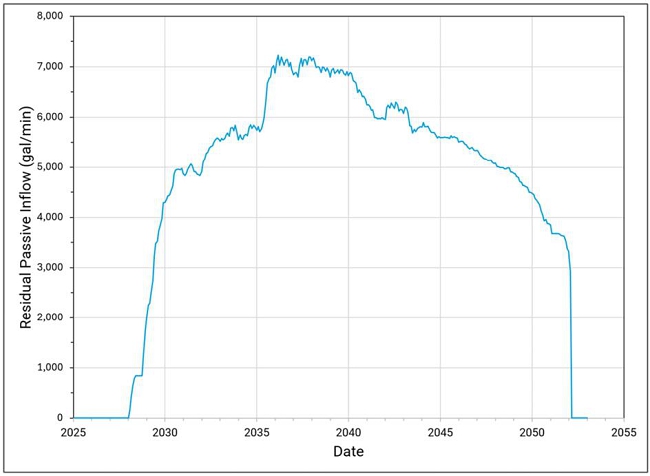
Source: INTERA, 2026
Figure 7-11: Residual Passive Inflows to Mine Workings
| SEPTEMBER 2026 | 7-24 |
| Ivanhoe Electric Inc. S-K 1300 Preliminary Feasibility Study & | |
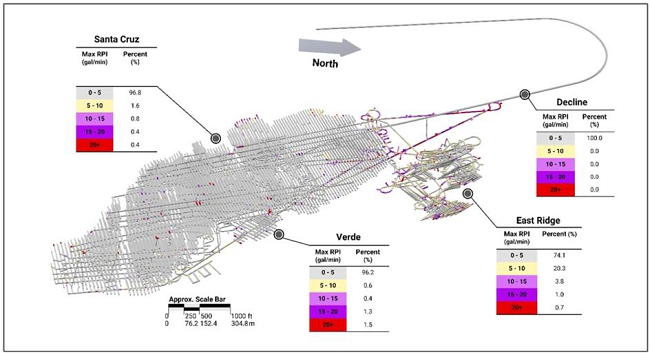
Source: INTERA, 2026
Note: Max RPI = maximum residual passive inflows
Figure 7-12: Model Estimates of Maximum Residual Passive Inflows to Mine Workings
| 7.4.4 | Comment on Results |
The resulting groundwater model uses hydraulic testing and updated hydrogeological understanding to model groundwater inflows and supports future economic extraction of mineralized material.
| SEPTEMBER 2026 | 7-25 |
| Ivanhoe Electric Inc. S-K 1300 Preliminary Feasibility Study & | |
| 8. | Sample Preparation, Analysis & Security |
| 8.1 | Assay Laboratory Selection |
Table 8-1 details the labs used for analysis and time periods.
Table 8-1: Labs Used for Analysis & Time Periods
| Dates | Assay Laboratories |
| September 2021 – December 2022 | Skyline,
Tucson, AZ SGS, Burnaby, BC, Canada American Assay Labs, Sparks, NV |
| December 2022 – May 2023 | Skyline,
Tucson, AZ SGS, Burnaby, BC, Canada |
| May 2023 – June 2026 | SGS, Burnaby, BC, Canada ALS Global, Tucson, AZ |
The three laboratories used from September 2021 to December 2022 are certified by the International Standards Organization (“ISO”), demonstrating technical competence for a defined scope and the operation of a laboratory quality management system (ISO 17025) and were independent of Ivanhoe Electric. Additionally, Skyline, located in Tucson, AZ, was certified as ISO 9001, indicating that the quality management system conforms to the requirements of the International Standards. SGS Burnaby, BC, Canada, conformed to the requirements of ISO/IEC 17025 for specific tests as listed on their scope of accreditation. American Assay Labs, Sparks, NV, carried approval from the State of Nevada Department of Conservation and Natural Resources Division of Environmental Protection. Issues with analytical quality at American Assay Labs in early 2022 led to Ivanhoe Electric discontinuing work with this laboratory.
The laboratories used from December 2022 to June 2026 are recognized by the International Standard (ISO 17025) for demonstrating technical competence for a defined scope and the operation of a laboratory quality management system and were independent of Ivanhoe Electric. Additionally, Skyline, Tucson, AZ, is recognized by ISO 9001, indicating that the quality management system conforms to the requirements of the international standard. SGS, Burnaby, BC, Canada, SGS, Lakefield, ON, Canada, and SGS, Tempe, AZ (preparation lab) conform to requirements of ISO/IEC 17025 for specific tests as listed on their scope of accreditation. ALS Global, North Vancouver, BC, Canada and ALS Global, Tucson, AZ conform to the requirements of ISO/IEC 17025 for specific analytical procedures as listed on their scope of accreditation. In May
| SEPTEMBER 2026 | 8-1 |
| Ivanhoe Electric Inc. S-K 1300 Preliminary Feasibility Study & | |
2023, due to quality assurance/quality control (“QA/QC”) concerns in the preparation department at Skyline, Ivanhoe Electric discontinued work with this laboratory.
| 8.1.1 | 2021 to 2022 |
Drill core from the Santa Cruz Copper Project was sampled under the direct supervision of the project’s managing staff.
Samples collected in 2021-2022 were cut lengthwise, either in half or in four quarters, using an NTT Coresaw diamond-bladed saw or a Husqvarna® table saw. Each sample, consisting of one-half or one-quarter of the drill core, was placed in a plastic sample bag labeled with the sample number and sealed with a zip tie. This bag was then placed in a burlap sample bag, also labeled with the sample number, with a sample tag inserted between the plastic and burlap bags. The sample tag corresponded with the tag stapled to the core box containing the remaining half or three-quarters of the drill core for cataloging and storage. The burlap sample bags were then grouped in batches of 25, placed in large, labeled plastic bags, sealed with zip ties, and transported to the laboratory facility in large fold-out plastic bins. Quarter core was used for a subset of holes and quarter core duplicates were determined to have roughly equivalent variance to half core duplicates.
| 8.1.2 | 2023 to 2026 |
Drill core from the Santa Cruz Copper Project was sampled under the direct supervision of the project’s managing staff.
Samples collected in 2023 and 2026 were cut lengthwise in half, using the NTT Coresaw diamond-bladed saw. Each sample consisted of one-half of the split drill core, which was placed in an 8 mm thick, 18″ x 24″, plastic sample bag labeled with the sample number in black Sharpie® and a sample tag affixed to the outside of the plastic bag via a chemical seal. The sample tag affixed to the outside of the sample bag corresponded with the tag stapled to the core box where the remaining half-core was placed for cataloging and storage. The plastic sample bags were then placed in large, fold-out plastic bins, or super sacks on pallets, for transport to the laboratory facility.
| 8.1.3 | Ionic Leach |
Ivanhoe Electric collected samples in the spring of 2024 for mobile metal ion analysis via ALS’s ionic leach program. Sample preparation was completed by ALS Tucson and prepared samples were sent to ALS North Vancouver for ionic leach analysis.
| SEPTEMBER 2026 | 8-2 |
| Ivanhoe Electric Inc. S-K 1300 Preliminary Feasibility Study & | |
Sample collection consisted of removing the top 10 to 15 cm of soil using a stainless-steel trowel and then removing any contaminated soil from the area with a plastic trowel. The plastic trowel was cleaned with a wire brush, followed by a plastic brush, before the sample was collected. Approximately 1 kg of material was collected 30 cm below the layer that was removed and placed into a quart-sized plastic Ziploc® bag. Bags were labeled with a sample ID and tag, organized into groups of 200, and placed into larger rice bags or cloth bags to be transported to the laboratory.
| 8.2 | Sample Preparation & Analysis |
| 8.2.1 | Skyline Assayers & Laboratories |
Half of the total drill core samples taken during August 2022 to May 2023 and all the drill core samples taken during the September 2021 to August 2022 core drilling programs were prepared and analyzed at Skyline. The samples were crushed from the split core to prepare a total sample of up to 5 kg at 75% passing 6 mm. Samples were then riffle split, and a 250 g sample was pulverized with standard steel to plus 95% passing at 150 µm.
After sample pulp preparation, the samples were analyzed using the following methods:
| ■ | All samples were analyzed for total copper using multi-acid digestions with an atomic absorption spectrometry (“AAS”) finish. The lower limit of detection is 0.01% for total copper, with an upper detection limit of 10%. |
| ■ | Sequential analyses (“SEQ”) for cyanide-soluble copper and acid-soluble copper were conducted via multi-acid leaching with an AAS finish. The lower limit of detection is 0.005%, with an upper detection limit of 10%. |
| ■ | Molybdenum was prepared using multi-acid digestion and analyzed using Inductively Coupled Plasma Optical Emission Spectroscopy (“ICP-OES”). This analysis has a lower detection limit of 0.001%. |
| ■ | Samples greater than 10% Cu with a 20% threshold were analyzed again using a long iodine method. |
| 8.2.2 | SGS Laboratories |
All samples taken during the May 2023 to July 2026 diamond drilling program were prepared and analyzed at SGS Burnaby, Tempe, or Lakefield. The other half of the total drill core samples taken during the August 2022 to May 2023 diamond drilling program and not sent to Skyline, were prepared and analyzed at SGS Burnaby or Lakefield. The samples were crushed from the split core to prepare a total sample of up to 9 kg at 6 mm. Samples were then riffle split, and a 250 g sample was crushed to 75% passing at 2 mm. The sample was then pulverized with standard steel to plus
| SEPTEMBER 2026 | 8-3 |
| Ivanhoe Electric Inc. S-K 1300 Preliminary Feasibility Study & | |
85% passing at 75 µm. After sample pulp preparation, the samples were analyzed using the following methods:
| ■ | All samples were analyzed for total copper using a sodium peroxide fusion with an inductively coupled plasma atomic emission spectroscopy (“ICP-AES”) finish. The lower limit of detection is 0.001% for total copper, with an upper detection limit of 5%. |
| ■ | Three-stage SEQ for cyanide-soluble and acid-soluble copper were conducted via multi-acid leaching with an AAS finish. For SEQ copper analyses, the lower limit of detection is 0.005%, with an upper detection limit of 100% using a separate subsample than what was used for the total copper analysis. |
| ■ | Molybdenum was prepared using a sodium peroxide fusion with an ICP-AES finish. The lower limit of detection is 0.001% for total molybdenum with an upper detection limit of 5%. Multi-element analysis was prepared using a 33-element, four-acid digestion and analyzed using a combined ICP-OES and inductively coupled plasma mass spectroscopy (“ICP-MS”) package. |
| ■ | Gold was prepared using a 30 g fire assay and analyzed using an AAS finish. This analysis has a lower limit of detection of 5 ppb, with an upper detection of 10,000 ppb or 1 ppm. |
| ■ | Silver was prepared using a four-acid digestion and analyzed using a combined ICP-OES and ICP-MS package. This analysis has a lower detection limit of 0.02 ppm and an upper detection limit of 100 ppm. |
| ■ | Samples greater than 5% Cu, with a 60% threshold, were re-analyzed using a short iodide titration overlimit. |
| ■ | Samples greater the 60% Cu were re-analyzed using electrogravimetry, with a 95% Cu threshold. |
| 8.2.3 | ALS Laboratories |
In spring 2024, Ivanhoe Electric collected surface samples for mobile metal ion analysis at ALS Tucson and ALS North Vancouver via an ionic leach program. A 50 g sample was taken directly from the field bag with no pre-treatment to reduce any chances of contamination. Processing of the 50 g sample was carried out in a dedicated ionic preparation laboratory in North Vancouver.
Copper, gold, silver, and molybdenum were analyzed via a static sodium cyanide leach utilizing the chelating agents ammonium chloride, citric acid, ethylenediaminetetraacetic acid (“EDTA”) and the leachant buffered at an alkaline pH of 8.5. The leachant solution was analyzed using an ICP-MS finish. Lower limits for all elements were as follows: Cu 1 ppb, Au 0.01 ppb, Ag 0.05 ppb, and Mo 0.2 ppb.
| SEPTEMBER 2026 | 8-4 |
| Ivanhoe Electric Inc. S-K 1300 Preliminary Feasibility Study & | |
| 8.2.4 | American Assay Laboratories |
Two drillholes from the 2021 drill campaign were prepared and analyzed at American Assay Laboratories. Due to issues with analytical quality, Ivanhoe Electric discontinued work with this facility.
| 8.2.5 | Historical Core Assay Sample & Analysis |
Historically, samples from both Texaco and Santa Cruz drilling were sent to Skyline to be assayed for standard total copper and non-sulfide copper methods. Samples were crushed and split; a 250 to 500 mg sample was then prepared in the following ways:
| ■ | Total copper analysis samples were dissolved using a mixture of hydrochloric acid (“HCl”), nitric acid (“HNO3”) and perchloric acid (“HClO4”) over low heat. The mixture was then measured using AAS. |
| ■ | Non-sulfide copper was dissolved using a mixture of sulfuric acid (“H2SO4”) and sulfurous acid (“H2SO3”) over moderate to high heat. This mixture was then filtered, diluted, and measured using AAS. No information on the historical analytical detection limits is available. |
| 8.3 | Quality Assurance/Quality Control Procedures |
Analytical QC measures involve internal and external laboratory procedures implemented to monitor the precision and accuracy of the sample preparation and assay data. These measures are important to identify potential sample sequencing errors and to monitor for contamination of samples.
| 8.3.1 | 2021 to 2022 |
Ivanhoe Electric submitted a blank, standard, or duplicate sample on every seventh sample with an approximate insertion rate of 4.8% for all QC types. Sampling and analytical QA/QC protocols typically involved taking half-core field duplicate samples and inserting QC samples (certified reference material (“CRM”) and blanks), to monitor the reliability of the assay results throughout the drill program.
| 8.3.2 | 2023 to 2026 |
Ivanhoe Electric submitted a coarse blank and an analytical blank, a certified reference material (CRM or standard), or a duplicate sample on every sixth sample to increase the insertion rate of QC samples to meet or exceed 5% per sample type. Field duplicates were submitted at an
| SEPTEMBER 2026 | 8-5 |
| Ivanhoe Electric Inc. S-K 1300 Preliminary Feasibility Study & | |
average insertion rate of 4.6% in 2023 and 4.8% in 2024. Supplemental coarse reject duplicates and pulverization duplicates depending on grade were also submitted.
| 8.3.3 | Santa Cruz Sampling |
| 8.3.3.1 | Standards |
During the 2023-2024 drilling campaigns, Ivanhoe Electric submitted ten different CRMs from OREAS, Geostats Ply., CDN Resources Laboratory Ltd., and MEG LLC. CRMs were chosen to be matrix and mineralization matched, as well as represent copper grades seen throughout the deposits. A barren, low-grade, mid-grade, and high-grade CRM was used for both oxide and sulfide copper material. All CRMs are certified for copper analysis, eight are certified for multi-element analysis and gold fire-assay, and nine are certified for silver analysis.
A review of the CRM results identified minimal laboratory failures at Skyline and SGS. Few measurements go above or below three standard deviations. When measurements produced results above or below three standard deviations, the laboratory would recalibrate and reanalyze the sample. Figure 8-1 shows performance charts for the most frequently used oxide and primary sulfide CRMs for the Santa Cruz deposit.
Ivanhoe Electric created two high-grade matrix matched standards in late 2023 to control assay grades above 2% copper. One standard was made at 2.076% copper (SCHG01), and the other at 3.405% (SCHG02) copper. These standards were received in late spring 2024, and round robin certification was obtained in May 2024.
| 8.3.3.2 | Blanks |
As part of its QA/QC process for the Santa Cruz deposit, Ivanhoe Electric used coarse (1”) granite material from Pioneer Landscaping to assess contamination in assay samples. Ivanhoe Electric submitted 158 coarse granite blanks to Skyline and 1,127 coarse granite blanks to SGS during the 2023 and 2024 drilling campaigns. No significant carryover of elevated metals was evident in blanks measured at Skyline or at SGS. A threshold of ±0.02% Cu was accepted for blank samples. If a sample did not initially pass, it was re-analyzed.
| 8.3.3.3 | Duplicates |
Ivanhoe Electric submitted 136 field duplicates from the Santa Cruz deposit to Skyline and 949 field duplicates to SGS during the 2023 and 2024 drilling campaigns as a part of its QA/QC process. The results of the field duplicates are in good agreement for total copper (%), acid-soluble copper (%) and cyanide-soluble copper (%).
| SEPTEMBER 2026 | 8-6 |
| Ivanhoe Electric Inc. S-K 1300 Preliminary Feasibility Study & | |
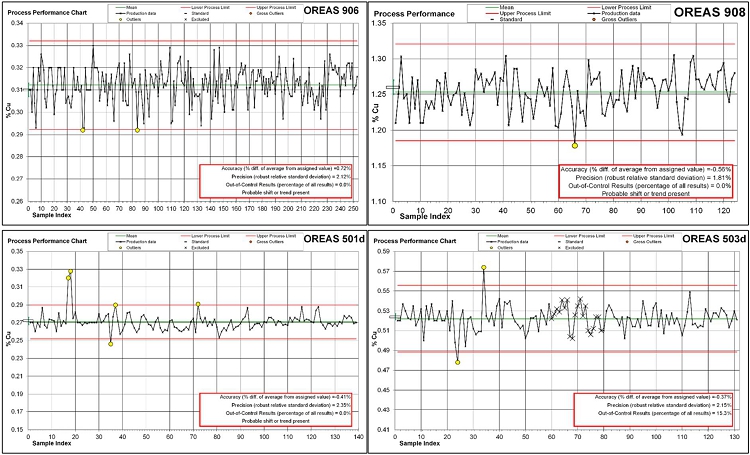
Source: Ivanhoe Electric, 2025
Figure 8-1: Certified Reference Material Performance Charts for Santa Cruz Deposit
| SEPTEMBER 2026 | 8-7 |
| Ivanhoe Electric Inc. S-K 1300 Preliminary Feasibility Study & | |
| 8.3.4 | East Ridge & Texaco Sampling |
| 8.3.4.1 | Standards |
During the 2022 drilling campaign, Ivanhoe Electric submitted ten CRMs for drilling carried out within the East Ridge deposit and nine CRMs for drilling conducted within the Texaco deposit. A review of the CRM results showed minimal failures from Skyline or SGS for samples submitted from either deposit. In the rare instance of failure (outside three standard deviations), the laboratory re-calibrated their equipment and re-analyzed the batch.
| 8.3.4.2 | Blanks |
During the 2023-2024 drilling campaigns, Ivanhoe Electric submitted 289 coarse granite blanks for the East Ridge deposit and 210 coarse granite blanks for the Texaco deposit to Skyline and SGS as part of its QA/QC process. No significant carryover of elevated metals was evident in blanks measured at Skyline or SGS. A threshold of ±0.02% Cu was accepted for blank samples. If the samples did not initially pass, they were re-analyzed.
| 8.3.4.3 | Duplicates |
During the 2023-2024 drilling campaign, Ivanhoe Electric submitted field duplicates for the East Ridge and Texaco deposits as a part of its QA/QC process. For the East Ridge deposit, 49 field duplicates were submitted to Skyline and 235 field duplicates to SGS. For the Texaco deposit, 26 field duplicates were submitted to Skyline and 147 field duplicates to SGS. All samples appear to be in reasonable agreement. Slight to moderate differences can be explained by a “nugget” effect and geological inconsistencies in mineralization.
| 8.4 | Density |
A total of 6,295 density measurements from 210 core drillholes exist for the Santa Cruz, East Ridge, and Texaco deposits. Measurements were calculated using the weight in air versus the weight in water method (Archimedes).
Density values were relatively consistent per domain, and an estimated density value would be very similar to an assigned value. Values were assigned to blocks based on subdomains per deposit. Due to a significant increase in measurements, East Ridge and Texaco have sufficient sample density to assign specific averages per deposit and domain (Table 8-2). Texaco subdomains lacked sufficient samples for unique values.
| SEPTEMBER 2026 | 8-8 |
| Ivanhoe Electric Inc. S-K 1300 Preliminary Feasibility Study & | |
Measurements were calculated using the weight in air versus the weight in water method (Archimedes) by applying the following formula:

Table 8-2: Santa Cruz Copper Project Density Measurements
| Lithology | Average Density |
| Alluvium | 1.96 |
| Gila Conglomerate | 2.18 |
| Apache Leap Tuff | 2.25 |
| Whitetail Conglomerate | 2.33 |
| Lacustrine Sediments | 2.60 |
| Mafic Conglomerate | 2.34 |
| Basal Conglomerate | 2.39 |
| Diabase | 2.61 |
| Laramide porphyry | 2.56 |
| Oracle granite | 2.54 |
| Pinal Schist | 2.65 |
Source: Ivanhoe Electric, 2024
| 8.5 | Security & Storage |
The drill core from Santa Cruz, East Ridge, and Texaco were stored in wax impregnated core boxes and transported from the drill rig to the core shack. After being logged, the core boxes were palletized, weatherized, and stored in Ivanhoe Electric’s secure drill core storage facilities. The drill core storage facilities are surrounded by gated chain-link fencing and locked for security purposes. All samples for analyses were transported by courier to the laboratories in Tucson, Tempe, North Vancouver, or Burnaby.
| 8.6 | BBA Opinion |
BBA was supplied with raw QA/QC data and has carried out an independent review of the results for Ivanhoe Electric’s sampling programs. It is the QP’s opinion that the sample preparation, security, and analytical procedures used are consistent with standard industry practices and that the data is suitable for Mineral Resource and Mineral Reserve estimation.
| SEPTEMBER 2026 | 8-9 |
| Ivanhoe Electric Inc. S-K 1300 Preliminary Feasibility Study & | |
| 9. | Data Verification |
| 9.1 | Data Verification Procedures |
BBA performed several verification checks to ensure the data integrity of the Santa Cruz Copper Project, including the data associated with the Santa Cruz, East Ridge, and Texaco deposits. BBA also completed data analysis and validation, as described in Section 11.
| 9.2 | BBA Site Visit |
BBA completed an initial site visit to the Project area, including the Santa Cruz, East Ridge, and Texaco deposits, from February 27 to March 1, 2024. BBA personnel were accompanied by Ivanhoe Electric management and geologists.
An additional inspection of site was completed by BBA from April 22 to 23, 2024.
Activities carried out during the site visits included the following:
| ■ | Reviewed work completed on the Project as well as the geological, geotechnical, and geographical setting; |
| ■ | Reviewed active work, including active drill sites; |
| ■ | Reviewed the site’s geology, mineralization, and structural controls; |
| ■ | Reviewed the data capture process including logging, sampling, analytical, and quality assurance and quality control procedures; |
| ■ | Reviewed the chain of custody of samples from the sampling process to the sample dispatch; |
| ■ | Reviewed drill logs, drill core, storage facilities, and collected samples for assay verification purposes; |
| ■ | Confirmed both historical and Ivanhoe Electric drillhole collar locations; |
| ■ | Verified the data entry process into the drillhole database system. |
Ivanhoe Electric employs a rigorous QA/QC protocol, including the routine insertion of field duplicates, blanks, and certified reference standards. BBA received a monthly QA/QC report from Ivanhoe Electric and was provided with all QA/QC data prior to the site visits.
The geological data collection procedures and the chain of custody were found to be consistent with current industry practices and follow Ivanhoe Electric’s internal procedural documentation. BBA verified the quality of geological and sampling information collected by Ivanhoe Electric and
| SEPTEMBER 2026 | 9-1 |
| Ivanhoe Electric Inc. S-K 1300 Preliminary Feasibility Study & | |
confirmed the data are fit for use in the creation of geological and mineralized models and that the data are appropriate for use in the mineral resource and mineral reserve estimation.
BBA completed an additional site visit from November 3 to November 6, 2025. Activities carried out during the site visits included the following:
| ■ | Reviewed active work, including active drill sites; |
| ■ | Reviewed the chain of custody of samples from the sampling process to the sample dispatch; |
| ■ | Reviewed drill logs, drill core, and storage facilities; |
| ■ | Confirmed both historical and Ivanhoe Electric drillhole collar locations. |
| 9.3 | Field Collar Validation |
While visiting the Project site, BBA and Ivanhoe Electric personnel verified 51 collar locations using a Garmin GPSMAP 62 handheld global positioning system (“GPS”) unit. These collar readings compared to the recorded collar locations in the Project database; deviations between these two readings were within the expected resolution of the handheld units. Three drillholes that were noted to have a GPS deviation greater than 10 m were resurveyed by a third-party group using a differential GPS system. The resurveyed coordinates obtained by Ivanhoe Electric returned coordinate values within a reasonable tolerance of the GPS coordinates obtained by BBA.
| 9.4 | Core Logging, Sampling & Storage Facilities |
The drillholes are logged, photographed, and sampled on site at the Ivanhoe Electric core logging facility (Figure 9-1). Drill core is palletized, winterized, and stored at Ivanhoe Electric’s core storage facilities. The core samples, pulps, and coarse rejects are kept at the core logging facility or at Ivanhoe Electric’s core storage facilities.
| SEPTEMBER 2026 | 9-2 |
| Ivanhoe Electric Inc. S-K 1300 Preliminary Feasibility Study & | |
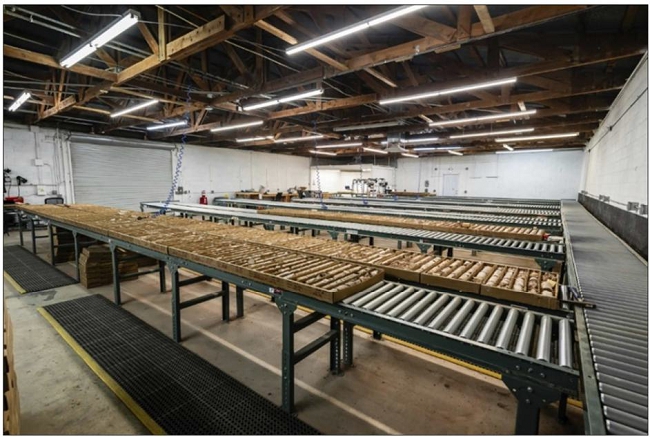
Source: Ivanhoe Electric, 2024
Figure 9-1: Core Logging Facility, Casa Grande, Arizona
Ivanhoe Electric drillhole recordings are stored in a commercial geological database management system, MX Deposit. Data are logged and entered directly into the software. The software has been extensively customized for Ivanhoe Electric and the Santa Cruz Copper Project, including defined pick lists and calculated fields, which enable data integrity checks at the data entry stage. Geotechnical measurements are also taken and entered directly in MX Deposit with the same validation and data integrity checks. Select drillholes were surveyed with a suite of televiewer probes, including acoustic borehole imaging, which characterized the orientation and properties of discontinuities using WellCAD software.
Core loggers have access to Ivanhoe Electric’s standard operating procedures and work instruction documentation for logging and sampling, which includes a standardized drill inspection checklist for standardizing and enforcing core logging procedures. QA/QC samples, including blanks, duplicates, and standards, are appropriately selected and inserted into the sampling workflow. Documentation, the data collection process, and geotechnical logs are subject to routine internal audits by senior staff and management to ensure consistent and accurate collection of data by the Ivanhoe Electric team.
| SEPTEMBER 2026 | 9-3 |
| Ivanhoe Electric Inc. S-K 1300 Preliminary Feasibility Study & | |
| 9.5 | Independent Sampling |
BBA selected sample intervals from eight holes drilled on the Santa Cruz deposit. Twenty (20) verification samples were collected (Table 9-1) from the existing assay database.
Sample material for the verification samples were the pulp rejects from previously submitted Ivanhoe Electric samples. Pulp rejects were sent to BBA’s office in Sudbury, Ontario, Canada, where the sample numbers were validated, and were then submitted to ALS Sudbury for preparation and then analyzed at ALS North Vancouver. ALS is certified by the International Standards Organization, demonstrating technical competence for a defined scope and the operation of a laboratory quality management system (ISO 17025) and is independent of Ivanhoe Electric. The ALS sample workflow uses the same aliquot when testing for acid-soluble copper and cyanide-soluble copper.
The BBA check assay results from ALS were compared to Ivanhoe Electric’s sample database. The results are summarized in Table 9-1 for total copper (%), acid-soluble copper (%), and cyanide-soluble copper (%). Two samples, or 10% of the assays checked, showed sample variances significantly greater than 10%. All other results, regardless of analytical method, were within reasonable tolerances for the deposit type and no material biases were evident.
Table 9-1: Original Assay Values vs. BBA Check Sample Assay Values
| Sample Number |
From | To | Original Sample | BBA Check Samples | ||||
| Total Cu (%) |
Acid- soluble Cu (%) |
Cyanide- soluble Cu (%) |
Total Cu (%) |
Acid- soluble Cu (%) |
Cyanide- soluble Cu (%) | |||
| 694731 | 884.00 | 885.00 | 1.05 | 0.02 | 0.26 | 1.10 | 0.02 | 0.29 |
| 694736 | 888.00 | 889.00 | 1.10 | 0.01 | 0.10 | 1.12 | 0.04 | 0.09 |
| 695558 | 840.00 | 841.00 | 2.72 | 0.00 | 0.43 | 2.68 | 0.10 | 0.48 |
| 695641 | 911.00 | 912.00 | 1.04 | 0.01 | 0.08 | 1.04 | 0.04 | 0.08 |
| SCC-056_334 | 600.00 | 601.00 | 3.52 | 3.40 | 0.03 | 3.65 | 3.34 | 0.02 |
| SCC-056_345 | 609.00 | 610.00 | 1.61 | 1.50 | 0.01 | 1.64 | 1.36 | 0.01 |
| SCC-056_381 | 639.80 | 640.90 | 3.52 | 0.22 | 3.03 | 3.46 | 0.34 | 2.88 |
| SCC-056_403 | 659.00 | 660.00 | 2.73 | 0.20 | 2.40 | 2.69 | 0.30 | 2.16 |
| SCC-057_149 | 640.00 | 641.00 | 2.78 | 2.33 | 0.38 | 2.89 | 2.19 | 0.33 |
| SCC-057_171 | 659.00 | 660.00 | 6.23 | 0.74 | 5.24 | 6.05 | 0.72 | 4.74 |
| SCC-057_185 | 670.80 | 671.80 | 1.44 | 1.38 | 0.01 | 1.43 | 1.25 | 0.01 |
| SCC-057_215 | 697.00 | 698.00 | 1.25 | 0.23 | 0.00 | 1.25 | 1.23 | 0.01 |
| SCC-057_268 | 740.78 | 742.19 | 1.96 | 0.14 | 1.83 | 1.97 | 0.16 | 1.85 |
| SEPTEMBER 2026 | 9-4 |
| Ivanhoe Electric Inc. S-K 1300 Preliminary Feasibility Study & | |
| Sample Number |
From | To | Original Sample | BBA Check Samples | ||||
| Total Cu (%) |
Acid- soluble Cu (%) |
Cyanide- soluble Cu (%) |
Total Cu (%) |
Acid- soluble Cu (%) |
Cyanide- soluble Cu (%) | |||
| SCC-057_278 | 749.00 | 750.00 | 2.63 | 0.10 | 2.62 | 2.76 | 0.15 | 2.67 |
| SCC-084_100 | 747.00 | 749.00 | 4.05 | 3.92 | 0.01 | 4.03 | 3.99 | 0.01 |
| SCC-125_046 | 598.00 | 600.00 | 1.31 | 1.23 | 0.01 | 1.30 | 1.34 | 0.01 |
| SCC-178_054 | 591.00 | 593.00 | 1.03 | 0.98 | 0.00 | 1.01 | 1.07 | 0.05 |
| SCC-178_059 | 599.00 | 601.00 | 0.93 | 0.87 | 0.00 | 0.95 | 0.69 | 0.01 |
| SCC-178_133 | 708.00 | 710.00 | 0.71 | 0.45 | 0.06 | 0.57 | 0.48 | 0.06 |
| SCC-186_067 | 647.00 | 649.00 | 3.59 | 3.86 | 0.01 | 3.81 | 3.20 | 0.01 |
| 9.6 | Twin Hole Analysis |
In 2021, Ivanhoe Electric drilled five twin holes with the intention of verifying five historical drillholes. All five twin hole assays aligned with the historical drilling, validating the historical ASARCO cyanide-soluble assays.
Between 2021 and 2024, several holes drilled for resource estimation purposes were evaluated against nearby historical holes of different vintages. The results were consistent with the 2021 validation. Due to different sample lengths and differences in analytical methods, a direct comparison of assay intervals is not representative of the results; however, geological contacts were consistent between the holes and composited assays.
| 9.7 | Database Validation |
BBA completed a spot check verification of the assay database for each deposit, as follows:
| ■ | Santa Cruz deposit – approximately 10% (3,700) of the 37,000 assays; |
| ■ | East Ridge deposit – approximately 10% (800) of the 8,000 assays; |
| ■ | Texaco deposit – approximately 10% (390) of the 3,900 assays. |
The geology was validated for lithological units from Ivanhoe Electric’s Leapfrog lithological model. The geological contacts aligned with the core contacts and are acceptable for use. Datamine software also has a validation routine when importing the data. No errors were recorded.
Due to the re-analyses to determine cyanide-soluble copper within the historical samples, there are instances where cyanide-soluble copper is greater than total copper. It has been determined
| SEPTEMBER 2026 | 9-5 |
| Ivanhoe Electric Inc. S-K 1300 Preliminary Feasibility Study & | |
that the historical cyanide-soluble assays are valid as they align with recent drillhole assays. Therefore, a cap has been applied to historical cyanide-soluble assays such that they must not exceed the associated total copper value by 20% for each sample, as these results are from separate sample splits and this variance in values is expected. Likewise, any acid-soluble assays that exceed the associated total copper value by 20% are capped.
| 9.8 | Review of Company’s QA/QC |
BBA conducted an independent review of Ivanhoe Electric’s QA/QC procedures as part of the validation process and believes that the company has a robust QA/QC process in place, as described in Section 9.5.
| 9.9 | BBA Opinion |
It is BBA’s opinion that the geological data collection and QA/QC procedures used by Ivanhoe Electric are consistent with current industry practices and that the geological database is of suitable quality to support the mineral resource estimates, mineral reserve estimates, and mine planning.
| SEPTEMBER 2026 | 9-6 |
| Ivanhoe Electric Inc. S-K 1300 Preliminary Feasibility Study & | |
| 10. | Mineral Processing & Metallurgical Testing |
| 10.1 | Test Laboratories |
During the over 60-year history of exploration around the Project area, a significant number of metallurgical studies and accompanying laboratory-scale tests have been completed by external consultants. Since Ivanhoe Electric acquired the Property in 2021, metallurgy and processing testwork has been directed by Met Engineering, LLC (“Met Engineering”) and conducted at McClelland Labs (“MLI”) in Sparks, Nevada, USA; and at Blue Coast Research (“BCR”) in Parksville, British Columbia, Canada; and Kappes, Cassiday and Associates (“KCA”) in Reno, Nevada, USA. The laboratories performed metallurgical testing to industry standards using industry-accepted procedures. MLI meets the requirements of AC89 Accreditation Criteria for Testing Laboratories from the International Accreditation Service (“IAS”) and with ISO 17025 certification. Neither BCR nor KCA are certified by any accreditation associations however both labs are widely used by the mining industry for mineral process testing. Each laboratory is independent of Ivanhoe Electric.
| 10.2 | Metallurgical Testwork |
After the Initial Assessment was published in September 2023, various trade-off studies were completed. In late 2023 a proposed float-leach process flowsheet was pursued, where the mineralized material would be floated producing a salable copper-gold-silver concentrate, followed by sulfuric acid leaching of the tailings using solvent extraction (SX) / electro-winning (EW technology to produce copper cathode. This flowsheet successfully delivered high copper recovery while producing both salable concentrate and copper cathode. Testwork continued to evaluate alternatives and ultimately arrived at a flowsheet of dynamic heap leaching of the ore followed by SX/EW to produce copper cathode for sale in the US marketplace and eliminated production of copper concentrates that likely would have necessitated selling them into the Asian or European markets because of limited copper smelting capacity in the US.
| 10.2.1 | Column Leach Testing |
Column leach studies simulating heap leaching were completed in 2024, 2025, and 2026 at the MLI, BCR, and KCA laboratories. Exploratory testwork at MLI established operating parameters that were used on later variability testwork completed at BCR. The BCR variability program optimized leach parameters for the Santa Cruz oxide and chalcocite mineral domains resulting in refining reagent consumption while maximizing recovery. The column leach test program at KCA developed operational strategy and set basic/detailed process design criteria (“PDC”) for the Project going forward.
| SEPTEMBER 2026 | 10-1 |
| Ivanhoe Electric Inc. S-K 1300 Preliminary Feasibility Study & | |
| 10.2.1.1 | Sample Selection |
Three master composite samples from drill core halves from the 2023 to 2024 Ivanhoe Electric drilling program were selected for developing operational strategy and setting basic/detailed PDC. One master composite sample, MC-J, represented ore expected to be mined (based on the 2025 mine schedule) during the early years (mine plan years 1-3). A second master composite sample, MC-K, represented the life of mine (“LOM”) material expected to be mined without the first 3 years of mining. A third master composite, MC-L, represented LOM ore with a greater chalcocite domain component than the typical LOM ore (MC-K). Each master composite was created from drillhole intervals. Sample intervals are continuous with an average length of 20 m and a minimum calculated total copper grade of 0.7%. Table 10-1 identifies the individual samples that were selected to create each of the three master composite samples. The individual intervals making up each master composites provide broad spatial coverage of the Santa Cruz Mineral Reserve within the mine design (Figure 10-1). All lithologies are represented, including Oracle Granite-dominant samples and samples containing mixtures of porphyry and diabase, consistent with the orebody geology.
| SEPTEMBER 2026 | 10-2 |
| Ivanhoe Electric Inc. S-K 1300 Preliminary Feasibility Study & | |
Table 10-1: Sample Selection for Master Composites for Column Leach Testing
| Sample
ID / Master Composite ID |
Drillhole ID |
From (m) |
To (m) |
% Total Cu | %
Acid-soluble Cu |
%
Cyanide- soluble Cu |
%
Cu Residual |
| J – Years (1-3) | |||||||
| VAR108 | SCC-180 | 544 | 572 | 0.528 | 0.072 | 0.414 | 0.042 |
| VAR111 | SCC-215 | 698 | 723 | 0.602 | 0.123 | 0.424 | 0.055 |
| VAR113 | SCC-226 | 619 | 640 | 2.152 | 2.063 | 0.009 | 0.080 |
| VAR116A | SCC-189 | 578 | 590 | 1.804 | 1.709 | 0.007 | 0.088 |
| VAR116A | SCC-200 | 675 | 689 | 0.800 | 0.075 | 0.648 | 0.078 |
| VAR124 | SCC-210 | 687 | 705 | 1.288 | 0.173 | 1.059 | 0.056 |
| VAR125 | SCC-200 | 449 | 466 | 1.368 | 1.322 | 0.004 | 0.042 |
| VAR127 | SCC-216 | 655 | 666 | 1.187 | 0.164 | 1.042 | 0.005 |
| VAR132 | SCC-178 | 605 | 629 | 1.393 | 1.366 | 0.003 | 0.027 |
| VAR133 | SCC-184 | 536 | 561 | 0.832 | 0.774 | 0.013 | 0.047 |
| VAR137 | SCC-218A | 642 | 658 | 0.987 | 0.055 | 0.500 | 0.432 |
| VAR138 | SCC-217 | 913 | 924 | 1.509 | 0.110 | 1.368 | 0.031 |
| K – LOM Composite without Years 1-3 | |||||||
| VAR087 | SCC-208 | 917 | 947 | 2.084 | 0.101 | 1.929 | 0.054 |
| VAR089 | SCC-209 | 644 | 674 | 1.246 | 0.097 | 0.997 | 0.151 |
| VAR110 | SCC-195 | 732 | 767 | 0.446 | 0.302 | 0.135 | 0.009 |
| VAR112 | SCC-230 | 666 | 687 | 0.915 | 0.075 | 0.804 | 0.036 |
| VAR114 | SCC-176 | 615 | 643 | 1.140 | 0.778 | 0.302 | 0.060 |
| VAR117A | SCC-178 | 633 | 647 | 1.107 | 1.113 | 0.003 | 0.000 |
| VAR117A | SCC-199 | 539 | 558 | 1.146 | 0.549 | 0.563 | 0.033 |
| SEPTEMBER 2026 | 10-3 |
| Ivanhoe Electric Inc. S-K 1300 Preliminary Feasibility Study & | |
| Sample
ID / Master Composite ID |
Drillhole ID |
From (m) |
To (m) |
% Total Cu | %
Acid-soluble Cu |
%
Cyanide- soluble Cu |
%
Cu Residual |
| VAR126 | SCC-218A | 321 | 397 | 1.003 | 0.923 | 0.005 | 0.074 |
| VAR128 | SCC-189 | 625 | 640 | 1.060 | 0.107 | 1.007 | 0.000 |
| VAR129 | SCC-191 | 631 | 649 | 0.983 | 0.932 | 0.005 | 0.045 |
| VAR130 | SCC-194 | 627 | 645 | 1.078 | 0.923 | 0.174 | 0.008 |
| VAR131 | SCC-193 | 878 | 892 | 0.661 | 0.604 | 0.005 | 0.051 |
| VAR136 | SCC-212 | 727 | 753 | 0.712 | 0.709 | 0.002 | 0.007 |
| L – LOM Composite with Greater Chalcocite Domain than MC-K | |||||||
| VAR118 | SCC-187 | 578 | 602 | 1.088 | 1.071 | 0.004 | 0.014 |
| VAR118 | SCC-197 | 628 | 644 | 1.112 | 0.071 | 0.888 | 0.152 |
| VAR118 | SCC-209 | 600 | 614 | 0.815 | 0.075 | 0.564 | 0.173 |
| VAR118 | SCC-216 | 545 | 554 | 1.230 | 1.110 | 0.016 | 0.104 |
| VAR120 | SCC-197 | 584 | 605 | 2.546 | 2.380 | 0.368 | 0.000 |
| VAR121 | SCC-197 | 689 | 724 | 0.904 | 0.103 | 0.793 | 0.017 |
| VAR122 | SCC-198 | 614 | 652 | 0.994 | 0.327 | 0.657 | 0.017 |
| VAR123 | SCC-199 | 614 | 638 | 0.885 | 0.047 | 0.620 | 0.221 |
| VAR134 | SCC-206 | 553 | 575 | 1.239 | 0.123 | 1.076 | 0.042 |
Source: Met Engineering, 2026.
| SEPTEMBER 2026 | 10-4 |
| Ivanhoe Electric Inc. S-K 1300 Preliminary Feasibility Study & | |
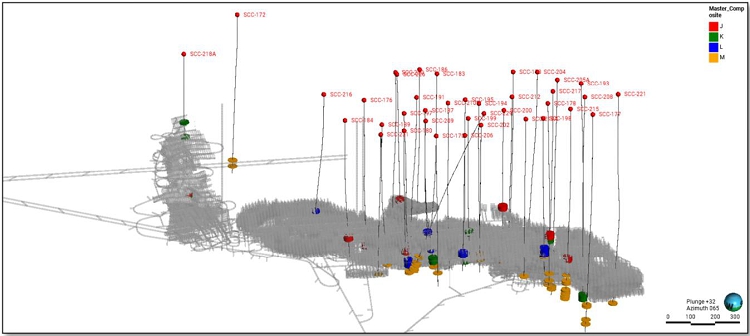
Source: Met Engineering, 2026.
Figure 10-1: Spatial Distribution of the Variability & Master Composite Samples
| SEPTEMBER 2026 | 10-5 |
| Ivanhoe Electric Inc. S-K 1300 Preliminary Feasibility Study & | |
| 10.2.1.2 | Ore Characterization |
FLSmidth MTRC Mineral Testing Services (Salt Lake City, Utah) characterized three KCA-Reno master composites (J, K, and L), crushed to 100% passing 10 mm, using TIMA-X, EPMA, LA-ICP-MS, XRD, and chemical assays. Results are summarized in Table 10-2. “CNCu” denotes cyanide-soluble copper, used analytically to indicate secondary sulfide copper; cyanide is not part of the proposed Santa Cruz flowsheet.
Bulk mineralogy is broadly consistent and reflects the predominantly Oracle Granite host lithology, with quartz, K-feldspar, and muscovite as the principal minerals. Composite K contains more K-feldspar (41%) and less biotite (1%), reflecting minor lithological variability among the samples.
Average copper deportment comprises 29% atacamite, 23% other oxide minerals, 38% chalcocite, and 9% combined chalcopyrite, covellite, and bornite. Atacamite also accounts for 98% of chloride, demonstrating the association between chloride and the oxide mineral domain. Chalcocite and pyrite account for 67% of sulfur, while alunite, chalcopyrite, and bornite contribute a further 22%. Composite L has the highest sulfur content due to its greater chalcocite abundance relative to Composite K. Iron occurs primarily in iron oxides/hydroxides (33%), muscovite (19%), and pyrite (15%).
Mineralogical copper decreased from 1.02–1.30% in the master composites to 0.05–0.30% in the selected column residues, consistent with the high copper extractions achieved. Oxide copper minerals were reduced to trace or below-detection concentrations, while residual copper occurred mainly as covellite and chalcocite. The presence of covellite in residues J and K, despite not being identified in their feeds, suggests chalcocite alteration and/or secondary precipitation during leaching. Residue L-3 retained the most copper (0.30%), principally as covellite from incomplete chalcocite leaching because the L composite feed material only had 0.08% copper as covellite.
Quartz, K-feldspar, and muscovite remained dominant in the residues, collectively comprising approximately 80–90% of the bulk mineralogy. Only minor changes in clay and sulfate minerals were observed, indicating limited gangue alteration under the column-leaching conditions. Visual evaluation of the agglomerated ore before leaching and the leach residue after leaching indicated no significant chemical decrepitation of the host rock occurred. This observation was supported by the nearly identical P80 particle size and profile of the head and residue from each test, head was 5.6 mm and leach residue was 5.5 mm.
Average mineral extractions calculated from the optimal operating conditions for each composite (MC-J-3, MC-K-2, and MC-L-1; Table 10-2 and Table 10-3: ) were: Atacamite: 100%, Chrysocolla: 100%, Copper-bearing clay: 100%, Chalcocite: 96%, Copper limonite: 89%, and Chalcopyrite: 42%.
Covellite: covellite produced from partial chalcocite leaching was observed in the J, K, and L leach residues.
| SEPTEMBER 2026 | 10-6 |
| Ivanhoe Electric Inc. S-K 1300 Preliminary Feasibility Study & | |
Table 10-2: Master Composite Samples
| Sample ID | Total Cu % |
Sequential Coppers % |
Sulfur Assay % |
Copper Deportment Mineralogy | Selected Modal Mineralogy % | Selected Assays % | |||||||||||||||||||||||
| ASCu | CNCu | CuRes | Total S | Atacamite | Chrysocolla | Cu- Limonite |
Cu- Clays |
Other Cu |
Chalcocite | Chalcopyrite | Covellite | Quartz | K-Feldspars | Biotite | Muscovite | Carbonates | Pyrite | Iron Oxides |
Smectites | Chloride | Titanium | Calcium | Iron | Magnesium | Aluminum | Potassium | Manganese | ||
| Master Composites | |||||||||||||||||||||||||||||
| J | 1.25 | 0.82 | 040 | 0.05 | 0.42 | 0.43 | 0.06 | 0.06 | 0.08 | 0.04 | 0.37 | 0.04 | 0.00 | 42.15 | 29.31 | 2.00 | 14.44 | 0.02 | 0.29 | 0.82 | 2.01 | 0.12 | 0.10 | 0.07 | 1.79 | 0.28 | 6.90 | 5.16 | 0.01 |
| K | 0.99 | 0.65 | 0..36 | 0.03 | 0.32 | 0.39 | 0.04 | 0.06 | 0.07 | 0.03 | 0.35 | 0.02 | 0.00 | 37.04 | 40.79 | 0.83 | 11.18 | 0.05 | 0.16 | 0.64 | 1.47 | 0.09 | 0.09 | 0.07 | 1.23 | 0.16 | 6.42 | 5.51 | 0.00 |
| L | 1.19 | 0.54 | 0..62 | 0.06 | 1.17 | 0.16 | 0.07 | 0.05 | 0.08 | 0.09 | 0.63 | 0.06 | 0.08 | 42.15 | 27.70 | 1.95 | 14.11 | 0.17 | 1.54 | 0.99 | 1.60 | 0.03 | 0.10 | 0.11 | 2.03 | 0.27 | 6.95 | 4.92 | 0.01 |
Source: Met Engineering, 2026
Table 10-3: Selected Leach Residue Samples
| Sample ID | Total Cu % |
Sequential Coppers % |
Sulfur Assay % |
Copper Deportment Mineralogy | Selected Modal Mineralogy % | Selected Assays % | |||||||||||||||||||||||
| ASCu | CNCu | CuRes | Total S | Atacamite | Chrysocolla | Cu- Limonite |
Cu- Clays |
Other Cu |
Chalcocite | Chalcopyrite | Covellite | Quartz | K-Feldspars | Biotite | Muscovite | Carbonates | Pyrite | Iron Oxides |
Smectites | Chloride | Titanium | Calcium | Iron | Magnesium | Aluminum | Potassium | Manganese | ||
| Master
Composite Leach Residues |
|||||||||||||||||||||||||||||
| J-1 | 0.08 | 0.01 | 0.04 | 0.04 | 0.40 | 0.00 | 0.00 | 0.01 | 0.00 | 0.01 | 0.01 | 0.01 | 0.03 | 41.06 | 32.27 | 1.65 | 14.12 | 0.02 | 0.37 | 0.95 | 2.61 | 0.02 | 0.18 | 0.05 | 1.84 | 0.26 | 6.89 | 5.02 | 0.00 |
| J-3 | 0.07 | 0.01 | 0.04 | 0.02 | 0.46 | 0.00 | 0.00 | 0.01 | 0.00 | 0.01 | 0.01 | 0.01 | 0.03 | 43.11 | 30.90 | 1.43 | 13.89 | 0.02 | 0.53 | 1.12 | 2.51 | 0.02 | 0.07 | 0.15 | 1.95 | 0.23 | 7.06 | 5.71 | 0.00 |
| K-2 | 0.05 | 0.01 | 0.03 | 0.02 | 0.32 | 0.00 | 0.00 | 0.01 | 0.00 | 0.00 | 0.01 | 0.02 | 0.01 | 42.87 | 38.40 | 0.79 | 10.31 | 0.02 | 0.37 | 0.69 | 1.54 | 0.01 | 0.06 | 0.14 | 1.29 | 0.14 | 6.83 | 6.63 | 0.00 |
| L-1 | 0.11 | 0.01 | 0.07 | 0.03 | 1.04 | 0.00 | 0.00 | 0.00 | 0.00 | 0.01 | 0.04 | 0.03 | 0.05 | 42.53 | 30.24 | 1.88 | 14.52 | 0.01 | 1.28 | 0.65 | 1.83 | 0.02 | 0.07 | 0.17 | 2.20 | 0.20 | 7.58 | 5.51 | 0.00 |
Source: Met Engineering, 2026.
| SEPTEMBER 2026 | 10-7 |
| Ivanhoe Electric Inc. S-K 1300 Preliminary Feasibility Study & | |
| 10.2.1.3 | Results |
Two heap leach approaches were examined using the standard column leach test methods:
| ■ | Conventional bacteria-assisted, weak sulfuric acid, ferric-sulfate heap leaching of mixed oxide and secondary sulfide copper minerals (decades-old technology); |
| ■ | Newer, but widely used in South America, chloride-assisted, weak sulfuric acid, ferric-sulfate heap leaching of mixed oxide and secondary sulfide copper minerals (in use since the 2000s). |
The conventional bacteria-assisted, weak sulfuric acid, ferric-sulfate heap leaches were quickly found at MLI to not be practical because the high levels of naturally occurring chloride in the mineralized material are toxic to the bacteria. Fortunately, all the bacterial column leaches transitioned into successful chloride-assisted leaches.
All column leach tests were performed with 3 m deep beds of material using 4-inch diameter columns. The best operating parameters, evaluated at MLI, are listed below:
| ■ | Particle size (evaluated by bottle roll testing and by column tests): 100% passing 0.5 inches; |
| ■ | Amount of acid applied in the cure/agglomeration step: 3 to 5 kg/t; |
| ■ | Amount of chloride (salt) added in the cure/agglomeration step: 2.5 to 5.0 kg/t; |
| ■ | Raffinate application rate: 8 L/h/m2; |
| ■ | Length of the cure/agglomeration step: 7 days. |
The best column leach results achieved at MLI were 95.6% total copper recovery in 81 days of leaching on a sample containing 1.68% TCu distributed as 72% ASCu, 27% CNCu, and 1% CuRes.
These results were used to develop the follow-on mineral process testing studies at BCR in H1 2025 to support the 2025 technical report summary. The focus of the BCR studies was on establishing copper recoveries based on sequential coppers and/or mineralogical copper deportments by using chloride-assisted, weak-sulfuric acid, heap leaching of mineralized material from the oxide and chalcocite mineral domains. The BCR studies were also carried out to determine the commercial operating parameters for heap leaching, such as:
| ■ | Salt usage; |
| ■ | Sulfuric acid usage; |
| ■ | Ore cure/agglomeration practices; |
| ■ | Column leach cycle times for an on/off leach pad design: |
| - | Raffinate irrigation rate and time; |
| - | Operating column leach moisture level; |
| SEPTEMBER 2026 | 10-8 |
| Ivanhoe Electric Inc. S-K 1300 Preliminary Feasibility Study & | |
| - | Drain-down time; |
| - | Residual moisture content after drain-down; |
| - | Copper level in the residual moisture. |
| ■ | Annual pregnant leach solution grades; |
| ■ | Flow rate of pregnant leach solution to solvent extraction. |
METSIM modeling results were used to interpret test results and inform the PDC in the 2025 technical report.
Nine 3 m x 0.15 m diameter column leaches were set up using material from the master composites. All the column leaches were operated as chloride-assisted, weak-sulfuric acid heap leaches to extract copper from copper oxides and secondary copper sulfides. Leaching was performed in an open cycle (once through solution) format. Operating conditions were kept the same in each column leach except for the cure acid, which varied from 3 to 10 kg/t depending on the predicted net acid consumption from earlier agitation leach tests. Irrigation times varied from 36 days on high-oxide copper samples to 90 days on high-chalcocite samples.
All the column leaches ran in open circuit format using a synthetic raffinate solution containing elements that mimic a mature commercial raffinate maintaining 100 g/L of chloride. The columns all operated without any solution flow issues. Total copper extractions ranged from 80% to 97%, with most results near or above 90% (four out of nine tests were above 95%). The lower recoveries occurred within samples dominated by slower leaching chalcocite mineralogy.
The column leaches were operated in a temperature-controlled enclosure. The temperature was kept at 30 °C to mimic expected average temperatures at the Santa Cruz Copper Project site.
The results of the column leach program at BCR in H1 2025 assisted with the development of the column leach test program at the KCA laboratory in Reno, Nevada (the Apollo program) started in H2 2025 and concluding in H1 2026. The Apollo test program was executed to develop operational strategy and set basic/detailed PDC for the Project going forward. The following strategy and PDC questions were answered by the study:
| ■ | Leach solution chloride levels 90-40 g/L – operating costs/capital costs/extraction; |
| ■ | With or without ILS - Cu kinetics/extraction; |
| ■ | With or without rest rinse - Cu kinetics/extraction; |
| ■ | Copper level in the ILS – Cu kinetics/extraction (based on public domain information); |
| ■ | Acid curing range (kg/t) – agglomeration; |
| ■ | Chloride curing level (connected to leach solution chloride level) – Cu kinetics; |
| ■ | Variability of all the above between somewhat different mining periods, mineral domains, and the effect on leaching primary ore under these conditions: |
| SEPTEMBER 2026 | 10-9 |
| Ivanhoe Electric Inc. S-K 1300 Preliminary Feasibility Study & | |
| - | Different mining periods: |
| o | Years 1 -3, Master Composite J (MC-J); |
| o | LOM Master Composite K (MC-K) without the first 3 years of mining. |
| - | Different domains: |
| o | Master Composite L (MC-L), LOM ore with a greater chalcocite domain component than the typical LOM ore (MC-K). |
The results/answers to these objectives and goals of the Apollo program are described below from the nine 6 m x 0.152 m diameter column leach tests.
| 10.2.1.3.1 | Copper Recovery |
Total copper extraction to PLS (calculated from the metallurgical balances from the products [residue and pregnant leach solution]) ranged from 78% to 95% with the best results between 94 and 95% (on LOM composite K and the early years composite J). The lower recoveries occurred on samples utilizing rest and rinse solution irrigation strategies and 40 g/L chloride.
The head and sequential copper recoveries were calculated from the size-by-size feed and tail assays. (The calculation is [1 – {tail assay / feed assay}] x 100.) The total copper recovery calculated in this case can differ somewhat from the actual total copper recovery (reported above) calculated from the metallurgical balance from the products (residue and pregnant leach solution), but in this test program they were the same.
| ■ | Size-by-size total copper recovery ranged from 78% to 95% with most recoveries above 90%; |
| ■ | Acid-soluble copper recovery ranged from 96% to 99% with most at 99%; |
| ■ | Cyanide-soluble copper recovery ranged from 73% to 94% with most above 87%. Lower recoveries were related to application of rest-rinse strategies and applying 40 g/L chloride. |
| 10.2.1.3.2 | Recovery as a Function of Time |
When each column leach test was completed, the calculated total copper in the feed was determined from column leach products, copper in pregnant leach solution, and copper left unleached in the column leach residue. The total copper value was used to derive the copper extracted for each day of leaching and an extraction curve was constructed, as shown in Figure 10-2, for all nine column leach tests. Much of the feed copper leached from the J and K composite leach column tests in 60 days of irrigation (over 85% extraction). The three slower leaching columns for composite L contained higher levels of chalcocite compared to J and K, and reached 83-85% in 80 days of irrigation, except for L-3 which did not achieve 80% extraction. The most optimally operated column leach tests for each master composite (J, K and L) are: MC-J-3: 94% TCu extraction, MC-K-2: 95% TCu extraction, and MC-L-3: 90% TCu extraction.
| SEPTEMBER 2026 | 10-10 |
| Ivanhoe Electric Inc. S-K 1300 Preliminary Feasibility Study & | |
Most of the column leach tests had very slow extraction after 100 days of irrigation. There was usually a jump in extraction at the end of the cycle due to recovery of copper in solution in the actively leaching ore. Most of the column leach tests were run with 3-5 g/L copper in the irrigation solution to promote secondary sulfide leaching with copper chloride in the feed solution, which accounts for the significant jump in extraction at the end when this solution was drained from the column and rinsed out with water.
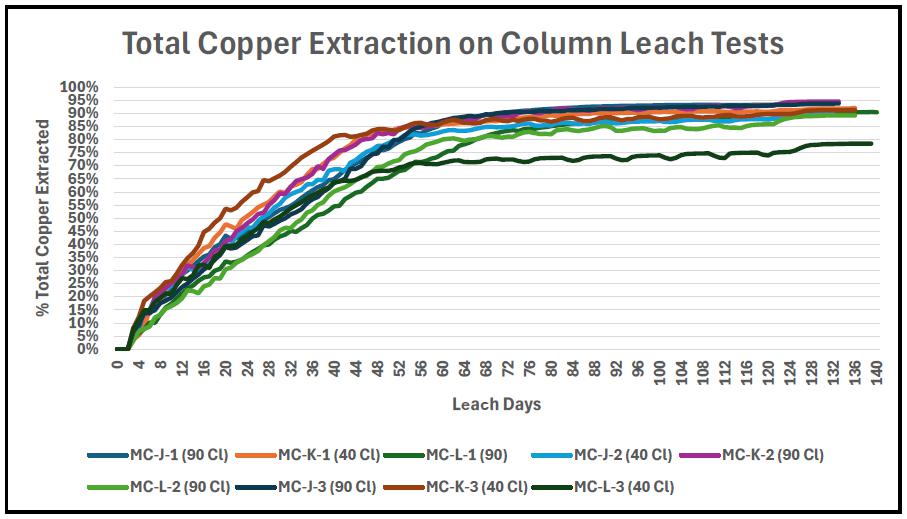
Source: Met Engineering, 2026.
Figure 10-2: Copper Leach Rate Profiles for all the MC’s
The key questions addressed by the KCA column leach test program using 6-m deep columns are:
| ■ | 92% total copper recovery to cathode is achievable (including accounting for scaling factors) for an 8 m lift height; |
| ■ | A continuous feed of irrigation solution is favored over a rest-rinse type irrigation cycle; |
| ■ | A chloride of 90 g/L in the irrigation solution produced noticeably higher total copper extraction than irrigation with 40 g/L chloride; |
| ■ | Net acid consumption is 9 kg/t of ore compared with the 2025 PFS result of 6 kg/t; |
| ■ | Salt addition to achieve 90 g/L chloride was 0.4 kg/t of ore; |
| ■ | Ore agglomeration with 3 kg/t sulfuric acid was good; |
| ■ | A shorter leach period than 180-days is possible on 8 m lifts; |
| SEPTEMBER 2026 | 10-11 |
| Ivanhoe Electric Inc. S-K 1300 Preliminary Feasibility Study & | |
| ■ | Operating with a feed irrigation copper tenor of 2-3 g/L copper promoted good chalcocite extraction; |
| ■ | The active moisture content of ore under irrigation will be approximately 11% by weight; |
| ■ | Fully solution-drained and water-rinsed leach-residue will retain approximately 7.5% moisture by weight. |
| 10.2.1.3.3 | Effect of Particle Size on Recovery |
For evaluating the effect of particle size, the residues for each of the columns were screened and each size fraction (-0.15 through +8 mm) assayed for total copper, acid-soluble copper, cyanide-soluble copper, and residual copper. Recoveries of total copper, acid-soluble copper, cyanide-soluble copper and residual copper for each size fraction were calculated based on the assays of the same size fraction in the column head sample and the assays of total copper, acid-soluble copper, cyanide-soluble copper and residual copper in the residue.
The average recoveries for total copper and cyanide-soluble copper for each of the nine individual size fractions show that recovery increases as particle size decreases. This trend is consistent with the shrinking core model of leaching and proper accessibility. The average recovery for acid-soluble copper for each of the nine individual size fractions show that recovery increases only slightly as particle size decreases.
| 10.2.1.3.4 | Copper Recovery / Acid Consumption / Leach Cycle Time Relationship |
The relationship between copper recoveries, acid consumption, pregnant leach solution grade, and leach cycle time was evaluated for the column leach tests with the optimal operating conditions (J-1, K-2, J-3, and L-1). The J samples are from the early years 1-3. The K sample is from the LOM ore after the early years. And the L sample is from the LOM chalcocite-dominant ore. For the J samples, results indicated that 92% of the copper will leach out in a 6 m column leach within 100 days. Another 30 days of leaching only increases recovery by 2% in this sample. For the K sample, results indicated that 92% of the copper will leach out in 100 days. Another 30 days of leaching only increases recovery by 3% in this sample. For the L sample, results indicate that 88% of the copper will leach out in a 6 m column leach within 100 days. Another 30 days of leaching increased recovery by 2%. Most of the additional copper in the last 30 days comes from the drain down and water rinse at the end of the cycle.
Pregnant leach solution copper levels trended lower as the leach cycle progressed and were similar in all the sample composites during the first 50 days of the leach cycle. PLS grade was 10 g/L copper during this period on all four column leach tests (J-1, J-3, K-2 and L-1).
| SEPTEMBER 2026 | 10-12 |
| Ivanhoe Electric Inc. S-K 1300 Preliminary Feasibility Study & | |
| 10.2.1.3.5 | Key Reagents |
Chloride occurred naturally in the master composite samples. The natural chloride level was augmented by the addition of salt in the agglomeration stage of some tests where the target chloride was 90 g/L. METSIM modeling software was used to predict the amount of salt needed to reach 90 g/L chloride. The LOM mine composite (K) needed 0.4 kg of salt per tonne of ore.
The acid added in the cure/agglomeration was constant at 3 kg/t of ore. Average net acid consumption on the optimally operated column leach tests (J-1, K-2 and J-3) was approximately 9 kg/t of ore.
| 10.2.1.4 | Copper Recovery Algorithm |
The extraction results from the optimally operated 6 m columns were used to generate a recovery algorithm to predict copper recovery to cathode of leaching100% passing 9.5 mm feed material in an 8 m lift for 220 days. The algorithm described below is based on the sequential copper recoveries to cathode and are based on scaled extractions to PLS from those column leach tests (J-1, J-3, and K-2) shown in Table 10-4 below.
Table 10-4: Estimated Sequential Copper Recoveries to Cathode
| Type of Copper Assay | Recovery to Cathode (%) |
| ASCu | 99.0 |
| CNCu | 90.3 |
| CuRes | 23.9 |
| TCu | 92.3 |
General equation format:
TCu Recovery to cathode = A x ASCu + B x CNCu + C x CuRes
Equation result:
TCu Recovery to cathode = (99.0 x ASCu + 90.3 x CNCu + 23.9 x CuRes)/(ASCu+CNCu+CuRes)
For life-of-mine processing, this equation produces a weighted average of 92.3% TCu recovered to cathode.
| SEPTEMBER 2026 | 10-13 |
| Ivanhoe Electric Inc. S-K 1300 Preliminary Feasibility Study & | |
| 10.2.1.5 | Summary of Results |
The optimally operated column leach tests (J-1, J-3 and K-2) completed their leach cycles in 100 days, after which most of the additional recovery was achieved when irrigation was stopped, the column was drained and the column was water rinsed. The optimally operated column leach tests had achieved 92% total copper recovery, or higher, at 100 days.
Higher total copper recoveries can be expected for the mineralized material with higher ratios of acid-soluble copper to total copper. When the proportion of cyanide-soluble copper increases the total copper recovery decreases somewhat.
Chloride-assisted weak-sulfuric acid heap leaching has a proven track record of successful application over the past two decades in South America copper mines, providing a strong technical foundation for its application to the Santa Cruz Project and supporting its potential as a robust, established processing approach.
| 10.3 | Metallurgical Variability |
Copper recovery variability of the Santa Cruz ore was evaluated in the 2025 studies. The 2026 studies were focused on determining the best operating practices to maximize recovery of copper to cathode from the early years 1-3, from the LOM ore after the early years and from the LOM chalcocite-dominant ore. No variability was observed between early years ore and the LOM ore after the early years period. The LOM chalcocite-dominant ore copper recovery to cathode will be slightly lower (89%) compared to the other two types of ore (92%).
Sulfuric acid usage is the other parameter of interest for variability. Acid consumption varied slightly between the three composite samples evaluated. The chalcocite-dominated composite (L-1) showed the lowest acid consumption at 8 kg/t, followed by the early years composite (J-3) consumption at 10 kg/t, with the highest consumption on the LOM composite (K-1) of 11 kg/t. These are considered low levels of acid consumption compared with leach-SX/EW operations in Arizona and worldwide.
| 10.4 | Deleterious Elements |
There are no deleterious elements in the mineralized material or leach solution that pose a significant threat to cathode quality or Project development.
The current solvent extraction design, with two wash stages and a loaded organic coalescer, mitigates potential damage from high-pregnant leach solution chloride levels affecting electroplating stainless-steel blanks.
| SEPTEMBER 2026 | 10-14 |
| Ivanhoe Electric Inc. S-K 1300 Preliminary Feasibility Study & | |
| 10.5 | Met Engineering Opinion |
Industry-standard studies were performed as part of process flowsheet development and facility design. Test samples are representative of the mineralization. Subsequent production experience and focused investigations guided facility alterations and process changes.
Met Engineering is of the opinion testwork was performed on mineralization from the Project area to support a S-K 1300 preliminary feasibility study on the processing route and metallurgical performance. The test work results are satisfactory to support a heap leach SX/EW process design.
| SEPTEMBER 2026 | 10-15 |
| Ivanhoe Electric Inc. S-K 1300 Preliminary Feasibility Study & | |
| 11. | Mineral Resource Estimates |
| 11.1 | Deposits |
The Mineral Resource estimates for the Santa Cruz, East Ridge, and Texaco deposits are detailed in this section. The Southwest Exploration Area is not included in the Mineral Resource estimates.
| 11.2 | Drillhole Database |
The Santa Cruz deposit has 194,463 m of core drilling in 226 drillholes; East Ridge has 62 holes totaling 48,878 m; and Texaco has 41 drillholes totaling 35,823 m (Figure 11-1 and Table 7-4). A breakdown of the number of assays used within each Mineral Resource estimate is provided in Table 7-5.
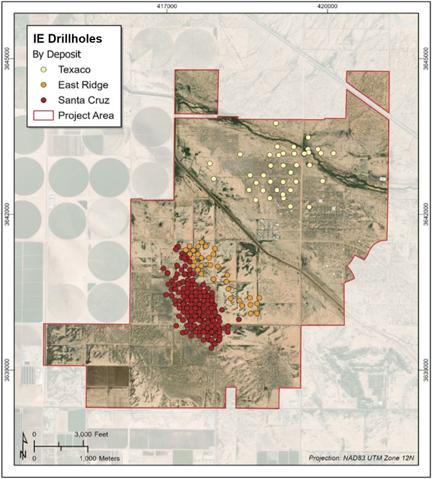
Source: Ivanhoe Electric, 2026
Figure 11-1: Plan View of Santa Cruz Copper Project Diamond Drilling by Deposit
| SEPTEMBER 2026 | 11-1 |
| Ivanhoe Electric Inc. S-K 1300 Preliminary Feasibility Study & | |
| 11.3 | Geological Domaining |
Geological domains were developed within the Santa Cruz Copper Project based on alteration, lithological, and mineralogical characteristics, incorporating regional and local structural information. Local, normal fault structures separate the mineralization at the Santa Cruz, East Ridge, and Texaco deposits. Local fault zones were created by Ivanhoe Electric using Seequent’s Leapfrog Geo™ v2023.2.3 (Leapfrog) geological software.
The Santa Cruz deposit was divided into three primary mineralization domains: (1) leach cap, (2) weathered supergene enrichment, and (3) primary hypogene mineralization. Each primary geological domain was further subdivided into domains and subdomains (Table 11-1). The leach cap was added after additional drilling exhibited a continuous area of leached material distinct from the supergene domain.
Table 11-1: Santa Cruz, East Ridge & Texaco Geological Domains
| Primary Geological Domain |
Domain | Subdomain Name | Domain Code |
| Santa Cruz Deposit | |||
| Leached | Leach
Cap (Mostly Unmineralized, Some Acid-soluble Copper) |
Low-Grade | 20 |
| Medium-Grade | 21 | ||
| Supergene Enrichment | Exotic
(Tertiary-Hosted Exotic Copper) |
Low-Grade | 10 |
| High-Grade | 11 | ||
| Verde Domain (Mineralized) | 12 | ||
| Verde Domain (Unmineralized) | 13 | ||
| Oxide
(Primarily Acid-soluble Copper) |
Low-Grade | 30 | |
| High-Grade | 31 | ||
| Chalcocite-Enriched
(Primarily Cyanide-soluble Copper) |
Low-Grade | 40 | |
| Medium-Grade | 41 | ||
| Hypogene Mineralization | Primary
(Primary Sulfide Copper) |
Low-Grade | 50 |
| High-Grade | 51 | ||
| East Ridge Deposit | |||
| Weathered Supergene Enrichment | Exotic
(Tertiary-Hosted Exotic Copper) |
Low-Grade | 341 |
| Oxide
(Primarily Acid- and Cyanide-soluble Copper) |
Low-Grade (North) | 301 | |
| Medium-Grade (North) | 311 | ||
| Low-Grade (South) | 401 | ||
| Medium-Grade (South) | 411 | ||
| SEPTEMBER 2026 | 11-2 |
| Ivanhoe Electric Inc. S-K 1300 Preliminary Feasibility Study & | |
| Primary Geological Domain |
Domain | Subdomain Name | Domain Code |
| Texaco Deposit | |||
| Weathered Supergene Enrichment | Oxide
(Primarily Acid-soluble Copper) |
Low-Grade | 221 |
| Medium-Grade | 222 | ||
| Chalcocite-Enriched
(Primarily Cyanide-soluble Copper) |
Medium-Grade | 232 | |
| Hypogene Mineralization | Primary
(Primary Sulfide Copper) |
Low-Grade | 211 |
| Medium-Grade | 212 | ||
The East Ridge deposit is predominantly structurally controlled and consists of a mix of oxide and enrichment; therefore, it has fewer domains. East Ridge is also split into the north and south domains, as no continuity has been observed between the two mineralized zones. The Texaco deposit consists of all domains except for the leach cap and exotic domains; however, this may be refined through additional drilling.
Collectively, each of these domains was divided into subdomains based on their individual grade profiles, which align with mineralization controls. A schematic for Santa Cruz, East Ridge, and Texaco deposit hierarchies is outlined in Figure 11-2. The following terms, which represent a local definition of the grade profile, are assigned to the subdomains: high-grade (“HG”), medium-grade (“MG”), and low-grade (“LG”).
| SEPTEMBER 2026 | 11-3 |
| Ivanhoe Electric Inc. S-K 1300 Preliminary Feasibility Study & | |
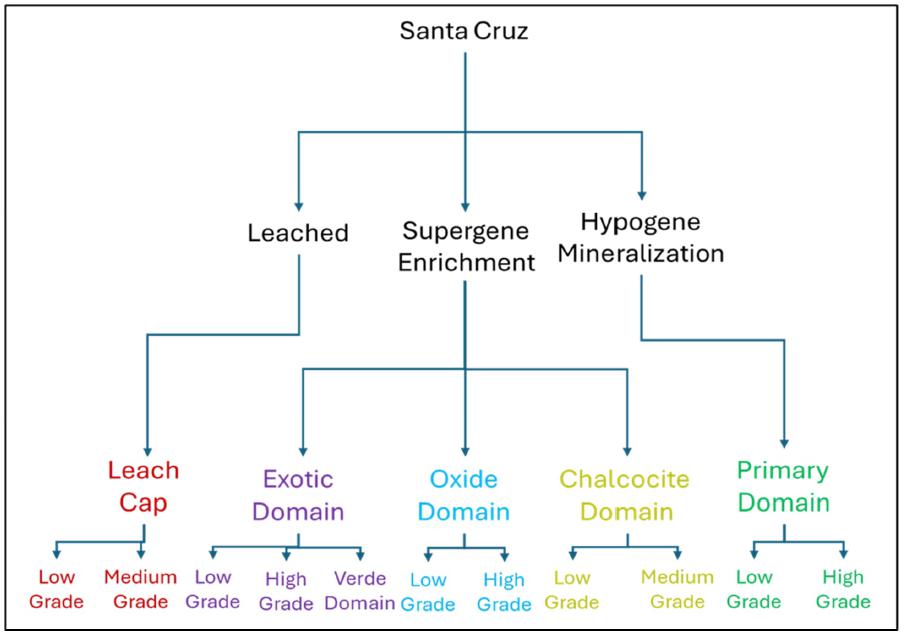
Note: East Ridge is defined by exotic and oxide domains, while Texaco is defined by oxide, chalcocite, and primary domains. Source: Ivanhoe Electric, 2026.
Figure 11-2: Santa Cruz Primary Mineralization Domains, Domains & Subdomains
Exotic copper is present at Santa Cruz and East Ridge deposits in varying degrees and is hosted in tertiary sediments. All other styles of copper mineralization are hosted within the Oracle granite and intrusive dikes and terminate at the contact of the tertiary sediments. The current drilling indicates that the basal faults within the region truncate the copper mineralization at depth.
The Oracle granite hosts the Laramide porphyry, commonly associated with brecciation and primary copper mineralization. Secondary supergene copper mineralization is separated vertically from the primary hypogene mineralization, occurring as the oxide and chalcocite-enriched domains. The oxide domain is defined by an elevated (approximately 70% and greater) ratio of acid-soluble copper to total copper, while the chalcocite-enriched domain is defined by an elevated (approximately 70% and greater) ratio of cyanide-soluble copper to total copper. High-grade copper oxides follow the trend of the paleo-water table, as percolating meteoric water dissolved primary copper minerals and transported copper to the water table, where copper oxide minerals precipitated due to change in pH and oxidation-reduction conditions. The
| SEPTEMBER 2026 | 11-4 |
| Ivanhoe Electric Inc. S-K 1300 Preliminary Feasibility Study & | |
chalcocite enrichment domain also follows the paleo-water table, where deposition occurred just below the water table and likely before formation of the oxide domain. The primary domain considers the residual copper, which is the total copper minus the acid-soluble copper and cyanide-soluble copper (i.e., residual Cu = TCu – ASCu – CNCu). The leach cap is mostly barren but has one known discrete mineralized body, predominantly copper oxides. Figure 11-3 is a conceptual example of the Santa Cruz deposit domaining. Table 11-2 shows the volume of the mineralized wireframes.
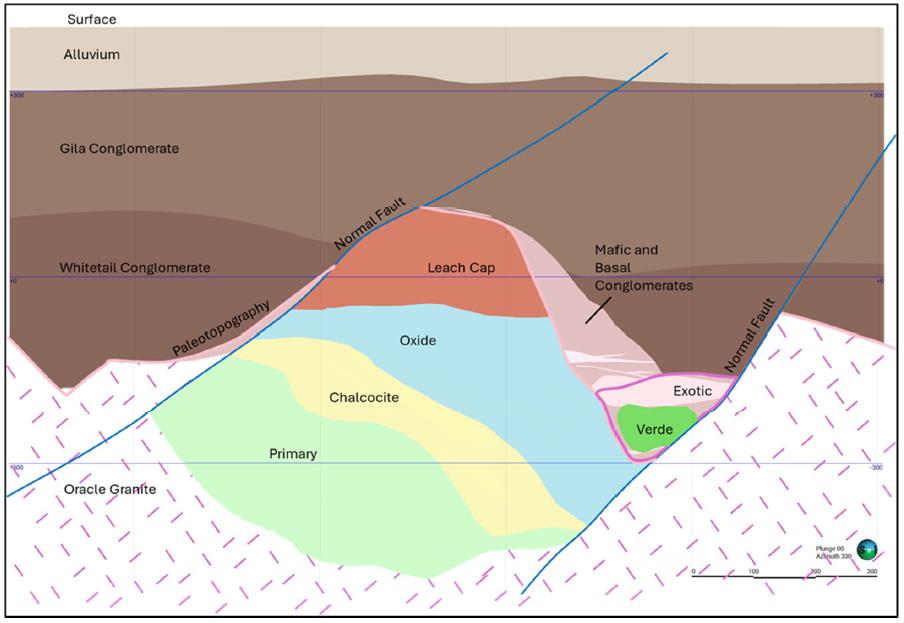
Note: Cross-section looking northwest, ±50 m wide. Source: Ivanhoe Electric, 2026.
Figure 11-3: Santa Cruz Deposit Domain Idealized Cross-section
| SEPTEMBER 2026 | 11-5 |
| Ivanhoe Electric Inc. S-K 1300 Preliminary Feasibility Study & | |
Table 11-2: Volume of Santa Cruz Wireframe Domains
| Domain | Domain Code | Wireframe Volume |
| Santa Cruz | ||
| Exotic Low-Grade | 10 | 20,062 |
| Exotic High-Grade | 11 | 1,034 |
| Exotic – Verde | 12 | 1,068 |
| Leach Cap Low-Grade | 20 | 90,011 |
| Leach Cap Medium-Grade | 21 | 989 |
| Oxide Low-Grade | 30 | 95,410 |
| Oxide High-Grade | 31 | 24,832 |
| Chalcocite Low-Grade | 40 | 50,029 |
| Chalcocite Medium-Grade | 41 | 9,452 |
| Primary Low-Grade | 50 | 145,107 |
| Primary High-Grade | 51 | 4,928 |
| East Ridge | ||
| Exotic | 341 | 16,519 |
| Oxide Low-Grade – North | 301 | 486,575 |
| Oxide Medium-Grade – North | 311 | 9,148 |
| Oxide Low-Grade – South | 401 | 91,805 |
| Oxide Medium-Grade – South | 411 | 3,949 |
| Texaco | ||
| Oxide Low-Grade | 221 | 630,350 |
| Oxide Medium-Grade | 222 | 2,367 |
| Chalcocite Medium-Grade | 232 | 219,277 |
| Primary Low-Grade | 211 | 659,611 |
| Primary Medium-Grade | 212 | 4,994 |
Source: Ivanhoe Electric, 2025
Mineralization wireframes adhere to known controls on mineralization, such as the paleo water-table for supergene mineralization and dike orientation for primary mineralization. The mineralization hosted in the Oracle granite bedrock is constrained by the bedrock interface above, and laterally by the northwest-striking normal faults. The high-grade subdomains have a minimum thickness of 5 m and mostly constrain an average grade of 2.0% TCu. Due to geological heterogeneity, while portions of the high-grade wireframes incorporate grades below 2.0%, these intercepts occur along the mineralized trend. Laterally these high-grade wireframes are delineated by half the distance to the closest external drillhole. When no nearby drilling exists, the lateral extents are constrained to approximately 30 m, or half the average deposit drillhole spacing. Medium-grade subdomains mostly constrain an average grade of 1.0% TCu and above.
| SEPTEMBER 2026 | 11-6 |
| Ivanhoe Electric Inc. S-K 1300 Preliminary Feasibility Study & | |
There is some overlap of the chalcocite mineralization within the oxide domain, but this constitutes approximately 20% or less of the mineralization in the domain. It is difficult to fully parse the mineralization types, as faulting, rotation, and water table fluctuation over time cause complex overprinting of the various copper mineralization types.
Implicit domain modeling was completed in Leapfrog Geo™ to represent known controls on high-grade and low-grade mineralization, with explicit control lines employed to ensure a reasonable interpretation.
| 11.4 | Data Preparation |
| 11.4.1 | Exploratory Data Analysis |
The exploratory data analysis was conducted on raw drillhole data to determine the nature of the element distribution, the correlation of grades within domains, and the identification of high-grade outlier samples. A combination of descriptive statistics, histograms, probability plots, and X-Y scatter plots were used to analyze the grade population of the data using Snowden Supervisor™ v9.0. The findings were used to help define modeling procedures and parameters used in the Mineral Resource estimate. Gold and silver were added to the resource based on flotation testwork and are being considered for recovery later in the mine life. Molybdenum was removed as it was not considered for later recovery.
Descriptive statistics were used to analyze the grade distribution and continuity of each sample population, determine the presence of outliers, and identify correlations between grade and rock types for each mineral subdomain.
Individual drillhole tables (e.g., collar, survey, assay, etc.) were merged to create one single master de-surveyed drillhole file in Datamine Studio RM™ v2.0.66.0.
Prior to grade estimation, the data were prepared using the following methods:
| 1. | All drillhole assays that intersected a wireframe within each domain were assigned a set of codes representative of the domain, wireframe number, and mineralization type. |
| 2. | The drillhole assay data were combined in Datamine to a single static drillhole file, which was then “flagged” to intersecting copper mineralization subdomains outlined by the wireframe coding process. |
| 3. | High-grade outlier assays in each domain were reviewed. |
| SEPTEMBER 2026 | 11-7 |
| Ivanhoe Electric Inc. S-K 1300 Preliminary Feasibility Study & | |
| 11.4.2 | Assay Intervals at Minimum Detection Limits |
Unsampled intervals in the database were set to half the detection limit (“LLD”) per variable. Pending assay results were left absent, and core loss/void zones were also left absent. Gold values were set to half LLD in modern holes and left absent in historical holes, as gold assays were only run on select samples within ore zones.
| 11.4.3 | Compositing |
Assays captured within all wireframes were composited to 2.0 m regular intervals based on the observed modal distribution of assay lengths. The initial assessment used 3.0 m composites as the database was mostly historic data sampled at 3.0 m intervals. An option to use slightly variable composite lengths was chosen to redistribute short composites at domain edges. All composite assays were generated within each mineral domain with no overlaps along boundaries. The composite assays were validated statistically to ensure there was no loss of data or significant change to the mean grade of each assay population.
| 11.4.4 | Outlier Analysis & Capping |
Grade outliers that are much higher than the general population of assays have the potential to bias (inflate) the quantity of metal estimated in a block model. Geostatistical analysis using X-Y scatter plots, cumulative probability plots, and decile analysis was used to analyze the composited drillhole assay data for each subdomain to determine appropriate grade capping. Statistical analysis was performed independently on all subdomains. After thorough review of the statistics, it was determined that copper capping was not necessary for any of the deposits, as the distribution does not contain numerous outliers, and that capping did not have a significant effect on the final resource. Compositing helped reduce the effect of outliers. Gold capping was applied for East Ridge for values above 1 ppm.
| 11.4.5 | Density |
A total of 5,884 density measurements from 210 core drillholes exist for the Santa Cruz, East Ridge, and Texaco deposits. Measurements were calculated using the weight in air versus the weight in water method (Archimedes).
Density values were relatively consistent per domain, and an estimated value would be very similar to an assigned value. Values were assigned to blocks based on subdomains per deposit. East Ridge and Texaco have sufficient sample density to assign unique values by domain. Texaco subdomains lacked sufficient samples for unique values. Table 11-3 gives average density values for geological domains in each deposit.
| SEPTEMBER 2026 | 11-8 |
| Ivanhoe Electric Inc. S-K 1300 Preliminary Feasibility Study & | |
Table 11-3: Density Values Measured for the Project by Geological and Resource Domain
| Project Lithological Units | Subdomain | Average Density (g/cm3) |
| Alluvium | - | 1.96 |
| Gila Conglomerate | - | 2.18 |
| Whitetail Conglomerate | - | 2.33 |
| Basal Conglomerate | - | 2.39 |
| Mafic Conglomerate | - | 2.34 |
| Oracle Granite (Unmineralized) | - | 2.54 |
| Santa Cruz Domains | Subdomain | Average Density (g/cm3) |
| Exotic | Low-Grade | 2.36 |
| High-Grade | 2.37 | |
| Verde | 2.58 | |
| Leach Cap | Low-Grade | 2.48 |
| Medium-Grade | 2.57 | |
| Oxide | Low-Grade | 2.48 |
| High-Grade | 2.54 | |
| Chalcocite Enriched | Low-Grade | 2.51 |
| Medium-Grade | 2.54 | |
| Primary | Low-Grade | 2.57 |
| High-Grade | 2.57 | |
| East Ridge Domains | Subdomain | Average Density (g/cm3) |
| Exotic | Low-Grade | 2.38 |
| Oxide | North Low-Grade | 2.53 |
| North Medium-Grade | 2.56 | |
| South Low-Grade | 2.44 | |
| South Medium-Grade | 2.47 | |
| Texaco Domains | Subdomain | Average Density (g/cm3) |
| Oxide | Low-Grade | 2.46 |
| Medium-Grade | 2.46 | |
| Chalcocite Enriched | Medium-Grade | 2.56 |
| Primary | Low-Grade | 2.54 |
| Medium-Grade | 2.54 |
| SEPTEMBER 2026 | 11-9 |
| Ivanhoe Electric Inc. S-K 1300 Preliminary Feasibility Study & | |
| 11.4.6 | Block Model Strategy & Analysis |
A series of upfront test modeling was completed to define an estimation methodology to meet the following criteria:
| ■ | Represents the Santa Cruz Copper Project geological and structural controls; |
| ■ | Accounts for the variability of grade, orientation, and continuity of mineralization; |
| ■ | Provides control on the smoothing (grade spreading) of grades and the influence of outliers; |
| ■ | Accounts for most of the mineralization within the Santa Cruz Copper Project; |
| ■ | Is robust and repeatable within the mineral domains. |
Multiple interpolation test scenarios were evaluated to determine the optimum process and parameters to achieve the intended criteria. Each scenario was based on nearest neighbor (“NN”), inverse distance squared (“ID2”), inverse distance cubed (“ID3”), and ordinary kriging (“OK”) interpolation methods. All test scenarios were evaluated based on global statistical comparisons, visual comparisons of composite assays versus block grades, swath averages, and the assessment of overall smoothing. Based on the testing results, it was determined that the final resource estimation methodology would constrain the mineralization by using hard wireframe boundaries to control mineralization. OK was selected as the most applicable interpolation method for the Santa Cruz deposit, and ID2 was selected for the East Ridge and Texaco deposits.
| 11.4.7 | Assessment of Spatial Grade Continuity |
Datamine, Leapfrog, and Snowden Supervisor were used to determine the geostatistical relationships of the Santa Cruz Copper Project. Variography was performed on composite data for each deposit per domain (Table 11-4 to Table 11-6). Experimental variograms were calculated from the composited assay data for each element to determine the approximate dimensions and orientations of the search ellipses.
The following were considered for each analysis:
| ■ | Downhole variograms were created and modeled to define the nugget effect; |
| ■ | Experimental semi-variograms were calculated to determine directional variograms for the major, semi-major, and minor orientations; |
| ■ | Variograms were modeled using an exponential model with practical range and a normalized sill of 1. |
Directional variograms were modeled using the nugget defined in the downhole variography and the ranges for the major, semi-major, and minor directions. Gold and silver values for Santa Cruz and Texaco were estimated by ID2 for the final values.
| SEPTEMBER 2026 | 11-10 |
| Ivanhoe Electric Inc. S-K 1300 Preliminary Feasibility Study & | |
Variography for East Ridge and Texaco were used for the OK estimate, which was run for validation purposes only, while variography helped inform the ranges and orientations of search ellipses.
| SEPTEMBER 2026 | 11-11 |
| Ivanhoe Electric Inc. S-K 1300 Preliminary Feasibility Study & | |
Table 11-4: Santa Cruz Variography Parameters
| Domain | Variable | Rotation Angles | Axes | Nugget | C1 | Structure 1 | C2 | Structure 2 | ||||||
| 1 | 2 | 3 | Range 1 | Range 2 | Range 3 | Range 1 | Range 2 | Range 3 | ||||||
| Exotic Low-Grade | TCu % | 80 | 10 | 180 | Z-X-Z | 0.20 | 0.42 | 26 | 129 | 7 | 0.38 | 170 | 150 | 15 |
| ASCu % | 80 | 10 | 180 | Z-X-Z | 0.20 | 0.42 | 26 | 129 | 7 | 0.38 | 170 | 150 | 15 | |
| CNCu % | 80 | 10 | 180 | Z-X-Z | 0.20 | 0.42 | 26 | 129 | 7 | 0.38 | 170 | 150 | 15 | |
| Exotic High-Grade | TCu % | 80 | 10 | 180 | Z-X-Z | 0.20 | 0.42 | 26 | 129 | 7 | 0.38 | 170 | 150 | 15 |
| ASCu % | 80 | 10 | 180 | Z-X-Z | 0.20 | 0.42 | 26 | 129 | 7 | 0.38 | 170 | 150 | 15 | |
| CNCu % | 80 | 10 | 180 | Z-X-Z | 0.20 | 0.42 | 26 | 129 | 7 | 0.38 | 170 | 150 | 15 | |
| Verde Domain | TCu % | 115 | 30 | 165 | Z-X-Z | 0.20 | 0.38 | 26 | 97 | 16 | 0.42 | 120 | 100 | 30 |
| ASCu % | 115 | 30 | 165 | Z-X-Z | 0.20 | 0.38 | 26 | 97 | 16 | 0.42 | 120 | 100 | 30 | |
| CNCu % | 115 | 30 | 165 | Z-X-Z | 0.20 | 0.38 | 26 | 97 | 16 | 0.42 | 120 | 100 | 30 | |
| Leach Cap Low-Grade | TCu % | 60 | 30 | 165 | Z-X-Z | 0.20 | 0.37 | 30 | 20 | 20 | 0.43 | 200 | 135 | 60 |
| ASCu % | 60 | 30 | 165 | Z-X-Z | 0.20 | 0.37 | 30 | 20 | 20 | 0.43 | 200 | 135 | 60 | |
| CNCu % | 60 | 30 | 165 | Z-X-Z | 0.20 | 0.37 | 30 | 20 | 20 | 0.43 | 200 | 135 | 60 | |
| Au ppb | 160 | 140 | -120 | Z-X-Z | 0.20 | 0.40 | 50 | 69 | 7 | 0.40 | 170 | 150 | 40 | |
| Ag ppm | 160 | 140 | -120 | Z-X-Z | 0.20 | 0.40 | 50 | 69 | 7 | 0.40 | 170 | 150 | 40 | |
| Leach Cap Medium-Grade | TCu % | 180 | 150 | 0 | Z-X-Z | 0.20 | 0.50 | 22 | 50 | 10 | 0.30 | 190 | 100 | 30 |
| ASCu % | 180 | 150 | 0 | Z-X-Z | 0.20 | 0.50 | 22 | 50 | 10 | 0.30 | 190 | 100 | 30 | |
| CNCu % | 180 | 150 | 0 | Z-X-Z | 0.20 | 0.66 | 80 | 50 | 25 | 0.14 | 150 | 100 | 30 | |
| Au ppb | 160 | 140 | -120 | Z-X-Z | 0.20 | 0.40 | 50 | 69 | 7 | 0.40 | 170 | 150 | 40 | |
| Ag ppm | 160 | 140 | -120 | Z-X-Z | 0.20 | 0.40 | 50 | 69 | 7 | 0.40 | 170 | 150 | 40 | |
| Oxide Low-Grade | TCu % | 60 | 30 | 165 | Z-X-Z | 0.20 | 0.37 | 30 | 20 | 20 | 0.43 | 200 | 135 | 60 |
| ASCu % | 60 | 30 | 165 | Z-X-Z | 0.20 | 0.37 | 30 | 20 | 20 | 0.43 | 200 | 135 | 60 | |
| CNCu % | 60 | 30 | 165 | Z-X-Z | 0.20 | 0.37 | 30 | 20 | 20 | 0.43 | 200 | 135 | 60 | |
| Au ppb | 160 | 140 | -120 | Z-X-Z | 0.20 | 0.40 | 50 | 69 | 7 | 0.40 | 170 | 150 | 40 | |
| Ag ppm | 160 | 140 | -120 | Z-X-Z | 0.20 | 0.40 | 50 | 69 | 7 | 0.40 | 170 | 150 | 40 | |
| SEPTEMBER 2026 | 11-12 |
| Ivanhoe Electric Inc. S-K 1300 Preliminary Feasibility Study & | |
| Domain | Variable | Rotation Angles | Axes | Nugget | C1 | Structure 1 | C2 | Structure 2 | ||||||
| 1 | 2 | 3 | Range 1 | Range 2 | Range 3 | Range 1 | Range 2 | Range 3 | ||||||
| Oxide High-Grade | TCu % | 60 | 30 | 165 | Z-X-Z | 0.05 | 0.20 | 22 | 50 | 10 | 0.75 | 190 | 100 | 30 |
| ASCu % | 60 | 30 | 165 | Z-X-Z | 0.05 | 0.20 | 22 | 50 | 10 | 0.75 | 190 | 100 | 30 | |
| CNCu % | 60 | 30 | 165 | Z-X-Z | 0.05 | 0.20 | 80 | 50 | 25 | 0.75 | 150 | 100 | 30 | |
| Au ppb | 160 | 140 | -120 | Z-X-Z | 0.20 | 0.40 | 50 | 69 | 7 | 0.40 | 170 | 150 | 40 | |
| Ag ppm | 160 | 140 | -120 | Z-X-Z | 0.20 | 0.40 | 50 | 69 | 7 | 0.40 | 170 | 150 | 40 | |
| Chalcocite Enriched Low- Grade | TCu % | 60 | 45 | 170 | Z-X-Z | 0.10 | 0.36 | 199 | 159 | 59 | 0.54 | 200 | 160 | 60 |
| ASCu % | 60 | 45 | 170 | Z-X-Z | 0.10 | 0.39 | 162 | 71 | 59 | 0.51 | 200 | 135 | 60 | |
| CNCu % | 60 | 45 | 170 | Z-X-Z | 0.10 | 0.36 | 199 | 159 | 59 | 0.54 | 200 | 160 | 60 | |
| Au ppb | 160 | 140 | -120 | Z-X-Z | 0.20 | 0.40 | 50 | 69 | 7 | 0.40 | 170 | 150 | 40 | |
| Ag ppm | 160 | 140 | -120 | Z-X-Z | 0.20 | 0.40 | 50 | 69 | 7 | 0.40 | 170 | 150 | 40 | |
| Chalcocite Enriched Medium-Grade | TCu % | 60 | 45 | 170 | Z-X-Z | 0.20 | 0.67 | 70 | 134 | 20 | 0.13 | 190 | 135 | 45 |
| ASCu % | 60 | 45 | 170 | Z-X-Z | 0.20 | 0.34 | 25 | 75 | 20 | 0.46 | 200 | 135 | 45 | |
| CNCu % | 60 | 45 | 170 | Z-X-Z | 0.20 | 0.67 | 70 | 134 | 20 | 0.13 | 190 | 135 | 45 | |
| Au ppb | 160 | 140 | -120 | Z-X-Z | 0.20 | 0.40 | 50 | 69 | 7 | 0.40 | 170 | 150 | 40 | |
| Ag ppm | 160 | 140 | -120 | Z-X-Z | 0.20 | 0.40 | 50 | 69 | 7 | 0.40 | 170 | 150 | 40 | |
| Primary Low-Grade | TCu % | 160 | 140 | -120 | Z-X-Z | 0.20 | 0.43 | 44 | 224 | 20 | 0.37 | 270 | 225 | 45 |
| ASCu % | 160 | 140 | -120 | Z-X-Z | 0.20 | 0.24 | 134 | 138 | 45 | 0.56 | 250 | 250 | 50 | |
| CNCu % | 160 | 140 | -120 | Z-X-Z | 0.20 | 0.24 | 134 | 138 | 45 | 0.56 | 250 | 250 | 50 | |
| Au ppb | 160 | 140 | -120 | Z-X-Z | 0.20 | 0.40 | 50 | 69 | 7 | 0.40 | 170 | 150 | 40 | |
| Ag ppm | 160 | 140 | -120 | Z-X-Z | 0.20 | 0.40 | 50 | 69 | 7 | 0.40 | 170 | 150 | 40 | |
| Primary High-Grade | TCu % | 160 | 140 | -120 | Z-X-Z | 0.20 | 0.43 | 44 | 224 | 20 | 0.37 | 270 | 225 | 45 |
| ASCu % | 160 | 140 | -120 | Z-X-Z | 0.20 | 0.24 | 134 | 138 | 45 | 0.56 | 250 | 250 | 50 | |
| CNCu % | 160 | 140 | -120 | Z-X-Z | 0.20 | 0.24 | 134 | 138 | 45 | 0.56 | 250 | 250 | 50 | |
| Au ppb | 160 | 140 | -120 | Z-X-Z | 0.20 | 0.40 | 50 | 69 | 7 | 0.40 | 170 | 150 | 40 | |
| Ag ppm | 160 | 140 | -120 | Z-X-Z | 0.20 | 0.40 | 50 | 69 | 7 | 0.40 | 170 | 150 | 40 | |
| SEPTEMBER 2026 | 11-13 |
| Ivanhoe Electric Inc. S-K 1300 Preliminary Feasibility Study & | |
Table 11-5: East Ridge Variography Parameters
| Domain | Variable | Rotation Angles | Axes | Nugget | C1 | Structure 1 | C2 | Structure 2 | ||||||
| 1 | 2 | 3 | Range 1 | Range 2 | Range 3 | Range 1 | Range 2 | Range 3 | ||||||
| Oxide Low-Grade and Medium-Grade | TCu % | 230 | 40 | 44 | Z-X-Z | 0.15 | 0.30 | 35 | 90 | 20 | 0.55 | 190 | 130 | 30 |
| ASCu % | 230 | 40 | 44 | Z-X-Z | 0.15 | 0.30 | 35 | 90 | 20 | 0.55 | 190 | 130 | 30 | |
| CNCu % | 230 | 40 | 44 | Z-X-Z | 0.15 | 0.30 | 35 | 90 | 20 | 0.55 | 190 | 130 | 30 | |
| Au ppb | 230 | 40 | 44 | Z-X-Z | 0.15 | 0.30 | 35 | 90 | 20 | 0.55 | 190 | 130 | 30 | |
| Ag ppm | 230 | 40 | 44 | Z-X-Z | 0.15 | 0.30 | 35 | 90 | 20 | 0.55 | 190 | 130 | 30 | |
Table 11-6: Texaco Variography Parameters
| Domain | Variable | Rotation Angles | Axes | Nugget | C1 | Structure 1 | C2 | Structure 2 | ||||||
| 1 | 2 | 3 | Range 1 | Range 2 | Range 3 | Range 1 | Range 2 | Range 3 | ||||||
| Oxide Low-Grade and Medium-Grade | TCu % | 60 | 8 | 15 | Z-Y-X | 0.27 | 0.52 | 144 | 51 | 85 | 0.20 | 413 | 111 | 102 |
| ASCu % | 60 | 8 | 15 | Z-Y-X | 0.08 | 0.85 | 38 | 117 | 85 | 0.06 | 577 | 300 | 102 | |
| CNCu % | 60 | 8 | 15 | Z-Y-X | 0.09 | 0.45 | 46 | 103 | 102 | 0.46 | 251 | 326 | 210 | |
| Chalcocite Enriched Medium-Grade | TCu % | 60 | 8 | 15 | Z-Y-X | 0.23 | 0.67 | 207 | 147 | 78 | 0.10 | 379 | 237 | 94 |
| ASCu % | 60 | 8 | 15 | Z-Y-X | 0.08 | 0.46 | 234 | 99 | 20 | 0.46 | 357 | 304 | 94 | |
| CNCu % | 60 | 8 | 15 | Z-Y-X | 0.18 | 0.44 | 29 | 240 | 78 | 0.39 | 434 | 288 | 94 | |
| Primary Low-Grade and Medium-Grade | TCu % | 145 | 17 | -8 | Z-Y-X | 0.20 | 0.58 | 357 | 151 | 67 | 0.22 | 534 | 304 | 227 |
| ASCu % | 145 | 17 | -8 | Z-Y-X | 0.01 | 0.48 | 390 | 237 | 78 | 0.42 | 468 | 586 | 94 | |
| CNCu % | 145 | 17 | -8 | Z-Y-X | 0.10 | 0.88 | 160 | 106 | 78 | 0.02 | 381 | 171 | 94 | |
| SEPTEMBER 2026 | 11-14 |
| Ivanhoe Electric Inc. S-K 1300 Preliminary Feasibility Study & | |
| 11.4.8 | Block Model Definition |
The block model shape and size are typically a function of the geometry of the deposit, the density of assay data, drillhole spacing, and the selected mining unit. The block model prototype parameters are listed in Table 11-7. All three deposits employed the same prototype parameters.
Table 11-7: Block Model Definition Parameters
| Item | Block Origin (m) |
Block Maximum (m) |
Subdomain Block Dimension (m) |
Low-Grade
Block Dimension (m) |
Texaco
Low- Grade Parent Dimension (m) |
Minimum Sub-Block (m) |
| Easting | 414,200 | 421,500 | 5 | 10 | 20 | 2.5 |
| Northing | 3,637,800 | 3,644,800 | 5 | 10 | 20 | 2.5 |
| Elevation | -1,200 | 500 | 5 | 5 | 10 | 2.5 |
The block models were not rotated and are constrained by surface topography. The resource estimation was conducted using Datamine within the NAD 83 UTM Zone 12 N projection grid.
| 11.4.9 | Search Strategy |
Search orientations for each deposit were based on the shape of the modeled mineral domains and variography. Three nested searches were performed on all domains.
Table 11-8 to Table 11-10 display the Santa Cruz, East Ridge, and Texaco search parameters, respectively. The search distances were based upon the variography ranges outlined in Table 11-8. The search radius of the first search was based on 50% of the range of the variogram, the second search is 80% of the range, and the third search pass is 200% of the range.
Search strategies used an ellipsoidal search with a minimum and maximum number of composites and a maximum number of composites per hole for each block. Blocks that did not meet these criteria do not appear in the estimate.
Gold and silver are estimated with unique parameters as these do not have the same controls as copper throughout the deposits.
| SEPTEMBER 2026 | 11-15 |
| Ivanhoe Electric Inc. S-K 1300 Preliminary Feasibility Study & | |
Table 11-8: Santa Cruz Block Model Search Parameters
| Santa Cruz Copper Project – Total Copper | Pass 1 | Pass 2 | Pass 3 | |||||||||||||||||||||
| Domain | Search Rotation | Search Axes | Search Distances | Number of Samples | Search Distances | Number of Samples | Search Distances | Number of Samples | ||||||||||||||||
| Rot. 1 | Rot. 2 | Rot. 3 | Axis 1 | Axis 2 | Axis 3 | Dist. 1 | Dist. 2 | Dist. 3 | Min. | Max. | Max. Per Hole |
Dist. 1 | Dist. 2 | Dist. 3 | Min. | Max. | Max. Per Hole |
Dist. 1 | Dist. 2 | Dist. 3 | Min. | Max. | Max. Per Hole | |
| Exotic LG/HG | 80 | 10 | 180 | 3 | 1 | 3 | 85 | 75 | 8 | 3 | 8 | 2 | 136 | 120 | 12 | 3 | 8 | 2 | 187 | 165 | 17 | 3 | 8 | 2 |
| Verde | 0 | 0 | 0 | 3 | 1 | 3 | 60 | 50 | 30 | 3 | 8 | 2 | 96 | 80 | 48 | 3 | 8 | 2 | 132 | 110 | 66 | 3 | 8 | 2 |
| Leach Cap LG | 60 | 30 | 165 | 3 | 1 | 3 | 100 | 68 | 30 | 3 | 8 | 2 | 160 | 108 | 48 | 3 | 8 | 2 | 220 | 149 | 66 | 3 | 8 | 2 |
| Leach Cap MG | 180 | 150 | 0 | 3 | 1 | 3 | 95 | 50 | 30 | 3 | 8 | 2 | 152 | 80 | 48 | 3 | 8 | 2 | 209 | 110 | 66 | 3 | 8 | 2 |
| Oxide LG | 60 | 30 | 165 | 3 | 1 | 3 | 100 | 100 | 30 | 3 | 6 | 2 | 160 | 160 | 48 | 3 | 6 | 2 | 220 | 220 | 66 | 2 | 6 | 2 |
| Oxide HG | 60 | 30 | 165 | 3 | 1 | 3 | 100 | 100 | 30 | 3 | 6 | 2 | 160 | 160 | 48 | 3 | 6 | 2 | 220 | 220 | 66 | 2 | 6 | 2 |
| Chalcocite LG | 60 | 45 | 170 | 3 | 1 | 3 | 100 | 80 | 30 | 3 | 8 | 2 | 160 | 128 | 48 | 3 | 8 | 2 | 220 | 176 | 66 | 3 | 8 | 2 |
| Chalcocite MG | 60 | 45 | 170 | 3 | 1 | 3 | 95 | 68 | 23 | 3 | 8 | 2 | 152 | 108 | 36 | 3 | 8 | 2 | 209 | 149 | 50 | 3 | 8 | 2 |
| Primary LG | 160 | 140 | -120 | 3 | 1 | 3 | 125 | 125 | 25 | 3 | 8 | 2 | 200 | 200 | 40 | 3 | 8 | 2 | 275 | 275 | 55 | 3 | 8 | 2 |
| Primary HG | 160 | 140 | -120 | 3 | 1 | 3 | 125 | 125 | 25 | 3 | 8 | 2 | 200 | 200 | 40 | 3 | 8 | 2 | 275 | 275 | 55 | 3 | 8 | 2 |
| Santa Cruz Copper Project – Acid-soluble Copper | Pass 1 | Pass 2 | Pass 3 | |||||||||||||||||||||
| Domain | Search Rotation | Search Axes | Search Distances | Number of Samples | Search Distances | Number of Samples | Search Distances | Number of Samples | ||||||||||||||||
| Rot. 1 | Rot. 2 | Rot. 3 | Axis 1 | Axis 2 | Axis 3 | Dist. 1 | Dist. 2 | Dist. 3 | Min. | Max. | Max. Per Hole |
Dist. 1 | Dist. 2 | Dist. 3 | Min. | Max. | Max. Per Hole |
Dist. 1 | Dist. 2 | Dist. 3 | Min. | Max. | Max. Per Hole | |
| Exotic LG/HG | 80 | 10 | 180 | 3 | 1 | 3 | 85 | 75 | 8 | 3 | 8 | 2 | 136 | 120 | 12 | 3 | 8 | 2 | 187 | 165 | 17 | 3 | 8 | 2 |
| Verde | 0 | 0 | 0 | 3 | 1 | 3 | 60 | 50 | 30 | 3 | 8 | 2 | 96 | 80 | 48 | 3 | 8 | 2 | 132 | 110 | 66 | 3 | 8 | 2 |
| Leach Cap LG | 60 | 30 | 165 | 3 | 1 | 3 | 100 | 68 | 30 | 3 | 8 | 2 | 160 | 108 | 48 | 3 | 8 | 2 | 220 | 149 | 66 | 3 | 8 | 2 |
| Leach Cap MG | 180 | 150 | 0 | 3 | 1 | 3 | 95 | 50 | 30 | 3 | 8 | 2 | 152 | 80 | 48 | 3 | 8 | 2 | 209 | 110 | 66 | 3 | 8 | 2 |
| Oxide LG | 60 | 30 | 165 | 3 | 1 | 3 | 100 | 100 | 30 | 3 | 6 | 2 | 160 | 160 | 48 | 3 | 6 | 2 | 220 | 220 | 66 | 2 | 6 | 2 |
| Oxide HG | 60 | 30 | 165 | 3 | 1 | 3 | 100 | 100 | 30 | 3 | 6 | 2 | 160 | 160 | 48 | 3 | 6 | 2 | 220 | 220 | 66 | 2 | 6 | 2 |
| Chalcocite LG | 60 | 45 | 170 | 3 | 1 | 3 | 100 | 80 | 30 | 3 | 8 | 2 | 160 | 128 | 48 | 3 | 8 | 2 | 220 | 176 | 66 | 3 | 8 | 2 |
| Chalcocite MG | 60 | 45 | 170 | 3 | 1 | 3 | 95 | 68 | 23 | 3 | 8 | 2 | 152 | 108 | 36 | 3 | 8 | 2 | 209 | 149 | 50 | 3 | 8 | 2 |
| Primary LG | 160 | 140 | -120 | 3 | 1 | 3 | 125 | 125 | 25 | 3 | 8 | 2 | 200 | 200 | 40 | 3 | 8 | 2 | 275 | 275 | 55 | 3 | 8 | 2 |
| Primary HG | 160 | 140 | -120 | 3 | 1 | 3 | 125 | 125 | 25 | 3 | 8 | 2 | 200 | 200 | 40 | 3 | 8 | 2 | 275 | 275 | 55 | 3 | 8 | 2 |
| Santa Cruz Copper Project – Cyanide-soluble Copper | Pass 1 | Pass 2 | Pass 3 | |||||||||||||||||||||
| Domain | Search Rotation | Search Axes | Search Distances | Number of Samples | Search Distances | Number of Samples | Search Distances | Number of Samples | ||||||||||||||||
| Rot. 1 | Rot. 2 | Rot. 3 | Axis 1 | Axis 2 | Axis 3 | Dist. 1 | Dist. 2 | Dist. 3 | Min. | Max. | Max. Per Hole |
Dist. 1 | Dist. 2 | Dist. 3 | Min. | Max. | Max. Per Hole |
Dist. 1 | Dist. 2 | Dist. 3 | Min. | Max. | Max. Per Hole | |
| Exotic LG/HG | 80 | 10 | 180 | 3 | 1 | 3 | 85 | 75 | 8 | 3 | 8 | 2 | 136 | 120 | 12 | 3 | 8 | 2 | 187 | 165 | 17 | 3 | 8 | 2 |
| Verde | 0 | 0 | 0 | 3 | 1 | 3 | 60 | 50 | 30 | 3 | 8 | 2 | 96 | 80 | 48 | 3 | 8 | 2 | 132 | 110 | 66 | 3 | 8 | 2 |
| Leach Cap LG | 60 | 30 | 165 | 3 | 1 | 3 | 100 | 68 | 30 | 3 | 8 | 2 | 160 | 108 | 48 | 3 | 8 | 2 | 220 | 149 | 66 | 3 | 8 | 2 |
| Leach Cap MG | 180 | 150 | 0 | 3 | 1 | 3 | 95 | 50 | 30 | 3 | 8 | 2 | 152 | 80 | 48 | 3 | 8 | 2 | 209 | 110 | 66 | 3 | 8 | 2 |
| Oxide LG | 60 | 30 | 165 | 3 | 1 | 3 | 100 | 100 | 30 | 3 | 6 | 2 | 160 | 160 | 48 | 3 | 6 | 2 | 220 | 220 | 66 | 2 | 6 | 2 |
| Oxide HG | 60 | 30 | 165 | 3 | 1 | 3 | 100 | 100 | 30 | 3 | 6 | 2 | 160 | 160 | 48 | 3 | 6 | 2 | 220 | 220 | 66 | 2 | 6 | 2 |
| Chalcocite LG | 60 | 45 | 170 | 3 | 1 | 3 | 100 | 80 | 30 | 3 | 8 | 2 | 160 | 128 | 48 | 3 | 8 | 2 | 220 | 176 | 66 | 3 | 8 | 2 |
| Chalcocite MG | 60 | 45 | 170 | 3 | 1 | 3 | 95 | 68 | 23 | 3 | 8 | 2 | 152 | 108 | 36 | 3 | 8 | 2 | 209 | 149 | 50 | 3 | 8 | 2 |
| Primary LG | 160 | 140 | -120 | 3 | 1 | 3 | 125 | 125 | 25 | 3 | 8 | 2 | 200 | 200 | 40 | 3 | 8 | 2 | 275 | 275 | 55 | 3 | 8 | 2 |
| Primary HG | 160 | 140 | -120 | 3 | 1 | 3 | 125 | 125 | 25 | 3 | 8 | 2 | 200 | 200 | 40 | 3 | 8 | 2 | 275 | 275 | 55 | 3 | 8 | 2 |
| Santa Cruz Copper Project – Au, Ag | Pass 1 | Pass 2 | Pass 3 | |||||||||||||||||||||
| Domain | Search Rotation | Search Axes | Search Distances | Number of Samples | Search Distances | Number of Samples | Search Distances | Number of Samples | ||||||||||||||||
| Rot. 1 | Rot. 2 | Rot. 3 | Axis 1 | Axis 2 | Axis 3 | Dist. 1 | Dist. 2 | Dist. 3 | Min. | Max. | Max. Per Hole |
Dist. 1 | Dist. 2 | Dist. 3 | Min. | Max. | Max. Per Hole |
Dist. 1 | Dist. 2 | Dist. 3 | Min. | Max. | Max. Per Hole | |
| All Domains | 160 | 140 | -120 | 3 | 1 | 3 | 125 | 125 | 25 | 3 | 8 | 2 | 200 | 200 | 40 | 3 | 8 | 2 | 275 | 275 | 55 | 3 | 8 | 2 |
Note: LG = low-grade; MG = medium-grade and HG = high-grade. Source: BBA, 2024.
| SEPTEMBER 2026 | 11-16 |
| Ivanhoe Electric Inc. S-K 1300 Preliminary Feasibility Study & | |
Table 11-9: East Ridge Block Model Search Parameters
| East Ridge Project - Total Copper | Pass 1 | Pass 2 | Pass 3 | |||||||||||||||||||||
| Domain | Search Rotation | Search Axes | Search Distances | Number of Samples | Search Distances | Number of Samples | Search Distances | Number of Samples | ||||||||||||||||
| Rot. 1 | Rot. 2 | Rot. 3 | Axis 1 | Axis 2 | Axis 3 | Dist. 1 | Dist. 2 | Dist. 3 | Min. | Max. | Max. Per Hole |
Dist. 1 | Dist. 2 | Dist. 3 | Min. | Max. | Max. Per Hole |
Dist. 1 | Dist. 2 | Dist. 3 | Min. | Max. | Max. Per Hole | |
| Exotic | 0 | 0 | 0 | 3 | 1 | 3 | 100 | 100 | 30 | 3 | 8 | 2 | 160 | 160 | 48 | 3 | 8 | 2 | 220 | 220 | 66 | 3 | 8 | 2 |
| Oxide North LG | 240 | 40 | 0 | 3 | 1 | 3 | 100 | 100 | 50 | 3 | 8 | 2 | 160 | 160 | 80 | 3 | 8 | 2 | 220 | 220 | 110 | 3 | 8 | 2 |
| Oxide North MG | 240 | 40 | 0 | 3 | 1 | 3 | 100 | 100 | 50 | 3 | 8 | 2 | 160 | 160 | 80 | 3 | 8 | 2 | 220 | 220 | 110 | 3 | 8 | 2 |
| Oxide South LG | 135 | 25 | 0 | 3 | 1 | 3 | 100 | 100 | 30 | 3 | 8 | 2 | 160 | 160 | 48 | 3 | 8 | 2 | 220 | 220 | 66 | 3 | 8 | 2 |
| Oxide South MG | 135 | 25 | 0 | 3 | 1 | 3 | 100 | 100 | 30 | 3 | 8 | 2 | 160 | 160 | 48 | 3 | 8 | 2 | 220 | 220 | 66 | 3 | 8 | 2 |
| East Ridge Project – Acid-soluble Copper | Pass 1 | Pass 2 | Pass 3 | |||||||||||||||||||||
| Domain | Search Rotation | Search Axes | Search Distances | Number of Samples | Search Distances | Number of Samples | Search Distances | Number of Samples | ||||||||||||||||
| Rot. 1 | Rot. 2 | Rot. 3 | Axis 1 | Axis 2 | Axis 3 | Dist. 1 | Dist. 2 | Dist. 3 | Min. | Max. | Max. Per Hole |
Dist. 1 | Dist. 2 | Dist. 3 | Min. | Max. | Max. Per Hole |
Dist. 1 | Dist. 2 | Dist. 3 | Min. | Max. | Max. Per Hole | |
| Exotic | 0 | 0 | 0 | 3 | 1 | 3 | 100 | 100 | 30 | 3 | 8 | 2 | 160 | 160 | 48 | 3 | 8 | 2 | 220 | 220 | 66 | 3 | 8 | 2 |
| Oxide North LG | 240 | 40 | 0 | 3 | 1 | 3 | 100 | 100 | 50 | 3 | 8 | 2 | 160 | 160 | 80 | 3 | 8 | 2 | 220 | 220 | 110 | 3 | 8 | 2 |
| Oxide North MG | 240 | 40 | 0 | 3 | 1 | 3 | 100 | 100 | 50 | 3 | 8 | 2 | 160 | 160 | 80 | 3 | 8 | 2 | 220 | 220 | 110 | 3 | 8 | 2 |
| Oxide South LG | 135 | 25 | 0 | 3 | 1 | 3 | 100 | 100 | 30 | 3 | 8 | 2 | 160 | 160 | 48 | 3 | 8 | 2 | 220 | 220 | 66 | 3 | 8 | 2 |
| Oxide South MG | 135 | 25 | 0 | 3 | 1 | 3 | 100 | 100 | 30 | 3 | 8 | 2 | 160 | 160 | 48 | 3 | 8 | 2 | 220 | 220 | 66 | 3 | 8 | 2 |
| East Ridge Project – Cyanide-soluble Copper | Pass 1 | Pass 2 | Pass 3 | |||||||||||||||||||||
| Domain | Search Rotation | Search Axes | Search Distances | Number of Samples | Search Distances | Number of Samples | Search Distances | Number of Samples | ||||||||||||||||
| Rot. 1 | Rot. 2 | Rot. 3 | Axis 1 | Axis 2 | Axis 3 | Dist. 1 | Dist. 2 | Dist. 3 | Min. | Max. | Max. Per Hole |
Dist. 1 | Dist. 2 | Dist. 3 | Min. | Max. | Max. Per Hole |
Dist. 1 | Dist. 2 | Dist. 3 | Min. | Max. | Max. Per Hole | |
| Exotic | 0 | 0 | 0 | 3 | 1 | 3 | 100 | 100 | 30 | 3 | 8 | 2 | 160 | 160 | 48 | 3 | 8 | 2 | 220 | 220 | 66 | 3 | 8 | 2 |
| Oxide North LG | 240 | 40 | 0 | 3 | 1 | 3 | 100 | 100 | 50 | 3 | 8 | 2 | 160 | 160 | 80 | 3 | 8 | 2 | 220 | 220 | 110 | 3 | 8 | 2 |
| Oxide North MG | 240 | 40 | 0 | 3 | 1 | 3 | 100 | 100 | 50 | 3 | 8 | 2 | 160 | 160 | 80 | 3 | 8 | 2 | 220 | 220 | 110 | 3 | 8 | 2 |
| Oxide South LG | 135 | 25 | 0 | 3 | 1 | 3 | 100 | 100 | 30 | 3 | 8 | 2 | 160 | 160 | 48 | 3 | 8 | 2 | 220 | 220 | 66 | 3 | 8 | 2 |
| Oxide South MG | 135 | 25 | 0 | 3 | 1 | 3 | 100 | 100 | 30 | 3 | 8 | 2 | 160 | 160 | 48 | 3 | 8 | 2 | 220 | 220 | 66 | 3 | 8 | 2 |
| East Ridge Project - Au, Ag | Pass 1 | Pass 2 | Pass 3 | |||||||||||||||||||||
| Domain | Search Rotation | Search Axes | Search Distances | Number of Samples | Search Distances | Number of Samples | Search Distances | Number of Samples | ||||||||||||||||
| Rot. 1 | Rot. 2 | Rot. 3 | Axis 1 | Axis 2 | Axis 3 | Dist. 1 | Dist. 2 | Dist. 3 | Min. | Max. | Max. Per Hole |
Dist. 1 | Dist. 2 | Dist. 3 | Min. | Max. | Max. Per Hole |
Dist. 1 | Dist. 2 | Dist. 3 | Min. | Max. | Max. Per Hole | |
| All Domains | 160 | 140 | -120 | 3 | 1 | 3 | 125 | 125 | 25 | 3 | 8 | 2 | 200 | 200 | 40 | 3 | 8 | 2 | 275 | 275 | 55 | 3 | 8 | 2 |
Note: LG = low-grade; MG = medium-grade and HG = high-grade. Source: BBA, 2024.
| SEPTEMBER 2026 | 11-17 |
| Ivanhoe Electric Inc. S-K 1300 Preliminary Feasibility Study & | |
Table 11-10: Texaco Block Model Search Parameters
| Texaco Project - Total Copper | Pass 1 | Pass 2 | Pass 3 | |||||||||||||||||||||
| Domain | Search Rotation | Search Axes | Search Distances | Number of Samples | Search Distances | Number of Samples | Search Distances | Number of Samples | ||||||||||||||||
| Rot. 1 | Rot. 2 | Rot. 3 | Axis 1 | Axis 2 | Axis 3 | Dist. 1 | Dist. 2 | Dist. 3 | Min. | Max. | Max. Per Hole |
Dist. 1 | Dist. 2 | Dist. 3 | Min. | Max. | Max. Per Hole |
Dist. 1 | Dist. 2 | Dist. 3 | Min. | Max. | Max. Per Hole | |
| Oxide LG | 60 | 8 | 15 | 3 | 2 | 1 | 50 | 80 | 30 | 3 | 8 | 2 | 100 | 160 | 60 | 3 | 8 | 2 | 200 | 320 | 120 | 3 | 8 | 2 |
| Oxide MG | 60 | 8 | 15 | 3 | 2 | 1 | 50 | 80 | 30 | 3 | 8 | 2 | 100 | 160 | 60 | 3 | 8 | 2 | 200 | 320 | 120 | 3 | 8 | 2 |
| Chalcocite | 60 | 8 | 15 | 3 | 2 | 1 | 50 | 80 | 30 | 3 | 8 | 2 | 100 | 160 | 60 | 3 | 8 | 2 | 200 | 320 | 120 | 3 | 8 | 2 |
| Primary LG | 145 | 17 | -8 | 3 | 2 | 1 | 80 | 80 | 30 | 3 | 8 | 2 | 160 | 160 | 60 | 3 | 8 | 2 | 320 | 320 | 120 | 3 | 8 | 2 |
| Primary MG | 145 | 17 | -8 | 3 | 2 | 1 | 80 | 80 | 30 | 3 | 8 | 2 | 160 | 160 | 60 | 3 | 8 | 2 | 320 | 320 | 120 | 3 | 8 | 2 |
| Texaco Project – Acid-soluble Copper | Pass 1 | Pass 2 | Pass 3 | |||||||||||||||||||||
| Domain | Search Rotation | Search Axes | Search Distances | Number of Samples | Search Distances | Number of Samples | Search Distances | Number of Samples | ||||||||||||||||
| Rot. 1 | Rot. 2 | Rot. 3 | Axis 1 | Axis 2 | Axis 3 | Dist. 1 | Dist. 2 | Dist. 3 | Min. | Max. | Max. Per Hole |
Dist. 1 | Dist. 2 | Dist. 3 | Min. | Max. | Max. Per Hole |
Dist. 1 | Dist. 2 | Dist. 3 | Min. | Max. | Max. Per Hole | |
| Oxide LG | 60 | 8 | 15 | 3 | 2 | 1 | 50 | 80 | 30 | 3 | 8 | 2 | 100 | 160 | 60 | 3 | 8 | 2 | 200 | 320 | 120 | 3 | 8 | 2 |
| Oxide MG | 60 | 8 | 15 | 3 | 2 | 1 | 50 | 80 | 30 | 3 | 8 | 2 | 100 | 160 | 60 | 3 | 8 | 2 | 200 | 320 | 120 | 3 | 8 | 2 |
| Chalcocite | 60 | 8 | 15 | 3 | 2 | 1 | 50 | 80 | 30 | 3 | 8 | 2 | 100 | 160 | 60 | 3 | 8 | 2 | 200 | 320 | 120 | 3 | 8 | 2 |
| Primary LG | 145 | 17 | -8 | 3 | 2 | 1 | 80 | 80 | 30 | 3 | 8 | 2 | 160 | 160 | 60 | 3 | 8 | 2 | 320 | 320 | 120 | 3 | 8 | 2 |
| Primary MG | 145 | 17 | -8 | 3 | 2 | 1 | 80 | 80 | 30 | 3 | 8 | 2 | 160 | 160 | 60 | 3 | 8 | 2 | 320 | 320 | 120 | 3 | 8 | 2 |
| Texaco Project – Cyanide-soluble Copper | Pass 1 | Pass 2 | Pass 3 | |||||||||||||||||||||
| Domain | Search Rotation | Search Axes | Search Distances | Number of Samples | Search Distances | Number of Samples | Search Distances | Number of Samples | ||||||||||||||||
| Rot. 1 | Rot. 2 | Rot. 3 | Axis 1 | Axis 2 | Axis 3 | Dist. 1 | Dist. 2 | Dist. 3 | Min. | Max. | Max. Per Hole |
Dist. 1 | Dist. 2 | Dist. 3 | Min. | Max. | Max. Per Hole |
Dist. 1 | Dist. 2 | Dist. 3 | Min. | Max. | Max. Per Hole | |
| Oxide LG | 60 | 8 | 15 | 3 | 2 | 1 | 50 | 80 | 30 | 3 | 8 | 2 | 100 | 160 | 60 | 3 | 8 | 2 | 200 | 320 | 120 | 3 | 8 | 2 |
| Oxide MG | 60 | 8 | 15 | 3 | 2 | 1 | 50 | 80 | 30 | 3 | 8 | 2 | 100 | 160 | 60 | 3 | 8 | 2 | 200 | 320 | 120 | 3 | 8 | 2 |
| Chalcocite | 60 | 8 | 15 | 3 | 2 | 1 | 50 | 80 | 30 | 3 | 8 | 2 | 100 | 160 | 60 | 3 | 8 | 2 | 200 | 320 | 120 | 3 | 8 | 2 |
| Primary LG | 145 | 17 | -8 | 3 | 2 | 1 | 80 | 80 | 30 | 3 | 8 | 2 | 160 | 160 | 60 | 3 | 8 | 2 | 320 | 320 | 120 | 3 | 8 | 2 |
| Primary MG | 145 | 17 | -8 | 3 | 2 | 1 | 80 | 80 | 30 | 3 | 8 | 2 | 160 | 160 | 60 | 3 | 8 | 2 | 320 | 320 | 120 | 3 | 8 | 2 |
| Texaco Project - Au, Ag | Pass 1 | Pass 2 | Pass 3 | |||||||||||||||||||||
| Domain | Search Rotation | Search Axes | Search Distances | Number of Samples | Search Distances | Number of Samples | Search Distances | Number of Samples | ||||||||||||||||
| Rot. 1 | Rot. 2 | Rot. 3 | Axis 1 | Axis 2 | Axis 3 | Dist. 1 | Dist. 2 | Dist. 3 | Min. | Max. | Max. Per Hole |
Dist. 1 | Dist. 2 | Dist. 3 | Min. | Max. | Max. Per Hole |
Dist. 1 | Dist. 2 | Dist. 3 | Min. | Max. | Max. Per Hole | |
| All Domains | 145 | 17 | -8 | 3 | 2 | 1 | 80 | 80 | 30 | 3 | 8 | 2 | 160 | 160 | 60 | 3 | 8 | 2 | 320 | 320 | 120 | 3 | 8 | 2 |
Note: Abbreviations used in the table are low grade (LG), medium grade (MG) and high grade (HG). Source: BBA, 2024.
| SEPTEMBER 2026 | 11-18 |
| Ivanhoe Electric Inc. S-K 1300 Preliminary Feasibility Study & | |
| 11.5 | Block Model Validation |
The Santa Cruz deposit block model was estimated using NN, ID2, ID3, and OK interpolation methods for global comparisons and validation purposes. The OK method was selected for the Santa Cruz Mineral Resource estimate over ID2, ID3, and NN because it was the most representative approach for the deposit. The East Ridge and Texaco deposit block models were estimated using NN, ID2, ID3, and OK, and the ID2 method was selected for the Mineral Resource estimates. The density and quantity of drilling were insufficient in East Ridge and Texaco to produce confident variography for the final estimate.
| 11.5.1 | Statistical Comparison |
The global block model statistics by domain were compared between the OK, ID2, ID3, and NN methods and the composite drillhole data. The results of this comparison provided validation of the final estimate compared to various estimation methods.
| 11.5.2 | Visual Comparison |
The validation of the interpolated block model employed visual assessments and validation plots of block grades against assay grades and composites. The result demonstrated good agreement between local block estimates and nearby samples without excessive smoothing in the block model.
Figure 11-4 to Figure 11-6 provide examples of visual block model validation, displaying total copper in the block model and drillholes, as well as domains for Santa Cruz, East Ridge, and Texaco.
| SEPTEMBER 2026 | 11-19 |
| Ivanhoe Electric Inc. S-K 1300 Preliminary Feasibility Study & | |
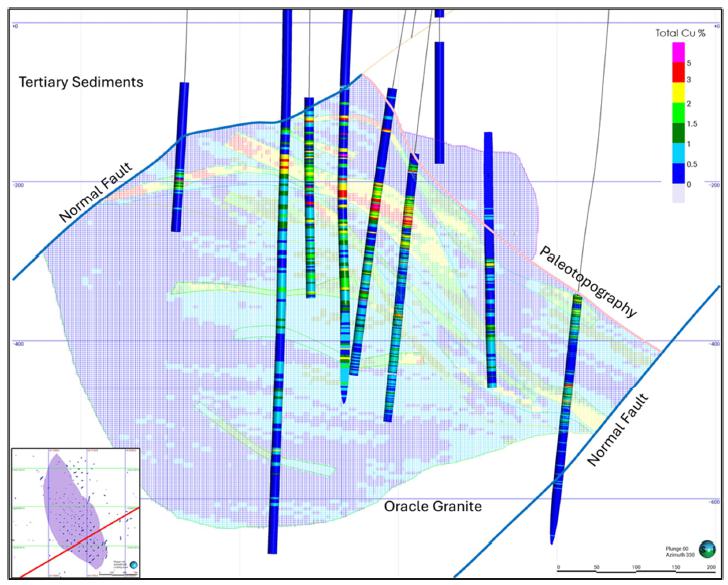
Note: Figure shows cross-section looking northwest, ±50 m width. Source: BBA, 2026.
Figure 11-4: Santa Cruz Block Model Validation with Drillholes & Total Copper Percent
| SEPTEMBER 2026 | 11-20 |
| Ivanhoe Electric Inc. S-K 1300 Preliminary Feasibility Study & | |
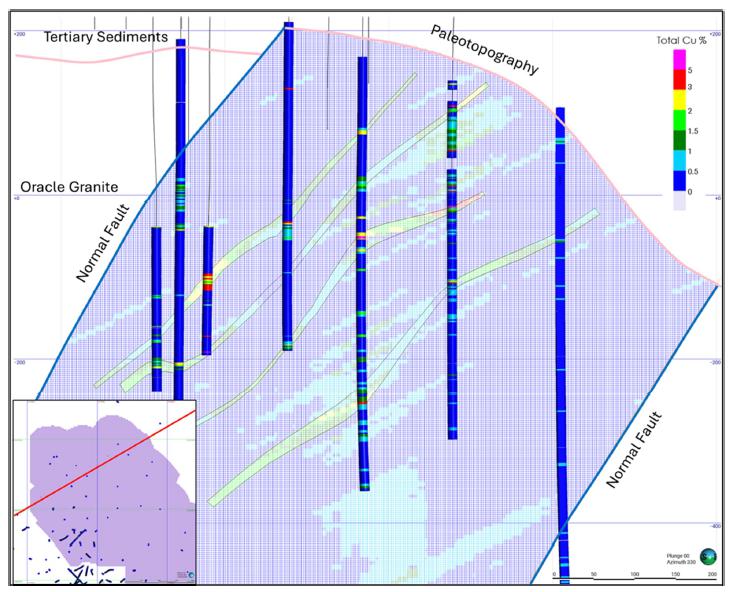
Note: Figure shows cross-section looking northwest, ±50 m width. Source: BBA, 2026.
Figure 11-5: East Ridge Block Model Validation with Drillholes & Total Copper Percent
| SEPTEMBER 2026 | 11-21 |
| Ivanhoe Electric Inc. S-K 1300 Preliminary Feasibility Study & | |
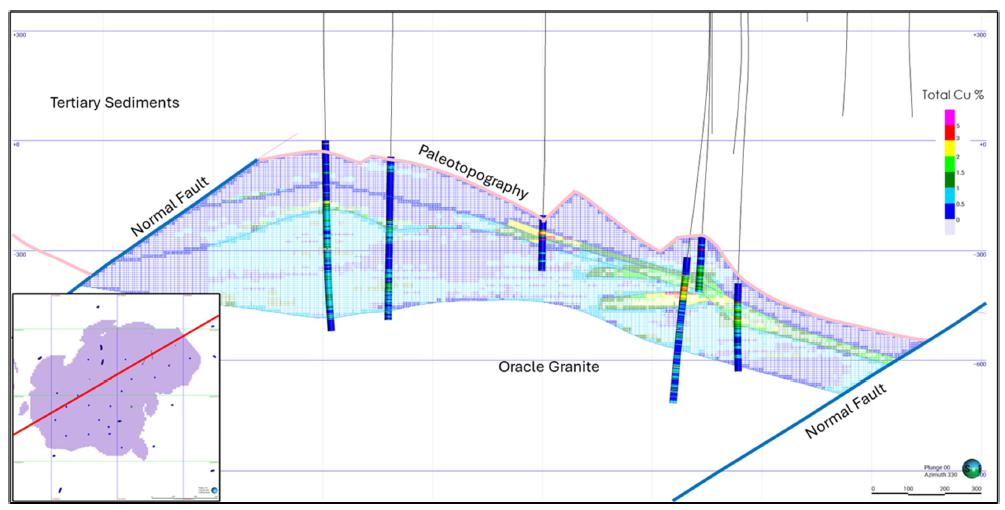
Note: Figure shows cross-section looking northwest, ±50 m width. Source: BBA, 2026.
Figure 11-6: Texaco Block Model Validation of Total Copper Percent
| SEPTEMBER 2026 | 11-22 |
| Ivanhoe Electric Inc. S-K 1300 Preliminary Feasibility Study & | |
| 11.5.3 | Swath Plots |
A series of swath plots were generated for total copper, acid-soluble copper, and cyanide-soluble copper from slices throughout each deposit for various domains. They compare the block model grades for NN, ID2, ID3, and OK to the drillhole composite grades to evaluate potential local grade bias. A review of the swath plots did not identify bias in the model that is material to the Mineral Resource estimate. Figure 11-7 shows a swath plot for Santa Cruz high-grade oxide domain total copper as an example.
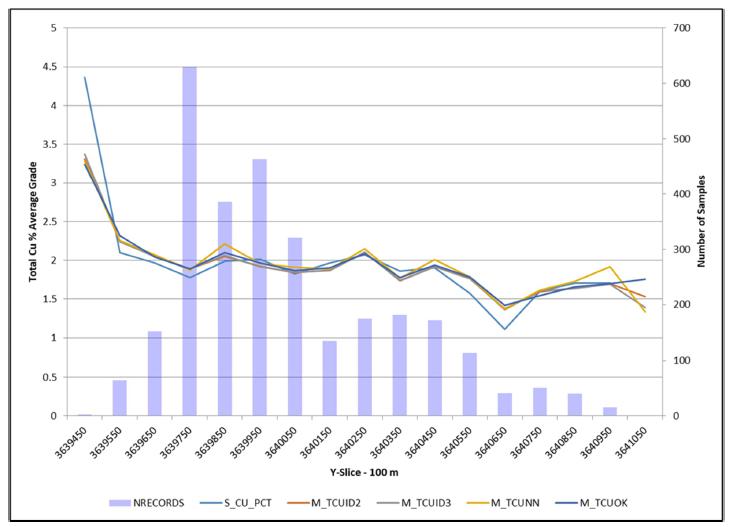
Source: BBA, 2026. Note: S_CU_PCT is sample total copper grade, M_TCUID2 is the estimated ID2 total copper grade, M_TCUID3 is the estimated ID3 total copper grade, M_TCUNN is the estimated NN total copper grade, and M_TCUOK is the estimated OK total copper grade.
Figure 11-7: Santa Cruz High-Grade Oxide Domain Swath Plot, Total Copper % in Y-Direction
| SEPTEMBER 2026 | 11-23 |
| Ivanhoe Electric Inc. S-K 1300 Preliminary Feasibility Study & | |
| 11.6 | Mineral Resource Classification |
The Mineral Resource estimate was classified in accordance with S-K 1300 definitions. Mineral Resource classifications were assigned to broad regions of the block model based on BBA’s confidence and judgment related to geological understanding, continuity of mineralization in conjunction with data quality, spatial continuity based on variography, estimation parameters, data density, and block model representativeness.
Indicated and Inferred classifications were applied to Santa Cruz, East Ridge, and Texaco based on a full review that included the examination of drill spacing, visual comparison, kriging variance, distance to the nearest composite, and search volume estimation (the estimation pass in which each block was populated) along with the search ellipsoid ranges. Collectively, this information was used to produce an initial classification script followed by manual wireframe application to further limit the Mineral Resource classification (Figure 11-8).
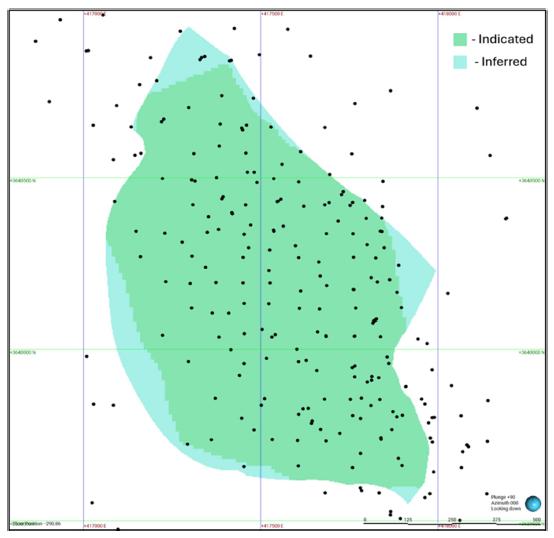
Source: BBA, 2026.
Figure 11-8: Plan View of Resource Classification for Santa Cruz with Indicated & Inferred Classifications & Drill Collar Locations
| SEPTEMBER 2026 | 11-24 |
| Ivanhoe Electric Inc. S-K 1300 Preliminary Feasibility Study & | |
Uncertainties that could affect the Mineral Resource estimates include historical assay instrument precision, historical geological logging data quality, and changes to the structural model. The Indicated Mineral Resource is supported by significant modern drilling, reducing the uncertainty due to historical drill and assay data. The Inferred Mineral Resource lacks the level of geologic confidence due to the uncertainty in areas of limited geological information.
Most of the first search pass results were classified as Indicated, while the second search pass results were evaluated with further criteria, including a kriging variance of 0.65 or less as well as geological confidence. The Indicated Mineral Resource has an average drillhole spacing of 60 m. Small, internal zones of Inferred results within large swaths of Indicated results were not broken out, as these represent noise. The third search pass results are classified as Inferred, as they represent estimates beyond the modeled spatial continuity of the values.
While most of the East Ridge deposit is classified as Inferred, there is a small portion of Indicated Mineral Resource where dense infill and validation drilling was completed in recent campaigns. The Indicated Mineral Resource has an average drillhole spacing of 65 m.
The Texaco deposit is classified as Inferred, as the area is defined by historical drilling which has yet to be validated with modern drilling with >150 m spacing.
| 11.7 | Commodity Pricing |
Mineral Resources used commodity prices based on long-term analyst and bank forecasts. In the opinion of BBA, this price is generally aligned with pricing over the last one, three, and five years; forward-looking pricing from internationally recognized banks is appropriate for use in a resource estimate. Section 16 provides an explanation of the commodity price forecasts. The commodity price considered three-year trailing averages.
| 11.8 | Reasonable Prospects of Economic Extraction |
The Mineral Resources were estimated using Datamine to create the block models for the Santa Cruz, Texaco, and East Ridge deposits, and Deswik.CAD 2024.1 and Deswik.SO 5.1 software to create reasonable mineable shapes.
To demonstrate reasonable prospects for economic extraction for the Santa Cruz, East Ridge, and Texaco Mineral Resource estimates, representative minimum mining unit shapes were created using Deswik’s mineable stope optimizer (“MSO”) tool. This MSO tool constrains and evaluates the block model based on economic and geometric parameters (Table 11-11), thereby generating potentially mineable shapes.
| SEPTEMBER 2026 | 11-25 |
| Ivanhoe Electric Inc. S-K 1300 Preliminary Feasibility Study & | |
The Santa Cruz deposit was assumed to be developed as a long-life operation consisting of an underground longhole stoping plan with some drift and fill, and an initial mining rate of 20,000 t/d to produce a copper concentrate. East Ridge was assumed to be a longhole stoping plan at 3,500 t/d, while the Texaco deposit was assumed to be a longhole stoping plan at 7,000 t/d.
| SEPTEMBER 2026 | 11-26 |
| Ivanhoe Electric Inc. S-K 1300 Preliminary Feasibility Study & | |
Table 11-11: Input Parameter Assumptions
| Criteria | Unit | Santa
Cruz 20,000 t/d |
Santa
Cruz 20,000 t/d |
East
Ridge Exotic 340 to 590 t/d |
East
Ridge 3,500 t/d |
Texaco 7,000 t/d |
Texaco 7,000 t/d |
| 30 m Longhole | 30 m Longhole | 6 m
X 9 m Drift and Fill |
15 m Longhole | 30 m Longhole | 30 m Longhole | ||
| Leach | Concentrator | Leach | Leach | Leach | Concentrator | ||
| Cathode Split | % | 100.0 | 0.0 | 100.0 | 100.0 | 100.0 | 0.0 |
| Concentrate Split | % | 0.0 | 100.0 | 0.0 | 0.0 | 0.0 | 100.0 |
| Onsite Costs | |||||||
| Mining Costs – Direct | $/t | 22.00 | 22.00 | 40.00 | 30.00 | 22.00 | 22.00 |
| Processing Costs | $/t | 7.00 | 9.00 | 7.00 | 7.00 | 7.00 | 9.00 |
| General & Administrative | $/t | 2.63 | 2.63 | 2.63 | 2.63 | 2.63 | 2.63 |
| Onsite Total | $/t | 31.63 | 33.63 | 49.63 | 39.63 | 31.63 | 33.63 |
| Rounded NSR Cutoff | $/t | 32.00 | 34.00 | 50.00 | 40.00 | 32.00 | 34.00 |
| Copper Equivalent | % | 0.40 | 0.43 | 0.62 | 0.49 | 0.40 | 0.43 |
| SEPTEMBER 2026 | 11-27 |
| Ivanhoe Electric Inc. S-K 1300 Preliminary Feasibility Study & | |
The Mineral Resource is comprised of all material found within the MSO wireframes generated for Santa Cruz at a cutoff of $32.00 net smelter return (“NSR”) per tonne processed heap leach and $34.00 NSR for concentrator longhole stoping, $40.00 NSR cutoff for East Ridge longhole stoping, and $50.00 for drift and fill, $32.00 NSR copper cutoff for heap leach, and $34.00 for concentrator for Texaco longhole stoping.
Input assumptions per processing method are detailed in Table 11-12. Gold and silver are reported as possible commodities based on flotation testwork, as other processing techniques may be incorporated at the Project.
Table 11-12: Smelting Terms – Copper Concentrate Input Assumptions
| Description | Unit | Value |
| Treatment Charge | $/t | 80.00 |
| Copper Refining | $/lbs payable | 0.08 |
| Copper Payable Chalcocite Concentrate | % | 90.1 |
| Copper Payable Chalcopyrite Concentrate | % | 96.2 |
| Copper Deduction (Concentrate <30%) | % | 0.0 |
| Copper Concentrate Losses | % | 0.2 |
| Gold Payable | % | 92.0 |
| Silver Payable | % | 90.0 |
| Gold Deduction | g/t | 1.00 |
| Silver Deduction | g/t | 30.00 |
| 11.9 | Net Smelter Return Cutoff |
The Mineral Resources are reported at an NSR cutoff of $32.00 to $50.00 depending on deposit and type of underground production. The NSR calculation is dependent on mineral processing.
If the acid-soluble copper percentage is greater than 0.05%, the following leach NSR equation is used:

| SEPTEMBER 2026 | 11-28 |
| Ivanhoe Electric Inc. S-K 1300 Preliminary Feasibility Study & | |
If the acid-soluble copper percentage is less than or equal to 0.05%, the following concentrator NSR equation is used:

Where:
“% CNCu” is percent cyanide-soluble copper
“% CuRes” is percent residual copper, or percent total copper minus percent acid-soluble copper minus percent cyanide-soluble copper
“% ASCu” is percent acid-soluble copper
“Au ppb” is parts per billion of gold
“Ag ppm” is parts per million of silver.
Residual copper percent is a calculated value; however, analyses were completed at external laboratories that confirmed the calculated values were similar to the analyzed values.
Copper equivalent grade is calculated as:

| 11.10 | Mineral Resource Estimate |
The Mineral Resource estimate is reported in-situ for the Santa Cruz, East Ridge, and Texaco deposits, including and excluding reserves, in Table 11-13 and Table 11-14. These tables are not additive.
Individual Mineral Resource estimates for the Santa Cruz, East Ridge, and Texaco deposits are presented in Table 11-15, Table 11-16, and Table 11-17, respectively. These tables are not additive.
Figure 11-9 shows the general location and geometry of the three deposits.
| SEPTEMBER 2026 | 11-29 |
| Ivanhoe Electric Inc. S-K 1300 Preliminary Feasibility Study & | |
Table 11-13: In-situ Mineral Resource Estimate Inclusive of Mineral Reserves
for Santa Cruz, East Ridge & Texaco
| Deposit | Classification | Tonnes (kt) |
Total Copper (%) | Acid-soluble Copper (%) | Cyanide Leach Copper (%) | Residual Copper (%) | Gold (g/t) |
Silver (g/t) |
Contained Copper (kt) | Total Acid-soluble Copper (kt) | Total
Cyanide Cu (kt) |
Total
Residual Cu (kt) |
Contained Gold (koz) | Contained Silver (koz) | Contained Copper (Mlbs) |
| Santa Cruz | Indicated | 317,709 | 0.95 | 0.48 | 0.30 | 0.17 | 0.027 | 1.62 | 3,017 | 1,517 | 956 | 543 | 279 | 16,513 | 6,650 |
| Inferred | 31,998 | 0.73 | 0.21 | 0.17 | 0.34 | 0.021 | 1.78 | 232 | 68 | 54 | 110 | 21 | 1,832 | 512 | |
| East Ridge | Indicated | 8,742 | 1.00 | 0.45 | 0.39 | 0.16 | 0.014 | 0.68 | 88 | 40 | 34 | 14 | 4 | 191 | 193 |
| Inferred | 48,676 | 0.89 | 0.44 | 0.12 | 0.33 | 0.006 | 0.40 | 436 | 216 | 57 | 163 | 9 | 623 | 960 | |
| Texaco | Inferred | 341,345 | 0.78 | 0.06 | 0.27 | 0.45 | 0.028 | 0.81 | 2,664 | 218 | 920 | 1,537 | 302 | 8,850 | 5,873 |
| All Deposits | Indicated | 326,450 | 0.95 | 0.48 | 0.30 | 0.17 | 0.027 | 1.59 | 3,104 | 1,557 | 989 | 558 | 283 | 16,704 | 6,844 |
| All Deposits | Inferred | 422,020 | 0.79 | 0.12 | 0.24 | 0.43 | 0.025 | 0.83 | 3,332 | 503 | 1,030 | 1,809 | 333 | 11,304 | 7,346 |
Notes on Mineral Resources:
| 1. | The Mineral Resources in this estimate were independently prepared, including estimation and classification, by BBA Consultants USA LP, and are reported in accordance with the definition for Mineral Resources in S-K 1300. |
| 2. | Mineral Resources that are not Mineral Reserves do not have demonstrated economic viability. |
| 3. | Mineral Resources are reported in-situ, inclusive of Mineral Reserves. |
| 4. | The Mineral Resources for Santa Cruz, East Ridge, and Texaco deposit were completed using Datamine Studio RM™ software. |
| 5. | The Mineral Resources are current at September 23, 2026. |
| 6. | Mineral Resources constrained assuming underground mining methods for the Santa Cruz deposit are reported at an NSR cutoff of US$32.00 for heap leach and US$34.00 for concentrator; Texaco deposit is reported at an NSR cutoff of US$32.00 for heap leach and US$34.00 for concentrator; and East Ridge deposit is reported at an NSR cutoff of US$40.00 for longhole stoping and US$50.00 for drift-and-fill. The cutoff reflects the total operating costs to define reasonable prospects for economic extraction by conventional underground mining methods. Material from within mineable shape-optimized wireframes has been included in the Mineral Resource. Underground mineable shapes optimization parameters include a long-term copper price of US$4.00/lb, gold price of US$1,900/oz, and silver price of US$24.00/oz. Process costs of US$7.00 to US$9.00 per processed tonne; direct mining costs between US$22.00 to US$40.00 per processed tonne reflecting various mining method costs (leach, longhole or drift-and-fill), mining general and administration costs of US$2.63 per processed tonne, onsite processing costs between US$31.63 to US$49.63 per processed tonne, along with variable royalties between 5.01% to 6.96% NSR, and a mining recovery of 100%. |
| 7. | Mineral Resources are estimated using metallurgical recoveries for heap leach of 96% for acid-soluble copper, 83% for cyanide-soluble copper, 22% for residual copper, 0% for gold and 0% for silver. Recoveries for concentrator are 0% for acid-soluble copper, 90% for cyanide-soluble copper, 90% for residual copper, 59% for gold and 69% for silver. |
| 8. | Density was applied using weighted averages by deposit subdomain. |
| 9. | Rounding as required by reporting guidelines may result in apparent summation differences between tonnes, grade, and contained metal content. |
| SEPTEMBER 2026 | 11-30 |
| Ivanhoe Electric Inc. S-K 1300 Preliminary Feasibility Study & | |
Table 11-14: In-situ Mineral Resource Estimate Exclusive of Mineral Reserves for Santa Cruz, East Ridge & Texaco
| Deposit | Classification | Tonnes
(kt) |
Total Copper (%) | Acid-soluble Copper (%) | Cyanide Leach Copper (%) | Residual Copper (%) | Gold (g/t) |
Silver (g/t) |
Contained Copper (kt) | Total Acid-soluble Cu (kt) | Total
Cyanide Cu (kt) |
Total
Residual Cu (kt) |
Contained Gold (koz) | Contained Silver (koz) | Contained Copper (Mlbs) |
| Santa Cruz | Indicated | 177,572 | 0.79 | 0.32 | 0.20 | 0.27 | 0.025 | 1.45 | 1,403 | 570 | 362 | 471 | 140 | 8,279 | 3,092 |
| Inferred | 31,998 | 0.73 | 0.21 | 0.17 | 0.34 | 0.021 | 1.78 | 232 | 68 | 54 | 110 | 21 | 1,832 | 512 | |
| East Ridge | Indicated | 4,412 | 0.94 | 0.43 | 0.31 | 0.20 | 0.015 | 0.71 | 41 | 19 | 14 | 9 | 2 | 101 | 91 |
| Inferred | 48,676 | 0.89 | 0.44 | 0.12 | 0.33 | 0.006 | 0.40 | 436 | 216 | 57 | 163 | 9 | 623 | 960 | |
| Texaco | Inferred | 341,345 | 0.78 | 0.06 | 0.27 | 0.45 | 0.028 | 0.81 | 2,664 | 218 | 920 | 1,537 | 302 | 8,850 | 5,873 |
| All Deposits | Indicated | 181,984 | 0.79 | 0.32 | 0.21 | 0.26 | 0.024 | 1.43 | 1,444 | 589 | 376 | 480 | 143 | 8,380 | 3,184 |
| All Deposits | Inferred | 422,020 | 0.79 | 0.12 | 0.24 | 0.43 | 0.025 | 0.83 | 3,332 | 503 | 1,030 | 1,809 | 333 | 11,304 | 7,346 |
Notes on Mineral Resources:
| 1. | The Mineral Resources in this estimate were independently prepared, including estimation and classification, by BBA Consultants USA LP, and are reported in accordance with the definition for Mineral Resources in S-K 1300. |
| 2. | Mineral Resources that are not Mineral Reserves do not have demonstrated economic viability. |
| 3. | Mineral Resources are reported in-situ, exclusive of Mineral Reserves. |
| 4. | The Mineral Resources for Santa Cruz, East Ridge, and Texaco deposit were completed using Datamine Studio RM™ software. |
| 5. | The Mineral Resources are current at September 23, 2026. |
| 6. | Mineral Resources constrained assuming underground mining methods for the Santa Cruz deposit are reported at an NSR cutoff of US$32.00 for heap leach and US$34.00 for concentrator; Texaco deposit is reported at an NSR cutoff of US$32.00 for heap leach and US$34.00 for concentrator; and East Ridge deposit is reported at an NSR cutoff of US$40.00 for longhole stoping and US$50.00 for drift-and-fill. The cutoff reflects the total operating costs to define reasonable prospects for economic extraction by conventional underground mining methods. Material from within mineable shape-optimized wireframes has been included in the Mineral Resource. Underground mineable shapes optimization parameters include a long-term copper price of US$4.00/lb, gold price of US$1,900/oz, and silver price of US$24.00/oz. Process costs of US$7.00 to US$9.00 per processed tonne; direct mining costs between US$22.00 to US$40.00 per processed tonne reflecting various mining method costs (leach, longhole or drift-and-fill), mining general and administration costs of US$2.63 per processed tonne, onsite processing costs between US$31.63 to US$49.63 per processed tonne, along with variable royalties between 5.01% to 6.96% NSR, and a mining recovery of 100%. |
| 7. | Mineral Resources are estimated using metallurgical recoveries for heap leach of 96% for acid-soluble copper, 83% for cyanide-soluble copper, 22% for residual copper, 0% for gold and 0% for silver. Recoveries for concentrator are 0% for acid-soluble copper, 90% for cyanide-soluble copper, 90% for residual copper, 59% for gold and 69% for silver. |
| 8. | Density was applied using weighted averages by deposit subdomain. |
| 9. | Rounding as required by reporting guidelines may result in apparent summation differences between tonnes, grade, and contained metal content. |
| SEPTEMBER 2026 | 11-31 |
| Ivanhoe Electric Inc. S-K 1300 Preliminary Feasibility Study & | |
Table 11-15: In-situ Santa Cruz Deposit Mineral Resource Estimate Exclusive of Reserves
| Classification | Domain | Tonnes
(kt) |
Total Copper (%) | Acid-soluble Copper (%) | Cyanide Leach Copper (%) | Residual Copper (%) | Gold (g/t) |
Silver (g/t) |
Contained Copper (kt) | Total Acid-soluble Cu (kt) | Total
Cyanide Cu (kt) |
Total
Residual Cu (kt) |
Contained Gold (koz) | Contained Silver (koz) | Contained Copper (Mlbs) |
| Indicated | Exotic | 7,237 | 0.85 | 0.71 | 0.07 | 0.06 | 0.002 | 0.01 | 61 | 52 | 5 | 4 | 1 | 2 | 135 |
| Verde | 1,690 | 1.88 | 1.44 | 0.36 | 0.09 | 0.046 | 1.39 | 32 | 24 | 6 | 2 | 2 | 76 | 70 | |
| Leach Cap | 6,385 | 0.78 | 0.61 | 0.02 | 0.16 | 0.011 | 0.29 | 50 | 39 | 1 | 10 | 2 | 59 | 110 | |
| Oxide | 61,299 | 0.83 | 0.64 | 0.16 | 0.03 | 0.028 | 1.35 | 510 | 394 | 96 | 20 | 54 | 2,661 | 1,124 | |
| Chalcocite | 27,107 | 0.78 | 0.12 | 0.56 | 0.09 | 0.025 | 1.93 | 211 | 33 | 153 | 25 | 22 | 1,683 | 466 | |
| Primary | 73,830 | 0.73 | 0.04 | 0.14 | 0.55 | 0.025 | 1.60 | 538 | 27 | 101 | 410 | 59 | 3,797 | 1,186 | |
| Total | 177,547 | 0.79 | 0.32 | 0.20 | 0.27 | 0.025 | 1.45 | 1,403 | 570 | 362 | 471 | 140 | 8,279 | 3,092 | |
| Inferred | Exotic | 137 | 0.61 | 0.55 | 0.01 | 0.05 | 0.003 | 0.01 | 1 | 1 | 0 | 0 | 0 | 0 | 2 |
| Verde | 1 | 0.00 | 0.00 | 0.00 | 0.00 | 0.000 | 0.00 | 0 | 0 | 0 | 0 | 0 | 0 | 0 | |
| Leach Cap | 212 | 0.65 | 0.48 | 0.01 | 0.16 | 0.005 | 0.25 | 1 | 1 | 0 | 0 | 0 | 2 | 3 | |
| Oxide | 10,653 | 0.76 | 0.54 | 0.22 | 0.00 | 0.026 | 1.40 | 81 | 58 | 23 | 0 | 9 | 479 | 179 | |
| Chalcocite | 1,740 | 0.76 | 0.14 | 0.54 | 0.08 | 0.019 | 1.43 | 13 | 2 | 9 | 1 | 1 | 80 | 29 | |
| Primary | 19,256 | 0.70 | 0.03 | 0.11 | 0.56 | 0.018 | 2.05 | 136 | 6 | 21 | 108 | 11 | 1,272 | 299 | |
| Total | 31,998 | 0.73 | 0.21 | 0.17 | 0.34 | 0.021 | 1.78 | 232 | 68 | 54 | 110 | 21 | 1,832 | 512 |
Notes on Mineral Resources:
| 1. | The Mineral Resources in this estimate were independently prepared, including estimation and classification, by BBA Consultants USA LP, and are reported in accordance with the definition for Mineral Resources in S-K 1300. |
| 2. | Mineral Resources that are not Mineral Reserves do not have demonstrated economic viability. |
| 3. | Mineral Resources are reported in-situ, exclusive of Mineral Reserves. |
| 4. | The Mineral Resources for Santa Cruz, East Ridge, and Texaco deposit were completed using Datamine Studio RM™ software. |
| 5. | The Mineral Resources are current at September 23, 2026. |
| 6. | Mineral Resources constrained assuming underground mining methods for the Santa Cruz deposit are reported at an NSR cutoff of US$32.00 for heap leach and US$34.00 for concentrator; Texaco deposit is reported at an NSR cutoff of US$32.00 for heap leach and US$34.00 for concentrator; and East Ridge deposit is reported at an NSR cutoff of US$40.00 for longhole stoping and US$50.00 for drift-and-fill. The cutoff reflects the total operating costs to define reasonable prospects for economic extraction by conventional underground mining methods. Material from within mineable shape-optimized wireframes has been included in the Mineral Resource. Underground mineable shapes optimization parameters include a long-term copper price of US$4.00/lb, gold price of US$1,900/oz, and silver price of US$24.00/oz. Process costs of US$7.00 to US$9.00 per processed tonne; direct mining costs between US$22.00 to US$40.00 per processed tonne reflecting various mining method costs (leach, longhole or drift-and-fill), mining general and administration costs of US$2.63 per processed tonne, onsite processing costs between US$31.63 to US$49.63 per processed tonne, along with variable royalties between 5.01% to 6.96% NSR, and a mining recovery of 100%. |
| 7. | Mineral Resources are estimated using metallurgical recoveries for heap leach of 96% for acid-soluble copper, 83% for cyanide-soluble copper, 22% for residual copper, 0% for gold and 0% for silver. Recoveries for concentrator are 0% for acid-soluble copper, 90% for cyanide-soluble copper, 90% for residual copper, 59% for gold and 69% for silver. |
| 8. | Density was applied using weighted averages by deposit subdomain. |
| 9. | Rounding as required by reporting guidelines may result in apparent summation differences between tonnes, grade, and contained metal content. |
| SEPTEMBER 2026 | 11-32 |
| Ivanhoe Electric Inc. S-K 1300 Preliminary Feasibility Study & | |
Table 11-16: In-situ East Ridge Deposit Mineral Resource Estimate Exclusive of Reserves
| Classification | Domain | Tonnes
(kt) |
Total Copper (%) | Acid-soluble Copper (%) | Cyanide Leach Copper (%) | Residual Copper (%) | Gold (g/t) |
Silver (g/t) |
Contained Copper (kt) | Total Acid-soluble Cu (kt) | Total
Cyanide Cu (kt) |
Total
Residual Cu (kt) |
Contained Gold (koz) | Contained Silver (koz) | Contained Copper (Mlbs) |
| Indicated | Oxide | 4,412 | 0.94 | 0.43 | 0.31 | 0.20 | 0.015 | 0.71 | 41 | 19 | 14 | 9 | 2 | 101 | 91 |
| Total | 4,412 | 0.94 | 0.43 | 0.31 | 0.20 | 0.015 | 0.71 | 41 | 19 | 14 | 9 | 2 | 101 | 91 | |
| Inferred | Exotic | 8,557 | 0.94 | 0.34 | 0.02 | 0.57 | 0.003 | 0.16 | 80 | 29 | 2 | 49 | 1 | 45 | 177 |
| Oxide | 40,120 | 0.89 | 0.47 | 0.14 | 0.28 | 0.007 | 0.45 | 355 | 187 | 55 | 113 | 9 | 577 | 784 | |
| Total | 48,676 | 0.89 | 0.44 | 0.12 | 0.33 | 0.006 | 0.40 | 436 | 216 | 57 | 163 | 9 | 623 | 960 |
Notes on Mineral Resources:
| 1. | The Mineral Resources in this estimate were independently prepared, including estimation and classification, by BBA Consultants USA LP, and are reported in accordance with the definition for Mineral Resources in S-K 1300. |
| 2. | Mineral Resources that are not Mineral Reserves do not have demonstrated economic viability. |
| 3. | Mineral Resources are reported in-situ, exclusive of Mineral Reserves. |
| 4. | The Mineral Resources for Santa Cruz, East Ridge, and Texaco deposit were completed using Datamine Studio RM™ software. |
| 5. | The Mineral Resources are current at September 23, 2026. |
| 6. | Mineral Resources constrained assuming underground mining methods for the Santa Cruz deposit are reported at an NSR cutoff of US$32.00 for heap leach and US$34.00 for concentrator; Texaco deposit is reported at an NSR cutoff of US$32.00 for heap leach and US$34.00 for concentrator; and East Ridge deposit is reported at an NSR cutoff of US$40.00 for longhole stoping and US$50.00 for drift-and-fill. The cutoff reflects the total operating costs to define reasonable prospects for economic extraction by conventional underground mining methods. Material from within mineable shape-optimized wireframes has been included in the Mineral Resource. Underground mineable shapes optimization parameters include a long-term copper price of US$4.00/lb, gold price of US$1,900/oz, and silver price of US$24.00/oz. Process costs of US$7.00 to US$9.00 per processed tonne; direct mining costs between US$22.00 to US$40.00 per processed tonne reflecting various mining method costs (leach, longhole or drift-and-fill), mining general and administration costs of US$2.63 per processed tonne, onsite processing costs between US$31.63 to US$49.63 per processed tonne, along with variable royalties between 5.01% to 6.96% NSR, and a mining recovery of 100%. |
| 7. | Mineral Resources are estimated using metallurgical recoveries for heap leach of 96% for acid-soluble copper, 83% for cyanide-soluble copper, 22% for residual copper, 0% for gold and 0% for silver. Recoveries for concentrator are 0% for acid-soluble copper, 90% for cyanide-soluble copper, 90% for residual copper, 59% for gold and 69% for silver. |
| 8. | Density was applied using weighted averages by deposit subdomain. |
| 9. | Rounding as required by reporting guidelines may result in apparent summation differences between tonnes, grade, and contained metal content. |
| SEPTEMBER 2026 | 11-33 |
| Ivanhoe Electric Inc. S-K 1300 Preliminary Feasibility Study & | |
Table 11-17: In-situ Texaco Deposit Mineral Resource Estimate
| Classification | Domain | Tonnes
(kt) |
Total Copper (%) | Acid-soluble Copper (%) | Cyanide Leach Copper (%) | Residual Copper (%) | Gold (g/t) |
Silver (g/t) |
Contained Copper (kt) | Total Acid-soluble Cu (kt) | Total
Cyanide Cu (kt) |
Total
Residual Cu (kt) |
Contained Gold (koz) | Contained Silver (koz) | Contained Copper (Mlbs) |
| Inferred | Oxide | 31,329 | 0.62 | 0.48 | 0.17 | 0.00 | 0.020 | 0.54 | 193 | 150 | 53 | 0 | 20 | 546 | 426 |
| Chalcocite | 74,873 | 0.96 | 0.06 | 0.71 | 0.19 | 0.010 | 0.71 | 717 | 47 | 529 | 141 | 25 | 1,719 | 1,580 | |
| Primary | 235,143 | 0.75 | 0.01 | 0.14 | 0.59 | 0.032 | 0.90 | 1,754 | 21 | 338 | 1,395 | 245 | 6,826 | 3,867 | |
| Total | 341,345 | 0.78 | 0.06 | 0.27 | 0.45 | 0.028 | 0.81 | 2,664 | 218 | 920 | 1,537 | 302 | 8,850 | 5,873 |
Notes on Mineral Resources:
| 1. | The Mineral Resources in this estimate were independently prepared, including estimation and classification, by BBA Consultants USA LP, and are reported in accordance with the definition for Mineral Resources in S-K 1300. |
| 2. | Mineral Resources that are not Mineral Reserves do not have demonstrated economic viability. |
| 3. | Mineral Resources are reported in-situ, exclusive of Mineral Reserves. |
| 4. | The Mineral Resources for Santa Cruz, East Ridge, and Texaco deposit were completed using Datamine Studio RM™ software. |
| 5. | The Mineral Resources are current at September 23, 2026. |
| 6. | Mineral Resources constrained assuming underground mining methods for the Santa Cruz deposit are reported at an NSR cutoff of US$32.00 for heap leach and US$34.00 for concentrator; Texaco deposit is reported at an NSR cutoff of US$32.00 for heap leach and US$34.00 for concentrator; and East Ridge deposit is reported at an NSR cutoff of US$40.00 for longhole stoping and US$50.00 for drift-and-fill. The cutoff reflects the total operating costs to define reasonable prospects for economic extraction by conventional underground mining methods. Material from within mineable shape-optimized wireframes has been included in the Mineral Resource. Underground mineable shapes optimization parameters include a long-term copper price of US$4.00/lb, gold price of US$1,900/oz, and silver price of US$24.00/oz. Process costs of US$7.00 to US$9.00 per processed tonne; direct mining costs between US$22.00 to US$40.00 per processed tonne reflecting various mining method costs (leach, longhole or drift-and-fill), mining general and administration costs of US$2.63 per processed tonne, onsite processing costs between US$31.63 to US$49.63 per processed tonne, along with variable royalties between 5.01% to 6.96% NSR, and a mining recovery of 100%. |
| 7. | Mineral Resources are estimated using metallurgical recoveries for heap leach of 96% for acid-soluble copper, 83% for cyanide-soluble copper, 22% for residual copper, 0% for gold and 0% for silver. Recoveries for concentrator are 0% for acid-soluble copper, 90% for cyanide-soluble copper, 90% for residual copper, 59% for gold and 69% for silver. |
| 8. | Density was applied using weighted averages by deposit subdomain. |
| 9. | Rounding as required by reporting guidelines may result in apparent summation differences between tonnes, grade, and contained metal content. |
| SEPTEMBER 2026 | 11-34 |
| Ivanhoe Electric Inc. S-K 1300 Preliminary Feasibility Study & | |
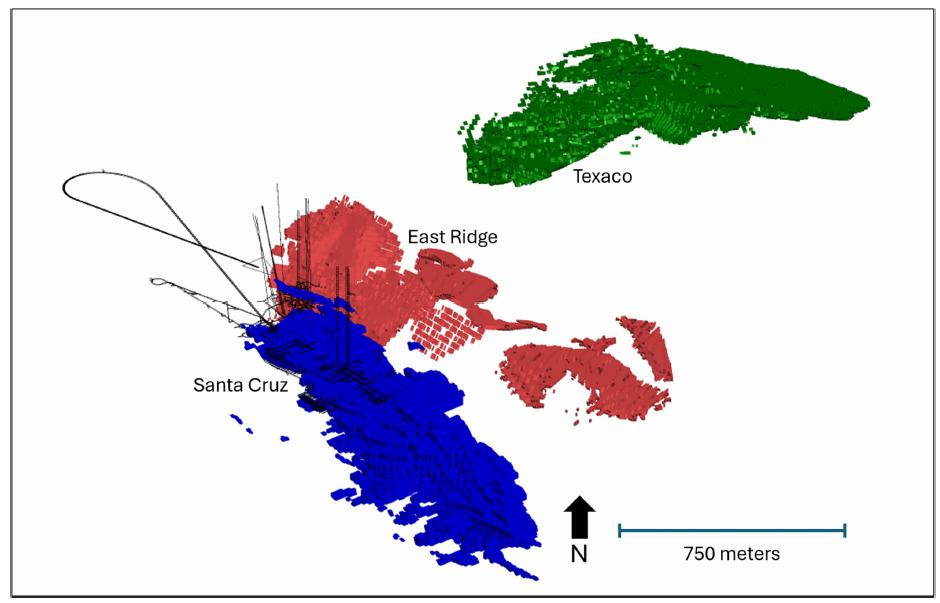
Source: Ivanhoe Electric, 2026
Figure 11-9: Oblique View of Santa Cruz, East Ridge & Texaco Resources
| SEPTEMBER 2026 | 11-35 |
| Ivanhoe Electric Inc. S-K 1300 Preliminary Feasibility Study & | |
| 11.11 | Mineral Resource Sensitivity to Reporting Cutoff |
The sensitivity of the Santa Cruz, East Ridge, and Texaco Mineral Resource estimates to copper (%) cutoff is summarized in Figure 11-10 and Figure 11-11 across all interpolation methods. The resource cutoff uses NSR, but copper equivalent cutoffs can be used for comparison.
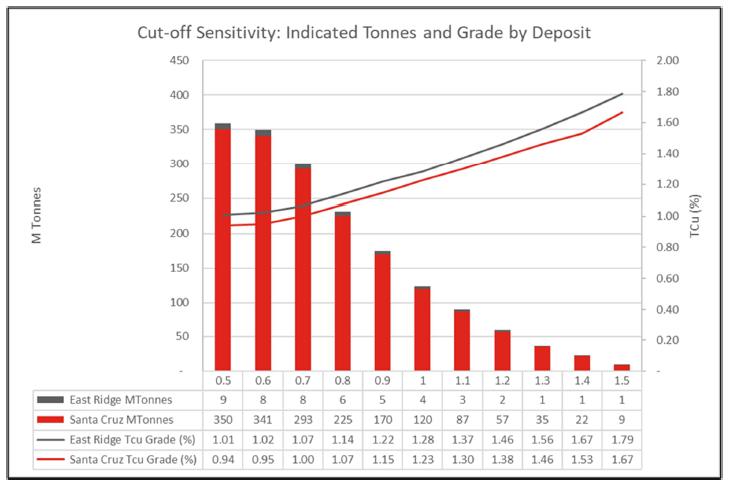
Note: Texaco resources are classified as Inferred, and therefore not present. Source: Ivanhoe Electric, 2026.
Figure 11-10: Copper Cutoff Sensitivity for Santa Cruz & East Ridge – Indicated Tonnes & Grade
| SEPTEMBER 2026 | 11-36 |
| Ivanhoe Electric Inc. S-K 1300 Preliminary Feasibility Study & | |
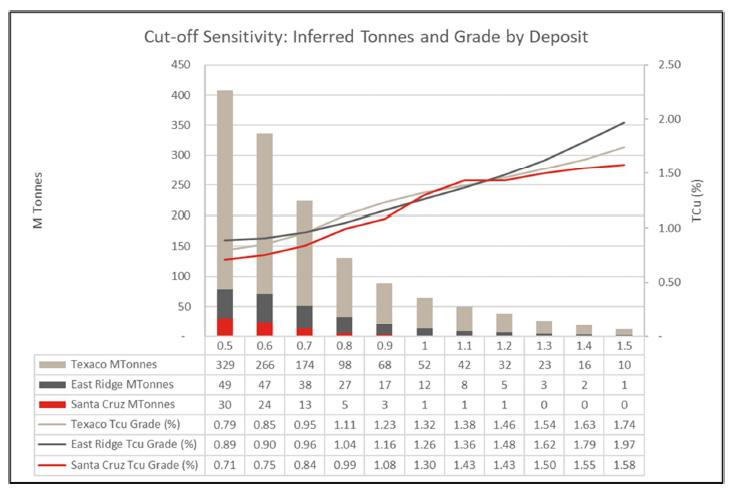
Source: Ivanhoe Electric, 2026.
Figure 11-11: Copper Cutoff Sensitivity for Santa Cruz, East Ridge & Texaco – Inferred Tonnes & Grade
| 11.12 | Differences in Resource Model Iterations |
The current resource model iterations have not changed when compared to the iterations released in the 2025 PFS. Differences presented in Mineral Resources Exclusive of Mineral Reserves are due to the addition of stopes at the top of the mine.
| 11.13 | Factors That May Affect Mineral Resources |
Areas of uncertainty that may materially impact the Mineral Resource estimates are as follows:
| ■ | Changes to long-term metal price assumptions; |
| ■ | Changes to the input values for mining, processing, and general and administrative (“G&A”) costs to constrain the estimate; |
| SEPTEMBER 2026 | 11-37 |
| Ivanhoe Electric Inc. S-K 1300 Preliminary Feasibility Study & | |
| ■ | Changes to local interpretations of mineralization geometry and continuity of mineralized subdomains; |
| ■ | Changes to the density values applied to the mineralized zones; |
| ■ | Changes to metallurgical recovery assumptions; |
| ■ | Changes in assumptions of marketability of the final product; |
| ■ | Variations in geotechnical, hydrogeological, and mining assumptions; |
| ■ | Changes to assumptions with an existing agreement or new agreements; |
| ■ | Changes to environmental, permitting, and social license assumptions; |
| ■ | Logistics of securing and moving adequate services, labor, and supplies could be affected by epidemics, pandemics, and other public health crises, or geopolitical influence. |
| 11.14 | BBA Opinion |
BBA is not aware of any environmental, legal, title, taxation, socioeconomic, marketing, or other relevant factors that would materially affect the estimation of Mineral Resources that are not discussed in this report.
BBA is of the opinion that the Mineral Resources for the Project, which were estimated using industry-accepted practices, have been prepared and reported using S-K 1300 definitions.
Technical and economic parameters and assumptions applied to the Mineral Resource Estimate are based on parameters received from Ivanhoe Electric and reviewed within the BBA technical team to determine if they were appropriate. All issues relating to all relevant technical and economic factors likely to influence the prospect of economic extraction can be resolved with further work.
| SEPTEMBER 2026 | 11-38 |
| Ivanhoe Electric Inc. S-K 1300 Preliminary Feasibility Study & | |
| 12. | Mineral Reserve Estimate |
| 12.1 | Basis of Estimate |
Underground Mineral Reserves were estimated by BBA. Estimates were prepared for the Santa Cruz deposit, a portion of the East Ridge deposit, and the Verde domain located within the Santa Cruz deposit. The primary mining method for both deposits employs longhole stoping without pillars, utilizing a primary and secondary stoping sequence. Additionally, a few small lenses within the East Ridge deposit use a drift-and-fill mining method. Stopes will be backfilled with paste backfill for the entire mine life. Indicated Mineral Resources were converted to Probable Mineral Reserves. Inferred Mineral Resources were not converted to Mineral Reserves; however, if Inferred Mineral Resources fell within the Mineral Reserve designs, they were assumed to have zero grade.
| 12.2 | Underground Mine Estimates |
Mineral Reserve estimates are based on the Mineral Resource 3D block models. Stope shapes were created based on individual zone and lens geometry. Each mining region has a distinct approach and is divided into smaller mining areas. There are two primary stoping methods used: transverse and longitudinal, along with one drifting method known as drift-and-fill. These methods are selected based on the thickness of the ore body and the available access routes. The majority of the ore extracted will be mined using the transverse method as discussed in Section 13.9, Mine Design.
The Mineral Reserve stopes were designed using Deswik Stope Optimizer (“DSO”) software. The stope optimization process was guided by economic prospectivity and geotechnical parameters specific to the rock type, the orebody orientation and regions, and the mining sequence. The initial DSO runs were conducted with no recovery and no dilution applied. Recovery and dilution factors were applied after the stopes were generated to calculate the final tonnes and grade of the reserves. Mining recovery and dilution are discussed in Section 13.
Based on engineering considerations, lower grade blocks may be included in stope designs if their development is proposed in conjunction with other blocks. While low-grade blocks do not warrant the required development, they are considered economically viable if developed in conjunction with the other blocks. Similarly, evaluation of extraction method or ground conditions may result in lower-grade blocks being included in the Mineral Reserve estimate.
| SEPTEMBER 2026 | 12-1 |
| Ivanhoe Electric Inc. S-K 1300 Preliminary Feasibility Study & | |
| 12.2.1 | Santa Cruz |
The mining approach for the Santa Cruz region involves bulk mining. The stopes vary in size between the North and South zones and by domain (Table 12-1 and Figure 12-1).
Table 12-1: Summary of Stope Sizes by Domain & Sequence
| Domains | Geotechnical Region | Primary
/ Secondary (Height x Width x Length) |
| Chalcocite | North | P: 30 m x 12 m x 17 m S: 30 m x 15 m x 20 m |
| South | P: 30 m x 15 m x 23 m S: 30 m x 18 m x 25 m | |
| Oxide | North | P: 30 m x 12 m x 13 m S: 30 m x 15 m x 15 m |
| South | P: 30 m x 15 m x 15 m S: 30 m x 18 m x 17 m |
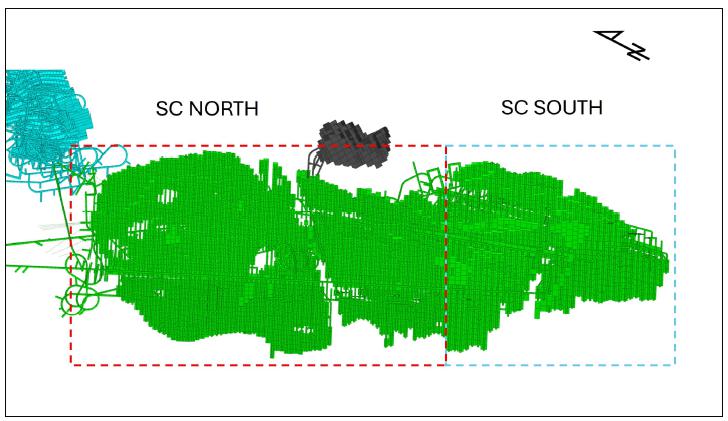
Source: Ivanhoe Electric, 2026
Figure 12-1: Santa Cruz North-South Divide
| SEPTEMBER 2026 | 12-2 |
| Ivanhoe Electric Inc. S-K 1300 Preliminary Feasibility Study & | |
The region is divided into several mining areas: Blocks 2, 3, and 4 (see Figure 12-2). Block 4 serves as a sill pillar, separating Blocks 2 and 3 (due to changes in the mine plan development, Block 1 was incorporated into Block 2). The primary mining method is transverse downhole stoping, executed in a primary-secondary sequence, with selective uphole stopes. Transverse stoping offers greater flexibility in drilling patterns, improved visibility of drawpoints, and enhanced ore recovery. Although this method typically requires more waste development to access multiple fronts, in Santa Cruz the main level haulage drifts and stope accesses will be developed within the orebody itself.
The main haulage drift will run parallel to the orebody, while stope access drives are oriented perpendicular from the hanging wall to the footwall. Production stoping will occur simultaneously at multiple locations on either side of the main haulage drift. In areas where only bottom sill access is available, uphole drilling will be employed.
Major infrastructure will be located near access points and main ramps, with charging stations strategically placed to ensure efficient distances from active mining areas. Due to Santa Cruz’s irregular mineralization and significant geotechnical constraints, some areas may be mined using a primary-primary or other modified sequence. At the end of the mine life, retreat mining will recover stopes near ore passes as they are decommissioned along the main haulage drifts.
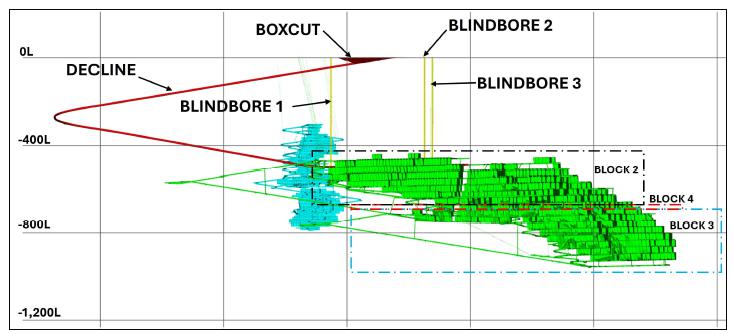
Source: Ivanhoe Electric, 2026
Figure 12-2: Santa Cruz Mining Areas (looking Northeast)
| SEPTEMBER 2026 | 12-3 |
| Ivanhoe Electric Inc. S-K 1300 Preliminary Feasibility Study & | |
| 12.2.2 | Verde |
The Verde mining region is a mineralized area situated within the hanging wall of the Santa Cruz deposit, which will be accessed through the Santa Cruz development (Figure 12-3). The mining will involve longitudinal primary-primary stope mining, measuring 20 m high x 15 m wide x 20 m long. Some undercut drifts will be created at the bottom of the stopes to maximize ore recovery from the area.
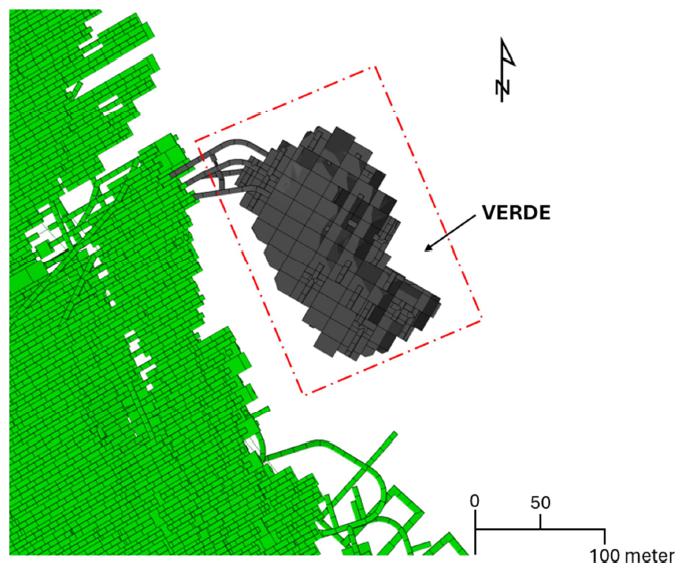
Source: Ivanhoe Electric, 2026
Figure 12-3: Verde Mining Region
| SEPTEMBER 2026 | 12-4 |
| Ivanhoe Electric Inc. S-K 1300 Preliminary Feasibility Study & | |
| 12.2.3 | East Ridge |
The East Ridge mining area will use selective mining techniques that are adapted to the varying orientations of the mining areas. The mining areas of East Ridge North 1, 2, and 3 will be primarily developed using downhole longitudinal stoping (Figure 12-4). The dimensions for these stopes will be 15 m high x 10 m wide x 8 m long, with some additional uphole stopes as needed.
In contrast, mining areas North 4 and 5 will employ a drift-and-fill method in increments of 5 m height due to the relatively shallow dip of the lenses in these sections. The mining sequence for this approach will follow a retreat pattern, starting from the outside and moving toward the center, and from the footwall to the hanging wall.
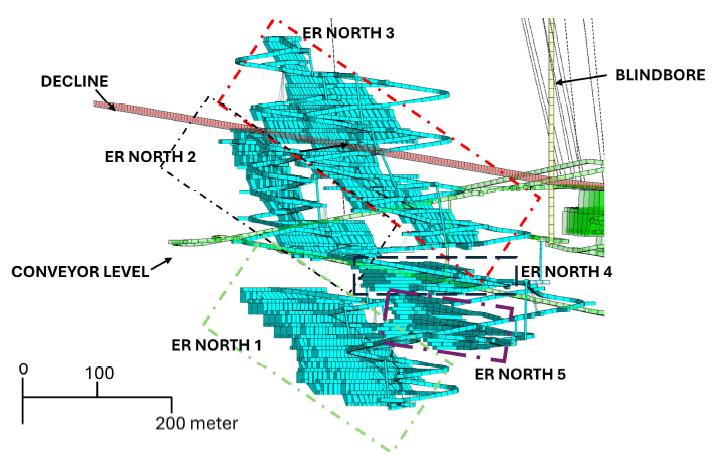
Source: Ivanhoe Electric, 2026
Figure 12-4: East Ridge Mining Areas (looking West)
| SEPTEMBER 2026 | 12-5 |
| Ivanhoe Electric Inc. S-K 1300 Preliminary Feasibility Study & | |
| 12.3 | Net Smelter Return & Cutoff Value |
Net smelter return represents the gross revenue generated from the sale of a refined metal product (in this case, copper cathodes) after deducting all associated off-site costs. For a mine producing copper cathodes via heap leaching and solvent extraction / electrowinning, the traditional "smelter" and "refining" charges inherent in concentrate sales are not applicable. Instead, the off-site deductions are specific to the direct sale of cathodes.
The primary metal to be produced in Santa Cruz will be copper. While byproducts of gold and silver are present, the current heap leach SX/EW process does not recover these precious metals. As is common with polymetallic deposits, the cutoff value for Mineral Reserves is determined and expressed in terms of NSR value per tonne.
The NSR is calculated based on unit metal values, using representative smelter contract terms, freight costs, and forecast metal prices. The metal prices and metallurgical recovery rates used for NSR calculations are summarized in Table 12-2. Royalties are factored into each block of the Mineral Resource model accounted for in the cash flow model.
Table 12-2: NSR Parameters
| Product | Unit | Value |
| Acid Soluble Copper Recovery | % | 98.8 |
| Cyanide Soluble Copper Recovery | % | 85.4 |
| Residual Copper Recovery | % | 35.1 |
| Recoverable Copper | % | 90.9 |
| Net Recoverable Copper | % | 90.0 |
| Copper Price | $/lb | 4.00 |
Mineral Reserves are assessed using commodity prices derived from long-term forecasts from analysts and banks. According to BBA, this pricing generally reflects the trends observed over the past one, three, and five years, and the forward-looking prices from internationally recognized banks are deemed appropriate for reserve estimates. Section 16 offers a detailed explanation of the commodity price forecasts, which consider a 3-year trailing average timeframe.
The Project operating costs used as the basis for cutoff value calculations are presented in Table 12-3.
| SEPTEMBER 2026 | 12-6 |
| Ivanhoe Electric Inc. S-K 1300 Preliminary Feasibility Study & | |
Table 12-3: Operating Costs for Cutoff Value Calculations
| Criteria | Unit | Santa Cruz | East Ridge | East Ridge |
| 30 m Longhole | Drift-and-fill | 15m Longhole | ||
| Leach | Leach | Leach | ||
| Cathode Split | % | 100.00 | 100.00 | 100.00 |
| On-site Costs | ||||
| Mining Costs – Direct | $/t Processed | 31.00 | 47.05 | 47.05 |
| Processing Costs | $/t Processed | 10.32 | 10.32 | 10.32 |
| G&A | $/t Processed | 2.63 | 2.63 | 2.63 |
| On-site Total | $/t Processed | 43.95 | 60.00 | 60.00 |
| On-site Rounded NSR Breakeven Cutoff | $/t | 44.00 | 60.00 | 60.00 |
| 12.4 | Mineral Reserve Estimate |
Mineral Reserves as of September 23, 2026, are summarized in Table 12-4. The point of reference for the estimate is the point of delivery to the process facilities.
Longhole stoping, and drift-and-fill mining methods are used in this Mineral Reserve estimate, as discussed in Section 13.9.
Production designs are created based on the geometries relevant to the mining methods, as discussed in Section 13. Mineral Reserve estimates are based on the Mineral Resource 3D block models. Mineable shapes are created based on individual zones and lens geometries around the production locations that meet the NSR cutoff threshold, while also ensuring that adverse pillar geometries are not created that could become unstable, and that mining does not cease near a problematic structure. Production locations outside the Mineral Reserve outlines are not included in Mineral Reserves. Once designs are completed, access ramps and other supporting infrastructure are designed.
The production design wireframes are evaluated against the model to generate tonnes and grades for each location. Internal portions of the mineralized zones that did not meet the NSR cutoff value are treated as waste. This mineralized material could be included in the mineable shapes and the Mineral Reserves by applying a marginal cutoff value as the material will have to be mined to gain access to other areas of the Mineral Reserve.
Development material below cut-off, with mineralization above 0.1% Total-Cu, is included in the mine plan.
| SEPTEMBER 2026 | 12-7 |
| Ivanhoe Electric Inc. S-K 1300 Preliminary Feasibility Study & | |
A small increase between the 2025 mineral reserve and the 2026 mineral reserve is attributed to the initial mine ramp-up and sequencing. This adjustment, which represents and increase of approximately 2% of the contained copper, facilitated access to several stopes within the 2026 mine plan that were not available in the 2025 mine plan.
| SEPTEMBER 2026 | 12-8 |
| Ivanhoe Electric Inc. S-K 1300 Preliminary Feasibility Study & | |
Table 12-4: Santa Cruz Copper Project Mineral Reserve Estimate
| Deposit | Classification | Tonnes (kt) |
Total Copper (%) |
Acid
Soluble Copper (%) |
Cyanide Leach Copper (%) |
Residual Copper (%) |
Contained
Copper (kt) |
Total Acid Soluble Cu (kt) | Total Cyanide Cu (kt) | Total Residual Cu (kt) |
| Santa Cruz | Probable | 136,022 | 1.09 | 0.63 | 0.40 | 0.05 | 1,477 | 863 | 547 | 66 |
| East Ridge | Probable | 4,107 | 1.03 | 0.46 | 0.44 | 0.13 | 42 | 19 | 18 | 5 |
| Total | Probable | 140,129 | 1.08 | 0.63 | 0.40 | 0.05 | 1,519 | 882 | 566 | 71 |
Notes on Mineral Reserves:
| 1. | The Mineral Reserves in this estimate are current to September 23, 2026, and were independently prepared, including estimation and classification, by BBA Consultants USA LP. They are reported in accordance with the definitions for Mineral Reserves in S-K 1300. |
| 2. | The point of reference for the estimate is the point of delivery to the process facilities. |
| 3. | The Mineral Reserves for the Santa Cruz and East Ridge deposits were completed using Deswik mining software. Mineral Reserves are defined within stope designs that are prescribed by rock mechanics, considering the specific characteristics of deposits, mineral domains, mining methods, and the mining sequence. Transverse longhole stoping is the optimal mining method with uppers and cut & fill methods used where appropriate. Mining will occur in blocks, extracting ore from the bottom upwards, with paste backfill providing ground support to sustain a production rate of 20,000 tonnes per day for the first 15 years of operation. |
| 4. | Mineral Reserves are estimated at an NSR cutoff value of US$43.95/t for longhole stoping, and US$60.00/t for longitudinal retreat stopes and drift-and-fill. The NSR values reflect the discrete metallurgical responses for each Mineral Reserve block using metallurgical recoveries for heap leach of 96% for acid-soluble copper, 83% for cyanide-soluble copper, 22% for residual copper. Underground mineable shapes optimization parameters include a long-term copper price of US$4.00/lb. |
| 5. | Mineral Reserves account for mining loss and dilution. |
| 6. | Mineral Reserves are a subset of the Indicated Mineral Resource and do not include the Inferred Mineral Resource. |
| 7. | Rounding, as required by the guidelines, may result in apparent summation differences between tonnes, grade, and contained metal content. |
| SEPTEMBER 2026 | 12-9 |
| Ivanhoe Electric Inc. S-K 1300 Preliminary Feasibility Study & | |
| 12.5 | Factors That May Affect Mineral Reserves |
Mineral Reserves are subject to risks typically associated with high-production underground longhole stoping operations. These risks could materially impact the reserves and include, but are not limited to, the following:
| ■ | Variations in realized metal prices compared to initial assumptions; |
| ■ | Fluctuations in mining, processing, and G&A costs used to determine the cutoff grade; |
| ■ | Changes in the interpretation of mineralization geometry or the continuity of mineralized zones; |
| ■ | Modifications to geotechnical or hydrogeological assumptions, potentially causing schedule delays, increased dilution, or reduced recoveries; |
| ■ | Variations in mining and metallurgical recovery rates; |
| ■ | Shifts in long-term assumptions regarding payability, marketability, and penalty terms; |
| ■ | Alterations in mining development or geotechnical conditions that could lead to additional unplanned dilution; |
| ■ | Adjustments to current mining methods where specific zones or lenses allow; |
| ■ | Assumptions related to ongoing access to the site, retention of mineral tenure, obtaining necessary environmental, mining, and other regulatory permits, and maintaining a social license to operate with relevant stakeholders. |
| SEPTEMBER 2026 | 12-10 |
| Ivanhoe Electric Inc. S-K 1300 Preliminary Feasibility Study & | |
| 13. | Mining Methods |
| 13.1 | Introduction |
This Report envisions underground mining of the Santa Cruz and East Ridge deposits.
The Santa Cruz deposit lies 480 to 940 m below the surface. For this deposit, transverse longhole stoping has been selected as the optimal mining method. Mining will occur in blocks, extracting ore from the bottom up within each block, with paste backfill providing ground support. A sill pillar will be mined at the end of the Project's life, and the backfill will be designed to support adjacent filled stopes without requiring additional pillars.
Stopes in the Santa Cruz deposit will range from 12 to 18 m in width and 10 to 17 m in length, with levels spaced 30 m apart. The Verde subdomain's stopes will have standard dimensions of 20 m in height, 15 m in width, and 20 m in length.
The East Ridge deposit is located 310 to 790 m below the surface, comprising several lenses and using a hybrid mining approach of longhole stoping and drift-and-fill methods. Longhole stopes will measure 15 m x 10 m x 8 m (H x W x L), while drift-and-fill drifts will be 5 m x 5 m, with variable lengths. Mining will begin with a 5 m x 5 m drift, followed by backfill and curing before developing adjacent drifts.
Access to the mine will be facilitated by one large decline developed using a tunnel boring machine (“TBM”). Ore will be transported from stopes to the surface via Load-Haul-Dump (“LHD”) vehicles, an Orepass system, and a conveyor system. The combined production average for the Santa Cruz and East Ridge deposits is approximately 20,000 t/d.
| 13.2 | Geotechnical Considerations |
Geotechnical criteria used in the mine optimization were provided in Section 7.3.
Geotechnical domains (Table 13-1 and Figure 13-1) were established to reflect material deposition type and alteration characteristics. Geotechnical domains have differing geotechnical qualities.
| SEPTEMBER 2026 | 13-1 |
| Ivanhoe Electric Inc. S-K 1300 Preliminary Feasibility Study & | |
Table 13-1: Geotechnical Domains
| Unit | Abbreviation | Note |
| Alluvium | Alv, | Uppermost unit. |
| Conglomerate | CGL | The conglomerate deposit is characterized vertically as the Gila conglomerate, overlying the Whitetail, basal, and mafic conglomerate horizons. |
| Oracle Granite | GR | Santa Cruz and East Ridge zones. |
| Leach Cap | LC | Santa Cruz zone. |
| Oxide | OX | Santa Cruz zone, Verde zone (Verde OX mineralization, within an envelope of Verde slide (SL) lithology), East Ridge zone (ERNOx_medium-grade ore zone and ERNOx_low-grade host rock). |
| Chalcocite | CN | Santa Cruz zone. |
| Primary | PR | Santa Cruz zone. |
| Faults | (Weak or Shear Zones) and D2 Fault Zone | Santa Cruz zone. |
| Secondary Lithologies | Diabase and undifferentiated porphyry units. |
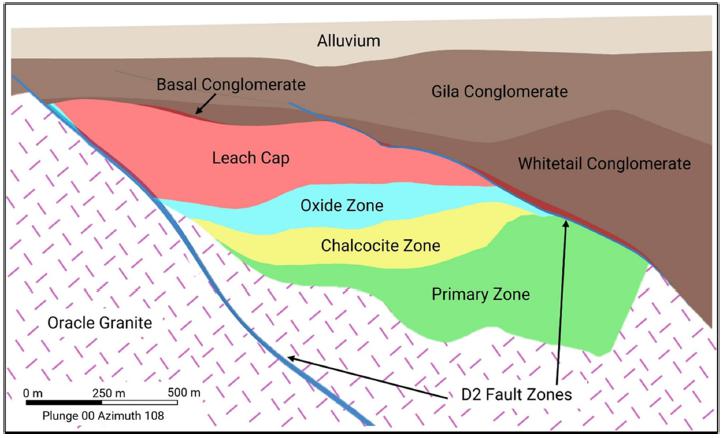
Source: Ivanhoe Electric, 2026
Figure 13-1: Santa Cruz Geotechnical Domain Profile, North-South Section, looking East
| SEPTEMBER 2026 | 13-2 |
| Ivanhoe Electric Inc. S-K 1300 Preliminary Feasibility Study & | |
| 13.3 | Mining Zones |
The Santa Cruz Copper Project will consist of three mining zones: Santa Cruz, Verde, and East Ridge (Figure 13-2). The Santa Cruz zone represents the main area of mine production. The Santa Cruz zone is divided structurally into north and south regions (refer to Figure 12-1).
Groundwater inflows are encountered across the Santa Cruz area, with magnitude and frequency varying by geotechnical and hydrogeological domains. The groundwater inflow risk to mining operations has been mitigated by maintaining a minimum 5 m offset between production areas and high-risk hydrogeological domains, including the primary zone, Gila conglomerate, leach cap, and the D2 fault zone.
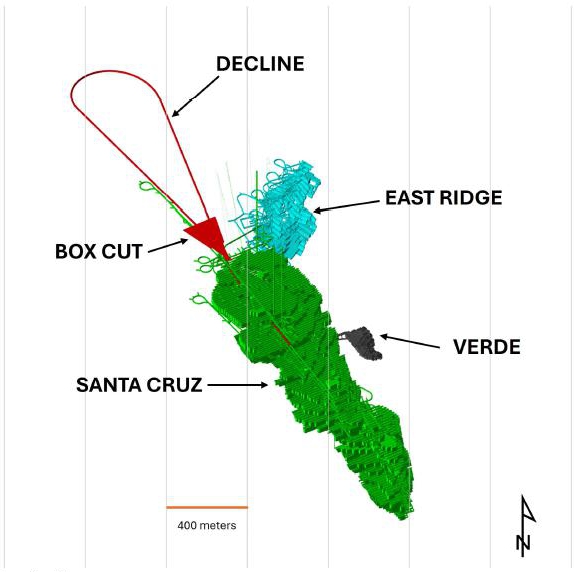
Source: Ivanhoe Electric, 2026
Figure 13-2: Mining Infrastructure and Stopes of Santa Cruz Copper Project
(Top View looking North)
| SEPTEMBER 2026 | 13-3 |
| Ivanhoe Electric Inc. S-K 1300 Preliminary Feasibility Study & | |
| 13.4 | Ground Support |
Ground control measures will be implemented systematically to protect personnel and equipment, limit dilution and overbreak, and stabilize weak rock masses, particularly within identified high-risk domains.
The TBM decline development will be supported using interconnecting reinforced concrete ring segments, each 1.524 m in length and 0.406 m thick. The segmental lining will incorporate sealed joints and mechanical connectors to provide permanent ground support and water ingress control. The annular space between the lining and excavated profile will be grouted as the TBM advances to provide continuous ground contact and confinement. In designated water-pressure relief areas, pea gravel will be placed into the annular space providing a flow path to allow controlled drainage and limit pressure on the exterior of the lining.
The Ground Support Categories, including their selection criteria, are described and summarized in Table 13-2 and Table 13-3, for conventional (drill & blast) and Roadheader development techniques respectively. An example of a bolting pattern, specifically Support Category 1 for nominal 5.5 m x 5.5 m (W x H) development, is shown in Figure 13-3.
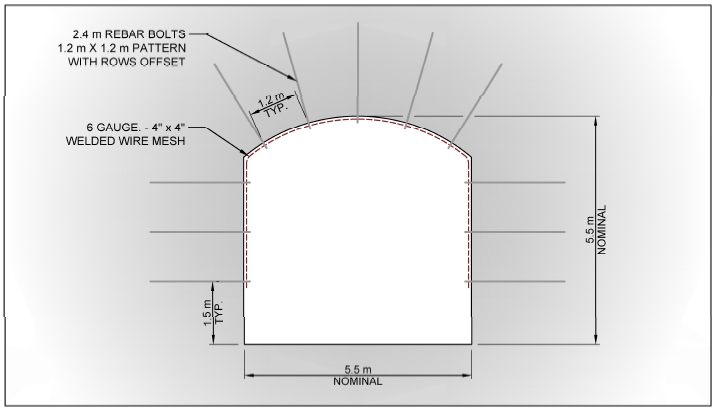
Source: BBA, 2026
Figure 13-3: Bolting Pattern Associated with Conventional (Drill & Blast)
Development, Support Category 1
| SEPTEMBER 2026 | 13-4 |
| Ivanhoe Electric Inc. S-K 1300 Preliminary Feasibility Study & | |
Primary (first-pass) support will be installed as part of the excavation advance cycle and will support and reinforce the surrounding rock mass.
Shotcrete will be applied over the mesh for excavations needed for long-term installations and for Support Categories 1S, 2S, and 3. Support Category 4 will begin with an initial layer of fiber-reinforced shotcrete, followed by welded wire mesh, rebar bolts and lattice girders which are then encased with standard shotcrete.
| SEPTEMBER 2026 | 13-5 |
| Ivanhoe Electric Inc. S-K 1300 Preliminary Feasibility Study & | |
Table 13-2: Ground Support Categories for Conventional (Drill & Blast) Development
| Support Category | Q Value | Estimated RMR76\GSI | Lithological Domain | Advance Length | Ground Support description |
| Category 12 | > 2.0 | > 50 | Oxide, Chalcocite, Verde, Oracle Granite | 4.0 m (13 ft) | 2.4 m long #7 rebar bolts on 1.2 m x 1.2 m (4 ft x 4 ft) pattern, with welded wire mesh (100 mm / 6 Ga.) to within 1.5 m of sill. |
| Category 1 (Shotcrete) | Decline Development | Optional (non-systematic) application of 50 mm (2″) shotcrete over welded wire mesh; as local rock mass conditions require. | |||
| Category 2 2 | 0.7 - 2.0 | 41 - 50 | Primary, Lower Range Oxide, Chalcocite, Verde, Oracle Granite | 3.0 m (10 ft) | 2.4 m long #7 rebar bolts on a 1.2 m x 0.8 m (4 ft x 2.5 ft) pattern, with welded wire mesh (100 mm / 6 Ga.) to within 1.5 m of sill. |
| Category 2 (Shotcrete) | Decline Development | Optional (non-systematic) application of 50 mm (2″) shotcrete over welded wire mesh; as local rock mass conditions require. | |||
| Category 31,2 | 0.07 - 0.7 | 20 - 40 | Fault Seams/Zones, Leach Cap |
2.0 m (6.5 ft) | 50 mm (2″) shotcrete down to sill, install welded wire mesh (100 mm / 6 Ga.) to within 1.0 m of sill with 2.4 m long #7 rebar bolts on a 1.2 m x 0.8 m (4 ft x 2.5 ft) pattern, apply 50 mm (2”) of shotcrete to sill. |
| Category 41,2 | < 0.07 | < 20 | Development Connection from Sed. Zone into Hard Rock (Oxide, Chalcocite, Verde, Oracle Granite). Development through faults | 1.5 m (5 ft) |
75 mm (3″) of fiber-reinforced shotcrete (“FRS”) down to the sill, followed by 6 Ga. Welded wire mesh to within 1.0 m of sill with 2.4 m long #7 rebar bolts on 1.2 m x 0.8 m pattern. Install #7 rebar lattice girders, spaced 2.4 m apart, and encased in 150 mm (6″) standard shotcrete. Spiling (forepoling) pre-support may be required. |
Notes:
| 1. | Due to potentially limited excavation stand-up time, Support Category 3 and Support Category 4 are to be installed with minimum delay (typically immediately following completion of drift blast and mucking cycle). |
| 2. | Install galvanized weldmesh screen in permanent development. Non-galvanized (“black”) weldmesh can be used in temporary development. |
| SEPTEMBER 2026 | 13-6 |
| Ivanhoe Electric Inc. S-K 1300 Preliminary Feasibility Study & | |
Table 13-3: Ground Support Categories for Roadheader Development
| Support Category | Q value | Anticipated Visual Indications of Rock Mass Stability (Example) | Advance Length | Ground Support Description & Sequence |
| RH 12 |
> 2.0 (GSI >50) |
Smooth excavation surface, minimal (minor) structural disturbance. | 7 m | 50 mm (2”) shotcrete down to sill, welded wire mesh (100 mm / 6 Ga) to within 1.5 m of sill with 2.4 m long #7 rebar bolts on 1.2 m x 1.2 m (4 ft x 4 ft) pattern. |
| RH 22 |
0.7 - 2.0 (GSI 41 – 50) |
Irregular to smooth excavation surface, release of localized rock blocks (kinematic (wedge) instability). | 7 m | 50 mm (2”) shotcrete down to sill, welded wire mesh (100 mm / 6 Ga) to within 1.5 m of sill with 2.4 m long #7 rebar bolts on 1.2 m x 0.8 m pattern. |
| RH 31,2 |
0.07 - 0.7 (GSI 20 – 40) |
Over-excavation of roadheader profile due to rock mass instability and the presence of weak rock seams (example: fault zones). Risk of unravelling if left unsupported for 72 hours following initial excavation. |
7 m | 50 mm (2”) shotcrete down to sill, welded wire mesh (100 mm / 6 Ga) to within 1.0 m of sill with 2.4 m long #7 rebar on 1.2 m x 0.8 m (4 ft x 2.5 ft) pattern, followed by 50mm (2”) of shotcrete down to sill. |
| RH 41,2 |
< 0.07 (GSI <20) |
Over-excavation of roadheader profile due to rock mass instability. Risk of unravelling/caving if left unsupported for 24 hours following initial excavation. Presence of fault. |
4 m | 75 mm (3”) of FRS down to sill, welded wire mesh (100 mm / 6 Ga) to within 1.0 m of sill with 2.4 m long #7 rebar bolts on 1.2 m x 0.8 m pattern, followed by #7 rebar lattice girders spaced 2.4 m apart and encased in 150 mm (6”) of shotcrete. Spiling (forepoling) pre-support as required. |
Notes:
| 1. | Due to limited excavation stand-up time, Support Category RH 3 and Support Category RH 4 are to be installed with minimum delay, (typically immediately following completion of drift advance and mucking cycle). |
| 2. | Install galvanized weldmesh screen in permanent development. Non-galvanized (“black”) Weldmesh can be used in temporary development. |
| SEPTEMBER 2026 | 13-7 |
| Ivanhoe Electric Inc. S-K 1300 Preliminary Feasibility Study & | |
| 13.5 | Secondary Support |
Secondary ground support will be required to support and reinforce stope brows. Brow support will consist of three parallel rings of cablebolts spaced approximately 2.5 m apart. The initial cablebolt ring will be located approximately 2 m from the planned stope brow.
Systematic cablebolting of the secondary ore drifts is likely required due to wedge potential, reduced rock mass quality, and/or rock mass relaxation (stress relief) at the stope sill horizon. Cablebolting of secondary stopes drifts may require installation of 0-Gauge weldmesh straps (“screen straps”) oriented across the drift, with tensioned bearing plates.
| 13.6 | Boxcut & Decline Access |
The TBM portal and decline will have an excavated diameter of 9.260 m and a lined inside diameter of 8.128 m and will begin from a 30 m deep trapezoidal boxcut. The boxcut will be approximately 302 m in length, have a maximum width of 188 m and flat base of 20 m. The boxcut ramp grade will transition from horizontal to a maximum of 16%. The distance to the portal entrance from the start of the boxcut ramp will be 240 m.
| 13.7 | Groundwater |
A discussion on groundwater is provided in Section 7.4.
| 13.7.1 | Faults & Grouting Program |
The fault zones of the Santa Cruz Copper Project are zones of high hydraulic conductivity with generally less competent rock mass characteristics.
A grouting program has been developed to address water-bearing fault zones during mine development. Toward the end of mine life a pressure grouting campaign, focusing on critical locations in and around water bearing fault zones, will be necessary to mitigate the risk of increased water ingress and allow the safe extraction of the level access remnant pillars within each Santa Cruz mining area.
| 13.7.2 | Ramp Dewatering |
During initial tunnel-boring operations, dewatering will be accomplished using a series of pump boxes in a daisy-chain arrangement, each equipped with two (duty and standby) submersible pumps. The pump boxes will be installed on elevated platforms along one side of the decline. The temporary dewatering system has been designed with a capacity of 31.5 L/s (500 USGPM),
| SEPTEMBER 2026 | 13-8 |
| Ivanhoe Electric Inc. S-K 1300 Preliminary Feasibility Study & | |
equivalent to that of the tunnel boring machine. Once Major Pump Station-1 on the 600L is established and commissioned, residual inflows from the decline will gravity-drain to this location and be pumped directly to surface.
After the tunnel boring machine completes operation on the 510 Level (510L), a major pump station and de-grit plant will be established to support subsequent mine-development activities and ahead of construction of the remaining permanent major pump stations. As mine development advances, temporary dewatering sumps will be established on each mining level, with duty/standby submersible pumps configured to collect and transfer accumulated mine water to the designated major pump station in a daisy-chain configuration.
Temporary sumps will be decommissioned as the permanent pump station infrastructure becomes operational. On levels where permanent level sumps are planned, those sumps will be used to support both temporary and permanent dewatering activities, reducing the need for separate temporary installations.
| 13.7.3 | Mining Area Dewatering |
Peak maximum inflow during the mine life is expected to be approximately 454 L/s (7,200 USGPM). Typically, water on mine levels will flow in ditches along level development, driven at a 2% gradient, to a gravity sump near the level entrance. Gravity sumps will use twin boreholes to gravity transfer water to the sump on the level below. On levels and locations in the mine where gravity flow cannot be achieved, level sumps will be developed. These level sumps will be set up as dirty water systems, utilizing well-style sumps with submersible pumps. Each level includes two well style-sumps and submersible pumps for redundancy.
De-grit plants will be installed on levels directly above the major and minor pumping stations. Water from these levels, and water gravity fed to them from above, will be collected and pumped to the de-grit plants which are rated to handle peak anticipated loads. Filtered water will pass directly to the live well of the pumping station below via cased boreholes, twinned for redundancy. Solids removed from the water will be stockpiled for later removal and disposal using a bucket loader.
The major and minor pump stations will include two multi-stage centrifugal pumps, each rated for peak inflows with a 25% surge capacity. Pumps will be arranged in a duty/standby configuration. The pumps will be fed by flooded suction using a live sump contained behind a concrete dam wall. The live sump is sized to optimize the pump cycle times. On main collection levels, major/minor pump stations will have a large excavation sized for 6 hours of peak water inflows specific to each station location.
| SEPTEMBER 2026 | 13-9 |
| Ivanhoe Electric Inc. S-K 1300 Preliminary Feasibility Study & | |
Mine water will be pumped from the major/minor pump stations to surface via cased boreholes. For pump stations located deep within the mine, intermediate pump stations will be used to limit borehole lengths.
Major pump station locations for the Santa Cruz orebody have been strategically placed based on mining production horizons and schedule. Water inflows from the Verde orebody have been accounted for in the design of the Santa Cruz dewatering infrastructure. On horizons with high dewatering inflows, two major/minor pump stations have been included to mitigate risks resulting from a failure at any single pump station in the system.
The switchback conveyor declines will be fitted with dedicated high-capacity dewatering infrastructure to manage the anticipated inflows in this area. During development of the switchback conveyor declines, temporary dewatering sumps, equipped with duty/standby submersible pumps, will be installed in a daisy-chain configuration to manage inflows.
At the turning point of the switchback, where the two conveyor decline sections intersect, permanent skid-mounted dirty-water pump systems will be installed. Each system will comprise a compact pump box with an agitator, and duty/standby horizontal centrifugal pumps. Along the lower decline section, the temporary pumps will remain in place as permanent infrastructure, to transfer collected water to the skid-mounted dewatering pump systems. The dewatering system of the East Ridge orebody will be independent from that of the Santa Cruz orebody. In the East Ridge orebody, level sumps/minor pump stations will be located at the bottom of each mining horizon and will feed one dedicated major pump station to surface.
| 13.8 | Mining Areas |
| 13.8.1 | Dilution |
In the longhole stopes and cut-and-fill mining areas, the planned excavation shapes do not always perfectly align with the mineralized outlines. Due to the tabular nature of the Santa Cruz orebody, internal stopes may experience unplanned dilution from adjacent mineralized stopes or backfilled stopes.
In the case of the East Ridge orebody, the mineralization is also tabular, and for most zones within this deposit, external dilution consists of uneconomic material from the periphery of the mining block. Therefore, internal dilution (or planned dilution) in the East Ridge mining region primarily depends on the geometry of the orebody and the pre-determined minimum mining width. This type of dilution is predominantly observed in longitudinal stopes. Dilution may be controlled and/or minimized through suitable blasting practices.
| SEPTEMBER 2026 | 13-10 |
| Ivanhoe Electric Inc. S-K 1300 Preliminary Feasibility Study & | |
The dilution percentage is defined as tonnes of dilution material divided by tonnes of mineralized material, as follows:

| 13.8.2 | Longhole Stoping Dilution |
Longhole stopes have a fixed height of 30 m in the Santa Cruz orebody, 15 m in East Ridge, and 20 m in the Verde domain. These stope heights also dictate the sublevel spacing in each orebody.
Primary stopes in both orebodies include internal dilution, and all stopes include unplanned dilution from adjacent stopes that have been previously mined and backfilled.
A primary (planned) dilution of 3% was applied to all longhole stopes. A secondary (unplanned) dilution of 9% was applied for longhole stoping. Dilution is expected primarily from stope walls adjacent to paste backfill with 3% for primary stopes with a single face and 9% for secondary stopes with three faces.
| 13.8.3 | Drift-and-Fill Dilution |
The minimum mining width for drift-and-fill mining in East Ridge is 5 m. Drift-and-fill development contains limited internal dilution within the proposed mining shapes on the perimeter of the target zone of mineralization. A dilution of 5% was applied to drift-and-fill production shapes.
| 13.8.4 | Mining Recovery Factor |
Mining recoveries and dilution percentages were selected based on geotechnical considerations, empirical methods, data from operating underground mines in the region, and BBA subject matter expertise.
Table 13-4 summarizes the forecasted mining recoveries by orebody and stope type.
Table 13-4: Summary of Mining Recoveries by Stope Type
| Stope Type | Mining Recovery |
| Santa Cruz / Verde – Downhole Stopes | 94% |
| All Uphole Stopes | 85% |
| All Sill Pillar Stopes | 40% |
| East Ridge – Drift-and-Fill | 94% |
| East Ridge – Downhole Stopes | 90% |
| SEPTEMBER 2026 | 13-11 |
| Ivanhoe Electric Inc. S-K 1300 Preliminary Feasibility Study & | |
| 13.8.5 | Development Allowance |
An additional development allowance of 5% was added to all underground mine development including level accesses, main level haulage drives, remucks, ramps, conveyor levels, and roadheader pulloffs to account for back slashes, side slashes, and additional infrastructure excavations that may be added in medium-range and short-range mine design.
| 13.9 | Mine Design |
An overview of the Santa Cruz Copper Project mining zones is shown in Figure 13-2.
| 13.9.1 | Santa Cruz Orebody – Transverse Longhole Stoping |
Longhole stopes at the Santa Cruz orebody will vary in size between the orebody and geotechnical region. A summary of these varying stope dimensions is shown in Table 13-5.
Table 13-5: Santa Cruz Orebody Stope Sizes
| Domain | Geotechnical Region |
Stope
Dimensions (P: Primary S: Secondary, Height x Width x Length) |
| Cyanide | North |
P: 30 m x 12 m x 17 m S: 30 m x 15 m x 20 m |
| South |
P: 30 m x 15 m x 23 m S: 30 m x 18 m x 25 m | |
| Oxide | North |
P: 30 m x 12 m x 13 m S: 30 m x 15 m x 15 m |
| South |
P: 30 m x 15 m x 15 m S: 30 m x 18 m x 17 m |
Each downhole stope will have a 5 m x 5 m (W x H) access drift above the stope shape and one within the stope at the bottom. For these stopes, production drilling will be downward from the upper access drift, with the lower access serving only as a draw-point. Once the stopes on one level have been mined and backfilled, the former drilling horizon will become the draw point for the stope immediately above it.
Upper stopes will be employed in certain locations. These stopes will have a single 5 m x 5 m (W x H) access drift at the bottom of the stope shape, which will be utilized for both drilling and mucking activities. These stopes have been assigned a lower mining recovery factor.
Transverse stopes will be perpendicular (transverse) to the strike of the orebody (Figure 13-4).
| SEPTEMBER 2026 | 13-12 |
| Ivanhoe Electric Inc. S-K 1300 Preliminary Feasibility Study & | |
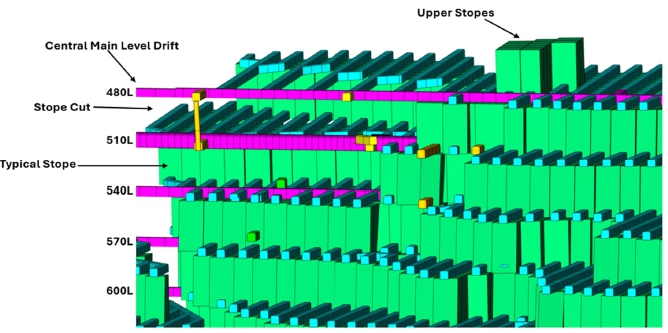
Source: BBA, 2026
Figure 13-4: Transverse Longhole Stoping in the Santa Cruz Orebody
(looking Southwest)
Access drifts will be driven from the central main level drifts, and stopes will be mined across the full width of the orebody. Primary stopes will be mined first, leaving unmined ore (secondary stopes) between them for support. Once a primary stope is mined out, it will be backfilled with paste backfill to provide structural support. After the paste backfill has cured and reached the required strength, adjacent secondary stopes can be mined, using the filled primary stopes as stable walls.
After ore extraction, a plug of high-binder paste backfill will be placed first, followed by mass fill with a lower binder content. The paste backfill will be allowed to cure, reaching sufficient strength to act as a working platform and to support subsequent mining operations. Paste backfill strength will be verified through paste backfill sampling and laboratory testing before advancing to the next mining phase.
Transverse longhole stoping in the Santa Cruz orebody will follow a lateral and vertical chevron primary-secondary mining sequence, retreating from the hanging wall. A paste backfill plant on surface and an underground reticulation system will supply paste to backfill open stopes. A central main level drive with perpendicular stope cuts to the northeast and southwest will be used to access production stopes. This central access design helps achieve the 20,000 to 22,000 t/d average production rate by increasing the quantity of available stoping locations.
| SEPTEMBER 2026 | 13-13 |
| Ivanhoe Electric Inc. S-K 1300 Preliminary Feasibility Study & | |
| 13.9.2 | Verde Orebody – Longhole Stoping |
The Verde orebody levels will be accessed via the Santa Cruz mine levels at similar elevations. Verde orebody access will pass through a sedimentary conglomerate zone where a grouting program will be required to reduce water inflow. Due to the challenging geological setting, development in Verde will be limited to main access drifts and top and bottom stope cuts. The infrastructure required to support mining of this orebody, such as sumps and electrical stations, will be located in the adjacent Santa Cruz ore body levels.
Maximum stope dimensions for the Verde orebody will be 20 m x 15 m x 20 m (H x W x L).
| 13.9.3 | East Ridge Orebody– Longitudinal Longhole Stoping |
Portions of the East Ridge orebody where the hanging wall dip is greater than 55° will be mined using the longitudinal stoping mining method, with stope dimensions of 15 m x 10 m x 8 m (H x W x L). Areas with a hanging wall dip less than 55° will be mined using the drift-and-fill mining method
Longitudinal stoping is an underground mining technique primarily used for narrow to moderately wide, steeply-dipping orebodies (Figure 13-5).
In this method, stopes are developed parallel to the strike of the orebody, allowing for continuous extraction along the orebody’s length. The orebody is divided into longitudinal panels along its strike. Each panel is mined sequentially from the outer limit of the orebody toward the central access drift in an overhand fashion (upward from the bottom of the orebody).
Stopes are filled with paste backfill once ore extraction is complete, and allowed to cure before the adjacent stope can be blasted. Longitudinal stoping with paste backfill is particularly effective for narrow vein orebodies with steep dips, as present in certain lenses of East Ridge.
The East Ridge orebody also contains zones suitable for transverse longhole stoping, like the Santa Cruz orebody, where the orebody geometry is sufficiently wide for this approach.
| SEPTEMBER 2026 | 13-14 |
| Ivanhoe Electric Inc. S-K 1300 Preliminary Feasibility Study & | |
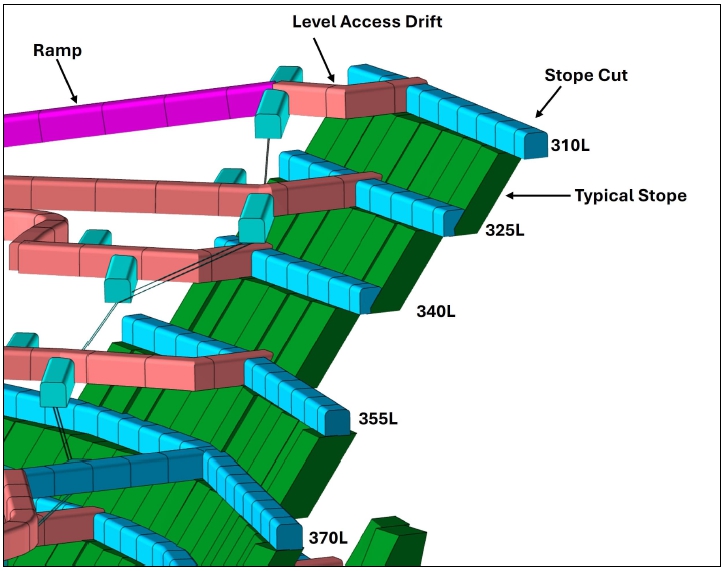
Source: BBA, 2026
Figure 13-5: Longitudinal Longhole Stoping in East Ridge Zone
(looking Northwest – Not to Scale)
| 13.9.4 | East Ridge – Drift-and-Fill |
Overhand drift-and-fill mining is an underground mining technique used to mine orebodies that have width and dip that are not suitable for longhole stoping, irregular, or weakly consolidated. This method involves mining horizontal drifts along the strike of the orebody, starting from the lowest level, and progressing upwards (Figure 13-6). After each drift is mined out, the resulting void will be filled with paste backfill before the adjacent drift is mined. Once all the drifts in a cut are completed and filled, mining progresses upward to the next cut.
| SEPTEMBER 2026 | 13-15 |
| Ivanhoe Electric Inc. S-K 1300 Preliminary Feasibility Study & | |
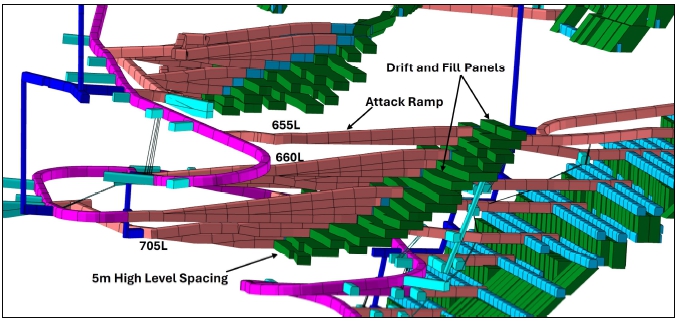
Source: BBA, 2026
Figure 13-6: Drift-and-Fill Mining in the East Ridge Zone
(looking Northwest – Not to Scale)
Due to the challenging ground conditions present at East Ridge, drift-and-fill mining offers several advantages for specific lenses. These advantages include smaller open spans during mining, sequential backfilling to maintain ground stability and selective mining for the challenging orebody geometry. The selective nature of drift-and-fill mining minimizes dilution and maximizes ore recovery.
| 13.9.5 | Development |
The main access decline from surface will be excavated using a Crossover Rock/Earth Pressure Balance (“EPB”) tunnel boring machine. This type of TBM is unique in that it can maintain a pressurized chamber behind the cutting head which will serve to support poorly consolidated material and reduce water ingress into the excavation.
The TBM will install a reinforced, segmented concrete liner in the decline as it advances, as well as an invert segment that will provide the flat surface on which the TBM, and later the mine’s mobile equipment, will travel. A section view of the TBM decline, with critical dimensions, is shown in Figure 13-7.
Cuttings from the excavation process will be transported to surface by a fixed conveyor belt system that will extend from within the TBM. This conveyor system will, with modifications, later become a vital link in the mines ore handling system, carrying all mine production material to the surface stockpiles. As primary mine access is provided by a single decline, Shaft 3 will be equipped with an emergency egress hoist to provide a secondary means of egress. The hoist will be rated to transport two people per trip.
| SEPTEMBER 2026 | 13-16 |
| Ivanhoe Electric Inc. S-K 1300 Preliminary Feasibility Study & | |
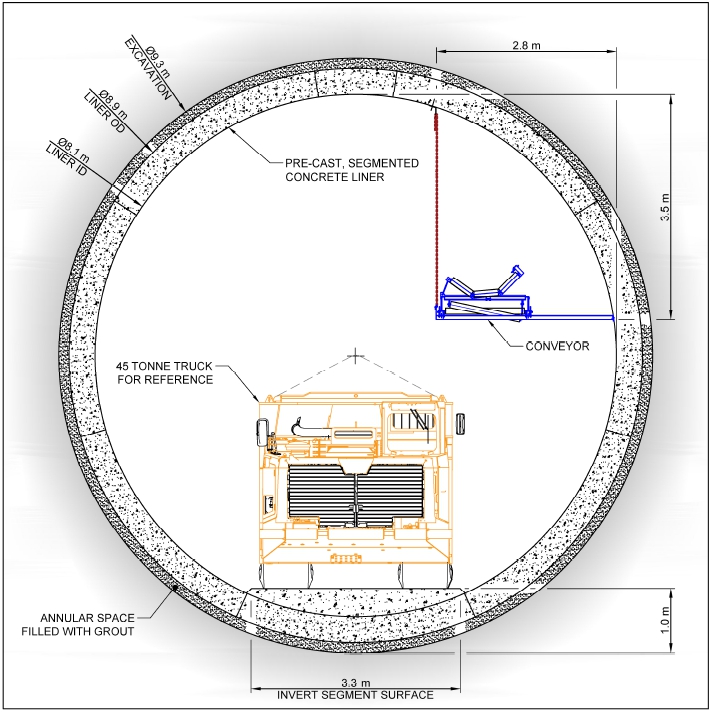
Source: BBA, 2026
Figure 13-7: Section View of TBM Decline Excavation
(All units shown are in meters)
| SEPTEMBER 2026 | 13-17 |
| Ivanhoe Electric Inc. S-K 1300 Preliminary Feasibility Study & | |
Conventional drill and blast development is planned for internal ramps and mine level development in the Santa Cruz, Verde, and East Ridge orebodies. Drill and blast methods allow for higher productivity in multiple heading scenarios and for equipment to operate in tighter radius turns. Strategic lateral development of conveyor levels, ore haulage levels, early ramp development, and a main haulage level will be performed by roadheader development crews operating in single headings to support lateral advance rates. Table 13-6 summarizes the lateral and vertical development dimensions.
Table 13-6: Santa Cruz Mine Lateral & Vertical Development Dimensions
| Development Activity | Dimensions |
| Lateral Development | |
| Main Access - TBM Decline | 9.3 mÆ |
| Infrastructure | |
| Batch Plant Storage, Electrical – Battery Charge Station, Electrical – Conveyor Switchroom, Electrical – Mine Switchroom, Electrical – Power Substation, Electrical – Primary Switchroom, Electrical – Pump Switchroom, Electrical – Secondary Switchroom, Electrical – Temporary Switchroom, Latrine, Magazine – Caps, Magazine – Powder, Orepass Access, Remuck, Services Station, Stope Cut, Storage – Ballast, Storage – Construction, Storage – Development, Sump – Level, Sump – Pump Room, Vent Access, De-grit Plant. | Arch 5.0 mW x 5.0 mH |
| Electrical – Conveyor Switchroom, Electrical – Primary Switchroom, Electrical – Temporary Switchroom, Vent Access | Arch 5.0 mW x 5.5 mH |
| Ore Pass Access, Sump – Pump Room | ARCH 5.5mW X 5.5mH |
| Vent Access | Arch 6.0 mW x 6.0 mH |
| Conveyor Level, Roadheader Pulloff | Arch 5.5 mW x 5.0 mH |
| Level Access, Main Level Haulage Drive, Ore Haulage Level, Ramp, Refueling Station | Arch 5.0 mW x 5.5 mH |
| Refuge Station, Permanent Pump Station, Ore Pass Access | Arch 6.0 mW x 5.0 mH |
| Sump – Level | Arch 5.0 mW x 6.67 mH |
| Sump – Pump Room | Arch 6.5 mW x 6.5 mH |
| Sump – Pump Room | Arch 5.5 mW x 5.5 mH |
| Sump – Pump Room | Arch 7.5 mW x 8.5 mH |
| Electrical Hole Receiving Station | Arch 6.0 mW x 5.0 mH |
| Local control Station | ARCH 5.0mW X 4.0mH |
| Temp Sump Cutout | Arch 5.0 mW x 5.32 mH |
| SEPTEMBER 2026 | 13-18 |
| Ivanhoe Electric Inc. S-K 1300 Preliminary Feasibility Study & | |
| Development Activity | Dimensions |
| Vertical Development | |
| Orepass, Vent Raise | Round 3.0 m Diameter |
| Orepass | Square 6.0m x 7.0m |
| Vent Shafts (Blind Bore Development)X 3 | Round 6.4 m Diameter |
| Vent Raise | Round 4.0 m Diameter |
| Vent Raise | Round 5.0 m Diameter |
| Hole – Dewatering (Gravity ER) | Round 0.15 m (6")* |
| Hole – Dewatering (Gravity SC) | Round 0.25 m (10")* |
| Hole – Dewatering (Surface) | Round 0.41 m (16”)* |
| Hole – Process Water, Hole – Compressed Air (Surface) | Round 0.41 m (16")* |
| Hole – Electrical (Surface) | Round 0.37 m (14.75")* |
| Hole – Dewatering, Hole – Paste backfill | Round 0.44 m (17.5")* |
Note: * Based on the final groundwater model, service-hole diameters shown in the mine model may not reflect the final design; final diameters are captured in the cost model.
| 13.10 | Production Schedule |
The Santa Cruz life-of-mine is expected to be 24 years, from 2029 to 2052, following approximately 2.5 years of construction. Figure 13-8 and Table 13-7 show the production included in the mine plan. Remnant stopes will have higher associated mining costs due to operational challenges as well as higher dilution rates and lower recovery. The “Ore” column represents the total development and production ore for Santa Cruz, Verde, and East Ridge orebodies. Figure 13-9 shows tonnes of material mined over the life of mine from the orebodies and development.
| SEPTEMBER 2026 | 13-19 |
| Ivanhoe Electric Inc. S-K 1300 Preliminary Feasibility Study & | |
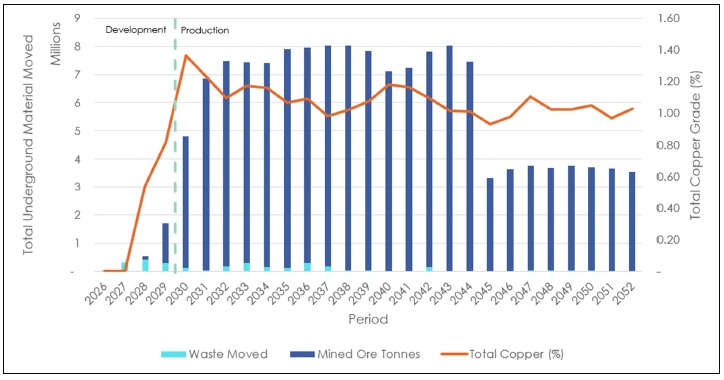
Source: BBA, 2026
Figure 13-8: Santa Cruz Tonne – Grade Graph
| SEPTEMBER 2026 | 13-20 |
| Ivanhoe Electric Inc. S-K 1300 Preliminary Feasibility Study & | |
Table 13-7: Santa Cruz Production Summary
| Year | Ore (kt) |
Total
Copper (%) |
CNCu (%) |
AsCu (%) |
Cu_Res (%) |
Ratio ASCU:TCU |
| 2027 | 0 | 0.00 | 0.00 | 0.00 | 0.00 | - |
| 2028 | 101 | 0.54 | 0.13 | 0.44 | 0.00 | 0.82 |
| 2029 | 1,403 | 0.82 | 0.13 | 0.56 | 0.12 | 0.69 |
| 2030 | 4,684 | 1.37 | 0.22 | 1.09 | 0.05 | 0.80 |
| 2031 | 6,819 | 1.23 | 0.34 | 0.86 | 0.04 | 0.70 |
| 2032 | 7,286 | 1.10 | 0.47 | 0.58 | 0.05 | 0.53 |
| 2033 | 7,155 | 1.17 | 0.55 | 0.59 | 0.03 | 0.50 |
| 2034 | 7,245 | 1.16 | 0.49 | 0.62 | 0.04 | 0.54 |
| 2035 | 7,775 | 1.07 | 0.43 | 0.60 | 0.04 | 0.56 |
| 2036 | 7,679 | 1.09 | 0.31 | 0.75 | 0.03 | 0.69 |
| 2037 | 7,850 | 0.98 | 0.28 | 0.67 | 0.03 | 0.68 |
| 2038 | 8,003 | 1.02 | 0.31 | 0.66 | 0.05 | 0.65 |
| 2039 | 7,804 | 1.08 | 0.48 | 0.55 | 0.05 | 0.51 |
| 2040 | 7,105 | 1.18 | 0.64 | 0.45 | 0.09 | 0.38 |
| 2041 | 7,210 | 1.16 | 0.59 | 0.49 | 0.08 | 0.42 |
| 2042 | 7,672 | 1.09 | 0.48 | 0.57 | 0.05 | 0.52 |
| 2043 | 8,011 | 1.01 | 0.41 | 0.57 | 0.03 | 0.56 |
| 2044 | 7,447 | 1.01 | 0.32 | 0.62 | 0.08 | 0.00 |
| 2045 | 3,315 | 0.93 | 0.24 | 0.64 | 0.05 | 0.00 |
| 2046 | 3,625 | 0.98 | 0.49 | 0.46 | 0.03 | 0.47 |
| 2047 | 3,706 | 1.10 | 0.40 | 0.67 | 0.03 | 0.61 |
| 2048 | 3,647 | 1.02 | 0.27 | 0.68 | 0.07 | 0.66 |
| 2049 | 3,742 | 1.02 | 0.28 | 0.70 | 0.04 | 0.68 |
| 2050 | 3,659 | 1.05 | 0.39 | 0.58 | 0.07 | 0.55 |
| 2051 | 3,648 | 0.97 | 0.42 | 0.50 | 0.05 | 0.52 |
| 2052 | 3,537 | 1.03 | 0.21 | 0.74 | 0.08 | 0.72 |
| Total | 140,129 | 1.08 | 0.40 | 0.63 | 0.05 | - |
| SEPTEMBER 2026 | 13-21 |
| Ivanhoe Electric Inc. S-K 1300 Preliminary Feasibility Study & | |
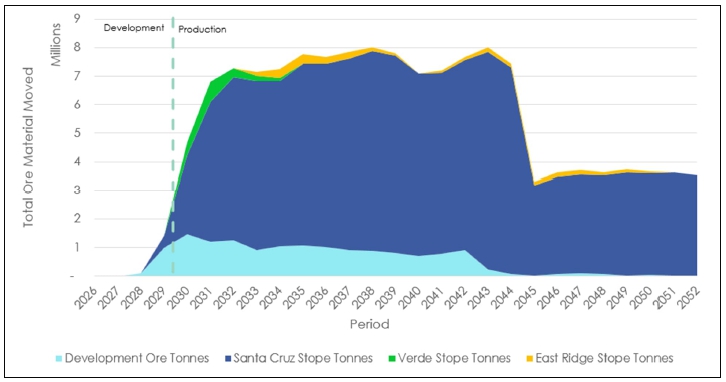
Source: BBA, 2026
Figure 13-9: Santa Cruz Tonnes of Mined Material
| 13.11 | Mining Operations |
| 13.11.1 | Capital vs. Operating Development |
Santa Cruz mine development will be achieved through a combination of mining contractors and Ivanhoe Electric personnel for both capital and operating development and production (Figure 13-10).
Contractor mining companies will bring experienced personnel and offer a short ramp-up period during early stages of the Project. Contractor mining will be used for the boxcut excavation, main decline development with a TBM, roadheader development of strategic lateral infrastructure, and drill and blast (capital) lateral development through September 2030. Contractors will also be used for vertical development activities, including drilling, shaft sinking, and raiseboring (i.e., ventilation shafts, ventilation raises, orepasses, electrical, paste and dewatering service holes).
Ivanhoe Electric operations personnel will be responsible for production activities, including truck haulage, production drilling, and stope mucking, as well as stope cut development beyond the initial 13 m of primary stope cuts from the haul drift. Ivanhoe Electric will also assume responsibility for drill and blast lateral development after September 2030.
| SEPTEMBER 2026 | 13-22 |
| Ivanhoe Electric Inc. S-K 1300 Preliminary Feasibility Study & | |
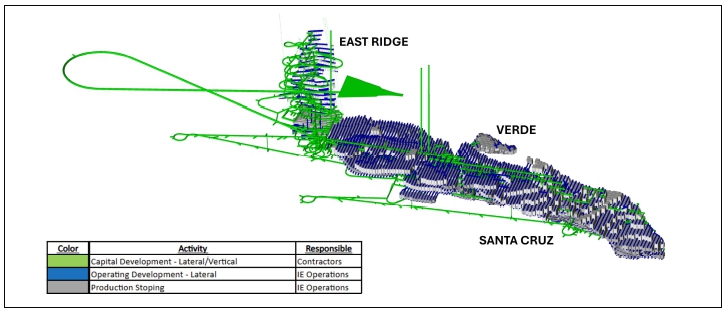
Note: Isometric view looking Northeast. Source: BBA, 2026.
Figure 13-10: Santa Cruz Mine Capital vs. Operating Development & Production
(image not to scale)
| 13.11.2 | Underground Material Handling System |
The TBM decline material handling system was designed by the TBM manufacturer for both temporary and permanent operating configurations. The system comprises a series of conveyors installed along the upper sidewall of the TBM tunnel segments, discharging to a radial stacker on surface.
During TBM development, the temporary conveyor system will comprise one main drive conveyor segment and five booster segments, for a total of six conveyor segments operating with a 914 mm (36”) belt. Once the TBM has completed operations, the system will be reconfigured to comprise four main drive conveyor segments operating with a 1,067 mm (42”) belt.
The underground mine material handling system will be developed through four configurations, all of which ultimately feed the permanent TBM decline conveyor system for transport of ore to surface. The configurations will be implemented and operated concurrently for portions of the mine life as development progresses.
Configuration 1 will support Santa Cruz early development and production, as well as LOM East Ridge development and production. In Santa Cruz, LHD equipment will load ore into ore passes that feed a truck haulage loop. Haul trucks will be loaded through a loadout chute at the lowest elevation of the loop and will transport ore to an ore bin and grizzly. In East Ridge, LHDs operating in stoping and drift-and-fill zones will load haul trucks directly for transport to the ore bin and grizzly.
| SEPTEMBER 2026 | 13-23 |
| Ivanhoe Electric Inc. S-K 1300 Preliminary Feasibility Study & | |
The ore bin and grizzly will feed a mineral sizer and transfer conveyor, which will discharge to a conveyor in the TBM decline and in-line load the permanent TBM decline conveyor system.
Configurations 2, 3, and 4 will use a common ore-loading and conveying arrangement. LHDs will load ore into V-shaped ore-pass systems, which discharge to steel-lined ore bins at the designated conveyor loading levels. The ore bins will discharge through chute and transfer conveyor systems to main loading level conveyors, which feed a mineral sizer and the switchback conveyor systems. The switchback conveyor systems will transfer sized ore to the permanent TBM decline conveyor system. For the underground mining conveyor system, pre-sized ore conveyors will include 1,500 mm (60”) belts, and post-sized ore conveyors will include 1,200 mm (48”) belts.
To support the planned production rate from the Santa Cruz deposit, four to eight orepass accesses will be required on each level, depending on the overall length of the level. Orepasses are designed in V-formations with a 70° dip and 3 m diameter. This design increases the number of accesses available for production on levels above the conveyor loading level. Orepasses will be steel-lined in high-impact zones near the top of the ore bins. Steel-lined ore bins with average height of 40 m are planned at the bottom of each orepass system. Conveyor loading levels will contain three to four ore bins, depending on level length, and multiple conveyor legs to allow individual ore-pass and ore bin systems to operate on demand. Self-cleaning magnets will be installed at selected transfer points to remove tramp steel introduced during mining.
Configuration 2 comprises the material handling system on Conveyor Level 2 (730L) and discharges directly to the upper switchback conveyor system. Configuration 3 comprises the material handling system on Conveyor Level 1 (650L) and feeds an ore pass and loading conveyor that discharges to the upper switchback conveyor system. Configuration 4 comprises the material handling system on Conveyor Level 3 (960L) and discharges to the lower switchback conveyor system. The lower switchback conveyor system connects to the Configuration 3 loading conveyor and subsequently discharges to the upper switchback conveyor system. Figure 13-11 illustrates the material handling overview.
| SEPTEMBER 2026 | 13-24 |
| Ivanhoe Electric Inc. S-K 1300 Preliminary Feasibility Study & | |
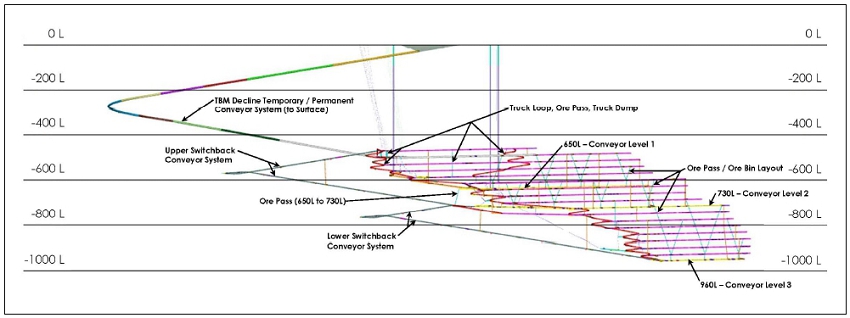
Source: BBA, 2026
Figure 13-11: Santa Cruz Material Handling System
– Section View looking Northeast
| SEPTEMBER 2026 | 13-25 |
| Ivanhoe Electric Inc. S-K 1300 Preliminary Feasibility Study & | |
| 13.11.3 | Backfill |
Cemented paste backfill is used as the primary means of backfill to support the mining cycle and allow excavation of the adjacent voids. Spent ore from the on/off leach pad is the primary material source to produce paste. Due to the lag between the initial availability of spent ore from the on/off pad and the demand for paste, Oracle granite from the decline construction or an off-site source is used during the initial months of mine production. Milled spent ore will then be used for the remainder of the mine life. The spent ore requires conditioning and milling prior to use in the backfill system to establish suitable properties for use as paste backfill.
Mine backfill demand ramps up over the first 2 years of production to ~2.4 Mm3 of voids to be filled in 2031. Two paste backfill production modules, each with a dedicated 8-inch pipeline and a corresponding design capacity of 250 m3/h, connecting to the underground distribution system are planned. The second backfill production module and parallel 8-inch pipeline underground distribution system is required to start production by Q4 2030. Prior to this, estimated monthly paste plant utilization peaks at approximately 67% for one module. Backfill demand continues to increase through 2032 and levels off between 2.6 and 3.2 Mm3 per year over the remainder of the life of mine.
A paste backfill system rarely operates at a fixed operating point and the inputs into the system will naturally change through variation in the orebody and what is upstream of the paste plant. It is important to include flexibility within the system to accommodate for varying paste plant feeding material properties, paste backfill rheology, and other changes in process parameters. For the routing and paste pump pressure capacity of the underground distribution system, a yield stress range of between 150 and 450 Pa is specified. The expected paste solids concentration is in the range of 72% to 76% solids by weight for milled spent ore with 4.5% to 6.5% typical binder dosage.
| 13.11.3.1 | Milled Spent Ore Paste Backfill |
Paste backfill test work was completed on a range of milled spent ore and unleached ore samples produced at laboratory scale. A 200 to 300 µm P80 target grind size was demonstrated to contain adequate fines to produce a stable, pumpable paste while also maintaining strength gain once cured and was carried forward in the design. Mineralogy consists primarily of quartz (~50%) and feldspars (~35%) with low contents of reactive clays, micas, and sulfides and are not expected to inhibit paste backfill strength gain. Although the use of milled spent ore as a paste plant feed material is not common, the material did not exhibit any problematic material properties or chemistry hindering backfill performance given neutralization and chloride washing are completed upstream.
| SEPTEMBER 2026 | 13-26 |
| Ivanhoe Electric Inc. S-K 1300 Preliminary Feasibility Study & | |
Locally available Type II/V and slag cement blends (primarily 90:10) were selected through initial test work and carried through grind size optimization test work. Type II/V generally reached the 3-day plug strength target at a lower dosage (15-20% lower) while the slag begins to outperform after 7 days. Commercial slag cement is preblended with alkali activators and a ratio of cement clinker which will differ between suppliers. Particularly for this paste backfill application, sufficient cement clinker must be present to achieve the early cure times required for the mining cycle and to prevent potential retarding of the cement hydration from residual chlorides and sulfates levels in the spent ore. Potential savings from the use of slag cement are partially offset by higher transport costs and supply chain risk as commercial supplies in the wider region are imported. Local Type II/V is carried in the study for the first three years of operation with the expectation that slag supplies and logistics are secured during that time, allowing a transition to slag to occur by 2032.
Spent ore requires chloride rinsing, pH neutralization with lime, and milling to produce a suitable feed material for paste. At the end of the leach cycle, the spent ore is rinsed with water to reduce the residual chloride and sulfate concentrations before placing the material on the spent ore pad. Trucks are loaded at the spent ore pad and are dosed with lime in transport to dump hoppers and feeders that supply spent ore to the mills. The spent ore and lime are milled through two parallel open circuit ball mills (no recirculation or cyclone sizing), one for each paste module to produce a high solids concentration discharge at neutral to basic pH. The solids and water inputs are metered to maintain sufficient solids to feed the paste circuit. The milled material discharges into pump boxes and is pumped through a pipeline to the paste plant surge tanks. Off spec material can be diverted into separate tanks and should be recirculated back to the mill. Filtration was excluded based on pilot milling test work, mill vendor input, and third-party review, indicating that the mill can operate at sufficiently high solids concentration to directly feed the paste mixing circuit.
In the mixer, trim water and binder will be added to the spent ore according to a programmed recipe to produce paste at the desired solids concentration and binder content. The paste overflows the mixer into a paste hopper that supplies a hydraulic piston paste pump. The paste is pumped by pipeline via adjacent boreholes and the underground distribution system throughout the mine to the desired underground stopes. Binder is delivered from the manufacturer’s terminal to silos at the paste plant for metering into the mixer. A 1,200-tonne storage silo provides sufficient binder for 2 days of paste operation with 120-tonne dosing silos for each module providing buffer for metering. A clean water tank supplies water for metering into the mixer and pipeline flushing. A dedicated high-pressure flush pump clears the underground distribution system when a paste pour is complete or as an emergency backup to flush the underground distribution system.
| SEPTEMBER 2026 | 13-27 |
| Ivanhoe Electric Inc. S-K 1300 Preliminary Feasibility Study & | |
Two independent, parallel, modules with mixer, binder dosing silo with weigh belt and feeder, paste pump and pipeline are installed for a combined design capacity of 500 m3/h. This allows one or both modules to operate, filling two different stopes at a time.
| 13.11.3.2 | Underground Distribution System |
The paste will be pumped from the paste plant through two parallel boreholes (one for each operating paste module) located adjacent to the paste plant. The boreholes will enter the mine in a designated paste cuddy off the interconnecting drift between the Santa Cruz and East Ridge regions. Both pipelines will be routed along the back of the mine drift to Santa Cruz region with a transfer station to allow either line to be connected to East Ridge region through a series of spools. Both lines will be carried down the north side of the Santa Cruz region primarily through interlevel boreholes. At each borehole level breakthrough, a transition in a cuddy will be constructed to allow access for either line to a level or bypass to lower levels. In the lower levels of the mine, where mining occurs bottom up, the pipelines will follow the ramp system until level accesses are developed.
The paste backfill system is designed to operate under full flow conditions to minimize pipeline wear due to free fall and/or slack flow. The selection of the pipeline size is primarily based on ensuring that friction losses are minimized during normal operation.
| 13.11.3.3 | Paste Strength Requirements |
Placed paste strength requirements are summarized in Table 13-8.
Table 13-8: Paste Strength Requirements
| Strength Requirement | Fill
Strength Target (UCS) |
Cycle Time for Exposure |
| Sidewall Exposure – Santa Cruz Domain (30 m) | 375 to 500 kPa (15 to 23 m span) | 14 days |
| Sidewall Exposure – Verde Domain (20 m) | 400 kPa (15 m span) | 7 days |
| Undercut (Sill Exposure) – Plug Pour (15 m High) | 1,600 kPa | On exposure |
| Undercut (Sill) Mass Pour (Above 15 m Height) | Per sidewall exposure/minimum paste strength/cap strength | Per sidewall exposure |
| Plug (Per Barricade Loading Assumption) | 210 kPa | 3 days |
| SEPTEMBER 2026 | 13-28 |
| Ivanhoe Electric Inc. S-K 1300 Preliminary Feasibility Study & | |
| 13.11.4 | Grade Control |
Grade control will be facilitated using technology integrated into the materials handling system (e.g., cross-belt analyzers). Additionally, production hole sampling and on-site testing at the surface assay laboratory will be used to reconcile results against the mine plan.
| 13.11.5 | Mine Ventilation & Refrigeration |
The underground mine ventilation system was designed as a “push-pull” system, with the airflow provided from one decline and three ventilation shafts. The design ventilation capacity of the system is designed to provide 880 m3/s, through main exhaust fan stations at Shaft 1 and Shaft 2, and the intake fans at Shaft 3. The intake fans at Shaft 3, operating in conjunction with the bulk air cooler (“BAC”) at the shaft, allows for the ventilation flow at the conveyor decline to be balanced as required. All main fans are planned to be installed on surface, while some exhaust booster fans will be required to control the ventilation flow underground.
Due to the ambient temperatures, the temperatures underground cannot be maintained below the maximum reject temperatures with ventilation only, so mechanical cooling is required at the ventilation intake locations. Cooling will be provided at the intakes through the central refrigeration plant with overland insulated piping and bulk air coolers installed adjacent to the portal and at Shaft 3.
For flexibility and efficient operation of the ventilation system, all main fans and boosters will be equipped with variable frequency drives. This allows the speed of the fans to be adjusted according to the airflow required. The system has been designed to allow ventilation on demand, to monitor and control the ventilation system through automated regulators installed at the internal raise accesses. This ensures that adequate air quality is maintained on all working levels.
| 13.11.5.1 | Airflow Requirements |
The Santa Cruz ventilation system is designed to meet the minimum design velocity requirements at each active heading, ensuring sufficient airflow for heat and diesel dilution is provided in compliance with regulatory standards. This approach ensures good air quality and allows for the efficient clearance of mine blast gases.
The airflow requirements for the Santa Cruz mine ventilation system are determined by the greater of 12.5 m³/s (based on a velocity of 0.5 m/s for a 5 m x 5 m heading) or 0.063 m³/s per operating horsepower in the active development/production heading. Cooling will be provided as necessary to manage heat. The overall ventilation system is designed for a maximum 880 m³/s to slightly exceed the ventilation requirements for the planned development and production activities. The ventilation milestones staged requirements are as follows:
| SEPTEMBER 2026 | 13-29 |
| Ivanhoe Electric Inc. S-K 1300 Preliminary Feasibility Study & | |
| ■ | Stage 1: Initial Development | 300 m³/s |
| ■ | Stage 2: Shaft 3 Established | 550 m³/s |
| ■ | Stage 3: Shaft 1 Established | 550 m³/s |
| ■ | Stage 4: Production Ramp-Up | 700 m³/s |
| ■ | Stage 5: Full Production | 800 m³/s |
| ■ | Stage 6: Life of Mine | 840 m³/s |
The ventilation is provided through two exhaust main fan stations at the Shaft 2 and Shaft 3, and an intake fan station at Shaft 3. The exhaust fan stations will have a bifurcated arrangement, with fans installed in parallel and ducting connecting to a 5.5 m diameter raise. While the intake fan station will be installed at the BAC with one fan per BAC module unit, having a total of five fans operating at the Shaft 3 BAC.
| 13.11.5.2 | Cooling Requirements |
Due to the location of the mine, cooling will be required to condition the intake ventilation air. The cooling requirements considered the heat from the mobile equipment, auto-compression, strata heat, broken rock, fissure water ingress, and electrical loads. The peak ventilation cooling required is 20 megawatts of refrigeration (“MWr”) as outlined in Figure 13-12.
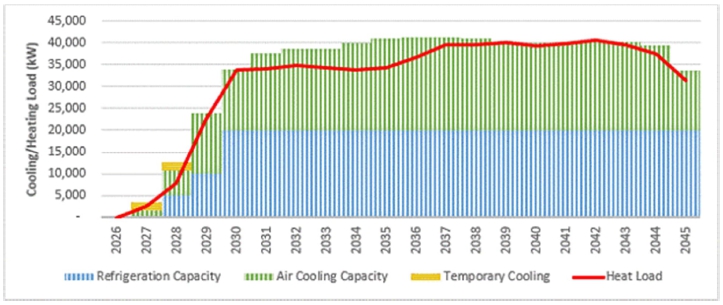
Source: Stantec, 2026
Figure 13-12: Ventilation Cooling/Heat Load Throughout Life of Mine
| SEPTEMBER 2026 | 13-30 |
| Ivanhoe Electric Inc. S-K 1300 Preliminary Feasibility Study & | |
Cooling will be provided through a centralized refrigeration plant. The refrigeration plant will have four chillers, each rated to provide 5 MWr of cooling capacity at the bulk air coolers, and four cooling towers to reject the heat from each chiller. The chillers, cooling towers, and bulk air coolers will be staged as additional cooling duty is required by the mine. The refrigeration plant is planned to have a total capacity of 20 MWr, with the bulk air coolers located at the decline portal and Shaft 3. A cooling duty of 7.5 MWr and 12.5 MWr is planned at each of these locations, respectively.
| 13.11.5.3 | System Description |
Access to the mine is planned through the TBM decline which will be equipped with a conveyor for material handling. To support the development of the decline, a forced ventilation system will be established with a large 2.13 m diameter flexible duct providing sufficient airflow to the TBM heading. The forced ventilation will be provided by two portal fans installed in series with a heat exchanger for cooling, fed from an air-cooled rental chiller. At the bottom of the TBM decline a connection to the first raise will be made to establish flowthrough ventilation and support additional development headings.
The development will proceed in stages, with three shafts established to support ventilation and production. Bulkheads, internal raises, and booster fan stations will be installed to direct the ventilation. Some of the bulkheads will include doors to allow access and louver regulators to control the airflow, with air quality stations monitoring the air flow. Auxiliary fans will be installed at the levels and ramps and ducted to production or development headings, as required.
Roadheaders are planned for some of the headings. Ventilation for headings being developed with a roadheader will incorporate an exhausting ducted system with a wet scrubber for dust control. The intake air will be conditioned initially with a skid-mounted rental air handling system; this will later be replaced with a permanent bulk air cooler.
Airflow to the mining areas will be provided through the conveyor and Shaft 3. The exhaust from the mining areas will be directed either to (1) internal raises onto the conveyor levels and then to the main exhaust shafts; or (2) directly to the main exhaust shafts (i.e. Shaft 1 or Shaft 2). A schematic showing the planned LOM ventilation is provided in Figure 13-13.
| SEPTEMBER 2026 | 13-31 |
| Ivanhoe Electric Inc. S-K 1300 Preliminary Feasibility Study & | |
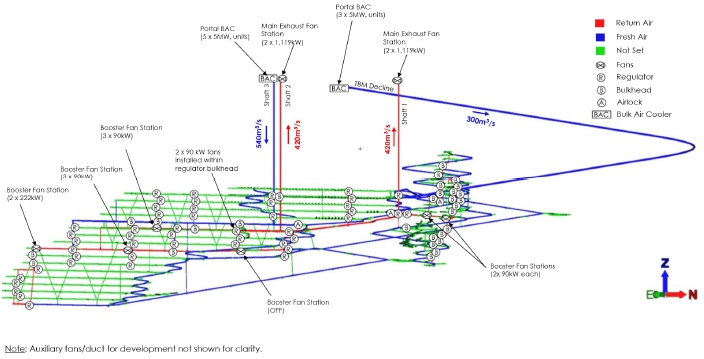
Source: Stantec, 2026
Figure 13-13: Life of Mine Ventilation Schematic
| 13.11.5.4 | Auxiliary Ventilation |
The auxiliary ventilation for the development and production headings1 is planned to employ a forced ventilation system, with the fans pushing fresh air to the heading from the closest flowthrough ventilation, and exhaust from the heading returning through the drift. The auxiliary fans were sized based on the heading length and the mining activity. For production headings, a single auxiliary fan will be capable of supporting two active headings. Dampers will be installed within the ducting to control the flow to the heading, with 15 m3/s provided to each active production heading. One auxiliary fan will be capable of supporting two headings. While for the development headings, a dedicated development fan will be required per heading, with 30 m3/s provided to each development heading.
1 Except for roadheader development, which will employ an exhausting system as described in Section 13.11.5.3.
| SEPTEMBER 2026 | 13-32 |
| Ivanhoe Electric Inc. S-K 1300 Preliminary Feasibility Study & | |
| 13.11.6 | Underground Infrastructure |
Proposed underground infrastructure will include the following:
| ■ | The underground compressed air system will be supplied by surface-installed compressors. A primary compressed air header will be routed from surface to the underground workings through a dedicated borehole. Compressed air will then be distributed between level service stations through cased boreholes. |
| ■ | The underground process water system will be gravity-fed from a surface holding tank. The water level in the holding tank will be maintained by raw water pumps drawing from the surface pond. A primary process water header will be routed from surface to the underground workings through a dedicated borehole. Process water will then be distributed between level service stations through cased boreholes. |
| ■ | An electrical system will be installed to support the TBM development, road header development, production mining and infrastructure, development and construction, battery electric vehicle (“BEV”) charging stations, conveyors, and surface ventilation fans. The system will include incoming 13.8 kV feeds, power distribution, power substations, primary substations, secondary substations, infrastructure substations, mining substations, major and minor pumping substations, and conveyor substations. |
| ■ | Leaky feeder and long-term evolution (“LTE”) cables will be installed in the mine for underground communications. |
| ■ | A control room on surface will allow supervisory control and data acquisition (“SCADA”) for monitoring and operation. There will also be a tele-remote control room for equipment operation, a server room that contains programmable logic controllers (“PLCs”) and cabinets, and multiple operator stations for LHDs and production drills. Variable frequency drives and starters for pumps, fans and other underground installations will be connected through the network to the PLC for monitoring and control. |
| ■ | Fuel stations will be available for diesel, lubricant, hydraulic fluid, and engine oil. |
| ■ | Battery charging stations for BEVs will be provided. |
| ■ | Bulk underground explosives storage, and separate detonator storage areas for development and production, are included in the design. |
| 13.11.7 | Personnel |
Underground labour and supporting staff are expected to peak at 529 personnel, comprised of both contractor and Ivanhoe Electric employees; this represents the total underground workforce and not the number of personnel on site at any one time.
| SEPTEMBER 2026 | 13-33 |
| Ivanhoe Electric Inc. S-K 1300 Preliminary Feasibility Study & | |
| 13.11.8 | Mining Equipment Fleet |
The mobile equipment fleet will consist of a combination of diesel, diesel/electric, and battery electric vehicles. In early development stages before charging infrastructure is constructed, diesel equipment will be primarily deployed. From the start of operations, development equipment will be composed of a diesel/BEV hybrid fleet (for few equipment types like emulsion loaders, LHDs, personnel carriers, etc.). The diesel equipment transition to BEV-type equipment will be complete by 2034. During full production, BEV LHDs will be used instead of diesel equipment to reduce fuel and ventilation costs.
All new mining equipment purchased by Ivanhoe Electric until 2033 will be financed to reduce initial capital requirements. The financed equipment will be replaced with purchased equipment. Table 13-9 summarizes the peak Ivanhoe Electric mobile equipment fleet by year. Contractor equipment fleet requirements are summarized in Table 13.
Table 13-9: Peak Equipment Quantities Per Year – Owner's Fleet – Operating Development & Stoping
| Equipment Type | Motive Power | First Peak Year | Count |
| Emulsion Loader (Development) – Diesel | Diesel/Electric | 2031 | 2 |
| Emulsion Loader (Development) – Electric | BEV/Electric | 2034 | 5 |
| Bolter | Diesel/Electric | 2033 | 10 |
| Boom Truck | Diesel | 2032 | 9 |
| Cable Bolter | Diesel/Electric | 2030 | 3 |
| Raise Bore (Production Slot) | Diesel/Electric | 2043 | 7 |
| Emulsion Loader (Production) – Diesel | Diesel/Electric | 2029 | 1 |
| Emulsion Loader (Production) – Electric | BEV/Electric | 2037 | 4 |
| Forklift – Diesel | Diesel | 2029 | 1 |
| Forklift – Battery Electric | BEV | 2034 | 7 |
| Jumbo | Diesel/Electric | 2034 | 6 |
| LHD – Diesel | Diesel | 2030 | 2 |
| LHD – Battery Electric | BEV | 2034 | 13 |
| Cleanup LHD | Diesel | 2032 | 4 |
| Longhole Drill | Diesel/Electric | 2037 | 7 |
| Scissor Lift – Diesel | Diesel | 2030 | 2 |
| Scissor Lift – Battery Electric | BEV | 2034 | 5 |
| Shotcrete Sprayer | Diesel/Electric | 2028 | 4 |
| Truck | Diesel | 2030 | 7* |
| SEPTEMBER 2026 | 13-34 |
| Ivanhoe Electric Inc. S-K 1300 Preliminary Feasibility Study & | |
| Equipment Type | Motive Power | First Peak Year | Count |
| Rock breaker | Diesel | 2032 | 2 |
| Fuel/Lube truck | Diesel | 2029 | 2 |
| Grader | Diesel | 2028 | 1 |
| Telehandler | Diesel | 2033 | 3 |
| Mechanic Truck | Diesel | 2034 | 4 |
| Personnel Carrier (32-person) | Diesel | 2031 | 4 |
| Safety – Battery Electric | BEV | 2028 | 1 |
| Engineering/Surveyor/Geology | BEV | 2031 | 5 |
| Shifter – Battery Electric | BEV | 2033 | 7 |
| Rescue Vehicle | Diesel | 2028 | 1 |
| Explosive transport truck | Diesel | 2028 | 2 |
| Mobile Batch Plant | Diesel | 2034 | 4 |
| Total | 135 |
*Four additional trucks will be rented in this year to support early production.
Table 13-10: Total Equipment Quantities Per Year – Contractor’s Fleet – Other Capital Development
| Equipment Type | First Peak Year | Quantity |
| Jumbo | 2029 | 3 |
| Explosives Loader | 2029 | 2 |
| LHD | 2029 | 3 |
| Cleanup LHD | 2028 | 1 |
| Bolter | 2029 | 5 |
| Cable Bolter | 2028 | 1 |
| Shotcrete Sprayer | 2029 | 2 |
| Mobile Batch Plant | 2029 | 2 |
| Scissor Lift | 2028 | 4 |
| Forklift | 2028 | 2 |
| Personnel Carrier | 2028 | 1 |
| Raisebore (for Vertical Development) | 2031 | 3* |
| Total | 29 |
*Based on contractor requirements – numbers to be validated with detailed mine schedule.
| SEPTEMBER 2026 | 13-35 |
| Ivanhoe Electric Inc. S-K 1300 Preliminary Feasibility Study & | |
| 14. | Process & Recovery Methods |
| 14.1 | Process Method Selection |
The overall process for Project has been designed to cycle oxide and secondary sulfide ores through an on/off heap leach to produce a pregnant leach solution (“PLS”) that will be processed in the onsite SX/EW circuit for copper recovery.
The process plant and refinery designs were based on proven technologies and established operating practices, and commercially available equipment. The design approach incorporates the results of metallurgical testwork conducted on mineralized material from the Santa Cruz Copper Project. Overall, the proposed process configuration is conventional and presents a low level of technical risk.
| 14.1.1 | Processing Overview & Flowsheets |
The proposed Santa Cruz Copper Project processing facilities will include the following operations:
| ■ | Crushed coarse ore stockpile (Run of mine (“ROM”) is crushed by a sizer underground); |
| ■ | Secondary crushing and screening; |
| ■ | Tertiary crushing and screening; |
| ■ | Agglomeration; |
| ■ | Conveyors and Stacker; |
| ■ | Heap leaching; |
| ■ | Solvent extraction (SX); |
| ■ | Electrowinning (EW); |
| ■ | Reagent preparation and distribution; |
| ■ | Raw water and distribution; |
| ■ | Water treatment and distribution; |
| ■ | Compressed air. |
A simplified overall process flow diagram is presented in Figure 14-1.
| SEPTEMBER 2026 | 14-1 |
| Ivanhoe Electric Inc. S-K 1300 Preliminary Feasibility Study & | |
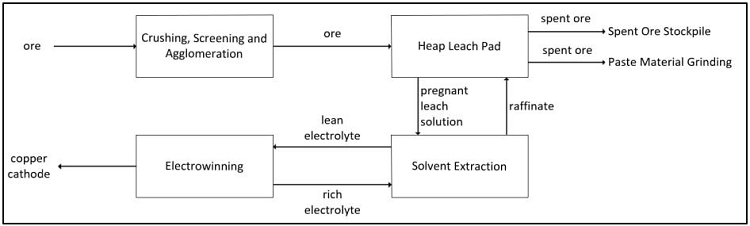
Figure 14-1: Simplified Process Flowsheet
| 14.2 | Metallurgical Design Basis |
Metallurgical design parameters for the facilities are based on the metallurgical testwork discussed in Section 10. The key metallurgical parameters derived from the metallurgical testwork program are presented in Table 14-1.
Table 14-1: Key Metallurgical Testwork Parameters
| Description | Unit | Design Value |
| Heap Leach Feed Particle Size (F100) | mm | sub-9.5 |
| Heap Leach Feed Particle Size (F80) | mm | 6.4 |
| Bulk Density for Stacking & Volumetric Calculations | t/m3 | 1.51 |
| Ore Solids Density | t/m3 | 2.77 |
| Sodium Chloride (“NaCl”) Addition to Agglomeration | kg/t | 0.4 |
| Gross Acid Consumption | kg/t | 27 |
| Net (Gangue) Acid Consumption (or Generation) | Kg/t | 10 |
| Irrigation Rate | L/h/m2 | 8.0 |
| Residual Moisture | wt % | 6.0 |
| Overall Copper Recovery | % | 92.3 |
| Concentration of Soluble Copper in Residual Moisture | g/L | 0.35 |
| Bond Work Index of Spent Ore | kWh/t | 14.9 |
| Crusher Work Index of Ore Average | kWh/t | 3.8 |
| Abrasion Index | grams | 0.12 |
| SEPTEMBER 2026 | 14-2 |
| Ivanhoe Electric Inc. S-K 1300 Preliminary Feasibility Study & | |
| 14.3 | Process Description |
Ore produced from the underground mine will be processed using a heap leach and SX/EW flowsheet to produce London Metal Exchange (“LME”) Grade A copper cathode. The heap leaching process will take place on an on/off pad. Spent ore will be removed from the on/off leach pad and processed for paste backfill or placed in a spent ore storage facility. Approximately 50% of the spent ore will be processed for use in paste backfill. Operations will be conducted 24 hours per day, 365 days per year for approximately 24 years, at a design daily stacking rate of up to 22,000 tonnes.
| 14.3.1 | Major Process Equipment Design Criteria and Selection |
Major process design criteria are presented in Table 14-2. Major process equipment specifications are presented in Table 14-3.
Table 14-2: Major Process Design Criteria
| Description | Unit | Value |
| Operating Information | ||
| Life of Mine | y | 24 |
| Crushing & Agglomeration Annual Operating Time | % | 75 |
| Crushing & Agglomeration Annual Operating Hours | h/y | 6,570 |
| SX/EW Annual Operating Time | % | 95 |
| SX/EW Annual Operating Hours | h/y | 8,322 |
| Ore Production | ||
| Life of Mine Ore Production | Mt | 140 |
| Stacking Rate Design | t/d | 22,000 |
| Plant Feed Grade (Life of Mine) | ||
| Acid-Soluble Copper | % | 0.64 |
| Cyanide-Soluble Copper | % | 0.38 |
| Residual Copper | % | 0.05 |
| Total Copper | % | 1.04 |
| Recovery | ||
| Life-of-Mine Total Copper Recovery | % | 92.3 |
| Design Annual Copper Production | t/y | 76,000 |
| SEPTEMBER 2026 | 14-3 |
| Ivanhoe Electric Inc. S-K 1300 Preliminary Feasibility Study & | |
| Description | Unit | Value |
| Heap Leaching (On/Off Pad) | ||
| 5-Cell Dimensions (full cell / half-cell strip) | L x W (m) | 640 x 131.0 / 65.5 |
| Number of Cells (full cells / half-cell strips) | no. | 7 / 14 |
| Lift Height (single lift only) | m | 8.0 |
| Aeration Rate | Nm3/h/m2 | 0.15 |
| Leach Solution | ||
| Pregnant Leach Solution / Raffinate Flow Rate (Average) | m3/h | 2,000 |
| Secondary Leach Solution Flow Rate (Average) | m3/h | 1,300 |
Table 14-3: Major Process Equipment
| Item | Number | Description |
| Stockpile Feeder | 2 | Apron feeder |
| Secondary Crusher | 1 | MP1000 |
| Secondary Screen | 1 | 3.6 m x 7.3 m inclined; double-deck; banana |
| Tertiary Crusher | 2 | MP1250 |
| Tertiary Screen | 2 | 4.2 m x 8.5 m inclined; double-deck; banana |
| Heap Leach Stacking System | 1 | Groundline conveyor to mobile conveyors with radial stacker |
| SX Circuit | 2 | Two trains each of (two extraction + two wash + one strip) |
| EW Circuit | 1 | Cells with 84 cathodes each, 2.3 m2 per cathode |
| EW Rectifier | 2 | Output current (maximum) 67 kA / 287 V |
| 14.4 | Crushing, Agglomeration & Stacking |
| 14.4.1 | Crushing |
ROM ore will be crushed underground and delivered to surface at sub-254 mm diameter via belt conveyor. Ore from underground will be conveyed to the crushed coarse ore stockpile (“CCOS”) and will be reclaimed via two apron feeders that will discharge to a secondary vibrating screen (scalper).
The secondary screen oversize material will transfer to a secondary cone crusher operating in open circuit for further crushing. The secondary crushed and the secondary screen undersize material will be combined and further screened on two tertiary vibrating screens. The two tertiary screens will be large banana-type, dual-deck screens. Screen undersize (crushing circuit product), at 100% passing 9.5 mm will be conveyed to fine ore hoppers leading to Agglomeration drums.
| SEPTEMBER 2026 | 14-4 |
| Ivanhoe Electric Inc. S-K 1300 Preliminary Feasibility Study & | |
The hoppers will serve to buffer the continuous crushing circuit to the agglomeration operation. The crushing circuit screen oversize product will be returned to the tertiary crushing feed conveyor for additional crushing. The tertiary crushing circuit will comprise two cone crushers arranged in parallel configuration. Sodium chloride will be added via screw conveyor based on a tonnage ratio to the conveyor to the fine ore hoppers to facilitate leaching. Salt will be received in bulk and blown into a silo for storage.
Dust generated during crushing, screening, and conveying will be captured using dry-type dust collectors and controlled using mist generators where appropriate. The crushing circuit will be located outdoors, and maintenance lifting will be performed by mobile crane.
| 14.4.2 | Agglomeration |
Fine ore (undersize from the tertiary crushing circuit screens) will be agglomerated in rotary drums where sulfuric acid, and raffinate or water will be added to facilitate agglomeration. Feed to the agglomeration drums will be measured for the ratio addition of reagents. Acid will be trucked to the mobile agglomeration module and transferred to a day tank from which a metering pump will add the desired amount of acid to the drum.
| 14.4.3 | Stacking |
Crushed ore will be delivered to the leach pad via a combination of permanent overland and mobile conveying and stacking equipment. Agglomerated ore will discharge onto a transfer conveyor which will feed a series of grasshopper-type mobile conveyors. The final mobile conveyor will feed two self-propelled indexing conveyors in series, which in turn will feed the self-propelled mobile radial stacker. The full-size cells of the on/off pad will each be ‘retreat’ stacked as two half-cell strips by the radial stacker in 65.5 m wide half-moon shapes.
| 14.5 | On/Off Heap Leach |
| 14.5.1 | On/Off Heap Leach Pad |
The on/off heap leach pad will be subdivided into seven cells, each approximately 130 x 730 m, that will each be loaded with ore in two half-cell strips (with each strip typically comprised of approximately 65.5 x 635 m crest dimensions), irrigated, and unloaded at different times. The end cells of the on/off pad will be slightly larger to account for the exterior side slopes and approximate 5 m-wide pad perimeter offsets will be included along the north and south perimeters of the pad. An approximate 55 m-wide onloading corridor will be included along the west side of the pad, and an approximate 15 m-wide off-loading corridor will be included along the east side of the pad. The full-size cells will be separated by divider berms located near their bases so that solution
| SEPTEMBER 2026 | 14-5 |
| Ivanhoe Electric Inc. S-K 1300 Preliminary Feasibility Study & | |
flow from each cell can be segregated for collection in either the PLS collection pond(s) or secondary leach solution (“SLS”) collection pond(s). The base of the pad will be graded to promote solution flow from east to west and a solution pipeline conveyance channel will be located along the western edge of the on/off pad to deliver solution to the ponds system(s). The pad will be surrounded by a containment berm to retain solution and stormwater runoff inside the pad footprint. Initial capital will include the construction of the four northern full-size cells with associated perimeter offsets, onloading and off-loading corridors, and divider and containment berms. The remaining three southern cells will be added as operations require.
The on/off heap leach pad will be underlain by a liner system, comprising:
| ■ | A high-density polyethylene geomembrane, overlying; |
| ■ | A geosynthetic clay liner, overlying; |
| ■ | Prepared native foundation materials or compacted grading fill. |
The liner system will be overlain by a drainage system comprising perforated pipes at 6 m spacing, installed in 0.9 m thick drainage layer of select, processed ore and/or imported drainage fill. The perforated pipes will connect to a main collector pipe that will run along the downstream edge of each cell and convey solution to the collection ponds (via the solution pipeline conveyance channel). The drainage system has been sized to convey the design irrigation rate (8 L/h/m2 applied over the top surface area of the ore) multiplied by a factor of 1.5 to account for potential changes in conditions and/or stormwater flows.
The stability of the on/off heap leach pad was analyzed under static and pseudo-static loading conditions and meets the criteria for the factor of safety outlined in the Arizona Mining BADCT Guidance Manual (ADEQ, 2005). Laboratory testing results on Project-specific materials (e.g., spent ore, liner system interfaces) were used to estimate engineering parameters for the stability models.
| 14.5.2 | Solution Management |
Solution will be managed in a series of lined ponds, as follows:
| ■ | Raffinate (depleted PLS from the SX process) pond; |
| ■ | PLS collection ponds (north and south); |
| ■ | SLS collection ponds (north and south); |
| ■ | Solution overflow ponds (north and south), to manage upset conditions and stormwater reporting from the on/off heap leach pad. |
The ponds system has been sized to contain normal operating solution inventory, heap leach pad drain-down during potential upset conditions, and stormwater. The entire site will be fenced to
| SEPTEMBER 2026 | 14-6 |
| Ivanhoe Electric Inc. S-K 1300 Preliminary Feasibility Study & | |
reduce the risk of danger to wildlife. Water that accumulates in the solution overflow ponds will be pumped to the SLS ponds so that adequate stormwater storage capacity will be maintained and to mitigate potential discharge to the environment. The liner systems for the ponds follow Prescriptive BADCT guidelines (ADEQ, 2005). For the process solution ponds, this comprises:
| ■ | A UV-resistant high-density polyethylene geomembrane, overlying; |
| ■ | A leachate collection and removal system (“LCRS”) comprising a geonet, gravity-draining to a sump to allow for leak monitoring and leachate removal, overlying; |
| ■ | A high-density polyethylene geomembrane, overlying; |
| ■ | A geosynthetic clay liner, overlying; |
| ■ | Prepared native foundation materials, compacted grading fill, or compacted pond embankment fill. |
The SLS ponds and solution management will be used to support extended leach cycles during secondary sulfide leaching by allowing select copper solutions to be returned to the top of the heap leach pad to thereby promote higher copper extractions and/or higher solution grades for processing.
The proposed locations of the solution management ponds are depicted in Figure 14-2. The Santa Cruz Copper Project on/off heap leach facility is designed and planned to be operated as a zero-discharge facility.
| SEPTEMBER 2026 | 14-7 |
| Ivanhoe Electric Inc. S-K 1300 Preliminary Feasibility Study & | |
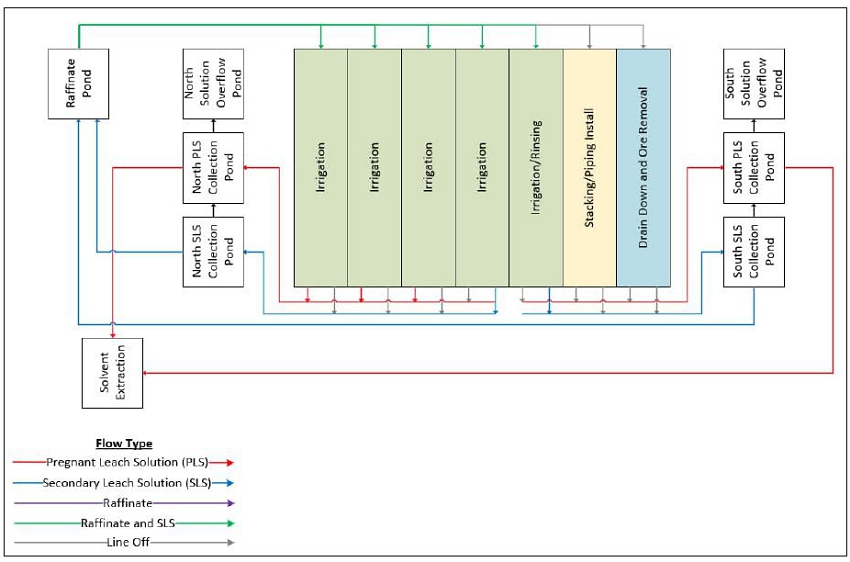
Figure 14-2: 7-Cell Heap Solution Management
| SEPTEMBER 2026 | 14-8 |
| Ivanhoe Electric Inc. S-K 1300 Preliminary Feasibility Study & | |
| 14.5.3 | Heap Leach Process |
The approximate 130 m wide full-size cells will be ‘retreat’ stacked (east to west) by radial stacker in 65.5 m wide (half-cell) half-moon shapes. Agglomerated ore will be fed to the stacker by mobile conveyors. The leach stack (single lift at angle-of-repose) height will be 8 meters.
Ore will be stacked at up to 22,000 t/d, while unloading will consider a constant rate of 22,000 t/d; based on a typical interior half-cell strip (i.e., not the end cell strips on the north or south sides of the pad), it will take approximately 25 days to stack each half-cell strip at the design production rate. Each of the cells (and more specifically, each of the half-cell strips) will cycle through the following processes in sequence with an entire cell cycle, under the design production rates and idealized cell sizing, taking approximately 320 days:
| ■ | Stacking (25 days); |
| ■ | Piping connections, stacker relocation, and ore curing (3 days); |
| ■ | Irrigation (220 days); |
| ■ | Solution drain-down, water rinse, water drain-down, and piping removal (23 days); |
| ■ | Spent ore reclaim (25 days); |
| ■ | Inspection and maintenance (empty cell time) (26 days). |
The cells will be irrigated with raffinate or SLS produced from leaching. Leach solution will report to the leach solution collection ponds. At the end of the leach cycle, spent ore will be removed, as discussed in Section 14.5.4.
Pregnant leach solution will report to the solvent extraction circuit, and raffinate will return to the heap from solvent extraction at a flowrate of 2,000 m3/h. The general pad configuration and solution management ponds presented on Figure 14-3 are planned.
Secondary sulfides in the ore will require oxygen for leaching. Air will be supplied to each cell by blowing air using two dedicated fans per cell. In total, there will be 14 fans; however, only 10 will be operating at any given time. Air piping will also be installed in a layer of select, processed ore and/or imported drainage fill beneath the stacked ore at an elevation above the drainage system. For each cell, two fans will discharge to an air header. The air tubes will have perforated air holes for air distribution.
| SEPTEMBER 2026 | 14-9 |
| Ivanhoe Electric Inc. S-K 1300 Preliminary Feasibility Study & | |
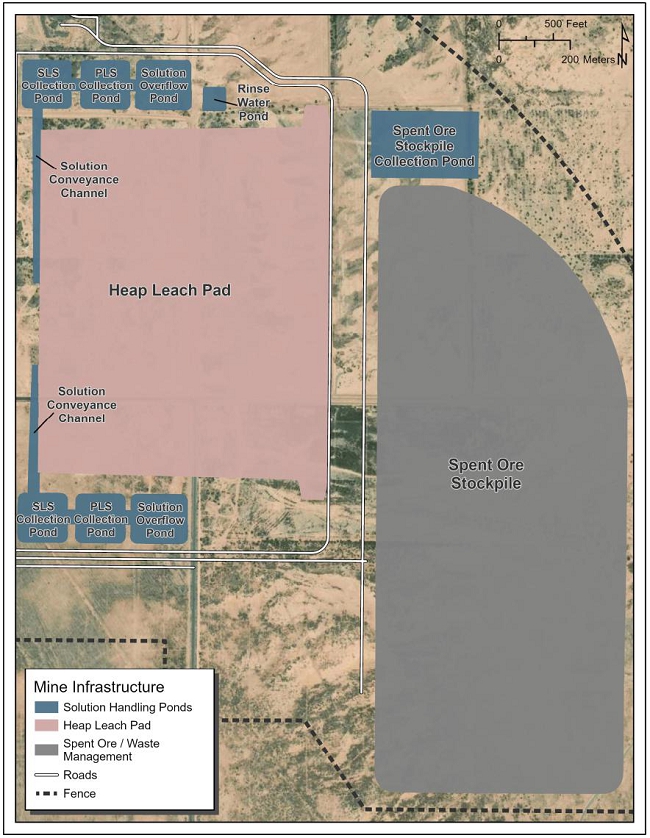
Source: Ivanhoe Electric, 2025.
Figure 14-3: Solution Management Ponds, Leach Pad & Spent Ore Stockpile
| SEPTEMBER 2026 | 14-10 |
| Ivanhoe Electric Inc. S-K 1300 Preliminary Feasibility Study & | |
| 14.5.4 | Spent Ore Management |
Following irrigation on the on/off pad, the spent (leached) ore will be left on the leach pad to allow for initial solution drain-down, water rinsing, and water drain-down; a total process that will last approximately 23 days. Following the removal of the irrigation piping, the spent ore will be unloaded from the pad using dozers, loaders, and grasshoppers / link conveyors and then loaded into trucks along the eastern edge of the pad for transport to either the spent ore stockpile or the paste backfill plant. After removal of the spent ore from the on/off pad, the pad will be inspected and maintenance will be performed, as needed, prior to the start of the next cycle that will begin with stacking.
The spent ore stockpile will be located east of the on/off heap leach pad (Figure 14-3) and will be the planned repository for all spent ore not used for paste backfill. The spent ore will be placed in the stockpile by mobile equipment in lifts and expanded from north to south during operations to meet storage requirements.
The spent ore stockpile will be underlain by a high-density polyethylene geomembrane on top of prepared foundation or compacted grading fill. The geomembrane will be covered by a 1 m thick, compacted, protection layer of carefully placed spent ore. Portions of the stockpile, near the toes of slopes, will be compacted for pile stability.
The spent ore stockpile will be surrounded by lined collection channels that will receive seepage from the stockpile (if any) and runoff from the stockpile slopes. The channels will convey flow to the northern side of the stockpile, to the spent ore stockpile collection pond, where it will be evaporated or reused in the process. Ultimately, the spent ore stockpile will be covered and shaped, as needed, for surface water management and long-term stability once production has ceased.
| 14.5.5 | Copper Separation (Solvent Extraction) |
In the solvent extraction plant, copper is selectively extracted from the aqueous pregnant leach solution in mixers, using an “organic” extractant. The denser aqueous and lighter organic phases are then separated in settlers. This leaves the aqueous solution (raffinate) containing all other solutes (notably chloride, acid, and iron) which is returned to the heap leach via the raffinate pond. Any residual aqueous solution entrained in the organic phase is removed in a washing stage.
Next, the copper-loaded organic is stripped using a highly-acidic solution from the electrowinning plant (lean-electrolyte), whereby the copper is transferred at a higher concentration to the electrolyte (rich-electrolyte) and delivered to the electrowinning plant for recovery as cathode.
| SEPTEMBER 2026 | 14-11 |
| Ivanhoe Electric Inc. S-K 1300 Preliminary Feasibility Study & | |
The solvent extraction circuit design comprises two parallel trains. Each train will consist of two extraction stages, two wash stages, and one strip stage.
Organic will be circulated through the extraction, washing, and stripping stages. A surge tank with pumps for loaded organic will be situated between the final extraction stage and the (first) wash stage. Entrained aqueous will be drained from this tank and returned to the extraction circuit.
Pregnant leach solution from the leach pad will be pumped through the two extraction settlers in series, in countercurrent fashion, with stripped organic to extract copper. The stripped organic will become loaded organic and will enter an organic surge tank. The loaded organic will then be pumped through the wash stage(s) to the strip settler. Water will be added to the wash stages to remove as much of the high-chloride aqueous as possible via dilution. The cleaned organic will then proceed to the strip stage.
Lean-electrolyte will be fed to the strip stage where it will extract copper from the loaded organic to form rich-electrolyte. This stream of rich-electrolyte will enter a surge tank and be pumped through a coalescing column to remove the majority of the entrained organic. The partially-cleaned rich-electrolyte will be stored in another surge tank and then pumped through dual media filters to reduce the entrained organic to approximately 5 ppm. These filters will be periodically backwashed with demineralized water, which will be returned to the raffinate. The electrolyte product will then enter an electrowinning cell feed tank system where it will be mixed with a portion of the lean-electrolyte and reagents to form electrowinning cell feed electrolyte. This electrolyte will be pumped to the electrowinning circuit. The electrowinning circuit will require a higher flowrate than the strip settler, so the flow will be increased by circulating cell return lean-electrolyte.
| 14.6 | Electrowinning |
The copper electrowinning tank house will comprise electrowinning cells with calcium-tin-lead rolled plate anodes and stainless-steel cathode blanks. Cathodes (copper electroplated onto stainless-steel blanks) will be harvested manually using an overhead crane and bail. Positioning devices on the crane and cells will assist the crane operator with alignment. Cathodes will be stripped in an industry standard automated stripping machine, and the washed blanks will be returned to the cells. Product cathode will be bundled, sampled, weighed, labeled, and shipped.
The electrowinning cells and stripping machine will be located within a building. The cells will be individually covered to contain acid mist that naturally evolves from the solution surface. Covered cells will provide a safe working environment for the operators and capture acid mist prior to release to the atmosphere. Captured cell gases and aerosols will be scrubbed prior to release to the environment.
| SEPTEMBER 2026 | 14-12 |
| Ivanhoe Electric Inc. S-K 1300 Preliminary Feasibility Study & | |
| 14.6.1 | Reagent Preparation & Distribution |
Sulfuric acid, guar, cobalt sulfate, extractant, diluent, and sodium chloride will be used in the process (Table 14-4). Where appropriate, reagent mix tanks will be provided with bag breakers and dust collectors. Each reagent makeup area will be equipped with independent containment and a dedicated sump. Bagged reagents will be stored under cover in the site warehouse.
Table 14-4: Proposed Reagent & Process Consumables
| Reagent & Consumables | Units | Consumption Rate |
| Reagents | ||
| Sodium Chloride | kg/tore | 0.4 |
| Sulfuric Acid | kg/tore | 9 |
| Makeup Water | kg/tore | 723 |
| Guar | kg/tcathode | 0.20 |
| Cobalt Sulfate | kg/tcathode | 0.40 |
| Extractant | kg/tcathode | 3.168 |
| Diluent | kg/tcathode | 8.81 |
| Liners and Grinding Media | ||
| Primary Crusher – Liners | set/y | 2 |
| Secondary & Tertiary Crushers – Liners | set/y | 9 |
| 14.7 | Raw Water |
Makeup water (water sourced by natural means that has not been treated) will be sourced from existing grandfathered Type 1 non-irrigation rights and mine dewatering. Mine dewatering will report to a surface pond for storage, sedimentation, and eventual discharge to agricultural end users. A portion of the makeup water will be used untreated by the process, while a portion will be treated in the reverse-osmosis plant and used for the wash settlers, reagent mixing, and electrowinning circuit. Mine dewatering will provide a sufficient supply of makeup water for the LOM plan.
Further discussion of water can be found in Sections 3.2.3, 15.1.6, 15.1.7, and 17.2.
| SEPTEMBER 2026 | 14-13 |
| Ivanhoe Electric Inc. S-K 1300 Preliminary Feasibility Study & | |
| 14.8 | Air Supply |
A compressed air distribution system will be included to supply required process air to the plant—primarily to the crusher area. Instrument air will be included for instrumentation and controls.
| 14.9 | Power |
Power supplies are discussed in Section 15.5.
| 14.10 | Personnel |
The process personnel count is 114 persons. See Section 18.3.2.1.3 for a breakdown of crew for each circuit.
| SEPTEMBER 2026 | 14-14 |
| Ivanhoe Electric Inc. S-K 1300 Preliminary Feasibility Study & | |
| 15. | Infrastructure |
| 15.1 | Surface Infrastructure |
The Project site surface infrastructure comprises the following:
| ■ | An open excavation 30 m deep box cut ramp for accessing a single Tunnel Boring Machine tunnel to the underground mine workings; |
| ■ | Three ventilation shafts to facilitate air flows to the underground mine workings; |
| ■ | Primary mine ventilation fans, hardware, and ducting to control ventilation to the mine workings; |
| ■ | Refrigeration plant to control temperatures in the underground mine workings; |
| ■ | Emergency egress hoist system and headframe structure to support underground mining operations; |
| ■ | Rock crushing and screening plant and crushed ore stockpiles; |
| ■ | Agglomeration drums and conveyors; |
| ■ | A spent ore facility; |
| ■ | On/off leach pad with associated collection ponds and mobile stacking; |
| ■ | SX/EW process facilities; |
| ■ | Mobile cement batch plant facility; |
| ■ | Paste backfill preparation and pumping facility; |
| ■ | Reagent systems facility; |
| ■ | Maintenance and warehouse facilities; |
| ■ | First aid/rescue building; |
| ■ | Multiple various ancillary outbuildings; |
| ■ | Entry security shack and various visitor and employee parking spaces; |
| ■ | Equipment delivery and open laydown/storage area; |
| ■ | Multiple improved and unimproved access roads; |
| ■ | Piping and pumping systems for process and water services; |
| ■ | Explosives storage facility; |
| ■ | High-voltage transmission line, substations and medium-voltage distribution; |
| ■ | Environmental monitoring facilities; |
| ■ | Emergency power generation facility. |
| SEPTEMBER 2026 | 15-1 |
| Ivanhoe Electric Inc. S-K 1300 Preliminary Feasibility Study & | |
Key infrastructure locations are shown on Figure 15-1.
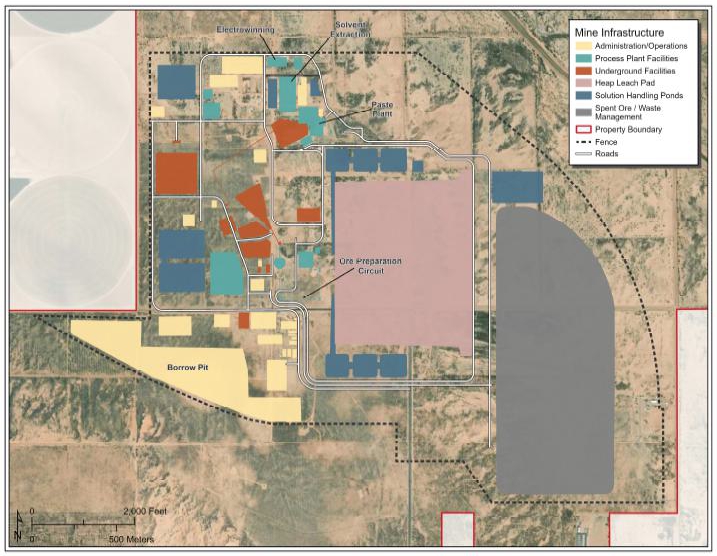
Source: Ivanhoe Electric, 2026
Figure 15-1: Santa Cruz Site Plan
| 15.1.1 | Roads & Logistics |
The Project is accessed by all-weather road networks, as discussed in Section 4, along with rail and air access.
| 15.1.2 | On/Off Leach Pads |
On/off heap leach pads are discussed in Section 14.6.
| SEPTEMBER 2026 | 15-2 |
| Ivanhoe Electric Inc. S-K 1300 Preliminary Feasibility Study & | |
| 15.1.3 | Spent Ore Storage Facilities |
Spent ore storage facilities are discussed in Section 14.6.1.
| 15.1.4 | Power & Electrical |
Power for the Project will be provided from the utility grid supply. The goal of the mine development is to achieve a minimum of 70% of the energy supply from clean energy sources. The clean energy sources will be from a “Green Select” Rider (power from renewable sources) via the local power utility provider, Pinal County Electrical District Number 3 (“ED3”), based on availability.
| 15.1.4.1 | Utility Power |
Regular, grid-supplied power will be sourced from ED3, which is the small, local power supplier to the Maricopa-Stanfield area. ED3’s jurisdiction also includes the Maricopa Stanfield Irrigation and Drainage District (“MSIDD”). The nearest ED3 substation (Sexton) is to the west at the northeast corner of the intersection of Highway 84 and South Anderson Road, approximately 3.5 miles from the planned Santa Cruz switchyard at the Project site. Long-term grid power to the site will be via a new 69 kV double- circuit transmission line from Sexton Substation (see Figure 15-2), installed, owned, and operated by ED3. It will be routed within the recently acquired easements along Anderson Rd and Clayton Rd, before terminating at the Santa Cruz Switchyard within the Ivanhoe Electric property.
| SEPTEMBER 2026 | 15-3 |
| Ivanhoe Electric Inc. S-K 1300 Preliminary Feasibility Study & | |
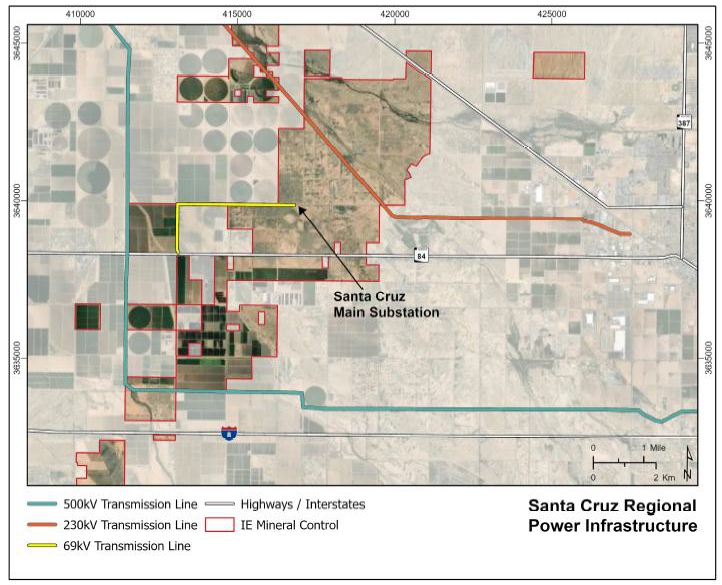
Source: Ivanhoe Electric, 2025
Figure 15-2: Transmission Lines Near the Santa Cruz Copper Project
| 15.1.4.2 | Power Distribution |
At the Santa Cruz Switchyard, power will be distributed within the Santa Cruz site to the Saguaro and Cholla substations via a 69 kV overhead line. The Saguaro Substation will have a Main-Tie-Main Switchgear fed from two 60/80/100 MVA, 69 kV to 13.8 kV transformers for site-wide power distribution, including the underground power infrastructure. The Cholla Substation will have a similar setup but with two 18/24/30 MVA, 69 kVA to 4.16 kV transformers to support the paste plant and main ventilation and refrigeration plant.
| SEPTEMBER 2026 | 15-4 |
| Ivanhoe Electric Inc. S-K 1300 Preliminary Feasibility Study & | |
| 15.1.4.3 | Power Consumption |
The Santa Cruz Copper Project will have an estimated operating load of 74 MW during peak production years (2031-2044) and a forecast annual consumption of 647,000 megawatt-hours per year (“MWh/y”) during peak production years with 690,000 MWh in 2039.
The estimated operating load for the underground mine equipment is forecast to average 31.1 MW with peak operating power around 43.6 MW. The estimated total annual energy consumption attributed to the underground mine during peak production years is estimated to average 272,000 MWh/y, peaking at approximately 294,000 MWh/y in 2039.
The average estimated operating load of the Santa Cruz paste plant is 13 MW; with the average annual power consumption at 73,000 MWh/y during peak production, peaking at approximately 85,200 MWh/y in 2039.
The average estimated operating load of the Santa Cruz Ventilation/Refrigeration Plant is 11.2 MW; with the average annual power consumption at 41,400 MWh/y during peak production years, with a peak of 48,000 MWh/y in 2042.
The estimated average operating load for the Santa Cruz surface facilities is forecast to be 34.3 MW; the estimated annual power consumption during peak production years is forecast to be approximately 218,000 MWh/y with a peak of 226,000 MWh/y in 2039.
| 15.1.5 | Gas Pipelines |
A natural gas pipeline crosses the Project area and accesses various adjacent residential customers, farms, and businesses. There is currently no plan for the use of natural gas during Project development or operations, so the section of the natural gas pipeline that crosses through the proposed facilities will be abandoned and relocated during early-stage Project development.
| 15.1.6 | Water Supply |
Water supply for processing operations will be sourced from existing grandfathered Type I non-irrigation rights and mine dewatering, as discussed in Section 14.7.
Potable water will be trucked in from the city. Trucked water will be stored in a tank to service the surface facilities.
| SEPTEMBER 2026 | 15-5 |
| Ivanhoe Electric Inc. S-K 1300 Preliminary Feasibility Study & | |
| 15.1.7 | Water Management |
Water management operations, including systems of underground water collection, conveyance, and extraction facilities, water storage, water use, and various management options for discharge of excess water are integrated through the water balance plans and modeling, to support overall reliability of Ivanhoe Electric's ongoing engineering and environmental plans. Water not used for underground mining, the paste backfill plant, the process plant, and the on/off heap leach pad will be pumped to storage reservoirs. Rapid infiltration basins are used to capture stormwater or non-contact water (runoff associated with processing facilities). Contact stormwater will be collected in sumps or ponds and reincorporated into the process circuit as feasible.
Water quality predictions indicate that extracted groundwater quality generally meets agriculture standards and does not show mining-related impact. Predicted water quality is considered acceptable for irrigation use when applied to suitable crops (e.g., cotton, alfalfa, pasture grasses) commonly grown in the vicinity of the Project. Water quality predictions are highly reliant on predicted flow volumes and the current mine plan which assumes that mined or excavated zones will be completely backfilled. The water distribution system is designed to distribute water to agricultural end-users, without treatment. If required in the future, a side-stream water treatment plant could be permitted and used to treat mine inflow groundwater that does not meet the standards required for on-site or off-site uses.
| 15.1.7.1 | Water Balance |
Life Cycle Geo, LLC (“LCG”) developed an operational site-wide water balance (“SWWB”) model with the objective of evaluating the Project’s site-wide water management strategy throughout the operational life of mine. The model simulates water demands, water inventories, storage requirements, and water movement between facilities to assess water availability and support management of the operational water supply.
The specific objectives of the SWWB model were to:
| ■ | Simulate site-wide water flows and water losses throughout the operational LOM; |
| ■ | Evaluate the Project water management strategy relative to applicable environmental and permitting requirements; |
| ■ | Identify potential water management risks, uncertainties and data gaps; |
| ■ | Support Project planning, design optimization and regulatory submissions. |
The SWWB is a dynamic, mass-balance model that simulates inputs, transfers, storage, reuse and losses across key Project facilities, and was developed using the GoldSim platform (GoldSim Technology Group, 2025). The current SWWB is based on historical climate conditions and employs
| SEPTEMBER 2026 | 15-6 |
| Ivanhoe Electric Inc. S-K 1300 Preliminary Feasibility Study & | |
operational inputs from annual production schedules and PFS design information. The model is intended to provide a planning-level assessment of average annual water management requirements. Simulations were conducted from September 1, 2026, through December 31, 2051, encompassing Project construction, mining operations and closure. Throughout the LOM, principal water sources include groundwater supply wells, groundwater captured through mine dewatering, and stormwater runoff collected within the Project footprint. Primary water losses and consumptive uses include evaporation, infiltration, and water consumed by mining activities (mineral processing, mining, facility demands).
During construction and early operations, groundwater production wells will provide water supply for the Project. As underground development advances and mine inflows increase, residual passive inflows (“RPIs”) captured by mine dewatering are expected to become the primary source of water supply once the dewatering rates meet or exceed operational water demands. Key facilities and processes simulated in the SWWB and include:
| ■ | Tunnel boring machine (“TBM”) operations; |
| ■ | Underground RPIs; |
| ■ | Crushing and agglomeration |
| ■ | Heap leach operations and SX/EW facilities; |
| ■ | Lined process solution ponds; |
| ■ | Stormwater management ponds and sumps (contact and non-contact water); |
| ■ | General facility water demands (e.g., dust suppression, fire suppression). |
Non-contact stormwater runoff is anticipated to be collected and routed to designated stormwater ponds for storage and management. This water may be used, as needed within the contact water (heap leach) circuit to supplement operational water needs and help reduce reliance on non-contact RPIs. Additional conceptual details and schematics, and details of water balance model calculations and inputs are provided in LCG (2026a, b, c, and d).
Results from the SWWB indicate that the Project is expected to transition from an initial water deficit during construction and early operations to a sustained net water surplus during the remainder of Operations. This transition is driven by increasing groundwater inflows to the underground mine as the development of the decline progresses below the water table and RPIs become available through underground dewatering. During the early years of the Project, water demands associated with construction activities, heap leach commissioning, process pond inventory development and facility startup exceed available on-site water resources, resulting in a temporary reliance on groundwater production wells. As mine development advances and groundwater inflows increase, recovered mine water becomes the dominant source of water supply and eventually exceeds operational water demands. Figure 15-3 graphically represents water supply and demand over the modeling period.
| SEPTEMBER 2026 | 15-7 |
| Ivanhoe Electric Inc. S-K 1300 Preliminary Feasibility Study & | |
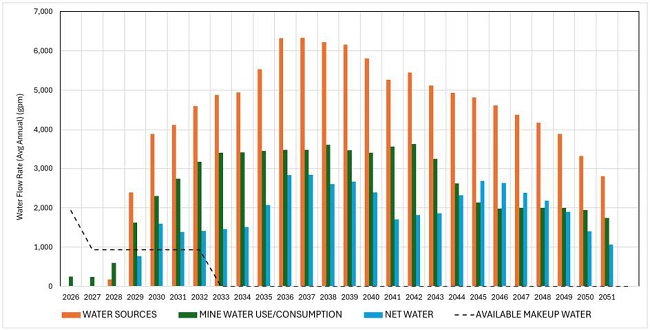
Source: LCG, 2026
Figure 15-3: Water Supply and Demand Over Time for the Project
| 15.1.8 | Built Infrastructure |
| 15.1.8.1 | Camps & Accommodation |
On-site accommodations facilities are neither required nor planned. Personnel will reside in nearby settlements including Casa Grande, Maricopa, the Phoenix metropolitan area, and Tucson, and will commute to site by vehicle. Parking, security, fencing, and a gatehouse are included in the design.
| 15.1.8.2 | Ancillary Buildings |
The following is a list of infrastructure buildings to be built on site:
| ■ | Explosive magazine storage; |
| ■ | Cap magazine storage; |
| ■ | Core shack; |
| ■ | Process lab; |
| ■ | Security / main gate; |
| ■ | Fueling station; |
| SEPTEMBER 2026 | 15-8 |
| Ivanhoe Electric Inc. S-K 1300 Preliminary Feasibility Study & | |
| ■ | Mine/plant operations building; |
| ■ | Change house / mine dry; |
| ■ | First aid and emergency rescue facilities; |
| ■ | Mining facility warehouse. |
| 15.2 | QP Opinion |
Worley, LCG, and Burns & McDonnell are of the opinion that the infrastructure needs and sources are well-understood and have been interpreted from reliable studies and evaluations by experts in this field.
The level of assessment and design are appropriate for level of engineering and represent good industry practice.
| SEPTEMBER 2026 | 15-9 |
| Ivanhoe Electric Inc. S-K 1300 Preliminary Feasibility Study & | |
| 16. | Market Study |
| 16.1 | Market Information |
Ocean Partners (2025) completed a market study for Ivanhoe Electric on copper and precious metals for the Project. BBA reviewed the study and has summarized the findings of this study in this section.
Copper is a globally traded commodity that has established benchmark pricing in the form of exchanges such as the London Metals Exchange (“LME”) or Commodity Exchange Inc. (“COMEX”). Copper obtained from mining is sold as a concentrate, copper cathode, or as a precipitate with high copper content.
The Santa Cruz Copper Project aims to produce copper cathode. Ivanhoe Electric plans to sell the copper in the United States.
Refined copper cathodes will be sold with reference to the COMEX or LME price at an agreed-upon quotational period. An additional premium to the price will be negotiated with potential buyers. Factors affecting the premium will include the shape and chemical specification of the cathode, together with the geographical location of the delivery point in relation to where the cathode is going to be consumed.
| 16.2 | Study Price & Sales Terms |
The Economic Model used a base copper price of $4.75/lb, which is based on a review of the one-, three-, and five-year trailing averages, as well as consensus forecasts from major banks and Ocean Partners.
Due to the shape, chemical composition, and origin point of the copper cathode, it is expected that a premium to the price will be negotiated with potential buyers that is marginally above the historical average. For financial modeling purposes, this premium is estimated at $0.14 per pound ($300 per tonne) (Ocean Partners, 2025). The copper price is summarized in Table 16-1.
Table 16-1: Copper Price Summary
| Metric | Unit | Total |
| Copper | $/lb | 4.75 |
| Copper Cathode Premium | $/lb | 0.14 |
| Total | $/lb | 4.89 |
| SEPTEMBER 2026 | 16-1 |
| Ivanhoe Electric Inc. S-K 1300 Preliminary Feasibility Study & | |
BBA cautions that price forecasting is an inherently forward-looking exercise that is dependent upon numerous assumptions. The uncertainty around timing of supply and demand forces has the potential to create a volatile price environment, and BBA fully expects that the price will move significantly above and below the selected price over the life of the Project.
Given the expected volatility, BBA believes the selected price is a reasonable estimate for evaluating a long-term mining asset (20+ years). It aligns with both historical and anticipated long-term pricing.
Table 16-2 summarizes the one-, three-, and five-year trailing price for copper using the LME Grade A monthly average as well as consensus forecasts from the major banks (CIBC, 2025).
Table 16-2: Commodity Price Summary
| LME Trailing Average ($/lb) | Forecast ($/lb) | |||||||
| 1-Year | 3-Year | 5-Year | 2026 | 2027 | 2028 | 2029 | Long-term | |
| BBA1 | 5.66 | 4.64 | 4.39 | |||||
| Banks Forecast2 | 5.97 | 5.94 | 5.78 | 5.69 | 5.03 | |||
Notes:
| 1. | BBA, Metal Pricing_R00, September 2026. |
| 2. | CIBC Consensus Commodity Prices – September 2026. |
LME = London Metals Exchange.
| 16.3 | Contracts |
At this time, a limited number of contracts with vendors, contractors, or manufacturers including for the TBM with The Robbins Company, along with long lead items to support onsite power and the SX/EW plant have been executed. Additional major contracts that will be required include:
| ■ | Contract labor for underground access and ventilation; |
| ■ | Major material procurement for all process facilities and electrical infrastructure; |
| ■ | Power purchase agreements for renewables and grid power, inclusive of local utility; |
| ■ | Contract labor for process and surface infrastructure construction. |
Copper cathode will be sold at mine-gate.
| SEPTEMBER 2026 | 16-2 |
| Ivanhoe Electric Inc. S-K 1300 Preliminary Feasibility Study & | |
| 17. | Environmental Studies, Permitting & Plans, Negotiations or Agreements with Local Individuals or Groups |
| 17.1 | Baseline & Supporting Studies |
| 17.1.1 | Flora & Fauna |
Undisturbed uplands within and surrounding the Property are open with a shrubland community dominated by creosote bush (Larrea tridentata), saltbush (Atriplex spp.), burroweed (Isocoma tenuisecta), desert ironwood (Olneya tesota), barrel cactus (Echinocactus spp.), white thorn (Vachellia constricta), and cruxifixion thorn (Castela emoryi), along with occasional desert ironwood (Olneya tesota) and velvet mesquite shrubs (Prosopis velutina). Much of the Project area contains abandoned agricultural fields. These abandoned agricultural areas contain the same vegetation community as the less-disturbed areas but with an appreciably higher annual grass and forb component. The North Branch Santa Cruz Wash supports xeroriparian vegetation dominated by velvet mesquite, wolfberry (Lycium sp.) creosote bush, and crucifixion thorn. Desert broom (Baccharis sarothroides), Mexican palo verde (Parkinsonia aculeata), desert hackberry (Celtis ehrenbergiana), cocklebur (Xanthium strumarium), and non-native and invasive tamarisk (Tamarix sp.) are present along the North Branch Santa Cruz Wash in low densities, as well as a lone Fremont cottonwood (Populus fremontii) in the Project vicinity. Bermuda grass (Cynodon dactylon) and other grasses and forbs line the irrigation levee that confines the Santa Cruz Wash.
Wildlife species observed within or close to the Property include coyote (Canis latrans), javelina (Tayassu tajacu), gray fox (Urocyon cinereoargenteus), round-tailed ground squirrel (Xerospermophilus tereticaudus), common raven (Corvus corax), phainopepla (Phainopepla nitens), Cooper’s hawk (Accipiter cooperii), great blue heron (Ardea herodias), mourning dove (Zenaida macroura), black-tailed jackrabbit (Lepus californicus), greater roadrunner (Geococcyx californianus), turkey vulture (Cathartes aura), and hummingbird spp. (family Trochilidae). Carp spp. (family Cyprinidae) and catfish spp. (family Ictaluridae) have been observed in the East Main canal bordering a portion of the southwest corner of the Project area. Additional wildlife species documented by Ivanhoe Electric on trail cameras in the Project vicinity include American badger (Taxidea taxus), bobcat (Lynx rufus), racoon (Procyon lotor), desert iguana (Dipsosaurus dorsalis), and Gambel’s quail (Callipepila gambelii). These wildlife species are typical of the local landscape and reflective of the mixed land use of the Property and surroundings which include active and abandoned agricultural fields, irrigation canals, ponds, and undeveloped Sonoran Desert.
| SEPTEMBER 2026 | 17-1 |
| Ivanhoe Electric Inc. S-K 1300 Preliminary Feasibility Study & | |
| 17.1.2 | Special Status Species |
Special-status species include species designated by the United States Fish and Wildlife Service (“USFWS”) as endangered, threatened, proposed for listing, or candidate for listing under the Endangered Species Act (“ESA”) and species protected under the Bald and Golden Eagle Protection Act.
The federal protection status, known suitable habitat, total range, and distribution in Arizona was evaluated, and it was determined that there are no ESA-listed species with potential to occur within the Project area. Monarch butterfly (Danaus Plexippus), an ESA-proposed threatened species, has some potential to occur in the Project area due to the presence of potentially suitable foraging habitat, though there are no known observations of this species in the Project area. No United States Fish and Wildlife Service-designated or proposed critical habitat occurs within the Project area. A search of the Arizona Game and Fish Department Heritage Data Management System Online Environmental Review Tool identified no records of species listed, proposed for listing, or candidates for listing under the ESA within 5 miles (8 km) of the Project area.
Two Bald and Golden Eagle Protection Act species (golden eagle and bald eagle) were determined to have some potential to occur within the Project area. A review of publicly-available bald eagle sighting records in the area (eBird, 2025) show eagles perching on transmission poles and irrigation pivots to the west of the Project area, likely foraging in the agricultural fields, irrigation canals, and ponds. There are no breeding behavior observations in the records. An incidental take permit from the United States Fish and Wildlife Service may be required for construction activities within 660 ft (201 m) or blasting within a half mile (0.8 km) of an active eagle nest. As there are no known eagle nests in the area at this time, the Project is not expected to require an incidental take permit. Bald eagle use of the properties to the west of the Project will continue to be tracked, and best management practices will be implemented to protect bald eagles as required.
A Special-Status Species Management Plan was developed and implemented for the Santa Cruz Copper Project. The Special-Status Species Management Plan describes best management practices for special-status species with potential to occur in the Project area. Special-status species included in the Special-Status Species Management Plan consist of those protected under the Endangered Species Act, Bald and Golden Eagle Protection Act, and Migratory Bird Treaty Act. In addition to these federally covered species, Best Management Practices are also included for International Union of Conservation of Nature Red List species, general wildlife and native vegetation.
The Project has been designed to avoid impacts to these special-status species to the extent practical. Where avoidance is not practicable, the Special-Status Species Management Plan has
| SEPTEMBER 2026 | 17-2 |
| Ivanhoe Electric Inc. S-K 1300 Preliminary Feasibility Study & | |
been designed to minimize impacts to special-status species within the Project area, unless authorized by the United States Fish and Wildlife Service.
Ivanhoe Electric will continue monitoring changes in special-status plant and animal species protections throughout the life of the Project and update the Special-Status Species Management Plan accordingly.
| 17.1.3 | Migratory Bird Treaty Act |
The Migratory Bird Treaty Act is intended to ensure the sustainability of all protected migratory bird species and currently includes protection of 1,106 avian species. During active construction, pre-construction clearance surveys are conducted weekly within the Project area to avoid the incidental take of migratory birds. A Special Purpose permit has been obtained from the United States Fish and Wildlife Service to authorize relocation of migratory bird species, including viable eggs or chicks, if they are located in a critical area that will impact their safety or if their presence creates human health and safety risks. All practicable avoidance and minimization measures will be employed prior to relocation and/or collapse of any burrows or nests. Threatened and/or endangered species, Bald and Golden Eagles, and Birds of Conservation Concern are not authorized under this permit. Relocation of Migratory Bird Treaty Act species is conducted by a qualified biologist. Nestlings and eggs are transported to a United States Fish and Wildlife Services permitted party for conditioning and release. The Special Purpose permit must be renewed annually.
Nesting migratory bird species identified in the Project area include the horned lark (Eremophila alpestris), red-tailed hawk (Buteo jamaicensis), mourning dove (Zenaida macroura), band-tailed pigeon (Colombidea sp.), nighthawk (Chordeilinae sp.), verdin (Auriparus flaviceps), northern mockingbird (mimus polyglottos) cactus wren (Campylorhynchus brunneicapillus), raven (Corvus corax), ground sparrow (Spizella pusilla), greater roadrunner (Geococcyx californianus), and western burrowing owl (Athene cunicularia ssp. hypugaea) (WestLand, 2023, 2024, and 2026).
All employees and contractors are trained on Migratory Bird Treaty Act requirements, Worker’s Environmental Awareness Program, and the Project’s migratory bird survey and monitoring protocols. Pre-construction clearance surveys and implementation of beneficial practices, procedures to protect migratory bird species, and necessary relocation per the Special Purpose permit will continue throughout the life of the Project.
| 17.1.4 | Surface Water Mapping |
Under Section 404 of the Clean Water Act the United States Army Corps of Engineers is responsible for regulating the discharge of fill to surface water features determined to be Waters of the United States. A geographical information system (“GIS”) delineation of the ordinary high-water mark
| SEPTEMBER 2026 | 17-3 |
| Ivanhoe Electric Inc. S-K 1300 Preliminary Feasibility Study & | |
within the surface water features of the Project area was developed, using current, publicly available aerial photography and subsequent, targeted field reconnaissance. This delineation was created based on the practices typically used by the United States Army Corps of Engineers in assessing ephemeral channels in the arid southwest.
Much of the Project area has been previously disturbed from its natural state. These disturbances include flood control features, such as the canal identified as the Santa Cruz Wash Canal, paved and unpaved roads, and agricultural practices. These disturbances have removed all potential natural surface water features that may have existed in the area. The only features within the Project area that possess characteristics of an ordinary high-water mark are the North Branch of the Santa Cruz Wash and the constructed Santa Cruz Wash Canal.
The North Branch of the Santa Cruz Wash is the downgradient extension of the Santa Cruz River between the Santa Cruz Flats to the south and the confluence with the Gila River to the north. This feature possesses the characteristics of an ordinary high-water mark, including changes in soil character, debris, scour, and an abrupt change in plant communities. Based on the observed vegetation, it is possible that the channels of this feature may possess adjacent wetlands. The constructed Santa Cruz Wash Canal also serves a similar function as the North Branch, namely channeling flows from the Santa Cruz River northward through the City of Maricopa and the Ak-Chin Indian Community, towards the confluence with the Gila River to the north.
The Santa Cruz Copper Project area has an approved jurisdictional delineation in which the United States Army Corps of Engineers determined that the portion of the Santa Cruz Wash running through the Project area is ephemeral. The U.S. Supreme Court decision in Sackett v. the Environmental Protection Agency invalidated portions of the March 20, 2023, definition of waters of the United States (the 2023 WOTUS Rule), including use of the concept of “significant nexus” for determining Clean Water Act jurisdiction. Under the current definition of waters of the United States, amended on September 8, 2023, to conform to the Sackett decision [88 Fed. Reg. 61964 (the Conforming Rule)], tributaries like the features within the Santa Cruz Copper Project area must be “relatively permanent standing or continuously flowing bodies of water” to be jurisdictional waters of the United States. Given the United States Army Corps of Engineers’ previous determination that the tributaries within the Project area are ephemeral, it would be reasonable to assume that these features cannot be Waters of the United States under the Conforming Rule.
The Arizona Department of Environmental Quality (“ADEQ”) has identified washes and tributaries previously regarded as potentially Waters of the United States before the Sackett decision as non-Waters of the United States but protected by the State. The Santa Cruz River between Baumgartner Road and the Ak-Chin Indian Community falls into this category and has been identified as water that is non-Waters of the United States but protected by the State. Although the language specifying the reach of the Santa Cruz Wash can be found in the code, the exact path between Baumgartner Road and the Ak-Chin Indian Community has not been identified by
| SEPTEMBER 2026 | 17-4 |
| Ivanhoe Electric Inc. S-K 1300 Preliminary Feasibility Study & | |
the ADEQ. The Project area is within the general geographic location identified in the administrative code. Ivanhoe Electric will adhere to the requirements of the State and not discharge into the wash without appropriate permits in place.
The United States Army Corps of Engineers retains the final authority for determining the presence of Waters of the United States and, to date, has not been asked to provide its concurrence with this delineation. However, the Project has been designed to avoid impacting potential Waters of the United States and is not expected to require a permit under Section 404 of the Clean Water Act.
| 17.1.5 | Cultural Heritage |
An archeological evaluation of the Project area was completed in 2005 and 2006 (Foster et al., 2006). In 2022, Ivanhoe Electric completed a Class III cultural survey to reassess 20 previously recorded sites (Middleton, 2022) and their eligibility for listing in the National Register of Historic Places. Of the 20 sites reassessed, five sites were eligible for listing in the National Register of Historic Places: two Euro-American sites and three prehistoric ancestral sites. Despite there being no federal permitting or requirements under Section 106 of the National Prehistoric Preservation Act for private lands, the Ivanhoe Electric team is committed to working directly with descendant communities to help preserve and protect places of important cultural value. Ivanhoe Electric has developed and implemented an archeological Monitoring and Discovery Plan for the three National Register of Historic Places -eligible prehistoric ancestral sites located within the Santa Cruz Copper Project area. Although Ivanhoe Electric intends to avoid significant ancestral sites during Project development, it is necessary to both monitor and preserve the known prehistoric archeological resources in the long-term and to have a designated protocol in case of inadvertent discovery during earth-moving activities outside of known site boundaries.
| 17.1.6 | Air Quality |
Ivanhoe Electric holds a Class II Air Quality permit from the Pinal County Air Quality Control District to meet power requirements during early construction of the Santa Cruz Copper Project. Ivanhoe Electric recently submitted a minor permit revision to authorize additional emission sources associated with the tunnel boring machine development. The existing permit and revision supports the Project’s early construction needs while a major amendment will be necessary for full construction and operations.
The Project obtains fugitive dust permits and will continue to update and renew annually, as required, to manage dust from mining, material handling, transportation, stockpiling, and wind erosion, ensuring compliance with tailored dust control measures. Situated in the West Pinal
| SEPTEMBER 2026 | 17-5 |
| Ivanhoe Electric Inc. S-K 1300 Preliminary Feasibility Study & | |
County PM10 non-attainment area, the Project will adopt targeted dust mitigation strategies suitable for the arid climate, adhering to local and state regulations.
Key air pollutants include dust (i.e., windblown dust, mining activities, and material handling), and combustion emissions (i.e., generators and other fuel-burning equipment). The Project will amend the Class II air quality permit to include process emission sources for the full life of mine and is expected to be classified as a synthetic minor source. As a synthetic minor source, emissions will be kept below major source thresholds through operational limits and control technologies. Mitigation strategies encompass water sprays and enclosures for material handling, enhanced dust suppression (e.g., chemical suppressants, paved roads, reduced speed limits, limiting operations during high winds), emission controls for generators to minimize combustion emissions, and ongoing monitoring, maintenance, and staff training to ensure effective emission controls and regulatory compliance.
| 17.1.7 | Carbon Intensity |
Ivanhoe Electric performed a carbon impact assessment for the Santa Cruz Copper Project, analyzing Scope 1 and Scope 2 emissions over the evaluated development and operating period, and compared the Project’s carbon intensity to copper mining industry benchmarks. Scope 1 emissions, stemming from on-site fuel combustion, explosives, and refrigerant leaks, were calculated using emission factors from the United States Code of Federal Regulations and industry standards. Scope 2 emissions, arising from electricity used for ore crushing, material movement, processing operations, and ancillary operations, were estimated using the 2023 Arizona State Output Emission Rate from the United States Environmental Protection Agency’s Emissions & Generation Resource Integrated Database (“eGRID”).
The assessment assumes that 70% of Project electricity consumption is supplied as clean electricity with zero direct emissions. Arizona-average eGRID emission factors were adjusted by multiplying by (1 − 70%)/(1 − 42%), accounting for Arizona’s 42% baseline clean-generation share and the Project’s assumed 30% non-clean electricity share. This planning approximation represents the remaining electricity using the inferred Arizona non-clean generation mix, pending confirmation of the applicable supply mix and emission factors from ED3, the Project’s electricity supplier. Under this scenario, cumulative avoided Scope 2 emissions are approximately 1.95 million metric tonnes of carbon dioxide equivalent (CO2e) over 2027–2052, relative to the unadjusted Arizona-average electricity baseline (Figure 17-1). Global warming potentials are drawn from Table A-1 to Subpart A of 40 CFR Part 98, converting greenhouse gas emissions into carbon dioxide equivalent.
| SEPTEMBER 2026 | 17-6 |
| Ivanhoe Electric Inc. S-K 1300 Preliminary Feasibility Study & | |
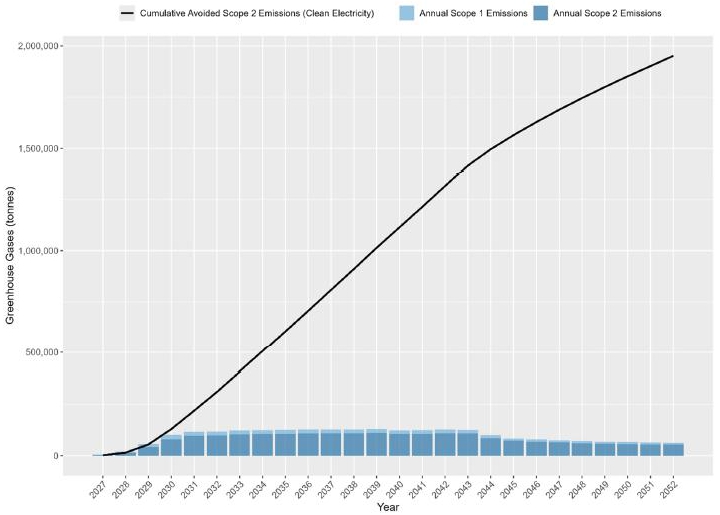
Source: Tipple Consulting, 2026.
Figure 17-1: Scope 1 & 2 CO2e Emissions & Avoided Emissions
The Santa Cruz Copper Project anticipates an average carbon intensity of 1.94 tonnes of carbon dioxide-equivalent per tonne of recovered copper cathode across the evaluated LOM period, including a 10% contingency to account for uncertainty associated with ongoing detailed design. This is comparable to the unweighted average combined Scope 1 and Scope 2 carbon intensity of 1.92 tonnes carbon dioxide-equivalent per tonne of paid copper-equivalent production for the 56 leach and SX/EW operations evaluated using Wood Mackenzie’s Q1 2026 operational emissions-intensity dataset. Because the Wood Mackenzie dataset includes different mining and recovery configurations and uses paid copper-equivalent production as its denominator, the comparison is indicative rather than strictly like-for-like. By producing only copper cathode, the Project avoids emissions from downstream smelting and refining of copper concentrate.
The assumed clean-electricity share lowers the Project’s estimated carbon intensity; Figure 17-2 presents annual emissions, recovered copper production, annual carbon intensities, and the LOM intensity.
| SEPTEMBER 2026 | 17-7 |
| Ivanhoe Electric Inc. S-K 1300 Preliminary Feasibility Study & | |
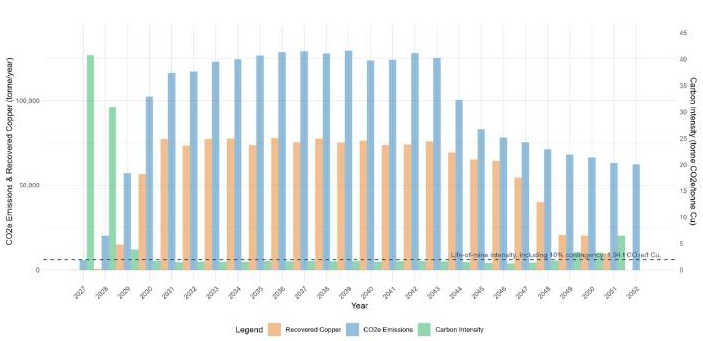
Note: Carbon intensity is elevated in 2027 and 2028 because relatively low copper production results in higher emissions per tonne of recovered copper. No annual carbon intensity is calculated for 2052 because no copper is recovered that year. However, Scope 1 and Scope 2 emissions from all years, including 2052, are included in the LOM average carbon intensity. The figure assumes 70% clean electricity. Annual emissions and annual carbon intensities exclude contingency. The life-of-mine carbon intensity includes a 10% contingency to account for uncertainty associated with ongoing detailed design. Source: Tipple Consulting, 2026.
Figure 17-2: Annual CO2e Emissions & Intensities
| 17.1.8 | Surface Water Monitoring |
A surface water monitoring program was implemented in January 2024. Surface water samples are collected and analyzed from three locations on site: the Santa Cruz Wash Canal, the North Branch of the Santa Cruz Wash, and the confluence of both surface waterbodies as they exit the Project site. Samples are collected and analyzed quarterly.
The objective of baseline surface water sampling activities is to evaluate the current condition of surface water in the North Branch of the Santa Cruz Wash and the Santa Cruz Wash Canal. Baseline data will inform parties of conditions in the canal and wash prior to the onset of mining activities and help inform Ivanhoe Electric of any potential impacts to these bodies of water in the future.
| SEPTEMBER 2026 | 17-8 |
| Ivanhoe Electric Inc. S-K 1300 Preliminary Feasibility Study & | |
| 17.1.9 | Groundwater Monitoring & Water Quality |
| 17.1.9.1 | Historical Water Quality |
Area water quality, summarized from a dataset spanning 77 wells with data collected from 1977 to 2002, was reviewed (Life Cycle Geo, 2023; 2026b) to understand historical baseline conditions. Review of the historic water quality indicates that area bedrock and overburden water quality generally meet ADEQ Numeric Aquifer Water Quality Standards (“AWQS”) with a few exceptions:
| ■ | Water quality in many overburden wells exceeds AWQS for gross alpha, 15 picocuries per liter (“pCi/L”), with concentrations as high as 50 pCi/L (uncorrected for natural uranium or radon); |
| ■ | Numerous overburden and a few bedrock wells indicate arsenic above AWQS (0.01 mg/L) with concentrations approaching 0.04-0.05 mg/L; |
| ■ | Nitrate concentrations in a number of overburden wells exceed AWQS (44 mg/L) with concentrations as high as 55 mg/L. |
It is inferred that elevated baseline nitrate concentrations are associated with area agricultural activities, whereas the arsenic and gross alpha exceedances are likely tied to local, natural water-rock reactions between overburden/mineralized bedrock and baseline groundwater, as supported by results from the materials characterization program.
| 17.1.9.2 | Current Water Quality |
The current, on-going baseline water quality monitoring program was initiated in October 2023 and comprises four historic overburden wells, two new overburden wells, and five new deeper bedrock wells. Sampling frequency was monthly through 2024, with the aim of developing a reliable seasonal baseline, and has continued since then on a quarterly basis. The analytical suite is comprehensive, including all parameters listed in R18-11-406 ADEQ AWQS, including inorganic anions and cations, dissolved metals and trace elements, herbicides, pesticides, chlorinated acids, radioactive parameters, and organic molecules including polycyclic aromatic hydrocarbons, semi-volatile organic compounds, volatile organic compounds, and polychlorinated biphenyls.
A summary of predominant overburden and bedrock water quality is as follows:
| ■ | pH: Overburden pH is typically circumneutral (mean = 7.3), with the majority of measurements between pH 6 and 8. Mean bedrock pH is higher (mean = 8.7), with the majority of measurements ranging from pH 8 to 10; |
| ■ | ORP: Conditions in the bedrock, as expected, are on average more reducing (mean = -173.5 mV) than those in the overburden (mean = +24.3 mV); |
| SEPTEMBER 2026 | 17-9 |
| Ivanhoe Electric Inc. S-K 1300 Preliminary Feasibility Study & | |
| ■ | Major ion chemistry: Both overburden and bedrock wells are chloride-sodium-sulfate predominant waters. Overburden wells have considerably higher calcium and magnesium concentrations (81 and 16 mg/L, respectively) than bedrock wells (29 and 1 mg/L, respectively), reflecting equilibrium with carbonate minerals, which are common in overburden and relatively scarce in the bedrock; |
| ■ | Trace element chemistry: |
| - | Under the AWQS for arsenic (0.01 mg/L), baseline exceedances occur at multiple overburden and bedrock wells; |
| - | Each bedrock well regularly exceeds the AWQS (4 mg/L) for fluoride; |
| - | Each overburden well except one regularly exceeds gross alpha AWQS; gross alpha exceedances occur in three bedrock wells but are more sporadic; |
| - | Bedrock wells exhibit persistent baseline exceedances of both radium-226 and radium-228; |
| - | ADEQ has implemented a new AWQS for uranium (0.03 mg/L). Most overburden wells will have periodic baseline exceedances; |
| - | Sporadic and isolated baseline exceedances occur for chromium and nitrite. |
For operational water management purposes, both bedrock and overburden have clear, distinct multivariate water quality fingerprints that make them easily classifiable and segregable. Overburden wells can be identified primarily based on correlation between calcium, magnesium, strontium, uranium and pH while bedrock wells can be identified based on correlation between alkalinity, fluoride, potassium, sodium, and lithium (this is statistical correlation and does not imply these parameters are necessarily greater in concentration).
| 17.1.10 | Material Characterization & Water Quality Predictions |
Material characterization studies were initiated in 2022 and are mostly complete, although various studies are still ongoing. The purpose of these studies is to advance the site environmental conceptual model and to understand both long-term material environmental characteristics and the environmental risks associated with various planned mine facilities and underground workings. More specific objectives include identifying material types (or classes) to be managed (e.g., ore vs. waste vs. borrow), providing segregation criteria for each type, developing long-term water quality predictions, and evaluating materials and water management alternatives.
A more detailed summary of the characterization program and results is provided in Life Cycle Geo (2026c). Sample numbers for materials selected for characterization were proportional to projected excavated mass for each material type based on Project mine planning and geometallurgical testing. Sampling and testing also accounted for the estimated diversity of lithological, mineralogical, mineralization, oxidation, alteration, and environmental characteristics
| SEPTEMBER 2026 | 17-10 |
| Ivanhoe Electric Inc. S-K 1300 Preliminary Feasibility Study & | |
observed in exploration drill core and processed mine materials. The material characterization team also relied on prior experience with the geochemistry of porphyry copper deposits in Arizona and elsewhere to provide guidance and conceptual framing for this program.
The environmental characterization test program was developed both to meet Arizona Best Available Demonstrated Control Technology (“BADCT”) guidance for permitting purposes and to support Project feasibility, design, and future operational and post-closure needs. The program follows the general tiered approach prescribed in the BADCT manual (ADEQ, 2005) as follows:
| ■ | Tier 1 static testing: |
| - | Tier IA methods include acid-base accounting (“ABA”) and bulk chemistry conducted on the entire subset; |
| - | Tier IB methods include the meteoric water mobility procedure (“MWMP”) leach test and mineralogy by x-ray diffraction (“XRD”) conducted on a subset of the Tier 1A materials. |
| ■ | Tier 2 kinetic testing: |
| - | Longer-term (typically minimum of 40 weeks to 1 year) humidity cell leach tests conducted on an even smaller subset selected to best represent the range of materials and environmental characteristics observed in Tier 1 test results. |
In all, the test program is robust, consisting of 64/13/2 Tier 1A, Tier 1B and Tier 2 tests, respectively, conducted on mine access materials (Phase A), 196/70/24 tests conducted on mine area materials (Phase B), and 4/4/3 tests conducted on mine process materials (spent ore). Additional characterization testing was conducted on cemented paste backfill (“CPB”) to assess the environmental characteristics of spent ore blended with cementitious binder and returned underground as structural backfill.
| 17.1.10.1 | Mine Material Types |
Anticipated mine material types can be developed into three broad Project classes, as follows:
| ■ | Mine access material (Phase A): includes both overburden and bedrock material that must be mined to access the targeted mineralized area. The mine-access material will be stored on the surface during or after development of underground access to the mine area; |
| ■ | Mine area material (Phase B): includes mineralized bedrock that will be excavated predominantly as ore for processing, with accompanying minor waste rock; |
| ■ | Mine processing residuals: includes spent ore from laboratory bench-scale leach column residues and CPB produced from combining the spent ore residues with cement binder. |
| SEPTEMBER 2026 | 17-11 |
| Ivanhoe Electric Inc. S-K 1300 Preliminary Feasibility Study & | |
| 17.1.11 | Mine Material Environmental Behavior |
| 17.1.11.1 | Overburden |
Overburden materials associated with the mine access decline contain very low to non-detectable levels of sulfide and total sulfur, the source of acid generating potential (“AGP”), and variable levels of acid neutralizing potential (“ANP”). ANP consistently exceeds AGP, therefore overburden materials can be safely classified as non-potentially acid generating (“NPAG”). The considerable sources of ANP indicate that overburden material is potentially useful as borrow/construction material that would not generate acidic and associated metalliferous drainage (“AMD”). Overburden material also exhibits low-level arsenic and uranium leaching potential, although this is mitigated by the fact that these constituents already exceed AWQS in baseline area groundwater. Abundant calcium and magnesium in overburden aquifers confirm the groundwater is well buffered by neutralizing carbonate minerals. Drainage from overburden material can be expected to have a neutral to slightly alkaline pH with low sulfate concentrations.
| 17.1.11.2 | Bedrock |
Bedrock materials comprise the entire mine area and a portion of the mine access decline and consist predominantly of granitic Precambrian basement and mineralizing Tertiary intrusives. The intrusive hydrothermal events mineralized the host and introduced variable amounts of sulfide minerals, which were later oxidized by supergene weathering events. Little carbonate exists in these igneous units. As such, the bedrock materials have variable acid-generating characteristics. Approximately 56% of Precambrian and 62% of Tertiary intrusives are classified as potentially acid generating (“PAG”), with the remainder classified as NPAG. Long-term humidity cell tests (“HCT”) confirm that more sulfide-rich bedrock material below the oxide and supergene alteration zones (e.g., those with higher AGP and lower ANP samples) have the potential to become acidic in under a year with pH as low as 2.5, although most humidity cells produce a mildly acidic to circumneutral leachate during reaction periods of up to 55 weeks. As expected, chalcophile metals leaching would accompany any materials that become acidic.
Drainage water quality for mine area and mine access bedrock materials generally indicates circumneutral to alkaline leach and relatively low potential for metal release. High sulfide/lower ANP samples have the potential to produce a leachate below pH 6 with higher sulfate and metals release, and such materials should be managed accordingly.
| SEPTEMBER 2026 | 17-12 |
| Ivanhoe Electric Inc. S-K 1300 Preliminary Feasibility Study & | |
| 17.1.11.3 | Process Materials |
All spent ore materials were classified as PAG and produced acidic leachate in long-term kinetic tests. Short-term acidity is produced from unrinsed process porewater generated by copper beneficiation while longer-term acidity is tied to oxidation of residual sulfides in the spent ore. Acidic leachates show consistently low pH values between 3.0 and 4.5.
The addition of cement binder to spent ore to form CPB effectively neutralizes spent ore acidity, substantially increases ANP and changes the material classification to NPAG. CPB produces a strongly-alkaline leachate, often greater than pH 10.5. CPB is expected to maintain its alkaline character following underground placement and remain NPAG over LOM and in closure.
| 17.1.11.4 | Water Quality Predictions |
Life Cycle Geo, LLC has developed water quality predictions through development of an underground water quality model (“UGWQM”) to evaluate water management requirements over the Project’s operational LOM. During this period, dry working conditions are planned through a dewatering collection system; the current model does not evaluate post-closure conditions after dewatering has ceased and groundwater levels recover.
The conceptual model that underpins the UGWQM incorporates the following concepts and processes:
| ■ | Sulfide oxidation that may occur (depending on the availability and transport of atmospheric oxygen) in the damaged rock zone (“DRZ”), a zone of increased fracturing and permeability in stope and tunnel walls created as a result of drilling, blasting and excavation. |
| ■ | Geochemical heterogeneity intended to account for bulk behavior associated with lithological differences, degree and extent of rock fracturing, oxygen availability, groundwater flow, and mine methods. |
| ■ | Emplacement of CPB in underground workings to refill stope voids, stabilize tunnel walls, minimize rock fall and provide structural support. The model accounts for potential reactivity of the cemented spent ore. CPB also acts as a low-permeability barrier that reduces the flux of both oxygen and water by sealing fractures and voids that could otherwise serve as preferential pathways that could promote more rapid and extensive sulfide oxidation. |
| ■ | Mine dewatering and seepage are conceptualized as an integrated flow network in which water collected at individual mining levels is pumped to higher levels, where it mixes with inflows from other underground areas prior to conveyance to the surface. The model framework simulates this as a centralized, fully mixed network. Passive inflow rates are taken from the site groundwater flow model (INTERA, 2026). |
| SEPTEMBER 2026 | 17-13 |
| Ivanhoe Electric Inc. S-K 1300 Preliminary Feasibility Study & | |
Additional details regarding the model framework, model inputs (RPI rates, mine plan implementation, sulfide oxidation rates/advance/extent, DRZ parameters, oxygen diffusion rates, source terms and loading rates, and scaling factors) model implementation, and assumptions and limitations are provided in Life Cycle Geo (2026d).
The modeling approach includes development of a Base Case and Upper Case scenario, as well as two scenarios that evaluate leaching from CPB. The Base Case represents average expected conditions, whereas the Upper Case reflects a reasonable upper bound condition. Model results indicate that dewatering water chemistry is predominantly influenced by baseline overburden and bedrock water quality, with additional contributions from wall rock solute loading. The predicted concentrations show a strong dependence on mine progression and RPI rates. As mining advances, increasing exposure of reactive wall rock results in greater solute loading, contributing to gradual increases in dissolve solute over time.
Key model results can be summarized as follows:
| ■ | Arsenic and uranium exceedances can be expected under all model scenarios given that RPI is expected to be dominated by alluvial and, to a lesser extent, bedrock, groundwater, which naturally exceed for these constituents; |
| ■ | Exceedances of other constituents are considered unlikely as long as the following operational conditions are met: |
| - | CPB effectively seals underground voids so that oxygen and water flux into the DRZ are limited and sulfide oxidation cannot progress to any significant extent; |
| - | RPI rates remain at the flux currently projected; lower volumes of inflowing groundwater flushing the same amount of underground workings could theoretically result in higher mass loading/concentrations. |
| 17.1.12 | Soil Handling |
Environmental studies completed to date, including Phase II Environmental Site Assessment soil sampling and the associated industrial hygiene evaluation, provide the technical basis for incorporating work location-specific soil management and dust control measures into Project construction procedures, as warranted. Final reporting for the ongoing soil sampling program should be reviewed, as needed, to determine whether any site-specific soil handing, dust suppression, additional sampling, or worker hygiene measures should be incorporated in the environmental management and execution plans.
| SEPTEMBER 2026 | 17-14 |
| Ivanhoe Electric Inc. S-K 1300 Preliminary Feasibility Study & | |
| 17.2 | Permitting & Authorizations |
The primary permits for the Project will require state, county, and local authorizations. Several of these permits have been issued for early construction. Other permits for full construction and operations activities are in preparation or have been submitted. Table 17-1 lists the major federal, state, and local permits required for the Project.
| SEPTEMBER 2026 | 17-15 |
| Ivanhoe Electric Inc. S-K 1300 Preliminary Feasibility Study & | |
Table 17-1: Permits Table
| Jurisdiction | Agency | Permit Needed & Description | Comment |
| Federal | US Environmental Protection Agency | Resource Conservation and Recovery Act – Hazardous Waste Management | Waste accumulation threshold will determine when hazardous waste ID number (permit) is required. |
| Federal | US Fish and Wildlife Service | Migratory Bird Treaty Act | Ongoing monitoring and implementation of beneficial practices throughout the life of the Project. Special Purpose permit approved by USFWS, effective May 4, 2026. Annual reporting and renewal required. |
| State | Arizona Department of Environmental Quality (”ADEQ”) | Class V Underground Injection Control Permit for mine backfill | Determination of Applicability received from ADEQ March 17, 2026. Confirms mine backfill material meets definition of inert. Expect to submit application for Permit-by-rule. |
| State | Arizona Department of Environmental Quality | Aquifer Protection Permit (“APP”) | Area-wide APP application submitted May 8, 2026, and is currently under review. General Permit Type 2.02, 3.01, and 3.03 approved October 16, 2025, for Temporary Rock Stockpile, Water Impoundments, and Vehicle and Equipment Washes, respectively. |
| State | Arizona Department of Water Resources | 45-513 – Groundwater Withdrawal Permit to withdraw groundwater for dewatering purposes in an Active Management Area | Project is within the Pinal Active Management Area. Application is in preparation. |
| State | Arizona State Mine Inspector (“ASMI”) | Mined Land Reclamation Plan | Construction level Mined Land Reclamation Plan has been approved by the ASMI. A preliminary closure cost estimate has been developed for the operational Mined Land Reclamation Plan. |
| State | Arizona Department of Transportation (“ADOT”) | Encroachment Permit for access off Hwy 84 | Traffic impact analysis completed. Recommended road improvement designs and Encroachment permit application submitted to ADOT for review. |
| SEPTEMBER 2026 | 17-16 |
| Ivanhoe Electric Inc. S-K 1300 Preliminary Feasibility Study & | |
| Jurisdiction | Agency | Permit Needed & Description | Comment |
| County | Pinal County Air Quality Control District | Air Quality Control Permit – determined by quantity of emissions from stationary sources and process emissions | Required for any industrial operation that has the potential to emit 5.5 pounds per day or 1 ton per year of any regulated air pollutant is required to obtain a permit from Pinal County Air Quality. Submitted March 2025 for construction activities and under agency review. A Class II Air Quality permit for construction was received in August 2025. A minor revision was submitted on August 12, 2026, and is currently under review. A major revision for full operations is in preparation. |
| County | Pinal County Air Quality Control District | Pinal County Dust Control Permit – West Pinal Non-Attainment | Existing permit in place and renewed annually. |
| City | City of Casa Grande | Special Flood Hazard Area Development Permit for proposed development within a floodplain | Likely not required as facilities have been designed to avoid development within Special Flood Hazard Areas. |
| City | City of Casa Grande | General Plan Amendment – major amendment to city plan | Required to include mining operations and infrastructure within city limits. Obtained June 2024. |
| City | City of Casa Grande | Planned Area Development Plan – major amendment to existing plan | Required to accommodate industrial use/mining operations in a Planned Area Development zone. Obtained February 2025. |
| City | City of Casa Grande | Major Site Plan/ Site Development Plan | Required prior to construction to ensure Project compliance with city zoning, engineering, traffic, drainage, parking, landscaping, and public safety requirements. Plans for construction were approved March 2026. An amendment to the Development Plan was submitted August 2026. An amendment to the Major Site Plan and Development Plan will be required for full operations. |
| SEPTEMBER 2026 | 17-17 |
| Ivanhoe Electric Inc. S-K 1300 Preliminary Feasibility Study & | |
The following permits have been obtained for early construction activities:
| ■ | Arizona State Mine Inspector Mined Land Reclamation Plan; |
| ■ | Pinal County Dust Control Permit (renewed annually); |
| ■ | Pinal County Air Quality Control District Class II Air Permit; |
| ■ | Arizona Department of Environmental Quality General Aquifer Protection Permits for water impoundments, temporary truck wash, and temporary rock stockpile; |
| ■ | City of Casa Grande Major Site Plan/Development Plan; |
| ■ | City of Casa Grande Special Flood Hazard Area Development Permit (issued for exploration activities. Likely not needed for construction as flood plains have been avoided). |
The following permit applications or amendments for full construction and operations activities are in preparation or have been submitted:
| ■ | Pinal County Air Quality Control District Class II Air Permit (obtained for early construction activities, amendment for full construction operations in process); |
| ■ | Arizona Department of Water Resources 45-513 Groundwater Withdrawal Permit (application in preparation); |
| ■ | Arizona Department of Transportation Encroachment Permit for access off Highway 84 (submitted and under review); |
| ■ | Arizona Department of Environmental Quality Class V Underground Injection Control Permit (for mine backfill); |
| ■ | Arizona Department of Environmental Quality APPs for the heap leach and spent ore storage facilities (submitted May 2026 and under substantive review). |
Land use authorizations from the City of Casa Grande, including a Major General Plan Amendment and Major Amendment to a Planned Area Development Zoning, have been obtained to allow mining activities and infrastructure within the Project site.
| 17.3 | Waste & Spent Ore Disposal, Site Monitoring, & Water Management |
This section discusses the requirements and plans for waste and spent ore disposal, site monitoring, and water management during operations and after mine closure. Operators must demonstrate within their mine plans and permit applications that pollutant discharges will be prevented or managed to prevent contaminants of concern from traveling beyond points of compliance. Arizona Best Available Demonstrated Control Technology stipulates the following for planning for materials and water management and design of storage facilities:
| SEPTEMBER 2026 | 17-18 |
| Ivanhoe Electric Inc. S-K 1300 Preliminary Feasibility Study & | |
| ■ | Applicant must develop a waste characterization plan for the ADEQ. A site-specific sampling and analysis plan has been submitted to the ADEQ and is continuously revised as new test material becomes available. |
| ■ | Waste facilities can be designed with pre-designated engineered containment (prescriptive approach) under the assumption that facilities will be discharging, and that the discharge will require management. |
| ■ | Waste facilities can also be individually designed, which places the burden on the operator to demonstrate facility discharge will not result in downgradient impacts to aquifer, vadose zone, or land surface. |
| ■ | Required long-term monitoring for compliance with facility APP will be dictated by the conditions of the permit. |
Based on Arizona Best Available Demonstrated Control Technology guidance for materials and water management and the results of characterization testing performed to date, the following plans will be required for waste and spent ore disposal, site monitoring, and water management during operations and following mine closure:
| ■ | Metal Leaching/Acid Rock Drainage Management Plan – Must include definitions and classification criteria for potentially metal-leaching and acid-generating materials, handling and storage plan, monitoring plan, sampling plan, and contingency plan. |
| ■ | Heap Leach and Spent Ore Operations, Maintenance, and Surveillance Manual – Must include information such as governance, facility description, operational requirements, maintenance requirements, surveillance requirements, and linkages with the emergency response plan. |
| ■ | Site-wide Water Management Plan – Must include information specific to the leaching and spent ore facilities, protection against floods, seepage management, discharge management, risks of discharge to the receiving environment, water quality and quantity mitigation measures, and a trigger response plan for upset conditions. |
| ■ | Site-wide Surface Water and Groundwater Monitoring Plan – Must include information such as monitoring objectives, methods, rationale for the monitoring locations/depths, water quality parameters to be monitored, sampling frequency and period, analytical testing procedures, QA/QC methods, and reporting requirements. |
| ■ | Post-Closure Monitoring and Maintenance Plan – Must include information specific to the heap leach and spent ore facilities, such as environmental monitoring requirements, annual safety inspections, and post-closure maintenance requirements for the closure cover system and stormwater controls. |
| SEPTEMBER 2026 | 17-19 |
| Ivanhoe Electric Inc. S-K 1300 Preliminary Feasibility Study & | |
| 17.4 | Post-Performance or Reclamations Bonds |
The eventual closure and reclamation of the Santa Cruz Copper Project will be regulated under two interconnected regulatory programs. Both programs are well-established in Arizona and the statutes and rules are subject to licensing timeframes. The agencies are required by statute to issue approvals when credible applications are deemed administratively and technically complete.
| ■ | Arizona Revised Statutes authorizes the Arizona State Mine Inspector to establish mined land reclamation requirements. The Arizona State Mine Inspector’s primary role in this context is the approval (or denial) of mined land reclamation plans submitted by all metalliferous and aggregate mining units and exploration operations with surface disturbances greater than five acres on private lands. |
| ■ | Arizona Revised Statutes also authorizes the ADEQ to regulate discharges (or potential discharges) to an aquifer or vadose zone in the State or requires those who operate a facility that discharges to obtain an APP. While considered an operational permit, the APP program also considers the eventual cessation of operations and the restoration of vadose and aquifer conditions. |
| 17.5 | Status of Permit Applications |
| 17.5.1 | Arizona State Mine Inspector – Reclamation Plan |
Exploration and early construction activities conducted by Ivanhoe Electric are subject to the exploration and construction level reclamation plan, which was approved September 1, 2025 (Mined Land Reclamation Plan Amendment for Exploration and Construction Activities for Santa Cruz Copper Project).
Ivanhoe Electric must submit and obtain approval for an amended mined land reclamation plan prior to initiating full mining operations. The plan can be developed once Ivanhoe Electric has completed at least 75% design drawings for all surface disturbances and structures at the site. The closure of discharging facilities as defined in APP rules (such as heap leach and spent ore storage units, process ponds and waste rock stockpiles) must be included within the approved plan even though the detailed plans to closing these facilities are also documented in the APP and approved by the ADEQ.
| SEPTEMBER 2026 | 17-20 |
| Ivanhoe Electric Inc. S-K 1300 Preliminary Feasibility Study & | |
| 17.5.2 | Arizona Department of Environmental Quality – Aquifer Protection Permit |
Future mining operations that are the subject of this document will require an approved APP as established in Section 2, Title 49 of the Arizona Revised Statutes. The APP facilities required to support decline development and construction activities are authorized under general permits for contact water ponds, a temporary stockpile, and a truck wash, approved October 16, 2025. An application for an Areawide APP application was submitted to ADEQ on May 8, 2026 (Application for an Individual APP for the Santa Cruz Copper Project) and has been deemed administratively complete. Substantive ADEQ review is in progress.
Plans for the closure of discharging facilities as defined in APP rules (such as heap leach and spent ore repositories, process ponds and waste rock stockpiles) must be included within the approved reclamation plan even though the detailed plans and approach to closing these facilities are documented in the APP and approved by the ADEQ.
| 17.5.3 | Known Requirements for Post-Performance or Reclamation Bonds |
As described in Sections 17.5.1 and 17.5.2, the Project is subject to both the Arizona State Mine Inspector’s mined land reclamation requirements and the ADEQ’s APP requirements. The Project currently has a Mined Land Reclamation Plan bond in place for exploration and early construction activities, and that bond will be modified for full construction and operations when the operational reclamation plan is approved. In addition, Ivanhoe Electric will be required to provide a separate financial assurance mechanism for APP-regulated facilities following approval of the APP. The estimated bond amount for both the APP and the operational Mined Land Reclamation Plan is approximately $27 million.
The required financial assurance instruments must be provided within 60 days of approval of the applicable Mined Land Reclamation Plan and APP. Permitted bonding mechanisms may include instruments acceptable to the relevant regulatory agency, and the two instruments will be structured to reflect only the distinct obligations applicable to each regulatory program. Arizona law prohibits duplicative bonding requirements.
| 17.6 | Mine Closure |
The present level of design considered in this document was sufficient to generate an Areawide APP application, submitted to ADEQ on May 8, 2026 (Application for the Santa Cruz Copper Project). Approval of this plan is recommended prior to facility construction and required prior to operation. The present level of design considered in this document is sufficient to generate a Mined Land Reclamation Plan, which is currently in preparation for submission and approval by the Arizona State Mine Inspector.
| SEPTEMBER 2026 | 17-21 |
| Ivanhoe Electric Inc. S-K 1300 Preliminary Feasibility Study & | |
It is possible, based on the revised conceptual mine plans and facility layout discussed herein, to outline certain closure and reclamation obligations and approaches for the specific site elements described in the subsections below.
| 17.6.1 | Waste, Development Rock, Heap Leach & Spent Ore Closure & Reclamation Approach |
Required geochemical characterization will inform the need as well as means and methods for capping and covering these materials to prevent stormwater contamination and seepage that could impact the vadose zone or underlying aquifer. If characterization of these materials suggest that the “wastes” are geochemically inert, then isolation measures needed to prevent water-rock interactions are rendered unnecessary. Although preliminary geochemical evaluations are favorable, sufficient geochemical modeling has not been completed to determine if these materials will be inert.
The Arizona State Mine Inspector will not address or review the adequacy of closure or capping systems in the reclamation plan. However, the Arizona State Mine Inspector will require a geotechnical analysis to demonstrate that the stockpiles are safe and stable under static and pseudo-static conditions.
| 17.6.2 | General Grading & Revegetation Approach |
There are typically no grading or revegetation requirements included in an approved APP.
The Arizona State Mine Inspector-approved reclamation plan will address all grading, site recontouring, and revegetation requirements. To the extent practicable, the plan will recommend grading and recontouring to restore surface topography and drainage patterns. Roads and other compacted areas must be ripped and scarified to encourage the success of revegetation efforts. Material stockpiles should be graded and contoured to reduce erosive effects of rainfall events, enhance long-term stability, and reduce ponding and infiltration.
Inert materials (such as broken concrete and asphalt) generated from facility decommissioning activities can be buried on site without a permit, provided those materials are categorically inert or are determined to be inert via approved testing protocols.
| 17.6.3 | Process Area & Pond Closure Reclamation Approach |
The approved closure approach will require that all process liquids, reagents, and solid residues be removed from the ponds and leaching circuits. These facilities can be rinsed with the resultant liquids evaporated, but any remaining sludges and sediments must be characterized and profiled for off-site transportation and disposal or recovery in accordance with APP and hazardous waste
| SEPTEMBER 2026 | 17-22 |
| Ivanhoe Electric Inc. S-K 1300 Preliminary Feasibility Study & | |
rules and regulations. Once drained and cleaned, pond liners can be perforated and buried on site or transported from the Property as solid waste.
Remaining surface depressions will be regraded to achieve the safe and stable condition requirements of the reclamation rules. These efforts will be addressed in the general grading and reclamation approach discussed in the Reclamation Plan.
| 17.6.4 | Structural Decommissioning Approach |
The ADEQ-approved APP closure plan will not specifically address the decommissioning of surface structures aside from the requirement that any process liquids or residues are not discharged in an uncontrolled manner.
The Arizona State Mine Inspector-approved reclamation plan will address structural decommissioning efforts to the extent that closure cost estimates include the demolition and removal of all surface facilities not specifically excluded from the plan. The Arizona State Mine Inspector rules do allow for the retention of specific structures such as water wells, utility infrastructure, or buildings where these structures can enhance the productive post-mining use of the Property. These facilities must be specifically identified in the approved plan and excluded from reclamation.
All solid wastes, laboratory and assay chemicals, and general household wastes must be removed from the structures prior to structural decommissioning. These materials must be recycled or characterized and profiled for appropriate off-site transportation and disposal.
Inert materials (such as broken concrete and asphalt) generated from facility decommissioning activities can be buried on site without permit provided those materials are categorically inert or are determined to be inert via approved testing protocols. These efforts would typically be addressed in the general grading and reclamation approach section of the reclamation plan.
| 17.6.5 | Underground Operations Closure Approach |
All fuels, chemicals, wastes, and explosives used in the development and operation of underground operations will be removed and disposed to prevent potential impacts to mine flooding. Fluid-containing equipment and machinery left underground must be drained and any contaminated materials must be removed and properly disposed.
The underground workings are planned to be partially backfilled with a cemented paste backfill. According to a Determination of Applicability letter from ADEQ dated March 17, 2026, the Cemented Paste Backfill was found to meet the definition of “inert” under A.R.S. § 49-201.22 because it is not acid generating and it does not leach constituents at concentrations above the
| SEPTEMBER 2026 | 17-23 |
| Ivanhoe Electric Inc. S-K 1300 Preliminary Feasibility Study & | |
Aquifer Water Quality Standards. Arizona Department of Environmental Quality further found that the Cemented Paste Backfill also meets the exemption from the Aquifer Protection Program for storage, treatment, or disposal of inert material under the Arizona Revised Statutes. The Determination of Applicability therefore indicated that no APP would be required for the underground workings. The Reclamation Plan to be approved by the Arizona State Mine Inspector will require that the mine portal and any associated escape or ventilation shafts be appropriately closed and sealed to establish long-term safety and stability of the site.
| 17.6.6 | Aquifer Restoration & Post-Closure Monitoring Approach |
Post-closure monitoring related to the APP may include confirmation sampling related to the clean closure of any process areas or individual discharging facilities and the long-term monitoring of groundwater conditions across the site following closure. Ivanhoe Electric will be required to maintain, survey, and routinely sample the monitoring well network, including the various point-of-compliance wells, until such time as groundwater conditions have stabilized and regulated constituents of interest are not at risk of exceeding an alert level at any of the points of compliance. It is estimated that post-closure monitoring will be required for at least 10 years, depending on the speed at which the aquifer recovers from dewatering and aquifer conditions stabilize. Once groundwater conditions have stabilized and ADEQ grants closure, Ivanhoe Electric must abandon all monitoring and point-of-compliance wells in accordance with the APP and Arizona Department of Water Resources well abandonment guidelines.
The Arizona State Mine Inspector-approved reclamation plan will require site monitoring to document the effectiveness of grading and reclamation efforts including the success of revegetation. The plan will require the maintenance of fencing, signage and other site barriers, the removal of trash or wildcat dumping, and the repair of any erosion damage to capped and covered structures. Following revegetation success after at least four growing seasons, the Arizona State Mine Inspector can determine that the site has been successfully reclaimed and return all or part of the reclamation bond established with the Arizona State Mine Inspector.
Certain facilities (like a spent ore repository, for instance) may not achieve clean closure and would thus require long-term monitoring and periodic involvement by the Engineer of Record. Depending on the geochemical characteristics of the repository waste, how quickly these facilities dewater, and the long-term stability of the containment areas, certain types of legacy facilities may not ever be released and declared closed. Characterization and design efforts at the site are progressing and will determine the long-term closure requirements of any facilities.
| SEPTEMBER 2026 | 17-24 |
| Ivanhoe Electric Inc. S-K 1300 Preliminary Feasibility Study & | |
| 17.7 | Local Individuals & Groups |
In alignment with Ivanhoe Electric’s community engagement and partnership standards, the Santa Cruz Copper Project is being developed with a well-defined strategy to establish and uphold the support of the surrounding communities. At present, the Project is continuing outreach with Native American communities that have ancestral ties to the land, community outreach with local stakeholders, community involvement, and is actively assessing potential partnerships within the local community.
Ivanhoe Electric recognizes the need to keep stakeholders well informed about the Project’s potential economic and community benefits and Ivanhoe Electric’s commitment to safety and the environment. To achieve this, the Ivanhoe Electric team continues engagement with various key groups, including local community leaders, neighboring communities, and regional- and state-level representatives. A community working group has been implemented and has been meeting quarterly since November 2023. Consistent communication will continue through the community working group platform. This group provides a forum for stakeholder involvement and allows interested community members to engage with the team and stay informed about the Project as it progresses.
A Community Comments and Questions process has been developed and was implemented in April 2026 to provide communities with a safe, accessible, and trusted way to raise questions or inquire about the Project and receive timely feedback.
Furthermore, the Ivanhoe Electric team recognizes the potential impacts of noise and dust from the proposed activities and is taking proactive steps to address them. During the facility design phase, engineering controls will be incorporated to minimize noise and dust disturbances and maintain harmony with the surrounding community. Ivanhoe Electric plans to create an all-encompassing environmental, social, and governance framework designed to effectively address community concerns and ensure that the Santa Cruz Copper Project operates in a socially responsible manner.
As additional funding is being sought from commercial banks for the proposed Project, an Environmental and Social Impact Assessment (“ESIA”) is being prepared to assess potential impacts using the requirements of the Equator Principles (“EP4”) and standard international industry best practice, as exemplified by the International Finance Corporation’s Performance Standards on Environmental and Social Sustainability (“IFC PS”).
The ESIA will also incorporate relevant international guidance on Good International Industry Practice (“GIIP”), including the IFC PS and human health guidelines established by the World Health Organization.
| SEPTEMBER 2026 | 17-25 |
| Ivanhoe Electric Inc. S-K 1300 Preliminary Feasibility Study & | |
This ESIA will present a statement of the potential environmental and social impacts and benefits from the construction, operation, and closure of the Project, and will include a description of the measures that are required to be implemented to avoid, minimize, manage and monitor environmental and social risks and impacts and enhance Project benefits.
| 17.8 | QP Opinion |
Haley & Aldrich, Inc. is of the opinion that this report adequately addresses the federal and state permitting and closure standards that will impact the closure and reclamation of the Project.
Life Cycle Geo, LLC is of the opinion that this report adequately addresses the environmental assessments, including geochemical materials characterization and baseline water quality studies. The work performed meets industry standards, reflects current regulatory requirements, and is appropriate for the current level of design and planning.
Tetra Tech is of the opinion that this report adequately addresses environmental assessments, permits, and plans, as well as negotiations and agreements with local entities. The plans and permitting requirements are adequate for the current level of design and planning.
| SEPTEMBER 2026 | 17-26 |
| Ivanhoe Electric Inc. S-K 1300 Preliminary Feasibility Study & | |
| 18. | Capital & Operating Costs |
| 18.1 | Basis for Cost Estimates |
Accurate estimation of capital and operating costs is fundamental to assessing the economic viability of a proposed project. Together with projected revenues and other anticipated expenses, these cost estimates provide the foundation for the financial analysis detailed in Section 19.
For the Santa Cruz Copper Project, capital and operating costs were determined based on the mine plan, crushing, heap leach and SX/EW plant design. The estimation process incorporated assessments of material and labor requirements derived from the design, analysis of the process flowsheet, and anticipated consumption of power and supplies.
All capital and operating cost estimates meet the requirements of S-K 1300, with an expected accuracy of -20% to +25%. A contingency of <15% has been applied to capital cost estimates. All pricing is considered in Q2 2026 dollars. Inflation or escalation are not considered.
Cost estimation is based on a combination of vendor and consumable quotes and internal database. Approximately 80% of the capital estimate is based on detailed quotes with estimated labor installation. For the purposes of this study, initial capital expenditure is assumed to be costs incurred in 2027, 2028, and the first half of 2029. By July of 2029, ore production has been established and the process plant infrastructure has been installed to begin copper production. Additional mine and plant capital costs are incurred from 2029 and 2050 to continue meeting mine ramp up and production demands and are included in sustaining capital costs.
Standard rates for fuel and power were used in the estimate and are summarized as follows:
| ■ | Diesel fuel cost of 0.97$/L; |
| ■ | Current electricity rate of 0.14632 $/kWh until 2028; |
| ■ | Estimated electricity rate of 0.08542 $/kWh from 2029 to end of mine life. |
| 18.1.1 | Mining Costs |
Mining equipment requirements were determined based on the mine production schedule and estimates for scheduled production time, mechanical availability, equipment utilization, and operating efficiency. Annual operating hours for each equipment type were projected, with the assumption that each unit will be used until it reaches its planned service life, after which replacement units will be added to the fleet as necessary. The capital cost estimate for mining equipment also includes major equipment rebuild (overhaul) costs.
| SEPTEMBER 2026 | 18-1 |
| Ivanhoe Electric Inc. S-K 1300 Preliminary Feasibility Study & | |
The mining equipment capital cost estimate is based on the following assumptions:
| ■ | All replacement units are assumed to be new purchases; |
| ■ | Freight and spare parts costs were included in the equipment costs; |
| ■ | Equipment rebuilds are included at appropriate intervals within the capital cost estimate; |
| ■ | Contingency is included in the mining equipment capital cost estimate, ranging from 5% (where budgetary quotes are available) to 14.9% (for estimates based on first-principles build-ups). |
Labor estimates were based on unit rates, MTOs and installation factors for an underground operation based on first-principles build-ups.
All consumables estimates were based on first-principles build-ups.
| 18.1.2 | Process and Infrastructure Costs |
This section discusses the methodology for estimating process and infrastructure capital costs.
Equipment capacities, duty specifications, and quantities were established using process flowsheets, design criteria, mass and water balances, and engineering calculations. Design drawings and vendor budget quotations were used to develop layouts and drawings to support the generation of MTOs for all earthworks, concrete, steel, piping, and electrical components.
The inputs below were also used to estimate process plant and infrastructure (non-mining) operating costs:
| ■ | Continuous operations, 24 hours per day and 365 days per year, with an availability of 92%, for a total of 8,059 operating hours per year with two 12-hour shifts; |
| ■ | Shift-based personnel work a 4-week-on, 4-week-off roster, with four shift panels; |
| ■ | Annual throughput, head grade, and production that serve as the basis for production-based operational parameters are based on the mine plan provided by BBA. |
MTOs were priced by budget quotation or in-house data. Estimated quantities generated through MTOs have a design allowance added to allow for overbuy, cut, and waste. Labor rates were estimated based on in-house databases and benchmarked against local contractor quotations.
Total direct hours were calculated using a site adjustment factor model that incorporates efficiency losses bases on craft availability, working at height, workweek, climate, and project size.
Engineering and procurement and construction management costs have been estimated as a percentage of the total Project cost based on historical data. Engineering and procurement, as
| SEPTEMBER 2026 | 18-2 |
| Ivanhoe Electric Inc. S-K 1300 Preliminary Feasibility Study & | |
well as construction management services, will be provided by a combined team of Ivanhoe Electric and contract personnel.
Other indirect costs included in the estimate are as follows:
| ■ | Temporary facilities, construction equipment, and construction services; |
| ■ | Freight and logistics; |
| ■ | Spare parts; |
| ■ | First fills; |
| ■ | Vendor representatives; |
| ■ | Pre-commissioning and startup. |
| 18.2 | Capital Cost Estimate |
Table 18-1 summarizes the initial and sustaining capital cost estimates for the Santa Cruz Copper Project.
Table 18-1: Estimated Total Capital Cost
| Capital Costs Summary | Initial
Cost ($M) |
Sustaining
Cost ($M) |
Total
LOM Capital Cost ($M) |
| Preproduction Mining Costs | 50 | - | 50 |
| Mining & Paste | 790 | 1,465 | 2,255 |
| Process | 384 | 60 | 444 |
| Owners Cost | 17 | - | 17 |
| Indirects | 55 | 15 | 70 |
| EPCM | 49 | 5 | 54 |
| Contingency | 79 | 0 | 79 |
| Total Initial Capital | 1,423 | - | - |
| Total Sustaining Capital | - | 1,545 | - |
| Reclamation and Closure Costs | 3 | -121 | -119 |
| Total Life-of-Mine Capital Costs | 1,426 | 1,424 | 2,850 |
Note: Closure costs include land sales at the end of mine life. Totals may not sum due to rounding.
| SEPTEMBER 2026 | 18-3 |
| Ivanhoe Electric Inc. S-K 1300 Preliminary Feasibility Study & | |
| 18.2.1 | Mining Capital Costs |
The total direct mining capital cost estimate is $2,305 million, which includes $840 million of initial capital and a sustaining capital of $1,465 million.
Mine development costs are determined from the mining schedule created by BBA (Section 13.11.8). The mine schedule includes meters of development during the pre-production period. Site-specific rock mass characteristics and hydrogeological information were used as inputs to estimate the cost of this development. Estimated initial capital costs by area are shown in Table 18-2.
Table 18-2: Estimated Mining Capital Cost
| Mining Capital Costs | Initial
Capital Cost ($M) |
Sustaining
Cost ($M) |
Total
LOM Capital Cost ($M) |
| Capitalized Operating Expenditures | 50 | 50 | |
| Capital Development | 666 | 620 | 1,286 |
| Mobile Equipment | 8 | 483 | 491 |
| Mines Services | 116 | 361 | 478 |
| Subtotal | 840 | 1,465 | 2,305 |
| Indirects | 17 | 15 | 32 |
| EPCM | 9 | 5 | 14 |
| Owners’ Cost | 11 | ||
| Contingency | 47 | 47 | |
| Total | 924 | 1,485 | 2,399 |
Sustaining capital is required to maintain mine infrastructure critical for ongoing operations. The sustaining capital cost estimate includes costs for, construction, and commissioning of infrastructure items.
The cost estimates are based on vendor-supplied budgetary quotes and cost models from BBA with input from Ivanhoe Electric. Sustaining capital costs support the production schedule over the 24-year mine life.
| SEPTEMBER 2026 | 18-4 |
| Ivanhoe Electric Inc. S-K 1300 Preliminary Feasibility Study & | |
| 18.2.2 | Process Facilities & Infrastructure Capital Costs |
The Santa Cruz process capital cost estimate reflects the costs associated with the process equipment and facilities, and the infrastructure buildings and equipment.
The total capital cost (including initial, sustaining costs and capitalized OPEX) for the Santa Cruz process facilities and surface infrastructure totals $599 million (Table 18-3). Sustaining capital includes the second train in the SX plant, the balance of the heap leach pad cells, and the second spent ore stockpile.
Table 18-3: Estimated Process Facilities and Infrastructure Capital Cost Summary
| SX/EW
and Surface Infrastructure Cost Summary |
Initial
Capital Cost ($M) |
Sustaining Cost ($M) | Total
LOM Capital Cost ($M) |
| Capitalized Operating Expenditure | 12 | 12 | |
| Crushing | 95 | 20 | 115 |
| Heap leach | 70 | 29 | 99 |
| SX/EW | 132 | 17 | 149 |
| Surface Infrastructure | 87 | 8 | 95 |
| Subtotal | 396 | 74 | 470 |
| Indirects | 38 | 7 | 45 |
| EPCM | 39 | 2 | 41 |
| Owners’ Cost | 6 | 6 | |
| Contingency | 32 | 5 | 37 |
| Total Estimate | 511 | 88 | 599 |
| 18.2.3 | Owner’s Costs and Indirects |
Owner’s costs include the following:
| ■ Owner’s engineering team | ■ Community stakeholder costs |
| ■ Owner’s project management team | ■ Insurance costs |
| ■ Previous studies and other sunk costs | ■ Legal fees |
| ■ Front-end engineering design study | ■ Financing costs |
| ■ Metallurgical testing and simulation studies | ■ Taxes |
| ■ Geotechnical drilling and services | ■ Duties and tariffs |
| ■ Environmental services | ■ Currency exchange |
| ■ Permitting costs | ■ Escalation |
| ■ Land acquisition costs | ■ Owner’s contingency (management reserve) |
| ■ Operation and maintenance manuals | ■ Security |
| ■ Startup costs | ■ Recruiting and training |
| SEPTEMBER 2026 | 18-5 |
| Ivanhoe Electric Inc. S-K 1300 Preliminary Feasibility Study & | |
Indirect capital costs may include the following:
| ■ | Temporary facilities and services; |
| ■ | Freight and logistics; |
| ■ | Spare parts; |
| ■ | First fills; |
| ■ | Vendor representation; |
| ■ | Pre-commissioning and startup. |
| 18.2.4 | Engineering Procurement and Construction Management |
Engineering procurement and construction management (“EPCM”) includes the costs for detailed engineering for construction, procurement of major equipment and an Integrated Construction Management team.
Detailed engineering efforts have been included in the vendor- and contractor-supplied quotations.
| 18.3 | Operating Cost Estimate |
Total LOM operating costs are $4.5 billion, as summarized in Table 18-4.
Table 18-4: Estimated Operating Costs
| Category | $M Total | $/t Ore Processed | $/lb Copper |
| Mining | |||
| Consumables | 1,452 | 10.40 | 0.47 |
| Mobile Equipment | 465 | 3.33 | 0.15 |
| Labor | 741 | 5.31 | 0.24 |
| Power | 251 | 1.80 | 0.08 |
| Mine Services and Indirect | 157 | 1.12 | 0.05 |
| Subtotal | 3,066 | 21.95 | 0.99 |
| SX/EW Plant and Infrastructure | |||
| Consumables | 285 | 2.04 | 0.09 |
| Hauling and Mobile Equipment | 171 | 1.22 | 0.06 |
| Labor | 158 | 1.13 | 0.05 |
| Power | 365 | 2.61 | 0.12 |
| Maintenance | 68 | 0.49 | 0.02 |
| Subtotal | 1,047 | 7.50 | 0.34 |
| G&A | 418 | 2.99 | 0.14 |
| Total | 4,532 | 32.45 | 1.47 |
Note: Totals may not sum due to rounding. Direct operating costs are exclusive of royalty payments.
| SEPTEMBER 2026 | 18-6 |
| Ivanhoe Electric Inc. S-K 1300 Preliminary Feasibility Study & | |
Mine operating costs include the following categories:
| ■ | Consumables: |
| - | Lateral development; |
| - | Production stope preparation; |
| - | Production drilling; |
| - | Production blasting; |
| - | Production backfill; |
| - | Production drifting. |
| ■ | Mobile equipment: |
| - | Maintenance costs; |
| - | Fuel costs; |
| - | Battery rentals; |
| - | Charger rentals. |
| ■ | Power; |
| ■ | Mine services and indirects: |
| - | Instrumentation, communication, and automation; |
| - | Ventilation; |
| - | Maintenance; |
| - | Others. |
| 18.3.1 | Mine Operating Costs |
The mine operating cost estimate is based on the following key inputs and assumptions:
| ■ | Average in-situ densities as follows: |
| - | Ore density 2.54 t/m3; |
| - | Waste density 2.51 t/m3. |
| ■ | 365 operating days per year; |
| ■ | Two 12-hour shifts per day; |
| ■ | 9.5 hours of productive time per shift; |
| ■ | Equipment quantities are for operating development and stoping. |
| SEPTEMBER 2026 | 18-7 |
| Ivanhoe Electric Inc. S-K 1300 Preliminary Feasibility Study & | |
Underground Labor
Key input and assumptions used to estimate the underground labor requirement are as follows:
| ■ | Load-Haul-Dump (LHD): |
| - | All longhole stope LHDs will be operated tele-remotely from a control room throughout the shift. High production demands will require multiple mining equipment operating on the levels, thereby increasing the amount of interaction with the LHDs; |
| - | All lateral development LHDs will be operated tele-remotely from a control room only during shift change. During shifts, they will be operated by a person in the cab. These operators will share the duties of relocating the production LHDs within different zones. |
| ■ | Longhole Drills: |
| - | All longhole drills will be operated autonomously from a control room both during shifts and shift changes; |
| - | Two people in the control room will monitor the production drills, while three people will be located underground for drill alignment and bit changes; |
| - | Personnel will be cross-trained in multiple equipment to increase useable hours and reduce the overall labor requirement. For example: the same operator will be capable of operating the jumbo, bolter, and development LHD. |
Equipment Database
| ■ | Mobile equipment costs are a mix of financing at the beginning of the Project and purchase after the finance period of 5 years. No financing information is available for Maclean, Chevrolet, Toyota; therefore, the following assumptions are made: |
| - | The downpayment is 15% of the sale price; |
| - | The total cost including interest is 18% over the sale price. |
Mine Service Costs
Key input and assumptions related to mine service costs are as follows:
| ■ | All mine service costs for East Ridge will be carried by Santa Cruz; |
| ■ | Mine service costs for 2027, 2028 and early 2029 are accounted for in the capital cost estimate. The operating cost model includes mine services costs from mid-2029 to the end of mine life. |
Mine Lateral Development
Key operating cost input and assumptions related to mine lateral development are as follows:
| ■ | 10% of stope cuts will be rehabilitated each year carrying the cost of category 1. |
| SEPTEMBER 2026 | 18-8 |
| Ivanhoe Electric Inc. S-K 1300 Preliminary Feasibility Study & | |
Production Stoping
Key operating cost input and assumptions for production stoping are as follows:
| ■ | Stope preparation and backfill includes costs for both longhole stoping and drift-and-fill; |
| ■ | For uppers stopes, costs for consumables have been assumed to be 10% higher. |
| 18.3.1.1 | Paste Backfill Preparation Operating Costs |
The paste preparation plant operating cost estimate encompasses the following processing steps:
| ■ | Spent ore grinding; |
| ■ | Spent ore neutralization. |
The items identified in Table 18-5 were used as primary inputs to the paste preparation plant operating cost estimate.
Table 18-5: Paste Preparation Operating Cost Primary Inputs
| Category | Unit | Value |
| Dry Tonnage Processed | t/y | 4,323,000* |
| Electricity Rate (at Point of use) by Ivanhoe Electric | $/MWh | 85.42 |
| Quicklime | $/kg | 0.39 |
| Binder | $/t | 204 |
| Grinding Media | $/kg | 1.57 |
| Ball Mill Liners | $/kg | 1.28 |
Note: * Maximum observed in 2043.
The inputs below were also used in to estimate the paste preparation operating costs:
| ■ | Continuous operations, 24 hours per day and 365 days per year with two 12-hour shifts; |
| ■ | Utilization based on mine plan backfill demand of 54 to 74% annually, for a total of approximately 4,700 to 6,500 operating hours per year. |
Paste Preparation Operating Cost by Category
Paste preparation operating costs were divided into the following four categories:
| ■ | Labor; |
| ■ | Maintenance; |
| ■ | Consumables; |
| ■ | Electricity. |
Cost for operating the paste plant and distribution is incorporated into the mine operating costs.
| SEPTEMBER 2026 | 18-9 |
| Ivanhoe Electric Inc. S-K 1300 Preliminary Feasibility Study & | |
Labor
Non-mine labor requirements were determined by Ivanhoe Electric in the form of a paste backfill material preparation plant staffing plan. In total, 7.5 persons per shift were costed for paste backfill material preparation operations. The partial persons are maintenance staff shared with surface operations.
Maintenance
Maintenance costs were factored from the direct capital cost estimate of mechanical, electrical, and instrumentation and controls equipment associated with the paste backfill material preparation area. A factor of 5-15% was applied to the capital cost of mechanical equipment to determine the annual maintenance parts cost. A factor of 2% was applied to the capital cost of electrical equipment and 2% to the capital cost of instrumentation equipment to determine the annual maintenance parts cost. These maintenance costs exclude labor, which is included under the labor category. This cost represents the annual spare parts and lubrication cost required to maintain the processing equipment.
Consumables
The consumption of consumables was derived from calculations based on metallurgical testwork and first principles and priced using vendor quotations.
Electricity
The electrical rate was applied to the estimated consumed power loads extracted from the electrical load list, which was in turn derived from the installed power of the mechanical equipment.
| 18.3.2 | Process and Infrastructure Operating Costs |
A summary of the process and infrastructure operating costs for the mine life is presented in Table 18-6.
Table 18-6: SX/EW and Infrastructure Operating Cost Summary for the Life of Mine
| Category | Total ($M) | $/t Ore Processed | $/lb Copper |
| Consumables | 285 | 2.04 | 0.09 |
| Hauling and Mobile Equipment | 171 | 1.22 | 0.06 |
| Labor | 158 | 1.13 | 0.05 |
| Power | 365 | 2.61 | 0.12 |
| Maintenance | 68 | 0.49 | 0.02 |
| Total | 1,047 | 7.50 | 0.34 |
| SEPTEMBER 2026 | 18-10 |
| Ivanhoe Electric Inc. S-K 1300 Preliminary Feasibility Study & | |
| 18.3.2.1 | Process Plant Operating Cost |
The process plant operating cost estimate encompasses the following processing steps:
| ■ | Crushing and screening; |
| ■ | Agglomeration; |
| ■ | Ore handling and stacking; |
| ■ | Leach solution pumping and heap leach operations; |
| ■ | Solvent extraction; |
| ■ | Electrowinning; |
| ■ | Reagent storage and distribution; |
| ■ | Haulage and storage of spent ore. |
Process Plant Operating Cost by Type
The total estimated annual operating cost has been divided into fixed and variable cost types.
Fixed processing costs include labor. Variable processing costs include hauling and mobile equipment, maintenance, consumables, and electrical consumption.
Process Plant Operating Cost by Category
Processing plant operating costs were divided into the following five categories:
| ■ | Labor; |
| ■ | Hauling and mobile equipment; |
| ■ | Maintenance; |
| ■ | Consumables; |
| ■ | Electricity. |
The LOM process plant operating costs by category are presented in Table 18-4.
Labor
In total, 114 persons were costed for processing and infrastructure operations at an average inclusive cost of $72,688 per person.
| SEPTEMBER 2026 | 18-11 |
| Ivanhoe Electric Inc. S-K 1300 Preliminary Feasibility Study & | |
Hauling & Mobile Equipment
Annual diesel fuel consumption for on-site mobile equipment is estimated based on fleet size, annual fleet operating hours, and fuel consumption for each piece of mobile equipment. A fleet of 52 pieces of mobile equipment were assigned to the processing plant and infrastructure areas including forklifts, pickups, cranes, grader vacuum trucks, manlifts, etc. Hauling of spent ore from the on/off pad to the paste processing area (50%) and spent ore pile (50%) was estimated using a local contractor quotation supplied by Ivanhoe Electric of $0.60/km/m3.
Maintenance
Maintenance costs were factored from the direct capital cost estimate of mechanical, electrical, and instrumentation and controls equipment. A factor of 5-15% was applied to the capital cost of mechanical equipment to determine the annual maintenance parts cost. A factor of 2% was applied to the capital cost of electrical equipment and 2% to the capital cost of instrumentation equipment to determine the annual maintenance parts cost. These maintenance costs exclude labor, which is included under the labor category. This cost represents the annual spare parts and lubrication cost required to maintain the processing equipment.
Consumables
Consumable consumption was derived from calculations based on metallurgical testwork and first principles with pricing provided by vendor quotations.
Electricity
The electric rate was applied to the estimated consumed power loads extracted from the electrical load list, which was in turn derived from the installed power of the mechanical equipment. Power consumption during ramp-up and ramp-down years was factored based on annual throughput relative to the design annual throughput.
| 18.3.3 | General & Administrative Operating Costs |
General and administrative costs include mine management, human resources, accounting, environmental, health and safety, laboratory, community relations, communications, legal, insurance, training and other costs not relating to mining or processing.
| SEPTEMBER 2026 | 18-12 |
| Ivanhoe Electric Inc. S-K 1300 Preliminary Feasibility Study & | |
| 19. | Economic Analysis |
| 19.1 | Methodology Used |
BBA prepared a cash flow model to evaluate the Santa Cruz Copper Project on a real basis. This model was prepared on a monthly basis for the first 8 years (2027 to 2034), and annual basis for the remainder of the Project (2035 to 2052). Active mine closure starts in 2053, following passive closure which starts in 2047. This section presents the main assumptions used in the cash flow model and the resulting indicative economics.
The economic model is based on the mine plan as outlined in Section 13. The economic results of the Project do not include inferred resources.
Capital and operating costs were developed in Section 18 and the build-ups and associated accuracy, and contingency can be found in those sections.
All results and technical and cost information are presented in this section on a 100% basis reflective of Ivanhoe Electric’s ownership, unless otherwise noted.
As with the capital and operating costs and pricing forecasts, the economic analysis is inherently a forward-looking exercise. These estimates rely upon a range of assumptions and forecasts that are subject to change depending upon macroeconomic conditions, operating strategy and new data collected through future study and operation.
| 19.2 | Financial Model Parameters |
All costs incurred prior to the model start date are considered sunk costs. The potential impact of these costs on the economics of the Project is not evaluated. This includes exploration expenditures and working capital as these items are assumed to have a zero balance at model start.
The model continues several years beyond the mine life to incorporate closure costs in the cash flow analysis.
The discount rate select is 8%. Discounting was conducted on a mid year basis.
Start of the Project is considered January 1, 2027. All pricing is considered in Q2 2026 dollar. No inflation or escalation is considered.
| SEPTEMBER 2026 | 19-1 |
| Ivanhoe Electric Inc. S-K 1300 Preliminary Feasibility Study & | |
| 19.2.1 | Pricing |
Modeled prices are based on prices developed in Section 16 of this report, including copper price. Only copper cathode is modeled. Any other metals present are not considered in the model.
| 19.2.2 | Royalties |
The Project is subject to several royalties, as outlined in previous sections. These royalties vary in rate and area of influence. The material subject to royalties was provided in the mining schedule and the appropriate rates were applied in the model. The royalties are calculated after the removal of the leaching and extraction costs. This approach results in an approximate royalty rate of 6% and totaling approximately $964 million over the life of the Project.
| 19.2.3 | Taxes |
The Project is subject to a combined state and federal income tax rate of approximately 25%; however, the effective tax rate throughout the mine life is approximately 12%. Taxable income is determined based on gross revenue, minus allowable deductions, including royalties, off-site costs, operating costs, tax depreciation, depletion, and net operating losses incurred, among other specific state and federal tax adjustments. Project capital costs are depreciated using the Modified Accelerated Cost Recovery System (“MACRS”) applicable to the specific categories of mine development and infrastructure.
Property taxes are included in operating costs as a line-item within G&A costs. Estimates are based on the Arizona Department of Revenue guidelines, discussions with tax experts, and market precedents for operating mines in Arizona. Property taxes are modeled utilizing the cost approach for the initial 5 years and split between the income and cost approaches for the remaining life of mine.
The Project is modeled as being subject to Arizona Mineral Severance Tax payable at a rate of 2.5% on gross revenue minus allowable deductions.
| 19.2.4 | Working Capital |
The assumptions for working capital in this analysis are summarized in Table 19-1. The change in working capital over the life of the Project is zero.
| SEPTEMBER 2026 | 19-2 |
| Ivanhoe Electric Inc. S-K 1300 Preliminary Feasibility Study & | |
Table 19-1: Summary of Working Capital
| Working Capital | Days |
| Days per Year | 365 |
| Days in Accounts Receivable | 5 |
| Days of Cost of Good Sold in Inventory | 10 |
| Days in Accounts Payable | 45 |
| Days in Accounts Payable on Equipment | 30 |
| 19.3 | Economic Analysis |
The economic analysis metrics are prepared on annual pre- and after-tax basis. The results of the analysis are presented in Table 19-2. The results show that with a copper price of $4.75/lb, a copper premium of $0.14/lb, the Project yields an after-tax net present value (“NPV”) of $1.52 billion at 8%, and an after-tax internal rate of return (“IRR”) of 18.7%, and a payback period of 4.8 years from first product.
| SEPTEMBER 2026 | 19-3 |
| Ivanhoe Electric Inc. S-K 1300 Preliminary Feasibility Study & | |
Table 19-2: Economic Analysis Results
| Description | Units | Life of Mine | First 15 Years |
| Production Data | |||
| Mine Life | years | 24 | 15 |
| Reserve Tonnes | Mt | 140 | 110 |
| Copper Grade | % | 1.08 | 1.11 |
| Daily Throughput | t/d | 15,346 | 20,030 |
| Annual Copper Production | t/y | 58,385 | 74,722 |
| Total Copper Cathode Produced | Kt | 1,401 | 1,121 |
| Recovery | % | 92.3 | 92.3 |
| Capital Costs | |||
| Initial Capital with Reclamation | $M | 1,426 | 1,426 |
| Sustaining Capital with Reclamation | $M | 1,546 | 1,463 |
| Unit Costs | |||
| Mining Cost | $/t processed | 21.95 | 21.52 |
| Processing Cost | $/t processed | 7.50 | 7.45 |
| General and Administrative Cost | $/t processed | 2.99 | 3.11 |
| Royalties | $/t processed | 6.90 | 6.93 |
| Total Operating Cost | $/t processed | 39.35 | 39.00 |
| Operating + Sustaining Cost | $/t processed | 50.41 | 52.50 |
| C1 Cash Cost | $/lb copper | 1.47 | 1.42 |
| All-in-sustaining Cost | $/lb copper | 2.28 | 2.27 |
| Financial Analysis | |||
| Copper Price | $/lb | 4.75 | 4.75 |
| Domestic Cathode Premium1 | $/lb | 0.14 | 0.14 |
| Pre-tax Cashflow | $M | 6,761 | 4,971 |
| Pre-tax Net Present Value (8%) | $M | 1,898 | - |
| Pre-Tax Internal Rate of Return | % | 20.2 | - |
| After-tax Cashflow | $M | 5,575 | 4,133 |
| After-tax Net Present Value (8%) | $M | 1,519 | - |
| After-tax Internal Rate of Return | % | 18.7% | - |
| After-Tax Payback Period (from first product) | year | 4.8 | - |
1 See Section 16 for discussion on copper premium.
| SEPTEMBER 2026 | 19-4 |
| Ivanhoe Electric Inc. S-K 1300 Preliminary Feasibility Study & | |
This estimated cash flow is inherently forward-looking and dependent upon numerous assumptions and forecasts, such as macroeconomic conditions, mine plans and operating strategy, that are subject to change.
The annual and cumulative cash flows are presented on an annual basis in Figure 19-1 and Table 19-3.
| SEPTEMBER 2026 | 19-5 |
| Ivanhoe Electric Inc. S-K 1300 Preliminary Feasibility Study & | |
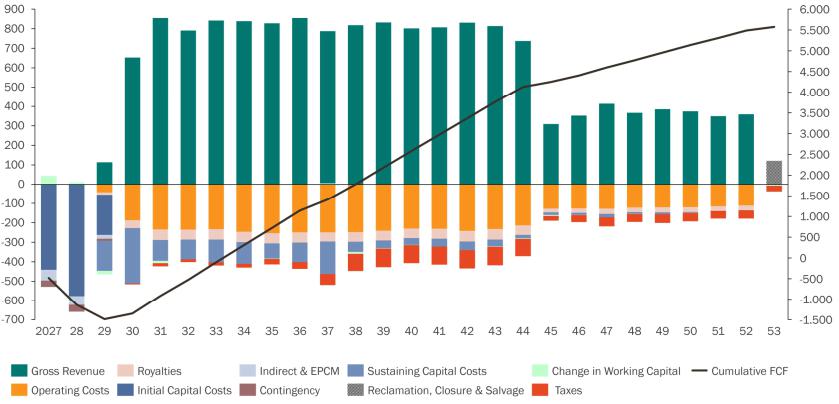
Source: BBA, 2026
Figure 19-1: Annual and Cumulative Cash Flow
| SEPTEMBER 2026 | 19-6 |
| Ivanhoe Electric Inc. S-K 1300 Preliminary Feasibility Study & | |
Table 19-3: Cash Flow Model
| Description | LOM Total |
Units | Pre-Production | Production | Closure | ||||||||||||||||||||
| YR-2 | YR-1 | YR1 | YR2 | YR3 | YR4 | YR5 | YR6 | YR7 | YR8 | YR9 | YR10 | YR11 | YR12 | YR13 | YR14 | YR15 | YR16 | YR17 | YR18 | YR19-24 | YR25 | ||||
| 2027 | 2028 | 2029 | 2030 | 2031 | 2032 | 2033 | 2034 | 2035 | 2036 | 2037 | 2038 | 2039 | 2040 | 2041 | 2042 | 2043 | 2044 | 2045 | 2046 | 2047-2052 | 2053 | ||||
| SX/EW Feed Production Tonnage | 1.5 | Mt | 0.00 | 0.00 | 0.01 | 0.06 | 0.08 | 0.08 | 0.08 | 0.08 | 0.08 | 0.08 | 0.08 | 0.08 | 0.08 | 0.08 | 0.08 | 0.08 | 0.08 | 0.08 | 0.03 | 0.04 | 0.23 | ||
| Recovered Copper Production | 3,089 | Mlbs | - | - | - | 23 | 133 | 175 | 162 | 172 | 171 | 169 | 175 | 160 | 167 | 170 | 164 | 165 | 170 | 166 | 151 | 63 | 72 | 459 | - |
| Assumptions | |||||||||||||||||||||||||
| Base Copper Price | 4.75 | $/lb | 4.75 | 4.75 | 4.75 | 4.75 | 4.75 | 4.75 | 4.75 | 4.75 | 4.75 | 4.75 | 4.75 | 4.75 | 4.75 | 4.75 | 4.75 | 4.75 | 4.75 | 4.75 | 4.75 | 4.75 | 4.5 | ||
| Copper Cathode Premium | 0.14 | $/lb | 0.14 | 0.14 | 0.14 | 0.14 | 0.14 | 0.14 | 0.14 | 0.14 | 0.14 | 0.14 | 0.14 | 0.14 | 0.14 | 0.14 | 0.14 | 0.14 | 0.14 | 0.14 | 0.14 | 0.14 | 0.14 | ||
| Total Copper Price | 4.89 | $/lb | 4.89 | 4.89 | 4.89 | 4.89 | 4.89 | 4.89 | 4.89 | 4.89 | 4.89 | 4.89 | 4.89 | 4.89 | 4.89 | 4.89 | 4.89 | 4.89 | 4.89 | 4.89 | 4.89 | 4.89 | 4.89 | ||
| Gross Revenue | 15,106 | $M | - | - | 113 | 653 | 855 | 791 | 841 | 838 | 828 | 854 | 782 | 819 | 832 | 802 | 807 | 830 | 813 | 738 | 309 | 353 | 2,247 | ||
| Operating Costs | 4,532 | $M | 0 | 0 | 41 | 187 | 234 | 235 | 233 | 246 | 253 | 249 | 249 | 248 | 240 | 229 | 231 | 241 | 232 | 213 | 127 | 127 | 716 | ||
| Royalties | 964 | M US$ | 0 | 0 | 13 | 41 | 54 | 51 | 54 | 53 | 52 | 52 | 47 | 48 | 50 | 49 | 51 | 55 | 54 | 49 | 20 | 23 | 147 | ||
| Capital Costs | |||||||||||||||||||||||||
| Initial Capital Costs | 1,224 | M US$ | 441 | 576 | 207 | 0 | 0 | 0 | 0 | 0 | 0 | 0 | 0 | 0 | 0 | 0 | 0 | 0 | 0 | 0 | 0 | 0 | 0 | ||
| Indirect & EPCM | 120 | M US$ | 55 | 45 | 20 | 0 | 0 | 0 | 0 | 0 | 0 | 0 | 0 | 0 | 0 | 0 | 0 | 0 | 0 | 0 | 0 | 0 | 0 | ||
| Contingency | 79 | M US$ | 30 | 38 | 11 | 0 | 0 | 0 | 0 | 0 | 0 | 0 | 0 | 0 | 0 | 0 | 0 | 0 | 0 | 0 | 0 | 0 | 0 | ||
| Sustaining Capital Costs | 1,546 | M US$ | 0 | 0 | 154 | 282 | 107 | 102 | 116 | 111 | 78 | 100 | 167 | 53 | 40 | 34 | 40 | 44 | 35 | 18 | 12 | 10 | 42 | ||
| Net Closure & Salvage Costs | -119 | M US$ | 3 | 0 | 0 | 0 | 0 | 0 | 0 | 0 | 0 | 0 | 0 | 0 | 0 | 0 | 0 | 0 | 0 | 0 | 0 | 0 | 0 | -121 | |
| Change in Working Capital | 0 | M US$ | 43 | 11 | -18 | 0 | -11 | 0 | 1 | 1 | -2 | 1 | 6 | -10 | -2 | -1 | 1 | 1 | -1 | -3 | -6 | -1 | -2 | -8 | |
| Taxes | 1,185 | M US$ | 0 | 0 | 0 | 6 | 16 | 14 | 16 | 20 | 28 | 35 | 56 | 88 | 95 | 93 | 93 | 94 | 95 | 89 | 24 | 36 | 259 | 29 | |
| Cash Flow Results | |||||||||||||||||||||||||
| Pre-Tax Cash Flow | 6,761 | M US$ | -485 | -649 | -352 | 143 | 448 | 404 | 439 | 428 | 443 | 454 | 326 | 460 | 501 | 487 | 486 | 491 | 491 | 456 | 144 | 193 | 1,341 | 113 | |
| Cumulative Pre-Tax Cash Flow | M US$ | -485 | -1,134 | -1,485 | -1,342 | -894 | -490 | -51 | 377 | 820 | 1,274 | 1,600 | 2,059 | 2,560 | 3,048 | 3,534 | 4,024 | 4,515 | 4,971 | 5,115 | 5,307 | 36,584 | 6806 | ||
| After-Tax Cash Flow | 5,575 | M US$ | -485 | -649 | -352 | 137 | 432 | 390 | 423 | 409 | 415 | 419 | 269 | 372 | 405 | 395 | 393 | 396 | 396 | 367 | 120 | 156 | 1,082 | 85 | |
| Cumulative After-Tax Cash Flow | M US$ | -485 | -1,134 | -1,485 | -1,348 | -916 | -526 | -103 | 305 | 720 | 1,139 | 1,409 | 1,780 | 2,185 | 2,580 | 2,974 | 3,370 | 3,766 | 4,133 | 4,253 | 4,409 | 30,279 | 5611 | ||
| SEPTEMBER 2026 | 19-7 |
| Ivanhoe Electric Inc. S-K 1300 Preliminary Feasibility Study & | |
| 19.4 | Sensitivity Analysis |
BBA performed a sensitivity analysis to determine the relative sensitivity of the Project’s NPV to a number of key parameters (Figure 19-2). This is accomplished by flexing each parameter upwards and downwards by 25%, except recovery which is assumed to not exceed 95%. Within the constraints of this analysis, the Project appears to be most sensitive to copper grade and copper recovery.
BBA cautions that this sensitivity analysis is for information only and notes that these parameters were flexed in isolation within the model and are assumed to be uncorrelated with one another, which may not be reflective of reality. Additionally, the amount of flex in the selected parameters may violate physical or environmental constraints present at the operation.
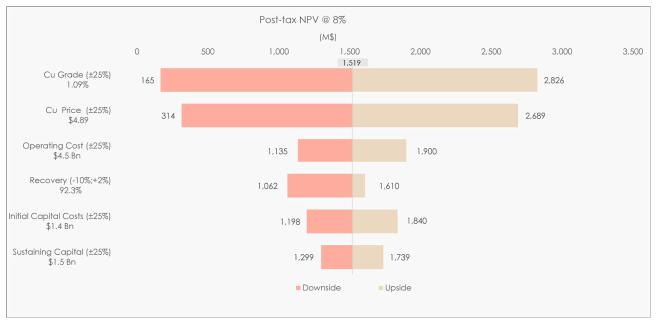
Source: BBA, 2026
Figure 19-2: Sensitivity Analysis Results
| SEPTEMBER 2026 | 19-8 |
| Ivanhoe Electric Inc. S-K 1300 Preliminary Feasibility Study & | |
| 20. | Adjacent Properties |
There are no adjacent properties that are relevant to the Santa Cruz Copper Project.
| SEPTEMBER 2026 | 20-1 |
| Ivanhoe Electric Inc. S-K 1300 Preliminary Feasibility Study & | |
| 21. | Other Relevant Data & Information |
There is no other data or information relevant to the Santa Cruz Copper Project.
| SEPTEMBER 2026 | 21-1 |
| Ivanhoe Electric Inc. S-K 1300 Preliminary Feasibility Study & | |
| 22. | Interpretations & Conclusions |
| 22.1 | Introduction |
The third-party firms who authored this report as qualified persons note the following interpretations and conclusions in their areas of responsibility, based on review of data available for this Report.
| 22.2 | Property Setting |
The Santa Cruz Copper Project is located in Arizona where mining activities have been carried out for over 100 years. The local and regional infrastructure and supply of goods available to support mining operations is well-established. Personnel with experience in mining-related activities are available in the district. There are excellent transportation routes that access central Arizona.
There are no significant topographic or physiographic issues that would affect the Santa Cruz Copper Project. Vegetation is typically sparse. The most common current land use is growing cotton and cattle feedlots.
Mining operations are expected to be able to be conducted year-round.
| 22.3 | Mineral Tenure, Surface Rights, Water Rights, Royalties & Agreements |
The Santa Cruz exploration area, including the Santa Cruz Copper Project, covers 82.37 km2. In 2021, Ivanhoe Electric acquired 238 unpatented mining lode claims. In addition, Ivanhoe Electric acquired fee simple mineral title for two further land parcels: CG100 and Skull Valley. In 2022, Ivanhoe Electric acquired the 20-acre Skull Valley property in the southeastern area of the Project and a 100.33-acre “CG100” in the northeastern area of the Project.
In 2023, Ivanhoe Electric acquired 16 Arizona State Land Department mineral exploration permits covering 27.95 km2 (~6,900 acres) of state mineral land. In May 2023, Ivanhoe Electric acquired the surface title to ~24.2 km2 (5,975 acres) encompassing the Santa Cruz Copper Project.
In 2024, Ivanhoe Electric was granted 100% of the mineral title for 26.0 km2 (~6,425 acres) of fee simple mineral estate, 39 federal unpatented mining lode claims, and 2.6 km2 (~642.5 acres) of Stock-Raising Homestead Act lands.
Ivanhoe Electric acquired grandfathered irrigation rights and grandfathered Type 1 non-irrigation water rights in association with the private land purchased in 2023 and holds all necessary water rights for the life of mine plan envisaged in this Report.
| SEPTEMBER 2026 | 22-1 |
| Ivanhoe Electric Inc. S-K 1300 Preliminary Feasibility Study & | |
There are numerous royalties that apply to the property and planned mining operations. Royalty payments vary depending on the amount of refined copper produced and the net smelter return values.
To the extent known to BBA, there are no other known significant factors and risks that may affect access, title, or the right or ability to perform work on the properties that comprise the Santa Cruz Copper Project that are not discussed in this report.
| 22.4 | Geology & Mineralization |
The deposits within the Santa Cruz Copper Project area are considered to be porphyry copper deposits of the Southwestern Porphyry Belt, defined by a combination of hypogene and supergene mineralization segmented by normal faults.
The geological understanding of the mineralogy, lithology, alteration, and structural controls on mineralization is sufficient to support estimation of Mineral Resources and Mineral Reserves and can support mine planning.
| 22.5 | History |
The Project area has over 60 years of exploration history conducted by various operators targeting definition and expansion of copper mineralization.
| 22.6 | Exploration, Drilling & Sampling |
Drilling within the Santa Cruz Copper Project totals 484 drillholes for 354,655 m of drilling. Of this total, 329 drillholes for 279,164 m were used in support of the Mineral Resource estimate. Drilling is predominantly vertically-oriented from the surface, which is appropriate to intersect the sub-horizontal mineralization.
Sampling methods, sample preparation, analysis and security conducted prior to Ivanhoe Electric’s involvement were in accordance with exploration practices and industry standards at the time the information was collected. Current sampling methods are acceptable for Mineral Resource and Mineral Reserve estimation. Sample preparation, analysis and security are currently performed in accordance with general industry standards.
Current QA/QC protocols meet industry standard insertion rates for blanks, standards, and duplicates. These control samples adequately control issues with contamination, precision, accuracy, and sampling errors. Assay and geological information collected from drillholes is considered sufficient for interpretation of the deposit and Mineral Resource estimation.
| SEPTEMBER 2026 | 22-2 |
| Ivanhoe Electric Inc. S-K 1300 Preliminary Feasibility Study & | |
Geotechnical data were used to develop an understanding of the rock quality throughout the deposits and surrounding rocks and to plan ground support methods.
A three-dimensional numerical groundwater model was constructed to understand the groundwater system and predict water inflows during mining operations. The groundwater flow model indicates residual passive inflows over the life of the mine at or below 7,200 gallons per minute.
| 22.7 | Data Verification |
Validation checks performed by Ivanhoe Electric personnel on data used to support estimation comprise checks on surveys, collar coordinates, lithology data (cross-checking from photographs and core library), and assay data. Errors were rectified in the database prior to data being approved for use in resource estimation.
Reviews performed by external consultants were undertaken in support of pre-feasibility level studies and in support of technical reports, producing independent assessments of the database quality. No significant problems with the database, sampling protocols, flowsheets, check analysis program, or data storage were noted.
BBA considers a reasonable level of verification has been completed, and that no material issues have been unidentified from the programs undertaken.
BBA requested that information, conclusions, and recommendations presented in the body of this Report be reviewed by Ivanhoe Electric staff as a further level of data verification. Feedback from the reviewers was incorporated into the Report as required.
BBA reviewed the reports and are of the opinion that the data verification programs completed on the data collected from the Project are consistent with industry best practices and that the database is sufficiently error-free to support the geological interpretations and Mineral Resource and Mineral Reserve estimation, and mine planning.
| 22.8 | Metallurgical Testwork |
Metallurgical studies have been conducted to evaluate alternative process flowsheet configurations, including the chosen flowsheet of weak acid, chloride-assisted, heap leaching. As the Project prepares to advance to detailed engineering and construction, it is recommended that leach test work continues to quantify best operating conditions for the heap leach pad and SX/EW, and provide input to the engineering design.
| SEPTEMBER 2026 | 22-3 |
| Ivanhoe Electric Inc. S-K 1300 Preliminary Feasibility Study & | |
| 22.9 | Mineral Resource Estimates |
All mineralogical information, exploration drill data, and background information were provided to BBA by Ivanhoe Electric.
Mineral Resources are reported using the Mineral Resource definitions set out in S-K 1300 and are reported inclusive and exclusive of Mineral Reserves. The reference point for the estimate is in-situ. Mineral Resources are reported on a 100% ownership basis.
Factors that may affect the Mineral Resource estimates include: changes to long-term metal price assumptions; changes to the input values for mining, processing, and general and administrative costs to constrain the estimate; changes to local interpretations of mineralization geometry and continuity of mineralized subdomains; changes to the density values applied to the mineralized zones; changes to metallurgical recovery assumptions; changes in assumptions of marketability of the final product; variations in geotechnical, hydrogeological, and mining assumptions; changes to assumptions with an existing agreement or new agreements; changes to environmental, permitting, and social license assumptions; logistics of securing and moving adequate services, labor, and supplies could be affected by epidemics, pandemics, and other public health crises, or geopolitical influence.
| 22.10 | Mineral Reserve Estimates |
Mineral Reserves were converted from Indicated Mineral Resources. Inferred Mineral Resources were not converted to Mineral Reserves; however, if Inferred Mineral Resources fell within the Mineral Reserve designs, they were assumed to have zero grade.
All current Mineral Reserves will be exploited using underground mining methods. Mineral Reserves were estimated using longhole stoping and drift-and-fill methods. Mineral Resources were converted to Mineral Reserves using a detailed mine plan, an engineering analysis, and consideration of modifying factors. Modifying factors include the consideration of dilution and ore losses, underground mining methods, metallurgical recoveries, permitting, and infrastructure requirements.
Mineral Reserves are reported using the definitions set out in S-K 1300. The reference point for the estimate is the point of delivery to the process facilities. Mineral Reserves are reported on a 100% ownership basis.
Factors that may affect the Mineral Reserve estimate include: changes to long-term metal price assumptions; changes to metallurgical recovery assumptions; changes to the input assumptions used to derive the mineable shapes applicable to the assumed underground and open pit mining methods used to constrain the estimate; changes to the forecast dilution and mining recovery
| SEPTEMBER 2026 | 22-4 |
| Ivanhoe Electric Inc. S-K 1300 Preliminary Feasibility Study & | |
assumptions; changes to the cutoff grades used to constrain the estimate; variations in geotechnical (including seismicity), hydrogeological, mining, and processing recovery assumptions; and changes to environmental, permitting, and social license assumptions.
| 22.11 | Mining Methods |
Mining operations can be conducted year-round.
Underground mining will be conducted using conventional longhole stoping or drift-and-fill methods. Access to the mine will be via a portal and a single ramp developed using a TBM. A mixed fleet of BEV and diesel equipment will be used.
The underground mine plans are based on current geotechnical, hydrogeological, mining, and processing information.
The life of mine plan assumes 140.1 Mt of ore will be mined and treated.
| 22.12 | Recovery Methods |
The designs for the process facilities were based on metallurgical testwork. The designs are conventional to the global copper industry.
Factors that may produce variations in recovery are due to the day-to-day changes in ore type or combinations of ore type being processed. These variations are expected to trend to the forecast recovery value for monthly, or longer, reporting periods.
| 22.13 | Infrastructure |
New infrastructure will be required to support proposed operations for the Santa Cruz Copper Project. Power will be transmitted from a local provider to on-site substations. The water management system will be installed to collect mine dewatering, contact, and non-contact water, stormwater, and process water.
Structures will be installed on site to support administration, maintenance, laboratory testing, emergency services, security, change-house, and mine warehouse facilities.
| SEPTEMBER 2026 | 22-5 |
| Ivanhoe Electric Inc. S-K 1300 Preliminary Feasibility Study & | |
| 22.14 | Market Studies |
A price of $4.75 per pound of copper is based on a review of the 1-, 3-, and 5-year trailing averages, as well as consensus forecasts from major banks and Ocean Partners.
Due to the shape, chemical composition, and origin point of the cathode, it is expected that a premium to the price will be negotiated with potential buyers that is marginally above the historical average; this premium is estimated at $0.14 per pound ($300 per tonne).
A limited number of contracts with vendors, contractors, or manufacturers including for the TBM with The Robbins Company, along with long-lead items to support on-site power and the SX/EW plant, have been executed. Additional major contracts will be required. Copper cathode will be sold at mine gate.
| 22.15 | Environmental, Permitting & Social Considerations |
Baseline and supporting environmental studies were completed to assess pre-existing environmental and social conditions and to support decision-making processes during permitting, design, construction, operations, and closure. Characterization studies were completed for flora and fauna, special status species, surface water mapping, air quality, cultural resources, soils, climate risk, groundwater quality, and material environmental behavior.
A 2023 Phase I Environmental Site Assessment, completed by Environmental Site Assessments, Inc. identified an aquifer exemption on a small portion of the property and agrochemical contamination of soils in former crop fields. The aquifer exemption is representative of a controlled recognized environmental condition. Further assessment of the agrochemical contamination has been completed prior to earthwork in these areas, and the available results indicate that the condition is localized and can be managed by avoidance or through location-specific soil handling, dust suppression, and worker hygiene measures, as appropriate.
Plans were developed and implemented to address aspects of operations such as waste management, migratory bird protection measures, sensitive status species protection, fugitive dust management, reclamation, spill prevention and contingency planning, water management, and noise levels.
Stakeholder engagement is a primary pillar of Ivanhoe Electric’s community relations and social performance strategy and includes development of a community working group, participation, sponsorship, and support in local activities; city council and county meetings; serving on boards and committees; and one-to-one engagement. From this engagement, Ivanhoe Electric listens to, and partners with, local organizations to identify a social investment strategy.
| SEPTEMBER 2026 | 22-6 |
| Ivanhoe Electric Inc. S-K 1300 Preliminary Feasibility Study & | |
At present, the Project is continuing outreach with Native American communities that have ancestral ties to the land. In addition, community outreach with local stakeholders, and community involvement continues, and potential partnerships are actively being pursued and/or assessed.
| 22.16 | Capital Cost Estimates |
All capital and operating cost estimates meet the requirements of S-K 1300 with an expected accuracy of -20% to +25%. A contingency of <15% has been applied to capital cost estimates. All pricing is considered in Q2 2026 dollars. Inflation or escalation are not considered.
Capital costs included funding for infrastructure, underground ventilation, underground dewatering, underground mine equipment, and surface equipment.
The overall capital cost estimate for the life of mine is $2.85 billion.
| 22.17 | Operating Cost Estimates |
Operating costs were based on estimations and are projected through the LOM plan, and are at minimum at a prefeasibility level of confidence, having an accuracy level of – 20% to +25%. No contingency was applied to operating cost estimates.
Costs were estimated from supplier-issued quotes. Labor and energy costs were based on budgeted rates applied to headcounts and energy consumption estimates.
The LOM operating costs are estimated at $5.49 billion. The average mining costs over the life of mine are $21.95/t processed, process costs are $7.50/t processed, and general and administrative costs are $2.99/t processed.
| 22.18 | Economic Analysis |
Based on the cash flow model, the after-tax financial model resulted in an IRR of 18.7% and an NPV of $1.52 billion using an 8% discount rate. The after-tax payback period, after start of operations, is 4.8 years.
The pre-tax base case financial model resulted in an IRR of 20.2% and an NPV of $1.90 B using an 8% discount rate.
The Santa Cruz Copper Project contemplates average annual copper cathode production of approximately 75,000 tonnes for the first 15 years of copper production and the average annual production is approximately 58,000 tonnes for the life of mine.
| SEPTEMBER 2026 | 22-7 |
| Ivanhoe Electric Inc. S-K 1300 Preliminary Feasibility Study & | |
The total mine life is 24 years at an average C1 cash cost of $1.47 per pound of copper and sustaining cash costs of $2.28 per pound of copper.
A sensitivity analysis was completed by flexing each parameter upwards and downwards by 25%, except recovery which is assumed to not exceed 95%. Within the constraints of this analysis, the Project appears to be most sensitive to copper grade and copper price.
| 22.19 | Risks & Opportunities |
Mining projects share internal and external risks that could affect the Project's reliability, confidence, and/or economic viability. External risks are generally applicable to all mining projects, such as the political situation in the Project’s region, metal prices, exchange rates, and government legislation.
| 22.19.1 | Risks |
The risks associated with the Santa Cruz Copper Project are generally those expected with underground mining operations and include the accuracy of the Mineral Resource and Mineral Reserve models, and/or operational impacts.
In addition, the noted factors that may affect the Mineral Resource and Mineral Reserve estimates include:
| ■ | The capital cost estimates at mines under development may increase as construction progresses. This may negatively affect the economic analysis that supports the Mineral Reserve estimates; |
| ■ | The LOM plan assumes that the Project can be permitted based on envisaged timelines. If the permitting schedule is delayed, this could impact costs and proposed production; |
| ■ | The long-term reclamation and mitigation of the Santa Cruz Copper Project are subject to assumptions as to closure timeframes and closure cost estimates. If these cannot be met, there is a risk to the costs and timing; |
| ■ | Climate changes could impact operating costs and ability to operate; |
| ■ | Political risk from changes to, or legal/regulatory actions affecting, current state or federal mining laws. |
Ivanhoe Electric retained BBA to facilitate a scored likelihood × consequence matrix workshop to identify development risks. Table 22-1 identifies what are currently deemed to be the most significant Project risks, potential impacts, and possible mitigation approaches that could reasonably affect the reliability or confidence of the Project.
| SEPTEMBER 2026 | 22-8 |
| Ivanhoe Electric Inc. S-K 1300 Preliminary Feasibility Study & | |
Table 22-1: Project Risks
| Area | Risk Description and Potential Impact | Mitigation Approach |
| General | Environmental permit approvals may be received later than required, due to regulatory review timelines, agency resource constraints, and agency information requests, delaying critical Project activities and schedule, and financing milestones dependent on permit issuance. | Required permit applications are advancing in accordance with the Project schedule, with a focus on timely submission of complete and accurate permitting packages as supporting data becomes available. Mitigation measures include proactive engagement with regulatory agencies, timely response to information requests and review comments, ongoing assessment of Project changes that could affect permitting requirements or schedule commitments, and participation in accelerated permitting programs where available. |
| Stakeholder concerns related to water use and environmental impacts may result in stakeholder opposition, permitting delays, increased regulatory scrutiny, and schedule impacts. Current controls in place include ongoing community engagement, regular working group meetings, tribal consultations, and continued dialogue with local stakeholders to identify and address concerns early in the permitting process. | A comprehensive groundwater monitoring, protection, and conservation program is being implemented, supported by ongoing groundwater monitoring and sampling throughout the life of mine. Hydrogeologic models will be updated periodically to assess potential impacts, and measures to reduce groundwater drawdown will be evaluated and implemented where appropriate. Ongoing engagement with tribal groups, local communities, and other stakeholders will continue to identify and address concerns throughout Project development and operations. | |
| Competition for experienced mining and construction personnel may limit the availability of qualified Project execution staff, resulting in recruitment delays, increased workload on existing personnel, and potential impacts to Project delivery. | Mitigation measures include leveraging the Project's proximity to major population centers and industrial labor markets, while maintaining proactive workforce planning, recruitment, reducing turnover, and maintaining continuity of critical Project functions. | |
| High industry demand for engineering and contractor resources may constrain the availability of external service providers, resulting in schedule delays and reduced execution flexibility. Current controls in place include early engagement with engineering firms and contractors to secure resources and maintain alignment with Project requirements and schedules. | Mitigation measures include early engagement with engineering firms and contractors, prioritizing existing consultant relationships to maintain continuity where appropriate, and leveraging service providers with broad resource capacity and geographic reach to support Project execution requirements. |
| SEPTEMBER 2026 | 22-9 |
| Ivanhoe Electric Inc. S-K 1300 Preliminary Feasibility Study & | |
| Area | Risk Description and Potential Impact | Mitigation Approach |
| Mine | Deviation of the blind bore from its intended alignment could compromise the planned connection with the ramp, creating execution constraints for bore liner installation and potentially causing schedule delays due to rework or remedial construction activities. | Mitigation measures include confirming bore alignment through detailed modelling and membrane analyses, evaluating and implementing appropriate casing and support configurations, and designing contingency measures to address potential alignment deviations and wide annulus conditions. |
| Ground conditions with insufficient blind bore wall stability may require additional drilling and grout consolidation, resulting in schedule impacts and increased construction complexity. Bids received include an allowance for additional work. | Mitigation measures include prior to boring, injecting and confirming targeted multi-ring grout walls around blind bore alignments where warranted by site conditions. | |
| Logistical requirements associated with dismantling, international transport, and reassembly of the tunnel boring machine may delay the commencement of decline excavation and impact the Project schedule. A third-party on-site monitoring and dismantling was engaged to control this risk. | Mitigation measures include proactive logistics management, transportation route planning, schedule monitoring, and establishment of alternative shipping and delivery strategies to reduce disruption risks. | |
| Groundwater inflows associated with fault structures encountered during excavation may increase operating costs, require additional water management measures, and result in schedule impacts. | Mitigation measures include advancing hydrogeological investigations, completing additional targeted underground infill/pilot drilling programs ahead of TBM advancement to refine structural interpretations, and updating groundwater and geotechnical models as additional information becomes available during development. | |
| Airflow conditions within the conveyor decline may result in excessive dust generation, reducing production efficiency and potentially affecting long-term operating performance and regulatory compliance. | Mitigation measures include evaluating supplemental dust suppression measures, including expanded water spray coverage along the conveyor system, and implementing preventive maintenance programs to ensure sustained performance of dust control infrastructure. | |
| Excessive dust concentrations within the conveyor decline may result in regulatory non-compliance, operational restrictions, and reduced air quality within active mining areas. |
Mitigation measures include assessing the need for additional dust suppression systems, extending water spray coverage where required, and monitoring operational performance to maintain acceptable workplace air quality standards. |
| SEPTEMBER 2026 | 22-10 |
| Ivanhoe Electric Inc. S-K 1300 Preliminary Feasibility Study & | |
| Area | Risk Description and Potential Impact | Mitigation Approach |
| Mineralogical variability at the stope scale may remain partly constrained by current drilling density, resulting in reduced confidence in ore characterization, increased processing costs, and variations in reagent and consumable requirements. | Mitigation measures include completing close-spaced underground drilling and sampling programs, reconciling results against existing block models, and incorporating additional geological, geochemical, and scanning data to improve orebody definition and resource confidence. | |
| Changes to the mine plan, equipment fleet, or production assumptions may increase ventilation demand beyond current design capacity, potentially affecting production rates and requiring additional ventilation infrastructure. | Mitigation measures include increasing fleet electrification where feasible, optimizing equipment deployment strategies, and providing for additional ventilation infrastructure should future operating requirements exceed current design assumptions. | |
| Elevated underground temperatures associated with ventilation limitations or groundwater exposure may reduce workforce productivity and require implementation of work-rest restrictions in affected areas. | Mitigation measures include installing supplementary cooling and ventilation systems where required, implementing localized cooling solutions in high-temperature areas, and applying operational controls until permanent cooling capacity is established. | |
| Dust generated by roadheader (with wet scrubber) operations may degrade underground air quality, interrupt production activities, and increase health and regulatory compliance risks. | Mitigation measures include incorporating lessons learned from comparable mining operations, optimizing dust control practices, and continuously evaluating roadheader operating procedures to improve dust containment and ventilation performance. | |
| Temporary reductions in shaft ventilation during inspection activities may decrease available airflow for mining operations and reduce production performance. | Mitigation measures include scheduling inspections during planned operational downtime, coordinating inspections with blasting and shift-change activities, and implementing maintenance schedules that minimize impacts on ventilation availability. | |
| Process Plant | Salt addition rates have been reduced from approximately 3 kg to 0.5 kg; however, elevated salt concentrations within the process stream may continue to contribute to accelerated corrosion of downstream SX/EW equipment, resulting in reduced equipment availability, increased maintenance requirements, and potential impacts to production performance. | Further mitigation measures include evaluating opportunities to optimize salt addition rates, confirming material compatibility and corrosion resistance with equipment vendors, installing protective liners in mobile equipment where appropriate, and incorporating anticipated equipment replacement requirements into long-term sustaining capital planning. |
| SEPTEMBER 2026 | 22-11 |
| Ivanhoe Electric Inc. S-K 1300 Preliminary Feasibility Study & | |
| Area | Risk Description and Potential Impact | Mitigation Approach |
| Supply constraints and elevated market pricing for key SX/EW reagents, including acid, diluent, and lime, may increase operating costs and reduce the operation's economic performance. | Mitigation measures include advancing commercial discussions with regional suppliers, establishing competitive procurement strategies early in the Project lifecycle, evaluating alternative supply sources, and pursuing long-term supply agreements to improve pricing certainty and secure reagent availability. | |
| Surface Infrastructures | The accelerated Project schedule and overlap between engineering and construction activities may cause design changes after construction begins, increasing costs, impacting the schedule, and requiring rework of completed work. | Mitigation measures include maintaining engineering progress ahead of construction activities, strengthening interdisciplinary design coordination, conducting regular design maturity and constructability reviews, and proactively managing potential scope changes through structured change control and decision-making processes. |
| The currently available water supply is rated for agricultural use and may not meet potable water requirements, resulting in insufficient water availability for sanitation, hygiene, and other site support functions, with associated operational and maintenance impacts. | Mitigation measures include evaluating connection opportunities to local potable water infrastructure, assessing on-site water treatment and filtration solutions, and developing contingency supply arrangements to ensure reliable access to sanitary water throughout Project execution and operations. | |
| The current paste plant configuration has the potential to constrain mine production. Key uncertainties include achieving the required solids content, maintaining sufficient backfill capacity to support the mining sequence, managing binder costs and system friction, and accounting for material variability in paste design. If unresolved, these issues could interrupt or slow production, reduce throughput and increase operating costs. | Mitigation measures focus on additional test work to confirm paste performance and variability, validate backfill capacity and cycle assumptions, optimize binder selection and delivery, and assess filtration, flowsheet changes, or added paste capacity, with resulting CAPEX and OPEX updates. |
| SEPTEMBER 2026 | 22-12 |
| Ivanhoe Electric Inc. S-K 1300 Preliminary Feasibility Study & | |
| 22.19.2 | Opportunities |
Opportunities that could enhance the Project's economics and timing are summarized in Table 22-2, excluding those typical to all mining projects, such as changes in metal prices, exchange rates, etc. Further information and assessments are needed before including these opportunities in the Project economics.
Table 22-2: Project Opportunities
| Area | Opportunity Explanation | Benefit |
| Geology | Upgrade of some or all of the Inferred Mineral Resources to higher-confidence categories, with additional drilling and supporting studies, such that this higher-confidence material could potentially be converted to Mineral Reserves. | Adding higher-confidence resource categories and conversion to reserves increases the economic value of the Project. |
| Ivanhoe Electric holds a significant ground package that retains significant exploration potential for new operations proximal to the current Mineral Resource and Mineral Reserve estimates, with the support of additional studies. | Adding Inferred resources and subsequent conversion to Indicated and/or Measured and then reserves could increase the economic value of the mining Project. | |
| Process Plant | Metallurgical test results from the Apollo program suggest that shorter leach cycle times may be achievable, creating an opportunity to optimize SX/EW plant sizing. Successful validation could reduce required SX/EW infrastructure and borrow pit requirements, resulting in lower Project capital costs. The opportunity is currently being advanced through the Artemis test program, which serves as the primary technical control to confirm performance assumptions. | Following completion of the Artemis program, validated results will be incorporated into engineering evaluations and Project design development. If performance improvements are confirmed, the optimized leach cycle parameters may be adopted within the PFS design basis, allowing the Project to capture potential capital efficiencies while maintaining technical confidence in metallurgical performance. |
| Mine | The current mine production sequence is based on contained copper value using a flat long-term copper price assumption. There is an opportunity to optimize stope sequencing and production scheduling based on prevailing and forecast market conditions, enabling the Project to prioritize higher-value material and improve overall economic performance. | Evaluate alternative mine sequencing scenarios incorporating copper price sensitivity, market forecasts, and economic optimization criteria. The resulting analysis will be used to identify opportunities to improve production scheduling and maximize Project value while maintaining operational and geotechnical constraints. Any recommended changes will be incorporated into future mine planning updates to enhance Project financial performance and responsiveness to market conditions. |
| SEPTEMBER 2026 | 22-13 |
| Ivanhoe Electric Inc. S-K 1300 Preliminary Feasibility Study & | |
| Area | Opportunity Explanation | Benefit |
| There is potential to increase material handling capacity and overall mine throughput beyond the current planning basis. Increased production rates could enable optimization of the mine schedule, improve utilization of mining and processing infrastructure, and accelerate metal production. The opportunity has the potential to enhance Project economics through improved cash flow timing, increased NPV, and lower unit operating costs. | Evaluate alternative production and mine planning scenarios to identify practical opportunities for increasing material movement and throughput while maintaining safety, operational, and infrastructure constraints. Results will be incorporated into future mine planning and economic evaluations to determine the optimal production strategy and maximize Project value. | |
| Additional underground diamond drilling and in-ore development may provide increased geological and geotechnical confidence, creating an opportunity to optimize stope dimensions. If ground conditions support wider and/or higher stopes, the Project could increase ore recovery, improve mining productivity, and reduce unit mining costs. | Potential reduction in unit mining costs through optimization of stope dimensions supported by additional geological and geotechnical information. | |
| Surface Infrastructures | There is potential for a considerable positive impact to the operating cost estimate by optimizing the paste backfill recipe | Potential reduction in operating costs through lower binder consumption, subject to confirmation that the optimized paste backfill recipe meets required strength, placement, and geotechnical performance criteria. |
| 22.20 | Conclusions |
Under the assumptions presented in this report, the Santa Cruz Copper Project consists of Mineral Resource and Mineral Reserve estimates that support a positive cash flow.
| SEPTEMBER 2026 | 22-14 |
| Ivanhoe Electric Inc. S-K 1300 Preliminary Feasibility Study & | |
| 23. | Recommendations |
| 23.1 | Recommended Work Program Budget |
The recommended work programs to advance detailed engineering, operational readiness, permitting, and critical long-lead items total $60.0 million. The budget for recommended work includes work anticipated to be completed between September to December, 2026. The budget is summarized in Table 23-1.
Table 23-1: Recommended Work Program Budget
| Discipline | Cost ($M) |
| Permitting & Environmental | 2.0 |
| Detailed Engineering – Surface & Underground | 5.0 |
| Long-Lead Items | 49.0 |
| Project Support | 4.0 |
| Total | 60.0 |
| 23.2 | Permitting & Environmental |
| ■ | Continue permitting activities and agency engagement for Pinal County Class II Air permit, City of Casa Grande Major Site Plan, Arizona Department of Environmental Quality Aquifer Protection permit, Arizona Department of Water Resources Dewatering permit, and Arizona Department of Environmental Quality Class V Underground Injection Control permit. |
| ■ | As the facility engineering progresses, advance the closure and reclamation design and engage Arizona State Mining Inspector to obtain an approved mined land reclamation plan for mining operations. |
| ■ | Continue engaging with the community working group to keep local stakeholders informed about the Project’s potential economic and community benefits, as well as Ivanhoe Electric’s commitment to safety and the environment. |
| ■ | Continue outreach with Native American communities that have ancestral ties to the land. |
| ■ | Continue environmental baseline data collection to support major local, county, and state permitting programs. |
| ■ | Continue an advanced mineralogy program to quantify acid-generating versus non-acid generating sulfide and sulfate minerals in Project mine rock towards constraining estimates of potentially acid generating (PAG) and non-PAG rock. |
| SEPTEMBER 2026 | 23-1 |
| Ivanhoe Electric Inc. S-K 1300 Preliminary Feasibility Study & | |
| ■ | Continue a subset of Phase B (mine area materials) humidity cells through the end of 2026. The bulk of the Phase B geochemical characterization program was concluded in mid-2026, but several humidity cells remain ongoing. |
| ■ | Initiate geochemical characterization of new heap leach spent ore samples generated from recent metallurgical test work in support of refining the engineering designs. |
| ■ | Initiate a cemented paste geochemical characterization program on samples of cemented paste following completion of the paste variability testing program in 2027. |
| ■ | Continue advancing the site-wide water balance with new information as Project designs continue through detailed design. |
| ■ | Finalize the Phase II soil sampling and industrial hygiene results and use the final interpretation to confirm any location-specific soil handling, dust suppression, confirmatory sampling, or worker hygiene measures that should be carried forward into the applicable construction and environmental management plans prior to earthwork. |
| 23.3 | Detailed Engineering |
| 23.3.1 | Surface |
The following work plans are recommended to investigate capital and operating cost opportunities, reduce, or remove operating risks, and attempt to improve metallurgical performance of the heap leach:
| ■ | Layout optimization of the milling circuit for the front end of the paste plant. |
| ■ | Paste pilot-plant level testwork to confirm that open-circuit grinding of (spent ore) will produce cemented paste backfill of the required solids concentration and strength to support mining operations. |
| ■ | Testwork to optimize leach conditions for PLS and SLS pond operation, evaluate effects of mature solution chemistry, potential agglomeration emissions, no salt addition and seasonal temperature variations. |
| ■ | Perform testing and site investigations to advance detailed engineering of the heap leach pad, spent ore stockpile, and associated ponds. |
| 23.3.2 | Underground |
| ■ | Detailed underground engineering design for the ventilation shafts, decline tunnel, and other mine infrastructure. |
| SEPTEMBER 2026 | 23-2 |
| Ivanhoe Electric Inc. S-K 1300 Preliminary Feasibility Study & | |
| 23.4 | Long-Lead Items |
| ■ | Pre-payments and installment payments on items including, but not limited to: |
| - | Tunnel Boring Machine and related infrastructure; |
| - | Ventilation equipment; |
| - | SX/EW equipment; |
| - | Electrical infrastructure. |
| 23.5 | Project Support |
| ■ | Staffing to support early works; |
| ■ | Implement a procurement management system; |
| ■ | Optimize the documents management system; |
| ■ | Implement a Project management system; |
| ■ | Implement a safety management system. |
| SEPTEMBER 2026 | 23-3 |
| Ivanhoe Electric Inc. S-K 1300 Preliminary Feasibility Study & | |
| 24. | References |
CIM. (2014). Canadian Institute of Mining, Metallurgical and Petroleum, CIM Definition Standards for Mineral Resources and Mineral Reserves. Adopted by the CIM Council on May 10, 2014.
CIM. (2019). Canadian Institute of Mining, Metallurgical and Petroleum, CIM Estimation of Mineral Resources and Mineral Reserves Best Practice Guidelines. Adopted by the CIM Council on November 29, 2019.
CIM. (2020). Canadian Institute of Mining, Metallurgical and Petroleum, CIM Guidance on Commodity Pricing and Other Issues Related to Mineral Resource and Mineral Reserve Estimating and Reporting. Adopted by CIM Council on August 28, 2020.
| 24.1 | List of References |
Arizona Department of Environmental Quality (ADEQ), (2005). Arizona Mining Guidance Manual Best Available Demonstrated Control Technology (BADCT).
Arizona Department of Water Resources (ADWR), (2019). Pinal Model and 100-Year Assured Water Supply Projection Technical Memorandum. October 11, 2019.
Arizona Department of Environmental Quality, (2025). ADEQ letter to Ivanhoe Electric “Reclamation Plan Amendment Approval for Santa Cruz Copper Project” dated November 10.
Arizona Department of Environmental Quality, (2026). Letter to Ivanhoe Electric “ Determination of Applicability for the Santa Cruz Copper Project Cemented Paste Backfill Inventory 514108, LTF No. 115166, Place ID: 230300”, dated March 17.
Asmus, B., (2013).Gossan or the
iron cap. Retrieved from
https://en.archaeometallurgie.de/gossan-iron-cap
Berger, B., Ayuso, R., Wynn, J., & Seal, R., (2008). Preliminary Model of Porphyry Copper Deposits. from USGS site: http://pubs.er.usgs.gov/usgspubs/ofr/ofr20081321
Blue Coast Laboratories, Ltd. (2025). PJ-5524 - Ivanhoe Electric - Santa Cruz Column Leach Metallurgical Testwork Report V1.0.
Call & Nicholas Inc., (2022). Decline Characterization and Support Estimation. December 14.
CIBC (2025). Consensus Commodity Prices, June 2025.
Cook III, S. S., (1994). The geological history of supergene enrichment in the porphyry copper deposits of southwestern North America (Doctoral dissertation, The University of Arizona).
eBird, (2025). EBird: An online database of bird distribution and abundance [web application]. eBird, Cornell Lab of Ornithology, Ithaca, New York. Available: http://www.ebird.org. Accessed: August 1, 2023.
| SEPTEMBER 2026 | 24-1 |
| Ivanhoe Electric Inc. S-K 1300 Preliminary Feasibility Study & | |
Fernández-Mort, A., & Riquelme, R. A.-Z., (2018). genetic model based on evapoconcentration for sediment-hosted exotic-copper mineralization in arid environments: the case of the El Tesoro Central copper deposit, Atacama Desert, Chile. Miner Deposita, 53, 775-795. Retrieved from https://doi.org/10.1007/s00126-017-0780-2
Foster, Michael S., Ron Ryden, and Cara Bellavia, (2006). An Archaeological Evaluation of the Legends Project Area, West of the Town of Casa Grande, Pinal County, Arizona. Cultural Resources Report 9596-094. SWCA Environmental Consultants, Phoenix, Arizona.
Geosyntec Consultants, Inc., (2025). Updated Site Sampling Plan Santa Cruz Copper Project. Prepared for Ivanhoe Electric. April 2025
GoldSim Technology Group., (2025). GoldSim (Version 15.0).
Hall, R.R., Dorsey & Whitney, LLP., (2025). Confidential Santa Cruz NSR Royalty Analysis and Opinion Letter dated May 15, 2025.
INTERA Incorporated (INTERA), (2025). Hydrogeology and Groundwater Modeling for the Santa Cruz Copper Project Preliminary Feasibility Study. Prepared for Ivanhoe Electric. December 2025.
INTERA Incorporated (INTERA), (2026). Groundwater Model Update for the Santa Cruz Copper Project Preliminary Feasibility Study. Prepared for Ivanhoe Electric. September 2026.
Ivanhoe Electric, (2025). Mined Land Reclamation Plan Amendment for Exploration and Construction Activities for Santa Cruz Copper Project, submitted September 1.
Ivanhoe Electric, (2026). Application for an Individual Aquifer Protection Permit for the Santa Cruz Copper Project, submitted May 8.
Kappes, Cassidy and Associates (2026). Santa Cruz Project Composites, J, K, L and M Column Leach Testing Report of Metallurgical Test Work. Prepared for Ivanhoe Electric July 2026.
LaLonde, M.C., Fennemore Law, (2025). Update to Mineral Title Report dated October 29, 2021, June 30, 2022, February 10, 2023, September 21, 2023, and November 19, 2023. Prepared for Ivanhoe Electric. February 2025.
Langevin, C.D., Hughes, J.D., Banta, E.R., Niswonger, R.G., Panday, S. and Provost, A.M., (2017). Documentation for the MODFLOW 6 Groundwater Flow Model (No. 6-A55). United States Geological Survey.
Life Cycle Geo, LLC, (2023). Historic Water Quality In The Project Area Of The Proposed Santa Cruz Mine. Report prepared for Santa Cruz. Santa Cruz, Arizona. p. 1-11.
Life Cycle Geo., (2026a). Santa Cruz Copper Project - Site Wide Water Balance. Technical Memorandum prepared for Ivanhoe Electric, 30 pp.
| SEPTEMBER 2026 | 24-2 |
| Ivanhoe Electric Inc. S-K 1300 Preliminary Feasibility Study & | |
Life Cycle Geo, LLC, (2026b). Santa Cruz Copper Project: Revised PFS Baseline Water Quality. Technical Memorandum prepared for Ivanhoe Electric. 20 pp.
Life Cycle Geo, LLC, (2026c). Pre-Feasibility Study: Summary of the Geochemical Characterization of the Santa Cruz Copper Project, Arizona USA. Technical Memorandum prepared for Ivanhoe Electric, 30 pp.
Life Cycle Geo, LLC, (2026d). Santa Cruz Copper Project: Underground Water Quality Model. Technical Memorandum prepared for Ivanhoe Electric, 20 pp.
Liu, S., Nelson, K., Yunker, D., Hipke, W., and Corkhill, F., (2014). Regional Groundwater Flow Model of the Pinal Active Management Area, Arizona: Model Update and Calibration (Model Report No. 26). Arizona Department of Water Resources, Hydrology Division. February 2014.
McClelland Laboratories, (2024). 4815 Mesa Cobre Holding Corporation Report_7-8-24.
Middleton, Sherri, (2022). A Class III Cultural Resources Assessment of 20 Archaeological Sites on Private Land In Support of the Santa Cruz Copper Project Near Casa Grande, Arizona, WestLand Engineering & Environmental Services, November 3, 2022.
Montgomery & Associates, (2023). Results of 2022 and 2023 Packer Testing, Santa Cruz – Pinal County, AZ (Project #: 3457.07). Technical Memorandum. Natalie Speaks, Brady Nock, and Colin Kikuchi. June 1.
Mote, T., Becker, T., Renne, P., & Brimhall, G., (2018). Chronology of Exotic Mineralization at El Salvador, Chile, by 40Ar/39Ar Dating of Copper Wad and Supergene Alunite. Economic Geology, 351-
Münchmeyer, C., (1998). Exotic Deposits - Products of Lateral Migration of Supergene Solutions from Porphyry Copper Deposits. Andean Copper Deposits: New Discoveries, Mineralization, Styles and Metallogeny. Francisco Camus, Richard Sillitoe, Richard Petersen.
Ocean Partners, (2025). Copper Concentrate Market Study, Ivanhoe Electric Santa Cruz Project, Revision 2, April 5, 2025.
SGS Laboratories, (2024) 20188-02 - FINAL - Report & Appendices - combined - November 29, 2024.
SGS Laboratories, (2025). 20118-01-Variability – Final Report Appendices – combined – January 8 2025.pdf
Sillitoe, R. H., (2010). Porphyry Copper Systems. Economic Geology. Retrieved from https://doi.org/10.2113/gsecongeo.105.1.3
| SEPTEMBER 2026 | 24-3 |
| Ivanhoe Electric Inc. S-K 1300 Preliminary Feasibility Study & | |
Tetra Tech, Inc., (2026). Tech Memo: Calculated “Dust Action Levels” (DALs) – Ivanhoe Electric Project Sites, March 16, 2026.
Tetra Tech, Inc., (2026). Preliminary Soil Baseline Sampling Report, Santa Cruz Copper Project, March 25, 2026.
Tipple Consulting, (2026). Air Quality and Carbon Intensity for the Santa Cruz Cooper Project (Updated for PFS), September 10, 2026.Tosdal, R., & Wooden, J. L., (2015). Construction of the Jurassic magmatic arc, southeast California and southwest Arizona. Geological Society of America Special Papers, 513, 189-221.
US Fish and Wildlife Service Special Purpose – Relocate Permit, Permit No. MBPER331 6170
WestLand Engineering & Environmental Services, (2023). Draft Ivanhoe Electric Preconstruction Biological Resources Surveys Summary Report, March 1, 2023.
WestLand Engineering & Environmental Services, (2024). Draft Ivanhoe Electric Preconstruction Biological Resources Surveys Summary Report, January 28, 2025.
WestLand Engineering & Environmental Services, (2026). Special-Status Species Management Plan, Prepared for Santa Cruz Copper Project. Adopted June 19, 2026.
| SEPTEMBER 2026 | 24-4 |
| Ivanhoe Electric Inc. S-K 1300 Preliminary Feasibility Study & | |
| 24.2 | Units of Measurement & Abbreviations |
| Abbreviation / Unit | Description |
| ~ | Approximately |
| “ | inch |
| ˚C | Degrees Celsius |
| ° | Degrees |
| °F | Degrees Fahrenheit |
| 2025 PFS | S-K 1300 Preliminary Feasibility Study & Technical Report Summary, Santa Cruz Copper Project, Arizona |
| 3D | Three-dimensional |
| 3D PPD IP | three-dimensional perpendicular pole dipole induced polarization |
| AAS | Atomic absorption spectrometry |
| ABA | Acid base accounting |
| acre-ft | acre-feet |
| ADEQ | Arizona Department of Environmental Quality |
| ADOT | Arizona Department of Transportation |
| Ag | Silver |
| AGP | acid -generating potential |
| Alv | Alluvium |
| AMD | associated metalliferous drainage |
| ANP | Acid-neutralizing potential |
| APP | Aquifer Protection Permit |
| ASARCO-Freeport | ASARCO Santa Cruz Inc. and Freeport McMoRan Copper & Gold Inc. |
| ASCu | Acid-soluble copper |
| ASLD | Arizona State Land Department |
| ASMI | Arizona State Mine Inspector |
| ASTM | American Society of Testing and Materials |
| Au | Gold |
| Au ppb | Parts per billion of gold |
| Ag ppm | parts per million of silver |
| AWQS | Aquifer Water Quality Standards |
| B | Billion |
| BAC | bulk air cooler |
| BADCT | Best Available Demonstrated Control Technology |
| SEPTEMBER 2026 | 24-5 |
| Ivanhoe Electric Inc. S-K 1300 Preliminary Feasibility Study & | |
| Abbreviation / Unit | Description |
| BBA | BBA Consultants USA LP |
| BCR | Blue Coast Research |
| BEV | Battery electric vehicle |
| Blbs | Billion pounds |
| BS | British Standards |
| Burns & McDonnell | Burns & McDonnell Engineering Company, Inc. |
| C$ or CAD | Canadian dollar |
| CAP | Covered Area Project |
| CAPEX | Capital cost estimate |
| CAR | Central Arizona Resources, Ltd. |
| CCOS | crushed coarse ore stockpile |
| CGL | Conglomerate |
| cm | Centimeter |
| cm/s | Centimeter per second |
| CN | Cyanide |
| CNCu | Cyanide soluble copper |
| CO2e | carbon dioxide equivalent |
| COMEX | Commodity Exchange Inc. |
| CPB | cemented paste backfill |
| CRM | Certified reference material |
| Cu | Copper |
| CuRes | Residual copper |
| DCS | Distributed Control System |
| DRH | D.R. Horton Phoenix East Construction, Inc. |
| DRZ | damaged rock zone |
| DSO | Deswik Stope Optimizer |
| ED3 | Pinal County Electrical District Number 3 |
| EDTA | Ethylenediaminetetraacetic acid |
| eGRID | Emissions & Generation Resource Integrated Database |
| EMP | Environmental management plan |
| EP4 | Equator Principles |
| EPB | Earth Pressure Balance |
| EPCM | Engineering, procurement, and construction management |
| SEPTEMBER 2026 | 24-6 |
| Ivanhoe Electric Inc. S-K 1300 Preliminary Feasibility Study & | |
| Abbreviation / Unit | Description |
| ESA | Endangered Species Act |
| ESIA | Environmental and Social Impact Assessment |
| Fe | Iron |
| FRS | fiber-reinforced shotcrete |
| FS | Feasibility study |
| g | Gram |
| G&A | General and administrative |
| g/L | Grams per liter |
| g/t | Grams per tonne |
| gal/min | Gallons per minute |
| Geosyntec | Geosyntec Consultants, Inc. |
| Getty Oil | Getty Oil Corp. |
| GFR | Grandfathered Irrigation Rights |
| GIIP | Good International Industry Practice |
| GIS | Geographical information system |
| GPS | Global positioning system |
| GR | Oracle Granite |
| h | Hour |
| H | Height |
| H&A | Haley & Aldrich, Inc. |
| h/y | Hours per year |
| H2SO3 | Sulfurous acid |
| H2SO4 | Sulfuric acid |
| ha | Hectare |
| HCL | Hydrochloric acid |
| HClO4 | perchloric acid |
| HCT | humidity cell test |
| HG | High grade |
| HGU | Hydrogeological Unit |
| Highway 84 | West Gila Bend Highway |
| HNO3 | nitric acid |
| HPX | High Power Exploration Inc. |
| HQ | Drill core size (63.5 mm) |
| SEPTEMBER 2026 | 24-7 |
| Ivanhoe Electric Inc. S-K 1300 Preliminary Feasibility Study & | |
| Abbreviation / Unit | Description |
| IA | Initial assessment |
| IAS | International Accreditation Service |
| ICP-AES | Inductively coupled plasma atomic emission spectroscopy |
| ICP-MS | inductively coupled plasma mass spectroscopy |
| ICP-OES | Inductively Coupled Plasma Optical Emission Spectroscopy |
| ID2 | Inverse distance squared |
| ID3 | Inverse distance cubed |
| IFC PS | International Finance Corporation’s Performance Standards |
| INTERA | INTERA Incorporated |
| IP | induced polarization |
| IRR | Internal Rate of Return |
| ISO | International Standards Organization |
| ISRM | International Society for Rock Mechanics |
| k | Kilo or thousand |
| K-Ar | Potassium-argon |
| KCA | Kappes, Cassiday and Associates |
| KCB | KCB Consultants Ltd. |
| kg | Kilogram |
| kg/m3 | Kilogram per cubic meter |
| kg/t | Kilogram per tonne |
| km | Kilometer |
| km2 | Square kilometer |
| koz | Thousand ounces |
| kPa | Kilopascal |
| kV | Kilovolt |
| kVA | Kilovolt-ampere |
| kW | Kilowatt |
| kWh | Kilowatt-hour |
| kWh/t | Kilowatt-hour per tonne |
| L | Liter |
| L/h/m2 | Liters per hour per square meter |
| LC | Leach Cap |
| LCG | Life Cycle Geo, LLC |
| SEPTEMBER 2026 | 24-8 |
| Ivanhoe Electric Inc. S-K 1300 Preliminary Feasibility Study & | |
| Abbreviation / Unit | Description |
| LCRS | Leachate collection and removal system |
| Legends | Legends Property, LLC |
| LG | Low grade |
| LHDs | Load-haul-dump equipment |
| LLD | Detection limit |
| LME | London Metal Exchange |
| LOM | life of mine |
| LTE | Long-term evolution |
| Ma | Million years ago |
| MACRS | Modified Accelerated Cost Recovery System |
| masl | Meters above sea level |
| MTOs | Material take-offs |
| Max RPI | maximum residual passive inflows |
| Mesa Cobre | Mesa Cobre Holding Corporation |
| Met Engineering | Met Engineering, LLC |
| MG | Medium grade |
| mg/L | Milligram per liter |
| min | Minute |
| MLI | McClelland Labs |
| MLRP | Mined Land Reclamation Plan |
| mm | Millimeter |
| MPa | Megapascal |
| MSIDD | Maricopa Stanfield Irrigation and Drainage District |
| MSO | Mineable stope optimizer |
| Mt | Million tonnes |
| Mt/y | Million tonnes per year |
| MVA | Megavolt-ampere |
| MW | Megawatt |
| MWh/y | megawatt-hours per year |
| MWMP | meteoric water mobility procedure |
| MWr | Megawatts of refrigeration |
| NaCl | Sodium chloride |
| NGS | National Geodetic Survey |
| SEPTEMBER 2026 | 24-9 |
| Ivanhoe Electric Inc. S-K 1300 Preliminary Feasibility Study & | |
| Abbreviation / Unit | Description |
| NN | Nearest neighbor |
| NPAG | Non-potentially acid generating |
| NPV | Net Present Value |
| NQ | Drill core size (47.26 mm) |
| NSR | Net smelter return |
| O | Oxygen |
| OK | Ordinary kriging |
| OX | Oxide |
| P&C | Paterson & Cooke USA, Ltd. |
| P80 | Particle size at which 80% of the material will pass |
| Pa | Pascal |
| PAG | Potentially acid generating |
| pCi/L | picocuries per liter |
| PDC | Process design criteria |
| PFS | Pre-feasibility study |
| pH | Potential hydrogen |
| PLC | Programmable logic controller |
| PLS | Pregnant leach solution |
| ppb | Parts per billion |
| PPD IP | Perpendicular pole dipole induced polarization |
| ppm | Parts per million |
| PQ | Drill core size (85 mm) |
| PR | Primary |
| Q2 | second quarter |
| QA/QC | Quality assurance / quality control |
| RC | Reverse circulation |
| RMR | Rock mass rating |
| ROM | Run of mine |
| RPI | residual passive inflows |
| rpm | Revolutions per minute |
| RQD | Rock quality designation |
| s | second |
| SCADA | Supervisory control and data acquisition |
| SEPTEMBER 2026 | 24-10 |
| Ivanhoe Electric Inc. S-K 1300 Preliminary Feasibility Study & | |
| Abbreviation / Unit | Description |
| SCJV | Santa Cruz Joint Venture |
| SEQ | Sequential analyses |
| S-K 1300 | Disclosure by Registrants Engaged in Mining Operations in Regulation S-K 1300 |
| SLS | Secondary pregnant leach solution |
| Stantec | Stantec Consulting Services Inc. |
| SWWB | site-wide water balance |
| SX/EW | Solvent extraction / electrowinning |
| t | tonne |
| t/d | tonnes per day |
| t/h | tonnes per hour |
| t/y | tonnes per year |
| TBM | Tunnel Boring Machine |
| TCu | Total copper |
| Tetra Tech | Tetra Tech, Inc. |
| UCS | Uniaxial compressive strength |
| UGWQM | underground water quality model |
| US$ or USD | United States dollar |
| USFWS | US Fish and Wildlife Service |
| V | volt |
| VWPs | Vibrating wire piezometers |
| W | Width |
| Wolff-Harvard | Wolff-Harvard Ventures |
| WOTUS | Waters of the United States |
| wt % | Weight percentage |
| XRD | x-ray diffraction |
| y | year |
| SEPTEMBER 2026 | 24-11 |
| Ivanhoe Electric Inc. S-K 1300 Preliminary Feasibility Study & | |
| 25. | Reliance on Information Provided by the Registrant |
| 25.1 | Introduction |
The companies who authored this report consider it reasonable to rely on Ivanhoe Electric for the information identified in the subsections below, because it employed industry professionals with considerable expertise in order to collect the information in these areas.
| 25.2 | Macroeconomic Trends |
Information relating to inflation, interest rates, discount rates, and taxes was obtained from Ivanhoe Electric.
This information is used in the economic analysis in Section 19. It supports the reasonable prospects of economic extraction for the Mineral Resource estimates in Section 11 and the assumptions used in demonstrating the economic viability of the Mineral Reserve estimates in Section 12.
| 25.3 | Markets |
Information relating to market studies / markets for product, market entry strategies, marketing and sales contracts, product valuation, product specifications, transportation costs, agency relationships, material contracts (e.g., mining, transportation, handling, hedging arrangements, and forward sales contracts) were obtained from Ivanhoe Electric.
This information is used in the market studies in Section 16 and in the economic analysis in Section 19. It supports the reasonable prospects of economic extraction for the Mineral Resource estimates in Section 11 and the assumptions used in demonstrating the economic viability of the Mineral Reserve estimates in Section 12.
| 25.4 | Legal Matters |
Information relating to mineral tenure (payments to retain property rights), surface rights, water rights, royalties, encumbrances, easements and rights-of-way, violations and fines, permitting requirements, and the ability to maintain and renew permits was obtained from Ivanhoe Electric.
This information is used in support of the property description and ownership information in Section 3, the permitting and mine closure descriptions in Section 17, and the economic analysis in Section 19. It supports the reasonable prospects of economic extraction for the Mineral Resource estimates in Section 11 and the assumptions used in demonstrating the economic viability of the Mineral Reserve estimates in Section 12.
| SEPTEMBER 2026 | 25-1 |
| Ivanhoe Electric Inc. S-K 1300 Preliminary Feasibility Study & | |
| 25.5 | Environmental Matters |
Information relating to baseline and supporting studies for environmental permitting and monitoring requirements, ability to maintain and renew permits, emissions controls, closure planning, closure and reclamation bonding and bonding requirements, sustainability accommodations, and monitoring for, and compliance with, requirements relating to protected areas and protected species was obtained from Ivanhoe Electric.
This information is used when discussing ownership information in Section 3, the permitting and closure discussions in Section 17, and the economic analysis in Section 19. It supports the reasonable prospects of economic extraction for the Mineral Resource estimates in Section 11 and the assumptions used in demonstrating the economic viability of the Mineral Reserve estimates in Section 12.
| 25.6 | Stakeholder Accommodations |
Information relating to social and stakeholder baseline and supporting studies, hiring and training policies for workforce from local communities, partnerships with stakeholders (including national, regional, and state mining associations; trade organizations; state and local chambers of commerce; economic development organizations; Native American communities; non-governmental organizations; and state and federal governments); and the stakeholder engagement plan was obtained from Ivanhoe Electric.
This information is used in the social and community discussions in Section 17 and the economic analysis in Section 19. It supports the reasonable prospects of economic extraction for the Mineral Resource estimates in Section 11 and the assumptions used in demonstrating the economic viability of the Mineral Reserve estimates in Section 12.
| 25.7 | Governmental Factors |
Information relating to taxation and royalty considerations, monitoring requirements and frequency, bonding requirements, violations and fines, and risks due to changes in regulations and policies was obtained from Ivanhoe Electric.
This information is used in the discussion on royalties and property encumbrances in Section 3, the permitting and mine closure descriptions in Section 17, and the economic analysis in Section 19. It supports the reasonable prospects of economic extraction for the Mineral Resource estimates in Section 11, the assumptions used in demonstrating the economic viability of the Mineral Reserve estimates in Section 12, and risks due to changes in regulations and policies in Section 22.19.1.
| SEPTEMBER 2026 | 25-2 |