1 FINAL FORM THE COMPANIES ACT 2006 PUBLIC COMPANY LIMITED BY SHARES ARTICLES OF ASSOCIATION OF POLESTAR AUTOMOTIVE HOLDING UK PLC Company No 13624182
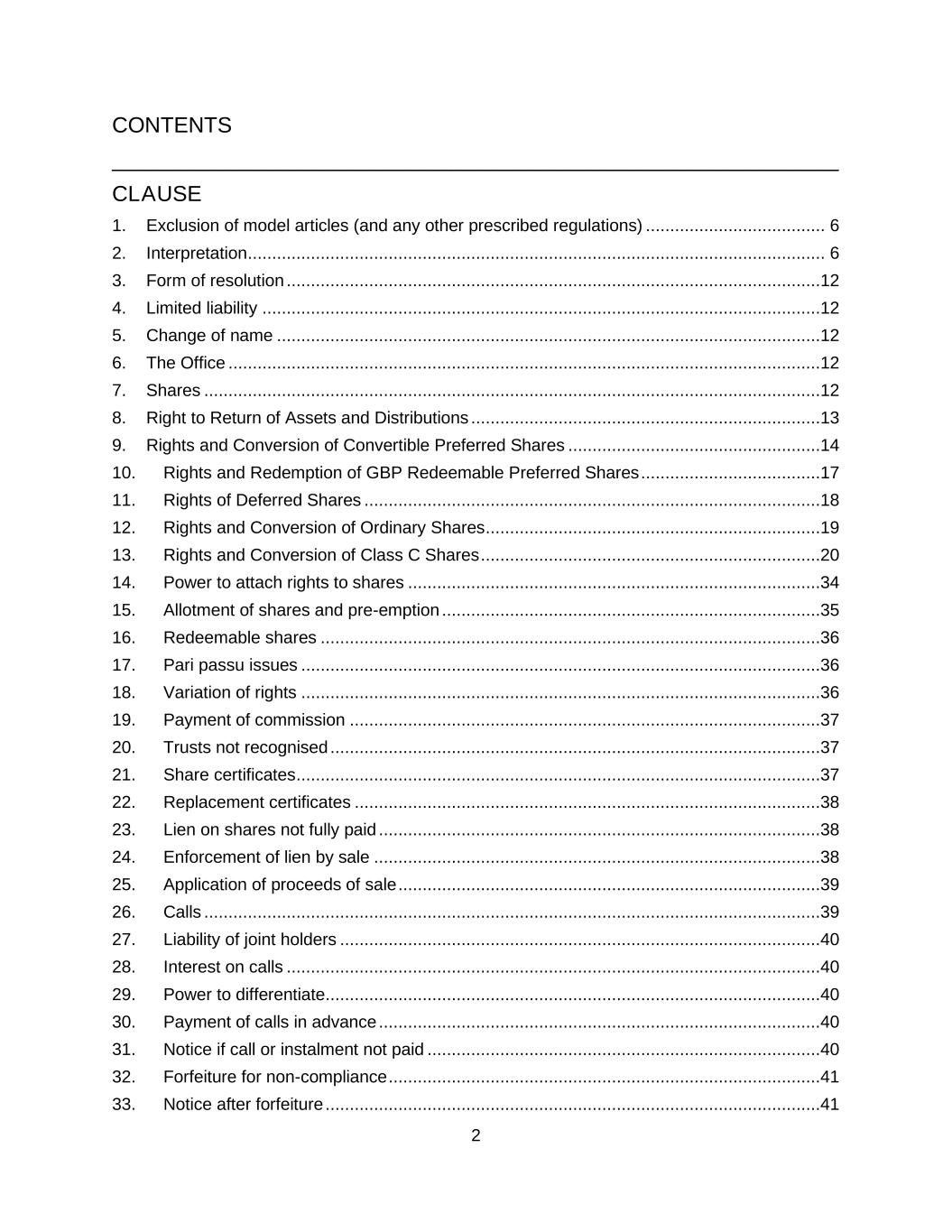
2 CONTENTS ____________________________________________________________ CLAUSE 1. Exclusion of model articles (and any other prescribed regulations) ..................................... 6 2. Interpretation ....................................................................................................................... 6 3. Form of resolution ..............................................................................................................12 4. Limited liability ...................................................................................................................12 5. Change of name ................................................................................................................12 6. The Office ..........................................................................................................................12 7. Shares ...............................................................................................................................12 8. Right to Return of Assets and Distributions ........................................................................13 9. Rights and Conversion of Convertible Preferred Shares ....................................................14 10. Rights and Redemption of GBP Redeemable Preferred Shares .....................................17 11. Rights of Deferred Shares ..............................................................................................18 12. Rights and Conversion of Ordinary Shares .....................................................................19 13. Rights and Conversion of Class C Shares ......................................................................20 14. Power to attach rights to shares .....................................................................................34 15. Allotment of shares and pre-emption ..............................................................................35 16. Redeemable shares .......................................................................................................36 17. Pari passu issues ...........................................................................................................36 18. Variation of rights ...........................................................................................................36 19. Payment of commission .................................................................................................37 20. Trusts not recognised .....................................................................................................37 21. Share certificates ............................................................................................................37 22. Replacement certificates ................................................................................................38 23. Lien on shares not fully paid ...........................................................................................38 24. Enforcement of lien by sale ............................................................................................38 25. Application of proceeds of sale .......................................................................................39 26. Calls ...............................................................................................................................39 27. Liability of joint holders ...................................................................................................40 28. Interest on calls ..............................................................................................................40 29. Power to differentiate ......................................................................................................40 30. Payment of calls in advance ...........................................................................................40 31. Notice if call or instalment not paid .................................................................................40 32. Forfeiture for non-compliance .........................................................................................41 33. Notice after forfeiture ......................................................................................................41
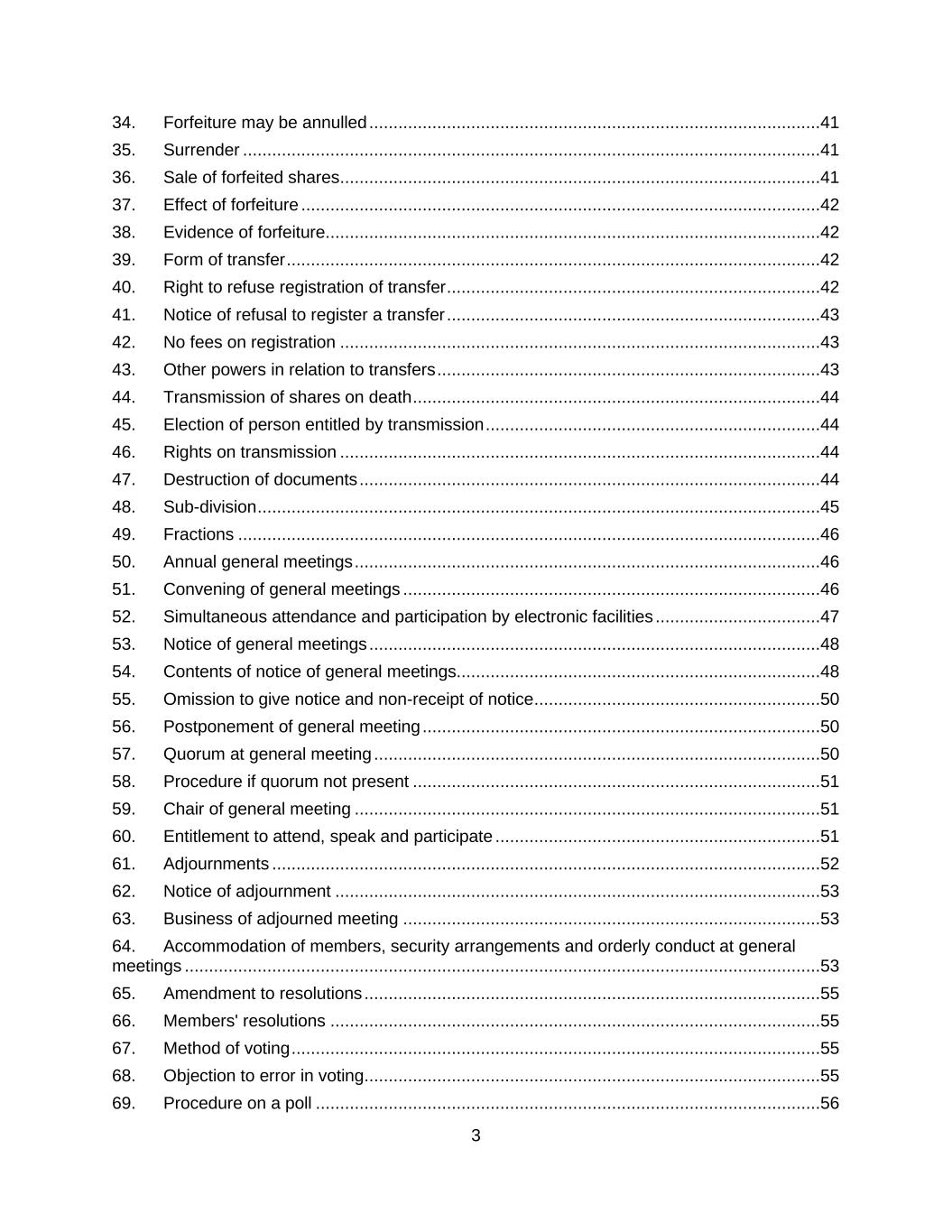
3 34. Forfeiture may be annulled .............................................................................................41 35. Surrender .......................................................................................................................41 36. Sale of forfeited shares ...................................................................................................41 37. Effect of forfeiture ...........................................................................................................42 38. Evidence of forfeiture ......................................................................................................42 39. Form of transfer ..............................................................................................................42 40. Right to refuse registration of transfer .............................................................................42 41. Notice of refusal to register a transfer .............................................................................43 42. No fees on registration ...................................................................................................43 43. Other powers in relation to transfers ...............................................................................43 44. Transmission of shares on death ....................................................................................44 45. Election of person entitled by transmission .....................................................................44 46. Rights on transmission ...................................................................................................44 47. Destruction of documents ...............................................................................................44 48. Sub-division ....................................................................................................................45 49. Fractions ........................................................................................................................46 50. Annual general meetings ................................................................................................46 51. Convening of general meetings ......................................................................................46 52. Simultaneous attendance and participation by electronic facilities ..................................47 53. Notice of general meetings .............................................................................................48 54. Contents of notice of general meetings...........................................................................48 55. Omission to give notice and non-receipt of notice ...........................................................50 56. Postponement of general meeting ..................................................................................50 57. Quorum at general meeting ............................................................................................50 58. Procedure if quorum not present ....................................................................................51 59. Chair of general meeting ................................................................................................51 60. Entitlement to attend, speak and participate ...................................................................51 61. Adjournments .................................................................................................................52 62. Notice of adjournment ....................................................................................................53 63. Business of adjourned meeting ......................................................................................53 64. Accommodation of members, security arrangements and orderly conduct at general meetings ...................................................................................................................................53 65. Amendment to resolutions ..............................................................................................55 66. Members' resolutions .....................................................................................................55 67. Method of voting .............................................................................................................55 68. Objection to error in voting..............................................................................................55 69. Procedure on a poll ........................................................................................................56
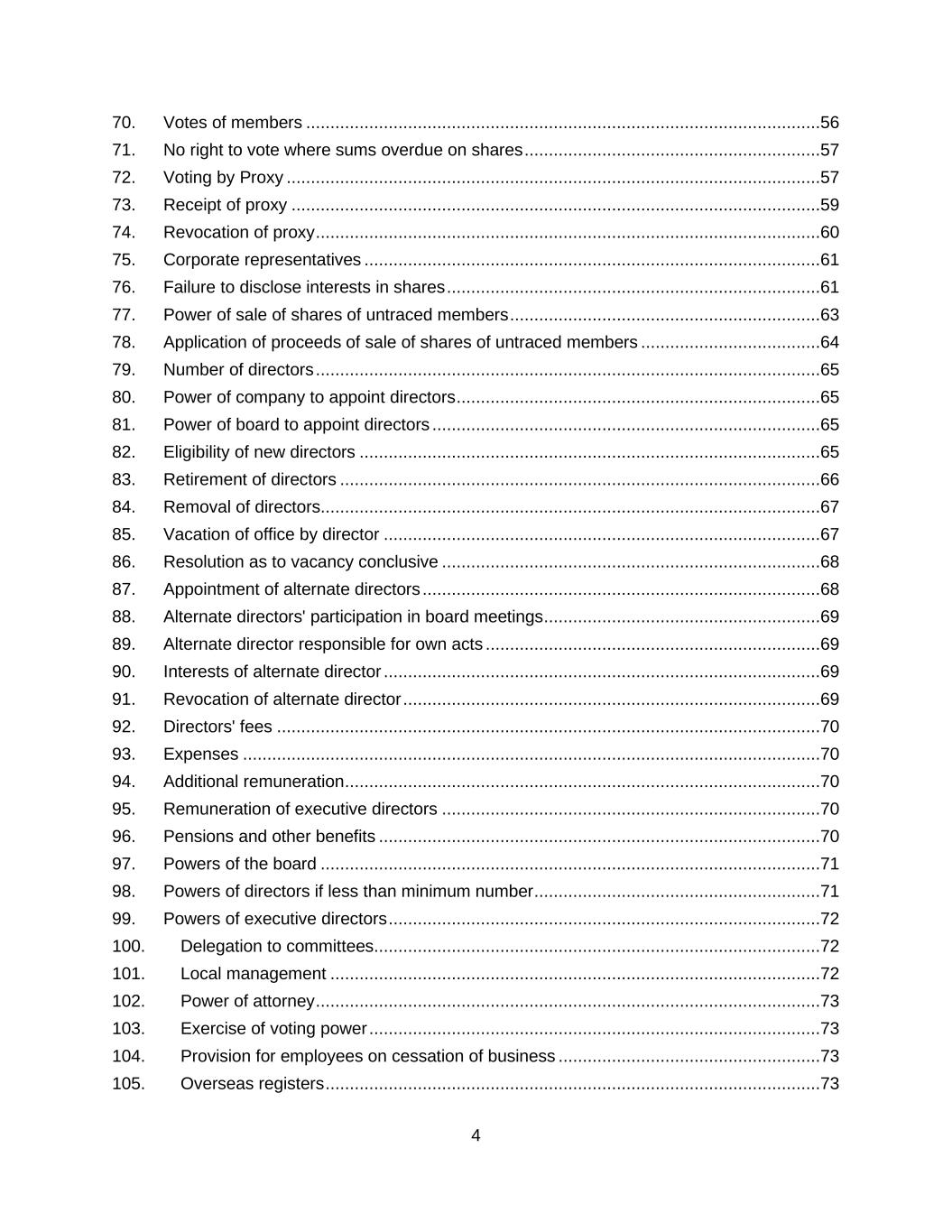
4 70. Votes of members ..........................................................................................................56 71. No right to vote where sums overdue on shares .............................................................57 72. Voting by Proxy ..............................................................................................................57 73. Receipt of proxy .............................................................................................................59 74. Revocation of proxy ........................................................................................................60 75. Corporate representatives ..............................................................................................61 76. Failure to disclose interests in shares .............................................................................61 77. Power of sale of shares of untraced members ................................................................63 78. Application of proceeds of sale of shares of untraced members .....................................64 79. Number of directors ........................................................................................................65 80. Power of company to appoint directors ...........................................................................65 81. Power of board to appoint directors ................................................................................65 82. Eligibility of new directors ...............................................................................................65 83. Retirement of directors ...................................................................................................66 84. Removal of directors.......................................................................................................67 85. Vacation of office by director ..........................................................................................67 86. Resolution as to vacancy conclusive ..............................................................................68 87. Appointment of alternate directors ..................................................................................68 88. Alternate directors' participation in board meetings .........................................................69 89. Alternate director responsible for own acts .....................................................................69 90. Interests of alternate director ..........................................................................................69 91. Revocation of alternate director ......................................................................................69 92. Directors' fees ................................................................................................................70 93. Expenses .......................................................................................................................70 94. Additional remuneration ..................................................................................................70 95. Remuneration of executive directors ..............................................................................70 96. Pensions and other benefits ...........................................................................................70 97. Powers of the board .......................................................................................................71 98. Powers of directors if less than minimum number ...........................................................71 99. Powers of executive directors .........................................................................................72 100. Delegation to committees............................................................................................72 101. Local management .....................................................................................................72 102. Power of attorney ........................................................................................................73 103. Exercise of voting power .............................................................................................73 104. Provision for employees on cessation of business ......................................................73 105. Overseas registers ......................................................................................................73
5 106. Borrowing powers .......................................................................................................74 107. Board meetings ...........................................................................................................74 108. Notice of board meetings ............................................................................................74 109. Quorum .......................................................................................................................74 110. Chair ...........................................................................................................................75 111. Voting .........................................................................................................................75 112. Participation by telephone or other form of communication .........................................75 113. Resolution in writing ....................................................................................................76 114. Proceedings of committees .........................................................................................76 115. Minutes of proceedings ...............................................................................................76 116. Validity of proceedings ................................................................................................76 117. Transactions or other arrangements with the company ...............................................77 118. Authorisation of Directors' conflicts of interest .............................................................77 119. Directors' permitted interests .......................................................................................79 120. General .......................................................................................................................80 121. Power to authenticate documents ...............................................................................81 122. Use of seals ................................................................................................................81 123. Declaration of dividends ..............................................................................................82 124. Interim dividends .........................................................................................................82 125. Calculation and currency of dividends .........................................................................82 126. Amounts due on shares can be deducted from dividends ...........................................82 127. Dividends not in cash ..................................................................................................83 128. No interest on dividends .............................................................................................83 129. Method of payment .....................................................................................................83 130. Uncashed dividends ....................................................................................................84 131. Unclaimed dividends ...................................................................................................84 132. Scrip dividends ...........................................................................................................84 133. Capitalisation of reserves ............................................................................................86 134. Record dates ..............................................................................................................88 135. Inspection of records ...................................................................................................88 136. Account to be sent to members...................................................................................88 137. Service of Notices .......................................................................................................89 138. Notice on person entitled by transmission ...................................................................91 139. Record date for service ...............................................................................................91 140. Evidence of service .....................................................................................................91 141. Notice when post not available....................................................................................92
6 142. Indemnity and insurance .............................................................................................92 143. Forum Selection ..........................................................................................................93 144. Winding up ..................................................................................................................94 THE COMPANIES ACT 2006 PUBLIC COMPANY LIMITED BY SHARES ARTICLES OF ASSOCIATION OF POLESTAR AUTOMOTIVE HOLDING UK PLC (Adopted by special resolution passed on the 30th day of June, 2025 and effective 1st day of July 2025) 1. Exclusion of model articles (and any other prescribed regulations) No regulations or articles set out in any statute, or in any statutory instrument or other subordinate legislation made under any statute, concerning companies (including the regulations in the Companies (Model Articles) Regulations 2008 (SI 2008/3229)) shall apply as the articles of the Company. The following shall be the articles of association of the Company. 2. Interpretation 2.1 In these articles, unless the context otherwise requires: Act means the Companies Act 2006. address includes any number or address used for the purposes of sending or receiving documents or information by electronic means. Applicable Event has the meaning given to it in Article 13.23. Articles means these articles of association as altered from time to time and "Article" shall be construed accordingly. Board means the board of Directors for the time being of the Company or the Directors present or deemed to be present at a duly convened quorate meeting of the Directors. Business Combination means the merger of a newly formed, wholly-owned subsidiary of the Company with and into the SPAC, which SPAC shall survive, pursuant to that certain business combination agreement dated September 27, 2021.
7 Business Day means a day other than a day on which banking institutions or trust companies are authorized or obligated by law to close in Hong Kong, the People’s Republic of China, the British Virgin Islands, Sweden, New York City, or London, England, a Saturday or a Sunday. call includes any instalment of a call and, in the application of provisions of these Articles to forfeiture of shares, a sum which, by the terms of issue of a share, is payable at a fixed time. capital means the share capital from time to time of the Company. Chair means the Chair presiding at any meeting of members or the Board. Class A Ordinary Share means an ordinary share of USD 0.01 each in the share capital of the Company which is designated as a Class A Ordinary Share and having the rights provided for in these Articles. Class B Ordinary Share means an ordinary share of USD 0.01 each in the share capital of the Company which is designated as a Class B Ordinary Share and having the rights provided for in these Articles. Class C Shares means Class C-1 Shares and Class C-2 Shares. Class C Share Conversion Ratio means one, subject to adjustment in accordance with these Articles. Class C-1 Share means a class C-1 ordinary share of USD 0.10 each in the share capital of the Company which is designated as a Class C-1 Share and having the rights provided for in these Articles. Class C-2 Share means a class C-2 ordinary share of USD 0.10 each in the share capital of the Company which is designated as a Class C-2 Share and having the rights provided for in these Articles. clear days in relation to a period of notice means that period excluding the day when the notice is served or deemed to be served and the day for which it is given or on which it is to take effect. Closing means closing of the Business Combination Agreement. Companies Acts means the Act, the Companies Act 1985 and, where the context requires, every other statute from time to time in force concerning companies and affecting the Company. Company means POLESTAR AUTOMOTIVE HOLDING UK PLC. Conversion Notice means the Class C Share conversion notice as set out in Annex A. Conversion Subscription Value means an amount equal to the product of the number of Convertible Preferred Shares which have at the relevant time been converted in accordance with these Articles and the initial subscription price (including any premium) paid per each Convertible Preferred Share.
8 Convertible Preferred Shares: means the convertible preferred shares of USD 10.00 each in the capital of the Company having the rights and restrictions set out in these Articles. Date of Adoption means the date of adoption of these Articles. Deferred Shares means deferred shares of USD 0.01 each in the capital of the Company having the rights and restrictions set out in these Articles. Depositary means any depositary, custodian or nominee approved by the Board that holds legal title to shares in the capital of the Company for the purposes of facilitating beneficial ownership of such shares by other persons. Director means a director for the time being of the Company. electronic communication means a communication sent, transmitted, conveyed and received by wire, by radio, by optical means, by electronic means or by other electromagnetic means in any form through any medium. electronic facility includes, without limitation, website addresses and conference call systems, and any device, system, procedure, method or other facility whatsoever providing an electronic means of attendance at or participation in (or both attendance at and participation in) a general meeting determined by the Board pursuant to Article 52. electronic form has the meaning given to it in section 1168 of the Act. electronic means has the meaning given to it in section 1168 of the Act. electronic meeting means a general meeting held and conducted wholly and exclusively by virtual attendance and participation by members and/or proxies by means of electronic facilities. Exchange means any recognised investment exchange or other stock market or public securities exchange showing quotations for the Company's ordinary shares. Exchange Act means Securities Exchange Act of 1934 (USA), as amended. Geely means Zhejiang Geely Holding Co Ltd. Group means the Company and its subsidiaries. GBP Redeemable Preferred Shares means redeemable preference shares of GBP 1.00 each in the capital of the Company having the rights and restrictions set out in these Articles. hybrid meeting means a general meeting held and conducted by (i) physical attendance and participation by members and/or proxies at one or more places of meeting or meeting locations; and (ii) virtual attendance and participation by members and/or proxies by means of electronic facilities. Independent Directors means a director that both (i) satisfies the requirements to qualify as an “independent director” under the stock exchange rules of the stock exchange on
9 which the Ordinary Shares are then-currently listed and (ii) is not affiliated (as a director, employee, shareholder or otherwise) with Parent, Volvo or Geely, provided that an individual shall not be precluded from being appointed, or continuing to act, as an Independent Director solely on the basis of holding, directly or indirectly, up to 0.01% of the share capital of any publically traded affiliate of Parent, Volvo or Geely. Initial Liquidation Preference means, in respect of the Convertible Preferred Shares, an aggregate amount equal to USD 588,826,100. member means a member of the Company, or where the context requires, a member of the Board or of any committee. month means calendar month. Office means the registered office from time to time of the Company. Ordinary Shares means the Class A Ordinary Shares and the Class B Ordinary Shares. paid up means paid up or credited as paid up. Parent means Polestar Automotive Holding Limited, a Hong Kong incorporated company. Permitted Transfer means: (a) to the Company’s officers or directors, any affiliates or family members of any of the Company’s officers or directors, any members of the Sponsor, or any affiliates of the Sponsor; (b) in the case of an individual, by gift to a member of one of the members of the individual’s immediate family or to a trust, the beneficiary of which is a member of one of the individual’s immediate family, an affiliate of such person or to a charitable organization; (c) in the case of an individual, by virtue of the laws of descent and distribution upon death of the individual; (d) in the case of an individual, pursuant to a qualified domestic relations order; (e) by private sales or transfers made in connection with the consummation of the Business Combination at prices no greater than the price at which the Class C-2 Shares were originally purchased; (f) by virtue of the laws of Delaware or the Sponsor’s limited liability company agreement upon dissolution of the Sponsor; or (g) in the event of the Company’s liquidation, merger, capital stock exchange, reorganization or other similar transaction which results in all of the Company’s shareholders having the right to exchange their ordinary shares for cash, securities or other property subsequent to the Closing, (each such transferee being a “Permitted Transferee”).
10 physical meeting means a general meeting held and conducted by physical attendance and participation by members and/or proxies at one or more Meeting Location(s). Pound and £ means pounds in the lawful currency of England. Preference Conversion Ratio means 1 Class A Ordinary Share for each Convertible Share as adjusted in accordance with Article 9.12. Register means the register of members of the Company to be maintained under the Act or as the case may be any overseas branch register maintained under Article 105. Seal means the common seal of the Company or, where the context allows, any official seal kept by the Company under section 50 of the Act. Secretary means the person or persons appointed for the time being to perform for the Company the duties of a secretary. Securities Act means the Securities Act of 1933 (USA), as amended. share means a Class A Ordinary Share, a Class B Ordinary Share, Class C-1 Share, a Class C-2 Share, a Convertible Preferred Share, a GBP Redeemable Preferred Share, a Deferred Share or any other share in the capital of the Company from time to time. shareholder or member or holder means a duly registered holder of share(s) from time to time. Solvent Reorganisation means any solvent reorganisation of the Company, including without limitation by merger, consolidation, recapitalisation, transfer or sale of all or substantially all of the shares or assets of the Company, scheme of arrangement, exchange of securities, conversion of entity, migration of entity, formation of new entity, or any other transaction or group of transactions. SPAC means Gores Guggenheim, Inc., a Delaware corporation. special resolution shall have the meaning ascribed thereto in section 283 of the Companies Act 2006. Sponsor means Gores Guggenheim Sponsor LLC. Subsidiary has the meaning given in section 1159 of the Companies Act 2006. United States means the United States of America, its territories, its possessions and all areas subject to its jurisdiction. USD or $ means the lawful currency of United States. Volvo means Volvo Car Corporation. in writing and written means the representation or reproduction of words, symbols or other information in a visible form by any method or combination of methods, whether sent or supplied in electronic form or otherwise. 2.2 Headings shall not affect the interpretation of these Articles.
11 2.3 Unless the context otherwise requires, a person includes a natural person, corporate or unincorporated body (whether or not having separate legal personality) acting, where applicable, by their duly authorized representatives. 2.4 Unless the context otherwise requires, words in the singular shall include the plural and in the plural shall include the singular. 2.5 A reference to one gender shall include a reference to the other genders. 2.6 A reference to a statute or statutory provision is a reference to it as amended, extended or re-enacted from time to time, and shall include all subordinate legislation made from time to time under that statute or supporting provision. 2.7 Any words or expressions defined in the Companies Acts in force when these Articles or any part of these Articles are adopted shall (if not inconsistent with the subject or context in which they appear) have the same meaning in these Articles or that part, save that company shall include any company, corporation or other body corporate, wherever and however incorporated or established. 2.8 A reference to a document being signed or to signature includes references to its being executed under hand or under seal or by any other method and, in the case of a communication in electronic form, such references are to its being authenticated as specified by the Companies Acts. 2.9 A reference to writing or written includes references to any method of representing or reproducing words in a legible and non-transitory form whether sent or supplied in electronic form or otherwise. 2.10 A references to a notice or document (including, without limitation, a resolution in writing or minutes) include a notice or document recorded or stored in any digital, electronic, electrical, magnetic or other retrievable form or medium and information in visible form whether having physical substance or not. 2.11 A reference to documents or information being sent or supplied by or to a company (including the Company) shall be construed in accordance with section 1148(3) of the Act. 2.12 A reference to a meeting: (a) shall mean a meeting convened and held in any manner permitted by these Articles, including a general meeting at which some (but not all) those entitled to be present attend and participate by means of electronic facility or facilities, and such persons shall be deemed to be present at that meeting for all purposes of the Act and these Articles, and attend, participate, attending, participating, attendance and participation shall be construed accordingly; and
12 (b) shall not be taken as requiring more than one person to be present if any quorum requirement can be satisfied by one person. 2.13 References to a person’s participation in the business of a general meeting include without limitation and as relevant the right (including, in the case of a corporation, through a duly appointed representative) to speak, vote, be represented by a proxy and have access in hard copy or electronic form to all documents which are required by the Companies Acts or these Articles to be made available at the meeting, and participate and participating in the business of a general meeting shall be construed accordingly. 2.14 Nothing in these Articles precludes the holding and conducting of a general meeting in such a way that persons who are not present together at the same place or places may by electronic means attend and participate in it. 3. Form of resolution Subject to the Companies Acts, where anything can be done by passing an ordinary resolution, this can also be done by passing a special resolution. 4. Limited liability The liability of the members of the Company is limited to the amount, if any, unpaid on the shares in the Company held by them. 5. Change of name The name of the Company is “POLESTAR AUTOMOTIVE HOLDING UK PLC”. The Company may change its name by resolution of the Board. 6. The Office The Office shall be at such place in England as the Directors shall from time to time appoint. 7. Shares 7.1 The share capital of the Company on the Date of Adoption is divided into Class A Ordinary Shares, Class B Ordinary Shares, Class C-1 Shares, Class C-2 Shares, Convertible Preferred Shares, Deferred Shares and GBP Redeemable Preferred Shares. 7.2 The Board may issue warrants to subscribe for any class of fully paid shares or securities of the Company on such terms and conditions as the Board may from time to time determine. No fraction of any share shall be allotted on exercise of the subscription rights. Subject to the conditions on which the warrants are issued from time to time, bearers of
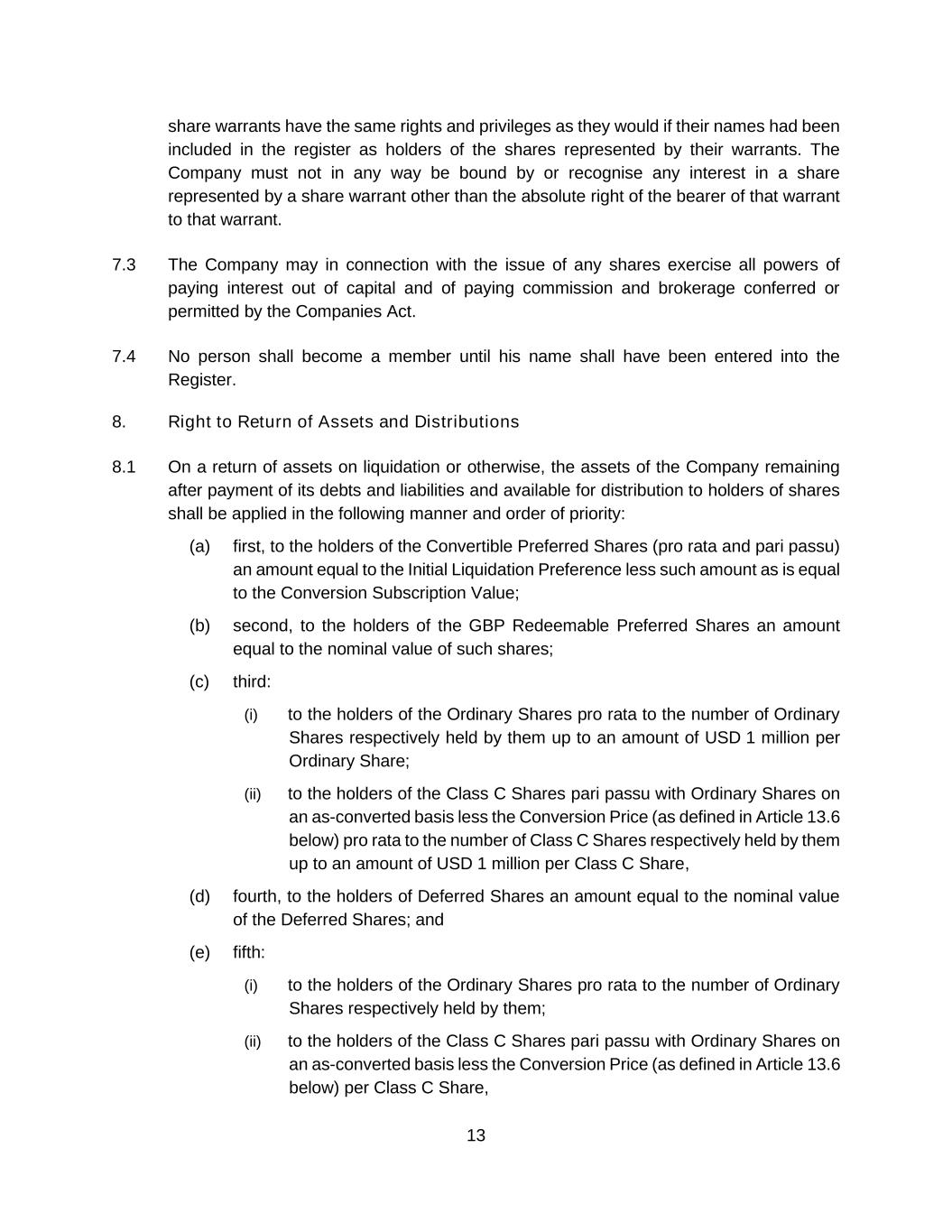
13 share warrants have the same rights and privileges as they would if their names had been included in the register as holders of the shares represented by their warrants. The Company must not in any way be bound by or recognise any interest in a share represented by a share warrant other than the absolute right of the bearer of that warrant to that warrant. 7.3 The Company may in connection with the issue of any shares exercise all powers of paying interest out of capital and of paying commission and brokerage conferred or permitted by the Companies Act. 7.4 No person shall become a member until his name shall have been entered into the Register. 8. Right to Return of Assets and Distributions 8.1 On a return of assets on liquidation or otherwise, the assets of the Company remaining after payment of its debts and liabilities and available for distribution to holders of shares shall be applied in the following manner and order of priority: (a) first, to the holders of the Convertible Preferred Shares (pro rata and pari passu) an amount equal to the Initial Liquidation Preference less such amount as is equal to the Conversion Subscription Value; (b) second, to the holders of the GBP Redeemable Preferred Shares an amount equal to the nominal value of such shares; (c) third: (i) to the holders of the Ordinary Shares pro rata to the number of Ordinary Shares respectively held by them up to an amount of USD 1 million per Ordinary Share; (ii) to the holders of the Class C Shares pari passu with Ordinary Shares on an as-converted basis less the Conversion Price (as defined in Article 13.6 below) pro rata to the number of Class C Shares respectively held by them up to an amount of USD 1 million per Class C Share, (d) fourth, to the holders of Deferred Shares an amount equal to the nominal value of the Deferred Shares; and (e) fifth: (i) to the holders of the Ordinary Shares pro rata to the number of Ordinary Shares respectively held by them; (ii) to the holders of the Class C Shares pari passu with Ordinary Shares on an as-converted basis less the Conversion Price (as defined in Article 13.6 below) per Class C Share,
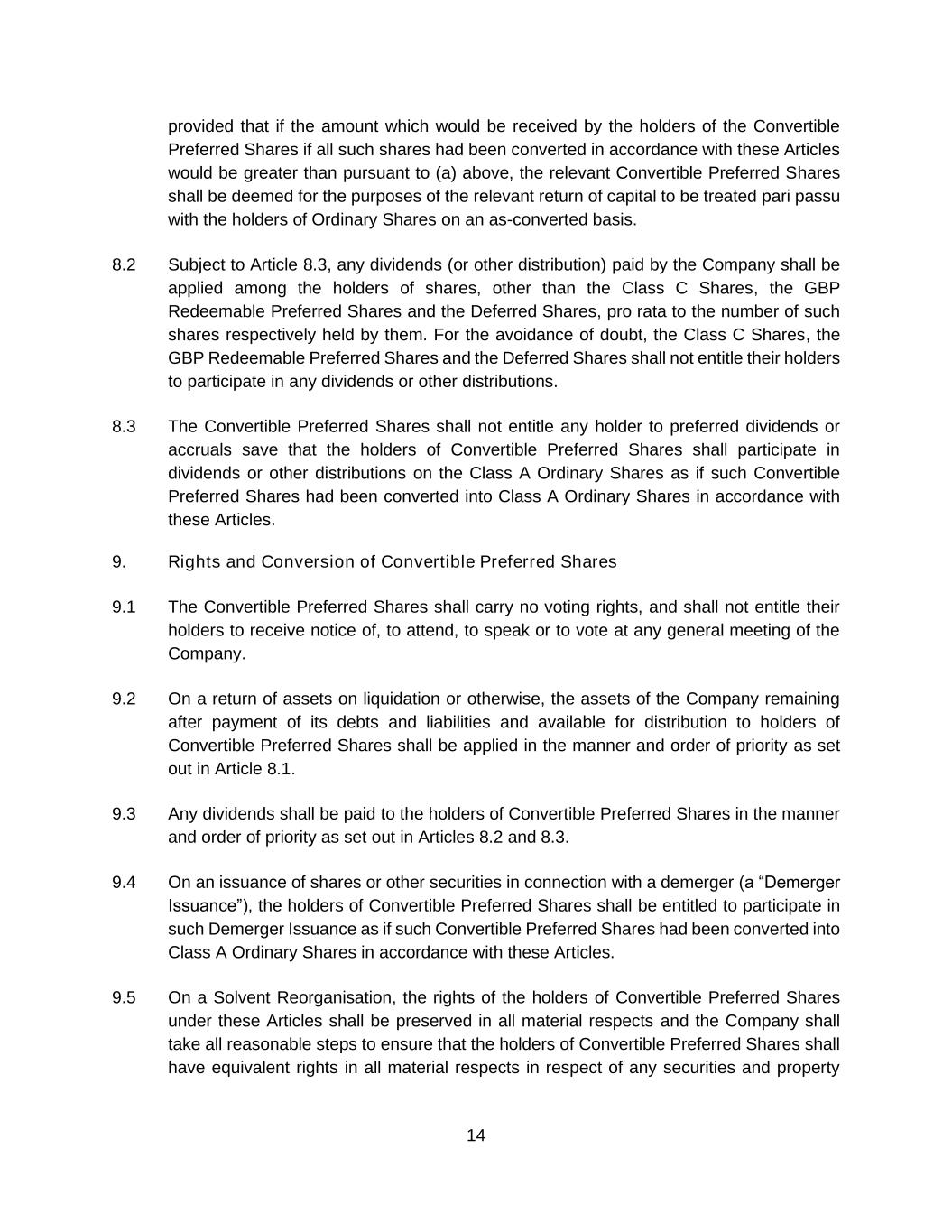
14 provided that if the amount which would be received by the holders of the Convertible Preferred Shares if all such shares had been converted in accordance with these Articles would be greater than pursuant to (a) above, the relevant Convertible Preferred Shares shall be deemed for the purposes of the relevant return of capital to be treated pari passu with the holders of Ordinary Shares on an as-converted basis. 8.2 Subject to Article 8.3, any dividends (or other distribution) paid by the Company shall be applied among the holders of shares, other than the Class C Shares, the GBP Redeemable Preferred Shares and the Deferred Shares, pro rata to the number of such shares respectively held by them. For the avoidance of doubt, the Class C Shares, the GBP Redeemable Preferred Shares and the Deferred Shares shall not entitle their holders to participate in any dividends or other distributions. 8.3 The Convertible Preferred Shares shall not entitle any holder to preferred dividends or accruals save that the holders of Convertible Preferred Shares shall participate in dividends or other distributions on the Class A Ordinary Shares as if such Convertible Preferred Shares had been converted into Class A Ordinary Shares in accordance with these Articles. 9. Rights and Conversion of Convertible Preferred Shares 9.1 The Convertible Preferred Shares shall carry no voting rights, and shall not entitle their holders to receive notice of, to attend, to speak or to vote at any general meeting of the Company. 9.2 On a return of assets on liquidation or otherwise, the assets of the Company remaining after payment of its debts and liabilities and available for distribution to holders of Convertible Preferred Shares shall be applied in the manner and order of priority as set out in Article 8.1. 9.3 Any dividends shall be paid to the holders of Convertible Preferred Shares in the manner and order of priority as set out in Articles 8.2 and 8.3. 9.4 On an issuance of shares or other securities in connection with a demerger (a “Demerger Issuance”), the holders of Convertible Preferred Shares shall be entitled to participate in such Demerger Issuance as if such Convertible Preferred Shares had been converted into Class A Ordinary Shares in accordance with these Articles. 9.5 On a Solvent Reorganisation, the rights of the holders of Convertible Preferred Shares under these Articles shall be preserved in all material respects and the Company shall take all reasonable steps to ensure that the holders of Convertible Preferred Shares shall have equivalent rights in all material respects in respect of any securities and property
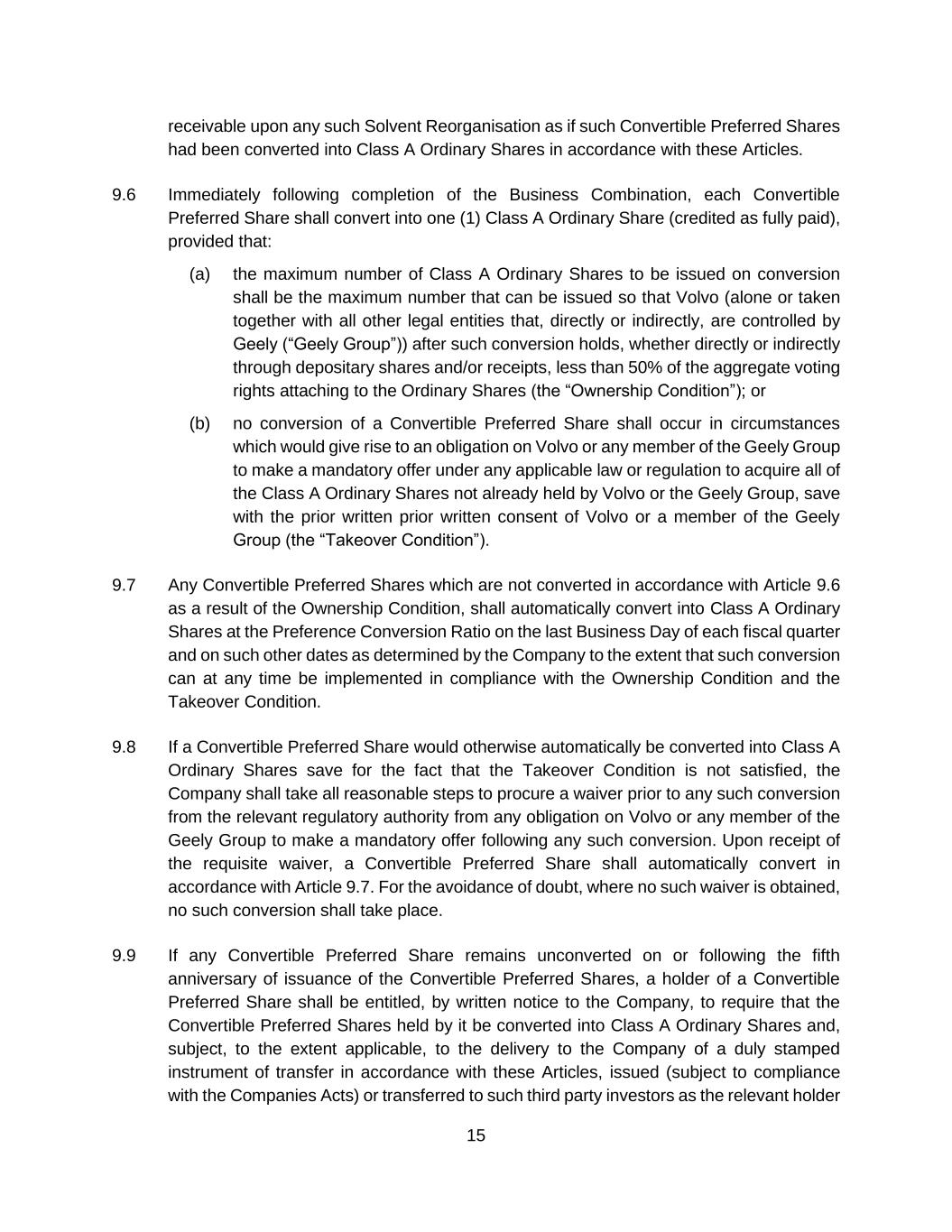
15 receivable upon any such Solvent Reorganisation as if such Convertible Preferred Shares had been converted into Class A Ordinary Shares in accordance with these Articles. 9.6 Immediately following completion of the Business Combination, each Convertible Preferred Share shall convert into one (1) Class A Ordinary Share (credited as fully paid), provided that: (a) the maximum number of Class A Ordinary Shares to be issued on conversion shall be the maximum number that can be issued so that Volvo (alone or taken together with all other legal entities that, directly or indirectly, are controlled by Geely (“Geely Group”)) after such conversion holds, whether directly or indirectly through depositary shares and/or receipts, less than 50% of the aggregate voting rights attaching to the Ordinary Shares (the “Ownership Condition”); or (b) no conversion of a Convertible Preferred Share shall occur in circumstances which would give rise to an obligation on Volvo or any member of the Geely Group to make a mandatory offer under any applicable law or regulation to acquire all of the Class A Ordinary Shares not already held by Volvo or the Geely Group, save with the prior written prior written consent of Volvo or a member of the Geely Group (the “Takeover Condition”). 9.7 Any Convertible Preferred Shares which are not converted in accordance with Article 9.6 as a result of the Ownership Condition, shall automatically convert into Class A Ordinary Shares at the Preference Conversion Ratio on the last Business Day of each fiscal quarter and on such other dates as determined by the Company to the extent that such conversion can at any time be implemented in compliance with the Ownership Condition and the Takeover Condition. 9.8 If a Convertible Preferred Share would otherwise automatically be converted into Class A Ordinary Shares save for the fact that the Takeover Condition is not satisfied, the Company shall take all reasonable steps to procure a waiver prior to any such conversion from the relevant regulatory authority from any obligation on Volvo or any member of the Geely Group to make a mandatory offer following any such conversion. Upon receipt of the requisite waiver, a Convertible Preferred Share shall automatically convert in accordance with Article 9.7. For the avoidance of doubt, where no such waiver is obtained, no such conversion shall take place. 9.9 If any Convertible Preferred Share remains unconverted on or following the fifth anniversary of issuance of the Convertible Preferred Shares, a holder of a Convertible Preferred Share shall be entitled, by written notice to the Company, to require that the Convertible Preferred Shares held by it be converted into Class A Ordinary Shares and, subject, to the extent applicable, to the delivery to the Company of a duly stamped instrument of transfer in accordance with these Articles, issued (subject to compliance with the Companies Acts) or transferred to such third party investors as the relevant holder
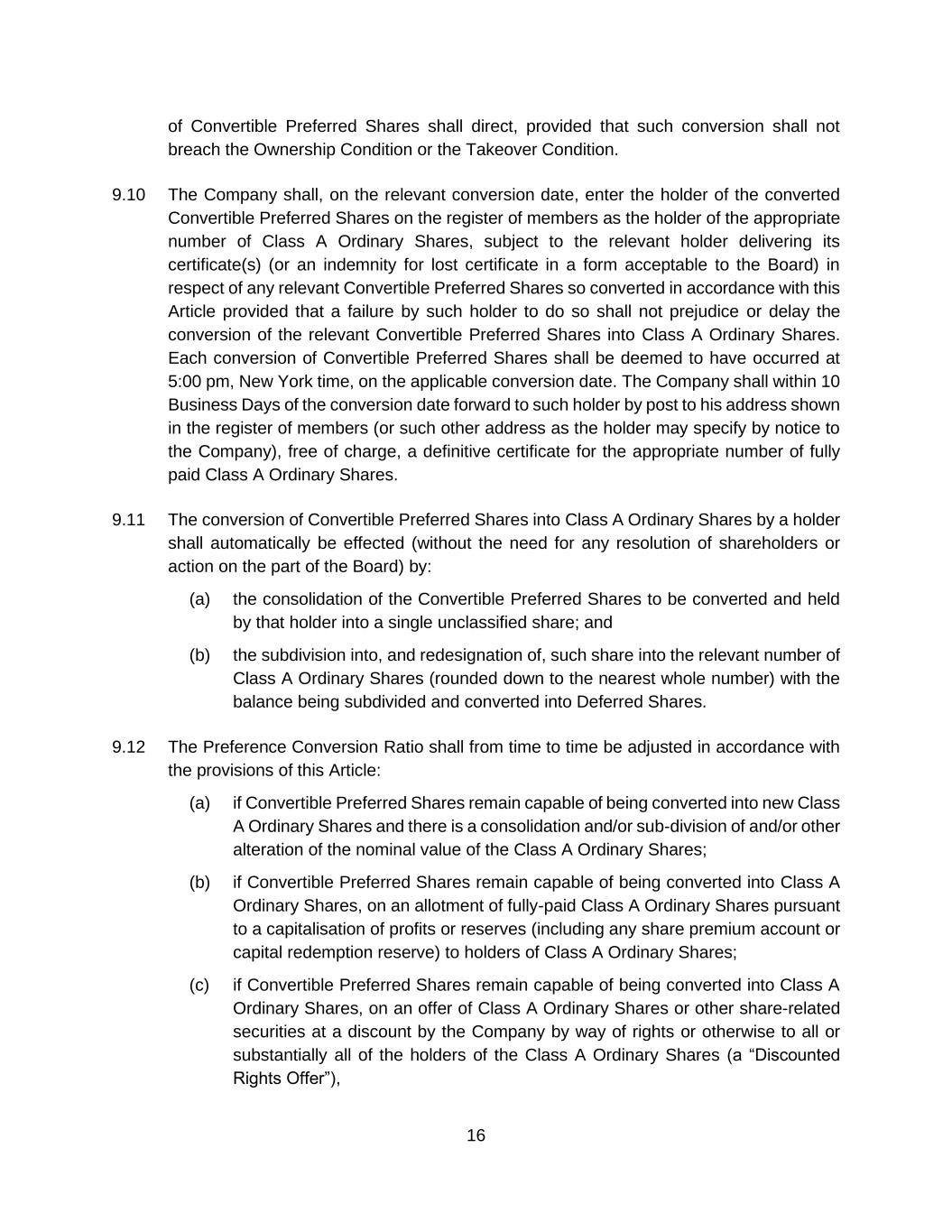
16 of Convertible Preferred Shares shall direct, provided that such conversion shall not breach the Ownership Condition or the Takeover Condition. 9.10 The Company shall, on the relevant conversion date, enter the holder of the converted Convertible Preferred Shares on the register of members as the holder of the appropriate number of Class A Ordinary Shares, subject to the relevant holder delivering its certificate(s) (or an indemnity for lost certificate in a form acceptable to the Board) in respect of any relevant Convertible Preferred Shares so converted in accordance with this Article provided that a failure by such holder to do so shall not prejudice or delay the conversion of the relevant Convertible Preferred Shares into Class A Ordinary Shares. Each conversion of Convertible Preferred Shares shall be deemed to have occurred at 5:00 pm, New York time, on the applicable conversion date. The Company shall within 10 Business Days of the conversion date forward to such holder by post to his address shown in the register of members (or such other address as the holder may specify by notice to the Company), free of charge, a definitive certificate for the appropriate number of fully paid Class A Ordinary Shares. 9.11 The conversion of Convertible Preferred Shares into Class A Ordinary Shares by a holder shall automatically be effected (without the need for any resolution of shareholders or action on the part of the Board) by: (a) the consolidation of the Convertible Preferred Shares to be converted and held by that holder into a single unclassified share; and (b) the subdivision into, and redesignation of, such share into the relevant number of Class A Ordinary Shares (rounded down to the nearest whole number) with the balance being subdivided and converted into Deferred Shares. 9.12 The Preference Conversion Ratio shall from time to time be adjusted in accordance with the provisions of this Article: (a) if Convertible Preferred Shares remain capable of being converted into new Class A Ordinary Shares and there is a consolidation and/or sub-division of and/or other alteration of the nominal value of the Class A Ordinary Shares; (b) if Convertible Preferred Shares remain capable of being converted into Class A Ordinary Shares, on an allotment of fully-paid Class A Ordinary Shares pursuant to a capitalisation of profits or reserves (including any share premium account or capital redemption reserve) to holders of Class A Ordinary Shares; (c) if Convertible Preferred Shares remain capable of being converted into Class A Ordinary Shares, on an offer of Class A Ordinary Shares or other share-related securities at a discount by the Company by way of rights or otherwise to all or substantially all of the holders of the Class A Ordinary Shares (a “Discounted Rights Offer”),
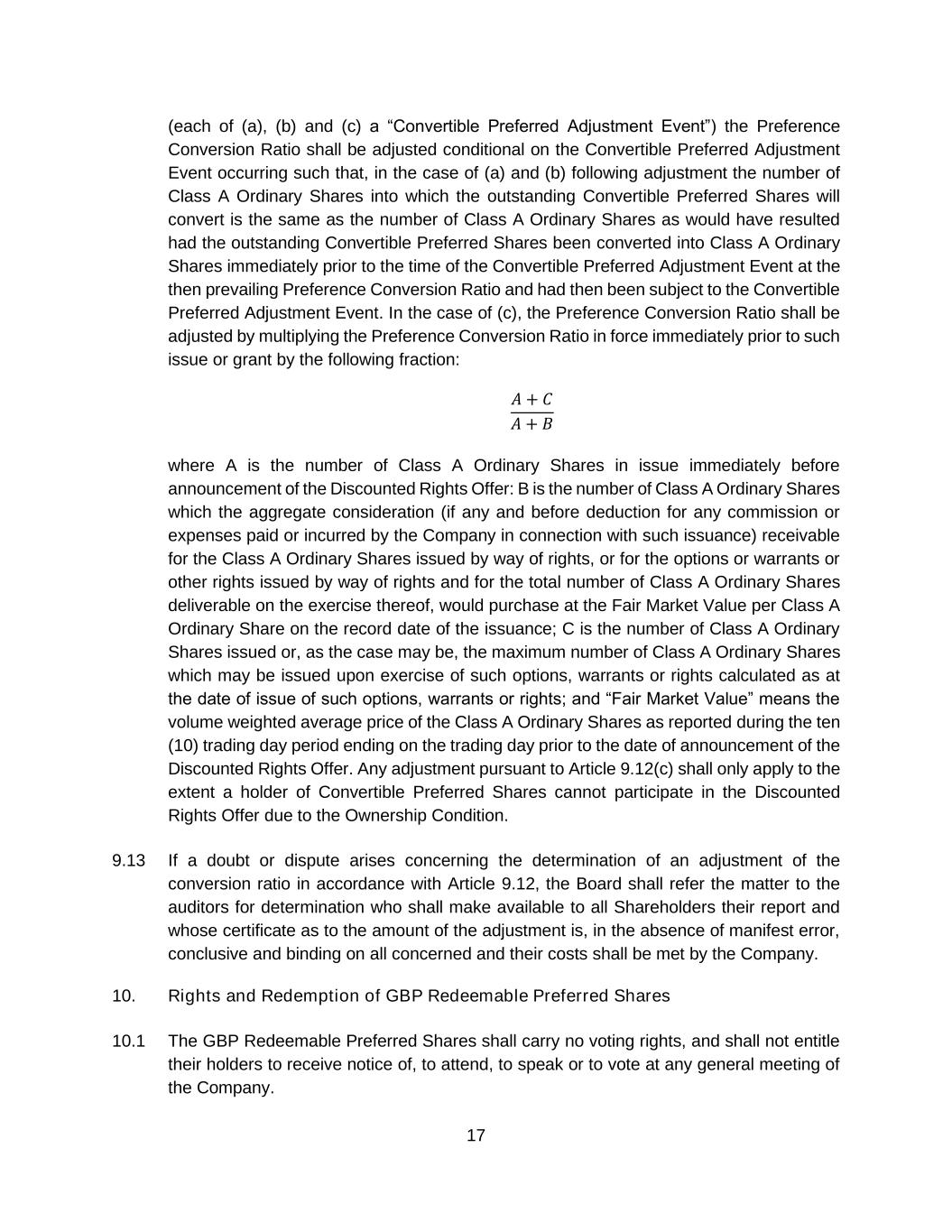
17 (each of (a), (b) and (c) a “Convertible Preferred Adjustment Event”) the Preference Conversion Ratio shall be adjusted conditional on the Convertible Preferred Adjustment Event occurring such that, in the case of (a) and (b) following adjustment the number of Class A Ordinary Shares into which the outstanding Convertible Preferred Shares will convert is the same as the number of Class A Ordinary Shares as would have resulted had the outstanding Convertible Preferred Shares been converted into Class A Ordinary Shares immediately prior to the time of the Convertible Preferred Adjustment Event at the then prevailing Preference Conversion Ratio and had then been subject to the Convertible Preferred Adjustment Event. In the case of (c), the Preference Conversion Ratio shall be adjusted by multiplying the Preference Conversion Ratio in force immediately prior to such issue or grant by the following fraction: 𝐴 + 𝐶 𝐴 + 𝐵 where A is the number of Class A Ordinary Shares in issue immediately before announcement of the Discounted Rights Offer: B is the number of Class A Ordinary Shares which the aggregate consideration (if any and before deduction for any commission or expenses paid or incurred by the Company in connection with such issuance) receivable for the Class A Ordinary Shares issued by way of rights, or for the options or warrants or other rights issued by way of rights and for the total number of Class A Ordinary Shares deliverable on the exercise thereof, would purchase at the Fair Market Value per Class A Ordinary Share on the record date of the issuance; C is the number of Class A Ordinary Shares issued or, as the case may be, the maximum number of Class A Ordinary Shares which may be issued upon exercise of such options, warrants or rights calculated as at the date of issue of such options, warrants or rights; and “Fair Market Value” means the volume weighted average price of the Class A Ordinary Shares as reported during the ten (10) trading day period ending on the trading day prior to the date of announcement of the Discounted Rights Offer. Any adjustment pursuant to Article 9.12(c) shall only apply to the extent a holder of Convertible Preferred Shares cannot participate in the Discounted Rights Offer due to the Ownership Condition. 9.13 If a doubt or dispute arises concerning the determination of an adjustment of the conversion ratio in accordance with Article 9.12, the Board shall refer the matter to the auditors for determination who shall make available to all Shareholders their report and whose certificate as to the amount of the adjustment is, in the absence of manifest error, conclusive and binding on all concerned and their costs shall be met by the Company. 10. Rights and Redemption of GBP Redeemable Preferred Shares 10.1 The GBP Redeemable Preferred Shares shall carry no voting rights, and shall not entitle their holders to receive notice of, to attend, to speak or to vote at any general meeting of the Company.
18 10.2 On a return of assets on liquidation or otherwise, the assets of the Company remaining after payment of its debts and liabilities and available for distribution to holders of GBP Redeemable Preferred Shares shall be applied in the manner and order of priority as set out in Article 8.1. 10.3 Subject to the provisions of the Companies Acts, the Company shall be entitled, at any time, to serve notice on all or some of the holders of the GBP Redeemable Preferred Shares that it wishes to redeem all or some of the GBP Redeemable Preferred Shares in issue at that time on the date falling 14 days after service of such notice (or on such other date as may be agreed between the Company and the holders of the relevant GBP Redeemable Preferred Shares). Notice given under this Article 10.3 shall be irrevocable. 10.4 Upon the date on which any GBP Redeemable Preferred Shares are to be redeemed under this Article, each holder of the relevant GBP Redeemable Preferred Shares shall be bound to deliver to the Company at the Office the certificates for such of the GBP Redeemable Preferred Shares as are held by it. Upon such delivery, the Company shall redeem the shares and shall pay to (or to the order of) such holder the nominal value of the relevant GBP Redeemable Preferred Shares. If any holder of GBP Redeemable Preferred Shares whose shares are liable to be redeemed under this paragraph shall fail or refuse to deliver up the certificate for its GBP Redeemable Preferred Shares, the Company may retain the redemption moneys until delivery up of the certificate or an indemnity in respect thereof satisfactory to the Company and shall within seven days thereafter pay the redemption moneys to (or to the order of) such holder. The receipt of the registered holder for the time being of any GBP Redeemable Preferred Shares or, in the case of registered holders, the receipt of any of them for the moneys payable on redemption thereof shall constitute an absolute discharge in respect thereof. 11. Rights of Deferred Shares 11.1 The Deferred Shares shall carry no voting rights, and shall not entitle their holders to receive notice of, to attend, to speak or to vote at any general meeting of the Company. Unless the Board determines otherwise, a holder of Deferred Shares shall not be entitled to receive a certificate for such shares. 11.2 On a return of assets on liquidation or otherwise, the assets of the Company remaining after payment of its debts and liabilities and available for distribution to holders of Deferred Shares shall be applied in the manner and order of priority as set out in Article 8.1. 11.3 The special resolution of the Company adopting these Articles shall be deemed to confer irrevocable authority on the Company, at any time and from time to time, to do all or any of the following without obtaining the sanction and/or consent of the holder(s) of the Deferred Shares (or any of them):
19 (a) to appoint any person to execute on behalf of any holder of Deferred Shares a transfer of all or any of its/his Deferred Shares and/or an agreement to transfer the same to such person(s) as the Company may determine and without making any payment to the holder thereof; and (b) (i) to purchase and/or cancel any Deferred Shares (in accordance with the Companies Acts) without obtaining the consent of the holder(s) of those Shares and without making any payment to the holder(s) thereof; and (ii) for the purposes of any such purchase and/or cancellation, to appoint any person to execute a contract for the sale of any such Shares to the Company on behalf of any holder of Deferred Shares, and, pending such transfer, purchase and/or cancellation, to retain the certificate(s) (if any) for such Shares. 12. Rights and Conversion of Ordinary Shares 12.1 On a return of assets on liquidation or otherwise, the assets of the Company remaining after payment of its debts and liabilities and available for distribution to holders of Ordinary Shares shall be applied in the manner and order of priority as set out in Article 8.1. 12.2 Any dividend shall be paid to the holders of Ordinary Shares in the manner and order of priority as set out in Article 8.2. 12.3 Ordinary Shares shall confer on each holder of Ordinary Shares the right to receive notice of and to attend, speak and vote at all general meetings of the Company in accordance with these Articles. 12.4 Each Class B Ordinary Share is convertible into one (1) Class A Ordinary Share at any time at the option of the holder of such Class B Ordinary Share. The right to convert such Class B Ordinary Shares into Class A Ordinary Shares shall be exercisable by the holder of the Class B Ordinary Share delivering a written notice to the Company that such holder elects to convert a specified number of Class B Ordinary Shares into Class A Ordinary Shares. In no event shall Class A Ordinary Shares be convertible into Class B Ordinary Shares. 12.5 Any conversion of Class B Ordinary Shares into Class A Ordinary Shares pursuant to these Articles shall be effected by means of the re-designation of each relevant Class B Ordinary Share as a Class A Ordinary Share or by such other method as may be approved by the Board. Such conversion shall become effective forthwith upon entries being made in the Register to record the re-designation of the relevant Class B Ordinary Shares as Class A Ordinary Shares. The Company shall complete the conversion as soon as
20 reasonably practicable, and in any event within 10 Business Days, after the conversion notice is delivered by the holder of the Class B Ordinary Share to the Company. 12.6 Save and except for voting rights as set out in Article 70.1 and conversion rights as set out in Articles 12.4 and 12.5, Class B Ordinary Shares and Class A Ordinary Shares shall rank pari passu with one another and shall have the same rights, preferences, privileges and restrictions. 13. Rights and Conversion of Class C Shares Return of capital 13.1 On a return of assets on liquidation or otherwise, the assets of the Company remaining after payment of its debts and liabilities and available for distribution to holders of Class C Shares shall be applied in the manner and order of priority as set out in Article 8.1. Voting 13.2 Class C Shares shall confer on each holder of Class C Shares the right to receive notice of and to attend, speak and vote at all general meetings of the Company in accordance with these Articles. Return of capital 13.3 Class C-1 Shares and Class C-2 Shares shall have the same rights, preferences, privileges and restrictions, except that so long as Class C-2 Shares are held by the Sponsor or any of its Permitted Transferees, the Class C-2 Shares: (a) may be converted for cash in accordance with Article 13.6 or on a cashless basis in accordance with Article 13.7; (b) may not be transferred, assigned or sold until thirty (30) days after Closing; and (c) shall not be redeemable by the Company pursuant to Article 13.25, provided, however, that in the case of (b), the Class C-2 Shares and any Class A Ordinary Shares held by the Sponsor or any of its Permitted Transferees arising upon the conversion of the Class C-2 Shares may be transferred by the holders to a Permitted Transferee. Conversion of Class C-2 Shares into Class C-1 Shares 13.4 Each Class C-2 Share is convertible into one (1) Class C-1 Share at any time at the option of the holder of such Class C-2 Share. The right to convert such Class C-2 Shares into Class C-1 Shares shall be exercisable by the holder of the Class C-2 Share delivering a written notice to the Company that such holder elects to convert a specified number of
21 Class C-2 Shares into Class C-1 Shares. In no event shall Class C-1 Shares be convertible into Class C-2 Shares. 13.5 Any conversion of Class C-2 Shares into Class C-1 Shares pursuant to these Articles shall be effected by means of the re-designation of each relevant Class C-2 Share as a Class C-1 Share or by such other method as may be approved by the Board. Such conversion shall become effective forthwith upon entries being made in the Register to record the re- designation of the relevant Class C-2 Shares as Class C-1 Shares. The Company shall complete the conversion as soon as reasonably practicable, and in any event within 10 Business Days, after the conversion notice is delivered by the holder of the Class C-2 Share to the Company. Conversion for cash 13.6 During the Conversion Period, each holder of Class C Shares shall be entitled by notice to the Company (a “Conversion Notice” (as set out in Annex A)) to require the conversion into Class A Ordinary Shares upon payment to the Company of USD 11.50 per Class A Ordinary Share (subject to the adjustments set out in Articles 13.20 to 13.24 (inclusive) and the last sentence of this Article 13.6) (“Conversion Price”) of any or all of the relevant Class C Shares held by them at any time, and those Class C Shares shall convert automatically and with immediate effect on the later of (a) delivery of such notice and (b) payment in full of the aggregate Conversion Price and any and all applicable taxes due in connection with the conversion of the Class C Shares into the Class A Ordinary Shares in lawful money of the United States, in good certified check or good bank draft payable to the Company. If the relevant Conversion Notice does not specify the time on the Conversion Date that the relevant conversion shall occur, the conversion shall take place immediately upon the occurrence of the Conversion Date. The Company in its sole discretion may lower the Conversion Price at any time prior to the Expiration Date (as defined in Article 13.15) for a period of not less than twenty (20) Business Days, provided, that the Company shall provide at least three (3) Business Days prior written notice of such reduction to the Class C Share holders and, provided further that any such reduction shall be identical among all of the Class C Shares. The number of Class A Ordinary Shares into which Class C Shares will convert is equal to the number of Class C Shares being converted multiplied by the Conversion Ratio. Cashless conversion of Class C-2 Shares 13.7 Without prejudice to Article 13.6, during the Conversion Period, each holder of Class C-2 Shares which is the Sponsor or a Permitted Transferee of the Sponsor shall be entitled by notice to the Company (a “Cashless Conversion Notice”) to require the conversion into Class A Ordinary Shares of any or all of the relevant Class C-2 Shares held by them at any time on a cashless basis, and those Class C Shares shall convert automatically and with immediate effect on delivery of such Cashless Conversion Notice (the “Conversion
22 Date”). The number of Class A Ordinary Shares into which Class C-2 Shares will convert is equal to the quotient obtained by dividing: (i) the number of converting Class C-2 Shares multiplied by the Conversion Ratio and multiplied by the difference between the Conversion Price and the “Fair Market Value”; by (ii) the “Fair Market Value”. Solely for purposes of this Article 13.7, the “Fair Market Value” shall mean the average last sale price of the Class A Ordinary Share for the ten (10) trading days ending on the third trading day prior to the date on which the Cashless Conversion Notice is sent to the Company. Conversion mechanism 13.8 The conversion of Class C Shares into Class A Ordinary Shares by a holder pursuant to any provision of these Articles shall automatically be effected (without the need for any resolution of shareholders or action on the part of the Board) by: (a) the consolidation of the Class C Shares to be converted and held by that holder into a single unclassified share; and (b) the subdivision into, and re-designation of, such share into the relevant number of Class A Ordinary Shares (rounded down to the nearest whole number) with the balance being subdivided and converted into Deferred Shares. Cashless conversion of Class C Shares in certain circumstances 13.9 The Company agrees that as soon as practicable, but in no event later than fifteen (15) Business Days after the Closing, it shall use its commercially reasonable efforts to file with the Securities and Exchange Commission a registration statement for the registration, under the Securities Act, of the Class A Ordinary Shares arising on conversion of the Class C Shares. The Company shall use its best efforts to cause the same to become effective and to maintain the effectiveness of such registration statement, and a current prospectus relating thereto for so long as any Class C Share remain outstanding. If any registration statement for the registration of the Class A Ordinary Shares arising upon the conversion of the Class C Shares pursuant to the Securities Act has not been declared effective by the 60th Business Day following Closing, holders of the Class C Shares shall have the right, during the period beginning on the 61st Business Day after Closing and ending upon such registration statement being declared effective by the Securities and Exchange Commission, and during any other period when the Company shall fail to have maintained an effective registration statement covering the Class A Ordinary Shares arising upon conversion of the Class C Shares, to convert such Class C Shares into Class A Ordinary Shares on a cashless basis. The number of Class A Ordinary Shares into which the relevant Class C Shares will convert is equal to the quotient obtained by dividing:
23 (i) the number of converting Class C Shares, multiplied by the Conversion Ratio and multiplied by the difference between the Conversion Price and the “Fair Market Value”; by (ii) the “Fair Market Value”. Solely for purposes of this Article 13.9, “Fair Market Value” shall mean the volume weighted average price of the Class A Ordinary Shares as reported during the ten (10) trading day period ending on the trading day prior to the date that notice of conversion is received by the Company from the holder of such Class C Shares. In connection with the conversion of a Class C-1 Share pursuant to this Article 13.9, the Company shall, upon request, provide the holder of Class C-1 Shares with an opinion of counsel for the Company (which shall be an outside law firm satisfactory to the holder of Class C-1 Shares with securities law experience) stating that: (iii) the conversion of the Class C-1 Shares pursuant to this Article 13.9 on a cashless basis is not required to be registered under the Securities Act; and (iv) the Class A Ordinary Shares arising upon such conversion shall be freely tradable under United States federal securities laws by anyone who is not an affiliate (as such term is defined in Rule 144 under the Securities Act (or any successor rule)) of the Company and, accordingly, shall not be required to bear a restrictive legend. Except as provided in Article 13.10, for the avoidance of any doubt, unless and until all of the Class C Shares have been converted, the Company shall continue to be obligated to comply with its registration obligations under the first three sentences of this Article 13.9. 13.10 If the Class A Ordinary Shares are at the time of any conversion of a Class C Share not listed on a national securities exchange such that it satisfies the definition of a “covered security” under the Securities Act (or any successor rule), the Company may, at its option: (a) require holders of Class C-1 Shares who convert Class C-1 Shares to convert such Class C-1 Shares on a “cashless basis” in accordance with Article 13.9 and the Securities Act (or any successor rule); and (b) in the event the Company so elects, the Company shall: (i) not be required to file or maintain in effect a registration statement for the registration, under the Securities Act, of the Class A Ordinary Shares arising upon conversion of the Class C-1 Shares; and (ii) use its best efforts to register the Class A Ordinary Shares arising upon conversion of the Class C-1 Shares under the blue sky laws of the state of residence of the converting holder of Class C-1 Shares to the extent an exemption is not available.
24 Issue of share certificates on conversion 13.11 Subject to Article 13.12, as soon as practicable after the conversion of any Class C Share and the clearance of the funds in payment of the Conversion Price (if payment is required pursuant to these Articles), the Company shall issue to the holder of such Class C Share a share certificate for the number of shares of Class A Ordinary Shares to which he, she or it is entitled, and if such Class C Share shall not have been converted in full, a balancing certificate in respect of the Class C Shares that have not been converted. No conversion unless certain securities laws obligations are satisfied 13.12 Notwithstanding Article 13.11 or any other provision of these Articles, the Company shall not be obligated to deliver any Class A Ordinary Shares pursuant to the conversion of Class C Shares and shall have no obligation to settle such Class C Shares conversion unless a registration statement under the Securities Act with respect to the Class A Ordinary Shares arising on conversion of the Class C-1 Shares is then effective and a prospectus relating thereto is current, subject to the Company satisfying its obligations: (a) to, as soon as practicable, but in no event later than fifteen (15) Business Days after Closing, use its commercially reasonable efforts to file with the Securities and Exchange Commission a registration statement for the registration, under the Securities Act, of the Class A Ordinary Shares arising upon conversion of the Class C Shares; and (b) as set out in Article 13.9, (“Registration Condition One”). In addition, no Class C Share shall be convertible unless any Class A Ordinary Share arising upon such Class C Share conversion has been registered, qualified or deemed to be exempt under the securities laws of the state of residence of the holder of the Class C Shares (“Registration Condition Two”). Class A Ordinary Shares to be fully paid 13.13 All Class A Ordinary Shares re-designated upon the proper conversion of Class C Shares in accordance with these Articles shall be credited as fully paid. Conversion Price reduction 13.14 The Company in its sole discretion may lower the Conversion Price at any time prior to the conversion of the relevant Class C Shares for a period of not less than twenty (20) Business Days, provided, that the Company shall provide at least three (3) Business Days prior written notice of such reduction to the holders of Class C Shares and, provided further that any such reduction shall be identical among all of the Class C Shares.
25 Conversion Period and expiry 13.15 Other than a conversion pursuant to Article 13.26 or 13.27, a Class C Share may be converted only during the period (the “Conversion Period”) commencing on the date that is thirty (30) days after Closing, and terminating at 5:00 p.m., New York City time on the earlier to occur of: (a) the date that is five (5) years after Closing; (b) other than with respect to the Class C-2 Shares then held by the Sponsor or any Permitted Transferees with respect to a redemption, the redemption date as fixed by the Company (the “Expiration Date”), provided, however, that the conversion of any Class C Share shall be subject to the satisfaction of the conditions set out in Article 13.9 with respect to an effective registration statement. Except with respect to the right to receive the Redemption Price (as defined Article) (other than with respect to a Class C-2 Share then held by the Sponsor or any Permitted Transferees with respect to a redemption pursuant to Article 13.25) in the event of a redemption or conversion (as set forth in Articles 13.25 to 13.27), each Class C Share (other than a Class C-2 Share then held by the Sponsor or any Permitted Transferees with respect to a redemption pursuant to Article 13.25) not converted on or before the Expiration Date shall automatically convert into Deferred Shares of the same aggregate nominal value at 5:00 p.m. New York City time on the Expiration Date. The Company in its sole discretion may delay the Expiration Date; provided, that the Company shall provide at least twenty (20) days prior written notice of any such extension to holders of the Class C Shares and, provided further that any such extension shall be identical in duration among all the Class C Shares. Time to complete conversion 13.16 The Company shall complete any conversion of Class C Shares into Class A Ordinary Shares as soon as reasonably practicable, and in any event within 10 Business Days, after the later of (i) delivery of the relevant conversion notice, if applicable and (ii) in the case of conversion pursuant to Article 13.6, the payment of the Conversion Price by the holder of the Class C Shares to the Company in accordance with these Articles. Maximum holdings 13.17 A holder of a Class C Share may notify the Company in writing in the event it elects to be subject to the provisions contained in this Article; however, no holder of a Class C Share shall be subject to this Article unless he, she or it makes such election. If the election is made by a holder, the Company shall not effect the conversion of the holder’s Class C Shares into Class A Ordinary Shares, and such holder shall not have the right to convert such Class C Shares into Class A Ordinary Shares, to the extent that after giving effect to such conversion, such person (together with such person’s affiliates), to the Company’s
26 actual knowledge (without further investigation or inquiry), would beneficially own in excess of 9.8% (the “Maximum Percentage”) of the Class A Ordinary Shares outstanding immediately after giving effect to such conversion. 13.18 For purposes of Article 13.17, the aggregate number of Class A Ordinary Shares beneficially owned by such person and its affiliates shall include the number of Class A Ordinary Shares arising upon conversion of the Class C Shares with respect to which the determination under the second sentence of Article 13.17 is being made, but shall exclude Class A Ordinary Shares that would arise upon: (a) conversion of the remaining, unconverted portion of the Class C Shares beneficially owned by such person and its affiliates; and (b) exercise or conversion of the unexercised or unconverted portion of any other securities of the Company beneficially owned by such person and its affiliates (including, without limitation, any convertible notes or convertible preferred securities or warrants) subject to a limitation on conversion or exercise analogous to the limitation contained herein. Except as set forth in this Article 13.18, for purposes of this paragraph, beneficial ownership shall be calculated in accordance with Section 13(d) of the Exchange Act. For purposes of the Class C Shares, in determining the number of outstanding Class A Ordinary Shares, the holder may rely on the number of outstanding Class A Ordinary Shares as reflected in: (c) the Company’s most recent annual report, quarterly report, current report or other public filing with the Securities and Exchange Commission as the case may be; (d) a more recent public announcement by the Company; or (e) any other notice by the Company setting forth the number of Class A Ordinary Shares outstanding. For any reason at any time, upon the written request of the holder of the Class C Shares, the Company shall, within two (2) Business Days, confirm orally and in writing to such holder the number of Class A Ordinary Shares then outstanding. In any case, the number of outstanding Class A Ordinary Shares shall be determined after giving effect to the conversion or exercise of equity securities of the Company by the holder and its affiliates since the date as of which such number of outstanding Class A Ordinary Shares was reported. By written notice to the Company, the holder of a Class C Share may from time to time increase or decrease the Maximum Percentage applicable to such holder to any other percentage specified in such notice; provided, however, that any such increase shall not be effective until the sixty-first (61st) day after such notice is delivered to the Company.
27 Entry in Register and certificates 13.19 The Company shall, on the Conversion Date, enter the holder of the converted Class C Shares on the Register as the holder of the appropriate number of Class A Ordinary Shares, subject to the relevant holder delivering its certificate(s) (or an indemnity for lost certificate in a form acceptable to the Board) in respect of the relevant Class C Shares so converted in accordance with these Articles, provided that a failure by such holder to do so shall not prejudice or delay the conversion of the relevant Class C Shares into Class A Ordinary Shares. The Company shall within 10 Business Days of the Conversion Date forward to such holder by post to his address shown in the Register (or such other address as the holder may specify by notice to the Company), free of charge, a definitive certificate for the appropriate number of fully paid Class A Ordinary Shares. Adjustments 13.20 (a) If the number of outstanding Class A Ordinary Shares is increased by a scrip dividend payable in Class A Ordinary Shares, or by a subdivision of Class A Ordinary Shares or other similar event, then, on the effective date of such scrip dividend, subdivision or similar event, the Conversion Ratio shall be increased in proportion to such increase in the outstanding Class A Ordinary Shares. A rights offering to holders of the Class A Ordinary Shares entitling holders to purchase shares of Class A Ordinary Shares at a price less than the “Fair Market Value” shall be deemed a scrip dividend of a number of Class A Ordinary Shares equal to the product of: (i) the number of Class A Ordinary Shares actually issued in such rights offering (or issuable under any other equity securities issued in such rights offering that are convertible into or exercisable for the Class A Ordinary Shares), multiplied by one (1) minus the quotient of: (A) the price per share of Class A Ordinary Shares paid in such rights offering; divided by (B) the “Fair Market Value”. For purposes of this Article 13.20(a) (i) if the rights offering is for securities convertible into or exercisable for Class A Ordinary Shares, in determining the price payable for Class A Ordinary Shares, there shall be taken into account any consideration received for such rights, as well as any additional amount payable upon exercise or conversion and (ii) “Fair Market Value” means the volume weighted average price of the Class A Ordinary Shares as reported during the ten (10) trading day period ending on the trading day prior to the first date on which the Class A Ordinary Shares trade on the applicable exchange or in the applicable market, regular way, without the right to receive such rights.
28 (b) If the Company, at any time while the Class C Shares are on issue, shall pay a dividend or make a distribution in cash, securities or other assets to the holders of Class A Ordinary Shares on account of such Class A Ordinary Shares (or other shares into which the Class C Shares are convertible), other than: (i) as described in Article 13.20(a); or (ii) Ordinary Cash Dividends (as defined below), then the Conversion Price shall be decreased, effective immediately after the effective date of such Extraordinary Dividend, by the amount of cash and/or the fair market value (as determined by the Board, in good faith) of any securities or other assets paid on each Class A Ordinary Share in respect of such Extraordinary Dividend. For purposes of this Article 13.20(a), “Ordinary Cash Dividends” means any cash dividend or cash distribution which, when combined on a per share basis, with the per share amounts of all other cash dividends and cash distributions paid on the Class A Ordinary Shares during the 365-day period ending on the date of declaration of such dividend or distribution (as adjusted to appropriately reflect any of the events referred to in other subsections of this Article and excluding cash dividends or cash distributions that resulted in an adjustment to the Conversion Price or to the number of shares of Class A Ordinary Shares arising on conversion of each Class C Share) does not exceed $0.50. 13.21 If the number of outstanding Class A Ordinary Shares is decreased by a consolidation, combination, reverse stock split or reclassification of Class A Ordinary Shares or other similar event, then, on the effective date of such consolidation, combination, reverse stock split, reclassification or similar event, the Conversion Ratio shall be decreased in proportion to such decrease in outstanding Class A Ordinary Shares. 13.22 Whenever the Conversion Ratio is adjusted, as provided in Articles 13.20(a) and 13.21, the Conversion Price shall be adjusted (to the nearest cent) by multiplying such Conversion Price immediately prior to such adjustment by a fraction (x) the numerator of which shall be the Conversion Ratio immediately prior to such adjustment, and (y) the Conversion Ratio immediately thereafter. 13.23 In case of any: (a) reclassification or reorganization of the outstanding Class A Ordinary Shares (other than a change under Articles 13.20 or 13.21) or that solely affects the nominal value of Class A Ordinary Shares; or (b) sale or conveyance to another corporation or entity of the assets or other property of the Company as an entirety or substantially as an entirety in connection with which the Company is dissolved,
29 the holders of the Class C Shares shall thereafter have the right to purchase and receive, in lieu of the Class A Ordinary Shares into which such Class C Shares would convert pursuant to Article 13.6, the kind and amount of shares of stock or other securities or property (including cash) receivable upon such reclassification, reorganization, merger or consolidation, or upon a dissolution following any such sale or transfer, that the holder of the Class C Shares would have received if such holder had converted his, her or its Class C Share(s) immediately prior to such event (the “Alternative Issuance”), provided that: (c) if the holders of the Class A Ordinary Shares were entitled to exercise a right of election as to the kind or amount of securities, cash or other assets receivable upon such consolidation or merger, then the kind and amount of securities, cash or other assets constituting the Alternative Issuance for which each Class C Share shall become convertible shall be deemed to be the weighted average of the kind and amount received per share by the holders of the Class A Ordinary Shares in such consolidation or merger that affirmatively make such election; and (d) if a tender, exchange or redemption offer shall have been made to and accepted by the holders of the Class A Ordinary Shares under circumstances in which, upon completion of such tender or exchange offer, the maker, together with members of any group (within the meaning of Rule 13d-5(b)(1) under the Exchange Act (or any successor rule)) of which such maker is a part, and together with any affiliate or associate of such maker (within the meaning of Rule 12b-2 under the Exchange Act (or any successor rule)) and any members of any such group of which any such affiliate or associate is a part, own beneficially (within the meaning of Rule 13d-3 under the Exchange Act (or any successor rule)) more than 50% of the outstanding Class A Ordinary Shares, the holder of a Class C Share shall be entitled to receive as the Alternative Issuance, the highest amount of cash, securities or other property to which such holder would actually have been entitled as a shareholder if such Class C Share holder had converted the Class C Shares prior to the expiration of such tender or exchange offer, accepted such offer and all of the Class A Ordinary Shares held by such holder had been purchased pursuant to such tender or exchange offer, subject to adjustments (from and after the consummation of such tender or exchange offer) as nearly equivalent as possible to the adjustments provided for in Articles 13.20 to 13.22 (inclusive) and this Article; provided, further, that if less than 70% of the consideration receivable by the holders of the Class A Ordinary Shares in the applicable event described in this Article 13.23 (“Applicable Event”) is payable in the form of common stock in the successor entity that is listed for trading on a national securities exchange or is quoted in an established over-the-counter market, or is to be so listed for trading or quoted immediately following such event, and if the holder properly converts the Class C Shares within thirty (30) days following the public disclosure of the consummation of such Applicable Event by the Company pursuant to a current report on Form 8-K filed with the Securities and Exchange Commission, the Conversion Price shall be reduced by an amount
30 (in dollars) equal to the difference of (i) the Conversion Price in effect prior to such reduction minus (ii) (A) the Per Share Consideration (as defined below) (but in no event less than zero) minus (B) the Black-Scholes Class C Share Value (as defined below). The “Black-Scholes Class C Share Value” means the value of a Class C Share immediately prior to the consummation of the Applicable Event in this Article based on the Black-Scholes Warrant Model for a Capped American Call on Bloomberg Financial Markets. For purposes of calculating such amount, (1) Articles 13.25 to 13.31 shall be taken into account, (2) the price of each Class A Ordinary Share shall be the volume weighted average price of the Class A Ordinary Share as reported during the ten (10) trading day period ending on the trading day prior to the effective date of the Applicable Event, (3) the assumed volatility shall be the 90 day volatility as of the trading day immediately prior to the day of the announcement of the Applicable Event, and (4) the assumed risk- free interest rate shall correspond to the U.S. Treasury rate for a period equal to the remaining time the Class C Shares are not converted. “Per Share Consideration” means (i) if the consideration paid to holders of the Class A Ordinary Share consists exclusively of cash, the amount of such cash per share of Class A Ordinary Share, and (ii) in all other cases, the volume weighted average price of the Class A Ordinary Share as reported during the ten (10) trading day period ending on the trading day prior to the effective date of the Applicable Event. If any reclassification or reorganization also results in a change in shares of Class A Ordinary Shares covered by Article 13.20(a), then such adjustment shall be made pursuant to Articles 13.20(a), 13.21 or 13.22 and this Article. The provisions of this Article shall similarly apply to successive reclassifications, reorganizations, mergers or consolidations, sales or other transfers. In no event will the Conversion Price be reduced to less than the nominal value per share re-designated upon conversion of the Class C Shares. 13.24 Upon every adjustment of the Conversion Price or the Conversion Ratio, the Company shall give written notice thereof to the holders of Class C Shares, which notice shall state the Conversion Price and Conversion Ratio resulting from such adjustment, setting forth in reasonable detail the method of calculation and the facts upon which such calculation is based. Upon the occurrence of any event specified in Articles 13.20 to 13.23 (inclusive), the Company shall give written notice of the occurrence of such event to each holder of Class C Shares, at the last address set forth for such holder in the register of members of the Company, of the record date or the effective date of the event. Failure to give such notice, or any defect therein, shall not affect the legality or validity of such event. Redemption or compulsory conversion 13.25 Subject to Articles 13.30 and 13.31, not less than all of the outstanding Class C Shares may be redeemed, at the option of the Company, at any time during the Conversion
31 Period, at the office of the Company, upon notice to the holders of the Class C Shares, as described in Article 13.28, at the price of $0.01 per Class C Share (the “Redemption Price”), provided that the last sales price of the Class A Ordinary Shares reported has been at least $18.00 per share (subject to adjustment in compliance with Articles 13.20 to 13.23 (inclusive)), on each of twenty (20) trading days within the thirty (30) trading-day period ending on the third Business Day prior to the date on which notice of the redemption is given and provided that there is an effective registration statement covering the Class A Ordinary Shares arising upon conversion of the Class C Shares, and a current prospectus relating thereto, available throughout the 30-day Redemption Period (as defined in Article 13.28). 13.26 Subject to Articles 13.30 and 13.31, the Company, at any time during the Conversion Period upon notice to the holders of the Class C Shares, as described in Article 13.28, may require the holders of Class C Shares to convert all of the outstanding Class C Shares into Class A Ordinary Shares, provided that the last sales price of the Class A Ordinary Shares reported has been at least $18.00 per share (subject to adjustment in compliance with Articles 13.20 to 13.23 (inclusive)), on each of twenty (20) trading days within the thirty (30) trading-day period ending on the third Business Day prior to the date on which notice of the conversion is given. The number of Ordinary Class A Shares into which the converting Class C Shares will convert is equal to the quotient obtained by dividing: (i) the product of the number of Class C Shares converting, multiplied by the Conversion Ratio, and multiplied by the difference between the Conversion Price and the “Fair Market Value”; by (ii) the “Fair Market Value”. Solely for purposes of this Article 13.26, the “Fair Market Value” shall mean the average last sale price of the Class A Ordinary Share for the ten (10) trading days ending on the third trading day prior to the date on which the notice of redemption is sent to the holders of Class C Shares; 13.27 Subject to Articles 13.30 and 13.31, the Company may require that not less than all of the outstanding Class C Shares be converted, ninety (90) days after they are first convertible pursuant to Article 13.6, at the office of the Company, upon notice to the holders of the Class C Shares, as described Article 13.28, into a number of Class A Ordinary Shares determined by reference to the table below, based on the conversion date (calculated for purposes of the table as the period to conversion of the Class C Shares) and the Fair Market Value (as such term is defined in Article 13.26 (the “Alternative Redemption Price”), provided (i) that the last sales price of the Class A Ordinary Shares reported has been at least $10.00 per share (subject to adjustment in compliance with Articles 13.20 to 13.23 (inclusive)), on the trading day prior to the date on which notice of the redemption is given, (ii) the Class C-2 Shares are converted on the same basis as the outstanding Class C-1 Shares and (iii) there is an effective registration statement covering the Class
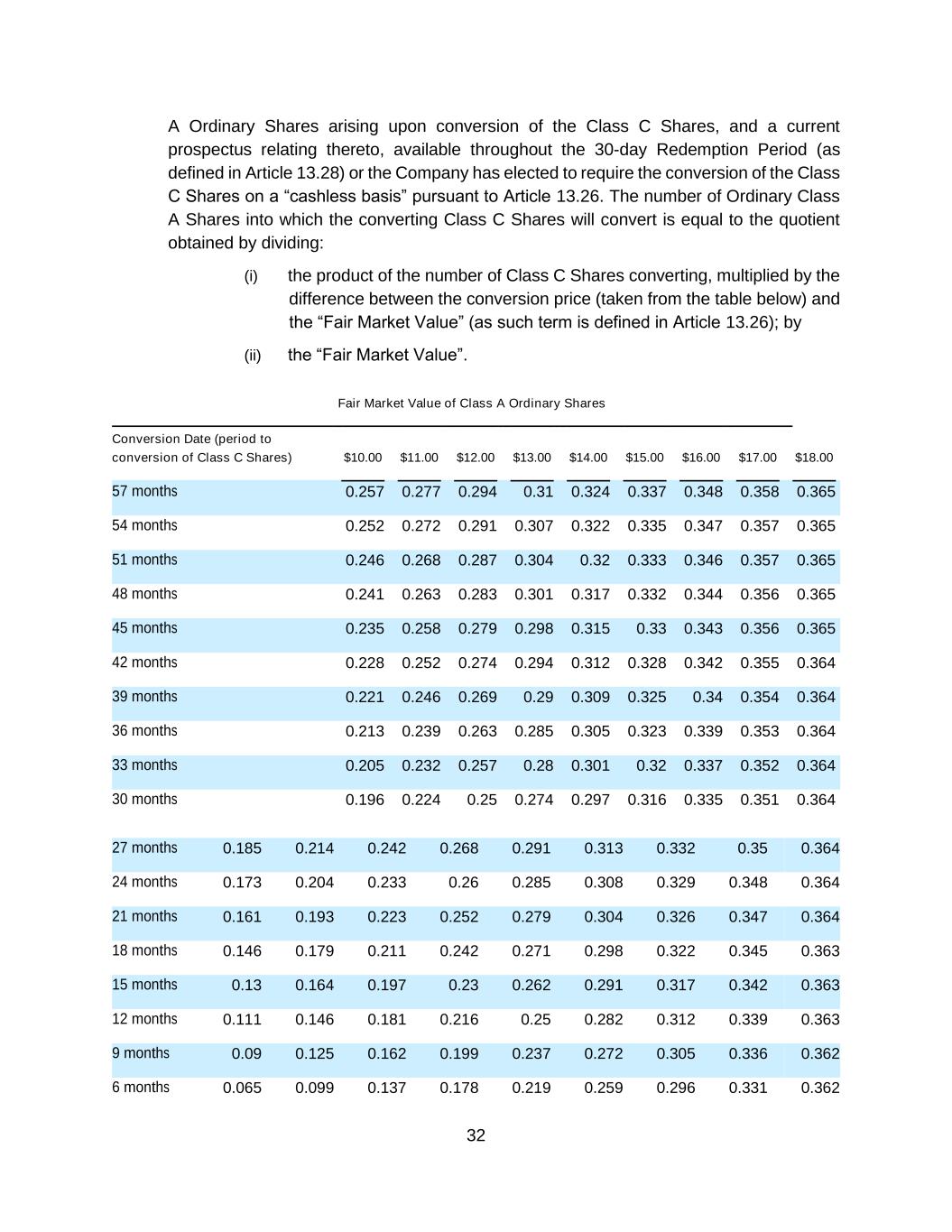
32 A Ordinary Shares arising upon conversion of the Class C Shares, and a current prospectus relating thereto, available throughout the 30-day Redemption Period (as defined in Article 13.28) or the Company has elected to require the conversion of the Class C Shares on a “cashless basis” pursuant to Article 13.26. The number of Ordinary Class A Shares into which the converting Class C Shares will convert is equal to the quotient obtained by dividing: (i) the product of the number of Class C Shares converting, multiplied by the difference between the conversion price (taken from the table below) and the “Fair Market Value” (as such term is defined in Article 13.26); by (ii) the “Fair Market Value”. Fair Market Value of Class A Ordinary Shares Conversion Date (period to conversion of Class C Shares) $10.00 $11.00 $12.00 $13.00 $14.00 $15.00 $16.00 $17.00 $18.00 57 months 0.257 0.277 0.294 0.31 0.324 0.337 0.348 0.358 0.365 54 months 0.252 0.272 0.291 0.307 0.322 0.335 0.347 0.357 0.365 51 months 0.246 0.268 0.287 0.304 0.32 0.333 0.346 0.357 0.365 48 months 0.241 0.263 0.283 0.301 0.317 0.332 0.344 0.356 0.365 45 months 0.235 0.258 0.279 0.298 0.315 0.33 0.343 0.356 0.365 42 months 0.228 0.252 0.274 0.294 0.312 0.328 0.342 0.355 0.364 39 months 0.221 0.246 0.269 0.29 0.309 0.325 0.34 0.354 0.364 36 months 0.213 0.239 0.263 0.285 0.305 0.323 0.339 0.353 0.364 33 months 0.205 0.232 0.257 0.28 0.301 0.32 0.337 0.352 0.364 30 months 0.196 0.224 0.25 0.274 0.297 0.316 0.335 0.351 0.364 27 months 0.185 0.214 0.242 0.268 0.291 0.313 0.332 0.35 0.364 24 months 0.173 0.204 0.233 0.26 0.285 0.308 0.329 0.348 0.364 21 months 0.161 0.193 0.223 0.252 0.279 0.304 0.326 0.347 0.364 18 months 0.146 0.179 0.211 0.242 0.271 0.298 0.322 0.345 0.363 15 months 0.13 0.164 0.197 0.23 0.262 0.291 0.317 0.342 0.363 12 months 0.111 0.146 0.181 0.216 0.25 0.282 0.312 0.339 0.363 9 months 0.09 0.125 0.162 0.199 0.237 0.272 0.305 0.336 0.362 6 months 0.065 0.099 0.137 0.178 0.219 0.259 0.296 0.331 0.362
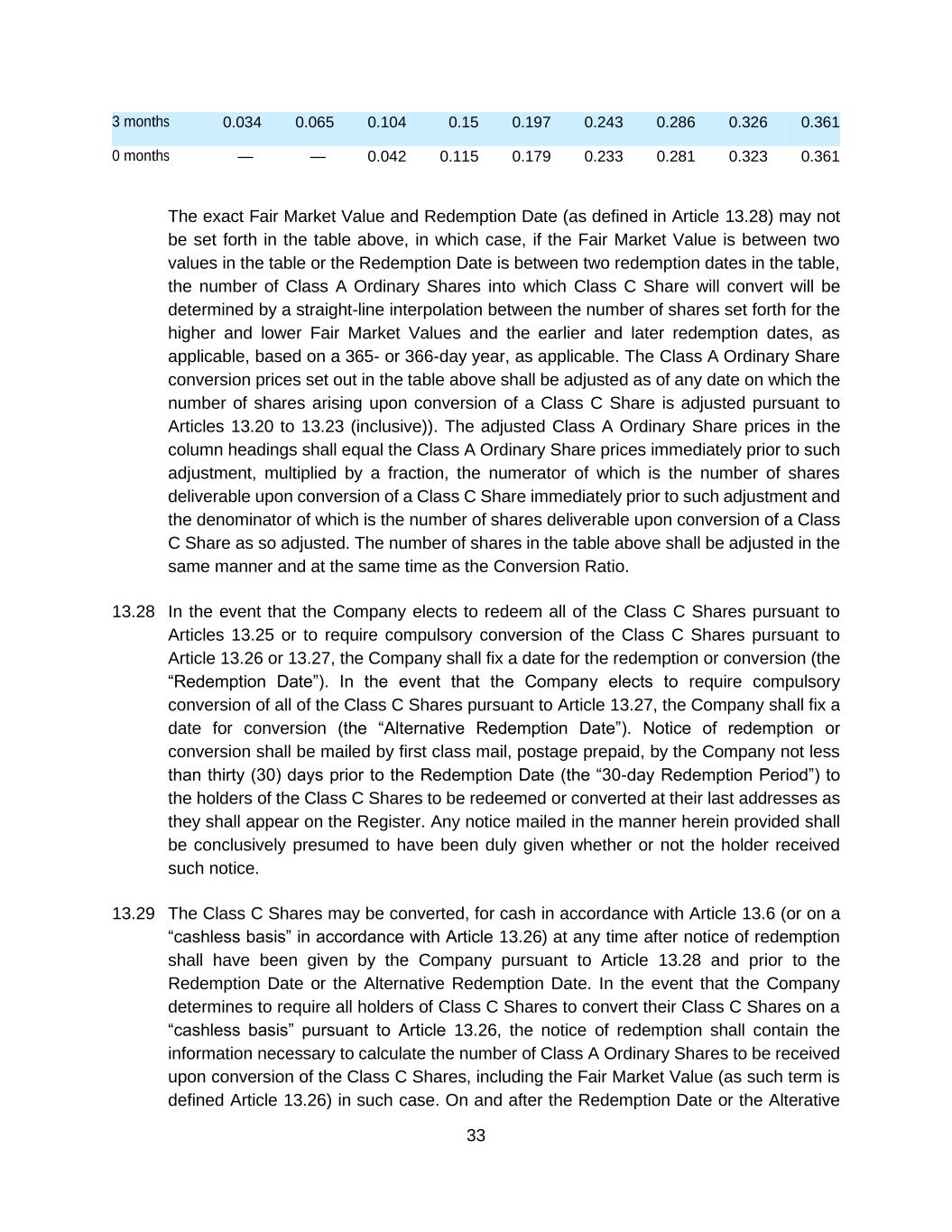
33 3 months 0.034 0.065 0.104 0.15 0.197 0.243 0.286 0.326 0.361 0 months — — 0.042 0.115 0.179 0.233 0.281 0.323 0.361 The exact Fair Market Value and Redemption Date (as defined in Article 13.28) may not be set forth in the table above, in which case, if the Fair Market Value is between two values in the table or the Redemption Date is between two redemption dates in the table, the number of Class A Ordinary Shares into which Class C Share will convert will be determined by a straight-line interpolation between the number of shares set forth for the higher and lower Fair Market Values and the earlier and later redemption dates, as applicable, based on a 365- or 366-day year, as applicable. The Class A Ordinary Share conversion prices set out in the table above shall be adjusted as of any date on which the number of shares arising upon conversion of a Class C Share is adjusted pursuant to Articles 13.20 to 13.23 (inclusive)). The adjusted Class A Ordinary Share prices in the column headings shall equal the Class A Ordinary Share prices immediately prior to such adjustment, multiplied by a fraction, the numerator of which is the number of shares deliverable upon conversion of a Class C Share immediately prior to such adjustment and the denominator of which is the number of shares deliverable upon conversion of a Class C Share as so adjusted. The number of shares in the table above shall be adjusted in the same manner and at the same time as the Conversion Ratio. 13.28 In the event that the Company elects to redeem all of the Class C Shares pursuant to Articles 13.25 or to require compulsory conversion of the Class C Shares pursuant to Article 13.26 or 13.27, the Company shall fix a date for the redemption or conversion (the “Redemption Date”). In the event that the Company elects to require compulsory conversion of all of the Class C Shares pursuant to Article 13.27, the Company shall fix a date for conversion (the “Alternative Redemption Date”). Notice of redemption or conversion shall be mailed by first class mail, postage prepaid, by the Company not less than thirty (30) days prior to the Redemption Date (the “30-day Redemption Period”) to the holders of the Class C Shares to be redeemed or converted at their last addresses as they shall appear on the Register. Any notice mailed in the manner herein provided shall be conclusively presumed to have been duly given whether or not the holder received such notice. 13.29 The Class C Shares may be converted, for cash in accordance with Article 13.6 (or on a “cashless basis” in accordance with Article 13.26) at any time after notice of redemption shall have been given by the Company pursuant to Article 13.28 and prior to the Redemption Date or the Alternative Redemption Date. In the event that the Company determines to require all holders of Class C Shares to convert their Class C Shares on a “cashless basis” pursuant to Article 13.26, the notice of redemption shall contain the information necessary to calculate the number of Class A Ordinary Shares to be received upon conversion of the Class C Shares, including the Fair Market Value (as such term is defined Article 13.26) in such case. On and after the Redemption Date or the Alterative
34 Redemption Price, as applicable, the holder of the Class C Shares shall have no further rights except to receive the Redemption Price or the Alterative Redemption Price, as applicable. 13.30 The redemption rights provided in Article 13.25 shall not apply to the Class C-2 Shares if at the time of the redemption such Class C-2 Shares continue to be held by the Sponsor or its Permitted Transferees. However, once such Class C-2 Shares are transferred (other than to Permitted Transferees under Article 13.1), the Company may redeem the Class C-2 Shares pursuant to Article 13.25, provided that the criteria for redemption are met, including the opportunity of the holder of such Class C-2 Shares to convert the Class C-2 Shares prior to redemption pursuant to Article 13.29. Class C-2 Shares that are transferred to persons other than Permitted Transferees shall upon such transfer cease to be Class C-2 Shares and shall become Class C-1 Shares. 13.31 If Class C-1 Shares are held by any of the Company’s officers or directors, the Class C-1 Shares held by such officers and directors will be subject to the compulsory conversion rights provided in Article 13.26, except that such officers and directors shall only receive “Fair Market Value” (“Fair Market Value” in this Article shall mean the last sale price of the Class C-1 Shares on the Alternative Redemption Date) for such Class C-1 Shares so redeemed. 13.32 The Company shall from time to time promptly pay all taxes and charges that may be imposed upon the Company in respect of the re-designation or delivery of Class A Ordinary Shares upon the conversion of the Class C Shares, but the Company shall not be obligated to pay any transfer taxes in respect of the Class C Shares or such Class A Ordinary Shares. The holders of Class C Shares shall not have any duty or obligation to take any action that requires the payment of taxes and/or charges unless and until it is satisfied that all such payments have been made. 14. Power to attach rights to shares 14.1 Subject to the Companies Acts and to any rights, privileges or restrictions attached to existing shares, any share may be issued with or have attached to it such rights, privileges and restrictions, whether in regard to dividends, voting, repayment or redemption of share capital, or otherwise, as the Company may by ordinary resolution determine, or if no ordinary resolution has been passed or so far as the resolution does not make specific provision, as the Board may determine. 14.2 Shares may be issued with a preferential or qualified right to dividends and in the distribution of assets of the Company and with or without any special voting rights.
35 15. Allotment of shares and pre-emption 15.1 In accordance with section 551 of the Act, the Directors are generally and unconditionally authorized to allot shares in the Company or grant rights to subscribe for or to convert any security into shares in the Company (the “Share Rights”) up to an aggregate maximum number of 6,777,366,739 Ordinary Shares, provided that this authority shall, unless renewed, varied or revoked by ordinary resolution of the Company, expire on the date which is five years from the Date of the Adoption, save that the Directors may allot shares or grant Share Rights in pursuance of an offer or agreement made before such expiry which would or might require shall to be allotted or Share Rights to be granted, notwithstanding that the authority conferred by this Article 15.1 has expired. 15.2 The Directors are generally empowered to allot equity securities (as defined in section 560 of the Act) as if section 561(1) of the Act did not apply to any such allotment, provided that this power shall: (i) be limited to the allotment of equity securities up to an aggregate maximum number of 6,777,366,739 Ordinary Shares; and (ii) unless renewed, varied or revoked by ordinary resolution of the Company, expire on the date which is five years from the Date of Adoption, save that the Directors may allot equity securities in pursuance of any offer or agreement made before such expiry which would or might require equity securities to be allotted after such expiry, notwithstanding that the power conferred by this Article 15.2 has expired. 15.3 The provisions set forth in Articles 15.1 and 15.2 may be renewed at any meeting of the members of the Company. 15.4 Without prejudice to any special rights previously conferred on the holders of any shares or class of shares, and subject to the Companies Acts, these Articles and to any relevant authority of the Company in general meeting required by the Companies Acts, the Board may offer, issue, allot, (with or without conferring rights of renunciation), grant options over or otherwise deal with or dispose of shares or grant rights to subscribe for or convert any security into shares with such preferred, deferred or other special rights, or subject to such restrictions, whether in regard to dividend, return of capital, voting or otherwise, as the Company may from time to time by ordinary resolution determine (or, in the absence of any such determination, as the Board may determine), to such persons, at such times, for such consideration and upon such terms as the Board may decide. No share may be issued at a discount. 15.5 If by the conditions of allotment of any shares the whole or part of the issue price thereof shall be payable by instalments, every such instalment shall, when due, be paid to the Company by the person who for the time being and from time to time shall be the registered holder of the shares, or his legal personal representative.
36 15.6 The Board may, at any time after the allotment of any share but before any person has been entered in the Register, recognise a renunciation by the allottee in favour of some other person and accord to the allottee of a share a right to effect such renunciation and/or allow the rights to be represented to be one or more participating securities, in each case upon the subject to such terms and conditions as the Board may think fit to impose. 16. Redeemable shares Subject to the Companies Acts and to any rights attaching to existing shares, any share may be issued which can be redeemed or is liable to be redeemed at the option of the Company or the holder. The Board may determine the terms, conditions and manner of redemption of any redeemable shares which are issued. Such terms and conditions shall apply to the relevant shares as if the same were set out in these Articles. 17. Pari passu issues If new shares are created or issued which rank equally with any other existing shares, the rights of the existing shares will not be regarded as changed or abrogated unless the terms of the existing shares expressly say otherwise. 18. Variation of rights 18.1 Subject to the Companies Acts, the rights attached to any class of shares can be varied or abrogated either with the consent in writing of the holders of not less than three-quarters in nominal value of the issued share of that class (excluding any shares of that class held as treasury shares) or with the authority of a special resolution passed at a separate meeting of the holders of the relevant class of shares known as a class meeting. 18.2 The provisions of this Article will apply to any variation or abrogation of rights of shares forming part of a class. Each part of the class which is being treated differently is treated as a separate class in applying this Article. 18.3 All the provisions in these Articles as to general meetings shall apply, with any necessary modifications, to every class meeting except that: (a) the quorum at every such meeting shall not be less than two persons holding or representing by proxy at least one-third of the nominal amount paid up on the issued shares of the class (excluding any shares of that class held as treasury shares); and (b) if at any adjourned meeting of such holders such quorum as set out above is not present, at least one person holding shares of the class who is present in person or by proxy shall be a quorum.
37 18.4 The Board may convene a class meeting whenever it thinks fit and whether or not the business to be transacted involves a variation or abrogation of class rights. 19. Payment of commission The Company may in connection with the issue of any shares or the sale for cash of treasury shares exercise all powers of paying commission and brokerage conferred or permitted by the Companies Acts. Any such commission or brokerage may be satisfied by the payment of cash or by the allotment of fully or partly paid shares or other securities or the grant of an option to call for an allotment of shares or any combination of such methods. 20. Trusts not recognised Except as otherwise expressly provided by these Articles, required by law or as ordered by a court of competent jurisdiction, the Company shall not recognise any person as holding any share on any trust, and the Company shall not be bound by or required in any way to recognise (even when having notice of it) any equitable, contingent, future, partial or other claim to or interest in any share other than an absolute right of the holder of the whole of the share. 21. Share certificates 21.1 Every person (except a person to whom the Company is not by law required to issue a certificate and except as otherwise provided in these Articles) whose name is entered in the Register as a holder of any shares shall be entitled, without charge, to receive within the time limits prescribed by the Companies Acts (unless the terms of issue prescribe otherwise) one certificate for all of the shares of that class registered in his or her name. 21.2 The Company shall not be bound to issue more than one certificate in respect of shares held jointly by two or more persons. Delivery of a certificate to the person first named in the Register shall be sufficient delivery to all joint holders. 21.3 Where a member has transferred part only of the shares comprised in a certificate, the member shall be entitled without charge to a certificate for the balance of such shares. Where a member receives more shares of any class, the member shall be entitled without charge to a certificate for the extra shares of that class. 21.4 A share certificate may be issued under Seal (by affixing the Seal to or printing the Seal or a representation of it on the certificate) or signed by at least two Directors or by at least one Director and the Secretary. Such certificate shall specify the number and class of the shares in respect of which it is issued and the amount or respective amounts paid up on it. The Board may be resolution decide, either generally or in any particular case or cases, that any signatures on any share certificates need not be autographic but may be applied
38 to the certificates by some mechanical or other means or may be printed on them or that the certificates need not be signed by any person. 21.5 Every share certificate sent in accordance with these Articles will be sent at the risk of the member or other person entitled to the certificate. The Company will not be responsible for any share certificate lost or delayed in the course of delivery. 22. Replacement certificates 22.1 Any two or more certificates representing shares of any one class held by any member may at the request of the member be cancelled and a single new certificate for such shares issued in lieu without charge on surrender of the original certificates for cancellation. 22.2 Any certificate representing shares of any one class held by any member may at the request of the member be cancelled and two or more certificates for such shares may be issued instead. 22.3 If a share certificate is defaced, worn out or said to be stolen, lost or destroyed, it may be replaced on such terms as to evidence and indemnity as the Board may decide and, where it is defaced or worn out, after delivery of the old certificate to the Company. 22.4 The Board may require the payment of any reasonable exceptional out-of-pocket expenses of the Company incurred in connection with the issue of any certificates under this Article. In the case of shares held jointly by several persons, any such request as is mentioned in this Article may be made by any one of the joint holders. 23. Lien on shares not fully paid The Company shall have a first and paramount lien on every share, not being a fully paid share, for all amounts payable to the Company (whether presently or not) in respect of that share. The Company's lien over a share takes priority over any third party's interest in that share, and extends to any dividend or other money payable by the Company in respect of that share (and, if the lien is enforced and the share is sold by the Company, the proceeds of sale of that share). The Board may at any time, either generally or in any particular case, waive any lien that has arisen or declare any share to be wholly or in part exempt from the provisions of this Article. 24. Enforcement of lien by sale The Company may sell, in such manner as the Board may decide, any share over which the Company has a lien if a sum in respect of which the lien exists is presently payable and is not paid within 14 clear days after a notice has been served on the holder of the share or the person who is entitled by transmission to the share, demanding payment and stating that if the notice is not complied with the share may be sold. For giving effect to
39 the sale the Board may authorise some person to sign an instrument of transfer of the share sold to, or in accordance with the directions, of the buyer. The buyer shall not be bound to see to the application of the purchase money, nor shall the buyer's title to the share be affected by any irregularity or invalidity in the proceedings in reference to the sale. 25. Application of proceeds of sale The net proceeds of any sale of shares subject to any lien, after payment of the costs, shall be applied: (a) first, in or towards satisfaction of so much of the amount due to the Company or of the liability or engagement (as the case may be) as is presently payable or is liable to be presently fulfilled or discharged; and (b) second, any residue shall be paid to the person who was entitled to the share at the time of the sale but only after the certificate for the shares sold has been surrendered to the company for cancellation, or an indemnity in a form reasonably satisfactory to the directors has been given for any lost certificates, and subject to a like lien for debts or liabilities not presently payable as existed on the share prior to the sale. 26. Calls 26.1 Subject to these Articles and the terms on which the shares are allotted, the Board may from time to time make calls on the members in respect of any monies unpaid on their shares (whether in respect of nominal value or premium) and not payable on a date fixed by or in accordance with the terms of issue. 26.2 The Company may make arrangements on the issue of shares for a difference between the holders of such shares in the amount of calls to be paid and the time of payment of such calls. 26.3 Each member shall (subject to the Company serving upon him or her at least 14 clear days' notice specifying when and where payment is to be made and whether or not by instalments) pay to the Company as required by the notice the amount called on such member's shares. 26.4 A call shall be deemed to have been made at the time when the resolution of the Board authorising the call was passed. 26.5 A call may be revoked or postponed, in whole or in part, as the Board may decide. 26.6 Liability to pay a call is not extinguished or transferred by transferring the shares in respect of which the call is required to be paid.
40 27. Liability of joint holders The joint holders of a share shall be jointly and severally liable to pay all calls and payments in respect of the share. 28. Interest on calls If a call remains unpaid after it has become due and payable, the person from whom it is due and payable shall pay all expenses that have been incurred by the Company by reason of such non-payment together with interest on the amount unpaid from the day it is due and payable to the time of actual payment at such rate (not exceeding the Bank of England base rate by more than five percentage points) as the Board may decide. The Board may waive payment of the interest or the expenses in whole or in part. 29. Power to differentiate On or before the issue of shares, the Board may decide that allottees or holders of shares can be called on to pay different amounts or that they can be called on at different times. 30. Payment of calls in advance The Board may, if it thinks fit, receive from any member willing to advance the same, all or any part of the monies uncalled and unpaid on the shares held by him or her. Such payment in advance of calls shall, to the extent of the payment, extinguish the liability on the shares on which it is made. The Company may pay interest on the money paid in advance, or so much of it as exceeds the amount for the time being called upon the shares in respect of which such advance has been made, at such rate as the Board may decide. The Board may at any time repay the amount so advanced by giving at least three months' notice in writing to such member of its intention to do so, unless before the expiration of such notice the amount so advanced shall have been called up on the shares in respect of which it was advanced. 31. Notice if call or instalment not paid If any member fails to pay the whole of any call (or any instalment of any call) by the date when payment is due, the Board may at any time give notice in writing to such member (or to any person entitled to the shares by transmission), requiring payment of the amount unpaid (and any accrued interest and any expenses incurred by the Company by reason of such non-payment) by a date not less than 14 clear days from the date of the notice. The notice shall name the place where the payment is to be made and state that, if the notice is not complied with, the shares in respect of which such call was made will be liable to be forfeited.
41 32. Forfeiture for non-compliance If the notice referred to in Article 31 is not complied with, any share for which it was given may be forfeited, by resolution of the Board to that effect, at any time before the payment required by the notice has been made. Such forfeiture shall include all dividends declared or other monies payable in respect of the forfeited shares and not paid before the forfeiture. 33. Notice after forfeiture When any share has been forfeited, notice of the forfeiture shall be served on the holder of the share or the person entitled to such share by transmission (as the case may be) before forfeiture. An entry of such notice having been given and of the forfeiture and the date of forfeiture shall immediately be made in the Register in respect of such share. However, no forfeiture shall be invalidated by any omission to give such notice or to make such entry in the Register. 34. Forfeiture may be annulled The Board may annul the forfeiture of a share, at any time before any forfeited share has been cancelled or sold, re-allotted or otherwise disposed of, on the terms that payment shall be made of all calls and interest due on it and all expenses incurred in respect of the share and on such further terms (if any) as the Board shall see fit. 35. Surrender The Board may accept the surrender of any share liable to be forfeited and, in any event, references in these Articles to forfeiture shall include surrender. 36. Sale of forfeited shares 36.1 A forfeited share shall become the property of the Company. 36.2 Subject to the Companies Acts, any such share may be sold, re-allotted or otherwise disposed of, on such terms and in such manner as the Board thinks fit. 36.3 The Board may, for the purposes of the disposal, authorise some person to transfer the share in question and may enter the name of the transferee in respect of the transferred share in the Register even if no share certificate is lodged and may issue a new certificate to the transferee. An instrument of transfer executed by that person shall be as effective as if it had been executed by the holder of, or the person entitled by transmission to, the share. The Company may receive the consideration (if any) given for the share on its disposal.
42 37. Effect of forfeiture A shareholder whose shares have been forfeited shall cease to be a member in respect of such forfeited shares and shall surrender the certificate for such shares to the Company for cancellation. Such shareholder shall remain liable to pay to the Company all sums which at the date of forfeiture were presently payable by him or her to the Company in respect of such shares with interest (not exceeding the Bank of England base rate by five percentage points) from the date of the forfeiture to the date of payment. The Directors may waive payment of interest wholly or in part and may enforce payment, without any reduction or allowance for the value of the shares at the time of forfeiture or for any consideration received on their disposal. 38. Evidence of forfeiture A statutory declaration by a Director or the Secretary that a share has been forfeited on a specified date shall be conclusive evidence of the facts stated in it as against all persons claiming to be entitled to the share. The declaration shall (subject to the execution of an instrument of transfer if necessary) constitute a good title to the share. The person to whom the share is transferred or sold shall not be bound to see to the application of the purchase money or other consideration (if any), nor shall his or her title to the share be affected by any act, omission or irregularity relating to or connected with the proceedings in reference to the forfeiture or disposal of the share. 39. Form of transfer 39.1 Subject to these Articles, each member may transfer all or any of his or her shares by instrument of transfer in writing in any usual form or in any form approved by the Board. Such instrument shall be executed by or on behalf of the transferor and (in the case of a transfer of a share which is not fully paid up) by or on behalf of the transferee. All instruments of transfer, when registered, may be retained by the Company. 39.2 The transferor of a share shall be deemed to remain the holder of the share concerned until the name of the transferee is entered in the Register in respect of it. 39.3 The directors are authorised to establish such clearing and settlement procedures for the shares of the Company as they deem fit from time to time. 40. Right to refuse registration of transfer 40.1 The Board may, in its absolute discretion, refuse to register any transfer of a share (or renunciation of a renounceable letter of allotment) unless: (a) it is for a share which is fully paid up; (b) it is for a share upon which the Company has no lien;
43 (c) it is only for one class of share; (d) it is in favour of a single transferee or no more than four joint transferees; (e) it is duly stamped or is duly certificated or otherwise shown to the satisfaction of the Board to be exempt from stamp duty (if this is required); and (f) it is delivered for registration to the Office (or such other place as the Board may determine), accompanied (except in the case of a transfer by a person to whom the Company is not required by law to issue a certificate and to whom a certificate has not been issued or in the case of a renunciation) by the certificate for the shares to which it relates and such other evidence as the Board may reasonably require to prove the title of the transferor (or person renouncing) and the due execution of the transfer or renunciation by him or her or, if the transfer or renunciation is executed by some other person on his or her behalf, the authority of that person to do so. 40.2 Transfers of shares will not be registered in the circumstances referred to in Article 76. 41. Notice of refusal to register a transfer If the Board refuses to register a transfer of a share it shall notify the transferee of the refusal and the reasons for it within two months after the date on which the transfer was lodged with the Company or the instructions to the relevant system received. Any instrument of transfer which the Board refuses to register shall be returned to the person depositing it (except if there is suspected or actual fraud). All instruments of transfer which are registered may be retained by the Company. 42. No fees on registration No fee shall be charged for registration of a transfer or other document or instruction relating to or affecting the title to any share or for making any other entry in the Register. 43. Other powers in relation to transfers Nothing in these Articles shall prevent the Board: (a) from recognising a renunciation of the allotment of any share by the allottee in favour of another person; or (b) (if empowered to do so by these Articles) from authorising any person to execute an instrument of transfer of a share and from authorising any person to transfer that share in accordance with any procedures implemented under Article 24.
44 44. Transmission of shares on death If a member dies, the survivors or survivor (where the member was a joint holder), and his or her executors or administrators (where the member was a sole or the only survivor of joint holders), shall be the only persons recognised by the Company as having any title to his or her shares. Nothing in these Articles shall release the estate of a deceased member from any liability for any share which has been solely or jointly held by such member. 45. Election of person entitled by transmission 45.1 Any person becoming entitled to a share because of the death or bankruptcy of a member, or otherwise by operation of law, may (on such evidence as to his or her title being produced as the Board may require) elect either to become registered as a member or to have some person nominated by him or her registered as a member. If such person elects to become registered himself or herself, he or she shall notify the Company to that effect. If such person elects to have some other person registered, he or she shall execute an instrument of transfer of such share to that person. All the provisions of these Articles relating to the transfer of shares shall apply to the notice or instrument of transfer (as the case may be) as if it were an instrument of transfer executed by the member and his or her death, bankruptcy or other event had not occurred. Where the entitlement of a person to a share because of the death or bankruptcy of a member or otherwise by operation of law is proved to the satisfaction of the Board, the Board shall within 10 Business Days after proof cause the entitlement of that person to be noted in the Register. 46. Rights on transmission Where a person becomes entitled to a share because of the death or bankruptcy of any member, or otherwise by operation of law, the rights of the holder in relation to such share shall cease. However, the person so entitled may give a good discharge for any dividends and other monies payable in respect of it and shall have the same rights to which he or she would be entitled if the holder of the share, except that he or she shall not be entitled to receive notice of, or to attend or vote at, any meeting of the Company or a separate meeting of the holders of any class of shares of the Company before being registered as the holder of the share. The Board may at any time give notice requiring any such person to elect either to be registered himself or herself or to transfer the share. If the notice is not complied with within 90 days, the Board may withhold payment of all dividends and the other monies payable in respect of such share until the requirements of the notice have been complied with. 47. Destruction of documents 47.1 The Company may destroy any: (a) instrument of transfer, after six years from the date on which it is registered;
45 (b) dividend mandate or any variation or cancellation of a dividend mandate or any notification of change of name or address, after two years from the date on which it is recorded; (c) share certificate, after one year from the date on which it is cancelled; (d) instrument of proxy which has been used for the purpose of a poll at any time after one year has elapsed from the date of use; (e) instrument of proxy which has not been used for the purpose of a poll at any time after a period of one month has elapsed from the end of the meeting to which the instrument of proxy relates; or (f) other document for which any entry in the Register is made, after six years from the date on which an entry was first made in the Register in respect of it, provided that the Company may destroy any such type of document at a date earlier than that authorised by this Article if a copy of such document is made and retained (whether electronically, by microfilm, by digital imaging or by other similar means) until the expiration of the period applicable to the destruction of the original of such document. 47.2 It shall be conclusively presumed in favour of the Company that every: (a) entry in the Register purporting to have been made on the basis of a document so destroyed was duly and properly made; (b) instrument of transfer so destroyed was duly registered; (c) share certificate so destroyed was duly cancelled; and (d) other document so destroyed had been properly dealt with under its terms and was valid and effective according to the particulars in the records of the Company. 47.3 This Article shall only apply to the destruction of a document in good faith and without notice of any claim (regardless of the parties to it) to which the document might be relevant. Nothing in this Article shall be construed as imposing any liability on the Company in respect of the destruction of any such document other than as provided for in this Article which would not attach to the Company in the absence of this Article. References in this Article to the destruction of any document include references to the disposal of it in any manner. 48. Sub-division Any resolution authorising the Company to sub-divide its shares or any of them may determine that, as between the shares resulting from the sub-division, any of them may have any preference or advantage or be subject to any restriction as compared with the others.
46 49. Fractions Subject to the Articles, if any shares are consolidated or consolidated and then divided, the Board has power to deal with any fractions of shares which result. If the Board decides to sell any shares representing fractions, it can do so for the best price reasonably obtainable and distribute the net proceeds of sale among members in proportion to their fractional entitlements. The Board can sell those shares to anyone, including the Company if the legislation allows, and may authorise any person to transfer or deliver the shares to the buyer or in accordance with the buyer's instructions. The Buyer shall not be bound to see to the application of the purchase money, nor shall the buyer's title to the share be affected by any irregularity or invalidity in the proceedings in reference to the sale. 50. Annual general meetings An annual general meeting shall be held once a year, at such time (consistent with the terms of the Companies Acts) and place, including partly (but not wholly) by means of electronic facility or facilities, as may be determined by the Board. 51. Convening of general meetings 51.1 The Board may, whenever it thinks fit, and shall on requisition in accordance with the Companies Acts, proceed to convene a general meeting. 51.2 Subject always to Article 60.3, the Board may make whatever arrangements it considers fit to allow those entitled to do so to attend and participate in any general meeting. 51.3 The Board shall determine in relation to each general meeting the means of attendance at and participation in the meeting, including whether the persons entitled to attend and participate in the meeting shall be enabled to do so: (a) (subject to Article 60.3) by means of electronic facility or facilities pursuant to Article 52 (and for the avoidance of doubt, the Board shall be under no obligation to offer or provide such facility or facilities, whatever the circumstances); and/or (b) by simultaneous attendance and participation at a satellite meeting place or places pursuant to Article 54.7. 51.4 A general meeting may be held at two or more places using any technology that enables members who are not together at the same place to listen, speak and vote at such meeting. Specifically, a general meeting may be held as a physical meeting, a hybrid meeting or an electronic meeting, as may be determined by the Directors in their absolute discretion.
47 51.5 Two or more persons who may not be in the same place as each other attend a general meeting if their circumstances are such that if they have (or were to have) rights to speak and vote at that meeting, they are (or would be) able to exercise them. 51.6 A person is able to participate in a meeting if that person's circumstances are such that if he or she has (or were to have) rights in relation to the meeting, he or she is (or would be) able to exercise them. 51.7 In determining whether persons are attending or participating in a meeting, other than at a physical place or places, it is immaterial where any of them are or how they are able to communicate with each other. 51.8 A person is able to exercise the right to speak at a general meeting when that person is in a position to communicate to all those attending the meeting, during the meeting, any information or opinions which that person has on the business of the meeting. 51.9 A person is able to exercise the right to vote at a general meeting when: (a) that person is able to vote, during the meeting (or, in the case of a poll, within the time period specified by the chair of the meeting) on resolutions put to the vote at the meeting; and (b) that person's vote can be taken into account in determining whether or not such resolutions are passed at the same time as the votes of all the other persons attending the meeting. 51.10 If, at any general meeting at which members are entitled to participate by means of electronic facility or facilities determined by the Board pursuant to Article 52, any document is required to be on display or to be available for inspection at the meeting (whether prior to or for the duration of the meeting or both), the Company shall ensure that it is available in electronic form to persons entitled to inspect it for at least the required period of time, and this will be deemed to satisfy any such requirement. 52. Simultaneous attendance and participation by electronic facilities Without prejudice to Article 54.7, the Board may resolve to enable persons entitled to attend and participate in a general meeting to do so partly (but not wholly) by simultaneous attendance and participation by means of electronic facility or facilities, and may determine the means, or all different means, of attendance and participation used in relation to the general meeting. The members present in person or by proxy by means of an electronic facility or facilities (as so determined by the Board) shall be counted in the quorum for, and be entitled to participate in, the general meeting in question. That meeting shall be duly constituted and its proceedings valid if the chair is satisfied that adequate facilities are available throughout the meeting to ensure that members attending the meeting by all means (including the means of an electronic facility or facilities) are able to:
48 (a) participate in the business for which the meeting has been convened; (b) hear all persons who speak at the meeting; and (c) be heard by all other persons attending and participating in the meeting. 53. Notice of general meetings A general meeting shall be called by at least such minimum notice as is required or permitted by the Companies Acts. The period of notice shall in either case be exclusive of the day on which it is served or deemed to be served and of the day on which the meeting is to be held and shall be given to all members other than those who are not entitled to receive such notices from the Company. The Company may give such notice by any means or combination of means permitted by the Companies Acts. 54. Contents of notice of general meetings 54.1 Every notice calling a general meeting shall specify the place (including any satellite meeting place or places determined pursuant to Article 54.7), date and time of the meeting. There shall appear with reasonable prominence in every such notice a statement that a member entitled to attend and vote is entitled to a proxy or (if he or she has more than one share) proxies to exercise all or any of his or her rights to attend, speak and vote and that a proxy need not be a member of the Company. Such notice shall also include the address of the website on which the information required by the Act is published, state the procedures with which members must comply in order to be able to attend and vote at the meeting (including the date by which they must comply), provide details of any forms to be used for the appointment of a proxy and state that a member has the right to ask questions at the meeting in accordance with the Act. 54.2 The notice shall specify the general nature of the business to be transacted at the meeting and shall set out the text of all resolutions to be considered by the meeting and shall state in each case whether it is proposed as an ordinary resolution or as a special resolution. 54.3 In the case of an annual general meeting, the notice shall also specify the meeting as such. 54.4 If pursuant to Article 52 the Board determines that a general meeting shall be held partly by means of electronic facility or facilities, the notice shall: (a) include a statement to that effect; (b) specify the means, or all different means, of attendance and participation thereat, and any access, identification and security arrangements determined pursuant to Article 64; and
49 (c) state how it is proposed that persons attending or participating in the meeting electronically should communicate with each other during the meeting. 54.5 The notice shall specify such arrangements as have at that time been made for the purpose of Article 54.7. 54.6 For the purposes of determining which persons are entitled to attend or vote at a meeting and how many votes a person may cast, the Company may specify in the notice of meeting a time, not more than 48 hours before the time fixed for the meeting (not taking into account non-working days) by which a person must be entered in the Register in order to have the right to attend or vote at the meeting or appoint a proxy to do so. 54.7 Without prejudice to Article 52, the Board may resolve to enable persons entitled to attend and participate in a general meeting to do so by simultaneous attendance and participation at a satellite meeting place or places anywhere in the world. The members present in person or by proxy at satellite meeting places shall be counted in the quorum for, and entitled to participate in, the general meeting in question, and the meeting shall be duly constituted and its proceedings valid if the chair is satisfied that adequate facilities are available throughout the meeting to ensure that members attending at all the meeting places are able to: (a) participate in the business for which the meeting has been convened; (b) hear all persons who speak (whether by the use of microphones, loudspeakers, audio-visual communications equipment or otherwise) in the principal meeting place and any satellite meeting place; and (c) be heard by all other persons so present in the same way, and the meeting shall be deemed to take place at the place where the chair of the meeting presides (the principal meeting place, with any other location where that meeting takes place being referred in these Articles as a satellite meeting). The chair shall be present at, and the meeting shall be deemed to take place at, the principal meeting place and the powers of the chair shall apply equally to each satellite meeting place, including his or her power to adjourn the meeting as referred to in Article 61. 54.8 If the general meeting is to be a hybrid meeting or an electronic meeting, the notice shall include a statement to that effect and with details of the electronic facilities for attendance and participation at the meeting or where such details will be made available by the Company prior to the meeting. Unless otherwise specified in the notice of meeting or determined by the chair of the meeting, a general meeting is deemed to take place at the place where the chair of the meeting is at the time of the meeting.
50 55. Omission to give notice and non-receipt of notice The accidental omission to give notice of any meeting or to send an instrument of proxy (where this is intended to be sent out with the notice) to, or the non-receipt of either by, any person entitled to receive the same shall not invalidate the proceedings of that meeting. 56. Postponement of general meeting If, after the sending of the notice of a general meeting but before the meeting is held, or after the adjournment of a general meeting but before the adjourned meeting is held (whether or not notice of the adjourned meeting is required), the Board, in its absolute discretion, considers that it is impracticable or unreasonable for any reason to hold a general meeting on the date or at the time or place specified in the notice calling the general meeting (including a satellite meeting to which Article 54.7 applies) and/or by means of the electronic facility or facilities specified in the notice, it may postpone the general meeting to another date, time and/or place (or in the case of a general meeting to be held at a principal meeting place and one or more satellite meeting places, to such other places) and/or change the electronic facility or facilities. If such a decision is made, the Board may then change the place (or any of the places in the case of a general meeting to which Article 54.7 applies) and/or the electronic facility or facilities and/or postpone the date and/or time again if it considers that it is reasonable to do so. No new notice of the general meeting need be sent but the Board shall take reasonable steps to ensure that notice of the change of date, time, place (or places, in the case of a general meeting to which Article 54.7 applies) of and/or electronic facility or facilities for the postponed meeting appear at the original time and at the original place (or places, in the case of a general meeting to which Article 54.7 applies) and/or on the original electronic facility or facilities. When a general meeting is so postponed, notice of the date, time and place (or places in the case of a meeting to which Article 54.7 applies), including any electronic facility if applicable, of the postponed meeting shall be given in such manner as the Board may, in its absolute discretion, determine. No business shall be transacted at any postponed meeting other than business which might properly have been transacted at the meeting had it not been postponed. Notice of the business to be transacted at such postponed meeting shall not be required. If a general meeting is postponed in accordance with this Article 56, the appointment of a proxy will be valid if it is delivered and received as required by these Articles not less than 48 hours before the time appointed for holding the postponed meeting. When calculating the 48 hour period mentioned in this Article, the Directors can decide not to take account of any part of a day that is not a working day. 57. Quorum at general meeting No business shall be transacted at any general meeting unless a quorum is present. If a quorum is not present a chair of the meeting can still be chosen and this will not be treated
51 as part of the business of the meeting. At least two members that in aggregate hold at least 51% of the issued shares of the Company who are present in person or by proxy and entitled to attend and to vote on the business to be transacted shall be a quorum for a general meeting for all purposes. 58. Procedure if quorum not present If a quorum is not present within fifteen minutes (or such longer interval as the chair in his or her absolute discretion thinks fit) from the time appointed for holding a general meeting, or if a quorum ceases to be present during a meeting, the meeting shall be dissolved if convened on the requisition of members. In any other case, the meeting shall stand adjourned to such day (not being less than ten clear days after the date of the original meeting), and at such time and place or places, with such means of attendance and participation (including partly but not wholly by means of electronic facility or facilities), as the chair (or, in default, the Board) may determine at his/her/its absolute discretion. If at such adjourned meeting a quorum is not present within fifteen minutes from the time appointed for holding the meeting, one person entitled to vote on the business to be transacted, being a member or a proxy for a member or a duly authorised representative of a corporation which is a member, shall be a quorum and any notice of an adjourned meeting shall state this. 59. Chair of general meeting The chair of the Board shall preside at every general meeting of the Company. If there is no such chair or if at any meeting he or she shall not be present within five minutes after the time appointed for holding the meeting, or shall be unwilling to act as chair, the deputy chair (if any) of the Board shall, if present and willing to act, preside at such meeting. If more than one deputy chair is present they shall agree amongst themselves who is to take the chair or, if they cannot agree, the deputy chair who has been in office as a director the longest shall take the chair. If no chair or deputy chair shall be so present and willing to act, the Directors present shall choose one of their number to act or, if there be only one Director present, he or she shall be chair if willing to act. If there be no Director present and willing to act, the members present and entitled to vote shall choose one of their number to be chair of the meeting. Nothing in these Articles shall restrict or exclude any of the powers or rights of a chair of a meeting which are given by law. The chair of a general meeting (be it a physical meeting, a hybrid meeting or an electronic meeting) shall, for the purpose of conducting the meeting in orderly manner, have power to take all such steps and actions as he deems appropriate to maintain order during the meeting. 60. Entitlement to attend, speak and participate 60.1 A Director (and any other person invited by the chair to do so) may attend and speak at any general meeting and at any separate meeting of the holders of any class of shares of the Company, whether or not also a member.
52 60.2 All persons seeking to attend and participate in a general meeting by way of electronic facility or facilities shall be responsible for maintaining adequate facilities to enable them to do so. Subject only to the requirement for the chair to adjourn a general meeting in accordance with the provisions of Article 61.2, any inability of a person or persons to attend or participate in a general meeting by way of electronic facility or facilities shall not invalidate the proceedings of that meeting. 60.3 Nothing in these Articles authorises or allows a general meeting to be held exclusively on an electronic basis. 61. Adjournments 61.1 The chair may, with the consent of a meeting at which a quorum is present, and shall, if so directed by the meeting, adjourn any meeting from time to time (or indefinitely) and from place to place (or, in the case of a meeting held at a principal meeting place and one or more satellite meeting places, such other places) and/or from such electronic facility or facilities for attendance and participation to such other electronic facility or facilities as the meeting shall determine. However, without prejudice to any other power which the chair may have under these Articles (including the power to adjourn a meeting conferred by Article 61.2) or at common law, the chair may, without the need for the consent of the meeting and before or after it has started and irrespective of whether a quorum is present, interrupt or adjourn any meeting from time to time (or indefinitely) and from place to place (or places in the case of a meeting to which Article 54.7 applies) or from electronic facility to electronic facility, or for an indefinite period, if of the opinion that it has become necessary to do so in order: (a) to secure the proper and orderly conduct of the meeting; or (b) to give all persons entitled to do so a reasonable opportunity of attending, speaking and voting at the meeting; or (c) to ensure that the business of the meeting is properly disposed of. 61.2 If it appears to the chair that the facilities at the principal meeting place or any satellite meeting place or an electronic facility or facilities or security at any general meeting have become inadequate for the purposes referred to in Articles 52 or 54.7, or are otherwise not sufficient to allow the meeting to be conducted substantially in accordance with the provisions set out in the notice of meeting, then the chair shall, without the consent of the meeting, interrupt or adjourn the general meeting. 61.3 All business conducted at a meeting up to the time of any adjournment shall, subject to Article 61.4, be valid.
53 61.4 The chair may specify that only the business conducted at the meeting up to a point in time which is earlier than the time of the adjournment is valid, if in his or her opinion, to do so would be more appropriate. 62. Notice of adjournment Any adjournment pursuant to Article 61 may, subject to the Act, be for such time and with such means of attendance and participation (including at such place or places and/or by means of such electronic facility or facilities) as the chair (or, in default, the Board) may in his, her or its absolute discretion determine, notwithstanding that by reason of the adjournment some members may be unable to attend and participate in the adjourned meeting. Whenever a meeting is adjourned for 30 days or more or indefinitely, at least seven clear days' notice, specifying the day, the time and the place or places of the adjourned meeting and the means of attendance and participation (including by means of electronic facility or facilities if applicable) as the chair (or, in default, the Board) may in his or her absolute discretion determine, and the general nature of the business to be transacted, shall be given in the same manner as in the case of the original meeting. Save as aforesaid and subject to the Act, no member shall be entitled to any notice of an adjournment or of the business to be transacted at any adjourned meeting. Where a meeting is adjourned indefinitely, form and (where applicable) place for the adjourned meeting shall be fixed by the Directors. 63. Business of adjourned meeting No business shall be transacted at any adjourned meeting other than the business which might properly have been transacted at the meeting from which the adjournment took place. 64. Accommodation of members, security arrangements and orderly conduct at general meetings 64.1 The Board may, for the purpose of controlling the level of attendance or ensuring the safety of those attending at any place specified for the holding of a general meeting, ensuring the security of the meeting and ensuring the future orderly conduct of the meeting, from time to time make such arrangements as it shall in its absolute discretion consider to be appropriate and may from time to time vary any such arrangements or make new arrangements therefor. Any decision made under this Article 64.1 shall be final and the entitlement of any member or proxy to attend a general meeting at such place (or places, in the case of a meeting to which Article 54.7 applies) shall be subject to any such arrangements as may be for the time being approved by the Board. 64.2 The Board may direct that any person wishing to attend any general meeting held at a physical place should provide evidence of identity and submit to such searches or other
54 security arrangements or restrictions (including restrictions in items of personal property to be taken into the meeting) as the Board shall consider appropriate in the circumstances. 64.3 If a general meeting is held partly by means of an electronic facility or facilities pursuant to Article 52, the Board and the chair may make any arrangement and impose any requirement or restriction that is: (a) necessary to ensure the identification of those taking part by means of such electronic facility or facilities and the security of the electronic communication; and (b) in its or his or her view, proportionate to those objectives. In this respect, the Board may authorise any voting application, system or facility for attendance and participation as it sees fit. 64.4 The Board shall be entitled in its absolute discretion to authorise one or more persons (including the Directors, the company secretary or the chair) to refuse physical or electronic entry to, or eject (physically or electronically) from, any meeting any person who fails to provide such evidence of identity or to submit to such searches or to otherwise comply with such security arrangements or restrictions as are required pursuant to this Article, or who causes the meeting to become disorderly. 64.5 Subject to the Act (and without prejudice to any other powers vested in the chair of a meeting) when conducting a general meeting, the chair may make whatever arrangement and take such action or give such directions as he or she considers, in his or her absolute discretion, to be appropriate or conducive to promote the orderly conduct of the meeting, to promote the conduct of the business laid down in the notice of the meeting with reasonable despatch and to maintain good order. The chair's decision on points of order, matters of procedure or on matters arising incidentally from the business of the meeting shall be final and conclusive, as shall his or her determination as to whether any point or matter is of such a nature. 64.6 Without affecting the generality of Article 61.4, the Board may, at its absolute discretion, arrange for persons entitled to attend a general meeting to do so by simultaneous attendance and participation by means of electronic facilities at such location or locations determined by the Board from time to time at its absolute discretion. 64.7 All persons seeking to attend and participate in an electronic meeting or a hybrid meeting shall be responsible for maintaining adequate facilities to enable them to do so. Any inability of a person or persons to attend or participate in a general meeting by way of electronic facilities shall not invalidate the proceedings of and/or resolutions passed at that meeting. 64.8 A physical meeting may also be held by means of such telephone, electronic or other communication facilities as permit all persons participating in the meeting to communicate
55 with each other simultaneously and instantaneously, and participation in such a meeting shall constitute presence in person at such meeting. 65. Amendment to resolutions 65.1 If an amendment to any resolution under consideration is proposed but is ruled out of order by the chair of the meeting in good faith, any error in such ruling shall not invalidate the proceedings on the original resolution. 65.2 In the case of a resolution duly proposed as a special resolution, no amendment to it (other than an amendment to correct a patent error) may in any event be considered or voted on. In the case of a resolution duly proposed as an ordinary resolution no amendment to it (other than an amendment to correct a patent error) may be considered or voted on unless either at least 48 hours prior to the time appointed for holding the meeting or adjourned meeting at which such ordinary resolution is to be proposed, notice in writing of the terms of the amendment and intention to move the same has been lodged at the Office or received in electronic form at the electronic address at which the Company has or is deemed to have agreed to receive it or the chair of the meeting in his or her absolute discretion decides that it may be considered or voted on. 66. Members' resolutions 66.1 Members of the Company shall have the rights provided by the Companies Acts to have the Company circulate and give notice of a resolution which may be properly moved, and is intended to be moved, at the Company's next annual general meeting. 66.2 Expenses of complying with these rights shall be borne in accordance with the Companies Acts. 67. Method of voting 67.1 Any resolution put to the vote at a general meeting shall be decided on a poll. 67.2 At general meetings, resolutions shall be put to the vote by the chair of the meeting and there shall be no requirement for the resolution to be proposed or seconded by any person. 68. Objection to error in voting No objection shall be raised to the qualification of any voter or to the counting of, or failure to count, any vote, except at the meeting or adjourned meeting at which the vote objected to is given or tendered or at which the error occurs. Any objection or error shall be referred to the chair of the meeting and shall only vitiate the decision of the meeting on any resolution if the chair decides that the same is of sufficient magnitude to vitiate the
56 resolution or may otherwise have affected the decision of the meeting. The decision of the chair of the meeting on such matters shall be final and conclusive. 69. Procedure on a poll 69.1 Any poll duly demanded on the election of a chair or on any question of adjournment shall be taken immediately. A poll duly demanded on any other matter shall be taken in such manner (including the use of ballot, voting papers, tickets or electronic means or any combination thereof) and at such time and place, not more than 30 days from the date of the meeting or adjourned meeting at which the poll was demanded, and by such means of attendance and participation (including at such place or places and/or by means of such electronic facility or facilities) as the chair shall direct. The chair may appoint scrutineers who need not be members. It is not necessary to give notice of a poll not taken immediately if the time and place at which it is to be taken are announced at the meeting at which it is demanded. In any other case, at least seven clear days' notice shall be given specifying the time, date and place at the which the poll shall be taken. The result of the poll shall be deemed to be the resolution of the meeting at which the poll was demanded. 69.2 On a poll votes may be given in person or by proxy. Members entitled to more than one vote need not, if they vote, use all their votes or cast all the votes they use in the same way. 70. Votes of members 70.1 Subject to the Companies Acts, to any special terms as to voting on which any shares may have been issued or may for the time being be held and to any suspension or abrogation of voting rights under these Articles, members holding Class A Ordinary Shares and Class B Ordinary Shares shall at all times vote as one class on all matters, and every member holding Class A Ordinary Shares present in person or by proxy shall have one (1) vote for each Class A Ordinary Share it holds, and every member holding Class B Ordinary Shares present in person or by proxy shall have ten (10) votes for each Class B Ordinary Share it holds. 70.2 Subject to the Companies Acts, to any special terms as to voting on which any shares may have been issued or may for the time being be held and to any suspension or abrogation of voting rights under these Articles, every member holding Class C Shares present in person or by proxy shall have one (1) vote for each Class C Share it holds. 70.3 In any class meeting of: (a) the members holding Class A Ordinary Shares, each Class A Ordinary Share shall be considered as carrying the same number of votes as the other Class A Ordinary Shares; (b) the members holding Class B Ordinary Shares, each Class B Ordinary Share shall be considered as carrying the same number of votes as the other
57 Class B Ordinary Shares; or (c) the members holding Class C Shares, each Class C Share shall be considered as carrying the same number of votes as the other Class C Shares. 70.4 If two or more persons are joint holders of a share, then in voting on any question the vote of the senior who tenders a vote, whether in person or by proxy, shall be accepted to the exclusion of the votes of the other joint holders. For this purpose, seniority shall be determined by the order in which the names of the holders stand in the Register. 70.5 Where in England or elsewhere a receiver or other person (by whatever name called) has been appointed by any court claiming jurisdiction in that behalf to exercise powers with respect to the property or affairs of any member on the ground (however formulated) of mental disorder, the Board may in its absolute discretion, upon or subject to production of such evidence of the appointment as the Board may require, permit such receiver or other person on behalf of such member to vote in person, on a poll, by proxy on behalf of such member at any general meeting or to exercise any other right conferred by membership in relation to meetings of the Company. Evidence to the satisfaction of the Board of the authority of the person claiming to exercise the right to vote shall be deposited at the Office, or at such other place as is specified in accordance with these Articles for the deposit of instruments of proxy, at least 48 hours before the time appointed for holding the meeting or adjourned meeting at which the right to vote is to be exercised and, in default, the right to vote shall not be exercisable. 70.6 In the case of equality of votes, the chair of the meeting at which the show of hands takes place or at which the poll is demanded shall not be entitled to a casting vote. 71. No right to vote where sums overdue on shares No member may vote at a general meeting (or any separate meeting of the holders of any class of shares), either in person or by proxy, or to exercise any other right or privilege as a member in respect of a share held by him or her unless: (a) all calls or other sums presently due and payable by him or her in respect of that share whether alone or jointly with any other person together with interest and expenses (if any) have been paid to the Company; or (b) the Board determines otherwise. 72. Voting by Proxy 72.1 In the case of a proxy relating to shares in the capital of the Company held in the name of a Depositary, the appointment of a proxy shall be in a form or manner of communication approved by the Board, which may include, without limitation, a voter instruction form to be provided to the Company by certain third parties on behalf of the Depositary.
58 72.2 Subject to Articles 72.1, an instrument appointing a proxy shall be in writing in any usual form (or in another form approved by the Board) executed under the hand of the appointor or his or her duly constituted attorney or, if the appointor is a corporation, under its seal or signed by a duly authorised officer or attorney or other person authorised to sign. 72.3 Subject to the Companies Acts, the Board may accept the appointment of a proxy received by electronic means on such terms and subject to such conditions as it considers fit. The appointment of a proxy received by electronic means shall not be subject to the requirements of Article 72.1. 72.4 For the purposes of Articles 72.1 and 72.3, the Board may require such reasonable evidence it considers necessary to determine: (a) the identity of the member and the proxy; and (b) where the proxy is appointed by a person acting on behalf of the member, the authority of that person to make the appointment. 72.5 A member may appoint another person as proxy to exercise all or any of his or her rights to attend and to speak and to vote on a resolution or amendment of a resolution, or on other business arising, at a meeting or meetings of the Company. Unless the contrary is stated in it, the appointment of a proxy shall be deemed to confer authority to exercise all such rights, as the proxy thinks fit. 72.6 A proxy need not be a member. 72.7 A member may appoint more than one proxy in relation to a meeting, provided that each proxy is appointed to exercise the rights attached to different shares held by the member. When two or more valid but differing appointments of proxy are delivered or received for the same share for use at the same meeting, the one which is last validly delivered or received (regardless of its date or the date of its execution) shall be treated as replacing and revoking the other or others as regards that share. If the Company is unable to determine which appointment was last validly delivered or received, none of them shall be treated as valid in respect of that share. 72.8 Delivery or receipt of an appointment of proxy does not prevent a member attending and voting in person at the meeting or an adjournment of the meeting or on a poll. 72.9 The appointment of a proxy shall (unless the contrary is stated in it) be valid for an adjournment of the meeting as well as for the meeting or meetings to which it relates. The appointment of a proxy shall be valid for 12 months from the date of execution or, in the case of an appointment of proxy delivered by electronic means, for 12 months from the date of delivery unless otherwise specified by the Board.
59 72.10 Subject to the Companies Acts, the Company may send a form of appointment of proxy to all or none of the persons entitled to receive notice of and to vote at a meeting. If sent, the form shall provide for three-way voting on all resolutions (other than procedural resolutions) set out in the notice of meeting. 73. Receipt of proxy 73.1 An instrument appointing a proxy and any reasonable evidence required by the Board in accordance with Article 72.4 shall: (a) subject to Articles 73.1(c) and 73.1(d), in the case of an instrument of proxy in hard copy form, delivered to the office, or another place in the United Kingdom specified in the notice convening the meeting or in the form of appointment of proxy or other accompanying document sent by the Company in relation to the meeting (a "proxy notification address") not less than 48 hours before the time for holding the meeting or adjourned meeting at which the person named in the form of appointment of proxy proposes to vote; (b) subject to Articles 73.1(c) and 73.1(d), in the case of an appointment of a proxy sent by electronic means, where the Company has given an electronic address (a "proxy notification electronic address"): (i) in the notice calling the meeting; (ii) in an instrument of proxy sent out by the Company in relation to the meeting; (iii) in an invitation to appoint a proxy issued by the Company in relation to the meeting; or (iv) on a website maintained by or on behalf of the Company on which any information relating to the meeting is required by the Act to be kept, it shall be received at such proxy notification electronic address not less than 48 hours before the time for holding the meeting or adjourned meeting at which the person named in the form of appointment of proxy proposes to vote; (c) in the case of a poll taken more than 48 hours after it is demanded, delivered or received at a proxy notification address or a proxy notification electronic address and not less than 24 hours before the time appointed for the holding of the adjourned meeting or the taking of the poll; or (d) in the case of a poll which is not taken at the meeting at which it is demanded but is taken 48 hours or less after it is demanded, or in the case of an adjourned meeting to be held 48 hours or less after the time fixed for holding the original meeting, received: (i) at a proxy notification address or a proxy notification electronic address in accordance with Articles 73.1(a) or (b);
60 (ii) by the chair of the meeting or the secretary or any director at the meeting at which the poll is demanded or, as the case may be, at the original meeting; or (iii) at a proxy notification address or a proxy notification electronic address by such time as the chair of the meeting may direct at the meeting at which the poll is demanded. In calculating the periods in this Article, no account shall be taken of any part of a day that is not a working day. 73.2 The Board may decide, either generally or in any particular case, to treat a proxy appointment as valid notwithstanding that the appointment or any of the information required under Article 72.4 has not been received in accordance with the requirements of this Article. 73.3 Subject to Article 73.2, if the proxy appointment and any of the information required under Article 72.4 is not received in the manner set out in Article 73.1, the appointee shall not be entitled to vote in respect of the shares in question. 73.4 Without limitation, the Company may from time to time determine that any such electronic address may be used generally for such matters or specifically for particular meetings or purposes and, if so, the Company may provide different electronic addresses for different purposes. The Company may also impose any conditions on the transmission of and its receipt of such electronic communications including, for the avoidance of doubt, imposing any security or encryption arrangements as may be specified by the Company. If any document or information required to be sent to the Company is sent to the Company by electronic means under this Article, such document or information is not treated as validly delivered to or deposited with the Company if the same is not received by the Company at its designated electronic address in accordance with this Article or if no electronic address is so designated by the Company for the receipt of such document or information. 74. Revocation of proxy A vote given or poll demanded by a proxy shall be valid in the event of the death or mental disorder of the principal or the revocation of the instrument of proxy, or of the authority under which the instrument of proxy was executed, or the transfer of the share for which the instrument of proxy is given, unless notice in writing of such death, mental disorder, revocation or transfer shall have been received by the Company at the Office, or at such other place as has been appointed for the deposit of instruments of proxy, no later than the last time at which an appointment of a proxy should have been received in order for it to be valid for use at the meeting or on the holding of the poll at which the vote was given or the poll taken.
61 75. Corporate representatives 75.1 A corporation (whether or not a company within the meaning of the Act) which is a member may, by resolution of its directors or other governing body, authorise such person as it thinks fit to act as its representative (or, as the case may be, representatives) at any meeting of the Company or at any separate meeting of the holders of any class of shares. 75.2 Any person so authorised shall be entitled to exercise the same powers on behalf of the corporation (in respect of that part of the corporation's holdings to which the authority relates) as the corporation could exercise if it were an individual member. 75.3 The corporation shall for the purposes of these Articles be deemed to be present in person and at any such meeting if a person so authorised is present at it, and all references to attendance and voting in person shall be construed accordingly. 75.4 A Director, the Secretary or some person authorised for the purpose by the Secretary may require the representative to produce a certified copy of the resolution so authorising him or her or such other evidence of his or her authority reasonably satisfactory to them before permitting him or her to exercise his or her powers. 75.5 A vote given or a poll demanded by a corporate representative shall be valid notwithstanding that the representative is no longer authorised to represent the member unless notice of the revocation of appointment was delivered in writing to the Company at such place or address and by such time as is specified in Article 74 for the revocation of the appointment of a proxy. 76. Failure to disclose interests in shares 76.1 If a member, or any other person appearing to be interested in shares held by that member, has been issued with a notice under section 793 of the Act (section 793 notice) and has failed in relation to any shares (default shares, which expression includes any shares issued after the date of such notice in right of those shares) to give the Company the information required by the section 793 notice within the prescribed period from the service of the notice, the following sanctions shall apply unless the Board determines otherwise: (a) the member shall not be entitled in respect of the default shares to be present or to vote (either in person or by representative or proxy) at any general meeting or at any separate meeting of the holders of any class of shares or on any poll or to exercise any other right conferred by membership in relation to any such meeting or poll; and (b) where the default shares represent at least 0.25% in nominal value of the issued shares of their class (calculated exclusive of any shares held as treasury shares):
62 (i) any dividend or other money payable for such shares shall be withheld by the Company, which shall not have any obligation to pay interest on it, and the member shall not be entitled to elect, pursuant to Article 131, to receive shares instead of that dividend; and (ii) no transfer, other than an excepted transfer, of any shares held by the member shall be registered unless the member himself or herself is not in default of supplying the required information and the member proves to the satisfaction of the Board that no person in default of supplying such information is interested in any of the shares that are the subject of the transfer. 76.2 Where the sanctions under Article 76.1 apply in relation to any shares, they shall cease to have effect (and any dividends withheld under Article 76.1(b) shall become payable): (a) if the shares are transferred by means of an excepted transfer but only in respect of the shares transferred; or (b) at the end of the period of seven days (or such shorter period as the Board may determine) following receipt by the Company of the information required by the section 793 notice and the Board being fully satisfied that such information is full and complete. 76.3 Where, on the basis of information obtained from a member in respect of any share held by him or her, the Company issues a section 793 notice to any other person, it shall at the same time send a copy of the notice to the member, but the accidental omission to do so, or the non-receipt by the member of the copy, shall not invalidate or otherwise affect the application of Article 76.1. 76.4 For the purposes of this Article: (a) a person, other than the member holding a share, shall be treated as appearing to be interested in that share if the member has informed the Company that the person is, or may be, so interested, or if the Company (after taking account of any information obtained from the member or, pursuant to a section 793 notice, from anyone else) knows or has reasonable cause to believe that the person is, or may be, so interested; (b) interested shall be construed as it is for the purpose of section 793 of the Act; (c) reference to a person having failed to give the Company the information required by a notice, or being in default as regards supplying such information, includes reference: (i) to the person's having failed or refused to give all of any part of it; and
63 (ii) to the person's having given information which he or she knows to be false in a material particular or having recklessly given information which is false in a material particular; (d) prescribed period means 14 days; (e) excepted transfer means, in relation to any shares held by a member: (i) a transfer by way of or pursuant to acceptance of a takeover offer for the Company (within the meaning of section 974 of the Act); or (ii) a transfer in consequence of a sale made through any stock exchange on which the Company's shares are normally traded; or (iii) a transfer which is shown to the satisfaction of the Board to be made in consequence of a sale of the whole of the beneficial interest in the shares to a person who is unconnected with the member and with any other person appearing to be interested in the shares. 76.5 Nothing contained in this Article shall be taken to limit the powers of the Company under section 794 of the Act. 76.6 For the purpose of this Article 76: (a) where any person appearing to be interested in any shares has been served with a section 793 notice and such shares are held by a Depositary, the provisions of this Article 76 shall be deemed to apply only to those shares held by the Depositary in which such person appears to be interested and not (so far as that person’s apparent interest is concerned) to any other shares held by the Depositary in which such person does not have an interest and references to default shares shall be construed accordingly; (b) where the shareholder on whom a section 793 notice has been served is a Depositary, the obligations of the Depositary (acting solely in the Depositary’s capacity as such) shall be limited to disclosing to the Company such information relating to any person appearing to be interested in the shares held by it as has been recorded by the Depositary and the provision of such information shall be at the Company’s cost. 77. Power of sale of shares of untraced members 77.1 The Company shall be entitled to sell at the best price reasonably obtainable any share of a member, or any share to which a person is entitled by transmission, if and provided that: (a) during the period of 12 years before the date of sending of the notice referred to in Article 77.1(b) no cheque, order or warrant in respect of such share sent by the Company through the post in a pre-paid envelope addressed to the member or to the person entitled by transmission to the share, at his or her address on the
64 Register or other last known address given by the member or person to which cheques, orders or warrants in respect of such share are to be sent has been cashed and the Company has received no communications in respect of such share from such member or person entitled, provided that during such period of 12 years the Company has paid at least three cash dividends (whether interim or final) and no such dividend has been claimed by the person entitled to it; (b) on or after expiry of the said period of 12 years, the Company has given notice of its intention to sell such share by sending a notice to the member or person entitled by transmission to the share at his or her address on the Register or other last known address given by the member or person entitled by transmission to the share and before sending such a notice to the member or other person entitled by transmission, the Company must have used reasonable efforts to trace the member or other person entitled, engaging, if considered appropriate, a professional asset reunification company or other tracing agent and/or giving notice of its intention to sell the share by advertisement in a national newspaper and in a newspaper circulating in the area of the address of the member or person entitled by transmission to the share shown in the Register; and (c) during the further period of three months following the date of such notice and prior to the exercise of the power of sale the Company has not received any communication in respect of such share from the member or person entitled by transmission. 77.2 To give effect to any sale of shares under this Article, the Board may authorise some person to transfer the shares in question and may enter the name of the transferee in respect of the transferred shares in the Register even if no share certificate has been lodged for such shares and may issue a new certificate to the transferee. An instrument of transfer executed by that person shall be as effective as if it had been executed by the holder of, or the person entitled by transmission to, the shares. The buyer shall not be bound to see to the application of the purchase monies, nor shall his or her title to the shares be affected by any irregularity or invalidity in the proceedings in reference to the sale. If during the period of 12 years referred to in Article 77.1, or during any period ending on the date when all the requirements of Articles 77.1(a) to 77.1(c) have been satisfied, any additional shares have been issued in respect of those held at the beginning of, or previously so issued during, any such period and all the requirements of Articles 77.1(b) to 77.1(c)have been satisfied in regard to such additional shares, the Company shall also be entitled to sell the additional shares. 78. Application of proceeds of sale of shares of untraced members The Company shall account to the member or other person entitled to the share for the net proceeds of a sale under Article 77 by carrying all monies relating to such sale to a separate account. The Company shall be deemed to be a debtor to, and not a trustee for,
65 such member or other person in respect of such monies. Monies carried to such separate account may either be employed in the business of the Company or invested in such investments as the Board may think fit. No interest shall be payable to such member or other person in respect of such monies and the Company does not have to account for any money earned on them. 79. Number of directors 79.1 Unless otherwise determined by the Company by ordinary resolution, the number of Directors (other than any alternate Directors) shall be at least two and not more than fifteen. 79.2 For a period of three (3) years post-Closing a majority of the Directors shall be Independent Directors. However, if at any time the number of Independent Directors falls below a majority of the Board, that will not invalidate any resolution or other act of the Board pending the appointment of additional Independent Director(s). 80. Power of company to appoint directors Subject to these Articles and the Companies Acts, the Company may by ordinary resolution appoint a person who is willing to act to be a Director, either to fill a vacancy or as an addition to the existing Board but the total number of Directors shall not exceed any maximum number fixed in accordance with these Articles. 81. Power of board to appoint directors Subject to these Articles, the Board shall have power at any time to appoint any person who is willing to act as a Director, either to fill a vacancy or as an addition to the existing Board but the total number of Directors shall not exceed any maximum number fixed in accordance with these Articles. 82. Eligibility of new directors 82.1 No person, including a retiring Director, shall be appointed or re-appointed a Director at any general meeting unless: (a) he or she is recommended by the Board; or (b) at least seven but not more than 42 clear days before the date appointed for the meeting the Company has received notice from a member (other than the person proposed) entitled to vote at the meeting of intention to propose a resolution for the appointment or re-appointment of that person, stating the particulars which would, if he or she were so appointed or re-appointed, be required to be included in the Company's register of directors and a notice executed by that person of his or her willingness to be appointed or re-appointed, is lodged at the Office.
66 82.2 For a period of three (3) years post-Closing no person, including a retiring Director, shall be appointed or re-appointed a Director by the Board or at any general meeting unless: (a) he or she would, upon appointment, be an Independent Director; or (b) immediately following that person’s appointment as a Director, the Board would include a majority of Independent Directors. 82.3 In the event that an Independent Director is removed or required to resign pursuant to Article 84 or 85.1(c) (the “Removed Independent Director”), for a period of three (3) years post-Closing no person shall be appointed or re-appointed as a replacement for the Removed Independent Director by the Board unless the Board approves such appointment of an Independent Director by simple majority including the affirmative vote of at least two (2) Independent Directors (or if there are fewer than two Independent Directors then in office, all of the Independent Directors, if any). 82.4 A Director need not be a member of the Company. 83. Retirement of directors 83.1 At each annual general meeting of the Company, each Director shall retire from office but shall be eligible for re-appointment by ordinary resolution of the Company at such annual general meeting and, in each case, where such Director is so re-appointed, they shall be entitled to serve until the following annual general meeting of the Company, at which such meeting the relevant Director shall again retire from office but shall be eligible for further re-appointment. 83.2 The retirement pursuant to Article 83.1 shall not have effect until the conclusion of the relevant annual general meeting, except where a resolution of the Company is passed to elect another person in the place of the retiring Director or a resolution for the retiring Director’s re-election is put to the meeting and not passed, in each which case, the retirement shall take effect from the point in time that the resolution to elect another person is passed or the resolution to re-elect the retiring Director is not passed. Accordingly a retiring Director who is re-elected will continue in office without a break. 83.3 Without limiting the generality of these Articles, a person ceases to be a Director if that person: (a) ceases to be a director under the Companies Act or applicable winding up laws or regulations, or is prohibited from being a director by applicable laws or regulations; (b) becomes bankrupt or makes any arrangement or composition with the person's creditors generally; (c) becomes a mentally incapacitated person;
67 (d) resigns the office of director by notice in writing of the resignation in accordance with the Companies Act; or (e) for more than 6 months has been absent without the directors' permission from directors' meetings held during that period. 84. Removal of directors 84.1 Subject to Article 84.2, in addition to any power of removal conferred by the Companies Acts, the Company may by special resolution, or by ordinary resolution of which special notice has been given in accordance with section 312 of the Act, remove a director before the expiry of his or her period of office (without prejudice to a claim for damages for breach of contract or otherwise) and may (subject to these Articles) by ordinary resolution appoint another person who is willing to act to be a director in his or her place. 84.2 In the first three (3) years following Closing, save as required by the Companies Acts the Board may only convene a general meeting which proposes a resolution (pursuant to Article 84.1 or otherwise) to remove an Independent Director if the Board approves such resolution by simple majority including the affirmative vote of at least two (2) other Independent Directors (or if there are fewer than two Independent Directors then in office excluding the Independent Director proposed to be removed, all of the Independent Directors (other than the Independent Director proposed to be removed), if any). 85. Vacation of office by director 85.1 Without prejudice to the provisions for retirement contained in these Articles, the office of a Director shall be vacated if: (a) the director resigns by notice in writing delivered to the Secretary at the Office or at an address specified by the Company for the purposes of communication by electronic means or tendered at a Board meeting; (b) the director offers to resign by notice in writing delivered to the Secretary at the Office or at an address specified by the Company for the purposes of communication by electronic means or tendered at a Board meeting and the Board resolves to accept such offer; (c) the Director is requested to resign by a majority of the other Directors by notice in writing addressed to him or her at his or her address as shown in the register of Directors (without prejudice to any claim for damages which the Director may have for breach of any contract between him or her and the Company), provided that in the first three (3) years following Closing this power may only be invoked in respect of an Independent Director if the majority of the other Directors which gives notice includes at least two (2) other Independent Directors (or if there are fewer than two Independent Directors then in office, all of the Independent Directors, if any);
68 (d) the Director ceases to be a Director by virtue of any provision of the Companies Acts, is removed from office pursuant to these Articles or the Act or becomes prohibited by law from being a Director; (e) the Director becomes bankrupt or makes an arrangement or composition with his or her creditors generally; (f) a registered medical practitioner who is treating the Director gives a written opinion to the Company stating he or she has become physically or mentally incapable of acting as a director and may remain so for more than three months, or is or has been suffering from mental or physical ill health and the Board resolves that his or her office be vacated; or (g) the Director is absent (whether or not any alternate Director appointed by the Director attends), without the permission of the Board, from Board meetings for six consecutive months and a notice is served on the Director personally, or at his or her residential address provided to the Company under section 165 of the Act signed by all the other Directors stating that he or she shall cease to be a Director with immediate effect (and such notice may consist of several copies each signed by one or more Directors). 85.2 If the office of a Director is vacated for any reason, he or she shall cease to be a member of any committee or sub-committee of the Board. 86. Resolution as to vacancy conclusive A resolution of the Board declaring a Director to have vacated office under the terms of Article 85 shall be conclusive as to the fact and ground of vacation stated in the resolution. 87. Appointment of alternate directors 87.1 Each Director may appoint any person (including another Director) to be his or her alternate and may at his or her discretion remove an alternate Director so appointed. Any appointment or removal of an alternate Director must be by written notice delivered to the Office or at an address specified by the Company for the purposes of communication by electronic means or tendered at a Board meeting or in any other manner approved by the Board. The appointment requires the approval of the Board unless it has been previously approved or the appointee is another Director. 87.2 An alternate Director must provide the particulars, and sign any form for public filing required by the Companies Acts relating to his or her appointment.
69 88. Alternate directors' participation in board meetings 88.1 Every alternate Director is (subject to his or her giving to the Company an address at which notices may be served on him or her (and, if applicable, an address in relation to which electronic communications may be received)) entitled to receive notice of all meetings of the Board and all committees of the Board of which his or her appointor is a member and, in the appointor's absence, to attend and vote at such meetings and to exercise all the powers, rights, duties and authorities of the appointor. Each person acting as an alternate Director shall have a separate vote at Board meetings for each Director for whom that person acts as alternate Director in addition to his or her own vote if also a Director, but shall count as only one for the purpose of determining whether a quorum is present. 88.2 Signature by an alternate Director of any resolution in writing of the Board or a committee of the Board will, unless the notice of appointment provides otherwise, be as effective as signature by his or her appointor. 89. Alternate director responsible for own acts Each person acting as an alternate Director will be an officer of the Company, will alone be responsible to the Company for his or her own acts and defaults and will not be deemed to be the agent of the Director appointing them. 90. Interests of alternate director An alternate Director is entitled to contract and be interested in and benefit from contracts or arrangements with the Company, to be repaid expenses and to be indemnified to the same extent as if he or she were a Director. However, no alternate Director is entitled to receive from the Company any fees for his or her services as alternate, except such part (if any) of the fee payable to the alternate's appointor as such appointor may by written notice to the Company direct. 91. Revocation of alternate director An alternate Director will cease to be an alternate Director: (a) if the alternate's appointor revokes his or her appointment; or (b) if the alternate resigns his or her office by notice in writing to the Company; or (c) if the alternate's appointor ceases for any reason to be a Director, provided that if any Director retires but is re-appointed at the same meeting, any valid appointment of an alternate Director which was in force immediately before his or her retirement shall remain in force; or (d) if any event happens in relation to the alternate which, if the alternate were a Director otherwise appointed, would cause him or her to vacate office.
70 92. Directors' fees Each of the Directors may be paid a fee at such rate as may from time to time be decided by ordinary resolution of the Company. Any fees payable under this Article shall be distinct from any salary, remuneration or other amounts payable to a Director under any other provisions of these Articles and shall accrue from day to day. 93. Expenses Each Director may be paid reasonable travelling, hotel and other expenses properly incurred by him or her in or about the performance of their duties as Director, including any expenses incurred in attending meetings of the Board or any committee of the Board or general meetings or separate meetings of the holders of any class of shares or debentures of the Company. Subject to the Act, the Directors shall have the power to make arrangements to provide a Director with funds to meet expenditure incurred or to be incurred by him or her for the purposes of the Company or for the purpose of enabling him or her to perform his or her duties as an officer of the Company or to enable him or her to avoid incurring any such expenditure. 94. Additional remuneration If by arrangement with the Board any Director shall perform or render any special duties or services outside his or her ordinary duties as a Director and not in his or her capacity as a holder of employment or executive office, he or she may be paid such reasonable additional remuneration (whether by way of salary, commission, participation in profits or otherwise) as the Board may determine. 95. Remuneration of executive directors The salary or remuneration of any Director appointed to hold any employment or executive office in accordance with these Articles may be either a fixed sum of money, or may altogether or in part be governed by business done or profits made or otherwise determined by the Board, and may be in addition to or instead of any fee payable to him or her for serving as Director under these Articles. 96. Pensions and other benefits 96.1 The Board may exercise all the powers of the Company to provide pensions or other retirement or superannuation benefits and to provide death or disability benefits or other allowances or gratuities (whether by insurance or otherwise) for any person who is or has at any time been a Director or employee of: (a) the Company;
71 (b) any company which is or was a holding company or a subsidiary undertaking of the Company; (c) any company which is or was allied to or associated with the Company or a subsidiary undertaking or holding company of the Company; or (d) a predecessor in business of the Company or of any holding company or subsidiary undertaking of the Company and, in each case, for any member of his or her family (including a spouse or former spouse) and any person who is or was dependent on him or her. 96.2 The Board may establish, maintain, subscribe and contribute to any scheme, institution, association, club, trust or fund and pay premiums and, subject to the Companies Acts, lend money or make payments to, guarantee or give an indemnity in respect of, or give any financial or other assistance in connection with any of the matters set out in Article 92.1 above. The Board may procure any of such matters to be done by the Company either alone or in conjunction with any other person. Any Director or former Director shall be entitled to receive and retain for his or her own benefit any pension or other benefit provided under this Article and shall not have to account for it to the Company. The receipt of any such benefit will not disqualify any person from being or becoming a Director of the Company. 97. Powers of the board 97.1 Subject to the Companies Acts, these Articles and to any directions given by special resolution of the Company, the business of the Company will be managed by the Board, which may exercise all the powers of the Company, whether relating to the management of the business or not. 97.2 No alteration of these Articles and no such direction given by the Company shall invalidate any prior act of the Board which would have been valid if such alteration had not been made or such direction had not been given. Provisions contained elsewhere in these Articles as to any specific power of the Board shall not be deemed to limit the general powers given by this Article. 98. Powers of directors if less than minimum number If the number of Directors is less than the minimum prescribed in Article 79 or decided by the Company by ordinary resolution, the remaining Director or Directors may act only for the purposes of appointing an additional Director or Directors to make up that minimum or convening a general meeting of the Company for the purpose of making such appointment. If no Director or Directors is or are able or willing to act, two members may convene a general meeting for the purpose of appointing Directors. An additional Director appointed in this way holds office (subject to these Articles) only until the dissolution of

72 the next annual general meeting after his or her appointment unless reappointed during the annual general meeting. 99. Powers of executive directors The Board or any committee authorised by the Board may: (a) delegate or entrust to and confer on any Director holding executive office (including a Chief Executive or Managing Director) such of its powers, authorities and discretions (with power to sub-delegate) for such time, on such terms and subject to such conditions as it thinks fit; and (b) revoke, withdraw, alter or vary all or any of such powers. 100. Delegation to committees 100.1 The Board may delegate any of its powers, authorities and discretions (with power to sub- delegate) for such time on such terms and subject to such conditions as it thinks fit to any committee consisting of one or more Directors and (if thought fit) one or more other persons provided that: (a) a majority of the members of a committee shall be Directors; and (b) no resolution of a committee shall be effective unless a majority of those present when it is passed are Directors or alternate Directors. 100.2 The Board may confer such powers either collaterally with, or to the exclusion of and in substitution for, all or any of the powers of the Board in that respect and may revoke, withdraw, alter or vary any such powers and discharge any such committee in whole or in part. Insofar as any power, authority or discretion is so delegated, any reference in these Articles to the exercise by the Board of such power, authority or discretion shall be construed as if it were a reference to the exercise of such power, authority or discretion by such committee. 101. Local management 101.1 The Board may establish any local or divisional boards or agencies for managing any of the affairs of the Company in any specified locality, either in the United Kingdom or elsewhere, and appoint any persons to be members of such local or divisional board, or any managers or agents, and may fix their remuneration. 101.2 The Board may delegate to any local or divisional board, manager or agent so appointed any of its powers, authorities and discretions (with power to sub-delegate) and may authorise the members of any such local or divisional board, or any of them, to fill any vacancies and to act notwithstanding vacancies. Any such appointment or delegation under this Article may be made, on such terms conditions as the Board may think fit. The
73 Board may confer such powers either collaterally with, or to the exclusion of and in substitution for, all or any of the powers of the Board in that respect and may revoke, withdraw, alter or vary all or any of such powers. 101.3 Subject to any terms and conditions expressly imposed by the Board, the proceedings of any local or divisional board or agency with two or more members shall be governed by such of these Articles as regulate the proceedings of the Board, so far as they are capable of applying. 102. Power of attorney The Board may, by power of attorney or otherwise, appoint any person or persons to be the agent or attorney of the Company and may delegate to any such person or persons any of its powers, authorities and discretions (with power to sub-delegate), in each case for such purposes and for such time, on such terms (including as to remuneration) and conditions as it thinks fit. The Board may confer such powers either collaterally with, or to the exclusion of and in substitution for, all or any of the powers of the Board in that respect and may revoke, withdraw, alter or vary any of such powers. 103. Exercise of voting power The Board may exercise or cause to be exercised the voting power conferred by the shares in any other company held or owned by the Company, or any power of appointment to be exercised by the Company, in such manner as it thinks fit (including the exercise of the voting power or power of appointment in favour of the appointment of any Director as a director or other officer or employee of such company or in favour of the payment of remuneration to the directors, officers or employees of such company). 104. Provision for employees on cessation of business The Board may, by resolution, sanction the exercise of the power to make provision for the benefit of persons employed or formerly employed by the Company or any of its subsidiary undertakings, in connection with the cessation or the transfer to any person of the whole or part of the undertaking of the Company or that subsidiary undertaking, but any such resolution shall not be sufficient for payments to or for the benefit of directors, former directors or shadow directors. 105. Overseas registers Subject to the Companies Acts, the Company may keep an overseas, local or other register and the Board may make and vary such regulations as it thinks fit respecting the keeping of any such register.
74 106. Borrowing powers 106.1 Subject to these Articles and the Companies Acts, the Board may exercise all the powers of the Company to: (a) borrow money; (b) indemnify and guarantee; (c) mortgage or charge all or any part of the undertaking, property and assets (present and future) and uncalled capital of the Company; (d) create and issue debentures and other securities; and (e) give security either outright or as collateral security for any debt, liability or obligation of the Company or of any third party. 107. Board meetings 107.1 The Board can decide when and where to have meetings and how they will be conducted. They may also adjourn meetings. 107.2 A Board meeting can be called by any Director. The Secretary must call a Board meeting if asked to do so by a Director. 108. Notice of board meetings 108.1 Notice of a Board meeting shall be deemed to be duly given to a Director if it is given to the Director personally or by word of mouth or given in writing or by electronic means to the Director at his or her last known address or any other address given by him or her to the Company for that purpose. 108.2 A Director may waive the requirement that notice be given to him or her of any Board meeting, either prospectively or retrospectively and any retrospective waiver shall not affect the validity of the meeting or of any business conducted at the meeting. 109. Quorum 109.1 The quorum necessary for the transaction of business may be determined by the Board and until otherwise determined shall be three persons, each being a Director. A duly convened meeting of the Board at which a quorum is present shall be competent to exercise all or any of the authorities, powers, and discretions for the time being vested in or exercisable by the Board. 109.2 If a Director ceases to be a director at a Board meeting, he or she can continue to be present and to act as a director and be counted in the quorum until the end of the meeting if no other Director objects and if otherwise a quorum of Directors would not be present.
75 109.3 If, within thirty (30) minutes from the time appointed for the meeting of the Directors a quorum be not present, the meeting, if convened upon requisition in accordance with the Companies Act, shall be dissolved; but in any other case it shall stand adjourned to the same day in the next week at the same time and place, or to such other day, time and place as the majority of the Directors may agree. If at such adjourned meeting of the Directors a quorum be not present within thirty (30) minutes from the time appointed for the adjourned meeting, any three Directors present at such adjourned meeting shall be a quorum and may transact the business for which the meeting is called. 110. Chair 110.1 The Board may appoint one or more of its body as chair or joint chair and one or more of its body as deputy chair of its meetings and may determine the period for which he or she is or they are to hold office and may at any time remove him, her or them from office. 110.2 If no such chair or deputy chair is elected, or if at any meeting neither a chair nor a deputy chair is present within ten minutes of the time appointed for holding the same, the Directors present shall choose one of their number to be chair of such meeting. In the event two or more joint chairs or, in the absence of a chair, two or more deputy chairs being present, the joint chair or deputy chair to act as chair of the meeting shall be decided by those Directors present. 111. Voting Questions arising at any Board meeting shall be determined by a majority of votes. In the case of an equality of votes the chair of that meeting shall have a second or casting vote (unless he or she is not entitled to vote on the resolution in question). 112. Participation by telephone or other form of communication 112.1 Any Director or his or her alternate may validly participate in a meeting of the Board or a committee of the Board through the medium of conference telephone or any other form of communications equipment (whether in use when these Articles are adopted or developed subsequently), provided that all persons participating in the meeting are able to hear and speak to each other throughout such meeting. 112.2 A person so participating by telephone or other communication shall be deemed to be present in person at the meeting and shall be counted in a quorum and entitled to vote. Such a meeting shall be deemed to take place where the largest group of those participating is assembled or, if there is no group which is larger than any other group, where the chair of the meeting then is.
76 112.3 A resolution passed at any meeting held in the above manner, and signed by the chair of the meeting, shall be as valid and effectual as if it had been passed at a meeting of the Board (or committee, as the case may be) duly convened and held. 113. Resolution in writing 113.1 A resolution in writing signed or confirmed electronically by all the Directors for the time being entitled to receive notice of a Board meeting and to vote on the resolution and not being less than a quorum (or by all the members of a committee of the Board for the time being entitled to receive notice of such committee meeting and to vote on the resolution and not being less than a quorum of that committee), shall be as valid and effective for all purposes as a resolution duly passed at a meeting of the Board (or committee, as the case may be). 113.2 Such a resolution may consist of several documents or electronic communications in the same form each signed or authenticated by one or more of the Directors or members of the relevant committee. 114. Proceedings of committees All committees of the Board shall, in the exercise of the powers delegated to them and in the transaction of business, conform with any mode of proceedings and regulations which the Board may prescribe and subject to this shall be governed by such of these Articles as regulate the proceedings of the Board as are capable of applying. 115. Minutes of proceedings 115.1 The Board shall keep minutes of all shareholder meetings, all Board meetings and meetings of committees of the Board. The minutes must include the names of the Directors present. 115.2 Any such minutes, if purporting to be signed by the chair of the meeting at which the proceedings were held or by the chair of the next meeting or the Secretary, shall be evidence of the matters stated in such minutes without any further proof. 116. Validity of proceedings All acts done by a meeting of the Board, or of a committee of the Board, or by any person acting as a Director, alternate Director or member of a committee shall be valid even if it is discovered afterwards that there was some defect in the appointment of any person or persons acting, or that they or any of them were or was disqualified from holding office or not entitled to vote, or had in any way vacated office.
77 117. Transactions or other arrangements with the company 117.1 Subject to the Companies Acts and provided he or she has declared the nature and extent of his or her interest in accordance with the requirements of the Companies Acts, a Director who is in any way, whether directly or indirectly, interested in an existing or proposed transaction or arrangement with the Company may: (a) be a party to, or otherwise interested in, any transaction or arrangement with the Company or in which the Company is otherwise (directly or indirectly) interested; (b) act by himself or herself or through his or her firm in a professional capacity for the Company (otherwise than as auditor) and he or her, or his or her firm, shall be entitled to remuneration for professional services as if he or she were not a Director; (c) be or become a director or other officer of, or employed by, or a party to a transaction or arrangement with, or otherwise interested in, any body corporate in which the Company is otherwise (directly or indirectly) interested; and (d) hold any office or place of profit with the Company (except as auditor) in conjunction with his or her office of Director for such period and upon such terms, including as to remuneration as the Board may decide. 117.2 A Director shall not, save as he or she may otherwise agree, be accountable to the Company for any benefit which he or she derives from any such contract, transaction or arrangement or from any such office or employment or from any interest in any such body corporate and no such contract, transaction or arrangement shall be liable to be avoided on the grounds of any such interest or benefit nor shall the receipt of any such remuneration or other benefit constitute a breach of duty under section 176 of the Act. 118. Authorisation of Directors' conflicts of interest 118.1 The Board may, in accordance with the requirements set out in this Article, authorise any matter or situation proposed to them by any Director which would, if not authorised, involve a Director (an Interested Director) breaching his or her duty under the Act to avoid conflicts of interest. 118.2 A Director seeking authorisation in respect of a conflict of interest shall declare to the Board the nature and extent of his or her interest in a conflict of interest as soon as is reasonably practicable. The Director shall provide the Board with such details of the matter as are necessary for the Board to decide how to address the conflict of interest together with such additional information as may be requested by the Board. 118.3 Any authorisation under this Article will be effective only if:
78 (a) to the extent permitted by the Act, the matter in question shall have been proposed by any Director for consideration in the same way that any other matter may be proposed to the Directors under the provisions of these Articles; (b) any requirement as to the quorum for consideration of the relevant matter is met without counting the Interested Director and any other interested Director; and (c) the matter is agreed to without the Interested Director voting or would be agreed to if the Interested Director's and any other interested Director's vote is not counted. 118.4 Any authorisation of a conflict of interest under this Article must be recorded in writing (but the authority shall be effective whether or not the terms are so recorded) and may (whether at the time of giving the authorisation or subsequently): (a) extend to any actual or potential conflict of interest which may reasonably be expected to arise out of the matter or situation so authorised; (b) provide that the Interested Director be excluded from the receipt of documents and information and the participation in discussions (whether at meetings of the Directors or otherwise) related to the conflict of interest; (c) impose upon the Interested Director such other terms for the purposes of dealing with the conflict of interest as the Directors think fit; (d) provide that, where the Interested Director obtains, or has obtained (through his or her involvement in the conflict of interest and otherwise than through the interested Director's position as a Director) information that is confidential to a third party, he or she will not be obliged to disclose that information to the Company, or to use it in relation to the Company's affairs where to do so would amount to a breach of that confidence; and (e) permit the Interested Director to absent himself or herself from the discussion of matters relating to the conflict of interest at any meeting of the Directors and be excused from reviewing papers prepared by, or for, the Directors to the extent they relate to such matters. 118.5 Where the Directors authorise a conflict of interest, the Interested Director will be obliged to conduct himself or herself in accordance with any terms and conditions imposed by the Directors in relation to the conflict of interest. 118.6 The Directors may revoke or vary such authorisation at any time, but this will not affect anything done by the Interested Director, prior to such revocation or variation, in accordance with the terms of such authorisation. 118.7 A Director is not required, by reason of being a Director (or because of the fiduciary relationship established by reason of being a director), to account to the Company for any
79 remuneration, profit or other benefit which he or she derives from or in connection with a relationship involving a conflict of interest which has been authorised by the directors or by the Company in general meeting (subject in each case to any terms, limits or conditions attaching to that authorisation) and no contract shall be liable to be avoided on such grounds. 119. Directors' permitted interests 119.1 A Director cannot vote or be counted in the quorum on any resolution relating to any transaction or arrangement with the Company in which the Director has an interest and which may reasonably be regarded as likely to give rise to a conflict of interest but can vote (and be counted in the quorum) on the following: (a) any security, guarantee or indemnity for any money or any liability which the Director, or any other person, has lent or obligations the Director or any other person has undertaken at the request, or for the benefit, of the Company or any of its subsidiary undertakings; (b) any security, guarantee or indemnity to any other person for a debt or obligation which is owed by the Company or any of its subsidiary undertakings, to that other person if the Director has taken responsibility for some or all of that debt or obligation. The Director can take this responsibility by giving a guarantee, indemnity or security; (c) a proposal or contract relating to an offer of any shares or debentures or other securities for subscription or purchase by the Company or any of its subsidiary undertakings, if the Director takes part because he or she is a holder of shares, debentures or other securities, or if he or she takes part in the underwriting or sub-underwriting of the offer; (d) any arrangement for the benefit of employees of the Company or any of its subsidiary undertakings which only gives him or her benefits which are also generally given to employees to whom the arrangement relates; (e) any arrangement involving any other company if the Director (together with any person connected with the Director) has an interest of any kind in that company (including an interest by holding any position in that company or by being a shareholder of that company). This does not apply if he or she knows that he has a Relevant Interest. (f) a contract relating to insurance which the Company can buy or renew for the benefit of the Directors or a group of people which includes Directors; and (g) a contract relating to a pension, superannuation or similar scheme or a retirement, death, disability benefits scheme or employees' share scheme which gives the Director benefits which are also generally given to the employees to whom the scheme relates.
80 119.2 A Director cannot vote or be counted in the quorum on a resolution relating to the Director's own appointment or the settlement or variation of the terms of his or her appointment to an office or place of profit with the Company or any other company in which the Company has an interest. 119.3 Where the Directors are considering proposals about the appointment, or the settlement or variation of the terms or the termination of the appointment of two or more Directors to other offices or places of profit with the Company or any company in which the Company has an interest, a separate resolution may be put in relation to each Director and in that case each of the Directors concerned shall be entitled to vote and be counted in the quorum in respect of each resolution unless it concerns his or her own appointment or the settlement or variation of the terms or the termination of his or her own appointment or the appointment of another director to an office or place of profit with a company in which the Company has an interest and the Director seeking to vote or be counted in the quorum has a Relevant Interest in it. 119.4 A company shall be deemed to be one in which the Director has a Relevant Interest if and so long as (but only if and so long as) the Director is to his or her knowledge (either directly or indirectly) the holder of or beneficially interested in 1% or more of any class of the equity share capital of that company (calculated exclusive of any shares of that class in that company held as treasury shares) or of the voting rights available to members of that company. In relation to an alternate Director, an interest of his or her appointor shall be treated as an interest of the alternate Director without prejudice to any interest which the alternate Director has otherwise. Where a company in which a Director has a Relevant Interest is interested in a contract, the Director also shall be deemed interested in that contract. 119.5 If a question arises at a Board meeting about whether a Director (other than the chair of the meeting) has an interest which is likely to give rise to a conflict of interest, or whether he or she can vote or be counted in the quorum, and the Director does not agree to abstain from voting on the issue or not to be counted in the quorum, the question must be referred to the chair of the meeting. The chair's ruling about the relevant Director is final and conclusive, unless the nature and extent of the Director's interests have not been fairly disclosed to the Directors. If the question arises about the chair of the meeting, the question must be directed to the Directors. The chair cannot vote on the question but can be counted in the quorum. The Directors' resolution about the chair is final and conclusive, unless the nature and extent of the chair's interests have not been fairly disclosed to the Directors. 120. General For the purposes of Articles 117 to 119 inclusive (which shall apply equally to alternate Directors):
81 120.1 An interest of a person who is connected (which word shall have the meaning given to it by section 252 of the Act) with a Director shall be treated as an interest of the Director. 120.2 A contract includes references to any proposed contract and to any transaction or arrangement or proposed transaction or arrangement whether or not constituting a contract. 120.3 A conflict of interest includes a conflict of interest and duty and a conflict of duties. 120.4 Subject to the Companies Acts, the Company may by ordinary resolution suspend or relax the provisions of Articles 117 to 119 to any extent or ratify any contract not properly authorised by reason of a contravention of any of the provisions of Articles 117 to 119. 121. Power to authenticate documents Any Director, the Secretary or any person appointed by the Board for the purpose shall have power to authenticate any documents affecting the constitution of the Company and any resolution passed by the Company or the Board or any committee, and any books, records, documents and accounts relating to the business of the Company, and to certify copies or extracts as true copies or extracts. Where any books, records, documents or accounts are not at the Office, the local manager or other officer of the Company who has their custody shall be deemed to be a person appointed by the Board for this purpose. A document purporting to be a copy of a resolution, or an extract from the minutes of a meeting, of the Company or the Board or any committee which is so certified shall be conclusive evidence in favour of all persons dealing with the Company that such resolution has been duly passed or, as the case may be, that any minute so extracted is a true and accurate record of proceedings at a duly constituted meeting. 122. Use of seals 122.1 The Board shall provide for the safe custody of the Seal. A Seal shall not be used without the authority of the Board or of a committee of the Board so authorised. 122.2 Subject as otherwise provided in these Articles, every document which is sealed using the Seal must be signed by at least one authorised person in the presence of a witness who attests the signature. An authorised person for this purpose is any Director, the Secretary or any other person authorised by the Directors for the purpose of signing documents to which the Seal is applied. 122.3 The Seal shall be used only for sealing securities issued by the Company and documents creating or evidencing securities so issued. Any such securities or documents sealed with the Seal shall not require to be signed unless the Board decides otherwise or the law otherwise requires.
82 122.4 The Board may decide who will sign an instrument to which a Seal is affixed (or in the case of a share certificate, on which the Seal may be printed) either generally or in relation to a particular instrument or type of instrument and may also determine either generally or in a particular case that a signature may be dispensed with or affixed by mechanical means. 123. Declaration of dividends Subject to the Act and these Articles, the Company may by ordinary resolution declare dividends to be paid to members according to their respective rights and interests in the profits of the Company. However, no dividend shall exceed the amount recommended by the Board. 124. Interim dividends Subject to the Act, the Board may declare and pay such interim dividends (including any dividend at a fixed rate) as appears to the Board to be justified by the profits of the Company available for distribution. If the Board acts in good faith, it shall not incur any liability to the holders of shares for any loss that they may suffer by the lawful payment of any interim dividend on any other class of shares ranking with or after those shares. 125. Calculation and currency of dividends Except as provided otherwise by the rights attached to shares, all dividends: (a) shall be declared and paid accordingly to the amounts paid up (otherwise than in advance of calls) on the shares on which the dividend is paid; (b) shall be apportioned and paid proportionately to the amounts paid up on the shares during any portion or portions of the period in respect of which the dividend is paid, but if any share is issued on terms that it shall rank for dividend as from a particular date, it shall rank for dividend accordingly; and (c) may be declared or paid in any currency. The Board may decide the rate of exchange for any currency conversions that may be required and how any costs involved are to be met. 126. Amounts due on shares can be deducted from dividends The Board may deduct from any dividend or other money payable to any person on or in respect of a share all such sums as may be due from him or her to the Company on account of calls or otherwise in relation to the shares of the Company. Sums so deducted can be used to pay amounts owing to the Company in respect of the shares.
83 127. Dividends not in cash The Board may, by ordinary resolution of the Company direct, or in the case of an interim dividend may without the authority of an ordinary resolution direct, that payment of any dividend declared may be satisfied wholly or partly by the distribution of assets, and in particular of paid up shares or debentures of any other company, or in any one or more of such ways. Where any difficulty arises regarding such distribution, the Board may settle it as it thinks fit. In particular, the Board may: (a) issue fractional certificates (or ignore fractions); (b) fix the value for distribution of such assets or any part of them and determine that cash payments may be made to any members on the footing of the values so fixed, in order to adjust the rights of members; and (c) vest any such assets in trustees on trust for the person entitled to the dividend. 128. No interest on dividends Unless otherwise provided by the rights attached to the share, no dividend or other monies payable by the Company or in respect of a share shall bear interest as against the Company. 129. Method of payment 129.1 The Company may pay any dividend, interest or other sum payable in respect of a share in cash or by direct debit, bank transfer, cheque, dividend warrant, or money order or by any other method, including by electronic means, as the Board may consider appropriate. 129.2 The Company may send such payment by post or other delivery service (or by such means offered by the Company as the member or person entitled to it may agree in writing) to the registered address of the member or person entitled to it (or, if two or more persons are holders of the share or are jointly entitled to it because of the death or bankruptcy of the member or otherwise by operation of law, to the registered address of such of those persons as is first named in the Register) or to such person and such address as such member or person may direct in writing. 129.3 Every cheque, warrant, order or other form of payment is sent at the risk of the person entitled to the money represented by it, shall be made payable to the person or persons entitled, or to such other person as the person or persons entitled may direct in writing. Payment of the cheque, warrant, order or other form of payment (including transmission of funds through a bank transfer or other funds transfer system or by such other electronic means as permitted by these Articles or in accordance with the facilities and requirements of the relevant system concerned) shall be good discharge to the Company. If any such
84 cheque, warrant, order or other form of payment has or shall be alleged to have been lost, stolen or destroyed the Company shall not be responsible. 129.4 Any joint holder or other person jointly entitled to a share may give an effective receipt for any dividend, bonus, return of capital or other monies payable in respect of such share. 129.5 If a holder (or joint holder) does not specify an address, or does not specify an account or such other details and in each case that information is necessary in order to make a payment of a dividend, interest or other sum by the means by which in accordance with this Article the Board have decided that a payment is to be made or by which the holder (or joint holder) has validly elected to receive payment or the payment cannot be made by the Company using the details provided by the holder (or joint holders), the dividend, interest or other sum shall be treated as unclaimed for the purposes of these Articles. 129.6 The Board may, at its discretion, make provisions to enable any member as the Board shall determine to receive duly declared dividends in a currency or currencies other than sterling. For the purposes of the calculation of the amount receivable in respect of any dividend, the rate of exchange to be used to determine the foreign currency equivalent of any sum payable as a dividend shall be such rate or rates and the payment shall be on such terms and conditions as the Board may in its absolute discretion determine. 130. Uncashed dividends If cheques, warrants or orders for dividends or other sums payable in respect of a share sent by the Company to the person entitled to them are returned to the Company or left uncashed on two consecutive occasions or, following one occasion, reasonable enquires have failed to establish any new address to be used for the purpose, the Company does not have to send any dividends or other monies payable in respect of that share due to that person until he or she notifies the Company of an address to be used for the purpose. 131. Unclaimed dividends All dividends, interest or other sums payable and unclaimed for 12 months after having become payable may be invested or otherwise made use of by the Board for the benefit of the Company until claimed. The Company shall not be a trustee in respect of such unclaimed dividends and will not be liable to pay interest on it. All dividends that remain unclaimed for 12 years after they were first declared or became due for payment shall (if the Board so resolves) be forfeited and shall cease to remain owing by the Company. 132. Scrip dividends Subject to the Act, the Board may, by ordinary resolution of the Company and subject to such terms and conditions as the Board may determine, offer to any holders of ordinary shares (excluding any member holding shares as treasury shares) the right to elect to
85 receive ordinary shares, credited as fully paid, instead of cash in respect of the whole (or some part, to be determined by the Board) of any dividend specified by the ordinary resolution. The following provisions shall apply: (a) the said resolution may specify a particular dividend, or may specify all or any dividends declared within a specified period or periods but such period may not end later than the third anniversary of the date of the meeting at which the ordinary resolution is passed; (b) the entitlement of each holder of ordinary shares to new ordinary shares shall be such that the relevant value of the entitlement shall be as nearly as possible equal to (but not greater than) the cash amount (disregarding any tax credit) of the dividend that such holder would have received by way of dividend. For this purpose relevant value shall be calculated by reference to the average of the middle market quotations for the ordinary shares on the Exchange, for the day on which the ordinary shares are first quoted "ex" the relevant dividend and the four subsequent dealing days, or in such other manner as the Board may determine on such basis as it considers to be fair and reasonable. A certificate or report by the Company's auditors as to the amount of the relevant value in respect of any dividend shall be conclusive evidence of that amount; (c) no fractions of a share shall be allotted. The Board may make such provisions as it thinks fit for any fractional entitlements including provisions where, in whole or in part, the benefit accrues to the Company and/or under which fractional entitlements are accrued and/or retained and in each case accumulated on behalf of any member and such accruals or retentions are applied to the allotment by way of bonus to or cash subscription on behalf of any member of fully paid ordinary shares and/or provisions where cash payments may be made to members in respect of their fractional entitlements; (d) the Board shall, after determining the basis of allotment, notify the holders of ordinary shares in writing of the right of election offered to them, and specify the procedure to be followed and place at which, and the latest time by which, elections must be lodged in order to be effective. No such notice need to be given to holders of ordinary shares who have previously given election mandates in accordance with this Article and whose mandates have not been revoked. The accidental omission to give notice of any right of election to, or the non-receipt (even if the Company becomes aware of such non-receipt) of any such notice by, any holder of ordinary shares entitled to the same shall neither invalidate any offer of an election nor give rise to any claim, suit or action; (e) the Board shall not proceed with any election unless the company has sufficient reserves or funds that may be capitalised, and the Board has authority to allot sufficient shares, to give effect to it after the basis of the allotment is determined;
86 (f) the Board may exclude from any offer or make other arrangements in relation to any holders of ordinary shares where the Board considers that the making of the offer to them or in respect of such shares would or might involve the contravention of the laws of any territory or that for any other reason the offer should not be made to them or in respect of such shares; (g) the Board may establish or vary a procedure for election mandates in respect of future rights of election and may determine that every duly effected election in respect of any ordinary shares shall be binding on every successor in title to the holder; (h) the dividend (or that part of the dividend in respect of which a right of election has been offered) shall not be payable on ordinary shares in respect of which an election has been duly made (elected ordinary shares) and instead additional ordinary shares shall be allotted to the holders of the elected ordinary shares on the basis of allotment determined as stated above. For such purpose the Board may capitalise, out of any amount for the time being standing to the credit of any reserve or fund (including any share premium account or capital redemption reserve) or of any of the profits which could otherwise have been applied in paying dividends in cash as the Board may determine, a sum equal to the aggregate nominal amount of the additional ordinary shares to be allotted on such basis and apply it in paying up in full the appropriate number of unissued ordinary shares for allotment and distribution to the holders of the elected ordinary shares on such basis. The Board may do all acts and things considered necessary or expedient to give effect to any such capitalisation; (i) the Board may decide how any costs relating to the new shares available in place of a cash dividend will be met, including to deduct an amount from the entitlement of a holder of ordinary shares under this Article; (j) the additional ordinary shares so allotted shall rank pari passu in all respects with each other and with the fully paid ordinary shares in issue on the record date for the dividend in respect of which the right of election has been offered, except that they will not rank for any dividend or other distribution or other entitlement which has been declared, paid or made by reference to such record date; and (k) the Board may terminate, suspend, or amend any offer of the right to elect to receive ordinary shares in lieu of any cash dividend at any time and generally may implement any scrip dividend scheme on such terms and conditions as the Board may determine and take such other action as the Board may deem necessary or desirable in respect of any such scheme. 133. Capitalisation of reserves The Board may, with the authority of an ordinary resolution of the Company:
87 (a) subject as provided in this Article, resolve to capitalise any undivided profits of the Company not required for paying any preferential dividend (whether or not they are available for distribution) or any sum standing to the credit of any reserve or fund of the Company which is available for distribution or standing to the credit of the share premium account or capital redemption reserve or other undistributable reserve; (b) appropriate the sum resolved to be capitalised to the members in proportion to the nominal amounts of the shares (whether or not fully paid) held by them respectively which would entitle them to participate in a distribution of that sum if the shares were fully paid and the sum were then distributable and were distributed by way of dividend and apply such sum on their behalf either in or towards paying up the amounts, if any, for the time being unpaid on any shares held by them respectively, or in paying up in full unissued shares or debentures of the Company of a nominal amount equal to that sum, and allot the shares or debentures credited as fully paid to those members or as they may direct, in those proportions, or partly in one way and partly in the other, provided that: (i) the share premium account, the capital redemption reserve, any other undistributable reserve and any profits which are not available for distribution may, for the purposes of this Article, only be applied in paying up in full shares to be allotted to members credited as fully paid; (ii) the Company will also be entitled to participate in the relevant distribution in relation to any shares of the relevant class held by it as treasury shares and the proportionate entitlement of the relevant class of members to the distribution will be calculated accordingly; and (iii) in a case where any sum is applied in paying amounts for the time being unpaid on any shares of the Company or in paying up in full debentures of the Company, the amount of the net assets of the Company at that time in not less than the aggregate of the called up share capital of the Company and its undistributable reserves as shown in the latest audited accounts of the Company or such other accounts as may be relevant and would not be reduced below that aggregate by the payment of it; (c) resolve that any shares so allotted to any member in respect of a holding by him or her of any partly paid shares shall, so long as such shares remain partly paid, rank for dividends only to the extent that such partly paid shares rank for dividends; (d) make such provision by the issue of fractional certificates (or by ignoring fractions or by accruing the benefit of it to the Company rather than to the members concerned) or by payment in cash or otherwise as it thinks fit in the case of shares or debentures becoming distributable in fractions;
88 (e) authorise any person to enter on behalf of such members concerned into an agreement with the Company providing for either: (i) the allotment to them respectively, credited as fully paid up, of any shares or debentures to which they may be entitled on such capitalisation; or (ii) the payment up by the Company on behalf of such members by the application of their respective proportions of the reserves or profits resolved to be capitalised, of the amounts or any part of the amounts remaining unpaid on their existing shares, (any agreement made under such authority being effective and binding on all such members); and (f) generally do all acts and things required to give effect to such resolution. 134. Record dates 134.1 Notwithstanding any other provision of these Articles but without prejudice to the rights attached to any shares and subject always to the Act, the Company or the Board may by resolution specify any date (record date) as the date at the close of business (or such other time as the Board may determine) on which persons registered as the holders of shares or other securities shall be entitled to receipt of any dividend, distribution, interest, allotment, issue, notice, information, document or circular. Such record date may be before, on or after the date on which the dividend, distribution, interest, allotment, issue, notice, information, document or circular is declared, made, paid, given, or served. 134.2 In the absence of a record date being fixed, entitlement to any dividend, distribution, interest, allotment, issue, notice, information, document or circular shall be determined by reference to the date on which the dividend is declared, the distribution allotment or issue is made or the notice, information, document or circular made, given or served. 135. Inspection of records No member (other than a Director) shall have any right to inspect any accounting record or other document of the Company unless he or she is authorised to do so by law, by order of a court of competent jurisdiction, by the Board or by ordinary resolution of the Company. 136. Account to be sent to members 136.1 In respect of each financial year, a copy of the Company's annual accounts, the strategic report, the Directors' report, the Directors' remuneration report, the auditor's report on those accounts and on the auditable part of the Directors' remuneration report shall be sent or supplied to: (a) Every member (whether or not entitled to receive notices of general meetings);
89 (b) Every holder of debentures (whether or not entitled to receive notice of general meetings); (c) Every other person who is entitle to receive notice of general meetings; not less than 21 clear days before the date of the meeting at which copies of those documents are to be laid in accordance with the Act. 136.2 This Article does not require copies of the documents to which it applies to be sent or supplied to: (a) A member or holder of debentures of whose address the Company is unaware; or (b) More than one of the joint holders of shares or debentures. 136.3 The Board may determine that persons entitled to receive a copy of the Company's annual accounts, the strategic report, the Directors' report, the Directors' remuneration report, the auditor's report on those accounts and on the auditable part of the Directors' remuneration report are those persons entered on the Register at the close of business on a day determined by the Board, provided that the day determined by the Board may not be more than 21 days before the day that the relevant copies are being sent. 136.4 Where permitted by the Act, a strategic report with supplementary material in the form and containing the information prescribed by the Act may be sent or supplied to a person so electing in place of the documents required to be sent or supplied by Article 136.1. 137. Service of Notices 137.1 The Company can send, deliver or serve any notice or other document, including a share certificate, to or on a member: (a) personally; (b) by sending it through the postal system addressed to the member at the member's registered address or by leaving it at that address addressed to the member; (c) where appropriate, by sending or supplying it in electronic form to an address notified by the member to the Company for that purpose; (d) where appropriate, by making it available on a website and notifying the member of its availability in accordance with this Article; or (e) by any other means authorised in writing by the member. 137.2 In the case of joint holders of a share:
90 (a) service, sending or supply of any notice, document or other information on or to one of the joint holders shall for all purposes be deemed a sufficient service on, sending or supplying to all the joint holders; and (b) anything to be agreed or specified in relation to any notice, document or other information to be served on, sent or supplied to them may be agreed or specified by any one of the joint holders and the agreement or specification of the first named in the Register shall be accepted to the exclusion of that of the other joint holders. 137.3 Where a member (or, in the case of a joint holders, the person first named in the Register) has a registered address outside the United Kingdom but has notified the Company of an address within the United Kingdom at which notices, documents or other information may be given to him or her or has given to the Company an address for the purposes of communications by electronic means at which notices, documents or other information may be served, sent or supplied to him or her, the member shall be entitled to have notices served, sent or supplied to him or her at such address or, where applicable, the Company may make them available on a website and notify the holder of that address. Otherwise no such member shall be entitled to receive any notice, document or other information from the Company. 137.4 If on three consecutive occasions any notice, document or other information has been sent to any member at the member's registered address or the member's address for the service of notices (by electronic means or otherwise) but has been returned undelivered, such member shall not be entitled to receive notices, documents or other information from the Company until he or she shall have communicated with the Company and supplied in writing a new registered address or address within the United Kingdom for the service of notices or has informed the Company of an address for the service of notices and the sending or supply of documents and other information in electronic form. For these purposes, any notice, document or other information served, sent or supplied by post shall be treated as returned undelivered if the notice, document or other information is served, sent or supplied back to the Company (or its agents) and a notice, document or other information served, sent or supplied in electronic form shall be treated as returned undelivered if the Company (or its agents) receives notification that the notice, document or other information was not delivered to the address to which it was served, sent or supplied. 137.5 The Company may at any time and in its sole discretion choose to serve, send or supply notices, documents or other information in hard copy form alone to some or all of the members.
91 138. Notice on person entitled by transmission The Company may give notice to the person entitled to a share because of the death or bankruptcy of a member or otherwise by operation of law, by sending or delivering it in any manner authorised by these Articles for the giving of notice to a member, addressed to that person by name, or by the title of representative of the deceased or trustee of the bankrupt or representative by operation of law or by any like description, at the address (if any) within the United Kingdom supplied for the purpose by the person claimed to be so entitled or to which notices may be sent in electronic form. Until such an address has been so supplied, a notice may be given in any manner in which it might have been given if the death or bankruptcy or operation of law had not occurred. 139. Record date for service Any notice, document or other information may be served, sent or supplied by the Company by reference to the register as it stands at any time not more than 15 days before the date of service, sending or supplying. No change in the register after that time shall invalidate that service, sending or supply. Where any notice, document or other information is served on, sent or supplied to any person in respect of a share in accordance with these Articles, no person deriving any title or interest in that share shall be entitled to any further service, sending or supplying of that notice, document or other information. 140. Evidence of service 140.1 Any notice, document or other information, addressed to a member at the member's registered address or address for service in the United Kingdom shall, if served, sent or supplied by first class post, be deemed to have been served or delivered on the day after the day when it was put in the post (or, where second class post is employed, on the second day after the day when it was put in the post). Proof that an envelope containing the notice, document or other information was properly addressed and put into the post as a prepaid letter shall be conclusive evidence that the notice was given. 140.2 Any notice, document or other information not served, sent or supplied by post but delivered or left at a registered address or address for service in the United Kingdom (other than an address for the purposes of communications by electronic means) shall be deemed to have been served or delivered on the day on which it was so delivered or left. 140.3 Any notice, document or other information, if served, sent or supplied by electronic means shall be deemed to have been received on the day on which the electronic communication was sent by or on behalf of the Company notwithstanding that the Company subsequently sends a hard copy of such notice, document or other information by post. Any notice, document or other information made available on a website shall be deemed to have been
92 received on the day on which the notice, document or other information was first made available on the website or, if later, when a notice of availability is received or deemed to have been received pursuant to this Article. Proof that the notice, document or other information was properly addressed shall be conclusive evidence that the notice by electronic means was given. 140.4 Any notice, document or other information served, sent or supplied by the Company by means of a relevant system shall be deemed to have been received when the Company or any sponsoring system-participant acting on its behalf sends the issuer-instruction relating to the notice, document or other information. 140.5 Any notice, document or other information served, sent or supplied by the Company by any other means authorised in writing by the member concerned shall be deemed to have been received when the Company has carried out the action it has been authorised to take for that purpose. 141. Notice when post not available If at any time by reason of the suspension, interruption or curtailment of postal services within the United Kingdom the Company is unable effectively to convene a general meeting by notices sent through the post, the Company need only give notice of a general meeting to those members with whom the Company can communicate by electronic means and who have provided the Company with an address for this purpose. The Company shall also advertise the notice in at least one national newspaper published in the United Kingdom and make it available on its website from the date of such advertisement until the conclusion of the meeting or any adjournment of it. In any such case the Company shall send confirmatory copies of the notice by post to those members to whom notice cannot be given by electronic means if, at least seven days prior to the meeting, the posting of notices to addresses throughout the United Kingdom again becomes practicable. 142. Indemnity and insurance 142.1 In this Article: (a) companies are associated if one is a subsidiary of the other or both are subsidiaries of the same body corporate; (b) a relevant officer means any Director or other officer or former director or other officer of the Company or an associated company (including any company which is a trustee of an occupational pension scheme (as defined by section 235(6) of the Act), but excluding in each case any person engaged by the Company (or associated company) as auditor (whether or not he or she is also a director or other officer), to the extent he or she acts in his or her capacity as auditor); and
93 (c) relevant loss means any loss or liability which has been or may be incurred by a relevant officer in connection with that relevant officer's duties or powers in relation to the company, any associated company or any pension fund or employees' share scheme of the company or associated company. 142.2 Subject to Article 142.3, but without prejudice to any indemnity to which a relevant officer is otherwise entitled: (a) each relevant officer shall be indemnified out of the Company's assets against all relevant loss including any liability incurred by the officer in defending any civil or criminal proceedings, in which judgment is given in the officer's favour or in which the officer is acquitted or the proceedings are otherwise disposed of without any finding or admission of any material breach of duty on the officer's part or in connection with any application in which the court grants the officer, in his or her capacity as a relevant officer, relief from liability for negligence, default, breach of duty or breach of trust in relation to the Company's (or any associated company's) affairs; and (b) the Company may provide any relevant officer with funds to meet expenditure incurred or to be incurred by him or her in connection with any proceedings or application referred to in Article 142.2(a) and otherwise may take any action to enable any such relevant officer to avoid incurring such expenditure. 142.3 This Article does not authorise any indemnity which would be prohibited or rendered void by any provision of the Companies Acts or by any other provision of law. 142.4 The Directors may decide to purchase and maintain insurance, at the expense of the Company, for the benefit of any relevant officer in respect of any relevant loss. 143. Forum Selection 143.1 Unless the Company consents in writing to the selection of an alternative forum, the Courts of England and Wales shall, to the fullest extent permitted by law, be the sole and exclusive forum for: (a) any derivative action or proceeding brought on behalf of the Company; (b) any action, including any action commenced by a member of the Company in its own name or on behalf of the Company, asserting a claim of breach of any fiduciary or other duty owed by any director, officer or other employee of the Company (including but not limited to duties arising under the Act); (c) any action arising out of or in connection with these Articles or otherwise in any way relating to the constitution or conduct of the Company; or
94 (d) any action asserting a claim against the Company governed by the "Internal Affairs Doctrine" (as such concept is recognised under the laws of the United States of America). 143.2 Unless the Company consents in writing to the selection of an alternative forum, the federal district courts of the United States of America shall be the sole and exclusive forum for the resolution of any complaint asserting a cause of action arising under the Securities Act or the Exchange Act. 143.3 For the avoidance of doubt, nothing contained in this Article 143 shall apply to any action or suits brought to enforce a duty or liability created by the Securities Act or the Exchange Act, or any claim for which the federal district courts of the United States of America are, as a matter of the laws of the United States, the sole and exclusive forum for determination of such a claim. 144. Winding up 144.1 If the Company is wound up, the liquidator may, with the authority of a special resolution and any other authority required by law, divide among the members in specie the whole or any part of the assets of the Company. This applies whether the assets shall consist of property of one kind or different kinds. For this purpose, the liquidator may set such value as the liquidator considers fair on any asset or assets and may determine how to divide it between the members or different classes of members. The liquidator may, with the authority of a special resolution and any other authority required by the law, transfer all or any part of the assets to trustees on such trusts for the benefit of members as the liquidator decides. Where the liquidator divides or transfers any assets in pursuance of the powers in this Article, no member shall be required to accept any asset in respect of which there is a liability. 144.2 Article 144.1 is without prejudice to any right or power that the liquidator may have, in the absence of the rights expressly conferred by Article 144.1, to divide or transfer the assets in specie as contemplated in Article 144.1 without a special resolution.
95 ANNEX A Conversion Notice The undersigned hereby irrevocably elects to exercise the right, represented by the articles of association of Polestar Automotive Holding UK Plc (the “Articles”), to convert Class C Shares into Class A Ordinary Shares and herewith tenders payment for such Class A Ordinary Shares to the order of the Company in the amount of $[•] in accordance with the terms hereof. The undersigned requests that a share certificate for such Class A Ordinary Shares be issued in its name at [address] and that such certificate be delivered to [•] whose address is [•]. If said number of Class A Ordinary Shares is less than all of the Class A Ordinary Shares convertible hereunder, the undersigned requests that a new share certificate representing the remaining balance of such Class C Shares in its name be delivered to [•]. In the event that the Company has served notice on the holders of Class C Shares pursuant to Articles 13.26 requiring conversion of all the outstanding Class C Shares into Class A Ordinary Shares, the number of Class A Ordinary Shares that Class C Shares convert into shall be determined in accordance with Article 13.26. In the event that the Class C Share is a Class C-2 Share that is to be converted on a “cashless” basis pursuant to Article 13.7, the number of Class A Ordinary Shares that the Class C Shares convert into shall be determined in accordance with Article 13.7. In the event that the Class C Shares is to be converted on a “cashless” basis pursuant to Article 13.9, the number of Class A Ordinary Shares that for the Class C Shares convert into shall be determined in accordance with Article 13.9. In the event that the Class C Shares may be converted, to the extent allowed by the Articles, through cashless conversion (i) the number of Class A Ordinary Shares that the Class C Shares is convertible into would be determined in accordance with the relevant section of the Articles which allows for such cashless conversion and (ii) the holder hereof shall complete the following: the undersigned hereby irrevocably elects to exercise the right, represented by the Class C Shares, through the cashless conversion provisions of the Articles, to receive Class A Ordinary Shares. If said number of shares is less than all of the Class A Ordinary Shares receivable hereunder (after giving effect to the cashless conversion), the undersigned requests that a new share certificate representing the remaining balance of such Class C Shares be issued in its name and that such share certificate be delivered to [•], whose address is [•].