Please wait
As filed
with the Securities and Exchange
Commission on February 13, 2026
Securities Act File No. 333-282371
Investment Company Act File
No. 811-23748
U.S. SECURITIES AND EXCHANGE COMMISSION
Washington, D.C. 20549
(Check appropriate box or boxes)
REGISTRATION STATEMENT UNDER THE SECURITIES ACT OF 1933 [X]
PRE-EFFECTIVE AMENDMENT NO.[ ]
POST-EFFECTIVE AMENDMENT NO. 3
REGISTRATION STATEMENT UNDER THE INVESTMENT COMPANY ACT OF 1940 [X]
AMENDMENT NO. 8
John Hancock Marathon Asset-Based Lending Fund
Exact Name of Registrant as Specified in
Declaration of Trust
200 Berkeley Street
Boston, MA 02116
Address of Principal Executive Offices (Number, Street, City, State, Zip Code)
617-663-3000
Registrant’s Telephone Number, including Area Code
Christopher Sechler, Esq.
200 Berkeley Street
Boston, MA 02116
Name and Address (Number, Street, City, State, Zip Code) of Agent for
Service
Copies of Communications to:
Mark P. Goshko
George J. Zornada
K&L Gates LLP
1 Congress Street, Suite 2900
Boston, Massachusetts 02114
Approximate Date of Commencement of Proposed Public Offering: As soon as practicable after the effective date of this Registration Statement.
| |
Check box if the only securities being registered on this Form are being offered pursuant to dividend or interest reinvestment plans. |
| |
Check box if any securities being registered on this Form will be offered on a delayed or continuous basis in reliance on Rule 415
under the Securities Act of 1933 (“Securities Act”), other than securities offered in
connection with a dividend reinvestment plan. |
| |
Check box if this Form is a registration statement pursuant to General Instruction A.2 or a post-effective amendment thereto. |
| |
Check box if this Form is a registration statement pursuant to General Instruction B or a post-effective amendment thereto that will
become effective upon filing with the Commission pursuant to Rule 462(e) under the Securities
Act. |
| |
Check box if this Form is a post-effective amendment to a registration statement filed pursuant to General Instruction B to register
additional securities or additional classes of securities pursuant to Rule 413(b) under the
Securities Act. |
It is proposed that this filing will become effective (check appropriate box): |
| |
|
| |
when declared effective pursuant to Section 8(c) of the Securities Act |
| |
|
The following boxes should only be included and completed if the registrant is making this filing in accordance with Rule 486 under the
Securities Act. |
| |
immediately upon filing pursuant to paragraph (b) |
| |
on (date) pursuant to paragraph (b) |
| |
60 days after filing pursuant to paragraph (a) |
| |
on (April 24, 2026) pursuant to paragraph (a) |
| |
|
If appropriate, check the following box: |
| |
|
| |
This [post-effective] amendment designates a new effective date for a previously filed [post-effective amendment] [registration
statement]. |
| |
This Form is filed to register additional securities for an offering pursuant to Rule 462(b) under the Securities Act, and the
Securities Act registration statement number of the earlier effective registration statement for
the same offering is:______________ |
| |
This Form is a post-effective amendment filed pursuant to Rule 462(c) under the Securities Act, and the Securities Act registration
statement number of the earlier effective registration statement for the same offering
is:__________________ |
| |
This Form is a post-effective amendment filed pursuant to Rule 462(d) under the Securities Act, and the Securities Act registration
statement number of the earlier effective registration statement for the same offering
is:__________________ |
| |
|
Check each box that appropriately characterizes the Registrant: |
| |
|
| |
Registered Closed-End Fund (closed-end company that is registered under the Investment Company Act of 1940 (“Investment
Company Act”)). |
| |
Business Development Company (closed-end company that intends or has elected to be regulated as a business development
company under the Investment Company Act). |
| |
Interval Fund (Registered Closed-End Fund or a Business Development Company that makes periodic repurchase offers under
Rule 23c-3 under the Investment Company Act). |
| |
A.2 Qualified (qualified to register securities pursuant to General Instruction A.2 of this Form). |
| |
Well-Known Seasoned Issuer (as defined by Rule 405 under the Securities Act). |
| |
Emerging Growth Company (as defined by Rule 12b-2 under the Securities Exchange Act of 1934 (“Exchange Act”)). |
| |
If an Emerging Growth Company, indicate by check mark if the registrant has elected not to use the extended transition period for
complying with any new or revised financial accounting standards provided pursuant to Section
7(a)(2)(B) of Securities Act. |
| |
New Registrant (registered or regulated under the Investment Company Act for less than 12 calendar months preceding this filing). |

The information in this prospectus is not complete and may be changed. We may not sell these
securities until the registration statement filed with the Securities and Exchange Commission is effective. This prospectus is not an offer to sell these securities and is not soliciting an offer to buy these securities in any state where the offer
or sale is not permitted.
Click here for the Statement of Additional
Informationhttps://www.jhinvestments.com/content/dam/jhi-investments/JHINV/public/Closed-EndFunds/Documents/SAIs/closed-end-asset-based-lending-sai-jhi.pdf
Prospectus
John Hancock
Marathon Asset-Based Lending Fund
|
|
|
|
|
|
|
|
|
|
|
|
|
|
|
|
|
|
|
|
|
| John Hancock Marathon Asset-Based Lending Fund |
|
D |
|
|
I |
|
|
S |
|
|
A |
|
|
U |
|
|
|
|
|
|
|
|
|
|
ABLGX |
|
|
|
ABLFX |
|
|
|
ABLHX |
|
|
|
ABLAX |
|
|
|
ABLUX |
|
John Hancock Marathon Asset-Based Lending Fund (the fund) is a Massachusetts business trust that is registered under the
Investment Company Act of 1940, as amended (the 1940 Act), as a continuously offered, non-diversified, closed-end management investment company. The fund’s investment objective is to provide high current income and to a lesser extent capital
appreciation. The fund pursues its investment objective by investing, under normal circumstances, 80% of its net assets (plus any borrowings for investment purposes) in asset-based lending investments, which may include investments in distressed
loans. There can be no assurance that the fund will achieve its investment objective. The fund is operated as an “interval fund” and, in order to provide a degree of liquidity to the shareholders of the fund (Shareholders), the fund has
adopted a fundamental policy pursuant to Rule 23c-3 under the 1940 Act, to make quarterly offers to repurchase between 5% and 25% of its outstanding Class I Shares, Class S Shares, Class D Shares, Class A Shares, and Class U Shares of
beneficial interest (the Shares) at the current net asset value (NAV) per share. Notices of each quarterly repurchase offer are sent to Shareholders of record at least 21 days before the “Repurchase Request Deadline” (i.e., the
latest date on which Shareholders can tender their Shares in response to a repurchase offer). This notice may be included with a shareholder report or other fund document. For the avoidance of doubt, Shareholders may withdraw or modify their tenders
at any time prior to the Repurchase Request Deadline pursuant to Rule 23c-3(b)(6) under the 1940 Act. In addition, the fund cannot require that a minimum number of Shares be tendered pursuant to Rule 23c-3(b)(1) under the 1940 Act. The fund expects
its initial repurchase offer to be issued in the second quarter of 2026.
If you invest in the fund through a financial intermediary, the notice will be
provided to you by your financial intermediary. This notice will also be posted on the fund’s website at https://www.jhinvestments.com/investments/interval-and-tender-offer-funds/alternative-funds/marathon-asset-based-lending-fund-i-ablfx. The
fund determines the NAV applicable to repurchases no later than fourteen (14)
Manulife, Manulife Investments, Stylized M Design, and Manulife
Investments & Stylized M Design are trademarks of The Manufacturers Life Insurance Company and John Hancock, and the Stylized John Hancock Design are trademarks of John Hancock Life Insurance Company (U.S.A.). Each are used by it and by its
affiliates under license.
days after the Repurchase Request Deadline (or the next business day, if the 14th day is not a business day). The fund expects to distribute payment to Shareholders no later than seven
(7) calendar days after such date. For a more complete description of the periodic repurchase offers that the fund anticipates engaging in, see “PERIODIC REPURCHASE OFFERS” below. There can be no assurance that the fund will achieve
its investment objective.
John Hancock Investment Management LLC serves as the fund’s investment adviser (the Advisor). Under the supervision of
the Advisor and with oversight by the Board of Trustees of the fund (the Board), Marathon Asset Management, L.P. (the Subadvisor or Marathon) has day-to-day portfolio management responsibilities for the fund.
Neither the Securities and Exchange Commission (the SEC) nor any state securities commission has approved or disapproved of these securities or passed upon
the adequacy of this Prospectus. Any representation to the contrary is a criminal offense.
|
|
|
|
|
|
|
|
|
|
|
|
|
| |
|
Per Class I
Share |
|
Per Class S
Share |
|
Per Class D
Share |
|
Per Class A
Share |
|
Per Class U
Share |
|
Total |
| Price to Public1 |
|
At
current
NAV |
|
At current NAV plus
sales load |
|
At current NAV plus
sales load |
|
At current NAV plus
sales load |
|
At current
NAV |
|
At current NAV plus
sales load |
| Maximum Sales Load2 as a Percentage of
Purchase Amount |
|
None |
|
3.50% |
|
1.50% |
|
2.50% |
|
None |
|
|
| Total Proceeds to the Fund3 |
|
Current
NAV |
|
Current NAV |
|
Current NAV |
|
Current NAV |
|
Current
NAV |
|
At current NAV |
| 1 |
The Shares are continuously offered at current net asset value (NAV), which will fluctuate. [Class S
Shares and Class D Shares of the fund are closed to new investors.] |
| 2 |
Class S Share, Class D Share and Class A Share investments may be subject to a maximum sales charge
of up to 3.50%, 1.50% and 2.50%, respectively. Such sales load will not form part of an investor’s investment in the fund. The sales load may be waived in certain circumstances at the Advisor’s discretion. See “Distribution
Arrangements.” Also, Shareholders may qualify for a reduced sales load on Class A Shares. See “Purchase Terms” regarding how sales charges on Class A Shares are calculated. |
| 3 |
Total Proceeds to the fund assume that all registered Shares will be sold in a continuous offering and
the maximum sales load is incurred as applicable. The proceeds may differ from that shown if other than the maximum sales load is paid on average, the then-current net asset value at which Shares are sold varies from that shown and/or additional
Shares are registered. |
John Hancock Investment Management Distributors LLC (the Distributor) acts as the distributor of the Shares, on
a best efforts basis, subject to various conditions. Shares may be purchased through brokers, dealers or banks that have entered into selling agreements with the Distributor, or through intermediaries that have an agreement with the Distributor
related to the purchase of Shares. Neither the Distributor nor any other adviser, broker or dealer is obligated to buy from the fund any of the Shares. The Distributor serves as the principal underwriter for the fund. The Distributor is an affiliate
of the Advisor.
In consideration for distribution and investor services in connection with Class S Shares, Class D Shares, Class A Shares, and Class
U Shares of the fund, the fund pays the Distributor or a designee a monthly fee equal to 0.85%, 0.25%, 0.25%, and 0.75% per annum of the aggregate value of the fund’s Class S Shares, Class D Shares, Class A Shares, and Class U Shares
outstanding, respectively, determined as of the close of regular trading on the New York Stock Exchange (NYSE) (typically 4:00 p.m., Eastern time, on each business day that the NYSE is open) (or more frequently as needed) (prior to any repurchases
of Shares and prior to the Management Fee (as defined below) being calculated). The Advisor or its affiliates may pay from their own resources compensation to broker-dealers and other intermediaries in connection with placement of Shares or
servicing of investors. These arrangements may result in receipt by such broker-dealers and other intermediaries and their personnel (who themselves may receive all or a substantial part of the relevant payments) of compensation in excess of that
which otherwise would have been paid in connection with their placement of shares of a different investment fund. A prospective investor with questions regarding this arrangement may obtain additional detail by contacting his, her or its
intermediary directly. Prospective investors also should be aware that this payment could create incentives on the part of an intermediary to view the fund more favorably relative to investment funds not making payments of this nature or making
smaller such payments.
Manulife, Manulife Investments, Stylized M Design, and Manulife Investments & Stylized M Design are trademarks of The
Manufacturers Life Insurance Company and John Hancock, and the Stylized John Hancock Design are trademarks of John Hancock Life Insurance Company (U.S.A.). Each are used by it and by its affiliates under license.
Shares are an illiquid investment. An investment in the fund should be considered a speculative investment
that entails substantial risks, including but not limited to:
| |
• |
|
The fund’s Shares are not listed on any securities exchange and it is not anticipated that a secondary
market for the fund’s Shares will develop. Thus, an investment in the fund may not be suitable for investors who may need the money they invest in a specified timeframe; |
| |
• |
|
The amount of distributions that the fund may pay, if any, is uncertain; |
| |
• |
|
The fund may pay distributions in significant part from sources that may not be available in the future;
|
| |
• |
|
All or a portion of an annual distribution may consist solely of a return of capital (i.e., from your original
investment) and not a return of net investment income; |
| |
• |
|
Because you will be unable to sell your Shares or have them repurchased immediately, you will find it difficult
to reduce your exposure on a timely basis during a market downturn or otherwise; |
| |
• |
|
Risks Related to the Use of Leverage, Commercial Real Estate and Residential Real Estate Investments,
Transportation Investments, Healthcare Loans and Royalty-Backed Credit Investments and Consumer-Related Assets and Asset-Backed Securities are described in the “Risk Factors” section beginning on page 26 of this Prospectus;
|
| |
• |
|
An investor may pay a sales load up to 3.50% for Class S Shares ,1.50% for Class D Shares and 2.50% for
Class A Shares as described in this Prospectus. If an investor pays the maximum 3.50% sales load for Class S Shares, the investor must experience a total return on his or her net investment of more than 3.50% in order to recover these expenses.
If an investor pays the maximum 1.50% sales load for Class D Shares, the investor must experience a total return on his or her net investment of more than 1.50% in order to recover these expenses. If an investor pays the maximum 2.50% sales load for
Class A Shares, the investor must experience a total return on his or her net investment of more than 2.50% in order to recover these expenses; |
| |
• |
|
Even though the fund will make quarterly repurchase offers for its outstanding Shares, investors should consider
Shares of the fund to be an illiquid investment; |
| |
• |
|
Investors should carefully consider the fund’s risks and investment objective, as an investment in the fund
may not be appropriate for all investors and is not designed to be a complete investment program; |
| |
• |
|
Because of the risks associated with non-diversification, the use of leverage and the fund’s investments in
Asset-Based Lending Investments (as defined below) and other financial instruments, an investment in the fund should be considered speculative and involving a high degree of risk, including the risk of a substantial loss of investment;
|
| |
• |
|
Before making an investment/allocation decision, investors and financial intermediaries should (i) consider
the suitability of this investment with respect to an investor’s or a client’s investment objective and individual situation and (ii) consider factors such as an investor’s or a client’s net worth, income, age and risk
tolerance; and |
| |
• |
|
Investment should be avoided where an investor/client has a short-term investing horizon and/or cannot bear the
loss of some or all of their investment. It is possible that investing in the fund may result in a loss of some or all of the amount invested. |
This Prospectus sets forth concisely the information about the fund that a prospective investor should know before investing. You should read this Prospectus,
which contains important information, before deciding whether to invest in the fund. You should retain the Prospectus for future reference. A Statement of Additional Information (SAI) dated [ ], 2026, containing
additional information about the fund, has been filed with the SEC and is incorporated by reference in its entirety into this Prospectus. A copy of the SAI may be obtained without charge by calling 800-225-6020 (toll-free) or from the SEC’s
website at sec.gov. Copies of the fund’s annual report and semi-annual report, when available, and other information about the fund may be obtained upon request by writing to the fund, by calling 800-225-6020, or by visiting the fund’s
website at https://www.jhinvestments.com/resources/all-resources/other/john-hancock-asset-based-lending-fund/. You also may obtain a copy of any information regarding the fund filed with the SEC from the SEC’s website (sec.gov).
The fund will also provide to each person, including any beneficial owner, to whom the Prospectus is delivered, a copy of any or all of the information that
has been incorporated by reference into the Prospectus but not delivered with the Prospectus. Such information will be provided upon written or oral request at no cost to the requester by writing to the fund, by calling 800-225-6020, or by visiting
the fund’s website at https://www.jhinvestments.com/resources/all-resources/other/john-hancock-asset-based-lending-fund/. You also may obtain a copy of any information regarding the fund filed with the SEC from the SEC’s website
(sec.gov).
Copies of the fund’s shareholder reports are not sent by mail. Instead, the reports are made available on at
https://www.jhinvestments.com/resources/all-resources/other/john-hancock-asset-based-lending-fund/ and you will be notified and provided with a link each time a report is posted to the website. You may request to receive paper reports from the fund
or from your financial intermediary, free of charge, at any time. You may also request to receive documents through eDelivery. Your election to receive reports in paper will apply to all funds held with the Advisor or your financial intermediary.
You should rely only on the information contained or incorporated by reference in this Prospectus. The fund has not, and the Distributor has not,
authorized any other person to provide you with different information. If anyone provides you with different or inconsistent information, you should not rely on it. Neither the fund nor the Distributor is making an offer to sell these securities in
any jurisdiction where the offer or sale is not
permitted. You should not assume that the information provided by this Prospectus is accurate as of any date other than the date on the front of this Prospectus. The fund’s business,
financial condition and results of operations may have changed since the date of this Prospectus.
The fund’s Shares do not represent a deposit or
obligation of, and are not guaranteed or endorsed by, any bank or other insured depository institution, and are not federally insured by the Federal Deposit Insurance Corporation, the Federal Reserve Board or any other government agency.
[ ], 2026
Prospectus Summary
The following is only a summary of this
Prospectus and does not contain all of the information that you should consider before investing in the fund. You should review the more detailed information contained in this prospectus (Prospectus) and in the Statement of Additional Information
(SAI), especially the information set forth under the headings “Investment Objective and Principal Investment Strategies” and “Risk Factors.”
The Fund John Hancock Marathon Asset-Based Lending Fund , a Massachusetts business trust (the fund).
The Offering The fund continuously offers and sells shares of beneficial interests (the Shares) designated as Class I Shares (Class I Shares), Class S
Shares (Class S Shares), Class D Shares (Class D Shares), Class A Shares (Class A Shares), and Class U Shares (Class U Shares). Investors who purchase Shares in the offering, and other persons who acquire Shares and are admitted to the fund by
its Board of Trustees (each, individually a Trustee and collectively, the Board), will become shareholders of the fund (the Shareholders). The fund currently intends to accept purchases of Shares on a daily basis. All Shares are sold at the most
recently calculated net asset value (NAV) per Share for the class of Shares purchased as of the date on which the purchase is accepted. The minimum initial investment in the fund by any account is $250,000 for Class I Shares; $1,000 for Class A
Shares and Class U Shares; and $10,000 for Class S Shares and Class D Shares. The minimum investment amounts may be reduced or waived by the fund at the fund’s sole discretion. See “Purchase Terms.” The fund is a closed-end
“interval fund” and, in order to provide a degree of liquidity to Shareholders, the fund has adopted a fundamental policy pursuant to Rule 23c-3 under the Investment Company Act of 1940, as amended (the 1940 Act), to make regular offers
to repurchase between 5% and 25% of its outstanding Shares at their net asset value (NAV) per share. In each repurchase offer, the fund will offer to repurchase its Shares at NAV on the relevant valuation date reduced by any applicable repurchase
fee. See “Periodic Repurchase Offers.”
The fund reserves the right to reject a purchase order for any reason. Shareholders will not have the
right to redeem their Shares. However, as described below, in order to provide liquidity to Shareholders, the fund will conduct periodic repurchase offers for a portion of its outstanding Shares.
The fund has received an exemption from the Securities and Exchange Commission from the requirements of the 1940 Act so that it may issue multiple classes of
Shares.
Investment Objective and Principal Investment Strategies
Investment Objective The fund’s investment objective is to seek to provide high current income and to a lesser extent capital appreciation.
Investment Strategies
Under normal circumstances, the
fund will invest at least 80% of its net assets (plus any borrowings for investment purposes) in asset-based lending investments (Asset-Based Lending Investments), which may include investments in distressed loans. Asset-Based Lending Investments
are investments in loans secured by an asset and include, among other investments:
| |
• |
|
Healthcare Loans & Royalty-Backed Credit: healthcare loans secured by revenue and intellectual property
rights primarily on FDA-approved drugs and devices and royalty streams secured primarily by FDA-approved drugs and devices; |
| |
• |
|
Transportation Assets: transportation assets such as loans and leases backed by commercial aircraft, aircraft
engines, shipping vessels or other transportation and equipment; |
| |
• |
|
Residential Real Estate Lending: the origination and acquisition of residential real estate loans and legacy
mortgage loan pools, including distressed or nonperforming loans, and newly originated non-agency mortgage loans; |
| |
• |
|
Commercial Real Estate Lending: the origination and acquisition of commercial real estate loans secured by
housing-related and traditional commercial real estate property types; |
| |
• |
|
Consumer-Related Assets: acquisition of consumer loans, including distressed or nonperforming loans; high-yield
asset-backed securities (ABS) backed by various forms of non-mortgage household debt largely focused on select market segments such as: automobile loans and leases, credit cards and personal installment loans; and other types of consumer loans;
|
| |
• |
|
Corporate Asset-Based Credit: asset-based corporate credit secured by real estate, equipment, receivables,
inventory and intellectual property rights, among other assets; |
| |
• |
|
Equipment: the leasing, lease financing, or lending against a wide range of equipment which is mission critical
to an operator. Equipment may include, for example, injection molding machines, industrial cranes, so-called “yellow metal” (i.e. earth moving equipment), titled and non-titled vehicles, but would not include equipment that would be
categorized as transportation assets, such as ships and aircraft; and |
| |
• |
|
Liquid Securitized Credit: securities backed by residential real estate (RMBS), commercial real estate (CMBS),
collateralized mortgage obligations (CMOs) secured corporate loans (CLOs) and ABS. |
Except for RMBS, CMBS, CMOs, CLOs and ABS, which may
range from most senior (AAA-rated) to most subordinate (BB-rated, B-rated and equity), most loans and investments are not rated. If a loan or investment is rated, it will usually be rated by S&P Global Ratings, Moody’s Investors Service,
Inc., Fitch Ratings, Kroll Bond Rating Agency or DBRS Morningstar, and may be rated below investment-grade. Disclosure regarding the ratings of each of these rating agencies is included in the SAI.
6
The fund seeks to achieve its objective by investing in a broad portfolio of secured assets and thereby
seeks to provide consistent levels of high current income derived from contractual cash-flows and to a lesser extent capital appreciation.
The fund will
primarily invest in financings sourced through proprietary means using relationships of the Subadvisor (as defined below) rather than traditional channels such as public markets, and seeks to benefit from expected premiums arising in such financings
from, among other things, the bespoke nature of each financing. Investments will be made across a broad range of market sectors and asset types based on the Subadvisor’s ongoing evaluation of investment opportunities. The Subadvisor will seek
to capitalize on its transaction valuation assessment and capital structure expertise, while attempting to protect against downside risks through protective loan covenants, conservative collateral valuation and active asset management.
The fund is not limited to the Asset-Based Lending Investments and may invest in other asset-based lending investments as well as other types of investments
consistent with its investment objective and policies.
The fund is authorized to use all of the various investment strategies referred to under
“Risks Factors — Hedging, Derivatives and Other Strategic Transactions Risk” including, but not limited to: futures contracts, interest rate swaps, options, reverse repurchase agreements, and swaps.
For temporary or defensive purposes, the fund may also invest its assets in cash, money market instruments, or other investment-grade short-term securities,
and it may also employ derivative strategies for hedging purposes.
The fund may create or organize or otherwise utilize special purpose subsidiaries or
other special purpose investment vehicles (SPVs), which are wholly-owned subsidiaries of the fund, to facilitate the fund’s investment strategy. Certain fund investments may be held by these SPVs.
Except as otherwise stated in this Prospectus or in the SAI, the investment policies and restrictions of the fund are not fundamental and may be changed at
the discretion of the Board. The fund’s fundamental investment policies are listed in the SAI.
These general descriptions summarize certain
investment strategies that may be pursued by the fund. These descriptions are not intended to be complete explanations of the strategies described or a list of all possible investment strategies or methods that may be used by the fund.
Portfolio Construction Process
The Subadvisor will
determine a sector level asset allocation. The Subadvisor’s fundamental analysis takes into account a number of factors in its asset allocation, including, but not limited to, portfolio level credit risk, geographical and industry
diversification, interest rate risk, capital deployment optimization, and macroeconomic conditions. The availability of origination and acquisition opportunities, in conjunction with the Subadvisor’s fundamental views regarding each sector,
will play a significant role in determining the fund’s sector level asset allocation. Sector allocation decisions may change over time as factors used in making such allocation change, including the availability of investments in a particular
sector. In considering investments for the fund, the Subadvisor also considers various criteria including, without limitation, return profile, scalability, financing options, and the associated risks and mitigants.
Except to the extent the fund must comply with 1940 Act and Internal Revenue Service’s (IRS) diversification requirements, the fund is not limited in
the amount of its assets that may be allocated to any particular sector but generally seeks under normal circumstances, the following allocations:
|
|
|
|
|
| Sector Allocations |
|
Percentage of the
Fund’s Net Assets |
|
| Healthcare Loans and Royalty Backed Credit |
|
|
0-25 |
% |
| Transportation Assets |
|
|
10-25 |
% |
| Residential Real Estate Lending |
|
|
10-25 |
% |
| Commercial Real Estate Lending |
|
|
10-25 |
% |
| Consumer-Related Assets |
|
|
0-25 |
% |
| Corporate Asset-Based Credit |
|
|
10-25 |
% |
| Equipment |
|
|
0-25 |
% |
| Liquid Securitized Credit |
|
|
At Least 10 |
% |
The fund is not constrained by this sector allocation which may change at any time.
Co-Investment
Under the 1940 Act, the fund is subject to
certain regulatory restrictions in negotiating investments with entities, such as the Subadvisor and its affiliates, unless it obtains an exemptive order from the SEC. The fund, the Subadvisor and certain of its affiliates received such an exemptive
order from the SEC on September 26, 2022, permitting co-investment with other funds managed by the Subadvisor or its affiliates in a manner consistent with the fund’s investment objective, positions, policies, strategies and restrictions
as well as regulatory requirements and other pertinent factors. Under the order, the fund is permitted to co-invest with affiliates if a “required majority” (as defined in Section 57(o) of the 1940 Act) of the fund’s
Independent Trustees (as defined below) make certain conclusions in connection with a co-investment transaction, including, for example, that (1) the terms of the transactions, including the consideration to be paid, are reasonable and fair to
the fund and its Shareholders and do not involve overreaching of the fund or its Shareholders by any person concerned and (2) the transaction is consistent with the interests of Shareholders and is consistent with the fund’s investment
objective and strategies.
7
The Investment Advisor and Subadvisor
The fund’s investment advisor is John Hancock Investment Management LLC (the Advisor or JHIM) and its subadvisor is Marathon Asset Management, L.P. (the
Subadvisor or Marathon).
The Advisor is a registered investment adviser with the SEC under the Investment Advisers Act of 1940 (Advisers Act) and is an
indirect principally owned subsidiary of Manulife Financial Corporation. The Advisor is responsible for overseeing the management of the fund, including its day-to-day business operations and monitoring the Subadvisor. As of December 31, 2025,
the Advisor had total assets under management of approximately $172.0 billion.
The Subadvisor is a registered investment adviser with the SEC under the
Advisers Act and is a Delaware limited partnership. The Subadvisor handles the fund’s portfolio management activity, subject to oversight by the Advisor. As of [October 31, 2025], the Subadvisor had total assets under management of
approximately $[24,095 million].
Board of Trustees
The Board of Trustees has an oversight role with respect to the fund and will include a majority of members who will not be “interested persons” of
the fund or of the Advisor as defined in Section 2(a)(19) of the 1940 Act (Independent Trustees). The Board consists of four members, three of whom are Independent Trustees.
Fees and Expenses
The fees and expenses of the fund are
set forth below under “Fees and Expenses.” In consideration of the advisory services provided by the Advisor to the fund, the Advisor is entitled to a fee consisting of two components — the Management Fee (as defined below) and the
Incentive Fee (as defined below). The fund’s fees and expenses also include the following other fees: transfer agent fee, custody fee, and distribution and service fee. Class I Shares, Class S Shares, Class D Shares, Class A Shares, and
Class U Shares are subject to different fees and expenses.
Credit Facility
The fund may enter into one or more credit agreements or other similar agreements negotiated on market terms (each, a Borrowing Transaction) with one or more
banks or other financial institutions which may or may not be affiliated with the Advisor (each, a Financial Institution) and approved by the Board. The fund may borrow under a credit facility for a number of reasons, including without limitation,
in connection with its investment activities, to make quarterly income distributions, to satisfy repurchase requests from Shareholders, and to otherwise provide the fund with temporary liquidity. To facilitate such Borrowing Transactions, the fund
may pledge its assets to the Financial Institution.
Expense Limitation Agreement
The Advisor contractually agrees to reduce its Management Fee for the fund or, if necessary, make payment to the fund, in an amount equal to the amount by
which the following expenses of the fund, incurred in the ordinary course of the fund’s business, exceed 0.60% percent of average daily net assets (on an annualized basis) of the fund: (a) administrative fees; (b) custody and
accounting fees; (c) audit fees; (d) legal fees; (e) independent trustee fees; (f) valuation fees; (g) blue sky fees; (h) insurance premiums; (i) printing costs; (j) registration and filing expenses;
(k) organizational and offering expenses; (l) transfer agent fees and service fees; (m) other miscellaneous ordinary expenses, but excluding (1) advisory and incentive fees; (2) interest expense; (3) 12b-1 fees;
(4) any cashiering or other investment servicing fees; (5) litigation and indemnification expenses and other extraordinary expenses not incurred in the ordinary course of the business of the fund; (6) taxes; (7) short dividends;
(8) Acquired Fund Fees and Expenses (based on indirect net expenses associated with the fund’s investments in underlying investment companies); (9) class specific expenses; (10) portfolio brokerage commissions;
(11) expenses related to, or incurred by, special purpose vehicles or other subsidiaries of the fund held directly or indirectly by the fund; (12) expenses, including legal expenses, related to investments of the fund; and
(13) expenses, including legal expenses, related to co-investment transactions involving the fund. This agreement expires on April 30, 2027, unless renewed by mutual agreement of the Advisor and the fund based upon a determination that
this is appropriate under the circumstances at that time. The Advisor also contractually agrees to waive a portion of its Management Fee and/or reimburse expenses for the fund and certain other John Hancock Funds according to an asset level
breakpoint schedule that is based on the aggregate net assets of all the funds participating in the waiver or reimbursement. This waiver is allocated proportionally among the participating funds. This agreement expires on July 31, 2027, unless
renewed by mutual agreement of the fund and the Advisor based upon a determination that this is appropriate under the circumstances at that time.
INVESTING IN THE FUND
Purchase of Shares
The fund offers five separate classes of Shares designated as Class I Shares, Class S Shares, Class D Shares, Class A Shares, and Class U Shares. [Class S
Shares and Class D Shares of the fund are closed to new investors.] Shares may only be purchased through brokers, dealers or banks that have entered into selling agreements with the Distributor, or through intermediaries that have an agreement with
the Distributor related to the purchase of Shares. The fund currently intends to accept purchases of Shares on a daily basis. The Board may discontinue accepting purchases on a daily basis at any time.
8
Closed-End Fund Structure: Limited Liquidity and Transfer Restrictions
The fund has been organized as a closed-end management investment company. Closed-end funds differ from open-end management investment companies (commonly
known as mutual funds) in that closed-end fund shareholders do not have the right to redeem their shares on a daily basis. In order to meet daily redemption requests, mutual funds are subject to more stringent regulatory limitations than closed-end
funds. In particular, a mutual fund generally may not invest more than 15% of its assets in illiquid securities and closed-end funds are not subject to such a limitation.
The fund does not list the Shares on any securities exchange, and it is not expected that any secondary market will develop for the Shares. Shareholders will
not be able to tender for repurchase their Shares on a daily basis because the fund is a closed-end fund. Shares may not currently be exchanged for shares of any other fund. In order to provide liquidity to Shareholders, the fund is structured as an
“interval fund” and conducts periodic repurchase offers for a portion its outstanding Shares, as described herein.
An investment in the fund
is suitable only for investors who can bear the risks associated with the limited liquidity of the Shares. Shares should be viewed as a long-term investment.
Periodic Repurchase Offers
The fund is a closed-end
“interval fund” and, in order to provide a degree of liquidity to Shareholders, the fund has adopted a fundamental policy pursuant to Rule 23c-3 under the 1940 Act, to make quarterly offers to repurchase between 5% and 25% of its
outstanding Shares at NAV per share. The fund expects its initial repurchase offer to be issued in the second quarter of 2026.
Notices of each quarterly
repurchase offer are sent to Shareholders of record at least 21 days before the “Repurchase Request Deadline” (i.e., the latest date on which Shareholders can tender their Shares in response to a repurchase offer). This notice may
be included with a Shareholder report or other fund document. For the avoidance of doubt, Shareholders may withdraw or modify their tenders at any time prior to the Repurchase Request Deadline pursuant to Rule 23c-3(b)(6) under the 1940 Act. In
addition, the fund cannot require that a minimum number of Shares be tendered pursuant to Rule 23c-3(b)(1) under the 1940 Act.
If you invest in the fund
through a financial intermediary, the notice will be provided to you by your financial intermediary. This notice will also be posted on the fund’s website at
https://www.jhinvestments.com/resources/all-resources/other/john-hancock-asset-based-lending-fund/. The fund determines the NAV applicable to repurchases no later than fourteen (14) days after the Repurchase Request Deadline (or the next
business day, if the 14th day is not a business day) (the Repurchase Pricing Date). The fund expects to distribute payment to Shareholders no later than seven (7) calendar days after such date (the Repurchase Payment Deadline). The fund’s
Shares are not listed on any securities exchange, and the fund anticipates that no secondary market will develop for its Shares. Accordingly, you may not be able to sell Shares when and/or in the amount that you desire. Thus, Shares are appropriate
only as a long-term investment. In addition, the fund’s repurchase offers may subject the fund and Shareholders to special risks. The Repurchase Request Deadline will be strictly observed.
Subject to its investment limitations, the fund may borrow to finance the repurchase of Shares or to make a tender offer. Interest on any borrowings to
finance Share repurchase transactions or the accumulation of cash by the fund in anticipation of Share repurchases or tenders will reduce the fund’s net income and gains. Any Share repurchase, tender offer or borrowing that might be approved
by the Board would have to comply with the 1940 Act and the rules and regulations thereunder and other applicable law.
Distributions
The fund intends to make regular quarterly cash distributions to Shareholders. The fund will distribute annually any net short-term capital gain and any net
capital gain (which is the excess of net long-term capital gain over net short-term capital loss).
Distributions to Shareholders cannot be assured, and
the amount of each quarterly distribution may vary. See “Distributions” and “Federal Income Tax Matters.”
Dividend
Reinvestment Plan
Each Shareholder will automatically be a participant under the fund’s Dividend Reinvestment Plan (DRP) and have all income
dividends and/or capital gains distributions automatically reinvested in Shares. Election not to participate in the DRP and to receive all income dividends and/or capital gains distributions, if any, in cash may be made by notice to the fund or, if
applicable, to a Shareholder’s broker or other intermediary (who should be directed to inform the fund).
Provision of Tax Information to
Shareholders; Shareholder Reports
The fund will furnish to Shareholders as soon as practicable after the end of each taxable year information on Form
1099 as is required by law to assist Shareholders in preparing their tax returns. The fund will prepare and transmit to Shareholders an unaudited semi-annual and an audited annual report. Shareholders may also receive additional periodic reports
regarding the fund’s operations.
9
Taxation
The fund expects to qualify, as a “regulated investment company” (a RIC) under Subchapter M of the Internal Revenue Code of 1986, as amended (the
Code). For each taxable year that the fund so qualifies, the fund is not subject to federal income tax on that part of its taxable income that it distributes to Shareholders. Taxable income consists generally of net investment income and any capital
gains. The fund will distribute substantially all of its net investment income and gains to Shareholders. These distributions generally will be taxable as ordinary income or capital gains to the Shareholders. Shareholders not subject to tax on their
income will not be required to pay tax on amounts distributed to them. The fund will inform Shareholders of the amount and character of the distributions to Shareholders. See “Investing in the Fund—Dividend Reinvestment Plan.”
10
Summary of Risks
The fund’s principal risk factors are listed below by general risks and strategy risks. The fund’s main risks are listed below in alphabetical
order, not in order of importance. Before investing, be sure to read the additional descriptions of these risks beginning on page [26] of this Prospectus, and under “Investments, Techniques, Risks and Limitations” in the
fund’s SAI.
General Risks
ABS. ABS
include interests in pools of debt securities, commercial or consumer loans, or other receivables. The value of these securities depends on many factors, including changes in interest rates, the availability of information concerning the pool and
its structure, the credit quality of the underlying assets, the market’s perception of the servicer of the pool, and any credit enhancement provided. In addition, ABS have prepayment risk. Prepayment of debt or loans will result in an
unforeseen loss of interest income to the fund as the fund may be required to reinvest assets at a lower interest rate.
Changes in U.S. Law.
Changes in state and U.S. federal laws applicable to the fund, including changes to state and U.S. federal tax laws, or applicable to the Advisor, the Subadvisor and securities or other instruments in which the fund may invest, may negatively affect
the fund’s returns to Shareholders.
Credit and counterparty risk. The issuer or guarantor of a fixed-income security, the counterparty to an
over-the-counter derivatives contract, or a borrower of fund securities may not make timely payments or otherwise honor its obligations. A downgrade or default affecting any of the fund’s securities could affect the fund’s performance.
Distressed Loans Risk. The fund may invest in structured products collateralized by below investment grade or distressed loans or securities.
Investments in such structured products are subject to the risks associated with below investment grade securities. Such securities are characterized by high risk. It is likely that an economic recession could severely disrupt the market for such
securities and may have an adverse impact on the value of such securities.
Distribution Risk. There can be no assurance that quarterly
distributions paid by the fund to Shareholders will be maintained at current levels or increase over time. The fund’s cash available for distribution may vary widely over the short- and long-term.
Economic and Market Events Risk. Events in the U.S. and global financial markets, including actions taken by the U.S. Federal Reserve or foreign
central banks to stimulate or stabilize economic growth, may at times result in unusually high market volatility, which could negatively impact performance. Reduced liquidity in credit and fixed-income markets could adversely affect issuers
worldwide. Banks and financial services companies could suffer losses if interest rates rise or economic conditions deteriorate.
Effect of the
Advisor’s Incentive Fee. The fund will allocate the Incentive Fee to the Advisor based on returns to the Shareholders. The Incentive Fee is asymmetric — it grants the Advisor a priority allocation of gains without requiring the
Advisor to accept a corresponding (or any) priority allocation of losses. Accordingly, the Incentive Fee may create an incentive for the Advisor to make investments that are risky or more speculative than would be the case in the absence of such
arrangement. The way in which the Incentive Fee payable to the Advisor is determined may encourage it to use leverage to increase the return on the fund’s investments. In addition, the fact that the Management Fee is payable based upon the
fund’s “Managed Assets” (i.e., the total assets of the fund (including any assets attributable to any preferred shares that may be issued or to indebtedness), minus the fund’s liabilities incurred in the normal course of
operations other than liabilities relating to indebtedness), which would include any borrowings for investment purposes, may encourage the Advisor to use leverage to make additional investments. Under certain circumstances, the use of leverage may
increase the likelihood of default, which would disfavor Shareholders. Such a practice could result in the fund’s investing in more speculative securities than would otherwise be in its best interests, which could result in higher investment
losses, particularly during cyclical economic downturns.
Fixed-income Securities Risk. A rise in interest rates typically causes bond prices to
fall. The longer the average maturity or duration of the bonds held by the fund, the more sensitive it will likely be to interest-rate fluctuations. An issuer may not make all interest payments or repay all or any of the principal borrowed. Changes
in a security’s credit quality may adversely affect fund performance.
Foreign securities risk. Less information may be publicly available
regarding foreign issuers, including foreign government issuers. Foreign securities may be subject to foreign taxes and may be more volatile than U.S. securities. Currency fluctuations and political and economic developments may adversely impact the
value of foreign securities. The risks of investing in foreign securities are magnified in emerging markets. Foreign countries, especially emerging market countries, also may have problems associated with settlement of sales. Such problems could
cause the fund to suffer a loss if a security to be sold declines in value while settlement of the sale is delayed. In addition, there may be difficulties and delays in enforcing a judgment in a foreign court resulting in potential losses to the
fund.
Hedging, Derivatives, and Other Strategic Transactions Risk. Hedging, derivatives, and other strategic transactions may increase a
fund’s volatility and could produce disproportionate losses, potentially more than the fund’s principal investment. Risks of these transactions are different from and possibly greater than risks of investing directly in securities and
other traditional instruments. Under certain market conditions, derivatives could become harder to value or sell and may become subject to liquidity risk (i.e., the inability to enter into closing transactions). Derivatives and other strategic
transactions that the fund intends to utilize include: foreign currency forward contracts, foreign currency swaps, futures contracts, options, interest-rate swaps, reverse repurchase agreements, and swaps. Futures contracts, options, and swaps
generally are subject to counterparty risk. In addition, swaps may be subject to interest-rate and settlement risk, and the risk of default of the underlying reference obligation. Derivatives associated with foreign currency transactions
11
are subject to currency risk. An event of default or insolvency of the counterparty to a reverse repurchase agreement could result in delays or restrictions with respect to the fund’s
ability to dispose of the underlying securities. In addition, a reverse repurchase agreement may be considered a form of leverage and may, therefore, increase fluctuations in the fund’s net asset value per share (NAV).
Illiquidity of Shares. The fund is a closed-end investment company designed primarily for long-term investors and is not intended to be a trading
vehicle. The fund does not currently intend to list Shares for trading on any national securities exchange. There is no secondary trading market for Shares, and it is not expected that a secondary market will develop. Shares therefore are not
readily marketable.
Inflation/Deflation Risk. Inflation risk is the risk that the value of assets or income from investment will be worth less in
the future, as inflation decreases the value of money. As inflation increases, the real value of the Shares and distributions on those Shares can decline. In addition, during any periods of rising inflation, interest rates on any borrowings by the
fund may increase, which would tend to further reduce returns to the holders of Shares. Deflation risk is the risk that prices throughout the economy decline over time, which may have an adverse effect on the market valuation of companies, their
assets and revenues. In addition, deflation may have an adverse effect on the creditworthiness of issuers and may make issuer default more likely, which may result in a decline in the value of the fund’s portfolio.
Interest Rate Risk. Interest rate risk is the risk that fixed-income securities such as debt securities and preferred securities will decline in value
because of changes in market interest rates. When market interest rates rise, the market value of such securities generally will fall. The fund’s investments in debt securities and preferred securities means that the NAV and market price of
the Shares will tend to decline if market interest rates rise.
Investments Held in Non-US or US Subsidiaries. To qualify as a RIC for any taxable
year, the fund must, among other things, satisfy a gross income test for such taxable year. Specifically, at least 90% of the fund’s gross income for such taxable year must consist of dividends; interest; payments with respect to certain
securities loans; gains from the sale or other disposition of stock, securities or foreign currencies; other income (including, but not limited to, gains from options, futures or forward contracts) derived with respect to its business of investing
in such stock, securities or currencies; and net income derived from interests in “qualified publicly traded partnerships” (such income, Qualifying RIC Income). Income from certain Asset-Based Lending Investments will not be Qualifying
RIC Income. In order to avoid receiving non-qualifying income from such investments, the fund may invest in those Asset-Based Lending Investments indirectly through one or more subsidiaries organized outside of the United States (each a Non-US
Subsidiary). Income from certain Asset-Based Lending Investments will not be Qualifying RIC Income and, in some cases, income from those Asset-Based Lending Investments also would result in “effectively connected income” (as described
below) if received by a Non-US Subsidiary. For that reason, certain Asset-Based Lending Investments may be held by the fund indirectly through one or more subsidiaries organized in the United States (each, a Domestic Subsidiary). The fund complies
with Section 8 and Section 18 of the 1940 Act, governing investment policies and capital structure and leverage, respectively, on an aggregate basis with each Domestic and Non-US Subsidiary. The Advisor complies with the applicable
provisions of Section 15 of the 1940 Act with respect to the investment advisory contracts for the fund and each Domestic and Non-US Subsidiary. Each Domestic and Non-US Subsidiary also complies with Section 17 of the 1940 Act relating to
affiliated transactions and custody.
Lending Risk. The fund may originate loans to, or purchase, assignments of or participations in loans made
to, various issuers, including distressed loans. Such investments may include senior secured, junior secured and mezzanine loans and other secured and unsecured debt that has been recently originated or that trade on the secondary market. The value
of the fund’s investments in loans may be detrimentally affected to the extent a borrower defaults on its obligations, there is insufficient collateral and/or there are extensive legal and other costs incurred in collecting on a defaulted
loan. In the event of any litigation associated with the fund needing to collect on a defaulted loan, such litigation may consume substantial amounts of the Advisor’s and the Subadvisor’s time and attention, and that time and the
devotion of these resources to litigation may, at times, be disproportionate to the amounts at stake in the litigation.
There will be no limits with
respect to loan origination by the fund other than: (i) the diversification limits of the 1940 Act, as amended; and (ii) the restrictions on investments involving the Subadvisor’s affiliates (e.g., securitizations where the
Subadvisor is sponsor).
Leverage Risk. Leverage creates risks for Shareholders, including the likelihood of greater volatility of NAV and market
price of, and distributions from, the Shares and the risk that fluctuations in the costs of borrowings may affect the return to Shareholders.
Management Risk. The fund is subject to management risk because it relies on the Subadvisor’s ability to pursue the fund’s investment
objective, subject to the oversight of the Advisor and the Board.
Natural Disasters and Adverse Weather Conditions. Certain areas of the world
historically have been prone to major natural disasters, such as hurricanes, earthquakes, typhoons, flooding, tidal waves, tsunamis, erupting volcanoes, wildfires or droughts, and have been economically sensitive to environmental events.
Non-diversified Fund Risk. Adverse events affecting a particular issuer or group of issuers may magnify losses for non-diversified funds, which may
invest a large portion of assets in any one issuer or a small number of issuers.
Operational and Cybersecurity Risk. Cybersecurity breaches may
allow an unauthorized party to gain access to fund assets, customer data, or proprietary information, or cause the fund or its service providers to suffer data corruption or lose operational functionality.
Potential Consequences of Periodic Repurchase Offers. The fund is a closed-end investment company structured as an “interval fund” and is
designed for long-term investors. There is no secondary market for the Shares and the fund expects that no secondary market will develop. In order to provide liquidity to Shareholders, the fund, subject to applicable law, conducts regular repurchase
offers
12
of its outstanding Shares at NAV per share. Repurchases generally will be funded from available cash or sales of portfolio securities. However, if at any time cash and other liquid assets held by
the fund are not sufficient to meet the fund’s repurchase obligations, the fund may, if necessary, sell investments. The sale of securities to fund repurchases could reduce the market price of those securities, which in turn would reduce the
fund’s NAV per share.
Tax Risk. To qualify for the special tax treatment available to regulated investment companies, the fund must:
(i) derive at least 90% of its annual gross income from certain kinds of investment income; (ii) meet certain asset diversification requirements at the end of each quarter; and (iii) distribute in each taxable year at least the sum of
90% of its net investment income (including net interest income and net short-term capital gain and 90% of its net exempt interest income). If the fund fails to meet any of these requirements, subject to the opportunity to cure such failures under
applicable provisions of the Code, the fund will be subject to U.S. federal income tax at regular corporate rates on its taxable income, including its net capital gain, even if such income is distributed to Shareholders of the fund.
Tax Risk—Additional Tax Considerations; Distributions to Shareholders and Payment of Tax Liability. The fund will distribute substantially all of
its net investment income and gains, if any, to Shareholders. These distributions generally will be taxable as ordinary income or capital gains to the Shareholders. Shareholders not subject to tax on their income will not be required to pay tax on
amounts distributed to them.
Valuation Risk. The Board has designated the Advisor as the valuation designee to perform fair value functions for
the fund in accordance with the Advisor’s valuation policies and procedures. In accordance with these policies and procedures, the Advisor values the fund’s investments at fair value as determined in good faith when market quotations are
not readily available or are deemed to be unreliable. Fair value pricing may require subjective determinations about the value of a security or other asset. As a result, there can be no assurance that fair value pricing will reflect actual market
value, and it is possible that the fair value determined for a security or other asset will be materially different from quoted or published prices, from the prices used by others for the same security or other asset and/or from the value that
actually could be or is realized upon the sale of that security or other asset. The Advisor, as valuation designee, is subject to Board oversight and reports to the Board information regarding the fair valuation process and related material matters.
Risks Related to Equipment Investments.
The fund
may invest in equipment lease certificates. These are debt obligations secured by leases on equipment (such as office equipment), with the issuer of the certificate being the owner and lessor of the equipment. Equipment trust certificates are debt
obligations secured by an interest in property, the title of which is held by a trustee while the property is being used by the borrower. In addition, investments in the equipment sector may be subject to the risk that technological innovations may
render existing products and equipment obsolete.
Risks Related to Healthcare Loans and Royalty-Backed Credit Investments
Investments related to healthcare loans and royalty-backed credit have the following principal risks:
| |
• |
|
Medical Withdrawal Risk; |
| |
• |
|
Medical Product Competition; |
| |
• |
|
Generic Medical Product Substitutes; |
| |
• |
|
Potential Medical Product Liability Claims; |
| |
• |
|
Patent and other intellectual property rights may be challenged and/or otherwise compromised;
|
| |
• |
|
Challenges from the Licensees; |
| |
• |
|
Medical intellectual property may be infringed or circumvented by others; |
| |
• |
|
Foreign jurisdiction treatment of medical product revenue sources; |
| |
• |
|
The fund depends on third parties to maintain, enforce and defend patent rights and other intellectual property
rights on which the fund’s right to receive payments may depend; |
| |
• |
|
Changes in intellectual property law; |
| |
• |
|
Infringement of third party patents and Other intellectual property rights; |
| |
• |
|
Finite terms and other contractual matters; |
| |
• |
|
Product development risks; |
| |
• |
|
Manufacturing and supply risk; |
| • |
|
Medical enforcement risk; and |
| • |
|
Uncertainty related to healthcare reimbursement and reform measures. |
13
Risks Related to Transportation Investments
Investments related to commercial aviation have the following principal risks:
| |
• |
|
Dependence on the continual leasing and remarketing of aircrafts and aircraft engines; |
| |
• |
|
Potential significant costs resulting from aviation lease defaults; |
| |
• |
|
The potential for abnormally high maintenance or obsolescence issues with aircrafts and aircraft engines;
|
| |
• |
|
The value of the aircraft or aircraft engine the fund will acquire and the market rates for leases could decline;
|
| |
• |
|
Liability risk as lessor of aircrafts and aircraft engines; |
| |
• |
|
Risks of aircraft and aircraft engine lease receivables, enhanced equipment trust certificates, aircraft and
aircraft engine mortgages and other aviation-related asset-backed securities that seek to monetize leases or mortgages; |
| |
• |
|
Changes in airline regulations that may adversely affect the fund; |
| |
• |
|
Failure to obtain certain required licenses and approvals; |
| |
• |
|
Changes in the Aviation Security Act that may adversely affect the fund; |
| |
• |
|
Changes in airworthiness directives and operating restrictions that may adversely affect the fund; and
|
| |
• |
|
Environmental regulations may negatively affect the airline industry. |
Investments related to maritime shipping have the following principal risks:
| |
• |
|
Cyclical nature of the maritime sector; |
| |
• |
|
environmental accidents; |
| |
• |
|
grounding, fire, explosions and collisions; |
| |
• |
|
cargo and property losses or damage; |
| |
• |
|
business interruptions caused by mechanical failure, human error, war, terrorism, political action in various
countries, labor strikes or adverse weather conditions; and |
| |
• |
|
work stoppages or other labor problems with crew members serving on vessels including crew strikes and/or
boycotts. |
Investments in Real Estate Investments and Real Estate Debt Generally
Investments in real estate have the following principal risks:
| |
• |
|
Economic and market fluctuations; |
| |
• |
|
Changes in environmental, zoning and other laws; |
| |
• |
|
Casualty or condemnation losses; |
| |
• |
|
Regulatory limitations on rents; |
| |
• |
|
Decreases in property values; |
| |
• |
|
Changes in the appeal of properties to tenants; |
| |
• |
|
Changes in supply and demand; |
| |
• |
|
Energy supply shortages; |
| |
• |
|
Various uninsured or uninsurable risks; |
| |
• |
|
Changes in government regulations (such as rent control); |
| |
• |
|
Changes in the availability of debt financing and/or mortgage funds which may render the sale or refinancing of
properties difficult or impracticable; |
| |
• |
|
Increased mortgage defaults; |
| |
• |
|
Increases in borrowing rates; and |
| |
• |
|
Negative developments in the economy that depress travel activity, demand and real estate values generally.
|
14
Risks Related to Residential Real Estate
Investments related to Residential Real Estate have the following principal risks:
| |
• |
|
Mortgages made to borrowers with lower credit scores. may be more sensitive to economic factors;
|
| |
• |
|
A decline or an extended flattening of home prices and appraisal values may result in increases in delinquencies
and losses; |
| |
• |
|
The increase in monthly payments on adjustable-rate mortgage loans may result in higher delinquency rates;
|
| |
• |
|
Certain residential mortgage loans may be structured with negative amortization features; |
| |
• |
|
Economic and market fluctuations; |
| |
• |
|
Changes in environmental, zoning and other laws; |
| |
• |
|
Casualty or condemnation losses; |
| |
• |
|
Regulatory limitations on rents; |
| |
• |
|
Decreases in property values; |
| |
• |
|
Changes in supply and demand; |
| |
• |
|
Changes in government regulations (such as rent control); |
| |
• |
|
Changes in the availability of debt financing and/or mortgage funds which may render the sale or refinancing of
properties difficult or impracticable; and |
| |
• |
|
Increases in borrowing rates. |
Risks Related to Consumer Based Loans
Investments in
Consumer Based Loans have the following principal risks:
| |
• |
|
Consumer Finance Industry Regulatory Environment |
The fund may be subject to a wide variety of laws and regulations in the jurisdictions where it operates in respect of its consumer finance activities,
including supervision and licensing by numerous governmental entities. These laws and regulations may create significant constraints on the fund’s consumer finance investments and result in significant costs related to compliance.
| |
• |
|
Noncompliance with Consumer Financial Protection Laws |
If certain consumer loan contracts do not comply with U.S. federal and state consumer financial protection laws, the servicer may be prevented from or delayed
in collecting the loan contract.
Risks Associated with Corporate Asset-Based Credit
The fund may invest in asset-based corporate credit secured by real estate, equipment, receivables, inventory and intellectual property rights. A fundamental
risk associated with the fund’s investments in corporate asset-based credit is that the companies in whose debt the fund invests will be unable to make regular payments (e.g., principal and interest payments) when due, or at all, or otherwise
fail to perform. A number of factors may impact the failure of such companies to make payments on their loans, such as, among other factors, (i) an adverse development in their business, (ii) an economic downturn, (iii) poor
performance by their management teams, (iv) legal, tax or regulatory changes, (v) a change in the competitive environment, or (vi) a force majeure event. The companies may be operating at a loss or have significant variations in
operating results, or may otherwise be experiencing financial distress even when the Subadvisor expects them to remain stable. Additionally, the companies may require substantial additional capital to support their operations or to maintain their
competitive position and as a result of that may become highly leveraged.
Risks Related to Liquid Securitized Credit
Investments related to Liquid Securitized Credit have the following principal risks:
| |
• |
|
Structural and legal risks; |
| |
• |
|
Investments in CLOs and other structured vehicles will be frequently subordinate in right of payment to other
securities; and |
| |
• |
|
Regulatory risk related to consumer finance activities, including supervision and licensing by numerous
governmental entities. |
Given the risks described above, an investment in Shares may not be appropriate for all investors. You should
carefully consider your ability to assume these risks before making an investment in the fund.
15
Fees and Expenses
The purpose of the table below is to help
you understand all fees and expenses that you, as a Shareholder, would bear directly or indirectly. In accordance with SEC requirements, the table below shows the fund’s expenses as a percentage of its average net assets as of October 31,
2025, and not as a percentage of total assets. By showing expenses as a percentage of average net assets, expenses are not expressed as a percentage of all of the assets in which the fund invests.
|
|
|
|
|
|
|
|
|
|
|
|
|
|
|
|
|
|
|
|
|
| Shareholder Transaction Expenses |
|
Class I |
|
|
Class S |
|
|
Class D |
|
|
Class A |
|
|
Class U |
|
| Sales Load paid by you (as a percentage of offering price)1 |
|
|
[None] |
|
|
|
[Up to 3.50%] |
|
|
|
[Up to 1.50%] |
|
|
|
[Up to 2.50%] |
|
|
|
[None] |
|
| [Early Repurchase Fee2] |
|
|
[2.00%] |
|
|
|
[2.00%] |
|
|
|
[2.00%] |
|
|
|
[2.00%] |
|
|
|
[2.00%] |
|
| Annual Expenses (as a percentage of net assets attributable to Shares) Management Fee 3 |
|
|
[1.67%] |
|
|
|
[1.67%] |
|
|
|
[1.67%] |
|
|
|
[1.67%] |
|
|
|
[1.67%] |
|
| Incentive Fee4 |
|
|
[1.10%] |
|
|
|
[1.10%] |
|
|
|
[1.10%] |
|
|
|
[1.10%] |
|
|
|
[1.10%] |
|
| Distribution and Service Fee5 |
|
|
[0.00%] |
|
|
|
[0.85%] |
|
|
|
[0.25%] |
|
|
|
[0.25%] |
|
|
|
[0.75%] |
|
| Interest Expense on borrowed funds |
|
|
[1.07%] |
|
|
|
[1.07%] |
|
|
|
[1.07%] |
|
|
|
[1.07%] |
|
|
|
[1.07%] |
|
| Other Expenses |
|
|
[1.82%] |
|
|
|
[1.82%] |
|
|
|
[1.82%] |
|
|
|
[1.82%] |
|
|
|
[1.82%] |
|
| Acquired Fund Fees and Expenses6 |
|
|
[0.01%] |
|
|
|
[0.01%] |
|
|
|
[0.01%] |
|
|
|
[0.01%] |
|
|
|
[0.01%] |
|
| Total Annual Fund Operating
Expenses7 |
|
|
[5.67%] |
|
|
|
[6.52%] |
|
|
|
[5.92%] |
|
|
|
[5.92%] |
|
|
|
[6.42%] |
|
| Fee Waiver and/or Expense
Reimbursements8 |
|
|
[-0.60%] |
|
|
|
[-0.60%] |
|
|
|
[-0.60%] |
|
|
|
[-0.60%] |
|
|
|
[-0.60%] |
|
| Total Annual Fund Operating Expenses after Fee Waiver and/or Expense
Reimbursements |
|
|
[5.07%] |
|
|
|
[5.92%] |
|
|
|
[5.32%] |
|
|
|
[5.32%] |
|
|
|
[5.82%] |
|
| 1. |
Class S Share, Class D Share, and Class A Share investments may be subject to a maximum sales
charge of up to 3.50%, 1.50%, and 2.50%, respectively. The sales load will neither constitute an investment made by the investor in the fund nor form part of the assets of the fund, and the impact on a particular investor’s investment returns
would not be reflected in the returns of the fund. The sales load may be waived in certain circumstances as described in this Prospectus or as otherwise approved by the Advisor. Class U Shares and Class I Shares are each not subject to a sales load
however, investors purchasing Shares through certain brokers or selling agents (financial intermediaries) could be required to pay transactional or other fees on purchases and sales of Class U Shares or Class I Shares to their financial intermediary
in such amounts as their financial intermediary may determine. Any such fees will be in addition to an investor’s investment in the fund and not deducted therefrom. Potential investors should consult with their financial intermediary about the
sales load and any additional fees or charges their financial intermediary might impose on each class of Shares. |
| 2. |
[If the interval between the date of purchase of Shares and the date in which Shares are repurchased is
less than one year, then such repurchase will be subject to a 2.00% early withdrawal fee payable to the fund. In determining whether the repurchase of Shares is subject to an early withdrawal fee, the fund will repurchase those Shares held longest
first.] |
| 3. |
The Advisor shall be paid at the end of each calendar month a fee at the annual rate of 1.350% of the
average daily value of the Managed Assets of the fund (the Management Fee). The term Managed Assets means the total assets of the fund (including any assets attributable to any preferred shares that may be issued or to indebtedness), minus the
fund’s liabilities incurred in the normal course of operations other than liabilities relating to indebtedness. |
| 4. |
The Advisor is also paid an Incentive Fee if certain income-based targets are met. The Incentive Fee is
described below under “Management of the Fund—Advisory Agreement”. The fund anticipates that it may have net investment income that could result in the payment of an Incentive Fee to the Advisor during certain periods. However, the
Incentive Fee is based on the fund meeting certain net investment income targets and will not be paid unless the fund achieves those targets. The fund expects the Incentive Fee the fund pays to increase to the extent the fund earns greater net
investment income through its investments. The amount presented in this table reflects the Incentive Fee incurred as a percent of average net assets for the fiscal period ended October 31, 2025. See “Management of the Fund—Advisory
Agreement” for a full explanation of how the Incentive Fee is calculated. It is anticipated that an Incentive Fee may be earned during the current fiscal year. |
| 5. |
In connection with Class S Shares, Class D, Shares, Class A Shares, and Class U Shares of the fund,
the fund pays a Distribution and Service Fee equal to 0.85%, 0.25%, 0.25%, and 0.75% per annum of the aggregate value of the fund’s Class S Shares, Class D Shares, Class A Shares, and Class U Shares outstanding, respectively, determined
as of the close of regular trading on the NYSE (typically 4:00p.m., Eastern time, on each business day that the NYSE is open) (or more frequently as needed) (prior to any repurchases of Shares and prior to the Management Fee being calculated). The
Distribution and Service Fee is payable daily. The Distributor may pay all or a portion of the Distribution and Service Fee to the broker-dealers that sell Shares of the fund or provide investor services and/or administrative assistance to
Shareholders. See “Distribution and Service Fee” below. |
| 6. |
“Acquired fund fees and expenses” are based on indirect net expenses associated with the
fund’s investments in underlying investment companies. |
| 7. |
The “Total annual fund operating expenses” shown may not correlate to the fund’s
ratios of expenses to average daily net assets shown in the “Financial highlights” section of the fund’s prospectus, which does not include “Acquired fund fees and expenses.” |
| 8. |
The Advisor contractually agrees to reduce its Management Fee for the fund or, if necessary, make
payment to the fund, in an amount equal to the amount by which the following expenses of the fund, incurred in the ordinary course of the fund’s business, exceed 0.60% percent of average daily net assets (on an annualized basis) of the fund:
(a) administrative fees; (b) custody and accounting fees; (c) audit fees; (d) legal fees; (e) independent trustee fees; (f) valuation fees; (g) blue sky fees; (h) insurance premiums; (i) printing costs;
(j) registration and filing expenses; (k) organizational and offering expenses; (l) transfer agent fees and service fees; (m) other miscellaneous ordinary expenses, but excluding (1) advisory and incentive fees;
(2) interest expense; (3) 12b-1 fees; (4) any cashiering or other investment servicing fees; (5) litigation and indemnification expenses and other extraordinary expenses not incurred in the ordinary course of the business of the
fund; (6) taxes; (7) short dividends; (8) Acquired Fund Fees and Expenses (based on indirect net expenses associated with the fund’s investments in underlying investment companies); (9) class specific expenses;
(10) portfolio brokerage commissions; (11) expenses related to, or incurred by, special purpose vehicles or other subsidiaries of the fund held directly or indirectly by the fund; (12) expenses, including legal expenses, related to
investments of the fund; and (13) expenses, including legal expenses, related to co-investment transactions involving the fund. This agreement expires on April 30, 2027, unless renewed by mutual agreement of the fund and the Advisor based
upon a determination that this is appropriate under the circumstances at that time. The Advisor also contractually agrees to waive a portion of its Management Fee and/or reimburse expenses for the fund and certain other John Hancock funds according
to an asset level breakpoint schedule that is based on the aggregate net assets of all the funds participating in the waiver or reimbursement. This waiver is allocated proportionally among the participating funds. This agreement expires on
July 31, 2027, unless renewed by mutual agreement of the fund and the Advisor based upon a determination that this is appropriate under the circumstances at that time. |
For a more complete description of the various fees and expenses of the fund, see “Management of the Fund.”
16
EXAMPLE
The following example illustrates the expenses that you would pay on a $1,000 investment in Shares, for the time periods indicated and then redeem or hold all
of your Shares at the end of those periods. This example assumes a 5% average annual return and that fund expenses will not change over the periods. Although your actual costs may be higher or lower, based on these assumptions, your costs would be:*
Cumulative Expenses Paid for the Period of:
|
|
|
|
|
|
|
|
|
|
|
|
|
|
|
|
|
|
|
|
|
|
|
|
|
|
|
|
|
|
|
|
|
|
|
|
|
|
|
|
|
| Expenses ($) |
|
Class I |
|
|
Class S |
|
|
Class D |
|
|
Class A |
|
|
Class U |
|
| |
|
Sold |
|
|
Not
Sold |
|
|
Sold |
|
|
Not
sold |
|
|
Sold |
|
|
Not
Sold |
|
|
Sold |
|
|
Not
Sold |
|
|
Sold |
|
|
Not
Sold |
|
| Year 1 |
|
|
[71 |
] |
|
|
[51 |
] |
|
|
[111 |
] |
|
|
[92 |
] |
|
|
[87 |
] |
|
|
[67 |
] |
|
|
[96 |
] |
|
|
[77 |
] |
|
|
[78 |
] |
|
|
[58 |
] |
| Year 3 |
|
|
[163 |
] |
|
|
[163 |
] |
|
|
[215 |
] |
|
|
[215 |
] |
|
|
[183 |
] |
|
|
[183 |
] |
|
|
[191 |
] |
|
|
[191 |
] |
|
|
[184 |
] |
|
|
[184 |
] |
| Year 5 |
|
|
[274 |
] |
|
|
[274 |
] |
|
|
[334 |
] |
|
|
[334 |
] |
|
|
[296 |
] |
|
|
[296 |
] |
|
|
[303 |
] |
|
|
[303 |
] |
|
|
[306 |
] |
|
|
[306 |
] |
| Year 10 |
|
|
[546 |
] |
|
|
[546 |
] |
|
|
[616 |
] |
|
|
[616 |
] |
|
|
[569 |
] |
|
|
[569 |
] |
|
|
[574 |
] |
|
|
[574 |
] |
|
|
[596 |
] |
|
|
[596 |
] |
The example should not be considered a representation of future expenses. Actual expenses may be higher or lower.
| * |
The example assumes that the total annual fund operating expenses (excluding any sales loads on
reinvested dividends, fee waivers and/or expense reimbursements) set forth in the Annual Expenses table above are as shown and remain the same for each year, and that all dividends and distributions are reinvested at net asset value. The expenses
used to calculate the fund’s examples do not include fee waivers or expense reimbursements. Actual expenses may be greater or less than those assumed. Moreover, the fund’s actual rate of return may be greater or less than the
hypothetical 5% return shown in the example. |
[If your Shares are repurchased by the fund in the first year that you hold them, they
will be subject to the 2% Early Repurchase Fee. The 1-year expense figure for such Shares under the assumptions of this example would be $[71] for Class I Shares, $[111] for Class S Shares, $[87] for Class D Shares, $[96] for Class A Shares,
and $[78] for Class U Shares.]
The fund bears all costs of its organization and operation, including but not limited to expenses of preparing, printing
and mailing all shareholders’ reports, notices, prospectuses, proxy statements and reports to regulatory agencies; expenses relating to the issuance, registration and qualification of shares; government fees; interest charges; expenses of
furnishing to Shareholders their account statements; taxes; expenses of redeeming shares; brokerage and other expenses connected with the execution of portfolio securities transactions; expenses pursuant to the fund’s plan of distribution;
fees and expenses of custodians including those for keeping books and accounts maintaining a committed line of credit and calculating the NAV of shares; fees and expenses of transfer agents and dividend disbursing agents; legal, accounting,
financial, management, tax and auditing fees and expenses of the fund (including an allocable portion of the cost of the Advisor’s employees rendering such services to the fund); the compensation and expenses of officers and Trustees (other
than persons serving as President or Trustee who are otherwise affiliated with the funds the Advisor or any of their affiliates); expenses of Trustees’ and shareholders’ meetings; trade association memberships; insurance premiums; and
any extraordinary expenses.
The Advisor shall be entitled to receive from the fund as compensation for its services both a Management Fee and an
Incentive Fee.
The Advisor shall be paid at the end of each calendar month a fee at the annual rate of 1.350% of the average daily value of the Managed
Assets of the fund (the Management Fee). The term “Managed Assets” means the total assets of the fund (including any assets attributable to any preferred shares that may be issued or to indebtedness), minus the fund’s liabilities
incurred in the normal course of operations other than liabilities relating to indebtedness.
The fund also pays the Advisor an Incentive Fee (the
Incentive Fee) as follows:
The Incentive Fee is earned on Pre-Incentive Fee Net Investment Income, as defined below, attributable to each Share Class, and
shall be calculated and accrued on a daily basis while being determined and payable in arrears as of the end of each fiscal quarter.
Thus, the
calculation of the Incentive Fee for each fiscal quarter is as follows:
| • |
|
No Incentive Fee shall be payable in any fiscal quarter in which the Pre-Incentive Fee Net Investment Income
attributable to the Class does not exceed a quarterly return of 1.25% of the Class’s average daily net assets for the applicable quarterly payment period (calculated in accordance with US GAAP and gross of any accrued (but unpaid)
performance fee if applicable during the payment period) (the Quarterly Return), or 5.00% annualized; |
| • |
|
All Pre-Incentive Fee Net Investment Income attributable to the Class (if any) that exceeds the Quarterly Return,
but is less than or equal to 1.4286% of the Class’s average daily net assets for the applicable quarterly payment period (calculated in accordance with US GAAP and gross of any accrued (but unpaid) performance fee if applicable during the
payment period), or 5.714% annualized, shall be payable to the Advisor; and |
| • |
|
For any fiscal quarter in which Pre-Incentive Fee Net Investment Income attributable to the Class exceeds 1.4286%
of the Class’s average daily net assets for the applicable quarterly payment period (calculated in accordance with US GAAP and gross of any accrued (but unpaid) performance fee if applicable during the payment period), the Incentive Fee
with respect to that Class shall equal 12.5% of Pre-Incentive Fee Net Investment Income attributable to the Class. |
17
“Pre-Incentive Fee Net Investment Income,” with respect to each Class, is defined as the
Class’s share of net investment income (allocated based on the net asset value of the Class relative to the fund as a whole), which will include investment income earned by the fund (i.e., interest income, dividend income, etc.) reduced by
(1) fund-related investment expenses (i.e., interest and dividend expense, expenses related to the execution of the investment strategy) and (2) after subtracting any reimbursement made by the Advisor to the fund pursuant to any expense
waiver or cap arrangement agreed to between the Advisor and the fund, any other fund expenses, determined in accordance with US GAAP prior to the application of the Incentive Fee, except that such “other fund expenses” shall not
include, without limitation, any payments under a Rule 12b-1 plan.
The following graphic highlights the operation of the Incentive Fee:
Quarterly Incentive Fee
Each Class’s Pre-Incentive Fee Net
Investment Income
(expressed as a percentage of such Class’s average daily net assets for the applicable quarterly period)
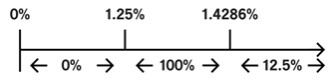
The Incentive Fee is accrued daily and taken into account for the purpose of determining the fund’s net asset value.
Accordingly, the repurchase price received by a Shareholder whose Shares are repurchased in a quarterly repurchase offer will be based on a valuation that will reflect an Incentive Fee accrual, if any. The Incentive Fee presents certain risks that
are not present in funds without an Incentive Fee. A discussion of these risks is set forth under “Risk Factors – Effect of the Advisor’s Incentive Fee”.
Pursuant to the Service Agreement, the Advisor is responsible for providing, at the expense of the fund, certain financial, accounting and administrative
services such as legal services, tax, accounting, valuation, financial reporting and performance, compliance and service oversight. Pursuant to the Service Agreement, the Advisor shall determine, subject to Board approval, the expenses to be
reimbursed by the fund, including an overhead allocation. The payments under the Service Agreement are not intended to provide a profit to the Advisor. Instead, the Advisor provides the services under the Service Agreement because it also provides
advisory services under the Investment Advisory Agreement. The reimbursement shall be paid monthly in arrears by the fund.
18
Financial Highlights
These tables detail the financial
performance of Class I Shares, Class S Shares and Class D Shares of the fund, including total return information showing how much an investment in the fund has increased or decreased each period (assuming reinvestment of all dividends and
distributions). Class A Shares and Class U Shares of the fund had not commenced operations as of the date of this prospectus.
The financial
statements of the fund for the period ended October 31, 2025, as well as [ ]’s related opinion, as included in the fund’s most recent annual report to shareholders, have been incorporated by reference into the SAI.
Copies of the fund’s most recent annual report are available upon request.
CLASS I SHARES
|
|
|
|
|
|
|
|
|
|
|
|
|
|
|
|
|
| Period ended |
|
10-31-25 |
|
|
10-31-24 |
|
|
10-31-23 |
|
|
10-31-221 |
|
| Per share operating performance |
|
| Net asset value, beginning of period |
|
$ |
20.28 |
|
|
$ |
20.01 |
|
|
$ |
19.84 |
|
|
$ |
20.00 |
|
| Net investment income2 |
|
|
1.58 |
|
|
|
1.30 |
|
|
|
1.15 |
|
|
|
0.09 |
|
| Net realized and unrealized gain (loss) on investments |
|
|
0.03 |
|
|
|
0.32 |
|
|
|
0.09 |
|
|
|
(0.25 |
) |
| Total from investment operations |
|
|
1.61 |
|
|
|
1.62 |
|
|
|
1.24 |
|
|
|
(0.16 |
) |
| Less distributions |
|
|
|
|
|
|
|
|
|
|
|
|
|
|
|
|
| From net investment income |
|
|
(1.46 |
) |
|
|
(1.35 |
) |
|
|
(1.07 |
) |
|
|
— |
|
| From net realized gain |
|
|
— |
|
|
|
— |
3 |
|
|
— |
|
|
|
— |
|
| Total distributions |
|
|
(1.46 |
) |
|
|
(1.35 |
) |
|
|
(1.07 |
) |
|
|
— |
|
| Net asset value, end of
period4 |
|
$ |
20.43 |
|
|
$ |
20.28 |
|
|
$ |
20.01 |
|
|
$ |
19.84 |
|
| Total return (%)5 |
|
|
7.87 |
|
|
|
8.58 |
|
|
|
6.40 |
|
|
|
(0.80 |
)6 |
| Ratios and supplemental data |
|
|
|
|
|
|
|
|
|
|
|
|
|
|
|
|
| Net assets, end of period (in millions) |
|
$ |
250 |
|
|
$ |
176 |
|
|
$ |
113 |
|
|
$ |
99 |
|
| Ratios (as a percentage of average net assets): |
|
|
|
|
|
|
|
|
|
|
|
|
|
|
|
|
| Expenses before reductions |
|
|
5.66 |
7 |
|
|
5.15 |
7 |
|
|
4.11 |
|
|
|
3.90 |
8 |
| Expenses including reductions |
|
|
5.06 |
7,9 |
|
|
4.12 |
7,9 |
|
|
2.50 |
|
|
|
1.94 |
8 |
| Net investment income |
|
|
7.70 |
|
|
|
6.44 |
|
|
|
5.75 |
|
|
|
1.48 |
10 |
| Portfolio turnover (%) |
|
|
60 |
|
|
|
68 |
|
|
|
80 |
|
|
|
17 |
|
| Total debt outstanding end of period (in millions) |
|
$ |
63 |
|
|
$ |
38 |
|
|
|
— |
|
|
|
— |
|
| Asset coverage per $1,000 of debt11 |
|
$ |
4,953 |
12 |
|
$ |
5,670 |
|
|
|
— |
|
|
|
— |
|
| 1 |
Period from 7-11-22 (commencement of operations) to 10-31-22. |
| 2 |
Based on average monthly shares outstanding. |
| 3 |
Less than $0.005 per share. |
| 4 |
The fund is a continuously offered closed-end fund, the shares of which are offered at net asset value.
No secondary market for the fund’s shares exists. |
| 5 |
Total returns would have been lower had certain expenses not been reduced during the applicable periods.
|
| 7 |
Includes incentive fees expense of 1.10% and 0.71% for the years ended 10-31-25 and 10-31-24,
respectively. |
| 8 |
Annualized. Certain expenses are presented unannualized. |
| 9 |
Expenses including reductions excluding interest expense were 3.99% and 3.43% for the years ended
10-31-25 and 10-31-24. |
| 11 |
Asset coverage equals the total net assets plus borrowings divided by the borrowings of the fund
outstanding at period end. As debt outstanding changes, the level of invested assets may change accordingly. Asset coverage ratio provides a measure of leverage. |
| 12 |
Asset coverage per $1,000 of debt, including borrowings of unconsolidated subsidiaries, was $3,757 for
the year ended 10-31-25. |
19
CLASS D SHARES
|
|
|
|
|
|
|
|
|
|
|
|
|
|
|
|
|
| Period ended |
|
10-31-25 |
|
|
10-31-24 |
|
|
10-31-23 |
|
|
10-31-221 |
|
| Per share operating performance |
|
| Net asset value, beginning of period |
|
$ |
20.28 |
|
|
$ |
20.02 |
|
|
$ |
19.82 |
|
|
$ |
20.00 |
|
| Net investment income2 |
|
|
1.80 |
|
|
|
1.21 |
|
|
|
1.11 |
|
|
|
0.08 |
|
| Net realized and unrealized gain (loss) on investments |
|
|
(0.20 |
) |
|
|
0.35 |
|
|
|
0.10 |
|
|
|
(0.26 |
) |
| Total from investment operations |
|
|
1.60 |
|
|
|
1.56 |
|
|
|
1.21 |
|
|
|
(0.18 |
) |
| Less distributions |
|
|
|
|
|
|
|
|
|
|
|
|
|
|
|
|
| From net investment income |
|
|
(1.41 |
) |
|
|
(1.30 |
) |
|
|
(1.01 |
) |
|
|
— |
|
| From net realized gain |
|
|
— |
|
|
|
— |
3 |
|
|
— |
|
|
|
— |
|
| Total distributions |
|
|
(1.41 |
) |
|
|
(1.30 |
) |
|
|
(1.01 |
) |
|
|
— |
|
| Net asset value, end of period4 |
|
$ |
20.47 |
|
|
$ |
20.28 |
|
|
$ |
20.02 |
|
|
$ |
19.82 |
|
| Total return (%)5,6 |
|
|
7.81 |
|
|
|
8.24 |
|
|
|
6.24 |
|
|
|
(0.90 |
)7 |
| Ratios and supplemental data |
|
|
|
|
|
|
|
|
|
|
|
|
|
|
|
|
| Net assets, end of period (in millions) |
|
$ |
1 |
|
|
$ |
— |
8 |
|
$ |
— |
8 |
|
$ |
— |
8 |
| Ratios (as a percentage of average net assets): |
|
|
|
|
|
|
|
|
|
|
|
|
|
|
|
|
| Expenses before reductions |
|
|
5.91 |
9 |
|
|
5.40 |
9 |
|
|
4.36 |
|
|
|
4.15 |
10 |
| Expenses including reductions |
|
|
5.31 |
9,11 |
|
|
4.37 |
9,11 |
|
|
2.75 |
|
|
|
2.19 |
10 |
| Net investment income |
|
|
9.11 |
|
|
|
5.86 |
|
|
|
5.56 |
|
|
|
1.24 |
12 |
| Portfolio turnover (%) |
|
|
60 |
|
|
|
68 |
|
|
|
80 |
|
|
|
17 |
|
| Total debt outstanding end of period (in millions) |
|
$ |
63 |
|
|
$ |
38 |
|
|
|
— |
|
|
|
— |
|
| Asset coverage per $1,000 of debt13 |
|
$ |
4,953 |
14 |
|
$ |
5,670 |
|
|
|
— |
|
|
|
— |
|
| 1 |
Period from 7-11-22 (commencement of operations) to 10-31-22. |
| 2 |
Based on average monthly shares outstanding. |
| 3 |
Less than $0.005 per share. |
| 4 |
The fund is a continuously offered closed-end fund, the shares of which are offered at net asset value.
No secondary market for the fund’s shares exists. |
| 5 |
Total returns would have been lower had certain expenses not been reduced during the applicable periods.
|
| 6 |
Does not reflect the effect of sales charges, if any. |
| 9 |
Includes incentive fees expense of 1.10% and 0.71% for the years ended 10-31-25 and 10-31-24,
respectively. |
| 10 |
Annualized. Certain expenses are presented unannualized. |
| 11 |
Expenses including reductions excluding interest expense were 4.24% and 3.68% for the years ended
10-31-25 and 10-31-24. |
| 13 |
Asset coverage equals the total net assets plus borrowings divided by the borrowings of the fund
outstanding at period end. As debt outstanding changes, the level of invested assets may change accordingly. Asset coverage ratio provides a measure of leverage. |
| 14 |
Asset coverage per $1,000 of debt, including borrowings of unconsolidated subsidiaries, was $3,757 for
the year ended 10-31-25. |
20
CLASS S SHARES
|
|
|
|
|
|
|
|
|
|
|
|
|
|
|
|
|
| Period ended |
|
10-31-25 |
|
|
10-31-24 |
|
|
10-31-23 |
|
|
10-31-221 |
|
| Per share operating performance |
|
| Net asset value, beginning of period |
|
$ |
20.38 |
|
|
$ |
20.01 |
|
|
$ |
19.79 |
|
|
$ |
20.00 |
|
| Net investment income2 |
|
|
1.71 |
|
|
|
1.22 |
|
|
|
0.99 |
|
|
|
0.04 |
|
| Net realized and unrealized gain (loss) on investments |
|
|
(0.25 |
) |
|
|
0.33 |
|
|
|
0.10 |
|
|
|
(0.25 |
) |
| Total from investment operations |
|
|
1.46 |
|
|
|
1.55 |
|
|
|
1.09 |
|
|
|
(0.21 |
) |
| Less distributions |
|
|
|
|
|
|
|
|
|
|
|
|
|
|
|
|
| From net investment income |
|
|
(1.28 |
) |
|
|
(1.18 |
) |
|
|
(0.87 |
) |
|
|
— |
|
| From net realized gain |
|
|
— |
|
|
|
— |
3 |
|
|
— |
|
|
|
— |
|
| Total distributions |
|
|
(1.28 |
) |
|
|
(1.18 |
) |
|
|
(0.87 |
) |
|
|
— |
|
| Net asset value, end of
period4 |
|
$ |
20.56 |
|
|
$ |
20.38 |
|
|
$ |
20.01 |
|
|
$ |
19.79 |
|
| Total return (%)5,6 |
|
|
7.03 |
|
|
|
8.22 |
|
|
|
5.57 |
|
|
|
(1.05 |
)7 |
| Ratios and supplemental data |
|
|
|
|
|
|
|
|
|
|
|
|
|
|
|
|
| Net assets, end of period (in millions) |
|
$ |
— |
8 |
|
$ |
— |
8 |
|
$ |
— |
8 |
|
$ |
— |
8 |
| Ratios (as a percentage of average net assets): |
|
|
|
|
|
|
|
|
|
|
|
|
|
|
|
|
| Expenses before reductions |
|
|
6.51 |
9 |
|
|
6.00 |
9 |
|
|
4.96 |
|
|
|
4.75 |
10 |
| Expenses including reductions |
|
|
5.91 |
9,11 |
|
|
4.979, |
11 |
|
|
3.35 |
|
|
|
2.79 |
10 |
| Net investment income |
|
|
8.64 |
|
|
|
6.02 |
|
|
|
4.97 |
|
|
|
0.64 |
12 |
| Portfolio turnover (%) |
|
|
60 |
|
|
|
68 |
|
|
|
80 |
|
|
|
17 |
|
| Total debt outstanding end of period (in millions) |
|
$ |
63 |
|
|
$ |
38 |
|
|
|
— |
|
|
|
— |
|
| Asset coverage per $1,000 of debt13 |
|
$ |
4,953 |
14 |
|
$ |
5,670 |
|
|
|
— |
|
|
|
— |
|
| 1 |
Period from 7-11-22 (commencement of operations) to 10-31-22. |
| 2 |
Based on average monthly shares outstanding. |
| 3 |
Less than $0.005 per share. |
| 4 |
The fund is a continuously offered closed-end fund, the shares of which are offered at net asset value.
No secondary market for the fund’s shares exists. |
| 5 |
Total returns would have been lower had certain expenses not been reduced during the applicable periods.
|
| 6 |
Does not reflect the effect of sales charges, if any. |
| 9 |
Includes incentive fees expense of 1.10% and 0.71% for the years ended 10-31-25 and 10-31-24,
respectively. |
| 10 |
Annualized. Certain expenses are presented unannualized. |
| 11 |
Expenses including reductions excluding interest expense were 4.84% and 4.28% for the years ended
10-31-25 and 10-31-24. |
| 13 |
Asset coverage equals the total net assets plus borrowings divided by the borrowings of the fund
outstanding at period end. As debt outstanding changes, the level of invested assets may change accordingly. Asset coverage ratio provides a measure of leverage. |
| 14 |
Asset coverage per $1,000 of debt, including borrowings of unconsolidated subsidiaries, was $3,757 for
the year ended 10-31-25. |
21
The Fund
The fund commenced operations on
July 11, 2022 and is a continuously offered non-diversified, closed-end management investment company registered under the Investment Company Act of 1940, as amended (the 1940 Act). The fund was organized on September 27, 2021, as a
Massachusetts business trust pursuant to an Agreement and Declaration of Trust (the Declaration of Trust).
The fund’s principal office is located
at the Advisor’s offices at 200 Berkeley Street, Boston, Massachusetts, 02116. The Advisor’s telephone number is 617-663-2430. Investment advisory services are provided to the fund by the Advisor, John Hancock Investment Management LLC,
a limited liability company organized under Massachusetts law, pursuant to an investment advisory agreement approved by the fund’s Board of Trustees (the Advisory Agreement). Under the supervision of the Advisor and oversight by the Board of
Trustees of the fund (the Board), Marathon handles the fund’s portfolio management activities. The fund’s business and affairs are overseen by the Board.
Use of Proceeds
The net proceeds to the fund will be
invested in accordance with the fund’s investment objective and policies (as stated below) as soon as practicable. The fund currently anticipates being able to do so, under normal circumstances within three months after receipt. Pending
investment of the net proceeds in accordance with the fund’s investment objective and policies, the fund will invest in high-quality, short-term debt securities, cash and/or cash equivalents. Investors should expect, therefore, that before the
fund has fully invested the proceeds of the offering in accordance with its investment objective and policies, the fund would earn interest income at a modest rate. If the fund’s investments are delayed, the first planned distribution could
consist principally of a return of capital.
Investment Program
Investment Objective
The fund’s investment objective is to seek to provide high current income and to a lesser extent capital appreciation. The Board may change the
investment objective of the fund without Shareholder approval.
Principal Investment Strategies
Under normal circumstances, the fund will invest at least 80% of its net assets (plus any borrowings for investment purposes) in asset-based lending
investments (Asset-Based Lending Investments), which may include investments in distressed loans. Asset-Based Lending Investments are investments in loans secured by an asset and include, among other investments:
| |
• |
|
Healthcare Loans & Royalty-Backed Credit: healthcare loans secured by revenue and intellectual
property rights primarily on FDA-approved drugs and devices and royalty streams secured primarily by FDA-approved drugs and devices; |
| |
• |
|
Transportation Assets: transportation assets such as loans and leases backed by commercial aircraft,
aircraft engines, shipping vessels or other transportation and equipment; |
| |
• |
|
Residential Real Estate Lending: the origination and acquisition of residential real estate loans and
legacy mortgage loan pools, including distressed or nonperforming loans, and newly originated non-agency mortgage loans; |
| |
• |
|
Commercial Real Estate Lending: the origination and acquisition of commercial real estate loans secured by
housing-related and traditional commercial real estate property types; |
| |
• |
|
Consumer-Related Assets: acquisition of consumer loans, including distressed or nonperforming loans;
high-yield asset-backed securities (ABS) backed by various forms of non-mortgage household debt largely focused on select market segments such as: automobile loans and leases, credit cards and personal installment loans; and other types of consumer
loans; |
| |
• |
|
Corporate Asset-Based Credit: asset-based corporate credit secured by real estate, equipment, receivables,
inventory and intellectual property rights, among other assets; |
| |
• |
|
Equipment: the leasing, lease financing, or lending against a wide range of equipment which is mission
critical to an operator. Equipment may include, for example, injection molding machines, industrial cranes, so-called “yellow metal” (i.e. earth moving equipment), titled and non-titled vehicles, but would not include equipment that
would be categorized as transportation assets, such as ships and aircraft; and |
| |
• |
|
Liquid Securitized Credit: securities backed by residential real estate (RMBS), commercial real estate
(CMBS), collateralized mortgage obligations (CMOs), secured corporate loans (CLOs) and ABS. |
Except for RMBS, CMBS, CMOs, CLOs and ABS,
which may range from most senior (AAA-rated) to most subordinate (BB-rated, B-rated and equity), most loans and investments are not rated. If a loan or investment is rated, it will usually be rated by S&P Global Ratings, Moody’s Investors
Service, Inc., Fitch Ratings, Kroll Bond Rating Agency or DBRS Morningstar, and may be rated below investment-grade. Disclosure regarding the ratings of each of these rating agencies is included in the SAI.
22
The fund seeks to achieve its objective by investing in a broad portfolio of secured assets and thereby
seeks to provide consistent levels of high current income derived from contractual cash-flows and to a lesser extent capital appreciation. The fund will primarily invest in financings sourced through proprietary means using relationships of the
Subadvisor rather than traditional channels such as public markets, and seeks to benefit from expected premiums arising in such financings from, among other things, the bespoke nature of each financing. Investments will be made across a broad range
of market sectors and asset types based on the Subadvisor’s ongoing evaluation of investment opportunities. The Subadvisor will seek to capitalize on its transaction valuation assessment and capital structure expertise, while attempting to
protect against downside risks through protective loan covenants, conservative collateral valuation and active asset management.
The fund is not limited
to the Asset-Based Lending Investments and may invest in other asset-based lending investments as well as other types of investments consistent with its investment objective and policies.
The manager may consider environmental, social, and/or governance (ESG) factors, alongside other relevant factors, as part of its investment process. ESG
factors may include, but are not limited to, matters regarding board diversity, climate change policies, and supply chain and human rights policies. The ESG characteristics utilized in the fund’s investment process may change over time and one
or more characteristics may not be relevant with respect to all issuers that are eligible fund investments. Because ESG factors are considered alongside other relevant factors, the manager may determine that an investment is appropriate
notwithstanding its relative ESG characteristics.
The fund is authorized to use all of the various investment strategies referred to under “Risks
Factors — Hedging, Derivatives and Other Strategic Transactions Risk” including, but not limited to, futures contracts, interest rate swaps, options, reverse repurchase agreements, and swaps.
For temporary or defensive purposes, the fund may also invest its assets in cash, money market instruments, or other investment-grade short-term securities,
and it may also employ derivative strategies for hedging purposes.
The fund may create or organize or otherwise utilize special purpose subsidiaries or
other special purpose investment vehicles (SPVs), which are wholly-owned subsidiaries of the fund, to facilitate the fund’s investment strategy. Certain fund investments may be held by these SPVs.
Except as otherwise stated in this Prospectus or in the SAI, the investment policies and restrictions of the fund are not fundamental and may be changed at
the discretion of the Board. The fund’s fundamental investment policies are listed in the SAI.
These general descriptions summarize certain
investment strategies that may be pursued by the fund. These descriptions are not intended to be complete explanations of the strategies described or a list of all possible investment strategies or methods that may be used by the fund.
Portfolio Construction Process
The Subadvisor will
determine a sector level asset allocation. The Subadvisor’s fundamental analysis takes into account a number of factors in its asset allocation, including, but not limited to, portfolio level credit risk, geographical and industry
diversification, interest rate risk, capital deployment optimization, and macroeconomic conditions. The availability of origination and acquisition opportunities, in conjunction with the Subadvisor’s fundamental views regarding each sector,
will play a significant role in determining the fund’s sector level asset allocation. Sector allocation decisions may change over time as factors used in making such allocation change, including the availability of investments in a particular
sector. In considering investments for the fund, the Subadvisor also considers various criteria including, without limitation, return profile, scalability, financing options, and the associated risks and mitigants.
Except to the extent the fund must comply with 1940 Act and IRS diversification requirements, the fund is not limited in the amount of its assets that may be
allocated to any particular sector but generally seeks under normal circumstances, the following allocations:
|
|
|
|
|
| Sector Allocations |
|
Percentage of the
Fund’s Net Assets |
|
| Healthcare Loans and Royalty Backed Credit |
|
|
0-25 |
% |
| Transportation Assets |
|
|
10-25 |
% |
| Residential Real Estate Lending |
|
|
10-25 |
% |
| Commercial Real Estate Lending |
|
|
10-25 |
% |
| Consumer-Related Assets |
|
|
0-25 |
% |
| Corporate Asset-Based Credit |
|
|
10-25 |
% |
| Equipment |
|
|
0-25 |
% |
| Liquid Securitized Credit |
|
|
At Least 10 |
% |
The fund is not constrained by this sector allocation which may change at any time.
23
Portfolio Composition
Healthcare Loans and Royalty-Backed Credit Investments
The fund will invest in senior secured loans, royalty debt, and royalty acquisitions of FDA-approved drugs and devices. Investments in this sector are
typically highly covenanted and fully secured by plant, property, equipment, and IP rights.
When investing in the healthcare sector, the fund seeks to
achieve a high level of asset-based principal protection with low volatility and high cash flow. The fund’s investments may include:
| |
a) |
Asset-Based Senior-Secured Lending. Senior secured credit facilities collateralized by all assets of the
borrower including inventory, plants, property & equipment, IP/patents, and stock pledges. Provides non-dilutive capital to borrowers and high cashflow-based yield with downside protection to lenders. |
| |
b) |
Royalty Acquisition. Acquire economic rights to future royalties and milestones derived from existing
license agreements. Maximizes upfront proceeds to seller with predictable returns. |
| |
c) |
Royalty-based Financing. Royalty-based financing structured as synthetic royalty transaction whereby
investments are collateralized by specific assets and are monetized through revenues generated from the assets. Alternative form of non-dilutive capital while generating high current yields. |
| |
d) |
Debt with Equity Upside. Term loans with detachable warrants, convertible debt, and preferred equity.
Creative solutions with strong enforceable covenants and equity upside. |
Transportation Assets
Commercial Aviation Investments
The fund will
invest in commercial aircraft or aircraft engine lease transactions. The fund will primarily focus on the most in demand aircrafts and aircraft engines and may invest in a range of commercial aircraft types, including both narrowbody and widebody
aircraft. The Subadvisor will utilize its experienced aviation professionals and the professional relationships that it maintains throughout the value chain of aviation assets to source aircraft and aircraft engine investments. Commercial aircraft
and aircraft engine lease transactions may be sourced directly from the following types of parties: airlines, original equipment manufacturers, aviation lessors, financial institutions, industry consultants, brokers, refurbishment businesses, as
well as through vendor, independent and Wall Street research and professional trade representatives who are members of the International Air Transport Association. The fund will invest in commercial aircraft and aircraft engine lease transactions
that the Subadvisor believes provide a potentially attractive investment opportunity, both in the United States and internationally with additional protection through the Capetown Convention. The fund may also invest in aviation-related asset-backed
securities and other aviation-related instruments or securities, including aircraft and aircraft engine lease receivables and enhanced equipment trust certificates.
The fund will pursue a flexible and opportunistic approach to investing in commercial aircraft and aircraft engine lease transactions. Typically, the age of
the fund’s assets at acquisition will range between zero and twenty-five years, and may encompass the full range of the aircraft or aircraft engine lifecycle, including new aircrafts or aircraft engines, mid-life aircrafts or aircraft engines
and end-of-life aircrafts or aircraft engines. While the fund will focus on investing in early to mid-life commercial aircrafts or aircraft engines, the fund may also invest in end-of-life aircrafts or aircraft engines. Generally, an aircraft or
aircraft engine that is four years old or less, with between eight and fifteen years remaining on its lease term, is considered “new” whereas an aircraft or aircraft engine that is between five and twenty years old that is acquired from
a lessor, airline or asset manager is considered “mid-life.” “End-of-life” aircrafts or aircraft engines are those that are approaching the end of their useful lives, typically ending with a “part-out” wherein the
parts of the aircraft or aircraft engine are disposed of at the piece-part level, as the aircraft or aircraft engine approaches its thirty-year useful life.
The commercial aircraft and aircraft engine lease transactions acquired by the fund will generally be subject to “triple-net” operating leases,
whereby the lessee is responsible for maintenance, insurance and taxes. Generally, such lease agreements will be subject to unconditional lease payments for the term of the lease, regardless of the circumstances affecting the aircraft or aircraft
engine or the lessee. The creditworthiness of any commercial airlines lessees is of paramount importance and will be thoroughly evaluated, because, in the event of default, the airline may default on its lease and return the aircraft or aircraft
engine.
As part of the fund’s aviation strategy, the Subadvisor will also seek to capitalize on the aviation secondary market in which leasing
companies may sell aircraft or aircraft engine leases in order to lower the average age of their aircraft or aircraft engine portfolio. The Subadvisor believes that the opportunities in the aviation secondary market are growing due to the increase
in supply to keep up with consistent airline traffic growth, the demand for new fuel efficient aircrafts and airline carriers’ continued desire to lease rather than own airplanes.
Shipping Loan Investments
The fund will invest or
originate commercial shipping loans and may invest in a range of commercial ship types, including containerships, dry bulk vessels, tankers, and U.S. domestic tugs and barges. Investments will focus primarily on the smaller to medium sized vessels
that carry a diversified cargo base, support growing trade, market liquidity, or have barriers to entry. The Subadvisor will utilize its experienced and dedicated shipping team with asset expertise across containerships, dry bulk vessels, and crude
tankers.
24
The fund will target in-demand vessels that are mission critical assets and service growing trade routes and
are relied upon by a variety of counterparties. Additionally, the fund plans to execute sale-and-leasebacks with quality counterparties at attractive rates as well as acquire deeply discounted assets from reorganizing or liquidating companies. There
opportunity may also exist to acquire discounted notes or non-performing loans from other lenders, allowing access to collateral at significant discounts.
Residential Real Estate Investments
The fund will seek
to achieve attractive risk-adjusted returns through originating or purchasing pools of performing and sub-performing loans in urban and suburban markets with improving credit profiles. The Subadvisor expects that these loans will be collateralized
by residential properties and possess embedded equity, resulting in consistent monthly cash flows with lower volatility. The Subadvisor believes that performing and sub-performing mortgages provide an attractive opportunity for value-added active
asset management. The fund will focus on underwriting sub-performing borrowers that have demonstrated the ability to consistently support modified mortgage payments.
The fund will seek to capitalize on alternative sourcing channels, where the Subadvisor believes the fund can source residential real estate investment
opportunities that are smaller in size, less competitively sponsored, and often can be purchased at more attractive levels than larger “bulk” opportunities. While the fund will primarily seek to identify opportunities to originate loans
for U.S. households, it will also opportunistically seek to identify similar opportunities in Europe. The fund’s pipeline of opportunities includes the purchase and aggregation of legacy whole loan pools, the origination of Non-Qualified
Mortgages to creditworthy borrowers, and select asset-based corporate lending opportunities with a total addressable market of $12 trillion:
| |
a) |
Legacy Whole Loan Portfolios. The Subadvisor will source loan pools from its extensive network of
non-traditional channels, such as regional banks, FDIC-controlled banks and asset managers. Loans sourced from these channels are generally smaller in size and therefore face less competition versus larger pool offerings. Smaller pools also tend to
transact at higher yields because each pool is generally too small to securitize on a stand-alone basis. The fund may be able to aggregate loans from smaller pools into larger-sized pools for securitization or sale to a third party, resulting in
value extraction. |
| |
b) |
Origination of Non-Qualified Mortgage (Non-QM) Loans. The fund intends to originate or purchase first
lien, non-agency mortgages that do not meet the strict standards of the government Qualified Mortgage program. In the Subadvisor’s view, the availability of mortgage credit has remained constrained post-crisis and is generally only available
to prime borrowers, creating an opportunity with respect to qualified borrowers who are underserved by the current regime of restrictive mortgage lending standards. |
Commercial Real Estate Investments
The fund seeks to
optimize the deployment of capital in the commercial real estate sector by originating and purchasing loans backed by commercial real estate properties. This includes deploying capital when there are dislocations and inefficiencies within property
sub-sectors and sub-markets primarily across the United States and Europe. The fund will also target housing-focused sectors, specifically multifamily, self-storage, Single Family Rental (SFR) and Build for Rent (BFR) sectors.
The fund may also originate commercial real estate loans across property types in the middle-market segment with loan balance targets from $25-$125 million.
The Subadvisor seeks to find attractive relative value opportunities across a range of potential commercial real estate investment types:
a) Housing-Focused Strategies:
| |
i. |
Agency Risk Transfer Investments. The Subadvisor actively invests in seasoned Freddie Mac Agency risk
transfer transactions. These B-pieces are collateralized by multifamily loans, specifically suburban garden style multifamily. The seasoned nature of these investments allows the Subadvisor to underwrite multiple years of cash flow history, which
often supports the property price appreciation embedded within the investment trusts. The fund benefits from regular multifamily property level cash flows and securitized term funding to generate attractive risk-adjusted returns.
|
| |
ii. |
Origination of Single-Family Rental & Multifamily Loans. The Subadvisor sources and originates
first lien mortgage loans secured by single family rental and multifamily properties across the U.S. These loans feature either a lease up of a newly constructed project or a light value-add component. Exit for these investments is typically an
Agency take-out financing. |
b) Traditional Commercial Real Estate:
| |
i. |
Origination of Commercial Real Estate Loans. The Subadvisor sources and originates commercial real
estate mortgage loans secured by various property types in need of value-add through our bridge lending initiative. Once a loan has been underwritten, there is the potential to enhance yields through: (1) securitization, (2) term financing
a pool of assets, or (3) selectively selling A-notes, senior interests in investments. |
| |
ii. |
Purchases of Commercial Real Estate Loans in the Secondary Market. The fund purchases loans in the
secondary market from banks, insurance companies, and finance companies. |
25
| |
iii. |
Mezzanine Loans, B-Notes, and Preferred Equity Interests. Investments that are subordinate or otherwise
junior in a borrower’s capital structure offer term funding and can be attractive to the fund. |
Consumer Based Loans and
Asset-Backed Securities
The fund will invest in consumer based credit. Consumer credit encompasses all forms of non-mortgage household debt and is
largely focused on select market segments such as: automobile loans and leases, and credit cards and personal installment loans. The Subadvisor utilizes its relationships with originators and financial sponsors to source opportunities across the
consumer credit marketplace with strong credit profiles, high cash-flow yields, and the potential for term securitization financing. Through a combination of forward flow whole loan purchases, secondary loan pools, and structured transactions, the
Subadvisor has deployed capital in investments representing over $1 billion of consumer credit collateral. Investments are usually made in either whole loan or securitized form. Whole loan investments can include pools of performing,
securitization-eligible loans that are originated according to the Subadvisor’s stringent credit and pricing criteria, or the purchase of distressed loan pools. Securitized investments typically consist of higher yielding, term-financed
residual tranches that are collateralized by high quality, performing loans. Below, we describe two major consumer debt markets and the investment opportunities available in each market:
| |
a) |
Auto Loans. The auto loan sector has grown rapidly in the post-crisis era and now totals over $1.4
trillion of debt outstanding. In the post-COVID period, delinquencies have decreased significantly as a result of more restrictive underwriting and returns on assets have increased as a result of higher loan pricing. We believe opportunities exist
to purchase whole loans from strong originators in need of growth capital as well as debt and equity tranches of securitized transactions. |
| |
b) |
Personal Installment Loans. The personal consumer loan market has long been dominated by bank, brick and
mortar, and credit card lenders. However, financial technology-based lending platforms have grown significantly in scale in recent years, with approximately $20 billion per year of personal loans originated pre-COVID. Both credit discipline and loan
pricing have improved significantly post-COVID. Additionally, the health of the underlying prime consumer remains strong, with deleveraging household balance sheets, increased savings rates, and record low financial obligations ratios. Effective
execution in the sector requires through-cycle consumer credit expertise as originator underwriting criteria and sourcing channels are constantly changing. The Subadvisor believes there is strong opportunity to purchase whole loans as well as debt
and equity tranches of securitized transactions in the consumer credit sector. |
Corporate Asset-Based Credit
The fund will focus on asset-based corporate credit secured by real estate, equipment, receivables, inventory and intellectual property rights, among other
assets, including pools of these assets, or synthetic transactions where the fund invests in notes secured by or, alternatively, of which the source of payment is, an underlying reference portfolio of corporate credits or a credit default swap in
which protection is sold by an issuer of notes with respect to a portfolio of corporate credits. The fund will focus on asset-based lending opportunities, a market in which the Subadvisor has experience and market knowledge, and anticipates sourcing
these assets in higher growth stage companies with limited access to public markets as well as more complex situations and through debtor in possession (DIP) loans.
The Subadvisor will seek out middle market and larger revenue-based companies that require funding for a specific asset purchase, growth capital, asset
carve-out, restructuring or refinancing. The Subadvisor believes it will be able to capitalize on its understanding of complex markets and structures in order to benefit from any potential rise in valuation that these complex situations present on
behalf of the fund. The Subadvisor also believes it has the ability to provide creative and constructive solutions for potential borrowers and, due to its network of industry participants, the ability to access and diligence companies that require
such financing.
The Subadvisor believes it is well positioned to provide both asset based growth capital to companies with limited access to public
markets as well as capital to stressed companies when they have the ability to carveout assets to use as collateral for needed liquidity. Due to the strong asset coverage, the regular cash flows and short to medium term maturities, the Subadvisor
believes there will be ample opportunity to provide corporate asset-based financing with a potentially unique opportunity for the fund.
In addition, the
fund may help to structure or participate in DIP loans. DIP loans are privately negotiated transactions that have individualized terms and are potentially an attractive source of financing for many stressed companies that enter bankruptcy
protection. As first-lien securities on substantially all of the assets of a company, the Subadvisor believes DIP loans present an attractive lending tool for the fund. Due to the strict payment terms, the Subadvisor believes it will be able to
mitigate the risks associated with these investments and potentially earn a higher rate of return for investors. The Subadvisor believes its extensive experience with restructurings and complex financing situations provides the fund with an
excellent opportunity to provide secured lending solutions to corporations.
Equipment
Equipment Lease Certificates and Equipment Trust Certificates
The fund may invest in equipment lease certificates. Equipment lease certificates are debt obligations secured by leases on equipment (such as railroad cars
and office equipment), with the issuer of the certificate being the owner and lessor of the equipment. Equipment lease certificates represent an investment in the leasing of equipment to various businesses. These certificates, typically backed by
the revenue generated from lease payments made by lessees, provide investors the opportunity to earn income from those payments.
26
The fund may also invest in asset-backed securities called equipment trust certificates. Equipment trust
certificates involveundivided fractional interests in a trust holding a pool of equipment retail installment contracts or leased equipment. Unlike other securities, these certificates are issued by specially-created trusts formed by airlines,
railroads, or other transportation companies. These trusts use the assets within equipment trust certificates to purchase equipment, such as airplanes or railroad cars, serving as collateral for the equipment trust certificates. Title to this
equipment is held in trust for the certificate holders. Leased equipment generates rental payments, providing cash flow for payments to equipment trust certificate holders.
The primary risk is the credit risk associated with the lessee’s ability to make timely lease payments. If lessees default on their lease obligations,
the income generated from the certificates may be adversely affected. Additionally, there is a risk of depreciation in the value of the underlying equipment, which could impact the overall return on investment. Market conditions, interest rate
fluctuations, and changes in economic conditions may also affect the performance of equipment lease certificates.
In cases of default on equipment trust
certificates, holders must rely on the collateral securing the certificates, often supplemented by a guarantee from the lessee firm or its parent company. Risks include potential defaults by the lessee or payee and declines in collateral value.
These securities are viewed as the lessee company’s obligations and may appear as liabilities —capitalized leases —on its balance sheet, following generally accepted accounting principles. The lessee does not own the equipment
until all certificates are redeemed. If a company defaults on its lease, the trustee may terminate the lease, and without a new lessee, payments will stop until the equipment is re-leased.
Liquid Securitized Credit: Securitized assets backed by RMBS, CMBS, CMOs, CLOs, and ABS
The fund may make investments in the liquid securitized credit markets. The Subadvisor intends to have a strong focus on underlying credit fundamentals,
current and projected macroeconomic factors, cash flow of underlying assets, yield levels under different scenarios, financing and liquidity, real estate property prices, delinquencies, default rates, recovery rates, foreclosure process, vintage of
collateral, relative value and risk-adjusted returns.
Structured credit transactions are typically tranched into a capital structure of securities
ranging from most senior (AAA-rated) to most subordinate (BB-rated, B-rated and equity). More senior securities are protected by credit enhancement from more subordinate securities, as well as net interest margin between asset yield and liability
yield. Additionally, performance triggers can divert cashflows in cases of unexpected underperformance. Structured credit cashflows are dependent on the prepayment, default and recovery performance of the underlying asset pools, among other factors.
The Subadvisor intends to capitalize on the diversity of underlying asset types and fixed income proprieties (for example, fixed versus floating
securities) to construct a portfolio of investment grade and high-yield structured securities across the following sectors:
RMBS – Securities backed
by residential mortgage loans. Relevant underlying asset types include legacy mortgage loans (generally issued prior to the Great Financial Crisis of 2008), Non-QM mortgage loans that do not meet Agency Qualified Mortgage (QM) standards, jumbo
mortgage loans, and credit risk transfer securities issued by Fannie Mae and Freddie Mac.
Commercial Mortgage-Backed Securities (CMBS) – Securities
backed by commercial real estate mortgage loans. Relevant sub-sectors include Single-Asset Single Borrower transactions (SASB), Commercial Real Estate Collateralized Loan Obligations (CRE CLO), multi-asset conduit CMBS and Single-family Rental (SFR)
securities. These security types are backed by a variety of commercial mortgage loans that span the major commercial real estate sectors: office, industrial, multifamily, hospitality, retail and single-family rental homes.
CMOs – CMOs generally are bonds or certificates issued in multiple classes that are collateralized by or represent an interest in mortgages. CMOs may be
issued by single-purpose, stand-alone finance subsidiaries or trusts of financial institutions, government agencies, investment banks or other similar institutions. Each class of CMOs, often referred to as a “tranche,” may be issued with
a specific fixed coupon rate (which may be zero) or a floating coupon rate. Each class of CMOs also has a stated maturity or final distribution date. Principal prepayments on the underlying mortgages may cause the CMOs to be retired substantially
earlier than their stated maturities or final distribution dates. Interest is paid or accrued on CMOs on a monthly, quarterly or semiannual basis. The principal of and interest on the underlying mortgages may be allocated among the several classes
of a series of a CMO in many ways. The general goal sought to be achieved in allocating cash flows on the underlying mortgages to the various classes of a series of CMOs is to create tranches on which the expected cash flows have a higher degree of
predictability than the underlying mortgages. In creating such tranches, other tranches may be subordinated to the interests of these tranches and receive payments only after the obligations of the more senior tranches have been satisfied. As a
general matter, the more predictable the cash flow is on a CMO tranche, the lower the anticipated yield will be on that tranche at the time of issuance. As part of the process of creating more predictable cash flows on most of the tranches in a
series of CMOs, one or more tranches generally must be created that absorb most of the volatility in the cash flows on the underlying mortgages. The yields on these tranches are relatively higher than on tranches with more predictable cash flows.
Because of the uncertainty of the cash flows on these tranches, and the sensitivity of these transactions to changes in prepayment rates on the underlying mortgages, the market prices of and yields on these tranches tend to be highly volatile. The
market prices of and yields on tranches with longer terms to maturity also tend to be more volatile than tranches with shorter terms to maturity due to these same factors. To the extent the mortgages underlying a series of a CMO are so-called
“subprime mortgages” (mortgages granted to borrowers whose credit history is not sufficient to obtain a conventional mortgage), the risk of default is higher, which increases the risk that one or more tranches of a CMO will not receive
its predicted cash flows.
27
CMOs purchased by the fund may be:
| |
1. |
collateralized by pools of mortgages in which each mortgage is guaranteed as to payment of principal and
interest by an agency or instrumentality of the U.S. government; |
| |
2. |
collateralized by pools of mortgages in which payment of principal and interest is guaranteed by the issuer and
the guarantee is collateralized by U.S. government securities; or |
| |
3. |
securities for which the proceeds of the issuance are invested in mortgage securities and payment of the
principal and interest is supported by the credit of an agency or instrumentality of the U.S. government. |
CLOs and Collateralized Debt
Obligations (CDOs) – Securities backed by senior secured corporate loans and other legacy securities. The fund’s investment activity is expected to be focused on transactions backed by larger, more established issuers in the Bank
Syndicated Loan (BSL) CLO market. The fund may selectively participate in transactions backed by smaller issuers in the middle market loan segment. CDO investments are typically backed by legacy RMBS, CMBS and ABS securities and can offer the
potential for a higher-yielding option versus investing in the underlying assets.
ABS – Securities backed by other, typically consumer-focused,
assets. Relevant underlying asset types include credit cards, auto loans, student loans, home equity loans and equipment receivables.
Loan Origination
The fund will have the flexibility to originate a wide variety of loans, including, for example, senior secured loans, junior secured loans and
mezzanine loans and other secured and unsecured debt that has been recently originated or that trade on the secondary market. Subject to fund’s other investment policies and limitations, the fund would have the flexibility to originate loans
with various maturities and durations and to originate loans to borrowers globally. The Subadvisor expects that it would generally select loan origination opportunities by employing a bottom-up, disciplined credit approach driven by fundamental,
independent research and by taking into account the asset quality, coverage ratios, return profile, scalability, holding period and associated risks and mitigants of such loan origination opportunities. The Subadvisor utilizes strategies that focus
on credit quality analysis, duration management and other risk management techniques and would incorporate potential loan originations into such strategies. The Subadvisor will attempt to identify, through fundamental research driven by independent
credit analysis and proprietary analytical tools, loan origination opportunities that may provide positive risk-adjusted returns based on its analysis of the borrower’s credit characteristics.
The fund reserves the right to service loans it originates in accordance with applicable law and SEC guidance. For example, the Subadvisor will handle some
asset management/servicing in-house including on aircrafts, aircraft engines, and commercial real estate, which may include collection of payments, monitoring of property financial condition and loan compliance, and, following a default, modifying
underlying loans, foreclosing on the underlying collateral and selling foreclosed properties and/or defaulted loans.
There are no current explicit limits
on the amount of loans the fund may originate to issuers in the same industry. However, the fund is targeting no more than 25% in any one strategy / collateral type.
With respect to loan origination, the Subadvisor’s investment process begins with the relevant portfolio management team, which establishes a rigorous
sourcing and underwriting process that the Subadvisor believes positions it to capitalize on a broad universe of asset-based investment opportunities. This process is overseen by the portfolio managers, under the direction of the Subadvisor’s
Chief Investment Officer, and with contribution from senior investment professionals who focus on idea and opportunity generation. Once an opportunity has been identified, it is presented to senior members of the relevant portfolio management team
and evaluated based on, among other factors, risk, mitigants, potential return and scalability. If senior members of the relevant portfolio management team believe the opportunity is attractive, then the investment due diligence process commences.
This process is performed by senior investment professionals and generally involves a comprehensive cash flow analysis of the underlying assets, underwriting of counterparty credit risk, internal and external asset valuation analysis, on-site due
diligence (if necessary) and negotiation of investment terms (pricing and covenants). Senior members of the portfolio management team provide feedback during the due diligence process. A detailed investment memorandum is then prepared by the
portfolio management team and presented to the Subadvisor’s Investment Committee for required approval. The Subadvisor focuses on mitigating tail events through stress testing its underwriting assumptions and working closely with asset
management and in-house legal personnel to structure loan level covenants that help to mitigate tail risks. The Subadvisor seeks to achieve these goals through an integrated approach with equal emphasis on underwriting, asset management and legal
expertise.
The Subadvisor does not have its own on-line lending platform but reserves the right to create such a platform in the future.
Leverage
The fund may use leverage to seek to achieve
its investment objective or for liquidity (i.e., to finance the repurchase of Shares and/or bridge the financing of investments in Asset-Based Lending Investments). As stated above, the fund may create or organize or otherwise utilize SPVs, which
are wholly-owned subsidiaries of the fund, to facilitate the fund’s investment strategy. Certain fund investments may be held by these SPVs. The fund’s use of leverage may increase or decrease from time to time in its discretion and the
fund may, in the future, determine not to use leverage. The use of leverage creates an opportunity for increased investment returns, but also creates risks for Shareholders.
28
The use of leverage, if employed, is subject to numerous risks. When leverage is employed, the fund’s
net asset value and any distributions to holders of the fund’s Shares will be more volatile than if leverage was not used. Changes in the value of the fund’s portfolio, including securities bought with the proceeds of leverage, will be
borne entirely by the holders of Shares. If there is a net decrease or increase in the value of the fund’s investment portfolio, leverage will decrease or increase, as the case may be, the net asset value per Share to a greater extent than if
the fund did not utilize leverage. The fund’s leveraging strategy may not be successful.
The fund is not permitted to incur indebtedness
(aggregated with any SPVs), including through the issuance of senior securities, unless immediately thereafter the total asset value of the fund’s portfolio (less all liabilities and indebtedness not represented by senior securities) is at
least 300% of the aggregate amount of outstanding senior securities representing indebtedness (i.e., the aggregate amount of outstanding senior securities representing indebtedness may not exceed 33 1/3% of the fund’s total assets immediately
after any borrowing or other issuance of senior securities representing indebtedness). When the fund borrows money, the fund intends to retire outstanding indebtedness to the extent necessary to maintain asset coverage of any outstanding
indebtedness of at least 300%. Under the 1940 Act, the fund also is not permitted to issue a class of preferred shares unless immediately thereafter the fund’s asset coverage is at least 200% of the aggregate liquidation value of outstanding
preferred shares (i.e., the aggregate liquidation value of outstanding preferred shares may not exceed 50% of the fund’s assets less all liabilities and indebtedness not represented by senior securities).
In addition to the asset coverage requirements under the 1940 Act, certain types of borrowings may result in the fund being subject to covenants in credit
agreements relating to asset coverage and portfolio composition requirements. In addition, the direct borrowings which the fund may incur will likely be secured by a lien on its assets. The cost associated with any issuance and use of leverage will
be borne by the Shareholders and result in a reduction of the NAV of the fund’s Shares. Such costs may include legal fees, audit fees, structuring fees, commitment fees and usage fees associated with direct borrowings.
Credit Facility
The fund (including SPVs of the fund)
may leverage its portfolio by entering into one or more credit facilities. If the fund enters into a credit facility, the fund may be required to prepay outstanding amounts or incur a penalty rate of interest upon the occurrence of certain events of
default. The fund would also likely have to indemnify the lenders under the credit facility against liabilities they may incur in connection therewith. In addition, the fund expects that any credit facility would contain covenants that, among other
things, likely would limit the fund’s ability to pay distributions in certain circumstances, incur additional debt, change certain of its investment policies and engage in certain transactions, including mergers and consolidations, and require
asset coverage ratios in addition to those required by the 1940 Act. The fund may be required to pledge its assets and to maintain a portion of its assets in cash or high-grade securities as a reserve against interest or principal payments and
expenses. The fund expects that any credit facility would have customary covenant, negative covenant and default provisions. There can be no assurances that the fund will enter into an agreement for a credit facility, or one on terms and conditions
representative of the foregoing, or that additional material terms will not apply. In addition, if entered into, a credit facility may in the future be replaced or refinanced by one or more credit facilities having substantially different terms, by
the issuance of preferred shares or debt securities or by the use of other forms of leverage.
Derivatives
The fund (including SPVs of the fund) may enter into derivative transactions that have economic leverage embedded in them. Derivative transactions that the
fund may enter into and the risks associated with them are described elsewhere in this Prospectus. Derivatives associated with foreign currency transactions are subject to currency risk. For further information on the risks associated with
derivatives see “Risk Factors – Hedging and Other Strategic Transactions Risk.” The fund cannot assure you that investments in derivative transactions that have economic leverage embedded in them will result in a higher return on
its common shares.
Reverse Repurchase Agreements
The fund may enter into reverse repurchase agreements.
Under a
reverse repurchase agreement, the fund sells a debt security and agrees to repurchase it at an agreed-upon time and at an agreed-upon price. The fund retains record ownership of the security and the right to receive interest and principal payments
thereon. At an agreed-upon future date, the fund repurchases the security by remitting the proceeds previously received, plus interest. The difference between the amount the fund receives for the security and the amount it pays on repurchase is
payment of interest. In certain types of agreements, there is no agreed-upon repurchase date and interest payments are calculated daily, often based on the prevailing overnight repurchase rate. A reverse repurchase agreement may be considered a form
of leveraging and may, therefore, increase fluctuations in the fund’s NAV per share.
Temporary Borrowings
The fund (including SPVs of the fund) may also borrow money as a temporary measure, including for the payment of dividends or tender offer proceeds and the
settlement of securities transactions which otherwise might require untimely dispositions of fund securities.
29
Other Forms of Leverage
In addition to entering into one or more credit facilities, the fund (including SPVs of the fund) may also leverage its portfolio by issuing preferred shares.
Co-Investment
Under the 1940 Act, the fund is
subject to certain regulatory restrictions in negotiating investments with entities, such as the Subadvisor and its affiliates, unless it obtains an exemptive order from the SEC. The fund, the Subadvisor and certain of its affiliates received such
an exemptive order from the SEC on September 26, 2022, permitting co-investment with other funds managed by the Subadvisor or its affiliates in a manner consistent with the fund’s investment objective, positions, policies, strategies and
restrictions as well as regulatory requirements and other pertinent factors. Under the order, the fund is permitted to co-invest with affiliates if a “required majority” (as defined in Section 57(o) of the 1940 Act) of the
fund’s Independent Trustees make certain conclusions in connection with a co-investment transaction, including, for example, that (1) the terms of the transactions, including the consideration to be paid, are reasonable and fair to the
fund and its Shareholders and do not involve overreaching of the fund or its Shareholders by any person concerned and (2) the transaction is consistent with the interests of Shareholders and is consistent with the fund’s investment
objective and strategies.
30
Risk factors
The principal risks of investing in the
fund are summarized in the Prospectus Summary above. Below are descriptions of the principal factors that may play a role in shaping the fund’s overall risk profile. The descriptions appear in alphabetical order, not in order of importance.
For further details about the fund’s risks, including additional risk factors that are not discussed in this Prospectus because they are considered non-principal factors, see the fund’s SAI.
Changes in U.S. Law
Changes in the state and U.S.
federal laws applicable to the fund, including changes to state and U.S. federal tax laws, or applicable to the Advisor, the Subadvisor and other securities or instruments in which the fund may invest, may negatively affect the fund’s returns
to Shareholders. The fund may need to modify its investment strategy in the future in order to satisfy new regulatory requirements or to compete in a changed business environment.
Credit and counterparty risk
This is the risk that the
issuer or guarantor of a fixed-income security, the counterparty to an over-the-counter (OTC) derivatives contract (see “Risk Factors - Hedging, Derivatives, and Other Strategic Transactions Risk”), or a borrower of the fund’s
securities will be unable or unwilling to make timely principal, interest, or settlement payments, or otherwise honor its obligations. Credit risk associated with investments in fixed-income securities relates to the ability of the issuer to make
scheduled payments of principal and interest on an obligation. If the fund invests in fixed-income securities, it will be subject to varying degrees of risk that the issuers of the securities will have their credit ratings downgraded or will
default, potentially reducing such fund’s share price and income level. Nearly all fixed-income securities are subject to some credit risk, which may vary depending upon whether the issuers of the securities are corporations, domestic or
foreign governments, or their subdivisions or instrumentalities. U.S. government securities are subject to varying degrees of credit risk depending upon whether the securities are supported by the full faith and credit of the United States; the
ability to borrow from the U.S. Treasury; only by the credit of the issuing U.S. government agency, instrumentality, or corporation; or otherwise supported by the United States. For example, issuers of many types of U.S. government securities (e.g.,
the Federal Home Loan Mortgage Corporation (Freddie Mac), Federal National Mortgage Association (Fannie Mae), and Federal Home Loan Banks), although chartered or sponsored by Congress, are not funded by congressional appropriations, and their
fixed-income securities, including asset-backed and mortgage-backed securities, are neither guaranteed nor insured by the U.S. government. An agency of the U.S. government has placed Fannie Mae and Freddie Mac into conservatorship, a statutory
process with the objective of returning the entities to normal business operations. It is unclear what effect this conservatorship will have on the securities issued or guaranteed by Fannie Mae or Freddie Mac. As a result, these securities are
subject to more credit risk than U.S. government securities that are supported by the full faith and credit of the United States (e.g., U.S. Treasury bonds). When a fixed-income security is not rated, a manager may have to assess the risk of the
security itself. Asset-backed securities, whose principal and interest payments are supported by pools of other assets, such as credit card receivables and automobile loans, are subject to further risks, including the risk that the obligors of the
underlying assets default on payment of those assets.
Funds that invest in below-investment-grade securities, also called non-investment grade (or
“ junk”) bonds (e.g., fixed-income securities rated Ba or lower by Moody’s Investors Service, Inc. or BB or lower by S&P Global Ratings or Fitch Ratings, as applicable, at the time of investment, or determined by a manager to
be of comparable quality to securities so rated) are subject to increased credit risk. The sovereign debt of many foreign governments, including their subdivisions and instrumentalities, falls into this category. Below-investment-grade securities
offer the potential for higher investment returns than higher-rated securities, but they carry greater credit risk: their issuers’ continuing ability to meet principal and interest payments is considered speculative, they are more susceptible
to real or perceived adverse economic and competitive industry conditions, and they may be less liquid than higher-rated securities.
In addition, the
fund is exposed to credit risk to the extent that it makes use of OTC derivatives (such as forward foreign currency contracts and/or swap contracts) and engages to a significant extent in the lending of fund securities or the use of repurchase
agreements. OTC derivatives transactions can be closed out with the other party to the transaction. If the counterparty defaults, the fund will have contractual remedies, but there is no assurance that the counterparty will be able to meet its
contractual obligations or that, in the event of default, the fund will succeed in enforcing them. The fund, therefore, assumes the risk that it may be unable to obtain payments owed to it under OTC derivatives contracts or that those payments may
be delayed or made only after the fund has incurred the costs of litigation. While the Subadvisor intends to monitor the creditworthiness of contract counterparties, there can be no assurance that the counterparty will be in a position to meet its
obligations, especially during unusually adverse market conditions.
Creditor Risk
Debt is generally subject to various creditor risks, including, but not limited to: (i) the possible invalidation of a loan as a “fraudulent
conveyance” under the relevant creditors’ rights laws; (ii) so called lender liability claims by the issuer of the obligations; and (iii) environmental liabilities that may arise with respect to collateral securing the
obligations. Additionally, adverse credit events with respect to any underlying property, such as missed or delayed payment of interest and/or principal, bankruptcy, receivership or distressed exchange, can significantly diminish the value of an
investment in any such property.
31
Distressed Loans Risk.
The fund may invest in structured products collateralized by below investment grade or distressed loans or securities. Investments in such structured products
are subject to the risks associated with below investment grade securities. Such securities are characterized by high risk. It is likely that an economic recession could severely disrupt the market for such securities and may have an adverse impact
on the value of such securities.
Distribution Risk
There can be no assurance that quarterly distributions paid by the fund to Shareholders will be maintained at current levels or increase over time. The
fund’s cash available for distribution may vary widely over the short- and long-term. If, for any calendar year, the total distributions made exceed the fund’s net investment taxable income and net capital gain, the excess generally will
be treated as a return of capital to each Shareholder (up to the amount of the Shareholder’s basis in his or her share of the fund) and thereafter as gain from the sale of Shares. The amount treated as a return of capital reduces the
Shareholder’s adjusted basis in his or her Shares, thereby increasing his or her potential gain or reducing his or her potential loss on the subsequent sale of his or her Shares. Distributions in any year may include a substantial return of
capital component. Distributions are not fixed but are declared at the discretion of the Board. Shareholders who periodically receive the payment of a dividend or other distribution consisting of a return of capital may be under the impression that
they are receiving net profits when they are not. Shareholders should not assume that the source of a distribution from the fund is net profit.
Economic and market events risk
Events in certain
sectors historically have resulted, and may in the future result, in an unusually high degree of volatility in the financial markets, both domestic and foreign. These events have included, but are not limited to: bankruptcies, corporate
restructurings, and other similar events; bank failures; governmental efforts to limit short selling and high frequency trading; measures to address U.S. federal and state budget deficits; social, political, and economic instability in Europe;
economic stimulus by the Japanese central bank; dramatic changes in energy prices and currency exchange rates; and China’s economic slowdown. Interconnected global economies and financial markets increase the possibility that conditions in one
country or region might adversely impact issuers in a different country or region. Both domestic and foreign equity markets have experienced increased volatility and turmoil, with issuers that have exposure to the real estate, mortgage, and credit
markets particularly affected. Financial institutions could suffer losses as interest rates rise or economic conditions deteriorate.
In addition,
relatively high market volatility and reduced liquidity in credit and fixed-income markets may adversely affect many issuers worldwide. Actions taken by the U.S. Federal Reserve (Fed) or foreign central banks to stimulate or stabilize economic
growth, such as interventions in currency markets, could cause high volatility in the equity and fixed-income markets. Reduced liquidity may result in less money being available to purchase raw materials, goods, and services from emerging markets,
which may, in turn, bring down the prices of these economic staples. It may also result in emerging-market issuers having more difficulty obtaining financing, which may, in turn, cause a decline in their securities prices.
In response to certain economic conditions, including periods of high inflation, governmental authorities and regulators may respond with significant fiscal
and monetary policy changes such as raising interest rates. The fund may be subject to heightened interest rate risk when the Federal Reserve Board (Fed) raises interest rates. Recent and potential future changes in government monetary policy may
affect interest rates. It is difficult to accurately predict the timing, frequency or magnitude of potential interest rate increases or decreases by the Fed and the evaluation of macro-economic and other conditions that could cause a change in
approach in the future. If the Fed and other central banks increase the federal funds rate and equivalent rates, such increases generally will cause market interest rates to rise and could cause the value of a fund’s investments, and the
fund’s net asset value (NAV), to decline, potentially suddenly and significantly.
In addition, if the Fed increases the target Fed funds rate, any
such rate increases, among other factors, could cause markets to experience continuing high volatility. A significant increase in interest rates may cause a decline in the market for equity securities. These events and the possible resulting market
volatility may have an adverse effect on the fund.
Political turmoil within the United States and abroad may also impact the fund. Although the U.S.
government has honored its credit obligations, it remains possible that the United States could default on its obligations. While it is impossible to predict the consequences of such an unprecedented event, it is likely that a default by the United
States would be highly disruptive to the U.S. and global securities markets and could significantly impair the value of the fund’s investments. Similarly, political events within the United States at times have resulted, and may in the future
result, in a shutdown of government services, which could negatively affect the U.S. economy, decrease the value of many fund investments, and increase uncertainty in or impair the operation of the U.S. or other securities markets. The imposition by
the U.S. of import tariffs on goods from foreign countries and reciprocal tariffs levied on U.S. goods may lead to price volatility and instability in U.S. and global investment markets. Among other effects, tariffs may increase the cost of
production for certain goods or reduce demand for products, which could affect the performance of the fund’s investments. It is not known whether, or to what extent, any tariff or other trade protections may affect the fund or its investments.
Uncertainties surrounding the sovereign debt of a number of European Union (EU) countries and the viability of the EU have disrupted and may in the
future disrupt markets in the United States and around the world. If one or more countries leave the EU, as the United Kingdom did in January of 2020 (commonly referred to as Brexit), or the EU dissolves, the global securities markets likely will be
significantly disrupted.
32
A widespread health crisis such as a global pandemic could cause substantial market volatility, exchange
trading suspensions and closures, which may lead to less liquidity in certain instruments, industries, sectors or the markets generally, and may ultimately affect fund performance. For example, the coronavirus (COVID-19) pandemic resulted and may
continue to result in significant disruptions to global business activity and market volatility due to disruptions in market access, resource availability, facilities operations, imposition of tariffs, export controls and supply chain disruption,
among others. The impact of a health crisis and other epidemics and pandemics that may arise in the future, could affect the global economy in ways that cannot necessarily be foreseen at the present time. A health crisis may exacerbate other
pre-existing political, social and economic risks. Any such impact could adversely affect the fund’s performance, resulting in losses to your investment.
Political and military events, including in Ukraine, North Korea, Russia, Venezuela, Iran, Syria, and other areas of the Middle East, and nationalist unrest
in Europe and South America, also may cause market disruptions.
As a result of continued political tensions and armed conflicts, including the Russian
invasion of Ukraine commencing in February of 2022, the extent and ultimate result of which are unknown at this time, the United States and the EU, along with the regulatory bodies of a number of countries, have imposed economic sanctions on certain
Russian corporate entities and individuals, and certain sectors of Russia’s economy, which may result in, among other things, the continued devaluation of Russian currency, a downgrade in the country’s credit rating, and/or a decline in
the value and liquidity of Russian securities, property or interests. These sanctions could also result in the immediate freeze of Russian securities and/or funds invested in prohibited assets, impairing the ability of a fund to buy, sell, receive
or deliver those securities and/or assets. These sanctions or the threat of additional sanctions could also result in Russia taking counter measures or retaliatory actions, which may further impair the value and liquidity of Russian securities. The
United States and other nations or international organizations may also impose additional economic sanctions or take other actions that may adversely affect Russia-exposed issuers and companies in various sectors of the Russian economy. Any or all
of these potential results could lead Russia’s economy into a recession. Economic sanctions and other actions against Russian institutions, companies, and individuals resulting from the ongoing conflict may also have a substantial negative
impact on other economies and securities markets both regionally and globally, as well as on companies with operations in the conflict region, the extent to which is unknown at this time. The United States and the EU have also imposed similar
sanctions on Belarus for its support of Russia’s invasion of Ukraine. Additional sanctions may be imposed on Belarus and other countries that support Russia. Any such sanctions could present substantially similar risks as those resulting from
the sanctions imposed on Russia, including substantial negative impacts on the regional and global economies and securities markets.
In addition, there
is a risk that the prices of goods and services in the United States and many foreign economies may decline over time, known as deflation. Deflation may have an adverse effect on stock prices and creditworthiness and may make defaults on debt more
likely. If a country’s economy slips into a deflationary pattern, it could last for a prolonged period and may be difficult to reverse. Further, there is a risk that the present value of assets or income from investments will be less in the
future, known as inflation. Inflation rates may change frequently and drastically as a result of various factors, including unexpected shifts in the domestic or global economy, and a fund’s investments may be affected, which may reduce a
fund’s performance. Further, inflation may lead to the rise in interest rates, which may negatively affect the value of debt instruments held by the fund, resulting in a negative impact on a fund’s performance. Generally, securities
issued in emerging markets are subject to a greater risk of inflationary or deflationary forces, and more developed markets are better able to use monetary policy to normalize markets.
Effect of the Advisor’s Incentive Fee
The fund
will allocate the Incentive Fee to the Advisor based on returns to the Shareholders. The Incentive Fee is asymmetric — it grants the Advisor a priority allocation of gains without requiring the Advisor to accept a corresponding (or any)
priority allocation of losses. Accordingly, the Incentive Fee may create an incentive for the Advisor to make investments that are risky or more speculative than would be the case in the absence of such arrangement. The way in which the Incentive
Fee payable to the Advisor is determined may encourage it to use leverage to increase the return on the fund’s investments. In addition, the fact that the Management Fee is payable based upon the fund’s Managed Assets, which would
include any borrowings for investment purposes, may encourage the Advisor to use leverage to make additional investments. Under certain circumstances, the use of leverage may increase the likelihood of default, which would disfavor Shareholders.
Such a practice could result in the fund’s investing in more speculative securities than would otherwise be in its best interests, which could result in higher investment losses, particularly during cyclical economic downturns.
ESG integration risk
The manager considers ESG factors
that it deems relevant or additive, along with other material factors and analysis, when managing the fund. The portion of the fund’s investments for which the manager considers these ESG factors may vary, and could increase or decrease over
time. In certain situations, the extent to which these ESG factors may be applied according to the manager’s integrated investment process may not include U.S. Treasuries, government securities, or other asset classes. ESG factors may include,
but are not limited to, matters regarding board diversity, climate change policies, and supply chain and human rights policies. Incorporating ESG criteria and making investment decisions based on certain ESG
33
characteristics, as determined by the manager, carries the risk that the fund may perform differently,
including underperforming, funds that do not utilize ESG criteria, or funds that utilize different ESG criteria. Integration of ESG factors into the fund’s investment process may result in a manager making different investments for the fund
than for a fund with a similar investment universe and/or investment style that does not incorporate such considerations in its investment strategy or processes, and the fund’s investment performance may be affected. Because ESG factors are
one of many considerations for the fund, the manager may nonetheless include companies with low ESG characteristics or exclude companies with high ESG characteristics in the fund’s investments.
The ESG characteristics utilized in the fund’s investment process may change over time, and different ESG characteristics may be relevant to different
investments. Although the manager has established its own structure to oversee ESG integration in accordance with the fund’s investment objective and strategies, successful integration of ESG factors will depend on the manager’s skill in
researching, identifying, and applying these factors, as well as on the availability of relevant data. The method of evaluating ESG factors and subsequent impact on portfolio composition, performance, proxy voting decisions and other factors, is
subject to the interpretation of the manager in accordance with the fund’s investment objective and strategies. ESG factors may be evaluated differently by different managers, and may not carry the same meaning to all investors and managers.
The manager may employ active shareowner engagement to raise ESG issues with the management of select portfolio companies. The regulatory landscape with respect to ESG investing in the United States is evolving and any future rules or regulations
may require the fund to change its investment process with respect to ESG integration.
Fixed-income securities risk
Fixed-income securities are generally subject to two principal types of risk, as well as other risks described below: (1) interest-rate risk and
(2) credit quality risk.
Interest-rate risk. Fixed-income securities are affected by changes in interest rates. When interest
rates decline, the market value of fixed-income securities generally can be expected to rise. Conversely, when interest rates rise, the market value of fixed-income securities generally can be expected to decline. The longer the duration or maturity
of a fixed-income security, the more susceptible it is to interest-rate risk. Duration is a measure of the price sensitivity of a debt security, or a fund that invests in a portfolio of debt securities, to changes in interest rates, whereas the
maturity of a security measures the time until final payment is due. Duration measures sensitivity more accurately than maturity because it takes into account the time value of cash flows generated over the life of a debt security.
In response to certain economic conditions, including periods of high inflation, governmental authorities and regulators may respond with
significant fiscal and monetary policy changes such as raising interest rates. The fund may be subject to heightened interest rate risk when the Federal Reserve Board (Fed) raises interest rates. Recent and potential future changes in government
monetary policy may affect interest rates. It is difficult to accurately predict the timing, frequency or magnitude of potential interest rate increases or decreases by the Fed and the evaluation of macro-economic and other conditions that could
cause a change in approach in the future. If the Fed and other central banks increase the federal funds rate and equivalent rates, such increases generally will cause market interest rates to rise and could cause the value of a fund’s
investments, and the fund’s net asset value (NAV), to decline, potentially suddenly and significantly.
In certain market conditions,
governmental authorities and regulators may considerably lower interest rates, which, in some cases could result in negative interest rates. These actions, including their reversal or potential ineffectiveness, could further increase volatility in
securities and other financial markets and reduce market liquidity. To the extent the fund has a bank deposit or holds a debt instrument with a negative interest rate to maturity, the fund would generate a negative return on that investment.
Similarly, negative rates on investments by money market funds and similar cash management products could lead to losses on investments, including on investments of the fund’s uninvested cash.
Credit quality risk. Fixed-income securities are subject to the risk that the issuer of the security will not repay all or a portion of
the principal borrowed and will not make all interest payments. If the credit quality of a fixed-income security deteriorates after a fund has purchased the security, the market value of the security may decrease and lead to a decrease in the value
of the fund’s investments. An issuer’s credit quality could deteriorate as a result of poor management decisions, competitive pressures, technological obsolescence, undue reliance on suppliers, labor issues, shortages, corporate
restructurings, fraudulent disclosures, or other factors. Funds that may invest in lower-rated fixed-income securities, commonly referred to as junk securities, are riskier than funds that may invest in higher-rated fixed-income securities.
Investment-grade fixed-income securities in the lowest rating category risk. Investment-grade fixed-income securities in the lowest
rating category (such as Baa by Moody’s Investors Service, Inc. or BBB by S&P Global Ratings or Fitch Ratings, as applicable, and comparable unrated securities) involve a higher degree of risk than fixed-income securities in the higher
rating categories. While such securities are considered investment-grade quality and are deemed to have adequate capacity for payment of principal and interest, such securities lack outstanding investment characteristics and have speculative
characteristics as well. For example, changes in economic conditions or other circumstances are more likely to lead to a weakened capacity to make principal and interest payments than is the case with higher-grade securities.
Prepayment of principal risk. Many types of debt securities, including floating-rate loans, are subject to prepayment risk. Prepayment
risk is the risk that, when interest rates fall, certain types of obligations will be paid off by the borrower more quickly than originally anticipated and the fund may have to invest the proceeds in securities with lower yields. Securities subject
to prepayment risk can offer less potential for gains when the credit quality of the issuer improves.
34
Extension risk. Extension risk is the danger that borrowers will defer prepayments
due to market conditions. Extension risk is generally a concern in secondary market, structured-credit product investments. For instance, rising interest rates might discourage homeowners from refinancing their mortgages, which reduces prepayment
flows. That extends the duration of the loans in a mortgage-backed security beyond what the valuation and risk models initially predicted. As a result, in a period of rising interest rates, such securities may exhibit additional volatility and may
lose value.
Foreign securities risk
Funds that
invest in securities traded principally in securities markets outside the United States are subject to additional and more varied risks, as the value of foreign securities may change more rapidly and extremely than the value of U.S. securities. Less
information may be publicly available regarding foreign issuers, including foreign government issuers. Foreign securities may be subject to foreign taxes and may be more volatile than U.S. securities. Currency fluctuations and political and economic
developments may adversely impact the value of foreign securities. The securities markets of many foreign countries are relatively small, with a limited number of companies representing a small number of industries. Additionally, issuers of foreign
securities may not be subject to the same degree of regulation as U.S. issuers. Reporting, accounting, and auditing standards of foreign countries differ, in some cases significantly, from U.S. standards. There are generally higher commission rates
on foreign portfolio transactions, transfer taxes, higher custodial costs, and the possibility that foreign taxes will be charged on dividends and interest payable on foreign securities, some or all of which may not be reclaimable. Also, adverse
changes in investment or exchange control regulations (which may include suspension of the ability to transfer currency or assets from a country); political changes; or diplomatic developments could adversely affect a fund’s investments. In
the event of nationalization, expropriation, confiscatory taxation, or other confiscation, the fund could lose a substantial portion of, or its entire investment in, a foreign security. Foreign countries, especially emerging market countries, also
may have problems associated with settlement of sales. Such problems could cause the fund to suffer a loss if a security to be sold declines in value while settlement of the sale is delayed. In addition, there may be difficulties and delays in
enforcing a judgment in a foreign court resulting in potential losses to the fund. Some of the foreign securities risks are also applicable to funds that invest a material portion of their assets in securities of foreign issuers traded in the United
States.
Currency risk. Currency risk is the risk that fluctuations in exchange rates may adversely affect the U.S. dollar value of
a fund’s investments. Currency risk includes both the risk that currencies in which a fund’s investments are traded, or currencies in which a fund has taken an active investment position, will decline in value relative to the U.S. dollar
and, in the case of hedging positions, that the U.S. dollar will decline in value relative to the currency being hedged. Currency rates in foreign countries may fluctuate significantly for a number of reasons, including the forces of supply and
demand in the foreign exchange markets, actual or perceived changes in interest rates, intervention (or the failure to intervene) by U.S. or foreign governments or central banks, or currency controls or political developments in the United States or
abroad. Certain funds may engage in proxy hedging of currencies by entering into derivative transactions with respect to a currency whose value is expected to correlate to the value of a currency the fund owns or wants to own. This presents the risk
that the two currencies may not move in relation to one another as expected. In that case, the fund could lose money on its investment and also lose money on the position designed to act as a proxy hedge. Certain funds may also take active currency
positions and may cross-hedge currency exposure represented by their securities into another foreign currency. This may result in a fund’s currency exposure being substantially different than that suggested by its securities investments. All
funds with foreign currency holdings and/or that invest or trade in securities denominated in foreign currencies or related derivative instruments may be adversely affected by changes in foreign currency exchange rates. Derivative foreign currency
transactions (such as futures, forwards, and swaps) may also involve leveraging risk, in addition to currency risk. Leverage may disproportionately increase a fund’s portfolio losses and reduce opportunities for gain when interest rates, stock
prices, or currency rates are changing.
Continental Europe. European securities may be affected significantly by economic,
regulatory, or political developments affecting European issuers. All countries in Europe may be significantly affected by fiscal and monetary controls implemented by the European Economic and Monetary Union. Eastern European markets are relatively
undeveloped and may be particularly sensitive to economic and political events affecting those countries.
Hedging, derivatives, and other strategic
transactions risk
The ability of the fund to utilize hedging, derivatives, and other strategic transactions to benefit the fund will depend in part on
its Subadvisor’s ability to predict pertinent market movements and market risk, counterparty risk, credit risk, interest-rate risk, and other risk factors, none of which can be assured. The skills required to utilize hedging and other
strategic transactions are different from those needed to select the fund’s securities. Even if the Subadvisor only uses hedging and other strategic transactions in the fund primarily for hedging purposes or to gain exposure to a particular
securities market, if the transaction does not have the desired outcome, it could result in a significant loss to the fund. The amount of loss could be more than the principal amount invested. These transactions may also increase the volatility of
the fund and may involve a small investment of cash relative to the magnitude of the risks assumed, thereby magnifying the impact of any resulting gain or loss. For example, the potential loss from the use of futures can exceed the fund’s
initial investment in such contracts. In addition, these transactions could result in a loss to the fund if the counterparty to the transaction does not perform as promised.
35
The fund may invest in derivatives, which are financial contracts with a value that depends on, or is
derived from, the value of underlying assets, reference rates, or indexes. Derivatives may relate to stocks, bonds, interest rates, currencies or currency exchange rates, and related indexes. The fund may use derivatives for many purposes, including
for hedging and as a substitute for direct investment in securities or other assets. Derivatives may be used in a way to efficiently adjust the exposure of the fund to various securities, markets, and currencies without the fund actually having to
sell existing investments and make new investments. This generally will be done when the adjustment is expected to be relatively temporary or in anticipation of effecting the sale of fund assets and making new investments over time. Further, since
many derivatives have a leverage component, adverse changes in the value or level of the underlying asset, reference rate, or index can result in a loss substantially greater than the amount invested in the derivative itself. Certain derivatives
have the potential for unlimited loss, regardless of the size of the initial investment. When the fund uses derivatives for leverage, investments in the fund will tend to be more volatile, resulting in larger gains or losses in response to market
changes. To limit risks associated with leverage, the fund is required to comply with Rule 18f-4 under the Investment Company Act of 1940, as amended (the Derivatives Rule) as outlined below. For a description of the various derivative instruments
the fund may utilize, refer to the SAI.
The regulation of the U.S. and non-U.S. derivatives markets has undergone substantial change in recent years and
such change may continue. In particular, the Dodd-Frank Wall Street Reform and Consumer Protection Act, and regulations promulgated or proposed thereunder require many derivatives to be cleared and traded on an exchange, expand entity registration
requirements, impose business conduct requirements on dealers that enter into swaps with a pension plan, endowment, retirement plan or government entity, and required banks to move some derivatives trading units to a non-guaranteed affiliate
separate from the deposit-taking bank or divest them altogether. Although the Commodity Futures Trading Commission (CFTC) has released final rules relating to clearing, reporting, recordkeeping and registration requirements under the legislation,
many of the provisions are subject to further final rule making, and thus its ultimate impact remains unclear. New regulations could, among other things, restrict the fund’s ability to engage in derivatives transactions (for example, by making
certain types of derivatives transactions no longer available to the fund) and/or increase the costs of such derivatives transactions (for example, by increasing margin or capital requirements), and the fund may be unable to fully execute its
investment strategies as a result. Limits or restrictions applicable to the counterparties with which the fund engages in derivative transactions also could prevent the fund from using these instruments or affect the pricing or other factors
relating to these instruments, or may change the availability of certain investments.
The Derivatives Rule mandates that the fund adopt and/or implement:
(i) value-at-risk limitations (VaR); (ii) a written derivatives risk management program; (iii) new Board oversight responsibilities; and (iv) new reporting and recordkeeping requirements. In the event that a fund’s
derivative exposure is 10% or less of its net assets, excluding certain currency and interest rate hedging transactions, it can elect to be classified as a limited derivatives user (Limited Derivatives User) under the Derivatives Rule, in which case
the fund is not subject to the full requirements of the Derivatives Rule. Limited Derivatives Users are excepted from VaR testing, implementing a derivatives risk management program, and certain Board oversight and reporting requirements mandated by
the Derivatives Rule. However, a Limited Derivatives User is still required to implement written compliance policies and procedures reasonably designed to manage its derivatives risks.
The Derivatives Rule also provides special treatment for reverse repurchase agreements, similar financing transactions and unfunded commitment agreements.
Specifically, a fund may elect whether to treat reverse repurchase agreements and similar financing transactions as “derivatives transactions” subject to the requirements of the Derivatives Rule or as senior securities equivalent to bank
borrowings for purposes of Section 18 of the Investment Company Act of 1940. In addition, when-issued or forward settling securities transactions that physically settle within 35-days are deemed not to involve a senior security.
At any time after the date of this prospectus, legislation may be enacted that could negatively affect the assets of the fund. Legislation or regulation may
change the way in which the fund itself is regulated. The advisor cannot predict the effects of any new governmental regulation that may be implemented, and there can be no assurance that any new governmental regulation will not adversely affect the
fund’s ability to achieve its investment objectives.
The use of derivative instruments may involve risks different from, or potentially greater
than, the risks associated with investing directly in securities and other, more traditional assets. In particular, the use of derivative instruments exposes the fund to the risk that the counterparty to an OTC derivatives contract will be unable or
unwilling to make timely settlement payments or otherwise honor its obligations. OTC derivatives transactions typically can only be closed out with the other party to the transaction, although either party may engage in an offsetting transaction
that puts that party in the same economic position as if it had closed out the transaction with the counterparty or may obtain the other party’s consent to assign the transaction to a third party. If the counterparty defaults, the fund will
have contractual remedies, but there is no assurance that the counterparty will meet its contractual obligations or that, in the event of default, the fund will succeed in enforcing them. For example, because the contract for each OTC derivatives
transaction is individually negotiated with a specific counterparty, the fund is subject to the risk that a counterparty may interpret contractual terms (e.g., the definition of default) differently than the fund when the fund seeks to enforce its
contractual rights. If that occurs, the cost and unpredictability of the legal proceedings required for the fund to enforce its contractual rights may lead it to decide not to pursue its claims against the counterparty. The fund, therefore, assumes
the risk that it may be unable to obtain payments owed to it under OTC derivatives contracts or that those payments may be delayed or made only after the fund has incurred the costs of litigation. While the Subadvisor intends to monitor the
creditworthiness of counterparties, there
36
can be no assurance that a counterparty will meet its obligations, especially during unusually adverse market conditions. To the extent the fund contracts with a limited number of counterparties,
the fund’s risk will be concentrated and events that affect the creditworthiness of any of those counterparties may have a pronounced effect on the fund. Derivatives are also subject to a number of other risks, including market risk, liquidity
risk, and operational risk. Since the value of derivatives is calculated and derived from the value of other assets, instruments, or references, there is a risk that they will be improperly valued. Derivatives also involve the risk that changes in
their value may not correlate perfectly with the assets, rates, or indexes they are designed to hedge or closely track. Suitable derivatives transactions may not be available in all circumstances. The fund is also subject to the risk that the
counterparty closes out the derivatives transactions upon the occurrence of certain triggering events. In addition, a Subadvisor may determine not to use derivatives to hedge or otherwise reduce risk exposure. Government legislation or regulation
could affect the use of derivatives transactions and could limit the fund’s ability to pursue its investment strategies.
A detailed discussion of
various hedging and other strategic transactions appears in the SAI. To the extent that the fund utilizes the following list of certain derivatives and other strategic transactions, it will be subject to associated risks. The main risks of each
appear below.
Foreign currency forward contracts. Counterparty risk, liquidity risk (i.e., the inability to enter into closing
transactions), foreign currency risk, and risk of disproportionate loss are the principal risks of engaging in transactions involving foreign currency forward contracts.
Foreign currency swaps. Counterparty risk, liquidity risk (i.e., the inability to enter into closing transactions), foreign currency risk, and
risk of disproportionate loss are the principal risks of engaging in transactions involving foreign currency swaps.
Futures
contracts. Counterparty risk, liquidity risk (i.e., the inability to enter into closing transactions), and risk of disproportionate loss are the principal risks of engaging in transactions involving futures contracts.
Interest-rate swaps. Counterparty risk, liquidity risk (i.e., the inability to enter into closing transactions), interest-rate risk, and
risk of disproportionate loss are the principal risks of engaging in transactions involving interest-rate swaps.
Options.
Counterparty risk, liquidity risk (i.e., the inability to enter into closing transactions), and risk of disproportionate loss are the principal risks of engaging in transactions involving options. Counterparty risk does not apply to exchange-traded
options.
Reverse repurchase agreements. An event of default or insolvency of the counterparty to a reverse repurchase agreement
could result in delays or restrictions with respect to the fund’s ability to dispose of the underlying securities. A reverse repurchase agreement may be considered a form of leverage and may, therefore, increase fluctuations in the
fund’s net asset value per share (NAV).
Swaps. Counterparty risk, liquidity risk (i.e., the inability to enter into closing
transactions), interest-rate risk, settlement risk, risk of default of the underlying reference obligation, and risk of disproportionate loss are the principal risks of engaging in transactions involving swaps.
Illiquidity of Shares
The fund is a closed-end
investment company designed primarily for long-term investors and is not intended to be a trading vehicle. An investment in the Shares, unlike an investment in a traditional listed closed-end fund, should be considered illiquid. The Shares are
appropriate only for investors who are seeking an investment in less liquid portfolio investments within an illiquid fund. The fund does not currently intend to list Shares for trading on any national securities exchange. There is no secondary
trading market for Shares, and it is not expected that a secondary market will develop. Shares therefore are not readily marketable. Because the fund is a closed-end investment company, Shares in the fund may not be tendered for repurchase on a
daily basis, and they may not be exchanged for shares of any other fund. In order to provide liquidity to Shareholders, the fund is structured as an “interval fund” and conducts periodic repurchase offers for a portion of its outstanding
Shares pursuant to Rule 23c-3 under the Investment Company Act of 1940, as amended, as described herein.
Inflation/Deflation Risk. Inflation risk
is the risk that the value of assets or income from investment will be worth less in the future, as inflation decreases the value of money. As inflation increases, the real value of the Shares and distributions on those Shares can decline. In
addition, during any periods of rising inflation, interest rates on any borrowings by the fund may increase, which would tend to further reduce returns to the holders of Shares. Deflation risk is the risk that prices throughout the economy decline
over time, which may have an adverse effect on the market valuation of companies, their assets and revenues. In addition, deflation may have an adverse effect on the creditworthiness of issuers and may make issuer default more likely, which may
result in a decline in the value of the fund’s portfolio.
Lending risk
The fund may originate loans to, or purchase, assignments of or participations in loans made to, various issuers, including distressed companies. Such
investments may include senior secured, junior secured and mezzanine loans and other secured and unsecured debt that has been recently originated or that trade on the secondary market. The value of the fund’s investment in loans may be
detrimentally affected to the extent a borrower defaults on its obligations, there is insufficient collateral and/or there are extensive legal and other costs incurred in collecting on a defaulted loan. However, there can be no assurance that the
value assigned by the fund to collateral underlying a loan of the fund can be realized upon liquidation, nor can there be any assurance that collateral will retain its value.
Moreover, loans may also be supported by collateral, the value of which may fluctuate. In addition, active lending/origination by the fund may subject it to
additional regulation. Finally, there may be a monetary, as well as a time cost involved in collecting on defaulted loans and, if applicable, taking possession of various types of collateral. Should the fund need to collect on a defaulted loan,
litigation could result. In addition, even before litigation is commenced, the fund could experience substantial costs in trying to collect on defaulted investments, such
37
as legal fees, collection agency fees, or discounts related to the assignment of a defaulted loan to a third party. Any litigation may consume substantial amounts of the Advisor’s and the
Subadvisor’s time and attention, and that time and the devotion of these resources to litigation may, at times, be disproportionate to the amounts at stake in the litigation.
There will be no limits with respect to loan origination by the fund other than: (i) the diversification limits of the Investment Company Act of 1940, as
amended; and (ii) the restrictions on investments involving the Subadvisor’s affiliates (e.g., securitizations where the Subadvisor is sponsor).
Leverage risk
Leverage creates risks for Shareholders,
including the likelihood of greater volatility of NAV and market price of, and distributions from, the Shares and the risk that fluctuations in the costs of borrowings may affect the return to Shareholders. To the extent the income derived from
investments purchased with funds received from leverage exceeds the cost of leverage, the fund’s distributions will be greater than if leverage had not been used. Conversely, if the income from the investments purchased with such funds is not
sufficient to cover the cost of leverage, the amount available for distribution to Shareholders will be less than if leverage had not been used. In the latter case, the Advisor, in its best judgment, may nevertheless determine to maintain the
fund’s leveraged position if it deems such action to be appropriate. While the fund has preferred shares or borrowings outstanding, an increase in short-term rates would also result in an increased cost of leverage, which would adversely
affect the fund’s income available for distribution. There can be no assurance that a leveraging strategy will be successful.
The fee paid to the
Advisor is calculated on the basis of the Advisor’s Managed Assets, including assets attributable to any preferred shares that may be issued or to indebtedness, so the fees will be higher when leverage is utilized. In this regard, holders of
any preferred shares do not bear the Management Fee. Rather, Shareholders bear the portion of the Management Fee attributable to the assets purchased with the proceeds, which means that Shareholders effectively bear the entire Management Fee.
Leverage may be achieved through the purchase of certain derivative instruments. The fund’s use of derivative instruments exposes the fund to special
risks.
Management Risk
The fund is subject to
management risk because it relies on the Subadvisor’s ability to pursue the fund’s investment objective, subject to the oversight of the Advisor and the Board. The Subadvisor applies investment techniques and risk analyses in making
investment decisions for the fund, but there can be no guarantee that it will produce the desired results. The Subadvisor’s securities selections and other investment decisions might produce a loss or cause the fund to underperform when
compared to other funds with similar investment goals. If one or more key individuals leave the employ of the Subadvisor, then the Subadvisor may not be able to hire qualified replacements, or may require an extended time to do so. This could
prevent the fund from achieving its investment objective.
Natural disasters, adverse weather conditions, and climate change
Certain areas of the world may be exposed to adverse weather conditions, such as major natural disasters and other extreme weather events, including
hurricanes, earthquakes, typhoons, floods, tidal waves, tsunamis, volcanic eruptions, wildfires, droughts, windstorms, coastal storm surges, heat waves, and rising sea levels, among others. Some countries and regions may not have the infrastructure
or resources to respond to natural disasters, making them more economically sensitive to environmental events. Such disasters, and the resulting damage, could have a severe and negative impact on the fund’s investment portfolio and, in the
longer term, could impair the ability of issuers in which the fund invests to conduct their businesses in the manner normally conducted. Adverse weather conditions also may have a particularly significant negative effect on issuers in the
agricultural sector and on insurance companies that insure against the impact of natural disasters.
Climate change, which is the result of a change in
global or regional climate patterns, may increase the frequency and intensity of such adverse weather conditions, resulting in increased economic impact, and may pose long-term risks to a fund’s investments. The future impact of climate change
is difficult to predict but may include changes in demand for certain goods and services, supply chain disruption, changes in production costs, increased legislation, regulation, international accords and compliance-related costs, changes in
property and security values, availability of natural resources and displacement of peoples.
Legal, technological, political and scientific developments
regarding climate change may create new opportunities or risks for issuers in which the fund invests. These developments may create demand for new products or services, including, but not limited to, increased demand for goods that result in lower
emissions, increased demand for generation and transmission of energy from alternative energy sources and increased competition to develop innovative new products and technologies. These developments may also decrease demand for existing products or
services, including, but not limited to, decreased demand for goods that produce significant greenhouse gas emissions and decreased demand for services related to carbon based energy sources, such as drilling services or equipment maintenance
services.
Non-Diversified Risk
Overall risk can be
reduced by investing in securities from a diversified pool of issuers, while overall risk is increased by investing in securities of a small number of issuers. If the fund is not diversified within the meaning of the Investment Company Act of 1940,
as amended, that means it is allowed to invest a large portion of assets in any one issuer or a small number of issuers, which may result in greater susceptibility to associated risks. As a result, credit, market, and other risks associated with a
non-diversified fund’s investment strategies or techniques may be more pronounced than for funds that are diversified.
38
Operational and Cybersecurity Risk
With the increased use of technologies, such as mobile devices and “cloud”-based service offerings and the dependence on the internet and computer
systems to perform necessary business functions, the fund’s service providers are susceptible to operational and information or cybersecurity risks that could result in losses to the fund and its shareholders. Intentional cybersecurity
breaches include unauthorized access to systems, networks, or devices (such as through “hacking” activity or “phishing”); infection from computer viruses or other malicious software code; and attacks that shut down, disable,
slow, or otherwise disrupt operations, business processes, or website access or functionality. Cyber-attacks can also be carried out in a manner that does not require gaining unauthorized access, such as causing denial-of-service attacks on the
service providers’ systems or websites rendering them unavailable to intended users or via “ransomware” that renders the systems inoperable until appropriate actions are taken. In addition, unintentional incidents can occur, such
as the inadvertent release of confidential information (possibly resulting in the violation of applicable privacy laws).
A cybersecurity breach could
result in the loss or theft of customer data or funds, loss or theft of proprietary information or corporate data, physical damage to a computer or network system, or costs associated with system repairs. Such incidents could cause a fund, the
advisor, a manager, or other service providers to incur regulatory penalties, reputational damage, additional compliance costs, litigation costs or financial loss. In addition, such incidents could affect issuers in which a fund invests, and thereby
cause the fund’s investments to lose value.
Cyber-events have the potential to materially affect the fund and the advisor’s relationships
with accounts, shareholders, clients, customers, employees, products, and service providers. The fund has established risk management systems reasonably designed to seek to reduce the risks associated with cyber-events. There is no guarantee that
the fund will be able to prevent or mitigate the impact of any or all cyber-events.
The fund is exposed to operational risk arising from a number of
factors, including, but not limited to, human error, processing and communication errors, errors of the fund’s service providers, counterparties, or other third parties, failed or inadequate processes and technology or system failures.
In addition, other disruptive events, including (but not limited to) natural disasters and public health crises may adversely affect the fund’s ability
to conduct business, in particular if the fund’s employees or the employees of its service providers are unable or unwilling to perform their responsibilities as a result of any such event. Even if the fund’s employees and the employees
of its service providers are able to work remotely, those remote work arrangements could result in the fund’s business operations being less efficient than under normal circumstances, could lead to delays in its processing of transactions, and
could increase the risk of cyber-events.
Potential Consequences of Periodic Repurchase Offers
The fund is a closed-end investment company structured as an “interval fund” and is designed for long-term investors. There is no secondary market
for the Shares and the fund expects that no secondary market will develop. In order to provide liquidity to Shareholders, the fund, subject to applicable law, conducts regular repurchase offers of its outstanding Shares at NAV per share. Repurchases
generally will be funded from available cash or sales of portfolio securities. However, if at any time cash and other liquid assets held by the fund are not sufficient to meet the fund’s repurchase obligations, the fund may, if necessary, sell
investments. The sale of securities to fund repurchases could reduce the market price of those securities, which in turn would reduce the fund’s NAV per share. The fund is also permitted to borrow up to the maximum extent permitted under the
1940 Act to meet such repurchase obligations. The fund does not currently intend to borrow to finance repurchases, although it may invest in dollar rolls. Moreover, a reduction in the size of the fund through repurchases may result in untimely sales
of portfolio securities, may increase the fund’s portfolio turnover, and may limit the ability of the fund to participate in new investment opportunities or to achieve its investment objective. If a repurchase offer is oversubscribed, the fund
will repurchase the Shares tendered on a pro rata basis, and Shareholders will have to wait until the next repurchase offer to make another repurchase request. As a result, Shareholders may be unable to liquidate all or a given percentage of their
investment in the fund during a particular repurchase offer. A Shareholder may be subject to market and other risks, and the NAV per share of Shares tendered in a repurchase offer may decline between the Repurchase Request Deadline (as defined
herein) and the date on which the NAV per share for tendered Shares is determined. In addition, to the extent the fund sells portfolio holdings in order to fund repurchase requests, the repurchase of Shares by the fund will be a taxable event for
the Shareholders of repurchased Shares, and potentially even for Shareholders that do not participate in the repurchase offer.
Tax Risk
To qualify for the special tax treatment available to regulated investment companies, the fund must: (i) derive at least 90% of its annual gross income
from certain kinds of investment income; (ii) meet certain asset diversification requirements at the end of each quarter; and (iii) distribute in each taxable year at least the sum of 90% of its net investment income (including net
interest income and net short term capital gain and 90% of its net exempt interest income). If the fund fails to meet any of these requirements, subject to the opportunity to cure such failures under applicable provisions of the Code, the fund will
be subject to U.S. federal income tax at regular corporate rates on its taxable income, including its net capital gain, even if such income were distributed to Shareholders. All distributions by the fund from earnings and profits, including
distributions of net capital gain (if any), would be taxable to the Shareholders as ordinary income. To the extent designated by the fund, such distributions generally would be eligible (i) to be treated as qualified dividend income in the case
of individual and other non-corporate Shareholders and (ii) for the dividends received deduction in the case of corporate Shareholders, provided that in each case the Shareholder meets applicable holding period requirements. In addition, in
order to requalify for taxation as a regulated investment company, the fund might be required to recognize unrealized gain, pay substantial taxes and interest, and make certain distributions. See “Federal Income Tax Matters.”
39
The tax treatment and characterization of the fund’s distributions may vary significantly from time to
time due to the nature of the fund’s investments. The ultimate tax characterization of the fund’s distributions in a calendar year may not finally be determined until after the end of that calendar year. The fund may make distributions
during a calendar year that exceed the fund’s net investment income and net realized capital gain for that year. In such a situation, the amount by which the fund’s total distributions exceed net investment income and net realized
capital gain generally would be treated as a return of capital up to the amount of the Shareholder’s tax basis in his or her Shares, with any amounts exceeding such basis treated as gain from the sale of his or her Shares. The fund’s
income distributions that qualify for favorable tax treatment may be affected by the IRS’s interpretations of the Code and future changes in tax laws and regulations. See “Federal Income Tax Matters.”
No assurance can be given as to what percentage of the distributions paid on Shares, if any, will consist of long-term capital gain or what the tax rates on
various types of income will be in future years. See “Federal Income Tax Matters.”
To qualify as a RIC for any taxable year, the fund must,
among other things, satisfy a gross income test for such taxable year. Specifically, at least 90% of the fund’s gross income for such taxable year must consist of dividends; interest; payments with respect to certain securities loans; gains
from the sale or other disposition of stock, securities or foreign currencies; other income (including, but not limited to, gains from options, futures or forward contracts) derived with respect to its business of investing in such stock, securities
or currencies; and net income derived from interests in “qualified publicly traded partnerships” (such income, Qualifying RIC Income). Income from certain Asset-Based Lending Investments will not be Qualifying RIC Income. In order to
avoid receiving non-qualifying income from such investments, the fund may invest in those Asset-Based Lending Investments indirectly through one or more subsidiaries organized outside of the United States (each, a Non-US Subsidiary). A Non-US
Subsidiary will be treated as a controlled foreign corporation (a CFC), and the fund will be a “United States shareholder” thereof. As a result, the fund will be required to include in its gross income each taxable year all of a Non-US
Subsidiary’s “subpart F income” and its “GILTI” income. It is expected that much of each Non-US Subsidiary’s income will be “subpart F income.” If a Non-US Subsidiary realizes a net loss, that loss
generally will not be available to offset the fund’s income. The fund’s inclusion of a Non-US Subsidiary’s “subpart F income” in its gross income will increase the fund’s tax basis in its shares of the Non-US
Subsidiary. Distributions by a Non-US Subsidiary to the fund will not be taxable to the extent of its previously undistributed “subpart F income” and will reduce the fund’s tax basis in those shares.
Although income from the Asset-Based Lending Investments held by a Non-US Subsidiary would not be Qualifying RIC Income if received directly by the fund, the
Code provides that a RIC’s “subpart F income” inclusions will be treated as Qualifying RIC Income if the CFC distributes such income to the RIC during the year of inclusion. Further, the IRS has issued Regulations providing that
the annual net profit, if any, realized by a Non-US Subsidiary in which the fund invests as part of its business of investing in stock or securities and included in the fund’s income under the subpart F rules will constitute “qualifying
income” for purposes of remaining qualified as a RIC whether or not the included income is distributed by a Non-US Subsidiary to the fund.
For U.S.
federal income tax purposes, a Non-US Subsidiary is treated as a corporation. A Non-US Subsidiary would be subject to U.S. federal income tax, at the 21% rate currently applicable to U.S. corporations, on its net income that is treated as
“effectively connected” with the conduct of a trade or business in the United States (effectively connected income). In addition, a Non-US Subsidiary would be subject to a 30% U.S. branch profits tax in respect of its “dividend
equivalent amount,” as defined in Section 884 of the Code, attributable to effectively connected income. The fund expects that, in general, the activities of each Non-US Subsidiary will be conducted in a manner such that the Non-US
Subsidiary will not be treated as engaged in the conduct of a U.S. trade or business. There can be no assurance, however, that a Non-US Subsidiary will not recognize any effectively connected income. The imposition of U.S. federal tax on a Non-US
Subsidiary’s effectively connected income could significantly reduce the fund’s returns.
Income from certain Asset-Based Lending Investments
will not be Qualifying RIC Income and, in some cases, income from those Asset-Based Lending Investments also would result in “effectively connected income” (as described above) if received by a Non-US Subsidiary. For that reason, certain
Asset-Based Lending Investments may be held by the fund indirectly through one or more subsidiaries organized in the United States (each, a Domestic Subsidiary). A Domestic Subsidiary would be subject to U.S. federal income tax, at the 21% rate
currently applicable to U.S. corporations, on its net income and gains, as well as any applicable state income tax. Dividends paid by a Domestic Subsidiary to the fund would be Qualifying RIC Income.
The RIC diversification requirements provide that not more than 25% of the value of the fund’s total assets can be invested (x) in securities
(other than U.S. government securities or securities of other RICs) of any one issuer or of two or more issuers that the fund controls and that are engaged in the same, similar or related trades or businesses. As a result, the fund’s total
investment in certain Non-US Subsidiaries and Domestic Subsidiaries that are engaged in the same, similar or related trades or businesses is limited to no more than 25% of the value of the fund’s total assets.
Valuation risk
The Board has designated the Advisor as
the valuation designee to perform fair value functions for the fund in accordance with the Advisor’s valuation policies and procedures. In accordance with these policies and procedures, the Advisor values the fund’s investments at fair
value as determined in good faith when market quotations are not readily available or are deemed to be unreliable. Fair value pricing may require subjective determinations about the value of a security or other asset. As a result, there can be no
assurance that fair value pricing will reflect actual market value, and it is possible that the fair value determined for a security or other asset will be materially different from quoted or
40
published prices, from the prices used by others for the same security or other asset and/or from the value that actually could be or is realized upon the sale of that security or other asset.
The Advisor, as valuation designee, is subject to Board oversight and reports to the Board information regarding the fair valuation process and related material matters.
Usury Limitations
Interest charged on loans originated
or acquired by the fund may be subject to state usury laws imposing maximum interest rates and penalties for violations, including restitution of excess interest and unenforceability of debt.
Risks Related to Healthcare Loans and Royalty-Backed Credit Investments
Healthcare Product-Related Risk
The ability of the fund
to generate returns will depend in part on the success of the pharmaceutical, biotechnology, specialty and generic pharmaceuticals, medical devices and products, laboratory and diagnostics products (the Products) related to the fund’s
investments. To the extent any risks described below adversely affect sales of Products, potential returns for Limited Partners will, in turn, be adversely affected.
Products Sales Risk
Sales from Products may be lower
than their historical levels or lower than the amounts projected due to pricing pressures, insufficient demand, product competition, lack of market acceptance, obsolescence, safety or efficacy issues, restrictions on distribution imposed or
requested by regulatory authorities, narrowing of the approved indication(s) for use, additions of boxed warnings or other warnings or precautions to the labeling, manufacturing shortages, loss of patent protection or other factors.
Medical Withdrawal Risk
After its regulatory approval
and introduction into the market, a Product may still be subject to withdrawal from the market at the request or direction of the FDA or a foreign regulatory body. The manufacturer or marketer of a Product may voluntarily withdraw the Product from
the market for medical, technical, regulatory, commercial or other reasons. There can be no assurance that a Product will not be withdrawn.
Medical
Product Competition Risk
The healthcare industry is highly competitive and rapidly evolving. Each Product is subject to competition from alternative
products or procedures that are now available, or that may be developed or become available in the future. The Products face competition from (i) products currently on the market that are approved for other indications, but may be subsequently
approved for the same indications as those of the Products, (ii) off-label use of products approved for other indications, (iii) the introduction of new products or procedures, and/or (iv) improvements to existing products. Any of
these changes may cause a Product to become more expensive than its competitors or less relevant as a therapeutic alternative, thereby decreasing the value of (and in some instances, rendering worthless) the expected revenue stream on that Product.
In addition, a change of law could permit importation into the countries for which the fund is entitled to royalties for Product sales (the Protected Countries) of Products for which the fund may not be not entitled to royalties, which would reduce
the sales of royalty bearing Products.
Licensees of the Products (Licensees) are responsible for the development, production, marketing and sale of the
Products. The sale of the Products and the Licensees’ ability to maintain their competitive positions are related to the success of the Licensees’ respective marketing efforts. These efforts rely, in part, on the strength and reputation
of a Product’s brand name, the capabilities of the Licensee’s sales force, and underlying trademarks, trade names and related intellectual property. A Licensee’s activities both in marketing the Products and in protecting its
intellectual property may be outside the control of the fund. A Licensee’s failure either to market the Products actively or to diligently protect its intellectual property rights could reduce its competitive position. Other factors affecting
the market position of the Products include their effectiveness, side effect profile, price and third-party insurance reimbursement policies.
Independent Medical Licensees
Revenue received by the
fund is expected to include royalties paid by the Licensees or, in the case of bonds or other securities collateralized by royalties, payments supported by royalties paid by the Licensees. These Licensees are not owned by or affiliated with the fund
and some of these Licensees may have interests that are different from the fund’s interests. These Licensees may be motivated to maximize income by allocating resources to other products and, in the future, may decide to focus less attention
on the Products. There can be no assurance that each of these parties has adequate resources and motivation to continue to produce, market and sell the Products. Aside from any limited audit rights relating to the activities of the Licensees that
the fund may have in certain circumstances, the fund does not have oversight rights with respect to the Licensees’ operations. The fund also has limited information on the Licensees’ operations. While the fund may be able to receive
certain information relating to sales of Products through the exercise of audit rights and review of royalty reports, if available, the fund will not have the right to review or receive other important information relating to Products, including the
results of any studies conducted by the Licensees or others, or complaints from doctors or users of the Products, that the Licensees may have. The market performance of the Products, therefore, may be diminished by any number of factors relating to
the Licensees that are beyond the fund’s control.
41
In addition, royalty payments are determined by the Licensees based on their reported sales. Each
Licensee’s calculation of the royalty payments is subject to and dependent upon the adequacy and accuracy of its sales and accounting functions, and errors may occur from time to time in the calculations made by a Licensee. While the fund may
have certain audit rights with respect to the calculations and sales data for the associated royalty payments, such audit rights will be limited. In addition, such audits may occur many months following the fund’s recognition of the royalty
revenue, may require the fund to adjust its royalty revenues in later periods and may require expense on the part of the fund.
Generic Medical Product
Substitutes
Although the Products are based upon patents and/or patent applications with exclusive rights and may have other types of exclusivity
under relevant laws, a regulatory authority may, upon expiration of such exclusivities, authorize marketing by a third party for a generic substitute for a Product, in which case the Product would become subject to competition from such generic
substitute. Generic substitutes are typically sold at significantly lower prices than branded products. Governmental and other pressures to reduce pharmaceutical costs, including from third-party payers such as health maintenance organizations and
health insurers, could influence physicians or pharmacies to increasingly use generic substitutes for the Products.
Potential Medical Product
Liability Claims
The manufacturers, developers or marketers of the Products could become subject to product liability claims. A successful product
liability claim could adversely affect the amount of revenue generated by the fund. Although the fund believes that it will not bear responsibility in the event of a product liability claim against the company manufacturing, marketing and/or selling
the underlying Products, there can be no assurance that such claims would not materially and adversely affect the fund.
Patent and Other Intellectual
Property Rights May Be Challenged and/or Otherwise Compromised
The success of the fund’s investments will frequently depend, at least in part,
on the existence of valid and enforceable claims of issued patents and/or claims in pending patent applications in the United States and elsewhere throughout the world, and/or possibly on other forms of registered and/or unregistered intellectual
property rights. For instance, in the case of royalty investments, the fund’s right to receive payments will depend on the sales of Products covered by such intellectual property rights. In the case of credit investments in companies in the
healthcare industry, these companies’ performance and consequently the success of the fund’s investments in these companies will similarly be dependent on these intellectual property rights. The patents, patent applications, and/or other
intellectual property rights on which these royalty streams or other investments depend may be challenged, invalidated, rendered unenforceable or otherwise compromised. By way of example only, there can be no assurance that a third party will not
assert ownership or other rights in or to any such patents, patent applications or other intellectual property, or that any patent applications on which royalty streams or other investments may depend will proceed to grant. Similarly, there can be
no assurance that, in the context of a patent challenge or otherwise, evidence such as prior art references, will not be uncovered that could have an adverse effect on the scope, validity or enforceability of any of the patents or on the
patentability of any of the patent applications on which the royalty streams or other investments depend. Any challenge or other compromise of the patents, patent applications or other intellectual property rights on which the royalty streams or
other investments depend may adversely affect the performance of the fund.
Challenges from the Licensees
Challenges to patent rights on which the royalty streams, and possibly other investments, may depend may come from Licensees as well as third parties. Pursuant
to the Supreme Court decision of Medimmune v. Genentech, 549 U.S. 118, 127 S. Ct. 764 (2007), a licensee need not terminate its license agreement before seeking a declaratory judgment in federal court that the underlying patent is invalid,
unenforceable, or not infringed. Therefore, there can be no assurance that a Licensee paying royalties contributing to the royalty streams will not challenge patent rights on which those royalties are based.
Medical Intellectual Property May be Infringed or Circumvented by Others
There is a risk that third parties may use the patents, patent applications and/or other intellectual property rights on which the royalty streams and other
investments depend without authorization from the licensor or in the case of royalty streams, without otherwise paying royalties to the licensor. There also is a risk that companies within the healthcare industry may develop or otherwise obtain
intellectual property that potentially could reduce any competitive advantage afforded by the patents, patent applications and/or other intellectual property on which the royalty streams or other investments depend. The undetected or unremedied use
of these intellectual rights by third parties, and/or the design-around or circumvention of these intellectual property rights, could adversely affect the payments that the fund would receive.
Medical Trade Secrets
The fund’s right to receive
payments in relation to royalty streams or other investments may depend, in part, on trade secrets, know-how and technology which are not protected by patents. This information is typically protected through confidentiality agreements with parties
that have access to such information, such as collaborative partners, licensors, employees and consultants. Any of these parties may breach the agreements and disclose or use the confidential information, and third parties might learn of or use the
information in some other lawful or unlawful way. Any such disclosure or use of the trade secrets, know-how or technology, whether lawful or unlawful, may adversely affect the payments that the fund would receive.
Foreign Jurisdiction Treatment of Medical Product Revenue Sources
42
A significant a portion of the royalty streams and other investments of the fund may relate to income
generated from the manufacture, use or sale of the Products outside of the United States. The patents, patent applications and/or other intellectual property rights on which the royalty streams or other investments depend may not extend in each
jurisdiction in which such Products are made, used or sold, and thus it may not be possible to prevent competitors from exploiting competing products in such markets. In addition, foreign jurisdictions have differing procedures and/or standards for
prosecuting and/or maintaining patents, and may provide differing degrees of protection against the infringement or other unauthorized use of patents or other intellectual property. These variations among various international jurisdictions may
affect the payments that the fund would receive.
The Fund Depends on Third Parties to Maintain, Enforce and Defend Patent Rights and Other
Intellectual Property Rights on which the Fund’s Right to Receive Payments May Depend
While the value of the fund’s investments,
including royalty streams may be highly dependent on the prosecution, maintenance, defense and/or enforcement of the patents, patent applications and other intellectual property rights, in most, if not all cases, the fund has no ability to control
these activities and must rely on the willingness and ability of the licensor or its designee to undertake these activities. It is anticipated that the licensor or its designee will be in the best position to prosecute, maintain, enforce and/or
defend the underlying patent and other intellectual property rights and that the licensor or its designee will have the requisite business and financial motivation to do so. However, there can be no assurance that these third parties will seek to
vigorously prosecute, maintain, enforce or defend such rights, or that their efforts to do so will be successful. Any failure to successfully prosecute, maintain, enforce or defend such rights could have a material adverse effect on the respective
investment and on the fund. The fund may not have the ability to participate in patent or other proceedings brought by or against the licensor or its designee, and if it does, the fund could incur substantial litigation costs.
Changes in Intellectual Property Law
Legislative,
judicial and/or regulatory changes could occur during the term of the fund with respect to intellectual property matters that may adversely affect its ability to derive income from the royalty streams and other investments. By way of example only,
in the United States, patent reform legislation is pending, that among other things, potentially could create additional risks with respect to validity and/or enforceability of patents.
Infringement of Third Party Patents and Other Intellectual Property Rights
The commercial success of the Products depends, in part, on avoiding infringement of the intellectual property rights of others. Third party issued patents or
patent applications, trademarks, copyright, designs or other intellectual property rights claiming subject matter used to manufacture, market, sell and/or use the Products could exist. There can be no assurance that a license would be available for
such subject matter if such infringement were to exist or, if offered, would be offered on reasonable and/or commercially feasible terms. Without such a license, it may be possible for third parties to assert infringement or other intellectual
property claims against a Licensee based on such patents or other intellectual property rights. For instance, in the case of royalty streams, an adverse outcome in infringement proceedings could subject the Licensee to significant liabilities to
third parties, require disputed rights to be licensed from third parties or require the Licensee to cease or modify its manufacturing, marketing, distribution, sale and/or use of the Products, thereby reducing the royalty streams.
Finite Terms and Other Contractual Matters
Rights to
receive payments in respect of royalty streams typically have limited terms that are generally not subject to extension. Following the termination or expiration of the licensed intellectual property rights, or the termination or expiration of the
license or contractual right to receive payments under any agreement pursuant to which the fund has the right to receive payments, the fund may not receive any further revenue related to the relevant Product, even if the Product continues to be
sold. There also is a risk that disputes may arise with respect to the license agreements pertaining to the patents, patent applications and/or other intellectual property rights on which the royalty streams depend that adversely affect the
fund’s right or ability to collect payments.
Product Development Risks
Though it is not the primary focus of the fund, the fund may in certain circumstances acquire some interests in Products undergoing development or clinical
trials that have not yet received marketing approval by any regulatory authority. There can be no assurance that the FDA or other regulatory authorities will approve or clear such Products, or that such Products will be brought to market in a timely
manner or at all. The research, development, preclinical and clinical trials, manufacturing, labeling, and marketing related to a health care company’s products are subject to an extensive regulatory approval process by regulatory agencies.
The process for obtaining required regulatory approvals, including the required preclinical and clinical testing, is very lengthy, costly, and uncertain. There can be no guarantee that, even after such time and expenditures, a company will be able
to obtain the necessary regulatory approvals for clinical testing or for the manufacturing or marketing of any products or that the approved labeling will be sufficient for favorable marketing and promotional activities. If a company is unable to
obtain these approvals in a timely fashion, or if after approval for marketing, a product is later shown to be ineffective or to have unacceptable side effects not discovered during testing, the company may experience significant adverse effects,
which in turn could negatively affect the performance of the fund.
43
Manufacturing and Supply Risk
Pharmaceutical products are manufactured in specialized facilities that, in major markets, require the approval of, and are subject to ongoing regulation by,
regulatory agencies. For example, in the United States, Europe, and Japan (among other countries), drug product manufacturers must achieve and maintain compliance with current Good Manufacturing Practices (GMPs) set forth in national regulations and
harmonized guidelines developed through the International Conference on Harmonization (ICH). To the extent these manufacturing standards are not met, manufacturing facilities may be closed or the production of applicable Products may be interrupted
until such time as any deficiencies noted by such agencies are remedied. Any such closure or interruption may interrupt, for an indefinite period of time, the manufacture and distribution of a Product.
In addition, manufacturers of such Products may rely on third parties for aspects of the manufacturing process, including packaging of the Products or
supplying bulk raw material used in the manufacture of the Products. Licensees generally rely on a small number of key, highly specialized suppliers, manufacturers and packagers. Any interruptions, however minimal, in the operation of these
facilities could have a material adverse effect on Product sales.
Medical Enforcement Risk
Marketed medical products are subject to extensive postmarketing requirements, including laws and regulations related to advertising and promotion, safety
surveillance and reporting, and price reporting. Failure to comply with these requirements could result in a range of enforcement actions that could have a material adverse effect on Product sales, including investigations, administrative penalties,
judicial oversight, and potentially even market withdrawal.
Uncertainty Related to Healthcare Reimbursement and Reform Measures
In both the U.S. and foreign markets, sales of a health care company’s products and its success depend in part on the availability of reimbursement from
third-party payors, including government health administration authorities (such as Medicare or Medicaid in the United States), private health insurers, and other health management organizations. The revenues and profitability of life sciences
companies may be affected by the continuing efforts of governmental and other payors to contain or reduce the costs of healthcare. Payors are increasingly challenging the prices charged for medical products and services that they reimburse. If the
Products of the companies the fund invests in are determined to not meet the criteria for coverage or reimbursement, these organizations may not reimburse the Products or may at lower levels. Significant uncertainty exists as to the reimbursement
status of newly approved products. There can be no assurance that a company’s proposed product will be considered cost-effective or that adequate third-party reimbursement will be available to enable a company to maintain price levels
sufficient to realize an appropriate return on its investment in product development.
In addition, changes in government legislation or regulation,
changes in formulary or compendia listings, or changes in payors’ policies may reduce reimbursement of such products. If reimbursement is reduced or is not available for a Product, sales would diminish and decrease cash flows available to
satisfy royalty payment obligations, thereby harming the fund’s revenue. In addition, macroeconomic factors may affect the ability of patients to pay for Products by, for example, diminishing the income patients have to pay out-of-pocket costs
and/or obtain sufficient health insurance coverage.
Risks Related to Transportation Investments
The Fund’s Aviation Investment Strategy Depends on the Continual Leasing and Remarketing of Aircrafts and Aircraft Engines
The fund’s ability to lease and remarket its aircrafts or aircraft engines will depend on general market and competitive conditions at the time the
initial leases are entered into and expire. If the fund is not able to lease or remarket an aircraft or aircraft engine or to do so on favorable terms, it may be required to attempt to sell the aircraft or aircraft engine to provide funds for debt
service obligations or other expenses. The fund’s ability to lease, remarket or sell the aircraft or aircraft engine on favorable terms or without significant off-lease time and costs could be negatively affected by depressed conditions in the
commercial aviation industry, airline bankruptcies, the effects of terrorism, war, natural disasters and/or epidemic diseases on airline passenger traffic trends, declines in the values of aircrafts and aircraft engines, and various other general
market and competitive conditions and factors which are outside of the fund’s control. If the fund is unable to lease and remarket its aircraft or aircraft engine on favorable terms, the fund may incur substantial losses.
The Fund Could Incur Significant Costs Resulting from Aviation Lease Defaults
If the fund is required to repossess an aircraft or aircraft engine after a lessee default, it may incur significant costs. Those costs likely would include
legal and other expenses associated with court or other governmental proceedings, particularly if the lessee is contesting the proceedings or is in bankruptcy. In addition, during any such proceedings the relevant aircraft or aircraft engine would
likely not be generating revenue. The fund could also incur substantial maintenance, refurbishment or repair costs if a defaulting lessee fails to pay such costs and where such maintenance, refurbishment or repairs are necessary to put the aircraft
or aircraft engine in suitable condition for remarketing or sale. The fund may also incur storage costs associated with any aircraft or aircraft engine that the fund repossesses and is unable to place immediately with another lessee.
It may also be necessary to pay off liens, taxes and other governmental charges on the aircraft or aircraft engine to obtain clear possession and to remarket
the aircraft or aircraft engine effectively, including, in some cases, liens that the lessor might have incurred in connection with the operation of its other aircrafts or aircraft engines. The fund could also incur other costs in connection with
the physical possession of the aircraft or aircraft engine.
44
The fund may suffer other negative consequences as a result of a lessee default, the related termination of
the lease and the repossession of the related aircraft or aircraft engine. It is likely that its rights upon a lessee default will vary significantly depending upon the jurisdiction and the applicable law, including the need to obtain a court order
for repossession of the aircraft or aircraft engine and/or consents for deregistration or export of the aircraft or aircraft engine. It is expected that when a defaulting lessee is in bankruptcy, protective administration, insolvency or similar
proceedings, additional limitations may apply. Certain jurisdictions give rights to the trustee in bankruptcy or a similar officer to assume or reject the lease or to assign it to a third party, or entitle the lessee or another third party to retain
possession of the aircraft or aircraft engine without paying lease rentals or performing all or some of the obligations under the relevant lease.
If the
fund repossesses an aircraft or aircraft engine, the fund may not necessarily be able to export or deregister and profitably redeploy the aircraft or aircraft engine. For instance, where a lessee or other operator flies only domestic routes in the
jurisdiction in which the aircraft or aircraft engine is registered, repossession may be more difficult, especially if the jurisdiction permits the lessee or the other operator to resist deregistration. The fund may also incur significant costs in
retrieving or recreating records required for registration of the aircraft or aircraft engine, and in obtaining the Certificate of Airworthiness for an aircraft or aircraft engine. If, upon a lessee default, the fund incurs significant costs in
connection with repossessing its aircraft or aircraft engine, is delayed in repossessing its aircraft or aircraft engine or is unable to obtain possession of its aircraft or aircraft engine as a result of lessee defaults, the fund may incur
substantial losses.
The Fund May Experience Abnormally High Maintenance or Obsolescence Issues with Its Aircraft or Aircraft Engine
Aircrafts and aircraft engines are long-lived assets, requiring long lead times to develop and manufacture, with particular types and models becoming obsolete
or less in demand over time when newer, more advanced aircrafts or aircraft engines are manufactured. The fund’s aircrafts and aircraft engines have exposure to obsolescence, particularly if unanticipated events occur which shorten the life
cycle of such aircraft or aircraft engine types. These events include but are not limited to government regulation, technological innovations or changes in airline customers’ preferences. These events may shorten the life cycle for aircraft or
aircraft engine types in the fund’s fleet and, accordingly, may negatively impact lease rates or result in losses.
Further, variable expenses like
fuel, crew or aging aircraft or aircraft engine corrosion control or modification programs and airworthiness directives could make the operation of older aircraft more costly to the fund’s lessees and may result in increased lessee defaults.
The fund may also incur some of these increased maintenance expenses and regulatory costs upon acquisition or remarketing of its aircraft or aircraft engine. Any of these expenses or costs may cause the fund to incur substantial losses.
The Value of the Aircrafts or Aircraft Engines the Fund Will Acquire and the Market Rates for Leases Could Decline
Aircraft or aircraft engine values and market rates for leases have from time to time experienced sharp decreases due to a number of factors including, but not
limited to, decreases in passenger demand, increases in fuel costs, government regulation and increases in interest rates. Operating leases place the risk of realization of residual values on aircraft or aircraft engine lessors because only a
portion of the equipment’s value is covered by contractual cash flows at lease inception. In addition to factors linked to the commercial aviation industry generally, many other factors may affect the value of the aircraft or aircraft engine
that the fund acquires and market rates for leases, including:
| |
• |
|
the particular maintenance, operating history and documentary records of the aircraft or aircraft engine;
|
| |
• |
|
the number of operators using that type of aircraft or aircraft engine; |
| |
• |
|
aircraft or aircraft engine age; |
| |
• |
|
the regulatory authority under which the aircraft or aircraft engine is operated; |
| |
• |
|
any renegotiation of an existing lease on less favorable terms; |
| |
• |
|
the negotiability of clear title free from mechanics’ liens and encumbrances; |
| |
• |
|
any regulatory and legal requirements that must be satisfied before the aircraft or aircraft engine can be
purchased, sold or re-leased; |
| |
• |
|
compatibility of aircraft or aircraft engine configurations or specifications with other aircrafts or aircraft
engines owned by operators of that type; |
| |
• |
|
comparative value based on newly manufactured competitive aircrafts or aircraft engines; and
|
| |
• |
|
the availability of spare parts. |
Any decrease in the value of aircrafts or aircraft engines that the fund acquires and market rates for leases, which may result from the above factors or
other unanticipated factors, could cause the fund to incur substantial losses.
Liability Risk as Lessor
Section 44112 of Title 49 of the United States Code (Section 44112) provides that lessors of aircrafts or aircraft engines generally will not be liable
for any personal injury or death, or damage to or loss of property (collectively, for purposes of this section, Losses); provided that such lessor is not in actual possession or control of the equipment at the time of such Loss. Under common
law, the owner of an aircraft or aircraft engine may be held liable for injuries or damage to passengers or property, and such damage awards can be substantial. Because certain
45
case law interpreting Section 44112 provides that lessors of aircrafts or aircraft engines may be liable for Losses, there can be no assurance that the provisions of Section 44112 would
fully protect the lessor and the fund from all liabilities in connection with any Losses that may be caused by any aircraft or aircraft engine it owns. Therefore, each lessee typically will be required to indemnify the fund for, or insure the fund
against, such claims by third parties. Nonetheless, in the event that Section 44112 does not apply in a particular action, there is the possibility that the lessee might not have the financial resources or insurance to fulfill its indemnity
obligations. It should be noted, however, that this description is limited to U.S. law, and to the extent that the law in foreign jurisdictions is applicable (e.g., in a jurisdiction where an accident occurs), different rules may apply. For
example, certain foreign jurisdictions may impose strict liability upon an owner of an aircraft or an aircraft engine. Such liability may apply with respect to claims of passengers, employees or third parties for death, injury and/or damages to
public or private property (including consequences of terrorist attacks) or environmental damages. Operators and airlines may be unable or unwilling to indemnify the fund, resulting in losses to the fund.
Risks of Aircraft or Aircraft Engine Lease Receivables, Enhanced Equipment Trust Certificates, Aircraft Engine Mortgages and other Aviation-Related
Asset-Backed Securities that Seek to Monetize Leases or Mortgages
The fund may invest in airline/aircraft or aircraft engine assets, which may
include aircraft or aircraft engine lease receivables (ALRs). ALRs are asset-backed securities that are generally structured as pass-through trusts. The aircraft or aircraft engine is sold to the trust which leases it to the airline
companies. Unlike receivables backed by loans or interest rates, however, ALRs may entail a higher risk because of the nature of the underlying assets, which are expensive to maintain and operate and are difficult to sell. Moreover, aircrafts and
aircraft engines are subject to many laws in different jurisdictions, and the repossession of the aircraft or aircraft engine from lessees may be difficult and costly.
In addition, the fund may invest in enhanced equipment trust certificates (EETCs). Although any entity may issue EETCs, to date, U.S. airlines are the
primary issuers. An airline EETC is an obligation secured by the aircrafts or aircraft engines as collateral. EETCs may be less liquid than other investments.
Furthermore, the fund may invest in aviation-related asset-backed securities that seek to monetize leases or mortgages. Aircraft and aircraft engine mortgage
monetization notes and aircraft and aircraft engine lease monetization notes are asset-backed securities that represent interests in pools of aircraft and aircraft engine mortgages or operating leases, respectively, on various aircraft and aircraft
engine types of airlines located throughout the world. Holders of such securities bear various risks, including, among other things, lease rates and residual values, increased fuel costs, credit, technological, legal, regulatory, terrorism and
geopolitical risks. Uncertainty and instability in certain countries in which airlines are located could have a material adverse effect on such securities as well. Additionally, with respect to lease monetization notes, portfolio management and the
remarketing and re-leasing of aircrafts and aircraft engines upon lease expiration or default is typically the responsibility of a designated servicer. No assurance can be given that the aircraft or aircraft engine will be re-leased after the
expiration of the initial term, or if re-leased, on the same terms or on more favorable terms. Further, the value of aircraft or aircraft engine mortgage monetization notes and aircraft and aircraft engine lease monetization notes are affected by
changes in the market’s perception of the asset backing the security and the creditworthiness of the servicing agent for the collateral pool, the originator of the financial obligations or the financial institution providing any credit
enhancement, as well as by the expiration or removal of any credit enhancement. Finally, aircrafts and aircraft engines are subject to many laws in different jurisdictions, and the repossession of aircrafts and aircraft engines from lessees or
borrowers may be difficult and costly.
Investments by the fund in single aircraft or aircraft engine mortgages on the secondary market will be subject to
similar risks as investments in aircraft and aircraft engine mortgage monetization notes. However, such investments may not have the benefit of diversification across a wider range of aircraft and aircraft engine assets and airlines or credit
enhancement as may be the case with aircraft and aircraft engine mortgage monetization notes.
Airline Regulation
The airline industry is subject to regulation in the United States by, among others, the U.S. Department of Transportation and the U.S. Federal Aviation
Administration (FAA) and outside the U.S. by additional agencies.
Failure to Obtain Certain Required Licenses and Approvals
Airlines are subject to extensive regulation under the laws of the jurisdictions in which they are registered and in which they operate. As a result, the fund
expects that certain aspects of its leases will require licenses, consents or approvals, including consents from governmental or regulatory authorities for certain payments under its leases and for the import, export or deregistration of the
aircraft or aircraft engine. Subsequent changes in applicable law or administrative practice may increase such requirements and governmental consent, once given, could be withdrawn. Furthermore, consents needed in connection with the future
remarketing or sale of an aircraft or aircraft engine may not be forthcoming. Any of these events could negatively affect the fund’s ability to remarket or sell aircrafts or aircraft engines which may cause the fund to incur substantial
losses.
Effects of the Aviation Security Act
The
U.S. Aviation and Transportation Security Act (the Aviation Security Act), among other things, subjects substantially all aspects of U.S. civil aviation security to federal oversight and mandates enhanced security measures, including:
(i) improved flight deck security; (ii) deployment of federal air marshals on flights; (iii) improved security of airport perimeter access; (iv) airline crew security training;
(v)
46
augmented security screening of passengers, baggage, cargo, mail, employees and vendors; (vi) improved training and qualifications of security screening personnel; (vii) additional
provision of passenger data to U.S. Customs and Border Protection; and (viii) more detailed background checks on passengers and airline and airport personnel. The implementation of the requirement that all checked baggage be screened by
explosives detection systems has resulted, and may continue to result, in significant equipment acquisitions by the government and changes to baggage processing facilities and procedures. The changes mandated by the Aviation Security Act have
increased costs for airlines providing service in the U.S., and have resulted in delays and disruptions to air travel, which have adversely affected, and may to continue to adversely affect, the aviation industry in general. It is expected that the
Aviation Security Act will continue to impose additional costs on the airlines and may adversely impact the performance of the fund.
Effect of
Airworthiness Directives and Operating Restrictions
The maintenance and operation of aircraft and aircraft engines are strictly regulated by the FAA
in the U.S. and similar governmental authorities in foreign jurisdictions. These rules and regulations govern such matters as certification, registration, inspection, operation and maintenance procedures, personnel certification and record keeping.
Periodically, the FAA issues airworthiness directives requiring changes to aircraft or aircraft engine maintenance programs and procedures. Such airworthiness directives are issued from time to time with respect to aircraft and aircraft engines to
ensure that they remain airworthy and safe. Future regulatory changes may also increase the cost of operating and/or maintaining aircraft and aircraft engines, which may adversely affect their residual value and the profitability of the fund, as can
the failure of a lessee to comply with the maintenance provisions as set forth in its lease. The cost of compliance with such requirements may be significant.
Environmental Regulations May Negatively Affect the Airline Industry
Governmental regulations regarding aircraft and aircraft engine noise and emissions levels apply based on where the relevant aircraft or aircraft engine is
registered and operated. For example, jurisdictions throughout the world have adopted noise regulations which require all aircrafts and aircraft engines to comply with noise level standards. In addition to the current requirements, the United States
and the International Civil Aviation Organization (the ICAO), have specific standards for noise levels which applies to engines manufactured or certified on or after January 1, 2006. Currently, U.S. regulations would not require any
phase-out of aircrafts or aircraft engines that qualified with the older standards applicable to engines manufactured or certified prior to January 1, 2006, but the European Union has established a framework for the imposition of operating
limitations on aircrafts and aircraft engines that do not comply with the new standards and has incorporated aviation-related emissions into the European Union’s Emission Trading Scheme beginning in 2013. These regulations could limit the
economic life of the aircraft and aircraft engines, reduce their value, limit the fund’s ability to lease or sell the non-compliant aircraft and aircraft engines or, if engine modifications are permitted, require the fund to make significant
additional investments in the aircraft and aircraft engines to make them compliant.
In addition to more stringent noise restrictions, the United States
and other jurisdictions are beginning to impose more stringent limits on nitrogen oxide, carbon monoxide and carbon dioxide emissions from engines, consistent with current ICAO standards. These limits generally apply only to engines manufactured
after 1999. Because aircraft engines are replaced from time to time in the normal course, it is likely that the number of such engines would increase over time. The ICAO is developing a global scheme based on market-based measures to limit CO2
emissions from international aviation to be implementing by 2020. Concerns over global warming could result in more stringent limitations on the operation of aircraft powered by older, noncompliant engines, as well as newer engines.
European countries generally have relatively strict environmental regulations that can restrict operational flexibility and decrease aircraft and aircraft
engine productivity. The European Union’s Emissions Trading Scheme requires that all of the emissions associated with international flights that land or take off within the European Union are subject to the trading program, even those
emissions that are emitted outside of the European Union. The United Kingdom doubled its air passenger duties, in recognition of the environmental costs of air travel and similar measures may be implemented in other jurisdictions as a result of
environmental concerns.
These regulations could limit the economic life of the aircraft and aircraft engines, reduce their value, limit the fund’s
ability to lease or sell the compliance aircraft and aircraft engines or, if engine modifications are permitted, require the fund to make significant additional investments in the aircraft and aircraft engines to make them compliant, which could
cause the fund to incur substantial losses. Further, compliance with current or future regulations, taxes or duties imposed to deal with environmental concerns could cause lessees to incur higher costs and to generate lower net revenues, resulting
in a negative impact on their financial conditions. Consequently, such compliance may affect lessees’ ability to make rental and other lease payments and reduce the value the fund receives for the aircraft or aircraft engine upon any
disposition, which could cause the fund to incur substantial losses.
Cyclical Nature of the Maritime Sector
The maritime sector is cyclical, with volatility in charter rates, profitability and vessel values. Future demand for vessels will be dependent upon continued
economic growth in numerous international economies, and will be influenced by seasonal and regional changes in demand and changes in the capacity of the world’s shipping fleets. A decline in demand for commodities or other products
transported in ships or an increase in the supply of such vessels could materially adversely affect the fund’s investments. Historically, demand for vessels has generally been influenced by factors including global and regional economic
conditions, developments in international trade, changes in seaborne and other transportation patterns, such as port congestion and canal closures, currency exchange rates, armed conflict and terrorist activities including piracy, political
developments, and sanctions, embargoes and strikes. Additionally, supply of vessels has generally been influenced by factors including the number of expected new building vessel deliveries, the scrapping rate of older vessels, access to traditional
debt to finance the construction of new vessels, changes in environmental or other regulations that may limit the useful life of certain vessels.
47
In addition to the prevailing and anticipated freight rates, factors that affect the rate of newbuilding,
scrapping and laying-up include new building prices, secondhand vessel values in relation to scrap prices, costs of fuel supplies and other operating costs, costs associated with classification society surveys, normal maintenance and insurance
coverage, the efficiency and age profile of the existing fleet in the market and government and industry regulation of maritime transportation practices, particularly environmental protection laws and regulations. These factors influencing the
supply of and demand for shipping capacity are outside of the fund’s control, and the Subadvisor may not be able to correctly assess the nature, timing and degree of changes in industry conditions.
Maritime Risks
The operation of an ocean-going vessel
carries inherent risks. These risks include, among others, the possibility of marine disaster, piracy, environmental accidents, grounding, fire, explosions and collisions, cargo and property losses or damage, business interruptions caused by
mechanical failure, human error, war, terrorism, political action in various countries, labor strikes or adverse weather conditions and work stoppages or other labor problems with crew members serving on vessels including crew strikes and/or
boycotts.
Such occurrences could result in death or injury to persons, loss of property or environmental damage, delays in the delivery of cargo, loss of
revenues from or termination of charter contracts, governmental fines, penalties or restrictions on conducting business, higher insurance rates and damage to counterparties’ reputation and customer relationships generally.
International Operations Risks
The maritime sector is an
inherently risky business involving global operations. A counterparty’s vessels will be at risk of damage or loss because of events such as mechanical failure, collision, human error, war, terrorism, piracy, cargo loss and bad weather. All
these hazards can result in death or injury to persons, increased costs, loss of revenues, loss or damage to property (including cargo), environmental damage, higher insurance rates, damage to the counterparty’s customer relationships, harm to
its reputation as a safe and reliable operator and delay or rerouting. In addition, changing economic, regulatory and political conditions in some countries, including political and military conflicts, have from time to time resulted in attacks on
vessels, mining of waterways, piracy, terrorism, labor strikes and boycotts. These sorts of events could interfere with shipping routes and result in market disruptions which could have a material adverse effect on the fund’s financial
condition, cash flows and ability to pay distributions.
Maritime Claims
Maritime claimants may seek to arrest a vessel owned or held by a counterparty and used as security for an investment by the fund. Crew members, suppliers of
goods and services to a vessel and other parties may be entitled to maritime liens against that vessel for unsatisfied debts, claims or damages, which liens may be senior to the fund’s investment in the capital structure of a counterparty. In
many jurisdictions, a maritime lien holder may enforce its lien by arresting or attaching a vessel and commencing foreclosure proceedings. The arrest or attachment of one or more of the vessels of a counterparty could result in a significant loss of
earnings for the related off-hire period. In addition, in some jurisdictions, under the “sister ship” theory of liability, a claimant may arrest both the vessel that is subject to the claimant’s maritime lien and any
“associated” vessel, which is any vessel owned or controlled by the same owner. In countries with “sister ship” liability laws, claims might be asserted against a counterparty or any of its vessels for liabilities of other
vessels that it owns. The arrest or attachment of one or more vessels could have an adverse impact on the performance of the fund.
Risks Related to
Equipment Investments
The fund may invest in equipment loans or finance leases. Finance leases are equipment leases which, due to the terms of the
lease, constitute loans with the lessee being the legal owner of the underlying equipment and the lessor being the secured party. Equipment loans and finance leases are debt obligations secured by equipment owned and used by the borrower or lessee
(as applicable). The fund may also invest in equipment where the fund is the owner of the relevant equipment and the lease is considered an operating lease rather than a financing lease. Investments in equipment loans, finance leases and operating
leases have the following principal risks:
48
| |
• |
|
Structural and legal risks; |
| |
• |
|
Casualty losses and insurance risks; |
| |
• |
|
Changes in supply and demand; |
| |
• |
|
Decreases in equipment values; |
| |
• |
|
Lessee and/or borrower defaults; |
| |
• |
|
Negative developments in the economy that impact the lessee/borrower; |
| |
• |
|
Business interruption caused by mechanical failure, human error or force majeure events; |
| |
• |
|
Failure to obtain required licenses and approvals to operate equipment or underlying business;
|
| |
• |
|
Liability risk as owner of equipment; |
| |
• |
|
Technological innovation rendering equipment obsolescence; and |
Risks Related to Commercial Real Estate and Residential Real Estate Investments
Investments in Real Estate Investments and Real Estate Debt Generally
The fund seeks to originate and acquire loans secured by commercial or residential real estate. Any deterioration of real estate fundamentals generally could
negatively impact the fund’s performance by making it more difficult for borrowers to satisfy their debt payment obligations, increasing the default risk applicable to borrowers and making it relatively more difficult for the fund to meet its
investment objective. Real estate investments are subject to various risks, including: (i) economic and market fluctuations; (ii) changes in environmental, zoning and other laws; (iii) casualty or condemnation losses;
(iv) regulatory limitations on rents; (v) decreases in property values; (vi) changes in the appeal of properties to tenants; (vii) tenant defaults; (viii) changes in supply and demand; (ix) energy supply shortages;
(x) various uninsured or uninsurable risks; (xi) natural disasters; (xii) changes in government regulations (such as rent control); (xiii) changes in the availability of debt financing and/or mortgage funds which may render the
sale or refinancing of properties difficult or impracticable; (xiv) increased mortgage defaults; (xv) increases in borrowing rates; and (xvi) negative developments in the economy that depress travel activity, demand and real estate
values generally.
Debt investments are subject to credit and interest rate risks.
Risks Associated with Commercial Real Estate Loans
Loans
on commercial real estate properties generally lack standardized terms, which may complicate their structure and increase due diligence costs. Commercial real estate properties tend to be unique and are more difficult to value than residential
properties. Commercial real estate loans also tend to have shorter maturities than residential mortgage loans and are generally not fully amortizing, which means that they may have a significant principal balance or “balloon” payment due
on maturity. Loans with a balloon payment involve a greater risk to a lender than fully amortizing loans because the ability of a borrower to make a balloon payment typically will depend upon its ability either to fully refinance the loan or to sell
the collateral property at a price sufficient to permit the borrower to make the balloon payment. The ability of a borrower to effect a refinancing or sale will be affected by a number of factors, including the value of the property, mortgage rates
at the time of sale or refinancing, the borrower’s equity in the property, the financial condition and operating history of the property and the borrower, tax laws, prevailing economic conditions and the availability of credit for loans
secured by the specific type of property.
Investing in commercial real estate loans is subject to cyclicality and other uncertainties. The cyclicality
and leverage associated with commercial real estate loans also have historically resulted in periods, including significant periods, of adverse performance, including performance that may be materially more adverse than the performance associated
with other investments. Commercial real estate loans generally are non-recourse to borrowers. Commercial real estate loans are subject to the effects of: (i) the ability of tenants to make lease payments; (ii) the ability of a property to
attract and retain tenants, which may in turn be affected by local conditions, such as an oversupply of space or a reduction in demand for rental space in the area, the attractiveness of properties to tenants, competition from other available space
and the ability of the owner to pay leasing commissions, provide adequate maintenance and insurance, pay tenant improvement costs and make other tenant concessions; (iii) the failure or insolvency of tenant businesses; (iv) interest rate
levels and the availability of credit to refinance such loans at or prior to maturity; (v) compliance with regulatory requirements and applicable laws, including environmental controls and regulations and (vi) increased operating costs,
including energy costs and real estate taxes. Also, there may be costs and delays involved in enforcing rights of a property owner against tenants in default under the terms of leases with respect to commercial properties and such tenants may seek
the protection of the bankruptcy laws, which can result in termination of lease contracts. If the properties securing the loans do not generate sufficient income to meet operating expenses, debt service, capital expenditure and tenant improvements,
the obligors under the loans may be unable to make payments of principal and interest in a timely fashion. Income from and values of properties are also affected by such factors as the quality of the property manager, applicable laws, including tax
laws, interest rate levels, the availability of financing for owners and tenants and the impact of and costs of compliance with environmental controls and regulations.
49
Risks Associated with Residential Mortgage Loans
The fund may invest in loans secured by residential real estate, including potentially mortgages made to borrowers with lower credit scores. Accordingly, such
mortgage loans may be more sensitive to economic factors that could affect the ability of borrowers to pay their obligations under the mortgage loans. A decline or an extended flattening of home prices and appraisal values may result in increases in
delinquencies and losses on residential mortgage loans, particularly with respect to second homes and investor properties and with respect to any residential mortgage loan where the aggregate loan amount (including any subordinate liens) is close to
or greater than the related property value.
Another factor that may result in higher delinquency rates is the increase in monthly payments on
adjustable-rate mortgage loans. Borrowers with adjustable payment mortgage loans will be exposed to increased monthly payments when the related mortgage interest rate adjusts upward from the initial fixed rate or a low introductory rate, as
applicable, to the rate computed in accordance with the applicable index and margin.
Certain residential mortgage loans may be structured with negative
amortization features. Negative amortization arises when the mortgage payment in respect of a loan is smaller than the interest due on such loan. On any such mortgage loans, if the required minimum monthly payments are less than the interest accrued
on the loan, the interest shortfall is added to the principal balance, causing the loan balance to increase rather than decrease over time. Because the related mortgagors may be required to make a larger single payment upon maturity, the default
risk associated with such mortgage loans may be greater than that associated with fully amortizing mortgage loans.
Risks Associated with Mezzanine
Investments
The fund may invest in mezzanine debt which has significant leverage ranking ahead of the fund’s investment. While the Subadvisor
anticipates that the fund’s investment will usually benefit from the same or similar financial and other covenants as those enjoyed by the leverage ranking ahead of the fund’s investment, and will usually benefit from cross-default
provisions, some or all of such terms may not be part of particular investments. The Subadvisor anticipates that the fund’s usual security for its mezzanine investments will be pledges of ownership interests, directly and/or indirectly, in a
property-owning entity, and in some cases the fund may not have a mortgage or other direct security interest in the underlying real estate assets. Moreover, it is likely that the fund will be restricted in the exercise of its rights in respect of
its mezzanine investments by the terms of subordination agreements between it and the debt or other securities ranking ahead of the mezzanine capital. Accordingly, the fund may not be able to take the steps necessary to protect its mezzanine
investments in a timely manner or at all and there can be no assurance that the rate of return objectives of the fund or any particular investment will be achieved. To protect its original investment and to gain greater control over the underlying
assets, the fund may need to elect to purchase the interest of a senior creditor or take an equity interest in the underlying assets, which may require additional investment by the fund.
Risks Associated With B-notes and Preferred Equity Interests
The fund may hold B-notes and preferred equity interests, each of which are subordinate or otherwise junior in a borrower’s capital structure and involve
privately negotiated structures. To the extent the fund holds subordinated debt or mezzanine tranches of a borrower’s capital structure or preferred equity interests, such investments and the fund’s remedies with respect thereto,
including the ability to foreclose on any collateral securing such investments, will be subject to the rights of holders of more senior tranches in the borrower’s capital structure and, to the extent applicable, contractual intercreditor
and/or participation agreement provisions, which will expose the fund to greater risk of loss.
As the terms of such loans and investments are subject to
contractual relationships among lenders, co-lending agents and others, they can vary significantly in their structural characteristics and other risks. For example, the rights of holders of B-notes to control the process following a borrower default
may vary from transaction to transaction. Further, B-notes typically are secured by a single property and accordingly reflect the risks associated with significant concentration.
Risks Associated with Construction Loans
The fund may
invest in mortgage loans used to finance the cost of construction or rehabilitation of a property, including ground up construction. Such construction lending may expose the fund to increased lending risks. Construction loans generally expose a
lender to greater risk of non?payment and loss than permanent commercial mortgage loans because repayment of the loans often depends on the borrower’s ability to secure permanent “take?out” financing, which requires the successful
completion of construction and stabilization of the project, or operation of the property with an income stream sufficient to meet operating expenses, including debt service on such replacement financing. For construction loans, increased risks
include the accuracy of the estimate of the property’s value at completion of construction and the estimated cost of construction—all of which may be affected by unanticipated construction delays and cost over?runs. Construction delays
and cost over-runs may result from increasing costs or shortages of skilled labor and/or framing, concrete, steel and other building materials, environmental damage, delays in obtaining the requisite approvals, permits, licenses or certifications
from the relevant authorities, legal actions, work stoppages, operational issues relating to construction, budget overruns and lack of financing. Construction loans typically involve an expectation that the borrower’s sponsors will contribute
sufficient equity funds in order to keep the loan “in balance,” and the sponsors’ failure or inability to meet this obligation could also result in delays in construction or an inability to complete construction. Construction loans
also expose the lender to additional risks of contractor non?performance, or borrower disputes with contractors resulting in mechanic’s or materialmen’s liens on the property and possible further delay in construction.
50
In addition, as the lender under a construction loan, the fund may be obligated to fund all or a significant
portion of the loan at one or more future dates. The fund may not have the funds available at such future date(s) to meet its funding obligations under the loan. In that event, the fund would likely be in breach of the loan unless it is able to
acquire the funds from alternative sources, which it may not be able to achieve on favorable terms or at all. Furthermore, construction loans may have multiple lenders and if another lender fails to fund its obligations, the fund could be faced with
the choice of either funding for that defaulting lender or suffering a delay or protracted interruption in the progress of construction.
Risks Related
to Consumer-Related Asset-Backed Securities
Asset-Backed Securities.
See Asset-Backed Securities below.
Consumer
Finance Industry Regulatory Environment
The fund may be subject to a wide variety of laws and regulations in the jurisdictions where it operates in
respect of its consumer finance activities, including supervision and licensing by numerous governmental entities. These laws and regulations may create significant constraints on the fund’s consumer finance investments and result in
significant costs related to compliance. Failure to comply with these laws and regulations could impair the ability of the fund to continue to make such investments and result in substantial civil and criminal penalties, monetary damages,
attorneys’ fees and costs, possible revocation of licenses, and damage to reputation, brand and customer relationships.
The Dodd-Frank Act imposes
significant regulatory oversight on the financial industry and grants the Consumer Financial Protection Bureau, or the CFPB, extensive rulemaking and enforcement authority, all of which may substantially impact the fund’s consumer finance
investments.
The fund may also invest in other consumer debt and specialty finance markets, including, but not limited to, credit card receivables,
asset-backed regulatory relief transactions, litigation finance, royalty transactions, equipment (e.g., renewable energy, construction, information technology, medical, logistics) and insurance-linked contracts.
Noncompliance with Consumer Financial Protection Laws
If
certain consumer loan contracts do not comply with U.S. federal and state consumer financial protection laws, the servicer may be prevented from or delayed in collecting the loan contract. Also, some of these laws may provide that the assignee of a
consumer contract (such as the issuing entity) is liable to the obligor for any failure of the contract to comply with these laws. This could result in delays in payment or losses on such loan contracts.
Risks Associated with Corporate Asset-Based Credit
The
fund may invest in asset-based corporate credit secured by real estate, equipment, receivables, inventory and intellectual property rights. A fundamental risk associated with the fund’s investments in asset-based corporate credit is that the
companies in whose debt the fund invests will be unable to make regular payments (e.g., principal and interest payments) when due, or at all, or otherwise fail to perform. A number of factors may impact the failure of such companies to make payments
on their loans, such as, among other factors, (i) an adverse development in their business, (ii) an economic downturn, (iii) poor performance by their management teams, (iv) legal, tax or regulatory changes, (v) a change in
the competitive environment, or (vi) a force majeure event. The companies may be operating at a loss or have significant variations in operating results, or may otherwise be experiencing financial distress even when the Subadvisor expects them
to remain stable. Additionally, the companies may require substantial additional capital to support their operations or to maintain their competitive position and as a result of that may become highly leveraged.
For further information, see “Asset-Backed Securities” below.
Risks Related to Liquid Securitized Credit
Risks
Associated with Corporate Asset-Based Credit
For the risks of investing in asset-back securities, see “Asset-Backed Securities” below.
Commercial Mortgage-Backed Securities
Collateral
underlying CMBS generally consists of mortgage loans secured by income producing property, such as regional malls, other retail space, office buildings, industrial or warehouse properties, hotels, rental apartments, nursing homes, senior living
centers and self-storage properties. The fund may invest directly in CMBS. Performance of a commercial mortgage loan depends primarily on the net income generated by the underlying mortgaged property. The market value of a commercial property
similarly depends on its income-generating ability. As a result, income generation will affect both the likelihood of default and the severity of losses with respect to a commercial mortgage loan. Any decrease in income or value of the commercial
real estate underlying an issue of CMBS could result in cash flow delays and losses on the related issue of CMBS.
Most commercial mortgage loans
underlying CMBS are effectively non-recourse obligations of the borrower, meaning that there is no recourse against the borrower’s assets other than the collateral. If borrowers are not able or willing to refinance or dispose of encumbered
property to pay the principal and interest owed on such mortgage loans, payments on the subordinated classes of the related CMBS are likely
51
to be adversely affected. The ultimate extent of the loss, if any, to the subordinated classes of CMBS may only be determined after a negotiated discounted settlement, restructuring or sale of
the mortgage note, or the foreclosure (or deed in lieu of foreclosure) of the mortgage encumbering the property and subsequent liquidation of the property. Foreclosure can be costly and delayed by litigation and/or bankruptcy. Factors such as the
property’s location, the legal status of title to the property, its physical condition and financial performance, environmental risks and governmental disclosure requirements with respect to the condition of the property may make a third party
unwilling to purchase the property at a foreclosure sale or to pay a price sufficient to satisfy the obligations with respect to the related CMBS. Revenues from the assets underlying such CMBS may be retained by the borrower and the return on
investment may be used to make payments to others, maintain insurance coverage, pay taxes or pay maintenance costs. Such diverted revenue is generally not recoverable without a court appointed receiver to control collateral cash flow. The owner of
CMBS does not have a contractual relationship with the borrowers of the underlying commercial mortgage loans. The CMBS holder typically has no right directly to enforce compliance by the borrowers with the terms of the loan agreement, nor any rights
of set-off against the borrower, nor will it have the right to object to certain changes to the underlying loan agreements, nor to move directly against the collateral supporting the related loans.
At any one time, a portfolio of CMBS may be backed by commercial mortgage loans with disproportionately large aggregate principal amounts secured by
properties in only a few states or regions. As a result, the commercial mortgage loans may be more susceptible to geographic risks relating to such areas, such as adverse economic conditions, adverse events affecting industries located in such areas
and natural hazards affecting such areas, than would be the case for a pool of mortgage loans having more diverse property locations.
Residential
Mortgage-Backed Securities
Holders of RMBS bear various risks, including credit, market, interest rate, structural and legal risks. RMBS represent
interests in pools of residential mortgage loans secured by one to four family residential mortgage loans. Residential mortgage loans may be prepaid at any time. Residential mortgage loans are obligations of the borrowers thereunder only and are not
typically insured or guaranteed by any other person or entity, although such loans may be securitized by government agencies and the securities issued may be guaranteed. The rate of defaults and losses on residential mortgage loans will be affected
by a number of factors, including general economic conditions and those in the geographic area where the related mortgaged property or properties are located, the terms of the loan, the borrower’s “equity” in the mortgaged property
or properties and the financial circumstances of the borrower. If a residential mortgage loan is in default, foreclosure of such residential mortgage loan may be a lengthy and difficult process, and may involve significant expenses. Furthermore, the
market for defaulted residential mortgage loans or foreclosed single-family properties may be very limited.
At any one time, a portfolio of RMBS may be
backed by residential mortgage loans with disproportionately large aggregate principal amounts secured by properties in only a few states or regions. As a result, the residential mortgage loans may be more susceptible to geographic risks relating to
such areas, such as adverse economic conditions, adverse events affecting industries located in such areas and natural hazards affecting such areas, than would be the case for a pool of mortgage loans having more diverse property locations.
Prepayments on the underlying residential mortgage loans in an issue of RMBS will be influenced by the prepayment provisions of the related mortgage notes and
may also be affected by a variety of economic, geographic and other factors, including the difference between the interest rates on the underlying residential mortgage loans (giving consideration to the cost of refinancing) and prevailing mortgage
rates and the availability of refinancing. RMBS are particularly susceptible to prepayment risks as they generally do not contain prepayment penalties and a reduction in interest rates will increase the prepayments on the RMBS, resulting in a
reduction in yield to maturity for holders of such securities.
Risks Associated With “B-pieces”
The fund may invest in, or, in the event the fund finances its assets through securitization transactions, it may retain, so-called “B-pieces”,
representing the most subordinated tranches issued by a CMBS, RMBS or other securitization. Although CMBS and RMBS generally have the benefit of first ranking security (or other exclusive priority rights) over any collateral, the timing and manner
of the disposition of such collateral will be controlled by the related servicers, and in certain cases, may be controlled by or subject to consultation rights of holders of more senior classes of securities outstanding or by an operating advisor
appointed to protect the interests of such senior classes. There can be no assurance that the proceeds of any sale of collateral or other realization on collateral will be adequate to repay the fund’s investment in full, or at all. In
addition, “B-pieces” generally receive principal distributions only after more senior classes of CMBS and RMBS have been paid in full, and receive interest distributions only after the interest distributions then due to more senior
classes have been paid. As a result, investors in “B-pieces” will generally bear the effects of losses and shortfalls on the underlying loans and unreimbursed expenses of the CMBS or RMBS issuer before the holders of other classes of
CMBS or RMBS with a higher payment priority, with the concomitant potential for a higher risk of loss for such “B-pieces.” In addition, the prioritization of payments of principal to senior classes may cause the repayment of principal of
such “B-pieces” to be delayed and/or reduced. Generally, all principal payments received on the mortgage loans will be first allocated to more senior classes of CMBS or RMBS, in each case, until their respective principal balances are
reduced to zero, before principal is allocated to the “B-pieces” of CMBS or RMBS. Therefore, “B-pieces” may not receive any principal for a substantial period of time. In addition, generally “B-pieces” will be
subject to the allocation of “appraisal reductions” which will restrict their ability to receive any advances of interest that might otherwise be made by the related servicer.
Generally, a shortfall in payment to investors in “B-pieces” of CMBS or RMBS will not result in a default being declared or the restructuring or
unwinding of the transaction. To the extent that “B-pieces” represent a small percentage of the CMBS or RMBS issued in relation to the underlying collateral, a small loss in the value of such collateral may result in a substantial loss
for the holders of such “B-pieces” and may impact the performance of the fund.
52
CLOs
The fund’s investments in CLOs and other structured vehicles will be frequently subordinate in right of payment to other securities sold by the
applicable CLO or other structured vehicle and will not be readily marketable. Depending upon the default rate on the collateral of the CLO and other structured vehicles, the fund may incur substantial losses on its investments. In addition, when
the fund sells securities or assets held by it to a CLO and other structured vehicle, the fund may not receive any residual interest in such CLO and other structured vehicle so that any profits that the fund might have recognized on such securities
or assets will no longer inure to the benefit of the fund.
The market value of CLOs and other structured vehicles will generally fluctuate with, among
other things, the financial condition of the obligors on the underlying debt obligations or, with respect to synthetic securities, of the obligors on or issuers of the reference obligations, general economic conditions, the condition of certain
financial markets, political events, developments or trends in any particular industry and changes in prevailing interest rates. The performance of CLOs and other structured vehicles will be adversely affected by macroeconomic factors, including the
following: (i) general economic conditions affecting capital markets and participants therein; (ii) the economic downturns and uncertainties affecting economies and capital markets worldwide; (iii) concerns about financial
performance, accounting and other issues relating to various publicly traded companies; and (iv) recent and proposed changes in accounting and reporting standards and bankruptcy legislation. In addition, interest payments on CLOs and other
structured vehicles (other than the most senior tranche or tranches of a given issue) are generally subject to deferral. If distributions on the collateral underlying a CLO and other structured vehicle security are insufficient to make payments on
the CLOs and other structured vehicles, no other assets will be available for payment of the deficiency and following realization of the underlying assets, the obligations of the CLO or other structured vehicle issuer to pay such deficiency will be
extinguished. CLOs and other structured vehicles (particularly the subordinated interests) may provide that, to the extent funds are not available to pay interest, such interest will be deferred or paid “in kind” and added to the
outstanding principal balance of the related security. Generally, the failure by the issuer of a CLO or other structured vehicles security to pay interest in cash does not constitute an event of default as long as a more senior class of securities
of such issuer is outstanding and the holders of the securities that have failed to pay interest in cash (including the fund) will not have available to them any associated default remedies.
CMOs
CMOs are issued in separate classes with different
stated maturities. As the mortgage pool experiences prepayments, the pool pays off investors in classes with shorter maturities first. By investing in CMOs, the fund may manage the prepayment risk of mortgage-backed securities. However, prepayments
may cause the actual maturity of a CMO to be substantially shorter than its stated maturity.
Asset-Backed Securities
The investment characteristics of ABS differ from traditional debt securities. Among the major differences are that interest and principal payments are made
more frequently, usually monthly, and that the principal may be prepaid at any time because the underlying loans or other assets generally may be prepaid at any time. The risk of each ABS depends both on the underlying assets and the legal structure
of such security. Primarily, these securities do not have the benefit of the same security interest in the related collateral (e.g., automobile loans or leases, student loans or other consumer loans). There is a possibility that recoveries on
repossessed collateral may not, in some cases, be available to support payments on these securities. Further, unlike traditional debt securities, which may pay a fixed rate of interest until maturity when the entire principal amount comes due,
payments on certain ABS include both interest and a partial payment of principal. This partial payment of principal may be composed of a scheduled principal payment as well as an unscheduled payment from the voluntary prepayment, refinancing or
foreclosure of the underlying collateral. As a result of these unscheduled payments of principal, or prepayments on the underlying collateral, the price and yield of ABS can be adversely affected.
The risk of investing in ABS is ultimately dependent upon payment of loans or leases by the debtor. The collateral supporting ABS is of shorter maturity than
mortgage loans and is less likely to experience substantial prepayments. As with mortgage-backed securities, ABS are often backed by a pool of assets representing the obligations of a number of different parties and use credit enhancement techniques
such as letters of credit, guarantees or preference rights. The value of an ABS is affected by changes in the market’s perception of the asset backing the security and the creditworthiness of the servicing agent for the collateral pool, the
originator of the financial obligations or the financial institution providing any credit enhancement, as well as by the expiration or removal of any credit enhancement.
Residual Interests
Unsecured equity tranches and
equivalent junior subordinate securities of structured finance vehicles. Such residuals will represent subordinated interests in the relevant structured finance vehicle only and are not secured by any assets of such structured finance vehicle.
Residuals will be subordinated to all other securities of the structured finance vehicle and all other amounts due under the priority of payments set forth in the operative documents of such structured finance vehicle. As such, the greatest risk of
loss relating to defaults in the collateral or asset portfolio of the structured finance vehicle is borne by the residuals. The fund, therefore, as holder of the residuals, will rank behind all of the creditors, whether secured or unsecured and
known or unknown, of the structured finance vehicle.
53
The investment in residuals will expose the fund to the highly leveraged investments in the collateral
securing the other obligations of, and securities issued by, the structured finance vehicle. Therefore, the market value of these investments would be anticipated to be significantly affected by, among other things, changes in the market value of
the assets, changes in the distribution on the assets, defaults and recoveries on the assets, capital gains and losses on the assets, prepayment on assets and the availability, prices and interest rate of assets. Due to the leverage inherent in
structured finance vehicle structures, changes in the value of the residuals could be greater than the changes in the values of the underlying collateral, the assets constituting which are subject to, among other things, credit and liquidity risk.
Accordingly, “equity” or subordinated interests and note classes may not be paid in full and may be subject to total loss. Furthermore, the leveraged nature of each subordinated class may magnify the adverse impact on each such class of
changes in the value of assets, changes in the distribution on the assets, defaults and recoveries on the assets, capital gains and losses on the assets, prepayment on assets and availability, price and interest rates of assets. Investors must
consider with particular care the risks of leverage in residuals because, although the use of leverage creates an opportunity for substantial returns for the fund on the residuals, it increases substantially the likelihood that the fund could lose
its entire investment in residuals if the pool of underlying collateral held by the relevant structured finance vehicle is adversely affected by market developments.
Investing in more senior securities issued by structured finance vehicles will involve similar risks, although the exposure of the fund to such risks will be
in the context of a more senior position.
Risks Related to Credit Risk Transfers and Significant Risk Transfer Assets
Regulatory Capital Relief Investments
Regulatory capital
relief investments are credit risk transfers (CRTs) or significant risk transfers (SRTs). These transactions enable a bank or other issuer to transfer the credit risk associated with a pool of underlying obligations (or reference assets) to
investors, such as the fund, in order to obtain regulatory capital relief, risk limit relief, and/or credit risk hedging with respect to the reference assets. Regulatory capital relief investments are often structured as credit-linked notes. The
fund intends to invest in credit-linked notes issued by large multi-national North American and European banks. These credit-linked notes may reference a variety of bank balance sheets assets, including revolving credit facilities and term loans
backed by large, medium and small enterprises, commercial real estate loans, auto loans, mortgages, equipment loans and leases, trade receivables and farm/agricultural loans, among others. The fund may also enter into regulatory capital relief
trades with other financial institutions.
Under these transactions, a third-party investor (e.g., the fund), agrees to absorb losses on a designated loan
portfolio in exchange for a protection payment, which for a credit-linked note would be structured as an interest coupon. The coupon is typically floating rate, with the coupon spread negotiated before closing based on the level of perceived credit
protection the bank is receiving relative to the level of risk the investor is undertaking. By transferring the risk of credit losses from these assets away from a bank’s balance sheet, the bank can reduce the amount of regulatory capital it
is required to hold against the reference assets without having to take actions such as selling assets or raising equity capital.
Under any such trades
into which the fund enters, the fund will be exposed to the credit risk of the underlying portfolio, and if the loans in the portfolio default – which may be more likely if there is a general deterioration in credit markets – the
principal of the fund’s credit-linked notes will be used to cover the losses. There may be a risk that the international regulatory framework for banks (known as ‘Basel III’) of the Bank for International Settlements, when fully
implemented, may discourage such regulatory capital relief trades and/or may force banks to unwind some or all existing transactions. Most existing credit-linked note transactions can be unwound at the option of the issuer (typically a bank) to
address changes in regulation, in which case the then-outstanding principal balance of an investor’s credit-linked notes would be returned to the investor, net of amounts previously drawn to cover losses.
Risks Related to Specialty Finance
Litigation Finance
The fund may extend a loan to a law firm secured by future fee proceeds from some or all of such firm’s portfolio of litigation matters, or it
may advance funds to a party in a lawsuit or their counsel in return for a share of litigation proceeds or other financial reward if the party is successful. Where a loan is secured by litigation proceeds, or where the recipient of financing is not
obligated to make any payment unless and until litigation proceeds are actually received by the litigant or their counsel, the fund could suffer a complete loss of the capital invested if the matter fails to be resolved in the recipient’s
favor. Other risks the fund may face in connection with these financing activities include, without limitation: (i) losses from terminated or rejected settlements; (ii) predictive evaluations of the strength of cases, claims or settlements
may turn out to be inaccurate; (iii) losses as a result of inability to collect, or timing uncertainty relating to collection on, judgments or awards; (iv) lack of control over decisions of lawyers acting pursuant to their professional
duties in connection with formulating and implementing litigation strategies or otherwise; (v) expenses and uncertainties involving reliance on outside counsel and experts; (vi) changes in law, regulations or professional standards on such
financing activities; (vii) poor case selection and case outcomes; (viii) timing or delays inherent to litigation; (ix) changes in counsel; (x) costs of litigation; (xi) inability of a defendant to pay a judgement or
settlement; (xii) general competition and industry-related risks; (xiii) conflicts of interest; and (xiv) issues associated with the treatment of these types of investments for tax purposes.
54
Management of the fund
The Board of Trustees
The Board has overall responsibility to oversee the business affairs of the fund, including the complete and exclusive authority to oversee and to establish
policies regarding the management, conduct and operation of the fund’s business. The Board exercises the same powers, authority and responsibilities on behalf of the fund as are customarily exercised by the board of trustees of a registered
investment company organized as a corporation.
The Board oversees the management of the fund, including the services performed by the Advisor under the
Advisory Agreement (defined below) and the Subadvisor under the Subadvisory Agreement (defined below). The name and business addresses of the Trustees and officers of the fund and their principal occupations and other affiliations are set forth
under “Those Responsible for Management” in the SAI.
The Advisor and the Subadvisor
The fund’s investment adviser is John Hancock Investment Management LLC. The Advisor is an indirect principally owned subsidiary of John Hancock Life
Insurance Company (U.S.A.), which in turn is a subsidiary of Manulife Financial Corporation. As of December 31, 2025, the Advisor had total assets under management of approximately $172.0 billion.
The Advisor has engaged Marathon Asset Management, L.P. as a sub-adviser to the fund. The Subadvisor is a registered investment adviser with the SEC under the
Advisers Act and is a Delaware limited partnership. The Subadvisor handles the fund’s portfolio management activities, subject to oversight by the Advisor.
Marathon is a global credit manager formed in 1998 by Chairman & and CEO Bruce Richards and CIO Louis Hanover. With offices in New York City, Miami,
Los Angeles, London, and Luxembourg the firm has approximately 191 employees worldwide as of December 31, 2025. Marathon deploys capital in the public and private credit markets, corporate loans and bonds, emerging market debt and structured
credit markets, including real estate and asset-based lending. The Subadvisor is located at One Bryant Park, 38th Floor, New York, NY 10036.
Portfolio
Management Information
The following individuals are jointly and primarily responsible for the day-to-day management of the fund’s portfolio.
|
|
|
|
|
| Ed Cong |
|
Louis Hanover |
|
Andrew Springer |
Portfolio Manager
Managed the fund since 2022
Joined Marathon in 2006 |
|
Co-Founder, Managing Partner and Chief Investment Officer
Managed the fund since 2022
Co-Founded Marathon in 1998 |
|
Senior Portfolio Manager
Managed the fund since 2022
Joined Marathon in 2003 |
Included in the SAI is information regarding the individuals listed above, including the structure and method by which they
are compensated,
other accounts they manage, and their ownership of Shares in the fund.
Advisory Agreement
Pursuant to the Advisory Agreement,
the Advisor is responsible, subject to the supervision of the Board, for formulating a continuing investment program for the fund. The Advisory Agreement is terminable without penalty, on 60 days’ prior written notice by the Board, by vote of
a majority of the outstanding Shares of the fund, or by the Advisor. The Advisory Agreement has an initial term that expires two years after the fund has commenced investment operations. Thereafter, the Advisory Agreement will continue in effect
from year to year if its continuance is approved annually by either the Board or the vote of a majority of the outstanding Shares of the fund, respectively, provided that, in either event, the continuance also is approved by a majority of the
Independent Trustees by vote cast at a meeting called for the purpose of voting on such approval. The Advisory Agreement also provides that it will terminate automatically in the event of its “assignment” (as defined in the 1940 Act).
[The continuation of the Advisory Agreement was most recently approved by all Trustees on February 24, 2026.]
The Advisor shall be entitled to
receive from the fund as compensation for its services both a Management Fee and an Incentive Fee.
The Advisor shall be paid at the end of each calendar
month a fee at the annual rate of 1.350% of the average daily value of the Managed Assets of the fund (the Management Fee). The term “Managed Assets” means the total assets of the fund (including any assets attributable to any preferred
shares that may be issued or to indebtedness), minus the fund’s liabilities incurred in the normal course of operations other than liabilities relating to indebtedness.
The Incentive Fee is earned on Pre-Incentive Fee Net Investment Income, as defined below, attributable to each Share Class, and shall be calculated and
accrued on a daily basis while being determined and payable in arrears as of the end of each fiscal quarter.
Thus, the calculation of the Incentive Fee
for each fiscal quarter is as follows:
| |
• |
|
No Incentive Fee shall be payable in any fiscal quarter in which the Pre-Incentive Fee Net Investment Income
attributable to the Class does not exceed a quarterly return of 1.25% of the Class’s average daily net assets for the applicable quarterly payment period (calculated in accordance with US GAAP and gross of any accrued (but unpaid)
performance fee if applicable during the payment period) (the Quarterly Return), or 5.00% annualized; |
| |
• |
|
All Pre-Incentive Fee Net Investment Income attributable to the Class (if any) that exceeds the Quarterly Return,
but is less than or equal to 1.4286% of the Class’s average daily net assets for the applicable quarterly payment period (calculated in accordance with US GAAP and gross of any accrued (but unpaid) performance fee if applicable during the
payment period), or 5.714% annualized, shall be payable to the Advisor; and |
55
| |
• |
|
For any fiscal quarter in which Pre-Incentive Fee Net Investment Income attributable to the Class exceeds 1.4286%
of the Class’s average daily net assets for the applicable quarterly payment period (calculated in accordance with US GAAP and gross of any accrued (but unpaid) performance fee if applicable during the payment period), the Incentive Fee
with respect to that Class shall equal 12.5% of Pre-Incentive Fee Net Investment Income attributable to the Class. |
“Pre-Incentive
Fee Net Investment Income,” with respect to each Class, is defined as the Class’s share of net investment income (allocated based on the net asset value of the Class relative to the fund as a whole), which will include investment income
earned by the fund (i.e., interest income, dividend income, etc.) reduced by (1) fund-related investment expenses (i.e., interest and dividend expense, expenses related to the execution of the investment strategy) and (2) after subtracting
any reimbursement made by the Advisor to the fund pursuant to any expense waiver or cap arrangement agreed to between the Advisor and the fund, any other fund expenses, determined in accordance with US GAAP prior to application of the Incentive
Fee, except that such “other fund expenses” shall not include, without limitation, any payments under a Rule 12b-1 plan.
The following
graphic highlights the operation of the Incentive Fee:
Quarterly Incentive Fee
Each Class’s Pre-Incentive Fee Net Investment Income
(expressed as a percentage of such Class’s average daily net assets for the applicable quarterly period)
The Incentive Fee is accrued daily and taken into account for the purpose of determining the fund’s net asset value.
Accordingly, the repurchase price received by a Shareholder whose Shares are repurchased in a quarterly repurchase offer will be based on a valuation that will reflect an Incentive Fee accrual, if any. The Incentive Fee presents certain risks that
are not present in funds without an Incentive Fee.
The Advisory Agreement provides that, in the absence of willful misfeasance, bad faith, gross
negligence or reckless disregard of its obligations to the fund, the Advisor and any trustee, officer, member or employee thereof, or any of their affiliates, executors, heirs, assigns, successors or other legal representatives, will not be liable
to the fund, for any error of judgment, for any mistake of law or for any act or omission by such person in connection with the performance of services under the Advisory Agreement. The Advisory Agreement also provides for indemnification, to the
fullest extent permitted by law, by the fund of the Advisor, or any Trustee, member, officer or employee thereof, and any of their affiliates, executors, heirs, assigns, successors or other legal representatives, against any liability or expense to
which such person may be liable which arises in connection with the performance of services to the fund, as the case may be, provided that the liability or expense is not incurred by reason of the person’s willful misfeasance, bad faith, gross
negligence or reckless disregard of its obligations to the fund.
The Sub-Advisory Agreement
The Advisor entered into a Subadvisory Agreement dated June 15, 2022, with the Subadvisor (the Subadvisory Agreement). Under the terms of the Subadvisory
Agreement, the Subadvisor is responsible for managing the investment and reinvestment of the assets of the fund, subject to the supervision and control of the Board and the Advisor. For services rendered by the Subadvisor under the Subadvisory
Agreement, the Advisor (and not the fund) pays the Subadvisor a fee. For the services rendered and the expenses assumed by the Subadvisor, the Advisor shall pay to the Subadviser at the end of each calendar month a fee (the Subadvisor Fee) at the
annual rate of 0.625% of the average daily value of the fund’s Managed Assets. The Advisor shall also pay the Subadvisor the Incentive Fee, as set forth above.
The basis for the Board ’s approval of the advisory fees, and of the Advisory Agreement overall, including the Subadvisory Agreement, is discussed in
the fund’s most recent Form N-CSRS filing for the fiscal period ended April 30.
Service Agreement
Pursuant to the Service Agreement, the Advisor is responsible for providing, at the expense of the fund, certain financial, accounting and administrative
services such as legal services, tax, accounting, valuation, financial reporting and performance, compliance and service oversight. Pursuant to the Service Agreement, the Advisor shall determine, subject to Board approval, the expenses to be
reimbursed by the fund, including an overhead allocation. The payments under the Service Agreement are not intended to provide a profit to the Advisor. Instead, the Advisor provides the services under the Service Agreement because it also provides
advisory services under the Advisory Agreement. The reimbursement shall be paid monthly in arrears by the fund.
56
Distribution and Service Fee
The fund pays the Distributor or a designee a Distribution and Service Fee equal to 0.85%, 0.25%, 0.25%, and 0.75% per annum of the aggregate value of the
fund’s Class S Shares, Class D Shares, Class A Shares, and Class U Shares outstanding, respectively, determined as of the close of regular trading on the NYSE (or more frequently as needed) (prior to any repurchases of Shares and prior to
the Management Fee being calculated). The Distribution and Service Fee is payable monthly. The Distributor or designee may transfer or re-allow a portion of the Distribution and Service Fee to certain intermediaries. The Advisor also may pay a fee
out of its own resources to intermediaries.
Pursuant to the conditions of an exemptive order issued by the SEC allowing the fund to issue multiple
classes of Shares, the Distribution and Service Fee is paid pursuant to a plan adopted by the fund in compliance with the provisions of Rule 12b-1 under the 1940 Act (the Class Plan). The Distribution and Service Fee serves as a vehicle for the fund
to pay the Distributor for payments it makes to intermediaries. The Distributor may pay all or a portion of the Distribution and Service Fee it receives to intermediaries. However, the portion of the Distribution and Service Fee under each Class
Plan designated for regulatory purposes as service fees, for the provision of personal investor services as defined under applicable rules, will be deemed not to exceed 0.25% of the fund’s net assets attributable to each class of Shares,
respectively.
A portion of the Distribution and Services Fee may be paid for ongoing investor servicing. The types of investor services provided include,
but are not limited to: advising Shareholders of the net asset value of their Shares; advising Shareholders with respect to making repurchases of Shares; providing information to Shareholders regarding general market conditions; providing
Shareholders with copies of the fund’s Prospectus (if requested), annual and interim reports, proxy solicitation materials, repurchase offer materials, privacy policies, and any other materials required under applicable law; handling inquiries
from Shareholders regarding the fund, including but not limited to questions concerning their investments in the fund, Shareholder account balances, and reports and tax information provided by the fund; assisting in the enhancement of relations and
communications between such Shareholders and the fund; assisting in the establishment and maintenance of such Shareholders’ accounts with the fund; assisting in the maintenance of fund records containing Shareholder information, such as
changes of address; providing such other information and liaison services as the fund may reasonably request; and other matters as they arise from time to time.
These arrangements may result in receipt by broker-dealers and their personnel (who themselves may receive all or a substantial part of the relevant payments)
or registered investment advisers of compensation in excess of that which otherwise would have been paid in connection with servicing shareholders of a different investment fund. A prospective investor with questions regarding these arrangements may
obtain additional detail by contacting the intermediary directly. Prospective investors also should be aware that these payments could create incentives on the part of an intermediary to view the fund more favorably relative to investment funds not
making payments of this nature or making smaller payments. Such payments may be different for different intermediaries. The Advisor may pay from its own resources additional compensation to intermediaries in connection with sale of Shares or
servicing of Shareholders.
Financial intermediaries may in addition charge a fee directly to investors for their services in conjunction with an
investment in the fund and/or maintenance of investor accounts. Such a fee will be in addition to any fees charged or paid by the fund but will neither constitute an investment made by the investor in the fund nor form part of the assets of the
fund. The payment of any such fees, and their impact on a particular investor’s investment returns, would not be reflected in the returns of the fund. Shareholders should direct any questions regarding such fees to the relevant intermediary.
The fund is indirectly subject to a Financial Industry Regulatory Authority, Inc. (FINRA) cap on compensation paid to FINRA member firms. The cap
includes any placement agent fees and investor distribution and/or service fees.
The maximum compensation payable to all FINRA member firms (in the
aggregate) participating in the fund’s distribution will comply with FINRA Rule 2341.
Certain broker-dealers that distribute shares of the fund may
impose limits on the total amount of distribution and servicing fees that they may receive with respect to Class D, Class S, Class A, or Class U shares held by a shareholder of the fund. When these limits are reached, the broker-dealer may
request that the Fund convert the Class D, Class S, Class A, or Class U shares of the shareholder to an equivalent amount of Class I shares which does not pay distribution and service fees.
Distributions
The fund intends to make quarterly
distributions of net investment income, after payment of interest on outstanding borrowings, if any. The fund will distribute annually any net short-term capital gain and any net capital gain (which is the excess of net long-term capital gain over
short-term capital loss). Distributions to Shareholders cannot be assured, and the amount of each quarterly distribution is likely to vary. It is possible, although not intended, that distributions could exceed net investment income and net
short-term and long-term capital gain, resulting in a return of capital.
Federal Income Tax Matters
The following is a summary of certain U.S.
federal income tax considerations relevant to the acquisition, holding and disposition of Shares by U.S. Shareholders. This summary is based upon existing U.S. federal income tax law, which is subject to change, possibly with retroactive effect.
This summary does not discuss all aspects of U.S. federal income taxation that may be important to particular investors in light of their individual investment circumstances, including investors subject to special tax rules, such as U.S. financial
institutions, insurance companies, broker-dealers, tax-exempt organizations, partnerships, Shareholders who are not United States persons (as defined in the Code), Shareholders liable for the alternative minimum tax, persons holding Shares through
partnerships or other pass-through entities, or investors
57
that have a functional currency other than the U.S. dollar, all of whom may be subject to tax rules that differ significantly from those summarized below. This summary assumes that investors have
acquired Shares pursuant to this offering and will hold their Shares as “capital assets” (generally, property held for investment) for U.S. federal income tax purposes. Prospective Shareholders should consult their own tax advisors
regarding the foreign and U.S. federal, state, and local income and other tax considerations that may be relevant to an investment in the fund.
In
addition to the particular matters set forth in this section, tax-exempt entities should review carefully those sections of this Prospectus and the SAI regarding liquidity and other financial matters to ascertain whether the investment objective of
the fund are consistent with their overall investment plans.
Taxation of the Fund
The fund has elected to be treated and intends to continue to qualify each year as a “regulated investment company” (RIC) under Subchapter M of the
Code and to comply with applicable distribution requirements so that it generally will not pay U.S. federal income tax on income and capital gains distributed to Shareholders. In order to qualify as a RIC, which qualification the following
discussion assumes, the fund must satisfy certain tests regarding the sources of its income and the diversification of its assets. If the fund qualifies as a RIC and, for each taxable year, it distributes to its Shareholders an amount equal to or
exceeding the sum of (i) 90% of its “investment company taxable income” as that term is defined in the Code (which includes, among other things, dividends, taxable interest, and the excess of any net short-term capital gains over
net long-term capital losses, as reduced by certain deductible expenses) without regard to the deduction for dividends paid and (ii) 90% of the excess of its gross tax-exempt interest, if any, over certain related expenses, the fund generally
will be relieved of U.S. federal income tax on any income of the fund, including “net capital gains” (the excess of net long-term capital gain over net short-term capital loss), distributed to Shareholders. However, if the fund retains
any investment company taxable income or net capital gain, it generally will be subject to U.S. federal income tax at regular corporate rates on the amount retained. The fund intends to distribute at least annually all or substantially all of its
investment company taxable income, net tax-exempt interest, and net capital gain.
If the fund does not qualify as a RIC for any taxable year, the
fund’s taxable income will be subject to corporate income taxes, and all distributions from earnings and profits, including distributions of net capital gain (if any), will be taxable to the Shareholders as ordinary income. Such distributions
generally would be eligible (i) to be treated as qualified dividend income (as described below) in the case of individual and other non-corporate Shareholders and (ii) for the dividends received deduction in the case of corporate
Shareholders. In addition, in order to requalify for taxation as a regulated investment company, the fund might be required to recognize unrealized gains, pay substantial taxes and interest, and make certain distributions.
Distributions to Shareholders
The fund contemplates
declaring as dividends each year all or substantially all of its taxable income. In general, distributions will be taxable to Shareholders for federal, state and local income tax purposes to the extent of the fund’s current and accumulated
earnings and profits. Such distributions are taxable whether they are received in cash or reinvested in fund Shares. The fund expects that its dividend distributions will generally be taxable to Shareholders at ordinary income rates. The
fund’s distributions of its net capital gain will be taxable to individual Shareholders as long-term capital gain, regardless of the length of time the Shareholders have held their Shares. Distributions by the fund in excess of the
fund’s current and accumulated earnings and profits will be treated as a tax-free return of capital to the extent of (and in reduction of) the Shareholders’ tax bases in their Shares and any such amount in excess of their bases will be
treated as gain from the sale of Shares, as discussed below.
The fund does not currently expect that it will earn significant amounts of qualified
dividend income and, therefore, does not anticipate that any significant portion of its distributions to individual Shareholders will qualify for lower tax rates applicable to qualified dividend income. Likewise, the fund does not anticipate that
any significant portion of its dividends paid to Shareholders that are corporations will be eligible for the “dividends received” deduction.
Shareholders are generally taxed on any dividends from the fund in the year they are actually distributed. But dividends declared in October, November or
December of a year, and paid in January of the following year, will generally be treated for federal income tax purposes as having been paid to Shareholders on the preceding December 31.
If the fund retains any net capital gains for a taxable year, the fund may designate the retained amount as undistributed capital gains in a notice to
Shareholders who, if subject to U.S. federal income tax on long-term capital gains, (i) will be required to include in income for U.S. federal income tax purposes, as long-term capital gain, their proportionate shares of such undistributed
amount, and (ii) will be entitled to credit their proportionate shares of the tax paid by the fund on the undistributed amount against their U.S. federal income tax liabilities, if any, and to claim refunds to the extent the credit exceeds such
liabilities.
An individual must pay a 3.8% tax on the lesser of (1) the individual’s “net investment income,” which generally
includes net gains from the disposition of investment property, or (2) the excess of the individual’s “modified adjusted gross income” over a threshold amount ($250,000 for married persons filing jointly and $200,000 for
single taxpayers). This tax is in addition to any other taxes due on that income. A similar tax applies to estates and trusts. Shareholders should consult their own tax advisors regarding the effect, if any, this provision may have on their
investments.
58
An investor should be aware that, if shares are purchased shortly before the record date for any taxable
distribution (including a capital gain distribution), the purchase price likely will reflect the value of the distribution and the investor then would receive a taxable distribution that is likely to reduce the trading value of such Shares, in
effect resulting in a taxable return of some of the purchase price.
An investor should also be aware that the benefits of the reduced tax rate applicable
to long-term capital gains and qualified dividend income may be impacted by the application of the alternative minimum tax to individual Shareholders.
Shareholders who are not citizens or residents of the United States generally will be subject to a 30% U.S. federal withholding tax, or U.S. federal
withholding tax at such lower rate as prescribed by applicable treaty, on dividends paid by the fund. Capital gain distributions, if any, are not subject to the 30% withholding tax. Exemptions from this withholding tax are also provided for
dividends properly designated as interest related dividends or as short-term capital gain dividends paid by the fund with respect to its qualified net interest income or qualified short-term gain. Under legislation known as FATCA, a 30% U.S.
withholding tax may apply to any U.S.-source “withholdable payments” made to a foreign entity unless the foreign entity enters into an agreement with either the Internal Revenue Service or a governmental authority in its own country, as
applicable, to collect and provide substantial information regarding the entity’s owners, including “specified United States persons” and “United States owned foreign entities,” or otherwise demonstrates compliance with
or exemption from FATCA. The term “withholdable payment” includes any payment of interest (even if the interest is otherwise exempt from the withholding rules described above) or dividends, in each case with respect to any U.S.
investment. The withholding tax regime went into effect on July 1, 2014 with respect to U.S.-source income. Proposed regulations (having current effect) eliminate the application of the withholding tax that was scheduled to begin in 2019 with
respect to U.S.-source investment sale proceeds. Foreign investors should consult their own tax advisers regarding the impact of FATCA on their investment in the fund.
The fund will inform its Shareholders of the source and status of each distribution made in a given calendar year after the close of such calendar year.
Gain from Repurchases of Shares
The sale of Shares
pursuant to a repurchase offer will be a taxable transaction for U.S. federal income tax purposes, either as a “sale or exchange,” or under certain circumstances, as a “dividend.” Under Code Section 302(b), a sale of
Shares pursuant to a repurchase offer generally will be treated as a “sale or exchange” if the receipt of cash by the Shareholder: (a) results in a “complete termination” of the Shareholder’s interest in the fund,
(b) is “substantially disproportionate” with respect to the Shareholder, or (c) is “not essentially equivalent to a dividend” with respect to the Shareholder. In determining whether any of these tests has been met,
Shares actually owned, as well as Shares considered to be owned by the Shareholder by reason of certain constructive ownership rules set forth in Section 318 of the Code, generally must be taken into account. If any of these three tests for
“sale or exchange” treatment is met, a Shareholder will recognize gain or loss equal to the difference between the price paid by the fund for the Shares purchased in the repurchase offer and the Shareholder’s adjusted basis in such
Shares. If such Shares are held as a capital asset, the gain or loss will generally be capital gain or loss. The maximum tax rate applicable to net capital gains recognized by individuals and other non-corporate taxpayers is generally (i) the
same as the applicable ordinary income rate for capital assets held for one year or less or (ii) either 15% or 20% for capital assets held for more than one year, depending on whether the individual’s income exceeds certain threshold
amounts.
If the requirements of Section 302(b) of the Code are not met, amounts received by a Shareholder who sells Shares pursuant to the Offer
will be taxable to the Shareholder as a “dividend” to the extent of such Shareholder’s allocable share of the fund’s current or accumulated earnings and profits. To the extent that amounts received exceed such
Shareholder’s allocable share of the fund’s current and accumulated earnings and profits, such excess will constitute a non-taxable return of capital (to the extent of the Shareholder’s adjusted basis in its Shares), and any
amounts in excess of the Shareholder’s adjusted basis will constitute taxable capital gain. Any remaining adjusted basis in the Shares tendered to the fund will be transferred to any remaining Shares held by such Shareholder. In addition, if a
tender of Shares is treated as a “dividend” to a tendering Shareholder, a constructive dividend under Section 305(c) of the Code may result to a non-tendering Shareholder whose proportionate interest in the earnings and assets of
the fund has been increased by such tender.
Any payments (including constructive dividends) to a tendering Shareholder who is a nonresident alien
individual, a foreign trust or estate or a foreign corporation that does not hold his, her or its Shares in connection with a trade or business conducted in the United States (a Foreign Shareholder) that are treated as dividends for U.S. federal
income tax purposes under the rules set forth above, will generally be subject to U.S. withholding tax at the rate of 30% (unless a reduced rate applies under an applicable tax treaty). A tendering Foreign Shareholder who realizes a capital gain on
a tender of Shares will not be subject to U.S. federal income tax on such gain, unless the Shareholder satisfies the “Substantial Presence Test” (i.e., the Shareholder is an individual who is physically present in the United States for
183 days or more and certain other conditions exist). Such persons are advised to consult their own tax adviser. Special rules may apply in the case of Foreign Shareholders (i) that are engaged in a U.S. trade or business, (ii) that are
former citizens or residents of the U.S. or (iii) that have a special status for U.S. federal tax purposes, such as “controlled foreign corporations,” corporations that accumulate earnings to avoid U.S. federal income tax, and
certain foreign charitable organizations. Such persons are advised to consult their own tax adviser. Certain Foreign Shareholder entities may also be subject to withholding tax at the rate of 30% under FATCA unless they have provided the fund with a
duly completed W-8BEN-E (or other applicable type of W 8) certifying their compliance with or exemption from FATCA.
59
The fund generally will be required to withhold tax at the rate of 24% (backup withholding) from any payment
to a tendering Shareholder that is an individual (or certain other non-corporate persons) if the Shareholder fails to provide to the fund its correct taxpayer identification number or otherwise establish an exemption from the backup withholding tax
rules. A Foreign Shareholder generally will be able to avoid backup withholding with respect to payments by the fund that are treated as made in exchange for tendered Shares only if it furnishes to the fund a duly completed Form W-8BEN (or other
applicable type of W-8), signed under penalty of perjury, stating that it (1) is a nonresident alien individual or a foreign corporation, partnership, estate or trust, (2) has not been and does not plan to be present in the United States
for a total of 183 days or more during the calendar year, and (3) is neither engaged, nor plans to be engaged during the year, in a United States trade or business that has effectively connected gains from transactions with a broker or barter
exchange. Backup withholding is not an additional tax, and any amounts withheld may be credited against a Shareholder’s U.S. federal income tax liability.
Additionally, any loss realized on a disposition of Shares of the fund may be disallowed under “wash sale” rules to the extent the Shares disposed
of are replaced with other Shares of the fund within a period of 61 days beginning 30 days before and ending 30 days after the Shares are disposed of, such as pursuant to a dividend reinvestment in Shares of the fund. If disallowed, the loss will be
reflected in an upward adjustment to the basis of the Shares acquired.
UBTI
Under current law, the fund generally serves to “block” (that is, prevent the attribution to Shareholders of) UBTI from being realized by
tax-exempt Shareholders. Notwithstanding this “blocking” effect, a tax-exempt Shareholder of the fund could realize UBTI by virtue of its investment in the fund if Shares in the fund constitute debt-financed property in the hands of the
tax-exempt Shareholder within the meaning of Code Section 514(b). A tax-exempt Shareholder also may recognize UBTI if the fund recognizes “excess inclusion income” derived from direct or indirect investments in residual interests in
real estate mortgage investment conduits or equity interests in taxable mortgage pools.
Investments in a Non-US Subsidiary
To qualify as a RIC for any taxable year, the fund must, among other things, satisfy a gross income test for such taxable year. Specifically, at least 90% of
the fund’s gross income for such taxable year must consist of dividends; interest; payments with respect to certain securities loans; gains from the sale or other disposition of stock, securities or foreign currencies; other income (including,
but not limited to, gains from options, futures or forward contracts) derived with respect to its business of investing in such stock, securities or currencies; and net income derived from interests in “qualified publicly traded
partnerships” (such income, Qualifying RIC Income). Income from certain Asset-Based Lending Investments will not be Qualifying RIC Income. In order to avoid receiving non-qualifying income from such investments, the fund may invest in those
Asset-Based Lending Investments indirectly through one or more Non-US Subsidiaries.
A Non-US Subsidiary will be treated as a controlled foreign
corporation (a CFC), and the fund will be a “United States shareholder” thereof. As a result, the fund will be required to include in its gross income each taxable year all of a Non-US Subsidiary’s “subpart F income”
and its “GILTI” income. It is expected that much of each Non-US Subsidiary’s income will be “subpart F income.” If a Non-US Subsidiary realizes a net loss, that loss generally will not be available to offset the
fund’s income. The fund’s inclusion of a Non-US Subsidiary’s “subpart F income” in its gross income will increase the fund’s tax basis in its shares of the Non-US Subsidiary. Distributions by a Non-US Subsidiary
to the fund will not be taxable to the extent of its previously undistributed “subpart F income” and will reduce the fund’s tax basis in those shares. A Non-U.S. Subsidiary may be subject to foreign withholding taxes or income
taxes on income or gains attributable to Asset-Based Lending Investments held by such subsidiary.
Although income from the Asset-Based Lending
Investments held by a Non-US Subsidiary would not be Qualifying RIC Income if received directly by the fund, the Code provides that a RIC’s “subpart F income” inclusions will be treated as Qualifying RIC Income if the CFC
distributes such income to the RIC during the year of inclusion. Further, the IRS has issued Regulations providing that the annual net profit, if any, realized by a Non-US Subsidiary in which the fund invests as part of its business of investing in
stock or securities and included in the fund’s income under the subpart F rules will constitute “qualifying income” for purposes of remaining qualified as a RIC whether or not the included income is distributed by a Non-US
Subsidiary to the fund.
For U.S. federal income tax purposes, a Non-US Subsidiary is treated as a corporation. A Non-US Subsidiary would be subject to
U.S. federal income tax, at the 21% rate currently applicable to U.S. corporations, on its net income that is treated as “effectively connected” with the conduct of a trade or business in the United States (effectively connected income).
In addition, a Non-US Subsidiary would be subject to a 30% U.S. branch profits tax in respect of its “dividend equivalent amount,” as defined in Section 884 of the Code, attributable to effectively connected income. The fund expects
that, in general, the activities of each Non-US Subsidiary will be conducted in a manner such that the Non-US Subsidiary will not be treated as engaged in the conduct of a U.S. trade or business. There can be no assurance, however, that a Non-US
Subsidiary will not recognize any effectively connected income. The imposition of U.S. federal tax on a Non-US Subsidiary’s effectively connected income could significantly reduce the fund’s returns.
Investments in a Domestic Subsidiary
Income from certain
Asset-Based Lending Investments will not be Qualifying RIC Income and, in some cases, income from those Asset-Based Lending Investments also would result in “effectively connected income” (as described above) if received by a Non-US
Subsidiary. For that reason, certain Asset-Based Lending Investments may be held by the fund indirectly through one or more Domestic Subsidiaries. A Domestic Subsidiary would be subject to U.S. federal income tax, at the 21% rate currently
applicable to U.S. corporations, on its net income and gains, as well as any applicable state income tax. Dividends paid by a Domestic Subsidiary to the fund would be Qualifying RIC Income.
60
Limitations on Investments in Subsidiaries
The RIC diversification requirements provide, among other requirements, that not more than 25% of the value of the fund’s total assets can be invested
(x) in securities (other than U.S. government securities or securities of other RICs) of any one issuer or of two or more issuers that the fund controls and that are engaged in the same, similar or related trades or businesses. As a result, the
fund’s total investment in certain Non-US Subsidiaries and Domestic Subsidiaries that are engaged in the same, similar or related trades or businesses is limited to no more than 25% of the value of the fund’s total assets.
Certain Withholding Taxes
The fund may be subject to
foreign withholding taxes on income or gains attributable to Asset-Based Lending Assets located in foreign countries. U.S. investors in the fund will not be entitled to a foreign tax credit with respect to any of those taxes.
State and Local Taxes
In addition to the U.S. federal
income tax consequences summarized above, prospective investors should consider the potential state and local tax consequences of an investment in the fund. Shareholders are generally taxable in their state of residence on dividend and capital gain
distributions they receive from the fund. The fund may become subject to taxes in states and localities if it is deemed to conduct business in those jurisdictions.
Information Reporting and Backup Withholding
After the
end of each calendar year, Shareholders will be sent information regarding the amount and character of distributions received from the fund during the year. The fund (or its administrative agent) is required to report to the Internal Revenue Service
and furnish to Shareholders the cost basis information and holding period for the fund’s Shares that are repurchased by the fund. The fund will permit Shareholders to elect from among several permitted cost basis methods. Unless a Shareholder
contacts the fund to make an election, the fund will use a default cost basis method. The cost basis method a Shareholder elects may not be changed with respect to a repurchase of Shares after the settlement date of the repurchase. Shareholders
should consult with their tax advisors to determine the best permitted cost basis method for their tax situation and to obtain more information about how the new cost basis reporting rules apply to them.
Information returns generally will be filed with the Internal Revenue Service in connection with distributions with respect to the Shares unless Shareholders
establish that they are exempt from the information reporting rules, for example by properly establishing that they are corporations. If Shareholders do not establish that they are exempt from these rules, they generally will be subject to backup
withholding on these payments (at the current rate of 24%) if they fail to provide their taxpayer identification number or otherwise comply with the backup withholding rules. The amount of any backup withholding from a payment to Shareholders will
be allowed as a credit against their U.S. federal income tax liability and may entitle Shareholders to a refund, provided that the required information is timely furnished to the Internal Revenue Service.
Other Taxes
The foregoing is a summary of some of the
tax rules and considerations affecting Shareholders and the fund’s operations, and does not purport to be a complete analysis of all relevant tax rules and considerations, nor does it purport to be a complete listing of all potential tax risks
inherent in making an investment in the fund. All investors are urged to consult with their own tax advisers regarding any proposed investment in the fund. A Shareholder may be subject to other taxes, including but not limited to, state and local
taxes, estate and inheritance taxes, and intangible taxes that may be imposed by various jurisdictions. The fund also may be subject to state, local, and foreign taxes that could reduce cash distributions to Shareholders. It is the responsibility of
each Shareholder to file all appropriate tax returns that may be required.
Each prospective Shareholder is urged to consult with his or her tax adviser
with respect to any investment in the fund.
Dividend Reinvestment Plan
Pursuant to the Dividend Reinvestment Plan
(DRP) established by the fund, each Shareholder will automatically be a participant under the DRP and have all income distributions, whether dividend distributions or capital gains distributions, automatically reinvested in additional Shares.
Election not to participate in the DRP and to receive all income distributions, whether dividend distributions or capital gains distributions, in cash may be made by notice to a Shareholder’s intermediary (who should be directed to inform the
fund). A Shareholder is free to change this election at any time. A Shareholder whose Shares are registered in the name of a nominee (such as an intermediary) must contact the nominee regarding its status under the DRP, including whether such
nominee will participate on such Shareholder’s behalf as such nominee will be required to make any such election.
Generally, for U.S. federal
income tax purposes, Shareholders receiving Shares under the DRP will be treated as having received a distribution equal to amount payable to them in cash as a distribution had the Shareholder not participated in the DRP.
There is no sales load or other charge for reinvestment. The fund may terminate the DRP at any time upon written notice to the participants in the DRP. The
fund may amend the DRP at any time upon 30 days’ written notice to the participants. Any expenses of the DRP will be borne by the fund.
A
Shareholder holding Shares that participate in the DRP in a brokerage account may not be able to transfer the Shares to another broker and continue to participate in the DRP. For further information on the DRP contact the fund at 800-225-6020.
61
Purchase Terms
The fund offers five separate classes of
Shares designated as Class I Shares, Class S Shares, Class D Shares, Class A Shares, and Class U Shares, to certain eligible individual and institutional investors. [Class S Shares and Class D Shares of the fund are closed to new investors.]
Class I Shares are generally only available for purchase (1) through fee-based programs, also known as wrap accounts, that provide investor’s
access to Class I Shares, (2) by pension funds and other institutional investors, (3) by endowments, foundations, donor advised funds, and other charitable entities, (4) through participating broker-dealers that have alternative fee
arrangements with their clients to provide access to Class I Shares, (5) through registered investment advisers, (6) by the Advisor’s employees, officers and directors and their immediate family members, and joint venture partners,
consultants and other service providers, (7) by the Trustees, or (8) other categories of investors that are named in an amendment or supplement to this Prospectus.
Class D Shares are generally only available for purchase (1) through fee-based programs, also known as wrap accounts, that provide investor’s
access to Class D Shares, (2) through participating broker-dealers that have alternative fee arrangements with their clients to provide access to Class D Shares, (3) through transaction/brokerage platforms at participating broker-dealers,
(4) through certain registered investment advisers, (5) through bank trust departments or any other organization or person authorized to act in a fiduciary capacity for its clients or customers or (6) other categories of investors
that are named in an amendment or supplement to this Prospectus. [As mentioned above, Class D Shares of the fund are closed to new investors.]
Class S
Shares are available through brokerage and transaction-based accounts. [As mentioned above, Class S Shares of the fund are closed to new investors.]
In
certain cases, where a holder of Class S Shares or Class D Shares exits a relationship with a participating broker-dealer for the fund and does not enter into a new relationship with a participating broker-dealer for the fund, such holder’s
Shares may be exchanged into an equivalent NAV amount of Class I Shares. Before making your investment decision, please consult with your financial professional or broker-dealer regarding your account type.
Class U Shares are generally only available for purchase (1) through participating broker-dealers that have alternative fee arrangements with their
clients to provide access to Class U Shares, (2) through transaction/brokerage platforms at participating broker-dealers, (3) through registered investment advisers transacting via a clearing broker-dealer, (4) through bank trust
departments or any other organization or person authorized to act in a fiduciary capacity for its clients or customers or (5) other categories of investors that are named in an amendment or supplement to this Prospectus.
Class A Shares are available through brokerage and transaction-based accounts.
The fund has authorized one or more financial intermediaries to receive on its behalf purchase and repurchase orders. The fund will be deemed to have received
a purchase or repurchase order when an authorized financial intermediary or, if applicable, a financial intermediary’s authorized designee, receives the order. As described further below, a purchase order will be priced at the appropriate
price next computed after it is received in “good order” (as defined below) by a financial intermediary (or, if applicable, such financial intermediary’s authorized designee). The definition of “good order” may vary
among financial intermediaries.
Execution of Requests. The fund is open for business when the NYSE is open, typically, 9:30 A.M. to 4:00 P.M. Eastern
time, Monday through Friday. A purchase order received in “good order” by the fund prior to the close of regular trading on the NYSE, on a day the fund is open for business, will be effected at that day’s NAV. An order received in
good order after the fund close will generally be effected at the NAV determined on the next business day. In case of emergency or disruption resulting in the NYSE not opening for trading or the NYSE closing at a time other than the regularly
scheduled close, the time until which orders are accepted may vary to the extent permitted by the SEC and applicable regulations. This may result in the fund closing for business prior to the time at which the fund’s NAV is determined. In this
case, orders submitted after the fund closing may receive the NAV determined on the next business day.
“Good order” generally means that the
purchase request include: (1) the name of the fund; (2) the class of Shares to be purchased; (3) the dollar amount of Shares to be purchased; (4) the properly completed account application or investment form, along with any
required account verification documentation; and (5) a wire transfer received by the fund. In addition, for the purchase request to be considered in good order, the investor must satisfy any eligibility criteria and minimum investment
requirements applicable to the fund and class of Shares for purchase.
Financial Intermediary-Requested Intra-Fund Exchanges: Financial intermediaries
may, in connection with a change in a client’s account type or otherwise in accordance with a financial intermediary’s policies and procedures, request, on behalf of the intermediary’s clients, that the fund exchange Shares of one
class of Shares of the fund held by such clients for Shares of another class of Shares of the fund. Any such exchange will not be subject to a sales charge. The fund will only complete such an exchange at the request of a financial intermediary and
without making inquiry as to whether the exchange is consistent with the particular intermediary’s policies and
62
procedures or the client’s account type and/or suitability criteria (but subject to the client otherwise meeting the criteria for investment in the target class of Shares as set forth
herein). An investor should contact his or her financial intermediary to learn more about the details of this exchange feature and whether and under what circumstances it may apply in accordance with the investor’s arrangements with the
particular intermediary. Shares of one class of the fund will be exchanged for Shares of a different class of the fund on the basis of their respective NAVs. Ongoing fees and expenses incurred by a given Share class will differ from those of other
Share classes, and a Shareholder receiving new Shares in an intra-fund exchange may be subject to higher or lower total expenses following such exchange.
The Board may discontinue accepting purchases on a daily basis at any time. Although the fund may accept, in its sole discretion, a purchase prior to receipt
of cleared funds, an investor may not become a Shareholder until cleared funds have been received. The fund reserves the right to reject any purchase of Shares and the Advisor may, in its sole discretion, suspend the offer of Shares at any time.
All Shares are sold at the most recently calculated net asset value per Share for a particular class as of the date on which the purchase is accepted.
The minimum initial investment in the fund by any account is as follows: $250,000 for Class I Shares; $1,000 for Class A Shares and Class U Shares; and $10,000 for Class S Shares and Class D Shares. The fund may accept investments for a lesser
amount under certain circumstances at its sole discretion. Investors that are employees of the Advisor or its affiliates are eligible to invest in Shares and may be subject to lower minimum investments than other investors. Certain selling brokers,
dealers or banks and financial advisors may impose higher or lower minimum investment levels or other requirements than those imposed by the fund. Except as otherwise provided, Shares of the fund generally may be sold only to U.S. citizens, U.S.
residents, and U.S. domestic corporations, partnerships, trusts, or estates. For purposes of this policy, U.S. citizens and U.S. residents must reside in the U.S. and U.S. domestic corporations, partnerships, trusts, and estates must have a U.S.
address of record. Shares of the fund may also be sold to investment companies and U.S. and foreign feeder funds in compliance with the 1940 Act. The Advisor may from time to time impose stricter or less stringent eligibility requirements.
Except as otherwise permitted by the fund, initial and any additional purchases of Shares of the fund by any Shareholder must be paid by wire. Initial and any
additional contributions to the capital of the fund must be made in a single payment.
Although the fund may, in its discretion, accept contributions of
securities, the fund does not currently intend to accept contributions of securities. If the fund chooses to accept a contribution of securities, the securities would be valued in the same manner that the fund values its other assets. Because of
anti-money laundering concerns, the fund will not accept investments made in cash. For this purpose, cash includes currency (i.e., coin or paper money), cashier’s checks, bank drafts, travelers’ checks, and money orders.
Generally, a sales load of up to 3.50%, 1.50% and 2.50% is charged on purchases of Class S Shares, Class D Shares and Class A Shares, respectively. Class
I Shares and Class U Shares are not subject to any sales load. The sales load on Class A may be waived for: (i) certain institutional investors, employees of the Advisor, the Distributor or a financial intermediary and their affiliates,
and members of their immediate families; (ii) purchases by investors maintaining a brokerage account with a registered broker-dealer that has entered into an agreement to with the Distributor to offer Class A Shares through a load waived
network or platform, which may or may not charge transaction fees; and (iii) such other persons as may be authorized by the Advisor at its sole discretion. In addition, the sales load on Class A Shares may be reduced or waived by financial
intermediaries based on specific policies and procedures of the financial intermediary. The sales load will neither constitute an investment made by the investor in the fund nor form part of the assets of the fund. Shareholders may qualify for a
reduced sales load on Class A Shares based on the following breakpoints:
|
|
|
Class A Sales Load
As a Percent of Purchase Amount* |
|
Breakpoint |
|
| 2.50% |
|
Less than $100,000 |
| 2.00% |
|
$100,000 to $249,999 |
| 0% |
|
$250,000 and over |
| * |
Class A Share investments may be subject to a maximum sales charge of 2.50%. Such sales load will not form
part of an investor’s investment in the fund. |
Sales Charge Reduction. Shareholders may qualify for a reduced Class A sales
charge. More specifically, there are several ways Shareholders can combine purchases of shares of certain other John Hancock continuously offered, closed-end interval funds, which include: (i) the fund; and (ii) John Hancock CQS Multi
Asset Credit Fund (collectively, the Eligible Funds), to take advantage of the breakpoints in the sales charge schedule. The following ways can be combined in any manner:
| |
• |
|
Rights of Accumulation and combination -When purchasing Shares of the fund, a Shareholder may combine the value
of Class A, Class I and Class U shares of any Eligible Fund currently owned by themselves, their spouse or their children under the age of 21 with a new purchase of Class A Shares of the fund in order to reduce the sales charge on the new
purchase. The fund will credit the combined value, at the aggregate current maximum offering price, of such existing Class A, Class I and Class U shares of Eligible Funds to determine whether a Shareholder qualifies for a reduced sales charge
in its new purchase. The assets held in the following account types are eligible to be combined: |
63
| |
• |
|
his or her own individual or joint account; |
| |
• |
|
his or her trust account of which one of the above persons is the grantor or the beneficial owner;
|
| |
• |
|
a Uniform Gift/Transfer to Minor Account or Coverdell Savings Account (ESA) in which one of the above persons is
the custodian or the beneficiary; |
| |
• |
|
a single participant retirement/benefit plan account as long as it established solely for the benefit of the
individual account owner; |
| |
• |
|
an IRA, including traditional IRAs. Roth IRAs and SEP IRAs; and |
| |
• |
|
his or her sole proprietorship. |
| |
• |
|
Letter of Intention—In order to reduce its Class A sales charge, a Shareholder may combine purchases
of Class A, Class I and Class U shares of any Eligible Fund the Shareholder intended to make over the next 13 months in determining the applicable sales charge. The 13-month Letter of Intention period commences on the day that the Letter of
Intention is received by the fund, and the Shareholder must tell the fund that later purchases are subject to the Letter of Intention. Purchases submitted prior to the date the Letter of Intention is received by the fund are not counted toward the
sales charge reduction. Current holdings under Rights of Accumulation may be included in a Letter of Intention in order to reduce the sales charge for purchases during the 13-month period covered by the Letter of Intention. Shares purchased through
reinvestment of dividends or distributions are not included. The Letter of Intention is neither a binding obligation on the Shareholder to buy, nor on the fund to sell, any or all of the intended purchase amount. |
To utilize any reduction, a Class A Shareholder must tell its broker or financial professional and its financial professional must notify SS&C at the
time such Class A Shareholder purchases the fund’s Class A Shares about any other fund assets held by the Class A Shareholder, such Class A Shareholder’s spouse or such Class A Shareholder’s children under
the age of 21. This includes assets held in an IRA, including those held at a broker or financial professional other than the one handling such Class A Shareholder’s current purchase. Additionally, individual purchases by a trustee(s) or
other fiduciary(ies) also may be aggregated if the investments are for a single trust estate or for a group retirement plan. Assets held within a group retirement plan many not be combined with any assets held by those same participants outside of
the plan.
[For all Share Classes, a 2.00% Early Repurchase Fee payable to the fund will be charged with respect to the repurchase of a
Shareholder’s Shares at any time prior to the day immediately preceding the one-year anniversary of the Shareholder’s purchase of the Shares (on a “first in-first out” basis). The Early Repurchase Fee will be retained by the
fund for the benefit of the remaining Shareholders.]
Financial intermediaries may also impose fees (subject to compliance with applicable FINRA rules),
terms and conditions on investor accounts and investments in the fund that are in addition to the fees, terms and conditions set forth in this Prospectus. Such terms and conditions are not imposed by the fund, the Distributor or any other service
provider of the fund. Any terms and conditions imposed by a financial intermediary, or operational limitations applicable to such parties, may affect or limit a Shareholder’s ability to subscribe for Shares, or otherwise transact business with
the fund. Investors should direct any questions regarding terms and conditions applicable to their accounts or relevant operational limitations to the financial intermediary.
Important information about opening a new account
To
help the government fight the funding of terrorism and money laundering activities, the Uniting and Strengthening America by Providing Appropriate Tools Required to Intercept and Obstruct Terrorism Act of 2001 (USA PATRIOT Act) requires all
financial institutions to obtain, verify, and record information that identifies each person or entity that opens an account.
For individual investors
opening an account. When you open an account, you will be asked for your name, residential address, date of birth, and Social Security number.
For
investors other than individuals. When you open an account, you will be asked for the name of the entity, its principal place of business, and taxpayer identification number (TIN), and you may be requested to provide information on persons with
authority or control over the account, including, but not limited to, name, residential address, date of birth, and Social Security number. You may also be asked to provide documents, such as articles of incorporation, trust instruments, or
partnership agreements, and other information that will help the transfer agent identify the entity. Please see the account application for more details.
64
Determination of Net Asset Value
The net asset value per Share for each
class of Shares of the fund is determined as of the close of regular trading on the New York Stock Exchange (NYSE) (typically, 4:00 p.m., Eastern time, on each business day that the NYSE is open) (or more frequently as needed) by dividing the value
of total assets for the class of Shares (which may include realized and unrealized capital gain and income), minus liabilities for the class of Shares by the total number of Shares outstanding for such class at the date as of which the determination
is made. The sum of the respective NAVs of the Class I Shares, Class S Shares, Class D Shares, Class A Shares, and Class U Shares equals the total NAV of the fund. The net asset values of the Class I Shares, Class S Shares, Class D Shares,
Class A Shares, and Class U Shares will be calculated separately based on the fees and expenses applicable to each class. Because of differing class fees and expenses, the per Share NAV of the classes will vary over time. A “Business
Day” with respect to the fund is each day the New York Stock Exchange and the fund are open.
Periodic Repurchase
Offers
The fund is a closed-end
“interval fund” and, to provide liquidity and the ability to receive NAV per share on a disposition of at least a portion of your Shares, makes periodic offers to repurchase Shares. No Shareholder will have the right to require the fund
to repurchase its Shares, except as permitted by the fund’s interval structure. No public market for the Shares exists, and none is expected to develop in the future. Consequently, Shareholders generally will not be able to liquidate their
investment other than as a result of repurchases of their Shares by the fund, and then on a quarterly basis.
The fund has adopted, pursuant to Rule 23c-3
under the 1940 Act, a fundamental policy, which cannot be changed without Shareholder approval, requiring the fund to offer to repurchase at least 5% and not more than 25% of its Shares at NAV per share on a regular quarterly schedule. The fund
expects its initial repurchase offer to be issued in the second quarter of 2026.
Repurchase Dates
The fund will make quarterly repurchase offers every three months. As discussed below, the date on which the repurchase price for Shares is determined will
occur no later than the 14th day after the Repurchase Request Deadline (or the next business day, if the 14th day is not a business day).
Repurchase
Request Deadline
The Repurchase Request Deadline is the latest date on which Shareholders wishing to tender Shares for repurchase in response to a
repurchase offer can tender their Shares. When a repurchase offer commences, the fund will send written notice to each record Shareholder at least 21 days before the Repurchase Request Deadline. The notice will set forth, among other things:
| |
• |
|
The percentage of outstanding Shares that the fund is offering to repurchase and how the fund will purchase
Shares on a pro rata basis if the offer is oversubscribed. |
| |
• |
|
The latest date on which Shareholders can tender their Shares in response to a repurchase offer.
|
| |
• |
|
The date that will be used to determine the fund’s NAV per share applicable to the repurchase offer (the
Repurchase Pricing Date). |
| |
• |
|
The date by which the fund will pay to Shareholders the proceeds from their Shares accepted for repurchase.
|
| |
• |
|
The NAV per share of the Shares as of a date no more than seven days before the date of the written notice and
the means by which Shareholders may ascertain the NAV per share. |
| |
• |
|
The procedures by which Shareholders may tender their Shares and the right of Shareholders to withdraw or modify
their tenders before the Repurchase Request Deadline. |
| |
• |
|
The circumstances in which the fund may suspend or postpone the repurchase offer. |
65
This notice may be included with a Shareholder report or other fund document. For the avoidance of doubt,
Shareholders may withdraw or modify their tenders at any time prior to the Repurchase Request Deadline pursuant to Rule 23c-3(b)(6) under the 1940 Act. In addition, the fund cannot require that a minimum number of Shares be tendered pursuant to Rule
23c-3(b)(1) under the 1940 Act.
If you invest in the fund through a financial intermediary, the notice will be provided to you by your financial
intermediary. This notice will also be posted on the fund’s website at https://www.jhinvestments.com/resources/all-resources/other/john-hancock-asset-based-lending-fund/.
The Repurchase Request Deadline will be strictly observed. If a Shareholder fails to submit a repurchase request in good order by the Repurchase Request
Deadline, the Shareholder will be unable to liquidate Shares until a subsequent repurchase offer, and will have to resubmit a request in the next repurchase offer. Shareholders may withdraw or change a repurchase request with a proper instruction
submitted in good form at any point before the Repurchase Request Deadline.
Determination of Repurchase Price and Payment for Shares
The Repurchase Pricing Date will occur no later than the 14th day after the Repurchase Request Deadline (or the next business day, if the 14th day is not a
business day). The fund expects to distribute payment to Shareholders between one (1) and three (3) business days after the Repurchase Pricing Date and will distribute such payment no later than seven (7) calendar days after such date
(the Repurchase Payment Deadline). The fund’s NAV per share may change materially between the date a repurchase offer is mailed and the Repurchase Request Deadline, and it may also change materially between the Repurchase Request Deadline and
Repurchase Pricing Date. The method by which the fund calculates NAV per share is discussed below under “Determination of Net Asset Value.” During the period an offer to repurchase is open, Shareholders may obtain the current NAV per
share by calling the SS&C GIDS, Inc., the fund’s transfer agent (SS&C) at 844-292-8018. You may also obtain the current NAV per share at
https://www.jhinvestments.com/resources/all-resources/other/john-hancock-asset-based-lending-fund/.
Suspension or Postponement of Repurchase Offers
The fund may suspend or postpone a repurchase offer in limited circumstances set forth in Rule 23c-3 under the 1940 Act, as described below, but only
with the approval of a majority of the Trustees, including a majority of Trustees who are not “interested persons” of the fund, as defined in the 1940 Act.
The fund may suspend or postpone a repurchase offer only: (i) if making or effecting the repurchase offer would cause the fund to lose its status as a
RIC under the Code; (ii) for any period during which the NYSE or any other market in which the securities owned by the fund are principally traded is closed, other than customary weekend and holiday closings, or during which trading in such
market is restricted; (iii) for any period during which an emergency exists as a result of which disposal by the fund of securities owned by it is not reasonably practicable, or during which it is not reasonably practicable for the fund fairly
to determine the value of its net assets; or (iv) for such other periods as the SEC may by order permit for the protection of Shareholders of the fund. The fund will provide notice to Shareholders of any suspension or postponement of a
repurchase offer.
Oversubscribed Repurchase Offers
There is no minimum number of Shares that must be tendered before the fund will honor repurchase requests. However, the fund’s Trustees set for each
repurchase offer a maximum percentage of Shares that may be repurchased by the fund. In the event a repurchase offer by the fund is oversubscribed, the fund may repurchase, but is not required to repurchase, additional Shares up to a maximum amount
of 2% of the outstanding Shares of the fund. If the fund determines not to repurchase additional Shares beyond the repurchase offer amount, or if Shareholders tender an amount of Shares greater than that which the fund is entitled to repurchase, the
fund will repurchase the Shares tendered on a pro rata basis. Shares tendered for repurchase by Shareholders who own less than one hundred Shares and who tender all of their Shares are not subject to proration. The fund does not currently expect to
offer to repurchase additional Shares in the event a repurchase offer is oversubscribed.
Subject to the requirements of Rule 23c-3 under the 1940 Act, if
during any consecutive 24-month period, the fund does not engage in a repurchase offer in which the fund accepts 100% of properly tendered shares (a Qualifying Tender), the fund will not make any new investments (excluding short-term cash management
investments under thirty (30) days in duration) and the fund will reserve all available investable assets to satisfy future tender requests until a Qualifying Tender occurs.
If any Shares that you wish to tender to the fund are not repurchased because of proration, you will have to wait until the next repurchase offer and resubmit
a new repurchase request, and your repurchase request will not be given any priority over other Shareholders’ requests. Thus, there is a risk that the fund may not purchase all of the Shares you wish to have repurchased in a given repurchase
offer or in any subsequent repurchase offer. In anticipation of the possibility of proration, some Shareholders may tender more Shares than they wish to have repurchased in a particular quarter, increasing the likelihood of proration.
There is no assurance that you will be able to tender your Shares when or in the amount that you desire.
66
Consequences of Repurchase Offers
From the time the fund distributes or publishes each repurchase offer notification until the Repurchase Pricing Date for that offer, the fund must maintain
liquid assets at least equal to the percentage of its Shares subject to the repurchase offer. For this purpose, “liquid assets” means assets that may be sold or otherwise disposed of in the ordinary course of business, at approximately
the price at which the fund values them, within the period between the Repurchase Request Deadline and the Repurchase Payment Deadline, or which mature by the Repurchase Payment Deadline. Payment for repurchased Shares may require the fund to
liquidate portfolio holdings earlier than the Adviser otherwise would, thus increasing the fund’s portfolio turnover and potentially causing the fund to realize losses. The sale of portfolio securities to fund repurchases also could reduce the
market price of those underlying securities, which in turn would reduce the fund’s NAV.
The fund is also permitted to borrow up to the maximum
extent permitted under the 1940 Act to purchase investments to satisfy the obligation to maintain “liquid assets” described above, or to meet repurchase requests. The fund may enter into dollar rolls on mortgage-backed securities to
maintain “liquid assets” or to meet repurchase requests. Entering into dollar rolls may be considered a form of borrowing for some purposes. There is no assurance that the fund will be able sell a significant amount of additional Shares
so as to avoid borrowing to meet repurchase obligations. Repurchase of the fund’s Shares will tend to reduce the amount of outstanding Shares and, depending upon the fund’s performance, its net assets. A reduction in the fund’s net
assets would increase the fund’s expense ratio, to the extent that additional Shares are not sold and expenses otherwise remain the same (or increase). These and other possible risks associated with the fund’s repurchase offers are
described under “Risk Considerations—Repurchase Offers Risk” above. In addition, to the extent the fund sells portfolio holdings in order to fund repurchase requests, the repurchase of Shares by the fund will be a taxable event for
the Shareholders of repurchased Shares, and potentially even for Shareholders that do not participate in the repurchase offer.
Distribution Arrangements
John Hancock Investment Management
Distributors LLC acts as the distributor of Shares on a best efforts basis, subject to various conditions, pursuant to the terms of a Distribution Agreement entered into with the fund. Shares may be purchased through (i) brokers, dealers or
banks that have entered into selling agreements with the Distributor or (ii) intermediaries that have an agreement with the Distributor related to the purchase of Shares. The Distributor maintains its principal office at 200 Berkeley Street,
Boston, Massachusetts, 02116.
Shares are offered and may be purchased on a daily basis, or at such other times as may be determined by the Board. Neither
the Distributor nor any other adviser, broker, dealer or bank is obligated to buy from the fund any of the Shares. The Distributor does not intend to make a market in Shares. To the extent consistent with applicable law, the fund has agreed to
indemnify the Distributor and its affiliates and any brokers, advisers or banks and their affiliates that have entered into selling agreements with the Distributor against certain liabilities. The Distributor also has agreed to provide
indemnification and contribution to the fund against certain civil liabilities, including liabilities under the Securities Act.
Shares are being offered
only to investors that meet all requirements to invest in the fund. [Class S Shares and Class D Shares of the fund are closed to new investors.] The minimum initial investment in the fund by an investor is $250,000 for Class I Shares; $1,000 for
Class A Shares and Class U Shares; and $10,000 for Class S Shares and Class D Shares. The minimum investment may be modified by the fund from time to time. Investors that are employees of the Advisor or its affiliates are eligible to invest in
Shares and may be subject to lower minimum investments than other investors.
In consideration for distribution and investor services in connection with
Class S Shares Class D Shares, Class A Shares, and Class U Shares of the fund, the fund pays the Distributor or a designee a daily fee equal to 0.85%, 0.25%, 0.25%, and 0.75% per annum of the aggregate value of the fund’s Class S Shares,
Class D Shares, Class A Shares, and Class U Shares outstanding, respectively, determined as of the close of regular trading on the NYSE) (typically 4:00 p.m., Eastern time, on each business day that the NYSE is open) (or more frequently as
needed) (prior to any repurchases of Shares and prior to the Management Fee being calculated). The Advisor or its affiliates may pay from their own resources compensation to broker-dealers and other intermediaries in connection with placement of
Shares or servicing of investors. These arrangements may result in receipt by such broker-dealers and other intermediaries and their personnel (who themselves may receive all or a substantial part of the relevant payments) of compensation in excess
of that which otherwise would have been paid in connection with their placement of shares of a different investment fund. A prospective investor with questions regarding this arrangement may obtain additional detail by contacting his, her or its
intermediary directly. Prospective investors also should be aware that this payment could create incentives on the part of an intermediary to view the fund more favorably relative to investment funds not making payments of this nature or making
smaller such payments.
The fund is indirectly subject to a FINRA cap on compensation paid to FINRA member firms. The cap includes any sales load and
distribution and servicing fee. The maximum compensation payable to all FINRA member firms (in the aggregate) participating in the fund’s distribution will comply with FINRA Rule 2341.
67
Custodian and Transfer Agent
CUSTODIAN
State Street Bank and Trust Company (State Street) located at One Congress Street, Suite 1, Boston, Massachusetts 02114, currently acts as custodian with
respect to the fund’s assets. State Street has selected various banks and trust companies in foreign countries to maintain custody of certain foreign securities. The fund also may use special purpose custodian banks from time to time for
certain assets. State Street is authorized to use the facilities of the Depository Trust Company, the Participants Trust Company and the book-entry system of the Federal Reserve Banks.
TRANSFER AGENT
SS&C GIDS, Inc. (SS&C) located at
80 Lamberton Road, Windsor, Connecticut 06095, currently acts as transfer agent and dividend paying agent with respect to the fund’s assets.
Reports to Shareholders
The fund sends
to its shareholders unaudited semi-annual and audited annual reports, including a list of investments held.
Independent
Registered Public Accounting Firm
[
], is the independent registered public accounting firm for the fund and audits the fund’s financial statements.
Additional Information
The Prospectus and the SAI do not contain
all of the information set forth in the Registration Statement that the fund has filed with the Securities Exchange Commission. The complete Registration Statement may be obtained from the Securities Exchange Commission upon payment of the fee
prescribed by its rules and regulations. The SAI can be obtained without charge by calling 800-225-6020.
Statements contained in this Prospectus as to
the contents of any contract or other documents referred to are not necessarily complete, and, in each instance, reference is made to the copy of such contract or other document filed as an exhibit to the Registration Statement of which this
Prospectus forms a part, each such statement being qualified in all respects by such reference.
Authorized Shares
As of [February 28, 2026], there are five
classes of Shares authorized as follows:
|
|
|
|
|
|
|
|
|
| (1) Title of Class |
|
(2) Amount Authorized |
|
(3) Amount of Shares
Held by the Fund for
its
Account |
|
Amount of Shares
Outstanding Exclusive
of Amount Shown
Under (3) |
|
| Class I |
|
Unlimited |
|
[ ] |
|
|
[ ] |
|
| Class S |
|
Unlimited |
|
[ ] |
|
|
[ ] |
|
| Class D |
|
Unlimited |
|
[ ] |
|
|
[ ] |
|
| Class A |
|
Unlimited |
|
[ ] |
|
|
|
|
| Class U |
|
Unlimited |
|
[ ] |
|
|
[ ] |
|
General
Shares
are issued at the most recently calculated net asset value per Share prior to the date of issuance, and may be subject to an applicable sales load. The net asset value of the fund will equal the value of the assets of the fund, less all of its
liabilities, including accrued fees and expenses. The sum of the net asset values of the Class I Shares, Class S Shares, Class D Shares, Class A Shares, and Class U Shares equals the total net asset value of the fund. The net asset values of
the Class I Shares, Class S Shares, Class D Shares, Class A Shares, and Class U Shares will be calculated separately based on the fees and expenses applicable to each class. Because of differing class fees and expenses, the per Share net asset
value of the classes will vary over time.
Voting Rights. Each Shareholder of record is entitled to one vote for each Share held on the record date
for the Shareholder action or meeting. The fund is not required, and does not intend, to hold annual meetings of Shareholders. Approval of Shareholders will be sought, however, for certain changes in the operation of the fund and for the election of
Trustees of the fund under certain circumstances.
Liquidation Rights. Under the Declaration of Trust, the Trustees have the power to terminate and
liquidate the fund without Shareholder approval. While the Trustees have no present intention of exercising this power, they may do so if the fund fails to reach a viable size within a reasonable amount of time or for such other reasons as may be
determined by the Board. In addition, Shareholders have no liquidation preference or rights to liquidation.
Liability for Further Assessments. The
Shares are not liable to further calls or to assessment by the fund.
Preemptive Rights and Conversion Rights. There are no pre-emptive rights
associated with the Shares.
68
Control Persons. [As of [April 1, 2026], Marathon and its partners owned beneficially [ ]% of
the outstanding Class I Shares of the fund, Manulife Private Credit Plus Fund, at 200 Berkeley Street Boston, Massachusetts 02116, owned beneficially [ ]% of the outstanding Class I Shares of the fund, and each of Manulife Reinsurance
(Bermuda) Ltd., located at Victoria Place, 5th Floor, 31 Victoria Street, Hamilton HM 10, Bermuda, and John Hancock Life Insurance Company (U.S.A.), located at 200 Berkeley Street, Boston, Massachusetts, 02116, owned beneficially [ ]% of the
outstanding Class I Shares of the fund.] For so long as each such entity has a greater than 25% interest in the outstanding voting securities of the fund, it may be deemed to be a “control person” of the fund for purposes of the 1940 Act
and therefore could determine the outcome of a Shareholder meeting with respect to a proposal directly affecting the fund or that share class, as applicable.
[As of [April 1, 2026], the officers and Trustees of the fund as a group owned beneficially less than 1% of the outstanding shares of the fund.]
Legal Proceedings
There are no legal proceedings to which
the fund or the Advisor is a party that are likely to have a material adverse effect on the fund or the ability of the Advisor to perform its contract with the fund.

69
The information in this statement of additional information is not complete and may be changed. We
may not sell these securities until the registration statement filed with the Securities and Exchange Commission is effective. This statement of additional information is not an offer to sell these securities and is not soliciting an offer to buy
these securities in any state where the offer or sale is not permitted.
Statement of Additional Information
John Hancock Marathon Asset-Based Lending Fund
200 Berkeley
Street
Boston, Massachusetts 02116
800-225-6020
[ ], 2026
|
|
|
|
|
|
|
|
|
|
|
|
John Hancock Marathon Asset-Based
Lending Fund |
|
D |
|
I |
|
S |
|
A |
|
U |
|
|
|
|
|
|
|
|
ABLGX |
|
ABLFX |
|
ABLHX |
|
ABLAX |
|
ABLUX |
This Statement of Additional Information (SAI) is not a prospectus and is authorized for distribution to prospective investors
only if preceded or accompanied by the prospectus of John Hancock Marathon Asset-Based Lending Fund the (“fund”) dated [ ], 2026 (the “Prospectus”) and any related supplement thereto
(“Prospectus Supplements”), which are incorporated herein by reference. This SAI should be read in conjunction with such Prospectus and any related Prospectus Supplements, copies of which may be obtained without charge by contacting your
financial intermediary or calling the fund at the telephone number or address set forth above.
[This SAI incorporates by reference the financial
statements of the fund for the fiscal period ended [ ], as well as the related opinion of the fund’s independent registered public accounting firm, as included in the fund’s most recent annual report to shareholders (the
“Annual Report”). The financial statements of the fund for the fiscal period ended [ ] are available through this link: financial statements.]
The fund will provide to each person, including any beneficial owner, to whom the SAI is delivered, a copy of any or all of the information that has been
incorporated by reference into the SAI but not delivered with the SAI. Such information will be provided upon written or oral request at no cost to the requester by writing to the fund, by calling 800-225-6020, or by visiting the fund’s
website at https://www.jhinvestments.com/resources/all-resources/other/john-hancock-asset-based-lending-fund/. You also may obtain a copy of any information regarding the fund filed with the SEC from the SEC’s website (sec.gov).
Manulife, Manulife Investments, Stylized M Design, and Manulife Investments & Stylized M Design are trademarks of The Manufacturers Life Insurance Company
and John Hancock, and the Stylized John Hancock Design are trademarks of John Hancock Life Insurance Company (U.S.A.). Each are used by it and by its affiliates under license.
INVESTMENT OBJECTIVE AND POLICIES
The investment objective and principal
investment strategies of John Hancock Marathon Asset-Based Lending Fund (the “fund”) are set forth in the fund’s prospectus (the “Prospectus”). Certain additional investment information is set forth below.
INVESTMENTS, TECHNIQUES, RISKS AND LIMITATIONS
The principal securities or other
investments in which the fund invests are described in the fund’s Prospectus. The fund also may invest in securities or other investments as non-principal investments for any purpose that is consistent with its investment objective. The
following information is either additional information in respect of a principal security or other investment referenced in the Prospectus or information in respect of a non-principal security or other investment in which case there is no related
disclosure in the Prospectus.
Ratings as Investment Criteria. In general, the ratings of Moody’s and S&P represent the opinions of these
agencies as to the quality of the securities which they rate. It should be emphasized, however, that ratings are relative and subjective and are not absolute standards of quality. There is no guarantee that these institutions will continue to
provide ratings. These ratings may be used by the fund as initial criteria for the selection of debt securities. The fund may also invest in securities that are not rated by a rating agency. Among the factors which will be considered are the
long-term ability of the issuer to pay principal and interest and general economic trends. Appendix A contains further information concerning the ratings of Moody’s and S&P and their significance. Subsequent to its purchase by the fund, an
issue of securities may cease to be rated or its rating may be reduced below the minimum required for purchase by the fund. Neither of these events will require the sale of the securities by the fund. The fund may invest in securities rated by
rating agencies other than Moody’s and S&P including without limitation securities rated by Fitch, Kroll and DBRS.
Repurchase Agreements,
Reverse Repurchase Agreements, and Sale-Buybacks. Repurchase agreements are arrangements involving the purchase of an obligation and the simultaneous agreement to resell the same obligation on demand or at a specified future date and at an
agreed-upon price. A repurchase agreement can be viewed as a loan made by the fund to the seller of the obligation with such obligation serving as collateral for the seller’s agreement to repay the amount borrowed with interest. Repurchase
agreements provide the opportunity to earn a return on cash that is only temporarily available. Repurchase agreements may be entered with banks, brokers, or dealers. However, a repurchase agreement will only be entered with a broker or dealer if the
broker or dealer agrees to deposit additional collateral should the value of the obligation purchased decrease below the resale price.
Generally,
repurchase agreements are of a short duration, often less than one week but on occasion for longer periods. Securities subject to repurchase agreements will be valued every business day and additional collateral will be requested if necessary so
that the value of the collateral is at least equal to the value of the repurchase obligation, including the interest accrued thereon.
Marathon Asset
Management, L.P. (the “Subadvisor”) shall engage in a repurchase agreement transaction only with those banks or broker dealers who meet the Subadvisor’s quantitative and qualitative criteria regarding creditworthiness, asset size
and collateralization requirements. John Hancock Investment Management LLC (the “Advisor”) also may engage in repurchase agreement transactions on behalf of the fund. The counterparties to a repurchase agreement transaction are limited
to a:
| |
• |
|
Federal Reserve System member bank; |
| |
• |
|
primary government securities dealer reporting to the Federal Reserve Bank of New York’s Market Reports
Division; or |
| |
• |
|
broker dealer that reports U.S. government securities positions to the Federal Reserve Board.
|
The fund also may participate in repurchase agreement transactions utilizing the settlement services of clearing firms that meet the
Subadvisor’s creditworthiness requirements.
The Advisor and the Subadvisor will continuously monitor repurchase agreement transactions to ensure
that the collateral held with respect to a repurchase agreement equals or exceeds the amount of the obligation.
The risk of a repurchase agreement
transaction is limited to the ability of the seller to pay the agreed-upon sum on the delivery date. In the event of bankruptcy or other default by the seller, the instrument purchased may decline in value, interest payable on the instrument may be
lost and there may be possible difficulties and delays in obtaining collateral and delays and expense in liquidating the instrument. If an issuer of a repurchase agreement fails to repurchase the underlying obligation, the loss, if any, would be the
difference between the repurchase price and the underlying obligation’s market value. The fund also might incur certain costs in liquidating the underlying obligation. Moreover, if bankruptcy or other insolvency proceedings are commenced with
respect to the seller, realization upon the underlying obligation might be delayed or limited.
Under a reverse repurchase agreement, the fund sells a
debt security and agrees to repurchase it at an agreed-upon time and at an agreed-upon price. The fund retains record ownership of the security and the right to receive interest and principal payments thereon. At an agreed-upon future date, the fund
repurchases the security by remitting the proceeds previously received, plus interest. The difference between the amount the fund receives for the security and the amount it pays on repurchase is payment of interest. In certain types of agreements,
there is no agreed-upon repurchase date and interest payments are calculated daily, often based on the prevailing overnight repurchase rate. A reverse repurchase agreement may be considered a form of leveraging and may, therefore, increase
fluctuations in the fund’s net asset value (“NAV”) per share.
3
The fund may effect simultaneous purchase and sale transactions that are known as
“sale-buybacks.” A sale-buyback is similar to a reverse repurchase agreement, except that in a sale-buyback, the counterparty that purchases the security is entitled to receive any principal or interest payments made on the underlying
security pending settlement of the fund’s repurchase of the underlying security.
Subject to the requirements noted under “Government
Regulation of Derivatives”, the fund will either treat reverse repurchase agreements and similar financings, including sale-buybacks, as derivatives subject to the Derivatives Rule (as defined below) limitations or not as derivatives and treat
reverse repurchase agreements and similar financings transactions as senior securities equivalent to bank borrowings subject to asset coverage requirements of Section 18 of the 1940 Act. The fund will ensure that its repurchase agreement
transactions are “fully collateralized” by maintaining in a custodial account cash, Treasury bills, other U.S. government securities, or certain other liquid assets having an aggregate value at least equal to the amount of such
commitment to repurchase including accrued interest, until payment is made.
Foreign Repurchase Agreements. Foreign repurchase agreements involve
an agreement to purchase a foreign security and to sell that security back to the original seller at an agreed-upon price in either U.S. dollars or foreign currency. Unlike typical U.S. repurchase agreements, foreign repurchase agreements may not be
fully collateralized at all times. The value of a security purchased may be more or less than the price at which the counterparty has agreed to repurchase the security. In the event of default by the counterparty, the fund may suffer a loss if the
value of the security purchased is less than the agreed-upon repurchase price, or if it is unable to successfully assert a claim to the collateral under foreign laws. As a result, foreign repurchase agreements may involve higher credit risks than
repurchase agreements in U.S. markets, as well as risks associated with currency fluctuations. In addition, as with other emerging market investments, repurchase agreements with counterparties located in emerging markets, or relating to emerging
markets, may involve issuers or counterparties with lower credit ratings than typical U.S. repurchase agreements.
Lending of Securities. The fund
may lend its securities so long as such loans do not represent more than 33 1/3% of its total assets. As collateral for the loaned securities, the borrower gives the lending portfolio collateral equal to at least 100% of the value of the loaned
securities. The collateral will consist of cash (including U.S. dollars and foreign currency), cash equivalents or securities issued or guaranteed by the U.S. government or its agencies or instrumentalities. The borrower must also agree to increase
the collateral if the value of the loaned securities increases. If the market value of the loaned securities declines, the borrower may request that some collateral be returned.
During the existence of the loan, the fund will receive from the borrower amounts equivalent to any dividends, interest or other distributions on the loaned
securities, as well as interest on such amounts. If the fund receives a payment in lieu of dividends (a “substitute payment”) with respect to securities on loan pursuant to a securities lending transaction, such income will not be
eligible for the dividends-received deduction (the “DRD”) for corporate shareholders or for treatment as qualified dividend income for individual shareholders. The DRD and qualified dividend income are discussed more fully in this SAI
under “Additional Information Concerning Taxes.”
As with other extensions of credit, there are risks that collateral could be inadequate in
the event of the borrower failing financially, which could result in actual financial loss, and risks that recovery of loaned securities could be delayed, which could result in interference with portfolio management decisions or exercise of
ownership rights. The collateral is managed by an affiliate of the Advisor, which may incentivize the Advisor to lend fund securities to benefit this affiliate. The Advisor maintains robust oversight of securities lending activity and seeks to
ensure that all lending activity undertaken by the fund is in the fund’s best interests. The fund will be responsible for the risks associated with the investment of cash collateral, including the risk that the fund may lose money on the
investment or may fail to earn sufficient income to meet its obligations to the borrower. In addition, the fund may lose its right to vote its shares of the loaned securities at a shareholder meeting if the Subadvisor does not recall or does not
timely recall the loaned securities, or if the borrower fails to return the recalled securities in advance of the record date for the meeting.
Securities
lending involves counterparty risk, including the risk that the loaned securities may not be returned or returned in a timely manner and/or a loss of rights in the collateral if the borrower or the lending agent defaults or fails financially. This
risk is increased when the fund’s loans are concentrated with a single or limited number of borrowers. There are no limits on the number of borrowers to which the fund may lend securities and the fund may lend securities to only one or a small
group of borrowers.
Investment of cash collateral offers the opportunity for the fund to profit from income earned by this collateral pool, but also the
risk of loss, should the value of the fund’s shares in the collateral pool decrease below their initial value. The fund did not engage in securities lending activities during the most recent fiscal period ended October 31, 2025.
Short Sales. The fund may engage in short sales and short sales “against the box.” In a short sale against the box, the fund borrows
securities from a broker-dealer and sells the borrowed securities, and at all times during the transaction, the fund either owns or has the right to acquire the same securities at no extra cost. If the price of the security has declined at the time
the fund is required to deliver the security, the fund will benefit from the difference in the price. If the price of a security has increased, the fund will be required to pay the difference.
In addition, the fund may sell a security it does not own in anticipation of a decline in the market value of that security (a “short sale”). To
complete such a transaction, the fund must borrow the security to make delivery to the buyer. The fund is then obligated to replace the security borrowed by purchasing it at market price at the time of replacement. The price at such time may be more
or less than the price at which the security was sold by the fund. Until the security is replaced, the fund is required to pay the lender any dividends or interest which accrues during the period of the loan. To borrow the security, the fund also
may be required to pay a premium, which would increase the cost of the security sold. The proceeds of the short sale are typically retained by the broker to meet margin requirements until the short position is closed out. Please see
“Government Regulation of Derivatives” section for additional information.
4
The fund will incur a loss as a result of the short sale if the price of the security increases between the
date of the short sale and the date on which the fund replaced the borrowed security and theoretically the fund’s loss could be unlimited. The fund will generally realize a gain if the security declines in price between those dates. This
result is the opposite of what one would expect from a cash purchase of a long position in a security. The amount of any gain will be decreased, and the amount of any loss increased, by the amount of any premium, dividends or interest the fund may
be required to pay in connection with a short sale. Short selling may amplify changes in the fund’s NAV. Short selling also may produce higher than normal portfolio turnover, which may result in increased transaction costs to the fund.
Short-Term Bank and Corporate Obligations. The fund may invest in depository-type obligations of banks and savings and loan associations and other
high-quality money market instruments consisting of short-term obligations of the U.S. government or its agencies and commercial paper. Commercial paper represents short-term unsecured promissory notes issued in bearer form by banks or bank holding
companies, corporations and finance companies. Depository-type obligations in which the fund may invest include certificates of deposit, bankers’ acceptances and fixed time deposits. Certificates of deposit are negotiable certificates issued
against funds deposited in a commercial bank for a definite period of time and earning a specified return.
Bankers’ acceptances are negotiable
drafts or bills of exchange, normally drawn by an importer or exporter to pay for specific merchandise, which are “accepted” by a bank, meaning, in effect, that the bank unconditionally agrees to pay the face value of the instrument at
maturity. Fixed time deposits are bank obligations payable at a stated maturity date and bearing interest at a fixed rate. Fixed time deposits may be withdrawn on demand by the investor, but may be subject to early withdrawal penalties which vary
depending upon market conditions and the remaining maturity of the obligation. There are no contractual restrictions on the right to transfer a beneficial interest in a fixed time deposit to a third party, although there is no market for such
deposits. Bank notes and bankers’ acceptances rank junior to domestic deposit liabilities of the bank and pari passu with other senior, unsecured obligations of the bank. Bank notes are not insured by the Federal Deposit Insurance Corporation
or any other insurer. Deposit notes are insured by the Federal Deposit Insurance Corporation only to the extent of $100,000 per depositor per bank.
Preferred Securities. The fund may invest in preferred securities. Preferred securities, like common stock, represent an equity ownership in an issuer.
Generally, preferred securities have a priority of claim over common stock in dividend payments and upon liquidation of the issuer. Unlike common stock, preferred securities do not usually have voting rights. Preferred securities in some instances
are convertible into common stock. Although they are equity securities, preferred securities have characteristics of both debt and common stock. Like debt, their promised income is contractually fixed. Like common stock, they do not have rights to
precipitate bankruptcy proceedings or collection activities in the event of missed payments. Other equity characteristics are their subordinated position in an issuer’s capital structure and that their quality and value are heavily dependent
on the profitability of the issuer rather than on any legal claims to specific assets or cash flows.
Distributions on preferred securities must be
declared by the board of directors and may be subject to deferral, and thus they may not be automatically payable. Income payments on preferred securities may be cumulative, causing dividends and distributions to accrue even if not declared by the
board or otherwise made payable, or they may be non-cumulative, so that skipped dividends and distributions do not continue to accrue. There is no assurance that dividends on preferred securities in which the fund invests will be declared or
otherwise made payable. The fund may invest in non-cumulative preferred securities.
Shares of preferred securities have a liquidation value that
generally equals the original purchase price at the date of issuance. The market values of preferred securities may be affected by favorable and unfavorable changes impacting the issuers’ industries or sectors, including companies in the
utilities and financial services sectors, which are prominent issuers of preferred securities. They may also be affected by actual and anticipated changes or ambiguities in the tax status of the security and by actual and anticipated changes or
ambiguities in tax laws, such as changes in corporate and individual income tax rates, and in the dividends received deduction for corporate taxpayers or the characterization of dividends as tax-advantaged as described herein.
Because the claim on an issuer’s earnings represented by preferred securities may become onerous when interest rates fall below the rate payable on the
stock or for other reasons, the issuer may redeem preferred securities, generally after an initial period of call protection during which the stock is not redeemable. Thus, in declining interest rate environments in particular, the fund’s
holdings of higher dividend-paying preferred securities may be reduced and the fund may be unable to acquire securities paying comparable rates with the redemption proceeds.
Asset Backed Securities. The value of asset-backed securities (“ABS”) may be affected by certain factors such as interest rate risk, the
availability of information concerning the pool of underlying assets and its structure, the creditworthiness of the servicing agent for the pool or the originator of the underlying assets and the ability of the servicer to service the underlying
collateral. Under certain market conditions, ABS may be less liquid and may be difficult to value. Movements in interest rates (both increases and decreases) may quickly and significantly reduce the value of certain types of ABS. Unscheduled
prepayments of ABS may result in a loss of income if the proceeds are invested in lower-yielding securities. Conversely, in a rising interest rate environment, a declining prepayment rate will extend the average life of many ABS, which increases the
risk of depreciation due to future increases in market interest rates. ABS can also be subject to the risk of default on the underlying assets.
Collateralized Loan Obligations (“CLO”). CLOs are pools of loans, the debt service on which is repackaged into cash flows payable on
different tranches of debt collateralized by each pool. Payments on such debt are dependent on payments on the underlying loans. The CLOs in which the fund may participate involve substantial organizational, syndication and ancillary fees. The
fund’s investments in CLOs will frequently be subordinate in right of payment to other securities sold by the CLO and not readily marketable. Depending upon the default rate on the collateral of the CLO, such the fund may incur substantial
losses on its CLO investments. CLO structures are complex, and the fund may be subject to a number of as yet unanticipated risks in participating in CLOs.
5
CLO securities are subject to various structural risks, including risks relating to the capital structure of
the issuer thereof and the collateral management arrangements relating thereto. The capital structure will be highly leveraged (which will affect the CLO securities of different seniorities in different ways), and the underlying instruments will
generally contain various triggers and remedies, which may adversely affect the fund as an investor therein. CLO securities are secured primarily by loans (including commercial loans and eligible synthetic securities whose reference obligations
consist of commercial loans), which are subject to liquidity, market value, credit, interest rate, reinvestment and certain other risks. These risks could be exacerbated to the extent that the loans are concentrated in one or more particular types
of loans.
Collateralized Debt Obligations (“CDO”). CDOs may be collateralized by mortgages or other bonds. Like CLOs, CDOs typically
issue securities in various tranches across the capital structure. The fund may invest in one or more tranches of the debt and/or equity of a CDO and may utilize a wide variety of trades including directional positions and relative value trades.
CDO securities generally have underlying risks such as interest rate mismatches, trading and reinvestment risk and tax considerations. Each CDO security,
however, involves risks specific to the particular CDO security and its underlying portfolio. The value of the CDO securities generally fluctuates with, among other things, the financial condition of the obligors on or issuers of the underlying
portfolio, general economic conditions, the condition of certain financial markets, political events, developments or trends in any particular industry and changes in prevailing interest rates.
CDOs are subject to credit, liquidity and interest rate risks. The performance of CDOs will also be adversely affected by macroeconomic factors, including:
(i) general economic conditions affecting capital markets and participants therein; (ii) the economic downturns and uncertainties affecting economies and capital markets worldwide; (iii) the effects of, and disruptions and
uncertainties resulting from, terrorist attacks; (iv) recent concern about financial performance, accounting and other issues relating to various publicly traded companies; and (v) recent and proposed changes in accounting and reporting
standards and bankruptcy legislation.
The risks associated with investing in CDO securities may in addition depend on the skill and experience of the
managers of the CDOs’ underlying portfolios, particularly with respect to active trading.
Covenant-Lite Loans. The fund may invest in loans
that may be “covenant lite.” This term typically refers to loans that lack, or contain fewer or contingent, financial maintenance covenants or other provisions intended to provide certain financial protections in favor of lenders as
compared to other types of loans. Financial maintenance covenants generally require a borrower to satisfy certain financial metrics at regular intervals over the life of the loan. Loans that include financial maintenance covenants will typically
require the borrower to provide a calculation of its financial maintenance covenants and other related financial information on a periodic basis, which permits the lender to monitor the borrower’s financial performance over time. The failure
to satisfy a financial maintenance covenant as of any required testing period will result in a default and permit the lender, in certain circumstances, to exercise its rights and remedies against the borrower. Additionally, a lender may determine,
based on a borrower’s financial maintenance covenant calculations, that a borrower is experiencing financial distress or decline, which typically permits the lender to engage in negotiations with the borrower or take other actions in order to
mitigate losses.
Covenant-lite loans carry greater risks than loans with financial maintenance covenants because the borrower will generally have more
flexibility with respect to its activities, and the fund or lender may receive less frequent or less detailed financial reporting from the borrower and may experience greater delays and difficulties in enforcing its rights if the borrower’s
financial performance declines, which may result in losses to the fund. For example, if a default occurs, covenant-lite loans may exhibit diminished recovery values because the fund or lender may not have had the opportunity to negotiate with the
borrower prior to the default and otherwise may have limited financial information or a limited ability to intervene or obtain concessions from a borrower prior to default. Ultimately, these loans provide fewer protections in favor of the fund,
including with respect to the possibility of default, as well as a more limited ability to declare a default. These risks are particularly acute during a downturn in the credit cycle.
Foreign Government Securities. Foreign government securities include securities issued or guaranteed by foreign governments (including political
subdivisions) or their authorities, agencies, or instrumentalities or by supra-national agencies. Different kinds of foreign government securities have different kinds of government support. For example, some foreign government securities are
supported by the full faith and credit of a foreign national government or political subdivision and some are not. Foreign government securities of some countries may involve varying degrees of credit risk as a result of financial or political
instability in those countries and the possible inability of the fund to enforce its rights against the foreign government issuer. As with other fixed income securities, sovereign issuers may be unable or unwilling to make timely principal or
interest payments. Supra-national agencies are agencies whose member nations make capital contributions to support the agencies’ activities.
Investments in Foreign Securities. The fund may invest directly in the securities of foreign issuers as well as securities in the form of sponsored or
unsponsored American Depository Receipts (“ADRs”), European Depository Receipts (“EDRs”) and Global Depository Receipts (“GDRs”) or other securities convertible into foreign securities. The fund may invest up to
30% of its total assets in securities denominated in foreign currencies. ADRs are receipts typically issued by a U.S. bank or trust company which evidence ownership of underlying securities issued by a foreign corporation. EDRs are receipts issued
in Europe which evidence a similar ownership arrangement. Issuers of unsponsored ADRs are not contractually obligated to disclose material information, including financial information, in the United States. Generally, ADRs are designed for use in
the United States securities markets and EDRs are designed for use in European securities markets.
6
An investment in foreign securities including ADRs may be affected by changes in currency rates and in
exchange control regulations. Issuers of unsponsored ADRs are not contractually obligated to disclose material information, including financial information, in the United States and, therefore, there may not be a correlation between such information
and the market value of the unsponsored ADR. Foreign companies may not be subject to accounting standards or government supervision comparable to U.S. companies, and there is often less publicly available information about their operations. Foreign
companies may also be affected by political or financial instability abroad. These risk considerations may be intensified in the case of investments in ADRs of foreign companies that are located in emerging market countries. ADRs of companies
located in these countries may have limited marketability and may be subject to more abrupt or erratic price movements.
Emerging Markets Risk. In
addition, the fund may invest in the securities of issuers based in countries with “emerging market” economies. Funds that invest a significant portion of their assets in the securities of issuers based in countries with “emerging
market” economies are subject to greater levels of risk and uncertainty than funds investing primarily in more-developed foreign markets, since emerging market securities may present market, credit, currency, liquidity, legal, political and
other risks greater than, or in addition to, the risks of investing in developed foreign countries. These risks include: high currency exchange-rate fluctuations; increased risk of default (including both government and private issuers); greater
social, economic and political uncertainty and instability (including the risk of war); more substantial governmental involvement in the economy; less governmental supervision and regulation of the securities markets and participants in those
markets; controls on foreign investment and limitations on repatriation of invested capital and on the fund’s ability to exchange local currencies for U.S. dollars; unavailability of currency hedging techniques in certain emerging market
countries; the fact that companies in emerging market countries may be newly organized, smaller and less seasoned; the difference in, or lack of, auditing and financial reporting requirements or standards, which may result in the unavailability of
material information about issuers; different clearance and settlement procedures, which may be unable to keep pace with the volume of securities transactions or otherwise make it difficult to engage in such transactions; difficulties in obtaining
and/or enforcing legal judgments against non-U.S. companies and non-U.S. persons, including company directors and officers, in foreign jurisdictions; and significantly smaller market capitalizations of emerging market issuers. In addition,
shareholders of emerging market issuers, such as the fund, often have limited rights and few practical remedies in emerging markets. Finally, the risks associated with investments in emerging markets often are significant, and vary from jurisdiction
to jurisdiction and company to company.
European Risk. Countries in Europe may be significantly affected by fiscal and monetary controls
implemented by the European Union (“EU”) and European Economic and Monetary Union (“EMU”), which require member countries to comply with restrictions on inflation rates, deficits, interest rates, debt levels and fiscal and
monetary controls. Decreasing imports or exports, changes in governmental or other regulations on trade, changes in the exchange rate or dissolution of the Euro, the default or threat of default by one or more EU member countries on its sovereign
debt, and/or an economic recession in one or more EU member countries may have a significant adverse effect on other European economies and major trading partners outside Europe.
In recent years, the European financial markets have experienced volatility and adverse trends due to concerns about economic downturns, rising government
debt levels and the possible default of government debt in several European countries. The European Central Bank and IMF have previously bailed-out several European countries. There is no guarantee that these institutions will continue to provide
financial support, and markets may react adversely to any reduction in financial support. A default or debt restructuring by any European country can adversely impact holders of that country’s debt and sellers of credit default swaps linked to
that country’s creditworthiness, which may be located in countries other than those listed above, and can affect exposures to other EU countries and their financial companies as well.
Uncertainties surrounding the sovereign debt of a number of EU countries and the viability of the EU have disrupted and may in the future disrupt markets in
the United States and around the world. If one or more countries leave the EU, as the United Kingdom (“UK”) did in January of 2020 (commonly referred to as “Brexit”), or the EU dissolves, the global securities markets likely
will be significantly disrupted. It is also possible that various countries within the UK, such as Scotland or Northern Ireland, could seek to separate and remain a part of the EU. Other secessionist movements including countries seeking to abandon
the Euro or withdraw from the EU may cause volatility and uncertainty in the EU.
The UK has one of the largest economies in Europe and is a major trading
partner with the EU countries and the United States. The UK’s economy, which is heavily dominated by financial services, may be impacted by a slowdown in the financial services sector.
Investing in the securities of Eastern European issuers is highly speculative and involves risks not usually associated with investing in the more developed
markets of Western Europe. Securities markets of Eastern European countries typically are less efficient and have lower trading volume, lower liquidity, and higher volatility than more developed markets. Eastern European economies also may be
particularly susceptible to disruption in the international credit market due to their reliance on bank related inflows of capital.
To the extent that a
fund invests in European securities, it may be exposed to these risks through its direct investments in such securities, including sovereign debt, or indirectly through investments in money market funds and financial institutions with significant
investments in such securities. In addition, Russia’s increasing international assertiveness could negatively impact EU and Eastern European economic activity. Please see “Market Events” for additional information regarding risks
related to sanctions imposed on Russia.
7
Equity Risk. Equity risk is the risk that the value of securities held by the fund will rise or fall
over time. These fluctuations could be a sustained trend or a drastic movement. Historically, the equity market has moved in cycles, and the value of the fund’s equity securities may fluctuate from day to day. The fund’s portfolio will
reflect changes in prices of individual portfolio stocks or general changes in stock valuations. Consequently, the fund’s Share price may decline. Although common stocks have historically generated higher average returns than fixed-income
securities over the long term, common stocks also have experienced significantly more volatility in returns. An adverse event, such as an unfavorable earnings report, may depress the value of equity securities of an issuer held by the fund; the
price of common stock of an issuer may be particularly sensitive to general movements in the stock market; or a drop in the stock market may depress the price of most or all of the common stocks held by the fund. In addition, common stock of an
issuer in the fund’s portfolio may decline in price if the issuer fails to make anticipated dividend payments because, among other possible reasons, the issuer of the security experiences a decline in its financial condition. Furthermore,
equity interests in an issuer held by the fund may not be listed on public stock exchanges and therefore subject to risks typical of privately held equity. Finally, common stock prices may be sensitive to rising interest rates, as the costs of
capital rise and borrowing costs increase.
The Advisor attempts to manage market risk by limiting the amount the fund invests in each company’s
equity securities. However, diversification will not protect the fund against widespread or prolonged declines in the stock market.
ESG Integration
Risk. The Subadvisor may integrate research on environmental, social and governance (“ESG”) factors into the fund’s investment process. The Subadvisor may consider ESG factors that it deems relevant or additive, along with
other material factors and analysis, when managing the fund. ESG factors may include, but are not limited to, matters regarding board diversity, climate change policies, and supply chain and human rights policies. Incorporating ESG criteria and
making investment decisions based on certain ESG characteristics, as determined by the Subadvisor, carries the risk that the fund may perform differently, including underperforming, funds that do not utilize ESG criteria or funds that utilize
different ESG criteria. Integration of ESG factors into the fund’s investment process may result in the Subadvisor making different investment decisions for the fund than for a fund with a similar investment universe and/or investment style
that does not incorporate such considerations in its investment strategy or processes, and the fund’s investment performance may be affected. Integration of ESG factors into the fund’s investment process does not preclude the fund from
including companies with low ESG characteristics or excluding companies with high ESG characteristics in the fund’s investments.
The ESG
characteristics utilized in the fund’s investment process may change over time, and different ESG characteristics may be relevant to different investments. Successful integration of ESG factors will depend on the Subadvisor’s skill in
researching, identifying, and applying these factors, as well as on the availability of relevant data. The method of evaluating ESG factors and subsequent impact on portfolio composition, performance, proxy voting decisions and other factors, is
subject to the interpretation of the Subadvisor in accordance with the fund’s investment objective and strategies. ESG factors may be evaluated differently by different subadvisors, and may not carry the same meaning to all investors and
subadvisors. The regulatory landscape with respect to ESG investing in the United States is evolving and any future rules or regulations may require the fund to change its investment process with respect to ESG integration.
Hedging and Other Strategies. Hedging refers to protecting against possible changes in the market value of securities or other assets that the fund
already owns or plans to buy, or protecting unrealized gains in the fund. When securities prices are falling, the fund can seek to offset a decline in the value of its current portfolio securities through the sale of futures contracts. When
securities prices are rising, the fund, through the purchase of futures contracts, can attempt to secure better rates or prices than might later be available in the market when it effects anticipated purchases.
If, in the opinion of the Advisor, there is a sufficient degree of correlation between price trends for the fund’s portfolio securities and futures
contracts based on other financial instruments, securities indices or other indices, the fund may also enter into such futures contracts as part of its hedging strategy. Although under some circumstances prices of securities in the fund’s
portfolio may be more or less volatile than prices of such futures contracts, the Advisor will attempt to estimate the extent of this volatility difference based on historical patterns and compensate for any differential by having the fund enter
into a greater or lesser number of futures contracts or by attempting to achieve only a partial hedge against price changes affecting the fund’s portfolio securities.
When a short hedging position is successful, any depreciation in the value of portfolio securities will be substantially offset by appreciation in the value
of the futures position. On the other hand, any unanticipated appreciation in the value of the fund’s portfolio securities would be substantially offset by a decline in the value of the futures position. On other occasions, the fund may take a
“long” position by purchasing futures contracts.
Hedging, derivatives, and other strategic transactions risk. The ability of the fund
to utilize hedging, derivatives, and other strategic transactions to benefit the fund will depend in part on the portfolio manager’s ability to predict pertinent market movements and market risk, counterparty risk, credit risk, interest-rate
risk, and other risk factors, none of which can be assured. The skills required to utilize hedging and other strategic transactions are different from those needed to select the fund’s securities. Even if a portfolio manager only uses hedging
and other strategic transactions in the fund primarily for hedging purposes or to gain exposure to a particular securities market, if the transaction does not have the desired outcome, it could result in a significant loss to the fund. The amount of
loss could be more than the principal amount invested. These transactions may also increase the volatility of the fund and may involve a small investment of cash relative to the magnitude of the risks assumed, thereby magnifying the impact of any
resulting gain or loss. For example, the potential loss from the use of futures can exceed the fund’s initial investment in such contracts. In addition, these transactions could result in a loss to the fund if the counterparty to the
transaction does not perform as promised.
The fund may invest in derivatives, which are financial contracts with a value that depends on, or is derived
from, the value of underlying assets, reference rates, or indexes. Derivatives may relate to stocks, bonds, interest rates, currencies, or currency exchange rates, and related indexes. The fund may use derivatives for many purposes, including for
hedging, and as a substitute for direct investment in securities or other assets.
8
Derivatives may be used in a way to efficiently adjust the exposure of the fund to various securities, markets, and currencies without the fund actually having to sell existing investments and
make new investments. This generally will be done when the adjustment is expected to be relatively temporary or in anticipation of effecting the sale of fund assets and making new investments over time. Further, since many derivatives have a
leverage component, adverse changes in the value or level of the underlying asset, reference rate, or index can result in a loss substantially greater than the amount invested in the derivative itself. Certain derivatives have the potential for
unlimited loss, regardless of the size of the initial investment. When the fund uses derivatives for leverage, investments in the fund will tend to be more volatile, resulting in larger gains or losses in response to market changes. The fund will
only engage in transactions in futures contracts and related options subject to complying with the Derivatives Rule. The Derivatives Rule requirements are outlined in the “Government Regulation of Derivatives” section. The fund will
engage in transactions in futures contracts and related options only to the extent such transactions are consistent with the requirements of the Internal Revenue Code of 1986, as amended (the “Code”) in order to maintain its
qualification as a regulated investment company (“RIC”) for federal income tax purposes. For a description of the various derivative instruments the fund may utilize, refer to the Prospectus.
The regulation of the U.S. and foreign derivatives markets has undergone substantial change in recent years and such change may continue. In particular, the
Dodd-Frank Wall Street Reform and Consumer Protection Act of 2010 (the “Dodd-Frank Act”), and regulation proposed to be promulgated thereunder require many derivatives to be cleared and traded on an exchange, expand entity registration
requirements, impose business conduct requirements on dealers that enter into swaps with a pension plan, endowment, retirement plan or government entity, and required banks to move some derivatives trading units to a non-guaranteed affiliate
separate from the deposit-taking bank or divest them altogether. Although the Commodity Futures Trading Commission has released final rules relating to clearing, reporting, recordkeeping and registration requirements under the legislation, many of
the provisions are subject to further final rule making, and thus its ultimate impact remains unclear. New regulations could, among other things, restrict the fund’s ability to engage in derivatives transactions (for example, by making certain
types of derivatives transactions no longer available to the fund) and/or increase the costs of such derivatives transactions (for example, by increasing margin or capital requirements), and the fund may be unable to fully execute its investment
strategies as a result. Limits or restrictions applicable to the counterparties with which the fund engages in derivative transactions also could prevent the fund from using these instruments or affect the pricing or other factors relating to these
instruments, or may change the availability of certain investments.
At any time after the date of this SAI, legislation may be enacted that could
negatively affect the assets of the fund. Legislation or regulation may change the way in which the fund itself is regulated. The advisor cannot predict the effects of any new governmental regulation that may be implemented, and there can be no
assurance that any new governmental regulation will not adversely affect the fund’s ability to achieve its investment objective.
The use of
derivative instruments may involve risks different from, or potentially greater than, the risks associated with investing directly in securities and other, more traditional assets. In particular, the use of derivative instruments exposes the fund to
the risk that the counterparty to an OTC derivatives contract will be unable or unwilling to make timely settlement payments or otherwise honor its obligations. OTC derivatives transactions typically can only be closed out with the other party to
the transaction, although either party may engage in an offsetting transaction that puts that party in the same economic position as if it had closed out the transaction with the counterparty or may obtain the other party’s consent to assign
the transaction to a third party. If the counterparty defaults, the fund will have contractual remedies, but there is no assurance that the counterparty will meet its contractual obligations or that, in the event of default, the fund will succeed in
enforcing them. For example, because the contract for each OTC derivatives transaction is individually negotiated with a specific counterparty, the fund is subject to the risk that a counterparty may interpret contractual terms (e.g., the definition
of default) differently than the fund when the fund seeks to enforce its contractual rights. If that occurs, the cost and unpredictability of the legal proceedings required for the fund to enforce its contractual rights may lead it to decide not to
pursue its claims against the counterparty. The fund, therefore, assumes the risk that it may be unable to obtain payments owed to it under OTC derivatives contracts or that those payments may be delayed or made only after the fund has incurred the
costs of litigation. While the managers intend to monitor the creditworthiness of counterparties, there can be no assurance that a counterparty will meet its obligations, especially during unusually adverse market conditions. To the extent the fund
contracts with a limited number of counterparties, the fund’s risk will be concentrated and events that affect the creditworthiness of any of those counterparties may have a pronounced effect on the fund. Derivatives are also subject to a
number of other risks, including market risk and liquidity risk. Since the value of derivatives is calculated and derived from the value of other assets, instruments, or references, there is a risk that they will be improperly valued. Derivatives
also involve the risk that changes in their value may not correlate perfectly with the assets, rates, or indexes they are designed to hedge or closely track. Suitable derivatives transactions may not be available in all circumstances. The fund is
also subject to the risk that the counterparty closes out the derivatives transactions upon the occurrence of certain triggering events. In addition, a portfolio manager may determine not to use derivatives to hedge or otherwise reduce risk
exposure. Government legislation or regulation could affect the use of derivatives transactions and could limit the fund’s ability to pursue its investment strategies.
Options on Securities and Securities Indices. The fund may purchase and write (sell) call and put options on any securities and securities indices.
These options may be listed on national domestic securities exchanges or foreign securities exchanges or traded in the over-the-counter market. The fund may write covered put and call options and purchase put and call options as a substitute for the
purchase or sale of securities or to protect against declines in the value of portfolio securities and against increases in the cost of securities to be acquired.
Writing Covered Options. A call option on securities written by the fund obligates the fund to sell specified securities to the holder of the option at a
specified price if the option is exercised at any time before the expiration date. A put option on securities written by the fund obligates the fund to purchase specified securities from the option holder at a specified price if the option is
exercised at any time before the expiration date. Options on securities indices are similar to options on securities, except that the exercise of securities index options requires cash settlement payments and does not involve the actual purchase or
sale of securities. In addition, securities index options are designed to reflect price fluctuations in a group of
9
securities or segment of the securities market rather than price fluctuations in a single security. Writing
covered call options may deprive the fund of the opportunity to profit from an increase in the market price of the securities in its portfolio. Writing covered put options may deprive the fund of the opportunity to profit from a decrease in the
market price of the securities to be acquired for its portfolio.
All call and put options written by the fund are subject to the requirements outlined in
the “Government Regulation of Derivatives” section.
The fund may terminate its obligations under an exchange-traded call or put option by
purchasing an option identical to the one it has written. Obligations under over-the-counter options may be terminated only by entering into an offsetting transaction with the counterparty to such option. Such purchases are referred to as
“closing purchase transactions.”
Illiquid and Restricted Securities Risk. The fund may have significant exposure to restricted
securities. Restricted securities are securities with restrictions on public resale, such as securities offered in accordance with an exemption under Rule 144A under the Securities Act of 1933 (the “1933 Act”), or commercial paper issued
under Section 4(a)(2) of the 1933 Act. Restricted securities are often required to be sold in private sales to institutional buyers, markets for restricted securities may or may not be well developed, and restricted securities can be illiquid.
The extent (if at all) to which a security may be sold or a derivative position closed without negatively impacting its market value may be impaired by reduced market activity or participation, legal restrictions or other economic and market
impediments. Funds with principal investment strategies that involve investments in securities of companies with smaller market capitalizations, foreign securities, derivatives, or securities with substantial market and/or credit risk tend to have
the greatest exposure to liquidity risk. Exposure to liquidity risk may be heightened for funds that invest in securities of emerging markets and related derivatives that are not widely traded, and that may be subject to purchase and sale
restrictions.
The capacity of traditional dealers to engage in fixed-income trading has not kept pace with the bond market’s growth. As a result,
dealer inventories of corporate bonds, which indicate the ability to “make markets,” i.e., buy or sell a security at the quoted bid and ask price, respectively, are at or near historic lows relative to market size. Because market makers
provide stability to fixed-income markets, the significant reduction in dealer inventories could lead to decreased liquidity and increased volatility, which may become exacerbated during periods of economic or political stress.
Purchasing Options. The fund would normally purchase call options in anticipation of an increase, or put options in anticipation of a decrease
(“protective puts”), in the market value of securities of the type in which it may invest. The fund may also sell call and put options to close out its purchased options.
The purchase of a call option would entitle the fund, in return for the premium paid, to purchase specified securities or currency at a specified price during
the option period. The fund would ordinarily realize a gain on the purchase of a call option if, during the option period, the value of such securities or currency exceeded the sum of the exercise price, the premium paid and transaction costs;
otherwise the fund would realize either no gain or a loss on the purchase of the call option.
The purchase of a put option would entitle the fund, in
exchange for the premium paid, to sell specified securities at a specified price during the option period. The purchase of protective puts is designed to offset or hedge against a decline in the market value of the fund’s portfolio securities.
Put options may also be purchased by the fund for the purpose of affirmatively benefiting from a decline in the price of securities which it does not own. The fund would ordinarily realize a gain if, during the option period, the value of the
underlying securities decreased below the exercise price sufficiently to cover the premium and transaction costs; otherwise the fund would realize either no gain or a loss on the purchase of the put option. Gains and losses on the purchase of put
options may be offset by countervailing changes in the value of the fund’s portfolio securities.
The fund’s options transactions will be
subject to limitations established by each of the exchanges, boards of trade or other trading facilities on which such options are traded. These limitations govern the maximum number of options in each class which may be written or purchased by a
single investor or group of investors acting in concert, regardless of whether the options are written or purchased on the same or different exchanges, boards of trade or other trading facilities or are held or written in one or more accounts or
through one or more brokers. Thus, the number of options which the fund may write or purchase may be affected by options written or purchased by other investment advisory clients of the Advisor. An exchange, board of trade or other trading facility
may order the liquidation of positions found to be in excess of these limits, and it may impose certain other sanctions.
Risks Associated with Options
Transactions. There is no assurance that a liquid secondary market on a domestic or foreign options exchange will exist for any particular exchange-traded option or at any particular time. If the fund is unable to effect a closing purchase
transaction with respect to covered options it has written, the fund will not be able to sell the underlying securities and may not be able to dispose of assets held as collateral until the options expire or are exercised. Similarly, if the fund is
unable to effect a closing sale transaction with respect to options it has purchased, it would have to exercise the options in order to realize any profit and will incur transaction costs upon the purchase or sale of underlying securities or
currencies.
Reasons for the absence of a liquid secondary market on an exchange include the following: (i) there may be insufficient trading
interest in certain options; (ii) restrictions may be imposed by an exchange on opening transactions or closing transactions or both; (iii) trading halts, suspensions or other restrictions may be imposed with respect to particular classes
or series of options; (iv) unusual or unforeseen circumstances may interrupt normal operations on an exchange; (v) the facilities of an exchange or the Options Clearing Corporation may not at all times be adequate to handle current trading
volume; or (vi) one or more exchanges could, for economic or other reasons, decide or be compelled at some future date to discontinue the trading of options (or a particular class or series of options). If trading were discontinued, the
secondary market on that exchange (or in that class or series of options) would cease to exist. However, outstanding options on that exchange that had been issued by the Options Clearing Corporation as a result of trades on that exchange would
continue to be exercisable in accordance with their terms.
10
The fund’s ability to terminate over-the-counter options is more limited than with exchange-traded
options and may involve the risk that broker-dealers participating in such transactions will not fulfill their obligations. The Advisor will determine the liquidity of each over-the-counter option in accordance with guidelines adopted by the Board
of Trustees of the fund (the “Board”).
The writing and purchase of options is a highly specialized activity which involves investment
techniques and risks different from those associated with ordinary portfolio securities transactions. The successful use of options depends in part on the Advisor’s ability to predict future price fluctuations and, for hedging transactions,
the degree of correlation between the options and securities or currency markets.
Futures Contracts and Options on Futures Contracts. The fund may
purchase and sell futures contracts based on various securities (such as U.S. government securities) and securities indices, and any other financial instruments and indices and purchase and write call and put options on these futures contracts. The
fund may also enter into closing purchase and sale transactions with respect to any of these contracts and options. All futures contracts entered into by the fund are traded on U.S. or foreign exchanges or boards of trade that are licensed,
regulated or approved by the Commodity Futures Trading Commission (“CFTC”).
Futures Contracts. A futures contract may generally be
described as an agreement between two parties to buy and sell particular financial instruments or currencies for an agreed price during a designated month (or to deliver the final cash settlement price, in the case of a contract relating to an index
or otherwise not calling for physical delivery at the end of trading in the contract).
Positions taken in the futures markets are not normally held to
maturity but are instead liquidated through offsetting transactions, which may result in a profit or a loss. While futures contracts on securities will usually be liquidated in this manner, the fund may instead make, or take, delivery of the
underlying securities or currency whenever it appears economically advantageous to do so. A clearing corporation associated with the exchange on which futures contracts are traded guarantees that, if still open, the sale or purchase will be
performed on the settlement date.
The fund may, for example, take a “short” position in the futures market by selling futures contracts in an
attempt to hedge against an anticipated decline in market prices that would adversely affect the value of the fund’s portfolio securities. Such futures contracts may include contracts for the future delivery of securities held by the fund or
securities with characteristics similar to those of the fund’s portfolio securities.
Options on Futures Contracts. The purchase of put and call
options on futures contracts will give the fund the right (but not the obligation) for a specified price to sell or to purchase, respectively, the underlying futures contract at any time during the option period. As the purchaser of an option on a
futures contract, the fund obtains the benefit of the futures position if prices move in a favorable direction but limits its risk of loss in the event of an unfavorable price movement to the loss of the premium and transaction costs.
The writing of a call option on a futures contract generates a premium which may partially offset a decline in the value of the fund’s assets. By
writing a call option, the fund becomes obligated, in exchange for the premium (upon exercise of the option) to sell a futures contract if the option is exercised, which may have a value higher than the exercise price. Conversely, the writing of a
put option on a futures contract generates a premium which may partially offset an increase in the price of securities that the fund intends to purchase. However, the fund becomes obligated (upon exercise of the option) to purchase a futures
contract if the option is exercised, which may have a value lower than the exercise price. The loss incurred by the fund in writing options on futures is potentially unlimited and may exceed the amount of the premium received.
The holder or writer of an option on a futures contract may terminate its position by selling or purchasing an offsetting option of the same series. There is
no guarantee that such closing transactions can be effected. The fund’s ability to establish and close out positions on such options will be subject to the development and maintenance of a liquid market.
Other Considerations. The fund will engage in futures and related options transactions either for bona fide hedging or to facilitate portfolio
management. The fund will not engage in futures or related options for speculative purposes. To the extent that the fund is using futures and related options for hedging purposes, futures contracts will be sold to protect against a decline in the
price of securities that the fund owns or futures contracts will be purchased to protect the fund against an increase in the price of securities it intends to purchase. The fund will determine that the price fluctuations in the futures contracts and
options on futures used for hedging purposes are substantially related to price fluctuations in securities held by the fund or securities or instruments which it expects to purchase. To the extent that the fund engages in non-hedging transactions in
futures contracts and options on futures to facilitate portfolio management, the aggregate initial margin and premiums required to establish these nonhedging positions will not exceed 5% of the net asset value of the fund’s portfolio, after
taking into account unrealized profits and losses on any such positions and excluding the amount by which such options were in-the-money at the time of purchase.
Transactions in futures contracts and options on futures involve brokerage costs and require margin deposits. If the fund enters into a futures or options
transaction, the fund will comply with the regulatory limitations outlined in the “Government Regulation of Derivatives” section.
While
transactions in futures contracts and options on futures may reduce certain risks, these transactions themselves entail certain other risks. For example, unanticipated changes in interest rates or securities prices may result in a poorer overall
performance for the fund than if it had not entered into any futures contracts or options transactions.
Perfect correlation between the fund’s
futures positions and portfolio positions will be impossible to achieve. In the event of an imperfect correlation between a futures position and a portfolio position which is intended to be protected, the desired protection may not be obtained and
the fund may be exposed to risk of loss.
11
Some futures contracts or options on futures may become illiquid under adverse market conditions. In
addition, during periods of market volatility, a commodity exchange may suspend or limit trading in a futures contract or related option, which may make the instrument temporarily illiquid and difficult to price. Commodity exchanges may also
establish daily limits on the amount that the price of a futures contract or related option can vary from the previous day’s settlement price. Once the daily limit is reached, no trades may be made that day at a price beyond the limit. This
may prevent the fund from closing out positions and limiting its losses.
Interest Rate Swaps, Collars, Caps and Floors. In order to hedge the
value of the fund’s portfolio against interest rate fluctuations or to facilitate portfolio management, the fund may, but is not required to, enter into various interest rate transactions such as interest rate swaps and the purchase or sale of
interest rate caps and floors. To the extent that the fund enters into these transactions, the fund expects to do so primarily to preserve a return or spread on a particular investment or portion of its portfolio, to protect against any increase in
the price of securities the fund anticipates purchasing at a later date or to manage the fund’s interest rate exposure on any debt securities or preferred shares issued by the fund for leverage purposes. The fund intends to use these
transactions only as a hedge or to facilitate portfolio management. The fund is not required to hedge its portfolio and may choose not to do so. The fund cannot guarantee that any hedging strategies it uses will work.
Interest Rate Swaps. In an interest rate swap, the fund exchanges with another party their respective commitments to pay or receive interest (e.g., an
exchange of fixed rate payments for floating rate payments). For example, if the fund holds a debt instrument with an interest rate that is reset only once each year, it may swap the right to receive interest at this fixed rate for the right to
receive interest at a rate that is reset every week. This would enable the fund to offset a decline in the value of the debt instrument due to rising interest rates but would also limit its ability to benefit from falling interest rates. Conversely,
if the fund holds a debt instrument with an interest rate that is reset every week and it would like to lock in what it believes to be a high interest rate for one year, it may swap the right to receive interest at this variable weekly rate for the
right to receive interest at a rate that is fixed for one year. Such a swap would protect the fund from a reduction in yield due to falling interest rates and may permit the fund to enhance its income through the positive differential between one
week and one year interest rates, but would preclude it from taking full advantage of rising interest rates.
The fund usually will enter into interest
rate swaps on a net basis (i.e., the two payment streams are netted out with the fund receiving or paying, as the case may be, only the net amount of the two payments). The net amount of the excess, if any, of the fund’s obligations over its
entitlements with respect to each interest rate swap will be accrued on a daily basis. If the interest rate swap transaction is entered into on other than a net basis, the full amount of the fund’s obligations will be accrued on a daily basis.
Interest Rate Collars, Caps and Floors. The fund also may engage in interest rate transactions in the form of purchasing or selling interest rate
caps or floors. The fund will not sell interest rate caps or floors that it does not own. The purchase of an interest rate cap entitles the purchaser, to the extent that a specified index exceeds a predetermined interest rate, to receive payments of
interest equal to the difference of the index and the predetermined rate on a notional principal amount (i.e., the reference amount with respect to which interest obligations are determined although no actual exchange of principal occurs) from the
party selling such interest rate cap. The purchase of an interest rate floor entitles the purchaser, to the extent that a specified index falls below a predetermined interest rate, to receive payments of interest at the difference of the index and
the predetermined rate on a notional principal amount from the party selling such interest rate floor.
Typically, the parties with which the fund will
enter into interest rate transactions will be broker-dealers and other financial institutions. The fund will not enter into any interest rate swap, cap or floor transaction unless the unsecured senior debt or the claims-paying ability of the other
party thereto is rated investment grade quality by at least one nationally recognized statistical rating organization at the time of entering into such transaction or whose creditworthiness is believed by the Advisor to be equivalent to such rating.
If there is a default by the other party to such a transaction, the fund will have contractual remedies pursuant to the agreements related to the transaction. The swap market has grown substantially in recent years with a large number of banks and
investment banking firms acting both as principals and as agents utilizing standardized swap documentation. As a result, the swap market has become relatively liquid in comparison with other similar instruments traded in the interbank market. Caps
and floors, however, are less liquid than swaps. Certain federal income tax requirements may limit the fund’s ability to engage in interest rate swaps.
Credit Default Swap Agreements. The fund may enter into credit default swap agreements. The “buyer” in a credit default contract is
obligated to pay the “seller” a periodic stream of payments over the term of the contract provided that no event of default on an underlying reference obligation has occurred. If an event of default occurs, the seller must pay the buyer
the “par value” (full notional value) of the reference obligation in exchange for the reference obligation. The fund may be either the buyer or seller in the transaction. If the fund is a buyer and no event of default occurs, the fund
loses its investment and recovers nothing. However, if an event of default occurs, the buyer receives full notional value for a reference obligation that may have little or no value. As a seller, the fund receives a fixed rate of income throughout
the term of the contract, which can run between six months and ten years but is typically structured between three and five years, provided that there is no default event. If an event of default occurs, the seller must pay the buyer the full
notional value of the reference obligation. Credit default swaps involve greater risks than if the fund had invested in the reference obligation directly. In addition to general market risks, credit default swaps are subject to illiquidity risk,
counterparty risk and credit risks. The fund will enter into swap agreements only with counterparties who are rated investment grade by at least one nationally recognized statistical rating organization at the time of entering into such transaction
or whose creditworthiness is believed by the Advisor to be equivalent to such rating. A buyer also will lose its investment and recover nothing should an event of default occur. If an event of default were to occur, the value of the reference
obligation received by the seller, coupled with the periodic payments previously received, may be less than the full notional value it pays to the buyer, resulting in a loss of value to the fund.
12
If the fund enters into a credit default swap, the fund may be required to report the swap as a
“listed transaction” for tax shelter reporting purposes on the fund’s federal income tax return. If the Internal Revenue Service (the “IRS”) were to determine that the credit default swap is a tax shelter, the fund
could be subject to penalties under the Code.
Warrants and Rights. Warrants and rights generally give the holder the right to receive, upon
exercise and prior to the expiration date, a security of the issuer at a stated price. Funds typically use warrants and rights in a manner similar to their use of options on securities, as described in “General Characteristics of
Options” above and elsewhere in this SAI. Risks associated with the use of warrants and rights are generally similar to risks associated with the use of options. Unlike most options, however, warrants and rights are issued in specific amounts,
and warrants generally have longer terms than options. Warrants and rights are not likely to be as liquid as exchange-traded options backed by a recognized clearing agency. In addition, the terms of warrants or rights may limit the fund’s
ability to exercise the warrants or rights at such time, or in such quantities, as the fund would otherwise wish.
The fund may in the future employ new
or additional investment strategies and hedging instruments if those strategies and instruments are consistent with the fund’s investment objective and are permissible under applicable regulations governing the fund.
Additional Regulatory Limitations on the Use of Futures and Related Options, Interest Rate Floors, Caps and Collars and Interest Rate and Currency Swap
Contracts.The CFTC has adopted regulations that subject registered investment companies and/or their investment advisors to regulation by the CFTC if the registered investment company invests more than a prescribed level of its NAV in commodity
futures, options on commodities or commodity futures, swaps, or other financial instruments regulated under the Commodity Exchange Act (“CEA”) (“commodity interests”), or if the registered investment company markets itself as
providing investment exposure to such commodity interests. The Advisor is registered as a commodity pool operator (“CPO”) under the CEA and is a National Futures Association member firm; however, the Advisor does not act in the capacity
of a registered CPO with respect to the fund.
Although the Advisor is a registered CPO under the CEA and is a National Futures Association member firm,
the Advisor has claimed an exclusion from CPO registration pursuant to CFTC Rule 4.5 with respect to the fund. To remain eligible for this exclusion, the fund must comply with certain limitations, including limits on trading in commodity interests,
and restrictions on the manner in which the fund markets its commodity interests trading activities. These limitations may restrict the fund’s ability to pursue its investment strategy, increase the costs of implementing its strategy, increase
its expenses and/or adversely affect its total return.
Government Regulation of Derivatives. The regulation of the U.S. and non-U.S. derivatives
markets has undergone substantial change in recent years and such change may continue. In particular, on October 28, 2020, the SEC adopted new regulations governing the use of derivatives by registered investment companies (“Rule
18f-4” or the “Derivatives Rule”). Funds were required to implement and comply with Rule 18f-4 by August 19, 2022. Rule 18f-4 eliminates the asset segregation framework formerly used by funds to comply with Section 18 of
the 1940 Act, as amended.
The Derivatives Rule mandates that the fund adopt and/or implement: (i) value-at-risk limitations (“VaR”);
(ii) a written derivatives risk management program; (iii) new Board oversight responsibilities; and (iv) new reporting and recordkeeping requirements. In the event that a fund’s derivative exposure is 10% or less of its net
assets, excluding certain currency and interest rate hedging transactions, it can elect to be classified as a limited derivatives user (“Limited Derivatives User”) under the Derivatives Rule, in which case the fund is not subject to the
full requirements of the Derivatives Rule. Limited Derivatives Users are excepted from VaR testing, implementing a derivatives risk management program, and certain Board oversight and reporting requirements mandated by the Derivatives Rule. However,
a Limited Derivatives User is still required to implement written compliance policies and procedures reasonably designed to manage its derivatives risks.
The Derivatives Rule also provides special treatment for reverse repurchase agreements, similar financing transactions and unfunded commitment agreements.
Specifically, a fund may elect whether to treat reverse repurchase agreements and similar financing transactions as “derivatives transactions” subject to the requirements of the Derivatives Rule or as senior securities equivalent to bank
borrowings for purposes of Section 18 of the 1940 Act. Repurchase agreements are not subject to the Derivatives Rule, but are still subject to other provisions of the 1940 Act. In addition, when-issued or forward settling securities
transactions that physically settle within 35-days are deemed not to involve a senior security.
Furthermore, it is possible that additional governmental
regulation of various types of derivative instruments may limit or prevent the fund from using such instruments as part of its investment strategy, which could negatively impact the fund. New position limits imposed on the fund or its counterparty
may also impact the fund’s ability to invest in futures, options, and swaps in a manner that efficiently meets its investment objective.
Use of
extensive hedging and other strategic transactions by the fund will require, among other things, that the fund post collateral with counterparties or clearinghouses, and/or are subject to the Derivatives Rule regulatory limitations as outlined
above.
Futures Contracts and Options on Futures Contracts. In the case of a futures contract, or an option on a futures contract, a fund must
deposit initial margin and, in some instances, daily variation margin, to meet its obligations under the contract. These assets may consist of cash, cash equivalents, liquid debt, equity securities or other acceptable assets.
Multinational Companies Risk. To the extent that the fund invests in the securities of companies with foreign business operations, it may be riskier
than funds that focus on companies with primarily U.S. operations. Multinational companies may face certain political and economic risks, such as foreign controls over currency exchange; restrictions on monetary repatriation; possible seizure,
nationalization or expropriation of assets; and political, economic or social instability. These risks are greater for companies with significant operations in developing countries.
13
Short-Term Trading and Portfolio Turnover. Short-term trading means the purchase and subsequent sale
of a security after it has been held for a relatively brief period of time. The fund may engage in short-term trading in response to stock market conditions, changes in interest rates or other economic trends and developments, or to take advantage
of yield disparities between various fixed-income securities in order to realize capital gains or improve income. Short-term trading may have the effect of increasing portfolio turnover rate. A high rate of portfolio turnover (100% or greater)
involves correspondingly greater brokerage transaction expenses and may make it more difficult for the fund to qualify as a RIC for federal income tax purposes (for additional information about qualification as a RIC under the Code, see
“Additional Information Concerning Taxes” in this SAI). See specific fund details in the “Portfolio Turnover” section of this SAI.
Real Estate Securities. Investing in securities of companies in the real estate industry subjects the fund to the risks associated with the direct
ownership of real estate. These risks include:
| |
• |
|
Declines in the value of real estate; |
| |
• |
|
Risks related to general and local economic conditions; |
| |
• |
|
Possible lack of availability of mortgage funds; |
| |
• |
|
Extended vacancies of properties; |
| |
• |
|
Increases in property taxes and operating expenses; |
| |
• |
|
Changes in zoning laws; |
| |
• |
|
Losses due to costs resulting from the cleanup of environmental problems; |
| |
• |
|
Liability to third parties for damages resulting from environmental problems; |
| |
• |
|
Casualty or condemnation losses; |
| |
• |
|
Changes in neighborhood values and the appeal of properties to tenants; |
| |
• |
|
Changes in interest rates; and |
Therefore, to the extent that the fund invests a substantial amount of its assets in securities of companies in the real estate industry, the value of the
fund’s shares may change at different rates compared to the value of shares of the fund with investments in a mix of different industries.
Securities of companies in the real estate industry have been and may continue to be negatively affected by a widespread health crisis such as a global
pandemic. Potential impacts on the real estate market may include lower occupancy rates, decreased lease payments, defaults and foreclosures, among other consequences. These impacts could adversely affect corporate borrowers and mortgage lenders,
the value of mortgage-backed securities, the bonds of municipalities that depend on tax revenues and tourist dollars generated by such properties, and insurers of the property and/or of corporate, municipal or mortgage-backed securities. It is not
known how long such impacts, or any future impacts of other significant events, will last.
Securities of companies in the real estate industry include
equity real estate investment trusts (“REITs”) and mortgage REITs. Equity REITs may be affected by changes in the value of the underlying property owned by the REIT, while mortgage REITs may be affected by the quality of any credit
extended. Further, equity and mortgage REITs are dependent upon management skills and generally may not be diversified. Equity and mortgage REITs are also subject to heavy cash flow dependency, defaults by borrowers and self-liquidations. In
addition, equity and mortgage REITs could possibly fail to qualify for tax-free pass-through of income under the Code or to maintain their exemptions from registration under the Investment Company Act of 1940, as amended (the “1940
Act”). The above factors may also adversely affect a borrower’s or a lessee’s ability to meet its obligations to a REIT. In the event of a default by a borrower or lessee, a REIT may experience delays in enforcing its rights as a
mortgagee or lessor and may incur substantial costs associated with protecting its investments.
In addition, even the larger REITs in the industry tend
to be small- to medium-sized companies in relation to the equity markets as a whole. Moreover, shares of REITs may trade less frequently and, therefore, are subject to more erratic price movements, than securities of larger issuers.
Operational and Cybersecurity Risk. With the increased use of technologies, such as mobile devices and cloud-based service offerings and the dependence
on the internet and computer systems to perform necessary business functions, the fund’s service providers are susceptible to operational and information or cybersecurity risks that could result in losses to the fund and its shareholders.
Cybersecurity breaches are either intentional or unintentional events that allow an unauthorized party to gain access to fund assets, customer data, or proprietary information, or cause the fund or a fund service provider to suffer data corruption
or lose operational functionality. Intentional cybersecurity incidents include: unauthorized access to systems, networks, or devices (such as through “hacking” activity or “phishing”); infection from computer viruses or other
malicious software code; and attacks that shut down, disable, slow, or otherwise disrupt operations, business processes, or website access or functionality. Cyberattacks can also be carried out in a manner that does not require gaining unauthorized
access, such as causing denial-of-service attacks on the service providers’ systems or websites rendering them unavailable to intended users or via “ransomware” that renders the systems inoperable until appropriate actions are
taken. In addition, unintentional incidents can occur, such as the inadvertent release of confidential information.
14
A cybersecurity breach could result in the loss or theft of customer data or funds, loss or theft of
proprietary information or corporate data, physical damage to a computer or network system, or costs associated with system repairs, any of which could have a substantial impact on the fund. For example, in a denial of service, fund shareholders
could lose access to their electronic accounts indefinitely, and employees of the Advisor, the Subadvisor, or the fund’s other service providers may not be able to access electronic systems to perform critical duties for the fund, such as
trading, NAV calculation, shareholder accounting, or fulfilment of fund share purchases and redemptions. Cybersecurity incidents could cause the fund, the Advisor, the Subadvisor, or other service provider to incur regulatory penalties, reputational
damage, compliance costs associated with corrective measures, or financial loss. They may also result in violations of applicable privacy and other laws. In addition, such incidents could affect issuers in which the fund invests, thereby causing the
fund’s investments to lose value.
Cyber-events have the potential to materially affect the fund and the Advisor’s relationships with
accounts, shareholders, clients, customers, employees, products, and service providers. The fund has established risk management systems reasonably designed to seek to reduce the risks associated with cyber-events. There is no guarantee that the
fund will be able to prevent or mitigate the impact of any or all cyber-events.
The fund is exposed to operational risk arising from a number of factors,
including, but not limited to, human error, processing and communication errors, errors of the fund’s service providers, counterparties, or other third parties, failed or inadequate processes and technology or system failures.
The Advisor, the Subadvisor, and their affiliates have established risk management or operational failure systems that seek to reduce cybersecurity and
operational risks, and business continuity plans in the event of a cybersecurity breach or operational failure. However, there are inherent limitations in such plans, including that certain risks have not been identified, and there is no guarantee
that such efforts will succeed, especially since none of the Advisor, the Subadvisor, or their affiliates controls the cybersecurity or operational systems of the fund’s third-party service providers (including the fund’s Custodian), or
those of the issuers of securities in which the fund invests.
In addition, other disruptive events, including (but not limited to) natural disasters and
public health crises, may adversely affect the fund’s ability to conduct business, in particular if the fund’s employees or the employees of its service providers are unable or unwilling to perform their responsibilities as a result of
any such event. Even if the fund’s employees and the employees of its service providers are able to work remotely, those remote work arrangements could result in the fund’s business operations being less efficient than under normal
circumstances, could lead to delays in its processing of transactions, and could increase the risk of cyber-events.
Market Events
Events in certain sectors historically have resulted, and may in the future result, in an unusually high degree of volatility in the financial markets, both
domestic and foreign. These events have included, but are not limited to: bankruptcies, corporate restructurings, and other similar events; bank failures; governmental efforts to limit short selling and high frequency trading; measures to address
U.S. federal and state budget deficits, social, political, and economic instability in Europe; economic stimulus by the Japanese central bank; dramatic changes in energy prices and currency exchange rates; and China’s economic slowdown.
Interconnected global economies and financial markets increase the possibility that conditions in one country or region might adversely impact issuers in a different country or region. Both domestic and foreign equity markets have experienced
increased volatility and turmoil, with issuers that have exposure to the real estate, mortgage, and credit markets particularly affected. Financial institutions could suffer losses as interest rates rise or economic conditions deteriorate.
In addition, relatively high market volatility and reduced liquidity in credit and fixed-income markets may adversely affect many issuers worldwide. Actions
taken by the U.S. Federal Reserve (the “Fed”) or foreign central banks to stimulate or stabilize economic growth, such as interventions in currency markets, could cause high volatility in the equity and fixed-income markets. Reduced
liquidity may result in less money being available to purchase raw materials, goods, and services from emerging markets, which may, in turn, bring down the prices of these economic staples. It may also result in emerging-market issuers having more
difficulty obtaining financing, which may, in turn, cause a decline in their securities prices.
In response to certain economic conditions, including
periods of high inflation, governmental authorities and regulators may respond with significant fiscal and monetary policy changes such as raising interest rates. The fund may be subject to heightened interest rate risk when the Fed raises interest
rates. Recent and potential future changes in government monetary policy may affect interest rates. It is difficult to accurately predict the timing, frequency or magnitude of potential interest rate increases, or decreases by the Fed and the
evaluation of macro-economic and other conditions that could cause a change in approach in the future. If the Fed and other central banks increase the federal funds rate and equivalent rates, such increases generally will cause market interest rates
to rise and could cause the value of a fund’s investments, and the fund’s NAV, to decline, potentially suddenly and significantly.
In
addition, as the Fed increases the target Fed funds rate, any such rate increases, among other factors, could cause markets to experience continuing high volatility. A significant increase in interest rates may cause a decline in the market for
equity securities. These events and the possible resulting market volatility may have an adverse effect on the fund.
Political turmoil within the United
States and abroad may also impact the fund. Although the U.S. government has honored its credit obligations, it remains possible that the United States could default on its obligations. While it is impossible to predict the consequences of such an
unprecedented event, it is likely that a default by the United States would be highly disruptive to the U.S. and global securities markets and could significantly impair the value of the fund’s investments. Similarly, political events within
the United States at times have
15
resulted, and may in the future result, in a shutdown of government services, which could negatively affect the U.S. economy, decrease the value of many fund investments, and increase uncertainty
in or impair the operation of the U.S. or other securities markets. The imposition by the U.S. of import tariffs on goods from foreign countries and reciprocal tariffs levied on U.S. goods may lead to price volatility and instability in U.S. and
global investment markets. Among other effects, tariffs may increase the cost of production for certain goods or reduce demand for products, which could affect the performance of the fund’s investments. It is not known whether, or to what
extent, any tariff or other trade protections may affect the fund or its investments.
Uncertainties surrounding the sovereign debt of a number of EU
countries and the viability of the EU have disrupted and may in the future disrupt markets in the United States and around the world. If one or more countries leave the EU, as the UK did in January of 2020 (commonly referred to as
“Brexit”), or the EU dissolves, the global securities markets likely will be significantly disrupted.
A widespread health crisis such as a
global pandemic could cause substantial market volatility, exchange trading suspensions and closures, which may lead to less liquidity in certain instruments, industries, sectors or the markets generally, and may ultimately affect fund performance.
For example, the coronavirus (COVID-19) pandemic resulted and may continue to result in significant disruptions to global business activity and market volatility due to disruptions in market access, resource availability, facilities operations,
imposition of tariffs, export controls and supply chain disruption, among others. The impact of a health crisis and other epidemics and pandemics that may arise in the future, could affect the global economy in ways that cannot necessarily be
foreseen at the present time. A health crisis may exacerbate other pre-existing political, social and economic risks. Any such impact could adversely affect the fund’s performance, resulting in losses to your investment.
Political and military events, including in Ukraine, North Korea, Russia, Venezuela, Iran, Syria, and other areas of the Middle East, and nationalist unrest
in Europe and South America, also may cause market disruptions.
As a result of continued political tensions and armed conflicts, including the Russian
invasion of Ukraine commencing in February of 2022, the extent and ultimate result of which are unknown at this time, the United States and the EU, along with the regulatory bodies of a number of countries, have imposed economic sanctions on certain
Russian corporate entities and individuals, and certain sectors of Russia’s economy, which may result in, among other things, the continued devaluation of Russian currency, a downgrade in the country’s credit rating, and/or a decline in
the value and liquidity of Russian securities, property or interests. These sanctions could also result in the immediate freeze of Russian securities and/or funds invested in prohibited assets, impairing the ability of a fund to buy, sell, receive
or deliver those securities and/or assets. These sanctions or the threat of additional sanctions could also result in Russia taking counter measures or retaliatory actions, which may further impair the value and liquidity of Russian securities. The
United States and other nations or international organizations may also impose additional economic sanctions or take other actions that may adversely affect Russia-exposed issuers and companies in various sectors of the Russian economy. Any or all
of these potential results could lead Russia’s economy into a recession. Economic sanctions and other actions against Russian institutions, companies, and individuals resulting from the ongoing conflict may also have a substantial negative
impact on other economies and securities markets both regionally and globally, as well as on companies with operations in the conflict region, the extent to which is unknown at this time. The United States and the EU have also imposed similar
sanctions on Belarus for its support of Russia’s invasion of Ukraine. Additional sanctions may be imposed on Belarus and other countries that support Russia. Any such sanctions could present substantially similar risks as those resulting from
the sanctions imposed on Russia, including substantial negative impacts on the regional and global economies and securities markets.
In addition, there
is a risk that the prices of goods and services in the United States and many foreign economies may decline over time, known as deflation. Deflation may have an adverse effect on stock prices and creditworthiness and may make defaults on debt more
likely. If a country’s economy slips into a deflationary pattern, it could last for a prolonged period and may be difficult to reverse. Further, there is a risk that the present value of assets or income from investments will be less in the
future, known as inflation. Inflation rates may change frequently and drastically as a result of various factors, including unexpected shifts in the domestic or global economy, and a fund’s investments may be affected, which may reduce a
fund’s performance. Further, inflation may lead to the rise in interest rates, which may negatively affect the value of debt instruments held by the fund, resulting in a negative impact on a fund’s performance. Generally, securities
issued in emerging markets are subject to a greater risk of inflationary or deflationary forces, and more developed markets are better able to use monetary policy to normalize markets.
INVESTMENT RESTRICTIONS
The fund’s investment restrictions are
subject to, and may be impacted and limited by, the federal securities laws, rules and regulations, including the 1940 Act and Rule 18f-4 thereunder.
The
investment policies and strategies of the fund described in this SAI and the Prospectus, except for the seven investment restrictions designated as fundamental policies under this caption, are not fundamental and may be changed by the Board without
shareholder approval.
Fundamental Investment Restrictions
As referred to above, the following seven investment restrictions of the fund are designated as fundamental policies and as such cannot be changed without the
approval of the holders of a majority of the fund’s outstanding voting securities, which as used in this SAI means the lesser of (a) 67% of the shares of the fund present or represented by proxy at a meeting if the holders of more than
50% of the outstanding shares are present or represented at the meeting or (b) more than 50% of outstanding shares of the fund. As a matter of fundamental policy:
| |
(1) |
Concentration. The fund will not concentrate its investments in any industry. For purposes of this restriction,
(1) “concentrate” means invest more than 25% of the fund’s total assets (measured at the time of any investment) in any industry and (2) the fund treats: (A) each of the following, without limitation, as a separate
industry: commercial real estate (office), commercial real estate (warehouse), commercial real estate (retail), commercial real estate (hospitality), commercial real estate (multifamily), aircraft (narrow body), aircraft (wide body),
|
16
shipping (bulk), shipping (container), shipping (tankers), healthcare (drugs), healthcare (devices),
consumer loans, residential real estate loans and auto loans; (B) treats different types of securitizations as separate industries based on the underlying asset type (for example, investments in securitizations of commercial real estate
(office), commercial real estate (warehouse), commercial real estate (retail), commercial real estate (hospitality), commercial real estate (multifamily), aircraft (narrow body), aircraft (wide body), shipping (bulk), shipping (container), shipping
(tankers), healthcare (drugs), healthcare (devices), consumer loans, residential real estate loans and of auto loans are each treated as separate industries from each other), and (C) treats investments in securitizations of each type of
underlying asset as a separate industry from investments directly in the underlying asset type (for example, investments in securitizations of residential real estate loans are treated as a separate industry from direct investments in such loans).
| |
(2) |
Borrowing. The fund may not borrow money, except as permitted under the 1940 Act and as interpreted or modified
by regulatory authority having jurisdiction, from time to time. |
| |
(3) |
Underwriting. The fund may not engage in the business of underwriting securities issued by others, except as
permitted under the 1940 Act, and as interpreted or modified by regulatory authority having jurisdiction, from time to time. |
| |
(4) |
Real Estate. The fund may not purchase or sell real estate, which term does not include securities of companies
which deal in real estate or mortgages or investments secured by real estate or interests therein, except as permitted under the 1940 Act, and as interpreted or modified by regulatory authority having jurisdiction, from time to time.
|
| |
(5) |
Commodities. The fund may not purchase or sell commodities, except as permitted under the 1940 Act and as
interpreted or modified by regulatory authority having jurisdiction, from time to time. |
| |
(6) |
Loans. The fund may make loans to the extent permitted under the 1940 Act and as interpreted or modified by
regulatory authority having jurisdiction, from time to time. |
| |
(7) |
Senior Securities. The fund may not issue senior securities, except as permitted under the 1940 Act and as
interpreted or modified by regulatory authority having jurisdiction, from time to time. |
In regard to restriction (2), the fund may
borrow money as a temporary measure for extraordinary or emergency purposes, including the payment of dividends and the settlement of securities transactions which otherwise might require untimely dispositions of fund securities. The 1940 Act
currently requires that the fund have 300% asset coverage at the time of borrowing with respect to all borrowings other than temporary borrowings.
For
purposes of construing restriction (1), securities of the U.S. government, its agencies, or instrumentalities are not considered to represent industries. Tax-exempt municipal obligations backed by the credit of a governmental entity also are not
considered to represent industries.
Whenever an investment policy or investment restriction set forth in the Prospectus or this SAI states a maximum
percentage of assets that may be invested in any security or other asset or describes a policy regarding quality standards, such percentage limitation or standard shall be determined immediately after and as a result of the fund’s acquisition
of such security or asset. Accordingly, any later increase or decrease resulting from a change in values, assets or other circumstances or any subsequent rating change made by a rating agency (or as determined by the Subadvisor if the security is
not rated by a rating agency) will not compel the fund to dispose of such security or other asset. Notwithstanding the foregoing, the fund must always be in compliance with the borrowing policies set forth above.
PERIODIC REPURCHASE OFFERS, MANDATORY REPURCHASES AND TRANSFERS OF SHARES
Periodic Repurchase Offers. As
discussed in the Prospectus, offers to repurchase the fund’s shares of beneficial interest (the “Shares”) will be made by the fund on a regular basis. The fund is structured as an “interval fund” and has adopted a
fundamental policy pursuant to Rule 23c-3 under the 1940 Act, to make quarterly offers to repurchase between 5% and 25% of its outstanding Shares at NAV per share reduced by any applicable repurchase fee. Notices of each quarterly repurchase offer
are sent to Shareholders of record at least 21 days before the “Repurchase Request Deadline” (i.e., the latest date on which Shareholders can tender their Shares in response to a repurchase offer). This notice may be included with a
Shareholder report or other fund document. For the avoidance of doubt, Shareholders may withdraw or modify their tenders at any time prior to the Repurchase Request Deadline pursuant to Rule 23c-3(b)(6) under the 1940 Act. In addition, the fund
cannot require that a minimum number of Shares be tendered pursuant to Rule 23c-3(b)(1) under the 1940 Act.
Shareholders which invest in the fund through
a financial intermediary will be provided the notice by the financial intermediary. This notice will also be posted on the fund’s website at https://www.jhinvestments.com/resources/all-resources/other/john-hancock-asset-based-lending-fund/.
The fund determines the NAV applicable to repurchases no later than fourteen (14) days after the Repurchase Request Deadline (or the next business day, if the 14th day is not a business day) (the “Repurchase Pricing Date”). The fund
expects to distribute payment to Shareholders no later than seven (7) calendar days after such date (the “Repurchase Payment Deadline”). The fund’s Shares are not listed on any securities exchange, and the fund anticipates
that no secondary market will develop for its Shares. Accordingly, investors may not be able to sell Shares when and/or in the amount desired. Thus, Shares are appropriate only as a long-term investment. In addition, the fund’s repurchase
offers may subject the fund and Shareholders to special risks. The Repurchase Request Deadline will be strictly observed.
Mandatory Repurchases.
As noted in the Prospectus, the fund has the right to repurchase Shares of a Shareholder or any person acquiring Shares from or through a Shareholder under certain circumstances. Such mandatory repurchases may be made if:
| |
• |
|
Shares have been transferred or such Shares have vested in any person by operation of law as the result of the
death, dissolution, bankruptcy or incompetency of a Shareholder; or |
| |
• |
|
ownership of Shares by a Shareholder or other person will cause the fund to be in violation of, or subject the
fund to additional registration or regulation under, the securities, commodities or other laws of the U.S. or any other relevant jurisdiction; or |
17
| |
• |
|
continued ownership of such Shares may be harmful or injurious to the business or reputation of the fund or the
Advisor, or may subject the fund or any Shareholders to an undue risk of adverse tax or other fiscal consequences; or |
| |
• |
|
any of the representations and warranties made by a Shareholder in connection with the acquisition of Shares was
not true when made or has ceased to be true; or |
| |
• |
|
it would be in the best interests of the fund and Shareholders to repurchase Shares. |
Transfer of Shares. No person shall become a substituted Shareholder of the fund without the consent of the fund, which consent may be withheld in its
sole discretion. Shares held by Shareholders may be transferred only: (i) by operation of law in connection with the death, divorce, bankruptcy, insolvency, or adjudicated incompetence of the Shareholder; or (ii) under other circumstances,
with the consent of the fund (which may be withheld in its sole discretion).
Notice to the fund of any proposed transfer must include evidence
satisfactory to the Board or its delegate that the proposed transferee, at the time of transfer, meets any requirements imposed by the fund with respect to investor eligibility and suitability. Notice of a proposed transfer of Shares must also be
accompanied by a properly completed application in respect of the proposed transferee. In connection with any request to transfer Shares (or portions thereof), the fund may require the Shareholder requesting the transfer to obtain, at the
Shareholder’s expense, an opinion of counsel selected by the fund as to such matters as the fund may reasonably request. The Board generally will not consent to a transfer if, after the transfer of the Shares, the balance of the account of
each of the transferee and transferor is less than $25,000. Each transferring Shareholder and transferee may be charged reasonable expenses, including, but not limited to, attorneys’ and accountants’ fees, incurred by the fund in
connection with the transfer and such fees will be paid by the transferor prior to the transfer being effectuated. If such fees have been incurred by the fund and have not been paid by the transferor for any reason, including a decision to not
transfer the interests, the fund reserves the right to deduct such expenses from the Shareholder’s account.
Any transferee meeting the fund’s
eligibility requirements that acquires Shares in the fund by operation of law as the result of the death, dissolution, bankruptcy or incompetency of a Shareholder or otherwise, will be entitled to the allocations and distributions allocable to the
Shares so acquired and to transfer such Shares in accordance with the terms of the fund’s Agreement and Declaration of Trust (“Declaration of Trust”), but will not be entitled to the other rights of a Shareholder unless and until
such transferee becomes a substituted Shareholder as provided in the Declaration of Trust. If a Shareholder transfers Shares with the approval of the Board, the fund will promptly take all necessary actions to admit such transferee or successor to
the fund as a Shareholder. Each Shareholder and transferee is required to pay all expenses, including attorneys’ and accountants’ fees, incurred by the fund in connection with such transfer. If such a transferee does not meet the
Shareholder eligibility requirements, the fund reserves the right to repurchase its Shares. Any transfer of Shares in violation of the Declaration of Trust will not be permitted and will be void.
The Declaration of Trust provides, in part, that each Shareholder has agreed to indemnify and hold harmless the fund, the Subadvisor, the Advisor, each other
Shareholder and any affiliate of the foregoing against all losses, claims, damages, liabilities, costs and expenses, including legal or other expenses incurred in investigating or defending against any such losses, claims, damages, liabilities,
costs and expenses or any judgments, fines and amounts paid in settlement, joint or several, to which such persons may become subject by reason of or arising from any transfer made by such Shareholder in violation of these provisions or any
misrepresentation made by such Shareholder in connection with any such transfer.
PORTFOLIO TURNOVER
The fund may engage in short-term trading
strategies, and securities may be sold without regard to the length of time held when, in the opinion of the Subadvisor, investment considerations warrant such action. The fund’s annual rate of portfolio turnover may vary from year to year as
well as within a year. A high rate of portfolio turnover (100% or more) generally involves correspondingly greater brokerage commission expenses, which must be borne directly by the fund and could generate short-term capital gain taxable as ordinary
income, which could have a negative impact on the fund’s performance over time. Portfolio turnover is calculated by dividing the lesser of purchases or sales of fund securities during the fiscal year by the monthly average of the value of the
fund’s securities (excluded from the computation are all securities, including options, with maturities at the time of acquisition of one year or less). The portfolio turnover rate for the fund for the fiscal periods ended October 31,
2025 and October 31, 2024 was 60%, and 68%, respectively.
THOSE RESPONSIBLE FOR MANAGEMENT
Board’s Oversight Role in Management
Pursuant to the Declaration of Trust and By-Laws, the fund’s business and affairs are managed under the direction of the Board, which has
overall responsibility for monitoring and overseeing the fund’s management and operations. As is the case with virtually all investment companies (as distinguished from operating companies), service providers to the fund, primarily the
Advisor, have responsibility for the day-to-day management of the fund, which includes responsibility for risk management (including management of investment performance and investment risk, valuation risk, issuer and counterparty credit risk,
compliance risk and operational risk). As part of its oversight, the Board, acting at its scheduled meetings and between Board meetings, regularly interacts with and receives reports from senior personnel of service providers, including the
Advisor’s senior managerial and financial officers, the fund’s and the Advisor’s Chief Compliance Officer and portfolio management personnel. The Board’s Audit Committee, which consists of all of the fund’s Independent
Trustees, meets during its scheduled meetings, and, as appropriate, the chair of the Audit Committee maintains contact with the independent registered public accounting firm and Principal Accounting Officer of the fund. The Audit Committee met four
times during the fiscal period ended October 31, 2025. The Board also receives periodic presentations from senior personnel of the Advisor regarding risk management generally, as well as information regarding specific operational, compliance or
investment areas, such as business continuity, valuation and investment research. The Board has adopted policies and procedures designed to address certain risks to the fund. In addition, the Advisor and other service providers to the fund have
adopted a variety of policies, procedures and controls
18
designed to address particular risks to the fund. Different processes, procedures and controls are employed with respect to different types of risks. However, it is not possible to eliminate all
of the risks applicable to the fund. The Board also receives reports from counsel to the fund or the Board’s own independent legal counsel regarding regulatory compliance and governance matters. The Board’s oversight role does not make
the Board a guarantor of the fund’s investments or activities.
Board Composition and Leadership Structure
To rely on certain exemptive rules under the 1940 Act, a majority of the fund’s Board members must not be “interested persons” (as defined in
the 1940 Act) of the fund (the “Independent Trustees”), and for certain important matters, such as the approval of investment advisory agreements or transactions with affiliates, the 1940 Act or the rules thereunder require the approval
of a majority of the Independent Trustees. The Trustees elect officers who are responsible for the day-to-day operations of the fund and who execute policies formulated by the Trustees. Currently, three Trustees are Independent Trustees, including
the Chairman of the Board.
The fund’s Trustees, including the three Independent Trustees, interact directly with senior management of the Advisor
at scheduled meetings and between meetings as appropriate and an Independent Trustee chairs the Audit Committee. The Board has determined that its leadership structure, is appropriate in light of the specific characteristics and circumstances of the
fund, including, but not limited to: (i) the services that the Advisor provides to the fund and potential conflicts of interest that could arise from this relationship, (ii) the extent to which the day-to-day operations of the fund are
conducted by fund officers, respectively, and employees of the Advisor, (iii) the Board’s oversight role in management of the fund, and (iv) the Board’s size and the cooperative working relationship among the Independent
Trustees and among all Trustees.
Risk Oversight
As
a registered investment company, the fund is subject to a variety of risks, including investment risks (such as, among others, market risk, credit risk and interest rate risk), financial risks (such as, among others, settlement risk, liquidity risk
and valuation risk), compliance risks, and operational risks. As a part of its overall activities, the Board oversees the fund’s risk management activities that are implemented by the Advisor, the fund’s Chief Compliance Officer
(“CCO”) and other service providers to the fund. The Advisor has primary responsibility for the fund’s risk management on a day-to-day basis as a part of its overall responsibilities. The Subadvisor, subject to oversight of the
Advisor, is primarily responsible for managing investment and financial risks as a part of its day-to-day investment responsibilities, as well as operational and compliance risks at its firm. The Advisor and the CCO also assist the Board in
overseeing compliance with investment policies of the fund and regulatory requirements, and monitor the implementation of the various compliance policies and procedures approved by the Board as a part of its oversight responsibilities.
The Advisor identifies to the Board the risks that it believes may affect the fund and develops processes and controls regarding such risks. However, risk
management is a complex and dynamic undertaking and it is not always possible to comprehensively identify and/or mitigate all such risks at all times since risks are at times impacted by external events. In discharging its oversight
responsibilities, the Board considers risk management issues throughout the year with the assistance of its Audit Committee. The Audit Committee meets at least quarterly and presents reports to the Board, which may prompt further discussion of
issues concerning the oversight of the fund’s risk management. The Board as a whole also reviews written reports or presentations on a variety of risk issues as needed and may discuss particular risks that are not addressed in the committee
process.
Information About Each Board Member’s Experience, Qualifications, Attributes or Skills
The tables below present certain information regarding the Trustees and officers of the fund, including their principal occupations which, unless specific
dates are shown, are of at least five years’ duration. In addition, the table includes information concerning other directorships held by each Trustee in other registered investment companies or publicly traded companies. Information is listed
separately for each Trustee who is an “interested person” (as defined in the 1940 Act) of the fund (each a “Non-Independent Trustee”) and the Independent Trustees. As of October 31, 2025, the “John Hancock Fund
Complex” consisted of 179 funds (including separate series of series mutual funds). Board members of the fund, together with information as to their positions with the fund, principal occupations and other board memberships for the past five
years, are shown below. The address of each Trustee and officer of the fund is 200 Berkeley Street, Boston, Massachusetts, 02116.
|
|
|
|
|
|
|
| Name (Birth Year) |
|
Current Position with the Fund1 |
|
Principal Occupation(s) and Other
Directorships During the
Past 5
Years |
|
Number of Funds in
John
Hancock Fund Complex Overseen
by Trustee |
Independent
Trustees |
|
|
|
|
|
|
| Hassell H. McClellan (1945) |
|
Trustee and Chairperson of the Board (since
2021) |
|
Trustee of Berklee College of Music (since 2022); Director/Trustee, Virtus Funds (2008–2020); Director, The Barnes Group
(2010–2021); Associate Professor, The Wallace E. Carroll School of Management, Boston College (retired 2013). Trustee (since 2005) and Chairperson of
the Board (since 2017) of various trusts within the John Hancock Fund Complex. |
|
179 |
19
|
|
|
|
|
|
|
| Name (Birth Year) |
|
Current Position
with the Fund1 |
|
Principal Occupation(s) and Other
Directorships During the
Past 5
Years |
|
Number of Funds in
John Hancock Fund Complex
Overseen
by Trustee |
Independent
Trustees |
|
|
|
|
|
|
William K. Bacic
(1956) |
|
Trustee (since 2026) |
|
Director, Audit Committee Chairman, and Risk Committee Member, DWS USA Corp. (formerly, Deutsche Asset Management) (2018-2024); Senior
Partner, Deloitte & Touche LLP (1978- retired 2017, including prior positions), specializing in the investment management industry. Trustee of various
trusts within the John Hancock Fund Complex (since 2024). |
|
176 |
| Grace K. Fey (1946) |
|
Trustee (since 2021) |
|
Chief Executive Officer, Grace Fey Advisors (since 2007); Director and Executive Vice President, Frontier Capital Management Company
(1988–2007); Director, Fiduciary Trust (since 2009). Trustee of various trusts within the John Hancock Fund Complex (since 2008). |
|
179 |
1 Each Trustee holds office until his or her successor is elected and qualified, or until the Trustee’s death,
retirement, resignation or removal.
|
|
|
|
|
|
|
| Name (Birth Year) |
|
Current Position with the Fund1 |
|
Principal Occupation(s) and Other Directorships During the Past 5 Years |
|
Number of Funds in John Hancock Fund Complex Overseen by Trustee |
Non-Independent
Trustees |
|
|
|
|
|
|
| Andrew G. Arnott2 (1971) |
|
Trustee (since 2021) |
|
Global Head of Institutional for Manulife (since 2025); Global Head of Retail for Manulife (2022-2025); Head of Wealth and Asset
Management, United States and Europe, for John Hancock and Manulife (2018-2023); Director and Chairman, John Hancock Investment Management LLC (2005-2023, including prior positions); Director and Chairman, John Hancock Variable Trust Advisers LLC
(2006-2023, including prior positions); Director and Chairman, John Hancock Investment Management Distributors LLC (2004-2023, including prior positions); President of various trusts within the John Hancock Fund Complex (since 2007, including prior
positions). Trustee of various trusts within the John Hancock Fund Complex (since 2017). |
|
176 |
| 1 |
Each Trustee holds office until his or her successor is elected and qualified, or until the
Trustee’s death, retirement, resignation or removal. |
| 2 |
The Trustee is a Non-Independent Trustee due to current or former positions with the Advisor and certain
of its affiliates. |
Principal Officers who are not Trustees
The following table presents information regarding the current principal officers of the fund who are not Trustees, including their principal occupations
which, unless specific dates are shown, are of at least five years’ duration. Each of the officers is an affiliated person of the Advisor. All of the officers listed are officers or employees of the Advisor or its affiliates.
20
|
|
|
|
|
| Name (Birth Year) |
|
Current Position(s)
with the fund1 |
|
Principal Occupation(s) During the Past 5 Years |
| Kristie M. Feinberg (1975) |
|
President (Chief
Executive Officer and
Principal Executive Officer) (since 2025) |
|
Head of Retail, Manulife Investment Management (since 2025); Head of Wealth & Asset Management, U.S. and Europe, for John Hancock and Manulife (2023–2025); Director and Chairman, John Hancock Investment Management LLC
(since 2023); Director and Chairman, John Hancock Variable Trust Advisers LLC (since 2023); Director and Chairman, John Hancock Investment Management Distributors LLC (since 2023); CFO and Global Head of Strategy, Manulife Investment Management
(2021–2023, including prior positions); CFO Americas & Global Head of Treasury, Invesco, Ltd., Invesco US (2019–2020, including prior positions); Senior Vice President, Corporate Treasurer and Business Controller, Oppenheimer Funds
(2001–2019, including prior positions); President (Chief Executive Officer and Principal Executive Officer) of various trusts within the John Hancock Fund Complex (since 2023, including prior positions). Trustee of various trusts within the
John Hancock Fund Complex (since 2025). |
|
|
|
| Fernando A. Silva (1977) |
|
Chief Financial Officer (Principal Financial Officer and Principal
Accounting Officer) (since 2024) |
|
Director, Fund Administration and Assistant Treasurer, John Hancock Funds (2016-2020); Assistant Treasurer, John Hancock Investment Management LLC and John Hancock Variable Trust Advisers LLC (since 2020); Assistant Vice
President, John Hancock Life & Health Insurance Company, John Hancock Life Insurance Company (U.S.A.) and John Hancock Life Insurance Company of New York (since 2021); Chief Financial Officer (Principal Financial Officer and Principal Accounting
Officer) of various trusts within the John Hancock Fund Complex (since 2024). |
|
|
|
| Salvatore Schiavone (1965) |
|
Treasurer (since 2021) |
|
Assistant Vice President, John Hancock Financial Services (since 2007); Vice President, John Hancock Investment Management LLC and John Hancock Variable Trust Advisers LLC (since 2007); Treasurer of various trusts within the John
Hancock Fund Complex (since 2007, including prior positions). |
|
|
|
|
|
|
|
|
| Christopher (Kit) Sechler (1973) |
|
Secretary and Chief Legal Officer (since 2021) |
|
Vice President and Deputy Chief Counsel, John Hancock Investment Management (since 2015); Assistant Vice President and Senior Counsel (2009–2015), John Hancock Investment Management; Assistant Secretary of John Hancock
Investment Management LLC and John Hancock Variable Trust Advisers LLC (since 2009); Chief Legal Officer and Secretary of various trusts within the John Hancock Fund Complex (since 2009, including prior positions). |
|
|
|
|
|
|
|
|
| Trevor Swanberg (1979) |
|
Chief Compliance Officer (since 2021) |
|
Chief Compliance Officer, John Hancock Investment Management LLC and John Hancock Variable Trust Advisers LLC (since 2020); Deputy Chief Compliance Officer, John Hancock Investment Management LLC and John Hancock Variable Trust
Advisers LLC (2019–2020); Assistant Chief Compliance Officer, John Hancock Investment Management LLC and John Hancock Variable Trust Advisers LLC (2016–2019); Vice President, State Street Global Advisors (2015–2016); Chief
Compliance Officer of various trusts within the John Hancock Fund Complex (since 2016, including prior positions). |
Each officer holds office for an indefinite term until his or her successor is duly elected and qualified or until he or she
dies, retires, resigns, is removed or becomes disqualified.
Additional Information about the Trustees
Additional information about each Trustee follows (supplementing the information provided in the table above) that describes some of the specific experiences,
qualifications, attributes or skills that the Trustee possesses which the Board believes has prepared them to be effective Board members. Each Trustee believes that the significance of each Trustee’s experience, qualifications, attributes or
skills is an individual matter (meaning that experience that is important for one Trustee may not have the same value for another) and that these factors are best evaluated at the board level, with no single Trustee, or particular factor, being
indicative of board effectiveness. Each Board member believes that collectively the Trustees have balanced and diverse experience, skills, attributes and qualifications that allow the Board to operate effectively in governing the fund and protecting
the interests of Investors. Among the attributes common to all Trustees is their ability to critically review, evaluate, question and discuss information provided to them, and to interact effectively with management, service providers and counsel,
in order to exercise effective business judgment in the performance of their duties; each Board member believes that each member satisfies this standard. Experience relevant to having this ability may be achieved through a Trustee’s
educational background; business, professional training or practice (e.g., accounting or securities), public service or academic positions; experience from service as a board member; and/or other life experiences. The Board and any committees have
the ability to engage other experts as appropriate. The Board evaluates its performance on an annual basis.
Independent Trustees
William K. Bacic – As a retired Certified Public Accountant, Mr. Bacic served as New England Managing Partner of a major independent
registered public accounting firm, as well as a member of its U.S. Executive Committee, and has deep financial and accounting expertise. He served as the lead partner on the firm’s largest financial services companies, primarily focused on the
investment management industry and mutual funds. He also has expertise in corporate governance and regulatory matters as well as prior experience serving as a board
21
member and audit committee chair of a large global asset management company. For the fund, Mr. Bacic serves on the Board’s Audit Committee and Nominating and Governance Committee.
Grace K. Fey – Ms. Fey has significant governance, financial services, and asset management industry expertise based on her extensive non-profit
board experience, as well as her experience as a consultant to non-profit and corporate boards, and as a former director and executive of an investment management firm. For the fund, Ms. Fey serves as Chair of the Board’s Audit Committee
and serves on the Nominating and Governance Committee.
Hassell H. McClellan – As a former professor of finance and policy in the graduate
management department of a major university, a director of a public company, and as a former director of several privately held companies, Dr. McClellan has experience in corporate and financial matters. He also has experience as a director of
other investment companies not affiliated with the fund. For the fund, Mr. McClellan serves as Chairman of the Board and serves on the Board’s Audit Committee and Nominating and Governance Committee.
Non-Independent Trustee
Andrew G. Arnott –
As former President of various trusts within the John Hancock Fund Complex, and through prior leadership roles including Global Head of Retail for Manulife, and as Trustee of the John Hancock Fund Complex, Mr. Arnott has experience in the
management of investments, registered investment companies, variable annuities and retirement products, enabling him to provide management input to the Board.
Compensation of Trustees
The fund pays fees to its
Independent Trustees. Trustees also are reimbursed for travel and other out-of-pocket expenses.
The following table provides information regarding the
compensation paid by the fund and the other investment companies in the John Hancock Fund Complex to the Independent Trustees for their services during the fund’s fiscal period ended October 31, 2025.
Compensation Table1
|
|
|
|
|
|
|
|
|
| Independent Trustees |
|
Aggregate Compensation from Registrant |
|
|
Total Compensation from Fund Complex |
|
| William K. Bacic |
|
|
N/A |
2 |
|
$ |
469,581 |
|
| William H. Cunningham3 |
|
$ |
18,750 |
|
|
$ |
564,581 |
|
| Grace K. Fey |
|
$ |
18,750 |
|
|
$ |
672,081 |
|
| Hassell H. McClellan |
|
$ |
22,500 |
|
|
$ |
885,808 |
|
| 1 |
The Trust does not have a pension or retirement plan for any of its Trustees or officers.
|
| 2 |
Appointed to serve as Trustee of the fund effective January 1, 2026. |
| 3 |
Mr. Cunningham retired as Trustee effective December 31, 2025. |
Trustee Ownership of Shares of John Hancock Funds
The
table below sets forth the aggregate dollar range of equity securities beneficially owned by the Trustees in the fund and in all other funds in the family of investment companies of the fund overseen by each Trustee as of December 31, 2025. The
information as to beneficial ownership is based on statements furnished to the fund by the Trustees. Each of the Trustees has all voting and investment powers with respect to the shares indicated.
|
|
|
|
|
|
|
|
|
| Trustees |
|
Dollar Range of Equity
Securities in the Fund |
|
|
Aggregate Dollar
Range of Equity Securities
in All Funds Overseen by
Trustee |
|
| Independent Trustees |
|
|
|
|
|
|
|
|
|
| William K. Bacic |
|
|
N/A |
1 |
|
|
Over $100,000 |
|
|
|
|
| Grace K. Fey |
|
|
None |
|
|
|
Over $100,000 |
|
|
|
|
| Hassell H. McClellan |
|
|
None |
|
|
|
Over $100,000 |
|
|
|
|
| Non-Independent Trustee |
|
|
|
|
|
|
|
|
|
|
|
| Andrew G. Arnott |
|
|
None |
|
|
|
Over $100,000 |
|
Appointed to serve as Trustee of the fund effective January 1, 2026.
CONTROL PERSONS
[As of [April 1, 2026], Marathon and its
partners owned beneficially [ ]% of the outstanding Class I Shares of the fund, Manulife Private Credit Plus Fund, at 200 Berkeley Street Boston, Massachusetts 02116, owned beneficially [ ]% of the outstanding
Class I Shares of the fund, and each of Manulife Reinsurance (Bermuda) Ltd., located at Victoria Place, 5th Floor, 31 Victoria Street, Hamilton HM 10, Bermuda, and John Hancock Life Insurance Company (U.S.A.), located at 200 Berkeley Street, Boston,
Massachusetts, 02116, owned beneficially [ ]% of the outstanding Class I Shares of the fund]. For so long as each such entity has a greater than 25% interest in the outstanding voting securities of the fund, it may be deemed to
be a “control person” of the fund for purposes of the 1940 Act and therefore could determine the outcome of a Shareholder meeting with respect to a proposal directly affecting the fund or that share class, as applicable.
[As of [April 1, 2026], the officers and Trustees of the fund as a group owned beneficially less than 1% of the outstanding shares of the fund.]
22
Codes of Ethics
Each of the fund, the Advisor, the Distributor, and the Subadvisor has adopted a code of ethics under Rule 17j-1 of the 1940 Act (collectively the
“Ethics Codes”). Rule 17j-1 and the Ethics Codes are designed to prevent unlawful practices in connection with the purchase or sale of securities by covered personnel (“Access Persons”). The Ethics Codes apply to the fund and
permit Access Persons to, subject to certain restrictions, invest in securities, including securities that may be purchased or held by the fund. Under the Ethics Codes, Access Persons may engage in personal securities transactions, but are required
to report their personal securities transactions for monitoring purposes. In addition, certain Access Persons are required to obtain approval before investing in initial public offerings, private placements or certain other securities. The Ethics
Codes can be reviewed and copied at the SEC’s Public Reference Room in Washington, D.C. Information on the operation of the Public Reference Room may be obtained by calling the SEC at 1-202-551-8090. The Codes are available on the EDGAR
database on the SEC’s website at www.sec.gov, and also may be obtained, after paying a duplicating fee, by electronic request at the following e-mail address: publicinfo@sec.gov, or by writing the SEC’s Public Reference Room, 100 F
Street, N.E., Washington, D.C. 20549-0102.
INVESTMENT ADVISORY AND OTHER SERVICES
The Advisor
The Advisor is a Delaware limited liability company whose principal offices are located at 200 Berkeley Street, Boston, Massachusetts 02116 and serves as the
fund’s investment advisor. The Advisor is registered with the SEC as an investment advisor under the Advisers Act.
Founded in 1968, the Advisor is
an indirect principally owned subsidiary of John Hancock Life Insurance Company (U.S.A.), a subsidiary of Manulife Financial Corporation (“Manulife Financial” or the “Company”). Manulife Financial is the holding company of
The Manufacturers Life Insurance Company (the “Life Company”) and its subsidiaries. John Hancock Life Insurance Company (U.S.A.) and its subsidiaries (“John Hancock”) offer a broad range of financial products and services,
including whole, term, variable, and universal life insurance, as well as college savings products, mutual funds, fixed and variable annuities, long-term care insurance and various forms of business insurance. Additional information about John
Hancock may be found on its website at johnhancock.com.
The Advisor’s parent company has been helping individuals and institutions work toward
their financial goals since 1862. The Advisor offers investment solutions managed by institutional money managers, taking a disciplined team approach to portfolio management and research, leveraging the expertise of seasoned investment
professionals. The Advisor has been managing closed-end funds since 1971. As of December 31, 2025, the Advisor had total assets under management of approximately $172.0 billion.
Manulife Financial Corporation is a leading international financial services group with principal operations in Asia, Canada and the United States. Operating
primarily as John Hancock in the United States and Manulife elsewhere, it provides financial protection products and advice, insurance, as well as wealth and asset management services through its extensive network of solutions for individuals,
groups and institutions. Its global headquarters are in Toronto, Canada, and it trades as ‘MFC’ on the Toronto Stock Exchange, New York Stock Exchange (the “NYSE”), and the Philippine Stock Exchange, and under
‘945’ in Hong Kong. Manulife Financial Corporation can be found on the Internet at manulife.com.
Pursuant to an investment advisory agreement
approved by the Board (the “Advisory Agreement”), the Advisor is responsible, subject to the supervision of the Board, for formulating a continuing investment program for the fund. The Advisory Agreement is terminable without penalty, on
60 days prior written notice by the Board, by vote of a majority of the outstanding Shares of the fund, or by the Advisor. The Advisory Agreement has an initial term that expires two years after the fund has commenced investment operations.
Thereafter, the Advisory Agreement will continue in effect from year to year if its continuance is approved annually by either the Board or the vote of a majority of the outstanding Shares of the fund, respectively, provided that, in either event,
the continuance also is approved by a majority of the Independent Trustees by vote cast at a meeting called for the purpose of voting on such approval. The Advisory Agreement also provides that it will terminate automatically in the event of its
“assignment” (as defined in the 1940 Act). [The continuation of the Advisory Agreement was most recently approved by all Trustees on February [ ], 2026.]
The Management Fee shall be paid to the Advisor at the end of each calendar month, at the annual rate of 1.350% of the average daily value of the Managed
Assets of the fund (the “Management Fee”). The term Managed Assets means the total assets of the fund (including any assets attributable to any preferred shares that may be issued or to indebtedness), minus the fund’s liabilities
incurred in the normal course of operations other than liabilities relating to indebtedness.
The fund also pays the Advisor an Incentive Fee (the
“Incentive Fee”) as follows:
The Incentive Fee is earned on Pre-Incentive Fee Net Investment Income, as defined below, attributable to each
Share Class, and shall be calculated and accrued on a daily basis while being determined and payable in arrears as of the end of each fiscal quarter.
Thus, the calculation of the Incentive Fee for each fiscal quarter is as follows:
| |
• |
|
No Incentive Fee shall be payable in any fiscal quarter in which the Pre-Incentive Fee Net Investment Income
attributable to the Class does not exceed a quarterly return of 1.25% of the Class’s average daily net assets for the applicable quarterly payment period (calculated in accordance with US GAAP and gross of any accrued (but unpaid)
performance fee if applicable during the payment period) (the “Quarterly Return”), or 5.00% annualized; |
| • |
|
All Pre-Incentive Fee Net Investment Income attributable to the Class (if any) that exceeds the Quarterly Return,
but is less than or equal to 1.4286% of the Class’s average daily net assets of that Class for the applicable quarterly payment period (calculated in accordance with US GAAP and gross of any accrued (but unpaid) performance fee if
applicable during the payment period) for the fiscal quarter, or 5.714% annualized, shall be payable to the Advisor; and |
23
| |
• |
|
For any fiscal quarter in which Pre-Incentive Fee Net Investment Income attributable to the Class exceeds 1.4286%
of the Class’s average daily net assets for the applicable quarterly payment period (calculated in accordance with US GAAP and gross of any accrued (but unpaid) performance fee if applicable during the payment period), the Incentive Fee
with respect to that Class shall equal 12.5% of Pre-Incentive Fee Net Investment Income attributable to the Class. |
“Pre-Incentive
Fee Net Investment Income,” with respect to each Class, is defined as the Class’s share of net investment income (allocated based on the net asset value of the Class relative to the fund as a whole), which will include investment income
earned by the fund (i.e., interest income, dividend income, etc.) reduced by (1) Fund-related investment expenses (i.e., interest and dividend expense, expenses related to the execution of the investment strategy) and (2) after subtracting
any reimbursement made by the Advisor to the fund pursuant to any expense waiver or cap arrangement agreed to between the Advisor and the fund, any other fund expenses, determined in accordance with US GAAP prior to the application of the
Incentive Fee except that such “other fund expenses” shall not include, without limitation, any payments under a Rule 12b-1 plan.
The
Incentive Fee is accrued daily and taken into account for the purpose of determining the fund’s NAV. Accordingly, the repurchase price received by a Shareholder whose Shares are repurchased in a quarterly repurchase offer will be based on a
valuation that will reflect an Incentive Fee accrual, if any. The Incentive Fee presents certain risks that are not present in funds without an Incentive Fee.
The Advisory Agreement provides that, in the absence of willful misfeasance, bad faith, gross negligence or reckless disregard of its obligations to the fund,
the Advisor and any trustee, officer, member or employee thereof, or any of their affiliates, executors, heirs, assigns, successors or other legal representatives, will not be liable to the fund, for any error of judgment, for any mistake of law or
for any act or omission by such person in connection with the performance of services under the Advisory Agreement. The Advisory Agreement also provides for indemnification, to the fullest extent permitted by law, by the fund of the Advisor, or any
Trustee, member, officer or employee thereof, and any of their affiliates, executors, heirs, assigns, successors or other legal representatives, against any liability or expense to which such person may be liable which arises in connection with the
performance of services to the fund, as the case may be, provided that the liability or expense is not incurred by reason of the person’s willful misfeasance, bad faith, gross negligence or reckless disregard of its obligations to the fund.
From time to time, the Advisor may reduce its fee or make other arrangements to limit the fund’s expenses to a specified percentage of average
daily net assets. The Advisor retains the right to re-impose a fee and recover any other payments to the extent that, during the fiscal period in which such expense limitation is in place, the fund’s annual expenses fall below this limit. The
following table shows the advisory fees that the fund incurred and paid to the Advisor for the fiscal periods ended October 31, 2025, October 31, 2024, and October 31, 2023.
|
|
|
|
|
|
|
|
|
|
|
|
|
| |
|
Advisory and Incentive
Fee
Paid in Fiscal Period
Ended
October 31, 2025 ($) |
|
|
Advisory and Incentive
Fee
Paid in Fiscal Period
Ended
October 31, 2024 ($) |
|
|
Advisory and Incentive
Fee
Paid in Fiscal Period
Ended
October 31, 2023 ($) |
|
| Gross Fees |
|
|
3,722,103 |
|
|
|
3,594,164 |
|
|
|
1,409,647 |
|
| Waivers |
|
|
(1,334,268 |
) |
|
|
(1,660,370 |
) |
|
|
(1,409,647 |
) |
| Net Fees |
|
|
2,387,835 |
|
|
|
1,933,794 |
|
|
|
0 |
|
The Subadvisory Agreement
The Advisor entered into a Subadvisory Agreement dated June 15, 2022, with the Subadvisor (the “Subadvisory Agreement”). The Subadvisor
handles the fund’s portfolio management activities, subject to oversight by the Advisor. The Subadvisor is Marathon Asset Management, L.P. As of [October 31, 2025], the Subadvisor had total assets under management of approximately [$24,095
million]. The Subadvisor is located at One Bryant Park, New York, New York 10036.
Under the terms of the Subadvisory Agreement, the Subadvisor is
responsible for managing the investment and reinvestment of the assets of the fund, subject to the supervision and control of the Board and the Advisor. For services rendered by the Subadvisor under the Subadvisory Agreement, the Advisor (and not
the fund) pays the Subadvisor a fee at the annual rate of 0.625% of the average daily value of the fund’s Managed Assets. “Managed Assets” means the total assets of the fund (including any assets attributable to any preferred
shares that may be issued or to indebtedness), minus the fund’s liabilities incurred in the normal course of operations other than liabilities relating to indebtedness.
Duties of the Subadvisor. Under the terms of the current subadvisory agreement (the “Subadvisory Agreement”), the Subadvisor manages the
investment and reinvestment of the assets of the fund, subject to the supervision of the Board and the Advisor. The Subadvisor formulates a continuous investment program for the fund consistent with its investment objective and policies outlined in
the Prospectus. The Subadvisor implements such programs by purchases and sales of securities, instruments and other assets (including the placing of orders or the usage of special purpose vehicles for such purchases and sales), entering into
derivative transactions to the extent authorized by its registration statement, and managing all cash in the fund (collectively, “Assets”), and regularly reports to the Advisor and the Board with respect to the implementation of such
programs. The Subadvisor, at its expense, furnishes all necessary investment and management facilities, including salaries of personnel required for it to execute its duties, as well as administrative facilities, including bookkeeping, clerical
personnel, and equipment necessary for the conduct of the investment affairs of the fund. Additional information about the fund’s portfolio managers, including other accounts managed, ownership of fund shares, and compensation structure, can
be found below in the “Portfolio Managers” section.
The Advisor has delegated to the Subadvisor the responsibility to vote all proxies, to
the extent such may be relevant, relating to the securities held by the fund. See “Other Services — Proxy Voting” below, for additional information.
24
Additional Information Applicable to Subadvisory Agreement
Term of the Subadvisory Agreement. The Subadvisory Agreement will initially continue in effect as to the fund for a period no more than two years from the date
of its execution (or the execution of an amendment making the agreement applicable to that fund) and thereafter if such continuance is specifically approved at least annually either: (a) by the Trustees; or (b) by the vote of a majority of
the outstanding voting securities of the fund. In either event, such continuance also shall be approved by the vote of the majority of the Trustees who are not interested persons of any party to the Subadvisory Agreement.
Any required shareholder approval of any continuance of the Subadvisory Agreement shall be effective with respect to the fund if a majority of the outstanding
voting securities of the fund votes to approve such continuance, even if such continuance may not have been approved by a majority of the outstanding voting securities of the fund.
Failure of Shareholders to Approve Continuance of the Subadvisory Agreement. If the outstanding voting securities of the fund fail to approve any continuance
of the Subadvisory Agreement, the party may continue to act as investment subadvisor with respect to the fund pending the required approval of the continuance of the Subadvisory Agreement or a new agreement with either that party or a different
subadvisor, or other definitive action.
Termination of the Subadvisory Agreement. The Subadvisory Agreement may be terminated at any time without the
payment of any penalty on 60 days’ written notice to the other party or parties to the Agreement, and also to the fund. The following parties may terminate the Subadvisory Agreement:
| |
• |
|
a majority of the outstanding voting securities of the fund; |
The Subadvisory Agreement will automatically terminate in the event of its assignment or upon termination of the Advisory Agreement.
Amendments to the Subadvisory Agreement. The Subadvisory Agreement may be amended by the parties to the agreement, provided that the amendment is approved by
the vote of a majority of the outstanding voting securities of the fund (except as noted below) and by the vote of a majority of the Independent Trustees. The required shareholder approval of any amendment to the Subadvisory Agreement shall be
effective with respect to the fund if a majority of the outstanding voting securities of the fund votes to approve the amendment, even if the amendment may not have been approved by a majority of the outstanding voting securities of the fund.
Service Agreement
The description below of the Service
Agreement is only a summary and is not necessarily complete. The description set forth below is qualified in its entirety by reference to the Service Agreement attached as an exhibit to this Registration Statement.
Pursuant to a Service Agreement, the Advisor is responsible for providing, at the expense of the fund, certain financial, accounting and administrative
services such as legal services, tax, accounting, valuation, financial reporting and performance, compliance and service oversight. Pursuant to the Service Agreement, the Advisor shall determine, subject to Board approval, the expenses to be
reimbursed by the fund, including an overhead allocation. The payments under the Service Agreement are not intended to provide a profit to the Advisor. Instead, the Advisor provides the services under the Service Agreement because it also provides
advisory services under the Advisory Agreement. The reimbursement shall be calculated and paid monthly in arrears.
The Advisor is not liable for any
error of judgment or mistake of law or for any loss suffered by the fund in connection with the matters to which the Service Agreement relates, except losses resulting from willful misfeasance, bad faith or negligence by the Advisor in the
performance of its duties or from reckless disregard by the Advisor of its obligations under the Agreement.
The Advisor is reimbursed by the fund for its
costs in providing non-advisory services to the fund under the Service Agreement. The expense incurred by the Advisor in providing services under the Services Agreement for the fiscal periods ended October 31, 2025, October 31, 2024,
and October 31, 2023 was $42,035, $30,576, and $5,528, respectively.
The Service Agreement has an initial term of two years, and continues
thereafter so long as such continuance is specifically approved at least annually by a majority of the Board and a majority of the Independent Trustees. The fund or the Advisor may terminate the Agreement at any time without penalty on 60
days’ written notice to the other party. The Agreement may be amended by mutual written agreement of the parties, without obtaining Shareholder approval.
PORTFOLIO MANAGERS
The Subadvisor handles the
fund’s portfolio management activities, subject to oversight by the Advisor. The individuals jointly and primarily responsible for the day-to-day management of the fund’s portfolio are listed below.
The following tables present information regarding accounts other than the fund for which each portfolio manager has day-to-day management responsibilities.
Accounts are grouped into three categories: (i) other investment companies, (ii) other pooled investment vehicles, and (iii) other accounts. To the extent that any of these accounts pay advisory fees based on account performance,
information on those accounts is specifically broken out. In addition, any assets denominated in foreign currencies have been converted into U.S. dollars using the exchange rates as of the applicable date. Also shown below the chart is each
portfolio manager’s investment in the fund.
25
The following table reflects approximate information as of October 31, 2025:
|
|
|
|
|
|
|
|
|
|
|
|
|
|
|
|
|
|
|
|
|
|
|
|
|
| |
|
Registered Investment
Companies |
|
|
Other Pooled Investment
Vehicles |
|
|
Other Accounts |
|
| |
|
Number of
Accounts |
|
|
Total
Assets
$Million |
|
|
Number of
Accounts |
|
|
Total
Assets
$Million |
|
|
Number of
Accounts |
|
|
Total
Assets
$Million |
|
| Ed Cong |
|
|
1 |
|
|
$ |
250.5 |
|
|
|
34 |
|
|
$ |
14,646.9 |
|
|
|
3 |
|
|
$ |
813.4 |
|
| Louis Hanover |
|
|
8 |
|
|
$ |
1,041.4 |
|
|
|
121 |
|
|
$ |
31,822.7 |
|
|
|
28 |
|
|
$ |
2,515.8 |
|
| Andrew Springer |
|
|
1 |
|
|
$ |
250.5 |
|
|
|
39 |
|
|
$ |
15,193.5 |
|
|
|
3 |
|
|
$ |
813.4 |
|
Performance-Based Fees for Other Accounts Managed
Of the accounts listed in the table above, those for which the Subadvisor receives a fee based on investment performance are listed in the table below:
|
|
|
|
|
|
|
|
|
|
|
|
|
|
|
|
|
|
|
|
|
|
|
|
|
| |
|
Registered Investment
Companies |
|
|
Other Pooled Investment
Vehicles |
|
|
Other Accounts |
|
| |
|
Number of
Accounts |
|
|
Total
Assets
$Million |
|
|
Number of
Accounts |
|
|
Total
Assets
$Million |
|
|
Number of
Accounts |
|
|
Total
Assets
$Million |
|
| Ed Cong |
|
|
1 |
|
|
$ |
250.5 |
|
|
|
26 |
|
|
$ |
11,177.3 |
|
|
|
3 |
|
|
$ |
813.4 |
|
| Louis Hanover |
|
|
2 |
|
|
$ |
251.0 |
|
|
|
87 |
|
|
$ |
24,529.8 |
|
|
|
12 |
|
|
$ |
1,131.1 |
|
| Andrew Springer |
|
|
1 |
|
|
$ |
250.5 |
|
|
|
33 |
|
|
$ |
12,002.8 |
|
|
|
3 |
|
|
$ |
813.4 |
|
Portfolio Manager Ownership of Shares of the Fund
The following table indicates as of October 31, 2025, the value of shares beneficially owned by the portfolio managers in the fund.
|
|
|
| Portfolio Manager |
|
Range of Beneficial
Ownership in the
Fund |
| Ed Cong |
|
$100,001 -
$500,000 |
| Louis Hanover |
|
Over $1,000,000 |
| Andrew Springer |
|
$100,001 -
$500,000 |
Conflicts of Interest
Material conflicts of interest exist whenever a portfolio manager simultaneously manages multiple accounts. A conflict of interest may arise as a result of the
portfolio manager being responsible for multiple accounts, including the fund, which may have different investment guidelines and objectives. In addition to the fund, these accounts may include accounts of other registered investment companies for
which the Subadvisor serves as sub-advisor, private pooled investment vehicles and other accounts. The Subadvisor has adopted aggregation and allocation of investments procedures designed to ensure that all of its clients are treated fairly and
equitably over time and to prevent this form of conflict from influencing the allocation of investment opportunities among its clients. As a general matter, the Subadvisor will offer clients the right to participate in all investment opportunities
that it determines are appropriate for the client in view of relative amounts of capital available for new investments, each client’s investment program, and the then current portfolios of its clients at the time an allocation decision is
made. As a result, in certain situations priority or weighted allocations can be expected to occur in respect of certain accounts, including but not limited to situations where clients have differing: (A) portfolio concentrations with respect
to geography, asset class, issuer, sector or rating, (B) investment restrictions, (C) tax or regulatory limitations, (D) leverage limitations or volatility targets, (E) ramp up or ramp down scenarios or (F) counterparty
relationships. The Subadvisor maintains conflicts of interest policies and procedures containing provisions designed to prevent potential conflicts related to personal trading, allocation, and fees among other potential conflicts of interest. Such
potential conflicts and others are disclosed in Subadvisor’s Form ADV Part 2A filing.
Compensation of Portfolio Managers
The Subadvisor has adopted a system of compensation for portfolio managers and others involved in the investment process that is applied systematically among
investment professionals. The Advisor pays the Subadvisor a fee consisting of two components – a base management fee based on the assets under management and an incentive fee based upon pre-incentive fee net investment income attributable to
each Share Class, and shall be calculated and accrued on a daily basis while being determined and payable in arrears as of the end of each fiscal quarter, and is subject to a hurdle rate, expressed as a rate of return based on a Class’s
average daily net assets for the applicable quarterly payment period, equal to 1.25% per quarter (or an annualized hurdle rate of 5%) subject to a “catch up” feature, as set forth in the Subadvisory Agreement between
26
the Subadvisor and the Advisor. The Subadvisor pays its investment professionals out of its total revenues and other resources, including the sub-advisory fees earned with respect to the fund.
Such compensation consists of an annual salary and a discretionary year-end bonus for the Subadvisor’s employees.
Other Services
Proxy Voting Policies and Procedures
The fund’s
proxy voting policies and procedures (the “fund’s procedures”) delegate to the Subadvisor the responsibility to vote all proxies relating to securities held by the fund in accordance with the Subadvisor’s proxy voting
policies and procedures. The Subadvisor has a duty to vote such proxies in the best interests of the fund and its shareholders. Complete descriptions of the fund’s procedures and the proxy voting procedures of the Subadvisor are set forth in
Appendix B to this SAI.
It is possible that conflicts of interest could arise for the Subadvisor when voting proxies. Such conflicts could arise, for
example, when the Subadvisor or its affiliate has a client or other business relationship with the issuer of the security being voted or with a third party that has an interest in the vote.
In the event that the Subadvisor becomes aware of a material conflict of interest, the fund’s procedures generally require the Subadvisor to follow any
conflicts procedures that may be included in the Subadvisor’s proxy voting procedures. The conflict procedures generally will include one or more of the following:
| |
(a) |
voting pursuant to the recommendation of a third party voting service; |
| |
(b) |
voting pursuant to pre-determined voting guidelines; or |
| |
(c) |
referring voting to a special compliance or oversight committee. |
The specific conflicts procedures of the Subadvisor are set forth in the Subadvisor’s proxy voting procedures included in Appendix B. While these
conflicts procedures may reduce, they will not necessarily eliminate, any influence on proxy voting of conflicts of interest.
Although the Subadvisor has
a duty to vote all proxies on behalf of the fund, it is possible that the Subadvisor may not be able to vote proxies under certain circumstances. For example, it may be impracticable to translate in a timely manner voting materials that are written
in a foreign language or to travel to a foreign country when voting in person rather than by proxy is required. In addition, if the voting of proxies for shares of a security prohibits the Subadvisor from trading the shares in the marketplace for a
period of time, the Subadvisor may determine that it is not in the best interests of the fund to vote the proxies. The Subadvisor also may choose not to recall securities that have been lent in order to vote proxies for shares of the security since
the fund would lose security lending income if the securities were recalled.
Information regarding how the fund voted proxies relating to portfolio
securities during the most recent 12-month period ended June 30th is available: (1) without charge, upon request by calling 800-225-5291; (2) on www.jhinvestments.com; and (3) on the SEC’s website at http://www.sec.gov.
DETERMINATION OF NET ASSET VALUE
The NAV per share for each class of Shares of
the fund is determined as of the close of regular trading on the New York Stock Exchange (“NYSE”) (typically, 4:00 p.m., Eastern time, on each business day that the NYSE is open) (or more frequently as needed) by dividing the value of
total assets for the class of Shares (which may include realized and unrealized capital gain and income) minus liabilities for the class of Shares by the total number of shares outstanding for such class at the date as of which the determination is
made. The NAVs of the Class I Shares, Class S Shares, Class D Shares, Class A Shares, and Class U Shares will be calculated separately based on the fees and expenses applicable to each class. Because of differing class fees and expenses, the
per Share NAV of the classes will vary over time.
The Board has designated the Advisor as the valuation designee to perform fair value functions for the
fund in accordance with the Advisor’s valuation policies and procedures. As valuation designee, the Advisor will determine the fair value, in good faith, of securities and other assets held by the fund for which market quotations are not
readily available and, among other things, will assess and manage material risks associated with fair value determinations, select, apply and test fair value methodologies, and oversee and evaluate pricing services and other valuation agents used in
valuing the fund’s investments. The Advisor is subject to Board oversight and reports to the Board information regarding the fair valuation process and related material matters. The Advisor carries out its responsibilities as valuation
designee through its Pricing Committee.
The fund’s investments will be valued at fair value in a manner consistent with Fair Value Measurements and
Disclosure (“ASC Topic 820”), issued by the Financial Accounting Standards Board. ASC Topic 820 defines fair value as the price that would be received from the sale of an asset or paid to transfer a liability in an orderly transaction
between market participants at the measurement date. There is no single standard for determining fair value in good faith. As a result, determining fair value requires that judgment be applied to the specific facts and circumstances of each
investment. Determinations of fair value involve subjective judgments and estimates.
If the Pricing Committee determines that reliable market quotations
are not readily available, investments are valued at fair value as determined in good faith by the Pricing Committee in accordance with the valuation policies and procedures adopted by the Advisor that have been approved by the Board. Pursuant to
these policies and procedures, the Pricing Committee may value portfolio securities and other assets for which market quotations are not readily available utilizing inputs from pricing services, valuation agents or appraisal firms, and other
third-party sources.
27
With respect to certain asset-based lending investments, the Pricing Committee will perform detailed
investment valuations, including an analysis of the investment purchase commitments, using both the market and income approaches, as appropriate, and consistent with the Advisor’s valuation policies and procedures. There is no one methodology
to estimate investment value and, in fact, for any one investment, value is generally best expressed as a range of values. The Pricing Committee will also engage one or more independent business appraisal firms(s) to conduct independent appraisals
of investments to develop the range of values, from which the fund may derive a single estimate of value.
Other portfolio securities are valued by
various methods that are generally described below. Equity securities are generally valued at the last sale price or, for certain markets, the official closing price as of the close of the relevant exchange. Securities not traded on a particular day
are valued using last available bid prices. A security that is listed or traded on more than one exchange is typically valued at the price on the exchange where the security was acquired or most likely will be sold. In certain instances, the Pricing
Committee may determine to value equity securities using prices obtained from another exchange or market if trading on the exchange or market on which prices are typically obtained did not open for trading as scheduled, or if trading closed earlier
than scheduled, and trading occurred as normal on another exchange or market. Equity securities traded principally in foreign markets are typically valued using the last sale price or official closing price in the relevant exchange or market, as
adjusted by an independent pricing vendor to reflect fair value as of the close of the NYSE. On any day a foreign market is closed and the NYSE is open, any foreign securities will typically be valued using the last price or official closing price
obtained from the relevant exchange on the prior business day adjusted based on information provided by an independent pricing vendor to reflect fair value as of the close of the NYSE. Debt obligations are typically valued based on evaluated prices
provided by an independent pricing vendor. The value of securities denominated in foreign currencies is converted into U.S. dollars at the exchange rate supplied by an independent pricing vendor. Forward foreign currency contracts are valued at the
prevailing forward rates which are based on foreign currency exchange spot rates and forward points supplied by an independent pricing vendor. Exchange-traded options are valued at the mid-price of the last quoted bid and ask prices. Futures
contracts are typically valued based on daily published settlement prices. Swaps and unlisted options are generally valued using evaluated prices obtained from an independent pricing vendor. Shares of open-end investment companies that are not
exchange-traded funds held by the fund are valued based on the NAVs of such other investment companies.
Pricing vendors may use matrix pricing or
valuation models that utilize certain inputs and assumptions to derive values, including transaction data, broker-dealer quotations, credit quality information, general market conditions, news, and other factors and assumptions. The fund may receive
different prices when it sells odd-lot positions than it would receive for sales of institutional round lot positions. Pricing vendors generally value securities assuming orderly transactions of institutional round lot sizes, but the fund may hold
or transact in such securities in smaller, odd lot sizes.
The Pricing Committee engages in oversight activities with respect to pricing vendors, which
includes, among other things, monitoring significant or unusual price fluctuations above predetermined tolerance levels from the prior day, back-testing of pricing vendor prices against actual trades, conducting periodic due diligence meetings and
reviews, and periodically reviewing the inputs, assumptions and methodologies used by these vendors. Nevertheless, market quotations, official closing prices, or information furnished by a pricing vendor could be inaccurate, which could lead to a
security being valued incorrectly.
The use of fair value pricing has the effect of valuing a security based upon the price the fund might reasonably
expect to receive if it sold that security in an orderly transaction between market participants, but does not guarantee that the security can be sold at the fair value price. Further, because of the inherent uncertainty and subjective nature of
fair valuation, a fair valuation price may differ significantly from the value that would have been used had a readily available market price for the investment existed and these differences could be material.
SALES CHARGES ON CLASS A SHARES
Shareholders may qualify for a reduced
Class A sales charge. More specifically, there are several ways Shareholders can combine purchases of shares of certain other John Hancock continuously offered, closed-end interval funds, which include: (i) the fund; and (ii) John
Hancock CQS Multi Asset Credit Fund (collectively, the “Eligible Funds”), to take advantage of the breakpoints in the sales charge schedule. The following ways can be combined in any manner:
| |
• |
|
Rights of Accumulation and combination -When purchasing Shares of the fund, a Shareholder may combine the value
of Class A, Class I and Class U shares of any Eligible Fund currently owned by themselves, their spouse or their children under the age of 21 with a new purchase of Class A Shares of the fund in order to reduce the sales charge on the new
purchase. The fund will credit the combined value, at the aggregate current maximum offering price, of such existing Class A, Class I and Class U shares of Eligible Funds to determine whether a Shareholder qualifies for a reduced sales charge
in its new purchase. The assets held in the following account types are eligible to be combined: |
| |
• |
|
his or her own individual or joint account; |
| |
• |
|
his or her trust account of which one of the above persons is the grantor or the beneficial owner;
|
| |
• |
|
a Uniform Gift/Transfer to Minor Account or Coverdell Savings Account (“ESA”) in which one of the
above persons is the custodian or the beneficiary; |
| |
• |
|
a single participant retirement/benefit plan account as long as it established solely for the benefit of the
individual account owner; |
| |
• |
|
an IRA, including traditional IRAs. Roth IRAs and SEP IRAs; and |
| |
• |
|
his or her sole proprietorship. |
28
| |
• |
|
Letter of Intention - In order to reduce its Class A sales charge, a Shareholder may combine purchases of
Class A, Class I and Class U shares of any Eligible Fund the Shareholder intended to make over the next 13 months in determining the applicable sales charge. The 13-month Letter of Intention period commences on the day that the Letter of
Intention is received by the fund, and the Shareholder must tell the fund that later purchases are subject to the Letter of Intention. Purchases submitted prior to the date the Letter of Intention is received by the fund are not counted toward the
sales charge reduction. Current holdings under Rights of Accumulation may be included in a Letter of Intention in order to reduce the sales charge for purchases during the 13-month period covered by the Letter of Intention. Shares purchased through
reinvestment of dividends or distributions are not included. The Letter of Intention is neither a binding obligation on the Shareholder to buy, nor on the fund to sell, any or all of the intended purchase amount. |
To utilize any reduction, a Class A Shareholder must tell its broker or financial professional and its financial professional must notify SS&C at the
time such Class A Shareholder purchases the fund’s Class A Shares about any other fund assets held by the Class A Shareholder, such Class A Shareholder’s spouse or such Class A Shareholder’s children under
the age of 21. This includes assets held in an IRA, including those held at a broker or financial professional other than the one handling such Class A Shareholder’s current purchase. Additionally, individual purchases by a trustee(s) or
other fiduciary(ies) also may be aggregated if the investments are for a single trust estate or for a group retirement plan. Assets held within a group retirement plan many not be combined with any assets held by those same participants outside of
the plan.
Financial intermediaries may also impose fees (subject to compliance with applicable FINRA rules), terms and conditions on investor accounts
and investments in the fund that are in addition to the fees, terms and conditions set forth in this Prospectus. Such terms and conditions are not imposed by the fund, the Distributor or any other service provider of the fund. Any terms and
conditions imposed by a financial intermediary, or operational limitations applicable to such parties, may affect or limit a Shareholder’s ability to subscribe for Shares, or otherwise transact business with the fund. Investors should direct
any questions regarding terms and conditions applicable to their accounts or relevant operational limitations to the financial intermediary.
BROKERAGE ALLOCATION
Pursuant to
the Subadvisory Agreement, the Subadvisor is responsible for placing all orders for the purchase and sale of portfolio securities of the fund. The Subadvisor has no formula for the distribution of the fund’s brokerage business; rather it
places orders for the purchase and sale of securities with the primary objective of obtaining the most favorable overall results for the fund and the Subadvisor’s other clients. The cost of securities transactions for the fund primarily
consists of brokerage commissions or dealer or underwriter spreads. Fixed-income securities and money market instruments generally are traded on a net basis and normally do not involve either brokerage commissions or transfer taxes.
Occasionally, securities may be purchased directly from the issuer. For securities traded primarily in the OTC market, the Subadvisor will, where possible,
deal directly with dealers who make a market in the securities unless better prices and execution are available elsewhere. Such dealers usually act as principals for their own account.
Brokerage Commissions Paid
The aggregate amount of
brokerage commissions paid by the fund for the fiscal periods ended October 31, 2025, October 31, 2024, and October 31, 2023 was $0, $0, and $0, respectively.
No brokerage commissions paid by the fund during the fiscal periods ended October 31, 2025, October 31, 2024, and October 31, 2023 were to
any broker that: (i) is an affiliated person of the fund; (ii) is an affiliated person of an affiliated person of the fund; or (iii) has an affiliated person that is an affiliated person of the fund, Advisor, Subadvisor, or principal
underwriter.
Approved Trading Counterparties
The
Subadvisor maintains and periodically updates a list of approved trading counterparties. Portfolio managers may execute trades only with pre-approved broker-dealer/counterparties. The Subadvisor’s Best Execution Committee reviews and approves
all broker-dealers/counterparties.
Selection of Brokers, Dealers, and Counterparties
In placing orders for purchase and sale of securities and selecting trading counterparties (including banks or broker-dealers) to effect these transactions,
the Subadvisor seeks prompt execution of orders at the most favorable prices reasonably obtainable. The Subadvisor will consider a number of factors when selecting trading counterparties, including the overall direct net economic result to the fund
(including commissions, which may not be the lowest available, but which ordinarily will not be higher than the generally prevailing competitive range), the financial strength, reputation and stability of the counterparty, the efficiency with which
the transaction is effected, the ability to effect the transaction when a large block trade is involved, the availability of the counterparty to stand ready to execute possibly difficult transactions in the future, and other matters involved in the
receipt of brokerage and research services.
Best Execution
The Subadvisor owes a duty to its clients to seek best execution when executing trades on behalf of clients. “Best execution” generally is
understood to mean the most favorable cost or net proceeds reasonably obtainable under the circumstances. However, the SEC has stated that in
29
deciding what constitutes best execution, the determinative factor is not necessarily the lowest possible commission cost, but whether the transaction represents the best qualitative execution.
The Subadvisor is not obligated to choose the broker-dealer offering the lowest available commission rate if, in the
Subadvisor’s reasonable
judgment, there is a material risk that the total cost or proceeds from the transaction might be less favorable than may be obtained elsewhere, or, if a higher commission is justified by the trading provided by the broker-dealer, or if other
considerations dictate using a different broker-dealer. Negotiated commission rates generally will reflect overall execution requirements of the transaction without regard to whether the broker may provide other services in addition to execution.
The Subadvisor may pay higher or lower commissions to different brokers that provide different categories of services.
The reasonableness of brokerage commission is evaluated on an ongoing basis and at least semi-annually on a formal basis.
When more than one broker-dealer is believed to be capable of providing the best combination of price and execution with respect to a particular portfolio
transaction, the Subadvisor will select a broker-dealer based on factors that include, as applicable, average commission rate charged by each broker, finance rates and related services, the brokers inventory of, and ability to obtain, “ hard
to locate” securities, the services provided by the broker other than execution (i.e., research or other services used in the management of client accounts), whether the execution and other services provided by the broker were satisfactory
(taking into account such factors as the speed of execution, the certainty of execution, and the ability to handle large orders or orders requiring special handling), reason for using that broker (i.e., research, execution only, etc.), unusual
trends (such as higher than usual commission rates or a large volume of business directed to an unknown broker), and potential conflicts of interest. The amount of brokerage allotted to a particular broker-dealer is not made pursuant to any binding
agreement or commitment with any selected broker-dealer.
Soft Dollar Considerations
While the Subadvisor generally does not enter into traditional “soft dollar” arrangements, the Subadvisor cannot be certain that it does not
“pay-up” for the execution of trades; thus, the fund may be deemed to be paying for research services provided by the broker. Research and related products or services furnished by brokers will be limited to services that constitute
research within the meaning of Section 28(e) of the Securities and Exchange Act of 1934, as amended. Accordingly, research and related products or services may include, but are not limited to, written information and analyses concerning
specific securities, companies or sectors; market, financial and economic studies and forecasts, as well as discussions with research personnel; financial and industry publications; and statistical and pricing services utilized in the investment
management process. The research and related products or services may include both proprietary research created or developed by the broker-dealer and research created or developed by a third party. Research services obtained by the use of
commissions arising from the fund’s portfolio transactions may not only benefit the fund, but may be used by the Subadvisor in its other investment activities.
When the Subadvisor receives research or other products or services from brokers or dealers to whom it directs trades, it may receive a benefit because it
does not have to produce or pay for such research, products, or services. The receipt of research and other “soft-dollar” benefits from broker-dealers may provide an incentive for the Subadvisor to select or recommend a broker-dealer
based on its interest in receiving the research or other products or services, rather than on the fund’s interest in receiving the most favorable execution. Using a broker who provides the Subadvisor with research or other
“soft-dollar” benefits may cause the fund to pay commissions higher than the commissions charged by broker-dealers who do not so provide.
Previously, the Subadvisor has acquired the following types of research and related products or services from brokers with whom it did business: written
information and analyses concerning specific securities, companies or sectors; market, financial and economic studies and forecasts, as well as discussions with research personnel; financial and industry publications; statistical and pricing
services, along with software, databases and other technical and telecommunication services utilized in the investment management process.
Trade
Aggregation by the Subadvisor
Because investment decisions often affect more than one client, the Subadvisor frequently will attempt to acquire or
dispose of the same security for more than one client at the same time. The Subadvisor, to the extent permitted by applicable law, regulations and advisory contracts, may aggregate purchases and sales of securities on behalf of its various clients
for which it has discretion, provided that in the Subadvisor’s opinion, all client accounts are treated equitably and fairly and that block trading will result in a more favorable overall execution. Trades will not be combined when a client
has directed transactions to a particular broker-dealer or when the Subadvisor determines that combined orders would not be efficient or practical.
When
appropriate, the Subadvisor will allocate such block orders at the average price obtained or according to a system that the Subadvisor considers to be fair to all clients over time. Generally speaking, the Subadvisor shall exercise best efforts to
allocate such opportunity pro rata based upon the total notional capital of each client account devoted to such security, sector or strategy.
Affiliated Underwriting Transactions by the Subadvisor
The Board has approved procedures in conformity with Rule 10f-3 under the 1940 Act whereby the fund may purchase securities that are offered in underwritings
in which an affiliate of the Advisor or a Subadvisor participates. These procedures prohibit the fund from directly or indirectly benefiting an Advisor or Subadvisor affiliate in connection with such underwritings. In addition, for underwritings
where an Advisor or Subadvisor affiliate participates as a principal underwriter, certain restrictions may apply that could, among other things, limit the amount of securities that the fund could purchase.
30
ERISA AND OTHER CONSIDERATIONS
Investors subject to the Employee Retirement
Income Security Act of 1974, as amended (“ERISA”) and other tax-exempt entities, including employee benefit plans, individual retirement accounts (each, an IRA) and 401(k) Plans (collectively, “ERISA Plans”) may purchase
Shares. Because the fund is an investment company registered under the 1940 Act, the underlying assets of the fund will not be considered to be “plan assets” of an ERISA Plan investing in the fund for purposes of ERISA’s fiduciary
responsibility and prohibited transaction rules. Thus, the Advisor will not be a fiduciary within the meaning of ERISA with respect to the assets of any ERISA Plan that becomes a Shareholder, solely as a result of the ERISA Plan’s investment
in the fund.
ADDITIONAL INFORMATION CONCERNING TAXES
The following discussion of U.S. federal
income tax matters is based on the advice of K&L Gates LLP, counsel to the fund. The fund intends to elect to be treated and to qualify each year as a RIC under the Code.
To qualify as a RIC for income tax purposes, the fund must derive at least 90% of its annual gross income from dividends, interest, payments with respect to
securities loans, gains from the sale or other disposition of stock, securities or foreign currencies, or other income (including, but not limited to, gains from options, futures or forward contracts) derived with respect to its business of
investing in stock, securities and currencies, and net income derived from an interest in a qualified publicly traded partnership. A “qualified publicly traded partnership” is a publicly traded partnership that meets certain requirements
with respect to the nature of its income. To qualify as a RIC, the fund must also satisfy certain requirements with respect to the diversification of its assets. The fund must have, at the close of each quarter of the taxable year, at least 50% of
the value of its total assets represented by cash, cash items, U.S. government securities, securities of other regulated investment companies, and other securities that, in respect of any one issuer, do not represent more than 5% of the value of the
assets of the fund nor more than 10% of the voting securities of that issuer. In addition, at those times not more than 25% of the market value (or fair value if market quotations are unavailable) of the fund’s assets can be invested in
securities (other than United States government securities or the securities of other regulated investment companies) of any one issuer, or of two or more issuers, which the fund controls and which are engaged in the same or similar trades or
businesses or related trades or businesses, or of one or more qualified publicly traded partnerships. If the fund fails to meet the annual gross income test described above, the fund will nevertheless be considered to have satisfied the test if
(i) (a) such failure is due to reasonable cause and not due to willful neglect and (b) the fund reports the failure, and (ii) the fund pays an excise tax equal to the excess non-qualifying income. If the fund fails to meet the
asset diversification test described above with respect to any quarter, the fund will nevertheless be considered to have satisfied the requirements for such quarter if the fund cures such failure within 6 months and either (i) such failure is
de minimis or (ii) (a) such failure is due to reasonable cause and not due to willful neglect and (b) the fund reports the failure and pays an excise tax.
As a RIC, the fund generally will not be subject to U.S. federal income tax on its investment company taxable income (as that term is defined in the Code, but
without regard to the deductions for dividends paid) and net capital gain (the excess of net long-term capital gain over net short-term capital loss), if any, that it distributes in each taxable year to its shareholders; provided that it distributes
at least the sum of 90% of its investment company taxable income and 90% of its net tax-exempt interest income for such taxable year. The fund intends to distribute to its shareholders, at least annually, substantially all of its investment company
taxable income, net tax-exempt interest income and net capital gain. In order to avoid incurring a nondeductible 4% U.S. federal excise tax obligation, the Code requires that the fund distribute (or be deemed to have distributed) by December 31
of each calendar year an amount at least equal to the sum of (i) 98% of its ordinary income for such year, (ii) 98.2% of its capital gain net income (which is the excess of its realized net long-term capital gain over its realized net
short-term capital loss), generally computed on the basis of the one-year period ending on December 31 of such year, after reduction by any available capital loss carryforwards and (iii) 100% of any ordinary income and capital gain net
income from the prior year (as previously computed) that were not paid out during such year and on which the fund paid no U.S. federal income tax. Under current law, provided that the fund qualifies as a RIC for U.S. federal income tax purposes, the
fund should not be liable for any income, corporate excise or franchise tax in the Commonwealth of Massachusetts.
If the fund does not qualify as a RIC
or fails to satisfy the 90% distribution requirement for any taxable year, subject to the opportunity to cure such failures under applicable provisions of the Code as described above, the fund’s taxable income will be subject to corporate
income taxes, and distributions from earnings and profits, including distributions of net capital gain (if any), will generally constitute ordinary dividend income for U.S. federal income tax purposes. To the extent so designated by the fund, such
distributions generally would be eligible (i) to be treated as qualified dividend income in the case of individual and other noncorporate shareholders and (ii) for the dividends received deduction (“DRD”) in the case of
corporate shareholders. In addition, in order to requalify for taxation as a RIC, the fund may be required to recognize unrealized gains, pay substantial taxes and interest, and make certain distributions.
For U.S. federal income tax purposes, distributions paid out of the fund’s current or accumulated earnings and profits will, except in the case of
distributions of qualified dividend income and capital gain dividends described below, be taxable as ordinary dividend income. Certain income distributions paid by the fund (whether paid in cash or reinvested in additional fund shares) to individual
taxpayers that are attributable to the fund’s qualified dividend income and capital gain are taxed at rates applicable to net long-term capital gains (maximum rates of 20% 15%, or 0% for individuals depending on the amount of their taxable
income for the year). This tax treatment applies only if certain holding period requirements and other requirements are satisfied by the shareholder and the dividends are attributable to qualified dividend income received by the fund itself. For
this purpose, “qualified dividend income” means dividends received by the fund from United States corporations and “qualified foreign corporations,” provided that the fund satisfies certain holding period and other
requirements in respect of the stock of such corporations. Only a small portion, if any of the distributions from the fund may consist of income eligible to be treated as qualified dividend income. An additional 3.8% Medicare tax will also apply in
the case of some individuals.
31
Shareholders receiving any distribution from the fund in the form of additional shares pursuant to the
dividend reinvestment plan will be treated as receiving a taxable distribution in an amount equal to the fair market value of the shares received, determined as of the reinvestment date.
Distributions of net capital gain, if any, reported as capital gains dividends are taxable to a shareholder as long-term capital gains, regardless of how long
the shareholder has held fund shares. A distribution of an amount in excess of the fund’s current and accumulated earnings and profits will be treated by a shareholder as a return of capital which is applied against and reduces the
shareholder’s basis in his or her shares. To the extent that the amount of any such distribution exceeds the shareholder’s basis in his or her shares, the excess will be treated by the shareholder as gain from a sale or exchange of the
shares. Distributions of gains from the sale of investments that the fund owned for one year or less will be taxable as ordinary income.
The fund may
elect to retain its net capital gain or a portion thereof for investment and be taxed at corporate rates on the amount retained. In such case, it may designate the retained amount as undistributed capital gains in a notice to its shareholders who
will be treated as if each received a distribution of his pro rata share of such gain, with the result that each shareholder will (i) be required to report his pro rata share of such gain on his tax return as long-term capital gain,
(ii) receive a refundable tax credit for his pro rata share of tax paid by the fund on the gain and (iii) increase the tax basis for his shares by an amount equal to the deemed distribution less the tax credit.
Selling shareholders generally will recognize gain or loss in an amount equal to the difference between the shareholder’s adjusted tax basis in the
shares sold and the sale proceeds. If the shares are held as a capital asset, the gain or loss will be a capital gain or loss. The current maximum tax rate applicable to net capital gains recognized by individuals and other non-corporate taxpayers
is (i) the same as the maximum ordinary income tax rate for gains recognized on the sale of capital assets held for one year or less, or (ii) for gains recognized on the sale of capital assets held for more than one year (as well as
certain capital gain distributions) (20%, 15%, or 0% for individuals depending on the amount of their taxable income for the year). An additional 3.8% Medicare tax will also apply in the case of some individuals.
Any loss realized upon the sale or exchange of fund shares with a holding period of six months or less will be treated as a long-term capital loss to the
extent of any capital gain distributions received (or amounts designated as undistributed capital gains) with respect to such shares. In addition, all or a portion of a loss realized on a sale or other disposition of fund shares may be disallowed
under “wash sale” rules to the extent the shareholder acquires other shares of the fund (whether through the reinvestment of distributions or otherwise) within a period of 61 days beginning 30 days before and ending 30 days after the
date of disposition of the Common Shares. Any disallowed loss will result in an adjustment to the shareholder’s tax basis in some or all of the other shares acquired.
Sales charges paid upon a purchase of shares cannot be taken into account for purposes of determining gain or loss on a sale of the shares before the 91st day
after their purchase to the extent a sales charge is reduced or eliminated in a subsequent acquisition of shares of the fund (or of another fund), during the period beginning on the date of such sale and ending on January 31 of the calendar
year following the calendar year in which such sale was made, pursuant to the reinvestment or any exchange privilege. Any disregarded amounts will result in an adjustment to the shareholder’s tax basis in some or all of any other shares
acquired.
For federal income tax purposes, the fund is permitted to carry forward a net capital loss incurred in any year to offset net capital gains, if
any, in any subsequent year until such loss carry forwards have been fully used. Capital losses carried forward will retain their character as either short-term or long-term capital losses. The fund’s ability to utilize capital losses in a
given year or in total may be limited. To the extent subsequent net capital gains are offset by such losses, they would not result in federal income tax liability to the fund and would not be distributed as such to shareholders.
Below are the capital loss carryforwards available to the fund as of October 31, 2025 to the extent provided by regulations, to offset future net
realized capital gains:
|
|
|
|
|
|
|
|
|
|
|
|
|
| Fund |
|
Short-term
Losses |
|
|
Long-term
Losses |
|
|
Total |
|
| John Hancock Marathon Asset-Based Lending Fund |
|
$ |
0 |
|
|
$ |
0 |
|
|
$ |
0 |
|
Certain net investment income received by an individual having adjusted gross income in excess of $200,000 (or $250,000 for
married individuals filing jointly) will be subject to a tax of 3.8%. Undistributed net investment income of trusts and estates in excess of a specified amount will also be subject to this tax. Dividends and capital gains distributed by the fund,
and gain realized on redemption of fund shares, will constitute investment income of the type subject to this tax.
Only a small portion, if any, of the
distributions from the fund may qualify for the dividends-received deduction for corporations, subject to the limitations applicable under the Code. The qualifying portion is limited to properly designated distributions attributed to dividend income
(if any) the fund receives from certain stock in U.S. domestic corporations and the deduction is subject to holding period requirements and debt-financing limitations under the Code.
If the fund should have dividend income that qualifies for the reduced tax rate applicable to qualified dividend income, the maximum amount allowable will be
designated by the fund. This amount will be reflected on Form 1099-DIV for the current calendar year.
32
Dividends and distributions on the fund’s shares generally are subject to U.S. federal income tax as
described herein to the extent they do not exceed the fund’s realized income and gains, even though such dividends and distributions may economically represent a return of a particular shareholder’s investment. Such distributions are
likely to occur in respect of shares purchased at a time when the fund’s net asset value reflects gains that are either unrealized, or realized but not distributed. Such realized gains may be required to be distributed even when the
fund’s net asset value also reflects unrealized losses. Certain distributions declared in October, November or December to shareholders of record of such month and paid in the following January will be taxed to shareholders as if received on
December 31 of the year in which they were declared. In addition, certain other distributions made after the close of a taxable year of the fund may be “spilled back” and treated as paid by the fund (except for purposes of the
non-deductible 4% U.S. federal excise tax) during such taxable year. In such case, shareholders will be treated as having received such dividends in the taxable year in which the distributions were actually made.
The fund will inform shareholders of the source and tax status of all distributions promptly after the close of each calendar year.
The fund (or its administrative agent) reports to the IRS and furnish to shareholders the cost basis information and holding period for the fund’s
shares purchased on or after January 1, 2012, and repurchased by the fund on or after that date. The fund will permit shareholders to elect from among several permitted cost basis methods. In the absence of an election, the fund will use a
default cost basis method. The cost basis method a shareholder elects may not be changed with respect to a repurchase of shares after the settlement date of the repurchase. Shareholders should consult with their tax advisors to determine the best
permitted cost basis method for their tax situation and to obtain more information about how the new cost basis reporting rules apply to them.
The
benefits of the reduced tax rates applicable to long-term capital gains and qualified dividend income may be impacted by the application of the alternative minimum tax to individual shareholders.
Special tax rules apply to investments through defined contribution plans and other tax-qualified plans. Shareholders should consult their tax advisor to
determine the suitability of shares of the fund as an investment through such plans.
The fund may invest in debt obligations that are in the lowest
rating categories or are unrated, including debt obligations of issuers not currently paying interest or who are in default. Investments in debt obligations that are at risk of or in default present special tax issues for the fund. Tax rules are not
entirely clear about issues such as when the fund may cease to accrue interest, original issue discount or market discount, when and to what extent deductions may be taken for bad debts or worthless securities and how payments received on
obligations in default should be allocated between principal and income, and whether exchanges of debt obligations in a workout context are taxable. These and other issues will be addressed by the fund if it acquires such obligations in order to
reduce the risk of distributing insufficient income to preserve its status as a regulated investment company and to seek to avoid becoming subject to federal income or excise tax.
The fund is required to accrue income on any debt securities that have more than a de minimis amount of original issue discount (or debt securities acquired
at a market discount, if the fund elects to include market discount in income currently) prior to the receipt of the corresponding cash payments. The mark to market or constructive sale rules applicable to certain options, futures, forwards, short
sales or other transactions also may require the fund to recognize income or gain without a concurrent receipt of cash. Additionally, some countries restrict repatriation, which may make it difficult or impossible for the fund to obtain cash
corresponding to its earnings or assets in those countries. However, the fund must distribute to shareholders for each taxable year substantially all of its net income and net capital gains, including such income or gain, to qualify as a regulated
investment company and avoid liability for any federal income or excise tax. Therefore, the fund may have to dispose of its portfolio securities under disadvantageous circumstances to generate cash, or borrow cash, to satisfy these distribution
requirements.
The fund may recognize gain (but not loss) from a constructive sale of certain “appreciated financial positions” if the fund
enters into a short sale, offsetting notional principal contract, or forward contract transaction with respect to the appreciated position or substantially identical property. Appreciated financial positions subject to this constructive sale
treatment include interests (including options and forward contracts and short sales) in stock and certain other instruments. Constructive sale treatment does not apply if the transaction is closed out not later than thirty days after the end of the
taxable year in which the transaction was initiated, and the underlying appreciated securities position is held unhedged for at least the next sixty days after the hedging transaction is closed.
Gain or loss from a short sale of property generally is considered as capital gain or loss to the extent the property used to close the short sale constitutes
a capital asset in the fund’s hands. Except with respect to certain situations where the property used to close a short sale has a long-term holding period on the date the short sale is entered into, gains on short sales generally are
short-term capital gains. A loss on a short sale will be treated as a long-term capital loss if, on the date of the short sale, “substantially identical property” has been held by the fund for more than one year. In addition, entering
into a short sale may result in suspension of the holding period of “substantially identical property” held by the fund.
Gain or loss on a
short sale generally will not be realized until such time as the short sale is closed. However, as described above in the discussion of constructive sales, if the fund holds a short sale position with respect to securities that have appreciated in
value, and it then acquires property that is the same as or substantially identical to the property sold short, the fund generally will recognize gain on the date it acquires such property as if the short sale were closed on such date with such
property. Similarly, if the fund holds an appreciated financial position with respect to securities and then enters into a short sale with respect to the same or substantially identical property, the fund generally will recognize gain as if the
appreciated financial position were sold at its fair market value on the date it enters into the short sale. The subsequent holding period for any appreciated financial position that is subject to these constructive sale rules will be determined as
if such position were acquired on the date of the constructive sale.
33
The fund’s transactions in futures contracts and options will be subject to special provisions of the
Code that, among other things, may affect the character of gains and losses realized by the fund (i.e., may affect whether gains or losses are ordinary or capital, or short-term or long-term), may accelerate recognition of income to the fund and may
defer fund losses. These rules could, therefore, affect the character, amount and timing of distributions to shareholders. These provisions also (a) will require the fund to mark-to-market certain types of the positions in its portfolio (i.e.,
treat them as if they were closed out), and (b) may cause the fund to recognize income without receiving cash with which to make distributions in amounts necessary to satisfy the 90% distribution requirement for qualifying to be taxed as a RIC
and the distribution requirement for avoiding excise taxes. The fund will monitor its transactions, will make the appropriate tax elections and will make the appropriate entries in its books and records when it acquires any futures contract, option
or hedged investment in order to mitigate the effect of these rules and prevent disqualification of the fund from being taxed as a RIC.
For the
fund’s options and futures contracts that qualify as “section 1256 contracts,” Code Section 1256 generally will require any gain or loss arising from the lapse, closing out or exercise of such positions to be treated as 60%
long-term and 40% short-term capital gain or loss. In addition, the fund generally will be required to “mark to market” (i.e., treat as sold for fair market value) each outstanding “section 1256 contract” position at the
close of each taxable year (and on December 31 of each year for excise tax purposes). If a “section 1256 contract” held by the fund at the end of a taxable year is sold in the following year, the amount of any gain or loss realized
on such sale will be adjusted to reflect the gain or loss previously taken into account under the “mark to market” rules. The fund’s options that do not qualify as “section 1256 contracts” under the Code generally will
be treated as equity options governed by Code Section 1234. Pursuant to Code Section 1234, if a written option expires unexercised, the premium received is short-term capital gain to the fund. If the fund enters into a closing transaction,
the difference between the premium received for writing the option, and the amount paid to close out its position generally is short-term capital gain or loss. If a call option written by the fund that is not a “section 1256 contract” is
cash settled, any resulting gain or loss will be short-term.
The Code contains special rules that apply to “straddles,” defined generally as
the holding of “offsetting positions with respect to personal property.” For example, the straddle rules normally apply when a taxpayer holds stock and an offsetting option with respect to such stock or substantially identical stock or
securities. In general, investment positions will be offsetting if there is a substantial diminution in the risk of loss from holding one position by reason of holding one or more other positions. If two or more positions constitute a straddle,
recognition of a realized loss from one position generally must be deferred to the extent of unrecognized gain in an offsetting position. In addition, long-term capital gain may be recharacterized as short-term capital gain, or short-term capital
loss as long-term capital loss. Interest and other carrying charges allocable to personal property that is part of a straddle are not currently deductible but must instead be capitalized. Similarly, “wash sale” rules apply to prevent the
recognition of loss by the fund from the disposition of stock or securities at a loss in a case in which identical or substantially identical stock or securities (or an option to acquire such property) is or has been acquired within a prescribed
period.
The Code allows a taxpayer to elect to offset gain and loss from positions that are part of a “mixed straddle.” A “mixed
straddle” is any straddle in which one or more but not all positions are “section 1256 contracts.” The fund may be eligible to elect to establish one or more mixed straddle accounts for certain of its mixed straddle trading
positions. The mixed straddle account rules require a daily “marking to market” of all open positions in the account and a daily netting of gain and loss from all positions in the account. At the end of a taxable year, the annual net
gain or loss from the mixed straddle account are recognized for tax purposes. The net capital gain or loss is treated as 60% long-term and 40% short-term capital gain or loss if attributable to the “section 1256 contract” positions, or
all short-term capital gain or loss if attributable to the non-section 1256 contract positions.
Further, certain of the fund’s investment practices
are subject to special and complex U.S. federal income tax provisions that may, among other things, (i) convert dividends that would otherwise constitute qualified dividend income into short-term capital gain or ordinary income taxed at the
higher rate applicable to ordinary income, (ii) treat dividends that would otherwise be eligible for the corporate dividends received deduction as ineligible for such treatment, (iii) disallow, suspend or otherwise limit the allowance of
certain losses or deductions, (iv) convert long-term capital gain into short-term capital gain or ordinary income, (v) convert an ordinary loss or deduction into a capital loss (the deductibility of which is more limited), (vi) cause
the fund to recognize income or gain without a corresponding receipt of cash, (vii) adversely affect the time as to when a purchase or sale of stock or securities is deemed to occur, (viii) adversely alter the characterization of certain
complex financial transactions, and (ix) produce income that will not qualify as good income for purposes of the 90% annual gross income requirement described above. While it may not always be successful in doing so, the fund will seek to avoid
or minimize any adverse tax consequences of its investment practices.
Dividends and interest received, and gains realized, by the fund on foreign
securities may be subject to income, withholding or other taxes imposed by foreign countries and United States possessions (collectively “foreign taxes”) that would reduce the return on its securities. Tax conventions between certain
countries and the United States, however, may reduce or eliminate foreign taxes, and many foreign countries do not impose taxes on capital gains in respect of investments by U.S. investors. Depending on the number of foreign shareholders in the
fund, however, such reduced foreign withholding tax rates may not be available for investments in certain jurisdictions.
The fund may invest in the stock
of “passive foreign investment companies” (“PFICs”). A PFIC is any foreign corporation (with certain exceptions) that, in general, meets either of the following tests: (1) at least 75% of its gross income is passive or
(2) an average of at least 50% of its assets produce, or are held for the production of, passive income. Under certain circumstances, the fund will be subject to U.S. federal income tax on a portion of any “excess distribution”
received on the stock of a PFIC or of any gain from disposition of that stock (collectively “PFIC income”), plus interest thereon, even if the fund distributes the PFIC income as a taxable dividend to its shareholders. The balance of the
PFIC income will be included in the fund’s investment company taxable income and, accordingly, will not be taxable to it to the extent it distributes that income to its shareholders.
34
If the fund invests in a PFIC and elects to treat the PFIC as a “qualified electing fund”
(“QEF”), then in lieu of the foregoing tax and interest obligation, the fund will be required to include in income each year its pro rata share of the QEF’s annual ordinary earnings and net capital gain—which it may have to
distribute to satisfy the distribution requirement and avoid imposition of the excise tax—even if the QEF does not distribute those earnings and gain to the fund. In most instances it will be very difficult, if not impossible, to make this
election because of certain of its requirements.
The fund may elect to “mark-to-market” its stock in any PFIC.
“Marking-to-market,” in this context, means including in ordinary income each taxable year the excess, if any, of the fair market value of a PFIC’s stock over the fund’s adjusted basis therein as of the end of that year.
Pursuant to the election, the fund also would be allowed to deduct (as an ordinary, not capital, loss) the excess, if any, of its adjusted basis in PFIC stock over the fair market value thereof as of the taxable year-end, but only to the extent of
any net mark-to-market gains (reduced by any prior deductions) with respect to that stock included by the fund for prior taxable years under the election. The fund’s adjusted basis in each PFIC’s stock with respect to which it has made
this election will be adjusted to reflect the amounts of income included and deductions taken thereunder. The reduced rates for “qualified dividend income” are not applicable to (i) dividends paid by a foreign corporation that is a
PFIC, (ii) income inclusions from a QEF election with respect to a PFIC, and (iii) ordinary income from a “mark-to-market” election with respect to a PFIC.
The fund may invest a portion of its assets in one or more subsidiaries organized outside of the United States (each, a “Non-US Subsidiary”). A
foreign corporation, such as a Non-US Subsidiary, generally is not subject to federal income tax unless it is engaged in the conduct of a trade or business in the United States. Many of a Non-US Subsidiary’s investments will be outside of the
United States. With respect to its investments in the United States, a Non-US Subsidiary intends to operate in a manner that is expected to meet the requirements of a safe harbor under section 864(b)(2) of the Code, under which it may trade in
stocks or securities or certain commodities for its own account without being deemed to be engaged in a U.S. trade or business. If, however, certain of a Non-US Subsidiary’s activities did not meet those safe harbor requirements, it might be
considered as engaging in such a trade or business. Even if a Non-US Subsidiary is not so engaged, it may be subject to a withholding tax at a rate of 30% on some portion of its U.S.-source gross income that is not effectively connected with the
conduct of a U.S. trade or business.
A Non-US Subsidiary will be treated as a controlled foreign corporation (a “CFC”), and the fund will be
a “United States shareholder” thereof. As a result, the fund will be required to include in its gross income each taxable year all of a Non-US Subsidiary’s “subpart F income” and its “GILTI” income. It is
expected that much of each Non-US Subsidiary’s income will be “subpart F income.” If a Non-US Subsidiary realizes a net loss, that loss generally will not be available to offset the fund’s income. The fund’s inclusion
of a Non-US Subsidiary’s ‘subpart F income’ in its gross income will increase the fund’s tax basis in its shares of the Non-US Subsidiary. Distributions by the Subsidiary to the fund will not be taxable to the extent of its
previously undistributed “subpart F income” and will reduce the fund’s tax basis in those shares. A Non-U.S. Subsidiary may be subject to foreign withholding taxes or income taxes on its income or gains.
Although income from certain asset based investments held by a Non-US Subsidiary would not be qualifying income if received directly by the fund, the Code
provides that a RIC’s “subpart F income” inclusions will be treated as qualifying income if the CFC distributes such income to the RIC during the year of inclusion. Further, the IRS has issued Regulations providing that the annual
net profit, if any, realized by a Non-US Subsidiary in which the fund invests as part of its business of investing in stock or securities and included in the fund’s income under the subpart F rules will constitute “qualifying
income” for purposes of remaining qualified as a RIC whether or not the included income is distributed by a Non-US Subsidiary to the fund.
For U.S.
federal income tax purposes, a Non-US Subsidiary is treated as a corporation. A Non-US Subsidiary would be subject to U.S. federal income tax, at the 21% rate currently applicable to U.S. corporations, on its net income that is treated as
“effectively connected” with the conduct of a trade or business in the United States (“effectively connected income”). In addition, a Non-US Subsidiary would be subject to a 30% U.S. branch profits tax in respect of its
“dividend equivalent amount,” as defined in Section 884 of the Code, attributable to effectively connected income. The fund expects that, in general, the activities of each Non-US Subsidiary will be conducted in a manner such that
the Non-US Subsidiary will not be treated as engaged in the conduct of a U.S. trade or business. There can be no assurance, however, that a Non-US Subsidiary will not recognize any effectively connected income. The imposition of U.S. federal tax on
a Non-US Subsidiary’s effectively connected income could significantly reduce the fund’s returns.
The federal income tax treatment of the
fund’s income from a Non-US Subsidiary also may be adversely affected by future legislation, Regulations, and/or other guidance that could affect the character, timing of recognition, and/or amount of the fund’s taxable income and/or net
capital gains and, therefore, the distributions it makes.
Income from certain asset based investments will not be qualifying income if received by the
fund and, in some cases, income from those investments also would result in ‘effectively connected income” if received by a Non-US Subsidiary. For that reason, certain investments may be held by the fund indirectly through one or more
subsidiaries organized in the United States (each, a “Domestic Subsidiary”). A Domestic Subsidiary would be subject to U.S. federal income tax, at the 21% rate currently applicable to U.S. corporations, on its net income and gains, as
well as any applicable state income tax. Dividends paid by a Domestic Subsidiary to the fund would be qualifying income for the fund.
The RIC
diversification requirements provide that not more than 25% of the value of the fund’s total assets can be invested (x) in securities (other than U.S. government securities or securities of other RICs) of any one issuer or of two or more
issuers that the fund controls and that are engaged in the same, similar or related trades or businesses. As a result, the fund’s total investment in certain Non-US Subsidiaries and Domestic Subsidiaries that are engaged in the same, similar
or related trades or business is limited to no more than 25% of the value of the fund’s total assets.
35
Under Section 988 of the Code, gains or losses attributable to fluctuations in exchange rates between
the time the fund accrues income or receivables or expenses or other liabilities denominated in a foreign currency and the time the fund actually collects such income or receivables or pays such liabilities generally are treated as ordinary income
or loss. Similarly, gains or losses on foreign currency forward contracts and the disposition of debt securities denominated in a foreign currency, to the extent attributable to fluctuations in exchange rate between the acquisition and disposition
dates, also are treated as ordinary income or loss.
If a shareholder realizes a loss on disposition of the fund’s shares of $2 million or more in
any single taxable year (or $4 million or more in any combination of taxable years in which the transaction is entered into and the five succeeding taxable years) for an individual shareholder, corporation or Trust or $10 million or more in any
single taxable year (or $20 million or more in any combination of taxable years in which the transaction is entered into and the five succeeding taxable years) for a corporate shareholder, the shareholder must file with the IRS a disclosure
statement on Form 8886. Direct shareholders of portfolio securities are in many cases excepted from this reporting requirement, but under current guidance, shareholders of a RIC are not excepted. Future guidance may extend the current exception from
this reporting requirement to shareholders of most or all RICs. The fact that a loss is reportable under these regulations does not affect the legal determination of whether the taxpayer’s treatment of the loss is proper. Shareholders should
consult their tax advisers to determine the applicability of these regulations in light of their individual circumstances.
Amounts paid by the fund to
individuals and certain other shareholders who have not provided the fund with their correct taxpayer identification number (“TIN”) and certain certifications required by the IRS as well as shareholders with respect to whom the fund has
received certain information from the IRS or a broker may be subject to “backup” withholding of U.S. federal income tax arising from the fund’s taxable dividends and other distributions as well as the gross proceeds of sales of
shares, at a rate of 24%. An individual’s TIN generally is his or her social security number. Backup withholding is not an additional tax. Any amounts withheld under the backup withholding rules from payments made to a shareholder may be
refunded or credited against such shareholder’s U.S. federal income tax liability, if any; provided that the required information is furnished to the IRS.
Distributions will not be subject to backup withholding to the extent they are subject to the withholding tax on foreign persons described in the next
paragraph.
Dividend distributions are in general subject to a U.S. withholding tax of 30% when paid to a nonresident alien individual, foreign estate or
trust, a foreign corporation, or a foreign partnership (“foreign shareholder”). Persons who are resident in a country, such as the U.K., that has an income tax treaty with the U.S. may be eligible for a reduced withholding rate (upon
filing of appropriate forms), and are urged to consult their tax advisors regarding the applicability and effect of such a treaty. Distributions of capital gain dividends paid by the fund to a foreign shareholder, and any gain realized upon the sale
of fund shares by such a shareholder, will ordinarily not be subject to U.S. taxation, unless the recipient or seller is a nonresident alien individual who is present in the United States for more than 182 days during the taxable year. Such
distributions and sale proceeds may be subject, however, to backup withholding, unless the foreign investor certifies his non-U.S. residency status. Also, foreign shareholders with respect to whom income from the fund is “effectively
connected” with a U.S. trade or business carried on by such shareholder will in general be subject to U.S. federal income tax on a net basis on the income derived from the fund at the graduated rates applicable to U.S. citizens, residents or
domestic corporations, whether such income is received in cash or reinvested in shares, and, in the case of a foreign corporation, also may be subject to a branch profits tax. Properly-designated dividends are generally exempt from U.S. federal
withholding tax where they are (i) “interest-related dividends” paid in respect of the fund’s “qualified net interest income” (generally, the fund’s U.S. source interest income, other than certain contingent
interest and interest from obligations of a corporation or partnership in which the fund is at least a 10% shareholder, reduced by expenses that are allocable to such income) or (ii) “short-term capital gain dividends” paid in
respect of the fund’s “qualified short-term gains” (generally, the excess of the fund’s net short-term capital gain over the fund’s long-term capital loss for such taxable year). Depending on its circumstances, the fund
may designate all, some or none of its potentially eligible dividends as such interest-related dividends or as short-term capital gain dividends and/or treat such dividends, in whole or in part, as ineligible for this exemption from withholding. The
fund’s capital gain distributions are also exempt from such withholding. Foreign shareholders who are residents in a country with an income tax treaty with the United States may obtain different tax results, and are urged to consult their tax
advisors.
The Foreign Account Tax Compliance Act (FATCA), imposes a 30% U.S. withholding tax on certain U.S. source payments, including interest (even if
the interest is otherwise exempt from the withholding rules described above), dividends and other fixed or determinable annual or periodical income (“Withholdable Payments”), if paid to a foreign financial institution, unless such
institution registers with the IRS and enters into an agreement with the IRS or a governmental authority in its own jurisdiction to collect and provide substantial information regarding U.S. account holders, including certain account holders that
are foreign entities with U.S. owners, with such institution. The legislation also generally imposes a withholding tax of 30% on Withholdable Payments made to a non-financial foreign entity unless such entity provides the withholding agent with a
certification that it does not have any substantial U.S. owners or a certification identifying the direct and indirect substantial U.S. owners of the entity. These withholding and reporting requirements generally apply to income payments made after
June 30, 2014. A withholding tax that would apply to the gross proceeds from the disposition of certain investment property and that was scheduled to go into effect in 2019 would be eliminated by proposed regulations (having an immediate effect
while pending). Holders are urged to consult with their own tax advisors regarding the possible implications of this recently enacted legislation on their investment in the fund.
The foregoing briefly summarizes some of the important U.S. federal income tax consequences to Common Shareholders of investing in Common Shares, reflects
U.S. federal tax law as of the date of this SAI, and does not address special tax rules applicable to certain types of investors, such as corporate and foreign investors. Unless otherwise noted, this discussion assumes that an investor is a United
States person and holds Common Shares as a capital asset. This discussion is based upon present provisions of the Code, the regulations promulgated thereunder, and judicial and administrative ruling authorities, all of which are subject to change or
differing interpretations by the courts or the IRS retroactively or prospectively.
36
Investors should consult their tax advisors regarding other U.S. federal, state or local tax considerations
that may be applicable to their particular circumstances, as well as any proposed tax law changes.
OTHER INFORMATION
The fund is an organization of the type
commonly known as a “Massachusetts business trust.” Under Massachusetts law, shareholders of such a trust may, in certain circumstances, be held personally liable as partners for the obligations of the trust. The Declaration of Trust
contains an express disclaimer of shareholder liability in connection with fund property or the acts, obligations or affairs of the fund. The Declaration of Trust also provides for indemnification out of fund property of any shareholder held
personally liable for the claims and liabilities to which a shareholder may become subject by sole reason of being or having been a shareholder. Thus, the risk of a shareholder incurring financial loss on account of shareholder liability is limited
to circumstances in which the fund itself is unable to meet its obligations. The fund has been advised by its counsel that the risk of any shareholder incurring any liability for the obligations of the fund is remote.
The Declaration of Trust provides that the Trustees will not be liable for errors of judgment or mistakes of fact or law; but nothing in the Declaration of
Trust protects a Trustee against any liability to the fund or its shareholders to which he or she would otherwise be subject by reason of willful misfeasance, bad faith, gross negligence, or reckless disregard of the duties involved in the conduct
of his or her office. Voting rights are not cumulative with respect to the election of Trustees, which means that the holders of more than 50% of the shares voting for the election of Trustees can elect 100% of the Trustees and, in such event, the
holders of the remaining less than 50% of the shares voting on the matter will not be able to elect any Trustees.
The foregoing description of the
Declaration of Trust and By-Laws are qualified in their entirety by the full text of the Declaration of Trust and By-Laws, each effective as of September 27, 2021, which is available by writing to the Secretary of the fund at 200 Berkeley
Street, Boston, Massachusetts 02116, and are available on the SEC’s website. The Declaration of Trust also is available on the Secretary of the Commonwealth of Massachusetts’ website.
CUSTODIAN AND TRANSFER AGENT
CUSTODIAN
State Street Bank and Trust Company (“State Street”) located at One Congress Street, Suite 1, Boston, Massachusetts 02114, currently acts as
custodian with respect to the fund’s assets. State Street has selected various banks and trust companies in foreign countries to maintain custody of certain foreign securities. The fund also may use special purpose custodian banks from time to
time for certain assets. State Street is authorized to use the facilities of the Depository Trust Company, the Participants Trust Company and the book-entry system of the Federal Reserve Banks.
TRANSFER AGENT
SS&C GIDS, Inc.
(“SS&C”) located at 80 Lamberton Road, Windsor, Connecticut 06095, currently acts as transfer agent and dividend paying agent with respect to the fund’s assets.
INDEPENDENT REGISTERED PUBLIC ACCOUNTING FIRM
[ ], is the independent registered
public accounting firm for the fund and audits the fund’s financial statements.
FINANCIAL STATEMENTS
[The financial statements of the fund for the
fiscal period ended [ ], including the related financial highlights that appear in the Prospectus have been audited by [ ], an independent registered public accounting firm, as indicated in their report with respect thereto, are incorporated
herein by reference from the fund’s most recent Annual Report to Shareholders filed with the SEC on Form N-CSR pursuant to Rule 30b2-1 under the 1940 Act.]
37
John Hancock Marathon Asset-Based Lending Fund
Statement of Additional Information
[ ], 2026
Investment Advisor
John
Hancock Investment Management LLC
200 Berkeley Street
Boston, Massachusetts 02116 800-225-6020
Subadvisor
Marathon Asset
Management, L.P.
One Bryant Park New
York, New York 10036
Custodian
State Street Bank and Trust Company
One Congress Street, Suite 1
Boston, Massachusetts 02114
Transfer Agent
SS&C
GIDS, Inc.
80 Lamberton Road
Windsor, Connecticut 06095
Independent Registered Public Accounting Firm
[ ]
38
APPENDIX A – DESCRIPTION OF BOND RATINGS
DESCRIPTIONS OF CREDIT RATING SYMBOLS AND
DEFINITIONS
The ratings of Moody’s Investors Service, Inc. (“Moody’s”), S&P Global Ratings and Fitch Ratings
(“Fitch”) represent their respective opinions as of the date they are expressed and not statements of fact as to the quality of various long-term and short-term debt instruments they undertake to rate. It should be emphasized that
ratings are general and are not absolute standards of quality. Consequently, debt instruments with the same maturity, coupon and rating may have different yields while debt instruments of the same maturity and coupon with different ratings may have
the same yield.
Ratings do not constitute recommendations to buy, sell, or hold any security, nor do they comment on the adequacy of market price, the
suitability of any security for a particular investor, or the tax-exempt nature or taxability of any payments of any security.
IN GENERAL
Moody’s. Ratings assigned on Moody’s global long-term and short-term rating scales are forward-looking opinions of the relative credit
risks of financial obligations issued by non-financial corporates, financial institutions, structured finance vehicles, project finance vehicles, and public sector entities.
Note that the content of this Appendix A, to the extent that it relates to the ratings determined by Moody’s, is derived directly from Moody’s
electronic publication of “Ratings Symbols and Definitions” which is available at: https://ratings.moodys.com/api/rmc-documents/53954.
S&P Global Ratings. An S&P Global Ratings issue credit rating is a forward-looking opinion about the creditworthiness of an obligor with
respect to a specific financial obligation, a specific class of financial obligations, or a specific financial program (including ratings on medium-term note programs and commercial paper programs). It takes into consideration the creditworthiness
of guarantors, insurers, or other forms of credit enhancement on the obligation and takes into account the currency in which the obligation is denominated. The opinion reflects S&P Global Ratings’ view of the obligor’s capacity and
willingness to meet its financial commitments as they come due, and this opinion may assess terms, such as collateral security and subordination, which could affect ultimate payment in the event of default.
Issue ratings are an assessment of default risk but may incorporate an assessment of relative seniority or ultimate recovery in the event of default. Junior
obligations are typically rated lower than senior obligations, to reflect the lower priority in bankruptcy.
Note that the content of this Appendix A, to
the extent that it relates to the ratings determined by S&P Global Ratings, is derived directly from S&P Global Ratings’ electronic publication of “S&P’s Global Ratings Definitions,” which is available at:
https://www.standardandpoors.com/en_US/web/guest/article/-/view/sourceId/504352.
Fitch. Fitch Ratings publishes credit ratings that are
forward-looking opinions on the relative ability of an entity or obligation to meet financial commitments. Issuer default ratings (IDRs) are assigned to corporations, sovereign entities, financial institutions such as banks, leasing companies and
insurers, and public finance entities (local and regional governments). Issue level ratings are also assigned, often include an expectation of recovery and may be notched above or below the issuer level rating. Issue ratings are assigned to secured
and unsecured debt securities, loans, preferred stock and other instruments, Structured finance ratings are issue ratings to securities backed by receivables or other financial assets that consider the obligations’ relative vulnerability to
default.
Fitch’s credit rating scale for issuers and issues is expressed using the categories ‘AAA’ to ‘BBB’ (investment
grade) and ‘BB’ to ‘D’ (speculative grade) with an additional +/- for AA through CCC levels indicating relative differences of probability of default or recovery for issues. The terms “investment grade” and
“speculative grade” are market conventions and do not imply any recommendation or endorsement of a specific security for investment purposes. Investment grade categories indicate relatively low to moderate credit risk, while ratings in
the speculative categories signal either a higher level of credit risk or that a default has already occurred.
Note that the content of this Appendix A,
to the extent that it relates to the ratings determined by Fitch, is derived directly from Fitch’s electronic publication of “Definitions of Ratings and Other Forms of Opinion” which is available at:
https://www.fitchratings.com/products/rating-definitions.
GENERAL PURPOSE RATINGS
LONG-TERM ISSUE RATINGS
MOODY’S GLOBAL
LONG-TERM RATING SCALE
Long-term ratings are assigned to issuers or obligations with an original maturity of eleven months or more and reflect
both on the likelihood of a default or impairment on contractual financial obligations and the expected financial loss suffered in the event of default or impairment.
Aaa: Obligations rated Aaa are judged to be of the highest quality, subject to the lowest level of credit risk.
Aa: Obligations rated Aa are judged to be of high quality and are subject to very low credit risk.
A: Obligations rated A are considered upper-medium grade and are subject to low credit risk.
Baa: Obligations rated Baa are judged to be medium-grade and subject to moderate credit risk and as such may possess certain speculative
characteristics.
Ba: Obligations rated Ba are judged to be speculative and are subject to substantial credit risk.
A-1
B: Obligations rated B are considered speculative and are subject to high credit risk.
Caa: Obligations rated Caa are judged to be speculative of poor standing and are subject to very high credit risk.
Ca: Obligations rated Ca are highly speculative and are likely in, or very near, default, with some prospect of recovery of principal and interest.
C: Obligations rated C are the lowest rated and are typically in default, with little prospect for recovery of principal or interest.
Note: Addition of a Modifier 1, 2 or 3: Moody’s appends numerical modifiers 1, 2 and 3 to each generic rating classification from Aa through Caa.
The modifier 1 indicates that the obligation ranks in the higher end of its generic rating category; the modifier 2 indicates a mid-range ranking; and the modifier 3 indicates a ranking in the lower end of that generic rating category. Additionally,
a “(hyb)” indicator is appended to all ratings of hybrid securities issued by banks, insurers, finance companies, and securities firms. By their terms, hybrid securities allow for the omission of scheduled dividends, interest, or
principal payments, which can potentially result in impairment if such an omission occurs. Hybrid securities may also be subject to contractually allowable write-downs of principal that could result in impairment.
Together with the hybrid indicator, the long-term obligation rating assigned to a hybrid security is an expression of the relative credit risk associated with
that security.
S&P GLOBAL RATINGS’ LONG-TERM ISSUE CREDIT RATINGS
Long-term ratings are assigned to issuers or obligations with an original maturity of one year or more and reflect both on the likelihood of a default or
impairment on contractual financial obligations and the expected financial loss suffered in the event of default or impairment.
AAA: An obligation
rated ‘AAA’ has the highest rating assigned by S&P Global Ratings. The obligor’s capacity to meet its financial commitment on the obligation is extremely strong.
AA: An obligation rated ‘AA’ differs from the highest-rated obligations only to a small degree. The obligor’s capacity to meet its
financial commitment on the obligation is very strong.
A: An obligation rated ‘A’ is somewhat more susceptible to the adverse effects
of changes in circumstances and economic conditions than obligations in higher-rated categories. However, the obligor’s capacity to meet its financial commitment on the obligation is still strong.
BBB: An obligation rated ‘BBB’ exhibits adequate protection parameters. However, adverse economic conditions or changing circumstances are
more likely to weaken the obligor’s capacity to meet its financial commitments on the obligation.
BB, B, CCC, CC and C: Obligations rated
‘BB’, ‘B’, ‘CCC’ ‘CC’ and ‘C’ are regarded as having significant speculative characteristics. ‘BB’ indicates the least degree of speculation and ‘C’ the highest.
While such obligations will likely have some quality and protective characteristics, these may be outweighed by large uncertainties or major exposures to adverse conditions.
BB: An obligation rated ‘BB’ is less vulnerable to nonpayment than other speculative issues. However, it faces major ongoing uncertainties
or exposure to adverse business, financial, or economic conditions that could lead to the obligor’s inadequate capacity to meet its financial commitment on the obligation.
B: An obligation rated ‘B’ is more vulnerable to nonpayment than obligations rated ‘BB’, but the obligor currently has the
capacity to meet its financial commitments on the obligation. Adverse business, financial, or economic conditions will likely impair the obligor’s capacity or willingness to meet its financial commitments on the obligation.
CCC: An obligation rated ‘CCC’ is currently vulnerable to nonpayment and is dependent upon favorable business, financial, and economic
conditions for the obligor to meet its financial commitments on the obligation. In the event of adverse business, financial or economic conditions, the obligor is not likely to have the capacity to meet its financial commitments on the obligation.
CC: An obligation rated ‘CC’ is currently highly vulnerable to nonpayment. The ‘CC’ rating is used when a default has not
yet occurred but S&P Global Ratings expects default to be a virtual certainty, regardless of the anticipated time to default.
C: An obligation
rated ‘C’ is currently highly vulnerable to nonpayment, and the obligation is expected to have lower relative seniority or lower ultimate recovery compared to obligations that are rated higher.
D: An obligation rated ‘D’ is in default or in breach of an imputed promise. For non-hybrid capital instruments, the ‘D’ rating
category is used when payments on an obligation are not made on the date due, unless S&P Global Ratings believes that such payments will be made within the next five business days in the absence of a stated grace period or within the earlier of
the stated grace period or the next 30 calendar days. The ‘D’ rating also will be used upon the filing of a bankruptcy petition or the taking of similar action and where default on an obligation is a virtual certainty, for example due to
automatic stay provisions. A rating on an obligation is lowered to ‘D’ if it is subject to a distressed debt restructuring.
Note: Addition
of a Plus (+) or minus (-) sign: The ratings from ‘AA’ to ‘CCC’ may be modified by the addition of a plus (+) or minus (-) sign to show relative standing within the major rating categories.
Dual Ratings – Dual ratings may be assigned to debt issues that have a put option or demand feature. The first component of the rating addresses
the likelihood of repayment of principal and interest as due, and the second component of the rating addresses only the demand feature. The first component of the rating can relate to either a short-term or long-term transaction and accordingly use
either short-term or long-term rating symbols.
A-2
The second component of the rating relates to the put option and is assigned a short-term rating symbol (for
example, ‘AAA/A-1+’ or ‘A-1+/A-1’). With U. S. municipal short-term demand debt, the U.S. municipal short-term note rating symbols are used for the first component of the rating (for example, ‘SP-1+/A-1+’).
FITCH CORPORATE FINANCE OBLIGATIONS – LONG-TERM RATING SCALES
Ratings of individual securities or financial obligations of a corporate issuer address relative vulnerability to default on an ordinal scale. In addition, for
financial obligations in corporate finance, a measure of recovery given default on that liability is also included in the rating assessment. This notably applies to covered bond ratings, which incorporate both an indication of the probability of
default and of the recovery given a default of this debt instrument.
AAA: Highest credit quality. ‘AAA’ ratings denote the lowest
expectation of credit risk. They are assigned only in cases of exceptionally strong capacity for payment of financial commitments. This capacity is highly unlikely to be adversely affected by foreseeable events.
AA: Very high credit quality. ‘AA’ ratings denote expectations of very low credit risk. They indicate very strong capacity for payment of
financial commitments. This capacity is not significantly vulnerable to foreseeable events.
A: High credit quality. ‘A’ ratings denote
expectations of low credit risk. The capacity for payment of financial commitments is considered strong. This capacity may, nevertheless, be more vulnerable to adverse business or economic conditions than is the case for higher ratings.
BBB: Good credit quality. ‘BBB’ ratings indicate that expectations of credit risk are currently low. The capacity for payment of financial
commitments is considered adequate but adverse business or economic conditions are more likely to impair this capacity.
BB: Speculative.
‘BB’ ratings indicate an elevated vulnerability to credit risk, particularly in the event of adverse changes in business or economic conditions over time; however, business or financial alternatives may be available to allow financial
commitments to be met.
B: Highly speculative. ‘B’ ratings indicate that material credit risk is present.
CCC: Substantial credit risk. “CCC” ratings indicate that substantial credit risk is present.
CC: Very high levels of credit risk. “CC” ratings indicate very high levels of credit risk.
C: Exceptionally high levels of credit risk. “C” indicates exceptionally high levels of credit risk.
Corporate finance defaulted obligations typically are not assigned ‘RD’ or ‘D’ ratings but are instead rated in the ‘CCC’
to ‘C’ rating categories, depending on their recovery prospects and other relevant characteristics. This approach better aligns obligations that have comparable overall expected loss but varying vulnerability to default and loss.
Note: Addition of a Plus (+) or minus (-) sign: Within rating categories, Fitch may use modifiers. The modifiers “+” or
“-” may be appended to a rating to denote relative status within major rating categories. For example, the rating category ‘AA’ has three notch-specific rating levels (‘AA+’; ‘AA’; ‘AA-’;
each a rating level). Such suffixes are not added to ‘AAA’ ratings and ratings below the ‘CCC’ category. For the short-term rating category of ‘F1’, a ‘+’ may be appended. For Viability Ratings, the
modifiers ‘+’ or ‘-’ may be appended to a rating to denote relative status within categories from ‘aa’ to ‘ccc’.
CORPORATE AND TAX-EXEMPT COMMERCIAL PAPER RATINGS
SHORT-TERM ISSUE RATINGS
MOODY’S GLOBAL
SHORT-TERM RATING SCALE
Ratings assigned on Moody’s global long-term and short-term rating scales are forward-looking opinions of the
relative credit risks of financial obligations issued by non-financial corporates, financial institutions, structured finance vehicles, project finance vehicles, and public sector entities. Short-term ratings are assigned to obligations with an
original maturity of thirteen months or less and reflect both the likelihood of a default or impairment on contractual financial obligations and the expected financial loss suffered in the event of default or impairment.
Moody’s employs the following designations to indicate the relative repayment ability of rated issuers:
P-1: Ratings of Prime-1 reflect a superior ability to repay short-term obligations.
P-2: Ratings of Prime-2 reflect a strong ability to repay short-term obligations.
P-3: Ratings of Prime-3 reflect an acceptable ability to repay short-term obligations.
NP: Issuers (or supporting institutions) rated Not Prime do not fall within any of the Prime rating categories.
The following table indicates the long-term ratings consistent with different short-term ratings when such long-term ratings exist. (Note: Structured finance
short-term ratings are usually based either on the short-term rating of a support provider or on an assessment of cash flows available to retire the financial obligation).
A-3
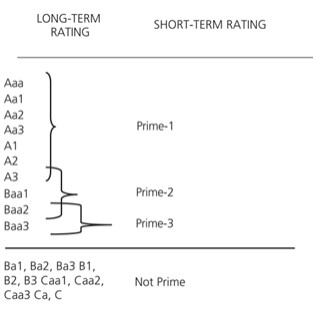
S&P GLOBAL RATINGS’ SHORT-TERM ISSUE CREDIT RATINGS
S&P Global Ratings’ short-term issue credit ratings are generally assigned to those obligations considered short-term in the relevant market,
typically with an original maturity of no more than 365 days. Short-term issue credit ratings are also used to indicate the creditworthiness of an obligor with respect to put features on long-term obligations. A long-term issue credit rating is
typically assigned to an obligation with an original maturity of greater than 365 days. Ratings are graded into several categories, ranging from ‘A’ for the highest-quality obligations to ‘D’ for the lowest. These categories
are as follows:
A-1: A short-term obligation rated ‘A-1’ is rated in the highest category by S&P Global Ratings. The
obligor’s capacity to meet its financial commitment on the obligation is strong. Within this category, certain obligations are designated with a plus sign (+). This indicates that the obligor’s capacity to meet its financial commitments
on these obligations is extremely strong.
A-2: A short-term obligation rated ‘A-2’ is somewhat more susceptible to the adverse effects
of changes in circumstances and economic conditions than obligations in higher rating categories. However, the obligor’s capacity to meet its financial commitments on the obligation is satisfactory.
A-3: A short-term obligation rated ‘A-3’ exhibits adequate protection parameters. However, adverse economic conditions or changing
circumstances are more likely to weaken an obligor’s capacity to meet its financial commitments on the obligation.
B: A short-term
obligation rated ‘B’ is regarded as vulnerable and has significant speculative characteristics. The obligor currently has the capacity to meet its financial commitments; however, it faces major ongoing uncertainties that could lead to
the obligor’s inadequate capacity to meet its financial commitments.
C: A short-term obligation rated ‘C’ is currently
vulnerable to nonpayment and is dependent upon favorable business, financial, and economic conditions for the obligor to meet its financial commitments on the obligation.
D: A short-term obligation rated ‘D’ is in default or in breach of an imputed promise. For non-hybrid capital instruments, the
‘D’ rating category is used when payments on an obligation are not made on the date due, unless S&P Global Ratings believes that such payments will be made within any stated grace period. However, any stated grace period longer than
five business days will be treated as five business days. The ‘D’ rating also will be used upon the filing of a bankruptcy petition or the taking of a similar action and where default on an obligation is a virtual certainty, for example
due to automatic stay provisions. A rating on an obligation is lowered to ‘D’ if it is subject to a distressed debt restructuring.
Dual
Ratings – Dual ratings may be assigned to debt issues that have a put option or demand feature. The first component of the rating addresses the likelihood of repayment of principal and interest as due, and the second component of the
rating addresses only the demand feature. The first component of the rating can relate to either a short-term or long-term transaction and accordingly use either short-term or long-term rating symbols. The second component of the rating relates to
the put option and is assigned a short-term rating symbol (for example, ‘AAA/A-1+’ or ‘A-1+/A-1’). With U.S. municipal short-term demand debt, the U.S. municipal short-term note rating symbols are used for the first component
of the rating (for example, ‘SP-1+/A-1+’).
FITCH’S SHORT-TERM ISSUER OR OBLIGATION RATINGS
A short-term issuer or obligation rating is based in all cases on the short-term vulnerability to default of the rated entity and relates to the capacity to
meet financial obligations in accordance with the documentation governing the relevant obligation. Short-term deposit ratings may be adjusted for loss severity. Short-term deposit ratings may be adjusted for loss severity. Short-Term Ratings are
assigned to obligations whose initial maturity is viewed as
A-4
“short term” based on market convention. Typically, this means up to 13 months for corporate,
sovereign, and structured obligations, and up to 36 months for obligations in U.S. public finance markets.
F1: Highest short-term credit quality.
Indicates the strongest intrinsic capacity for timely payment of financial commitments; may have an added (“+”) to denote any exceptionally strong credit feature.
F2: Good short-term credit quality. Good intrinsic capacity for timely payment of financial commitments.
F3: Fair short-term credit quality. The intrinsic capacity for timely payment of financial commitments is adequate.
B: Speculative short-term credit quality. Minimal capacity for timely payment of financial commitments, plus heightened vulnerability to near term
adverse changes in financial and economic conditions.
C: High short-term default risk. Default is a real possibility.
RD: Restricted default. Indicates an entity that has defaulted on one or more of its financial commitments, although it continues to meet other
financial obligations. Typically applicable to entity ratings only.
D: Default. Indicates a broad-based default event for an entity, or the
default of a short-term obligation.
TAX-EXEMPT NOTE RATINGS
MOODY’S U.S. MUNICIPAL SHORT-TERM DEBT RATINGS
While the global short-term ‘prime’ rating scale is applied to US municipal tax-exempt commercial A-8 paper, these programs are typically backed by
external letters of credit or liquidity facilities and their short-term prime ratings usually map to the long-term rating of the enhancing bank or financial institution and not to the municipality’s rating. Other short-term municipal
obligations, which generally have different funding sources for repayment, are rated using two additional short-term rating scales (i.e., the MIG and VMIG scale discussed below).
The Municipal Investment Grade (MIG) scale is used to rate US municipal bond anticipation notes of up to five years maturity. Municipal notes rated on the MIG
scale may be secured by either pledged revenues or proceeds of a take-out financing received prior to note maturity. MIG ratings expire at the maturity of the obligation, and the issuer’s long-term rating is only one consideration in assigning
the MIG rating. MIG ratings are divided into three levels—MIG 1 through MIG 3—while speculative grade short-term obligations are designated SG.
MIG 1: This designation denotes superior credit quality. Excellent protection is afforded by established cash flows, highly reliable liquidity support,
or demonstrated broad-based access to the market for refinancing.
MIG 2: This designation denotes strong credit quality. Margins of protection are
ample, although not as large as in the preceding group.
MIG 3: This designation denotes acceptable credit quality. Liquidity and cash-flow
protection may be narrow, and market access for refinancing is likely to be less well-established.
SG: This designation denotes speculative-grade
credit quality. Debt instruments in this category may lack sufficient margins of protection.
Variable Municipal Investment Grade (VMIG) ratings of demand
obligations with unconditional liquidity support are mapped from the short-term debt rating (or counterparty assessment) of the support provider, or the underlying obligor in the absence of third party liquidity support, with VMIG 1 corresponding to
P-1, VMIG 2 to P-2, VMIG 3 to P-3 and SG to not prime. For example, the VMIG rating for an industrial revenue bond with Company XYZ as the underlying obligor would normally have the same numerical modifier as Company XYZ’s prime rating.
Transitions of VMIG ratings of demand obligations with conditional liquidity support, as shown in the diagram below, differ from transitions on the Prime scale to reflect the risk that external liquidity support will terminate if the issuer’s
long-term rating drops below investment grade.
VMIG 1: This designation denotes superior credit quality. Excellent protection is afforded by the
superior short-term credit strength of the liquidity provider and structural and legal protections.
VMIG 2: This designation denotes strong credit
quality. Good protection is afforded by the strong short-term credit strength of the liquidity provider and structural and legal protections.
VMIG
3: This designation denotes acceptable credit quality. Adequate protection is afforded by the satisfactory short-term credit strength of the liquidity provider and structural and legal protections.
SG: This designation denotes speculative-grade credit quality. Demand features rated in this category may be supported by a liquidity provider that
does not have a sufficiently strong short-term rating or may lack the structural and/or legal protections.
A-5
| * |
For VRDBs supported with conditional liquidity support, short-term ratings transition down at higher
long-term ratings to reflect the risk of termination of liquidity support as a result of a downgrade below investment grade. |
VMIG
ratings of VRDBs with unconditional liquidity support reflect the short-term debt rating (or counterparty assessment) of the liquidity support provider with VMIG 1 corresponding to P-1, VMIG 2 to P-2, VMIG 3 to P-3 and SG to not prime.
For more complete discussion of these rating transitions, please see Annex B of Moody’s Methodology titled Variable Rate Instruments Supported by
Conditional Liquidity Facilities.
|
|
|
|
|
| US Municipal Short-Term Versus Long-Term
Ratings |
| NOTES |
|
LONG-TERM RATING |
|
DEMAND OBLIGATIONS WITH
CONDITIONAL LIQUIDITY
SUPPORT |
| MIG 1 |
|
Aaa
Aa1
Aa2
Aa3
A1
A2 |
|
VMIG 1 |
| MIG 2 |
|
A3 |
|
VMIG 2 |
| MIG 3 |
|
Baa1
Baa2
Baa3 |
|
VMIG 3*
SG |
| SG |
|
Ba1, Ba2, Ba3 B1,
B2, B3 Caa1, Caa2,
Caa3 Ca, C |
|
|
| * |
For SBPA-backed VRDBs, the rating transitions are higher to allow for distance to downgrade to below investment
grade due to the presence of automatic termination events in the SBPAs. |
S&P GLOBAL RATINGS’ MUNICIPAL SHORT-TERM NOTE
RATINGS
An S&P Global Ratings municipal note rating reflects S&P Global Ratings’ opinion about the liquidity factors and market
access risks unique to the notes. Notes due in three years or less will likely receive a note rating. Notes with an original maturity of more than three years will most likely receive a long-term debt rating. In determining which type of rating, if
any, to assign, S&P Global Ratings’ analysis will review the following considerations:
| |
• |
|
Amortization schedule – the larger the final maturity relative to other maturities, the more likely it will
be treated as a note; and |
| |
• |
|
Source of payment – the more dependent the issue is on the market for its refinancing, the more likely it
will be treated as a note. |
Note rating symbols are as follows:
SP-1:?Strong capacity to pay principal and interest. An issue determined to possess a very strong capacity to pay debt service is given a plus
(+) designation.
SP-2:?Satisfactory capacity to pay principal and interest, with some vulnerability to adverse financial and economic changes
over the term of the notes.
SP-3:?Speculative capacity to pay principal and interest.
D:?‘D’ is assigned upon failure to pay the note when due, completion of a distressed debt restructuring, or the filing of a bankruptcy
petition or the taking of similar action and where default on an obligation is a virtual certainty, for example due to automatic stay provisions.
FITCH PUBLIC FINANCE RATINGS
See FITCH SHORT-TERM
ISSUER OR OBLIGATIONS RATINGS above.
APPENDIX B – PROXY VOTING POLICIES AND PROCEDURES
The Trust Procedures and the proxy voting
procedures of the Advisor and the subadvisors are set forth in Appendix B.
A-6
Overview
The SEC adopted Rule 206(4)-6 under the Advisers Act, which requires investment advisers with voting authority to adopt
and implement written policies and procedures that are reasonably designed to ensure that the investment adviser votes client securities in the best interest of clients. The procedures must include how the investment adviser addresses material
conflicts that may arise between the interests of the investment adviser and those of its clients. The Advisers are registered investment advisers under the Advisers Act and serve as the investment advisers to the John Hancock Funds. The Advisers
generally retain one or more sub-advisers to manage the assets of the Funds, including voting proxies with respect to a Fund’s portfolio securities. From time to time, however, the Advisers may elect to
manage directly the assets of a Fund, including voting proxies with respect to such Fund’s portfolio securities, or a Fund’s Board may otherwise delegate to the Advisers authority to vote such proxies. John Hancock Investment Management
LLC (“JHIM”) also provides discretionary and non-discretionary advice to clients using model portfolios in a variety of investment styles (“Model Portfolios”). However, JHIM does not
vote proxies for securities held in any non-discretionary accounts managed using the Model Portfolios. Rule 206(4)-6 under the Advisers Act requires that a registered
investment adviser adopt and implement written policies and procedures reasonably designed to ensure that it votes proxies with respect to a client’s securities in the best interest of the client.
Firms are required by Advisers Act Rule 204-2(c)(2) to maintain records of their voting policies and procedures, a
copy of each proxy statement that the investment adviser receives regarding client securities, a record of each vote cast by the investment adviser on behalf of a client, a copy of any document created by the investment adviser that was material to
making a decision how to vote proxies on behalf of a client, and a copy of each written client request for information on how the adviser voted proxies on behalf of the client, as well as a copy of any written response by the investment adviser to
any written or oral client request for information on how the adviser voted that client’s proxies.
Investment companies must disclose information
about the policies and procedures used to vote proxies on the investment company’s portfolio securities and must file the fund’s entire proxy voting record with the SEC annually on Form N-PX.
Advisers that are subject to the reporting requirements of Section 13(f) of the Securities Exchange Act of 1934 (the “Exchange Act”) are
required by Exchange Act Rule 14Ad-1 to file Form N-PX annually to report how they voted proxies regarding certain executive compensation matters (known as “say-on-pay” matters). However, an Adviser that has a disclosed policy of not voting proxies, and that did not in fact vote during the reporting period, must only
complete a notice report filing on Form N-PX marking the appropriate box on the cover page to confirm these facts.
Pursuant thereto, the Advisers have adopted and implemented these proxy voting policies and procedures (the “Proxy Procedures”).
Policy
It is the Advisers’ policy to comply with
Rule 206(4)-6 and Rule 204-2(c)(2) under the Advisers Act and Rule 14Ad-1 under the Exchange Act as described above. The
Advisers’ policy is to vote proxies in the best interests of its clients for whom it has proxy voting authority. In general, the Advisers delegate proxy voting decisions to the sub-advisers managing the
funds. If an instance occurs where a conflict of interest arises between the shareholders and a particular sub-adviser, however, the Adviser retains the right to influence and/or direct the conflicting proxy
voting decisions. The Advisers’ Proxy Voting Committee oversees the resolution of proxy voting conflicts for its clients and fund shareholders.
Filing of Proxy Voting Record on Form N-PX
The Advisers will annually file their proxy voting notice report with the SEC on Form N-PX. Form N-PX shall be filed for the twelve months ended June 30th and no later than August 31st of that year.
Regulatory Requirement
Rule 206(4)-6 under the Advisers Act and Rule 14Ad-1 under the Exchange Act
Reporting
Advisers will provide the John Hancock Funds
Board with notice and a copy of any amendments or revisions to the Procedures and will report quarterly to the Funds Board all material changes to these Proxy Procedures.
The CCO’s annual written compliance report to the Funds Board will contain a summary of material changes to the Proxy Procedures during the period
covered by the report.
If the Advisers or the Designated Person vote any proxies for the Funds in a manner inconsistent with either these Proxy
Procedures or a Fund’s proxy voting policies and procedures, the CCO will provide the Funds Board with a report detailing such exceptions.
If the
Advisers or the Designated Person vote any proxies for clients other than the Funds in a manner inconsistent with these Proxy Voting Procedures, the Adviser will provide its Board of Directors with a report detailing such exceptions.
JHIM will not intentionally disclose to anyone else, including other investors and/or officers and directors of an issuer in which an Advisers’ clients
invest, our voting intention prior to casting the vote.
JHIM engages a third-party proxy voting vendor to keep records of proxy voting available for
inspection by Separately Managed Account (“SMA”) sponsor clients, regulatory authorities, or government agencies.
Procedure
Fiduciary Duty
The Advisers have a fiduciary duty to vote
proxies in the best interest of its clients, the Funds and its shareholders.
Voting of Proxies – Advisers of Funds
The Advisers will vote proxies with respect to a Fund’s portfolio securities when authorized to do so by the Fund and subject to the Fund’s proxy
voting policies and procedures and any further direction or delegation of authority by the Fund’s Board. The decision on how to vote a proxy will be made by the person(s) to whom the Advisers have from time to time delegated such
responsibility (the “Designated Person”). The Designated Person may include the Fund’s portfolio manager(s) or a Proxy Voting Committee, as described below.
When voting proxies with respect to a Fund’s portfolio securities, the following standards will apply:
| |
• |
|
The Designated Person will vote based on what it believes is in the best interest of the Fund and its
shareholders and in accordance with the Fund’s investment guidelines. |
| |
• |
|
Each voting decision will be made independently. To assist with the analysis of voting issues and/or to carry out
the actual voting process the Designated Person may enlist the services of (1) reputable professionals (who may include persons employed by or otherwise associated with the Advisers or any of its affiliated persons) or (2) independent
proxy evaluation services such as Institutional Shareholder Services. However, the ultimate decision as to how to vote a proxy will remain the responsibility of the Designated Person. |
| |
• |
|
The Advisers believe that a good management team of a company will generally act in the best interests of the
company. Therefore, the Designated Person will take into consideration as a key factor in voting proxies with respect to securities of a company that are held by the Fund the quality of the company’s management. In general, the Designated
Person will vote as recommended by company management except in situations where the Designated Person believes such recommended vote is not in the best interests of the Fund and its shareholders. |
| |
• |
|
As a general principle, voting with respect to the same portfolio securities held by more than one Fund should be
consistent among those Funds having substantially the same investment mandates. |
| |
• |
|
The Advisers will provide the Fund, from time to time in accordance with the Fund’s proxy voting policies
and procedures and any applicable laws and regulations, a record of the Advisers’ voting of proxies with respect to the Fund’s portfolio securities. |
Voting Proxies of Underlying Funds of a Fund of Funds
The Advisers or the Designated Person will vote proxies with respect to the shares of a Fund that are held by another Fund that operates as a Fund of
Funds”) in the manner provided in the proxy voting policies and procedures of the Fund of Funds (including such policies and procedures relating to material conflicts of interest) or as otherwise directed by the board of trustees or directors
of the Fund of Funds.
Voting of Proxies – SubAdvisers of Funds
In the case of proxies voted by a sub-adviser to a Fund pursuant to the Fund’s proxy voting procedures, the
Advisers will request the sub-adviser to certify to the Advisers that the sub-adviser has voted the Fund’s proxies as required by the Fund’s proxy voting
policies and procedures and that such proxy votes were executed in a manner consistent with these Proxy Procedures and to provide the Advisers with a report detailing any instances where the sub-adviser voted
any proxies in a manner inconsistent with the Fund’s proxy voting policies and procedures. The CCO of the Advisers will then report to the Board on a quarterly basis regarding the sub-adviser
certification and report to the Board any instance where the sub-adviser voted any proxies in a manner inconsistent with the Fund’s proxy voting policies and procedures.
The Fund Administration Department maintains procedures affecting all administration functions for the mutual funds. These procedures detail the disclosure
and administration of the Trust’s proxy voting records.
The Trust’s Chief Legal Counsel is responsible for including, in the SAI of
each Trust, information about the proxy voting of the Advisers and each sub-adviser.
Voting Proxies of Model
Portfolio Clients
When Model Portfolio clients have granted JHIM authority to vote securities in their account, we will vote in accordance with the
following procedures. JHIM has deployed the services of a proxy voting services provider to ensure the timely casting of votes, and to provide relevant and timely proxy voting research to inform our voting decisions. Through this process, the proxy
voting services provider populates initial recommended voting decisions that are aligned with the JHIM voting principles. These voting recommendations are then submitted, processed, and ultimately tabulated.
JHIM retains the authority and operational functionality to submit different voting instructions after these
initial recommendations from the proxy voting services provider have been submitted, based on JHIM’s assessment of each situation. As JHIM reviews voting recommendations and decisions, as articulated below, JHIM has the ability to change
voting instructions based on those reviews. JHIM periodically reviews the detailed policies created by the proxy voting service provider to ensure consistency with our voting principles, to the extent this is possible.
JHIM also has an internal proxy voting committee (“committee”) comprising senior managers from across JHIM. The committee meets on an as-needed basis to review, discuss, and provide prior written approval in instances where JHIM intends to cast a vote that is different than the recommendation of the proxy voting services provider or for
“refer” items, which are items where the proxy voting service provider does not have a vote recommendation. These two instances are outlined in greater detail below.
JHIM may also engage with model providers as it pertains to votes being made related to securities held in strategies offered in partnership with each
respective model provider. JHIM may elect to do this so as to incorporate as much information into JHIM’s ultimate decision-making.
JHIM may
refrain from voting a proxy where we have agreed with a client in advance to limit the situations in which we will execute votes. JHIM may also refrain from voting due to logistical considerations that may have a detrimental effect on our ability to
vote. These issues may include, but are not limited to:
| |
• |
|
Costs associated with voting the proxy exceed the expected benefits to clients; |
| |
• |
|
Underlying securities have been lent out pursuant to a client’s securities lending program and have not
been subject to recall; |
| |
• |
|
Short notice of a shareholder meeting; |
| |
• |
|
Requirements to vote proxies in person; |
| |
• |
|
Restrictions on a nonnational’s ability to exercise votes, determined by local market regulation;
|
| |
• |
|
Restrictions on the sale of securities in proximity to the shareholder meeting (i.e., share blocking);
|
| |
• |
|
Requirements to provide local agents with power of attorney to facilitate the voting instructions (such proxies
are voted on a best-efforts basis); or |
| |
• |
|
The inability of a client’s custodian to forward and process proxies electronically. |
As noted, if JHIM believes it is in their best interest or the best interest of a client to vote proxies in a manner inconsistent with the policy, they will
submit new voting instructions to the Proxy Voting Committee in writing with rationale for the new instructions. The Committee will review the change and ensure that the rationale is sound. JHIM will execute the votes accordingly.
Additionally, on occasion, there may be proxy votes that are not within the research and recommendation coverage universe of the proxy voting service
provider. JHIM employees responsible for the proxy votes will provide voting recommendations to the Proxy Voting Committee, and those items may be escalated to the Committee for review to ensure that the voting decision rationale is sound. JHIM will
execute the votes accordingly.
Engagement of the proxy voting service provider
JHIM has contracted with a third-party proxy service provider to assist with the proxy voting process for it Model Portfolio clients. JHIM will instruct
custodians of SMA sponsor client accounts to forward all proxy statements and materials received in respect of SMA sponsor client accounts to the proxy service provider.
JHIM has engaged its proxy voting service provider to:
| |
• |
|
Research and make voting recommendations; |
| |
• |
|
Ensure proxies are voted and submitted in a timely manner; |
| |
• |
|
Provide alerts when issuers file additional materials related to proxy voting matters; |
| |
• |
|
Perform other administrative functions of proxy voting; |
| |
• |
|
Maintain records of proxy statements and provide copies of such proxy statements promptly upon request;
|
| |
• |
|
Maintain records of votes cast; and |
| |
• |
|
Provide recommendations with respect to proxy voting matters in general. |
Material Conflicts of Interest
In carrying out its proxy
voting responsibilities, the Advisers will monitor and resolve potential material conflicts (“Material Conflicts”) between the interests of (a) a Fund or client and (b) the Advisers or any of its affiliated persons. Affiliates
of the Advisers include Manulife Financial Corporation and its subsidiaries. Material Conflicts may arise, for example, if a proxy vote relates to matters involving any of these companies or other issuers in which the Advisers or any of their
affiliates has a substantial equity or other interest. JHIM shall consider any of the following circumstances a potential material conflict of interest:
| |
• |
|
JHIM has a business relationship or potential relationship with the issuer; or |
| |
• |
|
John Hancock Fund Trustee has a business relationship with the issuer. |
In instances where a material conflict of interest has been identified, JHIM will process the proxy vote as a “Do Not Vote” in an effort to
mitigate the conflict.
Proxy Voting Committee(s)
The Advisers will from time to time, and on such temporary or longer-term basis as they deem appropriate, establish one or more Proxy Voting Committees. A
Proxy Voting Committee shall include the Advisers’ CCO and may include legal counsel. The terms of reference and the procedures under which a Proxy Voting Committee will operate will be reviewed from time to time by the Legal and Compliance
Department. Records of the deliberations and proxy voting recommendations of a Proxy Voting Committee will be maintained in accordance with applicable law, if any, and these Proxy Procedures.
Proxy voting service provider oversight
The Adviser is
responsible for the proper oversight of any service providers hired to assist it in the proxy voting process. This oversight includes:
Annual due
diligence: The Adviser’s Vendor Management and Product Management teams conduct an annual due diligence review of the proxy voting research service provider. This oversight includes an evaluation of the service provider’s industry
reputation, points of risk, compliance with laws and regulations, and technology infrastructure. JHIM also reviews the provider’s capabilities to meet JHIM’s requirements, including reporting competencies; the adequacy and quality of the
proxy advisory firm’s staffing and personnel; the quality and accuracy of sources of data and information; the strength of policies and procedures that enable it to make proxy voting recommendations based on current and accurate information;
and the strength of policies and procedures to address conflicts of interest of the service provider related to its voting recommendations. Observations and findings of note are shared with the Proxy Voting Committee and JHIM will engage ISS
directly to address or resolve any areas of concern.
Regular Updates: JHIM also requests that the proxy voting research service provider deliver
updates regarding any business changes that alter that firm’s ability to provide independent proxy voting advice and services aligned with our policies.
Additional oversight in process: JHIM has additional control mechanisms built into the proxy
voting process to act as checks on the service provider and ensure that decisions are made in the best interest of our clients. These mechanisms include:
| |
• |
|
Sampling prepopulated votes: Where we use a third-party research provider for either voting
recommendations or voting execution (or both), we may assess prepopulated votes shown on the vendor’s electronic voting platform to ensure alignment with the voting principles. |
| |
• |
|
Decision scrutiny from the Proxy Voting Committee: Where our voting policies and procedures do not address
how to vote on a particular matter, or where the matter is highly contested or controversial (e.g.,proxy contests, “just vote no” campaigns, or in conflict of interest matters), review by the Proxy Voting Committee is necessary to ensure
votes cast on behalf of its client are cast in the client’s best interest. |
Key Contacts
Global Manager Research
Proxy Voting Committee
Escalation/Reporting Violations
All John Hancock
employees are required to report any known or suspected violation of this policy to the CCO of the Funds.
Related Policies and Procedures
Trust Proxy Voting Policy
Document Retention Requirements
The Advisers will retain (or arrange for the retention by a third party of) such records relating to proxy voting pursuant to these Proxy Procedures
as may be required from time to time by applicable law and regulations, including the following:
| |
1. |
These Proxy Procedures and all amendments hereto; |
| |
2. |
All proxy statements received regarding a SMA Sponsor or Fund portfolio securities; |
| |
3. |
Records of all votes cast on behalf of a Fund or SMA Sponsor; |
| |
4. |
Records of all Fund or SMA Sponsor requests for proxy voting information, including any written response by the
Adviser to any (written or oral) Fund or SMA Sponsor for information on how the Adviser voted proxies on behalf of the requesting Fund or SMA Sponsor; |
| |
5. |
Any documents prepared by the Designated Person or a Proxy Voting Committee that were material to or
memorialized the basis for a voting decision; |
| |
6. |
All records relating to communications with the Funds or SMA Sponsors regarding Conflicts; and
|
| |
7. |
All minutes of meetings of Proxy Voting Committees. |
Documents will be maintained for the period set forth in the Records Retention Schedule. See Compliance Policy: Books and Records.
|
|
|
|
|
| Version History |
| Date |
|
Effective Date |
|
Approving Party |
| 1 |
|
01-01-2012 |
|
|
| 2 |
|
02-01-2015 |
|
|
| 3 |
|
Sept. 2015 |
|
|
| 4 |
|
05-01-2017 |
|
|
| 5 |
|
12-01-2019 |
|
|
| 6 |
|
08-20-2024 |
|
CCO |
| 7 |
|
06-30-2025 |
|
Proxy Voting Committee |
| 8 |
|
01-08-2026 |
|
Proxy Voting Committee |

07H: Proxy Voting Procedures-TO
General Compliance Policies for Funds & Advisers
Section 7: Disclosures, Filings, and Reporting
|
|
|
| Applies to |
|
Funds |
| Risk Theme |
|
Proxy Voting |
| Policy Owner |
|
Jim Interrante |
| Effective Date |
|
08-27-2024 |
07H. Proxy Voting Procedures
Overview
The Funds are required to disclose their proxy voting policies and procedures in their registration statements and, pursuant
to Rule 30b1-4 under the 1940 Act, file annually with the Securities and Exchange Commission and make available to shareholders its actual proxy voting record.
Investment Company Act
An investment company is required to disclose in its SAI, or private placement memorandum, as applicable, either (a) a
summary of the policies and procedures that it uses to determine how to vote proxies relating to portfolio securities or (b) a copy of its proxy voting policies.
The Funds are also required by Rule 30b1-4 of the Investment Company Act of 1940 to
file Form N-PX annually with the SEC, which contains a record of how the Funds voted proxies relating to portfolio securities. For each matter relating to a portfolio security considered at any shareholder
meeting, Form N-PX is required to include, among other information, the name of the issuer of the security, a brief identification of the matter voted on, whether and how the Funds cast their votes, and
whether such votes were for or against management. In addition, the Funds are required to disclose in their SAIs, or private placement memoranda, as applicable, and their annual and semi-annual reports to shareholders that such voting record may be
obtained by shareholders, either by calling a toll-free number through the Funds’ website, or on the Securities and Exchange Commission’s website at www.sec.gov.
Advisers Act
Under Advisers Act Rule 206(4)-6, investment advisers are required
to adopt proxy voting policies and procedures, and investment companies typically rely on the policies of their advisers or sub-advisers.
Policy
The majority of the Independent Boards of Trustees (the “Boards”) of the Funds, have adopted these proxy voting
policies and procedures (the “Fund Proxy Policy”).
It is the Advisers’ policy to comply with Rule 206(4)-6 of the Advisers Act and Rule 30b1-4 of the 1940 Act as described above. In general, the Advisers defer proxy voting decisions to the applicable Sub-adviser(s). It is the policy of the Funds to delegate the responsibility for voting proxies to its Adviser or, if the applicable Fund’s Adviser has delegated portfolio management responsibilities to the Sub-adviser, to the Sub-adviser, subject to the Board’s continued oversight. The Sub-advisers shall vote all proxies relating to
securities held by the applicable Fund and, in that connection, and subject to any further policies and procedures contained herein, shall use proxy voting policies and procedures adopted by the Sub-advisers
in conformance with Rule 206(4)-6 under the Advisers Act.
If an instance occurs
where a conflict of interest arises between the shareholders and the applicable Sub-adviser, however, the Advisers retain the right to influence and/or direct the conflicting proxy voting decisions in the best
interest of shareholders.
Delegation of Proxy Voting Responsibilities
It is the policy of the Funds to delegate the responsibility for voting proxies relating to portfolio
securities held by the applicable Fund to its Adviser or, if its Adviser has delegated portfolio management responsibilities to the applicable Sub-adviser, to the
Sub-adviser, subject to the applicable Board’s continued oversight. The relevant Sub-adviser shall vote all proxies relating to securities held by the applicable
Fund and in that connection, and subject to any further policies and procedures contained herein, shall use proxy voting policies and procedures adopted by the relevant Sub-adviser in conformance with Rule 206(4)-6 under the Investment Advisers Act of 1940, as amended (the “Advisers Act”).
Except as noted below under Material Conflicts of Interest, the Fund Proxy Policy shall incorporate that
adopted by the Sub-advisers with respect to voting proxies held by its clients (the “Sub-adviser Proxy Policy”). The
Sub-adviser Proxy Policy, as it may be amended from time to time, is hereby incorporated by reference into the Fund Proxy Policy. The Sub-advisers are directed to comply
with these policies and procedures in voting proxies relating to portfolio securities held by the Funds, subject to oversight by the Advisers and by the Boards. The Advisers retain the responsibility, and are directed, to oversee the applicable Sub-adviser’s compliance with these policies and procedures, and to adopt and implement such additional policies and procedures as it deems necessary or appropriate to discharge its oversight responsibility.
Additionally, the Fund’s Chief Compliance Officer (“CCO”) shall conduct such monitoring and supervisory activities as the CCO or the Boards deem necessary or appropriate in order to appropriately discharge the CCO’s role in
overseeing the Sub-advisers’ compliance with these policies and procedures.
The delegation by the Boards of the authority to vote proxies relating to portfolio securities of the Funds is entirely
voluntary and may be revoked by the Boards, in whole or in part, at any time.
Voting Proxies of Underlying Funds of a Fund of Funds
| |
A. |
Where the Fund of Funds is not the Sole Shareholder of the Underlying Fund |
With respect to voting proxies relating to the shares of an underlying fund (an “Underlying Fund”) held by a Fund operating as a fund
of funds (a “Fund of Funds”) in reliance on Section 12(d)(1)(G) of the 1940 Act where the Underlying Fund has shareholders other than the Fund of Funds which are not other Fund of Funds, the Fund of Funds will vote proxies relating to
shares of the Underlying Fund in the same proportion as the vote of all other holders of such Underlying Fund shares.
| |
B. |
Where the Fund of Funds is the Sole Shareholder of the Underlying Fund |
In the event that one or more Funds of Funds are the sole shareholders of an Underlying Fund, the Adviser(s) to the Fund of Funds will vote
proxies relating to the shares of the Underlying Fund as set forth below unless the applicable Board elects to have the Fund of Funds seek voting instructions from the shareholders of the Funds of Funds in which case the Fund of Funds will vote
proxies relating to shares of the Underlying Fund in the same proportion as the instructions timely received from such shareholders.
| |
1. |
Where Both the Underlying Fund and the Fund of Funds are Voting on Substantially Identical Proposals
|
In the event that the Underlying Fund and the Fund of Funds are voting on substantially identical
proposals (the “Substantially Identical Proposal”), then the Adviser(s) or the Fund of Funds will vote proxies relating to shares of the Underlying Fund in the same proportion as the vote of the shareholders of the Fund of Funds on the
Substantially Identical Proposal.
| |
2. |
Where the Underlying Fund is Voting on a Proposal that is Not Being Voted on by the Fund of Funds
|
| |
(a) |
Where there is No Material Conflict of Interest Between the Interests of the Shareholders of the Underlying
Fund and the Adviser(s) Relating to the Proposal |
In the event that the Fund of Funds is voting on
a proposal of the Underlying Fund and the Fund of Funds is not also voting on a substantially identical proposal and there is no material conflict of interest between the interests of the shareholders of the Underlying Fund and the Adviser(s)
relating to the Proposal, then the Adviser(s) will vote proxies relating to the shares of the Underlying Fund pursuant to its Proxy Voting Procedures.
| |
(b) |
Where there is a Material Conflict of Interest Between the Interests of the Shareholders of the Underlying
Fund and the Adviser(s) Relating to the Proposal |
07H. Proxy Voting Procedures
In the event that the Fund of Funds is voting on a proposal of the Underlying Fund and the Fund of Funds is
not also voting on a substantially identical proposal and there is a material conflict of interest between the interests of the shareholders of the Underlying Fund and the Adviser(s) relating to the Proposal, then the Fund of Funds will seek voting
instructions from the shareholders of the Fund of Funds on the proposal and will vote proxies relating to shares of the Underlying Fund in the same proportion as the instructions timely received from such shareholders. A material conflict is
generally defined as a proposal involving a matter in which the Adviser(s) or one of its affiliates has a material economic interest.
Material Conflicts of Interest
If (1) the Sub-advisers become aware that a vote presents a material conflict
between the interests of (a) shareholders of the applicable Fund; and (b) the applicable Fund’s Adviser, Sub-adviser, principal underwriter, or any of their affiliated persons, and (2) the
applicable Sub-adviser does not propose to vote on the particular issue in the manner prescribed by its Sub-adviser Proxy Policy or the material conflict of interest
procedures set forth in its Sub-adviser Proxy Policy are otherwise triggered, then the relevant Sub-adviser will follow the material conflict of interest procedures set
forth in its Sub-adviser Proxy Policy when voting such proxies.
If the Sub-adviser Proxy Policy provides that in the case of a material conflict of interest between shareholders of the Funds and another party, the applicable Sub-adviser will ask
the relevant Board to provide voting instructions, the said Sub-adviser shall vote the proxies, in its discretion, as recommended by an independent third party, in the manner prescribed by its applicable Sub-adviser Proxy Policy or abstain from voting the proxies.
Proxy Voting Committee(s)
The Advisers will from time to time, and on such temporary or longer-term basis as they deem appropriate, establish one or
more Proxy Voting Committees. A Proxy Voting Committee shall include the Advisers’ CCO and may include legal counsel. The terms of reference and the procedures under which a Proxy Voting Committee will operate will be reviewed from time to time
by the Legal and Compliance Department. Records of the deliberations and proxy voting recommendations of a Proxy Voting Committee will be maintained in accordance with applicable law, if any, and these Proxy Procedures. Requested shareholder
proposals or other Shareholder Advocacy in the name of the Funds must be submitted for consideration pursuant to the Shareholder Advocacy Policy and Procedures.
Disclosure of Proxy Voting Policies and Procedures in the Funds’ Statement of Additional Information
(“SAI”) or Private Placement Memoranda, as applicable
The Funds shall include in their SAIs, or private
placement memoranda, as applicable, a summary of the Fund Proxy Policy and of the applicable Sub-adviser Proxy Policy included therein. (In lieu of including a summary of these policies and procedures, the
Funds may include each full Fund Proxy Policy and Sub-adviser Proxy Policy in their SAIs, or private placement memoranda, as applicable.)
Disclosure of Proxy Voting Policies and Procedures in Annual and Semi-Annual Shareholder Reports
The Funds shall disclose in annual and semi-annual shareholder reports that a description of the Fund Proxy Policy, including
the Sub-adviser Proxy Policy, and the applicable Fund’s proxy voting record for the most recent 12 months are available on the Securities and Exchange Commission’s (“SEC”) website, and
without charge, upon request, by calling a specified toll-free telephone number. The Funds will send these documents within three business days of receipt of a request, by first-class mail or other means designed to ensure equally prompt delivery.
The Fund Administration Department is responsible for preparing appropriate disclosure regarding proxy voting for inclusion in shareholder reports and distributing reports. The Legal Department supporting the Funds is responsible for reviewing such
disclosure once it is prepared by the Fund Administration Department.
Filing of Proxy Voting Record on Form N-PX
The Funds will annually file their complete proxy voting record with the SEC
on Form N-PX. The Form N-PX shall be filed for the most recent twelve months of that year. The Fund Administration department, supported by the Legal Department
supporting the Funds, is responsible for the annual filing.
Regulatory Requirement
Rule 206(4)-6 of the Advisers Act and Rule 30b1-4 of the 1940 Act
Reporting
Disclosures in SAI or Private Placement Memorandum, as applicable: The Funds shall disclose in annual and semi-annual
shareholder reports that a description of the Fund Proxy Policy, including the Sub-adviser Proxy Policy, and the Fund’s proxy voting record for the most recent 12 months.
Form N-PX: The proxy voting service will file Form N-PX for each twelve-month period.
Procedure
Review of Sub-advisers’ Proxy Voting
The Funds have delegated proxy voting authority with respect to the applicable Fund portfolio securities in accordance with
the Fund Proxy Policy, as set forth above.
Consistent with this delegation, the relevant
Sub-adviser is responsible for the following:
| |
1. |
Implementing written policies and procedures, in compliance with Rule
206(4)-6 under the Advisers Act, reasonably designed to ensure that the Sub-adviser votes portfolio securities in the best interest of shareholders of the Funds.
|
|
| |
2. |
Providing the applicable Adviser with a copy and description of the
Sub-adviser Proxy Policy prior to being approved by the relevant Board as the Sub-adviser, accompanied by a certification that represents that the Sub-adviser Proxy Policy has been adopted in conformance with Rule 206(4)-6 under the Advisers Act. Thereafter, providing the Adviser with notice of any amendment or revision
to that Sub-adviser Proxy Policy or with a description thereof. The applicable Adviser is required to report all material changes to a Sub-adviser Proxy Policy quarterly to the relevant Board. The CCO’s
annual written compliance report to said Board will contain a summary of the material changes to the applicable Sub-adviser Proxy Policy during the period covered by the report. |
|
| |
3. |
Providing the relevant Adviser with a quarterly certification indicating that the applicable Sub-adviser did vote proxies of the relevant Fund and that the proxy votes were executed in a manner consistent with the Sub-adviser Proxy Policy. If the said Sub-adviser voted any proxies in a manner inconsistent with the Sub-adviser Proxy Policy, it will provide the relevant Adviser with a report detailing the exceptions.
|
|
Adviser Responsibilities
The Funds have retained a proxy voting service to coordinate, collect, and maintain all proxy-related information, and to
prepare and file the Funds’ reports on Form N-PX with the SEC.
The
Advisers, in accordance with their general oversight responsibilities, will periodically review the voting records maintained by the proxy voting service in accordance with the following procedures:
| |
1. |
Receive a file with the proxy voting information directly from the applicable
Sub-adviser on a quarterly basis. |
|
| |
2. |
Select a sample of proxy votes from the files submitted by said
Sub-adviser and compare them against the proxy voting service files for accuracy of the votes. |
|
| |
3. |
Deliver instructions to shareholders on how to access proxy voting information via the applicable Fund’s
semi-annual and annual shareholder reports. |
|
The Fund Administration Department, in conjunction with the Legal Department
supporting the Funds, is responsible for the foregoing procedures.
Proxy Voting Service Responsibilities
Proxy voting services retained by the Funds are required to undertake the following procedures:
07H. Proxy Voting Procedures
The proxy voting service’s proxy disclosure system will collect Fund-specific and/or account-level
voting records, including votes cast by multiple sub-advisers or third-party voting services.
The proxy voting service’s proxy disclosure system will provide the following reporting features:
| |
1. |
multiple report export options; |
| |
2. |
report customization by fund-account, portfolio manager, security, etc.; and |
| |
3. |
account details available for vote auditing. |
| |
• |
|
Form N-PX Preparation and Filing: |
The Advisers will be responsible for oversight and completion of the filing of the Funds’ reports on Form N-PX with the SEC. The proxy voting service will prepare the EDGAR version of Form N-PX and will submit it to the Advisers for review and approval prior to filing with the
SEC. The proxy voting service will file Form N-PX for each twelve-month period The Fund Administration Department, in conjunction with the Legal Department supporting the Funds, is responsible for the
foregoing procedures.
The Fund Administration Department in conjunction with the CCO oversees compliance with this
policy.
The Fund Administration Department maintains operating procedures affecting the administration and disclosure of
the Funds’ proxy voting records.
The Fund’s Chief Legal Counsel is responsible for
including in the Funds’ SAIs, or private placement memoranda, as applicable, information regarding the proxy voting policies as required by applicable rules and form requirements.
Key Contacts
Investment Compliance
Escalation/Reporting Violations
All John Hancock employees are required to report any known or suspected violation of this policy to the
CCO of the Funds.
Related Policies and Procedures
07B Registration Statements and Prospectuses
Document Retention Requirements
The Fund Administration Department and the CCO’s Office is responsible for maintaining all
documentation created in connection with this policy. Documents will be maintained for the period set forth in the Records Retention Schedule. See Compliance Policy: Books and Records.
|
|
|
|
|
| Version History |
| Date |
|
Effective Date |
|
Approving Party |
| 1 |
|
06-15-2022 |
|
Board |
| 2 |
|
07-24-2023 |
|
Board |
| 3 |
|
08-27-2024 |
|
CCO |
MARATHON ASSET MANAGEMENT, L.P.
PROXY VOTING POLICIES AND PROCEDURES
December 2021
Policy Statement
These procedures apply to all
Funds and other Client accounts for which the Adviser is responsible for voting proxies, including all limited partnerships, limited liability companies, Managed Accounts and other accounts for which it acts as investment adviser. From time to time,
the Adviser is asked to vote on or otherwise consent to certain actions on behalf of a Client as holder of such investments. It is the Adviser’s general policy not to vote proxies for securities that are not held in a Client’s account at
the time such proxy is received or on the vote date of such proxy. The Adviser will determine whether a proposal is in the best interests of its Clients and may take into account the following factors, among others: (i) whether the proposal was
recommended by management and the Adviser’s opinion of management; (ii) whether the proposal acts to entrench existing management; and (iii) whether the proposal fairly compensates management for past and future performance.
This policy provides a framework for analysis and decision making, but does not address all potential issues. In voting proxies, the Adviser is guided by
general fiduciary principles. The Adviser’s goal is to act prudently, solely in the best interest of the beneficial owners of the accounts it manages. The Adviser attempts to consider all aspects of its vote that could affect the value of the
investment; and where the Adviser votes proxies, it will do so in the manner that it believes will be consistent with efforts to maximize shareholder values.
Voting of Proxies
Proxy material is promptly reviewed to
evaluate the issues presented. Regularly recurring matters are usually voted as recommended by the issuer’s board of directors or “management,” but there are many circumstances that might cause the Adviser to vote against such
proposals. These might include, among others, excessive compensation, unusual management stock options, preferential voting or “poison pills.” The Adviser will decide these issues on a case-by-case basis.
The Adviser may determine to abstain from voting a proxy or a specific proxy item when it
concludes that the potential benefit of voting is outweighed by the cost, when the Adviser does not receive a solicitation or enough information within a sufficient time prior to the proxy-voting deadline, or when it is not in the Client
account’s best interest to vote. The Adviser shall cast ballots in a manner it believes to be consistent with the interests of the Fund or Client account and shall not subordinate Client interests to its own. When a Client has authorized the
Adviser to vote proxies on its behalf, the Adviser will generally not accept instructions from the Client regarding how to vote proxies. If the Adviser exercises voting authority with respect to Client securities, the Adviser is required to adopt
and implement written policies and procedures that are reasonably designed to ensure that the Adviser votes Client securities in a manner consistent with the best interests of such Client. (Rule 206(4)-6).
In certain situations, a Client’s investment strategy can impact voting determinations. For example, the Adviser may consider social issues when
voting proxies for socially screened accounts and consider environmental issues when voting proxies for sustainability screened portfolios and accounts. The Adviser may also take social or environmental issues into account when voting proxies for
portfolios and accounts that do not have social or sustainability screens if the Adviser believes that doing so is in the best interest of the relevant Client(s) and otherwise consistent with the Client’s best interest, applicable laws, and the
Advisers’ duties, such as where material environmental or social risks may have economic ramifications for shareholders.
Proxy Advisory Firms
The Adviser does not currently rely on proxy advisory firms when voting proxies. To the extent that the Adviser engages one or more proxy advisory
firms in the future, it will implement policies regarding the engagement and review of such firms, including with respect to the identification and mitigation of conflicts.
Conflicts of Interest
In furtherance of the Adviser’s goal to vote proxies in the best interests of Clients, the Adviser follows procedures designed to identify and address
material conflicts that may arise between the Adviser’s interests and those of its Clients before voting proxies on behalf of such Clients.
Procedures for Identifying Conflicts of Interest.
The Adviser relies on the following to seek to identify conflicts of interest with respect to proxy voting:
| |
• |
|
The Adviser shall monitor the potential for conflicts of interest on the part of the Adviser with respect to
voting proxies on behalf of Client accounts as a result of personal relationships, significant Client relationships (those accounting for greater than 5% of annual revenues) or special circumstances that may arise during the conduct of the
Adviser’s business. |
| |
• |
|
If the Adviser has a conflict of interest in voting proxies on behalf of Client accounts in respect of a specific
issuer, the Compliance Officer or her designee shall maintain an up to date list of such issuers. The Adviser shall not vote proxies relating to issuers on such list on behalf of Client accounts until it has been determined that the conflict of
interest is not material or a method for resolving such conflict of interest has been agreed upon and implemented, as described below. |
Procedures for Assessing Materiality of Conflicts of Interest and for Addressing Material Conflicts of Interest.
The Compliance Officer or her designee will determine whether a conflict of interest is material. A conflict of interest will be considered material to the
extent that it is determined that such conflict has the potential to influence the Adviser’s decision- making in voting the proxy. A conflict of interest shall be deemed material in the event that the issuer that is the subject of the proxy or
any
executive officer of that issuer has a Client relationship with the Adviser of the type described above. All other materiality determinations will be
based on an assessment of the particular facts and circumstances. The Compliance Officer or her designee shall maintain a written record of all materiality determinations.
If it is determined that a conflict of interest is not material, the Adviser may vote proxies notwithstanding the existence of the conflict.
If it is determined that a conflict of interest is material, one or more methods may be used to resolve the conflict, including:
| |
• |
|
disclosing the conflict to the Client and obtaining its consent before voting; |
| |
• |
|
suggesting to the Client that it engage another party to vote the proxy on its behalf; |
| |
• |
|
engaging a third party to recommend a vote with respect to the proxy based on application of the policies set
forth herein; or |
| |
• |
|
such other method as is deemed appropriate under the circumstances, given the nature of the conflict.
|
The Adviser shall maintain a written record of the method used to resolve a material conflict of interest.
Recordkeeping
The Adviser shall maintain the following
records relating to proxy voting:
| |
• |
|
a copy of these policies and procedures; |
| |
• |
|
a copy of each proxy form (as voted); |
| |
• |
|
a copy of each proxy solicitation (including proxy statements) and related materials with regard to each vote;
|
| |
• |
|
documentation relating to the identification and resolution of conflicts of interest; |
| |
• |
|
any documents created by the Adviser that were material to a proxy voting decision or that memorialized the basis
for that decision; and |
| |
• |
|
a copy of each written Client request for information on how the Adviser voted proxies on behalf of the Client,
and a copy of any written response by the Adviser to any (written or oral) Client request for information on how the Adviser voted proxies on behalf of the requesting Client. |
Such records shall be maintained and preserved in an easily accessible place for a period of not less than five years from the end of the fiscal year during
which the last entry was made on such record, the first two years in the Adviser’s office.
In lieu of keeping copies of proxy statements, the
Adviser may rely on proxy statements filed on the EDGAR system as well as on third party records of proxy statements and votes cast if the third party provides an undertaking to provide the documents promptly upon request.
The Compliance Officer or her designee shall review this policy on an annual basis and revise it as necessary.
JOHN HANCOCK MARATHON ASSET-BASED LENDING FUND
Item 25. Financial Statements and Exhibits
Included in
Part A: Financial Highlights
Included in Part B:
Financial Statements are incorporated in Part B by reference to the Fund’s [ ] annual shareholder report (audited) on Form N-CSR as filed with the SEC on [ ]
(Accession No. [ ]).
| |
|
| |
Amendment to Change the Name of the Trust dated February 21, 2025 to the Declaration of Trust dated September 27, 2021
|
| |
|
| |
|
| |
Refer to Exhibit (2)(a) and (b). |
| |
|
| |
|
| |
|
| |
|
| |
|
| |
|
| |
|
| |
|
| |
Class A Plan pursuant to Rule 12b-1.* |
| |
Class U Plan pursuant to Rule 12b-1.* |
| |
|
| |
|
| |
|
| |
Master Agreement SS&C Digital Solutions Services by and among SS&C and Funds dated September 25, 2023. –
previously
|
| |
|
| |
|
| |
|
| |
|
| |
|
| |
|
| |
|
| |
|
| |
Consent of Independent Registered Public Accounting Firm.* |
| |
|
| |
Initial Subscription Agreement dated June 16, 2022, John Hancock Life Insurance Company (U.S.A.). –
previously filed as
|
| |
|
| |
|
| |
Code of Ethics dated January 1, 2008 (as revised April 1, 2024) of John Hancock Investment Management LLC, John
Hancock Variable Trust Advisers LLC, John Hancock Investment Management Distributors LLC, John
Hancock Distributors, LLC, and each open-end fund, closed-end fund, and exchange
traded fund advised by a John Hancock advisor. –
previously
|
| |
|
| |
Code of Ethics for the Independent Trustees of the John Hancock Alternative Funds, effective June 15, 2022 Amended and
|
| |
|
| |
|
* Exhibit is being filed via an amendment.
Item 26. Marketing Arrangements
Distribution Agreement is filed as Exhibit (h).
Item 27. Other Expenses of Issuance and Distribution
Item 28. Persons Controlled by or Under Common
Control
Item 29. Number of Holders of Securities
| |
|
Class I Common Shares, par value $0.001 |
|
Class D Common Shares, par value $0.001 |
|
| |
|
Class S Common Shares, par value $0.001 |
|
Class A Common Shares, par value $0.001 |
|
Class U Common Shares, par value $0.001 |
|
Reference is made to Article 4 of the Registrant’s Agreement and Declaration of Trust (the “Agreement and Declaration of Trust”), filed as Exhibit (a)(i) hereto. The Registrant hereby undertakes that it will apply the indemnification and limitation of liability provisions of the Agreement and Declaration of Trust in a manner consistent with Release 40-11330 of the SEC under the 1940 Act, so long as the interpretation therein of Sections 17(h) and 17(i) of the 1940 Act remains in effect.
The Registrant’s Distribution Agreement, filed as Exhibit (h) hereto, is expected to contain provisions limiting the liability, and providing
for indemnification, of the Trustees and officers under certain circumstances.
Further, the Investment Advisory Agreement, filed as Exhibit (g)(i) hereto, is expected to contain provisions limiting the liability, and providing for indemnification, of the Advisor and its personnel under certain circumstances.
The Registrant's Trustees and officers are expected to be insured under a standard investment company errors and omissions insurance policy covering loss incurred by reason of negligent errors and omissions committed in their official capacities as such.
Insofar as indemnification for liabilities arising under the Securities Act of 1933,
as amended (the “Securities Act”), may be permitted to directors, officers and controlling persons of the Registrant pursuant to the provisions described in this
Item 30, or otherwise, the Registrant has been advised that in the opinion of the SEC such indemnification is against public policy as expressed in the Securities Act and is therefore unenforceable. In the event that a claim for indemnification against such liabilities (other than the payment by the Registrant of expenses incurred or paid by a director, officer or controlling person of the Registrant in the successful defense of any action, suit or proceeding) is asserted by such director, officer or controlling person in connection with the securities being registered, the Registrant will, unless in the opinion of its counsel the matter has been settled by controlling precedent, submit to a court of appropriate jurisdiction the question whether such indemnification by it is against public policy as expressed in the Securities Act and will be governed by the final adjudication of such issue.
Item 31. Business and Other Connections of Investment Adviser
For information as to the business, profession, vocation or employment of a substantial nature of each of the directors and executive officers of the Advisor and the Subadvisor, reference is made to the information set forth under: (i) the caption “Investment Advisory and Other Services” in the Statement of Additional Information; (ii) Item 6 of the Form ADV Part II of John Hancock Investment Management LLC (File No. 801-8124) filed with the SEC; and (iii) Item 6 of the Form ADV Part II of Marathon Asset Management, L.P. (File No. 801-61792) filed with the SEC, all of which are incorporated herein by reference.
Item 32. Location of Accounts and Records
All applicable accounts, books and documents required to be maintained by the Fund by Section 31(a) of the 1940 Act, and the rules promulgated thereunder are in the possession and custody of the Fund’s custodian, State Street Bank and Trust Company”) located at One Congress Street, Suite 1, Boston, Massachusetts 02114, with the exception of certain corporate documents and portfolio trading documents that are in the possession and custody of the Advisor, 200 Berkeley Street, Boston, Massachusetts, 02116, and the Subadvisor, Marathon Asset Management LP, One Bryant Park, 38th Floor, New York, NY 10036. The Fund is informed that all applicable accounts, books and documents required to be maintained by registered investment advisors are in the custody and possession of the Advisor and the Subadvisor.
Item 33. Management Services
Item 34.
Undertakings
3.
The Registrant undertakes:
(a)
To file, during any period in which offers or sales are being made, a post-effective
amendment to the registration statement:
(1)
to include any prospectus required by Section 10(a)(3) of the Securities Act; (2) to
reflect in the prospectus any facts or events after the effective date of the registration statement (or the most recent post-effective amendment thereof) which, individually
or in the aggregate, represent a fundamental change in the information set forth in the registration statement. Notwithstanding the foregoing, any increase or decrease in volume of securities offered (if the total dollar value of securities offered would not exceed that which was registered) and any deviation from the low or high end of the estimated maximum offering range may be reflected in the form of prospectus filed with the SEC pursuant to Rule 424(b) if, in the aggregate, the changes in volume and price represent no more than 20% change in the maximum aggregate offering price set forth in the “Calculation of Registration Fee” table in the effective registration statement; and (3) to include any material information with respect to the plan of distribution not previously disclosed in the registration statement or any material change to such information in the registration statement.
(b)
That, for the purpose of determining any liability under the Securities Act, each such
post-effective amendment shall be deemed to be a new registration statement relating to the securities offered therein, and the offering of those securities at that time
shall be deemed to be the initial bona fide offering thereof.
(c)
To remove from registration by means of a post-effective amendment any of the
securities being registered which remain unsold at the termination of the offering.
(d)
That, for the purpose of determining liability under the Securities Act to any
purchaser, (1) if the Registrant is relying on Rule 430B: (A) Each prospectus filed by the Registrant pursuant to Rule 424(b)(3) shall be deemed to be part of the
registration statement as of the date the filed prospectus was deemed part of and included in the registration statement; and (B) Each prospectus required to be filed pursuant to Rule 424(b)(2), (b)(5), or (b)(7) as part of a registration statement in reliance on Rule 430B relating to an offering made pursuant to Rule 415(a)(1)(i), (x), or (xi) for the purpose of providing the information required by Section 10(a) of the Securities Act shall be deemed to be part of and included in the registration statement as of the earlier of the date such form of prospectus is first used after effectiveness or the date of the first contract of sale of securities in the offering described in the prospectus. As provided in Rule 430B, for liability purposes of the issuer and any person that is at that date an underwriter, such date shall be deemed to be a new effective date of the registration statement relating to the securities in the registration statement to which that prospectus relates, and the offering of such securities at that time shall be deemed to be the initial bona fide offering thereof. Provided, however, that no statement made in a registration statement or prospectus that is part of the registration statement or made in a document incorporated or deemed incorporated by reference into the registration statement or prospectus that is part of the registration statement will, as to a purchaser with a time of contract of sale prior to such effective date, supersede or modify any statement that was made in the registration statement or prospectus that was part of the registration statement or made in any such document immediately prior to such effective date; or (2) if the Registrant is subject to Rule 430C: each prospectus filed pursuant to Rule 424(b) under the Securities Act as part of a registration statement relating to an offering, other than registration statements relying on Rule 430B or other than prospectuses filed in reliance on Rule 430A, shall be deemed to be part of and included in the registration statement as of the date it is first used after effectiveness; provided, however, that no statement made in a registration statement or prospectus that is part of the registration statement or made in a document incorporated or deemed incorporated by reference into the registration statement or prospectus that is part of the registration statement will, as to a purchaser with a time of contract of sale prior to such first use, supersede or modify any statement that was made in the registration statement or prospectus that was part of the registration statement or made in any such document immediately prior to such date of first use.
(e)
That, for the purpose of determining liability of the Registrant under the Securities
Act to any purchaser in the initial distribution of securities, the undersigned Registrant undertakes that in a primary offering of securities of the undersigned Registrant
pursuant to this registration statement, regardless of the underwriting method used to sell the securities to the purchaser, if the securities are offered or sold to such purchaser by means of any of the following communications, the undersigned Registrant will be a seller to the purchaser and will be considered to offer or sell such securities to the purchaser:
(1)
any preliminary prospectus or prospectus of the undersigned Registrant relating to the
offering required to be filed pursuant to Rule 424 under the Securities Act;
(2)
free writing prospectus relating to the offering prepared by our on behalf of the
undersigned Registrant or used or referred to by the undersigned Registrants;
(3)
the
portion of any other free writing prospectus or advertisement pursuant to Rule 482 under the Securities Act relating to the offering containing material information about the
undersigned Registrant or its securities provided by or on behalf of the undersigned Registrant; and
(4)
any other communication that is an offer in the offering made by the undersigned
Registrant to the purchaser.
7.
The Registrant undertakes to send by first class mail or other means designed to ensure equally prompt delivery, within two business days of receipt of an oral or written request, its prospectus or Statement of Additional Information.
SIGNATURES
Pursuant to the requirements of the Securities Act of 1933, as amended (the
“1933 Act”), and the Investment Company Act of 1940, as amended, the Registrant has duly caused this Amendment to its Registration Statement to be signed on its
behalf by the undersigned, duly authorized, in the City of Boston and The Commonwealth of Massachusetts, on the 13th day of February, 2026.
JOHN HANCOCK MARATHON ASSET-BASED LENDING FUND |
| |
|
| |
Name: Kristie M. Feinberg Title: President (Chief Executive Officer and Principal Executive Officer) |
Pursuant to the requirements of the 1933 Act, this Amendment to the Registration Statement has been signed below by the following persons in the capacities and on the date indicated.
| |
|
|
| |
President (Chief Executive Officer and Principal Executive Officer) |
|
| |
| |
Chief Financial Officer (Principal Financial Officer and Principal Accounting Officer) |
|
| |
| |
|
|
| |
| |
|
|
| |
| |
|
|
| |
/s/ Hassell H. McClellan* |
|
|
| |
| |
|
| |
Mara Moldwin Attorney-In-Fact |
*
Pursuant to Power of Attorney filed on February 9, 2026.