.3
MANAGEMENT’S DISCUSSION AND ANALYSIS
Year ended December 31, 2025
Background
This Management’s Discussion and Analysis (“MD&A”) has been prepared based on information available to DeFi Technologies Inc. (“we”, “our”, “us”, “DeFi” or the “Company”) containing information through April 2, 2026, unless otherwise noted.
The MD&A provides a detailed analysis of the Company’s operations and compares its financial results for the year ended December 31, 2025 and 2024. The December 31, 2025 annual consolidated financial statements and related notes of DeFi have been prepared in accordance with IFRS Accounting Standards as issued by the International Accounting Standards Board (“IFRS”). Please refer to the notes of the December 31, 2025 annual audited consolidated financial statements for disclosure of the Company’s significant accounting policies. Commencing with the Company’s June 30, 2025 quarter-end, the Company’s presentation currency is the U.S. dollar. Unless otherwise noted, all references to currency in this MD&A refer to U.S. dollars.
Additional information, including our Annual Information Form, have been filed electronically through “SEDAR+ and is available online under the Company’s SEDAR profile at www.sedarplus.ca.
Cautionary Statement Regarding Forward Looking Information
This MD&A contains “forward-looking information” within the meaning of that term under Canadian securities laws. This information relates to future events or future performance and reflects the Company’s expectations and assumptions regarding such future events and performance. Forward-looking information can be identified by the use of words such as, but not limited to, “plans”, “expects”, “project”, “predict”, “potential”, “is expected”, “budget”, “scheduled”, “estimates”, “forecasts”, “intends”, “anticipates”, or “believes” or variations (including negative variations) of such words and phrases, or statements that certain actions, events or results “may”, “could”, “would”, “might” or “will” be taken, occur or be achieved.
In particular, all statements, other than statements of historical facts, included in this MD&A that address activities, events or developments that management of the Company expects or anticipates will or may occur in the future contain forward-looking information, including but not limited to, statements with respect to:
| ● | financial, operational and other projections and outlooks as well as statements or information concerning future operation plans, objectives, performance, revenues, growth, acquisition strategies, profits or operating expenses of the Company and its subsidiaries; |
| ● | details and expectations regarding the Company’s investments in the decentralized finance (“DeFi”) industry and the Company’s Equity Investments in Digital Assets (as defined herein); |
| ● | expectations regarding revenue growth due to changes in the Company’s business strategy; |
| ● | expansion and growth of the Company’s Asset Management, Ventures and Infrastructure business lines; |
| ● | development of ETPs and partnerships and joint ventures with other companies; |
| ● | growth of assets under management (“AUM”); |
| ● | listing of ETPs; |
| ● | identifying and capitalizing on low-risk arbitrage opportunities within the digital asset market; |
| ● | digital asset staking, lending or trading transactions; |
| ● | the Company becoming more active in the stablecoin market in the future; |
| ● | the continued listing of the Company’s common shares on Nasdaq; |
| ● | DeFi Advisory and the development of digital asset treasury companies; |
| ● | anticipated lending and staking income and management fees charged on ETPs; |
| ● | hedging activities; |
| ● | the Company receiving the outstanding balance of BTC owed to it by Genesis; |
| ● | investment performance of ETPs, DeFi protocols and digital assets underlying ETPs and portfolio companies that the Company has invested in; |
| ● | additional locations and distribution channels coming online in 2026, and the Company being able to expand presence across Europe and Latin America, and bringing new regions, such as Africa and the Middle East, into the platform; |
| ● | the Company’s global expansion positioning the Company for long-term growth, leveraging strategic partnerships, market-first advantages, and increasing investor demand to strengthen its market leadership; |
| ● | future development of laws and regulations governing the DeFi industry, in particular in the United States; |
| ● | requirements for additional capital and future financing options; |
| ● | publishing and marketing plans; |
| ● | the availability of attractive investments that align with the Company’s investment strategy; |
| ● | future outbreaks of infectious diseases; |
| ● | the impact of climate change; |
| ● | the Company’s ability to maintain compliance with the minimum required closing bid price for continued listing on the Nasdaq Capital Market; and |
| ● | other expectations of the Company. |
2
Forward-looking information and statements above involve various risks and uncertainties. There can be no assurance that such statements will prove to be accurate, as actual results and future events could differ materially from those anticipated in such information. Important factors that could cause actual results to differ materially from the Company’s expectations are described in the Company’s documents filed from time to time with the applicable regulatory authorities and such factors include, but are not limited to, risks related to the staking and lending of cryptocurrencies, DeFi protocol tokens, or other digital assets; risks relating to momentum pricing and volatility of cryptocurrencies, DeFi protocol tokens, and other digital assets; cybersecurity threats, security breaches and hacks; the relative novelty of cryptocurrency exchanges and other trading venues; regulatory risks; hedging risk; the U.S. classification of crypto assets and the Investment Company Act of 1940; the issuance of crypto ETPs in the EU and non-EU countries; risk related the Company’s Ventures portfolio exposure; risks associated with the lending and staking of digital assets, risks related to the Company’s internal arbitrage and trading business, risks associated with banks cutting off services to businesses that provide cryptocurrency related services; the impact of geopolitical events; the further development and acceptance of digital and DeFi networks; trade errors; dependence on investment manager, discretion as to distributions and timing of withdrawals, discretion as to form of payment, risks and uncertainties associated with custodians of digital assets; conditions on equity investments in digital assets; development and acceptance of the digital asset network, digital asset audit risk, risk of total loss of equity investment in digital assets, risk of loss, theft or destruction of cryptocurrencies; risks associated with the irrevocability of transactions; risks associated with the potential failure to maintain the cryptocurrency networks; risks associated with the potential manipulation of blockchain; risks that miners may cease operations; risks related to insurance; risks related to the concentration of investments; risks related to competition; risk related to investments in private issuers and illiquid securities; risks related to cash flow, revenue and liquidity; risk management, risks related to the Company’s dependence on management personnel; risks related to macro-economic conditions; risks related to the availability or opportunities and competition for investments; risks related the share prices of investments; risks related to additional financing requirements; risks related to the return on investments; failure to develop and execute successful investment or trading strategies, risks related to the management of the Company’s growth; social, political, environmental, and economic risks in the countries in which the Company’s investment interests are located; risks related to hostilities, geo-political events and wars, risks related to the due diligence process undertaken by the Company in connection with investment opportunities; risks related to exchange-rate fluctuations; risks related to non-controlling interests; risks related to changes in legislation and regulations; risks related to the fact the Company is likely a passive foreign investment company for U.S. federal income tax purposes; risks associated with the Company’s limited operating history and no history of operating revenue and cash flow; risks associated with the Company having limited cash flow and funds in reserve which may not be sufficient to fund its ongoing activities at all times; risks associated with material weakness in the Company’s financial statements, risk related to the restatement of the Company’s historical financial statements, lack of comprehensive accounting guidance for digital assets under IFRS accounting standards; risks associated with conflicts of interest; litigation risk, risks associated with the volatility of the Company’s common shares market price and the Company’s ability to maintain compliance with the minimum required closing bid price for continued listing on the Nasdaq Capital Market, risks associated with share imbalances, risks associated the future dilution of shareholders’ interest in the Company; and risks associated with the Company’s history of never paying dividends; and other risks described herein including under the heading “Risks and Uncertainties”.
When relying on forward-looking information to make decisions, readers should ensure that the preceding information, the risks and uncertainties described in “Risks and Uncertainties” and the other contents of this MD&A are all carefully considered. The forward-looking information contained herein is current as of the date of this MD&A, and, except as may be required by applicable law, the Company disclaims any obligation or undertaking to publicly release any updates or revisions to any forward-looking information contained herein to reflect any change in expectations, estimates and projections with regard thereto or any changes in events, conditions or circumstances on which any information is based. Readers should not place undue importance on such forward-looking information and should not rely upon this information as of any other date. In addition to the disclosure contained herein, for more information concerning the Company’s various risks and uncertainties, please refer to the Company’s public filings available under its profile on SEDAR+ at www.sedarplus.ca and at www.cboe.ca.
With regard to all information included herein relating to companies in the Company’s Venture portfolio, the Company has relied on information provided by the investee companies and on publicly available information disclosed by the respective companies.
3
Overview of the Company
The Company is a publicly listed issuer on the CBOE Canada stock exchange trading under the symbol “DEFI” and the Nasdaq stock market in the United States under the symbol “DEFT”. The Company is a financial technology company that pioneers the convergence of traditional capital markets with the world of decentralized finance. The Company’s mission is to expand investor access to industry-leading decentralized technologies which it believes lie at the heart of the future of finance. On behalf of its shareholders and investors, it identifies opportunities and areas of innovation and builds and invests in new technologies and ventures in order to provide trusted, diversified exposure across the decentralized finance ecosystem. The Company does so through six distinct business lines: Asset Management, DeFi Alpha, Stillman Digital, DeFi Ventures, Reflexivity Research LLC and DeFi Advisory.
The Company’s condensed consolidated interim financial statements have been prepared in accordance with IFRS applicable to a going concern. Accordingly, they do not give effect to adjustments that would be necessary should the Company be unable to continue as a going concern and therefore be required to realize its assets and liquidate its liabilities and commitments in other than the normal course of business and at amounts different from those in the accompanying condensed consolidated interim financial statements.
Investment Pillars
DeFi operated through six core pillars during 2025:
Asset Management
The Company through its wholly-owned subsidiary Valour Inc. (“Valour”), and Valour Digital Securities Limited (“VDSL” and together with Valour Cayman, “Valour”) is developing Exchange Traded Products (“ETPs”) that synthetically track the value of a single DeFi protocol or a basket of protocols. ETPs simplify the ability for retail and institutional investors to gain exposure to DeFi protocols or basket of protocols as it removes the need to manage a self-custodial wallet, two-factor authentication, various logins, and other intricacies that are linked to managing a decentralized finance protocol portfolio.
The Company does not simply list ETP products and collect a management fee. The Company has monetized the entire issuance stack end to end:
| ● | Market making and liquidity provisioning |
| ● | Staking and yield generation on underlying assets |
DeFi Alpha
DeFi Alpha is a specialized trading desk within DeFi Technologies focused on opportunistic trading and arbitrage across the digital asset ecosystem. The desk seeks to generate returns by identifying attractive market dislocations and pricing inefficiencies, with opportunities sourced through deep market experience and strong counterparty relationships.
Its activities span both centralized and decentralized markets, with a focus on disciplined execution, prudent risk management, and capitalizing on opportunities as they arise.
4
Stillman Digital
Stillman Digital is a digital asset trading firm that provides OTC trading, liquidity solutions, and market-making services to institutional counterparties across global cryptocurrency markets.
DeFi Ventures
The Company, whether by itself or through its subsidiaries, invests in various companies and leading protocols across the decentralized finance ecosystem to build a diversified portfolio of decentralized finance assets.
Reflexivity Research LLC
Research Reflexivity LLC specializes in producing cutting-edge research reports for the cryptocurrency industry. Reflexivity has also focused on creating a large third-party distribution channel for its research, which has been accomplished by partnering with platforms such as CoinMarketCap, Beluga Inc, and others.
DeFi Advisory
DeFi Advisory positions the Company to further capitalize on the proliferation of public digital asset treasury companies being formed across global markets. With proven in-house infrastructure in ETPs, trading, custody, and research, DeFi Technologies is uniquely equipped to support these companies in navigating go-public transactions, producing research, managing digital asset portfolios, and executing institutional-grade trades, all under one roof.
Given the revenues generated during 2025 (with challenging growth prospects) by DeFi Advisory ($287,558) and Reflexivity Research ($533,000), the Company will discontinue separately reporting on these investment pillars commencing in Q1 2026. The minor revenues generated by these activities going forward will be included in an “other revenue” line as part of the main asset management business.
5
Highlights For The Year ended December 31, 2025:
Readers should refer to the Company’s Quarterly MD&A’s for a summary of all developments during 2025. The list below represents the most significant items during 2025.
New Product Launches
By December 31, 2025, Valour reached 102 listed ETPs and built a more diversified regulated digital asset shelf globally.
The Company’s growth to more than 100 listed ETPs is not just a product milestone. It reflects a simple strategic goal: to give investors optionality and the choice to allocate to the world’s top digital assets in a regulated, exchange-traded format, using the same brokerage and custody rails they already trust.
These are not only spot Bitcoin and Ether products. Our lineup spans many of the most important networks and themes shaping digital assets, giving investors exposure across the sector without wallets, private keys, and unregulated venues. The Company now offers the most diverse regulated digital asset ETP lineups globally, and that breadth is a durable competitive advantage.
Investors can review the full list of the Company’s ETP products on its website at www.valour.com.
Valour’s Top ETPs by AUM
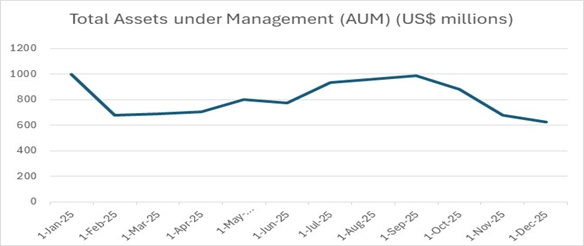
Valour’s AUM on December 31, 2025 was $622.3 million. Average AUM for 2025 increased to $809.9 million from $645.3 million 2024. Valour monetizes its AUM primarily through trading, staking, management fees, and trade-flow arbitrage. In addition to management fees, Valour retains staking yields as revenue, capturing value directly from the digital assets held in its ETPs. This vertically integrated model enables recurring, protocol-driven revenue as AUM grows. As of December 31, 2025, Valour’s ETPs with the highest AUM were:
| ● | VALOUR BTC: $226,518,547 |
| ● | VALOUR SOL: $176,086,342 |
| ● | VALOUR ETH: $61,907,800 |
| ● | VALOUR XRP: $38,395,788 |
| ● | VALOUR SUI: $25,850,564 |
| ● | VALOUR ADA: $24,221,997 |
6
A chart showing the development of the Company’s AUM is below:
Valour’s Global Expansion and Strategic Market Development
In 2025, we grew globally with meaningful progress across key markets and listings. We advanced our footprint through:
| ● | London Stock Exchange |
| ● | SIX Swiss Exchange |
| ● | B3 – Brazil Stock Exchange, including listings that established a strategic beachhead in LATAM |
Brazil matters because it is not just another listing. It is proof that we can bring our platform into new regulatory environments, connect to local market infrastructure, and build distribution pathways beyond our historical base.
Looking forward, the Company expects additional locations and distribution channels to come online in 2026, with particular focus on expanding our presence across Europe and Latin America, and bringing new regions into the platform such as Africa and the Middle East.
DeFi Technologies Announces Closing of US$100 Million Registered Direct Offering
DeFi Technologies announced the closing of a US$100 million registered direct offering led by cornerstone investor Galaxy Digital. Investors purchased 45,662,101 common shares and warrants to buy up to 34,246,577 additional shares at a combined price of US$2.19 per share and three-quarters of a warrant. Each whole warrant is exercisable immediately at US$2.63 and has a three-year term with an acceleration feature. The Company plans to use net proceeds to expand Valour’s ETP lineup, pursue digital-asset trading, lending and staking transactions, fund potential acquisitions, and advance recently announced growth initiatives.
7
Normal Course Issuer Bid (NCIB)
During the year ended December 31, 2025, the Company repurchased 1,235,900 shares for $2,769,629 representing an average purchase price of $2.24. All shares repurchased were cancelled. The Company’s current NCIB program allows for the purchase of up to 31,673,791 shares and runs until August 26, 2026 (or earlier if completed).
DeFi Technologies Announces Strategic Investment and Partnership with Canada’s Stablecorp, Backer of QCAD Canadian-Dollar Stablecoin
DeFi Technologies invested in and partnered with Stablecorp Inc. (“Stablecorp”) to help scale their QCAD product alongside Coinbase Ventures, Circle Ventures, Side Door Ventures, and other industry leaders. With RPAA oversight of payment service providers taking effect on September 8, 2025, and growing attention from the Bank of Canada and FCAC as retail CBDC work remains paused, compliant CAD stablecoins are positioned for payments, cross-border trade, payroll, and treasury use. Execution includes launching QCAD-integrated products through Valour and naming Stillman Digital as a preferred liquidity provider for on/off-ramps and mint/redeem flows, subject to certain conditions.
DeFi Technologies Invests in Continental Stablecoin Inc., Backers of cNGN, to Accelerate Regulated Stablecoin Adoption Across Africa
DeFi Technologies announced it invested in Continental Stablecoin Inc. (“Continental Stablecoin”), alongside Coinbase Ventures, Adaverse, and other industry leaders, to advance regulated local currency stablecoins across Africa with an initial focus on Nigeria’s cNGN. cNGN, issued by Wrapped CBDC Limited, had ~602.9 million tokens in circulation as of September 15, 2025, with more than 75,000 on-chain transactions and ~20.1 billion cNGN in cumulative volume. The investment was intended to align with DeFi Technologies’ strategy to support compliant, bank- and fintech-ready digital-asset infrastructure, complement the Company’s broader platform spanning liquidity provision for the cNGN stablecoin via Stillman Digital, and create cNGN related Valour ETPs in Europe.
Nasdaq Listing
On May 12, 2025, the Company announced that its common shares started trading on the Nasdaq Capital Market under the symbol “DEFT”. Upon commencement of trading on Nasdaq, the Company’s common shares ceased to be quoted on the OTC Markets. DeFi Technologies continues to trade on the CBOE Canada exchange (CBOE: “DEFI”) and the Börse Frankfurt exchange (GR: R9B)
SUBSQUENT EVENTS
Possible Filing Delay
On March 23, 2026, the Company announced it may experience a delay in filings its annual financial statements, management’s discussion and analysis, and related CEO and CFO certifications for the year ended December 31, 2025 (the “Annual Filings”) relating solely to the possible timing of receipt of a SOC 2 Type 2 report from a material third-party counterparty that is relevant to the Company’s audit procedures. The Company also announced that, in connection with the potential delay and default in the completion of the Annual Filings, the Company has made an application to the Ontario Securities Commission (the “OSC”) as principal regulator, to approve a temporary management cease trade order (the “MCTO”) under National Policy 12-203 – Management Cease Trade Orders (“NP 12-203”).
8
Outlook
DeFi continues to cement its leadership in regulated digital asset ETPs, with 102 listed ETPs. The Company remains focused on expanding investor access to secure, transparent, and compliant digital asset exposure.
DeFi Technologies also reiterated its focus on accelerating growth through product innovation and geographic expansion. In 2025, DeFi Technologies, through Valour, advanced distribution across regulated venues, including the London Stock Exchange and SIX Swiss Exchange, and established a strategic beachhead in Brazil through B3.
DeFi Technologies aims to be the global leading provider of asset management services and investment products worldwide with a scalable, vertically integrated platform of investment vehicles and capital markets infrastructure aimed at disrupting traditional, over-regulated, and inefficient markets for investments, primary, and secondary markets. The legacy system is captured by obsolete infrastructure, bloated with inefficient and expensive middlemen who impose misguided regulation, affecting investors and entrepreneurs alike.
The Company is building in both centralized and decentralized finance, positioning ourselves for the convergence of these paradigms over time which will provide a better path for payments, storage of value, and frictionless capital markets.
The Company plans to announce a series of internally incubated innovations across these fields, lowering costs, increasing value added and scalability, enabling unparalleled customer value.
The Company is advancing second-generation products designed to be more institutionally compatible and suited to larger pools of capital. This next phase includes but is not limited to UCITS type fund structures (the EU’s Undertaking for the Collective Investment in Transferable Securities), actively managed certificates and exchange traded notes, fund of funds structures, and additional institutionally focused vehicles, which are intended to broaden distribution, expand addressable liquidity, and increase the durability of AUM.
The Company’s global expansion positions the Company for long-term growth, leveraging strategic partnerships, market-first advantages, and increasing investor demand to strengthen its market leadership.
The Company also constantly evaluates adjacent businesses that can add non-AUM driven revenues that perform well in both crypto bull and bear market cycles. The Company’s acquisition of Stillman Digital in October 2024 is an example of such a business. In terms of new initiatives, the Company expects to become more active in the stablecoin market going forward as demonstrated by its venture investments in Stablecorp and Continental Stablecoin.
9
Digital Assets, Digital assets loaned and Digital assets Staked
As at December 31, 2025, the Company’s digital assets consisted of the below digital currencies, with a fair value of $515,586,931 (December 31, 2024 - $ 555,838,900). Digital currencies are recorded at their fair value on the date they are acquired and are revalued to their current market value at each reporting date. Fair value is determined by taking the mid-point price at 17:30 CET from Kraken, Bitfinex, Binance, Coinbase, Bitstamp, Bybit OKX, Vinter, Compass and Gate.IO and other exchanges consistent with the final terms for each ETP. Fair value for Mobilecoin, Shyft, Blocto, Maps, Oxygen, Boba Network, Saffron.finance, Clover, Sovryn, Wilder World, Pyth and Volmex is determined by taking the last closing price for the day (UTC time) from www.coinmarketcap.com.
| December 31, 2025 | December 31, 2024 | |||||||
| $ | $ | |||||||
| Current digital assets | ||||||||
| Digital assets | 356,450,053 | 276,853,787 | ||||||
| Digital assets loaned | 87,326,227 | 38,618,758 | ||||||
| Digital assets staked | 38,986,741 | 240,031,645 | ||||||
| Total current digital assets | 482,763,021 | 555,504,190 | ||||||
| Non-current digital assets | ||||||||
| Digital assets | 62,367 | 334,710 | ||||||
| Digital assets loaned | 32,761,543 | - | ||||||
| Total non-current digital assets | 32,823,910 | 334,710 | ||||||
| Total digital assets | 515,586,931 | 555,838,900 | ||||||
In addition to the above noted digital assets, the Company has the following equity investments at fair value through profit and loss (“FVTPL”). See Note 7 of the audited consolidated financial statements for the year ended December 31, 2025 for further details.
| December 31, 2025 | ||||||||||||||||||||||||
| Current | Long Term | Total | ||||||||||||||||||||||
| Quantity | Amount | Quantity | Amount | Quantity | Amount | |||||||||||||||||||
| Fund A - Solana (SOL) | 192,949.9577 | $ | 19,860,832 | 220,396.5353 | $ | 22,685,979 | 413,346.4930 | $ | 42,546,811 | |||||||||||||||
| Fund A - Avalanche (AVAX) | 503,720.0812 | $ | 5,253,822 | 232,861.4009 | $ | 2,428,755 | 736,581.4821 | $ | 7,682,577 | |||||||||||||||
| $ | 25,114,654 | $ | 25,114,734 | $ | 50,229,388 | |||||||||||||||||||
| Fund B - Solana (SOL) | 470,185.9000 | $ | 50,297,302 | 294,049.0000 | $ | 31,455,370 | 764,234.9000 | $ | 81,752,672 | |||||||||||||||
| $ | 50,297,302 | $ | 31,455,370 | $ | 81,752,672 | |||||||||||||||||||
| Total | $ | 75,411,956 | $ | 56,570,104 | $ | 131,982,060 | ||||||||||||||||||
| December 31, 2024 | ||||||||||||||||||||||||
| Current | Long Term | Total | ||||||||||||||||||||||
| Quantity | Amount | Quantity | Amount | Quantity | Amount | |||||||||||||||||||
| Fund A - Solana (SOL) | 216,379.2216 | $ | 30,886,684 | 244,331.9458 | $ | 34,876,748 | 460,711.1675 | $ | 65,763,432 | |||||||||||||||
| Fund A - Avalanche (AVAX) | 223,905.1900 | $ | 6,020,811 | 707,540.4100 | $ | 19,025,762 | 931,445.6000 | $ | 25,046,572 | |||||||||||||||
| $ | 36,907,495 | $ | 53,902,510 | $ | 90,810,004 | |||||||||||||||||||
| Fund B - Solana (SOL) | 626,365.7000 | $ | 89,409,506 | 540,869.9000 | $ | 77,205,553 | 1,167,235.6000 | $ | 166,615,059 | |||||||||||||||
| Total | $ | 126,317,001 | $ | 131,108,063 | $ | 257,425,063 | ||||||||||||||||||
10
The Company’s holdings of digital assets consist of the following:
| December 31, 2025 | December 31, 2024 | |||||||||||||||
| Quantity | $ | Quantity | $ | |||||||||||||
| Binance Coin (BNB) | 1,763.4867 | 1,520,530 | 2,558.9747 | 1,818,875 | ||||||||||||
| Bitcoin (BTC) | 2,596.9563 | 223,491,846 | 2,705.7708 | 228,997,191 | ||||||||||||
| Ethereum (ETH) | 21,329.9035 | 63,656,646 | 20,676.9254 | 70,398,197 | ||||||||||||
| Cardano (ADA) | 69,150,950.0310 | 23,565,970 | 69,671,396.7593 | 60,542,418 | ||||||||||||
| Polkadot (DOT) | 3,340,140.2001 | 6,035,593 | 2,766,149.1833 | 18,869,900 | ||||||||||||
| Solana (SOL) | 169,185.2128 | 21,097,592 | 43,414.4191 | 8,654,328 | ||||||||||||
| Uniswap (UNI) | 399,616.8814 | 2,332,473 | 421,450.3048 | 5,712,570 | ||||||||||||
| USDC | - | 4,461,378 | 251,357 | |||||||||||||
| USDT | - | 18,098,752 | 5,271,542 | |||||||||||||
| Litecoin (LTC) | 11,073.8030 | 851,800 | 541.8400 | 56,378 | ||||||||||||
| Dogecoin (DOGE) | 56,534,119.7635 | 6,828,612 | 17,545,096.4535 | 5,708,209 | ||||||||||||
| Cosmos (ATOM) | 12,005.8560 | 23,143 | 735.9223 | 4,605 | ||||||||||||
| Avalanche (AVAX) | 461,501.5177 | 5,740,226 | 125,979.5440 | 4,612,185 | ||||||||||||
| Polygon (POL) | 304,295.6891 | 31,088 | 183,654.4400 | 82,957 | ||||||||||||
| Ripple (XRP) | 21,146,529.3119 | 39,186,475 | 17,223,963.4000 | 36,437,139 | ||||||||||||
| Enjin (ENJ) | 576,307.9792 | 15,849 | 127,360.9806 | 27,938 | ||||||||||||
| Tron (TRX) | 663,171.3819 | 187,723 | 341,529.3057 | 89,013 | ||||||||||||
| Terra Luna (LUNA) | 141,177.2041 | 13,436 | 205,057.0760 | - | ||||||||||||
| Shiba Inu (SHIB) | 20,643,542,012.0300 | 143,214 | 142,074,547.6000 | 2,995 | ||||||||||||
| Pyth Network (PYTH) | 4,935,058.3767 | 280,805 | 3,444,248.6000 | 876,946 | ||||||||||||
| AAVE (AAVE) | 4,429.5388 | 652,127 | 2,333.3875 | 735,390 | ||||||||||||
| Algorand (ALGO) | 1,380,335.0800 | 153,904 | 90,930.8700 | 30,180 | ||||||||||||
| Aptos Mainnet (APT) | 517,026.2356 | 875,222 | 287,849.7000 | 2,565,403 | ||||||||||||
| Arweave (AR) | 64,940.4200 | 223,096 | 14,202.0100 | 234,942 | ||||||||||||
| Aerodome (AERO0X91) | 2,113,572.4104 | 917,924 | - | - | ||||||||||||
| Arbitrum (ARB) | 1,489,777.0200 | 280,923 | 24.0000 | 17 | ||||||||||||
| Bitcoin Cash (BCH) | 860.1464 | 511,921 | 25.4800 | 11,075 | ||||||||||||
| Core (CORE) | 12,500,445.6036 | 1,377,549 | 3,995,185.7910 | 4,300,418 | ||||||||||||
| Curve DAO Token (CRV) | 3,939,395.2500 | 1,442,868 | 10,295.1200 | 9,307 | ||||||||||||
| EOS (EOS) | 1,513.8200 | 1,181 | 13,419.9100 | 10,374 | ||||||||||||
| Europa Coin (EURC) | 605,795.2800 | 708,780 | - | - | ||||||||||||
| Fetch.ai (FET) | 4,619,586.9000 | 946,091 | 561,613.1000 | 732,400 | ||||||||||||
| Filecoin (FIL) | 83,678.3922 | 109,612 | 8,471.8100 | 41,952 | ||||||||||||
| Sonic (FTM) | - | - | 1,342,653.2600 | 937,490 | ||||||||||||
| The Graph (GRT) | 542,238.9100 | 18,229 | 1,620.3700 | 323 | ||||||||||||
| Hedera (HBAR) | 76,729,676.9089 | 8,317,073 | 49,611,593.1918 | 13,883,790 | ||||||||||||
| Internet Computer (ICP) | 1,778,949.0942 | 4,866,716 | 1,436,614.1074 | 14,543,861 | ||||||||||||
| Immutable (IMX) | 274,878.9400 | 61,176 | 10,992.0200 | 14,345 | ||||||||||||
| Injective (INJ) | 335,577.3200 | 1,463,990 | 56,329.4200 | 1,136,125 | ||||||||||||
| Jupiter (JUP) | 3,089,314.6000 | 583,880 | 499,299.1000 | 423,006 | ||||||||||||
| Kusama (KSM) | 470.3390 | 3,198 | 470.3400 | 15,540 | ||||||||||||
| Lido DAO (LDO) | 513,196.1600 | 300,384 | 36,961.1000 | 68,633 | ||||||||||||
| Chainlink (LINK) | 347,418.3828 | 4,295,173 | 239,057.7313 | 4,932,495 | ||||||||||||
| NEAR Protocol (NEAR) | 1,701,315.2684 | 2,553,372 | 1,300,877.8800 | 163 | ||||||||||||
| Optimism (OP) | 173,791.6300 | 46,248 | 15,436.4300 | 6,609,639 | ||||||||||||
| MANTRA (OM) | 453,091.4000 | 31,807 | - | 27,245 | ||||||||||||
| Pendle (PDL) | 182,478.7000 | 343,772 | 31,265.4000 | 159,454 | ||||||||||||
| Quant (QNT) | 1,014.7880 | 71,156 | 1,086.7000 | 114,864 | ||||||||||||
| Ripple USD (RLUSD) | 50,126.0000 | 50,126 | - | - | ||||||||||||
| RENDERSOL (RNDR) | 1,703,278.0201 | 2,193,856 | 162,158.1000 | 1,127,499 | ||||||||||||
| THORChain (RUNE) | 269,953.8000 | 151,768 | 91,192.7000 | 423,581 | ||||||||||||
| Sei Network (SEI1) | 16,419,686.8978 | 1,848,857 | 2,078,991.0000 | 851,347 | ||||||||||||
| SKY Governance Token (SKY) | 645,038.0000 | 37,735 | - | - | ||||||||||||
| Stacks (STX) | 47,106.4000 | 11,744 | 203,450.0000 | 97,432 | ||||||||||||
| Sui (SUI) | 14,683,690.6345 | 16,459,983 | 10,785,375.0000 | 45,866,964 | ||||||||||||
| SushiSwap (SUSHI) | 135.0000 | 37 | 39,426.6800 | 53,068 | ||||||||||||
| Bittensor (TAO) | 22,107.9024 | 4,906,095 | 9,851.6400 | 4,443,335 | ||||||||||||
| The TON Coin (TON) | 454,318.1948 | 739,494 | 405,657.4300 | 2,266,408 | ||||||||||||
| Wormhole (W) | 4,760,219.0000 | 157,563 | 722,403.0000 | 213,761 | ||||||||||||
| Tether Gold (XAUT6) | 34.4628 | 149,372 | - | - | ||||||||||||
| dogwifhat (WIF) | 56,581.9600 | 15,277 | - | - | ||||||||||||
| Worldcoin (WLD2) | 2,002,365.2100 | 969,345 | 49,314.1000 | 106,139 | ||||||||||||
| Stellar (XLM) | 3,704,385.3200 | 753,012 | 140,437.4500 | 47,636 | ||||||||||||
| Tezos (XTZ) | 14,912.2100 | 7,259 | 17,822.5100 | 22,902 | ||||||||||||
| StarkNet (STRK1) | 2,990,189.0056 | 231,441 | - | - | ||||||||||||
| Sonic Labs (SONICLABS) | 3,959,492.2712 | 300,086 | - | - | ||||||||||||
| Akash Network (AKT) | 375,586.0011 | 135,737 | - | - | ||||||||||||
| Kaspa (KAS) | 24,576,822.7965 | 1,064,176 | - | - | ||||||||||||
| Official Trump (TRUMP) | 2,309.3700 | 10,891 | - | - | ||||||||||||
| Mantle (MNT) | 259,308.9369 | 251,037 | - | - | ||||||||||||
| Story (IP) | 5,951.7992 | 10,187 | - | - | ||||||||||||
| Crypto.com (CRO) | 1,453,014.1410 | 132,805 | - | - | ||||||||||||
| Hyperliquid (HYPE) | 32,103.2182 | 830,677 | - | - | ||||||||||||
| OKB (OKB) | 276.2829 | 30,051 | - | - | ||||||||||||
| IOTA (IOTA) | 1,233,469.0000 | 102,131 | - | - | ||||||||||||
| Ondo (ONDO) | 1,711,993.3233 | 634,291 | - | - | ||||||||||||
| Theta Token (THETA) | 100,410.4000 | 26,749 | - | - | ||||||||||||
| Celestia (TIA) | 111,295.8400 | 52,209 | - | - | ||||||||||||
| Flare (FLR) | 3,689,429.0635 | 39,108 | - | - | ||||||||||||
| Pi Network (PI) | 126,934.2148 | 25,895 | - | - | ||||||||||||
| Ethna (ENA) | 1,686,126.1900 | 340,092 | - | - | ||||||||||||
| Four (FORM) | 31,111.1000 | 10,777 | - | - | ||||||||||||
| Virtuals Protocol (VIRTUAL) | 1,776,320.7111 | 1,179,832 | - | - | ||||||||||||
| VeChain (VET) | 4,978,553.8000 | 52,773 | - | - | ||||||||||||
| Penut the Squirrel (PNUT) | 445,601.2200 | 30,657 | - | - | ||||||||||||
| Pepe (PEPE) | 40,164,090,458.7000 | 24,082 | - | - | ||||||||||||
| Zcash (ZEC) | - | 32,569 | - | - | ||||||||||||
| Other Coins | 1,903,696,977.2146 | 42,722 | 145,501.2142 | 26,475 | ||||||||||||
| Current | 482,763,021 | 555,499,721 | ||||||||||||||
| Clover (CLV) | - | - | 500,000.0000 | 31,910 | ||||||||||||
| Solana (SOL) | 196,500.0000 | 24,471,703 | - | - | ||||||||||||
| SUI (SUI) | 8,327,991.5556 | 8,289,840 | - | - | ||||||||||||
| Wilder World (WILD) | - | - | 148,810.0000 | 99,465 | ||||||||||||
| Other Coins | 271,406,137.0826 | 62,367 | 130,458,836.6519 | 207,804 | ||||||||||||
| Long-Term | 32,823,910 | 339,179 | ||||||||||||||
| Total Digital Assets | 515,586,931 | 555,838,900 | ||||||||||||||
11
The continuity of digital assets for the years ended December 31, 2025 and 2024:
| December 31, 2025 | December 31, 2024 | |||||||
| Opening balance | $ | 555,838,900 | $ | 370,469,700 | ||||
| Digital assets acquired | 273,427,760 | 401,118,676 | ||||||
| Digital assets disposed | (87,878,518 | ) | (514,217,138 | ) | ||||
| Digital assets earned from staking, lending and fees | 13,072,141 | 26,075,437 | ||||||
| Realized gain (loss) on digital assets | 48,283,105 | 306,744,937 | ||||||
| Net change in unrealized gains and losses on digital assets | (282,272,597 | ) | (34,372,022 | ) | ||||
| Settlement of Genesis loan | (6,100,598 | ) | - | |||||
| Digital assets transferred in from (out to) equity investments at FVTPL | 2,749,352 | - | ||||||
| Foreign exchange gain (loss) / Fees / Other | (1,532,614 | ) | 19,310 | |||||
| $ | 515,586,931 | $ | 555,838,900 | |||||
Digital assets held by counterparty for the period ended December 31, 2025 and December 31, 2024 are as follows:
| December 31, 2025 | December 31, 2024 | |||||||
| Counterparty A | $ | 41,304,262 | $ | 6,918,688 | ||||
| Counterparty C | 3,460,154 | 719,776 | ||||||
| Counterparty E | 1,492,892 | 7,007,055 | ||||||
| Counterparty F | 25,061,967 | 6,809,705 | ||||||
| Counterparty H | 171,980,818 | 58,438,204 | ||||||
| Counterparty K | 218,232,056 | 125,188,614 | ||||||
| Counterparty M | 4,954,135 | 3,787,814 | ||||||
| Other | 1,451,800 | 1,942,823 | ||||||
| Self custody | 47,648,847 | 345,026,221 | ||||||
| Total | $ | 515,586,931 | $ | 555,838,900 | ||||
Digital Assets held by lenders
The Company and Genesis Global Capital LLC (“Genesis”) entered into that certain master loan agreement (the “MLA”). Pursuant to the MLA and the loan term sheet dated September 9, 2022 (the “Term Sheet”), Genesis loaned $6,000,000 to Valour as an open term loan (the “Loan”) pursuant to the terms and conditions of the MLA and Term Sheet. As collateral for the Loan, Valour initially posted 362 BTC with Genesis, which was later increased to 475 BTC.
On January 19, 2023, Genesis and its group of companies filed for bankruptcy protection in the U.S. pursuant to a ‘Chapter 11’ bankruptcy filing under the U.S. Bankruptcy Code and listed the Company as a creditor.
On June 26, 2024, the Court entered an order (the “Order”) granting motion for relief from stay and allowing Genesis to exercise set off rights permitting the parties to set off any Company obligations ($6,000,000 loan plus interest) with corresponding Genesis obligations (475 BTC). According to the exhibit attached to the Order, the Company owed Genesis $5,990,953.70 in principal and $109,644 in interest against collateral of 475 BTC valued at $10,018,691, resulting in a claim by the Company against Genesis in the amount of $3,909,047 or 185.3 BTC. It was then agreed that the parties could set off leaving the Company with $3. 9 million which amounted to 185.3 BTC.
By the end of 2025, the Company had already received 115.62 BTC. Since DeFi and Valour previously received a further 1.7 BTC in October 2025, the outstanding balance is 67.98 BTC. Accordingly, the Company expects to receive up to 67.98 BTC in the future.
The digital assets and loan payable were previously recorded gross on the balance sheet at $6,100,598 and $6,100,598, respectively, with the digital assets being written down to the value of the loan payable. After the approval of the motion on June 26, 2024, the Company obtained the legally enforceable right to set off the digital assets being held as collateral against the loan payable. As a result, the Company has netted the asset and liability on the statement of financial position, reducing both the Company’s digital assets and loan payable by $6,100,598, which represents the principal amount of the loan plus interest.
12
Following the court approved set-off, the remaining exposure for the Genesis loan is 68 BTC. Considering Genesis’ low credit quality due to its bankruptcy, the Company has applied a loss rate approach of 75% to calculate it’s expected credit loss on digital assets held by Genesis based on management’s best estimate. The expected credit loss of $4,478,675 on these 68 BTC has been recorded under realized and net change in unrealized (loss) gain on digital assets in the consolidated statement of income.
As of December 31, 2025, digital assets held by lenders as collateral consisted of the following:
| Number of coins on loan | Fair Value | |||||||
| Bitcoin (BTC) | 67.9793 | $ | 1,492,892 | |||||
| Total | 67.9793 | $ | 1,492,892 | |||||
As of December 31, 2024, digital assets held by lenders as collateral consisted of the following:
| Number of coins on loan | Fair Value | |||||||
| Bitcoin (BTC) | 365.4480 | 7,007,055 | ||||||
| Total | 365.4480 | 7,007,055 | ||||||
As at December 31, 2024, the 365.4480 Bitcoin held by Genesis as collateral against a loan has been written down to $7,007,055, the fair value of the loan and interest held with Genesis.
In the normal course of business, the Company enters into open-ended lending arrangements with certain financial institutions, whereby the Company loans certain fiat and digital assets in exchange for interest income. The Company can demand the repayment of the loans and accrued interest at any time. The digital assets on loan are included in digital assets balances above.
Digital Assets loaned
As of December 31, 2025, the Company loaned select digital assets to borrowers at annual rates ranging from approximately 1.98% to 12.00% and accrued interest on a monthly basis. The digital assets on loan are measured at fair value through profit and loss.
As of December 31, 2024, the Company has loaned select digital assets to borrowers at annual rates ranging from approximately 3.25% to 5.5% and accrued interest on a monthly basis. The digital assets on loan are measured at fair value through profit and loss.
As of December 31, 2025, digital assets on loan consisted of the following:
| Number of coins on loan | Fair Value | Fair Value Share | ||||||||||
| Bitcoin (BTC) | 420.0000 | 36,894,425 | 31 | % | ||||||||
| Ethereum (ETH) | 8,000.0000 | 23,879,570 | 20 | % | ||||||||
| Solana (SOL) | 326,500.0000 | 40,661,634 | 34 | % | ||||||||
| SUI (SUI) | 18,737,981.0000 | 18,652,141 | 16 | % | ||||||||
| Total | 19,072,901.0000 | 120,087,770 | 100 | % | ||||||||
As of December 31, 2024, digital assets on loan consisted of the following:
| Number of coins on loan | Fair Value | |||||||
| Current | ||||||||
| Bitcoin (BTC) | 120.0000 | 11,379,938 | ||||||
| Ethereum (ETH) | 8,000.0000 | 27,238,820 | ||||||
| Total current digital assets on loan | 8,120.0000 | 38,618,758 | ||||||
| Total | 8,120.0000 | 38,618,758 | ||||||
13
The digital assets loaned are classified as follows:
| Number of coins on loan | Fair Value | |||||||
| Current | ||||||||
| Bitcoin (BTC) | 420.0000 | 36,894,425 | ||||||
| Ethereum (ETH) | 8,000.0000 | 23,879,570 | ||||||
| Solana (SOL) | 130,000.0000 | 16,189,931 | ||||||
| SUI (SUI) | 10,409,989.4444 | 10,362,301 | ||||||
| Total current digital assets on loan | 10,548,409.4444 | 87,326,227 | ||||||
| Long-Term | ||||||||
| Solana (SOL) | 196,500.0000 | 24,471,703 | ||||||
| SUI (SUI) | 8,327,991.5556 | 8,289,840 | ||||||
| Total long-term digital assets on loan | 8,524,491.5556 | 32,761,543 | ||||||
| Total | 19,072,901.0000 | 120,087,770 | ||||||
As of December 31, 2025, the digital assets on loan by significant borrowing counterparty is as follow:
| Interest rates | Number of coins on loan | Fair Value | Geography | Fair Value Share | ||||||||||||
| Counterparty A | 12% | 326,500.0000 | 40,661,634 | Grand Cayman | 34 | % | ||||||||||
| Counterparty F | 1.94% - 4.75% | 18,739,981.0000 | 24,622,033 | UAE | 21 | % | ||||||||||
| Counterparty H | 3.75% - 4.5% | 6,420.0000 | 54,804,103 | Switzerland | 46 | % | ||||||||||
| Total | 19,072,901.0000 | 120,087,770 | 100 | % | ||||||||||||
| Current | ||||||||||||||||
| Counterparty A | 130,000.0000 | 16,189,931 | Grand Cayman | 13 | % | |||||||||||
| Counterparty F | 10,411,989.4444 | 16,332,193 | UAE | 14 | % | |||||||||||
| Counterparty H | 6,420.0000 | 54,804,103 | Switzerland | 46 | % | |||||||||||
| Total current digital assets on loan | 10,548,409.4444 | 87,326,227 | 73 | % | ||||||||||||
| Long-term | ||||||||||||||||
| Counterparty A | 196,500.0000 | 24,471,703 | Grand Cayman | 20 | % | |||||||||||
| Counterparty F | 8,327,991.5556 | 8,289,840 | UAE | 7 | % | |||||||||||
| Total long-term digital assets on loan | 8,524,491.5556 | 32,761,543 | 27 | % | ||||||||||||
| Total loaned digital assets | 19,072,901.0000 | 120,087,770 | 100 | % | ||||||||||||
As of December 31, 2024, the digital assets on loan by significant borrowing counterparty is as follow:
| Interest rates | Number of coins on loan | Fair Value | Geography | Fair Value Share | ||||||||||||
| Current | ||||||||||||||||
| Counterparty F | 4.75% | 2,000.0000 | 6,809,705 | UAE | 18 | % | ||||||||||
| Counterparty H | 3.25% to 5.50% | 6,120.0000 | 31,809,053 | Switzerland | 82 | % | ||||||||||
| Total current digital assets on loan | 8,120.0000 | 38,618,758 | 100 | % | ||||||||||||
| Total | 8,120.0000 | 38,618,758 | 100 | % | ||||||||||||
The Company’s digital assets on loan are exposed to credit risk. The Company limits its credit risk by placing its digital assets on loan with high credit quality financial institutions that have sufficient capital to meet their obligations as they come due and on which the Company has performed internal due diligence procedures. The Company’s due diligence procedures may include, but are not limited to, review of the financial position of the borrower, review of the internal control practices and procedures of the borrower, review of market information, and monitoring the Company’s risk exposure thresholds. Digital asset loan receivables are assessed for expected credit losses under IFRS 9 using a loss-rate approach. Counterparty A is subject to a 1% Stage 1 expected credit loss, driven by the recall penalty. The $248,000 ECL on these coins has been expensed to bad debt expense. Counterparty H is not subject to any expected credit loss due to its recallability without penalty. The Company does not hold any collateral or other credit enhancements related to these loans.
14
The fair value of the SUI digital assets on loan include a discount for lack of marketability since the SUI coins are locked and not freely transferrable as at December 31, 2025. These coins unlock intermittently through April 2028. The DLOM was determined using the Finerty model. The model works by treating this loss of marketability as the equivalent of a European put option, which provides protection against price declines during the period the assets cannot be sold. By estimating the value of such a hypothetical put option, based on factors like the underlying stock price, volatility, risk-free rate, and expected holding period. No separate ECL was recorded for the SUI digital assets as management feels that any relevant default risk is captured in the fair value assumptions of the digital assets. The SUI digital assets are considered a level 3 in the financial instrument hierarchy.
| Borrower | Asset | Quantity | Current | Non-current | Gross Total | ECL | Net Total | |||||||||||||||||||
| Counterparty A | SOL | 326,500.00 | 16,189,931 | 24,719,701 | 40,909,632 | (248,000 | ) | 40,661,632 | ||||||||||||||||||
| Counterparty H | BTC | 420.00 | 36,894,425 | - | 36,894,425 | - | 36,894,425 | |||||||||||||||||||
| Counterparty H | ETH | 6,000.00 | 17,909,678 | - | 17,909,678 | - | 17,909,678 | |||||||||||||||||||
| Counterparty F | ETH | 2,000.00 | 5,969,893 | - | 5,969,893 | - | 5,969,893 | |||||||||||||||||||
| Counterparty F | SUI | 18,737,981.00 | 10,362,301 | 8,289,841 | 18,652,142 | - | 18,652,142 | |||||||||||||||||||
| 87,326,228 | 33,009,542 | 120,335,770 | (248,000 | ) | 120,087,770 | |||||||||||||||||||||
As of December 31, 2025, the Company has staked select digital assets to borrowers at annual rates ranging from approximately 1.24% to 14.93% and accrue rewards as they are earned. The digital assets staked are measured at fair value through profit and loss. As of December 31, 2024, the Company has staked select digital assets to borrowers at annual rates ranging from approximately 2.95% to 9.70% and accrue rewards as they are earned. The digital assets staked are measured at fair value through profit and loss. As of December 31, 2024, the Bitcoin staked digital assets were locked up until January 2025.
As of December 31, 2025, digital assets staked consisted of the following:
| Number of coins staked | Fair Value | Fair Value Share | ||||||||||
| Ethereum (ETH) | 128.0536 | 376,190 | 1 | % | ||||||||
| Bitcoin (BTC) | 300.0000 | 26,747,151 | 69 | % | ||||||||
| Cardano (ADA) | 43,639.3760 | 15,470 | 0 | % | ||||||||
| Core (CORE) | 12,017,441.5404 | 1,325,524 | 3 | % | ||||||||
| Polkadot (DOT) | 2,595,690.3230 | 4,762,573 | 12 | % | ||||||||
| Solana (SOL) | 0.5094 | 64 | 0 | % | ||||||||
| Hyperliquid (HYPE) | 25,600.4618 | 662,417 | 2 | % | ||||||||
| Hedera (HBAR) | 22,663,998.5645 | 2,463,577 | 6 | % | ||||||||
| Internet Computer (ICP) | 970,082.8229 | 2,633,775 | 7 | % | ||||||||
| Total | 38,316,881.6517 | 38,986,741 | 100 | % | ||||||||
15
As of December 31, 2024, digital assets staked consisted of the following:
| Number of coins staked | Fair Value | Fair Value Share | ||||||||||
| Bitcoin | 1,803.0000 | 170,996,662 | 71 | % | ||||||||
| Cardano | 57,965,439.1383 | 50,371,939 | 21 | % | ||||||||
| Ethereum | 32.0000 | 108,955 | 0 | % | ||||||||
| Core | 3,415,479.8499 | 3,676,423 | 2 | % | ||||||||
| Polkadot | 1,941,230.3100 | 13,244,432 | 6 | % | ||||||||
| Solana | 10,526.4620 | 1,633,634 | 1 | % | ||||||||
| Total | 63,334,510.7602 | $ | 240,031,645 | 100 | % | |||||||
As of December 31, 2025, the digital assets staked by significant borrowing counterparty is as follow:
| Interest rates | Number of coins staked | Fair Value | Geography | Fair Value Share | ||||||||||||
| Counterparty H | 2.76% - 7.67% | 23,634,179.8442 | 5,097,352 | Switzerland | 13 | % | ||||||||||
| Counterparty M | 2.87% | 32.0023 | 95,663 | United States | 0 | % | ||||||||||
| Self custody | 2.3% - 14.28% | 14,682,669.8053 | 33,793,726 | Switzerland | 87 | % | ||||||||||
| Total | 38,316,881.6517 | 38,986,741 | 100 | % | ||||||||||||
As of December 31, 2024, the digital assets staked by significant borrowing counterparty is as follow:
| Interest rates | Number of coins staked | Fair Value | Geography | Fair Value Share | ||||||||||||
| Counterparty B | 2.95% | 57,965,439.1383 | 50,371,939 | Switzerland | 21 | % | ||||||||||
| Counterparty M | 4.00% | 32.0000 | 108,955 | United States | 0 | % | ||||||||||
| Self custody | 3.00% to 8.02% | 5,369,071.6219 | 189,550,751 | Switzerland | 79 | % | ||||||||||
| Total | 63,334,542.7602 | 240,031,645 | 100 | % | ||||||||||||
The Company’s digital assets staked are exposed to market risk, liquidity risk, lockup duration risk, loss or theft of assets and return duration risk. These risks include:
| a) | Ethereum and Polkdot staking exposes the Company to an unbounding period liquidity restriction (approximately 28 days), during which time the tokens remain locked and do not earn rewards once unbounding has commenced. |
| b) | Polkadot, CORE and Hype staking may expose the Company to validator misconduct risk |
| c) | Bitcoin staking involves timelock risk, such that the coins are locked until expiry of the timelock and require a redemption transaction after expiry. |
| d) | BTC staking is described by the protocol as self-custodied with no wrapping, bridging or smart contract exposure. |
The Company places allocation limits by counterparty and only deals with high credit quality financial institutions that are believed to have sufficient capital to meet their obligations as they come due and on which the Company has performed internal due diligence procedures. The Company’s due diligence procedures may include, but are not limited to, review of the financial position of the counterparty, review of the internal control practices and procedures of the counterparty, review of market information, and monitoring the Company’s risk exposure thresholds. As of December 31, 2025 and 2024, the Company does not expect a material loss on any of its digital assets staked. While the Company intends to only transact with counterparties that it believes to meets the Company staking policy criteria, there can be no assurance that a counterparty will not default and that the Company will not sustain a material loss on a transaction as a result.
16
EQUITY INVESTMENTS IN DIGITAL ASSETS FUNDS AT FAIR VALUE THROUGH PROFIT AND LOSS
Equity investments were as follows at December 31, 2025 and December 31,2024:
| December 31, 2025 | ||||||||||||||||||||||||
| Current | Long Term | Total | ||||||||||||||||||||||
| Quantity | Amount | Quantity | Amount | Quantity | Amount | |||||||||||||||||||
| Fund A - Solana (SOL) | 192,949.9577 | $ | 19,860,832 | 220,396.5353 | $ | 22,685,979 | 413,346.4930 | $ | 42,546,811 | |||||||||||||||
| Fund A - Avalanche (AVAX) | 503,720.0812 | $ | 5,253,822 | 232,861.4009 | $ | 2,428,755 | 736,581.4821 | $ | 7,682,577 | |||||||||||||||
| $ | 25,114,654 | $ | 25,114,734 | $ | 50,229,388 | |||||||||||||||||||
Fund B - Solana (SOL) | 470,185.9000 | $ | 50,297,302 | 294,049.0000 | $ | 31,455,370 | 764,234.9000 | $ | 81,752,672 | |||||||||||||||
| $ | 50,297,302 | $ | 31,455,370 | $ | 81,752,672 | |||||||||||||||||||
| Total | $ | 75,411,956 | $ | 56,570,104 | $ | 131,982,060 | ||||||||||||||||||
| December 31, 2024 | ||||||||||||||||||||||||
| Current | Long Term | Total | ||||||||||||||||||||||
| Quantity | Amount | Quantity | Amount | Quantity | Amount | |||||||||||||||||||
| Fund A - Solana (SOL) | 216,379.2216 | $ | 30,886,684 | 244,331.9458 | $ | 34,876,748 | 460,711.1675 | $ | 65,763,432 | |||||||||||||||
| Fund A - Avalanche (AVAX) | 223,905.1900 | $ | 6,020,811 | 707,540.4100 | $ | 19,025,762 | 931,445.6000 | $ | 25,046,572 | |||||||||||||||
| $ | 36,907,495 | $ | 53,902,510 | $ | 90,810,004 | |||||||||||||||||||
Fund B - Solana (SOL) | 626,365.7000 | $ | 89,409,506 | 540,869.9000 | $ | 77,205,553 | 1,167,235.6000 | $ | 166,615,059 | |||||||||||||||
| Total | $ | 126,317,001 | $ | 131,108,063 | $ | 257,425,063 | ||||||||||||||||||
Fund A
During the year ended December 31, 2024, the Company through a subsidiary, invested $61,741,683 in three tranches of a private investment fund (“Fund A”) designed to acquire Solana and Avalanche tokens from a bankrupt company. The Company’s investment represents the acquisition by Fund A of 491,249 Solana at $105 per Solana and 931,446 Avalanche at $11 per Avalanche.
The Solana acquired by Fund A is locked and staked, earning staking rewards during the lock period. Staking rewards will accrue while Solana is locked and will become distributable on the same unlocking schedule as the Solana. The Solana will be released by Fund A in monthly increments from January 2025 through January 2028.
The Avalanche acquired by Fund A is locked and staked, earning staking rewards during the lock period. Staking rewards will accrue while Avalanche is locked and will become distributable on the same unlocking schedule as the Avalanche.
The Avalanche will be released by Fund A in weekly increments starting July 10, 2025 and continuing through July 1, 2027.
The investments in the investment fund were initially recognized based on the latest available net asset value as determined by the investment fund’s administrator less an applicable DLOM. The values of the investments were remeasured based on quarterly valuation reports provided by the investment fund administrator less an applicable DLOM.
17
Fund B
During the year ended December 31, 2024, the Company invested through a subsidiary, $112,072,453 in two tranches of limited partnership units of a private investment fund (“Fund B” and together with Fund A the “Equity Investments in Digital Assets”) designed to acquire Solana tokens from a bankrupt company.
The Company’s investment represents the acquisition by Fund B of 1,123,360 Solana at $100 per Solana. The Solana acquired by Fund B is locked and staked, earning staking rewards during the lock period and thereafter until such Solana is sold by the fund manager or an in-kind distribution to the limited partners of the fund. Staking rewards will accrue while Solana is locked and will become distributable on the same unlocking schedule as the Solana. Approximately 25% of the Solana were unlocked in March 2025, while the remaining 75% of the Solana will be unlocked linearly monthly until January 2028. The Company received a distribution of $71,685,819 in July 2025 from Fund B.
The investments in Fund B were initially recognized based on the latest available net asset value as determined by Fund B’s administrator less an applicable DLOM. The values of the investments were remeasured based on quarterly valuation reports provided by Fund B’s administrator less an applicable DLOM.
The investments in Fund B were initially recognized based on the latest available net asset value as determined by Fund B’s administrator less an applicable DLOM. The values of the investments were remeasured based on quarterly valuation reports provided by Fund B’s administrator less an applicable DLOM.
The continuity of equity investments for the years ended December 31, 2025 and 2024 is as follows:
| December 31, 2025 | December 31, 2024 | |||||||
| Opening Balance | $ | 257,425,063 | $ | - | ||||
| Acquisitions | - | 173,814,136 | ||||||
| Disposals | (71,685,819 | ) | - | |||||
| Staking income | 19,784,212 | 13,060,639 | ||||||
| Net change in realized and unrealized gain/loss | (68,261,189 | ) | 77,360,769 | |||||
| Management fees | (2,530,856 | ) | (1,396,016 | ) | ||||
| Transfers out to Digital Assets | (2,749,352 | ) | (5,414,464 | ) | ||||
| Closing Balance | $ | 131,982,060 | $ | 257,425,063 | ||||
18
Third Party Exchanges, Custodians and Funds
As of December 31, 2025, the Company used the following third-party exchanges and custodians and in the ordinary course of business:
| Exchange | Location | |
| Binance | Cayman Islands | |
| B2C2 Overseas LTD | Cayman Islands | |
| Bitcoin Suisse AG | Switzerland | |
| OKX | Seychelles | |
| Kraken | United States | |
| Wintermute | United Kingdom | |
| Coinbase | United States | |
| Laser Digital | Switzerland | |
| Custodian | ||
| Anchorage Digital | United States | |
| Bitgo Trust | United States | |
| Copper | Switzerland |
Each of the Custodians and Exchanges have not appointed a sub-custodian to hold crypto assets owned by the Company. The Custodian and Exchanges hold and safeguard the digital assets deposited by the Company and its subsidiaries. The Custodians and Exchanges also offer lending and staking services. The Custodians and Exchanges are not Canadian financial institutions. None of the Custodians and Exchanges are related parties of the Company.
Each Custodian maintains general commercial insurance on its own behalf, but the Corporation and other clients of such Custodians are not named insured under such policies. The Company is not aware of any security breaches or similar incidents at the Custodians. The Company believes that any event of insolvency or bankruptcy of a Custodian would be treated in accordance with the insolvency or bankruptcy laws of the applicable jurisdiction of such Custodian.
19
As of December 31, 2025, the breakdown of digital assets deposited with each of the Custodians, or Exchanges as a percentage of total digital assets custodied by the Company and its subsidiaries is as follows:
|
Custodian |
Location | % of digital assets custodied by market value | Regulatory Body | |||
| Binance | Cayman Islands | 42.6% | Cayman Islands Monetary Authority (CIMA) | |||
| B2C2 Overseas LTD | Cayman Islands | 8.0% | Cayman Islands Monetary Authority (CIMA) | |||
| Kraken | United States | 0.7% | Office of Comptroller of Currency | |||
| Laser Digital | Switzerland | 4.7% | Financial Services Standards Association (VQF). Zug. Switzerland | |||
| Copper | Switzerland | 33.5% | Financial Services Standards Association (VQF). Zug. Switzerland | |||
| Bitgo Trust | United States | 1% | South Dakota Division of Banking and Money Services Business (MSB) with Financial Crimes Enforcement Network (FinCEN) | |||
| Others | 2.9% | Anchorage, Wintermute, Bitcoin Suisse, Coinbase (Deribit), Genesis | ||||
| Self Custody | 6.5% | |||||
| Total | 100% |
Valour conducts diligence and reviews counterparty risk in accordance with the following principles:
| ● | Valour shall strive to spread counterparty risk between several counterparties, where relevant and practical. |
| ● | In relevant situations and as far as possible, counterparty (and settlement) risk shall be mitigated by conducting transactions in well-established settlement systems based on the principles of delivery versus payment or payment versus payment. |
| ● | The below methodology is to be applied when proposing and selecting counterparties and when granting limits on counterparty risk score. |
| ● | The counterparties are reviewed in regular intervals and re-evaluated. |
| ● | In case of significant events such as negative news or credit events, Valour can decide to close the business relationship with a counterparty irrespective of the review cycle. |
| ● | Valour manages a counterparty scorecard and captures, assesses and monitors the below information. |
20
| 1. | Contact information |
The name, the website and contact person at the exchange/counterparty, as well as the responsible onboarding owner on Valour side.
| 2. | Current status |
The current status of the relationship, the connection type, as well as the services, products and currency pairs used on the respective exchange/counterparty have to be documented and kept up to date
| 3. | Country of registration and regulation |
The country in which the exchange/counterparty is registered must be documented. In addition, all countries in which the exchange/counterparty holds a regulatory license have to be assessed and documented by stating the license number (if applicable).
| 4. | Country risk |
The country of registration as well as the country/-ies of regulation are evaluated by using the country risk matrix. The country risk matrix considers the FATF (and equivalent) country evaluation, the Transparency.org Corruption Perception Index (CPI) as well as the VQF SRO country risk recommendations.
| 5. | Adverse media search |
An adverse media search is being conducted. For example, information about an exchange having been hacked in the past or any news about a negative reputation, regulatory breaches etc. are documented.
| 6. | Public exchange scores |
Publicly available information and risk scores from data sources such as Coinmarketcap and Coingecko are being collected and documented.
| 7. | Information security certification |
The exchange/counterparty information security certification status is assessed. Information about the possession of certifications such as AICPA SOC 1, SOC 2 Type I and SOC 2 Type II as well as ISO 27001 are documented.
| 8. | Insurance coverage |
Information about insurance protection and regulatory status in terms of investor protection are assessed and documented.
| 9. | Proof of reserves |
It is being checked if the exchange/counterparty has made the public wallet addresses of its cold and hot storage publicly available or if any other cryptographic means of verification of the reserves held in custody are either publicly available or have been audited.
| 10. | Risk evaluation |
The risk score is evaluated on a scale of 1 to 5, with 1 being the lowest risk and 5 being the highest risk. Based on the information collected in the scorecard, with a focus on regulatory licences, a risk score is calculated and documented for each exchange or counterparty. By carefully evaluating the risk score, we can ensure that we are making responsible business decisions and protecting our customers and stakeholders.
21
| 11. | Business justification and restrictions |
In cases where an exchange or counterparty presents increased risks, a business justification must be provided. We must carefully consider the potential exposure and take appropriate measures to limit it through restrictions, thresholds, or other means. Any decision to establish a business relationship with an exchange or counterparty with increased risks must be approved by the board.
| 12. | Recurring review schedule |
The review date and review frequency of all exchanges/counterparties are documented and tracked in the scorecard. A review once a year is set as the default standard, however, an ad-hoc review has to be considered in case of any event that may result in any of the assessment criteria being changed.
| 13. | Account closure |
If the exchange or counterparty has been identified with an increased risk, such as a risk score of 4 or 5, Valour will determine if it is necessary to end the business relationship. This decision is based on the potential exposure and the potential impact on the business and stakeholders.
If it is determined that the business relationship should be terminated, a plan for closing the relationship in a controlled and orderly manner is developed. This may include transferring outstanding transactions, closing accounts, and ensuring that all necessary documents and records are properly transferred or retained. The decision to close the business relationship is communicated to the exchange or counterparty and a timeline for the closure is provided. Once the business relationship has been successfully terminated, the counterparty scorecard is updated in order to reflect the closure.
By following this process, we can ensure that we are taking a responsible and proactive approach to closing business relationships with risky counterparties. This can help protect our customers and stakeholders and maintain the integrity of our business operations.
Self-Custody of Digital Assets
At December 31, 2025, the Company had self-custody of digital assets totaling $35,581,901 (December 31, 2024 - $339,451,566).
The Company maintains controls around the hot and cold wallets with only certain senior management having access to the accounts, passwords and seed phases. All copies of passwords and seed phases are secured and partitioned with certain senior management. Duplicate partial copies of the passwords and seed phases are accessible by a minimum of two members of senior management in different secure locations.
Staking and Lending Policy
It is Valour’s policy to hedge 100% of the market risk, subject to allowing a US$2 million maximum unhedged exposure as a trading buffer. Valour purchases and sells the digital assets which its ETPs track. Valour may lend or stake such digital assets on its balance sheet to generate revenue in accordance with the policies in the product prospectus. Lending or staking transactions are only conducted with institutional-grade counterparties and only up to a certain percentage for risk management purposes in accordance with Valour’s lending and staking policy (the “Lending and Staking Policy”), which is reviewed and approved by Valour’s board of directors. The Lending and Staking activities undertaken by Fund A and Fund B in respect of the Company’s Equity Investments in Digital Assets are not subject to the Lending and Staking Policy and the Company has no control over how Fund A and Fund B lend and stake digital assets.
When deciding whether to lend or stake a particular asset, the Lending and Staking Policy provides that the decision will initially be made based on the risk profile of the potential counterparties, then the highest yield available, then prioritizing staking over lending.
22
The Lending and Staking Policy provides the following limits for lending and staking of digital assets:
|
Digital Asset |
Lending and staking limits | |
| Bitcoin, Ethereum, Solana, Avalanche |
Up to 75% of unrestricted tokens may be lent on open terms to eligible counterparties, 50% of tokens may be lent on terms up to six months.
100% of tokens may be staked
| |
| All other Digital Assets |
Up to 75% of unrestricted tokens may be lent on open terms to eligible counterparties, 50% of tokens may be lent on terms up to six months. If total AUM is greater than US$5 million, up to 95% may be staked, else 75% may be staked |
The Company’s typical lending arrangements have terms as follows:
(a) which party has legal title
The lender authorizes the counterparty e.g., Anchorage to draw down lent assets. Typically, the counterparty / borrower is then permitted to use Client’s Designated Assets for any lawful purpose.
(b) the status of the assets in the event of insolvency of the borrower
The lender shall have full recourse to Counterparty for any obligations hereunder in equity and at law. Upon any event of default, the lender shall be entitled to seek all remedies available at law or in equity for the full amount or any unpaid principal of any advance, accrued but unpaid fees or other amounts or property payable hereunder against Lender in addition to enforcing its security interest.
(c) contractual limitation on use and transfer of lent items by borrower
Typically, the Counterparty is then permitted to use client’s designated assets for any lawful purpose.
(d) borrower’s ability to initiate transactions with the borrowed assets, including but not limited to: sell, lend, pledge, and/or hypothecate
Typically, the Counterparty is then permitted to use Client’s Designated Assets for any lawful purpose, including selling, lending, pledging and/or hypothecating. Certain lending agreements require Counterparties to grant a security interest to the Company on any assets that are further lent out.
(e) borrowers’ rights regarding “co-mingling”
There is no specific language in the lending agreement but given the Counterparties can use for any lawful purpose, the Company’s believes that comingling can occur.
23
(f) callability terms and conditions (including “notice period”, if any).
Termination. Client may terminate any Advance of its Designated Assets upon three (3) business days’ prior notice (the date of such termination, the “Termination Date”), from time to time at its sole discretion through an Electronic Notice.
Investments, At Fair Value, Through Profit and Loss, As At December 31, 2025
At December 31, 2025, the Company’s twelve private investments had a total fair value of $29,372,628.
| Note | Note | Security description | Cost | Estimated Fair Value | % of FV | |||||||||||
| Amina Bank AG | 3,906,250 non-voting shares | $ | 24,749,403 | $ | 24,285,752 | 82.7 | % | |||||||||
| Earnity Inc. | 85,142 preferred shares | 95,538 | - | 0.0 | % | |||||||||||
| Luxor Technology Corporation | 201,633 preferred shares | 460,016 | 524,963 | 1.8 | % | |||||||||||
| SDK:meta, LLC | 1,000,000 units | 2,495,232 | - | 0.0 | % | |||||||||||
| Skolem Technologies Ltd. | 16,354 preferred shares | 129,495 | - | 0.0 | % | |||||||||||
| VolMEX Labs Corporation | Rights to certain preferred shares and warrants | 30,000 | - | 0.0 | % | |||||||||||
| Global Benchmarks AB | (i) | 53,300 common shares | 199,875 | 199,875 | 0.7 | % | ||||||||||
| ZKP Corporation | (i) | 370,370 common shares | 1,000,000 | 1,000,000 | 3.4 | % | ||||||||||
| CH Technical Solutions SA | 25 common shares | 3,952,977 | 362,038 | 1.2 | % | |||||||||||
| Canada Stablecorp Inc. | 303,030 common shares | 500,000 | 500,000 | 1.7 | % | |||||||||||
| Continental Stable Coin | Rights to certain preferred shares | 500,000 | 500,000 | 1.7 | % | |||||||||||
| Bonsol Labs Inc. | Rights to certain preferred shares | 2,000,000 | 2,000,000 | 6.8 | % | |||||||||||
| Total private investments | $ | 36,112,536 | $ | 29,372,628 | 100.0 | % | ||||||||||
| (i) | Investments in related party entities - see Note 26 |
At December 31, 2024, the Company’s nine private investments had a total fair value of $37,348,081.
| Private Issuer | Note | Security description | Cost | Estimated Fair Value | % of FV | |||||||||||
| 3iQ Corp. | 61,712 common shares | $ | 63,270 | $ | 300,459 | 0.8 | % | |||||||||
| Amina Bank AG | 3,906,250 non-voting shares | 25,286,777 | 35,457,982 | 95.0 | % | |||||||||||
| Earnity Inc. | 85,142 preferred shares | 95,980 | - | 0.0 | % | |||||||||||
| Luxor Technology Corporation | 201,633 preferred shares | 462,145 | 500,058 | 1.3 | % | |||||||||||
| Neuronomics AG | 724 common shares | 89,582 | 89,582 | 0.2 | % | |||||||||||
| SDK:meta, LLC | 1,000,000 units | 2,506,780 | - | 0.0 | % | |||||||||||
| Skolem Technologies Ltd. | 16,354 preferred shares | 130,095 | - | 0.0 | % | |||||||||||
| VolMEX Labs Corporation | Rights to certain preferred shares and warrants | 21,989 | - | 0.0 | % | |||||||||||
| ZKP Corporation | (i) | 370,370 common shares | 1,000,000 | 1,000,000 | 2.7 | % | ||||||||||
| Total private investments | $ | 29,656,618 | $ | 37,348,081 | 100.0 | % | ||||||||||
| (i) | Investments in related party entities |
24
Financial Results
The following is a discussion of the results of operations of the Company for the three and twelve months ended December 31, 2025, and 2024. They should be read in conjunction with the Company’s annual consolidated financial statements for the three and twelve months ended December 31, 2025 and 2024 and related notes. All amounts are in U.S. dollars.
| Three months ended December 31, | Year ended December 31, | |||||||||||||||
| 2025 | 2024 | 2025 | 2024 | |||||||||||||
| $ | $ | $ | $ | |||||||||||||
| Revenues | ||||||||||||||||
| Staking and lending income | 2,222,610 | 385,696 | 13,072,141 | 13,014,797 | ||||||||||||
| Management fees | 2,149,585 | 2,073,007 | 9,696,992 | 6,443,983 | ||||||||||||
| Trading commissions | 3,348,146 | 2,106,286 | 9,579,010 | 2,106,286 | ||||||||||||
| Research revenue | 65,000 | 619,593 | 533,000 | 1,433,378 | ||||||||||||
| Advisory revenue | 95,151 | - | 287,558 | - | ||||||||||||
| Revenues excluding realized and net change in unrealized gains (losses) | 7,880,492 | 5,184,582 | 33,168,701 | 22,998,444 | ||||||||||||
| Realized and net change in unrealized (loss) gain on digital assets | (263,320,471 | ) | 119,563,065 | (233,989,493 | ) | 252,040,373 | ||||||||||
| Realized and net change in unrealized (loss) gain on equity investments at FVTPL | (81,535,311 | ) | 94,442,981 | (51,007,843 | ) | 108,915,688 | ||||||||||
| Realized and net change in unrealized gain (loss) on ETP payables | 356,967,448 | (238,526,194 | ) | 350,965,104 | (352,528,754 | ) | ||||||||||
| Revenues from realized and net change in unrealized gains (losses) | 12,111,666 | (24,520,148 | ) | 65,967,768 | 8,427,307 | |||||||||||
| Total revenues | 19,992,158 | (19,335,566 | ) | 99,136,469 | 31,425,751 | |||||||||||
| Operating expenses | ||||||||||||||||
| Operating, general and administration | 11,150,492 | 7,515,824 | 34,219,133 | 36,735,665 | ||||||||||||
| Share based payments | 2,451,859 | 6,742,900 | 13,210,103 | 19,249,685 | ||||||||||||
| Depreciation - equipment | - | 492 | 1,666 | 5,990 | ||||||||||||
| Amortization - right-of-use assets | 156,148 | - | 207,328 | - | ||||||||||||
| Amortization - intangibles | 167,593 | 390,723 | 1,331,581 | 1,543,995 | ||||||||||||
| Fees and commissions | 1,175,290 | 2,022,714 | 6,200,681 | 4,107,102 | ||||||||||||
| Foreign exchange (gain) loss | (2,191,260 | ) | (4,069,658 | ) | (2,558,519 | ) | (321,322 | ) | ||||||||
| Total operating expenses | 12,910,122 | 12,602,995 | 52,611,973 | 61,321,115 | ||||||||||||
| Operating income (loss) | 7,082,036 | (31,938,561 | ) | 46,524,496 | (29,895,364 | ) | ||||||||||
| Realized (loss) gain on investments | (118,289 | ) | (353,251 | ) | (419,093 | ) | 112,984 | |||||||||
| Unrealized (loss) gain on investments | (16,503,925 | ) | 8,168,662 | (16,501,202 | ) | 7,908,831 | ||||||||||
| Interest income | 478,203 | 1,400 | 542,622 | 4,537 | ||||||||||||
| Interest recovery (expense) | 1,148,796 | (287,629 | ) | 773,244 | (2,824,092 | ) | ||||||||||
| Financing expense | (1,924 | ) | - | (4,677,123 | ) | - | ||||||||||
| Gain on deconsolidation | 583,966 | - | 583,966 | - | ||||||||||||
| Loss on investment in associate | (75,506 | ) | - | (75,506 | ) | - | ||||||||||
| Change in fair value of warrant liability | 39,595,879 | - | 39,595,879 | - | ||||||||||||
| Bad debt expense | (726,240 | ) | (216,635 | ) | (726,240 | ) | (216,635 | ) | ||||||||
| Impairment loss | (2,077,585 | ) | - | (2,077,585 | ) | (3,622,456 | ) | |||||||||
| Total other (expenses) income | 22,303,375 | 7,312,547 | 17,018,962 | 1,363,169 | ||||||||||||
| Net income (loss) for the year before taxes | 29,385,411 | (24,626,014 | ) | 63,543,458 | (28,532,195 | ) | ||||||||||
| Current income taxes | (372,768 | ) | - | 1,137,731 | - | |||||||||||
| Net income (loss) for the year after taxes | 29,758,179 | (24,626,014 | ) | 62,405,727 | (28,532,195 | ) | ||||||||||
| Other comprehensive income | ||||||||||||||||
| Cumulative translation adjustment | (848,457 | ) | 2,306,708 | 294,045 | 915,334 | |||||||||||
| Net income (loss) and comprehensive income (loss) for the year | 28,909,722 | (22,319,306 | ) | 62,699,772 | (27,616,861 | ) | ||||||||||
The Company’s business is highly dependent on cryptocurrency prices, in particular the Bitcoin price. Developments in cryptocurrency friendly legislation in the United States (such as the Genius Act and the Clarity Act) and similar legislation in other jurisdictions such as the European Union may positively impact the Company’s business.
25
Revenue Review
For the three and twelve months ended December 31, 2025, the Company recorded revenues of $19,992,158 and $99,136,469 respectively, compared with ($19,875,246) and $31,425,751 in the three and twelve months ended December 31, 2024.
The Company earned direct staking and lending income of $2,222,610 and $13,072,141 for the three and twelve months ended December 31, 2025 compared to $385,696 and $6,443,983 in the comparative periods in 2024. The increases of $1,836,914 and $57,344 respectively in the three and twelve months ended December 31, 2025 over the three and twelve months ended December 31, 2024 is due to higher average AUM in 2025 ($809.9 million) compared to 2024 ($645.3 million).
The Company also earns staking and lending income indirectly via its equity investments at fair value through profit or loss (“FVTPL”) which are included in the “realized and net change in unrealized gain (loss) on equity investments at FVTPL. The chart below shows the total staking / lending income earned by the Company which it uses when it refers to its monetization rate of its AUM.
| Three months ended December 31, 2025 | Three months ended December 31, 2024 | Year ended December 31, 2025 | Year ended December 31, 2024 | |||||||||||||
| Staking / lending income earned directly | $ | 2,222,610 | $ | 385,696 | $ | 13,072,141 | $ | 13,014,797 | ||||||||
| Staking / lending income earned via Fund investments | 6,254,363 | 8,882,069 | 19,485,581 | 13,060,639 | ||||||||||||
| Total Staking / Lending Income | $ | 8,476,973 | $ | 9,267,765 | $ | 32,557,722 | $ | 26,075,436 | ||||||||
The average staking yield in Q4 2025 was 4.7% which is an increase from the 3.4% earned in Q2 2025 due to more aggressive staking and lending. The Company actively stakes and lends its digital assets to earn additional revenue. Staking income does fluctuate based on average AUM, percentage of AUM staked and staking yields in general on various coins.
The Company staked 44.4% of its coins at December 31, 2025 compared to 58% at September 30, 2024. The lower coin staking percentage at December 31, 2025 is just a timing difference on portfolio rebalancing. The Company does generally stake in excess of 60% of its coins.
The Company earned management fee revenue of $2,149,585 and $9,696,992 for the three and twelve months ended December 31, 2025 compared to $2,073,007 and $6,443,983 in the three and twelve months ended December 31, 2024. The increase in management fees earned in 2025 over 2024 is due to higher average AUM in 2025 of $809.9 million compared to $645.3 million in 2024.
The average effective management fee yield earned during the fourth quarter of 2025 was 1.2% on the average AUM of $728.3 million, which is consistent with the 1.2% rate earned in Q3 2025. The Company reminds investors that while it charges 1.9% management fees on most of its ETP products, its BTC and ETH products have management fees of NIL bringing the effective average management fee rate down to the 1.2% range.
Total AUM monetization in the fourth quarter of 2025 increased to 5.8% from 4.6% in the third quarter of 2025 due to more aggressive staking and higher yields. Average AUM monetization during 2025 was 5.2% (2024 average: 5.0%).
The Company recorded trading commissions from its Stillman business of $3,348,146 and $9,579,010 in the three and twelve months ended December 31, 2025 compared to $2,106,286 and $2,106,286 in the comparative periods. Stillman was acquired during Q4 2024. Management feels Stillman is performing well and, subject to favourable market conditions anticipates 15-20% organic revenue growth in 2026.
The Company recorded research revenue of $65,000 and $533,000 in the three and twelve months ended December 31, 2025 compared to $619,593 and $1,433,378 in the three and twelve months ended December 31, 2024. The research business line was negatively affected by the departure of the original founders.
26
The Company recorded advisory revenue of $95,151 and $287,558 in the three and twelve months ended December 31, 2025 compared with $Nil and $Nil. The advisory business did not exist in the comparative periods and was created to take advantage of the proliferation of digital asset treasury companies.
Revenues from realized and net change in unrealized gains (losses) for the three and twelve months ended December 31, 2025 was $13,604,558 and $67,460,660 respectively, compared with ($24,520,148) and $8,427,307 for the three and twelve months ended December 31, 2024 as per the table below.
| Three months ended December 31, | Year ended December 31, | |||||||||||||||
| 2025 | 2024 | 2025 | 2024 | |||||||||||||
| $ | $ | $ | $ | |||||||||||||
| Realized and net change in unrealized gain (loss) on digital assets | (263,320,471 | ) | 119,563,065 | (233,989,493 | ) | 252,040,373 | ||||||||||
| Realized and net change in unrealized gain (loss) on equity investments at FVTPL | (81,535,311 | ) | 94,442,981 | (51,007,843 | ) | 108,915,688 | ||||||||||
| Realized and net change in unrealized loss (gain) on ETP payables | 356,967,448 | (238,526,194 | ) | 350,965,104 | (352,528,754 | ) | ||||||||||
| Revenues from realized and net change in unrealized gains (losses) | 12,111,666 | (24,520,148 | ) | 65,967,768 | 8,427,307 | |||||||||||
The Company considers its asset management business (with the assets and liabilities being on its own statement of financial position) similar to a broker dealer and thus the net movement in the realized and unrealized gains (losses) of the Company’s digital assets less the net movements in realized and unrealized gains (losses) of the Company’s ETP obligations are considered the Company’s revenues.
For the three and twelve months ended December 31, 2025, the Company made two DeFi Alpha trades which were to acquire locked 18,737,981 SUI tokens. The total unrealized DLOM at the time of acquisition on the tokens was $23,786,368, calculated using the Finerty model. Assuming the tokens are held to final unlock maturity in 2028 and the price of SUI is the same or greater than $3.51 per token will become a realized gain. This DeFi Alpha trade is included in the realized and net change in unrealized gains on digital assets line in our income statement.
On November 6, 2025, the Company announced a second DeFi Alpha trade in 2025 to acquire 160,035 locked SOL tokens. The total unrealized DLOM at the time of acquisition of the tokens was $3,178,845, calculated using the Finerty model. Assuming the tokens are held to final unlock maturity in 2028 and the price of SOL is the same or greater than $167 per token will become a realized gain. This DeFi Alpha trade is included in the realized and net change in unrealized gain on equity investments at FVTPL line in our income statement.
The total remaining DLOM from all locked token transactions (SOL, AVAX held in the Equity Investments at FVTPL and SUI tokens held directly) purchased during 2024 and 2025 was $32,811,983 at December 31, 2025, a $53,705,749 decrease from the $86,517,729 balance at December 31, 2024. The decrease in the DLOM from Q3 to Q4 was $31,737,876.
This $31,737,876 and $53,705,749 reduction in the DLOM reserves for the three and twelve month periods ended December 31, 2025 respectively is included in the revenues from realized and net change in unrealized gains (losses) for the three and twelve months ended December 31, 2025.
The Company uses the Finnerty model to calculate DLOM on its locked tokens. With constant token prices, the DLOM is expected to decrease over time as the unlock maturity date approaches. The fair value of the Company’s tokens at December 31, 2025 has been reduced by $53,705,749 to take into account the DLOM. The Company holds locked tokens in its Equity Investments at FVTPL (see financial statement notes details for token quantities) and 18,737,981 SUI tokens held directly.
The Company shows how its revenues and EBITDA would present without the DLOM being applied in the non-IFRS measures section of this MD&A.
27
The Company intends to hold its equity investments in digital assets at FVTPL and locked SUI tokens until the digital assets become unlocked. The tokens are subject to a release schedule with intermittent releases with the last release in 2028 such that any eventual sale of the digital assets would not be expected to occur at a discounted price. In the event the Company requires additional unlocked SOL, AVAX or SUI to meet ETP redemptions, the Company would seek to borrow tokens against its investments to meet redemptions, so as to avoid a sale of the locked tokens prior to the tokens becoming unlocked. The locked tokens held by the Company are scheduled to be released through 2028. The $32,811,983 DLOM balance at December 31, 2025 will reverse to $nil by 2028 and increase net income and shareholders’ equity once fully reversed.
Operating, general and administration
| Three months ended December 31, | Year ended December 31, | |||||||||||||||
| 2025 | 2024 | 2025 | 2024 | |||||||||||||
| Compensation and consulting | $ | 7,594,168 | $ | 3,011,098 | $ | 16,251,498 | $ | 25,796,482 | ||||||||
| Marketing expenses | 861,473 | 2,089,862 | 8,815,238 | 5,590,366 | ||||||||||||
| General and administration | 931,975 | 479,740 | 2,688,879 | 1,999,788 | ||||||||||||
| Professional fees | 1,372,633 | 1,791,865 | 5,316,890 | 2,686,031 | ||||||||||||
| Regulatory and transfer agent | 21,911 | 20,790 | 427,320 | 140,611 | ||||||||||||
| Travel expenses | 368,332 | 122,469 | 719,308 | 522,387 | ||||||||||||
| $ | 11,150,492 | $ | 7,515,824 | $ | 34,219,133 | $ | 36,735,665 | |||||||||
Compensation and consulting fees were $7,594,158 and $16,251,498 during the three and twelve months ended December 31, 2025 compared to $3,011,098 and $25,796,482 during the comparative three and twelve months ended December 31, 2024. During the second and third quarters of 2025, the Company brought on additional executives and consultants to support its growth post its Nasdaq listing. The comparative twelve months ended December 31, 2024 includes a $20 million bonus paid after a DeFi Alpha trade.
Marketing expense was $861,473 and $8,815,238 during three and twelve months ended December 31, 2025 compared with $2,089,862 and $5,590,366 in the comparative three and twelve months ended December 31, 2024. The Company ramped up marketing spending around its debut on Nasdaq in May 2025 (and continued it throughout Q3 2025) in an effort to create more awareness in the United States. Marketing spend was reduced in Q4 2025 given the decline in crypto-currency prices post BTC peaking on October 10, 2025.
General and administration expenses were $931,975 and $2,688,879 during the three and twelve months ended December 31, 2025 compared to $479,740 and $1,999,788 in the comparative three and twelve months ended December 31, 2024. G&A comprises mainly office expenses, D&O insurance and bank charges. The Company incurred additional insurance expenses as it increased its coverage limits.
Professional fees were $1,372,633 and $5,316,890 in the three and twelve months ended December 31, 2025 compared to $1,791,865 and $2,686,031 in the comparative three and twelve months ended December 31, 2024. The Company incurred additional legal fees associated with its Nasdaq listing and other costs incurred with the development of new markets and settlement of various legal claims.
Regulatory and transfer agent fees were $21,911 and $427,320 during the three and twelve months ended December 31, 2025 compared with $20,790 and $140,611 during the comparative three and twelve months ended December 31, 2024. The increase is due to higher market cap and increased listing fees associated with the Nasdaq listing.
Travel expenses were $368,322 and $719,308 during the three and twelve months ended December 31, 2025 compared with $122,469 and $522,387 in the three and twelve months ended December 31, 2024. The increased travel expense is due to team members travelling more frequently for business development.
28
Total depreciation and amortization was $529,110 and $1,745,944 for the three and twelve months ended December 31, 2025 compared to $390,723 and $1,543,995 during the three and twelve months ended December 31, 2024. The depreciation and amortization relates to the equipment, right of use assets and intangible assets acquired as part of the Company’s acquisitions. The Company entered into a new office lease in Geneva, Switzerland during its Q3 2025. The lease has been capitalized in accordance with IFRS 16 and the associated right of use asset amortized in sync with the underlying lease.
Share-based payments were $1,944,748 and $13,210,103 during the three and twelve months ended December 31, 2025 compared to $6,742,900 and $19,249,685 in the three and twelve months ended December 31, 2024. The lower stock based compensation expenses are driven mainly due to lower share prices reducing the accounting value of grants.
Fees and commissions were $1,175,290 and $6,200,681 for the three and twelve months ended December 31, 2025 compared to $2,022,714 and $4,107,102 in the three and twelve months ended December 31, 2024. The overall increase in fees and commissions during 2025 relates to the trading of digital assets as brokerage commission and ETP issuance costs associated with the increased average AUM in 2025 ($809.9 million) over 2024 ($796 million). Fees and commissions decreased during Q4 2025 compared to Q4 2024 due to lower ETP activity due to the Bitcoin price peaking on October 10, 2025 and drifting down throughout the quarter compared to Q4 2024 which show Bitcoin price steadily increase and thus drove more interest in the Company’s ETP products.
Foreign (gain) loss was ($2,191,260) and ($2,558,519) for the three and twelve months ended December 31, 2025 compared to ($4,069,658) and ($321,322) in the three and twelve months ended December 31, 2024. The (gains) loss reflects the currency fluctuations primarily in Company’s cash balances which are denominated in Swedish Krona, Euro and Swiss Franc.
Impairment loss was $2,077,585 and $2,077,585 in the three and twelve months ended December 31, 2025 compared to $Nil and $3,662,456 in the three and twelve months ended December 31, 2024. In 2025, the Company impaired the goodwill associated with its Reflexivity acquisition in Q4 2025 given its substantially lower actual and expected future cash flows than previously expected. The Company impaired the costs related to the Solana IP acquisition in Q1 2024.
Other income (expenses)
Realized gain (loss) on investments was ($118,289) and ($419,093) for the three and twelve months ended December 31, 2025 compared with ($353,251) and $112,984 for the three and twelve months ended December 31, 2024. The year-to-date loss of $419,093 is due to a loss realized on the disposal of Brazil Potash shares during Q1 2025.
The Company had unrealized loss on investments of $16,503,925 and $16,501,202 for the three and twelve months ended December 31, 2025 compared to $8,168,662 and $7,908,831 in the three and twelve months ended December 31, 2024. During Q4 2025, the Company reduced the fair value of its investment in Amina by $11,033,305 given its reduced AUM and a general compression in EV/AUM valuation ratios and CH Technical by $3,529,924 due to delays in executing its business plan which accounted for the majority of the $16,501,202 reduction in fair value. The Company confirms that all investments are carried at estimated fair value.
Interest recovery was $1,148,796 and $773,244 for the three and twelve months ended December 31, 2025 compared with ($287,629) and ($2,824,092) in the three and twelve months ended December 31, 2024. The recoveries in the 2025 periods are a result of an adjustment to the Genesis related interest due to a set off agreement reached on its debt and the Company’s associated Bitcoin collateral. The decrease in financing costs is due to the Company repaying more of its loans (Genesis loan and a margin trading facility balance at a counter party outstanding at September 30, 2025).
Financing expense of $1,924 and $4,677,123 for the three and twelve months ended December 31, 2025 compared to $Nil and $Nil in the three and nine months ended December 31, 2024. The financing expense represents the portion of the $8,819,331 cost of issue associated with the $100 million equity offering allocated to the warrant value which was expensed in accordance with IFRS.
29
Cash Flows
Cash used in operating activities was $20,230,951 and $133,356,798 for the three and twelve months ended December 31, 2025 compared with cash used of $77,016,360 and $94,883,298 in the comparative period. Cash used in operations before adjustments for working capital, investments and purchases and sales digital assets was $8,924,455 and $27,005,208 for the three and twelve months ended December 31, 2025 compared with $6,618,521 and $31,981,844 in the comparative periods in 2024. The Company generally maintains its surplus working capital in digital assets like USDC or USDT Stablecoins, as well as speculative crypto-currencies such as BTC, ETH, SOL, and AVAX and thus the operating cash flow statements will show a use of cash as long as more money is invested in cryptocurrencies than converted to U.S. dollars or other fiat currencies.
During the three and twelve months ended December 31, 2025, $8,517,212 (used in) and $207,729,581 (provided by) financing activities compared to $67,108,382 and $94,930,388 (provided by) in the comparative periods.
Cash used in financing activities is primarily driven by flows into the Company’s ETP products. The Company had net ETP redemptions of $6,086,250 in Q4 2025 and a net inflow of $110,154,439 for the twelve months ended December 31, 2025 compared to Q4 2024 inflow of $65,051,243 and twelve months ended December 31, 2024 inflow of $124,580,877. The Company attributes the net ETP outflow in Q4 2025 to Bitcoin’s peak pricing on October 10, 2025 (“10/10”) and the subsequent slide in crypto prices through December 31, 2025 and general crypto market apathy.
Other more significant financing activities included $Nil and $100,000,000 equity raise in the three and twelve months ended December 31, 2025 (three and twelve months ended December 31, 2024: $Nil and $Nil). Investors purchased 45,662,101 common shares and warrants to buy up to 34,246,577 additional shares at a combined US$2.19 per share and three-quarters of a warrant. Each whole warrant is exercisable immediately at US$2.63 (120% of the offering price; a 20% premium) and has a three-year term with an acceleration feature. The Company also spent $324,749 and $2,769,629 in the three and twelve months ended December 31, 2025 on its normal course issuer bid ($1,684,002 and $3,166,609 in the comparative period in 2024). During the year ended December 31, 2025, the Company repurchased 1,235,900 shares for $2,769,629 representing an average purchase price of $2.24. All shares repurchased were cancelled.
Disclosure Related to Previously Disclosed Material Forward-Looking Information
The Company’s actual annual revenue for the year ended December 31, 2025, was approximately $99.1 million, compared to an expected annual revenue of $116.6 million for the year ended December 31, 2025 (the “Forecast”) disclosed in a news release of the Company dated November 14, 2025 which has been filed electronically through SEDAR+ and is available online under the Company’s SEDAR+ profile at www.sedarplus.ca (the “News Release”). Actual revenues for the year ended December 31, 2025, differed from the Forecast primarily as a result of the Bitcoin price falling below the US$100,000 price assumed for purposes of revenues in the revised guidance. Prior to the News Release, the Company had disclosed expected annual revenue for the year ended December 31, 2025 of $218.6 million, which was updated with the Forecast in the News Release.
30
Non-IFRS Measures
The Company has included certain non-IFRS performance measures, namely Adjusted Revenue, Adjusted Net Income, EBITDA, Adjusted EBITDA and Adjusted Net Income Per Share throughout this document. These non-IFRS measures are used by management to assess the Company’s performance and provide additional information and transparency to investors with respect to the Company’s revenue and net income performance.
Non-IFRS performance measures, including Adjusted Revenue, Adjusted Net Income, EBITDA and, Adjusted EBITDA and Adjusted Net Income Per Share do not have a standardized meaning. As a result, these measures may not be comparable to similar measures presented by other companies. Non-IFRS measures are intended to provide additional information and should not be considered in isolation or as a substitute for measures of performance prepared in accordance with IFRS.
“Adjusted Revenue” is a non-IFRS financial measure that is defined as revenue excluding the application of the DLOM.
“Adjusted Net Income” is a non-IFRS financial measure that is defined as net income excluding the application of the DLOM.
“Adjusted EBITDA” is a non-IFRS financial measure that is defined as Adjusted Net Income and adding back interest, taxes, depreciation, amortization of property and equipment, right-of-use assets and other intangible assets.
“Adjusted Net Income Per Share” is a non-IFRS financial measure that is defined as Adjusted Net Income divided by the total number of common shares of the Company issued and outstanding.
With respect to the DLOM adjustment, the Company intends to hold its equity investments until the underlying digital assets become unlocked such that any eventual sale of the underlying digital assets would not be expected to occur at a discounted price resulting from their lack of marketability as at the date of the Financial Statements. In the event the Company requires additional unlocked SOL or AVAX to meet SOL and AVAX ETP redemptions, the Company will seek to borrow SOL or AVAX against its equity investments to meet redemptions, so as to avoid a sale of the equity investments prior to the underlying digital assets becoming unlocked. The Company will also seek to employ various other hedging strategies so as to short the underlying tokens and cover the short with tokens released from the equity investments over time. Tokens underlying the investments are expected to be released from 2025 through 2028.
For a reconciliation of these measures to the most directly comparable financial information presented in the Financial Statements in accordance with IFRS, see the tables below:
| Three months ended December 31 | Year Ended December 31 | |||||||||||||||
| 2025 | 2024 | 2025 | 2024 | |||||||||||||
| $ | $ | $ | $ | |||||||||||||
| REVENUE RECONCILIATION | ||||||||||||||||
| Total Revenue (IFRS) | $ | 19,992,158 | $ | (19,335,566 | ) | $ | 99,136,469 | $ | 31,425,751 | |||||||
| Price movement on equity investment distribution timing loss | $ | - | $ | - | $ | 10,424,566 | $ | - | ||||||||
| Discount for Lack of Marketability (DLOM) loss / (gain) | $ | (31,737,876 | ) | $ | - | $ | (53,705,746 | ) | $ | - | ||||||
| ADJUSTED REVENUE | $ | (11,745,718 | ) | $ | (19,335,566 | ) | $ | 55,855,289 | $ | 31,425,751 | ||||||
| NET LOSS (INCOME) RECONCILIATION | ||||||||||||||||
| Net Income (Loss) | $ | 29,758,179 | $ | (24,626,014 | ) | $ | 62,405,727 | $ | (28,532,195 | ) | ||||||
| Price movement on equity investment distribution timing loss | $ | - | $ | - | $ | 10,424,566 | $ | - | ||||||||
| Impairment charges | $ | 2,077,585 | $ | - | $ | 2,077,585 | $ | 3,622,456 | ||||||||
| Non-cash valuation of investments adjustments | $ | 16,503,925 | $ | (8,168,662 | ) | $ | 16,501,202 | $ | (7,908,831 | ) | ||||||
| Share based payments | $ | 2,451,859 | $ | 6,742,900 | $ | 13,210,103 | $ | 19,249,685 | ||||||||
| Change in fair value of warrants | $ | (39,595,879 | ) | $ | - | $ | (39,595,879 | ) | $ | - | ||||||
| Discount for Lack of Marketability (DLOM) loss / (gain) | $ | (31,737,876 | ) | $ | - | $ | (53,705,746 | ) | $ | - | ||||||
| ADJUSTED NET INCOME (LOSS) | $ | (20,542,207 | ) | $ | (26,051,776 | ) | $ | 11,317,558 | $ | (13,568,885 | ) | |||||
| EBITDA RECONCILIATION | ||||||||||||||||
| Net Income (Loss) | $ | 29,758,179 | $ | (24,626,014 | ) | $ | 62,405,727 | $ | (28,532,195 | ) | ||||||
| Interest Expense (recovery) | $ | (1,148,796 | ) | $ | 287,629 | $ | (773,244 | ) | $ | 2,824,092 | ||||||
| Financing expense (recovery) | $ | 1,924 | $ | - | $ | 4,677,123 | $ | - | ||||||||
| Depreciation & Amortization | $ | 323,741 | $ | 390,723 | $ | 1,538,909 | $ | 1,543,995 | ||||||||
| Taxes (recovery) | $ | (372,768 | ) | $ | - | $ | 1,137,731 | $ | - | |||||||
| EBITDA | $ | 28,562,280 | $ | (23,947,662 | ) | $ | 68,986,246 | $ | (24,164,108 | ) | ||||||
| Discount for Lack of Marketability (DLOM) loss / (gain) | $ | (31,737,876 | ) | $ | - | $ | (53,705,746 | ) | $ | - | ||||||
| Price movement on equity investment distribution timing loss | $ | - | $ | - | $ | 10,424,566 | $ | - | ||||||||
| Non-cash valuation of investments adjustments | $ | 16,503,925 | $ | (8,168,662 | ) | $ | 16,501,202 | $ | (7,908,831 | ) | ||||||
| Impairment | $ | 2,077,585 | $ | - | $ | 2,077,585 | $ | 3,622,456 | ||||||||
| Change in fair value of warrants | $ | (39,595,879 | ) | $ | - | $ | (39,595,879 | ) | $ | - | ||||||
| Share based payments | $ | 2,451,859 | $ | 6,742,900 | $ | 13,210,103 | $ | 19,249,685 | ||||||||
| ADJUSTED EBITDA | $ | (21,738,106 | ) | $ | (25,373,424 | ) | $ | 17,898,077 | $ | (9,200,798 | ) | |||||
31
Liquidity and Capital Resources
The Company relies upon various sources of funds for its ongoing operating activities. These resources include operating profits, proceeds from dispositions of investments, interest and dividend income from investments and equity financings. In management’s opinion, the $100 million registered direct equity offering which closed on September 26, 2025, in management’s opinion provided the Company significant additional working capital for initiatives to generate future growth and to provide sufficient working capital for its asset management business. Management believes that the asset management business requires approximately 5% of its AUM in working capital to accommodate the timing required to settle cryptocurrency purchases and sales driven by ETP purchases and sales. The Company has nominal capital expenditure commitments. There are also no practical restrictions on the ability of subsidiaries to transfer funds to the Company as required.
The Company loaned and staked more digital assets in 2025 compared to 2024 and as a result the Company earned more revenue via staking and lending. Higher AUM in the Company’s fee earning ETPs in 2025 compared to 2024 resulted in higher management fees. Overall, the Company’s total revenues improved in 2025 as a result of improving digital asset markets.
In management’s view, given the nature of the Company’s operations, the most relevant financial information relates primarily to current liquidity, solvency and planned expenditures. The Company’s financial success will be dependent upon the execution and development of its new investment strategy and business operations. Such execution and development may take years to complete and the amount of resulting income, if any, is difficult to determine.
The Company’s performance is also influenced by cryptocurrency prices which are beyond the Company’s control. Higher crypto-currency prices (with ETP investment flows constant) generally drive higher AUM which increase management fee and staking revenues. Lower crypto-currency prices (with ETP investment flows constant) would generally reduce AUM and thus also reduce management fee and staking revenues. The Company has some ability to reduce its cost structure should cryptocurrency prices dramatically decrease and be expected to remain low for a longer period of time.
We believe that our current available cash and cash equivalents and other sources of capital will be sufficient to meet our working capital needs for at least the next twelve months and beyond.
Loans Payable
The Company has a $10,000,000 credit line for a margin loan from a crypto liquidity provider. As at December 31, 2025, the Company has drawn $2,611,009 (December 31, 2024: $2,686,239) on the credit line. The loan is secured by the equity in the Company’s margin trading account.
As of December 31, 2024, loan principal of $6,000,000 was outstanding The $6,000,000 loan payable is held with Genesis. On January 20, 2023, Genesis declared bankruptcy and currently is not allowing withdrawals and not extending new loans. On March 15, 2023, the Court ruled that the Genesis debtors may not sell, buy, trade in crypto assets without prior consent by the creditors. The Court also allowed for the payment of some service providers required for upholding the operations but nothing beyond that. The Company’s loan with Genesis is an open term loan. The Genesis loan and interest payable at December 31, 2025 is $6,100,598 and secured with 69.68 BTC (December 31, 2024 - $7,007,055, secured by 365.448 BTC).
In prior periods, the digital assets and the loan payable related to the Genesis loan payable were recorded separately on the statement of financial position. The Company has obtained a legally enforceable right to set off the digital assets being held as collateral against the loan payable. As such, the Company has netted the digital assets and loan payable on the statement of financial position, reducing both the Company’s digital assets and loan payable by $6,100,598, which represents the principal amount of the loan plus interest.
32
Operating Segments
The Company operates in various business lines based on where the subsidiaries operate. Valour operates the Company’s ETPs business line which involves issuing ETPs, hedging against the underlying digital asset, lending and staking of digital assets and management fees earned on the ETPs as well as any DeFi Alpha related transactions. DeFi Alpha is a trading desk designed to identify low-risk arbitrage opportunities within the crypto ecosystem. Reflexivity Research operates the Company’s research firm and Stillman Digital and Stillman Bermuda operate the trading platform.
Information about the Company’s assets by segment is detailed below.
| December 31, 2025 | DeFi | Reflexivity | Stillman Digital | Valour Inc | Total | |||||||||||||||
| Cash | 52,948,491 | 2,101 | 9,203,569 | 29,079,929 | 91,234,090 | |||||||||||||||
| Client cash deposits | - | - | 5,615,054 | - | 5,615,054 | |||||||||||||||
| Public investments, at fair value through profit and loss | 272,520 | - | - | - | 272,520 | |||||||||||||||
| Prepaid expenses | 562,981 | 73,144 | 8,267,050 | 693,747 | 9,596,921 | |||||||||||||||
| Digital assets, digital assets loaned, and digital assets staked | - | 65,040 | 14,066,946 | 501,454,945 | 515,586,931 | |||||||||||||||
| Equity instruments | - | - | - | 131,982,050 | 131,982,050 | |||||||||||||||
| Right-of-use assets | - | - | - | 2,999,253 | 2,999,253 | |||||||||||||||
| Investment in associate | 2,423,934 | - | - | - | 2,423,934 | |||||||||||||||
| Other non-current assets | 28,172,752 | - | - | 36,680,278 | 64,853,030 | |||||||||||||||
| Total assets | 84,380,678 | 140,285 | 37,152,619 | 702,890,202 | 824,563,784 | |||||||||||||||
| Accounts payable and accrued liabilities | 2,151,846 | 49,421 | 7,754,780 | 1,610,274 | 11,566,321 | |||||||||||||||
| Loans payable | - | - | - | 2,611,009 | 2,611,009 | |||||||||||||||
| Trading liabilities | - | - | 21,826,430 | - | 21,826,430 | |||||||||||||||
| Warrant liability | 13,599,316 | - | - | - | 13,599,316 | |||||||||||||||
| Lease liability | - | - | - | 3,102,188 | 3,102,188 | |||||||||||||||
| ETP holders payable | - | - | - | 622,304,667 | 622,304,667 | |||||||||||||||
| Total liabilities | 15,751,162 | 49,421 | 29,581,210 | 629,628,138 | 675,009,931 | |||||||||||||||
| December 31, 2024 | DeFi | Reflexivity | Stillman Digital | Valour Inc | Total | |||||||||||||||
| Cash | 1,771,331 | 151,150 | 1,155,607 | 12,853,437 | 15,931,525 | |||||||||||||||
| Client cash deposits | - | - | 10,665,147 | - | 10,665,147 | |||||||||||||||
| Prepaid expenses | 547,856 | 72,017 | 701,222 | 476,629 | 1,797,724 | |||||||||||||||
| Public investments, at fair value through profit and loss | 778,085 | - | - | - | 778,085 | |||||||||||||||
| Digital assets, digital assets loaned, and digital assets staked | 530,601 | 158,649 | 5,718,748 | 549,430,902 | 555,838,900 | |||||||||||||||
| Equity instruments | - | - | - | 257,425,063 | 257,425,063 | |||||||||||||||
| Property, plant and equipment | - | - | - | 103 | 103 | |||||||||||||||
| Other non-current assets | 36,054,408 | - | - | 40,100,722 | 76,155,130 | |||||||||||||||
| Total assets | 39,682,281 | 381,816 | 18,240,724 | 860,286,856 | 918,591,677 | |||||||||||||||
| Accounts payable and accrued liabilities | 2,336,456 | 194,014 | 577,997 | 373,997 | 3,482,464 | |||||||||||||||
| Loans payable | - | - | - | 9,693,294 | 9,693,294 | |||||||||||||||
| Trading liabilities | - | - | 15,109,375 | - | 15,109,375 | |||||||||||||||
| ETP holders payable | - | - | - | 871,162,347 | 871,162,347 | |||||||||||||||
| Total liabilities | 2,336,456 | 194,014 | 15,687,372 | 881,229,638 | 899,447,480 | |||||||||||||||
33
Information about the Company’s revenues and expenses by segment is detailed below
| Year ended December 31, 2025 | DeFi | Reflexivity | Stillman Digital | Neuronomics | Valour Inc. | Total | ||||||||||||||||||
| Staking and lending income | - | 114 | - | - | 13,072,027 | 13,072,141 | ||||||||||||||||||
| Trading commissions | - | - | 9,579,010 | - | - | 9,579,010 | ||||||||||||||||||
| Management fees | - | - | - | 123,706 | 9,573,286 | 9,696,992 | ||||||||||||||||||
| Research revenue | - | 533,000 | - | - | - | 533,000 | ||||||||||||||||||
| Advisory revenue | 287,558 | - | - | - | - | 287,558 | ||||||||||||||||||
| Revenues excluding realized and net change in unrealized gains (losses) | 287,558 | 533,114 | 9,579,010 | 123,706 | 22,645,313 | 33,168,701 | ||||||||||||||||||
| Realized and net change in unrealized (losses) gains on digital assets | (688,965 | ) | (33,658 | ) | 258,220 | - | (233,525,090 | ) | (233,989,493 | ) | ||||||||||||||
| Realized and net change in unrealized loss on equity investments | - | - | - | - | (51,007,843 | ) | (51,007,843 | ) | ||||||||||||||||
| Realized and net change in unrealized gains on ETP payables | - | - | - | - | 350,965,104 | 350,965,104 | ||||||||||||||||||
| Revenues from realized and net change in unrealized (losses) gains | (688,965 | ) | (33,658 | ) | 258,220 | - | 66,432,171 | 65,967,768 | ||||||||||||||||
| Total revenues | (401,407 | ) | 499,456 | 9,837,230 | 123,706 | 89,077,484 | 99,136,469 | |||||||||||||||||
| Expenses | ||||||||||||||||||||||||
| Operating, general and administration | 14,902,029 | 585,836 | 8,714,090 | 210,211 | 9,806,967 | 34,219,133 | ||||||||||||||||||
| Share based payments | 13,210,103 | - | - | - | 13,210,103 | |||||||||||||||||||
| Depreciation - property, plant and equipment | - | - | 1,563 | - | 103 | 1,666 | ||||||||||||||||||
| Amortization - right-of-use asset | - | - | - | - | 207,328 | 207,328 | ||||||||||||||||||
| Amortization - intangibles | 1,286,479 | - | 5,291 | 39,811 | - | 1,331,581 | ||||||||||||||||||
| Fees and commissions | 19,707 | - | 938,361 | - | 5,242,613 | 6,200,681 | ||||||||||||||||||
| Foreign exchange (gain) loss | (291,840 | ) | - | (1,109 | ) | 5,911 | (2,271,481 | ) | (2,558,519 | ) | ||||||||||||||
| Total operating expenses | 29,126,478 | 585,836 | 9,658,196 | 255,933 | 12,985,530 | 52,611,973 | ||||||||||||||||||
| Operating (loss) income | (29,527,885 | ) | (86,380 | ) | 179,034 | (132,227 | ) | 76,091,954 | 46,524,496 | |||||||||||||||
| Realized (loss) on investments, net | (482,026 | ) | - | (55,320 | ) | - | 118,253 | (419,093 | ) | |||||||||||||||
| Unrealized (loss) on investments, net | (16,501,202 | ) | - | - | - | - | (16,501,202 | ) | ||||||||||||||||
| Interest income | 504,084 | - | 2,023 | 33,278 | 3,237 | 542,622 | ||||||||||||||||||
| Finance costs | (935 | ) | - | (1,401 | ) | (582 | ) | 776,162 | 773,244 | |||||||||||||||
| Financing expense | (4,677,123 | ) | - | - | - | - | (4,677,123 | ) | ||||||||||||||||
| Gain on deconsolidation | - | - | - | 583,966 | - | 583,966 | ||||||||||||||||||
| Loss on investment in associate | (75,506 | ) | - | - | - | - | (75,506 | ) | ||||||||||||||||
| Change in fair value of warrant liabilities | 39,595,879 | - | - | - | - | 39,595,879 | ||||||||||||||||||
| Bad debt expense | (478,240 | ) | - | - | - | (248,000 | ) | (726,240 | ) | |||||||||||||||
| Impairment loss | - | (2,077,585 | ) | - | - | - | (2,077,585 | ) | ||||||||||||||||
| Total other income (expenses) | 17,884,931 | (2,077,585 | ) | (54,698 | ) | 616,662 | 649,652 | 17,018,962 | ||||||||||||||||
| Net (loss) income for the year before taxes | (11,642,954 | ) | (2,163,965 | ) | 124,336 | 484,435 | 76,741,606 | 63,543,458 | ||||||||||||||||
| Current taxes | 403,546 | (1,972 | ) | 732,823 | 779 | 2,555 | 1,137,731 | |||||||||||||||||
| Net (loss) income after tax | (12,046,500 | ) | (2,161,993 | ) | (608,487 | ) | 483,656 | 76,739,051 | 62,405,727 | |||||||||||||||
| Other comprehensive income (loss) | ||||||||||||||||||||||||
| Foreign currency translation (loss) gain | - | - | - | - | 294,045 | 294,045 | ||||||||||||||||||
| Net (loss) income and comprehensive (loss) income for the period | (12,046,500 | ) | (2,161,993 | ) | (608,487 | ) | 483,656 | 77,033,096 | 62,699,772 | |||||||||||||||
34
| For the year ended December 31, 2024 | DeFi | Reflexivity | Stillman Digital | Valour Inc. | Total | |||||||||||||||
| Staking and lending income | - | - | - | 13,014,797 | 13,014,797 | |||||||||||||||
| Management fees | - | - | - | 6,443,983 | 6,443,983 | |||||||||||||||
| Trading commissions | - | - | 2,106,286 | - | 2,106,286 | |||||||||||||||
| Research revenue | - | 1,433,378 | - | - | 1,433,378 | |||||||||||||||
| Revenues excluding realized and net change in unrealized gains (losses) | - | 1,433,378 | 2,106,286 | 19,458,780 | 22,998,444 | |||||||||||||||
| Realized and net change in unrealized gains and (losses) on digital assets | 165,358 | 54,158 | - | 251,820,857 | 252,040,373 | |||||||||||||||
| Unrealized gain on equity investments | - | - | - | 108,915,688 | 108,915,688 | |||||||||||||||
| Realized and net change in unrealized gains and (losses) on ETP payables | - | - | - | (352,528,754 | ) | (352,528,754 | ) | |||||||||||||
| Revenues from realized and net change in unrealized gains (losses) | 165,358 | 54,158 | - | 8,207,791 | 8,427,307 | |||||||||||||||
| Total revenues | 165,358 | 1,487,536 | 2,106,286 | 27,666,571 | 31,425,751 | |||||||||||||||
| Expenses | ||||||||||||||||||||
| Operating, general and administration | 8,486,775 | 1,216,107 | 1,154,579 | 25,878,204 | 36,735,665 | |||||||||||||||
| Share based payments | 12,924,154 | - | - | 6,325,531 | 19,249,685 | |||||||||||||||
| Depreciation - property, plant and equipment | 4,168 | - | - | 1,822 | 5,990 | |||||||||||||||
| Amortization - intangibles | 1,543,995 | - | - | - | 1,543,995 | |||||||||||||||
| Fees and commissions | 32,753 | - | 251,319 | 3,823,030 | 4,107,102 | |||||||||||||||
| Foreign exchange (gain) loss | 91,484 | - | (348,048 | ) | (64,758 | ) | (321,322 | ) | ||||||||||||
| Total operating expenses | 23,083,329 | 1,216,107 | 1,057,850 | 35,963,829 | 61,321,115 | |||||||||||||||
| Operating income (loss) | (22,917,971 | ) | 271,429 | 1,048,436 | (8,297,258 | ) | (29,895,364 | ) | ||||||||||||
| Realized (loss) on investments, net | - | - | - | 112,984 | 112,984 | |||||||||||||||
| Unrealized (loss) on investments, net | 3,553,228 | - | - | 4,355,603 | 7,908,831 | |||||||||||||||
| Interest income | 3,926 | - | 611 | - | 4,537 | |||||||||||||||
| Finance costs | - | - | 953 | (2,825,045 | ) | (2,824,092 | ) | |||||||||||||
| Provision on accounts receivable | 93,814 | - | (310,449 | ) | - | (216,635 | ) | |||||||||||||
| Impairment loss | (3,622,456 | ) | - | - | - | (3,622,456 | ) | |||||||||||||
| Total other income (expenses) | 28,512 | - | (308,885 | ) | 1,643,542 | 1,363,169 | ||||||||||||||
| Net income (loss) for the period | (22,889,459 | ) | 271,429 | 739,551 | (6,653,716 | ) | (28,532,195 | ) | ||||||||||||
| Other comprehensive income (loss) | ||||||||||||||||||||
| Foreign currency translation (loss) gain | 10,602 | (21,587 | ) | 336,058 | 590,261 | 915,334 | ||||||||||||||
| Net (loss) income and comprehensive (loss) income for the period | (22,878,857 | ) | 249,842 | 1,075,609 | (6,063,455 | ) | (27,616,861 | ) | ||||||||||||
DeFi Alpha is a division within Valour focused on arbitrage trading opportunities. It does not have its own statement of financial position but leverages Valour’s equity for its trades. The CODM only reviews DeFi Alpha’s trading operating results as part of its consolidated review of Valour and hence it has not been presented separately in the table above. The comparative period has been restated to align with the current period presentation.
Capital Management
The Company considers its capital to consist of share capital, equity reserve and deficit. The Company’s objectives when managing capital are:
| ● | to allow the Company to respond to changes in economic and/or marketplace conditions by maintaining the Company’s ability to purchase new investments; |
| ● | to give shareholders sustained growth in value by increasing shareholders’ equity; while |
| ● | taking a conservative approach towards financial leverage and management of financial risks. |
35
The Company’s management reviews its capital structure on an on-going basis and adjusts it in light of changes in economic conditions and the risk characteristics of its underlying investments. The Company’s current capital is composed of its shareholders’ equity and, to-date, has adjusted or maintained its level of capital by:
| ● | raising capital through equity financings (including US$100 million in September 2025); and |
| ● | realizing proceeds from the disposition of its investments |
The Company is not subject to any capital requirements imposed by a lending institution or regulatory body, other than (a) CBOE Canada (formerly the NEO Exchange) which requires one of the following to be met: (i) shareholders’ equity of at least CAD$2.5 million, (ii) net income from continuing operations of at least CAD$375,000, (iii) market value of listed securities of at least $25 million, or (iv) assets and revenues of at least CAD$25 million and (b) Nasdaq Capital Market which requires, one of the following to be met: (i) shareholder equity of at least $2.5 million, (ii) market value of listed securities of at least $35 million or (iii) net income from continuing operations of $500,000 in the most recently completed fiscal year or in two of the three most recently competed fiscal years.
Readers should refer to the Risk Factors - Regulatory Risks section of this MD&A for a discussion of pertinent governmental and political policies that could materially affect, directly or indirectly investments in the Company.
There were no changes to the Company’s capital management during the three and twelve months ended December 31, 2025.
Commitments
Management Contract Commitments
The Company is party to certain management contracts. These contracts require that additional payments of up to approximately $2,576,000 be made upon the occurrence of certain events such as a change of control. As a triggering event has not taken place, the contingent payments have not been reflected in these condensed consolidated interim financial statements. Minimum commitments remaining under these contracts were approximately $4,294,000, all due within one year.
Legal Commitments and Class Action Lawsuit in the United States
The Company is, from time to time, involved in various claims and legal proceedings including a class action lawsuit filed against the Company and certain officers in the United States District Court for the Eastern District of New York which alleges that the Defendants made false and / or misleading statements and / or failed to disclose that: (i) DeFi Technologies was facing delays in executing its DeFi arbitrage strategy, which at all relevant times was a key revenue driver for the Company; (ii) DeFi Technologies had understated the extent of competition it faced from other Digital Asset Treasury companies and the extent to which that competition would negatively impact its ability to execute its DeFi arbitrage strategy; (iii) as a result of the foregoing issues, the Company was unlikely to meet its previously issued revenue guidance for the fiscal year 2025; (iv) accordingly, Defendants had downplayed the true scope and severity of the negative impact that the foregoing issues were having on DeFi Technologies’ business and financial results; and (v) as a result, Defendants’ public statements were materially false and misleading at all relevant times.
The Company does not agree with the allegations in the Class Action Lawsuit and intends to vigorously defend itself in Court. Based on the early stage of this dispute and the Company’s belief in the merits of its legal defenses, it has not accrued for any potential loss in the annual consolidated financial statements. The Company cannot reasonably predict the likelihood or outcome of these activities. The Company does not believe that adverse decisions in any existing or threatened proceedings related to any matter, or any amount which may be required to be paid by reasons thereof, will have a material effect on the financial condition or future results of operations.
36
Summary of Quarterly Results
The following is a summary of the Company’s financial results for the eight most recently completed quarters:
| 31-Dec-25 | 30-Sep-25 | 30-Jun-25 | 31-Mar-25 | 31-Dec-24 | 30-Sep-24 | 30-Jun-24 | 31-Mar-24 | |||||||||||||||||||||||||
| Revenue | 19,992,158 | $ | 22,527,831 | $ | 13,423,306 | $ | 43,193,174 | $ | (19,335,566 | ) | $ | 28,152,839 | $ | 25,330,339 | $ | (2,721,861 | ) | |||||||||||||||
| Net income (loss) and comprehensive income (loss) | $ | 28,909,722 | $ | 2,992,998 | $ | 866,524 | $ | 29,930,528 | $ | (22,319,306 | ) | $ | 15,018,065 | ($ | 6,057,109 | ) | $ | (14,258,511 | ) | |||||||||||||
| Income (loss) per Share - basic | 0.07 | 0.01 | 0.01 | 0.09 | (0.08 | ) | 0.06 | (0.02 | ) | (0.06 | ) | |||||||||||||||||||||
| Income (loss) per Share - diluted | 0.07 | 0.01 | 0.01 | 0.08 | (0.07 | ) | 0.05 | (0.02 | ) | (0.06 | ) | |||||||||||||||||||||
| Total Assets | $ | 824,563,784 | $ | 918,591,677 | $ | 874,051,988 | $ | 723,514,763 | $ | 917,869,655 | $ | 685,285,551 | $ | 573,679,281 | $ | 724,871,388 | ||||||||||||||||
| Total Long Term Liabilities | $ | 2,548,215 | $ | 2,691,216 | $ | 0 | $ | 0 | $ | 0 | $ | 0 | $ | 0 | $ | 0 | ||||||||||||||||
Selected Annual Information
The highlights of financial data for the Company for the three most recently completed financial years are as follows:
| 31-Dec-25 | 31-Dec-24 | 31-Dec-23 | ||||||||||
| (a) Net Revenue | $ | 99,136,469 | $ | (31,425,751 | ) | $ | 7,672,827 | |||||
| (b) Net Income (Loss) and Comprehensive Income (Loss) | ||||||||||||
| (i) Total income (loss) | $ | 62,405,727 | $ | (28,532,195 | ) | $ | (15,034,425 | ) | ||||
| (ii) Income (loss) per share – basic | $ | 0.18 | $ | (0.10 | ) | $ | (0.07 | ) | ||||
| (iii) Income (loss) per share – diluted | $ | 0.17 | $ | (0.10 | ) | $ | (0.07 | ) | ||||
| (c) Total Assets | $ | 824,563,783 | $ | 918,591,677 | $ | 437,044,148 | ||||||
| (d) Total Liabilities | $ | 675,009,930 | $ | 899,447,480 | $ | 423,426,896 | ||||||
Off Balance Sheet Arrangements
There are no off-balance sheet arrangements to which the Company is committed.
37
Related Party Transactions
| a) | The consolidated financial statements include the financial statements of the Company and its subsidiaries and its respective ownership listed below: |
| % equity interest | ||||
| DeFi Holdings (Bermuda) Ltd. | 100 | |||
| Reflexivity LLC | 100 | |||
| Valour Inc. | 100 | |||
| DeFi Europe AG | 100 | |||
| Stillman Digital Inc. | 100 | |||
| Stillman Bermuda Ltd. | 100 | |||
| Valour Digital Securities | 0 | |||
| b) | Compensation of key management personnel of the Company (continued) |
In accordance with IAS 24, key management personnel are those persons having authority and responsibility for planning, directing and controlling the activities of the Company directly or indirectly, including any directors (executive and non-executive) of the Company. The remuneration of directors and key executives is determined by the remuneration committee having regard to the performance of individuals and market trends. The remuneration of directors and other members of key management personnel during the three and twelve months ended December 31, 2025 and 2024 were as follows:
| Year ended December 31, | ||||||||
| 2025 | 2024 | |||||||
| Short-term benefits | $ | 4,351,709 | $ | 21,725,185 | ||||
| Shared-based payments | 1,670,174 | 9,552,181 | ||||||
| $ | 6,021,883 | $ | 31,277,366 | |||||
During the year ended December 31, 2024, the Company paid management $20 million and 3,998,508 DeFi shares valued at $6,273,870 related to DeFi Alpha trading profits.
More detailed information regarding the compensation of officers and directors of the Company is disclosed in the management information circular and such information is incorporated by reference herein. The management information circular is available under profile of the Company on SEDAR+ at www.sedarplus.ca
| c) | During the year ended December 31, 2025, the Company incurred $502,545 (December 31, 2024: $43,393) in legal fees to a firm in which a former director of the Company is a partner. At December 31, 2024, the Company had recorded $nil in accounts payable and accrued liabilities related to these legal expenses incurred in the ordinary course of business with this law firm. |
During the year ended December 31, 2024, Valour purchased 1,320,130 USDT for EUR1,213,237 from a former director of Valour.
The Company has a diversified base of investors. To the Company’s knowledge, no one holds more than 10% of the Company’s shares on a basic share and partially diluted share basis as at December 31, 2025.
The Company announced a full-stack sovereign finance framework to modernize the $100 trillion sovereign debt market with SovFi, an entity held by the CEO, an Advisor, and the President of the Company. The Company incurred $20,000 of legal fees related to SovFi in the twelve month period ended December 31, 2025 (December 31, 2024 - $Nil).
| d) | The Company’s directors and officers may have investments in and hold management and/or director and officer positions in some of the investments that the Company holds. The following is a list of total investments and the nature of the relationship of the Company’s directors or officers with the investment as of December 31, 2025 and December 31, 2024. |
| Investment | Nature of relationship to investment | Estimated Fair Value | ||||
| ZKP Corporation* | Former Director (Olivier Roussy Newton) of investee | $ | 1,000,000 | |||
| Global Benchmarks AB* | Share ownership of investee by director (Per Von Rosen) | 199,875 | ||||
| Total investment - December 31, 2025 | $ | 1,199,875 | ||||
| * | Private company |
| Investment | Nature of relationship to investment | Estimated Fair Value | ||||
| Brazil Potash Corporation | Former Officer (Ryan Ptolemy) of investee | $ | 778,085 | |||
| ZKP Corporation* | Former Director (Olivier Roussy Newton) of investee | 1,000,000 | ||||
| Total investment - December 31, 2024 | $ | 1,778,085 | ||||
| * | Private company |
38
Financial Instruments and Other Instruments
Financial assets and financial liabilities as at December 31 2025 and December 31, 2024 are as follows:
| Asset / (liabilities) at amortized cost | Assets / (liabilities) at fair value through profit/(loss) | Total | ||||||||||
| December 31, 2024 | ||||||||||||
| Cash | $ | 15,931,525 | $ | - | $ | 15,931,525 | ||||||
| Client Cash Deposits | 10,665,147 | - | 10,665,147 | |||||||||
| Digital assets, digital assets loaned, and digital assets staked | - | 555,838,900 | 555,838,900 | |||||||||
| Equity investments | - | 257,425,063 | 257,425,063 | |||||||||
| Public investments | - | 778,085 | 778,085 | |||||||||
| Private investments | - | 37,348,081 | 37,348,081 | |||||||||
| Accounts payable and accrued liabilities | (3,482,464 | ) | - | (3,482,464 | ) | |||||||
| Loan payable | (9,693,294 | ) | - | (9,693,294 | ) | |||||||
| Trading liabilities | - | (15,109,375 | ) | (15,109,375 | ) | |||||||
| ETP holders payable | - | (871,162,347 | ) | (871,162,347 | ) | |||||||
| December 31, 2025 | ||||||||||||
| Cash | $ | 91,234,090 | $ | - | $ | 91,234,090 | ||||||
| Client Cash Deposits | 5,615,054 | - | 5,615,054 | |||||||||
| Digital assets, digital assets loaned, and digital assets staked | - | 515,586,931 | 515,586,931 | |||||||||
| Equity investments | - | 131,982,050 | 131,982,050 | |||||||||
| Public investments | - | 272,520 | 272,520 | |||||||||
| Private investments | - | 29,372,628 | 29,372,628 | |||||||||
| Accounts payable and accrued liabilities | (9,270,110 | ) | - | (9,270,110 | ) | |||||||
| Loan payable | (2,611,009 | ) | - | (2,611,009 | ) | |||||||
| Lease liability | (3,102,188 | ) | - | (3,102,188 | ) | |||||||
| Warrant liability | - | (13,599,316 | ) | (13,599,316 | ) | |||||||
| Trading liabilities | - | (24,122,640 | ) | (24,122,640 | ) | |||||||
| ETP holders payable | - | (622,304,667 | ) | (622,304,667 | ) | |||||||
The Company’s financial instruments are exposed to several risks, including market, liquidity, credit and currency risks. There have been no significant changes in the risks, objectives, policies and procedures from the previous year. A discussion of the Company’s use of financial instruments and their associated risks is provided below:
Credit risk
Credit risk arises from the non-performance by counterparties of contractual financial obligations. The Company’s primary counterparty related to its cash carries an investment grade rating as assessed by external rating agencies. The Company maintains all or substantially all of its cash with a major financial institution domiciled in Canada, the United States and Europe. Deposits held with this institution may exceed the amount of insurance provided on such deposits.
39
Regulatory Risks
As cryptocurrencies have grown in both popularity and market size, governments around the world have reacted differently to cryptocurrencies with certain governments deeming them illegal while others have allowed their use and trade. Ongoing and future regulatory actions may alter, perhaps to a materially adverse extent, the ability of the Company to continue to operate. The effect of any future regulatory change on the DeFi ecosystem or any cryptocurrency, project or protocol that the Company may hold is impossible to predict, but such change could be substantial and adverse to the space as a whole, as well as potentially to the Company. Governments may, in the future, restrict or prohibit the acquisition, use or redemption of cryptocurrencies. Ownership of, holding or trading in cryptocurrencies may then be considered illegal and subject to sanction. Governments may also take regulatory action that may increase the cost and/or subject cryptocurrency mining companies to additional regulation.
Custodian Risks
The Company uses multiple custodians (or third-party “wallet providers”) to hold digital assets for its DeFi Ventures business line as well as for digital assets underlying Valour Cayman ETPs. Such custodians may or may not be subject to regulation by U.S. state or federal or non-U.S. governmental agencies or other regulatory or self-regulatory organizations. The Company could have a high concentration of its digital assets in one location or with one custodian, which may be prone to losses arising out of hacking, loss of passwords, compromised access credentials, malware or cyberattacks. Custodians may not indemnify us against any losses of digital assets. Digital assets held by certain custodians may be transferred into “cold storage” or “deep storage,” in which case there could be a delay in retrieving such digital assets. The Company may also incur costs related to the third-party custody and storage of its digital assets. Any security breach, incurred cost or loss of digital assets associated with the use of a custodian could materially and adversely affect our trading execution, the value of our and the value of any investment in our common shares. Furthermore, there is, and is likely to continue to be, uncertainty as to how U.S. and non-U.S. laws will be applied with respect to custody of cryptocurrencies and other digital assets held on behalf of clients. For example, U.S.- regulated investment advisers may be required to keep client “funds and securities” with a “qualified custodian”; there remain numerous questions about how to interpret and apply this rule, and how to identify a “qualified custodian” of, digital assets, which are obviously kept in a different way from the traditional securities with respect to which such rules were written. The uncertainty and potential difficulties associated with this question and related questions could materially and adversely affect our ability to continuously develop and launch our business lines. The Company may also incur costs related to the third-party custody and storage of its digital assets. Any security breach, incurred cost or loss of digital assets associated with the use of a custodian could materially and adversely affect the execution of hedging ETPs, the value of the Company’s assets and the value of any investment in the Common Shares.
Liquidity risk
Liquidity risk is the risk that the Company will not have sufficient cash resources to meet its financial obligations as they come due. The Company’s liquidity and operating results may be adversely affected if the Company’s access to the capital markets is hindered, whether as a result of a downturn in stock market conditions generally or related to matters specific to the Company, or if the value of the Company’s investments declines, resulting in losses upon disposition. In addition, some of the investments the Company holds are lightly traded public corporations or not publicly traded and may not be easily liquidated. The Company generates cash flow from proceeds from the disposition of its investments and digital assets. There can be no assurances that sufficient funding, including adequate financing, will be available to cover the general and administrative expenses necessary for the maintenance of a public company. All of the Company’s assets, liabilities and obligations are due within one to three years.
The Company manages liquidity risk by maintaining adequate cash balances and liquid investments and digital assets. The Company continuously monitors and reviews both actual and forecasted cash flows, and also matches the maturity profile of financial and non-financial assets and liabilities. As at December 31, 2025, the Company had current assets of $667,317,486 (December 31, 2024 - $710,993,671) to settle current liabilities of $672,742,419 (December 31, 2024 - $899,447,480).
40
The following table shows the Company’s source of liquidity by assets / (liabilities) as at December 31, 2025 and December 31, 2024:
| December 31, 2025 | ||||||||||||
| Total | Less than 1 year | 1-3 years | ||||||||||
| Cash | $ | 91,234,090 | $ | 91,234,090 | $ | - | ||||||
| Client cash deposits | 5,615,054 | 5,615,054 | - | |||||||||
| Prepaid expenses | 9,596,921 | 9,596,921 | - | |||||||||
| Digital assets, digital assets loaned, and digital assets staked | 515,586,931 | 482,763,021 | 32,823,910 | |||||||||
| Public Investments | 272,520 | 272,520 | - | |||||||||
| Private investments | 29,372,628 | - | 29,372,628 | |||||||||
| Equity investments | 131,982,050 | 75,411,946 | 56,570,104 | |||||||||
| Accounts payable and accrued liabilities | (9,270,110 | ) | (9,270,110 | ) | - | |||||||
| Loan payable | (2,611,009 | ) | (2,611,009 | ) | - | |||||||
| Trading liabilities | (21,826,430 | ) | (21,826,430 | ) | ||||||||
| Lease liability | 3,102,188 | 553,973 | 2,548,215 | |||||||||
| ETP holders payable | (622,304,667 | ) | (622,304,667 | ) | - | |||||||
| Total assets / (liabilities) | $ | 128,453,956 | $ | 7,139,099 | $ | 121,314,857 | ||||||
| December 31, 2024 | ||||||||||||
| Total | Less
than 1 year | 1-3 years | ||||||||||
| Cash | $ | 15,931,525 | $ | 15,931,525 | $ | - | ||||||
| Client cash deposits | 10,665,147 | 10,665,147 | - | |||||||||
| Prepaid expenses | 1,797,724 | 1,797,724 | - | |||||||||
| Digital assets, digital assets loaned, and digital assets staked | 555,838,900 | 555,504,190 | 334,710 | |||||||||
| Public Investments | 778,085 | 778,085 | - | |||||||||
| Private investments | 37,348,081 | - | 37,348,081 | |||||||||
| Equity investments | 257,425,063 | 126,317,000 | 131,108,063 | |||||||||
| Accounts payable and accrued liabilities | (3,482,464 | ) | (3,482,464 | ) | - | |||||||
| Loan payable | (9,693,294 | ) | (9,693,294 | ) | - | |||||||
| Trading liabilities | (15,109,375 | ) | (15,109,375 | ) | ||||||||
| ETP holders payable | (871,162,347 | ) | (871,162,347 | ) | - | |||||||
| Total assets / (liabilities) | $ | (19,662,955 | ) | $ | (188,453,809 | ) | $ | 168,790,854 | ||||
Digital assets included in the table above are non-financial assets except USDC. For the purposes of liquidity risk analysis, these non-financial assets were included as they are mainly utilized to pay off any redemptions related to ETP holders payable, a financial liability. The lent and staked digital assets fall under the “less than 1 year” bucket.
Market risk
Market risk is the risk that the fair value of, or future cash flows from, the Company’s financial instruments will significantly fluctuate because of changes in market prices.
| (a) | Price and concentration risk |
The Company is exposed to market risk in trading its investments and unfavourable market conditions could result in dispositions of investments at less than favorable prices. In addition, most of the Company’s investments are in the technology and resource sector. As of December 31, 2025, the Company had no investments exposed to market risk (December 31, 2024 – no investments).
41
| (b) | Interest rate risk |
The Company’s cash is subject to interest rate cash flow risk as it carries variable rates of interest. The Company’s interest rate risk management policy is to purchase highly liquid investments with a term to maturity of one year or less on the date of purchase. Based on cash balances on hand at December 31, 2025, a 1% change in interest rates could result in an approximately $912,000 change in net loss.
| (c) | Currency risk |
Currency risk is the risk that the fair value of, or future cash flows from, the Company’s financial instruments will fluctuate because of changes in foreign exchange rates. The Company’s operations are exposed to foreign exchange fluctuations, which could have a significant adverse effect on its results of operations from time to time. The Company’s foreign currency risk arises primarily with respect to United States dollar, Euro, Swiss Franc, Swedish Krona and British Pound. Fluctuations in the exchange rates between this currency and the Canadian dollar could have a material effect on the Company’s business, financial condition and results of operations. The Company does not engage in any hedging activity to mitigate this risk. The Company reduces its currency risk by maintaining minimal cash balances held in foreign currency.
As at December 31, 2025 and December 31, 2024, the Company had the following financial and non-financial assets and liabilities, (amounts posted in Canadian dollars) denominated in foreign currencies:
| December 31, 2025 | ||||||||||||||||||||||||
| Canadian Dollars | British Pound | Swiss Franc | Swedish Krona | European Euro | Arab Emirates Dirham | |||||||||||||||||||
| Cash | $ | 2,284,909 | $ | 51,536 | $ | 8,928,624 | $ | 12,978,875 | $ | 4,570,541 | $ | 457,515 | ||||||||||||
| Private investments | 25,172,753 | - | - | - | - | - | ||||||||||||||||||
| Prepaid investment | - | - | 528,255 | - | - | 34,278 | ||||||||||||||||||
| Accounts payable and accrued liabilities | (1,003,289 | ) | - | (449,107 | ) | - | (20,219 | ) | (14,057 | ) | ||||||||||||||
| ETP holders payable | - | - | - | (285,235,369 | ) | (9,211,650 | ) | - | ||||||||||||||||
| Net assets (liabilities) | $ | 26,454,373 | $ | 51,536 | $ | 9,007,772 | $ | (272,256,494 | ) | $ | (4,661,328 | ) | $ | 477,736 | ||||||||||
| December 31, 2024 | ||||||||||||||||||||||||
| Canadian Dollars | British Pound | Swiss Franc | Swedish Krona | European Euro | Arab Emirates Dirham | |||||||||||||||||||
| Cash | $ | 1,768,319 | $ | - | $ | 3,573,221 | $ | 6,823,399 | $ | 2,533,427 | $ | 61,252 | ||||||||||||
| Private investments | 1,367,716 | - | 35,457,990 | - | - | - | ||||||||||||||||||
| Prepaid investment | 447,753 | - | - | - | - | - | ||||||||||||||||||
| Accounts payable and accrued liabilities | (1,695,248 | ) | (55,416 | ) | (247,501 | ) | - | (15,562 | ) | - | ||||||||||||||
| Net assets (liabilities) | $ | 1,888,540 | $ | (55,416 | ) | $ | 38,783,710 | $ | 6,823,399 | 2,517,865 | $ | 61,252 | ||||||||||||
A 10% increase (decrease) in the value of the Canadian dollar against all foreign currencies in which the Company held financial instruments as of December 31, 2025 would result in an estimated increase (decrease) in net income of approximately $23,815,000, (December 31, 2024 - $5,002,000).
| (d) | Digital currency risk factors: Perception, Evolution, Validation and Valuation |
A digital currency does not represent an intrinsic value or a form of credit. Its value is a function of the perspective of the participants within the marketplace for that digital currency. The price of the digital currency fluctuates as a result of supply and demand pressures that accumulate in the market for it.
Having a finite supply (in the case of many but not all digital currencies), the more people who want to own that digital currency, the more the market price increases and vice-versa.
The most common means of determining the value of a digital currency is through one or more cryptocurrency exchanges where that digital currency is traded. Such exchanges publicly disclose the “times and sales” of the various listed pairs. As the marketplace for digital currencies evolves, the process for assessing value will become increasingly sophisticated.
42
| (e) | Fair value of financial instruments |
The Company has determined the carrying values of its financial instruments as follows:
| i. | The carrying values of cash, amounts receivable, accounts payable and accrued liabilities approximate their fair values due to the short-term nature of these instruments. |
| ii. | Public and private investments are carried at amounts in accordance with the Company’s accounting policies as set out in Note 2 in the Company’s December 31, 2025 financial statements. |
| iii. | Digital assets classified as financial assets relate to USDC which is measured at fair value. |
The following table illustrates the classification and hierarchy of the Company’s financial instruments, measured at fair value in the statements of financial position as at December 31, 2025 and December 31, 2024.
| Level 1 (Quoted Market price) | Level 2 (Valuation technique - observable market Inputs) | Level 3 (Valuation technique - non-observable market inputs) | Total | |||||||||||||
| Privately traded investments | $ | - | $ | - | $ | 37,348,081 | $ | 37,348,081 | ||||||||
| Digital assets | - | 555,838,900 | - | 555,838,900 | ||||||||||||
| Equity investments | - | - | 257,425,063 | 257,425,063 | ||||||||||||
| Publicly traded investments | 778,085 | - | - | 778,085 | ||||||||||||
| December 31, 2024 | $ | 778,085 | $ | 555,838,900 | $ | 294,773,144 | $ | 851,390,129 | ||||||||
| Privately traded investments | $ | - | $ | - | $ | 29,372,628 | $ | 29,372,628 | ||||||||
| Digital assets | - | 496,934,790 | 18,652,141 | 515,586,931 | ||||||||||||
| Equity investments | - | - | 131,982,050 | 131,982,050 | ||||||||||||
| Publicly traded investments | 272,520 | - | - | 272,520 | ||||||||||||
| Warrant liability | - | - | (13,599,316 | ) | (13,599,316 | ) | ||||||||||
| December 31, 2025 | $ | 272,520 | $ | 496,934,790 | $ | 166,407,503 | $ | 663,614,813 | ||||||||
Level 1 Hierarchy
The following table presents the changes in fair value measurements of financial instruments classified as Level 1 during the periods ended December 31, 2025 and December 31, 2024. These financial instruments are measured at fair value utilizing non-observable market inputs. The net realized losses and net unrealized gains are recognized in the statements of loss.
| Level 1 investments, financial assets at fair value | December 31, 2025 | December 31, 2024 | ||||||
| Opening balance | $ | 778,085 | $ | - | ||||
| Realized loss on investments | (419,093 | ) | - | |||||
| Transferred from level 3 | 272,520 | 778,085 | ||||||
| Investments sold | (358,992 | ) | - | |||||
| $ | 272,520 | $ | 778,085 | |||||
43
Level 2 Hierarchy
The following table presents the changes in fair value measurements of financial instruments classified as Level 2 during the periods ended December 31, 2025 and December 31, 2024. These financial instruments are measured at fair value utilizing non-observable market inputs. The net realized losses and net unrealized gains are recognized in the statements of loss.
| Level 2 investments, financial assets at fair value | December 31, 2025 | December 31, 2024 | ||||||
| Opening balance | $ | 555,838,900 | $ | 370,469,700 | ||||
| Digital assets acquired | 232,267,760 | 401,118,676 | ||||||
| Digital assets disposed | (87,878,518 | ) | (514,217,138 | ) | ||||
| Digital assets earned from staking, lending and fees | 12,332,036 | 26,075,436 | ||||||
| Realized gain on digital assets | 49,635,380 | 306,744,938 | ||||||
| Unrealized losses on digital assets | (260,376,909 | ) | (34,372,022 | ) | ||||
| Settlement of Genesis loan | (6,100,598 | ) | - | |||||
| Digital assets transferred in from level 3 | 2,749,352 | - | ||||||
| Fees and other | (1,532,613 | ) | 19,310 | |||||
| $ | 496,934,790 | $ | 555,838,900 | |||||
Level 3 Hierarchy
The following table presents the changes in fair value measurements of financial instruments classified as Level 3 during the periods ended December 31, 2025 and December 31, 2024. These financial instruments are measured at fair value utilizing non-observable market inputs. The net realized losses and net unrealized gains are recognized in the statements of loss.
| Level 3 investments, financial assets at fair value | December 31, 2025 | December 31, 2024 | ||||||
| Opening balance | $ | 294,773,144 | $ | 32,717,095 | ||||
| Purchases | 50,865,445 | 173,814,141 | ||||||
| Transferred to level 1 | (272,520 | ) | (778,085 | ) | ||||
| Acquired as subsidiary | (379,906 | ) | - | |||||
| Realized gain | 31,217,931 | 83,723,906 | ||||||
| Unrealized (loss)/ gain | (121,974,940 | ) | 5,296,087 | |||||
| Transferred to level 2 | (2,749,352 | ) | - | |||||
| Foreign exchange gain | (527,269 | ) | - | |||||
| Equity investments disposed | (71,685,819 | ) | - | |||||
| Digital assets earned from staking, lending and fees | 740,105 | - | ||||||
| $ | 180,006,819 | $ | 294,773,144 | |||||
Within Level 3, the Company includes private company investments that are not quoted on an exchange. The key assumptions used in the valuation of these instruments include (but are not limited to) the value at which a recent financing was done by the investee, company-specific information, trends in general market conditions and the share performance of comparable publicly traded companies.
| Level 3 investments, financial liabilities at fair value | December 31, 2025 | December 31, 2024 | ||||||
| Opening balance | $ | - | $ | - | ||||
| Warrants granted | 53,195,195 | - | ||||||
| Change in fair value | (39,595,879 | ) | - | |||||
| $ | 13,599,316 | $ | - | |||||
As valuations of investments for which market quotations are not readily available, are inherently uncertain, may fluctuate within short periods of time and are based on estimates, determination of fair value may differ materially from the values that would have resulted if a ready market existed for the investments. Given the size of the private investment portfolio, such changes may have a significant impact on the Company’s financial condition or operating results.
44
The following table presents the fair value, categorized by key valuation techniques and the unobservable inputs used within Level 3 as at December 31, 2025 and December 31, 2024.
| Description | Fair value | Valuation technique | Significant unobservable input(s) | Range of significant unobservable input(s) | ||||||
| 3iQ Corp. | $ | 300,460 | Recent financing | Marketability of shares | 0% discount | |||||
| Luxor Technology Corporation | 500,050 | Recent financing | Marketability of shares | 0% discount | ||||||
| Neuronomics AG | 89,581 | Recent financing | Marketability of shares | 0% discount | ||||||
| Amina Bank | 35,457,990 | Market approach | Marketability of shares | 0% discount | ||||||
| ZKP Corporation | 1,000,000 | Recent financing | Marketability of shares | 0% discount | ||||||
| Brazil Potash Corp. | 778,085 | Market approach | Marketability of shares | 0% discount | ||||||
| Equity Investments in digital | 257,425,063 | Market approach | Discount for lack of marketability | 25% discount | ||||||
| December 31, 2024 | $ | 295,551,229 | ||||||||
| Luxor Technology Corporation | $ | 524,963 | Recent financing | Marketability of shares | 0% discount | |||||
| Amina Bank | 24,285,752 | Market approach | Marketability of shares | 0% discount | ||||||
| ZKP Corporation | 1,000,000 | Recent financing | Marketability of shares | 0% discount | ||||||
| Global Benchmarks AB | 199,875 | Recent financing | Marketability of shares | 0% discount | ||||||
| CH Technical Solutions SA | 362,038 | Recent financing | Marketability of shares | 0% discount | ||||||
| Canada Stablecorp Inc. | 500,000 | Recent financing | Marketability of shares | 0% discount | ||||||
| Continental Stable Coin | 500,000 | Recent financing | Marketability of shares | 0% discount | ||||||
| Bonsol Labs Inc. | 2,000,000 | Recent financing | Marketability of shares | 0% discount | ||||||
| TenX Protocols Inc. | 272,520 | Recent financing | Marketability of shares | 0% discount | ||||||
| Equity Investments in digital | 131,982,050 | Market approach | Discount for lack of marketability | 16% discount | ||||||
| Digital assets on loan | 18,652,141 | Market approach | Discount for lack of marketability | 30% discount | ||||||
| December 31, 2025 | $ | 180,279,339 | ||||||||
3iQ Corp. (“3iQ”)
On March 31, 2020, the Company acquired 187,007 common shares of 3iQ as part of the Company’s acquisition of Valour. During the year ended December 31, 2024, the Company sold 125,295 common shares of 3iQ. On September 3, 2025, the Company sold its remaining 61,712 shares of 3iQ for proceeds of $481,484 resulting in a gain on sale of $181,015. As at December 31, 2025, the Company owned no shares of 3iQ.
Luxor Technology Corporation (“LTC”)
On December 29, 2020, the Company subscribed $100,000 to acquire certain rights to the preferred shares of LTC. The transaction was closed on February 15, 2021. On May 11, 2021, the Company subscribed to additional rights of $62,500. As at December 31, 2025, the valuation of LTC was based on secondary sale of shares and as a result, the Company increased the value of its investment during the year ended December 31, 2025. As at December 31, 2025, the valuation of LTC was $524,963 (December 31, 2024 - $500,050). As at December 31, 2025. a +/- 10% change in the fair value of LTC will result in a corresponding +/- $302,446 (December 31, 2024 - $50,005) change in the carrying amount.
45
Amina Bank AG (“Amina”)
On January 14, 2022, the Company invested $25,286,777 (CAD$34,498,750) to acquire 3,906,250 non-votes shares of Amina. During the year ended December 31, 2025, the Company impaired its investment in Amina due to the decrease in Amina’s assets under management. As at December 31, 2025, the valuation of Amina was $24,285,752 (December 31, 2024 - $35,457,990). As at December 31, 2025, a +/- 10% change in the fair value of Amina will result in a corresponding +/- $2,428,575 (December 31, 2024 +/- $3,545,799) change in the carrying amount.
ZKP Corporation (“ZKP”)
On August 2, 2024, the Company invested $1,000,000 to acquire shares of ZKP. As at December 31, 2025, the valuation of ZKP was based on the recent financing price. Management has determined that there are no reasonably possible alternative assumptions that would change the fair value significantly as at December 31, 2025. As at December 31, 2025, a +/- 10% change in the fair value of ZKP will result in a corresponding +/- $100,000 change in the carrying amount (December 31, 2024 - $100,000).
Global Benchmarks AB (“Global Benchmarks”)
On September 24, 2024, the Company invested $199,875 to acquire shares of Global Benchmarks. As at December 31, 2025, the valuation of Global Benchmarks was based on a recent financing price. Management has determined that there are no reasonably possible alternative assumptions that would change the fair value significantly as at December 31, 2025. As at December 31, 2025, a +/- 10% change in the fair value of Global Benchmarks will result in a corresponding +/- $19,988 change in the carrying amount (December 31, 2024 - $19,988).
CH Technical Solutions SA (“CH Technical”)
On September 24, 2024, the Company invested $3,971,272 to acquire 25 shares of CH Technical. During the year ended December 31, 2025, the Company impaired its investment in CH Technical based on the investments in CH Technical. As at December 31, 2025, the valuation of CH Technical was $272,520 (December 31, 2024 - $nil). As at December 31, 2025, a +/- 10% change in the fair value of CH Technical will result in a corresponding +/- $27,252 change in the carrying amount (December 31, 2024 - $nil).
Canada Stablecorp Inc.
On September 9, 2025, the Company invested $499,999 to acquire 303,030 shares of Canada Stablecorp Inc. As at December 31, 2025, the valuation of Canada Stablecorp Inc.was based on a recent financing price. Management has determined that there are no reasonably possible alternative assumptions that would change the fair value significantly as at December 31, 2025. As at December 31, 2025, a +/- 10% change in the fair value of Canada Stablecorp Inc. will result in a corresponding +/- $50,000 change in the carrying amount (December 31, 2024 - $nil).
Continental Stable Coin
On July 25, 2025, the Company invested $500,000 to acquire rights to certain preferred shares of Continental Stable Coin. As at December 31, 2025, the valuation of Continental Stable Coin was based on a recent financing price. Management has determined that there are no reasonably possible alternative assumptions that would change the fair value significantly as at December 31, 2025. As at December 31, 2025, a +/- 10% change in the fair value of Continental Stable Coin will result in a corresponding +/- $50,000 change in the carrying amount (December 31, 2024 - $nil).
Bonsol Labs Inc. (“Bonsol”)
On November 13, 2025, the Company invested $2,000,000 to acquire rights to certain preferred shares of Bonsol. As at December 31, 2025, the valuation of Bonsol was based on a recent financing price. Management has determined that there are no reasonably possible alternative assumptions that would change the fair value significantly as at December 31, 2025. As at December 31, 2025, a +/- 10% change in the fair value of Bonsol will result in a corresponding +/- $200,000 change in the carrying amount (December 31, 2024 - $nil).
46
SUI Digital Assets Loaned at FVTPL
During Q2 2025, the Company invested $41,160,000 to acquire SUI digital assets. Management used the net asset values as determined by market pricing and applied a 16% discount for lack of marketability. As at December 31, 2025, a +/- 10% change in the fair value of the SUI digital assets loaned will result in a corresponding +/- $1,865,214 change in the carrying amount.
Equity Investments in Digital Assets Funds at FVTPL (“Equity Investments”)
During Q2 2024, the Company invested $173,814,136 to acquire interest in two entities set up to hold SOL and AVAX acquired from a bankrupt estate. Management used the net asset values as determined by the entities managers and applied a 16% discount for lack of marketability. As at December 31, 2025, a +/- 10% change in the fair value of the Equity Investments will result in a corresponding +/- $13,198,205 change in the carrying amount (December 31, 2024 - $25,742,506).
Digital asset risk
| (a) | Digital currency risk factors: Risks due to the technical design of cryptocurrencies |
The source code of many digital currencies, such as Bitcoin, is public and may be downloaded and viewed by anyone. As with all code, there may be a bug in the respective code which is yet to be found and repaired and can ultimately jeopardize the integrity and security of one or more of these networks.
Should miners for reasons yet unknown cease to register completed transactions within blocks which have been detached from the block chain, the confidence in the protocol and network will be reduced, which will reduce the value of the digital currency associated with that protocol, and the ETP payable balances that are valued with reference to the respective digital asset.
Protocols for most digital assets or cryptocurrencies are public open-source software, they could be particularly vulnerable to hacker attacks, which could be damaging for the digital currency market and may be the cause for investors to choose other currencies or assets to invest in.
| (b) | Digital currency risk factors: Ownership, Wallets |
Rather than the actual cryptocurrency (which are “stored” on the blockchain), a cryptocurrency wallet stores the information necessary to transact the cryptocurrency. Those digital credentials are needed so one can access and spend the underlying digital assets. Some use public-key cryptography in which two cryptographic keys, one public and one private, are generated and stored in a wallet. There are several types of wallets:
| - | Hardware wallets are USB-like hardware devices with a small screen built specifically for handling private keys and public keys/addresses. |
| - | Paper wallets are simply paper printouts of private and public addresses. |
| - | Desktop wallets are installable software programs/apps downloaded from the internet that hold your private and public keys/addresses. |
| - | Mobile wallets are wallets installed on a mobile device and are thus always available and connected to the internet. |
| - | Web wallets are hot wallets that are always connected to the internet that can be stored in a browser or can be “hosted” by third party providers such as an exchange. |
| (c) | Digital currency risk factors: Political, regulatory risk and technology in the market of digital currencies |
The legal status of digital currencies, inter alia Bitcoin varies between different countries. The lack of consensus concerning the regulation of digital currencies and how such currencies shall be handled tax wise causes insecurity regarding their legal status. As all digital currencies remain largely unregulated assets, there is a risk that politics and future regulations may negatively impact the market of digital currencies and companies operating in such markets . It is impossible to estimate how politics and future regulations may affect the market. However, future regulations and changes in the legal status of the digital currencies is a political risk which may affect the price development of the tracked digital currencies.
The perception (and the extent to which it is held) that there is significant usage of the digital assets in connection with criminal or other illicit purposes, could materially influence the development and regulation of digital assets (potentially by curtailing the same).
As technological change occurs, the security threats to the Company’s cryptocurrencies, DeFi protocol tokens and other digital assets will likely adapt and previously unknown threats may emerge. The Company’s ability to adopt technology in response to changing security needs or trends may pose a challenge to the safekeeping of the Company’s cryptocurrencies, DeFi protocol tokens and other digital assets. To the extent that the Company is unable to identify and mitigate or stop new security threats, the Company’s cryptocurrencies, DeFi protocol tokens and other digital assets may be subject to theft, loss, destruction or other attack.
47
Outstanding Share Data
As of March 29, 2026, the following securities are outstanding:
Authorized unlimited common shares without par value – 387,777,239 are issued and outstanding.
Authorized 20,000,000 preferred shares, at 9% cumulative dividends, non-voting, non-participating, non-redeemable, non-retractable, and non-convertible – 4,500,000 are issued and outstanding.
Stock options and convertible securities outstanding are as follows:
Stock Options:
19,737,217 with an exercise price ranging from CAD$0.09 to CAD$4.97 expiring between November 16, 2025 and July 11, 2030.
Warrants:
20,000,000 with an exercise price of CAD$0.20 expiring on November 6, 2028.
34,246,577 with an exercise price of US$2.63 expiring on September 26, 2028.
Deferred share units:
9,629,942 with vesting terms ranging from six months to three years.
Restricted share units:
2,032,500 with vesting terms of two years
Performance share units:
200,000 with vesting term of ten months
Risks and Uncertainties
The Company is exposed to a number of risks, which even a combination of careful evaluation, experience and knowledge may not eliminate. The following outlines certain risk factors specific to the Company. These risk factors could materially affect the Company’s future results and could cause actual events to differ materially from those described in forward–looking information relating to the Company. Please also refer to the Company’s AIF for the year ended December 31, 2025 filed on SEDAR+ for a full description of the Company’s risks in addition to those highlighted below.
Staking and Lending of Cryptocurrencies, DeFi Protocol Tokens or other Digital Assets
The Company (or entities the Company makes Equity Investments in Digital Assets in) may stake or lend digital assets to third parties or affiliates. The digital assets that are “staked” will earn rewards in the form of additional digital assets, which will accrue to the validator address, but neither the rewards nor the principal allocation of digital assets can be withdrawn for a predetermined period of time, and as a result, the liquidity of such digital assets will be limited. On termination of the staking arrangement or loan, the counterparty is required to return the digital assets to the owner; any gains or loss in the market price during the period would inure to the owner. Such limitations on liquidity could prevent the disposal of the applicable digital asset during certain periods. Liquid digital assets that are staked are maintained outside of cold storage during the staking process, locked into a smart contract and will generally not be maintained with a qualified custodian while being staked. The owner of the staked digital asset is provided with withdrawal keys that allow retrieval of the staked liquid tokens once withdrawals have been activated by the relevant protocol, and on a defined timeline with daily limits on the number of digital assets that can be withdrawn. Withdrawal keys will be held by a qualified custodian, but the additional complexities of staking liquid digital assets can increase the risk of loss. Staked liquid tokens are also subject to higher risk of loss or theft due to malicious actions, network interruptions, or a failure by third-party validators to validate transactions. Staking creates exposure to smart contracts. Smart contracts are subject to certain risks and may result in losses stemming from errors, bugs or other failures. Staking provides no guarantee of return nor are there currently efficient ways to insure against such risks. To the extent that smart contract insurance is available, it may not cover all risks related to staking of the applicable digital asset, engaging with smart contracts, or other opportunities utilized.
48
In the event of the bankruptcy of the counterparty, the Company could experience losses and/or in recovering its digital assets. In addition, to the extent that the value of the digital assets increases during the term of the loan, the value of the digital assets may exceed the value of collateral provided to the Company, exposing the Company to credit risks with respect to the counterparty and potentially exposing the Company to a loss of the difference between the value of the digital assets and the value of the collateral. If a counterparty defaults under its obligations with respect to a loan of digital assets, including by failing to deliver additional collateral when required or by failing to return the digital assets upon the termination of the loan, the Company may expend significant resources and incur significant expenses in connection with efforts to enforce the staking or loan agreement, which may ultimately be unsuccessful.
Furthermore, the Company and its affiliates may also pledge and grant security over its digital assets to secure loans. In the event that the Company or its affiliates defaults under its obligations with respect to the loan, including failure to repay the principal amount of the loan or accrued interest, lenders may realize upon its security and take possession of such pledged digital assets.
The digital assets that are staked (if such staking requires the locking up of the assets), loaned or pledged to third parties by the Company include digital assets held by Valour for the purposes of hedging its ETPs. The Company is exposed to a potentially significant liquidity risk if, for example, the aggregate sale of ETPs exceeds the quantum of uncommitted cryptocurrency available to the Company to satisfy such sale requests. A similar risk applies with respect to individual reserves of each type of cryptocurrency should the sale of ETPs, and correspondingly, the underlying cryptocurrency, exceed the Company’s available reserves.
Locked Tokens
The Company has purchased various locked tokens which cannot be freely sold due to resale conditions that generally last three years. By purchasing such locked tokens to hedge Valour’s ETPs, the Company does assume some balance sheet duration mismatch risk. The Company believes it has sufficient equity and liquidity to manage any ETP redemptions that are hedged by locked tokens. The Company can also employ various hedging and derivative strategies to manage liquidity risk due to locked tokens.
Custody Risk
The Company uses multiple custodians (or third-party “wallet providers”) to hold digital assets for its DeFi Ventures business line, its digital assets in treasury as well as for digital assets underlying Valour ETPs. Such custodians may or may not be subject to regulation by U.S. state or federal or non-U.S. governmental agencies or other regulatory or self-regulatory organizations. The Company could have a high concentration of its digital assets in one location or with one custodian, which may be prone to losses arising out of hacking, loss of passwords, compromised access credentials, malware or cyberattacks. Custodians may not indemnify us against any losses of digital assets. Digital assets held by certain custodians may be transferred into “cold storage” or “deep storage,” in which case there could be a delay in retrieving such digital assets. The Company may also incur costs related to the third-party custody and storage of its digital assets. Any security breach, incurred cost or loss of digital assets associated with the use of a custodian could materially and adversely affect our trading execution, the value of our and the value of any investment in our common shares. Furthermore, there is, and is likely to continue to be, uncertainty as to how U.S. and non-U.S. laws will be applied with respect to custody of cryptocurrencies and other digital assets held on behalf of clients. For example, U.S.- regulated investment advisers may be required to keep client “funds and securities” with a “qualified custodian”; there remain numerous questions about how to interpret and apply this rule, and how to identify a “qualified custodian” of, digital assets, which are obviously kept in a different way from the traditional securities with respect to which such rules were written. The uncertainty and potential difficulties associated with this question and related questions could materially and adversely affect our ability to continuously develop and launch our business lines. The Company may also incur costs related to the third-party custody and storage of its digital assets. Any security breach, incurred cost or loss of digital assets associated with the use of a custodian could materially and adversely affect the execution of hedging ETPs, the value of the Company’s assets and the value of any investment in the Common Shares.
49
Cryptocurrencies, DeFi Protocol Tokens and Digital Assets Momentum Pricing Risk
Momentum pricing typically is associated with growth stocks and other assets whose valuation, as determined by the investing public, accounts for anticipated future appreciation in value. Cryptocurrency and DeFi protocol token market prices are determined primarily using data from various exchanges, over-the-counter markets, and derivative platforms. Momentum pricing may have resulted, and may continue to result, in speculation regarding future appreciation in the value of cryptocurrencies and DeFi Protocol tokens inflating and making their market prices more volatile. As a result, they may be more likely to fluctuate in value due to changing investor confidence in future appreciation (or depreciation) in their market prices, which could adversely affect the value of the Company’s cryptocurrency and DeFi protocol token inventory and thereby affect the Company’s shareholders.
The profitability of our operations will be significantly affected by changes in prices of cryptocurrencies, DeFi protocol tokens and other digital assets. Any declines in the volume of digital asset transactions, the price of digital assets, or market liquidity for digital assets generally may adversely affect our operating results. Cryptocurrencies, DeFi protocol tokens and other digital assets prices are highly volatile, can fluctuate substantially and are affected by numerous factors beyond our control, including use of such cryptocurrencies, DeFi protocol tokens and other digital assets in the DeFi industry, demand, inflation and expectations with respect to the rate of inflation, global or regional political or economic events. If cryptocurrencies, DeFi protocol tokens and other digital assets prices should decline and remain at low market levels for a sustained period, our financial condition may be adversely affected, and we could determine that it is not economically feasible to continue activities.
The price and trading volume of any digital asset is subject to significant uncertainty and volatility, depending on several factors, including, but not limited to:
| ● | changes in liquidity, market-making volume, and trading activities; |
| ● | investment and trading activities of highly active retail and institutional users, speculators, miners, and investors; |
| ● | decreased user and investor confidence in digital assets and digital asset platforms; |
| ● | negative publicity or events and unpredictable social media coverage or “trending” of digital assets; |
| ● | the ability for digital assets to meet user and investor demands; |
| ● | the functionality and utility of digital assets and their associated ecosystems and networks; |
| ● | consumer preferences and perceived value of digital asset markets; |
| ● | regulatory or legislative changes and updates affecting the digital asset economy; | |
| ● | the characterization of digital assets under the laws of various jurisdictions around the world; |
| ● | the maintenance, troubleshooting, and development of the blockchain networks; |
| ● | the ability for digital asset networks to attract and retain miners or validators to secure and confirm transactions accurately and efficiently; |
| ● | interruptions in service from or failures of major digital asset platforms; |
| ● | availability of an active derivatives market for various digital assets; |
| ● | availability of banking and payment services to support digital asset-related projects; |
50
| ● | level of interest rates and inflation; |
| ● | national and international economic and political conditions; |
| ● | global digital asset supply; |
| ● | changes in the software, software requirements or hardware requirements underlying a blockchain network; |
| ● | competition for and among various digital assets; and |
| ● | actual or perceived manipulation of the markets for digital assets. |
Cryptocurrencies, DeFi Protocol Tokens and Digital Assets Volatility Risk
As Valour’s ETPs track the market price of digital assets, cryptocurrencies and DeFi protocol tokens, the value of the Common Shares relates partially to the value of such digital assets, cryptocurrencies and DeFi protocol tokens, and fluctuations in the price of cryptocurrencies, DeFi protocol tokens and other digital assets could materially and adversely affect an investment in the Common Shares. Several factors may affect the price of cryptocurrencies, DeFi protocol tokens and other digital assets, including: the total number of cryptocurrencies, DeFi protocol tokens and other digital assets in existence; global cryptocurrency, DeFi protocol tokens and other digital assets demand; global cryptocurrencies, DeFi protocol tokens and other digital assets supply; investors’ expectations with respect to the rate of inflation of fiat currencies; investors’ expectations with respect to the rate of deflation of cryptocurrencies, DeFi protocol tokens and other digital assets; interest rates; currency exchange rates, including the rates at which cryptocurrencies, DeFi protocol tokens and other digital assets may be exchanged for fiat currencies; fiat currency withdrawal and deposit policies of cryptocurrency exchanges and liquidity of such cryptocurrency exchanges; interruptions in service from or failures of major cryptocurrency exchanges; Cyber theft of cryptocurrencies, DeFi protocol tokens and other digital assets from online wallet providers, or other third parties holding digital assets, or news of such theft from such providers or from individuals’ wallets; investment and trading activities of large investors; monetary policies of governments, trade restrictions, currency devaluations and revaluations; regulatory measures, if any, that restrict the use of cryptocurrencies, DeFi protocol tokens and other digital assets as a form of payment or the purchase of cryptocurrencies, DeFi protocol tokens and other digital assets; the availability and popularity of businesses that provide cryptocurrencies, DeFi protocol tokens and other digital assets and blockchain-related services; the maintenance and development of the open-source software protocol of various cryptocurrency or DeFi protocol networks; increased competition from other forms of cryptocurrency or payments services; global or regional political, economic or financial events and situations; expectations among cryptocurrencies, DeFi protocol tokens and other digital assets economy participants that the value of cryptocurrencies, DeFi protocol tokens and other digital assets will soon change; and fees associated with processing a cryptocurrency, DeFi protocol token or other digital asset transaction.
Cryptocurrencies, DeFi protocol tokens and other digital assets have historically experienced significant intraday and long-term price volatility. If cryptocurrency, DeFi protocol token and other digital asset markets continue to be subject to sharp fluctuations, shareholders may experience losses if they need to sell their Common Shares at a time when the price of cryptocurrencies, DeFi protocol tokens and other digital assets is lower than it was when they purchased their Common Shares. In addition, investors should be aware that there is no assurance that cryptocurrencies, DeFi protocol tokens and other digital assets will maintain their long term value in terms of future purchasing power or that the acceptance of cryptocurrencies, DeFi protocol tokens and other digital assets payments by mainstream retail merchants and commercial businesses will continue to grow.
51
Cybersecurity Threats, Security Breaches and Hacks
As with any other computer code, flaws in cryptocurrency and DeFi protocol source code have been exposed by certain malicious actors. Several errors and defects have been found and corrected, including those that disabled some functionality for users and exposed users’ information. Discovery of flaws in or exploitations of the source code that allow malicious actors to take or create cryptocurrencies and / or DeFi protocol tokens can occur.
Security breaches, computer malware and computer hacking attacks have been a prevalent concern in the Bitcoin and other cryptocurrency exchange market since the launch of the Bitcoin Network. Any security breach caused by hacking, which involves efforts to gain unauthorized access to information or systems, or to cause intentional malfunctions or loss or corruption of data, software, hardware or other computer equipment, and the inadvertent transmission of computer viruses, could harm the Company’s business operations or result in loss of the Company’s assets. Any breach of the Company’s infrastructure could result in damage to the Company’s reputation and reduce demand for the Common Shares, resulting in a reduction in the price of the Common Shares. Furthermore, the Company believes that if its assets grow, it may become a more appealing target for security threats, such as hackers and malware.
Any security procedures implemented cannot guarantee the prevention of any loss due to a security breach, software defect or act of God that may be borne by the Company. The security procedures and operational infrastructure of the Company may be breached due to the actions of outside parties, error or malfeasance of an employee of the Company or otherwise, and, as a result, an unauthorized party may obtain access to the Company’s cryptocurrency account, private keys, data or cryptocurrencies. Additionally, outside parties may attempt to fraudulently induce employees of the Company to disclose sensitive information in order to gain access to the Company’s infrastructure. As the techniques used to obtain unauthorized access, disable or degrade service, or sabotage systems change frequently, or may be designed to remain dormant until a predetermined event, and often are not recognized until launched against a target, the Company may be unable to anticipate these techniques or implement adequate preventative measures. If an actual or perceived breach of one of the Company’s accounts occurs, the market perception of the effectiveness of the Company could be harmed.
As technological change occurs, the security threats to the Company’s cryptocurrencies, DeFi protocol tokens and other digital assets will likely adapt and previously unknown threats may emerge. The Company’s ability to adopt technology in response to changing security needs or trends may pose a challenge to the safekeeping of the Company’s cryptocurrencies, DeFi protocol tokens and other digital assets. To the extent that the Company is unable to identify and mitigate or stop new security threats, the Company’s cryptocurrencies, DeFi protocol tokens and other digital assets may be subject to theft, loss, destruction or other attack.
Cryptocurrency Exchanges and other Trading Venues are Relatively New
The Company and its affiliates manages its holdings of cryptocurrency, DeFi protocol tokens and other digital assets in part through cryptocurrency exchanges. In particular, Valour relies on cryptocurrency exchanges to be able to buy and sell the digital assets which its ETPs track. To the extent that cryptocurrency exchanges or other trading venues are involved in fraud or experience security failures or other operational issues, this could result in a reduction in cryptocurrency prices. Cryptocurrency market prices depend, directly or indirectly, on the prices set on exchanges and other trading venues, which are new and, in many cases, largely unregulated as compared to established, regulated exchanges for securities, derivatives and other currencies. For example, in the past, a number of cryptocurrency exchanges have been closed due to fraud, business failure or security breaches. In many of these instances, the customers of these exchanges were not compensated or made whole for the partial or complete losses of their account balances in such exchanges. While smaller exchanges are less likely to have the infrastructure and capitalization that provide larger exchanges with additional stability, larger exchanges may be more likely to be appealing targets for hackers and “malware” (i.e., software used or programmed by attackers to disrupt computer operation, gather sensitive information, or gain access to private computer systems) and may be more likely to be targets of regulatory enforcement action.
Regulatory Risks
As digital assets have grown in both popularity and market size, governments around the world have reacted differently to digital assets with certain governments deeming them illegal while others have allowed their use and trade. Ongoing and future regulatory actions may alter, perhaps to a materially adverse extent, the ability of the Company to continue to operate. The effect of any future regulatory change on the DeFi ecosystem or any cryptocurrency, project or protocol that the Company may hold is impossible to predict, but such change could be substantial and adverse to the space as a whole, as well as potentially to the Company.
52
Governments may, in the future, restrict or prohibit the acquisition, use or redemption of cryptocurrencies. Ownership of, holding or trading in cryptocurrencies may then be considered illegal and subject to sanction. Governments may also take regulatory action that may increase the cost and/or subject cryptocurrency mining companies to additional regulation.
The Company has not received any exemptive relief from regulators in Canada. The Company discusses regulatory compliance with its external legal counsel on a regular basis. Investments in the ETPs in the light of their exposure to digital assets must always be assessed by every investor based on the circumstances and legal and regulatory conditions applicable to that investor. An investor governed by such conditions may be subject to limited possibilities to invest in the ETPs and/or experience unforeseeable consequences of a holding in the ETPs. The combination of the nature of Valour’s activities, the markets to which it is exposed, the institutions with which it does business and the securities which it issues makes it particularly exposed to national, international and supranational regulatory action and taxation changes. The scope and requirements of regulation and taxation applicable to the issuer continues to change and evolve and there is a risk that as a result it may prove more difficult or impossible, or more expensive, for Valour to continue to carry on their functions in the manner currently contemplated. This may require that changes are made in the future to the agreements applicable to Valour and may result in changes to the commercial terms of the ETPs and/or the inability to apply for and redeem ETPs and/or compulsory redemption of some or all of the ETPs and/or disruption to the pricing thereof.
Valour Cayman and VDSL are companies which are regulated by various laws and regulations of the Cayman Islands and Jersey, respectively. Valour Cayman and VDSL cannot fully anticipate all changes that in the future may be made to laws and regulations to which Valour Cayman and VDSL are subject to in the future, nor the possible impact of all such changes. Valour Cayman and VDSL’s ability to conduct its business is dependent on the ability to comply with rules and regulations.
If the Company was found to be in breach of regulations applicable to Valour Cayman or VDSL, it could result in fines or adverse publicity which could have a material adverse effect on the business which in turn may lead to decreased results of operations and the company’s financial condition.
Valour Cayman or VDSL’s involvement in such proceedings or settlements as well as potential new legislation or regulations, decisions by public authorities or changes regarding the application of or interpretation of existing legislation, regulations or decisions by public authorities applicable to Valour Cayman or VDSL’s operations, the ETPs and/or the underlying assets, may adversely affect Valour Cayman or VDSL’s business or an investment in the ETPs.
The impact of any detrimental developments in the underlying digital asset’s regulation on Valour Cayman and VDSL’s ETPs becomes evident by considering an ETP’s product nature: An Exchange Traded Product is a financial instrument traded – like a share - on a stock exchange whereby typically the aim is to provide the same return as a specified benchmark or asset (before fees). Although ETPs can take a number of forms (ETFs/ETCs/ETNs), they share some common characteristics. ETPs are designed to replicate the return of an underlying benchmark or asset, with the easy access and tradability of a share or digital asset (that otherwise may only be bought via a decentralized exchange wallet-setup). Investors can benefit from the broad diversification of a benchmark, gaining exposure to hundreds or thousands of individual underlying securities – or digital assets - in a single transaction. Additionally, the wide range of asset classes covered by ETPs opens up more exotic investment areas which historically could only be accessed by institutional investors (such as individual commodities, emerging markets or digital assets). ETPs generally do all this with a lower fee than actively managed funds and therefore compete with traditional index funds on cost.
Valour Cayman’s ETPs are non-interest-bearing debt securities that are designed to track the return of an underlying digital asset. The current Valour ETP program in place does not provide that those securities are collateralised. Although their yield references an underlying benchmark or asset, the ETPs are similar to unsecured, listed bonds. As such, Valour ETPs are entirely reliant on the creditworthiness of Valour as issuing entity. Hence, generally a change in that creditworthiness might negatively impact the value of the ETP, irrespective of the performance of the underlying benchmark or digital asset.
However, the primary appeal of these types of ETPs is that they guarantee exposure to a benchmark or an asset’s return (minus fees) even when the underlying markets or sectors suffer from liquidity shortages. The return is guaranteed by the issuing entity and not reliant on the access (direct or via a directive) to the underlying assets. Unlike physical replication, a synthetic ETP does not hold the underlying assets the product is designed to track. Instead, an ETP issuer like Valour enters into hedging transactions thereby directly or indirectly trading in the underlying assets, entering swap agreements, making investment in funds dedicated to holding the underlying digital assets etc. with a range of counterparties to provide the return of the underlying assets. Consequently, a negative change of regulation (tightening/restriction/prohibition) can have a direct impact on Valour’s issuer activity or – indirectly – by affecting its contractual counterparties. Restrictive and prohibitive regulation may lead to counterparty default, known as counterparty risk. If a counterparty defaults on its obligations under the hedging transactions described above, the ETP would not provide the return of the asset it is designed to track which could also expose investors to losses.
53
Loss of Foreign Private Issuer Status in the Future
The Company may in the future lose its foreign private issuer status if a majority of the Common Shares are owned of record in the United States and the Company fails to meet the additional requirements necessary to avoid loss of foreign private issuer status. The regulatory and compliance costs to the Company under U.S. federal securities laws as a U.S. domestic issuer may be significantly more than the costs the Company incurs as a Canadian foreign private issuer eligible to use the multijurisdictional disclosure system. If the Company is not a foreign private issuer, it would not be eligible to use the multijurisdictional disclosure system or other foreign issuer forms and would be required to file periodic and current reports and registration statements on U.S. domestic issuer forms with the SEC, which are more detailed and extensive than the forms available to a foreign private issuer.
Forward-Looking Information and FOFI May Prove Inaccurate
Readers are cautioned not to place undue reliance on forward-looking information. By their nature forward-looking information and future-orientated financial information and financial outlook information (collectively, “FOFI”) involve numerous assumptions and known and unknown risks and uncertainties, of both a general and specific nature, that could cause actual results to differ materially from those suggested by the forward-looking statements and/or FOFI or contribute to the possibility that predictions, forecasts or projections will prove to be materially inaccurate.
Class action litigation may also arise in connection with forward-looking statements, even where such statements are accompanied by cautionary language.
Risks Associated with its Internal Control Over Financial Reporting.
The Company is subject to reporting and other obligations under applicable U.S. and Canadian securities laws and the rules of Nasdaq and Cboe Canada. The Company has significant requirements for enhanced financial reporting and internal control. The process of designing and implementing effective internal control is a continuous effort that requires the Company to anticipate and react to changes in its business and the economic and regulatory environments and to expend significant resources to maintain a system of internal control that is adequate to satisfy its reporting obligations as a public company. Any failure to implement or maintain internal control could cause the Company to fail to meet its reporting obligations on a timely basis, result in material misstatements in its consolidated financial statements and harm its business and results of operations. If the Company is unable to implement any required changes to its internal control over financial reporting effectively or efficiently, it could adversely affect the Company’s operations, financial reporting and results of operations. In addition, if the Company fails to maintain an effective system of disclosure controls and internal control over financial reporting, its ability to produce timely and accurate financial statements or comply with applicable regulations could be adversely affected.
In connection with the implementation of the necessary procedures and practices related to internal control over financial reporting, the Company may identify deficiencies related to internal control over financial reporting that it may not be able to remediate in time to meet the deadline imposed by U.S. and/or Canadian securities laws, including pursuant to Section 404 of the Sarbanes-Oxley Act. The Company’s testing may reveal deficiencies in its internal control over financial reporting that are deemed to be material weaknesses which could result in a material misstatement of its annual consolidated financial statements or its interim reports, or disclosures that may not be prevented or detected.
The Company does not expect that its disclosure controls and procedures and internal control over financial reporting will prevent all error and fraud. The inherent limitations include the realities that judgements in decision making can be faulty, and that breakdowns can occur because of simple errors or mistakes. Controls can also be circumvented by individual acts of certain persons, by collusion of two or more people or by management override of the controls. Due to the inherent limitations in a cost-effective control system, misstatements due to error or fraud may occur and may not be detected in a timely manner or at all. The Company may not be able to conclude on an ongoing basis that it has effective internal control over financial reporting in accordance with U.S. and/or Canadian securities laws, including, the Sarbanes-Oxley Act, for compliance with the requirements of Section 404 of the Sarbanes-Oxley Act, or its independent registered public accounting firm may not issue an unqualified opinion, as and when applicable. If the Company is unable to conclude that it has effective internal control over financial reporting, investors could lose confidence in the Company’s reported financial information, which could adversely affect the trading price of the Company’s Common Shares and make the Company subject to investigations by the stock exchanges on which its securities are listed, the SEC, or other regulatory authorities, which could require additional financial and management resources. Failure to accurately report the Company’s financial performance on a timely basis could also jeopardize the Company’s listing on Nasdaq and Cboe Canada or any other stock exchange on which its Common Shares may be listed. Delisting of the Common Shares on any exchange would reduce the liquidity of the market for the Company’s Common Shares, which would reduce the price of and increase the volatility of the market price of its Common Shares.
54
For example, the Company identified a material weakness in its internal control over financial reporting and restated its financial statements for the three-month periods ended June 30, 2023, and September 30, 2023 as a result of factors related to that weakness. For more information, see “Risk Factors – Risks Relating to the Business and Financial Condition of the Company – Material Weakness in the Company’s Financial Statements” elsewhere in this MD&A. The Company may not be able to successfully remediate the identified material weakness or may identify additional material weaknesses in the future or fail to maintain effective internal control over financial reporting, which may result in material misstatements of its consolidated financial statements or cause the Company to fail to meet its periodic reporting obligations, which could have a material adverse effect on the Company, its business, results of operations, financial condition and stock price.
Stock Exchange Listing Compliance Risk
The Company’s Common Shares are listed on Nasdaq and Cboe Canada. Continued listing on these stock exchanges is subject to compliance with their rules and continued listing requirements, including minimum bid price, minimum market value, and corporate governance standards. If the Company fails to meet these requirements, it may receive a deficiency notice and could face delisting proceedings. Delisting from the stock exchanges could adversely affect the liquidity and market price of the Common Shares, the Company’s ability to raise capital, and the Company’s reputation with investors and business partners. The Company is not currently in compliance with the Nasdaq minimum bid price requirement.
U.S. and Canadian securities laws as well as the rules of Nasdaq and Cboe Canada require, among other things, timely filing of financial statements and certain related documents and reports. If the Company is unable to meet these requirements, it could face stock exchange delisting proceedings and penalties under applicable U.S. and Canadian securities laws. On March 23, 2026, the Company announced it may experience a delay and default in filing its Annual Filings and it has applied to the OSC to approve the MCTO. A delay and default in filing the annual filings could have a material adverse effect on the Company, its business, results of operations, financial condition and stock price. Additionally, it is not certain the Company will receive the MCTO. Should the Company not receive the MCTO, the Company, its business, results of operations, financial condition and stock price could be materially adversely effected.
Additionally, members of our management team and our board of directors have limited experience managing a publicly traded company and navigating the complex regulatory environment for public companies. We are subject to significant regulatory oversight and reporting obligations under the U.S. and Canadian securities laws and the continuous scrutiny of securities analysts and investors. These obligations and constituents require significant attention from our management and board of directors, and failure to effectively comply with the regulations applicable to public companies may materially and adversely affect DeFi’s reputation, business, results of operations, financial condition, prospects and valuation, and the value of its Common Shares.
Noncompliance with Continued Listing Requirements of Nasdaq and Potential Delisting
The Company’s Common Shares are currently listed for trading on The Nasdaq Capital Market under the symbol “DEFT”. The continued listing of the Company’s Common Shares on Nasdaq is subject to the Company’s compliance with a number of listing standards. On March 5, 2026, the Company received a letter from the Listing Qualifications Staff of The Nasdaq Stock Market LLC notifying the Company that the minimum bid price per share of its Common Shares was below $1.00 for a period of 30 consecutive business days as of March 4, 2026 and that the Company did not meet the minimum bid price requirement set forth in Nasdaq Listing Rule 5550(a)(2) (the “Minimum Bid Price Rule”) to maintain a minimum bid price of $1.00 per share. Pursuant to Nasdaq Listing Rule 5810(c)(3)(A), the Company has a compliance period of 180 calendar days, or until September 1, 2026, to regain compliance with the Minimum Bid Price Rule. To regain compliance, the closing bid price of the Company’s Common Shares must be at least $1.00 per Common Share for a minimum of ten consecutive business days (though Nasdaq staff may, in their discretion, extend this to generally up to 20 consecutive business days). There can be no assurance that the Company will be able to regain compliance with these requirements or that the Company’s Common Shares will continue to be listed on Nasdaq.
In the event the Company does not regain compliance by September 1, 2026, the Company may be eligible for an additional 180-calendar-day compliance period. To qualify, the Company will be required to meet the continued listing requirement for market value of publicly held shares and all other initial listing standards for The Nasdaq Capital Market, with the exception of the bid price requirement, and will need to provide written notice of its intention to cure the deficiency during the second compliance period, including by effecting a reverse stock split, if necessary. If the Company is not eligible for the second compliance period or Nasdaq staff concludes that the Company will not be able to cure the deficiency during the second compliance period, Nasdaq will provide written notice to the Company that the Company’s Common Shares will be subject to delisting. In the event of such notification, the Company may appeal Nasdaq’s determination to delist its Common Shares, but there can be no assurance that Nasdaq would grant the Company’s request for continued listing.
55
The Company intends to monitor the closing bid price of its Common Shares and may, if appropriate, consider available options to regain compliance with the Minimum Bid Price Rule. There can be no assurance that the Company will be able to regain compliance with the Minimum Bid Price Rule, or will otherwise be in compliance with other Nasdaq Listing Rules. In addition, there can be no assurance that, if the Company were to effect a reverse stock split after obtaining any required approvals and intending to regain compliance, the reverse stock split would cause the Company’s Common Shares to meet the Minimum Bid Price Rule. If the Company fails to regain compliance with the Nasdaq continued listing standards, Nasdaq will provide notice that the Company’s Common Shares will be subject to delisting.
Such a delisting or even notification of failure to comply with such requirements would have a negative effect on the price of the Company’s Common Shares and would impair your ability to sell or purchase the Common Shares when you wish to do so. In addition, the delisting of the Common Shares could lead to a number of other negative implications such as a loss of media and analyst coverage, a determination that the Common Shares are a “penny stock” which will require brokers trading in the Common Shares to adhere to more stringent rules and likely result in a reduced level of trading activity in the secondary trading market for the Company’s securities, and materially adversely impact the Company’s ability to raise capital on acceptable terms or at all. Delisting from Nasdaq could also have other negative results, including the potential loss of confidence by the Company’s current or prospective third-party providers and partners, the loss of institutional investor interest, and fewer partnering opportunities. In the event of a delisting, the Company may take actions to restore its compliance with Nasdaq’s listing requirements, but the Company can provide no assurance that any such action would allow its Common Shares to become listed again, stabilize the market price or improve the liquidity of its Common Shares, prevent its Common Shares from dropping below the Nasdaq Minimum Bid Price Rule or prevent future non-compliance with Nasdaq’s listing requirements.
If the Company’s Common Shares were no longer listed on Nasdaq, investors would be limited to where they could trade, and might only be able to trade on Cboe Canada or on one of the over-the-counter markets. There is no assurance, however, that prices for the Company’s Common Shares would be quoted on one of these other trading systems or that an active trading market for its Common Shares would exist, which would materially and adversely impact the market value of its Common Shares and your ability to sell the Common Shares.
Risks Related to Legal Proceedings and Regulatory Matters
We may be subject to class action lawsuits and other litigation, which could adversely affect our business, financial condition, results of operations, and reputation.
From time to time, we may be involved in class action lawsuits, shareholder derivative actions, and other litigation, including claims arising under Canadian laws, U.S. federal securities laws, state securities laws, and other statutes or common law theories. Such actions may be initiated by shareholders, customers, employees, regulators, or other third parties, and may relate to, among other things, disclosures made by us or on our behalf, alleged violations of securities laws, fiduciary duties, employment practices, privacy or cybersecurity matters, product or service performance, or other aspects of our business.
Securities class action lawsuits and other complex litigation are often expensive, time-consuming, and disruptive to normal business operations. The defense and resolution of such matters, whether through litigation, settlement, or otherwise, may require significant management time and attention and could result in substantial costs, including legal fees, settlement payments, damages, or other remedies, which may not be covered by insurance or may exceed our available insurance coverage.
As a foreign private issuer, we may face additional complexity and expense in defending class action litigation in the United States, including differences in legal standards, procedures, and potential remedies.
In addition, the outcome of class action litigation is inherently uncertain, and adverse judgments or settlements could materially harm our financial condition, results of operations, cash flows, and reputation. Even claims that are without merit may result in significant expense and diversion of resources. The pendency of class action lawsuits may also negatively affect our stock price, increase volatility in the trading price of our securities, and impair our ability to raise capital on acceptable terms, or at all.
Furthermore, class action lawsuits and related publicity may result in reputational harm, loss of investor confidence, and increased scrutiny from regulators, which could have a material adverse effect on our business. Any of these factors, individually or in the aggregate, could materially and adversely affect us.
Although we maintain directors’ and officers’ liability insurance and other insurance coverage, such coverage may be insufficient to cover all losses or may not be available for certain claims.
56
Canada
In Canada, the Canadian Securities Administrators (the “CSA”), the umbrella group for the provincial and territorial securities regulators, have generally taken the position that Canadian securities laws may apply to certain cryptocurrencies, cryptocurrency trading arrangements, token offerings, and platform activities, depending on the facts. The CSA, beginning in 2017, has published a series of Staff Notices outlining their position and explaining how securities laws apply to various aspects of the cryptocurrency industry. Many of those Staff Notices have dealt with cryptocurrency trading platforms and other businesses that hold cryptocurrencies or related contractual rights on behalf of clients, which the Company does not do as part of its business.
The CSA has also, however, published Staff Notices focused on the analysis of when a cryptocurrency constitutes a security for securities law purposes. On August 24, 2017 and June 11, 2018, the CSA published CSA Staff Notice 46-307 – Cryptocurrency Offerings and CSA Staff Notice 46- 308 – Securities Law Implications for Offerings of Tokens, respectively, each providing guidance on whether token offerings are subject to Canadian securities laws. Since then, the CSA has published several papers, notices and guidelines on securities law implications for offerings of tokens and operating cryptocurrency trading platforms. The Canadian Investment Regulatory Organization (“CIRO”) a self-regulatory organization, has established a regulatory framework applicable to crypto asset trading platforms (“CTPs”) operating in Canada, including a process for CTPs to become registered as investment dealers and approved as CIRO Dealer Members, together with guidance respecting matters such as digital asset custody. However, the Canadian regulatory framework applicable to crypto asset businesses continues to evolve, and certain requirements applicable to CTPs remain addressed through terms and conditions of membership and related guidance rather than a fully codified permanent rule framework
While the Company does not create or sell digital assets of its own issue, it holds a number of digital assets from a variety of issuers through its Valour Venture business line. In the event that any of these were determined to be securities, it could negatively impact the issuers of those digital assets by making trading subject to prospectus requirements, which could reduce the market price of such assets and therefore devalue the holdings of the Company.
The Company’s Stillman Digital business line provides digital asset trade execution, institutional OTC desk, liquidity provision and market-making services to clients in Canada, and is registered with the Financial Transactions and Reports Analysis Centre of Canada (FINTRAC) as a foreign money services business (“FMSB”). As a registered FMSB, Stillman Digital is subject to prescribed know-your-client, reporting, recordkeeping and compliance program requirements under Canadian anti-money laundering and anti-terrorist financing (“AML/CFT”) laws and regulations. Such registration is for Canadian AML/CFT purposes only and does not constitute registration, licensing or approval under Canadian securities laws.
Legal or regulatory changes or interpretations of Stillman Digital’s existing and planned activities could require Stillman Digital not only to comply with AML/CFT rules, but also to obtain a registration or otherwise bring its operations into compliance with Canadian securities laws, depending on the nature of Stillman Digital’s activities and how Canadian securities regulatory authorities characterize such activities. This may include requirements to obtain registration, membership, approvals or exemptive relief, or to comply with regulatory obligations applicable to dealers, marketplaces or other regulated intermediaries.
United States
The Company reviews development of the cryptocurrency regulatory environment in the United States on an ongoing basis due to the proximity of the United States to Canada. In comparison to traditional securities or commodities markets, U.S. law and regulation remains thinly developed with respect to financial services provided to the cryptocurrency and digital asset markets. Although recent years have seen some guidance emerge with respect to the question of whether a digital asset constitutes a security for certain purposes under U.S. law, there remains little or no clear legal authority or established practice with respect to the application to digital assets of concepts like staking and lending of cryptocurrency, fungibility, settlement, trade execution and reporting, collateralization rehypothecation, custody, repo, margin, restricted securities, short sales, bankruptcy and insolvency and many others. Some or all of these concepts may be needed for crypto-related marketplaces to continue to grow, mature and attract institutional participants; there can be no assurances that rules and practices for such concepts will develop in the United States in a manner that is timely, clear, favorable to the Company or compatible with other jurisdictions’ regimes in which the Company operates. Furthermore, to the extent the Company offers any of these financial services, emerging regulation or enforcement activity may have a material impact on the Company’s ability to continue providing such service thereby affecting the Company’s revenues and profitability as well as its reputation and resources.
57
Governments may in the future take regulatory actions that prohibit or severely restrict the right to acquire, own, hold, sell, use or trade cryptocurrencies or to exchange cryptocurrencies for fiat currency. By extension, similar actions by other governments may result in the restriction of the acquisition, ownership, holding, selling, use or trading in the common shares of the Company’s common shares. Such a restriction could result in the Company liquidating its cryptocurrency investments at unfavorable prices and may adversely affect the Company’s shareholders.
U.S. Classification of Digital Assets and Investment Company Act of 1940
The SEC and its staff have taken the position that certain digital assets fall within the definition of a “security” under the U.S. federal securities laws. The legal test for determining whether any given digital asset is a security is a highly complex, fact-driven analysis that evolves over time, and the outcome is difficult to predict. The SEC generally does not provide advance guidance or confirmation on the status of any particular digital asset as a security. Furthermore, the SEC’s views in this area have evolved over time and it is difficult to predict the direction or timing of any continuing evolution. It is also possible that a change in the governing administration or the appointment of new SEC commissioners could substantially impact the views of the SEC and its staff. Public statements by senior officials at the SEC indicate that the SEC does not intend to take the position that Bitcoin or Ether are securities (in their current form). Moreover, such statements are not official policy statements by the SEC and reflect only the speakers’ views, which are not binding on the SEC or any other agency or court and cannot be generalized to any other digital asset. With respect to all other digital assets, there is currently no certainty under the applicable legal test that such assets are not securities, notwithstanding the conclusions we may draw based on our risk-based assessment regarding the likelihood that a particular digital asset could be deemed a “security” under applicable laws.
Several foreign jurisdictions have taken a broad-based approach to classifying digital assets as “securities,” while other foreign jurisdictions, such as Switzerland, Malta, and Singapore, have adopted a narrower approach. As a result, certain digital assets may be deemed to be a “security” under the laws of some jurisdictions but not others. Various foreign jurisdictions may, in the future, adopt additional laws, regulations, or directives that affect the characterization of digital assets as “securities.” The classification of a digital asset as a security under applicable law has wide-ranging implications for the regulatory obligations that flow from the offer, sale, trading, and clearing of such assets.
Additionally, we do not currently intend to register as an investment company under the Investment Company Act of 1940, as amended (the “Investment Company Act”). If certain digital assets that form a part of our ETPs are determined to be securities, we may be obligated to register as an investment company under the Investment Company Act, and we would have to comply with a variety of substantive requirements under the Investment Company Act that impose, among other things:
| ● | limitations on capital structure; |
| ● | restrictions on specified investments; |
| ● | prohibitions on transactions with affiliates; and |
| ● | compliance with reporting, record keeping, voting, proxy disclosure and other rules and regulations that would significantly increase our operating expenses. |
Further, the classification of certain digital assets as securities could draw negative publicity and a decline in the general acceptance of the digital asset, which could have a negative effect on our ETPs that contain such digital assets.
Venture Portfolio Exposure
Given the nature of the Company’s Venture activities, the results of operations and financial condition of the Company are dependent upon the market value of the securities, tokens and cryptocurrencies that comprise Venture’s portfolio assets. Market value can be reflective of the actual or anticipated operating results of companies or projects in the portfolio and/or the general market conditions that affect the technology, crypto and DeFi sectors. Various factors affecting these sectors could have a negative impact on the Company’s portfolio of investments and thereby have an adverse effect on its business. Additionally, the Company’s investments are mostly in early stage ventures that may never mature or generate adequate returns or may require a number of years to do so. Junior companies may never achieve commercial success. This may create an irregular pattern in the Company’s investment gains and revenues (if any) and an investment in the Company’s securities may only be suitable for investors who are prepared to hold their investment for a long period of time. Macro factors such as commodity prices, the growth and decline of disruptive technologies, including DeFi technologies, and global political and economic conditions could have an adverse effect on the mining, technological and Defi sectors, thereby negatively affecting the Company’s portfolio of investments. Company and project-specific risks, such as the risks associated with emerging companies and projects in the technology, crypto and DeFi sectors generally, could have an adverse effect on one or more of the investments in the portfolio at any point in time. Company, project and industry-specific risks that materially adversely affect the Company’s investment portfolio may have a materially adverse impact on operating results.
58
Banks May Cut off Banking Services to Businesses that Provide Cryptocurrency-related Services
A number of companies that provide cryptocurrency-related services have been unable to find banks that are willing to provide them with bank accounts and banking services. Similarly, a number of such companies have had their existing bank accounts closed by their banks. Banks may refuse to provide bank accounts and other banking services to cryptocurrency related companies or companies that accept cryptocurrencies for a number of reasons, such as perceived compliance risks or costs. The difficulty that many businesses that provide cryptocurrency-related services have and may continue to have in finding banks willing to provide them with bank accounts and other banking services may be currently decreasing the usefulness of cryptocurrencies as a payment system and harming public perception of cryptocurrencies or could decrease its usefulness and harm its public perception in the future. Similarly, the usefulness of cryptocurrencies as a payment system and the public perception of cryptocurrencies could be damaged if banks were to close the accounts of many or of a few key businesses providing cryptocurrency-related services. This could decrease the market prices of cryptocurrencies and adversely affect the value of the Company’s cryptocurrency inventory.
Impact of Geopolitical Events
Crises may motivate large-scale purchases of cryptocurrencies which could increase the price of cryptocurrencies rapidly. This may increase the likelihood of a subsequent price decrease as crisis-driven purchasing behavior wanes, adversely affecting the value of the Company’s cryptocurrency holdings. The possibility of large-scale purchases of cryptocurrencies in times of crisis may have a short-term positive impact on the prices of same. Future geopolitical crises may erode investors’ confidence in the stability of cryptocurrencies and may impair their price performance which would, in turn, adversely affect the Company’s cryptocurrency holdings.
As an alternative to fiat currencies that are backed by central governments, cryptocurrencies are subject to supply and demand forces based upon the desirability of an alternative, decentralized means of buying and selling goods and services, and it is unclear how such supply and demand will be impacted by geopolitical events. Nevertheless, political or economic crises may motivate large-scale acquisitions or sales of cryptocurrencies either globally or locally. Large-scale sales of cryptocurrencies would result in a reduction in their market prices and adversely affect the Company’s operations and profitability.
Further Development and Acceptance of Digital Assets and DeFi Networks
The further development and acceptance of digital assets and other cryptographic and algorithmic protocols governing the issuance of transactions in cryptocurrencies and DeFi Protocols, which represent a new and rapidly changing industry, are subject to a variety of factors that are difficult to evaluate. The growth of this industry in general, and the use of cryptocurrencies in particular, is subject to a high degree of uncertainty, and the slowing or stopping of the development or acceptance of such networks may adversely affect the value of the corresponding cryptocurrencies and DeFi Protocol tokens, and thus may adversely affect the Company’s operations. The factors affecting the further development of the industry, include, but are not limited to the following:
| ● | continued worldwide growth in the adoption and use of cryptocurrencies and DeFi; |
| ● | governmental and quasi-governmental regulation of cryptocurrencies and their use, or restrictions on or regulation of access to and operation of the network or similar cryptocurrency and DeFi systems; |
| ● | changes in consumer demographics and public tastes and preferences; |
| ● | the maintenance and development of the open-source software protocol of relevant networks; |
59
| ● | the availability and popularity of other forms or methods of buying and selling goods and services, including new means of using fiat currencies; |
| ● | general economic conditions and the regulatory environment relating to digital assets and decentralized finance; and |
| ● | negative consumer sentiment and perception of cryptocurrencies. |
Currently, there is relatively small use of digital assets in the retail and commercial marketplace in comparison to relatively large use by speculators, thus contributing to price volatility that could adversely affect the Company’s operations, investment strategies, and profitability.
As relatively new products and technologies, cryptocurrencies have not been widely adopted, for example as a means of payment for goods and services, by major retail and commercial outlets. Conversely, a significant portion of digital asset demand is generated by speculators and investors seeking to profit from the short-term or long-term holding of digital assets. The relative lack of acceptance of digital assets in the retail and commercial marketplace limits the ability of end-users to use them to pay for goods and services or other direct use cases that may arise. A lack of expansion by cryptocurrencies into retail and commercial markets, or a contraction of such use, may result in increased volatility or a reduction in their market prices, either of which could adversely impact the Company’s operations, investment strategies, and profitability. Further, if fees increase for recording transactions in the applicable Blockchain, demand for cryptocurrencies may be reduced and prevent the expansion of the network to retail merchants and commercial businesses, resulting in a reduction in the price of cryptocurrencies.
Trade Errors
We may make, or otherwise be subject to, trade errors. Errors may occur with respect to trades executed on our behalf. Trade errors can result from a variety of situations, including, for example, when the wrong investment is purchased or sold or when the wrong quantity is purchased or sold. Trade errors frequently result in losses, which could be material. To the extent that an error is caused by a third party, we may seek to recover any losses associated with the error, although there may be contractual limitations on any third party’s liability with respect to such error.
Dependence on Investment Manager.
The success of the Company’s Equity Investments in Digital Assets is dependent upon the ability of the investment manager to manage the investment fund and effectively implement the investment fund’s investment program. The investment fund’s governing documents do not permit the Company participate in the management and affairs of the investment fund.
Discretion as to Distributions and Timing of Withdrawal
The investment manager of the Company’s Equity Investment in Digital Assets is not obligated to distribute digital assets in-kind nor to distribute the proceeds from the sale of any digital assets. The Company is permitted to make withdrawals, however, the ability to make withdrawals may be limited while the investment manager is actively engaged in investment strategies or for other purposes. The Company is required to provide a significant advance notice in respect of any withdrawal and accordingly its ability to withdraw in a timely manner is limited.
Discretion as to Form of Payment.
The investment manager of the Company’s Equity Investments in Digital Assets has the discretion to make distribution and pay withdrawals in unlocked digital assets, cash or a combination. There can be no assurance as to (i) the form of distribution or payment, (ii) that the investment fund will have sufficient cash or unlocked digital assets to satisfy withdrawal requests, or that it will be able to liquidate investments at favorable prices at the time such withdrawals are requested. The Company has no right to request in-kind distributions, and should not expect the investment fund to accommodate any such request.
60
Conditions on Equity Investments in Digital Assets
The digital assets held by the Equity Investments in Digital Assets are subject to staggered lock up periods pursuant to which the digital assets are not freely tradeable. As a result, the Company may only request to withdraw the portion of its capital account balance that corresponds to its pro-rata share of the applicable digital assets that are no longer locked-up and freely transferable by the investment fund.
Development and Acceptance of the Digital Asset Networks
The growth and use of digital assets generally is subject to a high degree of uncertainty. The future of the industry likely depends on several factors, including, but not limited to: (a) economic and regulatory conditions relating to both fiat currencies and digital assets; (b) government regulation of the use of and access to digital assets; (c) government regulation of digital asset service providers, administrators or exchanges; and (d) the domestic and global market demand for—and availability of—other forms of digital asset or payment methods. Any slowing or stopping of the development or acceptance of digital assets may adversely affect the Company.
Digital Asset Audit Risk
Audits for entities holding digital assets are unlike audits for other types of entities. Special procedures must be taken to determine whether investments and transactions are properly accounted for and valued because independent confirmation of digital asset ownership (e.g., ownership of a balance on a digital asset exchange) differs dramatically from traditional confirmation with a securities broker or bank account. The Company requires satisfactory processes in place in order for the auditor to obtain the Company’s transaction history and properly prepare audited financials. Any breakdown in such processes may result in delays or other impediments of an audit. In addition, the complexity of digital assets generally may lead to difficulties in connection with the preparation of audited financials.
Risk of Total Loss of Equity Investment in Digital Assets.
While all investments risk the loss of capital, the equity investment in digital assets should be considered substantially more speculative and significantly more likely to result in a total loss of capital than most other investment funds. The investment manager will not attempt to mitigate the potential of loss of capital through the use of risk management techniques. Rather, the investment manager generally intends only to sell the digital assets when such sales are necessary in order to satisfy withdrawal requests. Furthermore, the investment manager does not intend to hedge potential losses and will not make investment decisions based on the price of the digital assets. Consequently, the equity investment in Digital Assets could result in the total loss of the Company’s capital.
Risk of Loss, Theft or Destruction of Cryptocurrencies
There is a risk that some or all of the Company’s cryptocurrencies could be lost, stolen or destroyed. Digital assets of Valour that are held internally via multi-signature cold storage may be prone to loss or theft as a result of hacking, loss of passwords, compromised access credentials, malware or cyberattacks. If the Company’s cryptocurrencies are lost, stolen or destroyed under circumstances rendering a party liable to the Company, the responsible party may not have the financial resources sufficient to satisfy the Company’s claim.
61
Irrevocability of Transactions
Bitcoin and most other cryptocurrency and DeFi protocol token transactions are irrevocable and stolen or incorrectly transferred cryptocurrencies or DeFi protocol tokens may be irretrievable. Such transactions are not reversible without the consent and active participation of the recipient of the transaction. Once a transaction has been verified and recorded in a block that is added to the Blockchain, an incorrect transfer of cryptocurrencies or a theft of cryptocurrencies generally will not be reversible and the Company may not be capable of seeking compensation for any such transfer or theft. To the extent that the Company is unable to seek a corrective transaction with the third party or is incapable of identifying the third party that has received the Company’s cryptocurrencies through error or theft, the Company will be unable to revert or otherwise recover incorrectly transferred cryptocurrencies. The Company will also be unable to convert or recover cryptocurrencies transferred to uncontrolled accounts.
Potential Failure to Maintain Digital Asset Networks
Many digital asset networks, including the Bitcoin Network, operate based on an open-source protocol maintained by the core developers of such networks and other contributors. As such protocols are not sold and their uses do not generate revenues for its development team, the core developers are generally not compensated for maintaining and updating such network protocols. Consequently, there is a lack of financial incentive for developers to maintain or develop such networks and the core developers may lack the resources to adequately address emerging issues with such network protocol. Although the many networks, including the Bitcoin Network, are currently supported by the core developers, there can be no guarantee that such support will continue or be sufficient in the future. To the extent that material issues arise with such network protocol and the core developers and open source contributors are unable to address the issues adequately or in a timely manner, such networks and an investment in the Common Shares may be adversely affected.
Potential Manipulation of Blockchain
If a malicious actor or botnet (a volunteer or hacked collection of computers controlled by networked software coordinating the actions of the computers) obtains control of more than 50% of the processing power dedicated to mining on the Bitcoin Network, it may be able to alter or manipulate the Blockchain on which the Bitcoin Network and most Bitcoin transactions rely by constructing fraudulent blocks or preventing certain transactions from completing in a timely manner, or at all. The malicious actor or botnet could control, exclude or modify the ordering of transactions, though it could not generate new Bitcoins or transactions using such control. The malicious actor could “double-spend” its own Bitcoins (i.e., spend the same Bitcoins in more than one transaction) and prevent the confirmation of other users’ transactions for so long as it maintained control. To the extent that such malicious actor or botnet did not yield its control of the processing power on the Bitcoin Network or the Bitcoin community did not reject the fraudulent blocks as malicious, reversing any changes made to the Blockchain may not be possible. To the extent that the Bitcoin ecosystem, including the core developers and the administrators of mining pools, do not act to ensure greater decentralization of Bitcoin mining processing power, the feasibility of a malicious actor obtaining control of the processing power on the Bitcoin Network will increase.
Miners May Cease Operations
If the award of Bitcoins or other cryptocurrencies for solving blocks and transaction fees for recording transactions are not sufficiently high to incentivize miners in relevant networks, miners may cease expending processing power to solve blocks and confirmations of transactions on the Bitcoin Blockchain or other networks could be slowed. A reduction in the processing power expended by miners on the applicable blockchain network could increase the likelihood of a malicious actor or botnet obtaining control.
62
Risks Related to Insurance
The Company intends to insure its operations in accordance with technology industry practice and in accordance with public company practices in the United States. However, given the novelty of cryptocurrency mining and associated businesses, such insurance may not be available, may be uneconomical for the Company, or the nature or level may be insufficient to provide adequate insurance cover. The occurrence of an event that is not covered or fully covered by insurance could have a material adverse effect on the Company.
Concentration of Investments
Other than as described herein, there are no restrictions on the proportion of the Company’s funds and no limit on the amount of funds that may be allocated to any particular investment. The Company may participate in a limited number of investments and, as a consequence, its financial results may be substantially adversely affected by the unfavorable performance of a single investment. Completion of one or more investments may result in a highly concentrated investment in a particular company, commodity or geographic area resulting in the performance of the Company depending significantly on the performance of such company, commodity or geographic area. As at December 31, 2024, the Company’s investments through its Venture business arm comprise of C$53,740,154, which represented approximately 4% of the Company’s total assets.
Competition
The Company operates in a highly competitive industry and competes against unregulated or less regulated companies and companies with greater financial and other resources, and our business, operating results, and financial condition may be adversely affected if we are unable to respond to our competitors effectively.
The crypto economy is highly innovative, rapidly evolving, and characterized by healthy competition, experimentation, frequent introductions of new products and services, and subject to uncertain and evolving industry and regulatory requirements. We expect competition to further intensify in the future as existing and new competitors introduce new products or enhance existing products. The Company’s business line competes against several companies and expects that we will face even more competition in the future. These competitors could have various competitive advantages over us, including but not limited to:
| ● | greater name recognition, longer operating histories, and larger market shares; |
| ● | larger sales and marketing budgets and organizations; |
| ● | more established marketing, banking, and compliance relationships; |
| ● | greater resources to make acquisitions; |
| ● | lower labor, compliance, risk mitigation, and research and development costs; |
| ● | operations in certain jurisdictions with lower compliance costs and greater flexibility to explore new product offerings; and |
| ● | substantially greater financial, technical, and other resources. |
63
If the Company is unable to compete successfully, or if competing successfully requires the Company to take costly actions in response to the actions of the Company’s competitors, the Company’s business, operating results, and financial condition could be adversely affected.
Harm to the Company’s brand and reputation could adversely affect the Company’s business. The Company’s reputation and brand may be adversely affected by complaints and negative publicity about the Company, even if factually incorrect or based on isolated incidents. Damage to the Company’s brand and reputation may be caused by:
| ● | cybersecurity attacks, privacy or data security breaches, or other security incidents; |
| ● | complaints or negative publicity about the Company, its ETPs, its management team, its other employees or contractors or third-party service providers; |
| ● | actual or alleged illegal, negligent, reckless, fraudulent or otherwise inappropriate behavior by its management team, its other employees or contractors or third-party service providers; |
| ● | unfavorable media coverage; |
| ● | litigation involving, or regulatory actions or investigations into its business; |
| ● | a failure to comply with legal, tax and regulatory requirements; |
| ● | any perceived or actual weakness in its financial strength or liquidity; |
| ● | any regulatory action that results in changes to or prohibits certain lines of its business; |
| ● | a failure to operate our business in a way that is consistent with its values and mission; |
| ● | a sustained downturn in general economic conditions; and |
| ● | any of the foregoing with respect to its competitors, to the extent the resulting negative perception affects the public’s perception of the Company or its industry as a whole. |
Private Issuers and Illiquid Securities
Through its Ventures business line, the Company invests in securities and / or digital assets of private issuers or projects. These may be subject to trading restrictions, including hold periods, and there may not be any market for such securities or digital assets. These limitations may impair the Company’s ability to react quickly to market conditions or negotiate the most favourable terms for exiting such investments. Investments in private issuers or projects are subject to a relatively high degree of risk. There can be no assurance that a public market will develop for any of the Company’s private investments, or that the Company will otherwise be able to realize a return on such investments.
The value attributed to securities and / or digital assets of private issuers or projects will be the cost thereof, subject to adjustment in limited circumstances, and therefore may not reflect the amount for which they can actually be sold. Because valuations, and in particular valuations of investments for which market quotations are not readily available, are inherently uncertain, may fluctuate within short periods of time and may be based on estimates, determinations of fair value may differ materially from the values that would have resulted if a ready market had existed for the investments.
64
The Company may also invest in illiquid securities of public issuers. A considerable period of time may elapse between the time a decision is made to sell such securities and the time the Company is able to do so, and the value of such securities could decline during such period. Illiquid investments are subject to various risks, particularly the risk that the Company will be unable to realize its investment objectives by sale or other disposition at attractive prices or otherwise be unable to complete any exit strategy. In some cases, the Company may be prohibited by contract or by law from selling such securities for a period of time or otherwise be restricted from disposing of such securities. Furthermore, the types of investments made may require a substantial length of time to liquidate.
The Company may also make direct investments in publicly traded securities that have low trading volumes. Accordingly, it may be difficult to make trades in these securities without adversely affecting the price of such securities.
Cash Flow, Revenue and Liquidity
The Company’s revenue and cash flow is generated primarily from financing activities, proceeds from the disposition of investments, management fees of ETPs and staking and lending activities of cryptocurrencies and DeFi protocol tokens. The availability of these sources of income and the amounts generated from these sources depend upon various factors, many of which are outside of the Company’s direct control. The Company’s liquidity and operating results may be adversely affected if its access to the capital markets is hindered, whether as a result of a downturn in the market conditions generally or to matters specific to us, if the value of our investments decline, resulting in losses upon disposition, if there is low demand for our ETPs, resulting in lack of management fees received, and if rates provided by counterparties for staking and lending decrease.
Risk Management
The Company seeks to mitigate risk and have established policies for the types of risk to which the Company is subject, including operational risk, credit risk, market risk, counterparty risk, exchange risk and liquidity risk. However, there are inherent limitations to our current and future risk management strategies, including risks that management has not appropriately anticipated or identified. Accurate and timely enterprise-wide risk information is necessary to enhance management’s decision- making in times of crisis. If the Company’s risk management framework proves ineffective or if our enterprise-wide management information is incomplete or inaccurate, we could suffer unexpected losses, which could materially adversely affect our business, results of operations and financial condition. The Company continually assesses its risk profile and risk management processes across the firm to identify opportunities for improvement and to consider whether it needs to address new technologies and innovations in its risk management processes and policies. While the Company has not identified any material gaps with respect to recent digital asset market events, the Company cannot guarantee that our risk management processes will continue to be effective in preventing or mitigating losses from future market events.
Dependence on Management Personnel
The Company is dependent upon the efforts, skill and business contacts of key members of management, the Board and the Advisory Board, for among other things, the information and deal flow they generate during the normal course of their activities and the synergies that exist amongst their various fields of expertise and knowledge. Accordingly, the Company’s success may depend upon the continued service of these individuals who are not obligated to remain consultants to the Company. The loss of the services of any of these individuals could have a material adverse effect on the Company’s revenues, net income and cash flows and could harm its ability to maintain or grow existing assets and raise additional funds in the future.
65
Sensitivity to Macro-Economic Conditions
Due to the Company’s focus on the decentralized finance industry, the success of the Company’s investments is interconnected to the growth of disruptive technologies. The Company may be adversely affected by the falling share prices of the securities of investee companies, cryptocurrencies, DeFi Protocol tokens and other digital assets, as the trading price for the Common Shares may reflect the estimated aggregate value of the Company’s portfolio of investments and assets under management. The factors affecting current macro-economic conditions are beyond the control of the Company.
Available Opportunities and Competition for Investments
The success of the Company’s Ventures line of business will depend upon: (i) the availability of appropriate investment opportunities; (ii) the Company’s ability to identify, select, acquire, grow and exit those investments; and (iii) the Company’s ability to generate funds for future investments. The Company can expect to encounter competition from other entities having similar investment objectives, including institutional investors and strategic investors. These groups may compete for the same investments as the Company, may be better capitalized, have more personnel, have a longer operating history and have different return targets. As a result, the Company may not be able to compete successfully for investments. In addition, competition for investments may lead to the price of such investments increasing which may further limit the Company’s ability to generate desired returns. There can be no assurance that there will be a sufficient number of suitable investment opportunities available to invest in or that such investments can be made within a reasonable period of time. There can be no assurance that the Company will be able to identify suitable investment opportunities, acquire them at a reasonable cost or achieve an appropriate rate of return. Identifying attractive opportunities is difficult, highly competitive and involves a high degree of uncertainty. Potential returns from investments will be diminished to the extent that the Company is unable to find and make a sufficient number of attractive investments.
Share Prices of Investments
Investments in securities of public companies are subject to volatility in the share prices of the companies. There can be no assurance that an active trading market for any of the subject shares is sustainable. The trading prices of the subject shares could be subject to wide fluctuations in response to various factors beyond the Company’s control, including quarterly variations in the subject companies’ results of operations, changes in earnings, results of exploration and development activities, estimates by analysts, conditions in the mining, technological and cryptocurrency industries and general market or economic conditions. In recent years equity markets have experienced extreme price and volume fluctuations. These fluctuations have had a substantial effect on market prices, often unrelated to the operating performance of the specific companies. Such market fluctuations could adversely affect the market price of the Company’s investments.
Additional Financing Requirements
The Company anticipates ongoing requirements for funds to support its growth and may seek to obtain additional funds for these purposes through public or private equity, or debt financing. There are no assurances that additional funding will be available on acceptable terms, at an acceptable level or at all. Any additional equity financing may cause shareholders to experience dilution, and any debt financing would result in interest expense and possible restrictions on the Company’s operations or ability to incur additional debt. Any limitations on the Company’s ability to access the capital markets for additional funds could have a material adverse effect on its ability to grow its investment portfolio.
No Guaranteed Return
There is no guarantee that an investment in the Company’s securities will earn any positive return in the short term or long term. The task of identifying investment opportunities, monitoring such investments and realizing a significant return is difficult. Many organizations operated by persons of competence and integrity have been unable to make, manage and realize a return on such investments. In addition, past performance provides no assurance of future success.
66
Failure to Develop and Execute Successful Investment or Trading Strategies
The success of the Company’s investment and trading activities, including through DeFi Alpha, will depend on the ability of the investment team to identify i) overvalued and undervalued investment opportunities and to exploit price discrepancies; ii) creators or holders of digital assets that have liquidity requirements that can be met through the company’s DeFi Alpha programme. This process involves a high degree of uncertainty. No assurance can be given that the Company will be able to identify suitable or profitable investment opportunities in which to deploy our capital. The success of the trading activities also depends on the Company’s ability to remain competitive with other DeFi providers. Competition in trading is based on price, offerings, level of service, technology, relationships and market intelligence. The success of investment activities depends on the Company’s ability to source deals and obtain favorable terms. The barrier to entry in each of these businesses is very low and competitors can easily and will likely provide similar services in the near future. The success of the Company’s Venture investments and trading business could suffer if the Company is not able to remain competitive.
Management of the Company’s Growth
Significant growth in the business, as a result of acquisitions or otherwise, could place a strain on the Company’s managerial, operational and financial resources and information systems. Future operating results will depend on the ability of senior management to manage rapidly changing business conditions, and to implement and improve the Company’s technical, administrative and financial controls and reporting systems. No assurance can be given that the Company will succeed in these efforts. The failure to effectively manage and improve these systems could increase costs, which could have a materially adverse effect on the Company’s operating results and overall performance.
Social, Political, Environmental and Economic Risks in the Countries in which the Company’s Investments are Located
The Company’s investments are affected in varying degrees by the political and social stability, environmental and economic conditions in the countries in which its investments are located. Such investments may also be affected in varying degrees by geo-political tensions, terrorism, military conflict or repression, crime, populism, activism, labour unrest, renegotiation, nullification or failure to renew or grant existing concessions, licences permits and contracts, unstable or unreliable legal systems, changes in fiscal regimes including taxation, and other risks arising out of sovereignty issues.
Due Diligence
The due diligence process undertaken by the Company in connection with investment opportunities may not reveal all facts that may be relevant in connection with the investments. Before making investments, the Company conducts due diligence that it deems reasonable and appropriate based on the facts and circumstances applicable to each investment. When conducting due diligence, the Company may be required to evaluate important and complex business, financial, tax, accounting, environmental and legal issues. Outside consultants, legal advisors, accountants and investment banks may be involved in the due diligence process in varying degrees depending on the type of investment. Nevertheless, when conducting due diligence and making an assessment regarding an investment, the Company relies on resources available including information provided by the target of the investment and, in some circumstances, third-party investigations. The due diligence process that is carried out with respect to investment opportunities may not reveal or highlight all relevant facts that may be necessary or helpful in evaluating such investment opportunities. Moreover, such an investigation will not necessarily result in the investment being successful.
Exchange Rate Fluctuations
A significant portion of the Company’s cryptocurrency, DeFi protocol tokens and digital asset holdings could be invested in United States dollar denominated investments or other foreign currencies. Changes in the value of the foreign currencies in which the Company’s investments are denominated could have a negative impact on the ultimate return on its investments and overall financial performance.
67
Non-controlling Interests
The Company’s investments include debt instruments and equity securities of companies that it does not control. Such instruments and securities may be acquired through trading activities or through purchases of securities directly from the issuer. These investments are subject to the risk that the company in which the investment is made may make business, financial or management decisions with which the Company does not agree or that the majority stakeholders or the management of the investee company may take risks or otherwise act in a manner that does not serve the Company’s interests. If any of the foregoing was to occur, the value of the Company’s investments could decrease and its financial condition, results of operations and cash flow could suffer as a result.
Changes in Legislation and Regulatory Risk
There can be no assurance that laws applicable to the Company or the businesses in which the Company invests, including securities legislation, will not be changed in a manner which adversely affects the Company. If such laws change, such changes could have a negative effect upon the value of the Company and upon investment opportunities available to the Company.
Risks Relating to the Business and Financial Condition of the Company
Limited Operating History as a DeFi Company
The Company announced its focus in the DeFi industry on January 19, 2021. The Company’s limited operating history and the lack of meaningful historical financial data makes it difficult to fully evaluate the Company’s prospects. To the extent that the Company is able to execute its business plan, its business will be subject to all of the problems that typically affect a business with a limited operating history, such as unanticipated expenses, capital shortfalls, delays in program development and possible cost overruns. Investment in the securities of the Company is highly speculative given the nature of the Company’s business.
68
The Company’s success will depend on many factors, including some which may be beyond its control or which cannot be accounted for at this time, such as the market’s acceptance of the products of its investee companies, the emergence of potential competitors, and changes in economic conditions. For the reasons discussed in this section and elsewhere in this MD&A, it is possible that the Company may not generate revenues or profits in the foreseeable future or at all.
Insufficient Cash Flow and Funds in Reserve
The Company’s cash flow and funds in reserve may not be sufficient to fund its ongoing activities at all times and from time to time and it may require additional financing in order to carry out its activities. In addition, the Company may incur major unanticipated liabilities or expenses. Although the Company has been successful in the past in financing its activities, there can be no assurance that the Company will be able to obtain additional financing on commercially acceptable terms. The ability of the Company to arrange such financing in the future will depend in part upon the prevailing capital market conditions as well as the business performance of the Company. There is risk that if the economy and banking industry experienced unexpected and/or prolonged deterioration, the Company’s access to additional financing may be affected. This may be further complicated by the limited market liquidity for shares of smaller companies such as the Company, restricting access to some institutional investors. Due to uncertainty in the capital markets, the Company may from time to time have restricted access to capital and increased borrowing costs. To the extent that external sources of capital become limited, unavailable, or available on onerous terms, the Company’s ability to make capital investments and maintain existing assets may be impaired, and its assets, liabilities, business, financial condition, results of operations and prospects may be affected materially and adversely as a result.
The Company, along with all other companies, may face reduced cash flow and restricted access to capital if the global economic situation deteriorates. A prolonged period of adverse market conditions may impede the Company’s ability to grow and complete additional acquisitions, if desired. In addition, a prolonged period of adverse market conditions may impede the Company’s ability to service any of its loans or arrange alternative financing when the existing loans become due. In each case, the Company’s business, financial condition, results of operations and prospects would be adversely affected.
Material Weakness in the Company’s Financial Statements
We identified a material weakness in our internal control over financial reporting and restated our financial statements for the three-month periods ended June 30, 2024, and September 30, 2024 as a result of factors related to that weakness. This may adversely affect the accuracy and reliability of our financial statements and, if we fail to maintain effective internal financial control reporting (“ICFR”) it could impact our reputation, business and the price of the Common Shares, as well as lead to a loss of investor confidence in us.
There can be no assurance that we will be able to successfully remediate the identified material weakness, or that we will not identify additional control deficiencies or material weaknesses in the future. If we are unable to successfully remediate our existing or any future material weaknesses in our ICFR, the accuracy and timing of our financial reporting may be adversely affected, we may be unable to maintain compliance with securities laws and CBOE listing requirements regarding the timely filing of periodic reports, investors may lose confidence in our financial reporting and the price of our stock may decline.
69
We continue to execute our plan to remediate the material weakness identified. The remediation measures are ongoing, and although not all inclusive, include implementing additional policies, procedures, and controls. We are working to remediate our material weakness as efficiently and effectively as possible. At this time, we cannot provide an estimate of the timing for achieving full remediation or the costs expected to be incurred in connection with implementing this remediation plan; however, these remediation measures will be time consuming, could result in us incurring significant costs, and could place significant demands on our financial and operational resources. We cannot assure you that the measures undertaken to remediate the material weakness will be sufficient or that they will prevent future material weaknesses. Additional material weaknesses or failure to maintain effective internal control over financial reporting could cause us to fail to meet our reporting obligations as a public company and may result in a restatement of our financial statements for prior periods.
The preparation of financial statements and related disclosures in conformity with IFRS requires us to make judgments, assumptions and estimates that affect the amounts reported in our consolidated financial statements and accompanying notes. Our critical accounting policies describe those significant accounting policies and methods used in the preparation of our consolidated financial statements that we consider “critical” because they require judgments, assumptions and estimates that materially affect our consolidated financial statements and related disclosures. As a result, if future events or regulatory or auditor views differ significantly from the judgments, assumptions and estimates in our critical accounting policies, those events or assumptions could have a material impact on our consolidated financial statements and related disclosures, in each case resulting in our needing to revise or restate prior period financial statements, cause damage to our reputation and the price of our common shares, and adversely affect our business, financial condition and results of operations.
Risks related to the Expense and Impact of Restatement of the Company’s Historical Financial Statements
The Company restated certain historical quarterly financial statements during 2024 to reflect a correction to its accounting for its digital assets. Specifically, the Company had previously valued its position in Equity Investments in Digital Assets subject to an extended lock-up period based on market price; however, in connection with the preparation of its financial statements for the year ended December 31, 2024, the Company’s auditors concluded that the valuation of the position should use a discounted valuation reflecting the lock-up. For more information, see “Restatement of Previously Issued Condensed Interim Consolidated Financial Statements” in the Company’s Annual Management’s Discussion and Analysis for the year ended December 31, 2024.
It is difficult to predict all of the ramifications to the Company from the restatement. The restatement process is time and resource-intensive and involved substantial attention from management and significant costs and expenses, including for professional advisors assisting with the restatement. It is possible that the Company will receive inquiries from the Canadian securities regulators, and/or Cboe Canada regarding the restated financial statements or related matters, which could consume a significant amount of resources. Moreover, many companies that have been required to restate their historical financial statements have experienced volatility in stock prices and declines in stock prices and shareholder lawsuits, which can be expensive to defend and divert Management attention and resources. The Company may suffer similar consequences as a result of the restatement.
Lack of Comprehensive Accounting Guidance for Digital Assets under IFRS Accounting Standards
The holding of digital assets in Canada is an emerging industry with unique technological aspects, a number of novel auditing challenges have arisen. Audit firms, standard setters, and regulatory bodies continue to explore these challenges and potential solutions. Because there has been limited precedent set and a lack of specific accounting guidance for cryptocurrencies under certain applicable accounting standards, including, among other things, revenue recognition, it is unclear if DeFi companies (in particular, companies like the Company that utilize IFRS Accounting Standards) may be required to account for cryptocurrency operations, transactions and assets and related revenue recognition. A change in regulatory or financial accounting standards, or interpretations thereof by the Canadian Securities Administrators, particularly as they relate to the Company and the financial accounting of its DeFi-related operations, could result in changes in the Company’s accounting policies. Further, unlike in the case of U.S. generally accepted accounting principles where the Financial Accounting Standards Board has recently issued ASU 2023-08, which addresses the accounting and disclosure requirements for certain crypto assets, no similar guidance has yet been issued in respect of IFRS Accounting Standards. In addition, the accounting policies of many Bitcoin mining companies are being subjected to heightened scrutiny by regulators and the public.
70
It is possible that, as a result of the determinations by applicable securities regulators as to the application of the relevant IFRS Accounting Standards, the Company could be obligated in the future to restate historical financial statements. In connection with any such restatement the market price of the Common Shares could be adversely affected, and the Company could become subject to private litigation or to investigations or enforcement actions by the Ontario Securities Commission or other regulatory authorities, all of which could require the Company’s expenditure of additional financial and management resources. Furthermore, continued uncertainty with regard to financial accounting matters, particularly as they relate to the Company, the financial accounting of its DeFi-related operations, could negatively impact the Company’s business, prospects, financial condition and results of operations and its ability to raise capital on terms acceptable to the Company or at all.
Conflicts of Interest may Arise
Certain current or future directors and officers of the Company and its subsidiaries may be shareholders, directors and officers of other companies that may operate in the same sectors as the Company. Such associations may give rise to conflicts of interest from time to time. The directors and officers of the Company are required by law to act honestly and in good faith with a view to the best interests of the Company and to disclose any interest that they may have in any project or opportunity of the Company. If a conflict of interest arises at a meeting of the Board, any director in such conflict is required under the applicable corporate laws to disclose his or her interest and to abstain from voting on such matter.
Hedging Risk
Except as described in the Base Prospectus and the VDSL Base Prospectus We are not obligated to, and oftentimes, may not, hedge our exposures. However, from time to time, we may use a variety of financial instruments and derivatives, such as options, swaps, and forward contracts, for risk management purposes, including to: protect against possible changes in the market value of our investment or trading assets resulting from fluctuations in cryptocurrency markets or securities markets and changes in interest rates; protect our unrealized gains in the value of our investments or trading assets; facilitate the sale of any such assets; enhance or preserve returns, spreads or gains on any trade or investment; hedge the interest-rate or currency-exchange risk on any of our liabilities or assets; protect against any increase in the price of any assets that we anticipate purchasing at a later date; or to any other end that we deem appropriate. The success of any hedging activities by us will depend, in part, on our ability to correctly assess the degree of correlation between the performance of the instruments used in the hedging strategy and the performance of the assets being hedged. Since the characteristics of many assets change as markets change or time passes, the success of our hedging strategy will also be subject to our ability to continually recalculate, readjust and execute hedges in an efficient and timely manner. In addition, while we may enter into hedging transactions to seek to reduce risk, such transactions may actually increase risk or result in a poorer overall performance for us than if we had not engaged in such hedging transactions.
With respect to Valour, Valour’s hedging programs will not fully eliminate the market and other risks related to its ETPs, and the hedging programs themselves expose Valour to additional risks. Valour’s hedging programs are not designed to completely offset all risks associated with the various exposures embedded in the ETPs. The profit (loss) on the hedge instruments employed may not completely offset the underlying losses (gains) related to its ETPs for many potential reasons including
| ● | a portion of the yield on any ETP may not hedged; |
| ● | hedging instruments may have differing liquidity attributes as compared to the liquidity requirements of the ETPs; |
| ● | hedging instruments introduce additional risks to Valour, including counterparty risk; |
| ● | performance of the underlying funds hedged may differ from the performance of the corresponding hedge instruments; and |
| ● | not all other risks are hedged. |
Valour’s hedging programs may employ various types of instruments including, but not long and short direct and indirect positions on underlying assets, swaps, options, forwards and futures. Improper use of these instruments could have an adverse impact on earnings.
71
Litigation
The Company is and may become involved in, named as a party to, or be the subject of, various legal proceedings, including securities class action proceedings, regulatory proceedings, tax proceedings and legal actions. For example, the Company is a defendant in a putative securities class action lawsuit and a creditor in a bankruptcy proceeding, each as described under the heading “Legal Proceedings and Regulatory Actions” elsewhere in this MD&A. Although the Company believes the securities class action lawsuit is without merit and intends to vigorously defend itself, such matter, and any other similar matters, could subject the Company to substantial costs, divert resources and the attention of management from its business, and harm its business, financial condition, and results of operations. Moreover, the outcome of outstanding, pending, or future proceedings cannot be predicted with certainty and may be determined adversely to the Company and as a result, could have a material adverse effect on the Company’s assets, liabilities, business, financial condition, and results of operations.
Risks Relating to the Common Shares
Market Price of Common Shares may Experience Volatility
The market price of the Common Shares has been volatile in the past and may continue to be volatile. The market price is, and could be, subject to wide fluctuations due to a number of factors, including actual or anticipated fluctuations in the Company’s results of operations, changes in estimates of its future results of operations by management or securities analysts, market rumours, investments or divestments by the Company or its competitors and general industry changes.
Many of the factors that could affect the market price of the Common Shares are outside of the Company’s control. Broad market fluctuations, as well as economic conditions generally, may adversely affect the market price of the Common Shares. The stock markets have experienced extreme price and volume fluctuations that have affected and continue to affect the market prices of equity securities of many companies. These fluctuations often have been unrelated or disproportionate to the operating performance of those companies. These broad market and industry fluctuations, as well as general economic, political and market conditions such as recessions, interest rate changes or international currency fluctuations, may negatively impact the market price of the Common Shares. Limited analyst coverage or negative analyst reports may further contribute to volatility and reduced liquidity in our stock.
In addition, the price of the Company’s Common Shares, may be affected by its failure to comply with the continued listing requirements of stock exchanges on which it is listed. For example, the Company is not currently in compliance with the Nasdaq minimum bid price requirement.
Shareholders’ Interest in the Company may be Diluted in the Future
If the Company raises additional funding by issuing additional equity securities, or securities convertible into equity, such financing may substantially dilute the interests of shareholders.
The Company has Never Paid Dividends and may not do so in the Foreseeable Future
The Company has never paid cash dividends on its Common Shares. Currently, the Company intends to retain its future earnings, if any, to fund the development and growth of its business, and does not anticipate paying any cash dividends on its Common Shares in the near future. As a result, shareholders will have to rely on capital appreciation, if any, to earn a return on investment in any Common Shares in the foreseeable future. See “Dividends”.
72
Multilateral Instrument 52-109 Disclosure
In accordance with National Instrument 52-109 Certification of Disclosure in Issuers’ Annual and Interim Filings, management is responsible for the establishment and maintenance of DC&P and ICFR. The Company’s management, including the CEO and CFO, has designed the DC&P and ICFR based on the 2013 Internal Control-Integrated Framework issued by the Committee of Sponsoring Organizations of the Treadway Commission (the “COSO 2013 Framework”) to provide reasonable assurance regarding the reliability of financial reporting and the preparation of consolidated financial statements for external purposes in accordance with IFRS.
Regardless of how well the DC&P and ICFR are designed, internal controls have inherent limitations and can only provide reasonable assurance that the controls are meeting the Corporation’s objectives in providing reliable financial reporting information in accordance with IFRS. These inherent limitations include, but are not limited to, human error and circumvention of controls and as such, there can be no assurance that the controls will prevent or detect all misstatements due to errors or fraud, if any.
The CEO and the CFO have concluded that the Corporation’s ICFR were not effective as of December 31, 2025 because of the material weakness identified above under the heading “Restatement of Previously Issued Condensed Interim Consolidated Financial Statements due to Change in Valuation and Classification of Equity Investments in Digital Assets, at FVTPL.”
Remediation of Material Weakness in ICFR
We continue to work to fully remediate the material weakness and are taking steps to strengthen our internal control over financial reporting. We are taking appropriate and reasonable steps to remediate this material weakness through the implementation of a new ERP system (NetSuite) and new cryptocurrency subledger (Cryptio). The implementation of both of these new IT systems commenced during our third quarter of 2025. We expect to conduct a parallel run with NetSuite and Cryptio with our legacy system during the first quarter of 2026 before going live. During the year ended December 31, 2025, we created a new accounting role for a dedicated accountant to oversee our digital assets and brought on an outsourced solution to process the large volume of transactions for our ETPs. During the year ended December 31, 2025, we engaged a Big Four CPA firm to assist us with internal control documentation and walkthroughs to help strengthen our control environment.
Management expects to continue to review and make necessary changes to the overall design of our internal control environment, as well as policies and procedures to improve the overall effectiveness of our internal control over financial reporting. We believe these measures, and others that may be implemented, will remediate the material weakness in ICFR described above.
The material weakness will not be considered remediated, however, until the applicable controls operate for a sufficient period of time and management has concluded, through testing, that these controls are operating effectively.
73
Material Accounting Policies
The Company’s material accounting policies can be found in Note 2 of its audited annual consolidated financial statements for the years ended December 31, 2025 and 2024.
New Accounting Policies Adopted during the Three and Twelve Months Ended December 31, 2025
On January 23, 2025, the U.S. Securities and Exchange Commission published Staff Accounting Bulletin (“SAB”) 122 to rescind SAB 121 with an effective date of January 30, 2025. The application of SAB 122 is applicable for all annual reporting periods beginning on or after December 15, 2024.
Prior to the release of SAB 122, the Company accounted for client digital assets, held by its wholly owned subsidiary Stillman Digital Bermuda Ltd., in accordance with Staff Accounting Bulletin 121 due to the limited IFRS guidance applicable to custodians of digital assets.
The Company adopted SAB 122 during the three months ended March 31, 2025. The implication of adoption of SAB 122 was that the Company removed its safeguarding obligation liability and corresponding client digital assets from its statement of financial position. The Company also retrospectively de-recognized $3,356,235 of client digital assets and associated liabilities from its December 31, 2024 statement of financial position. No adjustments to retained earnings were made nor an accrual for loss contingency given the lack of loss events to date at Stillman Digital Bermuda Ltd.
Reclassification of Comparative Amounts
Certain amounts have been reclassified in Condensed Consolidated Interim Statement if Operations and Comprehensive Income /(Loss) previous periods to conform to the current period presentation. Only reclassifications have been made with no changes in accounting policies or revision of previously reported amounts. There is no change to previously reported net income (loss).
Restatement of previously issued condensed interim consolidated financial statements due to Change in Valuation and classification of Equity Investments in Digital Assets, at FVTPL
During our audit of the Fiscal 2024 Financial Statements, we determined that locked tokens held by the Company were incorrectly accounted for in the Company’s June 30, 2024 and September 30, 2024 financial statements (the “Affected Periods”). The Company filed restated the financial statements with respect to the Affected Periods on April 14, 2025.
During its quarter-ended June 30, 2024, the Company acquired interests two private investments funds which interest represent an indirect interest in 1,614,608.41 Solana and 931,445.6 Avalanche tokens (or the proceeds from the sale of such tokens) acquired by the investment funds from a bankrupt company.
The Company reassessed the application of IFRS on the accounting for Equity Investments, at fair value through profit and loss (“FVTPL”) and determined that the appropriate accounting treatment is to classify the investments in the funds directly as financial assets as defined by IAS 32 and within the scope of IFRS 9. This is because such investments represent an equity interest in another entity rather than a direct interest in the underlying tokens. The tokens owned by the funds are subject to a lock up schedule extending to 2028 and as a result the Company has classified its equity investments as current and non-current reflecting the value of tokens which will unlock in the coming twelve months (current) and those that will unlock between 2026 through 2028 (non-current).
The investments are accounted for at FVTPL. Fair value is measured in accordance with IFRS 13 and includes a discount for lack of marketability (“DLOM”) on the locked tokens underlying the investments. The DLOM at December 31, 2024 is $86,517,729. This discount will amortize to zero by 2028 when the final tokens are unlocked.
The re-filed Q2 2024 financial statements include the following adjustments: a) application of a DLOM to reduce total assets and equity by $72,081,210 b) reclassification of $89,716,119 of current assets to non-current assets c) increase in the three and six months ended net loss of $72,616,392 and $72,616,392 respectively due to the application of the DLOM.
The re-filed Q3 2024 financial statements include the following adjustments: a) application of a DLOM to reduce total assets and equity by $75,469,830 b) reclassification of $113,668,367 of current assets to non-current assets c) increase in the three and nine months ended September 30, 2024 net loss of $2,853,438 and $75,469,830 due to the application of the DLOM.
Due to the accounting error, the Company’s management has concluded that there was a material weakness in its internal controls over financial reporting. A material weakness is a deficiency, or a combination of deficiencies, in internal control over financial reporting, such that there is a reasonable possibility that a material misstatement of the Company’s annual or interim financial statements and Management’s Discussion and Analysis will not be prevented or detected on a timely basis. Readers should refer to the Multilateral Instrument 52-109 disclosure section of this MD&A for additional commentary on the material weakness and its remediation activities.
74
Critical Accounting Estimates and Assumptions
The preparation of the Company’s Consolidated financial statements in conformity with IFRS requires management to make judgments, estimates and assumptions that affect the reported amounts of assets, liabilities and disclosure of contingent assets and liabilities at the date of the Consolidated financial statements and reported amounts of revenues and expenses during the reporting period. Such estimates and assumptions are continuously evaluated and are based on management’s experience and other factors, including expectations of future events that are believed to be reasonable under the circumstances. Actual outcomes can differ from these estimates. The impacts of such estimates are pervasive throughout the financial statements, and may require accounting adjustments based on future occurrences. Revisions to accounting estimates are recognized in the period in which the estimate is revised and the revision affects both current and future periods.
Information about critical judgments and estimates in applying accounting policies that have the most significant effect on the amounts recognized in the Consolidated financial statements are as follows:
Accounting for digital assets
The IFRS Interpretations Committee (the “Committee”) published its agenda decision on Holdings of Cryptocurrencies in June 2019. The Committee concluded that IAS 2 – Inventories applies to cryptocurrencies when they are held for sale in the ordinary course of business, otherwise an entity should apply IAS 38 - Intangible Assets to holdings of cryptocurrencies. The Company has assessed that it acts in a capacity as a commodity broker trader as defined in IAS 2 - Inventories, in characterizing certain of its holdings as inventory, or more specifically, digital assets. If assets held by commodity broker-traders are principally acquired for the purpose of selling in the near future and generating a profit from fluctuations in price or broker-traders’ margin, such assets are accounted for as inventory, and changes in fair value less costs to sell are recognized in profit or loss. Digital currencies consist of cryptocurrency denominated assets (see Note 7) and are included in current and long-term assets. Digital currencies are carried at their fair value determined by the spot rate less costs to sell. The digital currency market is still a new market and is highly volatile; historical prices are not necessarily indicative of future value; a significant change in the market prices for digital currencies would have a significant impact on the Company’s earnings and financial position. Fair value is determined by taking the mid-point price at 17:30 CET from Kraken, Bitfinex, Binance, Coinbase and other exchanges consistent with the final terms for each ETP. Fair value for Mobilecoin, Shyft, Blocto, Maps, Oxygen, Boba Network, Saffron.finance, Clover, Sovryn, Wilder World, Pyth and Vomex is determined by taking the last closing price for the day (UTC time) from www.coinmarketcap.com.
Equity investments in digital assets at fair value through profit and loss
Investments in equity instruments at fair value through profit or loss - Included in investments in equity instruments at fair value through profit or loss are investments in a US private company (LLC), and a U.S. Limited Liability Partnership via a Cayman Island domiciled feeder Limited Liability Partnership.
Management accounted for such investments at fair value to profit or loss under IFRS 9, because the Company does not exercise significant influence over the investee. The Company does not have any contractual right to appoint any representative to the investee’s board of directors. In addition, the Company does not have any participation in policymaking processes and does not have any material transactions with the investee. The fair value of investments in investment funds which are not quoted in an active market is determined by using net asset value as determined by the investment fund’s administrator and include a discount for lack of marketability (“DLOM”). Management deems the net asset value to be the fair value after considering key factors such as the liquidity of the investment fund or its underlying investments, any restrictions on redemptions and basis of accounting.
75
Fair value of financial derivatives
Investments in options and warrants which are not traded on a recognized securities exchange do not have a readily available market value. Valuation techniques, such as the Black- Scholes model, are used to value these instruments.
Fair value of investment in securities not quoted in an active market or private company investments
Where the fair values of financial assets and financial liabilities recorded on the statement of financial position cannot be derived from active markets, they are determined using a variety of valuation techniques. The inputs to these models are derived from observable market data where possible, but where observable market data are not available, judgment is required to establish fair values.
Share-based payments
The Company uses the Black-Scholes option pricing model to fair value options in order to calculate share-based compensation expense. The Black-Scholes model involves six key inputs to determine the fair value of an option: risk-free interest rate, exercise price, market price of the Company’s shares at date of issue, expected dividend yield, expected life, and expected volatility. Certain of the inputs are estimates which involve considerable judgment and are, or could be, affected by significant factors that are out of the Company’s control. The Company is also required to estimate the future forfeiture rate of options based on historical information in its calculation of share-based compensation expense.
Business combinations and goodwill
Judgment is used in determining whether an acquisition is a business combination or an asset acquisition. In a business combination, all identifiable assets and liabilities acquired are recorded at their fair values. In determining the allocation of the purchase price in a business combination, including any acquisition related contingent consideration, estimates including market based and appraisal values are used. The contingent consideration is measured at its acquisition-date fair value and included as part of the consideration transferred in a business combination. Contingent consideration that is classified as equity is not remeasured at subsequent reporting dates and its subsequent settlement is accounted for within equity. Goodwill is assessed for impairment annually.
Estimated useful lives and impairment considerations
Amortization of intangible assets is dependent upon estimates of useful lives, which are determined through the exercise of judgment. The assessment of impairment of these assets is dependent upon estimates of recoverable amounts that consider factors such as economic and market conditions and the useful lives of assets.
Impairment of non-financial assets
The Company’s non-financial assets include prepaid expenses, digital assets excluding USDC, equipment and right of use assets, intangibles and goodwill. Impairment of these non-financial assets exists when the carrying value of an asset exceeds its recoverable amount, which is the higher of its fair value less costs to sell and its value in use. These calculations are based on available data, other observable inputs and projections of cash flows, all of which are subject to estimates and assumptions. See Note 8 for the discussion regarding impairment of the Company’s non-financial assets.
Functional currency
The functional currency of the Company has been assessed by management based on consideration of the currency and economic factors that mainly influence the Company’s digital currencies, production and operating costs, financing and related transactions. Specifically, the Company considers the currencies in which digital currencies are most commonly denominated and the currencies in which expenses are settled, by each entity, as well as the currency in which each entity receives or raises financing. Changes to these factors may have an impact on the judgment applied in the determination of the Company’s functional currency.
Assessment of transaction as an asset purchase or business combination
Significant acquisitions require judgements and estimates to be made at the date of acquisition in relation to determining the relative fair value of the allocation of the purchase consideration over the fair value of the assets. The information necessary to measure the fair values as at the acquisition date of assets acquired requires management to make certain judgements and estimates about future performance of these assets.
Control
Significant judgment is involved in the determination whether the Company controls under IFRS 10. The Company is deemed to control an investee when it demonstrates: power over the investee, exposure, or rights to variable returns from its involvement with the investee and has the ability to use its power over the investee to affect the amount of the investor’s returns. There is judgement required to determine whether these criterions are met. The Company determined it controlled Valour Digital Securities Limited through its role as arranger.
76