Please wait
0001888447falseDEF 14A0001888447ecd:NonPeoNeoMemberee:AdjustmentToCompensationValueOfStockAwardsReportedInSummaryCompensationTableMember2024-01-012024-12-31000188844742024-01-012024-12-310001888447ecd:NonPeoNeoMemberee:AdjustmentToCompensationYearOverYearChangeInFairValueOfOutstandingAndUnvestedEquityAwardsGrantedInPriorYearsMember2024-01-012024-12-310001888447ee:AdjustmentToCompensationYearOverYearChangeInFairValueOfOutstandingAndUnvestedEquityAwardsGrantedInPriorYearsMemberecd:PeoMember2024-01-012024-12-310001888447ecd:NonPeoNeoMemberee:AdjustmentToCompensationYearEndFairValueOfOutstandingAndUnvestedEquityAwardsGrantedInTheYearMember2024-01-012024-12-3100018884472023-01-012023-12-310001888447ee:AdjustmentToCompensationValueOfStockAwardsReportedInSummaryCompensationTableMemberecd:PeoMember2024-01-012024-12-31000188844732024-01-012024-12-31000188844712024-01-012024-12-310001888447ee:AdjustmentToCompensationYearEndFairValueOfOutstandingAndUnvestedEquityAwardsGrantedInTheYearMemberecd:PeoMember2024-01-012024-12-31000188844722024-01-012024-12-310001888447ecd:NonPeoNeoMemberee:AdjustmentToCompensationChangeInFairValueFromLastDayOfPriorFiscalYearToVestingDateForEquityAwardsGrantedInPriorYearsThatVestedInTheYearMember2024-01-012024-12-3100018884472022-01-012022-12-310001888447ee:AdjustmentToCompensationChangeInFairValueFromLastDayOfPriorFiscalYearToVestingDateForEquityAwardsGrantedInPriorYearsThatVestedInTheYearMemberecd:PeoMember2024-01-012024-12-3100018884472024-01-012024-12-31iso4217:USD


UNITED STATES

SECURITIES AND EXCHANGE COMMISSION

Washington, DC 20549

SCHEDULE 14A

PROXY STATEMENT PURSUANT TO SECTION 14(a) OF THE

SECURITIES EXCHANGE ACT OF 1934

(Amendment No. )

Filed by the Registrant Filed by a party other than the Registrant

Check the appropriate box:

Preliminary Proxy Statement

Confidential, for Use of the Commission Only (as permitted by Rule14a-6(e)(2))

Definitive Proxy Statement

Definitive Additional Materials

Soliciting Material under§240.14a-12

EXCELERATE ENERGY, INC.

(Name of Registrant as Specified In Its Charter)

(Name of Person(s) Filing Proxy Statement, if other than the Registrant)

Payment of Filing Fee (Check the appropriate box):

No fee required

Fee paid previously with preliminary materials

Fee computed on table in exhibit required by Item 25(b) per Exchange Act Rules14a-6(i)(1) and 0-11


img213209656_0.jpg

Excelerate Energy, Inc.

2445 Technology Forest Blvd., Level 6

The Woodlands, Texas 77381

NOTICE OF ANNUAL MEETING OF STOCKHOLDERS

June 11, 2025

9:00 AM Central Time

www.virtualshareholdermeeting.com/EE2025

To Our Stockholders:

We are pleased to invite you to attend the 2025 Annual Meeting of Stockholders of Excelerate Energy, Inc. (“Excelerate” or the “Company”) on Wednesday, June 11, 2025 at 9:00 AM Central Time, online via live audio webcast by visiting www.virtualshareholdermeeting.com/EE2025 (the “Annual Meeting”) for the following purposes:

1.
To elect the seven director nominees named in the proxy statement as directors of the Company, each to serve for a one-year term and until his or her successor has been duly elected and qualified, or until his or her earlier death, resignation, removal, retirement or disqualification (Proposal 1);
2.
To approve, on a non-binding and advisory basis, of the compensation of our named executive officers ("Say-on-Pay") (Proposal 2);
3.
To ratify the appointment of PricewaterhouseCoopers LLP as the Company’s independent registered public accounting firm for the fiscal year ending December 31, 2025 (Proposal 3); and
4.
To transact any other business that may be properly presented at the Annual Meeting or any adjournment or postponement thereof.

The Company’s board of directors has determined to hold the Annual Meeting virtually. We believe that this is the right choice for Excelerate as it provides expanded stockholder access regardless of the location of the Annual Meeting or resources available to stockholders, may improve communications, and allows the participants to attend the Annual Meeting conveniently from any location.

Holders of our Class A common stock and Class B common stock (together, “Common Stock”) are entitled to one vote for each such share held of record on all matters submitted to a vote of stockholders. Holders of our Class A common stock and Class B common stock will vote together as a single class on all matters presented to our stockholders for their vote or approval, except as otherwise required by applicable law or otherwise provided in our amended and restated certificate of incorporation. Stockholders are not permitted to cumulate votes with respect to the election of directors. Only stockholders of record of our Common Stock as of the close of business on April 14, 2025 are entitled to notice of, and, as described in this paragraph, to vote at, the Annual Meeting, or any adjournment or postponement thereof.

As permitted by the Securities and Exchange Commission (“SEC”), we are providing access to our proxy materials online under the SEC’s “notice and access” rules. As a result, unless you previously requested electronic or paper delivery on an ongoing basis, we are mailing to our stockholders a Notice Regarding the Internet Availability of Proxy Materials (the “Notice”) instead of a paper copy of the proxy statement, our Annual Report on Form 10-K for the fiscal year ended December 31, 2024 (the “Annual Report”) and a form of proxy card or voting instruction card (together, the “proxy materials”). The Notice contains instructions on how to access the proxy materials online. The Notice also contains instructions on how stockholders can receive a paper copy of our proxy materials and how to vote your shares. This process allows us to expedite our stockholders’ receipt of proxy materials, lower the costs of printing and mailing the proxy materials and reduce the environmental impact of our Annual Meeting. If you received the Notice, you will not receive a printed copy of the proxy materials unless you request one. If you elect and request to receive a paper copy, our proxy materials will be mailed to you. The Notice is first being mailed, and the proxy materials are first being made available, to our stockholders on or about April 17, 2025.

All stockholders of record as of the record date are cordially invited to attend our Annual Meeting, conducted virtually via live audio webcast at www.virtualshareholdermeeting.com/EE2025. The Company has endeavored to provide stockholders attending the Annual Meeting with the same rights and opportunities to participate as they would at an in-person meeting. You will be able to attend the Annual Meeting online and submit questions during the meeting by visiting www.virtualshareholdermeeting.com/EE2025. You will also be able to vote your shares electronically at the Annual Meeting.

To attend the Annual Meeting, vote, submit questions, or view the list of registered stockholders during the Annual Meeting, stockholders of record will be required to visit the meeting website listed above and login using their 16-digit control number included on their proxy card or Notice. Beneficial owners should review the proxy materials and their voting instruction form or Notice for how to vote in advance of, and how to participate in, the Annual Meeting. Specifically, if you are a beneficial owner and your voting instruction form or the Notice does not indicate that you may vote the shares through the http://www.proxyvote.com website, you should contact your bank, broker or other nominee (preferably at least five days before the Annual Meeting) and obtain a “legal proxy” (which will contain a 16-digit control number that will allow you to attend, participate in, or vote at the Annual Meeting). When accessing our Annual Meeting, please allow ample time for online check-in, which will begin at 8:54 AM Central Time on Wednesday, June 11, 2025. On the day of the Annual Meeting, if you experience technical difficulties either during the check-in process or during the Annual Meeting, please call 844-986-0822 (United States (the “U.S.”)) or 303-562-9302 (international) for assistance. For additional details, see “—How can I attend, participate in and vote at the Annual Meeting online?” in the “Questions and Answers About the Annual Meeting” section below.


This proxy statement provides detailed information about the Annual Meeting. We encourage you to read this proxy statement carefully and in its entirety.

Your vote is important. Regardless of whether you participate in the Annual Meeting, we hope you vote as soon as possible. You may vote online or by phone, or, if you received paper copies of the proxy materials by mail, you may submit your proxy or voting instruction card for the annual meeting by completing, signing, dating and returning your proxy or voting instruction card in the pre-addressed envelope provided. Voting online or by phone, written proxy or voting instruction card ensures your representation at the Annual Meeting regardless of whether you attend our virtual Annual Meeting online.

By Order of the Board of Directors,

img213209656_1.jpg

Steven M. Kobos

President and Chief Executive Officer

The Woodlands, Texas

April 17, 2025


IMPORTANT NOTICE REGARDING THE AVAILABILITY OF PROXY MATERIALS FOR THE ANNUAL MEETING OF STOCKHOLDERS TO BE HELD ON June 11, 2025

The Notice, the proxy statement and the Company’s Annual Report are available at www.proxyvote.com.


PROXY SUMMARY

This summary highlights information contained elsewhere in this proxy statement. This summary does not contain all the information you should consider in voting your shares. Please read the complete proxy statement and our Annual Report to Stockholders for the fiscal year ended December 31, 2024 carefully before voting.

Meeting Information


Date:

Wednesday, June 11, 2025

Time:

9:00 AM Central Time

Virtual Meeting:

www.virtualshareholdermeeting.com/EE2025

Record Date:

April 14, 2025

How to Vote

Your vote is important. You may vote your shares in advance of the Annual Meeting of Stockholders via the Internet, by telephone or by mail, or during the meeting by attending and voting electronically. Please refer to the section “How do I vote?” on page 47 for detailed voting instructions. If you vote via the Internet, by telephone or plan to vote electronically during the Annual Meeting of Stockholders, you do not need to mail in a proxy card.


img213209656_2.jpg

img213209656_3.jpg

img213209656_4.jpg

INTERNET

TELEPHONE

MAIL

To vote before the meeting, visit www.proxyvote.com.

To vote at the meeting, visit www.virtualshareholdermeeting.com/EE2025. You will need the control number printed on your notice, proxy card or voting instruction form.

Dial toll-free (1-800-690-6903) or the telephone number on your voting instruction form. You will need the control number printed on your notice, proxy card or voting instruction form.

If you received a paper copy of the proxy materials, send your completed and signed proxy card or voting instruction form using the enclosed postage-paid envelope.

We first began sending our stockholders a Notice Regarding the Internet Availability of Proxy Materials, and made our proxy materials available, on or about April 17, 2025.

Voting Matters

Proposals


PROPOSAL #1

To elect the seven director nominees named in the proxy statement as directors of the Company, each to serve for a one-year term and until his

Director

Election

or her successor has been duly elected and qualified, or until his or her earlier death, resignation, removal, retirement or disqualification (Proposal 1).

Our board of directors unanimously recommends that you vote “FOR ALL” of the director nominees.


PROPOSAL #2

To approve, on a non-binding and advisory basis, of the compensation of our named executive officers (Proposal 2).

Say-on-Pay

Our board of directors unanimously recommends that you vote “FOR” approval, on a non-binding and advisory basis, of the 2024 compensation of our named executive directors as disclosed in this proxy statement.


PROPOSAL #3

To ratify the appointment of PricewaterhouseCoopers LLP as the Company’s independent registered public accounting firm for the fiscal year

Auditor Ratification

ending December 31, 2025 (Proposal 3).

Our board of directors unanimously recommends that you vote “FOR” ratification of the appointment of PricewaterhouseCoopers LLP as the Company’s independent registered public accounting firm for the fiscal year ending December 31, 2025.


Board Nominees

Name

Age

Director Since

Occupation

Independent

Committee Memberships

Other Public Boards

 Nisha D. Biswal

56

2025

Former Deputy Chief Executive Officer of the U.S. International Development Finance Corporation

Yes

AC
NCGC

None

 Deborah L. Byers

63

2022

Former Partner of Ernst & Young LLP

Yes

AC (Chairperson)

Kinetik Holdings Inc.,
Civitas Resources, Inc.,
DTE Energy Company

 Paul T. Hanrahan

67

2022

Chairperson of Cubico Sustainable Investments, Former Chief Executive Officer and a director of The AES Corporation and former Interim Chief Executive Officer and a director of Hygo Energy Transitions Ltd.

Yes

AC
NCGC (Chairperson)
CC (Chairperson)

None

 Steven M. Kobos

60

2021

President, Chief Executive Officer and Director, Excelerate Energy, Inc.


None

None

 Don P. Millican

72

2022

Former Vice President & Chief Financial Officer of Kaiser-Francis Oil Company


None

None

 Tyler D. Todd

37

2024

Senior Vice President of Business Development at Kaiser-Francis Oil Company


CC
NCGC

None

 Robert A. Waldo

49

2022

President of Kaiser-Francis Oil Company


CC
NCGC

None

AC: Audit Committee

CC: Compensation Committee

NCGC: Nominating and Corporate Governance Committee

† Audit Committee Financial Expert


Fiscal 2024 Financial Performance Highlights


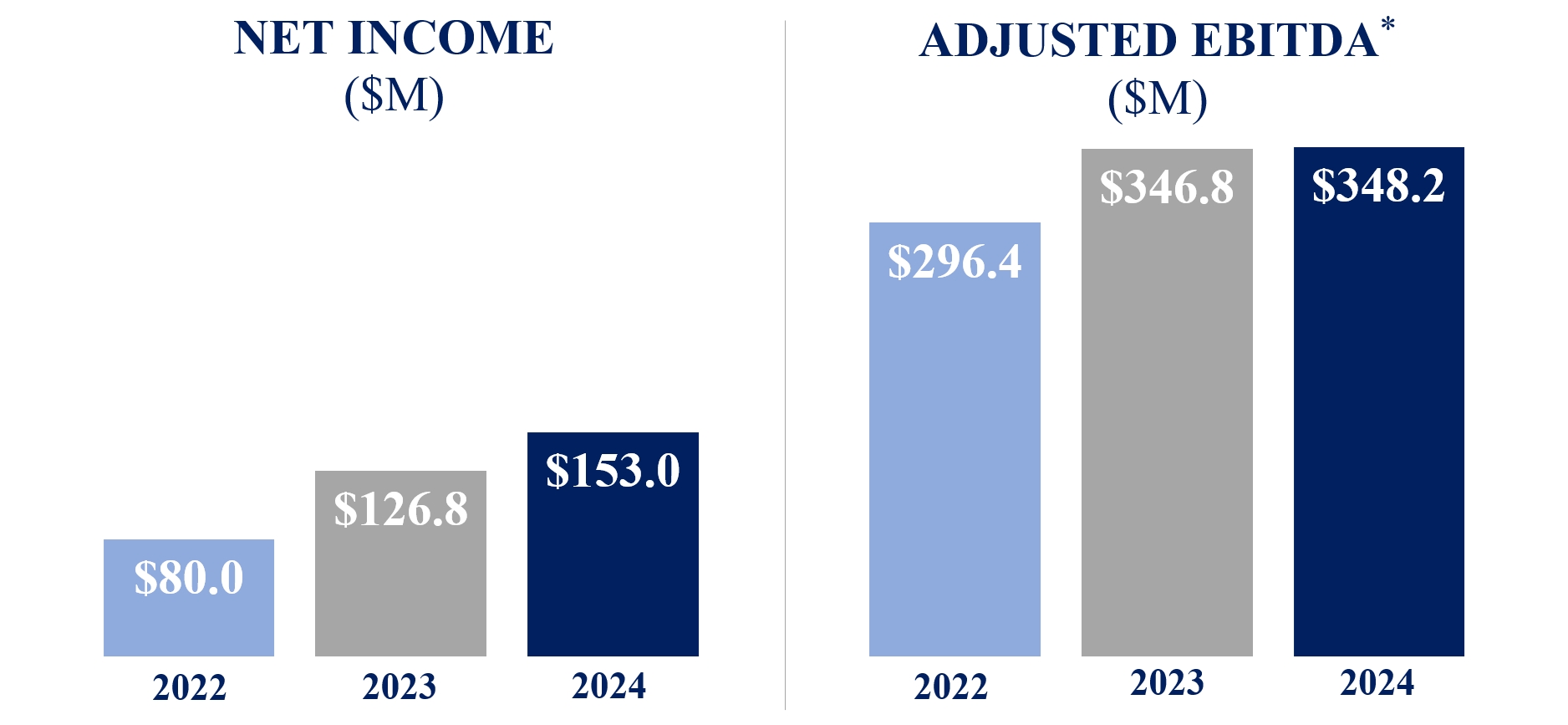
img213209656_5.jpg


*Adjusted EBITDA is a non-GAAP financial measure included as a supplemental disclosure because we believe it is a useful indicator of our operating performance. We define Adjusted EBITDA as net income before interest expense, income taxes, depreciation and amortization, accretion, non-cash long-term incentive compensation expense and items such as charges and non-recurring expenses that management does not consider as part of assessing ongoing operating performance. We adjust net income for the items listed above to arrive at Adjusted EBITDA because these amounts can vary substantially from company to company within our industry depending upon accounting methods and book values of assets, capital structures and the method by which the assets were acquired. Adjusted EBITDA should not be considered as an alternative to, or more meaningful than, net income as determined in accordance with GAAP or as an indicator of our operating performance or liquidity. This measure has limitations as certain excluded items are significant components in understanding and assessing a company’s financial performance, such as a company’s cost of capital and tax structure, as well as the historic costs of depreciable assets, none of which are components of Adjusted EBITDA. Our presentation of Adjusted EBITDA should not be construed as an inference that our results will be unaffected by unusual or non-recurring items. Our computations of Adjusted EBITDA may not be comparable to other similarly titled measures of other companies. For the foregoing reasons, Adjusted EBITDA has significant limitations that affect its use as an indicator of our profitability and valuation, and you are cautioned not to place undue reliance on this information. For reconciliation to Net Income, see Item 7 in our Annual Report on Form 10-K for the year ended December 31, 2024.


img213209656_6.jpg


Information as of December 31, 2024.
Net Debt is calculated as the sum of total debt and finance leases less cash and cash equivalents.


TABLE OF CONTENTS


BOARD OF DIRECTORS AND CORPORATE GOVERNANCE

1


Status as a Controlled Company

1


Composition of our Board of Directors

1


PROPOSAL 1—ELECTION OF DIRECTORS


3


Nominees for Director

4


Director Independence

7


Board Leadership Structure

7


Executive Sessions

7


Board Qualifications

7


Procedures for Recommending Individuals to Serve as Directors

8


Committees of the Board of Directors

8


Risk Oversight

10


Stockholder Engagement

11


Sustainability and Corporate Responsibility

11


Communications with Directors

12


Code of Conduct and Ethics

12


Corporate Governance Guidelines

12


Insider Trading Policy and Prohibitions and Restrictions on Hedging and Pledging Transactions

13


2024 Director Compensation

13


EXECUTIVE OFFICERS

14


PROPOSAL 2 —NON-BINDING, ADVISORY VOTE ON COMPENSATION OF OUR NAMED EXECUTIVE OFFICERS


16


COMPENSATION DISCUSSION & ANALYSIS

17


Summary of 2024 Performance Achievements

17


Compensation Philosophy, Objectives & Elements

17


Setting Executive Compensation

19


2024 Compensation Decisions

20


Other Compensation Items


23


Compensation Arrangements

24


Other Compensation Matters


24


COMPENSATION COMMITTEE REPORT

25


EXECUTIVE COMPENSATION TABLES

26


Summary Compensation Table

26


Grants of Plan-Based Awards

27


Outstanding Equity Awards at Fiscal Year-End

28


Option Exercises and Stock Vested

29


Nonqualified Deferred Compensation Plan

29


Potential Payments Upon Termination or a Change in Control

30


EQUITY COMPENSATION PLAN INFORMATION

32


i


CEO PAY RATIO


32


PAY VERSUS PERFORMANCE

33


Description of Certain Relationships between Information Presented in the Pay versus Performance Table


34


Financial Performance Measures


35


INDEPENDENT REGISTERED PUBLIC ACCOUNTING FIRM

36


Principal Accountant Fees and Services

36


Pre-Approval of Audit and Non-Audit Services Policy

36


AUDIT COMMITTEE REPORT

36


PROPOSAL 3—RATIFICATION OF APPOINTMENT OF INDEPENDENT REGISTERED PUBLIC ACCOUNTING FIRM


37


CERTAIN RELATIONSHIPS AND RELATED PERSON TRANSACTIONS

38


Procedures for Review and Approval of Related Person Transactions

38


Related Person Transactions

38


Indemnification Agreements


43


BENEFICIAL OWNERSHIP OF SECURITIES

45


QUESTIONS & ANSWERS ABOUT THE ANNUAL MEETING

47


OTHER MATTERS

50


Other Business

50


Submission of Stockholder Proposals for the 2025 Annual Meeting

50


Householding Information

50


Where You Can Find More Information

50


Forward-Looking Statements and Website References

This document includes forward-looking statements, within the meaning of Section 27A of the Securities Act of 1933, as amended, and Section 21E of the Securities Exchange Act of 1934, as amended, concerning expectations, beliefs, plans, objectives, goals, strategies, future events or performance and underlying assumptions and other statements that are other than statements of historical fact, including statements regarding our environmental and other sustainability plans and goals, and the inclusion of such statements or references to “materiality” (for sustainability and corporate responsibility purposes) is not an indication that these contents are necessarily material to investors or required to be disclosed under the rules of the SEC. Although we believe that the expectations and assumptions reflected in these statements are reasonable, there can be no assurance that these expectations will prove to be correct. Forward-looking statements are subject to many risks and uncertainties, including the risk factors that we identify in our SEC filings, and actual results may differ materially from the results discussed in such forward-looking statements. We undertake no duty to update publicly any forward-looking statement that we may make, whether as a result of new information, future events or otherwise, except as may be required by applicable law, regulation or other competent legal authority. In addition, our sustainability initiatives are aspirational and may change. Statements regarding our goals are not guarantees or promises that they will be met. Website references throughout this document are provided for convenience only, and the content on the referenced websites is not incorporated by reference into this document.

ii


BOARD OF DIRECTORS AND CORPORATE GOVERNANCE

Status as a Controlled Company

As of April 14, 2025, George B. Kaiser (“Kaiser”), through his ownership of Excelerate Energy Holdings, LLC (“EE Holdings”), controls approximately 72.6% of the voting power of our outstanding Common Stock. So long as Kaiser controls a majority of the Company’s outstanding voting power, he will thereby control the outcome of matters submitted to a stockholder vote. As a result of the voting power currently controlled by Kaiser, we qualify as a “controlled company” within the meaning of the corporate governance rules of the New York Stock Exchange (“NYSE”). Under these rules, a listed company of which more than 50% of the voting power with respect to director elections is held by another person or group of persons acting together is a “controlled company.” Consistent with this, we have elected not to comply with certain corporate governance requirements, including the requirements that (i) a majority of our board of directors must consist of independent directors, (ii) the nominating and governance committee must be composed entirely of independent directors, and (iii) the compensation committee must be composed entirely of independent directors. We intend to rely on all of the controlled company exemptions, and, unless consented to otherwise by Kaiser, will be required to do so under the Stockholder’s Agreement, dated as of April 18, 2022, by and among the Company, Excelerate Energy Limited Partnership (“EELP”) and EE Holdings, as amended (the “Stockholder’s Agreement”), for so long as we remain a controlled company. For details, see “Certain Relationships and Related Person Transactions—Related Person Transactions—Transactions in Connection with our Reorganization and Initial Public Offering—Stockholder’s Agreement” below. Accordingly, you may not have the same protections afforded to stockholders of companies that are subject to all of the NYSE corporate governance requirements. If at any time we cease to be a controlled company, we will take all action necessary to comply with SEC rules and regulations and the NYSE rules, including appointing a majority of independent directors to our board of directors (our “board” or our “board of directors”) and ensuring that we have a nominating and corporate governance committee and compensation committee each composed entirely of independent directors, subject to the permitted “phase-in” periods.

Composition of our Board of Directors

Our business and affairs are managed under the direction of our board of directors. In accordance with our amended and restated certificate of incorporation and bylaws, the number of directors on our board will be determined from time to time by the board of directors within the range included in the amended and restated certificate of incorporation. Our board of directors currently consists of seven members with Mr. Millican serving as chairperson.

Our amended and restated certificate of incorporation provides that currently our board of directors is subject to annual elections. Each director holds office until the next annual meeting of our stockholders and until his or her successor is duly elected and qualified or until his or her earlier death, resignation or removal. However, from and after such time when EE Holdings (including its permitted transferees) ceases to own at least 40% of the combined voting power of our then-outstanding capital stock entitled to vote generally in director elections (which we refer to as the Trigger Date), the board of directors will be divided into three classes of directors, with staggered three-year terms. For details, see “Certain Relationships and Related Person Transactions—Related Person Transactions—Transactions in Connection with our Reorganization and Initial Public Offering—Stockholder’s Agreement” below.

In addition, subject to the board’s fiduciary duties, as long as certain ownership thresholds are satisfied, the Stockholder’s Agreement gives EE Holdings the right to designate the chairperson of our board of directors and a certain number of nominees for election to our board of directors and, also subject to listing exchange requirements, each committee thereof. Additionally, EE Holdings has certain observer rights as long as EE Holdings (including its permitted transferees) has the right to designate director-designees under the Stockholder’s Agreement. For details, see “Certain Relationships and Related Person Transactions—Related Person Transactions—Transactions in Connection with our Reorganization and Initial Public Offering—Stockholder’s Agreement” below.

Pursuant to the Stockholder’s Agreement, EE Holdings has nominated Steven M. Kobos, Don P. Millican, Tyler D. Todd, and Robert A. Waldo as its designees to serve on our board. The board of directors evaluated the designees and determined that they are qualified to serve on the board and that it is in the best interest of the Company and our stockholders to nominate them for election at the annual meeting. Nisha D. Biswal, who joined our Board in 2025, was recommended by management.


1


The following table sets forth information with respect to our directors as of the record date:


Name

Age

Director
Since

Position at the Company

Committee Membership


AC

CC

NCGC

 Nisha D. Biswal

56

2025

Director

M*


M

 Deborah L. Byers

63

2022

Director

C*


 Paul T. Hanrahan

67

2022

Director

M*

C

C

 Steven M. Kobos

60

2021

President, Chief Executive Officer and Director


 Don P. Millican

72

2022

Director and Chairperson


 Tyler D. Todd

37

2024

Director


M

M

 Robert A. Waldo

49

2022

Director


M

M


AC: Audit Committee

CC: Compensation Committee

NCGC: Nominating and Corporate Governance Committee

M – Member

C – Chairperson


* Independent Director

† Audit Committee Financial Expert

2


PROPOSAL 1—ELECTION OF DIRECTORS

Our Nominating and Corporate Governance Committee has recommended, and our board has approved, Nisha D. Biswal, Deborah L. Byers, Paul T. Hanrahan, Steven M. Kobos, Don P. Millican, Tyler D. Todd, and Robert A. Waldo as nominees for election as directors at the Annual Meeting. If elected at the Annual Meeting, each nominee will serve until the 2026 Annual Meeting of Stockholders and until his or her successor has been duly elected and qualified, or, if sooner, until his or her earlier death, resignation, retirement, disqualification or removal. Information concerning these nominees and other continuing directors appears under “Nominees for Director” below. We have no reason to believe that any of the nominees will be unavailable or, if elected, will decline to serve. If any nominee becomes unable or unwilling to stand for election as a director, proxies will be voted for any substitute as designated by our board, or alternatively, our board may leave a vacancy on our board or reduce the size of our board.

Each director is elected by a plurality of the votes cast. “Plurality” means that the seven nominees who receive the largest number of votes cast “For” such nominees are elected as directors. Stockholders may vote “For All,” “Withhold All,” or “For All Except” with respect to the nominees named in this Proposal 1. Any shares voted “Withhold All” and broker non-votes are not considered votes cast for the foregoing purpose and will have no effect on the outcome of the election.


FOR ALL

OUR BOARD, UPON RECOMMENDATION OF OUR NOMINATING AND
CORPORATE GOVERNANCE COMMITTEE, UNANIMOUSLY RECOMMENDS
A VOTE “FOR ALL” OF THE DIRECTOR NOMINEES NAMED ABOVE.


3


Nominees for Director

The names of the nominees for director, their ages as of the record date, principal occupations, employment and other public company board service during at least the last five years, periods of service as a director of the Company, and the experiences, qualifications, attributes and skills of each nominee are set forth below:


Nisha D. Biswal

Age: 56

Director
since: 2025

Committees:

AC, NCGC

img213209656_7.jpg


Background


Nisha D. Biswal joined Excelerate's board of directors in January 2025. Ms. Biswal was the Deputy Chief Executive Officer of the U.S. International Development Finance Corporation (“DFC”), a development finance institution and agency of the United States federal government, a position she held from August 2023 through January 2025. In her position with DFC, Ms. Biswal oversaw operations and strategy supporting private-sector-led global projects in energy, infrastructure, health, agriculture, and climate and also ensured the adequacy of DFC's risk management and environmental and social compliance measures. From October 2017 to August 2023, Ms. Biswal was the Senior Vice President, International Strategy & Global Initiatives for the U.S. Chamber of Commerce, a business association advocacy group. In her position with the U.S. Chamber of Commerce, Ms. Biswal led the U.S.-India Business Council and U.S.-Bangladesh Business Council, oversaw teams across multiple regions and managed cross-cutting measures. From 2013 to 2017, Ms. Biswal was the Assistant Secretary of State for South and Central Asian Affairs with the U.S. Department of State, and from 2010 to 2013, Ms. Biswal was the Assistant Administrator for Asia for the U.S. Agency for International Development. Ms. Biswal holds a Bachelor of Arts, Arts & Sciences from the University of Virginia.


Qualifications and Skills


Her deep foreign policy and international experience in both the governmental and private sectors qualifies her to serve on our board of directors.


Deborah L. Byers

Age: 63

Director
since: 2022

Committees:

AC (Chairperson)


img213209656_8.jpg

Background

Deborah L. Byers joined Excelerate's board of directors in July 2022. In July 2022, after 36 years of service in public accounting, she retired as a Partner from Ernst & Young LLP (“EY”), a multinational professional services accounting firm where she held multiple leadership roles. From July 2018 until her retirement, she was EY’s Americas Industry Leader overseeing the market and growth strategy across its primary industry markets including Energy, Industrials & Automotive, Consumer, Technology, Telecom, Media & Entertainment, Healthcare & Life Sciences, Real Estate, Private Equity, and Government. Ms. Byers was EY’s Houston Office Managing Partner and U.S. Energy Leader from July 2013 to July 2018 and Managing Partner of the Southwest Region Strategy & Transactions business unit from July 2008 to July 2013. In these roles, she was a leader in the global energy market and worked with corporations and investment funds in all phases of energy investment across the sector. She was admitted to the EY Partnership in October 1997 after joining the firm in July 1986. Ms. Byers has served as a director of Kinetik Holdings Inc., a midstream energy company, since July 2022, of Civitas Resources, Inc., an upstream energy company, since February 2023, and of DTE Energy Company, an electric and gas utility provider, since September of 2023. Ms. Byers holds a BBA from Baylor University and is a Certified Public Accountant.

Qualifications and Skills

Her financial expertise and deep sector knowledge in global energy markets and systems qualify her to serve on our board of directors.


4


Paul T. Hanrahan

Age: 67

Director
since: 2022

Committees:

AC, CC (Chairperson), NCGC (Chairperson)


img213209656_9.jpg

Background

Paul T. Hanrahan joined Excelerate’s board of directors in April 2022. Mr. Hanrahan serves as the Chairman of Cubico Sustainable Investments, a privately-owned world leader in providing renewable energy. He also served as Interim Chief Executive Officer and a director of Hygo Energy Transitions Ltd., a company that developed and operated integrated LNG-to-Power facilities globally, from October 2020 until its acquisition by New Fortress Energy in April 2021. Mr. Hanrahan served as the Chief Executive Officer of Globeleq Advisors Limited, an independent power producer operating and developing power projects in Africa, from September 2017 to December 2019. Mr. Hanrahan has served on Globeleq’s board of directors since January 2020. Previously, Mr. Hanrahan served as the Chief Executive Officer of American Capital Energy & Infrastructure Management, LLC, an investment company formed to raise, invest and manage funds in the energy and infrastructure industries, from September 2012 until its acquisition by Ares Capital Corporation in December 2016. Mr. Hanrahan served as the President and Chief Executive Officer and as a director of The AES Corporation, an independent power producer, from June 2002 to September 2011. Mr. Hanrahan served as a director of Ingredion Inc. from March 2006 to October 2023. Mr. Hanrahan earned a bachelor’s degree in mechanical engineering from the U.S. Naval Academy and a master’s degree in business administration from Harvard Business School.

Qualifications and Skills

His extensive executive and public company board experience and knowledge of the industry qualify him to serve on our board of directors.


Steven M. Kobos

Age: 60

Director
since: 2021

Committees:

None


img213209656_10.jpg

Background

Steven M. Kobos has served as President and Chief Executive Officer of EELP since March 2018 and President, Chief Executive Officer and a director of Excelerate since September 2021. Prior to his current role, Mr. Kobos served as a board member of EELP since 2017 and its counsel for the previous 11 years. Prior to joining EELP, Mr. Kobos formally supported our company as Managing Counsel with primary legal responsibility for EELP global projects, while also employed by Frederic Dorwart, Lawyers PLLC. Mr. Kobos earned a bachelor’s degree and Juris Doctorate from the University of Oklahoma.

Qualifications and Skills

His in-depth knowledge of the issues, challenges and opportunities facing us and his expertise managing complex energy and infrastructure development projects qualify him to serve on our board of directors.


5


Don P. Millican

Age: 72

Director
since: 2022

Committees:

None

img213209656_11.jpg

Background

Don P. Millican has served as a member of the board of directors of EELP since 2008 and as a director of Excelerate since April 2022. Until his retirement in July 2024, Mr. Millican served as the Vice President & Chief Financial Officer of Kaiser-Francis Oil Company ("Kaiser-Francis"), an upstream oil and gas company owned by Kaiser, our controlling stockholder, and was also affiliated with other Kaiser-controlled entities in various senior capacities. Prior to Kaiser-Francis, Mr. Millican was a partner in the international accounting firm of Ernst & Young, LLP between 1982 and 2003. Mr. Millican previously served as Chief Financial Officer of EELP from December 2003 to May 2008. In October 2024, Mr. Millican was named to the Board of Directors of the George Kaiser Family Foundation. Mr. Millican is engaged in many civic activities, having served on the board of Community Action Project, Tulsa Educare, Inc., Neighbor for Neighbor, Oklahoma Policy Institute, Tulsa Neighborhood Networks and Crossover Community Impact. He also serves on the Board of Trustees of Oklahoma Christian University, having formerly served as Chairman. Mr. Millican serves as a director of Memjet, Ltd. and Memjet Home and Office, Inc. He is a Certified Public Accountant. He earned a bachelor’s degree in accounting from the University of North Texas.

Qualifications and Skills

His executive leadership experience in the oil and gas industry, his broad perspective gained from involvement in diverse industries and his knowledge of our business qualify him to serve on our board of directors.


Tyler D. Todd

Age: 37

Director
since: 2024

Committees:

CC, NCGC


img213209656_12.jpg


Background


Tyler D. Todd joined Excelerate's board of directors in October 2024. Since 2023, Mr. Todd has served as Senior Vice President of Business Development at Kaiser-Francis and is also affiliated with other Kaiser-controlled entities in various senior capacities. From 2019 to 2023, Mr. Todd served as the Director of Business Development for Kaiser-Francis, and from 2015 to 2019, Mr. Todd served as an Associate in Business Development for Kaiser-Francis. Prior to joining Kaiser-Francis, Mr. Todd worked at WPX Energy where he held various petroleum engineering roles. Mr. Todd currently serves as a member of the industry advisory board for the Mewbourne School of Petroleum & Geologic Engineering at the University of Oklahoma. Mr. Todd earned a bachelor's degree from the University of Oklahoma and a master's degree in business administration from Harvard Business School.

Qualifications and Skills


His executive experience in the oil and gas industry along with his experience in acquisition and divestiture transactions qualify him to serve on our board of directors.


6


Robert A. Waldo

Age: 49

Director
since: 2022

Committees:

CC, NCGC


img213209656_13.jpg

Background

Robert A. Waldo has served as a member of the board of directors of EELP since 2014 and as a director of Excelerate since April 2022. Since 2016, Mr. Waldo has served as the President of Kaiser-Francis, and is also affiliated with other Kaiser-controlled entities in various senior capacities. From 2012 to 2015, Mr. Waldo was the Executive Vice President of Kaiser-Francis. Mr. Waldo has worked at Kaiser-Francis in various roles since 2004 and, in addition to the upstream oil and gas business, he is involved in various investment activities of Mr. Kaiser, including Cactus Drilling and multiple private and public equity investments. In March 2025, Mr. Waldo was nominated to serve as a director of BOK Financial Corporation. Mr. Waldo served as a director of StepStone Group Inc. (including its predecessor) from 2007 to 2021. From 2000 to 2002, Mr. Waldo worked as an associate at Evercore Partners, where he focused on mergers and acquisitions and private equity investments, and from 1998 to 2000, he was an analyst in the investment banking division of Merrill Lynch. Mr. Waldo earned a bachelor’s degree from Harvard University and a master’s degree in business administration from Duke University.

Qualifications and Skills

His extensive experience in the oil and gas industry and private equity investments qualifies him to serve on our board of directors.


Director Independence

Our Nominating and Corporate Governance Committee and our board have conducted their annual review of the independence of each director nominee under the applicable NYSE and SEC independence standards. Based upon the Nominating and Corporate Governance Committee’s recommendation and our board’s own review and assessment, our board has affirmatively determined in its business judgment that each of Nisha D. Biswal, Deborah L. Byers, and Paul T. Hanrahan is “independent” as defined under the NYSE rules and Rule 10A-3 under the Securities and Exchange Act of 1934, as amended (the “Exchange Act”). The Board also previously determined that Carolyn J. Burke, who served as director until January 21, 2025, was independent during the period that she served as director.

Board Leadership Structure

We do not have a policy regarding whether the role of the chairperson of the board and chief executive officer should be separate or combined, and our board of directors believes that we should maintain the flexibility to select the chairperson and chief executive officer and reorganize the leadership structure, from time to time, based on criteria that are in our best interests and the best interests of our stockholders. The board believes that presently it is in the best interests of the Company to separate the roles of the chairperson of the board and chief executive officer. In accordance with the Stockholder’s Agreement, the board of directors determined that Don P. Millican should serve as chairperson of the board. Our board of directors believes its administration of its risk oversight function has not affected its leadership structure.

Executive Sessions

In order to promote open discussion among non-management directors, our board holds executive sessions of non-management directors at least quarterly. These executive sessions are chaired by the chairperson of the board. In addition, as required under the NYSE rules, the board holds an executive session of independent directors at least once per year. In 2024 our independent directors met in executive session on a quarterly basis.

Board Qualifications

The Nominating and Corporate Governance Committee periodically reviews, and recommends to our board, the skills, experience, characteristics and other criteria for identifying and evaluating directors. The board expects directors to be open and forthright, to develop a deep understanding of the Company’s business, to understand their role in furthering the Company’s mission, values and commitment to environmental, social and governance principles, and to exercise sound judgment in fulfilling their oversight responsibilities. Directors should embrace the Company’s values and culture and should possess the highest levels of integrity.

The board considers a variety of occupational and personal backgrounds, perspectives and viewpoints among its members and expects that its members will have a range of skills and expertise sufficient to provide guidance and oversight with respect to the Company’s strategy and operations. The board and the Nominating and Corporate Governance Committee also actively seek to achieve an array of occupational and personal backgrounds and viewpoints on the board, including with respect to demographics such as backgrounds, perspectives and experiences. As part of the search process for each new director, the Nominating and Corporate Governance Committee actively seeks out qualified diverse candidates to expand the pool from which Board nominees are ultimately chosen based on merit.

The Nominating and Corporate Governance Committee reviews the qualifications of director candidates and incumbent directors in light of the criteria approved by our board and recommends the Company’s candidates to our board for election by the Company’s stockholders at the stockholders' annual meeting. We also assess qualifications and characteristics of our directors as part of our board’s annual self-evaluation process. We believe our board is well positioned to provide effective oversight and strategic advice to our management.

7


Key skills, qualifications, and attributes of our director nominees include, but are not limited to:


Biswal

Byers

Hanrahan

Kobos

Millican

Todd

Waldo

Senior Executive Leadership

Public Company Experience


Energy Industry Expertise


Operational / Safety Expertise


Legal / Regulatory / Government Relations


Strategy / M&A

Financial / Accounting

Risk Management
(including Cybersecurity)


Environment / Sustainability


Information Technology and Systems
(including artificial intelligence)


Geopolitical Knowledge


Procedures for Recommending Individuals to Serve as Directors

The Nominating and Corporate Governance Committee also considers director candidates recommended by our stockholders. Any stockholder who wishes to propose director nominees for consideration by the Nominating and Corporate Governance Committee, but does not wish to present such proposal at the Corporation’s Annual Meeting of Stockholders, may do so at any time by directing a description of each nominee’s name and qualifications for board membership to the chairperson of the Nominating and Corporate Governance Committee, c/o our Executive Vice President and General Counsel at Excelerate Energy, Inc., 2445 Technology Forest Blvd., Level 6, The Woodlands, Texas 77381. The recommendation should contain all of the information regarding the nominee under Regulation 14A of the Exchange Act, including, among other things, the particular experience, qualifications, attributes or skills of the nominee that, in light of our business and structure, led to the stockholder’s conclusion that the nominee should serve on the board, and any additional requirements included in the Corporation’s Amended and Restated Bylaws relating to director nominations brought before an annual meeting. The Nominating and Corporate Governance Committee evaluates any nominee proposed by stockholders in the same manner in which it evaluates other nominees.

Committees of the Board of Directors

Our board established an Audit Committee, a Compensation Committee and a Nominating and Corporate Governance Committee. These committees are each described below. Each of our board’s committees acts under a written charter, which was adopted and approved by our board of directors. Copies of the committees’ charters are available on our website at https://ir.excelerateenergy.com/governance/governance-documents.

Committee Membership; Meetings and Attendance

During the fiscal year ended December 31, 2024:

our board of directors held six meetings;
our Audit Committee held four meetings;
our Compensation Committee held five meetings; and
our Nominating and Corporate Governance Committee held five meetings.

8


During the fiscal year ended December 31, 2024, no incumbent director attended fewer than 75% of the meetings of our board of directors and the respective committees of which he or she was a member held during the period such incumbent director was a director.

Directors are expected to attend the Annual Meeting absent unusual circumstances. All seven of our then-sitting directors attended the 2024 Annual Meeting.

Audit Committee

Our Audit Committee consists of Nisha D. Biswal, Deborah L. Byers, and Paul T. Hanrahan. Ms. Byers serves as the chairperson of the Audit Committee. Each of Ms. Biswal, Ms. Byers, and Mr. Hanrahan qualifies as an “independent” director for purposes of the SEC and NYSE independence rules that are applicable to audit committee members. Ms. Biswal, Ms. Byers, and Mr. Hanrahan have each been determined by the board of directors to be financially literate and have sufficient financial experience and ability to discharge their responsibilities. In addition, each of Ms. Byers and Mr. Hanrahan qualifies as an “audit committee financial expert” as defined by the SEC. Our Audit Committee, among other things, has responsibility for:

assisting our board of directors in its oversight responsibilities regarding the integrity of our financial statements, our compliance with legal and regulatory requirements, the independence, qualifications and performance of the independent auditor, the design and implementation of our internal audit function, and the Company’s systems of disclosure controls and procedures and internal controls over financial reporting;
selecting, evaluating, compensating, overseeing and, if necessary, replacing the independent auditor;
overseeing the preparation of the audit committee report in the annual proxy statement and any other reports or statements required by any applicable law, rule or regulation or the NYSE;
approving all audit engagement fees and terms (including proposed budgets) and pre-approving any audit or non-audit services;
meeting to review and discuss the Company’s annual audited financial statements and quarterly financial statements with management and the independent auditor, including the Company’s disclosures under “Management’s Discussion and Analysis of Financial Condition and Results of Operations” before filing of the Company’s Form 10-Q or Form 10-K;
assisting the board in fulfilling its oversight of enterprise risk management, including those related to cybersecurity, artificial intelligence, unauthorized access to information technology infrastructure, litigation and the steps that management has taken to monitor and control such exposures;
implementing and reviewing the Audit Committee Procedures for Handling Reports of Potential Misconduct;
implementing and periodically reviewing the Related Person Transactions Policies and Procedures and overseeing other related party transactions governed by accounting rules; and
conducting and presenting to the board an annual performance evaluation of the Audit Committee, and annually reviewing the adequacy of the Audit Committee charter and the duties and responsibilities of the Audit Committee and recommending any proposed changes to the board for approval.

Compensation Committee

Our Compensation Committee consists of Paul T. Hanrahan, Tyler D. Todd and Robert A. Waldo. Mr. Hanrahan serves as the chairperson of the Compensation Committee. Mr. Hanrahan qualifies as an “independent” director for purposes of the SEC and NYSE independence rules that are applicable to compensation committee members. As a controlled company, we rely upon the exemption from the NYSE requirement that we have a compensation committee composed entirely of independent directors. Our Compensation Committee, among other things, has responsibility for:

overseeing the Company’s overall compensation philosophy, assessing whether it is aligned with the Company’s business strategy and stockholder interests and establishing appropriate incentives for management and employees;
reviewing and approving corporate goals and objectives relevant to the compensation of the chief executive officer, evaluating the chief executive officer’s performance in light of those goals and objectives, and setting the chief executive officer’s compensation level based on this evaluation (other than equity grants, which are recommended to approval by the full board);
in conjunction with the chief executive officer, reviewing and approving corporate goals and objectives relevant to the compensation of other executive officers, evaluating the performance of other executive officers in light of those goals and objectives, and setting the compensation levels of other executive officers based on this evaluation and upon the recommendation of the chief executive officer (other than equity grants, which are recommended to approval by the full board);
periodically reviewing the form and amount of compensation of directors for service on the board and its committees and recommend changes in compensation to the board as appropriate;
at least annually, assessing whether the work of compensation consultants involved in determining or recommending executive or director compensation has raised any conflict of interest that is required to be disclosed in the Company’s annual report and proxy statement;
to the extent required, overseeing the assessment of the risks related to the Company’s compensation policies and programs applicable to officers and employees, and reporting to the board on the results of this assessment as needed;
reviewing, approving and administering the Company's compensation recoupment and clawback policies;

9


in conjunction with the chief executive officer, if applicable, reviewing succession planning for positions held by executive officers, and reviewing succession planning and management development at least annually with the board, including recommendations and evaluations of potential successors to fill these positions;
reviewing the Company’s strategies and policies related to human capital management, including workplace environment and culture, and talent development and retention; and
annually evaluating the performance of the Compensation Committee and the adequacy of the Compensation Committee’s charter and recommending changes to the board.


The Compensation Committee may delegate its authority to one or more subcommittees, members of the Board, the chairperson of the Compensation Committee or officers of the Company, to the extent permitted by law, when it deems appropriate and in the best interests of the Company.

Nominating and Corporate Governance Committee

Our Nominating and Corporate Governance Committee consists of Nisha D. Biswal, Paul T. Hanrahan, Tyler D. Todd and Robert A. Waldo. Mr. Hanrahan serves as the chairperson of the Nominating and Corporate Governance Committee. Mr. Hanrahan qualifies as an “independent” director for purposes of the NYSE independence rules that are applicable to board members. As a controlled company, we rely upon the exemption from the NYSE requirement that we have a nominating and corporate governance committee composed entirely of independent directors. Our Nominating and Corporate Governance Committee, among other things, has responsibility for:

identifying, reviewing the qualifications of and recruiting new candidates for election to the board;
discussing succession planning for the board and key leadership roles on the board and its committees;
recommending to the board the Company’s candidates for election or reelection to the board at each annual stockholders’ meeting;
developing and recommending to the board a set of corporate governance principles, and annually reviewing these principles and recommending changes to the board as appropriate;
overseeing and, where appropriate, making recommendations to the board regarding sustainability and social matters relevant to the Company’s business, including Company policies, activities and opportunities; and
annually evaluating the performance of the Nominating and Corporate Governance Committee and the adequacy of the Nominating and Corporate Governance Committee’s charter and recommending changes, if any, to the board as appropriate.

Risk Oversight

Our board of directors believes that risk management is an important part of establishing, updating and executing on our business strategy. Our board of directors, as a whole and at the committee level, has oversight responsibility relating to risks that could affect our corporate strategy, business objectives, compliance, operations and financial condition and performance. Our board of directors focuses its oversight on the most significant risks facing us and on its processes to identify, prioritize, assess, manage and mitigate those risks. Our board of directors and its committees receive regular reports from members of our senior management on areas of material risk to us, including strategic, operational, financial, legal and regulatory risks. While our board of directors has an oversight role, management is principally tasked with direct responsibility for management and assessment of risks and the implementation of processes and controls to mitigate their effects on us.

While our board is ultimately responsible for the risk oversight of our Company, our Audit Committee has primary responsibility for overseeing processes regarding management and mitigation of the risks facing our Company, including major financial, cybersecurity and control risks, and oversight of the measures initiated by management to monitor and control such risks and the process by which our board of directors is informed about such risks. Our Audit Committee also monitors compliance with legal and regulatory requirements and considers and approves or disapproves any related person transactions. Our Compensation Committee has responsibility to review the risks arising from our compensation policies and practices applicable to all employees and evaluate policies and practices that could mitigate any such risks. Our Nominating and Corporate Governance Committee has responsibility to review risks relating to our corporate governance practices. These committees provide regular reports on our risk management practices to our full board, as necessary. Our board believes that the Company’s current leadership structure supports its risk oversight function.

Among other things, our Audit Committee is also responsible for the oversight of risks from cybersecurity threats and the process by which our board is informed about such risks. Our Chief Information Officer reports to the Audit Committee on a periodic basis on data protection and cybersecurity matters. In addition, our Audit Committee receives regular reports on our Company’s cyber risks, exposures and threats, and mitigation plans directly from our information technology department. Our Audit Committee updates our board on such matters at least annually and more frequently as needed. Our cybersecurity program aligns with industry standards, including the National Institute of Standards and Technology Cybersecurity Framework and the guidelines of the International Maritime Organization. We rely upon a multi-layered controls approach, including monitoring, security engineering, incident management and resiliency. The efficacy of our cybersecurity program is assessed through monitoring and the engagement of third-party experts. Our global information security team assesses cyber risks on an on-going basis and adjusts our program as needed. Our employees regularly participate in information security training and awareness campaigns designed to strengthen adoption of secure behaviors. For additional information, please refer to Section 1C of our Annual Report on Form 10-K for the year ended December 31, 2024.

10


Stockholder Engagement

We respect and benefit from interactions with stockholders, prospective investors and institutional analysts. Our Investor Relations team coordinates these engagements, which include, but are not limited to, participation at investment conferences, quarterly earnings conference calls, one-on-one meetings and visits throughout the year as well as our annual stockholder meeting. These meetings often include participation by our President and Chief Executive Officer, Chief Financial Officer, and/or functional business leaders. Topics generally focus on corporate performance, strategy, governance, market conditions and sustainability and corporate responsibility issues.

Engagements with stockholders offer our management team an opportunity to solicit stockholder views and input, which in turn, is shared with our board of directors.

Our Principles of Corporate Governance codify our board of directors’ oversight of stockholder engagement and reflect their understanding of the critical role stockholder engagement plays in governance.

Sustainability and Corporate Responsibility

Sustainability

We strive to operate our business in a responsible manner, incorporating social responsibility, environmental stewardship and transparent governance throughout our operations. This is consistent with our corporate values of stewardship, accountability, improvement and leadership in everything we do, everywhere we operate around the world. It also aligns with our business objectives to help bring cleaner and more accessible energy to global markets.

Our board of directors oversees our sustainability efforts, related strategic planning and risk management, policies, and procedures. Our Nominating and Corporate Governance Committee has oversight of our sustainability strategy and practices. This Committee receives regular updates on sustainability and corporate responsibility activities. At the operating level, sustainability responsibility resides with our Chief Executive Officer and is guided by an ESG steering committee, which includes, among others, our Chief Operating Officer, Chief Financial Officer, Chief Human Resources Officer, and General Counsel. In addition, we have sustainability and corporate responsibility working teams who are responsible for implementing strategies in the areas of employee safety, business ethics, corporate social responsibility, greenhouse gas (“GHG”) emissions, air quality and regulatory reporting to the Securities and Exchange Commission.

We are continuing to develop our GHG inventory, enhancing our controls for annual emissions measurement and reporting, further integrating our sustainability and corporate responsibility strategy throughout our operations, and implementing new policies on Human Rights and Supplier Code of Conduct. Our sustainability and corporate responsibility strategy guides our efforts to operate responsibly, enabling us to deliver an essential service that is helping secure a sustainable future for all. In 2023, we conducted a sustainability materiality assessment through a survey and interviews with our primary stakeholders, both internal and external, about the sustainability and corporate responsibility topics most important to them and our business. These stakeholders included senior leadership, board members, investors, customers, think tanks, public organizations, suppliers and non-governmental agencies. Through this process, we are able to prioritize sustainability and corporate responsibility focus areas, outlined below, where we can have the most impact:

identify and evaluate opportunities to minimize environmental impacts from our operations and assets;
support the countries we serve in their efforts to lower GHG emissions, through the provision of our floating storage and regasification unit (“FSRU”) services and LNG and gas sales;
enhance monitoring and reporting of emissions and ecological impacts;
increase energy access worldwide and work to help end global energy poverty;
invest in the social and economic development of the markets we serve;
continue to develop a high-performing workforce and maintain a safe work environment;
encourage employees to give back to the local communities where they live and work;
align compensation with financial performance and stakeholder interests; and
commit to the highest standards of business ethics and compliance.

Human Capital Resources

Our human capital is one of our most valuable assets. As of December 31, 2024, we had a global headcount of 919 colleagues, consisting of 241 full-time onshore employees and 678 seafarers. The seafarers and Belgium employees are represented by labor unions or covered under collective bargaining agreements.

We place a high premium on attracting, developing and retaining a talented and high-performing workforce. Our employees are expected to act with integrity, responsibility and compliance and uphold governance and ethics best practices, including adherence to an equal opportunity policy that prohibits discrimination in any form. We believe our employees' commitment is fundamental to having a sustainable business. We offer our employees a variety of company-paid benefits, which we believe are competitive relative to others in our industry. Our onshore employees earn a base salary plus an annual bonus (short term incentive plan) with targets aligned with organizational goals. Our seafarers earn salaries and other compensation commensurate with terms outlined in their collective bargaining agreements. We believe that our relations with our employees are good.

11


For over two decades, we have worked to provide safe, efficient and cost-effective LNG solutions, and we believe that our success has been in large part due to our employees’ commitment to excellence. Our core values of stewardship, accountability, improvement and leadership (“SAIL”) represent not only our beliefs in how we conduct our business but also how we engage our employees. We have worked to establish a corporate culture with a focus on creating a collaborative environment that fosters the personal intellectual growth of each of our employees.

We aim to create an environment where every team member feels valued and empowered to contribute their unique ideas and perspectives. As a U.S.-based company with global operations, we collaborate with a diverse range of colleagues, vendors, customers, partners and local communities. The collective sum of our employees' individual differences, life experiences, knowledge, inventiveness, innovation, self-expression and talent has been an important driver of our success over the years.

Health, Safety & Environmental

Our health, safety and environmental function is responsible for maintaining the safety of all our employees, operations and assets as well as compliance with all applicable laws and regulations related to our environmental impact. We have a health, safety, security, environmental and quality policy, which is independently certified under the International Safety Management Code, an international standard for the safe management and operation of ships. In addition, we have training programs and tools tailored to both onshore and fleet personnel and positions. Safety performance is measured, monitored and audited on a regular basis.

Corporate Social Responsibility

We are invested in the communities and markets in which we operate. Our efforts to help improve the quality of life and resilience of these communities are focused on education, health, climate, and emergency relief. In 2024, we funded Society of Petroleum Engineers scholarships for students in the U.S. Gulf Coast to pursue university studies that would prepare them for eventual careers in the energy industry. Additionally in Bangladesh, we sponsored a Weekend Film Challenge to help budding filmmakers produce public service announcements on environmental awareness. In Brazil, we partnered with Caritas to deliver humanitarian relief after heavy rains and floods displaced people from their homes and local communities. In Belgium, we launched a new corporate social responsibility partnership with Antwerp Seafarers' Welfare, which provides comprehensive services for international seafarers who call on Europe’s second largest port.

Communications with Directors

Stockholders and other interested parties who wish to communicate with our board, the chairperson of the board, the independent directors as a group, or any individual director may do so by sending an email to corporatesecretary@excelerateenergy.com or in writing, c/o our Executive Vice President and General Counsel at 2445 Technology Forest Blvd., Level 6, The Woodlands, Texas 77381. Communications we receive that relate to accounting, internal accounting controls, auditing matters or securities law matters will be referred to the Audit Committee unless the communication is directed otherwise. You may communicate anonymously and/or confidentially. Each communication will be reviewed to determine whether it is appropriate for presentation to our board or the applicable director(s). The purpose of this screening is to allow our board (or the applicable individual director(s)) to avoid having to consider irrelevant or inappropriate communications (such as advertisements, solicitations, product inquiries or any offensive or otherwise inappropriate materials).

Code of Conduct and Ethics

Our board adopted a Code of Conduct and Ethics (the “Code”) relating to the conduct of our business by all of our employees, executive officers (including our principal executive officers, principal financial officer and principal accounting officer (or persons performing similar functions)), and directors. This Code satisfies the requirement that we have a “code of conduct” under the NYSE and SEC rules and is available on our website at https://excelerateenergy.com/our-values/. To the extent required under the listing rules and SEC rules, we intend to disclose future amendments to certain provisions of this Code, or waivers of such provisions, applicable to any of our executive officers or directors, on our website identified above.

Corporate Governance Guidelines

Our board also adopted principles of corporate governance to formalize its governance practices and serve as a flexible framework within which our board of directors and its committees operate. These guidelines cover a number of areas, including, among others, the role of our board of directors, board composition and leadership structure, director independence, director selection, qualification and election, director compensation, executive sessions, chief executive officer evaluation, succession planning, annual board assessments, board committees, director orientation and continuing education and board communications with stockholders. A copy of our corporate governance guidelines is posted on our website at https://ir.excelerateenergy.com/governance/governance-documents/.

12


Insider Trading Policy and Prohibitions and Restrictions on Hedging and Pledging Transactions

The Company has adopted an Insider Trading Policy that contains policies and procedures governing the purchase, sale and/or other dispositions of the Company’s securities by directors, officers and employees, or the Company itself, that are reasonably designed to promote compliance with insider trading laws, rules and regulations and the listing standards applicable to the Company. Among other things, our Insider Trading Policy prohibits our directors, officers and employees and members of their immediate families and households and their controlled entities (i.e., corporations or other business entities controlled or managed by any such person and trusts or other entities for which any such person is the trustee or in which any such person has a beneficial pecuniary interest) from (i) engaging in speculative transactions (including short sales and puts or calls), (ii) hedging Company securities (including through the purchase of financial instruments such as prepaid variable forward contracts, equity swaps, collars and exchange funds) and (iii) pledging Company securities as collateral for a loan or holding Company securities in a margin account.

2024 Director Compensation

Mr. Kobos, as well as Don P. Millican, Tyler D. Todd and Robert A. Waldo, who are the directors affiliated with Kaiser, our controlling stockholder, do not receive additional compensation for their services on our board of directors. Our 2024 compensation program for independent, unaffiliated directors was comprised of the following elements.

An annual cash retainer of $60,000, payable quarterly in arrears, all or a portion of which directors may elect to defer under our Excelerate Energy Deferred Compensation Plan;
An annual equity retainer in the form of restricted stock units that vests on the one-year anniversary of the date of grant with a grant date value of $125,000, which directors may elect to defer under our Excelerate Energy Deferred Compensation Plan; and
Additional annual cash retainers of $20,000, $15,000, and $12,000, for serving as the chairperson of the Audit Committee, Compensation Committee, or Nominating and Corporate Governance Committee, respectively.

Each director also receives reimbursement for reasonable travel and miscellaneous expenses incurred in attending meetings and activities of our board of directors and its committees.

Set forth below are details on the 2024 compensation earned or granted to each of the independent, unaffiliated directors who served during 2024.


Name

Fees earned or paid in cash (1)

Stock awards
(2)

Total

Carolyn J. Burke (3)

$75,000

$125,002

$200,002

Deborah L. Byers

$80,000

$125,002

$205,002

Paul T. Hanrahan

$72,000

$125,002

$197,002


(1)
Each of Ms. Burke and Mr. Hanrahan elected to defer receipt of all or a portion of their annual cash retainers pursuant to the Excelerate Energy Deferred Compensation Plan.
(2)
Includes restricted stock unit grants that have been deferred at the election of the directors under the Excelerate Energy Deferred Compensation Plan. As of December 31, 2024, each of Ms. Burke and Mr. Hanrahan held 10,075 unvested restricted stock units, and Ms. Byers held a total of 10,370 unvested restricted stock units. None of our other non-executive directors held any unvested equity awards.
(3)
Ms. Burke resigned as a member of the board of directors effective January 21, 2025. In connection with her departure and the forfeiture of her 2024 restricted stock unit award, she received a cash payment of $270,017.

Director Compensation Policy Changes

In 2025, the board of directors, upon recommendation of the Compensation Committee, approved an increase to the annual cash retainer, raising it to $75,000 and increases to the Audit Committee, Compensation Committee, and Nominating and Corporate Governance Committee chairperson retainers, raising such to $23,000, $17,000, and $15,000, respectively. After reviewing both peer group and survey data, such increases were approved to better align our director compensation package with our compensation peer group and industry practice. We have not otherwise revised our director compensation program since it was initially established in April 2022 in connection with our IPO.


13


EXECUTIVE OFFICERS

The following individuals constitute our executive officers:


Name

Age*

Position

Steven M. Kobos

60

President, Chief Executive Officer and Director

Dana A. Armstrong

53

Executive Vice President and Chief Financial Officer

Oliver L. Simpson

43

Executive Vice President and Chief Commercial Officer

David A. Liner

52

Executive Vice President and Chief Operating Officer

Alisa Newman Hood

50

Executive Vice President and General Counsel

Amy Thompson Broussard

48

Executive Vice President and Chief Human Resources Officer

Michael A. Bent

58

Vice President, Controller and Chief Accounting Officer

* As of the proxy filing date.

The biography of Mr. Kobos appears above under “Nominees for Director.” Biographies of the remaining executive officers appear below:

Dana A. Armstrong has served as Executive Vice President and Chief Financial Officer of EELP since April 2020 and Executive Vice President and Chief Financial Officer of Excelerate since September 2021. Prior to joining EELP, from September 2015 to April 2020, Ms. Armstrong served as the Senior Vice President and Chief Financial Officer of Scientific Drilling International, a leading energy services provider and manufacturer. Before joining Scientific Drilling International, between 2007 and 2015, Ms. Armstrong served in various leadership roles at ION Geophysical, a global provider of technology-driven geophysical solutions including as the Vice President and Treasurer from 2012 to 2015. Prior to that, Ms. Armstrong served in various senior financial leadership roles at Thermo Fisher Scientific, a world leader in serving science. Ms. Armstrong serves as a director of Great Lakes Dredge & Dock Corporation. Ms. Armstrong earned a bachelor’s degree in accounting and a master’s degree in business administration from the University of Houston. She is also a licensed Certified Public Accountant.

David A. Liner has served as Executive Vice President and Chief Operating Officer of Excelerate since January 2023. Previously, Mr. Liner served as Vice President of Operations and Maintenance of EELP from August 2021 through December 2022. Prior to joining EELP, Mr. Liner served in various leadership roles over his 20-year career at SeaRiver Maritime, Inc., a U.S. marine transportation company and wholly owned subsidiary of ExxonMobil. These roles included the Americas Freight Trading Manager (2021), Americas Crude & Feedstocks Manager (2020), Planning & Strategy Manager (2018-2020), and the Chief Commercial and Planning Officer for Qatar Gas Transport Company Ltd. (Nakilat) (on secondment from ExxonMobil) (2015-2018). Mr. Liner also served in various roles for SeaRiver Maritime Inc. and ExxonMobil Development Company from 2001 to 2015, as an engineer for BMT Designs & Planners, Inc. from 2000 to 2001, and as an engineer for the American Bureau of Shipping from 1996 to 2000. Mr. Liner holds a bachelor’s degree in Ocean Engineering from the Florida Institute of Technology.

Oliver L. Simpson has served as Executive Vice President and Chief Commercial Officer of Excelerate since November 2023. Mr. Simpson joined EELP in 2014 and has served in various roles, including as Vice President, Commercial of EELP from 2017 to 2023, where he was responsible for managing the commercial shipping business and supporting and executing a wide range of transactions on behalf of EELP. Prior to joining EELP in 2014, Mr. Simpson served in various roles at affiliates of Astrup Fearnley Group, an international ship brokering and consulting company, and was responsible for overseeing various roles in the LNG division, including the LNG chartering department. Between 2004 and 2008, Mr. Simpson served in various trading and risk positions within the Gas & Power division of Total Energies in London and Houston. Mr. Simpson earned a Master of Arts in Modern History from University of St. Andrews in Scotland.

Alisa Newman Hood has served as Executive Vice President and General Counsel of EELP since January 2021. Ms. Newman Hood has served as Executive Vice President and General Counsel of Excelerate since September 2021. She formerly served as a Senior Vice President of EELP, (on secondment from Frederic Dorwart, Lawyers PLLC, where she was employed as an attorney between May 2019 and December 2020) between May 2019 and December 2020. Previously, Ms. Newman Hood served as General Counsel at ARTIC, a Qatari real estate holding company, between September 2017 and April 2019; Akfel Commodities, the largest private importer of natural gas in Turkey, between August 2016 and September 2017; and Aluminium Bahrain B.S.C., traded on the London Stock Exchange and one of the world’s largest aluminium smelters, between December 2009 and October 2012. From 2012 to 2016, Ms. Newman Hood served as Senior Advisor to the U.S. Special Envoy for International Energy Affairs at the State Department. She began her legal career in the project finance and energy practice at White & Case LLP in New York and Washington. Ms. Newman Hood earned a bachelor’s degree from Brown University and a Juris Doctorate from Georgetown University Law Center, where she has been on the adjunct faculty teaching oil and gas law since 2007.

Amy Thompson Broussard has served as Executive Vice President and Chief Human Resources Officer of EELP since December 2020. Ms. Thompson Broussard has served as Executive Vice President and Chief Human Resources Officer of Excelerate since September 2021. Prior to joining EELP between May 2018 and September 2020, Ms. Thompson Broussard served as the Senior Vice President and Chief Human Resources Officer of Apergy Corporation, a leading oil and gas technology and services company, and was responsible for establishing the company’s human resources function, talent management processes, and executive compensation programs. Before that, between 2014 and 2018, Ms. Thompson Broussard served as Segment HR Vice President for Dover Energy, a segment of Dover Corporation, a diversified global manufacturer. Prior to that, between 1998 and 2014, she held various human resources roles within Baker Hughes, an international industrial service company and one of the world’s largest oil field services companies, and she served as a Human Resources Advisor for Oxy Oil and Gas, a hydrocarbon exploration company. Ms. Thompson Broussard earned a bachelor’s degree from Louisiana State University and a master’s degree in business administration from the University of Dallas.

Michael A. Bent has served as Vice President, Controller of EELP since May 2021 and Vice President, Controller of Excelerate since September 2021 and was appointed Chief Accounting Officer of Excelerate in January 2022. Prior to joining EELP, Mr. Bent served in various leadership positions at Exterran Corporation, a global systems and process company offering solutions in oil, gas, water and power markets, including as

14


its Vice President Accounting, Tax and Treasurer, responsible for the company’s accounting function, from September 2019 to April 2021, its Vice President Tax and Treasurer from March 2017 to September 2019 and its Vice President Finance and Treasurer from November 2015 to March 2017. Mr. Bent joined Exterran Corporation’s predecessor Exterran Holdings, Inc. (now Archrock Inc. and previously Hanover Compressor Company) in 2001 and served in various accounting and finance roles at the company. Prior to joining Exterran, Mr. Bent served as Alpha Technologies Group’s Corporate Controller. He began his career in public accounting at Pannell Kerr Foster of Texas. He earned a bachelor’s degree in accounting and finance from Loyola University, New Orleans and is a licensed Certified Public Accountant.

15


PROPOSAL 2—NON-BINDING, ADVISORY VOTE ON COMPENSATION OF OUR NAMED EXECUTIVE OFFICERS


In accordance with the Section 14A of the Exchange Act and the related rules of the SEC, we are asking our stockholders to approve, on a non-binding and advisory basis, the compensation of our named executive officers for the fiscal year ended December 31, 2024, as disclosed in this proxy statement pursuant to the SEC’s compensation disclosure rules. This proposal is commonly referred to as a “Say-on-Pay” vote.


As described in detail under in the “Compensation Discussion & Analysis” section of this proxy statement, including the related tables and narrative, our compensation program is designed to attract, retain, incentivize and reward talented leaders with the skills and experience necessary to successfully execute on our business plan and objectives. We further believe that our compensation program aligns our executive’s incentives with those of our stockholders and provides pay levels commensurate with both individual and Company performance.


For the reasons discussed, the board recommends that stockholders vote “FOR” the following resolution:


“RESOLVED, that the stockholders approve, on a non-binding and advisory basis, of the compensation paid to the Company’s named executive officers for the fiscal year ended December 31, 2024, as disclosed pursuant to the SEC’s compensation disclosure rules (which disclosure includes the Compensation Discussion and Analysis, the compensation tables and the related narrative disclosure contained in this proxy statement.)”


The Say-on-Pay vote is advisory and is therefore not binding on us, our Compensation Committee or our board. However, our board and Compensation Committee values the opinions expressed by stockholders in their vote on this proposal and will review and consider the outcome of the stockholder vote when making future decisions regarding compensation for named executive officers. Our board’s current policy is to hold annual Say-on-Pay votes, and thus, we expect that we will conduct our next Say-On-Pay vote at the 2026 annual meeting of stockholders.


FOR

OUR BOARD UNANIMOUSLY RECOMMENDS THAT STOCKHOLDERS VOTE "FOR" APPROVAL, ON A NON-BINDING AND ADVISORY BASIS, OF THE COMPENSATION OF OUR NAMED EXECUTIVE OFFICERS.

16


COMPENSATION DISCUSSION & ANALYSIS

This Compensation Discussion and Analysis (“CD&A”), provides an overview of our executive compensation philosophy, objectives and design and each element of our executive compensation program with regard to the compensation awarded to, earned by, or paid to our named executive officers (“NEOs”) for 2024, as well as certain changes we have made to our executive compensation program since the end of 2024.

Our NEOs for 2024 are:

img213209656_14.jpg


img213209656_15.jpg

img213209656_16.jpg

img213209656_17.jpg

img213209656_18.jpg

Steven M. Kobos


Dana A. Armstrong

Oliver L. Simpson

David A. Liner

Alisa Newman Hood

President, Chief Executive Officer and Director

Executive Vice President

and Chief Financial Officer

Executive Vice President

and Chief Commercial Officer

Executive Vice President

and Chief Operating Officer

Executive Vice President

 and General Counsel


Summary of 2024 Performance Achievements

We delivered strong results in 2024, seeing continued financial success and significant operational achievements, including the following:

Reported record fiscal year (“FY”) 2024 Net Income of $153 million, a 21% increase as compared to prior year;
Achieved record FY 2024 Adjusted earnings before income tax, depreciation and amortization (“EBITDA”) of $348 million*;
Increased our quarterly cash dividend by 140% from $0.025 to $0.06 ($0.24 on an annualized basis), delivering increased value to our stockholders;
Recorded FY 2024 fleet reliability of 99.9%, the highest in the history of Excelerate Technical Management;
Exceeded all primary safety targets, highlighting our commitment to operational excellence; and
Completed our 3,000th LNG ship-to-ship (“STS”) transfer since the start of STS operations in 2007.


* Adjusted EBITDA is a non-GAAP metric. For a reconciliation of net income to Adjusted EBITDA, see Item 7 in our Annual Report on Form 10-K for the year ended December 31, 2024.

Our balance sheet strength and liquidity provide flexibility to pursue new growth opportunities. To optimize our core business, our fleet of FSRUs is growing through both selective acquisitions for FSRU conversions and construction of new vessels, such as with Hull 3407. To advance our growth strategy, we remain focused on catalysts for value creation by acquiring ownership interests in LNG regasification terminals, establishing a diversified LNG portfolio to support long-term LNG sale and purchase agreements and investing in downstream natural gas infrastructure.

In 2024, we delivered on short-term goals while positioning our business for success in the long-term, and our financial and safety results outperformed our compensation plan targets. Consistent with our pay-for-performance philosophy, a significant portion of our NEO's compensation is at-risk and performance-based. The performance metrics selected for our short- and long-term incentive plans are generally used to evaluate the success of our business. We further describe our 2024 incentive plan goals and performance achievements on pages 20 through 23.

Compensation Philosophy, Objectives & Elements


Our executive compensation program is designed to attract, retain, incentivize and reward talented leaders with the skills and experience necessary to successfully execute on our business plans and objectives. We further seek to align our executive’s incentives with those of our stockholders and to provide pay levels commensurate with both individual and Company performance. This alignment motivates executives to achieve pre-determined goals and create long-term stockholder value. We also believe our compensation programs and policies should mitigate excessive

17


risk-taking, prevent misconduct and protect stockholder value. Therefore, our executive compensation program includes key features that align those interests, such as:

Aligning executive pay with Company performance, by aligning performance metrics with key business objectives;
Allocating a substantial portion of executive compensation with at-risk or performance-based compensation;
Issuing a substantial portion of executive compensation in the form of long-term incentives;
Assessing our executive compensation practices against peer companies of similar size and industry to continue retaining and motivating high-performance; and
Adopting policies and practices with risk-mitigating features such as stock ownership guidelines, comprehensive recoupment policies (that expand beyond the requirements of NYSE listing standards), hedging and pledging provisions and insider trading policies.

The 2024 compensation program for the NEOs was comprised of the following key components:


 Pay Element

Key Features


Purpose of Pay Element

 Base Salary

Fixed annual cash compensation.


Provides market competitive base pay to attract and retain talent.

 Short-Term Incentive

Annual cash performance-based incentive that may be earned based on the attainment of the following objectives:


Incentive Adjusted EBITDA;
Incentive Operating Expenses;
Sales, General & Administrative (“SG&A”) Expenses;
Safety Metrics; and
Individual and Strategic goals.


Motivates and rewards achievement of near-term objectives designed to position the Company for long-term success.

 Long-Term Equity

Comprised of:


Restricted Stock Units (“RSUs”) vesting ratably over three years; and
 Performance Stock Units (“PSUs”) cliff vesting after a three-year performance period, based on the achievement of
      ‒  Absolute total shareholder return (“ATSR”); and
      ‒  Relative total shareholder return (“RTSR”).


RSUs support the retention of executives and help build a culture of ownership.
PSUs focus executives on stock price performance, and align executive and stockholder interests.


18


Setting Executive Compensation


Before each year begins, we review executive compensation levels and programs to assess their competitiveness and alignment with business priorities. This assessment is conducted by our Compensation Committee, with assistance from Meridian Compensation Partners (“Meridian”), its independent compensation consultant, and our Chief Executive Officer (“CEO”). In reviewing our executive compensation programs, the Compensation Committee considers publicly-available compensation benchmarking information and market survey data, which are used to assess executive target pay levels against both the executives of our compensation peer group as well as general industry and energy industry perspectives. The Compensation Committee also considers the following when making decisions on executive officer compensation: individual skills, experience, expertise and performance, known differences in the scope of roles between Excelerate and peer/industry survey companies, Excelerate's relative size, financial condition and prospects for future performance, relative business complexity, perspectives on the practical labor market for a given position and internal positioning.

Roles in the Compensation Determination Process


 Participant

Role

 Compensation

 Committee

The Compensation Committee assists the Board in overseeing executive and director compensation. Its responsibilities include but are not limited to:

Overseeing the Company's overall compensation philosophy, and assessing whether it is aligned with the Company’s business strategy and stockholder interests;
Reviewing and approving corporate goals and objectives relevant to the compensation of executive officers, evaluating performance in light of those goals and objectives, and setting compensation level based on this evaluation; and
Overseeing the assessment of the risks related to the Company’s compensation policies and programs.


 Chief Executive Officer

The CEO presents to the Compensation Committee his performance assessments and compensation recommendations for each executive officer, other than himself. Decisions regarding the CEO's compensation take place during an executive session, where all members of management are excused.


 Independent

 Compensation Consultant

Meridian attends every Compensation Committee meeting, and advises the Compensation Committee on matters related to executive officer compensation, plan design, and regulatory and industry updates as well as provides objective insights on the CEO's compensation recommendations.


Meridian provides their assessment to the Compensation Committee via an annual review of our compensation programs, to determine if our compensation programs encourage excessive or unnecessary risk taking, and to advise on any risk inherent in our compensation programs that could have a material adverse effect on us. In 2024, Meridian did not provide services to the Company outside of advising on executive and director compensation.


Annually, the Compensation Committee reviews Meridian’s independence and completes an assessment of any potential conflicts of interest raised by Meridian’s work. As a result of this review in 2024, the Compensation Committee concluded that Meridian is independent and there are no such conflicts of interest.


Compensation Committee Decision Timeline


Q2 Meeting

Q3 Meeting

Q4 Meeting

Q1 Meeting

Review proxy season outcomes and say on pay results, institutional investor reports, and other factors that may inform executive compensation program design considerations


Confirm benchmarking approach and compensation peer group for assessing executive compensation levels and programs

Review benchmarking results and observations of our compensation levels and programs

Approve compensation levels, incentive plan designs, and equity awards for the year

Every Meeting:

 • Review compensation trends, legislative and governance updates

 • Track progress of Short- and Long- Term incentive plan performance metrics

 • Meet in Executive Sessions as determined appropriate


Compensation Peer Group and Survey Data


With Meridian's assistance, the Compensation Committee established a peer group to benchmark pay levels and incentive plan design for executive officers. In addition to data prepared by Meridian regarding this compensation peer group, the Committee also considered general industry and

19


energy industry survey data when setting compensation levels. When assessing potential peers, the Compensation Committee focused on companies similar in size, industry sector, operational scope and business model who provided sufficient and comparable compensation disclosures. In evaluating peers based on market capitalization, we calculate our market capitalization based on the combined number of shares of Class A common stock and Class B common stock outstanding as of the measurement date.


The Compensation Committee reviews the compensation peer group annually and determines if adjustments are necessary or appropriate. For fiscal 2024, the Compensation Committee approved the same compensation peer group as was used in fiscal 2023, except Renewable Energy Group, Inc. was removed due to their acquisition by Chevron Corporation.


The remaining following companies comprised the compensation peer group for fiscal 2024:

Chart Industries, Inc.

Genesis Energy, L.P.

New Fortress Energy Inc.

Crestwood Equity Partners LP

Green Plains Inc.

NuStar Energy L.P.

Dorian LPG Ltd.

Helix Energy Solutions Group, Inc.

Oceaneering International, Inc.

DT Midstream, Inc.

International Seaways, Inc.

Oil States International, Inc.

EnLink Midstream, LLC

Kirby Corporation

Tidewater Inc.

Equitrans Midstream Corporation

Magellan Midstream Partners, L.P.

Western Midstream Partners, LP

Genco Shipping & Trading Limited


In July 2024, with assistance from Meridian, the Compensation Committee reviewed and approved the continued use of the existing compensation peer group for purposes of 2025 compensation decisions; however, Crestwood Energy Partners, LP and Magellan Midstream Partners, L.P. were removed from the 2025 compensation peer group, due to mergers and acquisitions.


Although the Compensation Committee considers peer group benchmarking data as well as industry survey data in setting pay levels and generally targets pay within a competitive range for each position, it retains discretion to pay above or below such level after considering the executive’s role, experience, responsibilities, performance and retention needs.

For our Long-Term Incentive Plan, the Compensation Committee also established a separate performance peer group against which our absolute and relative TSR performance are measured. For 2024, our performance peer group consisted of each of the companies in the Vanguard Energy ETF Market Index as of January 1, 2024.

2024 Compensation Decisions

Base Salary

Each NEO’s base salary is a fixed component of compensation for performing specific job duties and functions and is established at a level commensurate with the NEO’s expertise, experience, and tenure. In February 2024, the Compensation Committee reviewed base salary levels for all executive officers as part of its annual compensation review process and approved increases to Ms. Armstrong’s and Mr. Liner’s base salaries retroactive to January 1, 2024, to more closely align their compensation with compensation peer group and industry benchmarks, and for Mr. Liner, to achieve a more desirable pay position reflecting his second year as Chief Operating Officer and Executive Vice President. Mr. Simpson also received a salary adjustment, effective November 1,2024, in recognition of his elevated and expanded strategic responsibilities in connection with assuming the Executive Vice President and Chief Commercial Officer position.

Set forth below are our NEO’s annual base salary levels as in effect as of December 31, 2023 and December 31, 2024.

NEO

Annual Base Salary in Effect as of 12/31/2023

Annual Base Salary in Effect as of 12/31/2024

Year-Over-Year Change

Steven M. Kobos

$850,000

$850,000

No Change

Dana A. Armstrong

$425,000

$460,000

8%

Oliver L. Simpson

$365,000

$460,000

26%

David A. Liner

$400,000

$460,000

15%

Alisa Newman Hood

$455,000

$455,000

No Change


Short-Term Incentive Plan

Our short-term incentive plan (“STIP”) provides a meaningful portion of cash compensation in a form that flexes with Company performance, motivating our NEOs to deliver on key business objectives. Awards under the STIP may be earned based upon the achievement of annual Company and individual performance goals. Each NEO has a target STIP opportunity set as a percentage of his or her STIP-eligible annual base salary. The

20


Compensation Committee increased the 2024 STIP targets for Mr. Kobos, Ms. Armstrong, and Mr. Liner, as reflected in the following table, in recognition of their individual performance and to better align total target compensation with market median pay ranges for their respective roles.

For 2024, the NEOs' STIP targets were as follows:

NEO

2023 Target STIP Award
(as a % of Base Salary)

2024 Target STIP Award
(as a % of Base Salary)

Steven M. Kobos

85%

100%

Dana A. Armstrong

65%

70%

Oliver L. Simpson (1)

60%

65%

David A. Liner

60%

65%

Alisa Newman Hood

65%

65%


(1) Mr. Simpson’s bonus target percentage changed from 60% to 65% effective November 1, 2024 in recognition of his expanded role and duties within the Company. His 2024 STIP payment reflected on page 22 has been prorated to account for his mid-year target STIP award change.

The 2024 STIP was earned based on the Compensation Committee's evaluation of the performance of each NEO and our achievement of the following enterprise performance measures:

Incentive Adjusted EBITDA (weighted 50%);
Incentive Operating Expenses (weighted 7.5%);
SG&A Expenses (weighted 7.5%);
Safety Performance (weighted at 15%); and
Individual and Strategic Goals (weighted 20%).


Threshold, target, stretch, and maximum performance goals are established for each of the financial metrics. STIP payouts for performance relative to these goals are as follows:

Achievement below the threshold goal results in no payout;
Achievement at the threshold goal results in a payout of 50% of target;
Achievement at the target goal results in a payout of 100% of target;
Achievement at the stretch goal results in a payout of 150% of target; and
Achievement at the maximum goal results in a payout of 200% of target.


Payouts for achievement between goal levels are calculated using linear interpolation. These performance levels do not apply for Safety Performance and Individual and Strategic Goals.

Set forth below are the applicable goals for each performance measure as well as our achieved results for 2024:

Performance
Goal

Threshold
(millions)

Target
(millions)

Stretch
(millions)

Maximum
(millions)

Actual
(millions)
(1)

Achievement
(as a % of Target)

Weighted
Payout

 Incentive Adjusted EBITDA

$259

$323

$356

$372

$338

(2)

105%

61.5%

 Incentive Operating Expenses

$223

$202

$182

$172

$201

(3)

101%

7.8%

 SG&A Expenses

$109

$99

$89

$85

$94


105%

9.5%

 Safety Performance (4)


125%

18.8%

 Final Achievement Prior to Individual and Strategic Goals

97.6%


(1)
Actual achievement of Incentive Adjusted EBITDA and Incentive Operating Expenses differs from the similarly titled non-incentive measures of Adjusted EBITDA and Operating Expenses reflected in Excelerate's Annual Report on Form 10-K due to approved adjustments made to STIP results for non-recurring items, as disclosed in footnotes (2) and (3), respectively.
(2)
Incentive Adjusted EBITDA, a non-GAAP measure, is calculated as net income before interest, income taxes, depreciation and amortization, accretion, non-cash long-term incentive compensation expense and items such as charges and non-recurring expenses that management does not consider as part of assessing ongoing operating performance, as well as an approved reduction of the achievement result to subtract the effect of a non-recurring depreciation item.
(3)
Incentive Operating Expenses is calculated as cost of revenue and vessel operating expenses, less an approved adjustment to reflect costs incurred on behalf of customers for which we were reimbursed.
(4)
Safety Performance for purposes of the STIP comprises safety metrics (including Lost Time Injury Frequency and Total Recordable Injury Frequency rates), injury-focus metrics, and environmental metrics (spills to sea), as well as qualitative inputs including overall enterprise safety culture enhancements. The CEO reviewed all inputs to derive a recommendation for the annual Safety Performance STIP achievement result, which was reviewed and approved by the Compensation Committee.

21


The Compensation Committee also evaluated each NEO’s achievement of his or her Individual and Strategic Goals, which had been established by the Compensation Committee at the start of the year (weighted 20%, with a 0% to 200% payout opportunity). Individual NEO achievement for this portion ranged from 135% to 160%.

Areas of achievement for 2024 considered in arriving at these results included:

Financial and Strategic Accomplishments, such as the increase in TSR by 117.7% year-over-year, investor engagement efforts, implementation of our capital allocation strategy and share buy-back program, timely and accurate financial reporting, improved close process through system enhancements, and a strong SOX environment;
Operational Excellence Achievements including outstanding safety performance, reaching an all-time high fleet reliability of 99.%, as well as the achievement of company milestone of 3000 safe STS operations; and
Business Growth including securing of 15-year long-term Sales and Purchase agreement with Qatar Energy, being awarded a mid-term LNG supply deal in Atlantic basin, and securing fixed margin optimization opportunities around our existing LNG import infrastructure.

In February 2025, the Compensation Committee assessed the performance of our NEOs and the Company as a whole and determined 2024 STIP payouts as follows:

 NEO

Annual Base Salary in Effect as of 12/31/2024

2024 Target STIP % of Base Salary

2024 Target STIP Award
($)

2024
STIP Payout

 Steven M. Kobos

$850,000

100%

$850,000

$1,058,888

 Dana A. Armstrong

$460,000

70%

$322,000

$417,200

 Oliver L. Simpson (1)

$460,000

65%

$232,151

$289,400

 David A. Liner

$460,000

65%

$299,000

$387,400

 Alisa Newman Hood

$455,000

65%

$295,750

$377,300


(1) Mr. Simpsons STIP bonus opportunity was prorated to account for compensation adjustments that took effect November 1, 2024 (as described on page 20).


The resulting overall STIP award payouts as a percentage of target for the NEOs ranged from 124.6% to 129.6%.

The Compensation Committee revised the 2025 STIP performance metrics to emphasize key company focus areas for 2025, by replacing the Incentive Operating Expenses and SG&A Expenses performance metrics with a Business Development metric. The resulting performance metrics and weights are: Incentive Adjusted EBITDA: 45%, Business Development: 25%, and Safety Performance: 10%. Individual and Strategic goals make up the final 20%.

Long-Term Equity Incentives

The Company maintains the Excelerate Energy, Inc. Long-Term Incentive Plan (the “LTI Plan”) to promote and closely align the interests of the Company’s employees, officers, non-employee directors and other service providers and its stockholders by providing stock-based compensation and other performance-based compensation. The LTI Plan allows for the grant of stock options (both incentive stock options and “non-qualified” stock options), stock appreciation rights (alone or in conjunction with other awards), restricted stock and RSUs (including grants of RSUs that are subject to the attainment of performance conditions), incentive bonuses (which may be paid in cash, stock or a combination thereof), and other stock-based awards.

Effective March 5, 2024, the board approved long-term incentive awards for the NEOs, delivered in the form of 50% RSUs and 50% PSUs. The RSU awards vest ratably in annual installments over three years from the date of grant. The 2024 PSUs were divided among two separately-measured metrics: relative total shareholder and absolute total shareholder return. These measures were selected because the Compensation Committee believes they support our strategic focus on growth and value creation, as well as a desire to replace the Adjusted EBITDA metric that overlaps with the STIP. The PSUs vest based on the Company’s performance over a three-year performance period (January 1, 2024 through December 31, 2026). Earned awards are settled in shares. NEOs must also remain generally employed through the certification (anticipated February 2027) in order to receive any earned and vested PSUs.

The number of RSUs and the target number of PSUs granted to each NEO was determined by dividing the target dollar value of each award by the closing market price per share of our Class A Common Stock on the last trading day prior to the date of grant, March 4, 2024, which was $14.99.

NEO

Quantity of RSUs Granted
(#)


Value of RSUs Granted
($)


Quantity of PSUs Granted
(#)


Value of PSUs Approved
($)


Steven M. Kobos


105,070


1,575,000


105,070


1,575,000


Dana A. Armstrong


25,851


387,500


25,851


387,500


Oliver L. Simpson


13,342


200,000


13,342


200,000


David A. Liner


20,013


300,000


20,013


300,000


Alisa Newman Hood


14,176


212,500


14,176


212,500


22


In addition to the awards noted above, Mr. Simpson received the following grants of RSUs and PSUs in 2024:

Grant
Date

Quantity of RSUs Granted (1)
(#)


Value of RSUs Granted
($)


Quantity of PSUs Granted (2)
(#)


Value of PSUs Approved
($)


3/5/2024


11,148


166,667


11/1/2024


5,444


130,000


5,444


130,000


(1) In March and November 2024, Mr. Simpson received a grant of RSUs with a grant date fair market value per unit of $14.95 and $23.88, respectively, with each vesting ratably over three years. Mr. Simpson’s March 2024 RSU grant was earned in recognition to his contributions to various strategic initiatives, and his November award was granted in recognition of his expanded role and responsibilities with the Company.

(2) In November 2024, Mr. Simpson received these PSUs, which were converted from a target award value to a number of units based on a price of $23.88 per share, the closing stock price of the Company’s stock on October 31, 2024. Like the March 5, 2024 annual PSU grants, these November 2024 PSU grants were divided among two separately-measured metrics: relative total shareholder return and absolute total shareholder return, assessed over the same performance period of January 1, 2024 to December 31, 2026.

ATSR PSUs

The 50% component of the PSUs allocated to ATSR performance are earned based on Excelerate’s three-year cumulative total shareholder return as compared to the following pre-established goals, set at the start of the January 1, 2024 to December 31, 2026 performance period.

At the end of the performance period, a percentile ranking is calculated and applied to the payout scale to determine the number of earned PSUs, which may range from 0% to 200% of the target number of PSUs awarded. The Compensation Committee will determine the Company’s percentile ranking and the associated number of ATSR PSUs earned by multiplying the target shares allocated as ATSR PSUs by the applicable payout percentage, determined in accordance with the following payout scale (with straight-line interpolation for any attained percentile within two designated percentile levels):

Performance Level

Annualized
Absolute TSR

Payout %
of Target

Less than Threshold

Less than 10%

0%

Threshold

10%

50%

Target

15%

100%

Maximum

20% or higher

200%

RTSR PSUs

The 50% component of the PSUs allocated to RTSR performance are earned based on Excelerate’s cumulative total shareholder return relative to the constituent companies of the Vanguard Energy ETF market index as of January 1, 2024, over the January 1, 2024 to December 31, 2026 performance period.

At the end of the performance period, a percentile ranking is calculated and applied to the payout scale to determine the number of earned PSUs, which may range from 0% to 200% of the target number of PSUs awarded. If absolute total shareholder return over the performance period is negative, payouts in respect of this award will be capped at 100% of the target number of PSUs granted, regardless of the Company’s relative TSR positioning. The Compensation Committee will determine the Company’s percentile ranking and the associated number of RTSR PSUs earned by multiplying the target shares allocated as TSR PSUs by the applicable payout percentage, determined in accordance with the following payout scale (with straight-line interpolation for any attained percentile within two designated percentile levels):

Percentile Rank Relative TSR

Payout % of Target # of TSR PSUs

<25th

0%

25th

50%

50th

100%

60th

125%

70th

150%

80th

175%

90th or better

200%


Other Compensation Items

401(k) Plan

Excelerate sponsors a tax-qualified 401(k) plan in which the NEOs and all other eligible U.S. employees may participate. The 401(k) plan provides for company matching contributions equal to 100% of a participant’s contributions up to 3% of their eligible compensation and 50% of a participant’s contributions up to 5% of eligible compensation. Matching contributions provided to our NEOs are reflected in the “All Other Compensation” column of the Summary Compensation Table below.

23


Deferred Compensation Plan

Excelerate maintains the Excelerate Energy Deferred Compensation Plan (the “NQDC Plan”), a non-qualified deferred compensation plan under which our independent directors and certain highly compensated employees, including each of the NEOs, are permitted to elect to defer the receipt of certain compensation until a separation from service or other designated future payment date. Amounts deferred under the plan accrue deemed earnings based on the returns of a menu of designated investment funds. For additional information on this plan, including 2024 contributions thereto, see “Nonqualified Deferred Compensation Plan” below.

Of our NEOs, Messrs. Kobos and Liner participated in the NQDC Plan in 2024. The Company did not provide employer contributions with respect to either of these NEOs in 2024.

Limited Perquisites

The Company provides limited perquisites to executive officers. The Company does not provide a tax-gross up to offset imputed income realized by any of our NEOs as a result of such perquisites. When the aggregate value of such perquisites and personal benefits is $10,000 or more for the year, it is included in the “All Other Compensation” column of the Summary Compensation Table below.

Compensation Arrangements

Employment Agreements

We are not party to any employment agreement with our NEOs although certain officers have entered into offer letters that established their initial compensation levels.

Other Compensation Matters

Hedging and Pledging Policies

Our Insider Trading Policy prohibits our directors, officers and employees and members of their immediate families and households and their controlled entities (i.e., corporations or other business entities controlled or managed by any such person and trusts or other entities for which any such person is the trustee or in which any such person has a beneficial pecuniary interest) from (i) engaging in speculative transactions (including short sales and puts or calls), (ii) hedging Company securities (including through the purchase of financial instruments such as prepaid variable forward contracts, equity swaps, collars and exchange funds) and (iii) pledging Company securities as collateral for a loan or holding Company securities in a margin account.

Equity Grant Policies and Practices

The Company currently approves grants of equity awards to our executive officers at the regularly scheduled board meetings in the first quarter of each year, with the date of grant shortly following the filing of our annual report on Form 10-K for the year. The Company may also consider and approve interim or mid-year grants from time to time based on business needs, including for new hires, retention considerations or promotions and may change its equity grant practices in the future. The Company does not take material nonpublic information into account when determining the timing and terms of equity affecting the value of executive compensation in 2024.

Clawback And Forfeiture Policies

We are committed to conducting business with integrity in accordance with high ethical standards and in compliance with applicable laws, rules and regulations, including those applicable to the accuracy of the Company’s publicly reported financial information. The Compensation Committee maintains our Clawback and Forfeiture Policy. The policy applies to all equity and incentive compensation paid, granted, earned, vested or otherwise awarded to current or former executive officers. The Compensation Committee may claw back such covered compensation if (i) the Company is required to restate its financial statements due to material non-compliance with any financial reporting requirements or the Company calculated performance achievement in a materially inaccurate manner and the Compensation Committee determines that incentive compensation would have been lower under the restated financial results or correct calculation of the performance metric or (ii) the executive officer has engaged in egregious conduct that is substantially detrimental to the Company.

The Compensation Committee has also adopted an additional mandatory Dodd-Frank Clawback Policy (the “Dodd-Frank Clawback Policy”) designed to comply with final listing standards adopted by the New York Stock Exchange to implement Exchange Act Rule 10D-1. Under the Dodd-Frank Clawback Policy, the Company will recoup any excess incentive-based compensation earned by an executive officer (including each of our NEOs), on or after October 2, 2023 and during a three fiscal year lookback period, in the event of a financial restatement if a lesser amount of incentive-based compensation would have been earned had such incentive-based compensation been determined based on the restated results.

24


Stock Ownership Guidelines

We believe in aligning the interests of the Company’s leaders with those of the Company’s stockholders. To promote this alignment and the Company’s commitment to sound corporate governance, the Company maintains a Stock Ownership and Retention Policy. The policy applies to each independent member of the board and to each of our executive officers, who are subject to the following ownership guidelines:

Position

Ownership Level

Independent Directors

5x annual cash retainer

Chief Executive Officer

5x annual base salary

Chief Financial Officer

3x annual base salary

Other Executive Officers

2x annual base salary

Shares of common stock owned directly, owned by a spouse, minor child, any other immediate family member residing in the same household or held in a trust for the benefit of any such individual and shares underlying all outstanding Company equity awards (whether vested or unvested) other than unexercised stock options and any unearned performance-based stock awards are counted as owned under the policy. Participants have five years from the later of (i) November 7, 2022 and (ii) the date of appointment to their position to comply with the minimum ownership requirement.

Until the Minimum Ownership Requirement is met and if a Participant’s Company Equity holdings drop below the applicable Minimum Ownership Requirement as of annual measurement dates, Participants are (i) prohibited from selling or otherwise disposing of any company equity, and (ii) are required to hold 75% of the Net Shares (as defined below) acquired through the Company’s equity compensation programs, in each case until the applicable Minimum Ownership Requirement is met. “Net Shares” are those shares of Company common stock that remain after shares are sold or withheld to pay the exercise price of stock options (if applicable) and any applicable payroll and withholding taxes.

Each of our NEOs has achieved their required ownership level, or is on track to achieve their required ownership level within the requisite time period.

Risk Assessment

The Compensation Committee has reviewed our compensation programs in consultation with its independent consultant and has determined that our executive and non-executive compensation programs do not encourage excessive or unnecessary risk taking, and any risk inherent in our compensation programs is unlikely to have a material adverse effect on us.

COMPENSATION COMMITTEE REPORT

The Compensation Committee has reviewed and discussed the Compensation Discussion and Analysis included herein with management, and based on the review and discussions, the Compensation Committee recommended to the board that the Compensation Discussion and Analysis be included in this proxy statement.

Compensation Committee

Paul T. Hanrahan

Tyler D. Todd

Robert A. Waldo

25


EXECUTIVE COMPENSATION TABLES

Summary Compensation Table

The table below sets forth the annual compensation paid to, earned by, or granted to the NEOs during the fiscal years ended December 31, 2024, December 31, 2023, and December 31, 2022. Mr. Liner was not a NEO for 2022, and Mr. Simpson was not a NEO for 2022 or 2023.


Name and Principal Position

Year

Salary

Bonus

Stock Awards (1)

Option Awards

Non-Equity Incentive Plan Compensation (2)

All Other
Compensation
(3)

Total

Steven M. Kobos

2024

$850,000

$0

$3,514,051

$0

$1,058,888

$15,069

$5,438,007

President and Chief Executive

2023

$859,615

$68,250

$2,335,210

$0

$804,200

$14,469

$4,081,744

Officer

2022

$900,000

$68,250


$1,200,002

$689,130

$42,806

$2,900,188

Dana A. Armstrong

2024

$460,000

$0

$866,688

$0

$417,200

$14,473

$1,758,361

EVP & Chief Financial Officer

2023

$425,000

$53,850

$607,133

$0

$342,100

$13,873

$1,441,956


2022

$400,000

$53,850


$270,000

$310,500

$12,890

$1,047,240

Oliver L. Simpson

2024

$376,327

$0

$925,108

$0

$289,400

$4,028

$1,594,863

EVP & Chief Commercial Officer


David A. Liner

2024

$460,000

$0

$664,724

$0

$387,400

$4,909

$1,517,033

EVP & Chief Operating Officer

2023

$400,000

$54,000

$373,638

$0

$296,300

$4,638

$1,128,576

Alisa Newman Hood

2024

$455,000

$0

$473,375

$0

$377,300

$14,473

$1,320,148

EVP & General Counsel

2023

$455,000

$68,250

$303,553

$0

$365,700

$6,869

$1,199,372


2022

$455,000

$68,250


$120,002

$344,300

$9,200

$996,752


(1)
For 2024, amounts in this column reflect the grant date fair value of awards of RSUs and PSUs computed in accordance with Financial Accounting Standards Board ASC Topic 718 (“FASB ASC 718”), disregarding the effect of estimated forfeitures. The awards disclosed in this column include (A) each NEO’s fiscal 2024 annual equity awards (granted on March 5, 2024), (B) the Year 2 tranche of Incentive Adjusted EBITDA PSUs (“granted” from a financial accounting perspective on March 1, 2024) and (C) for Mr. Simpson, an additional award of RSUs granted on March 5th and a supplemental award of RSUs and PSUs granted on November 1, 2024. The RSUs vest ratably over a three-year period and PSUs vest over a three-year performance period, subject to the attainment of the performance criteria described in further detail under “Long-Term Equity Incentives” in the Compensation Discussion and Analysis. The reported value of the PSUs is based on the FASB ASC 718 grant date value, although payout for the PSUs can range from 0% to 200% of the target award granted. The maximum potential value of the PSUs assumes a 200% payout and is based on the closing market price per share of our Class A Common Stock on the last trading day prior to the date of grant which would result in the following amounts for each of the NEOs: Mr. Kobos – $3,452,569, Ms. Armstrong – $853,670, Mr. Simpson – $667,629, Mr. Liner – $648,409, and Ms. Newman Hood – $464,341. See note 16 in the notes to our consolidated financial statements included in our Annual Report on Form 10-K for the year ended December 31, 2024 for additional information on the assumptions used in these valuations.
(2)
Amounts in this column reflect amounts earned under our STIP for the applicable year. Such amounts are paid by March 15th of the following year.
(3)
Individual breakdowns of amounts included in “All Other Compensation” for the fiscal year ended December 31, 2024 are as follows:


Name

Company Contributions to 401(k) Plan

Life &
AD&D
Premiums

Total All Other Compensation

Steven M. Kobos

$13,779

$1,290

$15,069

Dana A. Armstrong

$13,783

$690

$14,473

Oliver L. Simpson

$3,728

$300

$4,028

David A. Liner

$4,219

$690

$4,909

Alisa Newman Hood

$13,783

$690

$14,473


26


Grants of Plan-Based Awards

The following table sets forth information with respect to (1) the short term incentive opportunities provided to each NEO for 2024 under the STIP and (2) the stock awards granted to each NEO under our LTI Plan.

Name

Award Type

Grant
Date

Approval
Date

Estimated Future Payouts Under Non-Equity Incentive Plan Awards (1)

Estimated Future Payouts Under Equity Incentive Plan Awards

All Other Stock Awards: Number of Shares or Stock Units

Grant Date Fair Value of Stock and Option Awards (6)


Threshold
($)

Target
($)

Maximum
($)

Threshold
(#)

Target
(#)

Maximum
(#)

(#)

($)

Steven M.

STIP


$276,250

$850,000

$1,700,000


Kobos

PSU (2)

3/1/2024

2/21/2024


4,818

9,636

19,272


151,285


RSU

3/5/2024

3/5/2024


105,070

1,574,999


PSU (3)

3/5/2024

3/5/2024


26,268

52,535

105,070


795,380


PSU (4)

3/5/2024

3/5/2024


26,268

52,535

105,070


992,386

Dana A.

STIP


$104,650

$322,000

$644,000


Armstrong

PSU (2)

3/1/2024

2/21/2024


1,253

2,505

5,010


39,329


RSU

3/5/2024

3/5/2024


25,851

387,506


PSU (3)

3/5/2024

3/5/2024


6,463

12,926

25,852


195,700


PSU (4)

3/5/2024

3/5/2024


6,463

12,925

25,850


244,153

Oliver L.

STIP


$75,449

$232,151

$464,301


Simpson

PSU (2)

3/1/2024

2/21/2024


122

243

486


3,815


RSU

3/5/2024

3/5/2024


13,342

199,997


RSU

3/5/2024

3/5/2024


11,148

166,663


PSU (3)

3/5/2024

3/5/2024


3,336

6,671

13,342


100,999


PSU (4)

3/5/2024

3/5/2024


3,336

6,671

13,342


126,015


RSU (5)

11/1/2024

11/1/2024


5,444

130,003


PSU (5)

11/1/2024

11/1/2024


1,361

2,722

5,444


88,247


PSU (5)

11/1/2024

11/1/2024


1,361

2,722

5,444


109,370

David A.

STIP


$97,175

$299,000

$598,000


Liner

PSU (2)

3/1/2024

2/21/2024


771

1,542

3,084


24,209


RSU

3/5/2024

3/5/2024


20,013

299,995


PSU (3)

3/5/2024

3/5/2024


5,004

10,007

20,014


151,506


PSU (4)

3/5/2024

3/5/2024


5,003

10,006

20,012


189,013

Alisa

STIP


$96,119

$295,750

$591,500


Newman

PSU (2)

3/1/2024

2/21/2024


627

1,253

2,506


19,672

Hood

RSU

3/5/2024

3/5/2024


14,176

212,498


PSU (3)

3/5/2024

3/5/2024


3,544

7,088

14,176


107,312


PSU (4)

3/5/2024

3/5/2024


3,544

7,088

14,176


133,892

(1)
Reflects threshold, target and maximum 2024 opportunities under our STIP. For the 2024 STIP awards actually paid, see the “Non-Equity Incentive Plan Compensation” column of the Summary Compensation Table above. Threshold values assume 50% achievement on the Incentive Adjusted EBITDA, Incentive Operating Expenses, and SG&A Expenses metrics, and 0% achievement on both Safety Performance and Individual and Strategic Goals, which do not have a threshold. Maximum values assume 200% achievement on all metrics.
(2)
Reflects the shares underlying the Year 2 tranche of the Incentive Adjusted EBITDA component of PSUs awarded in 2023 under our LTI Plan. The performance-based vesting requirement for the Incentive Adjusted EBITDA component of each 2023 PSU award is divided into three equal subtranches, each with its own one-year performance period (2023, 2024 and 2025). The grant date fair value of the Year 2 subtranche, which was granted March 1, 2024, was based on the closing market price of our Class A common stock on the last trading day prior to the grant date. The first subtranche of the Incentive Adjusted EBITDA was deemed granted in 2023, and the third subtranche of the Incentive Adjusted EBITDA 2023 PSUs was granted in early 2025 when third subtranche Incentive Adjusted EBITDA goals were set by our Compensation Committee.
(3)
Reflects the shares underlying the absolute TSR component of PSUs under our LTI Plan. The fiscal 2024 annual PSU grants were divided into two equally-weighted relative TSR and absolute TSR tranches, based on the award value approved by the Compensation Committee. The performance-based vesting requirement for the absolute TSR tranche was set by our Compensation Committee on February 21, 2024 and measures the Company’s three-year cumulative total shareholder return to pre-established goals, set at the start of the January 1, 2024 to December 31, 2026 performance period.
(4)
Reflects the shares underlying the relative TSR component of PSUs under our LTI Plan. The fiscal 2024 annual PSU grants were divided into two equally-weighted relative TSR and absolute TSR tranches, based on the award value approved by the Compensation Committee. The performance-based vesting requirement for the relative TSR tranche was set by our Compensation Committee on February 21, 2024 and is tied to the percentile level of our TSR for the three-year performance period from January 1, 2024 through December 31, 2026 relative to the TSR realized for that same period by the companies comprising the Vanguard Energy ETF market index as of January 1, 2024.

27


(5)
Reflects an additional grant of RSU and PSU awards made on November 1, 2024, which are subject to the same metrics and performance conditions, and performance period as the annual equity award grants that were made on March 5, 2025.
(6)
These amounts represent the grant date fair value, as determined under FASB ASC 718, disregarding estimated forfeitures.

Outstanding Equity Awards at Fiscal Year-End

The following table shows outstanding stock options, RSUs, and PSUs held by each of our NEOs as of December 31, 2024.


Option Awards

Stock Awards


Name

Grant Date

Number of Securities Underlying Unexercised Options


Option Exercise Price


Option Expiration Date

Number of Shares or Units of Stock That Have Not Vested (2)


Market Value of Shares or Units of Stock That Have Not Vested (3)


Equity Incentive Plan Awards: Number of Unearned Shares, Units or Other Rights That Have Not Vested

Equity Incentive Plan Awards: Market or Payout Value of Unearned Shares, Units or Other Rights That Have Not Vested (3)


Exercisable


Unexercisable (1)


($)


(#)


($)


(#)

($)


Steven M.

4/13/2022


35,555


53,334


24.00


4/13/2032


Kobos

3/31/2023


38,545


1,165,986


3/31/2023


57,816


 (4)


1,748,934


3/31/2023


19,272


 (5)


582,978


3/1/2024


19,272


 (6)


582,978


3/5/2024


105,070


3,178,368


3/5/2024


105,070


 (7)


3,178,368


3/5/2024


105,070


 (8)


3,178,368


Dana A.

4/13/2022


8,000


12,000


24.00


4/13/2032


Armstrong

3/31/2023


10,022


303,166


3/31/2023


15,032


 (4)


454,718


3/31/2023


5,010


 (5)


151,553


3/1/2024


5,010


 (6)


151,553


3/5/2024


25,851


781,993


3/5/2024


25,852


 (7)


782,023


3/5/2024


25,850


 (8)


781,963


Oliver L.

4/13/2022


2,310


3,468


24.00


4/13/2032


Simpson

3/31/2023


2,920


88,330


3/31/2023


1,460


 (4)


44,165


3/31/2023


486


 (5)


14,702


3/1/2024


486


 (6)


14,702


3/5/2024


24,490


740,823


3/5/2024


13,342


 (7)


403,596


3/5/2024


13,342


 (8)


403,596


11/1/2024


5,444


164,681


11/1/2024


5,444


 (9)


164,681


11/1/2024


5,444


 (10)


164,681


David A.

4/13/2022


3,200


4,800


24.00


4/13/2032


Liner

3/31/2023


6,168


186,582


3/31/2023


9,250


 (4)


279,813


3/31/2023


3,084


 (5)


93,291


3/1/2024


3,084


 (6)


93,291


3/5/2024


20,013


605,393


3/5/2024


20,014


 (7)


605,424


3/5/2024


20,012


 (8)


605,363


Alisa

4/13/2022


3,555


5,334


24.00


4/13/2032


Newman

3/31/2023


5,011


151,583


Hood

3/31/2023


7,516


 (4)


227,359


3/31/2023


2,504


 (5)


75,746


3/1/2024


2,506


 (6)


75,807


3/5/2024


14,176


428,824


3/5/2024


14,176


 (7)


428,824


3/5/2024


14,176


 (8)


428,824


28


(1)
Each stock option vests in annual installments over a period of five years from April 13, 2022.
(2)
Each RSU vests in annual installments over a period of three years from the grant date.
(3)
Calculated using a price per share of $30.25, the closing market price of the Company’s Class A common stock on December 31, 2024, the last trading day of the Company’s last completed fiscal year.
(4)
The fiscal 2023 relative TSR PSUs granted under the Company’s LTI Plan vest over a three-year period subject to the attainment of targets established by the Compensation Committee. Payouts can range from 0% to 200% of the target value. In accordance with SEC requirements, these PSUs are shown at maximum value in this table.
(5)
Reflects the year 1 tranche of Incentive Adjusted EBITDA PSUs granted under the Company’s LTI Plan, which vests over a three-year period based on the Company’s average annual Incentive Adjusted EBITDA over each of the three fiscal years of the performance period. Payouts can range from 0% to 200% of the target value. In accordance with SEC requirements, these PSUs are shown at maximum value in this table.
(6)
Reflects the year 2 tranche of Incentive Adjusted EBITDA PSUs granted under the Company’s LTI Plan, which vests over a three-year period based on the Company’s average annual Incentive Adjusted EBITDA over each of the three fiscal years of the performance period. Payouts can range from 0% to 200% of the target value. In accordance with SEC requirements, these PSUs are shown at maximum value in this table.
(7)
The fiscal 2024 absolute TSR PSUs granted under the Company’s LTI Plan vest over a three-year period subject to the attainment of targets established by the Compensation Committee. Payouts can range from 0% to 200% of the target value. In accordance with SEC requirements, these PSUs are shown at maximum value in this table.
(8)
The fiscal 2024 relative TSR PSUs granted under the Company’s LTI Plan vest over a three-year period subject to the attainment of targets established by the Compensation Committee. Payouts can range from 0% to 200% of the target value. In accordance with SEC requirements, these PSUs are shown at maximum value in this table.
(9)
Reflects Mr. Simpson’s November 1, 2024 absolute TSR PSUs, which vest over a three-year performance period subject to the attainment of targets established by the Compensation Committee. Payouts can range from 0% to 200% of the target value. In accordance with SEC requirements, these PSUs are shown at maximum value in this table.
(10)
Reflects Mr. Simpson’s November 1, 2024 relative TSR PSUs, which vest over a three-year performance period subject to the attainment of targets established by the Compensation Committee. Payouts can range from 0% to 200% of the target value. In accordance with SEC requirements, these PSUs are shown at maximum value in this table.


Option Exercises and Stock Vested

None of our NEOs exercised any stock options during 2024.

The following table reflects the value of RSUs that vested during the year:


Stock Awards


 Name

Number of Shares Acquired On Vesting
(#)


Value Realized on Vesting (1)
($)


 Steven M. Kobos


19,272


$

308,737


 Dana A. Armstrong


5,011


$

80,276


 Oliver L. Simpson


2,991


$

72,534


 David A. Liner


3,084


$

49,406


 Alisa Newman Hood


2,505


$

40,130


(1)
The value realized upon the vesting of the stock awards is determined by multiplying the number of shares of stock by the prior-day closing price of our Class A common stock on the vesting date and does not reflect the proceeds actually received by the NEO.


Nonqualified Deferred Compensation Plan

Excelerate sponsors and maintains the Excelerate Energy Deferred Compensation Plan, a non-qualified deferred compensation plan under which our directors and certain highly compensated employees, including each of the NEOs, are permitted to elect to defer the receipt of certain compensation until a separation from service or other designated future payment date.

Deferred compensation is credited with deemed earnings based on the returns of certain investment fund options from which plan participants may select. Participants may elect to receive a distribution of their NQDC Plan balance in a single lump sum or in five annual installments upon

29


separation from service. Accelerated distributions may also be provided upon becoming disabled, a severe unforeseeable emergency, or a change in control event. All NQDC Plan contributions are fully vested at all times. Participation elections are made voluntarily on an annual basis.

The Excelerate Energy, Inc. LTI Plan also permits eligible participants to elect the deferred receipt of full-value stock awards, which none of our NEOs received in 2024.

The following table shows the contributions, earnings, and account balances for the participating NEOs under the NQDC Plan. For 2024, only Messrs. Kobos and Liner participated in the NQDC Plan.

 Name

Executive contributions
in last FY
(1)

Registrant contributions
in last FY

Aggregate earnings
in last FY

Aggregate withdrawals/ distributions

Aggregate balance at last FYE

 Steven M. Kobos

$66,281

$29,507

$191,453

 David A. Liner

$189,051

$19,220

$304,332


(1)
These amounts are also reflected in the “Salary,” “Bonus” and “Non-Equity Incentive Plan Compensation” columns of the Summary Compensation Table above. Includes $80,988 and $87,323 of deferred salary, bonus and STIP award amounts previously reported for Mr. Kobos and Mr. Liner, respectively, in prior Summary Compensation Tables.

Potential Payments Upon Termination or a Change in Control

We maintain the Excelerate Energy, Inc. Executive Severance Plan and the Excelerate Energy, Inc. Change in Control Severance Plan, each of which provide for certain payments and benefits to the Company’s executive officers, including each of the NEOs, in the event of a termination of employment both outside the context of a change in control and within 24 months following a change in control of the Company. The plans provide that upon a termination of employment by the Company other than for cause, death or disability, a participant will be entitled to receive the following payments and benefits, subject to the execution and delivery of a separation agreement containing, among other provisions, an effective release of claims in favor of the Company:

a lump sum cash severance payment equal to a specified multiple of the executive’s base salary and target annual STIP award (under the executive severance plan, this is 2.0X for Mr. Kobos and 1.5X for the other NEOs, and under the change in control severance plan, this increases to 2.99X and 2.0X, respectively);
a pro rata target STIP award payment for the year of termination;
continued coverage (or a cash payment in lieu of such continued coverage) for the participant and his or her covered eligible dependents to continue medical, dental and vision coverage for 24 months for Mr. Kobos and 18 months for the other NEOs (increasing to 30 months and 24 months, respectively, under the change in control severance plan); and
certain outplacement services, up to a maximum company cost of $10,000.

In addition to our severance plans, under the terms of our outstanding equity awards, certain awards may accelerate and vest in connection with a qualifying termination of employment. With respect to our stock option awards, upon an NEO’s termination of employment without cause or resignation for good reason within 24 months following a change in control, or upon an NEO’s death or termination of employment by reason of disability, all unvested options fully accelerate and remain exercisable for a period of 12 months (or until the earlier expiration of the term of such option). Under our RSU awards, upon an NEO’s termination of employment without cause or a resignation for good reason within 24 months following a change in control, or upon an NEO’s death or termination of employment by reason of disability, all unvested RSUs fully accelerate and vest in full. Upon an NEO’s death or termination of employment by reason of disability, all unvested PSUs accelerate and vest in full at the “target” level of performance, and upon an NEO’s termination of employment without cause or a resignation for good reason within 24 months of a change in control, PSUs will vest in full at the greater of (i) the “target” level of performance and (ii) actual performance as of the date of the change in control. No accelerated vesting is provided under the terms of the awards in the case of a termination without cause or resignation for good reason outside the context of a change in control.

30


The following table summarizes the payments and benefits that each NEO would have been eligible to receive upon his or her termination of employment under the various circumstances described below as of December 31, 2024.

Name

Death or Disability

Termination without Cause or Resignation for Good Reason Not in Connection with a Change in Control

Termination without Cause or Resignation for Good Reason in Connection with a Change in Control

Steven M. Kobos


Cash Severance

$0

$3,400,000

$5,083,000

Benefits Continuation

$0

$66,296

$82,871

Outplacement Benefits

$0

$10,000

$10,000

Accelerated Vesting of Options (1)

$333,338

$0

$333,338

Accelerated Vesting of RSU Awards (2)

$4,344,354

$0

$4,344,354

Accelerated Vesting of PSU Awards (3)

$4,927,332

$0

$4,927,332

Total

$9,605,023

$3,476,296

$14,780,894

Dana A. Armstrong


Cash Severance

$0

$1,173,000

$1,564,000

Benefits Continuation

$0

$38,983

$51,977

Outplacement Benefits

$0

$10,000

$10,000

Accelerated Vesting of Options (1)

$75,000

$0

$75,000

Accelerated Vesting of RSU Awards (2)

$1,085,158

$0

$1,085,158

Accelerated Vesting of PSU Awards (3)

$1,236,711

$0

$1,236,711

Total

$2,396,869

$1,221,983

$4,022,846

Oliver L. Simpson


Cash Severance

$0

$1,138,500

$1,518,000

Benefits Continuation

$0

$49,722

$66,296

Outplacement Benefits

$0

$10,000

$10,000

Accelerated Vesting of Options (1)

$21,675

$0

$21,675

Accelerated Vesting of RSU Awards (2)

$993,834

$0

$993,834

Accelerated Vesting of PSU Awards (3)

$612,442

$0

$612,442

Total

$1,627,950

$1,198,222

$3,222,246

David A. Liner


Cash Severance

$0

$1,138,500

$1,518,000

Benefits Continuation

$0

$49,722

$66,296

Outplacement Benefits

$0

$10,000

$10,000

Accelerated Vesting of Options (1)

$30,000

$0

$30,000

Accelerated Vesting of RSU Awards (2)

$791,975

$0

$791,975

Accelerated Vesting of PSU Awards (3)

$885,236

$0

$885,236

Total

$1,707,211

$1,198,222

$3,301,508

Alisa Newman Hood


Cash Severance

$0

$1,126,125

$1,501,500

Benefits Continuation

$0

$2,375

$3,167

Outplacement Benefits

$0

$10,000

$10,000

Accelerated Vesting of Options (1)

$33,338

$0

$33,338

Accelerated Vesting of RSU Awards (2)

$580,407

$0

$580,407

Accelerated Vesting of PSU Awards (3)

$656,183

$0

$656,183

Total

$1,269,927

$1,138,500

$2,784,594


(1)
These amounts reflect the number of options that would have accelerated multiplied by the difference between the closing price of the Company’s Class A common stock on December 31, 2024 ($30.25) and the exercise price of such options ($24.00).
(2)
These amounts were calculated based on the closing price of the Company’s Class A common stock on December 31, 2024 ($30.25).
(3)
These amounts were calculated assuming target performance, and using a market price per share of the Company's Class A common stock on December 31, 2024 ($30.25).


31


EQUITY COMPENSATION PLAN INFORMATION

The following table sets forth information regarding outstanding equity awards and shares remaining available for grant under the Excelerate Energy, Inc. Long-Term Incentive Plan, which is our only outstanding equity compensation plan, as of December 31, 2024.

Plan Category

Number of securities to be issued upon exercise of outstanding options, warrants and rights (a)

Weighted average exercise price of outstanding options, warrants and rights (b) (2)

Number of securities remaining available for future issuance under equity compensation plans (excluding securities reflected in column (a)) (c) (3)

Equity Compensation Plans Approved by Security Holders

1,371,859

$24.00

11,391,150

Equity Compensation Plans Not Approved by Security Holders (1)

Total

1,371,859

$24.00

11,391,150


(1)
We maintain no equity compensation plans that have not been approved by stockholders.
(2)
Reflects the weighted average exercise price of outstanding stock options only. Our RSU and PSU awards do not have an exercise price.
(3)
Under the terms of our Long-Term Incentive Plan, the share pool automatically increases on January 1 of each plan year in an amount equal to 4% of the total number of shares of Class A common stock outstanding on the preceding December 31. On January 1, 2024, an additional 1,050,536 shares of Class A common stock were added to the Long-Term Incentive Plan share reserve.


CEO PAY RATIO


We present below the ratio of annual total compensation of our median compensated employee to the annual total compensation of Mr. Kobos.


The ratio presented below is a reasonable estimate calculated in a manner consistent with Item 402(u) of Regulation S-K. The SEC’s rules for identifying the median compensated employee and calculating the pay ratio based on that employee’s annual total compensation allow companies to adopt a variety of methodologies, to apply certain exclusions and to make reasonable estimates and assumptions that reflect their employee populations and compensation practices. As a result, the pay ratio reported by other companies may not be comparable to the pay ratio reported below, as other companies have different employee populations and compensation practices and may utilize different methodologies, exclusions, estimates and assumptions in calculating their own pay ratios.


After determining that there had been no change in our employee population or employee compensation arrangements that we believe would significantly impact the pay ratio disclosure, we determined to use the same median compensated employee that we had identified for purposes of our 2023 pay ratio disclosure.


For 2023, we applied the following steps to identify our median compensated employee:

We ran a report as of December 31, 2023 to identify our employee headcount.
We identified our median compensated employee from the 212 workers who were included as employees on our payroll records as of December 31, 2023, based on annual base salary, incentive, and recurring allowances, such as housing and car allowances, with conforming adjustments for employees who were hired during that period but did not work the full calendar year.
We then disregarded employees at the median who had anomalous compensation characteristics to select the median compensated employee.
The 2024 total compensation for Mr. Kobos was $5,438,007. The 2024 annual total compensation as determined under Item 402 of Regulation S-K for our median compensated employee was $204,789. The ratio of Mr. Kobos’ total compensation to our median compensated employee’s total annual compensation for fiscal year 2024 is 27 to 1.


32


PAY VERSUS PERFORMANCE

As required by Section 953(a) of the Dodd-Frank Wall Street Reform and Consumer Protection Act, and Item 402(v) of Regulation S-K, we are providing the following information about the relationship between executive compensation actually paid (“CAP”) and certain performance measures of the Company. For further information concerning the Company’s pay for performance philosophy and how the Company’s aligns executive compensation with the Company’s performance, refer to “Executive Compensation – Compensation Discussion and Analysis” above.


Value of Initial Fixed $100 Investment Based On:


Year

Summary Compensation Table Total for PEO

Compensation Actually Paid
to PEO
(1)

Average Summary Compensation Table Total for Non-PEO NEOs (2)

Average Compensation Actually Paid to Non-PEO NEOs (3)

Cumulative Total Shareholder Return (4)

Peer Group Cumulative Total Shareholder Return (5)

Net Income
(in Thousands)
(6)

Adjusted
EBITDA
(in thousands)
(7)

2024

$5,438,007

$12,882,943

$1,547,601

$2,855,672

$127.72

$121.83

$153,034

$348,195

2023

$4,081,744

$2,610,879

$1,231,595

$998,404

$64.87

$114.12

$126,844

$346,822

2022

$2,900,188

$2,901,965

$1,071,120

$1,071,429

$104.57

$114.11

$79,996

$294,864

(1)
The amount reported in this column represents the amount of “compensation actually paid” to Mr. Kobos as computed in accordance with Item 402(v) of Regulation S-K. The amount does not reflect the actual amount of compensation earned by or paid during the applicable fiscal year. In accordance with SEC rules, for 2024 these amounts reflect “Total Compensation” as set forth in the Summary Compensation Table, adjusted as shown below. Equity values are calculated consistent with the methodology used to determine the grant date value of the awards under FASB ASC Topic 718

Compensation Actually Paid to PEO

2024


Summary Compensation Table Total

$

5,438,007


Less, value of “Stock Awards” reported in Summary Compensation Table

$

(3,514,051

)

Plus, year-end fair value of outstanding and unvested equity awards granted in the year

$

8,952,886


Plus (less), year over year change in fair value of outstanding and unvested equity awards granted in prior years

$

2,021,974


Plus (less), change in fair value from last day of prior fiscal year to vesting date for equity awards granted in prior years that vested in the year

$

(15,873

)

Compensation Actually Paid to Mr. Kobos

$

12,882,943


(2)
The dollar amounts reported represent the average of the amounts reported for the Company’s NEOs as a group (excluding Mr. Kobos) in the “Total” column of the Summary Compensation Table in each applicable year. The names of each of the NEOs included for these purposes in each applicable year are as follows: (i) for 2024, Dana Armstrong, Oliver Simpson, David Liner, Alisa Newman Hood, (ii) for 2023, Dana Armstrong, Alisa Newman Hood, David Liner, Amy Thompson Broussard and Daniel Bustos, and (iii) for 2022, Dana Armstrong, Calvin Bancroft, Daniel Bustos, and Alisa Newman Hood.
(3)
The amounts reported represent the average amount of “compensation actually paid” to the NEOs as a group (excluding our chief executive officer), as computed in accordance with Item 402(v) of Regulation S-K. The amount does not reflect the actual average amount of compensation earned by or paid to the NEOs as a group (excluding our chief executive officer) during the applicable year. In accordance with the SEC rules, for 2024, the following adjustments were made to average total compensation for the NEOs as a group (excluding our chief executive officer) to determine the compensation actually paid, using the same methodology described above in Note 1.

Average Compensation Actually Paid to Non-PEO NEOs

2024


Average Summary Compensation Table Total

$

1,547,601


Less, average value of "Stock Awards" reported in Summary Compensation Table

$

(732,474

)

Plus, average year-end fair value of outstanding and unvested equity awards granted in the year

$

1,747,515


Plus (less), average year over year change in fair value of outstanding and unvested equity awards granted in prior years

$

288,172


Plus (less), average change in fair value from last day of prior fiscal year to vesting date for equity awards granted in prior years that vested in the year

$

4,858


Average Compensation Actually Paid to Non-PEO NEOs

$

2,855,672


33


(4)
Cumulative TSR is calculated by dividing the sum of the cumulative amount of dividends for the measurement period, assuming dividend reinvestment, and the difference between the Company’s share price at the end of each fiscal year shown, and April 13, 2022, the date of our IPO.
(5)
The peer group used for this purpose is the Vanguard Energy ETF market index.
(6)
The dollar amounts reported represent the amount of net income reflected in the Company’s audited financial statements for the applicable year. Net income attributable to stockholders was $32.9 million for 2024, $30.4 million for 2023, and $13.3 million for 2022.
(7)
Adjusted EBITDA, a non-GAAP measure, is calculated as net income before interest, income taxes, depreciation and amortization, long-term incentive compensation expense and items such as charges and non-recurring expenses that management does not consider as part of assessing ongoing operating performance, including the impact of non-cash long-term incentive compensation expense. For a reconciliation of net income to Adjusted EBITDA, see Item 7 in our Annual Report on Form 10-K for the year ended December 31, 2024.

Description of Certain Relationships between Information Presented in the Pay versus Performance Table

As described in more detail in the section “Compensation Discussion & Analysis” the Company’s executive compensation program reflects a variable pay-for-performance philosophy. While the Company utilizes several performance measures to align executive compensation with Company performance, all those Company measures are not presented in the Pay versus Performance table. Moreover, the Company generally seeks to incentivize long-term performance, and therefore does not specifically align the Company’s performance measures with compensation that is actually paid (as computed in accordance with SEC rules) for a particular year. In accordance with SEC rules, the Company is providing the following descriptions of the relationships between information presented in the Pay versus Performance table.

Compensation Actually Paid, Cumulative TSR and Peer Group TSR

img213209656_19.jpg


34


Compensation Actually Paid and Net Income


img213209656_20.jpg


Compensation Actually Paid and Adjusted EBITDA

img213209656_21.jpg

Financial Performance Measures

As described in greater detail in the “Compensation Discussion and Analysis” above, the Company’s executive compensation program reflects a pay-for-performance philosophy. The metrics that the Company uses for both our long-term and short-term incentive awards are selected based on an objective of incentivizing our NEOs to increase the value of our enterprise for our stockholders. The most important financial performance measures used by the Company to link executive compensation actually paid to the Company’s NEOs, for the most recently completed fiscal year, to the Company’s performance are as follows:

Adjusted EBITDA
G&A Expenses
Operating Expenses
Total Shareholder Return

35


INDEPENDENT REGISTERED PUBLIC ACCOUNTING FIRM

Principal Accountant Fees and Services

The following is a summary of PricewaterhouseCoopers LLP’s fees for professional services rendered to us for the fiscal years ended December 31, 2024 and 2023.


For the Year Ended December 31,


2024

2023

Audit Fees (1)

$2,872,510

$2,568,209

Audit-related Fees

$—

$—

Tax Fees (2)

$167,303

$265,208

All Other Fees (3)

$—

$—

Total

$3,039,813

$2,833,418


(1)
Audit fees primarily consist of amounts billed for professional services rendered by our principal accountant related to (i) audits of annual financial statements for Excelerate and its subsidiaries, (ii) reviews of Excelerate's quarterly financial statements, and (iii) procedures performed for our other filings with the SEC, including reimbursement for related expenses incurred.
(2)
Tax fees primarily consist of tax strategy advice and foreign subsidiary local tax compliance services.
(3)
All other fees consist of a subscription to an accounting and reporting research tool.

Pre-Approval of Audit and Non-Audit Services Policy

The Audit Committee adopted a policy for pre-approving all audit and permitted non-audit services provided by PricewaterhouseCoopers LLP. The Audit Committee annually pre-approves a list of specific services and categories of services, subject to a specified cost level. Part of this approval process includes making a determination as to whether permitted non-audit services are consistent with the SEC’s rules on auditor independence. The Audit Committee has delegated authority to the chairperson of the Audit Committee to pre-approve audit and non-audit services in amounts up to $500,000 (1) per engagement, (2) per additional category of services, or (3) to the extent otherwise required under the policy, for services exceeding the pre-approved budgeted fee levels for the specified service. All of the services and fees incurred following our initial public offering were approved in accordance with SEC and Public Company Accounting Oversight Board requirements and pursuant to the pre-approval policy described in this paragraph.

AUDIT COMMITTEE REPORT*

The Audit Committee has reviewed and discussed the Company’s audited financial statements with management and PricewaterhouseCoopers LLP, and has discussed with PricewaterhouseCoopers LLP the matters required to be discussed by applicable requirements of the Public Company Accounting Oversight Board (the “PCAOB”) and the Securities and Exchange Commission. Additionally, the Audit Committee has received the written disclosures and the letter from PricewaterhouseCoopers LLP, as required by the applicable requirements of the PCAOB regarding PricewaterhouseCoopers LLP’s communications with the Audit Committee concerning independence, and has discussed with PricewaterhouseCoopers LLP its independence. Based upon such review and discussion, the Audit Committee recommended to the Board of Directors that the audited financial statements be included in the Company’s Annual Report on Form 10-K for the fiscal year ended December 31, 2024 for filing with the SEC.

Audit Committee of the Board of Directors,


Nisha D. Biswal

Deborah L. Byers (Chairperson)

Paul T. Hanrahan


* This report of the Audit Committee is required by the SEC rules and, in accordance with the SEC’s rules, will not be deemed to be part of or incorporated by reference by any general statement incorporating by reference this proxy statement into any filing under the Securities Act of 1933, as amended, or under the Exchange Act, as amended, except to the extent that the Company specifically incorporates this information by reference, and will not otherwise be deemed “soliciting material” or “filed” under either the Securities Act of 1933 or the Exchange Act.

36


PROPOSAL 3—RATIFICATION OF APPOINTMENT OF INDEPENDENT REGISTERED PUBLIC

ACCOUNTING FIRM

The Audit Committee is directly responsible for the appointment, compensation, retention and oversight of our independent registered public accounting firm. In accordance with its charter, the Audit Committee evaluates the independent registered public accounting firm’s qualifications, performance and independence at least annually.

Our Audit Committee has selected PricewaterhouseCoopers LLP as the Company’s independent registered public accounting firm for the fiscal year ending December 31, 2025. PricewaterhouseCoopers LLP has served as the Company’s independent registered public accounting firm since 2021. The members of the Audit Committee and our board of directors believe that the continued retention of PricewaterhouseCoopers LLP as Excelerate’s independent registered public accounting firm is in the best interests of Excelerate and its stockholders. Our board of directors and Audit Committee value the opinions of our stockholders and consider the selection of such firm to be an important matter of stockholder concern. The selection of PricewaterhouseCoopers LLP is accordingly being submitted for ratification of stockholders as a matter of good corporate practice. If the stockholders fail to ratify this selection, our board of directors and Audit Committee will consider the outcome of the vote in determining whether to retain this firm for the fiscal year ending December 31, 2025. Even if the selection is ratified, our Audit Committee in its discretion may direct the appointment of different independent auditors at any time during the year if it determines that such a change would be in the best interests of our Company and stockholders.

The ratification of the appointment of PricewaterhouseCoopers LLP as our independent registered public accounting firm for our fiscal year ending December 31, 2025 requires the affirmative vote of at least a majority of the voting power of the stock present in person or represented by proxy and entitled to vote on the subject matter. Stockholders may vote “For,” “Against,” or “Abstain” with respect to this Proposal 3. Abstentions will have the same effect as a vote “Against” on the outcome of Proposal 3. Because we expect broker discretionary voting to be permitted with respect to Proposal 3, we expect there will be no broker non-votes with respect to this Proposal.

One or more representatives of PricewaterhouseCoopers LLP are expected to be present at the Annual Meeting online and will have an opportunity to make a statement if they wish and be available to respond to appropriate questions.


    FOR

OUR BOARD, UPON RECOMMENDATION OF OUR AUDIT COMMITTEE, UNANIMOUSLY RECOMMENDS THAT STOCKHOLDERS VOTE “FOR” RATIFICATION OF THE APPOINTMENT OF PRICEWATERHOUSECOOPERS LLP AS THE COMPANY’S INDEPENDENT REGISTERED PUBLIC ACCOUNTING FIRM FOR THE FISCAL YEAR ENDING December 31, 2025.


37


Procedures for Review and Approval of Related Person Transactions

Our board of directors has adopted a written policy regarding the review, approval, or disapproval by our Audit Committee of transactions in which the Company or any of its subsidiaries are a participant and any related person (defined in the policy to include any person who is or was (since the beginning of the Company’s last completed fiscal year, even if they do not presently serve in that role) an executive officer, director or nominee for election as a director, greater than 5% beneficial owner of any class of our Common Stock, and any immediate family member of any of the foregoing persons) has or will have a direct or indirect material interest and in which the amount involved since the beginning of our last completed fiscal year exceeds, or is expected to exceed, $100,000. In approving or disapproving any such transaction, our Audit Committee considers the relevant facts and circumstances available and deemed relevant to the Audit Committee. Any director who is a related person, or whose immediate family member is a related person, with respect to a transaction under review will not be permitted to participate in the deliberations or vote on approval or disapproval of the transaction.

Other than the transactions described below under the “Related Person Transactions,” there have been no other “related person transactions” that require disclosure under the SEC rules since the beginning of our last completed fiscal year.

Transactions in Connection with our Reorganization and Initial Public Offering

The Reorganization

In connection with the Reorganization (i.e., the series of transactions immediately before the Company’s initial public offering (the “offering”), which was completed on April 12, 2022), we (i) entered into the Tax Receivable Agreement, the EELP Limited Partnership Agreement and the Registration Rights Agreement, (ii) acquired from EELP all of the Class A interests of EELP, (iii) contributed all of the proceeds of the offering to EELP, (iv) contributed 26,254,167 shares of Class A common stock to EELP, which were used to acquire certain assets, (v) issued 82,021,389 shares of Class B common stock to EE Holdings, and (vi) from time to time after the offering, will allow for the exchange of Class B interests (in combination with the cancellation of the corresponding shares of Class B common stock) for shares of our Class A common stock or, at our election, for cash, on an ongoing basis.

The following are summaries of certain provisions of our related party agreements, which are qualified in their entirety by reference to all of the provisions of such agreements. Because these descriptions are only summaries of the applicable agreements, they do not necessarily contain all of the information that you may find useful. We therefore encourage you to review the agreements in their entirety.

Tax Receivable Agreement

EE Holdings (or certain permitted transferees) may exchange its Class B interests for shares of our Class A common stock on a one-for-one basis or, at our election, for cash. As a result of EELP’s purchase of certain assets from the George Kaiser Family Foundation (the "Foundation"), we became entitled to a proportionate share of the existing tax basis of the assets of EELP. In addition, EELP will have in effect an election under Section 754 of the Code for the taxable year of the offering and each taxable year in which an exchange occurs, which is expected to result in increases to the tax basis of the tangible and intangible assets of EELP attributable to Excelerate. These increases in tax basis are expected to increase Excelerate’s depreciation and amortization deductions for tax purposes and create other tax benefits and may also decrease gains (or increase losses) on future dispositions of certain assets and therefore may reduce the amount of tax that Excelerate would otherwise be required to pay.

Excelerate entered into the Tax Receivable Agreement with EE Holdings and the Foundation (the “TRA Beneficiaries”). The Tax Receivable Agreement provides for payment by Excelerate to the TRA Beneficiaries of 85% of the amount of the net cash tax savings, if any, that Excelerate is deemed to realize as a result of our utilization of certain tax benefits resulting from (i) certain increases in the tax basis of assets of EELP and its subsidiaries resulting from exchanges of EELP partnership interests in the future, (ii) certain tax attributes of EELP and subsidiaries of EELP (including the existing tax basis of assets owned by EELP or its subsidiaries and the tax basis of Excelsior, LLC and FSRU Vessel (Excellence), LLC (f/k/a Excellence, LLC) (collectively, the “Foundation Vessels”)) that existed as of the time of the offering or may exist at the time when Class B interests of EELP are exchanged for shares of Class A common stock, and (iii) certain other tax benefits related to Excelerate entering into the Tax Receivable Agreement, including tax benefits attributable to payments that Excelerate makes under the Tax Receivable Agreement.

Excelerate retains the benefit of the remaining 15% of these deemed net cash tax savings. The obligations under the Tax Receivable Agreement are Excelerate’s obligations and not obligations of EELP. For purposes of the Tax Receivable Agreement, the net cash savings deemed realized by Excelerate are computed by comparing Excelerate’s U.S. federal, state and local income tax liability, adjusted for certain assumptions, to the amount of such U.S. federal, state and local taxes that Excelerate would have been required to pay had it not been able to utilize any of the benefits subject to the Tax Receivable Agreement. The actual tax benefits realized by Excelerate may differ from the tax benefits used for purposes of calculating payments under the Tax Receivable Agreement as a result of the use of certain assumptions in the Tax Receivable Agreement, including, for example, (i) the assumption that if Excelerate holds interests of EELP through one or more wholly owned subsidiaries, no such subsidiary exists and Excelerate holds all of its EELP interests directly and (ii) the assumption that the increase in tax basis of the assets of EELP that result from exchanges of Class B interests for shares of Class A common stock will be determined by assuming that the assets of EELP have no tax basis other than (to the extent necessary to avoid double counting) that tax basis that is otherwise already being taken into account in calculating payments under the Tax Receivable Agreement. In addition, the EELP Limited Partnership Agreement provides that EELP may elect to apply an allocation method with respect to certain of EELP’s investment assets that were held at the time of the closing of the offering that is expected to result in the future, solely for tax purposes, in certain items of loss being specially allocated to Excelerate and corresponding items of gain being specially allocated to the other partners of EELP.

38


The term of the Tax Receivable Agreement will continue until all tax benefits that are subject to the Tax Receivable Agreement have been utilized or have expired, unless Excelerate exercises its right to terminate the Tax Receivable Agreement (or the Tax Receivable Agreement is terminated due to a change in control or our breach of a material obligation thereunder), in which case Excelerate will be required to make the termination payment specified in the Tax Receivable Agreement, as detailed below.

Estimating the amount and timing of payments that may be made under the Tax Receivable Agreement is by its nature imprecise, insofar as the calculation of amounts payable depends on a variety of factors and future events. The actual increase in tax basis and utilization of tax attributes, as well as the amount and timing of any payments under the agreement, will vary depending upon a number of factors, including (without limitation):

the timing of purchases or future exchanges—for instance, the increase in any tax deductions will vary depending on the fair market value, which may fluctuate over time, of the depreciable or amortizable assets of EELP at the time of each purchase of interests from the TRA Beneficiaries in the offering or each future exchange;
the price of shares of our Class A common stock at the time of the purchase or exchange—the tax basis increase in the assets of EELP is directly related to the price of shares of our Class A common stock at the time of the purchase or exchange;
the extent to which such purchases or exchanges are taxable—if the purchase of interests from a TRA Beneficiary in connection with the offering or any future exchange is not taxable for any reason, increased tax deductions will not be available;
the tax basis of the Foundation Vessels and the depreciation deductions resulting from such tax basis;
the amount, timing and character of Excelerate’s income—we expect that the Tax Receivable Agreement will require Excelerate to pay 85% of the net cash tax savings as and when deemed realized. If Excelerate does not have taxable income during a taxable year, Excelerate generally will not be required (absent a change in control or other circumstances requiring an early termination payment) to make payments under the Tax Receivable Agreement for that taxable year because no benefit will have been realized. However, any tax benefits that do not result in net cash tax savings in a given tax year may generate tax attributes that may be used to generate net cash tax savings in previous or future taxable years. The use of any such tax attributes will generate net cash tax savings that will result in payments under the Tax Receivable Agreement; and
U.S. federal, state and local tax rates in effect at the time that we are deemed to realize the relevant tax benefits.

In addition, the depreciation and amortization periods that apply to the increases in tax basis, the timing and amount of any earlier payments that Excelerate may have made under the Tax Receivable Agreement and the portion of Excelerate’s payments under the Tax Receivable Agreement that constitute imputed interest or give rise to depreciable or amortizable tax basis are also relevant factors.

Excelerate has the right to terminate the Tax Receivable Agreement, in whole or in part, at any time. The Tax Receivable Agreement provides that if (i) Excelerate exercises its right to early termination of the Tax Receivable Agreement in whole (that is, with respect to all benefits due to all beneficiaries under the Tax Receivable Agreement) or in part (that is, with respect to some benefits due to all beneficiaries under the Tax Receivable Agreement), (ii) Excelerate experiences certain changes in control, (iii) the Tax Receivable Agreement is rejected in certain bankruptcy proceedings, (iv) Excelerate fails (subject to certain exceptions) to make a payment under the Tax Receivable Agreement within 180 days after the due date or (v) Excelerate materially breaches its obligations under the Tax Receivable Agreement, Excelerate will be obligated to make an early termination payment to the beneficiaries under the Tax Receivable Agreement equal to the present value of all payments that would be required to be paid by Excelerate under the Tax Receivable Agreement. The amount of such payments will be determined on the basis of certain assumptions in the Tax Receivable Agreement, including (i) the assumption that Excelerate would have enough taxable income to fully utilize the tax benefit resulting from the tax assets which are the subject of the Tax Receivable Agreement; (ii) the assumption that any item of loss deduction or credit generated by a basis adjustment or imputed interest arising in a taxable year preceding the taxable year that includes an early termination will be used by Excelerate ratably from such taxable year through the earlier of (x) the scheduled expiration of such tax item or (y) 15 years; (iii) the assumption that any non-amortizable assets are deemed to be disposed of in a fully taxable transaction on the fifteenth anniversary of the earlier of the basis adjustment and the early termination date; (iv) the assumption that U.S. federal, state and local tax rates will be the same as in effect on the early termination date, unless scheduled to change; and (v) the assumption that any interests (other than those held by Excelerate) outstanding on the termination date are deemed to be exchanged for an amount equal to the market value of the corresponding number of shares of Class A common stock on the termination date. The amount of the early termination payment is determined by discounting the present value of all payments that would be required to be paid by Excelerate under the Tax Receivable Agreement at a rate equal to the lesser of (a) 6.5% and (b) SOFR plus 400 basis points.

The payments that we are required to make under the Tax Receivable Agreement, including those made if we elect to terminate the agreement early, have the potential to be substantial. Based on certain assumptions, including no material changes in the relevant tax law and that Excelerate earns sufficient taxable income to realize the full tax benefits that are the subject of the Tax Receivable Agreement, we expect that future payments to the TRA Beneficiaries (not including Excelerate) in respect of the Reorganization and the offering will equal $62.1 million in the aggregate, although the actual future payments to the TRA Beneficiaries will vary based on the factors discussed above, and estimating the amount of payments that may be made under the Tax Receivable Agreement is by its nature imprecise, insofar as the calculation of amounts payable depends on a variety of factors and future events. In December 2024, we made our second payment to the TRA Beneficiaries under the Tax Receivable Agreement of $4.0 million.

Decisions made in the course of running our business, such as with respect to mergers and other forms of business combinations that constitute changes in control, may influence the timing and amount of payments we make under the Tax Receivable Agreement in a manner that does not correspond to our use of the corresponding tax benefits. In these situations, our obligations under the Tax Receivable Agreement could have a substantial negative effect on our liquidity and could have the effect of delaying, deferring, or preventing certain mergers, asset sales, other forms of business combinations or other changes in control.

Payments are generally due under the Tax Receivable Agreement within a specified period of time following the filing of Excelerate’s tax return for the taxable year with respect to which the payment obligation arises, although interest on such payments will begin to accrue at a rate of SOFR

39


plus 300 basis points from the due date (without extensions) of such tax return. Late payments generally accrue interest at a rate of SOFR plus 500 basis points. Because of our structure, our ability to make payments under the Tax Receivable Agreement is dependent on the ability of EELP to make distributions to us. The ability of EELP to make such distributions will be subject to, among other things, restrictions in the agreements governing our debt. If we are unable to make payments under the Tax Receivable Agreement for any reason, such payments will be deferred and will accrue interest until paid.

Payments under the Tax Receivable Agreement will be based on the tax reporting positions that we determine. Excelerate will not, in the event of a successful challenge, be reimbursed for any payments previously made under the Tax Receivable Agreement (although Excelerate would reduce future amounts otherwise payable to a TRA Beneficiary to the extent such TRA Beneficiary has received excess payments). No assurance can be given that the IRS will agree with our tax reporting positions, including the allocation of value among our assets. In addition, the required final and binding determination that a holder of rights under the Tax Receivable Agreement has received excess payments may not be made for a number of years following commencement of any challenge, and Excelerate will not be permitted to reduce its payments under the Tax Receivable Agreement until there has been a final and binding determination, by which time sufficient subsequent payments under the Tax Receivable Agreement may not be available to offset prior payments for disallowed benefits. As a result, in certain circumstances, payments could be made under the Tax Receivable Agreement significantly in excess of the benefit that Excelerate is deemed to realize in respect of its utilization of tax benefits resulting from (i) Excelerate’s acquisition of EELP interests from the TRA Beneficiaries in future exchanges, (ii) the acquisition of certain assets from the Foundation and (iii) any payments Excelerate makes under the Tax Receivable Agreement. Excelerate may not be able to recoup those payments, which could adversely affect Excelerate’s financial condition and liquidity.

No holder of rights under the Tax Receivable Agreement (including the right to receive payments) may transfer its rights to another person without the written consent of Excelerate, except that all such rights may be transferred to another person to the extent that the corresponding EELP (if any) interests are transferred in accordance with the EELP Limited Partnership Agreement.

EELP Limited Partnership Agreement

In connection with the offering and the Reorganization, the partners of EELP amended and restated the EELP Limited Partnership Agreement. In May 2023, the EELP Limited Partnership Agreement was amended to, among other items, clarify that an exchange of Class B interests for cash at the election of the Company, as EELP’s general partner, will require Excelerate to contribute the net cash proceeds raised by it through an offering of Class A common stock to settle such exchange in full. In its capacity as the general partner (or as the owner of the general partner), Excelerate controls all of EELP’s business and affairs. Excelerate holds all of the Class A interests of EELP. Holders of Class A interests are generally entitled to one vote per interest with respect to all matters as to which partners are entitled to vote under the EELP Limited Partnership Agreement. No person has any voting rights in EELP on account of the Class B interests, except for the right to approve amendments to the EELP Limited Partnership Agreement that adversely affect the rights of holders of Class B interests. Each Class A interest and Class B interest has the same economic rights per interest.

At any time Excelerate issues a share of Class A common stock for cash, the net proceeds received by Excelerate will be promptly used to acquire a Class A interest unless used to settle an exchange of a Class B interest for cash. Any time Excelerate issues a share of Class A common stock upon an exchange of a Class B interest or settles such an exchange for cash, as described below, Excelerate will contribute the exchanged interest to EELP and EELP will issue to Excelerate a Class A interest. If Excelerate issues other classes or series of equity securities, EELP will issue to Excelerate an equal amount of equity securities of EELP with designations, preferences and other rights and terms that are substantially the same as Excelerate’s newly issued equity securities. Conversely, if Excelerate retires any shares of Class A common stock (or equity securities of other classes or series) for cash, EELP will, immediately prior to such retirement, redeem an equal number of Class A interests (or its equity securities of the corresponding classes or series) held by Excelerate, upon the same terms and for the same price, as the shares of Excelerate’s Class A common stock (or equity securities of such other classes or series) are retired. In addition, partnership interests of EELP, as well as our Common Stock, will be subject to equivalent stock splits, dividends, reclassifications and other subdivisions. As intended by the EELP Limited Partnership Agreement, Excelerate will hold Class A interests equivalent to the number of outstanding shares of Class A common stock.

Excelerate will have the right to determine when distributions will be made to holders of interests and the amount of any such distributions, other than with respect to tax distributions as described below. If a distribution is authorized, except as described below, such distribution will be made to the holders of Class A interests and Class B interests on a pro rata basis in accordance with the number of interests held by such holder. No adjustments to the redemption or exchange ratio of EELP interests for shares of our Class A common stock will be made as a result of either (i) any cash distribution by us or (ii) any cash that we retain and do not distribute to our stockholders. To the extent that we do not distribute such excess cash as dividends on our Class A common stock and instead, for example, hold such cash balances or lend them to EELP, holders of EELP interests would benefit from any value attributable to such cash balances as a result of their ownership of Class A common stock following a redemption or exchange of their EELP interests.

The holders of interests, including Excelerate, will incur U.S. federal, state and local income taxes on their proportionate share of any taxable income of EELP. Net profits and net losses of EELP will generally be allocated to holders of interests (including Excelerate) on a pro rata basis in accordance with the number of interests held by such holder; however, under applicable tax rules, EELP will be required to allocate net taxable income disproportionately to its partners in certain circumstances. The EELP Limited Partnership Agreement provides for periodic cash distributions, which we refer to as “tax distributions,” to the holders of the interests generally equal to the taxable income allocated to each holder of interests (with certain adjustments) multiplied by an assumed tax rate. Generally, these tax distributions will be computed based on our estimate of the net taxable income of EELP allocable per interest (based on the partner which is allocated the largest amount of taxable income on a per interest basis) multiplied by an assumed tax rate generally equal to the highest combined U.S. federal and applicable state and local tax rate applicable to any Class B interest holder (taking into account certain other assumptions, and subject to adjustment to the extent that state and local taxes are deductible for U.S. federal income tax purposes). The EELP Limited Partnership Agreement generally requires tax distributions to be pro rata based on the ownership of EELP interests, however, if the amount of tax distributions to be made exceeds the amount of funds available for distribution, Excelerate shall receive a tax distribution calculated using the corporate tax rate, before the other members receive any distribution and the balance, if any, of funds available for distribution shall be distributed first to the other partners pro rata in accordance with their assumed tax liabilities (also using the corporate tax rate), and then to all

40


partners (including Excelerate) pro rata until each partner receives the full amount of its tax distribution. EELP will also make non-pro rata payments to Excelerate to reimburse it for corporate and other overhead expenses (which payments from EELP will not be treated as distributions under the EELP Limited Partnership Agreement). Notwithstanding the foregoing, no distribution will be made pursuant to the EELP Limited Partnership Agreement to any partner if such distribution would violate applicable law or result in EELP or any of its subsidiaries being in default under any material agreement governing indebtedness.

The EELP Limited Partnership Agreement provides that EELP may elect to apply an allocation method with respect to certain of its investment assets that were held at the time of the closing of the offering that is expected to result in the future, solely for tax purposes, in certain items of loss being specially allocated to us and corresponding items of gain being specially allocated to the other partners of EELP. In conjunction herewith, the Tax Receivable Agreement provides that Excelerate will pay over to the TRA Beneficiaries 85% of the deemed net tax savings to Excelerate attributable to those tax losses.

The EELP Limited Partnership Agreement provides that it may generally be amended, supplemented, waived or modified by Excelerate in its sole discretion without the approval of any other holder of interests, except that no amendment can adversely affect the rights of a holder of any class of interests without the consent of holders of a majority of the interests of such class.

The EELP Limited Partnership Agreement entitles partners (and certain permitted transferees thereof) to exchange their Class B interests for shares of Class A common stock on a one-for-one basis or, at our election, for cash.

The EELP Limited Partnership Agreement permits the Class B partners to exercise their exchange rights subject to certain timing and other conditions. The EELP Limited Partnership Agreement provides that an owner does not have the right to exchange Class B interests if we determine that such exchange would be prohibited by law or regulation or would violate other agreements with our company, EELP or any of our or its subsidiaries, respectively, to which EELP partner is subject.

The EELP Limited Partnership Agreement also provides for mandatory exchanges under certain circumstances, including upon any transfer of partnership interests to a person other than in a qualified transfer (as defined therein), in the case of violation of the transfer provisions of the EELP Limited Partnership Agreement and if the number of interests outstanding (other than those held by Excelerate) is less than a minimum percentage.

When a Class B interest is surrendered for exchange, it will not be available for reissuance.

The EELP Limited Partnership Agreement contains certain drag-along and tag-along rights. If Excelerate or its affiliates desires to transfer interests that would constitute a change of control of EELP to a third party that is not our affiliate, we may require each other partner of EELP to either sell the same ratable share of its interests or to exchange its interests in EELP. There are no dissenters’ rights, appraisal rights or similar rights in connection with the exercise of drag-along rights. If we or our affiliates desire to transfer interests in EELP to a third party that is not our affiliate, each other partner will have the option to sell the same ratable share of its interests.

Registration Rights Agreement

In connection with the offering, we entered into the Registration Rights Agreement with EE Holdings and the Foundation, which grants them certain registration rights as described below:

Demand Registration. EE Holdings and the Foundation and their respective permitted transferees may request in writing that we effect a registration (which may be a shelf registration or a registration for an underwritten offering) under the Securities Act of 1933 (as amended, the “Securities Act”) with respect to Class A common stock issuable upon the exchange of EE Holdings’ Class B interests and Class A common stock held by the Foundation, provided that we are under no obligation to effect more than one resale registration within any 90 day period, and we are obligated to effect a resale registration only if the aggregate offering price proposed to be sold pursuant to such registration exceeds $25 million (in the case of a resale shelf registration on Form S-3) or $50 million (in the case of an underwritten offering). Depending on certain conditions, we may defer a demand registration for up to 60 days but not more than 120 days in any twelve-month period. If the holders requesting registration intend to distribute their shares by means of an underwritten offering, the managing underwriter of such offering will have the right to limit the numbers of shares to be underwritten for reasons related to the marketing of the shares. We are obligated to effect shelf takedowns for underwritten offerings upon request, subject to certain limitations.

Piggyback Registration. In the event that we propose to register any of our securities under the Securities Act, either for our account or for the account of our other stockholders, EE Holdings and the Foundation and their respective permitted transferees will be entitled to certain piggyback registration rights allowing each to include its shares in the registration, subject to certain marketing and other limitations. As a result, whenever we propose to file a registration statement under the Securities Act, other than with respect to a demand registration, a registration statement on Form S-4 or S-8 or a registration statement solely relating to securities issuable upon the conversion, exchange or exercise of other securities, these holders will be entitled to notice of the registration and will have the right to include their registrable securities in the registration, subject to certain limitations.

Expenses; Indemnification. We must pay all registration expenses in connection with effecting any demand registration, shelf registration or piggyback registration. The Registration Rights Agreement contains customary indemnification and contribution provisions.

Term. Any securities covered by the Registration Rights Agreement will no longer be entitled registration rights if such securities have been disposed of pursuant to an effective registration statement or Rule 144, can be immediately sold under Rule 144 without any volume or manner of sale restrictions thereunder or cease to be outstanding.

41


Stockholder’s Agreement

In connection with the completion of the offering, we entered into a Stockholder’s Agreement with EE Holdings. The Stockholder’s Agreement was amended in August 2023 to remove EE Holdings’ consent right over hiring or terminating Excelerate's chief executive officer and his or her successors. As described above under “—Composition of our Board of Directors,” subject to the fiduciary duties of the board of directors, the Stockholder’s Agreement grants EE Holdings (including, for purposes of these and consent rights described below, its permitted transferees under the Stockholder’s Agreement) the right to nominate to our board of directors a number of designees equal to at least: (i) a majority of the total number of directors serving on our board, so long as EE Holdings (including its permitted transferees) beneficially owns 50% or more of the then-outstanding shares of our Common Stock; (ii) 40% of the total number of directors, so long as EE Holdings (including its permitted transferees) beneficially owns 40% or more, but less than 50%, of the then-outstanding shares of our Common Stock; (iii) 30% of the total number of directors, so long as EE Holdings (including its permitted transferees) beneficially owns 30% or more, but less than 40%, of the then-outstanding shares of our Common Stock; (iv) 20% of the total number of directors, so long as that EE Holdings (including its permitted transferees) beneficially owns 20% or more, but less than 30%, of the then-outstanding shares of our Common Stock; and (v) 10% of the total number of directors, in the event that EE Holdings (including its permitted transferees) beneficially owns 5% or more, but less than 20%, of the then-outstanding shares of our Common Stock. For purposes of calculating the number of director designees that EE Holdings (including its permitted transferees) is entitled to designate as described above, ownership will be adjusted for stock splits, combinations, reclassifications and similar transactions, if any, and any fractional amounts will be automatically rounded up to the nearest whole number (e.g., one and one-quarter of director designees shall equate to two director designees). In addition, in the event a vacancy on the board of directors is created by the death, disability, retirement or resignation of an EE Holdings’ director designee, EE Holdings shall, to the fullest extent permitted by law and subject to the fiduciary duties of the board of directors, have the right to have the vacancy filled by a new EE Holdings’ director-designee. Subject to the Waiver Agreement (as described below), in the event that EE Holdings ceases to have the right to designate one or more director(s), if requested by the chairperson of our board of directors or a majority of the directors then in office, the director designee selected by EE Holdings shall resign or, if no such request is made, serve until the end of such director’s term (the "Resignation Provision").

Subject to the fiduciary duties of the board of directors, EE Holdings also has the right to include at least two of its director designees (so long as EE Holdings (including its permitted transferees) beneficially owns more than 50% of the then-outstanding shares of our Common Stock) or one director designee (if the beneficial ownership is at least 20% but less than or equal to 50%) on each committee of our board of directors (other than the audit committee), subject to any requirements, including independence requirements, for such committee members imposed by applicable law or by the applicable NYSE rules. In addition, subject to the fiduciary duties of the board of directors so long as EE Holdings (including its permitted transferees) beneficially owns 50% or more of the then-outstanding shares of our Common Stock, EE Holdings will also have a right to designate the chairperson of our board of directors. Finally, EE Holdings has certain observer rights as long as EE Holdings (including its permitted transferees) has the right to designate director-designees under the Stockholder’s Agreement.

The Stockholder’s Agreement requires that, to the extent that we are a “controlled company,” we avail ourselves of all controlled company exceptions to the corporate governance listing standards of the NYSE or other exchange on which our Class A common stock is listed.

Subject to the Waiver Agreement (as described below), the Stockholder’s Agreement additionally specifies that we will not take certain significant actions specified therein (the "Specified Actions") without the prior written consent of EE Holdings (including its permitted transferees) as long as EE Holdings (including its permitted transferees) beneficially owns (directly or indirectly) a specified percentage of the outstanding shares of our Common Stock (as adjusted for stock splits, combinations, reclassifications and similar transactions) (the "Consent Rights"). Specifically, as long as such ownership is at least 15% of the outstanding shares of our Common Stock, such Specified Actions include:

liquidation, dissolution or winding up of our company;
any material change in the nature of the business or operations of our company and our subsidiaries, taken as a whole, as of the date of the Stockholder’s Agreement;
authorizing or issuing any equity securities having rights, preferences or privileges superior or senior to the outstanding shares of Class A common stock or Class B common stock (or any securities convertible or exchangeable therefor pursuant to their terms);
any increase or decrease in the size of (x) our board of directors from the initial number of directors set at the time of the offering or (y) any board of a subsidiary of our company;
adopting or implementing any stockholder rights plan or similar takeover defense measure; and
amendments to, or modification or repeal of, organizational documents (such as our amended and restated certificate of incorporation and our amended and restated bylaws or equivalent organizational documents of our subsidiaries) that adversely affect the EE Holdings (including its permitted transferees) or its affiliates.

In addition, if such ownership is at least 25% of the outstanding shares of our Common Stock (as adjusted for stock splits, combinations, reclassifications and similar transactions), such additional specified actions will also include:

any change in the size of (x) any committee of our board of directors (as compared to the size approved in connection with the offering) or (y) any committee of any board of our subsidiaries;
forming any new committee of our board of directors (other than committees formed in connection with the offering);
any mergers or other transaction that, if consummated, would constitute a “change in control” (as defined in the Stockholder’s Agreement) or entering into any definitive agreement or series of related agreements that govern any transaction or series of related transactions that, if consummated, would result in a “change in control”;

42


entering into any agreement providing for the acquisition or divestiture of assets or persons, in each such case, involving consideration payable or receivable by our company or any of our subsidiaries in excess of $100 million in the aggregate in any single transaction or series of related transactions during any 12-month period;
any incurrence by our company or any of our subsidiaries of indebtedness for borrowed money (including through capital leases, the issuance of debt securities or the guarantee of indebtedness of another person) in excess of $100 million in the aggregate in any single transaction or series of related transactions during any 12-month period, other than indebtedness incurred under an existing (prior to the closing of the offering) and previously approved revolving credit facility;
any issuance or series of related issuances of equity securities by our company or any of our subsidiaries, other than grants of equity securities under any equity compensation plan, including an employee stock purchase plan, approved by our board of directors or a committee thereof; and
any payment or declaration of any dividend or other distribution of any shares of Class A common stock or Class B common stock or entering into any similar recapitalization transaction the primary purpose of which is to pay a dividend of shares of Class A common stock or Class B common stock.

All of the above-mentioned nomination and consent rights will transfer to the Foundation (including its affiliates) for five years following George B. Kaiser’s death as long as the Foundation and its affiliates (when combined with shares of our Common Stock beneficially owned by EE Holdings (including its permitted transferees) immediately prior to Mr. Kaiser’s death and bequeathed to the Foundation) meet the applicable ownership thresholds described above. Unless terminated earlier by EE Holdings, the Stockholder’s Agreement will terminate upon the earlier of EE Holdings no longer having the right to designate one or more directors under the agreement or the fifth anniversary of Mr. Kaiser’s death.

In 2024, in an opinion captioned West Palm Beach Firefighters’ Pension Fund v. Moelis & Company ("Moelis"), the Court of Chancery of the State of Delaware declared invalid certain rights that are similar to those held by EE Holdings under the Stockholder’s Agreement. In light of the Moelis decision, on April 4, 2024, Excelerate, EELP and EE Holdings entered into a Waiver Agreement with respect to the Stockholder’s Agreement (the “Waiver Agreement”). The Waiver Agreement is effective immediately and (i) reaffirms that the board- and composition-related rights summarized above are subject to the fiduciary duties of the directors so that the board of directors and the Company need only comply with such rights to the extent doing so is consistent with the fiduciary duties that the Company’s directors have in their capacity as directors, and waives such rights to the extent necessary to reflect this reaffirmation (the "Confirmation Waivers"); (ii) waives the Resignation Provision if the director designee subject to the Resignation Provision determines in good faith that resigning is inconsistent with his or her fiduciary duties (the "Resignation Provision Waiver"), and (iii) waives the Consent Rights in respect of the Specified Actions (the "Consent Rights Waiver" and together with the Confirmation Waiver and Resignation Provision Waiver, the "Waivers"). Each of the Waivers shall terminate, and be of no further force and effect, upon the occurrence of either (a) a final judicial decision from which there is no further right of appeal (which decision need not be issued in litigation involving the Company) or (b) the enactment of a law in the State of Delaware, where, in either case, the parties to the Waiver Agreement mutually agree that the decision or the new law results in the obligations waived in the Waiver Agreement, as applicable, being enforceable absent the relevant Waiver. In addition, the Waiver Agreement provides that, if such a decision or new law requires approval of our board of directors or stockholders to have such a result, then the Company and our board of directors shall take all Necessary Action (as defined in the Stockholder’s Agreement, including to limit any required action of our board of directors to those consistent with the directors’ fiduciary duties) to obtain such approval.

Transactions with Kaiser

Prior to, or in connection with, the Reorganization and the offering, EELP and certain of its subsidiaries and affiliates entered into the following transactions with Kaiser and affiliates of Kaiser.

In connection with Excelerate’s acquisition from the Foundation of FSRU Vessel (Excellence), LLC, a Marshall Islands limited liability company and the entity which holds title to the vessel Excellence, and as part of the Reorganization, Kaiser has agreed to indemnify EELP in respect of all liabilities related to the vessel Excellence arising from actions prior to Excelerate’s acquisition of FSRU Vessel (Excellence), LLC.

Northeast Gateway Related Transactions

In connection with our operation of Excelerate New England Lateral, LLC, Excelerate Northeast Gateway Energy Bridge, LP and Excelerate New England GP, LLC, Kaiser issued an uncapped construction and operational guarantee dated May 14, 2007 (the “Kaiser – MARAD Guarantee”) in favor of the Secretary of Transportation, United States of America, as represented by the Maritime Administrator (“MARAD”). Specifically the Kaiser – MARAD Guarantee guarantees Northeast Gateway Energy Bridge, LP’s obligations related to design, construction, operations and decommissioning under the deepwater port license issued by MARAD. In addition, Kaiser obtained a letter of credit in favor of MARAD to cover decommissioning costs in the amount of approximately $15.4 million (the “Kaiser – MARAD LOC”), which Kaiser – MARAD LOC was amended and increased to $18.7 million in September 2024. EELP has agreed to (i) indemnify Kaiser in respect of Kaiser’s obligations under the Kaiser-MARAD Guarantee and the Kaiser – MARAD LOC, (ii) pay a nominal fee to Kaiser to maintain such Kaiser-MARAD Guarantee and (iii) reimburse Kaiser for any fees actually incurred under the MARAD LOC.


Indemnification Agreements

Our amended and restated bylaws provide that we will indemnify our directors and officers to the fullest extent permitted by the Delaware General Corporation Law (“DGCL”), subject to certain exceptions contained in our amended and restated bylaws. In addition, our amended and restated certificate of incorporation provides that our directors will not be liable for monetary damages for breach of fiduciary duty.

43


We have entered into indemnification agreements with each of our executive officers and directors. The indemnification agreements provide the executive officers and directors with contractual rights to indemnification, and expense advancement and reimbursement, to the fullest extent permitted under the DGCL, subject to certain exceptions contained in those agreements.

There is no pending litigation or proceeding naming any of our directors or officers to which indemnification is being sought, and we are not aware of any pending litigation that may result in claims for indemnification by any director or officer.

44


BENEFICIAL OWNERSHIP OF SECURITIES

The following table sets forth information as of April 14, 2025 (or as of the date otherwise indicated below) regarding beneficial ownership by:

each person known to us to beneficially own more than 5% of any class of our outstanding Common Stock;
our directors and director nominees;
each of our named executive officers (as listed in the Summary Compensation Table above); and
all of our directors and executive officers as a group.

Unless otherwise noted, the mailing address of each listed beneficial owner is c/o Excelerate Energy, Inc., 2445 Technology Forest Blvd., Level 6, The Woodlands, Texas 77381.

The number of shares beneficially owned by each entity or individual is determined under the SEC rules, and the information is not necessarily indicative of beneficial ownership for any other purpose. Under such rules, beneficial ownership includes any shares as to which the entity or individual has sole or shared voting or investment power and also any shares that the entity or individual has the right to acquire as of June 13, 2025 (60 days after April 14, 2025) through the exercise of any stock options, through the vesting/settlement of RSUs payable in shares, or upon the exercise of other rights. Beneficial ownership excludes options or other rights vesting after June 13, 2025 and any RSUs vesting/settling, as applicable, on or before June 13, 2025 that may be payable in cash or shares at Excelerate’s election. Unless otherwise indicated, each person has sole voting and investment power (or shares such power with his or her spouse, as applicable) with respect to the shares set forth in the following table.

The number of shares of Class A common stock listed in the table below represents shares of Class A common stock directly owned, and assumes no exchange of Class B interests for Class A common stock. As described in “Certain Relationships and Related Person Transactions—Transactions in Connection with our Reorganization and Initial Public Offering—EELP Limited Partnership Agreement,” each Class B stockholder will be entitled to have their Class B interests exchanged for Class A common stock on a one-for-one basis, or, at our election, for cash.

The number of shares of Class A common stock and Class B common stock outstanding and percentage of beneficial ownership set forth below is computed on the basis of 30,953,124 shares of our Class A common stock and 82,021,389 shares of our Class B common stock issued and outstanding as of April 14, 2025.

Name of Beneficial Owner

Class A Common Stock Owned


Class B Common Stock Owned


Total Voting Power in Company


Number


%


Number


%


%

Named Executive Officers and Directors:


Steven M. Kobos

392,159


(1)

1.26%


—%


*

Dana A. Armstrong

26,353


(2)

*


—%


*

Alisa Newman Hood

11,602


(3)

*


—%


*

David A. Liner

18,088


(4)

*


—%


*

Oliver L. Simpson

14,820


(5)

*


—%


*

Nisha D. Biswal

-


*


—%


*

Deborah L. Byers

22,888


(6)

*


—%


*

Paul T. Hanrahan

24,537


(7)

*


—%


*

Don P. Millican

6,700


*


—%


*

Tyler D. Todd

-


*


—%


*

Robert A. Waldo

20,833


*


—%


*

All executive officers and directors as a group
(13 persons)

566,279


(8)

1.83%


—%


*


45


Name of Beneficial Owner

Class A Common Stock Owned


Class B Common Stock Owned


Total Voting Power in Company


Number


%


Number


%


%

Other 5% Beneficial Owners:


Excelerate Energy Holdings, LLC


—%


82,021,389


(9)

100%


72.6%

George Kaiser Family Foundation

7,854,167


(10)

25.37%


—%


6.95%

The Vanguard Group

2,122,557


(11)

6.86%


—%


1.88%


* Represents less than one percent.

(1)
Includes (a) options to purchase 53,333 shares that vest within 60 days of April 14, 2025 and (b) 73,568 vested restricted stock units deferred under the Excelerate Energy Deferred Compensation Plan.
(2)
Includes options to purchase 12,000 shares that vest within 60 days of April 14, 2025.
(3)
Includes options to purchase 5,333 shares that vest within 60 days of April 14, 2025.
(4)
Includes (a) options to purchase 4,800 shares that vest within 60 days of April 14, 2025 and (b) 12,838 vested restricted stock units deferred under the Excelerate Energy Deferred Compensation Plan.
(5)
Includes options to purchase 3,466 shares that vest within 60 days of April 14, 2025.
(6)
Includes 22,888 vested restricted stock units deferred under the Excelerate Energy Deferred Compensation Plan.
(7)
Includes 24,537 vested restricted stock units deferred under the Excelerate Energy Deferred Compensation Plan.
(8)
Includes (a) 11,732 shares of Class A common stock and options to purchase 4,000 shares that vest within 60 days of April 14, 2025 held by Michael A Bent, and (b) 7,234 shares of Class A common stock and options to purchase 5,333 shares that vest within 60 days of April 14, 2025 held by Amy Thompson Broussard.
(9)
This information is based in part on the information included in a Schedule 13G filed with the Securities and Exchange Commission on February 10, 2023 jointly by EE Holdings, Excelerate Holdings, LLC (“Excelerate Holdings”) and George B. Kaiser. EE Holdings is owned 49.5% by Excelerate Holdings and 50.5% by Mr. Kaiser. Excelerate Holdings is controlled by Mr. Kaiser, and Mr. Kaiser receives all of the pecuniary interest in Excelerate Holdings. As described in “Certain Relationships and Related Person Transactions—Related Person Transactions—Transactions in Connection with our Reorganization and Initial Public Offering—EELP Limited Partnership Agreement,” each Class B stockholder is entitled to have their Class B interests exchanged for Class A common stock on a one-for-one basis, or, at our election, for cash. As a result, EE Holdings and Mr. Kaiser reported having shared voting and shared dispositive power over 82,021,389 shares of our Class A common stock and Excelerate Holdings reported having shared voting and shared dispositive power over 40,600,588 shares of our Class A common stock. The address of each of EE Holdings, Excelerate Holdings, LLC, and Mr. Kaiser is 6733 South Yale Avenue, Tulsa, Oklahoma 74136.
(10)
This information is based in part on the information included in a Schedule 13D/A filed with the Securities and Exchange Commission on April 29, 2022 jointly by the George Kaiser Family Foundation (the “Foundation”), Frederic Dorwart, Phil Frohlich and Phil Lakin, Jr. Messrs. Dorwart, Frohlich and Lakin are trustees of the Foundation and by virtue of such position may be deemed to (a) share voting and dispositive power over and (b) has beneficial ownership of the 7,854,167 shares of Class A common stock directly held by the Foundation. The Foundation also reported having shared voting and dispositive power over such 7,854,167 shares. The address of the Foundation is 7030 South Yale Ave., Tulsa, Oklahoma 74136. The address of Mr. Dorwart is 124 East Fourth Street, Tulsa, Oklahoma 74103. The address of Mr. Frohlich is 1924 South Utica, Suite 1120, Tulsa, OK 74104. The address of Mr. Lakin is 7030 South Yale Avenue, Tulsa, Oklahoma 74136.
(11)
This information is based in part on The Vanguard Group’s Schedule 13G/A filed with the Securities and Exchange Commission on November 12, 2024 reporting ownership as of September 30, 2024. Of the shares reported as beneficially owned, The Vanguard Group has sole voting power over 0 shares, shared voting power over 12,501 shares, sole dispositive power over 2,094,954 shares, and shared dispositive power over 27,603 shares. The address of The Vanguard Group is 100 Vanguard Blvd., Malvern, PA 19355.


46


QUESTIONS & ANSWERS ABOUT THE ANNUAL MEETING

This proxy statement is being provided to you in connection with the solicitation of proxies by our board of directors of the Company for use at the Annual Meeting to be held on Wednesday, June 11, 2025 at 9:00 AM Central Time, or at any adjournments or postponements thereof.

1.
Where is the Annual Meeting being held?

Our board of directors has determined that the Annual Meeting should be held online via live audio webcast at www.virtualshareholdermeeting.com/EE2025 in order to permit stockholders from any location with access to the Internet to participate.

2.
What proposals will be addressed at the Annual Meeting?

Stockholders will be asked to consider the following proposals at the Annual Meeting:

1.
To elect the seven director nominees named in this proxy statement as directors of the Company, each to serve for a one-year term and until his or her successor has been duly elected and qualified, or until his or her earlier death, resignation, removal, retirement or disqualification (Proposal 1);
2.
To approve, on a non-binding and advisory basis, of the compensation of our named executive officers (“Say-on-Pay”) (Proposal 2); and
3.
To ratify the appointment of PricewaterhouseCoopers LLP as the Company’s independent registered public accounting firm for the fiscal year ending December 31, 2025 (Proposal 3).

Additionally, stockholders are entitled to vote on such other business as may properly be presented at the Annual Meeting or any adjournment or postponement thereof. We are not aware of any matters to be voted on by stockholders at the Annual Meeting other than those included in these proxy materials. If any matter is properly presented at the Annual Meeting, your executed proxy gives your proxy holder discretionary authority to vote your shares in accordance with their best judgment with respect to the matter.

3.
Who can vote at the Annual Meeting?

Stockholders of record of our Class A common stock and Class B common stock as of the close of business on April 14, 2025, the record date, are entitled to participate in and vote at the Annual Meeting. Pursuant to our amended and restated certificate of incorporation (the “certificate of incorporation”), holders of our Class A common stock and Class B common stock are each entitled to one vote per share on all matters submitted to a vote of stockholders. Holders of our Class A common stock and Class B common stock will vote as a single class on all matters described in this proxy statement.

As of the record date, there were 30,953,124 shares of our Class A common stock and 82,021,389 shares of our Class B common stock issued and outstanding. Pursuant to our certificate of incorporation, holders of Class A and Class B common stock are not entitled to cumulative voting.

4.
What is the difference between a stockholder of record and a beneficial owner of shares held in street name?
Stockholder of Record. If (i) your shares of Class A common stock are registered directly in your name with the Company’s transfer agent, Broadridge Corporate Issuer Solutions, Inc., or (ii) you hold shares of Class B common stock, you are considered the stockholder of record with respect to those shares, and the Notice and/or proxy materials were sent directly to you by the Company.
Beneficial Owner of Shares Held in Street Name. If your shares of Class A common stock are held in an account at a brokerage firm, bank, dealer, custodian or other similar organization acting as nominee (each, a “broker”), then you are the beneficial owner of shares held in “street name,” and the Notice and/or proxy materials were forwarded to you by that organization. The organization holding your account is considered the stockholder of record for purposes of voting at the Annual Meeting. As a beneficial owner, you have the right to instruct that organization on how to vote the shares held in your account. Those instructions are contained in a “vote instruction form.”
5.
How Do I Vote?
Stockholders of Record: Common Shares Registered in Your Name. If you are the registered stockholder, you may vote your shares by proxy in advance of the Annual Meeting by Internet (at www.proxyvote.com), by telephone (at 1-800-690-6903), or, if you requested paper copies of the proxy materials, by completing and mailing a proxy card. Even if you plan to attend the Annual Meeting, we recommend that you also submit your vote in advance so that your vote will be counted if you later decide not to, or are unable to, attend the Annual Meeting. You may also attend the Annual Meeting and vote in person.
Beneficial Owner: Common Shares Registered in the Name of a Broker, Fiduciary or Custodian. If you are the beneficial owner, you may vote your shares online, by phone or by returning your voting instruction form, or you may direct your broker, fiduciary or custodian how to vote your shares in advance of the Annual Meeting by following the instructions they provide. If you are the beneficial owner and attend the Annual Meeting, you must obtain a “legal proxy” from the bank, brokerage firm, or other nominee that holds your shares in order to attend and vote your shares at the Annual Meeting (preferably at least five days before the Annual Meeting).

47


6.
How can I attend, participate in and vote at the Annual Meeting online?

During the Annual Meeting, to participate in the Annual Meeting, including to vote, ask questions, and view the list of registered stockholders as of the record date during the meeting, stockholders of record should go to the Annual Meeting website at www.virtualshareholdermeeting.com/EE2025, enter the 16-digit control number found on your proxy card or Notice, and follow the instructions on the website.

If your shares are held in street name and your Notice or voting instruction form indicates that you may vote those shares through the http://www.proxyvote.com website, then you may access, participate in, and vote at the Annual Meeting with the 16-digit access code indicated on that voting instruction form or Notice. Otherwise, as mentioned above, stockholders who hold their shares in street name should contact their bank, broker or other nominee (preferably at least five days before the Annual Meeting) and obtain a “legal proxy” in order to be able to attend, participate in, or vote at the Annual Meeting.

The Annual Meeting will begin at 9:00 AM Central Time on Wednesday, June 11, 2025. Online check-in will begin at approximately 8:54 AM. Central Time, and we encourage you to provide sufficient time before the Annual Meeting begins to check-in. On the day of the Annual Meeting, if you experience technical difficulties either during the check-in process or during the Annual Meeting, please call 844-986-0822 (U.S.) or 303-562-9302 (international) for assistance. We will make a replay of the Annual Meeting available on our Investor Relations website until the next annual meeting.

Stockholders may submit questions during the Annual Meeting on the Annual Meeting website. More information regarding the question and answer process, including the number and types of questions permitted, and how questions will be recognized and answered, will be available in the meeting rules of conduct, which will be posted on the Annual Meeting website.

7.
How does the board of directors recommend that I vote?

Our board of directors unanimously recommends that stockholders vote “FOR ALL” of the nominees for director named in Proposal 1; “FOR”, approval, on a non-binding and advisory basis, of the compensation of our named executive officers in Proposal 2; and “FOR” the ratification of the selection of PricewaterhouseCoopers LLP as our independent registered public accounting firm for the fiscal year ending December 31, 2025 in Proposal 3.

8.
How many votes must be present to hold the Annual Meeting?

In order for us to conduct the Annual Meeting, a quorum, consisting of a majority of the voting power of the stock outstanding and entitled to vote at the Annual Meeting, must be present or represented by proxy. Abstentions and withhold votes are counted as “shares present” at the Annual Meeting for purposes of determining whether a quorum exists. Proxies submitted by brokers or other holders of record holding shares for you as a beneficial owner that do not indicate a vote for some or all of the proposals because that holder does not have voting authority and has not received voting instructions from you (so-called “broker non-votes”) are also considered “shares present” for purposes of determining whether a quorum exists.

9.
What is a proxy card?

The proxy card enables you to appoint Steven M. Kobos, our Chief Executive Officer, Dana A. Armstrong, our Chief Financial Officer, and Alisa Newman Hood, our General Counsel, as your representatives at the Annual Meeting. By completing and returning the proxy card, you are authorizing such persons to vote your shares at the Annual Meeting in accordance with your instructions on the proxy card. This way, your shares will be voted whether or not you attend the Annual Meeting. Even if you plan to attend the Annual Meeting, it is strongly recommended that you complete and return your proxy card before the date of the Annual Meeting in case your plans change. If a proposal comes up for vote at the Annual Meeting that is not on the proxy card, the proxies will vote your shares, under your proxy, according to their best judgment.

10.
Will my shares be voted if I do not provide my proxy?

If you hold your shares directly in your own name, they will not be voted if you do not provide a proxy.

Your shares may be voted under certain circumstances if they are held in the name of a broker. Brokers generally have the authority, but are not required, to vote shares not voted by customers on certain “routine” matters, as determined by the NYSE. Because the ratification of an independent registered public accounting firm (Proposal 3) is the only matter that we expect to be considered to be “routine” at the Annual Meeting, your shares may only be voted by your broker for the ratification of our independent registered public accounting firm. Whether a proposal is considered routine or non-routine is subject to NYSE rules and final determination by the NYSE. Even with respect to routine matters, some brokers are choosing not to exercise discretionary voting authority. We expect that there will be no broker non-votes (as described below) with respect to Proposal 3.

Brokers are prohibited from exercising discretionary authority on non-routine matters. We expect that the election of directors (Proposal 1) and Say-on-Pay (Proposal 2) will be considered non-routine matters, and, therefore, brokers are not expected to be able to exercise discretionary authority regarding these proposals for beneficial owners who have not returned proxies to the brokers (so-called “broker non-votes”). As mentioned above, in the case of broker non-votes, and in cases where you or the broker(s) abstain from voting on a matter when present at the Annual Meeting and entitled to vote, those shares will still be counted for purposes of determining if a quorum is present.

48


11.
What vote is required to elect directors?

Directors are elected by a plurality of the votes cast at the Annual Meeting. As a result, the seven nominees who receive the highest number of shares voted “For” his or her election will be elected.

Any shares voted “Withhold All” and broker non-votes, if any, will have no direct effect on his or her election. However, our board has adopted a director resignation policy, under which each director is expected to tender his or her offer to resign to the Nominating and Corporate Governance Committee in advance of the Annual Meeting in case the director receives a greater number of votes “withheld” for the director’s election than “for” such election. If any director who receives a greater number of votes “withheld” for the director’s election than “for” such election, the Nominating and Corporate Governance Committee will recommend to the board whether to accept or reject the resignation offer, or whether other action should be taken. In determining whether to recommend that our board accept any resignation offer, the Nominating and Corporate Governance Committee may consider all factors that the Committee’s members believe are relevant. Our board will act on the Nominating and Corporate Governance Committee’s recommendation within 90 days following certification of the election results. Any director who tenders a resignation offer will not participate in the proceedings of either the Nominating and Corporate Governance Committee or our board with respect to such director’s own resignation offer.

12.
What vote is required for Proposal 2?

Approval of Proposal 2 requires the affirmative vote of at least a majority of the voting power of the stock present or represented by proxy and entitled to vote on the subject matter, voting as a single class.

Abstentions will have the same effect as a vote “Against” on the outcome of Proposal 2, and broker non-votes, if any, will have no effect on Proposal 2.

13.
What vote is required for Proposal 3?

Approval of Proposal 3 requires the affirmative vote of at least a majority of the voting power of the stock present or represented by proxy and entitled to vote on the subject matter, voting as a single class.

Abstentions will have the same effect as a vote “Against” on the outcome of Proposal 3. Because we expect broker discretionary voting to be permitted with respect to Proposal 3, we expect there will be no broker non-votes with respect to Proposal 3.

14.
Can I change my vote after I have voted?

You may revoke your proxy and change your vote at any time before the final vote at the Annual Meeting. You may revoke your previously delivered proxy and vote again by signing and returning a new proxy card or voting instruction form with a later date or by attending the Annual Meeting online and voting. Your attendance at the Annual Meeting online will not automatically revoke your proxy unless you vote at the Annual Meeting or specifically request that your prior proxy be revoked by delivering to the Company’s Executive Vice President and General Counsel at 2445 Technology Forest Blvd., Level 6, The Woodlands, Texas 77381 a written notice of revocation prior to the Annual Meeting.

Please note, however, that if your shares are held of record by a broker, you must instruct your broker, bank or other nominee that you wish to change your vote by following the procedures on the voting form provided to you by the broker, bank or other nominee.

15.
What happens if I do not indicate how to vote my proxy?

If you sign your proxy card without providing further instructions, your shares will be voted “FOR ALL” of the director nominees (Proposal 1); “FOR” approval, on a non-binding and advisory basis, of the compensation of our named executive officers (Proposal 2); and “FOR” the ratification of the selection of PricewaterhouseCoopers LLP as our independent registered public accounting firm for the fiscal year ending December 31, 2025 (Proposal 3).

16.
Where do I find the voting results of the Annual Meeting?

The final voting results will be tallied by the inspector of election and published in the Company’s Current Report on Form 8-K, which the Company will file with the SEC within four business days following the Annual Meeting.

17.
Who bears the cost of soliciting proxies?

The Company will bear the cost of soliciting proxies in the accompanying form and will reimburse brokerage firms and others for expenses involved in forwarding proxy materials to beneficial owners or soliciting their execution. In addition to solicitations by mail, the Company, through its directors and officers, may solicit proxies in person, by telephone or by electronic means. Such directors and officers will not receive any special remuneration for these efforts.

49


OTHER MATTERS

Other Business

We are not currently aware of any business to be acted upon at the Annual Meeting other than the matters discussed in this proxy statement. The form of proxy accompanying this proxy statement confers discretionary authority upon the named proxy holders with respect to amendments or variations to the matters identified in the accompanying Notice of Annual Meeting and with respect to any other matters which may properly come before the Annual Meeting or any adjournment or postponement thereof. If other matters do properly come before the Annual Meeting, or at any such adjournment or postponement of the Annual Meeting, we expect that shares of our Common Stock represented by properly submitted proxies will be voted by the proxy holders in accordance with the recommendations of our board.

Submission of Stockholder Proposals for the 2026 Annual Meeting

Rule 14a-8 Proposals. For any proposal to be considered for inclusion in our proxy statement and form of proxy for submission to the stockholders at our 2026 Annual Meeting of Stockholders, it must be submitted in writing and comply with the requirements of Rule 14a-8 of the Exchange Act. Such proposals must be received by the Company by email at corporatesecretary@excelerateenergy.com or in writing, c/o our Executive Vice President and General Counsel, at Excelerate Energy, Inc., 2445 Technology Forest Blvd., Level 6, The Woodlands, Texas 77381 no later than the close of business on December 18, 2025.

Advance Notice Proposals and Nominations. In addition, our bylaws provide notice procedures for stockholders to nominate a person as a director and to propose business to be considered by stockholders at an Annual Meeting of Stockholders (but not for inclusion in the proxy statement). Notice of a nomination or other proposal of business must be delivered to the Company by email at corporatesecretary@excelerateenergy.com or in writing, c/o our Executive Vice President and General Counsel at Excelerate Energy, Inc., 2445 Technology Forest Blvd., Level 6, The Woodlands, Texas 77381 no later than the close of business on the 90th day, nor earlier than the close of business on the 120th day, prior to the first anniversary of the preceding year’s annual meeting; provided, however, that in the event that the date of the annual meeting is more than 30 days before or more than 30 days after such anniversary date, to be timely notice by the stockholder must be so delivered not earlier than the close of business on the 120th day prior to such annual meeting and not later than the close of business on the later of (i) the 90th day prior to such annual meeting or (ii) the 10th day following the day on which public announcement of the date of the annual meeting is first made by us. Accordingly, for our 2026 Annual Meeting of Stockholders, notice of a nomination or proposal must be delivered to us no earlier than the close of business on February 11, 2026 and no later than the close of business on March 13, 2026. Nominations and proposals also must satisfy other requirements set forth in the bylaws. In addition to satisfying the deadlines in the advance notice provisions of our bylaws, a stockholder who intends to solicit proxies in support of nominees submitted under these advance notice provisions must provide the notice required under Rule 14a-19 to our Executive Vice President and General Counsel no later than April 13, 2026.

For purposes of these proposals, “close of business” shall mean 6:00 p.m. local time at the principal executive offices of the Company on any calendar day, whether or not the day is a business day.

Householding Information

Unless we have received contrary instructions, we may send a single copy of the Notice or this proxy statement to any household at which two or more stockholders reside. This process, known as “householding,” reduces the volume of duplicate information received at any one household, helps to reduce our expenses, and benefits the environment. However, if stockholders prefer to receive multiple sets of our disclosure documents at the same address this year or in future years, the stockholders should follow the instructions described below. Similarly, if an address is shared with another stockholder and together, both of the stockholders would like to receive only a single set of our disclosure documents, the stockholders should follow these instructions: If the shares are registered in the name of the stockholder, the stockholder should notify us by email at corporatesecretary@excelerateenergy.com, by telephone at 1-832-813-7100, or in writing, c/o our Executive Vice President and General Counsel, at Excelerate Energy, Inc., 2445 Technology Forest Blvd., Level 6, The Woodlands, Texas 77381 to inform us of his or her request. If a broker holds the shares, the stockholder should contact such broker directly.

Where You Can Find More Information

We file annual and quarterly reports and other reports and information with the SEC. We distribute to our stockholders annual reports containing financial statements audited by our independent registered public accounting firm and, upon request, quarterly reports for the first three quarters of each fiscal year containing unaudited financial information. In addition, the reports and other information are filed through Electronic Data Gathering, Analysis and Retrieval (“EDGAR”) system and are publicly available on the SEC’s website, located at http://www.sec.gov.

We will provide without charge to you, upon written or oral request, a copy of the Annual Report on Form 10-K for the fiscal year ended December 31, 2024, including the financial statements and schedules. Any requests for copies of information, reports or other filings with the SEC should be directed to the Executive Vice President and General Counsel, at Excelerate Energy, Inc., 2445 Technology Forest Blvd., Level 6, The Woodlands, Texas 77381. The Annual Report and this proxy statement are also available online at https://ir.excelerateenergy.com/financials/sec-filings.


50


EXCELERATE ENERGY, INC.

C/O BROADRIDGE

P.O. BOX 1342

img213209656_22.jpg

VOTE BY INTERNET

Before The Meeting - Go to www.proxyvote.com or scan the QR Barcode above

Use the Internet to transmit your voting instructions and for electronic delivery of information up until 11:59 p.m. Eastern Time on June 10, 2025. Have your proxy card in hand when you access the web site and follow the instructions to obtain your records and to create an electronic voting instruction form.

During The Meeting - Go to www.virtualshareholdermeeting.com/EE2025

You may attend the meeting via the Internet and vote during the meeting. Have the information that is printed in the box marked by the arrow available and follow the instructions.

VOTE BY PHONE - 1-800-690-6903

Use any touch-tone telephone to transmit your voting instructions up until 11:59 p.m. Eastern Time on June 10, 2025. Have your proxy card in hand when you call and then follow the instructions.

VOTE BY MAIL

Mark, sign and date your proxy card and return it in the postage-paid envelope we have provided or return it to Vote Processing, c/o Broadridge, 51 Mercedes Way, Edgewood, NY 11717.


TO VOTE, MARK BLOCKS BELOW IN BLUE OR BLACK INK AS FOLLOWS:


V72065-P27843

KEEP THIS PORTION FOR YOUR RECORDS

— — — — — — — — — — — — — — — — — — — — — — — — — — — — — — — — — — — — — — — — — — — — — — — —

DETACH AND RETURN THIS PORTION ONLY

THIS PROXY CARD IS VALID ONLY WHEN SIGNED AND DATED.


For
All


Withhold All


For All Except


To withhold authority to vote for any individual nominee(s), mark “For All Except” and write the number(s) of the nominee(s) on the line below.


EXCELERATE ENERGY, INC.


Company Proposals


The Board of Directors recommends you vote FOR ALL


nominees named in proposal 1:


1

Election of Directors


Nominees:


01)

Nisha D. Biswal

05)

Don P. Millican


02)

Deborah L. Byers

06)

Tyler D. Todd


03)

Paul T. Hanrahan

07)

Robert A. Waldo


04)

Steven M. Kobos


The Board of Directors recommends you vote FOR proposal 2:


For

Against

Abstain


2

Approval, on a non-binding and advisory basis, of the compensation of our named executive officers


The Board of Directors recommends you vote FOR proposal 3:


For

Against

Abstain


3

Ratification of the appointment of PricewaterhouseCoopers LLP as the Company's independent registered public accounting firm for the fiscal year ending December 31, 2025.


NOTE: Such other business as may properly come before the meeting or any adjournment or postponement thereof.


Please sign your name exactly as it appears hereon. When signing as attorney, executor,
administrator, trustee or guardian, please add your title as such. When signing as joint
tenants, all parties in the joint tenancy must sign. If a signer is a corporation, please sign in
full corporate name by duly authorized officer.


Signature [PLEASE SIGN WITHIN BOX]


Date


Signature (Joint Owners)


Date


Important Notice Regarding the Availability of Proxy Materials for the Annual Meeting of

Stockholders to be Held on June 11, 2025:

The Notice of 2025 Annual Meeting and Proxy Statement and 2024 Annual Report are available

at www.proxyvote.com.

We will be conducting our 2025 Annual Meeting of Stockholders virtually

at www.virtualshareholdermeeting.com/EE2025.

— — — — — — — — — — — — — — — — — — — — — — — — — — — — — — — — — — — — — — — — — — — — — — — —


V72066-P27843


EXCELERATE ENERGY, INC.


THIS PROXY IS SOLICITED ON BEHALF OF THE BOARD OF DIRECTORS


ANNUAL MEETING OF STOCKHOLDERS


June 11, 2025 9:00 AM, Central Time


The undersigned hereby appoint(s) Steven M. Kobos, Dana A. Armstrong, and Alisa Newman Hood, or any of them, as proxies, each with the power to appoint his or her substitute, and hereby authorizes them to represent and to vote, as designated on the reverse side of this ballot, all of the shares of Common Stock of Excelerate Energy, Inc. that the undersigned is entitled to vote at the Annual Meeting of Stockholders to be held at 9:00 AM, Central Time, on June 11, 2025, at www.virtualshareholdermeeting.com/EE2025, and any adjournment or postponement thereof.


THIS PROXY, WHEN PROPERLY EXECUTED, WILL BE VOTED AS DIRECTED BY THE UNDERSIGNED. IF THIS PROXY IS PROPERLY EXECUTED BUT NO SUCH DIRECTIONS ARE MADE, THIS PROXY WILL BE VOTED "FOR ALL" NOMINEES NAMED IN PROPOSAL 1, "FOR" PROPOSAL 2, AND "FOR" PROPOSAL 3. Whether or not direction is made, this proxy, when properly executed, will be voted in the discretion of the proxy holders upon such other business as may properly come before the Annual Meeting of Stockholders or any adjournment or postponement thereof (including, if applicable, on any matter which the Board of Directors did not know would be presented at the Annual Meeting of Stockholders by a reasonable time before the proxy solicitation was made or for the election of a person to the Board of Directors if any nominee named in Proposal 1 becomes unable to serve or for good cause will not serve).


PLEASE MARK, SIGN, DATE AND RETURN THIS PROXY CARD PROMPTLY USING THE ENCLOSED REPLY ENVELOPE


CONTINUED AND TO BE SIGNED ON REVERSE SIDE