ENERFLEX LTD.
ANNUAL INFORMATION FORM
For the year ended December 31, 2025
Dated February 25, 2026
Enerflex Ltd. Annual Information Form
For the Year Ended December 31, 2025
ABOUT ENERFLEX
Enerflex is a leading provider of modular natural gas, power technology and treated water solutions, delivering value through disciplined execution and a deliberate approach to where we compete. Our customer focused delivery model supports operational excellence, innovation, and scalability across our global footprint with a focus on creating long-term shareholder value.
With approximately 4,400 engineers, manufacturers, technicians, professionals, and innovators, Enerflex is bound together by a shared vision: Transforming Energy for a Sustainable Future. The Company remains committed to the future of natural gas and the critical role it plays, while focused on sustainability offerings to support the world’s energy needs.
Our strategy for success is premised on:
CORPORATE STRUCTURE
Name, Address, and Incorporation
Enerflex Ltd. is a corporation existing under the Canada Business Corporations Act. The principal corporate and registered office of the Company is located at Suite 904 – 1331 Macleod Trail S.E., Calgary, Alberta, Canada, T2G 0K3. Additional information about Enerflex is available at www.enerflex.com or under the electronic profile of the Company on SEDAR+ and EDGAR.
Enerflex Common Shares trade on the Toronto Stock Exchange under the symbol EFX and on the New York Stock Exchange under the symbol EFXT.
Inter-Company Relationships
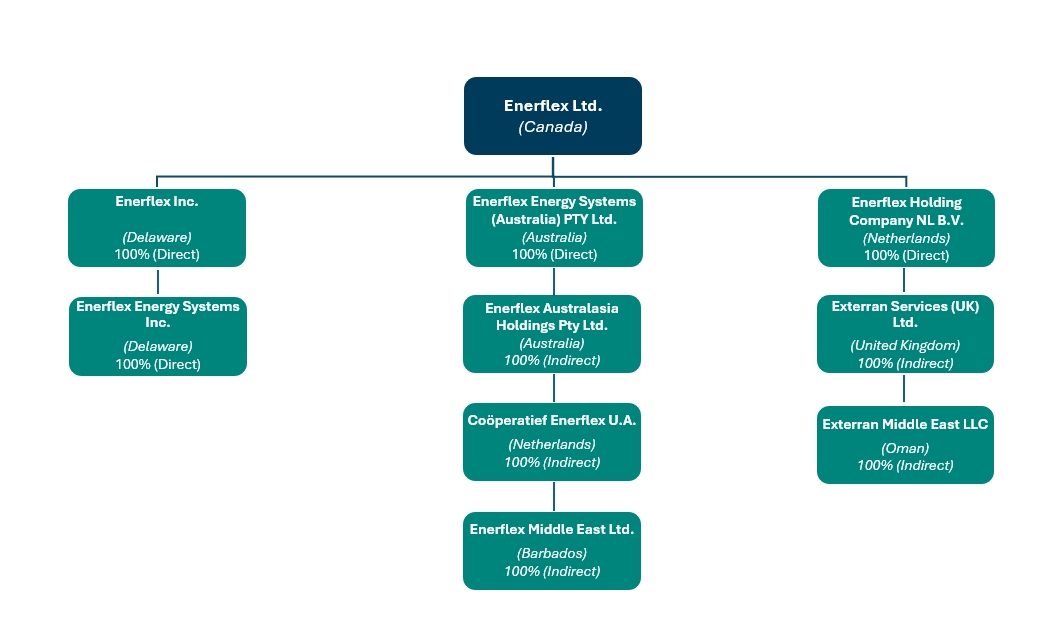
The principal subsidiaries of the Company (on a consolidated basis), their jurisdictions of incorporation or formation, and the percentage of voting securities beneficially owned or controlled by the Company, are set out below. For simplification, non-material subsidiaries are excluded.
1
Enerflex Ltd. Annual Information Form
For the Year Ended December 31, 2025
GENERAL DEVELOPMENT OF THE BUSINESS
Three-year History
The following describes the significant events of the last three financial years with respect to Enerflex and its business.
Recent Developments
February |
On February 25, 2026, Enerflex announced that it had entered into a definitive agreement to divest the majority of its operations in the Asia Pacific region (APAC) to INNIO Group. This business operates principally in Australia, Indonesia, and Thailand and is primarily focused on the AMS product line. Completion of the transaction is subject to standard closing conditions and regulatory approvals, and is expected to close during the second half of 2026. |
2025 Highlights and Developments
For the 2025 financial year, the Board of Directors approved and declared quarterly dividends to shareholders in the amount of CAD $0.0375 per Enerflex Common Share for the first and second quarter and CAD $0.0425 per Enerflex Common Share for the third and fourth quarter, with the fourth quarter dividend being approved and declared on February 25, 2026. The total annual dividend for 2025 was CAD $0.16 per Enerflex Common Share.
2
Enerflex Ltd. Annual Information Form
For the Year Ended December 31, 2025
In addition, the following significant events occurred:
March |
On March 19, 2025, Enerflex announced that Mr. Marc Rossiter had stepped down as President, Chief Executive Officer, and Director, with Mr. Preet S. Dhindsa and Mr. Joe Ladouceur assuming the roles of Interim Chief Executive Officer and Interim Chief Financial Officer, respectively. On March 28, 2025, Enerflex announced approval of a normal course issuer bid (the NCIB) commencing on April 1, 2025 and terminating no later than March 31, 2026, under which the Company is authorized to acquire up to a maximum of 6,159,695 Common Shares, or approximately 5 percent of the public float as of March 18, 2025, for cancellation. |
July |
On July 14, 2025, Enerflex announced that it had entered into an amended and restated credit agreement with respect to its Revolving Credit Facility, with a maturity date of July 11, 2028 and $800 million availability. See “Material Contracts - Revolving Credit Facility”. |
September |
On September 16, 2025, Enerflex announced the appointment of Mr. Paul Mahoney as President, Chief Executive Officer, and Director, effective September 29, 2025, whereupon Messrs. Dhindsa and Ladouceur reassumed their positions as Senior Vice President and Chief Financial Officer and Vice President, Treasury, Tax & Insurance, respectively. See “Board of Directors” and “Executive Officers”. |
November |
On November 24, 2025, Enerflex announced the appointment of Ms. Céline Gerson as a director of the Company. Subsequent to her appointment, Ms. Gerson was appointed as a member of the NCG Committee. See “Board of Directors”. |
December |
On December 11, 2025, Enerflex announced it had redeemed all of its 2027 Notes at a redemption price of 102.25 percent of the principal amount of the 2027 Notes, plus accrued and unpaid interest up to, but excluding, December 11, 2025. The redemption was facilitated using the net proceeds raised by Enerflex Inc., a direct, wholly owned subsidiary of Enerflex, from its private offering of $400 million in aggregate principal amount of its 6.875 percent senior notes due 2031 (the 2031 Notes), together with borrowings under Enerflex’s secured Revolving Credit Facility. The 2031 Notes were issued at par by Enerflex Inc. on December 11, 2025 and are guaranteed on a senior unsecured basis by Enerflex and certain of its subsidiaries. |
2024 Highlights and Developments
For the 2024 financial year, the Board of Directors approved and declared quarterly dividends to shareholders in the amount of CAD $0.025 per Enerflex Common Share for the first and second quarter and CAD $0.0375 per Enerflex Common Share for the third and fourth quarter, with the
3
Enerflex Ltd. Annual Information Form
For the Year Ended December 31, 2025
fourth quarter dividend being approved and declared on February 26, 2025. The total annual dividend for 2024 was CAD $0.125 per Enerflex Common Share.
In addition, the following significant events occurred:
February |
On February 15, 2024, Enerflex announced the appointment of Mr. Preet S. Dhindsa as Senior Vice President and Chief Financial Officer of the Company, effective March 1, 2024. Prior to his appointment, Mr. Dhindsa was the Interim Chief Financial Officer of the Company. See “Executive Officers”. |
March |
On March 11, 2024, Enerflex announced the appointment of Mr. Thomas B. Tyree, Jr. as a director of the Company. Subsequent to his appointment, Mr. Tyree was appointed as a member of the Audit Committee. See “Board of Directors”. |
April |
On April 29, 2024, the Tenth Circuit Collegiate Court on Labor Matters in Mexico published a decision setting aside a January 31, 2022 decision of a Labor Board in the State of Tabasco, Mexico that had ordered subsidiaries of Exterran (now subsidiaries of Enerflex) to pay a former employee MXN$2,152 million (approximately $125 million) plus other benefits in connection with a dispute relating to the employee’s severance pay following termination of his employment in 2015. |
June |
On June 26, 2024, Enerflex entered into an agreement to extend the maturity date of its Revolving Credit Facility by one year, to October 13, 2026. Availability under the extended Revolving Credit Facility was also increased to $800 million from $700 million. In conjunction with the extension of the Revolving Credit Facility, Enerflex repaid its higher cost secured term loan credit facility, which had a balance of $120 million at March 31, 2024. |
October |
On October 1, 2024, Enerflex announced that it had issued a notice of partial redemption for $62.5 million (or 10 percent of the aggregate principal amount originally issued) of its 2027 Notes. The redemption was completed on October 11, 2024 at a redemption price of 103 percent of the principal amount of the notes being redeemed, plus accrued and unpaid interest up to, but excluding, October 11, 2024. |
November |
On November 25, 2024, Enerflex announced the appointment of Mr. Ben Cherniavsky as a director of the Company. Subsequent to his appointment, Mr. Cherniavsky was appointed as a member of the Audit Committee. See “Board of Directors”. Following suspension of activity at a modularized cryogenic natural gas processing facility in Kurdistan during the second quarter of 2024, Enerflex announced on November 27, 2024 that it had provided its customer with formal notice of termination, due to continuing Force Majeure and circumstances that made it impossible for Enerflex to fulfill its obligations under the project contract. See “Legal Proceedings”. |
4
Enerflex Ltd. Annual Information Form
For the Year Ended December 31, 2025
December |
On December 17, 2024, Enerflex announced the upcoming retirement of W. Byron Dunn and Michael A. Weill from its Board of Directors, effective January 1, 2025, pursuant to the term limits set in the Company’s Director Retirement Policy. On the same date, Enerflex announced the reconstitution of the standing committees of the Board, including the appointment of Joanne Cox as Chair of the HRC Committee and Thomas B. Tyree, Jr. as Chair of the NCG Committee. |
2023 Highlights and Developments
For the 2023 financial year, the Board of Directors approved and declared quarterly dividends to shareholders in the amount of CAD $0.025 per Enerflex Common Share for the first, second, third, and fourth quarters of 2023, with the fourth quarter dividend being approved and declared on February 28, 2024. The total annual dividend for 2023 was CAD $0.10 per Enerflex Common Share.
In addition, the following significant events occurred:
January |
On January 20, 2023, Enerflex announced the appointment of Ms. Laura Folse as a director of the Company. Subsequent to her appointment, Ms. Folse was appointed as a member on the NCG Committee and subsequently, the HRC Committee. Ms. Folse did not stand for re-election to the Board at the annual meeting of shareholders held on May 7, 2024. |
March |
On March 19, 2023, Enerflex announced the departure of its Chief Financial Officer and the appointment of Mr. Matthew Lemieux as Interim Chief Financial Officer of the Company. Prior to his appointment, Mr. Lemieux held the position of Vice President, Corporate Development and Treasury. |
June |
On June 28, 2023, Enerflex announced the appointment of Mr. Rodney D. Gray as Senior Vice President and Chief Financial Officer of the Company. Concurrent with the appointment of Mr. Gray, Mr. Lemieux reassumed his previous position. |
August |
On August 9, 2023, Enerflex announced the appointment of Ms. Joanne Cox as a director of Enerflex and a member of the Audit Committee. In addition, Enerflex announced the retirement of Ms. Maureen Cormier Jackson, a director and chair of the Audit Committee, and that in conjunction with Ms. Jackson’s retirement, Ms. Mona Hale had assumed the role of chair of the Audit Committee. |
October |
On October 1, 2023, Enerflex announced the resignation of Mr. Rodney D. Gray as Senior Vice President and Chief Financial Officer of the Company, and in connection therewith, that the Company had commenced a search for a new chief financial officer. On October 13, 2023, Enerflex announced the appointment of Mr. Preet S. Dhindsa as Interim Chief Financial Officer of the Company. |
5
Enerflex Ltd. Annual Information Form
For the Year Ended December 31, 2025
DESCRIPTION OF THE BUSINESS
Enerflex’s Business
Enerflex deploys and services high-quality and custom-at-scale energy infrastructure solutions. Enerflex’s comprehensive portfolio includes compression, processing, cryogenic, power generation, and treated water solutions, spanning all phases of a project’s lifecycle, from front-end engineering and design to after-market services. Enerflex is well-positioned to serve its client partners in core markets, enhancing long-term stakeholder value through sustainable improvements in efficiency, profitability, and cash flow generation.
Headquartered in Calgary, Alberta, Canada, Enerflex has operations in 17 countries across North America, Latin America, and the Eastern Hemisphere, including in its core operating countries, the United States, Canada, Oman, Bahrain, Argentina, Brazil, and Mexico. With over 700,000 sq. ft. of manufacturing capability in three fabrication facilities across North America, Enerflex delivers high-quality, long-life solutions globally.
Enerflex has three product lines: Energy Infrastructure (EI), After-Market Services (AMS), and Engineered Systems (ES). Through Enerflex’s EI product line, Enerflex owns, operates, and manages critical natural gas and produced water infrastructure under contract for its client partners’ operations, which is a source of recurring revenue. The AMS product line involves installation, commissioning, operations and maintenance, retrofits, and parts sales, along with global support for the ES and EI product lines. The ES product line involves the sale of customized modular natural gas-handling, power generation, and produced water solutions, enabling removal of natural gas liquids (NGLs), oil processing technology, electric power solutions, and treated water applications. Through its EI and AMS product lines, Enerflex is building an increasingly resilient and sustainable business, with the goal of stabilizing cash flows over the long term and reducing cyclicality in the business.
Enerflex’s expert teams of professionals, industry-certified mechanics and technicians, and tradespeople cover the key disciplines of engineering, design, manufacturing, commissioning, asset maintenance, and service, and are strategically situated across a global network of locations.
PRODUCT LINES
Energy Infrastructure
The product line within this business includes energy infrastructure solutions under contract for natural gas processing, compression, and treated water equipment. Enerflex’s infrastructure is deployed across the globe and provides comprehensive contract operations services to clients, including trained personnel, equipment, tools, materials, and supplies to meet their natural gas, electric power, and produced water needs, as well as designing, sourcing, installing, operating, servicing, repairing, and maintaining equipment owned by Enerflex that is necessary to provide these services. Client partners range from independent producers and regionally significant players to some of the world’s largest energy producers, including national energy companies.
6
Enerflex Ltd. Annual Information Form
For the Year Ended December 31, 2025
Enerflex is one of the leading suppliers of natural gas compression infrastructure within the USA, Canada, Latin America, and the Middle East, managing a global fleet of approximately 1.6 million horsepower as of December 31, 2025.
Contract Compression
Enerflex’s contract compression fleet of low- to high-horsepower packages are typically used in natural gas gathering systems, gas-lift, wellhead, and other applications primarily in connection with natural gas, NGLs, and oil production, and are made available to client partners on a contracted basis. When Enerflex enters a contract compression arrangement with a client partner, the initial term of the commitment generally ranges between one to five years, however, in some cases, initial terms or extensions to initial terms can result in arrangements of greater than ten years. These contracts typically require Enerflex to provide all the engineering, design, and installation services to bring the equipment online, and may require Enerflex to make a significant investment in equipment, facilities, and related installation costs. Client partners generally pay a monthly service fee even during periods of limited or disrupted production, which enhances the stability and predictability of Enerflex’s cash flows. Additionally, Enerflex does not have direct exposure to the fluctuations in commodity prices since Enerflex provides an up-time guarantee and does not take title to the hydrocarbon being compressed, processed, or treated.
The demand for Enerflex’s products and services is driven by production of natural gas and crude oil, where compression is typically required to move produced volumes from the wellhead and through gathering systems. In addition, compression can also improve performance in maturing fields.
Build-Own-Operate-Maintain Solutions
Enerflex leverages its extensive expertise in engineering, designing, manufacturing, commissioning, operating, and maintaining natural gas compression, processing, and treated water infrastructure solutions on a Build-Own-Operate-Maintain (BOOM) basis. Enerflex’s BOOM model provides clients with an operational partnership that mitigates risk while keeping objectives aligned. Through this model, Enerflex handles all phases of a project, including the upfront cost of, and responsibility for, construction and commissioning, ensuring quality, safety, and reliability are consistent through the project life. Clients then pay Enerflex a monthly fee to benefit from world-class facilities, without the challenges typically posed by ownership, operations, and maintenance. Enerflex’s success with BOOM projects stems from its collaborative approach to delivering reliable solutions with reduced risk for its partners.
After-Market Services
Enerflex’s AMS product line, with operations in 14 countries, delivers comprehensive mechanical services to client partners, including parts distribution; compression retrofits; operations and maintenance solutions; equipment optimization and maintenance programs; manufacturer warranties; exchange components; long-term service agreements; and technical services. Utilizing an extensive network, AMS primarily operates at client partner locations through trained technicians and mechanics. Enerflex’s AMS business includes distribution and remanufacturing facilities, with significant presence in active natural gas producing areas.
7
Enerflex Ltd. Annual Information Form
For the Year Ended December 31, 2025
Enerflex services a large base of natural gas compression and storage facilities, as well as power generation infrastructure installed in North America, Latin America, and the Eastern Hemisphere. In addition, Enerflex provides contract operations and maintenance for large natural gas facilities in the Middle East and Latin America.
Enerflex’s client partners in AMS range from independent producers, regionally significant players, and some of the world’s largest energy producers, to midstream companies who service these oil and gas explorers and producers. Maintenance contracts are managed by a team of dedicated engineers and planners using remote monitoring and on-site specialist personnel to carry out the work required.
Engineered Systems
ES involves the sale of modular natural gas-handling and power generation solutions that are engineered, designed, fabricated, and assembled by Enerflex. Products include applications for: gas processing, including cryogenic solutions; gas compression systems; electric power generation systems; and water treatment. Enerflex can combine one or more product offerings into an integrated solution, simplifying clients’ supply chain, eliminating interface risk, and reducing the concept-to-commissioning cycle time of major projects.
Processing
Enerflex engineers, designs, fabricates, constructs, commissions, operates, and services hydrocarbon processing equipment. Complete processing modules are designed and fabricated at Enerflex’s manufacturing facilities with delivery to a global market. Enerflex also provides supervision and project management services across the world with respect to the installation, commissioning, and start-up of such products and facilities. Process applications include dehydration, NGLs recovery, refrigeration, cryogenic processing, condensate stabilization, dew point control, and amine sweetening.
Processing prepares natural gas for transportation by pipeline for end-use consumption. Substantially all newly produced natural gas requires the removal of water, CO2, and other impurities with gas containing NGLs (ethane, propane, butane, and condensate) typically requiring more complex processing. The North American producing sector’s increased focus on liquids-rich gas opportunities has generated new demand for top-tier processing facilities, including cryogenic processing facilities, which are manufactured at Enerflex’s Broken Arrow, Oklahoma, USA facility.
Compression
Enerflex is a leading supplier of natural gas compression packages, which are powered by natural gas-fueled engines or electric motors. Natural gas compression packages typically consist of reciprocating or screw compressors, cooling fans, piping and instrumentation, and controls. Applications include natural gas gathering and compression, gas lift compression, inlet and residue compression in processing facilities, compression for natural gas storage, and pipeline compression. Enerflex offers compression packages from 20 horsepower to 10,000-plus horsepower, ranging from low-specification field compressors to high-specification process compressors for onshore and offshore applications.
8
Enerflex Ltd. Annual Information Form
For the Year Ended December 31, 2025
Enerflex also provides re-engineering and refurbishment of existing compression equipment at client partner field locations, as well as in its own global facilities.
Enerflex serves a global client partner base across all major natural gas basins. Clients are diverse, including small independent producers, majors, national energy companies, and midstream and third-party processing providers.
Electric Power
Enerflex provides electric power solutions and after-market services required for on-going life cycle support of this equipment. The Company offers scalable power generation solutions ranging from 200 kilowatts to over 100 megawatts, leveraging its reciprocating engine platforms. Enerflex provides field construction, installation, and commissioning for an integrated electric power solution, taking advantage of Enerflex’s reputation in gas-fueled engines and its skills in modular engineering, fabrication, and after-market support. Enerflex’s electric power solutions cover oil and gas, data centers, industrial, institutional, greenhouse, renewables, and agriculture sectors across the world. Clients range from data centers, pulp and paper mills, landfill sites, hospitals, city facilities, beverage facilities, greenhouses, utilities and power companies, and a range of oil and gas producers and midstream service providers.
Treated Water Solutions
Enerflex designs and commissions facilities for efficient produced water treatment, incorporating industry-leading technologies to cover primary, secondary, and tertiary treatment methods to separate oils and other contaminates. Enerflex’s focus is on providing comprehensive solutions through research and development, water studies, and flexible contract models, underscoring its commitment to evolving industry needs.
Enerflex effectively handles and treats produced water ranging in volumes up to 755,000 barrels per day within a single train. Enerflex’s expertise extends from research and development, to lab-scale testing and piloting, to providing complete BOOM solutions, allowing Enerflex to support its partners through every project phase. By working together and utilizing Enerflex’s patented technologies, Enerflex has treated over thirteen billion barrels of produced water to date for client partners.
Enerflex’s treated water solutions are differentiated through technology innovation, simplified processes in facility design, and a deep understanding of produced water challenges faced by clients. Enerflex aims to continuously innovate to optimize the produced water treatment process so that water can be reused or disposed in a sustainable manner. Enerflex’s technologies elevate industry standard methods by lowering operating costs and increasing production while optimizing operations for its client partners. Enerflex has experience treating difficult fluids, including heavy oils, emulsions, high viscosities, polymer water, and shale applications and continues to focus on building sustainable facilities.
9
Enerflex Ltd. Annual Information Form
For the Year Ended December 31, 2025
GEOGRAPHIC MARKETS
Enerflex has three reportable segments:
North America
In North America, Enerflex provides natural gas solutions to support upstream and midstream activities required to meet local demand. Enerflex benefits from increasing domestic demand and a growing liquified natural gas export industry in North America. In addition, the Company supports the growth of the emerging data center market, as well as oil and gas producers, through the delivery of power generation solutions.
Engineered Systems
Enerflex holds a market-leading position for the engineering and manufacturing of modularized solutions for natural gas processing, compression, and power generation. With three state-of-the-art manufacturing facilities, Enerflex aims to maintain high quality and standards and seeks to provide client partners with unparalleled service and technical excellence. Enerflex’s solutions are delivered both domestically and internationally.
Energy Infrastructure
In the USA, Enerflex operates a contract compression rental fleet of approximately 483,000 horsepower as of December 31, 2025, with the largest portion operating in the Permian basin. Enerflex has responded to customer demand for lower carbon solutions, with electric drive compression representing approximately 20 percent of Enerflex’s fleet. Enerflex benefits from vertical integration with its ES business, providing cost and timing efficiencies compared to its peers.
After-Market Services
Enerflex provides mechanical services and parts to a large installed base of critical natural gas and power generation equipment across key resource plays in the USA and Canada. The Company looks to secure service contracts with client partners as a means of enabling recurring business.
Latin America
In Latin America, Enerflex focuses primarily on long-term opportunities through EI ownership and AMS support. The Company also serves the region through its ES manufacturing facility located in Houston. In Latin America, Enerflex operates a contract compression rental fleet of approximately 700,000 horsepower, operates approximately 15,000 horsepower of power generation, and has 7 natural gas BOOM projects.
10
Enerflex Ltd. Annual Information Form
For the Year Ended December 31, 2025
Energy Infrastructure
Enerflex targets long-term contract compression solutions and modularized energy infrastructure to support increasing natural gas production across the region, with a focus on Argentina, Brazil, and Mexico.
After-Market Services
Leveraging its EI footprint, Enerflex focuses on after-market services, parts, operations, maintenance, and overhaul services. Latin America has eight fully equipped workshops providing coverage across the region to best serve client partners.
Eastern Hemisphere
In the Eastern Hemisphere region, Enerflex focuses primarily on long-term opportunities through EI ownership and AMS support. In addition, Enerflex operates an installed compression fleet of almost 300,000 horsepower, approximately 60,000 horsepower of power generation, and has 15 natural gas and two produced water plants. Across the region, Enerflex’s natural gas BOOM portfolio treats approximately 0.5 billion cubic feet of natural gas per day and compresses 1.0 billion cubic feet per day. Furthermore, the Company processes 1.2 million barrels of oil equivalent per day through its produced water facilities.
Energy Infrastructure
Enerflex invests in long-term infrastructure assets to support the Company’s ongoing strategy to grow the recurring nature of its business. Projects cover compression, processing, and treated water solutions.
After-Market Services
Leveraging its EI footprint in the region, Enerflex seeks to continue to grow its AMS capabilities. The team delivers comprehensive mechanical services, including parts distribution, operations and maintenance, retrofits, and equipment optimization.
11
Enerflex Ltd. Annual Information Form
For the Year Ended December 31, 2025
SEGMENTED REVENUE DETAILS
Enerflex’s 2025 and 2024 revenue, by business segment and product line, is set forth in the following table.
$ millions December 31, |
2025 Revenue |
% Split |
2024 Revenue |
% Split |
Business Segment |
|
|
|
|
North America |
1,686 |
65 |
1,564 |
65 |
Latin America |
376 |
15 |
407 |
17 |
Eastern Hemisphere |
509 |
20 |
443 |
18 |
Total |
2,571 |
100 |
2,414 |
100 |
|
|
|
|
|
Product Line |
|
|
|
|
Energy Infrastructure |
621 |
24 |
668 |
28 |
After-Market Services |
494 |
19 |
508 |
21 |
Engineered Systems |
1,456 |
57 |
1,238 |
51 |
Total |
2,571 |
100 |
2,414 |
100 |
$ millions Product Line |
2025 Revenue |
% Split |
2024 Revenue |
% Split |
Energy Infrastructure |
|
|
|
|
North America |
156 |
25 |
146 |
22 |
Latin America |
279 |
45 |
257 |
38 |
Eastern Hemisphere |
186 |
30 |
265 |
40 |
|
621 |
100 |
668 |
100 |
After-Market Services |
|
|
|
|
North America |
261 |
53 |
279 |
55 |
Latin America |
77 |
16 |
70 |
14 |
Eastern Hemisphere |
156 |
31 |
159 |
31 |
|
494 |
100 |
508 |
100 |
Engineered Systems |
|
|
|
|
North America |
1,269 |
87 |
1,139 |
92 |
Latin America |
20 |
1 |
80 |
6 |
Eastern Hemisphere |
167 |
12 |
19 |
2 |
|
1,456 |
100 |
1,238 |
100 |
Total |
2,571 |
100 |
2,414 |
100 |
12
Enerflex Ltd. Annual Information Form
For the Year Ended December 31, 2025
ENERFLEX FACILITIES
Enerflex has over 70 locations globally with corporate offices in Calgary, Alberta, and Houston, Texas. In Canada, several of the Company’s locations are in Alberta, including a manufacturing facility which primarily serves the Canadian and Australian markets, and the Treated Water office and lab. Enerflex has several locations throughout the USA, including the Company’s manufacturing facility in Houston, Texas, serving the USA and international markets, and an additional facility in Broken Arrow, Oklahoma, serving the global cryogenic market. In Latin America, Enerflex has locations in Argentina, Brazil, Bolivia, Colombia, Mexico, and Peru. In Asia Pacific, Enerflex has several locations including a facility in Brisbane, Australia, which is devoted to retrofit, services, and overhaul activities. There are additional locations throughout the Middle East and Africa, and one location in Europe. See “Geographic Markets” for further details.
ENERFLEX’S SUPPLY CHAIN
Enerflex purchases a broad range of materials and components in connection with its manufacturing and service activities. Certain components used in Enerflex’s products are obtained from a single source or a limited group of suppliers and original equipment manufacturers, although the Company is generally not dependent on any single source of supply. Supply chain documentation and processes are continually reviewed by the Company’s dedicated supply chain management teams. See “Risk Factors – Industry Specific Risks - A well-functioning supply chain and effective inventory management are essential to Enerflex’s business” for further details on the pricing and availability of materials and components.
ENERFLEX’S CLIENT PARTNERS
The Enerflex client partner base consists primarily of companies engaged in the energy and power industries, including small to large independent energy producers, integrated energy companies, midstream and petrochemical companies, national oil companies, power generation companies, users of natural gas-fired electric power, and carbon capture players.
COMPETITIVE CONDITIONS
The demand for Enerflex’s products and services is influenced by several factors, including: the price of, and demand for, crude oil and natural gas; demand for associated infrastructure; transportation availability and costs; access to qualified personnel; the availability and pricing of materials and component parts; the availability and access to capital; geopolitical factors; regional and global economic conditions; local, national and international laws and regulations including taxation, royalty frameworks and environmental laws and regulations and the introduction of new laws and regulations to which Enerflex and its client partners are subject; and commodity price speculation in the financial markets.
As a result, Enerflex’s client partners are constantly assessing ways to execute their business priorities more efficiently. To accommodate client needs and demand for Enerflex’s products and
13
Enerflex Ltd. Annual Information Form
For the Year Ended December 31, 2025
services, Enerflex regularly reviews its business strategy and product offerings in the markets in which it operates.
Enerflex’s scale of operations and depth of technical expertise provides an advantage over competitors. Enerflex believes it will be successful at increasing its market share by providing quality products and services, negotiating fair prices for its products and services, developing and maintaining relationships with key client partners and suppliers, maintaining and enhancing the skill levels of its employees, and adjusting to the practices of competitors. The ability to meet these competitive pressures within a reasonable cost structure will continue to be key to Enerflex’s future success.
In addition to the various business risk factors outlined in the “Risk Factors” section of this AIF, and specifically the competitive risks, investors should be aware of the following competitive conditions applicable to the Company’s operations both generally, and in each of the North America, Latin America, and Eastern Hemisphere markets.
General
The availability of major components used in the fabrication of Enerflex’s products and access to skilled personnel to meet the technical and trade requirements for designing, fabricating, operating, and maintaining these products are under increasing pressure on a worldwide basis. The Company’s global footprint assists Enerflex in managing these issues by broadening the markets in which personnel can be accessed and allowing the Company to manage its inventory levels on a larger scale, thereby improving its supply chain efficiency and security.
North America
The ES market in the USA and Canada is highly competitive.
The Company encounters several global competitors in the compression and processing fabrication business, and a number of smaller regional competitors. Larger companies operate across more regions while offering products and services that compete with Enerflex, whereas smaller companies typically focus their resources on one competitive offering within a specific region.
Enerflex is able to effectively leverage its North American ES capabilities to serve global customers with modular solutions. Enerflex expects the USA market to continue providing the Company with opportunities to supply compression, processing, and electric power solutions, from its Houston and Broken Arrow fabrication facilities. In Canada, ongoing increases in gas egress capacity are expected to continue to yield opportunities for Enerflex’s ES business, supported by its Calgary-based fabrication facility, however reductions in near-term investments by some of the Company’s client partners continue to impact demand for capital equipment, thereby heightening competitive pressures in this market.
Similar to the ES business, the EI market in the USA is highly competitive. By continuing to offer contract compression clients competitively priced and readily available equipment, availability guarantees, exceptional service, and flexibility, the Company expects to continue to grow its market share in the US EI business.
In the USA and Canada, the Company has developed technical expertise in electric power solutions. This expertise has been leveraged to secure natural gas-fired power generation opportunities in the oil and gas industry, as well as non-related industries, such as data centers, greenhouses, malting
14
Enerflex Ltd. Annual Information Form
For the Year Ended December 31, 2025
applications, and landfill gas-to-power. Enerflex has the experience and expertise to reconfigure or retrofit, replace, or upgrade natural gas-fired engines, electric motors, and compression equipment to optimize performance.
Enerflex is a market leader in the North American AMS market with an extensive branch network to maintain proximity to client partner locations.
Latin America
In Latin America, the development of natural gas production and buildout of natural gas infrastructure in key gas producing markets such as Argentina, Mexico, Brazil, the Andean countries (Colombia, Bolivia, and Peru), and more recently, Guyana, provide opportunities for Enerflex to further expand all product offerings. The Company believes that Latin America will continue to offer opportunities to expand as client partners look to grow natural gas production for both domestic consumption and export, but it is facing increasing competition from new market entrants. Enerflex sees opportunities for projects related to gas compression, treatment and processing, and electric power generation.
Eastern Hemisphere
In the Eastern Hemisphere, Enerflex generally faces the same competitors as in North America, with many significant North American compression and processing equipment fabricators pursuing international opportunities. In addition, the Company faces competition from other players operating in the Eastern Hemisphere.
Enerflex’s operations in the Eastern Hemisphere are underpinned by its ES products, which are offered to client partners either as sales offerings or BOOM projects with associated operations and maintenance contracts. In addition, the Company’s operations in the Eastern Hemisphere include Produced Water Treatment projects. Enerflex anticipates growth in the Middle East and Africa market, with opportunities in EI and ES, as well as AMS opportunities. Enerflex is well positioned to offer EI solutions, equipment and facility sales, and AMS, including operations and maintenance contracts, through its branch network covering the region.
In Asia Pacific, Enerflex remains well-positioned to service and maintain the compression equipment installed in the region and to capitalize on the expanding natural gas infrastructure and power generation needs of the region.
INTANGIBLE PROPERTIES
Internally developed product designs, specifications, fabrication processes and techniques, technologies, and client relationships are of significant value to Enerflex. These intangible assets combine to form the intrinsic value associated with the various products and brand names employed by Enerflex. The effectiveness of Enerflex’s business and, indirectly, the brand and product names, are reflected in the revenue and gross margin attained in the corresponding business units.
15
Enerflex Ltd. Annual Information Form
For the Year Ended December 31, 2025
CYCLES AND SEASONALITY
While demand for Enerflex's products and services is largely a function of the supply, demand, and price of natural gas and other commodities, other factors may affect the business, either positively or negatively. See “Risk Factors”.
Natural gas prices are determined by supply, demand, and government regulations relating to natural gas production and processing. The market for capital goods used by natural gas producers is cyclical and, at times, highly volatile. Enerflex is structured to be profitable in both high and low periods of the energy cycle due to the recurring nature of its EI and AMS business, product line breadth, international diversification, and flexible workforce.
In the ES business, the energy service sector in Canada and in northern USA has historically shown some seasonal trends in activity levels, resulting from well-site access and drilling pattern adjustments to take advantage of weather conditions, however, sustained strength in Enerflex’s ES bookings reflects consistent client activity levels, independent of seasonal trends. Rather than predictable seasonal cycles, ES operations are primarily influenced by client demand and project execution timelines, which vary based on market dynamics and customer behavior. While quarterly activity levels may show marginal differences, these are driven by operational timing and customer-specific factors, not recurring seasonal patterns. Any seasonal fluctuations do not have a material impact on the financial performance or position of the Company.
ECONOMIC DEPENDENCE
For the year ended December 31, 2025, the Company had no individual client partner which accounted for more than 10 per cent of its revenue. Enerflex is committed to building strong relationships with suppliers and recognizes that success is achieved by fostering trust and respect between the parties. Enerflex has developed effective, competitive bidding processes to provide opportunities for new and existing suppliers. Enerflex is not substantially dependent on any single supplier.
CHANGES TO CONTRACTS
No aspect of the Company’s business is reasonably expected to be materially affected by renegotiation or termination of contracts or sub-contracts.
EMPLOYEES
Enerflex had approximately 4,400 active employees worldwide as at December 31, 2025.
ES BACKLOG AND BOOKINGS
This section contains references to the terms “ES backlog and bookings” and “EI contract backlog”, which do not have standardized meanings as prescribed by IFRS and therefore may not be
16
Enerflex Ltd. Annual Information Form
For the Year Ended December 31, 2025
comparable to similar measures presented by other issuers. See “Non-IFRS Measures”. Additional disclosures regarding these non-IFRS measures are provided in the MD&A for the year ended December 31, 2025, which is available on Enerflex’s website and under the electronic profile of the Company on SEDAR+ and EDGAR, and are incorporated by reference in this AIF.
ES Backlog and Bookings
Enerflex monitors its ES backlog and bookings as indicators of future revenue generation and business activity levels for the ES product line. ES bookings are recorded in the period when a firm commitment or order is received from clients. Bookings increase backlog in the period they are received, while revenue recognized on ES projects decrease backlog in the period the revenue is recognized. Accordingly, ES backlog is an indication of revenue to be recognized in future periods. In the event a project is cancelled, the remaining contract price associated with the unsatisfied performance obligation is derecognized from the backlog. ES backlog represents unsatisfied performance obligations related to the ES product line. Further information on recognition of revenue from the ES backlog is included in Note 22 “Revenue” of the audited consolidated financial statements for the year ended December 31, 2025.
Revenue from contracts that have been classified as finance leases for newly built equipment is recorded as ES bookings. The full amount of revenue is removed from backlog at commencement of the lease.
ES backlog of $1.1 billion at December 31, 2025, declined slightly from the 8-quarter average ES backlog of approximately $1.2 billion reflecting revenue recognized on the Bisat-C Expansion Facility in the Eastern Hemisphere region and revenue recognition on ES projects in the North America region. This sustained level of backlog over a two-year period reflects stable demand for Enerflex’s ES solutions across global energy infrastructure markets. The 8-quarter average also serves as a key indicator of operational consistency and revenue visibility, smoothing out short-term fluctuations in ES bookings and project timings. This trend demonstrates that the ES product line continues to benefit from a diversified portfolio of gas compression and processing projects, reinforcing management's confidence in the ES product line’s ability to generate predictable revenue and margin performance in the near-term.
Enerflex recorded ES bookings of $377 million during the fourth quarter of 2025, compared to $301 million during the same period of 2024, primarily attributable to higher bookings in NAM and reversal of the remaining backlog associated with an international ES project which impacted ES bookings for the three months ended December 31, 2024. ES bookings have remained above the 8-quarter average of $336 million, reflecting continued strong bookings in the North America region. Enerflex recorded ES bookings of $1.3 billion during the twelve months ended December 31, 2025, compared to $1.4 billion during the same period of 2024, primarily due to bookings for the Bisat-C Expansion Facility in the first half of 2024.
The ES product line has realized a book-to-bill ratio (calculated as bookings divided by revenue) of 1.1x during the fourth quarter of 2025, indicating that new bookings are keeping pace with revenue recognition. The current balance between bookings and revenue supports near-term revenue visibility and reflects a stable demand environment. The 8-quarter average book-to-bill ratio has also remained at 1.0x, an indication that the Company is consistently replenishing its backlog in line with project execution.
17
Enerflex Ltd. Annual Information Form
For the Year Ended December 31, 2025
ES backlog and bookings by reporting segment are disclosed in the “Segmented Results” section of the MD&A for the year ended December 31, 2025.
EI Contract Backlog
The Company’s EI contract backlog is recognized from lease agreements executed with clients for leasing and/or operations and maintenance of the Company’s EI assets. Lease agreements executed during the period increase EI contract backlog while revenue recognized on EI assets decreases the EI contract backlog in the period the revenue is recognized.
EI contract backlog represents unsatisfied performance obligations related to the EI product line. Further information on recognition of revenue from the EI contract backlog is included in Note 22 “Revenue” of the audited consolidated financial statements for the year ended December 31, 2025.
Enerflex has lease agreements with clients for EI assets with initial terms ranging from one to 10 years.
The following table sets forth EI contract backlog by reporting segment:
$ millions |
December 31, 2025 |
December 31, 2024 |
North America |
160 |
136 |
Latin America |
361 |
458 |
Eastern Hemisphere |
800 |
951 |
Total EI contract backlog |
1,321 |
1,545 |
Enerflex’s EI contract backlog of $1.3 billion at December 31, 2025, decreased from $1.5 billion at December 31, 2024, driven by revenue recognized during the twelve months ended December 31, 2025, partially offset by EI contract bookings in the North American and Latin American segments.
SUSTAINABILITY
The demand for reliable and innovative energy infrastructure is increasing globally – and Enerflex’s natural gas, power generation, and treated water solutions support its client partners through this changing landscape. Deploying sustainable energy solutions is key to Enerflex’s strategy.
The Energy Transition
Natural Gas in the Energy Transition
Enerflex is committed to helping the energy sector transform for a sustainable future. As global energy demand continues to outpace supply from new renewable capacity, Enerflex firmly believes that natural gas will continue to play a critical role given its reliability, abundance, affordability, and efficiency.
Enerflex’s Low-Carbon Solutions
Enerflex’s expertise in modularized gas-handling solutions extends to a 45-year history in designing and fabricating low-carbon infrastructure, including for CCUS, electrification, bioenergy, methane management, and hydrogen solutions. Having executed over 175
18
Enerflex Ltd. Annual Information Form
For the Year Ended December 31, 2025
low-carbon projects, Enerflex remains a trusted partner in supporting its clients’ decarbonization ambitions.
Environmental
Emissions Management
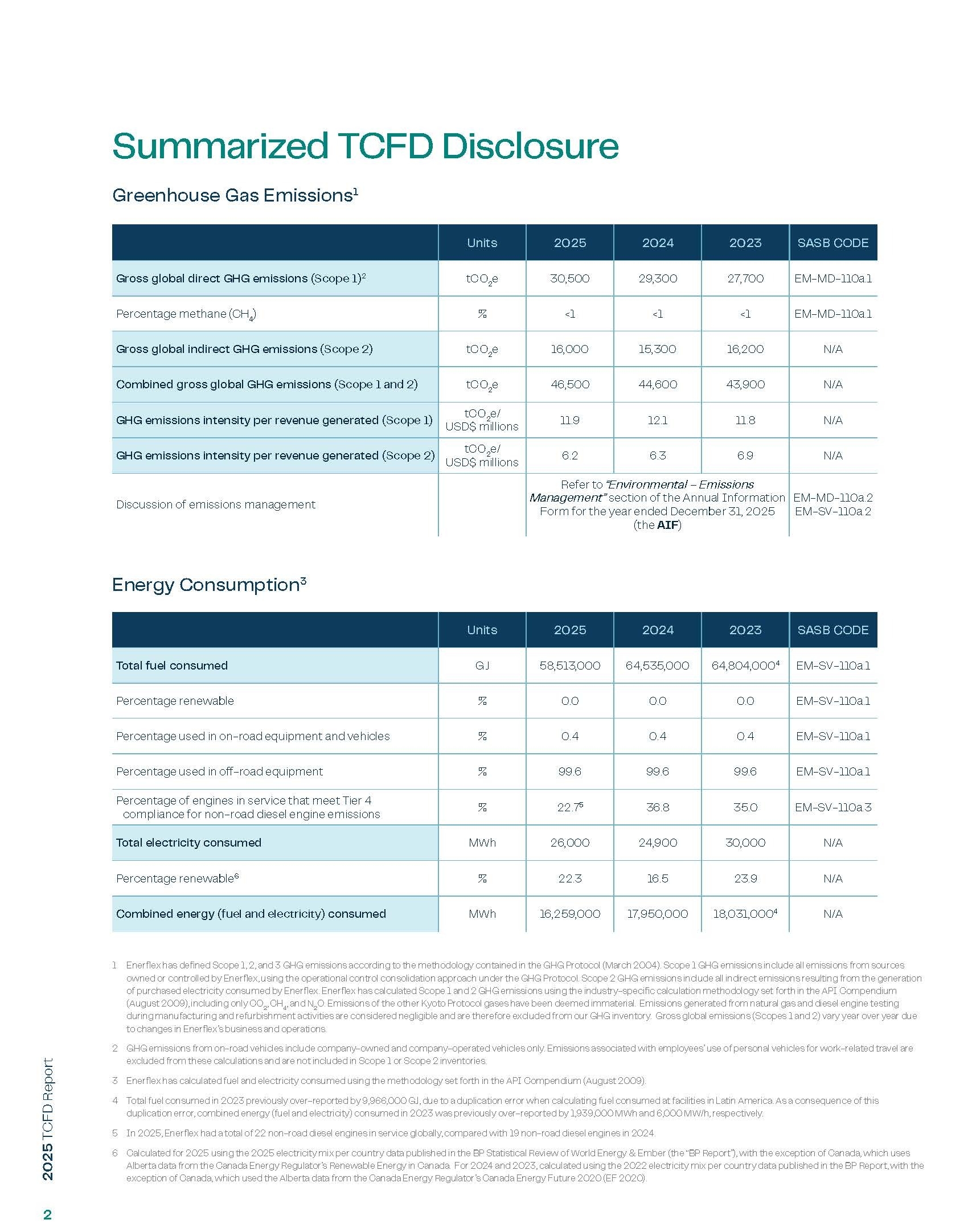
Enerflex’s emissions management strategy follows the GHG Protocol - Corporate Accounting and Reporting Standard (the GHG Protocol), focusing on reducing enterprise-wide emissions and Enerflex’s global emissions profile. Enerflex has established 2023 as the base year for reporting verifiable emissions, reflecting typical operations post-acquisition of Exterran in October 2022. Direct Scope 1 emissions primarily stem from owned and controlled assets, including combustion sources and fugitive emissions (cars and refrigerants). Indirect Scope 2 emissions are calculated from electricity purchased for consumption by Enerflex. Enerflex’s Scope 2 emission data is based on the GHG Protocol’s recommended location-based method with country-specific factors and province or state-specific factors for Canada and the United States, respectively. All emissions from Enerflex’s contract compression fleet and BOOM facilities are controlled by the client partners who use and control the operation of the assets. Detailed data on Enerflex’s GHG emissions is included as part of the Summary TCFD Disclosures in Appendix B to this AIF.
Enerflex collects emissions data across all its locations and centrally aggregates it for analysis, verification, and completeness. CO2, CH4, and N2O emissions are monitored using IPCC AR5 factors. Enerflex limits its GHG emissions wherever possible.
To reduce its emissions, Enerflex prioritizes actions like purchasing low VOC paint and implementing enterprise-wide policies to limit standby running of vehicles and equipment. Enerflex does not currently exceed the applicable thresholds for mandatory emissions reporting or reduction initiatives in its jurisdictions of operations. The Company’s internal sustainability commitments include voluntary reporting on its GHG emissions in accordance with the methodologies described above.
Chemicals Management
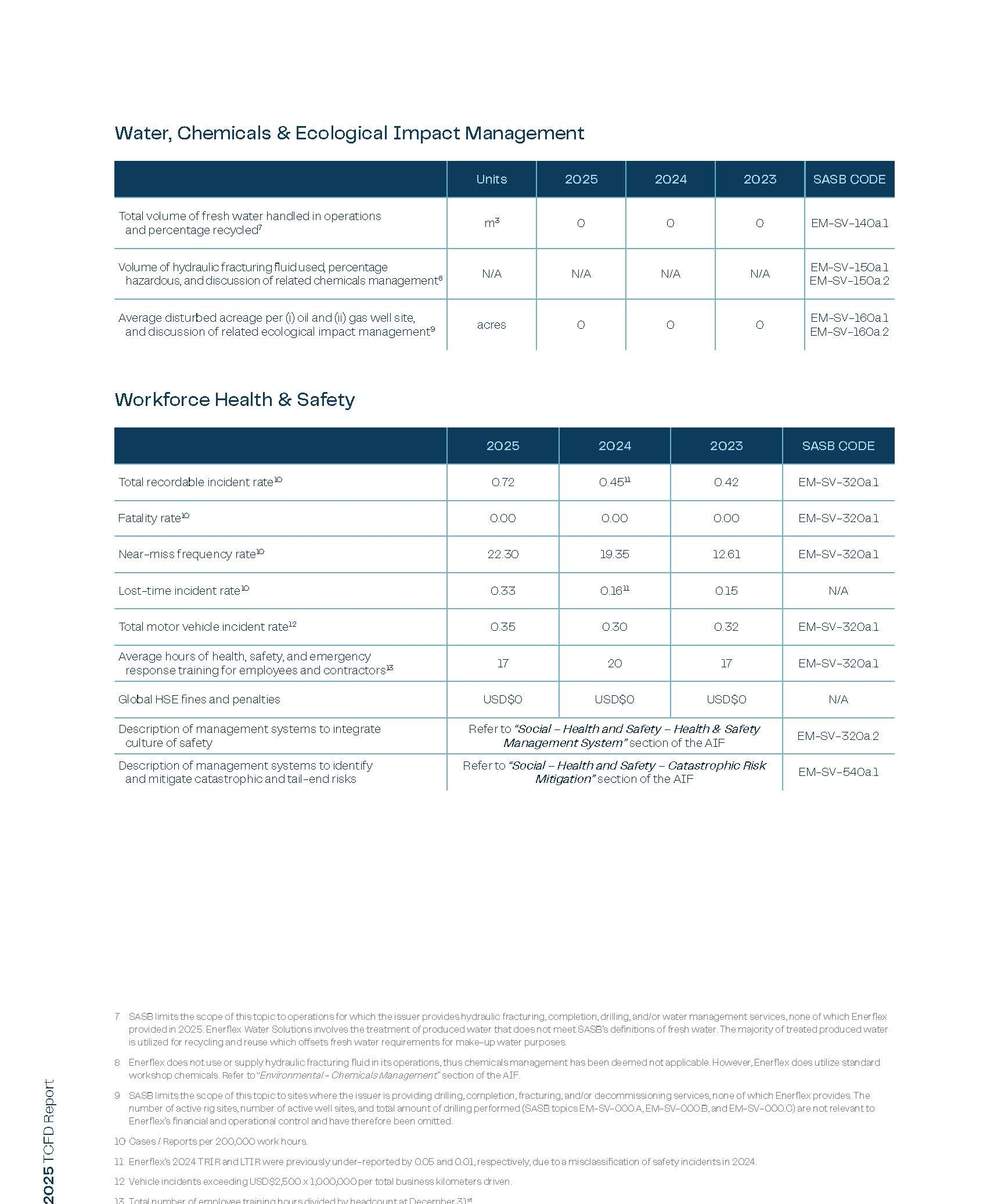
Enerflex’s operations utilize chemicals commonly used in standard manufacturing and after-market services activities. Chemicals are handled, labeled, and stored within controlled environments to prevent contamination, spills, and other hazards aligned with applicable regulations and Company standards. In addition, Spill Prevention and Response Policies and Procedures are implemented throughout the organization to effectively manage the prevention of spills and releases and provide response strategies to minimize environmental impact. Spill kits are available at Enerflex sites to control, contain, and clean-up material released from containment to ensure swift remediation action. In the event of a spill or release, incidents are documented and reported in accordance with local requirements. Employee training is provided and varies based on type of chemical exposure by job position or specific workplace to ensure adequate chemical management skills and knowledge.
Environmental Impact
To promote sustainability and environmental stewardship, Enerflex has launched several initiatives across its global operations. This commitment is crucial not only in the projects
19
Enerflex Ltd. Annual Information Form
For the Year Ended December 31, 2025
undertaken with client partners but also in assessing Enerflex’s operational footprint, which notably does not demand extensive land use.
Minimizing the environmental impact of its activities is important to the Company’s pursuit of sustainable value creation for all stakeholders, including the local communities within which Enerflex operate. For example, where underground storage tanks are required for new EI projects in Latin America, Enerflex specifications mandate the use of double-walled tanks. Compliance with regional environmental regulations is a priority for all Enerflex locations and is closely monitored to proactively comply with applicable regulations and any changes or updates.
Energy Use
Eliminating energy waste and maximizing efficient energy use are crucial steps in Enerflex’s sustainability efforts and the Company actively works to minimize waste wherever possible, contributing to a more sustainable future.
Biodiversity
Understanding the importance of biodiversity, Enerflex has implemented educational programs to ensure local environmental considerations and regulations are understood by employees in ecologically sensitive locations. Through these initiatives, the Company can partner with clients from the initial design phase to determine areas to eliminate or limit impacts on local environments.
Water Management
Water management is a principal focus for Enerflex, both in its own facilities and in the operations at client partners’ facilities. Leading by example through water conservation measures at select locations, including through water recycling, Enerflex continues to innovate in its efforts to ensure responsible water usage. Enerflex recognizes the value of water conservation and has implemented initiatives to reduce freshwater consumption and repurpose alternative water sources across its operations.
Waste Management
Enerflex is dedicated to implementing waste management practices that meet or exceed regulatory standards and exemplify the Company’s commitment to environmental responsibility and sustainability. This includes an approach to hazardous and non-hazardous waste management that ensures compliance with regulations. Additionally, Enerflex is proactive in reducing waste through state-of-the-art print authentication technologies, and encourages employees to adopt sustainable habits, such as using reusable water bottles and recycling and composting where available. These initiatives, adapted to address the specific environmental challenges and opportunities of each region in which the Company operates, underscore its dedication to sustainable practices across all areas of the business.
20
Enerflex Ltd. Annual Information Form
For the Year Ended December 31, 2025
Social
Stakeholder Engagement
Stakeholder engagement is essential to understanding mutual interests, fortifying relationships, and identifying priorities. Enerflex is committed to understanding the implications of its operations and managing them responsibly. The Company actively engages with a broad spectrum of stakeholders, including employees, shareholders, client partners, and local communities, utilizing a variety of communication channels. Whether through social media, the website, press releases, in-person meetings, employee townhalls, or webcasts, Enerflex prioritizes transparent and consistent communication.
Health and Safety
At Enerflex, commitment to health and safety is a team effort and is supported at every level—from the boardroom to the frontline. Acknowledging regional regulatory variations, Enerflex strategically capitalizes on its scale of experience and commonalities throughout its global operations, fostering collaboration and sharing knowledge across diverse regions. With the support of the Board of Directors, the Company’s approach is promoted by the Senior Vice President and General Counsel who, as executive sponsor of the HSE group, is dedicated to leading collaboration among HSE teams.
Health and Safety Teams
Enerflex’s approach to health and safety is integrated into its operations, with dedicated HSE teams situated in each region supporting local personnel and operations. These teams, led by experienced leaders familiar with Enerflex’s standards, regional safety regulations, and other requirements, report directly to the Regional Presidents. This structure ensures the Company’s commitment to HSE standards is consistently upheld and engrained in its operations.
Health and Safety Management System
Enerflex is committed to safety excellence across all its operations. The Company’s Occupational Health and Safety Management Systems in each region are aligned with internationally recognized risk management standards organized and implemented in a way to ensure all Company, customer, and local, state, and national regulatory requirements are met. Maintaining thirteen certifications in ISO 45001 throughout its operations and a Certificate of Recognition in Canada, Enerflex ensures compliance with a robust management system framework designed to systematically assess workplace hazards and implement risk controls measures to protect employees and continually improve performance.
Enerflex encourages a culture of safety leadership and accountability from all employees and has assigned roles and responsibilities in health, safety, and environmental requirements to achieve leadership and ownership at all levels of the organization.
21
Enerflex Ltd. Annual Information Form
For the Year Ended December 31, 2025
Safety Meetings
Safety meetings allow communication between workers and management and create opportunities for employees and contractors to raise concerns, discuss improvement ideas, and provide feedback on HSE matters. At Enerflex, these meetings come in a variety of forms, including job hazard assessments, daily facility or kick-off meetings, site toolbox or tail gate meetings, and weekly/bi-weekly/monthly management meetings. In addition, regional HSE leaders meet monthly to strengthen team support and shared interests, encourage synergies through the enterprise, and collaborate on global HSE initiatives.
Safety and Welfare Committees throughout the enterprise encourage worker participation. The committees are made up of representatives from all levels at the applicable site, including management. They meet at regularly scheduled intervals to review and discuss incidents, inspection findings, Aware Card observations, training, trends, and recommendations.
HSE Audits and Inspections
Regular HSE audits and inspections are an integral part of Enerflex’s operations, with responsibilities shared by all employees. From informal daily inspections to external ISO certification audits, several types of audits and inspections are periodically conducted to ensure continued compliance with applicable regulations, client partner expectations, and the Company’s own standards.
Aware Card Program
Enerflex’s Aware Card Program plays a crucial role in its hazard identification and risk assessment process. This Behavior-Based Safety initiative allows employees at all levels to report safe and unsafe conditions they may encounter at work, including behaviors, conditions, environmental circumstances, and near miss incidents. Following the submission of an Aware Card, management is notified and necessary actions are assigned and cycled to closure to ensure concerns are addressed. The program also provides an opportunity to submit improvement ideas and recognize personnel for demonstrating proactive safety leadership. By empowering our personnel, the Aware Card Program encourages open conversations or interventions to either correct or affirm behaviors, thereby promoting a safety culture that embodies transparency and continuous improvement.
Hazard Identification
Enerflex’s risk assessment and job hazard analysis procedures are grounded in a systematic, task-based approach that involves continually identifying and mitigating hazards and the risks they present. Through these processes, the Company seeks out, assesses, controls, monitors, reduces, and eliminates hazards and risks. As a result, controls, safe work practices, operating procedures, and safeguards are implemented based on an evaluation of potential elimination, substitution, isolation, engineering changes, and administrative options for minimizing known risks. Leadership teams regularly participate in and review the results of these processes to ensure quality and continued improvement.
22
Enerflex Ltd. Annual Information Form
For the Year Ended December 31, 2025
Catastrophic Risk Mitigation
Enerflex implements quality management systems at all manufacturing facilities to reduce the probability that equipment may be involved in catastrophic events that could impact human health, local communities, and/or the environment. Certifications in ASME ensure that Enerflex produces safe, operable equipment in accordance with the governing standards and client partner specifications. At Enerflex manufacturing facilities, all welders and weld procedures are certified to the requirements of ASME Section IX. Process pipe is designed and fabricated to ASME B31.3, pressure vessels are designed and fabricated to ASME Section VIII, and both process piping and pressure vessels undergo non-destructive testing as well as pressure testing. Numerous quality checks of critical items are conducted and documented during the fabrication, assembly, coating, and shipping of Enerflex equipment.
For BOOM projects requiring installation in the field, Enerflex designs and installs safety systems in adherence with client partner requirements and the applicable design codes.
Emergency Readiness & Crisis Management
Enerflex’s comprehensive and dynamic approach to managing risks associated with its operations includes robust preparedness and emergency response policies, plans, and procedures implemented throughout all operating regions to ensure appropriate emergency response and management.
Although most incidents are managed at a local level, others might expand to multi-disciplinary levels requiring additional resources and operational support provided by the Company’s Global Emergency Response and Preparedness Policy, initiation of which would engage executive leadership to ensure sufficient resources are available to support in the event of a significant incident.
Reporting and Investigation
Enerflex has a robust reporting system for all unplanned events, incidents, occupational illnesses, and near misses. Policies and procedures are in place establishing requirements for reporting and investigating incidents, completing root cause analyses, implementing corrective actions, and communicating lessons learned. These integrated processes are key to reducing or eliminating hazards and systematic causes and preventing recurring or future incidents.
Safety Performance Evaluation
Evaluating Enerflex’s safety performance is an integral part of the Company’s approach to its social responsibilities. The Company’s occupational health and safety performance is monitored, reviewed, and continually improved by utilizing investigation and audit learnings, and evaluating industry best practices.
In 2025, Enerflex’s safety performance did not meet expectations. In line with the Company’s expectations for continual improvement, several safety initiatives were launched in 2025 to reinforce the importance of safety culture, empowerment, and accountability. The Company
23
Enerflex Ltd. Annual Information Form
For the Year Ended December 31, 2025
remains committed to a strong safety culture covering all operations and which is supported at all levels of the organization – from the boardroom to the frontline.
Driver Safety
With hundreds of vehicles on the road, and over 28 million kilometers driven in 2025, safe driving practices are a key area of focus for Enerflex’s operational and HSE teams across the globe.
The Company has established policies, procedures, and standards for journey management and safe vehicle operation, training employees comprehensively. Regular inspections and maintenance keep vehicles in top condition, ensuring safety for drivers. Telematics, including in-vehicle monitoring systems, track driver performance and can target speeding, harsh driving behaviors, and use of seatbelts. This approach not only bolsters driver safety with targeted coaching and recognition programs but also supports compliance, cuts down on maintenance expenses, minimizes violations, and reduces incident risks.
Talent Management
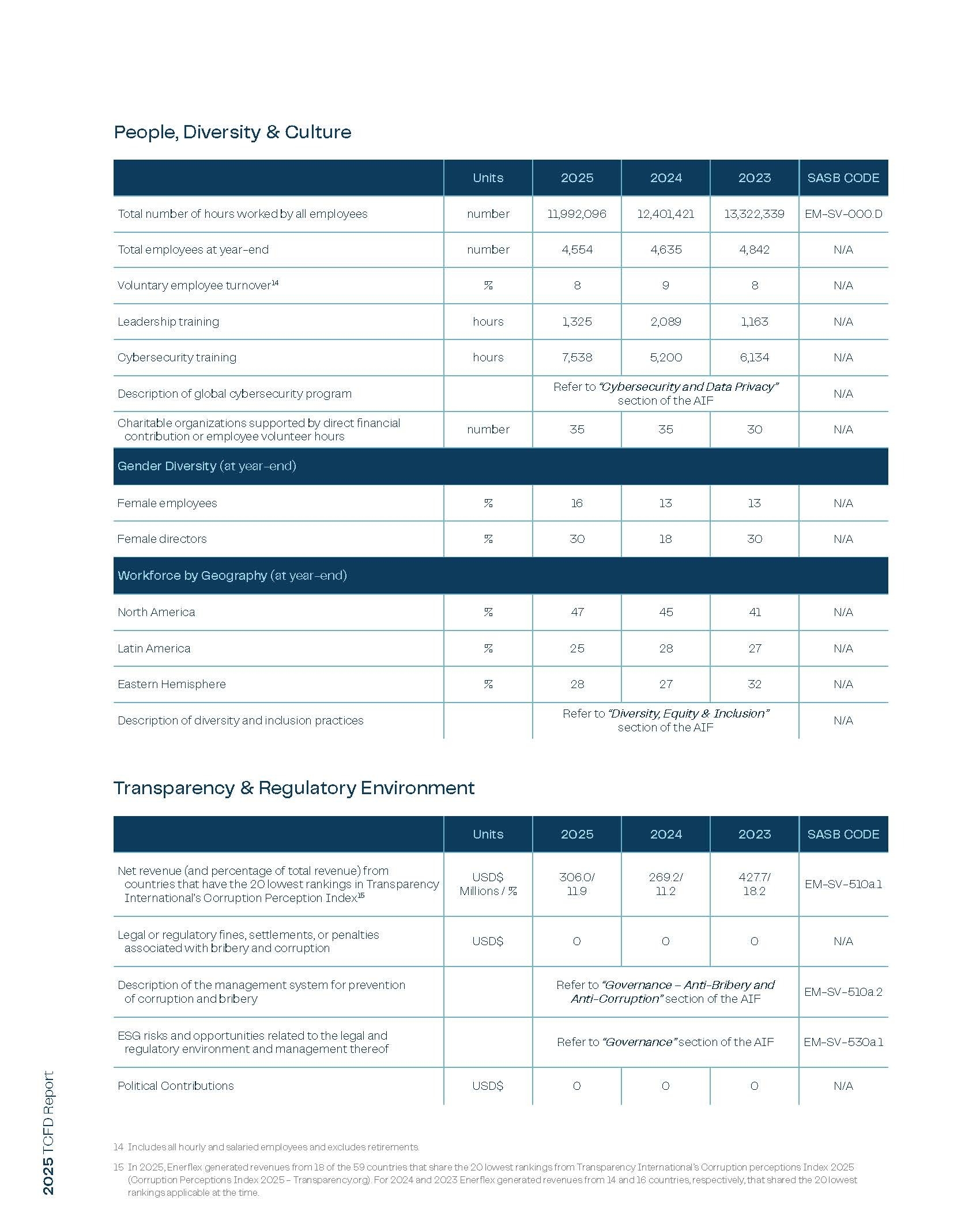
In 2025, employees participated in approximately 1,325 hours of leadership training, skills, and career development courses.
Strong human capital resources are critical to Enerflex’s success. The Company demonstrates its commitment to its employees by its efforts in recruiting, retention, and development.
Attract
Enerflex recognizes that its employees are its most valuable assets and essential to its success. The Company is committed to attracting top talent through a robust referral network, engaging recruitment experiences, and a global presence that appeals to diverse talent pools. These efforts underscore Enerflex’s goal to foster growth, innovate, and collaborate across its global teams. Enerflex invests significantly in talent attraction strategies to maintain its competitive edge. By leveraging its strong employer brand, the Company has positioned itself as an employer of choice in the energy infrastructure sector.
Enerflex recognizes the importance of building a sustainable talent pipeline through partnerships with educational institutions. Across its operating regions, the Company collaborates with universities and trade schools to connect with emerging talent, offering internships, co-op programs, apprenticeships, and sponsorship opportunities. These partnerships not only provide students with valuable industry experience but also position Enerflex as an employer of choice among future professionals.
Retain
Enerflex’s commitment to employee retention is reflected in its ability to cultivate a supportive and rewarding work environment, resulting in a 2025 average enterprise employee tenure of close to 7 years. Enerflex’s total rewards strategy is designed to attract, motivate, and retain employees through a balanced mix of monetary and non-monetary
24
Enerflex Ltd. Annual Information Form
For the Year Ended December 31, 2025
benefits. The Company’s regionally-tailored strategy, aligned with its vision and values, includes competitive compensation, performance and recognition programs, benefits programs, employee pension and savings plans, development opportunities, and work-life effectiveness. By linking rewards to performance and aligning employees’ interests with those of shareholders, Enerflex cultivates a culture of excellence and growth.
Enerflex’s performance management practices focus on fostering a culture of continuous improvement and meaningful dialogue between employees and their leaders. The process is fair and transparent, with regular one-on-one conversations between managers and employees to discuss successes, challenges, and development opportunities. These high-quality discussions align individual contributions with Enerflex’s strategic goals, supporting employee growth and strengthening talent retention. Enerflex ensures employees not only feel valued but also see a clear path for their future within the organization.
Career Development
Enerflex is invested in the professional growth of its employees and is committed to building a high-performing, engaged workforce. It focuses on offering tailored learning opportunities to meet diverse employee needs. From robust technical training to leadership programs, employees have access to a variety of development resources designed to foster professional and personal growth. By offering equitable opportunities for growth and leadership development, the Company ensures employees have the tools they need to thrive, which contributes to both individual and organizational success.
To ensure the Company’s values are reflected in every decision, Enerflex makes Values-Based Decision-Making training available to all employees. This program equips the team with the tools needed to navigate complex decisions and align outcomes with Enerflex’s core values, while maintaining the highest ethical standards. It encourages employees to ask, “Is this the right thing to do?” and sets an example for others to follow.
Engagement
Employee engagement is at the heart of Enerflex’s people strategy, fostering a workplace where individuals feel valued, connected, and motivated to contribute their best. Through numerous regional and global initiatives such as recognition programs, scholarships, community involvement, team building activities, and wellness support, Enerflex builds a culture of collaboration and mutual respect. These efforts not only enhance job satisfaction but also strengthen bonds among employees, creating a unified and purpose-driven workforce. By prioritizing engagement, Enerflex ensures every team member is empowered to thrive both personally and professionally.
Diversity, Equity & Inclusion
Enerflex believes that diversity, equity, and inclusion are fundamental to building a thriving and innovative workforce. With operations in more than 70 locations and employees spanning diverse backgrounds, cultures, and experiences, Enerflex cares deeply about fostering an inclusive environment where every individual feels valued and respected – balancing the approach with both fairness and meritocracy. Enerflex is committed to
25
Enerflex Ltd. Annual Information Form
For the Year Ended December 31, 2025
eliminating barriers, celebrating differences, and empowering all employees to reach their full potential as they contribute to Enerflex’s success.
Enerflex is also committed to providing employees with a safe and respectful workplace, fostering an environment conducive to meaningful contributions. The Company’s global Respectful Workplace Policy outlines Enerflex’s expectations for a workplace free from harassment, discrimination, and violence.
Enerflex takes pride in celebrating its global diversity through community engagement and cultural celebrations. These events strengthen bonds among employees and reinforce Enerflex’s commitment to inclusivity. With a workforce spanning multiple continents, the Company embraces the rich traditions and cultures that each region brings to its global identity. Enerflex actively promotes initiatives that encourage cultural exchange and understanding, creating an environment where employees feel valued for their unique contributions.
Supply Chain Management
Enerflex prioritizes the integrity and sustainability of its supply chain, believing that a strong and resilient supply chain is critical to delivering sustainable value to stakeholders. Oversight is a key component of the Company’s strategy for its supply chain, with Regional Supply Chain personnel, adapting their approach based on region size and business priority, and subsequently dividing responsibilities into distinct business units.
Enerflex’s supplier onboarding process involves due diligence, including, where appropriate, an examination of OSHA standards, safety protocols, and quality benchmarks before engagement. International suppliers undergo further assessments to ensure alignment with legal, social, safety, and environmental policies. Each region maintains standards for purchase orders and supplier engagement. Additionally, a formal documentation process is in place for quality assurance, enabling a proactive approach to addressing any quality issues that may arise with suppliers. Lastly, periodic site visits and audits are conducted for select suppliers, affirming Enerflex’s dedication to upholding the highest standards in its supply chain practices.
Modern Slavery and Human Rights
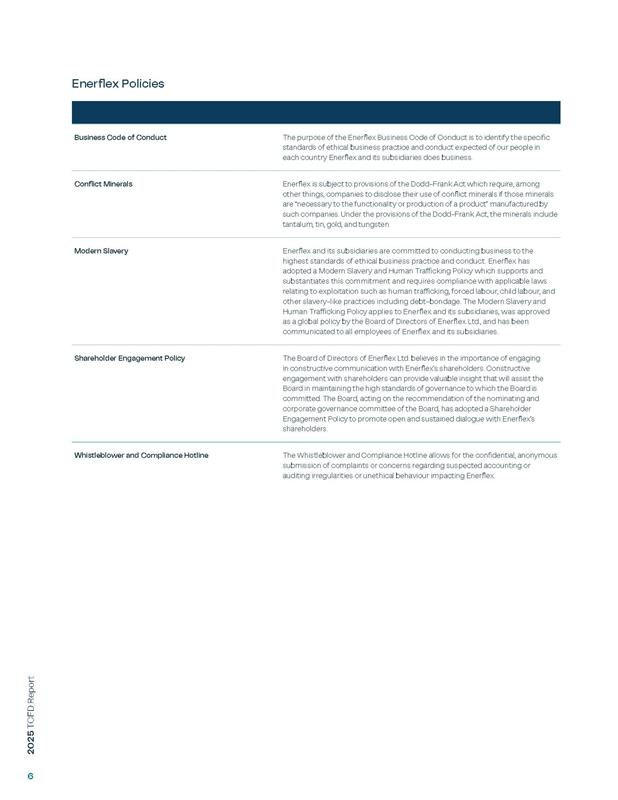
In line with a broader dedication to fostering ethical business practices and prioritizing employee well-being, Enerflex is committed to preventing the occurrence of modern slavery in its supply chains and business operations. Upholding human rights aligns seamlessly with the Company’s core values and informs its operations. The Company’s Modern Slavery and Human Trafficking Policy solidifies its pledge to abstain from knowingly participating in modern slavery, encompassing various forms of exploitation like human trafficking, forced or involuntary labor, unlawful recruitment, and slavery-like practices such as debt-bondage and servitude.
Enerflex publishes a report on the steps taken to prevent and reduce the risk that forced labour or child labour is used at any step of the production of goods in Canada by Enerflex or of goods imported into Canada by Enerflex. A current copy of the full report may be found on Enerflex’s website at www.enerflex.com.
26
Enerflex Ltd. Annual Information Form
For the Year Ended December 31, 2025
Community Engagement
Enerflex is dedicated to making a lasting positive impact in communities in which it operates. Through three pillars of support—Education, Childhood Cancer, and Local Communities—the Company aims to help create a brighter future. These pillars show Enerflex’s commitment to giving back and its belief in the power of sustainable practices to improve the communities Enerflex proudly serves.
Governance
Board of Directors
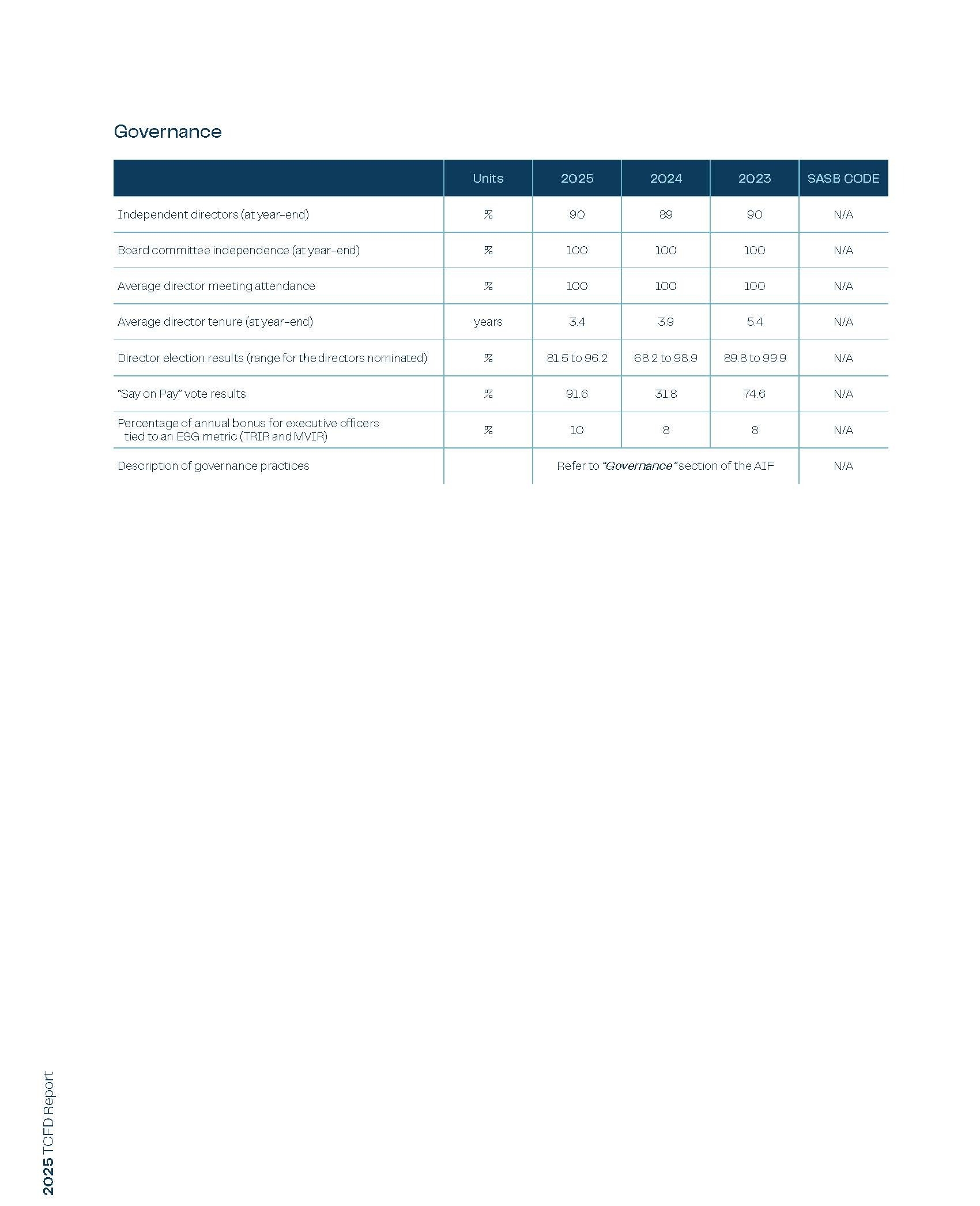
Enerflex and its culture of operational excellence are built upon a solid foundation of robust governance policies and practices. This foundation is upheld by a skilled, experienced, and diverse Board of Directors. The Board plays a crucial role in overseeing and guiding the Company’s strategic direction.
The Board has three standing committees:
Governance Structure
See “Board of Directors”.
Audit Committee
The Audit Committee oversees Enerflex’s financial statements and related disclosures, reports to shareholders, continuous disclosures, and other related communications. The Audit Committee also establishes appropriate financial policies, ensures the integrity of accounting systems and internal controls, and monitors and directs, as appropriate, the activities of the internal audit group. The Audit Committee oversees the work of and approves all audit and non-audit services provided by the independent auditor and consults directly with the auditor (independent of Management) as required. Finally, the Audit Committee also oversees the ERM program, in advance of full Board consideration, as well as Enerflex’s compliance, cybersecurity, and information technology programs. Each member of the Audit Committee is independent. See “Audit Committee” on page 63.
HRC Committee
The HRC Committee is responsible for reviewing and making recommendations as to the compensation of executive officers and other senior management, and as to the Company’s short- and long-term incentive programs, pension, and other benefit plans. The HRC Committee oversees compliance with the Code of Conduct, Respectful Workplace Policy, and HSE programs, and reviews and approves environmental and social disclosures, in advance of full Board consideration. Further, the HRC Committee oversees executive officer appointments, performance evaluations of the Chief Executive Officer, and executive development. On an annual basis, it receives a detailed presentation concerning succession
27
Enerflex Ltd. Annual Information Form
For the Year Ended December 31, 2025
planning for the Executive Management Team and development of key talent within each region as well as at the corporate head office. Each member of the HRC Committee is independent.
NCG Committee
The NCG Committee plays a crucial role in corporate governance by assessing the effectiveness of the Board of Directors, its size and composition, and its committees, reviewing the competencies, skills, and diversity (including, but not limited to, business experience, geography, age, gender, and ethnicity) necessary for the Board, and assessing the Board’s relationship with Management. The NCG Committee evaluates director compensation with support from an external compensation and governance consultant to ensure market competitiveness, and oversees both the training and orientation of new directors and the continuing education of current directors under applicable Enerflex policies. The NCG Committee reviews regulatory changes and governance best practices, aligning Enerflex’s governance policies and practices as appropriate. Finally, the NCG Committee oversees Enerflex’s governance disclosures in advance of full Board consideration. The Chair of the NCG Committee assesses the individual performance and contributions of the Chair of the Board, with the assessment of the individual performance and contributions of the remaining independent directors overseen by the Chair of the Board. Each member of the NCG Committee is independent.
Sustainability Governance
The Board of Directors adopts a collaborative and forward-thinking approach to the oversight of sustainability matters, acknowledging their far-reaching impact that transcends conventional corporate structures. The Board integrates sustainability oversight into its existing framework, enabling a thorough evaluation of risks and opportunities that align with the mandates of relevant Board committees. This collective effort ensures comprehensive oversight of the Company’s sustainability practices and policies, encompassing disclosures, strategies, programs, initiatives, and practices.
Risk Management
Enterprise Risk Management (ERM) is a fundamental driver of sustainable value for the Company and its stakeholders. The Board has the responsibility to oversee and monitor risk across the organization and ensure implementation of appropriate ERM systems to monitor and manage those risks with a view to the long-term viability of the Company. The Board oversees management’s identification and evaluation of Enerflex’s principal risks and the implementation of policies, processes, and systems to manage or mitigate the risks, to achieve an appropriate balance between the risks incurred and potential benefits to the Company’s stakeholders.
Enerflex’s ERM program development and implementation is guided by ISO 31000. The ERM framework includes the identification and prioritization of Enerflex’s principal and emerging risks and regularly assessing risks at Executive Management Team meetings. Enerflex’s Internal Audit function serves as an independent body within Enerflex to assess and report on the efficacy of Enerflex’s ERM systems.
28
Enerflex Ltd. Annual Information Form
For the Year Ended December 31, 2025
Succession Planning
Enerflex ensures leadership sustainability through robust succession planning, both in long-term and emergency scenarios. Quarterly HRC Committee meetings and Board discussions focus on executive development updates and succession plans. A third party aids in executive development, starting with the Executive Management Team and cascading to the Senior Management Teams for seamless transitions and talent cultivation.
Ethics and Business Code of Conduct
Enerflex strives to maintain a culture of integrity, ethical business conduct, transparency, and compliance. As part of these efforts, Enerflex maintains a written Business Code of Conduct (the Code of Conduct), applicable to directors, officers, employees, and independent contractors of Enerflex and its subsidiaries. The Code of Conduct provides guidance on areas such as compliance; conflicts of interest; outside employment; outside directorships; non-profit and professional associations; entertainment, gifts and favours; corporate property; anti-corruption; sanctions and trade compliance; competition and anti-trust legislation; communication devices, the use of search engines and artificial intelligence, and related matters; proprietary and confidential information; corporate communications; insider trading; HSE; human rights and respectful workplace; business and accounting practices; corporate donations; and political participation.
The Code of Conduct also affirms Enerflex’s commitment to complying with all anti-money laundering laws in the countries where it operates. Enerflex will not knowingly assist or do business with anyone involved in money laundering or any other form of financial corruption. Enerflex will only conduct business with reputable client partners that are involved in legitimate business activities who utilize funds from valid sources.
The Code of Conduct is reviewed annually by the NCG Committee and the Board and updated as necessary or advisable. The Board, through the Audit Committee and the HRC Committee, receives regular reports regarding compliance with the Code of Conduct. Orientation sessions for new employees and directors include training in respect of the Code of Conduct. Directors, officers, and all Enerflex managers are required to acknowledge annually their compliance with the provisions of the Code of Conduct. Company-wide certification occurs at least every 24 months. The Code of Conduct is available in multiple languages to ensure that employees understand the provisions of the Code of Conduct.
Whistleblower Protections and Compliance Hotline
Enerflex’s Whistleblower and Compliance Hotline, which is independent and available 24 hours per day / seven days per week, supports the Company’s commitment to financial and accounting integrity and ethical business conduct. The hotline allows employees, suppliers, client partners, or other third parties, to submit a confidential anonymous report of suspected accounting or auditing irregularities or unethical behaviour impacting Enerflex, including, without limitation, breaches of the Code of Conduct (including violations relating to harassment or workplace violence), criminal activity, violations of Enerflex policies or applicable securities laws, actions that endanger health or safety or that are likely to cause environmental damage, and actions that have the effect of concealing the foregoing.
29
Enerflex Ltd. Annual Information Form
For the Year Ended December 31, 2025
All reports submitted to the hotline are investigated, provided sufficient information is given. Upon commencement of an investigation, notice is provided to the President and CEO, the appropriate regional President, and on a quarterly basis, to the Audit Committee (in respect of accounting or financial matters) or HRC Committee (in respect of all matters other than accounting or financial), as applicable. Once an investigation is concluded, findings are reported to the relevant Committee and actioned as appropriate.
Anti-Bribery and Anti-Corruption
As part of Enerflex’s compliance program, the Anti-bribery and Anti-corruption Policy ensures that Enerflex operates in accordance with Canada’s Corruption of Foreign Public Officials Act, the USA’s Foreign Corrupt Practices Act, and all other anti-bribery and anti-corruption laws applicable to Enerflex’s global operations. In addition to requiring that Enerflex maintain accurate books and records, the policy prohibits each director, officer, and employee of Enerflex and its subsidiaries (as well as third parties who act on their behalf) from offering, paying, promising, or authorizing anything of value for improper purposes. The Senior Vice President and General Counsel oversees compliance with the Anti-bribery and Anti-corruption Policy, with ultimate oversight by the President and Chief Executive Officer of Enerflex.
To further mitigate the risk of unlawful activities, Enerflex’s Legal department regularly monitors developments in, and enforcement of, anti-bribery, sanctions, and export laws and evaluates applicable policies and practices to ensure continual compliance and improvement. Management ensures employee understanding of prohibited conduct by way of the Code of Conduct certification process and periodic compliance training for persons in senior management roles or who have direct contact with Enerflex’s client partners, suppliers, and/or government officials. Employees are encouraged to report suspected violations of applicable laws or Enerflex policies (including the Anti-bribery and Anti-corruption Policy) directly to a member of Enerflex’s Legal group or to the Enerflex Whistleblower and Compliance Hotline.
Global Trade Compliance
Enerflex’s Global Trade Compliance Policy ensures Enerflex’s commitment to compliance by Enerflex and its directors, officers, and employees with trade laws that are applicable to Enerflex and its business operations around the world. Companies and individuals who act on behalf of, or have partnered with, Enerflex are expected to share Enerflex’s commitment and comply with the Global Trade Compliance Policy and all related and applicable procedures in effect from time to time.
Cybersecurity and Data Privacy
Cybersecurity is a formal component of Enerflex’s overall ERM framework. The Company’s global cybersecurity program adheres to the National Institute of Standards and Technology Cybersecurity Framework, and is regularly reviewed and updated, including quarterly review by the Audit Committee, annual assessment by Internal Audit, and annual external audit of the information technology general controls.
Pursuant to its global cybersecurity program, Enerflex has an in-house cybersecurity team and partners with multiple third parties who provide 24 hours per day / seven days per week
30
Enerflex Ltd. Annual Information Form
For the Year Ended December 31, 2025
services to monitor, detect, analyze, and respond to cyber threats and assess both their likelihood and their potential impact on business operations, infrastructure, and personnel. Equally important to cybersecurity are training and culture, and Enerflex works to promote a culture that understands the critical importance of data security and privacy, areas of vulnerability, and how to remain vigilant when handling data.
Search Engines and Artificial Intelligence
Enerflex permits the use of internet search engines and third-party generative artificial intelligence services provided that no Company or third-party proprietary or confidential information, personally identifiable information, or any other sensitive data are used as inputs into any such search engines or services. The use of search engines and artificial intelligence services is governed by our Code of Conduct applicable to all directors, officers, employees, and independent contractors of Enerflex and its subsidiaries. The Board, through the Audit Committee and the HRC Committee, receives regular reports regarding compliance with the Code of Conduct at each regularly scheduled Board meeting. See “Sustainability – Governance – Ethics and Business Code of Conduct”.
Political Contributions
Enerflex does not align itself with any political party and abstains from making contributions to political parties or candidates for political office.
Insider Trading
Enerflex’s Insider Trading Policy aligns with applicable securities laws and regulations and applies to all officers, directors, employees and anyone else that qualifies as an “insider”. The policy covers topics such as insider trading prohibitions, blackout periods (both scheduled, recurring, and Company implemented), tipping, insider reporting, and general trading restrictions. The Insider Trading Policy outlines the regular blackout periods (in advance of the release of quarterly and annual financial results) when trading is not allowed, as well as the timing of trading windows. Enerflex insiders and individuals that have access to material undisclosed information are notified by email in advance of each applicable blackout period, expected duration (if known) and, upon the ending of the blackout period, notification of a trading window. In addition, management and the NCG Committee also receive regular reports of insider trading activities at their respective meetings and management also reviews disclosures to analysts and investors to ensure that no selective disclosure has occurred.
Conflicts of Interest
In addition to the statutory obligations of directors to address conflict of interest matters, Enerflex has established a Director & Officer Conflict of Interests Policy to ensure transparency, maintain trust in Enerflex’s leadership, and appropriately mitigate risks arising from personal or external interests that could influence decision‑making. The policy requires timely disclosure of any potential conflicts of interests, including completion of an annual Disclosure Form and ongoing reporting of any changes, and establishes a review and decision‑making process for assessing potential conflicts, and obligations of directors during Board deliberations. In addition, prior to commencing Board and Committee meetings, the agenda is reviewed for conflicts. In addition to annual director certification,
31
Enerflex Ltd. Annual Information Form
For the Year Ended December 31, 2025
Code of Conduct certifications completed by officers, employees, and independent contractors include disclosures of potential conflicts. Any concerns arising in that context are brought to the attention of the Human Resources department, the Legal department, and, if necessary, the President and Chief Executive Officer, the appropriate standing committee of the Board, and/or the Chair of the Board. All identified conflicts of interest are reviewed and addressed in accordance with established procedures.
RISK FACTORS
An investment in Enerflex Common Shares involves a number of risks. There are general risks associated with all businesses; industry specific risks inherent in Enerflex’s operations; and risks specific to Enerflex. This section describes the risks that Enerflex believes are most material to its business and operations. The risks identified herein is not a complete list of all the risks and potential risks applicable to Enerflex. Additional risks may arise from time to time as Enerflex’s business evolves. Risks currently perceived as immaterial may become material. While the Company has extensive policies and procedures in place to limit, manage and mitigate risks, including the Company’s ERM program, there is no assurance that Enerflex will be successful in preventing or minimizing the harm and potential harm that risks present.
General Business Risks
Failure to meet investor expectations
As with all businesses, there is a risk that Enerflex does not always meet investor expectations, including expectations regarding financial performance and the optimal deployment of capital. Investors may have expectations regarding the timeline for returns on an investment in Company, which may not align with the Company’s own strategic objectives, forecasts, and scenario planning, and which may not fully consider the volatility and cyclical nature of the oil and natural gas industry. BOOM projects in particular have a multi-year development cycle, with returns typically materializing over a longer term than investors might anticipate. Certain assumptions, estimates, and analysis impacting Enerflex’s growth projections may not materialize for reasons beyond the Company’s control. See “Forward-Looking Information”.
A failure to meet stakeholder expectations could adversely impact the reputation of the Company, and investor trust and confidence in the Company, its Board and Management, such that investors reduce their investment in Enerflex, or do not invest in Enerflex at all. This may have an adverse impact on the price and liquidity of Enerflex’s securities, and otherwise adversely impact the Company’s financial position. A failure to meet stakeholder expectations could also result in negative change to Enerflex’s credit ratings. These ratings affect Enerflex’s short and long-term financing costs, liquidity, and operations over the long term, and its ability to engage in certain business activities cost-effectively. If a rating agency downgrades Enerflex’s current corporate credit rating or the rating of the 2031 Notes, or negatively changes its credit outlook, it could have an adverse effect on Enerflex’s future financing costs and access to liquidity and capital.
The Company manages the risk of not meeting shareholder expectations through a combination of (a) clear, credible, and consistent communication of its financial
32
Enerflex Ltd. Annual Information Form
For the Year Ended December 31, 2025
performance and strategic objectives to stakeholders by way of regular market updates, a dedicated investor relations function, and engagement with shareholders by Management and members of the Board of Directors, and (b) a disciplined focus on executing the short-, medium- and long-term strategies communicated to investors. The Company also monitors corporate governance developments and engages with proxy advisory firms and governance organizations in an effort to continually improve its disclosures.
Compliance with domestic and international laws, financial reporting rules, and applicable regulations impact Enerflex’s operations
With operations in 17 countries globally, the Company is impacted by, and required to comply with, a multitude of international, federal, provincial, state, and local laws and regulations. Enerflex has developed policies, procedures, and training tools designed to achieve and maintain compliance with these laws and regulations, both in its own right and by contractors and sub-contractors. While management believes the Company and its subsidiaries comply with current prevailing laws and regulations, these laws and regulations are complex, subject to periodic revision, and many are becoming increasingly stringent. In addition, laws and regulations are often subject to changes in their interpretation by administrative authorities. There is thus a risk that the Company is not able to maintain compliance with all applicable laws or regulations in all jurisdictions and that the Company could be exposed to investigations, claims, and other regulatory proceedings for alleged or actual violations of laws and regulations related to its operations. This could result in the imposition of administrative, civil, and criminal enforcement measures, including assessment of monetary penalties, disgorgement, obligatory modifications to business practices and compliance programs, and issuance of injunctions as to future compliance. While Enerflex cannot accurately predict the impact of any such proceedings, they could have a material adverse effect on the Company’s reputation, business, financial condition, results of operations, and cash flow.
The cost of legal and regulatory compliance can also be significant. These costs impact the Company’s operating costs and, if they increase over time, could negatively impact the demand for the Company’s products and services.
Enerflex’s compliance obligations, and associated risks, include but are not limited to those detailed below.
(a) Corruption, anti-bribery, sanctions, and trade laws
The Company is required to comply with domestic and international laws and regulations regarding corruption, anti-bribery, sanctions, and trade compliance. Enerflex conducts business in many parts of the world that experience high levels of corruption, relies on third-party agents to act on the Company’s behalf in some jurisdictions where the Company does not have a presence, and is subject to various laws that govern the import and export of its equipment, including licensing requirements and transfer pricing rules.
The Canadian government, the US Department of Justice, the SEC, the US Office of Foreign Assets Control, and similar agencies and authorities in other jurisdictions have a broad range of civil and criminal penalties they may seek to impose against companies and individuals for violations of anti-corruption and anti-bribery legislation, trade laws, and sanctions laws.
33
Enerflex Ltd. Annual Information Form
For the Year Ended December 31, 2025
(b) HSE laws and regulations
Compliance with environmental laws is a priority across Enerflex operations and in the manufacturing of the Company’s products. Certain environmental laws may impose joint and several and strict liability for environmental contamination, which may render the Company liable for remediation costs, natural resource damages, and other damages as a result of Company conduct or the conduct of, or conditions at Company facilities caused by, prior owners or operators or other third parties. In addition, where contamination may be present, it is possible that neighbouring landowners and other third parties may file claims for personal injury, property damage, and recovery of response costs. Remediation costs and other damages arising as a result of environmental laws and regulations could be substantial and could negatively impact financial condition, profitability, and results of operations.
Enerflex may need to apply for or amend facility permits or licenses from time to time with respect to storm water, waste handling, or air emissions relating to manufacturing activities or equipment operations, which may subject Enerflex to new or revised permitting conditions. These permits and authorizations may contain numerous compliance requirements, including monitoring and reporting obligations and operational restrictions, such as emission limits, which may be onerous or costly to comply with. Given the large number of jurisdictions and facilities in which Enerflex operates, and the numerous environmental permits and other authorizations that are applicable to its operations, the Company may occasionally identify or be notified of technical violations of certain compliance requirements and could be subject to penalties related thereto.
The Company is also subject to various federal, provincial, state, and local laws and regulations relating to safety and health conditions in its manufacturing facilities and other operations. Those laws and regulations may also subject the Company to material financial penalties or liabilities for any noncompliance, as well as potential business disruption if any of its facilities, or a portion of any facility, is required to be temporarily closed as a result of any violation of those laws and regulations. Any such financial liability or business disruption could have a material adverse effect on the Company’s projections, business, results of operations, and financial condition.
(c) Laws relating to internal control over financial reporting and disclosure controls and procedures
Enerflex is required by law to maintain effective internal control over financial reporting and disclosure controls and procedures, including under SOx. Under SOx requirements, Enerflex must furnish a report by management on, among other things, the effectiveness of its internal control over financial reporting. This assessment includes disclosure of any material weaknesses identified by management in the Company’s internal control over financial reporting. Enerflex cannot provide assurance that there will not be material weaknesses and deficiencies identified presently or in the future. Enerflex may not be able to remediate material weaknesses that have been identified, or any future material weaknesses that may be identified, or complete any evaluation, testing and remediation in a timely manner. Where material weaknesses and deficiencies do exist, there is a reasonable possibility that material misstatements in the Company’s financial statements will not be prevented or detected on
34
Enerflex Ltd. Annual Information Form
For the Year Ended December 31, 2025
a timely basis. The Company’s independent auditors may issue adverse reports if it is not satisfied with the level at which Enerflex’s controls are designed, documented, or operating. Consequently, the Company cannot provide assurance that its independent auditors will be able to attest to the effectiveness of the Company’s internal control over financial reporting now or in the future.
If Enerflex is unable to remediate known material weaknesses, or if it identifies additional material weaknesses or deficiencies, it may be unable to produce accurate and timely financial statements in conformity with IFRS, which could lead to investors losing confidence in the Company’s financial disclosures, trigger an event of default under its credit agreements and harm its business, which could have a material adverse effect on the trading price of Enerflex Common Shares, could result in the Company being unable to comply with applicable securities laws and stock exchange listing requirements, or could restrict its future access to capital markets.
Trade tariffs may create or heighten geopolitical and economic instability
Economic, tax and trade policies may have significant implications for Canadian, U.S. and global economies. Trade tariffs imposed by the USA on imports from Canada and other countries, together with retaliatory tariffs by those countries on imports from the USA, and other potential measures, including import and export duties, fees, economic sanctions or other trade measures, immigration policy, tax policy, and energy regulation, present risks to Enerflex’s business and operations and may create or heighten geopolitical and economic instability and increase market volatility. Such measures, the nature, extent, and timing of which remain uncertain, could lead to increased costs, facilitate changes in interest rates and inflation, impact commodity prices, or currency exchange rates, and lower economic growth and equity prices, any or all of which could adversely impact Enerflex’s results and/or operations.
The Company continues to closely monitor developments in this area and to work to mitigate the impact of any tariffs through its diversified operations and proactive risk management. Enerflex’s operations in the USA, Canada, and Mexico are largely distinct in the customers and projects they serve. The nature, timing, and impact of trade tariffs on the Company’s financial and operational results cannot currently be quantified or determined.
Changes in tax laws, interpretations, or rates may negatively impact Enerflex
The Company and its subsidiaries are subject to income and other taxes in multiple jurisdictions. One or more of the jurisdictions in which Enerflex does business could seek to impose incremental or new taxes on the Company or its subsidiaries. Effective tax rates in those jurisdictions could also be impacted by changes in tax laws or interpretations thereof, changes in the mix of earnings in countries with differing statutory tax rates, or changes in the valuation of deferred tax assets and liabilities. Any such change could have a material adverse impact on the Company’s financial and operational results.
While management believes the Company and its subsidiaries are in compliance with current prevailing tax laws and requirements, the Company or its subsidiaries could be subject to assessment, reassessment, audit, investigation, inquiry, or judicial or administrative proceedings by any of the taxing jurisdiction where it operates. The timing or impacts of any such assessment, reassessment, audit, investigation, inquiry, or judicial or
35
Enerflex Ltd. Annual Information Form
For the Year Ended December 31, 2025
administrative proceedings, or any future changes in tax laws, including the impacts of proposed regulations, cannot be predicted. Any adverse tax developments, including legislative changes, judicial holdings, or administrative interpretations, could have a material and adverse effect on the results of operations, financial condition, and cash flows of the Company.
Force majeure events may impact Enerflex’s business
The Company’s operations could be impacted by disruptions beyond its control, including, but not limited to: natural disasters; extreme weather events; the outbreak of epidemics, pandemics, or other health crises; cyberattacks; infrastructure disruptions; terrorist activities, anti-terrorist efforts, and other armed conflicts; domestic and global trade disruptions; diplomatic developments; national emergencies; acts of foreign governments; acts of war; civil unrest; or other natural or man-made events or occurrences. Any such disruptions could result in, amongst other things, a slowdown, or temporary, prolonged or permanent suspension of Enerflex’s operations in impacted geographic locations; damaged infrastructure and key facility closures; reduced economic activity and corresponding reduced demand for the Company’s products and services; or an impaired supply chain, increasing the cost of goods and services used in Enerflex’s operations. Disruptions may also adversely impact the health and safety of Enerflex’s employees or otherwise restrict the availability or productivity of its workforce. Should any such disruption occur, the Company’s business, operations, assets, financial condition, and cash flows could be materially and adversely affected.
Emerging from any slowdown or suspension in operations presents further risks to Enerflex’s business, financial condition, and reputation. The Company may be delayed in reaching full operational capacity and in bringing crucial systems and processes online and may have reduced access to assets and project sites, disrupting its ability to service client partners or making it impossible to fulfill its contractual obligations.
Any unforeseen disruptions could also expose Enerflex to substantial liability for personal injury, loss of life, property damage, and pollution. Enerflex carries insurance to protect the Company against these unforeseen events, subject to appropriate deductibles and the availability of coverage, although such insurance protections may not be adequate to cover all losses or liabilities that the Company may incur. See “Risk Factors – Enerflex Specific Risks - Enerflex’s business requires significant levels of insurance” for the limitations on insurance coverage and associated risks to the business.
ESG matters, climate change, and associated regulatory and policy changes could impact Enerflex’s business
Practices and disclosures relating to ESG matters (including but not limited to governance practices, climate change and emissions, diversity and inclusion, data security and privacy, ethical sourcing, and water, waste, and ecological management) have, in recent years, attracted increasing scrutiny by stakeholders. Certain stakeholders are requesting that issuers develop and implement more robust ESG policies and practices. Developing and implementing such policies and practices can involve significant costs and require a significant time commitment from the Board of Directors, Executive Management Team, and employees of Enerflex. Failing to implement the policies and practices as requested or
36
Enerflex Ltd. Annual Information Form
For the Year Ended December 31, 2025
expected by Enerflex’s stakeholders, may result in investors reducing their investment in Enerflex, or not investing in Enerflex at all, thereby affecting the price and liquidity of Enerflex’s securities. The Company’s response to addressing ESG matters, and any negative perception thereof, can also impact Enerflex’s financial position through increased financing costs, and impact its reputation, business prospects, and ability to hire and retain qualified employees. It could also make the Company vulnerable to activist shareholders. Such risks could adversely affect Enerflex’s business, future operations, and profitability.
Climate change policy is quickly evolving at regional, national, and international levels, and political and economic events may significantly affect the scope and timing of climate change measures that are ultimately put in place. There is a global trend in recent periods towards greater regulation of GHG emissions. Although it is not possible to predict how new laws or regulations would impact the Company’s business, any future requirements imposing carbon pricing schemes, carbon taxes, or emissions-reduction obligations on the Company’s operations could require it to incur costs to reduce emissions or to purchase emission credits or offsets and may cause delays or restrictions in its ability to offer its products and services. Failure to comply with such laws and regulations could result in significant liabilities or penalties being imposed on Enerflex. There is also a risk that Enerflex could face claims initiated by third parties relating to climate change or related laws and regulations, or to the Company’s public disclosure of matters relating to climate change and the environment. The direct or indirect costs of such claims, and compliance with such laws or regulations, may have a material adverse effect on the business, financial condition, results of operations, and prospects of the Company. Enerflex’s client partners face similar risks, which could see reduced demand for the Company’s products and services.
The nature of Enerflex’s operations brings inherent litigation risk and liability claims
The Company’s operations entail inherent risks, including but not limited to equipment defects, malfunctions and failures, and natural disasters that could result in uncontrollable flows of natural gas, untreated water or well fluids, fires, and explosions. Some of the Company’s products are used in hazardous applications where an accident or a failure of a product could cause personal injury or loss of life, or damage to property, equipment, or the environment, as well as the suspension of the end-user’s operations. The Company seeks to mitigate its exposure to these risks through various means including contracting strategies, however, if the Company’s products were to be involved in any of these incidents, the Company could face litigation and may be held liable for those losses.
The Company is and in the future may become involved in, named as a party to, or be the subject of various legal proceedings and arbitrations, including regulatory proceedings, tax proceedings, and legal actions related to contract disputes, property damage, environmental matters, employment matters, and personal injury. See “Legal Proceedings” for more information, including in respect of the ongoing arbitration on an international ES project.
Defense and settlement costs associated with lawsuits and claims can be substantial, even with respect to lawsuits and claims that have no merit. Due to the inherent uncertainty of the litigation process, the resolution of any legal proceeding or arbitration could have a material adverse effect on Enerflex’s operating results or financial performance.
37
Enerflex Ltd. Annual Information Form
For the Year Ended December 31, 2025
The Company may not be able to adequately protect itself contractually or by relying on insurance coverage in connection with any third party claim. See “Risk Factors – Enerflex Specific Risks - Enerflex’s business requires significant levels of insurance” for the limitations on insurance coverage and associated risks to the business.
Industry Specific Risks
Investor sentiment particularly related to the oil and natural gas industry
A number of factors, including the inherent volatility of the oil and natural gas industry, the impact of oil and natural gas operations on the environment, the effects of the use of hydrocarbons on climate change, ecological damage relating to spills of petroleum products during production and transportation, and human rights, have affected certain investors’ sentiments towards investing in the oil and natural gas industry. As a result of these concerns, some institutional, retail, and governmental investors have announced that they are no longer willing to fund or invest in companies in the oil and natural gas industry or are reducing the amount of their investment over time. Any reduction in the investor base interested or willing to invest in the oil and natural gas industry may limit Enerflex’s access to capital, increase its financing costs, and decrease the price and liquidity of Enerflex’s securities.
A well-functioning supply chain and effective inventory management are essential to Enerflex’s business
Enerflex purchases a broad range of materials and components in connection with its manufacturing and service activities. Certain components used in Enerflex’s products are obtained from a single source or a limited group of suppliers and original equipment manufacturers. While Enerflex makes it a priority to maintain and enhance these strategic relationships in its supply chain, there can be no assurance that these relationships will continue. Reliance on suppliers involves several risks, including price increases, delivery delays, inferior component quality, and unilateral termination. Certain original equipment manufacturers are also limited in the ability to package and sell material and products. Long-lead times for high demand components, such as engines, can result in project delays. While Enerflex has long standing relationships with recognized and reputable suppliers and original equipment manufacturers, it does not have long-term contracts with all of them, and the partial or complete loss of certain of these sources could result in increased costs and project delays, could have a negative impact on Enerflex’s results of operations, could damage client partner relationships, and could affect Enerflex’s competitive position. Further, a significant increase in the price of one or more of these components could have a negative impact on Enerflex’s operational or financial results.
Risks associated with supply chain disruptions are mitigated by dedicated supply chain management teams and continual review of supply chain documentation and processes. Though Enerflex is generally not dependent on any single source of supply, the ability of suppliers to meet performance, quality specifications, and delivery schedules is important to the maintenance of client partner satisfaction and Enerflex’s reputation in the market. If the availability of equipment is constrained or delayed, or if Enerflex’s supply chain is otherwise disrupted such that it cannot deliver products or services in a timely and cost-effective manner, certain of the Company’s operational or financial results may be adversely impacted.
38
Enerflex Ltd. Annual Information Form
For the Year Ended December 31, 2025
The Company’s operational and financial results could also be adversely impacted by supply chain challenges specific to Enerflex’s operations across multiple jurisdictions. Segmented operations can give rise to inter-regional inefficiencies and restrict Enerflex’s ability to utilize global bulk buying power with several large suppliers, impacting the profitability of its projects. While the fabrication of ES products at our Houston, Broken Arrow and Calgary manufacturing facilities avoids the significant markup associated with local procurement, it can impact margins through additional transportation costs and import taxes, tariffs, and fees. In certain countries in which the Company operates, Enerflex is required to use certain vendors, which impacts the ability to utilize global or internal supply chains and increases costs.
Enerflex faces additional risks related to its internal supply chain and effective management of its inventory. The Company is continually improving its strategic inventory management, using market intelligence, automatic inventory checking, and supply chain coordination, and while the Company does leverage its global footprint to manage its inventory levels on a larger scale, there are risks that inventory is not properly optimized across all operations. A failure to properly manage and optimize inventory could restrict access to working capital, restrict the Company’s ability to move quickly in securing new business, and generally negatively impact operational efficiency and financial performance.
See “Sustainability – Social – Supply Chain Management” for details of Enerflex’s supply chain management processes.
The industry in which Enerflex operates is highly competitive
The Company has several competitors in all aspects of its business. There are low barriers to entry for natural gas processing and compression services, the processing and compression fabrication business, and several companies target the same client partners as Enerflex in markets where margins can be low and contract negotiations can be challenging. With respect to new market entrants, the Company faces increasing competition in Latin America and the Eastern Hemisphere.
When it occurs, consolidation within Enerflex’s customer base further increases competitive pressures, as the balance of supply-and-demand is disrupted, and the Company is forced to compete for business from a smaller pool of customers. In AMS, customers may develop their own internal after-market service capabilities, further reducing the pool of potential customers. There is an ongoing risk that Enerflex’s competitors expand their service offering or fabricate new equipment, or develop relationships with Enerflex’s key original equipment manufacturers, which would create additional competition for the products, equipment, or services that Enerflex offers to client partners.
Some of the Company’s competitors, particularly in the ES and EI product lines, are large, multi-national companies that may be able to adapt more quickly to technological changes within the industry or changes in economic and market conditions, more readily take advantage of acquisitions and other opportunities, leverage more cost-efficient internal supply chains, and adopt more aggressive pricing policies.
In terms of financial and operational performance, the Company faces considerable market pressure from competitors that may have lower costs of capital, diverse capital structures,
39
Enerflex Ltd. Annual Information Form
For the Year Ended December 31, 2025
and alternative reporting metrics. There is a risk that Enerflex is unable to take advantage of opportunities or be competitive on pricing to the extent necessary to compete with these companies, both for the reasons set out above and because of capital constraints, debt levels, and the costs associated with the stringent compliance requirements that apply to Enerflex as a public company.
The Company’s ability to secure new business, maintain its market share, and achieve its strategic objectives could be affected by any one or more of these competitive pressures. This could have a material and adverse impact on the Company’s business, financial condition, and results of operations, as well as on the price and liquidity of Enerflex’s securities. A detailed discussion of the competitive conditions in Enerflex’s principal markets, and an assessment of Enerflex’s competitive position, is included the “Competitive Conditions” section of this AIF.
The ability to hire and retain quality personnel and contractors are critical to Enerflex’s business
The Company’s ability to attract qualified personnel by providing both market-related compensation and the necessary organizational structure, benefits, programs, and culture to engage employees, is crucial to its growth and to achieving its business results. The Company’s ability to provide development opportunities and training to cultivate talent and enhance its internal skillset is equally important.
Enerflex’s product lines require a combination of skilled engineers, design professionals, tradespeople, mechanics, and technicians. Enerflex competes to hire and retain these professionals, not only with companies in the same industry, but with companies in other industries. These competitive pressures are compounded in periods of high activity, when demand for skills and expertise increases and when the Company may need to move quickly to augment its workforce, as well as by a reduction in the number of people pursuing skilled trades. Moreover, much like certain investors’ sentiments towards investing in the oil and natural gas industry have been affected by ESG matters, the perceived impact of oil and natural gas operations on the environment and issues of climate change have made a career in the oil and natural gas industry less appealing to new graduates and tradespeople entering the job market. This increases demand and competition for the high-quality, skilled personnel necessary to deliver on Enerflex’s value proposition to client partners across all business lines.
There are few barriers to entry in several of Enerflex’s businesses, so retention of qualified personnel is essential to differentiate Enerflex's product and service offerings and to compete in its various markets. Enerflex’s employee retention strategies include but are not limited to comprehensive succession planning for Management and personnel in key positions and investment in ongoing talent development within each region and at the corporate head office. Total Rewards compensation and benefits programs, individual career growth plans and other opportunities for career development, and a keen focus on employee diversity, inclusion and wellbeing, further support the Company’s efforts to ensure the sustainability and continuity of critical knowledge, relationships, and skills. See “Sustainability – Social – Talent Management” for more details of the various programs and policies supporting Enerflex’s recruitment, retention and employee development efforts.
40
Enerflex Ltd. Annual Information Form
For the Year Ended December 31, 2025
There can, however, be no assurance that key personnel are retained. The associated loss of knowledge, relationships, skills, and functions (particularly engineering and trades functions), as well as loss of access to the knowledge and relationships fundamental to the maintenance and management of key contracts, poses a significant risk to Enerflex’s business and could adversely impact the quality or delay the completion of certain projects, increase competitive pressures, and adversely impact the Company’s reputation.
There are certain jurisdictions where Enerflex relies on third-party contractors to carry out the operation and maintenance of its equipment and the aforementioned risks apply equally in this context. The ability of third-party contractors to find and retain individuals with the proper technical background and training is critical to the continued success of the contracted operations in these jurisdictions. If Enerflex’s third-party contractors are unable to find and retain qualified operators, or the cost of these qualified operators increases substantially, the contract operations business could be materially impacted.
Financial reductions or restrictions of client partners may impact Enerflex’s contracted revenue
Many of Enerflex’s client partners finance their activities through cash flow from operations, incurrence of debt, or issuance of equity. In addition, a substantial portion of Enerflex’s accounts receivable balances are with client partners involved in the oil and natural gas industry, and these client partners may experience decreased cash flow from operations, or a reduction in their ability to access capital, during times when the oil or natural gas markets weaken. Enerflex may also extend credit to certain client partners for products and services that it provides during its normal course of business.
If a client partner experiences decreased cash flow from operations and limitations on their ability to incur debt or raise equity, a reduction in borrowing bases under reserve-based credit facilities, a lack of availability of debt or equity financing, or other factors that negatively impacts its financial condition, Enerflex may not be able to collect or enforce collections on all or a portion of the accounts receivable balance or credit balance from that client partner. Alternatively, the affected client partner may seek to preserve capital by pursuing price concessions, thereby putting margins under pressure, or by cancelling or determining not to renew recurring revenue contracts. Where contracts are renewed or renegotiated, these may be on less favourable commercial terms, or may transfer additional risk of liquidated damages, consequential loss, liability caps, and indemnities to the Company.
Any one of these occurrences may lead to a reduction in revenue and net income, which reduction could have a material adverse effect on Enerflex’s business, financial condition, results from operations, and cash flows. Enerflex monitors its financial exposure to its client partners, but there can be no certainty that financial losses will not materialize or have a material adverse impact on the organization.
Economic and industry volatility could impact Enerflex’s financial position
The industry in which Enerflex operates is highly reliant on the levels of capital expenditures made by oil and gas producers and explorers. The capital expenditures of these companies, along with those of midstream companies who service these oil and gas explorers and
41
Enerflex Ltd. Annual Information Form
For the Year Ended December 31, 2025
producers, impact the demand for Enerflex’s equipment and services. Capital expenditure decisions are based on various factors, including but not limited to demand for hydrocarbons and prices of related products; exploration and development prospects in various jurisdictions; reserve production levels; oil and natural gas prices; regulatory compliance; and access to capital, none of which can be accurately predicted. More generally, the supply and demand for oil and natural gas is influenced by a number of factors, including political, economic, or military circumstances throughout the energy producing regions of the world. This has been highlighted by recent developments in Venezuela, the Russian invasion of Ukraine, and ongoing tensions in the Middle East, which have had a substantial impact on supply and resulted in significant and rapid commodity price increases. Actual or threatened imposition of import tariffs and retaliatory measures have created volatility in markets which can influence the demand for, or price, of the Company’s solutions.
If economic conditions or international markets decline unexpectedly, or if there is an actual or perceived downturn in commodity prices over the long term, oil and gas producing client partners may decide to cancel or postpone major capital expenditures. This may lead to financial losses in the short term, and reduced demand for products and services offered by Enerflex and a restriction in the Company’s ability to generate recurring revenue over the medium- to long term. The overall impact to the Enerflex business is difficult to predict and depends on many factors that are continually evolving and not within Enerflex’s control, but any such adverse conditions could have a material adverse effect on the Company’s business, financial condition, and results of operations.
Adverse economic conditions present additional risks to Enerflex’s business. A strong US dollar can make ES fabricated in the USA less competitive in markets outside of the USA, adversely impacting the Company’s reputation and competitive position in international markets and adversely affecting cash flows and access to capital for larger BOOM projects. The longer development cycle of BOOM projects also makes them particularly susceptible to the negative impacts of higher inflation, which presents financial risk over the lifetime of longer-term projects.
Conversely, strong economic conditions and competition for available personnel, materials, and major components may result in significant increases in the cost of obtaining such resources. To the greatest extent possible, Enerflex passes such cost increases on to its client partners and attempts to reduce these pressures through proactive supply chain and human resource practices. Should these efforts not be successful, the gross margin and profitability of Enerflex could be adversely affected.
The Company and its subsidiaries’ liabilities include long-term debt that may be subject to fluctuations in interest rates. The 2031 Notes outstanding at December 31, 2025 are at fixed interest rates and therefore will not be impacted by fluctuations in market interest rates. The Company’s Revolving Credit Facility, however, is subject to changes in market interest rates. As at December 31, 2025, the Company had $193 million of indebtedness that is effectively subject to floating interest rates. Changes in economic conditions outside of Enerflex’s control could result in higher interest rates, thereby increasing Enerflex’s interest expense and, in turn, having material adverse impact on Enerflex’s financial results and financial condition. For each one per cent change in the rate of interest on the Revolving Credit Facility,
42
Enerflex Ltd. Annual Information Form
For the Year Ended December 31, 2025
the change in interest expense for the twelve months ended December 31, 2025, would be approximately $2 million. All interest charges are recorded in finance costs on the consolidated statements of earnings (loss). Any increase in market interest rates could have a material adverse impact on the Company’s financial results, financial condition, or ability to declare and pay dividends. See “Dividends – Restrictions on Paying Dividends”.
Enerflex is susceptible to health, safety, and environment risks throughout its operations
Enerflex’s business is susceptible to health, safety, and environment risks inherent in manufacturing, construction, and operations in the oil and natural gas services industry. These risks include but are not limited to: equipment defects, malfunctions, and failures; vehicle collisions and other transportation incidents; and natural disasters or other catastrophic events that could result in uncontrollable flows of natural gas, untreated water or well fluids, fires, and explosions. Some of the Company’s products are used in hazardous applications where an accident or a failure of a product could cause personal injury or loss of life, or damage to property, equipment, or the environment, as well as the suspension of the end-user’s operations.
Failure to mitigate, prevent, or appropriately respond to a safety or health incident could result in injuries or fatalities among employees, contractors, visitors, or residents in communities near Company operations. Preventing or responding to accidents could also require Enerflex to expend significant time and effort, as well as financial resources to remediate safety issues, compensate injured parties, and repair damaged facilities.
If the Company or its products were to be involved in any of the aforementioned incidents, the Company could face litigation and may be held liable for losses arising from personal injuries or death, property damage, operational interruptions, and shutdown or abandonment of affected facilities. Defense and settlement costs associated with lawsuits and claims can be substantial. The Company could also face government-imposed orders to remedy unsafe conditions or circumstances, and penalties associated with the contravention of applicable health and safety legislation.
Safety is also key factor that client partners consider when selecting a service provider. A decline in the Company’s safety performance could result in lower demand for products or services, which could have an adverse effect on Enerflex’s business, financial condition, and results of operations.
Enerflex reduces its exposure to HSE risks through various means, including comprehensive security and safety assessments of all new projects and on an ongoing basis; contracting strategies; and by maintaining prudent levels of insurance, although such protections may not be adequate to cover all losses or liabilities that the Company may incur. See “Risk Factors – Enerflex Specific Risks - Enerflex’s business requires significant levels of insurance” for the limitations on insurance coverage and associated risks to the business.
Customer needs and expectations are evolving
Enerflex’s ability to remain competitive and to achieve its strategic objectives depends in part on its ability to develop, adopt, integrate, and deploy new and emerging technologies, and to leverage technological innovations, across its operations, product, and service
43
Enerflex Ltd. Annual Information Form
For the Year Ended December 31, 2025
offerings. It also depends on its ability to understand and anticipate the evolving needs and expectations of its customer base more generally, across all the jurisdictions in which it operates, and to adapt its offerings and pricing to meet those expectations.
Development and adoption of new technologies, and development of new product and service offerings, requires significant investments of capital and resources, and the expenditure of time and costs in upskilling and reskilling employees. These costs may or may not be recoverable in the marketplace and may result in certain products and services being less profitable or economical than anticipated. If the Company is unable to quickly adapt to customers’ evolving needs and expectations, either by failing to deploy technologically innovative offerings, or by failing to meet customer expectations as to product and service quality, project structure, pricing and contractual terms (including the allocation of risk), or otherwise, this could reduce demand for the Company’s products and place Enerflex at a considerable competitive and reputational disadvantage. The Company’s ability to sustain and create new revenue streams in existing markets and to enter and compete in new markets may be affected, which could have a material adverse impact on the operational and financial performance of the Company in the long term. It could also impact the Company’s financial position through loss of long-term client partner relationships.
Successful execution of energy transition projects is reliant on regulatory and policy incentives such as the Section 45Q tax credit for CCUS, the Section 45V tax credit for clean hydrogen production, California low-carbon fuel standards, and many others. The elimination or loss of, or reduction in, such incentives could (i) decrease the attractiveness of such energy transition projects, equipment or facilities to potential client partners, reducing the Company’s opportunities to commercialize the relevant projects, equipment or facilities, (ii) reduce the Company’s willingness to pursue or develop certain projects, equipment or facilities due to higher operating costs or decreased revenue related to such projects, equipment or facilities, and/or (iii) cause the market for future energy transition projects, equipment or facilities to be smaller. Any of the foregoing could have a material adverse effect on the Company’s ability to pursue opportunities in the energy transition economy. Additionally, there are many geographies where relevant governments have not adopted or promulgated regulatory and policy incentives related to energy transition projects and applications. Enerflex may not be able to participate in providing energy transition solutions to client partners in those geographies unless and until such regulatory and policy incentives are adopted.
Enerflex’s business requires significant levels of insurance
Enerflex’s operations are subject to many risks, including without limitation risks inherent in the oil and natural gas services industry, such as equipment defects, and failures; risks of natural disasters with resultant uncontrollable flows of oil and natural gas, fires, spills, and explosions; and the additional risks identified in the “Risk Factors” section of the AIF. These risks could expose Enerflex to substantial liability for personal injury, loss of life, business interruption, property damage, pollution, and other liabilities. Enerflex carries prudent levels of insurance to protect the Company against these risks, subject to appropriate deductibles and the availability of coverage. However, there can be no assurance that any such insurance policies will cover all losses or liabilities that may arise from the operation of Enerflex’s business, or that claims made under the Company’s policies are not in excess of policy limits
44
Enerflex Ltd. Annual Information Form
For the Year Ended December 31, 2025
or subject to substantial deductibles. Any losses or liabilities not so covered could have a material adverse effect on the Company’s projections, business, results of operations, and financial condition. The occurrence of a significant event outside of the scope of coverage of the Enerflex insurance policies could have a material adverse effect on the Company’s financial results.
An annual review of insurance coverage is completed to assess the risk of loss and risk mitigation alternatives. Natural occurrences, and geopolitical activities in recent years have strained insurance markets leading to increases in insurance costs and limitations on coverage. While Enerflex intends to maintain appropriate insurance coverage in the future, there can be no assurance that such coverage will be available on commercially reasonable terms, at levels of risk coverage or policy limits that management deems adequate, or on terms as favourable as Enerflex’s current arrangements. Any claims made under the Company's policies may cause its premiums to increase.
Enerflex Specific Risks
Exposure to the risks associated with international operations
Enerflex is exposed to risks inherent in conducting international operations, including, but not limited to: social, political, and economic instability or other adverse social, political, and economic conditions; armed conflict; recessions and other economic crises that may impact the Company’s cost of conducting business; adoption of new, or the expansion of existing, sanctions, trade restrictions, or embargoes; changes to laws and regulations; imposition of tariffs or changes to or segmentation of existing tariffs; imposition of price controls; difficulties in staffing and managing foreign operations including logistical, safety, security, and communication challenges; difficulties, delays, and expenses experienced or incurred in connection with the movement and clearance of personnel and goods through the customs and immigration authorities of multiple jurisdictions; difficulty in accessing remote project sites; difficulty in obtaining external approvals and other permits required to conduct operations; limitations on the Company’s ability to repatriate cash, funds, or capital invested or held in jurisdictions outside Canada; difficulty or expense of enforcing contractual rights and the rule of law, due to the lack of a developed legal system or otherwise; confiscation, expropriation, or nationalization of property without fair compensation; and difficulties in engaging third-party agents to appropriately interface with clients or otherwise act on the Company’s behalf in certain jurisdictions.
To the extent Enerflex’s international operations are or have been affected by any of the above, the Company’s business, financial condition, and results of operations may be materially and adversely affected. To mitigate against these risks, the Company engages both internal and external legal counsel and expert advisors in each jurisdiction in which it operates. The Company endeavors to have appropriate contractual protections and prudent levels of insurance in place to mitigate these risks, although such protections may not be adequate to cover all losses or liabilities that the Company may incur. See “Risk Factors – Enerflex Specific Risks - Enerflex’s business requires significant levels of insurance” for the limitations on insurance coverage and associated risks to the business and “Risk Factors – General Business Risks – Force majeure events may impact Enerflex’s business”. See “Legal Proceedings” for a description of the ongoing arbitration on an international ES project.
45
Enerflex Ltd. Annual Information Form
For the Year Ended December 31, 2025
Challenges in optimally deploying and accessing capital may impact Enerflex’s business
Enerflex relies on its cash, as well as the credit and capital markets, to provide some of the capital required to continue operations. While access to capital does not present an immediate, material risk, Enerflex’s higher costs of capital and competing demands for capital within the business could adversely impact the Company’s financial and competitive position. The Company seeks to mitigate these risks by continuing with disciplined capital spending in 2026 and by continuously improving its capital allocation processes and assessments.
The Company’s current financing agreements contain a number of covenants and restrictions that Enerflex, and its subsidiaries, must comply with including, but not limited to, use of proceeds, limitations on the ability to incur additional indebtedness, transactions with affiliates, mergers and acquisitions, and the Company’s ability to sell assets. The Company’s ability to comply with these covenants and restrictions may be affected by events beyond its control, including prevailing economic, financial, and industry conditions. If market or other economic conditions deteriorate, the Company’s ability to comply with these covenants may be impaired. Failure to meet any of these covenants, financial ratios, or financial tests could result in events of default, requiring the Company to repay its indebtedness and could impair the Company’s ability to access the capital markets for financing. While Enerflex is currently in compliance with all covenants, financial ratios, and financial tests, there can be no assurance that it will be able to comply with these covenants, financial ratios, and financial tests in future periods. These events could restrict the Company’s and other guarantors’ ability to fund its operations, meet its obligations associated with financial liabilities, or declare and pay dividends.
The Company may also be restricted in its ability to access capital on reasonable commercial terms, if at all, due to instability or disruptions to the capital markets, including the credit markets, or otherwise. Particularly for BOOM projects, the ability to access in-country project financing can present challenges. These projects are typically funded in-part by cash flows from the sale of ES, and any reduction in these cash flows, may further jeopardize Enerflex’s ability to fund these longer-term projects. Lack of access to capital may result in adverse consequences including: making it more difficult to satisfy contractual obligations; increasing vulnerability to general adverse economic conditions and industry conditions; limiting the ability to fund future working capital, capital expenditures, or acquisitions, and the ability to generate revenue; limiting the ability to refinance debt in the future or borrow additional funds to fund ongoing operations; and limiting the ability to pay future dividends to shareholders. See “Dividends – Restrictions on Paying Dividends”.
The business and operations of Enerflex involve inherent project execution risk
Enerflex’s project expertise encompasses field production facilities, gas compression and processing plants, gas lift compression, refrigeration systems, treated water, and electric power equipment, primarily serving the natural gas production industry. The Company participates in some projects that have a relatively larger size and scope when compared to the majority of its projects, which may translate into more technically challenging conditions or performance specifications for its products and services. These projects typically specify delivery dates, performance criteria, penalties for the failure to perform, and may provide for
46
Enerflex Ltd. Annual Information Form
For the Year Ended December 31, 2025
liquidated damages. Other projects are concluded on a fixed-fee basis, which shifts risk from the client partner to Enerflex and which could result in unanticipated cost overruns.
The Company’s ability to profitably execute on projects for client partners and meet contracted delivery dates is dependent on numerous factors which include, but are not limited to: changes in project scope; client partner delays; the availability and timeliness of external approvals and other required permits; skilled labor availability, productivity, and optimization; the availability of quality contractors to support execution of the Company’s scope on the projects; the availability and cost of materials, parts, and services; the accuracy of design, engineering, and construction; the ability to safely access and perform work at the job site; and weather conditions. Inefficient project execution protocols and use of resources, aging information technology infrastructure, and over-reliance on manual processes could all also impact the Company’s ability to meet contracted delivery dates. There is no assurance that contracted delivery dates will be met even after careful planning and mitigation by the Company.
Any failure to execute on projects for client partners in a timely and cost-effective manner risks the Company being held liable for contractual penalties and payment of liquidated damages and could have an adverse impact on the Company’s reputation and ability to secure new projects.
Information technology and information security is of critical importance to Enerflex
The Company is dependent upon the availability, capacity, reliability, and security of information technology infrastructure, to conduct its daily operations. Information technology assets and protocols become increasingly important to Enerflex as it continues to expand internationally, provide information technology access to global personnel, develop web-based applications to monitor products, and improve its business software applications. If any such programs or systems were to fail or create erroneous information in the Company’s hardware or software network infrastructure, it could have a material adverse effect on the Company’s business activities and reputation.
Enerflex may be threatened by or subjected to cyberattack risks such as cyber-fraud, viruses, malware infections, or social engineering activities like phishing and employee impersonation, which may result in adverse outcomes including, but not limited to, the exposure of sensitive data, disruption of operations, and diminished operating results. In recent years, cyberattacks have become more prevalent and much harder to detect and defend against. These threats may arise from a variety of sources, all ranging in sophistication from an individual hacker to alleged state-sponsored attacks. A cyberattack may be generic, or it may be custom crafted to target the specific information technology used by Enerflex. The occurrence of any such cyberattacks could adversely affect the Company’s financial condition, operating results, and reputation.
The Company may be targeted by parties using fraudulent spoof and phishing emails to misappropriate Enerflex information, or the information of client partners and suppliers, or to introduce viruses or other malware through “trojan horse” programs into computer networks of the Company, its client partners, or suppliers. These phishing emails may appear upon a cursory review to be legitimate emails sent by an employee or representative
47
Enerflex Ltd. Annual Information Form
For the Year Ended December 31, 2025
of Enerflex, its client partners, or suppliers. If a member of Enerflex or a member of one of its client partners or suppliers fails to recognize that a phishing email has been sent or received and responds to or forwards the phishing email, the attack could corrupt the computer networks and/or access confidential information of Enerflex, its client partners, employees, and/or suppliers, including passwords, through email or downloaded malware. In addition to spoof and phishing emails, network and storage applications may be subject to unauthorized access by hackers or breached due to operator error, malfeasance, or other system disruptions. It is often difficult to anticipate or immediately detect such incidents and the damage caused by them.
Security measures, such as incident monitoring, vulnerability testing, tabletop exercises, response planning, and employee education and training have been implemented to protect the Company’s information security and network infrastructure. However, the Company’s mitigation measures cannot provide absolute security, and its information technology infrastructure may be vulnerable to criminal cyberattacks or data security incidents due to employee or client partner error, malfeasance, or other vulnerabilities. Additionally, Enerflex is reliant on third-party service providers for certain information technology applications. While the Company conducts due diligence and believes that these third-party service providers have adequate security measures, there can be no assurance that these security measures will prevent any cyber events or computer viruses from impacting the applications upon which Enerflex relies.
If Enerflex’s information technology systems were to fail and the Company was unable to recover in a timely way, the Company might be unable to fulfill critical business functions, which could damage the Company’s reputation and have a material adverse effect on the business, financial condition, and results of operations. A breach of Enerflex’s information security measures or controls could result in losses of material or confidential information, reputational consequences, financial damages, breaches of privacy laws, damage to assets, safety issues, operational downtime or delays, and revenue losses. The significance of any such event is difficult to quantify but may in certain circumstances be material to the Company and could have adverse effects on the Company’s business, financial condition, and results of operations.
See “Sustainability – Governance – Cybersecurity and Data Privacy” for details of Enerflex’s global cybersecurity program.
Reliance on contractors and sub-contractors exposes Enerflex to risk
Where appropriate, Enerflex may partner with third-party contractors to support project execution and delivery of products and services, and to carry out the operation and maintenance of equipment. These partnerships are essential for the Company’s success, but they introduce significant risks to the cost, quality, and on-time completion of projects, as the Company cannot directly control the actions of the third-party contractors making the mitigation of these risks challenging. While the Company undertakes due diligence of all potential contractors, they may nevertheless fail to meet the quality standards expected by the Company or its client partners, fail to properly maintain required operational licences, or face labour or supply chain disruptions that impede their ability to properly perform their obligations, any of which might give rise to project delays and cost overruns or damage the Company’s reputation. The Company could suffer similar adverse impacts if there is a
48
Enerflex Ltd. Annual Information Form
For the Year Ended December 31, 2025
breakdown of the Company’s relationship with a contractor or a contractor suffers financial distress or failure. Enerflex may not be able to engage replacement third-party contractors in a timely manner, on similar terms or at all. There is the additional risk that contractors use the knowledge, skills and relationships developed alongside Enerflex to compete with the Company in future, resulting in loss of future opportunities.
Should any third-party contractor be unable, or unwilling for any reason, to meet its contractual obligations to the Company, or become insolvent, bankrupt, or enter liquidation, any such events could adversely affect the Company’s financial condition, results of operations, and prospects.
Enerflex endeavors to mitigate these risks through appropriate contracting strategies with contractors, but Enerflex remains responsible to its client partners for the work performed. Should any of these risks materialize, they could expose Enerflex to liability and otherwise adversely impact the financial and operational results of the business.
Enerflex’s operations are subject to foreign exchange risk
In the normal course of operations, the Company is exposed to movements in the CAD, USD, the Australian dollar, the Brazilian real, and the ARS. The types of foreign exchange risk and the Company’s related risk management strategies are set out below. Further information on Enerflex’s hedging activities is provided in Note 29 “Financial Instruments” of the audited consolidated financial statements for the year ended December 31, 2025.
Transaction Exposure – The functional currency of the Parent Company and Canadian operations is CAD. The operations are primarily exposed to changes in the exchange rates on financial instruments denominated in USD.
The Parent Company has intercompany loans, receivables and payables denominated in the USD. The Canadian operations of the Company source the majority of its products and major components from the USA. Consequently, reported costs of inventory and the transaction prices charged to customers for equipment and parts are affected by the relative strength of the CAD. The Company also sells compression and processing packages in foreign currencies, primarily the USD.
Most of Enerflex’s international orders are manufactured in the USA if the contract is denominated in USD. This minimizes the Company’s foreign currency exposure on these contracts. The Company identifies and hedges all significant transactional currency risks and has implemented a hedging policy, applicable primarily to the Canadian domiciled business units, with the objective of securing the margins earned on awarded contracts denominated in currencies other than the CAD. In addition, the Company may hedge input costs that are paid in a currency other than the home currency of the subsidiary executing the contract. If the CAD weakens by five percent, the Company could experience foreign exchange gains recorded in the consolidated statements of earnings of less than $1 million on its USD denominated financial instruments.
49
Enerflex Ltd. Annual Information Form
For the Year Ended December 31, 2025
Translation Exposure – The Company and its subsidiaries are exposed to translation risk of monetary items denominated in a currency different from their functional currency. The currencies with the most significant impact are the CAD, USD, and the ARS.
The functional currency of the Parent Company is CAD while the functional currency of the majority of the Company's subsidiaries is USD. The Parent Company is therefore exposed to fluctuations of the CAD against the USD on its net investment in the USD functional subsidiaries. The Company hedges this exposure via a net investment hedge by designating a portion of the Company's USD borrowings in the Parent Company as a hedging instrument. Management has determined that the Company's hedging relationships remain effective.
If the CAD were to weaken by 5%, the Company could experience additional foreign exchange losses on its USD borrowings in the Parent Company of approximately $3 million.
The functional currency of the Argentinian operation is the USD. The operation has cash and cash equivalents, and certain financial instruments denominated in its local currency ARS. With the ongoing devaluation of the ARS, caused by high inflation, the Company is at risk for foreign exchange losses on its financial instruments denominated in ARS. The Company has implemented cash management strategies to mitigate foreign exchange losses due to further devaluation of the ARS, primarily by minimizing cash available to sustain operations. If the ARS weakens by five percent, the Company could experience additional foreign exchange losses of $2 million on its ARS denominated financial instruments.
The Financial Statements of the Company are presented in USD. Assets and liabilities denominated in foreign currencies are translated into USD using the exchange rates in effect at the reporting dates. Unrealized translation gains and losses are deferred and included in accumulated other comprehensive losses.
Net earnings from foreign currencies are translated into USD each period at average exchange rates for the period. As a result, fluctuations in the value of the USD relative to these other currencies will impact reported net earnings.
Inefficient information technology systems and infrastructure can impede Enerflex’s operations
The Company is dependent upon information technology systems and infrastructure, and the ability to expand and continually update this infrastructure, to conduct its daily operations. As these systems and infrastructure mature, costs of maintenance and repair rise. There is a risk of the Company becoming overly reliant on manual processes, which could result in operational inefficiencies and disruptions, errors in data and calculations, and a lack of optimization of data to support decision making throughout the Company’s global operations. Outdated infrastructure impacts the Company’s business agility, as it may be incompatible with, or may not have the capacity to support, the leveraging of new technologies required to meet changing market or customer needs. See also “Risk Factors - Industry specific risks - Customer needs and expectations are evolving”.
Any one or more of these risks has the potential to adversely impact the Company’s business, operations, financial position, and reputation. Mitigating these risks requires ongoing investment in the development, adoption, and integration of advanced applications
50
Enerflex Ltd. Annual Information Form
For the Year Ended December 31, 2025
or systems, which requires significant investments of capital and resources. This could further adversely impact the Company’s financial position.
51
Enerflex Ltd. Annual Information Form
For the Year Ended December 31, 2025
DESCRIPTION OF CAPITAL STRUCTURE
Enerflex is authorized to issue an unlimited number of Enerflex Common Shares and an unlimited number of preferred shares issuable in series. As of December 31, 2025, there were 121,801,779 Enerflex Common Shares issued and outstanding and no preferred shares outstanding. The following is a summary of the rights, privileges, restrictions, and conditions attached to Enerflex Common Shares and preferred shares.
Under Enerflex’s NCIB, the Company is authorized to acquire up to a maximum of 6,159,695 Common Shares or approximately 5 percent of its public float as at the application date, for cancellation, until March 31, 2026. Since commencement of the NCIB on April 1, 2025, Enerflex has repurchased 2,779,000 Common Shares at an average price of CAD $11.08.
Enerflex Common Shares
The holders of Enerflex Common Shares are entitled to one vote per share at meetings of shareholders of Enerflex, to receive dividends if, as, and when declared by the Board of Directors, and to receive pro rata the remaining property and assets of Enerflex upon its dissolution, liquidation, or winding-up, subject to the rights of shares having priority over Enerflex Common Shares.
Preferred Shares
Preferred shares may be issued by Enerflex at any time, in one or more series, each series to consist of such number of shares as may, before the issue thereof, be determined by resolution of the Board. Subject to the provisions of the CBCA, the Board may fix, before the issue thereof, the designation, rights, privileges, restrictions, and conditions attached to each series of preferred shares. Holders of Enerflex preferred shares are not entitled to vote at any meeting of the shareholders of Enerflex but may be entitled to vote if Enerflex fails to pay dividends on that series of preferred shares and as otherwise provided for under the CBCA.
Debt
Enerflex’s debt is comprised of borrowings on the Revolving Credit Facility. In addition, Enerflex Inc., a wholly-owned subsidiary of Enerflex, issued $400 million in aggregate principal amount of 6.875% senior notes due 2031. For additional information on borrowings under the Revolving Credit Facility and the terms of the 2031 Notes, see Note 17 “Long-Term Debt” of the audited consolidated financial statements for the year ended December 31, 2025. See also “Material Contracts” for details of the Revolving Credit Facility and 2031 Notes Indenture, both of which are available under the Company’s electronic profile on SEDAR+ and EDGAR.
52
Enerflex Ltd. Annual Information Form
For the Year Ended December 31, 2025
DIVIDENDS
The declaration of dividends is at the sole discretion of the Board of Directors and is considered quarterly. The current practice of the Company is to make quarterly dividend payments to shareholders from its available cash, without impairing its growth potential. The Company may make additional dividends in excess of quarterly dividends during the year, as the Board of Directors may determine from time to time.
The Company has declared and paid the following dividends, on the date and at the rates shown for each of the three most recently completed financial years.
Declaration Date |
Date Paid |
Rate per Share |
March 1, 2023 |
April 6, 2023 |
CAD $0.025 |
May 3, 2023 |
July 6, 2023 |
CAD $0.025 |
August 9, 2023 |
October 12, 2023 |
CAD $0.025 |
November 8, 2023 |
January 10, 2024 |
CAD $0.025 |
February 28, 2024 |
May 1, 2024 |
CAD $0.025 |
May 7, 2024 |
July 11, 2024 |
CAD $0.025 |
August 7, 2024 |
October 2, 2024 |
CAD $0.025 |
November 14, 2024 |
January 16, 2025 |
CAD $0.0375 |
February 27, 2025 |
March 24, 2025 |
CAD $0.0375 |
May 8, 2025 |
June 3, 2025 |
CAD $0.0375 |
August 7, 2025 |
September 2, 2025 |
CAD $0.0375 |
November 6, 2025 |
December 1, 2025 |
CAD $0.0425 |
Restrictions on Paying Dividends
There are many factors which may restrict the ability of the Company to declare dividends and to make a dividend payment to shareholders. The Company’s Revolving Credit Facility and the 2031 Notes contain provisions which could limit the payment of dividends if certain financial covenants are not met or restrict payments if there is an event of default, a continuing event of default, or if an event of default would be caused by paying a dividend. As at December 31, 2025, the Company was in full compliance with these covenants and no event of default has occurred, is continuing, or will occur by paying a dividend. The declaration and payment of dividends are also subject to complying with the solvency tests set out in the CBCA. See “Risk Factors”.
CREDIT RATINGS
Credit ratings are forward-looking opinions about the ability of an issuer to meet its financial obligations when they become due. They are intended to provide investors with an independent measure of credit quality in respect of an issuance of securities. Credit ratings are not an opinion or comment on the market price of a security or the suitability of a security for a particular investor, nor a recommendation to buy, hold, or sell a particular security. There is no assurance that a rating will remain in effect for any given period of time or that a rating will not be changed or withdrawn entirely if, in the opinion of the rating agency that issued the rating, such a change or withdrawal is appropriate.
53
Enerflex Ltd. Annual Information Form
For the Year Ended December 31, 2025
During the past three years, Enerflex paid rating fees to Standard & Poor’s (S&P), Moody’s Investor Service (Moody’s) and Fitch Rating’s Inc. (Fitch) and Enerflex reasonably expects that on-going annual payments will be made to these agencies for rating services in the future.
The table below shows the S&P, Moody’s, and Fitch ratings for Enerflex’s corporate credit and the 2031 Notes.
|
S&P |
Moody’s |
Fitch |
Corporate Credit Rating |
BB (stable outlook) |
Ba2 (stable outlook) |
BB (stable outlook) |
2031 Notes |
BB (stable outlook) |
Ba3 (stable outlook) |
BB (stable outlook) |
S&P
The S&P ratings range from a high of AAA to a low of D. The “BB” tier is comprised of BB+, BB and BB-. A rating of BB is the fifth highest of ten tiers. The addition of a plus (+) or minus (-) designation after a rating indicates the relative standing within the respective rating tier and the lack of any such designation indicates a ranking in the middle of the tier. An obligor rated BB is less vulnerable in the near term than other lower-rated obligors. However, it faces major ongoing uncertainties and exposure to adverse business, financial, or economic conditions, which could lead to the obligor’s inadequate capacity to meet its financial commitments. S&P first assigned its corporate credit rating on March 17, 2022, and assigned its rating on the 2031 Notes on December 1, 2025. On December 6, 2024, S&P raised the corporate credit rating to BB from BB-, also revising the Company’s outlook from positive to stable.
Moody’s
Moody’s ratings range from a high of Aaa to a low of C. The numerical modifiers 1, 2 or 3 are used to indicate ranking within a particular tier, with 1 being the highest and 3 being the lowest. A rating of “Ba” is the fifth highest of nine tiers. Obligations rated Ba are judged to have speculative elements and are subject to substantial credit risk. A rating of “B” is the sixth highest of nine tiers. Obligations rated B are considered speculative and are subject to high credit risk. Moody’s assigned its corporate credit rating on October 3, 2022 and its rating on the 2031 Notes on December 1, 2025. Also on December 1, 2025, Moody’s raised the corporate credit rating from Ba3 to Ba2.
Fitch
The Fitch ratings range from a high of AAA to a low of D. The “BB” tier is comprised of BB+, BB, and BB-. A rating of BB is the fifth highest of eleven tiers. The addition of a plus (+) or minus (-) designation after a rating indicates the relative standing within the respective rating tier and the lack of any such designation indicates a ranking in the middle of the tier. Ratings of BB indicate an elevated vulnerability to default risk, particularly in the event of adverse changes in business or economic conditions over time; however, business or financial flexibility exists that supports the servicing of financial commitments. Fitch first assigned its corporate credit rating on March 16, 2022 and assigned its rating on the 2031 Notes on
54
Enerflex Ltd. Annual Information Form
For the Year Ended December 31, 2025
December 1, 2025. On November 11, 2025, Fitch raised the corporate credit rating from BB- to BB with a stable outlook.
MARKET FOR SECURITIES
Enerflex Common Shares are listed and posted for trading on the TSX under the trading symbol EFX and the NYSE under the trading symbol EFXT. The following tables set forth the price range and trading volume for Enerflex Common Shares as reported by the TSX and NYSE for the year ended December 31, 2025.
|
TSX |
NYSE |
||||||
Month (2025) |
High |
Low |
Close |
Volume |
High |
Low |
Close |
Volume |
January |
15.22 |
13.64 |
13.76 |
23,820,000 |
10.61 |
9.44 |
9.50 |
8,990,000 |
February |
13.97 |
11.17 |
11.51 |
17,280,000 |
9.68 |
7.74 |
7.97 |
6,670,000 |
March |
11.59 |
9.83 |
11.12 |
27,150,000 |
8.13 |
6.81 |
7.73 |
10,500,000 |
April |
11.73 |
8.74 |
9.02 |
19,080,000 |
8.19 |
6.18 |
6.55 |
7,920,000 |
May |
10.28 |
8.96 |
9.67 |
23,250,000 |
7.40 |
6.46 |
7.03 |
9,010,000 |
June |
11.12 |
9.58 |
10.75 |
12,460,000 |
8.10 |
6.99 |
7.89 |
6,020,000 |
July |
11.61 |
10.51 |
11.05 |
12,310,000 |
8.43 |
7.66 |
7.98 |
5,480,000 |
August |
13.93 |
10.46 |
13.84 |
19,640,000 |
10.14 |
7.59 |
10.09 |
13,150,000 |
September |
15.59 |
13.56 |
15.01 |
17,990,000 |
11.27 |
9.80 |
10.78 |
7,520,000 |
October |
18.11 |
14.86 |
17.65 |
21,610,000 |
12.97 |
10.57 |
12.59 |
10,200,000 |
November |
19.95 |
17.62 |
19.43 |
19,810,000 |
14.18 |
12.54 |
13.99 |
11,220,000 |
December |
22.07 |
18.93 |
21.16 |
18,840,000 |
16.00 |
13.54 |
15.43 |
9,800,000 |
Note:
BOARD OF DIRECTORS
The Enerflex Board of Directors as at December 31, 2025 was comprised of ten (10) members, nine (9) of whom were independent, as defined by National Instrument 58-101 – Disclosure of Corporate Governance Practices, National Policy 58-201 – Disclosure Standards, and NI 52-110 – Audit Committees. Mr. Mahoney is not independent because he is the President and Chief Executive Officer of Enerflex.
The Board has three standing committees:
From time-to-time, the Board may establish a special committee, as was the case in 2025, when the Board established a special committee with the mandate to conduct a search to identify candidates for, and assist the Board in selecting, the next President and Chief Executive Officer of the Company.
55
Enerflex Ltd. Annual Information Form
For the Year Ended December 31, 2025
All of the standing committees are, and the special committee was, comprised entirely of independent directors.
All of the Company’s directors’ terms of office will expire at the earliest of their resignation or retirement, the close of the next annual shareholder meeting called for the election of directors, or on such other date as they may be removed according to the CBCA. The next annual shareholder meeting is scheduled for May 6, 2026. Each director will devote the amount of time as is required to fulfill his or her obligations as a director to the Company. The Company’s officers are appointed by, and serve, at the pleasure of the Board of Directors.
The Board-approved Director Retirement Policy outlines the term and age limits for current and future independent directors. Pursuant to the Director Retirement Policy, directors must tender their resignation at 72 years of age or on the 12th anniversary of their initial election or appointment to the Board, to be effective on the date of the then next meeting of Enerflex shareholders at which directors are to be elected. Although the Board retains discretion to waive the application of the Director Retirement Policy, having regard to the specific skills and expertise of a director, the needs of the Board, and the best interests of Enerflex, the Board is of the view that imposing such limits is an important mechanism for ensuring Board renewal.
As at December 31, 2025, the directors and executive officers of the Company collectively owned, controlled, or directed, directly or indirectly, an aggregate 650,182 Enerflex Common Shares, representing approximately 0.53 per cent of the issued and outstanding Enerflex Common Shares.
The following table contains information with respect each of the directors of the Company as at December 31, 2025.
56
Enerflex Ltd. Annual Information Form
For the Year Ended December 31, 2025
Director |
Board Committee(s) |
Principal Occupation in the Last Five Years |
Kevin Reinhart Alberta, Canada Director since: 2017 Enerflex Common Shares owned: 65,350 (1) Enerflex DSUs held: 284,138 (2) |
Board Chair |
➢ Corporate director
|
Fernando Assing Texas, USA Director since: 2020 Enerflex Common Shares owned: nil Enerflex DSUs held: 172,932 (2) |
HRCC
|
➢ Corporate director ➢ President and Chief Executive Officer of Camin Cargo Control ➢ Prior thereto, President and Chief Executive Officer of Centurion Group Limited |
Ben Cherniavsky British Columbia, Canada Director since: 2024 Enerflex Common Shares owned: 10,850 Enerflex DSUs held: 13,805 (2) |
AC |
➢ Corporate director ➢ Investment banking partner at Fort Capital Partners ➢ Prior thereto, Managing Director at Raymond James Ltd.
|
Joanne Cox Alberta, Canada Director since: 2023 Enerflex Common Shares owned: 13,500 Enerflex DSUs held: 61,861 (2) |
HRCC (Chair) NCGC
|
➢ Corporate director ➢ Prior thereto, Executive Vice President & General Counsel with Ovintiv Inc. (formerly Encana Corp.) |
Céline Gerson Texas, USA Director since: 2025 (3) Enerflex Common Shares owned: nil Enerflex DSUs held: 732 (2) |
NCGC |
➢ Corporate Director ➢ President and Group Director for Fugro Americas ➢ Prior thereto, Vice President Global Account Director bp, Schlumberger |
James C. Gouin Ontario, Canada Director since: 2022 Enerflex Common Shares owned: 56,016 Enerflex DSUs held: 53,817 (2) |
AC
|
➢ Corporate director
|
Mona Hale Alberta, Canada Director since: 2021 Enerflex Common Shares owned: 10,000 Enerflex DSUs held: 141,267 (2) |
AC (Chair)
|
➢ Corporate director ➢ Prior thereto, Senior Vice-President, Global Commercial and Financial Performance Management at Finning International Inc. |
Paul Mahoney Texas, USA Director since: 2025 Enerflex Common Shares owned: 36,500 Enerflex DSUs held: nil |
N/A |
➢ President and Chief Executive Officer of Enerflex ➢ Prior thereto, Group President, Production & Automation Technologies at ChampionX Corporation
|
Thomas B. Tyree, Jr. Colorado, USA Director since: 2024 Enerflex Common Shares owned: nil Enerflex DSUs held: 25,185 (2) |
NCGC (Chair) HRCC |
➢ Corporate director ➢ Director of Antero Resources ➢ Prior thereto, Chairman of Northwoods Energy ➢ Prior thereto, CEO of Northwoods Energy ➢ Prior thereto, Executive Chairman and CEO of Extraction Oil & Gas |
Juan Carlos Villegas Región Metropolitana, Chile Director since: 2019 Enerflex Common Shares owned: nil Enerflex DSUs held: 199,542 (2) |
HRCC NCGC |
➢ Corporate director
|
Notes:
57
Enerflex Ltd. Annual Information Form
For the Year Ended December 31, 2025
EXECUTIVE OFFICERS
The following table contains information with respect each of the current executive officers of the Company as at the date hereof.
Executive Officer |
Principal Occupation in the Last Five Years |
Paul Mahoney Texas, USA
|
➢ President and Chief Executive Officer of Enerflex ➢ Prior thereto, Group President, Production & Automation Technologies at ChampionX Corporation
|
Senior Vice Presidents |
|
Preet S. Dhindsa Alberta, Canada |
➢ Senior Vice President and Chief Financial Officer of Enerflex ➢ Prior thereto, Interim President and Chief Executive Officer of Enerflex ➢ Prior thereto, Senior Vice President and Chief Financial Officer of Enerflex ➢ Prior thereto, Interim Chief Financial Officer of Enerflex ➢ Prior thereto, Executive Vice President and Chief Financial Officer for ENMAX Corporation, an electricity generation, retail, and regulated utility |
David H. Izett Alberta, Canada |
➢ Senior Vice President and General Counsel of Enerflex
|
Carina Lovato Gillenwater(1) Texas, USA |
➢ Senior Vice President and Chief Human Resources Officer at Enerflex ➢ Prior thereto, Chief Human Resources Officer at Chesapeke (Expand Energy) ➢ Prior thereto, Vice President, HR at Chesapeke (Expand Energy) ➢ Prior thereto, Officer at Southwestern Energy (SWN) |
Robert Mitchell Texas, USA |
➢ Senior Vice President, Strategy & Productivity of Enerflex ➢ Prior thereto, Senior Vice President & Chief Administrative Officer of Enerflex ➢ Prior thereto, Vice President & Chief Integration Officer of Enerflex ➢ Prior thereto, Vice President Business Services & Associate General Counsel of Enerflex |
Regional Presidents |
|
Mauricio Meineri Texas, USA |
➢ President, Latin America region of Enerflex ➢ Prior thereto, Latin America Vice President of Operations of Enerflex |
Phil Pyle Abu Dhabi, United Arab Emirates |
➢ President, Eastern Hemisphere region of Enerflex |
Gregory Stewart Texas, USA |
➢ President, United States of America region of Enerflex
|
Helmuth Witulski Alberta, Canada |
➢ President, Canada region of Enerflex ➢ Prior thereto, Regional Director, Asia Pacific region of Enerflex |
Note:
CORPORATE CEASE TRADE ORDERS
No current director or executive officer of the Company is, or within ten years prior to the date of this AIF has been, a director, chief executive officer, or chief financial officer of any company (including the Company) that was subject to a cease trade order, an order similar to a cease trade order, or an order that denied the relevant company access to any exemption under securities legislation, and that was in effect for a period of more than 30 consecutive days, that was issued: 1) while the director or executive officer was acting in the capacity as director, chief executive officer, or chief financial officer of the relevant company; or 2) after the director or executive officer ceased to be a director,
58
Enerflex Ltd. Annual Information Form
For the Year Ended December 31, 2025
chief executive officer, or chief financial officer of the relevant company and which resulted from an event that occurred while that person was acting in the capacity as director, chief executive officer, or chief financial officer.
PENALTIES OR SANCTIONS
None of Enerflex’s directors, executive officers of the Company, or shareholders holding a sufficient number of securities of the Company to affect materially the control of the Company, have been subject to:
BANKRUPTCIES
Except as disclosed in this AIF, no current director as at the date of this AIF, executive officer of the Company, or shareholder holding a sufficient number of securities of the Company to affect materially the control of the Company:
On March 4, 2020, Mr. Tyree was appointed Executive Chairman of Extraction Oil and Gas Inc. (Extraction), an independent oil and gas company. On June 14, 2020, Extraction and its wholly owned subsidiaries filed voluntary petitions for relief under Chapter 11 of Title 11 of the United States Code in the United States Bankruptcy Court for the District of Delaware. On July 30, 2020, Extraction filed a proposed Plan of Reorganization (the Extraction Plan) and related Disclosure Statement describing the Extraction Plan and the solicitation of votes to approve the same from certain of Extraction’s creditors. Subsequently, on October 22, 2020 and November 5, 2020, Extraction filed first and second amendments, respectively, to the Disclosure Statement. The hearing to consider approval of the Disclosure Statement was held on November 6, 2020. On November 6, 2020, the Bankruptcy Court approved the adequacy of the Disclosure Statement and Extraction commenced a solicitation process to receive votes on the Extraction Plan.
59
Enerflex Ltd. Annual Information Form
For the Year Ended December 31, 2025
Pursuant to the terms of the Extraction Plan and as described in the Disclosure Statement, Extraction also commenced a rights offering, which was backstopped by certain holders of Senior Notes. On November 6, 2020, the Bankruptcy Court for the District of Delaware approved the Backstop Commitment Agreement, which provided a commitment of $200 million. The hearing on the confirmation of the Extraction Plan, in which the Extraction Plan was approved, was held on December 23, 2020. On January 20, 2021, the Extraction Plan became effective in accordance with its terms, Extraction emerged from Chapter 11, and Mr. Tyree was appointed Chief Executive Officer and a director of the reorganized entity.
CONFLICTS OF INTERESTS
Investors should be aware that some of the directors and officers of the Company are directors and officers of other private and public companies. Some of these private and public companies may, from time to time, be involved in business transactions or banking relationships which may create situations in which conflicts might arise. Any such conflicts shall be resolved in accordance with the procedures and requirements of the relevant provisions of the CBCA and Company policies, including the duty of such directors and officers to disclose any conflicts and to act honestly and in good faith with a view to the best interests of the Company.
LEGAL PROCEEDINGS
In the normal course of business, the Company and certain of its subsidiaries are involved in or subject to lawsuits, claims, and other legal proceedings that seek, among other things, compensation for alleged personal injury, breach of contract, property damage or other losses, punitive damages, civil penalties, or injunctive or declaratory relief. Some lawsuits, claims, and legal proceedings involve acquired or disposed assets with respect to which a third party, the Company, or its subsidiary retains liability or indemnifies the other party for conditions that existed prior to the transaction. In accordance with applicable accounting guidance, Enerflex and its subsidiaries accrue reserves for outstanding lawsuits, claims, and proceedings when it is probable that a liability has been incurred and the liability can be reasonably estimated. The Company does not currently expect that any of the outstanding lawsuits, claims, or legal proceedings will have a material adverse effect on Enerflex, including its consolidated financial position, results of operations or cash flows. Although Enerflex’s expectations and estimates are based on information known about the legal matters and its experience in contesting, litigating and settling similar matters, the results of any outstanding lawsuits, claims, and other legal proceedings are inherently uncertain, and there can be no assurance that monetary damages, fines, penalties, or injunctive relief resulting from adverse judgments or settlements in some or all of these outstanding lawsuits, claims, or legal proceedings will not have a material adverse effect on Enerflex, including its consolidated financial position, results of operations or cash flows. The Company will reassess the probability and estimability of contingent losses as new information becomes available in these proceedings or otherwise.
As previously disclosed, in response to a fatal attack at an adjacent site in Q2 2024, Enerflex declared Force Majeure on an international ES project, suspended activity at the project site, and demobilized its personnel. Enerflex subsequently received notice from its customer purporting to terminate the project contract and commencing arbitration proceedings against Enerflex alleging
60
Enerflex Ltd. Annual Information Form
For the Year Ended December 31, 2025
breach of the project contract. In Q4 2024, Enerflex delivered notice to the customer terminating the project contract. As part of the arbitration proceedings, Enerflex has brought a counterclaim against the customer to recover amounts owing to Enerflex following Enerflex’s termination of the project contract. Pursuant to the rules for arbitration agreed between Enerflex and its customer, the content of the proceedings is confidential and not otherwise publicly available.
In Q2 2025, the customer filed its Statement of Case in the arbitration asserting various claims against and seeking material monetary damages from Enerflex and in Q3 2025 the Company filed its Statement of Defence and Counterclaim against the customer. In Q4 2025, the customer filed its Statement of Reply and Defence to Counterclaim which the Company plans to respond to within the time parameters required under the arbitration. Enerflex disputes the customer’s claims and asserts that it acted in accordance with the project contract and that its declaration of Force Majeure and its subsequent termination of the project were proper. Given the early stage of the arbitration and the inherent uncertainty of arbitration, the final outcome of the arbitration is unknown. While the Company is pursuing recovery of amounts it believes are owed, it is possible that the Company may not prevail on its counterclaims or in defending against the customer’s claims. In those circumstances, there can be no assurance that the outcome will not have a material adverse effect on Enerflex, including on its consolidated financial position, results of operations or cash flows. Enerflex intends to continue vigorously defending itself against the customer’s claims while pursuing its own counterclaims.
As at December 31, 2025, the carrying value of the remaining assets associated with the project on the Company’s consolidated statement of financial position was $161 million. Notwithstanding its termination of the project contract, Enerflex maintains a $31 million Letter of Credit in support of its obligation under the project contract. Enerflex would view any drawing of the financial security in the prevailing circumstances as improper and would be considered as an additional amount owed by the customer.
INTEREST OF MANAGEMENT AND OTHERS IN MATERIAL TRANSACTIONS
There were no material interests, direct or indirect, of directors or executive officers of the Company, of any person or company who beneficially owns, directly or indirectly, or exercises control or direction over more than 10 percent of the outstanding voting securities of the Company, or any known associate or affiliate of such persons, in any transaction within the three most recently completed financial years or during the current financial year that has materially affected or would materially affect the Company or any of its subsidiaries.
EXPERTS
Ernst & Young LLP, the Company’s external auditor, is independent in the context of the Rules of Professional Conduct of the Chartered Professional Accountants of Alberta and the applicable rules and regulations of the U.S. Securities and Exchange Commission and Public Company Accounting Oversight Board (United States).
61
Enerflex Ltd. Annual Information Form
For the Year Ended December 31, 2025
TRANSFER AGENT, AND REGISTRAR
The transfer agent and registrar for Enerflex Common Shares, in Canada, is TSX Trust Company at its principal offices in Calgary and Toronto, and in the USA, is Continental Stock Transfer & Trust Company at its office in New York. The register of transfers of the Company’s securities is located at the office of TSX Trust Company.
MATERIAL CONTRACTS
Except for contracts entered into in the ordinary course of business, the only material contracts that the Company has entered into within the last financial year, or before the last financial year which are still in effect, which can reasonably be regarded as presently material, are described below.
Revolving Credit Facility
On July 11, 2025, the Company entered into an amended and restated credit agreement with respect to its syndicated secured revolving credit facility (the Revolving Credit Facility), extending the maturity date of the facility by three years to July 11, 2028. Availability under the Revolving Credit Facility is $800 million and may be increased by $50 million at the request of the Company, subject to the lenders’ consent. The maturity date of the Revolving Credit Facility may be extended annually on or before the anniversary date with the consent of the lenders.
The Revolving Credit Facility is secured and ranks senior to the 2031 Notes. The Company is required to maintain certain covenants on its Revolving Credit Facility. As at December 31, 2025, the Company was in compliance with these covenants. At December 31, 2025, the Company had a total of approximately $193 million cash drawings against its Revolving Credit Facility.
2031 Notes Indenture
On December 11, 2025, the Company entered into an indenture pursuant to which it jointly with the other guarantors, and severally, unconditionally guarantees the obligations of Enerflex Inc. under the 2031 Notes (the 2031 Notes Indenture).
The Company is required to maintain certain covenants under the 2031 Notes Indenture. As at December 31, 2025, the Company was in compliance with these covenants.
The foregoing summary of the Revolving Credit Facility and 2031 Notes Indenture does not purport to be complete and is qualified in its entirety by the full text of the Revolving Credit Facility and the 2031 Notes Indenture, respectively, copies of which may be found under the electronic profile of the Company on SEDAR+ and EDGAR.
62
Enerflex Ltd. Annual Information Form
For the Year Ended December 31, 2025
AUDIT COMMITTEE
Audit Committee Charter
The Terms of Reference of the Audit Committee are set forth in Appendix A to this AIF.
Composition of the Audit Committee
As at the date of this AIF, the Audit Committee of the Company is comprised of Ms. Mona Hale (Chair), Mr. Ben Cherniavsky, and Mr. James Gouin, all of whom are considered to be financially literate and independent within the meaning of NI 52-110. In addition, Ms. Hale, Mr. Cherniavsky, and Mr. Gouin are each an “audit committee financial expert” as defined in Item 407(d)(5)(ii) of Regulation S-K, having the following attributes: an understanding of generally accepted accounting principles and financial statements; the ability to assess the general application of such principles in connection with the accounting for estimates, accruals and reserves; experience preparing, auditing, analyzing or evaluating financial statements that present a breadth and level of complexity of accounting issues that are generally comparable to the breadth and complexity of issues that can reasonably be expected to be raised by the Company’s financial statements, or experience actively supervising one or more persons engaged in such activities; an understanding of internal control over financial reporting; and an understanding of audit committee functions.
Mandate of the Audit Committee
The principal duties of the Audit Committee include:
Pre-approval Policies and Procedures
Under the Terms of Reference of the Audit Committee, the Audit Committee is required to review and pre-approve the objectives and scope of the external audit work and proposed fees. In addition, the Audit Committee is required to review and pre-approve all non-audit services which the Company’s external auditor is to perform, and fees associated therewith. The Audit Committee may delegate this approval to one or more of its members, but such services must be presented to the full Audit Committee at its next scheduled meeting.
63
Enerflex Ltd. Annual Information Form
For the Year Ended December 31, 2025
Relevant Education and Experience of Audit Committee Members
The table below lists the three members of the Audit Committee and their relevant education and experience.
Audit Committee Member |
Relevant Education and Experience |
Mona Hale (Chair) |
Ms. Hale is an independent businessperson with over 40 years of executive, financial, and operational leadership experience across the oil and gas, mining, and telecommunications sectors. Over the course of her career, Ms. Hale has developed expertise in accounting and financial controls, commercial management, operational leadership, corporate strategic planning, and information technology. Ms. Hale has advanced experience in governance, risk oversight and strategic development and is an “audit committee financial expert” as defined in Item 407(d)(5)(ii) of Regulation S-K. Ms. Hale was the Senior Vice-President, Global Commercial and Financial Performance Management at Finning International Inc. (TSX:FTT) until her retirement in 2020. Prior thereto, Ms. Hale was the Chief Financial Officer of the Edmonton Economic Development Corporation and held senior executive leadership positions at Prairie Mines & Royalty Ltd. and TELUS. Ms. Hale currently serves as board chair for FortisAlberta Inc., a wholly-owned subsidiary of Fortis Inc. (TSX:FTS) (NYSE:FTS), and as a director and audit committee chair of Edmonton Airports. Ms. Hale is a former director of the University of Alberta, STARS Air Ambulance, the United Way of Alberta Capital Region, and TEC Edmonton. Ms. Hale holds a Bachelor of Commerce from the University of Alberta. Ms. Hale is a Fellow of the Chartered Professional Accountants of Alberta, a member of the International Women’s Forum and Financial Executives International and a past recipient of the YWCA Women of Distinction Business Entrepreneur Award. |
Ben Cherniavsky |
Mr. Cherniavsky has worked for over 30 years in the financial services industry with advanced experience as a director, financial advisor and research analyst of publicly traded industrial and manufacturing companies listed in Canada. He is an “audit committee financial expert” as defined in Item 407(d)(5)(ii) of Regulation S-K. Mr. Cherniavsky has served as a partner at Fort Capital Partners, an investment banking advisory firm, since 2022. Prior thereto, he worked for over 20 years at Raymond James Ltd., including as Managing Director, Equity Analyst and Head of Industrials Research. Mr. Cherniavsky sits on the board of Toromont Industries (TSX: TIH). He is also active in his community where he sits on the boards of the Cherniavsky Junior Club for the Performing Arts, the Whistler Tennis Association, and St. George’s School. Mr. Cherniavsky holds a BA in Economics from the University of Alberta and an MBA from the Richard Ivey School of Business at Western University. |
64
Enerflex Ltd. Annual Information Form
For the Year Ended December 31, 2025
James C. Gouin |
Mr. Gouin is a finance and executive business leader with extensive board and governance experience developed during his four-decade career in the global manufacturing sector. Mr. Gouin has an advanced level of expertise in risk oversight, sales and marketing and is an “audit committee financial expert” as defined in Item 407(d)(5)(ii) of Regulation S-K. Mr. Gouin joined Tower International, Inc. in 2007 as Executive Vice President and Chief Financial Officer, and served as President of Tower beginning in 2016. He became Chief Executive Officer and served on Tower’s board of directors in 2017 until its acquisition in 2019. Prior to Tower, Mr. Gouin served as a Senior Managing Director of the corporate financial practice of FTI Consulting, Inc., a business advisory firm. Additionally, Mr. Gouin spent 28 years at Ford Motor Company in a variety of senior positions, including as Vice President, Finance and Global Corporate Controller, and as Vice President of Finance, Strategy and Business Development of Ford Motor Company’s International Operations. Mr. Gouin is currently a director and chair of the audit and risk management committee of Algoma Steel Inc. (NASDAQ: ASTL) (TSX: ASTL.XO) and a director and chair of the audit committee of IAC Group (International Automotive Components Group), a private company. Mr. Gouin served on the boards of Azure Dynamics, a hybrid electric drive train company, until 2012, and the University of Detroit Mercy until October 2017; served as chair of the board of Vista Maria, a non-profit corporation, until 2019; and served on the board of Exterran until its acquisition by Enerflex in 2022. Mr. Gouin received a Bachelor of Business Administration from the Detroit Institute of Technology and a Master of Business Administration degree from the University of Detroit Mercy. |
Remuneration of Auditors
The following table sets out the aggregate fees paid or accrued by Enerflex and its subsidiaries to the external auditors, Ernst & Young LLP, for the fiscal years ended December 31, 2025 and December 31, 2024.
|
2025 |
2024 |
Audit Fees (1) |
$3,870,133 |
$6,125,901 |
Audit-related Fees (2) |
$34,000 |
$10,500 |
Tax Fees (3) |
$241,000 |
$484,294 |
All Other Fees (4) |
- |
- |
ADDITIONAL INFORMATION
Additional information about Enerflex may be found under the electronic profile of the Company on SEDAR+ and EDGAR. Enerflex’s 2026 management information circular, which it expects to file on or about April 1, 2026, will have more information about its directors’ and officers’ remuneration and indebtedness, the principal holders of Enerflex Common Shares, and the securities authorized for
65
Enerflex Ltd. Annual Information Form
For the Year Ended December 31, 2025
issuance under equity compensation plans. Such information, in respect of the prior year, is also contained in Enerflex’s 2025 management information circular, a copy of which is available under the electronic profile of the Company on SEDAR+.
Additional information about the Company, including additional financial information, is provided in the financial statements and MD&A for the year ended December 31, 2025, copies of which may be found on the Company’s website at www.enerflex.com and under the electronic profile of the Company on SEDAR+ and EDGAR. If you would prefer to have printed copies of these documents, Enerflex will send them to you free of charge upon request to Investor Relations, Enerflex Ltd., Suite 904 – 1331 Macleod Trail S.E., Calgary, Alberta, T2G 0K3, Phone 1.403.387-6377, or email ir@enerflex.com.
PRESENTATION OF INFORMATION
Unless otherwise indicated, information contained in this AIF is given at or for the year ended December 31, 2025. References in this AIF to “$”, “US dollars”, or “dollars” are to United States dollars unless otherwise stated.
Certain historical information contained in this AIF has been provided by, or been derived from information provided by, third parties. The Company believes that such information is accurate and that the sources from which it has been obtained are reliable; however, the Company is unable to independently verify such information.
Information contained on or accessible through the Enerflex website, though referenced herein, does not form part of and is expressly not incorporated by reference into this AIF, unless otherwise stated.
NON-IFRS MEASURES
Enerflex measures its financial performance using several key financial performance indicators, some of which do not have standardized meanings as prescribed by IFRS and therefore may not be comparable to similar measures presented by other issuers. In this AIF, these non-IFRS measures include ES bookings and ES book-to-bill ratio. These measures should not be considered as alternatives to net earnings or any other measures of performance under IFRS. ES bookings and ES book-to-bill ratio do not have a directly comparable IFRS measure.
Additional information regarding the non-IFRS measures referred to in this AIF are set out in the “Backlog and Bookings” section of this AIF.
Additional disclosures for such non-IFRS measures are contained in the MD&A for the year ended December 31, 2025, which is available on Enerflex’s website and under the electronic profile of the Company on SEDAR+ and EDGAR, and which are incorporated by reference in this AIF. See “Non-IFRS Measures” in the MD&A for the year ended December 31, 2025.
66
Enerflex Ltd. Annual Information Form
For the Year Ended December 31, 2025
FORWARD-LOOKING INFORMATION
This AIF contains “forward-looking information” within the meaning of applicable Canadian securities laws and “forward-looking statements” (and together with “forward-looking information”, FLI) within the meaning of the safe harbor provisions of the US Private Securities Litigation Reform Act of 1995. FLI relates to Management’s expectations about future events, results of operations, and the future performance (both financial and operational) and business prospects of Enerflex. All statements other than statements of historical fact are FLI. FLI may contain, but is not limited to, words such as “anticipate”, “future”, “create”, “continue”, “expect”, “intend”, “propose”, “might”, “may”, “will”, “generate”, “should”, “could”, “would”, “believe”, “predict”, “forecast”, “future”, “opportunity”, “pursue”, “potential”, “objective”, “focus”, “endeavor”, “commit”, “target”, “growth”, or “ensure”, or the inverse of such terms or similar expressions suggesting future conditions, events, or expectations. In particular, this AIF includes (without limitation) FLI pertaining to: the Company being well-positioned to serve client partners in core markets, enhancing long-term stakeholder value through sustainable improvements in efficiency, profitability, and cash flow generation, and the timing associated therewith; the anticipated completion of the divestiture of a majority of the Company’s operations in the APAC region (the APAC Divestiture), and the timing thereof, if at all; expectations that Enerflex will be able to continue to deliver ES solutions in APAC following the APAC Divestiture; the changing and evolving customer needs and expectations and the ability of the Company to adapt thereto; expectations regarding the EI and AMS product lines and Enerflex’s ability to build an increasingly resilient and sustainable business, stabilizing cash flows over the long term and reducing cyclicality in the business, and the timing associated therewith; increasing domestic demand and a growing liquified natural gas export industry in North America and the ability of the Company to benefit therefrom; the ability of the Company to increase its market share, including continued growth in its market share in the US EI business, the strategies to achieve such growth and the timing associated therewith; expectations regarding the USA market continuing to provide the Company with opportunities to supply compression, processing, and electric power solutions; expectations regarding anticipated increases in gas egress capacity in Canada yielding opportunities for Enerflex’s ES business; expectations as to the growth in the Latin America market and the associated opportunities for Enerflex to expand product offerings; expectations as to the growth in the Middle East and Africa market and the associated opportunities in EI, AMS, and ES and the timing associated therewith; expectations that investments in long-term infrastructure assets in the Eastern Hemisphere will grow the recurring nature of Enerflex’s business; the Company’s backlog and the ability of the Company to convert such backlog into revenue within a reasonable time frame; the Company’s backlog providing strong visibility for the ES business; expected increases in natural gas and produced water volumes across Enerflex’s global footprint, and the timing associated therewith; the ability of the Company to continue to build strong relationships with suppliers; expectations that no aspect of the Company’s business will be materially affected by renegotiation or termination of contracts or sub-contracts; expectations that global energy demand will continue to outpace supply from new renewable capacity and that natural gas will play a critical role in the ongoing energy transition; expectations that substantially all existing and future EI contracts will be extended or renewed beyond their initial terms or renewed on substantially the same commercial terms; expectations regarding compliance with existing and future laws and regulations; expectations that the Company’s quality management systems, safety systems and local emergency response plans will be effective in reducing the probability of catastrophic events that could impact human health, local communities and/or the environment; the Company’s efforts to mitigate the impact of tariffs through its diversified operations and proactive risk management, and that such efforts will be successful; the partial or complete loss of certain suppliers which could result in increased costs and project delays, could have a negative impact on Enerflex’s results of operations, could damage client partner relationships, and could affect Enerflex’s competitive position; the ability of the Company to obtain and maintain prudent levels of insurance, and that such coverage will be available on commercially reasonable terms, at levels of risk coverage or policy limits that management deems adequate, or on terms as favourable as Enerflex’s current arrangements; expectations that third-party service providers have adequate cyber security measures and that such security measures will prevent any cyber events or computer viruses from impacting the applications upon which Enerflex relies; efforts by the Company to hedge all significant transactional currency risks and that such efforts will be successful; the ability of the Company to successfully recover amounts owing in connection with an international ES project in respect of which the project contract was terminated in 2024; expectations regarding future dividend payments and the ability to continue to pay such dividend; expectations regarding payments to credit rating agencies; expectations as to the timing by which the Company will file its management information circular and hold its annual general meeting of shareholders; and the Company’s belief that the historical information provided by, or derived from information provided by, third parties, is accurate.
67
Enerflex Ltd. Annual Information Form
For the Year Ended December 31, 2025
FLI is based on assumptions, estimates and analysis made in light of the Company’s experience and its perception of trends, current conditions, and expected developments, including assumptions and estimates as to associated timing and costs, as well as other factors that are believed by the Company to be reasonable and relevant in the circumstances. FLI involves known and unknown risks and uncertainties and other factors which are difficult to predict, including, without limitation: that all conditions to completion of the APAC Divestiture will be satisfied or waived in a timely manner, that all regulatory and other approvals required for completion of the APAC Divestiture will be obtained and obtained in a timely manner, that the transaction to effect the APAC Divestiture will be completed on the agreed terms, and that the expected benefits of the APAC Divestiture will be realized within the expected timeframes; the impact of general economic and industry conditions on the Company’s business, including its existing product offerings and the potential for growth and expansion of the business; stock market volatility both generally and specific to the price and liquidity of the Company’s securities; the adoption of new laws and regulations or changes to existing laws and regulations or how they are interpreted and enforced; the adoption of new taxes and tariffs or changes to existing taxes and tariffs and how they are interpreted and enforced; force majeure events; ESG and climate change rules, regulations and policies and the interpretation and enforcement thereof; the Company’s involvement in litigation; investor sentiment toward the oil and natural gas industry and market trends within the industry; risks inherent in the Company’s supply chain and inventory management; the ability of the Company to hire and retain the personnel critical to its business; the impact to the Company’s business given adverse financial conditions of client partner(s); HSE risks and the ability of the Company to manage such risks; increased competition and the ability of the Company to meet competitive pressures within a reasonable cost structure; volatility of oil and natural gas prices; oil and natural gas product supply and demand; future natural gas prices and natural gas exploration and development activity levels; fluctuations in interest rates and foreign exchange rates and risks that the Company’s hedging policy is not able to derisk and offset adverse exchange rate movements; whether the Company is able to develop, adopt, integrate, and deploy new and emerging technologies, and to leverage technological innovations, across its operations, product, and service offerings, to meet evolving customer needs and expectations; regulatory and policy incentives; the ability of the Company to maintain appropriate insurance coverage on commercially reasonable terms and at reasonable prices; risks inherent in conducting international operations, including those related to cultural, political, and economic factors in foreign jurisdictions and to corruption, sanctions, and trade compliance; Enerflex will maintain sufficient cash flow, profitability, and financial flexibility to support the ongoing payment of a sustainable quarterly cash dividend, subject to market conditions, operational performance, and board approval; Enerflex will maintain sufficient cash flow from operations, and access to credit and capital markets on reasonable commercial terms or at all, to meet its current and future obligations; the Company and its subsidiaries ability to continue to comply with covenants, financial ratios, and financial tests applicable under the Revolving Credit Facility; the viability of the Company’s information technology systems or infrastructure; information security and the adequacy of security measures in place at third-parties that provide information technology applications to the Company; the timely and cost-effective execution of projects; the Company’s reliance on contractors and sub-contractors to support project execution and delivery of products and services; and other factors, many of which are beyond the control of the Company. See “Risk Factors” in this AIF.
Readers are cautioned that the foregoing list of assumptions and risk factors should not be construed as exhaustive. While the Company believes that there is a reasonable basis for the FLI included in this AIF, as a result of known and unknown risks, uncertainties, and other factors, actual results, performance, or achievements could differ materially from those expressed in, or implied by, these statements. Readers are cautioned not to unduly rely on FLI.
The FLI contained herein is expressly qualified in its entirety by the above cautionary statement and is given as at the date of this AIF. Other than as required by law, Enerflex disclaims any intention or obligation to update or revise any FLI, whether as a result of new information, future events, or otherwise.
68
Enerflex Ltd. Annual Information Form
For the Year Ended December 31, 2025
DEFINITIONS
In this AIF, the following terms have the meanings set forth below, unless the context requires or indicates otherwise:
2027 Notes means 9.00 percent senior secured notes due 2027, which were redeemed by the Company on December 11, 2025.
2031 Notes means 6.875 percent senior secured notes issued by Enerflex Inc., due 2031.
2031 Notes Indenture has the meaning ascribed to such term under the heading “Material Contracts – 2031 Notes Indenture”.
After-Market Services or AMS means the Company’s After-Market Services product line, described under the heading “Product Lines – After-Market Services”.
Annual Information Form or AIF means this annual information form dated February 25, 2026.
APAC has the meaning ascribed to such term under the heading “General Development of the Business – Three Year History - Recent Developments”.
ARS means the Argentine peso.
Audit Committee or AC means the Audit Committee of the Board of Directors.
Board of Directors or Board means the Board of Directors of Enerflex, as it is comprised from time to time.
BOOM has the meaning ascribed to such term under the heading “Product Lines – Energy Infrastructure – Build-Own-Operate-Maintain Solutions”.
CAD means the Canadian dollar.
CBCA means the Canada Business Corporations Act, as amended, including the regulations promulgated thereunder.
CCUS means carbon capture utilization and storage.
CO2 means carbon dioxide.
Code of Conduct has the meaning ascribed to such term under the heading “Sustainability – Governance – Ethics and Business Code of Conduct”.
Eastern Hemisphere has the meaning ascribed to such term under the heading “Geographic Markets”.
EDGAR means the Electronic Data Gathering, Analysis, and Retrieval system used for the filing of documents under the Securities Act of 1933, the Securities Exchange Act of 1934, the Trust Indenture Act of 1939, and the Investment Company Act of 1940, which can be accessed at www.sec.gov/edgar.
Enerflex or the Company means Enerflex Ltd., and includes subsidiaries of, and partnership interests held by, Enerflex and its subsidiaries.
Enerflex Common Shares means common shares in the capital of Enerflex.
69
Enerflex Ltd. Annual Information Form
For the Year Ended December 31, 2025
Enerflex DSUs mean Enerflex Deferred Share Units, a notional unit with a value equal to an Enerflex Common Share that can only be redeemed when the holder leaves the Company.
Energy Infrastructure or EI means the Company’s Energy Infrastructure product line, described under the heading “Product Lines – Energy Infrastructure”.
Engineered Systems or ES means the Company’s Engineered Systems product line, described under the heading “Product Lines – Engineered Systems”.
ERM has the meaning ascribed to such term under the heading “Sustainability – Governance - Risk Management”.
ESG refers to environmental, social, and governance matters.
Executive Management Team or Management means the Executive Management Team of Enerflex.
Exterran means Exterran Corporation, a Delaware corporation which was acquired by Enerflex in October 2022, subsequently renamed Enerflex US Holdings Inc.
GHG means greenhouse gas.
GHG Protocol has the meaning ascribed to such term under the heading “Sustainability – Environmental - Emissions Management”.
HRC Committee or HRCC means the Human Resources and Compensation Committee of the Board of Directors.
HSE means health, safety, and environment.
IFRS means the International Financial Reporting Standards as issued by the International Accounting Standards Board, as amended from time to time.
Latin America has the meaning ascribed to such term under the heading “Geographic Markets”.
MD&A means management’s discussion and analysis.
NCG Committee or NCGC means the Nominating and Corporate Governance Committee of the Board of Directors.
NCIB has the meaning ascribed to such term under the heading “General Development of the Business – Three Year History - 2025 Highlights and Developments”.
NGLs means natural gas liquids.
NI 52-110 means National Instrument 52-110 Audit Committees.
North America has the meaning ascribed to such term under the heading “Geographic Markets”.
NYSE means the New York Stock Exchange.
Parent Company means Enerflex Ltd., on a standalone basis.
Revolving Credit Facility has the meaning ascribed to such term under the heading “Material Contracts - Revolving Credit Facility”.
SEC means the U.S. Securities and Exchange Commission.
SEDAR+ means SEDAR+, which can be accessed at www.sedarplus.ca.
70
Enerflex Ltd. Annual Information Form
For the Year Ended December 31, 2025
SOx means the Sarbanes-Oxley Act of 2002.
TSX means the Toronto Stock Exchange.
USA means the United States of America.
USD means the United States dollar.
71
Enerflex Ltd. Annual Information Form
For the Year Ended December 31, 2025
AUDIT COMMITTEE
TERMS OF REFERENCE
ORGANIZATION
The board of directors (the “Board”) of Enerflex Ltd. (the “Corporation”) has established an Audit Committee of the Board (the “Committee”), which shall consist of at least three directors, each of whom shall be independent. Members of the Committee shall be considered independent if they meet the test of independence contained in applicable securities legislation and the rules of any stock exchange on which securities of the Corporation are listed and posted for trading. All Committee members shall have a sufficient level of financial literacy to understand the issues to be raised in the Corporation’s financial statements, and at least one Committee member shall have accounting or related financial expertise.
The Committee shall review and reassess these terms of reference at least annually or, where circumstances warrant, at such shorter intervals as the Committee deems appropriate or necessary, to determine if further additions, deletions or other amendments are required. Members of the Committee shall be appointed by the Board.
Principal duties of the Committee include oversight responsibility for: financial statements and related disclosures, reports to shareholders and other related communications, establishment of appropriate financial policies, the integrity of accounting systems and internal controls, approval of all audit and non-audit services provided by the external auditor, consultation with the auditor independent of management and overseeing the work of the external auditor, and monitoring and directing, as appropriate, the activities of the Internal Audit group.
STATEMENT OF POLICY
The Committee will provide assistance to the Board in fulfilling their oversight responsibility relating to the integrity of the Corporation’s financial statements and the financial reporting process, the systems of internal accounting, internal control over financial reporting (“ICFR”), financial controls, the annual external audit of the Corporation’s financial statements and ICFR, and any legal compliance or ethics programs as established by management and the Board. In so doing, it is the responsibility of the Committee to maintain free and open communication between the Committee, the external auditor and management of the Corporation. In discharging its oversight role, the Committee is empowered to investigate any matter brought to its attention with full access to all books, records, facilities, and personnel of the Corporation and the power to retain and pay outside counsel, or other experts it determines necessary to carry out its duties.
RESPONSIBILITIES AND PROCESSES
The primary responsibility of the Audit Committee is to oversee the Corporation’s financial reporting process on behalf of the Board and report the results of their activities to the Board. Management is responsible for the preparation, presentation and integrity of the Corporation’s financial statements and for the appropriateness of the accounting principles and reporting policies that are used by the
A-1
Enerflex Ltd. Annual Information Form
For the Year Ended December 31, 2025
Corporation. The external auditor is responsible for auditing those financial statements. The Committee, in carrying out its responsibilities, believes its policies and procedures should remain flexible, in order to best react to changing conditions and circumstances. The Committee should take the appropriate actions to set the overall corporate “tone” for quality financial reporting, sound business risk practices, and ethical behaviour.
The following shall be the principal recurring processes of the Committee in carrying out its oversight responsibilities. The processes are set forth as a guide with the understanding that the Committee may supplement them as appropriate.
Relationship with External Auditor
Financial Reporting
A-2
Enerflex Ltd. Annual Information Form
For the Year Ended December 31, 2025
Internal Audit and Controls
A-3
Enerflex Ltd. Annual Information Form
For the Year Ended December 31, 2025
Environmental, Social, and Governance (ESG) Matters
Other Matters
1 NI 52-110, s. 2.3(7); Rule 10A-3.
August 2025
A-4