Please wait

February 25, 2026

Management’s Discussion and Analysis

Management's Discussion and Analysis ("MD&A") for Enerflex Ltd. ("Enerflex" or the “Company") should be read in conjunction with the audited consolidated financial statements (the "Financial Statements") and the Annual Information Form (“AIF”) for the year ended December 31, 2025, and the cautionary statements regarding forward-looking information and statements in the "Forward-Looking Statements" section of this MD&A.

The MD&A focuses on information and material results from the Financial Statements and considers known risks and uncertainties relating to the energy sector. This discussion should not be considered exhaustive, as it excludes possible future changes that may occur in general economic, political, technological, and environmental conditions. Additionally, other factors and events may or may not occur, which could affect industry conditions and/or Enerflex in the future. Additional information relating to the Company can be found in the AIF, which is available on the Company’s website at www.enerflex.com and under the Company’s SEDAR+ and EDGAR profiles at www.sedarplus.ca and www.sec.gov/edgar, respectively, as well as in the Annual Report on Form 40-F, which is available on the Company’s EDGAR profile at www.sec.gov/edgar.

The financial information reported herein has been prepared in accordance with International Financial Reporting Standards ("IFRS") as issued by the International Accounting Standards Board (“IASB”) applicable to the preparation of financial statements, and is presented in United States dollars (“USD”), which is the Company’s presentation currency, rounded to the nearest million, except per share amounts and ratios or as otherwise noted.

The Company

Enerflex is a leading provider of modular natural gas, power technology and treated water solutions, delivering value through disciplined execution and a deliberate approach to where we compete. Our customer focused delivery model supports operational excellence, innovation, and scalability across our global footprint with a focus on creating long-term shareholder value.

Headquartered in Calgary, Alberta, Canada, with approximately 4,400 engineers, manufacturers, technicians, professionals, and innovators, Enerflex is bound together by a shared vision: Transforming Energy for a Sustainable Future. The Company remains committed to the future of natural gas and the critical role it plays, while focused on sustainability offerings to support the world’s energy needs. Enerflex has operations in 17 countries across North America, Latin America, and the Eastern Hemisphere, including in its core operating countries, the United States (the USA), Canada, Oman, Bahrain, Argentina, Brazil, and Mexico. With over 700,000 sq. ft. of manufacturing capability in three fabrication facilities across North America, Enerflex delivers high-quality, long-life solutions globally.

Enerflex has three product lines: Energy Infrastructure ("EI"), After-Market Services ("AMS"), and Engineered Systems ("ES"). Through Enerflex’s EI product line, Enerflex owns, operates, and manages critical natural gas and produced water infrastructure under contract for its client partners’ operations, which is a source of recurring revenue. The AMS product line involves installation, commissioning, operations and maintenance, retrofits, and parts sales, along with global support for the ES and EI product lines. The ES product line involves the sale of customized modular natural gas-handling, power generation, and produced water solutions, enabling removal of natural gas liquids ("NGLs"), oil processing technology, electric power solutions, and treated water applications. Through its EI and AMS product lines, Enerflex is building an increasingly resilient and sustainable business, with the goal of stabilizing cash flows over the long term and reducing cyclicality in the business.

Enerflex’s expert teams of professionals, industry-certified mechanics and technicians, and tradespeople cover the key disciplines of engineering, design, manufacturing, commissioning, asset maintenance, and service, and are strategically situated across a global network of locations.

 

img109187306_0.jpg

M- 1


img109187306_1.gif


Enerflex Strategy

Enerflex’s strategy for success is premised on:

Simplify: Focusing on what we do best. We’re honing our operations to strengthen our core markets, optimizing resources where they drive the most value. By streamlining our offerings and prioritizing high-impact opportunities, we create a stronger, more agile business.
Optimize: Maximizing efficiency, delivering more. We’re enhancing engineering, manufacturing, and operational processes to increase performance and create additional value. Every project, every system, and every workflow is an opportunity to fine-tune and do better.
Grow: Expanding where it matters most. With a focused and efficient foundation, we’re scaling in key markets or offerings – deepening our presence, increasing market share, and driving long-term success in energy infrastructure.

Enerflex has also developed targeted regional strategies to optimize local opportunities:

North America ("NAM")

In North America, Enerflex provides natural gas solutions to support upstream and midstream activities required to meet local demand. Enerflex benefits from increasing domestic demand and a growing liquified natural gas export industry in North America. In addition, the Company supports the growth of the emerging data center market, as well as oil and gas producers, through the delivery of power generation solutions.

ES: Enerflex holds a market-leading position for the engineering and manufacturing of modularized solutions for natural gas processing, compression, and power generation. With three state-of-the-art manufacturing facilities, Enerflex aims to maintain high quality and standards, and seeks to provide client partners with unparalleled service and technical excellence. Enerflex’s solutions are delivered both domestically and internationally.
EI: In the USA, Enerflex operates a contract compression rental fleet of approximately 483,000 horsepower as of December 31, 2025, with the largest portion operating in the Permian basin. Enerflex has responded to customer demand for lower carbon solutions, with electric drive compression representing approximately 20 percent of Enerflex’s fleet. Enerflex benefits from vertical integration with its ES business, providing cost and timing efficiencies compared to its peers.
AMS: Enerflex provides mechanical services and parts to a large installed base of critical natural gas and power generation equipment across key resource plays in the USA and Canada. The Company looks to secure service contracts with client partners as a means of enabling recurring business.

Latin America ("LATAM")

In Latin America, Enerflex focuses primarily on long-term opportunities through EI ownership and AMS support. The Company also serves the region through its ES manufacturing facility located in Houston. In Latin America, Enerflex operates a contract compression rental fleet of approximately 700,000 horsepower, operates approximately 15,000 horsepower of power generation, and has 7 natural gas BOOM projects.

EI: Enerflex targets long-term contract compression solutions and modularized energy infrastructure to support increasing natural gas production across the region, with a focus on Argentina, Brazil, and Mexico.
AMS: Leveraging its EI footprint, Enerflex focuses on after-market services, parts, operations, maintenance, and overhaul services. Latin America has eight fully equipped workshops providing coverage across the region to best serve client partners.


img109187306_2.gif

 M-2 Annual Report 2025


Eastern Hemisphere ("EH")

In the Eastern Hemisphere region, Enerflex focuses primarily on long-term opportunities through EI ownership and AMS support. In addition, Enerflex operates an installed compression fleet of almost 300,000 horsepower, approximately 60,000 horsepower of power generation, and has 15 natural gas and two produced water plants. Across the region, Enerflex’s natural gas BOOM portfolio treats approximately 0.5 billion cubic feet of natural gas per day and compresses 1.0 billion cubic feet per day. Furthermore, the Company processes 1.2 million barrels of oil equivalent per day through its produced water facilities.

EI: Enerflex invests in long-term infrastructure assets to support the Company’s ongoing strategy to grow the recurring nature of its business. Projects cover compression, processing, and treated water solutions.
AMS: Leveraging its EI footprint in the region, Enerflex seeks to continue to grow its AMS capabilities. The team delivers comprehensive mechanical services, including parts distribution, operations and maintenance, retrofits, and equipment optimization.

Outlook

Enerflex’s preliminary outlook for 2026 reflects steady demand across its business lines and geographic regions. Operating results will continue to be underpinned by the highly contracted EI product line and the recurring nature of AMS. The EI product line is supported by customer contracts expected to generate approximately $1.3 billion of revenue over their remaining terms.

Performance for Enerflex's ES product line is expected to remain steady, supported by a backlog of approximately $1.1 billion as at December 31, 2025, the majority of which is expected to convert into revenue over the next 12 months. The medium-term outlook for ES products and services continues to be attractive, driven by expected increases in natural gas and electric power generation across Enerflex’s core operating countries.

Enerflex’s priorities in 2026 include:

leveraging our leading position in core operating countries to capitalize on expected increases in demand for Enerflex’s solutions;
enhancing the profitability of core operations; and
maximizing free cash flow, positioning the Company to invest in customer supported growth opportunities and provide meaningful direct shareholder returns.

Capital Allocation

Enerflex is targeting organic capital expenditures of $175 million to $195 million during 2026. This includes: (1) organic growth capital expenditures of $90 million to $100 million; (2) maintenance capital expenditures of $70 million to $80 million; and (3) PP&E and infrastructure investments of approximately $15 million to support the Company’s ES business and activity in adjacent markets, including electric power generation.

Organic growth capital spending will continue to focus on customer supported opportunities and primarily allocated to expand the Company’s contract compression fleet in the U.S. Notably, the fundamentals for contract compression in the U.S. remain strong, led by expected increases in natural gas production and capital spending discipline from market participants. Although not contemplated in the Company’s 2026 capital spending plan, Enerflex continues to evaluate opportunities to organically expand its business in the Middle East.

Providing meaningful direct shareholder returns is a priority for Enerflex. During 2025, Enerflex returned $40 million to shareholders through dividend ($17 million) and share repurchases ($23 million). Going forward, capital allocation decisions will be based on delivering value to Enerflex shareholders and measured against Enerflex’s ability to maintain balance sheet strength. In addition to disciplined growth capital spending, share repurchases and dividends, Enerflex will also consider further debt reduction to strengthen its balance sheet and lower net finance costs.


img109187306_0.jpg

M- 3


img109187306_1.gif


Summary Results


Three months ended December 31,


Twelve months ended December 31,


($ millions, except percentages and ratios)


2025


2024


2025


2024


Revenue


$

627


$

561


$

2,571


$

2,414


Gross margin ("GM")


143


140


582


504


GM as a percentage of revenue ("GM %")


22.8

%


25.0

%


22.6

%


20.9

%

Selling, general and administrative expenses (“SG&A”)


83


92


272


327


Operating income


57


50


306


173


EBITDA1


83


92


444


364


EBIT1


43


47


283


179


Net (loss) earnings


(57

)


15


64


32


Long-term debt


582


708


582


708


Net debt2


501


616


501


616


Cash provided by operating activities


179


113


345


324


Key Financial Performance Indicators (“KPIs”)


ES backlog3


$

1,110


$

1,280


$

1,110


$

1,280


ES bookings3


377


301


1,286


1,401


EI contract backlog4


1,321


1,545


1,321


1,545


GM before depreciation and amortization (“GM before D&A”)5


177


174


719


642


GM before D&A as a percentage of revenue ("GM before D&A %")5


28.2

%


31.0

%


28.0

%


26.6

%

Adjusted EBITDA6


123


121


511


432


Free cash flow7


141


76


230


222


Bank-adjusted net debt to EBITDA ratio7


1.0

x


1.5x


1.0

x


1.5x


Return on capital employed (“ROCE”)7,8


16.9

%


10.3

%


16.9

%


10.3

%


1EBITDA is defined as earnings before net finance costs, income taxes, depreciation and amortization. EBIT is defined as earnings before net finance costs and income taxes.

2Net debt is defined as total long-term debt less cash and cash equivalents as presented in the Financial Statements.

3Refer to the “ES Backlog and Bookings” section of this MD&A for further details.

4Refer to the “EI Contract Backlog” section of this MD&A for further details.

5 Refer to the “GM before D&A by Product Line and Recurring GM before D&A” section of this MD&A for further details.

6Refer to the “Adjusted EBITDA” section of this MD&A for further details.

7Refer to the “Non-IFRS Measures” section of this MD&A for further details.

8Determined by using the trailing 12-month ("TTM") period.


img109187306_2.gif

 M-4 Annual Report 2025


Results Overview

Enerflex generated revenue of $627 million for the three months ended December 31, 2025, increasing by $66 million compared to the same period in 2024. Higher revenue was primarily attributable to strong execution and a high level of operational activity in the ES business, contribution from the Bisat-C Expansion Facility in EH (the "Bisat-C Expansion"), and termination of an international ES project which impacted the fourth quarter of 2024. These improvements were partially offset by lower AMS revenue resulting from lower parts sales from NAM, and lower service utilization in EH. Revenue for the year of 2025 was $2.6 billion, increasing by $157 million compared to the same period in 2024. The year-over-year increase was primarily driven by higher revenue recognized on commencement of the Bisat-C Expansion in the third quarter of 2025, increased operational activity in ES in NAM, and EI asset sales in LATAM, partially offset by lower AMS revenue resulting from lower parts sales in NAM and lower service utilization in EH.
Gross margin for the fourth quarter of 2025 was $143 million and 22.8%, compared to $140 million and 25.0% in the same period of 2024. Gross margin benefited from contribution from the Bisat-C Expansion and increased operational activity in ES in NAM, partially offset by a shift in product mix in the NAM ES business and lower contribution from the AMS business. Gross margin for the twelve months ended December 31, 2025 was $582 million and 22.6%, increasing from $504 million and 20.9% in the same period of 2024. The increase is primarily attributable to higher margin contribution from the Bisat-C Expansion and ongoing operations on the project, stronger EI revenue in NAM, EI asset sales in LATAM, and the absence of ES related costs that impacted 2024 results, partially offset by the shift in product mix in the NAM ES business.
As previously announced, the Company redeemed its 9.0% Senior Secured Notes (the "2027 Notes") at 102.25% of the principal amount during the quarter (the "Early Redemption"). The Early Redemption resulted in one-time costs of $68 million comprised of the redemption premium, withholding taxes, and $29 million non-cash derecognition of unamortized issuance discount and deferred transaction costs. The embedded derivative asset associated with the redemption options in the 2027 Notes of $13 million was also fully derecognized in the current quarter. While these costs impacted the fourth quarter results, the Early Redemption will reduce future financing costs and improve capital structure, supporting long-term financial performance.
SG&A of $83 million and $272 million for the three and twelve months ended December 31, 2025, decreased compared to $92 million and $327 million in the same periods of 2024, respectively. The decreases are attributable to cost-saving initiatives and sustained operational efficiencies. The year-over-year decrease also reflects lower amortization of intangible assets, partially offset by executive transition costs incurred in 2025.
Net loss was $57 million or $0.47 per share for the three months ended December 31, 2025, compared to net earnings of $15 million or $0.12 per share in the same period of 2024, primarily attributable to costs related to the Early Redemption. Net earnings of $64 million or $0.52 per share for the twelve months ended December 31, 2025, increased from the same period in 2024, primarily driven by higher gross margin and lower SG&A expenses. These improvements were partially offset by costs incurred on the Early Redemption.
Adjusted EBITDA of $123 million for the three months ended December 31, 2025 was consistent with the same period of 2024. Adjusted EBITDA of $511 million for the twelve months ended December 31, 2025, increased from $432 million in the same period of 2024. The year-over-year increase is primarily attributable to higher gross margin before depreciation and amortization, and cost-saving initiatives and sustained operational efficiencies, partially offset by executive transition costs incurred in 2025.


img109187306_0.jpg

M- 5


img109187306_1.gif


Cash provided by operating activities for the three months ended December 31, 2025 was $179 million, compared to $113 million in the same period of 2024, primarily driven by higher working capital recovery from strong cash collections and execution of projects across the business, partially offset by lower funds generated from operations for the three months ended December 31, 2025. Cash provided by operating activities of $345 million during the twelve months ended December 31, 2025, increased by $21 million from the same period in 2024, primarily driven by higher operating income, partially offset by higher taxes paid, strategic investments in inventory, timing of billings and collections, and ES projects execution for the year.
Enerflex generated free cash flow of $141 million during the three months ended December 31, 2025, an increase from the $76 million generated during the same period of 2024. Increased free cash flow was primarily driven by higher working capital recovery, and proceeds from sale of EI assets during the fourth quarter of 2025, partially offset by lower funds generated from operations and higher capital expenditures. Free cash flow of $230 million for the twelve months ended December 31, 2025, also increased compared to the $222 million in the same period of 2024, largely attributable to higher operating income, proceeds from sale of EI assets in LATAM, and the absence of mandatory debt repayments for the twelve months ended December 31, 2025. These improvements were partially offset by lower working capital recovery, and higher capital expenditures for the twelve months ended December 31, 2025.
Return on capital employed (“ROCE”) increased to 16.9% in 2025, compared to 10.3% in the same period in 2024. ROCE benefited on a year-over-year basis from increased EBIT for the year driven by operational improvements and lower average capital employed, predominantly due to a decline in net debt.
Enerflex continues to manage its leverage ratio and maintained its net funded debt to EBITDA (“bank-adjusted net debt to EBITDA”) ratio at approximately 1.0x at the end of the fourth quarter of 2025 through strong performance and disciplined capital allocation. At December 31, 2025, the Company was in compliance with its covenants.
The Company invested $34 million in capital expenditures ("CAPEX") during the three months ended December 31, 2025, comprised of $20 million in maintenance expenditures across the global EI assets and PP&E, and $14 million in growth expenditures, primarily allocated to expand the Company's contract compression fleet in the USA. For the full year, total CAPEX was $115 million, comprising of $57 million in maintenance CAPEX and PP&E, and $58 million in growth investment.
ES backlog was $1.1 billion at December 31, 2025, decreasing from the $1.3 billion at the end of 2024, reflecting revenue recognition on the Bisat-C Expansion in EH and advancement of ES projects in NAM, partially offset by new bookings secured in the NAM and EH segments during the twelve months ended December 31, 2025. Enerflex's backlog continues to provide strong visibility into future revenue generation and business activity levels.
Enerflex recorded ES bookings of $377 million during the fourth quarter of 2025, compared to $301 million during the same period of 2024, primarily attributable to higher bookings in NAM and prior year reversal of the remaining backlog associated with an international ES project which impacted ES bookings for the three months ended December 31, 2024. ES bookings have remained above the 8-quarter average of $336 million, reflecting continued strong bookings in NAM. The ES product line has realized a book-to-bill ratio (calculated as bookings divided by revenue) of 1.1x during the fourth quarter of 2025, indicating that new bookings are keeping pace with revenue recognition. Enerflex recorded ES bookings of $1.3 billion during the twelve months ended December 31, 2025, compared to $1.4 billion during the same period of 2024, primarily due to accelerated client activity in the latter part of the fourth quarter of 2024 which impacted NAM ES bookings for the first quarter of 2025, and bookings for the Bisat-C Expansion which occurred in the first half of 2024.
Enerflex's EI contract backlog of $1.3 billion at December 31, 2025, decreased from $1.5 billion at December 31, 2024, driven by revenue recognized during the twelve months ended December 31, 2025, partially offset by EI contract bookings across all segments.


img109187306_2.gif

 M-6 Annual Report 2025


Subsequent to December 31, 2025, Enerflex declared a quarterly dividend of CAD $0.0425 per common share, payable on March 25, 2026 to shareholders of record on March 11, 2026. The Board will continue to evaluate dividend payments on a quarterly basis based on availability of cash flow, anticipated market conditions, and the general needs of the business.
Subsequent to December 31, 2025, Enerflex has entered into a definitive agreement to divest the majority of its operations in the Asia Pacific (the "APAC") region to INNIO Group (“INNIO”). This business operates principally in Australia, Indonesia and Thailand and is primarily focused on the AMS product line. Completion of the transaction is subject to standard closing conditions and regulatory approvals, and is expected to close during the second half of 2026.


img109187306_0.jpg

M- 7


img109187306_1.gif


Adjusted EBITDA

Enerflex’s financial results include items that are unique, and items that Management and users of the Financial Statements adjust for when evaluating results. The Company removes the impact of these items when calculating Adjusted EBITDA. The presentation of Adjusted EBITDA should not be considered in isolation from EBIT or EBITDA or as a replacement for measures prepared as determined under IFRS. Adjusted EBITDA may not be comparable to similar non-IFRS measures disclosed by other issuers.

Enerflex believes adjustment of items that are unique or not in the normal course of continuing operations increases the comparability across items within the Financial Statements or between periods of the Financial Statements. Items the Company has adjusted for in the past include, but are not limited to, restructuring, transaction, and integration costs; share-based compensation which fluctuates based on share price that can be influenced by factors not directly relevant to the Company's operations; impact of finance leases to account for the lease principal payments received over the term of the related lease and removing the non-cash upfront selling profit; gain or loss on redemption options associated with the Company’s Notes; and impairment of goodwill. These items are considered either unique, non-recurring, or non-cash transactions, and not indicative of the ongoing normal operations of the Company.


Three months ended December 31, 2025


($ millions)


NAM


LATAM


EH


Total


Net loss1


$

(57

)

Income taxes1


41


Net finance costs1,2


59


EBIT3


$

42


$

9


$

5


$

43


Depreciation and amortization


16


11


13


40


EBITDA


$

58


$

20


$

18


$

83


Share-based compensation


10


2


3


15


Impact of finance leases


Principal payments received


-


-


12


12


Derecognition of redemption options3


13


Adjusted EBITDA


$

68


$

22


$

33


$

123


1The Company included net loss, income taxes, and net finance costs on a consolidated basis to reconcile to EBIT.

2Net finance costs are considered corporate expenditure and therefore have not been allocated to reporting segments.

3EBIT includes $13 million derecognition of the embedded derivative asset associated with the redemption options in the 2027 Notes on the Early Redemption. Debt is managed within Corporate and is not allocated to reporting segments.


Three months ended December 31, 2024


($ millions)


NAM


LATAM


EH


Total


Net earnings1


$

15


Income taxes1


6


Net finance costs1,2


26


EBIT3


$

34


$

11


$

4


$

47


Depreciation and amortization


19


12


14


45


EBITDA


$

53


$

23


$

18


$

92


Restructuring, transaction and integration costs


1


-


-


1


Share-based compensation


11


2


3


16


Impact of finance leases


Principal payments received


-


-


10


10


Unrealized loss on redemption options3


2


Adjusted EBITDA


$

65


$

25


$

31


$

121


1The Company included net earnings, income taxes, and net finance costs on a consolidated basis to reconcile to EBIT.

2Net finance costs are considered corporate expenditure and therefore have not been allocated to reporting segments.

3EBIT includes $2 million unrealized loss on the embedded derivative asset associated with the redemption options in the 2027 Notes. Debt is managed within Corporate and is not allocated to reporting segments.


img109187306_2.gif

 M-8 Annual Report 2025


Twelve months ended December 31, 2025


($ millions)


NAM


LATAM


EH


Total


Net earnings1


$

64


Income taxes1


99


Net finance costs1,2


120


EBIT3


$

188


$

59


$

53


$

283


Depreciation and amortization


64


42


55


161


EBITDA


$

252


$

101


$

108


$

444


Share-based compensation


17


4


5


26


Impact of finance leases


Upfront gain


-


-


(14

)


(14

)

Principal payments received


-


-


38


38


Derecognition and unrealized loss on redemption options3


17


Adjusted EBITDA


$

269


$

105


$

137


$

511


1The Company included net earnings, income taxes, and net finance costs on a consolidated basis to reconcile to EBIT.

2Net finance costs are considered corporate expenditure and therefore have not been allocated to reporting segments.

3EBIT includes $17 million derecognition and unrealized loss on redemption options associated with the 2027 Notes. The Early Redemption resulted in derecognition of the embedded derivative asset associated with the redemption options in the 2027 Notes. Debt is managed within Corporate and is not allocated to reporting segments.


Twelve months ended December 31, 2024


($ millions)


NAM


LATAM


EH


Total


Net earnings1


$

32


Income taxes1


49


Net finance costs1,2


98


EBIT3


$

166


$

29


$

(33

)


$

179


Depreciation and amortization


74


53


58


185


EBITDA


$

240


$

82


$

25


$

364


Restructuring, transaction and integration costs


7


4


3


14


Share-based compensation


19


5


5


29


Impact of finance leases


Upfront gain


-


-


(3

)


(3

)

Principal payments received


-


1


44


45


Unrealized gain on redemption options3


(17

)

Adjusted EBITDA


$

266


$

92


$

74


$

432


1The Company included net earnings, income taxes, and net finance costs on a consolidated basis to reconcile to EBIT.

2Net finance costs are considered corporate expenditure and therefore have not been allocated to reporting segments.

3EBIT includes $17 million unrealized gain on the embedded derivative asset associated with the redemption options in the 2027 Notes. Debt is managed within Corporate and is not allocated to reporting segments.


Refer to the section “Segmented Results” of this MD&A for information about results by reporting segment.


img109187306_0.jpg

M- 9


img109187306_1.gif


ES Backlog and Bookings

Enerflex monitors its ES backlog and bookings as indicators of future revenue generation and business activity levels for the ES product line. ES bookings are recorded in the period when a firm commitment or order is received from clients. Bookings increase backlog in the period they are received, while revenue recognized on ES projects decrease backlog in the period the revenue is recognized. Accordingly, ES backlog is an indication of revenue to be recognized in future periods. In the event a project is cancelled, the remaining contract price associated with the unsatisfied performance obligation is derecognized from the backlog. ES backlog represents unsatisfied performance obligations related to the ES product line, and further information on recognition of revenue from the ES backlog is included in Note 22 of the Financial Statements.

Revenue from contracts that have been classified as finance leases for newly built equipment is recorded as ES bookings. The full amount of revenue is removed from backlog at commencement of the lease.

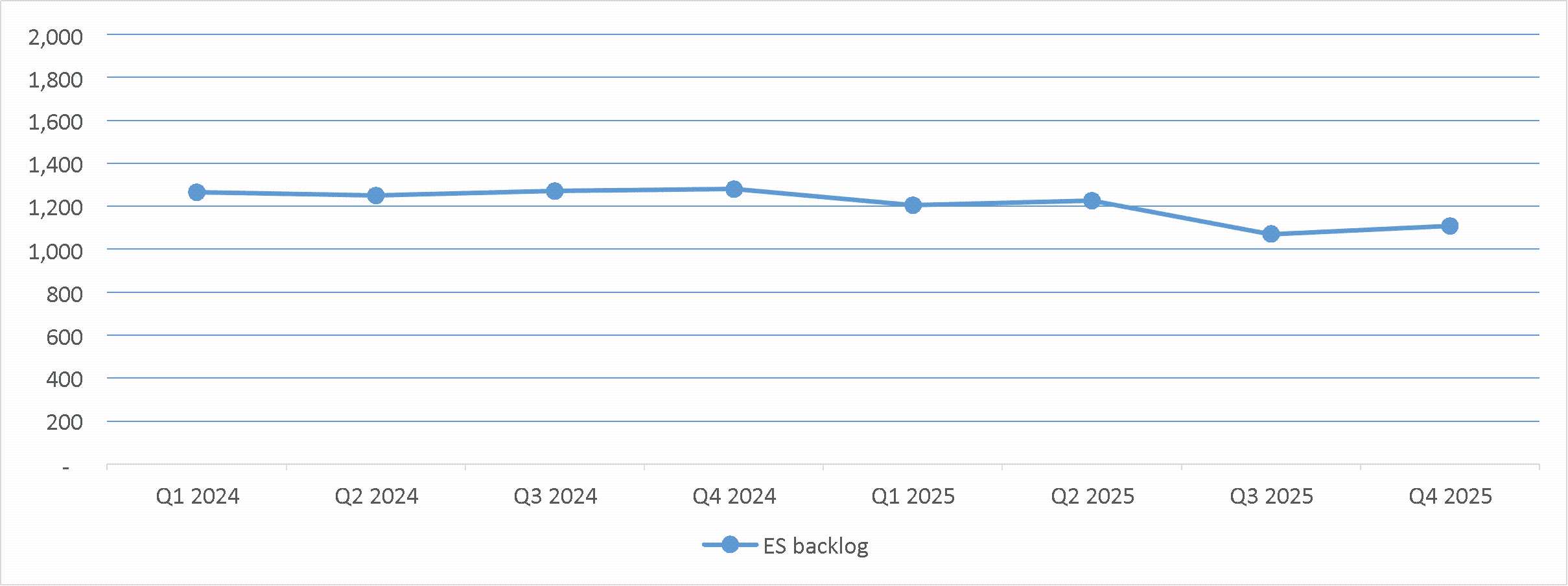
ES backlog of $1.1 billion at December 31, 2025, declined slightly from the 8-quarter average ES backlog of approximately $1.2 billion, reflecting revenue recognized on the Bisat-C Expansion and revenue recognition on ES projects in NAM. This sustained level of backlog over a two-year period reflects stable demand for Enerflex's ES solutions across global energy infrastructure markets. The 8-quarter average also serves as a key indicator of operational consistency and revenue visibility, smoothing out short-term fluctuations in ES bookings and project timings. This trend demonstrates that the ES product line continues to benefit from a diversified portfolio of gas compression and processing projects, reinforcing management's confidence in the ES product line's ability to generate predictable revenue and margin performance in the near-term.

ES backlog for the past 8 quarters are illustrated below in millions:

img109187306_3.gif

Enerflex recorded ES bookings of $377 million during the fourth quarter of 2025, compared to $301 million during the same period of 2024, primarily attributable to higher bookings in NAM and reversal of the remaining backlog associated with an international ES project which impacted ES bookings for the three months ended December 31, 2024. ES bookings have remained above the 8-quarter average of $336 million, reflecting continued strong bookings in NAM. Enerflex recorded ES bookings of $1.3 billion during the twelve months ended December 31, 2025, compared to $1.4 billion during the same period of 2024, primarily due to bookings for Bisat-C Expansion in the first half of 2024.

The ES product line has realized a book-to-bill ratio of 1.1x during the fourth quarter of 2025, indicating that new bookings are keeping pace with revenue recognition. The current balance between bookings and revenue supports near-term revenue visibility and reflects a stable demand environment. The 8-quarter average book-to-bill ratio has also remained at 1.0x, an indication that the Company is consistently replenishing its backlog in line with project execution.

ES backlog and bookings by reporting segment are disclosed in the “Segmented Results” section of this MD&A.


img109187306_2.gif

 M-10 Annual Report 2025


EI Contract Backlog

The Company’s EI contract backlog is recognized from lease agreements executed with clients for leasing and operations and maintenance of the Company’s EI assets. Lease agreements executed during the period increase EI contract backlog while revenue recognized on EI assets decreases the EI contract backlog in the period the revenue is recognized. EI contract backlog represents unsatisfied performance obligations related to the EI product line, and further information on recognition of revenue from the EI contract backlog is included in Note 22 of the Financial Statements.

Enerflex has lease agreements with clients for EI assets with initial terms ranging from one to 10 years.

The following table sets forth EI contract backlog by reporting segment:


($ millions)


December 31, 2025


December 31, 2024


NAM


$

160


$

136


LATAM


361


458


EH


800


951


Total EI contract backlog


$

1,321


$

1,545


Enerflex's EI contract backlog of $1.3 billion at December 31, 2025, decreased from $1.5 billion at December 31, 2024, driven by revenue recognized during the twelve months ended December 31, 2025, partially offset by EI contract bookings across all segments.


Segmented Results

Enerflex has three reporting segments: NAM, LATAM, and EH, each of which are supported by Enerflex’s corporate functions. Corporate overhead is allocated to the operating segments based on revenue. In assessing its reporting segments, the Company considers geographic locations, economic characteristics, the nature of products and services provided, the nature of production processes, the types of clients for its products and services, and distribution methods used.


img109187306_0.jpg

M- 11


img109187306_1.gif


NAM


Three months ended December 31,


Twelve months ended December 31,


($ millions, except percentages)


2025


2024


2025


2024


ES backlog


$

1,088


$

1,119


$

1,088


$

1,119


ES bookings


375


363


1,238


1,327


EI contract backlog


160


136


160


136


Segment revenue


$

436


$

384


$

1,719


$

1,626


Intersegment revenue


(11

)


(6

)


(33

)


(62

)

Revenue


$

425


$

378


$

1,686


$

1,564


EI


$

39


$

36


$

156


$

146


AMS


68


73


261


279


ES


318


269


1,269


1,139


Revenue


425


378


1,686


1,564


EI


18


17


74


70


AMS


12


12


43


48


ES


55


50


225


224


GM


85


79


342


342


GM %


20.0

%


20.9

%


20.3

%


21.9

%


EI


28


28


113


105


AMS


14


14


49


54


ES


57


52


232


230


GM before D&A


99


94


394


389


GM before D&A %


23.3

%


24.9

%


23.4

%


24.9

%


SG&A


42


46


149


177


Foreign exchange (gain) loss


-


(1

)


1


(1

)

Operating income


43


34


192


166


EBIT


42


34


188


166


EBITDA


58


53


252


240


Adjusted EBITDA


68


65


269


266


ES backlog remained steady at $1.1 billion at December 31, 2025, and is expected to result in sustained ES revenue generation over the near term. ES bookings of $375 million for the fourth quarter of 2025, increased by $12 million compared to the same period in 2024. ES bookings of $1.2 billion for the twelve months ended December 31, 2025, decreased by $89 million compared to the same period in 2024, primarily due to accelerated client activity in the latter part of the fourth quarter of 2024, which resulted in select orders being pulled forward.

EI contract backlog increased to $160 million from $136 million at December 31, 2025, primarily attributable to management's investment in assets deployed under longer term rental contracts, partially offset by revenue recognized during the period.

Revenue increased by $47 million and $122 million during the three and twelve months ended December 31, 2025, respectively, compared to the same periods in 2024. These increases were primarily driven by increased operational activity in the ES business, partially offset by lower than typical AMS activity resulting from lower parts sales and service utilization by customers throughout the current year.

Gross margin increased by $6 million during the three months ended December 31, 2025, compared to the same period in 2024, driven by stronger revenue from the ES business, partially offset by a shift in product mix and higher cost savings realized in the comparative period within the ES business. Gross margin for the twelve months ended December 31, 2025, remained consistent with the same period in 2024, mainly driven by reduced contribution from AMS, a shift in product mix, and higher cost savings realized in the comparative period within the ES business, partially offset by higher operational activity in the ES business and increased contribution from the EI product line.

SG&A expenses decreased by $4 million and $28 million for the three and twelve months ended December 31, 2025, respectively, compared to the same periods in 2024, primarily driven by cost-saving initiatives and sustained operational efficiencies.


img109187306_2.gif

 M-12 Annual Report 2025


At December 31, 2025, the USA contract compression fleet totaled approximately 483,000 horsepower increasing from 428,000 horsepower at December 31, 2024. The average utilization for the three and twelve months ended December 31, 2025 of 94% is consistent with the 95% and 94% utilization for the three and twelve months ended December 31, 2024, respectively.


img109187306_0.jpg

M- 13


img109187306_1.gif


LATAM


Three months ended December 31,


Twelve months ended December 31,


($ millions, except percentages)


2025


2024


2025


2024


ES backlog


$

3


$

16


$

3


$

16


ES bookings


1


4


7


17


EI contract backlog


361


458


361


458


Segment revenue


$

97


$

109


$

376


$

407


Intersegment revenue


-


-


-


-


Revenue


$

97


$

109


$

376


$

407


EI


$

68


$

69


$

279


$

257


AMS


26


21


77


70


ES


3


19


20


80


Revenue


97


109


376


407


EI


19


24


86


75


AMS


6


5


21


19


ES


-


4


2


15


GM


25


33


109


109


GM %


25.8

%


30.3

%


29.0

%


26.8

%


EI


29


35


126


124


AMS


6


5


21


19


ES


-


4


2


15


GM before D&A


35


44


149


158


GM before D&A %


36.1

%


40.4

%


39.6

%


38.8

%


SG&A


12


21


45


64


Foreign exchange loss


3


-


2


5


Operating income


10


12


62


40


EBIT


9


11


59


29


EBITDA


20


23


101


82


Adjusted EBITDA


22


25


105


92


EI contract backlog of $361 million at December 31, 2025 decreased from $458 million at December 31, 2024, primarily attributable to revenue recognition on existing contracts, partially offset by incremental contract bookings resulting from renewals of existing contracts during the twelve months ended December 31, 2025.

Revenue decreased by $12 million for the three months ended December 31, 2025, compared to the same period in 2024, primarily attributable to lower ES revenue on projects near completion and slightly lower EI revenue due to asset sales in prior quarters of 2025, partially offset by higher AMS service activities. Revenue was $376 million for the twelve months ended December 31, 2025, compared to $407 million in the same period of 2024 also primarily attributable to lower ES revenue as ongoing projects near completion, partially offset by higher EI revenue from EI asset sales, higher AMS parts sales and service activities in 2025, and rate adjustments on existing EI contracts which took effect in the third quarter of 2024.

Gross margin decreased by $8 million during the three months ended December 31, 2025, compared to the same period in 2024, primarily due to lower contribution from the EI business due to asset sales in prior quarters of 2025, and lower contribution from the ES product line. Gross margin for the full year of 2025 remained consistent with 2024, attributable to lower contribution from ES product line, partially offset by contribution from EI assets sales and higher contribution from AMS parts sales and service activities.

SG&A of $12 million and $45 million for the three and twelve months ended December 31, 2025, decreased by $9 million and $19 million compared to the same periods in 2024, respectively, primarily driven by cost-saving initiatives and sustained operational efficiencies.


img109187306_2.gif

 M-14 Annual Report 2025


EH


Three months ended December 31,


Twelve months ended December 31,


($ millions, except percentages)


2025


2024


2025


2024


ES backlog


$

19


$

145


$

19


$

145


ES bookings


1


(66

)


41


57


EI contract backlog


800


951


800


951


Segment revenue


$

106


$

75


$

513


$

447


Intersegment revenue


(1

)


(1

)


(4

)


(4

)

Revenue


$

105


$

74


$

509


$

443


EI


$

50


$

44


$

186


$

265


AMS


38


43


156


159


ES


17


(13

)


167


19


Revenue


105


74


509


443


EI


22


15


74


66


AMS


9


11


36


34


ES


2


2


21


(47

)

GM


33


28


131


53


GM %


31.4

%


37.8

%


25.7

%


12.0

%


EI


32


23


117


105


AMS


9


11


38


36


ES


2


2


21


(46

)

GM before D&A


43


36


176


95


GM before D&A %


41.0

%


48.6

%


34.6

%


21.4

%


SG&A


29


25


78


86


Foreign exchange (gain) loss


-


(1

)


1


-


Operating income (loss)


4


4


52


(33

)

EBIT


5


4


53


(33

)

EBITDA


18


18


108


25


Adjusted EBITDA


33


31


137


74


ES backlog of $19 million decreased by $126 million at December 31, 2025, driven by completion of construction, and start-up of the Bisat-C Expansion in the third quarter of 2025, partially offset by new bookings. ES bookings were $41 million for the twelve months ended December 31, 2025, compared to $57 million from the same period in 2024. Bookings in 2024 benefited from the Bisat-C Expansion secured in the first half of 2024, partially offset by the termination of an ES project in the fourth quarter. The decrease in 2025 reflects lower overall booking activity during the year.

EI contract backlog was $0.8 billion at December 31, 2025, a decrease from the $1.0 billion at December 31, 2024, attributable to revenue recognition from existing contracts, partially offset by new bookings.

Revenue for the three months ended December 31, 2025 increased by $31 million from the same period in 2024. The increase was primarily attributable to higher ES revenue on project progression in the fourth quarter of 2025, increased EI revenue from the Bisat-C Expansion which commenced operations during the third quarter of 2025, and termination of an international ES project during the fourth quarter of 2024. These improvements were partially offset by slightly lower AMS revenue resulting from lower service utilization and parts sales in the fourth quarter of 2025. Revenue for the twelve months ended December 31, 2025 increased by $66 million from the same period in 2024, primarily attributable to higher ES revenue on start-up of the Bisat-C Expansion in the third quarter of 2025, increased EI revenue from the Bisat-C Expansion, and progression of an existing ES project. The improvement for the year of 2025 was partially offset by lower AMS revenue resulting from lower service utilization and parts sales for the year.

Gross margin for the three months ended December 31, 2025 was $33 million, an increase of $5 million when compared to the same period of 2024, primarily driven by higher margin contribution from the EI business resulting from the Bisat-C Expansion, partially offset by lower margin contribution from AMS resulting from lower service utilization. Gross margin for the twelve months ended December 31, 2025 of $131 million, increased by $78 million compared to the same period in 2024, also primarily attributable to margin


img109187306_0.jpg

M- 15


img109187306_1.gif


contribution from the Bisat-C Expansion, and the absence of ES project related costs which impacted the 2024 results.

SG&A for the three months ended December 31, 2025 remained relatively consistent compared to the same period of 2024. SG&A decreased by $8 million for the twelve months ended December 31, 2025, when compared to the same period in 2024, primarily attributable to cost-saving initiatives and sustained operational efficiencies, and lower amortization of intangible assets. SG&A for the full year of 2025 includes a non-recurring input tax refund received in the first quarter of 2025.


img109187306_2.gif

 M-16 Annual Report 2025


Non-IFRS Measures

Enerflex measures its financial performance using several key financial performance indicators, some of which do not have standardized meanings as prescribed by IFRS and therefore may not be comparable to similar measures presented by other issuers. These non-IFRS measures include adjusted EBITDA, ES bookings, ES book-to-bill ratio, GM before D&A, recurring GM before D&A, free cash flow, dividend payout ratio, bank-adjusted net debt to EBITDA ratio, and ROCE. These measures should not be considered as alternatives to net earnings or any other measure of performance under IFRS. Reconciliation of these non-IFRS measures to the most directly comparable IFRS measure is provided below and in the relevant sections where appropriate. ES bookings and ES book-to-bill ratio do not have a directly comparable IFRS measure.

GM before D&A by Product Line and Recurring GM before D&A

Enerflex’s three reporting segments oversee execution of three main product lines:

EI: Infrastructure solutions under contract for natural gas processing, compression, treated water, and electric power.
AMS: Provision of after-market services such as mechanical maintenance, parts distribution, operations and maintenance solutions, equipment optimization and maintenance programs, manufacturer warranties, exchange components, and long-term service agreements.
ES: Engineer, design, and manufacture processing, compression, cryogenic, electric power, and treated water solutions.

EI and AMS product lines are considered recurring, as they are typically contracted and extend into future periods, generating ongoing revenue for the Company. In contrast, the ES product line is non-recurring, as it does not typically generate repeat revenue after delivery of products. While the EI and AMS contracts may vary in duration and are subject to cancellation, the Company believes they exhibit characteristics consistent with recurring business activities.

The Company uses GM before D&A to assess operational performance of each product line. GM before D&A is defined as gross margin excluding depreciation and amortization, which can vary based on the nature and origin of assets. The presentation of GM before D&A should not be considered in isolation from gross margin or as a replacement for measures prepared as determined under IFRS.

The Company also presents recurring GM before D&A to evaluate its recurring business, and it is defined as GM before D&A from the EI and AMS product lines.

Reconciliation of GM before D&A to the most comparable IFRS measure, and recurring GM before D&A is presented in the tables below.

Three months ended December 31, 2025


($ millions, except percentages)


EI


AMS


Recurring
Product Lines


ES


Total


Revenue


$

157


$

132


$

289


$

338


$

627


Cost of goods sold:


Operating expenses


68


103


171


279


450


Depreciation and amortization


30


2


32


2


34


Gross margin


$

59


$

27


$

86


$

57


$

143


Gross margin %


37.6

%


20.5

%


29.8

%


16.9

%


22.8

%

Gross margin before D&A


$

89


$

29


$

118


$

59


$

177


Gross margin before D&A %


56.7

%


22.0

%


40.8

%


17.5

%


28.2

%

% of total Gross margin before D&A


50.3

%


16.4

%


66.7

%


33.3

%


img109187306_0.jpg

M- 17


img109187306_1.gif


Three months ended December 31, 2024


($ millions, except percentages)


EI


AMS


Recurring
Product Lines


ES


Total


Revenue


$

149


$

137


$

286


$

275


$

561


Cost of goods sold:


Operating expenses


63


107


170


217


387


Depreciation and amortization


30


2


32


2


34


Gross margin


$

56


$

28


$

84


$

56


$

140


Gross margin %


36.9

%


20.4

%


29.4

%


20.4

%


25.0

%

Gross margin before D&A


$

86


$

30


$

116


$

58


$

174


Gross margin before D&A %


57.7

%


21.9

%


40.6

%


21.1

%


31.0

%

% of total Gross margin before D&A


49.4

%


17.2

%


66.7

%


33.3

%


Twelve months ended December 31, 2025


($ millions, except percentages)


EI


AMS


Recurring
Product Lines


ES


Total


Revenue


$

621


$

494


$

1,115


$

1,456


$

2,571


Cost of goods sold:


Operating expenses


265


386


651


1,201


1,852


Depreciation and amortization


122


8


130


7


137


Gross margin


$

234


$

100


$

334


$

248


$

582


Gross margin %


37.7

%


20.2

%


30.0

%


17.0

%


22.6

%

Gross margin before D&A


$

356


$

108


$

464


$

255


$

719


Gross margin before D&A %


57.3

%


21.9

%


41.6

%


17.5

%


28.0

%

% of total Gross margin before D&A


49.5

%


15.0

%


64.5

%


35.5

%


Twelve months ended December 31, 2024


($ millions, except percentages)


EI


AMS


Recurring
Product Lines


ES


Total


Revenue


$

668


$

508


$

1,176


$

1,238


$

2,414


Cost of goods sold:


Operating expenses


334


399


733


1,039


1,772


Depreciation and amortization


123


8


131


7


138


Gross margin


$

211


$

101


$

312


$

192


$

504


Gross margin %


31.6

%


19.9

%


26.5

%


15.5

%


20.9

%

Gross margin before D&A


$

334


$

109


$

443


$

199


$

642


Gross margin before D&A %


50.0

%


21.5

%


37.7

%


16.1

%


26.6

%

% of total Gross margin before D&A


52.0

%


17.0

%


69.0

%


31.0

%


Free Cash Flow and Dividend Payout Ratio

The Company defines free cash flow ("FCF") as cash provided by (used in) operating activities, less total capital expenditures (growth and maintenance) for EI assets - operating leases and PP&E, mandatory debt repayments, and lease principal repayment, while proceeds on disposals of EI assets - operating leases and PP&E are added back. Management uses this non-IFRS measure to assess the level of free cash generated to fund other non-operating activities. These activities could include dividend payments, share repurchases, and non-mandatory debt repayments. FCF is also used in calculating the dividend payout ratio.

The Company defines dividend payout ratio as dividends paid divided by free cash flow. Dividend payout ratio is used to assess the proportion of free cash flow being returned to shareholders.


img109187306_2.gif

 M-18 Annual Report 2025


Reconciliation of FCF to the most directly comparable IFRS measure, cash provided by operating activities:


Three months ended December 31,


Twelve months ended December 31,


($ millions, except percentages)


2025


2024


2025


2024


Funds from operations ("FFO")1


$

60


$

74


$

326


$

218


Net change in working capital and other


119


39


19


106


Cash provided by operating activities ("CFO")2


$

179


$

113


$

345


$

324


Less:


Capital expenditures - Maintenance and PP&E


(20

)


(21

)


(57

)


(53

)

Capital expenditures - Growth


(14

)


(11

)


(58

)


(22

)

Mandatory debt repayments


-


-


-


(10

)

Lease principal repayment


(7

)


(5

)


(23

)


(20

)

Add:


Proceeds on disposals of PP&E and EI assets - operating leases


3


-


23


3


Free cash flow


$

141


$

76


$

230


$

222


Dividends paid


4


2


17


9


Dividend payout ratio


2.8

%


2.6

%


7.4

%


4.1

%

1Enerflex also refers to cash provided by operating activities before changes in working capital and other as “Funds from Operations” or “FFO”.

2Enerflex also refers to cash provided by operating activities as “Cashflow from Operations” or “CFO”.

Bank-Adjusted Net Debt to EBITDA Ratio

Enerflex defines bank-adjusted net debt to EBITDA as borrowings under the Revolving Credit Facility (“RCF”) and Notes less cash and cash equivalents, divided by EBITDA for the trailing 12-months, as defined by the Company’s lenders. In assessing the Company's compliance with financial covenants related to its debt, certain adjustments are made to EBITDA to determine Enerflex's bank-adjusted net debt to EBITDA ratio. These adjustments, and Enerflex's bank-adjusted net debt to EBITDA ratio, are calculated in accordance with, and derived from, the Company's financing agreements.

ROCE

ROCE is a measure used to analyze operating performance and efficiency of the Company’s capital allocation process. The ratio is calculated by taking TTM EBIT divided by capital employed. Capital employed is average debt and shareholders’ equity less average cash for the trailing four quarters.


Twelve months ended December 31,


($ millions, except percentages)


2025


2024


Trailing 12-month EBIT


$

283


$

179


Average capital employed


Average net debt1


$

564


$

704


Average shareholders’ equity1


1,113


1,038


Average capital employed


$

1,677


$

1,742


ROCE


16.9

%


10.3

%


1Based on a trailing four-quarter average.


img109187306_0.jpg

M- 19


img109187306_1.gif


Liquidity

The Company expects that cash flows from operations in 2026, together with cash and cash equivalents on hand and currently available credit facilities, will be more than sufficient to fund its requirements for investments in working capital and capital assets.


($ millions)


December 31, 2025


Cash and cash equivalents


 $


81


RCF


800


Less: Drawings on the RCF


(193

)


Less: Letters of Credit1


(77

)


530


Available liquidity


 $


611


1Represents letters of credit that the Company has funded with the RCF. Additional letters of credit of $26 million are funded from the $70 million LC Facility. Refer to Note 17 “Long-Term Debt” of the Financial Statements for further details.

Covenant Compliance

As at December 31, 2025, the Company met the covenant requirements of its funded debt, comprised of the secured RCF and Notes, reflecting strong performance and cash flow generation, and Enerflex’s focus of repaying debt and lowering finance costs.

The following table sets forth a summary of the covenant requirements and the Company’s performance:


For the years ended December 31,


2025


2024


Requirement


Performance


Performance

Senior secured net funded debt to EBITDA ratio1 – Maximum


2.5x


0.2

x


0.2x

Bank-adjusted net debt to EBITDA ratio2 – Maximum


4.0x


1.0

x


1.5x

Interest coverage ratio3 – Minimum


2.5x


4.4

x


4.5x


1Senior secured net funded debt to EBITDA is defined as borrowings under the RCF less cash and cash equivalents divided by trailing 12-month EBITDA, as defined by the Company’s lenders.

2Refer to the "Bank-Adjusted Net Debt to EBITDA Ratio" section of this MD&A.

3Interest coverage ratio is calculated by dividing the trailing 12-month EBITDA by interest expense over the same timeframe, as defined by the Company’s lenders.

Credit Rating

Enerflex’s credit ratings affect the cost and ability to access the capital markets, and it is the Company’s objective to maintain high quality credit ratings. As at February 25, 2026, S&P Global Ratings ("S&P"), Moody’s Investors Service, Inc. ("Moody’s"), and Fitch Ratings, Inc. ("Fitch") assigned the following credit ratings to Enerflex and the Notes:


S&P

Moody’s

Fitch

Corporate Credit Rating

BB (stable outlook)

Ba2 (stable outlook)

BB (positive outlook)

6.875% Notes (the "2031 Notes")

BB (stable outlook)

Ba3 (stable outlook)

BB (positive outlook)


img109187306_2.gif

 M-20 Annual Report 2025


Summarized Statements of Cash Flow


Three months ended December 31,


Twelve months ended December 31,


($ millions)


2025


2024


2025


2024


Cash and cash equivalents, beginning of period


$

64


$

95


$

92


$

95


Cash provided by (used in):


Operating activities


179


113


345


324


Investing activities


(37

)


(20

)


(103

)


(59

)

Financing activities


(124

)


(94

)


(250

)


(263

)

Effect of exchange rate changes on cash and cash
  equivalents denominated in foreign currencies


(1

)


(2

)


(3

)


(5

)

Cash and cash equivalents, end of period


$

81


$

92


$

81


$

92


Operating Activities

Cash provided by operating activities for the three months ended December 31, 2025 was $179 million, compared to $ $113 million in the same period of 2024, primarily driven by higher working capital recovery from strong cash collections and execution of projects across the business, partially offset by lower funds generated from operations for the three months ended December 31, 2025. Cash provided by operating activities of $345 million during the twelve months ended December 31, 2025, increased by $21 million from the same period in 2024, primarily driven by higher operating income, partially offset by lower working capital recovery caused by higher taxes paid, strategic investments in inventory, timing of billings and collections, and ES projects execution for the year.

Investing Activities

Cash used in investing activities for the three and twelve months ended December 31, 2025 were $37 million and $103 million, respectively, compared to $20 million and $59 million in the same periods of 2024, largely attributable to increased capital expenditures, partially offset by sale of certain EI assets.

Financing Activities

Cash used in financing activities was $124 million for the three months ended December 31, 2025, compared to $94 million used in the same period in 2024. The increase primarily reflects repayment of debt using strong operating cashflows. In 2025, the Company completed the Early Redemption of the 2027 Notes, funded primarily through issuance of the 2031 Notes and drawings on the RCF, and increased shareholder returns through share repurchases under the NCIB and higher dividend payments. In comparison, financing activities in 2024 were driven by repayment of the term loan and a portion of the 2027 Notes.


img109187306_0.jpg

M- 21


img109187306_1.gif


Capital Expenditures and Expenditures for Finance Leases

Enerflex distinguishes CAPEX invested in EI assets - operating leases as either maintenance or growth. Maintenance expenditures are necessary costs to continue utilizing existing EI assets - operating leases, while growth expenditures are intended to expand the Company’s EI assets - operating leases. The Company may also incur costs related to the construction of EI assets determined to be finance leases. These costs are accounted for as work-in-progress related to finance leases and, once the project is completed and enters service, it is reclassified to cost of goods sold.

CAPEX and expenditures for finance leases are shown in the table below:


Three months ended December 31,


Twelve months ended December 31,


($ millions)


2025


2024


2025


2024


Maintenance and PP&E


$

20


$

21


$

57


$

53


Growth


14


11


58


22


Total CAPEX


34


32


115


75


Expenditures for finance leases


-


15


70


35


Total CAPEX and expenditures for finance leases


$

34


$

47


$

185


$

110


Selling, General & Administrative Expenses

SG&A expenses are comprised of costs incurred by the Company to support business operations that are not directly attributable to the production of goods or services.


Three months ended December 31,


Twelve months ended December 31,


($ millions)


2025


2024


2025


2024


Core SG&A1


$

61


$

65


$

220


$

249


Share-based compensation


15


16


26


29


Depreciation and amortization


6


11


24


47


Bad debt expense


1


-


2


2


Total SG&A


$

83


$

92


$

272


$

327


1 Core SG&A is primarily comprised of compensation, third-party services, and information technology expenses.

SG&A of $83 million for the three months ended December 31, 2025, decreased compared to $92 million in the same period of 2024, attributable to cost-saving initiatives and sustained operational efficiencies. SG&A was $272 million for the twelve months ended December 31, 2025, a decrease of $55 million from the same period in 2024. The decrease reflects cost-saving initiatives and sustained operational efficiencies, and lower amortization of intangible assets, partially offset by executive transition costs incurred in 2025.

Income Taxes

The Company reported income tax expense of $41 million for the three months ended December 31, 2025, compared to income tax expense of $6 million in the same period of 2024. The increase is primarily due to withholding taxes attributable to the Early Redemption and tax accrual for Pillar Two. The Company reported income tax expense of $99 million for the twelve months ended December 31, 2025, compared to income tax expense of $49 million in the same period of 2024. The increase is primarily driven by withholding taxes attributable to the Early Redemption and effect of exchange rates on tax basis of non-monetary assets.


img109187306_2.gif

 M-22 Annual Report 2025


Financial Position

The following table outlines significant changes in the consolidated statements of financial position as at December 31, 2025, compared to December 31, 2024:


($ millions)

Increase
(Decrease)

Explanation

Current assets

(49)

Decrease in current assets is primarily due to strong collection of accounts receivable, commencement of the Bisat-C Expansion which decreased work-in-progress inventory related to finance leases, and lower cash and cash equivalents, partially offset by strategic investment in inventories for ongoing project execution, increased EI assets - finance lease receivable for the Bisat - C Expansion, and increased income taxes receivable.

EI assets - operating leases

(27)

Decrease in EI assets - operating lease is primarily due to depreciation and sale of certain EI assets in the NAM and LATAM segments, partially offset by capital expenditures in the year.

Other assets

(17)

Decrease in other assets is primarily due to derecognition of the redemption options on early repayment of the 2027 Notes.

Current liabilities

(32)

Decrease in current liabilities is largely attributable to decreased AP and accrued liabilities resulting from timing of payments and vendor activities, and decreased deferred revenue, driven by revenue recognition on ES projects.

Other liabilities

9

Increase in other liabilities is primarily attributable to increased share-based compensation as a result of share price volatility.

Long-term debt

(126)

Decreased long-term debt reflects repayment of debt using strong cashflows generated from operations in the year.

Total shareholders' equity

44

Total shareholders' equity increased primarily due to net earnings for the twelve months ended December 2025, partially offset by repurchase of the Company's own shares through the NCIB in the second, third and fourth quarters of 2025 and dividend payments in 2025.


Selected Annual Information


Years ended December 31,


($ millions, except per share amounts)


2025


2024


Revenue


$

2,571


$

2,414


Net earnings


64


32


Earnings per share (“EPS”) - basic


0.52


0.26


EPS - diluted


0.52


0.26


Total assets


2,694


2,791


Total non-current financial liabilities


582


708


Cash dividends declared per share (“DPS”) (CAD $)


0.1550


0.1125


img109187306_0.jpg

M- 23


img109187306_1.gif


Quarterly Summary


($ millions, except per share amounts and ratios)

Q4 2025


Q3 2025


Q2 2025


Q1 2025


Q4 2024


Q3 2024


Q2 2024


Q1 2024


ES backlog

$

1,110


$

1,071


$

1,227


$

1,206


$

1,280


$

1,271


$

1,251


$

1,266


ES book-to-bill ratio


1.1


0.7


1.1


0.7


1.1


1.1


1.0


1.5


ES bookings


377


339


365


205


301


349


331


420


EI contract backlog


1,321


1,370


1,462


1,497


1,545


1,601


1,604


1,639


Revenue


627


777


615


552


561


601


614


638


GM


143


172


139


128


140


141


136


87


GM before D&A


177


206


175


161


174


176


173


119


SG&A


83


71


61


57


92


82


75


78


EBIT


43


82


92


66


47


74


55


3


EBITDA


83


122


134


105


92


122


103


47


Adjusted EBITDA


123


145


130


113


121


120


122


69


Net (loss) earnings


(57

)


37


60


24


15


30


5


(18

)

Earnings (loss) per share – basic


(0.47

)


0.30


0.49


0.19


0.12


0.24


0.04


(0.15

)

Earnings (loss) per share – diluted


(0.47

)


0.30


0.49


0.19


0.12


0.24


0.04


(0.15

)

FFO1


60


115


89


62


74


63


63


18


CFO2


179


74


(4

)


96


113


98


12


101


Free cash flow


141


43


(39

)


85


76


78


(4

)


72


DPS (CAD $)3


0.0425


0.0375


0.0375


0.0375


0.0375


0.0250


0.0250


0.0250


CAPEX – Maintenance & PP&E


20


18


11


8


21


14


9


9


CAPEX – Growth


14


15


23


6


11


2


1


8


1 FFO or “Funds from operations” is also referred to by Enerflex as “Cash provided by operating activities before changes in working capital and other”.

2 CFO or “Cashflow from operations” is also referred to by Enerflex as “Cash provided by (used in) operating activities”.

3 Cash dividend declared represents the declaration in the quarter.

Capital Resources

On January 31, 2026, Enerflex had 121,801,779 Common Shares outstanding. Enerflex has not established a formal dividend policy. Subsequent to December 31, 2025, Enerflex declared a quarterly dividend of CAD $0.0425 per common share, payable on March 25, 2026 to shareholders of record on March 11, 2026. The Board will continue to evaluate dividend payments on a quarterly basis based on availability of cash flow, anticipated market conditions, and the general needs of the business.

At December 31, 2025, the Company had drawings of $193 million against the RCF (December 31, 2024 – $191 million). The weighted average interest rate on the RCF at December 31, 2025, was 5.6% (December 31, 2024 – 7.4%).

The composition of the borrowings on the Notes and RCF were as follows:


Maturity Date


December 31, 2025


December 31, 2024


6.875% Senior Unsecured Notes ("2031 Notes")


January 15, 2031


$

400


$

-


9.0% Senior Secured Notes ("2027 Notes")


October 15, 2027


-


563


Drawings on the RCF


July 11, 2028


193


191


593


754


Deferred transaction costs and Notes discount


(11

)


(46

)

Long-term debt


$

582


$

708


Non-current portion of long-term debt


$

582


$

708


Long-term debt


$

582


$

708


At December 31, 2025, without considering renewal at similar terms, the USD equivalent principal payments due over the next five years are $193 million and $400 million thereafter.


img109187306_2.gif

 M-24 Annual Report 2025


Contractual Obligations, Committed Capital Investment, and Off-Balance Sheet Arrangements

The Company’s contractual obligations are contained in the following table:


($ millions)


Long-term debt


Leases


Purchase
obligations


Total


2026


$

-


$

26


$

542


$

568


2027


-


22


140


162


2028


193


13


-


206


2029


-


8


-


8


2030


-


5


-


5


Thereafter


400


7


-


407


Total contractual obligations


$

593


$

81


$

682


$

1,356


The Company’s lease commitments are contracts related to premises, equipment, and service vehicles.

Majority of the Company’s purchase commitments relate to major components for the EI and ES product lines and to long-term information technology and communications contracts entered into in order to reduce the overall cost of services received.

The Company anticipates using its cash and cash equivalents, and available capacity under its RCF to fund its contractual obligations.

The Company does not have any committed capital investments or off-balance sheet arrangements that have, or are reasonably likely to have, a current or future material effect on the Company’s financial condition, results of operations, liquidity, or capital expenditures.

Related Parties

Enerflex transacts with certain related parties during the normal course of business. Related parties include the Company’s 45 percent equity investment in Roska DBO and the Company’s 65 percent interest in a joint venture in Brazil.

All transactions occurring with related parties were in the normal course of business operations and were recorded at the exchange amount. During the twelve months ended December 31, 2025, the Company recorded revenue of less than $1 million (December 31, 2024 – $2 million) from transactions with Roska DBO. There were no purchases during the twelve months ended December 31, 2025 (December 31, 2024 – nil). The Company recorded accounts receivable of less than $1 million as at December 31, 2025 (December 31, 2024 - nil). All related party transactions are settled in cash. There were no transactions with the joint venture in Brazil.

Further details of the related party transactions are disclosed in Note 33 “Related Party Transactions” of the Financial Statements.

Legal Proceedings

In the normal course of business, the Company and certain of its subsidiaries are involved in or subject to lawsuits, claims, and other legal proceedings that seek, among other things, compensation for alleged personal injury, breach of contract, property damage or other losses, punitive damages, civil penalties, or injunctive or declaratory relief. Some lawsuits, claims, and legal proceedings involve acquired or disposed assets with respect to which a third party, the Company, or its subsidiary retains liability or indemnifies the


img109187306_0.jpg

M- 25


img109187306_1.gif


other party for conditions that existed prior to the transaction. In accordance with applicable accounting guidance, Enerflex and its subsidiaries accrue reserves for outstanding lawsuits, claims, and proceedings when it is probable that a liability has been incurred and the liability can be reasonably estimated. The Company does not currently expect that any of the outstanding lawsuits, claims, or legal proceedings will have a material adverse effect on Enerflex, including its consolidated financial position, results of operations or cash flows. Although Enerflex’s expectations and estimates are based on information known about the legal matters and its experience in contesting, litigating and settling similar matters, the results of any outstanding lawsuits, claims, and other legal proceedings are inherently uncertain, and there can be no assurance that monetary damages, fines, penalties, or injunctive relief resulting from adverse judgments or settlements in some or all of these outstanding lawsuits, claims, or legal proceedings will not have a material adverse effect on Enerflex, including its consolidated financial position, results of operations or cash flows. The Company will reassess the probability and estimability of contingent losses as new information becomes available in these proceedings or otherwise.

As previously disclosed, in response to a fatal attack at an adjacent site in Q2 2024, Enerflex declared Force Majeure on an international ES project, suspended activity at the project site, and demobilized its personnel. Enerflex subsequently received notice from its customer purporting to terminate the project contract and commencing arbitration proceedings against Enerflex alleging breach of the project contract. In Q4 2024, Enerflex delivered notice to the customer terminating the project contract. As part of the arbitration proceedings, Enerflex has brought a counterclaim against the customer to recover amounts owing to Enerflex following Enerflex’s termination of the project contract. Pursuant to the rules for arbitration agreed between Enerflex and its customer, the content of the proceedings is confidential and not otherwise publicly available.

In Q2 2025, the customer filed its Statement of Case in the arbitration asserting various claims against and seeking material monetary damages from Enerflex and in Q3 2025 the Company filed its Statement of Defence and Counterclaim against the customer. In Q4 2025, the customer filed its Statement of Reply and Defence to Counterclaim which the Company plans to respond to within the time parameters required under the arbitration. Enerflex disputes the customer’s claims and asserts that it acted in accordance with the project contract and that its declaration of Force Majeure and its subsequent termination of the project were proper. Given the early stage of the arbitration and the inherent uncertainty of arbitration, the final outcome of the arbitration is unknown. While the Company is pursuing recovery of amounts it believes are owed, it is possible that the Company may not prevail on its counterclaims or in defending against the customer’s claims. In those circumstances, there can be no assurance that the outcome will not have a material adverse effect on Enerflex, including on its consolidated financial position, results of operations or cash flows. Enerflex intends to continue vigorously defending itself against the customer’s claims while pursuing its own counterclaims.

As at December 31, 2025, the carrying value of the remaining assets associated with the project on the Company’s consolidated statement of financial position was $161 million. Notwithstanding its termination of the project contract, Enerflex maintains a $31 million Letter of Credit in support of its obligation under the project contract. Enerflex would view any drawing of the financial security in the prevailing circumstances as improper and would be considered as an additional amount owed by the customer.

Risk Factors

An investment in Enerflex Common Shares involves a number of risks. There are general risks associated with all businesses; industry specific risks inherent in Enerflex’s operations; and risks specific to Enerflex. This section describes the risks that Enerflex believes are most material to its business and operations. The risks identified herein is not a complete list of all the risks and potential risks applicable to Enerflex. Additional risks may arise from time to time as Enerflex’s business evolves. Risks currently perceived as immaterial may become material. While the Company has extensive policies and procedures in place to limit, manage and mitigate risks, including the Company’s ERM program, there is no assurance that Enerflex will be successful in preventing or minimizing the harm and potential harm that risks present.


img109187306_2.gif

 M-26 Annual Report 2025


General Business Risks

Failure to meet investor expectations

As with all businesses, there is a risk that Enerflex does not always meet investor expectations, including expectations regarding financial performance and the optimal deployment of capital. Investors may have expectations regarding the timeline for returns on an investment in Company, which may not align with the Company’s own strategic objectives, forecasts, and scenario planning, and which may not fully consider the volatility and cyclical nature of the oil and natural gas industry. BOOM projects in particular have a multi-year development cycle, with returns typically materializing over a longer term than investors might anticipate. Certain assumptions, estimates, and analysis impacting Enerflex’s growth projections may not materialize for reasons beyond the Company’s control. See “Forward-Looking Information”.

A failure to meet stakeholder expectations could adversely impact the reputation of the Company, and investor trust and confidence in the Company, its Board and Management, such that investors reduce their investment in Enerflex, or do not invest in Enerflex at all. This may have an adverse impact on the price and liquidity of Enerflex’s securities, and otherwise adversely impact the Company’s financial position. A failure to meet stakeholder expectations could also result in negative change to Enerflex’s credit ratings. These ratings affect Enerflex’s short and long-term financing costs, liquidity, and operations over the long term, and its ability to engage in certain business activities cost-effectively. If a rating agency downgrades Enerflex’s current corporate credit rating or the rating of the 2031 Notes, or negatively changes its credit outlook, it could have an adverse effect on Enerflex’s future financing costs and access to liquidity and capital.

The Company manages the risk of not meeting shareholder expectations through a combination of (a) clear, credible, and consistent communication of its financial performance and strategic objectives to stakeholders by way of regular market updates, a dedicated investor relations function, and engagement with shareholders by Management and members of the Board of Directors, and (b) a disciplined focus on executing the short-, medium- and long-term strategies communicated to investors. The Company also monitors corporate governance developments and engages with proxy advisory firms and governance organizations in an effort to continually improve its disclosures.

Compliance with domestic and international laws, financial reporting rules, and applicable regulations impact Enerflex’s operations

With operations in 17 countries globally, the Company is impacted by, and required to comply with, a multitude of international, federal, provincial, state, and local laws and regulations. Enerflex has developed policies, procedures, and training tools designed to achieve and maintain compliance with these laws and regulations, both in its own right and by contractors and sub-contractors. While management believes the Company and its subsidiaries comply with current prevailing laws and regulations, these laws and regulations are complex, subject to periodic revision, and many are becoming increasingly stringent. In addition, laws and regulations are often subject to changes in their interpretation by administrative authorities. There is thus a risk that the Company is not able to maintain compliance with all applicable laws or regulations in all jurisdictions and that the Company could be exposed to investigations, claims, and other regulatory proceedings for alleged or actual violations of laws and regulations related to its operations. This could result in the imposition of administrative, civil, and criminal enforcement measures, including assessment of monetary penalties, disgorgement, obligatory modifications to business practices and compliance programs, and issuance of injunctions as to future compliance. While Enerflex cannot accurately predict the impact of any such proceedings, they could have a material adverse effect on the Company’s reputation, business, financial condition, results of operations, and cash flow.

The cost of legal and regulatory compliance can also be significant. These costs impact the Company’s operating costs and, if they increase over time, could negatively impact the demand for the Company’s products and services.


img109187306_0.jpg

M- 27


img109187306_1.gif


Enerflex’s compliance obligations, and associated risks, include but are not limited to those detailed below.

(a) Corruption, anti-bribery, sanctions, and trade laws

The Company is required to comply with domestic and international laws and regulations regarding corruption, anti-bribery, sanctions, and trade compliance. Enerflex conducts business in many parts of the world that experience high levels of corruption, relies on third-party agents to act on the Company’s behalf in some jurisdictions where the Company does not have a presence, and is subject to various laws that govern the import and export of its equipment, including licensing requirements and transfer pricing rules.

The Canadian government, the US Department of Justice, the SEC, the US Office of Foreign Assets Control, and similar agencies and authorities in other jurisdictions have a broad range of civil and criminal penalties they may seek to impose against companies and individuals for violations of anti-corruption and anti-bribery legislation, trade laws, and sanctions laws.

(b) HSE laws and regulations

Compliance with environmental laws is a priority across Enerflex operations and in the manufacturing of the Company’s products. Certain environmental laws may impose joint and several and strict liability for environmental contamination, which may render the Company liable for remediation costs, natural resource damages, and other damages as a result of Company conduct or the conduct of, or conditions at Company facilities caused by, prior owners or operators or other third parties. In addition, where contamination may be present, it is possible that neighbouring landowners and other third parties may file claims for personal injury, property damage, and recovery of response costs. Remediation costs and other damages arising as a result of environmental laws and regulations could be substantial and could negatively impact financial condition, profitability, and results of operations.

Enerflex may need to apply for or amend facility permits or licenses from time to time with respect to storm water, waste handling, or air emissions relating to manufacturing activities or equipment operations, which may subject Enerflex to new or revised permitting conditions. These permits and authorizations may contain numerous compliance requirements, including monitoring and reporting obligations and operational restrictions, such as emission limits, which may be onerous or costly to comply with. Given the large number of jurisdictions and facilities in which Enerflex operates, and the numerous environmental permits and other authorizations that are applicable to its operations, the Company may occasionally identify or be notified of technical violations of certain compliance requirements and could be subject to penalties related thereto.

The Company is also subject to various federal, provincial, state, and local laws and regulations relating to safety and health conditions in its manufacturing facilities and other operations. Those laws and regulations may also subject the Company to material financial penalties or liabilities for any noncompliance, as well as potential business disruption if any of its facilities, or a portion of any facility, is required to be temporarily closed as a result of any violation of those laws and regulations. Any such financial liability or business disruption could have a material adverse effect on the Company’s projections, business, results of operations, and financial condition.

(c) Laws relating to internal control over financial reporting and disclosure controls and procedures

Enerflex is required by law to maintain effective internal control over financial reporting and disclosure controls and procedures, including under SOx. Under SOx requirements, Enerflex must furnish a report by management on, among other things, the effectiveness of its internal control over financial reporting. This assessment includes disclosure of any material weaknesses identified by management in the Company’s internal control over financial reporting. Enerflex cannot provide assurance that there will not be material weaknesses and deficiencies identified presently or in the future. Enerflex may not be able to remediate material weaknesses that have been identified, or any future material weaknesses that may be identified, or complete any evaluation, testing and remediation in a timely manner. Where material weaknesses and deficiencies do exist, there is a reasonable possibility that material misstatements in the Company’s financial statements will not


img109187306_2.gif

 M-28 Annual Report 2025


be prevented or detected on a timely basis. The Company’s independent auditors may issue adverse reports if it is not satisfied with the level at which Enerflex’s controls are designed, documented, or operating. Consequently, the Company cannot provide assurance that its independent auditors will be able to attest to the effectiveness of the Company’s internal control over financial reporting now or in the future.

If Enerflex is unable to remediate known material weaknesses, or if it identifies additional material weaknesses or deficiencies, it may be unable to produce accurate and timely financial statements in conformity with IFRS, which could lead to investors losing confidence in the Company’s financial disclosures, trigger an event of default under its credit agreements and harm its business, which could have a material adverse effect on the trading price of Enerflex Common Shares, could result in the Company being unable to comply with applicable securities laws and stock exchange listing requirements, or could restrict its future access to capital markets.

Trade tariffs may create or heighten geopolitical and economic instability

Economic, tax and trade policies may have significant implications for Canadian, the USA and global economies. Trade tariffs imposed by the USA on imports from Canada and other countries, together with retaliatory tariffs by those countries on imports from the USA, and other potential measures, including import and export duties, fees, economic sanctions or other trade measures, immigration policy, tax policy, and energy regulation, present risks to Enerflex’s business and operations and may create or heighten geopolitical and economic instability and increase market volatility. Such measures, the nature, extent, and timing of which remain uncertain, could lead to increased costs, facilitate changes in interest rates and inflation, impact commodity prices, or currency exchange rates, and lower economic growth and equity prices, any or all of which could adversely impact Enerflex’s results and/or operations.

The Company continues to closely monitor developments in this area and to work to mitigate the impact of any tariffs through its diversified operations and proactive risk management. Enerflex’s operations in the USA, Canada, and Mexico are largely distinct in the customers and projects they serve. The nature, timing, and impact of trade tariffs on the Company’s financial and operational results cannot currently be quantified or determined.

Changes in tax laws, interpretations, or rates may negatively impact Enerflex

The Company and its subsidiaries are subject to income and other taxes in multiple jurisdictions. One or more of the jurisdictions in which Enerflex does business could seek to impose incremental or new taxes on the Company or its subsidiaries. Effective tax rates in those jurisdictions could also be impacted by changes in tax laws or interpretations thereof, changes in the mix of earnings in countries with differing statutory tax rates, or changes in the valuation of deferred tax assets and liabilities. Any such change could have a material adverse impact on the Company’s financial and operational results.

While management believes the Company and its subsidiaries are in compliance with current prevailing tax laws and requirements, the Company or its subsidiaries could be subject to assessment, reassessment, audit, investigation, inquiry, or judicial or administrative proceedings by any of the taxing jurisdiction where it operates. The timing or impacts of any such assessment, reassessment, audit, investigation, inquiry, or judicial or administrative proceedings, or any future changes in tax laws, including the impacts of proposed regulations, cannot be predicted. Any adverse tax developments, including legislative changes, judicial holdings, or administrative interpretations, could have a material and adverse effect on the results of operations, financial condition, and cash flows of the Company.

Force majeure events may impact Enerflex’s business

The Company’s operations could be impacted by disruptions beyond its control, including, but not limited to: natural disasters; extreme weather events; the outbreak of epidemics, pandemics, or other health crises; cyberattacks; infrastructure disruptions; terrorist activities, anti-terrorist efforts, and other armed conflicts; domestic and global trade disruptions; diplomatic developments; national emergencies; acts of foreign


img109187306_0.jpg

M- 29


img109187306_1.gif


governments; acts of war; civil unrest; or other natural or man-made events or occurrences. Any such disruptions could result in, amongst other things, a slowdown, or temporary, prolonged or permanent suspension of Enerflex’s operations in impacted geographic locations; damaged infrastructure and key facility closures; reduced economic activity and corresponding reduced demand for the Company’s products and services; or an impaired supply chain, increasing the cost of goods and services used in Enerflex’s operations. Disruptions may also adversely impact the health and safety of Enerflex’s employees or otherwise restrict the availability or productivity of its workforce. Should any such disruption occur, the Company’s business, operations, assets, financial condition, and cash flows could be materially and adversely affected.

Emerging from any slowdown or suspension in operations presents further risks to Enerflex’s business, financial condition, and reputation. The Company may be delayed in reaching full operational capacity and in bringing crucial systems and processes online and may have reduced access to assets and project sites, disrupting its ability to service client partners or making it impossible to fulfill its contractual obligations.

Any unforeseen disruptions could also expose Enerflex to substantial liability for personal injury, loss of life, property damage, and pollution. Enerflex carries insurance to protect the Company against these unforeseen events, subject to appropriate deductibles and the availability of coverage, although such insurance protections may not be adequate to cover all losses or liabilities that the Company may incur. See “Risk Factors – Enerflex Specific Risks - Enerflex’s business requires significant levels of insurance” for the limitations on insurance coverage and associated risks to the business.

ESG matters, climate change, and associated regulatory and policy changes could impact Enerflex’s business

Practices and disclosures relating to ESG matters (including but not limited to governance practices, climate change and emissions, diversity and inclusion, data security and privacy, ethical sourcing, and water, waste, and ecological management) have, in recent years, attracted increasing scrutiny by stakeholders. Certain stakeholders are requesting that issuers develop and implement more robust ESG policies and practices. Developing and implementing such policies and practices can involve significant costs and require a significant time commitment from the Board of Directors, Executive Management Team, and employees of Enerflex. Failing to implement the policies and practices as requested or expected by Enerflex’s stakeholders, may result in investors reducing their investment in Enerflex, or not investing in Enerflex at all, thereby affecting the price and liquidity of Enerflex’s securities. The Company’s response to addressing ESG matters, and any negative perception thereof, can also impact Enerflex’s financial position through increased financing costs, and impact its reputation, business prospects, and ability to hire and retain qualified employees. It could also make the Company vulnerable to activist shareholders. Such risks could adversely affect Enerflex’s business, future operations, and profitability.

Climate change policy is quickly evolving at regional, national, and international levels, and political and economic events may significantly affect the scope and timing of climate change measures that are ultimately put in place. There is a global trend in recent periods towards greater regulation of GHG emissions. Although it is not possible to predict how new laws or regulations would impact the Company’s business, any future requirements imposing carbon pricing schemes, carbon taxes, or emissions-reduction obligations on the Company’s operations could require it to incur costs to reduce emissions or to purchase emission credits or offsets and may cause delays or restrictions in its ability to offer its products and services. Failure to comply with such laws and regulations could result in significant liabilities or penalties being imposed on Enerflex. There is also a risk that Enerflex could face claims initiated by third parties relating to climate change or related laws and regulations, or to the Company’s public disclosure of matters relating to climate change and the environment. The direct or indirect costs of such claims, and compliance with such laws or regulations, may have a material adverse effect on the business, financial condition, results of operations, and prospects of the Company. Enerflex’s client partners face similar risks, which could see reduced demand for the Company’s products and services.


img109187306_2.gif

 M-30 Annual Report 2025


The nature of Enerflex’s operations brings inherent litigation risk and liability claims

The Company’s operations entail inherent risks, including but not limited to equipment defects, malfunctions and failures, and natural disasters that could result in uncontrollable flows of natural gas, untreated water or well fluids, fires, and explosions. Some of the Company’s products are used in hazardous applications where an accident or a failure of a product could cause personal injury or loss of life, or damage to property, equipment, or the environment, as well as the suspension of the end-user’s operations. The Company seeks to mitigate its exposure to these risks through various means including contracting strategies, however, if the Company’s products were to be involved in any of these incidents, the Company could face litigation and may be held liable for those losses.

The Company is and in the future may become involved in, named as a party to, or be the subject of various legal proceedings and arbitrations, including regulatory proceedings, tax proceedings, and legal actions related to contract disputes, property damage, environmental matters, employment matters, and personal injury. See “Legal Proceedings” for more information, including in respect of the ongoing arbitration on an international ES project.

Defense and settlement costs associated with lawsuits and claims can be substantial, even with respect to lawsuits and claims that have no merit. Due to the inherent uncertainty of the litigation process, the resolution of any legal proceeding or arbitration could have a material adverse effect on Enerflex’s operating results or financial performance.

The Company may not be able to adequately protect itself contractually or by relying on insurance coverage in connection with any third party claim. See “Risk Factors – Enerflex Specific Risks - Enerflex’s business requires significant levels of insurance” for the limitations on insurance coverage and associated risks to the business.

Industry Specific Risks

Investor sentiment particularly related to the oil and natural gas industry

A number of factors, including the inherent volatility of the oil and natural gas industry, the impact of oil and natural gas operations on the environment, the effects of the use of hydrocarbons on climate change, ecological damage relating to spills of petroleum products during production and transportation, and human rights, have affected certain investors’ sentiments towards investing in the oil and natural gas industry. As a result of these concerns, some institutional, retail, and governmental investors have announced that they are no longer willing to fund or invest in companies in the oil and natural gas industry or are reducing the amount of their investment over time. Any reduction in the investor base interested or willing to invest in the oil and natural gas industry may limit Enerflex’s access to capital, increase its financing costs, and decrease the price and liquidity of Enerflex’s securities.

A well-functioning supply chain and effective inventory management are essential to Enerflex’s business

Enerflex purchases a broad range of materials and components in connection with its manufacturing and service activities. Certain components used in Enerflex’s products are obtained from a single source or a limited group of suppliers and original equipment manufacturers. While Enerflex makes it a priority to maintain and enhance these strategic relationships in its supply chain, there can be no assurance that these relationships will continue. Reliance on suppliers involves several risks, including price increases, delivery delays, inferior component quality, and unilateral termination. Certain original equipment manufacturers are also limited in the ability to package and sell material and products. Long-lead times for high demand components, such as engines, can result in project delays. While Enerflex has long standing relationships with recognized and reputable suppliers and original equipment manufacturers, it does not have long-term contracts with all of them, and the partial or complete loss of certain of these sources could result in increased costs and project delays, could have a negative impact on Enerflex’s results of operations, could damage


img109187306_0.jpg

M- 31


img109187306_1.gif


client partner relationships, and could affect Enerflex’s competitive position. Further, a significant increase in the price of one or more of these components could have a negative impact on Enerflex’s operational or financial results.

Risks associated with supply chain disruptions are mitigated by dedicated supply chain management teams and continual review of supply chain documentation and processes. Though Enerflex is generally not dependent on any single source of supply, the ability of suppliers to meet performance, quality specifications, and delivery schedules is important to the maintenance of client partner satisfaction and Enerflex’s reputation in the market. If the availability of equipment is constrained or delayed, or if Enerflex’s supply chain is otherwise disrupted such that it cannot deliver products or services in a timely and cost-effective manner, certain of the Company’s operational or financial results may be adversely impacted.

The Company’s operational and financial results could also be adversely impacted by supply chain challenges specific to Enerflex’s operations across multiple jurisdictions. Segmented operations can give rise to inter-regional inefficiencies and restrict Enerflex’s ability to utilize global bulk buying power with several large suppliers, impacting the profitability of its projects. While the fabrication of ES products at our Houston, Broken Arrow and Calgary manufacturing facilities avoids the significant markup associated with local procurement, it can impact margins through additional transportation costs and import taxes, tariffs, and fees. In certain countries in which the Company operates, Enerflex is required to use certain vendors, which impacts the ability to utilize global or internal supply chains and increases costs.

Enerflex faces additional risks related to its internal supply chain and effective management of its inventory. The Company is continually improving its strategic inventory management, using market intelligence, automatic inventory checking, and supply chain coordination, and while the Company does leverage its global footprint to manage its inventory levels on a larger scale, there are risks that inventory is not properly optimized across all operations. A failure to properly manage and optimize inventory could restrict access to working capital, restrict the Company’s ability to move quickly in securing new business, and generally negatively impact operational efficiency and financial performance.

See “Sustainability – Social – Supply Chain Management” in the Company's AIF for details of Enerflex’s supply chain management processes.

The industry in which Enerflex operates is highly competitive

The Company has several competitors in all aspects of its business. There are low barriers to entry for natural gas processing and compression services, the processing and compression fabrication business, and several companies target the same client partners as Enerflex in markets where margins can be low and contract negotiations can be challenging. With respect to new market entrants, the Company faces increasing competition in Latin America and the Eastern Hemisphere.

When it occurs, consolidation within Enerflex’s customer base further increases competitive pressures, as the balance of supply-and-demand is disrupted, and the Company is forced to compete for business from a smaller pool of customers. In AMS, customers may develop their own internal after-market service capabilities, further reducing the pool of potential customers. There is an ongoing risk that Enerflex’s competitors expand their service offering or fabricate new equipment, or develop relationships with Enerflex’s key original equipment manufacturers, which would create additional competition for the products, equipment, or services that Enerflex offers to client partners.

Some of the Company’s competitors, particularly in the ES and EI product lines, are large, multi-national companies that may be able to adapt more quickly to technological changes within the industry or changes in economic and market conditions, more readily take advantage of acquisitions and other opportunities, leverage more cost-efficient internal supply chains, and adopt more aggressive pricing policies.

In terms of financial and operational performance, the Company faces considerable market pressure from competitors that may have lower costs of capital, diverse capital structures, and alternative reporting metrics. There is a risk that Enerflex is unable to take advantage of opportunities or be competitive on pricing to the


img109187306_2.gif

 M-32 Annual Report 2025


extent necessary to compete with these companies, both for the reasons set out above and because of capital constraints, debt levels, and the costs associated with the stringent compliance requirements that apply to Enerflex as a public company.

The Company’s ability to secure new business, maintain its market share, and achieve its strategic objectives could be affected by any one or more of these competitive pressures. This could have a material and adverse impact on the Company’s business, financial condition, and results of operations, as well as on the price and liquidity of Enerflex’s securities. A detailed discussion of the competitive conditions in Enerflex’s principal markets, and an assessment of Enerflex’s competitive position, is included the “Competitive Conditions” section of the AIF.

The ability to hire and retain quality personnel and contractors are critical to Enerflex’s business

The Company’s ability to attract qualified personnel by providing both market-related compensation and the necessary organizational structure, benefits, programs, and culture to engage employees, is crucial to its growth and to achieving its business results. The Company’s ability to provide development opportunities and training to cultivate talent and enhance its internal skillset is equally important.

Enerflex’s product lines require a combination of skilled engineers, design professionals, tradespeople, mechanics, and technicians. Enerflex competes to hire and retain these professionals, not only with companies in the same industry, but with companies in other industries. These competitive pressures are compounded in periods of high activity, when demand for skills and expertise increases and when the Company may need to move quickly to augment its workforce, as well as by a reduction in the number of people pursuing skilled trades. Moreover, much like certain investors’ sentiments towards investing in the oil and natural gas industry have been affected by ESG matters, the perceived impact of oil and natural gas operations on the environment and issues of climate change have made a career in the oil and natural gas industry less appealing to new graduates and tradespeople entering the job market. This increases demand and competition for the high-quality, skilled personnel necessary to deliver on Enerflex’s value proposition to client partners across all business lines.

There are few barriers to entry in several of Enerflex’s businesses, so retention of qualified personnel is essential to differentiate Enerflex's product and service offerings and to compete in its various markets. Enerflex’s employee retention strategies include but are not limited to comprehensive succession planning for Management and personnel in key positions and investment in ongoing talent development within each region and at the corporate head office. Total Rewards compensation and benefits programs, individual career growth plans and other opportunities for career development, and a keen focus on employee diversity, inclusion and wellbeing, further support the Company’s efforts to ensure the sustainability and continuity of critical knowledge, relationships, and skills. See “Sustainability – Social – Talent Management” in the Company's AIF for more details of the various programs and policies supporting Enerflex’s recruitment, retention and employee development efforts.

There can, however, be no assurance that key personnel are retained. The associated loss of knowledge, relationships, skills, and functions (particularly engineering and trades functions), as well as loss of access to the knowledge and relationships fundamental to the maintenance and management of key contracts, poses a significant risk to Enerflex’s business and could adversely impact the quality or delay the completion of certain projects, increase competitive pressures, and adversely impact the Company’s reputation.

There are certain jurisdictions where Enerflex relies on third-party contractors to carry out the operation and maintenance of its equipment and the aforementioned risks apply equally in this context. The ability of third-party contractors to find and retain individuals with the proper technical background and training is critical to the continued success of the contracted operations in these jurisdictions. If Enerflex’s third-party contractors are unable to find and retain qualified operators, or the cost of these qualified operators increases substantially, the contract operations business could be materially impacted.


img109187306_0.jpg

M- 33


img109187306_1.gif


Financial reductions or restrictions of client partners may impact Enerflex’s contracted revenue

Many of Enerflex’s client partners finance their activities through cash flow from operations, incurrence of debt, or issuance of equity. In addition, a substantial portion of Enerflex’s accounts receivable balances are with client partners involved in the oil and natural gas industry, and these client partners may experience decreased cash flow from operations, or a reduction in their ability to access capital, during times when the oil or natural gas markets weaken. Enerflex may also extend credit to certain client partners for products and services that it provides during its normal course of business.

If a client partner experiences decreased cash flow from operations and limitations on their ability to incur debt or raise equity, a reduction in borrowing bases under reserve-based credit facilities, a lack of availability of debt or equity financing, or other factors that negatively impacts its financial condition, Enerflex may not be able to collect or enforce collections on all or a portion of the accounts receivable balance or credit balance from that client partner. Alternatively, the affected client partner may seek to preserve capital by pursuing price concessions, thereby putting margins under pressure, or by cancelling or determining not to renew recurring revenue contracts. Where contracts are renewed or renegotiated, these may be on less favourable commercial terms, or may transfer additional risk of liquidated damages, consequential loss, liability caps, and indemnities to the Company.

Any one of these occurrences may lead to a reduction in revenue and net income, which reduction could have a material adverse effect on Enerflex’s business, financial condition, results from operations, and cash flows. Enerflex monitors its financial exposure to its client partners, but there can be no certainty that financial losses will not materialize or have a material adverse impact on the organization.

Economic and industry volatility could impact Enerflex’s financial position

The industry in which Enerflex operates is highly reliant on the levels of capital expenditures made by oil and gas producers and explorers. The capital expenditures of these companies, along with those of midstream companies who service these oil and gas explorers and producers, impact the demand for Enerflex’s equipment and services. Capital expenditure decisions are based on various factors, including but not limited to demand for hydrocarbons and prices of related products; exploration and development prospects in various jurisdictions; reserve production levels; oil and natural gas prices; regulatory compliance; and access to capital, none of which can be accurately predicted. More generally, the supply and demand for oil and natural gas is influenced by a number of factors, including political, economic, or military circumstances throughout the energy producing regions of the world. This has been highlighted by recent developments in Venezuela, the Russian invasion of Ukraine, and ongoing tensions in the Middle East, which have had a substantial impact on supply and resulted in significant and rapid commodity price increases. Actual or threatened imposition of import tariffs and retaliatory measures have created volatility in markets which can influence the demand for, or price, of the Company’s solutions.

If economic conditions or international markets decline unexpectedly, or if there is an actual or perceived downturn in commodity prices over the long term, oil and gas producing client partners may decide to cancel or postpone major capital expenditures. This may lead to financial losses in the short term, and reduced demand for products and services offered by Enerflex and a restriction in the Company’s ability to generate recurring revenue over the medium- to long term. The overall impact to the Enerflex business is difficult to predict and depends on many factors that are continually evolving and not within Enerflex’s control, but any such adverse conditions could have a material adverse effect on the Company’s business, financial condition, and results of operations.

Adverse economic conditions present additional risks to Enerflex’s business. A strong US dollar can make ES fabricated in the USA less competitive in markets outside of the USA, adversely impacting the Company’s reputation and competitive position in international markets and adversely affecting cash flows and access to capital for larger BOOM projects. The longer development cycle of BOOM projects also makes them


img109187306_2.gif

 M-34 Annual Report 2025


particularly susceptible to the negative impacts of higher inflation, which presents financial risk over the lifetime of longer-term projects.

Conversely, strong economic conditions and competition for available personnel, materials, and major components may result in significant increases in the cost of obtaining such resources. To the greatest extent possible, Enerflex passes such cost increases on to its client partners and attempts to reduce these pressures through proactive supply chain and human resource practices. Should these efforts not be successful, the gross margin and profitability of Enerflex could be adversely affected.

The Company and its subsidiaries’ liabilities include long-term debt that may be subject to fluctuations in interest rates. The 2031 Notes outstanding at December 31, 2025 are at fixed interest rates and therefore will not be impacted by fluctuations in market interest rates. The Company’s Revolving Credit Facility, however, is subject to changes in market interest rates. As at December 31, 2025, the Company had $193 million of indebtedness that is effectively subject to floating interest rates. Changes in economic conditions outside of Enerflex’s control could result in higher interest rates, thereby increasing Enerflex’s interest expense and, in turn, having material adverse impact on Enerflex’s financial results and financial condition. For each one per cent change in the rate of interest on the Revolving Credit Facility, the change in interest expense for the twelve months ended December 31, 2025, would be approximately $2 million. All interest charges are recorded in finance costs on the consolidated statements of earnings (loss). Any increase in market interest rates could have a material adverse impact on the Company’s financial results, financial condition, or ability to declare and pay dividends. See “Dividends – Restrictions on Paying Dividends” in the Company's AIF.

Enerflex is susceptible to health, safety, and environment risks throughout its operations

Enerflex’s business is susceptible to health, safety, and environment risks inherent in manufacturing, construction, and operations in the oil and natural gas services industry. These risks include but are not limited to: equipment defects, malfunctions, and failures; vehicle collisions and other transportation incidents; and natural disasters or other catastrophic events that could result in uncontrollable flows of natural gas, untreated water or well fluids, fires, and explosions. Some of the Company’s products are used in hazardous applications where an accident or a failure of a product could cause personal injury or loss of life, or damage to property, equipment, or the environment, as well as the suspension of the end-user’s operations.

Failure to mitigate, prevent, or appropriately respond to a safety or health incident could result in injuries or fatalities among employees, contractors, visitors, or residents in communities near Company operations. Preventing or responding to accidents could also require Enerflex to expend significant time and effort, as well as financial resources to remediate safety issues, compensate injured parties, and repair damaged facilities.

If the Company or its products were to be involved in any of the aforementioned incidents, the Company could face litigation and may be held liable for losses arising from personal injuries or death, property damage, operational interruptions, and shutdown or abandonment of affected facilities. Defense and settlement costs associated with lawsuits and claims can be substantial. The Company could also face government-imposed orders to remedy unsafe conditions or circumstances, and penalties associated with the contravention of applicable health and safety legislation.

Safety is also key factor that client partners consider when selecting a service provider. A decline in the Company’s safety performance could result in lower demand for products or services, which could have an adverse effect on Enerflex’s business, financial condition, and results of operations.

Enerflex reduces its exposure to HSE risks through various means, including comprehensive security and safety assessments of all new projects and on an ongoing basis; contracting strategies; and by maintaining prudent levels of insurance, although such protections may not be adequate to cover all losses or liabilities


img109187306_0.jpg

M- 35


img109187306_1.gif


that the Company may incur. See “Risk Factors – Enerflex Specific Risks - Enerflex’s business requires significant levels of insurance” for the limitations on insurance coverage and associated risks to the business.

Customer needs and expectations are evolving

Enerflex’s ability to remain competitive and to achieve its strategic objectives depends in part on its ability to develop, adopt, integrate, and deploy new and emerging technologies, and to leverage technological innovations, across its operations, product, and service offerings. It also depends on its ability to understand and anticipate the evolving needs and expectations of its customer base more generally, across all the jurisdictions in which it operates, and to adapt its offerings and pricing to meet those expectations.

Development and adoption of new technologies, and development of new product and service offerings, requires significant investments of capital and resources, and the expenditure of time and costs in upskilling and reskilling employees. These costs may or may not be recoverable in the marketplace and may result in certain products and services being less profitable or economical than anticipated. If the Company is unable to quickly adapt to customers’ evolving needs and expectations, either by failing to deploy technologically innovative offerings, or by failing to meet customer expectations as to product and service quality, project structure, pricing and contractual terms (including the allocation of risk), or otherwise, this could reduce demand for the Company’s products and place Enerflex at a considerable competitive and reputational disadvantage. The Company’s ability to sustain and create new revenue streams in existing markets and to enter and compete in new markets may be affected, which could have a material adverse impact on the operational and financial performance of the Company in the long term. It could also impact the Company’s financial position through loss of long-term client partner relationships.

Successful execution of energy transition projects is reliant on regulatory and policy incentives such as the Section 45Q tax credit for CCUS, the Section 45V tax credit for clean hydrogen production, California low-carbon fuel standards, and many others. The elimination or loss of, or reduction in, such incentives could (i) decrease the attractiveness of such energy transition projects, equipment or facilities to potential client partners, reducing the Company’s opportunities to commercialize the relevant projects, equipment or facilities, (ii) reduce the Company’s willingness to pursue or develop certain projects, equipment or facilities due to higher operating costs or decreased revenue related to such projects, equipment or facilities, and/or (iii) cause the market for future energy transition projects, equipment or facilities to be smaller. Any of the foregoing could have a material adverse effect on the Company’s ability to pursue opportunities in the energy transition economy. Additionally, there are many geographies where relevant governments have not adopted or promulgated regulatory and policy incentives related to energy transition projects and applications. Enerflex may not be able to participate in providing energy transition solutions to client partners in those geographies unless and until such regulatory and policy incentives are adopted.

Enerflex’s business requires significant levels of insurance

Enerflex’s operations are subject to many risks, including without limitation risks inherent in the oil and natural gas services industry, such as equipment defects, and failures; risks of natural disasters with resultant uncontrollable flows of oil and natural gas, fires, spills, and explosions; and the additional risks identified in the “Risk Factors” section of this MD&A. These risks could expose Enerflex to substantial liability for personal injury, loss of life, business interruption, property damage, pollution, and other liabilities. Enerflex carries prudent levels of insurance to protect the Company against these risks, subject to appropriate deductibles and the availability of coverage. However, there can be no assurance that any such insurance policies will cover all losses or liabilities that may arise from the operation of Enerflex’s business, or that claims made under the Company’s policies are not in excess of policy limits or subject to substantial deductibles. Any losses or liabilities not so covered could have a material adverse effect on the Company’s projections, business, results of operations, and financial condition. The occurrence of a significant event outside of the scope of coverage of the Enerflex insurance policies could have a material adverse effect on the Company’s financial results.


img109187306_2.gif

 M-36 Annual Report 2025


An annual review of insurance coverage is completed to assess the risk of loss and risk mitigation alternatives. Natural occurrences, and geopolitical activities in recent years have strained insurance markets leading to increases in insurance costs and limitations on coverage. While Enerflex intends to maintain appropriate insurance coverage in the future, there can be no assurance that such coverage will be available on commercially reasonable terms, at levels of risk coverage or policy limits that management deems adequate, or on terms as favourable as Enerflexs current arrangements. Any claims made under the Company's policies may cause its premiums to increase.

Enerflex Specific Risks

Exposure to the risks associated with international operations

Enerflex is exposed to risks inherent in conducting international operations, including, but not limited to: social, political, and economic instability or other adverse social, political, and economic conditions; armed conflict; recessions and other economic crises that may impact the Company’s cost of conducting business; adoption of new, or the expansion of existing, sanctions, trade restrictions, or embargoes; changes to laws and regulations; imposition of tariffs or changes to or segmentation of existing tariffs; imposition of price controls; difficulties in staffing and managing foreign operations including logistical, safety, security, and communication challenges; difficulties, delays, and expenses experienced or incurred in connection with the movement and clearance of personnel and goods through the customs and immigration authorities of multiple jurisdictions; difficulty in accessing remote project sites; difficulty in obtaining external approvals and other permits required to conduct operations; limitations on the Company’s ability to repatriate cash, funds, or capital invested or held in jurisdictions outside Canada; difficulty or expense of enforcing contractual rights and the rule of law, due to the lack of a developed legal system or otherwise; confiscation, expropriation, or nationalization of property without fair compensation; and difficulties in engaging third-party agents to appropriately interface with clients or otherwise act on the Company’s behalf in certain jurisdictions.

To the extent Enerflex’s international operations are or have been affected by any of the above, the Company’s business, financial condition, and results of operations may be materially and adversely affected. To mitigate against these risks, the Company engages both internal and external legal counsel and expert advisors in each jurisdiction in which it operates. The Company endeavors to have appropriate contractual protections and prudent levels of insurance in place to mitigate these risks, although such protections may not be adequate to cover all losses or liabilities that the Company may incur. See “Risk Factors – Enerflex Specific Risks - Enerflex’s business requires significant levels of insurance” for the limitations on insurance coverage and associated risks to the business and “Risk Factors – General Business Risks – Force majeure events may impact Enerflex’s business”. See “Legal Proceedings” for a description of the ongoing arbitration on an international ES project.

Challenges in optimally deploying and accessing capital may impact Enerflex’s business

Enerflex relies on its cash, as well as the credit and capital markets, to provide some of the capital required to continue operations. While access to capital does not present an immediate, material risk, Enerflex’s higher costs of capital and competing demands for capital within the business could adversely impact the Company’s financial and competitive position. The Company seeks to mitigate these risks by continuing with disciplined capital spending in 2026 and by continuously improving its capital allocation processes and assessments.

The Company’s current financing agreements contain a number of covenants and restrictions that Enerflex, and its subsidiaries, must comply with including, but not limited to, use of proceeds, limitations on the ability to incur additional indebtedness, transactions with affiliates, mergers and acquisitions, and the Company’s ability to sell assets. The Company’s ability to comply with these covenants and restrictions may be affected by events beyond its control, including prevailing economic, financial, and industry conditions. If market or other economic conditions deteriorate, the Company’s ability to comply with these covenants may be impaired. Failure to meet any of these covenants, financial ratios, or financial tests could result in events of


img109187306_0.jpg

M- 37


img109187306_1.gif


default, requiring the Company to repay its indebtedness and could impair the Company’s ability to access the capital markets for financing. While Enerflex is currently in compliance with all covenants, financial ratios, and financial tests, there can be no assurance that it will be able to comply with these covenants, financial ratios, and financial tests in future periods. These events could restrict the Company’s and other guarantors’ ability to fund its operations, meet its obligations associated with financial liabilities, or declare and pay dividends.

The Company may also be restricted in its ability to access capital on reasonable commercial terms, if at all, due to instability or disruptions to the capital markets, including the credit markets, or otherwise. Particularly for BOOM projects, the ability to access in-country project financing can present challenges. These projects are typically funded in-part by cash flows from the sale of ES, and any reduction in these cash flows, may further jeopardize Enerflex’s ability to fund these longer-term projects. Lack of access to capital may result in adverse consequences including: making it more difficult to satisfy contractual obligations; increasing vulnerability to general adverse economic conditions and industry conditions; limiting the ability to fund future working capital, capital expenditures, or acquisitions, and the ability to generate revenue; limiting the ability to refinance debt in the future or borrow additional funds to fund ongoing operations; and limiting the ability to pay future dividends to shareholders. See “Dividends – Restrictions on Paying Dividends” in the Company's AIF.

The business and operations of Enerflex involve inherent project execution risk

Enerflex’s project expertise encompasses field production facilities, gas compression and processing plants, gas lift compression, refrigeration systems, treated water, and electric power equipment, primarily serving the natural gas production industry. The Company participates in some projects that have a relatively larger size and scope when compared to the majority of its projects, which may translate into more technically challenging conditions or performance specifications for its products and services. These projects typically specify delivery dates, performance criteria, penalties for the failure to perform, and may provide for liquidated damages. Other projects are concluded on a fixed-fee basis, which shifts risk from the client partner to Enerflex and which could result in unanticipated cost overruns.

The Company’s ability to profitably execute on projects for client partners and meet contracted delivery dates is dependent on numerous factors which include, but are not limited to: changes in project scope; client partner delays; the availability and timeliness of external approvals and other required permits; skilled labor availability, productivity, and optimization; the availability of quality contractors to support execution of the Company’s scope on the projects; the availability and cost of materials, parts, and services; the accuracy of design, engineering, and construction; the ability to safely access and perform work at the job site; and weather conditions. Inefficient project execution protocols and use of resources, aging information technology infrastructure, and over-reliance on manual processes could all also impact the Company’s ability to meet contracted delivery dates. There is no assurance that contracted delivery dates will be met even after careful planning and mitigation by the Company.

Any failure to execute on projects for client partners in a timely and cost-effective manner risks the Company being held liable for contractual penalties and payment of liquidated damages and could have an adverse impact on the Company’s reputation and ability to secure new projects.

Information technology and information security is of critical importance to Enerflex

The Company is dependent upon the availability, capacity, reliability, and security of information technology infrastructure, to conduct its daily operations. Information technology assets and protocols become increasingly important to Enerflex as it continues to expand internationally, provide information technology access to global personnel, develop web-based applications to monitor products, and improve its business software applications. If any such programs or systems were to fail or create erroneous information in the


img109187306_2.gif

 M-38 Annual Report 2025


Company’s hardware or software network infrastructure, it could have a material adverse effect on the Company’s business activities and reputation.

Enerflex may be threatened by or subjected to cyberattack risks such as cyber-fraud, viruses, malware infections, or social engineering activities like phishing and employee impersonation, which may result in adverse outcomes including, but not limited to, the exposure of sensitive data, disruption of operations, and diminished operating results. In recent years, cyberattacks have become more prevalent and much harder to detect and defend against. These threats may arise from a variety of sources, all ranging in sophistication from an individual hacker to alleged state-sponsored attacks. A cyberattack may be generic, or it may be custom crafted to target the specific information technology used by Enerflex. The occurrence of any such cyberattacks could adversely affect the Company’s financial condition, operating results, and reputation.

The Company may be targeted by parties using fraudulent spoof and phishing emails to misappropriate Enerflex information, or the information of client partners and suppliers, or to introduce viruses or other malware through “trojan horse” programs into computer networks of the Company, its client partners, or suppliers. These phishing emails may appear upon a cursory review to be legitimate emails sent by an employee or representative of Enerflex, its client partners, or suppliers. If a member of Enerflex or a member of one of its client partners or suppliers fails to recognize that a phishing email has been sent or received and responds to or forwards the phishing email, the attack could corrupt the computer networks and/or access confidential information of Enerflex, its client partners, employees, and/or suppliers, including passwords, through email or downloaded malware. In addition to spoof and phishing emails, network and storage applications may be subject to unauthorized access by hackers or breached due to operator error, malfeasance, or other system disruptions. It is often difficult to anticipate or immediately detect such incidents and the damage caused by them.

Security measures, such as incident monitoring, vulnerability testing, tabletop exercises, response planning, and employee education and training have been implemented to protect the Company’s information security and network infrastructure. However, the Company’s mitigation measures cannot provide absolute security, and its information technology infrastructure may be vulnerable to criminal cyberattacks or data security incidents due to employee or client partner error, malfeasance, or other vulnerabilities. Additionally, Enerflex is reliant on third-party service providers for certain information technology applications. While the Company conducts due diligence and believes that these third-party service providers have adequate security measures, there can be no assurance that these security measures will prevent any cyber events or computer viruses from impacting the applications upon which Enerflex relies.

If Enerflex’s information technology systems were to fail and the Company was unable to recover in a timely way, the Company might be unable to fulfill critical business functions, which could damage the Company’s reputation and have a material adverse effect on the business, financial condition, and results of operations. A breach of Enerflex’s information security measures or controls could result in losses of material or confidential information, reputational consequences, financial damages, breaches of privacy laws, damage to assets, safety issues, operational downtime or delays, and revenue losses. The significance of any such event is difficult to quantify but may in certain circumstances be material to the Company and could have adverse effects on the Company’s business, financial condition, and results of operations.

See “Sustainability – Governance – Cybersecurity and Data Privacy” in the Company's AIF for details of Enerflex’s global cybersecurity program.

Reliance on contractors and sub-contractors exposes Enerflex to risk

Where appropriate, Enerflex may partner with third-party contractors to support project execution and delivery of products and services, and to carry out the operation and maintenance of equipment. These partnerships are essential for the Company’s success, but they introduce significant risks to the cost, quality, and on-time completion of projects, as the Company cannot directly control the actions of the third-party contractors


img109187306_0.jpg

M- 39


img109187306_1.gif


making the mitigation of these risks challenging. While the Company undertakes due diligence of all potential contractors, they may nevertheless fail to meet the quality standards expected by the Company or its client partners, fail to properly maintain required operational licences, or face labour or supply chain disruptions that impede their ability to properly perform their obligations, any of which might give rise to project delays and cost overruns or damage the Company’s reputation. The Company could suffer similar adverse impacts if there is a breakdown of the Company’s relationship with a contractor or a contractor suffers financial distress or failure. Enerflex may not be able to engage replacement third-party contractors in a timely manner, on similar terms or at all. There is the additional risk that contractors use the knowledge, skills and relationships developed alongside Enerflex to compete with the Company in future, resulting in loss of future opportunities.

Should any third-party contractor be unable, or unwilling for any reason, to meet its contractual obligations to the Company, or become insolvent, bankrupt, or enter liquidation, any such events could adversely affect the Company’s financial condition, results of operations, and prospects.

Enerflex endeavors to mitigate these risks through appropriate contracting strategies with contractors, but Enerflex remains responsible to its client partners for the work performed. Should any of these risks materialize, they could expose Enerflex to liability and otherwise adversely impact the financial and operational results of the business.

Enerflex’s operations are subject to foreign exchange risk

In the normal course of operations, the Company is exposed to movements in the CAD, USD, the Australian dollar, the Brazilian real, and the Argentine peso (“ARS”). The types of foreign exchange risk and the Company’s related risk management strategies are set out below. Further information on Enerflex’s hedging activities is provided in Note 29 “Financial Instruments” of the audited consolidated financial statements for the year ended December 31, 2025.

Transaction Exposure – The functional currency of Enerflex Ltd. on a stand-alone basis (the "Parent Company") and Canadian operations is CAD. The operations are primarily exposed to changes in the exchange rates on financial instruments denominated in USD.

The Parent Company has intercompany loans, receivables and payables denominated in the USD. The Canadian operations of the Company source the majority of its products and major components from the USA. Consequently, reported costs of inventory and the transaction prices charged to customers for equipment and parts are affected by the relative strength of the CAD. The Company also sells compression and processing packages in foreign currencies, primarily the USD.

Most of Enerflex’s international orders are manufactured in the USA if the contract is denominated in USD. This minimizes the Company’s foreign currency exposure on these contracts. The Company identifies and hedges all significant transactional currency risks and has implemented a hedging policy, applicable primarily to the Canadian domiciled business units, with the objective of securing the margins earned on awarded contracts denominated in currencies other than the CAD. In addition, the Company may hedge input costs that are paid in a currency other than the home currency of the subsidiary executing the contract. If the CAD weakens by five percent, the Company could experience foreign exchange gains recorded in the consolidated statements of earnings of less than $1 million on its USD denominated financial instruments.

Translation Exposure – The Company and its subsidiaries are exposed to translation risk of monetary items denominated in a currency different from their functional currency. The currencies with the most significant impact are the CAD, USD, and the ARS.

The functional currency of the Parent Company is CAD while the functional currency of the majority of the Company's subsidiaries is USD. The Parent Company is therefore exposed to fluctuations of the CAD against the USD on its net investment in the USD functional subsidiaries. The Company hedges this exposure via a net investment hedge by designating a portion of the Company's USD borrowings in the Parent Company as a hedging instrument. Management has determined that the Company's hedging relationships remain effective.


img109187306_2.gif

 M-40 Annual Report 2025


If the CAD were to weaken by 5%, the Company could experience additional foreign exchange losses on its USD borrowings in the Parent Company of approximately $3 million.

The functional currency of the Argentinian operation is the USD. The operation has cash and cash equivalents, and certain financial instruments denominated in its local currency ARS. With the ongoing devaluation of the ARS, caused by high inflation, the Company is at risk for foreign exchange losses on its financial instruments denominated in ARS. The Company has implemented cash management strategies to mitigate foreign exchange losses due to further devaluation of the ARS, primarily by minimizing cash available to sustain operations. If the ARS weakens by five percent, the Company could experience additional foreign exchange losses of $2 million on its ARS denominated financial instruments.

The Financial Statements of the Company are presented in USD. Assets and liabilities denominated in foreign currencies are translated into USD using the exchange rates in effect at the reporting dates. Unrealized translation gains and losses are deferred and included in accumulated other comprehensive losses.

Net earnings from foreign currencies are translated into USD each period at average exchange rates for the period. As a result, fluctuations in the value of the USD relative to these other currencies will impact reported net earnings.

Inefficient information technology systems and infrastructure can impede Enerflex’s operations

The Company is dependent upon information technology systems and infrastructure, and the ability to expand and continually update this infrastructure, to conduct its daily operations. As these systems and infrastructure mature, costs of maintenance and repair rise. There is a risk of the Company becoming overly reliant on manual processes, which could result in operational inefficiencies and disruptions, errors in data and calculations, and a lack of optimization of data to support decision making throughout the Company’s global operations. Outdated infrastructure impacts the Company’s business agility, as it may be incompatible with, or may not have the capacity to support, the leveraging of new technologies required to meet changing market or customer needs. See also “Risk Factors - Industry specific risks - Customer needs and expectations are evolving”.

Any one or more of these risks has the potential to adversely impact the Company’s business, operations, financial position, and reputation. Mitigating these risks requires ongoing investment in the development, adoption, and integration of advanced applications or systems, which requires significant investments of capital and resources. This could further adversely impact the Company’s financial position.

Significant Accounting Estimates and Judgment

The timely preparation of this MD&A and the Financial Statements requires that Management make estimates and assumptions and use judgment. Estimates, assumptions, and judgments are continually evaluated and are based on historical experience and other factors, including expectations of future events that are believed to be reasonable under the circumstances, uncertainties about the current economic environment including significant market volatility in commodity prices, high inflation, high interest rates, and increasing energy prices.

Uncertainty about these assumptions and estimates could however result in outcomes that require a material adjustment to the carrying amount of the asset or liability affected in future periods. In the process of applying the Company’s accounting policies, Management has made the following judgments, estimates, and assumptions, which have a significant effect on the amounts recognized in the Financial Statements:


img109187306_0.jpg

M- 41


img109187306_1.gif


Revenue Recognition – Performance Obligation Satisfied Over Time

The Company reflects revenue relating to performance obligations satisfied over time using the percentage-of-completion approach of accounting. The Company uses the input method of percentage-of-completion accounting, whereby actual input costs as a percentage of estimated total costs is used as the basis for determining the extent to which performance obligations are satisfied. The input method of percentage-of-completion accounting provides a faithful depiction of the transfer of control to the customer, as the Company is able to recover its entitled compensation for satisfaction of the associated performance obligation. This approach to revenue recognition requires Management to make a number of estimates and assumptions surrounding the expected profitability of the contract, the estimated degree of completion based on cost progression, and other detailed factors. Although these factors are routinely reviewed as part of the project management process, changes in these estimates or assumptions could lead to changes in the revenue recognized in a given period.

Certain contracts also include aspects of variable consideration, such as price concessions, discounts, bonuses, liquidated damages on project delays, penalties, and disputed change orders. For these contracts, Management must make estimations as to the likelihood of the variable consideration being recognized or constrained, based on the status of each project, the potential value of variable consideration, communication received from the customer, and other factors. Management continues to monitor these factors. Changes in estimated cost or transaction price associated with a project, including variable consideration, could result in material changes to revenue and gross margin recognized on certain projects.

Revenue Recognition – Performance Obligation Satisfied at a Point in Time

The Company reflects revenue relating to performance obligations satisfied at a point in time when control is transferred to the customer. Management applies judgment to determine the timing of when control is transferred to the customer – indicated by transfer of the legal title, physical possession, significant risks and rewards of ownership, or any combination of these indicators. When the Company is a lessor, and determines that a lease is a finance lease, the upfront sale of equipment is recognized at a point in time at lease commencement.

Provisions for Warranty

Provisions set aside for warranty exposures either relate to amounts provided systematically based on historical experience under contractual warranty obligations or specific provisions created in respect of individual customer issues undergoing commercial resolution and negotiation. Amounts set aside represent Management’s best estimate of the likely settlement and the timing of any resolution with the relevant customer.

Business Acquisitions

In a business acquisition, the Company may acquire assets and assume certain liabilities of an acquired entity. Estimates are made as to the fair value of PP&E, EI assets, intangible assets, and goodwill, among other items. In certain circumstances, such as the valuation of PP&E and intangible assets acquired, the Company relies on independent third-party valuators. The determination of these fair values involves a variety of assumptions, including revenue growth rates, projected cash flows, customer attrition rates, operating margins, discount rates, and economic lives.

PP&E, EI Assets – Operating Leases and Intangible Assets

PP&E, EI assets – operating leases, and intangible assets are stated at cost less accumulated depreciation and accumulated amortization and any impairment losses. Depreciation and amortization is calculated using the straight-line method over the estimated useful lives of the assets. The estimated useful lives of PP&E, EI assets – operating leases, and intangible assets are reviewed on an annual basis. Assessing the reasonableness of the estimated useful lives of PP&E, EI assets – operating leases, and intangible assets requires judgment and is based on currently available information. PP&E, EI assets – operating leases, and intangible assets are also reviewed for potential impairment on an annual basis or whenever events or changes in circumstances indicate that the carrying amount may not be recoverable.


img109187306_2.gif

 M-42 Annual Report 2025


Changes in circumstances, such as technological advances and changes to business strategy can result in actual useful lives differing significantly from estimates. The assumptions used, including rates and methodologies, are reviewed on an ongoing basis to ensure they continue to be appropriate. Revisions to the estimated useful lives of PP&E, EI assets – operating leases, and intangible assets constitutes a change in accounting estimate and are applied prospectively.

Right-of-Use Asset and Lease Liability

The Company determines the ROU asset and lease liability for each lease upon commencement. In calculating the ROU asset and lease liability, the Company is required to determine a suitable discount rate in order to calculate the present value of the contractual payments for the right to use the underlying asset during the lease term. In addition, the Company is required to assess the term of the lease, including if the Company is reasonably certain to exercise options to extend the lease or terminate the lease. Discount rates and lease assumptions are reassessed when there is a lease modification.

EI Assets – Finance Leases Receivable

In calculating the value of the Company’s finance leases receivable, the Company is required to determine the fair value of the underlying assets included in the finance lease transaction, or, if lower, the present value of the lease payments discounted using a market rate of interest. The fair value of the underlying assets should reflect the amount that the Company would otherwise recognize on a sale of those assets. The market rate of interest is estimated by considering the interest rate of relevant debt instruments with a similar maturity term to the contract.

Fair Value of Financial Instruments

The fair value of financial instruments is determined using the observable market data at the reporting date. When the fair value of financial instruments cannot be measured using observable market data, the Company exercises judgment to determine the appropriate valuation technique and makes assumptions based on the market conditions at the end of each reporting period. The valuation technique may include the use of third-party models, incorporating inputs derived from observable market data, such as independent price publications and credit spreads. Actual values may significantly differ from these estimates.

Allowance for Doubtful Accounts

Amounts included in allowance for doubtful accounts reflect the expected credit losses for trade receivables. The Company determines allowances based on Management’s best estimate of future expected credit losses, considering historical default rates, current economic conditions, and forecasts of future economic conditions. Future economic conditions, especially around the oil and gas industry, may have a significant impact on the collectability of trade receivables from customers and the corresponding expected credit losses. Management has implemented additional monitoring processes in assessing the creditworthiness of customers and believes the current provision appropriately reflects the best estimate of its future expected credit losses. Significant or unanticipated changes in economic conditions could impact the magnitude of future expected credit losses.

Impairment of Inventories

The Company regularly reviews the nature and quantities of inventory on hand and evaluates the net realizable value of items based on historical usage patterns, known changes to equipment or processes, and customer demand for specific products. Significant or unanticipated changes in business conditions could impact the magnitude and timing of impairment recognized.

Impairment of Non-Financial Assets

Impairment exists when the carrying value of an asset or group of assets exceeds its recoverable amount, which is the higher of its fair value less costs to sell and its value-in-use. The value-in-use calculation is based on a discounted cash flow model, which requires the Company to estimate future cash flows and use judgment to determine a suitable discount rate to calculate the present value of those cash flows.


img109187306_0.jpg

M- 43


img109187306_1.gif


Impairment of Goodwill

The Company tests goodwill for impairment at least on an annual basis, or when there is any indication that goodwill may be impaired. This requires an estimation of the value-in-use of the groups of CGUs to which the goodwill is allocated. The Company has determined the group of CGUs to be its operating segments for purposes of its impairment assessment. Estimating the value-in-use requires an estimate of the expected future cash flows from each group of CGUs and use of judgment to determine a suitable discount rate in order to calculate the present value of those cash flows. The methodology and assumptions used, as well as the results of the assessment performed are detailed in Note 12 “Goodwill and Impairment Review of Goodwill” of the Financial Statements.

Income Taxes

Uncertainties exist with respect to the interpretation of complex tax regulations and the amount and timing of future taxable income. Given the wide range of international business relationships and the long-term nature and complexity of existing contractual agreements, differences arising between the actual results and the assumptions made, or future changes to such assumptions, could necessitate future adjustments to taxable income. The Company establishes provisions for uncertain tax positions, based on reasonable estimates, for possible consequences of audits by the tax authorities of the respective countries in which it operates. The amount of such provisions is based on various factors, such as experience of previous tax audits and differing interpretations of tax regulations by the taxable entity and the responsible tax authority. Such differences of interpretation may arise on a wide variety of issues depending on the conditions prevailing in the respective company’s domicile. The Company reviews the adequacy of these provisions at the end of each reporting period and adjusts them as required. However, it is possible that, at some future date, current income tax liabilities are in excess of the Company’s current income tax provision as a result of these audits, adjustments, or litigation with tax authorities. These differences could materially impact the Company’s assets, liabilities, and net income.

Deferred tax assets are recognized for all unused tax losses, carried forward tax credits, or other deductible temporary differences to the extent that it is probable that taxable profit will be available against which these deferred tax assets can be utilized. Significant judgment is required to determine the amount of deferred tax assets that can be recognized, based upon the timing of reversal, expiry of losses and the level of future taxable profits together with future tax planning strategies. The basis for this estimate is Management’s cash flow projections. To the extent the Company determines the recoverability of deferred tax assets is unlikely, the deferred tax asset is not recognized. Management regularly assesses the unrecognized deferred tax asset to determine what portion can be recognized in response to changing economic conditions or recent events.

Share-Based Compensation

The Company employs the fair value method of accounting for its share-based compensation. The determination of the share-based compensation expense requires the use of estimates and assumptions based on exercise prices, market conditions, vesting criteria, length of employment, and past experiences of the Company. Changes in these estimates and future events could alter the determination of the provision for such compensation. Details concerning the assumptions used are described in Note 25 “Share-Based Compensation” of the Financial Statements.

Changes in Accounting Policies

(a) Amendment to Existing Standards

The following amendment, effective for annual periods beginning on or after January 1, 2025, was adopted by the Company as of January 1, 2025. There were no adjustments or additional disclosures that resulted from the adoption of this amendment.


img109187306_2.gif

 M-44 Annual Report 2025


IAS 21 The Effects of Changes in Foreign Exchange Rates ("IAS 21")

In August 2023, the IASB issued amendments to IAS 21 which specifies how an entity should assess whether a currency is exchangeable and how to estimate the spot exchange rate when a currency is not exchangeable.

Under the amendment, a currency is considered to be exchangeable into another currency when an entity is able to obtain the other currency within a timeframe that allows for a normal administrative delay and through a market or exchange mechanism in which an exchange transaction would create enforceable rights and obligations. When a currency is not exchangeable, an entity estimates the spot rate as the rate at which an orderly transaction would take place between market participants at the measurement date that would reflect the prevailing economic conditions. An entity is required to disclose information that would enable users to evaluate when and how a currency's lack of exchangeability affects financial performance, financial positions, and cash flows of an entity.

(b) New Accounting Pronouncements

The Company has reviewed the following new and revised accounting pronouncements that have been issued but are not yet effective.

i.
IFRS 9 Financial Instruments (“IFRS 9”) and IFRS 7 Financial Instruments: Disclosures (“IFRS 7”)

In May 2024, the IASB issued amendments to IFRS 9 and IFRS 7 to clarify that financial assets and financial liabilities are recognized and derecognized at settlement date except for regular way purchases or sales of financial assets and financial liabilities meeting conditions for new exception. The new exception permits companies to elect to derecognize certain financial liabilities settled via electronic payment systems earlier than the settlement date.

They also provide guidelines to assess contractual cash flow characteristics of financial assets, which apply to all contingent cash flows, including those arising from environmental, social, and governance (ESG)-linked features. Additionally, these amendments introduce new disclosure requirements and update others.

The amendment is effective for annual periods beginning on or after January 1, 2026. While Management is in the process of finalizing its analysis, it currently anticipates that the adoption of these amendments will not have a significant impact on the Company’s Financial Statements.

The Company adopted the amendments to IFRS 9 and IFRS 7 on January 1, 2026.

ii.
IFRS 18 Presentation and Disclosure in Financial Statements ("IFRS 18")

On April 9, 2024, the IASB issued IFRS 18, the new standards on presentation and disclosure in financial statements. IFRS 18 will require defined subtotals in the consolidated statements of earnings, require disclosure of management-defined performance measures (“MPM”), provide principles for the aggregation and disaggregation of information, and improve comparability across entities and reporting periods. IFRS 18 will replace IAS 1, presentation of financial statements, and retains many of the existing principles in IAS 1. IFRS 18 will be effective for years beginning on or after January 1, 2027, with earlier application permitted. Retrospective application is required. The Company will adopt IFRS 18 and the related amendments on January 1, 2027.

The issuance of IFRS 18 had consequential amendments to other accounting standards as follows:

IAS 7 Statement of Cash Flows (“IAS 7”)

Narrow-scope amendments have been made to IAS 7, which include changing the starting point for determining cash flows from operations under the indirect method from ‘profit or loss’ to ‘operating profit or loss’. The optionality around classification of cash flows from dividends and interest in the statement of cash flows has also largely been removed.


img109187306_0.jpg

M- 45


img109187306_1.gif


IAS 33 Earnings per Share (“IAS 33”)

IAS 33 has been amended to include additional requirements that permit entities to disclose additional amounts per share, only if the numerator used in the calculation is an amount attributed to ordinary equity holders of the parent entity and a total or subtotal identified by IFRS 18, or MPM as defined by IFRS 18.

The Company is currently evaluating the impact of adopting IFRS 18 and the consequential amendments to other accounting standards on its Financial Statements.

Disclosure Controls and Procedures

Management is responsible for establishing and maintaining adequate disclosure controls and processes (“DC&P”). DC&P are designed to ensure that information required to be disclosed in Enerflex’s financial reports is recorded, processed, summarized and reported to the Company’s Management, including its Chief Executive Officer and Chief Financial Officer, as appropriate, to allow timely decisions regarding required disclosure. Management recognizes that any system of controls and procedures, no matter how well designed and operated, can provide only reasonable assurance of achieving the desired control objectives. Due to the inherent limitations of control systems, not all misstatements may be detected. For example, there may be faulty judgments in decision-making or breakdowns can occur because of a simple error or mistake. Additionally, controls can be circumvented by the acts of individuals, by collusion of two or more people, or by Management override of the control. Controls and procedures can only provide reasonable, not absolute, assurance that the desired control objectives have been met.

Based on the Company’s evaluation, Management concluded that its DC&P were effective as of December 31, 2025.

Internal Control Over Financial Reporting

Management is also responsible for establishing and maintaining adequate internal control over financial reporting (“ICFR”). ICFR is a framework designed to provide reasonable assurance regarding the preparation and reliability of the consolidated financial statements for external reporting in accordance with IFRS.

Under the supervision, and with the participation of Enerflex’s Management, including the Chief Executive Officer and Chief Financial Officer, the Company conducted an evaluation of the effectiveness of its ICFR as of December 31, 2025, the end of the period covered by this MD&A. In conducting this evaluation, Management used the criteria described in Internal Control—Integrated Framework (2013) issued by the Committee of Sponsoring Organizations of the Treadway Commission (the “COSO 2013 Framework”).

Based on the Company’s evaluation, Management concluded that its ICFR were effective as of December 31, 2025.

Ernst & Young LLP, an independent registered public accounting firm, who audited and reported on our Financial Statements for the year ended December 31, 2025, has issued an attestation report on our ICFR as of December 31, 2025. Their attestation report is included with our Financial Statements.

Changes in Internal Control Over Financial Reporting:

Management regularly reviews its system of ICFR and makes changes to the Company’s processes and systems to improve controls and increase efficiency. There have been no changes in the design of the Company’s ICFR during the three and twelve months ended December 31, 2025, that would materially affect, or is reasonably likely to materially affect, the Company’s ICFR.


img109187306_2.gif

 M-46 Annual Report 2025


Subsequent Events

Declaration of Dividends

Subsequent to December 31, 2025, Enerflex declared a quarterly dividend of CAD $0.0425 per common share, payable on March 25, 2026 to shareholders of record on March 11, 2026. The Board will continue to evaluate dividend payments on a quarterly basis based on availability of cash flow, anticipated market conditions, and the general needs of the business.

Divestiture

Subsequent to December 31, 2025, Enerflex has entered into a definitive agreement to divest the majority of its operations in the APAC region to INNIO. This business operates principally in Australia, Indonesia and Thailand and is primarily focused on the AMS product line. Completion of the transaction is subject to standard closing conditions and regulatory approvals, and is expected to close during the second half of 2026.


img109187306_0.jpg

M- 47


img109187306_1.gif


Forward-Looking Statements

This MD&A contains “forward-looking information” within the meaning of applicable Canadian securities laws and “forward-looking statements” (and together with “forward-looking information”, “FLI”) within the meaning of the safe harbor provisions of the US Private Securities Litigation Reform Act of 1995. FLI relates to Management’s expectations about future events, results of operations, and the future performance (both financial and operational) and business prospects of Enerflex. All statements other than statements of historical fact are FLI. FLI may contain, but is not limited to, words such as “anticipate”, “future”, “create”, “continue”, “expect”, “intend”, “propose”, “might”, “may”, “will”, “generate”, “should”, “could”, “would”, “believe”, “predict”, “forecast”, “future”, “opportunity”, “pursue”, “potential”, “objective”, “focus”, “endeavor”, “commit”, “target”, “growth”, or “ensure”, or the inverse of such terms or similar expressions suggesting future conditions, events, or expectations. In particular, this MD&A includes (without limitation) FLI pertaining to:

expectations regarding the EI and AMS product lines and Enerflex’s ability to build an increasingly resilient and sustainable business, stabilizing cash flows over the long term and reducing cyclicality in the business, and the timing associated therewith;
expected growth in natural gas and produced water volumes, and the timing associated therewith, and Enerflex’s ability to use its strong market position in core countries to benefit from that expected growth;
expectations regarding Enerflex’s positioning over the medium and long-term and the Company’s ability to generate lasting value for all stakeholders;
disclosures under the heading “Outlook” including:
o
the highly contracted EI product line and the recurring nature of AMS will continue to underpin operating results;
o
customer contracts within Enerflex’s EI product line will generate approximately $1.3 billion of revenue over their remaining terms;
o
expectations that performance of Enerflex’s ES product line will remain steady, with the majority of the backlog of approximately $1.1 billion as at December 31, 2025 expected to convert into revenue over the next 12 months;
o
expected increases in natural gas and electric power generation across core operating countries will drive an attractive medium-term outlook for ES products and services;
o
Enerflex’s ability to deliver on its near-term priorities and the time required in connection therewith, if at all;
o
targeted total capital expenditures during 2026 of approximately $175 million to $195 million, including (i) organic growth capital expenditures of $90 million to $100 million; (2) maintenance capital expenditures of $70 million to $80 million; and (3) PP&E and infrastructure investments of approximately $15 million;
o
selective customer supported growth investments continuing to be made in the USA contract compression business;
o
continued strength in the fundamentals for contract compression in the USA, led by expected increases in natural gas production and capital spending discipline from market participants;
o
the ability of the Company to capitalize on opportunities to organically expand its business in the Middle East, should they arise, if at all;
o
the ability of Enerflex to continue to make meaningful direct shareholder returns, including its ability to pay a sustainable quarterly cash dividend; and


img109187306_2.gif

 M-48 Annual Report 2025


o
considerations to further reduce debt to strengthen Enerflex’s balance sheet and lower net financing costs;
long-term financial performance will be supported by reduced financing costs and an improved capital structure, following the Early Redemption of the 2027 Notes;
the anticipated completion of the divestiture of a majority of the Company’s operations in the APAC region (the “APAC Divestiture”), and the timing thereof, if at all;
expectations that Enerflex will be able to continue to deliver ES solutions in APAC following the APAC Divestiture;
ES backlog, the impact of project cancellations on ES backlog, and the ability to secure future bookings;
the 8-quarter average ES backlog serves as a key indicator of operational consistency and revenue visibility, and ES backlog generally provides strong visibility into future revenue generation, business activity levels, and margin performance in the near-term;
the ability of the Company to capitalize on opportunities should they proceed, if at all;
expectations that cash flows from operations in 2026, together with cash and cash equivalents on hand and currently available credit facilities, will be more than sufficient to fund Enerflex’s requirements for investments in working capital and capital assets;
using free cash generated to fund other non-operating activities including dividend payments, share repurchases, and non-mandatory debt repayments, if at all;
the ability of the Company to continue to meet its covenant requirements of its funded debt, including the secured RCF and 2031 Notes;
the potential for the Company to incur costs related to the construction of EI assets determined to be finance leases;
the Company's expectations to use cash and cash equivalents and available capacity under the RCF to fund contractual obligations;
that the Board will set the Company’s quarterly dividends based on the availability of cash flow, anticipated market conditions, and the general needs of the business and that this will support expectations regarding the ability of the Company to continue to pay a quarterly sustainable dividend; and
expectations that potential liabilities that may arise in connection with outstanding lawsuits, arbitrations or other legal proceedings will not have a material adverse effect on Enerflex, including its consolidated financial position, results of operations or cash flows.

FLI is based on assumptions, estimates and analysis made in light of the Company’s experience and its perception of trends, current conditions, and expected developments, including assumptions and estimates as to associated timing and costs, as well as other factors that are believed by the Company to be reasonable and relevant in the circumstances. FLI involves known and unknown risks and uncertainties and other factors which are difficult to predict, including, without limitation:

that all conditions to completion of the APAC Divestiture will be satisfied or waived in a timely manner, that all regulatory and other approvals required for completion of the APAC Divestiture will be obtained and obtained in a timely manner, that the transaction to effect the APAC Divestiture will be completed on the agreed terms, and that the expected benefits of the APAC Divestiture will be realized within the expected timeframes;
the ability of the Company to proactively manage the ES business line in response to near-term risks and uncertainties, including tariffs and commodity price volatility;


img109187306_0.jpg

M- 49


img109187306_1.gif


natural gas and associated liquids and produced water volumes across Enerflex’s global footprint will increase in line with expectations;
the impact of general economic and industry conditions on the Company’s business, including its existing product offerings and the potential for growth and expansion of the business;
the ES product line continuing to benefit from a diversified portfolio of gas compression and processing projects and continuing to generate predictable revenue and margin performance;
existing customer contracts within the EI product line will remain in effect and with no material cancellations or renegotiations over their remaining terms;
risks related to lawsuits, arbitrations or other legal proceedings;
the execution of projects within the ES product line will proceed as scheduled and the conversion to revenue will proceed without significant delays or cancellations;
the Company’s backlog providing strong visibility into future revenue generation and business activity levels;
no significant unforeseen cost overruns or project delays;
market conditions continuing to support the NCIB within the anticipated timeframe;
supply chain interruptions leading to delays in receiving materials and parts to produce equipment and/or the impact of tariffs and/or retaliatory tariffs on the supply chain;
interest rates and foreign exchange rates;
new environmental, taxation, and other laws and regulations;
continued capital spending discipline from market participants;
the fulfillment by our customer partners of the terms of their contracts;
the ability to continue to build and improve on proven manufacturing capabilities and innovate into new product lines and new and emerging markets;
increased competition across all business lines;
Enerflex will maintain sufficient cash flow, profitability, and financial flexibility to support the ongoing payment of a sustainable quarterly cash dividend, subject to market conditions, operational performance, and board approval;
sufficiency of funds to support capital investments required to grow the business;
availability of qualified personnel or management and difficulties in retaining qualified personnel;
political unrest; and
other factors, many of which are beyond the control of Enerflex.

Readers are cautioned that the foregoing list of assumptions and risk factors should not be construed as exhaustive. While the Company believes that there is a reasonable basis for the FLI included in this MD&A, as a result of known and unknown risks, uncertainties, and other factors, actual results, performance, or achievements of Enerflex could differ and such differences could be material from those expressed in, or implied by, these statements. The FLI included in this MD&A should not be unduly relied upon as a number of factors could cause actual results to differ materially from the results discussed in these forward-looking statements, including but not limited to: the ability to maintain desirable financial ratios; the ability to access various sources of debt and equity capital, generally, and on acceptable terms, if at all; the ability to utilize tax losses in the future; the ability to maintain relationships with partners and to successfully manage and operate the business; risks associated with technology and equipment, including potential cyberattacks; the occurrence of unexpected events such as pandemics, war, terrorist threats, and the instability resulting therefrom; risks associated with existing and potential future lawsuits, arbitrations or other legal proceedings,


img109187306_2.gif

 M-50 Annual Report 2025


shareholder proposals, and regulatory actions; and those factors referred to under the heading "Risk Factors" in (i) Enerflex's AIF for the year ended December 31, 2025, dated February 25, 2026; and (ii) in other filings with Canadian securities regulators and the SEC, copies of which are available under the electronic profile of the Company on SEDAR+ and EDGAR at www.sedarplus.ca and www.sec.gov/edgar, respectively.

This MD&A contains information that may constitute future-oriented financial information or financial outlook information ("FOFI") about Enerflex and its prospective financial performance, financial position, or cash flows, all of which is subject to the same assumptions, risk factors, limitations, and qualifications as set forth above. Except as otherwise stated herein, the FOFI included in this MD&A was made and approved by Management and the Board as of the date hereof. Readers are cautioned that the assumptions used in the preparation of such information, although considered reasonable at the time of preparation, may prove to be imprecise or inaccurate and, as such, undue reliance should not be placed on FOFI. The Company’s actual results, performance and achievements could differ materially from those expressed in, or implied by, FOFI. The inclusion of FOFI in this MD&A is to provide readers with a more complete perspective on the Company’s future operations and Management's current expectations regarding the Company’s future performance. Readers are cautioned that such information may not be appropriate for other purposes.

The FLI and FOFI contained herein is expressly qualified in its entirety by the above cautionary statement and are given as at the date of this MD&A. Other than as required by law, Enerflex disclaims any intention or obligation to update or revise any FLI or FOFI, whether as a result of new information, future events, or otherwise.


img109187306_0.jpg

M- 51


img109187306_1.gif