UNITED STATES
SECURITIES AND EXCHANGE COMMISSION
Washington, D.C. 20549
FORM
For the fiscal year ended
For the transition period from to
Commission File Number:
(Exact name of registrant as specified in its charter)
| ||
(State or other jurisdiction of | (I.R.S. Employer | |
c/o Mobileye B.V. | ||
(Address of principal executive offices) | (Zip Code) | |
+ | ||
Securities registered pursuant to Section 12(b) of the Act:
Title of each class | | Trading | | Name of each exchange on which registered |
Securities registered pursuant to Section 12(g) of the Act: None
Indicate by check mark if the registrant is a well-known seasoned issuer, as defined in Rule 405 of the Securities Act. ☒
Indicate by check mark if the registrant is not required to file reports pursuant to Section 13 or 15(d) of the Act. ☐ Yes ☒
Indicate by check mark whether the registrant (1) has filed all reports required to be filed by Section 13 or 15(d) of the Securities Exchange Act of 1934 during the preceding 12 months (or for such shorter period that the registrant was required to file such reports), and (2) has been subject to such filing requirements for the past 90 days. ☒
Indicate by check mark whether the registrant has submitted electronically every Interactive Data File required to be submitted pursuant to Rule 405 of Regulation S-T (§ 232.405 of this chapter) during the preceding 12 months (or for such shorter period that the registrant was required to submit such files). ☒
Indicate by check mark whether the registrant is a large accelerated filer, an accelerated filer, a non-accelerated filer, a smaller reporting company, or an emerging growth company. See the definitions of “large accelerated filer,” “accelerated filer,” “smaller reporting company,” and “emerging growth company” in Rule 12b-2 of the Exchange Act.
☒ |
| Accelerated filer | ☐ | |
Non-accelerated filer | ☐ | Smaller reporting company | ||
Emerging growth company |
If an emerging growth company, indicate by check mark if the registrant has elected not to use the extended transition period for complying with any new or revised financial accounting standards provided pursuant to Section 13(a) of the Exchange Act. ☐
Indicate by check mark whether the registrant has filed a report on and attestation to its management’s assessment of the effectiveness of its internal control over financial reporting under Section 404(b) of the Sarbanes-Oxley Act (15 U.S.C. 7262(b)) by the registered public accounting firm that prepared or issued its audit report.
If securities are registered pursuant to Section 12(b) of the Act, indicate by check mark whether the financial statements of the registrant included in the filing reflect the correction of an error to previously issued financial statements.
Indicate by check mark whether any of those error corrections are restatements that required a recovery analysis of incentive-based compensation received by any of the registrant’s executive officers during the relevant recovery period pursuant to §240.10D-1(b). ☐
Indicate by check mark whether the registrant is a shell company (as defined in Rule 12b-2 of the Exchange Act).
Aggregate market value of voting and non-voting common equity held by non-affiliates of the registrant as of June 28, 2025, based upon the closing price of the common stock as reported by the Nasdaq Global Select Market on June 28, 2025, was $
Portions of the Mobileye Global Inc. 2026 definitive Proxy Statement, which will be filed with the Securities and Exchange Commission within 120 days after December 27, 2025, are incorporated by reference in Part III of this Form 10-K.
Mobileye Global Inc.
TABLE OF CONTENTS
i
CAUTIONARY NOTE REGARDING FORWARD-LOOKING STATEMENTS
This Annual Report on Form 10-K includes forward-looking statements within the meaning of the federal securities laws. Mobileye and its representatives may also, from time to time, make certain forward-looking statements in publicly released materials, both written and oral, including statements contained in filings with the SEC, press releases, and our reports to stockholders. Forward-looking statements may be identified by the use of words such as “plan,” “expect,” “believe,” “intend,” “will,” “may,” “anticipate,” “estimate” and other words of similar meaning in conjunction with, among other things, discussions of future operations and financial performance (including volume growth, pricing, sales and earnings per share growth, and cash flows) and statements regarding our strategy for growth, future product development, regulatory approvals, competitive position and expenditures. All statements that address our future operating performance or events or developments that we expect or anticipate will occur in the future are forward-looking statements.
Forward-looking statements are, and will be, based on management’s then-current views and assumptions regarding future events, developments and operating performance, and speak only as of their dates. Investors should realize that if underlying assumptions prove inaccurate, or risks or uncertainties materialize, actual results could vary materially from our expectations and projections. Investors are therefore cautioned not to place undue reliance on any forward-looking statements. Furthermore, we undertake no obligation to update or revise any forward-looking statements after the date they are made, whether as a result of new information, future events and developments or otherwise, except as required by applicable law or regulations.
Forward-looking statements contained in this Annual Report on Form 10-K may include, but are not limited to, statements about:
| ● | further deterioration of macroeconomic conditions due to ongoing global economic and political uncertainty; |
| ● | future business, strategic, and financial performance, goals and measures; |
| ● | our anticipated growth prospects and trends in markets and industries relevant to our business; |
| ● | business and investment plans; |
| ● | expectations about our ability to maintain or enhance our leadership position in the markets in which we participate; |
| ● | future consumer demand and behavior, including expectations about excess inventory utilization by customers; |
| ● | our ability to effectively compete in the markets in which we operate; |
| ● | increased competition from emerging chip manufacturers and OEMs; |
| ● | future products and technology, and the expected availability and benefits of such products and technology; |
| ● | the humanoid robotics industry and its accompanying technology may not develop as expected; |
| ● | development of regulatory frameworks for current and future technology; |
| ● | changes in regulation and trade policy, including increased tariffs, in regions in which we operate, including the U.S., Europe and China; |
| ● | projected cost and pricing trends; |
| ● | future production capacity and product supply; |
| ● | potential future benefits and competitive advantages associated with our technologies and architecture and the data we have accumulated; |
| ● | the future purchase, use and availability of products, components and services supplied by third parties, including third-party IP and manufacturing services; |
1
| ● | uncertain events or assumptions, including statements relating to our estimated vehicle production and market opportunity, potential production volumes associated with design wins and other characterizations of future events or circumstances; |
| ● | adverse conditions in Israel, including as a result of war and geopolitical conflict, which may affect our operations and may limit our ability to produce and sell our solutions; |
| ● | any disruption in our operations by the obligations of our personnel to perform military service as a result of current or future military actions involving Israel; |
| ● | availability, uses, sufficiency and cost of capital and capital resources, including expected returns to stockholders such as dividends, and the expected timing of future dividends; |
| ● | tax- and accounting-related expectations; |
| ● | sustained low levels of our share price and market capitalization as well as other factors may require further testing of our Mobileye reporting unit, which may result in an impairment of goodwill; |
| ● | the ability to meet our social and environmental goals and projections; and |
The risk factors discussed under the section entitled “Item 1A. Risk Factors” included herein could cause our results to differ materially from those expressed in the forward-looking statements made in this Annual Report on Form 10-K.
There also may be other risks that are currently unknown to us or that we are unable to predict at this time.
2
PART I
Item 1. Business
In this Annual Report on Form 10-K, references to “we,” “us,” “our,” our “company,” “Mobileye,” the “Company,” and similar terms refer to Mobileye Global Inc. and, unless the context requires otherwise, its consolidated subsidiaries, except with respect to our historical business, operations, financial performance, and financial condition prior to our initial public offering, where such terms refer to Mobileye Group, which combines the operations of Cyclops Holdings Corporation, Mobileye B.V., GG Acquisition Ltd., Moovit App Global Ltd., and their respective subsidiaries, along with certain Intel employees mainly in research and development. References to “Moovit” refer to GG Acquisition Ltd., Moovit App Global Ltd. and their consolidated subsidiaries.
We have a 52- or 53-week fiscal year that ends on the last Saturday in December. Fiscal years 2024 and 2023 were 52-week fiscal years; fiscal year 2025 was also a 52-week fiscal year. Any references to our performance for the years 2025, 2024 and 2023 are references to our fiscal years ended December 27, 2025, December 28, 2024 and December 30, 2023, respectively, and all references to our financial condition as of the end of 2025 and 2024 are references to the end of such fiscal years. Certain amounts, percentages, and other figures presented in this report have been subject to rounding adjustments. Accordingly, figures shown as totals, dollars, or percentage amounts of changes may not represent the arithmetic summation or calculation of the figures that precede them.
Company Overview
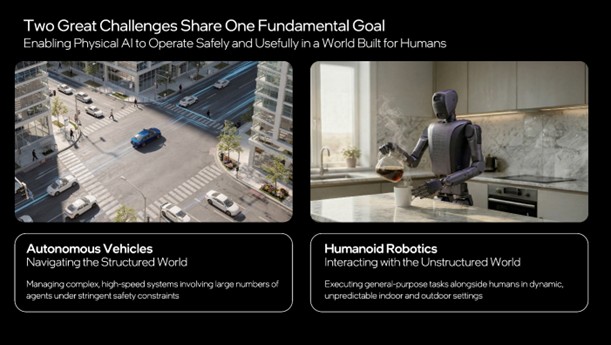
Mobileye is a leader in the development and deployment of advanced driver assistance systems (“ADAS”) and autonomous driving technologies and solutions. We pioneered ADAS technology more than 25 years ago and have continuously expanded the scope of our ADAS offerings, while leading the evolution to autonomous driving solutions. On February 3, 2026, we completed the acquisition of Mentee Robotics Ltd. (“Mentee Robotics”), a humanoid robotics company. This acquisition combines Mobileye’s advanced artificial intelligence (“AI”) technology and global production expertise with Mentee Robotics’ breakthrough humanoid platform and deep AI talent, creating a comprehensive provider of Physical AI technology across two transformative markets: autonomous driving and humanoid robotics.

3

Our portfolio of solutions is built upon a comprehensive suite of purpose-built software and hardware technologies designed to provide the capabilities needed to make the future of ADAS and autonomous driving a reality. These technologies can be harnessed to deliver mission-critical capabilities at the edge and in the cloud, advancing the safety of road users, and revolutionizing the driving experience and the movement of people and goods globally.
While today ADAS is central to the advancement of automotive safety, we believe that an evolutionary path toward fully autonomous vehicles is the future of mobility. While still nascent, full autonomy - where a human is not actively engaged in driving the vehicle for extended periods of time - requires the autonomous driving solution to be capable of navigating any environment in any condition at any time. The ability to drive autonomously not only requires a substantial amount of data, but also a robust technology platform that optimizes both precision (i.e., safety) and recall (i.e., availability) without compromise, and can withstand the validation and audit process of global regulatory bodies. Further, the autonomous driving solution needs to be produced at a cost that makes it affordable. We are building our technology platform to address these fundamental and significant challenges in order to enable a full spectrum of solutions, from ADAS to autonomous driving, with multiple products in between to best serve the needs of our customers.
We believe that our industry-leading technology platform, built upon over 25 years of research, development, data collection and validation, and purpose-built software and hardware design, gives us a differentiated ability to not only deliver excellent safety ratings and maintain a leadership position with our ADAS solutions, but also to make the mass deployment of autonomous driving solutions a reality. We also believe that the breadth of our solutions, combined with our global customer base, represents a significant market opportunity for us. Our platform is efficient and modular by design, enabling our customers to productize our most advanced solutions today and then leverage those investments to launch even more advanced systems in a modular and incremental manner. Our solutions are also highly customizable, which allows our customers to benefit from the core technology supporting our advanced solutions while also augmenting and differentiating their offerings.
We have experienced significant growth since our founding. For 2025, 2024 and 2023, our revenue was $1.9 billion, $1.7 billion and $2.1 billion, respectively, representing a year-over-year increase of 15% in 2025 compared to 2024. We currently derive substantially all of our revenue from our commercially deployed ADAS solutions. We recorded net losses of $392 million, $3,090 million and $27 million in 2025, 2024 and 2023, respectively, with the net loss in 2024 primarily being the result of recording a $2,695 million non-cash impairment of goodwill in the third quarter of 2024. Our Adjusted Net Income (Loss) for 2025, 2024 and 2023 was $286 million, $205 million and $659 million, respectively. Adjusted Net Income (Loss) is a non-GAAP financial measure; see “Item 7. Management’s Discussion and Analysis of Financial Condition and Results of Operations – Non-GAAP Financial Measures” for a reconciliation of Adjusted Net Income (Loss) to Net Income (Loss). The adjustments to reconcile Net Income (Loss) with Adjusted Net
4
Income (Loss) are related to amortization of intangible assets, stock-based compensation expenses, impairment of goodwill and related income tax effects where applicable.
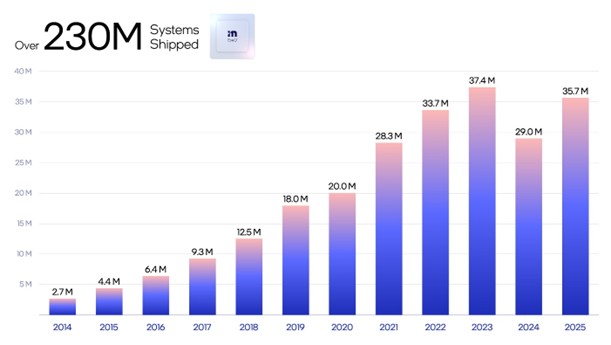
As of December 27, 2025, our solutions have been installed in approximately 1,400 vehicle models (including local country, year, and other vehicle model variations), and our System-on-Chips (“SoCs”) have been deployed in more than 230 million vehicles. We are actively working with more than 50 Original Equipment Manufacturers (“OEMs”) worldwide on the implementation of our ADAS solutions. For the year ended December 27, 2025, we shipped approximately 35.7 million of our EyeQ™ SoC and SuperVision™ systems, of which the substantial majority were EyeQ™ SoCs. This represents an increase from approximately 29.0 million systems that we shipped in 2024.

We were founded in Israel in 1999. Our co-founder, Professor Amnon Shashua, is our President and Chief Executive Officer. In 2014, we completed an initial public offering as a foreign private issuer and traded under the symbol MBLY on the New York Stock Exchange. Intel Corporation (“Intel”) acquired Mobileye for $15.3 billion in 2017, after which we became a wholly-owned subsidiary of Intel. We completed the internal reorganization and design of our new public entity (the “Reorganization”) and the Mobileye IPO in October 2022.
5
Our Technology Platform is Built to Enable the Full-Stack of Autonomous Solutions

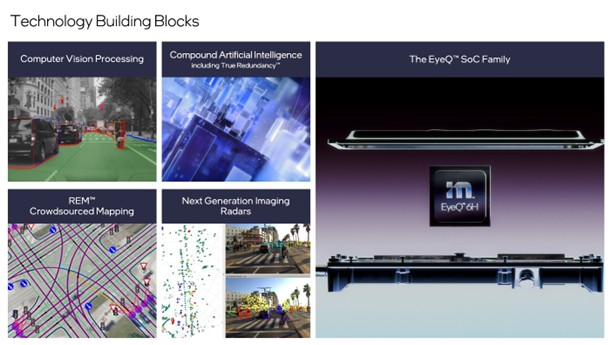
Our technology platform, which includes our software and hardware intellectual property, leverages our decades of experience as a technology leader for sensing and perception solutions for the automotive industry and our focused efforts to build highly scalable, compute-efficient and cost-efficient autonomous solutions. Our technologies are foundational to the development and deployment of our ADAS and AV capabilities. Our platform is built on five fundamental pillars:
6

7

8

When it comes to safety, our multi-faceted high-level fusion structure is governed by a Primary / Guardian / Fallback methodology (“PGF”) which can handle “majority-rule” as well as non-binary discrepancies. This technology approach supports a quadratic improvement in precision through a framework in which the system only fails if two subsystems fail concurrently. It is a critical enabler of our goal of building a fully autonomous driving-system that can be validated as safer than human-driven vehicles, devoid of unreasonable risks, and deployed in a cost-efficient manner. This approach separates our system from competitors that utilize a monolithic approach.
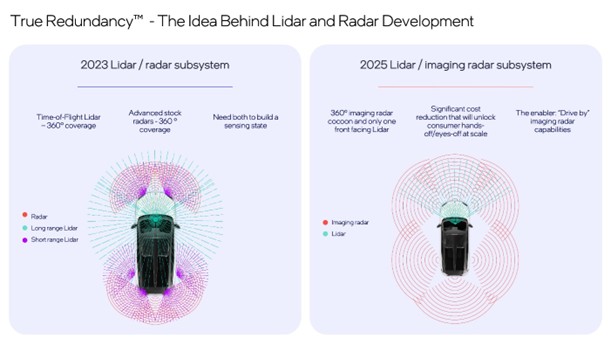
During 2025, a leading global automaker chose Mobileye Imaging Radar™ as a key component of its upcoming eyes-off, hands-off automated driving system in personal vehicles, following an extensive, years-long evaluation of Mobileye’s technology and competing systems. Starting in 2028, this new customer for Mobileye plans to use the imaging radar to deliver SAE Level 3 automated driving at highway speeds, designed to provide exceptional detection of vehicles, people and objects in conditions such as fog or rain, and at long distances, that challenge existing sensors.
9
The efficiency of our inference silicon design is a core enabler of the overall efficiency of our system, and is critical in applications such as automotive application which highly value packaging size and power consumption. Designing an efficient silicon architecture requires optimizing the competing factors of efficiency and flexibility. We accomplish this through the development a variety of accelerators, each of which are designed to perform specific tasks that either most favor efficiency, flexibility, or a combination of both. Successful design has led to a 10-times improvement in frames-per-second processing for EyeQ™6 High, as compared to EyeQ™5 High, despite only double the headline processing power (i.e., TOPS) and 25% higher power consumption. Based on competitive benchmarking, the EyeQ™6 High is significantly more efficient than more general purpose SoC’s that are much higher headline processing power, in terms of frames-per-second, latency, and cost. We continue to believe that, as AV solutions continue to develop, efficiency of inference silicon will be one of the most significant purchasing criteria and Mobileye has inherent advantages in this area.
Our EyeQ™5 SoCs and subsequent generations are increasingly customizable by our OEM customers, supported by our Driving Experience Platform (“DXP”). DXP is a software platform that enables automakers to develop and customize the driving experience (i.e., the OEM-unique aspect of a vehicle’s automated driving features) while utilizing Mobileye’s proven core technology perception and driving policy software (i.e., the objective, universal aspects of a vehicle’s automated driving features). This new application programming interface supports our customers’ desire to create unique products from our technology while also accelerating time-to-market and reducing overall execution risk. Importantly, this collaborative addition to our platform offers a mutually beneficial middle ground between open and closed systems which we believe is the optimal path forward.
These five pillars form the core of our highly versatile and customizable platform, which we intend to deploy with progressively increasing functionality to continue to enhance our market-leading ADAS solutions and lead the evolution to autonomous driving solutions.
The Autonomous Vehicle Revolution
Autonomous driving is one of the most difficult technological challenges facing the world today, but as a technological concept has remained at the forefront of human imagination for decades. Since the early 2000s, a number of automotive and technology companies have invested heavily to try to make this a reality. Mobileye’s vision for the last number of years is to chart a clear path from ADAS to scalable autonomous driving.

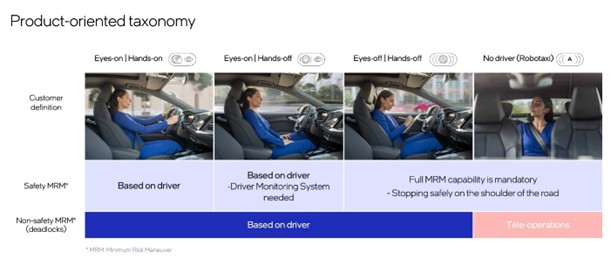
Vehicle autonomy can be viewed as a spectrum that uses the same technology building blocks to power the full span of driver assist functions, ranging from those available in hundreds of car models today, through full autonomy powering robotaxis and, eventually, personal autonomous vehicles. The automotive industry breaks down this spectrum into what are known as SAE Levels 1, 2, 3, 4 and 5. We have developed our own, more user-friendly taxonomy. Each level of our taxonomy is further defined and supported by the particular operational design domain (“ODD”) for which it was designed.
10
First, we refer to basic driver assist features, such as automatic emergency braking or lane keeping assist, together with longitudinal control such as adaptive cruise control as “eyes-on/hands-on”. The driver is still responsible for the overall task of driving, while the system supports the human driver.
Second, “eyes-on/hands-off”. This refers to premium driver assist functions adding additional safety and comfort functionality. This functionality allows the driver to experience hands-free driving while requiring the driver’s full attention and eyes on the road.
Third, “eyes-off/hands-off”. The system controls the driving function within a specified ODD, such as highway driving, without the need for the human driver to monitor driving. If the ODD is exceeded and the driver does not reassume control, the system is capable of performing a Minimum Risk Maneuver (“MRM”) and safely stop at the roadside.
Fourth, “no driver”. When no human driver is present, e.g., a robotaxi, the system will perform a MRM when needed, including coming to a full stop, and can also contact a teleoperator for decision support, such as re-routing and rules decisions.
We see a parallel path developing with significant growth in the adoption of cost-efficient eyes-on/hands-off systems on specified road types across a variety of price segments. On the other side of the spectrum, with the advent of commercial driverless services in 2024 and 2025 in the United States, we believe that the future state and growth of fully autonomous vehicles deployed in cities by fleet operators is no longer a question of technology, but rather of business model and scalability.
We believe that growth in eyes-on/hands-off systems and commercial driverless services will enhance public trust and familiarity with the technology to grow and eventually lead to more sophisticated self-driving systems for privately-owned vehicles. Our ADAS solutions, which have been deployed in over 230 million vehicles, are important building blocks for these more advanced autonomous systems. We believe the key factors in the growth of autonomous driving will be increased safety, consumer demand, and other economic and social benefits, such as increased mobility for older adults and persons with disabilities, less traffic congestion, and the reduction of land use for parking.
Our Solutions
We have utilized the technology pillars detailed above to build a robust portfolio of end-to-end ADAS and autonomous driving solutions that provide the capabilities needed for the future of autonomous driving, leveraging a comprehensive suite of purpose-built software and hardware technologies. We pioneered “base” ADAS features to meet global regulatory requirements and safety ratings with our Base ADAS solution and we have since created new categories of ADAS with our Cloud-Enhanced ADAS™, Mobileye Surround ADAS™, and SuperVision™ offerings. Additionally, we have designed a full set of eyes-off/hands-off solutions at a wide variety of price points and a spectrum of functionalities and ODDs.
We believe that our industry-leading technology platform, built upon multiple years of research, development, data collection and validation, gives us the unique ability to not only deliver excellent safety ratings with our ADAS solutions, but also to make the mass deployment of autonomous driving solutions a reality. We believe that the breadth of our solutions, combined with our global customer base, represents a significant market opportunity for us.
11

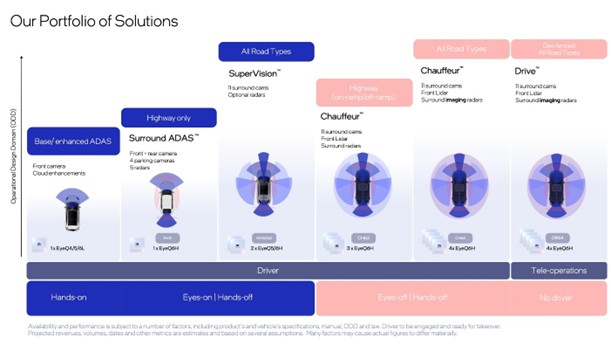
The chart above represents commercially deployed solutions (Base ADAS, Cloud-Enhanced ADAS™ and Mobileye SuperVision™) and solutions that we expect to be commercially deployed in the future (Mobileye Surround ADAS™, Mobileye Chauffeur™, and Mobileye Drive™).
Our End-to-End ADAS and AV Solutions
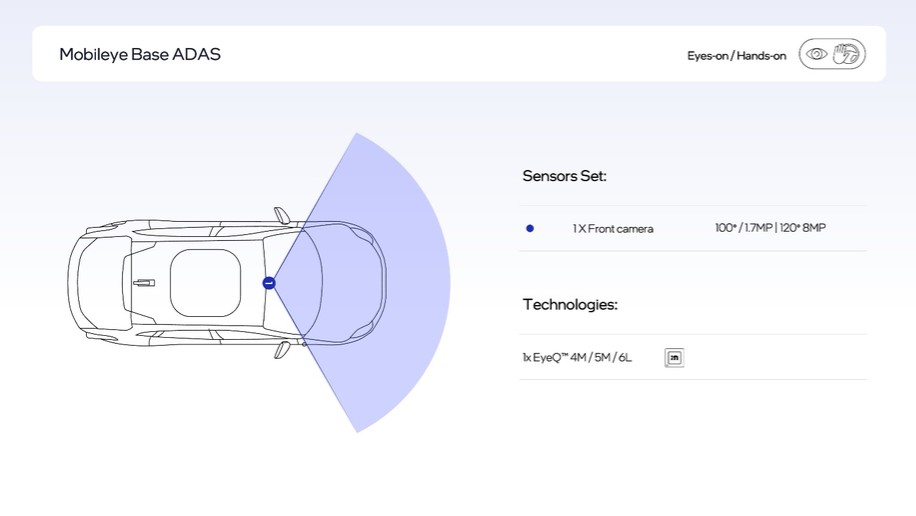
Mobileye Base ADAS

12
Mobileye’s Base ADAS, powered by our purpose built, on-windshield EyeQ™ SoC devices and our expertise in computer vision, brings our core ADAS solutions to millions of vehicles on the road today and is foundational to our spectrum of ADAS and autonomous vehicle solutions. Our EyeQ™ SoC provides drivers with basic safety features covered by front-facing sensing, such as collision warning, lane departure warnings, pedestrian and cyclist collision warning, headway monitoring and warning, speed limit indicator, blind spot detection, and many more. Our software algorithms and purpose-built hardware are designed to provide the driver with accurate and reliable driver assist solutions, promoting road safety.
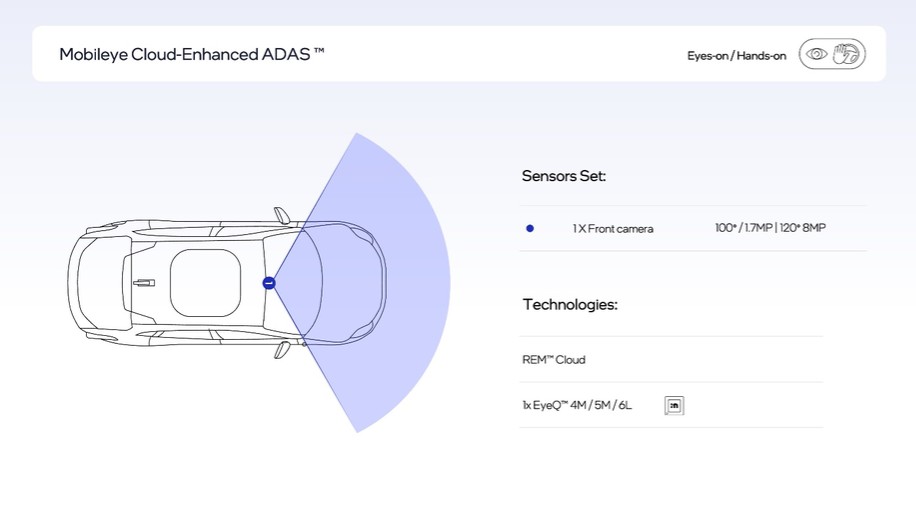
Cloud-Enhanced ADAS™

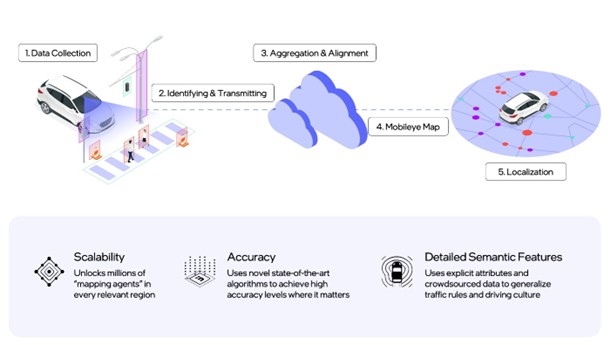
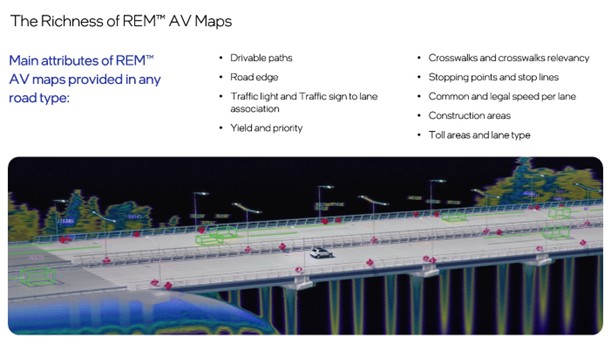
Mobileye’s Cloud-Enhanced ADAS™ leverages crowdsourced data from millions of REM™-equipped vehicles around the globe every day, providing high-level accuracy localization via continuously updated information about the driving scene. Enhancing the existing single-camera system with crowd-sourced data offers comprehensive in-path assist functionality that enables better performance and compliance even in complex or challenging circumstances. Relying on data from prior human driving activity to anticipate and adapt, our Cloud-Enhanced ADAS™ solution provides a safer, smoother, and more natural driving experience – marking a software defined leap in ADAS performance with no need for additional hardware.
13
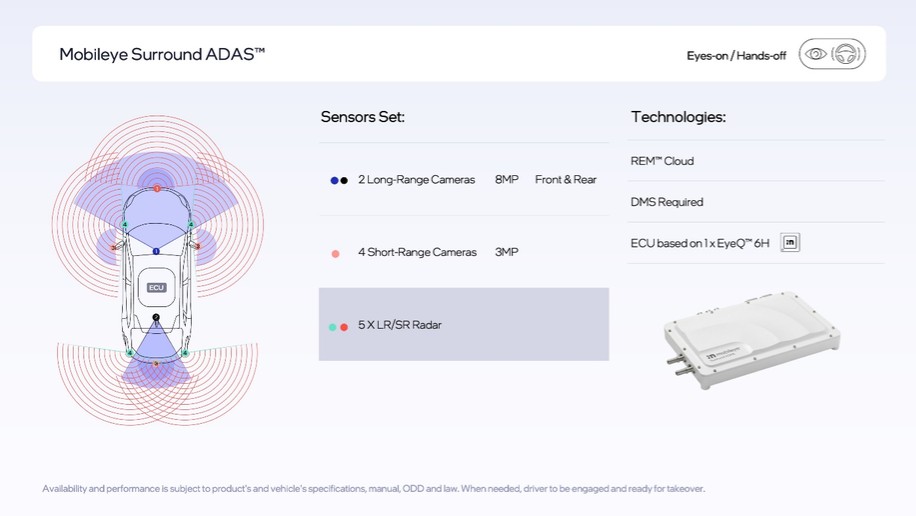
Mobileye Surround ADAS™

Building on our ADAS expertise and the core of our single-camera Cloud-Enhanced ADAS™ system, we offer through our Mobileye Surround ADAS™ system the ability to meet expanded late-decade active safety requirements through the utilization, analysis, and processing of additional surround perception sensors. Mobileye Surround ADAS™ utilizes the SuperVision™ software stack, including our RSS (defined below) policy model, and is powered by an ECU with one EyeQ™6 High SoC, which processes data from the customer’s third-party sensor suite featuring up to six cameras and up to five radars. Such cameras generally consist of two long-range cameras in the front and rear, while leveraging data from four short-range surround vision cameras that are already equipped on many production vehicles today for parking visualization purposes. Additionally, Mobileye Surround ADAS™ offers eyes-on/hands-off functionality for highway ODDs by adding features like automatic lane change, front and rear collision avoidance, traffic jam assist, and a Highway Pilot function up to 130 kilometers per hour with the fidelity of a multi-camera and multi-radar sensor suite. This system also includes DXP support, which enables customers to customize the driving experience while benefiting from our industry-leading technology platform.
14
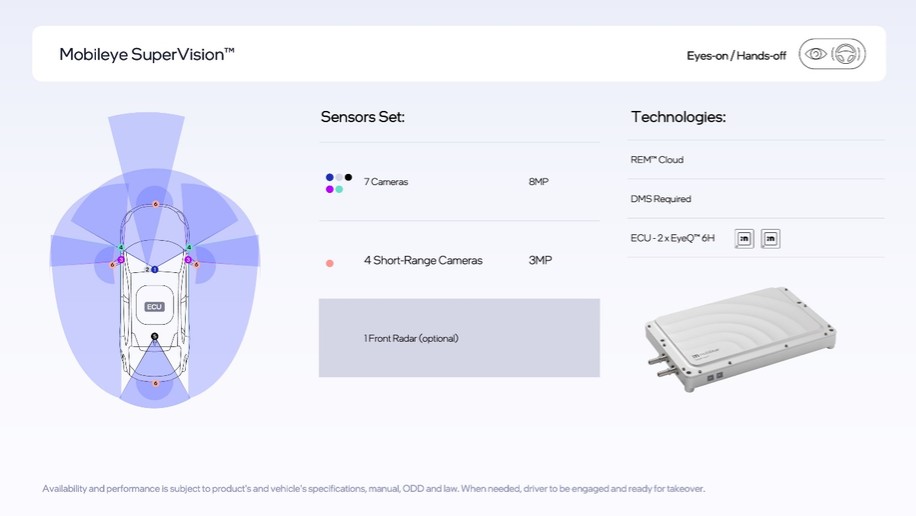
Mobileye SuperVision™

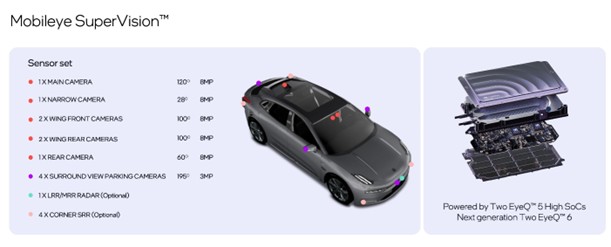
Mobileye SuperVision™, our eyes-on/hands-off Premium Driver Assist offering, is our most advanced driver assist system on the market and is the bridge to consumer autonomous vehicles. It is designed to handle standard driving functions across various road types, offering “hands-off” navigation capabilities under certain ODDs, while still requiring the driver to pay full attention and keep eyes on the road. Derived from our autonomous vehicle research and development, Mobileye SuperVision™ leverages cloud-based enhancements such as REM™, a number of algorithmic and architectural redundancies, and our RSS policy model. The system utilizes 360-degree surround sensing with 11 third-party cameras powered (plus optional radar) processes by a turnkey ECU with two EyeQ™5 or, starting with expected launches in 2027, two EyeQ™6 SoCs. Furthermore, in addition to supervised point-to-point assisted driving, Mobileye SuperVision™ is capable of changing lanes, managing priorities, and turning in intersections as well as engaging in automated parking, preventative (i.e., evasive) steering and braking, and other Driver Assist features. This solution is further supported by OTA updates. The 11 third-party cameras (seven long range cameras and four short-range surround vision cameras) provide full surround coverage and consist of 120-degree and 28-degree cameras in the front, four 100-degree corner cameras (two front-facing and two rear-facing), a 60-degree rear camera and four wide-view 195-degree short-range cameras mounted on the side mirrors and front and rear bumpers. The mapping is powered by REM™, and integrated with computer vision perception, to create a 360-degree environmental model (subject to the availability of map data) and RSS constrains the driving decisions to be compliant with an underlying formally proven model for safe driving decisions. This offering also includes DXP, which will enable customers to control the driving experience while benefiting from our industry-leading technology platform.
15

Importantly, our SuperVision™ technology also serves as a bridge, or foundational technology, for Mobileye and its customers to develop a spectrum of eyes-off/hands-off solutions with expanding ODDs. In other words, an OEM that adopts and validates SuperVision™ is taking a significant step towards consumer AV as SuperVision™ serves as a validated baseline, including a common primary ECU board, which can be leveraged to add eyes-off functionality under an increasing set of operating conditions in a modular way.
The first series production launch of this offering occurred in 2021 as Geely Group launched Mobileye SuperVision™ in its ZEEKR premium electric vehicle brand. Through the end of 2025, over 350,000 SuperVision™ systems were delivered to ZEEKR, Polestar and other brands.
Mobileye Chauffeur™ and Mobileye Drive™

16
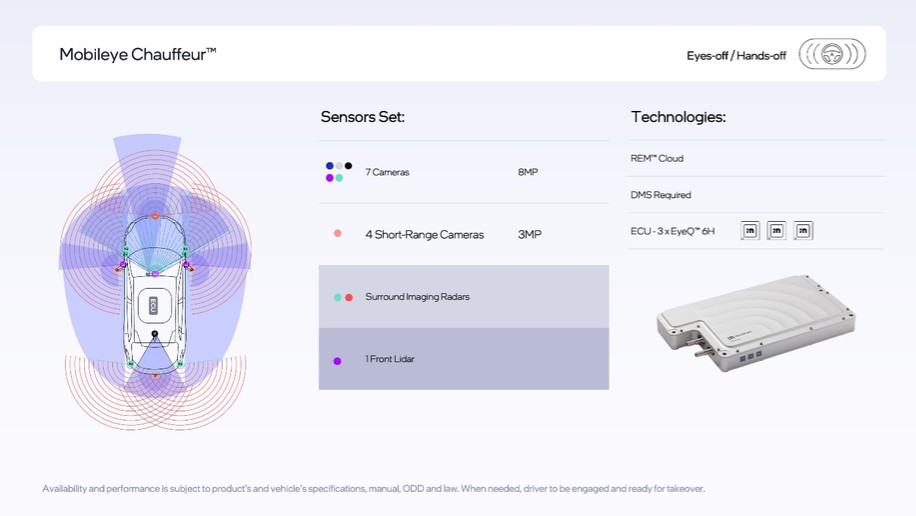
Mobileye Chauffeur™ is our geographically scalable eyes-off/hands-off solution for consumer vehicles in a gradually expanding ODD, combining computer vision technology with surround imaging radars and front lidar. The first generation solution will be based on three EyeQ™6 High SoCs, deployed with a primary board including two EyeQ™6 High SoCs supporting full surround computer vision perception and mapping and a secondary board with an additional EyeQ™6 High SoC supporting radar / lidar perception and our Compound AI fusion architecture. The primary board is common to our SuperVision™ solution which reduces the OEM’s validation burden and the dual-board setup provides functional safety redundancy. The system will provide 360-degrees of coverage through two independent and redundant sensing subsystems, along with REM™ maps, RSS, and our PGF architecture, to support optimized scalability and safety. Mobileye Chauffeur™ is expected to be capable of eyes-off/hands-off driving with a human driver still in the driver’s seat, in a gradually expanding ODD that can range from a limited ODD (e.g., highway only, up to 130kph), an ODD that we believe covers the majority of most consumers’ driving, to the more advanced ODDs that we are pursuing through this solution in subsequent generations. By using Mobileye SuperVision™ eyes-on/hands-off system as a basis for Mobileye Chauffeur™, we allow for an incremental and modular eyes-off transition from one ODD to the next. This can be done by adding more active sensors for redundancy and more compute power to the already validated and road-tested Mobileye SuperVision™. This approach gives our customers a viable, modular, and incremental path toward useful and safe consumer AV solutions.

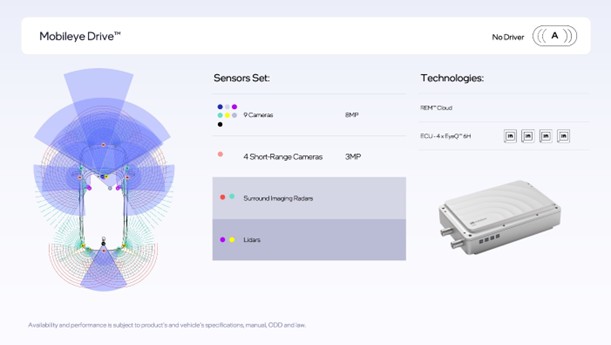
Mobileye Drive™ is our fleet-focused end-to-end self-driving system that enables automakers, public transportation companies, and transportation network operators to offer a no-driver solution for robotaxis, ride-pooling, public transport, and goods delivery. This eyes-off/hands-off/no driver solution will build upon our core autonomous driving technologies found in Mobileye Chauffeur™ and will deliver driving functions without the need for any in-vehicle human intervention by adding teleoperability and by minimizing cases where human input would be required. Our overall turnkey self-driving solution offers an advanced ODD that can turn various vehicle configurations and solutions autonomous. Mobileye Drive™ is already being integrated, and is in the development, testing and validation stages in autonomous public transit, autonomous goods delivery and autonomous mobility-as-a-service (“AMaaS”) across industries and around the globe.
We believe that both Mobileye Chauffeur™ and Mobileye Drive™ have sustainable competitive advantages as a result of the cost efficiency, scalability, and regulatory validation of our technology platform:
17
Overall, we believe our proprietary set of software and hardware technology solutions results in significant competitive advantages and a wider range of potential offerings compared to other approaches by industry participants attempting to commercialize network-deployed autonomous vehicles.
Models for AV Adoption
We believe that the availability of autonomous vehicles will cause a significant transformation in mobility, including vehicle ownership and utilization. We expect that autonomous vehicle technology will eventually be accessed by consumers through shared-vehicle AMaaS networks, as well as in consumer-owned and operated autonomous vehicles. It is our view that, to reach the full potential of autonomous driving over the long-term, the technology solutions that enable these separate markets should converge over time, and that is reflected in our strategy.
Autonomous driving has the potential to dramatically increase the proliferation of shared mobility, creating greater utilization of what is currently a significantly underutilized asset, the car. We believe that this model will ultimately manifest itself in the form of networks operated by a variety of different automotive and technology companies, where the consumer will be able to hail on-demand transportation at the click of a button, instead of owning a vehicle.
In addition, we believe consumer-owned and operated AVs will fundamentally change how individuals utilize their vehicles. Automation will allow the individual to be significantly more productive during their commute or other time spent in the car, given that the vehicle could operate eyes-off/hands-off in an increasingly wide ODD. Providing consumers with access to affordable autonomous vehicles can create significant value by decreasing time spent focused on the driving function and increasing safety.
As autonomous driving technology advances, a number of new transportation use cases are expected to emerge around the type of vehicle ownership, what is transported, and where and when the vehicle can operate. We believe that the most important factors in operating AMaaS networks will be the technology that powers the vehicles, as well as the scale of the network which will influence the availability of vehicles. As fleet operators increase network scale and availability of vehicles, the value of the platform to the user base will rise. We believe that mobility supply is developing in two main segments - automated public transport operators and automated transportation network companies - with very few companies able to operate within both over the long-term. It is our view that a flexible solution that supports both consumer AVs and AMaaS will be necessary to reach the full potential of autonomous driving over the long-term.
18
Challenges to Making Autonomous Vehicles Ubiquitous
To make autonomous vehicles at scale a reality, we believe that there are three core challenges that must be addressed beyond optimization of safety and performance:
Our Competitive Strengths
We believe that our leadership in ADAS and autonomous driving is based primarily on our: (1) first-mover advantage; (2) technology, including differentiated technological cores and solution architectures; (3) comprehensive portfolio of solutions; (4) delivery, including agility, response times, and time-to-market; and (5) inherent cost-driven advantages. These significant advantages form the basis for our competitive strengths described below:
19
20
21
Our Growth Strategies
Key levers of our growth strategy are:
Additionally, we added a new innovative Premium ADAS solution, Mobileye Surround ADAS™, which utilizes the SuperVision™ software stack with a down-scaled sensor suite and an ECU that includes one EyeQ™6 High SoC. The solution will enable eyes-on/hands-off driving on highway road types (as compared to SuperVision™ which is expected to operate on various ODDs). Mobileye Surround ADAS™ will provide OEMs with higher levels of autonomy than Cloud-Enhanced Driver Assist™, which we believe will expand the application and adoption of our products. In addition to the safety features and eyes-on/hands-off capability, this product can also result in the consolidation of several functions, including automated parking and driver / occupant monitoring, onto a single ECU that results in a lower-cost solution for OEMs as compared to first-generation Level 2+ systems currently on the market. As a result, we are seeing increasing traction to equip this type of system as standard-fit across wide-ranging vehicle price and model segments.
22
Our Premium Driver Assist offerings are expected to be available with DXP, which will enable OEM customers to deploy their own internally-developed software on our EyeQ™ SoCs while benefiting from our industry-leading technology platform.
23
Our Customers
Our customers include leading OEMs, which we primarily sell to through Tier 1 automotive suppliers that implement our product into automotive vehicles, as well as fleet owners and operators.
OEMs
Our market position has remained strong across a broad set of customer relationships for many years. We are actively working with more than 50 OEMs worldwide on the implementation of our ADAS solutions.
Tier 1 Automotive Suppliers
We supply certain OEMs with the EyeQ™ platform through our arrangements with automotive system integrators, known as Tier 1 automotive suppliers, which are direct suppliers to OEMs. Our Tier 1 customers include Aptiv, Magna, Valeo, ZF, Imotion, HL Klemov, Mobis and others.
Autonomous Mobility-as-a-Service
We, along with commercialization partners such as MOIA and Holon, expect to sell or deploy Mobileye Drive™-equipped self-driving vehicles to a range of transportation network companies, public transit operators, other mobility service companies and vehicle OEMs which intend to operate a variety of services (e.g., consumer-facing AMaaS, transportation on demand, delivery). These partners could produce vehicles themselves and integrate Mobileye Drive™ with our assistance.
Our Partnerships with STMicroelectronics and Intel
Our long-standing relationship with STMicroelectronics N.V. (“STMicroelectronics”) continues to strengthen with the complexity of our solutions. Our partnership includes close collaboration in product development, design, and manufacturing. For example, we have co-developed six EyeQ™ generations, including the EyeQ™6. We also benefit from STMicroelectronics’ advanced packaging and testing capabilities and automotive expertise. Together with STMicroelectronics, we are working on developing and productizing next-generation automotive-grade technology for high volume automotive applications, which we believe will accelerate the pace of autonomous innovation and market adoption.
Our close partnership with Intel exists on multiple fronts. As a result of our relationship with Intel, we have access to certain technologies that support design and development of our software-defined radar, including Intel’s mmWave technologies. Intel’s strength in government affairs and policy development around the world will continue to be of significant value to us as we collaborate with regulators who are preparing frameworks to enable commercial deployment of AVs.
Manufacturing
Our products are designed and manufactured specifically for automotive applications after extensive validation tests under stringent automotive environmental conditions.
We partner with STMicroelectronics, a leading supplier and innovator of semiconductor devices for automotive applications, in manufacturing, design and research and development. We have co-developed six generations of our automotive grade SoC, EyeQ™, with STMicroelectronics including EyeQ™5 and EyeQ™6. We design the front-end and STMicroelectronics designs the back-end package. These design processes also include testing, quality assurance, customer care, failure analysis and ensuring compliance with manufacturing standards. All of our EyeQ™ integrated circuits are manufactured by or outsourced to a partner foundry by STMicroelectronics.
24
We have also established a relationship with Quanta Computer, Taiwan Semiconductor Manufacturing Company (“TSMC”) and other suppliers to develop and assemble our ECUs including our reference design for our Mobileye SuperVision™ solution, which includes our EyeQ™5 and EyeQ™6 SoCs from STMicroelectronics.
Regulation and Ratings
Automobile safety is driven by both regulations and the availability to consumers of independent assessments of the safety performance of different car models. These assessments have encouraged OEMs to produce cars that are safer than those required by law. In many countries, these NCAPs have created a “market for safety” as car manufacturers seek to demonstrate that their models satisfy the various NCAPs’ highest ratings.
National NCAPs will continue to add specific ADAS applications to their evaluation items over the next several years, led by the Euro NCAP. In the EU, pre-market approval is required for all vehicles sold, and many manufacturers choose to satisfy a set of technical criteria determined by the Euro NCAP. The Australian, Japanese, and Korean NCAPs’ have fully harmonized their policies with the Euro NCAP. In 2025, Euro NCAP approved and announced significant updates to its protocols that will take effect in 2026, reflecting evolving expectations for ADAS performance and human-machine interface considerations. We believe that this and such additional future evolution of standards will drive the need for additional sensors and compute which our Mobileye Surround ADAS™ solution is strategically positioned to support. In the United States, ADAS regulation continues to make large strides. For example, the INVEST in America Act, which was passed in late 2021, requires the U.S. Department of Transportation to issue requirements and standards regarding vehicle safety technologies. In addition, NHTSA has adopted a new FMVSS requiring automatic emergency braking systems on new light vehicles, and in early 2025 the U.S. Department of Transportation temporarily delayed the effective date of a related final rule as part of a regulatory review process. On the AV front, our RSS driving policy provides a cornerstone for global standardization efforts of the safety of assisted and automated driving, in particular IEEE 2846, a working group of approximately 30 organizations in the industry that we lead.
At the federal level in the United States, the safety of motor vehicles is regulated by the U.S. Department of Transportation through two federal Agencies - the National Highway Traffic Safety Administration (the “NHTSA”), which regulates all motor vehicles, and the Federal Motor Carrier Safety Administration (the “FMCSA”), which regulates commercial motor vehicles. NHTSA establishes the Federal Motor Vehicle Safety Standards (the “FMVSS”) for motor vehicles and motor vehicle equipment and oversees the actions that manufacturers of motor vehicles and motor vehicle equipment are required to take regarding the reporting of information related to defects or injuries related to their products and the recall and repair of vehicles and equipment that contain safety defects or fail to comply with the FMVSS. FMCSA regulates the safety of commercial motor carriers operating in interstate commerce, the qualifications and safety of commercial motor vehicle drivers, and the safe operation of commercial trucks.
While there are currently no mandatory federal U.S. regulations expressly pertaining to the safety of autonomous driving systems, the U.S. Department of Transportation has established recommended voluntary guidelines, and the NHTSA or the FMCSA, as applicable, have authority to take enforcement action should an automated driving system pose an unreasonable risk to safety or inhibit the safe operation of a motor vehicle. Certain U.S. states have legal restrictions on autonomous driving vehicles, and many other states are considering them. These variations increase the legal complexity of deploying our solutions. If discrepancies emerge in the legal restrictions adopted by different U.S. states, our plan is to develop our technology to comply with the strictest standards. We will continue to actively monitor regulatory developments in the U.S. and intend to adjust our products and solutions as needed.
In Europe, certain vehicle safety regulations apply to self-driving braking and steering systems, and certain treaties also restrict the legality of certain higher levels of autonomous driving vehicles. In jurisdictions that follow the regulations of the United Nations Economic Commission for Europe, some regulations restrict the design of advanced driver-assistance or self-driving features, which can compromise or prevent their use entirely. Other applicable laws, both current and proposed, may hinder the path and timeline to introducing self-driving vehicles for sale and use in the markets where they apply. Other markets, including China, continue to consider self-driving regulation. Any implemented regulations may differ materially from those in the United States and Europe, which may further increase the legal complexity of self-driving vehicles and limit or prevent certain features. Autonomous driving laws and regulations are expected to continue to evolve in numerous jurisdictions in the United States and foreign countries and may create restrictions on autonomous driving features that we develop.
25
Trade Restrictions and Export Control
In order for us to operate in international markets, we must comply with relevant legal regulations regarding autonomous vehicles as well as technology export control, data security, cybersecurity and other related regulations that apply to global technology companies. We have developed robust compliance processes and procedures related to these regulatory requirements and believe that we are in compliance with such requirements.
On October 7, 2022, the U.S. Department of Commerce’s Bureau of Industry and Security (“BIS”) announced restrictions on the export of advanced computing integrated circuits and related items to China and certain other jurisdictions. Based on our existing customer base and the export classifications for our existing chip products, we do not believe that these U.S. export controls will have a material impact on our sales of these products to our existing customers (including those in China), however this assessment remains subject to ongoing technical reassessment against evolving regulatory thresholds and may change for future generations of our chip products. In 2023, BIS added to these restrictions and the U.S. also worked with Japan and the Netherlands to align on additional restrictions on semiconductor manufacturing equipment. In January 2025, BIS announced additional controls on advanced computing chips and certain closed AI model weights. These controls were withdrawn before taking effect, however future AI oversight regulations could materially affect our business operations. On January 14, 2025, BIS announced the adoption of a final rule prohibiting certain transactions involving the sale or import of (i) connected vehicles integrating “Vehicle Connectivity System” hardware, and (ii) connected vehicles integrating “Automated Driving System” or “Vehicle Connectivity System” software, or those components sold separately, in each case with a sufficient nexus to the People’s Republic of China or Russia. The software provisions of the final rule and the prohibition on sales of connected vehicles will take effect for model 2027 and the hardware-related prohibitions will take effect in model year 2030, or January 1, 2029 for units without a model year. We have developed and implemented compliance processes for these new rules and expect to be compliant when these restrictions are effective. In addition, recent regulatory actions by the United States and the Netherlands have impacted Nexperia, a global manufacturer of essential semiconductor components, by restricting access to certain technologies and limiting cross-border transfers of semiconductor products. We have implemented supply chain redundancy strategies and diversified our Tier 2 semiconductor sourcing to address potential impacts to our business and operations and support long-term operational resilience. Import and Export control regulations adopted by the United States and other jurisdictions are subject to change and interpretation, and it is possible that future regulatory actions by BIS impacting U.S. imports and exports of integrated circuits as well as certain software and hardware components used in our systems and related items could have a material impact on our business operations.
Data Privacy
Privacy is fundamental to Mobileye. We collect, process, transmit, and store personal information in connection with the operation of our business and are subject to a variety of local, state, national and international laws, directives and regulations that apply to the collection, use, retention, protection, security, disclosure, transfer and other processing of personal data in the different jurisdictions in which we operate. Data collected by the camera and sensors of our solutions during the development cycle of a project may include personal information such as license plate numbers of other vehicles, facial features of pedestrians, appearance of individuals, GPS data, and geolocation data in order to train the data analytics and AI technology equipped in our solutions for the purpose of identifying different objects and predicting potential issues that may arise during the operation of a motor vehicle. As we work to integrate in‑cabin sensing technologies, including camera‑based driver monitoring and occupant monitoring systems, we may collect sensitive personal information, such as biometric identifiers, gaze patterns, facial features, behavioral attributes, and, in some configurations, audio or physiological indicators. This may increase the volume and sensitivity of data we process, and may subject us to heightened compliance obligations.
We anticipate that our collection of such personal information may increase with the growing introduction of our AMaaS and robotaxi solutions, and our integration of Moovit, which may provide us with access to personal information of users. Our data-collection processes implement strict methodologies to comply with data protection and privacy laws, including the EU General Data Protection Regulation (the “GDPR”, the UK General Data Protection Regulation, and U.S. federal and state laws, including the California Consumer Privacy Act of 2018 (the “CCPA”), as amended by the California Privacy Rights Act of 2020 (the “CPRA”). In addition, the EU Artificial Intelligence Act (“EU AI Act”) entered into force in 2024 and is being applied in a phased manner through 2025 and 2026. Certain AI systems used in the context of autonomous driving, mobility, and large-scale monitoring of public spaces may be classified as high-risk AI systems, triggering additional obligations related to data governance, transparency, human oversight, risk management, and post-market monitoring.
26
We leverage systems and applications that are spread over the countries in which we do business, requiring us to regularly move data across national borders. As a result, we are subject to a variety of laws and regulations in the United States, China, the European Union, Israel and other foreign jurisdictions as well as contractual obligations, regarding data privacy, protection, and security.
The scope and interpretation of the laws and regulations that are or may be applicable to us are often uncertain and may be conflicting, particularly with respect to foreign laws. We are subject to the GDPR, which became effective in May 2018. EU member states have enacted certain implementing legislation that adds to and/or further interprets the GDPR requirements. The GDPR together with national legislation, regulations and guidelines of the EU member states governing the processing of personal data, impose strict obligations and restrictions on the ability to collect, use, retain, protect, disclose, transfer, and otherwise process personal data with respect to EU data subjects. In particular, the GDPR includes obligations and restrictions concerning the consent and rights of individuals to whom the personal data relates, the transfer of personal data out of the EEA, security breach notifications and the security and confidentiality of personal data. We are also subject to the UK General Data Protection Regulation (i.e., a version of the GDPR as implemented into UK law), exposing us to two parallel regimes with potentially divergent interpretations and enforcement actions for certain violations. While the European Commission issued an adequacy decision in respect of the UK’s data protection framework, enabling data transfers from EU member states to the UK to continue without requiring organizations to put in place contractual or other measures in order to lawfully transfer personal data between the territories, that EC adequacy decision was originally subject to a sunset clause set to expire on June 27, 2025, but was subsequently extended for an additional six‑year term with a new sunset date of December 27, 2031. This adequacy decision may be revoked in the future by the European Commission if the UK data protection regime is reformed in ways that deviate substantially from the GDPR. Other countries have enacted or are considering enacting similar cross-border data transfer rules or data localization requirements.
Additionally, U.S. state governments continue to enact new data protection and privacy laws and regulations since 2018, including California, Colorado, Connecticut, Delaware, Iowa, Texas, Utah, Virginia and many others. These new state laws and regulations may impact our business practices, including limiting our ability to use clips for internal development and validation purposes. Several U.S. state laws impose heightened restrictions on the processing of sensitive personal data, including precise geolocation data and biometric identifiers, and provide consumers with opt-out rights from certain automated decision-making and profiling activities. Federal and state laws and regulations are changing rapidly and new federal data protection and privacy laws remain under discussion, to which we would become subject if any such laws were enacted. Compliance with these federal and state data protection and privacy laws and regulations, and other similar federal or state laws and regulations that may be enacted in the future, may require us to put in place additional mechanisms to comply with such laws and regulations which could cause us to incur substantial costs or require us to change our business practices, including our data processing practices, in a manner adverse to our business. Moreover, any failure to comply with such federal and state laws and regulations could result in, among other things, regulatory or government investigations, monetary penalties or fines, litigation (including civil claims, such as representative actions and other class action-type litigation), and orders to cease, modify or change our business practices, including our data processing practices.
In China, the Cyber Security Law (as amended in 2026) reaffirms the basic principles and requirements specified in other existing laws and regulations on personal information protection, such as the requirements on the collection, use, processing, storage, and disclosure of personal information. China has implemented additional comprehensive data protection and cybersecurity laws, including the PRC Data Security Law, the PRC Personal Information Protection Law (PIPL), the PRC Network Data Security Management Regulations (2025) and the Automotive Data Export Security Guidelines (2026), which significantly expand compliance obligations. Under these laws and related regulations, organizations may be subject to enhanced requirements regarding lawful processing, data localization in certain circumstances, government security assessments or other approvals for specific processing activities or cross-border data transfers, and restrictions on transfers of personal information and certain automotive data outside of China, with broad enforcement authority and potentially significant penalties for non-compliance.
In Israel, we are subject to the Israeli Privacy Protection Law, 5741-1981 (the “PPL”), and the regulations promulgated thereunder, including the Israeli Privacy Protection Regulations (Data Security), 5777-2017, which impose detailed requirements regarding the processing, transfer, and safeguarding of personal data, and additional regulations governing exercising of privacy rights, cross-border data transfers, import of personal data from the EU and so forth. Similar to the UK, the European Commission has issued an adequacy decision in respect of Israel’s privacy laws in 2011, enabling data transfers from EU member states to Israel without additional contractual burden, and currently, without expiry term.
The Israeli Privacy Protection Authority (the “PPA”), acting as the supervisory authority in respect of Israeli privacy laws, has from time to time issued guidance which serves as complementary compliance requirements on controllers and processors such as the Company. On August 14, 2025, the most significant amendment to the PPL (“Amendment 13”) took effect, which significantly increased
27
the enforcement and investigative powers of the PPA, and as a result, significantly increased the potential for imposing administrative sanctions for violations of the PPL and its regulations, and in some cases, monetary sanctions. In addition, Amendment 13 further increased civil liability as the statute of limitations was increased from two to seven years and new punitive damages without proof were added to protect privacy rights violations by controllers and processors. Significant amendments to the PPL or its regulations may require updates to our data protection and security practices. Failure to comply with the PPL and its regulatory framework could result in enforcement actions, litigation (including class actions), administrative orders, and monetary penalties.
Our Competition
The ADAS and autonomous driving industries are highly competitive. In the ADAS and consumer AV market, we face competition primarily from other external providers including Tier 1 automotive suppliers and silicon providers, as well as in-house solutions developed by the OEMs to a certain extent. Our Tier 1 customers may be developing or may in the future develop competing solutions. For example, certain of our competitors have announced that they are operating autonomous robotaxis. Tier 1 automotive supplier competitors include Bosch, Continental, and Denso. Our silicon provider competitors include Ambarella, Advanced Micro Devices, Arriver / Qualcomm, Black Sesame Technologies, Horizon Robotics, Huawei, NVIDIA, NXP, Renesas Electronics, and Texas Instruments. OEMs who have or are pursuing their own in-house solutions are also indirect competitors, with Tesla and Mercedes-Benz being examples of automakers taking that approach today, with others such as General Motors, NIO, Volvo Cars, Xpeng Motors, Huawei and Li Auto also pursuing in-house solutions for portions of the advanced ADAS software stack. In the future, our indirect competitors could become direct competitors.
In the autonomous driving market, including AMaaS and consumer AV, we face competition from technology companies, internal development teams from the automakers themselves, sometimes in combination with investments in early-stage autonomous vehicle technology companies, Tier 1 automotive companies, as well as robotaxi providers. AMaaS competitors include Cruise, Tesla, Motional, Waymo, NVIDIA, Yandex, and Zoox in the United States and Europe and Auto X, Baidu, Deeproute.ai, Didi Chuxing, Momenta, Pony.ai and WeRide in China. Consumer AV competitors include Sony and Tesla, who are developing self-driving vehicles for consumers. We also face competition from companies that offer “software-only” autonomous vehicle solutions, including StradVision, Autobrains, Wayve and Momenta.
Developing effective ADAS technology is technologically complex, requires the development of large validation datasets in order to train the required software algorithms effectively, requires a long-term commitment to validation and qualification with an OEM before series production can even begin, and requires significant financial resources. In addition, our tightly coupled software and hardware solutions, which are based on highly advanced, road-tested, sensing and perception technologies from decades of leadership in AI, including computer vision, and powered by our mission critical software and purpose-built EyeQ™ family of SoCs are extremely hard to replicate.
Competition in the humanoid and Physical AI robotics market is intense and rapidly evolving, with a growing number of well-capitalized companies developing general-purpose bipedal robots and related autonomy stacks for industrial and warehouse use. We face competition from other humanoid robotics developers such as Tesla, Figure AI, Sanctuary AI, PAL Robotics, Agility Robotics and Boston Dynamics, as well as additional emerging players (including a number of Chinese robotics companies) seeking to commercialize similar capabilities.
Moovit competes against urban mobility applications and mobility-as-a-service (“MaaS”) solutions which provide transportation services and navigation data to consumers. Moovit’s free and subscription-based application competition includes Alphabet, Apple, Citymapper, and Transit. Moovit’s application also competes with local urban and inter-city ticketing service providers that provide purchase and ticketing of public transit and mobility services on their own platform.
The principal competitive factors impacting the market for our solutions include:
| ● | completeness of our technology platform including SoCs, sensing and perception technologies, sensor fusion architecture, high-precision mapping system, and supporting software and algorithms; |
| ● | ability to design and develop ADAS, autonomous driving and humanoid robotics solutions that meet our customers’ needs; |
| ● | automotive quality standards, compliance, and performance in all areas of ADAS and autonomous driving; |
28
| ● | ability to successfully integrate Mentee Robotics’s business and humanoid and Physical AI robotics technology with our existing platform; |
| ● | agile software validation and robust product release discipline; |
| ● | scalability, and cost efficiency of our solutions; |
| ● | engineering capabilities, the ability to innovate and continuously improve our technology; |
| ● | pricing; |
| ● | design and development support for our customers; |
| ● | manufacturing reliability and the ability to make on-time delivery of appropriate quantities of product at a consistent level of quality; |
| ● | ability to meet regulatory requirements; |
| ● | intellectual property protection; |
| ● | attraction and retention of key talent, including in artificial intelligence and robotics; and |
| ● | brand and reputation, including the ability to market new offerings. |
We believe we compete favorably with respect to these factors. In addition, as the ADAS and autonomous driving markets progress and, in some use cases, converge, we believe we will be in a favorable position to achieve meaningful business wins given our differentiated capabilities.
Distribution and Marketing
Our products are sold directly to customers throughout the world, or through distribution channels for our remaining inventory of aftermarket products meant for vehicles that do not come pre-equipped with ADAS technology.
We actively promote our brand and technologies to increase awareness and generate demand through direct marketing as well as co-marketing programs. Our direct marketing to consumers and businesses primarily includes trade events, industry and consumer communications and press relations. We work closely with our existing customers in order to ensure that we are aware of their requirements and plans for future car models and can respond promptly and effectively.
We regularly present our technology to regulators and safety organizations to demonstrate its capabilities and reliability and to help ensure that they develop regulations and ratings that address the full range of benefits that we believe we can offer.
Research and Development
We believe our strong research and development is our principal competitive strength and has led to our position in the market. Our research and development activities are predominantly conducted in Israel. We have approximately 85% of our full time-equivalent employees engaged in research and development, many of whom have been with the company for significant tenures. Our research and development efforts focus on algorithms, including visual processing, camera control, vehicle control, camera/radar fusion, autonomous driving sensing technologies, REM™ technology, driving policy and related engineering tasks as well as application software, silicon design and hardware electronics design. We believe we have a unique approach by developing ADAS and autonomous solutions simultaneously, giving us a technical and scale advantage over our competition.
29
Our Employees
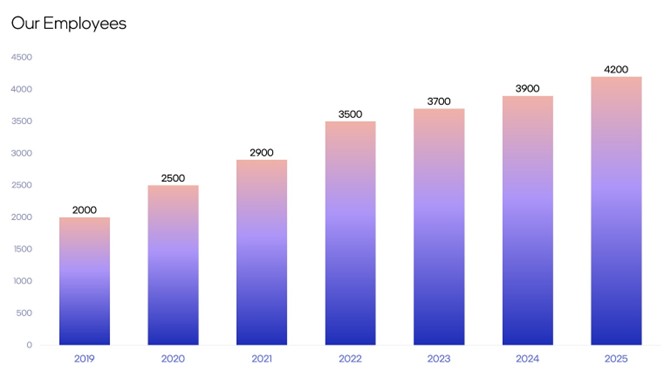
As of December 27, 2025, we had approximately 4,200 employees operating across seven countries, with approximately 85% of such employees involved in research and development and approximately 3,900 of such employees operating in Israel. As of February 3, 2026, following a workforce reduction and the acquisition of Mentee Robotics, we had approximately 4,130 employees. None of our employees is represented by a labor union with respect to his, her or their employment. In certain countries in which we operate, we are subject to, and comply with, local labor law requirements, which may automatically make our employees subject to industry-wide collective bargaining agreements. We have not experienced any work stoppages and we consider our relations with our employees to be good.

Intellectual Property
Our ability to compete effectively depends in part on our ability to develop and maintain the proprietary aspects of our technology. Our policy is to obtain appropriate proprietary rights protection for any potentially significant new technology acquired or developed by us. As of December 27, 2025, we held 439 U.S. patents, 98 European patents, 205 U.S. patent applications, 633 European and other non-U.S. patent applications, and provisional patent filings. We do not view any single patent or patent application to be material.
In addition to patent laws, we rely on copyright and trade secret laws to protect our proprietary rights. We attempt to protect our trade secrets and other proprietary information through agreements with OEMs, distributors, other customers and suppliers, proprietary information agreements with our employees and consultants, and other similar measures. Our primary trademarks are for our name and product names. We cannot be certain that we will be successful in protecting our proprietary rights. While we believe our patents, patent applications, software and other proprietary know-how have value, changing technology makes our future success dependent principally upon our ability to successfully achieve continuing innovation.
30
Litigation may be necessary in the future to enforce our proprietary rights, to determine the validity and scope of the proprietary rights of others, or to defend us against claims of infringement, misappropriation or other violation or invalidity by others. An adverse outcome in such litigation or similar proceedings could subject us to significant liabilities to third parties, require disputed rights to be licensed from others or require us to cease marketing or using certain products, any of which could have a material adverse effect on our business, financial condition, and results of operations. In addition, the cost of addressing any intellectual property litigation claim, both in legal fees and expenses, as well as from the diversion of management’s resources, regardless of whether the claim is valid, could be significant and could have a material adverse effect on our business, financial condition, and results of operations.
Relationship with Intel
Prior to the Mobileye IPO, Intel beneficially owned 100% of our outstanding shares of common stock and we operated as Intel’s wholly owned subsidiary. As of December 27, 2025, Intel beneficially owns 50,000,000 shares of our Class A common stock and all of the outstanding shares of our Class B common stock, representing approximately 79.5% of our outstanding common stock and 97.3% of the voting power of our common stock. Due to the issuance of shares of Class A common stock in connection with the acquisition of Mentee Robotics, Intel beneficially owns approximately 77.0% of our outstanding common stock and 96.9% of the voting power of our outstanding common stock as of February 3, 2026. As a result, Intel is able to control all matters submitted to our stockholders for approval, including the election of our directors and the approval of significant corporate transactions. Furthermore, in addition to any other vote required by law or by our amended and restated certificate of incorporation, until the first date on which Intel ceases to beneficially own 20% or more of our outstanding shares of common stock, the prior affirmative vote or written consent of Intel as the holder of our Class B common stock will be required in order for us to: adopt or implement any stockholder rights plan or similar takeover defense measure; consolidate or merge with or into any other entity; permit any of our subsidiaries to consolidate or merge with or into any other entity, with certain exceptions; acquire the stock or assets of another entity for consideration in excess of $250,000,000 other than transactions in which we and one or more of our wholly owned subsidiaries are the only parties; issue any stock or other equity securities except to our subsidiaries, pursuant to the Mobileye IPO, or pursuant to our employee benefit plans limited to a share reserve of 5% of the outstanding number of shares of our common stock on the immediately preceding December 31; make or commit to make any individual or series of related capital or other expenditures in excess of $250,000,000; create, incur, assume or permit to exist any indebtedness or guarantee any indebtedness in excess of $250,000,000; make any loan to or purchase any debt securities of any person in excess of $250,000,000; redeem, purchase or otherwise acquire or retire for value any equity securities of our company except repurchases from employees, officers, directors or other service providers upon termination of employment or through the exercise of any right of first refusal; take any actions to dissolve, liquidate, or wind-up our company; declare dividends on our stock; or amend, terminate or adopt any provision inconsistent with our amended and restated certificate of incorporation or amended and restated bylaws. See “Item 1A. Risk Factors — Risks Related to our Relationship with Intel and our Dual Class Structure”.
We and Intel continue to interact as strategic partners, collaborating on projects to pursue the growth of computing and advanced technology in the automotive sector. In connection with the Mobileye IPO, we entered into certain agreements (collectively, the “Intercompany Agreements”) with Intel and certain of its subsidiaries that provide the framework for our ongoing relationship with Intel, including the Master Transaction Agreement, which contains key provisions relating to our ongoing relationship with Intel. The Master Transaction Agreement also contains agreements relating to the conduct of the Mobileye IPO and future transactions, and governs the relationship between Intel and Mobileye. Unless otherwise required by the specific provisions of the Master Transaction Agreement, the Master Transaction Agreement will terminate on a date that is five years after the first date upon which Intel ceases to beneficially own at least 20% of our outstanding shares of common stock. The provisions related to our cooperation with Intel in connection with future litigation will survive seven years after the termination of the agreement, and certain other provisions including those related to indemnification by us and Intel will survive indefinitely.
Key provisions of the Master Transaction Agreement include: we will provide Intel with certain registration rights to register our common stock, because the shares of our common stock held by Intel after the Mobileye IPO are “restricted securities” as defined in Rule 144 under the Securities Act; we will cooperate with Intel, at its request, to accomplish a distribution by Intel of our common stock to Intel stockholders which is intended to qualify as a distribution under Section 355 of the Code, or any corresponding provision of any successor statute, and we have agreed to promptly take any and all actions reasonably necessary or desirable to effect any such distribution, in which Intel will determine, in its sole and absolute discretion, whether to proceed with all or part of the distribution, the date of the distribution and the form, structure and all other terms of any transaction to effect the distribution; so long as Intel beneficially owns at least 20% of our common stock, we will sell Intel our commercially available products, including EyeQ™ SoCs, for internal use, but not for resale on a standalone or bundled basis; we and Intel agree to hold the other in most favored status with respect to products purchased or sold for internal use, meaning that the product prices, terms, warranties and benefits provided between us and Intel shall be comparable to or better than the equivalent terms being offered by the party providing the products to any single, present
31
customer of such party; we granted Intel a continuing right to purchase from us shares of Class A common stock or Class B common stock as is necessary for Intel to maintain an aggregate ownership interest of our common stock representing at least 80.1% of our common stock outstanding, provided, however, that this right terminated pursuant to the Master Transaction Agreement upon Intel’s beneficial ownership of our common stock falling below 80%; we and Intel have cross-indemnities that generally place the financial responsibility on us and our subsidiaries for all liabilities associated with the current and historical Mobileye business and operations, and generally will place on Intel the financial responsibility for liabilities associated with all of Intel’s other current and historical businesses and operations, in each case regardless of the time those liabilities arise, and certain other indemnities; the Master Transaction Agreement contains a general release for liabilities arising from events occurring on or before the time of the Mobileye IPO; for so long as Intel provides us with accounting and financial services under the Administrative Services Agreement that we entered into with Intel, and to the extent necessary for the purpose of preparing financial statements or completing a financial statement audit, we will provide Intel as much prior notice as reasonably practical of any change in the independent certified public accountants to be used by us or our subsidiaries for providing an opinion on our consolidated financial statements; until the later of Intel ceasing to be a “controlling person” of us as defined in the Securities Act and such date that Intel ceases to provide us with legal, financial, or accounting services under the Administrative Services Agreement, we will comply with all Intel rules, policies, and directives identified by Intel as critical to legal and regulatory compliance, to the extent such rules, policies, and directives have been previously communicated to us, and will not adopt legal or regulatory policies or directives inconsistent with the policies identified by Intel as critical to legal and regulatory compliance; for a period of two years following the closing of the Mobileye IPO, we and Intel will not, directly or indirectly, solicit active employees of the other without prior consent by the other, provided we both have agreed to give such consent if either party believes, in good faith, that consent is necessary to avoid the resignation of an employee from one party that the other party would wish to employ; all outstanding options to purchase shares of Intel and all other Intel equity awards held by Mobileye Group employees at the time of the Mobileye IPO will continue to be outstanding until the earliest of (i) the date the award is exchanged pursuant to any issuer exchange offer undertaken by us and Intel, (ii) the date the award is exercised or expires under the terms of the applicable award agreement, and (iii) the date such award is canceled as a result of a Mobileye Group employee being terminated or, if later, the end of any post-termination exercise period specified in the award agreement or by the applicable equity plans’ administrative committees; immediately after completion of the Mobileye IPO (and after giving effect to the repayment of indebtedness by us to Intel and other transactions that occurred substantially concurrently with the Mobileye IPO), Intel agreed to ensure that we had $1.0 billion in cash, cash equivalents, or marketable securities; and Intel will use commercially reasonable efforts to provide three months’ advance notice to our board of directors in the event that Intel intends to pursue a transaction (even if no such transaction is imminent or probable at such time) which is reasonably expected to cause Intel’s ownership in us to fall below 50% of our total issued and outstanding shares of common stock.
In connection with the Mobileye IPO, we entered into a Technology and Services Agreement with Intel pursuant to which Intel granted us a limited license to sensitive core technology relating to radar. Pursuant to the Technology and Services Agreement, the license is limited to the development of a specific type of radar for specific applications, and any radar products that do not fall under the scope of the agreement will require a separate license from Intel, at Intel’s discretion. As a result, we will not own most new radar intellectual property, even if developed solely by us. If we are not able to continue to use or license sensitive core technology related to radar from Intel, we may not be able to secure alternatives in a timely manner or at all, and our ability to remain competitive would be harmed and that could adversely affect our business, results of operations and financial condition. See “Item 1A. Risk Factors — Risks Related to our Relationship with Intel and our Dual Class Structure — We may have conflicts of interest with Intel and, because of (i) certain provisions in our amended and restated certificate of incorporation relating to related person transactions and corporate opportunities, (ii) agreements we have with Intel in connection with the Mobileye IPO, and (iii) Intel’s controlling beneficial ownership interest in our company, we may not be able to resolve such conflicts on terms favorable to us.”
Several of our directors also serve as officers, directors and/or other positions at Intel. Mr. Zinsner, a member of our Board of Directors, is the Chief Financial Officer of Intel. Mr. Chandrasekaran, a member of our Board of Directors, is an Executive Vice President, Chief Technology and Operations Officer, and General Manager of the Intel Foundry organization at Intel. Mr. Bombach, a member of our Board of Directors, is a Corporate Vice President, Assistant Secretary and Head of Corporate Legal at Intel. Mr. Yeary, a member of our Board of Directors, is the Independent Chair and a director of Intel. Mr. Yeboah-Amankwah, the Chair of our Board of Directors, is no longer affiliated with Intel, but prior to June 2025, he was a Senior Vice President and the Chief Strategy Officer of Intel.
See the information under the heading “Item 13. Certain Relationships and Related Transactions, and Director Independence” which is incorporated herein by reference from our definitive proxy statement for the 2026 Annual Meeting of the Stockholders (the “2026 Proxy Statement”), which we expect to file with the SEC within 120 days after the end of our fiscal year ended December 27, 2025.
32
Available Information
Our reports filed with or furnished to the Securities and Exchange Commission (“SEC”) pursuant to Sections 13(a) and 15(d) of the Securities Exchange Act of 1934, as amended (“the Exchange Act”), are available, free of charge, on our Investor Relations website at https://ir.mobileye.com/ as soon as reasonably practicable after we electronically file such material with, or furnish it to, the SEC. The SEC maintains an Internet site (www.sec.gov) that contains all of the documents we file with the SEC.
Information about our Executive Officers
Set forth below are the names, ages and positions as of the date hereof of our executive officers.
Name | | Age | | Position |
|
Amnon Shashua | 65 | Chief Executive Officer, President, and Director | |||
Moran Shemesh Rojansky | 45 | Chief Financial Officer | |||
Shai Shalev-Shwartz | 50 | Chief Technology Officer | |||
Nimrod Nehushtan | 36 | Executive Vice President Business Development & Strategy | |||
Boaz Ouriel | 52 | Executive Vice President, EPG Software |
Amnon Shashua is our co-founder and has been serving as our Chief Executive Officer and President since 2017 and as our director since our founding in 1999. He served as a Senior Vice President at Intel from 2017 to 2022, following our acquisition by Intel. Professor Shashua founded Mobileye in 1999. In addition to Mobileye, Professor Shashua has founded a number of startups in the fields of computer vision and machine learning, including CogniTens, which develops comprehensive dimensional measurement systems, which he founded in 1995 and has since been acquired, OrCam, which harnesses computer vision and AI to assist the visually and hearing impaired, which he co-founded in 2010 and serves as its Co-Chairman, and AI21 Labs, which works to use AI to understand and create natural language, which he co-founded in 2017 and serves as its Chairman. In 2019, Prof. Shashua founded One Zero Digital Bank, a digital bank in Israel. In December 2021, Prof. Shashua co-founded Mentee Robotics, which Mobileye acquired on February 3, 2026 and aims to build humanoid robots. In 2024, Prof. Shashua co-founded AA-I Technologies where he now serves as a director and CEO, which works to develop super intelligence AI tools for scientific and research applications. Prof. Shashua holds the Sachs Chair in Computer Science at the Hebrew University of Jerusalem, where he teaches and supervises graduate students. He has published 162 papers in the field of machine learning and computational vision and holds over 94 patents. Prof. Shashua has been awarded prestigious prizes for his contributions to science and technology and is also the 2020 Dan David laureate in the field of AI, awarded for his ground-breaking work in the field. In 2019, he was recognized as the Electronic Imaging Scientist of the Year by the Society for Imaging Science and Technology. Prof. Shashua and his team were also finalists in the European Inventor Awards of 2019, awarded by the European Patent Office. In July 2022, Prof. Shashua received the Mobility Innovator Award from the Automotive Hall of Fame. In March 2023, Prof. Shashua received the Israel Prize for Lifetime Achievement from the Israel Ministry of Education.
Moran Shemesh Rojansky has been serving as our Chief Financial Officer since 2023. Prior to her current position, Ms. Shemesh Rojansky joined Mobileye in 2016 as our Corporate Controller and subsequently became our Director of Finance, Vice President of Finance and Acting Chief Financial Officer. Prior to joining Mobileye, Ms. Shemesh Rojansky served in financial reporting roles at Tnuva Ltd, including head of consolidation and reporting, for three years from 2013 to 2016. Prior to that, Ms. Shemesh Rojansky served in several roles in the accounting consulting services and advisory group at PricewaterhouseCoopers Israel, including senior manager. Ms. Shemesh Rojansky earned both her M.B.A. in financial management and her B.A. in accounting and law from Tel Aviv University in Israel and is a licensed certified public accountant.
33
Shai Shalev-Shwartz has been serving as our Chief Technology Officer since 2018. From 2017 to 2022, following our acquisition by Intel, Professor Shalev-Shwartz served as a Senior Fellow of Intel. Prof. Shalev-Shwartz is well known for his research in machine learning and was listed as one of the 100 most influential researchers worldwide in 2016 by AMiner. Prof. Shalev-Shwartz currently serves as a director of AI21 Labs. In December 2021, he co-founded Mentee Robotics, which Mobileye acquired on February 3, 2026 and is a co-founder, CTO and director of AA-I Technologies. Prof. Shalev-Shwartz is also a professor at the Rachel and Selim Benin School of Computer Science and Engineering at the Hebrew University of Jerusalem. In 2014, he co-authored a book used by major universities on theoretical machine learning: “Understanding Machine Learning From Theory to Algorithms.” Before joining Hebrew University and Mobileye, Prof. Shalev-Shwartz was a research assistant professor at Toyota Technological Institute in Chicago, and also worked in research at both Google (Nasdaq: GOOG) and IBM (NYSE: IBM). Prof. Shalev-Shwartz has written more than 100 research papers, focusing on machine learning, online prediction, optimization techniques and practical algorithms. In 2020, he was awarded the prestigious Michael Bruno Award for his research and his contribution to computer science and engineering. Prof. Shalev-Shwartz earned his Ph.D. from the Hebrew University of Jerusalem.
Nimrod Nehushtan has been serving as our Executive Vice President of Business Development & Strategy. Prior to his current position, Mr. Nehushtan served as Senior Vice President of Business Development & Strategy and Co-Manager of REM. Prior to that, Mr. Nehushtan served as Co-General Manager of the REM™ division of Mobileye, overseeing product development and leading business operations and growth. Mr. Nehushtan joined Mobileye in 2017 as a Project Manager. Prior to joining Mobileye, Mr. Nehushtan was an engineer at Israel Aerospace Industries. Mr. Nehushtan earned his B.Sc. in mechanical engineering from Tel Aviv University.
Boaz Ouriel has been serving as our Executive Vice President, EPG Software since 2023. From December 2017 to April 2022, following our acquisition by Intel, Mr. Ouriel was an Intel employee assigned to work for Mobileye. Mr. Ouriel joined Mobileye as an employee in April 2022 as Senior Director Software Development Manager. Mr. Ouriel has over 20 years’ experience at Intel and Mobileye leading the development of middleware and low-level software, with a focus on performance optimization and a specialty in building robust compilers and unique compute-oriented programmable accelerators. Mr. Ouriel received a BSc in applied mathematics and computer science from the Technion, where he graduated with honors, and an executive MBA from the Recanati Graduate School of Business Administration. He is an OpenCL veteran, contributing to the definition of the OpenCL standard, is the former editor of the SPIR-V 1.0 specification, and the recipient of numerous patents and awards in his field.
Item 1A. Risk Factors
Risk Factor Summary
Our business is subject to a number of risks and uncertainties that you should understand before making an investment decision. These include:
| ● | If we are unable to develop and introduce new solutions and improve existing solutions in a cost-effective and timely manner, then our competitive position would be negatively impacted and our business, results of operations, and financial condition would be adversely affected. |
| ● | We invest significantly in research and development, and to the extent our research and development efforts are unsuccessful, our competitive position would be negatively impacted and our business, results of operations, and financial condition would be adversely affected. |
| ● | We operate in a highly competitive market. |
| ● | We have previously experienced constraints in the supply of our EyeQ™ SoCs as the result of the global semiconductor shortage during 2021 and 2022, and future shortages in the supply of our EyeQ™ SoCs or other critical parts would adversely affect our business, results of operations, and financial condition. |
| ● | We face additional supply chain risks and risks of interruption of requisite services, including, as a result of our reliance on a single supplier or limited suppliers and vendors, for certain components, equipment, and services. |
| ● | Increases in costs of the materials and other components that we use in our solutions would adversely affect our business, results of operations, and financial condition. |
34
| ● | Our business may suffer from claims, or incur losses, relating to, among other things, actual or alleged defects in our solutions, or if our solutions actually or allegedly fail to perform as expected, and publicity related to these claims could harm our reputation and decrease demand for our solutions or increase regulatory scrutiny of our solutions. |
| ● | We are subject to risks related to trade policies, sanctions, and import and export controls. |
| ● | We invest significant effort and money seeking OEM selection of our solutions, and there can be no assurance that these efforts will result in the selection of our solutions for use in production models. If we fail to achieve a design win after incurring substantial expenditures in these efforts, our future business, results of operations, and financial condition would be adversely affected. |
| ● | There is no guarantee that our customers will purchase our solutions in any certain quantity or at any certain price even after we achieve design wins, and there may be significant delays between the time we achieve a design win until we realize revenue from the vehicle model. |
| ● | We depend on a limited number of Tier 1 customers and OEMs for a substantial portion of our revenue, and the loss of, or a significant reduction in sales to, one or more of our major Tier 1 customers and/or the discontinued incorporation of our solutions by one or more major OEMs in their vehicle models would adversely affect our business, results of operations, and financial condition. |
| ● | We may face increased competition surrounding the development of our next generation chips from OEMs and emerging chip manufacturers entering the market. |
| ● | We are highly dependent on the services of Professor Amnon Shashua, our President and Chief Executive Officer. |
| ● | If we are unable to attract, retain, and motivate key employees, then our business, results of operations, and financial condition would be adversely affected. |
| ● | We face regulatory and integration risks and costs associated with companies, assets, employees, products, and technologies that we have or that we may acquire, including our acquisition of Mentee Robotics. |
| ● | Interruptions to our information technology systems and networks and cybersecurity incidents could adversely affect our business, results of operations, and financial condition. |
| ● | Security breaches and other disruptions of our in-vehicle systems and related data could impact the safety of our end users and reduce confidence in us and our solutions. |
| ● | An uncertain economic environment and inflationary conditions may adversely affect global vehicle production and demand for our solutions. |
| ● | If OEMs are unable to maintain and increase consumer acceptance of ADAS and autonomous driving technology, our business, results of operations, and financial condition would be adversely affected. |
| ● | Our business, results of operations, and financial condition may be adversely affected by changes in automotive safety regulations or concerns that drive regulations that could increase our costs or delay or halt adoption of our solutions. |
| ● | The dual class structure of our common stock has the effect of concentrating voting control with Intel, and Intel beneficially owns 50,000,000 shares of our Class A common stock and all of the outstanding shares of our Class B common stock, representing approximately 79.5% of our outstanding common stock and approximately 97.3% of the voting power of our outstanding common stock as of December 27, 2025. This will limit or preclude your ability to influence corporate matters. |
| ● | We may have conflicts of interest with Intel, and because of (i) certain provisions in our amended and restated certificate of incorporation relating to related person transactions and corporate opportunities, (ii) agreements we entered into with Intel in |
35
| connection with the Mobileye IPO, and (iii) Intel’s controlling beneficial ownership interest in our company, we may not be able to resolve such conflicts on terms favorable to us. |
| ● | Conditions in Israel and in the surrounding region affect our operations and may limit our ability to produce and sell our solutions. |
| ● | Our operations may be disrupted by the obligations of personnel to perform military service as a result of current or future military actions involving Israel. |
In addition to the other information included in this Annual Report on Form 10-K and in our other filings with the SEC, the following risk factors should be considered in evaluating our business and future prospects. These risk factors represent what we believe to be the known material risk factors with respect to us and our business. Our business, operating results, cash flows and financial condition are subject to these risks and uncertainties, any of which could cause actual results to vary materially from recent results or from anticipated future results. Additional risks or uncertainties not currently known to us, or that we currently deem immaterial, may also have a material adverse effect on our business, financial condition, prospects, results of operations, or cash flows. We cannot assure you that any of the events discussed in the risk factors below will not occur.
Risks Related to Our Business
If we are unable to develop and introduce new solutions and improve existing solutions in a cost-effective and timely manner, then our competitive position would be negatively impacted and our business, results of operations, and financial condition would be adversely affected.
Our business, results of operations, and financial condition depend on our ability to complete development of our existing ADAS and autonomous driving programs and to develop and introduce new and enhanced solutions that incorporate and integrate the latest technological advancements in sensing and perception technologies, software and hardware, and camera, radar, lidar, mapping, and AI technologies to satisfy evolving customer, regulatory, and safety rating requirements. For example, we will need to complete the development and achieve cost efficient production at scale of new generations of our EyeQ™ SoCs and our software-defined imaging radar, and, in the case of AMaaS, source lidar cost effectively, all of which are important components of our planned approach to address the AMaaS and consumer AV markets. This report may contain descriptions of our current expectations regarding the years by which we expect to obtain engineering samples, commence production, or release our anticipated future solutions. These time periods are subject to significant uncertainty. We may encounter significant unexpected technical and production challenges, or delays in completing the development of these and other solutions and ramping production in a cost-efficient manner particularly as our products become increasingly complex. The development of these and other new and enhanced solutions requires us to invest resources in research and development and also requires that we:
| ● | design innovative, accurate, and safety- and comfort-enhancing functions that differentiate our solutions from those of our competitors; |
| ● | continuously improve the reliability of, and reduce and ultimately remove the requirement for human intervention with, our autonomous driving technology; |
| ● | cooperate effectively on new designs and development with our customers, suppliers and partners; |
| ● | respond effectively to technological changes and product announcements by our competitors; and |
| ● | adjust to changing customer requirements, market conditions, and regulatory and rating standards quickly and cost-effectively. |
If there are delays in, or if we fail to complete when expected or at all, our existing and new development programs, we may not be able to satisfy our customers’ requirements, achieve additional design wins with existing or new customers, or achieve broader market acceptance of our solutions, and our business, results of operations, and financial condition would be adversely affected. In addition, the price of our solutions depends on the bundle included in the specific product. Our solutions have different margin profiles. As we develop, bundle, and sell full systems that include third-party hardware beyond EyeQ™, we expect that our gross margin will decrease on a percentage basis because of the greater third-party hardware content.
36
We invest significantly in research and development, and to the extent our research and development efforts are unsuccessful, our competitive position would be negatively impacted and our business, results of operations, and financial condition would be adversely affected.
To compete successfully, we must maintain successful research and development efforts (including the design and development of next-generation EyeQ™ SoCs), develop and commercialize new solutions, and improve our existing solutions, all ahead of competitors. We are focusing our research and development efforts across several key emerging technologies, including computer vision, Compound AI and other AI technologies, the development of next-generation EyeQ™ SoCs, software-defined imaging radar, the True Redundancy™ sensor fusion architecture, the REM™ mapping technology and our RSS model, and our Mobileye Surround ADAS™, Mobileye SuperVision™, Mobileye Chauffeur™ and Mobileye Drive™ systems. Further, with the acquisition of Mentee Robotics, we will also focus our research and development efforts on the development of humanoid robotics, including AI technologies in connection therewith. These are ambitious initiatives, and we cannot guarantee that all of these efforts will deliver the benefits we anticipate or be homologated as expected. We must make research and development investments based on our views of the most promising approaches to address future customer needs in rapidly evolving markets, and we cannot be certain that we will target our research and development investments appropriately or correctly anticipate the manner in which these markets will evolve. To the extent our research and development efforts do not produce timely improvements in utility, accuracy, safety, cost and operational efficiency (for example, our ability to deploy Mobileye Drive™ in vehicles without safety drivers in accordance with our expected schedule), our competitive position will be harmed. We do not expect all of our research and development investments to be successful. Some of our efforts to develop and market new solutions may fail, and the solutions we invest in and develop may be rejected by regulators or may not be well received by customers, who may adopt competing technologies. We make significant investments in research and development, and our investments at times may not contribute to our future operating results for several years, if at all, and such contributions at times may not meet our expectations or even cover the costs of such investments, which would adversely affect our business, results of operations, and financial condition.
We operate in a highly competitive market.
The ADAS and autonomous driving industries as well as the emergent humanoid robotics industry, are highly competitive, and we expect they will become even more competitive in the future. Our future success will depend on, among other things, our ability to continue developing superior advanced technology to remain competitive with our existing and any new competitors. Competition is based on, among other things, cost efficiency, reliability, the ability to develop and deploy increasingly complex technologies that provide for vehicle, passenger, and pedestrian safety in compliance with existing and future regulations, the ability to gather or access large validation datasets in order to train the required software and to continuously harvest new data in real-time, the ability to cost-effectively deploy hardware, the ability to integrate technologies and hardware with overall vehicle design and production, adoption by OEMs, and the ability to develop and maintain strategic relationships with other participants in the automotive industry.
A significant and growing number of established and new technology companies and automobile manufacturers have entered, or are reported to have plans to enter, the market for ADAS and autonomous driving solutions as well as the market for humanoid robotics. For example, certain of our competitors have announced that they are operating or developing autonomous robotaxis and/or humanoid robots. Some of our competitors have significantly greater or better-established resources than we do to devote to the design, development, manufacturing, distribution, promotion, sale, and support of their products. Automakers who seek to develop their own in-house solutions may also become indirect competitors. Some OEMs that have incorporated our solutions in the past have decided, and some OEMs that currently incorporate our solutions may decide to design in-house solutions to replace our solutions that they currently implement. For example, Tesla had previously incorporated our ADAS solutions in their vehicles but transitioned to their own in-house ADAS solutions in 2017. Further, in the third quarter of 2024, Zeekr announced their decision to utilize their in-house system instead of SuperVision™ for at least a major portion of production for their 001 model going forward. Mercedes-Benz is also employing its own in-house solutions, with others such as NIO, Volvo Cars, and Xpeng Motors also pursuing in-house solutions for portions of the ADAS software stack. In addition, our Tier 1 customers may be developing or may in the future develop competing solutions.
Tier 1 automotive supplier competitors include Bosch, Continental, and Denso. Our competitors in the silicon provider category include Ambarella, Advanced Micro Devices, Arriver / Qualcomm, Black Sesame Technologies, Horizon Robotics, Huawei, NVIDIA, NXP, Renesas Electronics, and Texas Instruments. Our competitors in the software-only category include StradVision, Autobrains and Wayve.
37
Additional competitors that could emerge include large technology companies that are resource rich and able to deploy such resources to compete, as well as companies that are able to develop products that may not require the massive datasets upon which our technologies currently rely while still achieving the same effectiveness of algorithms.
In the autonomous driving market, including AMaaS and consumer AV, we face competition from technology companies, internal development teams from the automakers themselves, sometimes in combination with investments in early-stage autonomous vehicle technology companies, Tier 1 automotive suppliers, and robotaxi providers. AMaaS competitors include Cruise, Tesla, Motional, Waymo, NVIDIA, Yandex and Zoox in the United States and Europe and Auto X, Baidu, Deeproute.ai, Didi Chuxing, Momenta, Pony.ai and WeRide in China. Consumer AV competitors include Sony, and Tesla, who are developing self-driving vehicles for consumers. Further, we face competition regarding the development of our Next Generation EyeQ™ chips from emerging chip manufacturers in markets such as China and our OEMs entering into the chip manufacturing space.
Competition in the humanoid and Physical AI robotics market is intense and rapidly evolving, with a growing number of well-capitalized companies developing general-purpose bipedal robots and related autonomy stacks for industrial and warehouse use. Mobileye and Mentee face competition from other humanoid robotics developers such as Tesla, Figure AI, Sanctuary AI, PAL Robotics, Agility Robotics and Boston Dynamics (of which HKMC holds an 80% beneficial ownership interest), as well as additional emerging players (including a number of Chinese robotics companies) seeking to commercialize similar capabilities.
Moovit competes against urban mobility applications and MaaS solutions, which provide transportation services and navigation data to consumers. Moovit’s free and subscription-based application competition includes Alphabet, Apple, Citymapper and Transit. Moovit’s application also competes with local urban and inter-city ticketing service providers that provide purchase and ticketing of public transit and mobility services on their own platform. See “Item 1.Business — Our Competition.”
We have previously experienced constraints in the supply of our EyeQ™ SoCs as the result of the global semiconductor shortage during 2021 and 2022, and future shortages in the supply of our EyeQ™ SoCs or other critical parts would adversely affect our business, results of operations, and financial condition.
In 2021 and 2022, the semiconductor industry experienced widespread shortages of substrates and other components and available foundry manufacturing capacity. These factors, combined with the long lead times associated with wafer production, contributed to a shortage of semiconductors. During 2021 and 2022, STMicroelectronics, our sole supplier of EyeQ™ SoCs, was not able to meet our demand for EyeQ™ SoCs, causing a significant reduction in our inventory level, and we entered 2022 with significantly lower inventories of our EyeQ™ SoCs as a result of the limited supply during 2021. Starting in late 2022 and early 2023, such supply chain disruptions, raw material shortages and manufacturing limitations abated and during 2023, we successfully increased levels of EyeQ™ SoC inventory on hand, mitigating the potential for future supply constraints to cause a shortfall. However, in the event of a reoccurrence of supply chain constraints, and subject to the duration and severity thereof, we may be required to operate with minimal or no inventory of EyeQ™ SoCs or ECUs (including for Mobileye SuperVision™, Mobileye Chauffeur™, and Mobileye Drive™) on hand. As a result, we are substantially reliant on timely shipments of EyeQ™ SoCs from STMicroelectronics (or other suppliers) and ECUs from Quanta Computer (or other suppliers) to fulfill customer orders and if such a shortfall of chips or ECUs were to occur, we may be unable to offset future supply constraints through the use of inventory on hand. Since our EyeQ™ SoC is the core of our ADAS and autonomous driving solutions, continued, acute shortages in the supply of sufficient EyeQ™ SoCs to meet our production needs would impair our ability to meet our customers’ requirements in a timely manner, and would affect our business, results of operations, and financial condition potentially in an adverse manner.
Moreover, the reoccurrence of global semiconductor shortages could constrain production and cause production delays by automakers, which could then result in reduced or delayed demand for our solutions. In addition, any event, including for example the COVID-19 pandemic from 2020 through 2022, causing, or leading to, port congestion, intermittent supplier shutdowns, and/or delays in the delivery of critical components, could result in additional expenses to expedite delivery of critical parts. Sustaining the proliferation of our solutions will require the readiness and solvency of our suppliers and vendors, a stable and motivated workforce, and ongoing government cooperation, including for travel and visa allowances, which many governments previously restricted in connection with efforts to address the COVID-19 pandemic. To mitigate supply chain constraints, we monitor inventory levels on an on-going basis and may further build up inventories of EyeQ™ SoCs. Accumulating such additional inventories could require substantial amounts of capital and may expose us to risks regarding the obsolescence of such chips.
38
We depend on STMicroelectronics to manufacture our EyeQ™ SoCs.
We currently purchase all of our EyeQ™ SoCs from STMicroelectronics. Because of the complex proprietary nature of our EyeQ™ SoCs, any transition from STMicroelectronics to a new supplier or, if there were a disaster at any of STMicroelectronics’ facilities involved in manufacturing our EyeQ™ SoCs, bringing new facilities online, would take a significant period of time to complete and would likely result in our having insufficient inventory and adversely affect our business, results of operations, and financial condition. In addition, our contractual relationship with STMicroelectronics does not provide us with long-term pricing or quantity guarantees, and both we and STMicroelectronics are free to terminate the arrangement at any time. Further, we are vulnerable to the risk that STMicroelectronics may be unable to meet demand for our EyeQ™ SoCs or cease operations altogether. Moreover, certain critical manufacturing steps for EyeQ™ SoCs, including wafer fabrication and advanced packaging, are performed by a limited number of suppliers, including TSMC. Any interruptions or delays in these manufacturing steps due to capacity constraints, equipment failures or geopolitical issues could significantly affect STMicroelectronics’s ability to manufacture and deliver EyeQ™ SoCs on time, impacting our operations and customer relationships. STMicroelectronics depends on TSMC as its subcontractor to manufacture our EyeQ™ SoCs, particularly our EyeQ™5 and EyeQ™ 6 SoCs, and as a result, we are also vulnerable to the risk that TSMC may be unable to meet demand or cease operations altogether. In addition, we may be affected by supply constraints and increased costs involving STMicroelectronics and TSMC resulting from any reoccurrence of the global semiconductor shortage. See “— We have previously experienced constraints in the supply of our EyeQ™ SoCs as the result of the global semiconductor shortage during 2021 and 2022, and future shortages in the supply of our EyeQ™ SoCs or other critical parts would adversely affect our business, results of operations, and financial condition.”
TSMC is located in Taiwan, and our ability to receive sufficient supplies of our EyeQ™ SoCs could be adversely affected by events in Taiwan, China and the broader region, such as natural disasters in Taiwan, including earthquakes, drought and typhoons, escalations of tensions between the People’s Republic of China and Taiwan, including resulting from the People’s Republic of China’s step up of military exercises around Taiwan, political unrest, trade restrictions, war, or other geopolitical issues. These same factors may also adversely affect the global supply of microchips and cause additional constraints on global automotive production.
We face additional supply chain risks and risks of interruption of requisite services, including, as a result of our reliance on a single supplier or limited suppliers and vendors, for certain components, equipment, and services.
A large number of direct and indirect suppliers and vendors provide materials, equipment, and services that are used in the production of our solutions and other aspects of our business. Where possible, we seek to have several sources of supply, and to ensure our suppliers and vendors have multiple sources of supply as well. However, for certain materials, equipment, and services, we, and/or our suppliers and vendors, rely on a single or a limited number of direct and indirect suppliers and vendors, or upon direct and indirect suppliers and vendors in a single location, for example STMicroelectronics and TSMC. In addition, direct and indirect supplier and vendor consolidation, financial health or business failures can impact the nature, quality, availability, and pricing of the products and services available to us. For example, we currently depend on Amazon Web Services for cloud services in connection with our REM™ mapping system, Roadbook™, and AMaaS solutions including the Moovit platform, and a failure of such cloud services would result in interruptions to our services. In addition, the semiconductor industry has previously experienced widespread shortages of substrates. See “— We have previously experienced constraints in the supply of our EyeQ™ SoCs as the result of the global semiconductor shortage during 2021 and 2022, and future shortages in the supply of our EyeQ™ SoCs or other critical parts would adversely affect our business, results of operations, and financial condition” and “— We depend on STMicroelectronics to manufacture our EyeQ™ SoCs.” Further, in 2025 and in 2026 the global AI industry has generated increased demand for semiconductor components across multiple industries, including components necessary for the production of our solutions, such as EyeQ™ SoCs and ECUs for Mobileye SuperVision™, Mobileye Chauffeur™ and Mobileye Drive™. This new demand has resulted in and may continue to result in shortages of components necessary for our solutions, substantial increases in prices for such components and suppliers requiring us to increase lead times and purchase greater quantities of such components in advance in order to secure sufficient supply. Such shortages of components, as well as the increases in pricing, order requirements and lead times, has and may continue to impact our ability to supply solutions to our customers in order to meet demand as well as impact OEMs’ ability to purchase our solutions.
39
Finding and qualifying alternate or additional suppliers and vendors is often a lengthy process and can lead to production delays, interruptions to our services, or additional costs, and such alternatives are sometimes not available at all. The inability of suppliers or vendors to deliver necessary production materials, equipment, or services can disrupt the production processes of our solutions and make it more difficult for us to implement our business strategy. Suppliers and vendors periodically extend lead times, face capacity constraints, limit supplies, increase prices, experience quality issues, face equipment failures, experience financial instability or encounter cybersecurity or other issues that can interrupt or increase the cost of our supply and services. Production of our solutions can be disrupted by the unavailability of resources, such as water, silicon, electricity, gases, and other materials. The unavailability or reduced availability of materials or resources would require us to reduce production or incur additional costs, which would harm our business and results of operations.
We also rely on third-party providers to manufacture, assemble, and test certain components and products. From time to time, these third parties are unable to perform these services on a timely or cost-effective basis, in sufficient volumes, or at all. In some cases, there are limited or no readily available satisfactory alternate providers. In any of these circumstances, we can encounter supply delays or disruptions or incur additional costs that could prevent us from meeting customer demand and/or adversely affect our business and financial results. We typically have less control over delivery schedules, design and manufacturing co-optimization, manufacturing yields, quality, product quantities, and costs for components and products that are manufactured or supplied by third parties. Delays or quality issues with one component could limit our ability to manufacture the entire completed product.
Moreover, increased regulation or stakeholder expectations regarding responsible sourcing practices could cause our compliance costs to increase, or result in publicity that negatively affects our reputation. Moreover, given that we use several materials and services and rely on several suppliers and vendors, but do not directly control the procurement or employment practices of such suppliers and vendors, we could be subject to financial or reputational risks as a result of our suppliers’ and vendors’ conduct. To the extent we are unable to manage these risks, our ability to timely supply competitive solutions will be harmed, our costs will increase, and our business, results of operations, and financial condition would be adversely affected.
Increases in costs of the materials and other components that we use in our solutions would adversely affect our business, results of operations, and financial condition.
Significant changes in the markets in which we purchase materials, components, and supplies for the production of our solutions may adversely affect our profitability. Our contractual relationship with STMicroelectronics, our sole supplier of EyeQ™ SoCs, and with other suppliers does not provide us with long-term pricing or quantity guarantees. As a result of the global semiconductor shortage in 2021 and 2022 as well as inflationary pressures, we have experienced and may experience in the future increases in the cost of our EyeQ™ SoCs. For example, the AI industry has generated significant demand for components necessary for the production of our solutions and has resulted in shortages, excess lead times and increases in the prices of components. See “— We face additional supply chain risks and risks of interruption of requisite services, including, as a result of our reliance on a single supplier or limited suppliers and vendors, for certain components, equipment, and services.” We have adjusted, and continue to seek to adjust, the prices charged to our customers to offset these cost increases, but anticipate that, despite such price increases, our percentage gross margin may decrease, at least in the short term, as a result of these cost increases. Competitive and market pressures limit our ability to recover increases in costs through increases in prices we charge to our customers, and, even where we are able to achieve price increases that would offset such increased costs, in some cases there may be a delay before we are able to do so. The inability to pass on price increases to our customers when raw material or component prices increase rapidly or are significantly higher than historic levels would adversely affect our business, results of operations, and financial condition.
In addition, the prices of our solutions depend on the bundle of applications that are included in the specific product, and our prices vary significantly across our solutions. Our solutions have different margin profiles, which vary between solutions depending on the amount, number, and type of components that we deliver. If we fail to maintain our solutions mix or maintain our gross margin and operating margin, our business, results of operations, and financial condition would be adversely affected.
40
Our business may suffer from claims or incur losses relating to, among other things, actual or alleged defects in our solutions, or if our solutions actually or allegedly fail to perform as expected, and publicity related to these claims could harm our reputation and decrease demand for our solutions or increase regulatory scrutiny of our solutions.
Our software and hardware, including our EyeQ™ SoCs, AI technologies and Mentee Robotics’s humanoid robot systems, are complex and, from time to time, have had, and could have or could be alleged to have, defects in design or manufacturing, inadequate, inaccurate, biased or otherwise flawed data or algorithms used to train certain AI technologies, security vulnerabilities or other errors, failures, or other issues of not functioning in accordance with their specifications or as expected. Some errors or defects in our solutions have been, and could be, initially undetected and only discovered after they have been tested, commercialized, and deployed by customers. Alleged or actual defects in any of our solutions could result in adverse publicity for us, warranty claims, litigation against us, legal expenses and damages, our customers never being able to commercialize technology incorporating our solutions, negative publicity for our customers, and other consequences. Errors, defects, or security vulnerabilities could result in serious injury to or death of the end users of vehicles incorporating our solutions, or those in the surrounding area, including as a result of traffic accidents and collisions. If that is the case, we would incur significant additional development costs and product recall, repair, or replacement costs.
If any of our solutions are or are alleged to be defective, we may be required to participate in a recall involving such solutions. Each vehicle manufacturer has its own practices regarding product recalls and other product liability actions relating to its suppliers. However, as suppliers become more integrally involved in the vehicle design process, OEMs may look to their direct and indirect suppliers for contribution when faced with recalls and product liability claims. OEMs also require their suppliers to guarantee or warrant their products and bear the costs of repair and replacement of such products under new vehicle warranties.
Depending on the terms under which we supply products to a Tier 1 customer or an OEM, vehicle manufacturers have held and may attempt to hold us responsible for some or all of the repair or replacement costs of defective products under new vehicle warranties when the OEM asserts that the solution supplied did not perform as warranted. Our potential liability may increase to the extent that OEMs increasingly purchase our products directly, as opposed to incorporating our solutions through indirect purchases from our Tier 1 customers. Although we regularly evaluate the level of our reserves for warranty claims and adjust them when appropriate, final amounts determined to be due in respect of warranty claims could differ materially from our recorded estimates. Product liability, warranty, and recall costs would have an adverse effect on our business, results of operations, and financial condition. In addition, product liability claims present the risk of protracted litigation, legal fees, and diversion of management’s attention from the operation of our business, even if our defense of these claims is ultimately successful.
While STMicroelectronics is responsible for quality control and procedures for testing and manufacturing our EyeQ™ SoCs to our specifications, we retain liability for failure in production caused by defective EyeQ™ SoC design or error. Further, although we use disclaimers, limitations of liability, and similar provisions in our agreements, there is no assurance that any or all of these provisions will prove to be effective barriers to product liability claims with respect to our products.
In addition, although we currently maintain casualty insurance, there is no assurance that such insurance will be adequate to cover any or all of our potential losses, including due to large deductibles and broad exclusions. Our insurers may also discontinue our insurance coverage or be unable or unwilling to pay a claim, and we may be unable to find replacement insurance on acceptable terms, or at all. In respect of the commercialization of our solutions, including Mobileye SuperVision™, Mobileye Chauffeur™ and Mobileye Drive™, adequate insurance coverage may be partially or entirely unavailable to cover the associated risks, for which specialized insurance may be required. Losses not covered by insurance may be large, which could harm our results of operations and financial condition.
Furthermore, the automotive industry in general is subject to significant litigation claims due to the potentially severe consequences of traffic collisions or other accidents. As a provider of solutions related to, among other things, preventing traffic collisions and other accidents, we could be subject to litigation for traffic collisions or other accidents, even if our solutions or their features or the failure thereof did not cause any particular traffic collision or accident. Our technology has been involved, and we expect in the future will be involved, in accidents resulting in death or personal injury, and such accidents where our solutions or their features are involved may be the subject of significant public attention. There also remains significant uncertainty in the legal implications to providers of emerging ADAS and autonomous driving technologies of traffic collisions or other accidents involving such technologies, particularly given variations in legal and regulatory regimes that are emerging in different jurisdictions, and we may become liable for losses that exceed the current industry norms as the regulatory and legal landscape develops. In addition, because ADAS and autonomous driving technologies rely on products and services provided by third parties, there is the potential that the failure of such third-party products or
41
services that affect the performance of EyeQ™ SoCs, notwithstanding the absence of any defect in design or manufacture or other failure in EyeQ™ SoCs themselves, could result in additional claims being made against us.
In addition, humanoid robotics is an emerging industry and the types of legal claims brought against us, if any, may be complex and unprecedented. We may be required to incur significant costs and resources related to any litigation related to the use of humanoid robot systems as we continue the development and deployment of technologies.
Publicity regarding claims involving our solutions can also have an adverse effect on our reputation and the reputation for ADAS and autonomous driving solutions, which could decrease consumer demand for vehicles incorporating these technologies. Further, enhanced publicity surrounding such claims may also increase the regulatory scrutiny of our platforms, which could have a material adverse effect on our ability to complete our business plans.
We invest significant effort and money seeking OEM selection of our ADAS and autonomous driving solutions, and there can be no assurance that these efforts will result in the selection of our solutions for use in production models. If we fail to achieve a design win after incurring substantial expenditures in these efforts, our future business, results of operations, and financial condition would be adversely affected.
We invest significant effort and money from the time of our initial contact with an OEM to the time when the OEM chooses our technology for ADAS or autonomous driving applications to be incorporated into one or more specific vehicle models to be produced by the OEM. This selection process is known as a “design win.” We could expend significant resources pursuing, but fail to achieve, a design win. After a design win, it is typically difficult for a product or technology that did not receive the design win to displace the winner until the OEM issues a new request for quotation because an OEM will generally not change complex technology already integrated in its systems until a vehicle model is revamped. In addition, the firm with the winning design may have an advantage with the OEM going forward because of the established relationship between the winning firm and the OEM, which would make it more difficult for that firm’s competitors to win the designs for other production models. If we fail to win a significant number of OEM design competitions in the future, then our business, results of operations, and financial condition would be adversely affected. We typically sell our products to Tier 1 suppliers, but increasingly engage directly with OEMs, particularly with respect to our advanced product portfolio, which adds complexity to the sourcing and contracting process for us, and could strain our resources.
There is no guarantee that our customers will purchase our solutions in any certain quantity or at any certain price even after we achieve design wins, and there may be significant delays between the time we achieve a design win until we realize revenue from the vehicle model.
We generally do not have contracts with customers that require them to purchase our solutions in any certain quantity or at any certain price, and our sales could be less than we forecast if a vehicle model for which we achieved a design win is unsuccessful, including for reasons unrelated to our solutions, if an OEM decides to discontinue or reduce production of a vehicle model or of the use of our solutions in a vehicle model, or if we face downward pricing pressure. As a result, achieving design wins is not a guarantee of revenue, and our sales may not correlate with the achievement of additional design wins. For example, in the third quarter of 2024, Zeekr announced their decision to utilize their in-house system instead of SuperVision™ for at least a major portion of production for their 001 model going forward. Moreover, pricing estimates are made at the time of a request for quotation by an OEM, so that worsening market or other conditions between the time of a request for quotation and an order for our solutions may require us to sell our solutions for a lower price than we initially expected. Due to the global material shortage in 2021 and 2022, we worked with our customers to ensure they commit to certain volumes on an annual basis in order to secure quantities. In late 2023, we returned to our pre-global material shortage practice of having customers commit to certain volumes on a quarterly or shorter basis. However, we have not committed to supply such volumes and the volumes we supply will depend upon market conditions. We may also face pricing pressures from our customers as a result of their restructuring, consolidation, and cost-cutting initiatives or as a result of increased competition. As a particular solution matures and unit volumes increase, we also generally expect its average selling price (“ASP”) to decline. In addition, there are generally step-downs in pricing over periods of production as volumes ramp up. If we are unable to generate sufficient production cost savings or introduce solutions with additional features and functionality at higher price points to offset price reductions, then our business, results of operations, and financial condition would be adversely affected.
42
Furthermore, our solutions are technologically complex, incorporate many technological innovations, and are typically subject to significant safety testing, and OEMs generally must make significant commitments of resources to test and validate our solutions before including them in any particular vehicle model. The integration cycles of our solutions with new OEMs are approximately one to three years after a design win, depending on the OEM and the complexity of the solution. These integration cycles result in our investment of resources prior to realizing any revenue from a vehicle model. An OEM may choose to cancel production of the vehicle model for which we achieved the design win or cancel or postpone the vehicle model. Our ADAS and autonomous driving solutions control various vehicle functions including engine, transmission, safety, steering, navigation, acceleration, and braking and therefore must be integrated effectively with the other systems of the vehicle developed by the OEM, our Tier 1 customers, and other suppliers, and we may be unable to achieve the requisite level of interoperability in a vehicle model for our solutions to be implemented even after a design win.
In connection with our design wins, we typically receive preliminary estimates from OEMs of their anticipated production volumes for the models relating to those design wins. Those estimates may be revised significantly by the OEMs, potentially multiple times, and may not be representative of future production volumes associated with those design wins, which could be significantly higher or lower than estimated. For example, several automakers decreased their initial 2023 vehicle production projections, and we had to adjust our forecasts accordingly. Furthermore, long development cycles or vehicle model cancellations or postponements would adversely affect our business, results of operations, and financial condition. In addition, in prior periods, including during the global semi-conductor shortage in 2021 and 2022, certain Tier 1 customers increased their orders for components and parts, including our solutions, to counteract the impact of supply chain shortages for auto parts, and we expect following the abatement of such shortages, these Tier 1 customers in turn will utilize such accrued inventory on hand before placing new orders to meet the demand of OEMs in current or future periods. As a result, some demand for our solutions and the corresponding revenue from these customers were shifted to earlier time periods than otherwise would have occurred absent a general supply chain shortage and inflationary environment during prior periods. For example, as a result of our standard planning process for 2024, we became aware in late 2023 that our Tier 1 customers accrued significant excess inventory during 2021 and 2022 in a desire to avoid parts shortages, and in 2023 as a result of lower-than-expected production at certain OEMs. We estimate that our customers used the vast majority of this excess, accrued inventory in 2024 in accordance with our expectations, but there is no guarantee that orders will remain normalized or that our customers won’t build up excess inventory in the future. In addition, the AI industry has generated significant demand for components necessary for the production of our solutions. Such component shortages and resulting price increases may cause our Tier 1 customers and OEM customers to increase their orders for our solutions to counteract any impact such component shortages may have on our ability to meet demand. As a result, some demand for our solutions and the corresponding revenue from these customers may be shifted to earlier time periods than otherwise would have occurred absent such shortages. See “— We face additional supply chain risks and risks of interruption of requisite services, including, as a result of our reliance on a single supplier or limited suppliers and vendors, for certain components, equipment, and services.”
We depend on a limited number of Tier 1 customers and OEMs for a substantial portion of our revenue, and the loss of, or a significant reduction in sales to, one or more of our major Tier 1 customers and/or the discontinued incorporation of our solutions by one or more major OEMs in their vehicle models would adversely affect our business, results of operations, and financial condition.
We supply OEMs with the EyeQ™ platform directly or through our arrangements with automotive system integrators, known as Tier 1 automotive suppliers, which are direct suppliers to OEMs. In 2025, our three largest Tier 1 customers, which were ZF, Valeo, and Aptiv, accounted for 30%, 17%, and 15%, respectively, of our revenue, compared to 27%, 20%, and 14%, respectively, in 2024. Moreover, in 2025, 17%, 12%, 11%, and 11% of our revenue was derived from the incorporation of our solutions into the vehicle models of four OEMs and a total of 82% of our revenue was derived from the incorporation of our solutions into the vehicle models of eight OEMs (including those four) through our Tier 1 customers. We have not executed written agreements with these Tier 1 customers but rather provide our solutions to such customers pursuant to standard purchase orders under our general terms and conditions, pursuant to which they are generally not obligated to purchase our solutions in any certain quantity or at any certain price. See “— There is no guarantee that our customers will purchase our solutions in any certain quantity or at any certain price even after we achieve design wins, and there may be significant delays between the time we achieve a design win until we realize revenue from the vehicle model.” Notwithstanding the foregoing, as a result of global shortages, some of our customers, including our top three Tier 1 customers, committed to purchasing minimum quantities of certain solutions in 2023. However, with the abatement of global shortages, our customers have generally reverted to our customary practice of committing to purchase quantities of our solutions on a quarterly or shorter basis.
43
We believe our business, results of operations, and financial condition for the foreseeable future will likely continue to depend on sales to a relatively small number of Tier 1 customers and the incorporation of our solutions by a relatively small number of OEMs in their vehicle models. In the future, our current Tier 1 customers may decide not to purchase our solutions, may purchase fewer of our solutions than they did in the past, or may alter their purchasing patterns, and OEMs may discontinue incorporation of our solutions in their vehicle models, including as a result of a transition to in-house solutions or solutions provided by our competitors, or their individual or aggregate production levels may decline due to a number of factors, including supply chain challenges and macroeconomic conditions. Further, the amount of revenue attributable to any single Tier 1 customer, or our Tier 1 customer concentration generally, may fluctuate in any given period. Our customers and the OEMs that incorporate our solutions may not perform as well as the automotive market as a whole, which in turn could impact our business, results of operations, and financial condition relative to the industry. The loss of one or more key Tier 1 customers, a reduction in sales to any key Tier 1 customer, the discontinued or decreased incorporation of our solutions by a key OEM, or our inability to attract new significant Tier 1 customers and OEMs would negatively impact our revenue and adversely affect our business, results of operations, and financial condition.
The success of our AMaaS and robotaxi solutions will depend on their effective deployment and operation by third parties, and may be adversely affected by regulatory developments, safety incidents, negative media coverage or public perception.
Our AMaaS and robotaxi strategy is primarily focused on enabling third parties, such as vehicle manufacturers, fleet operators, transportation network companies and other mobility service providers to deploy and operate autonomous vehicles using our technology, including Mobileye Drive™. As a result, the success of our AMaaS directed solutions will depend significantly on the ability and willingness of these third parties to integrate our technology into their vehicles and platforms, make substantial upfront and ongoing investments, obtain and maintain regulatory approvals, deploy and operate fleets safely and reliably, and achieve sufficient utilization and consumer acceptance. Many of these factors are outside of our control, and any failure, delay or change in strategy by our partners could limit the scale, timing or commercial viability of robotaxi deployments and adversely affect our business, results of operations and financial condition. We are collaborating with various business-to-business and business-to-consumer channels for the purpose of deploying Mobileye Drive™. As part of our business-to-business go-to-market strategy, we expect to sell and integrate Mobileye Drive™ to a range of shuttle network operators and vehicle OEMs that intend to operate consumer-facing AMaaS, transportation on demand, and delivery services. Additionally, as part of our business-to-customer go-to-market strategy, we expect to deploy Mobileye Drive™-enabled AMaaS offerings by integrating them with our self-driving vehicles in partnership with transportation network companies. Such third parties may also terminate our partnerships with them. Any failures by third parties to effectively deploy and operate our AMaaS solutions, or the termination of our relationships with any such third parties, would adversely affect our business, results of operations, and financial condition.
Our reliance on third-party partners for robotaxi deployments exposes us to risks associated with complex and evolving commercial relationships, including disagreements regarding deployment schedules, operational responsibilities, economics, branding, data access and use, liability allocation, and the allocation of costs associated with vehicle hardware, software updates, maintenance and fleet operations. Our partners may also face their own operational, financial or strategic challenges, may decide to delay, reduce or discontinue their autonomous mobility programs, may pursue competing technologies or in-house solutions, or may exit certain markets or geographies, any of which could adversely affect demand for our technology and our ability to achieve anticipated benefits from our AMaaS and robotaxi initiatives.
Robotaxi services represent a particularly demanding application of autonomous driving technology and are subject to heightened technological, safety, regulatory and operational risks compared to driver-assistance or consumer autonomous driving applications. Autonomous vehicles intended for driverless commercial operation must function reliably across diverse and complex real-world conditions, including dense urban environments, variable weather, unpredictable behavior by other road users and rare or novel edge cases. Any real or perceived failure of vehicles incorporating our technology to operate safely could result in accidents, injuries or fatalities, increased regulatory scrutiny, litigation, reputational harm, reduced consumer acceptance and reluctance by partners or regulators to approve or expand robotaxi deployments.
44
In addition, the success of our robotaxi platform and future autonomous mobility products may be significantly influenced by media coverage, public commentary and public perception regarding autonomous driving technologies generally, and robotaxi services in particular. Media coverage of accidents, system failures, regulatory actions or other events involving autonomous vehicles, whether or not such events involve our technology or accurately reflect its performance, may disproportionately influence public opinion, regulatory attitudes and the willingness of consumers, fleet operators and transportation network companies and other mobility service providers to adopt or expand robotaxi services. Negative or inaccurate media coverage, heightened scrutiny by regulators or policymakers, or shifts in public sentiment regarding the safety or reliability of autonomous vehicles could adversely affect demand for our products, delay commercialization efforts and impair the long-term adoption of our autonomous mobility solutions.
Robotaxi services are also subject to evolving, fragmented and jurisdiction-specific regulatory regimes governing autonomous vehicle testing and deployment, commercial transportation services, data privacy, cybersecurity, insurance and ongoing reporting obligations. Regulatory requirements may change over time, differ materially across jurisdictions and impose conditions that limit operational flexibility, increase costs or delay or prevent large-scale deployment. There can be no assurance that the regulatory approvals required for the widespread commercialization of robotaxi services will be obtained on a timely basis, on commercially reasonable terms, or at all.
Developing RoadBook™ depends on continued cooperation by OEMs.
The success of our Cloud-Enhanced ADASTM, Mobileye Surround ADAS™, Mobileye SuperVision™, Mobileye Chauffeur™ and Mobileye Drive™ systems requires significant amounts of fresh mapping data from series production vehicles around the world in order to develop RoadBook™. We currently have agreements in place that provide OEMs with economic benefits or technological advantages to provide us with data arriving from OEM series production vehicles, but there is no guarantee that we can keep such agreements in place or that OEMs will continue to cooperate with us. If we are not able to obtain mapping data for RoadBook™, our Cloud-Enhanced ADAS™, Mobileye Surround ADAS™, Mobileye SuperVision™, Mobileye Chauffeur™ and Mobileye Drive™ systems will not perform as expected, which would adversely affect our business, results of operations, and financial condition.
We are highly dependent on the services of Professor Amnon Shashua, our President and Chief Executive Officer.
We are highly dependent on Professor Shashua, our President and Chief Executive Officer. While Professor Shashua is highly active in our management and allocates a significant amount of time to our company, he does not devote his full time and attention to our company. For example, Professor Shashua is also the Chairman and co-founder of AI21 Labs, which works to use AI to understand and create natural language, the Co-Chairman and co-founder of OrCam, which harnesses computer vision and AI to assist the visually and hearing impaired, the Founder of One Zero Digital Bank, an entirely digital independent bank being developed in Israel, the Chairman and co-founder of Mentee Robotics, which Mobileye acquired on February 3, 2026, a co-founder, CEO and director of AA-I Technologies, which is developing AI super intelligence for scientific and research applications, and the Sachs Chair in Computer Science at the Hebrew University of Jerusalem, where he teaches and supervises graduate students. Professor Shashua may also become involved in additional ventures from time to time. The loss of Professor Shashua, or a significant diminution in his contribution to us, would adversely affect our business, results of operations, and financial condition.
45
If we are unable to attract, retain, and motivate key employees, then our business, results of operations, and financial condition would be adversely affected.
Hiring and retaining qualified executives, developers, engineers, technical staff, and sales representatives are critical to our business. The competition for highly skilled employees in our industry is increasingly intense. Competitors for technical talent increasingly seek to hire our employees. Changes in the interpretation and application of employment-related laws to our workforce practices may also result in increased operating costs and less flexibility in how we meet our changing workforce needs. To help attract, retain, and motivate qualified employees, we have previously used and intend to continue to use employee incentives such as share-based awards. Our employee hiring and retention also depend on our ability to build and maintain a diverse and inclusive workplace culture and be viewed as an employer of choice. If our share-based or other compensation programs and workplace culture cease to be viewed as competitive, our ability to attract, retain, and motivate employees would be weakened, which would harm our results of operations. Equity compensation has been, and will continue to be, an important part of our future compensation strategy and a significant component of our future expenses, which we expect to increase over time. Moreover, sustained declines in our stock price can reduce the retention value of our share-based awards. Further, with our acquisition of the Mentee business in the first quarter of 2026, we gained approximately 87 new employees, including employees important to the ongoing integration of the business and technologies. We may have to spend additional resources to successfully integrate and retain such employees. If we do not effectively hire, onboard, retain, and motivate key employees, then our business, results of operations, and financial condition would be adversely affected.
Changes in our management team can also disrupt our business. Our management and senior leadership team has significant industry experience, and their knowledge and relationships would be difficult to replace. Further, Professor Amnon Shashua, our President and Chief Executive Officer, and Professor Shai Shalev-Shwartz, our Chief Technology Officer, are both prominent in the computer science, AI and technology communities, especially in Israel. Their service at Mobileye is an important contribution to our ability to attract, retain and motivate key talent. Leadership changes may occur from time to time, and we cannot predict whether significant resignations will occur or whether we will be able to recruit qualified personnel. In addition, the relationships and reputation that members of our management and key leadership have established and maintain with our Tier 1 customers and OEMs contribute to our ability to maintain strong relationships with key partners and to identify new business opportunities.
We face integration risks and costs associated with companies, assets, employees, products, and technologies that we have or that we may acquire, including in respect of our acquisition of Mentee Robotics Ltd.
We have in the past and, if we are presented with appropriate opportunities, we may in the future acquire or make investments in complementary companies, assets, employees, products, and technologies. We face risks, uncertainties, and disruptions associated with the integration process of any such acquisitions or investments, including difficulties in the integration of the operations of an acquired company, integration of acquired technology with our solutions, diversion of our management’s attention from other business concerns, the potential loss of key employees or customers of the acquired business, and our inability to achieve the strategic goals of such acquisitions and investments. Any failure to successfully integrate other companies, assets, employees, products, or technologies that we have or may acquire will adversely affect our business, results of operations, and financial condition. Furthermore, we may have to incur debt or issue equity securities to pay for any future acquisitions or investments, the issuance of which could be dilutive to our existing stockholders.
On February 3, 2026, we acquired 100% of the issued and outstanding stock of Mentee Robotics Ltd., a privately held Israeli company focused on humanoid robotics, in exchange for a purchase price consisting of cash and shares of Class A common stock. We face risks, uncertainties and potential disruptions with the integration of Mentee Robotics and its personnel, technology and operations. We may not realize the anticipated benefits of the acquisition, and our operating results and financial condition could be adversely affected. Humanoid robotics represents a nascent and rapidly evolving market characterized by significant technological complexity, long development timelines, potentially high capital requirements, uncertain customer demand, and evolving regulatory and safety frameworks. The commercialization of humanoid robotics remains subject to significant uncertainties, including regulatory approval across jurisdictions, public acceptance, safety performance, scalability and economic viability.
46
We may need to raise additional capital in the future, which may not be available on terms acceptable to us, or at all.
A majority of our operating expenses are for research and development activities. Our capital requirements will depend on many factors, including, but not limited to:
| ● | technological advancements; |
| ● | market acceptance of our solutions and solution enhancements, and the overall level of sales of our solutions; |
| ● | research and development expenses; |
| ● | our relationships with our customers and suppliers; |
| ● | our ability to control costs; |
| ● | sales and marketing expenses; |
| ● | enhancements to our infrastructure and systems and any capital improvements to our facilities; |
| ● | potential acquisitions of businesses and product lines; and |
| ● | general economic conditions, inflation, rising interest rates, and international conflicts and their impact on the automotive industry in particular. |
If our capital requirements are materially different from those currently planned, we may need additional capital sooner than anticipated. If additional funds are raised through the issuance of equity or convertible debt securities, our stockholders may be diluted. Additional financing may not be available on favorable terms, on a timely basis, or at all. If adequate funds are not available or are not available on acceptable terms, we may be unable to continue our operations as planned, develop or enhance our solutions, expand our sales and marketing programs, take advantage of future opportunities, or respond to competitive pressures.
We are affected by fluctuations in currency exchange rates, including those in connection with prior inflationary trends in the United States.
We are exposed to adverse as well as beneficial movements in currency exchange rates. Our functional currency is the U.S. dollar, and we incur financial expenses in connection with fluctuations in value due to foreign exchange differences between our monetary assets and liabilities denominated in New Israeli Shekels and, to a much lesser extent, the Euro, the Chinese Yuan and the Japanese Yen. Although most of our sales occur in U.S. dollars, and our financial results are reported in U.S. dollars, the payroll and other operating expenses that are denominated in New Israeli Shekels are well above half of these expenses. An increase in the value of the dollar will increase the real cost to our customers of our solutions in those markets outside the U.S. where we sell in dollars. A decrease in the value of the dollar will increase the dollar value of operating expenses denominated in New Israeli Shekels, including for example the majority of our payroll expenses, as well as some of our utilities and capital expenditures. In 2024, the Company initiated a foreign currency cash flow hedging program, designed to hedge the Company’s foreign exchange rate risk resulting from its ILS payroll expenses, but there is no guarantee that volatility in exchange rates will not adversely affect our business, results of operations and financial condition.
We are a holding company.
We are a holding company. Accordingly, our ability to conduct our operations, service any debt that we may incur, and pay dividends, if any, is dependent upon the earnings from the business conducted by our subsidiaries. The distribution of those earnings or advances or other distributions of funds by our subsidiaries to us, as well as our receipt of such funds, are contingent upon the earnings of our subsidiaries and are subject to various business considerations and applicable law, including the laws of Israel. If our subsidiaries are unable to make sufficient distributions or advances to us, or if there are limitations on our ability to receive such distributions or advances, we may not have the cash resources necessary to conduct our corporate operations, which could adversely affect our business, results of operations, and financial condition.
47
Risks Related to Privacy, Data, and Cybersecurity
Interruptions to our information technology systems and networks and cybersecurity incidents could adversely affect our business, results of operations, and financial condition.
We collect and maintain information in digital form that is necessary to conduct our business, and we rely on information technology systems and networks (“IT systems”) to process, transmit, and store electronic information, and to manage or support our business and consumer facing activities. Our operations routinely involve receiving, storing, processing, and transmitting confidential or sensitive information pertaining to our business, customers, suppliers, employees, and other sensitive matters, including trade secrets, other proprietary business information, and personal information. Although we have established physical, logical, electronic, and organizational measures designed to safeguard and secure our systems to prevent a data breach or compromise, and to prevent damage to or downtime of our systems, and although we rely on commercially available systems, software, tools, and monitoring to provide security for our IT systems and the processing, transmission, and storage of digital information, we cannot guarantee that such measures will be adequate to detect, prevent, or mitigate cyber incidents. The implementation, maintenance, and improvement of these measures requires significant management time, support, and cost. Moreover, there are inherent risks associated with developing, improving, expanding, and updating current systems, including the disruption of our data management, procurement, production execution, finance, supply chain, and sales and service processes. These risks may affect our ability to manage our data and inventory, procure parts or supplies, or produce, sell, deliver, and service our solutions, adequately protect our intellectual property, or achieve and maintain compliance with, or realize available benefits under, applicable laws, regulations, and contracts.
As third party and supply chain cybersecurity risks have become a heightened focus, we cannot be sure that the IT systems upon which we rely, including those of our third-party vendors or suppliers, will be effectively implemented, maintained, or expanded as planned. While cyberattacks against our third-party vendors or suppliers have not materially adversely affected us to date, future cyberattacks on such third parties may cause significant disruptions and materially adversely affect our business, results of operations, and financial condition. Additionally, any contractual protections with such third parties, including our right to indemnification, if any at all, may be limited or insufficient to prevent a negative impact on our business from such cyberattacks. Despite the implementation of preventative and detective security controls, our and such third parties’ IT systems are vulnerable to damage, shutdown, or interruption from a variety of sources, including telecommunications or network failures or interruptions, system malfunction, natural disasters, cyber-crime, terrorism, and war. Additionally, our IT systems and products may be vulnerable to malicious acts by hackers, including through the use of AI and automation, which may increase the speed and effectiveness of attacks, and through the use of computer viruses, malware (including ransomware), phishing attacks, or denial of service attacks.
We regularly face attempts by others to gain unauthorized access, or to introduce malicious software, to our IT systems. Individuals or organizations, including malicious hackers, state-sponsored organizations, insider threats, including employees and third-party service providers, or intruders into our physical facilities, at times may attempt to gain unauthorized access to or corrupt our IT systems, products, or services. Due to the widespread use of our solutions, we are a target for computer hackers and organizations that intend to sabotage, take control of, or otherwise corrupt our processes, solutions, and services. We are also a target for malicious attackers who attempt to gain access to our network or data centers or those of our suppliers, customers, partners, or end users, steal proprietary information related to our business, products, employees, suppliers, and customers, interrupt our infrastructure, systems, and services or those of our suppliers, customers, or others, or demand ransom to return control of such systems and services. Such attempts are increasing in number and in technical sophistication, may see enhanced effectiveness through the use of AI, and if successful, may expose us and the affected parties to risk of loss or misuse of confidential or other proprietary or commercially sensitive information, compromise personal information regarding users or employees, disrupt our business operations, and jeopardize the security of our facilities. Our IT infrastructure also includes products and services provided by third parties, and these providers may experience breaches of their systems and products that impact the security of our systems and our proprietary or confidential information.
We have experienced data breaches, cyberattacks, attempts to breach our systems, and other similar incidents, none of which have resulted in a material adverse impact to our business or operations, but there can be no guarantee we will not experience an incident that would have such an impact. Such incidents, whether or not successful, could result in our incurring significant costs related to, for example, rebuilding internal systems, writing down inventory value, implementing additional threat protection measures, providing modifications to our solutions, defending against litigation, responding to regulatory inquiries or actions, paying damages, providing customers with incentives to maintain the business relationship, or taking other remedial steps with respect to third parties, as well as reputational harm. Recent regulatory developments enhance cybersecurity disclosure and incident reporting requirements, and may increase the likelihood that cybersecurity incidents result in regulatory inquiries, reporting obligations, or enforcement actions. In addition, cybersecurity threats are constantly evolving, including through the use of AI, thereby increasing the difficulty of successfully

48
defending against them or implementing adequate preventative measures. As a result of and following the COVID-19 pandemic, remote work and remote access to our network and systems have increased significantly, which also increases our cybersecurity attack surface. There has also been an increase in cyberattack volume, frequency, and sophistication driven by the global enablement of remote workforces. We seek to detect and investigate unauthorized attempts and attacks against our network and solutions and to prevent their recurrence where practicable through changes to our internal processes and tools and changes or updates to our solutions. However, despite the implementation of preventative and detective security controls, we, and the third parties upon which we rely, remain potentially vulnerable to additional known or unknown cybersecurity threats. In some instances, we, our suppliers, our customers, and end users, can be unaware of an incident or its magnitude and effects. Even when a security breach is detected, the full extent of the breach may not be determined, and even if determined, a full investigation may require time and resources. Any actual or perceived security incident could result in, among other things, unfavorable publicity, governmental or regulatory inquiry and oversight, difficulty in marketing our services, allegations by our customers that we have not performed our contractual obligations, litigation by affected parties, including our customers, and possible financial obligations for damages related to the theft or misuse of such information or inventory, any of which would adversely affect our business, results of operations, and financial condition.
Security breaches and other disruptions of our in-vehicle systems and related data could impact the safety of our end users and reduce confidence in us and our solutions.
Our ADAS and autonomous driving systems contain complex information technology. These systems may affect the control of various vehicle functions including engine, transmission, safety, steering, navigation, acceleration, and braking. We have designed, implemented, and tested security and safety measures intended to prevent unauthorized access to these systems. However, hackers may attempt in the future to gain unauthorized access to modify, alter, and use such systems to gain control of, or to change, the functionality, user interface and performance characteristics of vehicles incorporating our solutions, or to gain access to data stored in or generated by the vehicle. In addition, as we transition to offering solutions that involve cloud-based solutions, including increased car connectivity and over-the-air updates, our solutions may increasingly be subject to cyber threats.
We also transmit and store RoadBook™ data on the cloud and operate MaaS connectivity infrastructure with Amazon Web Services, and we depend on Amazon Web Services for securing their underlying infrastructure for the data stored on it. Hackers may attempt to infiltrate, steal, corrupt, or manipulate such data on the cloud, which could also result in our in-vehicle systems malfunctioning.
Malicious cybersecurity attacks against our in-vehicle systems that relate to automotive safety and related data, such as the data described in the preceding sentence, could potentially lead to bodily injury or death of end users, passengers, and others. Any unauthorized access to or control of vehicles incorporating our solutions or their systems could adversely impact the safety of those vehicles or outside such vehicles, or result in legal or regulatory claims or proceedings, liability, or regulatory penalties. Moreover, existing as well as future laws and regulations that require or permit third-party access to vehicle data and related systems, such as the Massachusetts data access law and proposed federal “right to repair” legislation, including the U.S. Repair Act, could expose our vehicle systems and vehicles incorporating our systems to third-party access without appropriate security measures in place, leading to new safety and security risks, and reducing trust and confidence in our solutions. In addition, regardless of their accuracy, reports of unauthorized access to our solutions, their systems, or data, as well as other factors that may result in the perception that our solutions, their systems, or data are capable of being hacked, could harm our reputation, and adversely affect our business, results of operations, and financial condition.
Failures or perceived failures to comply with privacy, data protection, and information security requirements, or theft, loss, or misuse of personal information about our employees, customers, end users, or other third parties, or other information, could increase our expenses, damage our reputation, or result in legal or regulatory proceedings.
The theft, loss, or misuse of personal information collected, used, stored, or transferred by us to run our business could result in significantly increased business and security costs or costs related to defending legal claims. For example, data collected by the camera of our solutions during the development cycle of a project may include personal information such as license plate numbers of other vehicles, facial features of pedestrians, appearance of individuals, GPS data, and geolocation data. We anticipate that our collection of such personal information may increase as a result of the future introduction of our MaaS solutions, including any integration of Moovit, which may provide us with access to personal information of its users, and it may increase as we enter into new or adjacent businesses. Notwithstanding our efforts to protect the security and integrity of our customers’ personal information, we may be required to expend significant resources to comply with data breach requirements if, for example, third parties improperly obtain and use the personal information of our customers, or we otherwise experience a data loss with respect to customers’ personal information. We may also be required to expend significant resources to investigate a potential data breach. A major data breach or a major breach of our network
49
security and systems may result in fines, penalties, and damages, harm our reputation, and adversely affect our business, results of operations, and financial condition.
Data privacy is subject to frequently changing rules and regulations, which sometimes conflict among the various jurisdictions and countries in which we provide services. We are subject to a variety of local, state, national and international laws, directives, and regulations that apply to the collection, use, retention, protection, security, disclosure, transfer, and other processing of personal data in the different jurisdictions in which we operate (“Data Protection Laws”). Any failure by us or our vendors or other business partners to comply with our public privacy notice or with U.S. federal, state, local, Israeli, Chinese, EU, or other foreign or international Data Protection Laws could result in regulatory or litigation-related actions against us, legal liability, fines, damages, ongoing audit requirements, and other significant costs. Global privacy legislation, enforcement, and policy activity in this area are rapidly expanding and creating a complex regulatory compliance environment. Because many Data Protection Laws are new or subject to recent revisions or updates, there is often little clarity as to their interpretation or best practices for compliance, as well as a lack of precedent for the scope of enforcement. In addition, as the EU AI Act phased application may classify certain AI systems used in the context of autonomous driving, mobility, and large-scale monitoring of public spaces as high-risk AI systems, the AI Act may trigger additional obligations related to data governance, transparency, human oversight, risk management, and post-market monitoring.
Costs to comply with Data Protection Laws and implement appropriate privacy and data protection measures are significant, and may require us to change our business practices and compliance manners. Any noncompliance could adversely affect our ability to collect, analyze, and store data, expose us to significant monetary penalties, damage to our reputation, result in suspension of online services or sites in certain countries, and even result in criminal sanctions. Even our inadvertent failure to comply with Data Protection Laws could result in audits, regulatory inquiries, or proceedings against us by governmental entities or other third parties. Any inability to adequately address data privacy or data protection, or other information security-related concerns, including in each case in respect of our use of AI technologies (which are subject to increasing regulatory scrutiny and, in certain jurisdictions, new compliance frameworks applicable to high-risk or large-scale AI deployments), even if unfounded, to successfully negotiate privacy, data protection, or information security-related contractual terms with customers, or to comply and demonstrate compliance with Data Protection Laws, could result in additional cost and liability to us, harm our reputation and brand, and could adversely affect our business, results of operations, and financial condition.
Risks Related to our Intellectual Property Rights
We may not be able to adequately protect, defend or enforce our intellectual property rights, and our efforts to do so may be costly.
The success of our solutions and business depends in part on our ability to obtain patents and other intellectual property rights and to maintain adequate legal protection for our solutions in the United States and other international jurisdictions. If we are not able to adequately protect or enforce the proprietary aspects of our technology, competitors could be able to access our proprietary technology and our business, results of operations, and financial condition could be adversely affected. We currently attempt to protect our technology through a combination of patent, copyright, trademark and trade secret laws, employee and third-party nondisclosure agreements and similar means, all of which provide only limited protection. We have filed for patent and trademark registration in the United States, Israel and in certain other international jurisdictions. However, effective intellectual property protection may be unavailable in some countries where we operate or seek to enforce our intellectual property rights or more limited in foreign jurisdictions relative to those protections available in the United States, or may not be applied for in one or more relevant jurisdictions. Even if foreign patents are granted, effective enforcement in foreign countries may not be available.
50
Our issued patents and trademarks and any pending or future patent and trademark applications that may result in issuances or registrations may not provide sufficiently broad protection or may not prove to be enforceable in actions against alleged infringers. The patent prosecution process is expensive, time-consuming, and complex, and we may not be able to file, prosecute, maintain, enforce, or license all necessary or desirable patent applications at a reasonable cost or in a timely manner. It is also possible that we will fail to identify patentable aspects of our research and development output in time to obtain patent protection. Failure to timely seek patent protection on products or technologies generally precludes us from seeking future patent protection on these products or technologies. Even if we do timely seek patent protection, the coverage claimed in a patent application can be significantly reduced before a patent is issued, and its scope can be reinterpreted after issuance. As a result, we may not be able to protect our proprietary rights adequately in the United States, Israel or elsewhere. Failure to adequately protect our intellectual property rights could result in our competitors offering similar products or services, potentially resulting in the loss of some of our competitive advantage and a decrease in our revenue, which would adversely affect our business, results of operations, and financial condition.
Despite our efforts, unauthorized parties may attempt to copy, reverse engineer, disclose, obtain, or use our technologies or systems. Our competitors may also be able to independently develop similar products or services that are competitive to ours or design around our issued patents. If third parties obtain patent protection with respect to such technologies, they may assert that our technology infringes, misappropriates or otherwise violates their patents and seek to charge us a licensing fee or otherwise preclude or make costlier the use of our technology. Litigation may be necessary in the future to enforce or defend our intellectual property rights, to prevent unauthorized parties from copying or reverse engineering our solutions, to determine the validity and scope of the proprietary rights of others or to block the importation of infringing products into the United States or other countries. We have been, and in the future may be, a party to claims and litigation as a result of alleged infringement, misappropriation or other violation by third parties of our intellectual property. Even when we sue other parties for such infringement, that suit may have adverse consequences for our business. Any such suit is likely to be time-consuming and expensive to resolve and may divert our management’s time and attention from our business, which could adversely affect our business, results of operations, and financial condition, and legal fees related to such litigation will increase our operating expenses and may reduce our net income (loss). Any claims we assert against perceived infringers could provoke these parties to assert counterclaims against us, alleging that we infringe, misappropriate or otherwise violate their intellectual property or alleging that our intellectual property is invalid or unenforceable. Furthermore, any litigation initiated by us could result in a court or governmental agency invalidating or rendering unenforceable our patents or other intellectual property rights upon which the suit is based, which could adversely affect our business, results of operations, and financial condition.
In addition, we depend on licenses for certain technologies from third parties and, as a result, are dependent on these third parties to protect, defend and enforce the intellectual property rights related to those technologies. This includes an agreement with Intel in which Intel grants to us a royalty-free, nonexclusive, nontransferable, and worldwide license, sublicense, or other right, as applicable, under certain patents and patent applications of other Intel subsidiaries and certain third parties, and further includes agreements we entered into with Intel in connection with the Mobileye IPO pursuant to which we are granted limited licenses from Intel for sensitive core technology relating to radar. See “— We depend on licenses for certain technologies from third parties, some of which require us to pay royalties, and our inability to use such technologies in the future would harm our ability to remain competitive” and “Risks Related to Our Relationship with Intel and Our Dual Class Structure — We may have conflicts of interest with Intel and, because of (i) certain provisions in our amended and restated certificate of incorporation relating to related person transactions and corporate opportunities, (ii) agreements we have with Intel in connection with the Mobileye IPO, and (iii) Intel’s controlling beneficial ownership interest in our company, we may not be able to resolve such conflicts on terms favorable to us.”
We have previously faced claims and may in the future become subject to additional claims and litigation brought by third parties alleging infringement. misappropriation or other violation by us of their intellectual property rights.
The industry in which our business operates is characterized by a large number of patents, some of which may be of questionable scope, validity, or enforceability, and some of which may appear to overlap with other issued patents. As a result, there is a significant amount of uncertainty in the industry regarding patent protection and infringement. In addition to these patents, participants in this industry typically also protect their technology, especially embedded software, through copyrights and trade secrets. In recent years, there has been significant litigation globally involving patents and other intellectual property rights.
51
We have previously faced claims and may in the future be subject to additional claims and litigation alleging our infringement, misappropriation or other violation of third-party patent rights, trade secret rights or other intellectual property rights, including in respect of our use of certain AI technologies, particularly as a public company with an increased profile and visibility, and as we expand our presence in the market and to new use cases and face increasing competition. In addition, in the event that we recruit employees from other technology companies, including certain potential competitors, and these employees are used in the development of solutions that are similar to the solutions they were involved in developing for their former employers, we may become subject to claims that such employees have improperly used or disclosed trade secrets or other proprietary information. We may also in the future be subject to claims by our suppliers, employees, consultants, or contractors asserting an ownership right in our patents or patent applications, as a result of the work they performed on our behalf. These claims and any resulting lawsuits, if resolved adversely to us, could subject us to significant liability for damages, impose temporary or permanent injunctions against our solutions or business operations or invalidate or render unenforceable our intellectual property. In addition, because patent applications can take many years until the patents issue, there may be applications now pending of which we are unaware, which may later result in issued patents that our solutions may infringe. If any of our solutions infringe, misappropriate or otherwise violate a third party’s patent rights, or if we wish to avoid potential intellectual property litigation on any alleged infringement, misappropriation or other violation relating to our solutions, we could be prevented from selling, or we could elect not to sell, such solutions unless we obtain additional intellectual property rights and licenses, which may involve substantial royalty or other payments and may not be available on acceptable terms or at all. Alternatively, we could be forced to redesign one or more of our solutions to avoid any infringement or allegations thereof. Procuring or developing substitute solutions that do not infringe could require significant effort and expense, and we may not be successful in any attempt to redesign our solutions to avoid any alleged infringement.
A successful claim of infringement, misappropriation or other violation against us, or our failure or inability to develop and implement non-infringing technology, or license the infringed intellectual property rights, on acceptable terms and on a timely basis, could materially adversely affect our business, financial condition, and results of operations. A party making such a claim, if successful, could secure a judgment that requires us to pay substantial damages or obtain an injunction. An adverse determination also could invalidate our intellectual property rights and adversely affect our ability to offer our solutions to our customers. Additionally, we may face liability to our customers, business partners or third parties for indemnification or other remedies in the event that they are sued for infringement, misappropriation or other violation in connection with their use of our solutions. We currently have a number of agreements in effect pursuant to which we have agreed to defend, indemnify, and hold harmless our customers, suppliers and other business partners from damages and costs which may arise from the infringement, misappropriation or other violation by our solutions of third-party patents or other intellectual property rights. The scope of these indemnity obligations varies, but may, in some instances, include indemnification for damages and expenses, including attorneys’ fees. Furthermore, our defense of intellectual property rights claims brought against us or our customers, business partners or other related third parties, regardless of our success, would likely be time-consuming and expensive to resolve and would divert management’s time and attention from our business, which could seriously harm our business. A claim that our solutions infringe, misappropriate or otherwise violate a third party’s intellectual property rights, even if untrue, could adversely affect our relationships with our customers or suppliers, may deter future customers from purchasing our solutions and could seriously harm our reputation with our customers or suppliers, as well as our reputation in the industry at large.
We depend on licenses for certain technologies from third parties, some of which require us to pay royalties, and our inability to use such technologies in the future would harm our ability to remain competitive.
We integrate certain technologies developed and owned by third parties into our solutions, including the central processing unit cores of our EyeQ™ SoCs, through license and technology transfer agreements. Under these agreements, we are obligated to pay royalties for each unit of our solutions that we sell that incorporates such third-party technology. If we are unable to maintain our contractual relationships with the third-party licensors on which we depend, then we may not be able to find replacement technology to integrate into our solutions on a timely basis or for a similar royalty fee, in which case our business, results of operations, and financial condition would also be adversely affected.
52
We also are party to an agreement with Intel in which (i) we grant to Intel a royalty-free, nonexclusive, nontransferable, perpetual, irrevocable, sublicensable under certain circumstances, and worldwide license under patents and patent applications owned or controlled by us, and (ii) Intel grants to us a royalty-free, nonexclusive, nontransferable, and worldwide license, sublicense, or other right, as applicable, under certain patents and patent applications of other Intel subsidiaries and certain third parties, and we entered into agreements with Intel in connection with the Mobileye IPO in which we will have a limited license from Intel for sensitive core technology relating to radar. See “— Risks Related to Our Relationship with Intel and Our Dual Class Structure — We may have conflicts of interest with Intel and, because of (i) certain provisions in our amended and restated certificate of incorporation relating to related person transactions and corporate opportunities, (ii) agreements we have with Intel in connection with the Mobileye IPO, and (iii) Intel’s controlling beneficial ownership interest in our company, we may not be able to resolve such conflicts on terms favorable to us.”
If we are unable to continue to use or license these technologies on reasonable terms, or if these technologies fail to operate properly, we may not be able to secure alternatives in a timely manner or at all, and our ability to remain competitive would be harmed. In addition, if we are unable to successfully license technology from third parties to develop future solutions, we may not be able to develop such solutions in a timely manner or at all. The operation or security of our solutions could be impaired if errors or other defects occur in the third-party technologies we use, and it may be more difficult for us to correct any such errors and defects in a timely manner, if at all, because the development and maintenance of these technologies is not within our control. Any impairment of the technologies or of our relationship with these third parties would adversely affect our business, results of operations, and financial condition.
We may become subject to claims for remuneration or royalties for assigned service invention rights by our employees that result in litigation, which would adversely affect our business, results of operations, and financial condition.
A significant portion of our intellectual property has been developed by our employees in the course of their employment for us. Under the Israeli Patent Law, 5727-1967 (the “Patent Law”), inventions conceived by an employee in the course and as a result of his or her employment with a company are regarded as “service inventions” that belong to the employer, absent a specific agreement between the employee and employer providing otherwise. The Patent Law also provides that, in the absence of an agreement to the contrary between an employer and an employee, the Israeli Compensation and Royalties Committee (the “Committee”), a body constituted under the Patent Law, will determine whether the employee is entitled to remuneration for his or her inventions. Further, the Committee has not yet determined one specific formula for calculating this remuneration but rather uses the criteria specified in the Patent Law. Although we enter into assignment-of-invention agreements with our employees and service providers pursuant to which such individuals waive their right to remuneration for service inventions, we may face claims demanding remuneration in consideration for assigned inventions. As a consequence of such claims, we could be required to pay additional remuneration or royalties to our current and/or former employees and service providers, or be forced to litigate such claims, which would adversely affect our business, results of operations, and financial condition.
In addition to patented technology, we rely on our unpatented proprietary technology, trade secrets, processes, and know-how.
We rely on proprietary information (such as trade secrets, know-how, and confidential information) to protect intellectual property that may not be patentable and may not be subject to copyright, trademark, trade dress or service mark protection, or that we believe is best protected by means that do not require public disclosure. Such proprietary information may be owned by us or disclosed to us by our licensors, suppliers or other third parties. We generally seek to protect this proprietary information by entering into confidentiality agreements, or consulting, services or employment agreements that contain non-disclosure and non-use provisions with our employees, consultants, contractors, scientific advisors and other third parties. However, we may fail to enter into the necessary agreements, and even if entered into, these agreements may be breached or may otherwise fail to prevent disclosure, third-party infringement, misappropriation or other violation of our proprietary information, may be limited as to their term, and may not provide an adequate remedy in the event of unauthorized disclosure or use of proprietary information. We have limited control over the protection of trade secrets used by our third-party manufacturers and suppliers and could lose future trade secret protection if any unauthorized disclosure of such information occurs. In addition, our proprietary information may otherwise become known or be independently developed by our competitors or other third parties. To the extent that our employees, consultants, contractors, scientific advisors and other third parties use intellectual property owned by others in their work for us, disputes may arise as to the rights in or to related or resulting know-how and inventions. Costly and time-consuming litigation could be necessary to enforce and determine the scope of our proprietary rights, and failure to obtain or maintain protection for our proprietary information could adversely affect our competitive business position. Furthermore, laws regarding trade secret rights in certain markets where we operate may afford little or no protection to our trade secrets.
53
We also rely on physical and electronic security measures to protect our proprietary information, but we cannot provide assurance that these security measures will not be breached or provide adequate protection for our property. There is a risk that third parties may obtain and improperly utilize our proprietary information to our competitive disadvantage. We may not be able to detect or prevent the unauthorized use of such information or take appropriate and timely steps to protect and enforce our intellectual property rights. The theft or unauthorized use or publication of our trade secrets and other confidential business information as a result of such an incident would affect our competitive position and adversely affect our business, results of operations, and financial condition.
We use certain software and data governed by open-source licenses, which under certain circumstances could adversely affect our business, results of operations, and financial condition.
Certain of our software and data, as well as that of our customers and vendors, may be derived from or otherwise incorporate so-called “open source” software and data that is generally made available to the public by its authors and/or other third parties. Some open-source software is made available under licenses that impose certain obligations on us regarding modifications or derivative works we create based upon the open-source software. These obligations may require us to make source code for the derivative works available to the public and/or license such derivative works under a particular type of license, rather than the forms of license we customarily use to protect our intellectual property. Additionally, if we combine our proprietary software with open-source software in certain manners we could be required to release the source code of our proprietary software or to make our proprietary software available under open-source licenses to third parties at little or no cost or on unfavorable license terms. In the event that the copyright holder of, or other third party that distributes, open-source software alleges that we have not complied with the terms of an open-source license, we could incur significant legal costs defending ourselves against such allegations. If such claims are successful, we could be subject to significant damages, required to release the source code that we developed using that open-source software to the public, enjoined from distributing our software and/or required to take other actions that could adversely affect our business, results of operations, and financial condition.
While we take steps to monitor the use of open-source software in our solutions, processes and technology and try to ensure that no open-source software is used in such a way as to require us to disclose the source code to the related product, processes, or technology when we do not wish to do so, such use could inadvertently occur. Additionally, if a third-party software provider has incorporated certain types of open-source software into software we license from such third party for our solutions, processes, or technology, we could, under certain circumstances, be required to disclose the source code to our solutions, processes, or technology. This could harm our intellectual property position and adversely affect our business, results of operations, and financial condition.
Further, the use of open-source software can lead to vulnerabilities that may make our software susceptible to attack, and although some open-source vendors provide warranty and support agreements, it is common for such software to be available “as is” with no warranty, indemnity, or support. Although we monitor our use of such open-source code to avoid subjecting our solutions to unintended conditions, such use, under certain circumstances, could materially adversely affect our business, financial condition and operating results and cash flow, including if we are required to take remedial action that may divert resources away from our development efforts.
54
Risks Related to Our Industry
An uncertain economic environment and inflationary conditions may adversely affect global vehicle production and demand for our solutions.
Our business depends on, and is directly affected by, the global automobile industry. Economic conditions in North America, Europe and Asia can have a large impact on the production volume of new vehicles, and, accordingly, have an impact on our revenue. Automotive production and sales are highly cyclical and depend on general economic conditions and other factors, including consumer spending and preferences, changes in interest rate levels and credit availability, consumer confidence and purchasing power, energy and fuel costs, fuel availability, environmental impact, governmental incentives, regulatory requirements, and political volatility, especially in energy-producing countries and growth markets. In addition, automotive production and sales can be affected by our customers’ ability to continue operating in response to challenging economic conditions and in response to labor relations issues and shortages, supply chain disruptions, regulatory requirements, trade agreements and other factors. Furthermore, uncertain economic conditions and inflation may contribute to a reduction in consumer demand, which may reduce vehicle production over at least the next several quarters. In addition to these general economic factors, uncertainties in specific markets may further contribute to lower vehicle production. For example, the disruption by Russia of gas supplies to Western Europe could significantly impact industrial production, including vehicle production, in significant markets such as Germany. We cannot predict when the impact of these factors on global vehicle production will substantially diminish. More generally, the volume of automotive production in North America, Europe, China, and the rest of the world has fluctuated, sometimes significantly, from year to year, for many reasons, and such fluctuations give rise to fluctuations in the demand for our solutions. For example, towards the end of the first half of 2024, global automotive production forecasts weakened, which disproportionately impacted our core customers, primarily due to their continued market share losses in China. We cannot be certain of the severity and length of the continued volatility in the global automotive market, including macro-factors impacting our sales to OEMs in China, and the extent of the adverse effect that such volatility could have on our results of operations, financial condition and business in the long term. As a result, in addition to the impact of the current uncertainties that we anticipate to impact automotive production in the near term, adverse changes in economic or market conditions or other factors, including, but not limited to, general economic conditions, the bankruptcy of any of our customers or the closure of OEM manufacturing facilities may result in a reduction in automotive sales and production, and could have an adverse effect on our business, results of operations, and financial condition.
If OEMs are unable to maintain and increase consumer acceptance of ADAS and autonomous driving technology, our business, results of operations, and financial condition would be adversely affected.
Our future operating results will depend on the ability of OEMs to maintain and increase consumer acceptance of ADAS and autonomous driving. There is no assurance that OEMs can achieve these objectives. Market acceptance of ADAS and autonomous driving depends upon many factors, including regulatory requirements, evolving safety standards, costs, and driver preferences. Market acceptance of ADAS and autonomous driving may also be adversely affected by safety incidents involving ADAS and autonomous driving solutions, even if the incidents do not involve our solutions. We cannot be sure that ADAS and autonomous driving will achieve market acceptance on a timeline that is consistent with our expectations or development and production plans. Market acceptance of our solutions also depends on the ability of market participants, including Mobileye, to resolve technical challenges for increasingly complex ADAS and autonomous driving technology in a timely and cost-effective manner. Consumers will also need to be made aware of the advantages of our solutions, such as the advantages of our offerings compared to competing technologies, specifically those that rely solely on either cameras or lidar and radar. If consumer acceptance of ADAS and autonomous driving technology does not increase, our business, results of operations, and financial condition would be adversely affected.
55
Regulatory and Compliance Risks
We are subject to a variety of laws and regulations that affect our operations and that could adversely affect our business, results of operations, and financial condition.
We are subject to laws and regulations worldwide that affect our operations and that differ among jurisdictions, including automotive safety regulations, regulations governing autonomous driving technology, AI technologies, intellectual property ownership and infringement laws, tax laws, import and export regulations, anti-corruption laws, foreign exchange controls and cash repatriation restrictions, data privacy laws, competition laws, advertising regulations, employment laws, product regulations, environmental laws, health and safety requirements, consumer laws and national security laws. Compliance with such requirements can be onerous and expensive, and may otherwise adversely affect our business, results of operations, and financial condition. Further, autonomous driving and AI technologies are the subject of evolving review by various federal, state and foreign governmental and regulatory agencies, including the SEC and U.S. Federal Trade Commission. For example, in Europe, the European Union’s Artificial Intelligence Act, which establishes, among other things, a risk-based governance framework for regulating AI systems operating in the European Union, entered into force on August 1, 2024. Various U.S. states and foreign jurisdictions also are applying, or are considering applying, their cybersecurity and data protection laws to AI technologies. As a result of the complexity and rapid development of autonomous vehicles (including the use of AI technologies in connection with their development), it is not possible to predict all of the legal, operational or technological risks related to our development of these technologies or our use of certain tools in connection therewith. Changes in laws and regulations governing autonomous vehicles and the use of certain technologies, such as AI, may adversely affect the ability of our business to develop and use such technologies in the future.
Although we have policies, controls, and procedures designed to help ensure compliance with applicable laws, there can be no assurance that our employees, contractors, suppliers, or agents will not violate such laws or our policies. There may also be laws and regulations that limit the functionality of our solutions or require us to adapt our solutions to retain functionality. For example, the regulatory environment in China creates challenges for the proliferation of our solutions in that market. Due to regulations there, we also depend on our partners in China in order to collect, analyze and transmit data, and such partners may choose to cease, or be unable to, continue cooperating with us. Other countries have, or may implement, similar restrictions. Violations of these laws and regulations can result in fines, criminal sanctions against us, our officers, or our employees, prohibitions on the conduct of our business and damage to our reputation. The automotive and technology industries are subject to intense media, political, and regulatory scrutiny, which can increase our exposure to government investigations, legal actions, and penalties.
Our business, results of operations, and financial condition may be adversely affected by changes in automotive safety regulations or concerns that drive regulations that increase our costs or delay or halt adoption of our solutions.
There are a variety of international, foreign, federal, and state regulations that apply to vehicle safety that could affect the marketability of our solutions. Regulations relating to autonomous driving include many existing vehicle standards that were not originally intended to apply to vehicles that may not have a human driver, and autonomous driving may never be globally approved. The expected launch of our AMaaS solutions in many jurisdictions remains subject to regulatory review and approvals, and the regulatory standards relating to AMaaS are still developing and remain subject to substantial uncertainty. There has been relatively little mandatory government regulation of the self-driving industry to date. Currently, there are no Federal Motor Vehicle Safety Standards that relate to the performance of self-driving technology and no widely accepted uniform standards to certify self-driving technology and its commercial use on public roads. It is also possible that future self-driving regulations are not standardized, and our technology could become subject to differing regulations across jurisdictions. For example, in Europe, certain vehicle safety regulations apply to automated braking and steering systems, and certain treaties also restrict the legality of certain higher levels of automation, while certain U.S. states have legal restrictions on automation that many other states are also considering. Such regulations continue to rapidly change, which increases the likelihood of varying complex or conflicting regulations or may limit global adoption, impede our strategy, or negatively impact our long-term expectations for our investments in these areas.
Government safety regulations are subject to change based on a number of factors that are not within our control, including new scientific or technological data, adverse publicity regarding the industry, recalls, concerns regarding safety risks of autonomous driving and ADAS, accidents involving our solutions or those of our competitors, domestic and foreign political developments or considerations and litigation relating to our solutions and our competitors’ products. Changes in government regulations, especially those relating to ADAS and autonomous driving, could adversely affect our business, results of operations, and financial condition.
56
Regulations governing the automotive industry impose stringent compliance and reporting requirements in response to product recalls and safety issues in the automotive industry, including a duty to report, subject to strict timing requirements, safety defects with, or reports of injuries relating to, our solutions and requirements that a manufacturer recall and repair vehicles that contain safety defects or fail to comply with applicable safety standards. If we do not rapidly address any safety concerns or defects involving our solutions, our business, results of operations and financial condition would be adversely affected.
We are subject to risks related to trade policies, sanctions, and import and export controls.
Trade policies and international disputes at times result in increased tariffs, trade barriers and other restrictions, which can increase our manufacturing costs, make our solutions less competitive, reduce demand for our solutions, limit our ability to sell to certain customers, limit our ability to procure components or raw materials or impede or slow the movement of our goods across borders. Increasing protectionism and economic nationalism may lead to further changes in trade policies and regulations, domestic sourcing initiatives, or other formal and informal measures.
Likewise, national security and foreign policy concerns may prompt governments to impose trade or other restrictions, which could make it more difficult to sell our solutions in, or restrict our access to, certain markets. In this regard, our business activities are subject to various trade and economic sanctions laws and regulations, including, without limitation, the U.S. Department of the Treasury’s Office of Foreign Assets Control’s sanctions programs and the Export Administration Regulations issued by the U.S. Department of Commerce. These rules may prohibit or restrict our ability to, directly or indirectly, conduct activities or dealings in or with certain countries or involving certain persons, or otherwise affect our business. New measures imposed by the United States, the European Union, or others could restrict certain of our operations and adversely affect our business, results of operations, and financial condition. Although we take steps to comply with applicable laws and regulations, our failure to successfully comply with applicable sanctions or export control rules may expose us to negative legal and business consequences, including civil or criminal penalties and government investigations.
In particular, in response to Russia’s invasion of Ukraine, the United States, the European Union, and several other countries have imposed far-reaching sanctions and export control restrictions on Russian entities and individuals. See “— The current conflict between Ukraine and Russia has exacerbated market instability and disrupted the global economy.”
Additionally, tensions between the United States and China have led to increased tariffs and trade restrictions, including tariffs applicable to some of our solutions, and have affected customer ordering patterns. In addition to imposing economic sanctions on certain Chinese individuals and entities, the United States has imposed restrictions on the export of U.S.-regulated products and technology to certain Chinese technology companies. For example, the United States has enacted, and subsequently updated, controls on certain transactions involving items for semiconductor manufacturing end uses and advanced computing integrated circuits destined for China. BIS adopted final rules in January 2025 prohibiting certain transactions involving the sale or import of connected vehicles integrating specific hardware or software with a sufficient nexus to China or Russia. In response to expanding U.S. export controls, the People’s Republic of China has increasingly adopted retaliatory and defensive trade measures. These measures have included export controls on critical rare-earth materials and related to certain advanced semiconductors. In addition, the People’s Republic of China has implemented a series of industrial policies and other measures, including its “15th Five-Year Plan (2026-2030)” and “Artificial Intelligence Plus (AI+) Initiative” policy, to incentivize the development and growth of key industries domestically, such as robotics, aerospace and semiconductors, and to reduce reliance on foreign technology. These policies have also extended to ADAS and autonomous vehicle technologies, which has led to Chinese OEMs and other businesses choosing solutions from our Chinese competitors rather than our products, despite any competitive advantage our products may have in respect of price and/or performance. Although we do not believe that these recent controls and industrial policies and other retaliatory measures will materially impede our ability to conduct our business, there can be no assurance that these or future restrictions would not materially adversely affect our financial performance. We derive significant revenue from China. In 2025 and 2024, we derived approximately 23% and 26% respectively, of our revenue from shipments of products to China. It is difficult to predict what further trade-related actions governments may take, which may include trade restrictions and additional or increased tariffs and export controls imposed on short notice, and we may be unable to quickly and effectively react to or mitigate such actions.
Changes in global tariff policies, import/export controls, or related trade restrictions could increase our costs or disrupt the supply of components used in our products. Our reliance on a global semiconductor and electronics supply chain means that new or expanded tariffs, retaliatory measures, or shifts in trade policy may lead to higher procurement expenses, longer lead times, or the need to qualify alternative suppliers. These factors could adversely affect our production schedules, margins, and our customers’ demand for products incorporating our technology.
57
Trade disputes and protectionist measures, or continued uncertainty about such matters, could result in declining consumer confidence and slowing economic growth or recession, and could cause our customers to reduce, cancel, or alter the timing of their purchases with us. Such changes in global tariff policies, import/export controls or related trade restrictions could increase our costs or disrupt the supply of components used in our solutions or in our customers’ products. Our reliance on a global semiconductor and electronics supply chain means that new or expanded tariffs, retaliatory measures or shits in trade policy may lead to higher procurement expenses, longer lead times or the need to qualify alternative suppliers. These factors could adversely affect our production schedules, margins and our customers’ demand for products incorporating our technology. Additionally, sustained geopolitical tensions could lead to long-term changes in global trade and technology supply chains, and decoupling of global trade networks, which could adversely affect our business, results of operations, and financial condition.
Given our international supply chain and distribution, we are subject to import and export laws of multiple countries. Failure to comply with the requirements of such laws may lead to the imposition of additional taxes or duties on imports or exports, fines, or penalties.
The current conflict between Ukraine and Russia has exacerbated market instability and disrupted the global economy.
The current conflict between Ukraine and Russia has caused uncertainty about economic and political stability, increasing volatility in the credit and financial markets and disrupting the global economy. The United States, the European Union, and several other countries have imposed far-reaching sanctions and export control restrictions on Russian entities and individuals, including for example recent additional sanctions imposed by the European Union under Article 12g of Council Regulation (EU) No 833/2014. These measures could constrain our ability to work with Russian companies or individuals in connection with the development of our solutions in the future. These sanctions and export controls may also contribute to higher oil and gas prices and inflation, which could reduce demand in the global automotive sector and therefore reduce demand for our solutions. Additional consequences of the conflict may include diminished liquidity and credit availability, declines in consumer confidence, declines in economic growth, and various shortages and supply chain disruptions. While we do not currently directly rely on goods or services sourced in Russia or Ukraine and thus have not experienced any direct disruptions, we may experience indirect disruptions in our supply chain. Any of the foregoing factors, including developments or effects that we cannot yet predict, may adversely affect our business, results of operations, and financial condition.
Risks Related to Operations in Israel
Conditions in Israel affect our operations and may limit our ability to produce and sell our solutions.
Although we are incorporated under the laws of the State of Delaware, our headquarters and research and development center are located in the State of Israel, and as of December 27, 2025, substantially all of our equipment and tangible long-lived assets were located in Israel. Many of our employees, including certain members of our management, operate from our offices that are located in Jerusalem, Israel. In addition, a number of our officers and directors are residents of Israel. Accordingly, political, economic, and military conditions in Israel and the surrounding region may directly affect our business and operations. In recent years, Israel has been engaged in sporadic armed conflicts with Hamas, an Islamist terrorist group that controls the Gaza Strip, with Hezbollah, an Islamist terrorist group that controls large portions of southern Lebanon, and with Iranian-backed military forces in Syria. In addition, Iran has threatened to attack Israel and may be developing nuclear weapons. On October 7, 2023, Hamas launched a series of attacks on civilian and military targets in Southern Israel and Central Israel, to which the Israel Defense Forces responded. In addition, both Hezbollah and the Houthi movement attacked military and civilian targets in Israel, to which Israel responded, including through increased air and ground operations in Lebanon. In addition, the Houthi movement attacked international shipping lanes in the Red Sea, to which both Israel and the United States responded. Further, on April 13, 2024 and October 1, 2024, Iran launched a series of drone and missile strikes against Israel, to which Israel responded. Most recently, on June 13, 2025 Israel launched a preemptive attack on Iran to which Iran responded with ballistic missile and drone attacks. On June 23, 2025, Israel and Iran agreed to a ceasefire, although there is no assurance that the ceasefire will continue. On October 9, 2025, Israel, Hamas, the United States and other countries in the region agreed to a framework for a ceasefire in Gaza between Israel and Hamas. How long and how severe the current conflicts in Gaza, Northern Israel, Lebanon, Iran or the broader region last and become is unknown at this time and any continued clash among Israel, Hamas, Hezbollah, Iran or other countries or militant groups in the region may escalate in the future into a greater regional conflict. To date our operations have not been materially affected, although as of February 3, 2026 approximately 3.3% of our employees have been called to reserve duty in the Israel Defense Forces. However, any hostilities involving Israel, regional geopolitical instability or the interruption or curtailment of trade or diplomatic relations between Israel and its trading partners as a result thereof could adversely affect our business, results of operations, and financial condition.
58
Our commercial insurance does not cover losses that may occur as a result of events associated with war and terrorism in Israel. Although the Israeli government currently covers the reinstatement value of certain direct damages that are caused by terrorist attacks or acts of war, such coverage would likely be limited, may not be applicable to our business and may not reinstate our loss of revenue or economic losses more generally. Furthermore, we cannot assure you that this government coverage will be maintained or that it will sufficiently cover our potential damages. Any losses or damages incurred by us could have a material adverse effect on our business. Any armed conflicts or political instability in the region would likely negatively affect business conditions and could harm our business, results of operations, and financial condition. Furthermore, depending on developments in the region, it may become difficult, or impossible, to renew or purchase appropriate policies pursuant to reasonable commercial terms, or insurers may condition coverage on our acceptance of certain limitations or exclusions.
Further, in the past, the State of Israel and Israeli companies have been subjected to economic boycotts. Several countries still restrict doing business with the State of Israel and with Israeli companies. These restrictive laws and policies may have an adverse impact on our operating results, financial condition, or the expansion of our business. A campaign of boycotts, divestment and sanctions has been undertaken against Israel, which could also adversely impact our business, results of operations, and financial condition.
Our operations may be disrupted by the obligations of personnel to perform military service as a result of current or future military actions involving Israel.
Some of our employees in Israel are obligated to perform annual reserve duty in the Israeli military for several days, and in some cases more, of annual military reserve duty each year until they reach the age of 40 (or older, for reservists who are military officers or who have certain occupations) and are subject to being called for additional active duty under emergency circumstances. In response to increased tension and hostilities, there have been occasional call-ups of military reservists, and it is possible that there will be additional call-ups in the future. For example, as a result of the conflicts in the Gaza Strip, Northern Israel, Lebanon, Iran and the broader region, as of February 3, 2026 approximately 3.3% of our employees have been called to reserve duty in the Israel Defense Forces. To date, our operations have not been materially affected. See “ Conditions in Israel affect our operations and may limit our ability to produce and sell our solutions.” We cannot predict the full impact of these conditions on us in the future, particularly if emergency circumstances or an escalation in the political situation occurs. If many of our employees are called for active duty, our operations in Israel and our business may not be able to function at full capacity, and our business, results of operations, and financial condition could be adversely affected.
The tax benefits that are available to us under Israeli law require us to meet various conditions and may be terminated or reduced in the future, which could increase our costs and taxes.
We believe that our Israeli subsidiary is eligible for certain tax benefits provided to a “Special Preferred Technology Enterprise” under the Israeli Law for the Encouragement of Capital Investments, 1959, and its regulations, as amended (the “Investment Law”), including, inter alia, a reduced corporate tax rate of 6% on Israeli preferred technology taxable income, as defined in the Investment Law. In order to remain eligible for the tax benefits for a Special Preferred Technology Enterprise, our Israeli subsidiary must continue to meet certain conditions stipulated in the Investment Law and its regulations, as amended. For example, a Special Preferred Technology Enterprise must be part of a group of companies with aggregate annual revenue of at least 10 billion New Israeli Shekels. If Intel does not maintain sufficient holdings in us so that we are a consolidated group with Intel, and if we do not otherwise meet the revenue requirement as a standalone company, we would no longer meet the consolidated group income requirement to maintain our status as a Special Preferred Technology Enterprise and would instead be considered a Preferred Technology Enterprise, resulting in a higher effective corporate tax rate in Israel. If we fail to meet certain additional conditions stipulated in the Investment Law, including a minimal amount or ratio of annual research and development expenditures and research and development employees, as well as having at least 25% of our annual income derived from exports, we would also lose our status as a Preferred Technology Enterprise, resulting in an even higher effective corporate tax rate in Israel. Additionally, if our Israeli subsidiary increases its activities outside of Israel through acquisitions, then its expanded activities might not be eligible for inclusion in future Israeli tax benefit programs.
It may be difficult to enforce a U.S. judgment against our officers and directors, or to assert U.S. securities laws claims in Israel or serve process on our non-U.S. officers and directors.
Not all of our directors or officers are residents of the United States, and most of their and our assets are located outside the United States. Service of process upon our non-U.S. resident directors and officers and enforcement of judgments obtained in the United States against us or our non-U.S. our directors and officers may be difficult to obtain within the United States. Additionally, we have been informed by our legal counsel in Israel that it may be difficult to assert claims under U.S. securities laws in original actions instituted in
59
Israel or obtain a judgment based on the civil liability provisions of U.S. federal securities laws. Israeli courts may refuse to hear a claim based on a violation of U.S. securities laws against us or our non-U.S. officers and directors because Israel may not be the most appropriate forum to bring such a claim. In addition, even if an Israeli court agrees to hear a claim, it may determine that Israeli law and not U.S. law is applicable to the claim. If U.S. law is found to be applicable, then the content of applicable U.S. law must be proved as a fact, which can be a time-consuming and costly process. Certain matters of procedure will also be governed by Israeli law. There is little binding case law in Israel addressing the matters described above. Additionally, Israeli courts might not enforce judgments rendered outside Israel, which may make it difficult to collect on judgments rendered against us or our non-U.S. officers and directors.
Moreover, an Israeli court will not enforce a non-Israeli judgment if it was given in a state whose laws do not provide for the enforcement of judgments of Israeli courts (subject to exceptional cases), if its enforcement is likely to prejudice the sovereignty or security of the State of Israel, if it was obtained by fraud or in the absence of due process, if it is at variance with another valid judgment that was given in the same matter between the same parties, or if a suit in the same matter between the same parties was pending before a court or tribunal in Israel at the time the foreign action was brought.
Risks Related to our Relationship with Intel and our Dual Class Structure
The dual class structure of our common stock has the effect of concentrating voting control with Intel, and Intel beneficially owns shares of our Class A and Class B common stock, representing a majority of the shares of our common stock and approximately 97.3% of the voting power of our outstanding common stock as of December 27, 2025. This will limit or preclude your ability to influence corporate matters.
Our Class B common stock has ten votes per share, and our Class A common stock has one vote per share. Because of the 10-to-1 voting ratio between our Class B common stock and our Class A common stock, Intel, which is the beneficial holder of 50,000,000 shares of Class A common stock and 597,768,015 shares of Class B common stock, beneficially owns approximately 97.3% of the voting power of our outstanding common stock as of December 27, 2025. Due to the issuance of shares of Class A common stock in connection with the acquisition of Mentee Robotics, Intel beneficially owns approximately 77.0% of our outstanding common stock and 96.9% of the voting power of our outstanding common stock as of February 3, 2026. Because Intel beneficially holds significantly more than a majority of the combined voting power of our common stock, it is able to control all matters submitted to our stockholders for approval.
As a result, for the foreseeable future, Intel will have significant influence over the management and affairs of our company and over the outcome of all matters submitted to our stockholders for approval, including the election of directors and significant corporate transactions, such as a merger, consolidation, or sale of substantially all of our assets, even if its stock holdings will be significantly diluted to represent less than 50% of the outstanding shares of our common stock. In addition, this may prevent or discourage unsolicited acquisition proposals or offers for our common stock that you may feel are in your best interest as one of our stockholders. Intel may have interests that differ from yours and may vote in a way with which you disagree, and which may be adverse to your interests. This control, including any negative perception by shareholders of Intel or its actions, may adversely affect the trading price of our Class A common stock.
We are a “controlled company” within the meaning of the corporate governance standards of Nasdaq. As a result, we qualify for, and intend to rely on, exemptions from certain corporate governance standards. You will not have the same protections afforded to stockholders of companies that are subject to all corporate governance requirements of Nasdaq.
So long as more than 50% of the voting power for the election of our directors is held by an individual, a group or another company, we will qualify as a “controlled company” under listing requirements of Nasdaq. Intel beneficially holds a majority of the voting power of our outstanding common stock. As a result, we are a “controlled company” under the Nasdaq rules. As a controlled company, we will be exempt from certain Nasdaq corporate governance requirements, and we intend to continue to rely on such exemptions, including those that would otherwise require our Board of Directors to have a majority of independent directors and require that we establish a compensation committee and nominating committee comprised entirely of independent directors, or otherwise ensure that the compensation of our executive officers and nominees for directors are determined or recommended to our Board of Directors by the independent members of our Board. To the extent we continue to rely on one or more of these exemptions, holders of our Class A common stock will not have the same protections afforded to stockholders of companies that are subject to all of the corporate governance requirements of Nasdaq.
60
Our dual class structure may depress the trading price of our Class A common stock.
We cannot predict whether our dual class structure will result in a lower or more volatile market price of our Class A common stock or in adverse publicity or other adverse consequences. For example, certain index providers have announced restrictions on including companies with multiple-class share structures in certain of their indexes. S&P Dow Jones and FTSE Russell have announced changes to their eligibility criteria for inclusion of shares of public companies on certain indices, including the S&P 500. These changes exclude companies with multiple classes of shares of common stock from being added to these indices. In addition, several stockholder advisory firms have announced their opposition to the use of multiple class structures. As a result, the dual class structure of our common stock may prevent the inclusion of our Class A common stock in these indices and may cause stockholder advisory firms to publish negative commentary about our corporate governance practices or otherwise seek to cause us to change our capital structure. Any such exclusion from indices could result in a less active trading market for our Class A common stock.
Any actions or publications by stockholder advisory firms critical of our corporate governance practices or capital structure could also adversely affect the value of our Class A common stock.
We may have conflicts of interest with Intel and, because of (i) certain provisions in our amended and restated certificate of incorporation relating to related person transactions and corporate opportunities, (ii) agreements we entered into with Intel in connection with the Mobileye IPO, and (iii) Intel’s controlling beneficial ownership interest in our company, we may not be able to resolve such conflicts on terms favorable to us.
Conflicts of interest may arise between Intel and us in a number of areas relating to our ongoing relationship. Potential conflicts of interest that we have identified include, but are not limited to, the following:
61
We are licensed to sell the radar products only for ADAS and AV solutions for automobiles and to certain types of customers (Tier 1s, OEMs, MaaS). The Technology and Services Agreement has a term of two years and will automatically renew for one-year renewal periods, unless the agreement is terminated for a party’s material breach, a party’s bankruptcy or insolvency, or advance notice of nonrenewal is given, however, termination of the agreement does not affect certain licenses granted to us by Intel in respect of the radar product. In addition, the agreement includes limitations on our ability (except after review and approval by Intel) to file a patent application based on or using the radar intellectual property licensed to us under the agreement, or information in Intel’s radar patents during the term of the agreement and for five years after the completion of the development of the last Mobileye sensor product.
We expect Intel will continue to beneficially hold a majority of the voting power of our common stock and we and Intel expect to continue as strategic partners, collaborating on projects to pursue the growth of computing in the automotive sector. Intel may from time to time make strategic decisions that it believes are in the best interests of its business as a whole, including our company. These decisions may be different from the decisions that we would have made on our own. Intel’s decisions with respect to us or our business, including any related party transactions between Intel and us, may be resolved in ways that favor Intel and its stockholders, which may not coincide with the interests of our other stockholders.
62
Although we entered into the Amended and Restated Tax Sharing Agreement with Intel under which our tax liabilities effectively will be determined based upon, subject to certain assumptions, our and/or our subsidiaries’ assets and activities, we nonetheless could be held liable for the tax liabilities of other members of any consolidated, combined or unitary tax group of Intel and/or its subsidiaries for periods prior to July 12, 2025.
We were historically included in Intel’s consolidated group (the “Consolidated Group”) for U.S. federal income tax purposes, as well as in certain consolidated, combined, or unitary groups that include Intel and/or certain of its subsidiaries for state and local income tax purposes (each, a “Combined Group”). In connection with the Mobileye IPO, we entered into a tax sharing agreement with Intel, which was amended and restated on August 14, 2024 (the “Amended and Restated Tax Sharing Agreement”). Pursuant to the Amended and Restated Tax Sharing Agreement, we generally were required to make payments to Intel such that, with respect to tax returns for any taxable period in which we or any of our subsidiaries were included in the Consolidated Group or any Combined Group, the amount of taxes to be paid by us would be determined by computing the excess (if any) of any taxes due on any such return over the amount that would otherwise be due if such return were recomputed by excluding us and/or our included subsidiaries.
As a result of changes in Intel’s ownership of our outstanding common stock due to the Secondary Offering, Share Repurchase and Conversion (each as defined in the MD&A), we were deconsolidated from Intel’s U.S. domestic consolidated income tax return effective July 11, 2025 (the “Tax Deconsolidation”). As a result of the Tax Deconsolidation, starting on July 12, 2025, the computation of cash payable between the Company and Intel, under the Amended and Restated Tax Sharing Agreement, is no longer applicable with respect to U.S. federal and applicable state income taxes. However, other obligations of the parties under the Amended and Restated Tax Sharing Agreement remain in effect. We were previously included in the Consolidated Group for periods prior to July 12, 2025 and thereafter no longer will be included in the Consolidated Group going forward. Each member of a consolidated group during any part of a consolidated return year is jointly and severally liable for tax on the consolidated return of such year and for any subsequently determined deficiency thereon. Similarly, in some jurisdictions, each member of a consolidated, combined or unitary group for state, local, or foreign income tax purposes is jointly and severally liable for the state, local, or foreign income tax liability of each other member of the consolidated, combined or unitary group. Accordingly, for any period in which we are included in the Consolidated Group or any Combined Group, we could be liable in the event that any income tax liability was incurred, but not discharged, by any other member of any such group.
As a result of the Tax Deconsolidation, we are now solely responsible for the preparation, filing and payment of our U.S. federal and applicable state income taxes on a standalone basis. This transition may increase the complexity of our tax compliance and reporting obligations and require additional internal controls, systems, personnel and external advisory support.
In order to preserve the ability for Intel to distribute its shares of our Class B common stock pursuant to a tax-free spin-off under U.S. federal income tax law, we may be prevented from pursuing opportunities to raise capital, effectuate acquisitions, or provide equity incentives to our employees, which could adversely affect our business, results of operations, and financial condition.
Under current U.S. federal income tax law, in order to consummate a tax-free spin-off of our stock, Intel would need to have beneficial ownership of our stock representing at least 80% of the total voting power and 80% of each class of non-voting capital stock. Nevertheless, if Intel were to decide to pursue a possible spin-off, we have agreed to cooperate with Intel and to take any and all actions reasonably requested by Intel in connection with such a transaction. Our rights, responsibilities and obligations with respect to any possible spin-off are set forth in the Master Transaction Agreement and Amended and Restated Tax Sharing Agreement. For example, in the event Intel completes a spin-off, we have agreed not to take certain actions, such as certain asset sales or contributions, mergers, stock issuances, or stock sales within the two years following the spin-off without first obtaining the opinion of tax counsel or an IRS ruling to the effect that such actions will not result in the spin-off failing to qualify as a tax-free spin-off. Additionally, under our amended and restated certificate of incorporation, until the first date on which Intel ceases to beneficially own 20% or more of the outstanding shares of our common stock, the prior affirmative vote or written consent of Intel, as the holder of the Class B common stock, is required in order to authorize us to issue any stock or other equity securities except to our subsidiaries or pursuant to our employee benefit plans limited to a share reserve of 5% of the outstanding number of shares of our common stock on the immediately preceding December 31. Intel’s intention to retain its ability to effectuate a tax-free spin-off of our stock may cause Intel to decide not to consent to such issuances. See “— Certain corporate actions by us would require the prior consent of Intel, and there can be no guarantee that Intel will consent to such matters, even if they are in our best interests.” These requirements could prevent us from pursuing opportunities to raise capital, effectuate acquisitions, or provide equity incentives to our employees, which could adversely affect our business, results of operations, and financial condition.
63
Certain corporate actions by us would require the prior consent of Intel, and there can be no guarantee that Intel will consent to such actions, even if they are in our best interests.
Our amended and restated certificate of incorporation provides that, in addition to any other vote required by law or by our amended and restated certificate of incorporation, until the first date on which Intel ceases to beneficially own 20% or more of the outstanding shares of our common stock, the prior affirmative vote or written consent of Intel as the holder of the Class B common stock is required in order to authorize us to take certain corporate actions. There can be no guarantee that Intel will consent to such actions, even if they are in our best interests.
We have historically utilized and plan to continue to utilize various administrative services and licenses, sublicenses and other rights provided by Intel, and if we are unable to continue utilizing such services and/or licenses, sublicenses or other rights we may fail to replace them at prices or on terms as favorable as those Intel provides. In addition, we have granted Intel a worldwide and perpetual license to our patents and patent applications.
We have historically utilized various administrative, financial, and other services provided by Intel. In addition, we are party to an agreement with Intel under which (i) we grant to Intel a royalty-free, nonexclusive, nontransferable, perpetual, irrevocable, sublicensable under certain circumstances, and worldwide license under patents and patent applications owned or controlled by us, and (ii) Intel grants to us a royalty-free, nonexclusive, nontransferable, and worldwide license, sublicense, or other right, as applicable, under certain patents and patent applications of other Intel subsidiaries and certain third parties. Any license, sublicense, or other right granted by Intel to us with respect to third-party patents and patent applications (or specific claims thereof) included in the grant in clause (ii) may be revoked (effective as of the date specified by Intel) by Intel, in whole or in part, at any time (and automatically terminates once Intel can no longer extend such rights to us under the applicable third-party license agreement), and all licenses, sublicenses or other rights from Intel with respect to patents and patent applications of other Intel subsidiaries included in the grant by Intel to us in clause (ii) automatically terminate once Intel’s ownership of our common stock falls below 50%. The license granted by us to Intel in clause (i) survives even if Intel’s ownership of our common stock falls below 50%, but solely with respect to patents and patent applications owned or controlled by us as of or prior to such time. The agreement will continue until the expiration of the last to expire of the patents and patent applications included in the grants in clauses (i) and (ii), unless earlier terminated by Intel at any time for its convenience. If any of our licenses, sublicenses or other rights from Intel were to terminate for any reason, we may be unable to replace such licenses, sublicenses or other rights at prices or on terms as favorable as those Intel provides, if at all, and that could adversely affect our business, results of operations, and financial condition.
Intel provides us with administrative, financial, legal, tax, and other services pursuant to the Administrative Services Agreement and certain technologies and products that may be used in the development, manufacture, and commercialization of our solutions pursuant to the Technology and Services Agreement. If we are unable to maintain these contractual relationships with Intel, we may fail to replace such services and/or licenses, sublicenses or other rights at prices or on terms as favorable as those Intel provides, and that could adversely affect our business, results of operations, and financial condition.
Risks Related to Ownership of Our Class A Common Stock
The market price of our Class A common stock may fluctuate, and you could lose all or part of your investment.
The stock market in general has been, and the market price of our Class A common stock specifically is, subject to fluctuation, whether due to, or irrespective of, our operating results and financial condition. The market price of our Class A common stock on Nasdaq may fluctuate as a result of a number of factors, some of which are beyond our control, including, but not limited to:
| ● | announcements by regulators and other safety organizations regarding ADAS, autonomous driving and related technology; |
| ● | publicized accidents involving ADAS and autonomous driving technology, whether developed by us or our competitors; |
| ● | market acceptance of our solutions; |
| ● | fluctuations in supply and demand for our products; |
| ● | announcements of the results of research and development projects by us or our competitors; |
64
| ● | announcements by others relating to autonomous driving technology and its adoption by OEMs; |
| ● | development of new competitive systems and products by others; |
| ● | changes in earnings estimates or recommendations by securities analysts; |
| ● | developments concerning our intellectual property rights; |
| ● | loss of key personnel, particularly Professor Shashua; |
| ● | changes in the cost of satisfying our warranty obligations; |
| ● | loss of key customers; |
| ● | disruptions to our and the global supply chain; |
| ● | macroeconomic irregularities such as worsening inflationary trends, volatile interest rates and labor shortages; |
| ● | delays between our expenditures to develop and market new or enhanced products and the generation of sales from those products; |
| ● | changes in the amount that we spend to develop, acquire, or license new products, technologies, or businesses; |
| ● | changes in our research and development and operating expenditures; |
| ● | variations in our and our competitors’ results of operations and financial condition; |
| ● | our sale or proposed sale or the sale or proposed sale by Intel (or other actions taken by Intel) or other significant stockholders of our common stock or other securities in the future; and |
| ● | general market conditions and other factors, including factors unrelated to our operating performance. |
These factors and any corresponding price fluctuations may materially and adversely affect the market price of our shares of Class A common stock and result in substantial losses being incurred by our investors. Market prices for securities of technology companies historically have been very volatile. The market for these securities has from time to time experienced significant price and volume fluctuations for reasons unrelated to the operating performance of any one company. In the past, following periods of market volatility, public company stockholders have often instituted securities class action litigation in the United States. If we were involved in securities litigation, then it could impose a substantial cost upon us and divert the resources and attention of our management from our business.
We do not expect to pay dividends in the foreseeable future.
Other than in connection with the Reorganization, we have never declared or paid cash dividends on our capital stock. We currently intend to retain any future earnings to finance the operation and expansion of our business, and we do not expect to declare or pay any dividends for the foreseeable future.
65
The ongoing compliance requirements of being a public company may strain our resources and divert management’s attention.
As a public company, we are subject to the reporting requirements of the Exchange Act, the Sarbanes-Oxley Act of 2002 (“Sarbanes-Oxley Act”) and stock exchange rules promulgated in response to the Sarbanes-Oxley Act. The requirements of these rules and regulations have and will continue to increase our legal and financial compliance costs, make some activities more difficult, time-consuming, or costly and increase demand on our systems and resources. As a public company, we are obligated to file with the SEC annual and quarterly information and other reports that are specified in the Exchange Act, and therefore need to have the ability to prepare financial statements that are compliant with all SEC reporting requirements on a timely basis. In addition, we continue to be subject to other reporting and corporate governance requirements, including certain requirements of Nasdaq and certain provisions of the Sarbanes-Oxley Act and the regulations promulgated thereunder, which impose significant compliance obligations upon us. The Sarbanes-Oxley Act requires, among other things, that we maintain effective disclosure controls and procedures and internal control over financial reporting. In order to maintain and, if required, improve our disclosure controls and procedures and internal control over financial reporting to meet this standard, significant resources and management oversight may be required, and management’s attention may be diverted from other business concerns.
Failure to establish and maintain effective internal control over financial reporting in accordance with Section 404 of the Sarbanes-Oxley Act could have an adverse effect on our business, results of operations, and financial condition.
As a public company, we are required to comply with the SEC’s rules implementing Sections 302 and 404 of the Sarbanes-Oxley Act, which require management to certify financial and other information in our quarterly and annual reports and provide an annual management report on the effectiveness of internal control over financial reporting, to which our auditors need to attest in accordance with guidelines set forth by the Public Company Accounting Oversight Board. We may in the future identify material weaknesses when evaluating our internal control over financial reporting that we may not be able to remediate in time to meet the applicable deadline imposed upon us for compliance with the requirements of Section 404 of the Sarbanes-Oxley Act. Testing and maintaining our internal control over financial reporting may also divert management’s attention from other matters that are important to the operation of our business. In addition, if we fail to achieve and maintain the adequacy of our internal controls, as such standards are modified, supplemented, or amended from time to time, then we may not be able to ensure that we can conclude on an ongoing basis that we have effective internal control over financial reporting in accordance with Section 404 of the Sarbanes-Oxley Act. We cannot be certain as to the timing of completion of our evaluation, testing and any remediation actions or the impact of the same on our operations.
Moreover, any material weakness or other deficiencies in our internal control over financial reporting may impede our ability to file timely and accurate reports with the SEC. Any of the above could cause a negative reaction in the financial markets due to a loss of confidence in the reliability of our financial statements.
In addition, we may be required to incur costs in improving our internal control system and the hiring of additional personnel. Any such action could adversely affect our business, results of operations, and financial condition.
If securities and industry analysts do not publish research or publish inaccurate or unfavorable research about our business, then the stock price and trading volume of our Class A common stock could decline.
The trading market for our Class A common stock will depend, in part, on the research and reports that securities and industry analysts publish about us and our business. If securities and industry analysts do not commence or maintain coverage of our company, then the stock price of our Class A common stock would likely be negatively impacted. In the event securities or industry analysts initiate coverage, if one or more of the analysts who cover us downgrade our Class A common stock or publish inaccurate or unfavorable research about our business, then the stock price of our Class A common stock would likely decline. If one or more of these analysts cease coverage of our company or fail to publish reports on us regularly, then demand for our stock could decrease, which might cause the stock price and trading volume of our Class A common stock to decline.
The issuance by us of additional equity securities may dilute your ownership and adversely affect the market price of our Class A common stock.
Our amended and restated certificate of incorporation authorizes us to issue shares of Class A common stock and rights relating to Class A common stock for the consideration and on the terms and conditions established by our board of directors in its sole discretion, whether in connection with acquisitions or otherwise. In addition, under the terms of the Master Transaction Agreement we entered into with Intel in connection with the Mobileye IPO, we granted Intel a continuing right to purchase from us such number of shares of Class
66
A common stock or Class B common stock as is necessary for Intel to maintain an aggregate ownership of our common stock representing at least 80.1% of our common stock outstanding following the Mobileye IPO. Any common stock that we issue, including under our equity incentive plan or in connection with the Master Transaction Agreement, would dilute the percentage ownership of existing stockholders prior to such issuance.
In the future, we may attempt to obtain financing or to further increase our capital resources by issuing additional shares of our Class A common stock or securities convertible into shares of our Class A common stock or by offering debt or other securities. We could also issue shares of our Class A common stock or securities convertible into our Class A common stock or debt or other securities in connection with acquisitions or other strategic transactions, including for example our acquisition of Mentee Robotics. Issuing additional shares of our Class A common stock or securities convertible into shares of our Class A common stock or debt or other securities may dilute the economic and voting rights of our existing stockholders and would likely reduce the market price of our Class A common stock.
Upon liquidation, holders of debt securities and preferred shares, if issued, and lenders with respect to other borrowings would receive a distribution of our distributable assets prior to the holders of our common stock. Debt securities convertible into equity securities could be subject to adjustments in the conversion ratio pursuant to which certain events may increase the number of equity securities issuable upon conversion. Preferred shares, if issued, could have a preference with respect to liquidating distribution or preferences with respect to dividend payments that could limit our ability to pay dividends to the holders of our common stock. Our decision to issue securities in any future offering will depend on market conditions and other factors beyond our control, which may adversely affect the amount, timing, and nature of our future offerings. As a result, holders of our Class A common stock bear the risk that our future offerings may reduce the market price of our Class A common stock and dilute their stockholdings in us.
Delaware law and certain provisions of our amended and restated certificate of incorporation and amended and restated bylaws could make a merger, tender offer, or proxy contest difficult, thereby adversely affecting the market price of our common stock.
Under our amended and restated certificate of incorporation, we opted out of the anti-takeover provisions of Section 203 of the Delaware General Corporation Law (the “DGCL”). If Intel’s holdings in our stock are reduced so that Intel no longer maintains at least 15% of the combined voting power of our common stock, then we will no longer opt out of Section 203 of the DGCL, which could discourage, delay, or prevent a change in control by prohibiting us from engaging in a business combination with an interested stockholder for a period of three years after the person becomes an interested stockholder, even if a change of control would be beneficial to our stockholders. In addition, our amended and restated certificate of incorporation and amended and restated bylaws contain provisions that may make the acquisition of our company more difficult, including the following:
| ● | our dual class common stock structure, which provides Intel, as the holder of our Class B common stock, with the ability to significantly influence the outcome of matters requiring stockholder approval, even if they own significantly less than a majority of the shares of our outstanding common stock; |
| ● | if Intel’s holdings in our stock are reduced so that it no longer maintains a majority of the combined voting power of our common stock, our stockholders will only be able to take action at a meeting of stockholders and not by written consent; |
| ● | vacancies on our board of directors will be able to be filled only by our board of directors and not by stockholders, provided, however, that vacancies on our board of directors caused by an action of stockholders may only be filled by a vote of the stockholders until Intel’s holdings in our stock are reduced so that it no longer maintains a majority of the combined voting power of our common stock; |
| ● | beginning at the first annual meeting of stockholders following any such time that Intel’s holdings in our stock no longer represent at least 20% of the aggregate number of shares of our outstanding common stock, our board of directors will be classified into three classes of directors with staggered three-year terms; |
| ● | beginning at the first annual meeting of stockholders following any such time that Intel’s holdings in our stock no longer represent at least 20% of the aggregate number of shares of our outstanding common stock, directors will only be able to be removed from office for cause; |
| ● | so long as Intel’s holdings in our stock represent at least 20% of the aggregate number of shares of our outstanding common stock, consent by holders of a majority of our Class B common stock will be required for consolidations or mergers; |
67
| ● | no provision in our amended and restated certificate of incorporation or amended and restated bylaws provides for cumulative voting, which limits the ability of minority stockholders to elect director candidates; |
| ● | only the Chairman of our Board of Directors, our Chief Executive Officer, or our Secretary upon written request by a majority of our Board of Directors are authorized to call a special meeting of stockholders; |
| ● | our amended and restated certificate of incorporation provides that certain litigation against us can only be brought in Delaware unless we otherwise consent; |
| ● | nothing in our amended and restated certificate of incorporation precludes future issuances without approval by holders of shares of our Class A common stock of the authorized but unissued shares of our common stock, though approval by holders of a majority of our Class B common stock will be required for such issuances for so long as Intel’s holdings in our stock represent at least 20% of the aggregate number of shares of outstanding common stock, subject to certain exclusions; |
| ● | our amended and restated certificate of incorporation authorizes undesignated preferred stock, the terms of which may be established and shares of which may be issued, without the approval of the holders of our capital stock; and |
| ● | advance notice procedures apply for stockholders to nominate candidates for election as directors or to bring matters before an annual meeting of stockholders. |
These anti-takeover defenses could discourage, delay, or prevent a transaction involving a change in control of our company. These provisions could also discourage proxy contests and make it more difficult for stockholders to elect directors of their choosing and to cause us to take other corporate actions they desire, any of which, under certain circumstances, could limit the opportunity for our stockholders to receive a premium for their shares of our Class A common stock, and could also affect the price that some investors are willing to pay for our Class A common stock.
Our amended and restated certificate of incorporation contains exclusive forum provisions for certain claims, which could limit our stockholders’ ability to obtain a favorable judicial forum for disputes with us or our directors, officers, or employees.
Our amended and restated certificate of incorporation, to the fullest extent permitted by law, provides that, unless we consent in writing to the selection of an alternative forum, the Court of Chancery of the State of Delaware is the sole and exclusive forum for (1) any derivative action or proceeding brought on behalf of us, (2) any action asserting a claim of breach of a duty (including any fiduciary duty) owed by any of our current or former directors, officers, stockholders, employees or agents to us or our stockholders, (3) any action asserting a claim against us or any of our current or former directors, officers, stockholders, employees or agents arising out of or relating to any provision of the DGCL or our amended and restated certificate of incorporation or our amended and restated bylaws, or (4) any action asserting a claim against us or any of our current or former directors, officers, stockholders, employees or agents governed by the internal affairs doctrine of the State of Delaware. As described below, this provision will not apply to suits brought to enforce any duty or liability created by the Securities Act or Exchange Act, or rules and regulations thereunder.
Moreover, Section 22 of the Securities Act creates concurrent jurisdiction for federal and state courts over all claims brought to enforce any duty or liability created by the Securities Act or the rules and regulations thereunder, and our amended and restated certificate of incorporation provides that the federal district courts of the United States will, to the fullest extent permitted by law, be the sole and exclusive forum for resolving any complaint asserting a cause of action arising under the Securities Act. Our decision to adopt such a federal forum provision followed a decision by the Supreme Court of the State of Delaware holding that such provisions are facially valid under Delaware law. While there can be no assurance that federal or state courts will follow the holding of the Delaware Supreme Court or determine that our federal forum provision should be enforced in a particular case, application of our federal forum provision means that suits brought by our stockholders to enforce any duty or liability created by the Securities Act must be brought in federal court and cannot be brought in state court.
Section 27 of the Exchange Act creates exclusive federal jurisdiction over all claims brought to enforce any duty or liability created by the Exchange Act or the rules and regulations thereunder and our amended and restated certificate of incorporation provides that neither the exclusive forum provision nor our federal forum provision applies to suits brought to enforce any duty or liability created by the Exchange Act.
68
Accordingly, actions by our stockholders to enforce any duty or liability created by the Exchange Act or the rules and regulations thereunder must be brought in federal court. Our stockholders will not be deemed to have waived our compliance with the federal securities laws and the regulations promulgated thereunder.
Any person or entity purchasing or otherwise acquiring or holding any interest in any of our securities shall be deemed to have notice of and consented to our exclusive forum provisions, including the federal forum provision. Additionally, our stockholders cannot waive compliance with the federal securities laws and the rules and regulations thereunder. These provisions may limit our stockholders’ ability to bring a claim in a judicial forum they find favorable for disputes with us or our directors, officers, or other employees, which may discourage lawsuits against us and our directors, officers, and other employees and agents. Alternatively, if a court were to find the choice of forum provision contained in our amended and restated certificate of incorporation to be inapplicable or unenforceable in an action, we may incur additional costs associated with resolving such action in other jurisdictions, which could harm our business, operating results, and financial condition.
General Risks
Changes in our effective tax rates may reduce our net income (loss).
A number of factors can increase our effective tax rates, which could reduce our net income (loss), including:
| ● | changes in the volume and mix of profits earned and location of assets across jurisdictions with varying tax rates and the associated impacts of legislative actions affecting multi-national enterprises; |
| ● | changes in the valuation of our deferred tax assets and liabilities, and in associated deferred tax asset valuation allowance; |
| ● | adjustments to income taxes upon finalization of tax returns; |
| ● | increases in expenses not deductible for tax purposes, including equity-based compensation or impairments of goodwill; |
| ● | changes in available tax credits; |
| ● | changes in our ability to secure new, or renew existing, tax holidays and incentives; |
| ● | changes in U.S. federal, state, or foreign tax laws or their interpretation, including changes in the U.S. to the taxation of non-U.S. income and expenses; |
| ● | changes resulting from the adoption by countries of OECD recommendations, including adoption of tax legislation to comply with Pillar Two Model Rules, or other legislative actions. The regulations of Pillar Two Model Rules will become effective in Israel for tax years beginning after January 1, 2026; |
| ● | resolution of issues arising from tax audits, including payment of interest and penalties; |
| ● | changes in our business or legal entity operating model; |
| ● | changes in accounting standards; and |
| ● | those described under “Risks Related to Operations in Israel — The tax benefits that are available to us under Israeli law require us to meet various conditions and may be terminated or reduced in the future, which could increase our costs and taxes.” |
Global or regional conditions can adversely affect our business, results of operations, and financial condition.
We and our suppliers have manufacturing, assembly and testing, research and development, sales and other operations in Israel and several other countries, and some of our business activities are concentrated in one or more geographic areas. Moreover, 78% of our total revenue in 2025 was derived outside of the United States, with China, Germany, and South Korea making up 23%, 16%, and 10% of total revenue respectively, based on the location of the customer to which the product was shipped. As a result, our business, operating results, and financial condition, including our ability to produce, assemble, test, design, develop, or sell products, and the demand for our solutions, are at times adversely affected by a number of global and regional factors outside of our control.
69
Adverse changes in global or regional economic conditions periodically occur, including recession or slowing growth, changes, or uncertainty in fiscal, monetary, or trade policy, higher interest rates, tighter credit, inflation, lower capital expenditures by businesses including on IT infrastructure, increases in unemployment and lower consumer confidence and spending. Adverse changes in economic conditions can significantly harm demand for our solutions and make it more challenging to forecast our operating results and make business decisions, including regarding prioritization of investments in our business. An economic downturn or increased uncertainty may also lead to increased credit and collectability risks, higher borrowing costs or reduced availability of capital markets, reduced liquidity, adverse impacts on our suppliers, failures of counterparties including financial institutions and insurers, asset impairments and declines in the value of our financial instruments.
We can be adversely affected by other global and regional factors that periodically occur, including:
| ● | geopolitical and security issues, such as armed conflict and civil or military unrest, political instability, human rights concerns and terrorist activity; |
| ● | natural disasters, public health issues (such as the COVID-19 pandemic) and other catastrophic events; |
| ● | inefficient infrastructure and other disruptions, such as supply chain interruptions and large-scale outages or unreliable provision of services from utilities, transportation, data hosting or telecommunications providers; |
| ● | formal or informal imposition of new or revised export, import or doing-business regulations, including trade sanctions, tariffs, and changes in the ability to obtain export licenses, which could be changed without notice; |
| ● | government restrictions on, or nationalization of, our operations in any country, or restrictions on our ability to repatriate earnings from a particular country; |
| ● | adverse changes relating to government grants, tax credits or other government incentives, including more favorable incentives provided to competitors; |
| ● | differing employment practices and labor issues; |
| ● | ineffective legal protection of our intellectual property rights in certain countries; |
| ● | local business and cultural factors that differ from our current standards and practices; |
| ● | continuing uncertainty regarding social, political, immigration and tax and trade policies; and |
| ● | fluctuations in the market values of any of our investments, which can be negatively affected by liquidity, credit deterioration or losses, interest rate changes, financial results, political risk, sovereign risk, or other factors. |
If we determine that our goodwill has become impaired, we may incur impairment charges, which would negatively impact our operating results.
We perform an annual impairment assessment of goodwill at the reporting unit level in the fourth quarter of each year, or more frequently if indicators of potential impairment exist. The analysis may include both qualitative and quantitative factors to assess the likelihood of impairment. Indicators that are considered include industry and market considerations, overall financial performance, and other relevant events and factors affecting the reporting unit, including rising interest rates, or a significant decline in our stock price and/or market capitalization for a sustained period of time, and we consider both the income approach and the market approach to estimate a reporting unit’s fair value. Significant estimates include business projections, terminal growth rate, and discount rate based on the reporting unit’s weighted average cost of capital. The estimated fair value using a market approach is based on a number of assumptions, including current market capitalization as corroboration of fair value.
We have in the past and may in the future be required to record a significant impairment charge to earnings in our consolidated financial statements during the period in which any impairment of our goodwill is determined, due to, among other things, a decline in the market capitalization of the Company. Any such charge could have a material adverse impact on our results of operations.
70
Catastrophic events can adversely affect our business, results of operations, and financial condition.
Our operations and business, and those of our customers and direct and indirect vendors and suppliers of OEMs, can be disrupted by natural disasters, industrial accidents, public health issues, cybersecurity incidents, interruptions of service from utilities, transportation, telecommunications or IT systems providers, production equipment failures or other catastrophic events.
For example, we have at times experienced disruptions in our production processes as a result of power outages, improperly functioning equipment, and disruptions in supply of raw materials or components, including due to cybersecurity incidents affecting our suppliers. Global climate change can result in certain natural disasters occurring more frequently or with greater intensity, such as drought, wildfires, storms, sea-level rise, and flooding. The long-term effects of climate change on the global economy and the IT industry in particular are unclear, but could be severe.
Catastrophic events could make it difficult or impossible to produce or deliver products to our customers, receive production materials from our suppliers or perform critical functions, which could adversely affect our revenue and require significant recovery time and expenditures to resume operations. While we maintain business recovery plans, some of our systems are not fully redundant and we cannot be sure that our plans will fully protect us from such disruptions. Furthermore, even if our operations are unaffected or recover quickly, if our customers or suppliers cannot timely resume their own operations due to a catastrophic event, we may experience reduced or cancelled orders or disruptions to our supply chain that would adversely affect our business, results of operations, and financial condition.
Even though we maintain insurance coverage for a variety of property, casualty, and other risks, not all possible risks are or can be fully covered and therefore any insurance payments to the Company may not necessarily cover the entire scope of the damage and/or all possible losses. We may also decide not to purchase certain policies and/or to self-insure against certain risks. The types and amounts of our insurance coverage vary depending on availability, cost, and decisions with respect to risk retention. We may decided to not purchase certain policies at all for various reasons, including due to the costs of such policy outweighing any economic benefit, and there is no certainty that it will be possible to purchase or renew suitable insurance policies in the future pursuant to reasonable commercial terms, if at all. Some of the policies under which we are covered may have large deductibles and broad exclusions. In addition, one or more insurance providers may be unable or unwilling to pay a claim. Our insurers may also discontinue our insurance coverage and we may be unable to find replacement insurance on acceptable terms or at all, or where we share our limits with Intel claims by Intel under these policies may exhaust the available policy limits. Certain of our commercial agreements require us to arrange or maintain specified insurance policies. If such insurance becomes unavailable in whole or in part, prohibitively expensive, or cannot be procured or maintained through reasonable commercial efforts, we may be unable to comply with these contractual undertakings, which could expose us to claims of breach, penalties, or other contractual remedies.
Losses not covered by insurance may be large, which would adversely affect our business, results of operations, and financial condition.
Item 1B. Unresolved Staff Comments
None.
Item 1C. Cybersecurity
Cybersecurity Risk Management
Cybersecurity risk management is an integral part of our overall enterprise risk management program, which we have continued to invest in developing. Our corporate cybersecurity risk management program provides a framework for handling cybersecurity threats and incidents, including threats and incidents associated with the use of services provided by
71
Our corporate cybersecurity team is responsible for operating our cybersecurity risk management program. The cybersecurity team determines with management an annual workplan for
With respect to
On a semi-annual basis the cybersecurity team conducts a program performance evaluation with management to assess the continuing suitability, adequacy and effectiveness of the Company’s cybersecurity risk management program, including with respect to the fulfillment of cybersecurity objectives and compliance with industry standards, and to recommend changes to the Company’s threat modeling, priorities for future risk assessments, policy adjustments in response to newly identified risks or non-compliance, and overall risk acceptance.
To foster a culture of cybersecurity awareness within the Company and provide employees with further knowledge of cybersecurity-conscious behavior, all employees of the Company are required to attend cybersecurity training sessions during the onboarding process and at least once per year.
Our organizational cybersecurity program is under the direction of our
Management is responsible for identifying, considering and assessing material cybersecurity risks on an ongoing basis, establishing processes to ensure that such potential cybersecurity risk exposures are monitored, putting in place appropriate mitigation measures and maintaining cybersecurity programs.
The COO and CISO provide updates to the audit committee of our board of directors (the “Audit Committee”) on the Company’s cybersecurity programs, material cybersecurity risks and mitigation strategies. In addition to such regular updates, and as part of our incident response processes, our COO is also responsible for informing the Audit Committee of material cybersecurity threats and incidents, based on management’s assessment of risk.
72
In 2025,
Item 2. Properties
We own our principal offices at Shlomo Momo HaLevi Street 1, Jerusalem, Israel, totaling approximately 1,377,781 square feet (approximately 128,000 square meters). We also lease office space in Tel Aviv and various other locations in Israel and around the world, including Detroit, Munich, Tokyo, Beijing and Shanghai.
We are working to enter into additional leases for more office space in various locations around the world. In most of the countries we operate in, we lease office space for local operations (local country leadership, customer support, local sales, etc.) and we do not foresee any significant changes to these operations going forward.
We consider our facilities, taken as a whole, to be suitable, adequate, and of sufficient capacity for our current operations.
Item 3. Legal Proceedings
In the ordinary course of conducting our business, we have in the past and may in the future become involved in various legal actions and other claims. We may also become involved in other judicial, regulatory and arbitration proceedings concerning matters arising in connection with the conduct of our businesses. Some of these matters may involve claims of substantial amounts. In addition, from time to time, third parties may assert intellectual property infringement claims against us in the form of letters and other forms of communication. These legal proceedings may be subject to many uncertainties and there can be no assurance of the outcome of any individual proceedings. An adverse outcome in certain of these proceedings could have a material adverse effect on our business, financial condition and results of operations, and could cause the market value of our common stock to decline.
73
Legal Actions
U.S. Class Action
On January 16, 2024, a putative class action captioned McAuliffe v. Mobileye Global Inc., et al., 1:24-CV-00310 (S.D.N.Y.), was filed in the United States District Court for the Southern District of New York against Mobileye and certain of its current and former officers. Following consolidation of the action with a substantively identical case, Le v. Mobileye Global Inc., et al., 1:24-CV-01390 (S.D.N.Y.), and the appointment of a lead plaintiff, an amended complaint was filed on September 13, 2024. In response to the defendants’ motion to dismiss, filed on October 25, 2024, lead plaintiff filed a second amended complaint on November 22, 2024. The second amended complaint asserts violations of Sections 10(b) and 20(a) of the Securities Exchange Act of 1934 in connection with defendants’ alleged misstatements and omissions concerning the build-up of excess inventory by certain Tier 1 Mobileye customers, and seeks unspecified damages and other relief on behalf of all persons and entities who purchased or otherwise acquired Mobileye securities between January 26, 2023 and August 8, 2024. The second amended complaint also includes claims asserted by an additional plaintiff under Sections 11 and 15 of the Securities Act of 1933 on behalf of a putative class of purchasers of Mobileye Class A common stock offered in Mobileye’s June 5, 2023 secondary offering. Mobileye and the individual defendants filed a motion to dismiss the second amended complaint on December 20, 2024. On January 24, 2025, the lead plaintiff filed a brief in opposition to Mobileye’s and the other named defendants’ motion to dismiss. On February 21, 2025, Mobileye and the other named defendants jointly filed a brief in reply to the lead plaintiff’s opposition brief. On April 16, 2025 the Court granted the defendants’ motion and dismissed the second amended complaint in full without leave to amend, closing the case. On May 16, 2025, the lead plaintiff filed a notice of appeal with the U.S. Court of Appeals for the Second Circuit. On July 11, 2025, the lead plaintiff filed a brief in support of their appeal. On August 15, 2025, Mobileye and the named defendants filed their opposition brief, and on September 5, 2025, the appellants filed their reply brief in further support of the appeal. Oral argument was held on December 4, 2025. On December 16, 2025, the Second Circuit issued a summary order affirming the Court’s dismissal of the second amended complaint in full. The lead plaintiff has ninety days from the date of the summary order to file a writ of certiorari with the U.S. Supreme Court. We intend to defend the matter vigorously. No provision was recorded in the consolidated financial statements as of December 27, 2025.
U.S. Derivative Action - U.S. District Court for the Southern District of New York
On April 12, 2024, a derivative lawsuit was filed against the members of the Mobileye Board of Directors and Intel Corporation, in its capacity as Mobileye’s controlling shareholder. Mobileye was also named as a nominal defendant. The complaint principally asserts claims for breach of fiduciary duty and unjust enrichment based on alleged failures to take steps to prevent the Company from making allegedly false and misleading statements concerning the build-up of excess inventory by certain Tier 1 Mobileye customers. The complaint also asserts a claim for violation of Section 14(a) of the Securities Exchange Act of 1934 based on alleged misstatements and omissions in Mobileye’s 2023 proxy statement. The complaint seeks unspecified damages and other relief. Since May 24, 2024, the derivative action has been stayed by the court pending resolution of the anticipated motion to dismiss in the consolidated securities action.
On June 27, 2024, an additional derivative lawsuit was filed in the United States District Court for the Southern District of New York against certain members of the Mobileye Board of Directors, certain of Mobileye’s current and former officers, and Intel Corporation, in its capacity as Mobileye’s controlling shareholder. Mobileye was also named as a nominal defendant. On July 9, 2024, this derivative action was consolidated with the derivative action originally filed on April 12, 2024 and the consolidated derivative action was stayed by the court pending resolution of the anticipated motion to dismiss in the consolidated securities action. Following dismissal of the consolidated securities action, the Court ordered the parties to jointly propose a schedule for further proceedings by April 24, 2025. On April 25, 2025, the Court entered a stipulation and order of voluntary dismissal without prejudice. In the event the plaintiffs refile this lawsuit, we intend to continue defending the matter vigorously. No provision was recorded in the consolidated financial statements as of December 27, 2025.
74
U.S. Derivative Action - State of Delaware
On May 6, 2025, a derivative lawsuit captioned Levitan et al. vs. Shashua et al. was filed in the State of Delaware’s Court of Chancery against certain current and former members of the Mobileye Board of Directors and against Intel Corporation, in its capacity as Mobileye’s controlling shareholder. Mobileye was also named as a nominal defendant. The complaint principally asserts claims for breach of fiduciary duty against the named director defendants and breach of fiduciary duty and unjust enrichment against Intel, alleging that the named director defendants and Intel should not have authorized Mobileye’s June 5, 2023 secondary offering given their purported knowledge of the alleged challenges facing the Company concerning customer demand and the buildup of excess inventory by Mobileye’s Tier 1 customers. The complaint seeks unspecified damages and other relief. On September 8, 2025, Mobileye, Intel Corporation and the named director defendants filed a motion to dismiss the complaint. Plaintiffs thereafter informed defendants that, rather than opposing the motion, they intended to file an amended complaint. The parties stipulated and the court ordered that the plaintiffs’ amended complaint was due on January 23, 2026. On January 28, 2026, the Court entered a stipulation and order of voluntary dismissal with prejudice. No provision was recorded in the consolidated financial statements as of December 27, 2025.
U.S. Patent Litigation
On January 26, 2024, Facet Technology Corp. (“Facet”) sued Mobileye in the U.S. District Court for the Eastern District of Texas for allegedly infringing two patents. Captioned Facet Technology Corp. v. Mobileye Global, Inc., the complaint alleges that certain Mobileye products directly and indirectly infringe both patents. The complaint seeks unspecified damages, a permanent injunction, and attorneys’ fees and costs. On November 4, 2024, Mobileye filed a motion to dismiss asserting improper venue, which the court dismissed without prejudice to refile in view of an amended complaint filed by Facet, adding Mobileye Vision Technologies Ltd. and Mobileye Inc., each wholly-owned indirect subsidiaries of Mobileye Global Inc., as additional defendants. On November 7, 2024, Mobileye Vision Technologies Ltd. and Mobileye Inc., sued Facet Technology Corp. in the U.S. District Court of Minnesota seeking a declaratory judgment that the Mobileye plaintiffs do not infringe either patent. On March 5, 2025, the Patent Trial and Appeal Board (“PTAB”) of the US Patent and Trademark Office instituted two Inter Parte Review (IPR) proceedings filed by Mobileye Vision Technologies Ltd. against the patents asserted by Facet. On March 15, 2025, the parties agreed and the relevant courts entered orders staying all litigation pending the outcome of the both IPRs. On January 23, 2026, the PTAB issued final written decisions in both IPRs, finding some claims unpatentable and permitting some claims to survive. For the claims asserted against Mobileye in district court, the PTAB ruled in Mobileye’s favor on all claims except a single claim of one patent. Both parties have until February 23, 2026 to request Director Review. If no request for Director Review is filed, the parties have until March 27, 2026 to file a notice of appeal with the Court of Appeals for the Federal Circuit. We intend to defend the matter vigorously. No provision was recorded in the consolidated financial statements as of December 27, 2025.
Item 4. Mine Safety Disclosures
Not applicable.
75
PART II
Item 5. Market for Registrant’s Common Equity, Related Stockholder Matters and Issuer Purchases of Equity Securities
Our Class A common stock is listed on Nasdaq under the symbol “MBLY”. Our Class B common stock is not listed nor traded on any stock exchange.
On February 3, 2026, there were 5 stockholders of record of our Class A common stock and 1 stockholder of record of our Class B common stock. The number of record holders does not include persons who held shares of our Class A common stock in nominee or “street name” accounts through brokers.
Dividend Policy
We intend to retain any future earnings and do not anticipate declaring or paying any cash dividends in the foreseeable future. See “Item 1A. Risk Factors — Risks Related to Ownership of Our Class A Common Stock — We do not expect to pay dividends in the foreseeable future.”
Any declaration and payment of future dividends to holders of our common stock will be at the sole discretion of our board of directors and will depend on many factors, including economic conditions, our financial condition and operating results, our available cash and current and anticipated cash needs, capital requirements, legal, tax and regulatory restrictions, including restrictive covenants may be contained in any of our subsidiaries’ credit facilities, and such other factors as our board of directors may deem relevant.
Under Delaware law, dividends may be payable only out of surplus, which is calculated as our net assets less our liabilities and our capital, or, if we have no surplus, out of our net profits for the fiscal year in which the dividend is declared and/or the preceding fiscal year.
Securities Authorized for Issuance under Equity Compensation Plans
The information required by this item will be filed (and is hereby incorporated by reference) by an amendment hereto or pursuant to a definitive proxy statement pursuant to Regulation 14A that will contain such information.
Performance Graph
The following performance graph shall not be deemed “soliciting material” or to be “filed” with the SEC for purposes of Section 18 of the Exchange Act, or otherwise subject to the liabilities under that Section, and shall not be deemed to be incorporated by reference into any filing of Mobileye under the Securities Act or the Exchange Act.
The following graph compares the cumulative total stockholder return on our Class A common stock with the comparable cumulative return of the NASDAQ Composite index and PHLX Semiconductor index. The graph assumes that $100 was invested in our Class A common stock and in each index on October 26, 2022, the date our Class A common stock began trading on Nasdaq. The comparisons are based on historical data and are not indicative of, nor intended to forecast, the future performance of our Class A common stock.
76

*$100 invested at the closing price on the first day of trading on October 26, 2022 of Mobileye Class A common stock and in indices, including reinvestment of dividends.
Unregistered Shares of Equity Securities
Not applicable.
Use of Proceeds
Not applicable.
Issuer Purchases of Equity Securities
None.
Item 6. Reserved.
Item 7. Management’s Discussion and Analysis of Financial Condition and Results of Operations
The following discussion and analysis of our financial condition and results of operations should be read in conjunction with our consolidated financial statements and related notes included elsewhere in this report. Some of the information contained in this discussion and analysis includes forward-looking statements that involve risks and uncertainties. You should review the sections titled “Cautionary Note Regarding Forward-Looking Statements” and “Risk Factors” included elsewhere in this report for a discussion of forward-looking statements and important factors that could cause actual results to differ materially from the results described in or implied by the forward-looking statements contained in the following discussion and analysis.
Company Overview
Mobileye is a leader in the development and deployment of ADAS and autonomous driving technologies and solutions. We pioneered ADAS technology more than 25 years ago and have continuously expanded the scope of our ADAS offerings, while leading the evolution to autonomous driving solutions.
Our portfolio of solutions is built upon a comprehensive suite of purpose-built software and hardware technologies designed to provide the capabilities needed to make the future of ADAS and autonomous driving a reality. These technologies can be harnessed to deliver mission-critical capabilities at the edge and in the cloud, advancing the safety of road users, and revolutionizing the driving experience and the movement of people and goods globally.
77
As of December 27, 2025, our solutions had been installed in approximately 1,400 vehicle models (including local country, year, and other vehicle model variations), and our SoCs had been deployed in more than 230 million vehicles. We are actively working with more than 50 OEMs worldwide on the implementation of our ADAS solutions. For the year ended December 27, 2025, we shipped approximately 35.7 million of our systems, of which the substantial majority were EyeQ™ SoCs. This represents an increase from the approximately 29.0 million of our systems that we shipped in 2024 and a decrease from the approximately 37.4 million of our systems that we shipped in 2023.
We were founded in Israel in 1999. Our co-founder, Professor Amnon Shashua, is our President and Chief Executive Officer. In 2014, we completed an initial public offering as a foreign private issuer and traded under the symbol “MBLY” on the New York Stock Exchange. Intel acquired Mobileye for $15.3 billion in 2017, after which we became a wholly-owned subsidiary of Intel. We completed the Reorganization and Mobileye IPO in October 2022.
Secondary Offering, Share Repurchase, Option and Conversion
On July 9, 2025, the Company announced the pricing of a public secondary offering of 50,000,000 shares of Class A common stock (which shares were received upon the conversion of 50,000,000 shares of Class B common stock into Class A common stock) by Intel at a public offering price of $16.50 per share (the “Secondary Offering”), with Intel granting the underwriters a 30-day option to purchase up to an additional 7,500,000 shares of Class A common stock (the “Option”). The Secondary Offering closed on July 11, 2025.
In connection with and conditional upon the closing of the Secondary Offering, on July 11, 2025 the Company purchased from Intel 6,231,985 shares of Class A common stock (which shares were received upon the conversion of 6,231,985 shares of Class B common stock into Class A common stock) at a price of $16.04625 share, which is equal to the per share purchase price paid by the underwriters in the Secondary Offering pursuant to a share repurchase agreement with Intel (the “Share Repurchase”). The aggregate consideration paid by the Company for the Share Repurchase was $100 million. Upon closing of the Share Repurchase, the Company cancelled and retired the 6,231,985 shares of Class A common stock acquired pursuant to the Share Repurchase.
Following the closing of the Share Repurchase, the underwriters exercised the Option (which shares were received upon the conversion of 7,500,000 shares of Class B common stock into Class A common stock), which closed on July 11, 2025. The Company did not sell any shares of Class A common stock in the Secondary Offering or in respect of the exercise of the Option, and did not receive any proceeds from the sale of shares offered by Intel in each instance.
In addition to and conditional upon the closing of the Secondary Offering, Intel voluntarily converted pursuant to the Company’s Amended and Restated Certificate of Incorporation an additional 50,000,000 shares of Class B common stock to Class A common stock (the “Conversion”). The shares issued to Intel pursuant to the Conversion were issued pursuant to an exemption from registration pursuant to Section 3(a)(9) of the U.S. Securities Act of 1933. The Company received no proceeds from issuance of shares in the Conversion.
The Company paid the costs associated with the registration of shares in connection with the Secondary Offering and the Option, other than underwriting discounts, fees and commissions.
Upon completion of the Secondary Offering, Share Repurchase, Option and Conversion, Intel continues to directly or indirectly hold all of the Class B common stock of Mobileye as well as 50,000,000 shares of Class A common stock, which as of December 27, 2025, together represent approximately 79.5% of our outstanding common stock and 97.3% of the voting power of our common stock. Due to the issuance of shares of Class A common stock in connection with the Acquisition (as defined below), Intel beneficially owns approximately 77.0% of our outstanding common stock and 96.9% of the voting power of our outstanding common stock as of February 3, 2026.
Acquisition of Mentee Robotics
On February 3, 2026, the Company and Mobileye Vision Technologies Ltd. (a wholly-owned indirect subsidiary of the Company) acquired 100% of the issued and outstanding stock of Mentee Robotics Ltd. (“Mentee Robotics” and such transaction, the “Acquisition”), pursuant to a share purchase agreement dated as of January 5, 2026, by and among the Company, Mobileye Vision Technologies Ltd., Mentee Robotics, the shareholders of Mentee Robotics, and Shareholder Representative Services LLC, as the exclusive representative of the Mentee Robotics shareholders.
78
The Acquisition was approved by the Company’s Board of Directors (the “Board”), acting on the recommendation of a strategic transaction committee consisting of four disinterested directors (two of whom are independent). The Audit Committee of the Board also approved the Acquisition pursuant to the Company’s Related Persons Transaction Policy. Intel, as the sole beneficial holder of the Company’s issued and outstanding Class B common stock, also approved the Acquisition pursuant to the Company’s Amended and Restated Certificate of Incorporation. Prof. Amnon Shashua recused himself from the Board’s consideration and approval of the Acquisition. Prof. Shashua, President and CEO of the Company, is the Chairman, Co-Founder and a significant shareholder of Mentee Robotics, and Prof. Shai Shalev-Shwartz, Chief Technology Officer of the Company, is Co-Founder and a significant shareholder of Mentee Robotics (Prof. Shalev-Shwartz, together with Prof. Shashua and Prof. Lior Wolf, the Chief Executive Officer and a Co-Founder of Mentee Robotics, the “Mentee Founders”). In addition, Prof. Shashua’s son and son-in-law, are both employees of Mentee Robotics and each held vested and unvested options issued pursuant to Mentee Robotics’ employee incentive plan and therefore received some consideration pursuant to the terms of the Share Purchase Agreement.
The Share Purchase Agreement provided for an aggregate purchase price of $900 million, which consisted of (i) approximately $612 million in cash (subject to certain adjustments,) and (ii) 26,279,824 shares of Class A common stock of the Company. The entirety of such Class A common stock was allocated to the Mentee Founders (the “Aggregate Stock Consideration”). 10% of the Aggregate Stock Consideration is subject to a six-month lock-up period pursuant to a Lock-Up Agreement. The remaining 90% of the Aggregate Stock Consideration was deposited with a deferred consideration trustee and will be released in equal portions twenty-four and forty-eight months after the closing date on February 3, 2026, subject to continued employment, or under certain circumstances affiliation, with the Company and its subsidiaries. Prof. Shashua received 37.83% of the total consideration, valued at approximately $341 million, to be paid evenly in cash and the Company’s Class A Stock, and Prof. Shalev-Shwartz received 13.07% of the total consideration, valued at approximately $118 million, to be paid evenly in cash and the Company’s Class A common stock.
At the closing, $95 million of the purchase price was deposited with an escrow agent (provided that with respect to Mentee Founders, 50% of their pro rata portion of the escrow was deposited in the form of Class A common stock) to secure the post-closing purchase price adjustments and certain indemnification obligations of the shareholders of Mentee Robotics.
Pursuant to the Share Purchase Agreement, (i) all vested options to acquire shares of Mentee Robotics (each option, a “Mentee Option”) and 20% of unvested Mentee Options were cancelled and converted into the right to receive a portion of the cash consideration based on the intrinsic value of such Mentee Options at the purchase price and (ii) all remaining unvested Mentee Options were cancelled and converted into the right to receive a number of unvested RSUs of the Company calculated based on the volume weighted average of the closing sale prices for the Company’s Class A common stock over the thirty (30) Trading Days ending immediately prior to February 3, 2026 and with a value equal to the intrinsic value of such Mentee Options at the purchase price.
The Share Purchase Agreement contains customary representations, warranties and covenants of the Company, Mobileye Vision Technologies Ltd. and Mentee Robotics, certain of which (except for the representations and warranties of the Company) shall survive the closing of the Acquisition. The shareholders of Mentee Robotics have agreed to indemnify the Company and Mobileye Vision Technologies Ltd. for certain breaches of representations, warranties and covenants.
Our Business Model
We currently derive substantially all of our revenue from our commercially deployed ADAS solutions, including our Premium ADAS solutions. We are now approaching the start of production of an advanced set of solutions, including Mobileye Surround ADAS™, Mobileye SuperVision™, Mobileye Chauffeur™ and Mobileye Drive™. These solutions are propelled by our EyeQ™6 SOC and subsequent EyeQ™ generations, our next-generation software solutions, and our software-defined imaging radars. We expect these solutions will, over time, meaningfully contribute to changes in our mix of revenue and result in broader adoption of premium ADAS and AV products by our customers.
We generate the majority of our revenue from the sale of our EyeQ™ SoCs to OEMs through sales to Tier 1 automotive suppliers. We typically sell our products with volume-based pricing and recognize the revenue and costs associated with our products upon shipment.
We invest significant time and other resources early in the process of new program sourcing as part of our relationship with an OEM. We typically have visibility into the number of models that are expected to include our products at least two to three years in advance based on OEM information provided during the sourcing and nomination process, although there is no contractual commitment
79
by the OEM to purchase particular volumes, and programs are subject to changes with respect to timing and volumes. The revenue that we may recognize in any given year is attributable to program design wins in previous years.
We partner with STMicroelectronics, a leading supplier and innovator of semiconductor devices for automotive applications, in manufacturing, design, and research and development. We have co-developed six generations of our automotive grade SoC, EyeQ™, with STMicroelectronics including EyeQ™5 and EyeQ™6. We have also established relationships with several suppliers, such as Quanta Computer, to develop and assemble our ECUs, including the design for our Mobileye SuperVision™, which includes our EyeQ™5 SoCs manufactured by STMicroelectronics. As part of an effort to establish redundancy and better control of our supply chain, we have sought additional qualified suppliers, and we have recently entered into an agreement with TSMC (Taiwan Semiconductor Manufacturing Company Ltd.) pursuant to which it will manufacture components of our imaging radar and some of our future generations of our EyeQ™ product, and potentially other future products.
Our close partnership with Intel exists on multiple fronts. As a result of our relationship with Intel, we have access to unique and differentiating technologies. For example, we may license certain technologies from Intel that support the design and development of our software-defined imaging radar, including Intel’s mmWave technologies. Intel’s strength in government affairs and policy development around the world will continue to be of significant value to us as we collaborate with regulators who are preparing frameworks to enable commercial deployment of AVs.
Key Factors Affecting Our Performance
We believe there are several important factors that have affected and that we expect to continue to affect our results of operations:
Global demand for automotive vehicles. Our business performance is related to global automotive sales and automotive vehicle production by our OEM customers. Economic conditions in North America, Europe and Asia can have a large impact on the production volume of new vehicles, and, accordingly, have an impact on our revenue. Our OEM customers’ production can vary from period to period due to global demand, market conditions and competitive conditions, geopolitical issues including trade restrictions and tariffs, as well as other factors. For example, towards the end of the first half of 2024, global automotive production forecasts weakened, which disproportionately impacted our core customers, primarily due to their continued market share losses in China. We cannot be certain of the severity and length of the continued volatility in the global automotive market, including macro factors impacting our sales to OEMs in China, and the extent of the adverse effect that such volatility could have on our results of operations, financial condition and business in the long term. While automotive production has now recovered to approximately 2019 levels, current uncertain economic conditions and inflation may contribute to a reduction in consumer demand. In addition to economic conditions, in prior periods, including during the supply chain crisis and semi-conductor shortage of 2021 and 2022, certain Tier 1 customers increased their orders for components and parts, including our solutions, to counteract the impact of supply chain shortages for auto parts. As a result, some demand for our solutions and the corresponding revenue from these customers were shifted to earlier time periods than otherwise would have occurred absent a general supply chain shortage and inflationary environment. As a result of our standard planning process for 2024, including discussions with our Tier 1 customers, we became aware in late 2023 of significant excess inventory at our customers. This as well as lower than expected production at certain OEMs during 2023 led to the decision by our Tier 1 customers to prioritize in the first quarter of 2024 the utilization of excess inventory on hand before using new shipments to meet the demand of OEMs. We estimate our customers used the vast majority of this excess customer inventory in 2024 in accordance with our expectations, but there is no guarantee that orders will remain normalized or that our customers won’t build up excess inventory in the future. Further, recent increased demand for semi-conductor and other components has resulted in component shortages, price increases and longer order lead times, which may increase the pricing of our solutions and/or our ability to meet our customers’ demand. Certain Tier 1 customers may increase their orders for our solutions to counteract these component shortages and any resulting price increases or other impacts, causing some demand for our solutions and the corresponding revenue to be shifted to earlier time period than otherwise would have occurred. ADAS volumes have grown faster in recent years than the overall automotive market as ADAS penetration rates have increased, and we believe that we will continue to benefit from that trend. Our revenue of $1,894 million for the year ended December 27, 2025 was up 15% year-over-year, primarily due to the normalization of excess inventory by our Tier 1 customers that was previously used to satisfy demand during the first half of 2024. Continued or future constraints on global automotive production resulting from the effects of economic uncertainty, both global and in specific markets in which we operate, may be a limiting factor on our ability to increase revenue. We expect to continue to capitalize on our strong and collaborative relationships with OEMs and Tier 1s to expand our presence in key markets and capture the long-term growth opportunities in those markets.
80
Acquisition and integration of new technologies and expansion into adjacent markets. Our results of operations may be affected by our ability to successfully integrate acquired businesses and technologies and to effectively allocate resources to new areas of development. On February 3, 2026, we acquired Mentee Robotics, a privately held Israeli company focused on humanoid robotics, which we expect to operate as an independent subsidiary in the short to medium term. The integration of Mentee Robotics’ personnel, technology and operations may require significant management attention, capital investment and operating expenses, and we may not realize the anticipated benefits of the acquisition on the expected timeline or at all. Humanoid robotics is a nascent and rapidly evolving area characterized by significant technical complexity, long development timelines, potentially high capital requirements, uncertain customer demand and evolving regulatory and safety frameworks. Our investment in this area may result in increased research and development and operating expenses and may divert resources from our core ADAS and autonomous driving initiatives. In addition, the timing and extent of commercialization of humanoid robotics solutions remains uncertain with respect to scalability, economic viability and regulatory approval. As a result, our expansion into adjacent markets, including through the acquisition of Mentee Robotics, may adversely affect our results of operations, margins and cash flows, particularly in the near to medium term.
Trade policies, sanctions and import and export controls. Trade policies, sanctions and import and export controls. Trade policies and international disputes at times result in increased tariffs, trade barriers and other restrictions, which can increase our manufacturing costs, make our solutions less competitive, reduce demand for our solutions, limit our ability to sell to certain customers, limit our ability to procure raw components or raw materials or impede or slow the movement of our goods across borders. In addition, tariffs could lead to higher prices for finished automobiles, which would reduce demand for automobiles and thus the market for our products.
During 2025, the United States implemented a series of broad-based and sector-specific tariffs affecting passenger vehicles, automotive components and other industrial inputs, as well as country-specific tariff regimes and reciprocal trade measures. These actions were accompanied by ongoing bilateral and multilateral negotiations, interim trade agreements, pauses, delays and retaliatory measures by certain countries, resulting in significant uncertainty regarding the scope, timing and duration of applicable tariffs and export controls. In addition, sector-specific measures announced during 2025, including tariffs on certain raw materials, and export controls affecting the semiconductor supply chain, have increased complexity and risk across global automotive and technology markets.
As of the date of this report, there remains a high degree of uncertainty surrounding U.S. trade policy, how it will be implemented, how other countries will react, and how it will ultimately impact our industry and business. For example, our customers may have shifted or will shift orders for components and parts, including our solutions, adjust sourcing strategies or modify productions schedules, which could shift demand for our solutions and corresponding revenue between periods. While we continually evaluate changes in U.S. trade policy and global reactions thereto, as well as our ability to mitigate their impact, these developments may negatively impact our customers, our results of operations and our business.
Design wins with new and existing customers. Global OEMs are continuously looking for innovative ways to improve the customer appeal and safety of their vehicles. Additional program design wins for production programs are important to our future revenue growth. However, the revenue generated by each design win and the time necessary to achieve a design win can vary significantly. To achieve program design wins, we must maintain our technological leadership and continue to deliver differentiated solutions versus our competition, including in-house technologies developed by our customers, through investment in research and development. Together with Tier 1 automotive suppliers, we work closely with OEMs to understand their solution requirements and have built close long-term relationships with them extending across multiple generations of EyeQ™ products, though there is no guarantee that our customers will purchase our solutions in any certain quantity or at any certain price even after we achieve design wins.
Investment in technology leadership and product development. We believe our ability to continue to develop and design highly advanced and cost-efficient ADAS and AV solutions will position us to extend our technology leadership and encourage greater adoption of our solutions by enabling greater levels of autonomy. We also believe that our roadmap for future generations of EyeQ™ SoCs and advanced systems will ultimately power autonomous driving solutions. The EyeQ™ family design further enables scalable ECU architectures, from supporting a variety of ADAS solution architectures to hosting the full workload of autonomous driving, while meeting stringent cost and power efficiency requirements. We expect that our software-defined imaging radar will provide a significant cost advantage by eliminating the need for multiple high-cost lidars around the vehicle and require only a single front-facing lidar, significantly lowering the overall cost of the required sensors compared to solutions that use lidar centric or lidar-only systems.
81
Regulation for ADAS and autonomous driving solutions. Demand for our solutions is influenced by the impact of regulation and the ratings systems deployed by the various NCAPs, particularly the Euro NCAP and the U.S. NCAP, administered by the National Highway Traffic Safety Administration. As these NCAPs demand more ADAS applications such as automatic emergency braking, OEMs will increasingly include ADAS as a standard feature in their models to maintain or to achieve the highest safety ratings. In many countries, these safety assessments have created a “market for safety” as car manufacturers seek to demonstrate that their models satisfy the NCAPs’ highest ratings. We expect national NCAPs to continue to add specific ADAS applications to their evaluation items over the next several years, led by the Euro NCAP. In recent years, as regulatory requirements and NCAP ratings have increased, OEMs have also begun to highlight their safety features as a competitive advantage. As additional regulations are implemented around the world, we expect this to lead to increased global adoption of ADAS, and we believe that we are well positioned to benefit from such increasing safety regulations globally, particularly due to the verifiable nature of our current and future solutions.
Fully autonomous vehicles are still nascent, and regulation of autonomous driving is evolving globally on both a local and national level. We believe that regulatory bodies will demand that AV undergo certain validation and audit requirements before autonomous driving is permitted. The potential impact of regulatory requirements and initiatives on the timing for widespread adoption of fully autonomous driving and on the cost of developing and introducing autonomous driving solutions is uncertain. RSS is our framework that informs our driving policy and formalizes a driving safety concept. Our RSS framework and decision-making engine have inspired a global standardization effort of AV safety including IEEE 2846, which is an industry working group that we lead. We are actively engaged in AV regulations globally as they have implications for the pace at which autonomous driving technologies may be deployed as well as which AV technology validation and audit requirements must be met. Importantly, we believe RSS, which is a pragmatic method that is architected to deliver a provably acceptable level of risk defined by governments, will facilitate standardization efforts worldwide as AV deployments accelerate. In addition to impacting the pace at which autonomous driving technologies are deployed, we expect regulations to impact our financial performance on an ongoing basis over time once autonomous driving gains market adoption. We cannot provide any assurance how any such regulations will impact us and the extent of such impact, particularly if autonomous driving is prohibited in certain areas.
Consumer adoption of our ADAS and autonomous driving solutions. Our financial performance is in part driven by public awareness and demand for ADAS solutions. Over time we expect autonomous driving solutions to contribute meaningfully to our revenue growth. As a result, consumers’ demand for, and willingness to adopt, ADAS and autonomous driving technologies, including robotaxi services, will significantly impact our financial performance. We believe that our leadership position in ADAS positions us to continue to set the standard for advanced autonomous solutions and will help us benefit from increasing consumer confidence in and demand for autonomous technology over time.
Solution mix, pricing, and product costs. Solution mix is among the most important factors affecting our revenue and gross margin, as our prices vary significantly across our solutions. The price of our solutions depends on the bundle of applications that are included in the specific product. Our solutions have different margin profiles. As we develop, bundle, and sell full systems that include third-party hardware beyond EyeQ™ SoCs, we expect that our gross margin will decrease on a percentage basis because of the greater third-party hardware content. However, as a result of a higher expected selling price for such systems, we expect our gross profit per unit will increase on a dollar basis.
ASP varies based on a solution’s applications and complexity. As a particular solution matures and unit volumes increase, we expect its ASP to decline. In addition, there are generally step-downs in pricing over periods of production as volumes ramp up. While individual solution ASPs may decline, we seek to continually offer new features and functionality and increase the value that our solutions offer to OEM customers as we target new design win opportunities, manage the life cycles of existing solutions and create new ADAS categories with advanced features. We also are currently delivering full system solutions consisting of higher-function products such as SuperVision™ which carry significantly higher prices as compared to our single EyeQ™ SoC and cloud-enhanced ADAS products. We believe our differentiated and scalable solutions consistently enhanced by additional features can enable us to maintain or increase overall ASPs over time, as SuperVision™ and other advanced solutions become a larger portion of our product mix.
The cost of input materials and manufacturing costs are significant factors affecting our gross margin. Material costs are affected by a variety of factors, including the availability of sufficient supply to meet market demand. For example, in late 2021, semiconductor fabrication costs increased as a result of a global supply shortage that began in 2020. We experienced increases in input costs in 2022 and 2023 as a result of supply chain shortages, including the global semiconductor shortage, and inflationary pressures. While we were largely successful in increasing our ASPs to reflect these cost increases, we experienced a reduction in percentage gross margin as a result of these cost increases. More recently, the AI industry has generated increased demand for components necessary for the
82
production of our solutions, including EyeQ™ SoCs and ECUs for our SuperVision™, Mobileye Chauffeur™ and Mobileye Drive™ solutions. This new demand has resulted in and may continue to result in shortages of components necessary for our solutions and substantial increases in prices for such components. Our gross margin has been and may continue to be affected by our ability to offset these and any future cost increases through realizing pricing increases on our solutions and achieving decreases in other production costs. We work closely with STMicroelectronics, Quanta Computer and other suppliers on a continuous basis to manage material costs, increase yields and improve manufacturing, assembly, and test costs.
Supply and manufacturing capacity. Our solutions are dependent on the global semiconductor supply chain. The continued and timely supply of input materials, the availability of manufacturing capacity, and packaging and testing services at reasonable prices impact our ability to meet customer demand. Supply chain disruptions, shortages of raw material, such as wafers and substrates, and manufacturing limitations could limit our ability to meet customer demand and result in delayed, reduced, or canceled orders. During 2021 and 2022, the semiconductor industry experienced widespread shortages of substrates and other components and available foundry manufacturing capacity. We entered 2022 with significantly lower inventories of our EyeQ™ SoCs on our balance sheet as a result of the limited supply during 2021. Further, STMicroelectronics, our sole supplier of EyeQ™ SoCs, was not able to meet our demand for EyeQ™ SoCs during 2022, causing a further significant reduction in our company-owned inventory level. Starting in late 2022 and early 2023, such supply chain disruptions, raw material shortages and manufacturing limitations abated and during 2023, we successfully increased levels of EyeQ™ SoC inventory on hand, mitigating the potential for future supply constraints to cause a shortfall of chips. However, in the event of a reoccurrence of supply chain constraints, and subject to the duration and severity thereof, we may be required to operate with minimal or no inventory of EyeQ™ SoCs or SuperVision™ ECUs on hand. As a result, we are substantially reliant on timely shipments of EyeQ™ SoCs from STMicroelectronics and ECUs from Quanta Computer (or other suppliers) and may in the future become reliant on additional suppliers such as TSMC, to fulfill customer orders and if such a shortfall of chips or ECUs were to occur, we may be unable to offset future supply constraints through the use of inventory on hand. Further, in 2025 and in 2026 the AI industry has generated increased demand for components necessary for the production of our solutions, including EyeQ™ SoCs and ECUs for our SuperVision™, Mobileye Chauffeur™ and Mobileye Drive™ solutions. This new demand has resulted in and may continue to result in shortages of components necessary for our solutions, substantial increases in prices for such components and suppliers requiring us to increase lead times and purchase greater quantities of such components in advance in order to ensure we secure sufficient supply. Such shortages of components, as well as the increases in pricing, order requirements and lead times, has and may continue to impact our ability to supply solutions to our customers in order to meet demand as well as impact OEMs’ ability to purchase our solutions. Our reliance on single or limited suppliers and vendors for certain components, equipment, and services and the aforementioned shortages of substrates and other components have led to increased supply chain risks and continue to stress our ability to meet the supply demands of our customers. To mitigate these supply chain constraints, management continues to monitor inventory levels on an ongoing basis. Although we cannot fully predict the length and the severity of the impact these pressures will have on a long-term basis, we do not anticipate that our current supply chain constraints would materially adversely affect our results of operations, capital resources, sales, profits, and liquidity on a long-term basis.
Equity compensation expenses. In connection with the Mobileye IPO, we established an equity incentive plan for purposes of granting share-based compensation awards to certain members of our senior management, to our non-employee directors and to employees, to incentivize their performance and align their interests with ours. Historically, grants of share-based compensation to our employees were made pursuant to Intel’s employee equity incentive plans, and such historical grants will continue to be based on their original vesting schedules. Equity compensation has been, and will continue to be, an important part of our future compensation strategy and a significant component of our future expenses, which we expect to increase over time.
Intel Segment Reporting
Certain of our financial results are presented as an operating segment within Intel’s publicly reported financial results. The financial results for us reported by Intel in its segment reporting may differ from our standalone financial results primarily due to Intel’s reporting of expenses related to certain corporate overhead functions and differences in the materiality thresholds applied to prepare consolidated financial results for Intel and for Mobileye on a standalone basis.
83
Components of Results of Operations
Revenue
We currently derive substantially all of our revenue from our commercially deployed ADAS solutions including our Premium ADAS solutions. We generate the majority of our revenue from the sale of our EyeQ™ SoCs to OEMs primarily through sales to Tier 1 automotive suppliers that implement our product into vehicles, in which case our direct customer is the Tier 1 automotive supplier that is responsible for paying us for our products. Because of the complex nature of our products and the need to customize and validate a product and to integrate it into the OEM’s overall ADAS system, we also have strong direct relationships with the OEMs.
EyeQ™ SoC sales represented approximately 91% and 86% of our revenue for the years 2025 and 2024, respectively. Sales of our SuperVision™ product represented the majority of the remainder of our revenue for both 2025 and 2024. Revenue from the sale of our EyeQ™ products and SuperVision™ products is recognized at the time of product shipment from our facilities, as determined by the agreed-upon shipping terms. Our sales to any single Tier 1 automotive supplier typically cover more than one OEM and more than one production program from any OEM.
Cost of Revenue
Cost of revenue consists primarily of expenses associated with the manufacturing cost of our EyeQ™ SoCs and our SuperVision™ product, and amortization of acquired intangible assets, identified as developed technology. Additional costs are royalty fees for the intellectual property that is included in the EyeQ™ SoC, personnel-related expenses, logistics and insurance costs and allocated overhead costs. As we develop and sell full systems that include hardware beyond EyeQ™ SoCs, we expect that our gross margin will decrease over time because of the greater hardware content included in our solutions. However, as a result of a higher expected selling price for such systems, we expect our gross profit per unit will increase on a dollar basis in future periods.
Research and Development Expenses, net
Research and development expenses primarily consist of expenses associated with personnel related expenses, facilities, equipment and supplies for research and development activities, materials, parts and other prototype development, cloud computing services, consulting and other professional services, quality assurance within the development programs, and allocated overhead costs.
We enter into best-efforts nonrefundable non-recurring engineering (“NRE”) arrangements pursuant to which we are reimbursed for a portion of the research and development expenses attributable to specific development programs. We do not receive any additional compensation or royalties upon completion of such projects and the potential customer does not commit to purchase the resulting product in the future. The participation reimbursement that we receive does not depend on whether there are future benefits from the project. All intellectual property generated from these arrangements are exclusively owned by us.
We intend to continue our significant investment in research and development activities to attain our strategic objectives. Accordingly, we expect research and development expenses to increase in absolute dollars, but to gradually decrease as a percentage of total revenue. The expected increase is mainly due to additional research and development headcount and higher direct expenses that we expect to incur in connection with the development of our new EyeQ™ SoC generations, Premium Driver-Assist offerings and the investment in software and hardware infrastructure for our AV solutions and active sensor suite.
Sales and Marketing Expenses
Sales and marketing expenses consist primarily of expenses associated with the amortization of acquired intangible assets, comprised of customer relationships and brands, personnel-related expenses, including share-based compensation of our sales force, as well as marketing expenses and allocated overhead costs.
We expect to increase our sales and marketing expenses over time, as we continue our efforts to increase market awareness of the benefits of our solutions, but we expect sales and marketing expenses to decrease as a percentage of total revenue as our business grows.
84
General and Administrative Expenses
General and administrative expenses consist of personnel-related expenses, including share-based compensation of our executive, insurance costs, expenses associated with finance and legal departments, including legal and accounting fees, litigation expenses, and fees for professional and contract services.
We expect our general and administrative expenses to moderately increase in absolute dollars but to decrease as a percentage of total revenue as our business grows. The expected increase is mainly associated with the costs related to being a public company, as well as the increased use of share-based compensation for general and administrative personnel.
Goodwill Impairment
Goodwill impairment expenses consist of a non-cash impairment loss recognized for the goodwill of the “Mobileye” reporting unit in the year ended December 28, 2024, as a result of the impairment analysis the Company performed during the third quarter of 2024.
Financial Income (Expense), net
Financial income (expense), net, consists primarily of income related to investments in money market funds, as well as income from short term deposits, fair value revaluation of equity investments and fluctuations in value due to foreign exchange differences between our monetary assets and liabilities denominated in New Israeli Shekels and to a much lesser extent, the Euro, the Chinese Yuan, the Japanese Yen, and other currencies.
Benefit (provision) for income taxes
Benefit (provision) for income taxes consists primarily of income taxes related to the United States, Israel and other foreign jurisdictions in which we conduct business. We also have incurred deferred tax liabilities with respect to tax amortization of certain acquired intangible assets. We are eligible for certain tax benefits in Israel under the Investment Law, at a reduced tax rate, subject to specified terms. In addition, in 2021, the OECD announced an Inclusive Framework on Base Erosion and Profit Shifting including Pillar Two Model Rules defining the global minimum tax, which calls for the taxation of large multinational corporations at a minimum rate of 15%. Subsequently, multiple sets of administrative guidance have been issued. Many non-US tax jurisdictions have either recently enacted legislation to adopt certain components of the Pillar Two Model Rules beginning in 2024 (including the European Union Member States), with the adoption of additional components in later years, or announced their plans to enact legislation in future years. In Israel, the regulations of Pillar Two Model Rules will become effective for tax years beginning after January 1, 2026. The Pillar Two Model Rules did not have a material effect on our income tax provision for the 2025 fiscal year. We are continuing to evaluate the impacts of enacted legislation and pending legislation to enact Pillar Two Model Rules in the non-US tax jurisdictions in which we operate. The Company is a constituent entity of its Parent for Pillar Two Model Rules purposes.
In July 2025, the United States enacted tax reform through the One Big Beautiful Bill Act (“OBBBA”). Included in this legislation are provisions that allow for the immediate expensing of research and development costs conducted in the United States, immediate expensing of certain capital expenditures, and other changes to the U.S. taxation of profits derived from foreign operations. The Company is monitoring developments related to the implementation of the OBBBA and any additional guidance issued by the U.S. Department of the Treasury, the Internal Revenue Service, or other standard-setting bodies that may affect the Company’s accounting for income taxes. Based on information available at the end of the reporting period and management’s assessment of that information, the OBBBA does not have and is not expected to have a material impact on the Company’s consolidated financial statements.
During the years presented in our consolidated financial statements, certain components of our business operations were included in the consolidated U.S. tax return filed by Intel. We also file certain foreign income tax returns on a separate basis, distinct from Intel. Following the Secondary Offering, which resulted in the Tax Deconsolidation (see Note 1 to the consolidated financial statements), the Company is no longer included in Intel’s U.S. federal consolidated income tax return and will be filing its own U.S. federal income tax returns for periods beginning July 12, 2025 onwards. Since prior to the Tax Deconsolidation, the Company’s income tax provision was calculated using the separate return method, as if the Company had filed its own U.S. federal income tax returns, the Tax Deconsolidation event does not have a material impact on the Company’s tax provision for the year ended December 27, 2025.
In 2021, Mobileye’s Israeli operations became taxable in the United States as a branch entity. In 2022, Moovit’s Israeli operations became taxable in the United States as a branch entity. As a result, these operations are taxed both in the United States and Israel. For U.S. tax purposes, there are favorable future tax deductions that we have not benefited due to a valuation allowance position. If warranted, based on the assessment of verifiable evidence in support of the realization of deferred tax assets, the valuation allowances may be released, resulting in a tax benefit.
85
Realization of deferred tax assets is based on our judgment and various factors including reversal of deferred tax liabilities, the ability to generate future taxable income in jurisdictions where such assets have arisen, and potential tax planning strategies. The valuation allowance for the years presented in our consolidated financial statements primarily relates to U.S. branch deferred tax assets not currently expected to be realized given that we have sustained recent losses.
Certain net operating losses and tax credit carry-forward tax attributes generated by the Company and reflected in these consolidated financial statements have been utilized as part of Intel’s consolidated income tax return filings in the periods prior to the Tax Deconsolidation. The Company’s post Tax Deconsolidation net operating loss carryforwards have been reflected in these consolidated financial statements and the Company will recognize a benefit for these net operating losses when determined to be realizable.
Results of Operations
The following table sets forth our results of operations in dollars and as a percentage of revenue for the periods indicated:
| Year Ended |
| ||||||||||||||
December 27, | | December 28, | | December 30, | ||||||||||||
2025 | | 2024 | | 2023 |
| |||||||||||
U.S. dollars in millions | Amount | | % of Revenue | Amount | | % of Revenue | Amount | | % of Revenue |
| ||||||
Revenue | $ | 1,894 |
| 100 | % | $ | 1,654 |
| 100 | % | $ | 2,079 |
| 100 | % | |
Cost of revenue |
| 990 |
| 52 | % |
| 913 |
| 55 | % |
| 1,032 |
| 50 | % | |
Gross profit |
| 904 |
| 48 | % |
| 741 |
| 45 | % |
| 1,047 |
| 50 | % | |
Operating expenses: |
|
|
|
| |
|
| | ||||||||
Research and development, net |
| 1,151 |
| 61 | % |
| 1,083 |
| 65 | % |
| 889 |
| 43 | % | |
Sales and marketing |
| 113 |
| 6 | % |
| 118 |
| 7 | % |
| 118 |
| 6 | % | |
General and administrative |
| 80 |
| 4 | % |
| 70 |
| 4 | % |
| 73 |
| 4 | % | |
Goodwill impairment | — | — | % | 2,695 | 163 | % | — | — | % | |||||||
Total operating expenses |
| 1,344 |
| 71 | % |
| 3,966 |
| 240 | % |
| 1,080 |
| 52 | % | |
Operating income (loss) | $ | (440) |
| (23) | % | $ | (3,225) |
| (195) | % | $ | (33) |
| (2) | % | |
Financial income (expense), net |
| 63 |
| 3 | % |
| 62 |
| 4 | % |
| 49 |
| 2 | % | |
Income (loss) before income taxes |
| (377) |
| (20) | % |
| (3,163) |
| (191) | % |
| 16 |
| 1 | % | |
Benefit (provision) for income taxes |
| (15) |
| (1) | % |
| 73 |
| 4 | % |
| (43) |
| (2) | % | |
Net income (loss) | $ | (392) |
| (21) | % | $ | (3,090) |
| (187) | % | $ | (27) |
| (1) | % | |
(1)Includes amortization of acquired intangible assets, as follows:
Year Ended | |||||||||
| December 27, | | December 28, | | December 30, | ||||
U.S. dollars in millions | 2025 | 2024 | 2023 | ||||||
Cost of revenue | $ | 377 | $ | 376 | $ | 406 | |||
Sales and marketing |
| 66 |
| 68 |
| 68 | |||
Total amortization of acquired intangible assets | $ | 443 | $ | 444 | $ | 474 | |||
(2)Includes share-based compensation expense, as follows:
| Year Ended | ||||||||
| December 27, | | December 28, | | December 30, | ||||
U.S. dollars in millions | 2025 | 2024 | 2023 | ||||||
Cost of revenue | $ | 2 | $ | 2 | $ | 2 | |||
Research and development, net |
| 239 |
| 244 |
| 212 | |||
Sales and marketing |
| 6 |
| 6 |
| 7 | |||
General and administrative |
| 30 |
| 27 |
| 31 | |||
Total share-based compensation | $ | 277 | $ | 279 | $ | 252 | |||
86
Comparison of the years ended December 27, 2025 and December 28, 2024
Revenue
In 2025, revenue was $1,894 million, up $240 million, or 15%, compared to 2024. This increase in revenue was primarily due to an increase of $308 million, or 22%, in EyeQ™ SoC revenue attributable mainly to a 23% increase in volume, resulting mainly from the normalization of excess inventory by our Tier 1 customers that was previously used to satisfy demand during the first half of 2024. This was slightly offset by a decrease in SuperVision™ related revenue. Average System Price, calculated as the sum of revenue related to EyeQ™ and SuperVision™ systems divided by the number of systems delivered, decreased by 6% mainly due to lower percentage of SuperVision™ related revenue as compared to 2024.
Cost of Revenue
In 2025, our cost of revenue increased by $77 million, or 8%, compared to 2024. This increase was primarily due to an increase of $81 million in manufacturing costs relating primarily to the increase in sales of our EyeQ™ SoC which was partially offset by the decrease in sales of SuperVision™ systems.
Gross Profit and margin
In 2025, our gross profit increased by $163 million, or 22%, compared to 2024. This increase was primarily due to the increase in revenue from sales of EyeQ™ systems, which was slightly offset by the decrease in sales of SuperVision™ systems.
Our gross margin increased from 45% during 2024, to 48% during 2025. This increase was primarily due to the lower impact of amortization of intangible assets as a percentage of revenue as well as an increase in the percentage of revenue attributable to EyeQ™ SoCs.
Research and Development Expenses, net
Research and development expenses, net, in 2025, increased by $68 million, or 6%, compared to 2024. This increase was primarily due to an increase in payroll and related expenses, resulting from an increase in average research and development headcount of 147 employees and the costs related to the reduction in workforce implemented during the fourth quarter of 2025. This was partially offset by a decrease in direct expenses including professional services mostly related to the wind-down of the Lidar R&D Unit that took place in 2024, in addition to lower share-based compensation.
Sales and Marketing Expenses
Sales and marketing expenses, in 2025, decreased by $5 million, or 4%, compared to 2024, mainly due to a decrease in payroll and related expenses due to the winding down of the Aftermarket Solutions Unit that took place in 2024, in addition to a decrease in amortization of intangible assets.
General and Administrative Expenses
General and administrative expenses in 2025 increased by $10 million, or 14%, compared to 2024. This increase was mainly due to an increase in legal and corporate expenses in addition to an increase in share-based compensation expenses.
Goodwill Impairment
Goodwill impairment expenses were zero in 2025 and $2,695 million in 2024. During the third quarter of 2024, the Company performed an interim quantitative goodwill impairment analysis for the “Mobileye” reporting unit, resulting in a non-cash impairment loss. For further details, see Note 10 to the Consolidated Financial Statements included in this report.
87
Financial Income (expense), net
Financial income (expense) net in 2025, was $63 million compared to $62 million in 2024. This increase was mainly due to an increase in interest earned on short term bank deposits, partially offset by a decrease in interest earned on investments in money market funds and an increase in exchange rate differences expenses.
Benefit (Provision) for Income Tax
In 2025, the provision for income tax was $(15) million, compared to a benefit for income tax of $73 million in 2024. This change is mainly due to the deferred tax effects of $82 million attributed to goodwill impairment of the Mobileye reporting unit which was recognized in the prior year period.
Comparison of the years ended December 28, 2024 and December 30, 2023
Revenue
In 2024, revenue was $1,654 million, down $425 million, or 20%, compared to 2023. This decrease in revenue was primarily due to a decrease of $438 million, or 24%, in EyeQ™ SoC revenue attributable mainly to a 23% decrease in volume, which was primarily related to the previously disclosed meaningful build-up of inventory at our Tier 1 customers, including in the fourth quarter of 2023. The vast majority of this excess inventory was consumed to satisfy demand in the first half of 2024. This was offset by a slight increase in SuperVision™ related revenue.
Cost of Revenue
In 2024, our cost of revenue decreased by $119 million, or 12%, compared to 2023. This decrease was primarily due to a decrease of $87 million in manufacturing costs relating primarily due to the decrease in sales of our EyeQ™ SoC, in addition to a $30 million decrease in amortization expenses of intangible assets.
Gross Profit and Margin
In 2024, our gross profit decreased by $306 million, or 29%, compared to 2023. The decrease was mainly due to the decrease in revenue from our EyeQ™ SoC sales, partially offset by the decrease in amortization expenses of intangible assets.
Our gross margin decreased from 50% during 2023, to 45% during 2024. This decrease was mainly due to a higher impact of amortization of intangible assets as a percentage of revenues, as well as the impact of higher EyeQ™-related costs per unit due to mix effects.
Research and Development Expenses, Net
Research and development expenses, net, in 2024, increased by $194 million, or 22%, compared to 2023. This increase was primarily due to an increase in payroll and related expenses, resulting from an increase in average research and development headcount of 348 employees, and an increase in share-based compensation, which was partially offset by military duty reserve refunds from the state of Israel. In addition, there was an increase related to investments attributable to new product development and also an increase in depreciation costs associated with the new campus and additional sites.
Sales and Marketing Expenses
Sales and marketing expenses in 2024 remained flat compared to 2023, mainly due to an increase in marketing expenses which was offset by a decrease in payroll and related expenses including share-based compensation which is mainly associated to the winding down of the Aftermarket Solutions Unit in 2024.
General and Administrative Expenses
General and administrative expenses in 2024 decreased by $3 million, or 4%, compared to 2023. This decrease was mainly due to a decrease in legal and corporate expenses.
88
Goodwill Impairment
Goodwill impairment expenses were $2,695 million in 2024 and zero in 2023. During the third quarter of 2024, the Company performed an interim quantitative goodwill impairment analysis for the “Mobileye” reporting unit, resulting in a non-cash impairment loss. For further details, refer to Note 10 to the Consolidated Financial Statements included in this report.
Financial Income (Expense), net
Financial income (expense), net in 2024, was $62 million compared to $49 million in 2023. This increase was mainly due to an increase in interest earned on short term bank deposits, a decrease in exchange rate differences expense and income from fair value revaluation of equity investments executed during 2024.
Benefit (Provision) for Income Tax
In 2024, benefit for income tax was $73 million, compared to a $(43) million provision for income tax in 2023. This change is mainly due to the deferred tax effects of goodwill impairment to the Mobileye reporting unit, as well as higher loss before income taxes in 2024.
Liquidity and Capital Resources
We believe we have sufficient sources of funding to meet our business requirements and plans for the next 12 months and in the longer term. Cash generated by operations is our primary source of liquidity for funding our strategic business requirements.
Our primary uses of funds have been for funding increases in headcount in our research and development departments, investments attributable to new product development, as well as for funding our capital expenditures. Our capital expenditures have related mainly to data storage and other computer related equipment, expenditure related to research and development projects and to the construction of new sites were $79 million and $81 million for 2025 and 2024, respectively.
To fund our cash requirements in the ordinary course of business, we anticipate that we will continue to primarily rely on operating cash flows, supplemented by our total cash and cash equivalents. We expect our total capital expenditures for 2026 to be higher compared to our total capital expenditures in 2025. We continue to invest in equipment related to the development of our next generation products. Our future capital requirements will depend on many factors, including our growth rate and the timing and extent of operating expenses.
We have lease obligations and other contractual obligations and commitments as part of our ordinary course of business. We did not have during the periods presented, and we do not currently have, any off-balance sheet arrangements involving commitments or obligations, including contingent obligations, arising from arrangements with unconsolidated entities or persons that have or are reasonably likely to have a material current or future effect on our financial condition, results of operations, liquidity, cash requirements or capital resources.
Cash Flows
The following table sets forth certain consolidated statements of cash flow data:
Year Ended | |||||||||
| December 27, | | December 28, | | December 30, | ||||
U.S. dollars in millions |
| 2025 | 2024 | 2023 | |||||
Net cash provided by operating activities | $ | 602 | $ | 400 | $ | 394 | |||
Net cash used in investing activities |
| (91) |
| (120) |
| (98) | |||
Net cash used in financing activities |
| (106) |
| (66) |
| (100) | |||
Effect of foreign exchange rate changes on cash and cash equivalents |
| 17 |
| (2) |
| (5) | |||
Increase in cash, cash equivalents and restricted cash | $ | 422 | $ | 212 | $ | 191 | |||
89
Operating activities
For 2025 compared to 2024, the $202 million increase in cash provided by operating activities was mainly due to an increase in revenue as well as a decrease in inventories compared to an increase in the prior year period, partially offset by a decrease in trade accounts receivable compared to the prior year period.
For 2024 compared to 2023, the $6 million increase in cash provided by operating activities was mainly due to a lower increase in inventories compared to the prior year period during which the company rebuilt its strategic inventory of EyeQ™ chips and a decrease in accounts receivable due to reduction in revenue. This was mostly offset by an increase of $3,063 million in net loss, which was adjusted by $2,695 million of non-cash goodwill impairment loss.
Investing activities
Net cash used in investing activities in 2025 was $91 million, consisting of capital expenditures and debt investments.
Net cash used in investing activities in 2024 was $120 million, consisting mostly of capital expenditures and purchases of debt and equity investments.
Net cash used in investing activities in 2023 was $98 million, consisting of capital expenditures in connection with the construction of our campus and electronic equipment.
Financing activities
Net cash used in financing activities in 2025 was $106 million, consisting of the $100 million Share Repurchase from Intel and share-based compensation recharge payments made to Intel.
Net cash used in financing activities in 2024 and 2023 was $66 million and $100 million, respectively, consisting of share-based compensation recharge payments made to Intel.
Liability in respect of employee rights upon retirement
Israeli labor laws and agreements require severance payments upon dismissal of an employee or upon termination of employment in other circumstances. The severance pay liability with respect to Israeli employees is calculated pursuant to Israeli Severance Pay Law based on the most recent salary of the employees multiplied by the number of years of employment as of the balance sheet date.
Our liability for all of our Israeli employees is covered by monthly deposits with severance pay funds. The value of the deposited funds is based on the cash surrender value of these policies and includes profits (or loss) accumulated through the balance sheet date. The deposited funds may be withdrawn only upon the fulfillment of the obligations pursuant to Israeli Severance Pay Law or labor agreements.
The majority of our liability for severance pay is covered by the provisions of Section 14 of the Israeli Severance Pay Law (“Section 14”). Under Section 14 employees are entitled to monthly deposits, at a rate of 8.33% of their monthly salary, contributed by us on their behalf to their insurance funds. Payments in accordance with Section 14 release us from any future severance payments in respect of those employees. As a result, we do not recognize any liability for severance pay due to these employees and the deposits under Section 14 are not recorded as assets on the consolidated balance sheets.
Severance pay liability increased from $62 million as of December 28, 2024, to $78 million and as of December 27, 2025, reflecting the impact of annual salary increases and fluctuations in foreign exchange rates.
Lease liabilities
We have lease agreements for vehicles and offices. We lease office space in various locations in Israel and around the world including USA, Germany and China. All leases are operating leases with fixed payment terms where some of the leases include annual increases to lease payments based on an index or a rate. Lease liabilities, representing the present value of future lease payments, have
90
increased from $50 million as of December 28, 2024 to $62 million as of December 27, 2025, reflecting mainly new lease contracts and foreign currency exchange effects, partially offset by the progress in lease payments for existing arrangements.
Indebtedness
We have several bank guarantees aggregating approximately $20 million as of December 27, 2025 (denominated in New Israeli Shekels) mainly in connection with lease agreements and import of vehicles.
Non-GAAP Financial Measures
Our management uses Adjusted Gross Profit and Margin, Adjusted Operating Income (Loss) and Margin and Adjusted Net Income (Loss), collectively, as key measures in operating our business. We use such non-GAAP financial measures to make strategic decisions, establish business plans and forecasts, identify trends affecting our business, and evaluate performance. For example, we use these non-GAAP financial measures to assess our pricing and sourcing strategy, in the preparation of our annual operating budget, and as a measure of our operating performance. We believe that these non-GAAP financial measures, when taken collectively, may be helpful to investors because they allow for greater transparency into what measures our management (and Intel’s management) uses in operating our business and measuring our performance, and enable comparison of financial trends and results between periods where items may vary independent of business performance. The non-GAAP financial measures are presented for supplemental informational purposes only, should not be considered a substitute for financial information presented in accordance with GAAP, and may be different from similarly titled non-GAAP measures used by other companies. A reconciliation is provided below for each non-GAAP financial measure to the most directly comparable financial measure presented in accordance with GAAP. Investors are encouraged to review the related GAAP financial measures and the reconciliation of these non-GAAP financial measures to their most directly comparable GAAP financial measures, as well as our consolidated financial statements and related notes included elsewhere in this report.
We believe excluding items that neither relate to the ordinary course of business nor reflect our underlying business performance, such as the amortization of intangible assets, enables management and our investors to compare our underlying business performance from period-to-period. Accordingly, we believe these adjustments facilitate a useful evaluation of our current operating performance and comparison to our past operating performance and provide investors with additional means to evaluate cost and expense trends. In addition, we also believe these adjustments enhance comparability of our financial performance against those of other technology companies.
Our non-GAAP financial measures reflect adjustments for amortization charges for our acquisition-related intangible assets, share-based compensation expense, impairment of goodwill as well as the related income tax effects where applicable. We exclude amortization charges for our acquisition-related intangible assets for purposes of calculating certain non-GAAP measures, although revenue is generated, in part, by these intangible assets, to eliminate the impact of these non-cash charges that are inconsistent in size and are significantly impacted by the timing and valuation of our acquisitions. We believe that the exclusion of share-based compensation expense is appropriate because it eliminates the impact of non-cash expenses for equity-based compensation costs that are based upon valuation methodologies and assumptions that vary over time, and the amount of the expense can vary significantly between companies due to factors that are unrelated to their core operating performance and that can be outside of their control. Although we exclude share-based compensation expenses from our non-GAAP measures, equity compensation has been, and will continue to be, an important part of our future compensation strategy and a significant component of our future expenses, and may increase in future periods. We believe that the exclusion of goodwill impairment is appropriate because it does not reflect our core operating performance, and excluding such non-cash impairment loss facilitates a useful evaluation of our performance and comparisons to past operating results.
91
Adjusted Gross Profit and Margin
We define Adjusted Gross Profit as gross profit presented in accordance with GAAP, excluding amortization of acquisition related intangibles and share-based compensation expense. Adjusted Gross Margin is calculated as Adjusted Gross Profit divided by total revenue.
Set forth below is the reconciliation of gross profit to Adjusted Gross Profit and the calculations of Gross Margin and Adjusted Gross Margin:
Year Ended |
| |||||||||||||||
December 27, | December 28, | December 30, |
| |||||||||||||
2025 | 2024 | 2023 |
| |||||||||||||
| | % of | | | % of | | | % of |
| |||||||
U.S. dollars in millions | Amount | Revenue | Amount | Revenue | Amount | Revenue |
| |||||||||
Gross Profit and Margin | $ | 904 |
| 48 | % | $ | 741 |
| 45 | % | $ | 1,047 |
| 50 | % | |
Add: Amortization of acquired intangible assets |
| 377 |
| 20 | % |
| 376 |
| 23 | % |
| 406 |
| 20 | % | |
Add: Share-based compensation expense |
| 2 |
| — | % |
| 2 |
| — | % |
| 2 |
| — | % | |
Adjusted Gross Profit and Margin | $ | 1,283 |
| 68 | % | $ | 1,119 |
| 68 | % | $ | 1,455 |
| 70 | % | |
Our Gross Margin (gross profit as a percentage of revenue) and Adjusted Gross Margin (Adjusted Gross Profit as a percentage of revenue) reflect the high value-added nature of our solutions. As we develop and sell full systems that include hardware beyond EyeQ™ SoCs, we expect that our Gross Margin and Adjusted Gross Margin will decrease over time because of the greater hardware content included in our solutions. However, as a result of a higher expected selling price for such systems, we expect our gross profit per unit will increase on a dollar basis.
Our Adjusted Gross Margin was 68% both in 2024 and in 2025. This was due to a higher EyeQ™-related cost per unit given the different mix of EyeQ™ products sold which was fully offset by the higher percentage of revenue attributed to EyeQ™.
Our Adjusted Gross Margin decreased from 70% for 2023 to 68% for 2024. The decrease was primarily due to the downward impact of the increased cost per unit of our EyeQ™ SoCs due to mix effects. The decrease was also related to higher percentage of revenue attributable to SuperVision™.
Adjusted Operating Income (Loss) and Margin
We define Adjusted Operating Income (Loss) as operating income (loss) presented in accordance with GAAP, adjusted to exclude amortization of acquisition related intangibles and share-based compensation expenses and impairment of goodwill. Operating Margin is calculated as operating income (loss) divided by total revenue, and Adjusted Operating Margin is calculated as Adjusted Operating Income (Loss) divided by total revenue.
Set forth below is the reconciliation of operating income (loss) to Adjusted Operating Income (Loss) and the calculations of Operating Margin and Adjusted Operating Margin:
Year Ended |
| |||||||||||||||
December 27, | December 28, | December 30, |
| |||||||||||||
2025 | 2024 | 2023 |
| |||||||||||||
| | % of | | | % of | | | % of |
| |||||||
U.S. dollars in millions | Amount | Revenue | Amount | Revenue | Amount | Revenue |
| |||||||||
Operating Income (Loss) and Margin | $ | (440) |
| (23) | % | $ | (3,225) |
| (195) | % | $ | (33) |
| (2) | % | |
Add: Amortization of acquired intangible assets |
| 443 |
| 23 | % |
| 444 |
| 27 | % |
| 474 |
| 23 | % | |
Add: Share-based compensation expense |
| 277 |
| 15 | % |
| 279 |
| 17 | % |
| 252 |
| 12 | % | |
Add: Goodwill impairment | — | — | % | 2,695 | 163 | % | — | — | % | |||||||
Adjusted Operating Income (Loss) and Margin | $ | 280 |
| 15 | % | $ | 193 |
| 12 | % | $ | 693 |
| 33 | % | |
92
Our operating loss decreased by $2,785 million in 2025 compared to 2024, and increased by $3,192 million in 2024 compared to 2023, mainly as a result of the goodwill impairment loss recognized during the third quarter of 2024.
Our Adjusted Operating Income increased by $87 million in 2025 compared to 2024, primarily due to an increase in adjusted gross profit, partially offset by higher operating expenses. Our Adjusted Operating Income decreased by $500 million in 2024 compared to 2023, primarily due to a reduction in revenue, and an increase in operating expenses.
Our Adjusted Operating Margin increased from 12% in 2024 to 15% in 2025, primarily due to a lower impact of operating expenses as a percentage of revenue. Our Adjusted Operating Margin decreased from 33% in 2023 to 12% in 2024, primarily due to a higher operating expenses on a lower revenue base, in addition to lower Adjusted Gross Margin.
We expect that our Adjusted Operating Margin in the mid-term future will increase compared to 2025, mainly due to an expected decrease in operating expenses as a percentage of revenue, taking into account an expected decrease in Adjusted Gross Margin over time as we develop and sell full system solutions contributing higher gross profit dollars per unit but lower percentage Gross Margin given the greater hardware content included in these systems.
Adjusted Net Income (Loss)
We define Adjusted Net Income (Loss) as net income (loss) presented in accordance with GAAP, adjusted to exclude amortization of acquisition related intangibles and share-based compensation expenses and impairment of goodwill, as well as the related income tax effects. Income tax effects have been calculated using the applicable statutory tax rate for each adjustment taking into consideration the associated valuation allowance impacts. The adjustment for income tax effects consists primarily of the deferred tax impact of the amortization of acquired intangible assets and impairment of goodwill.
Set forth below is the reconciliation of net income (loss) to Adjusted Net Income (Loss):
Year Ended |
| |||||||||||||||
December 27, | December 28, | December 30, |
| |||||||||||||
2025 | 2024 | 2023 |
| |||||||||||||
| % of | % of | % of |
| ||||||||||||
U.S. dollars in millions | Amount | Revenue | Amount | Revenue | Amount | Revenue |
| |||||||||
Net Income (Loss) | $ | (392) |
| (21) | % | $ | (3,090) |
| (187) | % | $ | (27) |
| (1) | % | |
Add: Amortization of acquired intangible assets |
| 443 |
| 23 | % |
| 444 |
| 27 | % |
| 474 |
| 23 | % | |
Add: Share-based compensation expense |
| 277 |
| 15 | % |
| 279 |
| 17 | % |
| 252 |
| 12 | % | |
Add: Goodwill impairment | — | — | % | 2,695 | 163 | % | — | — | % | |||||||
Less: Income tax effects |
| (42) |
| (2) | % |
| (123) |
| (7) | % |
| (40) |
| (2) | % | |
Adjusted Net Income (Loss) | $ | 286 |
| 15 | % | $ | 205 |
| 12 | % | $ | 659 |
| 32 | % | |
Our net loss decreased by $2,698 million in 2025 compared to 2024, and increased by $3,063 million in 2024 compared to 2023, primarily due to the goodwill impairment loss recognized during the third quarter of 2024.
Our Adjusted Net Income increased by $81 million in 2025 compared to 2024, primarily due to an increase in adjusted gross profit, partially offset by higher operating expenses. Our Adjusted Net Income decreased by $454 million in 2024 compared to 2023, primarily due to a reduction in revenue, and an increase in research and development expenses.
We expect that our Adjusted Net Income (Loss) Margin (which is the Adjusted Net Income (Loss) divided by total revenue) in the mid-term future will increase compared to 2025, mainly due to an expected decrease in operating expenses as a percentage of revenue, taking into account an expected decrease in Adjusted Gross Margin over time as we develop and sell full systems solutions contributing higher gross profit dollars per unit but lower percentage Gross Margin given the greater hardware content included in these systems.
Critical Accounting Policies and Estimates
Our audited consolidated financial statements have been prepared in accordance with U.S. GAAP. The preparation of financial statements and related disclosures in conformity with U.S. GAAP and the Company’s discussion and analysis of its financial condition and operating results require the Company’s management to make judgments, assumptions and estimates that affect the amounts
93
reported. We base our assumptions, estimates and judgments on historical experience, current trends and other factors that management believes to be relevant at the time the estimate was made.
We consider an accounting policy to be a critical estimate if: (1) we must make assumptions that were uncertain when the judgment was made, and (2) changes in the relevant estimate or assumptions, or selection of a different estimate methodology, could have a significant impact on our financial position or the results that we report in our consolidated financial statements.
We believe that our estimates, assumptions, and judgments are reasonable in that they were based on information available when the estimates, assumptions and judgments were made. However, because future events and their effects cannot be determined with certainty, actual results could differ materially from those implied by our assumptions and estimates.
On an ongoing basis, management evaluates its estimates, including those related to intangible assets, goodwill and deferred taxes. We base our estimates, assumptions and judgments on historical experience and on various other factors that we believe to be reasonable under the circumstances, the results of which form the basis for making judgments about the carrying values of assets and liabilities that are not readily apparent from other sources. Actual results may materially differ from the results implied by these estimates and judgments under different assumptions or conditions.
Intangible Assets
Our consolidated financial statements include acquisition-related intangible assets, consisting of developed technology and customer relationships and brands. The identification and recognition of those intangible assets involve significant judgments relating to, among other things, the projected cash flows attributable to these intangible assets and the estimated useful lives of these intangible assets. We amortize acquisition-related intangible assets that are subject to amortization over their estimated useful lives. The useful lives are determined by management at the time of acquisition, based on historical experience and the economic life of the underlying technology, and are regularly reviewed for appropriateness.
We perform an annual review of significant finite-lived identified intangible assets to make a judgment on whether facts and circumstances indicate that the carrying amount may not be recoverable and an impairment may be required.
These reviews can be affected by various factors, including external factors such as industry and economic trends, and internal factors such as changes in our business strategy and our forecasts for specific product lines.
During the third quarter of 2024, we performed an impairment assessment of intangible assets and concluded that the sum of the expected future undiscounted cash flows expected to be generated by the intangible assets is substantially above their carrying amount and therefore no impairment was identified. The Company did not record any impairment of intangible assets for any of the periods presented.
Goodwill
We perform an annual impairment assessment of goodwill at the reporting unit level in the fourth quarter of each year, or more frequently if indicators of potential impairment exist. The analysis may include both qualitative and quantitative factors to assess the likelihood of impairment. Additionally, in accordance with ASC 350, we first assess qualitative factors to determine the existence of events or circumstances which indicate that it is more likely than not that the fair value of a reporting unit is less than its carrying amount. A quantitative impairment test is only required if we determine, based on the qualitative assessment, that it is more likely than not that a reporting unit’s fair value is less than its carrying amount.
Qualitative factors include industry and market considerations, overall financial performance, and other relevant events and factors affecting the reporting unit.
Our quantitative impairment test considers both the income approach and the market approach to estimate a reporting unit’s fair value. Significant estimates include business projections, growth rates, and discount rates based on a reporting unit’s weighted average cost of capital. The estimated fair value using a market approach is based on a number of assumptions, including current market capitalization as corroboration of fair value.
94
2024 Goodwill Impairment Test
During the third quarter of 2024, the Company performed an interim quantitative goodwill impairment analysis for the “Mobileye” reporting unit due to a then recent decline in the share price of the Company’s Class A common stock and the corresponding decline in market capitalization, as well as macroeconomic and industry factors. The quantitative impairment test estimated the fair value of the reporting unit using an income approach. Significant inputs and assumptions incorporated in the valuation included business projections, terminal growth rate, and discount rate based on the reporting unit’s weighted average cost of capital.
The Company also assessed the reasonableness of the estimated fair value of the reporting unit by comparison to its market capitalization, including consideration of expected acquirer synergies, control premium, and the current market.
The results of the impairment analysis in 2024 indicated that the fair value of the Mobileye reporting unit was below its carrying amount and therefore a non-cash impairment loss of $2,695 million was recognized in the Consolidated Statements of Operations and Comprehensive Income (Loss).
During the fourth quarter of 2024, we completed our annual impairment assessment. Based on the assessment, the fair value of the “Mobileye” reporting unit exceeded its book value. We also performed a detailed quantitative analysis for the “Other” reporting unit which showed that no impairment was required. Fair value was estimated using the expected present value of future cash flows and was categorized as Level 3 within the fair value hierarchy due to the use of unobservable inputs.
2025 Goodwill Impairment Test
During the fourth quarter of 2025, we completed our annual impairment assessment. For the “Mobileye” reporting unit, the assessment was performed using a quantitative test. The quantitative impairment test estimated the fair value of the reporting unit using an income approach. When using the income approach, we tested the reasonableness of the inputs and outcomes of our discounted cash flow analysis against available market data. Significant inputs and assumptions incorporated in the valuation included business projections, terminal growth rate, and discount rate based on the reporting unit’s weighted average cost of capital.
The Company also assessed the reasonableness of the estimated fair value of the reporting unit by comparison to its market capitalization, including consideration of expected acquirer synergies, control premium, and the current market.
Based on the assessment, no impairment was recorded.
The results of the impairment analysis indicated that the fair value of the Mobileye reporting unit exceeded its carrying amount by less than 10%. Due to the inherent uncertainties involved in measuring fair value using an income approach, underlying assumptions may change in future periods. Unfavorable changes in certain of these key assumptions may affect future testing results, especially since the impairment loss recognized in 2024 reduced the headroom between the Mobileye reporting unit’s carrying mount and its estimated fair value.
A 1% increase in the discount rate, while holding all other assumptions constant, would result in an impairment loss of approximately $834 million to the Mobileye reporting unit goodwill. A 0.5% decrease in the terminal growth rate while holding all other assumptions constant, would not result in an impairment loss to the Mobileye reporting unit goodwill.
Due to the equity of the Company being above the market capitalization of the Company as of December 27, 2025, a further sustained decline in our share price and market capitalization may require further testing of our Mobileye reporting unit, which may result in an impairment.
For the “Other” reporting unit, our annual goodwill impairment assessment was performed using a qualitative test and concluded that the fair value of the “Other” reporting unit substantially exceeds its book value.
95
Income Taxes
The provision for income tax consists of income taxes in the various jurisdictions where the Company is subject to taxation, primarily the United States and Israel.
Certain components of the Company’s business operations were included in the consolidated U.S. domestic income tax return filed by Intel. The Company also files various foreign income tax returns on a separate basis, distinct from Intel. Following the Secondary Offering, which resulted in the Tax Deconsolidation (see also Note 1 General), the Company is no longer included in the Parent’s U.S. domestic consolidated federal and applicable state income tax returns and will be filing its own U.S. corporate income tax returns for periods beginning July 12, 2025 onwards. Prior to the Tax Deconsolidation event, the income tax provision included in the Company’s consolidated financial statements was calculated using the separate return method, as if the Company had filed its own U.S. corporate income tax returns.
The Company had previously entered into a Tax Sharing Agreement with Intel, which was amended and restated on August 14, 2024 (the Tax Sharing Agreement, as amended, the “TSA”), and establishes the amount of cash payable for the Company’s share of the tax liability owed on consolidated tax return filings with Intel. For periods prior to the Tax Deconsolidation, any differences between taxes currently payable to Intel under the Tax Sharing Agreement and the current tax provision computed on a separate return basis, were reflected as adjustments to additional paid-in capital in the consolidated statement of changes in equity and financing activities within the consolidated statement of cash flows. As a result of the Tax Deconsolidation, starting July 12, 2025 the computation of cash payable between the Company and Intel, under the TSA, is no longer applicable with respect to U.S. federal and applicable state income taxes. Accordingly, starting July 12, 2025, Mobileye calculates and reports its U.S. federal and applicable state income tax liabilities as a standalone taxpayer and will no longer allocate or share tax attributes, liabilities nor benefits with its Parent as previously required under the TSA. For periods prior to Tax Deconsolidation, Mobileye and its Parent will continue to account for any outstanding tax sharing obligations in accordance with the terms of the TSA.
Deferred tax assets and liabilities are recognized based on the future tax consequences attributable to temporary differences between the consolidated financial statement carrying amounts of existing assets and liabilities and their respective tax bases. We reduce the carrying amounts of deferred tax assets by a valuation allowance if, based on the available evidence, it is more likely than not that such assets will not be realized. Use of the term “more likely than not” indicates the likelihood of occurrence is greater than 50%.
Accordingly, the need to establish valuation allowances for deferred tax assets is continually assessed based on a more-likely-than-not realization threshold. This assessment considers, among other matters, the nature, frequency and severity of current and cumulative losses, forecasts of profitability and taxable income, the duration of statutory carryforward periods, our experience with the utilization of operating loss and tax credit carryforwards before expiration and tax planning strategies. In making such judgments, significant weight is given to evidence that can be objectively verified.
The Company recognizes tax benefits from uncertain tax positions only if it is more likely than not that the tax positions will be sustained on examination by the tax authorities, based on the technical merits of the position. The tax benefits recognized in the financial statements from such positions are measured based on the largest amount that is more than 50% likely to be realized upon ultimate settlement. The Company recognizes interest and penalties related to unrecognized tax benefits within the Benefit (provision) for income taxes on the Consolidated Statements of Operations and Comprehensive Income (Loss).
For additional information regarding income taxes, see Note 8 to the Consolidated Financial Statements included in this report.
New Accounting Pronouncements
See “Note 2 - Significant Accounting Policies” to our consolidated financial statements included elsewhere in this report for information on new accounting pronouncements.
96
Item 7A. Quantitative and Qualitative Disclosures about Market Risk
We are exposed to market risk in the ordinary course of our business. Market risk represents the risk of loss that may impact our financial position due to adverse changes in financial market prices and rates. Our market risk exposure is primarily a result of foreign currency exchange rates and interest rates.
Interest Rate Risk
Our investments in money market funds, U.S. government bonds and short-term deposits are subject to market risk due to changes in interest rates, which may affect our interest income and fair market value of our investments. To minimize this risk, we invest in institutional investors money market funds, which consist of high-grade securities. Our short term deposits are redeemable upon demand and held in banks domiciled in the U.S. and Europe, as well as in Israel. As of December 27, 2025 and December 28, 2024, our investment in money market funds was $1,016 million and $951 million, respectively; our U.S. government bonds were $55 million and $33 million, respectively; and our short term deposits were $785 million and $419 million, respectively.
The primary objectives of our investments in money market funds, U.S. government bonds and short term deposits is to fund our cash requirements in the ordinary course of business and preserve principal. We do not enter into investments for trading or speculative purposes.
Foreign Currency Exchange Risk
The U.S. dollar is our functional currency. Substantially all our revenue was denominated in U.S. dollars for all periods presented; however certain expenses comprising our cost of revenue and operating expenses were denominated in New Israeli Shekels, mainly payroll. As a result, our consolidated financial statements are subject to fluctuations due to changes in exchange rates as our operating expenses, denominated in New Israeli Shekels, are remeasured from New Israeli Shekels into U.S. dollars. We also have expenses in other currencies, in particular the Euro, the Chinese Yuan, and the Japanese Yen, although to a much lesser extent.
During the fourth quarter of 2024 we initiated a foreign currency cash flow hedging program, designed to hedge the Company’s foreign exchange rate risk, resulting mainly from ILS payroll expenses. The Company hedges portions of its forecasted payroll payments denominated in ILS using forward contracts that are designated as cash flow hedges, as defined by ASC 815.
If the New Israeli Shekel had strengthened by 10% against the U.S. dollar, it would have decreased our cash flows by approximately $40 million in the year ended December 27, 2025. If the New Israeli Shekel had strengthened by 10% against the U.S. dollar, it would have decreased our cash flows by approximately $67 million in the year ended December 28, 2024. The effect of a 10% change in the U.S. dollar / New Israeli Shekel exchange rate would not have had a material impact on our cash flows in the year ended December 30, 2023 due to the hedging services agreement we had with Intel.
97
Item 8. Financial Statements
INDEX TO CONSOLIDATED FINANCIAL STATEMENTS
| Page | |
Report of Independent Registered Public Accounting Firm (PCAOB name: | 99 | |
102 | ||
Consolidated Statements of Operations and Comprehensive Income (Loss) | 103 | |
104 | ||
105 | ||
106 |
98

Report of Independent Registered Public Accounting Firm
To the Board of Directors and Shareholders of Mobileye Global Inc.
Opinions on the Financial Statements and Internal Control over Financial Reporting
We have audited the accompanying consolidated balance sheets of Mobileye Global Inc. and its subsidiaries (the “Company”) as of December 27, 2025 and December 28, 2024, and the related consolidated statements of operations and comprehensive income (loss), of changes in equity and of cash flows for each of the three years in the period ended December 27, 2025, including the related notes (collectively referred to as the “consolidated financial statements”). We also have audited the Company’s internal control over financial reporting as of December 27, 2025, based on criteria established in Internal Control - Integrated Framework (2013) issued by the Committee of Sponsoring Organizations of the Treadway Commission (COSO).
In our opinion, the consolidated financial statements referred to above present fairly, in all material respects, the financial position of the Company as of December 27, 2025 and December 28, 2024, and the results of its operations and its cash flows for each of the three years in the period ended December 27, 2025 in conformity with accounting principles generally accepted in the United States of America. Also in our opinion, the Company maintained, in all material respects, effective internal control over financial reporting as of December 27, 2025, based on criteria established in Internal Control - Integrated Framework (2013) issued by the COSO.
Basis for Opinions
The Company’s management is responsible for these consolidated financial statements, for maintaining effective internal control over financial reporting, and for its assessment of the effectiveness of internal control over financial reporting, included in Management’s Report on Internal Control over Financial Reporting appearing under Item 9A. Our responsibility is to express opinions on the Company’s consolidated financial statements and on the Company’s internal control over financial reporting based on our audits. We are a public accounting firm registered with the Public Company Accounting Oversight Board (United States) (PCAOB) and are required to be independent with respect to the Company in accordance with the U.S. federal securities laws and the applicable rules and regulations of the Securities and Exchange Commission and the PCAOB.
We conducted our audits in accordance with the standards of the PCAOB. Those standards require that we plan and perform the audits to obtain reasonable assurance about whether the consolidated financial statements are free of material misstatement, whether due to error or fraud, and whether effective internal control over financial reporting was maintained in all material respects.
Our audits of the consolidated financial statements included performing procedures to assess the risks of material misstatement of the consolidated financial statements, whether due to error or fraud, and performing procedures that respond to those risks. Such procedures included examining, on a test basis, evidence regarding the amounts and disclosures in the consolidated financial statements. Our audits also included evaluating the accounting principles used and significant estimates made by management, as well as evaluating the overall presentation of the consolidated financial statements. Our audit of internal control over financial reporting included obtaining an understanding of internal control over financial reporting, assessing the risk that a material weakness exists, and testing and evaluating the design and operating effectiveness of internal control based on the assessed risk. Our audits also included performing such other procedures as we considered necessary in the circumstances. We believe that our audits provide a reasonable basis for our opinions.
99
Definition and Limitations of Internal Control over Financial Reporting
A company’s internal control over financial reporting is a process designed to provide reasonable assurance regarding the reliability of financial reporting and the preparation of financial statements for external purposes in accordance with generally accepted accounting principles. A company’s internal control over financial reporting includes those policies and procedures that (i) pertain to the maintenance of records that, in reasonable detail, accurately and fairly reflect the transactions and dispositions of the assets of the company; (ii) provide reasonable assurance that transactions are recorded as necessary to permit preparation of financial statements in accordance with generally accepted accounting principles, and that receipts and expenditures of the company are being made only in accordance with authorizations of management and directors of the company; and (iii) provide reasonable assurance regarding prevention or timely detection of unauthorized acquisition, use, or disposition of the company’s assets that could have a material effect on the financial statements.
Because of its inherent limitations, internal control over financial reporting may not prevent or detect misstatements. Also, projections of any evaluation of effectiveness to future periods are subject to the risk that controls may become inadequate because of changes in conditions, or that the degree of compliance with the policies or procedures may deteriorate.
Critical Audit Matters
The critical audit matter communicated below is a matter arising from the current period audit of the consolidated financial statements that was communicated or required to be communicated to the audit committee and that (i) relates to accounts or disclosures that are material to the consolidated financial statements and (ii) involved our especially challenging, subjective, or complex judgments. The communication of critical audit matters does not alter in any way our opinion on the consolidated financial statements, taken as a whole, and we are not, by communicating the critical audit matter below, providing a separate opinion on the critical audit matter or on the accounts or disclosures to which it relates.
Goodwill Impairment Assessment – Mobileye reporting unit
As described in Note 10 to the consolidated financial statements, the Company’s goodwill balance was $8,200 million as of December 27, 2025, and the goodwill associated with the Mobileye reporting unit was $8,089 million. Management conducts an impairment test as of the end of each year, or more frequently if events or circumstances indicate that the carrying value of goodwill may be impaired. Potential impairment is identified by comparing the fair value of a reporting unit to its carrying value, including goodwill. In 2025, the Company performed a detailed quantitative analysis for the Mobileye reporting unit. Based on the goodwill impairment assessment during the year ended December 27, 2025, no goodwill impairment charge related to the Mobileye reporting unit was recorded. Fair value is estimated by management using a discounted cash flow model. Management’s cash flow projections for the Mobileye reporting unit included significant judgments and assumptions relating to financial projections, terminal growth rate and the discount rate.
The principal considerations for our determination that performing procedures relating to the goodwill impairment assessment of the Mobileye reporting unit is a critical audit matter are (i) the significant judgment by management when developing the fair value estimate of the Mobileye reporting unit, and (ii) a high degree of auditor judgment, subjectivity, and effort in performing procedures and evaluating management’s significant assumptions related to financial projections, terminal growth rate and the discount rate. In addition, the audit effort involved the use of professionals with specialized skills and knowledge.
100
Addressing the matter involved performing procedures and evaluating audit evidence in connection with forming our overall opinion on the consolidated financial statements. These procedures included testing the effectiveness of controls relating to management’s goodwill impairment assessment, including controls over the valuation of the reporting unit. These procedures also included, among others, (i) testing management’s process for developing the fair value estimate; (ii) evaluating the appropriateness of the discounted cash flow model used by management; (iii) testing the completeness and accuracy of underlying data used in the discounted cash flow model; (iv) evaluating the reasonableness of the significant assumptions used by management related to financial projections, terminal growth rate and the discount rate. Evaluating management’s assumptions related to future cash flow projections involved evaluating whether the assumptions used by management were reasonable considering (i) the current and past performance of the Mobileye reporting unit, (ii) the consistency with external market and industry data, (iii) whether these assumptions were consistent with evidence obtained in other areas of the audit, and (iv) assessing the adequacy of disclosures in the consolidated financial statements. Professionals with specialized skill and knowledge were used to assist in evaluating the appropriateness of the discounted cash flow model and the reasonableness of the discount rate and terminal growth rate assumptions.
/s/ Kesselman & Kesselman
Certified Public Accountants (Isr.)
A member firm of PricewaterhouseCoopers International Limited
February 12, 2026
We have served as the Company’s auditor since 2022.
101
MOBILEYE GLOBAL INC.
CONSOLIDATED BALANCE SHEETS
| December 27, | | December 28, | |||
U.S. dollars in millions, except share and per share data |
| 2025 |
| 2024 | ||
Assets |
| |
| | ||
Current assets |
| |
| | ||
Cash and cash equivalents | $ | | $ | | ||
Trade accounts receivable, net |
| |
| | ||
Inventories |
| |
| | ||
Other current assets |
| |
| | ||
Total current assets | $ | | $ | | ||
Non-current assets | ||||||
Property and equipment, net |
| |
| | ||
Intangible assets, net |
| |
| | ||
Goodwill |
| |
| | ||
Other long-term assets |
| |
| | ||
Total non-current assets |
| |
| | ||
TOTAL ASSETS | $ | | $ | | ||
Liabilities and Equity | ||||||
Current liabilities | ||||||
Accounts payable and accrued expenses | $ | | $ | | ||
Employee related accrued expenses |
| |
| | ||
Related party payable | | | ||||
Other current liabilities |
| |
| | ||
Total current liabilities | | | ||||
Non-current liabilities |
|
| ||||
Long-term employee benefits |
| |
| | ||
Deferred tax liabilities |
| |
| | ||
Other long-term liabilities |
| |
| | ||
Total non-current liabilities |
| |
| | ||
Contingencies (see Note 14) | ||||||
TOTAL LIABILITIES | $ | | $ | | ||
Equity |
|
| ||||
Class A common stock: $ |
| |
| | ||
Class B common stock: $ | | | ||||
Additional paid-in capital |
| |
| | ||
Accumulated other comprehensive income (loss), net of tax | | | ||||
Retained earnings (accumulated deficit) | ( | ( | ||||
TOTAL EQUITY | | | ||||
TOTAL LIABILITIES AND EQUITY | $ | | $ | | ||
The accompanying notes are an integral part of these consolidated financial statements.
102
MOBILEYE GLOBAL INC.
CONSOLIDATED STATEMENTS OF OPERATIONS AND COMPREHENSIVE INCOME (LOSS)
| Year ended | ||||||||
| December 27, |
| December 28, |
| December 30, | ||||
U.S. dollars in millions, except share and per share data | | 2025 | | 2024 | | 2023 | |||
Revenue | | $ | | $ | | | $ | | |
Cost of revenue |
| | |
| | ||||
Gross profit |
| | |
| | ||||
Research and development, net |
| | |
| | ||||
Sales and marketing |
| | |
| | ||||
General and administrative |
| | |
| | ||||
Goodwill impairment | — | | — | ||||||
Total operating expenses |
| | |
| | ||||
Operating income (loss) |
| ( | ( |
| ( | ||||
Financial income (expense), net |
| | |
| | ||||
Income (loss) before income taxes |
| ( | ( |
| | ||||
Benefit (provision) for income taxes |
| ( | |
| ( | ||||
Net income (loss) | $ | ( | $ | ( | $ | ( | |||
Earnings (loss) per share attributed to Class A and Class B stockholders: |
|
| | ||||||
Basic and diluted | $ | ( | $ | ( | $ | ( | |||
Weighted-average number of shares used in computation of earnings (loss) per share attributed to Class A and Class B stockholders (in millions): |
|
| | ||||||
Basic and diluted |
| | |
| | ||||
Net income (loss) |
| ( | ( |
| ( | ||||
Other comprehensive income (loss), net of tax |
| | |
| | ||||
TOTAL COMPREHENSIVE INCOME (LOSS) | $ | ( | $ | ( | $ | ( | |||
The accompanying notes are an integral part of these consolidated financial statements.
103
MOBILEYE GLOBAL INC.
CONSOLIDATED STATEMENTS OF CHANGES IN EQUITY
Common Stock | Accumulated Other | Retained | Total | ||||||||||||||
Number of | Additional | Comprehensive | Earnings | Shareholders’ | |||||||||||||
U.S. dollars except number of shares, in millions | | shares | | Amount | | paid-in capital | | Income (Loss) | | (Accumulated Deficit) | | Equity | |||||
Balance as of December 31, 2022 | | $ | | $ | | | $ | ( | $ | | $ | | |||||
Net income (loss) | — | — | — | — | ( | ( | |||||||||||
Other comprehensive income (loss), net | — | — | — | | — | | |||||||||||
Tax sharing agreement with Parent | — | — | ( | — | — | ( | |||||||||||
Share-based compensation expense | — | — | | — | — | | |||||||||||
Recharge to Parent for Share-based compensation | — | — | ( | — | — | ( | |||||||||||
Issuance of common stock under employee share-based compensation plans | | — | — | — | — | — | |||||||||||
Secondary offering | — | * | — | — | — | * | |||||||||||
Balance as of December 30, 2023 | | | — | | | ||||||||||||
Net income (loss) | — | — | — | — | ( | ( | |||||||||||
Other comprehensive income (loss), net | — | — | — | | — | | |||||||||||
Tax sharing agreement with Parent | — | — | | — | — | | |||||||||||
Share-based compensation expense | — | — | | — | — | | |||||||||||
Recharge to Parent for Share-based compensation | — | — | ( | — | — | ( | |||||||||||
Issuance of common stock under employee share-based compensation plans | | — | — | — | — | — | |||||||||||
Balance as of December 28, 2024 | | | | | ( | | |||||||||||
Net income (loss) | — | — | — | — | ( | ( | |||||||||||
Other comprehensive income (loss), net | — | — | — | | — | | |||||||||||
Tax sharing agreement with Parent | — | — | | — | — | | |||||||||||
Share-based compensation expense | — | — | | — | — | | |||||||||||
Recharge to Parent for Share-based compensation | — | — | ( | — | — | ( | |||||||||||
Issuance of common stock under employee share-based compensation plans | | — | — | — | — | — | |||||||||||
Repurchase of common stock from Parent | ( | — | ( | — | — | ( | |||||||||||
Balance as of December 27, 2025 | | $ | | $ | | $ | | $ | ( | $ | | ||||||
* Rounding of Class A and Class B share amounts due to Secondary offering.
The accompanying notes are an integral part of these consolidated financial statements.
104
MOBILEYE GLOBAL INC.
CONSOLIDATED STATEMENTS OF CASH FLOWS
| Year ended | ||||||||
| December 27, |
| December 28, |
| December 30, | ||||
U.S. dollars in millions | | 2025 | | 2024 | | 2023 | |||
CASH FLOWS FROM OPERATING ACTIVITIES |
| |
| |
| | |||
Net income (loss) | $ | ( | $ | ( | $ | ( | |||
Adjustments to reconcile net income (loss) to net cash provided by operating activities: | |||||||||
Depreciation of property and equipment | | | | ||||||
Share-based compensation | | | | ||||||
Amortization of intangible assets | | | | ||||||
Goodwill impairment | — | | — | ||||||
Exchange rate differences on cash and cash equivalents | ( | | | ||||||
Deferred income taxes | ( | ( | ( | ||||||
Interest with related party, net | — | — | | ||||||
(Gains) losses on equity and debt investments, net | ( | ( | — | ||||||
Other | | — | | ||||||
Changes in operating assets and liabilities: | |||||||||
Decrease (increase) in trade accounts receivable | | | ( | ||||||
Decrease (increase) in other current assets | ( | | | ||||||
Decrease (increase) in inventories | | ( | ( | ||||||
Decrease (increase) in other long - term assets | ( | ( | ( | ||||||
Increase (decrease) in accounts payable, accrued expenses and related party payable | | ( | | ||||||
Increase (decrease) in employee-related accrued expenses and long-term benefits | | | ( | ||||||
Increase (decrease) in other current liabilities | ( | | ( | ||||||
Increase (decrease) in other long-term liabilities | | | | ||||||
Net cash provided by operating activities | | | | ||||||
CASH FLOWS FROM INVESTING ACTIVITIES | |||||||||
Purchase of property and equipment | ( | ( | ( | ||||||
Purchases of debt and equity investments | ( | ( | — | ||||||
Maturities and sales of debt and equity investments | | | — | ||||||
Net cash used in investing activities | ( | ( | ( | ||||||
CASH FLOWS FROM FINANCING ACTIVITIES | |||||||||
Share-based compensation recharge | ( | ( | ( | ||||||
Repurchase of common stock from Parent | ( | — | — | ||||||
Net cash used in financing activities | ( | ( | ( | ||||||
Effect of foreign exchange rate changes on cash and cash equivalents | | ( | ( | ||||||
Increase in cash, cash equivalents and restricted cash | | | | ||||||
Balance of cash, cash equivalents and restricted cash, at beginning of year | | | | ||||||
Balance of cash, cash equivalents and restricted cash, at end of year | $ | | $ | | $ | | |||
Supplementary non-cash investing and financing activities: | |||||||||
Non-cash purchase of property and equipment | $ | | $ | | $ | | |||
Tax sharing agreement with Parent | $ | ( | $ | ( | $ | | |||
Conversion of Class B common stock to Class A common stock | $ | | $ | — | $ | — | |||
Supplemental cash flow information: | |||||||||
Interest received from related party | $ | — | $ | — | $ | | |||
The accompanying notes are an integral part of these consolidated financial statements.
105
NOTE 1 - GENERAL
Background
Mobileye Global Inc. (“Mobileye”, “the Company” or “we”) is a leader in the development and deployment of advanced driver assistance systems (“ADAS”) and autonomous driving technologies and solutions, aimed to provide the capabilities required for the future of autonomous driving, leveraging a comprehensive suite of purpose-built software and hardware technologies.
Mobileye operates as a subsidiary of Intel Corporation (“Intel” or the “Parent”), which acquired a majority stake in Mobileye in August 2017 (the “Mobileye Acquisition”). The remaining issued and outstanding shares of Mobileye were acquired by Intel in 2018.
Intel directly or indirectly holds all of the Class B common stock of Mobileye as well as
Secondary Offering, Share Repurchase and Conversion
On July 9, 2025, the Company announced the pricing of a public secondary offering of
In connection with and conditional upon the closing of the Secondary Offering, on July 11, 2025 the Company purchased from Intel
Following the closing of the Share Repurchase, the underwriters exercised the Option (which shares were received upon the conversion of
In addition to and conditional upon the closing of the Secondary Offering, Intel voluntarily converted pursuant to the Company’s Amended and Restated Certificate of Incorporation an additional
The Company paid the costs, which were approximately $
Upon completion of the Secondary Offering, Share Repurchase, Option and Conversion and as of December 27, 2025, Intel continues to directly or indirectly hold all of the Class B common stock of Mobileye as well as
106
As a result of the Secondary Offering, Share Repurchase, Option and Conversion, the Company has concluded that from a U.S. income tax perspective, Intel no longer holds a sufficient percentage of the Company’s issued and outstanding common stock, which resulted in the deconsolidation of the Company from Intel’s U.S. domestic income tax return on July 11, 2025 (the “Tax Deconsolidation”). Following the Tax Deconsolidation, the Company is no longer included in Intel’s U.S. domestic consolidated income tax return and will be filing its own U.S. corporate income tax returns for periods beginning July 12, 2025.
Operations in Israel
On October 7, 2023, Hamas launched a series of attacks on civilian and military targets in Southern Israel and Central Israel, to which the Israel Defense Forces responded. In addition, both Hezbollah and the Houthi movement attacked military and civilian targets in Israel, to which Israel responded, including through increased air and ground operations in Lebanon. In addition, the Houthi movement attacked international shipping lanes in the Red Sea, to which both Israel and the United States responded. Further, on April 13, 2024 and October 1, 2024, Iran launched a series of drone and missile strikes against Israel, to which Israel responded. Most recently, on June 13, 2025 Israel launched a preemptive attack on Iran to which Iran responded with ballistic missile and drone attacks. On June 23, 2025, Israel and Iran agreed to a ceasefire, although there is no assurance that the ceasefire will continue. On October 9, 2025, Israel, Hamas, the United States and other countries in the region agreed to a framework for a ceasefire in Gaza between Israel and Hamas. How long and how severe the current conflicts in Gaza, Northern Israel, Lebanon, Iran or the broader region last and become is unknown at this time and any continued clash among Israel, Hamas, Hezbollah, Iran or other countries or militant groups in the region may escalate in the future into a greater regional conflict. To date, our operations have not been materially affected, although as of February 3, 2026 approximately
Other events during the current reporting period
On December 8, 2025, the Company implemented a workforce reduction affecting approximately
NOTE 2 - SIGNIFICANT ACCOUNTING POLICIES
Basis of Presentation
The Company operates on a 52-week or 53-week fiscal year that ends on the last Saturday in December. Fiscal years 2025, 2024 and 2023 were 52-week fiscal years.
The consolidated financial statements have been prepared in accordance with United States generally accepted accounting principles (“U.S. GAAP”). All intercompany balances and transactions have been eliminated in consolidation.
Use of estimates
The preparation of consolidated financial statements in conformity with U.S. GAAP requires management to make estimates, judgments and assumptions that affect the amounts and events reported and disclosed in the consolidated financial statements and accompanying notes. We base our estimates on historical experience and on various other assumptions and factors, including the current economic environment, that we believe to be reasonable under the circumstances. Actual results could differ from those estimates.
On an on-going basis, management evaluates its estimates, judgments, and assumptions. The most significant estimates and assumptions relate to useful lives of intangible assets, impairment assessment of intangible assets and goodwill and income taxes. A change in estimates, including a change in the overall market value of the Company, could require reassessments of the items noted above.
107
Functional currency
The majority of the Company and its subsidiaries revenue are denominated in the United States (“U.S.”) dollar, as are most purchases of materials and components. Management believes that the currency of the primary economic environment in which the Company and its subsidiaries operate is the U.S. dollar, and thus, the U.S. dollar is the functional and reporting currency of the Company and its subsidiaries.
Accordingly, transactions in currencies other than the U.S. dollar are measured and recorded in the functional currency using the exchange rate in effect at the date of the transaction. Monetary assets and liabilities that are denominated in currencies other than the U.S. dollar are measured using the official exchange rate at the balance sheet date. Non-monetary assets and liabilities are remeasured into the functional currency using the historical exchange rate. The effects of foreign currency remeasurements are recorded in the consolidated statements of operations and comprehensive income (loss) as financial income (expense), net.
Investments
Debt Investments
Marketable debt securities consist of highly liquid U.S. government bonds with maturities of up to six months when purchased. These debt investments are classified as Available For Sale investments and measured at fair value with unrealized gains and losses, net of tax, recorded in accumulated other comprehensive income (loss). We consider all highly liquid debt investments that are readily convertible into cash and have an original maturity of three months or less at the time of purchase to be cash equivalents. Debt investments with original maturities of greater than three months and less than one year, are classified within other current assets.
Available for sale debt investments are subject to a periodic impairment review. For investments in an unrealized loss position, we determine whether a credit loss exists. We recognize an allowance for credit losses, up to the amount of the unrealized loss when appropriate, and write down the amortized cost basis of the investment if it is more likely than not we will be required or we intend to sell the investment before recovery of its amortized cost basis.
Equity Investments
Equity investments consist of investments in marketable and non-marketable equity securities. Investments in marketable equity securities are measured and recorded at fair value with changes in fair value, whether realized or unrealized, recorded in the statement of operations and comprehensive income (loss). Equity investments are classified within other current assets. Investments in non-marketable equity securities without a readily determinable fair value, are measured using the measurement alternative under ASC Topic 321, Investments - Equity Securities. This measurement alternative allows us to measure the equity investment at its cost minus impairment, if any, plus or minus changes resulting from observable price changes in orderly transactions for the identical or a similar investment of the same issuer.
Cash, cash equivalents and restricted cash
Cash equivalents consist of short term deposits and money market funds. The short term deposits are short-term unrestricted highly liquid investments that are readily convertible to cash and with original maturities of three months or less at acquisition. The money market funds consist of institutional investors money market funds and are readily redeemable to cash.
Restricted bank deposits are cash amounts related to bank guarantees mainly in connection with lease agreements and import of vehicles. Such deposits are stated at cost including accrued interest, which approximates market values. These amounts are included in other current and long-term assets on the consolidated balance sheets.
108
The following is a reconciliation of the cash, cash equivalents and restricted cash for each period presented:
As of | ||||||
| December 27, | | December 28, | |||
U.S. dollars in millions | | 2025 | | 2024 | ||
Cash |
| $ | |
| $ | |
Short term deposits | | | ||||
Money market funds | | | ||||
| |
| | |||
Cash, cash equivalents and restricted cash presented in the consolidated statements of cash flows | $ | | $ | | ||
Fair value measurement
When determining fair value, the Company considers the principal or most advantageous market in which it would transact, as well as assumptions that market participants would use when pricing the asset or liability. The Company assesses fair value hierarchy levels for its financial assets based on the underlying financial instrument.
Consistent with Accounting Standards Codification (“ASC”) 820, Fair Value Measurement, the Company follows a three-tier fair value hierarchy as a basis for considering the assumptions and for inputs used in the valuation methodologies in measuring fair value:
Level 1: Quoted prices (unadjusted) in active markets that are accessible at the measurement date for identical assets or liabilities. The fair value hierarchy gives the highest priority to Level 1 inputs.
Level 2: Observable prices that are based on inputs not quoted on active markets but are corroborated by market data or active market data for similar, but not identical assets or liabilities.
Level 3: Unobservable inputs are used when little or no market data is available. The Company monitors and reviews the inputs and results of these valuation models to help ensure the fair value measurements are reasonable and consistent with market experience in similar asset classes. The fair value hierarchy gives the lowest priority to Level 3 inputs.
In determining fair value, the Company utilizes valuation techniques that maximize the use of observable inputs and minimize the use of unobservable inputs to the extent possible and if applicable considers credit risk in its assessment of fair value.
The carrying amounts of short term deposits classified as cash equivalents, trade accounts receivable and accounts payable approximates their fair value due to the short maturity of these items.
The Company’s investment in money market funds is measured at fair value within Level 1 of the fair value hierarchy because they consist of financial assets for which quoted prices are available in an active market. Interest income related to money market funds for the years ended December 27, 2025, December 28, 2024 and December 30, 2023 amounted to $
The Company’s investment in U.S. government bonds is measured at fair value within Level 1 of the fair value hierarchy because they consist of U.S. government bonds for which quoted prices are available in an active market.
The Company’s marketable equity investments are measured at fair value within Level 1 of the fair value hierarchy because they consist of investments in marketable equity securities for which quoted prices are available in an active market.
The Company’s derivative instruments designated as hedging instruments, are measured at fair value within Level 2 of the fair value hierarchy.
109
Inventories
Inventories are stated at the lower of cost and net realizable value. The Company computes inventory cost on an average cost basis and adjusts for excess and obsolete inventories primarily based on future demand and market conditions, including product-specific facts and circumstances which considers the Company’s customer base and an assessment of selling price in relation to product cost. Once written-down, a new lower cost basis for that inventory is established.
Property and equipment, net
Property and equipment are stated at cost, less accumulated depreciation. Property and equipment are depreciated on a straight-line basis over their estimated useful lives.
The estimated useful lives per asset type are as follows:
| Years | |
Computers, electronic equipment and software |
| |
Vehicles |
| |
Office furniture and equipment |
| |
Buildings |
|
Leasehold improvements are amortized on a straight-line basis over the shorter of the remaining lease term or estimated useful life of the improvements.
Assets in construction are not depreciated until they are available for their intended use.
Goodwill
The Company performs an annual impairment assessment of goodwill at the reporting unit level in the fourth quarter of each year, or more frequently if indicators of potential impairment exist. The analysis may include both qualitative and quantitative factors to assess the likelihood of impairment. In accordance with ASC 350, the Company initially assesses qualitative factors to determine whether the existence of events or circumstances indicate that it is more likely than not that the fair value of a reporting unit is less than its carrying amount. Qualitative factors include industry and market considerations, overall financial performance, and other relevant events and factors affecting the reporting unit. If the Company determines, based on this assessment, that it is more likely than not that the fair value of the reporting unit is less than its carrying amount, it performs a quantitative goodwill impairment test by comparing the reporting unit’s fair value with its carrying amount. An impairment loss is recognized for the amount by which the reporting unit’s carrying amount exceeds its fair value.
The Company’s quantitative impairment test may consider both the income approach and the market approach to estimate a reporting unit’s fair value. Significant estimates for the income approach include financial projections, terminal growth rate, and discount rate based on a reporting unit’s weighted average cost of capital. The estimated fair value using a market approach is based on a number of assumptions, including current market capitalization as corroboration of fair value.
Forecasts and estimates are based on assumptions that are consistent with the plans and estimates used to manage the business. Changes in these estimates could change the conclusion regarding an impairment of goodwill.
In the year ended December 27, 2025,
Intangible assets, net
The Company amortizes acquisition-related intangible assets that are subject to amortization over their estimated useful life.
110
The Company performs an annual review of significant finite-lived identified intangible assets to determine whether facts and circumstances indicate that the carrying amount may not be recoverable. These reviews can be affected by various factors, including external factors such as industry and economic trends, and internal factors such as changes in the Company’s business strategy and its forecasts for specific product lines. The Company did not record any impairment of intangible assets for any of the periods presented.
Impairment of long-lived assets
Long-lived assets held and used by the Company are reviewed for impairment whenever events or changes in circumstances indicate that the carrying amount of the assets may not be recoverable. Assets are categorized and evaluated for impairment at the lowest level of identifiable cash flows. In the event that the sum of the expected future undiscounted cash flows expected to be generated by the long-lived assets is less than the carrying amount of such assets, an impairment charge would be recognized and the assets would be written down to their estimated fair values. The Company did not record any impairment of long-lived assets for any of the periods presented.
Research and development, net
Research and development costs are expensed as incurred, and consist primarily of personnel, facilities, equipment, and supplies for research and development activities.
For software embedded in products, the Company follows the provisions of ASC 985, Accounting for the Costs of Computer Software to Be Sold, Leased, or Otherwise Marketed, which requires that software development costs incurred in conjunction with development be charged to research and development expenses until technological feasibility is established. The technological feasibility is established upon completion of a working model. The costs incurred by the Company between technological feasibility and general release to the public have been insignificant. Accordingly, all research and development costs have been expensed as incurred. For development of Cloud-Enhanced ADAS™ systems, the Company applies ASC 350 - 40, Internal - use software, under which costs will be capitalized only when both the preliminary project stage is completed and it is probable that the software being developed is completed and used to perform the function intended.
The Company enters into best-efforts non - refundable, non-recurring engineering (“NRE”) arrangements pursuant to which the Company is reimbursed for a portion of the research and development expenses attributable to specific development programs. The Company does not receive any additional compensation or royalties upon completion of such projects and the potential customer does not commit to purchase the resulting product in the future. The participation reimbursement received by the Company does not depend on whether there are future benefits from the project. All intellectual property generated from these arrangements is exclusively owned by the Company.
Participation in expenses for research and development projects are recognized on the basis of the costs incurred and are netted against research and development expenses in the consolidated statements of operations and comprehensive income (loss). Research and development reimbursements of $
Derivatives and hedging
During the fourth quarter of 2024 the Company initiated a foreign currency cash flow hedging program, designed to hedge the Company’s foreign exchange rate risk, resulting from ILS payroll expenses. The Company hedges portions of its forecasted payroll payments denominated in ILS for a period of up to 12 months, using forward contracts that are designated as cash flow hedges, as defined by ASC 815. These derivative instruments are measured at fair value within Level 2 of the fair value hierarchy. Derivative instruments are recorded as other current assets or other current liabilities, according to the timing of settlement. For these derivative instruments, designated as a cash flow hedge, gains and losses are reported as a component of other comprehensive income (loss) and reclassified into earnings in the same line item associated with the hedged transaction and in the same period or periods during which the hedged transaction affects the statement of operations and comprehensive income (loss). As of December 27, 2025, the Company expects to reclassify all of its unrealized gains and losses from accumulated other comprehensive income (loss) to earnings during the next twelve months. The cash flows associated with these derivatives are classified in the consolidated statements of cash flows consistently with the classification of the underlying hedged transaction, within cash flows from operating activities.
111
The notional amount and fair value of outstanding derivatives at the end of each period were:
As of | ||||||
| December 27, |
| December 28, | |||
U.S. dollars in millions | | 2025 | | 2024 | ||
Notional amount of derivatives contracts |
| $ | |
| $ | |
Fair value of derivative assets |
| $ | |
| $ | |
The change in accumulated other comprehensive income (loss) relating to gains (losses) on derivatives used for hedging was as follows:
Year ended | |||||||||
December 27, | December 28, | December 30, | |||||||
U.S. dollars in millions | | 2025 | | 2024 | | 2023 | |||
Other comprehensive income (loss) before reclassifications | $ | | | $ | | | $ | — | |
Amounts reclassified out of accumulated other comprehensive (income) loss * | ( |
| — |
| | ||||
Tax effects | ( |
| — |
| ( | ||||
Other comprehensive income (loss), net of tax | $ | |
| $ | |
| $ | | |
* Amounts of gains (losses) reclassified from other comprehensive income (loss) into profit or loss are recorded in cost of revenue and operating expenses.
Revenue recognition
The Company recognizes revenue when performance obligations are satisfied as evidenced by the transfer of control of the Company’s products or services to customers. Substantially all of the Company’s revenue is derived from product sales. In accordance with contract terms, revenue for product sales is recognized at the time of product shipment from the Company’s facilities, as determined by the agreed upon ‘ex-works’ shipping terms which specify that title and risks will pass to the customer upon delivery at the Company’s warehouse. Revenue for product sales to resellers and distributors is recognized at the time of delivery of products to the resellers and distributors.
The Company measures revenue based on the amount of consideration the Company expects to be entitled to in exchange for products or services. Variable consideration is estimated and reflected as an adjustment to the transaction price. The Company determines variable consideration, which consists primarily of various volume rebates, by estimating the most likely amount of consideration the Company expects to receive from the customer. Volume rebates earned by customers are offset against their receivable balances. Rebates earned by customers when they do not have outstanding receivable balances are recorded within other current liabilities. Substantially all of the Company’s contracts do not include right of return or acceptance provisions. Revenue is recognized net of any taxes invoiced to customers, which are subsequently remitted to governmental authorities. Any shipping and handling costs related to the fulfillment of sales are included in cost of revenue.
Sales of the Company’s products regularly include warranties which provides the customer with assurance that the products delivered will perform in accordance with agreed-upon specifications. These standard warranties are assurance - type warranties and do not offer any services in addition to the assurance that the product will continue working as specified. Therefore, the warranties are not considered separate performance obligations.
The Company is generally the principal in a transaction and, therefore, primarily records revenue on a gross basis. When the Company is a principal in a transaction, it has determined that it controls the ability to direct the use of the product prior to transfer to a customer, is primarily responsible for fulfilling the promise to provide the product or service to the customer, has discretion in establishing prices, and ultimately controls the transfer of the product or services provided to the customer.
112
Advertising expenses
Advertising expenses are charged to sales and marketing on the consolidated statements of operations and comprehensive income (loss) as incurred. Advertising expenses for the years ended December 27, 2025, December 28, 2024, and December 30, 2023 amounted to $
Share-based compensation
In June 2025, the stockholders of the Company approved the Amended and Restated Mobileye Global Inc. 2022 Equity Incentive Plan (the “2022 Plan”), which allows the compensation committee of the Company to make equity-based incentive awards to our employees, consultants and outside directors. Equity awards granted to employees are accounted for using the estimated grant date fair value. The Company values RSUs based on the market value of the underlying share of Mobileye common stock (as applicable) at the date of grant. The Company recognizes share-based compensation expense for the value of its awards, which have graded vesting based on service conditions, using the straight-line method over the requisite service period of each of the awards, net of estimated forfeitures.
Income Taxes
The provision for income tax consists of income taxes in the various jurisdictions where the Company is subject to taxation, primarily the United States and Israel.
The Company computes the provision for income taxes under the asset and liability method prescribed by the Financial Accounting Standards Board (“FASB”) Guidance ASC 740, Income Taxes, which requires the recognition of deferred tax assets and liabilities for the expected future tax consequences of events that have been included in these consolidated financial statements. Under this method, deferred tax assets and liabilities, resulting from temporary differences between the financial reporting and tax bases of assets and liabilities, are measured as of the balance sheet date using enacted tax rates expected to apply to taxable income in the years the temporary differences are expected to reverse. The effect of a change in tax rates on deferred tax assets and liabilities is recognized in income in the period that includes the enactment date.
The realization of deferred tax assets depends upon the existence of sufficient taxable income, of appropriate character, within the carryback or carryforward periods under the tax law in the applicable tax jurisdiction. Valuation allowances are established when the Company determines, based on available information, that it is more likely than not that deferred tax assets will not be realized. Significant judgment is required in determining whether valuation allowances should be established, as well as the amount of such allowances.
The Company records accruals for uncertain tax positions when the Company believes that it is more likely than not that a tax position will not be sustained on examination by tax authorities based on the technical merits of the position. The Company adjusts these accruals when facts and circumstances change, such as the closing of a tax audit or the refinement of an estimate.
During the years ended December 30, 2023, December 28, 2024 and through the Secondary Offering in July 2025, certain components of the Company’s business operations were included in the Parent’s consolidated U.S. domestic income tax return while the Company continued to file various foreign income tax returns separately from the Parent. Following the Secondary Offering, which resulted in the Tax Deconsolidation (see also Note 1 General), the Company is no longer included in the Parent’s U.S. domestic consolidated federal and applicable state income tax returns and will be filing its own U.S. corporate income tax returns for periods beginning July 12, 2025 onwards. Prior to the Tax Deconsolidation event, the income tax provision included in the Company’s consolidated financial statements was calculated using the separate return method, as if the Company had filed its own U.S. corporate income tax returns. The Tax Deconsolidation event did not have a material impact on the Company’s income tax provision for the year ended December 27, 2025.
113
The Company had previously entered into a Tax Sharing Agreement with its Parent (which was amended and restated on August 14, 2024) (the Tax Sharing Agreement, as amended, the “TSA”), to establish the amount of cash payable for the Company’s share of the tax liability owed on consolidated tax return filings with its Parent. For periods prior to the Tax Deconsolidation, any differences between taxes currently payable to the Company’s Parent under the TSA and the current tax provision computed on a separate return basis, were reflected as adjustments to additional paid-in capital in the consolidated statement of changes in equity and financing activities within the consolidated statement of cash flows. As a result of the Tax Deconsolidation, starting July 12, 2025 the computation of cash payable between the Company and Intel, under the TSA, is no longer applicable with respect to U.S. federal and applicable state income taxes. Accordingly, starting July 12, 2025, Mobileye calculates and reports its U.S. federal and applicable state income tax liabilities as a standalone taxpayer and will no longer allocate or share tax attributes, liabilities or benefits with its Parent as previously required under the TSA. For periods prior to the Tax Deconsolidation, Mobileye and its Parent will continue to account for any outstanding tax sharing obligations in accordance with the terms of the TSA. For additional information regarding the Tax Sharing Agreement, see Note 9 Related Party Transactions.
For further details regarding income tax, see Note 8 Income Taxes.
Provision for warranties
The Company provides warranties for its products, which vary with respect to each contract and in accordance with the nature of each specific product. The warranty terms vary from one to three years. The Company estimates the costs that may be incurred under its warranty and records a liability in the amount of such costs at the time revenue is recognized. The Company periodically assesses the adequacy of its recorded warranty liabilities and adjusts the amounts as necessary.
Provision for warranties is included in other current liabilities on the consolidated balance sheets. Provision for warranties as of December 27, 2025 and December 28, 2024, as well as warranty expenses for the each of the years presented were not material.
Loss contingencies
The Company is currently involved in commercial claims within the ordinary course of business. The Company reviews the status of each matter and assesses its potential financial exposure. If the potential loss from any claim or legal proceeding is considered probable and the loss can be reasonably estimated, the Company accrues a liability for the estimated loss. When accruing these costs, the Company recognizes an accrual for an amount within a range of loss that is the best estimate within the range. When no amount within the range is a better estimate than any other, the Company accrues for the minimum estimated loss within the range. The Company discloses contingencies when it believes that a loss is not probable, but reasonably possible.
Management believes that there are no current matters that would have a material effect on the Company’s consolidated balance sheets, statement of operations and comprehensive income (loss) or cash flows. Legal fees are expensed as incurred.
Leases
The Company accounts for leases in accordance with ASC 842, Leases, which requires lessees to recognize leases on the consolidated balance sheets and disclose key information about leasing arrangements.
Leases primarily consist of real estate property and vehicles and are classified as operating leases with fixed payment terms. Certain operating leases provide for annual increases to lease payments based on an index or a rate. The Company determines if an arrangement is a lease, or contains a lease, at inception and records the leases upon lease commencement, which is the date when the underlying asset is made available for use by the lessor. Right-of-use (“ROU”) assets represent the Company’s right to use an underlying asset for the lease term and lease liabilities represent the Company’s obligation to make lease payments arising from the lease. ROU assets and lease liabilities are included in other long-term assets, other current liabilities, and other long-term liabilities on the consolidated balance sheets. Lease expenses for the operating leases are recognized on a straight-line basis over the lease term and are included in operating expenses in the consolidated statements of operations and comprehensive income (loss). Options to extend or terminate the lease are taken into account when it is reasonably certain at the commencement date that such options will be exercised by the Company.
114
The Company elected to apply the short-term lease exemption for lease with a non-cancelable period of twelve months or less. Additionally, the Company has lease agreements with lease and non-lease components. The non-lease components are accounted for separately and not included in the leased assets and corresponding liabilities. On the commencement date, lease payments that include variable lease payments dependent on an index or a rate (such as the Consumer Price Index), are initially measured using the index or rate at the commencement date.
The interest rate used to determine the present value of the future lease payments is the Company’s incremental borrowing rate because the interest rate implicit in most of its leases is not readily determinable.
Earnings (loss) per share
Basic earnings (loss) per share is computed by dividing net income (loss) for the period by the weighted-average number of common shares outstanding during the period. Undistributed earnings (loss) are allocated proportionally to Class A and Class B stockholders as both classes are entitled to share equally, on a per share basis, in dividends and other distributions. Diluted earnings (loss) per share is computed by dividing net income (loss) by the weighted-average number of common shares outstanding during the period, while giving effect to all potentially dilutive common shares to the extent they are dilutive. Potentially dilutive common shares result from the assumed vesting of RSUs under the 2022 Plan, using the “treasury stock” method. RSUs are not included in the computation of diluted earnings (loss) per share if the effect of their inclusion would have been anti-dilutive. See Note 7 Earnings (Loss) Per Share as well as Note 6 Equity, for further discussion on awards.
Share repurchases
We have elected to retire shares repurchased to date. The retired shares are equivalent to authorized, unissued shares and are no longer considered to be outstanding or held in treasury. The excess purchase price of the shares over the par value is recorded as a reduction to additional paid - in - capital or to retained earnings if the balance in additional paid - in capital is not sufficient.
Concentration of credit risk
Financial instruments that potentially subject the Company to a concentration of credit risk consist primarily of cash and cash equivalents, which include short-term deposits, money market funds, U.S. government bonds, derivative financial instruments, and also trade accounts receivable.
The majority of the Company’s cash and cash equivalents are invested in banks domiciled in the U.S. and Europe, as well as in Israel. Generally, these cash equivalents may be redeemed upon demand. Short - term bank deposits are held in the aforementioned banks. The money market funds consist of institutional investors money market funds and are readily redeemable to cash, and the U.S. government bonds are also highly liquid. Derivative financial instruments are forward contracts entered into with major banks in Israel to hedge the Company’s foreign exchange rate risk. Accordingly, management believes that these bank deposits, money market funds, U.S. government bonds and derivative financial instruments have minimal credit risk.
The Company’s accounts receivable are derived primarily from sales to Tier 1 suppliers to the automotive manufacturing industry located mainly in the U.S., Europe, and China. Concentration of credit risk with respect to accounts receivable is mitigated by credit limits, ongoing credit evaluation, and account monitoring procedures. Credit is granted based on an evaluation of a customer’s financial condition and, generally, collateral is not required. Trade accounts receivable are typically due from customers within
The Company performs ongoing credit evaluations of its customers and has not experienced any material losses in the periods presented. The Company recognizes an allowance for credit losses for any potential uncollectible amounts. The allowance is based on various factors, including historical experience, the age of the accounts receivable balances, credit quality of the customers, and other reasonable and supportable information. This allowance consists of an amount based on overall estimated exposure for the receivable portfolio and amounts identified for specific customers. Expected credit losses are recorded as general and administrative expenses in the Company’s consolidated statement of operations and comprehensive income (loss). As of December 27, 2025 and December 28, 2024, the credit loss allowance for trade accounts receivable was not material. For each of the years presented, the charge-offs and recoveries in relation to the credit losses were not material.
115
Customer concentration risk
The Company’s business, results of operations, and financial condition for the foreseeable future will likely continue to depend on sales to a relatively small number of customers. In the future, these customers may decide not to purchase the Company’s products, may purchase fewer products than in previous years, or may alter their purchasing patterns. Further, the amount of revenue attributable to any single customer or customer concentration generally may fluctuate in any given period. In addition, a decline in the production levels of one or more of the Company’s major customers, particularly with respect to vehicle models for which the Company is a significant supplier, could reduce revenue. The loss of one or more key customers, a reduction in sales to any key customer or the Company’s inability to attract new significant customers could negatively impact revenue and adversely affect the Company’s business, results of operations, and financial condition. See Note 12 Segment Information related to customers that accounted for more than 10% of the Company’s total revenue and more than 10% of the total accounts receivable balance for each of the years presented in these consolidated financial statements.
Dependence on a single supplier or limited suppliers risk
The Company purchases all its System on Chip (“EyeQ™ SoC”) from a single supplier. For certain materials, equipment, and services, we, and/or our suppliers and vendors, rely on a single or a limited number of direct and indirect suppliers and vendors. Any issues that occur and persist in connection with the manufacture, delivery, quality, or cost of the assembly and testing of inventory could adversely effect the Company’s business, results of operations and financial condition. See below regarding a shortage in EyeQ™ SoCs that the Company experienced during 2021 and 2022 and may experience in the future, including in ECUs for SuperVision™ and other components for our products.
Supply chain risk
During the fiscal years 2021 and 2022, the semiconductor industry experienced widespread shortages of substrates and other components and available foundry manufacturing capacity. During 2021 and 2022, STMicroelectronics, our sole supplier of EyeQ™ SoCs, was not able to meet our demand for EyeQ™ SoCs, causing a significant reduction in the Company’s inventory levels. Starting in late 2022 and early 2023, such supply disruptions, raw material shortages and manufacturing limitations abated and during 2023, we successfully increased levels of EyeQ™ SoC inventory on hand, mitigating the potential for future supply constraints to cause a shortfall of chips. However, in the event of a reoccurrence of supply chain constraints, and subject to the duration and severity thereof, we may be required to operate with minimal or no inventory of EyeQ™ SoCs or SuperVision™ ECUs on hand. As a result, we are substantially reliant on timely shipments of EyeQ™ SoCs from STMicroelectronics and ECUs from Quanta Computer (or other suppliers) to fulfill customer orders and if such a shortfall of chips or ECUs were to occur, we may be unable to offset future supply constraints through the use of inventory on hand. Since our EyeQ™ SoC is the core of our ADAS and autonomous driving solutions, continued, acute shortages in the supply of sufficient EyeQ™ SoCs to meet our production needs would impair our ability to meet our customers’ requirements in a timely manner, and would affect our business, results of operations, and financial condition potentially in an adverse manner.
New Accounting pronouncements
Accounting pronouncements adopted in the period
In December 2023, the FASB issued ASU 2023-09 Improvements to Income Tax Disclosures (“ASU 2023-09”). ASU 2023-09 improves the transparency of income tax disclosures by requiring (1) consistent categories and greater disaggregation of information in the rate reconciliation and (2) income taxes paid disaggregated by jurisdiction. It also includes certain other amendments to improve the effectiveness of income tax disclosures. For public business entities, the ASU is effective for annual periods beginning after December 15, 2024. The Company implemented the new income tax disclosures retrospectively. The implementation of ASU 2023-09 affected disclosures only and had no impact on the Company’s financial condition or results of operations (See Note 8 Income Taxes).
116
Accounting Pronouncements effective in future periods
In November 2024, the FASB issued ASU 2024-03 Income Statement - Reporting Comprehensive Income - Expense Disaggregation Disclosure (Subtopic 220-40): Disaggregation of Income Statement Expense (“ASU 2024-03”) and ASU 2025-01, Income Statement - Reporting Comprehensive Income - Expense Disaggregation Disclosures (Subtopic 220-40): Clarifying the Effective Date (“ASU 2025-01”). ASU 2024-03 and ASU 2025-01 improves the disclosures about a public business entity’s expenses and provides more detailed information about the types of expenses in commonly presented expense captions. The amendments require that at each interim and annual reporting period an entity will, inter alia, disclose amounts of purchases of inventory, employee compensation, depreciation and amortization included in each relevant expense caption (such as cost of revenue, general and administrative, and research and development). ASU 2024-03 and ASU 2025-01 are both effective for annual reporting periods beginning after December 15, 2026, and interim periods within annual reporting periods beginning after December 15, 2027. Early adoption is permitted. The Company is evaluating the potential impact of ASU 2024-03 and ASU 2025-01 on its consolidated financial statement disclosures.
In July 2025, the FASB issued Accounting Standards Update 2025-05, Financial Instruments – Credit Losses (Topic 326): Measurement of Credit Losses for Accounts Receivable and Contract Assets (“ASU 2025-05”). ASU 2025-05 provides a practical expedient that all entities can use when estimating expected credit losses for current accounts receivable and current contract assets arising from transactions accounted for under ASC 606, Revenue from Contracts with Customers. Under this practical expedient, an entity is allowed to assume that the current conditions it has applied in determining credit loss allowances for current accounts receivable and current contract assets remain unchanged for the remaining life of those assets. ASU 2025-05 is effective for fiscal years beginning after December 15, 2025, and interim reporting periods in those years. Entities that elect the practical expedient and, if applicable, make the accounting policy election are required to apply the amendments prospectively. ASU 2025-05 is not expected to have a material impact on the Company’s consolidated financial statements.
In September 2025, the FASB issued Accounting Standards Update 2025-06, Intangibles-Goodwill and Other-Internal-Use Software (Subtopic 350-40): Targeted Improvements to the Accounting for Internal-Use Software (“ASU 2025-06”). ASU 2025-06 provides targeted improvements to the accounting for internal-use software costs by replacing the existing project-stage model with a principles-based approach to determine when capitalization of costs should begin. ASU 2025-06 is effective for all entities for annual reporting periods beginning after December 15, 2027 on a prospective basis, with early adoption permitted. The Company is currently evaluating the potential impact that ASU 2025-06 will have on its consolidated financial statements.
In December 2025, the FASB issued ASU 2025-11, Interim Reporting (Topic 270): Narrow-Scope Improvements (“ASU 2025-11”). ASU 2025-11 provides clarifications intended to improve the consistency and usability of interim disclosure requirements, including a comprehensive listing of required interim disclosures and a new disclosure principle for reporting material events occurring after the most recent annual period. The amendments do not change the underlying objectives of interim reporting but are designed to enhance clarity in application. The guidance is effective for fiscal years beginning after December 15, 2027, including interim periods within those fiscal years.
NOTE 3 - OTHER FINANCIAL STATEMENT DETAILS
Inventories
As of | ||||||
| December 27, |
| December 28, | |||
U.S. dollars in millions | | 2025 | | 2024 | ||
Raw materials |
| $ | |
| $ | |
Work in process |
| — |
| | ||
Finished goods |
| |
| | ||
Total inventories |
| $ | |
| $ | |
Inventory write-downs and write-offs totaled $
117
Property and equipment, net
As of | ||||||
| December 27, |
| December 28, | |||
U.S. dollars in millions | | 2025 | | 2024 | ||
Computers, electronic equipment and software |
| $ | |
| $ | |
Vehicles |
| | | |||
Office furniture and equipment |
| | | |||
Buildings | | | ||||
Leasehold improvements |
| | | |||
Total property and equipment, gross |
| $ | | $ | | |
Less: accumulated depreciation |
| ( | ( | |||
Total property and equipment, net |
| $ | |
| $ | |
Depreciation expenses totaled $
Substantially all of the Company’s property and equipment were located in Israel as of December 27, 2025 and December 28, 2024.
Royalty bearing agreements
The Company has entered into a number of license and technology transfer agreements with third parties. The agreements allow the Company to utilize and leverage the third parties’ technology in order to integrate it into the Company’s products. In consideration thereof, the Company is obligated to pay royalties to each of the third parties, for each unit of the applicable integrated product sold to other parties. As a result, during the years ended December 27, 2025, December 28, 2024, and December 30, 2023, the Company recorded expenses of approximately $
NOTE 4 - EMPLOYEE BENEFITS
In Israel
Severance
Israeli labor laws generally require severance payments upon dismissal of an employee or upon termination of employment in certain other circumstances. The following plans relate to the Company’s employees in Israel.
Severance pay liability with respect to Israeli employees is calculated pursuant to Israeli Severance Pay Law based on the most recent salary of the employees, multiplied by the number of years of employment as of the period-end date. The Company records an expense for the increase in its severance liability, net of income (losses) from the related severance pay funds. The liabilities are presented on an undiscounted basis and included on the consolidated balance sheets as a long-term employee benefit. Severance pay liabilities as of December 27, 2025 and December 28, 2024 were $
The Company’s liability for all of its Israeli employees is covered by monthly deposits with severance pay funds. The value of the deposited funds is based on the cash surrender value of these policies and includes gains (or losses) accumulated through the balance sheet date. The deposited funds may be withdrawn only upon the fulfillment of the obligations pursuant to Israeli Severance Pay Law or labor agreements. Severance pay funds, which are included in other long-term assets, were $
118
The majority of the Company’s liability for severance pay is covered by the provisions of Section 14 of the Israeli Severance Pay Law (“Section 14”). Under Section 14, employees are entitled to monthly deposits, at a rate of
Non-Israeli Defined Contribution Plans
Most of the Company’s non-Israeli subsidiaries provide defined contribution plans for the benefit of their employees. The plans primarily provide for Company matching contributions based upon a percentage of the employees’ contributions. The Company’s contributions for each of the years presented under such plans were not material.
NOTE 5 - LEASES
The Company’s operating leases consist of offices and vehicles and the lease term varies between
Lease expenses for operating lease payments are recognized on a straight-line basis over the lease term. Certain operating leases provide for annual increases to lease payments based on an index. The Company calculates the present value of future lease payments based on the index or rate at the lease commencement date. Differences in lease payments resulting from changes in an index or rate are recognized are expensed as incurred and are not material for all periods presented. The lease agreements generally do not contain any residual value guarantees or restrictive covenants.
Operating lease expense for the years ended December 27, 2025, December 28, 2024, and December 30, 2023 were $
The balances for the operating leases, which are presented on the consolidated balance sheets in other long-term assets, other current liabilities and long-term liabilities, were as follows:
As of | ||||||
December 27, | | December 28, | ||||
U.S. dollars in millions | | 2025 | | 2024 | ||
$ | | | $ | | ||
Operating lease liabilities: |
| |
| | ||
| |
| | |||
| |
| | |||
| $ | | $ | | ||
As of December 27, 2025 and December 28, 2024, the weighted average remaining lease term was
Supplemental information related to operating leases was as follows:
| Year ended | ||||||||
December 27, | December 28, | December 30, | |||||||
U.S. dollars in millions | 2025 | | 2024 | | 2023 | ||||
Operating cash outflows from operating leases | $ | | $ | | $ | | |||
Right-of-use assets recognized in exchange for lease obligations | $ | | $ | | $ | | |||
119
Maturities of operating lease liabilities were as follows:
| December 27, | ||
U.S. Dollars in millions | 2025 | ||
2026 | $ | | |
2027 |
| | |
2028 |
| | |
2029 |
| | |
2030 and thereafter |
| | |
Total operating lease payments |
| | |
Imputed interest |
| ( | |
Present value of lease liabilities | $ | | |
During 2017, the Company obtained the right to use land in Jerusalem from the Israeli government for the construction of a new research and development and innovation center that now hosts the Company’s headquarters (the new Jerusalem Campus). This land lease was fully prepaid and no lease liability was recorded. This operating lease right of use asset is carried at cost and amortized using the straight-line method. This operating lease right of use asset, net of amortization, was $
NOTE 6 - EQUITY
1.Common Stock and Voting Rights
We have two classes of authorized common stock: Class A common stock, which is listed on Nasdaq under the symbol “MBLY”, and Class B common stock which is not listed or traded on any stock exchange and is held by Intel. Both classes of common stock have a par value of $
On July 11, 2025, we completed the Secondary Offering pursuant to which
Intel continues to directly, or indirectly, hold all of the Class B common stock of Mobileye as well as
2.Share-based compensation plans
Mobileye Plan
In June 2025, the stockholders of the Company approved the Amended and Restated Mobileye Global Inc. 2022 Equity Incentive Plan. Equity awards under the 2022 Plan are granted for Class A shares and vest upon the satisfaction of a service-based vesting condition, mostly over a service period of
120
With respect to Israeli employees, the 2022 Plan is designed to grant awards pursuant to the provision of Section 102 of the Israeli Income Tax Ordinance. In accordance with the capital gains treatment elected by the Company, the Company is not allowed to deduct the amounts credited to employees for tax purposes. This includes amounts recorded as salary benefits in the Company’s consolidated financial statements, in respect of equity granted to employees under the 2022 Plan, with the exception of the benefit component, if any, on the grant date.
Restricted Stock Units
The RSUs activity for the years ended December 27, 2025, December 28, 2024 and December 30, 2023 for RSUs granted to Company’s employees under the 2022 Plan was as follows:
| | Weighted average grant | |||
Number of RSUs | date fair value per share | ||||
| In thousands | | U.S. dollars | ||
Outstanding as of December 31, 2022 | | $ | | ||
Granted | | | |||
Vested | ( | | |||
Forfeited |
| ( |
| | |
Outstanding as of December 30, 2023 |
| | | ||
Granted | | | |||
Vested | ( | | |||
Forfeited | ( | | |||
Outstanding as of December 28, 2024 | | | |||
Granted | | | |||
Vested | ( | | |||
Forfeited | ( | | |||
Outstanding as of December 27, 2025 | | $ | | ||
As of December 27, 2025, the unrecognized compensation cost related to all unvested RSUs granted under the Company’s 2022 Plan, was $
Intel Plan
Prior to the Mobileye IPO, since 2017, employees of the Company had been incentivized and rewarded through the grant of Intel equity awards under Intel’s Equity Incentive Plan which contains only a service condition. The equity awards granted generally vest over the course of three years from the grant date. The activity of the Company’s employees for Intel’s options and RSUs was immaterial as of December 28, 2024 and December 27, 2025.
Share-based compensation expense summary (for both Mobileye and Intel Plans)
Expenses recognized
Share-based compensation expenses included in the consolidated statements of operations and comprehensive income (loss) were as follows:
| Year ended | ||||||||
| December 27, | | December 28, | | December 30, | ||||
U.S. dollars in millions | 2025 | 2024 | 2023 | ||||||
Cost of revenue | $ | | $ | | $ | | |||
Research and development, net | |
| |
| | ||||
Sales and marketing |
| |
| |
| | |||
General and administrative | | | | ||||||
Total share-based compensation | $ | | $ | | $ | | |||
121
NOTE 7 - EARNINGS (LOSS) PER SHARE
As of December 27, 2025, we have
For the years ended December 27, 2025, December 28, 2024 and December 30, 2023, the computation of diluted earnings (loss) per share attributable to common stockholders does not include
The following table summarizes the calculation of basic and diluted earnings (loss) per share for the periods presented:
Year ended | |||||||||
December 27, | December 28, | December 30, | |||||||
In millions, except per share amounts | | 2025 | | 2024 | | 2023 | |||
Numerator: |
|
| |
| | ||||
Net income (loss) |
| $ | ( |
| $ | ( |
| $ | ( |
Denominator: |
| |
| |
| | |||
Weighted average common shares - basic and diluted |
| |
| |
| | |||
Earnings (loss) per share: | |||||||||
Basic and diluted | $ | ( | $ | ( | $ | ( | |||
NOTE 8 - INCOME TAXES
Income (Loss) before income taxes included in the consolidated statements of operations and comprehensive income (loss)
Income (loss) before income taxes for the years ended December 27, 2025, December 28, 2024, and December 30, 2023 was comprised of the following:
Year ended | |||||||||
| December 27, | | December 28, | | December 30, | ||||
U.S. dollars in millions | | 2025 | | 2024 | | 2023 | |||
Income (loss) before taxes: |
| |
| |
| | |||
U.S |
| $ | ( | $ | ( | $ | ( | ||
Non-U.S |
| ( | ( | | |||||
Total income (loss) before income taxes |
| $ | ( | $ | ( | $ | | ||
122
Benefit (provision) for income taxes included in the consolidated statements of operations and comprehensive income (loss)
Benefit (provision) for income taxes for the years ended December 27, 2025, December 28, 2024, and December 30, 2023 was comprised of the following:
| Year ended | ||||||||
December 27, | | December 28, | | December 30, | |||||
U.S. dollars in millions | | 2025 | | 2024 | | 2023 | |||
Current income taxes: | | | | ||||||
State | $ | — | $ | — | $ | — | |||
Federal |
| — | — | — | |||||
Foreign |
| ( |
| ( |
| ( | |||
Total current benefit (provision) for income taxes | ( | ( | ( | ||||||
Deferred income taxes: | |||||||||
State | — | | — | ||||||
Federal | ( | | ( | ||||||
Foreign | | | | ||||||
Total deferred benefit (provision) for income taxes | | | | ||||||
Total benefit (provision) for income taxes |
| $ | ( | $ | | $ | ( | ||
Effective income tax rate reconciliation
The difference between the tax provision at the statutory federal income tax rate and the benefit (provision) for income taxes in dollars and as a percentage of income (loss) before income taxes (effective tax rate) for each year is as follows. The disclosure reflects the implementation of ASU 2023-09 retrospectively.
| Year ended |
| ||||||||||||||
| December 27, | December 28, | December 30, | |||||||||||||
2025 | 2024 | 2023 | ||||||||||||||
| $ | | % | | $ | | % | | $ | | % | |||||
Income (loss) before income taxes | $ | ( | — | $ | ( | — | $ | — | ||||||||
U.S. Federal Statutory Tax Rate | | % | | % | ( | | % | |||||||||
Foreign Tax Effects | ||||||||||||||||
Israel | ||||||||||||||||
Foreign Rate Differential | % | | % | ( | | % | ||||||||||
Technology Incentives | ( | ( | % | ( | ( | % | ( | % | ||||||||
Changes in Valuation Allowances | ( | ( | % | ( | ( | % | ( | | % | |||||||
Goodwill impairment | — | — | % | ( | ( | % | — | — | % | |||||||
Other | | | % | | — | % | ( | | % | |||||||
Other Foreign Jurisdictions | — | — | % | ( | — | % | | ( | % | |||||||
Effect of Cross-Border Tax Laws | ||||||||||||||||
U.S. Branch Taxation of Foreign Operations | ( | ( | % | | | % | ( | | % | |||||||
GILTI | ( | ( | % | — | — | % | ( | | % | |||||||
Changes in valuation allowances | | | % | ( | ( | % | ( | | % | |||||||
Non-taxable or Non-deductible items | ( | ( | % | ( | ( | % | ( | | % | |||||||
Changes in Unrecognized Tax Benefits | ( | ( | % | ( | ( | % | ( | | % | |||||||
Other Adjustments | ( | ( | % | — | — | % | — | | % | |||||||
Benefit (provision) for income taxes and effective tax rate | $ | ( | ( | % | $ | | % | $ | ( | | % | |||||
123
Income taxes paid, net of refunds received (Cash Taxes), for the years ended December 27, 2025, December 28, 2024, and December 30, 2023 were as follows:
| Year ended | ||||||||
December 27, | December 28, | December 30, | |||||||
U.S. dollars in millions | | 2025 | | 2024 | | 2023 | |||
Federal | $ | — | $ | — | $ | — | |||
State | — | — | — | ||||||
Foreign | — | — | — | ||||||
Israel | | | | ||||||
Other Foreign Jurisdictions | | | | ||||||
Total Cash Taxes | $ | | $ | | $ | | |||
In the fiscal years ended 2025, 2024 and 2023, certain Israeli operations are taxable in the U.S. as branch activities due to restructuring activities prior to the Mobileye IPO. As a result, these operations are taxed both in the U.S. and locally in Israel. For U.S. tax purposes, due to cumulative losses, deferred tax assets have not been benefited as a result of the valuation allowance which results in a residual tax provision associated with a deferred tax liability recorded for goodwill. Such deferred tax liability was reduced in 2024 due to the goodwill impairment recorded for the Mobileye reporting unit, resulting in a tax benefit recorded in 2024.
The decrease in the effective tax rate for the year ended December 27, 2025, as compared to the year ended December 28, 2024, is mainly due to the deferred tax effects of goodwill impairment to the Mobileye reporting unit recorded in 2024.
In Israel, the Company benefits from a reduced tax rate under the Special Preferred Technological Enterprise status under the Law for the Encouragement of Capital Investments, 1959, or the Investment Law.
Under the Investment Law, income derived by Preferred Companies from ‘Special Preferred Technological Enterprises’ (as defined in the 2017 Amendment), would be subject to
Deferred income taxes
Deferred income taxes reflect the net tax effects of temporary differences between the carrying amounts of assets and increase in unbenefited U.S. deferred tax assets subject to a valuation allowance.
Due to the fact that certain Israeli operations were taxable in the U.S. as branch activities, the Company recognized in the years ended December 27, 2025 and December 28, 2024 the tax effects of temporary differences between the carrying amount of assets and
124
liabilities for financial reporting purposes and the amounts used for U.S. income tax purposes which resulted in a net deferred tax liability after evaluation of deferred tax assets for realizability.
Significant components of the Company’s deferred tax assets and deferred tax liabilities were as follows:
| December 27, | | December 28, | |||
U.S. dollars in millions | 2025 | 2024 | ||||
Deferred tax assets: |
| |
| | ||
Share-based compensation |
| $ | | $ | | |
Provisions for employee benefits |
| | | |||
Net operating losses carryforward |
| | | |||
Research and development expenses |
| | | |||
Operating lease liabilities |
| | | |||
Intangible assets |
| | | |||
Other |
| | | |||
Gross deferred tax assets |
| | | |||
Valuation allowance |
| ( | ( | |||
Total deferred tax assets |
| | | |||
Deferred tax liabilities: |
| |||||
Intangible assets |
| ( | ( | |||
Unrealized gains on derivatives | ( | ( | ||||
Goodwill | ( | ( | ||||
Right of use assets | ( | ( | ||||
Other | ( | — | ||||
Total deferred tax liabilities | ( | ( | ||||
Net deferred tax liabilities |
| $ | ( | $ | ( | |
Changes in valuation allowance for deferred tax assets were as follows:
| Year ended | ||||||||
December 27, | | December 28, | | December 30, | |||||
U.S. dollars in millions | | 2025 | | 2024 | | 2023 | |||
Valuation allowance at beginning of year |
| $ | | $ | | $ | | ||
Change in valuation allowance |
| ( |
| |
| | |||
Valuation allowance at end of year |
| $ | | $ | | $ | | ||
Realization of deferred tax assets is based on the Company’s judgment and various factors including reversal of deferred tax liabilities, the ability to generate future taxable income in jurisdictions where such assets have arisen, and potential tax planning strategies. A valuation allowance is recorded in order to reduce the deferred tax assets to the amount expected to be realized in the future. The valuation allowance for the years presented are primarily related to U.S. branch deferred tax assets not currently expected to be realized given that the Company has sustained recent losses.
Prior to the Tax Deconsolidation, the income tax benefit (provision) included in these consolidated financial statements had been calculated using the separate return method, as if the Company had filed its own tax returns. Following the Tax Deconsolidation, Mobileye is a standalone taxpayer from a U.S. federal and applicable state income tax perspective for the period starting July 12, 2025. As such, the Company now calculates and report its U.S. federal and applicable state income tax liabilities as a standalone taxpayer. Additionally, the Tax Deconsolidation resulted in an adjustment to the Company’s deferred income tax assets and liabilities, primarily with respect to its net operating losses, reflecting attributes that the Company will not retain as a result of its status as a standalone taxpayer. Most of the net operating losses were utilized by the Company’s Parent on its historic income tax returns. These deferred adjustments are offset with a change in deferred tax asset valuation allowance.
As of December 27, 2025, the Company has U.S. net operating loss carryforwards of $
125
carryforwards have been reflected in these consolidated financial statements and the Company will recognize a benefit for these net operating losses when determined to be realizable. As of December 27, 2025, the Company has removed all the historical separate return method hypothetical net operating loss carryforwards that were generated after joining its Parent’s consolidated income tax filing group. These net operating losses generated by the Company have been fully utilized as part of the Parent consolidated income tax return filings in the periods prior to the Tax Deconsolidation.
The Company has a non-U.S. net operating loss carryforward of $
The Company intends to indefinitely reinvest undistributed foreign earnings into foreign operations and expects future U.S. cash generated to be sufficient to meet future U.S. cash needs. Therefore, the Company has not provided for deferred income taxes on undistributed foreign earnings. In making this determination, the Company evaluates both near-term and long-term fiscal needs of its U.S. domestic operations and its foreign subsidiaries. The estimation of the unrecognized deferred tax liability on undistributed foreign earnings is not practicable for the consolidated balance sheets dates presented.
Uncertain tax positions
A reconciliation of the beginning and ending amount of unrecognized tax benefits related to uncertain tax positions was as follows:
Year ended | |||||||||
December 27, | | December 28, | | December 30, | |||||
U.S. dollars in millions | | 2025 | | 2024 | | 2023 | |||
Balance at the beginning of the year | $ | | $ | | $ | — | |||
Changes in balances related to tax positions taken during current period | | | | ||||||
Foreign currency adjustments |
| | — | — | |||||
Balance at the end of the year |
| $ | | $ | | $ | | ||
If the remaining balance of unrecognized tax benefits were recognized in a future period, it would result in a tax benefit of $
The Company files income tax returns in the U.S., Israel, and in other certain foreign jurisdictions. The Company is no longer subject to U.S. and Israeli tax examinations for year prior to 2021 and 2020, respectively.
NOTE 9 - RELATED PARTY TRANSACTIONS
The Company has entered into a series of related party arrangements with Intel. The arrangements were as follows:
Stock Compensation Recharge Agreement
The Company entered into a stock compensation recharge agreement with Intel, which requires the Company to reimburse Intel for certain amounts, net of any related withholding tax, relating to the value of share-based compensation provided to the Company’s employees for RSUs or stock options exercisable in Intel stock. The reimbursement amounts recorded as an adjustment to additional paid-in capital in the consolidated statement of changes in equity were $
Lease agreements
Under lease agreements with Intel, the Company leases office space in Intel’s buildings. The costs are included in the consolidated statements of operations and comprehensive income (loss) primarily on a specific and direct attribution basis, as described in Note 2 Significant Accounting Policies. The leasing costs for the years ended December 27, 2025, December 28, 2024 and December 30, 2023 were $
126
Other services to a related party
The Company reimbursed its Chief Executive Officer for reasonable travel related expenses incurred while conducting business on behalf of the Company as well as paid for certain security related costs. For the years ended December 27, 2025, December 28, 2024, and December 30, 2023, travel-related reimbursements and security-related costs were $
Administrative Services Agreement
Under the Administrative Services Agreement, Intel provides the Company with administrative and other services. The Company pays fees to Intel for the services rendered based on pricing per service agreed between the Company and Intel.
The initial term of the Administrative Services Agreement expires two years from the completion of the Mobileye IPO and extends automatically for successive three-month terms unless one of the parties elects not to renew. We have the right to terminate any of the services provided by Intel under the Administrative Services Agreement at any time upon thirty days prior written notice of termination to Intel, or if Intel fails to perform any of its material obligations under the Administrative Services Agreement and such failure continues for at least thirty days after receipt by Intel of written notice of such failure from Mobileye.
The costs incurred under this agreement for the years ended December 27, 2025, December 28, 2024 and December 30, 2023 were $
Technology and Services Agreement
The Technology and Services Agreement provides a framework for the collaboration on technology projects and services between the Company and Intel (“Technology Projects”), and sets out the licenses granted by each party to its respective technology for the conduct of the Technology Projects, provisions relating to the ownership of certain existing technology, the allocation of rights in any new technology created in the course of the Technology Projects, and certain provisions applicable to the development of a certain radar product of the Company. The Technology and Services Agreement does not apply to projects for the development and manufacture of a lidar sensor system for automobiles. Pursuant to the Technology and Services Agreement, the Company and Intel agree to statements of work with additional terms for Technology Projects.
The Technology and Services Agreement automatically renews for one-year renewal periods, unless the agreement is terminated for a party’s material breach, a party’s bankruptcy or insolvency, or advance notice of non-renewal is given. The amount incurred under this agreement for the years ended December 27, 2025, December 28, 2024 and December 30, 2023 were $
Tax Sharing Agreement
The Tax Sharing Agreement establishes the respective rights, responsibilities and obligations of the Company and Intel after the completion of the Mobileye IPO with respect to tax matters, including the amount of cash the Company will pay to Intel for its share of the tax liability owed on the consolidated filings in which the Company or any of the Company’s subsidiaries are included, including audit or other tax proceedings. According to the terms of the Tax Sharing Agreement, the Company and Intel will calculate and agree to estimated amounts owed quarterly but final amounts will also be calculated and paid upon consolidated tax return filings. Amounts payable under the Tax Sharing Agreement will be recorded in the same manner as other contractual obligations entered into by the Company. On August 14, 2024, Mobileye and Intel entered into an Amended and Restated Tax Sharing Agreement, which incorporated certain clarifying amendments into the original Tax Sharing Agreement. As a result of the Tax Deconsolidation, starting July 12, 2025, the computation of cash payable between the Company and Intel, under the Amended and Restated Tax Sharing Agreement, is no longer applicable with respect to U.S. federal and applicable state income taxes. However, other obligations of the parties under the Amended and Restated Tax Sharing Agreement remain in effect. As of December 27, 2025 and December 28, 2024, the related party payable to Intel, pursuant to the Tax Sharing Agreement, were
127
Intel sublicense
In June 2024, Intel and its affiliates, including Mobileye, were granted a sublicense to certain patents relating to network-on-chip and other technologies (the “Sublicense”). In connection with Mobileye’s use of the Sublicense, Intel and Mobileye agreed that Mobileye would pay to Intel $
Share Repurchase
In connection with and conditional upon the closing of the Secondary Offering, on July 11, 2025 the Company purchased from Intel
Acquisition of Mentee Robotics
On February 3, 2026, the Company and Mobileye Vision Technologies Ltd. (a wholly-owned indirect subsidiary of the Company) acquired
NOTE 10 - GOODWILL
The following table presents the carrying amount of goodwill by segment as of December 27, 2025, December 28, 2024.
U.S. dollars in millions | | Mobileye | | Other | | Total | |||
December 30, 2023 | $ | $ | $ | | |||||
Impairment | ( | — | ( | ||||||
December 28, 2024 | $ | | $ | | $ | | |||
December 27, 2025 | $ | | $ | | $ | | |||
As of December 27, 2025 and December 28, 2024 there were $
2024 Goodwill Impairment Test
During the third quarter of 2024, the Company performed an interim quantitative goodwill impairment analysis for the “Mobileye” reporting unit, due to a then-recent decline in the price of the Company’s Class A common stock, and corresponding market capitalization, as well as macroeconomic and industry factors. The quantitative assessment was performed by measuring the reporting unit’s fair value (which substantially constitutes the entire value of the Company) using the income approach, based on the expected present value of estimated future cash flows.
The fair value measurement is categorized as Level 3 within the fair value hierarchy due to the use of unobservable inputs such as financial projections, terminal growth rate, and discount rate. The results of the impairment analysis indicated that the carrying value of
128
the Mobileye reporting unit was in excess of its fair value. Therefore, the Company recorded a non-cash impairment loss of $
During the fourth quarter of 2024, we completed our annual impairment assessment. Based on the assessment, the fair value of the “Mobileye” reporting unit exceeded its book value. We also performed a detailed quantitative analysis for the “Other” reporting unit which showed that
2025 Goodwill Impairment Test
During the fourth quarter of 2025, we completed our annual impairment assessment. For the “Mobileye” reporting unit the assessment was performed using a quantitative test. The quantitative impairment test estimated the fair value of the reporting unit using an income approach.
Fair value was estimated using the expected present value of future cash flows and was categorized as Level 3 within the fair value hierarchy due to the use of unobservable inputs such as financial projections, terminal growth rate, and discount rate.
The results of the impairment analysis indicated that the fair value of the Mobileye reporting unit was in excess of its carrying value. Therefore,
Due to the equity of the Company being above the market capitalization of the Company as of December 27, 2025, a further sustained decline in our share price and market capitalization may require further testing of our Mobileye reporting unit, which may result in an impairment.
For the “Other” reporting unit, our annual goodwill impairment assessment was performed using a qualitative assessment and concluded that the fair value of the “Other” reporting unit substantially exceeds its book value.
NOTE 11 - IDENTIFIED INTANGIBLE ASSETS
As of | ||||||||||||||||||
| December 27, 2025 | December 28, 2024 | ||||||||||||||||
| Gross | | Accumulated | | | Gross | | Accumulated | | |||||||||
U.S. dollars in millions | | Assets | | Amortization | | Net | | Assets | | Amortization | | Net | ||||||
Developed technology | | $ | | $ | | $ | | $ | | $ | | $ | | |||||
Customer relationships & brands | | | | | | | ||||||||||||
Total | $ | | $ | | $ | | $ | | $ | | $ | | ||||||
Amortization expenses recorded for developed technology and customer relationships and brands were recorded in cost of revenue and sales and marketing, respectively, in the consolidated statements of operations and comprehensive income (loss) for each year presented.
The following table presents the amortization expenses recorded for these identified intangible assets and their weighted average useful lives:
Year ended | |||||||||||
| | | Weighted Average | ||||||||
U.S. dollars in millions | | December 27, 2025 | | December 28, 2024 | | December 30, 2023 | | Useful Life | |||
Developed technology |
| $ | | $ | | $ | |
| |||
Customer relationships & brands |
| | | |
| ||||||
Total amortization expenses |
| $ | | $ | | $ | |
| |||
During the year ended December 27, 2025, the Company derecognized the cost and accumulated depreciation of fully depreciated intangible assets in the amount of $
129
During the third quarter of 2024, we performed an impairment assessment of intangible assets and concluded that the sum of the expected future undiscounted cash flows expected to be generated by the intangible assets is substantially above their carrying amount and therefore no impairment was identified. The Company did
The Company expects future amortization expenses for the next five years and thereafter to be as follows:
U.S. dollars in millions | | 2026 | | 2027 | | 2028 | | 2029 | | 2030 | | Thereafter | | Total | |||||||
Future amortization expenses |
| $ | |
| $ | |
| $ | |
| $ | | $ | |
| $ | |
| $ | | |
NOTE 12 - SEGMENT INFORMATION
An operating segment is defined as a component of an enterprise for which discrete financial information is available and is reviewed regularly by the Chief Operating Decision Maker (“CODM”), or decision-making group, to evaluate performance and make operating decisions. The Company has identified its CODM as the Chief Executive Officer (“CEO”).
The Company’s organizational structure and management reporting supports
The CODM uses segment performance to allocate resources to segments in the annual budget and forecasting process and also uses that measure to assess the segment performance.
Segment performance is the operating income (loss) reported excluding the amortization of acquisition-related intangible assets, share-based compensation expense and impairment of goodwill. Starting in 2025, the measure of segment performance used by the CODM changed and as a result, the Company’s segment performance measure was updated to also exclude share-based compensation expenses (that were previously included in segment performance). The change aligns with segment information that is now regularly provided to the CODM and reflects how the CODM assesses segment performance and makes strategic decisions about the business. Prior period amounts have been recast as a result of the change in segment measure.
The measure of assets has not been disclosed for each segment as it is not regularly provided to the CODM.
The accounting policies of the individual segments are the same as those described in Note 2 Significant Accounting Policies.
The following are segment results for each year:
| Year ended December 27, 2025 | ||||||||
U.S. dollars in millions | | Mobileye | | Other | | Total | |||
Revenues |
| $ | | $ | | $ | | ||
Cost of revenues |
| | | — | |||||
Research and development, net |
| | | — | |||||
Sales and marketing |
| | | — | |||||
General and administrative |
| | | — | |||||
Segment performance |
| $ | | $ | ( | $ | | ||
Amortization of intangible assets | ( | ||||||||
Share-based compensation | ( | ||||||||
Financial income (expense), net | | ||||||||
Income (loss) before taxes on income |
| $ | ( | ||||||
Depreciation of property and equipment |
| $ | | $ | — | $ | | ||
130
| Year ended December 28, 2024 | ||||||||
U.S. dollars in millions | | Mobileye | | Other | | Total | |||
Revenues |
| $ | | $ | | $ | | ||
Cost of revenues |
| | | — | |||||
Research and development, net |
| | | — | |||||
Sales and marketing |
| | | — | |||||
General and administrative |
| | | — | |||||
Segment performance |
| $ | | $ | ( | $ | | ||
Amortization of intangible assets | ( | ||||||||
Share-based compensation | ( | ||||||||
Goodwill impairment | ( | ||||||||
Financial income (expense), net | | ||||||||
Income (loss) before taxes on income |
| $ | ( | ||||||
Depreciation of property and equipment |
| $ | | $ | — | $ | | ||
| Year ended December 30, 2023 | ||||||||
U.S. dollars in millions | | Mobileye | | Other | | Total | |||
Revenues |
| $ | | $ | | $ | | ||
Cost of revenues |
| | | — | |||||
Research and development, net |
| | | — | |||||
Sales and marketing |
| | | — | |||||
General and administrative |
| | | — | |||||
Segment performance |
| $ | | $ | ( | $ | | ||
Amortization of intangible assets | ( | ||||||||
Share-based compensation | ( | ||||||||
Financial income (expense), net | | ||||||||
Income (loss) before taxes on income |
| $ | | ||||||
Depreciation of property and equipment |
| $ | | $ | — | $ | |||
Total revenues based on the country that the product was shipped to were as follows:
Year ended | |||||||||
| December 27, | | December 28, | December 30, | |||||
U.S. dollars in millions | | 2025 | | 2024 | | 2023 | |||
China |
| $ | | $ | | $ | | ||
USA |
| | | | |||||
Germany |
| | | | |||||
South Korea |
| | | | |||||
United Kingdom |
| | | | |||||
Poland |
| | | | |||||
Slovakia |
| | | | |||||
Hungary | | | | ||||||
Czech Republic |
| | | | |||||
Thailand | | | | ||||||
Rest of World |
| | | | |||||
Total |
| $ | | $ | | $ | | ||
We generate the majority of our revenue from the sale of our EyeQ™ SoCs to OEMs primarily through sales to Tier 1 automotive suppliers. EyeQ™ SoC sales represented approximately
131
Major Customers
Revenue from major customers that amount to 10% or more of total revenue:
| Year ended | ||||||
| December 27, | | December 28, | | December 30, | ||
| 2025 | | 2024 | | 2023 | | |
Percent of total revenues |
| |
| |
| |
|
Customer A | | % | | % | | % | |
Customer B | | % | | % | | % | |
Customer C | | % | | % | | % | |
Customer D | | % | * | * | |||
Customer E | * | | % | * | |||
*Less than 10%
Accounts receivable balances of major customers that amount to 10% or more of total accounts receivable balance:
As of | |||||
December 27, | December 28, | ||||
| 2025 | | 2024 | ||
Percent of total accounts receivables balance | | ||||
Customer A | | % | | % | |
Customer B | * | | % | ||
Customer C | | % | | % | |
Customer D | | % | * | ||
*Less than 10%
NOTE 13 - INVESTMENTS
Debt Investments
Debt investments include U.S. government bonds and money market funds. U.S. government bonds are for original maturities of up to six months and are classified as available for sale and measured at fair value with the related unrealized gains and losses included in other comprehensive income (loss), net. Money market funds, measured at fair value, consist of institutional investors money market funds and are readily redeemable to cash.
The following tables summarize the Company’s marketable debt securities:
U.S. dollars in millions | | December 27, 2025 | ||||||||||||||||
Reported as | ||||||||||||||||||
| Amortized cost | | Unrealized gain | | Unrealized loss | | Fair value | | Cash and cash equivalents | | Other current assets | |||||||
U.S. government bonds | $ | | $ | — | $ | — | $ | | $ | — | $ | | ||||||
Money market funds |
| |
| — |
| — |
| |
| |
| — | ||||||
Total | $ | | $ | — | $ | — | $ | | $ | | $ | | ||||||
U.S. dollars in millions | | December 28, 2024 | ||||||||||||||||
Reported as | ||||||||||||||||||
| Amortized cost | | Unrealized gain | | Unrealized loss | | Fair value | | Cash and cash equivalents | | Other current assets | |||||||
U.S. government bonds | $ | | $ | — | $ | — | $ | | $ | — | $ | | ||||||
Money market funds |
| |
| — |
| — |
| |
| |
| — | ||||||
Total | $ | | $ | — | $ | — | $ | | $ | | $ | | ||||||
132
Equity Investments
Marketable equity securities
During the second quarter of 2024, we purchased marketable equity investments in the amount of $
Non-marketable equity securities
In 2024, the Company entered into a series of investment agreements with a privately held company, pursuant to which the Company agreed to purchase up to $
In July 2025, the privately held company entered into an agreement and plan of merger, pursuant to which a buyer agreed to acquire the privately held company and merge the foregoing with a wholly-owned subsidiary of the buyer, subject to satisfaction by the parties of certain closing conditions. Upon closing of the merger in August 2025, the Company received consideration in the amount of $
The investment did not provide the Company the ability to control or have significant influence over the operations of the privately held company. We have accounted for the investment using the measurement alternative because the securities are not publicly traded and do not have a readily determinable fair value. Under the measurement alternative, the equity investment is initially recorded at its cost, but the carrying value may be adjusted through earnings upon an impairment or when there is an observable price change involving the same or a similar investment with the same issuer. Upon closing of the merger and the sale of our investment, the Company recognized financing income of $
NOTE 14 - CONTINGENCIES
U.S. Class Action
On January 16, 2024, a putative class action captioned McAuliffe v. Mobileye Global Inc., et al., 1:24-CV-00310 (S.D.N.Y.), was filed in the United States District Court for the Southern District of New York against Mobileye and certain of its current and former officers. Following consolidation of the action with a substantively identical case, Le v. Mobileye Global Inc., et al., 1:24 - CV - 01390 (S.D.N.Y.), and the appointment of a lead plaintiff, an amended complaint was filed on September 13, 2024. In response to the defendants’ motion to dismiss, filed on October 25, 2024, lead plaintiff filed a second amended complaint on November 22, 2024. The second amended complaint asserts violations of Sections 10(b) and 20(a) of the Securities Exchange Act of 1934 in connection with defendants’ alleged misstatements and omissions concerning the build-up of excess inventory by certain Tier 1 Mobileye customers, and seeks unspecified damages and other relief on behalf of all persons and entities who purchased or otherwise acquired Mobileye securities between January 26, 2023 and August 8, 2024. The second amended complaint also includes claims asserted by an additional plaintiff under Sections 11 and 15 of the Securities Act of 1933 on behalf of a putative class of purchasers of Mobileye Class A common stock offered in Mobileye’s June 5, 2023 secondary offering. Mobileye and the individual defendants filed a motion to dismiss the second amended complaint on December 20, 2024. On January 24, 2025, the lead plaintiff filed a brief in opposition to Mobileye’s and the other named defendants’ motion to dismiss. On February 21, 2025, Mobileye and the other named defendants jointly filed a brief in reply to the lead plaintiff’s opposition brief. On April 16, 2025, the Court granted the defendants’ motion and dismissed the second amended complaint in full without leave to amend, closing the case. On May 16, 2025, the lead plaintiff filed a notice of appeal with the U.S. Court of Appeals for the Second Circuit. On July 11, 2025, the lead plaintiff filed a brief in support of their appeal. On August 15, 2025, Mobileye and the named defendants filed their opposition brief, and on September 5, 2025, the appellants filed their reply brief in further support of the appeal. Oral argument was held on December 4, 2025. On December 16, 2025, the Second Circuit issued a summary order affirming the Court’s dismissal of the second amended complaint in full. The lead plaintiff has ninety days from the
133
date of the summary order to file a writ of certiorari with the U.S. Supreme Court. We intend to defend the matter vigorously. No provision was recorded in the consolidated financial statements as of December 27, 2025.
U.S. Derivative Action - U.S. District Court for the Southern District of New York
On April 12, 2024, a derivative lawsuit was filed against the members of the Mobileye Board of Directors and Intel Corporation, in its capacity as Mobileye’s controlling shareholder. Mobileye was also named as a nominal defendant. The complaint principally asserts claims for breach of fiduciary duty and unjust enrichment based on alleged failures to take steps to prevent the Company from making allegedly false and misleading statements concerning the build-up of excess inventory by certain Tier 1 Mobileye customers. The complaint also asserts a claim for violation of Section 14(a) of the Securities Exchange Act of 1934 based on alleged misstatements and omissions in Mobileye’s 2023 proxy statement. The complaint seeks unspecified damages and other relief. Since May 24, 2024, the derivative action has been stayed by the court pending resolution of the anticipated motion to dismiss in the consolidated securities action.
On June 27, 2024, an additional derivative lawsuit was filed in the United States District Court for the Southern District of New York against certain members of the Mobileye Board of Directors, certain of Mobileye’s current and former officers, and Intel Corporation, in its capacity as Mobileye’s controlling shareholder. Mobileye was also named as a nominal defendant. On July 9, 2024, this derivative action was consolidated with the derivative action originally filed on April 12, 2024 and the consolidated derivative action was stayed by the court pending resolution of the anticipated motion to dismiss in the consolidated securities action. Following dismissal of the consolidated securities action, the Court ordered the parties to jointly propose a schedule for further proceedings by April 24, 2025. On April 25, 2025, the Court entered a stipulation and order of voluntary dismissal without prejudice. In the event the plaintiffs refile this lawsuit, we intend to continue defending the matter vigorously. No provision was recorded in the consolidated financial statements as of December 27, 2025.
U.S. Derivative Action - State of Delaware
On May 6, 2025, a derivative lawsuit captioned Levitan et al. vs. Shashua et al. was filed in the State of Delaware’s Court of Chancery against certain current and former members of the Mobileye Board of Directors and against Intel Corporation, in its capacity as Mobileye’s controlling shareholder. Mobileye was also named as a nominal defendant. The complaint principally asserts claims for breach of fiduciary duty against the named director defendants and breach of fiduciary duty and unjust enrichment against Intel, alleging that the named director defendants and Intel should not have authorized Mobileye’s June 5, 2023 secondary offering given their purported knowledge of the alleged challenges facing the Company concerning customer demand and the buildup of excess inventory by Mobileye’s Tier 1 customers. The complaint seeks unspecified damages and other relief. On September 8, 2025, Mobileye, Intel Corporation and the named director defendants filed a motion to dismiss the complaint. Plaintiffs thereafter informed defendants that, rather than opposing the motion, they intended to file an amended complaint. The parties stipulated and the court ordered that the plaintiffs’ amended complaint was due on January 23, 2026. On January 28, 2026, the Court entered a stipulation and order of voluntary dismissal with prejudice. No provision was recorded in the consolidated financial statements as of December 27, 2025.
134
U.S. Patent Litigation
On January 26, 2024, Facet Technology Corp. (“Facet”) sued Mobileye in the U.S. District Court for the Eastern District of Texas for allegedly infringing
NOTE 15 - SUBSEQUENT EVENTS
Share-based compensation
In January 2026, the Company’s Chief Executive Officer approved, pursuant to the authority delegated by the compensation committee, the issuance of restricted stock units to be issued under our 2022 Plan. The total aggregate fair value of RSUs granted was $
Share Purchase Agreement signed between Mobileye Global and Mobileye Vision for the acquisition of
On February 3, 2026, the Company and Mobileye Vision Technologies Ltd. (a wholly-owned indirect subsidiary of the Company) acquired
The Acquisition was approved by the Board, acting on the recommendation of a strategic transaction committee consisting of
The Share Purchase Agreement provided for an aggregate purchase price of $
135
At the closing, $
Pursuant to the Share Purchase Agreement, (i) all vested options to acquire shares of Mentee Robotics (each option, a “Mentee Option”) and
The Share Purchase Agreement contains customary representations, warranties and covenants of the Company, Mobileye Vision Technologies Ltd. and Mentee Robotics, certain of which (except for the representations and warranties of the Company) shall survive the closing of the Acquisition. The shareholders of Mentee Robotics have agreed to indemnify the Company and Mobileye Vision Technologies Ltd. for certain breaches of representations, warranties and covenants.
136
Item 9. Changes in and Disagreements With Accountants on Accounting and Financial Disclosures
None.
Item 9A. Controls and Procedures
Disclosure Controls and Procedures
As of the end of the period covered by this report, management conducted an evaluation, under the supervision and with the participation of our Chief Executive Officer and Chief Financial Officer, of the effectiveness of our disclosure controls and procedures (as defined in Rules 13a-15(e) and 15d-15(e) under the Exchange Act. Based on this evaluation, our Chief Executive Officer and Chief Financial Officer concluded that our disclosure controls and procedures are effective to ensure that information required to be disclosed by us in reports that we file or submit under the Exchange Act is recorded, processed, summarized and reported within the time periods specified in the SEC’s rules and forms, and to ensure that information required to be disclosed by us in the reports we file or submit under the Exchange Act is accumulated and communicated to management, including our principal executive and principal financial officers, as appropriate, to allow timely decisions regarding required disclosures.
Changes in Internal Control Over Financial Reporting
There were no changes in the Company’s internal control over financial reporting that occurred during the quarter ended December 27, 2025 that have materially affected, or are reasonably likely to materially affect, our internal control over financial reporting.
Limitations on the Effectiveness of Controls
Our disclosure controls and procedures and internal control over financial reporting are designed to provide reasonable assurance of achieving their objectives as specified above. Because of its inherent limitations, disclosure controls and procedures and internal control over financial reporting may not prevent or detect misstatements. Also, projections of any evaluation of effectiveness to future periods are subject to the risk that controls may become inadequate because of changes in conditions, or that the degree of compliance with the policies or procedures may deteriorate. A control system, no matter how well conceived and operated, can provide only reasonable, not absolute, assurance that the objectives of the control system will be attained. Further, no evaluation of controls can provide absolute assurance that misstatements due to error or fraud will not occur or that all control issues and instances of fraud, if any, within the Company have been detected.
Management’s Report on Internal Control over Financial Reporting
Our management is responsible for establishing and maintaining adequate internal control over financial reporting (as defined in Rules 13a-15(f) and 15d-15(f) under the Exchange Act) to provide reasonable assurance regarding the reliability of our financial reporting and the preparation of consolidated financial statements for external purposes in accordance with US GAAP.
Management assessed our internal control over financial reporting as of December 27, 2025. Management based its assessment on criteria established in Internal Control-Integrated Framework issued by the Committee of Sponsoring Organizations of the Treadway Commission (2013 framework). Management’s assessment included evaluation of elements such as the design and operating effectiveness of key financial reporting controls, process documentation, accounting policies, and our overall control environment.
Based on this assessment, management has concluded that our internal control over financial reporting was effective as of December 27, 2025 to provide reasonable assurance regarding the reliability of financial reporting and the preparation of consolidated financial statements for external reporting purposes in accordance with US GAAP. We reviewed the results of management’s assessment with the Audit Committee of our Board of Directors.
137
The effectiveness of the Company’s internal control over financial reporting as of December 27, 2025 has been audited by Kesselman & Kesselman, Certified Public Accountants (Isr.), a member firm of PricewaterhouseCoopers International Limited, an independent registered public accounting firm, as stated in their report which appears herein.
Item 9B. Other Information
During the three months ended December 27, 2025,
Item 9C. Disclosure Regarding Foreign Jurisdictions That Prevent Inspections
Not applicable.
138
Part III
Item 10. Directors, Executive Officers and Corporate Governance.
The information required to be disclosed by this item is incorporated herein by reference to the 2026 Proxy Statement, which we expect to file with the SEC within 120 days after the end of our fiscal year ended December 27, 2025.
Item 11. Executive Compensation.
The information required to be disclosed by this item is incorporated herein by reference to the 2026 Proxy Statement, which we expect to file with the SEC within 120 days after the end of our fiscal year ended December 27, 2025.
Item 12. Security Ownership of Certain Beneficial Owners and Management and Related Stockholder Matters.
The information required to be disclosed by this item is incorporated herein by reference to the 2026 Proxy Statement, which we expect to file with the SEC within 120 days after the end of our fiscal year ended December 27, 2025.
Item 13. Certain Relationships and Related Transactions, and Director Independence.
The information required to be disclosed by this item is incorporated herein by reference to the 2026 Proxy Statement, which we expect to file with the SEC within 120 days after the end of our fiscal year ended December 27, 2025.
Item 14. Principal Accounting Fees and Services.
The information required to be disclosed by this item is incorporated herein by reference to the 2026 Proxy Statement, which we expect to file with the SEC within 120 days after the end of our fiscal year ended December 27, 2025.
139
Part IV
Item 15. Exhibits, Financial Statement Schedules
(a) The following documents are filed as a part of this report:
(1) Financial Statements - See Part II, Item 8. “Financial Statements and Supplementary Data” of this report.
(2) Financial Statement Schedules - All financial statement schedules are omitted because they are not applicable or the required information is shown in the financial statements or the notes thereto.
(3) Exhibits - The following is a list of exhibits filed or furnished as part of this report or incorporated by reference herein to exhibits previously filed with the Securities and Exchange Commission.
Exhibit | | Description |
2.1+ | ||
3.1 | ||
3.2 | ||
4.1 | ||
10.1 | ||
10.2 | ||
10.3 | ||
10.4 | ||
10.5 | ||
10.6 | ||
10.8 | ||
10.9† | ||
10.10*† | ||
10.11† | ||
10.12† | ||
10.13† |
140
10.14† | ||
10.16† | ||
10.17† | ||
10.18 | ||
10.19 | ||
10.20 | ||
10.21 | ||
10.22 | ||
10.23 | ||
19.1* | ||
21.1* | ||
23.1* | ||
31.1* | Certification of Chief Executive Officer pursuant to Section 302 of the Sarbanes-Oxley Act of 2002. | |
31.2* | Certification of Chief Financial Officer pursuant to Section 302 of the Sarbanes-Oxley Act of 2002. | |
32.1* | Certification of Chief Executive Officer pursuant to Section 906 of the Sarbanes-Oxley Act of 2002. | |
32.2* | Certification of Chief Financial Officer pursuant to Section 906 of the Sarbanes-Oxley Act of 2002. | |
97 | ||
101* | The following financial statements from Mobileye Global Inc.’s Annual Report on Form 10-K for the year ended December 27, 2025, filed with the Securities and Exchange Commission on February 12, 2026, formatted in iXBRL (Inline eXtensible Business Reporting Language): (i) the Consolidated Balance Sheets, (ii) the Consolidated Statements of Operations and Comprehensive Income (Loss), (iii) the Consolidated Statements of Changes in Equity, (iv) the Consolidated Statements of Cash Flows, and (v) the Notes to Consolidated Financial Statements. | |
104* | Cover Page Interactive Data File (embedded with the Inline XBRL document) |
* | Filed or furnished herewith. |
† | Management contract or compensatory plan or arrangement. |
+ | Certain schedules and exhibits have been omitted pursuant to Item 601(a)(5) of Regulation S-K. The Registrant agrees to furnish supplementally a copy of any omitted schedule or exhibit to the SEC upon its request. |
Item 16. Form 10-K Summary
Not applicable.
141
SIGNATURES
Pursuant to the requirements of the Securities Exchange Act of 1934, the registrant has duly caused this report to be signed on its behalf by the undersigned thereunto duly authorized.
Mobileye Global Inc.
By: | /s/ Professor Amnon Shashua | ||
Name: | Professor Amnon Shashua | ||
Title: | Chief Executive Officer and President | ||
By: | /s/ Moran Shemesh Rojansky | ||
Name: | Moran Shemesh Rojansky | ||
Title: | Chief Financial Officer | ||
Date: February 12, 2026
Pursuant to the requirements of the Securities Exchange Act of 1934, as amended, this report has been signed by the following persons in the capacities and on the dates indicated.
Signature | | Title | | Date |
|
/s/ Professor Amnon Shashua | Chief Executive Officer, President and Director | ||||
Professor Amnon Shashua | (Principal Executive Officer) | February 12, 2026 | |||
/s/ Moran Shemesh Rojansky | Chief Financial Officer | ||||
Moran Shemesh Rojansky | (Principal Financial Officer and Principal Accounting Officer) | February 12, 2026 | |||
/s/ Safroadu Yeboah-Amankwah | Chair of the Board of Directors | February 12, 2026 | |||
/s/ Patrick Bombach | Director | February 12, 2026 | |||
Patrick Bombach | |||||
/s/ Naga Chandrasekaran | Director | February 12, 2026 | |||
Naga Chandrasekaran | |||||
/s/ Elaine L. Chao | Director | February 12, 2026 | |||
Elaine L. Chao | |||||
/s/ Eyal Desheh | Director | February 12, 2026 | |||
Eyal Desheh | |||||
/s/ Claire C. McCaskill | Director | February 12, 2026 | |||
Claire C. McCaskill | |||||
/s/ Frank D. Yeary | Director | February 12, 2026 | |||
Frank D. Yeary | |||||
/s/ David Zinsner | Director | February 12, 2026 | |||
David Zinsner |
142