Please wait
0001919369FalseFYDecember 31, 2025http://fasb.org/us-gaap/2025#SecuredOvernightFinancingRateSofrMemberhttp://fasb.org/us-gaap/2025#SecuredOvernightFinancingRateSofrMemberhttp://fasb.org/us-gaap/2025#SecuredOvernightFinancingRateSofrMemberhttp://fasb.org/us-gaap/2025#SecuredOvernightFinancingRateSofrMemberhttp://fasb.org/us-gaap/2025#SecuredOvernightFinancingRateSofrMemberhttp://fasb.org/us-gaap/2025#SecuredOvernightFinancingRateSofrMemberhttp://fasb.org/us-gaap/2025#SecuredOvernightFinancingRateSofrMemberhttp://fasb.org/us-gaap/2025#SecuredOvernightFinancingRateSofrMemberhttp://fasb.org/us-gaap/2025#SecuredOvernightFinancingRateSofrMemberhttp://fasb.org/us-gaap/2025#SecuredOvernightFinancingRateSofrMemberhttp://fasb.org/us-gaap/2025#SecuredOvernightFinancingRateSofrMemberhttp://fasb.org/us-gaap/2025#SecuredOvernightFinancingRateSofrMemberhttp://fasb.org/us-gaap/2025#SecuredOvernightFinancingRateSofrMemberhttp://fasb.org/us-gaap/2025#SecuredOvernightFinancingRateSofrMemberhttp://fasb.org/us-gaap/2025#SecuredOvernightFinancingRateSofrMemberhttp://fasb.org/us-gaap/2025#SecuredOvernightFinancingRateSofrMemberhttp://fasb.org/us-gaap/2025#SecuredOvernightFinancingRateSofrMemberhttp://fasb.org/us-gaap/2025#SecuredOvernightFinancingRateSofrMemberhttp://fasb.org/us-gaap/2025#SecuredOvernightFinancingRateSofrMemberhttp://fasb.org/us-gaap/2025#SecuredOvernightFinancingRateSofrMemberhttp://fasb.org/us-gaap/2025#SecuredOvernightFinancingRateSofrMemberhttp://fasb.org/us-gaap/2025#SecuredOvernightFinancingRateSofrMemberhttp://fasb.org/us-gaap/2025#SecuredOvernightFinancingRateSofrMemberhttp://fasb.org/us-gaap/2025#SecuredOvernightFinancingRateSofrMemberhttp://fasb.org/us-gaap/2025#SecuredOvernightFinancingRateSofrMemberhttp://fasb.org/us-gaap/2025#SecuredOvernightFinancingRateSofrMemberhttp://fasb.org/us-gaap/2025#SecuredOvernightFinancingRateSofrMemberhttp://fasb.org/us-gaap/2025#SecuredOvernightFinancingRateSofrMemberhttp://fasb.org/us-gaap/2025#SecuredOvernightFinancingRateSofrMemberhttp://fasb.org/us-gaap/2025#SecuredOvernightFinancingRateSofrMemberhttp://fasb.org/us-gaap/2025#SecuredOvernightFinancingRateSofrMemberhttp://fasb.org/us-gaap/2025#SecuredOvernightFinancingRateSofrMemberhttp://fasb.org/us-gaap/2025#SecuredOvernightFinancingRateSofrMemberhttp://fasb.org/us-gaap/2025#SecuredOvernightFinancingRateSofrMemberhttp://fasb.org/us-gaap/2025#SecuredOvernightFinancingRateSofrMemberhttp://fasb.org/us-gaap/2025#SecuredOvernightFinancingRateSofrMemberhttp://fasb.org/us-gaap/2025#SecuredOvernightFinancingRateSofrMemberhttp://fasb.org/us-gaap/2025#SecuredOvernightFinancingRateSofrMemberhttp://fasb.org/us-gaap/2025#SecuredOvernightFinancingRateSofrMemberhttp://fasb.org/us-gaap/2025#SecuredOvernightFinancingRateSofrMemberhttp://fasb.org/us-gaap/2025#SecuredOvernightFinancingRateSofrMemberhttp://fasb.org/us-gaap/2025#SecuredOvernightFinancingRateSofrMemberhttp://fasb.org/us-gaap/2025#SecuredOvernightFinancingRateSofrMemberhttp://fasb.org/us-gaap/2025#SecuredOvernightFinancingRateSofrMemberhttp://fasb.org/us-gaap/2025#SecuredOvernightFinancingRateSofrMemberhttp://fasb.org/us-gaap/2025#SecuredOvernightFinancingRateSofrMemberhttp://fasb.org/us-gaap/2025#SecuredOvernightFinancingRateSofrMemberhttp://fasb.org/us-gaap/2025#SecuredOvernightFinancingRateSofrMemberhttp://fasb.org/us-gaap/2025#SecuredOvernightFinancingRateSofrMemberhttp://fasb.org/us-gaap/2025#SecuredOvernightFinancingRateSofrMemberhttp://fasb.org/us-gaap/2025#SecuredOvernightFinancingRateSofrMemberhttp://fasb.org/us-gaap/2025#SecuredOvernightFinancingRateSofrMemberhttp://fasb.org/us-gaap/2025#SecuredOvernightFinancingRateSofrMemberhttp://fasb.org/us-gaap/2025#SecuredOvernightFinancingRateSofrMemberhttp://fasb.org/us-gaap/2025#SecuredOvernightFinancingRateSofrMemberhttp://fasb.org/us-gaap/2025#SecuredOvernightFinancingRateSofrMemberhttp://fasb.org/us-gaap/2025#SecuredOvernightFinancingRateSofrMemberhttp://fasb.org/us-gaap/2025#SecuredOvernightFinancingRateSofrMemberhttp://fasb.org/us-gaap/2025#SecuredOvernightFinancingRateSofrMemberhttp://fasb.org/us-gaap/2025#SecuredOvernightFinancingRateSofrMemberhttp://fasb.org/us-gaap/2025#SecuredOvernightFinancingRateSofrMemberhttp://fasb.org/us-gaap/2025#SecuredOvernightFinancingRateSofrMemberhttp://fasb.org/us-gaap/2025#SecuredOvernightFinancingRateSofrMemberhttp://fasb.org/us-gaap/2025#SecuredOvernightFinancingRateSofrMemberhttp://fasb.org/us-gaap/2025#SecuredOvernightFinancingRateSofrMemberhttp://fasb.org/us-gaap/2025#SecuredOvernightFinancingRateSofrMemberhttp://fasb.org/us-gaap/2025#SecuredOvernightFinancingRateSofrMemberhttp://fasb.org/us-gaap/2025#SecuredOvernightFinancingRateSofrMemberhttp://fasb.org/us-gaap/2025#SecuredOvernightFinancingRateSofrMemberhttp://fasb.org/us-gaap/2025#SecuredOvernightFinancingRateSofrMemberhttp://fasb.org/us-gaap/2025#SecuredOvernightFinancingRateSofrMemberhttp://fasb.org/us-gaap/2025#SecuredOvernightFinancingRateSofrMemberhttp://fasb.org/us-gaap/2025#SecuredOvernightFinancingRateSofrMemberhttp://fasb.org/us-gaap/2025#SecuredOvernightFinancingRateSofrMemberhttp://fasb.org/us-gaap/2025#SecuredOvernightFinancingRateSofrMemberhttp://fasb.org/us-gaap/2025#SecuredOvernightFinancingRateSofrMemberhttp://fasb.org/us-gaap/2025#SecuredOvernightFinancingRateSofrMemberhttp://fasb.org/us-gaap/2025#SecuredOvernightFinancingRateSofrMemberhttp://fasb.org/us-gaap/2025#SecuredOvernightFinancingRateSofrMember0001919369Investments – Non-controlled/non-affiliated Ark Data Centers, LLC Commitment Type Revolver Commitment Expiration Date 11/27/20302024-12-310001919369ck0001919369:O2025M4DividendsMemberck0001919369:CommonClassIMember2025-01-012025-12-310001919369srt:AffiliatedEntityMemberck0001919369:PrivateOffereingMember2023-06-160001919369Investments – non-controlled/non-affiliated First-Lien Debt Real Estate MRI Software, LLC Reference Rate and Spread SOFR + 4.75% Interest Rate 9.08% Maturity Date 2/10/20272024-12-310001919369Investments – Non-controlled/non-affiliated Maverick Bidco Inc. Commitment Type Revolver Commitment Expiration Date 12/2/20312025-12-310001919369us-gaap:FairValueInputsLevel3Memberus-gaap:PreferredStockMember2025-12-310001919369Investments – non-controlled/non-affiliated First-Lien Debt Transportation, Logistics & Supply Chain Metropolis Technologies, Inc. Reference Rate and Spread SOFR + 5.25% Interest Rate 8.98% Maturity Date 10/20/20322025-12-310001919369Investments – non-controlled/non-affiliated First-Lien Debt Diversified Financial Institutions & Services SumUp Holdings Midco S.à r.l Reference Rate and Spread SOFR + 6.50% Interest Rate 11.01% Maturity Date 5/23/20312024-12-310001919369ck0001919369:MasterNotePurchaseAgreementMemberck0001919369:SeniorNotesTrancheDMember2025-10-022025-10-020001919369us-gaap:LineOfCreditMemberus-gaap:RevolvingCreditFacilityMemberck0001919369:DBCreditFacilityMembersrt:MinimumMember2025-04-070001919369ck0001919369:O2024M8DividendsMemberck0001919369:DividendReinvestmentProgramMemberck0001919369:CommonClassIMember2024-01-012024-12-310001919369Investments – Non-controlled/non-affiliated MRI Software, LLC Commitment Type Revolver Commitment Expiration Date 2/10/20282025-12-310001919369us-gaap:FairValueInputsLevel3Memberck0001919369:OtherEquitySecuritiesMemberus-gaap:MarketApproachValuationTechniqueMemberus-gaap:MeasurementInputRevenueMultipleMember2024-12-310001919369Investments – Non-controlled/non-affiliated Softeon, Inc. Commitment Type Revolver Commitment Expiration Date 11/20/20302025-12-310001919369ck0001919369:SeniorNotesTrancheAMemberck0001919369:MasterNotePurchaseAgreementMember2025-10-022025-10-020001919369Investments – Non-controlled/non-affiliated QF Holdings, Inc. Commitment Type Revolver Commitment Expiration Date 12/15/20322025-12-310001919369ck0001919369:InvestmentManagementAgreementIncentiveRateQuarterlyHurdleRateMembersrt:AffiliatedEntityMember2023-06-162023-06-160001919369ck0001919369:TrancheBNotesMemberck0001919369:INGCapitalMarketsLLCINGMember2025-12-310001919369us-gaap:AdditionalPaidInCapitalMember2022-12-310001919369ck0001919369:ClassSSharesMember2024-12-310001919369ck0001919369:CommonClassIMemberck0001919369:O2024M12DividendsMember2025-01-012025-12-310001919369ck0001919369:CommonClassIMember2025-10-010001919369ck0001919369:OtherEquitySecuritiesMember2024-12-310001919369Investments – non-controlled/non-affiliated First-Lien Debt Diversified Business Services MS Buyer Inc. Reference Rate and Spread SOFR + 5.25% Interest Rate 8.92% Maturity Date 7/1/20312025-12-310001919369us-gaap:RelatedPartyMember2025-12-310001919369Investments – Non-controlled/non-affiliated ASG III, LLC Commitment Type Revolver Commitment Expiration Date 10/31/20292024-12-310001919369Investments – non-controlled/non-affiliated First-Lien Debt Transportation, Logistics & Supply Chain Softeon, Inc. Reference Rate and Spread SOFR + 5.75% Interest Rate 10.08% Maturity Date 11/20/20302024-12-310001919369ck0001919369:PreferredEquityAndOtherEquityMember2024-01-012024-12-310001919369us-gaap:FairValueInputsLevel3Memberck0001919369:OtherEquitySecuritiesMemberus-gaap:MarketApproachValuationTechniqueMemberus-gaap:MeasurementInputRevenueMultipleMembersrt:MaximumMember2025-12-310001919369us-gaap:FairValueInputsLevel3Memberck0001919369:ValuationTechniqueYieldAnalysisMemberus-gaap:MeasurementInputDiscountRateMemberck0001919369:DebtSecuritiesFirstLienMembersrt:MaximumMember2024-12-310001919369us-gaap:SeniorNotesMember2025-10-020001919369Investments – non-controlled/non-affiliated First-Lien Debt IT Security Noynim, LLC Reference Rate and Spread SOFR + 5.50% Interest Rate 9.25% Maturity Date 11/12/20292025-12-310001919369Investments – Non-controlled/non-affiliated Noynim, LLC Commitment Type Revolver Commitment Expiration Date 11/12/20292024-12-310001919369Investments – Non-controlled/non-affiliated Redwood Services Group, LLC Commitment Type Delayed Draw Commitment Expiration Date 6/15/20292025-12-310001919369ck0001919369:FederalIncomeTaxRisksMember2025-01-012025-12-310001919369ck0001919369:CommonClassSMember2025-06-300001919369us-gaap:FairValueInputsLevel1Member2025-12-310001919369ck0001919369:CommonClassIMember2025-06-300001919369ck0001919369:ValuationTechniqueRecentTransactionsMemberus-gaap:FairValueInputsLevel3Membersrt:WeightedAverageMemberck0001919369:MeasurementInputTransactionPriceMemberck0001919369:DebtSecuritiesFirstLienMember2024-12-310001919369ck0001919369:O2025M10DividendsMemberck0001919369:CommonClassIMember2025-12-310001919369ck0001919369:CommonClassSMember2025-01-012025-12-310001919369ck0001919369:CommonClassIMemberck0001919369:O2024M12DividendsMember2024-01-012024-12-310001919369ck0001919369:CommonClassIMemberck0001919369:O2024M11DividendsMember2024-01-012024-12-310001919369ck0001919369:CommonClassIMember2025-11-030001919369country:CH2024-12-310001919369ck0001919369:CommonClassIMemberus-gaap:AdditionalPaidInCapitalMember2023-01-012023-12-310001919369ck0001919369:FirstLienDebtMemberck0001919369:ITServicesITSystemsManagementExSecurityMember2025-12-310001919369srt:AffiliatedEntityMemberck0001919369:AdministrationAgreementMember2023-01-012023-12-310001919369ck0001919369:O2025M9DividendsMemberck0001919369:CommonClassIMember2025-12-310001919369us-gaap:FairValueInputsLevel3Memberck0001919369:OtherEquitySecuritiesMemberus-gaap:MarketApproachValuationTechniqueMembersrt:MinimumMemberus-gaap:MeasurementInputEbitdaMultipleMember2024-12-310001919369us-gaap:RetainedEarningsMember2023-01-012023-12-310001919369srt:AffiliatedEntityMemberck0001919369:InvestmentManagementAgreementIncentiveRatePreIncentiveFeeNetInvestmentIncomeBelowCatchUpThresholdMember2023-06-162023-06-160001919369ck0001919369:CommonClassIMember2025-03-030001919369us-gaap:LineOfCreditMemberus-gaap:RevolvingCreditFacilityMemberck0001919369:DBCreditFacilityMembersrt:MinimumMember2025-07-180001919369Investments – Non-controlled/non-affiliated OEConnection LLC Commitment Type Delayed Draw Commitment Expiration Date 12/23/20322025-12-310001919369ck0001919369:OtherEquitySecuritiesMemberus-gaap:InvestmentAffiliatedIssuerNoncontrolledMember2025-12-3100019193692025-01-012025-12-310001919369us-gaap:FairValueInputsLevel1Member2024-12-310001919369us-gaap:RevolvingCreditFacilityMemberck0001919369:DBCreditFacilityMember2025-09-050001919369us-gaap:FairValueInputsLevel3Memberus-gaap:MarketApproachValuationTechniqueMemberus-gaap:MeasurementInputEbitdaMultipleMemberus-gaap:PreferredStockMembersrt:MaximumMember2025-12-310001919369ck0001919369:SMBCCreditFacilityMemberus-gaap:LineOfCreditMemberus-gaap:RevolvingCreditFacilityMember2024-10-042024-10-040001919369ck0001919369:O2025M5DividendsMemberck0001919369:CommonClassIMember2025-01-012025-12-310001919369ck0001919369:CommonClassIMember2025-11-032025-11-030001919369Investments – Non-controlled/non-affiliated MRI Software, LLC Commitment Type Delayed Draw Commitment Expiration Date 2/10/20282025-12-310001919369Investments – Non-controlled/non-affiliated InhabitIQ, Inc. Commitment Type Delayed Draw Commitment Expiration Date 1/12/20322025-12-310001919369us-gaap:FairValueInputsLevel3Memberck0001919369:OtherEquitySecuritiesMemberus-gaap:MarketApproachValuationTechniqueMemberus-gaap:MeasurementInputEbitdaMultipleMember2024-12-310001919369Investments – non-controlled/non-affiliated First-Lien Debt IT Services & IT Systems Management (Ex-Security) Redwood Services Group, LLC Reference Rate and Spread SOFR + 6.25% Interest Rate 10.68% Maturity Date 6/15/20292024-12-310001919369ck0001919369:O2025M10DividendsMemberck0001919369:CommonClassIMember2025-01-012025-12-310001919369us-gaap:FairValueInputsLevel2Memberus-gaap:PreferredStockMember2025-12-310001919369ck0001919369:TrancheCNotesMember2025-01-012025-12-310001919369ck0001919369:PreferredEquityAndOtherEquityMember2025-01-012025-12-3100019193692025-06-300001919369ck0001919369:FirstLienDebtMemberck0001919369:AutomobilesAutomobilePartsMember2025-12-310001919369srt:AffiliatedEntityMemberck0001919369:PrivateOffereingMember2023-06-162023-06-160001919369ck0001919369:O2025Q3DividendsMemberck0001919369:CommonClassIMember2025-01-012025-12-310001919369ck0001919369:CommonClassIMember2024-04-010001919369Investments – non-controlled/non-affiliated First-Lien Debt Data & Analytics CData Software, Inc. Reference Rate and Spread SOFR + 5.75% Interest Rate 9.44% Maturity Date 7/18/20302025-12-310001919369us-gaap:FairValueInputsLevel3Memberck0001919369:ValuationTechniqueYieldAnalysisMembersrt:WeightedAverageMemberus-gaap:MeasurementInputDiscountRateMemberus-gaap:PreferredStockMember2025-12-310001919369Investments – non-controlled/non-affiliated First-Lien Debt IT Services & IT Systems Management (Ex-Security) SMR Holdings, LLC Reference Rate and Spread SOFR + 5.25% Interest Rate 8.92% Maturity Date 12/24/20292025-12-310001919369ck0001919369:CommonClassIMember2024-06-270001919369ck0001919369:InvestmentManagementAgreementIncentiveRatePreIncentiveFeeNetInvestmentIncomeExceedsCatchUpThresholdMembersrt:AffiliatedEntityMember2023-06-162023-06-160001919369ck0001919369:CommonClassIMember2024-03-260001919369ck0001919369:DebtSecuritiesFirstLienMember2025-01-012025-12-310001919369Investments – non-controlled/non-affiliated Other Equity Financials HPC GPFS Arsenal Co-Invest (Cayman) LP Maturity Date 5/14/20362025-12-310001919369us-gaap:LineOfCreditMemberus-gaap:RevolvingCreditFacilityMemberck0001919369:DBCreditFacilityMember2025-05-280001919369ck0001919369:TrancheDNotesMember2025-01-012025-12-310001919369us-gaap:FairValueInputsLevel3Memberck0001919369:OtherEquitySecuritiesMemberus-gaap:MarketApproachValuationTechniqueMemberus-gaap:MeasurementInputEbitdaMultipleMembersrt:MaximumMember2024-12-310001919369us-gaap:InvestmentsMember2024-01-012024-12-310001919369us-gaap:InvestmentUnaffiliatedIssuerMemberck0001919369:OtherEquitySecuritiesMember2025-12-310001919369ck0001919369:PrivateOfferingMembersrt:AffiliatedEntityMemberck0001919369:VHGCapitalLPMember2024-01-012024-12-310001919369ck0001919369:OtherEquitySecuritiesMemberus-gaap:FairValueInputsLevel1Member2025-12-310001919369us-gaap:FairValueInputsLevel2Member2025-12-310001919369ck0001919369:CommonClassIMember2025-01-012025-12-310001919369us-gaap:FairValueInputsLevel3Memberck0001919369:ValuationTechniqueRecentTransactionsMemberck0001919369:MeasurementInputTransactionPriceMemberck0001919369:DebtSecuritiesFirstLienMember2024-12-310001919369Investments – non-controlled/non-affiliated First-Lien Debt Telecom Services & IT Hardware Ark Data Centers, LLC Reference Rate and Spread SOFR + 4.75% Interest Rate 9.08% Maturity Date 11/27/20302024-12-310001919369ck0001919369:InvestmentManagementAgreementIncentiveRateRealizedCapitalGainsMembersrt:AffiliatedEntityMember2025-01-012025-12-310001919369ck0001919369:CommonClassSMemberck0001919369:O2025M9DividendsMember2025-01-012025-12-310001919369ck0001919369:InvestmentAdvisoryAgreementMembersrt:AffiliatedEntityMember2023-06-162023-06-160001919369ck0001919369:CommonClassIMember2025-09-022025-09-020001919369ck0001919369:PrivateOfferingMembersrt:AffiliatedEntityMemberck0001919369:VHGCapitalLPMember2025-01-012025-12-310001919369srt:MinimumMember2024-12-3100019193692024-12-310001919369Investments – non-controlled/non-affiliated First-Lien Debt Diversified Software X.AI Corp. Reference Rate and Spread SOFR + 7.25% Interest Rate 10.85% Maturity Date 6/28/20302025-12-310001919369us-gaap:LineOfCreditMemberus-gaap:RevolvingCreditFacilityMemberck0001919369:RiskFreeLoanRateMemberck0001919369:INGCreditFacilityMember2025-09-052025-09-050001919369us-gaap:LineOfCreditMemberus-gaap:RevolvingCreditFacilityMemberck0001919369:DBCreditFacilityMember2025-07-180001919369ck0001919369:FirstLienDebtMemberck0001919369:ITSecurityMember2025-12-310001919369country:NL2024-12-310001919369ck0001919369:CommonClassIMember2025-01-062025-01-060001919369us-gaap:CommonStockMemberus-gaap:SubsequentEventMember2026-01-022026-01-020001919369ck0001919369:SeniorNotesTrancheDMember2026-12-080001919369country:US2024-12-310001919369Investments – non-controlled/non-affiliated First-Lien Debt Diversified Financial Institutions & Services Rapyd Netherlands B.V. Reference Rate and Spread SOFR + 9.00% (9.00% PIK) Interest Rate 12.83% Maturity Date 9/13/20302025-12-310001919369ck0001919369:O2024M5DividendsMemberck0001919369:CommonClassIMemberck0001919369:DistributionMonthEndMember2024-01-012024-12-310001919369srt:AffiliatedEntityMember2024-12-310001919369ck0001919369:SeniorNotesTrancheBMember2025-11-040001919369us-gaap:LineOfCreditMemberus-gaap:RevolvingCreditFacilityMemberck0001919369:DBCreditFacilityMember2024-12-100001919369us-gaap:FairValueMeasuredAtNetAssetValuePerShareMember2025-12-310001919369ck0001919369:GeneralRisksMember2025-01-012025-12-310001919369ck0001919369:TrancheBNotesMemberck0001919369:INGCapitalMarketsLLCINGMember2025-01-012025-12-310001919369ck0001919369:CommonClassIMember2025-03-310001919369Investments – Non-controlled/non-affiliated Zinnia Corporate Holdings, LLC Commitment Type Delayed Draw Commitment Expiration Date 8/30/20292025-12-310001919369ck0001919369:O2025M7DividendsMemberck0001919369:CommonClassIMember2025-12-310001919369us-gaap:FairValueInputsLevel1Memberck0001919369:InterestRateSwapsMember2025-12-310001919369Investments – Non-controlled/non-affiliated Arcadia Solutions, Inc. Commitment Type Revolver Commitment Expiration Date 8/12/20322025-12-310001919369us-gaap:FairValueInputsLevel3Memberck0001919369:ValuationTechniqueYieldAnalysisMembersrt:MinimumMemberus-gaap:MeasurementInputDiscountRateMemberus-gaap:PreferredStockMember2025-12-310001919369ck0001919369:O2025Q4DividendsMemberck0001919369:CommonClassIMember2025-01-012025-12-310001919369Investments – non-controlled/non-affiliated First-Lien Debt Government & Public Service Aptean, Inc. Reference Rate and Spread SOFR + 5.00% Interest Rate 9.33% Maturity Date 1/30/20312024-12-310001919369us-gaap:SeniorNotesMemberck0001919369:MasterNotePurchaseAgreementMember2025-10-020001919369country:CH2025-12-310001919369Investments – non-controlled/non-affiliated First-Lien Debt Data & Analytics Inmar, Inc. Reference Rate and Spread SOFR + 4.50% Interest Rate 8.25% Maturity Date 10/30/20312025-12-310001919369us-gaap:FairValueInputsLevel2Memberck0001919369:OtherEquitySecuritiesMember2024-12-310001919369Investments – non-controlled/non-affiliated First-Lien Debt IT Services & IT Systems Management (Ex-Security) SMR Holdings, LLC Reference Rate and Spread SOFR + 5.75% Interest Rate 10.09% Maturity Date 12/24/20292024-12-310001919369Investments – non-controlled/non-affiliated First-Lien Debt Utilities & Utility Equipment and Services Enverus Holdings, Inc. Reference Rate and Spread SOFR + 4.50% Interest Rate 8.20% Maturity Date 12/20/20322025-12-310001919369ck0001919369:CommonClassIMember2024-11-060001919369us-gaap:PreferredStockMember2025-12-310001919369Investments – Non-controlled/non-affiliated SumUp Holdings Midco S.à r.l Commitment Type Delayed Draw Commitment Expiration Date 5/23/20312024-12-310001919369ck0001919369:SeniorNotesTrancheBMember2025-11-042025-11-040001919369ck0001919369:MasterNotePurchaseAgreementMemberck0001919369:SeniorNotesTrancheCMember2025-10-022025-10-020001919369Investments – non-controlled/non-affiliated First-Lien Debt Diversified Financial Institutions & Services SumUp Holdings Midco S.à r.l Reference Rate and Spread SOFR + 6.00% Interest Rate 9.82% Maturity Date 5/23/20312025-12-310001919369srt:AffiliatedEntityMember2025-12-310001919369Investments – non-controlled/non-affiliated First-Lien Debt Data & Analytics CData Software, Inc. Reference Rate and Spread SOFR + 6.25% Interest Rate 10.57% Maturity Date 7/18/20302024-12-310001919369us-gaap:RetainedEarningsMember2025-01-012025-12-310001919369ck0001919369:CommonClassIMember2025-06-302025-06-300001919369Investments – Non-controlled/non-affiliated Zinnia Corporate Holdings, LLC Commitment Type Delayed Draw Commitment Expiration Date 8/30/20292024-12-310001919369Investments – Non-controlled/non-affiliated Maverick Bidco Inc. Commitment Type Delayed Draw Commitment Expiration Date 12/2/20312025-12-310001919369us-gaap:FairValueInputsLevel3Memberck0001919369:ValuationTechniqueYieldAnalysisMemberus-gaap:MeasurementInputDiscountRateMemberus-gaap:PreferredStockMembersrt:MaximumMember2024-12-310001919369ck0001919369:TrancheANotesMember2025-01-012025-12-310001919369us-gaap:RetainedEarningsMemberck0001919369:CommonClassIMember2024-01-012024-12-310001919369ck0001919369:SMBCCreditFacilityMemberus-gaap:LineOfCreditMemberus-gaap:RevolvingCreditFacilityMember2024-12-310001919369Investments – non-controlled/non-affiliated First-Lien Debt Healthcare IT & Technology Athenahealth Group, Inc. Reference Rate and Spread SOFR + 3.25% Interest Rate 7.61% Maturity Date 2/15/20292024-12-310001919369us-gaap:LineOfCreditMemberus-gaap:RevolvingCreditFacilityMemberck0001919369:DBCreditFacilityMember2024-12-310001919369ck0001919369:CommonClassDMember2026-03-110001919369ck0001919369:CommonClassSMemberus-gaap:RetainedEarningsMember2025-01-012025-12-310001919369us-gaap:FairValueInputsLevel3Memberck0001919369:OtherEquitySecuritiesMemberus-gaap:MarketApproachValuationTechniqueMemberus-gaap:MeasurementInputRevenueMultipleMember2025-12-310001919369Investments – non-controlled/non-affiliated Other Equity Diversified Financial Institutions & Services Rapyd Financial Network, Ltd. Maturity Date 9/13/20302025-12-310001919369ck0001919369:SeniorNotesTrancheAMember2025-11-042025-11-040001919369ck0001919369:InterestRateFloorFiveMember2025-12-310001919369Investments – non-controlled/non-affiliated First-Lien Debt Automobiles & Automobile Parts Central Parent, Inc. Reference Rate and Spread SOFR + 3.25% Interest Rate 7.58% Maturity Date 7/6/20292024-12-310001919369Investments – non-controlled/non-affiliated First-Lien Debt Data & Analytics Azurite Intermediate Holdings, Inc. Reference Rate and Spread SOFR + 6.00% Interest Rate 6.92% Maturity Date 3/19/20312025-12-310001919369us-gaap:FairValueInputsLevel3Memberck0001919369:ValuationTechniqueRecentTransactionsMemberck0001919369:MeasurementInputTransactionPriceMemberck0001919369:DebtSecuritiesFirstLienMembersrt:MaximumMember2024-12-310001919369us-gaap:FairValueInputsLevel12And3Member2024-12-310001919369us-gaap:SubsequentEventMember2026-01-302026-01-300001919369Investments – Non-controlled/non-affiliated Aptean, Inc. Commitment Type Revolver Commitment Expiration Date 1/30/20312025-12-310001919369Investments – non-controlled/non-affiliated Preferred Equity Transportation, Logistics & Supply Chain Metropolis Technologies, Inc. Interest Rate 17.50% Maturity Date 5/16/20342024-12-310001919369us-gaap:LineOfCreditMemberus-gaap:RevolvingCreditFacilityMemberck0001919369:DBCreditFacilityMember2024-12-290001919369ck0001919369:CommonClassIMember2024-01-012024-12-310001919369ck0001919369:DebtSecuritiesDelayedDrawLoanCommitmentsMember2025-12-310001919369Investments – Non-controlled/non-affiliated ASG III, LLC Commitment Type Revolver Commitment Expiration Date 10/31/20292025-12-310001919369ck0001919369:ValuationTechniqueRecentTransactionsMemberus-gaap:FairValueInputsLevel3Memberck0001919369:MeasurementInputTransactionPriceMemberck0001919369:DebtSecuritiesFirstLienMembersrt:MaximumMember2025-12-310001919369ck0001919369:CommonClassDMember2025-06-300001919369Investments – Non-controlled/non-affiliated ASG III, LLC Commitment Type Delayed Draw Commitment Expiration Date 10/31/20292024-12-310001919369us-gaap:InterestRateFloorMember2024-12-310001919369Investments – non-controlled/non-affiliated First-Lien Debt Government, Risk & Compliance Diligent Corporation Reference Rate and Spread SOFR + 5.00% Interest Rate 8.82% Maturity Date 8/2/20302025-12-310001919369ck0001919369:O2024M5DividendsMemberck0001919369:CommonClassIMember2024-01-012024-12-310001919369ck0001919369:TrancheANotesMemberck0001919369:INGCapitalMarketsLLCINGMember2025-12-310001919369Investments – non-controlled/non-affiliated First-Lien Debt Telecom Services & IT Hardware GoTo Group, Inc. Reference Rate and Spread SOFR + 4.75% Interest Rate 9.30% Maturity Date 4/28/20282024-12-310001919369ck0001919369:CommonClassIMember2025-04-012025-04-010001919369Investments – Non-controlled/non-affiliated Edition Holdings, Inc. Commitment Type Delayed Draw Commitment Expiration Date 12/20/20322025-12-310001919369Investments – non-controlled/non-affiliated First-Lien Debt Insurance Zinnia Corporate Holdings, LLC Reference Rate and Spread SOFR + 8.00% Interest Rate 12.34% Maturity Date 8/30/20292024-12-310001919369ck0001919369:FirstLienDebtMember2024-12-310001919369ck0001919369:SeniorNotesTrancheDMember2026-12-082026-12-080001919369ck0001919369:DebtSecuritiesDelayedDrawLoanCommitmentsMember2024-12-310001919369ck0001919369:MasterNotePurchaseAgreementMemberck0001919369:SeniorNotesTrancheCMember2025-10-020001919369ck0001919369:CommonClassIMember2024-12-022024-12-020001919369us-gaap:CommonStockMemberck0001919369:CommonClassIMember2025-01-012025-12-310001919369ck0001919369:FirstLienDebtMemberck0001919369:HealthcareITTechnologyMember2024-12-310001919369us-gaap:LineOfCreditMemberus-gaap:RevolvingCreditFacilityMemberck0001919369:DBCreditFacilityMember2025-07-182025-07-180001919369ck0001919369:DebtSecuritiesRevolvingLoanCommitmentsMember2024-12-310001919369Investments – Non-controlled/non-affiliated Ark Data Centers, LLC Commitment Type Delayed Draw Commitment Expiration Date 11/27/20302025-12-310001919369ck0001919369:ClassSSharesMember2024-01-012024-12-310001919369us-gaap:LineOfCreditMemberus-gaap:RevolvingCreditFacilityMemberck0001919369:DBCreditFacilityMember2025-12-310001919369Investments – non-controlled/non-affiliated First-Lien Debt Diversified Business Services CB Buyer Inc. Reference Rate and Spread SOFR + 5.25% Interest Rate 9.61% Maturity Date 7/1/20312024-12-310001919369us-gaap:LineOfCreditMemberus-gaap:RevolvingCreditFacilityMemberck0001919369:INGCreditFacilityMemberus-gaap:SecuredOvernightFinancingRateSofrMember2025-09-052025-09-050001919369ck0001919369:O2025M4DividendsMemberck0001919369:CommonClassIMember2025-12-310001919369us-gaap:RetainedEarningsMember2022-12-310001919369ck0001919369:SMBCCreditFacilityMemberus-gaap:LineOfCreditMemberus-gaap:RevolvingCreditFacilityMember2023-11-140001919369ck0001919369:OtherEquityMember2025-12-310001919369ck0001919369:CommonClassSMemberck0001919369:O2025M12DividendsMember2025-01-012025-12-310001919369us-gaap:CarryingReportedAmountFairValueDisclosureMember2024-12-310001919369us-gaap:CommonStockMember2024-01-012024-12-310001919369ck0001919369:FirstLienDebtMemberck0001919369:DiversifiedBusinessServicesMember2025-12-310001919369ck0001919369:DiversifiedSoftwareMemberck0001919369:FirstLienDebtMember2025-12-310001919369ck0001919369:O2025M8DividendsMemberck0001919369:CommonClassIMember2025-12-310001919369Investments – Non-controlled/non-affiliated OEConnection LLC Commitment Type Revolver Commitment Expiration Date 4/22/20312024-12-310001919369ck0001919369:CommonClassIMember2025-06-020001919369Investments – non-controlled/non-affiliated Other Equity Transportation, Logistics & Supply Chain Metropolis Technologies, Inc. Maturity Date 5/16/20342024-12-310001919369ck0001919369:CommonClassSMemberck0001919369:O2025M10DividendsMember2025-01-012025-12-310001919369ck0001919369:RisksRelatedToOurInvestmentsMember2025-01-012025-12-310001919369ck0001919369:InvestmentAdvisoryAgreementMembersrt:AffiliatedEntityMember2023-01-012023-12-310001919369us-gaap:FairValueInputsLevel3Member2024-12-310001919369Investments – Non-controlled/non-affiliated Noynim, LLC Commitment Type Delayed Draw Commitment Expiration Date 11/12/20292025-12-310001919369Investments – Non-controlled/non-affiliated CB Buyer Inc. Commitment Type Revolver Commitment Expiration Date 7/1/20312024-12-310001919369us-gaap:FairValueInputsLevel3Member2025-12-310001919369country:US2025-12-310001919369us-gaap:FairValueInputsLevel2Memberck0001919369:DebtSecuritiesFirstLienMember2024-12-310001919369ck0001919369:CommonClassSMember2025-11-030001919369us-gaap:CommonStockMember2023-01-012023-12-310001919369us-gaap:PreferredStockMember2024-12-310001919369us-gaap:InvestmentsMember2023-12-310001919369ck0001919369:RisksRelatedToOurCommonStockMember2025-01-012025-12-310001919369ck0001919369:FirstLienDebtMemberck0001919369:GovernmentRiskComplianceMember2025-12-310001919369ck0001919369:OtherEquitySecuritiesMember2024-12-310001919369Investments – Non-controlled/non-affiliated Cdata Software, Inc. Commitment Type Delayed Draw Commitment Expiration Date 7/18/20302025-12-310001919369ck0001919369:O2024M9DividendsMemberck0001919369:CommonClassIMemberck0001919369:DividendReinvestmentProgramMember2024-01-012024-12-310001919369Investments – non-controlled/non-affiliated First-Lien Debt Diversified Consumer Services Blackhawk Network Holdings, Inc. Reference Rate and Spread SOFR + 4.00% Interest Rate 7.67% Maturity Date 3/12/20292025-12-3100019193692023-12-310001919369ck0001919369:InterestRateFloorOneMember2025-12-310001919369ck0001919369:CommonClassIMember2024-12-310001919369ck0001919369:CommonClassSMember2026-03-110001919369Investments – non-controlled/non-affiliated First-Lien Debt Utilities & Utility Equipment and Services Enverus Holdings, Inc. Reference Rate and Spread SOFR + 5.50% Interest Rate 9.86% Maturity Date 12/24/20292024-12-310001919369ck0001919369:TrancheDNotesMemberck0001919369:INGCapitalMarketsLLCINGMember2025-12-310001919369us-gaap:InvestmentUnaffiliatedIssuerMember2025-12-310001919369Investments – non-controlled/non-affiliated First-Lien Debt Transportation, Logistics & Supply Chain BusBud Inc. Reference Rate and Spread SOFR + 7.25% Interest Rate 11.00% Maturity Date 8/12/20302025-12-310001919369ck0001919369:CommonClassIMember2024-06-032024-06-030001919369us-gaap:FairValueInputsLevel3Membersrt:WeightedAverageMemberck0001919369:OtherEquitySecuritiesMemberus-gaap:MarketApproachValuationTechniqueMemberus-gaap:MeasurementInputRevenueMultipleMember2024-12-310001919369ck0001919369:CommonClassIMemberck0001919369:O2025M2DividendsMember2025-01-012025-12-310001919369us-gaap:InvestmentAffiliatedIssuerNoncontrolledMember2025-12-310001919369ck0001919369:FirstLienDebtMemberck0001919369:InsuranceMember2024-12-310001919369srt:AffiliatedEntityMemberck0001919369:AdministrationAgreementMember2025-01-012025-12-310001919369Investments – Non-controlled/non-affiliated BusBud Inc. Commitment Type Delayed Draw Commitment Expiration Date 8/12/20302025-12-310001919369Investments – Non-controlled/non-affiliated Databricks, Inc. Commitment Type Delayed Draw Commitment Expiration Date 1/3/20312025-12-310001919369ck0001919369:CommonClassSMemberus-gaap:AdditionalPaidInCapitalMember2025-01-012025-12-310001919369Investments – Non-controlled/non-affiliated CB Buyer Inc. Commitment Type Delayed Draw Commitment Expiration Date 7/1/20312024-12-310001919369us-gaap:FairValueInputsLevel3Memberck0001919369:ValuationTechniqueYieldAnalysisMemberus-gaap:MeasurementInputDiscountRateMemberus-gaap:PreferredStockMember2025-12-310001919369ck0001919369:CommonClassIMember2024-05-102024-05-100001919369ck0001919369:InterestRateFloorTwoMember2024-12-310001919369Investments – non-controlled/non-affiliated First-Lien Debt Media, Entertainment & Publishing Bending Spoons US Inc. Reference Rate and Spread SOFR + 4.25% Maturity Date 3/7/20312025-12-310001919369Investments – Non-controlled/non-affiliated CB Buyer Inc. Commitment Type Revolver Commitment Expiration Date 7/1/20312025-12-310001919369Investments – Non-controlled/non-affiliated LeadVenture Inc. Commitment Type Revolver Commitment Expiration Date 6/23/20322025-12-310001919369ck0001919369:O2024M5DividendsMemberck0001919369:DistributionMonthStartMemberck0001919369:CommonClassIMember2024-01-012024-12-310001919369ck0001919369:DividendReinvestmentProgramMemberck0001919369:CommonClassIMemberck0001919369:O2024M11DividendsMember2024-01-012024-12-310001919369ck0001919369:CommonClassIMemberck0001919369:O2024M10DividendsMember2024-01-012024-12-310001919369Investments – non-controlled/non-affiliated Preferred Equity Transportation, Logistics & Supply Chain Metropolis Technologies, Inc. Interest Rate 16.00% Maturity Date 5/16/20342024-12-310001919369Investments – non-controlled/non-affiliated First-Lien Debt Diversified Software ASG III, LLC Reference Rate and Spread SOFR + 6.50% Interest Rate 10.34% Maturity Date 10/31/20292025-12-310001919369ck0001919369:InvestmentAdvisoryAgreementMembersrt:AffiliatedEntityMember2025-12-3100019193692023-01-012023-12-310001919369ck0001919369:O2025M5DividendsMemberck0001919369:CommonClassIMember2025-12-310001919369Investments – Non-controlled/non-affiliated Integrity Marketing Acquisition, LLC Commitment Type Delayed Draw Commitment Expiration Date 8/25/20282025-12-310001919369ck0001919369:DebtSecuritiesRevolvingLoanCommitmentsMember2025-12-310001919369ck0001919369:SeniorNotesTrancheBMemberck0001919369:MasterNotePurchaseAgreementMember2025-10-022025-10-020001919369Investments – non-controlled/non-affiliated First-Lien Debt Automobiles & Automobile Parts OEConnection LLC Reference Rate and Spread SOFR + 5.00% Interest Rate 9.36% Maturity Date 4/22/20312024-12-310001919369srt:AffiliatedEntityMemberck0001919369:InvestmentManagementAgreementIncentiveRateAnnualizedHurdleRateMember2023-06-162023-06-160001919369us-gaap:AdditionalPaidInCapitalMember2025-01-012025-12-310001919369us-gaap:FairValueInputsLevel3Membersrt:WeightedAverageMemberck0001919369:OtherEquitySecuritiesMemberus-gaap:MarketApproachValuationTechniqueMemberus-gaap:MeasurementInputEbitdaMultipleMember2025-12-310001919369us-gaap:FairValueInputsLevel3Memberck0001919369:ValuationTechniqueYieldAnalysisMemberus-gaap:MeasurementInputDiscountRateMemberck0001919369:DebtSecuritiesFirstLienMember2024-12-310001919369ck0001919369:CommonClassIMember2025-12-310001919369us-gaap:InvestmentUnaffiliatedIssuerMember2025-01-012025-12-310001919369ck0001919369:CommonClassSMember2025-12-012025-12-010001919369ck0001919369:InvestmentAdvisoryAgreementMembersrt:AffiliatedEntityMember2025-01-012025-12-310001919369ck0001919369:SeniorNotesTrancheCMember2026-12-080001919369us-gaap:CommonStockMemberck0001919369:CommonClassIMember2023-01-012023-12-310001919369us-gaap:FairValueInputsLevel3Memberck0001919369:OtherEquitySecuritiesMemberus-gaap:MarketApproachValuationTechniqueMembersrt:MinimumMemberus-gaap:MeasurementInputEbitdaMultipleMember2025-12-310001919369ck0001919369:CommonClassIMember2025-05-012025-05-0100019193692022-12-310001919369Investments – non-controlled/non-affiliated First-Lien Debt Diversified Financial Institutions & Services Dragon Buyer Inc Reference Rate and Spread SOFR + 3.25% Interest Rate 7.58% Maturity Date 9/30/20312024-12-310001919369ck0001919369:SMBCCreditFacilityMemberus-gaap:LineOfCreditMemberus-gaap:RevolvingCreditFacilityMemberck0001919369:EURIBORSOFROrSONIAOrOneMonthTermSOFRMember2024-10-042024-10-040001919369Investments – non-controlled/non-affiliated First-Lien Debt IT Services & IT Systems Management (Ex-Security) Redwood Services Group, LLC Reference Rate and Spread SOFR + 5.25% Interest Rate 8.93% Maturity Date 6/15/20292025-12-310001919369ck0001919369:RisksRelatedToOurBusinessAndStructureMember2025-01-012025-12-310001919369ck0001919369:CommonClassIMember2026-03-110001919369ck0001919369:RisksRelatedToBusinessDevelopmentCompaniesMember2025-01-012025-12-310001919369ck0001919369:O2025Q2DividendsMemberck0001919369:CommonClassIMember2025-01-012025-12-310001919369us-gaap:CarryingReportedAmountFairValueDisclosureMember2025-12-310001919369us-gaap:InvestmentUnaffiliatedIssuerMember2023-01-012023-12-310001919369us-gaap:FairValueInputsLevel3Memberck0001919369:ValuationTechniqueYieldAnalysisMembersrt:WeightedAverageMemberus-gaap:MeasurementInputDiscountRateMemberck0001919369:DebtSecuritiesFirstLienMember2024-12-310001919369Investments – non-controlled/non-affiliated First-Lien Debt Diversified Software ASG III, LLC Reference Rate and Spread SOFR + 6.50% Interest Rate 11.09% Maturity Date 10/31/20292024-12-310001919369ck0001919369:O2024M6DividendsMemberck0001919369:CommonClassIMember2024-01-012024-12-310001919369Investments – non-controlled/non-affiliated First-Lien Debt IT Services & IT Systems Management (Ex-Security) Banff Merger Sub, Inc. Reference Rate and Spread SOFR + 3.75% Interest Rate 8.34% Maturity Date 7/30/20312024-12-310001919369Investments – Non-controlled/non-affiliated Edition Holdings, Inc. Commitment Type Revolver Commitment Expiration Date 12/20/20322025-12-310001919369ck0001919369:CommonClassIMemberus-gaap:AdditionalPaidInCapitalMember2024-01-012024-12-310001919369us-gaap:LineOfCreditMemberus-gaap:RevolvingCreditFacilityMemberck0001919369:DBCreditFacilityMember2024-06-260001919369us-gaap:InterestRateFloorMember2025-12-310001919369Investments – non-controlled/non-affiliated First-Lien Debt Diversified Software Rocket Software, Inc. Reference Rate and Spread SOFR + 3.75% Interest Rate 7.47% Maturity Date 11/28/20282025-12-310001919369ck0001919369:CommonClassIMember2025-02-032025-02-030001919369ck0001919369:CommonClassSMember2024-12-310001919369ck0001919369:TwoThousandTwentyFiveNotesMember2025-12-310001919369us-gaap:FairValueInputsLevel1Memberus-gaap:PreferredStockMember2024-12-310001919369ck0001919369:FirstLienDebtMemberck0001919369:InsuranceMember2025-12-310001919369Investments – non-controlled/non-affiliated First-Lien Debt Infrastructure Software & DevOps Passport Labs, Inc. Reference Rate and Spread SOFR + 6.00% Interest Rate 9.72% Maturity Date 4/24/20302025-12-310001919369ck0001919369:InterestRateFloorThreeMember2024-12-310001919369Investments – Non-controlled/non-affiliated Integrity Marketing Acquisition, LLC Commitment Type Delayed Draw Commitment Expiration Date 8/25/20282024-12-310001919369Investments – Non-controlled/non-affiliated Stax Purchaser LLC Commitment Type Delayed Draw Commitment Expiration Date 6/6/2030 One2025-12-310001919369us-gaap:FairValueInputsLevel3Memberus-gaap:MarketApproachValuationTechniqueMemberus-gaap:MeasurementInputEbitdaMultipleMemberus-gaap:PreferredStockMember2025-12-310001919369us-gaap:AdditionalPaidInCapitalMember2024-01-012024-12-310001919369Investments – non-controlled/non-affiliated Preferred Equity Transportation, Logistics & Supply Chain Metropolis Technologies, Inc. Interest Rate 17.50% Maturity Date 5/16/20342025-12-310001919369Investments – non-controlled/non-affiliated First-Lien Debt Insurance Zinnia Corporate Holdings, LLC Reference Rate and Spread SOFR + 6.00% Interest Rate 9.69% Maturity Date 8/30/20292025-12-310001919369Investments – Non-controlled/non-affiliated Ark Data Centers, LLC Commitment Type Revolver Commitment Expiration Date 11/27/20302025-12-310001919369Investments – non-controlled/non-affiliated First-Lien Debt Real Estate InhabitIq, Inc. Reference Rate and Spread SOFR + 4.50% Interest Rate 8.22% Maturity Date 1/12/20322025-12-310001919369us-gaap:InvestmentAffiliatedIssuerNoncontrolledMember2024-12-310001919369ck0001919369:DividendReinvestmentProgramMemberck0001919369:CommonClassIMemberck0001919369:O2024M10DividendsMember2024-01-012024-12-310001919369ck0001919369:InterestRateFloorOneMember2024-12-310001919369us-gaap:FairValueInputsLevel3Memberck0001919369:ValuationTechniqueYieldAnalysisMemberus-gaap:MeasurementInputDiscountRateMembersrt:MinimumMemberck0001919369:DebtSecuritiesFirstLienMember2025-12-310001919369ck0001919369:InvestmentAdvisoryAgreementMembersrt:AffiliatedEntityMember2024-12-310001919369ck0001919369:DBCreditFacilityMember2025-12-310001919369Investments – Non-controlled/non-affiliated Softeon, Inc. Commitment Type Delayed Draw Commitment Expiration Date 11/20/20302025-12-310001919369country:CA2025-12-310001919369Investments – non-controlled/non-affiliated First-Lien Debt Infrastructure Software & DevOps Perforce Software, Inc. Reference Rate and Spread SOFR + 4.75% Interest Rate 8.47% Maturity Date 3/21/20312025-12-310001919369srt:AffiliatedEntityMemberck0001919369:AdministrationAgreementMember2023-06-160001919369Investments – Non-controlled/non-affiliated Mews Systems B.V. Commitment Type Delayed Draw Commitment Expiration Date 9/14/20292025-12-310001919369srt:MinimumMember2025-01-012025-12-310001919369Investments – Non-controlled/non-affiliated OEConnection LLC Commitment Type Revolver Commitment Expiration Date 12/23/20322025-12-310001919369ck0001919369:OtherEquitySecuritiesMember2025-12-310001919369ck0001919369:DebtSecuritiesFirstLienMember2025-12-310001919369Investments – Non-controlled/non-affiliated Diligent Corporation Commitment Type Delayed Draw Commitment Expiration Date 8/2/20302025-12-310001919369ck0001919369:DebtSecuritiesOtherEquityCommitmentsMember2024-12-310001919369Investments – non-controlled/non-affiliated First-Lien Debt Real Estate MRI Software, LLC Reference Rate and Spread SOFR + 4.75% Interest Rate 8.42% Maturity Date 2/10/20282025-12-310001919369ck0001919369:CommonClassIMember2024-09-042024-09-040001919369nvestments – non-controlled/non-affiliated First-Lien Debt Government, Risk & Compliance Diligent Corporation Reference Rate and Spread SOFR + 4.75% Interest Rate 8.54% Maturity Date 12/2/20312025-12-310001919369ck0001919369:O2025M6DividendsMemberck0001919369:CommonClassIMember2025-01-012025-12-310001919369ck0001919369:CommonClassIMemberus-gaap:AdditionalPaidInCapitalMember2025-01-012025-12-310001919369ck0001919369:CommonClassIMember2025-12-010001919369Investments – non-controlled/non-affiliated First-Lien Debt Insurance Integrity Marketing Acquisition, LLC Reference Rate and Spread SOFR + 5.00% Interest Rate 9.51% Maturity Date 8/25/20282024-12-310001919369us-gaap:AdditionalPaidInCapitalMember2025-12-310001919369ck0001919369:INGCreditFacilityMember2025-12-310001919369us-gaap:FairValueInputsLevel12And3Member2025-12-310001919369ck0001919369:FirstLienDebtMemberck0001919369:TransportationLogisticsSupplyChainMember2024-12-310001919369Investments – Non-controlled/non-affiliated Databricks, Inc. Commitment Type Delayed Draw Commitment Expiration Date 1/3/20312024-12-310001919369ck0001919369:O2025M11DividendsMemberck0001919369:CommonClassIMember2025-01-012025-12-310001919369ck0001919369:InterestRateFloorThreeMember2025-12-310001919369ck0001919369:ITServicesITSystemsManagementExSecurityMemberck0001919369:FirstLienDebtMember2024-12-310001919369ck0001919369:INGCreditFacilityMembersrt:MinimumMemberus-gaap:SubsequentEventMember2026-01-300001919369us-gaap:BaseRateMemberus-gaap:LineOfCreditMemberus-gaap:RevolvingCreditFacilityMemberck0001919369:INGCreditFacilityMember2025-09-052025-09-050001919369Investments – Non-controlled/non-affiliated Enverus Holdings, Inc. Commitment Type Delayed Draw Commitment Expiration Date 12/24/20292024-12-310001919369Investments – non-controlled/non-affiliated First-Lien Debt Automobiles & Automobile Parts Central Parent, Inc. Reference Rate and Spread SOFR + 3.25% Interest Rate 692% Maturity Date 7/6/20292025-12-310001919369us-gaap:LineOfCreditMemberus-gaap:RevolvingCreditFacilityMemberck0001919369:INGCreditFacilityMember2025-09-050001919369ck0001919369:O2024M4DividendsMemberck0001919369:CommonClassIMember2024-01-012024-12-310001919369ck0001919369:InterestRateFloorFourMember2025-12-310001919369Investments – Non-controlled/non-affiliated InhabitIQ, Inc. Commitment Type Revolver Commitment Expiration Date 1/12/20322025-12-310001919369us-gaap:FairValueInputsLevel3Memberus-gaap:MarketApproachValuationTechniqueMembersrt:MinimumMemberus-gaap:MeasurementInputEbitdaMultipleMemberus-gaap:PreferredStockMember2025-12-310001919369ck0001919369:ClassSSharesMember2023-01-012023-12-310001919369ck0001919369:ClassISharesMember2025-01-012025-12-310001919369Investments – Non-controlled/non-affiliated Aptean, Inc. Commitment Type Revolver Commitment Expiration Date 1/30/20312024-12-310001919369ck0001919369:CommonClassIMember2023-01-012023-12-310001919369Investments – Non-controlled/non-affiliated Redwood Services Group, LLC Commitment Type Delayed Draw Commitment Expiration Date 6/15/20292024-12-310001919369us-gaap:LineOfCreditMemberus-gaap:RevolvingCreditFacilityMemberck0001919369:EURIBORSOFROrSONIAOrOneMonthTermSOFRMember2024-10-042024-10-040001919369Investments – Non-controlled/non-affiliated HPC GPFS Arsenal Co-Invest (Cayman) LP Commitment Type Other Equity Commitment Expiration Date 5/14/20362025-12-310001919369Investments – Non-controlled/non-affiliated Noynim, LLC Commitment Type Revolver Commitment Expiration Date 11/12/20292025-12-310001919369ck0001919369:SMBCCreditFacilityMemberus-gaap:LineOfCreditMemberus-gaap:RevolvingCreditFacilityMemberus-gaap:FederalFundsEffectiveSwapRateMember2024-10-042024-10-040001919369us-gaap:LineOfCreditMemberus-gaap:RevolvingCreditFacilityMemberck0001919369:INGCreditFacilityMemberck0001919369:AlternateBaseRateMember2025-09-052025-09-050001919369ck0001919369:CommonClassIMember2024-09-040001919369ck0001919369:FirstLienDebtMemberck0001919369:TelecomServicesITHardwareMember2024-12-310001919369ck0001919369:InvestmentAdvisoryAgreementMembersrt:AffiliatedEntityMember2023-06-160001919369ck0001919369:CommonClassIMember2025-12-012025-12-010001919369srt:AffiliatedEntityMemberck0001919369:VHGCapitalLPMember2025-01-012025-12-310001919369Investments – Non-controlled/non-affiliated Azurite Intermediate Hold, Inc. Commitment Type Revolver Commitment Expiration Date 3/19/20312024-12-310001919369us-gaap:CommonStockMemberck0001919369:CommonClassIMember2024-01-012024-12-310001919369Investments – non-controlled/non-affiliated Other Equity Hotels, Restaurants & Leisure Mews Systems B.V. Maturity Date 9/16/20292025-12-310001919369ck0001919369:O2024M9DividendsMemberck0001919369:DividendReinvestmentProgramMemberck0001919369:CommonClassIMember2024-12-3100019193692025-04-072025-04-070001919369ck0001919369:CommonClassIMember2024-08-022024-08-020001919369us-gaap:CommonStockMember2024-12-310001919369Investments – Non-controlled/non-affiliated ASG III, LLC Commitment Type Delayed Draw Commitment Expiration Date 10/31/20292025-12-310001919369ck0001919369:MasterNotePurchaseAgreementMemberck0001919369:SeniorNotesTrancheDMember2025-10-020001919369Investments – Non-controlled/non-affiliated Denali Intermediate Holdings, Inc. Commitment Type Revolver Commitment Expiration Date 8/26/20322025-12-310001919369Investments – Non-controlled/non-affiliated MRI Software, LLC Commitment Type Revolver Commitment Expiration Date 2/10/20272024-12-310001919369ck0001919369:O2025M1DividendsMemberck0001919369:CommonClassIMember2025-12-310001919369ck0001919369:FirstLienDebtMemberck0001919369:TransportationLogisticsSupplyChainMember2025-12-310001919369us-gaap:FairValueInputsLevel3Memberck0001919369:ValuationTechniqueYieldAnalysisMembersrt:MinimumMemberus-gaap:MeasurementInputDiscountRateMemberus-gaap:PreferredStockMember2024-12-310001919369ck0001919369:CommonClassIMemberck0001919369:O2024M12DividendsMember2025-12-310001919369ck0001919369:CommonClassSMember2025-11-032025-11-030001919369ck0001919369:O2024M8DividendsMemberck0001919369:DividendReinvestmentProgramMemberck0001919369:CommonClassIMember2024-12-310001919369ck0001919369:InvestmentAdvisoryAgreementMembersrt:AffiliatedEntityMember2024-01-012024-12-310001919369Investments – non-controlled/non-affiliated First-Lien Debt Diversified Software ASG III, LLC Reference Rate and Spread SOFR + 6.25% Interest Rate 10.09% Maturity Date 10/31/20292025-12-310001919369Investments – Non-controlled/non-affiliated Cdata Software, Inc. Commitment Type Revolver Commitment Expiration Date 7/18/20302024-12-310001919369Investments – non-controlled/non-affiliated First-Lien Debt Data & Analytics Databricks, Inc. Reference Rate and Spread SOFR + 4.50% Interest Rate 8.27% Maturity Date 1/3/20312025-12-310001919369ck0001919369:MediaEntertainmentPublishingMemberck0001919369:FirstLienDebtMember2025-12-310001919369Investments – non-controlled/non-affiliated First-Lien Debt Government, Risk & Compliance Diligent Corporation Reference Rate and Spread SOFR + 5.00% Interest Rate 10.09% Maturity Date 8/2/20302024-12-310001919369Investments – Non-controlled/non-affiliated QF Holdings, Inc. Commitment Type Delayed Draw Commitment Expiration Date 12/15/20322025-12-310001919369us-gaap:RetainedEarningsMember2024-01-012024-12-310001919369ck0001919369:O2024M6DividendsMemberck0001919369:DividendReinvestmentProgramMemberck0001919369:CommonClassIMember2024-12-310001919369country:NL2025-12-310001919369Investments – non-controlled/non-affiliated First-Lien Debt Diversified Software Stryder Corp. Interest Rate 17.98% Maturity Date 4/3/20262025-12-310001919369ck0001919369:INGCapitalMarketsLLCINGMember2025-12-310001919369us-gaap:FairValueInputsLevel2Memberck0001919369:InterestRateSwapsMember2025-12-310001919369us-gaap:FairValueInputsLevel3Memberck0001919369:OtherEquitySecuritiesMember2025-12-310001919369us-gaap:CommonStockMemberck0001919369:CommonClassSMember2025-01-012025-12-310001919369ck0001919369:CommonClassIMember2024-06-272024-06-270001919369ck0001919369:CommonClassIMember2025-03-032025-03-030001919369ck0001919369:InterestRateFloorTwoMember2025-12-310001919369Investments – non-controlled/non-affiliated First-Lien Debt Telecom Services & IT Hardware Ark Data Centers, LLC Reference Rate and Spread SOFR + 4.75% Interest Rate 8.47% Maturity Date 11/27/20302025-12-310001919369ck0001919369:CommonClassIMember2024-07-032024-07-030001919369ck0001919369:TrancheBNotesMember2025-01-012025-12-310001919369ck0001919369:ClassISharesMember2024-01-012024-12-310001919369us-gaap:FairValueInputsLevel3Memberck0001919369:ValuationTechniqueRecentTransactionsMemberck0001919369:MeasurementInputTransactionPriceMemberck0001919369:DebtSecuritiesFirstLienMember2025-12-310001919369us-gaap:LineOfCreditMemberus-gaap:RevolvingCreditFacilityMemberck0001919369:DBCreditFacilityMembersrt:MaximumMember2025-04-070001919369ck0001919369:CommonClassIMember2024-06-030001919369srt:AffiliatedEntityMemberck0001919369:InvestmentManagementAgreementIncentiveRateAnnualizedCatchUpThresholdMember2023-06-162023-06-160001919369Investments – non-controlled/non-affiliated First-Lien Debt Healthcare IT & Technology Arcadia Solutions, Inc. Reference Rate and Spread SOFR + 5.50% Interest Rate 9.17% Maturity Date 8/12/20322025-12-310001919369Investments – non-controlled/non-affiliated First-Lien Debt Diversified Financial Institutions & Services Stax Purchaser LLC Reference Rate and Spread SOFR + 7.00% Interest Rate 10.76% Maturity Date 6/6/20302025-12-310001919369us-gaap:AdditionalPaidInCapitalMember2023-01-012023-12-310001919369ck0001919369:O2025M7DividendsMemberck0001919369:CommonClassIMember2025-01-012025-12-310001919369ck0001919369:InterestRateSwapsMember2025-12-310001919369us-gaap:FairValueInputsLevel2Memberck0001919369:DebtSecuritiesFirstLienMember2025-12-310001919369ck0001919369:FirstLienDebtMemberck0001919369:HealthcareITTechnologyMember2025-12-310001919369ck0001919369:CommonClassSMember2025-06-242025-06-240001919369ck0001919369:CommonClassIMember2024-11-062024-11-060001919369Investments – Non-controlled/non-affiliated LeadVenture Inc. Commitment Type Delayed Draw Commitment Expiration Date 6/23/20322025-12-310001919369ck0001919369:CommonClassIMember2024-12-020001919369us-gaap:FairValueInputsLevel3Memberck0001919369:OtherEquitySecuritiesMemberus-gaap:MarketApproachValuationTechniqueMembersrt:MinimumMemberus-gaap:MeasurementInputRevenueMultipleMember2024-12-310001919369ck0001919369:RisksRelatedToTheAdviserAndItsAffiliatesMember2025-01-012025-12-310001919369ck0001919369:DebtSecuritiesFirstLienMember2024-01-012024-12-310001919369Investments – Non-controlled/non-affiliated Softeon, Inc. Commitment Type Delayed Draw Commitment Expiration Date 11/20/20302024-12-310001919369Investments – non-controlled/non-affiliated First-Lien Debt Media, Entertainment & Publishing MH Sub I, LLC Reference Rate and Spread SOFR + 4.25% Interest Rate 8.61% Maturity Date 5/3/20282024-12-310001919369Investments – Non-controlled/non-affiliated CB Buyer Inc. Commitment Type Delayed Draw Commitment Expiration Date 7/1/20312025-12-310001919369Investments – Non-controlled/non-affiliated Diligent Corporation Commitment Type Revolver Commitment Expiration Date 8/2/20302025-12-310001919369ck0001919369:CommonClassSMember2025-12-310001919369ck0001919369:CommonClassIMemberck0001919369:DividendReinvestmentProgramMemberck0001919369:O2024M10DividendsMember2024-12-310001919369ck0001919369:O2025M11DividendsMemberck0001919369:CommonClassSMember2025-12-310001919369us-gaap:FairValueInputsLevel3Memberck0001919369:OtherEquitySecuritiesMemberus-gaap:MarketApproachValuationTechniqueMemberus-gaap:MeasurementInputEbitdaMultipleMembersrt:MaximumMember2025-12-310001919369us-gaap:CommonStockMember2022-12-310001919369us-gaap:PreferredStockMember2025-12-310001919369us-gaap:FairValueInputsLevel3Memberck0001919369:InterestRateSwapsMember2025-12-310001919369us-gaap:LineOfCreditMemberus-gaap:RevolvingCreditFacilityMemberck0001919369:INGCreditFacilityMember2025-12-310001919369us-gaap:PreferredStockMember2024-12-310001919369ck0001919369:O2024M7DividendsMemberck0001919369:CommonClassIMemberck0001919369:DividendReinvestmentProgramMember2024-01-012024-12-310001919369us-gaap:FairValueInputsLevel3Memberck0001919369:ValuationTechniqueYieldAnalysisMembersrt:WeightedAverageMemberus-gaap:MeasurementInputDiscountRateMemberck0001919369:DebtSecuritiesFirstLienMember2025-12-310001919369Investments – non-controlled/non-affiliated First-Lien Debt Infrastructure Software & DevOps Perforce Software, Inc. Reference Rate and Spread SOFR + 4.75% Interest Rate 9.11% Maturity Date 3/21/20312024-12-310001919369ck0001919369:O2024M6DividendsMemberck0001919369:CommonClassIMemberck0001919369:DividendReinvestmentProgramMember2024-01-012024-12-310001919369us-gaap:InvestmentsMember2024-12-310001919369ck0001919369:CommonClassIMember2025-03-312025-03-310001919369ck0001919369:TrancheDNotesMemberck0001919369:INGCapitalMarketsLLCINGMember2025-01-012025-12-310001919369Investments – non-controlled/non-affiliated First-Lien Debt Data & Analytics Azurite Intermediate Holdings, Inc. Reference Rate and Spread SOFR + 6.50% Interest Rate 10.86% Maturity Date 3/19/20312024-12-310001919369ck0001919369:INGCreditFacilityMemberus-gaap:SubsequentEventMembersrt:MaximumMember2026-01-3000019193692025-10-012025-12-310001919369ck0001919369:SeniorNotesTrancheCMember2026-12-082026-12-080001919369Investments – Non-controlled/non-affiliated Aptean, Inc. Commitment Type Delayed Draw Commitment Expiration Date 1/30/20312024-12-310001919369Investments – non-controlled/non-affiliated First-Lien Debt IT Services & IT Systems Management (Ex-Security) Acronis International Reference Rate and Spread SOFR + 6.85% (1.00% PIK) Interest Rate 11.50% Maturity Date 4/1/20272024-12-310001919369Investments – Non-controlled/non-affiliated Enverus Holdings, Inc. Commitment Type Delayed Draw Commitment Expiration Date 12/20/2032 One2025-12-310001919369Investments – non-controlled/non-affiliated First-Lien Debt Transportation, Logistics & Supply Chain Metropolis Technologies, Inc. Reference Rate and Spread SOFR + 6.00% Interest Rate 10.46% Maturity Date 5/16/20312024-12-310001919369us-gaap:CommonStockMember2025-01-012025-12-310001919369Investments – non-controlled/non-affiliated Preferred Equity Transportation, Logistics & Supply Chain Metropolis Technologies, Inc. Interest Rate 12.00%2025-12-310001919369ck0001919369:O2024M7DividendsMemberck0001919369:CommonClassIMember2024-01-012024-12-310001919369us-gaap:AdditionalPaidInCapitalMember2023-12-310001919369us-gaap:InvestmentsMember2025-01-012025-12-310001919369Investments – Non-controlled/non-affiliated OEConnection LLC Commitment Type Delayed Draw Commitment Expiration Date 4/22/2031 One2024-12-310001919369us-gaap:FairValueInputsLevel3Memberck0001919369:ValuationTechniqueYieldAnalysisMemberus-gaap:MeasurementInputDiscountRateMemberus-gaap:PreferredStockMembersrt:MaximumMember2025-12-310001919369Investments – non-controlled/non-affiliated First-Lien Debt Insurance Integrity Marketing Acquisition, LLC Reference Rate and Spread SOFR + 5.00% Interest Rate 8.82% Maturity Date 8/25/20282025-12-310001919369ck0001919369:CommonClassIMember2025-10-012025-10-010001919369us-gaap:EstimateOfFairValueFairValueDisclosureMember2025-12-310001919369ck0001919369:SeniorNotesTrancheAMemberck0001919369:MasterNotePurchaseAgreementMember2025-10-020001919369ck0001919369:CommonClassSMember2025-08-010001919369ck0001919369:INGCapitalMarketsLLCINGMemberck0001919369:TrancheCNotesMember2025-01-012025-12-310001919369ck0001919369:CommonClassIMember2025-09-020001919369us-gaap:FairValueInputsLevel3Memberck0001919369:OtherEquitySecuritiesMemberus-gaap:MarketApproachValuationTechniqueMemberus-gaap:MeasurementInputEbitdaMultipleMember2025-12-310001919369ck0001919369:DiversifiedFinancialInstitutionsServicesMemberck0001919369:FirstLienDebtMember2025-12-310001919369ck0001919369:InvestmentManagementAgreementIncentiveRateRealizedCapitalGainsMembersrt:AffiliatedEntityMember2023-06-162023-06-160001919369ck0001919369:SeniorNotesTrancheAMember2025-11-040001919369ck0001919369:FirstLienDebtMemberck0001919369:DataAnalyticsMember2025-12-310001919369us-gaap:FairValueInputsLevel3Memberck0001919369:OtherEquitySecuritiesMemberus-gaap:MarketApproachValuationTechniqueMemberus-gaap:MeasurementInputRevenueMultipleMembersrt:MaximumMember2024-12-310001919369us-gaap:AdditionalPaidInCapitalMember2024-12-310001919369Investments – Non-controlled/non-affiliated Diligent Corporation Commitment Type Revolver Commitment Expiration Date 8/2/20302024-12-310001919369us-gaap:EstimateOfFairValueFairValueDisclosureMember2024-12-310001919369Investments – non-controlled/affiliated Other Equity Architecture, Construction & Engineering Tactical Equipment III, L.P. Maturity Date 3/17/20332025-12-310001919369Investments – non-controlled/non-affiliated First-Lien Debt Data & Analytics Inmar, Inc. Reference Rate and Spread SOFR + 5.00% Interest Rate 9.33% Maturity Date 10/30/20312024-12-310001919369us-gaap:FairValueInputsLevel3Memberck0001919369:ValuationTechniqueYieldAnalysisMemberus-gaap:MeasurementInputDiscountRateMemberck0001919369:DebtSecuritiesFirstLienMember2025-12-310001919369ck0001919369:DebtSecuritiesFirstLienMember2024-12-310001919369us-gaap:CommonStockMember2023-12-310001919369Investments – non-controlled/non-affiliated First-Lien Debt IT Security Noynim, LLC Reference Rate and Spread SOFR + 6.00% Interest Rate 10.45% Maturity Date 11/12/20292024-12-310001919369Investments – Non-controlled/non-affiliated SMR Holdings, LLC Commitment Type Revolver Commitment Expiration Date 12/24/20292024-12-310001919369us-gaap:FairValueInputsLevel3Memberck0001919369:ValuationTechniqueRecentTransactionsMemberck0001919369:MeasurementInputTransactionPriceMembersrt:MinimumMemberck0001919369:DebtSecuritiesFirstLienMember2024-12-310001919369ck0001919369:CommonClassDMember2025-12-310001919369ck0001919369:FirstLienDebtMember2025-12-310001919369Investments – Non-controlled/non-affiliated Diligent Corporation Commitment Type Delayed Draw Commitment Expiration Date 8/2/20302024-12-310001919369us-gaap:FairValueInputsLevel1Memberck0001919369:DebtSecuritiesFirstLienMember2025-12-310001919369Investments – Non-controlled/non-affiliated Digicert, Inc. Commitment Type Revolver Commitment Expiration Date 7/10/20302025-12-310001919369Investments – non-controlled/non-affiliated First-Lien Debt Government & Public Service Aptean, Inc. Reference Rate and Spread SOFR + 4.75% Interest Rate 8.57% Maturity Date 1/30/20312025-12-310001919369ck0001919369:CommonClassIMember2025-02-030001919369Investments – Non-controlled/non-affiliated Noynim, LLC Commitment Type Delayed Draw Commitment Expiration Date 11/12/20292024-12-3100019193692024-01-012024-12-310001919369us-gaap:LineOfCreditMemberus-gaap:RevolvingCreditFacilityMemberck0001919369:DBCreditFacilityMembersrt:MaximumMember2025-07-180001919369ck0001919369:FirstLienDebtMemberus-gaap:RealEstateMember2025-12-310001919369us-gaap:CommonStockMemberus-gaap:SubsequentEventMember2026-01-292026-01-290001919369ck0001919369:FirstLienDebtMemberck0001919369:AutomobilesAutomobilePartsMember2024-12-310001919369us-gaap:FairValueInputsLevel3Memberck0001919369:ValuationTechniqueYieldAnalysisMemberus-gaap:MeasurementInputDiscountRateMemberck0001919369:DebtSecuritiesFirstLienMembersrt:MaximumMember2025-12-310001919369us-gaap:RelatedPartyMember2023-01-012023-12-3100019193692025-12-310001919369Investments – non-controlled/non-affiliated First-Lien Debt Healthcare IT & Technology A Place For Mom, Inc. Reference Rate and Spread SOFR + 5.50% Interest Rate 9.22% Maturity Date 2/10/20282025-12-310001919369srt:AffiliatedEntityMemberck0001919369:AdministrationAgreementMember2024-07-010001919369ck0001919369:CommonClassSMember2025-12-010001919369ck0001919369:DebtSecuritiesFirstLienMember2024-12-310001919369Investments – Non-controlled/non-affiliated Softeon, Inc. Commitment Type Revolver Commitment Expiration Date 11/20/20302024-12-310001919369srt:AffiliatedEntityMemberck0001919369:VHGCapitalLPMember2024-01-012024-12-310001919369us-gaap:LineOfCreditMemberus-gaap:RevolvingCreditFacilityMemberck0001919369:TwoThousandTwenty-FiveNotesMember2025-12-310001919369ck0001919369:CommonClassIMember2025-08-010001919369ck0001919369:O2024M9DividendsMemberck0001919369:CommonClassIMember2024-01-012024-12-310001919369ck0001919369:ClassSSharesMember2025-12-310001919369ck0001919369:InterestRateFloorFourMember2024-12-310001919369us-gaap:FairValueInputsLevel3Memberus-gaap:PreferredStockMember2024-12-310001919369us-gaap:FairValueInputsLevel3Membersrt:WeightedAverageMemberck0001919369:OtherEquitySecuritiesMemberus-gaap:MarketApproachValuationTechniqueMemberus-gaap:MeasurementInputRevenueMultipleMember2025-12-310001919369ck0001919369:O2025M12DividendsMemberck0001919369:CommonClassIMember2025-01-012025-12-310001919369ck0001919369:SMBCCreditFacilityMemberus-gaap:LineOfCreditMemberus-gaap:RevolvingCreditFacilityMember2024-10-040001919369ck0001919369:CommonClassIMember2022-12-310001919369ck0001919369:CommonClassIMember2024-04-012024-04-010001919369Investments – non-controlled/non-affiliated First-Lien Debt IT Services & IT Systems Management (Ex-Security) Acronis International Reference Rate and Spread SOFR + 5.85% (1.00% PIK) Interest Rate 9.82% Maturity Date 4/1/20272025-12-310001919369Investments – Non-controlled/non-affiliated Stax Purchaser LLC Commitment Type Delayed Draw Commitment Expiration Date 6/6/20302025-12-310001919369ck0001919369:CommonClassIMember2024-09-270001919369us-gaap:BaseRateMemberus-gaap:LineOfCreditMemberus-gaap:RevolvingCreditFacilityMember2024-10-042024-10-040001919369us-gaap:RetainedEarningsMember2024-12-310001919369us-gaap:FairValueInputsLevel1Memberck0001919369:DebtSecuritiesFirstLienMember2024-12-310001919369us-gaap:RetainedEarningsMember2025-12-310001919369srt:MinimumMember2025-12-310001919369us-gaap:RelatedPartyMember2025-01-012025-12-310001919369us-gaap:FairValueInputsLevel3Memberck0001919369:ValuationTechniqueRecentTransactionsMembersrt:WeightedAverageMemberck0001919369:MeasurementInputTransactionPriceMemberck0001919369:DebtSecuritiesFirstLienMember2025-12-310001919369ck0001919369:CommonClassIMemberck0001919369:DividendReinvestmentProgramMemberck0001919369:O2024M11DividendsMember2024-12-310001919369country:LU2025-12-310001919369ck0001919369:DebtSecuritiesFirstLienMember2025-12-310001919369us-gaap:CommonStockMember2025-12-310001919369us-gaap:RetainedEarningsMember2023-12-310001919369us-gaap:InvestmentsMember2025-12-310001919369us-gaap:RetainedEarningsMemberck0001919369:CommonClassIMember2025-01-012025-12-310001919369Investments – non-controlled/non-affiliated Other Equity Transportation, Logistics & Supply Chain Metropolis Technologies, Inc. Maturity Date 5/16/20342025-12-310001919369ck0001919369:O2024M5DividendsMemberck0001919369:CommonClassIMemberck0001919369:DistributionMonthEndMember2024-12-310001919369Investments – non-controlled/non-affiliated First-Lien Debt Automobiles & Automobile Parts OEConnection LLC Reference Rate and Spread SOFR + 4.50% Interest Rate 8.23% Maturity Date 12/23/20322025-12-310001919369ck0001919369:InvestmentManagementAgreementIncentiveRateRealizedCapitalGainsMembersrt:AffiliatedEntityMember2023-01-012023-12-310001919369ck0001919369:CommonClassIMember2024-12-262024-12-260001919369Investments – Non-controlled/non-affiliated Cdata Software, Inc. Commitment Type Delayed Draw Commitment Expiration Date 7/18/2030 One2025-12-310001919369ck0001919369:O2025M1DividendsMemberck0001919369:CommonClassIMember2025-01-012025-12-310001919369Investments – Non-controlled/non-affiliated SMR Holdings, LLC Commitment Type Revolver Commitment Expiration Date 12/24/20292025-12-310001919369ck0001919369:DBCreditFacilityMemberus-gaap:SubsequentEventMember2026-01-182026-01-180001919369us-gaap:FairValueInputsLevel3Memberck0001919369:OtherEquitySecuritiesMember2024-12-310001919369Investments – non-controlled/non-affiliated First-Lien Debt Diversified Software Rocket Software, Inc. Reference Rate and Spread SOFR + 4.25% Interest Rate 8.61% Maturity Date 11/28/20282024-12-310001919369Investments – non-controlled/non-affiliated First-Lien Debt IT Security Digicert, Inc. Reference Rate and Spread SOFR + 5.75% Interest Rate 9.47% Maturity Date 7/30/20302025-12-310001919369Investments – non-controlled/non-affiliated First-Lien Debt Healthcare IT & Technology Zelis Healthcare Corporation Reference Rate and Spread SOFR + 3.25% Interest Rate 7.61% Maturity Date 11/26/20312024-12-310001919369us-gaap:FairValueInputsLevel3Memberck0001919369:DebtSecuritiesFirstLienMember2024-12-310001919369us-gaap:FairValueInputsLevel2Member2024-12-310001919369ck0001919369:CommonClassIMember2025-08-012025-08-010001919369Investments – non-controlled/non-affiliated First-Lien Debt Infrastructure Software & DevOps Stateline Power, LLC Reference Rate and Spread SOFR + 4.31% Interest Rate 8.03% Maturity Date 3/21/20272025-12-310001919369Investments – Non-controlled/non-affiliated Cdata Software, Inc. Commitment Type Delayed Draw Commitment Expiration Date 7/18/2030 One2024-12-310001919369Investments – non-controlled/non-affiliated First-Lien Debt Healthcare IT & Technology QF Holdings, Inc. Reference Rate and Spread SOFR + 4.50% Interest Rate 8.19% Maturity Date 12/15/20322025-12-310001919369Investments – non-controlled/non-affiliated First-Lien Debt Transportation, Logistics & Supply Chain Softeon, Inc. Reference Rate and Spread SOFR + 5.75% Interest Rate 9.42% Maturity Date 11/20/20302025-12-310001919369ck0001919369:O2025M11DividendsMemberck0001919369:CommonClassSMember2025-01-012025-12-310001919369Investments – Non-controlled/non-affiliated Stax Purchaser LLC Commitment Type Revolver Commitment Expiration Date 6/6/20302025-12-310001919369ck0001919369:CommonClassDMember2025-01-012025-12-310001919369ck0001919369:PreferredEquityAndOtherEquityMember2025-12-310001919369us-gaap:FairValueInputsLevel1Memberus-gaap:PreferredStockMember2025-12-310001919369Investments – Non-controlled/non-affiliated Ark Data Centers, LLC Commitment Type Delayed Draw Commitment Expiration Date 11/27/20302024-12-310001919369ck0001919369:RisksRelatedToThePrivatePlacementOfCommonStockMember2025-01-012025-12-310001919369us-gaap:InvestmentUnaffiliatedIssuerMember2024-12-310001919369ck0001919369:ExpenseSupportAgreementExcessOperatingFundsPaymentMembersrt:AffiliatedEntityMember2025-01-012025-12-310001919369us-gaap:SubsequentEventMember2026-02-022026-02-020001919369ck0001919369:CommonClassIMember2024-03-262024-03-260001919369us-gaap:InvestmentUnaffiliatedIssuerMember2024-01-012024-12-310001919369Investments – Non-controlled/non-affiliated Cdata Software, Inc. Commitment Type Revolver Commitment Expiration Date 7/18/20302025-12-310001919369ck0001919369:O2025M8DividendsMemberck0001919369:CommonClassSMember2025-01-012025-12-310001919369ck0001919369:CommonClassIMember2024-07-030001919369Investments – non-controlled/non-affiliated First-Lien Debt Diversified Software ASG III, LLC Reference Rate and Spread SOFR + 7.00% Interest Rate 10.84% Maturity Date 10/31/20292025-12-310001919369us-gaap:RelatedPartyMember2024-12-310001919369ck0001919369:InterestRateFloorFiveMember2024-12-310001919369ck0001919369:DiversifiedSoftwareMemberus-gaap:DebtSecuritiesMember2024-12-310001919369ck0001919369:DiversifiedFinancialInstitutionsServicesMemberck0001919369:FirstLienDebtMember2024-12-310001919369Investments – Non-controlled/non-affiliated Cdata Software, Inc. Commitment Type Delayed Draw Commitment Expiration Date 7/18/20302024-12-310001919369ck0001919369:O2025M6DividendsMemberck0001919369:CommonClassIMember2025-12-310001919369us-gaap:FairValueInputsLevel3Memberck0001919369:OtherEquitySecuritiesMemberus-gaap:MarketApproachValuationTechniqueMembersrt:MinimumMemberus-gaap:MeasurementInputRevenueMultipleMember2025-12-310001919369us-gaap:FairValueInputsLevel3Memberck0001919369:ValuationTechniqueYieldAnalysisMembersrt:MinimumMemberus-gaap:MeasurementInputDiscountRateMemberck0001919369:DebtSecuritiesFirstLienMember2024-12-310001919369Investments – non-controlled/non-affiliated Other Equity Hotels, Restaurants & Leisure Mews Systems B.V. Maturity Date 9/14/20292024-12-310001919369ck0001919369:INGCapitalMarketsLLCINGMemberck0001919369:TrancheCNotesMember2025-12-310001919369Investments – non-controlled/non-affiliated First-Lien Debt Hotels, Restaurants & Leisure Mews Systems B.V. Reference Rate and Spread SOFR + 9.00% Interest Rate 13.36% Maturity Date 9/14/20292024-12-310001919369Investments – non-controlled/non-affiliated First-Lien Debt Education McKissock Investment Holdings Reference Rate and Spread SOFR + 5.00% Interest Rate 8.96% Maturity Date 3/12/20292025-12-310001919369us-gaap:FairValueInputsLevel3Memberck0001919369:ValuationTechniqueRecentTransactionsMembersrt:MinimumMemberck0001919369:MeasurementInputTransactionPriceMemberck0001919369:DebtSecuritiesFirstLienMember2025-12-310001919369ck0001919369:O2025M8DividendsMemberck0001919369:CommonClassIMember2025-01-012025-12-310001919369ck0001919369:SeniorNotesTrancheBMemberck0001919369:MasterNotePurchaseAgreementMember2025-10-020001919369ck0001919369:ClassSSharesMember2025-01-012025-12-310001919369Investments – Non-controlled/non-affiliated Softeon, Inc. Commitment Type Delayed Draw Commitment Expiration Date 11/20/2030 One2024-12-310001919369country:LU2024-12-310001919369ck0001919369:CommonClassIMember2024-05-100001919369ck0001919369:CommonClassIMember2024-12-260001919369ck0001919369:InvestmentManagementAgreementIncentiveRateRealizedCapitalGainsMembersrt:AffiliatedEntityMember2024-01-012024-12-310001919369Investments – non-controlled/non-affiliated First-Lien Debt Media, Entertainment & Publishing MH Sub I, LLC Reference Rate and Spread SOFR + 4.25% Interest Rate 7.97% Maturity Date 12/31/20312025-12-310001919369ck0001919369:CommonClassIMember2025-04-010001919369Investments – non-controlled/non-affiliated First-Lien Debt IT Services & IT Systems Management (Ex-Security) Flash Charm, Inc. Reference Rate and Spread SOFR + 3.50% Interest Rate 7.35% Maturity Date 3/2/20282025-12-310001919369ck0001919369:DebtSecuritiesFirstLienMember2023-12-310001919369Investments – Non-controlled/non-affiliated Integrity Marketing Acquisition, LLC Commitment Type Revolver Commitment Expiration Date 8/25/20282025-12-310001919369srt:MaximumMember2025-01-012025-12-310001919369us-gaap:FairValueInputsLevel3Membersrt:WeightedAverageMemberck0001919369:OtherEquitySecuritiesMemberus-gaap:MarketApproachValuationTechniqueMemberus-gaap:MeasurementInputEbitdaMultipleMember2024-12-310001919369ck0001919369:ClassISharesMember2023-01-012023-12-310001919369Investments – non-controlled/non-affiliated Other Equity Transportation, Logistics & Supply Chain BusBud Inc. Maturity Date 8/11/20302025-12-310001919369us-gaap:RelatedPartyMember2024-01-012024-12-310001919369ck0001919369:INGCreditFacilityMember2025-01-012025-12-310001919369us-gaap:FairValueInputsLevel2Memberck0001919369:OtherEquitySecuritiesMember2025-12-310001919369ck0001919369:CommonClassIMemberck0001919369:O2025M3DividendsMember2025-12-310001919369ck0001919369:DebtSecuritiesOtherEquityCommitmentsMember2025-12-310001919369Investments – non-controlled/non-affiliated First-Lien Debt Hotels, Restaurants & Leisure Mews Systems B.V. Reference Rate and Spread SOFR + 9.00% Interest Rate 12.70% Maturity Date 9/16/20292025-12-310001919369Investments – non-controlled/non-affiliated First-Lien Debt Diversified Business Services Denali Intermediate Holdings, Inc. Reference Rate and Spread SOFR + 5.50% Interest Rate 9.23% Maturity Date 8/26/20322025-12-310001919369Investments – non-controlled/non-affiliated First-Lien Debt IT Services & IT Systems Management (Ex-Security) Solarwinds Holdings, Inc. Reference Rate and Spread SOFR + 4.00% Interest Rate 7.70% Maturity Date 4/16/20322025-12-310001919369ck0001919369:FirstLienDebtMemberck0001919369:InfrastructureSoftwareDevOpsMember2025-12-310001919369ck0001919369:CommonClassIMember2024-09-272024-09-270001919369ck0001919369:PreferredEquityAndOtherEquityMember2024-12-310001919369ck0001919369:InvestmentManagementAgreementIncentiveRateQuarterlyCatchUpThresholdMembersrt:AffiliatedEntityMember2023-06-162023-06-160001919369srt:AffiliatedEntityMemberck0001919369:AdministrationAgreementMember2024-01-012024-12-310001919369ck0001919369:O2024M5DividendsMemberck0001919369:DistributionMonthStartMemberck0001919369:CommonClassIMember2024-12-310001919369ck0001919369:SMBCCreditFacilityMemberus-gaap:BaseRateMemberus-gaap:LineOfCreditMemberus-gaap:RevolvingCreditFacilityMember2023-11-142023-11-140001919369ck0001919369:CommonClassIMember2025-05-010001919369us-gaap:FairValueInputsLevel3Memberck0001919369:ValuationTechniqueYieldAnalysisMembersrt:WeightedAverageMemberus-gaap:MeasurementInputDiscountRateMemberus-gaap:PreferredStockMember2024-12-310001919369ck0001919369:CommonClassDMembersrt:MaximumMember2025-06-242025-06-240001919369us-gaap:FairValueInputsLevel3Membersrt:WeightedAverageMemberus-gaap:MarketApproachValuationTechniqueMemberus-gaap:MeasurementInputEbitdaMultipleMemberus-gaap:PreferredStockMember2025-12-310001919369ck0001919369:CommonClassIMemberck0001919369:O2025M3DividendsMember2025-01-012025-12-310001919369ck0001919369:TrancheANotesMemberck0001919369:INGCapitalMarketsLLCINGMember2025-01-012025-12-310001919369ck0001919369:FirstLienDebtMemberck0001919369:DataAnalyticsMember2024-12-310001919369ck0001919369:SMBCCreditFacilityMemberus-gaap:BaseRateMemberus-gaap:LineOfCreditMemberus-gaap:RevolvingCreditFacilityMember2024-10-042024-10-040001919369ck0001919369:CommonClassIMemberck0001919369:O2025M2DividendsMember2025-12-310001919369us-gaap:FairValueInputsLevel3Memberck0001919369:DebtSecuritiesFirstLienMember2025-12-310001919369Investments – non-controlled/non-affiliated First-Lien Debt Automobiles & Automobile Parts LeadVenture Inc. Reference Rate and Spread SOFR + 5.25% Interest Rate 892% Maturity Date 6/23/20322025-12-310001919369us-gaap:FairValueInputsLevel3Memberck0001919369:ValuationTechniqueYieldAnalysisMemberus-gaap:MeasurementInputDiscountRateMemberus-gaap:PreferredStockMember2024-12-310001919369us-gaap:FairValueInputsLevel2Memberus-gaap:PreferredStockMember2024-12-310001919369ck0001919369:O2025M9DividendsMemberck0001919369:CommonClassIMember2025-01-012025-12-310001919369ck0001919369:CommonClassSMember2025-08-012025-08-010001919369Investments – Non-controlled/non-affiliated Mews Systems B.V. Commitment Type Delayed Draw Commitment Expiration Date 9/14/20292024-12-310001919369Investments – Non-controlled/non-affiliated Aptean, Inc. Commitment Type Delayed Draw Commitment Expiration Date 1/30/20312025-12-310001919369ck0001919369:CommonClassIMember2023-12-310001919369us-gaap:SeniorNotesMemberck0001919369:MasterNotePurchaseAgreementMember2025-10-022025-10-020001919369Investments – Non-controlled/non-affiliated BusBud Inc. Commitment Type Delayed Draw Commitment Expiration Date 8/12/2030 One2025-12-310001919369Investments – non-controlled/non-affiliated First-Lien Debt Data & Analytics Databricks, Inc. Reference Rate and Spread SOFR + 4.50% Maturity Date 12/31/20302024-12-310001919369Investments – Non-controlled/non-affiliated Azurite Intermediate Hold, Inc. Commitment Type Revolver Commitment Expiration Date 3/19/20312025-12-310001919369Investments – Non-controlled/non-affiliated Enverus Holdings, Inc. Commitment Type Revolver Commitment Expiration Date 12/24/20292024-12-310001919369ck0001919369:O2024M8DividendsMemberck0001919369:CommonClassIMember2024-01-012024-12-310001919369ck0001919369:OtherEquitySecuritiesMemberus-gaap:FairValueInputsLevel1Member2024-12-310001919369ck0001919369:CommonClassIMember2025-06-022025-06-020001919369ck0001919369:O2024M7DividendsMemberck0001919369:CommonClassIMemberck0001919369:DividendReinvestmentProgramMember2024-12-310001919369Investments – Non-controlled/non-affiliated OEConnection LLC Commitment Type Delayed Draw Commitment Expiration Date 4/22/20312024-12-310001919369ck0001919369:CommonClassIMember2024-08-020001919369ck0001919369:CommonClassIMember2025-01-060001919369Investments – non-controlled/non-affiliated First-Lien Debt Healthcare IT & Technology Athenahealth Group, Inc. Reference Rate and Spread SOFR + 2.75% Interest Rate 6.47% Maturity Date 2/15/20292025-12-310001919369ck0001919369:DBCreditFacilityMemberus-gaap:SubsequentEventMember2026-01-180001919369ck0001919369:O2025M11DividendsMemberck0001919369:CommonClassIMember2025-12-31ck0001919369:Transferxbrli:purexbrli:sharesck0001919369:Loansiso4217:USDck0001919369:Component
UNITED STATES
SECURITIES AND EXCHANGE COMMISSION
Washington, D.C. 20549
FORM 10-K
(Mark One)
|
|
|
|
x |
|
ANNUAL REPORT PURSUANT TO SECTION 13 OR 15(d) OF THE SECURITIES EXCHANGE ACT OF 1934 |
For the fiscal year ended December 31, 2025
OR
|
|
|
|
o |
|
TRANSITION REPORT PURSUANT TO SECTION 13 OR 15(d) OF THE SECURITIES EXCHANGE ACT OF 1934 |
Commission file number: 000-56562
VISTA CREDIT STRATEGIC LENDING CORP.
(Exact name of registrant as specified in its charter)
|
|
|
Maryland |
88-1906598 |
|
|
(State or other jurisdiction of incorporation or organization) |
(I.R.S. Employer Identification No.) |
|
|
50 Hudson Yards, Floor 77, New York, New York |
10001 |
|
|
(Address of principal executive offices) |
(Zip Code) |
(212) 804-9100
(Registrant’s telephone number, including area code)
Securities registered pursuant to Section 12(b) of the Act:
|
|
|
|
|
|
Title of Each Class |
|
Trading Symbol(s) |
|
Name of Each Exchange on Which Registered |
|
|
|
|
|
None |
|
N/A |
|
N/A |
Securities registered pursuant to Section 12(g) of the Act:
Common stock, par value $0.01
Indicate by check mark if the registrant is a well-known seasoned issuer, as defined in Rule 405 of the Securities Act. Yes ¨ No x
Indicate by check mark if the registrant is not required to file reports pursuant to Section 13 or Section 15(d) of the Act. Yes ¨ No x
Indicate by check mark whether the registrant (1) has filed all reports required to be filed by Section 13 or 15(d) of the Securities Exchange Act of 1934 during the preceding 12 months (or for such shorter period that the registrant was required to file such reports), and (2) has been subject to such filing requirements for the past 90 days. Yes x No o
Indicate by check mark whether the registrant has submitted electronically every Interactive Data File required to be submitted pursuant to Rule 405 of Regulation S-T (§232.405 of this chapter) during the preceding 12 months (or for such shorter period that the registrant was required to submit such files). Yes x No o
Indicate by check mark whether the registrant is a large accelerated filer, an accelerated filer, a non-accelerated filer, a smaller reporting company, or an emerging growth company. See the definitions of “large accelerated filer,” “accelerated filer,” “smaller reporting company,” and “emerging growth company” in Rule 12b-2 of the Exchange Act.
|
|
|
|
|
|
|
|
|
Large accelerated filer |
o |
|
Accelerated filer |
o |
|
|
|
|
|
|
|
|
|
Non-accelerated filer |
x |
|
Smaller reporting company |
o |
|
|
|
|
|
|
|
|
|
|
|
|
Emerging growth company |
x |
|
If an emerging growth company, indicate by check mark if the registrant has elected not to use the extended transition period for complying with any new or revised financial accounting standards provided pursuant to Section 13(a) of the Exchange Act. x
Indicate by check mark whether the registrant has filed a report on and attestation to its management’s assessment of the effectiveness of its internal control over financial reporting under Section 404(b) of the Sarbanes-Oxley Act (15 U.S.C. 7262(b)) by the registered public accounting firm that prepared or issued its audit report. o
If securities are registered pursuant to Section 12(b) of the Act, indicate by check mark whether the financial statements of the registrant included in the filing reflect the correction of an error to previously issued financial statements. o
Indicate by check mark whether any of those error corrections are restatements that required a recovery analysis of incentive-based compensation received by any of the registrant's executive officers during the relevant recovery period pursuant to §240.10D-1(b). o
Indicate by check mark whether the registrant is a shell company (as defined in Rule 12b-2 of the Exchange Act). Yes o No x
The aggregate market value of common stock held by non-affiliates as of June 30, 2025 has not been provided because there is no established market for the registrant`s shares of common stock. As of March 11, 2026, the registrant had 43,351,722.758, 5,397,549.000, and 0 shares of Class I, Class S, and Class D common stock, $0.01 par value per share, outstanding, respectively.
Documents Incorporated by Reference
Parts of the registrant’s definitive Proxy Statement relating to the 2026 Annual Meeting of Stockholders are incorporated by reference into Part III of this Report.
TABLE OF CONTENTS
|
|
|
|
PART I |
|
|
|
|
|
Item 1. |
Business |
5 |
|
|
|
Item 1A. |
Risk Factors |
27 |
|
|
|
Item 1B. |
Unresolved Staff Comments |
68 |
|
|
|
Item 1C. |
Cybersecurity |
68 |
|
|
|
Item 2. |
Properties |
69 |
|
|
|
Item 3. |
Legal Proceedings |
69 |
|
|
|
Item 4. |
Mine Safety Disclosures |
69 |
|
|
|
PART II |
|
|
|
|
|
Item 5. |
Market for Registrant’s Common Equity, Related Stockholder Matters and Issuer Purchases of Equity Securities |
69 |
|
|
|
Item 6. |
Reserved |
71 |
|
|
|
Item 7. |
Management’s Discussion and Analysis of Financial Condition and Results of Operations |
72 |
|
|
|
Item 7A. |
Quantitative and Qualitative Disclosures About Market Risk |
88 |
|
|
|
Item 8. |
Consolidated Financial Statements and Supplementary Data: |
90 |
|
|
|
|
Report of Independent Registered Public Accounting Firm |
91 |
|
|
|
|
Consolidated Statements of Assets and Liabilities as of December 31, 2025 and 2024 |
92 |
|
|
|
|
Consolidated Statements of Operations for the Years Ended December 31, 2025, 2024 and 2023 |
94 |
|
|
|
|
Consolidated Statements of Changes in Net Assets for the Years Ended December 31, 2025, 2024 and 2023 |
95 |
|
|
|
|
Consolidated Statements of Cash Flows for the Years Ended December 31, 2025, 2024 and 2023 |
97 |
|
|
|
|
Consolidated Schedules of Investments as of December 31, 2025 and 2024 |
99 |
|
|
|
|
Notes to Consolidated Financial Statements |
110 |
|
|
|
Item 9. |
Changes in and Disagreements with Accountants on Accounting and Financial Disclosure |
137 |
|
|
|
Item 9A. |
Controls and Procedures |
137 |
|
|
|
Item 9B. |
Other Information |
137 |
|
|
|
Item 9C. |
Disclosure Regarding Foreign Jurisdictions that Prevent Inspections |
137 |
|
|
|
PART III |
|
|
|
|
|
Item 10. |
Directors, Executive Officers and Corporate Governance |
138 |
|
|
|
Item 11. |
Executive Compensation |
138 |
|
|
|
Item 12. |
Security Ownership of Certain Beneficial Owners and Management and Related Stockholder Matters |
138 |
|
|
|
Item 13. |
Certain Relationships and Related Transactions, and Director Independence |
138 |
|
|
|
Item 14. |
Principal Accountant Fees and Services |
138 |
|
|
|
PART IV |
|
|
|
|
|
Item 15. |
Exhibit and Financial Statement Schedules |
140 |
|
|
|
Item 16. |
Form 10-K Summary |
141 |
|
|
|
Signatures |
142 |
FORWARD-LOOKING STATEMENTS
This Annual Report on Form 10-K (“Form 10-K”) contains forward-looking statements that involve substantial risks and uncertainties. Such statements involve known and unknown risks, uncertainties and other factors and undue reliance should not be placed thereon. These forward-looking statements are not historical facts, but rather are based on current expectations, estimates and projections about the Company (as defined below), our current and prospective portfolio investments, our industry, our beliefs and opinions and our assumptions. Words such as “anticipates,” “expects,” “intends,” “plans,” “will,” “may,” “continue,” “believes,” “seeks,” “estimates,” “would,” “could,” “should,” “targets,” “projects,” “outlook,” “potential,” “predicts” and variations of these words and similar expressions are intended to identify forward-looking statements. These statements are not guarantees of future performance and are subject to risks, uncertainties and other factors, some of which are beyond our control and difficult to predict and could cause actual results to differ materially from those expressed or forecasted in the forward-looking statements, including without limitation:
•fluctuations in our operating results;
•our ability to source investment opportunities;
•our inability to control the business operations of our portfolio companies, and potential inability to dispose of our interests in our portfolio companies;
•the timing of cash flows, if any, from the operations of our portfolio companies;
•our use of borrowed money to finance a portion of our investments;
•provisions of a credit facility or other borrowings that may limit discretion in operating our business;
•the impact of changes in interest rates;
•the impact of competition for investment opportunities;
•our dependence on the ability of Vista Credit BDC Management, L.P. (the “Adviser”) to manage and support our investment process;
•the valuation of our investments in portfolio companies, particularly those having no liquid trading market;
•actual and potential conflicts of interest with the Adviser;
•our access to confidential information which may restrict our ability to take action with respect to some investments;
•restrictions on our ability to enter into transactions with our affiliates;
•the ability of the Adviser or its affiliates to attract and retain highly talented professionals;
•our ability to qualify and maintain our qualification as a regulated investment company (a “RIC”) and as a business development company;
•regulations governing our operations as a business development company and RIC that impact our ability to raise capital or borrow for investment purposes;
•the impact of global economic and market conditions, including the risks of a changing regulatory environment, slowing economy, inflation, tariffs and trade disputes with other countries and risk of recession;
•the impact of the Russian invasion of Ukraine, the conflicts in the Middle East, and general uncertainty surrounding international financial and political stability on our portfolio companies and the global economy;
•the impact of adverse developments affecting the financial services and banking industries;
•the fact that our portfolio companies are expected to operate in the enterprise software, data and technology-enabled business sectors and are subject to risks particular to those industries;
•the impact of artificial intelligence and associated novel risks to both us and our portfolio companies; and
•changes in laws or regulations governing our operations.
Although we believe that the assumptions on which these forward-looking statements are based are reasonable, any of those assumptions could prove to be inaccurate, and as a result, the forward-looking statements based on those assumptions also could be inaccurate. In light of these and other uncertainties, the inclusion of a projection or forward-looking statement in this Form 10-K should not be regarded as a representation by us that our plans and objectives will be achieved. These risks and uncertainties include those described or identified in the section entitled “Item 1A. Risk Factors” and elsewhere in this Form 10-K. These forward-looking statements apply only as of the date of this Form 10-K. Moreover, we assume no duty and do not undertake any obligation to update or revise these forward-looking statements or any other information, except as required by applicable law. Because we are an investment company, the forward-looking statements and projections contained in this Form 10-K are excluded from the safe harbor protection provided by Section 21E of the Securities Exchange Act of 1934, as amended (the “Exchange Act”).
PART I.
In this Form 10-K, except where the context suggests otherwise:
•the terms “we,” “us,” “our,” and “Company” refer to Vista Credit Strategic Lending Corp., incorporated under the laws of the State of Maryland, and its consolidated subsidiaries;
•the term “Vista” refers to Vista Equity Partners, together with its affiliates, including Vista Credit Partners, L.P.;
•the terms “Adviser” and “Administrator” refer to Vista Credit BDC Management, L.P., our investment adviser that is registered with the U.S. Securities and Exchange Commission (“SEC”) under the Investment Advisers Act of 1940, as amended (the “Advisers Act”), and a wholly owned and consolidated subsidiary of Vista;
•“ING Credit Facility” refers to the revolving credit facility governed by the agreement with ING Capital LLC (“ING”) which was entered into on September 5, 2025;
•“DB Credit Facility” refers to the revolving credit facility governed by the agreement, as amended, with Deutsche Bank AG (“DB”), which was entered into on June 26, 2024 by and among DB and VCSL Funding I LLC (“VCSL Funding”), a direct wholly-owned subsidiary of the Company;
•“Note Purchase Agreement” refers to the agreement governing the issuance of unsecured notes that was entered into on October 2, 2025.
•references to “this Form 10-K” are to our Annual Report on Form 10-K for the year ended December 31, 2025.
ITEM 1. BUSINESS
General
We were formed on March 15, 2022 as a corporation under the laws of the State of Maryland. We have elected to be treated as a business development company (a “BDC”) under the Investment Company Act of 1940, as amended (the “1940 Act”). We have also elected to be treated, and intend to qualify annually, as a RIC under Subchapter M of the Internal Revenue Code of 1986, as amended (the “Code”) for U.S. federal income tax purposes. As a BDC, we are required to comply with various regulatory requirements, such as the requirement to invest at least 70% of our assets in “qualifying” assets, source of income limitations, asset diversification requirements and the requirement to distribute annually at least 90% of our taxable income and tax-exempt interest.
Our investment objective is to generate current income and, to a lesser extent, capital appreciation by investing primarily in senior or subordinated debt, preferred stock or other interests senior to common equity as well as equity securities (or rights to acquire equity securities) acquired in connection with debt financing transactions in management buyouts, recapitalizations and other opportunities. Our investment strategy is intended to generate favorable returns across credit cycles with an emphasis on preserving capital. To achieve our investment objective, we leverage an extensive network of relationships with other sophisticated institutions to source, evaluate and, as appropriate, partner with on transactions. There are no assurances that we will achieve our investment objective.
We invest in “middle-market companies,” which we define to generally mean companies with EBITDA of less than $250 million annually, and/or annual revenue of $25 million to $2.5 billion at the time of investment, in the enterprise software, data and technology-enabled business sectors, which focus on designing and implementing software solutions specifically to meet the needs of large, complex organizations. We may on occasion invest in smaller or larger companies if an attractive opportunity presents itself, especially when we believe that there are dislocations in the capital markets such that assets are mispriced on an absolute or relative basis, including the high yield and syndicated loan markets. We generally invest in companies with a low loan-to-value ratio, which we consider to be 50% or below. The loan-to-value ratio measures the relationship between our investment and the enterprise value of the related borrower/issuer (i.e., the aggregate assets securing the investment). The enterprise value of our borrowers typically ranges from $500 million to over $5 billion. Our target credit investments typically have maturities between three and seven years with an average duration between three and five years and generally range in size between $10 million and $75 million. The investment size varies based on numerous factors, including the size of our capital base.
We generally invest in securities that have been rated below investment grade by independent rating agencies or that would be rated below investment grade if they were rated. These securities, which are often referred to as “junk,” have predominantly speculative characteristics with respect to the issuer’s capacity to pay interest and repay principal. In addition, many of our debt investments have floating interest rates that reset on a periodic basis and typically will not fully pay down principal prior to maturity, which could increase our risk of losing part or all of our investment. Under normal circumstances, we invest at least 80% of our total assets (net assets plus borrowings for investment purposes) in credit investments (loans, bonds and other credit instruments). Our credit investments typically consist of first-lien, unitranche, and second-lien debt facilities, and may include
mezzanine debt, any of which may be “covenant-lite” (i.e., loans that do not have a complete set of financial maintenance covenants).
We are conducting private offerings (the “Private Offering”) of shares of our common stock, par value $0.01 per share, to accredited investors, as defined in Regulation D under the Securities Act of 1933, as amended (the “1933 Act”), and outside the United States in accordance with Regulation S or Regulation D under the 1933 Act, in reliance on exemptions from the registration requirements of the 1933 Act. We are a privately placed, perpetual-life BDC, which is a BDC whose shares are not listed for trading on a stock exchange or other securities market. We use the term “perpetual-life BDC” to describe an investment vehicle of indefinite duration and whose shares of common stock are intended to be sold by the BDC on a continuous basis at a price generally equal to the BDC’s net asset value per share. We sell our shares of common stock, consisting of Class S shares, par value $0.01 per share, Class D shares, par value $0.01 per share and Class I shares, par value $0.01 per share (the “Common Stock”) on a continuous monthly basis at a price per share equal to our net asset value per share. In our perpetual-life structure, we may offer holders of our Common Stock (our “Stockholders”), in our discretion, an opportunity to have their shares repurchased by us on a quarterly basis, but we are not obligated to offer to repurchase any shares of our Common Stock in any particular quarter. We believe that our perpetual nature enables us to execute a patient and opportunistic strategy and be able to invest across different market environments. This may reduce the risk of us being a forced seller of assets in market downturns compared to non-perpetual funds. While we may consider a liquidity event at any time in the future, we are not obligated by our charter (as amended and restated, the “Charter”) or otherwise to effect a liquidity event at any time.
Share Repurchase Program; Liquidity Options
We have commenced a share repurchase program, under which, at the discretion of our Board of Directors, we may repurchase, in each quarter, up to 5.0% of Common Stock outstanding as of the close of the previous calendar quarter, at a purchase price equal to the net asset value per share of Common Stock as of the last calendar day of the applicable quarter; provided that tendered shares of Common Stock that have not been outstanding for at least (i) one year with respect to shares of Common Stock issued pursuant to subscription agreements accepted prior to November 1, 2024 or after December 31, 2025 and (ii) two years with respect to shares of Common Stock issued pursuant to subscription agreements accepted between November 1, 2024 and December 31, 2025 may, in each case, be subject to an early repurchase fee of up to 2% of such shares’ net asset value. All shares of Common Stock purchased by us pursuant to the terms of each tender offer will be canceled and thereafter will be authorized and unissued shares.
The Board of Directors may amend, suspend or terminate the share repurchase program if it deems such action to be in our best interest and the best interest of Stockholders. As a result, share repurchases may not be available each quarter, Stockholders may not be able to sell their shares of Common Stock promptly or at a desired price and an investment in Common Stock is not suitable if a Stockholder requires short-term liquidity with respect to its investment in us.
In addition, subject to the receipt of appropriate Stockholder approvals, we may offer alternative liquidity options to Stockholders, including, but not limited to: (i) a listing of the Company’s shares on a national securities exchange, (ii) a merger or other transaction in which Stockholders will receive cash or shares of a listed company, (iii) a sale of all or substantially all of our assets either on a complete portfolio basis or individually to an unaffiliated third party or an affiliate followed by a liquidation or (iv) an orderly wind down and/or liquidation.
Emerging Growth Company
We are an emerging growth company as defined in the JOBS Act and are eligible to take advantage of certain specified reduced disclosure and other requirements that are otherwise generally applicable to public companies that are not “emerging growth companies” including, but not limited to, not being required to comply with the auditor attestation requirements of Section 404 of the Sarbanes-Oxley Act of 2002 (the “Sarbanes-Oxley Act”). We expect to remain an emerging growth company for up to five years following the completion of our initial public offering or until the earliest of (i) the last day of the first fiscal year in which our annual gross revenues equal or exceed $1.235 billion, (ii) December 31 of the fiscal year that we become a “large accelerated filer” as defined in Rule 12b-2 under the 1934 Act, which would occur if the market value of our Common Stock that is held by non-affiliates exceeds $700.0 million as of the last business day of our most recently completed second fiscal quarter and we have been publicly reporting for at least 12 months or (iii) the date on which we have issued more than $1.0 billion in non-convertible debt securities during the preceding three-year period. In addition, we take advantage of the extended transition period provided in Section 7(a)(2)(B) of the 1933 Act for complying with new or revised accounting standards.
Distribution Reinvestment Plan
We have adopted an “opt out” distribution reinvestment plan that provides for reinvestment of our distributions on behalf of our Stockholders, unless a Stockholder elects to receive cash. As a result, if our Board of Directors authorizes, and we declare, a cash dividend or other distribution, then Stockholders who do not “opt out” of our distribution reinvestment plan will have their
cash distributions automatically reinvested in additional shares of Common Stock, rather than receiving cash distributions. Stockholders can elect to “opt out” of our distribution reinvestment plan in their Subscription Agreements.
There are no brokerage charges or other charges to Stockholders who participate in the plan. The plan administrator’s fees are paid by us.
Stockholders who receive distributions in the form of stock are generally subject to the same U.S. federal, state and local tax consequences as are Stockholders who elect to receive their distributions in cash. However, since a participating Stockholder’s cash distributions will be reinvested, such Stockholder will not receive cash with which to pay any applicable taxes on reinvested distributions. A Stockholder’s basis for determining gain or loss upon the sale of stock received in a distribution from us will generally be equal to the total dollar amount of the distribution payable to the Stockholder. Any stock received in a distribution will have a new holding period for tax purposes commencing on the day following the day on which the shares are credited to the U.S. Stockholder’s account.
Vista
Vista was formed in 2000 to pursue buyout transactions of enterprise software businesses and technology-enabled solutions companies. Since its founding, Vista has expanded both its personnel and product offerings. As of December 31, 2025, Vista, together with the Vista Value Creation Team (“VCT”), has over [770] employees, including over [225] investment professionals and over [100] VCT professionals. Vista manages a series of private equity funds pursuing buyout and strategic growth equity investments, a permanent capital fund that principally invests in operationally mature enterprise software businesses, credit funds which generally invest in the credit of enterprise software, data and technology-enabled companies and public equity market funds primarily focused on publicly traded securities, derivatives and similar instruments.
As Vista and the enterprise software, data and technology-enabled sector continued to grow, Vista Credit Partners, L.P. (“Vista Credit Partners” or “VCP”) was established in 2013 to help Vista expand into new, distinct and complementary investment strategies and further capitalize on Vista’s knowledge of software businesses, their operations and the software market. Vista believes that historically, software companies were capitalized primarily with equity because traditional lenders were reluctant to invest in a sector where they have limited investment experience and lack expertise. As both the VCP platform and overall credit market for enterprise software, data and technology-enabled businesses have developed and matured, the VCP Investment Team (as defined below) continues to seek to implement its specialized investment strategy across multiple markets.
As of December 31, 2025, Vista had over $100 billion in assets under management. Vista’s assets under management (“AUM”) generally represents the net asset value (“NAV”) of assets Vista manages based on U.S. generally accepted accounting principles plus unfunded commitment amounts as of the measurement date. NAV refers to the fair value of the assets of a fund less the liabilities of a fund. Vista’s AUM figures do not include assets held in certain employee contribution vehicles. Globally, Vista is one of the largest and most active investment firms dedicated to investing in the enterprise software, data and technology-enabled solutions sector, having completed over 650 software transactions in the sector since inception through September 30, 2025.
The Adviser and Administrator - Vista Credit BDC Management, L.P.
Vista Credit BDC Management, L.P. serves as our investment adviser pursuant to the investment advisory agreement entered into on June 16, 2023 between us and the Adviser (the “Investment Advisory Agreement”). The Adviser also serves as our administrator pursuant to the administration agreement also entered into on June 16, 2023 between us and the Adviser (the “Administration Agreement”). The Adviser is registered with the SEC as an investment adviser under the Advisers Act. Subject to the overall supervision of the Board of Directors, the Adviser is responsible for managing our business and activities, including sourcing investment opportunities, conducting research, performing diligence on potential investments, structuring our investments and monitoring our portfolio companies on an ongoing basis through a team of investment professionals. The Adviser is an affiliate of Vista Credit Partners. Vista Credit Partners is the credit platform of Vista and leverages Vista’s extensive domain expertise, resources, market presence and proprietary investment acumen built on 25 years of successful investing experience in software-focused businesses to capitalize on credit investment opportunities in the growing enterprise software, data and technology-enabled business sector.
Vista Credit Partners is led by Pete Fisher and Greg Galligan, co-heads of Vista Credit Partners, and a dedicated team of approximately 18 investment professionals (the “VCP Investment Team”). Certain senior members of the VCP Investment Team maintain joint responsibility for overseeing VCP’s investment-related activities, including approving investment decisions made on behalf of VCP’s client accounts (the “VCP Investment Committee”). Greg Galligan is Co-Head and Senior Managing Director of VCP and a member of the VCP Investment Committee. Mr. Galligan manages VCP’s direct lending business, and serves as our Chief Executive Officer and President.
We consider the members of the VCP Investment Committee to be our portfolio managers. The VCP Investment Team, under the VCP Investment Committee’s supervision, will source investment opportunities, conduct research, perform due diligence on potential investments, structure our investments and monitor our portfolio companies on an ongoing basis. The Adviser has limited operating history. Subject to the overall supervision of the Board of Directors, the Adviser manages our day-to-day operations and provides investment advisory and management services to us pursuant to the Investment Advisory Agreement.
The Adviser and its affiliates may provide management or investment services to others whose objectives overlap with ours. The Adviser may face conflicts in the allocation of investment opportunities to us and others. To address these conflicts, the Adviser has put in place an investment allocation policy that seeks to ensure fair and equitable allocation of investment opportunities over time and address the co-investment restrictions set forth under the 1940 Act.
Investment Advisory Agreement
On June 16, 2023 we entered into the Investment Advisory Agreement with the Adviser, pursuant to which the Adviser manages our investment program and related activities.
Unless earlier terminated as described below, the Investment Advisory Agreement will remain in effect from year to year if approved annually by a majority of the Board of Directors or by the holders of a Majority of the Outstanding Shares of Common Stock (as defined below) and, in each case, a majority of the independent directors. The Board of Directors most recently re-approved the Investment Advisory Agreement in May 2025. The Investment Advisory Agreement will automatically terminate within the meaning of the 1940 Act and related SEC guidance and interpretations in the event of its assignment. In accordance with the 1940 Act, without payment of penalty, we may terminate the Investment Advisory Agreement upon 60 days’ written notice. The decision to terminate the agreement may be made by a majority of the Board of Directors or the Stockholders holding a Majority of the Outstanding Shares of Common Stock. “Majority of the Outstanding Shares” means the lesser of (1) 67% or more of the outstanding shares of Common Stock present at a meeting, if the holders of more than 50% of the outstanding shares of Common Stock are present or represented by proxy or (2) a majority of outstanding shares of Common Stock. In addition, without payment of penalty, the Adviser may generally terminate the Investment Advisory Agreement upon 60 days’ written notice.
For providing these services, the Adviser receives fees from us consisting of two components: a Management Fee and an Incentive Fee (both as described below). The cost of the Management Fee and the Incentive Fee will ultimately be borne by our stockholders.
The Management Fee is payable quarterly in arrears at an annual rate of 1.25% of our net asset value as of the last day of the immediately preceding quarter. Such amount shall be appropriately adjusted (based on the actual number of days elapsed relative to the total number of days in such calendar quarter) for any share issuances or repurchases during a calendar quarter. In addition, the Management Fee for any partial quarter shall be appropriately prorated. For the purposes of the Investment Advisory Agreement, net assets mean the Company’s total assets less indebtedness and before taking into account any incentive fees payable during the period.
The Incentive Fee consists of two components: the investment income component (the “Investment Income Incentive Fee”), and the capital gains component (the “Capital Gains Incentive Fee”). The two components are independent of each other, with the result that one component may be payable even if the other is not.
(i)Investment Income Incentive Fee
The Investment Income Incentive Fee is calculated quarterly in arrears based on pre-incentive fee net investment income for the immediately preceding calendar quarter. “Pre-incentive fee net investment income” means dividends (including reinvested dividends), interest and fee income accrued by us during the calendar quarter, minus operating expenses for the calendar quarter (including the Management Fee, expenses payable to the Adviser under the Administration Agreement and any interest expense and dividends paid on any issued and outstanding preferred stock, but excluding the Incentive Fee). Pre-incentive fee net investment income includes, in the case of investments with a deferred interest feature (such as original issue discount, debt instruments with PIK and zero-coupon securities), accrued income that we may not have received in cash. Pre-incentive fee net investment income does not include any realized capital gains, realized capital losses or unrealized capital appreciation or depreciation.
Pre-incentive fee net investment income, expressed as a rate of return on the value of our net assets at the end of the immediately preceding quarter, is compared to a “hurdle rate” of 1.25% per quarter (5.00% annualized).
We will pay the Adviser an Investment Income Incentive Fee in each calendar quarter as follows:
•No Investment Income Incentive Fee in any calendar quarter in which our pre-incentive fee net investment income does not exceed the hurdle rate of 1.25% per quarter (5.00% annualized);
•100% of the pre-incentive fee net investment income with respect to that portion of such pre-incentive fee net investment income, if any, that exceeds the hurdle rate but is less than 1.43% (5.72% annualized). This portion of the pre-incentive fee net investment income (which exceeds the hurdle rate but is less than 1.43%) is referred to as the “catch-up”; and
•12.5% of our pre-incentive fee net investment income, if any, that exceeds 1.43% (5.72% annualized).
The following is a graphical representation of the calculation of the quarterly incentive fee on income:
Quarterly Incentive Fee on
Pre-Incentive Fee Net Investment Income
(expressed as a percentage of net assets)
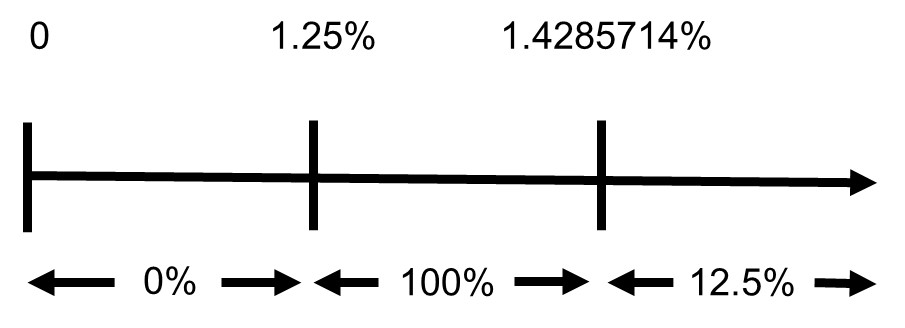
(ii)Capital Gains Incentive Fee
The second component of the Incentive Fee, the Capital Gains Incentive Fee, is payable in arrears at the end of each calendar year in an amount equal to 12.5% of cumulative realized capital gains from initial drawdown through the end of such calendar year, computed net of all realized capital losses and unrealized capital depreciation on a cumulative basis less the aggregate amount of any previously paid capital gains incentive fees.
We will accrue, but will not pay, a Capital Gains Incentive Fee with respect to unrealized appreciation because a Capital Gains Incentive Fee would be owed to the Adviser if we were to sell the relevant investment and realize a capital gain.
Notwithstanding the foregoing, if we are required by U.S. GAAP to record an investment at its fair value as of the time of acquisition instead of at the actual amount paid for such investment (including, for example, as a result of the application of the asset acquisition method of accounting), then solely for the purposes of calculating the capital gains incentive fee, the “accreted or amortized cost basis” of an investment shall be an amount (the “Contractual Cost Basis”) equal to (1) (x) the actual amount paid by us for such investment plus (y) any amounts recorded in the our financial statements as required by U.S. GAAP that are attributable to the accretion of such investment plus (z) any other adjustments made to the cost basis included in our financial statements, including payment-in-kind interest or additional amounts funded (net of repayments) minus (2) any amounts recorded in our financial statements as required by U.S. GAAP that are attributable to the amortization of such investment, whether such calculated Contractual Cost Basis is higher or lower than the fair value of such investment (as determined in accordance with U.S. GAAP) at the time of acquisition.
The fees that are payable under the Investment Advisory Agreement for any partial period will be appropriately prorated and adjusted for any share issuances or repurchases during the relevant period.
The Investment Advisory Agreement provides that the Adviser and its affiliates’ respective officers, managers, partners, agents, employees, controlling persons, members and any other person affiliated with the Adviser, including its general partner, are entitled to indemnification from us from and against any claims or liabilities, including reasonable legal fees and other expenses reasonably incurred, arising out of or in connection with the performance of any of the Adviser’s duties or obligations under the Investment Advisory Agreement or otherwise as our investment adviser, except where attributable to criminal conduct, willful misfeasance, bad faith or gross negligence in the performance of such person’s duties or reckless disregard of such person’s obligations and duties under the Investment Advisory Agreement.
Administration Agreement
On June 16, 2023, we entered into the Administration Agreement with the Adviser. Under the terms of the Administration Agreement the Adviser performs, or oversees the performance of, administrative services, which includes, but is not limited to, providing office facilities, equipment and office services, maintaining financial records, preparing reports to Stockholders and the
Board of Directors and reports filed with the SEC, managing the payment of expenses, providing significant managerial assistance to those portfolio companies to which we are required to provide such assistance, assisting us in determining and publishing (as necessary or appropriate) our net asset value and overseeing the preparation and filing of our tax returns and the performance of administrative and professional services rendered by others, which could include employees of the Adviser or its affiliates. We reimburse the Adviser (and/or one or more of its affiliates) for services performed for us pursuant to the terms of the Administration Agreement. In addition, pursuant to the terms of the Administration Agreement, the Adviser may delegate its obligations under the Administration Agreement to an affiliate and/or to a third party and we will reimburse the Adviser (or relevant affiliate(s)) for any services performed for us by such affiliate or third party. To the extent that the Adviser outsources any of its functions, we will pay the fees associated with such functions on a direct basis without profit to the Adviser. We bear our allocable portion of the costs of the compensation, benefits, administrative expenses (including travel expenses in accordance with the Adviser’s travel and expense policy) and related overhead expenses of the officers who provide operational, administrative, legal, compliance, finance and accounting services thereunder; their respective staffs; and other professionals who are employed by any of the Adviser’s affiliates that provide services to us, and that assist with the preparation, coordination and administration of the foregoing or provide other “back office” or “middle office” financial or operational services to us. We reimburse the Adviser (or its affiliate(s)) for an allocable portion of the compensation (including benefits) and overhead paid by the Adviser (or its affiliate(s)) to such individuals.
Unless earlier terminated as described below, the Administration Agreement will remain in effect from year to year if approved annually by a majority of the Board of Directors or by the holders of a Majority of the Outstanding Shares of Common Stock and, in each case, a majority of the independent directors. The Board of Directors most recently re-approved the Administration Agreement in May 2025. We may terminate the Administration Agreement, without payment of any penalty, upon 60 days’ written notice. The decision to terminate the agreement may be made by a majority of the Board of Directors or the Stockholders holding a Majority of the Outstanding Shares of Common Stock. In addition, the Adviser may terminate the Administration Agreement, without payment of any penalty, upon 60 days’ written notice.
The Administration Agreement provides that the Adviser and its affiliates’ respective officers, directors, members, managers, stockholders and employees are entitled to indemnification from us from and against any claims or liabilities, including reasonable legal fees and other expenses reasonably incurred, arising out of or in connection with our business and operations or any action taken or omitted on our behalf pursuant to authority granted by the Administration Agreement, except where attributable to willful misfeasance, bad faith or gross negligence in the performance of such person’s duties or reckless disregard of such person’s obligations and duties under the Administration Agreement.
Expense Support and Conditional Reimbursement Agreement
We entered into an Expense Support and Conditional Reimbursement Agreement (the “Expense Support Agreement”) with the Adviser on June 16, 2023, pursuant to which the Adviser may elect to pay certain of our expenses on our behalf (“Expense Payments”), provided that no portion of the payment will be used to pay any interest expense or distribution and/or shareholder servicing fees. As of December 31, 2025, the Adviser has elected to pay $3.6 million of the Company’s organization and offering expenses pursuant to the Expense Support Agreement, $3.6 million of which, as of December 31, 2025, has been paid and $3.6 million of which, as of December 31, 2025, has become a liability of the Company. Any Expense Payment that the Adviser commits to pay must be paid by the Adviser to us in any combination of cash or other immediately available funds no later than 45 days after such commitment is made in writing, and/or offset against amounts due from us to the Adviser or its affiliates.
Following any calendar quarter in which Available Operating Funds (as defined below) exceed the cumulative distributions accrued to our stockholders based on distributions declared with respect to record dates occurring in such calendar quarter (the amount of such excess referred to as “Excess Operating Funds”), we will pay such Excess Operating Funds, or a portion thereof, to the Adviser until such time as all Expense Payments made by the Adviser to us within three years prior to the last business day of such calendar quarter have been reimbursed. Any payments required to be made by us under the Expense Support Agreement are referred to as a “Reimbursement Payment.” “Available Operating Funds” means the sum of (i) our net investment company taxable income (including net short-term capital gains reduced by net long-term capital losses), (ii) our net capital gains (including the excess of net long-term capital gains over net short-term capital losses) and (iii) dividends and other distributions paid to us on account of investments in portfolio companies (to the extent such amounts listed in clause (iii) are not included under clauses (i) and (ii) above).
The amount of the Reimbursement Payment for any calendar quarter will equal the lesser of (i) the Excess Operating Funds in such quarter and (ii) the aggregate amount of all Expense Payments made by the Adviser to us within three years prior to the last business day of such calendar quarter that have not been previously reimbursed by us to the Adviser; provided that the Adviser may waive its right to receive all or a portion of any Reimbursement Payment in any particular calendar quarter, in which case such waived amount will remain unreimbursed Expense Payments reimbursable in future quarters pursuant to the terms of the Expense Support Agreement.
Our obligation to make a Reimbursement Payment will automatically become a liability on the last business day of the applicable calendar quarter, except to the extent the Adviser has waived its right to receive such payment for the applicable quarter. As of December 31, 2025, we have recognized a liability in the amount of $3.6 million with respect to Reimbursement Payments owed to the Adviser under the Expense Reimbursement Agreement included in Due to Adviser in the accompanying Consolidated Statements of Assets and Liabilities. The Reimbursement Payment for any calendar quarter will be paid by us to the Adviser in any combination of cash or other immediately available funds as promptly as possible following such calendar quarter and in no event later than 45 days after the end of such calendar quarter.
Either we or the Adviser may terminate the Expense Support Agreement at any time, with or without notice, without the payment of any penalty, provided that any Expense Payments that have not been reimbursed by us to the Adviser will remain our obligation following any such termination, subject to the terms of the Expense Support Agreement.
License Agreement
We have entered into a license agreement (the “License Agreement”) with Vista Equity Partners Management LLC (and any other relevant entities), pursuant to which we have been granted a non-exclusive license to use the name “Vista.” Under the License Agreement, we have a right to use the Vista name for so long as the Adviser or one of its affiliates remains our investment adviser. Other than with respect to this limited license, we will have no legal right to the “Vista” name or logo.
Employees
We do not currently have any employees and do not expect to have any employees. Services necessary for our business are provided by individuals who are employees of the Adviser or its affiliates, pursuant to the terms of the Investment Advisory Agreement and the Administration Agreement. Each of our executive officers are employed by the Adviser or its affiliates. Our day-to-day investment operations are managed by the Adviser. The services necessary for the origination and administration of our investment portfolio are provided by investment professionals employed by the Adviser or its affiliates. The VCP Investment Team will focus on origination and transaction development and the ongoing monitoring of our investments. In addition, we will reimburse the Adviser for our allocable portion of expenses incurred by it in performing its obligations under the Administration Agreement and the Investment Advisory Agreement, including our allocable portion of the cost of our officers and their respective staffs.
Board of Directors
Our Board of Directors currently consists of five members, three of whom are Independent Directors. The Board of Directors has established an Audit Committee and a Nominating and Corporate Governance Committee and may form additional committees in the future.
Competitive Advantages
Differentiated underwriting and diligence capabilities in the enterprise software sector
We leverage the industry knowledge, domain expertise and operating experience of the broader Vista platform to assist in underwriting and managing investments and investment opportunities. The VCP Investment Team has proprietary knowledge and insights obtained from the thousands of enterprise software, data and technology-enabled solutions businesses reviewed since Vista’s inception. Vista’s funds are actively in dialogue with, or invested in, technology-enabled solutions businesses of all stages and capitalization profiles, including (i) publicly listed companies or active debt issuers, and (ii) private companies ranging from companies with multibillion-dollar valuations to companies with recurring revenue profiles of as low as $10 million. The breadth of Vista’s platform also provides the VCP Investment Team with purview into the trends observed by the management teams, third-party investors, and other stakeholders of these sectors through the lens of varying business stages and cycles. As a result, we believe we are well-positioned to make informed decisions on valuation, competitive positioning and the risk profile of businesses exhibiting the recognizable traits of enterprise software workflows, which we believe will permit us to take advantage of opportunities that are not consistently viewed by other general market participants.
We utilize the services provided by the Vista Value Creation Team (“VCT”) to enhance our operational due diligence capabilities for certain investment opportunities. VCT team members have a mix of operational and consulting backgrounds. They are subject matter experts and focus on working closely with Vista’s portfolio companies. This captive capability allows Vista to control and refine the diligence process from end-to-end, enabling it to reduce its reliance on outside parties for critical review items, and further build what Vista believes is an institutional knowledge advantage over other market participants on how enterprise software businesses operate. We view VCT as an attractive, proprietary and valuable asset available to us for underwriting our investments, which enhances the depth and capabilities of the underwriting process and acumen of the team at large.
Favorable characteristics and long-term trends of the enterprise software sector
We believe that focusing on the enterprise software, data and technology-enabled business sector is a mandate that seeks to provide compelling risk-adjusted returns across a narrower band of outcomes rather than investing in the broader credit markets. The defensive nature of the software operating model is driven by mission criticality of enterprise solutions, highly recurring revenue models, strong customer and revenue retention dynamics, high gross margins coupled with significantly variable cost structures, high free cash flow generation once scaled, and an attractive collateral base.
In addition to its defensive characteristics, the enterprise software, data and technology-enabled business sector also serves virtually every end market, creating significant inherent end-market diversity within the target investment base. Many businesses in the sector tend to focus vertically and provide solutions that cater specifically to a given end market. We believe this focus and history of providing differentiating solutions based on a specific end market has led to their stability and longevity, as we believe that these businesses offer their customers attractive, industry-specific capabilities and functionality that are difficult to replace or substitute. Horizontally focused software-enabled services will typically have their own inherent industry diversification as they optimize specific workflows and then monetize this “better solution” across numerous customers in multiple industries. We believe this combination of end-market and end-customer diversification should serve to limit any single industry concentration risk or correlation with a key macro driver, such as a given commodity price or percentage share of consumer spending.
Proprietary and Differentiated Sourcing Model
The VCP Investment Team maintains extensive direct sourcing relationships across multiple channels, including directly with the management teams of companies, private equity sponsors and venture capital/growth equity firms, and also sources a meaningful number of opportunities through proprietary relationships or direct referrals from investment team members across the broader Vista platform. Across its history, VCP has benefited from referrals from other Vista colleagues for FounderDirect Lending, a part of Vista’s lending strategy that offers first-lien loans (with some equity component) directly to founder-run enterprise software companies, or transactions that are structured as first-lien loans (with some equity component). Since 2011, Vista has evaluated over 30,000 enterprise software, data and technology-enabled solutions company investment opportunities (as of September 30, 2025). We believe that this scale and breadth afford us the capability to source and identify far more opportunities for us than would otherwise be possible if we were a standalone credit manager.
As of December 31, 2025, Vista has approximately 200 investment professionals focused on enterprise software and software-related businesses; we believe that VCP, together with other teams across the Vista platform, equates to one of the largest software vertical sourcing capabilities when compared to any other private equity or private credit manager. Importantly, the VCP Investment Team also directly engages in dedicated venture capital and growth equity origination. As a result, VCP leverages a sourcing channel that is unique amongst private credit firms which traditionally rely solely on relationships with banks, venture capital firms, and sponsors.
Notwithstanding the above, the VCP Investment Team has established long-standing relationships with other lenders and private equity firms through decades of experience in the debt markets. We believe Vista is a preferred financing partner given its domain expertise and ability to provide scaled capital along with transaction certainty. VCP believes that Vista’s investment track record has earned Vista a distinguished reputation in the software industry, which results in high demand from institutions to work with Vista, including specifically VCP, such that when we invest in a transaction, we expect that it will be viewed as a positive signal to the market and other potential lenders, making it an attractive financing partner to private equity firms.
Market Opportunity
We believe the market environment is favorable to pursue an investment strategy that is primarily focused on technology and software-enabled corporate credit issuers in both the private credit market, in which loans are typically negotiated privately between an issuer and a small number of lenders, and the liquid credit market, which consists of broadly syndicated loans and other, more liquid credit investments. We believe that focusing on the software-enabled service industry is a mandate that enables us to provide compelling risk-adjusted returns across a narrower band of outcomes than investing in the broader credit markets. We believe that enterprise software services represent one of the key drivers of efficiency gains and innovation for businesses of all sizes over the last 50 years. We further believe the automation and workflow best practices offered by enterprise software are critical to virtually all industries throughout the global economy, and expect enterprise software to remain a key part of the infrastructure for these industries going forward.
Shifting Demand from Public to Private Markets
We believe there is an increasing trend of private software and technology companies staying private for longer, as well as both avoiding private equity ownership and increasing their valuations prior to going public. We believe this trend will fuel increased demand for debt or alternative financing solutions, which are less dilutive than traditional venture capital and growth
equity. We also believe that, particularly within the software industry, the need for capital solutions at late stage, mature and developed companies will continue to expand at a faster rate than the overall industry.
Increasing Demand for Alternative Financing Solutions in Non-Sponsored Companies
Within software credit, we have observed an increasing demand for loans among non-sponsored companies. These businesses are generally not pursuing a change of control transaction, but seek additional capital to support growth, finance an execution, secure liquidity to achieve a milestone on the path to an eventual IPO, or execute on other higher value, lower risk strategic initiatives. In these situations, founders may be reluctant to raise equity capital due to concerns around cost, dilution, or setting an interim valuation between equity raises. We believe the growth in the broader software market and preference for private companies to wait longer and grow larger prior to going public has driven an attendant increase in the demand for scaled, financing solutions across the capital structure for private software companies.
Sponsor Market Opportunity
We believe there is a large pool of committed but uninvested private equity capital for technology and software-enabled companies. We believe this substantial pool of investment capital will drive strong levels of sponsor-led buyout activity, which, in turn, will fuel demand for private credit.
Increased Addressable Markets and Broader Diversification Across Industries
We believe that the focus on the “digitization of the economy” leads to the incorporation of software-enabled services into an extensive collection of different industries. As software continues to displace existing hardware spend or traditional labor and service workflows, it is capturing additional investment resources from other areas of expense such as IT spend on hardware, resourcing for R&D or headcount. We believe that this increased level of investment resources budgeted for software-enabled services has (i) driven increased addressable markets and (ii) broadened diversification across industries, which in each case serve as tools that are either utilized “horizontally” by a wide range of stakeholders across many industries, or “vertically” in specific industries or markets that focus on particular niches.
Attractive Credit Attributions
Enterprise software and technology-enabled businesses possess attractive business models that generally drive consistent, predictable performance. Notably, contractual revenue basis, low fixed costs, and compelling unit economics drive attractive margin and free cash flow profiles. Because of these attractive attributes, lending into enterprise software and technology-enabled companies has typically had lower loan-to-values versus the broader market, resulting in attractive and durable positioning. Further, the asset base of enterprise software and technology-enabled businesses often has strategic value, namely through the intellectual property. In addition, we believe there is a large universe of strategic and corporate buyers for software and technology-enabled companies that provides downside protection and a “second way out” for investments in these companies and presents opportunities for us to participate in primary financing activity and refinancing of existing loan packages.
Investment Process Overview
VCP has developed and refined a disciplined, scalable process to source and evaluate potential investment opportunities, structure and execute those transactions and manage the investments and associated risk in an effort to deliver attractive returns to investors.
Sourcing
The VCP Investment Team maintains and develops direct sourcing relationships across key channels, including directly with the management teams of companies, private equity sponsors and venture capital/growth equity firms. VCP employs senior professionals focused exclusively on sourcing and structuring new investment ideas from private equity firms as well as venture capital and growth equity firms, who increasingly are looking for creative capital partners in follow-on financing events that can deliver differentiated financing products to later-stage growth companies. Since inception, VCP has closed transactions with approximately 70 private equity sponsors.
To complement the VCP Investment Team’s direct sourcing and market coverage models, VCP intends to source a meaningful number of opportunities for us from proprietary relationships or direct referrals from investment team members across Vista. Across its history, VCP has benefited from referrals from other Vista colleagues for FounderDirect Lending. In addition to referrals from other investment professionals within Vista, VCP leverages Vista’s network of over 960 intermediary relationships with institutions such as investment banks, financing advisors, and commercial banks to generate investment opportunities in the enterprise software, data and technology-enabled business sector. We believe that Vista’s investment track record has earned Vista a distinguished reputation in the software industry, which has led to high demand from institutions to work with Vista, including VCP specifically. In addition, VCP also intends to leverage Vista’s proprietary database that currently
includes several thousand software companies within Vista’s target market. Since 2011, Vista has evaluated over 30,000 enterprise software, data and technology-enabled solutions company investment opportunities across market capitalizations (as of September 30, 2025).
Vista believes that proper management of material environmental, social and governance (“ESG”) considerations can help create value for its stakeholders and help develop a sustainable, long-term strategy for its companies, including us. Vista is committed to ESG risk and opportunity management and best practices and maintains a Responsible Investment Policy for all its investment platforms which is made publicly available on its website.
Underwriting
All new potential investments are initially screened by a senior member of the VCP Investment Team for fit with the investment strategy. Viable opportunities are assigned to an internal deal team that completes a preliminary review of the available materials and conducts an initial credit assessment including identification of strengths, potential risks and mitigants, key questions and an evaluation of the structure to support a decision to decline or move forward to perform more detailed diligence and analysis. Transactions are initially brought up for discussion with the Adviser screening committee (the “Adviser Screening Committee”), which is comprised of a subset of senior members of the VCP Investment Team. The applicable deal team, together with the Adviser Screening Committee, decide whether to decline or move forward to perform more detailed diligence and analysis based on the preliminary review and findings. If the relevant deal team is supportive of the transaction, it will then commence full diligence to address the raised credit, structure and/or transaction issue(s), if any, among other typical diligence and underwriting procedures.
The underwriting and closing process typically takes three to eight weeks but may take longer depending on the size and complexity of the potential investment and the process or situation. Typical diligence often includes the participation in one or multiple management meetings or calls; review of investor presentations, investment memorandum, audits, historical financials and projection models; review of third-party diligence such as accounting reports, industry studies and/or customer calls; follow-up calls; and additional qualitative and quantitative analysis as necessary. However, the due diligence process for any particular investment varies and there can be no guarantee that each of the factors identified herein will be completed prior to making an investment. Upon completion of diligence, the relevant deal team will prepare a credit memorandum that summarizes the findings and makes a recommendation to the VCP Investment Committee for approval. After the VCP Investment Committee issues its final approval, the relevant deal team will issue a commitment in connection with the potential investment.
Structure of Investments
We seek to invest in primary issue debt financings for new platform investments, add-on acquisitions whereby the acquired companies will be integrated into existing portfolio companies, refinancings and recapitalization transactions, and may also make opportunistic purchases in the secondary market. We invest primarily in first-lien, unitranche, and second-lien debt facilities but maintain capital structure flexibility and may make investments in mezzanine debt and, in certain circumstances, preferred equity or common equity investments. A unitranche loan is a single loan that blends the characteristics of traditional first-lien, senior secured debt and traditional junior debt. We believe this flexibility allows us to make relative value investment decisions depending on the type of transaction and the credit merits of each underlying business.
The terms of the investments depend on the facts and circumstances of each transaction, market conditions and the credit attributes of a particular business. First-lien loans generally have terms of five to seven years, and second-lien and unitranche loans generally have terms of six to eight years, each typically with variable interest rates. VCP generally structures the investments to include affirmative covenants, which require certain actions on the part of the borrower, such as ongoing reporting requirements, negative covenants, which restrict the borrower from taking certain actions, such as limitations on debt incurrence, liens incurrence or restricted payments, and financial maintenance covenants, which require maintaining certain financial conditions. Such covenants are designed to minimize the risk of principal loss, and will seek to prioritize capital preservation in all investments, including, without limitation, those that are equity-linked or equity-like in nature. For FounderDirect investments, VCP often obtains the opportunity to generate return in excess of contractual returns associated with its credit investment through warrant participation. These warrant shares are often “struck” at a discount to VCP’s view of enterprise value, providing attractive upside convexity.
Portfolio and Risk Management
The Adviser monitors our portfolio companies on an ongoing basis. The Adviser monitors the financial trends of each portfolio company to determine if it is meeting its business plans and to assess the appropriate course of action with respect to our investment in each portfolio company. The Adviser has a number of methods of evaluating and monitoring the performance and fair value of our investments, which may include the following:
•assessment of success of the portfolio company in adhering to its business plan and compliance with covenants;
•periodic and regular contact with portfolio company management and, if appropriate, the financial or strategic sponsor, to discuss financial position, requirements and outlook;
•comparisons to other companies in the portfolio company’s industry;
•attendance at, and participation in, board meetings; and
•review of periodic financial statements and financial projections for portfolio companies.
Beyond the policies detailed above, the Adviser performs analyses and projections to assess potential exposure of the portfolio to variable macroeconomic factors and market conditions.
Frequency of review of individual loans is determined on a case-by-case basis, based on internal risk ratings as laid out below, total exposure and other criteria set forth by the Adviser. We have developed an internal risk policy which regularly assesses the risk profile of each investment and rates them based on the following categories, which are referred to as internal risk ratings. Internal risk ratings do not constitute any rating of investments by a nationally recognized statistical rating organization or represent or reflect any third-party assessment of any of our investments.
|
|
|
|
Internal Risk Rating |
|
Summary Description |
1 |
|
Investments with a grade of 1 involve the least amount of risk to our initial cost basis. The trends and risk factors for this investment since origination or acquisition are generally favorable, which may include the performance of the portfolio company or a potential exit. |
|
|
|
2 |
|
Investments with a grade of 2 involve a level of risk to our initial cost basis that is similar to the risk to our initial cost basis at the time of origination or acquisition. This portfolio company is generally performing as expected and/or unchanged; and the risk factors to our ability to ultimately recoup the cost of our investment are neutral to favorable. There is no concern about repayment of both interest and our costs basis. All investments or acquired investments in new portfolio companies are initially assessed a grade of 2. |
|
|
|
3 |
|
Investments with a grade of 3 indicate that the portfolio company is performing materially below expectations and the risk to our ability to recoup the initial cost basis of such investment has increased materially since origination or acquisition, including as a result of other factors such as non-compliance with debt covenants; however, payments are generally not more than 120 days past due. |
|
|
|
4 |
|
Investments with a grade of 4 indicate that the risk to our ability to recoup the initial cost basis of such investment has substantially increased since origination or acquisition, and the portfolio company likely has materially declining performance. For debt investments with an investment grade of 4, most or all of the debt covenants are out of compliance and payments are substantially delinquent. For investments graded 4, it is anticipated that we will not recoup our initial cost basis and may realize a substantial loss of our initial cost basis upon exit. |
Portfolio Composition
As of December 31, 2025 and 2024, the fair value of our investments was $1,468.2 million and $506.6 million, respectively, in 49 and 31 portfolio companies, respectively. The type, geography and industry compositions of our investments, each as a percentage of the fair value of our investments as of December 31, 2025 and 2024 were as follows:
|
|
|
|
|
|
|
|
|
|
|
|
As of |
|
Type - % of Fair Value |
|
December 31, 2025 |
|
|
December 31, 2024 |
|
First-lien debt |
|
|
97.2 |
% |
|
|
98.8 |
% |
Other equity |
|
|
2.7 |
|
|
|
0.9 |
|
Preferred equity |
|
|
0.1 |
|
|
|
0.3 |
|
Total |
|
|
100.0 |
% |
|
|
100.0 |
% |
|
|
|
|
|
|
|
|
|
|
|
|
As of |
|
Type - % of Fair Value of First-Lien Debt |
|
December 31, 2025 |
|
|
December 31, 2024 |
|
Floating |
|
|
99.3 |
% |
|
|
100.0 |
% |
Fixed |
|
|
0.7 |
|
|
|
- |
|
Total |
|
|
100.0 |
% |
|
|
100.0 |
% |
|
|
|
|
|
|
|
|
|
|
|
|
As of |
|
Industry - % of Fair Value |
|
December 31, 2025 |
|
|
December 31, 2024 |
|
Architecture, Construction & Engineering |
|
|
2.0 |
% |
|
|
0.0 |
% |
Automobiles & Automobile Parts |
|
|
4.1 |
|
|
|
5.8 |
|
Data & Analytics |
|
|
6.0 |
|
|
|
13.9 |
|
Diversified Business Services |
|
|
6.9 |
|
|
|
2.8 |
|
Diversified Consumer Services |
|
|
1.0 |
|
|
|
- |
|
Diversified Financial Institutions & Services |
|
|
8.0 |
|
|
|
3.4 |
|
Diversified Software |
|
|
7.4 |
|
|
|
6.5 |
|
Education |
|
|
1.3 |
|
|
|
- |
|
Financials |
|
|
0.1 |
|
|
|
- |
|
Government & Public Service |
|
|
3.1 |
|
|
|
4.4 |
|
Government, Risk & Compliance |
|
|
5.1 |
|
|
|
2.9 |
|
Healthcare IT & Technology |
|
|
10.4 |
|
|
|
3.0 |
|
Hotels, Restaurants & Leisure |
|
|
1.4 |
|
|
|
3.2 |
|
Infrastructure Software & DevOps |
|
|
3.9 |
|
|
|
3.9 |
|
Insurance |
|
|
5.0 |
|
|
|
5.5 |
|
IT Security |
|
|
5.7 |
|
|
|
3.3 |
|
IT Services & IT Systems Management (Ex-Security) |
|
|
11.7 |
|
|
|
16.9 |
|
Media, Entertainment & Publishing |
|
|
2.2 |
|
|
|
3.5 |
|
Real Estate |
|
|
3.2 |
|
|
|
4.7 |
|
Telecom Services & IT Hardware |
|
|
1.7 |
|
|
|
6.6 |
|
Transportation, Logistics & Supply Chain |
|
|
7.9 |
|
|
|
6.4 |
|
Utilities & Utility Equipment and Services |
|
|
1.9 |
|
|
|
3.3 |
|
Total |
|
|
100.0 |
% |
|
|
100.0 |
% |
|
|
|
|
|
|
|
|
|
|
|
|
As of |
|
Geography - % of Fair Value |
|
December 31, 2025 |
|
|
December 31, 2024 |
|
United States |
|
|
91.3 |
% |
|
|
90.8 |
% |
Canada |
|
|
1.9 |
|
|
|
- |
|
Luxembourg |
|
|
0.7 |
|
|
|
2.0 |
|
Netherlands |
|
|
4.7 |
|
|
|
3.2 |
|
Switzerland |
|
|
1.4 |
|
|
|
4.0 |
|
Total |
|
|
100.0 |
% |
|
|
100.0 |
% |
See the Consolidated Schedule of Investments as of December 31, 2025 in our consolidated financial statements in Part II, Item 8, of this Form 10-K for more information on these investments, including a list of companies and type, cost and fair value of investments.
Competition
Our primary competitors in providing financing to middle-market technology companies include other BDCs, public and private investment vehicles and insurance companies, as well as traditional financial services companies such as commercial banks, investment banks and other sources of funding. Many of our competitors are substantially larger and have considerably greater financial, technical, and marketing resources than we do. Many of these competitors have similar investment objectives to us, which may create additional competition for investment opportunities. Some competitors may have a lower cost of capital and access to funding sources that are not available to us, which may create competitive disadvantages for us with respect to our investment opportunities. In addition, some of our competitors may have higher risk tolerances or different risk assessments, which could allow them to consider a wider variety of investments and establish more relationships than us. Further, many of our competitors are not subject to the regulatory restrictions that the 1940 Act imposes on us as a BDC, or to the distribution and other requirements we must satisfy to qualify for RIC tax treatment. Lastly, institutional and individual investors are allocating
increasing amounts of capital to alternative investment strategies. See “Item 1A. Risk Factors—Risks Relating to Our Business—We may face increasing competition for investment opportunities, which could delay further deployment of our capital, reduce returns and result in losses.”
Regulation as a Business Development Company
The following discussion is a general summary of the material prohibitions and descriptions governing BDCs generally. It does not purport to be a complete description of all of the laws and regulations affecting BDCs.
Qualifying Assets. Under the 1940 Act, a BDC may not acquire any asset other than assets of the type listed in Section 55(a) of the 1940 Act, which are referred to as qualifying assets, unless, at the time the acquisition is made, qualifying assets represent at least 70% of the company’s total assets. The principal categories of qualifying assets relevant to our business are any of the following:
(a)Securities purchased in transactions not involving any public offering from the issuer of such securities, which issuer (subject to certain limited exceptions) is an eligible portfolio company, or from any person who is, or has been during the preceding 13 months, an affiliated person of an eligible portfolio company, or from any other person, subject to such rules as may be prescribed by the SEC. An eligible portfolio company is defined in the 1940 Act as any issuer which:
(i)is organized under the laws of, and has its principal place of business in, the United States;
(ii)is not an investment company (other than a small business investment company wholly owned by the BDC) or a company that would be an investment company but for certain exclusions under the 1940 Act; and
(iii)satisfies any of the following:
(1)does not have any class of securities that is traded on a national securities exchange;
(2)has a class of securities listed on a national securities exchange, but has an aggregate market value of outstanding voting and non-voting common equity of less than $250 million;
(3)is controlled by a BDC or a group of companies including a BDC and the BDC has an affiliated person who is a director of the eligible portfolio company; or
(4)is a small and solvent company having total assets of not more than $4 million and capital and surplus of not less than $2 million.
(b)Securities of any eligible portfolio company controlled by us.
(c)Securities purchased in a private transaction from a U.S. issuer that is not an investment company or from an affiliated person of the issuer, or in transactions incident thereto, if the issuer is in bankruptcy and subject to reorganization or if the issuer, immediately prior to the purchase of its securities was unable to meet its obligations as they came due without material assistance other than conventional lending or financing arrangements.
(d)Securities of an eligible portfolio company purchased from any person in a private transaction if there is no ready market for such securities and we already own 60% of the outstanding equity of the eligible portfolio company.
(e)Securities received in exchange for or distributed on or with respect to securities described in (1) through (4) above, or pursuant to the exercise of warrants or rights relating to such securities.
(f)Cash, cash equivalents, U.S. government securities or high-quality debt securities maturing in one year or less from the time of investment.
Control, as defined by the 1940 Act, is presumed to exist where a BDC beneficially owns more than 25% of the outstanding voting securities of the portfolio company, but may exist in other circumstances based on the facts and circumstances.
The regulations defining qualifying assets may change over time. We may adjust our investment focus as needed to comply with and/or take advantage of any regulatory, legislative, administrative or judicial actions.
Managerial Assistance to Portfolio Companies. A BDC must have been organized and have its principal place of business in the United States and must be operated for the purpose of making investments in the types of securities described above. However, in order to count portfolio securities as qualifying assets for the purpose of the 70% test, the BDC must either control the issuer of the securities or must offer to make available to the issuer of the securities (other than small and solvent companies described above) significant managerial assistance; except that, where the BDC purchases such securities in conjunction with one or more other persons acting together, one of the other persons in the group may make available such managerial assistance. Making available significant managerial assistance means, among other things, any arrangement whereby the BDC, through its directors, officers or
employees, offers to provide and, if accepted, does so provide, significant guidance and counsel concerning the management, operations or business objectives and policies of a portfolio company through monitoring of portfolio company operations, selective participation in board and management meetings, consulting with and advising a portfolio company’s officers or other organizational or financial guidance.
Temporary Investments. Pending investment in other types of qualifying assets, as described above, our investments could consist of cash, cash equivalents, U.S. government securities or high-quality debt securities maturing in one year or less from the time of investment, which are referred to herein, collectively, as temporary investments, so that 70% of our assets would be qualifying assets. We may invest in highly rated commercial paper, U.S. government agency notes, U.S. Treasury bills or in repurchase agreements relating to such securities that are fully collateralized by cash or securities issued by the U.S. government or its agencies. A repurchase agreement involves the purchase by an investor, such as us, of a specified security and the simultaneous agreement by the seller to repurchase it at an agreed-upon future date and at a price that is greater than the purchase price by an amount that reflects an agreed-upon interest rate. Consequently, repurchase agreements are functionally similar to loans. There is no percentage restriction on the proportion of our assets that may be invested in such repurchase agreements. However, the 1940 Act and certain diversification tests in order to qualify as a RIC for federal income tax purposes typically require us to limit the amount we invest with any one counterparty. Accordingly, we do not intend to enter into repurchase agreements with a single counterparty in excess of this limit. The Adviser will monitor the creditworthiness of the counterparties with which we may enter into repurchase agreement transactions.
Warrants. Under the 1940 Act, a BDC is subject to restrictions on the issuance, terms and amount of warrants, options or rights to purchase shares of capital stock that it may have outstanding at any time. Under the 1940 Act, we may generally only offer warrants provided that (i) the warrants expire by their terms within 10 years, (ii) the exercise or conversion price is not less than the current market value at the date of issuance, (iii) Stockholders authorize the proposal to issue such warrants, and the Board of Directors approves such issuance on the basis that the issuance is in our and the Stockholders’ best interests and (iv) if the warrants are accompanied by other securities, the warrants are not separately transferable unless no class of such warrants and the securities accompanying them has been publicly distributed.
Senior Securities; Asset Coverage Ratio. We are generally permitted, under specified conditions, to issue multiple classes of indebtedness and one class of stock senior to the Common Stock if our asset coverage, as defined in the 1940 Act, would be at least equal to 200% immediately after each such issuance. However, recent legislation has modified the 1940 Act by allowing a BDC to increase the maximum amount of leverage it may incur from an asset coverage ratio of 200% to an asset coverage ratio of 150%, if certain requirements are met. On June 16, 2023, our Stockholders approved a proposal that allows us to reduce our asset coverage ratio to 150%, which proposal was effective as of June 17, 2023. This means that generally, we can borrow up to $2 for every $1 of investor equity. In connection with their Subscription Agreements, our Stockholders are required to acknowledge our ability to operate with an asset coverage ratio that may be as low as 150%.
In addition, while any senior securities remain outstanding, we would be required to make provisions to prohibit any dividend distribution to Stockholders or the repurchase of such securities or shares unless it meets the applicable asset coverage ratios at the time of the dividend distribution or repurchase. We would also be permitted to borrow amounts up to 5% of the value of our total assets for temporary or emergency purposes, which borrowings would not be considered senior securities.
Code of Ethics. We and the Adviser have each adopted a code of ethics pursuant to Rule 17j-1 under the 1940 Act and Rule 204A-1 under the Advisers Act, respectively, that establishes procedures for personal investments and restricts certain personal securities transactions. Personnel subject to the code are permitted to invest in securities for their personal investment accounts, including securities that may be purchased or held by us, so long as such investments are made in accordance with the code’s requirements.
Affiliated Transactions. The 1940 Act contains prohibitions and restrictions relating to transactions between BDCs and their affiliates (including any investment advisers or sub-advisers), principal underwriters and affiliates of those affiliates or underwriters without prior approval of the directors who are not interested persons, and in some cases, the prior approval of the SEC. We rely on exemptive relief that was granted by the SEC on July 8, 2025 to allow us to co-invest with other entities and accounts managed or controlled by the Adviser or its affiliates in a manner consistent with our investment objective, positions, policies, strategies and restrictions as well as regulatory requirements and other pertinent factors. Pursuant to such exemptive relief, we are permitted to co-invest with certain of our affiliates pursuant to the conditions of the exemptive order, including that the participants in such co-investment transaction acquire or dispose of the same class of securities, at the same time, for the same price and with the same conversion, financial reporting and registration rights, and with substantially the same other terms. In certain cases where an existing or future investment fund or account managed by Vista or any of its affiliates has a pre-existing investment in an issuer in which we and such other investment funds or accounts will co-invest, a “required majority” (as defined in Section 57(o) of the 1940 Act) of our Board of Directors will be required to take steps set forth in Section 57(f) of the 1940 Act, including approving the transaction on the basis that, in relevant part, (i) the terms of the transaction, including the consideration to be paid or received, are reasonable and fair to the Stockholders and do not involve overreaching of us or Stockholders on the part of any person concerned; (ii) the
proposed transaction is consistent with the interests of our Stockholders and our policy as recited in filings made by us with the SEC and our reports to Stockholders; and (iii) the Board of Directors record in their minutes and preserve in their records a description of the transaction, their findings, the information or materials upon which their findings were based, and the basis for their findings. The Adviser’s co-investment policy incorporates the conditions of the exemptive relief and seeks to ensure equitable allocation of investment opportunities between us and other funds managed by the Adviser or its affiliates. As a result of exemptive relief, there could be significant overlap in our investment portfolio and the investment portfolios of other funds established by the Adviser that could avail themselves of the exemptive relief.
Cancellation of the Investment Advisory Agreement. The Investment Advisory Agreement will automatically terminate within the meaning of the 1940 Act and related SEC guidance and interpretations in the event of its assignment. In accordance with the 1940 Act, without payment of penalty, we may terminate the Investment Advisory Agreement with the Adviser upon 60 days’ written notice. The decision to terminate the agreement may be made by a majority of the Board of Directors or the Stockholders holding a Majority of the Outstanding Shares of Common Stock. In addition, without payment of penalty, the Adviser may generally terminate the Investment Advisory Agreement upon 60 days’ written notice. Unless terminated earlier as described above, the Investment Advisory Agreement will remain in effect for a period of two years from the date it first became effective (June 16, 2023), and will remain in effect from year to year thereafter if approved annually by our Board of Directors or by the affirmative vote of the holders of a Majority of the Outstanding Shares of Common Stock, and, in either case, if also approved by a majority of our directors who are not “interested persons” as defined in the 1940 Act.
Other. We have adopted an investment policy that complies with the requirements applicable to us as a BDC. We expect to be periodically examined by the SEC for compliance with the 1940 Act, and are subject to the periodic reporting and related requirements of the 1934 Act.
We are also required to provide and maintain a bond issued by a reputable fidelity insurance company to protect against larceny and embezzlement. Furthermore, as a BDC, we are prohibited from protecting any director or officer against any liability to our Stockholders arising from willful misfeasance, bad faith, gross negligence or reckless disregard of the duties involved in the conduct of such person’s office.
We are also required to designate a chief compliance officer and to adopt and implement written policies and procedures reasonably designed to prevent violation of the federal securities laws and to review these policies and procedures annually for their adequacy and the effectiveness of their implementation.
We are not permitted to change the nature of our business so as to cease to be, or to withdraw our election as, a BDC unless approved by a Majority of the Outstanding Shares of Common Stock.
We are not generally able to issue and sell Common Stock at a price below net asset value per share. We may, however, issue and sell Common Stock, or warrants, options or rights to acquire Common Stock, at a price below the then-current net asset value of Common Stock if (1) the Board of Directors determines that such sale is in our best interests and the best interests of our Stockholders, and (2) our Stockholders have approved our policy and practice of making such sales within the preceding 12 months. In any such case, the price at which our securities are to be issued and sold may not be less than a price which, in the determination of the Board of Directors, closely approximates the market value of such securities.
We may invest up to 100% of our assets in securities acquired directly from issuers in privately negotiated transactions. With respect to such securities, we may, for the purpose of public resale, be deemed an “underwriter” as that term is defined in the 1933 Act.
Our intention is to not write (sell) or buy put or call options to manage risks associated with the publicly traded securities of our portfolio companies, except that we may enter into hedging transactions to manage the risks associated with interest rate or currency fluctuations. However, we may purchase or otherwise receive warrants to purchase the common stock of our portfolio companies in connection with acquisition financing or other investments. Similarly, in connection with an acquisition, we may acquire rights to require the issuers of acquired securities or their affiliates to repurchase them under certain circumstances.
We also do not intend to acquire securities issued by any investment company that exceed the limits imposed by the 1940 Act. Under these limits, except for registered money market funds, we generally cannot acquire more than 3% of the voting stock of any registered investment company, invest more than 5% of the value of our total assets in the securities of one investment company, or invest more than 10% of the value of our total assets in the securities of more than one investment company. With regard to that portion of our portfolio invested in securities issued by investment companies, if any, it should be noted that such investments might subject Stockholders to additional expenses as they will be indirectly responsible for the costs and expenses of such companies.
Proxy Voting Policies and Procedures
We have delegated our proxy voting responsibility to the Adviser. The proxy voting policies and procedures of the Adviser are set out below. The guidelines are reviewed periodically by the Adviser and our directors who are not “interested persons,” and, accordingly, are subject to change. For purposes of these proxy voting policies and procedures described below, “we,” “our” and “us” refer to the Adviser.
As an investment adviser registered under the Adviser Act, we have a fiduciary duty to act solely in the best interests of our clients. As part of this duty, we recognize that we must vote client securities in a timely manner free of conflicts of interest and in the best interests of our clients.
These policies and procedures for voting proxies for our investment advisory clients are intended to comply with Section 206 of, and Rule 206(4)-6 under, the Advisers Act.
Proxy Policies
As an investment adviser registered under the Advisers Act, we have a fiduciary duty to act solely in the best interests of our clients. As part of this duty, we recognize that we must vote client securities in a timely manner free of conflicts of interest and in the best interests of our clients.
These policies and procedures for voting proxies for our investment advisory clients are intended to comply with Section 206 of, and Rule 206(4)-6 promulgated under, the Advisers Act.
We will vote proxies relating to our clients’ securities in the best interest of our clients’ Stockholders. We will review on a case-by-case basis each proposal submitted for a Stockholder vote to determine its impact on the portfolio securities held by our clients. Although we will generally vote against proposals that may have a negative impact on our clients’ portfolio securities, we may vote for such a proposal if there exists compelling long-term reasons to do so.
Our proxy voting decisions are made by the senior officers who are responsible for monitoring each of our clients’ investments. To ensure that our vote is not the product of a conflict of interest, we require that: (a) anyone involved in the decision-making process disclose to our chief compliance officer any potential conflict that he or she is aware of and any contact that he or she has had with any interested party regarding a proxy vote; and (b) employees involved in the decision making process or vote administration are prohibited from revealing how we intend to vote on a proposal in order to reduce any attempted influence from interested parties.
Proxy Voting Records
Stockholders may obtain information about how the Adviser voted proxies by making a written request for proxy voting information to: Vista Credit Strategic Lending Corp., Attention: Ken Burke, 50 Hudson Yards, Floor 77, New York, NY 10001.
Privacy Policy
We are committed to maintaining the confidentiality, integrity and security of personal information relating to Stockholders. The following information is provided to help Stockholders understand what personal information we may collect, how we seek to protect that information and why, in certain cases, we may share such personal information with select other parties.
Generally, we do not collect any personal information relating to our Stockholders, other than name, address, and number of shares held by the Stockholder. This information is used only so that we can service our Stockholder’s account, send annual reports, proxy statements, and other information required by law. With regard to this information, we maintain physical, electronic and procedural safeguards designed to protect the personal information of our Stockholders.
We may share certain personal information that we collect regarding a Stockholder with certain of our service providers in compliance with applicable data protection, privacy, cybersecurity and/or information security laws and regulations (collectively, the “Privacy Laws”), for example, in order to process trades or mail information to Stockholders. In addition, we may disclose certain personal information that we collect regarding a Stockholder as required by applicable law or in connection with regulatory or law enforcement inquiries. We have prepared privacy notices (which will apply depending on the applicable Privacy Laws and are made available to Stockholders), which provide further information regarding the personal information collected and used, and the purposes for which such personal information is processed.
Reporting Obligations
We furnish our Stockholders with annual reports containing audited financial statements, quarterly reports, and such other periodic reports as we determine to be appropriate or as may be required by law. We are required to comply with all periodic reporting, proxy solicitation and other applicable requirements under the 1934 Act.
The SEC maintains an internet site that contains reports, proxy and information statements, and other information regarding issuers that file electronically with the SEC at www.sec.gov. Stockholders and the public may view the materials we file with the SEC through its website and on our website free of charge. The reference to our website, www.vistastrategiclending.com, is an inactive textual reference only and the information contained on our website is not a part of this Form 10-K.
Taxation as a Regulated Investment Company
We have elected to be treated and intend to operate in a manner so as to continuously qualify each year as a RIC. As a RIC, we generally will not have to pay corporate-level U.S. federal income taxes on any ordinary income or capital gains that we timely distribute (or are deemed to distribute) to the Stockholders as dividends. Instead, dividends we timely distribute (or are deemed to distribute) generally will be taxable to Stockholders, and any net operating losses, foreign tax credits and most other tax attributes generally will not pass through to Stockholders. We will be subject to tax on any undistributed income and gains at the regular U.S. corporate income tax rates. To qualify as a RIC, we must, among other things, meet certain source-of-income and asset diversification requirements (as described below). In addition, in order to obtain RIC tax benefits, we must distribute to our Stockholders, for each taxable year, at least 90% of our “investment company taxable income,” which is generally our ordinary income plus the excess of realized net short-term capital gains over realized net long-term capital losses (the “Annual Distribution Requirement”).
If we:
•satisfy the Annual Distribution Requirement,
then we will not be subject to U.S. federal income tax on the portion of our investment company taxable income and net capital gain (realized net long-term capital gain in excess of realized net short-term capital loss) we distribute (or are deemed to distribute) to Stockholders. We will be subject to U.S. federal income tax at the regular U.S. corporate income tax rates on any income or capital gains not distributed (or deemed distributed) to our Stockholders.
We will be subject to a 4% nondeductible U.S. federal excise tax on certain undistributed income unless we distribute in a timely manner an amount at least equal to the sum of (i) 98% of our net ordinary income for each calendar year, (ii) 98.2% of the amount by which our capital gains exceed our capital losses (adjusted for certain ordinary losses) for the one-year period ending October 31 in that calendar year and (iii) certain undistributed amounts from previous years on which we paid no U.S. federal income tax (the “Excise Tax Avoidance Requirement”). We may be liable for the excise tax only on the amount by which we do not meet the foregoing distribution requirement. Although we generally intend to operate so as to meet the Excise Tax Avoidance Requirement, no assurances can be provided in this regard and we may be required to pay the excise tax on a portion of our income.
In order to qualify as a RIC for U.S. federal income tax purposes, we must, among other things:
•qualify to be treated as a BDC under the 1940 Act at all times during each taxable year;
•derive in each taxable year at least 90% of our gross income from (a) dividends, interest, payments with respect to loans of certain securities, gains from the sale of stock or other securities or foreign currencies, net income from certain “qualified publicly traded partnerships,” or other income derived with respect to our business of investing in such stock, foreign currencies or securities or (b) net income derived from an interest in a “qualified publicly traded partnership” or “QPTP” (the “90% Income Test”); and
•diversify our holdings so that at the end of each quarter of the taxable year:
•at least 50% of the value of our assets consists of cash, cash equivalents, U.S. government securities, securities of other RICs and other securities if such other securities of any one issuer do not represent more than 5% of the value of our assets or more than 10% of the outstanding voting securities of the issuer; and
•no more than 25% of the value of our assets is invested in the (i) securities, other than U.S. government securities or securities of other RICs, of one issuer, (ii) securities of two or more issuers that are controlled, as determined under applicable Code rules, by us and that are engaged in the same or similar or related trades or businesses or (iii) securities of one or more QPTPs (the “Diversification Tests”).
Our qualification and taxation as a RIC depends upon our ability to satisfy on a continuing basis, through actual, annual operating results, distribution, income and asset, and other requirements imposed under the Code. However, no assurance can be given that we will be able to meet the complex and varied tests required to qualify as a RIC or to avoid corporate level tax. In addition, because the relevant laws may change, compliance with one or more of the RIC requirements may be impossible or impracticable.
We may invest in partnerships, including QPTPs, which may result in our being subject to state, local or foreign income, franchise or other tax liabilities. For the purpose of determining whether we satisfy the 90% Income Test and the Diversification Tests described above, the character of our distributive share of items of income, gain, losses, deductions and credits derived through any investments in companies that are treated as partnerships for U.S. federal income tax purposes (other than certain publicly traded partnerships), or are treated as disregarded as separate from us for U.S. federal income tax purposes, generally will be determined as if we realized these tax items directly. Further, for purposes of calculating the value of our investment in the securities of an issuer for purposes of determining the 25% requirement described above, our proper proportion of any investment in the securities of that issuer that are held by a member of our “controlled group” must be aggregated with our investment in that issuer. A controlled group is one or more chains of corporations connected through stock ownership with us if (a) at least 80% of the total combined voting power of all classes of voting stock of each of the corporations is owned directly by one or more of the other corporations, and (b) we directly own at least 80% or more of the combined voting stock of at least one of the other corporations.
We may be required to recognize taxable income for U.S. federal income tax purposes in circumstances in which we do not receive a corresponding payment in cash. For example, if we hold debt obligations that are treated under applicable tax rules as having original issue discount (such as debt instruments with PIK interest or, in certain cases, debt instruments that have increasing interest rates or that are issued with warrants), we must include in income each year a portion of the original issue discount that accrues over the life of the obligation, regardless of whether cash representing such income is received by us in the same taxable year. We may also have to include in income other amounts that we have not yet received in cash, such as PIK interest and deferred loan origination fees that are paid after origination of the loan. Because any original issue discount or other amounts accrued will be included in our investment company taxable income for the taxable year of accrual, we may be required to make a distribution to our Stockholders in order to satisfy the Annual Distribution Requirement, even though we will not have received the corresponding cash amount. We may have other investments, either directly or through one or more partnerships in which we invest, that require income to be included in investment company taxable income in a year prior to the year in which we actually receive a corresponding amount of cash in respect of such income.
Although we do not presently expect to do so, we are authorized to borrow funds, to sell assets and to make taxable distributions of our stock and debt securities in order to satisfy distribution requirements. Our ability to dispose of assets to meet our distribution requirements may be limited by (i) the illiquid nature of our portfolio and/or (ii) other requirements relating to our status as a RIC, including the Diversification Tests. If we dispose of assets in order to meet the Annual Distribution Requirement or the Excise Tax Avoidance Requirement, we may make such dispositions at times that, from an investment standpoint, are not advantageous. If we are unable to obtain cash from other sources to satisfy the Annual Distribution Requirement, we may fail to qualify for tax treatment as a RIC and become subject to tax on all of our taxable income (including our net capital gains) at regular U.S. corporate income tax rates
Under the 1940 Act, we are not permitted to make distributions to our Stockholders while our debt obligations and other senior securities are outstanding unless certain “asset coverage” tests are met. If we are prohibited from making distributions, we may fail to qualify for tax treatment as a RIC and become subject to tax on all of our taxable income (including our net capital gains) at regular U.S. corporate income tax rates or subject to the 4% excise tax on our undistributed income.
Certain of our investment practices may be subject to special and complex U.S. federal income tax provisions that may, among other things: (i) disallow, suspend or otherwise limit the allowance of certain losses or deductions; (ii) convert currently lower taxed long-term capital gain into higher taxed short-term capital gain or ordinary income (as compared to non-corporate taxpayers); (iii) convert an ordinary loss or a deduction into a capital loss (the deductibility of which is more limited); (iv) cause us to recognize income or gain without a corresponding receipt of cash; (v) adversely affect the time as to when a purchase or sale of securities is deemed to occur; (vi) adversely alter the characterization of certain complex financial transactions; (vii) treat dividends that would otherwise constitute qualified dividend income as non-qualified dividend income; and (viii) produce income that will not be qualifying income for purposes of the 90% Income Test described above. We will monitor our transactions and may make certain tax decisions in order to mitigate the potential adverse effect of these provisions; however, no assurance can be given that we will be eligible for any such tax elections or that any elections we make will fully mitigate the effects of these provisions.
A RIC is limited in its ability to deduct expenses in excess of its “investment company taxable income” (which is, generally, ordinary income plus the excess of net short-term capital gains over net long-term capital losses). If our expenses in a given year exceed investment company taxable income, we may experience a net operating loss for that year. However, a RIC is not permitted to carry forward net operating losses to subsequent years and such net operating losses do not pass through to its stockholders. In addition, deductible expenses can be used only to offset investment company taxable income, not net capital gain. A RIC may not use any net capital losses (that is, the excess of realized capital losses over realized capital gains) to offset its investment company
taxable income, but may carry forward such net capital losses, and use them to offset future capital gains, indefinitely. Due to these limits on the deductibility of expenses, we may, for tax purposes, have aggregate taxable income for several years that we are required to distribute and that is taxable to our Stockholders even if such income is greater than the aggregate net income we actually earned during those years. Such required distributions may be made from our cash assets or by liquidation of investments, if necessary. We may realize gains or losses from such liquidations. In the event we realize net capital gains from such transactions, a Stockholder may receive a larger capital gain distribution than it would have received in the absence of such transactions.
Investment income received from sources within foreign countries, or capital gains earned by investing in securities of foreign issuers, may be subject to foreign income taxes withheld at the source. In this regard, withholding tax rates in countries with which the United States does not have a tax treaty can be as high as 35% or more. The United States has entered into tax treaties with many foreign countries that may entitle us to a reduced rate of tax or exemption from tax on this related income and gains. The effective rate of foreign tax cannot be determined at this time since the amount of our assets to be invested within various countries is not now known. We do not anticipate being eligible for the special election that allows a RIC to treat foreign income taxes paid by such RIC as paid by its stockholders.
If we purchase shares in a “passive foreign investment company,” or PFIC, we may be subject to U.S. federal income tax on a portion of any “excess distribution” or gain from the disposition of such shares even if such income is distributed as a taxable dividend by us to our Stockholders. Additional charges in the nature of interest may be imposed on us in respect of deferred taxes arising from such distributions or gains. If we invest in a PFIC and elect to treat the PFIC as a “qualified electing fund” under the Code, or QEF, in lieu of the foregoing requirements, we will be required to include in income each year a portion of the ordinary earnings and net capital gain of the QEF, even if such income is not distributed to us. Alternatively, we can elect to mark-to-market at the end of each taxable year our shares in a PFIC; in this case, we will recognize as ordinary income any increase in the value of such shares and as ordinary loss any decrease in such value to the extent we do not exceed prior increases included in income. Our ability to make either election will depend on factors beyond our control, and we are subject to restrictions that may limit the availability or benefit of these elections. Under either election, we may be required to recognize in a year income in excess of our distributions from PFICs and our proceeds from dispositions of PFIC stock during that year, and such income will nevertheless be subject to the Annual Distribution Requirement and will be taken into account for purposes of the 4% U.S. federal excise tax.
If we hold more than 10% of the shares in a foreign corporation that is treated as a CFC, we may be treated as receiving a deemed distribution (taxable as ordinary income or, if eligible, the preferential rates that apply to “qualified dividend income”) each year from such foreign corporation in an amount equal to its pro rata share of the foreign corporation’s income for the tax year (including both ordinary earnings and capital gains), whether or not the foreign corporation makes an actual distribution during such year. This deemed distribution is required to be included in the income of a U.S. shareholder of a CFC regardless of whether the shareholder has made a QEF election with respect to such CFC (as discussed above). In general, a foreign corporation will be classified as a CFC if more than 50% of the shares of the corporation, measured by reference to combined voting power or value, is owned (directly, indirectly or by attribution) by 10% U.S. shareholders. A “10% U.S. shareholder,” for this purpose, is any U.S. person that possesses (actually or constructively) 10% or more of the combined value or voting power of all classes of shares of a corporation. If we are treated as receiving a deemed distribution from a CFC, we will be required to include such distribution in its investment company taxable income regardless of whether we receive any actual distributions from such CFC, and we must distribute such income to satisfy the Annual Distribution Requirement and the Excise Tax Avoidance Requirement. Income inclusions from a foreign corporation that is a CFC are “good income” for purposes of the 90% Income Test regardless of whether we receive timely distributions of such income from the foreign corporation.
Foreign exchange gains and losses realized by us in connection with certain transactions involving non-dollar debt securities, certain foreign currency futures contracts, foreign currency option contracts, foreign currency forward contracts, foreign currencies, or payables or receivables denominated in a foreign currency are subject to Code provisions that generally treat such gains and losses as ordinary income and losses and may affect the amount, timing and character of distributions to our Stockholders. Any such transactions that are not directly related to our investment in securities (possibly including speculative currency positions or currency derivatives not used for hedging purposes) could, under future Treasury regulations, produce income not among the types of “qualifying income” from which a RIC must derive at least 90% of its annual gross income.
If we fail to satisfy the 90% Income Test for any taxable year or the Diversification Tests for any quarter of the taxable year, we may still continue to be taxed as a RIC for the relevant taxable year if we are eligible for relief provisions if the failures are due to reasonable cause and not willful neglect and if a penalty tax is paid with respect to each failure to satisfy the applicable requirements. Additionally, relief is provided for certain de minimis failures of the diversification requirements where we correct the failure within a specified period. If the applicable relief provisions are not available or cannot be met, all of our income would be subject to corporate-level income tax as described below. We cannot provide assurance that we would qualify for any such relief should we fail the 90% Income Test or the Diversification Tests.
If we have previously qualified as a RIC, but were subsequently unable to qualify for treatment as a RIC, and certain relief provisions (as discussed above) are not applicable, we would be subject to tax on all of our taxable income (including our net capital
gains) at regular U.S. corporate income tax rates. We would not be able to deduct distributions to Stockholders, nor would distributions be required to be made. Distributions, including distributions of net long-term capital gain, would generally be taxable to our Stockholders as ordinary dividend income to the extent of our current and accumulated earnings and profits. Subject to certain limitations under the Code, corporate Stockholders would be eligible to claim a dividend received deduction with respect to such dividend; non-corporate Stockholders would generally be able to treat such dividends as “qualified dividend income,” which is subject to reduced rates of U.S. federal income tax. Distributions in excess of our current and accumulated earnings and profits would be treated first as a return of capital to the extent of the Stockholder’s tax basis, and any remaining distributions would be treated as a capital gain. In order to requalify as a RIC, in addition to the other requirements discussed above, we would be required to distribute all of our previously undistributed earnings attributable to the period we failed to qualify as a RIC by the end of the first year that we intend to requalify as a RIC. If we fail to requalify as a RIC for a period greater than two taxable years and then seek to requalify as a RIC, we may be required to pay corporate-level tax on the unrealized appreciation recognized during the succeeding five-year period unless we make a special election to recognize gain to the extent of any unrealized appreciation in our assets at the time of requalification.
Our qualification and taxation as a RIC depends upon our ability to satisfy on a continuing basis, through actual, annual operating results, distribution, income and asset, and other requirements imposed under the Code. However, no assurance can be given that we will be able to meet the complex and varied tests required to qualify as a RIC or to avoid corporate level tax. In addition, because the relevant laws may change, compliance with one or more of the RIC requirements may be impossible or impracticable. Although we expect to operate in a manner so as to qualify continuously as a RIC, we or our investment adviser may decide in the future that we should be taxed as a C corporation, even if we would otherwise qualify as a RIC, if we determine that treatment as a C corporation for a particular year would be in our best interest.
The remainder of this discussion assumes that we qualify as a RIC for each taxable year.
Taxation of U.S. Stockholders
Our distributions generally are taxable to U.S. Stockholders as ordinary income or capital gains. Distributions of our “investment company taxable income” (which is, generally, our net ordinary income plus realized net short-term capital gains in excess of realized net long-term capital losses) will be taxable as ordinary income to U.S. Stockholders to the extent of our current or accumulated earnings and profits, whether paid in cash or reinvested in additional Common Stock. To the extent such distributions paid by us to Stockholders taxed at individual rates are attributable to dividends from U.S. corporations and certain qualified foreign corporations and if certain holding period requirements are met, such distributions (“Qualifying Dividends”) may be eligible for a current maximum tax rate of 20% applicable to long-term capital gains. In this regard, it is anticipated that distributions paid by us will generally not be attributable to dividends and, therefore, generally will not qualify for the 20% maximum rate applicable to Qualifying Dividends. Distributions of our net capital gains (which are generally our realized net long-term capital gains in excess of realized net short-term capital losses) properly reported by us as “capital gain dividends” will be taxable to a U.S. Stockholder as long-term capital gains that are currently taxable at a maximum rate of 20% in the case of Stockholders taxed at individual rates, regardless of the U.S. Stockholder’s holding period for his, her or its Common Stock and regardless of whether paid in cash or reinvested in additional Common Stock. Distributions in excess of our earnings and profits first will reduce a U.S. Stockholder’s adjusted tax basis in such Stockholder’s Common Stock and, after the adjusted basis is reduced to zero, will constitute capital gains to such U.S. Stockholder.
We may retain some or all of our realized net long-term capital gains in excess of realized net short-term capital losses, but designate the retained net capital gain as a “deemed distribution.” In that case, among other consequences, we will pay tax on the retained amount, each U.S. Stockholder will be required to include his, her or its share of the deemed distribution in income as if it had been actually distributed to the U.S. Stockholder, and the U.S. Stockholder will be entitled to claim a credit equal to his, her or its allocable share of the tax we paid thereon. Because we expect to pay tax on any retained capital gains at our regular U.S. corporate income tax rate, and because that rate is in excess of the maximum rate currently payable by U.S. Stockholders taxed at individual rates on long-term capital gains, the amount of tax that individual U.S. Stockholders will be treated as having paid will exceed the tax they owe on the capital gain distribution and such excess generally may be refunded or claimed as a credit against the U.S. Stockholder’s other U.S. federal income tax obligations. The amount of the deemed distribution net of such tax will be added to the U.S. Stockholder’s adjusted tax basis for his, her or its Common Stock. In order to utilize the deemed distribution approach, we must provide written notice to our Stockholders prior to the expiration of 60 days after the close of the relevant taxable year.
For purposes of determining (i) whether the Annual Distribution Requirement is satisfied for any year and (ii) the amount of capital gain dividends paid for that year, we may, under certain circumstances, elect to treat a dividend that is paid during the following taxable year as if it had been paid during the taxable year in question. If we make such an election, the U.S. Stockholder will still be treated as receiving the dividend in the taxable year in which the distribution is made. However, any dividend we declared in October, November or December of any calendar year, payable to Stockholders of record on a specified date in such a month and actually paid during January of the following year, will be treated as if it had been received by our U.S. Stockholders on December 31 of the year in which the dividend was declared.
With respect to the reinvestment of dividends, if a U.S. Stockholder owns shares of Common Stock registered in its own name, the U.S. Stockholder will have all cash distributions automatically reinvested in additional shares of Common Stock unless the U.S. Stockholder opts out of the reinvestment of dividends by delivering a written notice to our dividend paying agent prior to the record date of the next dividend or distribution. Any distributions reinvested will nevertheless remain taxable to the U.S. Stockholder. The U.S. Stockholder will have an adjusted basis in the additional shares of Common Stock purchased through the reinvestment equal to the amount of the reinvested distribution. The additional shares will have a new holding period commencing on the day following the day on which the shares are credited to the U.S. Stockholder’s account.
If an investor purchases shares of Common Stock shortly before the record date of a distribution, the price of the shares will include the value of the distribution. However, the Stockholder will be taxed on the distribution as described above, despite the fact that, economically, it may represent a return of his, her or its investment.
Distributions out of our current and accumulated earnings and profits will not be eligible for the 20% pass-through deduction under Section 199A of the Code.
A U.S. Stockholder generally will recognize taxable gain or loss if the U.S. Stockholder sells or otherwise disposes of his, her or its shares of Common Stock. The amount of gain or loss will be measured by the difference between such U.S. Stockholder’s adjusted tax basis in the Common Stock sold or otherwise disposed of and the amount of the proceeds received in exchange. Any gain arising from such sale or disposition generally will be treated as long-term capital gain or loss if the U.S. Stockholder has held his, her or its shares for more than one year. Otherwise, it will be classified as short-term capital gain or loss. However, any capital loss arising from the sale or disposition of shares of Common Stock held for six months or less will be treated as long-term capital loss to the extent of the amount of capital gain dividends received, or undistributed capital gain deemed received, with respect to such shares. In addition, all or a portion of any loss recognized upon a disposition of shares of Common Stock may be disallowed if other shares of Common Stock are purchased (whether through reinvestment of distributions or otherwise) within 30 days before or after the disposition.
In general, U.S. Stockholders taxed at individual rates currently are subject to a maximum U.S. federal income tax rate of 20% on their recognized net capital gain (i.e., the excess of recognized net long-term capital gains over recognized net short-term capital losses, subject to certain adjustments), including any long-term capital gain derived from an investment in our shares. Such rate is lower than the maximum rate on ordinary income currently payable by such U.S. Stockholders. In addition, individuals with modified adjusted gross income in excess of $200,000 ($250,000 in the case of married individuals filing jointly) and certain estates and trusts are subject to an additional 3.8% tax on their “net investment income,” which generally includes gross income from interest, dividends, annuities, royalties, and rents, and net capital gains (other than certain amounts earned from trades or businesses), reduced by certain deductions allocable to such income. Corporate U.S. Stockholders currently are subject to U.S. federal income tax on net capital gain at the maximum 21% rate also applied to ordinary income. Non-corporate U.S. Stockholders with net capital losses for a year (i.e., capital losses in excess of capital gains) generally may deduct up to $3,000 of such losses against their ordinary income each year. Any net capital losses of a non-corporate U.S. Stockholder in excess of $3,000 generally may be carried forward and used in subsequent years as provided in the Code. Corporate U.S. Stockholders generally may not deduct any net capital losses for a year, but may carry back such losses for three years or carry forward such losses for five years.
Under applicable Treasury regulations, if a U.S. Stockholder recognizes a loss with respect to shares of $2 million or more for a non-corporate U.S. Stockholder or $10 million or more for a corporate U.S. Stockholder in any single taxable year (or a greater loss over a combination of years), the U.S. Stockholder must file with the IRS a disclosure statement on Form 8886. Direct U.S. Stockholders of portfolio securities are in many cases excepted from this reporting requirement, but under current guidance, U.S. Stockholders of a RIC are not excepted. Future guidance may extend the current exception from this reporting requirement to U.S. Stockholders of most or all RICs. The fact that a loss is reportable under these regulations does not affect the legal determination of whether the taxpayer’s treatment of the loss is proper.
Non-corporate U.S. Stockholders generally are subject to a 3.8% Medicare surtax on their “net investment income” (or, in the case of an estate or trust, their undistributed “net investment income”), the calculation of which includes interest income and original issue discount, any taxable gain from the disposition of our Common Stock and any distributions on our Common Stock (including the amount of any deemed distribution) to the extent such distribution is treated as a dividend or as capital gain (as described above). Non-corporate U.S. Stockholders are urged to consult their tax advisors on the effect of acquiring, holding and disposing of our Common Stock on the computation of “net investment income” in their individual circumstances.
Legislation requires reporting of adjusted cost basis information for covered securities, which generally include shares of a RIC, to the Internal Revenue Service and to taxpayers. U.S. Stockholders should consult their own tax advisers to determine the applicability of these regulations in light of their individual circumstances.
We (or the applicable withholding agent) will send to each of our U.S. Stockholders, as promptly as possible after the end of each calendar year, a notice reporting the amounts includible in such U.S. Stockholder’s taxable income for such year as ordinary
income and as long-term capital gain. In addition, the federal tax status of each year’s distributions generally will be reported to the IRS (including the amount of dividends, if any, eligible for the 20% maximum rate). Dividends paid by us generally will not be eligible for the dividends-received deduction or the preferential tax rate applicable to Qualifying Dividends because our income generally will not consist of dividends. Distributions may also be subject to additional state, local and foreign taxes depending on a U.S. Stockholder’s particular situation.
We may be required to withhold U.S. federal income tax (“backup withholding”) from all distributions to certain U.S. Stockholders (i) who fail to furnish us with a correct taxpayer identification number or a certificate that such Stockholder is exempt from backup withholding or (ii) with respect to whom the IRS notifies us that such Stockholder furnished an incorrect taxpayer identification number or failed to properly report certain interest and dividend income to the IRS and to respond to notices to that effect. An individual’s taxpayer identification number is his or her social security number. Any amount withheld under backup withholding is allowed as a credit against the U.S. Stockholder’s federal income tax liability, provided that proper information is provided to the IRS.
For any period that we do not qualify as a “publicly offered regulated investment company,” as defined in the Code, Stockholders will be taxed as though they received a distribution of some of our expenses. A “publicly offered regulated investment company” is a RIC whose shares are (i) continuously offered pursuant to a public offering, (ii) regularly traded on an established securities market or (iii) held by at least 500 persons at all times during the taxable year. While we currently are treated as a “publicly offered regulated investment company”, there can be no assurance that we will qualify as a “publicly offered regulated investment company” for any of our taxable years. If we are not a “publicly offered regulated investment company” for any year, each U.S. Stockholder that is an individual, trust or estate will be treated as having received a dividend from us in the amount of such U.S. Stockholder’s allocable share of the Management Fee and Incentive Fee paid to the Adviser and certain of our other expenses for the year, and these fees and expenses will be treated as miscellaneous itemized deductions of such U.S. Stockholder. Individuals are generally not allowed to take miscellaneous itemized deductions, such deductions are not deductible for purposes of the alternative minimum tax and are subject to the overall limitation on itemized deductions under the Code.
Taxation of Non-U.S. Stockholders
The following discussion only applies to certain Non-U.S. Stockholders. Whether an investment in the Common Stock is appropriate for a Non-U.S. Stockholder will depend upon that person’s particular circumstances. An investment in the Common Stock by a Non-U.S. Stockholder may have adverse tax consequences. Non-U.S. Stockholders should consult their tax advisers before investing in the Common Stock. The following discussion does not apply to Non-U.S. Stockholders that are engaged in a U.S. trade or business or hold their shares in connection with a U.S. trade or business. Such Non-U.S. Stockholders should consult their tax advisers to determine the consequences to them of investing in the Common Stock.
Distributions of our “investment company taxable income” to Non-U.S. Stockholders (including interest income and realized net short-term capital gains in excess of realized long-term capital losses, which generally would be free of withholding if paid to Non-U.S. Stockholders directly) will be subject to withholding of federal tax at a 30% rate (or lower rate provided by an applicable treaty) to the extent of our current and accumulated earnings and profits unless an applicable exception applies. No withholding is required with respect to certain distributions if (i) the distributions are properly reported as “interest-related dividends” or “short-term capital gain dividends,” (ii) the distributions are derived from sources specified in the Code for such dividends and (iii) certain other requirements are satisfied. No assurance can be provided as to whether any of our distributions will be reported as eligible for this exemption. (Special certification requirements apply to a Non-U.S. Stockholder that is a foreign partnership or a foreign trust, and such entities are urged to consult their tax advisers.)
Actual or deemed distributions of our net capital gains to a Non-U.S. Stockholder, and gains realized by a Non-U.S. Stockholder upon the sale of Common Stock, will generally not be subject to federal withholding tax and generally will not be subject to U.S. federal income tax unless (a) the distributions or gains, as the case may be, are effectively connected with a U.S. trade or business of the Non-U.S. Stockholder (and, if required by an applicable income tax treaty, are attributable to a permanent establishment maintained by the Non-U.S. Stockholder in the United States), in which case such distributions or gains generally will be subject to U.S. federal income tax at the rates applicable to U.S. persons or (b) the Non-U.S. Stockholder is an individual, has been present in the United States for 183 days or more during the taxable year, and certain other conditions are satisfied, in which case the distributions or gains, as the case may be, generally will be subject to U.S. federal income tax at a rate of 30% (or such lower rate specified by an applicable income tax treaty), although the distributions or gains may be offset by U.S. source capital losses, if any, of the Non-U.S. Stockholder provided such holder has timely filed U.S. federal income tax returns with respect to such losses.
Under our distribution reinvestment plan, if a Non-U.S. Stockholder owns shares of Common Stock registered in its own name, the Non-U.S. Stockholder will have all cash distributions automatically reinvested in additional shares of Common Stock unless it opts out of the distribution reinvestment plan by delivering a written notice to our dividend paying agent prior to the record date of the next dividend or distribution. See “—Distribution Reinvestment Plan.” If the distribution is a distribution of our
investment company taxable income, is not designated by us as a short-term capital gains dividend or interest-related dividend and it is not effectively connected with a U.S. trade or business of the Non-U.S. Stockholder (or, if required by an applicable income tax treaty, is not attributable to a U.S. permanent establishment of the Non-U.S. Stockholder), the amount distributed (to the extent of our current or accumulated earnings and profits) will generally be subject to withholding of U.S. federal income tax at a 30% rate (or lower rate provided by an applicable treaty) and only the net after-tax amount will be reinvested in Common Stock. The Non-U.S. Stockholder will have an adjusted basis in the additional shares of Common Stock purchased through the reinvestment equal to the amount reinvested. The additional shares will have a new holding period commencing on the day following the day on which the shares are credited to the Non-U.S. Stockholder’s account.
The tax consequences to Non-U.S. Stockholders entitled to claim the benefits of an applicable tax treaty or that are individuals that are present in the U.S. for 183 days or more during a taxable year may be different from those described herein. Non-U.S. Stockholders are urged to consult their tax advisers with respect to the procedure for claiming the benefit of a lower treaty rate and the applicability of foreign taxes.
For a corporate Non-U.S. Stockholder, distributions (both actual and deemed), and gains recognized upon the sale or other disposition of our Common Stock, that are effectively connected with a U.S. trade or business may, under certain circumstances, be subject to an additional “branch profits tax” at a rate of 30% (or lower rate provided by an applicable treaty).
If we distribute our net capital gains in the form of deemed rather than actual distributions, a Non-U.S. Stockholder will be entitled to a U.S. federal income tax credit or tax refund equal to the Stockholder’s allocable share of the tax we pay on the capital gains deemed to have been distributed. In order to obtain the refund, the Non-U.S. Stockholder must obtain a U.S. taxpayer identification number and file a refund claim even if the Non-U.S. Stockholder would not otherwise be required to obtain a U.S. taxpayer identification number or file a U.S. federal income tax return.
We must generally report to our Non-U.S. Stockholders and the IRS the amount of dividends paid during each calendar year and the amount of any tax withheld. Information reporting requirements may apply even if no withholding was required because the distributions were effectively connected with the Non-U.S. Stockholder’s conduct of a United States trade or business or withholding was reduced or eliminated by an applicable income tax treaty. This information also may be made available under a specific treaty or agreement with the tax authorities in the country in which the Non-U.S. Stockholder resides or is established. Under U.S. federal income tax law, interest, dividends and other reportable payments may, under certain circumstances, be subject to “backup withholding” at the then applicable rate (currently 24%). Backup withholding, however, generally will not apply to distributions to a Non-U.S. Stockholder of Common Stock, provided the Non-U.S. Stockholder furnishes to us the required certification as to its non-U.S. status, such as by providing a valid IRS Form W-8BEN or IRS Form W-8BEN-E, or certain other requirements are met. Backup withholding is not an additional tax but can be credited against a Non-U.S. Stockholder’s federal income tax, and may be refunded to the extent it results in an overpayment of tax and the appropriate information is timely supplied to the IRS.
Legislation commonly referred to as the “Foreign Account Tax Compliance Act” generally imposes a 30% withholding tax on payments of certain types of income to foreign financial institutions (“FFIs”) unless such FFIs either (i) enter into an agreement with the U.S. Treasury to report certain required information with respect to accounts held by U.S. persons (or held by foreign entities that have U.S. persons as substantial owners) or (ii) reside in a jurisdiction that has entered into an intergovernmental agreement (“IGA”) with the United States to collect and share such information and are in compliance with the terms of such IGA and any enabling legislation or regulations. The types of income subject to the tax include U.S. source interest and dividends. The information required to be reported includes the identity and taxpayer identification number of each account holder that is a U.S. person and certain transaction activity within the holder’s account. In addition, subject to certain exceptions, this legislation also imposes a 30% withholding on payments to foreign entities that are not financial institutions unless the foreign entity certifies that it does not have a greater than 10% U.S. owner or provides the withholding agent with identifying information on each greater than 10% U.S. owner. Depending on the status of a Non-U.S. Stockholder and the status of the intermediaries through which they hold their shares, Non-U.S. Stockholders could be subject to this 30% withholding tax with respect to distributions on their shares and proceeds from the sale of their shares. Under certain circumstances, a Non-U.S. Stockholder might be eligible for refunds or credits of such taxes.
Non-U.S. Stockholders should consult their own tax advisers with respect to the U.S. federal income tax and withholding tax, and state, local and foreign tax consequences of an investment in the Common Stock.
ITEM 1A. RISK FACTORS
Summary of Risk Factors
Investing in shares of our Common Stock involves a number of significant risks. Stockholders should carefully consider information found in this section and elsewhere in this Form 10-K. Some of the risks involved in investing in shares of our Common Stock include:
Risks Related to Our Business and Structure
•We have limited operating history.
•We are a privately placed, perpetual-life BDC, and our Stockholders may not be able to transfer or otherwise dispose of our Common Stock at desired times or prices, or at all.
•We may have difficulty sourcing investment opportunities.
•Due to the illiquid nature of our holdings in our portfolio companies, we may not be able to dispose of our interests in our portfolio companies.
•We may borrow money, including under the ING Credit Facility, DB Credit Facility, and Note Purchase Agreement, which may magnify the potential for gain or loss and may increase the risk of investing in us.
Risks Related to the Adviser and its Affiliates
•Our ability to achieve our investment objective depends on the Adviser’s ability to manage and support our investment process.
•The Adviser and its affiliates have no prior experience managing a business development company.
•Our fee structure may create a conflict of interest due to the incentives for the Adviser to make speculative investments or use substantial leverage.
•The Adviser or its affiliates may have incentives to favor their respective other funds, accounts and clients over us, which may result in conflicts of interest that could be adverse to us and our investment opportunities and harmful to us.
Risks Related to Business Development Companies
•Changes in laws or regulations governing our operations may adversely affect our business or cause us to alter our business strategy.
•We are subject to limited restrictions with respect to the proportion of our assets that may be invested in a single issuer.
•Failure to maintain our status as a business development company would reduce our operating flexibility.
•Regulations governing our operation as a business development company and RIC affect our ability to raise capital and the way in which we raise additional capital or borrow for investment purposes, which may have a negative effect on our growth. As a business development company, the necessity of raising additional capital may expose us to risks, including risks associated with leverage.
Risks Related to Our Investments
•Our portfolio companies are expected to operate in the enterprise software, data and technology-enabled business sector and are subject to risks particular to that industry.
•Our investments in portfolio companies may be risky, and we could lose all or part of our investments.
•Certain of our investments may be adversely affected by laws relating to fraudulent conveyance or voidable preferences, or we could become subject to lender liability claims.
•The due diligence investigation that the Adviser carries out with respect to an investment opportunity may not reveal or highlight all relevant facts that may be necessary or helpful in evaluating such investment opportunity, and will not result in the investment being successful.
Risks Related to the Private Placement of Common Stock
•Stockholders that make share purchases via drawdowns over time may need to maintain a substantial portion of their total capital commitment to us in assets that can be readily converted to cash.
•Stockholders who default on their capital commitment to us will be subject to significant adverse consequences.
Risks Related to our Common Stock
•The amount of any distributions we may make on our Common Stock is uncertain. We may not be able to pay distributions, or be able to sustain distributions at any particular level, and our distributions per share, if any, may not grow over time, and our distributions per share may be reduced. We have not established any limit on the extent to which we may use borrowings, if any, and we may use offering proceeds to fund distributions (which may reduce the amount of capital we ultimately invest in portfolio companies).
•Distributions on our Common Stock may exceed our taxable earnings and profits, particularly during the period before we have substantially invested the net proceeds from the Private Offering. Therefore, portions of the distributions that we pay may represent a return of capital that will lower an investor’s tax basis in its shares of Common Stock and reduce the amount of funds we have for investment in targeted assets.
•Our shares are not listed on an exchange or quoted through a quotation system, and we do not currently intend to seek such listing or quotation. We intend, but are not required, to offer to repurchase shares of Common Stock on a quarterly basis. As a result, Stockholders will have limited liquidity and may not be able to sell shares promptly, in desired quantities or at desired prices.
Federal Income Tax Risks
•We will be subject to corporate-level U.S. federal income tax if we are unable to qualify for and maintain our tax treatment as a RIC under Subchapter M of the Code or if we make investments through taxable subsidiaries.
•If we are not treated as a “publicly offered regulated investment company,” as defined in the Code, certain U.S. Stockholders will be treated as having received a dividend from us in the amount of such U.S. Stockholders’ allocable share of the Management Fee and Incentive Fee paid to the Adviser and some of our expenses, and these fees and expenses will be treated as miscellaneous itemized deductions of such U.S. Stockholders.
General Risks
•We have experienced and may in the future experience fluctuations in our operating results.
•We are an “emerging growth company” under the JOBS Act, and we cannot be certain if the reduced disclosure requirements applicable to emerging growth companies will make our Common Stock less attractive to investors.
•Global economic, political and market conditions may adversely affect our business, financial condition and results of operations, including our revenue growth and profitability.
Risk Factors
Investments in the Company involve a high degree of risk. There can be no assurance that our investment objective will be achieved. The following considerations, along with the other information in this included in this Form 10-K and the other reports and documents filed by us with the SEC, should be carefully evaluated before making an investment in our Common Stock. The risks set forth below are not the only risks we face, and we may face other risks that we have not yet identified or which we do not currently deem material. If any of those risks actually occurs, our business, financial condition and results of operations could be materially and adversely affected. In such case, the net asset value per share of Common Stock could decline, and Stockholders may lose all or part of their investment.
Risks Related to Our Business and Structure
We have a limited operating history.
We have a limited operating history, and we have limited financial information on which a prospective investor can evaluate an investment in our Common Stock or our prior performance. Additionally, the results of any other funds and accounts managed by the Adviser or its affiliates that have or have had an investment program which is similar to, or different from, our investment program are not indicative of the results that we may achieve. As a result, we are subject to all of the business risks and uncertainties associated with recently formed businesses, including the risk that we will not achieve our investment objective, and the value of a Stockholder’s investment could decline substantially or become worthless.
We are a privately placed, perpetual-life BDC, and our Stockholders may not be able to transfer or otherwise dispose of our Common Stock at desired times or prices, or at all.
We are a privately placed, perpetual-life BDC. Our Common Stock may generally only be transferred with our consent, and we may grant or withhold such consent in our sole discretion. Although we offer a share repurchase program on a quarterly basis,
we can offer no assurances as to whether we will do so in any particular quarter, the prices at which shares may be repurchased, or how many shares may be repurchased at any given time. Additionally, our shares are not listed for trading on a stock exchange or other securities market. Thus, there is currently not a public market for our Common Stock, and we do not currently expect that such a public market will ever develop. As a result, our Stockholders must be prepared to bear the economic risk of an investment in us for an indefinite period.
We may have difficulty sourcing investment opportunities.
We cannot assure Stockholders that we will be able to locate a sufficient number of suitable investment opportunities to allow us to deploy all cash we receive in connection with the sale of shares of Common Stock successfully. In addition, privately negotiated investments in loans and illiquid securities of private middle-market companies require substantial due diligence and structuring, and we cannot assure Stockholders that we will achieve our anticipated investment pace. As a result, Stockholders will be unable to evaluate any future portfolio company investments prior to purchasing shares of our Common Stock. Additionally, the Adviser selects our investments, and our Stockholders have no input with respect to such investment decisions. These factors increase the uncertainty, and thus the risk, of investing in our Common Stock. To the extent we are unable to deploy all cash we receive in connection with the sale of shares of Common Stock, our investment income and, in turn, our results of operations, will likely be materially adversely affected.
In addition, we anticipate that it could take some time to invest substantially all of the capital we expect to raise due to market conditions generally and the time necessary to identify, evaluate, structure, negotiate and close suitable investments in private middle-market companies. In order to comply with the RIC diversification requirements during the startup period, we may invest proceeds in temporary investments, such as cash, cash equivalents, U.S. government securities and other high-quality debt investments that mature in one year or less from the time of investment, which we expect will earn yields substantially lower than the interest, dividend or other income that we seek to receive in respect of suitable portfolio investments. We may not be able to pay any significant distributions during this period, and any such distributions may be substantially lower than the distributions we expect to pay when our portfolio is fully invested. We will pay the Management Fee to the Adviser throughout this interim period irrespective of our performance. If the Management Fee and our other expenses exceed the return on the temporary investments, our equity capital will be eroded.
We generally will not control the business operations of our portfolio companies.
We acquire a significant percentage of our portfolio company investments from privately held companies in directly negotiated transactions. We do not control most of our portfolio companies, although we may have board representation or board observation rights, and our debt agreements impose certain restrictive covenants on our borrowers. As a result, we are subject to the risk that a portfolio company in which we invest may make business decisions with which we disagree and the management of such company, as representatives of the holders of their common equity, may take risks or otherwise act in ways that do not serve our interests as a debt investor and could decrease the value of our portfolio holdings.
Due to the illiquid nature of our holdings in our portfolio companies, we may not be able to dispose of our interests in our portfolio companies.
The illiquidity of our investments may make it difficult or impossible for us to sell such investments if the need arises. Substantially all of these investments are subject to legal and other restrictions on resale or are otherwise less liquid than exchange-listed securities or other securities for which there is an active trading market. We typically would be unable to exit these investments unless and until the portfolio company has a liquidity event such as a sale, refinancing or initial public offering. If we are required to liquidate all or a portion of our portfolio quickly, we may realize significantly less than the value at which we have previously recorded our investments, which could have a material adverse effect on our business, financial condition and results of operations. Moreover, investments purchased by us that are liquid at the time of purchase may subsequently become illiquid due to events relating to the issuer, market events, economic conditions or investor perceptions.
We may finance our investments with borrowed money, which will magnify the potential for gain or loss and may increase the risk of investing in us.
As part of our business strategy, we have and may borrow from and issue senior debt securities to banks, insurance companies and other lenders or investors. For example, we have entered into the ING Credit Facility and the DB Credit Facility, under which $345.0 million and $227.2 million in borrowings were outstanding as of December 31, 2025 and 2024, respectively. Effective June 24, 2025, our subsidiaries VCSL Funding 1 LLC (“VCSL Funding”) and BDC CA Lender LLC (together, with VCSL Funding, the “Subsidiaries”), may from time to time purchase or originate loans and sell a participation in all or a portion of such loans to Macquarie Bank Limited and its affiliates (“Macquarie”), and concurrently with entering into such participation arrangement, agree to repurchase, or otherwise pay for the termination of, within 90 days, such participation arrangement. The Subsidiaries may have obligations to repurchase assets arising from such transactions that collectively have an aggregate principal
amount at any one time outstanding of up to $100 million. In connection therewith, for repurchase transactions entered into by the Subsidiaries, we will guarantee such repurchase transactions in an aggregate principal amount at any time outstanding not to exceed $100 million subject to certain terms and conditions. The amounts paid to Macquarie are determined at the time of the transaction and there is no obligation of Macquarie or the Subsidiaries to utilize this arrangement in any way.
Additionally, on October 2, 2025, we entered into the Note Purchase Agreement, which governs $200.0 million in aggregate principal amount of our: (i) 5.85% Series 2025 Senior Notes, Tranche A, due October 2, 2028, in the aggregate principal amount of $62.5 million (the “Tranche A Notes”), (ii) 6.22% Series 2025 Senior Notes, Tranche B, due October 2, 2030, in the aggregate principal amount of $37.5 million (the “Tranche B Notes”), (iii) 5.85% Series 2025 Senior Notes, Tranche C, due October 2, 2028, in the aggregate principal amount of $62.5 million (the “Tranche C Notes”) and (iv) 6.22% Series 2025 Senior Notes, Tranche D, due October 2, 2030, in the aggregate principal amount of $37.5 million (the “Tranche D Notes” and, together with the Tranche A Notes, the Tranche B Notes and the Tranche C Notes, the “2025 Notes”) to institutional investors in a private placement. The 2025 Notes are our general unsecured obligations. Interest on the 2025 Notes is due semiannually. The closing of the Tranche A Notes and Tranche B Notes occurred on October 2, 2025. The closing of the Tranche C Notes and the Tranche D Notes occurred on December 1, 2025.
Holders of our indebtedness and other senior debt securities have fixed-dollar claims on our assets that are superior to the claims of our Stockholders. If the value of our assets decreases, leverage would cause our net asset value to decline more sharply than it otherwise would have if we did not employ leverage. Similarly, any decrease in our income would cause net income to decline more sharply than it would have had we not borrowed. Such a decline could negatively affect our ability to make distributions on our Common Stock. Although borrowings by us have the potential to enhance overall returns that exceed our cost of funds, they will further diminish returns (or increase losses on capital) to the extent overall returns are less than our cost of funds.
Our ability to service our borrowings depends largely on our financial performance and is subject to prevailing economic conditions and competitive pressures.
We cannot assure Stockholders that we will be able to obtain additional credit at all or on terms acceptable to us, which could affect our return on capital. However, when we use leverage to finance our assets, our financing costs will reduce cash available for distributions to Stockholders. Moreover, we may not be able to meet our financing obligations and, to the extent that we cannot, we risk the loss of some or all of our assets to liquidation or sale to satisfy the obligations. In such an event, we may be forced to sell assets at significantly depressed prices due to market conditions or otherwise, which may result in losses.
As a BDC, the ratio of our total assets (less total liabilities other than indebtedness represented by senior securities) to our total indebtedness represented by senior securities plus preferred stock, if any, must be at least 150% (or 200% if certain requirements under the 1940 Act are not met).
If our asset coverage ratio were to fall below 150% (or 200%, as applicable), we could not incur additional debt and may need to sell a portion of our investments to repay some debt when it is disadvantageous to do so. This could have a material adverse effect on our operations and investment activities. Moreover, our ability to make distributions may be significantly restricted or we may not be able to make any such distributions at all.
In addition to having fixed-dollar claims on our assets that are superior to the claims of our Stockholders, when we have senior debt securities or other credit facilities, any obligations to such creditors may be secured by a pledge of and security interest in some or all of our assets, including our portfolio of investments, our cash and/or our right to call unused capital commitments from the Stockholders. In the case of a liquidation event, lenders and other creditors would receive proceeds to the extent of their security interest before any distributions are made to the Stockholders. Specifically, our subsidiary VCSL Funding 2 LLC’s obligations under the DB Credit Facility are secured by all of the assets held by such subsidiary, which include certain investments in portfolio companies included on our consolidated balance sheet. Further, the ING Credit Facility is secured by substantially all of the portfolio investments held by us and certain or our domestic subsidiaries, subject to certain exceptions.
The DB Credit Facility, the ING Credit Facility, the Note Purchase Agreement and other agreements governing other borrowings limit discretion in operating our business and defaults thereunder may adversely affect our business, financial condition, results of operations and cash flows.
We have borrowed funds under the DB Credit Facility, the ING Credit Facility, and the Note Purchase Agreement and may enter into additional credit facilities or other borrowings, either directly or through one or more subsidiaries. However, there can be no assurance that we will be able to close additional credit facilities or obtain other financing.
Further, if our borrowing base under the DB Credit Facility, the ING Credit Facility or other borrowings were to decrease, we may be required to secure additional assets in an amount sufficient to cure any borrowing base deficiency. In the event that all of our assets are secured at the time of such a borrowing base deficiency, we could be required to repay advances under a credit
facility or other borrowings or make deposits to a collection account, either of which could have a material adverse impact on our ability to fund future investments and to make distributions.
We are also subject to limitations as to how borrowed funds may be used, including restrictions on geographic and industry concentrations, loan size, payment frequency and status, average life, collateral interests and investment ratings, as well as regulatory restrictions on leverage which may affect the amount of funding that may be obtained. There may also be certain requirements relating to portfolio performance, including required minimum portfolio yield and limitations on delinquencies and charge-offs, a violation of which could limit further advances and, in some cases, result in an event of default. An event of default under the DB Credit Facility, the ING Credit Facility, the Note Purchase Agreement or another credit facility could result in an accelerated maturity date for all amounts outstanding thereunder, which could have a material adverse effect on our business and financial condition and could lead to cross defaults under other credit facilities and other borrowings. This could reduce our liquidity and cash flow and impair our ability to manage and grow our business.
Also, the security interests and/or negative covenants required by the DB Credit Facility, the ING Credit Facility, the Note Purchase Agreement or another credit facility or other borrowings we enter into may limit our ability to create liens on assets to secure additional debt and may make it difficult for us to restructure or refinance indebtedness at or prior to maturity or obtain additional debt or equity financing. For example, the DB Credit Facility imposes limitations on our subsidiary’s ability to operate its business, including, among other things, restrictions on our subsidiary’s ability to:
•change its name, jurisdiction, identity or corporate structure in any manner that would negatively impact the lenders’ security interest;
•grant, create, incur, assume or suffer to exist any lien on its property, subject to certain exceptions;
•merge or consolidate with any other person; or
•declare or make payment of any distribution in respect of equity interests unless certain financial tests are complied with immediately following the distribution.
Similarly, the ING Credit Facility imposes limitations on our and our subsidiaries’ abilities to:
•create, incur, assume or permit to exist any indebtedness, subject to certain exceptions;
•grant, create, incur, assume or permit to exist any lien on our property, subject to certain exceptions;
•enter into any transaction of merger or consolidation or amalgamation, or liquidate, wind up or dissolve itself, subject to certain exceptions;
•declare or make, or agree to pay or make, any dividend or other distribution with respect to any shares of any class of capital stock, or make any payment on account of the purchase, redemption, retirement, acquisition, cancellation or termination of any such shares of capital stock, other than dividends with respect to Common Stock payable solely in additional shares of Common Stock and certain other exceptions;
•purchase, redeem, retire or otherwise acquire for value, or set apart any money for a sinking, defeasance or other analogous fund for the purchase, redemption, retirement or other acquisition of, or make any voluntary or involuntary payment or prepayment of the principal of or interest on, or any other amount owing in respect of, certain types of longer-term indebtedness, subject to certain exceptions; or
•enter into any swap or derivative transactions, subject to certain exceptions.
Further, the Note Purchase Agreement imposes limitations on our and our subsidiaries’ abilities to:
•enter into any transaction of merger or consolidation or amalgamation, or liquidate, wind up or dissolve or divide itself, subject to certain exceptions;
•reorganize under the laws of a jurisdiction other than any jurisdiction in the United States;
•convey, sell, lease, transfer, or otherwise dispose of any part of our assets, other than in the ordinary course of business and subject to certain other exceptions;
•create, incur, assume, or permit to exist any lien on our property, subject to certain exceptions; or
•declare or make, or agree to pay or make, any dividend or other distribution with respect to any shares of any class of capital stock, or make any payment on account of the purchase, redemption, retirement, acquisition, cancellation or termination of any such shares of capital stock or any option, warrant or other right to acquire any such shares of capital stock, subject to certain exceptions.
Any obligations to our creditors under our credit facilities or other borrowings, including, indirectly, the DB Credit Facility and the ING Credit Facility, may be secured by a pledge of and a security interest in some or all of our assets, including our portfolio of investments and cash. For example, our subsidiary’s obligations under the DB Credit Facility are secured by all of the assets held by such subsidiary, which include certain investments in portfolio companies included on our consolidated balance sheet. Similarly, the ING Credit Facility is secured by substantially all of the portfolio investments held by us and certain of our domestic subsidiaries, subject to certain exceptions. If we or our subsidiaries default, we or they may be forced to sell a portion of these investments quickly and prematurely at what may be disadvantageous prices in order to meet outstanding payment obligations and/or support working capital requirements, any of which would have a material adverse effect on our business, financial condition, results of operations and cash flows.
As part of certain credit facilities or other borrowings, the capital commitments of Stockholders may be pledged as collateral, which will allow our creditors to call for capital contributions upon the occurrence of an event of default. To the extent such an event of default does occur, Stockholders could therefore be required to fund any shortfall up to their remaining capital commitments, without regard to the underlying value of their investment.
We are exposed to risks associated with changes in interest rates.
Because we may borrow money to make investments, our net investment income will depend, in part, upon the difference between the rate at which we borrow funds and the rate at which we invest those funds. While central banks began cutting their policy interest rates in the latter part of 2024, interest rates remain above recent norms. Changing interest rates could also adversely affect our performance if, for example, interest rate increases cause our borrowing costs to rise at a rate in excess of the rate that our investments yield. As a result, we can offer no assurance that a significant change in market interest rates will not have a material adverse effect on our net investment income.
Trading prices for debt that pays a fixed rate of return tend to fall as interest rates rise and trading prices tend to fluctuate more for fixed-rate securities that have longer maturities. An increase in interest rates could decrease the value of any investments we hold which earn fixed interest rates and could increase our interest expense, thereby decreasing our net income. Conversely, as interest rates decline, borrowers may refinance their loans at lower interest rates, which could shorten the average life of the loans and reduce the associated returns on the investment, as well as require the Adviser to incur significant time and expense to re-deploy our assets, including on terms that may not be as favorable as our existing loans.
In future periods of rising interest rates, to the extent we borrow money subject to a floating interest rate, our cost of funds would increase, which could reduce our net investment income. Further, rising interest rates could also adversely affect our performance if we hold investments with floating interest rates, subject to specified minimum interest rates (such as a Secured Overnight Financing (“SOFR”) floor), , while at the same time engaging in borrowings subject to floating interest rates not subject to such minimums. In such a scenario, rising interest rates may increase our interest expense, even though our interest income from investments is not increasing in a corresponding manner as a result of such minimum interest rates.
If interest rates rise, there is a risk that the portfolio companies in which we hold floating rate securities will be unable to pay escalating interest amounts, which could result in a default under their loan documents with us. Rising interest rates could also cause portfolio companies to shift cash from other productive uses to the payment of interest, which may have a material adverse effect on their business and operations and could, over time, lead to increased defaults. In addition, rising interest rates may increase pressure on us to provide fixed rate loans to our portfolio companies, which could adversely affect our net investment income, as increases in our cost of borrowed funds would not be accompanied by increased interest income from such fixed-rate investments.
To the extent that we make floating rate debt investments, elevated interest rates have the effect of increasing the interest rates applicable to our debt investments. Accordingly, an elevated interest rate environment may result in an increase in the amount of the Incentive Fee payable to the Adviser.
Also, an increase in interest rates available to investors could make an investment in our Common Stock less attractive if we are not able to increase our distribution rate, which could reduce the value of our Common Stock.
From time to time, we enter into certain hedging transactions, such as interest rate swap agreements, in an effort to mitigate our exposure to adverse fluctuations in interest rates and we may increase our floating rate investments to position the portfolio for potential future rate increases. However, we cannot assure Stockholders that such transactions will be successful in mitigating our exposure to interest rate risk or if we will enter into such interest rate hedges. Hedging transactions may also limit our ability to participate in the benefits of lower interest rates with respect to our portfolio investments.
We may enter into total return swaps that would expose us to certain risks, including market risk, liquidity risk and other risks similar to those associated with the use of leverage.
A total return swap is a contract in which one party agrees to make periodic payments to another party based on the change in the market value of the assets underlying the total return swap, which may include a specified security or loan, basket of securities or loans or securities or loan indices during the specified period, in return for periodic payments based on a fixed or variable interest rate. A total return swap is typically used to obtain exposure to a security, loan or market without owning or taking physical custody of such security or loan or investing directly in such market. A total return swap may effectively add leverage to our portfolio because, in addition to our total net assets, we would be subject to investment exposure on the amount of securities or loans subject to the total return swap. A total return swap is also subject to the risk that a counterparty will default on its payment obligations thereunder or that we will not be able to meet our obligations to the counterparty. In addition, because a total return swap is a form of synthetic leverage, such arrangements are subject to risks similar to those associated with the use of leverage. See “—We may finance our investments with borrowed money, which will magnify the potential for gain or loss and may increase the risk of investing in us.”
Our investment portfolio is recorded at fair value as determined in good faith in accordance with procedures established by our Board of Directors and, as a result, there is and will be uncertainty as to the value of our portfolio investments.
There is not a public market or active secondary market for many of the types of investments in privately held companies that we hold and make. Many of our investments may not be publicly traded or actively traded on a secondary market but, instead, may be traded on a privately negotiated OTC secondary market for institutional investors, if at all. As a result, the Adviser values these investments no less frequently than quarterly at fair value as determined in good faith in accordance with valuation policy and procedures approved by our Board of Directors. If the Adviser determines that a significant observable change with respect to one or more investments has occurred since the most recent quarter end, the Adviser will update the value for each relevant investment, which may involve seeking updated inputs such as a range of values from an independent valuation firm, where applicable. In accordance with Rule 2a-5 under the 1940 Act, our Board of Directors has designated the Adviser to serve as valuation designee. Subject to the oversight of our Board of Directors, the Adviser values our investments, no less frequently than quarterly, including with the assistance of one or more independent valuation firms, and under a valuation policy and a consistently applied valuation process. The types of factors that may be considered in determining the fair values of our investments include the nature and realizable value of any collateral, the portfolio company’s ability to make payments and its earnings, the markets in which the portfolio company does business, comparison to publicly traded companies, discounted cash flow, current market interest rates and other relevant factors.
The determination of fair value, and thus the amount of unrealized appreciation or depreciation we may recognize in any reporting period, is to a degree subjective, and the Adviser has a conflict of interest in fair valuing our investments, as the Adviser’s Management Fee is based in part on our gross assets. Because such valuations, and particularly valuations of private securities and private companies, are inherently uncertain, the valuations may fluctuate significantly over short periods of time due to changes in current market conditions. The determinations of fair value in accordance with procedures established by our Board of Directors may differ materially from the values that would have been used if an active market and market quotations existed for such investments. Volatile market conditions could also cause reduced liquidity in the market for certain assets, which could result in liquidation values that are materially less than the values of such assets as reflected in net asset value. Our net asset value could be adversely affected if the determinations regarding the fair value of the investments were materially higher than the values that we ultimately realize upon the disposal of such investments.
Any unrealized depreciation we experience on our portfolio may be an indication of future realized losses, which could reduce our income available for distribution.
As a BDC, we are required to carry our investments at market value or, if no market value is ascertainable, at the fair value as determined in good faith in accordance with procedures established by our Board of Directors. Decreases in the market values or fair values of our investments relative to amortized cost will be recorded as unrealized depreciation. Any unrealized losses in our portfolio could be an indication of a portfolio company’s inability to meet its repayment obligations to us with respect to the affected loans. This could result in realized losses in the future and ultimately in reductions of our income available for distribution in future periods. In addition, decreases in the market value or fair value of our investments will reduce our net asset value.
Our Board of Directors may change our operating policies and strategies without prior notice or Stockholder approval, the effects of which may be adverse to our Stockholders.
Our Board of Directors has the authority to modify or waive current operating policies, investment criteria and strategies without prior notice and without Stockholder approval. However, absent Stockholder approval, we may not change the nature of our business so as to cease to be, or withdraw our election as, a BDC. We cannot predict the effect any changes to current operating policies, investment criteria and strategies would have on our business, net asset value, operating results and the value of our securities. However, the effects might be adverse, which could negatively impact our ability to pay distributions and cause Stockholders to lose all or part of their investment. Moreover, we will have significant flexibility in investing the net proceeds of our offering and may use the net proceeds from our offering in ways with which our Stockholders may not agree.
We may face increasing competition for investment opportunities, which could delay further deployment of our capital, reduce returns and result in losses.
Over the past several years, an ever-increasing number of competitors, including other BDCs, public and private investment vehicles and insurance companies, as well as traditional financial services companies such as commercial banks, investment banks and other sources of funding, have been or are being formed and/or expanded (and many such existing competitors have grown in size) and such competitors have also become more active in the private debt market and other markets targeted by us. These investors, as well as traditional financial services companies such as commercial banks and other sources of funding, may make competing offers for investments identified by the Adviser. Additional funds with similar investment objectives may be formed in the future by other unrelated parties. Additionally, the Federal Reserve and other bank regulators may periodically provide incentives to U.S. commercial banks to originate more loans to U.S. middle-market private companies. Many current and potential competitors in the debt origination business are much larger than us and, accordingly, have far greater financial, technical, marketing, and other resources. For example, some competitors may have a lower cost of capital and access to funding sources that are not available to us. In addition, some competitors may have higher risk tolerances or different risk assessments than us. These characteristics could allow our competitors to consider a wider variety of investments, establish more relationships and offer better pricing and more flexible structuring than we are able to do. We will be subject to various elements of competition, including interest rates and financing costs; origination standards; convenience; customer service; the size, term and seniority of financing arrangements; and marketing and distribution channels. Price pressure from competitors (including market participants that are not directly originating loans) may cause us to lower the interest rates that we charge borrowers, which consequently may lower the value of our investments. Further, if competitors adopt less stringent origination standards in order to maintain their origination volume, we may elect to do so as well. If we adopt less stringent origination standards, we will bear increased risk for each loan originated under such less stringent standards, which may not be compensated by an increase in price. Alternatively, we may determine not to adopt less stringent origination standards in this competitive environment, which decision may result in a loss of market share. Increased pressure on pricing and origination opportunities likely would reduce the volume and quality of our origination activity and materially adversely affect us. In particular, there may be influxes of capital directed at lending to smaller borrowers, which may result in a tendency by the highest quality borrowers to borrow from sources other than us such that our origination opportunities and our eventual portfolio include a disproportionate number of lower quality borrowers, exacerbating some of the risks outlined here.
Furthermore, many competitors have greater experience operating under, or are not subject to, the regulatory restrictions that the 1940 Act imposes on us as a BDC and/or the source of income, asset diversification and distribution requirements we must satisfy to maintain our RIC tax treatment. The competitive pressures we face, and the manner in which we react or adjust to competitive pressures, may have a material adverse effect on our business, financial condition, results of operations, effective yield on investments, investment returns, leverage ratio, and cash flows. As a result of this competition, we may not be able to take advantage of attractive investment opportunities from time to time. Also, we may not be able to identify and make investments that are consistent with our investment objective.
We are dependent on information systems and systems failures could significantly disrupt our business, which may, in turn, negatively affect our liquidity, financial condition or results of operations.
Our business is dependent on our and third parties’ communications and information systems. Any failure or interruption of those systems, including as a result of the termination of an agreement with any third-party service providers, could cause delays or other problems in our activities. Our financial, accounting, data processing, portfolio monitoring, backup or other operating systems and facilities may fail to operate properly or become disabled or damaged as a result of a number of factors including events that are wholly or partially beyond our control. There could be:
•sudden electrical or telecommunications outages;
•natural disasters such as earthquakes, tornadoes and hurricanes;
•events arising from local or larger scale political or social matters, including terrorist acts;
•outages due to idiosyncratic issues at specific service providers; and
•cyber-attacks (including on third-party systems used in our business).
These events, in turn, could have a material adverse effect on our operating results and negatively affect the net asset value of our Common Stock and our ability to pay distributions to our Stockholders.
Cybersecurity risks and cyber-incidents may adversely affect our business or the business of our portfolio companies by causing a disruption to our operations or the operations of our portfolio companies, a compromise or corruption of our confidential information or the confidential information of our portfolio companies and/or damage to our business relationships or the business relationships of our portfolio companies, all of which could negatively impact the business, financial condition and operating results of us or our portfolio companies. In addition, critical infrastructure, including projects and companies in which we invest, may attract particular interest from cyber criminals and therefore be the subject of infiltration and attack.
We depend heavily upon computer systems to perform necessary business functions. Despite our implementation of a variety of security measures to manage risks relating to these types of events, our computer systems, networks, and data, like those of other companies, could be subject to cyber-incidents. A cyber-incident is considered to be any adverse event that threatens the confidentiality, integrity or availability of the information resources of us or our portfolio companies. Third parties, including activist, criminal, nation-state or terrorist actors, may also attempt to fraudulently induce portfolio companies or their personnel to disclose sensitive information (including passwords) in order to gain access to data, accounts, funds or other assets, or otherwise to inflict harm. These incidents may be an intentional attack, such as unauthorized access, use, alteration, or destruction, from physical and electronic break-ins or unauthorized tampering, or an unintentional event, such as a natural disaster, an industrial accident, failure of our disaster recovery systems or employee error. These events could involve gaining unauthorized access to our information systems or those of our portfolio companies for purposes of misappropriating assets, stealing confidential information, corrupting data or causing operational disruption. To the extent that we and our portfolio companies, as well as the Adviser and Vista, and our or their affiliates are subject to a cyber-attack or other unauthorized access is gained to our/their systems, substantial losses may occur in the form of stolen, lost or corrupted: (i) data or payment information; (ii) financial information; (iii) software, contact lists or other databases; (iv) proprietary information or trade secrets; or (v) other items. The result of these incidents may include disrupted operations, including the ability to make distributions, misstated or unreliable financial data, failure to maintain the security, confidentiality or privacy of sensitive data, including personal information relating to investors (and the beneficial owners of investors), liability for stolen assets or information, regulatory penalties, increased cyber-security protection and insurance costs, litigation and damage to business relationships, reputational damage, and increased costs associated with mitigation of damages and remediation. As our and our portfolio companies’ reliance on technology has increased, including internet or cloud-based programs, so have the risks posed to our internal and third-party information systems and the information systems of our portfolio companies, including increased risks resulting from remote working. We have implemented processes, procedures and internal controls to help mitigate cyber-security risks and cyber intrusions, but these measures, as well as our increased awareness of the nature and extent of a risk of a cyber-incident, do not guarantee that a cyber-incident will not occur and/or that our financial results, operations or confidential information will not be negatively impacted by such an incident.
Third parties with which we do business may also be sources of cybersecurity or other technological risk. We may outsource certain functions and these relationships allow for the storage and processing of our information, as well as client, counterparty, employee, and borrower information. While we engage in actions to reduce our exposure resulting from outsourcing, ongoing threats may result in unauthorized access, loss, exposure, destruction, or other cybersecurity incidents that adversely affects our data, resulting in increased costs and other consequences as described above.
We are subject to Privacy Laws, which expose us to a number of potential regulatory and reputational risks.
We and our portfolio companies, as well as the Adviser and Vista, and our or their affiliates are subject to Privacy Laws, which include data protection, privacy, cybersecurity, and/or information security laws and regulations in the jurisdictions in which we/they do business (collectively, the “Privacy Laws”).
Compliance with applicable Privacy Laws may require adhering to stringent legal and operational obligations and therefore the dedication of substantial time and financial resources which may increase over time.
Failure to comply with the Privacy Laws could result in fines, sanctions, enforcement actions or other penalties or reputational damage. For example, failure to comply with the General Data Protection Regulation (EU 2016/679) (the “EU GDPR”), the EU GDPR as it forms part of the laws of England and Wales, Scotland and Northern Ireland (the “UK GDPR”),
could (in the worst case) attract regulatory penalties up to the greater of: (i) €20 million in respect of the EU GDPR / £17.5 million in respect of the UK GDPR (as applicable); and (ii) 4% of an entire group’s total annual worldwide turnover, as well as the possibility of other enforcement actions (such as suspension of processing activities and audits), liabilities from third-party claims and reputational damage.
Our operations and investments in particular will be impacted by a growing movement to adopt comprehensive privacy and data protection laws similar to the EU GDPR and UK GDPR, where such laws focus on privacy as an individual right in general.
For example, the State of California passed the California Consumer Privacy Act of 2018 (as amended, the “CCPA”), which took effect on January 1, 2020. The CCPA generally applies to businesses that collect personal information about California consumers and meet certain thresholds with respect to revenue or buying and/or selling consumers’ personal information. The CCPA imposes stringent legal and operational obligations on such businesses as well as certain affiliated entities that share common branding. The CCPA is enforceable by the California Attorney General. Additionally, if unauthorized access, theft or disclosure of a consumer’s personal information occurs, and the business did not maintain reasonable security practices, consumers could file a civil action (including a class action) without having to prove actual damages. Statutory damages range from $100 to $750 per consumer per incident, or actual damages, whichever is greater. Statutory damages range from $100 to $750 per consumer per incident, or actual damages, whichever is greater. The California Attorney General may also impose civil penalties ranging from $2,500 to $7,500 per violation. Further, California passed the California Privacy Rights Act of 2020 (the “CPRA”) to amend and extend the protections of the CCPA. Under the CPRA, which became effective on January 1, 2023, California established a new state agency focused on the enforcement of its privacy laws, leading to greater levels of enforcement and greater costs related to compliance with the CCPA and CPRA.
Other jurisdictions, including other states in the United States, have either passed, proposed, or adopted laws and regulations similar to the CCPA, CPRA, EU GDPR, and UK GDPR, which may impose similarly significant costs, potential liabilities and operational and legal obligations. Further, our portfolio companies and/or each of our affiliates are subject to regulations related to privacy, data protection and information security in the jurisdictions in which they do business. Such laws and regulations vary from jurisdiction to jurisdiction, thus increasing costs, operational and legal burdens, and the potential for significant liability for regulated entities.
Artificial Intelligence is a new and developing technology which presents novel risks to both us and our portfolio companies.
Artificial intelligence (“AI”) technology companies often face specific risks which we will also be exposed to by investing in such companies. Such risks typically include: (1) rapidly changing technologies; (2) technological developments which may quickly render existing technologies obsolete; (3) scarcity of management, technical, scientific, research and marketing personnel with appropriate training; (4) the possibility of lawsuits related to patents and other intellectual property and their associated rights; and (5) rapidly changing investor and/or consumer sentiments and preferences with regard to the AI technology sector. AI algorithms used by us or a portfolio company may be flawed and the datasets on which such algorithms are trained may be insufficient, raise privacy concerns or contain biased information, which could undermine the decisions, predictions or analysis that AI applications produce. Many potential portfolio companies rely on a combination of patent, copyright, trademark and trade secret protection and non-disclosure agreements to establish and protect proprietary rights. There can be no assurance that we or a portfolio company will be able to protect these rights or will have the financial resources to do so, or that competitors will not develop technologies substantially equivalent or superior to a portfolio company’s technologies. Competitors of ours or our portfolio companies have instituted or may institute low cost, high speed financial applications and services based on AI, and new competitors may enter the asset management or technology space using new investment platforms or technologies based on AI. The absence of harmonized patent laws makes it more difficult to ensure consistent protection of intellectual property rights. Reductions in the legal protections for software intellectual property rights could also adversely affect portfolio companies. It will be imperative that our portfolio companies continue to improve their current products and develop new ones; accordingly, research and development is a key undertaking for our portfolio companies. New technologies may be untested or unproven, and delays and cost overruns from unforeseen technical issues may occur. Research and development can be costly, requiring substantial capital, and there is no way to ensure that the research and development performed will yield positive financial results for any of our portfolio companies. Because it is generally not possible to predict the amount of time required or the costs involved in achieving certain research and development objectives, actual development costs of our portfolio companies may exceed budgeted amounts. A number of governments are considering imposing regulations on AI and AI companies, which could adversely affect our portfolio companies and their businesses. Additionally, we expect our portfolio companies to face additional competition as they utilize, introduce or acquire new products, as their existing products evolve, or as other companies introduce new products and services, including as part of efforts to develop or innovate through the application of new AI-related technologies.
We may use artificial intelligence and other machine learning technologies in our business operations, which subjects us to a number of potential privacy, reputational and regulatory risks.
We and many of our portfolio companies are beginning to build AI capabilities into our respective businesses, operations and offerings, and we expect this usage of AI to continue to grow. As with many disruptive innovations, AI presents risks, challenges and unintended consequences that could affect its accuracy and adoption and therefore our and our portfolio companies’ businesses. While we intend the use of any AI to make processes more efficient, AI models may not achieve sufficient levels of accuracy to achieve the desired results. In addition, although we intend to periodically evaluate and/or adjust internal policies governing the use of AI by our personnel, personnel, executive officers, industry specialists, and other persons associated with us, the Adviser, or Vista or any of their respective affiliates could, unbeknownst to us, utilize AI in contravention of such policies. We and our portfolio companies could be further exposed to the risks of AI if third-party service providers or any counterparties, whether or not known to us, also use AI in their business activities. We will not be in a position to control the use of AI in third-party products or services, including those provided by our and our affiliates’ service providers. AI technologies are complex, rapidly advancing and present risks spanning, among other factors, development, training, sourcing, usage, IP leakage, investment and compliance. For example, datasets used to develop AI models, content generated by AI systems or application of AI systems may be unexpected, flawed, biased, raise privacy concerns, offensive, harmful or violative of confidentiality agreements or current or future laws and regulations; third-party generative AI systems could reuse data for their future training of external AI models, which can harm businesses and benefit their competitors; and the way in which offerings incorporate and use AI may be incompatible with compliance requirements. Any perceived or actual inappropriate or controversial data practices could impair the acceptance of AI solutions, give rise to legal liability, generate brand or reputation harm and negatively impact our financial results or the financial results of our portfolio companies. Conversely, to the extent our competitors and their portfolio companies utilize AI more extensively than we and our portfolio companies, there is a possibility that such competitors will gain a competitive advantage.
Some AI scenarios present ethical issues and the regulatory landscape is evolving. For example, if we or our portfolio companies use, enable or offer AI that is controversial because of their impact on human rights, privacy, employment or other social issues, we or our portfolio companies may experience brand or reputational harm. A number of jurisdictions have passed laws and implemented regulations, or are considering the same, related to the use and development of AI, which could adversely affect us, our portfolio companies and/or our affiliates and their businesses. For example, in the EU, the EU Artificial Intelligence Act, which came into force on August 1, 2024, will incrementally become effective through August 2, 2026 and beyond. It has extra-territorial application and imposes significant potential maximum penalties for non-compliance in the worst cases, up to the greater of: (i) €35 million; and (ii) 7% of an entire group’s total annual worldwide turnover. In addition, intellectual property ownership issues, licensing and privacy rights surrounding AI are evolving and have not been fully addressed by U.S. federal or state courts or foreign jurisdictions, which may expose us or our portfolio companies to claims of intellectual property infringement or misappropriation or privacy rights violations, or result in inquiries by government bodies or agencies. For example, the U.S. Federal Trade Commission initiated multiple AI-related inquiries in 2023 and 2024 and sent requests to technology companies seeking additional information about their AI usage and policies. Further, introduction or enablement of new AI offerings or features may result in new or enhanced governmental or regulatory scrutiny, litigation, ethical concerns or other complications that could adversely affect return on investment, ability to compete or reputation. Additionally, building AI capabilities into our business, operations and offerings may result in increased investment costs, including due to the diversion of resources and management attention from current operations and the use of alternative investment, governance or compensation structures that may fail to adequately align incentives or otherwise accomplish their objectives.
Risks Related to the Adviser and its Affiliates
Our ability to achieve our investment objective depends on the Adviser’s ability to manage and support our investment process.
We do not have any employees. Additionally, we have no internal management capacity other than our appointed executive officers and will be dependent upon the investment expertise, skill and network of business contacts of the Adviser and Vista to achieve our investment objective. The Adviser will evaluate, negotiate, structure, execute, monitor and service our investments. Our success will depend to a significant extent on the continued service and coordination of the Adviser, including its key professionals. We cannot provide any assurance that unforeseen business, medical, personal or other circumstances would not lead any such individual to terminate his or her relationship with us and/or the Adviser. The departure of a significant number of key professionals from the Adviser could have a material adverse effect on our ability to achieve our investment objective. The Adviser also depends upon investment professionals to obtain access to deal flow generated by VCP. Further, the market for qualified professionals is extremely competitive across levels and areas of expertise, and the Adviser may not be successful in its efforts to recruit, retain and motivate these professionals. There has been a shift to a hybrid work model. If there is a further shift to a longer-term hybrid or fully remote model that does not require maintaining close proximity to a company’s offices in the markets in which the Adviser competes for talent, it may experience an even further increase in competition for talent and it may be difficult to recruit and retain investment professionals. Additionally, if the Adviser requires professionals to work from and maintain a close proximity to its offices, then it may experience difficulty in recruiting and retaining qualified investment professionals.
Our ability to achieve our investment objective will also depend on the ability of the Adviser to identify, analyze, invest in, finance, and monitor companies that meet our investment criteria. The Adviser’s capabilities in structuring the investment process
and providing competent, attentive and efficient services to us depend on the involvement of investment professionals of adequate number and sophistication to match the corresponding flow of transactions. To achieve our investment objective, the Adviser may need to retain, hire, train, supervise, and manage new investment professionals to participate in our investment selection and monitoring process. The Adviser may not be able to find qualified investment professionals in a timely manner or at all. Any failure to do so could have a material adverse effect on our business, financial condition and results of operations. The Adviser may also be called upon to provide managerial assistance to our portfolio companies. These demands on their time, which will increase as the number of investments grow, may distract them or slow the rate of investment.
In addition, the Investment Advisory Agreement has a termination provision that allows the agreement to be terminated by us on 60 days’ notice without penalty by the vote of a Majority of the Outstanding Shares of Common Stock or by the vote of our independent directors. The Investment Advisory Agreement generally may be terminated at any time, without penalty, by the Adviser upon 60 days’ notice to us. Furthermore, the Investment Advisory Agreement automatically terminates in the event of its assignment, as defined in the 1940 Act, by the Adviser. If the Adviser resigns or is terminated, or if we do not obtain the requisite approvals of our Stockholders and the Board of Directors to approve an agreement with the Adviser after an assignment, we may not be able to find a new investment adviser or hire internal management with similar expertise and ability to provide the same or equivalent services on acceptable terms prior to the termination of the Investment Advisory Agreement, or at all. If we are unable to do so quickly, our operations are likely to experience a disruption and costs under any new agreements that we enter into could increase. Even if we are able to retain comparable management, whether internal or external, the integration of such management and their lack of familiarity with our investment objective may result in additional costs and time delays. Our financial condition, business and results of operations, as well as our ability to meet our payment obligations under any indebtedness and to pay distributions, are likely to be adversely affected, and the value of our Common Stock may decline.
In addition, the Adviser depends on its relationships with corporations, financial institutions and investment firms, and we will rely to a significant extent upon these relationships to provide us with potential investment opportunities. If the Adviser fails to maintain its existing relationships or develop new relationships or sources of investment opportunities, we may not be able to grow our investment portfolio. In addition, individuals with whom the Adviser has relationships are not obligated to provide us with investment opportunities, and, therefore, there is no assurance that such relationships will generate investment opportunities for us.
The Adviser and its affiliates have limited experience managing a business development company.
The Adviser and its affiliates have limited experience managing a vehicle regulated as a BDC and may not be able to operate our business successfully or achieve our investment objective. As a result, an investment in our securities may entail more risk than the securities of a comparable company with a substantial operating history.
The 1940 Act and the Code impose numerous constraints on the operations of BDCs and RICs that do not apply to the other types of investment vehicles previously managed by the personnel of the Adviser and its affiliates. For example, under the 1940 Act, BDCs are generally required to invest at least 70% of their total assets primarily in securities of qualifying U.S. private or thinly traded companies. Moreover, qualification for RIC tax treatment under Subchapter M of the Code requires satisfaction of source-of-income, asset diversification and other requirements. Any failure by us to comply with these provisions could prevent us from maintaining our qualification as a BDC or tax treatment as a RIC or could force us to pay unexpected taxes and penalties, which could be material. The Adviser’s and its affiliates’ limited experience in managing a portfolio of assets under such constraints may hinder their ability to take advantage of attractive investment opportunities and, as a result, make it more difficult for us to achieve our investment objective.
Our fee structure may create a conflict of interest due to the incentives for the Adviser to make speculative investments or use substantial leverage.
The Incentive Fee payable by us to the Adviser may create an incentive for the Adviser to make investments on our behalf that are risky or more speculative than would be the case in the absence of such compensation arrangements. These compensation arrangements could affect the Adviser’s or its affiliates’ judgment with respect to investments made by us, which allow the Adviser to earn increased asset management fees. The way in which the Incentive Fee is determined may encourage the Adviser to use leverage to increase the leveraged return on our investment portfolio.
In addition, the fact that our Management Fee is payable based upon our average gross assets excluding cash and cash equivalents but including assets purchased with borrowed amounts may encourage the Adviser to use leverage to make additional investments. Such a practice could make such investments more risky than would otherwise be the case, which could result in higher investment losses, particularly during cyclical economic downturns. Under certain circumstances, the use of substantial leverage (up to the limits prescribed by the 1940 Act) may increase the likelihood of our defaulting on our borrowings, which would be detrimental to holders of our securities.
The “catch-up” portion of the Incentive Fee may encourage the Adviser to accelerate or defer interest payable by portfolio companies from one calendar quarter to another, potentially resulting in fluctuations in timing and dividend amounts.
We may invest, to the extent permitted by law, in the securities and instruments of other investment companies, including private funds, and, to the extent we so invest, bear our ratable share of any such investment company’s expenses, including management and performance fees. We also remain obligated to pay management and incentive fees to the Adviser with respect to the assets invested in the securities and instruments of other investment companies. With respect to each of these investments, each of our Stockholders will bear his or her share of the management and incentive fees of the Adviser as well as indirectly bearing the management and performance fees and other expenses of any investment companies in which we invest.
The Adviser or its affiliates may have incentives to favor their respective other funds, accounts and clients over us, which may result in conflicts of interest that could be adverse to us and our investment opportunities and harmful to us.
While the Adviser and its affiliates will seek to manage potential conflicts of interest in good faith, the portfolio strategies employed by the Adviser and its affiliates in managing its other funds and accounts could conflict with the transactions and strategies employed by the Adviser in managing us and may affect the prices and availability of investments. The Adviser and its affiliates may give advice and make investment recommendations to other affiliate-managed investment vehicles that differ from advice given to, or investment recommendations made to, us, even though their investment objectives may be the same or similar to ours. Other affiliate-managed investment vehicles, whether now existing or created in the future, could compete with us for the purchase and sale of investments.
With respect to the allocation of investment opportunities among us and other affiliated funds and accounts, the ability of the Adviser to recommend such opportunities to us may be restricted by applicable laws or regulatory requirements (including without limitation under the 1940 Act) and the Adviser will allocate investment opportunities and realization opportunities between us and other affiliated funds and accounts in a manner that is consistent with the adopted written investment allocation policies and procedures established by the Adviser and its affiliates, which may be amended from time to time, designed to ensure allocations of opportunities are made over time on a fair and equitable basis. The outcome of any allocation determination by the Adviser and its affiliates may result in the allocation of all or none of an investment opportunity to us. Vista’s allocation of investment opportunities among us and other affiliated investment funds and accounts in the manner discussed above may not result in proportional allocations, and such allocations may be more or less advantageous to some relative to others.
In addition, a conflict of interest exists to the extent the Adviser, its affiliates, or any of their respective executives, portfolio managers or employees have proprietary or personal investments in other investment companies or accounts or when certain other investment companies or accounts are investment options in the Adviser’s or its affiliates’ employee benefit plans. In these circumstances, the Adviser has an incentive to favor these other investment companies or accounts over us. The Board of Directors will seek to monitor these conflicts but there can be no assurances that such monitoring will fully mitigate any such conflicts.
The Adviser and its affiliates may face conflicts of interest with respect to services performed for issuers in which we invest and its use of service providers.
Conflicts of interest may exist with respect to the Adviser’s selection of brokers, dealers, transaction agents, counterparties and financing sources for the execution of our transactions. When engaging these services, the Adviser may, subject to best execution, take into consideration a variety of factors, including, to the extent applicable, the ability to achieve prompt and reliable execution, competitive pricing, transaction costs, operational efficiency with which transactions are effected, access to deal flow and precedent transactions, and the financial stability and reputation of the particular service provider, as well as other factors that the Adviser deems appropriate to consider under the circumstances. Service providers and financing sources may provide other services that are beneficial to the Adviser and their affiliates, but that are not necessarily beneficial to us, including capital introductions, other marketing assistance, client and personnel referrals, consulting services, and research-related services. These other services and items may influence the Adviser’s selection of service providers and financing sources.
In addition, the Adviser or its affiliate may exercise its discretion to recommend to a business in which we have made an investment, that it contract for services with (i) the Adviser or a related person of the Adviser (which may include a business in which we have made an investment); (ii) an entity with which the Adviser or its affiliates and their employees has a relationship or from which the Adviser or its affiliates otherwise derives financial or other benefit, including relationships with joint venturers or co-venturers, or relationships where personnel of the Adviser or its affiliates are seconded, or from which the Adviser or its affiliates receives secondees; or (iii) certain investors (including Stockholders) or their affiliates. Such relationships may influence decisions that the Adviser makes with respect to us. Although the Adviser and its affiliates select service providers that it believes are aligned with our operational strategies and will enhance portfolio company performance and, relatedly, our returns, the Adviser has a potential incentive to make recommendations because of its or its affiliates’ financial or other business interest. There can be no assurance that no other service provider is more qualified to provide the applicable services or could provide such services at lesser cost.
The Adviser and its affiliates’ personnel will work on other projects and conflicts may arise in the allocation of personnel between us and other funds, accounts or projects.
The Adviser and its affiliates will devote such time as they deem necessary to conduct our business affairs in an appropriate manner. However, the Adviser’s personnel, as well as the personnel of VCP, will work on matters related to other funds and accounts. Employees of affiliates of the Adviser may also serve as directors, or otherwise be associated with, companies that are competitors of businesses in which we have made investments. These businesses may also be counterparties or participants in agreements, transactions or other arrangements with businesses in which other affiliated investment vehicles have made investments that may involve fees and/or servicing payments to the Adviser or its affiliates.
In addition, the Adviser and its affiliates may also, from time to time, employ employees of its affiliates with pre-existing ownership interests in businesses owned by us; conversely, former employees of the Adviser and/or its affiliates are expected, from time to time, to serve in significant management roles at businesses or service providers recommended by the Adviser. In such capacity, this may give rise to conflicts to the extent that an employee’s fiduciary duties to such business may conflict with our interests, but, because the Adviser and/or affiliates will generally have made a significant investment in such business, it is expected that such interests will generally be aligned.
Actions by the Adviser or its affiliates on behalf of their other funds, accounts and clients may be adverse to us and our investments and harmful to us.
The Adviser and its affiliates may manage assets for funds and accounts other than us. Actions taken by the Adviser or its affiliates on behalf of such funds and accounts may be adverse to us and our investments, which could harm our performance. For example, we may invest in the same credit obligations, although, to the extent permitted under the 1940 Act, our investments may include different obligations or levels of the capital structure of the same issuer. Such investments may inherently give rise to conflicts of interest or perceived conflicts of interest between or among the various classes of securities that may be held. Conflicts may also arise because portfolio decisions regarding our portfolio may benefit such funds and accounts. On the other hand, such funds and accounts may pursue or enforce rights with respect to one of our portfolio companies, and those activities may have an adverse effect on us. As a result, prices, availability, liquidity and terms of our investments may be negatively impacted by the activities of such funds and accounts, and transactions for us may be impaired or effected at prices or terms that may be less favorable than would otherwise have been the case.
Our access to confidential information may restrict our ability to take action with respect to some investments, which, in turn, may negatively affect our results of operations.
We, directly or through the Adviser, may obtain, or be deemed to have confidential information about the companies in which we have invested or may invest. The Adviser may come into possession of material, non-public information through its members, officers, directors, employees, principals or affiliates. The possession of such information may, to our detriment, limit the ability of us and the Adviser to buy or sell a security or otherwise to participate in an investment opportunity. In certain circumstances, employees of the Adviser may serve as board members or in other capacities for portfolio or potential portfolio companies, which could restrict our ability to trade in the securities of such companies. For example, if personnel of the Adviser come into possession of material non-public information with respect to our investments, such personnel will be restricted by the Adviser’s information-sharing policies and procedures or by law or contract from sharing such information with our management team, even where the disclosure of such information would be in our best interests or would otherwise influence decisions taken by the members of the management team with respect to that investment. This conflict and these procedures and practices may limit the freedom of the Adviser to enter into or exit from potentially profitable investments for us, which could have an adverse effect on our results of operations. Accordingly, there can be no assurance that we will be able to fully leverage the resources and industry expertise of the Adviser in the course of its duties. Additionally, there may be circumstances in which one or more individuals associated with the Adviser will be precluded from providing services to us because of certain confidential information available to those individuals or to other parts of the Adviser.
We will be obligated to pay the Adviser an Incentive Fee even if we incur a net loss due to a decline in the value of our portfolio and even if our earned interest income is not payable in cash.
The Investment Advisory Agreement entitles the Adviser to receive an Incentive Fee that is based on our pre-incentive fee net investment income regardless of any capital losses. In such case, we may be required to pay the Adviser an Incentive Fee for a fiscal quarter even if there is a decline in the value of our portfolio or if we incur a net loss for that quarter.
Any Incentive Fee payable by us that relates to the pre-incentive fee net investment income may be computed and paid on income that may include interest that has been accrued but not yet received or interest in the form of securities received rather than cash (“payment-in-kind,” or “PIK,” income). PIK income will be included in the pre-incentive fee net investment income used to calculate the incentive fee to the Adviser even though we do not receive the income in the form of cash. If a portfolio company defaults on a loan that is structured to provide accrued interest income, it is possible that accrued interest income
previously included in the calculation of the Incentive Fee will become uncollectible. The Adviser is not obligated to reimburse us for any part of the Incentive Fee it received that was based on accrued interest income that we never receive as a result of a subsequent default.
The quarterly Incentive Fee on income is recognized and paid without regard to: (i) the trend of pre-incentive fee net investment income as a percent of adjusted capital over multiple quarters in arrears which may in fact be consistently less than the quarterly preferred return, or (ii) the net income or net loss in the current calendar quarter, the current year or any combination of prior periods.
For federal income tax purposes, we may be required to recognize taxable income in some circumstances in which we do not receive a corresponding payment in cash and to make distributions with respect to such income to maintain our tax treatment as a RIC and/or minimize corporate-level U.S. federal income or excise tax. Under such circumstances, we may have difficulty meeting the Annual Distribution Requirement necessary to maintain RIC tax treatment under the Code. This difficulty in making the required distribution may be amplified to the extent that we are required to pay the incentive fee on income with respect to such accrued income. As a result, we may have to sell some of our investments at times and/or at prices we would not consider advantageous, raise additional debt or equity capital, or forgo new investment opportunities for this purpose. If we are not able to obtain cash from other sources, we may fail to qualify for RIC tax treatment and thus become subject to corporate-level U.S. federal income tax.
Our ability to enter into transactions with our affiliates is restricted.
We are prohibited under the 1940 Act from participating in certain transactions with certain of our affiliates without the prior approval of a majority of our independent directors and, in some cases, the SEC. Any person that owns, directly or indirectly, 5% or more of our outstanding voting securities will be our affiliate for purposes of the 1940 Act, and we will generally be prohibited from buying or selling any securities from or to such affiliate on a principal basis, absent the prior approval of the Board of Directors and, in some cases, the SEC. The 1940 Act also prohibits certain “joint” transactions with certain of our affiliates, including other funds or clients advised by the Adviser or its affiliates, which in certain circumstances could include investments in the same portfolio company (whether at the same or different times to the extent the transaction involves a joint investment), without prior approval of the Board of Directors and, in some cases, the SEC. If a person acquires more than 25% of our voting securities, we will be prohibited from buying or selling any security from or to such person or certain of that person’s affiliates, or entering into prohibited joint transactions with such persons, absent the prior approval of the SEC. Similar restrictions limit our ability to transact business with our officers or directors or their affiliates or anyone who is under common control with us. The SEC has interpreted the business development company regulations governing transactions with affiliates to prohibit certain joint transactions involving entities that share a common investment adviser. As a result of these restrictions, we may be prohibited from buying or selling any security from or to any portfolio company that is controlled by a fund managed by either of the Adviser or its affiliates without the prior approval of the SEC, which may limit the scope of investment or disposition opportunities that would otherwise be available to us.
We and certain of our affiliates have received exemptive relief from the SEC to permit us to co-invest with other entities and accounts managed or controlled by the Adviser or its affiliates in a manner consistent with our investment objective, positions, policies, strategies and restrictions as well as regulatory requirements and other pertinent factors. Pursuant to such exemptive relief, we generally are permitted to co-invest with certain of our affiliates pursuant to the conditions of the exemptive order, including that the participants in such co-investment transaction acquire or dispose of the same class of securities, at the same time, for the same price and with the same conversion, financial reporting and registration rights, and with substantially the same other terms. In certain cases where an existing or future investment fund or account managed by Vista or any of its affiliates has a pre-existing investment in an issuer in which we and such other investment funds or accounts will co-invest, a “required majority” (as defined in Section 57(o) of the 1940 Act) of our Board of Directors will be required to take steps set forth in Section 57(f) of the 1940 Act, including approving the transaction on the basis that, in relevant part (i) the terms of the transaction, including the consideration to be paid or received, are reasonable and fair to the Stockholders and do not involve overreaching of us or Stockholders on the part of any person concerned; (ii) the proposed transaction is consistent with the interests of our Stockholders and our policy as recited in filings made by us with the SEC and our reports to Stockholders; and (iii) the Board of Directors record in their minutes and preserve in their records a description of the transaction, their findings, the information or materials upon which their findings were based, and the basis for their findings.
In addition to co-investing pursuant to the exemptive relief, we may invest alongside affiliates or their affiliates in certain circumstances where doing so is consistent with applicable law and current regulatory guidance. For example, we may invest alongside such investors consistent with guidance promulgated by the SEC staff permitting us and an affiliated person to purchase interests in a single class of privately placed securities so long as certain conditions are met, including that we negotiate no term other than price. We may, in certain cases, also make investments in securities owned by affiliates that we acquire from non-affiliates. In such circumstances, our ability to participate in any restructuring of such investment or other transaction involving the issuer of such investment may be limited, and as a result, we may realize a loss on such investments that might have been prevented or reduced had we not been restricted in participating in such restructuring or other transaction.
In situations when co-investment with the Adviser’s or its affiliates’ other clients is not permitted under the 1940 Act and related rules, existing or future staff guidance, or the terms and conditions of the exemptive relief granted to us by the SEC, the Adviser will need to decide which client or clients will proceed with the investment. Generally, we will not be entitled to make a co-investment in these circumstances and, to the extent that another client elects to proceed with the investment, we will not be permitted to participate. Moreover, except in certain circumstances, we will not invest in any issuer in which an affiliate’s other client holds a controlling interest.
We may make investments that could give rise to a conflict of interest.
We do not expect to invest in, or hold securities of, companies that are controlled by an affiliate and/or an affiliate’s other clients. However, the Adviser or an affiliate’s other clients may invest in, and gain control over, one of our portfolio companies. If the Adviser or an affiliate’s other client, or clients, gains control over one of our portfolio companies, it may create conflicts of interest and may subject us to certain restrictions under the 1940 Act. As a result of these conflicts and restrictions, the Adviser may be unable to implement our investment strategies as effectively as it could have in the absence of such conflicts or restrictions. For example, as a result of a conflict or restriction, the Adviser may be unable to engage in certain transactions that it would otherwise pursue. In order to avoid these conflicts and restrictions, the Adviser may choose to exit such investments prematurely and, as a result, we may forego any positive returns associated with such investments. In addition, to the extent that an affiliate’s other client holds a different class of securities than us as a result of such transactions, our interests may not be aligned.
The recommendations given to us by the Adviser may differ from those rendered to their other clients.
The Adviser and its affiliates may give advice and recommend securities to other clients which may differ from advice given to, or securities recommended or bought for, us even though such other clients’ investment objectives may be similar to ours, which could have an adverse effect on our business, financial condition and results of operations.
The Adviser’s liability is limited under the Investment Advisory Agreement, and we are required to indemnify the Adviser against certain liabilities, which may lead the Adviser to act in a riskier manner on our behalf than it would when acting for its own account.
The Adviser has not assumed any responsibility to us other than to render the services described in the Investment Advisory Agreement, and it will not be responsible for any action of our Board of Directors in declining to follow the Adviser’s advice or recommendations. Pursuant to the Investment Advisory Agreement, the Adviser and its directors, officers, stockholders, members, agents, employees, controlling persons, and any other person or entity affiliated with, or acting on behalf of the Adviser are not liable to us for their acts under the Investment Advisory Agreement, absent willful misfeasance, bad faith or gross negligence in the performance of their duties. We have also agreed to indemnify, defend and protect the Adviser and its directors, officers, stockholders, members, agents, employees, controlling persons and any other person or entity affiliated with, or acting on behalf of the Adviser with respect to all damages, liabilities, costs and expenses resulting from acts of the Adviser not arising out of willful misfeasance, bad faith or gross negligence in the performance of their duties. However, in accordance with Section 17(i) of the 1940 Act, neither the Adviser nor any of its affiliates, directors, officers, members, employees, agents or representatives may be protected against any liability to us or Stockholders to which it would otherwise be subject by reason of willful malfeasance, bad faith, gross negligence or reckless disregard of the duties involved in the conduct of its office. These protections may lead the Adviser to act in a riskier manner when acting on our behalf than it would when acting for its own account.
The Adviser’s failure to comply with pay-to-play laws, regulations and policies could have an adverse effect on the Adviser and, thus, us.
A number of U.S. states and municipal pension plans have adopted so-called “pay-to-play” laws, regulations or policies which prohibit, restrict or require disclosure of payments to (and/or certain contacts with) state officials by individuals and entities seeking to do business with state entities, including those seeking investments by public retirement funds. The SEC has adopted a rule that, among other things, prohibits an investment adviser from providing advisory services for compensation to a government client for two years after the adviser or certain of its executives or employees makes a contribution to certain elected officials or candidates. If the Adviser or its affiliates or any service provider acting on its behalf, fails to comply with such laws, regulations or policies, such non-compliance could have an adverse effect on the Adviser and, thus, us.
There are risks associated with any potential merger with or purchase of assets of another fund.
The Adviser may in the future recommend to our Board of Directors that we merge with or acquire all or substantially all of the assets of one or more funds including a fund that could be managed by the Adviser or its affiliates (including another BDC). We do not expect that the Adviser would recommend any such merger or asset purchase unless it determines that it would be in
the best interest of us and our Stockholders, with such determination dependent on factors it deems relevant, which may include our historical and projected financial performance and any proposed merger partner, portfolio composition, potential synergies from the merger or asset sale, available alternative options and market conditions. In addition, no such merger or asset purchase would be consummated absent the meeting of various conditions required by applicable law or contract, at such time, which may include approval of the board of directors and common equity holders of both funds. If the Adviser is the investment adviser of both funds, various conflicts of interest would exist with respect to any such transaction. Such conflicts of interest may potentially arise from, among other things, differences between the compensation payable to the Adviser by us and by the entity resulting from such a merger or asset purchase or efficiencies or other benefits to the Adviser as a result of managing a single, larger fund instead of two separate funds.
Our Administrator can resign from its role as Administrator under the Administration Agreement, and a suitable replacement may not be found, resulting in disruptions that could adversely affect our business, results of operations and financial condition.
Our Administrator has the right to resign under the Administration Agreement upon 60 days’ written notice, whether a replacement has been found or not. If our Administrator resigns, it may be difficult to find a new administrator or hire internal management with similar expertise and ability to provide the same or equivalent services on acceptable terms, or at all. If a replacement is not found quickly, our business, results of operations and financial condition are likely to be adversely affected and the value of our Common Stock may decline. Even if a comparable service provider or individuals to perform such services are retained, whether internal or external, their integration into our business and lack of familiarity with our investment objective may result in additional costs and time delays that may materially adversely affect our business, results of operations and financial condition.
Any sub-administrator that the Administrator engages to assist the Administrator in fulfilling its responsibilities could resign from its role as sub-administrator, and a suitable replacement may not be found, resulting in disruptions that could adversely affect our business, results of operations and financial condition.
Our Administrator has the right under the Administration Agreement to enter into one or more sub-administration agreements with other administrators (each a “Sub-Administrator”) pursuant to which the Administrator may obtain the services of the Sub-Administrator(s) to assist the Administrator in fulfilling its responsibilities under the Administration Agreement. For example, our Administrator has entered into a sub-administrative agreement with State Street Corporation. If State Street Corporation or any other such Sub-Administrator resigns as a Sub-Administrator, it may be difficult to find a new Sub-Administrator or hire internal management with similar expertise and ability to provide the same or equivalent services on acceptable terms, or at all. If a replacement is not found quickly, our business, results of operations and financial condition are likely to be adversely affected and the value of our Common Stock may decline. Even if a comparable service provider or individuals to perform such services are retained, whether internal or external, their integration into our business and lack of familiarity with our investment objective may result in additional costs and time delays that may materially adversely affect our business, results of operations and financial condition.
Risks Related to Business Development Companies
Changes in laws or regulations governing our operations may adversely affect our business or cause us to alter our business strategy.
We and our portfolio companies will be subject to regulation at the local, state and federal levels. Changes to the laws and regulations governing our permitted investments may require a change to our investment strategy. Such changes could differ materially from our strategies and plans as set forth in this report and may shift our investment focus from the areas of expertise of the Adviser. Thus, any such changes, if they occur, could have a material adverse effect on our results of operations and the value of an investment in us.
We are subject to limited restrictions with respect to the proportion of our assets that may be invested in a single issuer.
We operate as a non-diversified investment company within the meaning of the 1940 Act, which means that we are not limited by the 1940 Act with respect to the proportion of our assets that we may invest in a single issuer. Beyond the asset diversification requirements associated with our qualification as a RIC for U.S. federal income tax purposes, we do not have fixed guidelines for diversification. While we are not targeting any specific industries, our investments may be focused on relatively few industries. To the extent that we hold large positions in a small number of issuers, or within a particular industry, our net asset value may be subject to greater fluctuation. We may also be more susceptible to any single economic or regulatory occurrence or a downturn in a particular industry.
The requirement that we invest a sufficient portion of our assets in qualifying assets could preclude us from investing in accordance with our current business strategy; conversely, the failure to invest a sufficient portion of our assets in qualifying assets could result in our failure to maintain our status as a business development company.
As a BDC, the 1940 Act prohibits us from acquiring any assets other than certain qualifying assets unless, at the time of and after giving effect to such acquisition, at least 70% of our total assets are qualifying assets. In addition, in order to qualify as a RIC for U.S. federal income tax purposes, we are required to satisfy certain source-of-income, diversification and distribution requirements. Therefore, we may be precluded from investing in what we believe are attractive investments if such investments are not qualifying assets, or if necessary to maintain or status as a RIC. Conversely, if we fail to invest a sufficient portion of our assets in qualifying assets, we could lose our status as a BDC, which would have a material adverse effect on our business, financial condition and results of operations. Similarly, these rules could prevent us from making additional investments in existing portfolio companies, which could result in the dilution of our position, or could require us to dispose of investments at an inopportune time to comply with the 1940 Act. If we were forced to sell nonqualifying investments in the portfolio for compliance purposes, the proceeds from such sale could be significantly less than the then-current value of such investments.
Failure to maintain our status as a business development company would reduce our operating flexibility.
If we do not remain a BDC, we might be regulated as a closed-end investment company under the 1940 Act, which would subject us to substantially more regulatory restrictions and correspondingly decrease our operating flexibility. Furthermore, any failure to comply with the requirements imposed on BDCs by the 1940 Act could cause the SEC to bring an enforcement action against us and/or expose us to claims of private litigants. In addition, any such failure could cause an event of default under our future outstanding indebtedness, which could have a material adverse effect on our business, financial condition or results of operations.
Regulations governing our operation as a business development company and RIC affect our ability to raise capital and the way in which we raise additional capital or borrow for investment purposes, which may have a negative effect on our growth. As a business development company, the necessity of raising additional capital may expose us to risks, including risks associated with leverage.
As a result of the Annual Distribution Requirement to qualify for tax treatment as a RIC, we may need to access the capital markets periodically to raise cash to fund new investments in portfolio companies. We may issue “senior securities,” including borrowing money from banks or other financial institutions only in amounts such that the ratio of our total assets (less total liabilities other than indebtedness represented by senior securities) to our total indebtedness represented by senior securities plus preferred stock, if any, equals at least 150% after such incurrence or issuance. We have incurred indebtedness, including pursuant to the DB Credit Facility, the ING Credit Facility, and the Note Purchase Agreement and may incur additional indebtedness in the future. To the extent of our indebtedness, and if we issue senior securities, we are and will be exposed to risks associated with leverage, including an increased risk of loss. Our ability to issue different types of securities also is limited. Compliance with RIC distribution requirements may unfavorably limit our investment opportunities and reduce our ability in comparison to other companies to profit from favorable spreads between the rates at which we can borrow and the rates at which we can lend. Therefore, we intend to seek to continuously issue equity securities, which may lead to Stockholder dilution.
For U.S. federal income tax purposes, we are required to recognize taxable income (such as deferred interest that is accrued as original issue discount) in some circumstances in which we do not receive a corresponding payment in cash and to make distributions with respect to such income to maintain our status as a RIC. Under such circumstances, we may have difficulty meeting the Annual Distribution Requirement necessary to maintain RIC tax treatment under the Code. This difficulty in making the required distribution may be amplified to the extent that we are required to pay an incentive fee with respect to such accrued income. As a result, we may have to sell some of our investments at times and/or at prices we would not consider advantageous, raise additional debt or equity capital, or forgo new investment opportunities for this purpose. If we are not able to obtain cash from other sources, we may not qualify for or maintain RIC tax treatment and thus become subject to corporate-level income tax.
In the past we have borrowed, and may in the future borrow, to fund investments. If the value of our assets declines, we may be unable to satisfy the asset coverage test under the 1940 Act, which would prohibit us from paying distributions and could prevent us from qualifying for tax treatment as a RIC, which would generally result in a corporate-level U.S. federal income tax on any income and net gains. If we cannot satisfy the asset coverage test, we may be required to sell a portion of our investments and, depending on the nature of our debt financing, repay a portion of our indebtedness at a time when such sales may be disadvantageous.
In addition, we anticipate that as market conditions permit, we may collateralize or securitize our loans to generate cash for funding new investments. Certain of our loans have been collateralized pursuant to the DB Credit Facility and the ING Credit Facility, and under the DB Credit Facility we have formed a wholly owned subsidiary and secured amounts borrowed under the DB Credit Facility with assets owned by this subsidiary. To securitize loans, we may create a wholly owned subsidiary, contribute a pool of loans to the subsidiary and have the subsidiary issue primarily investment grade debt securities to purchasers
who would be expected to be willing to accept a substantially lower interest rate than the loans earn. We would retain all or a portion of the equity in the securitized pool of loans. Our retained equity would be exposed to any losses on the portfolio of loans before any of the debt securities would be exposed to such losses.
Under the 1940 Act, we generally are prohibited from issuing or selling our shares at a price per share, after deducting selling commissions and dealer manager fees, that is below our net asset value per share, which may be a disadvantage as compared with other public companies. We may, however, sell our shares, or warrants, options or rights to acquire our Common Stock, at a price below the current net asset value per share if our Board of Directors, including our independent directors, determine that such sale is in our best interests and the best interests of our Stockholders, and our Stockholders, as well as those Stockholders that are not affiliated with us, approve such sale. In any such case, the price at which our securities are to be issued and sold may not be less than a price that, in the determination of the Board of Directors, closely approximates the fair value of such securities.
Risks Related to Our Investments
Our portfolio companies operate in the technology industry and are subject to risks particular to that industry.
Our primary investment strategy is to invest in companies in the middle-market enterprise software, data and technology-enabled businesses. Such portfolio companies face intense competition as their businesses are rapidly evolving and intensely competitive, and are subject to changing technology, shifting user needs and frequent introductions of new products and services.
The value of our investments in portfolio companies may decline if our portfolio companies are not able to commercialize their technology, products, business concepts or services. Additionally, although some of our portfolio companies may already have a commercially successful product or product line at the time of our investment, technology-related products and services often have a more limited market or life span than products in other industries. Thus, the ultimate success of these companies often depends on their ability to innovate continually in increasingly competitive markets. If they are unable to do so, our investment returns could be adversely affected.
Our portfolio companies may be unable to acquire or develop successful new technologies due to, among others, the intellectual property they currently hold not remaining viable and limited access to suppliers or manufacturers of necessary components or products. Even if our portfolio companies are able to develop commercially viable products, the market for new products and services is highly competitive and rapidly changing. Neither our portfolio companies nor we have any control over the pace of technology development.
The growth of certain technology sectors implicates new regulatory issues and may result in our portfolio companies in such sectors being subject to new regulations. In addition, litigation regarding intellectual property rights is common in the sectors of the technology industry in which we focus. Any of these factors could materially and adversely affect the operations of a portfolio company in this industry and, in turn, impair their ability to service their debt obligations to us.
Our investments in portfolio companies may be risky, and we could lose all or part of our investments.
Our strategy focuses primarily on originating and making loans to, and making debt and equity investments in, U.S. middle-market companies, with a focus on originated transactions sourced through the networks of the Adviser. Short transaction closing timeframes associated with originated transactions coupled with added tax or accounting structuring complexity and international transactions may result in higher risk in comparison to non-originated transactions.
First-Lien Debt. When we make a first-lien loan, we generally take a security interest in the available assets of the portfolio company, including the equity interests of its subsidiaries, which we expect to help mitigate the risk that we will not be repaid. However, there is a risk that the collateral securing our loans may decrease in value over time, may be difficult to sell in a timely manner, may be difficult to appraise, and may fluctuate in value based upon the success of the business and market conditions, including as a result of the inability of the portfolio company to raise additional capital. In addition, deterioration in a portfolio company’s financial condition and prospects, including its inability to raise additional capital, may be accompanied by deterioration in the value of the collateral of the loan. In some circumstances, our lien is, or could become, subordinated to claims of other creditors. Consequently, the fact that a loan is secured does not guarantee that we will receive principal and interest payments according to the loan’s terms, or at all, or that we will be able to collect on the loan should we need to enforce our remedies.
Unitranche Loans. Unitranche loans provide leverage levels comparable to a combination of first-lien and second-lien or subordinated loans, and may rank junior to other debt instruments issued by the portfolio company. Unitranche loans generally allow the borrower to make a large lump sum payment of principal at the end of the loan term, and there is a heightened risk of loss if the borrower is unable to pay the lump sum or refinance the amount owed at maturity. From the perspective of a lender, in
addition to making a single loan, a unitranche loan may allow the lender to choose to participate in the “first out” tranche, which will generally receive priority with respect to payments of principal, interest and any other amounts due, or to choose to participate only in the “last out” tranche, which is generally paid after the first out tranche is paid. We intend to participate in “first out” and “last out” tranches of unitranche loans and make single unitranche loans. In connection with any unitranche loans (including “last out” portions of such loans) in which we may invest, we would enter into agreements among lenders. Under these agreements, our interest in the collateral of the first-lien loans may rank junior to those of other lenders in the loan under certain circumstances. This may result in greater risk and loss of principal on these loans.
Second-Lien and Mezzanine Debt. Our investments in second-lien and mezzanine debt generally are subordinated to senior loans and will either have junior security interests or be unsecured. As such, other creditors may rank senior to us in the event of insolvency. This may result in greater risk and loss of principal.
Equity Investments. When we invest in first-lien debt, second-lien debt or mezzanine debt, we may acquire equity securities, such as warrants, options and convertible instruments, as well. In addition, we may invest directly in the equity securities of portfolio companies. We seek to dispose of these equity interests and realize gains upon our disposition of these interests. However, the equity interests we receive may not appreciate in value and, in fact, may decline in value. Accordingly, we may not be able to realize gains from our equity interests, and any gains that we do realize on the disposition of any equity interests may not be sufficient to offset any other losses we experience.
In addition, most debt securities in which invest will not be rated by any rating agency and, if they were rated, they would be rated as below investment grade quality and are commonly referred to as “high yield” or “junk bonds.” Debt securities rated below investment grade quality are generally regarded as having predominantly speculative characteristics and may carry a greater risk with respect to a borrower’s capacity to pay interest and repay principal. In addition, some of the loans in which we invest may be “covenant-lite” loans. We use the term “covenant-lite” loans to refer generally to loans that do not have a complete set of financial maintenance covenants. Generally, “covenant-lite” loans provide borrower companies more freedom to negatively impact lenders because their covenants are incurrence-based, which means they are only tested and can only be breached following an affirmative action of the borrower, rather than by a deterioration in the borrower’s financial condition. Accordingly, to the extent we invest in “covenant-lite” loans, we may have fewer rights against a borrower and may have a greater risk of loss on such investments as compared to investments in or exposure to loans with financial maintenance covenants.
We may suffer a loss if a portfolio company defaults on a loan and the underlying collateral is not sufficient, or if the portfolio company has debt that ranks equally with, or senior to, our investments.
To attempt to mitigate credit risks, we generally take a security interest in the available assets of our portfolio companies. There is no assurance that we will obtain or properly perfect our liens.
Where a portfolio company defaults on a secured loan, we will only have recourse to the assets collateralizing the loan. There is a risk that the collateral securing our loans may decrease in value over time, may be difficult to sell in a timely manner, may be difficult to appraise and may fluctuate in value based upon the success of the business and market conditions, including as a result of the inability of a portfolio company to raise additional capital. If the underlying collateral value is less than the loan amount, we will suffer a loss. Consequently, the fact that a loan is secured does not guarantee that we will receive principal and interest payments according to the loan’s terms, or that we will be able to collect on the loan should we be forced to enforce our remedies.
Our portfolio companies may have, or may be permitted to incur, other debt that ranks equally with, or senior to, the debt in which we invest. By their terms, such debt instruments may entitle the holders to receive payment of interest or principal on or before the dates on which we are entitled to receive payments with respect to the debt instruments in which we invest. For example, certain debt investments that we will make in portfolio companies will be secured on a second priority lien basis by the same collateral securing senior debt of such companies. The first priority liens on the collateral will secure the portfolio company’s obligations under any outstanding senior debt and may secure certain other future debt that may be permitted to be incurred by the portfolio company under the agreements governing the debt. Also, in the event of insolvency, liquidation, dissolution, reorganization or bankruptcy of a portfolio company, any holders of debt instruments ranking senior to our investment in that portfolio company would typically be entitled to receive payment in full before we receive any distribution. There can be no assurance that the proceeds, if any, from the sale or sales of all of the collateral would be sufficient to satisfy the debt obligations secured by the first priority or second priority liens after payment in full of all obligations secured by the first priority liens on the collateral. If such proceeds are not sufficient to repay amounts outstanding under the debt obligations secured by the first priority or second priority liens, then we, to the extent not repaid from the proceeds of the sale of the collateral, will only have an unsecured claim against the portfolio company’s remaining assets, if any.
In the case of debt ranking equally with debt instruments in which we invest, we would have to share on an equal basis any distributions with other creditors holding such debt in the event of an insolvency, liquidation, dissolution, reorganization or
bankruptcy of the relevant portfolio company and our portfolio company may not have sufficient assets to pay all equally ranking credit even if we hold senior, first-lien debt. Where debt senior to our loan exists, the presence of intercreditor arrangements may limit our ability to amend our loan documents, assign our loans, accept prepayments, exercise our remedies (through “standstill” periods) and control decisions made in bankruptcy proceedings relating to the portfolio company.
In addition, we may make loans that are unsecured, which are subject to the risk that other lenders may be directly secured by the assets of the portfolio company. In the event of a default, those collateralized lenders would have priority over us with respect to the proceeds of a sale of the underlying assets. In cases described above, we may lack control over the underlying asset collateralizing our loan or the underlying assets of the portfolio company prior to a default, and as a result the value of the collateral may be reduced by acts or omissions by owners or managers of the assets.
In the event of bankruptcy of a portfolio company, we may not have full recourse to its assets in order to satisfy our loan, or our loan may be subject to “equitable subordination.” This means that depending on the facts and circumstances, including the extent to which we actually provided significant “managerial assistance,” if any, to that portfolio company, a bankruptcy court might re-characterize our debt holding and subordinate all or a portion of our claim to that of other creditors. Bankruptcy and portfolio company litigation can significantly increase collection losses and the time needed for us to acquire the underlying collateral in the event of a default, during which time the collateral may decline in value, causing us to suffer losses.
If the value of collateral underlying our loan declines or interest rates increase during the term of our loan, a portfolio company may not be able to obtain the necessary funds to repay our loan at maturity through refinancing. Decreasing collateral value and/or increasing interest rates may hinder a portfolio company’s ability to refinance our loan because the underlying collateral cannot satisfy the debt service coverage requirements necessary to obtain new financing. If a borrower is unable to repay our loan at maturity, we could suffer a loss which may adversely impact our financial performance.
Certain of our investments may be adversely affected by laws relating to fraudulent conveyance or voidable preferences, or we could become subject to lender liability claims.
Certain of our investments could be subject to federal bankruptcy law and state fraudulent transfer laws, which vary from state to state, if the debt obligations relating to certain investments were issued with the intent of hindering, delaying or defrauding creditors, if we were deemed to have provided managerial assistance to that portfolio company or a representative of us or the Adviser sat on the board of directors of such portfolio company, or, in certain circumstances, if the issuer receives less than reasonably equivalent value or fair consideration in return for issuing such debt obligations. If the debt proceeds are used for a buyout of stockholders, this risk is greater than if the debt proceeds are used for day-to-day operations or organic growth. If a court were to find that the issuance of the debt obligations was a fraudulent transfer or conveyance, the court could re-characterize our debt investment and subordinate all or a portion of our claim to that of other creditors, void or otherwise refuse to recognize the payment obligations under the debt obligations or the collateral supporting such obligations, or require us to repay any amounts received by us with respect to the debt obligations or collateral. In the event of a finding that a fraudulent transfer or conveyance occurred, we may not receive any repayment on such debt obligations.
In addition, a number of U.S. judicial decisions have upheld judgments obtained by borrowers against lending institutions on the basis of various evolving legal theories, collectively termed “lender liability.” Generally, lender liability is founded on the premise that a lender has violated a duty (whether implied or contractual) of good faith, commercial reasonableness and fair dealing, or a similar duty owed to the borrower or has assumed an excessive degree of control over the borrower resulting in the creation of a fiduciary duty owed to the borrower or its other creditors or stockholders. Because of the nature of our investments in portfolio companies (including that, as a BDC, we may be required to provide managerial assistance to those portfolio companies if they so request upon our offer), we may be subject to allegations of lender liability.
The credit ratings of certain of our investments may not be indicative of the actual credit risk of such rated instruments.
Rating agencies rate debt securities based upon their assessment of the likelihood of the receipt of principal and interest payments. Rating agencies do not consider the risks of fluctuations in market value or other factors that may influence the value of debt securities. Therefore, the credit rating assigned to a particular instrument may not fully reflect the true risks of an investment in such instrument. Credit rating agencies may change their methods of evaluating credit risk and determining ratings. These changes may occur quickly and often. While we may give some consideration to ratings, ratings may not be indicative of the actual credit risk of our investments in rated instruments.
Prepayments of our debt investments by our portfolio companies could adversely impact our results of operations and reduce our return on equity.
We are subject to the risk that the investments we make in our portfolio companies may be repaid prior to maturity. When this occurs, we will generally reinvest these proceeds in temporary investments, pending their future investment in new portfolio
companies. These temporary investments will typically have substantially lower yields than the debt being prepaid and we could experience significant delays in reinvesting these amounts. Any future investment in a new portfolio company may also be at lower yields than the debt that was repaid. As a result, our results of operations could be materially adversely affected if one or more of our portfolio companies elect to prepay amounts owed to us. Additionally, prepayments, net of prepayment fees, could negatively impact our return on equity. This risk will be more acute when interest rates decrease, as we may be unable to reinvest at rates as favorable as when we made our initial investment.
A redemption of convertible securities held by us could have an adverse effect on our ability to achieve our investment objective.
A convertible security may be subject to redemption at the option of the issuer at a price established in the convertible security’s governing instrument. If a convertible security held by us is called for redemption, we will be required to permit the issuer to redeem the security, convert it into the underlying common stock or sell it to a third party. Any of these actions could have an adverse effect on our ability to achieve our investment objective.
To the extent original issue discount (OID) and payment-in-kind (PIK) interest income constitute a portion of our income, we will be exposed to risks associated with the deferred receipt of cash representing such income.
Our investments may include OID and PIK instruments. To the extent OID and PIK constitute a portion of our income, we will be exposed to risks associated with such income being required to be included in income for financial reporting purposes in accordance with U.S. generally accepted accounting principles (“U.S. GAAP”) and taxable income prior to receipt of cash, including the following:
•original issue discount and PIK instruments may have unreliable valuations because the accruals require judgments about collectability or deferred payments and the value of any associated collateral;
•original issue discount instruments may create heightened credit risks because the inducement to the borrower to accept higher interest rates in exchange for the deferral of cash payments typically represents, to some extent, speculation on the part of the borrower;
•for U.S. GAAP purposes, cash distributions to stockholders that include a component of OID income do not come from paid-in capital, although they may be paid from the offering proceeds. Thus, although a distribution of OID income may come from the cash invested by the stockholders, the 1940 Act does not require that stockholders be given notice of this fact;
•the presence of OID and PIK creates the risk of non-refundable cash payments to the Adviser in the form of incentive fees on income based on non-cash OID and PIK accruals that may never be realized;
•in the case of OID or PIK, “toggle” debt, which gives the issuer the option to defer an interest payment in exchange for an increased interest rate in the future, the presence of OID and the PIK election has the simultaneous effect of increasing the investment income, thus increasing the potential for realizing incentive fees;
•the interest payments deferred on a PIK loan are subject to the risk that the borrower may default when the deferred payments are due in cash at the maturity of the loan;
•the interest rates on PIK loans are higher to reflect the time-value of money on deferred interest payments and the higher credit risk of borrowers who may need to defer interest payments; and
•market prices of OID instruments are more volatile because they are affected to a greater extent by interest rate changes than instruments that pay interest periodically in cash.
If we cannot obtain debt financing or equity capital on acceptable terms, our ability to acquire investments and to expand our operations will be adversely affected.
The net proceeds from the Private Offering will be used for our investment opportunities, and, if necessary, the payment of operating expenses and the payment of various fees and expenses such as the Management Fee, the Incentive Fee, other expenses and distributions. Any working capital reserves we maintain may not be sufficient for investment purposes, and we may require additional debt financing or equity capital to operate. Pursuant to tax rules that apply to RICs, we will be required to distribute at least 90% of our net ordinary income and net short-term capital gains in excess of net long-term capital losses, if any, to our Stockholders. Accordingly, in the event that we need additional capital in the future for investments or for any other reason we may need to access the capital markets periodically to issue debt or equity securities or borrow from financial institutions in order to obtain such additional capital. These sources of funding may not be available to us due to unfavorable economic conditions, which could increase our funding costs, limit our access to the capital markets or result in a decision by lenders not to extend credit to us. Consequently, if we cannot obtain further debt or equity financing on acceptable terms, our ability to acquire additional investments and to expand our operations will be adversely affected. As a result, we would be less able to diversify our
portfolio and achieve our investment objective, which may negatively impact our results of operations and reduce our ability to make distributions to our Stockholders.
International investments create additional risks.
We may make investments in portfolio companies that are domiciled outside of the United States. Our investments in foreign portfolio companies are deemed “nonqualifying assets,” which means that, as required by the 1940 Act, such investments, along with other investments in nonqualifying assets, may not constitute more than 30% of our total assets at the time of our acquisition of any such asset, after giving effect to the acquisition. Notwithstanding the limitation on our ownership of foreign portfolio companies, such investments subject us to many of the same risks as our domestic investments, as well as certain additional risks, including the following:
•foreign governmental laws, rules and policies, including those relating to taxation and bankruptcy and restricting the ownership of assets in the foreign country or the repatriation of profits from the foreign country to the United States and any adverse changes in these laws;
•foreign currency devaluations that reduce the value of and returns on our foreign investments;
•adverse changes in the availability, cost and terms of investments due to the varying economic policies of a foreign country in which we invest;
•adverse changes in tax rates, the tax treatment of transaction structures and other changes in operating expenses of a particular foreign country in which we invest;
•the assessment of foreign-country taxes (including withholding taxes, transfer taxes and value added taxes, any or all of which could be significant) on income or gains from our investments in the foreign country;
•changes that adversely affect the social, political and/or economic stability of a foreign country in which we invest;
•high inflation in the foreign countries in which we invest, which could increase the costs to us of investing in those countries;
•deflationary periods in the foreign countries in which we invest, which could reduce demand for our assets in those countries and diminish the value of such investments and the related investment returns to us; and
•legal and logistical barriers in the foreign countries in which we invest that materially and adversely limit our ability to enforce our contractual rights with respect to those investments.
In addition, we may make investments in countries whose governments or economies may prove unstable. Certain of the countries in which we may invest may have political, economic and legal systems that are unpredictable, unreliable or otherwise inadequate with respect to the implementation, interpretation and enforcement of laws protecting asset ownership and economic interests. In some of the countries in which we may invest, there may be a risk of nationalization, expropriation or confiscatory taxation, which may have an adverse effect on our portfolio companies in those countries and the rates of return that we are able to achieve on such investments. We may also lose the total value of any investment which is nationalized, expropriated or confiscated. The financial results and investment opportunities available to us, particularly in developing countries and emerging markets, may be materially and adversely affected by any or all of these political, economic and legal risks.
The market structure applicable to derivatives imposed by the Dodd-Frank Act, the U.S. Commodity Futures Trading Commission (“CFTC”) and the SEC may affect our ability to use over-the-counter (“OTC”) derivatives for hedging purposes.
Pursuant to the Dodd-Frank Wall Street Reform and Consumer Protection Act (the “Dodd-Frank Act”), the CFTC and the SEC have issued rules to implement broad new regulatory requirements and broad new structural requirements applicable to OTC derivatives markets and, to a lesser extent, listed commodity futures (and futures options) markets. Similar changes are in the process of being implemented in other major financial markets.
Engaging in OTC derivatives or other commodity interest transactions such as futures contracts or options on futures contracts may cause us to fall within the definition of “commodity pool” under the Commodity Exchange Act and related CFTC regulations. The Adviser has claimed relief from CFTC registration and regulation as a commodity pool operator with respect to our operations, with the result that we are limited in our ability to use futures contracts or options on futures contracts or engage in such OTC derivatives transactions. Specifically, we are subject to strict limitations on using such derivatives other than for hedging purposes, whereby the use of derivatives not used solely for hedging purposes is generally limited to situations where (i) the aggregate initial margin and premiums required to establish such positions does not exceed 5% of the liquidation value of our portfolio, after taking into account unrealized profits and unrealized losses on any such contracts we have entered into; or (ii) the aggregate net notional value of such derivatives does not exceed 100% of the liquidation value of our portfolio. We intend to
operate in a manner to be able to rely on the exclusion from the definition of commodity pool operator provided in Rule 4.5 under the Commodity Exchange Act.
The Dodd-Frank Act also imposed requirements relating to real-time public and regulatory reporting of OTC derivative transactions, enhanced documentation requirements, position limits on an expanded array of commodity-based transactions, recordkeeping requirements, mandatory margining of certain OTC derivatives and mandatory central clearing and SEF (or “swap execution facility”) execution of certain OTC derivatives. At present, certain interest rate derivatives and index credit derivatives are subject to mandatory central clearing and SEF execution. Taken as a whole, these changes could significantly increase the cost of using OTC derivatives to hedge risks, including interest rate and foreign exchange risk; reduce the level of exposure we are able to obtain for risk management purposes through OTC derivatives (including as the result of the CFTC imposing position limits on additional products); reduce the amounts available to us to make non-derivatives investments; impair liquidity in certain OTC derivatives; and adversely affect the quality of execution pricing obtained by us, all of which could adversely impact our investment returns.
Our use of exchange-traded and/or OTC derivatives may involve additional regulatory risk.
Derivatives are financial instruments that have a value that depends upon, or is derived from, the value of one or more underliers, such as securities, pools of securities, indexes or currencies. Gains or losses involving derivative instruments may be substantial, particularly where they are used to achieve a leveraged return with respect to the underlier. Derivative instruments in which we invest may expose us to risks, including counterparty credit risk, leverage risk, hedging risk, correlation risk, liquidity risk, funding risk, operational risk and legal and documentation risk. We may use both exchange-traded and over-the-counter (OTC) derivatives. OTC derivatives are bilateral arrangements where the counterparty to us will generally be a financial institution and we will be exposed to credit and operational risks of its counterparty. For derivatives that are traded on an exchange or cleared through a clearinghouse, we will be exposed to the credit and operational risks of both the exchange or clearinghouse as well as the broker/clearing member that acts as an intermediary between us and the exchange or clearinghouse. Derivatives markets are now subject to extensive regulation in a number of jurisdictions, which is continuing to be implemented, including (a) pursuant to Regulation (EU) No 648/2012 of the European Parliament and of the Council of 4 July 2012 on OTC derivatives, central counterparties and trade repositories (EMIR), Directive 2014/65/EU of the European Parliament and of the Council on markets in financial instruments (MIFID II) and Regulation (EU) No 600/2014 of the European Parliament and of the Council of 15 May 2014 on markets in financial instruments (MIFIR),in each case as amended from time to time and including, in each case, as implemented, assimilated, amended, replaced, reenacted, and/or consolidated in the United Kingdom and amended from time to time and (b) in the U.S. under the Dodd-Frank Wall Street Reform and Consumer Protection Act of 2010. Regulatory obligations applicable to parties to derivative contracts include the mandatory clearing of certain classes of OTC derivative contracts and mandatory collateral exchange for certain uncleared derivatives as well as reporting requirements and other transparency obligations. The cost to parties of complying with such regulations may increase the costs of derivative transactions to us and may reduce liquidity in the derivatives markets. The increased costs may affect our performance and therefore the return to investors.
Our ability to enter into transactions involving derivatives and financial commitment transactions may be limited.
Rule 18f-4 under the 1940 Act impacts the ability of a BDC (or a registered investment company) to use derivatives and other transactions that create future payment or delivery obligations. Under Rule 18f-4, BDCs that use derivatives and certain other related instruments and do not qualify as a “limited derivatives user” will be subject to a value-at-risk leverage limit, a derivatives risk management program and testing requirements and requirements related to board reporting. We intend to operate and qualify as a “limited derivatives user” and will adopt compliance policies to monitor our derivatives exposure under Rule 18f-4.
We may enter into long and short positions in all types of swaps, including total return swaps, rate of return swaps, credit default swaps (including index credit default swaps) and interest rate swaps. We may also enter into long and short positions in credit linked securities, which is a form of credit derivative structured as a security with an embedded credit default swap. Credit-linked securities and OTC credit default swaps are bilateral agreements between two parties that transfer a defined credit risk from one party to another.
Derivatives transactions, like other financial transactions, involve a variety of significant risks. The specific risks presented by a particular derivative transaction necessarily depend upon the terms of the transaction and our circumstances. In general, however, all derivative transactions involve some combination of market risk, credit risk, counterparty credit risk, funding risk, liquidity risk and operational risk. Highly customized swaps transactions in particular may increase liquidity risk. Highly leveraged transactions generally experience substantial gains or losses in value as a result of relatively small changes in the value or level of an underlying or related market factor. In evaluating the risks and contractual obligations associated with a particular swap transaction, it is important to consider that a swap transaction generally is modified or terminated only by mutual consent of the original parties and subject to agreement on individually negotiated terms. Therefore, it may not be possible for us to modify,
terminate or offset our obligations under a swap or our exposure to the risks associated with a swap prior to its scheduled termination date.
As noted herein, we may enter into transactions involving privately negotiated off-exchange derivative instruments, including total return swaps and other derivative instruments. There can be no assurance that a liquid secondary market will exist for any particular derivative instrument at any particular time, including for those derivative instruments that were originally categorized as liquid at the time they were acquired by us. In volatile markets, we may not be able to close out a position without incurring a significant amount of loss. Although OTC derivative instruments are designed to be tailored to meet particular financing needs and, therefore, typically provide more flexibility than exchange-traded products, the risk of illiquidity is also greater as these instruments can generally be closed out only by negotiation with the other party to the instrument. OTC derivative instruments, unlike exchange-traded instruments, are not guaranteed by an exchange or clearinghouse, and thus are generally subject to greater credit risks. In addition, we may not be able to convince a counterparty to consent to an early termination of an OTC derivative contract or may not be able to enter into an offsetting transaction to effectively unwind the transaction. Such OTC derivative contracts generally are not assignable except by agreement between the parties concerned, and a counterparty typically has no obligation to permit such assignments. Even if our counterparty agrees to early termination of such OTC derivatives at any time, doing so may subject us to certain early termination charges.
In the past, we have entered into, and in the future may enter into additional reverse repurchase agreements. When we enter into a reverse repurchase agreement, we will sell an asset and concurrently agree to repurchase such asset (or an equivalent asset) at a date in the future at a price roughly equal to the original purchase price plus a negotiated interest rate. In the event of the insolvency of the counterparty to a repurchase agreement or reverse repurchase agreement, recovery of the repurchase price owed us or, in the case of a reverse repurchase agreement, the assets sold by us, may be delayed. Because reverse repurchase agreements may be considered to be the practical equivalent of borrowing funds, they constitute a form of leverage and may impact the amount of leverage available to us as a BDC. If we reinvest the proceeds of a reverse repurchase agreement at a rate lower than the cost of the agreement, entering into the agreement may adversely affect our returns.
Defaults by our portfolio companies could jeopardize a portfolio company’s ability to meet its obligations under the debt or equity investments that we hold which could harm our operating results.
A portfolio company’s failure to satisfy financial or operating covenants imposed by us or other lenders could lead to defaults and, potentially, termination of its debt financing and foreclosure on its secured assets, which could trigger cross-defaults under other agreements and jeopardize a portfolio company’s ability to meet its obligations under the debt or equity investments that we hold. We may incur expenses to the extent necessary to seek recovery upon default or to negotiate new terms, which may include the waiver of certain financial covenants, with a defaulting portfolio company.
As part of our lending activities, we may in certain opportunistic circumstances originate loans to companies that are experiencing significant financial or business difficulties, including companies involved in bankruptcy or other reorganization and liquidation proceedings. Any such investment would involve a substantial degree of risk. In any reorganization or liquidation proceeding relating to a company that we fund, we may lose all or part of the amounts advanced to the borrower or may be required to accept collateral with a value less than the amount of the loan advanced by us to the borrower. To the extent we invest in “covenant-lite” loans, we may have fewer rights against a borrower and may have a greater risk of loss on such investments as compared to investments in or exposure to loans with financial maintenance covenants.
Our portfolio may be focused on a limited number of portfolio companies or industries, which will subject us to a risk of significant loss if any of these companies defaults on its obligations under any of its debt instruments or if there is a downturn in a particular industry.
Beyond the asset diversification requirements associated with our qualification as a RIC for U.S. federal income tax purposes, we do not have fixed guidelines for diversification. While we are not targeting any specific industries, our investments are, and we expect will continue to be in the future, focused on relatively few industries. As a result, the aggregate returns we realize may be significantly adversely affected if a small number of investments perform poorly or if we need to write down the value of any one investment. Additionally, a downturn in any particular industry in which we are invested could significantly affect our aggregate returns.
An investment strategy focused primarily on privately held companies presents certain challenges, including the lack of available information about these companies.
We invest primarily in privately held companies. Investments in private companies pose certain incremental risks as compared to investments in public companies including that they:
•have reduced access to the capital markets, resulting in diminished capital resources and ability to withstand financial distress;
•may have limited financial resources and may be unable to meet their obligations under their debt obligations that we hold, which may be accompanied by a deterioration in the value of any collateral and a reduction in the likelihood of our realizing any guarantees we may have obtained in connection with our investment;
•may have shorter operating histories, narrower product lines and smaller market shares than larger businesses, which tend to render them more vulnerable to competitors’ actions and changing market conditions, as well as general economic downturns;
•are more likely to depend on the management talents and efforts of a small group of persons and, therefore, the death, disability, resignation or termination of one or more of these persons could have a material adverse impact on the company and, in turn, on us; and
•generally have less predictable operating results, may from time to time be parties to litigation, may be engaged in rapidly changing businesses with products subject to a substantial risk of obsolescence, and may require substantial additional capital to support their operations, finance expansion or maintain their competitive position.
In addition, investments in private companies tend to be less liquid. The securities of private companies are not publicly traded or actively traded on the secondary market and are, instead, traded on a privately negotiated OTC secondary market for institutional investors. These OTC secondary markets may be inactive during an economic downturn or a credit crisis and in any event often have lower volumes than publicly traded securities even in normal market conditions. In addition, the securities in these companies will be subject to legal and other restrictions on resale or will otherwise be less liquid than publicly traded securities. If there is no readily available market for these investments, we are required to carry these investments at fair value as determined by the Adviser, as valuation designee for our Board of Directors. As a result, if we are required to liquidate all or a portion of our portfolio quickly, we may realize significantly less than the value at which we had previously recorded these investments. We may also face other restrictions on our ability to liquidate an investment in a portfolio company to the extent that we, the Adviser or any of its affiliates have material nonpublic information regarding such portfolio company or where the sale would be an impermissible joint transaction under the 1940 Act. The reduced liquidity of our investments may make it difficult for us to dispose of them at a favorable price, and, as a result, we may suffer losses.
Finally, little public information generally exists about private companies and these companies may not have third-party credit ratings or audited financial statements. We must therefore rely on the ability of the Adviser to obtain adequate information through due diligence to evaluate the creditworthiness and potential returns from investing in these companies, and to monitor the activities and performance of these investments. To the extent that we (or other clients of the Adviser) may hold a larger number of investments, greater demands will be placed on the Adviser’s time, resources and personnel in monitoring such investments, which may result in less attention being paid to any individual investment and greater risk that our investment decisions may not be fully informed. Additionally, these companies and their financial information will not generally be subject to the Sarbanes-Oxley Act and other rules that govern public companies. If we are unable to uncover all material information about these companies, we may not make a fully informed investment decision, and we may lose money on our investments.
The due diligence investigation that the Adviser carries out with respect to an investment opportunity may not reveal or highlight all relevant facts that may be necessary or helpful in evaluating such investment opportunity, and will not result in the investment being successful.
We may not receive access to all available information relating to a portfolio company. Although we intend to conduct due diligence with respect to each portfolio company, there can be no assurance that such due diligence processes will uncover all relevant facts. Therefore, no assurance can be given that the Adviser will have knowledge of all circumstances that may adversely affect our portfolio companies.
The financial projections of our portfolio companies could prove inaccurate.
Financial projections are by their nature inherently subject to risk and are dependent upon a number of factors, many of which are not within our control. While we believe that the bases for the projections are reasonable given the circumstances in which they are made, it is likely that actual events will differ from our assumptions such that actual results will similarly differ, and such differences may be material. Accordingly, there can be no assurance that the projected results will be achieved, and actual results may vary significantly from such projections.
Certain investment analyses and decisions by the Adviser may be required to be undertaken on an expedited basis.
Investment analyses and decisions by the Adviser may be required to be undertaken on an expedited basis to take advantage of certain investment opportunities. While we generally will not seek to make an investment until the Adviser has conducted sufficient due diligence to make a determination as to the acceptability of the credit quality of the investment and the underlying issuer, in such cases, the information available to the Adviser at the time of making an investment decision may be limited. Therefore, no assurance can be given that the Adviser will have knowledge of all circumstances that may adversely affect an
investment. In addition, the Adviser may rely upon independent consultants in connection with its evaluation of proposed investments. No assurance can be given as to the accuracy or completeness of the information provided by such independent consultants and we may incur liability as a result of the actions of such consultants, many of whom we will have limited recourse against in the event of any such inaccuracies.
We may not have the funds or ability to make additional investments in our portfolio companies.
After our initial investment in a portfolio company, we may be called upon from time to time to provide additional funds to such company or have the opportunity to increase our investment through the exercise of a warrant or other right to purchase common stock. There is no assurance that we will make, or will have sufficient funds to make, follow-on investments. Even if we do have sufficient capital to make a desired follow-on investment, we may elect not to make a follow-on investment because we may not want to increase our level of risk, we prefer other opportunities, we are limited in our ability to do so by compliance with BDC requirements or in order to maintain our RIC status. Our ability to make follow-on investments may also be limited by the Adviser’s allocation policies. Any decision not to make a follow-on investment or any inability on our part to make such an investment may have a negative impact on a portfolio company in need of such an investment, may result in a missed opportunity for us to increase our participation in a successful investment or may reduce the expected return to us on the investment.
We may make investments in structured credit products.
We may invest in asset-backed securities (“ABS”). The investment characteristics of ABS differ from traditional debt securities. Among the major differences are that interest and principal payments are made more frequently, usually monthly, and that the principal may be prepaid at any time because the underlying loans or other assets generally may be prepaid at any time. Through collateralized debt obligations, collateralized loan obligations and/or other types of structured or securitized products, we may invest in these and other types of ABS that may be developed in the future.
Primarily, these securities do not have the benefit of the same security interest in the related collateral. There is a possibility that recoveries on repossessed collateral may not, in some cases, be available to support payments on these securities. Further, unlike traditional debt securities, which may pay a fixed rate of interest until maturity when the entire principal amount comes due, payments on certain ABS include both interest and a partial payment of principal. This partial payment of principal may be comprised of a scheduled principal payment as well as an unscheduled payment from the voluntary prepayment, refinancing or foreclosure of the underlying loans. As a result of these unscheduled payments of principal, or prepayments on the underlying securities, the price and yield of ABS can be adversely affected. For example, during periods of declining interest rates, prepayments can be expected to accelerate, and we would be required to reinvest the proceeds at the lower interest rates then available. Prepayments of loans that underlie securities purchased at a premium could result in capital losses because the premium may not have been fully amortized at the time the obligation is prepaid. In addition, like other interest-bearing securities, the values of ABS generally fall when interest rates rise, but when interest rates fall, their potential for capital appreciation is limited due to the existence of the prepayment option. The risk of investing in ABS is ultimately dependent upon payment of loans by the obligor. As with mortgage-backed securities, ABS are often backed by a pool of assets representing the obligations of a number of different parties and use credit enhancement techniques such as letters of credit, guarantees or preference rights. The value of an ABS is affected by changes in the market’s perception of the asset backing the security and the creditworthiness of the servicing agent for the loan pool, the originator of the loans or the financial institution providing any credit enhancement, as well as by the expiration or removal of any credit enhancement.
Additional risks relating to asset backed securities.
Holders of ABS bear various other risks, including credit risks, liquidity risks, interest rate risks, market risks, operations risks, structural risks and legal risks.
Credit risk arises from (i) losses due to defaults by obligors under the underlying collateral and (ii) the issuing vehicle’s or servicer’s failure to perform their respective obligations under the transaction documents governing the ABS. These two risks can be related, as, for example, in the case of a servicer that does not provide adequate credit-review scrutiny to the underlying collateral, leading to a higher incidence of defaults.
Market risk arises from the cash flow characteristics of the ABS, which for most ABS tend to be predictable. The greatest variability in cash flows comes from credit performance, including the presence of wind-down or acceleration features designed to protect the investor in the event that credit losses in the portfolio rise well above expected levels.
Interest rate risk arises for the issuer from (i) the pricing terms on the underlying collateral, (ii) the terms of the interest rate paid to holders of the ABS and (iii) the need to mark to market the excess servicing or spread account proceeds carried on the issuing vehicle’s balance sheet. For the holder of the security, interest rate risk depends on the expected life of the ABS, which can depend on prepayments on the underlying assets or the occurrence of wind-down or termination events. If the servicer becomes subject to financial difficulty or otherwise ceases to be able to carry out its functions, it could be difficult to find other acceptable
substitute servicers and cash flow disruptions or losses can occur, particularly with underlying collateral comprised of non-standard receivables or receivables originated by private retailers who collect many of the payments at their stores.
Structural and legal risks include the possibility that, in a bankruptcy or similar proceeding involving the originator or the servicer (often the same entity or affiliates), a court having jurisdiction over the proceeding could determine that, because of the degree to which cash flows on the assets of the issuing vehicle potentially have been commingled with cash flows on the originator’s other assets (or similar reasons), (i) the assets of the issuing vehicle could be treated as never having been truly sold by the originator to the issuing vehicle and could be substantively consolidated with those of the originator, or (ii) the transfer of such assets to the issuer could be voided as a fraudulent transfer. The time and expense related to a challenge of such a determination also could result in losses and/or delayed cash flows.
In addition, investments in subordinated ABS involve greater credit risk of default than the senior classes of the issue or series. Default risks can be further pronounced in the case of ABS secured by, or evidencing an interest in, a relatively small or less diverse pool of underlying loans. Certain subordinated securities in an ABS issue generally absorb all losses from default before any other class of securities in such issue is at risk, particularly if such securities have been issued with little or no credit enhancement equity. Such securities, therefore, possess some of the attributes typically associated with equity investments.
Another risk associated with ABS is that the collateral that secures an ABS could be unsecured. Because of the large number of vehicles involved in a typical issuance and technical requirements under state laws, the trustee for the holders of the ABS potentially will not have a proper security interest in all of the obligations backing such ABS. Therefore, there is a possibility that recoveries on repossessed collateral will not, in some cases, be available to support payments on these securities. As the foregoing shows, an underlying risk of investing in ABS is the dependence on debtors to timely pay their consumer loans.
In the case of ABS structured using special purpose securitization vehicles, structured and/or securitized products or vehicles containing one or more securitized assets are typically actively managed by an investment manager, which may be the Adviser or its affiliate, and as a result, such assets will be traded, subject to rating agency and other constraints, by such investment manager. The aggregate return on these securities will depend in part upon the ability of each such investment manager to actively manage the related portfolio of assets.
Our investment strategies with respect to certain types of investments may be based, in part, upon the premise that certain investments (either held directly or through a special purpose securitization vehicle) that are otherwise performing may from time to time be available for purchase by us at “undervalued” prices. Purchasing interests at what may appear to be “undervalued” or “discounted” levels is no guarantee that these investments will generate attractive risk-adjusted returns to us or will not be subject to further reductions in value. No assurance can be given that investments can be acquired at favorable prices or that the market for such interests will continue to improve since this depends, in part, upon events and factors outside the control of the Adviser.
Risks Related to the Private Placement of Common Stock
Stockholders will bear varying total expenses and experience different returns.
Investors in the Private Offering will purchase shares of our Common Stock pursuant to a Subscription Agreement. Generally, investors fully fund their purchases at one point in time, on the date their Subscription Agreement is accepted by us. We have, from time to time, also allowed certain investors to fund their share purchases over time, when capital is called by us under a drawdown notice. Although purchases pursuant to drawdown notices will generally be made pro rata among these Stockholders, we may issue drawdown notices to only certain Stockholders and require a purchase of Common Stock by such Stockholders in amounts determined by us. As a result, depending on when a Stockholder purchases and receives their shares of Common Stock, Stockholders will bear varying expenses and experience different returns.
Stockholders that fully fund their share purchases in connection with the acceptance of their Subscription Agreement may bear a disproportionately greater share of our expenses, including the Management Fee and any Incentive Fee, than Stockholders who purchase shares via drawdowns over time. Conversely, Stockholders who fully fund their share purchases during periods where the Adviser has elected to assume Expense Payments pursuant to the Expense Support Agreement may bear a disproportionately lesser share of our expenses than Stockholders whose capital is called during periods where the Adviser is not bearing those Expense Payments. We cannot predict when we will issue drawdown notices or in what amounts we will call capital from Stockholders. We also cannot predict if or when the Adviser may assume Expense Payments or if or when Reimbursement Payments will be made by us, and, indirectly, Stockholders.
Similarly, depending on when a Stockholder’s purchase of shares is funded, relative expenses of ours that are indirectly borne by that Stockholder, and the availability of suitable investment opportunities, Stockholders that purchase shares at different times will experience different rates of return. For instance, if we are not able to locate a sufficient number of suitable investment opportunities to allow us to call and deploy all of the cash received in connection with share purchases when received, Stockholders that fund their share purchases over time will experience delays in having their capital called and deployed compared to Stockholders that fund their share purchases at the time their Subscription Agreement is accepted by us. As a result, these Stockholders would not experience the same returns as fully funding Stockholders because they have held their shares of Common Stock for a shorter period of time. Depending on the timing of, and our ability to source and make investments, our
performance over time, and the costs associated with an investment in our Common Stock, any one Stockholder may experience a better or worse rate of return than other Stockholders.
Stockholders that make share purchases via drawdowns over time may need to maintain a substantial portion of their total capital commitment to us in assets that can be readily converted to cash.
Stockholders that do not purchase their shares of Common Stock at the time their Subscription Agreement is executed will be obligated to fund drawdowns to purchase shares of Common Stock over time. To satisfy such obligations, stockholders may need to maintain a substantial portion of their total capital commitment to us in assets that can be readily converted to cash. Failure by a stockholder to timely fund its capital commitment may result in some of its shares of Common Stock being forfeited or subject the stockholder to other remedies available to us. Failure of a stockholder to contribute capital when called could also cause us to be unable to realize our investment objectives. A default by a substantial number of stockholders or by one or more stockholders who have made substantial capital commitments to us would limit our opportunities for investment and would likely reduce our returns.
Stockholders who default on their capital commitment to us will be subject to significant adverse consequences.
The Subscription Agreement provides for significant adverse consequences if a stockholder defaults on its capital commitment to us. In addition to losing its right to participate in future drawdowns, a defaulting stockholder may be forced to transfer its shares of Common Stock to a third party for a price that is less than the net asset value of such shares of Common Stock.
Certain stockholders may have to comply with 1934 Act filing requirements.
Because the Common Stock is registered under the 1934 Act, ownership information for any person who beneficially owns 5% or more of the Common Stock will have to be disclosed in a Schedule 13G, Schedule 13D or other filings with the SEC. Beneficial ownership for these purposes is determined in accordance with the rules of the SEC and includes having voting or investment power over the securities. In some circumstances, stockholders who choose to reinvest their distributions may see their percentage stake in us increased to more than 5%, thus triggering this filing requirement. Each stockholder is responsible for determining its filing obligations and preparing the filings. In addition, stockholders who hold more than 10% of a class of our equity securities may be subject to Section 16(b) of the 1934 Act, which recaptures for the benefit of our profits from the purchase and sale, or sale and purchase, of registered stock within a six-month period.
The fiduciary of any investor that is subject to the Employee Retirement Income Security Act of 1974 (“ERISA”) must determine that an investment in the Company is appropriate for such investor.
Until such time as our shares of Common Stock are considered “publicly offered securities” within the meaning of the Department of Labor regulation issued at 29 C.F.R. Section 2510.3-101, as modified by Section 3(42) of ERISA the (“Plan Asset Regulation”), we will use commercially reasonable efforts to conduct our affairs so that our assets will not be deemed to be “plan assets” under the Plan Asset Regulation. The fiduciary of each prospective investor subject to ERISA, Section 4975 of the Code or similar laws should independently determine that our stock is an appropriate investment for such investor, taking into account any fiduciary’s obligations under ERISA, Section 4975 of the Code or similar laws and the facts and circumstances of each such investor.
If investors domiciled, resident or having their registered office in the European Union and/or the United Kingdom participate in the private placement, we may be subject to additional reporting, regulatory and compliance obligations pursuant to the Alternative Investment Fund Managers Directive.
The European Union Alternative Investment Fund Managers Directive (the “AIFMD”) regulates the activities of certain private fund managers undertaking fund management activities or marketing fund interests to investors within the European Economic Area (“EEA”) and the UK, respectively.
To the extent the Company is actively marketed to investors domiciled, resident or having their registered office in the EEA or the UK: (i) we and the Adviser may be subject to certain reporting, disclosure and other compliance obligations under the AIFMD, which will result in us incurring additional costs and expenses; (ii) we and the Adviser may become subject to additional regulatory or compliance obligations arising under national law in certain EEA jurisdictions or the UK, which would result in us incurring additional costs and expenses or may otherwise affect our management and operation; (iii) the Adviser may be required to make detailed information relating to us and our investments available to regulators and third parties; and (iv) the AIFMD will also restrict certain of our activities in relation to EEA or UK portfolio companies, including, in some circumstances, our ability to recapitalize, refinance or potentially restructure a portfolio company within the first two years of ownership, which may in turn affect our operations generally. In addition, it is possible that some jurisdictions will elect to restrict or prohibit the marketing of
non-EEA funds to investors based in EEA jurisdictions or the UK, which may make it more difficult for us to raise our targeted amount of capital.
The European Union is implementing a Directive to amend AIFMD (“AIFMD II”). AIFMD II will impose obligations including: (i) minimum substance considerations that EU regulators will need to take into account during the AIFM authorization process; (ii) enhanced requirements around delegation, including additional reporting requirements in relation to the delegation arrangements; (iii) new requirements applying to AIFMs managing funds that originate loans, irrespective of whether loan origination forms a core part of the relevant fund’s strategy, or is merely incidental or occasional; (iv) increased investor pre-contractual disclosure requirements, notably around fees and charges; and (v) a prohibition on non-EU AIFMs and AIFs established in jurisdictions identified as “high risk” countries under the European Anti-Money Laundering Directive (as amended) or the revised EU list of non-cooperative tax jurisdictions. The final text of AIFMD II was published in the Official Journal of the European Union in March 2024, with AIFMD II due to be implemented by EU Member States from 2026. It is possible that AIFMD II may require additional costs, expenses and/or resources, as well as restricting or prohibiting certain activities, including in relation to loan-originating funds and managers or funds established in jurisdictions outside the EU identified as having anti-money laundering and/or tax failings.
The Adviser is a non-EEA AIFM. Non-EEA AIFMs are expected to be subject to reporting and disclosure requirements under AIFMD II as well as the prohibition in respect of “high risk” jurisdictions for anti-money laundering and tax purposes. The application of other AIFMD II requirements may depend on how far individual Member States elect to apply AIFMD II to non-EEA AIFMs. This may affect the Company’s implementation of its strategy, and/or lead to increased legal and compliance costs, in one or more EEA Member States.
Risks Related to our Common Stock
Investing in our Common Stock involves a high degree of risk.
The investments we make in accordance with our investment objective may result in a higher amount of risk than alternative investment options, including volatility or loss of principal. Our investments in portfolio companies may be highly speculative and aggressive and, therefore, an investment in our Common Stock may not be suitable for someone with lower risk tolerance.
The amount of any distributions we may make on our Common Stock is uncertain. We may not be able to pay distributions, or be able to sustain distributions at any particular level, and our distributions per share, if any, may not grow over time, and our distributions per share may be reduced. We have not established any limit on the extent to which we may use borrowings, if any, and we may use offering proceeds to fund distributions (which may reduce the amount of capital we ultimately invest in portfolio companies).
Subject to the discretion of our Board of Directors and applicable legal restrictions, we intend to declare and pay cash distributions on a monthly basis. We expect to pay distributions out of assets legally available for distribution. However, we cannot assure Stockholders that we will achieve investment results that will allow us to make a consistent level of cash distributions or year-to-year increases in cash distributions. Our ability to pay distributions might be adversely affected by, among other things, the impact of one or more of the risk factors described herein. In addition, the inability to satisfy the asset coverage test applicable to us as a BDC may limit our ability to pay distributions. Distributions from offering proceeds also could reduce the amount of capital we ultimately invest in debt or equity securities of portfolio companies. All distributions are and will be paid at the discretion of our Board of Directors and will depend on our earnings, our financial condition, maintenance of our RIC status, compliance with applicable BDC regulations and such other factors as our Board of Directors may deem relevant from time to time. We cannot assure Stockholders that we will pay distributions to our Stockholders in the future.
Distributions on our Common Stock may exceed our taxable earnings and profits, particularly during the period before we have substantially invested the net proceeds from the Private Offering. Therefore, portions of the distributions that we pay may represent a return of capital that will lower an investor’s tax basis in their shares of our Common Stock and reduce the amount of funds we have for investment in targeted assets.
We may pay our distributions from offering proceeds in anticipation of future cash flow, which may constitute a return of capital. A return of capital is a return of a portion of an investor’s original investment in shares of our Common Stock. As a result, a return of capital will (i) lower such investor’s tax basis in its shares and thereby increase the amount of capital gain (or decrease the amount of capital loss) realized upon a subsequent sale or redemption of such shares, even if such shares have not increased in value or have, in fact, lost value and (ii) reduce the amount of funds we have for investment in portfolio companies. We have not established any limit on the extent to which we may use offering proceeds to fund distributions.
Our distributions may be funded from expense reimbursements or waivers of investment advisory fees that are subject to repayment pursuant to our Expense Support Agreement.
Substantial portions of our distributions may be funded through the reimbursement of certain expenses by the Adviser and its affiliates, including through the waiver of certain investment advisory fees by the Adviser. Any such distributions funded through expense reimbursements or waivers of advisory fees will not be based on our investment performance and can only be sustained if we achieve positive investment performance in future periods and/or the Adviser and its affiliates continue to make such reimbursements or waivers of such fees. Our future repayments of amounts reimbursed or waived by the Adviser or its affiliates will reduce the distributions that Stockholders would otherwise receive in the future. There can be no assurance that we will achieve the performance necessary to be able to pay distributions at a specific rate or at all. The Adviser and its affiliates have no obligation to waive advisory fees or otherwise reimburse expenses in future periods. In addition, holders of Class S shares and Class D shares may be impacted by the stockholder and/or distribution fees borne by such classes resulting in a decline in our returns and our distributions payable in the class of Common Stock upon which such fees are being paid.
Our shares are not listed on an exchange or quoted through a quotation system and we do not currently intend to seek such listing or quotation. We intend, but are not required, to offer to repurchase shares of Common Stock on a quarterly basis. As a result, Stockholders will have limited liquidity and may not be able to sell shares promptly, in desired quantities or at desired prices.
Our shares are illiquid investments for which there is not a secondary market nor is it expected that any such secondary market will develop in the future. We also do not currently intend to list our Common Stock on a national securities exchange. Our Common Stock is not registered under the 1933 Act, or any state securities law and will be restricted as to transfer by law and the terms of our Charter. Stockholders generally may not sell, assign or transfer their shares without the prior written consent of the Adviser, which the Adviser may grant or withhold in its sole discretion. Except in limited circumstances for legal or regulatory purposes, Stockholders are not entitled to redeem their shares of our Common Stock. Stockholders must be prepared to bear the economic risk of an investment in us for an indefinite period.
We anticipate that liquidity for a Stockholder’s shares of Common Stock will be limited to participation in a share repurchase program. Our Board of Directors may not approve share repurchases, and any approval is in the discretion of the Board of Directors. We cannot assure prospective investors when we will undertake another liquidity event such as a sale, refinancing or initial public offering or that we will undertake such a liquidity event. If we undertake such a liquidity event, we cannot assure prospective investors of the share price at which such liquidity event would be consummated. We do not know at this time what circumstances will exist in the future and therefore we do not know what factors the Board of Directors will consider in determining whether to initiate a share repurchase program in any given quarter, or another liquidity event. We will notify Stockholders of such developments (i) in our quarterly reports or (ii) by means of a separate mailing, accompanied by disclosure in a current or periodic report under the 1934 Act. In addition, under the share repurchase program, we will have discretion to not repurchase shares, to suspend the program, and to cease repurchases.
The share repurchase program may not be for a sufficient number of shares of Common Stock to meet a Stockholder’s request for share repurchases and we have no obligation to maintain such program. In addition, in any repurchase offer, if the amount requested to be repurchased in any repurchase offer exceeds the repurchase offer amount (which we intend to limit to no more than 5.0% of Common Stock outstanding as of the close of the previous calendar quarter), repurchases of shares of Common Stock would generally be made on a pro rata basis (based on the number of such shares put to us for repurchases), not on a first-come, first-served basis. Further, we will have no obligation to repurchase our Common Stock if the repurchase would violate the restrictions on distributions under federal law or Maryland law or cause noncompliance with applicable covenants and restrictions under our financing arrangements and other regulatory restrictions. These limits may prevent us from accommodating all repurchase requests made in any quarter.
In addition, if a Stockholder chooses to participate in a share repurchase program, such Stockholder will be required to provide us with notice of intent to participate prior to knowing what the net asset value per share of our Common Stock will be on
the repurchase date. Although we expect to offer a Stockholder the ability to withdraw a repurchase request prior to the repurchase date, to the extent a Stockholder seeks to sell shares to us as part of a share repurchase program, the Stockholder will be required to do so without knowledge of what the repurchase price of our Common Stock will be on the repurchase date. Any such repurchases will be at a purchase price equal to the net asset value per share of Common Stock as of the last calendar day of the applicable month. As a result, the price at which we repurchase Common Stock may be greater or less than the price at which the Common Stock was purchased. As a result, the share repurchase program should not be relied upon as a method to sell shares promptly or at a desired price.
In addition, the repurchase of Common Stock by the Company may be a taxable event to Stockholders, potentially even including Stockholders who do not tender any Common Stock in such repurchase. Furthermore, the Company’s use of cash to repurchase Common Stock could adversely affect its ability to satisfy the distribution requirements for treatment as a RIC. The Company could also recognize income or gain in connection with its sale or other disposal of portfolio securities to fund Common Stock repurchases. Any such income would be taken into account in determining whether such distribution requirements are satisfied and would need to be distributed to Stockholders (in taxable distributions) in order to eliminate a Company-level tax.
The price at which we may repurchase shares pursuant to the share repurchase program will be determined in accordance with our valuation procedures and, as a result, there may be uncertainty as to the value of our Common Stock.
Since shares of our Common Stock are not publicly traded, and we do not intend to list our Common Stock on a national securities exchange, the fair value of our Common Stock may not be readily determinable. Any repurchase of shares of Common Stock pursuant to our share repurchase program will be at a purchase price equal to the net asset value per share of Common Stock as of the last calendar day of the applicable month, as determined in accordance with our valuation procedures. Inputs into the determination of fair value of our Common Stock require significant management judgment or estimation.
A Stockholder’s interest in us will be diluted if we issue additional shares, which could reduce the overall value of an investment in us.
Our Stockholders do not have preemptive rights to purchase any shares we issue in the future. Our Charter authorizes us to issue up to 500 million shares of Common Stock. Pursuant to our Charter, a majority of our Board of Directors may amend our Charter from time to time to increase or decrease the aggregate number of shares of stock or the number of shares of stock of any class or series we may issue, including the Common Stock, without Stockholder approval. The Board of Directors may elect to sell additional shares of stock in the future or issue equity interests in private offerings. To the extent we issue additional shares of Common Stock at or below net asset value, an investor’s percentage ownership interest in us may be diluted. In addition, depending upon the terms and pricing of any additional offerings and the value of our investments, Stockholders may also experience dilution in the book value and fair value of their shares.
Under the 1940 Act, we generally are prohibited from issuing or selling our Common Stock at a price below net asset value per share, which may be a disadvantage as compared with certain public companies. We may, however, sell our Common Stock, or warrants, options, or rights to acquire our Common Stock, at a price below the current net asset value of our Common Stock if the Board of Directors and independent directors determine that such sale is in our best interests and the best interests of our Stockholders, and our Stockholders, including a majority of those Stockholders that are not affiliated with us, approve such sale. In any such case, the price at which our securities are to be issued and sold may not be less than a price that, in the determination of the Board of Directors, closely approximates the fair value of such securities (less any distributing commission or discount). If we raise additional funds by issuing Common Stock or securities convertible into, or exchangeable for, our Common Stock, then the percentage ownership of our Stockholders at that time will decrease and Stockholders will experience dilution. Depending on the terms and pricing of such offerings and the value of our investments, Stockholders may also experience dilution in the net asset value and fair value of their shares of our Common Stock.
Certain provisions of our Charter and actions of the Board of Directors could deter takeover attempts and have an adverse impact on the value of shares of our Common Stock.
Our Charter, as well as certain statutory and regulatory requirements, contains certain provisions that may have the effect of discouraging a third party from attempting to acquire us. The Board of Directors is divided into three classes of directors serving staggered three-year terms, which could prevent Stockholders from removing a majority of directors in any given election. The Board of Directors may, without Stockholder action, authorize the issuance of shares of stock in one or more classes or series, including shares of preferred stock; and the Board of Directors may, without Stockholder action, amend our Charter from time to time to increase or decrease the aggregate number of shares of stock or the number of shares of any class or series that we have authority to issue, including the Common Stock. These anti-takeover provisions may inhibit a change of control in circumstances that could give the holders of shares of our Common Stock the opportunity to realize a premium over the value of shares of our Common Stock.
The net asset value of our Common Stock may fluctuate significantly.
The net asset value of our Common Stock may be significantly affected by numerous factors, some of which are beyond our control and may not be directly related to our operating performance. These factors include:
•changes in the value of our portfolio of investments and derivative instruments as a result of changes in market factors, such as interest rate shifts, and portfolio specific performance, such as portfolio company defaults, among other reasons;
•changes in regulatory policies or tax guidelines, particularly with respect to RICs or BDCs;
•loss of RIC tax treatment or BDC status;
•distributions that exceed our net investment income and net income as reported according to U.S. GAAP;
•changes in earnings or variations in operating results;
•changes in accounting guidelines governing valuation of our investments;
•any shortfall in revenue or net income or any increase in losses from levels expected by investors;
•departure of the Adviser or certain of its key personnel;
•general economic trends and other external factors; and
•loss of a major funding source.
Stockholders will experience dilution in their ownership percentage if they do not elect to reinvest their distributions.
All distributions declared in cash payable to Stockholders will generally be automatically reinvested in shares of the same class of our Common Stock, unless otherwise elected by the Stockholder. As a result, Stockholders that do not elect to reinvest their distributions may experience dilution over time.
If we issue preferred stock or convertible debt securities, the net asset value of our Common Stock may become more volatile.
We cannot assure Stockholders that the issuance of preferred stock and/or convertible debt securities would result in a higher yield or return to our Stockholders. The issuance of preferred stock, debt securities or convertible debt would likely cause the net asset value of our Common Stock to become more volatile. If the dividend rate on the preferred stock, or the interest rate on the convertible debt securities, were to approach the net rate of return on our investment portfolio, the benefit of such leverage to the holders of our Common Stock would be reduced. If the dividend rate on the preferred stock, or the interest rate on the convertible debt securities, were to exceed the net rate of return on our portfolio, the use of leverage would result in a lower rate of return to the holders of Common Stock than if we had not issued the preferred stock or convertible debt securities. Any decline in the net asset value of our investment would be borne entirely by the holders of our Common Stock. Therefore, if the market value of our portfolio were to decline, the leverage would result in a greater decrease in net asset value to the holders of our Common Stock than if we were not leveraged through the issuance of preferred stock or debt securities. This decline in net asset value would also tend to cause a greater decline in the market price, if any, for our Common Stock.
There also is a risk that, in the event of a sharp decline in the value of our net assets, we would be in danger of failing to maintain required asset coverage ratios, which may be required by the preferred stock or convertible debt, or our current investment income might not be sufficient to meet the dividend requirements on the preferred stock or the interest payments on the debt securities. In order to counteract such an event, we might need to liquidate investments in order to fund the redemption of some or all of the preferred stock, debt securities or convertible debt. In addition, we would pay (and the holders of our Common Stock would bear) all costs and expenses relating to the issuance and ongoing maintenance of the preferred stock, convertible debt or any combination of these securities. Holders of preferred stock or convertible debt may have different interests than holders of Common Stock and may at times have disproportionate influence over our affairs.
Preferred stock could be issued with rights and preferences that would adversely affect holders of our Common Stock, including the right to elect certain members of the Board of Directors and have class voting rights on certain matters.
Under the terms of our Charter, the Board of Directors is authorized to issue shares of preferred stock in one or more classes or series without Stockholder approval, which could potentially adversely affect the interests of existing Stockholders. For example, the 1940 Act requires that holders of shares of preferred stock must be entitled as a class to elect two directors at all times and to elect a majority of the directors if dividends on such preferred stock are in arrears by two years or more, until such arrearage is eliminated. In addition, certain matters under the 1940 Act require the separate vote of the holders of any issued and outstanding preferred stock, including changes in fundamental investment restrictions and conversion to open-end status and,
accordingly, preferred stockholders could veto any such changes. Restrictions imposed on the declaration and payment of dividends or other distributions, as applicable, to the holders of our Common Stock and preferred stock, both by the 1940 Act and by requirements imposed by rating agencies, might impair our ability to maintain our tax treatment as a RIC for U.S. federal income tax purposes.
Our Charter provides that, unless we consent in writing to the selection of an alternative forum, state and federal courts in the State of Maryland are the sole and exclusive forum for certain Stockholder litigation matters, which could limit our Stockholders’ ability to obtain a favorable judicial forum for disputes with us or our directors and officers.
Our Charter provides that, unless we consent in writing to the selection of an alternative forum, the sole and exclusive forum for (a) any Internal Corporate Claim, as such term is defined in the MGCL, other than any action arising under federal securities laws, including, without limitation, (i) any derivative action or proceeding brought on our behalf, (ii) any action asserting a claim of breach of any duty owed by any of our directors or officers to us or to the Stockholders, or (iii) any action asserting a claim against us or any of our directors or officers arising pursuant to any provision of the MGCL, the Charter or the Bylaws; or (b) any other action asserting a claim against us or any of our directors or officers that is governed by the internal affairs doctrine shall be the Circuit Court for Baltimore City, Maryland, or, if that Court does not have jurisdiction, the United States District Court for the District of Maryland, Northern Division. None of the foregoing actions, claims or proceedings may be brought in any court sitting outside the State of Maryland unless we consent in writing to such court. This exclusive forum provision, which does not apply to claims arising under the federal securities laws, may limit a Stockholder’s ability to bring a claim in a judicial forum it finds favorable for disputes with us and our directors and officers or may cause a Stockholder to incur additional expense by having to bring a claim in a judicial forum that is distant from where the Stockholder resides, or both. In addition, if a court were to find this exclusive forum provision to be inapplicable or unenforceable in a particular action, we may incur additional costs associated with resolving the action in another jurisdiction, which could have a material adverse effect on our financial condition and results of operations.
Federal Income Tax Risks
We cannot predict how tax reform legislation will affect us, our investments, or our Stockholders, and any such legislation could adversely affect our business.
Legislative or other actions relating to taxes could have a negative effect on us. The rules dealing with U.S. federal income taxation are constantly under review by persons involved in the legislative process and by the Internal Revenue Service and the U.S. Treasury Department. Recent legislation has made many changes to the Code, including significant changes to the taxation of business entities, the deductibility of interest expense, and the tax treatment of capital investment. We cannot predict with certainty how any changes in the tax laws might affect us, our Stockholders, or our portfolio investments. New legislation and any U.S. Treasury regulations, administrative interpretations or court decisions interpreting such legislation could significantly and negatively affect our ability to qualify for tax treatment as a RIC or the U.S. federal income tax consequences to us and our Stockholders of such qualification, or could have other adverse consequences. Stockholders are urged to consult with their tax Adviser regarding tax legislative, regulatory or administrative developments and proposals and their potential effect on an investment in our securities.
We may be subject to corporate-level U.S. federal income tax if we are unable to qualify for and maintain our tax treatment as a RIC under Subchapter M of the Code or if we make investments through taxable subsidiaries.
To qualify for and maintain RIC tax treatment under the Code, we generally must meet the following annual distribution, income source and asset diversification requirements, among other requirements. See “Item 1(c). Description of Business — Certain U.S. Federal Income Tax Considerations.”
The Annual Distribution Requirement for a RIC generally requires that we distribute to our Stockholders on an annual basis at least 90% of our “investment company taxable income,” which is generally our net ordinary income plus the excess, if any, of realized net short-term capital gains over realized net long-term capital losses. In addition, a RIC may, in certain cases, satisfy the 90% distribution requirement by disbursing distributions relating to a taxable year after the close of such taxable year under the “spillback dividend” provisions of Subchapter M. We would be taxed, at regular U.S. corporate income tax rates, on retained income and/or gains, including any short-term capital gains or long-term capital gains. Because we may use debt financing, we are subject to (i) an asset coverage ratio requirement under the 1940 Act and may, in the future, be subject to (ii) certain financial covenants under loan and credit agreements that could, under certain circumstances, restrict us from making distributions necessary to satisfy the distribution requirements. If we are unable to obtain cash from other sources, or choose or are required to retain a portion of our taxable income or gains, we could (1) be required to pay income and/or excise taxes or (2) fail to qualify for RIC tax treatment, and thus become subject to corporate-level income tax on all our taxable income (including gains) regardless of whether or not such income and gains are distributed to stockholders.
The income source requirement generally requires that we obtain at least 90% of our annual income from dividends, interest, gains from the sale of stock or securities or other income derived from the business of investing in stock or securities.
The asset diversification requirement generally requires that we meet certain asset diversification requirements at the end of each quarter of our taxable year. Specifically, at least 50% of the value of our assets must consist of cash, cash-equivalents (including receivables), U.S. government securities, securities of other RICs and other acceptable securities if such securities of any one issuer do not represent more than 5% of the value of our assets or more than 10% of the outstanding voting securities of the issuer; and no more than 25% of the value of our assets can be invested in the securities, other than U.S. government securities or securities of other RICs, of one issuer, of two or more issuers that are controlled, as determined under applicable Code rules, by us and that are engaged in the same or similar or related trades or businesses or of certain “qualified publicly traded partnerships.” Failure to meet these requirements may result in our having to dispose of certain investments quickly in order to prevent the loss of RIC status. Because most of our investments will be in private companies, and therefore will be relatively illiquid, any such dispositions could be made at disadvantageous prices and could result in substantial losses.
If we fail to qualify for or maintain RIC tax treatment for any reason and are subject to U.S. corporate income tax, the resulting corporate taxes could substantially reduce our net assets, the amount of income available for distribution and the amount of our distributions.
We may invest in certain debt and equity investments through taxable subsidiaries and the net taxable income of these taxable subsidiaries will be subject to U.S. federal and state corporate income taxes. We may invest in certain foreign debt and equity investments which could be subject to foreign taxes (such as income tax, withholding and value added taxes).
We may have difficulty paying our required distributions if we recognize income before or without receiving cash representing such income.
For U.S. federal income tax purposes, we may be required to recognize taxable income in circumstances in which we do not receive a corresponding payment in cash. For example, if we hold debt obligations that are treated under applicable tax rules as having OID (such as debt instruments with PIK, secondary market purchases of debt securities at a discount to par, interest or, in certain cases, increasing interest rates or debt instruments that were issued with warrants), we must include in income each year a portion of the OID that accrues over the life of the obligation, regardless of whether cash representing such income is received by us in the same taxable year. We may also have to include in income other amounts that we have not yet received in cash, such as unrealized appreciation for foreign currency forward contracts and deferred loan origination fees that are paid after origination of the loan or are paid in non-cash compensation such as warrants or stock. Furthermore, we may invest in non-U.S. corporations (or other non-U.S. entities treated as corporations for U.S. federal income tax purposes) that could be treated under the Code and U.S. Treasury regulations as “passive foreign investment companies” and/or “controlled foreign corporations.” The rules relating to investment in these types of non-U.S. entities are designed to ensure that U.S. taxpayers are either, in effect, taxed currently (or on an accelerated basis with respect to corporate-level events) or taxed at increased tax rates at distribution or disposition. In certain circumstances this could require us to recognize income where we do not receive a corresponding payment in cash.
Unrealized appreciation on derivatives, such as foreign currency forward contracts, may be included in taxable income while the receipt of cash may occur in a subsequent period when the related contract expires. Any unrealized depreciation on investments that the foreign currency forward contracts are designed to hedge are not currently deductible for tax purposes. This can result in increased taxable income whereby we may not have sufficient cash to pay distributions or we may opt to retain such taxable income and pay a 4% excise tax. In such cases we could still rely upon the “spillback provisions” to maintain RIC tax treatment.
We anticipate that a portion of our income may constitute OID or other income required to be included in taxable income prior to receipt of cash. Further, we may elect to amortize market discounts with respect to debt securities acquired in the secondary market and include such amounts in our taxable income in the current year, instead of upon disposition, as an election not to do so would limit our ability to deduct interest expenses for tax purposes. Because any OID or other amounts accrued will be included in our investment company taxable income for the year of the accrual, we may be required to make a distribution to our Stockholders in order to satisfy the Annual Distribution Requirement, even if we will not have received any corresponding cash amount. As a result, we may have difficulty meeting the Annual Distribution Requirement necessary to maintain RIC tax treatment under the Code. We may have to sell some of our investments at times and/or at prices we would not consider advantageous, raise additional debt or equity capital, make a partial share distribution or forgo new investment opportunities for this purpose. If we are not able to obtain cash from other sources, and choose not to make a qualifying share distribution, we may fail to qualify for RIC tax treatment and thus become subject to corporate-level U.S. federal income tax.
If we are not treated as a “publicly offered regulated investment company,” as defined in the Code, certain U.S. Stockholders will be treated as having received a dividend from us in the amount of such U.S. Stockholders’ allocable share of
the Management Fee and Incentive Fee paid to the Adviser and some of our expenses, and these fees and expenses will be treated as miscellaneous itemized deductions of such U.S. Stockholders.
A “publicly offered regulated investment company” is a RIC whose shares are (i) continuously offered pursuant to a public offering, (ii) regularly traded on an established securities market or (iii) held by at least 500 persons at all times during the taxable year. While we are currently treated as a “publicly offered regulated investment company”, there can be no assurance that we will qualify as “publicly offered regulated investment company” for any of our taxable years. If we are not a “publicly offered regulated investment company” for any year, each U.S. Stockholder that is an individual, trust or estate will be treated as having received a dividend from us in the amount of such U.S. Stockholder’s allocable share of the Management Fee and Incentive Fee paid to the Adviser and certain of our other expenses for the year, and these fees and expenses will be treated as miscellaneous itemized deductions of such U.S. Stockholder. Individuals are generally not allowed to take miscellaneous itemized deductions and such deductions are not deductible for purposes of the alternative minimum tax and are subject to the overall limitation on itemized deductions under the Code.
General Risks
We have experienced and may in the future experience fluctuations in our operating results.
We have experienced and may in the future experience fluctuations in our operating results due to a number of factors, some of which may be beyond our control, including our ability or inability to make investments in companies that meet our investment criteria, interest rates and default rates on the debt investments we make, the level of our expenses, variations in and the timing of the recognition of realized gains or losses, unrealized appreciation or depreciation, the degree to which we encounter competition in our markets and general economic conditions. As a result of these factors, results for any previous period should not be relied upon as being indicative of performance in future periods. These occurrences could have a material adverse effect on our results of operations, the value of an investment in us and our ability to pay distributions to our Stockholders.
We will expend significant financial and other resources to comply with the requirements of being a reporting entity under the 1934 Act.
As a BDC, we are subject to the reporting requirements of the 1934 Act and requirements of the Sarbanes-Oxley Act. The 1934 Act requires that we file annual, quarterly and current reports with respect to our business and financial condition. The Sarbanes-Oxley Act requires that we maintain effective disclosure controls and procedures and internal controls over financial reporting, which are discussed below. In order to maintain and improve the effectiveness of our disclosure controls and procedures and internal controls, significant resources and management oversight are required. We have implemented procedures, processes, policies and practices for the purpose of addressing the standards and requirements applicable to reporting companies. These activities may divert management’s attention from other business concerns, and may require significant expenditures, each of which could have a material adverse effect on our business, financial condition, results of operations and cash flows. We also incur significant additional annual expenses related to these steps and, among other things, directors’ and officers’ liability insurance, director fees, reporting requirements to the SEC, transfer agent fees, additional administrative expenses payable to our Administrator to compensate them for hiring additional accounting, legal and administrative personnel, increased auditing and legal fees and other similar expenses. In addition, we may be unable to ensure that the process is effective or that our internal controls over financial reporting are or will be effective in a timely manner. In the event that we are unable to develop or maintain an effective system of internal controls and maintain or achieve compliance with the Sarbanes-Oxley Act and related rules, we may be adversely affected.
The systems and resources necessary to comply with applicable reporting requirements will increase further once we cease to be an “emerging growth company” under the JOBS Act. As long as we remain an emerging growth company, we intend to take advantage of certain exemptions from various reporting requirements that are applicable to other reporting companies, including, but not limited to, not being required to comply with the auditor attestation requirements of Section 404 of the Sarbanes-Oxley Act. See “—We are an “emerging growth company” under the JOBS Act, and we cannot be certain if the reduced disclosure requirements applicable to emerging growth companies will make our Common Stock less attractive to investors.”
Efforts to comply with Section 404 of the Sarbanes-Oxley Act involve significant expenditures, and noncompliance with Section 404 of the Sarbanes-Oxley Act may adversely affect us.
We are subject to the Sarbanes-Oxley Act, and the related rules and regulations promulgated by the SEC. Under current SEC rules, we are required to report on internal control over financial reporting pursuant to Section 404 of the Sarbanes-Oxley Act and regulations of the SEC thereunder. We are required to review on an annual basis our internal control over financial reporting, and on a quarterly and annual basis to evaluate and disclose changes in our internal control over financial reporting.
As a result, we incur additional expenses that may negatively impact our financial performance and our ability to make distributions. This process also may result in a diversion of management’s time and attention. We cannot be certain as to the timing of completion of any evaluation, testing and remediation actions or the impact of the same on our operations, and we may
not be able to ensure that the process is effective or that our internal control over financial reporting is or will be effective in a timely manner. In the event that we are unable to maintain or achieve compliance with Section 404 of the Sarbanes-Oxley Act and related rules, we would be adversely affected.
Our internal controls over financial reporting may not prevent or detect misstatements because of its inherent limitations, including the possibility of human error, the circumvention or overriding of controls or fraud. Even effective internal controls can provide only reasonable assurance with respect to the preparation and fair presentation of financial statements. If we fail to maintain the adequacy of our internal controls, including any failure to implement required new or improved controls, or if we experience difficulties in their implementation, our business and operating results could be harmed and we could fail to meet our financial reporting obligations.
Our independent registered public accounting firm will not be required to formally attest to the effectiveness of our internal control over financial reporting until the date on which we are a “large accelerated filer” or an “accelerated filer” or the date we are no longer classified as an emerging growth company under the JOBS Act. We do not currently have comprehensive documentation of our internal controls.
We are an “emerging growth company” under the JOBS Act, and we cannot be certain if the reduced disclosure requirements applicable to emerging growth companies will make our Common Stock less attractive to investors.
We are and we will remain an “emerging growth company” as defined in the JOBS Act until the earlier of (a) the last day of the fiscal year (i) following the fifth anniversary of the completion of our initial public offering of common equity securities, (ii) in which we have total annual gross revenue of at least $1.235 billion, or (iii) in which we are deemed to be a large accelerated filer, which means the market value of our Common Stock that is held by non-affiliates exceeds $700 million as of the prior to June 30th; and (b) the date on which we have issued more than $1.0 billion in non-convertible debt during the prior three-year period. For so long as we remain an “emerging growth company” we may take advantage of certain exemptions from various reporting requirements that are applicable to other public companies that are not “emerging growth companies,” including, but not limited to, not being required to comply with the auditor attestation requirements of Section 404 of the Sarbanes-Oxley Act. In addition, Section 107 of the JOBS Act also provides that an “emerging growth company” can take advantage of the extended transition period provided in Section 7(a)(2)(B) of the 1933 Act for complying with new or revised accounting standards. In other words, an “emerging growth company” can delay the adoption of certain accounting standards until those standards would otherwise apply to private companies. We take advantage of such extended transition periods.
We cannot predict if investors will find our Common Stock less attractive because we will rely on some or all of these exemptions. Investors may be unable to compare our business with other companies in our industry if they believe that our financial accounting is not as transparent as other companies in our industry. If we are unable to raise additional capital as and when we need it, our financial condition and results of operations may be materially and adversely affected.
Global economic, political and market conditions may adversely affect our business, financial condition and results of operations, including our revenue growth and profitability.
Social, political, economic and other conditions and events, such as natural disasters, epidemics and pandemics, terrorism, risks related to a change in presidential administration in the U.S. and associated shifts in global trade, immigration, regulatory and other policies, conflicts, including the conflict between Russia and Ukraine, and social unrest, create uncertainty and have significant impacts on issuers, industries, governments and other systems, including the financial markets, to which companies and their investments are exposed. As global systems, economies and financial markets are increasingly interconnected, events that once had only local impact are now more likely to have regional or even global effects. Uncertainty can result in or coincide with, among other things, (i) increased volatility in the financial markets for securities, derivatives, loans, credit and currency; (ii) a decrease in the reliability of market prices and difficulty in valuing assets (including portfolio company assets); (iii) greater fluctuations in spreads on debt investments and currency exchange rates; (iv) increased risk of default (by both government and private obligors and issuers); (v) further social, economic and political instability; (vi) nationalization of private enterprise; (vii) greater governmental involvement in the economy or in social factors that impact the economy; (viii) changes to governmental regulation and supervision of the loan, securities, derivatives and currency markets and market participants and decreased or revised monitoring of such markets by governments or self-regulatory organizations and reduced enforcement of regulations; (ix) limitations on the activities of investors in such markets; (x) controls or restrictions on foreign investment, capital controls and limitations on repatriation of invested capital; (xi) the significant loss of liquidity and the inability to purchase, sell and otherwise fund investments or settle transactions (including, but not limited to, a market freeze); (xii) unavailability of currency hedging techniques; (xiii) substantial and, in some periods, extremely high rates of inflation, which can last many years and have substantial negative effects on credit and securities markets as well as the economy as a whole; (xiv) recessions; and (xv) difficulties in obtaining and/or enforcing legal judgments.
For example, the U.S. has recently experienced significant levels of inflation that have not been seen in several decades. In addition, the general levels of indebtedness carried by certain governments is high and one of the consequences of an extended period of a higher than desired level of inflation is debt erosion, which may reduce the economic cost in real terms of payment obligations and disincentivize governments to deal with inflation. Moreover, actions by the Federal Reserve and other central bankers may have a significant effect on interest rates and on the U.S. and world economies generally. Although interest rates in the U.S. have recently decreased and may decrease further, the timing and impact of interest rate changes are uncertain. If inflation is not adequately handled or interest rates experience significant volatility, it may affect the performance of our portfolio companies.
In addition, current disruptions in the capital markets have increased the spread between the yields realized on risk-free and higher risk securities, resulting in illiquidity in parts of the capital markets. We are subject to the following risks, any of which could have a material, adverse effect on our business, financial condition, liquidity and results of operations:
•Significant changes or volatility in the capital markets may also have a negative effect on the valuations of our investments.
•Significant changes in the capital markets may adversely affect the pace of our investment activity and economic activity generally.
•The illiquidity of our investments may make it difficult for us to sell such investments to access capital if required, and as a result, we could realize significantly less than the value at which we have recorded our investments.
Current market conditions may make it difficult to obtain indebtedness on favorable terms and any failure to do so could have a material adverse effect on our business. The debt capital that will be available to us in the future, if at all, may be at a higher cost and on less favorable terms and conditions than what we would otherwise expect, including being at a higher cost in rising interest rate environments. If we are unable to raise debt, then our equity investors may not benefit from the potential for increased returns on equity resulting from leverage and we may be limited in our ability to make or fund commitments to our portfolio companies and, in turn, could have a material adverse impact on our business, operating results and financial condition.
Economic recessions or downturns could impair our portfolio companies and harm our operating results.
Our portfolio companies may be susceptible to economic slowdowns or recessions and may be unable to repay our debt investments during these periods. In the past, instability in the global capital markets resulted in disruptions in liquidity in the debt capital markets, significant write-offs in the financial services sector, the re-pricing of credit risk in the broadly syndicated credit market and the failure of major domestic and international financial institutions. In particular, in past periods of instability, the financial services sector was negatively impacted by significant write-offs as the value of the assets held by financial firms declined, impairing their capital positions and abilities to lend and invest. In addition, the uncertain relationship between the United States and other countries, including China, with respect to trade policies, treaties and tariffs, the conflicts in the Middle East, the conflict between Russia and Ukraine, and imposition by the U.S. and other countries of sanctions or other restrictive actions against Russia, among other factors, have caused disruption in the global markets. There can be no assurance that market conditions will not worsen in the future.
In an economic downturn, we may have nonperforming assets or nonperforming assets may increase, and the value of our portfolio is likely to decrease during these periods. Adverse economic conditions may also decrease the value of any collateral securing our loans. A severe recession may further decrease the value of such collateral and result in losses of value in our portfolio and a decrease in our revenues, net income, assets and net worth. Unfavorable economic conditions, including rising interest rates, also could increase our funding costs, limit our access to the capital markets or result in a decision by lenders not to extend credit to us on terms we deem acceptable. These events could prevent us from increasing investments and harm our operating results.
A portfolio company’s failure to satisfy financial or operating covenants imposed by us or other lenders could lead to defaults and, potentially, acceleration of the time when the loans are due and foreclosure on the portfolio company’s secured assets, which could trigger cross-defaults under other agreements and jeopardize the portfolio company’s ability to meet its obligations under the debt that we hold. See “—Defaults by our portfolio companies could jeopardize a portfolio company’s ability to meet its obligations under the debt or equity investments that we hold which could harm our operating results.” We may incur additional expenses to the extent necessary to seek recovery upon default or to negotiate new terms with a defaulting portfolio company. In addition, if one of our portfolio companies were to go bankrupt, depending on the facts and circumstances, including the extent to which we will actually provide significant managerial assistance to that portfolio company, a bankruptcy court might subordinate all or a portion of our claim to that of other creditors.
We are subject to risks related to ESG matters.
Vista maintains a Responsible Investment Policy and seeks to integrate certain material ESG factors into its investment process in accordance with its policy, consistent with and subject to its fiduciary duty and any applicable legal, regulatory or contractual requirements. While ESG is only one of the many factors Vista will consider in making an investment, there is no guarantee that Vista will successfully implement its Responsible Investment Policy while enhancing long-term stockholder value and achieving financial returns. For the avoidance of doubt, however, Vista does not expect to subordinate our investment returns or increase our investment risks as a result of (or in connection with) the consideration of any ESG factors.
There is growing regulatory interest, particularly in the U.S., UK and EU, in improving transparency around how asset managers define and measure ESG performance, in order to allow investors to validate and better understand sustainability claims. Vista’s ESG practices could become subject to additional regulation in the future.
Moreover, in recent years, “anti-ESG” sentiment has also gained momentum across the U.S., with several states, the executive branch and federal agencies, and Congress having proposed, enacted or indicated an intent to pursue “anti-ESG” policies, legislation, or initiatives, issued related legal opinions and pursued related investigations and litigation. Additionally, asset managers have been subject to recent scrutiny related to ESG-focused industry working groups, initiatives and associations, including organizations advancing action to address climate change or climate-related risk. In addition, corporate diversity, equity and inclusion (“DEI”) practices have recently come under increasing scrutiny. Further, some advocacy groups and federal and state officials have asserted that the U.S. Supreme Court’s decision striking down race-based affirmative action in higher education in June 2023 should be analogized to private employment matters and private contract matters. Media campaigns and cases alleging discrimination based on such arguments have been initiated since the decision and in January 2025, the Trump Administration signed a number of Executive Orders focused on DEI, which caution the private sector to end “illegal DEI discrimination and preferences” and previous compliance investigations of certain private entities with respect to DEI initiatives. It is uncertain how the interpretation, application, and enforcement of laws (including U.S. state and federal nondiscrimination laws), policies, and public sentiment related to DEI will evolve, and it may become increasingly challenging to establish global DEI-related policies and programs that meet the varied laws, policies, and norms of different jurisdictions. Vista’s ESG program, DEI initiatives and Vista could become subject to additional regulation, and/or risk of regulatory scrutiny, penalties, or enforcement in the future, and Vista cannot guarantee that its current approach (including the Responsible Investment Policy) or our investments will be able to comply with future reporting frameworks, regulatory requirements or best practices, or predict the manner in which any such future requirements (including any enforcement with respect thereto) could affect our investments, including with respect to future administrative burdens and costs.
Such anti-ESG and anti-DEI-related policies, legislation, initiatives, litigation, legal opinions, and scrutiny could expose Vista, us or the Adviser to additional compliance obligations, the risk of antitrust investigations or challenges and enforcement by state or federal authorities, result in penalties and reputational harm, or require certain investors to divest or discourage certain investors from investing in us.
The EU has established frameworks for disclosure and reporting on sustainability-related matters, including Regulation (EU) 2020/852 (the “Taxonomy Regulation”) and Regulation (EU) 2019/2088 (the “SFDR”). The disclosure requirements in the SFDR are supplemented by the Commission Delegated Regulation (EU) 2022/1288 (the “RTS”), which specify additional requirements regarding the content and presentation of certain disclosures in pre-contractual documents, on websites, and in periodic reports. These disclosure requirements are made for and relevant to investors in the EEA pursuant to marketing under AIFMD. While in force, each of the Taxonomy Regulation, the SFDR, and the RTS remains subject to change and, as a result, the Company may be obliged to update existing disclosures provided to investors and/or regulators. The Company currently discloses under Article 6 of the SFDR. There may be future circumstances where the Adviser determines that changes to these disclosures are necessary, taking into account applicable fiduciary or similar duties and legal, regulatory, and contractual requirements, and in such circumstances updates will be made in accordance with applicable sectoral legislation. Investors domiciled or having their registered office in the EEA should refer to the most up-to-date regulatory disclosures for the Company provided pursuant to Regulation (EU) 2019/2088.
Adverse developments affecting the financial services industry, including events or concerns involving liquidity, defaults or nonperformance by financial institutions, could adversely affect our business, financial condition or results of operations.
Events involving limited liquidity, defaults, nonperformance or other adverse developments that affect financial institutions or the financial services industry generally, or concerns or rumors about any events of these kinds or other similar risks, could adversely affect our liquidity. The failure of financial institutions may increase the possibility of a sustained deterioration of financial market liquidity, or illiquidity at clearing, cash management and/or custodial financial institutions. The distress or failure of one or more banks with which we have a commercial relationship could adversely affect, among other things, our ability to pursue key strategic initiatives, our ability to access funds or our ability to borrow from financial institutions on favorable terms. In addition, our deposits will be at risk to the extent they exceed available FDIC insurance limits. If a bank with which we have a
commercial relationship has failed or is otherwise distressed (including for example, as a result of large scale depositor withdrawals), or if market activity leads to threat of distress resulting in regulator control, the loss or restriction of access to our cash and liquidity resources could, among other things, adversely impact our operations, investment opportunities or ability to meet our financial obligations. Our ability to spread banking relationships among multiple institutions may be limited by practical considerations or our lender’s suitability requirements for deposit and custodial account institutions. Any of these effects could have a material adverse effect on our financial condition and results of operations. Additionally, events involving limited liquidity, defaults, non-performance or other adverse developments that affect financial institutions or the financial services industry generally, or concerns or rumors about any events of these kinds or other similar risks, could adversely impact our portfolio companies, which would in turn adversely impact us.
None.
ITEM 1C. CYBERSECURITY
Cybersecurity Strategy and Risk Management
At Vista Credit Strategic Lending Corp., we recognize the importance of assessing, identifying and managing risks associated with cybersecurity threats. These risks include operational risks, intellectual property theft, fraud, extortion, harm to employees or customers, violation of privacy or security laws, and other litigation and legal, financial and reputational risks.
We rely on the cybersecurity strategy and policies implemented by Vista, the parent of the Adviser. Vista maintains, and we rely on, a comprehensive cybersecurity program that is aligned to the National Institute of Standards and Technology’s Cybersecurity Framework as part of its enterprise risk management program, including physical and digital technologies and administrative, operational, and technical controls, to aid in efforts to identify, assess and manage cybersecurity risks. The program is designed to provide for the availability of critical data and systems, maintain regulatory compliance, manage material risks from cybersecurity threats and to protect against, detect and respond to cybersecurity incidents. Among other things, the program includes a risk management framework; controls designed to monitor our digital infrastructure and detect and alert to suspicious, anomalous, and/or malicious behavior and indicators of potential cybersecurity threats; regular scanning of our networks and systems to triage and manage any potentially exploitable vulnerabilities; regular tabletop exercises to test our incident response and business continuity and disaster recovery preparedness; and annual Information Security Awareness training for employees.
Vista has an Incident Response Plan which guides the actions to be taken in the event of a suspected or confirmed cybersecurity incident. The plan includes processes to triage, investigate, contain, and remediate the incident, and is designed to enable compliance with applicable legal and regulatory obligations and mitigation of financial and reputational damage. The Incident Response Plan includes notification to the applicable members of cybersecurity leadership, including Vista’s Chief Information Security Officer (“Vista CISO”), and, as appropriate, escalation to an internal ad-hoc group of senior employees, tasked with helping to manage the cybersecurity incident. Depending on the nature of the incident, the incident may also be reported to Vista’s Executive Committee, as well as to our Audit Committee and to our full Board of Directors, if appropriate. Vista also maintains a Business Continuity Plan, which provides procedures for maintaining the continuity of critical business processes in the event of business interruption, including any that involve cybersecurity incidents which may materially impact operations.
Vista engages with independent assessors and other third parties to validate security controls, standards, and policies, conduct annual penetration tests of networks and systems to identify threats and vulnerabilities, and assist with forensic analysis of material cybersecurity incidents. In addition, to identify and assess material risks from cybersecurity threats, Vista’s enterprise risk professionals collaborate with subject matter specialists, the Vista CISO, Vista’s Chief Compliance Officer (“Vista CCO”), Vista’s Chief Operating Officer and Vista’s Chief Legal Officer, as necessary, to gather insights for identifying and assessing material cybersecurity threat risks, their severity and potential mitigations.
These processes are also designed to address cybersecurity threats associated with the use of third-party providers. When selecting third-party service providers, associated cybersecurity threats are assessed, and, in addition, ongoing cybersecurity risk assessments of third-party service providers are conducted. These third-party service providers are also required to provide notifications of material breaches that may impact Vista’s data. Vista incorporates the cybersecurity risk coordination and assessment of third-party service providers into the overall cybersecurity program and enterprise-wide risk management.
We are not aware of any material cybersecurity incidents that have impacted us. However, Vista is aware that similar institutions, as well as its employees, service providers and other third parties, have experienced a significant increase in information security and cybersecurity threats in recent years and will likely continue to be the targets of increasingly sophisticated cyber-attacks. We described whether and how risks from identified cybersecurity threats are reasonably likely to materially affect us, including our business strategy and results of operations, under the heading “We are dependent on information systems and systems failures could significantly disrupt our business, which may, in turn, negatively affect our liquidity, financial condition or results of operations”, included in Item 1A of this Form 10-K, which is incorporated by reference herein.
Cybersecurity Governance
Cybersecurity is an important part of Vista’s enterprise risk management processes and an area of focus for the Board of Directors and management for both Vista and us. These cybersecurity risk management and strategy processes are overseen by the Data Privacy and Information Risk Committee (the “DPIRC”). The DPIRC is co-chaired by the Vista CCO and Vista’s Chief
Information Officer, with members including the Vista CISO and senior representatives from Vista’s Information Security, Legal, and Human Resources departments. The Vista CISO has extensive experience in cybersecurity and technology. The Vista CISO was appointed in 2024 and has over 20 years of cybersecurity, information security, and technology services and innovation experience.
The DPIRC is responsible for implementing, reviewing and revising cybersecurity policies and directives, as well as overseeing the protection, detection and response capabilities of cybersecurity resources. In addition, the DPIRC promotes, endorses and validates Vista’s cybersecurity risk posture, reviews industry best-practices, provides strategic direction for cybersecurity matters and oversees cybersecurity training programs. The DPIRC is informed about and monitors the prevention, mitigation, detection and remediation of cybersecurity incidents through their management of, and participation in, Vista’s cybersecurity risk program and the operation of the Incident Response Plan and Business Continuity Plan and works in coordination with Vista’s internal information technology departments to, among other things, implement, review and revise the policies underlying its cybersecurity program. Additionally, Vista’s Enterprise Risk Committee receives quarterly information security updates from the Vista CISO.
The Board of Directors is responsible for the oversight of risks, including from cybersecurity threats. At least annually, the Vista CISO provides the Board of Directors with an overview of Vista’s cybersecurity threat risk management and strategy processes covering topics such as data security posture, results from third-party assessments, progress towards pre-determined risk-mitigation-related goals, and the Incident Response Plan, as well as the steps taken to respond to such risks. Material cybersecurity threat risks are also considered during Board of Directors meeting discussions of matters such as enterprise risk management, operational budgeting, business continuity planning, brand management and other relevant matters.
ITEM 2. PROPERTIES
We do not own any real estate or other physical properties materially important to our operations. Our corporate headquarters are located at 50 Hudson Yards, Floor 77, New York, NY 10001 and are provided by the Adviser in accordance with the terms of the Administration Agreement. We believe that our office facilities are suitable and adequate for our business as it is contemplated to be conducted.
ITEM 3. LEGAL PROCEEDINGS
From time to time, we, our executive officers, directors or the Adviser, its affiliates and/or any of their respective principals and employees are subject to legal proceedings in the ordinary course of business, including those arising from our investments in our portfolio companies, and we may, as a result, incur significant costs and expenses in connection with such legal proceedings. Legal proceedings may increase to the extent we find it necessary to foreclose or otherwise enforce remedies with respect to loans that are in default, which borrowers may seek to resist by asserting counterclaims and defenses against us or the Adviser. As of December 31, 2025, we were not subject to any material legal proceedings.
We and the Adviser are also subject to extensive regulation, which, from time to time, results in requests for information from us or the Adviser or regulatory proceedings or investigations against us or the Adviser. We may incur significant costs and expenses in connection with any such information requests, proceedings or investigations.
ITEM 4. MINE SAFETY DISCLOSURES
Not applicable.
PART II.
ITEM 5. MARKET FOR REGISTRANT’S COMMON EQUITY, RELATED STOCKHOLDER MATTERS AND ISSUER PURCHASES OF EQUITY SECURITIES
Market Information
Our Common Stock is offered and sold in transactions exempt from registration under the 1933 Act under Section 4(a)(2), Regulation D and Regulation S. See “Item 10. Recent Sales of Unregistered Securities” for more information. There is no public market for our Common Stock currently, and we do not currently expect that one will develop.
Because shares of our Common Stock are being acquired by investors in one or more transactions “not involving a public offering,” they are “restricted securities” and may be required to be held indefinitely. Our shares of Common Stock may not be sold, transferred, assigned, pledged or otherwise disposed of unless (i) our consent is granted, and (ii) the shares of Common Stock are registered under applicable securities laws or specifically exempted from registration (in which case the Stockholder may, at our option, be required to provide us with a legal opinion, in form and substance satisfactory to us, that registration is not
required). Accordingly, an investor must be willing to bear the economic risk of investment in the Common Stock until we are liquidated. No sale, transfer, assignment, pledge or other disposition, whether voluntary or involuntary, of the Common Stock may be made except by registration of the transfer on our books. Each transferee will be required to execute an instrument agreeing to be bound by these restrictions and the other restrictions imposed on the Common Stock and to execute such other instruments or certifications as are reasonably required by us.
Holders
As of March 11, 2026, there were approximately 1,309 holders of record of our Class I Common Stock, 9 holders of record of our Class S Common Stock, and 0 holders of record of our Class D Common Stock.
Sales of Unregistered Securities
All sales of unregistered securities during the year ended December 31, 2025 were reported in a Form 8-K filed with the SEC.
Distributions
To the extent that we have taxable income available, we generally intend to distribute, out of assets legally available for distribution, substantially all of our available earnings, on a monthly basis, as determined by the Board of Directors in its sole discretion. Dividends and distributions to Stockholders are recorded on the applicable record date. The amount to be distributed is determined by our Board of Directors each quarter and is generally based upon the taxable earnings estimated by management and available cash. Net realized capital gains, if any, will generally be distributed at least annually, although we may decide to retain such capital gains for investment.
We have elected to be treated, and to qualify annually thereafter, as a RIC. To maintain our qualification as a RIC, we must, among other things, distribute at least 90% of our ordinary income and realized net short-term capital gains in excess of realized net long-term capital losses, if any, to our stockholders on an annual basis. In order to avoid certain U.S. federal excise taxes imposed on RICs, we intend to distribute during each calendar year an amount equal to at least the sum of: (1) 98% of our ordinary income for the calendar year; (2) 98.2% of our capital gain net income (both long-term and short-term) for the one-year period ending on October 31 of the calendar year; and (3) any undistributed ordinary income and capital gain net income for preceding years that were not distributed during such years and on which we paid no U.S. federal income tax less certain over-distributions in prior years. In addition, although we currently intend to distribute realized net capital gains (i.e., net long-term capital gains in excess of short-term capital losses), if any, at least annually, we may in the future decide to retain such capital gains for investment, pay U.S. federal income tax on such amounts at regular corporate tax rates, and elect to treat such gains as deemed distributions to stockholders. We can offer no assurance that we will achieve results that will permit the payment of any cash distributions and, to the extent that we issue senior securities, we will be prohibited from making distributions if doing so causes us to fail to maintain the asset coverage ratios stipulated by the Investment Company Act or if distributions are limited by the terms of any of our borrowings.
We have adopted an “opt out” distribution reinvestment plan that will provide for reinvestment of our distributions on behalf of our Stockholders, unless a Stockholder elects to receive cash. As a result, if our Board of Directors authorizes, and we declare, a cash dividend or other distribution, then Stockholders who do not “opt out” of our distribution reinvestment plan will have their cash distributions automatically reinvested in additional shares of Common Stock, rather than receiving cash distributions. Stockholders can elect to “opt out” of our distribution reinvestment plan in their Subscription Agreements.
There are no brokerage charges or other charges to Stockholders who participate in the plan. The plan administrator’s fees are paid by us.
Stockholders who receive distributions in the form of stock are generally subject to the same U.S. federal, state and local tax consequences as are Stockholders who elect to receive their distributions in cash. However, since a participating Stockholder’s cash distributions will be reinvested, such Stockholder will not receive cash with which to pay any applicable taxes on reinvested distributions. A Stockholder’s basis for determining gain or loss upon the sale of stock received in a distribution from us will generally be equal to the total dollar amount of the distribution payable to the Stockholder. Any stock received in a distribution will have a new holding period for tax purposes commencing on the day following the day on which the shares are credited to the U.S. Stockholder’s account.
The following table presents our monthly regular distributions that were declared and payable during the year ended December 31, 2025 (dollars in thousands except per share amounts).
|
|
|
|
|
|
|
|
|
|
|
|
|
|
|
|
Class I |
|
Declared Date |
|
Record Date |
|
Payment Date |
|
Distributions per Share |
|
|
Distribution Amount |
|
1/30/2025 |
|
1/31/2025 |
|
2/6/2025 |
|
$ |
0.16000 |
|
|
$ |
2,183 |
|
2/28/2025 |
|
2/28/2025 |
|
3/6/2025 |
|
|
0.16000 |
|
|
|
2,228 |
|
3/28/2025 |
|
3/28/2025 |
|
4/7/2025 |
|
|
0.15500 |
|
|
|
2,251 |
|
4/30/2025 |
|
4/30/2025 |
|
5/8/2025 |
|
|
0.16000 |
|
|
|
2,657 |
|
5/28/2025 |
|
5/29/2025 |
|
6/6/2025 |
|
|
0.16000 |
|
|
|
2,766 |
|
6/26/2025 |
|
6/27/2025 |
|
7/7/2025 |
|
|
0.16250 |
|
|
|
2,914 |
|
7/31/2025 |
|
7/31/2025 |
|
8/8/2025 |
|
|
0.16250 |
|
|
|
4,127 |
|
8/29/2025 |
|
8/29/2025 |
|
9/11/2025 |
|
|
0.16250 |
|
|
|
4,227 |
|
9/30/2025 |
|
9/30/2025 |
|
10/7/2025 |
|
|
0.16250 |
|
|
|
4,316 |
|
10/31/2025 |
|
10/31/2025 |
|
11/7/2025 |
|
|
0.16250 |
|
|
|
4,447 |
|
11/28/2025 |
|
11/28/2025 |
|
12/8/2025 |
|
|
0.16000 |
|
|
|
4,901 |
|
12/22/2025 |
|
12/29/2025 |
|
1/13/2026 |
|
|
0.16000 |
|
|
|
5,245 |
|
|
|
|
|
|
|
|
|
|
|
|
|
|
|
|
|
Class S |
|
Declared Date |
|
Record Date |
|
Payment Date |
|
Distributions per Share |
|
|
Distribution Amount |
|
8/29/2025 |
|
8/29/2025 |
|
9/11/2025 |
|
$ |
0.14829 |
|
|
$ |
465 |
|
9/30/2025 |
|
9/30/2025 |
|
10/7/2025 |
|
|
0.14878 |
|
|
|
467 |
|
10/31/2025 |
|
10/31/2025 |
|
11/7/2025 |
|
|
0.14831 |
|
|
|
465 |
|
11/28/2025 |
|
11/28/2025 |
|
12/8/2025 |
|
|
0.14631 |
|
|
|
462 |
|
12/22/2025 |
|
12/29/2025 |
|
1/13/2026 |
|
|
0.14589 |
|
|
|
749 |
|
The following table presents our monthly regular distributions that were declared and payable during the year ended December 31, 2024 (dollars in thousands except per share amounts).
|
|
|
|
|
|
|
|
|
|
|
|
|
|
|
|
Class I |
|
Declared Date |
|
Record Date |
|
Payment Date |
|
Distributions per Share |
|
|
Distribution Amount |
|
5/1/2024 |
|
5/2/2024 |
|
5/6/2024 |
|
$ |
0.02000 |
|
|
$ |
104 |
|
5/30/2024 |
|
5/31/2024 |
|
6/5/2024 |
|
|
0.15000 |
|
|
|
921 |
|
6/24/2024 |
|
6/25/2024 |
|
7/8/2024 |
|
|
0.09000 |
|
|
|
554 |
|
7/30/2024 |
|
7/31/2024 |
|
8/5/2024 |
|
|
0.09000 |
|
|
|
743 |
|
8/29/2024 |
|
8/30/2024 |
|
9/6/2024 |
|
|
0.10000 |
|
|
|
827 |
|
9/25/2024 |
|
9/26/2024 |
|
10/8/2024 |
|
|
0.12000 |
|
|
|
1,000 |
|
11/4/2024 |
|
11/4/2024 |
|
11/11/2024 |
|
|
0.14000 |
|
|
|
1,345 |
|
11/29/2024 |
|
11/29/2024 |
|
12/5/2024 |
|
|
0.15000 |
|
|
|
1,551 |
|
12/23/2024 |
|
12/24/2024 |
|
1/8/2025 |
|
|
0.16000 |
|
|
|
1,663 |
|
ITEM 6. RESERVED
ITEM 7. MANAGEMENT’S DISCUSSION AND ANALYSIS OF FINANCIAL CONDITION AND RESULTS OF OPERATIONS
The information contained in this section should be read in conjunction with “Item 8. Consolidated Financial Statements and Supplementary Data”. This discussion contains forward-looking statements, which relate to future events or the future performance or financial condition of Vista Credit Strategic Lending Corp. and involves numerous risks and uncertainties, including, but not limited to, those described in “Item 1A. Risk Factors”. This discussion also should be read in conjunction with the section titled “Forward-Looking Statements” appearing elsewhere in this Annual Report on Form 10-K. Actual results could differ materially from those implied or expressed in any forward-looking statements.
Overview
We were formed on March 15, 2022 as a corporation under the laws of the State of Maryland. We have elected to be treated as a BDC under the 1940 Act. We have also elected to be treated, and intend to qualify annually, as a RIC under Subchapter M of Code for U.S. federal income tax purposes. As a BDC, we are required to comply with various regulatory requirements, such as the requirement to invest at least 70% of our assets in “qualifying” assets, source of income limitations, asset diversification requirements and the requirement to distribute annually at least 90% of our taxable income and tax-exempt interest.
Our investment objective is to generate current income and, to a lesser extent, capital appreciation by investing in a portfolio of investments that primarily consist of senior or subordinated debt, preferred stock or other interests senior to common equity as well as equity securities (or rights to acquire equity securities) acquired in connection with debt financing transactions in management buyouts, recapitalizations and other opportunities. Our investment strategy is intended to generate favorable returns across credit cycles with an emphasis on preserving capital. To achieve our investment objective, we leverage an extensive network of relationships with other sophisticated institutions to source, evaluate and, as appropriate, partner with on transactions. There are no assurances that we will achieve our investment objective.
We invest in “middle-market companies,” which we define to generally mean companies with EBITDA of less than $250 million annually, and/or annual revenue of $25 million to $2.5 billion at the time of investment, in the enterprise software, data and technology-enabled business sectors, which focus on designing and implementing software solutions specifically to meet the needs of large, complex organizations. We may on occasion invest in smaller or larger companies if an attractive opportunity presents itself, especially when we believe that there are dislocations in the capital markets such that assets are mispriced on an absolute or relative basis, including the high yield and syndicated loan markets. We generally invest in companies with a low loan-to-value ratio, which we consider to be 50% or below. The loan-to-value ratio measures the relationship between our investment and the enterprise value of the related borrower/issuer (i.e., the aggregate assets securing the investment). The enterprise value of our borrowers typically ranges from $500 million to over $5 billion. Our target credit investments typically have maturities between three and seven years with an average duration between three and five years and generally range in size between $10 million and $75 million. The investment size varies based on numerous factors, including the size of our capital base.
We generally invest in securities that have been rated below investment grade by independent rating agencies or that would be rated below investment grade if they were rated. These securities, which are often referred to as “junk,” have predominantly speculative characteristics with respect to the issuer’s capacity to pay interest and repay principal. In addition, many of our debt investments have floating interest rates that reset on a periodic basis and typically will not fully pay down principal prior to maturity, which could increase our risk of losing part or all of our investment. Under normal circumstances, we invest at least 80% of our total assets (net assets plus borrowings for investment purposes) in credit investments (loans, bonds and other credit instruments). Our credit investments typically consist of first-lien, unitranche, and second-lien debt facilities, and may include mezzanine debt, any of which may be “covenant-lite” (i.e., loans that do not have a complete set of financial maintenance covenants).
On June 16, 2023, Vista Credit BDC Management, L.P. purchased 1,250.000 shares of our Common Stock at $20.00 per share, which represented the initial public offering price of such shares.
On September 8, 2023 and September 22, 2023, we held our initial closings and entered into subscription agreements with investors providing for the private placement of our shares of Common Stock. As of December 31, 2025, we had received capital commitments totaling $1,178.8 million. As of December 31, 2025, we have issued 47,957,156.260 shares of our Common Stock, for gross proceeds of $944.4 million.
Total capital commitments as of December 31, 2025, include a $50.0 million capital commitment from VHG Capital, L.P., an entity affiliated with us and the Adviser. As of December 31, 2025, VHG Capital, L.P. had purchased 1,280,585.548 shares of Common Stock for a total purchase price of $25.2 million.
Investments
Our level of investment activity (both the number of investments and the size of each investment) can and will vary substantially from period to period depending on many factors, including the amount of debt and equity capital available to middle-market companies, the level of merger and acquisition activity for such companies, the general economic environment and the competitive environment for the types of investments we make.
In addition, as part of our risk strategy on investments, we may reduce the levels of certain investments through partial sales or syndication to additional lenders.
Revenues
We generate revenues primarily in the form of interest income from the debt securities we hold and dividends and capital appreciation on either direct equity investments or equity interests obtained in connection with originating loans, such as options, warrants or conversion rights. Discounts from and premiums to par value on investments purchased are accreted/amortized into interest income over the life of the respective security using the effective interest method. To the extent loans contain payment-in-kind provisions, PIK interest, computed at the contractual rates is accrued and recorded as interest income and added to the principal balance of the loan. PIK interest income added to the principal balance is generally collected upon repayment of the outstanding principal. Repayments of our debt investments can reduce interest income from period to period. The frequency or volume of these repayments may fluctuate significantly. In addition, we may also generate revenue in the form of commitment, loan origination, structuring or diligence fees, fees for providing managerial assistance to our portfolio companies and possibly consulting fees. Certain of these fees may be capitalized and amortized as additional interest income over the life of the related loan. Our target credit investments typically have maturities between three and seven years.
Many of our debt investments typically do not fully pay down principal prior to maturity and have floating interest rates that reset on a periodic basis, usually determined on the basis of a benchmark such as the SOFR or an alternative reference rate which may affect our net investment income over the long-term and increase the risk of losing part or all of the investment.
Dividend income on preferred equity is recorded on an accrual basis to the extent that such amounts are payable by the portfolio company and are expected to be collected. Dividend income on common equity is recorded on the record date for private portfolio companies or on the ex-dividend date for publicly traded portfolio companies. To the extent a preferred equity contains PIK provisions, PIK dividends, computed at the contractual rates, are accrued and recorded as dividend income and added to the principal balance of the preferred equity. PIK dividends added to the principal balance are generally collected upon redemption of the equity.
Our investment transactions also reflect the proceeds from repayment or sales of investments. We recognize realized gains or losses on investments based on the difference between the net proceeds from the repayment or sale and the amortized cost basis of the investment using the specific identification method without regard to unrealized gains or losses previously recognized, and include investments charged off during the period, net of recoveries. Unrealized gains or losses primarily reflect the change in investment values, including the reversal of previously recorded unrealized gains or losses when gains or losses are realized.
Expenses
Our primary operating expenses include the payment of the management fee, incentive fee, expenses reimbursable under the agreements between us and our Adviser, including the Administration Agreement and the Investment Advisory Agreement, legal and professional fees, interest and other debt expenses, offering and organization expenses, and other operating expenses.
We expect, but cannot ensure, that our general and administrative expenses will increase in dollar terms during periods of asset growth, but will decline as a percentage of total assets during such periods.
Allocation of Income, Expenses, Gains and Losses
Income, expenses (other than those attributable to a specific class of Common Stock), gains and losses are allocated to each class of Common Stock based on the relative proportion of net assets represented by such class. Operating expenses directly attributable to a specific class of Common Stock are charged against the operations of that class.
Distributions
Distributions to stockholders are recorded on the record date. All distributions will be paid at the discretion of the Board of Directors and will depend on the Company’s earnings, financial condition, maintenance of the Company’s tax treatment as a RIC, compliance with applicable BDC regulations and such other factors as the Board of Directors may deem relevant from time to time. Although the gross distribution per share is generally equivalent for each class of Common Stock, the net distribution for each class of Common Stock is reduced for any class-specific expenses, including distribution and stockholder servicing fees, if any.
Portfolio and Investment Activity
Portfolio Composition
We invest across three primary strategies. FounderDirect refers to directly originated credit investments in non-sponsored enterprise software companies where there is no single financial institution that owns more than 50% economic ownership or governance control. These are typically senior secured loans made to companies that have matured beyond the early stage and are seeking less dilutive capital to support continued growth, acquisitions, or stockholder liquidity. Sponsor Credit focuses on senior secured loans to sponsor-backed software businesses, leveraging Vista’s domain expertise and sponsor relationships to structure deals with strong protections. Syndicated Credit includes select participations in broadly syndicated first-lien loans to larger software companies, providing diversification and liquidity across the portfolio.
As of December 31, 2025 and 2024, our portfolio by investment strategy at fair value was comprised
of the following:
|
|
|
|
|
|
|
|
|
|
|
|
|
|
|
|
|
|
|
|
As of December 31, 2025 |
|
|
As of December 31, 2024 |
|
(In thousands) |
|
Fair
Value |
|
|
% of Total
Value |
|
|
Fair
Value |
|
|
% of Total
Value |
|
Sponsor Credit |
|
$ |
927,884 |
|
|
|
63.2 |
% |
|
$ |
298,630 |
|
|
|
58.9 |
% |
Founder Direct |
|
|
348,766 |
|
|
|
23.8 |
|
|
|
88,942 |
|
|
|
17.6 |
|
Syndicated Credit |
|
|
191,578 |
|
|
|
13.0 |
|
|
|
119,002 |
|
|
|
23.5 |
|
Total |
|
$ |
1,468,228 |
|
|
|
100.0 |
% |
|
$ |
506,574 |
|
|
|
100.0 |
% |
Below is a summary of certain characteristics of our investment portfolio as of December 31, 2025 and 2024. These calculations include all debt investments, as applicable, for which fair value is determined by the Adviser, in conjunction with third-party valuation firms, and excludes non-accrual assets. Amounts are weighted based on fair market value of each respective investment. Portfolio company information utilized in certain calculations was derived from the most recently available portfolio company financial statements, which has not been independently reviewed by us, and may reflect a normalized or adjusted amount. Accordingly, we make no representation or warranty in respect of this information. Revenues, EBITDA, gross margins, and EBITDA margins reported by our portfolio companies and used in the calculations below are generally for the trailing twelve-month period.
|
|
|
|
|
|
|
|
|
|
Portfolio Characteristics: |
|
As of December 31, 2025 |
|
|
As of December 31, 2024 |
|
Number of investments |
|
|
115 |
|
|
|
72 |
|
Number of portfolio companies |
|
|
49 |
|
|
|
31 |
|
Weighted average loan-to-value (“LTV”)(1) |
|
|
37.2 |
% |
|
|
36.5 |
% |
Weighted average gross margin(2) |
|
|
65.5 |
% |
|
|
68.0 |
% |
Weighted average EBITDA margin(3) |
|
|
36.6 |
% |
|
|
34.9 |
% |
Weighted average yield to maturity (“YTM”)(4) |
|
|
10.5 |
% |
|
|
10.5 |
% |
Percentage of total investments at fair value |
|
|
|
|
|
|
First-lien debt |
|
|
97.2 |
% |
|
|
98.8 |
% |
Preferred and Other Equity |
|
|
2.8 |
% |
|
|
1.2 |
% |
Percentage of debt investments at fair value |
|
|
|
|
|
|
Floating rate(5) |
|
|
99.3 |
% |
|
|
100.0 |
% |
Fixed interest rate |
|
|
0.7 |
% |
|
|
0.0 |
% |
(1)LTV is the ratio of total debt minus cash, divided by the estimated enterprise value or value of the underlying collateral of the portfolio company. Total debt only includes the debt issued through the tranche in which we are a lender and excludes any debt that is legally and contractually
subordinated in ranking to the debt owned by us. We believe this calculation method assists in describing the risk of our portfolio investments, as it takes into consideration the contractual rights of repayment of the tranche of debt owned by us relative to other senior and junior creditors of a portfolio company. “Value” represents an estimate of enterprise value of each portfolio company, a calculation that will vary by portfolio company.
(2)Gross margin is calculated as gross profit divided by total revenue of the portfolio company. As of December 31, 2025 and 2024, gross margin excludes four and two portfolio company investments, respectively, where gross margin is not reported by the portfolio company.
(3)EBITDA margin is calculated as EBITDA divided by total revenue of the portfolio company. As of December 31, 2025 and 2024, EBITDA margin excludes thirteen and five portfolio company investments, respectively, where EBITDA margin may not be the appropriate measure of credit risk as the investments were underwritten and covenanted based on recurring revenue as opposed to EBITDA.
(4)YTM is calculated based on the amortized cost and contractual interest rate for the investment at the end of the applicable reporting period, and assumes the investment is held until the sooner of actual maturity or a three-year assumed life with no prepayments or losses and exited at par at maturity.
(5)Primarily subject to interest rate floors.
Our investment activity for the years ended December 31, 2025 and 2024 is presented below (information presented herein is at amortized cost unless otherwise indicated):
|
|
|
|
|
|
|
|
|
|
(In thousands) |
|
For the Year
Ended December 31, 2025 |
|
|
For the Year
Ended December 31, 2024 |
|
Investments: |
|
|
|
|
|
|
Total investments at amortized cost, beginning of period |
|
$ |
504,119 |
|
|
$ |
104,685 |
|
New investments purchased |
|
|
1,037,374 |
|
|
|
431,805 |
|
Net accretion of discount on investments |
|
|
3,223 |
|
|
|
820 |
|
PIK interest capitalized |
|
|
395 |
|
|
|
156 |
|
Investments sold or repaid |
|
|
(84,955 |
) |
|
|
(33,347 |
) |
Total investments at amortized cost, end of period |
|
$ |
1,460,156 |
|
|
$ |
504,119 |
|
The industry compositions of the portfolio at amortized cost and fair value as of December 31, 2025 and 2024 were as follows:
|
|
|
|
|
|
|
|
|
|
|
|
|
|
|
|
|
|
|
|
As of December 31, 2025 |
|
|
As of December 31, 2024 |
|
Industry Composition: |
|
Amortized
Cost |
|
|
Fair
Value |
|
|
Amortized
Cost |
|
|
Fair
Value |
|
Architecture, Construction & Engineering |
|
|
2.1 |
% |
|
|
2.0 |
% |
|
|
0.0 |
% |
|
|
0.0 |
% |
Automobiles & Automobile Parts |
|
|
4.2 |
|
|
|
4.1 |
|
|
|
5.8 |
|
|
|
5.8 |
|
Data & Analytics |
|
|
6.0 |
|
|
|
6.0 |
|
|
|
13.9 |
|
|
|
13.9 |
|
Diversified Business Services |
|
|
6.8 |
|
|
|
6.9 |
|
|
|
2.8 |
|
|
|
2.8 |
|
Diversified Consumer Services |
|
|
1.0 |
|
|
|
1.0 |
|
|
|
- |
|
|
|
- |
|
Diversified Financial Institutions & Services |
|
|
7.8 |
|
|
|
8.0 |
|
|
|
3.4 |
|
|
|
3.4 |
|
Diversified Software |
|
|
7.3 |
|
|
|
7.4 |
|
|
|
6.5 |
|
|
|
6.5 |
|
Education |
|
|
1.3 |
|
|
|
1.3 |
|
|
|
- |
|
|
|
- |
|
Financials |
|
|
0.1 |
|
|
|
0.1 |
|
|
|
- |
|
|
|
- |
|
Government & Public Service |
|
|
3.1 |
|
|
|
3.1 |
|
|
|
4.3 |
|
|
|
4.4 |
|
Government, Risk & Compliance |
|
|
5.1 |
|
|
|
5.1 |
|
|
|
2.9 |
|
|
|
2.9 |
|
Healthcare IT & Technology |
|
|
10.4 |
|
|
|
10.4 |
|
|
|
2.9 |
|
|
|
3.0 |
|
Hotels, Restaurants & Leisure |
|
|
1.3 |
|
|
|
1.4 |
|
|
|
3.2 |
|
|
|
3.2 |
|
Infrastructure Software & DevOps |
|
|
4.1 |
|
|
|
3.9 |
|
|
|
3.9 |
|
|
|
3.9 |
|
Insurance |
|
|
5.0 |
|
|
|
5.0 |
|
|
|
5.6 |
|
|
|
5.5 |
|
IT Security |
|
|
5.7 |
|
|
|
5.7 |
|
|
|
3.3 |
|
|
|
3.3 |
|
IT Services & IT Systems Management (Ex-Security) |
|
|
11.7 |
|
|
|
11.7 |
|
|
|
16.9 |
|
|
|
16.9 |
|
Media, Entertainment & Publishing |
|
|
2.3 |
|
|
|
2.2 |
|
|
|
3.5 |
|
|
|
3.5 |
|
Real Estate |
|
|
3.2 |
|
|
|
3.2 |
|
|
|
4.6 |
|
|
|
4.7 |
|
Telecom Services & IT Hardware |
|
|
1.7 |
|
|
|
1.7 |
|
|
|
6.7 |
|
|
|
6.6 |
|
Transportation, Logistics & Supply Chain |
|
|
7.9 |
|
|
|
7.9 |
|
|
|
6.4 |
|
|
|
6.4 |
|
Utilities & Utility Equipment and Services |
|
|
1.9 |
|
|
|
1.9 |
|
|
|
3.2 |
|
|
|
3.3 |
|
Total |
|
|
100.0 |
% |
|
|
100.0 |
% |
|
|
100.0 |
% |
|
|
100.0 |
% |
As of December 31, 2025 and 2024 investments consisted of the following:
|
|
|
|
|
|
|
|
|
|
|
|
|
|
|
|
|
|
|
|
As of December 31, 2025 |
|
|
As of December 31, 2024 |
|
|
|
Amortized
Cost |
|
|
Fair
Value |
|
|
Amortized
Cost |
|
|
Fair
Value |
|
First-Lien Term Loans |
|
$ |
1,421,188 |
|
|
$ |
1,427,843 |
|
|
$ |
498,055 |
|
|
$ |
500,587 |
|
Other Equity |
|
|
38,157 |
|
|
|
39,543 |
|
|
|
1,332 |
|
|
|
1,247 |
|
Preferred Equity |
|
|
811 |
|
|
|
842 |
|
|
|
4,732 |
|
|
|
4,740 |
|
Total |
|
$ |
1,460,156 |
|
|
$ |
1,468,228 |
|
|
$ |
504,119 |
|
|
$ |
506,574 |
|
The weighted average investment income yields(1) for the years ended December 31, 2025 and 2024 for our first-lien debt, based on the amortized cost and fair value were as follows:
|
|
|
|
|
|
|
|
|
|
|
|
|
|
|
|
|
|
|
|
For the Year Ended December 31, 2025 |
|
|
For the Year Ended
December 31, 2024 |
|
|
|
Amortized
Cost |
|
|
Fair
Value |
|
|
Amortized
Cost |
|
|
Fair
Value |
|
First-Lien debt |
|
|
10.5 |
% |
|
|
10.5 |
% |
|
|
11.0 |
% |
|
|
11.0 |
% |
(1)The investment income yield is calculated as the actual amount earned on earning debt investments, including interest and fee income and amortization of capitalized fees and discounts, divided by the weighted average of total earning debt investments.
As of December 31, 2025 and 2024, all of our first-lien debt investments were performing and current on their interest payments. See the Schedule of Investments as of December 31, 2025 and 2024 in our consolidated financial statements in Part II, Item 8, of this Annual Report on Form 10-K for more information on our investments, including a list of companies and type and amount of investments.
As part of the monitoring process, our Adviser has developed risk assessment policies pursuant to which it regularly assesses the risk profile of each of our debt investments and rates each of them based on the following categories, which we refer to as “Internal Risk Ratings.” Pursuant to these risk policies, an Internal Risk Rating of 1 to 4, which ratings are defined below, is assigned to each debt investment in our portfolio. Key drivers of internal risk ratings include financial metrics, financial covenants, liquidity and enterprise value coverage.
Internal Risk Ratings Definitions
|
|
|
Rating |
Description |
1 |
Investments with a grade of 1 involve the least amount of risk to our initial cost basis. The trends and risk factors for this investment since origination or acquisition are generally favorable, which may include the performance of the portfolio company or a potential exit. |
2 |
Investments with a grade of 2 involve a level of risk to our initial cost basis that is similar to the risk to our initial cost basis at the time of origination or acquisition. This portfolio company is generally performing as expected and/or unchanged, and the risk factors to our ability to ultimately recoup the cost of our investment are neutral to favorable. There is no concern about repayment of both interest and our cost basis. All investments or acquired investments in new portfolio companies are initially assessed a grade of 2. |
3 |
Investments with a grade of 3 indicate that the portfolio company is performing materially below expectations and the risk to our ability to recoup the initial cost basis of such investment has increased materially since origination or acquisition, including as a result of other factors such as non-compliance with debt covenants; however, payments are generally not more than 120 days past due. |
4 |
Investments with a grade of 4 indicate that the risk to our ability to recoup the initial cost basis of such investment has substantially increased since origination or acquisition, and the portfolio company likely has materially declining performance. For debt investments with an investment grade of 4, most or all of the debt covenants are out of compliance and payments are substantially delinquent. For investments graded 4, it is anticipated that we will not recoup our initial cost basis and may realize a substantial loss of our initial cost basis upon exit. |
Our Adviser monitors and, when appropriate, changes the risk ratings assigned to each debt investment in our portfolio. Our Adviser reviews our investment ratings in connection with our regular valuation process. The below table summarizes the Internal Risk Ratings assigned as of December 31, 2025 and 2024.
|
|
|
|
|
|
|
|
|
|
|
|
|
|
|
|
|
|
|
|
As of December 31, 2025 |
|
|
As of December 31, 2024 |
|
(In thousands) |
|
Fair
Value |
|
|
% of Fair
Value |
|
|
Fair
Value |
|
|
% of Fair
Value |
|
Internal Risk Rating 1 |
|
$ |
20,361 |
|
|
|
1.4 |
% |
|
$ |
47,953 |
|
|
|
9.5 |
% |
Internal Risk Rating 2 |
|
|
1,447,867 |
|
|
|
98.6 |
|
|
|
458,621 |
|
|
|
90.5 |
|
Internal Risk Rating 3 (1) |
|
|
- |
|
|
|
- |
|
|
|
- |
|
|
|
- |
|
Internal Risk Rating 4 |
|
|
- |
|
|
|
- |
|
|
|
- |
|
|
|
- |
|
Total |
|
$ |
1,468,228 |
|
|
|
100.0 |
% |
|
$ |
506,574 |
|
|
|
100.0 |
% |
(1)One investment was inadvertently previously presented in the Internal Risk Rating “3” category as of December 31, 2024. The table has been updated to correctly identify the investment in the Internal Risk Rating “2” category.
As of December 31, 2025 and 2024, the weighted average Internal Risk Rating of our investment portfolio was 1.99 and 1.93, respectively.
Consolidated Results of Operations
Net increase (decrease) in net assets resulting from operations can vary from period to period as a result of various factors, including the level of new investment commitments, expenses, the recognition of realized gains and losses and changes in unrealized appreciation and depreciation on the investment portfolio. In addition, as we have continued to raise and deploy capital, we have experienced significant growth in total assets, total liabilities and net assets since commencing operations in the fourth quarter of 2023. As a result, year-over-year comparisons of operating results may not be meaningful.
Investment Income
Investment income for the years ended December 31, 2025 and 2024 was as follows:
|
|
|
|
|
|
|
|
|
|
(In thousands) |
|
For the Year Ended December 31, 2025 |
|
|
For the Year Ended
December 31, 2024 |
|
First-lien debt |
|
$ |
91,341 |
|
|
$ |
29,370 |
|
Preferred stock dividends |
|
|
756 |
|
|
|
487 |
|
Total Investment Income |
|
$ |
92,097 |
|
|
$ |
29,857 |
|
Interest income on our debt investments is dependent on the composition and credit quality of the portfolio. Generally, we expect the portfolio to generate predictable quarterly interest income based on the terms stated in each loan’s credit agreement. As of December 31, 2025 and 2024, there were no debt investments on non-accrual status.
Total investment income increased from $29.9 million for the year ended December 31, 2024 to $92.1 million for the year ended December 31, 2025 due to the increase in our investment portfolio from $506.6 million at December 31, 2024 to $1.5 billion as of December 31, 2025. Our weighted average investment income yield on total investments at fair value was 10.5% for the year ended December 31, 2025, as compared to 11.0% for the year ended December 31, 2024. The decrease in the weighted average yield on total investments was primarily due to a decline in the underlying benchmark interest rate that is utilized to set the interest rate on our variable rate loans.
Net investment income after giving effect to any expense support and waivers of expenses for the years ended December 31, 2025 and 2024 was as follows:
|
|
|
|
|
|
|
|
|
|
(In thousands) |
|
For the Year Ended December 31, 2025 |
|
|
For the Year Ended
December 31, 2024 |
|
Total investment income |
|
$ |
92,097 |
|
|
$ |
29,857 |
|
Total expenses |
|
|
51,044 |
|
|
|
22,970 |
|
Expense support and waivers |
|
|
(812 |
) |
|
|
(1,371 |
) |
Net expenses after expense support and waivers |
|
|
50,232 |
|
|
|
21,599 |
|
Net investment income |
|
$ |
41,865 |
|
|
$ |
8,258 |
|
Waivers and reimbursements of expenses for the year ended December 31, 2025 are due to voluntarily waived costs and expenses of $0.2 million due to the Adviser under the Administration Agreement and $0.6 million of costs reimbursed by the Adviser pursuant to the Expense Support Agreement. Waivers and reimbursement of expenses for the year ended December 31, 2024 are due to voluntarily waived costs and expenses of $0.4 million due to the Adviser under the Administration Agreement and $1.0 million of costs reimbursed by the Adviser pursuant to the Expense Support Agreement. See Note 5 - Related-Party Transactions, to the consolidated financial statements included in Part II, Item 8, of this Annual Report on Form 10-K for more information on the expense waivers and reimbursement of expenses.
Expenses
Expenses for the years ended December 31, 2025 and 2024 were as follows:
|
|
|
|
|
|
|
|
|
|
(In thousands) |
|
For the Year Ended December 31, 2025 |
|
|
For the Year Ended
December 31, 2024 |
|
Expenses: |
|
|
|
|
|
|
Interest expense and credit facility fees |
|
$ |
31,195 |
|
|
$ |
12,364 |
|
Management fees |
|
|
5,740 |
|
|
|
1,767 |
|
Incentive fees |
|
|
6,783 |
|
|
|
1,490 |
|
Distribution and shareholder servicing fees |
|
|
|
|
|
|
Class S |
|
|
248 |
|
|
|
- |
|
Professional fees |
|
|
2,165 |
|
|
|
1,842 |
|
Other general and administrative expenses |
|
|
2,500 |
|
|
|
1,466 |
|
Administrative service fees |
|
|
1,479 |
|
|
|
1,476 |
|
Offering costs |
|
|
397 |
|
|
|
2,049 |
|
Directors fees |
|
|
308 |
|
|
|
278 |
|
Insurance costs |
|
|
229 |
|
|
|
238 |
|
Total expenses before expense support and waivers |
|
|
51,044 |
|
|
|
22,970 |
|
Expense support and waivers |
|
|
(812 |
) |
|
|
(1,371 |
) |
Net expenses after expense support and waivers |
|
$ |
50,232 |
|
|
$ |
21,599 |
|
Interest expense and credit facility fees represents interest and fees incurred under the credit facilities described below. Total interest expense increased from $12.4 million for the year ended December 31, 2024 to $31.2 million for the year ended December 31, 2025 due to the significant increase in our total borrowings outstanding over this twelve month period from $227.2 million at December 31, 2024 to $544.8 million at December 31, 2025. For more information about our outstanding borrowings, including the terms thereof, see Note 6. Borrowings in the notes to our consolidated financial statements and in the Liquidity and Capital Resources section below.
Management fees increased as a result of an increase in average gross assets for the year ended December 31, 2024 to the year ended December 31, 2025. Incentive fees increased as a result of an increase in pre-incentive fee net investment income for the year ended December 31, 2024 to the year ended December 31, 2025.
Professional fees include legal, rating agencies, tax, valuation, technology and other professional fees incurred relating to the management of the Company. Other general and administrative expenses include sub-administrative service fees, filing, research, subscriptions, and other costs. Sub-administrative service fees represent fees paid to State Street Bank and Trust Company pursuant to the State Street Sub-Administration Agreement. Administrative service fees represent fees paid to the Administrator for our allocable portion of overhead and other expenses incurred by the Administrator in performing its obligations under the Administration Agreement, including our allocable portion of the cost of certain of our executive officers and their respective staff. Offering costs include expenses incurred in the initial formation of the Company and in the offering of our Common Stock. In total, the majority of our operating expense categories have increased primarily due to the costs associated with servicing a growing portfolio.
Waivers and reimbursements of expenses include expenses the Adviser has voluntarily agreed to waive pursuant to the Administration Agreement and expenses reimbursed by the Adviser pursuant to the Expense Support Agreement. Under the terms of the Administration Agreement, we reimburse the Adviser for services performed for us. Beginning with the three months ended September 30, 2024, the Adviser agreed to voluntarily waive costs and expenses reimbursable by the Company to the Adviser under the Administration Agreement to the extent such costs and expenses exceed an amount equal to 15 basis points (annualized) of the weighted average fair value of the Company’s total investments for such period. For the year ended
December 31, 2025, the Adviser agreed to waive $212 thousand in administrative service fees under the Administration Agreement. For the year ended December 31, 2024, the Adviser agreed to waive $394 thousand in administrative service fees under the Administration Agreement. The waived amount continues to decline on a quarterly basis due to the continued growth in the investment portfolio.
We have entered into an expense support agreement with the Adviser. The Adviser may elect to pay the certain expenses on our behalf (the “Expense Payments”), provided that no portion of the payment will be used to pay any interest expense or distribution and/or servicing fees incurred by us. Any Expense Payment that the Adviser has elected to pay must be paid by the Adviser to us in any combination of cash or other immediately available funds no later than 45 days after such election was made in writing, and/or offset against amounts due from us to the Adviser or its affiliates.
The following table presents a summary of the Expense Payments and reimbursements of Expense Payments as of December 31, 2025 and 2024:
|
|
|
|
|
|
|
|
|
|
|
|
|
|
As of (In thousands) |
|
Expense Payments
Incurred by Adviser |
|
|
Reimbursement
Payments to Adviser |
|
|
Unreimbursed
Expense Payments |
|
December 31, 2025 |
|
$ |
3,600 |
|
|
$ |
- |
|
|
$ |
3,600 |
|
December 31, 2024 |
|
|
3,000 |
|
|
|
- |
|
|
|
3,000 |
|
Net Realized Gains (Losses) and Net Change in Unrealized Appreciation (Depreciation) on Investments
Net realized gain (loss) and net change in unrealized appreciation (depreciation) for the years ended December 31, 2025 and 2024 were as follows:
|
|
|
|
|
|
|
|
|
|
(In thousands) |
|
For the Year Ended December 31, 2025 |
|
|
For the Year Ended
December 31, 2024 |
|
Net realized gain (loss) on investments |
|
$ |
(2 |
) |
|
$ |
- |
|
Net change in unrealized appreciation (depreciation) on investments |
|
|
5,616 |
|
|
|
2,275 |
|
Net realized and unrealized gain (loss) on investments |
|
$ |
5,614 |
|
|
$ |
2,275 |
|
During the year ended December 31, 2025, we recorded a net realized loss of $(2) thousand primarily from the sale of nine liquid investments. During the year ended December 31, 2024, there was no realized gain or loss recorded. During the years ended December 31, 2025 and 2024, we recorded unrealized appreciation on 84 and 48 investments totaling approximately $12.7 million and $2.3 million, respectively, and unrealized depreciation on 56 and 24 investments totaling approximately $(7.1) million and $(67) thousand, respectively.
Income Taxes, Including Excise Taxes
We have elected to be treated and intend to operate in a manner so as to continuously qualify to maintain our election to be treated, as a RIC under Subchapter M of the Code. To maintain our RIC tax election, we must, among other requirements, meet certain annual source-of-income and quarterly asset diversification requirements. We also must annually distribute dividends for U.S. federal income tax purposes to our stockholders out of the assets legally available for distribution of an amount generally at least equal to 90% of the sum of our investment company taxable income, determined without regard to any deduction for dividends paid.
If we fail to distribute in a timely manner an amount at least equal to the sum of (1) 98% of our ordinary income for the calendar year, (2) 98.2% of our capital gain net income (both long-term and short-term) for the one-year period ending October 31 in that calendar year and (3) any income realized, but not distributed, in the preceding year (to the extent that income tax was not imposed on such amounts) less certain over-distributions in prior years (together, the “Excise Tax Distribution Requirements”), we will be liable for a 4% nondeductible excise tax on the portion of the undistributed amounts of such income that are less than the amounts required to be distributed based on the Excise Tax Distribution Requirements. For this purpose, however, any ordinary income or capital gain net income retained by us that is subject to corporate income tax for the tax year ending in that calendar year will be considered to have been distributed by year end (or earlier if estimated taxes are paid). We currently intend to make sufficient distributions each taxable year to satisfy the Excise Tax Distribution Requirements. We intend to address these and other issues to the extent necessary in order to seek to ensure that we distribute sufficient income to avoid any material amount of either U.S. federal income tax or the 4% nondeductible U.S. federal excise tax. Although we generally
intend to operate so as to meet the Excise Tax Distribution Requirements, no assurances can be provided in this regard and we may be required to pay the excise tax on a portion of our income.
We did not incur an excise tax for the year ended December 31, 2025 and we incurred an estimated excise tax of $8,000 for the year ended December 31, 2024, which is included in Other General and Administrative Expenses in the Consolidated Statement of Operations.
Liquidity and Capital Resources
We generate cash primarily from (i) the net proceeds of capital drawdowns of our privately placed capital commitments, (ii) cash flows from our operations, (iii) our existing financing arrangements and any additional financing arrangements we may enter into in the future and (iv) any future offerings of our equity or debt securities. We may fund a portion of our investments through borrowings from banks and issuances of senior securities. Our primary use of cash is for (a) investments in portfolio companies and other investments to comply with certain portfolio diversification requirements, (b) the cost of operations (including paying the Adviser), (c) debt service of our borrowings, (d) cash distributions to the holders of our Common Stock and (e) repurchases of our Common Stock. We believe our current cash position and net cash provided by operating activities, along with capital drawdowns from the private offering of our Common Stock and borrowings from financial institutions, will provide us with sufficient resources to meet our obligations and continue to support our investment objectives, including reserving for the capital needs that may arise at our portfolio companies, for the next 12 months and beyond.
As of December 31, 2025 and December 31, 2024, we had $42.9 million and $33.3 million, respectively, in cash, cash equivalents and restricted cash. During the year ended December 31, 2025, our cash, cash equivalents and restricted cash balance increased by $16.3 million. During that period, $930.2 million was used in operating activities, primarily due to investment purchases of $1,060.6 million, partially offset by $85.0 million in repayments of investments in portfolio companies. During the same period, $946.5 million was provided by financing activities, consisting primarily of proceeds from issuances of shares of Common Stock of $672.2 million and net proceeds from borrowings of $317.7 million.
We are generally permitted, under specified conditions, to issue multiple classes of indebtedness and one class of stock senior to the Common Stock if our asset coverage, as defined in the 1940 Act, would be at least equal to 200% immediately after each such issuance. However, recent legislation has modified the 1940 Act by allowing a BDC to increase the maximum amount of leverage it may incur from an asset coverage ratio of 200% to an asset coverage ratio of 150%, if certain requirements are met. On June 16, 2023, our stockholders approved a proposal that allows us to reduce our asset coverage ratio to 150%, which proposal was effective as of June 17, 2023. This means that generally, we can borrow up to $2 for every $1 of investor equity. Asset coverage ratio per unit is the ratio of the carrying value of our total consolidated assets, less all liabilities and indebtedness not represented by senior securities, to the aggregate amount of senior securities representing indebtedness. Asset coverage ratio per unit is expressed in terms of dollar amounts per $1,000 of indebtedness. As of December 31, 2025, asset coverage was 273.8%, and the asset coverage per unit was $2,738.
Borrowings
SMBC Credit Facility
On November 14, 2023, we entered into a revolving credit facility (as amended, the “SMBC Credit Facility”) with Sumitomo Mitsui Banking Corporation (“SMBC”). Effective October 4, 2024, we decreased the maximum borrowing capacity under the SMBC Credit Facility from $200.0 million to $100.0 million. On November 14, 2025, the Company repaid and terminated the SMBC Credit Facility. Following termination, the Company has no remaining obligations, commitments, covenants, or guarantees under the SMBC Credit Facility.
DB Credit Facility
On June 26, 2024 (the “Effective Date”) we entered into a loan financing and servicing agreement (as amended, the “DB Credit Facility”) with Deutsche Bank AG through our wholly owned and consolidated subsidiary, VCSL Funding 1 LLC (“VCSL Funding 1”). As of December 31, 2025 and December 31, 2024, the maximum commitment was $450.0 million and $275.0 million, respectively. The period during which VCSL Funding 1 may request drawdowns under the DB Credit Facility (the “Revolving Period”) commenced on the Effective Date and will continue through June 26, 2027 unless there is an earlier termination or event of default. The DB Credit Facility will mature on the earliest of (i) two years from the last day of the Revolving Period, (ii) the date on which the Company ceases to exist or (iii) the occurrence of an event of default.
On April 7, 2025, we amended the DB Credit Facility to provide that borrowings under the DB Credit Facility will bear interest at a floating rate equal to the base rate plus (i) 2.15% per annum (reduced from 2.40% per annum) during the Revolving
Period, and (ii) 2.30% per annum (reduced from 2.90% per annum) following expiration of the Revolving Period for the remaining term of the DB Credit Facility. The base rate under the DB Credit Facility is three-month SOFR. A facility agent fee is payable to the facility agent each quarter and is calculated based on the aggregate commitments outstanding each day during the preceding collection period at a rate of 1/360 of 0.25% of the aggregate commitments on each day.
On July 18, 2025, we amended the DB Credit Facility to increase the maximum commitment under the DB Credit Facility from $350.0 million to $450.0 million and to allow us to further increase the maximum commitment to $500.0 million, subject to satisfaction of customary conditions precedent. As of December 31, 2025, the $50.0 million increase was set to expire on January 18, 2026 but was subsequently extended to April 18, 2026.
The DB Credit Facility is secured by all of the assets held by VCSL Funding 1. VCSL Funding 1 has made customary representations and warranties and is required to comply with various covenants, reporting requirements and other customary requirements for similar credit facilities. Our borrowings, including those under the DB Credit Facility, are subject to the leverage restrictions contained in the 1940 Act. As of December 31, 2025 and December 31, 2024, we were in compliance in all material respects with the terms of the DB Credit Facility.
ING Credit Facility
On September 5, 2025, we entered into a senior secured revolving credit agreement (the “ING Credit Facility”) by and among the Company, as Borrower, ING Capital LLC, as Administrative Agent, Sole Bookrunner and Arranger, and the other lenders and issuing banks from time to time party thereto.
The ING Credit Facility provides for a revolving credit facility in an initial amount of up to $150.0 million, subject to availability under the borrowing base, which is based on our portfolio investments and other outstanding indebtedness. Maximum capacity under the ING Credit Facility may be increased to $500.0 million if we exercise the uncommitted accordion feature through which existing and new lenders may, at their option, agree to provide additional financing. The commitment under the ING Credit Facility will terminate on September 5, 2029 and the facility will mature on September 5, 2030.
Interest under the ING Credit Facility is payable, at our election, at either Daily Simple RFR, Term SOFR (or other term benchmark rate) or the Alternate Base Rate (defined as the greater of (i) the prime rate as last quoted by The Wall Street Journal, (ii) the federal funds effective rate for such day plus 0.5%, (iii) Term SOFR for a period of one month plus the applicable credit adjustment spread plus 1.0% and (iv) 1.0% plus an applicable margin equal to (I) (a) during any period in which we fail to maintain a credit rating of at least BBB-/Baa3 (or equivalent) from at least one of S&P, Moody’s or Fitch, (i) with respect to any ABR Loan, 1.25% per annum; and (ii) with respect to any Term Benchmark Loan or RFR Loan, 2.25% per annum; or (b) during any period in which we maintain a credit rating of at least BBB-/Baa3 (or equivalent) from at least one of S&P, Moody’s or Fitch, (i) with respect to any ABR Loan, 1.00% per annum; and (ii) with respect to any Term Benchmark Loan or RFR Loan, 2.00% per annum plus (II) an applicable credit adjustment spread of (a) with respect to any Term Benchmark Loan denominated in Dollars, 0.10%, (b) with respect to any RFR Loan denominated in GBP, 0.0326% and (c) with respect to Term Benchmark Loans denominated in CAD, 0.29547% for Loans with an interest period of one month and 0.32138% for Loans with an interest period of three months. We will also pay a fee of 0.375% on daily undrawn amounts under the ING Credit Facility. All capitalized terms in this paragraph have the definitions assigned to them in the ING Credit Facility.
2025 Notes
On October 2, 2025, we entered into a Master Note Purchase Agreement (the “Note Purchase Agreement”) governing the issuance of $200.0 million in aggregate principal amount of its: (i) 5.85% Series 2025 Senior Notes, Tranche A, due October 2, 2028, in the aggregate principal amount of $62.5 million (the “Tranche A Notes”), (ii) 6.22% Series 2025 Senior Notes, Tranche B, due October 2, 2030, in the aggregate principal amount of $37.5 million (the “Tranche B Notes”), (iii) 5.85% Series 2025 Senior Notes, Tranche C, due October 2, 2028, in the aggregate principal amount of $62.5 million (the “Tranche C Notes”) and (iv) 6.22% Series 2025 Senior Notes, Tranche D, due October 2, 2030, in the aggregate principal amount of $37.5 million (the “Tranche D Notes” and, together with the Tranche A Notes, the Tranche B Notes and the Tranche C Notes, the “2025 Notes”) to institutional investors in a private placement. Interest on the 2025 Notes will be due semiannually. The interest rates applicable to the 2025 Notes are subject to increase (up to a maximum increase of 2.00% above the stated rate for each of the 2025 Notes) in the event that, subject to certain exceptions, the 2025 Notes cease to have an investment grade rating and our secured debt ratio exceeds certain thresholds. In addition, we are obligated to offer to repay the 2025 Notes at a price equal to 100% of the principal amount, plus accrued and unpaid interest if certain change in control events occur. The Notes are general unsecured obligations that rank pari passu with all outstanding and future unsecured, unsubordinated indebtedness issued by us.
The closing of the Tranche A Notes and Tranche B Notes occurred on October 2, 2025. The closing of the Tranche C Notes and the Tranche D Notes occurred on December 1, 2025.
On November 4, 2025, we entered into forward-starting interest rate swaps. The forward-starting interest rate swaps have an effective date of January 2, 2026. Under the forward-starting interest rate swap agreement related to the Tranche A Notes, we receive a fixed interest rate of 5.85% per annum and pays a floating interest rate of SOFR + 2.51% per annum on the $62.5 million of the Tranche A Notes. Under the forward-starting interest rate swap agreement related to the Tranche B Notes, we receive a fixed interest rate of 6.22% per annum and pays a floating interest rate of SOFR + 2.82% per annum on the $37.5 million of the Tranche B Notes. We designate each forward-starting interest rate swap as the hedging instrument in a qualifying hedge accounting relationship.
On December 8, 2026, we entered into forward-starting interest rate swaps. The forward-starting interest rate swaps have an effective date of January 2, 2026. Under the forward-starting interest rate swap agreement related to the Tranche C Notes, we receive a fixed interest rate of 5.85% per annum and pay a floating interest rate of SOFR + 2.45% per annum on the $62.5 million of the Tranche C Notes. Under the forward-starting interest rate swap agreement related to the Tranche D Notes, we receive a fixed interest rate of 6.22% per annum and pay a floating interest rate of SOFR + 2.74% per annum on the $37.5 million of the Tranche D Notes. We designate each forward-starting interest rate swap as the hedging instrument in a qualifying hedge accounting relationship.
Our debt obligations consisted of the following as of December 31, 2025 and 2024:
|
|
|
|
|
|
|
|
|
|
|
|
|
|
|
|
|
|
|
|
As of December 31, 2025 |
|
(In thousands) |
|
Total
Facility |
|
|
Borrowings
Outstanding |
|
|
Unused
Portion(1) |
|
|
Amount
Available(2) |
|
ING Credit Facility |
|
$ |
150,000 |
|
|
$ |
- |
|
|
$ |
150,000 |
|
|
$ |
150,000 |
|
DB Credit Facility |
|
|
450,000 |
|
|
|
345,000 |
|
|
|
105,000 |
|
|
|
105,000 |
|
2025 Notes |
|
|
200,000 |
|
|
|
200,000 |
|
|
|
- |
|
|
|
- |
|
|
|
|
|
|
|
|
|
|
|
|
|
|
|
|
|
|
|
|
|
As of December 31, 2024 |
|
(In thousands) |
|
Total
Facility |
|
|
Borrowings
Outstanding |
|
|
Unused
Portion(1) |
|
|
Amount
Available(2) |
|
SMBC Credit Facility |
|
$ |
100,000 |
|
|
$ |
60,250 |
|
|
$ |
39,750 |
|
|
$ |
39,750 |
|
DB Credit Facility |
|
|
275,000 |
|
|
|
166,900 |
|
|
|
108,100 |
|
|
|
75,543 |
|
(1)The unused portion is the amount upon which unused commitment fees are based.
(2)Available for borrowing based on the computation of collateral to support the borrowings and subject to compliance with applicable covenants and financial ratios.
For more information on our debt obligations, see Note 6. Borrowings, to the consolidated financial statements in Part II, Item 8, of this Annual Report on Form 10-K.
Equity
As of December 31, 2025, we had $241.1 million of uncalled capital commitments from Stockholders, including $16.6 million from entities affiliated with or related to our Adviser.
|
|
|
|
|
|
|
|
|
|
|
|
|
|
|
|
|
|
|
|
|
|
|
|
|
|
|
|
|
|
As of December 31, 2025 |
|
|
As of December 31, 2024 |
|
(In thousands) |
|
Capital
Commitments |
|
|
|
Unfunded
Capital
Commitments |
|
|
% of
Capital
Commitments
Funded |
|
|
Capital
Commitments |
|
|
|
Unfunded
Capital
Commitments |
|
|
% of
Capital
Commitments
Funded |
|
Common Stock |
|
$ |
1,178,814 |
|
|
|
$ |
231,126 |
|
|
|
80.4 |
% |
|
$ |
528,140 |
|
(1) |
|
$ |
262,876 |
|
|
|
50.2 |
% |
(1)Excludes $15.0 million as of December 31, 2024, of capital commitments that were contingent on us receiving additional capital commitments, ensuring that at all times, the aggregate commitments of an individual investor do not exceed 24.99% of our aggregate commitments.
Borrowings with original maturities of less than one year are classified as short-term. Our short-term borrowings are the result of investments that were sold under repurchase agreements. Investments sold under repurchase agreements are accounted for as collateralized borrowings as the sale of the investment does not qualify for sale accounting under Accounting Standards Codification (“ASC”) Topic 860 and remains as an investment on the Consolidated Statements of Financial Condition. We include other short-term borrowings in the balance of outstanding indebtedness in the calculation of our asset coverage requirement under the 1940 Act.
Subscriptions and Drawdowns
We have the authority to issue 400,000,000 shares of Class I common stock, 50,000,000 shares of Class S common stock and 50,000,000 shares of Class D common stock, each with a par value of $0.01 per share.
Total shares issued as of December 31, 2025 were 47,925,459.905. The following table summarizes activity in the number of shares issued (excluding shares issued via our dividend reinvestment plan) during the year ended December 31, 2025:
|
|
|
|
|
|
|
|
|
|
|
|
|
|
|
|
Class I |
|
Date |
|
Shares
Issued |
|
|
Proceeds
Received
(In thousands) |
|
|
Issuance
Price per
Share |
|
1/6/2025 |
|
|
213,131.313 |
|
|
$ |
4,220 |
|
|
$ |
19.80 |
|
2/3/2025 |
|
|
273,654.822 |
|
|
|
5,391 |
|
|
|
19.70 |
|
3/3/2025 |
|
|
586,080.184 |
|
|
|
11,475 |
|
|
|
19.58 |
|
3/31/2025 |
|
|
1,531,393.567 |
|
|
|
30,000 |
|
|
|
19.59 |
|
4/1/2025 |
|
|
563,117.660 |
|
|
|
11,031 |
|
|
|
19.59 |
|
5/1/2025 |
|
|
670,297.282 |
|
|
|
13,078 |
|
|
|
19.51 |
|
6/2/2025 |
|
|
626,578.412 |
|
|
|
12,306 |
|
|
|
19.64 |
|
6/30/2025 |
|
|
7,439,160.776 |
|
|
|
146,254 |
|
|
|
19.66 |
|
8/1/2025 |
|
|
580,705.912 |
|
|
|
11,427 |
|
|
|
19.68 |
|
9/2/2025 |
|
|
507,158.544 |
|
|
|
9,960 |
|
|
|
19.64 |
|
10/1/2025 |
|
|
779,215.788 |
|
|
|
15,312 |
|
|
|
19.65 |
|
11/3/2025 |
|
|
3,215,927.301 |
|
|
|
63,004 |
|
|
|
19.59 |
|
12/1/2025 |
|
|
2,099,144.199 |
|
|
|
41,031 |
|
|
|
19.55 |
|
12/31/2025 |
|
|
10,004,903.613 |
|
|
|
197,633 |
|
|
|
19.75 |
|
|
|
|
|
|
|
|
|
|
|
|
|
|
|
|
|
Class S |
|
Date |
|
Shares
Issued |
|
|
Proceeds
Received
(In thousands) |
|
|
Issuance
Price per
Share |
|
8/1/2025 |
|
|
3,138,621.254 |
|
|
$ |
61,760 |
|
|
$ |
19.68 |
|
11/3/2025 |
|
|
19,702.653 |
|
|
|
386 |
|
|
|
19.59 |
|
12/1/2025 |
|
|
1,974,771.021 |
|
|
|
38,600 |
|
|
|
19.55 |
|
12/31/2025 |
|
|
6,327.954 |
|
|
|
125 |
|
|
|
19.75 |
|
Dividends and Distributions
To the extent that we have taxable income available, we intend to make quarterly distributions to our Stockholders. Dividends and distributions to Stockholders are recorded on the applicable record date. The amount to be distributed to Stockholders is determined each quarter and is generally based upon the taxable earnings estimated by management and available cash. Net realized capital gains, if any, will generally be distributed at least annually, although we may decide to retain such capital gains for investment.
We have adopted a dividend reinvestment plan under which Stockholders will automatically receive dividends and other distributions in cash unless they elect to have their dividends and other distributions reinvested in additional shares. As a result of the foregoing, if our Board authorizes, and we declare a cash dividend or distribution, stockholders that have “opted in” to our dividend reinvestment plan will have their cash distributions automatically reinvested in additional shares rather than receiving cash.
The following table summarizes the Company’s distributions declared during the year ended December 31, 2025:
|
|
|
|
|
|
|
|
|
|
|
|
Class I |
|
Declared Date |
|
Record Date |
|
Payment Date |
|
Net Distributions per Share |
|
1/30/2025 |
|
1/31/2025 |
|
2/6/2025 |
|
$ |
0.16000 |
|
2/28/2025 |
|
2/28/2025 |
|
3/6/2025 |
|
|
0.16000 |
|
3/28/2025 |
|
3/28/2025 |
|
4/7/2025 |
|
|
0.15500 |
|
4/30/2025 |
|
4/30/2025 |
|
5/8/2025 |
|
|
0.16000 |
|
5/28/2025 |
|
5/29/2025 |
|
6/6/2025 |
|
|
0.16000 |
|
6/26/2025 |
|
6/27/2025 |
|
7/7/2025 |
|
|
0.16250 |
|
7/31/2025 |
|
7/31/2025 |
|
8/8/2025 |
|
|
0.16250 |
|
8/29/2025 |
|
8/29/2025 |
|
9/11/2025 |
|
|
0.16250 |
|
9/30/2025 |
|
9/30/2025 |
|
10/7/2025 |
|
|
0.16250 |
|
10/31/2025 |
|
10/31/2025 |
|
11/7/2025 |
|
|
0.16250 |
|
11/28/2025 |
|
11/28/2025 |
|
12/8/2025 |
|
|
0.16000 |
|
12/22/2025 |
|
12/29/2025 |
|
1/13/2026 |
|
|
0.16000 |
|
|
|
|
|
|
|
|
|
|
|
|
|
Class S |
|
Declared Date |
|
Record Date |
|
Payment Date |
|
Net Distributions per Share |
|
8/29/2025 |
|
8/29/2025 |
|
9/11/2025 |
|
$ |
0.14829 |
|
9/30/2025 |
|
9/30/2025 |
|
10/7/2025 |
|
|
0.14878 |
|
10/31/2025 |
|
10/31/2025 |
|
11/7/2025 |
|
|
0.14831 |
|
11/28/2025 |
|
11/28/2025 |
|
12/8/2025 |
|
|
0.14631 |
|
12/22/2025 |
|
12/29/2025 |
|
1/13/2026 |
|
|
0.14589 |
|
The following table reflects the shares issued pursuant to the distribution reinvestment plan during the year ended December 31, 2025:
|
|
|
|
|
|
|
|
|
|
|
|
|
|
|
|
|
|
|
|
Class I |
|
Declared Date |
|
Record Date |
|
Payment Date |
|
Shares Issued |
|
|
Proceeds Received (In thousands) |
|
|
Issuance Price per Share |
|
1/30/2025 |
|
1/31/2025 |
|
2/6/2025 |
|
|
6,937.876 |
|
|
$ |
137 |
|
|
$ |
19.80 |
|
2/28/2025 |
|
2/28/2025 |
|
3/6/2025 |
|
|
8,056.415 |
|
|
|
159 |
|
|
|
19.70 |
|
3/28/2025 |
|
3/28/2025 |
|
4/7/2025 |
|
|
10,809.051 |
|
|
|
212 |
|
|
|
19.58 |
|
4/30/2025 |
|
4/30/2025 |
|
5/8/2025 |
|
|
13,377.082 |
|
|
|
262 |
|
|
|
19.59 |
|
5/28/2025 |
|
5/29/2025 |
|
6/6/2025 |
|
|
18,117.545 |
|
|
|
353 |
|
|
|
19.51 |
|
6/26/2025 |
|
6/27/2025 |
|
7/7/2025 |
|
|
20,737.899 |
|
|
|
407 |
|
|
|
19.64 |
|
7/31/2025 |
|
7/31/2025 |
|
8/8/2025 |
|
|
35,701.050 |
|
|
|
702 |
|
|
|
19.66 |
|
8/29/2025 |
|
8/29/2025 |
|
9/11/2025 |
|
|
40,425.771 |
|
|
|
794 |
|
|
|
19.66 |
|
9/30/2025 |
|
9/30/2025 |
|
10/7/2025 |
|
|
42,682.989 |
|
|
|
839 |
|
|
|
19.65 |
|
10/31/2025 |
|
10/31/2025 |
|
11/7/2025 |
|
|
46,936.268 |
|
|
|
920 |
|
|
|
19.59 |
|
11/28/2025 |
|
11/28/2025 |
|
12/8/2025 |
|
|
50,277.902 |
|
|
|
983 |
|
|
|
19.55 |
|
|
|
|
|
|
|
|
|
|
|
|
|
|
|
|
|
|
|
|
|
Class S |
|
Declared Date |
|
Record Date |
|
Payment Date |
|
Shares Issued |
|
|
Proceeds Received (In thousands) |
|
|
Issuance Price per Share |
|
11/28/2025 |
|
11/28/2025 |
|
12/8/2025 |
|
|
147.479 |
|
|
$ |
3 |
|
|
$ |
19.55 |
|
Share Repurchases
At the discretion of the Board of Directors, we have commenced a share repurchase program in which we may repurchase, in each quarter, up to 5% of the NAV of our Common Stock outstanding as of the close of the calendar quarter prior to the applicable valuation date. The Board of Directors may amend, suspend or terminate the share repurchase program if it deems such action to be in the best interest of stockholders. As a result, share repurchases may not be available each quarter. We intend to conduct such repurchase offers in accordance with the requirements of Rule 13e-4 promulgated under the Securities Exchange Act of 1934, as amended, and the 1940 Act. All shares purchased pursuant to the terms of each tender offer will be retired and thereafter will be authorized and unissued shares.
Under the share repurchase program, to the extent we offer to repurchase shares in any particular quarter, we are expected to repurchase shares pursuant to tender offers on or around the last business day of the first month of such quarter using a purchase price equal to the NAV per share as of the last calendar day of the prior quarter.
The following table presents share repurchases completed under the share repurchase program during the year ended December 31, 2025. There were no share repurchases in 2024.
|
|
|
|
|
|
|
|
|
|
|
|
|
|
|
|
|
|
|
|
Repurchase Deadline Request |
|
Total Number of Shares of Class I Common Stock Repurchased |
|
|
Percentage of Outstanding Shares Repurchased (1) |
|
|
Price Paid per Share |
|
|
Repurchase Pricing Date |
|
Amount Repurchased (In thousands) (2) |
|
4/21/2025 |
|
|
19,735.281 |
|
|
|
0.12 |
% |
|
$ |
19.59 |
|
|
3/31/2025 |
|
$ |
383 |
|
7/23/2025 |
|
|
552.620 |
|
|
|
0.00 |
% |
|
$ |
19.66 |
|
|
6/30/2025 |
|
$ |
11 |
|
10/22/2025 |
|
|
11,408.454 |
|
|
|
0.04 |
% |
|
$ |
19.65 |
|
|
9/30/2025 |
|
$ |
224 |
|
(1)Percentage is based on total shares outstanding as of the close of the previous calendar quarter.
(2)Amount repurchased is net of any early redemption fees.
Contractual Obligations
We have entered into an Investment Advisory Agreement with the Adviser pursuant to the 1940 Act to provide us with investment advisory services, and an Administration Agreement with the Administrator to provide us with administrative services. For more information about payments for services provided under these agreements, see “Item 1. Consolidated Financial Statements—Notes to Consolidated Financial Statements—Note 5. Related-Party Transactions.”
The following table shows the contractual maturities of our debt obligations as of December 31, 2025:
|
|
|
|
|
|
|
|
|
|
|
|
|
|
|
|
|
|
|
|
|
|
|
|
Payments Due by Period As of December 31, 2025 |
|
(in thousands) |
|
Total |
|
|
Less Than
1 Year |
|
|
1 to 3
Years |
|
|
3 to 5
Years |
|
|
More Than
5 Years |
|
ING Credit Facility |
|
$ |
- |
|
|
$ |
- |
|
|
$ |
- |
|
|
$ |
- |
|
|
$ |
- |
|
DB Credit Facility |
|
|
345,000 |
|
|
|
- |
|
|
|
- |
|
|
|
345,000 |
|
|
|
- |
|
2025 Notes |
|
|
200,000 |
|
|
|
- |
|
|
|
125,000 |
|
|
|
75,000 |
|
|
|
- |
|
Off-Balance Sheet Arrangements
In the ordinary course of our business, we enter into contracts or agreements that contain indemnification provisions or warranties. Future events could occur that lead to the execution of these provisions against us. We believe that the likelihood of such an event is remote; however, the maximum potential exposure is unknown. No accrual has been made in the consolidated financial statements as of December 31, 2025 or December 31, 2024, for any such exposure.
We currently are and may in the future become obligated to fund commitments such as revolving credit facilities, bridge financing commitments or delayed draw commitments.
We had the following unfunded commitments to fund delayed draw, revolving senior secured loans, and other equity as of December 31, 2025 and 2024:
|
|
|
|
|
|
|
|
|
|
|
|
Par Value as of |
|
(In thousands) |
|
December 31, 2025 |
|
|
December 31, 2024 |
|
Unfunded delayed draw commitments |
|
$ |
100,480 |
|
|
$ |
68,679 |
|
Unfunded revolving commitments |
|
|
69,996 |
|
|
|
26,594 |
|
Other equity commitments |
|
|
8,919 |
|
|
- |
|
Total unfunded commitments |
|
$ |
179,395 |
|
|
$ |
95,273 |
|
Related-Party Transactions
We have entered into a number of business relationships with affiliated or related parties, including the following:
•the Investment Advisory Agreement;
•the Administration Agreement;
•the Expense Support Agreement; and
In addition to the aforementioned agreements, we rely on exemptive relief that has been granted to us and certain of its affiliates to permit us to co-invest with other funds managed by the Adviser or certain affiliates, in a manner consistent with our investment objective, positions, policies, strategies and restrictions as well as regulatory requirements and other pertinent factors. See “Item 8. Notes to Consolidated Financial Statements – Note 5. Related-Party Transactions” for further details.
Finally, the Adviser sponsored a program whereby investors who purchased shares of Common Stock from the Company between November 4, 2024 and December 31, 2025 were granted additional shares of Common Stock. Based on purchases of shares of Common Stock during that time period, investors received 557,525.581 shares on August 1, 2025 and 1,099,405.491 shares on February 2, 2026. Shares were transferred from VHG Capital, L.P., an affiliate of the Adviser. See Note 5. Related Party Transactions, to the consolidated financial statements included in Part II, Item 8, of this Annual Report on Form 10-K.
Critical Accounting Policies
The preparation of financial statements and related disclosures in conformity with accounting principles generally accepted in the United States (“U.S. GAAP”) requires management to make estimates and assumptions that affect the reported amounts of assets and liabilities, disclosure of contingent assets and liabilities at the date of the financial statements and revenues and expenses during the periods reported. We have identified investment valuation and revenue recognition as our most critical accounting estimates. On an ongoing basis, we evaluate our estimates, including those related to the matters described below. These estimates are based on the information that is currently available to us and on various other assumptions that we believe to be reasonable under the circumstances. Actual results could differ materially from those estimates under different assumptions or conditions. A discussion of our critical accounting policies follows.
Fair Value Measurements
One of the critical accounting estimates inherent in the preparation of our financial statements is the valuation of investments and the related amounts of unrealized appreciation and depreciation of investments recorded. Financial Accounting Standards Board Accounting Standards Codification 820, Fair Value Measurements (“ASC 820”), as amended, establishes a framework for measuring fair value in accordance with U.S. GAAP and required disclosures of fair value measurements. ASC 820 determines fair value to be the price that would be received for an investment in a current sale, which assumes an orderly transaction between market participants on the measurement date. Market participants are defined as buyers and sellers in the principal or most advantageous market (which may be a hypothetical market) that are independent, knowledgeable, and willing and able to transact. In accordance with ASC 820, we consider the principal market to be the market that has the greatest volume and level of activity. ASC 820 specifies a fair value hierarchy that prioritizes and ranks the level of observability of inputs used in determination of fair value. In accordance with ASC 820, these levels are summarized below:
•Level 1—Valuations based on quoted prices in active markets for identical assets or liabilities that we have the ability to access.
•Level 2—Valuations based on quoted prices in markets that are not active or for which all significant inputs are observable, either directly or indirectly.
•Level 3—Valuations based on inputs that are unobservable and significant to the overall fair value measurement.
In certain cases, the inputs used to measure fair value may fall into different levels of the fair value hierarchy. In such cases, an investment’s level within the fair value hierarchy is based on the lowest level of observable input that is significant to the fair value measurement. The assessment of the significance of a particular input to the fair value measurement in its entirety requires judgment and considers factors specific to the investment. For certain investments structured as interests in limited partnerships, the Company applies the practical expedient, or net asset value method, to determine the fair value of such investments.
In addition to using the above inputs in investment valuations, the Adviser will apply a valuation policy approved by our Board of Directors that is consistent with ASC 820. Consistent with the valuation policy, we will evaluate the source of the inputs, including any markets in which our investments are trading (or any markets in which securities with similar attributes are
trading), in determining fair value. When an investment is valued based on prices provided by reputable dealers or pricing services (that is, broker quotes), we will subject those prices to various criteria in making the determination as to whether a particular investment would qualify for treatment as a Level 2 or Level 3 investment. For example, we, or the independent valuation firm(s), will review pricing support provided by dealers or pricing services in order to determine if observable market information is being used, versus unobservable inputs.
Due to the inherent uncertainty of determining the fair value of investments that do not have a readily available market value, the fair value of our investments may fluctuate from period to period. Additionally, the fair value of such investments may differ significantly from the values that would have been used had a ready market existed for such investments and may differ materially from the values that may ultimately be realized. Further, such investments are generally less liquid than publicly traded securities and may be subject to contractual and other restrictions on resale. If we were required to liquidate a portfolio investment in a forced or liquidation sale, we could realize amounts that are different from the amounts presented and such differences could be material.
In addition, changes in the market environment and other events that may occur over the life of the investments may cause the gains or losses ultimately realized on these investments to be different than the unrealized gains or losses reflected herein.
Revenue Recognition
Interest income is recorded on an accrual basis and includes the accretion of discounts, amortization of premiums and PIK interest. Discounts from and premiums to par value on investments purchased are accreted/amortized into interest income over the life of the respective security using the effective interest method. To the extent loans contain PIK provisions, PIK interest, computed at the contractual rate, is accrued and recorded as interest income and added to the principal balance of the loan. PIK interest income added to the principal balance is generally collected upon repayment of the outstanding principal.
Loans are generally placed on non-accrual status when interest and/or principal payments become materially past due and there is reasonable doubt that principal or interest will be collected in full. Recognition of interest income of that loan will be ceased until all principal and interest is current through payment or until a restructuring occurs, such that the interest income is deemed to be collectible. However, we remain contractually entitled to this interest. Accrued and unpaid interest is generally reversed when a loan is placed on non-accrual status. Interest payments received on non-accrual loans may be recognized as income or applied to principal depending upon our judgment regarding collectability. Non-accrual loans are restored to accrual status when past due principal and interest are paid or there is no longer any reasonable doubt that such principal or interest will be collected in full and, in our judgment, are likely to remain current. We may make exceptions to this policy if the loan has sufficient collateral value or is in the process of collection. Accrued interest is written off when it becomes probable that the interest will not be collected, and the amount of uncollectible interest can be reasonably estimated.
Investment Transactions
Investment transactions are recorded on the trade date. Realized gains or losses are measured by the difference between the net proceeds from the repayment or sale and the amortized cost basis of the investment using the specific identification method without regard to unrealized gains or losses previously recognized, and include investments charged off during the period, net of recoveries. Unrealized gains or losses primarily reflect the change in investment values, including the reversal of previously recorded unrealized gains or losses when gains or losses are realized.
Other income may include income such as consent, waiver, amendment, unused, and prepayment fees associated with our investment activities, as well as any fees for managerial assistance services rendered by us to our portfolio companies. Such fees are recognized as income when earned or the services are rendered.
Income Taxes
We have elected to be treated, and intend to operate in a manner so as to continuously qualify annually to maintain our election to be treated, as a RIC under Subchapter M of the Code. To maintain our RIC tax election, we must, among other requirements, meet certain annual source-of-income and quarterly asset diversification requirements. We also must annually distribute dividends for U.S. federal income tax purposes to our stockholders out of the assets legally available for distribution of an amount generally at least equal to 90% of the sum of our investment company taxable income, determined without regard to any deduction for dividends paid.
If we fail to comply with the Excise Tax Distribution Requirements, we will be liable for a 4% nondeductible excise tax on the portion of the undistributed amounts of such income that are less than the amounts required to be distributed based on the Excise Tax Distribution Requirements. For this purpose, however, any net ordinary income or capital gain net income retained by us that is subject to corporate income tax for the tax year ending in that calendar year will be considered to have been distributed
by year end (or earlier if estimated taxes are paid). We currently intend to make sufficient distributions each taxable year to satisfy the Excise Tax Distribution Requirements. Although we generally intend to operate so as to meet the Excise Tax Avoidance Requirement, no assurances can be provided in this regard and we may be required to pay the excise tax on a portion of our income.
Recent Developments
As of January 2, 2026, we sold 1,143,056.311 shares Common Stock with the final number of shares determined on January 23, 2026. The sale of shares was pursuant to $22.6 million of subscription agreements entered into by us and our investors.
On January 18, 2026, the $100.0 million temporary commitment increase under the DB Credit Facility, which was previously scheduled to expire on January 18, 2026, was extended for an additional three months and will now expire on April 18, 2026.
On January 29, 2026, we redeemed 777,849.792 shares of Class I common stock, par value $0.01 per share, for total proceeds of $15.4 million subject to a tender offer filed with the SEC on December 23, 2025.
On January 30, 2026, we entered into an amendment to the ING Credit Facility. The amendment, among other things, increased the total amount available to be borrowed under the ING Credit Facility from $150.0 million to $200.0 million.
On January 30, 2026, we declared a distribution for our Common Stock of $0.1600 per share, payable on February 10, 2026 to stockholders of record as of January 30, 2026.
As of February 2, 2026, we sold shares of our Common Stock with the final number of shares being determined within 20 business days. The sale of shares was pursuant to $6.5 million of subscription agreements entered into by us and our investors.
ITEM 7A. QUANTITATIVE AND QUALITATIVE DISCLOSURES ABOUT MARKET RISK
We are subject to financial market risks, including changes in interest rates.
Valuation Risk
We invest primarily in illiquid debt and equity securities of private companies. Most of our investments do not have a readily available market price, and we will value these investments at fair value as determined in good faith in accordance with valuation policy and procedures established by our Board of Directors. There is no single standard for determining fair value in good faith. As a result, determining fair value requires that judgment be applied to the specific facts and circumstances of each portfolio investment while employing a consistently applied valuation process for the types of investments we make.
Interest Rate Risk
Interest rate sensitivity refers to the change in earnings that may result from changes in the level of interest rates. Because we borrow money to make investments, our net investment income depends in part upon the difference between the rate at which we borrow funds and the rate at which we invest these funds as well as our level of leverage. As a result, there can be no assurance that a significant change in market interest rates will not have a material adverse effect on our net investment income or net assets.
We hedge against interest rate and may hedge against foreign currency fluctuations by using standard hedging instruments such as futures, swaps, options and forward contracts or a credit facility subject to the requirements of the 1940 Act and applicable commodities laws. While hedging activities may insulate us against adverse changes in interest rates and foreign currencies, such activities may also limit our ability to participate in benefits of lower interest rates or higher exchange rates with respect to the portion of our portfolio of investments, if any, with fixed interest rates or denominated in foreign currencies.
As of December 31, 2025, on a fair value basis, less than 1.0% of our debt investments bear interest at a fixed rate. As of December 31, 2025, we have $200.0 million of fixed rate debt issued under the 2025 Notes and $345.0 million of outstanding debt under our DB Credit Facility. Our DB Credit Facility is subject to floating interest rates and is currently paid based on floating SOFR rates. As further described in Note 6. Borrowings, we entered into a series of interest rate swap agreements with ING Capital Markets LLC to more closely align the interest rate on our fixed rate 2025 Notes with our investment portfolio,
which consists primarily of variable rate loans. The interest rate swap agreements executed in late 2025 became effective January 2, 2026.
The following table estimates the potential changes in net cash flow generated from interest income and expenses (in thousands), should interest rates increase or decrease by 100, 200 or 300 basis points. Interest income is calculated as revenue from interest generated from our portfolio of investments held on December 31, 2025. Interest expense is calculated based on the terms of the 2025 Notes and related interest rate swap agreements and the DB Credit Facility, using the outstanding balances as of December 31, 2025. Interest expense is calculated using the interest rate as of December 31, 2025, adjusted for the impact of hypothetical changes in rates, as shown below. The base interest rate case assumes the rates on our portfolio investments remain unchanged from the actual effective interest rates as of December 31, 2025. These hypothetical calculations are based on a model of the investments in our portfolio, held as of December 31, 2025, and are only adjusted for assumed changes in the underlying base interest rates. Actual results could differ significantly from those estimated in the table (dollar amounts in thousands).
Based on our December 31, 2025 consolidated statements of assets and liabilities, the following table shows the annualized net interest income of base rate changes in interest rates (considering interest rate floors for variable rate instruments) assuming no changes in our investment and borrowing structure and includes the impact of the interest rate swap agreements referenced above.
|
|
|
|
|
|
|
|
|
|
|
|
|
|
Changes in Interest Rates |
|
Interest Income |
|
|
Interest Expense |
|
|
Net Interest
Income |
|
-100 Basis Points |
|
$ |
(14,397 |
) |
|
$ |
(5,450 |
) |
|
$ |
(8,947 |
) |
-200 Basis Points |
|
|
(28,662 |
) |
|
|
(10,900 |
) |
|
|
(17,762 |
) |
-300 Basis Points |
|
|
(41,235 |
) |
|
|
(16,350 |
) |
|
|
(24,885 |
) |
+100 Basis Points |
|
|
14,397 |
|
|
|
5,450 |
|
|
|
8,947 |
|
+200 Basis Points |
|
|
28,793 |
|
|
|
10,900 |
|
|
|
17,893 |
|
+300 Basis Points |
|
|
43,190 |
|
|
|
16,350 |
|
|
|
26,840 |
|
ITEM 8. FINANCIAL STATEMENTS AND SUPPLEMENTARY DATA
Set forth below is an index to our financial statements attached to this Annual Report.
VISTA CREDIT STRATEGIC LENDING CORP.
INDEX TO CONSOLIDATED FINANCIAL STATEMENTS
|
|
|
|
Page |
|
|
|
|
Report of Independent Registered Public Accounting Firm (Ernst & Young LLP, New York, NY, PCAOB ID: 42) |
91 |
|
|
|
|
Consolidated Statements of Assets and Liabilities as of December 31, 2025 and 2024 |
92 |
|
|
|
|
Consolidated Statements of Operations for the Years Ended December 31, 2025, 2024 and 2023 |
94 |
|
|
|
|
Consolidated Statements of Changes in Net Assets for the Years Ended December 31, 2025, 2024 and 2023 |
95 |
|
|
|
|
Consolidated Statements of Cash Flows for the Years Ended December 31, 2025, 2024 and 2023 |
97 |
|
|
|
|
Consolidated Schedule of Investments as of December 31, 2025 and 2024 |
99 |
|
|
|
|
Notes to Consolidated Financial Statements |
110 |
|
|
borrow
Report of Independent Registered Public Accounting Firm
To the Stockholders and the Board of Directors of Vista Credit Strategic Lending Corp.
Opinion on the Financial Statements
We have audited the accompanying consolidated statements of assets and liabilities of Vista Credit Strategic Lending Corp. (the Company), including the consolidated schedules of investments, as of December 31, 2025 and 2024, the related consolidated statements of operations, changes in net assets, and cash flows for each of the three years in the period ended December 31, 2025, and the related notes (collectively referred to as the “consolidated financial statements”). In our opinion, the consolidated financial statements present fairly, in all material respects, the financial position of the Company at December 31, 2025 and 2024, and the results of its operations, changes in its net assets, and its cash flows for each of the three years in the period ended December 31, 2025, in conformity with U.S. generally accepted accounting principles.
Basis for Opinion
These financial statements are the responsibility of the Company’s management. Our responsibility is to express an opinion on the Company’s financial statements based on our audits. We are a public accounting firm registered with the Public Company Accounting Oversight Board (United States) (PCAOB) and are required to be independent with respect to the Company in accordance with the U.S. federal securities laws and the applicable rules and regulations of the Securities and Exchange Commission and the PCAOB.
We conducted our audits in accordance with the standards of the PCAOB. Those standards require that we plan and perform the audit to obtain reasonable assurance about whether the financial statements are free of material misstatement, whether due to error or fraud. The Company is not required to have, nor were we engaged to perform, an audit of its internal control over financial reporting. As part of our audits, we are required to obtain an understanding of internal control over financial reporting but not for the purpose of expressing an opinion on the effectiveness of the Company’s internal control over financial reporting. Accordingly, we express no such opinion.
Our audits included performing procedures to assess the risks of material misstatement of the financial statements, whether due to error or fraud, and performing procedures that respond to those risks. Such procedures included examining, on a test basis, evidence regarding the amounts and disclosures in the financial statements. Our procedures included confirmation of investments owned as of December 31, 2025 and 2024, by correspondence with the custodian, debt agents, and underlying investees; when replies were not received from debt agents, we performed other auditing procedures. Our audits also included evaluating the accounting principles used and significant estimates made by management, as well as evaluating the overall presentation of the financial statements. We believe that our audits provide a reasonable basis for our opinion.
/s/ Ernst & Young LLP
We have served as the Company’s auditor since 2023.
New York, NY
March 11, 2026
VISTA CREDIT STRATEGIC LENDING CORP.
CONSOLIDATED STATEMENTS OF ASSETS AND LIABILITIES
(dollars in thousands, except share and per share data)
|
|
|
|
|
|
|
|
|
|
|
|
December 31,
2025 |
|
|
December 31,
2024 |
|
Assets |
|
|
|
|
|
|
Investments, at fair value |
|
|
|
|
|
|
Investments – Non-controlled/non-affiliated |
|
$ |
1,438,228 |
|
|
$ |
506,574 |
|
Investments – Non-controlled/affiliated |
|
|
30,000 |
|
|
|
- |
|
Total investments, at fair value (amortized cost of $1,460,156 and $504,119, respectively) |
|
|
1,468,228 |
|
|
|
506,574 |
|
Cash and cash equivalents |
|
|
19,482 |
|
|
|
22,417 |
|
Restricted cash and cash equivalents |
|
|
30,160 |
|
|
|
10,918 |
|
Receivable for interest, other income, and investments sold |
|
|
6,695 |
|
|
|
3,516 |
|
Subscription receivable |
|
|
800 |
|
|
|
- |
|
Deferred offering costs |
|
|
478 |
|
|
|
96 |
|
Prepaid expenses and other assets |
|
|
5,864 |
|
|
|
2,978 |
|
Expense support reimbursement (Note 5) |
|
|
3,600 |
|
|
|
3,000 |
|
Total assets |
|
$ |
1,535,307 |
|
|
$ |
549,499 |
|
Liabilities |
|
|
|
|
|
|
Debt (Note 6) |
|
$ |
544,819 |
|
|
$ |
227,150 |
|
Payable for investments purchased |
|
|
19,775 |
|
|
|
43,024 |
|
Interest and credit facility fees payable (Note 6) |
|
|
4,306 |
|
|
|
1,483 |
|
Net unrealized depreciation on derivatives |
|
|
480 |
|
|
|
- |
|
Management and incentive fees payable (Note 5) |
|
|
5,441 |
|
|
|
1,517 |
|
Due to Adviser (Note 5) |
|
|
4,931 |
|
|
|
3,332 |
|
Distribution payable |
|
|
5,994 |
|
|
|
1,663 |
|
Accrued expenses and other liabilities |
|
|
1,936 |
|
|
|
1,530 |
|
Administrative service fees payable (Note 5) |
|
|
401 |
|
|
|
275 |
|
Common stock proceeds received in advance |
|
|
521 |
|
|
|
3,701 |
|
Total liabilities |
|
|
588,604 |
|
|
|
283,675 |
|
|
|
|
|
|
|
|
Commitments and contingencies (Note 7) |
|
|
|
|
|
|
|
|
|
|
|
|
|
Net Assets (Note 9) |
|
|
|
|
|
|
Common Stock, $0.01 par value (47,925,459.905 and 13,426,673.156 shares issued and outstanding as of December 31, 2025 and 2024, respectively) |
|
|
479 |
|
|
|
134 |
|
Paid-in-capital in excess of par value |
|
|
940,156 |
|
|
|
262,626 |
|
Total distributable earnings |
|
|
6,068 |
|
|
|
3,064 |
|
Total net assets |
|
|
946,703 |
|
|
|
265,824 |
|
Total liabilities and net assets |
|
$ |
1,535,307 |
|
|
$ |
549,499 |
|
The accompanying notes are an integral part of these consolidated financial statements.
VISTA CREDIT STRATEGIC LENDING CORP.
CONSOLIDATED STATEMENTS OF ASSETS AND LIABILITIES - (continued)
(dollars in thousands, except share and per share data)
|
|
|
|
|
|
|
|
|
|
|
|
December 31,
2025 |
|
|
December 31,
2024 |
|
Net Asset Value Per Share |
|
|
|
|
|
|
Class I Common Stock: |
|
|
|
|
|
|
Net assets |
|
$ |
845,177 |
|
|
$ |
265,824 |
|
Common Stock outstanding ($0.01 par value, 400,000,000.000 shares authorized as of December 31, 2025; 500,000,000.000 shares authorized as of December 31, 2024) |
|
|
42,785,889.544 |
|
|
|
13,426,673.156 |
|
Net asset value per share |
|
$ |
19.75 |
|
|
$ |
19.80 |
|
Class S Common Stock: |
|
|
|
|
|
|
Net assets |
|
$ |
101,526 |
|
|
$ |
- |
|
Common Stock outstanding ($0.01 par value, 50,000,000.000 shares authorized as of December 31, 2025) |
|
|
5,139,570.361 |
|
|
|
- |
|
Net asset value per share |
|
$ |
19.75 |
|
|
$ |
- |
|
The accompanying notes are an integral part of these consolidated financial statements.
VISTA CREDIT STRATEGIC LENDING CORP.
CONSOLIDATED STATEMENTS OF OPERATIONS
(dollars in thousands, except share and per share data)
|
|
|
|
|
|
|
|
|
|
|
|
|
|
|
|
For the Year
Ended December 31,
2025 |
|
|
For the Year
Ended December 31,
2024 |
|
|
For the Year
Ended December 31,
2023 |
|
Investment income: |
|
|
|
|
|
|
|
|
|
From non-controlled/non-affiliated investments |
|
|
|
|
|
|
|
|
|
Interest income |
|
$ |
89,282 |
|
|
$ |
28,897 |
|
|
$ |
720 |
|
Dividend income |
|
|
756 |
|
|
|
487 |
|
|
|
- |
|
Other income |
|
|
2,059 |
|
|
|
473 |
|
|
|
60 |
|
Total investment income from non-controlled/non-affiliated investments |
|
|
92,097 |
|
|
|
29,857 |
|
|
|
780 |
|
Total investment income |
|
|
92,097 |
|
|
|
29,857 |
|
|
|
780 |
|
Expenses: |
|
|
|
|
|
|
|
|
|
Interest expense and credit facility fees (Note 6) |
|
|
31,195 |
|
|
|
12,364 |
|
|
|
421 |
|
Management fees (Note 5) |
|
|
5,740 |
|
|
|
1,767 |
|
|
|
94 |
|
Incentive fees (Note 5) |
|
|
6,783 |
|
|
|
1,490 |
|
|
|
23 |
|
Distribution and shareholder servicing fees |
|
|
|
|
|
|
|
|
|
Class S |
|
|
248 |
|
|
|
- |
|
|
|
- |
|
Professional fees |
|
|
2,165 |
|
|
|
1,842 |
|
|
|
687 |
|
Other general and administrative expenses |
|
|
2,500 |
|
|
|
1,466 |
|
|
|
276 |
|
Administrative service fees (Note 5) |
|
|
1,479 |
|
|
|
1,476 |
|
|
|
390 |
|
Offering costs |
|
|
397 |
|
|
|
2,049 |
|
|
|
544 |
|
Directors fees |
|
|
308 |
|
|
|
278 |
|
|
|
196 |
|
Insurance costs |
|
|
229 |
|
|
|
238 |
|
|
|
133 |
|
Organization costs |
|
|
- |
|
|
|
- |
|
|
|
1,111 |
|
Total expenses before expense support and waivers |
|
|
51,044 |
|
|
|
22,970 |
|
|
|
3,875 |
|
Expense support and waivers (Note 5) |
|
|
(812 |
) |
|
|
(1,371 |
) |
|
|
(1,396 |
) |
Net expenses after expense support and waivers |
|
|
50,232 |
|
|
|
21,599 |
|
|
|
2,479 |
|
Net investment income |
|
|
41,865 |
|
|
|
8,258 |
|
|
|
(1,699 |
) |
Net realized gain (loss) and change in unrealized appreciation (depreciation): |
|
|
|
|
|
|
|
|
|
Net realized gain (loss) on investments |
|
|
|
|
|
|
|
|
|
Non-controlled/non-affiliated investments |
|
|
(2 |
) |
|
|
- |
|
|
|
- |
|
Net change in unrealized appreciation (depreciation) on investments: |
|
|
|
|
|
|
|
|
|
Non-controlled/non-affiliated investments |
|
|
5,616 |
|
|
|
2,275 |
|
|
|
184 |
|
Net realized and unrealized gain (loss) on investments |
|
|
5,614 |
|
|
|
2,275 |
|
|
|
184 |
|
Net increase (decrease) in net assets resulting from operations (Note 10) |
|
$ |
47,479 |
|
|
$ |
10,533 |
|
|
$ |
(1,515 |
) |
The accompanying notes are an integral part of these consolidated financial statements.
VISTA CREDIT STRATEGIC LENDING CORP.
CONSOLIDATED STATEMENTS OF CHANGES IN NET ASSETS
(dollars in thousands, except share and per share data)
|
|
|
|
|
|
|
|
|
|
|
|
|
|
|
|
|
|
|
|
|
|
|
|
Common Stock |
|
|
|
|
|
|
|
|
|
|
|
|
Shares |
|
|
Par Amount |
|
|
Paid in
Capital in
Excess
of Par |
|
|
Distributable
Earnings (Loss) |
|
|
Total Net
Assets |
|
Balance at December 31, 2022 |
|
|
- |
|
|
$ |
- |
|
|
$ |
- |
|
|
$ |
- |
|
|
$ |
- |
|
Net investment income (loss) |
|
|
- |
|
|
|
- |
|
|
|
- |
|
|
|
(1,699 |
) |
|
|
(1,699 |
) |
Net realized and unrealized gain (loss) on investments |
|
|
- |
|
|
|
- |
|
|
|
- |
|
|
|
184 |
|
|
|
184 |
|
Net increase (decrease) in net assets resulting from operations |
|
|
- |
|
|
|
- |
|
|
|
- |
|
|
|
(1,515 |
) |
|
|
(1,515 |
) |
Capital share transactions: |
|
|
|
|
|
|
|
|
|
|
|
|
|
|
|
Class I: |
|
|
|
|
|
|
|
|
|
|
|
|
|
|
|
Issuance of common stock |
|
|
3,809,576.503 |
|
|
|
38 |
|
|
|
76,154 |
|
|
|
- |
|
|
|
76,192 |
|
Tax reclassification of stockholders’ equity in accordance with generally accepted accounting principles |
|
|
- |
|
|
|
- |
|
|
|
(1,682 |
) |
|
|
1,682 |
|
|
|
- |
|
Net increase (decrease) in net assets resulting from capital share transactions |
|
|
3,809,576.503 |
|
|
|
38 |
|
|
|
74,472 |
|
|
|
1,682 |
|
|
|
76,192 |
|
Total increase (decrease) for the year ended |
|
|
3,809,576.503 |
|
|
|
38 |
|
|
|
74,472 |
|
|
|
167 |
|
|
|
74,677 |
|
Balance at December 31, 2023 |
|
|
3,809,576.503 |
|
|
|
38 |
|
|
|
74,472 |
|
|
|
167 |
|
|
|
74,677 |
|
Net investment income |
|
|
- |
|
|
|
- |
|
|
|
- |
|
|
|
8,258 |
|
|
|
8,258 |
|
Net realized and unrealized gain (loss) on investments |
|
|
- |
|
|
|
- |
|
|
|
- |
|
|
|
2,275 |
|
|
|
2,275 |
|
Net increase (decrease) in net assets resulting from operations |
|
|
- |
|
|
|
- |
|
|
|
- |
|
|
|
10,533 |
|
|
|
10,533 |
|
Shareholder distributions declared from net investment income |
|
|
|
|
|
|
|
|
|
|
|
|
|
|
|
Class I |
|
|
- |
|
|
|
- |
|
|
|
- |
|
|
|
(8,708 |
) |
|
|
(8,708 |
) |
Net increase (decrease) in net assets resulting from shareholder distributions |
|
|
- |
|
|
|
- |
|
|
|
- |
|
|
|
(8,708 |
) |
|
|
(8,708 |
) |
Capital share transactions: |
|
|
|
|
|
|
|
|
|
|
|
|
|
|
|
Class I: |
|
|
|
|
|
|
|
|
|
|
|
|
|
|
|
Issuance of common stock |
|
|
9,604,386.128 |
|
|
|
96 |
|
|
|
188,976 |
|
|
|
- |
|
|
|
189,072 |
|
Reinvestment of shareholder distributions, net |
|
|
12,710.525 |
|
|
|
- |
|
|
|
250 |
|
|
|
- |
|
|
|
250 |
|
Tax reclassification of stockholders’ equity in accordance with generally accepted accounting principles |
|
|
- |
|
|
|
- |
|
|
|
(1,072 |
) |
|
|
1,072 |
|
|
|
- |
|
Net increase (decrease) in net assets resulting from capital share transactions |
|
|
9,617,096.653 |
|
|
|
96 |
|
|
|
188,154 |
|
|
|
1,072 |
|
|
|
189,322 |
|
Total increase (decrease) for the year ended |
|
|
9,617,096.653 |
|
|
|
96 |
|
|
|
188,154 |
|
|
|
2,897 |
|
|
|
191,147 |
|
Balance at December 31, 2024 |
|
|
13,426,673.156 |
|
|
$ |
134 |
|
|
$ |
262,626 |
|
|
$ |
3,064 |
|
|
$ |
265,824 |
|
VISTA CREDIT STRATEGIC LENDING CORP.
CONSOLIDATED STATEMENTS OF CHANGES IN NET ASSETS - (continued)
(dollars in thousands, except share and per share data)
|
|
|
|
|
|
|
|
|
|
|
|
|
|
|
|
|
|
|
|
|
|
|
|
Common Stock |
|
|
|
|
|
|
|
|
|
|
|
|
Shares |
|
|
Par Amount |
|
|
Paid in
Capital in
Excess
of Par |
|
|
Distributable
Earnings (Loss) |
|
|
Total Net
Assets |
|
Balance at December 31, 2024 |
|
|
13,426,673.156 |
|
|
$ |
134 |
|
|
$ |
262,626 |
|
|
$ |
3,064 |
|
|
$ |
265,824 |
|
Net investment income |
|
|
- |
|
|
|
- |
|
|
|
- |
|
|
|
41,865 |
|
|
|
41,865 |
|
Net realized and unrealized gain (loss) on investments |
|
|
- |
|
|
|
- |
|
|
|
- |
|
|
|
5,614 |
|
|
|
5,614 |
|
Net increase (decrease) in net assets resulting from operations |
|
|
- |
|
|
|
- |
|
|
|
- |
|
|
|
47,479 |
|
|
|
47,479 |
|
Shareholder distributions declared from net investment income |
|
|
|
|
|
|
|
|
|
|
|
|
|
|
|
Class I |
|
|
- |
|
|
|
- |
|
|
|
- |
|
|
|
(42,263 |
) |
|
|
(42,263 |
) |
Class S |
|
|
- |
|
|
|
- |
|
|
|
- |
|
|
|
(2,609 |
) |
|
|
(2,609 |
) |
Net increase (decrease) in net assets resulting from shareholder distributions |
|
|
- |
|
|
|
- |
|
|
|
- |
|
|
|
(44,872 |
) |
|
|
(44,872 |
) |
Capital share transactions: |
|
|
|
|
|
|
|
|
|
|
|
|
|
|
|
Class I: |
|
|
|
|
|
|
|
|
|
|
|
|
|
|
|
Issuance of common stock |
|
|
29,090,469.373 |
|
|
|
291 |
|
|
|
571,831 |
|
|
|
- |
|
|
|
572,122 |
|
Reinvestment of shareholder distributions, net |
|
|
300,443.370 |
|
|
|
3 |
|
|
|
5,891 |
|
|
|
- |
|
|
|
5,894 |
|
Repurchase of common stock |
|
|
(31,696.355 |
) |
|
|
- |
|
|
|
(618 |
) |
|
|
- |
|
|
|
(618 |
) |
Class S: |
|
|
|
|
|
|
|
|
|
|
|
|
|
|
|
Issuance of common stock |
|
|
5,139,422.882 |
|
|
|
51 |
|
|
|
100,820 |
|
|
|
- |
|
|
|
100,871 |
|
Reinvestment of shareholder distributions, net |
|
|
147.479 |
|
|
|
- |
|
|
|
3 |
|
|
|
- |
|
|
|
3 |
|
Tax reclassification of stockholders’ equity in accordance with generally accepted accounting principles |
|
|
- |
|
|
|
- |
|
|
|
(397 |
) |
|
|
397 |
|
|
|
- |
|
Net increase (decrease) in net assets resulting from capital share transactions |
|
|
34,498,786.749 |
|
|
|
345 |
|
|
|
677,530 |
|
|
|
397 |
|
|
|
678,272 |
|
Total increase (decrease) for the year ended |
|
|
34,498,786.749 |
|
|
|
345 |
|
|
|
677,530 |
|
|
|
3,004 |
|
|
|
680,879 |
|
Balance at December 31, 2025 |
|
|
47,925,459.905 |
|
|
$ |
479 |
|
|
$ |
940,156 |
|
|
$ |
6,068 |
|
|
$ |
946,703 |
|
The accompanying notes are an integral part of these consolidated financial statements.
VISTA CREDIT STRATEGIC LENDING CORP.
CONSOLIDATED STATEMENTS OF CASH FLOWS
(dollars in thousands, except share and per share data)
|
|
|
|
|
|
|
|
|
|
|
|
|
|
|
|
For the Year
Ended December 31,
2025 |
|
|
For the Year
Ended December 31,
2024 |
|
|
For the Year
Ended December 31,
2023 |
|
Cash flows from operating activities |
|
|
|
|
|
|
|
|
|
Net increase (decrease) in net assets resulting from operations |
|
$ |
47,479 |
|
|
$ |
10,533 |
|
|
$ |
(1,515 |
) |
Adjustments to reconcile net increase (decrease) in net assets resulting from operations to net cash provided by (used in) operating activities |
|
|
|
|
|
|
|
|
|
Amortization of deferred offering costs |
|
|
397 |
|
|
|
2,049 |
|
|
|
544 |
|
Amortization of deferred financing costs |
|
|
2,105 |
|
|
|
1,299 |
|
|
|
114 |
|
Net accretion of discount on investments |
|
|
(3,223 |
) |
|
|
(820 |
) |
|
|
(24 |
) |
Net change in unrealized (appreciation) depreciation on investments |
|
|
(5,616 |
) |
|
|
(2,275 |
) |
|
|
(184 |
) |
Net change in unrealized (appreciation) depreciation on derivative instruments |
|
|
480 |
|
|
|
- |
|
|
|
- |
|
Net realized loss on investments |
|
|
2 |
|
|
|
- |
|
|
|
- |
|
Cost of investments purchased |
|
|
(1,060,623 |
) |
|
|
(402,648 |
) |
|
|
(90,862 |
) |
Proceeds from repayments of investments |
|
|
84,953 |
|
|
|
33,347 |
|
|
|
73 |
|
Payment-in-kind interest capitalized |
|
|
(395 |
) |
|
|
(156 |
) |
|
|
- |
|
Change in operating assets and liabilities: |
|
|
|
|
|
|
|
|
|
Expense support reimbursement |
|
|
(600 |
) |
|
|
- |
|
|
|
(1,717 |
) |
Deferred offering costs |
|
|
(779 |
) |
|
|
(1,230 |
) |
|
|
(1,459 |
) |
Prepaid expenses and other assets |
|
|
(28 |
) |
|
|
157 |
|
|
|
(285 |
) |
Receivable for interest, other income, and investments sold |
|
|
(3,179 |
) |
|
|
(3,154 |
) |
|
|
(362 |
) |
Due to Adviser |
|
|
1,599 |
|
|
|
(1,600 |
) |
|
|
3,649 |
|
Management and incentive fees payable |
|
|
3,924 |
|
|
|
1,400 |
|
|
|
117 |
|
Administrative service fee payable |
|
|
126 |
|
|
|
(115 |
) |
|
|
390 |
|
Interest and credit facility fees payable |
|
|
2,823 |
|
|
|
1,262 |
|
|
|
221 |
|
Accrued expenses and other liabilities |
|
|
405 |
|
|
|
711 |
|
|
|
819 |
|
Net cash used in operating activities |
|
|
(930,150 |
) |
|
|
(361,240 |
) |
|
|
(90,481 |
) |
Cash flows from financing activities |
|
|
|
|
|
|
|
|
|
Proceeds from issuance of common stock |
|
|
672,193 |
|
|
|
189,072 |
|
|
|
76,192 |
|
Repurchase of common stock |
|
|
(618 |
) |
|
|
- |
|
|
|
- |
|
Shareholder distributions paid |
|
|
(34,644 |
) |
|
|
(6,795 |
) |
|
|
- |
|
Borrowings on debt |
|
|
1,253,419 |
|
|
|
412,200 |
|
|
|
77,250 |
|
Repayments on debt |
|
|
(935,750 |
) |
|
|
(262,300 |
) |
|
|
- |
|
Debt issuance costs paid |
|
|
(4,963 |
) |
|
|
(3,246 |
) |
|
|
(1,018 |
) |
Common stock proceeds received in advance |
|
|
(3,180 |
) |
|
|
3,701 |
|
|
|
- |
|
Net cash provided by financing activities |
|
|
946,457 |
|
|
|
332,632 |
|
|
|
152,424 |
|
Net increase (decrease) in cash and cash equivalents and restricted cash and cash equivalents |
|
|
16,307 |
|
|
|
(28,608 |
) |
|
|
61,943 |
|
Cash and cash equivalents and restricted cash and cash equivalents, beginning of period |
|
|
33,335 |
|
|
|
61,943 |
|
|
|
- |
|
Cash and cash equivalents and restricted cash and cash equivalents, end of period |
|
$ |
49,642 |
|
|
$ |
33,335 |
|
|
$ |
61,943 |
|
Supplemental disclosures |
|
|
|
|
|
|
|
|
|
Interest, including credit facility fees, paid during the period |
|
$ |
28,372 |
|
|
$ |
9,803 |
|
|
$ |
200 |
|
Reinvestment of shareholder distributions |
|
|
5,897 |
|
|
|
250 |
|
|
|
- |
|
Shareholder distributions declared |
|
|
44,872 |
|
|
|
8,708 |
|
|
|
- |
|
Change in distribution payable |
|
|
4,331 |
|
|
|
1,663 |
|
|
|
- |
|
The accompanying notes are an integral part of these consolidated financial statements.
VISTA CREDIT STRATEGIC LENDING CORP.
CONSOLIDATED STATEMENTS OF CASH FLOWS - (continued)
(dollars in thousands, except share and per share data)
The following table provides a reconciliation of cash and cash equivalents and restricted cash and cash equivalents reported within the Consolidated Statements of Financial Condition that sum to the total of the same such amounts in the Consolidated Statements of Cash Flows:
|
|
|
|
|
|
|
|
|
|
|
|
As of |
|
|
|
December 31, 2025 |
|
|
December 31, 2024 |
|
Cash and cash equivalents |
|
$ |
19,482 |
|
|
$ |
22,417 |
|
Restricted cash and cash equivalents |
|
|
30,160 |
|
|
|
10,918 |
|
Total cash and cash equivalents and restricted cash and cash equivalents |
|
$ |
49,642 |
|
|
$ |
33,335 |
|
See Note 2. Significant Accounting Policies for a description of cash and cash equivalents and restricted cash and cash equivalents.
VISTA CREDIT STRATEGIC LENDING CORP.
CONSOLIDATED SCHEDULE OF INVESTMENTS
December 31, 2025
(dollars in thousands, except share and per share data)
|
|
|
|
|
|
|
|
|
|
|
|
|
|
|
|
|
|
|
|
|
|
|
|
|
|
|
|
Investments(1)(16)(24) |
|
Footnotes |
|
Reference
Rate and
Spread |
|
Interest
Rate(2) (14) |
|
|
Maturity
Date |
|
Par
Amount/
Units(1) |
|
|
Amortized
Cost(3) |
|
|
Fair
Value |
|
|
% of Net
Assets |
|
Investments – Non-controlled/non-affiliated |
|
|
|
|
|
|
|
|
|
|
|
|
|
|
|
|
|
|
|
First-Lien Debt |
|
|
|
|
|
|
|
|
|
|
|
|
|
|
|
|
|
|
|
Automobiles & Automobile Parts |
|
|
|
|
|
|
|
|
|
|
|
|
|
|
|
|
|
|
|
Central Parent, Inc. |
|
(7) (21) |
|
SOFR + 3.25% |
|
|
6.92 |
% |
|
7/6/2029 |
|
$ |
9,875 |
|
|
$ |
9,892 |
|
|
$ |
8,397 |
|
|
|
0.9 |
% |
LeadVenture Inc. |
|
(4) (9) (21) (22) (23) |
|
SOFR + 5.25% |
|
|
8.92 |
% |
|
6/23/2032 |
|
|
29,380 |
|
|
|
28,910 |
|
|
|
29,118 |
|
|
|
3.1 |
|
OEConnection LLC |
|
(4) (9) (21) (22) (23) |
|
SOFR + 4.50% |
|
|
8.23 |
% |
|
12/23/2032 |
|
|
22,615 |
|
|
|
22,409 |
|
|
|
22,615 |
|
|
|
2.4 |
|
|
|
|
|
|
|
|
|
|
|
|
|
|
|
|
61,211 |
|
|
|
60,130 |
|
|
|
6.4 |
|
Data & Analytics |
|
|
|
|
|
|
|
|
|
|
|
|
|
|
|
|
|
|
|
|
|
Azurite Intermediate Holdings, Inc. |
|
(4) (9) (21) (22) (23) |
|
SOFR + 6.00% |
|
|
9.72 |
% |
|
3/19/2031 |
|
|
17,578 |
|
|
|
17,344 |
|
|
|
17,578 |
|
|
|
1.9 |
|
CData Software, Inc. |
|
(4) (9) (21) (22) (23) |
|
SOFR + 5.75% |
|
|
9.44 |
% |
|
7/18/2030 |
|
|
23,163 |
|
|
|
22,805 |
|
|
|
23,134 |
|
|
|
2.4 |
|
Databricks, Inc. |
|
(4) (7) (14) (21) (22) (23) |
|
SOFR + 4.50% |
|
|
8.27 |
% |
|
1/3/2031 |
|
|
20,000 |
|
|
|
19,916 |
|
|
|
20,000 |
|
|
|
2.1 |
|
Inmar, Inc. |
|
(7) (21) |
|
SOFR + 4.50% |
|
|
8.25 |
% |
|
10/30/2031 |
|
|
27,229 |
|
|
|
27,195 |
|
|
|
26,957 |
|
|
|
2.8 |
|
|
|
|
|
|
|
|
|
|
|
|
|
|
|
|
87,260 |
|
|
|
87,669 |
|
|
|
9.2 |
|
Diversified Business Services |
|
|
|
|
|
|
|
|
|
|
|
|
|
|
|
|
|
|
|
|
|
MS Buyer Inc. |
|
(4) (9) (21) (22) (23) |
|
SOFR + 5.25% |
|
|
8.92 |
% |
|
7/1/2031 |
|
|
15,794 |
|
|
|
15,640 |
|
|
|
15,687 |
|
|
|
1.7 |
|
Denali Intermediate Holdings, Inc. |
|
(9) (21) (22) (23) |
|
SOFR + 5.50% |
|
|
9.23 |
% |
|
8/26/2032 |
|
|
84,834 |
|
|
|
83,984 |
|
|
|
85,996 |
|
|
|
9.1 |
|
|
|
|
|
|
|
|
|
|
|
|
|
|
|
|
99,624 |
|
|
|
101,683 |
|
|
|
10.8 |
|
Diversified Consumer Services |
|
|
|
|
|
|
|
|
|
|
|
|
|
|
|
|
|
|
|
|
|
Blackhawk Network Holdings, Inc. |
|
(10) (21) (22) |
|
SOFR + 4.00% |
|
|
7.67 |
% |
|
3/12/2029 |
|
|
14,910 |
|
|
|
14,974 |
|
|
|
15,000 |
|
|
|
1.6 |
|
Diversified Financial Institutions & Services |
|
|
|
|
|
|
|
|
|
|
|
|
|
|
|
|
|
|
|
Rapyd Netherlands B.V. |
|
(4) (5) (13) (19) (21) (22) |
|
SOFR + 9.00% (9.00% PIK) |
|
|
12.83 |
% |
|
9/13/2030 |
|
|
45,742 |
|
|
|
41,234 |
|
|
|
44,141 |
|
|
|
4.7 |
|
SumUp Holdings Midco S.à r.l |
|
(4) (5) (12) (18) (21) |
|
SOFR + 6.00% |
|
|
9.82 |
% |
|
5/23/2031 |
|
|
10,127 |
|
|
|
10,042 |
|
|
|
10,127 |
|
|
|
1.1 |
|
Stax Purchaser LLC |
|
(4) (10) (21) (22) (23) |
|
SOFR + 7.00% |
|
|
10.76 |
% |
|
6/6/2030 |
|
|
59,581 |
|
|
|
58,777 |
|
|
|
59,058 |
|
|
|
6.2 |
|
|
|
|
|
|
|
|
|
|
|
|
|
|
|
|
110,053 |
|
|
|
113,326 |
|
|
|
12.0 |
|
Diversified Software |
|
|
|
|
|
|
|
|
|
|
|
|
|
|
|
|
|
|
|
|
|
ASG III, LLC |
|
(4) (10) (21) (22) (23) |
|
SOFR + 6.50% |
|
|
10.34 |
% |
|
10/31/2029 |
|
|
4,463 |
|
|
|
4,370 |
|
|
|
4,462 |
|
|
|
0.5 |
|
ASG III, LLC |
|
(4) (10) (21) (22) (23) |
|
SOFR + 6.25% |
|
|
10.09 |
% |
|
10/31/2029 |
|
|
1,593 |
|
|
|
1,545 |
|
|
|
1,570 |
|
|
|
0.2 |
|
ASG III, LLC |
|
(4) (10) (21) (22) (23) |
|
SOFR + 7.00% |
|
|
10.84 |
% |
|
10/31/2029 |
|
|
332 |
|
|
|
322 |
|
|
|
327 |
|
|
|
0.0 |
|
Rocket Software, Inc. |
|
(8) (21) |
|
SOFR + 3.75% |
|
|
7.47 |
% |
|
11/28/2028 |
|
|
19,639 |
|
|
|
19,577 |
|
|
|
19,660 |
|
|
|
2.1 |
|
Stryder Corp. |
|
(4) (7) |
|
N/A |
|
|
17.98 |
% |
|
4/3/2026 |
|
|
9,375 |
|
|
|
9,375 |
|
|
|
9,375 |
|
|
|
1.0 |
|
X.AI Corp. |
|
(7) (21) (22) |
|
SOFR + 7.25% |
|
|
10.85 |
% |
|
6/28/2030 |
|
|
73,827 |
|
|
|
71,099 |
|
|
|
73,095 |
|
|
|
7.7 |
|
|
|
|
|
|
|
|
|
|
|
|
|
|
|
|
106,288 |
|
|
|
108,489 |
|
|
|
11.5 |
|
Education |
|
|
|
|
|
|
|
|
|
|
|
|
|
|
|
|
|
|
|
|
|
McKissock Investment Holdings |
|
(6) (9) (21) |
|
SOFR + 5.00% |
|
|
8.96 |
% |
|
3/12/2029 |
|
|
19,545 |
|
|
|
19,510 |
|
|
|
18,396 |
|
|
|
1.9 |
|
Government & Public Service |
|
|
|
|
|
|
|
|
|
|
|
|
|
|
|
|
|
|
|
|
|
Aptean, Inc. |
|
(9) (21) (22) (23) |
|
SOFR + 4.75% |
|
|
8.57 |
% |
|
1/30/2031 |
|
|
45,441 |
|
|
|
45,215 |
|
|
|
45,366 |
|
|
|
4.8 |
|
Government, Risk & Compliance |
|
|
|
|
|
|
|
|
|
|
|
|
|
|
|
|
|
|
|
Diligent Corporation |
|
(4) (9) (21) (22) (23) |
|
SOFR + 5.00% |
|
|
8.82 |
% |
|
8/2/2030 |
|
|
15,351 |
|
|
|
15,234 |
|
|
|
15,287 |
|
|
|
1.6 |
|
Maverick Bidco Inc. |
|
(4) (9) (21) (22) (23) |
|
SOFR + 4.75% |
|
|
8.54 |
% |
|
12/2/2031 |
|
|
59,633 |
|
|
|
59,320 |
|
|
|
59,308 |
|
|
|
6.3 |
|
|
|
|
|
|
|
|
|
|
|
|
|
|
|
|
74,554 |
|
|
|
74,595 |
|
|
|
7.9 |
|
Healthcare IT & Technology |
|
|
|
|
|
|
|
|
|
|
|
|
|
|
|
|
|
|
|
A Place For Mom, Inc. |
|
(4) (10) (14) (21) (22) |
|
SOFR + 5.50% |
|
|
9.22 |
% |
|
2/10/2028 |
|
|
39,894 |
|
|
|
39,032 |
|
|
|
39,495 |
|
|
|
4.2 |
|
Arcadia Solutions, Inc. |
|
(4) (10) (21) (22) (23) |
|
SOFR + 5.50% |
|
|
9.17 |
% |
|
8/12/2032 |
|
|
75,000 |
|
|
|
74,222 |
|
|
|
74,213 |
|
|
|
7.8 |
|
Athenahealth Group, Inc. |
|
(8) (21) |
|
SOFR + 2.75% |
|
|
6.47 |
% |
|
2/15/2029 |
|
|
5,434 |
|
|
|
5,418 |
|
|
|
5,451 |
|
|
|
0.6 |
|
QF Holdings, Inc. |
|
(4) (8) (22) (23) |
|
SOFR + 4.50% |
|
|
8.19 |
% |
|
12/15/2032 |
|
|
33,449 |
|
|
|
33,242 |
|
|
|
33,224 |
|
|
|
3.5 |
|
|
|
|
|
|
|
|
|
|
|
|
|
|
|
|
151,914 |
|
|
|
152,383 |
|
|
|
16.1 |
|
VISTA CREDIT STRATEGIC LENDING CORP.
CONSOLIDATED SCHEDULE OF INVESTMENTS - (continued)
December 31, 2025
(dollars in thousands, except share and per share data)
|
|
|
|
|
|
|
|
|
|
|
|
|
|
|
|
|
|
|
|
|
|
|
|
|
|
|
|
Investments(1)(16)(24) |
|
Footnotes |
|
Reference
Rate and
Spread |
|
Interest
Rate(2) (14) |
|
|
Maturity
Date |
|
Par
Amount/
Units(1) |
|
|
Amortized
Cost(3) |
|
|
Fair
Value |
|
|
% of Net
Assets |
|
Hotels, Restaurants & Leisure |
|
|
|
|
|
|
|
|
|
|
|
|
|
|
|
|
|
|
|
Mews Systems B.V. |
|
(4) (5) (10) (19) (21) (22) (23) |
|
SOFR + 9.00% |
|
|
12.70 |
% |
|
9/16/2029 |
|
$ |
18,428 |
|
|
$ |
17,380 |
|
|
$ |
18,418 |
|
|
|
1.9 |
% |
Infrastructure Software & DevOps |
|
|
|
|
|
|
|
|
|
|
|
|
|
|
|
|
|
|
|
Passport Labs, Inc. |
|
(4) (13) (21) |
|
SOFR + 6.00% |
|
|
9.72 |
% |
|
4/24/2030 |
|
|
28,599 |
|
|
|
28,472 |
|
|
|
28,571 |
|
|
|
3.0 |
|
Perforce Software, Inc. |
|
(8) (21) |
|
SOFR + 4.75% |
|
|
8.47 |
% |
|
3/21/2031 |
|
|
26,715 |
|
|
|
25,884 |
|
|
|
23,185 |
|
|
|
2.4 |
|
Stateline Power, LLC |
|
(4) (7) (22) |
|
SOFR + 4.31% |
|
|
8.03 |
% |
|
3/31/2027 |
|
|
5,217 |
|
|
|
5,217 |
|
|
|
5,217 |
|
|
|
0.6 |
|
|
|
|
|
|
|
|
|
|
|
|
|
|
|
|
59,573 |
|
|
|
56,973 |
|
|
|
6.0 |
|
Insurance |
|
|
|
|
|
|
|
|
|
|
|
|
|
|
|
|
|
|
|
Integrity Marketing Acquisition, LLC |
|
(4) (9) (21) (22) (23) |
|
SOFR + 5.00% |
|
|
8.82 |
% |
|
8/25/2028 |
|
|
46,436 |
|
|
|
46,419 |
|
|
|
46,436 |
|
|
|
4.9 |
|
Zinnia Corporate Holdings, LLC |
|
(4) (13) (21) (22) (23) |
|
SOFR + 6.00% |
|
|
9.69 |
% |
|
8/30/2029 |
|
|
26,471 |
|
|
|
26,052 |
|
|
|
26,441 |
|
|
|
2.8 |
|
|
|
|
|
|
|
|
|
|
|
|
|
|
|
|
72,471 |
|
|
|
72,877 |
|
|
|
7.7 |
|
IT Security |
|
|
|
|
|
|
|
|
|
|
|
|
|
|
|
|
|
|
|
|
|
Digicert, Inc. |
|
(4) (9) (22) (23) |
|
SOFR + 5.75% |
|
|
9.47 |
% |
|
7/30/2030 |
|
|
52,697 |
|
|
|
51,923 |
|
|
|
52,697 |
|
|
|
5.6 |
|
Noynim, LLC |
|
(4) (11) (21) (22) (23) |
|
SOFR + 5.50% |
|
|
9.25 |
% |
|
11/12/2029 |
|
|
31,610 |
|
|
|
31,337 |
|
|
|
31,390 |
|
|
|
3.3 |
|
|
|
|
|
|
|
|
|
|
|
|
|
|
|
|
83,260 |
|
|
|
84,087 |
|
|
|
8.9 |
|
IT Services & IT Systems Management (Ex-Security) |
|
|
|
|
|
|
|
|
|
|
|
|
|
|
|
|
|
|
|
Acronis International |
|
(4) (5) (6) (10) (17) (21) |
|
SOFR + 5.85% (1.00% PIK) |
|
|
9.82 |
% |
|
4/1/2027 |
|
|
20,361 |
|
|
|
20,215 |
|
|
|
20,361 |
|
|
|
2.2 |
|
Flash Charm, Inc. |
|
(9) (21) |
|
SOFR + 3.50% |
|
|
7.35 |
% |
|
3/2/2028 |
|
|
16,152 |
|
|
|
15,333 |
|
|
|
15,114 |
|
|
|
1.6 |
|
Redwood Services Group, LLC |
|
(4) (6) (9) (21) (22) (23) |
|
SOFR + 5.25% |
|
|
8.93 |
% |
|
6/15/2029 |
|
|
34,705 |
|
|
|
34,337 |
|
|
|
34,522 |
|
|
|
3.6 |
|
SMR Holdings, LLC |
|
(4) (10) (21) (22) (23) |
|
SOFR + 5.25% |
|
|
8.92 |
% |
|
12/24/2029 |
|
|
76,664 |
|
|
|
75,635 |
|
|
|
76,506 |
|
|
|
8.1 |
|
Solarwinds Holdings, Inc. |
|
(7) (21) (22) |
|
SOFR + 4.00% |
|
|
7.70 |
% |
|
4/16/2032 |
|
|
27,431 |
|
|
|
26,965 |
|
|
|
27,448 |
|
|
|
2.9 |
|
|
|
|
|
|
|
|
|
|
|
|
|
|
|
|
172,485 |
|
|
|
173,951 |
|
|
|
18.4 |
|
Media, Entertainment & Publishing |
|
|
|
|
|
|
|
|
|
|
|
|
|
|
|
|
|
|
|
Bending Spoons US Inc. |
|
(10) (14) (22) |
|
SOFR + 5.25% |
|
N/A |
|
|
3/7/2031 |
|
|
16,425 |
|
|
|
15,785 |
|
|
|
15,973 |
|
|
|
1.7 |
|
MH Sub I, LLC |
|
(8) (21) |
|
SOFR + 4.25% |
|
|
7.97 |
% |
|
12/31/2031 |
|
|
17,705 |
|
|
|
17,509 |
|
|
|
15,997 |
|
|
|
1.7 |
|
|
|
|
|
|
|
|
|
|
|
|
|
|
|
|
33,294 |
|
|
|
31,970 |
|
|
|
3.4 |
|
Real Estate |
|
|
|
|
|
|
|
|
|
|
|
|
|
|
|
|
|
|
|
|
|
InhabitIq, Inc. |
|
(4) (9) (21) (22) (23) |
|
SOFR + 4.50% |
|
|
8.22 |
% |
|
1/12/2032 |
|
|
20,568 |
|
|
|
20,448 |
|
|
|
20,538 |
|
|
|
2.2 |
|
MRI Software, LLC |
|
(10) (21) (22) (23) |
|
SOFR + 4.75% |
|
|
8.42 |
% |
|
2/10/2028 |
|
|
26,270 |
|
|
|
26,189 |
|
|
|
26,219 |
|
|
|
2.8 |
|
|
|
|
|
|
|
|
|
|
|
|
|
|
|
|
46,637 |
|
|
|
46,757 |
|
|
|
5.0 |
|
Telecom Services & IT Hardware |
|
|
|
|
|
|
|
|
|
|
|
|
|
|
|
|
|
|
|
Ark Data Centers, LLC |
|
(4) (9) (21) (22) (23) |
|
SOFR + 4.75% |
|
|
8.47 |
% |
|
11/27/2030 |
|
|
25,875 |
|
|
|
25,326 |
|
|
|
25,369 |
|
|
|
2.7 |
|
Transportation, Logistics & Supply Chain |
|
|
|
|
|
|
|
|
|
|
|
|
|
|
|
|
|
|
|
BusBud Inc. |
|
(4) (5) (12) (20) (21) (22) (23) |
|
SOFR + 7.25% |
|
|
11.00 |
% |
|
8/12/2030 |
|
|
27,344 |
|
|
|
26,188 |
|
|
|
26,056 |
|
|
|
2.8 |
|
Metropolis Technologies, Inc. |
|
(7) (21) (22) |
|
SOFR + 5.25% |
|
|
8.98 |
% |
|
10/20/2032 |
|
|
75,000 |
|
|
|
74,250 |
|
|
|
74,438 |
|
|
|
7.9 |
|
Softeon, Inc. |
|
(4) (9) (21) (23) |
|
SOFR + 5.75% |
|
|
9.42 |
% |
|
11/20/2030 |
|
|
12,281 |
|
|
|
12,069 |
|
|
|
12,281 |
|
|
|
1.3 |
|
|
|
|
|
|
|
|
|
|
|
|
|
|
|
|
112,507 |
|
|
|
112,775 |
|
|
|
12.0 |
|
Utilities & Utility Equipment and Services |
|
|
|
|
|
|
|
|
|
|
|
|
|
|
|
|
|
|
|
Edition Holdings, Inc. |
|
(4) (9) (21) (22) (23) |
|
SOFR + 4.50% |
|
|
8.20 |
% |
|
12/20/2032 |
|
|
27,787 |
|
|
|
27,652 |
|
|
|
27,629 |
|
|
|
2.9 |
|
Total First-Lien Debt |
|
|
|
|
|
|
|
|
|
|
|
|
|
|
1,421,188 |
|
|
|
1,427,843 |
|
|
|
151.1 |
|
VISTA CREDIT STRATEGIC LENDING CORP.
CONSOLIDATED SCHEDULE OF INVESTMENTS - (continued)
December 31, 2025
(dollars in thousands, except share and per share data)
|
|
|
|
|
|
|
|
|
|
|
|
|
|
|
|
|
|
|
|
|
|
|
|
|
|
|
|
Investments(1)(16)(24) |
|
Footnotes |
|
Reference
Rate and
Spread |
|
Interest
Rate(2) (14) |
|
|
Maturity
Date |
|
Par
Amount/
Units(1) |
|
|
Amortized
Cost(3) |
|
|
Fair
Value |
|
|
% of Net
Assets |
|
Preferred Equity |
|
|
|
|
|
|
|
|
|
|
|
|
|
|
|
|
|
|
|
Transportation, Logistics & Supply Chain |
|
|
|
|
|
|
|
|
|
|
|
|
|
|
|
|
|
|
|
Metropolis Technologies, Inc. |
|
(4) (22) |
|
N/A |
|
|
12.00 |
% |
|
N/A |
|
|
11,082 |
|
|
$ |
355 |
|
|
$ |
362 |
|
|
|
0.0 |
% |
Metropolis Technologies, Inc. |
|
(4) (22) (26) |
|
N/A |
|
|
17.50 |
% |
|
5/16/2034 |
|
|
480,000 |
|
|
|
456 |
|
|
|
480 |
|
|
|
0.1 |
|
Total Preferred Equity |
|
|
|
|
|
|
|
|
|
|
|
|
|
|
811 |
|
|
|
842 |
|
|
|
0.1 |
|
Other Equity |
|
|
|
|
|
|
|
|
|
|
|
|
|
|
|
|
|
|
|
|
|
Diversified Financial Institutions & Services |
|
|
|
|
|
|
|
|
|
|
|
|
|
|
|
|
|
|
|
|
|
Rapyd Financial Network, Ltd. |
|
(4) (5) (15) (19) (22) |
|
|
|
|
|
|
9/13/2030 |
|
|
120,812 |
|
|
|
4,383 |
|
|
|
4,712 |
|
|
|
0.5 |
|
Financials |
|
|
|
|
|
|
|
|
|
|
|
|
|
|
|
|
|
|
|
HPC GPFS Arsenal Co-Invest (Cayman) LP |
|
(22) (23) (25) |
|
|
|
|
|
|
5/14/2036 |
|
|
1,081 |
|
|
|
1,083 |
|
|
|
1,056 |
|
|
|
0.1 |
|
Transportation, Logistics & Supply Chain |
|
|
|
|
|
|
|
|
|
|
|
|
|
|
|
|
|
BusBud Inc. |
|
(4) (5) (15) (20) (22) |
|
|
|
|
|
|
8/11/2030 |
|
|
178,935 |
|
|
|
1,359 |
|
|
|
1,414 |
|
|
|
0.1 |
|
Metropolis Technologies, Inc. |
|
(4) (15) (22) (26) |
|
|
|
|
|
|
5/16/2034 |
|
|
280 |
|
|
|
20 |
|
|
|
307 |
|
|
|
0.0 |
|
|
|
|
|
|
|
|
|
|
|
|
|
|
|
|
1,379 |
|
|
|
1,721 |
|
|
|
0.1 |
|
Hotels, Restaurants & Leisure |
|
|
|
|
|
|
|
|
|
|
|
|
|
|
|
|
|
|
|
|
|
Mews Systems B.V. |
|
(4) (5) (15) (19) (22) |
|
|
|
|
|
|
9/16/2029 |
|
|
19,200 |
|
|
|
1,312 |
|
|
|
2,054 |
|
|
|
0.2 |
|
Total Other Equity |
|
|
|
|
|
|
|
|
|
|
|
|
|
|
8,157 |
|
|
|
9,543 |
|
|
|
0.9 |
|
Total Investments - Non-controlled/non-affiliated |
|
|
|
|
|
|
|
|
1,430,156 |
|
|
|
1,438,228 |
|
|
|
152.1 |
|
|
|
|
|
|
|
|
|
|
|
|
|
|
|
|
|
|
|
|
|
|
|
Investments – Non-controlled/affiliated |
|
|
|
|
|
|
|
|
|
|
|
|
|
|
|
|
|
|
|
Other Equity |
|
|
|
|
|
|
|
|
|
|
|
|
|
|
|
|
|
|
|
|
|
Architecture, Construction & Engineering |
|
|
|
|
|
|
|
|
|
|
|
|
|
|
|
|
|
|
|
|
|
Tactical Equipment III, L.P. |
|
(22) (25) |
|
|
|
|
|
|
3/17/2033 |
|
|
30,000 |
|
|
|
30,000 |
|
|
|
30,000 |
|
|
|
3.2 |
|
Total Other Equity |
|
|
|
|
|
|
|
|
|
|
|
|
|
|
30,000 |
|
|
|
30,000 |
|
|
|
3.2 |
|
Total Investments - Non-controlled/affiliated |
|
|
|
|
|
|
|
|
30,000 |
|
|
|
30,000 |
|
|
|
3.2 |
|
|
|
|
|
|
|
|
|
|
|
|
|
|
|
|
|
|
|
|
|
|
|
Total Investments |
|
|
|
|
|
|
|
|
1,460,156 |
|
|
|
1,468,228 |
|
|
|
155.3 |
|
Cash and Cash Equivalents and Restricted Cash and Cash Equivalents |
|
|
|
|
|
49,642 |
|
|
|
49,642 |
|
|
|
5.2 |
|
Total Investments, Cash and Cash Equivalents and Restricted Cash and Cash Equivalents |
|
|
$ |
1,509,798 |
|
|
$ |
1,517,870 |
|
|
|
160.5 |
% |
1.Unless otherwise indicated, all investments held by the Company (the “Company” includes the Company’s consolidated subsidiaries for purposes of this Consolidated Schedule of Investments) are denominated in U.S. dollars and headquartered in the United States. All investments are income producing unless otherwise indicated. Certain portfolio company investments are subject to contractual restrictions on sales. The total par amount (in thousands) is presented for all debt investment and preferred equity. Unit amount is presented for Other Equity, with the exception of HPC GPFS Arsenal Co-Invest (Cayman) LP and Tactical Equipment III, L.P., which presents investment cost.
2.Variable rate loans to the portfolio companies bear interest at a rate that is determined by reference to the Secured Overnight Financing Rate (“SOFR”) or an alternate base rate (commonly based on the Federal Funds Rate (“F”) or the U.S. Prime Rate (“P”)), which generally resets periodically. For each loan, the Company has indicated the reference rate used and provided the spread and the interest rate in effect as of December 31, 2025. Variable rate loans typically include an interest reference rate floor feature.
3.The cost represents the original cost adjusted for the amortization of discounts and premiums, as applicable, on debt investments using the effective interest method in accordance with accounting principles generally accepted in the United States of America (“U.S. GAAP”).
4.These investments were valued using unobservable inputs and are considered Level 3 investments. Fair value was determined in good faith by the Adviser and under the direction of the Board of Directors (the “Board”) (see Note 4. Fair Value Investments), pursuant to the Company’s valuation policy.
5.The investment is not a qualifying asset under Section 55(a) of the Investment Company Act of 1940, as amended (the “1940 Act”). The Company may not acquire any nonqualifying asset unless, at the time of acquisition, qualifying assets represent at least 70% of the Company’s total assets. As of December 31, 2025, nonqualifying assets represented 8.4% of total assets as calculated in accordance with regulatory requirements.
6.Loans include a credit spread adjustment of 0.10%.
7.There are no interest rate floors on these investments.
8.The interest rate floor on these investments as of December 31, 2025 was 0.50%.
9.The interest rate floor on these investments as of December 31, 2025 was 0.75%.
10.The interest rate floor on these investments as of December 31, 2025 was 1.00%.
11.The interest rate floor on these investments as of December 31, 2025 was 1.25%.
12.The interest rate floor on these investments as of December 31, 2025 was 1.50%.
13.The interest rate floor on these investments as of December 31, 2025 was 2.00%.
14.For unsettled positions the interest rate is not presented.
15.Equity investment that is a non-income producing security.
16.The Company uses an internally developed industry classification system which was developed using the Global Industry Classification Standard (“GICS”®) as a reference. All investments are ultimately focused in enterprise software, data and technology-enabled business sectors.
17.The headquarters of this portfolio company is located in Switzerland.
18.The headquarters of this portfolio company is located in Luxembourg.
19.The headquarters of this portfolio company is located in Netherlands.
20.The headquarters of this portfolio company is located in Canada.
21.All or a portion of these investments are being secured as collateral in relation to the DB Credit Facility (as defined in Note 6. Borrowings).
22.All or a portion of these investments are being secured as collateral in relation to the ING Credit Facility (as defined in Note 6. Borrowings).
VISTA CREDIT STRATEGIC LENDING CORP.
CONSOLIDATED SCHEDULE OF INVESTMENTS - (continued)
December 31, 2025
(dollars in thousands, except share and per share data)
23.Position or portion thereof is an unfunded commitment, and no interest is being earned on the unfunded portion, although the investment may be subject to unused commitment fees. Negative cost and fair value, if applicable, results primarily from unamortized fees, which are capitalized to the investment cost. The unfunded commitment may be subject to a commitment termination date that may expire prior to the maturity date stated. See below for more information on the Company’s unfunded commitments:
|
|
|
|
|
|
|
|
|
|
|
|
|
|
Investments – Non-controlled/non-affiliated |
|
Commitment Type |
|
Commitment
Expiration
Date |
|
Unfunded
Commitment |
|
|
Fair Value |
|
Aptean, Inc. |
|
Delayed Draw |
|
1/30/2031 |
|
$ |
5,198 |
|
|
$ |
- |
|
Aptean, Inc. |
|
Revolver |
|
1/30/2031 |
|
|
2,120 |
|
|
|
(53 |
) |
Arcadia Solutions, Inc. |
|
Revolver |
|
8/12/2032 |
|
|
12,500 |
|
|
|
(113 |
) |
Ark Data Centers, LLC |
|
Delayed Draw |
|
11/27/2030 |
|
|
9,625 |
|
|
|
(130 |
) |
Ark Data Centers, LLC |
|
Revolver |
|
11/27/2030 |
|
|
2,000 |
|
|
|
(27 |
) |
ASG III, LLC |
|
Delayed Draw |
|
10/31/2029 |
|
|
3,749 |
|
|
|
(19 |
) |
ASG III, LLC |
|
Revolver |
|
10/31/2029 |
|
|
1,325 |
|
|
|
- |
|
Azurite Intermediate Hold, Inc. |
|
Revolver |
|
3/19/2031 |
|
|
1,953 |
|
|
|
- |
|
BusBud Inc. |
|
Delayed Draw |
|
8/12/2030 |
|
|
9,737 |
|
|
|
(307 |
) |
BusBud Inc. |
|
Delayed Draw |
|
8/12/2030 |
|
|
3,814 |
|
|
|
(120 |
) |
Cdata Software, Inc. |
|
Delayed Draw |
|
7/18/2030 |
|
|
2,041 |
|
|
|
(2 |
) |
Cdata Software, Inc. |
|
Delayed Draw |
|
7/18/2030 |
|
|
1,735 |
|
|
|
(2 |
) |
Cdata Software, Inc. |
|
Revolver |
|
7/18/2030 |
|
|
2,449 |
|
|
|
(2 |
) |
Databricks, Inc. |
|
Delayed Draw |
|
1/3/2031 |
|
|
4,500 |
|
|
|
- |
|
Denali Intermediate Holdings, Inc. |
|
Revolver |
|
8/26/2032 |
|
|
8,483 |
|
|
|
(5 |
) |
Digicert, Inc. |
|
Revolver |
|
7/10/2030 |
|
|
3,702 |
|
|
|
- |
|
Diligent Corporation |
|
Delayed Draw |
|
8/2/2030 |
|
|
3,400 |
|
|
|
- |
|
Diligent Corporation |
|
Revolver |
|
8/2/2030 |
|
|
1,268 |
|
|
|
- |
|
Edition Holdings, Inc. |
|
Revolver |
|
12/20/2032 |
|
|
2,825 |
|
|
|
(11 |
) |
Edition Holdings, Inc. |
|
Delayed Draw |
|
12/20/2032 |
|
|
7,533 |
|
|
|
(28 |
) |
Edition Holdings, Inc. |
|
Delayed Draw |
|
12/20/2032 |
|
|
4,020 |
|
|
|
(15 |
) |
HPC GPFS Arsenal Co-Invest (Cayman) LP |
|
Other Equity |
|
5/14/2036 |
|
|
8,919 |
|
|
|
(22 |
) |
InhabitIQ, Inc. |
|
Delayed Draw |
|
1/12/2032 |
|
|
5,742 |
|
|
|
(6 |
) |
InhabitIQ, Inc. |
|
Revolver |
|
1/12/2032 |
|
|
3,589 |
|
|
|
(4 |
) |
Integrity Marketing Acquisition, LLC |
|
Delayed Draw |
|
8/25/2028 |
|
|
2,363 |
|
|
|
- |
|
Integrity Marketing Acquisition, LLC |
|
Revolver |
|
8/25/2028 |
|
|
5,942 |
|
|
|
- |
|
LeadVenture Inc. |
|
Delayed Draw |
|
6/23/2032 |
|
|
3,474 |
|
|
|
(26 |
) |
LeadVenture Inc. |
|
Revolver |
|
6/23/2032 |
|
|
2,074 |
|
|
|
(16 |
) |
Maverick Bidco Inc. |
|
Revolver |
|
12/2/2031 |
|
|
2,385 |
|
|
|
(12 |
) |
Maverick Bidco Inc. |
|
Delayed Draw |
|
12/2/2031 |
|
|
2,982 |
|
|
|
(15 |
) |
Mews Systems B.V. |
|
Delayed Draw |
|
9/14/2029 |
|
|
1,286 |
|
|
|
(1 |
) |
MRI Software, LLC |
|
Revolver |
|
2/10/2028 |
|
|
1,481 |
|
|
|
(41 |
) |
MRI Software, LLC |
|
Delayed Draw |
|
2/10/2028 |
|
|
1,956 |
|
|
|
- |
|
MS Buyer, Inc. |
|
Delayed Draw |
|
7/1/2031 |
|
|
2,539 |
|
|
|
(9 |
) |
MS Buyer, Inc. |
|
Revolver |
|
7/1/2031 |
|
|
1,479 |
|
|
|
(41 |
) |
Noynim, LLC |
|
Delayed Draw |
|
11/12/2029 |
|
|
1,402 |
|
|
|
(9 |
) |
Noynim, LLC |
|
Revolver |
|
11/12/2029 |
|
|
864 |
|
|
|
(6 |
) |
OEConnection LLC |
|
Delayed Draw |
|
12/23/2032 |
|
|
1,693 |
|
|
|
- |
|
OEConnection LLC |
|
Revolver |
|
12/23/2032 |
|
|
2,116 |
|
|
|
- |
|
QF Holdings, Inc. |
|
Delayed Draw |
|
12/15/2032 |
|
|
7,219 |
|
|
|
(36 |
) |
QF Holdings, Inc. |
|
Revolver |
|
12/15/2032 |
|
|
4,332 |
|
|
|
(22 |
) |
Redwood Services Group, LLC |
|
Delayed Draw |
|
6/15/2029 |
|
|
1,825 |
|
|
|
(9 |
) |
SMR Holdings, LLC |
|
Revolver |
|
12/24/2029 |
|
|
2,750 |
|
|
|
(6 |
) |
Softeon, Inc. |
|
Delayed Draw |
|
11/20/2030 |
|
|
1,667 |
|
|
|
- |
|
Softeon, Inc. |
|
Revolver |
|
11/20/2030 |
|
|
1,667 |
|
|
|
- |
|
Stax Purchaser LLC |
|
Delayed Draw |
|
6/6/2030 |
|
|
4,038 |
|
|
|
(30 |
) |
Stax Purchaser LLC |
|
Delayed Draw |
|
6/6/2030 |
|
|
3,413 |
|
|
|
(26 |
) |
Stax Purchaser LLC |
|
Revolver |
|
6/6/2030 |
|
|
2,692 |
|
|
|
(20 |
) |
Zinnia Corporate Holdings, LLC |
|
Delayed Draw |
|
8/30/2029 |
|
|
3,529 |
|
|
|
(4 |
) |
Total Unfunded Commitments |
|
|
|
|
|
$ |
179,395 |
|
|
$ |
(1,195 |
) |
VISTA CREDIT STRATEGIC LENDING CORP.
CONSOLIDATED SCHEDULE OF INVESTMENTS - (continued)
December 31, 2025
(dollars in thousands, except share and per share data)
24.The following table shows the portfolio composition by geographic region at amortized cost and fair value as a percentage of total investments in portfolio companies. The geographic composition is determined by the location of the corporate headquarters of the portfolio company, which is not always indicative of the primary source of the portfolio company’s business:
|
|
|
|
|
|
|
|
|
|
|
|
|
|
|
|
|
|
|
|
As of December 31, 2025 |
|
Geography - % of Fair Value |
|
Amortized Cost |
|
|
Fair Value |
|
United States |
|
$ |
1,338,043 |
|
|
|
91.6 |
% |
|
$ |
1,340,945 |
|
|
|
91.3 |
% |
Canada |
|
|
27,547 |
|
|
|
1.9 |
|
|
|
27,470 |
|
|
|
1.9 |
|
Luxembourg |
|
|
10,042 |
|
|
|
0.7 |
|
|
|
10,127 |
|
|
|
0.7 |
|
Netherlands |
|
|
64,309 |
|
|
|
4.4 |
|
|
|
69,325 |
|
|
|
4.7 |
|
Switzerland |
|
|
20,215 |
|
|
|
1.4 |
|
|
|
20,361 |
|
|
|
1.4 |
|
Total |
|
$ |
1,460,156 |
|
|
|
100.0 |
% |
|
$ |
1,468,228 |
|
|
|
100.0 |
% |
25.The Company, as a practical expedient, estimates the fair value of these investments using the net asset value of the Company’s interests in HPC GPFS Arsenal Co-Invest (Cayman) LP and Tactical Equipment III, L.P.. As such, the fair value of the Company’s investments in HPC GPFS Arsenal Co-Invest (Cayman) LP and Tactical Equipment III, L.P. have not been categorized within the fair value hierarchy.
26.The Company’s preferred equity investment is held through a limited partnership interest in Sharp FundingCo LP, whose sole underlying investments are preferred equity and warrants in Metropolis Technologies, Inc.
VISTA CREDIT STRATEGIC LENDING CORP.
CONSOLIDATED SCHEDULE OF INVESTMENTS
December 31, 2024
(dollars in thousands, except share and per share data)
|
|
|
|
|
|
|
|
|
|
|
|
|
|
|
|
|
|
|
|
|
|
|
|
|
|
|
|
Investments(1)(16)(22) |
|
Footnotes |
|
Reference
Rate and
Spread |
|
Interest
Rate(2) (14) |
|
|
Maturity
Date |
|
Par
Amount/
Units(1) |
|
|
Amortized
Cost(3) |
|
|
Fair
Value |
|
|
% of Net
Assets |
|
Investments – Non-controlled/non-affiliated |
|
|
|
|
|
|
|
|
|
|
|
|
|
|
|
|
|
|
|
First-Lien Debt |
|
|
|
|
|
|
|
|
|
|
|
|
|
|
|
|
|
|
|
|
|
Automobiles & Automobile Parts |
|
|
|
|
|
|
|
|
|
|
|
|
|
|
|
|
|
|
|
Central Parent, Inc. |
|
(7) (20) |
|
SOFR + 3.25% |
|
|
7.58 |
% |
|
7/6/2029 |
|
|
9,975 |
|
|
$ |
9,997 |
|
|
$ |
9,856 |
|
|
|
3.7 |
% |
OEConnection LLC |
|
(9) (20) (21) |
|
SOFR + 5.00% |
|
|
9.36 |
% |
|
4/22/2031 |
|
|
19,402 |
|
|
|
19,178 |
|
|
|
19,352 |
|
|
|
7.3 |
|
|
|
|
|
|
|
|
|
|
|
|
|
|
|
|
29,175 |
|
|
|
29,208 |
|
|
|
11.0 |
|
Data & Analytics |
|
|
|
|
|
|
|
|
|
|
|
|
|
|
|
|
|
|
|
|
|
Azurite Intermediate Holdings, Inc. |
|
(4) (9) (20) (21) |
|
SOFR + 6.50% |
|
|
10.86 |
% |
|
3/19/2031 |
|
|
17,578 |
|
|
|
17,310 |
|
|
|
17,480 |
|
|
|
6.6 |
|
CData Software, Inc. |
|
(4) (9) (20) (21) |
|
SOFR + 6.25% |
|
|
10.57 |
% |
|
7/18/2030 |
|
|
23,163 |
|
|
|
22,743 |
|
|
|
22,796 |
|
|
|
8.6 |
|
Databricks, Inc. |
|
(7) (14) |
|
SOFR + 4.50% |
|
|
- |
% |
|
12/31/2030 |
|
|
20,000 |
|
|
|
19,878 |
|
|
|
20,061 |
|
|
|
7.5 |
|
Inmar, Inc. |
|
(8) (20) |
|
SOFR + 5.00% |
|
|
9.33 |
% |
|
10/30/2031 |
|
|
9,975 |
|
|
|
9,926 |
|
|
|
10,020 |
|
|
|
3.8 |
|
|
|
|
|
|
|
|
|
|
|
|
|
|
|
|
69,857 |
|
|
|
70,357 |
|
|
|
26.5 |
|
Diversified Business Services |
|
|
|
|
|
|
|
|
|
|
|
|
|
|
|
|
|
|
|
CB Buyer Inc. |
|
(4) (9) (20) (21) |
|
SOFR + 5.25% |
|
|
9.61 |
% |
|
7/1/2031 |
|
|
14,336 |
|
|
|
14,166 |
|
|
|
14,216 |
|
|
|
5.3 |
|
Diversified Financial Institutions & Services |
|
|
|
|
|
|
|
|
|
|
|
|
|
|
|
|
|
|
|
Dragon Buyer Inc |
|
(7) (20) |
|
SOFR + 3.25% |
|
|
7.58 |
% |
|
9/30/2031 |
|
|
7,000 |
|
|
|
6,966 |
|
|
|
7,023 |
|
|
|
2.6 |
|
SumUp Holdings Midco S.à r.l |
|
(4) (5) (12) (18) (20) (21) |
|
SOFR + 6.50% |
|
|
11.01 |
% |
|
5/23/2031 |
|
|
10,127 |
|
|
|
10,031 |
|
|
|
10,032 |
|
|
|
3.8 |
|
|
|
|
|
|
|
|
|
|
|
|
|
|
|
|
16,997 |
|
|
|
17,055 |
|
|
|
6.4 |
|
Diversified Software |
|
|
|
|
|
|
|
|
|
|
|
|
|
|
|
|
|
|
|
|
|
ASG III, LLC |
|
(4) (10) (20) (21) |
|
SOFR + 6.50% |
|
|
11.09 |
% |
|
10/31/2029 |
|
|
13,261 |
|
|
|
12,929 |
|
|
|
13,042 |
|
|
|
4.9 |
|
Rocket Software, Inc. |
|
(8) (20) |
|
SOFR + 4.25% |
|
|
8.61 |
% |
|
11/28/2028 |
|
|
19,887 |
|
|
|
19,804 |
|
|
|
20,060 |
|
|
|
7.5 |
|
|
|
|
|
|
|
|
|
|
|
|
|
|
|
|
32,733 |
|
|
|
33,102 |
|
|
|
12.4 |
|
Government & Public Service |
|
|
|
|
|
|
|
|
|
|
|
|
|
|
|
|
|
|
|
Aptean, Inc. |
|
(9) (20) (21) |
|
SOFR + 5.00% |
|
|
9.33 |
% |
|
1/30/2031 |
|
|
22,087 |
|
|
|
21,869 |
|
|
|
22,085 |
|
|
|
8.3 |
|
Government, Risk & Compliance |
|
|
|
|
|
|
|
|
|
|
|
|
|
|
|
|
|
|
|
Diligent Corporation |
|
(9) (20) (21) |
|
SOFR + 5.00% |
|
|
10.09 |
% |
|
8/2/2030 |
|
|
14,961 |
|
|
|
14,824 |
|
|
|
14,914 |
|
|
|
5.6 |
|
Healthcare IT & Technology |
|
|
|
|
|
|
|
|
|
|
|
|
|
|
|
|
|
|
|
Athenahealth Group, Inc. |
|
(8) (20) |
|
SOFR + 3.25% |
|
|
7.61 |
% |
|
2/15/2029 |
|
|
9,886 |
|
|
|
9,829 |
|
|
|
9,930 |
|
|
|
3.7 |
|
Zelis Healthcare Corporation |
|
(7) (20) |
|
SOFR + 3.25% |
|
|
7.61 |
% |
|
11/26/2031 |
|
|
5,000 |
|
|
|
4,975 |
|
|
|
5,014 |
|
|
|
1.9 |
|
|
|
|
|
|
|
|
|
|
|
|
|
|
|
|
14,804 |
|
|
|
14,944 |
|
|
|
5.6 |
|
Hotels, Restaurants & Leisure |
|
|
|
|
|
|
|
|
|
|
|
|
|
|
|
|
|
|
|
Mews Systems B.V. |
|
(4) (5) (10) (19) (20) (21) |
|
SOFR + 9.00% |
|
|
13.36 |
% |
|
9/14/2029 |
|
|
16,153 |
|
|
|
14,897 |
|
|
|
15,069 |
|
|
|
5.7 |
|
Infrastructure Software & DevOps |
|
|
|
|
|
|
|
|
|
|
|
|
|
|
|
|
|
|
|
Perforce Software, Inc. |
|
(8) (20) |
|
SOFR + 4.75% |
|
|
9.11 |
% |
|
3/21/2031 |
|
|
19,950 |
|
|
|
19,754 |
|
|
|
19,734 |
|
|
|
7.4 |
|
VISTA CREDIT STRATEGIC LENDING CORP.
CONSOLIDATED SCHEDULE OF INVESTMENTS (continued)
DECEMBER 31, 2024
(dollars in thousands, except share and per share data)
|
|
|
|
|
|
|
|
|
|
|
|
|
|
|
|
|
|
|
|
|
|
|
|
|
|
|
|
|
|
Investments(1)(16)(22) |
|
Footnotes |
|
|
Reference
Rate and
Spread |
|
Interest
Rate(2) (14) |
|
|
Maturity
Date |
|
Par
Amount/
Units(1) |
|
|
Amortized
Cost(3) |
|
|
Fair
Value |
|
|
% of Net
Assets |
|
Insurance |
|
|
|
|
|
|
|
|
|
|
|
|
|
|
|
|
|
|
|
|
|
|
Integrity Marketing Acquisition, LLC |
|
(4) (9) (20) (21) |
|
|
SOFR + 5.00% |
|
|
9.51 |
% |
|
8/25/2028 |
|
|
2,031 |
|
|
$ |
2,016 |
|
|
$ |
2,006 |
|
|
|
0.8 |
% |
Zinnia Corporate Holdings, LLC |
|
(4) (13) (20) (21) |
|
|
SOFR + 8.00% |
|
|
12.34 |
% |
|
8/30/2029 |
|
|
26,471 |
|
|
|
25,964 |
|
|
|
26,021 |
|
|
|
9.8 |
|
|
|
|
|
|
|
|
|
|
|
|
|
|
|
|
|
27,980 |
|
|
|
28,027 |
|
|
|
10.6 |
|
IT Security |
|
|
|
|
|
|
|
|
|
|
|
|
|
|
|
|
|
|
|
|
|
|
Noynim, LLC |
|
(4) (11) (20) (21) |
|
|
SOFR + 6.00% |
|
|
10.45 |
% |
|
11/12/2029 |
|
|
17,132 |
|
|
|
16,868 |
|
|
|
16,791 |
|
|
|
6.3 |
|
IT Services & IT Systems Management (Ex-Security) |
|
|
|
|
|
|
|
|
|
|
|
|
|
|
|
|
|
|
|
|
Acronis International |
|
(4) (5) (6) (10) (17) (20) |
|
|
SOFR + 6.85%
(1.00% PIK) |
|
|
11.50 |
% |
|
4/1/2027 |
|
|
20,156 |
|
|
|
19,904 |
|
|
|
20,156 |
|
|
|
7.6 |
|
Banff Merger Sub, Inc. |
|
(7) (20) |
|
|
SOFR + 3.75% |
|
|
8.34 |
% |
|
7/30/2031 |
|
|
6,498 |
|
|
|
6,476 |
|
|
|
6,559 |
|
|
|
2.5 |
|
Redwood Services Group, LLC |
|
(4) (6) (9) (20) (21) |
|
|
SOFR + 6.25% |
|
|
10.68 |
% |
|
6/15/2029 |
|
|
18,788 |
|
|
|
18,498 |
|
|
|
18,788 |
|
|
|
7.1 |
|
SMR Holdings, LLC |
|
(4) (10) (20) (21) |
|
|
SOFR + 5.75% |
|
|
10.09 |
% |
|
12/24/2029 |
|
|
41,000 |
|
|
|
40,305 |
|
|
|
40,345 |
|
|
|
15.2 |
|
|
|
|
|
|
|
|
|
|
|
|
|
|
|
|
|
85,183 |
|
|
|
85,848 |
|
|
|
32.4 |
|
Media, Entertainment & Publishing |
|
|
|
|
|
|
|
|
|
|
|
|
|
|
|
|
|
|
|
|
MH Sub I, LLC |
|
(8) (20) |
|
|
SOFR + 4.25% |
|
|
8.61 |
% |
|
5/3/2028 |
|
|
17,912 |
|
|
|
17,727 |
|
|
|
17,942 |
|
|
|
6.7 |
|
Real Estate |
|
|
|
|
|
|
|
|
|
|
|
|
|
|
|
|
|
|
|
|
|
|
MRI Software, LLC |
|
(10) (20) (21) |
|
|
SOFR + 4.75% |
|
|
9.08 |
% |
|
2/10/2027 |
|
|
23,544 |
|
|
|
23,411 |
|
|
|
23,559 |
|
|
|
8.9 |
|
Telecom Services & IT Hardware |
|
|
|
|
|
|
|
|
|
|
|
|
|
|
|
|
|
|
|
|
Ark Data Centers, LLC |
|
(4) (9) (20) (21) |
|
|
SOFR + 4.75% |
|
|
9.08 |
% |
|
11/27/2030 |
|
|
21,250 |
|
|
|
20,633 |
|
|
|
20,500 |
|
|
|
7.7 |
|
GoTo Group, Inc. |
|
(7) (20) |
|
|
SOFR + 4.75% |
|
|
9.30 |
% |
|
4/28/2028 |
|
|
14,077 |
|
|
|
13,197 |
|
|
|
12,863 |
|
|
|
4.8 |
|
|
|
|
|
|
|
|
|
|
|
|
|
|
|
|
|
33,830 |
|
|
|
33,363 |
|
|
|
12.5 |
|
Transportation, Logistics & Supply Chain |
|
|
|
|
|
|
|
|
|
|
|
|
|
|
|
|
|
|
|
|
Metropolis Technologies, Inc. |
|
(4) (6) (7) (20) |
|
|
SOFR + 6.00% |
|
|
10.46 |
% |
|
5/16/2031 |
|
|
15,814 |
|
|
|
15,517 |
|
|
|
15,616 |
|
|
|
5.9 |
|
Softeon, Inc. |
|
(4) (9) (20) (21) |
|
|
SOFR + 5.75% |
|
|
10.08 |
% |
|
11/20/2030 |
|
|
12,406 |
|
|
|
12,130 |
|
|
|
12,232 |
|
|
|
4.6 |
|
|
|
|
|
|
|
|
|
|
|
|
|
|
|
|
|
27,647 |
|
|
|
27,848 |
|
|
|
10.5 |
|
Utilities & Utility Equipment and Services |
|
|
|
|
|
|
|
|
|
|
|
|
|
|
|
|
|
|
|
|
Enverus Holdings, Inc. |
|
(9) (20) (21) |
|
|
SOFR + 5.50% |
|
|
9.86 |
% |
|
12/24/2029 |
|
|
16,563 |
|
|
|
16,331 |
|
|
|
16,525 |
|
|
|
6.2 |
|
Total First-Lien Debt |
|
|
|
|
|
|
|
|
|
|
|
|
|
|
|
498,055 |
|
|
|
500,587 |
|
|
|
188.4 |
|
Preferred Equity |
|
|
|
|
|
|
|
|
|
|
|
|
|
|
|
|
|
|
|
|
|
|
Transportation, Logistics & Supply Chain |
|
|
|
|
|
|
|
|
|
|
|
|
|
|
|
|
|
|
|
|
Metropolis Technologies, Inc. |
|
|
(4 |
) |
|
N/A |
|
|
16.00 |
% |
|
5/16/2034 |
|
|
4,320 |
|
|
|
4,277 |
|
|
|
4,281 |
|
|
|
1.6 |
|
Metropolis Technologies, Inc. |
|
|
(4 |
) |
|
N/A |
|
|
17.50 |
% |
|
5/16/2034 |
|
|
480 |
|
|
|
456 |
|
|
|
459 |
|
|
|
0.2 |
|
Total Preferred Equity |
|
|
|
|
|
|
|
|
|
|
|
|
|
|
|
4,732 |
|
|
|
4,740 |
|
|
|
1.8 |
|
VISTA CREDIT STRATEGIC LENDING CORP.
CONSOLIDATED SCHEDULE OF INVESTMENTS (continued)
DECEMBER 31, 2024
(dollars in thousands, except share and per share data)
|
|
|
|
|
|
|
|
|
|
|
|
|
|
|
|
|
|
|
|
|
|
|
|
|
|
Investments(1)(16)(22) |
|
Footnotes |
|
Reference
Rate and
Spread |
|
Interest
Rate(2) (14) |
|
Maturity
Date |
|
Par
Amount/
Units(1) |
|
|
Amortized
Cost(3) |
|
|
Fair
Value |
|
|
% of Net
Assets |
|
Other Equity |
|
|
|
|
|
|
|
|
|
|
|
|
|
|
|
|
|
|
|
|
Transportation, Logistics & Supply Chain |
|
|
|
|
|
|
|
|
|
|
|
|
|
|
|
|
|
|
Metropolis Technologies, Inc. |
|
(4) (15) |
|
|
|
|
|
5/16/2034 |
|
|
280 |
|
|
$ |
20 |
|
|
$ |
20 |
|
|
|
0.0 |
% |
Hotels, Restaurants & Leisure |
|
|
|
|
|
|
|
|
|
|
|
|
|
|
|
|
|
|
|
|
Mews Systems B.V. |
|
(4) (5) (15)
(19) |
|
|
|
|
|
9/14/2029 |
|
|
192 |
|
|
|
1,312 |
|
|
|
1,227 |
|
|
|
0.5 |
|
Total Other Equity |
|
|
|
|
|
|
|
|
|
|
|
|
|
1,332 |
|
|
|
1,247 |
|
|
|
0.5 |
|
Total Investments - Non-controlled/non-affiliated |
|
|
|
|
|
|
|
504,119 |
|
|
|
506,574 |
|
|
|
190.7 |
|
Cash and Cash Equivalents and Restricted Cash and Cash Equivalents |
|
|
|
33,335 |
|
|
|
33,335 |
|
|
|
12.5 |
|
Total Investments, Cash and Cash Equivalents and Restricted Cash and Cash Equivalents |
|
|
$ |
537,454 |
|
|
$ |
539,909 |
|
|
|
203.2 |
% |
1.Unless otherwise indicated, all investments held by the Company are denominated in U.S. dollars and headquartered in the United States. All investments are income producing unless otherwise indicated. Certain portfolio company investments are subject to contractual restrictions on sales. The total par amount (in thousands) is presented for all debt investment and preferred equity. Unit amount is presented for Other Equity.
2.Variable rate loans to the portfolio companies bear interest at a rate that is determined by reference to SOFR or an alternate base rate (commonly based on the Federal Funds Rate (“F”) or the U.S. Prime Rate (“P”)), which generally resets periodically. For each loan, the Company has indicated the reference rate used and provided the spread and the interest rate in effect as of December 31, 2024. Variable rate loans typically include an interest reference rate floor feature.
3.The cost represents the original cost adjusted for the amortization of discounts and premiums, as applicable, on debt investments using the effective interest method in accordance with U.S. GAAP.
4.These investments were valued using unobservable inputs and are considered Level 3 investments. Fair value was determined in good faith by the Adviser or under the direction of the Board (see Note 4. Fair Value Investments), pursuant to the Company’s valuation policy.
5.The investment is not a qualifying asset under Section 55(a) of the 1940 Act. The Company may not acquire any nonqualifying asset unless, at the time of acquisition, qualifying assets represent at least 70% of the Company’s total assets. As of December 31, 2024, nonqualifying assets represented 8.6% of total assets as calculated in accordance with regulatory requirements.
6.Loans include a credit spread adjustment of 0.10%.
7.There are no interest rate floors on these investments.
8.The interest rate floor on these investments as of December 31, 2024 was 0.50%.
9.The interest rate floor on these investments as of December 31, 2024 was 0.75%.
10.The interest rate floor on these investments as of December 31, 2024 was 1.00%.
11.The interest rate floor on these investments as of December 31, 2024 was 1.25%.
12.The interest rate floor on these investments as of December 31, 2024 was 1.50%.
13.The interest rate floor on these investments as of December 31, 2024 was 2.00%.
14.For unsettled positions the interest rate is not presented.
15.Equity investment that is a non-income producing security.
16.The Company uses an internally developed industry classification system which was developed using the GICS® as a reference. All investments are ultimately focused in enterprise software, data and technology-enabled business sectors.
17.The headquarters of this portfolio company is located in Switzerland.
18.The headquarters of this portfolio company is located in Luxembourg.
19.The headquarters of this portfolio company is located in Netherlands.
20.All or a portion of these investments are being secured as collateral in relation to the DB Credit Facility (as defined in Note 6. Borrowings).
21.Position or portion thereof is an unfunded commitment, and no interest is being earned on the unfunded portion, although the investment may be subject to unused commitment fees. Negative cost and fair value, if applicable, results primarily from unamortized fees, which are capitalized to the investment cost. The unfunded commitment may be subject to a commitment termination date that may expire prior to the maturity date stated. See below for more information on the Company’s unfunded commitments:
VISTA CREDIT STRATEGIC LENDING CORP.
CONSOLIDATED SCHEDULE OF INVESTMENTS (continued)
DECEMBER 31, 2024
(dollars in thousands, except share and per share data)
|
|
|
|
|
|
|
|
|
|
|
|
|
|
Investments – Non-controlled/non-affiliated |
|
Commitment
Type |
|
Commitment
Expiration
Date |
|
Unfunded
Commitment |
|
|
Fair
Value |
|
Aptean, Inc. |
|
Delayed Draw |
|
1/30/2031 |
|
$ |
993 |
|
|
$ |
2 |
|
Aptean, Inc. |
|
Revolver |
|
1/30/2031 |
|
|
1,820 |
|
|
|
(46 |
) |
Ark Data Centers, LLC |
|
Delayed Draw |
|
11/27/2030 |
|
|
12,500 |
|
|
|
(250 |
) |
Ark Data Centers, LLC |
|
Revolver |
|
11/27/2030 |
|
|
3,750 |
|
|
|
(75 |
) |
ASG III, LLC |
|
Delayed Draw |
|
10/31/2029 |
|
|
4,388 |
|
|
|
(66 |
) |
ASG III, LLC |
|
Revolver |
|
10/31/2029 |
|
|
1,325 |
|
|
|
(13 |
) |
Azurite Intermediate Hold, Inc. |
|
Revolver |
|
3/19/2031 |
|
|
1,953 |
|
|
|
(10 |
) |
CB Buyer Inc. |
|
Delayed Draw |
|
7/1/2031 |
|
|
4,049 |
|
|
|
(24 |
) |
CB Buyer Inc. |
|
Revolver |
|
7/1/2031 |
|
|
1,579 |
|
|
|
(9 |
) |
Cdata Software, Inc. |
|
Delayed Draw |
|
7/18/2030 |
|
|
2,041 |
|
|
|
(26 |
) |
Cdata Software, Inc. |
|
Delayed Draw |
|
7/18/2030 |
|
|
1,734 |
|
|
|
(22 |
) |
Cdata Software, Inc. |
|
Revolver |
|
7/18/2030 |
|
|
2,449 |
|
|
|
(31 |
) |
Databricks, Inc. |
|
Delayed Draw |
|
1/3/2031 |
|
|
4,500 |
|
|
|
11 |
|
Diligent Corporation |
|
Delayed Draw |
|
8/2/2030 |
|
|
3,400 |
|
|
|
- |
|
Diligent Corporation |
|
Revolver |
|
8/2/2030 |
|
|
1,657 |
|
|
|
(41 |
) |
Enverus Holdings, Inc. |
|
Delayed Draw |
|
12/24/2029 |
|
|
832 |
|
|
|
- |
|
Enverus Holdings, Inc. |
|
Revolver |
|
12/24/2029 |
|
|
1,229 |
|
|
|
(37 |
) |
Integrity Marketing Acquisition, LLC |
|
Delayed Draw |
|
8/25/2028 |
|
|
2,958 |
|
|
|
(15 |
) |
Mews Systems B.V. |
|
Delayed Draw |
|
9/14/2029 |
|
|
911 |
|
|
|
(58 |
) |
MRI Software, LLC |
|
Revolver |
|
2/10/2027 |
|
|
1,378 |
|
|
|
(41 |
) |
Noynim, LLC |
|
Delayed Draw |
|
11/12/2029 |
|
|
14,019 |
|
|
|
(140 |
) |
Noynim, LLC |
|
Revolver |
|
11/12/2029 |
|
|
2,921 |
|
|
|
(29 |
) |
OEConnection LLC |
|
Delayed Draw |
|
4/22/2031 |
|
|
3,385 |
|
|
|
(6 |
) |
OEConnection LLC |
|
Delayed Draw |
|
4/22/2031 |
|
|
1,693 |
|
|
|
(3 |
) |
OEConnection LLC |
|
Revolver |
|
4/22/2031 |
|
|
2,116 |
|
|
|
(4 |
) |
Redwood Services Group, LLC |
|
Delayed Draw |
|
6/15/2029 |
|
|
215 |
|
|
|
- |
|
SMR Holdings, LLC |
|
Revolver |
|
12/24/2029 |
|
|
2,750 |
|
|
|
(41 |
) |
Softeon, Inc. |
|
Delayed Draw |
|
11/20/2030 |
|
|
3,333 |
|
|
|
(33 |
) |
Softeon, Inc. |
|
Delayed Draw |
|
11/20/2030 |
|
|
1,667 |
|
|
|
(17 |
) |
Softeon, Inc. |
|
Revolver |
|
11/20/2030 |
|
|
1,667 |
|
|
|
- |
|
SumUp Holdings Midco S.à r.l |
|
Delayed Draw |
|
5/23/2031 |
|
|
2,532 |
|
|
|
(19 |
) |
Zinnia Corporate Holdings, LLC |
|
Delayed Draw |
|
8/30/2029 |
|
|
3,529 |
|
|
|
(53 |
) |
Total Unfunded Commitments |
|
|
|
|
|
$ |
95,273 |
|
|
$ |
(1,096 |
) |
22.The following table shows the portfolio composition by geographic region at amortized cost and fair value as a percentage of total investments in portfolio companies. The geographic composition is determined by the location of the corporate headquarters of the portfolio company, which is not always indicative of the primary source of the portfolio company’s business:
|
|
|
|
|
|
|
|
|
|
|
|
|
|
|
|
|
|
|
|
As of December 31, 2024 |
|
Geography - % of Fair Value |
|
Amortized Cost |
|
|
Fair Value |
|
United States |
|
$ |
457,975 |
|
|
|
90.8 |
% |
|
$ |
460,090 |
|
|
|
90.8 |
% |
Luxembourg |
|
|
10,031 |
|
|
|
2.0 |
|
|
|
10,032 |
|
|
|
2.0 |
|
Netherlands |
|
|
16,209 |
|
|
|
3.2 |
|
|
|
16,296 |
|
|
|
3.2 |
|
Switzerland |
|
|
19,904 |
|
|
|
3.9 |
|
|
|
20,156 |
|
|
|
4.0 |
|
Total |
|
$ |
504,119 |
|
|
|
100.0 |
% |
|
$ |
506,574 |
|
|
|
100.0 |
% |
VISTA CREDIT STRATEGIC LENDING CORP.
NOTES TO CONSOLIDATED FINANCIAL STATEMENTS
(dollars in thousands, except share and per share data, unless otherwise indicated)
Vista Credit Strategic Lending Corp. (the “Company”) is incorporated under the laws of the State of Maryland and was formed on March 15, 2022, its date of inception (“Inception Date” or “inception”). The Company commenced operations on October 10, 2023. The Company is structured as a closed-end management investment company. The Company has elected to be regulated as a business development company (“BDC”) under the Investment Company Act of 1940, as amended (the “1940 Act”). In addition, for tax purposes, the Company has elected to be treated as a regulated investment company (“RIC”) under Subchapter M of the Internal Revenue Code of 1986, as amended (the “Code”). The Company is externally managed by Vista Credit BDC Management, L.P. (the “Adviser”), an investment adviser that is registered with the U.S. Securities and Exchange Commission (the “SEC”) under the Investment Advisers Act of 1940, as amended. The Adviser also provides the administrative services necessary for the Company to operate pursuant to an administration agreement (the “Administration Agreement”). The Adviser is a wholly owned subsidiary of VEP Group, LLC (together with its affiliates, including Vista Credit Partners, L.P., “Vista”).
The Company is conducting a private offering (the “Private Offering”) of its shares of common stock to accredited investors, as defined in Regulation D under the Securities Act of 1933 (the “1933 Act”) and outside the United States in accordance with Regulation S or Regulation D under the 1933 Act, in reliance on exemptions from the registration requirements of the 1933 Act. The Company is a privately placed, perpetual-life BDC, which is a BDC whose shares are not listed for trading on a stock exchange or other securities market. Each investor in the Private Offering will purchase shares of common stock of the Company pursuant to a subscription agreement entered into with the Company. Generally, investors fully fund their purchases at one point in time on the date their subscription agreement is accepted by the Company. The Company has, from time to time, also allowed certain investors to fund their share purchases over time, when capital is called by the Company under a drawdown notice. On June 16, 2023, the Adviser purchased 1,250 shares of the Company’s common stock at $20.00 per share. On September 8, 2023, the Company began accepting subscription agreements from third-party investors acquiring shares of the Company’s common stock in the Private Offering.
The Company invests in “middle market companies,” which the Company defines to generally mean companies with earnings before interest, taxes, depreciation and amortization (“EBITDA”) of less than $250 million annually and/or annual revenue of $25 million to $2.5 billion at the time of investment, in the enterprise software, data and technology-enabled business sectors. The Company’s investment objective is to generate current income and, to a lesser extent, capital appreciation by investing in a portfolio of investments that primarily consists of senior or subordinated debt, preferred stock or other interests senior to common equity as well as equity securities (or rights to acquire equity securities) acquired in connection with debt financing transactions in management buyouts, recapitalizations and other opportunities.
On June 30, 2025, the Company filed Articles of Amendment (the “Articles of Amendment”) to its charter with the State Department of Assessments and Taxation of Maryland (“SDAT”) to rename and redesignate the authorized shares of the Company’s common stock, $0.01 par value per share, as Class I Common Stock, $0.01 par value per share (the “Class I Common Stock”). The Articles of Amendment became effective on June 30, 2025.
Also on June 30, 2025, the Company filed with SDAT Articles Supplementary (the “Articles Supplementary”) to its charter, pursuant to which the Company reclassified and redesignated (i) 50,000,000 shares of Class I Common Stock as shares of Class S Common Stock, $0.01 par value per share (the “Class S Common Stock”), and (ii) 50,000,000 shares of Class I Common Stock as shares of Class D Common Stock, $0.01 par value per share (the “Class D Common Stock”) and, together with the Class I Common Stock and the Class S Common Stock, the “Common Stock”). The Articles Supplementary became effective on June 30, 2025, immediately after the effectiveness of the Articles of Amendment. See Note 9. Net Assets, for total shares issued and outstanding for all share classes as of and for the years ended December 31, 2025 and 2024.
2.SIGNIFICANT ACCOUNTING POLICIES
Basis of Presentation
The consolidated financial statements have been prepared in accordance with accounting principles generally accepted in the United States (“U.S. GAAP”). In the opinion of management, all adjustments considered necessary for the fair presentation of the consolidated financial statements have been included.
The Company is an investment company for the purposes of accounting and financial reporting in accordance with Financial Accounting Standards Board (“FASB”) Accounting Standards Codification (“ASC”) Topic 946, Financial Services—Investment Companies (“ASC 946”).
VISTA CREDIT STRATEGIC LENDING CORP.
NOTES TO CONSOLIDATED FINANCIAL STATEMENTS (Continued)
(dollars in thousands, except share and per share data, unless otherwise indicated)
The annual financial statements have been prepared in accordance with U.S. GAAP for annual financial information and pursuant to the requirements for reporting on Form 10-K and Article 6 of Regulation S-X. In the opinion of management, all adjustments considered necessary for the fair presentation of consolidated financial statements for the periods presented have been included.
Use of Estimates
The preparation of the consolidated financial statements in conformity with U.S. GAAP requires management to make estimates and assumptions that affect the reported amounts of assets and liabilities and disclosure of contingent assets and liabilities at the date of the financial statements and the reported amounts of revenues and expenses during the reporting period. It also requires management to exercise judgment in the process of applying the Company’s accounting policies. Actual results could differ from those estimates.
Consolidation
As provided under ASC 946 and Regulation S-X, the Company will generally not consolidate its investment in a company other than an investment company subsidiary or a controlled operating company whose business consists of providing services to the Company. Accordingly, the Company consolidated the results of the Company’s wholly owned subsidiaries, BDC CA Lender, LLC, VCSL Funding 1 LLC (“VCSL Funding 1”) and VCSL Funding 2 LLC (“VCSL Funding 2”). All significant intercompany balances and transactions have been eliminated.
Investments
Investment transactions are recorded on the trade date. Realized gains or losses are measured by the difference between the net proceeds from the repayment or sale and the amortized cost basis of the investment using the specific identification method without regard to unrealized appreciation or depreciation previously recognized, and includes investments charged off during the period, net of recoveries. Net change in unrealized appreciation or depreciation on investments as presented in the accompanying Consolidated Statements of Operations reflects the net change in the fair value of investments, including the reversal of previously recorded unrealized appreciation or depreciation when gains or losses are realized. See Note 4. Fair Value Measurements, for further information about fair value measurements.
Cash and Cash Equivalents and Restricted Cash and Cash Equivalents
Cash and cash equivalents consist of demand deposits and highly liquid investments (e.g., money market funds, U.S. treasury notes) with original maturities of three months or less. Cash and cash equivalents are denominated in U.S. dollars and are carried at cost, which approximates fair value. The Company deposits its cash and cash equivalents with highly-rated banking corporations and, at times, cash deposits may exceed the insured limits under applicable law.
Restricted cash and cash equivalents include amounts that are collected and are held by trustees who have been appointed as custodians of the assets securing certain of the Company’s financing transactions. Restricted cash and cash equivalents are held by the trustees for payment of interest expense and principal on the outstanding borrowings or reinvestment into new assets. Restricted cash also includes amounts for capital received in advance of the closing date.
Derivative instruments
The Company follows the guidance in ASC Topic 815, Derivatives and Hedging (“ASC 815”), when accounting for derivative instruments.
The Company designated interest rate swaps as the hedging instruments in qualifying fair value hedge accounting relationships, and as a result, the change in fair value of the hedging instruments and hedged items is recorded as interest expense and included in interest expense and credit facility fees in the accompanying Consolidated Statements of Operations. The fair value of the interest rate swaps is recorded on the Consolidated Statements of Assets and Liabilities as a component of “Net unrealized appreciation on derivatives” or “Net unrealized depreciation on derivatives” by counterparty on a net basis across all derivative instruments when a master netting agreement is in place, not taking into account collateral posted which is recorded separately, if applicable. Refer to Note 3. Derivatives and Note 6. Borrowings for more information regarding the interest rate swaps.
VISTA CREDIT STRATEGIC LENDING CORP.
NOTES TO CONSOLIDATED FINANCIAL STATEMENTS (Continued)
(dollars in thousands, except share and per share data, unless otherwise indicated)
Interest income is recorded on an accrual basis and includes the accretion of discounts, amortization of premiums and payment-in-kind (“PIK”) interest. Discounts from and premiums to par value on investments purchased are accreted/amortized into interest income over the life of the respective security using the effective interest method. To the extent loans contain PIK provisions, PIK interest, computed at the contractual rates is accrued and recorded as interest income and added to the principal balance of the loan. PIK interest income added to the principal balance is generally collected upon repayment of the outstanding principal. As of December 31, 2025, 2024 and 2023, there was one, one and zero loans, respectively, in the portfolio that earned PIK income. For the years ended December 31, 2025, 2024 and 2023, the Company earned $395, $153 and $0 of PIK interest income, respectively.
Loans are generally placed on non-accrual status when interest and/or principal payments become materially past due and there is reasonable doubt that principal or interest will be collected in full. Recognition of interest income of that loan will be ceased until all principal and interest is current through payment or until a restructuring occurs, such that the interest income is deemed to be collectible. However, the Company remains contractually entitled to this interest. Accrued and unpaid interest is generally reversed when a loan is placed on non-accrual status. Interest payments received on non-accrual loans may be recognized as income or applied to principal depending upon the Company’s judgment regarding collectability. Non-accrual loans are restored to accrual status when past due principal and interest are paid or there is no longer any reasonable doubt that such principal or interest will be collected in full and, in the Company’s judgment, are likely to remain current. The Company may make exceptions to this policy if the loan has sufficient collateral value or is in the process of collection. Accrued interest is written-off when it becomes probable that the interest will not be collected, and the amount of uncollectible interest can be reasonably estimated. The Company did not have any loans on non-accrual status as of December 31, 2025 and 2024.
Other income may include income such as consent, waiver, amendment, unused, underwriting, arranger and prepayment fees associated with the Company’s investment activities as well as any fees for managerial assistance services rendered by the Company to the portfolio companies. Such fees are recognized as income when earned or the services are rendered. For the years ended December 31, 2025, 2024 and 2023, the Company earned $2,059, $473 and $60, respectively, in other income, primarily from unused fees.
Dividend income on preferred equity is recorded on an accrual basis to the extent that such amounts are payable by the portfolio company and are expected to be collected. Dividend income on common equity is recorded on the record date for private portfolio companies or on the ex-dividend date for publicly traded portfolio companies. To the extent a preferred equity contains PIK provisions, PIK dividends, computed at the contractual rates, are accrued, recorded as dividend income and added to the principal balance of the preferred equity. PIK dividends added to the principal balance are generally collected upon redemption of the equity. For the years ended December 31, 2025, 2024 and 2023, the Company earned $756, $487 and $0, respectively, in dividend income.
Offering Costs
Offering costs associated with the Private Offering and in excess of the Expense Support Agreement (defined below in Note 5. Related Party Transactions) will be borne by the Company. These offering costs are capitalized as deferred offering costs on the Consolidated Statements of Assets and Liabilities and amortized over a twelve-month period. These costs consist primarily of legal fees and other fees incurred in connection with the Private Offering. Refer to Note 5. Related Party Transactions for further details on the Expense Support Agreement.
For the years ended December 31, 2025, 2024 and 2023, the Company incurred $382, $239 and $1,800 of offering costs, and amortized $397, $2,049 and $544 of offering costs, respectively.
Deferred Financing Costs, Interest Expense, and Credit Facility Fees
Interest expense and unused commitment fees on the Company’s borrowings are recorded on an accrual basis. Unused commitment fees are included in interest expense and credit facility fees in the accompanying Consolidated Statements of Operations.
Deferred financing costs represent capitalized fees and other direct incremental costs incurred in connection with the Company’s borrowings. These amounts are amortized on a straight-line basis over the expected term of the credit facility. The unamortized balance of such costs is included in prepaid expenses and other assets in the accompanying Consolidated Statements of Assets and Liabilities. The amortization of such costs is included in interest expense and credit facility fees in the accompanying Consolidated Statements of Operations.
VISTA CREDIT STRATEGIC LENDING CORP.
NOTES TO CONSOLIDATED FINANCIAL STATEMENTS (Continued)
(dollars in thousands, except share and per share data, unless otherwise indicated)
As of December 31, 2025 and 2024, the Company had $5,694 and $2,867 of unamortized deferred financing costs, respectively. Amortization expense for deferred financing costs for the years ended December 31, 2025, 2024 and 2023 was $2,105, $1,299 and $114, respectively.
Expenses
The Company is responsible for software costs, insurance costs and other expenses related to the Company’s operations. Such expenses, including expenses incurred and paid by the Adviser on behalf of the Company, are generally expected to be reimbursed by the Company. Costs incurred for annual subscriptions and insurance policies are generally recorded as a deferred charge and are amortized using the straight-line method over the term of the subscription or policy period. Deferred costs related to the Company’s directors and officers liability insurance are presented in prepaid expenses and other assets on the Company’s Consolidated Statements of Assets and Liabilities.
Allocation of Income, Expenses, Gains and Losses
Income, expenses (other than those attributable to a specific class of Common Stock), gains and losses are allocated to each class of Common Stock based on the relative proportion of net assets represented by such class. Operating expenses directly attributable to a specific class of Common Stock are charged against the operations of that class.
Distributions
Distributions to stockholders are recorded on the record date. All distributions will be paid at the discretion of the Board of Directors (the “Board”) and will depend on the Company’s earnings, financial condition, maintenance of the Company’s tax treatment as a RIC, compliance with applicable BDC regulations and such other factors as the Board may deem relevant from time to time. Although the gross distribution per share is generally equivalent for each class of Common Stock, the net distribution for each class of Common Stock is reduced for any class-specific expenses, including distribution and shareholder servicing fees, if any.
Income Taxes
The Company has elected to be treated as a RIC under the Code. So long as the Company maintains its status as a RIC, it generally will not pay corporate-level U.S. federal income taxes on any ordinary income or capital gains that it timely distributes (or is deemed to distribute) at least annually to its stockholders as dividends. Therefore, no provision for federal income taxes is recorded in the consolidated financial statements of the Company. Rather, any tax liability related to income earned and distributed by the Company would represent obligations of the Company’s investors.
To qualify for and maintain qualification as a RIC, the Company must, among other things, meet certain source-of-income and asset diversification requirements. In addition, to qualify for RIC tax treatment, the Company must also annually distribute dividends for U.S. federal income tax purposes to its stockholders out of the assets legally available for distribution of an amount generally at least equal to 90% of the sum of its investment company taxable income, determined without regard to any deduction for dividends paid.
Depending on the level of taxable income earned in a tax year, the Company can be expected to carry forward taxable income (including net capital gains, if any) in excess of current year dividend distributions from the current tax year into the next tax year and pay a nondeductible 4% U.S. federal excise tax on such taxable income, as required. To the extent that the Company determines that the estimated current year annual taxable income will be in excess of estimated current year dividend distributions from such income, the Company accrues excise tax on estimated excess taxable income.
The Company evaluates tax positions taken or expected to be taken in the course of preparing its consolidated financial statements to determine whether the tax positions are “more-likely-than-not” to be sustained by the applicable tax authority. Tax positions not deemed to meet the “more-likely-than-not” threshold are reserved and recorded as tax benefits or expenses in the current year. All penalties and interest associated with income taxes are included in income tax expense. Conclusions regarding tax positions are subject to review and may be adjusted at a later date based on factors including, but not limited to, on-going analyses of tax laws, regulations and interpretations thereof.
Functional Currency
The functional currency of the Company is the U.S. dollar, and all transactions were in U.S. dollars.
VISTA CREDIT STRATEGIC LENDING CORP.
NOTES TO CONSOLIDATED FINANCIAL STATEMENTS (Continued)
(dollars in thousands, except share and per share data, unless otherwise indicated)
Earnings per Common Share
The Company computes earnings per Common Stock in accordance with ASC 260, Earnings Per Share (“ASC 260”). Basic earnings per Common Stock is calculated by dividing the net increase (decrease) in net assets resulting from operations attributable to Common Stock by the weighted average number of shares of Common Stock outstanding. Diluted earnings per Common Stock reflects the assumed conversion of all dilutive securities.
Segment Reporting
In accordance with ASC Topic 280, Segment Reporting (“ASC 280”), the Company has determined that it has a single operating and reporting segment. As a result, the Company’s segment accounting policies are the same as described herein and the Company does not have any intra-segment sales and transfers of assets.
Recent Accounting Updates
In December 2023, the FASB issued Accounting Standards Update (“ASU”) No. 2023-09, Income Taxes (Topic 740): Improvements to Income Tax Disclosures. ASU No. 2023-09 requires additional disaggregated disclosures on the entity’s effective tax rate reconciliation and additional details on income taxes paid. ASU No. 2023-09 is effective on a prospective basis, with the option for retrospective application. The Company adopted ASU 2023-09 effective December 31, 2025 and concluded that the application of this guidance did not have any material impact on its consolidated financial statements..
VISTA CREDIT STRATEGIC LENDING CORP.
NOTES TO CONSOLIDATED FINANCIAL STATEMENTS (Continued)
(dollars in thousands, except share and per share data, unless otherwise indicated)
The Company enters into derivatives from time to time to help mitigate its interest rate risk exposure.
Interest Rate Swaps
In connection with the 2025 Notes (as defined in Note 6. Borrowings), the Company entered into interest rate swap agreements with ING Capital Markets LLC (“ING”) to more closely align the interest rate of such liability with its investment portfolio, which consists primarily of variable rate loans. The Company designated these interest rate swaps and the 2025 Notes as a qualifying fair value hedge accounting relationship. See Note 6 for more information on the 2025 Notes. The outstanding interest rate swap contracts as of December 31, 2025 were as follows:
|
|
|
|
|
|
|
|
|
|
|
|
|
|
|
|
|
|
|
|
|
|
|
|
As of December 31, 2025 |
|
|
|
|
|
|
|
|
|
|
|
|
|
|
|
|
|
Counterparty |
|
Hedged item |
|
Company receives |
|
Company pays |
|
Maturity date |
|
Notional amount |
|
|
Unrealized appreciation |
|
|
Unrealized depreciation |
|
ING |
|
Tranche A Notes |
|
5.85% |
|
3M SOFR+ |
|
2.512% |
|
10/2/2028 |
|
$ |
62,500 |
|
|
$ |
- |
|
|
$ |
(128 |
) |
ING |
|
Tranche B Notes |
|
6.22% |
|
3M SOFR+ |
|
2.8155% |
|
10/2/2030 |
|
|
37,500 |
|
|
|
- |
|
|
|
(230 |
) |
ING |
|
Tranche C Notes |
|
5.85% |
|
3M SOFR+ |
|
2.448% |
|
10/2/2028 |
|
|
62,500 |
|
|
|
- |
|
|
|
(23 |
) |
ING |
|
Tranche D Notes |
|
6.22% |
|
3M SOFR+ |
|
2.736% |
|
10/2/2030 |
|
|
37,500 |
|
|
|
- |
|
|
|
(99 |
) |
|
|
|
|
|
|
|
|
|
|
|
|
|
|
|
$ |
- |
|
|
$ |
(480 |
) |
As a result of the Company’s designation as a hedging instrument in a qualifying fair value hedge accounting relationship, the Company is required to fair value the hedging instrument and the related hedged item, with the changes in the fair value of each being recorded in interest expense. For the year ended December 31, 2025, the net unrealized gain (loss) related to the fair value hedge was $(299), which is included in interest expense and credit facility fees in the Consolidated Statements of Operations. There were no derivatives designated in a qualifying hedge accounting relationship for the year ended December 31, 2024. The table below presents the components of the net unrealized gain (loss) related to the fair value hedge recognized for the hedging instrument, the interest rate swaps, the hedged items, the 2025 Notes, from derivatives designated in a qualifying hedge accounting relationship for the years ended December 31, 2025.
|
|
|
|
|
|
|
|
For the Year
Ended December 31, |
|
|
|
2025 |
|
Hedging instruments (Interest rate swaps) |
|
$ |
(480 |
) |
Hedged items (2025 Notes) |
|
|
181 |
|
Fair market value adjustments for hedge accounting recognized in interest expense |
|
$ |
(299 |
) |
The table below presents the carrying value of the 2025 Notes as of December 31, 2025 that are designated in qualifying hedging relationships and the related cumulative hedging adjustment (increase (decrease)) from the current hedging relationships included in such carrying value:
|
|
|
|
|
|
|
|
|
|
|
|
As of December 31, 2025 |
|
|
|
Carrying Value |
|
|
Cumulative Hedging Adjustment |
|
Tranche A Notes |
|
$ |
62,444 |
|
|
$ |
56 |
|
Tranche B Notes |
|
|
37,359 |
|
|
|
141 |
|
Tranche C Notes |
|
|
62,538 |
|
|
|
(38 |
) |
Tranche D Notes |
|
|
37,478 |
|
|
|
22 |
|
VISTA CREDIT STRATEGIC LENDING CORP.
NOTES TO CONSOLIDATED FINANCIAL STATEMENTS (Continued)
(dollars in thousands, except share and per share data, unless otherwise indicated)
Offsetting Derivatives
In order to better define its contractual rights and to secure rights that will help the Company mitigate its counterparty risk, the Company has entered into an International Swaps and Derivatives Association, Inc. Master Agreement (“ISDA Master Agreement”) with its derivative counterparty, ING. The ISDA Master Agreement is a bilateral agreement between the Company and ING that governs over the counter (“OTC”) derivatives, including interest rate swaps, and contains, among other things, collateral posting terms and netting provisions in the event of a default and/or termination event. The provisions of the ISDA Master Agreement with ING permits a single net payment in the event of a default (close-out netting) or similar event, including the bankruptcy or insolvency of ING.
For financial reporting purposes, cash collateral that has been pledged to cover obligations of the Company and cash collateral received from ING, if any, is included in the Consolidated Statements of Assets and Liabilities as restricted cash. As of December 31, 2025 and 2024, there was $501 and $0, respectively, of collateral pledged for derivatives which is included in restricted cash and cash equivalents on the Consolidated Statements of Assets and Liabilities. The Company minimizes counterparty credit risk by only entering into agreements with counterparties that it believes to be of good standing and by monitoring the financial stability of those counterparties.
The following table is intended to provide additional information about the effect of the offsetting derivative contracts on the consolidated financial statements of the Company including: the location of those fair values on the Consolidated Statements of Assets and Liabilities, and the Company’s gross and net amount of assets and liabilities available for offset under netting arrangements as well as any related collateral received or pledged by the Company as of December 31, 2025.
|
|
|
|
|
|
|
|
|
|
|
|
|
|
|
|
|
|
|
|
|
|
|
|
|
|
As of December 31, 2025 |
|
|
|
|
|
|
|
|
|
|
|
|
|
|
|
|
|
Counterparty |
|
Statement of Assets and Liabilities Location of
Amounts |
|
Gross Amount of
Recognized Assets |
|
|
Gross Amount of
Recognized
(Liabilities) |
|
|
Net amounts presented
in the Consolidated
Statements of Financial
Condition |
|
|
Collateral
(Received) /
Pledged (1) |
|
|
Net Amounts (2) |
|
ING |
|
Net unrealized depreciation on derivatives |
|
$ |
- |
|
|
$ |
(480 |
) |
|
$ |
|
|
(480 |
) |
|
$ |
501 |
|
|
$ |
- |
|
(1)The actual collateral pledged could be more than the amount shown due to over collateralization.
(2)Represents the net amount due from/(to) counterparties in the event of default.
Exclusion of the Investment Adviser from Commodity Pool Operator Definition
Engaging in commodity interest transactions such as swap transactions for the Company could cause the Adviser to fall within the definition of “commodity pool operator” under the Commodity Exchange Act (the “CEA”) and related Commodity Futures Trading Commission (“CFTC”) regulations. The Adviser has claimed an exclusion from the definition of the term “commodity pool operator” under the CEA and the CFTC regulations in connection with its management of the Company and, therefore, is not subject to CFTC registration or regulation under the CEA as a commodity pool operator with respect to its management of the Company.
VISTA CREDIT STRATEGIC LENDING CORP.
NOTES TO CONSOLIDATED FINANCIAL STATEMENTS (Continued)
(dollars in thousands, except share and per share data, unless otherwise indicated)
4.FAIR VALUE MEASUREMENTS
The Company applies ASC Topic 820, Fair Value Measurements (“ASC 820”), as amended, which establishes a framework for measuring fair value in accordance with U.S. GAAP and required disclosures of fair value of measurements. ASC 820 determines fair value to be the price that would be received for an investment in a current sale, which assumes an orderly transaction between market participants on the measurement date. Market participants are defined as buyers and sellers in the principal or most advantageous market (which may be a hypothetical market) that are independent, knowledgeable, and willing and able to transact. In accordance with ASC 820, the Company considers its principal market to be the market that has the greatest volume and level of activity. ASC 820 specifies a fair value hierarchy that prioritizes and ranks the level of observability of inputs used in determination of fair value. In accordance with ASC 820, these levels are summarized below:
•Level 1—Valuations based on quoted prices in active markets for identical assets or liabilities that the Company has the ability to access.
•Level 2—Valuations based on quoted prices in markets that are not active or for which all significant inputs are observable, either directly or indirectly.
•Level 3—Valuations based on inputs that are unobservable and significant to the overall fair value measurement.
In certain cases, the inputs used to measure fair value may fall into different levels of the fair value hierarchy. In such cases, an investment’s level within the fair value hierarchy is based on the lowest level of observable input that is significant to the fair value measurement. The assessment of the significance of a particular input to the fair value measurement in its entirety requires judgment and considers factors specific to the investment. For certain investments structured as interests in limited partnerships, the Company applies the practical expedient, or net asset value method, to determine the fair value of such investments.
The Adviser, as the valuation designee pursuant to Rule 2a-5 under the 1940 Act, determines in good faith the fair value of the Company’s investment portfolio for which market quotations are not readily available. In addition to using the above inputs in investment valuations, the Adviser will apply a valuation policy approved by the Board that is consistent with ASC 820. Consistent with the valuation policy, the Company evaluates the source of the inputs, including any markets in which the Company’s investments are trading (or any markets in which securities with similar attributes are trading), in determining fair value. When an investment is valued based on prices provided by reputable dealers or pricing services (that is, broker quotes), the Company subjects those prices to various criteria in making the determination as to whether a particular investment would qualify for treatment as a Level 2 or Level 3 investment. For example, the Company, or the independent valuation firm(s), reviews pricing support provided by dealers or pricing services in order to determine if observable market information is being used, versus unobservable inputs.
Due to the inherent uncertainty of determining the fair value of investments that do not have a readily available market value, the fair value of the Company’s investments may fluctuate from period to period. Additionally, the fair value of such investments may differ significantly from the values that would have been used had a ready market existed for such investments and may differ materially from the values that may ultimately be realized. Further, such investments are generally less liquid than publicly traded securities and may be subject to contractual and other restrictions on resale. If the Company were required to liquidate a portfolio investment in a forced or liquidation sale, it could realize amounts that are different from the amounts presented and such differences could be material.
In addition, changes in the market environment and other events that may occur over the life of the investments may cause the gains or losses ultimately realized on these investments to be different than the unrealized gains or losses reflected herein.
Transfers between levels, if any, are recognized at the beginning of the quarter in which the transfers occur. For the year ended December 31, 2025, there were two transfers from Level 2 to Level 3 that were a result of changes in the observability of significant inputs for these portfolio companies. For the year ended December 31, 2024, there were seven transfers from Level 3 to Level 2 that were a result of changes in the observability of significant inputs for these portfolio companies.
VISTA CREDIT STRATEGIC LENDING CORP.
NOTES TO CONSOLIDATED FINANCIAL STATEMENTS (Continued)
(dollars in thousands, except share and per share data, unless otherwise indicated)
The following tables summarize the Company’s investments measured at fair value on a recurring basis by the above fair value hierarchy levels as of December 31, 2025 and 2024:
|
|
|
|
|
|
|
|
|
|
|
|
|
|
|
|
|
|
|
|
As of December 31, 2025 |
|
|
|
Level 1 |
|
|
Level 2 |
|
|
Level 3 |
|
|
Total |
|
Assets |
|
|
|
|
|
|
|
|
|
|
|
|
First-lien debt |
|
$ |
- |
|
|
$ |
496,692 |
|
|
$ |
931,151 |
|
|
$ |
1,427,843 |
|
Other equity |
|
|
- |
|
|
|
- |
|
|
|
8,487 |
|
|
|
8,487 |
|
Preferred equity |
|
|
- |
|
|
|
- |
|
|
|
842 |
|
|
|
842 |
|
Total |
|
$ |
- |
|
|
$ |
496,692 |
|
|
$ |
940,480 |
|
|
|
1,437,172 |
|
Investments measured at net asset value(1) |
|
|
|
|
|
|
|
|
|
|
|
31,056 |
|
Total Investments |
|
|
|
|
|
|
|
|
|
|
$ |
1,468,228 |
|
Liabilities |
|
|
|
|
|
|
|
|
|
|
|
|
Interest Rate Swaps |
|
$ |
- |
|
|
$ |
480 |
|
|
$ |
- |
|
|
$ |
480 |
|
Total |
|
|
|
|
|
|
|
|
|
|
$ |
480 |
|
(1)Amounts represent the Company’s investments in HPC GPFS Arsenal Co-Invest (Cayman) LP and Tactical Equipment III, L.P. The Company, as a practical expedient, estimates the fair value of these investments using the net asset value of the Company’s interests in HPC GPFS Arsenal Co-Invest (Cayman) LP and Tactical Equipment III, L.P. As such, the fair value of the Company’s investments in HPC GPFS Arsenal Co-Invest (Cayman) LP and Tactical Equipment III, L.P. have not been categorized within the fair value hierarchy.
|
|
|
|
|
|
|
|
|
|
|
|
|
|
|
|
|
|
|
|
As of December 31, 2024 |
|
|
|
Level 1 |
|
|
Level 2 |
|
|
Level 3 |
|
|
Total |
|
Assets |
|
|
|
|
|
|
|
|
|
|
|
|
First-lien debt |
|
$ |
- |
|
|
$ |
235,497 |
|
|
$ |
265,090 |
|
|
$ |
500,587 |
|
Preferred equity |
|
|
- |
|
|
|
- |
|
|
|
4,740 |
|
|
|
4,740 |
|
Other equity |
|
|
- |
|
|
|
- |
|
|
|
1,247 |
|
|
|
1,247 |
|
Total |
|
$ |
- |
|
|
$ |
235,497 |
|
|
$ |
271,077 |
|
|
$ |
506,574 |
|
The changes in the Company’s investments at fair value for which the Company has used Level 3 inputs to determine fair value and net change in unrealized appreciation (depreciation) included in earnings for Level 3 investments that continue to be held are as follows:
|
|
|
|
|
|
|
|
|
|
|
|
|
|
|
|
Financial Assets
For the Year Ended
December 31, 2025 |
|
|
|
First-Lien
Debt |
|
|
Preferred Equity and Other Equity |
|
|
Total |
|
Balance, beginning of period |
|
$ |
265,090 |
|
|
$ |
5,987 |
|
|
$ |
271,077 |
|
Purchases |
|
|
706,507 |
|
|
|
1,778 |
|
|
|
708,285 |
|
Paydowns |
|
|
(24,654 |
) |
|
|
- |
|
|
|
(24,654 |
) |
Accretion of discount |
|
|
1,833 |
|
|
- |
|
|
|
1,833 |
|
PIK interest |
|
|
395 |
|
|
- |
|
|
|
395 |
|
Net change in unrealized appreciation |
|
|
9,300 |
|
|
|
1,564 |
|
|
|
10,864 |
|
Transfers into Level 3 |
|
|
58,676 |
|
|
|
- |
|
|
|
58,676 |
|
Transfers out of Level 3 |
|
|
(85,996 |
) |
|
|
- |
|
|
|
(85,996 |
) |
Balance, end of period |
|
$ |
931,151 |
|
|
$ |
9,329 |
|
|
$ |
940,480 |
|
Net change in unrealized appreciation included in earnings related to investments that continue to be held at the reporting date included in net change in unrealized appreciation on investments on the Consolidated Statements of Operations |
|
$ |
9,300 |
|
|
$ |
1,564 |
|
|
$ |
10,864 |
|
|
|
|
|
|
|
|
|
|
|
VISTA CREDIT STRATEGIC LENDING CORP.
NOTES TO CONSOLIDATED FINANCIAL STATEMENTS (Continued)
(dollars in thousands, except share and per share data, unless otherwise indicated)
|
|
|
|
|
|
|
|
|
|
|
|
|
|
|
|
Financial Assets
For the Year Ended
December 31, 2024 |
|
|
|
First-Lien
Debt |
|
|
Preferred Equity and Other Equity |
|
|
Total |
|
Balance, beginning of period |
|
$ |
57,510 |
|
|
$ |
- |
|
|
$ |
57,510 |
|
Purchases |
|
|
310,963 |
|
|
|
6,064 |
|
|
|
317,027 |
|
Paydowns |
|
|
(10,855 |
) |
|
|
- |
|
|
|
(10,855 |
) |
Accretion of discount |
|
|
445 |
|
|
- |
|
|
|
445 |
|
PIK interest |
|
|
156 |
|
|
- |
|
|
|
156 |
|
Net change in unrealized appreciation (depreciation) |
|
|
2,010 |
|
|
|
(77 |
) |
|
|
1,933 |
|
Transfers out of Level 3 |
|
|
(95,139 |
) |
|
- |
|
|
|
(95,139 |
) |
Balance, end of period |
|
$ |
265,090 |
|
|
$ |
5,987 |
|
|
$ |
271,077 |
|
Net change in unrealized appreciation (depreciation) included in earnings related to investments that continue to be held at the reporting date included in net change in unrealized appreciation on investments on the Consolidated Statements of Operations |
|
$ |
2,010 |
|
|
$ |
(77 |
) |
|
$ |
1,933 |
|
The Company generally uses the following framework when determining the fair value of investments that are categorized as Level 3:
The Company’s Board has appointed the Adviser as its valuation designee, in accordance with Rule 2a-5 under the 1940 Act. The fair value is determined by the Adviser’s valuation committee, subject to oversight by the Board, consistent with a documented valuation policy and consistently applied valuation process. In connection with that determination, investment valuations will be prepared using ranges of valuations obtained from independent valuation firms, and/or proprietary models depending on the materiality of the investments, the availability of information on the Company’s investments and the type of investment being valued, all in accordance with the Company’s valuation policy.
Determination of fair value of Level 3 debt and equity investments involves subjective judgments and estimates. As part of the valuation process, the factors that may be taken into account in determining the fair value of the Company’s investments, include, as relevant: the estimated enterprise value of a portfolio company (i.e., the total fair value of the portfolio company’s debt and equity), the nature and realizable value of any collateral, the portfolio company’s ability to make payments based on its earnings and cash flow, the markets in which the portfolio company does business, a comparison of the portfolio company’s securities to any similar publicly traded securities, and overall changes in the interest rate environment and the credit markets that may affect the price at which similar investments may be made in the future. When an external event such as a purchase transaction, public offering or subsequent equity sale occurs, the Adviser’s valuation committee will consider whether the pricing indicated by the external event corroborates its valuation.
The primary method for determining enterprise value uses a multiple analysis whereby appropriate multiples are applied to the portfolio company’s net income before net interest expense, income tax expense, depreciation and amortization (“EBITDA”). A portfolio company’s EBITDA can include pro forma adjustments for items such as acquisitions, divestitures, or expense reductions. The Adviser may also employ other valuation multiples to determine enterprise value, such as revenues. The Adviser carefully considers numerous factors when selecting the appropriate companies whose multiples are used to value the Company’s portfolio companies. These factors include, but are not limited to, the type of organization, similarity to the business being valued, relevant risk factors, as well as size, profitability and growth expectations. The enterprise value analysis is performed to determine the value of equity investments and to determine if debt investments are credit impaired.
If debt investments are credit impaired, the Adviser will use the enterprise value analysis or a liquidation basis analysis to determine fair value. For debt investments that are not determined to be credit impaired, the Adviser uses a market interest rate yield analysis to determine fair value. In addition, for certain debt investments, the Adviser bases its valuation on indicative bid and ask prices provided by an independent third-party pricing service. Bid prices reflect the highest price that the Company and others could be willing to pay. Ask prices represent the lowest price that the Company and others could be willing to accept. The Adviser generally uses the midpoint of the bid/ask range as its best estimate of fair value of such investment.
The following table summarizes the quantitative information related to the significant unobservable inputs for Level 3 instruments which are carried at fair value as of December 31, 2025 and 2024:
VISTA CREDIT STRATEGIC LENDING CORP.
NOTES TO CONSOLIDATED FINANCIAL STATEMENTS (Continued)
(dollars in thousands, except share and per share data, unless otherwise indicated)
|
|
|
|
|
|
|
|
|
|
|
|
|
|
|
|
|
|
|
|
|
|
|
|
|
|
|
|
|
|
|
Range |
|
|
|
|
|
|
Fair Value as of
December 31, 2025 |
|
|
Valuation
Techniques |
|
Significant
Unobservable
Inputs |
|
Low |
|
|
High |
|
|
Weighted
Average |
|
First-lien debt |
|
$ |
778,997 |
|
|
Yield Analysis |
|
Discount Rate |
|
|
8.50 |
% |
|
|
15.34 |
% |
|
|
10.25 |
% |
|
|
|
152,154 |
|
|
Recent Transactions |
|
Transaction Price |
|
|
99.50 |
|
|
|
100.00 |
|
|
|
99.63 |
|
Preferred equity |
|
|
480 |
|
|
Yield Analysis |
|
Discount Rate |
|
|
19.00 |
% |
|
|
19.00 |
% |
|
|
19.00 |
% |
|
|
|
362 |
|
|
Market Approach |
|
EBITDA Multiple |
|
30.50x |
|
|
30.50x |
|
|
|
30.50 |
x |
Other equity |
|
|
307 |
|
|
Market Approach |
|
EBITDA Multiple |
|
30.50x |
|
|
30.50x |
|
|
|
30.50 |
x |
|
|
|
8,180 |
|
|
Market Approach |
|
Revenue Multiple |
|
|
6.00 |
x |
|
|
12.00 |
x |
|
|
7.76 |
x |
Total Level 3 investments |
|
$ |
940,480 |
|
|
|
|
|
|
|
|
|
|
|
|
|
|
|
|
|
|
|
|
|
|
|
|
|
|
|
|
|
|
|
|
|
|
|
|
|
|
|
|
|
|
|
|
|
Range |
|
|
|
|
|
|
Fair Value as of
December 31,
2024 |
|
|
Valuation
Techniques |
|
Significant
Unobservable
Inputs |
|
Low |
|
|
High |
|
|
Weighted
Average |
|
First-lien debt |
|
$ |
187,455 |
|
|
Yield Analysis |
|
Discount Rate |
|
|
9.70 |
% |
|
|
15.80 |
% |
|
|
12.20 |
% |
|
|
|
77,635 |
|
|
Recent Transactions |
|
Transaction Price |
|
|
98.00 |
|
|
|
99.00 |
|
|
|
98.48 |
|
Preferred equity |
|
|
4,740 |
|
|
Yield Analysis |
|
Discount Rate |
|
|
17.00 |
% |
|
|
19.70 |
% |
|
|
17.26 |
% |
Other equity |
|
|
20 |
|
|
Market Approach |
|
EBITDA Multiple |
|
16.8x |
|
|
16.8x |
|
|
16.8x |
|
|
|
|
1,227 |
|
|
Market Approach |
|
Revenue Multiple |
|
8.25x |
|
|
10.25x |
|
|
9.25x |
|
Total Level 3 investments |
|
$ |
271,077 |
|
|
|
|
|
|
|
|
|
|
|
|
|
|
The significant unobservable inputs used in the fair value measurement of the Company’s investments in first-lien debt securities and preferred equity investments are discount rates and transaction prices. Significant increases in discount rates in isolation would result in a significantly lower fair value measurement. Significant decreases in transactions prices in isolation would result in a significantly lower fair value measurement.
The significant unobservable input used in the market approach for equity securities is the performance multiple, which may include a revenue multiple, EBITDA multiple, or forward-looking metrics. The multiple is used to estimate the enterprise value of the underlying investment. An increase or decrease in the multiple would result in an increase or decrease, respectively, in the fair value.
Other Financial Assets and Liabilities
ASC 820 requires disclosure of the fair value of financial instruments for which it is practical to estimate such value. As a result, with the exception of the line item titled “debt” which is reported at cost or the carrying value (as defined in the table below), all assets and liabilities approximate fair value on the Consolidated Statements of Assets and Liabilities. The fair value of the Company’s revolving credit facilities approximates their carrying value due to their interest rates based on selected short-term rates. The fair value of the Company’s fixed rate 2025 Notes (defined in Note 6. Borrowings) is estimated using a discounted cash flow methodology, whereby the instrument’s contractual principal and interest payments are discounted at a market interest available to the Company for debt with similar terms, maturities and credit risk, which are considered Level 2 observable inputs. The carrying value of the 2025 Notes includes a fair value hedge basis adjustment associated with designated interest rate swaps.
The following table presents the carrying value and fair value of the Company’s debt as of December 31, 2025 and 2024:
|
|
|
|
|
|
|
|
|
|
|
|
|
|
|
|
|
|
|
|
As of December 31, 2025 |
|
|
As of December 31, 2024 |
|
|
|
Carrying
Value |
|
|
Fair
Value |
|
|
Carrying
Value |
|
|
Fair
Value |
|
Debt |
|
$ |
544,819 |
|
|
$ |
544,819 |
|
|
$ |
227,150 |
|
|
$ |
227,150 |
|
VISTA CREDIT STRATEGIC LENDING CORP.
NOTES TO CONSOLIDATED FINANCIAL STATEMENTS (Continued)
(dollars in thousands, except share and per share data, unless otherwise indicated)
5.RELATED PARTY TRANSACTIONS
Investment Advisory Agreement
On June 16, 2023, the Company entered into an investment advisory agreement (the “Investment Advisory Agreement”) with the Adviser, pursuant to which the Adviser will manage the Company’s investment program and related activities. For providing these services, the Adviser will receive fees from the Company consisting of two components: (1) a Management Fee and (2) an Incentive Fee (both as described below). The cost of the Management Fee and the Incentive Fee will ultimately be borne by the Company’s stockholders. No Management Fee or Incentive Fee was payable to the Adviser until the commencement of investment activities. Without payment of any penalty, the Company will have the right to terminate the Investment Advisory Agreement upon 60 days’ written notice.
The Management Fee will be payable quarterly in arrears at an annual rate of 1.25% of the Company’s net asset value as of the last day of the immediately preceding quarter. Such amount shall be appropriately adjusted (based on the actual number of days elapsed relative to the total number of days in such calendar quarter) for any share issuances or repurchases during a calendar quarter. In addition, the Management Fee for any partial quarter shall be appropriately prorated. For the purposes of the Investment Advisory Agreement, “net assets” means the Company’s total assets less indebtedness and before taking into account any incentive fees payable during the period. The Management Fee incurred for the years ended December 31, 2025, 2024 and 2023, was $5,740, $1,767 and $94, respectively. As of December 31, 2025 and 2024, $2,098 and $632, respectively, remain payable.
The Incentive Fee consists of two components: the investment income component (the “Investment Income Incentive Fee”), and the capital gains component (the “Capital Gains Incentive Fee”). The two components are independent of each other, with the result that one component may be payable even if the other is not.
(i)Investment Income Incentive Fee
The Investment Income Incentive Fee is calculated quarterly in arrears based on pre-incentive fee net investment income for the immediately preceding calendar quarter. “Pre-incentive fee net investment income” means dividends (including reinvested dividends), interest and fee income accrued by the Company during the calendar quarter, minus operating expenses for the calendar quarter (including the Management Fee, expenses payable to the Adviser under the Administration Agreement and any interest expense and dividends paid on any issued and outstanding preferred stock but excluding the Incentive Fee). Pre-incentive fee net investment income includes, in the case of investments with a deferred interest feature (such as original issue discount, debt instruments with PIK and zero-coupon securities), accrued income that the Company may not have received in cash. Pre-incentive fee net investment income does not include any realized capital gains, realized capital losses or unrealized capital appreciation or depreciation.
Pre-incentive fee net investment income, expressed as a rate of return on the value of the Company’s net assets at the end of the immediately preceding quarter, is compared to a “hurdle rate” of 1.25% per quarter (5.0% annualized).
The Company will pay the Adviser an Investment Income Incentive Fee in each calendar quarter as follows:
•No Investment Income Incentive Fee in any calendar quarter in which the Company’s pre-incentive fee net investment income does not exceed the hurdle rate of 1.25% per quarter (5.00% annualized);
•100% of the pre-incentive fee net investment income with respect to that portion of such pre-incentive fee net investment income, if any, that exceeds the hurdle rate but is less than 1.43% (5.72% annualized). This portion of the pre-incentive fee net investment income (which exceeds the hurdle rate but is less than 1.43%) is referred to as the “catch-up”; and
•12.5% of the Company’s pre-incentive fee net investment income, if any, that exceeds 1.43% (5.72% annualized).
For the years ended December 31, 2025, 2024 and 2023, the Company incurred an Investment Income Incentive Fee of $6,081, $1,206 and $0, respectively. As of December 31, 2025 and 2024, $2,333 and $578, respectively, remain payable.
VISTA CREDIT STRATEGIC LENDING CORP.
NOTES TO CONSOLIDATED FINANCIAL STATEMENTS (Continued)
(dollars in thousands, except share and per share data, unless otherwise indicated)
(ii)Capital Gains Incentive Fee
The second component of the Incentive Fee, the Capital Gains Incentive Fee, is payable in arrears at the end of each calendar year in an amount equal to 12.5% of cumulative realized capital gains from initial drawdown through the end of such calendar year, computed net of all realized capital losses and unrealized capital depreciation on a cumulative basis less the aggregate amount of any previously paid capital gains incentive fees.
The Company will accrue, but will not pay, a Capital Gains Incentive Fee with respect to aggregate unrealized appreciation on investments because a Capital Gains Incentive Fee would be owed to the Adviser if the Company were to sell the relevant investments and realize a capital gain. If the Capital Gains Incentive Fee base, adjusted to include unrealized capital appreciation, is positive at the end of a period, then the Company will accrue a Capital Gains Incentive Fee equal to 12.5% of such amount, less the aggregate amount of the actual Capital Gains Incentive Fee paid and Capital Gains Incentive Fee accrued in all prior periods. If such amount is negative, then there is no accrual for such period. The resulting accrual in a given period may result in additional expense if such cumulative amount is greater than in the prior period or a reversal of previously recorded expense if such cumulative amount is less than in the prior period. There can be no assurance that such unrealized capital appreciation will be realized in the future. For the years ended December 31, 2025, 2024 and 2023, the Company accrued a Capital Gains Incentive Fee of $702, $284 and $23, respectively. As of December 31, 2025 and 2024, there was $1,009 and $307, respectively, of Capital Gains Incentive Fee payable, none of which is contractually payable under the terms of the Investment Advisory Agreement.
Notwithstanding the foregoing, if the Company is required by U.S. GAAP to record an investment at its fair value as of the time of acquisition instead of at the actual amount paid for such investment (including, for example, as a result of the application of the asset acquisition method of accounting), then solely for the purposes of calculating the Capital Gains Incentive Fee, the “accreted or amortized cost basis” of an investment shall be an amount (the “Contractual Cost Basis”) equal to (1) (x) the actual amount paid by the Company for such investment plus (y) any amounts recorded in the Company’s financial statements as required by U.S. GAAP that are attributable to the accretion of such investment plus (z) any other adjustments made to the cost basis included in the Company’s financial statements, including payment-in-kind interest or additional amounts funded (net of repayments) minus (2) any amounts recorded in the Company’s financial statements as required by U.S. GAAP that are attributable to the amortization of such investment, whether such calculated Contractual Cost Basis is higher or lower than the fair value of such investment (as determined in accordance with U.S. GAAP) at the time of acquisition.
The fees that are payable under the Investment Advisory Agreement for any partial period will be appropriately prorated and adjusted for any share issuances or repurchases during the relevant period. For the years ended December 31, 2025, 2024 and 2023, $12,523, $3,257 and $117 of management and incentive fees were incurred, respectively, and $5,441 and $1,517 remain payable as of December 31, 2025 and 2024, respectively.
Administration Agreement
On June 16, 2023, the Company entered into the Administration Agreement with its Adviser. The Administration Agreement was most recently approved by the Board in May 2025. Pursuant to the Administration Agreement, the Adviser will perform, or oversee the performance of, administrative services, which includes, but is not limited to, providing office facilities, equipment and office services, maintaining financial records, preparing reports to stockholders and the Board and reports filed with the SEC, managing the payment of expenses, providing significant managerial assistance to those portfolio companies to which the Company is required to provide such assistance, assisting the Company in determining and publishing (as necessary or appropriate) the Company’s net asset value and overseeing the preparation and filing of the Company’s tax returns and the performance of administrative and professional services rendered by others, which could include employees of the Adviser or its affiliates. The Company will reimburse the Adviser (and/or one or more of its affiliates) for costs and expenses incurred by the Adviser for services performed for the Company pursuant to the terms of the Administration Agreement. In addition, pursuant to the terms of the Administration Agreement, the Adviser may delegate its obligations under the Administration Agreement to an affiliate and/or to a third party and the Company will reimburse the Adviser (or its affiliate(s)) for any services performed for it by such affiliate or third party. To the extent that the Adviser outsources any of its functions, the Company will pay the fees associated with such functions on a direct basis without profit to the Adviser. The Company will bear its allocable portion of the costs of the compensation, benefits, administrative expenses (including travel expenses in accordance with the Adviser’s travel and expense policy) and related overhead expenses of the Company’s officers who provide operational, administrative, legal, compliance, finance and accounting services hereunder, their respective staffs and other professionals who are employed by any of the Adviser’s affiliates that provide services to the Company, and who assist with the preparation, coordination and administration of the foregoing or provide other “back office” or “middle office” financial or operational services to the Company. The Company shall reimburse the Adviser (or its affiliate(s)) for an allocable portion of the compensation (including
VISTA CREDIT STRATEGIC LENDING CORP.
NOTES TO CONSOLIDATED FINANCIAL STATEMENTS (Continued)
(dollars in thousands, except share and per share data, unless otherwise indicated)
benefits) and overhead paid by the Adviser (or its affiliate(s)) to such individuals. The Administration Agreement may be terminated by either party without penalty upon 60 days’ written notice to the other party.
Beginning with the three months ended September 30, 2024, the Adviser agreed to voluntarily waive costs and expenses reimbursable by the Company to the Adviser under the Administration Agreement to the extent such costs and expenses exceed an amount equal to 15 basis points (annualized) of the weighted average fair value of the Company’s total investments for such period.
For the years ended December 31, 2025, 2024 and 2023, the Company incurred $1,479, $1,476 and $390, respectively, in administrative service fees under the Administration Agreement, of which $212, $394 and $0, respectively, were waived by the Adviser. As of December 31, 2025 and 2024, $401 and $275, respectively, was unpaid and included in administrative service fees payable in the accompanying Consolidated Statements of Assets and Liabilities.
Shareholder Servicing and/or Distribution Fees
On June 24, 2025, the Company’s Board adopted a multi-class plan (the “Multi-Class Plan”) in accordance with Rule 18f-3 under the 1940 Act and a distribution and shareholder servicing plan (the “Distribution and Shareholder Servicing Plan”). The primary difference among the Common Stock classes relates to ongoing shareholder servicing and/or distribution fees. There will be no upfront transaction fees paid with respect to Class I Common Stock, Class S Common Stock or Class D Common Stock. However, if stockholders purchase Class S Common Stock or Class D Common Stock through certain financial intermediaries, brokers, advisers or other selling agents (collectively, “Selling Agents”), they may directly charge stockholders transaction or other fees, including upfront placement fees or brokerage commissions (collectively, an “Upfront Sales Load”), in such amount as they may determine, provided that Selling Agents limit such charges to a 3.5% cap on NAV for Class S Common Stock and a 1.5% cap on net asset value (“NAV”) for Class D Common Stock. Selling Agents may not charge an Upfront Sales Load on Class I Common Stock. The Selling Agents will be entitled to receive shareholder servicing and/or distribution fees monthly in arrears at an annual rate of 0.85% and 0.25% of the value of the Company’s net assets attributable to Class S and Class D Common Stock, respectively, as of the beginning of the first calendar day of the month. No shareholder servicing and/or distribution fees will be paid with respect to Class I Common Stock. The shareholder servicing and/or distribution fees will be payable to the Company, but the Company anticipates that all of the shareholder servicing fees and/or distribution fees will be retained by, or reallowed (paid) to, participating Selling Agents. The shareholder servicing and/or distribution fees are ongoing fees that are paid out of our assets attributable to those classes on an ongoing basis related to Class S Common Stock or Class D Common Stock.
Distribution and Servicing Plan
On June 24, 2025, the Board approved the Distribution and Shareholder Servicing Plan. The following table shows the shareholder servicing and/or distribution fees the Company pays the intermediary manager with respect to the Common Stock on an annualized basis as a percentage of the Company’s NAV for such class.
|
|
|
|
|
|
|
|
|
Shareholder Servicing and/or Distribution Fees as a % of NAV |
Class I Common Stock |
|
|
0.00 |
|
% |
Class S Common Stock |
|
0.85 |
|
% |
Class D Common Stock |
|
0.25 |
|
% |
The shareholder servicing and/or distribution fees are paid monthly in arrears, calculated using the NAV of the applicable class as of the beginning of the first calendar day of the month and subject to the Financial Industry Regulatory Authority and other limitations on underwriting compensation.
The Company will reallow (pay) all of the shareholder servicing and/or distribution fees to participating brokers and servicing brokers for ongoing shareholder services performed by such brokers, and will waive shareholder servicing and/or distribution fees to the extent a broker is not eligible to receive it for failure to provide such services. Because the shareholder servicing and/or distribution fees with respect to Class S Common Stock and Class D Common Stock are calculated based on the aggregate NAV for all of the outstanding shares of each such class, it reduces the NAV with respect to all shares of each such class, including shares issued under the Company’s distribution reinvestment plan.
Eligibility to receive the shareholder servicing and/or distribution fees is conditioned on a broker providing the following ongoing services with respect to the Class S Common Stock or Class D Common Stock: assistance with recordkeeping, answering investor inquiries regarding the Company, including regarding distribution payments and reinvestments, helping investors understand their investments upon their request, and assistance with share repurchase requests. If the applicable broker
VISTA CREDIT STRATEGIC LENDING CORP.
NOTES TO CONSOLIDATED FINANCIAL STATEMENTS (Continued)
(dollars in thousands, except share and per share data, unless otherwise indicated)
is not eligible to receive the shareholder servicing and/or distribution fees due to failure to provide these services, the Company will waive the shareholder servicing fee and/or distribution that broker would have otherwise been eligible to receive. The shareholder servicing and/or distribution fees are ongoing fees that are not paid at the time of purchase.
For the year ended December 31, 2025, the Company accrued distribution and shareholder servicing fees of $248, which was attributable to Class S Common Stock. There were no Class D Common Stock shares outstanding during the year ended December 31, 2025.
Expense Support and Conditional Reimbursement Agreement
The Company entered into an expense support and conditional reimbursement agreement (the “Expense Support Agreement”) with the Adviser pursuant to which the Adviser may elect to pay a portion of the Company’s expenses from time to time, which the Company will be obligated to reimburse to the Adviser at a later date if certain conditions are met as described below.
Following any calendar quarter in which Available Operating Funds (as defined below) exceed the cumulative distributions accrued to the Company’s stockholders based on distributions declared with respect to record dates occurring in such calendar quarter (the amount of such excess being hereinafter referred to as “Excess Operating Funds”), the Company shall pay such Excess Operating Funds, or a portion thereof, to the Adviser until such time as all Expense Payments made by the Adviser to, or on behalf of, the Company within three years prior to the last business day of such calendar quarter have been reimbursed. Any payments required to be made by the Company shall be referred to herein as a “Reimbursement Payment.” Reimbursement Payments are conditioned on (i) a distribution level (exclusive of return of capital and declared special dividends or special distributions, if any) equal to, or greater than, the rate at the time of the reimbursement, (ii) an operating expense ratio (excluding any interest expense, organizational and offering expenses, Management or Incentive Fee) that is lower than the expense ratio (excluding any interest expense, organizational and offering expenses, Management or Incentive Fee) at the time of the expense reimbursement and (iii) a distribution level (exclusive of return of capital, if any) equal to, or greater than, the rate at the time of the waiver or reimbursement. “Available Operating Funds” means the sum of (i) net investment company taxable income (including net short-term capital gains reduced by net long-term capital losses), (ii) net capital gains (including the excess of net long-term capital gains over net short-term capital losses) and (iii) dividends and other distributions paid to the Company on account of investments in portfolio companies (to the extent such amounts listed in clause (iii) are not included under clauses (i) and (ii) above).
The Company’s obligation to make a Reimbursement Payment shall automatically become a liability of the Company on the last business day of the applicable calendar quarter, except to the extent the Adviser has waived its right to receive such payment for the applicable quarter. The Company has not made any Reimbursement Payments to the Adviser. For the year ended December 31, 2025, the Adviser elected to pay $600 of the Company’s operating expenses that are subject to the Expense Support Agreement. The Adviser did not pay for any operating expenses subject to the Expense Support Agreement for the year ended December 31, 2024. As of December 31, 2025 and 2024, $3,600 and $3,000, respectively, of the Company’s expenses are subject to the Expense Support Agreement and $1,331 and $332, respectively, of the Company’s expenses that are not subject to the Expense Support Agreement are presented as Due to Adviser on the Company’s Consolidated Statements of Assets and Liabilities.
Board of Directors
The Board currently consists of five members, three of whom are independent directors. The Board has established a Nominating and Corporate Governance Committee and an Audit Committee of the Board, and may establish additional committees in the future. For the years ended December 31, 2025, 2024 and 2023, the Company incurred $308, $278 and $196, respectively, in fees and expenses associated with its independent directors’ services on the Board and its committees. These fees are included in directors fees in the accompanying Consolidated Statements of Operations. As of December 31, 2025 and 2024, $0 and $71, respectively, was unpaid and included in accrued expense and other liabilities in the accompanying Consolidated Statements of Assets and Liabilities.
Capital Commitments
Total capital commitments as of December 31, 2025 and 2024, include a $50,000 capital commitment from VHG Capital, L.P., an entity affiliated with the Company and the Adviser. During the year ended December 31, 2025, VHG Capital, L.P. had purchased 480,133.444 shares of Common Stock for a total purchase price of $9,462. During the year ended December 31, 2024, VHG Capital, L.P. had purchased 800,452.104 shares of Common Stock for a total purchase price of $15,762.
VISTA CREDIT STRATEGIC LENDING CORP.
NOTES TO CONSOLIDATED FINANCIAL STATEMENTS (Continued)
(dollars in thousands, except share and per share data, unless otherwise indicated)
In accordance with the 1940 Act, the Company is currently only allowed to borrow amounts such that its asset coverage, as defined in the 1940 Act, is at least 150% after such borrowing. As of December 31, 2025 and 2024, asset coverage was 273.8% and 217.0%, respectively.
SMBC Credit Facility
On November 14, 2023, the Company entered into a senior secured revolving credit facility with Sumitomo Mitsui Banking Corporation (“SMBC”) (as amended, the “SMBC Credit Facility”). Effective October 4, 2024, the Company decreased the maximum borrowing capacity under the SMBC Credit Facility from $200,000 to $100,000. On November 14, 2025, the Company repaid and terminated the SMBC Credit Facility. Following termination, the Company has no remaining obligations, commitments, covenants, or guarantees under the SMBC Credit Facility.
Borrowings under the SMBC Credit Facility were base rate loans, eurocurrency loans or risk-free-rate (“RFR”) loans (i.e., loans bearing interest based on Secured Overnight Financing Rate (“SOFR”) or Sterling Overnight Interbank Average Rate (“SONIA”)). For any base rate loan, the applicable margin was 1.60% plus the highest of (a) the federal funds rate plus 50 basis points (0.50%); (b) the prime rate; or (c) except during any period during which the applicable SOFR rate is unavailable, the applicable SOFR rate in effect on such day plus 105 basis points (1.05%). Eurocurrency rate loans, daily simple SOFR loans, daily simple SONIA loans and term SOFR loans will accrue interest at a rate equal to one-month Euro Interbank Offered Rate (“EURIBOR”), SOFR, or SONIA or one-month term SOFR, respectively, plus, in each case, 2.60%. The Company paid to SMBC an unused commitment fee, payable quarterly, equal to 0.35% per annum of the average unused portion of available borrowings under the SMBC Credit Facility.
The Company’s obligations under the SMBC Credit Facility were secured by (i) its ability to call capital from its investors, (ii) the capital commitments and capital contributions of such investors and (iii) the bank accounts to which such capital contributions are funded into by the Company’s investors. The Company made customary representations and warranties and was required to comply with various covenants, reporting requirements and other customary requirements for similar credit facilities. Borrowings under the SMBC Credit Facility were subject to the leverage restrictions contained in the 1940 Act. The Company was in compliance with all covenants during the life of the facility.
DB Credit Facility
On June 26, 2024 (the “Effective Date”), the Company entered into a loan financing and servicing agreement, (as amended, the “DB Credit Facility”) by and among VCSL Funding 1, a direct wholly owned subsidiary of the Company, as borrower, the Company, as equityholder and as servicer, Deutsche Bank AG, New York Branch, as facility agent, State Street Bank and Trust Company, as collateral agent and as collateral custodian, and each of the lenders, other agents and securitization subsidiaries that are parties thereto from time to time. On December 10, 2024, the Company amended the DB Credit Facility to allow for the Company to increase the maximum commitment from $200,000 up to $350,000. Effective December 29, 2024 the Company increased the maximum commitment to $275,000.
On April 7, 2025, the Company amended the DB Credit Facility to allow for the Company to increase the maximum commitment from $275,000 up to $350,000 upon two business days’ written notice. Additionally, the DB Credit Facility was amended to provide that borrowings under the DB Credit Facility will bear interest at a floating rate equal to the base rate plus (i) 2.15% per annum (reduced from 2.40% per annum) during the Revolving Period (as defined below), and (ii) 2.30% per annum (reduced from 2.90% per annum) following expiration of the Revolving Period (as defined below) for the remaining term of the DB Credit Facility. Effective May 28, 2025 the Company increased the maximum commitment to $325,000 and effective June 24, 2025, the Company further increased the maximum commitments to $350,000.
On July 18, 2025, the Company amended the DB Credit Facility to increase the maximum commitment under the DB Credit Facility from $350,000 to $450,000 and to allow for the Company to further increase the maximum commitment to $500,000, subject to satisfaction of customary conditions precedent. The $500,000 commitment increase expired on January 18, 2026.
The period during which VCSL Funding 1 may request drawdowns under the DB Credit Facility (the “Revolving Period”) commenced on the Effective Date and will continue through June 26, 2027 unless there is an earlier termination or event of default. The DB Credit Facility will mature on the earliest of (i) two years from the last day of the Revolving Period, (ii) the date on which the Company ceases to exist or (iii) the occurrence of an event of default.
VISTA CREDIT STRATEGIC LENDING CORP.
NOTES TO CONSOLIDATED FINANCIAL STATEMENTS (Continued)
(dollars in thousands, except share and per share data, unless otherwise indicated)
The base rate under the DB Credit Facility is the three-month secured overnight funding rate (“Term SOFR”). A facility agent fee is payable to the facility agent each quarter and is calculated based on the aggregate commitments outstanding each day during the preceding collection period at a rate of 1/360 of 0.25% of the aggregate commitments on each day.
The DB Credit Facility is secured by all of the assets held by VCSL Funding 1. VCSL Funding 1 has made customary representations and warranties and is required to comply with various covenants, reporting requirements and other customary requirements for similar credit facilities. The borrowings of the Company, including under the DB Credit Facility, are subject to the leverage restrictions contained in the 1940 Act. VCSL Funding 1 was in compliance with all covenants and other requirements as of December 31, 2025 and 2024.
ING Credit Facility
On September 5, 2025, the Company entered into a senior secured revolving credit agreement (the “ING Credit Facility”) by and among the Company, as Borrower, ING Capital LLC, as Administrative Agent, Sole Bookrunner and Arranger, and the other lenders and issuing banks from time to time party thereto.
The ING Credit Facility provides for a revolving credit facility in an initial amount of up to $150,000, subject to availability under the borrowing base, which is based on the Company’s portfolio investments and other outstanding indebtedness. Maximum capacity under the ING Credit Facility may be increased to $500,000 if the Company exercises the uncommitted accordion feature through which existing and new lenders may, at their option, agree to provide additional financing. The commitment under the ING Credit Facility will terminate on September 5, 2029 and the facility will mature on September 5, 2030.
Interest under the ING Credit Facility is payable, at the Company’s election, at either Daily Simple RFR, Term SOFR (or other term benchmark rate) or the Alternate Base Rate (defined as the greater of (i) the prime rate as last quoted by The Wall Street Journal, (ii) the federal funds effective rate for such day plus 0.5%, (iii) Term SOFR for a period of one month plus the applicable credit adjustment spread plus 1.0% and (iv) 1.0% plus an applicable margin equal to (I) (a) during any period in which the Company fails to maintain a credit rating of at least BBB-/Baa3 (or equivalent) from at least one of S&P, Moody’s or Fitch, (i) with respect to any ABR Loan, 1.25% per annum; and (ii) with respect to any Term Benchmark Loan or RFR Loan, 2.25% per annum; or (b) during any period in which the Company maintains a credit rating of at least BBB-/Baa3 (or equivalent) from at least one of S&P, Moody’s or Fitch, (i) with respect to any ABR Loan, 1.00% per annum; and (ii) with respect to any Term Benchmark Loan or RFR Loan, 2.00% per annum plus (II) an applicable credit adjustment spread of (a) with respect to any Term Benchmark Loan denominated in USD, 0.10%, (b) with respect to any RFR Loan denominated in GBP, 0.0326% and (c) with respect to Term Benchmark Loans denominated in CAD, 0.29547% for loans with an interest period of one month and 0.32138% for loans with an interest period of three months). The Company will also pay a fee of 0.375% on daily undrawn amounts under the ING Credit Facility.
The borrowings of the Company, including under the ING Credit Facility, are subject to the leverage restrictions contained in the 1940 Act. The Company was in compliance with all covenants and other requirements under the ING Credit Facility as of December 31, 2025.
2025 Notes
On October 2, 2025, the Company entered into a Master Note Purchase Agreement (the “Note Purchase Agreement”) governing the issuance of $200,000 in aggregate principal amount of its: (i) 5.85% Series 2025 Senior Notes, Tranche A, due October 2, 2028, in the aggregate principal amount of $62,500 (the “Tranche A Notes”), (ii) 6.22% Series 2025 Senior Notes, Tranche B, due October 2, 2030, in the aggregate principal amount of $37,500 (the “Tranche B Notes”), (iii) 5.85% Series 2025 Senior Notes, Tranche C, due October 2, 2028, in the aggregate principal amount of $62,500 (the “Tranche C Notes”) and (iv) 6.22% Series 2025 Senior Notes, Tranche D, due October 2, 2030, in the aggregate principal amount of $37,500 (the “Tranche D Notes” and, together with the Tranche A Notes, the Tranche B Notes and the Tranche C Notes, the “2025 Notes”) to institutional investors in a private placement. Interest on the Notes will be due semiannually. The interest rates applicable to the 2025 Notes are subject to increase (up to a maximum increase of 2.00% above the stated rate for each of the 2025 Notes) in the event that, subject to certain exceptions, the 2025 Notes cease to have an investment grade rating and the Company’s secured debt ratio exceeds certain thresholds. In addition, the Company is obligated to offer to repay the 2025 Notes at a price equal to 100% of the principal amount, plus accrued and unpaid interest if certain change in control events occur. The 2025 Notes are general unsecured obligations of the Company that rank pari passu with all outstanding and future unsecured, unsubordinated indebtedness issued by the Company.
VISTA CREDIT STRATEGIC LENDING CORP.
NOTES TO CONSOLIDATED FINANCIAL STATEMENTS (Continued)
(dollars in thousands, except share and per share data, unless otherwise indicated)
The closing of the Tranche A Notes and Tranche B Notes occurred on October 2, 2025. The closing of the Tranche C Notes and the Tranche D Notes occurred on December 1, 2025.
On November 4, 2025, the Company entered into forward-starting interest rate swaps related to the Tranche A Notes and Tranche B Notes. The forward-starting interest rate swaps have an effective date of January 2, 2026. Under the forward-starting interest rate swap agreement related to the Tranche A Notes, the Company receives a fixed interest rate of 5.85% per annum and pays a floating interest rate of SOFR + 2.51% per annum on the $62,500 of the Tranche A Notes. Under the forward-starting interest rate swap agreement related to the Tranche B Notes, the Company receives a fixed interest rate of 6.22% per annum and pays a floating interest rate of SOFR + 2.82% per annum on the $37,500 of the Tranche B Notes. The Company designated each forward-starting interest rate swap as the hedging instrument in a qualifying hedge accounting relationship.
On December 8, 2025, the Company entered into forward-starting interest rate swaps related to the Tranche C Notes and the Tranche D Notes. The forward-starting interest rate swaps have an effective date of January 2, 2026. Under the forward-starting interest rate swap agreement related to the Tranche C Notes, the Company receives a fixed interest rate of 5.85% per annum and pays a floating interest rate of SOFR + 2.45% per annum on the $62,500 of the Tranche C Notes. Under the forward-starting interest rate swap agreement related to the Tranche D Notes, the Company receives a fixed interest rate of 6.22% per annum and pays a floating interest rate of SOFR + 2.74% per annum on the $37,500 of the Tranche D Notes. The Company designated each forward-starting interest rate swap as the hedging instrument in a qualifying hedge accounting relationship.
The Note Purchase Agreement contains customary terms and conditions for senior unsecured notes issued in a private placement, including, without limitation, affirmative and negative covenants, such as information reporting, maintenance of the Company’s status as a business development company, maintaining a minimum amount of stockholders’ equity and a minimum asset coverage ratio. The Company was in compliance with all terms and conditions as of December 31, 2025.
Other Short-Term Borrowings
Borrowings with original maturities of less than one year are classified as short-term. The Company’s short-term borrowings are the result of investments that were sold under repurchase agreements. Investments sold under repurchase agreements are accounted for as collateralized borrowings as the sale of the investment does not qualify for sale accounting under ASC Topic 860 and remains as an investment on the Consolidated Statements of Financial Condition. The Company includes other short-term borrowings in the balance of outstanding indebtedness in the calculation of the Company’s asset coverage requirement under the 1940 Act.
As of December 31, 2025 and 2024, the Company had no short-term borrowings.
The Company’s debt obligations consisted of the following as of December 31, 2025 and 2024:
|
|
|
|
|
|
|
|
|
|
|
|
|
|
|
|
|
|
|
|
As of December 31, 2025 |
|
|
|
Total Facility |
|
|
Borrowings
Outstanding |
|
|
Unused
Portion(1) |
|
|
Amount
Available(2) |
|
ING Credit Facility |
|
$ |
150,000 |
|
|
$ |
- |
|
|
$ |
150,000 |
|
|
$ |
150,000 |
|
DB Credit Facility |
|
|
450,000 |
|
|
|
345,000 |
|
|
|
105,000 |
|
|
|
105,000 |
|
2025 Notes |
|
|
200,000 |
|
|
|
200,000 |
|
|
|
- |
|
|
|
- |
|
|
|
|
|
|
|
|
|
|
|
|
|
|
|
|
|
|
|
|
|
As of December 31, 2024 |
|
|
|
Total Facility |
|
|
Borrowings
Outstanding |
|
|
Unused
Portion(1) |
|
|
Amount
Available(2) |
|
SMBC Credit Facility |
|
$ |
100,000 |
|
|
$ |
60,250 |
|
|
$ |
39,750 |
|
|
$ |
39,750 |
|
DB Credit Facility |
|
|
275,000 |
|
|
|
166,900 |
|
|
|
108,100 |
|
|
|
75,543 |
|
(1)The unused portion is the amount upon which commitment fees are based.
(2)Available for borrowing based on the computation of collateral to support the borrowings and subject to compliance with applicable covenants and financial ratios.
VISTA CREDIT STRATEGIC LENDING CORP.
NOTES TO CONSOLIDATED FINANCIAL STATEMENTS (Continued)
(dollars in thousands, except share and per share data, unless otherwise indicated)
For the years ended December 31, 2025, 2024 and 2023, the components of interest expense and credit facility fees were as follows:
|
|
|
|
|
|
|
|
|
|
|
|
|
|
|
|
For the Year ended |
|
|
|
December 31, 2025 |
|
|
December 31, 2024 |
|
|
December 31, 2023 |
|
Interest expense |
|
$ |
27,714 |
|
|
$ |
10,283 |
|
|
$ |
223 |
|
Facility unused commitment fee |
|
|
1,376 |
|
|
|
782 |
|
|
|
84 |
|
Amortization of deferred financing costs |
|
|
2,105 |
|
|
|
1,299 |
|
|
|
114 |
|
Total interest expense and credit facility fees |
|
$ |
31,195 |
|
|
$ |
12,364 |
|
|
$ |
421 |
|
Cash paid for interest expense and credit facility fees |
|
$ |
28,372 |
|
|
$ |
9,803 |
|
|
$ |
200 |
|
Weighted average contractual interest rate (1) |
|
|
7.15 |
% |
|
|
7.63 |
% |
|
|
8.37 |
% |
Average principal debt outstanding |
|
$ |
387,702 |
|
|
$ |
134,698 |
|
|
$ |
2,666 |
|
(1)Weighted average contractual interest rate for the years ended December 31, 2025, 2024 and 2023 is calculated as interest expense (excludes unused commitment fees and amortization of deferred financing costs) divided by weighted average debt outstanding.
As of December 31, 2025 and 2024, the components of interest and credit facility fees payable were as follows:
|
|
|
|
|
|
|
|
|
|
|
|
As of |
|
|
|
December 31, 2025 |
|
|
December 31, 2024 |
|
Interest expense payable |
|
$ |
4,116 |
|
|
$ |
1,376 |
|
Unused commitment fee payable |
|
|
190 |
|
|
|
107 |
|
Total interest expense and credit facility fees payable |
|
$ |
4,306 |
|
|
$ |
1,483 |
|
7. COMMITMENTS AND CONTINGENCIES
In the ordinary course of its business, the Company enters into contracts or agreements that contain indemnification provisions or warranties. Future events could occur that lead to the execution of these provisions against the Company. The Company believes that the likelihood of such an event is remote; however, the maximum potential exposure is unknown. No accrual has been made in the consolidated financial statements as of December 31, 2025 or December 31, 2024, for any such exposure.
A summary of significant contractual payment obligations was as follows as of December 31, 2025:
|
|
|
|
|
|
|
|
|
|
|
|
|
|
|
|
|
|
|
|
|
|
|
|
Payments Due by Period As of December 31, 2025 |
|
(in thousands)
|
|
Total |
|
|
Less Than
1 Year |
|
|
1 to 3
Years |
|
|
3 to 5
Years |
|
|
More Than
5 Years |
|
ING Credit Facility |
|
$ |
- |
|
|
$ |
- |
|
|
$ |
- |
|
|
$ |
- |
|
|
$ |
- |
|
DB Credit Facility |
|
|
345,000 |
|
|
|
- |
|
|
|
- |
|
|
|
345,000 |
|
|
|
- |
|
2025 Notes |
|
|
200,000 |
|
|
|
- |
|
|
|
125,000 |
|
|
|
75,000 |
|
|
|
- |
|
The Company had the following unfunded commitments to fund delayed draw and revolving senior secured loans as of December 31, 2025 and 2024:
|
|
|
|
|
|
|
|
|
|
|
|
Par Value as of |
|
|
|
December 31, 2025 |
|
|
December 31, 2024 |
|
Delayed draw loan commitments |
|
$ |
100,480 |
|
|
$ |
68,679 |
|
Revolving loan commitments |
|
|
69,996 |
|
|
|
26,594 |
|
Other equity commitments |
|
|
8,919 |
|
|
- |
|
Total unfunded commitments |
|
$ |
179,395 |
|
|
$ |
95,273 |
|
VISTA CREDIT STRATEGIC LENDING CORP.
NOTES TO CONSOLIDATED FINANCIAL STATEMENTS (Continued)
(dollars in thousands, except share and per share data, unless otherwise indicated)
The following is a schedule of consolidated financial highlights for the years ended December 31, 2025 and 2024.
|
|
|
|
|
|
|
|
|
|
|
|
For the Year
Ended December 31, 2025 |
|
|
|
Class I |
|
|
Class S (7) |
|
Per Share Data: |
|
|
|
|
|
|
Net asset value per share, beginning of period |
|
$ |
19.80 |
|
|
$ |
19.68 |
|
Net investment income (loss) (1) |
|
|
1.80 |
|
|
|
0.72 |
|
Net realized gains (loss) and change in unrealized appreciation (depreciation) on investments (2) |
|
|
0.08 |
|
|
|
0.09 |
|
Net increase (decrease) in net assets resulting from operations |
|
|
1.88 |
|
|
|
0.81 |
|
Stockholder distributions from net investment income (3) |
|
|
(1.93 |
) |
|
|
(0.74 |
) |
Net asset value per share, end of period |
|
$ |
19.75 |
|
|
$ |
19.75 |
|
Number of shares outstanding, end of period |
|
|
42,785,889.544 |
|
|
|
5,139,570.361 |
|
Total return based on net asset value (4) |
|
|
10.01 |
% |
|
|
4.22 |
% |
Net assets, end of period |
|
$ |
845,177 |
|
|
$ |
101,526 |
|
Ratio to Average Net Assets (5): |
|
|
|
|
|
|
Expenses before incentive fees and waivers and reimbursements of expenses |
|
|
8.41 |
% |
|
|
8.93 |
% |
Expenses before incentive fees, after waivers and reimbursements of expenses |
|
|
8.30 |
% |
|
|
8.73 |
% |
Expenses after incentive fees, before waivers and reimbursements of expenses |
|
|
9.69 |
% |
|
|
10.43 |
% |
Expenses after incentive fees and waivers and reimbursements of expenses |
|
|
9.58 |
% |
|
|
10.23 |
% |
Net investment income (loss) |
|
|
8.05 |
% |
|
|
7.62 |
% |
Interest expense and credit facility fees |
|
|
5.98 |
% |
|
|
5.92 |
% |
Ratio/Supplemental Data: |
|
|
|
|
|
|
Asset coverage, end of period (6) |
|
|
273.76 |
% |
|
|
273.76 |
% |
Portfolio turnover |
|
|
9.52 |
% |
|
|
9.52 |
% |
Total committed capital, end of period |
|
$ |
1,077,943 |
|
|
$ |
100,871 |
|
Ratio of total contributed capital to total committed capital, end of period |
|
|
78.56 |
% |
|
|
100.00 |
% |
Weighted-average shares outstanding |
|
|
21,883,609.229 |
|
|
|
3,467,484.836 |
|
(1)Net investment income (loss) per share was calculated as net investment income (loss) for the period divided by the weighted average number of shares outstanding for the period.
(2)Includes the impact of different share amounts as a result of calculating certain per share data based on weighted average shares outstanding during the period.
(3)The per share data was derived using actual shares outstanding at the date of the relevant transaction.
(4)Total return is based on the change in net asset value per Common Stock during the year plus the declared dividends on shares, assuming reinvestment of dividends in accordance with the dividend reinvestment plan, divided by the beginning net asset value for the year. The total return has not been annualized.
(5)These ratios to average net assets have not been annualized. Average net assets are computed using the net assets at the end of each quarter of the reporting period.
(6)Represents a fund level calculation applicable to both Class I Common Stock and Class S Common Stock.
(7)The financial highlights for Class S Common Stock reflect activity from the commencement of the share class on August 1, 2025 through the end of the reporting period. All ratios and per share amounts are calculated based on the weighted average number of shares outstanding during this period.
VISTA CREDIT STRATEGIC LENDING CORP.
NOTES TO CONSOLIDATED FINANCIAL STATEMENTS (Continued)
(dollars in thousands, except share and per share data, unless otherwise indicated)
|
|
|
|
|
|
|
|
|
|
|
|
For the Year
Ended December 31,2024 |
|
|
For the Year
Ended December 31,2023 |
|
|
|
Class I |
|
|
Class I |
|
Per Share Data: |
|
|
|
|
|
|
Net asset value per share, beginning of period |
|
$ |
19.60 |
|
|
$ |
20.00 |
|
Net investment income (loss) (1) |
|
|
1.15 |
|
|
|
(4.48 |
) |
Net realized gains (loss) and change in unrealized appreciation (depreciation) on investments (2) |
|
|
0.07 |
|
|
|
0.49 |
|
Net increase (decrease) in net assets resulting from operations |
|
|
1.22 |
|
|
|
(3.99 |
) |
Stockholder distributions from net investment income (3) |
|
|
(1.02 |
) |
|
|
- |
|
Effect of offering price of subscriptions(5) |
|
|
- |
|
|
|
3.59 |
|
Net asset value per share, end of period |
|
$ |
19.80 |
|
|
$ |
19.60 |
|
Number of shares outstanding, end of period |
|
|
13,426,673.156 |
|
|
|
3,809,576.503 |
|
Total return based on net asset value (4) |
|
|
6.52 |
% |
|
|
(2.00 |
)% |
Net assets, end of period |
|
$ |
265,824 |
|
|
$ |
74,667 |
|
Ratio to Average Net Assets (5): |
|
|
|
|
|
|
Expenses before incentive fees and waivers and reimbursements of expenses |
|
|
13.34 |
% |
|
|
25.88 |
% |
Expenses before incentive fees, after waivers and reimbursements of expenses |
|
|
12.49 |
% |
|
|
16.50 |
% |
Expenses after incentive fees, before waivers and reimbursements of expenses |
|
|
14.27 |
% |
|
|
26.03 |
% |
Expenses after incentive fees and waivers and reimbursements of expenses |
|
|
13.42 |
% |
|
|
16.66 |
% |
Net investment income (loss) |
|
|
5.13 |
% |
|
|
(11.41 |
)% |
Interest expense and credit facility fees |
|
|
7.68 |
% |
|
|
2.83 |
% |
Ratio/Supplemental Data: |
|
|
|
|
|
|
Asset coverage, end of period |
|
|
217.03 |
% |
|
|
196.67 |
% |
Portfolio turnover |
|
|
11.72 |
% |
|
|
0.28 |
% |
Total committed capital, end of period |
|
$ |
528,140 |
|
|
$ |
466,637 |
|
Ratio of total contributed capital to total committed capital, end of period |
|
|
50.23 |
% |
|
|
16.33 |
% |
Weighted-average shares outstanding |
|
|
7,177,867.803 |
|
|
|
379,535.000 |
|
(1)Net investment income (loss) per share was calculated as net investment income (loss) for the period divided by the weighted average number of shares outstanding for the period.
(2)Includes the impact of different share amounts as a result of calculating certain per share data based on weighted average shares outstanding during the period.
(3)The per share data was derived using actual shares outstanding at the date of the relevant transaction.
(4)Total return is based on the change in net asset value per Common Stock during the year plus the declared dividends on shares, assuming reinvestment of dividends in accordance with the dividend reinvestment plan, divided by the beginning net asset value for the year. The total return has not been annualized.
(5)These ratios to average net assets have not been annualized. Average net assets are computed using the net assets at the end of each quarter of the reporting period.
VISTA CREDIT STRATEGIC LENDING CORP.
NOTES TO CONSOLIDATED FINANCIAL STATEMENTS (Continued)
(dollars in thousands, except share and per share data, unless otherwise indicated)
The Company has the authority to issue 400,000,000 shares of Class I Common Stock, 50,000,000 shares of Class S Common Stock and 50,000,000 shares of Class D Common Stock.
As of December 31, 2025 and 2024, the Company had $231,126 and $277,876, respectively, of uncalled capital commitments from Stockholders, $0 and $15,000, respectively, of which is contingent on the Company receiving additional capital commitments ensuring that at all times, the aggregate commitments of an individual investor do not exceed 24.99% of the Company’s aggregate commitments, and $16,615 and $26,077, respectively, of which is from entities affiliated with or related to the Adviser.
Total shares issued and outstanding for all share classes as of December 31, 2025 and 2024 were 47,925,459.905 and 13,426,673.156, respectively. The following table summarizes activity in the number of shares issued and proceeds received during year ended December 31, 2025:
|
|
|
|
|
|
|
|
|
|
|
|
|
|
|
|
Class I |
|
Date |
|
Shares Issued |
|
|
Proceeds Received |
|
|
Issuance Price per Share |
|
1/6/2025 |
|
|
213,131.313 |
|
|
$ |
4,220 |
|
|
$ |
19.80 |
|
2/3/2025 |
|
|
273,654.822 |
|
|
|
5,391 |
|
|
|
19.70 |
|
3/3/2025 |
|
|
586,080.184 |
|
|
|
11,475 |
|
|
|
19.58 |
|
3/31/2025 |
|
|
1,531,393.567 |
|
|
|
30,000 |
|
|
|
19.59 |
|
4/1/2025 |
|
|
563,117.660 |
|
|
|
11,031 |
|
|
|
19.59 |
|
5/1/2025 |
|
|
670,297.282 |
|
|
|
13,078 |
|
|
|
19.51 |
|
6/2/2025 |
|
|
626,578.412 |
|
|
|
12,306 |
|
|
|
19.64 |
|
6/30/2025 |
|
|
7,439,160.776 |
|
|
|
146,254 |
|
|
|
19.66 |
|
8/1/2025 |
|
|
580,705.912 |
|
|
|
11,427 |
|
|
|
19.68 |
|
9/2/2025 |
|
|
507,158.544 |
|
|
|
9,960 |
|
|
|
19.64 |
|
10/1/2025 |
|
|
779,215.788 |
|
|
|
15,312 |
|
|
|
19.65 |
|
11/3/2025 |
|
|
3,215,927.301 |
|
|
|
63,004 |
|
|
|
19.59 |
|
12/1/2025 |
|
|
2,099,144.199 |
|
|
|
41,031 |
|
|
|
19.55 |
|
12/31/2025 |
|
|
10,004,903.613 |
|
|
|
197,633 |
|
|
|
19.75 |
|
|
|
|
|
|
|
|
|
|
|
|
|
|
|
|
|
Class S |
|
Date |
|
Shares Issued |
|
|
Proceeds Received |
|
|
Issuance Price per Share |
|
8/1/2025 |
|
|
3,138,621.254 |
|
|
$ |
61,760 |
|
|
$ |
19.68 |
|
11/3/2025 |
|
|
19,702.653 |
|
|
|
386 |
|
|
|
19.59 |
|
12/1/2025 |
|
|
1,974,771.021 |
|
|
|
38,600 |
|
|
|
19.55 |
|
12/31/2025 |
|
|
6,327.954 |
|
|
|
125 |
|
|
|
19.75 |
|
The following table summarizes activity in the number of shares issued and proceeds received during the year ended December 31, 2024:
|
|
|
|
|
|
|
|
|
|
|
|
|
|
|
|
Class I |
|
Date |
|
Shares Issued |
|
|
Proceeds Received |
|
|
Issuance Price per Share |
|
3/26/2024 |
|
|
2,040,816.328 |
|
|
$ |
40,000 |
|
|
$ |
19.60 |
|
4/1/2024 |
|
|
253,146.256 |
|
|
|
4,962 |
|
|
|
19.60 |
|
5/10/2024 |
|
|
34,351.145 |
|
|
|
675 |
|
|
|
19.65 |
|
6/3/2024 |
|
|
15,997.968 |
|
|
|
315 |
|
|
|
19.69 |
|
6/27/2024 |
|
|
2,033,553.635 |
|
|
|
40,000 |
|
|
|
19.67 |
|
7/3/2024 |
|
|
72,817.895 |
|
|
|
1,432 |
|
|
|
19.67 |
|
8/2/2024 |
|
|
7,880.020 |
|
|
|
155 |
|
|
|
19.67 |
|
9/4/2024 |
|
|
63,233.044 |
|
|
|
1,240 |
|
|
|
19.61 |
|
9/27/2024 |
|
|
1,272,264.632 |
|
|
|
25,000 |
|
|
|
19.65 |
|
11/6/2024 |
|
|
729,378.819 |
|
|
|
14,325 |
|
|
|
19.64 |
|
12/2/2024 |
|
|
49,112.126 |
|
|
|
968 |
|
|
|
19.71 |
|
12/26/2024 |
|
|
3,031,834.260 |
|
|
|
60,000 |
|
|
|
19.79 |
|
VISTA CREDIT STRATEGIC LENDING CORP.
NOTES TO CONSOLIDATED FINANCIAL STATEMENTS (Continued)
(dollars in thousands, except share and per share data, unless otherwise indicated)
The following table summarizes the Company’s distributions declared during the year ended December 31, 2025:
|
|
|
|
|
|
|
|
|
|
|
|
Class I |
|
Declared Date |
|
Record Date |
|
Payment Date |
|
Net Distributions per Share |
|
1/30/2025 |
|
1/31/2025 |
|
2/6/2025 |
|
$ |
0.16000 |
|
2/28/2025 |
|
2/28/2025 |
|
3/6/2025 |
|
|
0.16000 |
|
3/28/2025 |
|
3/28/2025 |
|
4/7/2025 |
|
|
0.15500 |
|
4/30/2025 |
|
4/30/2025 |
|
5/8/2025 |
|
|
0.16000 |
|
5/28/2025 |
|
5/29/2025 |
|
6/6/2025 |
|
|
0.16000 |
|
6/26/2025 |
|
6/27/2025 |
|
7/7/2025 |
|
|
0.16250 |
|
7/31/2025 |
|
7/31/2025 |
|
8/8/2025 |
|
|
0.16250 |
|
8/29/2025 |
|
8/29/2025 |
|
9/11/2025 |
|
|
0.16250 |
|
9/30/2025 |
|
9/30/2025 |
|
10/7/2025 |
|
|
0.16250 |
|
10/31/2025 |
|
10/31/2025 |
|
11/7/2025 |
|
|
0.16250 |
|
11/28/2025 |
|
11/28/2025 |
|
12/8/2025 |
|
|
0.16000 |
|
12/22/2025 |
|
12/29/2025 |
|
1/13/2026 |
|
|
0.16000 |
|
|
|
|
|
|
|
|
|
|
|
|
|
Class S |
|
Declared Date |
|
Record Date |
|
Payment Date |
|
Net Distributions per Share |
|
8/29/2025 |
|
8/29/2025 |
|
9/11/2025 |
|
$ |
0.14829 |
|
9/30/2025 |
|
9/30/2025 |
|
10/7/2025 |
|
|
0.14878 |
|
10/31/2025 |
|
10/31/2025 |
|
11/7/2025 |
|
|
0.14831 |
|
11/28/2025 |
|
11/28/2025 |
|
12/8/2025 |
|
|
0.14631 |
|
12/22/2025 |
|
12/29/2025 |
|
1/13/2026 |
|
|
0.14589 |
|
The following table summarizes the Company’s distributions declared during the year ended December 31, 2024:
|
|
|
|
|
|
|
|
|
|
|
|
Class I |
|
Declared Date |
|
Record Date |
|
Payment Date |
|
Net Distributions per Share |
|
5/1/2024 |
|
5/2/2024 |
|
5/6/2024 |
|
$ |
0.02000 |
|
5/30/2024 |
|
5/31/2024 |
|
6/5/2024 |
|
|
0.15000 |
|
6/24/2024 |
|
6/25/2024 |
|
7/8/2024 |
|
|
0.09000 |
|
7/30/2024 |
|
7/31/2024 |
|
8/5/2024 |
|
|
0.09000 |
|
8/29/2024 |
|
8/30/2024 |
|
9/6/2024 |
|
|
0.10000 |
|
9/25/2024 |
|
9/26/2024 |
|
10/8/2024 |
|
|
0.12000 |
|
11/4/2024 |
|
11/4/2024 |
|
11/11/2024 |
|
|
0.14000 |
|
11/29/2024 |
|
11/29/2024 |
|
12/5/2024 |
|
|
0.15000 |
|
12/23/2024 |
|
12/24/2024 |
|
1/8/2025 |
|
|
0.16000 |
|
The following table reflects the shares issued pursuant to the distribution reinvestment plan during the year ended December 31, 2025:
VISTA CREDIT STRATEGIC LENDING CORP.
NOTES TO CONSOLIDATED FINANCIAL STATEMENTS (Continued)
(dollars in thousands, except share and per share data, unless otherwise indicated)
|
|
|
|
|
|
|
|
|
|
|
|
|
|
|
|
|
|
|
|
Class I |
|
Declared Date |
|
Record Date |
|
Payment Date |
|
Shares Issued |
|
|
Proceeds Received |
|
|
Issuance Price per Share |
|
12/23/2024 |
|
12/24/2024 |
|
1/8/2025 |
|
|
6,383.522 |
|
|
$ |
126 |
|
|
$ |
19.79 |
|
1/30/2025 |
|
1/31/2025 |
|
2/6/2025 |
|
|
6,937.876 |
|
|
|
137 |
|
|
|
19.80 |
|
2/28/2025 |
|
2/28/2025 |
|
3/6/2025 |
|
|
8,056.415 |
|
|
|
159 |
|
|
|
19.70 |
|
3/28/2025 |
|
3/28/2025 |
|
4/7/2025 |
|
|
10,809.051 |
|
|
|
212 |
|
|
|
19.58 |
|
4/30/2025 |
|
4/30/2025 |
|
5/8/2025 |
|
|
13,377.082 |
|
|
|
262 |
|
|
|
19.59 |
|
5/28/2025 |
|
5/29/2025 |
|
6/6/2025 |
|
|
18,117.545 |
|
|
|
353 |
|
|
|
19.51 |
|
6/26/2025 |
|
6/27/2025 |
|
7/7/2025 |
|
|
20,737.899 |
|
|
|
407 |
|
|
|
19.64 |
|
7/31/2025 |
|
7/31/2025 |
|
8/8/2025 |
|
|
35,701.050 |
|
|
|
702 |
|
|
|
19.66 |
|
8/29/2025 |
|
8/29/2025 |
|
9/11/2025 |
|
|
40,425.771 |
|
|
|
794 |
|
|
|
19.66 |
|
9/30/2025 |
|
9/30/2025 |
|
10/7/2025 |
|
|
42,682.989 |
|
|
|
839 |
|
|
|
19.65 |
|
10/31/2025 |
|
10/31/2025 |
|
11/7/2025 |
|
|
46,936.268 |
|
|
|
920 |
|
|
|
19.59 |
|
11/28/2025 |
|
11/28/2025 |
|
12/8/2025 |
|
|
50,277.902 |
|
|
|
983 |
|
|
|
19.55 |
|
|
|
|
|
|
|
|
|
|
|
|
|
|
|
|
|
|
|
|
|
Class S |
|
Declared Date |
|
Record Date |
|
Payment Date |
|
Shares Issued |
|
|
Proceeds Received |
|
|
Issuance Price per Share |
|
11/28/2025 |
|
11/28/2025 |
|
12/8/2025 |
|
|
147.479 |
|
|
$ |
3 |
|
|
$ |
19.55 |
|
The following table reflects the shares issued pursuant to the distribution reinvestment plan during the year ended December 31, 2024:
|
|
|
|
|
|
|
|
|
|
|
|
|
|
|
|
|
|
|
|
Class I |
|
Declared Date |
|
Record Date |
|
Payment Date |
|
Shares Issued |
|
|
Proceeds Received |
|
|
Issuance Price per Share |
|
5/1/2024 |
|
5/2/2024 |
|
5/6/2024 |
|
|
39.206 |
|
|
$ |
1 |
|
|
$ |
19.65 |
|
5/30/2024 |
|
5/31/2024 |
|
6/5/2024 |
|
|
607.744 |
|
|
|
12 |
|
|
|
19.69 |
|
6/24/2024 |
|
6/25/2024 |
|
7/8/2024 |
|
|
441.025 |
|
|
|
9 |
|
|
|
19.67 |
|
7/30/2024 |
|
7/31/2024 |
|
8/5/2024 |
|
|
964.146 |
|
|
|
19 |
|
|
|
19.67 |
|
8/29/2024 |
|
8/30/2024 |
|
9/6/2024 |
|
|
1,119.812 |
|
|
|
22 |
|
|
|
19.61 |
|
9/25/2024 |
|
9/26/2024 |
|
10/8/2024 |
|
|
1,720.994 |
|
|
|
34 |
|
|
|
19.65 |
|
11/4/2024 |
|
11/4/2024 |
|
11/11/2024 |
|
|
2,112.545 |
|
|
|
41 |
|
|
|
19.64 |
|
11/29/2024 |
|
11/29/2024 |
|
12/5/2024 |
|
|
5,705.053 |
|
|
|
112 |
|
|
|
19.71 |
|
At the discretion of the Board, the Company has commenced a share repurchase program in which the Company may repurchase, in each quarter, up to 5% of the NAV of the Company’s Common Stock outstanding as of the close of the calendar quarter prior to the applicable valuation date. The Board may amend, suspend or terminate the share repurchase program if it deems such action to be in the best interest of stockholders. As a result, share repurchases may not be available each quarter. The Company intends to conduct such repurchase offers in accordance with the requirements of Rule 13e-4 promulgated under the Securities Exchange Act of 1934, as amended, and the 1940 Act. All shares purchased pursuant to the terms of each tender offer will be retired and thereafter will be authorized and unissued shares.
Under the share repurchase program, to the extent the Company offers to repurchase shares in any particular quarter, it is expected to repurchase shares pursuant to tender offers on or around the last business day of the first month of such quarter using a purchase price equal to the NAV per share as of the last calendar day of the prior quarter.
The following table presents share repurchases completed under the share repurchase program during the year ended December 31, 2025. There were no share repurchases in 2024.
|
|
|
|
|
|
|
|
|
|
|
|
|
|
|
|
|
|
|
|
Repurchase Deadline Request |
|
Total Number of Class I Common Stock Repurchased |
|
|
Percentage of Outstanding Shares Repurchased (1) |
|
|
Price Paid per Share |
|
|
Repurchase Pricing Date |
|
Amount Repurchased (2) |
|
April 21, 2025 |
|
|
19,735.281 |
|
|
|
0.12 |
% |
|
$ |
19.59 |
|
|
March 31, 2025 |
|
$ |
383 |
|
July 23, 2025 |
|
|
552.620 |
|
|
|
0.00 |
% |
|
|
19.66 |
|
|
June 30, 2025 |
|
|
11 |
|
October 22, 2025 |
|
|
11,408.454 |
|
|
|
0.04 |
% |
|
|
19.65 |
|
|
September 30, 2025 |
|
|
224 |
|
VISTA CREDIT STRATEGIC LENDING CORP.
NOTES TO CONSOLIDATED FINANCIAL STATEMENTS (Continued)
(dollars in thousands, except share and per share data, unless otherwise indicated)
(1)Percentage is based on total shares as of the close of the previous calendar quarter.
(2)Amount repurchased is net of any early redemption fees.
The Company computes earnings per share in accordance with ASC 260. Basic earnings per share was calculated by dividing net increase (decrease) in net assets resulting from operations attributable to the Company by the weighted-average number of shares outstanding for the period. Basic and diluted earnings per share was as follows:
|
|
|
|
|
|
|
|
|
|
|
|
|
|
|
|
Class I |
|
|
|
For the Year
Ended December 31,
2025 |
|
|
For the Year
Ended December 31,
2024 |
|
|
For the Year
Ended December 31,
2023 |
|
Net increase (decrease) in net assets resulting from operations |
|
$ |
44,219 |
|
|
$ |
10,533 |
|
|
$ |
(1,515 |
) |
Weighted average shares outstanding |
|
|
21,883,609.229 |
|
|
|
7,177,867.803 |
|
|
|
379,534.995 |
|
Basic and diluted earnings (loss) per share |
|
$ |
2.02 |
|
|
$ |
1.47 |
|
|
$ |
(3.99 |
) |
|
|
|
|
|
|
|
|
|
|
|
|
|
|
|
|
Class S |
|
|
|
For the Year
Ended December 31,
2025 |
|
|
For the Year
Ended December 31,
2024 |
|
|
For The Year
Ended December 31,
2024 |
|
Net increase (decrease) in net assets resulting from operations |
|
$ |
3,260 |
|
|
$ |
- |
|
|
$ |
- |
|
Weighted average shares outstanding |
|
|
3,467,484.836 |
|
|
|
- |
|
|
|
- |
|
Basic and diluted earnings (loss) per share |
|
$ |
0.94 |
|
|
$ |
- |
|
|
$ |
- |
|
11. TAX
The Company has elected to be treated and intends to be subject to tax as a RIC under Subchapter M of the Code. As a result, the Company must distribute substantially all of its net taxable income each tax year as dividends to its stockholders which will generally relieve the Company from U.S. federal income tax.
Dividends from net investment income and distributions from net realized capital gains are determined in accordance with U.S. federal tax regulations, which could differ from amounts determined in accordance with GAAP and those differences could be material. These book-to-tax differences are either temporary or permanent in nature. Reclassifications due to permanent book-tax differences have no impact on net assets.
The following permanent differences were reclassified for tax purposes among the components of net assets for the years ended December 31, 2025, 2024 and 2023:
|
|
|
|
|
|
|
|
|
|
|
|
|
|
|
|
For the Year Ended December 31,
2025 |
|
|
For the Year Ended December 31,
2024 |
|
|
For the Year Ended December 31,
2023 |
|
Increase in Distributable Earnings (Loss) |
|
$ |
397 |
|
|
$ |
1,072 |
|
|
$ |
1,682 |
|
Decrease in Paid in Capital in Excess of Par |
|
|
(397 |
) |
|
|
(1,072 |
) |
|
|
(1,682 |
) |
Taxable income generally differs from net increase (decrease) in net assets resulting from operations for financial reporting purposes due to temporary and permanent differences in the recognition of income and expenses and generally excludes unrealized appreciation (depreciation) on investment transactions as investment gains and losses are not included in taxable income until they are realized.
The following reconciles the increase in net assets resulting from operations to taxable income for the years ended December 31, 2025, 2024 and 2023:
VISTA CREDIT STRATEGIC LENDING CORP.
NOTES TO CONSOLIDATED FINANCIAL STATEMENTS (Continued)
(dollars in thousands, except share and per share data, unless otherwise indicated)
|
|
|
|
|
|
|
|
|
|
|
|
|
|
|
|
For the Year Ended December 31,
2025 |
|
|
For the Year Ended December 31,
2024 |
|
|
For the Year Ended December 31,
2023 |
|
Net increase (decrease) in net assets
resulting from operations |
|
$ |
47,479 |
|
|
$ |
10,533 |
|
|
$ |
(1,515 |
) |
Net change in unrealized appreciation
(depreciation) on investments |
|
|
(5,616 |
) |
|
|
(2,275 |
) |
|
|
(184 |
) |
Other timing differences and non-deductible
expenses |
|
|
1,766 |
|
|
|
872 |
|
|
|
278 |
|
Total taxable/distributable income |
|
$ |
43,629 |
|
|
$ |
9,130 |
|
|
$ |
(1,421 |
) |
The tax basis components of accumulated earnings (deficit) and reconciliation to accumulated earnings (deficit) on a book basis for the years ended December 31, 2025, 2024 and 2023 were as follows:
|
|
|
|
|
|
|
|
|
|
|
|
|
|
|
|
For the Year Ended December 31,
2025 |
|
|
For the Year Ended December 31,
2024 |
|
|
For the Year Ended December 31,
2023 |
|
Undistributable ordinary income - tax basis |
|
$ |
- |
|
|
$ |
422 |
|
|
$ |
- |
|
Undistributable capital gains - tax basis |
|
|
469 |
|
|
|
- |
|
|
|
- |
|
Other temporary book/tax differences |
|
|
(2,473 |
) |
|
|
187 |
|
|
|
(17 |
) |
Net unrealized appreciation/(depreciation)
on investments |
|
|
8,072 |
|
|
|
2,455 |
|
|
|
184 |
|
Total accumulated earnings (deficit) - book basis |
|
$ |
6,068 |
|
|
$ |
3,064 |
|
|
$ |
167 |
|
Under the Regulated Investment Company Modernization Act of 2010, net capital losses recognized by the Company may get carried forward indefinitely and retain their character as short-term and/or long-term losses. Any such losses will be deemed to arise on the first day of the next taxable year. There were no capital losses for the years ended December 31, 2025 and 2024, which will be deemed to arise on the first day of the tax year ended December 31, 2026 and December 31, 2025 respectively.
The cost and unrealized gain (loss) of the Company’s investments, as calculated on a tax basis, as of December 31, 2025 and 2024 were as follows:
|
|
|
|
|
|
|
|
|
|
|
|
As of |
|
|
|
December 31, 2025 |
|
|
December 31, 2024 |
|
Gross unrealized appreciation |
|
$ |
16,360 |
|
|
$ |
3,938 |
|
Gross unrealized depreciation |
|
|
(8,150 |
) |
|
|
(996 |
) |
Net unrealized appreciation (depreciation) earnings |
|
$ |
8,210 |
|
|
$ |
2,942 |
|
Tax cost basis of investments |
|
$ |
1,460,018 |
|
|
$ |
503,632 |
|
For the years ended December 31, 2025 and 2024, the tax character of the $44,872 and $8,708, respectively, in distributions declared and paid was 100.0% and 100.0%, respectively, from ordinary income.
Management has analyzed the Company’s tax positions taken, or to be taken, on federal income tax returns for all open tax years and has concluded that no provision for income tax is required in the Company’s consolidated financial statements. The Company’s federal tax returns are subject to examination by the Internal Revenue Service for a period of three fiscal years after they are filed.
12. SEGMENT REPORTING
The Company operates through a single operating and reporting segment with an investment objective to generate both current income and capital appreciation through debt and equity investments. The chief operating decision maker (“CODM”) is comprised of the Company’s chief executive officer and chief financial officer. The CODM assesses the performance of the Company and makes operating decisions on a consolidated basis, primarily based on the Company’s net increase in net assets resulting from operations (“net income”). In addition to numerous other factors and metrics, the CODM utilizes net income as a key metric in determining the amount of dividends to be distributed to the Company’s stockholders. As the Company’s operations comprise a single reporting segment, the segment assets are reflected on the accompanying Consolidated Statements of Assets
VISTA CREDIT STRATEGIC LENDING CORP.
NOTES TO CONSOLIDATED FINANCIAL STATEMENTS (Continued)
(dollars in thousands, except share and per share data, unless otherwise indicated)
and Liabilities as Total Assets and the significant segment expenses are listed on the accompanying Consolidated Statements of Operations.
13. SUBSEQUENT EVENTS
As of January 2, 2026, the Company sold 1,143,056.311 shares of its Common Stock with the final number of shares determined on January 23, 2026. The sale of shares were pursuant to $22,580 of subscription agreements entered into by the Company and its investors.
On January 18, 2026, the $100,000 temporary commitment increase under the DB Credit Facility, which was previously scheduled to expire on January 18, 2026, was extended for an additional three months and will now expire on April 18, 2026.
On January 29, 2026, the Company redeemed 777,849.792 shares of Class I Common Stock for total proceeds of $15,365 subject to a tender offer filed with the SEC on December 23, 2025.
On January 30, 2026, the Company entered into an amendment to the ING Credit Facility. The amendment, among other things, increased the total amount available to be borrowed under the ING Credit Facility from $150,000 to $200,000.
On January 30, 2026, the Company declared a distribution for its Common Stock of $0.1600 per share, payable on February 10, 2026 to stockholders of record as of January 30, 2026.
As of February 2, 2026, the Company sold shares of its Common Stock with the final number of shares being determined within 20 business days. The sale of shares were pursuant to $6,446 of subscription agreements entered into by the Company and its investors.
ITEM 9. CHANGES IN AND DISAGREEMENTS WITH ACCOUNTANTS ON ACCOUNTING AND FINANCIAL DISCLOSURE
None.
ITEM 9A. CONTROLS AND PROCEDURES
(a)Evaluation of Disclosure Controls and Procedures
As of the end of the period covered by this report, we carried out an evaluation, under the supervision and with the participation of our management, including our Chief Executive Officer (Principal Executive Officer) and our Chief Financial Officer (Principal Financial Officer), of the effectiveness of the design and operation of our disclosure controls and procedures (as defined in Rule 13a-15 of the Securities Exchange Act of 1934, as amended (the “Exchange Act”)). Based on that evaluation, our Chief Executive Officer and our Chief Financial Officer have concluded that our current disclosure controls and procedures are effective as of the end of the period covered by this report in timely alerting them of material information relating to the Company that is required to be disclosed by us in the reports we file or submit under the Exchange Act.
(b)Management’s Report on Internal Control Over Financial Reporting
We maintain disclosure controls and procedures (as that term is defined in Rules 13a‑15(e) and 15d‑15(e) under the Exchange Act) that are designed to ensure that information required to be disclosed in our reports under the Exchange Act is recorded, processed, summarized and reported within the time periods specified in the SEC’s rules and forms, and that such information is accumulated and communicated to our management, including our Principal Executive Officer and Principal Financial Officer, as appropriate, to allow timely decisions regarding required disclosures. Any controls and procedures, no matter how well designed and operated, can provide only reasonable assurance of achieving the desired control objectives. Our management, with the participation of our Principal Executive Officer and Principal Financial Officer, has evaluated the effectiveness of the design and operation of our disclosure controls and procedures as of December 31, 2025. Based upon that evaluation and subject to the foregoing, our Principal Executive Officer and Principal Financial Officer concluded that, as of December 31, 2025, the design and operation of our disclosure controls and procedures were effective to accomplish their objectives at the reasonable assurance level.
(c)Changes in Internal Controls Over Financial Reporting
There have been no changes in our internal control over financial reporting during the three months ended December 31, 2025 that have materially affected, or are reasonably likely to materially affect, our internal control over financial reporting.
ITEM 9B. OTHER INFORMATION
During the fiscal quarter ended December 31, 2025, none of our directors or executive officers adopted or terminated any contract, instruction or written plan for the purchase or sale of our securities intended to satisfy the affirmative defense conditions of Rule 10b5-1(c) or any “non-Rule 10b5-1 trading arrangement.”
ITEM 9C. DISCLOSURE REGARDING FOREIGN JURISDICTIONS THAT PREVENT INSPECTIONS
Not applicable.
PART III.
ITEM 10. DIRECTORS, EXECUTIVE OFFICERS AND CORPORATE GOVERNANCE
The information required by Item 10 is hereby incorporated by reference from our definitive Proxy Statement relating to our 2026 Annual Meeting of Stockholders, to be filed with the SEC within 120 days following the end of our fiscal year.
ITEM 11. EXECUTIVE COMPENSATION
The information required by Item 11 is hereby incorporated by reference from our definitive Proxy Statement relating to our 2026 Annual Meeting of Stockholders, to be filed with the SEC within 120 days following the end of our fiscal year.
ITEM 12. SECURITY OWNERSHIP OF CERTAIN BENEFICIAL OWNERS AND MANAGEMENT AND RELATED STOCKHOLDER MATTERS
The information required by Item 12 is hereby incorporated by reference from our definitive Proxy Statement relating to our 2026 Annual Meeting of Stockholders, to be filed with the SEC within 120 days following the end of our fiscal year.
ITEM 13. CERTAIN RELATIONSHIPS AND RELATED TRANSACTIONS, AND DIRECTOR INDEPENDENCE
The information required by Item 13 is hereby incorporated by reference from our definitive Proxy Statement relating to our 2026 Annual Meeting of Stockholders, to be filed with the SEC within 120 days following the end of our fiscal year.
ITEM 14. PRINCIPAL ACCOUNTING FEES AND SERVICES
The information required by Item 14 is hereby incorporated by reference from our definitive Proxy Statement relating to our 2026 Annual Meeting of Stockholders, to be filed with the SEC within 120 days following the end of our fiscal year.
Part IV
(a)Consolidated Financial Statements
The following reports and financial statements are set forth in Part II, Item 8 of this Form 10-K:
Vista Credit Strategic Lending Corp.
(b)Consolidated Financial Statement Schedules
All financial statement schedules are omitted because they are not applicable or the required information is shown in the financial statements or the notes thereto.
ITEM 15. Exhibits and Financial Statement Schedules
|
|
|
|
No. |
|
Description |
3.1 |
|
Articles of Amendment and Restatement of Vista Credit Strategic Lending Corp.(as amended on June 30, 2025) (incorporated by reference to Exhibit 3.1 to the Company’s Quarterly Report on Form 10-Q filed on August 6, 2025) |
|
|
|
3.2 |
|
Articles Supplementary of Vista Credit Strategic Lending Corp. (incorporated by reference to Exhibit 3.2 to the Company’s Quarterly Report on Form 10-Q filed on August 6, 2025) |
|
|
|
3.3 |
|
Amended and Restated Bylaws of Vista Credit Strategic Lending Corp. (incorporated by reference to Exhibit 3.2 to the Company’s Form 10 filed on June 15, 2023) |
|
|
|
4.1 |
|
Form of Subscription Agreement (incorporated by reference to Exhibit 4.1 to the Company’s Form 10 Second Amendment filed on October 25, 2023) |
|
|
|
4.2 |
|
Description of Registration Securities (Incorporated by reference to Item 11 to the Registrant’s Report on Form 10-12G/A filed on July 28, 2023) |
|
|
|
10.1 |
|
Investment Advisory Agreement (incorporated by reference to Exhibit 10.1 to the Company’s Form 10 filed on June 15, 2023) |
|
|
|
10.2 |
|
Administration Agreement (incorporated by reference to Exhibit 10.1 to the Company’s Form 10 filed on June 15, 2023) |
|
|
|
10.3 |
|
Distribution Reinvestment Plan (incorporated by reference to Exhibit 10.1 to the Company’s Form 10 filed on June 15, 2023) |
|
|
|
10.4 |
|
Form of Indemnification Agreement (incorporated by reference to Exhibit 10.1 to the Company’s Form 10 filed on June 15, 2023) |
|
|
|
10.5 |
|
Custody Agreement (incorporated by reference to Exhibit 10.1 to the Company’s Form 10 filed on June 15, 2023) |
|
|
|
10.6 |
|
License Agreement (incorporated by reference to Exhibit 10.1 to the Company’s Form 10 filed on June 15, 2023) |
|
|
|
10.7 |
|
Expense Support and Conditional Reimbursement Agreement (incorporated by reference to Exhibit 10.1 to the Company’s Form 10 filed on June 15, 2023) |
|
|
|
10.8 |
|
Revolving Credit Agreement, dated as of November 14, 2023, by and between Vista Credit Strategic Lending Corp. as the borrower, and Sumitomo Mitsui Banking Corporation, as the administrative agent, sole lead arranger, letter of credit issuer and a lender (incorporated by reference to Exhibit 10.1 to the Company’s Form 8-K filed on November 20, 2023) |
|
|
|
10.10 |
|
Amendment No. 1 to Loan Financing and Servicing Agreement, dated as of December 10, 2024 by and among VCSL Funding 1 LLC direct wholly-owned subsidiary of the Company, as borrower, the Company, as equityholder and as servicer, Deutsche Bank AG, New York Branch, as facility agent, State Street Bank and Trust Company, as collateral agent and as collateral custodian, and each of the lenders, other agents and securitization subsidiaries that are parties thereto from time to time (incorporated by reference to Exhibit 10.1 to the Company’s Form 8-K filed on December 16, 2024) |
|
|
|
10.11 |
|
Sale and Contribution Agreement, dated as of June 26, 2024, between the Company, as seller, and VCSL Funding 1 LLC, as purchaser (incorporated by reference to Exhibit 10.2 to the Company’s Form 8-K on July 1, 2024) |
|
|
|
10.12 |
|
Amendment No. 2 to Loan Financing and Servicing Agreement, dated as of April 7, 2025, by and among VCSL Funding 1 LLC, as borrower, Vista Credit Strategic Lending Corp., as equityholder and as servicer, Deutsche Bank AG, New York Branch, as facility agent, State Street Bank and Trust Company, as collateral agent and as collateral custodian, and each of the lenders, other agents and securitization subsidiaries that are parties thereto from time to time (incorporated by reference to Exhibit 10.1 to the Company’s Form 8-K filed on April 11, 2025) |
|
|
|
10.13 |
|
Amendment No. 3 to Loan Financing and Servicing Agreement, dated as of July 18, 2025, by and among VCSL Funding 1 LLC, as borrower, Vista Credit Strategic Lending Corp., as equityholder and as servicer, Deutsche Bank AG, New York Branch, as facility agent, and as collateral custodian, and each of the lenders, other agents and securitization subsidiaries that are parties thereto from time to time (incorporated by reference to Exhibit 10.1 to the Company’s Form 8-K filed on July 24, 2025) |
|
|
|
10.14 |
|
Multiple Class Plan, dated as of June 24, 2025 (incorporated by reference to Exhibit 10.1 to the Company’s Quarterly Report on Form 10-Q on August 6, 2025) |
|
|
|
10.15 |
|
Distribution and Shareholder Servicing Plan, dated as of June 24, 2025 (incorporated by reference to Exhibit 10.2 to the Company’s Quarterly Report on Form 10-Q on August 6, 2025) |
|
|
|
10.16 |
|
Senior Secured Revolving Credit Agreement, dated as of September 5, 2025, among Vista Credit Strategic Lending Corp. as Borrower, the Lenders Party hereto, and ING Capital, LLC as Administrative Agent, Arranger, and Sole Bookrunner (incorporated by reference to Exhibit 10.1 to the Company’s Form 8-K filed on September 10, 2025) |
* filed herewith
ITEM 16. FORM 10-K SUMMARY
None.
SIGNATURES
Pursuant to the requirements of the Securities Exchange Act of 1934, as amended, the Registrant has duly caused this Report to be signed on its behalf by the undersigned, thereunto duly authorized.
|
|
|
|
Date: March 11, 2026 |
By: |
/s/ Greg Galligan |
|
|
Greg Galligan |
|
|
|
|
Chief Executive Officer and President |
|
|
|
|
|
|
|
|
Date: March 11, 2026 |
By: |
/s/ Ross Teune |
|
|
Ross Teune |
|
|
|
|
Chief Financial Officer and Treasurer |
Pursuant to the requirements of the Securities Exchange Act of 1934, this report has been signed below by the following persons on behalf of the registrant and in the capacities and on the dates indicated.
|
|
|
|
Date: March 11, 2026 |
By: |
/s/ Greg Galligan |
|
|
Greg Galligan (Principal Executive Officer) |
|
|
|
|
Director and Chief Executive Officer and President |
|
|
|
|
|
Date: March 11, 2026 |
By: |
/s/ Ross Teune |
|
|
Ross Teune (Principal Accounting Officer) |
|
|
|
|
Chief Financial Officer and Treasurer |
|
|
|
|
Date: March 11, 2026 |
By: |
/s/ David Flannery |
|
|
David Flannery |
|
|
|
|
Director |
|
|
|
|
Date: March 11, 2026 |
By: |
/s/ Sheila Finnerty |
|
|
Sheila Finnerty |
|
|
|
|
Director |
|
|
|
|
Date: March 11, 2026 |
By: |
/s/ Olivia Kirtley |
|
|
Olivia Kirtley |
|
|
|
|
Director |
|
|
|
|
Date: March 11, 2026 |
By: |
/s/ Stephen Riddick |
|
|
Stephen Riddick |
|
|
|
|
Director |