Exhibit 14.1

TABLE OF CONTENTS
|
WHY IT MATTERS – DEMONSTRATING OUR CORE VALUES
|
3
|
|
INTRODUCTION AND PURPOSE
|
4
|
|
Why We Have a Code
|
4
|
|
Applicability
|
4
|
|
What’s Expected of You
|
4
|
|
Reporting Violations of the Code
|
5
|
|
Seeking Advice If You Are Unsure What to Do
|
6
|
|
Non-Retaliation Commitment
|
7
|
|
Waivers/No Rights Created
|
7
|
|
OUR RESPONSIBILITY TO EACH OTHER
|
8
|
|
Equal Opportunity Employment
|
8
|
|
Diversity
|
8
|
|
Human Rights
|
8
|
|
Health & Safety
|
8
|
|
Harassment
|
10
|
|
Information Systems
|
10
|
|
OUR RESPONSIBILITY TO OUR STAKEHOLDERS
|
11
|
|
Protection and Proper Use of Company Assets
|
11
|
|
Insider Trading
|
12
|
|
Conflicts of Interest
|
12
|
|
Corporate Opportunities
|
14
|
|
Fair Dealing/Competition
|
14
|
|
External Communications
|
14
|
|
Social Media
|
14
|
|
OUR RESPONSIBILITY TO GOVERNMENTS & THE LAW
|
15
|
|
Antitrust Laws
|
15
|
|
Anti-Corruption
|
15
|
|
Fraud
|
16
|
|
Disclosure Practices
|
16
|
|
Records Retention
|
16
|
|
Political Contributions and Activities
|
17
|
 |
Compliance Hotline 1-800-261-9132 or compliance.dgoc.com
|
P a g e | 2
|
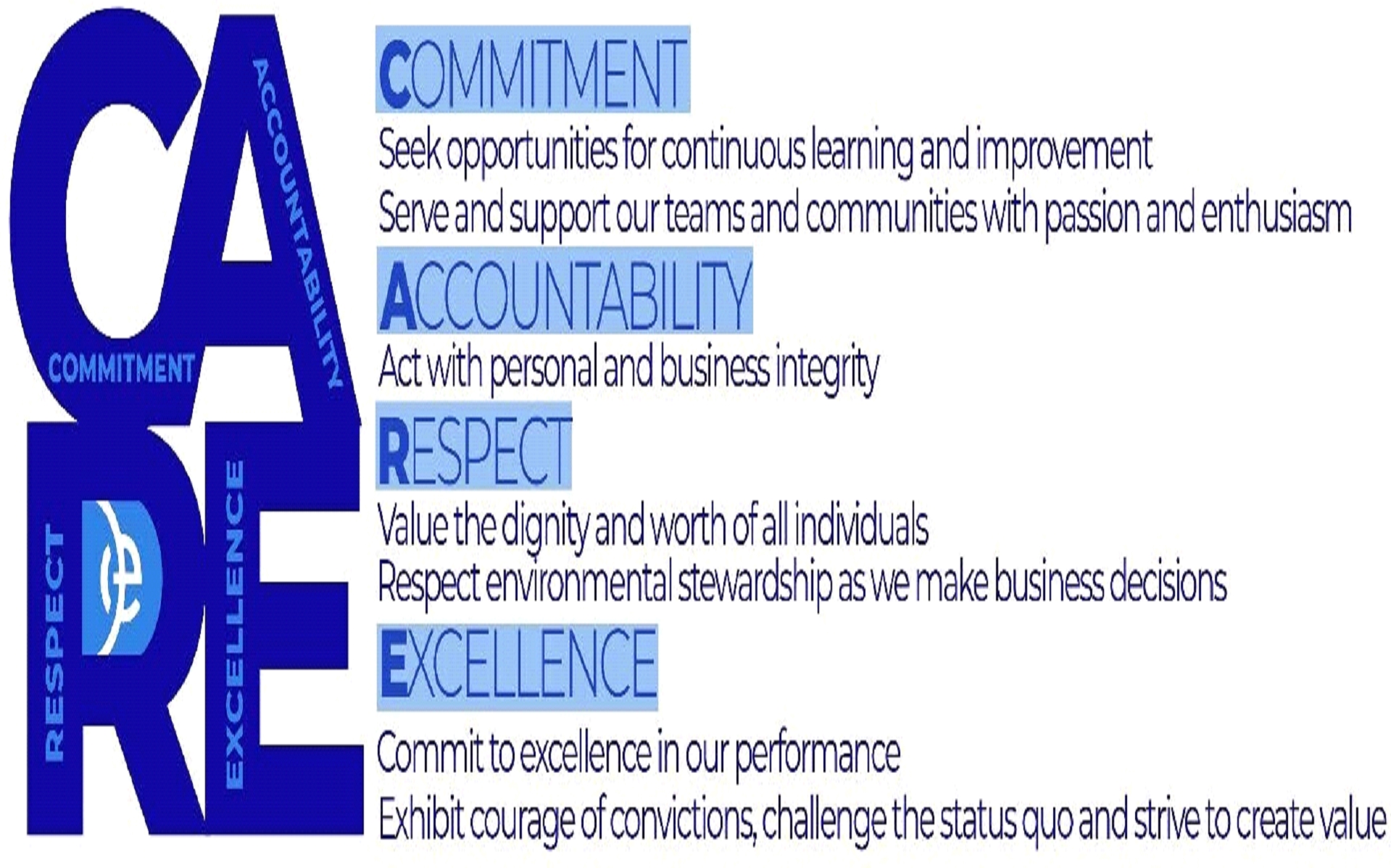
Years ago, Diversified committed to seven company standards that represent who we are and how we expect to engage each other, our communities and our business partners. In doing so, every employee, officer and director (a “Director”) of Diversified’s Board of Directors (the “Board”) is expected to conduct our business and deliver value to our stakeholders based upon these ethical standards
and beliefs. From these company standards, we developed four Core Values that embody the responsibility we have as stewards of our stakeholders’ interests and allow us to continue to earn their trust that gives us our license to operate. Living
out these Core Values helps us reach our highest potential as individuals and contributors to the Company while also serving as a reminder of the boundaries within which we all must work every day.
|
Compliance Hotline 1-800-261-9132 or compliance.dgoc.com
|
P a g e | 3
|
INTRODUCTION AND PURPOSE
At Diversified Energy Company (the “Company”), our personal and business integrity is what drives our daily actions and interactions with others and further drives our Accountability to our Core Values.
The Board of Directors (the “Board”) of the Company has adopted this Code of Business Conduct and Ethics (the “Code”) to encourage:
| • |
Honest and ethical conduct, including fair dealing, the ethical handling of actual or apparent conflicts of interest, and the avoidance of corruption;
|
| • |
Full, fair, accurate, timely and understandable disclosures;
|
| • |
Compliance with applicable laws and governmental rules and regulations;
|
| • |
Prompt internal reporting of any violations of law or the Code;
|
| • |
Accountability for adherence to the Code, including fair process by which to determine violations;
|
| • |
The protection of the Company’s legitimate business interests, including its assets and corporate opportunities; and
|
| • |
Confidentiality of information entrusted to Directors, officers and employees by the Company and its business partners.
|
In addition to this Code, the Company has adopted various corporate policies or guidelines that address specific aspects and expectations of our business. Where appropriate, we may refer you to those separate policies within this Code, and the
terms thereof should be considered incorporated within this Code.
This Code is intended to meet the requirements of the Securities and Exchange Commission (“SEC”) and Section 303A of the New York Stock Exchange’s Listed Company Manual.
This policy is reviewed and approved annually by the Company’s Board of Directors.
All Directors, officers and employees (each a “Covered Party” and, collectively, the “Covered Parties”) of the Company and all of its subsidiaries are expected to be
familiar with the Code and to adhere to the principles and procedures set forth below. This Code is a statement of the Company’s expectations for the Covered Parties.
We also expect our business partners to provide services or goods in compliance with this Code or their own equivalent code of ethical conduct. While not all provisions of this Code may apply to our business partners, common sense and good
judgement with regard to expected ethical behavior must be applied. Business partners may also refer to our corporate Business Partners Policy found on
our website.
Neither the adoption of this Code nor any description of its provisions constitutes a representation that all of its employees, officers, consultants and independent contractors are at any time in full compliance.
No matter what job we perform, we are each responsible for creating, promoting and maintaining a corporate culture that encourages ethical conduct and compliance with the law.
|
Compliance Hotline 1-800-261-9132 or compliance.dgoc.com
|
P a g e | 4
|
Responsibilities of Employees
| • |
Learn, understand and adhere to the contents of this Code and all other applicable policies, procedures and laws applicable to your job;
|
| • |
Be honest, transparent and fair in all work-related activities and relationships;
|
| • |
Promptly report in good faith any known or suspected violations of this Code, any company policy or any applicable law or regulation;
|
| • |
Ask questions if you are unsure or need guidance to ensure ethical conduct is upheld in all circumstances;
|
| • |
Fully cooperate with any company investigation by providing truthful information and related documentation as may be requested; and
|
| • |
Complete required Code training and periodic certification of compliance, as may be requested by the company.
|
As a leader in the Company through your role as a supervisor or manager, you have the following additional responsibilities:
| • |
Lead by example in modelling ideal ethical business conduct and behavior;
|
| • |
Provide employees with the tools they need to understand and support the highest standards of ethical business conduct, thus reinforcing our Core Values;
|
| • |
Create and nurture an environment where all employees feel comfortable asking questions, discussing ethical issues and reporting known or potential misconduct;
|
| • |
Promptly respond to requests for guidance and reports of misconduct while remaining aware of the limits of your authority to take appropriate action; and
|
| • |
Support any active investigation by providing timely information and encouraging staff to actively participate.
|
The Company promotes ethical behavior at all times, and therefore Covered Parties should promptly report suspected violations of laws, rules, regulations or the Code through the appropriate channels. For the avoidance of doubt, it is the obligation
of every employee at the Company to report such behavior.
The following Ethics Reporting Channels are available to any Covered Party seeking guidance on when to report and/or how to report a known or perceived ethics violation:
| • |
Company Management – It is often most effective to seek guidance or report concerns to an individual’s immediate supervisor. If an issue is not handled satisfactorily or you are not comfortable
discussing it with your supervisor, take the concern to the next level(s) of organizational management, up to and including the Company’s officers such as the Chief Legal & Risk Officer.
|
| • |
Human Resources – Another effective channel for problem-solving is Human Resources whose primary role is to provide guidance to the employee.
|
| • |
The Board or Company Counsel – If you are uncomfortable or unsure of reporting a violation to any company personnel, you may contact the Company’s outside counsel (as identified on the Company’s
website) or the Board or the relevant committee thereof.
|
| • |
Compliance Hotline – The Company welcomes and encourages reports via a call to its Whistleblowing Hotline at +1(800)261-9132 or online at compliance.dgoc.com.
For more information on the Company’s Compliance Hotline and whistleblowing procedures, please refer to the Company’s Whistleblowing Policy on
our website.
|
|
Compliance Hotline 1-800-261-9132 or compliance.dgoc.com
|
P a g e | 5
|
The Company takes all reports of possible misconduct seriously. The Legal Department and the Audit and Risk Committee of the Board will investigate and determine, or will designate appropriate persons to investigate and determine, the
legitimacy of such reports. The Audit and Risk Committee will then determine the appropriate disciplinary or corrective action. Such action includes, but is not limited to, reprimand, termination with cause, and possible civil and criminal
prosecution.
While this Code cannot possibly address all potential ethical situations, it can serve as a practical guideline to understanding your role in applying its expectations while seeking to always do the right thing. Where any Covered Party is in
doubt with regard to understanding or applying any portion of the Code, consider using this Ethics Quick Guide to help direct your actions:
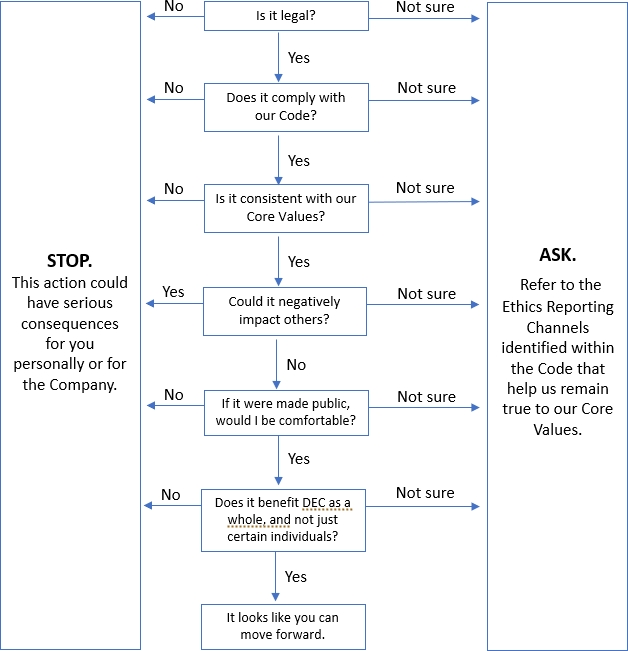
In all circumstances, never hesitate to seek advice. Remember, if you see something, it is your duty to say something so be sure you understand the resources available to you to report known or perceived
violations.
|
Compliance Hotline 1-800-261-9132 or compliance.dgoc.com
|
P a g e | 6
|
Non-Retaliation Commitment
To encourage employees to report any and all violations, the Company will not tolerate retaliation for reports made in good faith. Retaliation or retribution of any kind against any Covered Party for a report made in good faith of any
suspected violation of laws, rules, regulations or this Code is cause for appropriate disciplinary action, up to and including dismissal. If you believe you or someone you know has been retaliated against, you should raise a concern immediately
in line with the Ethics Reporting Channels identified within this Code.
Notwithstanding anything in this Code to the contrary, nothing contained in this Code, nor in any agreement signed by you, prohibits you from voluntarily communicating with, reporting concerns to, filing a charge or complaint with, making
lawful disclosures to, providing documents or other information to or participating in an investigation or hearing conducted by the Equal Employment Opportunity Commission, National Labor Relations Board, SEC or any other federal, state or local
agency charged with the enforcement of any laws regarding possible violations of law or regulations or from recovering whistleblower awards from the SEC or any other agency.
Waivers of this Code are disfavored and considered the exception rather than the rule. Any waivers are considered on a case-by-case-basis. In any event, before an employee, or an immediate family member of any such employee, engages in any
activity that would be otherwise prohibited by the Code, they are strongly encouraged to obtain a written waiver from the Company’s Chief Legal & Risk Officer.
Before a Director or officer, or an immediate family member of a Director or officer, engages in any activity that would be otherwise prohibited by the Code, they must obtain a written waiver from the Board or a designated committee of the Board
and such waiver will be disclosed as required by the rules of the SEC and the applicable listing exchange.
This Code is a statement of certain fundamental principles, policies and procedures that govern the Company’s Covered Parties in the conduct of the Company’s business. It is not intended to and does not create any rights in any employee,
customer, client, visitor, supplier, competitor, shareholder or any other person or entity.
This Code does not, in any way, constitute an employment contract or an assurance of continued employment or provision of services to the Company. Employees of the Company are employed at-will except when they are covered by an express,
written employment agreement. This means that an employee may choose to resign his or her employment at any time, for any reason or for no reason at all. Similarly, the Company may, subject to the terms of the relevant employment agreement,
choose to terminate an individual’s employment at any time, with or without notice and for any legal reason or for no reason at all.
|
Compliance Hotline 1-800-261-9132 or compliance.dgoc.com
|
P a g e | 7
|
Every employee plays a role in fostering a positive work environment at the Company. The Company expects its employees to adhere to a standard of professional conduct and integrity, rooted in respect, honesty, and fairness.
The Company is an Equal Opportunity Employer that does not discriminate on the basis of actual or perceived race; color; religion; alienage or national origin; ancestry; citizenship status; age; disability; sex, sexual orientation, or gender
identity; marital status; pregnancy, childbirth, or related medical conditions; veteran status or military service; genetic information; or any other characteristic protected by applicable law.
The Company’s focus in personnel decisions is on merit, qualifications, competencies, and contributions. As identified in our foundational corporate standards, we value the dignity and worth of all individuals and these attributes serve as
indispensable elements in the advancement opportunities for all qualified persons. Our management team is therefore fully dedicated to this commitment with respect to recruitment, hiring, placement, promotion, transfer, training, compensation,
benefits, employee activities and general treatment during employment.
For more information, please refer to the Employee Relations Policy found on our website.
The Company is committed to maintaining a corporate culture, conducting its business activities, and engaging its stakeholders in a manner that protects, supports and promotes the fundamental human rights of all individuals. Please refer to
the information herein regarding the Company’s position on Equal Opportunity Employment.
Safeguarding the Company’s employees and the communities we serve is fundamental to everything we do, as reflected in our top daily operational priority of “Safety-No Compromises”. The Company is committed to the goal of healthy, safe and
environmentally sound business practices and operations. We are responsible, therefore, for using all reasonable efforts to operate in a manner that preserves the environment and protects the health and safety of our employees and others. Further,
we seek to achieve this priority while abiding by all applicable laws and regulations in these respective areas.
Our fundamental commitment to safety also applies to our vendors and contractors. Our goal is to appropriately engage with all external parties associated with our operations to achieve environmentally responsible and safe operations,
inclusive of the authority and responsibility to stop work for a situation regarded as potentially harmful to any individual or the environment.
|
Compliance Hotline 1-800-261-9132 or compliance.dgoc.com
|
P a g e | 8
|
For more information on our commitments to health and safety, please refer to the Company’s Environmental, Health & Safety Policy on our
website.
As reflected in our corporate standard to “respect environmental stewardship as we make business decisions,” the Company is committed to setting strategy, establishing relevant metrics and targets, and integrating
environmental health and safety matters into tactical and operational business activities. This commitment to excellence and stewardship applies wherever and whenever we operate, from the time of acquisition to the permanent retirement of our
assets. Employees’ actions should demonstrate this commitment to the environment through active participation in ongoing, relevant training in respect of procedures and safety standards for (i) optimizing operational equipment to minimize
fugitive emissions or unintended releases, (ii) responding to spills to ensure remediation measures are met or exceeded as per applicable federal, state or local laws, and (iii) handling, transporting or disposing of hazardous materials.
To help ensure a safe, healthy and productive work environment for our employees and others, to protect company property and corporate reputation, and to ensure efficient operations, the Company has adopted a policy of
maintaining a workplace free of alcohol, drugs and improperly used prescription medicine. Applicable to all employees and other individuals who perform work for the Company, this policy requires all such individuals to report to work in an
appropriate mental and physical condition to perform their responsibilities in a safe and satisfactory manner.
The Company offers a voluntary and confidential Employee Assistance Program for employees seeking assistance to overcome drug or alcohol related problems. Refer to the Drug-Free and Alcohol-Free Workplace and Employee
Assistance Program sections of the Employee Handbook or speak with your HR Business Partner for more information.
The Company promotes a safe work environment for all employees and does not tolerate any type of violent behavior committed by or against employees. Employees have a responsibility to report any potentially dangerous
situations or unauthorized individuals on Company premises to management immediately. Incidents involving violent behavior by an employee may warrant disciplinary action up to and including termination of employment.
Prohibited conduct includes, but is not limited to, physical injury or abuse to another person; intimidating, threatening or hostile behavior; intentional acts of vandalism, arson or sabotage; or offensive comments
regarding violent intentions or events.
In keeping with this policy, possession of weapons (for example, guns, hunting knives, clubs, explosive devices, etc. or the implied use of other workplace objects to cause/threaten injury) on company property or
while at company-sponsored events is strictly prohibited, unless authorized by applicable law.
Refer to the Workplace Violence section of the Employee Handbook for more information.
|
Compliance Hotline 1-800-261-9132 or compliance.dgoc.com
|
P a g e | 9
|
Like workplace violence, harassment in the workplace is strictly prohibited and will not be tolerated. The Company prohibits intentional and unintentional harassment of any individual by another person on the basis of any protected
classification including, but not limited to, race; color; religion; alienage or national origin; ancestry; citizenship status; age; disability; sex, sexual orientation, or gender identity; marital status; pregnancy, childbirth, or related medical
conditions; veteran status or military service; genetic information; or any other characteristic protected by applicable law.
Conduct that creates an unwelcome or uncomfortable situation or hostile work environment may be considered workplace harassment. Therefore, we aim to apply the Golden Rule when it comes to work- related interactions: Treat others the way you
wish to be treated. Employees are expected to speak up when workplace conduct creates an unwelcome or comfortable environment.
Refer to the Employee Handbook and our corporate Human Rights Policy for more information on harassment.
Covered Parties have access to the Company’s information systems, such as computers and networks systems, telephones and voice mail, mobile devices, software, and data. These communication and computer systems are intended primarily for the
Company’s business purposes; however, incidental and occasional personal use of the Company’s electronic mail and telephone systems is permitted under certain circumstances.
Employees and contractors with access to company systems should have no expectations of personal privacy with respect to any communications or files that utilize the Company’s information technology resources, except as specifically authorized
in this Code or elsewhere, and should recognize that such communications or files are considered business records that may be subject to disclosure in a court of law.
If you have any questions or concerns regarding the use of corporate information systems, please contact the Information Technology department for clarification. Refer also to the Employee Handbook for more information on the Use of
Communications and Computer Systems and Inspections & Privacy.
|
Compliance Hotline 1-800-261-9132 or compliance.dgoc.com
|
P a g e | 10
|
As a publicly traded company, we must maintain the trusted reputation we have with our many stakeholders who look to the Company to act with the highest ethical standards and practices. Therefore, our business practices must be free even from
the appearance of impropriety and instead be built upon honesty, integrity, fairness and transparency.
All Covered Parties should protect the Company’s assets and ensure their efficient use, and all company assets should be used for legitimate business purposes. Theft, carelessness and waste have a direct impact on the Company’s profitability. We
should take measures to prevent damage to and theft or misuse of company property. When an individual leaves the Company, all company property must be returned to the Company.
Cybersecurity is part of everyone’s responsibility at the Company and requires diligence by all employees as well as any others given access to the Company’s assets. As such, employees are required to complete
quarterly cybersecurity training, and the Company routinely engages in risk assessment, cyber response training and system fortification. The Company is committed to protecting our facilities and the many technologies that enable our operations.
It is important that we all understand the Company’s cybersecurity policies and other applicable requirements of the Company’s cybersecurity program, and that users immediately report suspected cybersecurity incidents or other situations that may
create undue cybersecurity risks to the Company.
In carrying out the Company's business, Covered Parties may learn confidential or proprietary information about the Company, its customers, or its business partners. Confidential or proprietary information includes all
non-public information relating to the Company, or other companies, that would be harmful to the relevant company or useful or helpful to competitors if disclosed. Covered Parties must maintain the confidentiality of all information entrusted to
them, except when disclosure is authorized or legally mandated.
Confidentiality agreements are commonly used when the Company needs to disclose confidential information to others. A confidentiality agreement puts the person receiving confidential information on notice that they must
maintain the secrecy of such information. If, in doing business with persons not employed by or otherwise providing services to the Company, an individual foresees that they may need to disclose confidential information, that individual should
consult with the Company’s Chief Legal & Risk Officer and discuss the utility of entering into a confidentiality agreement.
The obligation to treat information as confidential does not end when an individual leaves the Company. Upon separation from the Company, everything that belongs to the Company, including all documents and other
materials containing Company and customer confidential information must be returned. Confidential information must not be disclosed to a new employer or to others after separation from the Company. Likewise, a previous employer’s confidential
information must not be disclosed to the Company. Of course, individuals may use general skills and knowledge acquired during their previous employment.
|
Compliance Hotline 1-800-261-9132 or compliance.dgoc.com
|
P a g e | 11
|
Refer to Confidential Company Information and If You Must Leave Us sections in the Employee Handbook for more information.
Intellectual Property is a creation or innovation used in business and can include but is not limited to ideas, inventions, improvements, designs, documents, trademarks, copyrightable subject matter, and trade
secrets. Such intellectual property developed by an employee in the course of carrying out employment or service may become part of the Company’s brand identity and therefore shall be the sole and exclusive property of the Company.
In addition to protecting the intellectual property of the Company, we will also afford this same respect to the intellectual property of others. We may not use or reproduce copyright materials owned by others without
first obtaining a valid license or prior permission by the copyright owner.
Refer to the Use of Facilities, Equipment and Property, Including Intellectual Property section of the Employee Handbook for more information.
Trading on inside information is a violation of law. Covered Parties in possession of inside information about the Company or companies with whom we do business must abstain from trading or advising others to trade in the respective company’s
securities from the time that they obtain such inside information until adequate public disclosure of the information. Inside information is non-public information, which, if made public, would be likely to have a significant effect on the price
of Company securities and is of such importance that it would likely be used by of investors as part of the decision as to whether or not to buy, sell, or hold the securities in question. To use non-public information for personal financial benefit
or to “tip” others, including family members, who might make an investment decision based on this information is not only unethical but also illegal.
For more information on understanding insider trading and the Company’s expectations regarding this important topic, please refer to the Company’s Securities Dealing and Insider Trading Policy as found on our website.
A conflict of interest occurs when the private interests of a Covered Party interfere, or appear to interfere, with the interests of the Company as a whole.
For example, a conflict of interest can arise when a Covered Party takes actions or has personal interests that make it difficult to perform his or her Company duties objectively and effectively. A conflict of interest may also arise when a Covered
Party, or a member of his or her immediate family, receives improper personal benefits as a result of his or her position at the Company.
Conflicts of interest can also occur indirectly. For example, a conflict of interest may arise when a Covered Party is also an executive officer, a major shareholder or has a material interest in an organization doing business with the Company.
Each Covered Party has an obligation to conduct the Company’s business in an honest and ethical manner, including the ethical handling of actual or apparent conflicts of interest between personal and professional relationships. Any situation
that involves, or may reasonably be expected to involve, a conflict of interest with the Company, should be disclosed promptly (i) for employees, to the employee’s supervisor and the Company’s Legal Department, (ii) for officers, to the Chief
Legal & Risk Officer, and (iii) for directors, to the Chair of the Audit and Risk Committee of the Board .
|
Compliance Hotline 1-800-261-9132 or compliance.dgoc.com
|
P a g e | 12
|
This Code does not attempt to describe all possible conflicts of interest that could develop. Other common conflicts from which Covered Parties must refrain are set out below:
| • |
Covered Parties may not engage in any conduct or activities that are inconsistent with the Company's best interests or that disrupt or impair the Company's relationship with any person or entity with which the Company has or proposes
to enter into a business or contractual relationship.
|
| • |
Covered Parties may not accept compensation, in any form, for services performed for the Company from any source other than the Company.
|
| • |
No Covered Party may take up any management or other employment position with, or have any material interest in, any firm or company that is a competitor of the Company.
|
Refer to Conflict of Interest and Business Ethics in the Employee Handbook for more information. Refer also to the Anti-Bribery & Corruption Policy found
on the Company’s website. Directors and officers are also subject to the Company’s Related Party Transaction Policy.
The following are common areas within a business setting in which potential conflicts of interest may exist:
Business gifts and entertainment may promote our business and goodwill, but they may also create potential conflicts of interest. When Covered Parties are involved in making business decisions on behalf of the
Company, their decisions must be based on uncompromised objectivity of judgment. Individuals interacting with any person who has business dealings with the Company (including companies with which the Company does business, competitors,
contractors, customers and consultants) must conduct such activities in the best interest of the Company. Covered Parties must not accept any gifts, entertainment or gratuities that could influence or be perceived to influence decisions about the
Company’s best interests.
A potential conflict of interest may arise when family members or persons with whom you have a close personal relationship are currently doing business with or seeking to do business with the Company’s competitors or
business partners. In these situations, you must safeguard the Company’s confidentiality and security.
Additionally, a family relationship among employees may create an actual or potential conflict of interest in the employment setting, especially when one relative supervises another relative. To avoid this problem,
the Company may refuse to hire or place a relative in a position where the potential for favoritism or conflict exists.
Refer to Hiring Relatives/Employee Relationships in the Employee Handbook for more information.
A conflict of interest may arise if outside work, including self-employment, interferes with or otherwise prevents your ability to fulfill your job responsibilities at the Company or if there is a risk that such
outside employment may cause you to disclose confidential company information. While you are permitted to work outside of the Company, the success of the Company depends on a strong commitment to your responsibilities at the Company.
|
Compliance Hotline 1-800-261-9132 or compliance.dgoc.com
|
P a g e | 13
|
Outside Investments & Securities
You may not take personal advantage of business opportunities made available to you as a result of your position with the Company. These opportunities may include ownership, either directly or indirectly, in oil and
gas, mineral or other natural resource interests that are directly associated with the any current or proposed Company operations or activities.
Nominal ownership of securities of a publicly traded entity will not, in and of itself, be considered a conflict of interest. However, as set forth in the Company’s Related Party Transaction Policy, without prior
approval, Covered Parties should not hold a substantial financial interest or investment, either directly or indirectly, in a company that does or seeks to do business with or is a competitor of the Company.
Subject to the Company’s Related Party Transaction Policy, all Covered Parties owe a duty to the Company to advance the legitimate interests of the Company when the opportunity to do so arises. Covered Parties are prohibited from directly or
indirectly (a) taking for themselves personal opportunities that are discovered through the use of company property, information or positions or related to the Company’s business; (b) using company property, information or positions for personal
gain; and (c) competing with the Company for business opportunities.
Each Covered Party should endeavor to deal fairly with the Company's customers, service providers, suppliers, competitors and employees. No Covered Party may take unfair advantage of anyone through manipulation, concealment, abuse of
privileged information, misrepresentation of material facts, or any unfair dealing practice.
Providing a clear and consistent company message is essential to the effective communication to the Company’s stakeholders of its strategy, operations and results and to the strengthening of the Company’s positive brand. Following established
Company guidelines when engaging in external communications helps protect the Company’s and its employees’ reputations, its confidential and proprietary information, and relationships with business partners and stakeholders. As such, no employee
or representative thereof is permitted to engage in any communication with the press, the investment community or other media in any forum on behalf of the Company without the Company’s specific knowledge and prior approval from appropriate
company authorities.
Refer to the Company’s Corporate Communications Policy and the Company’s Guidelines for Public Disclosures and Communications with the Investment Company for more information.
The Company respects the right of any employee to maintain a blog or web page or to participate in social media outlets. However, employees must use these personal outlets responsibly and with good judgement, ensuring any such social
interactions therein do not reflect poorly on the Company’s interests or reputation. Employees must never give the impression you are speaking on behalf of the Company in these forums unless you are authorized to do so.
Refer to the Use of Social Media section in the Employee Handbook and the Company’s Guidelines for Public Disclosures and Communications with the Investment Company for more information.
|
Compliance Hotline 1-800-261-9132 or compliance.dgoc.com
|
P a g e | 14
|
OUR RESPONSIBILITY TO GOVERNMENTS & THE LAW
The Company is obligated to comply with all applicable laws, rules and regulations in all the relevant jurisdictions in which they conduct business. It is the Company’s policy that where applicable law and the standards set forth in this Code
differ, we will follow the higher standard, and where they are in conflict, we will adhere to the law, while continuing to act in an honest and ethical manner. Any provision of this Code that is contrary to law in a particular jurisdiction will
have no force or effect in that jurisdiction, and all other provisions shall remain in full force and effect.
Notwithstanding the foregoing, this Code (including any provision deemed contrary to law in a particular jurisdiction) will remain applicable in all other jurisdictions. It is the personal responsibility of each Covered Party to adhere to the
standards and restrictions imposed by these laws, rules and regulations in the performance of his/her duties for the Company.
The Executive Leadership team (or persons performing similar functions) of the Company is also required to promote compliance by all employees with the Code and to abide by Company standards, policies and
procedures.
Antitrust laws are designed to encourage a marketplace of fair competition in an effort to preserve the US free enterprise system. Antitrust laws prohibit, among other things, price fixing, bid rigging, certain joint bidding and tying
arrangements, creation of a monopoly, boycotts, exclusive dealing and refusals to deal. We prohibit anti-competitive practices, and therefore all Covered Parties are expected to comply with applicable antitrust laws and not participate in any
activity that could be considered a violation of antitrust laws. Violations of antitrust laws can result in criminal and civil penalties against the Company and its Covered Parties. You should direct any questions regarding this provision or
related policy to the Chief Legal & Risk Officer.
Corruption is the abuse of entrusted power or position for private gain. The Company prohibits corruption in all its forms, and we will not tolerate it in our business or in those with whom we do business. The Company expects its employees,
Directors, third-party company representatives and business partners to act with honesty and integrity and requires these individuals to avoid any activity that gives even the appearance of corruption. The Company does not tolerate the offering of
bribes, kickbacks, or any other improper payments or things of value intended to influence official action, obtain, or maintain business or secure any improper advantage. Further, the Company requires all payments and value-exchange activities to be
documented as part of the Company’s audited books and records.
The following are examples of conduct that are prohibited by the Company:
| • |
Payment, receipt or promising of anything of value, including money, gifts, loans, or other favors, that are designed, or may appear, to compromise our ability to make objective and fair business decisions;
|
| • |
Payment or receipt of kickbacks for obtaining business;
|
| • |
Payment of bribes, including facilitation payments, to government officials to expedite or facilitate non-discretionary actions or services, such as obtaining an ordinary license or business permit; and
|
| • |
Money laundering, including in an attempt to conceal the origins of illegally obtained funds.
|
|
Compliance Hotline 1-800-261-9132 or compliance.dgoc.com
|
P a g e | 15
|
We encourage employees to conduct appropriate due diligence when engaging a third party to conduct activity on our behalf, and to seek guidance about laws that apply when beginning business in a new or unfamiliar geography. We will never punish an employee for refusing to engage in a corrupt act, even if it results in lost business, but understand that violations can result in criminal and civil penalties against you
personally and the Company. Employees’ obligations under this statement have contractual effect. Breach of this statement will be viewed extremely seriously by the Company and will normally amount to gross misconduct.
Any questions regarding these or other forms of known or potential corruption should be directed to our Chief Legal & Risk Officer. Refer also to the Anti-Bribery discussion in the Employee Handbook.
The Company is committed to conducting its business dealings in an honest and non-fraudulent manner. We will not intentionally deceive to gain an advantage over or injure another party. All Company information provided to any person or entity
must be free from deliberate misrepresentation. For example, when dealing with a business partner, we must not make representations we know are false or lack the proper authority.
Fraudulent behavior includes, but is not limited to:
| • |
Dishonest conduct;
|
| • |
Forgery, tampering with or alteration of negotiable instruments or Company documents;
|
| • |
Misappropriation of any Company asset, employee, customer, supplier or business partner;
|
| • |
Conversion for personal use of cash, securities, supplies or any other Company asset; and
|
| • |
Unauthorized handling or inaccurate reporting of Company transactions, including intentionally submitting an inaccurate expense report for personal expenses.
|
The information in the Company's public communications, including all reports and documents filed with or submitted to the SEC, the Companies House and the Financial Conduct Authority must be full, fair, accurate, timely and understandable.
To ensure the Company meets this standard, all Covered Parties (to the extent they are involved in the Company’s disclosure process) are required to maintain familiarity with the disclosure requirements, processes and procedures applicable to
the Company commensurate with their duties. Covered Parties are prohibited from knowingly misrepresenting, omitting or causing others to misrepresent or omit, material facts about the Company to others, including the Company’s independent
auditors, governmental regulators and self-regulatory organizations.
We are all responsible for retaining our business records in accordance with all laws, regulations, and company retention policies. The Company acknowledges its responsibility to preserve information relating to litigation, audits and
investigations, which may require employees to maintain and not delete certain physical or digital data/information and equipment/items. Therefore, from time to time during your employment at the Company, you may receive notifications from the
Legal Department that documents or data in your control are subject to legal hold and must be retained in connection with a lawsuit or government investigation. Every Company employee must comply with such notifications.
|
Compliance Hotline 1-800-261-9132 or compliance.dgoc.com
|
P a g e | 16
|
Each one of us has a duty to understand which documents or data are subject to legal hold and to ensure that no related documents or data are destroyed, altered or concealed. Failure to comply with legal hold notices may lead to criminal or
civil sanctions against the Company and its employees and possible disciplinary action against responsible individuals (up to and including discharge of the employee). Each employee has an obligation to contact Human Resources to inform him/her
of potential or actual litigation, external audit, investigation or similar proceeding involving the Company that may have an impact on record retention protocols. If you have any questions about documents or data that may be subject to a legal
hold, please contact the Legal Department.
Public policy decisions affect our business and industry as a whole, and it is in the best interest of the Company, its employees, and shareholders that the Company be engaged in the political process. The Company responsibly engages in the
political process at the national, state and local levels through corporate contributions where allowed by law, the activities of its political action committee (“PAC”), trade associations, and political
organizations, and by engaging in public policy debates on the issues affecting the Company. The Company’s political spending will reflect the Company’s interests and not those of individual employees, officers or Directors.
As authorized by Government Affairs and in accordance with applicable laws, the Company may contribute company funds or assets (including property, services, or use of facilities).
The Company has established a PAC. Except for the operating expenses of the PAC paid by the Company or other lawful and approved expenditures, no Company funds may be used for any Company PAC. Certain Company
employees are eligible to participate in the Company’s PAC, where participation in the PAC is strictly voluntary. The Company’s PAC is funded exclusively with personal money given voluntarily by eligible Company employees. The amount of an
employee’s contribution, or an employee’s decision to not contribute, will not benefit or disadvantage such employee in any way within the Company nor will the Company tolerate retaliation or retribution against any employee choosing not to
contribute.
The Company strongly encourages its employees to participate in the political process and to exercise their rights of citizenship such as voting, making lawful personal contributions and supporting political parties
or candidates of their choosing. However, employees should participate in political activities at their own expense and on their own time, and make clear that their views and actions are their own, and not those of the Company. The Company
respects the right of individual employees to disagree with a company political position.
Employees must not use their personal involvement with political candidates to influence legislation, rulemaking or policy on behalf of the Company without first speaking with the Government Affairs department. Contact
between Company employees and public officials may be considered lobbying and subject to related reporting requirements. No employee should apply any direct or indirect pressure on a co-worker or business partner to make a personal political
contribution or to otherwise publicly support or oppose a particular political candidate. Company funds, assets, or facilities may not be used to support any political candidate or party unless specifically permitted by law and authorized by the
Company’s Chief Legal & Risk Officer.
|
Compliance Hotline 1-800-261-9132 or compliance.dgoc.com
|
P a g e | 17
|