
Fourth Quarter 2025 Results February 6, 2026
2 Non-GAAP financial measures and forward-looking statements Non-GAAP financial measures We provide reconciliations of the non-GAAP financial measures contained in this presentation to the most directly comparable measure under GAAP, which are set forth in the financial tables attached to this presentation. The non-GAAP financial measures in this presentation include: adjusted earnings before interest, taxes, depreciation and amortization (“EBITDA margin”); adjusted EBITDA margin; bank-adjusted EBITDA; free cash flow and free cash flow as a percentage of adjusted EBITDA (“free cash flow conversion”); adjusted free cash flow and adjusted free cash flow as a percentage of adjusted EBITDA (“adjusted free cash flow conversion”); net debt, gross leverage and net leverage; and adjusted net income (loss) and adjusted diluted income (loss) per share (“adjusted diluted EPS”). We believe that these adjusted financial measures facilitate analysis of our ongoing business operations because they exclude items that may not reflect, or are unrelated to, RXO’s core operating performance, and may assist investors with comparisons to prior periods and assessing trends in our underlying businesses. Other companies may calculate these non-GAAP financial measures differently, and therefore our measures may not be comparable to similarly titled measures of other companies. These non-GAAP financial measures should only be used as supplemental measures of our operating performance. Adjusted EBITDA, adjusted EBITDA margin, bank-adjusted EBITDA, adjusted net income (loss) and adjusted diluted EPS include adjustments for transaction and integration costs, as well as restructuring costs and other adjustments as set forth in the attached tables. Management uses these non-GAAP financial measures in making financial, operating and planning decisions and evaluating RXO’s ongoing performance. We believe that adjusted EBITDA, adjusted EBITDA margin and bank-adjusted EBITDA improve comparability from period to period by removing the impact of our capital structure (interest and financing expenses), asset base (depreciation and amortization), tax impacts and other adjustments that management has determined do not reflect our core operating activities and thereby assist investors with assessing trends in our underlying business. We believe that adjusted net income (loss) and adjusted diluted EPS improve the comparability of our operating results from period to period by removing the impact of certain costs that management has determined do not reflect our core operating activities, including amortization of acquisition-related intangible assets, transaction and integration costs, restructuring costs and other adjustments as set out in the attached tables, and thereby may assist investors with comparisons to prior periods and assessing trends in our underlying business. We believe that free cash flow, free cash flow conversion, adjusted free cash flow and adjusted free cash flow conversion are important measures of our ability to repay maturing debt or fund other uses of capital that we believe will enhance stockholder value, and may assist investors with assessing trends in our underlying business. We calculate free cash flow as net cash provided by operating activities less payment for purchases of property and equipment plus proceeds from sale of property and equipment. We define adjusted free cash flow as free cash flow less cash paid for transaction, integration, restructuring and other costs. We believe that net debt, gross leverage and net leverage are important measures of our overall liquidity position. Net debt is calculated by removing cash and cash equivalents from the principal balance of our total debt. Gross leverage is calculated as the principal balance of our total debt as a ratio of trailing twelve months bank-adjusted EBITDA. Net leverage is calculated as net debt as a ratio of trailing twelve months bank-adjusted EBITDA. With respect to our financial outlook for the first quarter of 2026 adjusted EBITDA, a reconciliation of this non-GAAP measure to the corresponding GAAP measure is not available without unreasonable effort due to the variability and complexity of the reconciling items described above that we exclude from this non-GAAP measure. The variability of these items may have a significant impact on our future GAAP financial results and, as a result, we are unable to prepare the forward-looking statement of income and statement of cash flows prepared in accordance with GAAP that would be required to produce such a reconciliation. Forward-looking statements This presentation includes forward-looking statements, including statements relating to our outlook and 2026 assumptions. All statements other than statements of historical fact are, or may be deemed to be, forward-looking statements. In some cases, forward-looking statements can be identified by the use of forward-looking terms such as "anticipate," "estimate," "believe," "continue," "could," "intend," "may," "plan,“ "predict," "should," "will," "expect," "project," "forecast," "goal," "outlook," "target,” or the negative of these terms or other comparable terms. However, the absence of these words does not mean that the statements are not forward-looking. These forward-looking statements are based on certain assumptions and analyses made by us in light of our experience and our perception of historical trends, current conditions and expected future developments, as well as other factors we believe are appropriate in the circumstances. These forward-looking statements are subject to known and unknown risks, uncertainties and assumptions that may cause actual results, levels of activity, performance, or achievements to be materially different from any future results, levels of activity, performance or achievements expressed or implied by such forward-looking statements. Factors that might cause or contribute to a material difference include the risks discussed in our filings with the SEC and the following: the effect of the completion of the transaction to acquire Coyote Logistics on the parties’ business relationships and business generally; competition and pricing pressures; economic conditions generally; fluctuations in fuel prices; increased carrier prices; severe weather, natural disasters, terrorist attacks or similar incidents that cause material disruptions to our operations or the operations of the third-party carriers and independent contractors with which we contract; our dependence on third-party carriers and independent contractors; labor disputes or organizing efforts affecting our workforce and those of our third-party carriers; legal and regulatory challenges to the status of the third-party carriers with which we contract, and their delivery workers, as independent contractors, rather than employees; governmental regulation and political conditions; our ability to develop and implement suitable information technology systems and prevent failures in or breaches of such systems; the impact of potential cyber-attacks and information technology or data security breaches; issues related to our intellectual property rights; our ability to access the capital markets and generate sufficient cash flow to satisfy our debt obligations; litigation that may adversely affect our business or reputation; increasingly stringent laws protecting the environment, including transitional risks relating to climate change, that impact our third-party carriers; our ability to attract and retain qualified personnel; our ability to successfully implement our cost and revenue initiatives and other strategies; our ability to successfully manage our growth; our reliance on certain large customers for a significant portion of our revenue; damage to our reputation through unfavorable publicity; our failure to meet performance levels required by our contracts with our customers; the inability to achieve the level of revenue growth, cash generation, cost savings, improvement in profitability and margins, fiscal discipline, or strengthening of competitiveness and operations anticipated or targeted; and the impact of the separation on our businesses, operations and results. All forward-looking statements set forth in this presentation are qualified by these cautionary statements and there can be no assurance that the actual results or developments anticipated by us will be realized or, even if substantially realized, that they will have the expected consequences to or effects on us or our business or operations. Forward-looking statements set forth in this presentation speak only as of the date hereof, and we do not undertake any obligation to update forward-looking statements to reflect subsequent events or circumstances, changes in expectations or the occurrence of unanticipated events, except to the extent required by law.
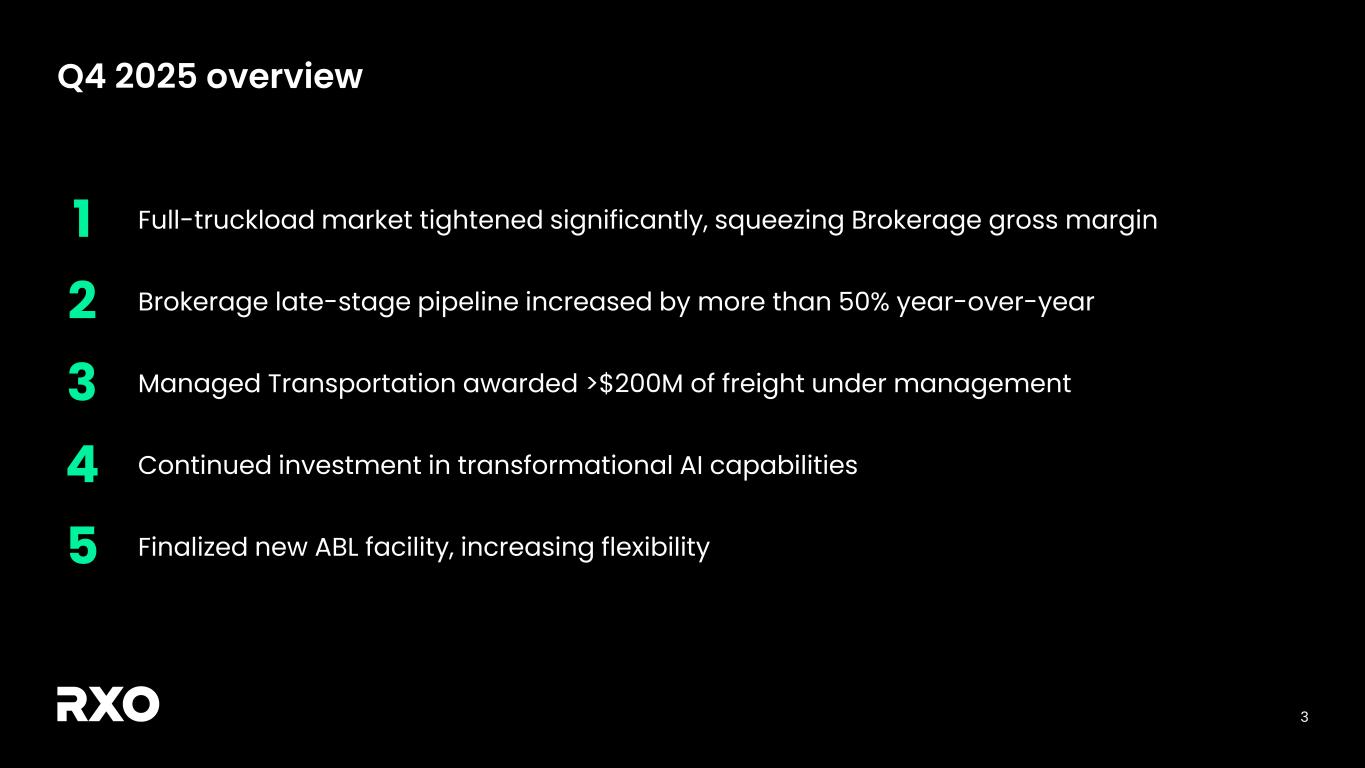
3 Q4 2025 overview 1 Full-truckload market tightened significantly, squeezing Brokerage gross margin 2 Brokerage late-stage pipeline increased by more than 50% year-over-year 3 Managed Transportation awarded >$200M of freight under management 4 Continued investment in transformational AI capabilities 5 Finalized new ABL facility, increasing flexibility
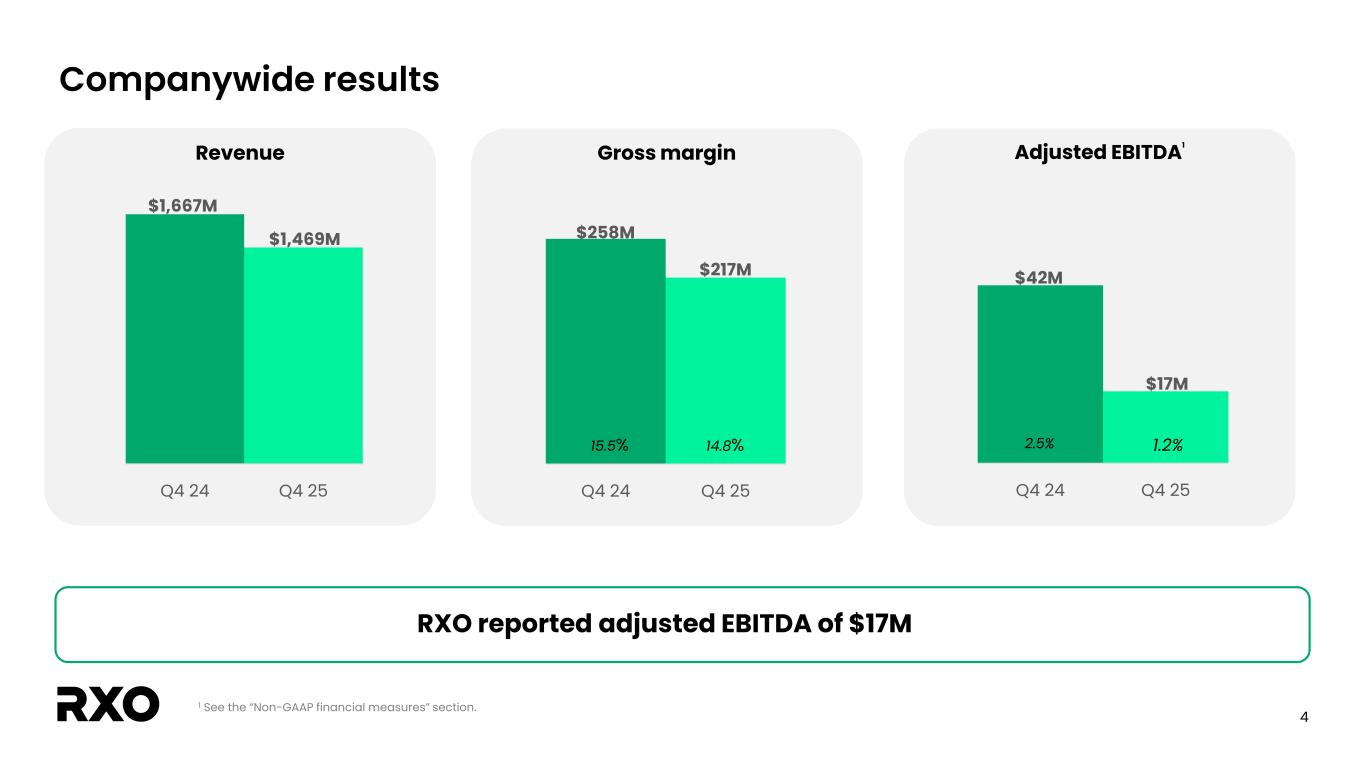
4 $258M $217M Q4 24 Q4 25 Companywide results RXO reported adjusted EBITDA of $17M Adjusted EBITDA1Gross margin 1 See the “Non-GAAP financial measures” section. $42M $17M Q4 24 Q4 25 2.5% 1.2%15.5% Revenue $1,667M $1,469M Q4 24 Q4 25 14.8%
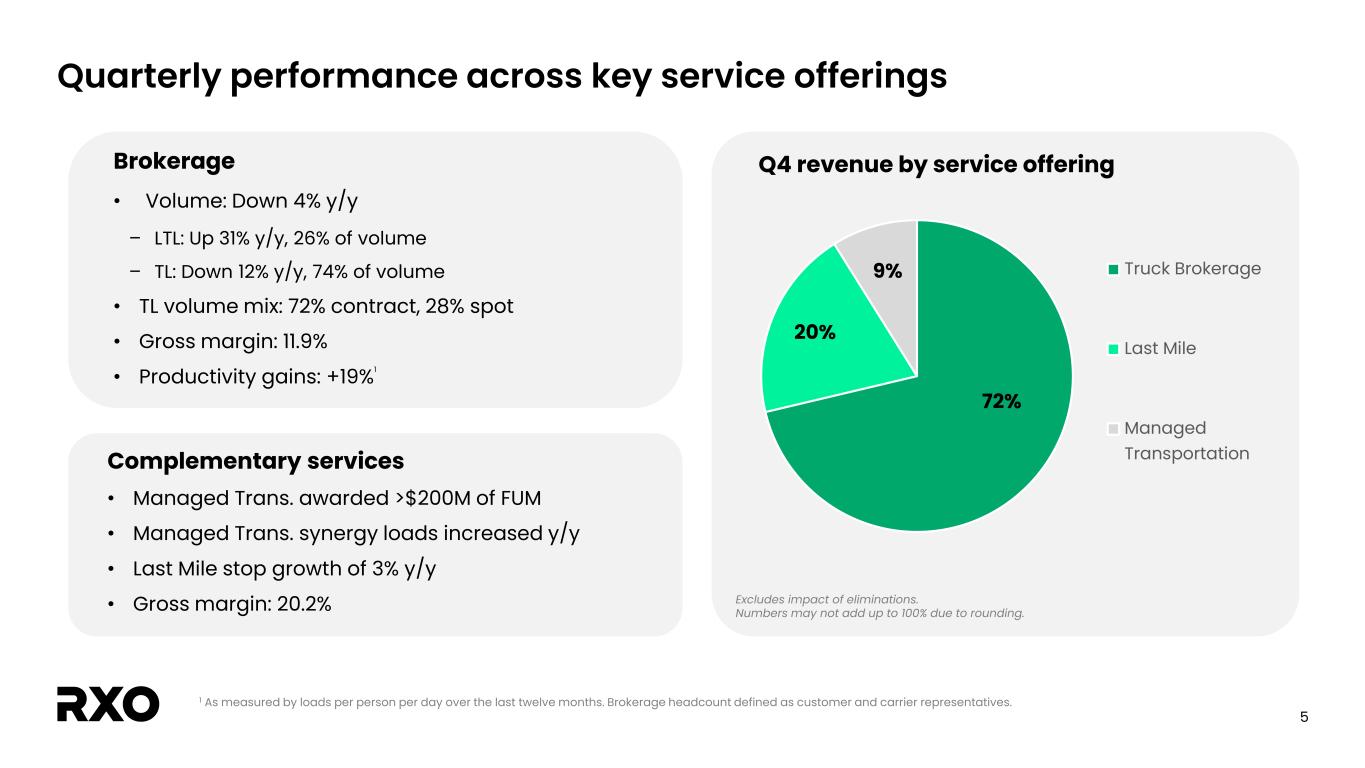
5 Quarterly performance across key service offerings Q4 revenue by service offering 72% 20% 9% Truck Brokerage Last Mile Managed Transportation Excludes impact of eliminations. Numbers may not add up to 100% due to rounding. Brokerage • Volume: Down 4% y/y – LTL: Up 31% y/y, 26% of volume – TL: Down 12% y/y, 74% of volume • TL volume mix: 72% contract, 28% spot • Gross margin: 11.9% • Productivity gains: +19%1 Complementary services • Managed Trans. awarded >$200M of FUM • Managed Trans. synergy loads increased y/y • Last Mile stop growth of 3% y/y • Gross margin: 20.2% 1 As measured by loads per person per day over the last twelve months. Brokerage headcount defined as customer and carrier representatives.
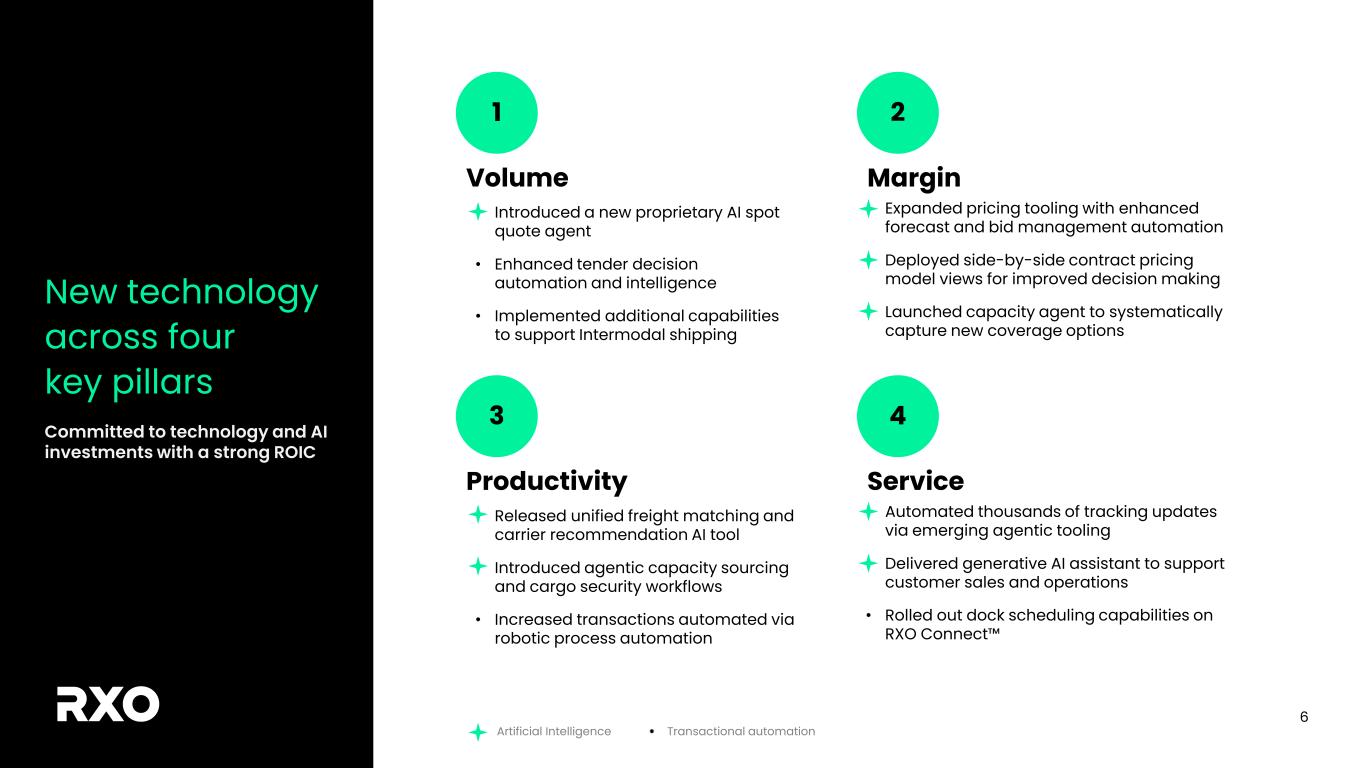
6 New technology across four key pillars • Introduced a new proprietary AI spot quote agent • Enhanced tender decision automation and intelligence • Implemented additional capabilities to support Intermodal shipping • Expanded pricing tooling with enhanced forecast and bid management automation • Deployed side-by-side contract pricing model views for improved decision making • Launched capacity agent to systematically capture new coverage options • Released unified freight matching and carrier recommendation AI tool • Introduced agentic capacity sourcing and cargo security workflows • Increased transactions automated via robotic process automation • Automated thousands of tracking updates via emerging agentic tooling • Delivered generative AI assistant to support customer sales and operations • Rolled out dock scheduling capabilities on RXO Connect 1 Volume Committed to technology and AI investments with a strong ROIC 2 Margin 3 Productivity 4 Service Artificial Intelligence Transactional automation
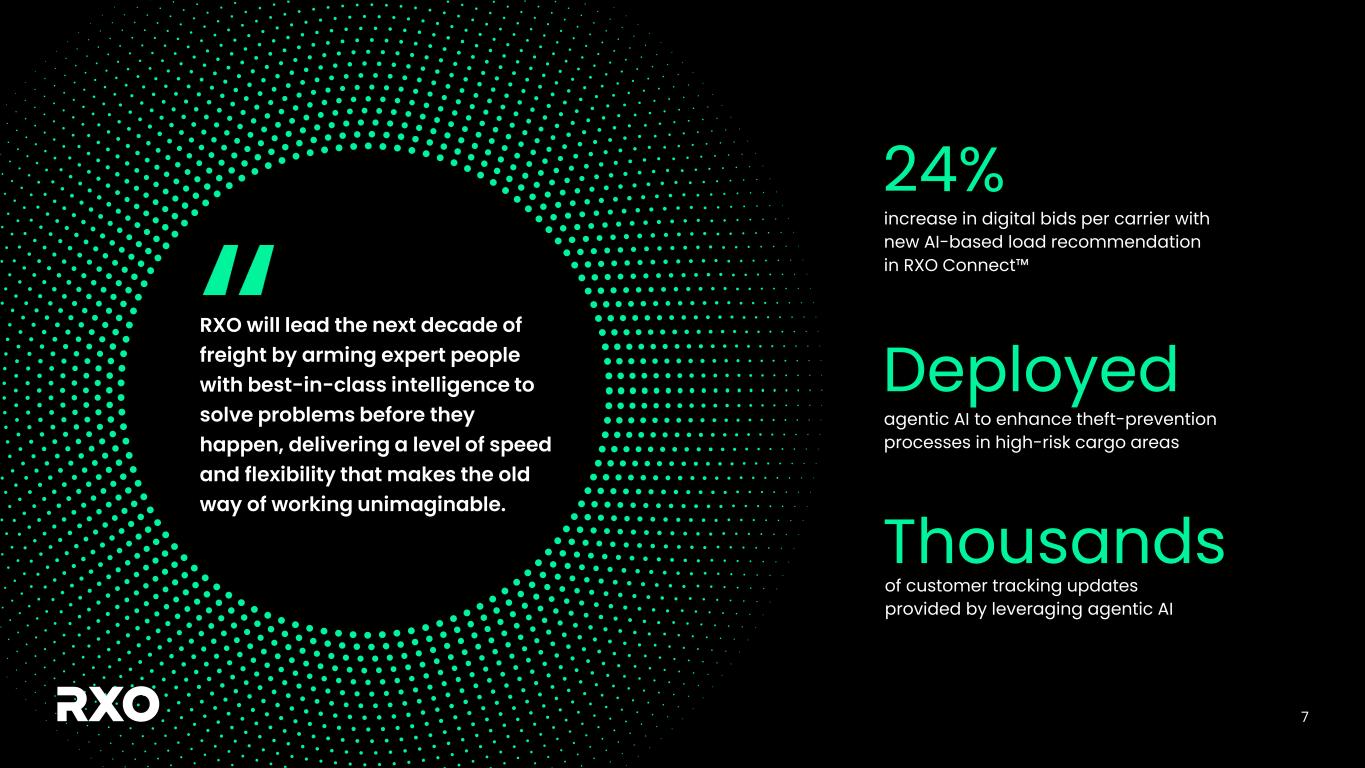
7 24% increase in digital bids per carrier with new AI-based load recommendation in RXO Connect Deployed agentic AI to enhance theft-prevention processes in high-risk cargo areas Thousands of customer tracking updates provided by leveraging agentic AI RXO will lead the next decade of freight by arming expert people with best-in-class intelligence to solve problems before they happen, delivering a level of speed and flexibility that makes the old way of working unimaginable.
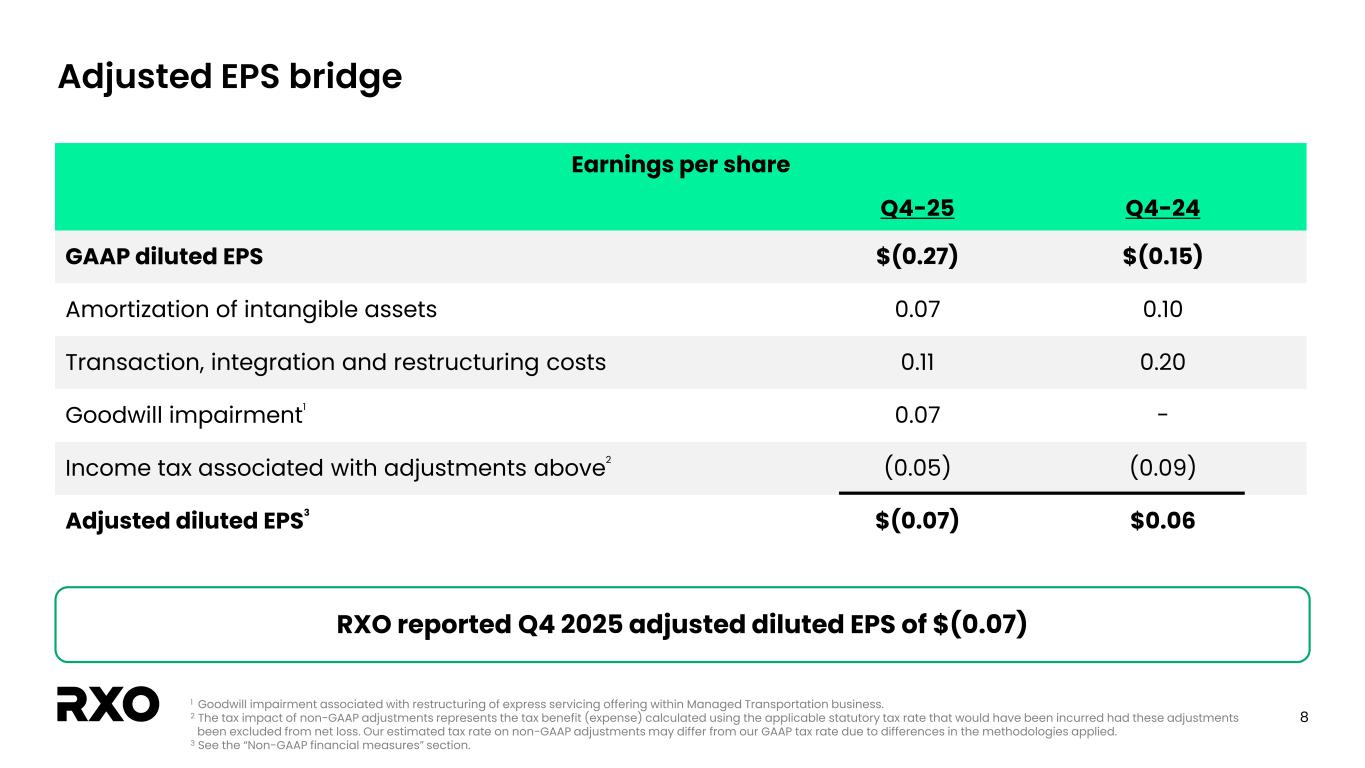
8 Adjusted EPS bridge Earnings per share Q4-25 Q4-24 GAAP diluted EPS $(0.27) $(0.15) Amortization of intangible assets 0.07 0.10 Transaction, integration and restructuring costs 0.11 0.20 Goodwill impairment1 0.07 - Income tax associated with adjustments above2 (0.05) (0.09) Adjusted diluted EPS3 $(0.07) $0.06 RXO reported Q4 2025 adjusted diluted EPS of $(0.07) 1 Goodwill impairment associated with restructuring of express servicing offering within Managed Transportation business. 2 The tax impact of non-GAAP adjustments represents the tax benefit (expense) calculated using the applicable statutory tax rate that would have been incurred had these adjustments been excluded from net loss. Our estimated tax rate on non-GAAP adjustments may differ from our GAAP tax rate due to differences in the methodologies applied. 3 See the “Non-GAAP financial measures” section.
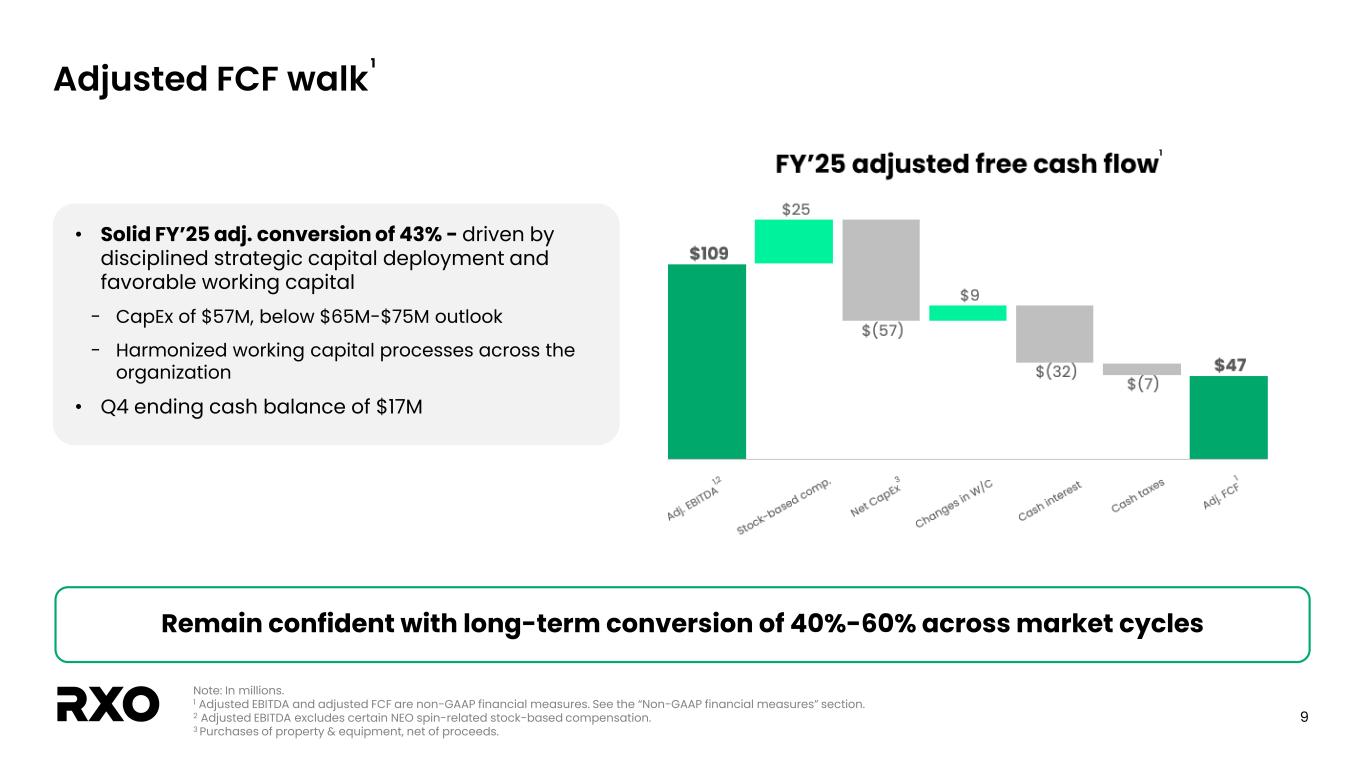
9 Adjusted FCF walk Note: In millions. 1 Adjusted EBITDA and adjusted FCF are non-GAAP financial measures. See the “Non-GAAP financial measures” section. 2 Adjusted EBITDA excludes certain NEO spin-related stock-based compensation. 3 Purchases of property & equipment, net of proceeds. Remain confident with long-term conversion of 40%-60% across market cycles 1 • Solid FY’25 adj. conversion of 43% - driven by disciplined strategic capital deployment and favorable working capital − CapEx of $57M, below $65M-$75M outlook − Harmonized working capital processes across the organization • Q4 ending cash balance of $17M
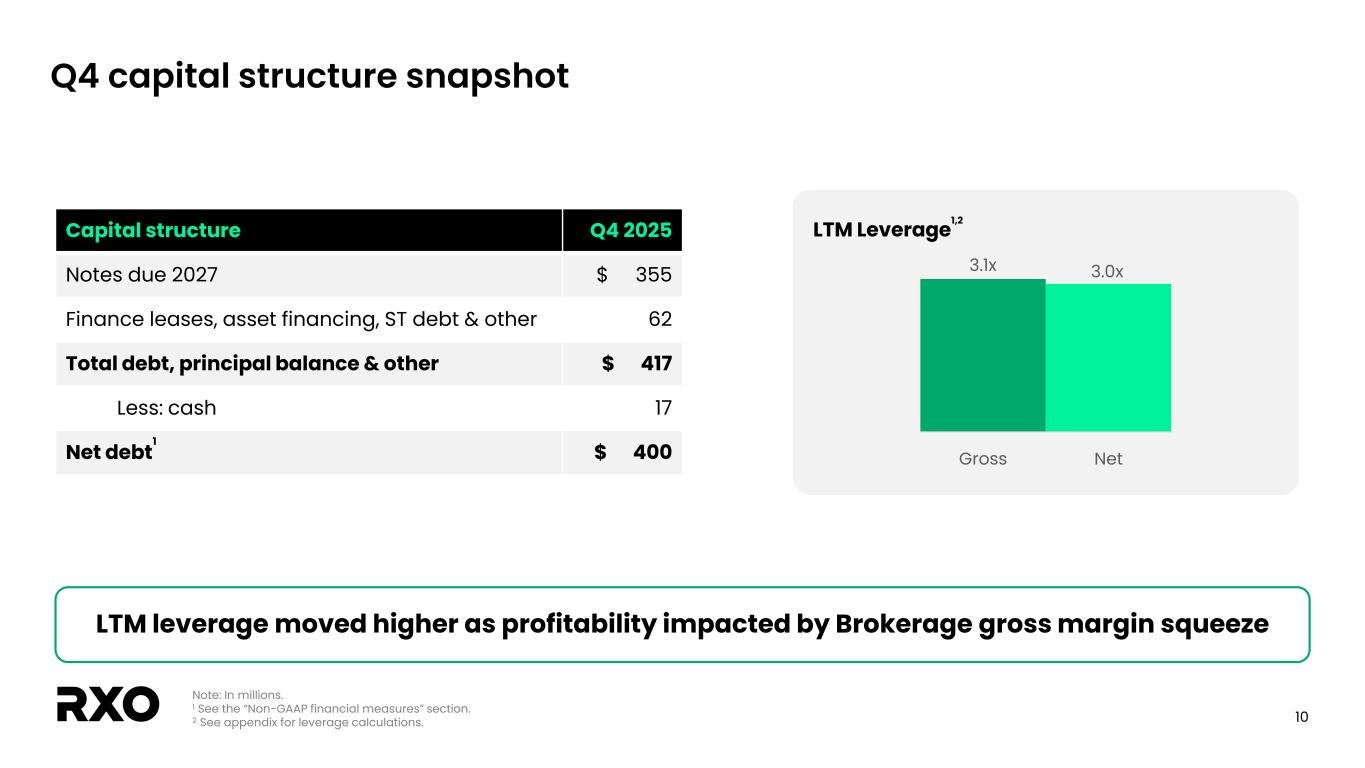
10 Q4 capital structure snapshot Capital structure Q4 2025 Notes due 2027 $ 355 Finance leases, asset financing, ST debt & other 62 Total debt, principal balance & other $ 417 Less: cash 17 Net debt 1 $ 400 Note: In millions. 1 See the “Non-GAAP financial measures” section. 2 See appendix for leverage calculations. LTM Leverage1,2 3.1x 3.0x Gross Net LTM leverage moved higher as profitability impacted by Brokerage gross margin squeeze
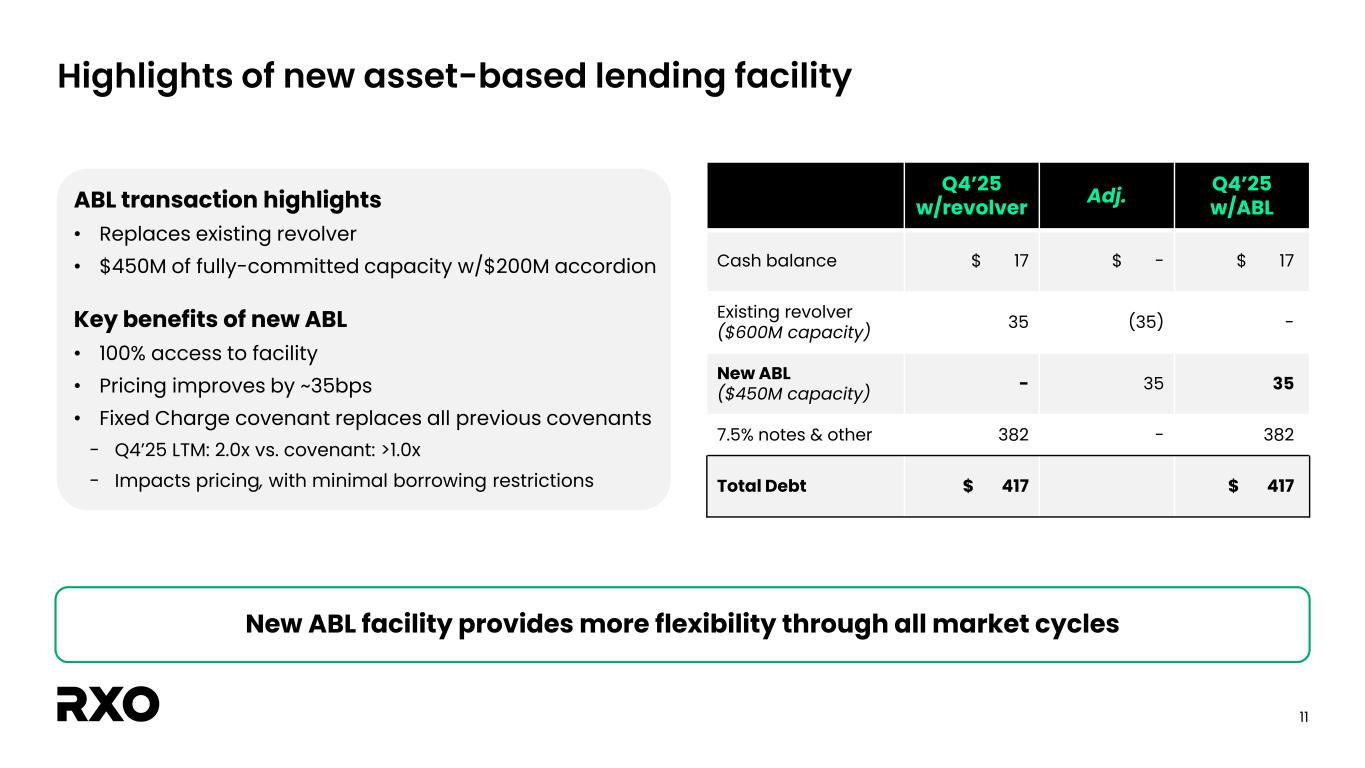
11 Highlights of new asset-based lending facility Q4’25 w/revolver Adj. Q4’25 w/ABL Cash balance $ 17 $ - $ 17 Existing revolver ($600M capacity) 35 (35) - New ABL ($450M capacity) - 35 35 7.5% notes & other 382 - 382 Total Debt $ 417 $ 417 New ABL facility provides more flexibility through all market cycles ABL transaction highlights • Replaces existing revolver • $450M of fully-committed capacity w/$200M accordion Key benefits of new ABL • 100% access to facility • Pricing improves by ~35bps • Fixed Charge covenant replaces all previous covenants − Q4’25 LTM: 2.0x vs. covenant: >1.0x − Impacts pricing, with minimal borrowing restrictions
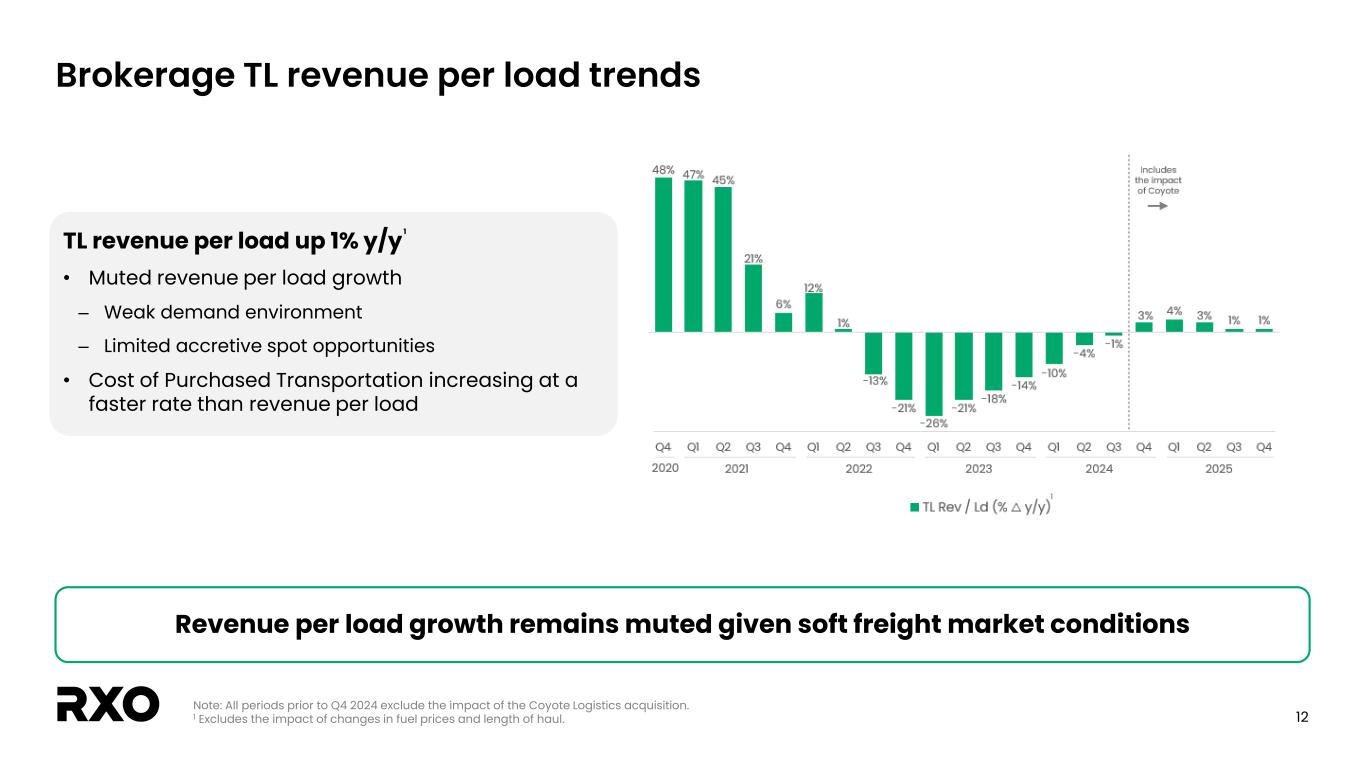
12 Brokerage TL revenue per load trends Revenue per load growth remains muted given soft freight market conditions TL revenue per load up 1% y/y • Muted revenue per load growth – Weak demand environment – Limited accretive spot opportunities • Cost of Purchased Transportation increasing at a faster rate than revenue per load Note: All periods prior to Q4 2024 exclude the impact of the Coyote Logistics acquisition. 1 Excludes the impact of changes in fuel prices and length of haul. 1
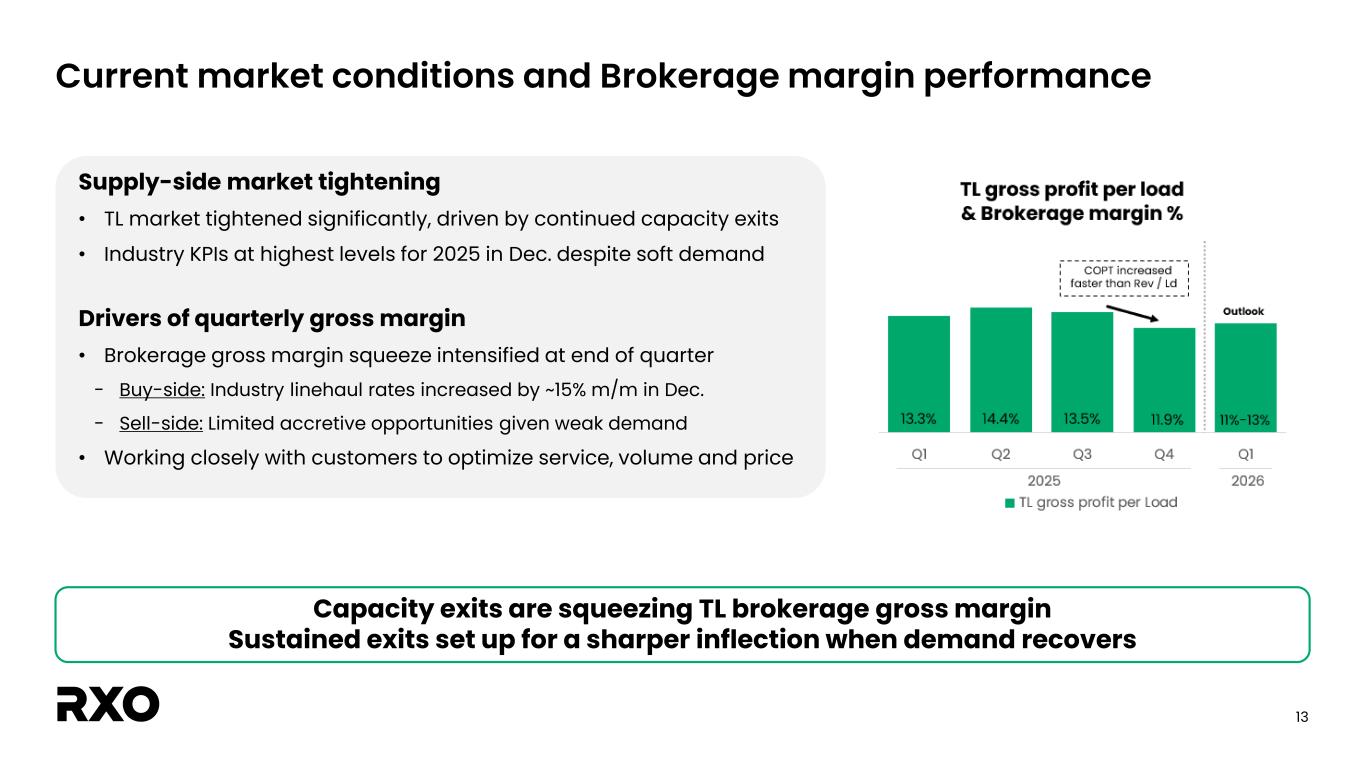
13 Current market conditions and Brokerage margin performance Supply-side market tightening • TL market tightened significantly, driven by continued capacity exits • Industry KPIs at highest levels for 2025 in Dec. despite soft demand Drivers of quarterly gross margin • Brokerage gross margin squeeze intensified at end of quarter − Buy-side: Industry linehaul rates increased by ~15% m/m in Dec. − Sell-side: Limited accretive opportunities given weak demand • Working closely with customers to optimize service, volume and price Capacity exits are squeezing TL brokerage gross margin Sustained exits set up for a sharper inflection when demand recovers
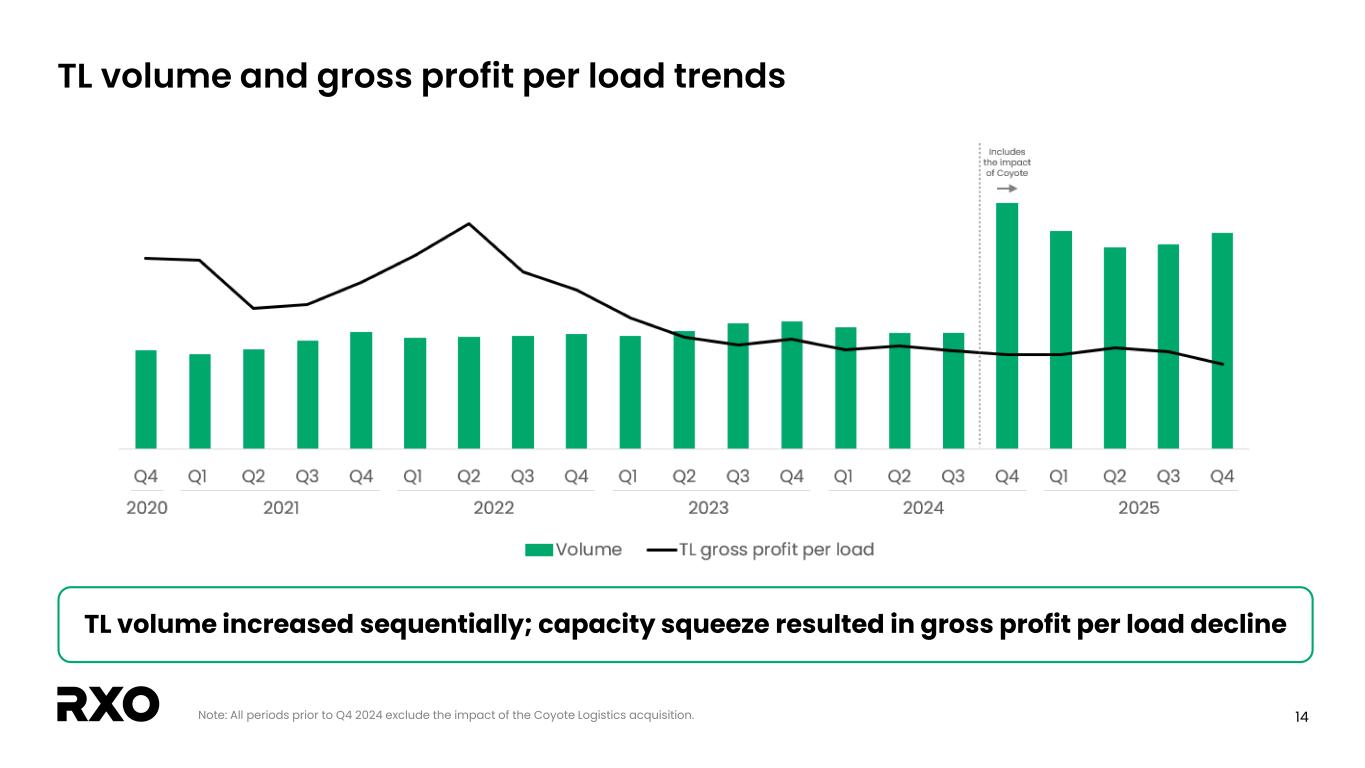
14 TL volume and gross profit per load trends Note: All periods prior to Q4 2024 exclude the impact of the Coyote Logistics acquisition. TL volume increased sequentially; capacity squeeze resulted in gross profit per load decline
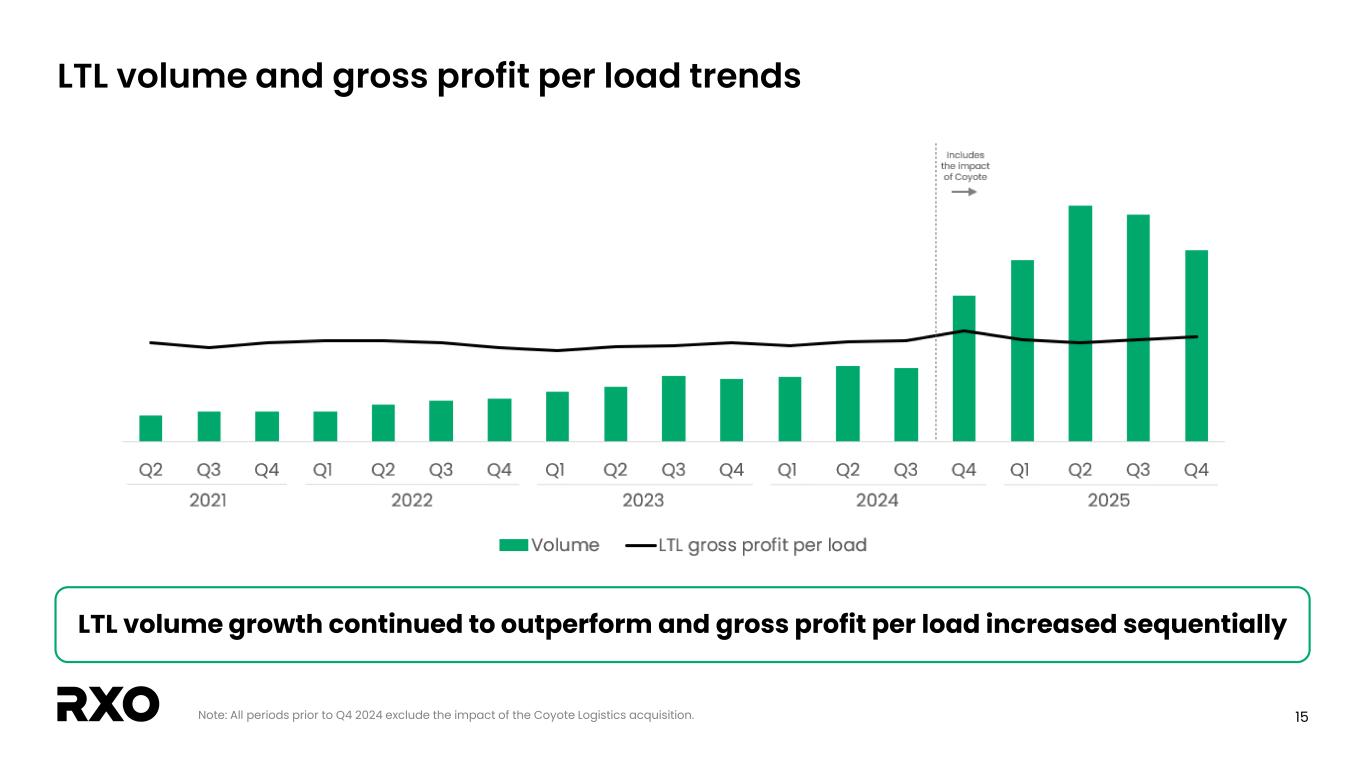
15 LTL volume and gross profit per load trends LTL volume growth continued to outperform and gross profit per load increased sequentially Note: All periods prior to Q4 2024 exclude the impact of the Coyote Logistics acquisition.
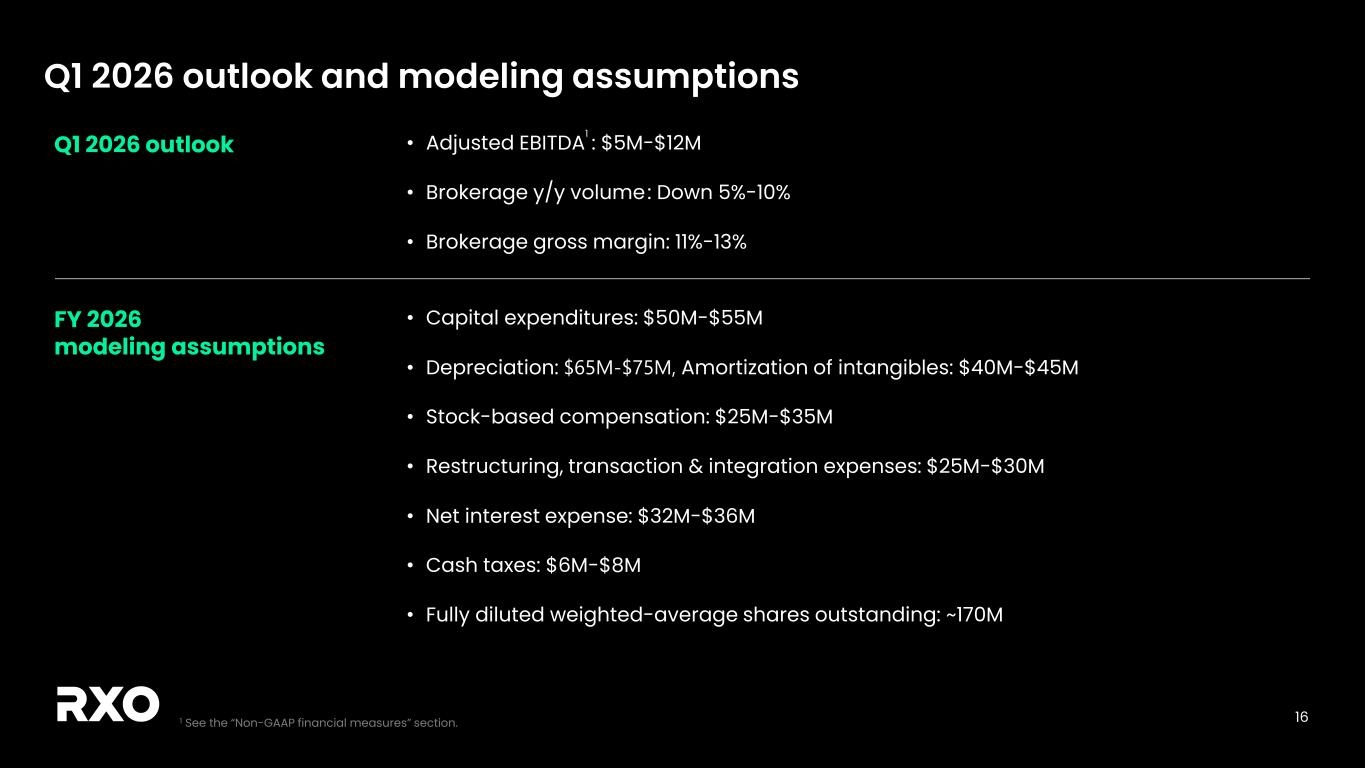
16 Q1 2026 outlook and modeling assumptions • Adjusted EBITDA1 : $5M-$12M • Brokerage y/y volume : Down 5%-10% • Brokerage gross margin: 11%-13% Q1 2026 outlook FY 2026 modeling assumptions • Capital expenditures: $50M-$55M • Depreciation: $65M-$75M, Amortization of intangibles: $40M-$45M • Stock-based compensation: $25M-$35M • Restructuring, transaction & integration expenses: $25M-$30M • Net interest expense: $32M-$36M • Cash taxes: $6M-$8M • Fully diluted weighted-average shares outstanding: ~170M 1 See the “Non-GAAP financial measures” section.
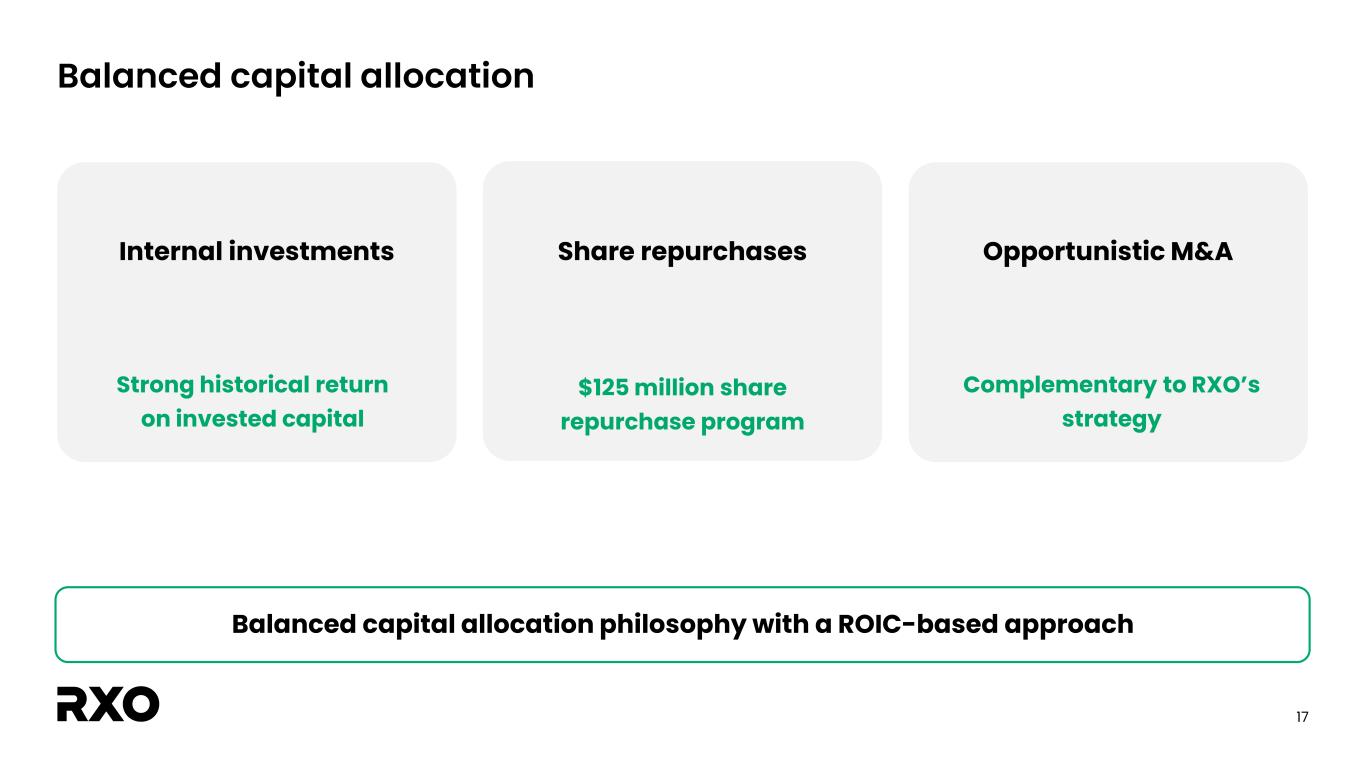
17 Balanced capital allocation Internal investments Strong historical return on invested capital Share repurchases Opportunistic M&A Complementary to RXO’s strategy Balanced capital allocation philosophy with a ROIC-based approach $125 million share repurchase program
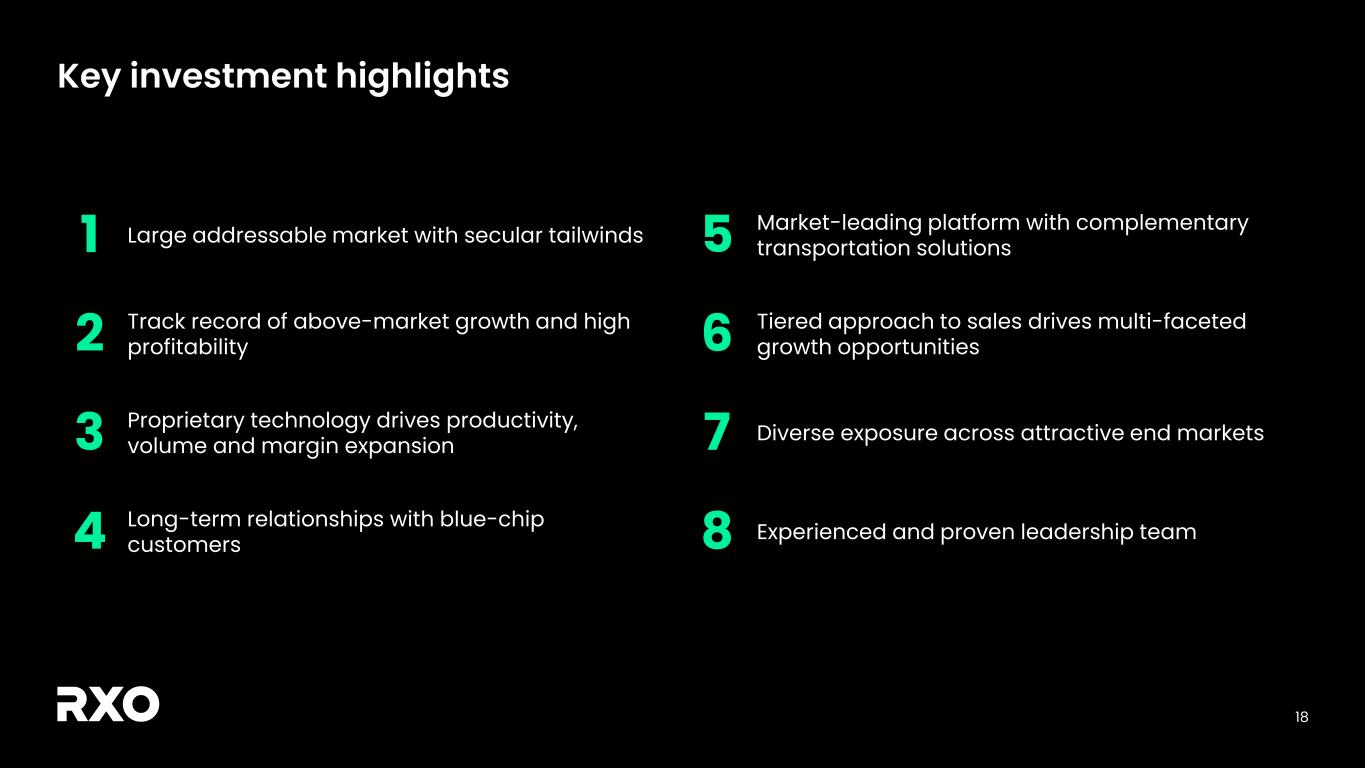
18 Key investment highlights 1 Large addressable market with secular tailwinds 2 Track record of above-market growth and high profitability 3 Proprietary technology drives productivity, volume and margin expansion 4 Long-term relationships with blue-chip customers 5 Market-leading platform with complementary transportation solutions 6 Tiered approach to sales drives multi-faceted growth opportunities 7 Diverse exposure across attractive end markets 8 Experienced and proven leadership team

19 Appendix
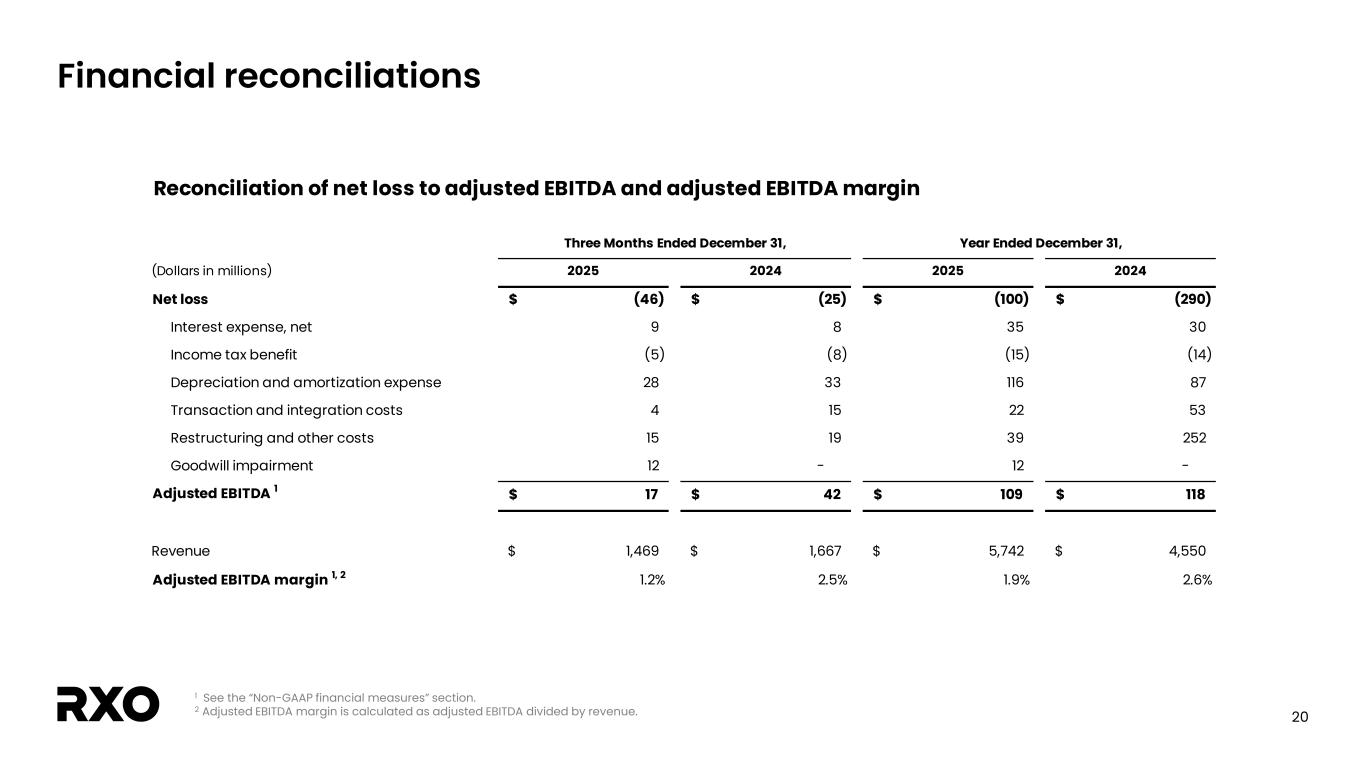
20 Financial reconciliations 1 See the “Non-GAAP financial measures” section. 2 Adjusted EBITDA margin is calculated as adjusted EBITDA divided by revenue. Reconciliation of net loss to adjusted EBITDA and adjusted EBITDA margin (Dollars in millions) 2025 2024 2025 2024 Net loss (46)$ (25)$ (100)$ (290)$ Interest expense, net 9 8 35 30 Income tax benefit (5) (8) (15) (14) Depreciation and amortization expense 28 33 116 87 Transaction and integration costs 4 15 22 53 Restructuring and other costs 15 19 39 252 Goodwill impairment 12 - 12 - Adjusted EBITDA 1 17$ 42$ 109$ 118$ Revenue 1,469$ 1,667$ 5,742$ 4,550$ Adjusted EBITDA margin 1, 2 1.2% 2.5% 1.9% 2.6% Three Months Ended December 31, Year Ended December 31,
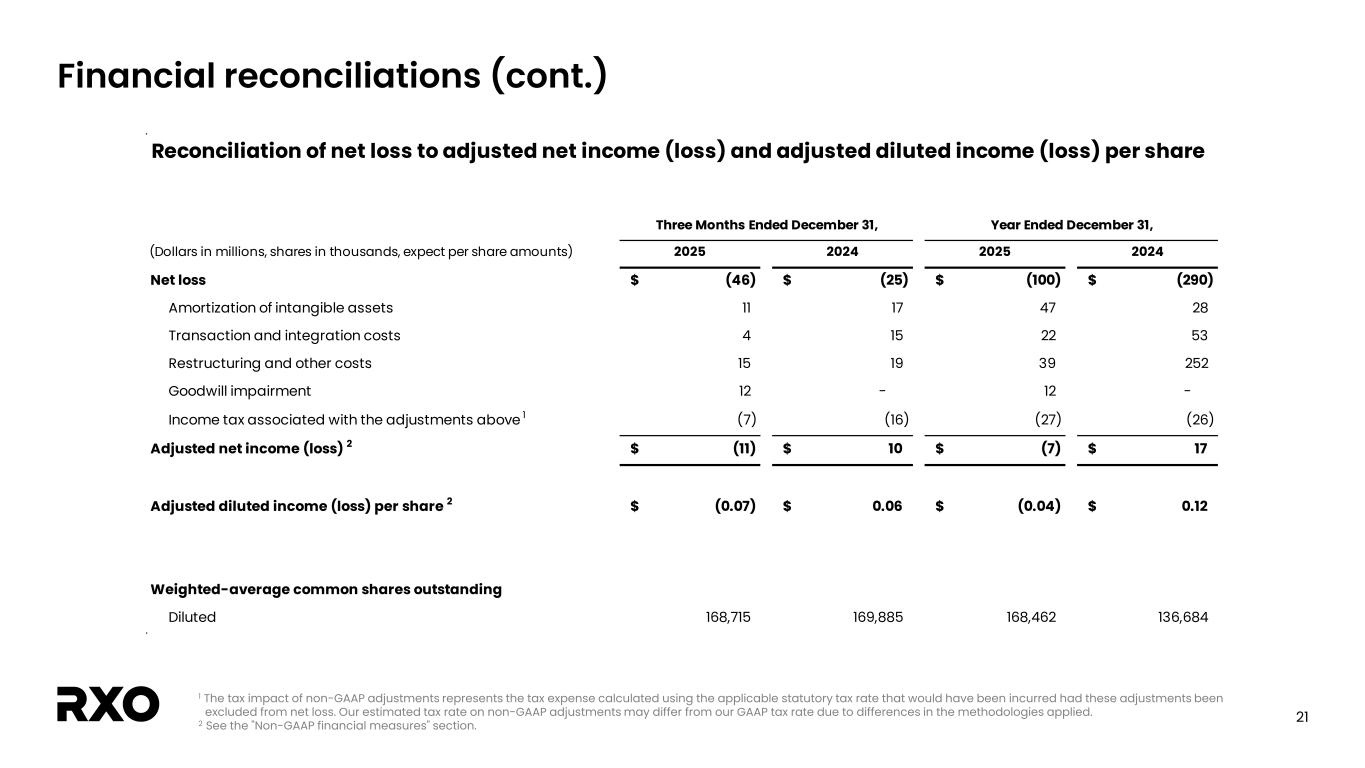
21 Financial reconciliations (cont.) 1 The tax impact of non-GAAP adjustments represents the tax expense calculated using the applicable statutory tax rate that would have been incurred had these adjustments been excluded from net loss. Our estimated tax rate on non-GAAP adjustments may differ from our GAAP tax rate due to differences in the methodologies applied. 2 See the "Non-GAAP financial measures" section. (Dollars in millions, shares in thousands, expect per share amounts) 2025 2024 2025 2024 Net loss (46)$ (25)$ (100)$ (290)$ Amortization of intangible assets 11 17 47 28 Transaction and integration costs 4 15 22 53 Restructuring and other costs 15 19 39 252 Goodwill impairment 12 - 12 - Income tax associated with the adjustments above 1 (7) (16) (27) (26) Adjusted net income (loss) 2 (11)$ 10$ (7)$ 17$ Adjusted diluted income (loss) per share 2 (0.07)$ 0.06$ (0.04)$ 0.12$ Weighted-average common shares outstanding Diluted 168,715 169,885 168,462 136,684 Three Months Ended December 31, Year Ended December 31, Reconciliation of net loss to adjusted net income (loss) and adjusted diluted income (loss) per share
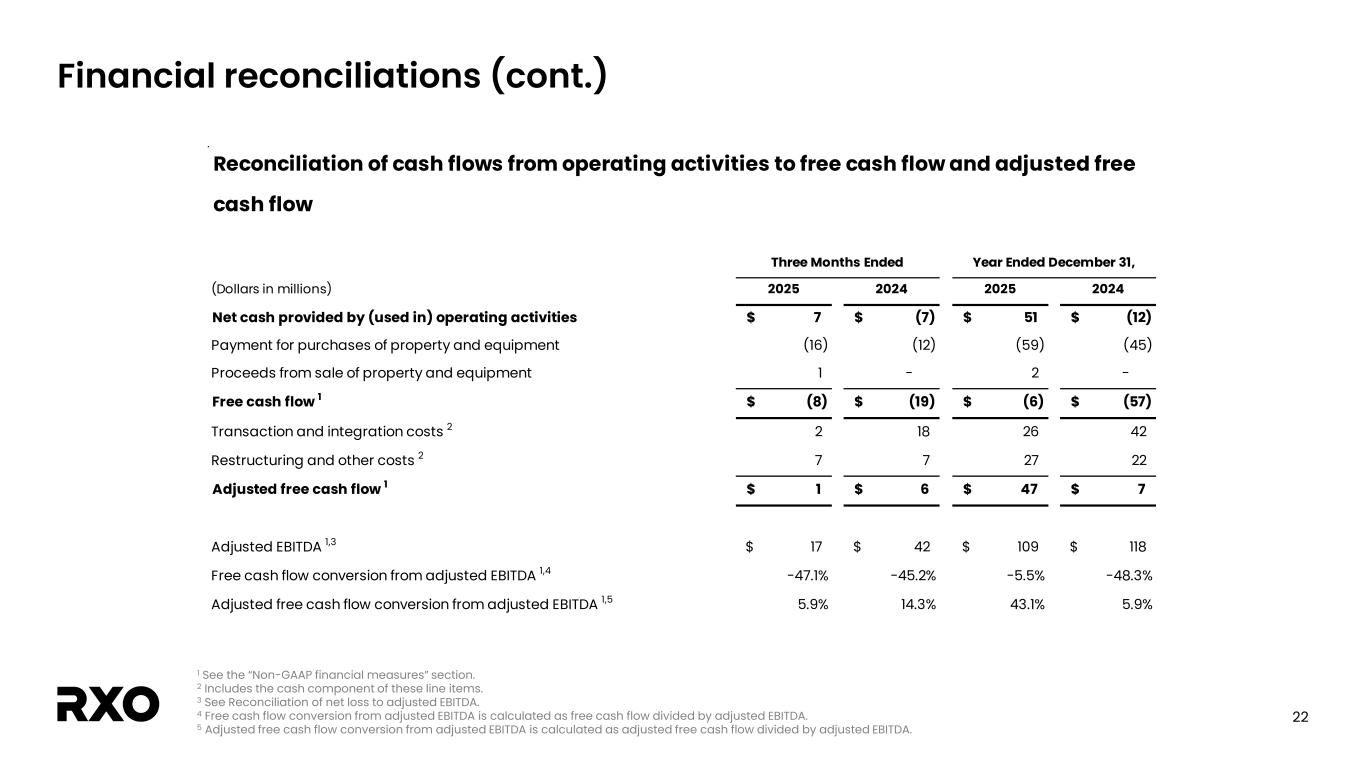
22 1 See the “Non-GAAP financial measures” section. 2 Includes the cash component of these line items. 3 See Reconciliation of net loss to adjusted EBITDA. 4 Free cash flow conversion from adjusted EBITDA is calculated as free cash flow divided by adjusted EBITDA. 5 Adjusted free cash flow conversion from adjusted EBITDA is calculated as adjusted free cash flow divided by adjusted EBITDA. Financial reconciliations (cont.) (Dollars in millions) 2025 2024 2025 2024 Net cash provided by (used in) operating activities 7$ (7)$ 51$ (12)$ Payment for purchases of property and equipment (16) (12) (59) (45) Proceeds from sale of property and equipment 1 - 2 - Free cash flow 1 (8)$ (19)$ (6)$ (57)$ Transaction and integration costs 2 2 18 26 42 Restructuring and other costs 2 7 7 27 22 Adjusted free cash flow 1 1$ 6$ 47$ 7$ Adjusted EBITDA 1,3 17$ 42$ 109$ 118$ Free cash flow conversion from adjusted EBITDA 1,4 -47.1% -45.2% -5.5% -48.3% Adjusted free cash flow conversion from adjusted EBITDA 1,5 5.9% 14.3% 43.1% 5.9% Year Ended December 31, Reconciliation of cash flows from operating activities to free cash flow and adjusted free cash flow Three Months Ended
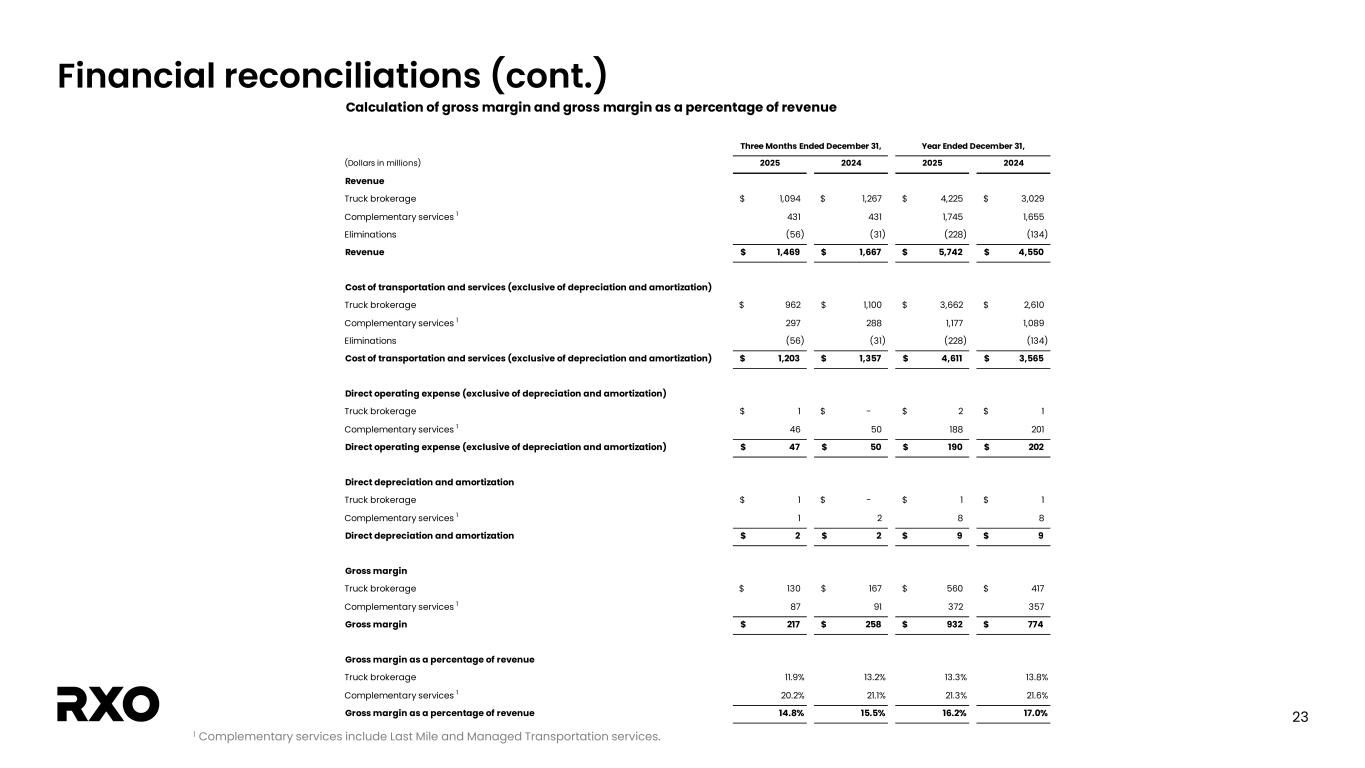
23 Financial reconciliations (cont.) 1 Complementary services include Last Mile and Managed Transportation services. Calculation of gross margin and gross margin as a percentage of revenue (Dollars in millions) 2025 2024 2025 2024 Revenue Truck brokerage 1,094$ 1,267$ 4,225$ 3,029$ Complementary services 1 431 431 1,745 1,655 Eliminations (56) (31) (228) (134) Revenue 1,469$ 1,667$ 5,742$ 4,550$ Cost of transportation and services (exclusive of depreciation and amortization) Truck brokerage 962$ 1,100$ 3,662$ 2,610$ Complementary services 1 297 288 1,177 1,089 Eliminations (56) (31) (228) (134) Cost of transportation and services (exclusive of depreciation and amortization) 1,203$ 1,357$ 4,611$ 3,565$ Direct operating expense (exclusive of depreciation and amortization) Truck brokerage 1$ -$ 2$ 1$ Complementary services 1 46 50 188 201 Direct operating expense (exclusive of depreciation and amortization) 47$ 50$ 190$ 202$ Direct depreciation and amortization Truck brokerage 1$ -$ 1$ 1$ Complementary services 1 1 2 8 8 Direct depreciation and amortization 2$ 2$ 9$ 9$ Gross margin Truck brokerage 130$ 167$ 560$ 417$ Complementary services 1 87 91 372 357 Gross margin 217$ 258$ 932$ 774$ Gross margin as a percentage of revenue Truck brokerage 11.9% 13.2% 13.3% 13.8% Complementary services 1 20.2% 21.1% 21.3% 21.6% Gross margin as a percentage of revenue 14.8% 15.5% 16.2% 17.0% Three Months Ended December 31, Year Ended December 31,
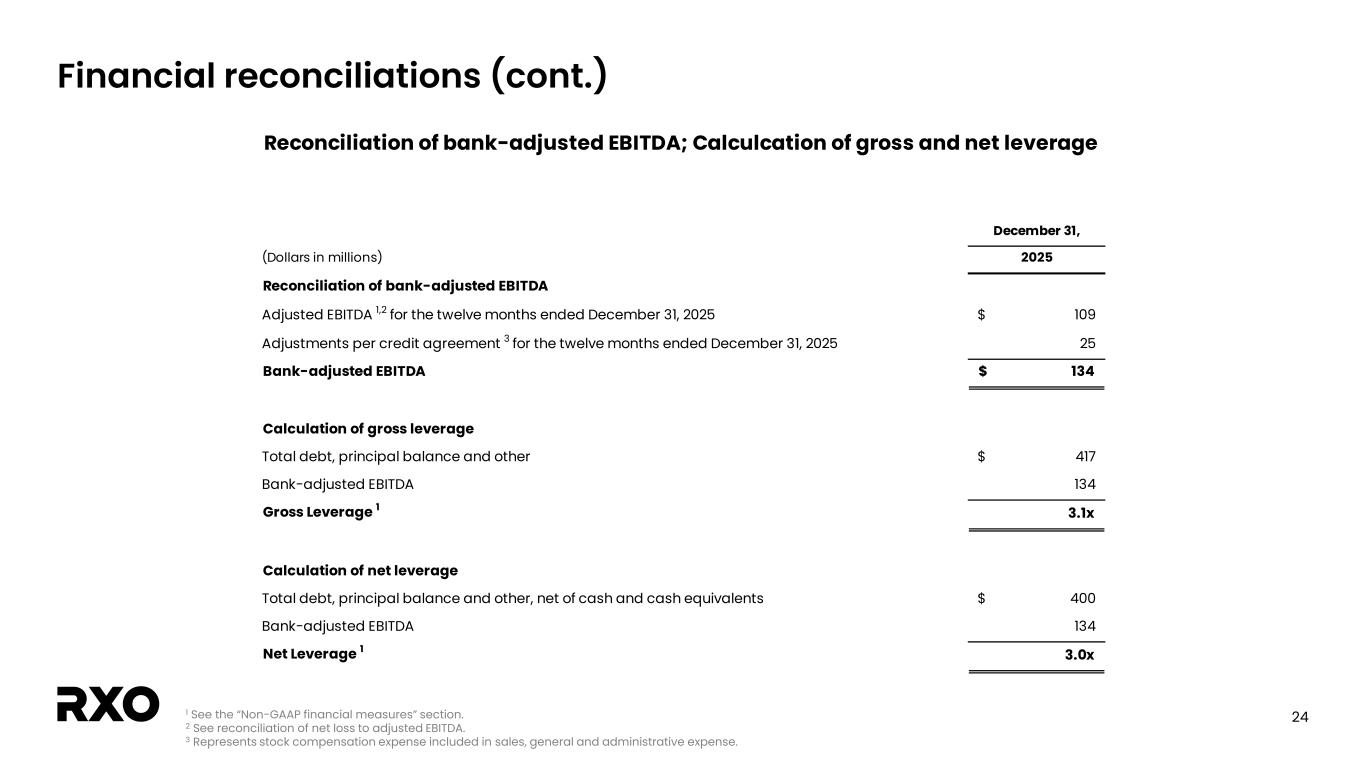
24 Financial reconciliations (cont.) 1 See the “Non-GAAP financial measures” section. 2 See reconciliation of net loss to adjusted EBITDA. 3 Represents stock compensation expense included in sales, general and administrative expense. December 31, (Dollars in millions) 2025 Reconciliation of bank-adjusted EBITDA Adjusted EBITDA 1,2 for the twelve months ended December 31, 2025 109$ Adjustments per credit agreement 3 for the twelve months ended December 31, 2025 25 Bank-adjusted EBITDA 134$ Calculation of gross leverage Total debt, principal balance and other 417$ Bank-adjusted EBITDA 134 Gross Leverage 1 3.1x Calculation of net leverage Total debt, principal balance and other, net of cash and cash equivalents 400$ Bank-adjusted EBITDA 134 Net Leverage 1 3.0x Reconciliation of bank-adjusted EBITDA; Calculcation of gross and net leverage