Alan A. Lanis, Jr. direct dial: 310.442.8828 jrlanis@bakerlaw.com May 22, 2025 Office of Manufacturing Division of Corporation Finance Securities and Exchange Commission Washington, DC 20549 Attn: Michael Volley and Amit Pande Re: F&G Annuities & Life, Inc. Form 10-K for Fiscal Year Ended December 31, 2024 Form 8-K Filed February 20, 2025 File No. 001-41490 Mr. Volley and Mr. Pande: On behalf of F&G Annuities & Life, Inc. (the “Company”), we are submitting this letter in response to the comment letter from the staff of the Division of Corporation Finance (the “Staff”) of the Securities and Exchange Commission (the “Commission”) dated April 25, 2025 (the “Comment Letter”), relating to the Company’s Form 10-K, filed with the Commission on February 28, 2025 and the Company’s Form 8-K, filed with the Commission on February 20, 2025. For the Staff’s convenience, we have repeated below the Staff’s comment in italics, and have followed such comment with the Company’s response. Form 10-K for Fiscal Year Ended December 31, 2024 Our Strategy, page 11 1. We note your reference to accretive flow reinsurance and flow reinsurance fee income throughout your filing. Please revise future filings to provide additional information regarding how flow reinsurance is accretive and explain how you generate fee income from the flow reinsurance transactions. Please provide us your proposed disclosure. In response to the Staff’s comment, the Company acknowledges the Staff’s request and confirms that it will revise its future filings to provide the additional information regarding how flow reinsurance is accretive and how fee income from the flow reinsurance transactions is generated, as requested.
May 22, 2025 Page 2 For the Staff’s reference, set forth below is a draft of the proposed revised disclosure that the Company intends to include in future filings: Flow reinsurance is a strategic arrangement designed to optimize capital efficiency and maintain sales growth capacity by leveraging the reinsurer’s balance sheet. Under this structure, on a reinsured sale, F&G deploys approximately 50% of the capital required in the initial year compared to a fully retained sale, with no capital allocated in the subsequent year. The reinsurer provides the remaining capital and assumes the risk and returns on the ceded business. The reinsurer pays a ceding commission to F&G as part of the sales arrangement. Although the commission is relatively lower than the earnings from a fully retained sale, the overall construct is accretive due to the significant reduction in capital utilization relative to earnings, creating a capital-light transaction profile for F&G. Non-GAAP Financial Measures, page 87 2. We note your prominent disclosure and discussion related to the Adjusted Net Earnings non-GAAP financial measure and the material adjustments on page 99 related to “Recognized gains and losses, net” and “Market related liability adjustments.” Please revise future filings to more clearly describe why you back out the impact of the multitude of transactions included in these two adjustments and why you consider the resulting measure to be useful in understanding your overall results of operations. Further, we note you back out only certain recognized gains and losses. Compare and contrast the key characteristics of recognized gains and losses left in as compared to those backed out. Please provide us your proposed disclosure. In response to the Staff’s comment, the Company acknowledges the Staff’s request and confirms that it will revise its future filings to provide the additional information regarding the decision to back out transactions included in “Recognized gains and losses, net” and “Market related liability adjustments” and why the resulting measure is considered useful in understanding the Company’s overall results of operations, as requested. For the Staff’s reference, set forth below is a draft of the proposed revised disclosure that the Company intends to include in future filings: Adjusted net earnings attributable to common shareholders (ANE) is a non-GAAP economic measure used to evaluate financial performance each period. ANE eliminates the impact of specific items that are not indicative of the underlying economics of our business, including certain market volatility, asymmetrical and noneconomic accounting, non- recurring items and other income and expense adjustments. These items are volatile in our reported GAAP earnings and are not indicative of the underlying profitability drivers reflected in the design and pricing of our products and/or our investment and hedging strategy, as such items fluctuate from period to period in a manner inconsistent with these drivers. ANE provides information to enhance an investor’s understanding of our results and underlying profitability drivers by removing the impact of short-term market volatility (i.e. recognized gains and losses, market risk benefits remeasurement gains and losses, derivative gains and losses), asymmetrical and non-economic accounting (i.e. derivatives and investment hedges that do not qualify for hedge accounting, deferred pension risk transfer deferred profit liability losses), and other adjustments.
May 22, 2025 Page 3 ANE is calculated by adjusting net earnings or loss attributable to common shareholders to eliminate: (i) Recognized gains and losses, net: the impact of net investment gains/losses, including changes in allowance for expected credit losses and other than temporary impairment (“OTTI”) losses, recognized in operations; and the effects of changes in fair value of the reinsurance related embedded derivative and other derivatives, including interest rate swaps and forwards; (ii) Market related liability adjustments: the impacts related to changes in the fair value, including both realized and unrealized gains and losses, of index product related derivatives and embedded derivatives, net of hedging cost; the impact of initial pension risk transfer deferred profit liability losses, including amortization from previously deferred pension risk transfer deferred profit liability losses; and the changes in the fair value of market risk benefits by deferring current period changes and amortizing that amount over the life of the market risk benefit; (iii) Purchase price amortization: the impacts related to the amortization of certain intangibles (internally developed software, trademarks and value of distribution asset and the change in fair value of liabilities recognized as a result of acquisition activities); (iv) Transaction costs: the impacts related to acquisition, integration and merger related items; (v) Other and “non-recurring,” “infrequent” or “unusual items”: Other adjustments include removing any charges associated with U.S. guaranty fund assessments as these charges neither relate to the ordinary course of the Company’s business nor reflect the Company’s underlying business performance, but result from external situations not controlled by the Company. Further, Management excludes certain items determined to be “non-recurring,” “infrequent” or “unusual” from adjusted net earnings when incurred if it is determined these expenses are not a reflection of the core business and when the nature of the item is such that it is not reasonably likely to recur within two years and/or there was not a similar item in the preceding two years; (vi) Non-controlling interest on non-GAAP adjustments: the portion of the non-GAAP adjustments attributable to the equity interest of entities that F&G does not wholly own; and (vii) Income taxes: the income tax impact related to the above-mentioned adjustments is measured using an effective tax rate, as appropriate by tax jurisdiction. Recognized gains and losses are excluded from ANE as part of both adjustments (i) and (ii). As part of those two adjustments to ANE, all material recognized gains and losses are removed except for periodic settlements of interest rate swaps used to economically hedge our floating rate investments. While these items are an integral part of the overall performance of F&G, market conditions and/or the non-operating nature of these items can overshadow the underlying performance of our normal, ongoing business. Accordingly, management considers ANE to be a useful measure internally and to investors and analysts in analyzing the trends of our operations. ANE should not be used as a substitute for GAAP net earnings and loss. Therefore, the Company has provided a reconciliation of ANE to the most comparable GAAP metric, net earnings and loss, on page XXX.
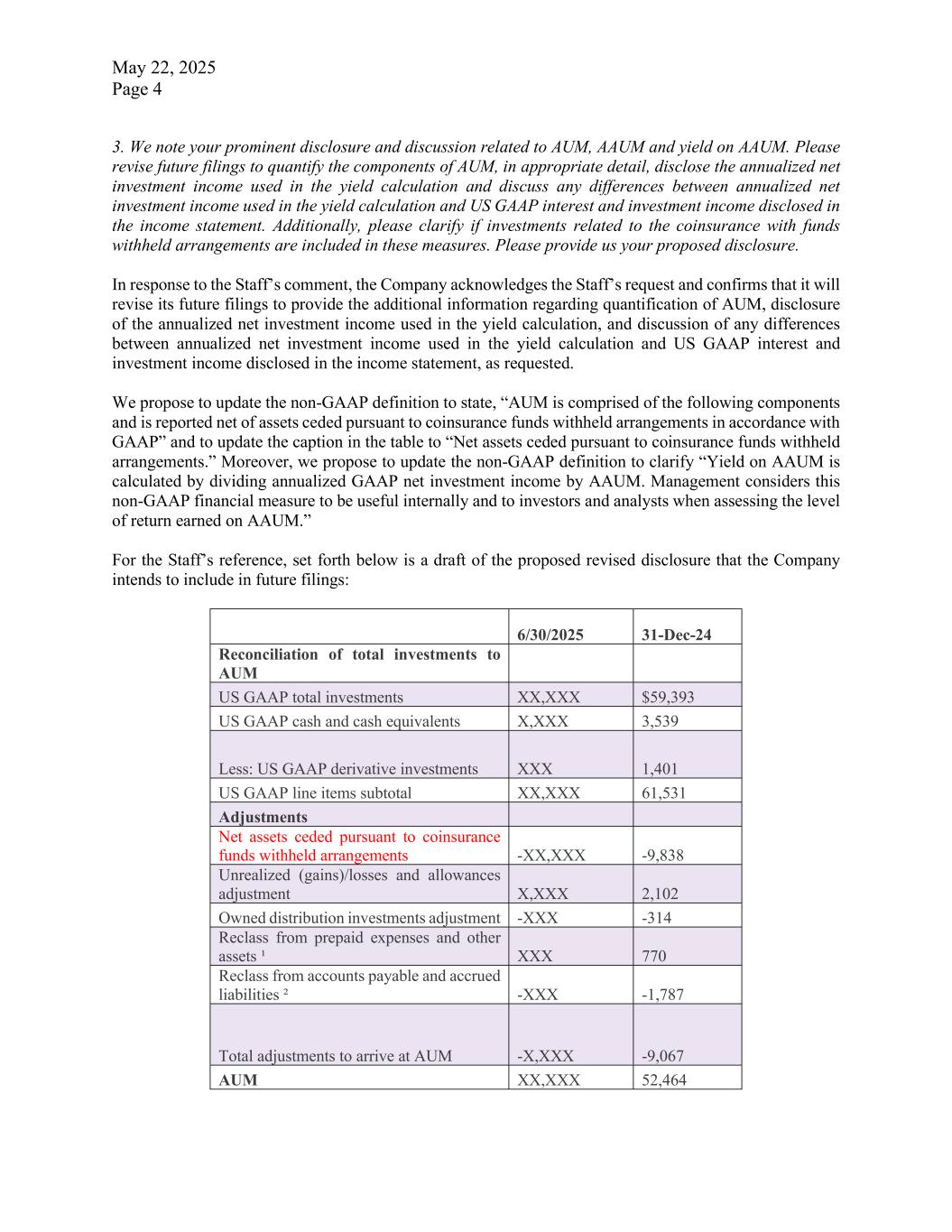
May 22, 2025 Page 4 3. We note your prominent disclosure and discussion related to AUM, AAUM and yield on AAUM. Please revise future filings to quantify the components of AUM, in appropriate detail, disclose the annualized net investment income used in the yield calculation and discuss any differences between annualized net investment income used in the yield calculation and US GAAP interest and investment income disclosed in the income statement. Additionally, please clarify if investments related to the coinsurance with funds withheld arrangements are included in these measures. Please provide us your proposed disclosure. In response to the Staff’s comment, the Company acknowledges the Staff’s request and confirms that it will revise its future filings to provide the additional information regarding quantification of AUM, disclosure of the annualized net investment income used in the yield calculation, and discussion of any differences between annualized net investment income used in the yield calculation and US GAAP interest and investment income disclosed in the income statement, as requested. We propose to update the non-GAAP definition to state, “AUM is comprised of the following components and is reported net of assets ceded pursuant to coinsurance funds withheld arrangements in accordance with GAAP” and to update the caption in the table to “Net assets ceded pursuant to coinsurance funds withheld arrangements.” Moreover, we propose to update the non-GAAP definition to clarify “Yield on AAUM is calculated by dividing annualized GAAP net investment income by AAUM. Management considers this non-GAAP financial measure to be useful internally and to investors and analysts when assessing the level of return earned on AAUM.” For the Staff’s reference, set forth below is a draft of the proposed revised disclosure that the Company intends to include in future filings: 6/30/2025 31-Dec-24 Reconciliation of total investments to AUM US GAAP total investments XX,XXX $59,393 US GAAP cash and cash equivalents X,XXX 3,539 Less: US GAAP derivative investments XXX 1,401 US GAAP line items subtotal XX,XXX 61,531 Adjustments Net assets ceded pursuant to coinsurance funds withheld arrangements -XX,XXX -9,838 Unrealized (gains)/losses and allowances adjustment X,XXX 2,102 Owned distribution investments adjustment -XXX -314 Reclass from prepaid expenses and other assets ¹ XXX 770 Reclass from accounts payable and accrued liabilities ² -XXX -1,787 Total adjustments to arrive at AUM -X,XXX -9,067 AUM XX,XXX 52,464
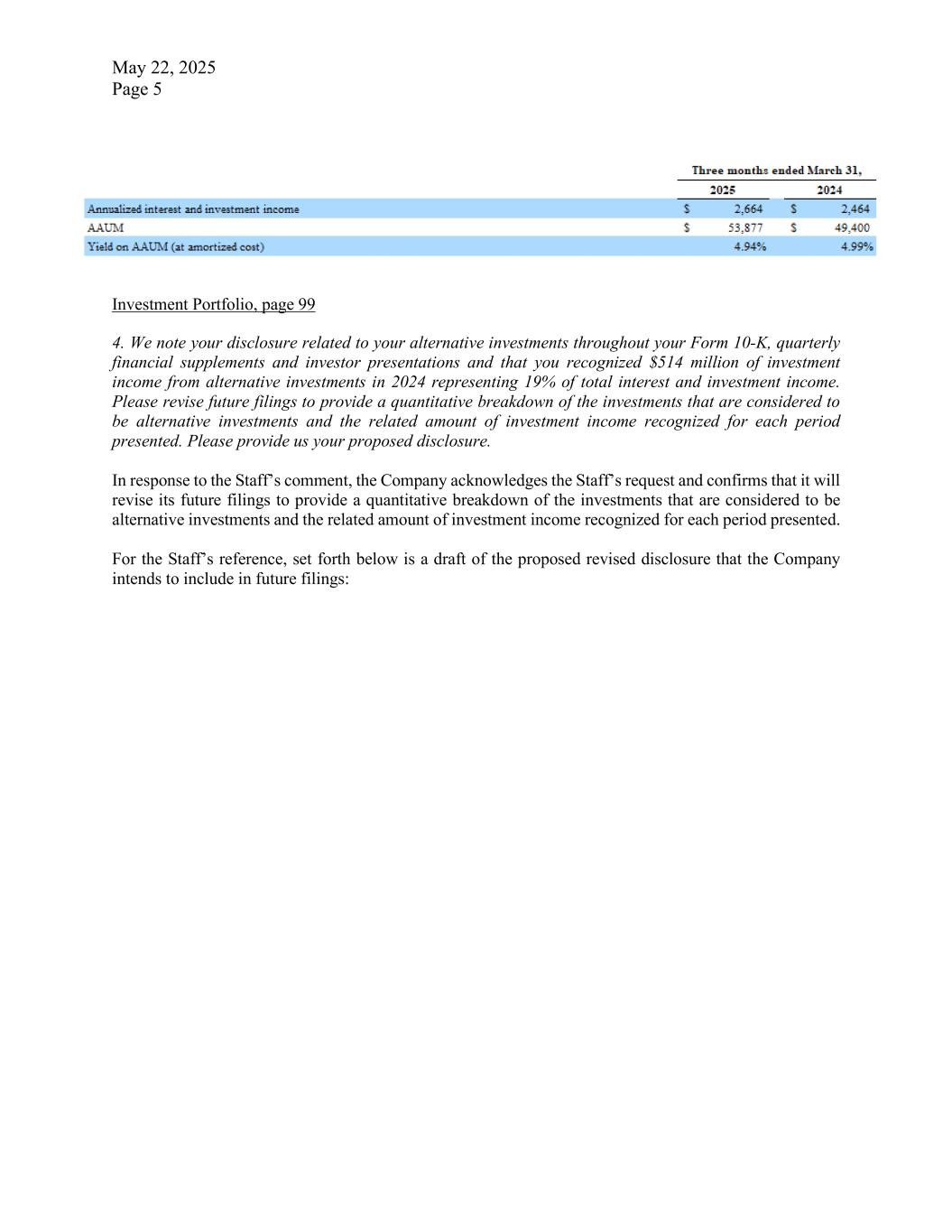
May 22, 2025 Page 5 Investment Portfolio, page 99 4. We note your disclosure related to your alternative investments throughout your Form 10-K, quarterly financial supplements and investor presentations and that you recognized $514 million of investment income from alternative investments in 2024 representing 19% of total interest and investment income. Please revise future filings to provide a quantitative breakdown of the investments that are considered to be alternative investments and the related amount of investment income recognized for each period presented. Please provide us your proposed disclosure. In response to the Staff’s comment, the Company acknowledges the Staff’s request and confirms that it will revise its future filings to provide a quantitative breakdown of the investments that are considered to be alternative investments and the related amount of investment income recognized for each period presented. For the Staff’s reference, set forth below is a draft of the proposed revised disclosure that the Company intends to include in future filings:
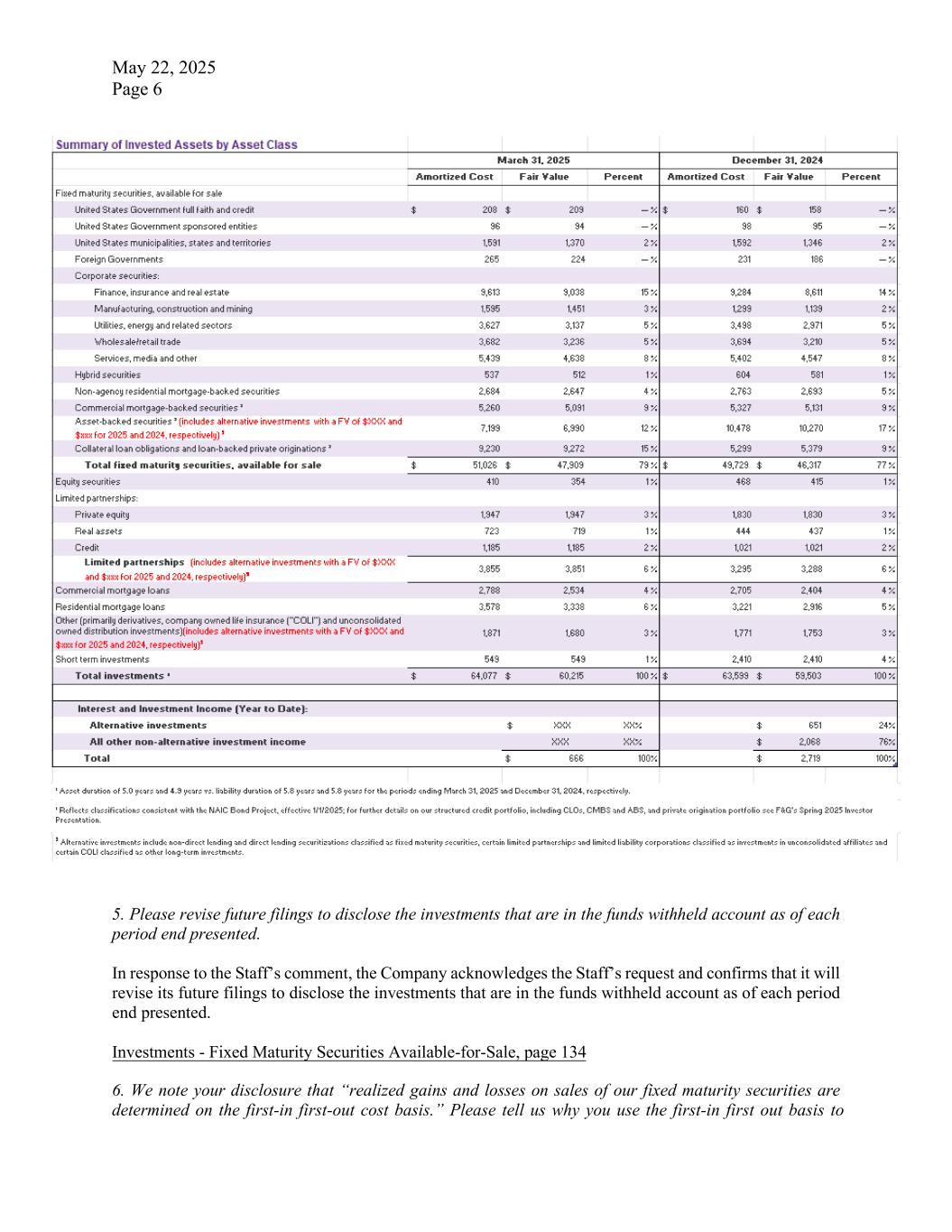
May 22, 2025 Page 6 5. Please revise future filings to disclose the investments that are in the funds withheld account as of each period end presented. In response to the Staff’s comment, the Company acknowledges the Staff’s request and confirms that it will revise its future filings to disclose the investments that are in the funds withheld account as of each period end presented. Investments - Fixed Maturity Securities Available-for-Sale, page 134 6. We note your disclosure that “realized gains and losses on sales of our fixed maturity securities are determined on the first-in first-out cost basis.” Please tell us why you use the first-in first out basis to
May 22, 2025 Page 7 determine the cost basis of sold fixed maturity securities available-for-sale as compared to the specific identification method. Tell us the nature of your investments in fixed maturity securities available-for-sale that results in first-in first-out being appropriate. We acknowledge the Staff’s comment and appreciate the opportunity to clarify our disclosure. While our filing refers to the use of a “first-in first-out” methodology for determining the cost of investments sold, we would like to clarify that this terminology was used as a descriptive label rather than an election of a cost flow assumption in the manner typically associated with inventory accounting. Our actual practice is to apply a consistent, traceable lot-level identification approach when disposing of investments. In effect, our approach is a systematic and consistently applied method of specific identification, where the earliest acquired lots are selected for disposal when a partial sale occurs. This method allows us to maintain full traceability of each investment lot and supports our ability to accurately track gains and losses in accordance with ASC 320 or ASC 321, as applicable. To address this, we will revise the relevant disclosure in the Company’s annual report on Form 10-K to describe our methodology as a form of specific identification. We believe this change will enhance clarity and ensure our disclosures more accurately reflect our accounting policy and compliance with U.S. GAAP. Funds Withheld Arrangements, page 142 7. Please revise future filings to disclose your accounting policies related to “Funds withheld for reinsurance liabilities.” Specifically disclose what items are included in this line item presented in your Consolidated Balance Sheets and how they are recognized and measured. In response to the Staff’s comment, the Company acknowledges the Staff’s request and confirms that it will revise its future filings to disclose the items included in “Funds withheld for reinsurance liabilities” and how they are recognized and measured. Recognized Gains and (Losses), Net, page 166 8. It appears the “Realized (losses) gains on derivatives and embedded derivatives” line item in the table on page 166 represents a sub-total for “Derivatives and embedded derivatives.” Please explain to us why it is labeled as “Realized” when it appears to include both realized and unrealized amounts. Alternatively, please revise the line item description, as appropriate, in future filings. In response to the Staff’s comment, the Company acknowledges the Staff’s request and confirms that it will revise its future filings to revise the line item description to state “Net realized/ unrealized (losses) gains on derivatives and embedded derivatives.” Note D - Derivative Financial Instruments, page 168 9. We note your disclosure on page 82 that the compound embedded derivatives related to arrangements reinsuring indexed annuities products are reported in “Funds withheld for reinsurance liabilities”. Please tell us where these derivatives are presented in the first table on page 168. If material, please revise future filings to more clearly present this information. The compound embedded derivative was introduced with the Somerset reinsurance agreement effective July 1, 2024, had an immaterial balance of $4 million at December 31, 2024, and was reported within the reinsurance related embedded derivatives line item on page 168. The Company will revise its disclosure
May 22, 2025 Page 8 and presentation of these derivatives for future filings to clearly describe the derivatives and their presentation within the Funds withheld for reinsurance liabilities line item on the Consolidated Balance Sheets. The revised derivative table has a footnote to clearly indicate the classification. Note O - Insurance Subsidiary Financial Information and Regulatory Matters, page 196 10. For each material entity, please revise future filings to disclose the amount of statutory capital and surplus necessary to satisfy regulatory requirements if significant in relation to the entity’s statutory capital and surplus. Refer to ASC 944-505-50-1 for guidance. Please provide us your proposed disclosure. In response to the Staff’s comment, the Company acknowledges the Staff’s request and confirms that it will revise its future filings to provide filings to disclose the amount of statutory capital and surplus necessary to satisfy regulatory requirements, as requested. For the Staff’s reference, set forth below is a draft of the proposed revised disclosure that the Company intends to include in future filings: To enhance the regulation of insurers’ solvency, the NAIC adopted a model law to implement risk- based capital (“RBC”) requirements for life, health and property and casualty insurance companies. All states have adopted the NAIC’s model law or a substantially similar law. RBC requirements are used by regulators to assess the minimum amount of statutory capital and surplus needed for an insurance company to support its operations, based on its size and risk profile (referred to as “company action level RBC”). The RBC ratio, which is based on statutory financial statements and is the basis for determining regulatory compliance, is equal to total adjusted capital divided by the applicable company action level RBC. Companies below 100% of the company action level RBC are subject to corrective action. FGL Insurance’s estimated U.S. RBC ratio was over XXX% as of December 31, 2025. FGL Insurance expects to maintain its U.S. risk-based capital (“RBC”) ratio at or above our target of 400%. Form 8-K Filed February 20, 2025 Exhibit 99.3 F&G 2024 Winter Investor Presentation, page 41 11. We note in slide 41 that you present adjusted net earnings that includes an adjustment related to alternative investment returns below your long-term expectations. We further note that you discuss this measure in your fourth quarter 2024 earnings call. In your response letter dated October 26, 2022, you stated that you “... revised the disclosures... to remove this adjustment from all non-GAAP financial measures” since this adjustment results in a misleading non-GAAP measure that violates Rule 100(b) of Regulation G. Please discontinue disclosing measures that contain this adjustment in all future public communications whether written or oral or tell us how your current presentation in your earnings release and discussion of this measure in your earnings call complies with Regulation G. The Company acknowledges the Staff’s comment and will remove the alternative investment income normalizing adjustment from all non-GAAP financial measures in future 8-K filings, starting in the first quarter of 2025. * * *
May 22, 2025 Page 9 If Staff should have any questions or comments regarding this submission or response, please feel free to contact me at (310) 442-8828. Thank you for your ongoing courtesy in this matter. Sincerely, /s/ Alan A. Lanis, Jr. Alan A. Lanis, Jr. Partner