Alan A. Lanis, Jr. direct dial: 310.442.8828 jrlanis@bakerlaw.com July 3, 2025 Office of Manufacturing Division of Corporation Finance Securities and Exchange Commission Washington, DC 20549 Attn: Michael Volley and Amit Pande Re: F&G Annuities & Life, Inc. Form 10-K for Fiscal Year Ended December 31, 2024 Form 8-K Filed February 20, 2025 File No. 001-41490 Messrs. Volley and Pande: On behalf of F&G Annuities & Life, Inc. (the “Company”), we are submitting this letter in response to the comment letter from the staff of the Division of Corporation Finance (the “Staff”) of the Securities and Exchange Commission (the “Commission”) dated June 20, 2025 (the “Comment Letter”), relating to the Company’s Form 10-K, filed with the Commission on February 28, 2025 and the Company’s Form 8-K, filed with the Commission on February 20, 2025. For the Staff’s convenience, we have repeated below the Staff’s comment in italics, and have followed such comment with the Company’s response. Form 10-K for Fiscal Year Ended December 31, 2024 Non-GAAP Financial Measures, page 87 1. We note you disclose that you eliminate the changes in the fair value of market risk benefits by deferring current period changes and amortizing that amount over the life of the market risk benefit. Please address the following: • Please quantify each component of this adjustment for 2024, 2023 and the quarter ended March 31, 2025.
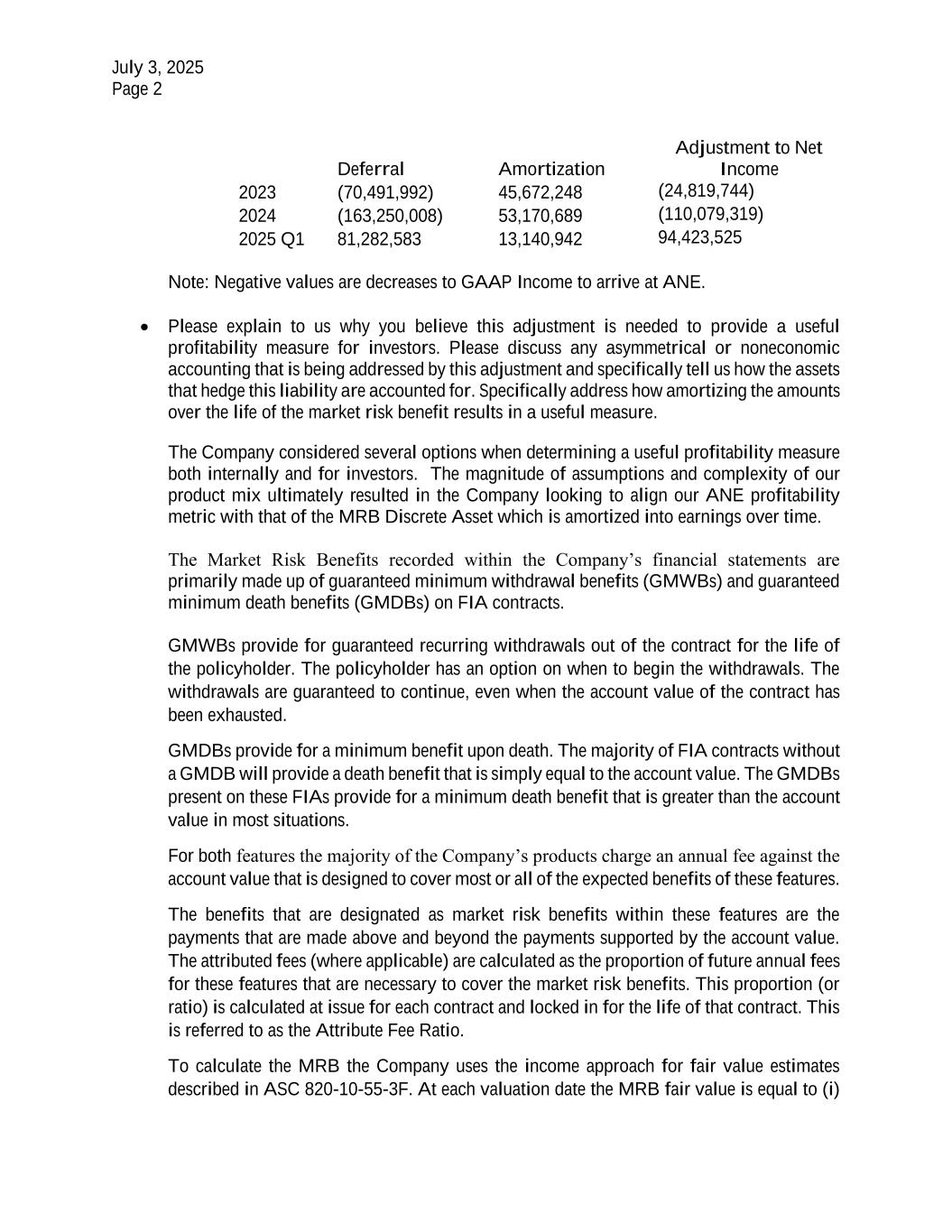
July 3, 2025 Page 2 Deferral Amortization Adjustment to Net Income 2023 (70,491,992) 45,672,248 (24,819,744) 2024 (163,250,008) 53,170,689 (110,079,319) 2025 Q1 81,282,583 13,140,942 94,423,525 Note: Negative values are decreases to GAAP Income to arrive at ANE. • Please explain to us why you believe this adjustment is needed to provide a useful profitability measure for investors. Please discuss any asymmetrical or noneconomic accounting that is being addressed by this adjustment and specifically tell us how the assets that hedge this liability are accounted for. Specifically address how amortizing the amounts over the life of the market risk benefit results in a useful measure. The Company considered several options when determining a useful profitability measure both internally and for investors. The magnitude of assumptions and complexity of our product mix ultimately resulted in the Company looking to align our ANE profitability metric with that of the MRB Discrete Asset which is amortized into earnings over time. The Market Risk Benefits recorded within the Company’s financial statements are primarily made up of guaranteed minimum withdrawal benefits (GMWBs) and guaranteed minimum death benefits (GMDBs) on FIA contracts. GMWBs provide for guaranteed recurring withdrawals out of the contract for the life of the policyholder. The policyholder has an option on when to begin the withdrawals. The withdrawals are guaranteed to continue, even when the account value of the contract has been exhausted. GMDBs provide for a minimum benefit upon death. The majority of FIA contracts without a GMDB will provide a death benefit that is simply equal to the account value. The GMDBs present on these FIAs provide for a minimum death benefit that is greater than the account value in most situations. For both features the majority of the Company’s products charge an annual fee against the account value that is designed to cover most or all of the expected benefits of these features. The benefits that are designated as market risk benefits within these features are the payments that are made above and beyond the payments supported by the account value. The attributed fees (where applicable) are calculated as the proportion of future annual fees for these features that are necessary to cover the market risk benefits. This proportion (or ratio) is calculated at issue for each contract and locked in for the life of that contract. This is referred to as the Attribute Fee Ratio. To calculate the MRB the Company uses the income approach for fair value estimates described in ASC 820-10-55-3F. At each valuation date the MRB fair value is equal to (i)
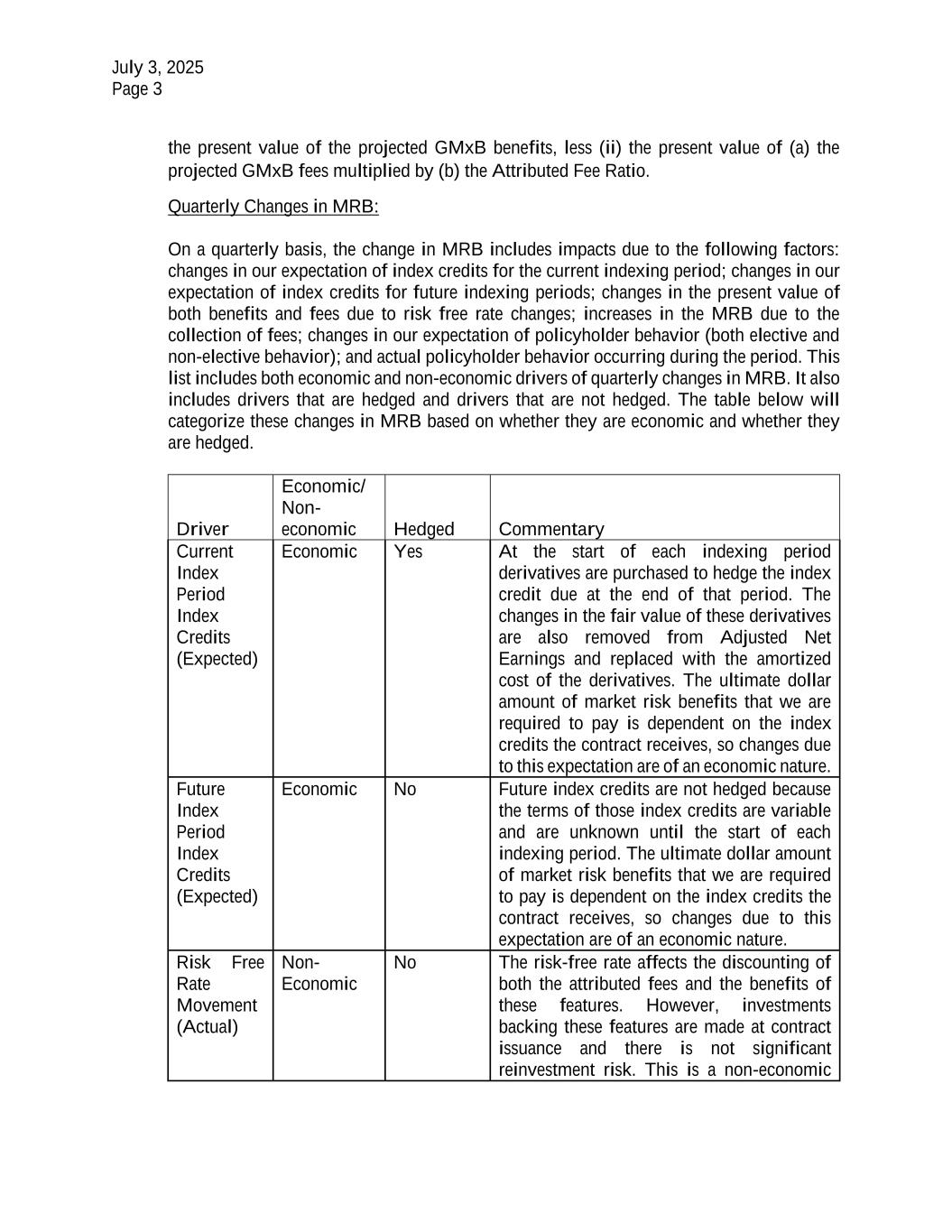
July 3, 2025 Page 3 the present value of the projected GMxB benefits, less (ii) the present value of (a) the projected GMxB fees multiplied by (b) the Attributed Fee Ratio. Quarterly Changes in MRB: On a quarterly basis, the change in MRB includes impacts due to the following factors: changes in our expectation of index credits for the current indexing period; changes in our expectation of index credits for future indexing periods; changes in the present value of both benefits and fees due to risk free rate changes; increases in the MRB due to the collection of fees; changes in our expectation of policyholder behavior (both elective and non-elective behavior); and actual policyholder behavior occurring during the period. This list includes both economic and non-economic drivers of quarterly changes in MRB. It also includes drivers that are hedged and drivers that are not hedged. The table below will categorize these changes in MRB based on whether they are economic and whether they are hedged. Driver Economic/ Non- economic Hedged Commentary Current Index Period Index Credits (Expected) Economic Yes At the start of each indexing period derivatives are purchased to hedge the index credit due at the end of that period. The changes in the fair value of these derivatives are also removed from Adjusted Net Earnings and replaced with the amortized cost of the derivatives. The ultimate dollar amount of market risk benefits that we are required to pay is dependent on the index credits the contract receives, so changes due to this expectation are of an economic nature. Future Index Period Index Credits (Expected) Economic No Future index credits are not hedged because the terms of those index credits are variable and are unknown until the start of each indexing period. The ultimate dollar amount of market risk benefits that we are required to pay is dependent on the index credits the contract receives, so changes due to this expectation are of an economic nature. Risk Free Rate Movement (Actual) Non- Economic No The risk-free rate affects the discounting of both the attributed fees and the benefits of these features. However, investments backing these features are made at contract issuance and there is not significant reinvestment risk. This is a non-economic
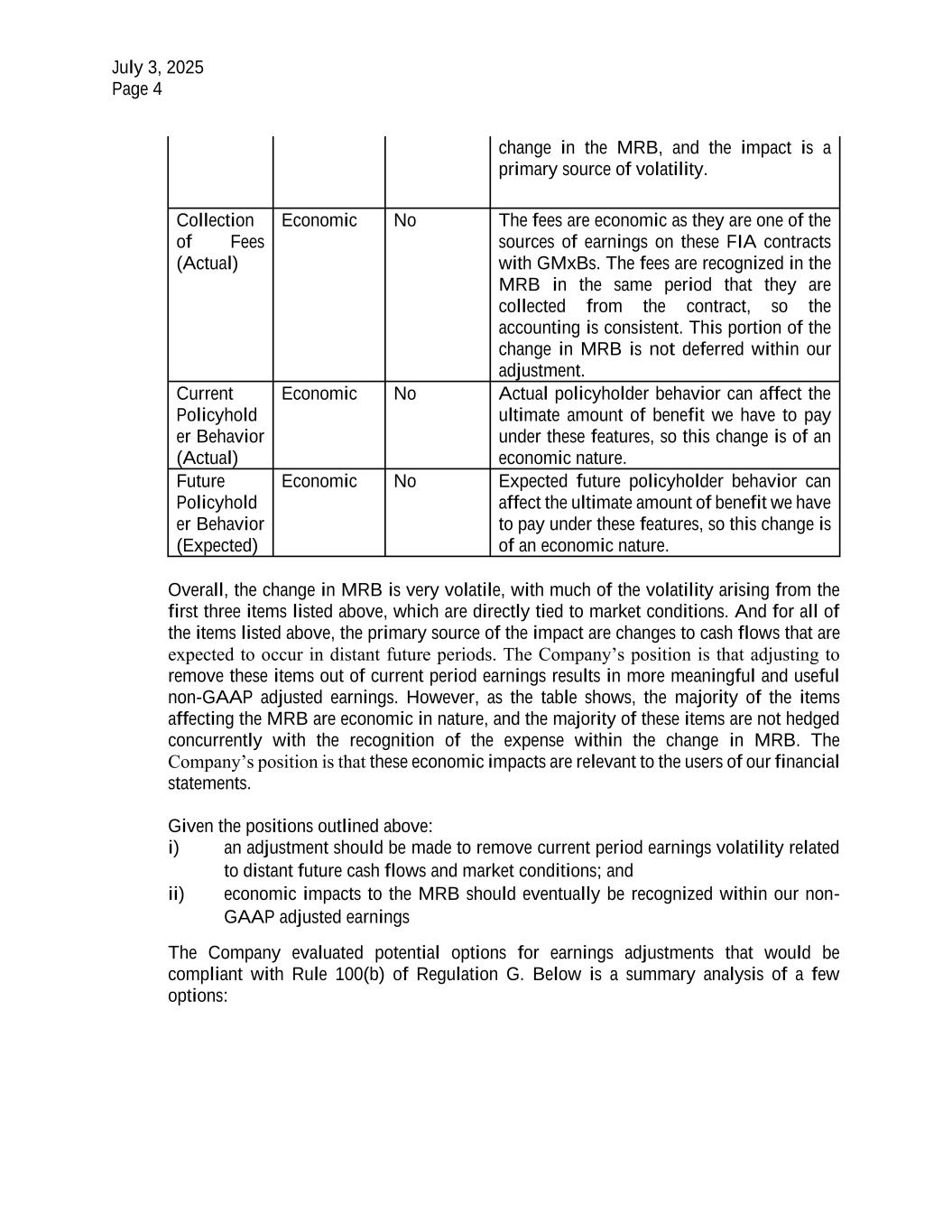
July 3, 2025 Page 4 change in the MRB, and the impact is a primary source of volatility. Collection of Fees (Actual) Economic No The fees are economic as they are one of the sources of earnings on these FIA contracts with GMxBs. The fees are recognized in the MRB in the same period that they are collected from the contract, so the accounting is consistent. This portion of the change in MRB is not deferred within our adjustment. Current Policyhold er Behavior (Actual) Economic No Actual policyholder behavior can affect the ultimate amount of benefit we have to pay under these features, so this change is of an economic nature. Future Policyhold er Behavior (Expected) Economic No Expected future policyholder behavior can affect the ultimate amount of benefit we have to pay under these features, so this change is of an economic nature. Overall, the change in MRB is very volatile, with much of the volatility arising from the first three items listed above, which are directly tied to market conditions. And for all of the items listed above, the primary source of the impact are changes to cash flows that are expected to occur in distant future periods. The Company’s position is that adjusting to remove these items out of current period earnings results in more meaningful and useful non-GAAP adjusted earnings. However, as the table shows, the majority of the items affecting the MRB are economic in nature, and the majority of these items are not hedged concurrently with the recognition of the expense within the change in MRB. The Company’s position is that these economic impacts are relevant to the users of our financial statements. Given the positions outlined above: i) an adjustment should be made to remove current period earnings volatility related to distant future cash flows and market conditions; and ii) economic impacts to the MRB should eventually be recognized within our non- GAAP adjusted earnings The Company evaluated potential options for earnings adjustments that would be compliant with Rule 100(b) of Regulation G. Below is a summary analysis of a few options:
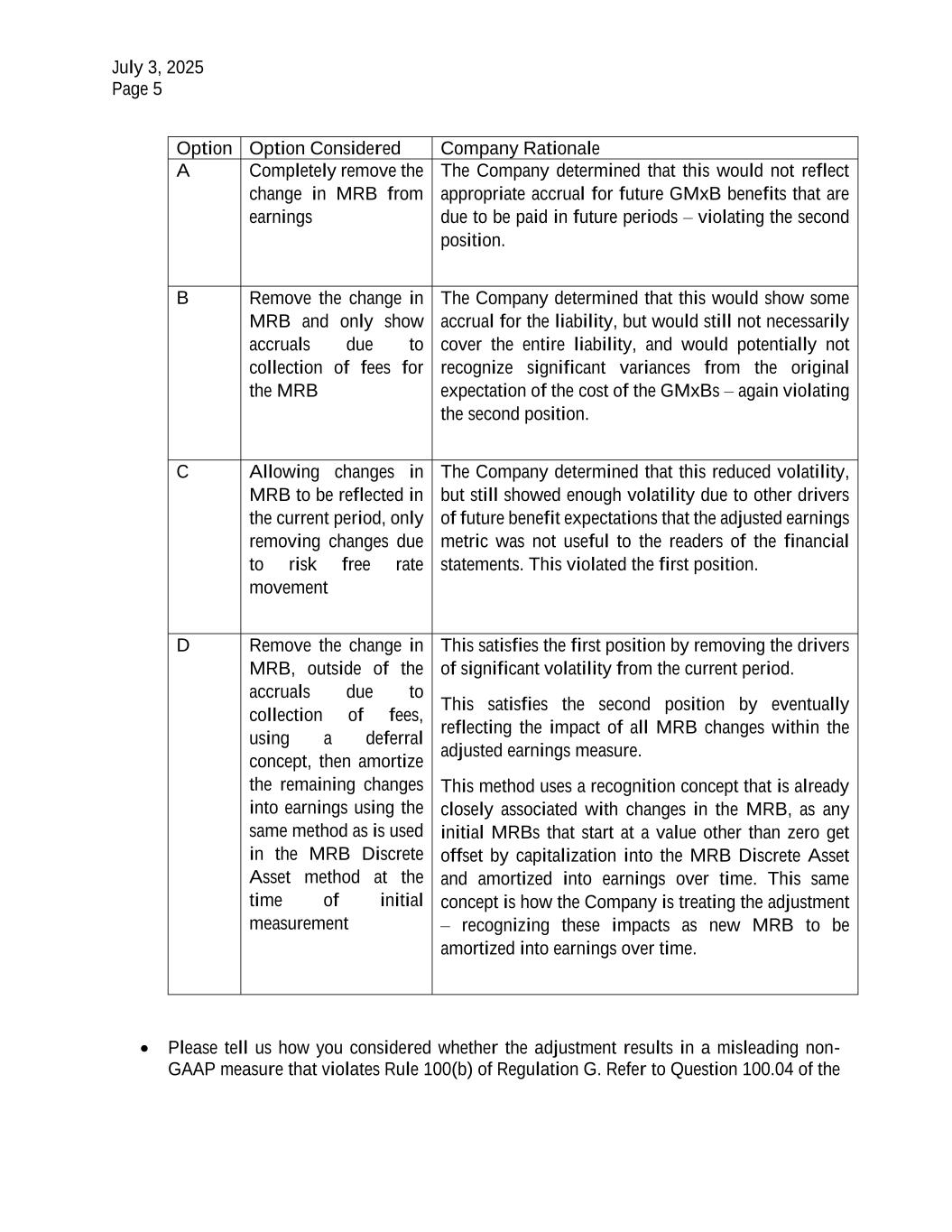
July 3, 2025 Page 5 Option Option Considered Company Rationale A Completely remove the change in MRB from earnings The Company determined that this would not reflect appropriate accrual for future GMxB benefits that are due to be paid in future periods – violating the second position. B Remove the change in MRB and only show accruals due to collection of fees for the MRB The Company determined that this would show some accrual for the liability, but would still not necessarily cover the entire liability, and would potentially not recognize significant variances from the original expectation of the cost of the GMxBs – again violating the second position. C Allowing changes in MRB to be reflected in the current period, only removing changes due to risk free rate movement The Company determined that this reduced volatility, but still showed enough volatility due to other drivers of future benefit expectations that the adjusted earnings metric was not useful to the readers of the financial statements. This violated the first position. D Remove the change in MRB, outside of the accruals due to collection of fees, using a deferral concept, then amortize the remaining changes into earnings using the same method as is used in the MRB Discrete Asset method at the time of initial measurement This satisfies the first position by removing the drivers of significant volatility from the current period. This satisfies the second position by eventually reflecting the impact of all MRB changes within the adjusted earnings measure. This method uses a recognition concept that is already closely associated with changes in the MRB, as any initial MRBs that start at a value other than zero get offset by capitalization into the MRB Discrete Asset and amortized into earnings over time. This same concept is how the Company is treating the adjustment – recognizing these impacts as new MRB to be amortized into earnings over time. • Please tell us how you considered whether the adjustment results in a misleading non- GAAP measure that violates Rule 100(b) of Regulation G. Refer to Question 100.04 of the
July 3, 2025 Page 6 Compliance and Disclosure Interpretations on Non-GAAP Financial Measures for guidance. The Company has considered Rule 100(b) of Regulation G and specifically Question 100.04 of the Compliance and Disclosure Interpretations on Non-GAAP Financial Measures and does not believe our elimination of the changes in the fair value of market risk benefits by deferring current period changes and amortizing that amount over the life of the market risk benefit causes the presentation of this non-GAAP measure to be misleading. Rather, The Company believes this adjustment provides further transparency by excluding volatility caused by market conditions and distant future cash flows from earnings. In addition, our adjustment allows these economic impacts to be recognized within our non-GAAP adjusted earnings over time which aligns with the method utilized for the MRB Discrete Asset. Refer to commentary in explanation above for further detail. Form 8-K Filed May 7, 2025 General 2. Your presentation of Adjusted Net Earnings – Management View on slide 5 appears to be a non- GAAP income statement. Please note that the presentation of a non-GAAP income statement may place undue prominence on the non-GAAP information. Under Question 102.10(c) of the C&DI's on Non-GAAP Financial Measures, a non-GAAP income statement is considered to be one that is comprised of non-GAAP measures and includes all or most of the line items and subtotals found in a GAAP income statement. Please confirm to us that you will not present a non-GAAP income statement in future filings subject to Item 10(e)(1)(i) of Regulation SK. In response to the Staff’s comment, the Company acknowledges the Staff’s request and will remove the Adjusted Net Earnings – Management View from future filings. * * * If Staff should have any questions or comments regarding this submission or response, please feel free to contact me at (310) 442-8828. Thank you for your ongoing courtesy in this matter. Sincerely, Alan A. Lanis, Jr. Partner