NOTICE OF ANNUAL AND SPECIAL MEETING OF
SHAREHOLDERS AND AVAILABILITY OF INVESTOR
MATERIALS
An annual and special meeting of shareholders of Brookfield Asset Management Ltd. (“BAM”) will be held at Brookfield Place, 225 Liberty Street, 10th Floor, New York, NY on Thursday, May 7, 2026 at 2:30 p.m. (New York time), to:
| 1. | receive the consolidated financial statements of BAM for the fiscal year ended December 31, 2025, including the external auditor’s report thereon; |
| 2. | elect directors who will serve until the next annual meeting of shareholders; |
| 3. | appoint the external auditor who will serve until the next annual meeting of shareholders and authorize the directors to set its remuneration; |
| 4. | consider and, if deemed advisable, pass an advisory resolution on BAM’s approach to executive compensation, as described in our Management Information Circular dated March 23, 2026 (the “Circular”); |
| 5. | consider and, if deemed advisable, pass, with or without variation, an ordinary resolution approving a new management share option plan for BAM, as more particularly described in the Circular; and |
| 6. | consider and, if deemed advisable, pass, with or without variation, an ordinary resolution approving amendments to BAM’s escrowed stock plan, as more particularly described in the Circular. |
We will consider any other business that may properly come before the meeting.
If you are unable to attend the meeting in person, you can join and watch the meeting live via webcast; the link will be made available in advance of the meeting at https://bam.brookfield.com under “News and Events—Events and Financial Calendar”. You will not be able to vote via the live webcast. See “Q&A on Voting” in the Circular for more information on how to attend, listen, register for and vote at the meeting.
You have the right to vote at the meeting if you were a shareholder of BAM at the close of business on March 10, 2026. Before casting your vote, we encourage you to review the meeting’s business in the section “Business of the Meeting” of the Circular.
We are posting electronic versions of the Circular and our 2025 annual report on Form 10-K (collectively, the “investor materials”) on our website for shareholder review — a process known as “Notice and Access”. Electronic copies of the investor materials may be accessed at https://bam.brookfield.com under “News and Events—Events and Financial Calendar” and at www.sec.gov/edgar and www.sedarplus.ca.
Under Notice and Access, if you would like paper copies of any investor materials, please contact us at 1-866-989-0311 or bam.enquiries@brookfield.com and we will mail materials free of charge within three business days of your request, provided the request is made before the date of the meeting or any adjournment thereof. In order to receive investor materials in advance of the deadline to submit your vote, we recommend that you contact us before 5:00 p.m. (New York time) on April 21, 2026. All shareholders who have signed up for electronic delivery of the investor materials will continue to receive them by email.
Instructions on Voting at the Meeting
Registered shareholders and duly appointed proxyholders will be able to attend the meeting in person and vote in real time. See “Q&A on Voting” in the Circular. Non-registered shareholders who have not duly appointed themselves as proxyholder will be able to attend the meeting as guests but will not be able to ask questions or vote.
If you wish to appoint a person other than the management nominees identified in the form of proxy or voting instruction form (including if you are a non-registered shareholder who wishes to appoint themselves to attend the meeting), you must
carefully follow the instructions in the Circular and on the form of proxy or voting instruction form. See “Q&A on Voting” in the Circular.
Information for Registered Holders
Registered shareholders and duly appointed proxyholders (including non-registered shareholders who have duly appointed themselves as proxyholder) that attend the meeting will be able to vote in person by ballot.
If you are not attending the meeting and wish to vote by proxy, we must receive your vote by 5:00 p.m. (New York time) on Tuesday, May 5, 2026. You can cast your proxy vote in the following ways:
| · | On the Internet at www.meeting-vote.com; |
| · | Mail your signed proxy using the business reply envelope accompanying your proxy; |
| · | Scan and send your signed proxy to proxyvote@tmx.com; or |
| · | Call by telephone at 1-888-489-7352. |
Information for Non-Registered Holders
Non-registered shareholders will receive a voting instruction form with their physical copy of this notice. If you wish to vote, but not attend the meeting, the voting instruction form must be completed, signed and returned in accordance with the directions on the form. You may also vote by telephone or on the Internet prior to the meeting by following the instructions on the voting instruction form.
| By Order of the Board | ||
| “Kathy Sarpash” | ||
| Kathy Sarpash Corporate Secretary | ||
| March 23, 2026 |
LETTER TO SHAREHOLDERS
To our shareholders,
On behalf of your Board of Directors, we are pleased to invite you to attend the 2026 annual and special meeting of shareholders of Brookfield Asset Management Ltd. (“BAM”). The meeting will occur at 2:30 p.m. (New York time) on Thursday, May 7, 2026 at Brookfield Place, 225 Liberty Street, 10th Floor, New York, NY. You can read about the business of the meeting beginning on page 7 of the accompanying Management Information Circular. This Circular also provides important information on voting your shares at the meeting, our 12 director nominees, our corporate governance practices, and director and executive compensation. Additional details on how to attend our meeting in person or access our live webcast, and participate in our meeting, can be found in the “Q&A on Voting” section of the Circular.
2025 Highlights1
2025 was another record year for the business. Firmwide, we delivered all-time highs in earnings, capital raising, deployment and realizations. During the year, we raised $112 billion of capital across more than 50 funds, highlighting the breadth of our investment platform and the strength of investor demand spanning strategies and geographies.
Fundraising activity was broad-based across infrastructure, renewable power and transition, private equity, real estate and credit, and was supported by continued expansion of our relationships with institutional investors, sovereign wealth funds, insurance channels and private wealth clients globally. Importantly, 90% of fundraising came from our complementary strategies, underscoring the scale and diversification of our product offering and the increasing importance of complementary strategies.
We continued to deploy capital at scale, investing $66 billion throughout our platform during the year. These investments were concentrated in sectors where we see strong long-term demand and where our operating expertise and global sourcing capabilities provide a competitive advantage.
As a result of our capital raising and deployment activity, fee-bearing capital grew to $603 billion, representing a 12% increase year-over-year. This growth translated directly into strong financial results. For the year, fee-related earnings increased by 22% to $3.0 billion and distributable earnings grew by 14% to $2.7 billion. These record results reflect both the scale of our capital base and the diversification of our business across multiple asset classes and strategies.
Overall, the strong performance reflects the quality of our global platform, the depth of our investment capabilities, and the long-term partnerships we have built with investors around the world.
Strategic Initiatives
Throughout 2025, we executed several important initiatives to expand our platform, deepen our capabilities across key investment strategies and position the firm to capture growing opportunities throughout the global economy.
This includes our announced acquisition of the remaining stake in Oaktree, further strengthening our partnership with one of the world’s leading alternative credit managers. Full ownership upon closing will enable us to better deliver the firm’s capabilities to clients, and enhance collaboration across our investment teams, product development teams and sales teams.
In addition, Brookfield Wealth Solutions announced the acquisition of Just Group, a leading provider of retirement income products in the United Kingdom. The transaction is expected to close in the first half of 2026 and is subject to customary closing conditions including regulatory approvals. Upon closing of the transaction, BAM will become the investment manager for a significant portion of the Just Group portfolio. We will begin earning investment management fees through these investment management agreements, with additional fees expected over time as capital is deployed into Brookfield strategies.
We also completed the acquisition of a majority interest in a specialty mortgage credit manager and a consumer credit solutions business, as well as increased our ownership stake in other partner managers focused on consumer credit solutions.
1 We disclose a number of financial measures in this Circular that are calculated and presented using methodologies other than in accordance with U.S. GAAP, as well as certain forward-looking information and forward-looking statements in accordance with U.S. and Canadian securities laws, as applicable. See the “Cautionary Statement Regarding the Use of Non-GAAP Measures and Forward-Looking Statements” on page 65 of this Circular.
Taken together, these initiatives will contribute approximately $200 million of annualized fee-related earnings, adding further scale and diversification to our earnings base.
Another important initiative during the year was the continued development of our AI infrastructure program. We are supporting this effort through a $100 billion global program focused on building the data centers, compute capacity and power generation required to support the rapid adoption of artificial intelligence. As part of this effort, we launched our artificial intelligence infrastructure fund, targeting $10 billion, which is expected to be the largest fund of its kind. The fund has already secured $5 billion of commitments, including from strategic limited partners, NVIDIA and the Kuwait Investment Authority.
We also announced an $80 billion strategic partnership between Westinghouse and the U.S. government to support the deployment of new nuclear power capacity in the United States. As electricity demand rises alongside the growth of AI and digital infrastructure, nuclear power will play a critical role in providing reliable, low-carbon baseload generation.
We continue to actively manage our balance sheet and capital structure. During the year, we completed three public debt offerings totaling $2.5 billion, strengthening our liquidity position. These initiatives enhance our platform and position us to continue scaling the business globally in the years ahead.
Current Market Environment
More recently, increased macroeconomic uncertainty and volatility across the alternative asset management sector have underscored the importance of the resilience and durability of our earnings base and the strength of our businesses.
Today, virtually all of our distributable earnings are fee-related—the most stable and predictable form of earnings in our industry. More than 95% of these revenues are generated from capital we manage on a long-term or perpetual basis, providing exceptional visibility into future earnings. This durability is reinforced by the breadth of our platform across asset classes, products, clients and geographies. By ensuring that no single business dominates our earnings base, we benefit from diversification across market environments and can continue to grow through economic cycles while investing behind sectors experiencing strong structural tailwinds.
Importantly, our investment strategy differs meaningfully from many other managers. Our focus is and has always been on the real assets and essential service businesses that form the backbone of the global economy. These assets generate stable cash flows, provide inflation protection and offer downside resilience—characteristics that continue to attract growing allocations from investors globally.
As a result, we have limited exposure to some of the areas that have raised concerns within the broader alternatives sector, such as traditional software businesses. Our private equity and credit portfolios have minimal exposure to software, reflecting our long-standing focus on asset-based investing. And should market dislocation increase, our Oaktree business—one of the world’s most experienced opportunistic credit investors—is well positioned to capitalize on the opportunity. With significant available liquidity and the ability to deploy capital quickly and at scale, Oaktree has historically generated some of its strongest returns during periods of market dislocation.
At the same time, we have deliberately positioned the firm to benefit from the increasing adoption of artificial intelligence. The build-out of AI infrastructure is emerging as one of the largest investment cycles in history, driving unprecedented demand for power, data centers and compute infrastructure.
This is not only a significant investment opportunity but also a major area of client demand. Investors globally are seeking exposure to the infrastructure supporting AI adoption through strategies like our recently launched AI Infrastructure fund. Given our scale and leadership positions across the sectors in which we invest, and the connectivity across the broader Brookfield ecosystem spanning infrastructure, energy, private equity, real estate and credit, we are uniquely positioned to support this next phase of global infrastructure build out.
This combination of resilient earnings, disciplined investing and exposure to powerful structural growth trends positions us well to continue generating strong growth and attractive returns for shareholders in the years ahead.
Outlook for 2026
Looking ahead, we expect 2026 to be another record year for Brookfield. We have strong fundraising momentum, with several key flagship strategies coming to market, including our flagship infrastructure and private equity funds, both of which we expect will represent the largest vintages we have raised to date. These funds are supported by continued growth across our complementary strategies, which are expanding our reach to a broader and increasingly diversified investor base. We are also seeing increasing momentum in the wealth channel, with six private wealth funds now in the market and a growing presence that is further diversifying our capital base and enhancing fundraising durability.
Together with the continued growth of our fee-bearing capital base, these drivers reinforce our confidence in the long-term earnings growth of the business. Reflecting these supportive tailwinds and our strong growth outlook for 2026 and beyond, our Board of Directors approved a 15% increase in our dividend, representing $2.01 per share on an annualized basis.
We remain focused on executing our long-term strategy, compounding capital for our investors, and continuing to build one of the world’s leading alternative asset management platforms.
Shareholders’ Meeting
Please take time to read our Circular and determine how you will vote your shares. Your participation in our annual and special meeting of shareholders is important to us and we encourage your engagement in this important process.
On behalf of the Board, I express our appreciation for your continued faith in us. We look forward to having you join us on May 7th.
Yours truly,
“Bruce Flatt”
Bruce Flatt
Chair of the Board
March 2026
MANAGEMENT INFORMATION CIRCULAR
TABLE OF CONTENTS
| PART ONE | VOTING INFORMATION | 1 |
| Who Can Vote | 1 | |
| Notice and Access | 2 | |
| Q & A on Voting | 2 | |
| Principal Holders of Voting Shares | 6 | |
| PART TWO | BUSINESS OF THE MEETING | 7 |
| 1. Receiving the Consolidated Financial Statements | 7 | |
| 2. Election of Directors | 7 | |
| Majority Voting Policy | 8 | |
| Cumulative Voting for Directors | 8 | |
| Voting by Proxy | 8 | |
| Director Nominees | 8 | |
| Summary of 2026 Nominees for Director | 15 | |
| 2025 Director Attendance | 16 | |
| 2025 Director Voting Results | 17 | |
| 3. Appointment of External Auditor | 17 | |
| Principal Accounting Firm Fees | 18 | |
| 4. Advisory Resolution on Approach to Executive Compensation | 18 | |
| 5. Approval of 2026 Management Share Option Plan | 19 | |
| 6. Amendments to Escrowed Stock Plan | 19 | |
| PART THREE | STATEMENT OF CORPORATE GOVERNANCE PRACTICES | 22 |
| Governance | 22 | |
| Board of Directors | 22 | |
| Committees of the Board | 26 | |
| Board, Committee and Director Evaluation | 28 | |
| Board and Management Responsibilities | 28 | |
| Strategic Planning | 29 | |
| Risk Management Oversight | 30 | |
| Related Party Transactions | 30 | |
| Sustainability | 30 | |
| Communication and Disclosure Policies | 32 | |
| Code of Business Conduct and Ethics | 33 | |
| Report of the Audit Committee | 34 | |
| Report of the Governance, Nominating and Compensation Committee | 36 | |
| PART FOUR | DIRECTOR COMPENSATION AND EQUITY OWNERSHIP | 38 |
| Director Compensation | 38 | |
| Equity Ownership of Directors | 40 | |
| PART FIVE | COMPENSATION DISCUSSION AND ANALYSIS | 41 |
| Compensation Discussion and Analysis Overview | 41 | |
| Compensation Approach | 42 |
| Overview of the Business in 2025 | 43 | |
| Governance, Nominating and Compensation Committee Governance | 44 | |
| Key Elements of Compensation | 47 | |
| Key Policies and Practices to Support Alignment | 51 | |
| 2025 Compensation Decisions | 54 | |
| Chief Executive Officer Ownership Interests in BAM | 56 | |
| Compensation of Named Executive Officers | 58 | |
| PART SIX | OTHER INFORMATION | 65 |
| Indebtedness of Directors, Officers and Employees | 65 | |
| Audit Committee | 65 | |
| Normal Course Issuer Bid | 65 | |
| Cautionary Statement Regarding the Use of Non-GAAP Measures and Forward-Looking Statements | 65 | |
| Availability of Disclosure Documents | 66 | |
| Shareholder Proposals | 66 | |
| Other Business | 66 | |
| Directors’ Approval | 66 | |
| APPENDIX A | CHARTER OF THE BOARD | A-1 |
PART ONE - VOTING INFORMATION
This Management Information Circular (“Circular”) is provided in connection with the solicitation by management of Brookfield Asset Management Ltd. (“BAM”) of proxies for the annual and special meeting of shareholders of BAM (the “meeting”) referred to in BAM’s Notice of Annual and Special Meeting of Shareholders and Availability of Investor Materials dated March 23, 2026 (the “Notice”) to be held in-person at Brookfield Place, 225 Liberty Street, 10th Floor, New York, NY on Thursday, May 7, 2026 at 2:30 p.m. (New York time). The meeting will also be broadcast live by webcast. See “Q&A on Voting” on page 2 of this Circular for further information. References in this Circular to “BAM”, “we,” or “our” are to Brookfield Asset Management Ltd., and references to “BN” are to Brookfield Corporation.
This solicitation will be made primarily by sending proxy materials to shareholders by mail and email, and in relation to the delivery of this Circular, by posting this Circular on our website at https://bam.brookfield.com under “News and Events—Events and Financial Calendar”, on our EDGAR profile at www.sec.gov/edgar and on our SEDAR+ profile at www.sedarplus.ca pursuant to Notice and Access. See “Notice and Access” below for further information. Proxies may also be solicited personally or by telephone by regular employees of BAM at nominal cost. The cost of solicitation will be borne by BAM.
The information in this Circular is given as at March 10, 2026, unless otherwise indicated. As BAM operates in U.S. dollars and reports its financial results in U.S. dollars, all financial information in this Circular is denominated in U.S. dollars, unless otherwise indicated. All references to C$ are to Canadian dollars. For comparability, all Canadian dollar amounts in this Circular have been converted to U.S. dollars at the average exchange rate for 2025 as reported by Bloomberg L.P. (“Bloomberg”) of C$1.00 = US$0.7159, unless otherwise indicated.
Who Can Vote
As at March 10, 2026, BAM had 1,638,167,514 Class A Limited Voting Shares (“Class A Shares”) and 21,280 Class B Limited Voting Shares (“Class B Shares”) outstanding. The Class A Shares are co-listed on the New York Stock Exchange (“NYSE”) and the Toronto Stock Exchange (“TSX”) under the symbol “BAM”. The Class B Shares are all privately held (see “Principal Holders of Voting Shares” on page 6 of this Circular for further information). Each registered holder of record of Class A Shares and Class B Shares as at the close of business on March 10, 2026 (the “Record Date”) is entitled to receive notice of and to vote at the meeting. Except as otherwise provided in this Circular, each holder of a Class A Share or Class B Share on such date shall be entitled to vote on all matters to come before the meeting or any adjournment thereof, either in person or by proxy.
The share conditions for the Class A Shares and Class B Shares provide that, subject to applicable law and in addition to any other required shareholder approvals, all matters to be approved by shareholders (other than the election of directors) must be approved by a majority of the votes cast by the holders of Class A Shares and by the holders of Class B Shares who vote in respect of the resolution, each voting as a separate class.
Except as provided below, holders of Class A Shares are entitled, as a class, to elect one-half of the board of directors of BAM (the “Board” or “Board of Directors”), and holders of Class B Shares are entitled, as a class, to elect the other one-half of the Board. However, at any time that:
| a. | BN (or its successor) and its subsidiaries beneficially own a number of Class A Shares that exceeds 50% of the aggregate number of all the issued and outstanding Class A Shares and Class B Shares as of the record date for any meeting of shareholders, holders of Class A Shares and holders of Class B Shares will vote together as a single class in the election of the Board at such meeting of shareholders; or |
| b. | BN (or its successor) and its subsidiaries beneficially own a number of Class A Shares that is not less than 20% but does not exceed 50% of the sum of all the issued and outstanding Class A Shares and Class B Shares as of the record date for any meeting of shareholders: |
| i. | BN (or its successor) will be entitled to elect one of the directors who would otherwise be elected by other holders of the Class A Shares at such meeting of shareholders; |
| ii. | holders of Class A Shares, including BN (or its successor) solely in respect of any Class A Shares that it and its subsidiaries beneficially own in number that exceeds 20% of the sum of all the issued and |
2026 MANAGEMENT INFORMATION CIRCULAR/ 1
outstanding Class A Shares and Class B Shares, will be entitled to elect one-half of the Board less such number of directors to be elected by BN (or its successor) under (i) above at such meeting of shareholders; and
| iii. | holders of Class B Shares will be entitled to elect the other one-half of the Board at such meeting of shareholders. |
As at March 10, 2026, BN and its subsidiaries beneficially own approximately 69% of the Class A Shares and, accordingly, the holders of the Class A Shares and holders of the Class B Shares will vote together as a single class to elect the Board. See “Election of Directors” on page 7 of this Circular for further information.
Notice and Access
BAM is using the Notice and Access provisions of National Instrument 54-101 — Communication with Beneficial Owners of Securities of a Reporting Issuer and National Instrument 51-102 — Continuous Disclosure Obligations (“Notice and Access”) to provide meeting materials electronically for both registered and non-registered shareholders. Instead of mailing meeting materials to shareholders, BAM has posted this Circular and form of proxy on its website at https:// bam.brookfield.com under “News and Events—Events and Financial Calendar”, in addition to posting it on EDGAR at www.sec.gov/edgar and SEDAR+ at www.sedarplus.ca. BAM has sent the Notice and a form of proxy or voting instruction form (collectively, the “Notice Package”) to all shareholders informing them that this Circular is available online and explaining how this Circular may be accessed. BAM will not directly send the Notice Package to non-registered shareholders. Instead, BAM will pay Intermediaries (as defined on page 3 of this Circular) to forward the Notice Package to all non-registered shareholders.
BAM has elected to utilize Notice and Access because it allows for a reduction in the use of printed paper materials, and is therefore consistent with BAM’s philosophy towards sustainability. Additionally, adopting Notice and Access has significantly lowered printing and mailing costs associated with BAM’s shareholder meetings.
Registered and non-registered shareholders who have signed up for electronic delivery of this Circular and BAM’s annual report on Form 10-K dated March 2, 2026 (which includes management’s discussion and analysis and consolidated financial statements for the fiscal year ended December 31, 2025) (the “Annual Report”) will continue to receive them by email. No shareholders will receive a paper copy of this Circular unless they contact BAM at 1-866-989-0311 or bam.enquiries@brookfield.com, in which case BAM will mail this Circular within three business days of any request, provided the request is made before the date of the meeting or any adjournment thereof. We must receive your request before 5:00 p.m. (New York time) on April 21, 2026 to ensure you will receive paper copies in advance of the deadline to submit your vote. If your request is made after the meeting and within one year of this Circular being filed, BAM will mail this Circular within 10 calendar days of such request.
Q & A on Voting
What am I voting on?
| Resolution | Who Votes | Board Recommendation | ||
| Election of the 12 Directors | Class A Shareholders Class B Shareholders |
FOR each Director Nominee | ||
| Appointment of the External Auditor and authorizing Directors to set its remuneration | Class A Shareholders Class B Shareholders |
FOR the resolution | ||
| Advisory Vote on Executive Compensation | Class A Shareholders | FOR the resolution | ||
| Approval of 2026 Management Share Option Plan | Class A Shareholders Class B Shareholders |
FOR the resolution | ||
| Amendments to Escrowed Stock Plan | Class A Shareholders Class B Shareholders |
FOR the resolution |
2026 MANAGEMENT INFORMATION CIRCULAR/ 2
Who is entitled to vote?
Holders of Class A Shares and holders of Class B Shares, as applicable, as at the close of business on March 10, 2026 are each entitled to one vote per share on the items of business as identified above.
Registered shareholders are able to attend and vote in person at the meeting by registering with BAM’s transfer agent, TSX Trust Company (the “Transfer Agent”), on the day of the meeting. Your vote will be taken and counted at the meeting. Non-registered shareholders who have not duly appointed themselves as proxyholder will be able to attend the meeting as guests, but will not be able to vote.
Shareholders who wish to appoint a person other than the management nominees identified in the form of proxy or voting instruction form must carefully follow the instructions in the Circular and on their form of proxy or voting instruction form.
Am I a registered shareholder or a non-registered shareholder?
Registered shareholders have a share certificate or Direct Registration System statement issued in their name or appear as the registered shareholder on the books of BAM.
Non-registered shareholders are beneficial owners of shares of BAM that are not registered shareholders. In many cases, Class A Shares that are beneficially owned by a non-registered shareholder are registered either:
| a. | in the name of an intermediary such as a bank, trust company, securities dealer, broker or other intermediary (each, an “Intermediary” and collectively, “Intermediaries”) with whom the non-registered shareholder maintains an account, or a trustee or administrator of self-administered RRSPs, RRIFs, RESPs and similar plans; or |
| b. | in the name of a depository such as CDS Clearing and Depository Services Inc. (“CDS”) or the Depository Trust Company (“DTC”), of which the Intermediary is a participant. |
If you are a non-registered shareholder and your shares are held in the name of an Intermediary, see “If my shares are not registered in my name but are held in the name of an Intermediary, how do I vote my shares?” on page 5 of this Circular for voting instructions.
If you are not sure whether you are a registered or non-registered shareholder, please contact the Transfer Agent.
How do I vote?
Holders of Class A Shares and holders of Class B Shares of BAM can vote in one of three ways, as follows:
| · | during the meeting in person by ballot, or |
| · | by submitting your voting instructions by proxy in advance of the meeting. |
What if I plan to attend the meeting and vote in person?
If you are a registered shareholder or duly appointed proxyholder and plan to attend the meeting on May 7, 2026 and wish to vote your shares in person at the meeting, please register with the Transfer Agent when you arrive at the meeting. Your vote will be taken and counted at the meeting.
If your shares are held in the name of an Intermediary and you plan to attend the meeting and vote in person, see “If my shares are not registered in my name but are held in the name of an Intermediary, how do I vote my shares?” on page 5 of this Circular for voting instructions.
What if I plan to vote by proxy in advance of the meeting?
If you are a registered shareholder, you can vote by proxy up to 5:00 p.m. (New York time) on Tuesday, May 5, 2026 (or 48 hours prior to the time of any adjourned meeting), as follows:
| · | to vote by internet, accessing www.meeting-vote.com and following the instructions for electronic voting. You will need your control number; |
2026 MANAGEMENT INFORMATION CIRCULAR/ 3
| · | sign the form of proxy sent to you and vote or withhold from voting your shares at the meeting and submit your executed proxy via any of the following options: |
i. by mail: in the envelope provided or in one addressed to the Transfer Agent2; or
ii. by email: scan and send the proxy to proxyvote@tmx.com.
You can appoint the persons named in the form of proxy or some other person (who need not be a shareholder of BAM) to represent you as proxyholder at the meeting by writing the name of this person (or company) in the blank space on the form of proxy.
| · | to vote by telephone, call toll-free at 1-888-489-7352. You will be prompted to provide the control number printed on the form of proxy sent to you. The telephone voting service is not available on the day of the meeting. |
If you are a non-registered shareholder and your shares are held in the name of an Intermediary, to direct the votes of shares beneficially owned, see “If my shares are not registered in my name but are held in the name of an Intermediary, how do I vote my shares?” on page 5 of this Circular for voting instructions.
Who is soliciting my proxy?
The proxy is being solicited by management of BAM and the associated costs will be borne by BAM.
What happens if I sign the proxy sent to me?
Signing the proxy appoints Olivia (Liv) Garfield or Cyrus Madon, each of whom is a director of BAM, or another person you have appointed, to vote or withhold from voting your shares at the meeting.
Can I appoint someone other than these directors to vote my shares?
Yes, you may appoint another person or company other than the BAM directors named on the form of proxy or voting instruction form to be your proxyholder. Write the name of this person (or company) in the blank space on the form of proxy or voting instruction form. The person you appoint does not need to be a shareholder. Please make sure that such other person you appoint is attending the meeting and knows he or she has been appointed to vote your shares.
What do I do with my completed form of proxy?
Return it to the Transfer Agent in the envelope provided to you by mail or scan and send by email to proxyvote@tmx.com no later than 5:00 p.m. (New York time) on Tuesday, May 5, 2026, which is two business days before the day of the meeting.
Can I vote by Internet in advance of the meeting?
Yes. If you are a registered shareholder, go to www.meeting-vote.com and follow the instructions on this website. You will need your control number (located on the form of proxy) to identify yourself to the system. You must submit your vote by no later than 5:00 p.m. (New York time) on Tuesday, May 5, 2026, which is two business days before the day of the meeting.
If you are a non-registered shareholder and your Intermediary makes this option available, go to www.proxyvote.com and follow the instructions on this website. You will need your control number (located on the voting instruction form) to identify yourself to the system. You must submit your vote by no later than 5:00 p.m. (New York time) on Monday, May 4, 2026, which is one business day before the proxy deposit date of May 5, 2026. Refer to the instructions on your voting instruction form for more details.
If I change my mind, can I submit another proxy or take back my proxy once I have given it?
Yes. If you are a registered shareholder, you may deliver another properly executed form of proxy with a later date to replace the original proxy in the same way you delivered the original proxy. If you wish to revoke your proxy, prepare a written statement to this effect signed by you (or your attorney as authorized in writing) or, if the shareholder is a corporation, under its corporate seal or by a duly authorized officer or attorney of the corporation. This statement must be delivered to the Corporate Secretary of BAM at the address below no later than 5:00 p.m. (New York time) on the last business day
2 Attention: Proxy Department, P.O. Box 721, Agincourt, Ontario M1S 0A1
2026 MANAGEMENT INFORMATION CIRCULAR/ 4
preceding the date of the meeting, Wednesday, May 6, 2026, or any adjournment of the meeting, or to the Chair of the Board (the “Chair”) prior to the start of the meeting on Thursday, May 7, 2026, or the day of the adjourned meeting. You may also vote during the meeting by submitting an online ballot, which will revoke your previous proxy.
Corporate Secretary
Brookfield Asset Management Ltd.
Brookfield Place
225 Liberty Street, 8th Floor
New York, NY 10281-1048
For non-registered shareholders, if you have provided your voting instructions and change your mind about your vote, you can revoke your proxy or voting instructions by contacting your intermediary. If your intermediary provides the option of voting over the Internet, you can change your instructions by updating your voting instructions on the website provided by your intermediary, so long as you submit your new instructions before the intermediary’s deadline.
How can I request electronic delivery of investor materials?
To opt for electronic distribution of investor materials, complete the request for electronic delivery of materials form enclosed with the Notice Package and return it by mail to the Transfer Agent.3 You can also submit your request online by visiting the Transfer Agent’s website: services.tsxtrust.com/edelivery.
How will my shares be voted if I give my proxy?
The persons named on the form of proxy must vote your shares for or against or withhold from voting, in accordance with your directions, or you can let your proxyholder decide for you. If you specify a choice with respect to any matter to be acted upon, your shares will be voted accordingly. In the absence of voting directions, proxies received by management will be voted in favor of all resolutions put before shareholders of the meeting. See “Business of the Meeting” on page 7 of this Circular for further information.
What if amendments are made to these matters or if other matters are brought before the meeting?
The persons named on the proxy will have discretionary authority with respect to amendments or variations to matters identified in the Notice and with respect to other matters which may properly come before the meeting.
As at the date of this Circular, management of BAM is not aware of any amendment, variation or other matter expected to come before the meeting. If any other matters properly come before the meeting, the persons named on the form of proxy will vote on them in accordance with their best judgment.
Who counts the votes?
The Transfer Agent counts and tabulates the proxies.
If my shares are not registered in my name but are held in the name of an Intermediary, how do I vote my shares?
Your Intermediary is required to send you a voting instruction form for the number of shares you beneficially own. Non-registered shareholders should follow the instructions on the forms they receive and contact their Intermediaries promptly if they need assistance.
A non-registered shareholder who does not wish to attend and vote at the meeting and wishes to vote prior to the meeting must complete and sign the voting instruction form and return it in accordance with the directions on the form. If your Intermediary makes these options available, you may also vote by telephone prior to the meeting by following the directions on the voting instruction form on the Internet prior to the meeting by going to www.proxyvote.com and following the instructions on this website. See “Can I vote by Internet in advance of the meeting?” on page 4 of this Circular.
Since BAM has limited access to the names of its non-registered shareholders, if you attend the meeting, BAM may have no record of your shareholdings or of your entitlement to vote unless your Intermediary has appointed you as proxyholder.
3 301 - 100 Adelaide Street West, Toronto, Ontario, M5H 4H1; or by email to shareholderinquiries@tmx.com.
2026 MANAGEMENT INFORMATION CIRCULAR/ 5
Therefore, if you wish to vote by online ballot at the meeting, you will need to insert your name in the space provided on the voting instruction form and return it by following the instructions provided therein.
Non-registered shareholders who have not duly appointed themselves as proxyholder will not be able to vote at the meeting but will be able to participate as a guest.
BAM has distributed copies of the Notice Package to CDS and DTC and to Intermediaries for onward distribution to non-registered shareholders. Intermediaries are required to forward the Notice Package to non-registered shareholders.
Principal Holders of Voting Shares
For over 50 years, the partners of Brookfield (the “Partnership” or “Partners”) have owned, in partnership with one another, a substantial portion of their investments in Brookfield. This includes a significant ownership of the Class A Shares of BN and its recently spun-off companies: BAM and Brookfield Wealth Solutions Ltd. (BNT-NYSE and, together with BN and BAM, “Brookfield”). Separate from the ownership of the Class A Shares, the Partners have also owned the Class B Shares of each entity since their creation.
This ownership framework among the Partners has been an important underpinning of Brookfield’s culture and instrumental to the governance of Brookfield, enabling an uncompromising focus on long-term value creation for all stakeholders.
The Partners include both current and former senior executives and directors of Brookfield. We believe that the Partnership promotes decision-making that is entrepreneurial, collaborative and aligned with the long-term interests of Brookfield. The financial strength and sustainability of the Partnership is characterized by a consistent focus on renewal—longstanding members mentoring new generations of leaders and financially supporting their admission as Partners. We believe this is a critical component to preserving our long-term culture and vision. The Partnership remains resolutely focused on the long-term success of Brookfield for the benefit of all stakeholders, through all economic conditions.
As at March 10, 2026, the Partners collectively own interests in approximately: 469 million BN Class A Shares (on a fully diluted basis), representing approximately 20% of BN’s issued and outstanding Class A Shares; 454 million BAM Class A Shares (both directly and through BN’s 73% ownership of BAM, on a fully diluted basis), representing approximately 28% of BAM’s issued and outstanding Class A Shares; and 39 million BNT Class A Shares, which is a “paired entity” of BN, as the BNT Class A Shares are exchangeable into BN Class A Shares on a one-for-one basis, representing approximately 60% of BNT’s issued and outstanding Class A Shares.
The economic interests of the Partners in Brookfield securities consist primarily of (i) direct ownership of shares, as well as indirect ownership (such as shares that are held through holding companies and by foundations) by the Partners on an individual basis; and (ii) the Partners’ proportionate beneficial interests in shares held by Partners Value Investments L.P. (“PVI”). PVI is a public investment partnership whose principal business activity is owning equity interests in Brookfield for the long-term. As at March 10, 2026, the Partners owned approximately 90% of PVI’s equity units. PVI owns approximately 181 million BN Class A Shares, 30 million BAM Class A Shares and 12 million BNT Class A Shares (each on a fully diluted basis).
In order to foster the long-term stability and continuity of Brookfield, a group of longstanding Partners have been designated to oversee stewardship of the Class B Shares. Under these arrangements, the Class B Shares are held in a trust (the “Trust”). The beneficial interests in the Trust, and the voting interests in its trustee, are held as follows: one-third by Mr. Bruce Flatt, one-third by Mr. Jack L. Cockwell, and one-third jointly by Messrs. Brian W. Kingston, Brian D. Lawson, Cyrus Madon, Samuel J.B. Pollock and Sachin Shah in equal parts. As such, no single individual or entity controls the Trust.
In the event of a fundamental disagreement among the shareholders of the trustee (and until the disagreement is resolved), three individuals have been granted the authority to govern and direct the actions of the Trust. These individuals are, and their successors are required to be, longstanding and respected business colleagues associated with Brookfield. The individuals, at the current time, none of whom are Partners, are Messrs. Marcel R. Coutu, Frank J. McKenna and Lord O’Donnell.
To the knowledge of the directors and officers of the company, there are no other persons or corporations that beneficially own, exercise control or direction over, have contractual arrangements such as options to acquire, or otherwise hold voting securities of the company carrying more than 10% of the votes attached to any class of outstanding voting securities of the company.
2026 MANAGEMENT INFORMATION CIRCULAR/ 6
PART TWO – BUSINESS OF THE MEETING
We will address six items at the meeting:
| 1. | receiving the consolidated financial statements of BAM for the fiscal year ended December 31, 2025, including the external auditor’s report thereon; |
| 2. | electing directors who will serve until the end of the next annual meeting of shareholders; |
| 3. | appointing the external auditor that will serve until the end of the next annual meeting of shareholders and authorizing the directors to set its remuneration; |
| 4. | considering and, if deemed advisable, passing an advisory resolution on BAM’s approach to executive compensation; |
| 5. | considering and, if deemed advisable, passing a resolution approving the adoption of a new management share option plan; and |
| 6. | considering and, if deemed advisable, passing a resolution approving amendments to BAM’s escrowed stock plan. |
We will also consider other business that may properly come before the meeting.
As at the date of this Circular, management is not aware of any changes to these items and does not expect any other items to be brought forward at the meeting. If there are changes or new items, you or your proxyholder can vote your shares on these items as you or your proxyholder sees fit. The persons named on the form of proxy will have discretionary authority with respect to any changes or new items which may properly come before the meeting and will vote on them in accordance with their best judgment.
| 1. | Receiving the Consolidated Financial Statements |
The annual financial statements of BAM for the fiscal year ended December 31, 2025 are included in the Annual Report. The Annual Report is available on BAM’s website, https://bam.brookfield.com under “News and Events—Events and Financial Calendar”, on EDGAR at www.sec.gov/edgar and SEDAR+ at www.sedarplus.ca, and certain sections are being mailed to BAM’s registered shareholders and non-registered shareholders who have contacted BAM to request paper copies. Shareholders who have signed up for electronic delivery of the Annual Report will receive it by email.
| 2. | Election of Directors |
The Board is comprised of 12 directors, all of whom are to be elected at the meeting. At the meeting and pursuant to BAM’s articles, holders of Class A Shares and Class B Shares will vote together as a single class in the election of the entire Board since Brookfield Corporation and its subsidiaries beneficially own more than 50% of the issued and outstanding Class A Shares as at March 10, 2026. See “Who Can Vote” on page 1 of this Circular.
Accordingly, if you own Class A Shares or Class B Shares, you can vote on the election of all 12 directors. The following persons are proposed as nominees for election at the meeting:
| • Barry Blattman | • Angela F. Braly | • Marcel R. Coutu | ||
| • Scott Cutler | • Bruce Flatt | • Olivia (Liv) Garfield | ||
| • Nili Gilbert | • Keith Johnson | • Bruce Karsh | ||
| • Brian W. Kingston | • Cyrus Madon | • Diana Noble |
2026 MANAGEMENT INFORMATION CIRCULAR/ 7
Majority Voting Policy
The Board has adopted a policy stipulating that, if the total number of shares voted in favor of the election of a director nominee represents less than a majority of the total shares voted and withheld for that director (in each case, not on the cumulative basis described in the section “Cumulative Voting for Directors” on page 8 of this Circular), the nominee will tender his or her resignation immediately after the meeting. Within 90 days of the meeting, the Board will determine whether or not to accept a director’s resignation and will issue a press release announcing the Board’s decision, a copy of which will be provided to the TSX. Absent exceptional circumstances, the Board will accept the resignation. The resignation will be effective when accepted by the Board. If the Board determines not to accept a resignation, the press release will fully state the reasons for that decision. A director who tenders his or her resignation will not participate in a Board meeting at which the resignation is considered. The majority voting policy does not apply in circumstances involving contested director elections.
Cumulative Voting for Directors
The articles of BAM provide for cumulative voting in the election of directors. Each shareholder of a class or series of shares of BAM entitled to vote for the election of directors has the right to cast a number of votes equal to the number of votes attached to the shares held by the holder, multiplied by the number of directors to be elected by the shareholder and the holders of shares of the classes or series of shares entitled to vote with the shareholder in the election of directors. The shareholder may cast all of its votes in favor of one candidate or distribute such votes among the candidates in any manner the shareholder sees fit. Where the shareholder has voted for more than one candidate without specifying the distribution of votes among the candidates, the shareholder will be deemed to have distributed its votes equally among the candidates for whom the shareholder voted.
A shareholder who wishes to distribute its votes other than equally among the nominees and who has appointed the management representatives designated on the proxy must do so personally at the meeting or by another proper form of proxy, which can be obtained from the Corporate Secretary of BAM.
Voting by Proxy
The management representatives designated on the proxy to be completed by holders of Class A Shares and Class B Shares intend to cast the votes represented by such proxy FOR and equally among the proposed nominees for election set forth on pages 9 to 14 of this Circular, unless the shareholder who has given such proxy has directed that such shares be otherwise voted or withheld from voting in the election of directors.
Director Nominees
11 of the 12 director nominees, being Messrs. Blattman, Coutu, Cutler, Flatt, Johnson, Kingston and Madon and Mses. Braly, Garfield, Gilbert and Noble, were elected as members of the Board at the Annual Meeting of Shareholders held on May 5, 2025 and are standing for re-election. The remaining director nominee, being Mr. Karsh, was appointed to the Board effective February 3, 2026 and is standing for election. The Board recommends that the 12 director nominees be elected at the meeting to serve as directors of BAM until the next annual meeting of shareholders or until their successors are elected or appointed.
The Board believes that the collective qualifications, skills and experiences of the director nominees allow for BAM to continue to maintain a well-functioning Board with a diversity of perspectives. The Board’s view is that, individually and as a whole, the director nominees have the necessary qualifications to be effective at overseeing the business and strategy of BAM.
We do not expect that any of the director nominees will be unable to serve as a director. If a director nominee tells us before the meeting that he or she will not be able to serve as a director, the management representatives designated on the form of proxy, unless directed to withhold from voting in the election of directors, reserve the right to vote for other director nominees at their discretion.
Each director’s biography contains information about the director, including his or her background and experience, BAM shareholdings and other public company board positions held, as at March 10, 2026. See “Director Share and DSU Ownership Requirements” on page 40 of this Circular for further information on director share ownership requirements.
2026 MANAGEMENT INFORMATION CIRCULAR/ 8
The following 12 individuals are nominated for election as directors by the holders of BAM’s Class A Shares and Class B Shares.
|
Barry Blattman(a) Age: 63 Director since: 2025 (Management)(c)
Areas of Expertise: |
Mr. Blattman is a Vice Chair of BAM. In this role, he focuses on senior, strategic client and business relationships, and contributes to general business development and transaction strategy globally. He is also a director of BNT. Prior to joining Brookfield in 2002, Mr. Blattman was a Managing Director at Merrill Lynch, having begun his career with Salomon Brothers in 1986. Mr. Blattman holds a Master of Business Administration degree from New York University and a Bachelor of Arts degree from the University of Michigan. He serves on the board of Montefiore Health System, and chairs its Real Estate Planning and Development Committee. | ||||
| BAM Board/Committee Membership | Public Board Membership During Last Five Years | ||||
| Board | BAM | 2025 – Present | |||
| BNT | 2021 – Present | ||||
| Number of Class A Shares and Deferred Share Units (DSUs) Beneficially Owned, Controlled or Directed | |||||
| Year | Class A Shares(g)(h) | DSUs | Total Number of Shares and DSUs | Date at which Share Ownership Guideline is to be Met(f) | |
| 2026 | 1,097,869 | — | |||
| 2025 | 1,382,823 | — | 1,097,869 | Met | |
| Change | (284,954) | — | |||

Angela F. Braly(a) Age: 64 Director since: 2025 (Independent)(b)
Areas of Expertise: |
Ms. Braly
is the former Chair of the Board, President and Chief Executive Officer of WellPoint, Inc. (“WellPoint”), a health
benefits company now known as Elevance Health Inc. She was Chair of the Board of WellPoint from 2010 to 2012 and President and Chief
Executive Officer and a Board member from 2007 to 2012. Prior to that, Ms. Braly served as Executive Vice President, General
Counsel and Chief Public Affairs Officer of WellPoint and President and Chief Executive Officer of Blue Cross Blue Shield of Missouri.
Since 2016, she has served on the board of Exxon Mobil Corporation. She served on the board of BN from 2015 to 2025, Lowe’s Companies, Inc.
from 2013 to 2021 and The Procter & Gamble Company from 2009 to 2024, including serving on the Audit Committee. She has
a Juris Doctor degree from Southern Methodist University School of Law and a Bachelor of Business Administration in Finance, BBA
from Texas Tech University. | ||||
| BAM Board/Committee Membership | Public Board Membership During Last Five Years | ||||
| Board | BAM | 2025 – Present | |||
| Audit Committee | Exxon Mobil Corporation | 2016 – Present | |||
| BN | 2015 – 2025 | ||||
| The Procter & Gamble Company | 2009 – 2024 | ||||
| Lowe’s Companies, Inc. | 2013 – 2021 | ||||
| Number of Class A Shares and Deferred Share Units (DSUs) Beneficially Owned, Controlled or Directed | |||||
| Year | Class A Shares | DSUs(e) | Total Number of Shares and DSUs | Date
at which Share Ownership Guideline is to be Met(f) | |
| 2026 | — | 18,652 | |||
| 2025 | — | 14,147 | 18,652 | Met | |
| Change | — | 4,505 | |||
2026 MANAGEMENT INFORMATION CIRCULAR/ 9
|
Marcel R. Coutu(a) Age: 72 Director since: 2022 (Independent)(b)
Areas of Expertise: |
Mr. Coutu is the past Chairman of Syncrude Canada Ltd., a former President and Chief Executive Officer of Canadian Oil Sands Ltd., Senior Vice-President and Chief Financial Officer of Gulf Canada Resources Limited, and has held a number of senior roles in corporate finance, investment banking, mining and oil & gas exploration and development. Mr. Coutu is a board director of IGM Financial Inc., Power Corporation of Canada, Great-West Lifeco Inc. and the Calgary Stampede Foundation Board. He is a past member of the Canadian Council of Chief Executives, a past member of the Board of Governors of the Canadian Association of Petroleum Producers and a past member of the Association of Professional Engineers, Geologists and Geophysicists of Alberta. Mr. Coutu holds a Bachelor of Science (Honors) in Geology from the University of Waterloo and an MBA from the University of Western Ontario.
| ||||
| BAM Board/Committee Membership | Public Board Membership During Last Five Years | ||||
| Board, Lead Independent Director | BAM | 2022 – Present | |||
| Audit Committee, Chair | IGM Financial Inc. | 2014 – Present | |||
| Power Corporation of Canada | 2011 – Present | ||||
| The Great-West Lifeco Inc. | 2007 – Present | ||||
| BN | 2006 – 2022 | ||||
| Enbridge Inc. | 2014 – 2021 | ||||
| Number of Class A Shares and Deferred Share Units (DSUs) Beneficially Owned, Controlled or Directed | |||||
| Year | Class A Shares | DSUs(e) | Total Number of Shares and DSUs | Date at which Share Ownership Guideline is to be Met(f) | |
| 2026 | 36,777 | 52,441 | 89,218 | Met | |
| 2025 | 33,277 | 45,217 | |||
| Change | 3,500 | 7,224 | |||
|
Scott Cutler(a) Age: 56 Director since: 2025 (Independent)(b)
Areas of Expertise: |
Mr. Cutler
is the Chief Executive Officer and a director of HealthEquity, Inc. (“HealthEquity”), the largest health savings account
custodian in the U.S. Prior to joining HealthEquity, Mr. Cutler served as Chief Executive Officer of StockX from 2019 to 2024, and
prior to that as Senior Vice President of the Americas at eBay, Inc., from 2017 to 2019. From 2015 to 2017, he served as President
of StubHub. Before joining StubHub, Mr. Cutler spent nine years as Executive Vice President at the New York Stock Exchange. Mr. Cutler
holds a Bachelor of Science in economics from Brigham Young University and a Juris Doctor from the University of California, Hastings
College of Law. He currently serves on the non-profit board of Vibrant Emotional Health, and previously served on the board of Brookfield
Renewable Partners and Brookfield Renewable Corporation from 2020 to 2025 and Brookfield Property Partners from 2019 to 2020. | ||||
| BAM Board/Committee Membership | Public Board Membership During Last Five Years | ||||
| Board | BAM | 2025 – Present | |||
| Governance, Nominating and Compensation Committee | HealthEquity, Inc. | 2025 – Present | |||
| Brookfield Renewable Partners L.P./ Brookfield Renewable Corporation | 2020 – 2025 | ||||
| Number of Class A Shares and Deferred Share Units (DSUs) Beneficially Owned, Controlled or Directed | |||||
| Year | Class A Shares | DSUs | Total Number of Shares and DSUs | Date at which Share Ownership Guideline is to be Met(f) | |
| 2026 | — | 1,944 | |||
| 2025 | — | — | 1,944 | In progress | |
| Change | — | 1,944 | |||
2026 MANAGEMENT INFORMATION CIRCULAR/ 10
|
Bruce Flatt(a) Age: 60 Director since: 2022 (Management)(d)
Areas of Expertise: CEO experience |
Mr. Flatt is the Chair of the Board of BAM. Mr. Flatt is also the CEO of BN, which is the majority shareholder of BAM. Mr. Flatt joined BN in 1990 and became CEO in 2002. He has been a director of BAM since 2022, when the listed company was formed, and was CEO of BAM from formation until February 2026. Mr. Flatt has served on numerous public company boards over four decades.
| ||||
| BAM Board/Committee Membership | Public Board Membership During Last Five Years | ||||
| Board, Chair | BAM | 2022 – Present | |||
| BN | 2001 – Present | ||||
| Number of Class A Shares and Deferred Share Units (DSUs) Beneficially Owned, Controlled or Directed | |||||
| Year | Class A Shares(g)(i) | DSUs | Total Number of Shares and DSUs | Date at which Share Ownership Guideline is to be Met(f) | |
| 2026 | 15,103,260 | — | 15,103,260 | Met | |
| 2025 | 15,861,935 | 419,544 | |||
| Change | (758,675) | (419,544) | |||
|
Olivia (Liv) Garfield(a) Age: 50 Director since: 2022 (Independent)(b)
Areas of Expertise: |
Ms. Garfield is formerly the CEO of Severn Trent, a FTSE 100 water utilities company, a position she held from April 2014 until December 2025. Before joining Severn Trent, Ms. Garfield was CEO of Openreach, part of the BT Group, where she spearheaded and oversaw the commercial roll-out of fibre broadband to two-thirds of the country. She joined BT in 2002 and held the pivotal roles of Group Director of Strategy and Regulation, Managing Director Commercial and Brands, Global Services and U.K. Customer Services Director. From 1998 to 2002, Ms. Garfield worked for Accenture as a consultant in the Communications and High Tech Market Unit, designing and implementing business change solutions across a number of industry sectors. In October 2020, Ms. Garfield was appointed Commander of the Order of the British Empire (CBE) in the Queen’s Birthday Honours for services to the water industry. Ms. Garfield holds a Bachelor of Arts (Honours) from Murray Edwards College, University of Cambridge.
| ||||
| BAM Board/Committee Membership | Public Board Membership During Last Five Years | ||||
| Board | BAM | 2022 – Present | |||
| Governance, Nominating and Compensation Committee, Chair | Severn Trent | 2014 – 2025 | |||
| Number of Class A Shares and Deferred Share Units (DSUs) Beneficially Owned, Controlled or Directed | |||||
| Year | Class A Shares | DSUs | Total Number of Shares and DSUs | Date at which Share Ownership Guideline is to be Met(f) | |
| 2026 | — | 21,469 | 21,469 | Met | |
| 2025 | — | 15,609 | |||
| Change | — | 5,860 | |||
2026 MANAGEMENT INFORMATION CIRCULAR/ 11
|
Nili Gilbert, CFA, CAIA(a) Age: 47 Director since: 2022 (Independent)(b)
Areas of Expertise: |
Ms. Gilbert is the Vice Chairwoman of Carbon Direct, a leader in scaling carbon management into a global industry through climate investment, technology, and client advisory. She is also Chair of the David Rockefeller Fund Investment Committee, a member of the Clinton Global Initiative Advisory Council and the Harvard Salata Institute Advisory Board, and Chair of the Glasgow Financial Alliance for Net Zero’s Advisory Panel. With a focus on global macroeconomic investment and forecasting, Nili previously Co-Founded Matarin Capital, growing the firm into one of the largest women-owned asset managers in the U.S. She Co-Chairs the Milken Institute Geo-Economics Leadership Network, serves on the World Economic Forum Global Future Council and the Bretton Woods Committee, and has served in committee chair and advisory roles as a permanent member of both the Council on Foreign Relations and the Economic Club of New York. Ms. Gilbert received her Bachelor of Arts, magna cum laude, from Harvard University, her MBA from Columbia Business School, where she was a Toigo Fellow, and she has completed programs in leadership and sustainability at Oxford and Stanford Universities.
| ||||
| BAM Board/Committee Membership | Public Board Membership During Last Five Years | ||||
| Board | BAM | 2022 – Present | |||
| Audit Committee | |||||
| Governance, Nominating and Compensation Committee | |||||
| Number of Class A Shares and Deferred Share Units (DSUs) Beneficially Owned, Controlled or Directed | |||||
| Year | Class A Shares | DSUs | Total Number of Shares and DSUs | Date at which Share Ownership Guideline is to be Met(f) | |
| 2026 | — | 9,985 | 9,985 | In progress | |
| 2025 | — | 7,263 | |||
| Change | — | 2,722 | |||
|
Keith Johnson, CFA(a) Age: 50 Director since: 2022 (Independent)(b)
Areas of Expertise: |
Mr. Johnson is Founder and CEO of HRTG Partners (formerly Sequoia Heritage), a global, evergreen private investment partnership investing on behalf of entrepreneurs, families, and philanthropies established in 2010. Prior to HRTG, Mr. Johnson held several institutional investment roles at organizations including the Stanford Management Company and Bel Air Investment Advisors. Mr. Johnson holds a Bachelor of Science in Statistics from the Brigham Young University and an MBA from the UCLA Anderson School of Management. Mr. Johnson is a CFA charterholder.
| ||||
| BAM Board/Committee Membership | Public Board Membership During Last Five Years | ||||
| Board | BAM | 2022 – Present | |||
| Audit Committee | |||||
| Number of Class A Shares and Deferred Share Units (DSUs) Beneficially Owned, Controlled or Directed | |||||
| Year | Class A Shares | DSUs | Total Number of Shares and DSUs | Date at which Share Ownership Guideline is to be Met(f) | |
| 2026 | — | 20,809 | 20,809 | Met | |
| 2025 | — | 15,248 | |||
| Change | — | 5,561 | |||
2026 MANAGEMENT INFORMATION CIRCULAR/ 12
|
Bruce Karsh(a) Age: 70 Director since: 2026 (Affiliatedr)(d)
Areas of Expertise: |
Mr. Karsh is Oaktree’s Co-Chairman and one of the firm’s co-founders. He is also Oaktree’s Chief Investment Officer and serves as portfolio manager for Oaktree’s Global Opportunities and Global Credit strategies. Mr. Karsh holds an A.B. degree in economics summa cum laude from Duke University and a J.D. from the University of Virginia School of Law. He serves on the boards of a number of privately held companies, is a member of the investment committee of the Broad Foundations and a Trustee Emeritus of Duke University. | ||||
| BAM Board/Committee Membership | Public Board Membership During Last Five Years | ||||
| Board | BAM | 2026 — Present | |||
| Oaktree Capital Management | 1995 — Present | ||||
| Number of Class A Shares and Deferred Share Units (DSUs) Beneficially Owned, Controlled or Directed | |||||
| Year | Class A Shares | DSUs | Total Number of Shares and DSUs | Date at which Share Ownership Guideline is to be Met(f) | |
| 2026 | — | — | — | In progress | |
|
Brian W. Kingston(a) Age: 52 Director since: 2022 (Management)(c)
Areas of Expertise: CEO experience; Real Estate; Infrastructure; Private Equity; Energy and Power |
Mr. Kingston is the Head of U.S., BAM and the Executive Chair of Brookfield’s Real Estate business; in this role, he is responsible for oversight of investments and the expansion of the Real Estate business. Prior to his current role, Mr. Kingston was the CEO of Brookfield’s Real Estate business. Mr. Kingston joined Brookfield in 2001. Under his leadership, Brookfield has conducted a wide range of mergers and acquisitions activities, including investments in Forest City Realty Trust, General Growth Properties and Canary Wharf. Mr. Kingston holds a Bachelor of Commerce degree from Queen’s University.
| ||||
| BAM Board/Committee Membership | Public Board Membership During Last Five Years | ||||
| Board | BAM | 2022 – Present | |||
| Number of Class A Shares and Deferred Share Units (DSUs) Beneficially Owned, Controlled or Directed | |||||
| Year | Class A Shares(g)(j) | DSUs | Total Number of Shares and DSUs | Date at which Share Ownership Guideline is to be Met(f) | |
| 2026 | 3,309,243 | — | 3,309,243 | Met | |
| 2025 | 3,028,535 | 191,122 | |||
| Change | 280,708 | (191,122) | |||
2026 MANAGEMENT INFORMATION CIRCULAR/ 13
|
Cyrus Madon(a) Age: 60 Director since: 2022 (Management)(c)
Areas of Expertise: |
Mr. Madon is the Executive Vice Chair of BAM and has been a director of BAM since 2022. He is also the Executive Vice Chair of BN, and Executive Chair of Brookfield’s Private Equity Group. In this role, he is responsible for developing strategy, providing investment oversight, and supporting the broader team in executing our growth initiatives. He is also a member of Brookfield’s Executive Committee. Mr. Madon joined Brookfield in 1998 and has held a number of senior roles across the organization, including CEO of Brookfield’s Private Equity business. Mr. Madon holds a Bachelor of Commerce degree from Queen’s University. He is also on the board of the C.D. Howe Institute.
| ||||
| BAM Board/Committee Membership | Public Board Membership During Last Five Years | ||||
| Board | BAM | 2022 – Present | |||
| Brookfield Business Partners L.P. | 2024 – Present | ||||
| Brookfield Business Corporation | 2024 – Present | ||||
| Number of Class A Shares and Deferred Share Units (DSUs) Beneficially Owned, Controlled or Directed | |||||
| Year | Class A Shares(g)(k) | DSUs | Total Number of Shares and DSUs | Date at which Share Ownership Guideline is to be Met(f) | |
| 2026 | 5,070,206 | 65,385 | 5,135,591 | Met | |
| 2025 | 4,782,982 | 335,569 | |||
| Change | 287,224 | (270,184) | |||
|
Diana Noble(a) Age: 64 Director since: 2022 (Independent)(b)
Areas of Expertise: |
Ms. Noble’s background is in private equity, venture capital and international development. She was a partner of Schroder Ventures, later Permira, for 10 years, founder CEO of eVentures and Reed Elsevier Ventures and from 2011 to 2017 was CEO of British International Investment, the British Government’s development finance institution, investing solely in Africa and South Asia, with a dual mission of financial return and development impact. She is currently Deputy Chair of the Bank of England’s Court (the Bank’s governing board), chair of the Remuneration Committee and chaired the 2021 Court Review into Ethnic Diversity and Inclusion at the Bank. She is also a Governor of Wellcome, a global charitable foundation, supporting scientific research for step changes in health outcomes, chairs the People and Remuneration Committee and is a member of the Investment Committee. Her advisory business, Kirkos Partners, advises leaders of PE/VC firms on leadership transition. She has recently published research on this topic (“When to Go and How to Go” — Founder and Leader Transition in Private Equity) with Professor Josh Lerner of Harvard Business School.
| ||||
| BAM Board/Committee Membership | Public Board Membership During Last Five Years | ||||
| Board | BAM | 2022 – Present | |||
| Governance, Nominating and Compensation Committee | |||||
| Number of Class A Shares and Deferred Share Units (DSUs) Beneficially Owned, Controlled or Directed | |||||
| Year | Class A Shares | DSUs | Total Number of Shares and DSUs | Date at which Share Ownership Guideline is to be Met(f) | |
| 2026 | — | 8,643 | 8,643 | In progress | |
| 2025 | — | 5,918 | |||
| Change | — | 2,725 | |||
| (a) | Messrs. Blattman, Flatt, Kingston and Madon and Ms. Gilbert principally live in New York, U.S. Ms. Braly principally lives in Florida, U.S. Messrs. Coutu and Karsh principally live in California, U.S. Mr. Cutler principally lives in Utah, U.S. Mr. Johnson principally lives in Wyoming, U.S. Mses. Garfield and Noble principally live in London, U.K | |
| (b) | “Independent” refers to the Board’s determination of whether a director nominee is “independent” under Section 1.2 of National Instrument 58-101 — Disclosure of Corporate Governance Practices. | |
| (c) | “Management” refers to director nominees who are current members of management or employees of BAM. Mr. Blattman is a Vice Chair of BAM. Mr. Kingston is Head of U.S of BAM and Executive Chair, Real Estate. Mr. Madon is the Executive Vice Chair of BAM and Executive Chair, Private Equity. None of these individuals receive compensation in their capacity as directors of BAM (see “Director Compensation” on page 38 of this Circular). | |
| (d) | “Affiliated” refers to a director who (i) owns greater than a de minimis interest in BAM (exclusive of any securities compensation earned as a director) or (ii) within the last two years has directly or indirectly (1) been an officer of or employed by BAM or any of its affiliates, (2) performed more than a de minimis amount of services for BAM or any of its affiliates, or (3) had any material business or professional relationship with BAM other than as a director of BAM. “De minimis” for the purpose of this test includes factors such as the relevance of a director’s interest in BAM to themselves and to |
2026 MANAGEMENT INFORMATION CIRCULAR/ 14
BAM. Mr. Flatt is the CEO of Brookfield Corporation. Mr. Karsh is Co-Chairman of Oaktree. Mr. Flatt does not receive compensation in his capacity as a director of BAM (see “Director Compensation” on page 38 of this Circular).
| (e) | Mr. Coutu and Ms. Braly’s DSUs (as defined on page 25 of this Circular) include DSUs issued by BN which track the value of a Class A Share, issued pursuant to adjustments made to outstanding equity-based awards of BN (the “Arrangement Adjustments”) in connection with the spin-out of BAM pursuant to a plan of arrangement completed on December 9, 2022 (the “2022 Arrangement”), in their capacity as directors of BN. |
| (f) | The Share Ownership Guidelines for directors is to hold Class A Shares, DSUs or Restricted Shares (as defined on page 51 of this Circular) with a value equal to two times their annual director’s retainer. See “Director Share and DSU Ownership Requirements” on page 40 of this Circular for further information. The value of two times the annual retainer for each director is $500,000. As at March 10, 2026, the number of shares required to satisfy the non-management director Share Ownership Guidelines is 11,040 (calculated by dividing the respective Share Ownership Guidelines expressed in dollar value by the price of Class A Shares on the NYSE as at the close of market on March 10, 2026). Messrs. Kingston and Madon each hold Class A Shares, DSUs or Restricted Shares with a value equal to more than five times their annual base salary (“Base Salary”), which is the Share Ownership Guidelines for executive officers. The value of five times the Base Salary for Messrs. Kingston and Madon is $3.75 million and $1.875 million, respectively. As of March 10, 2026, the number of shares required to equal five times the Base Salary for Messrs. Kingston and Madon is 83,000 and 41,400, respectively (calculated by dividing the amount that is five times the individual’s Base Salary by the price of Class A Shares on the NYSE as at the close of market on March 10, 2026). See “Share Ownership Guidelines” on page 52 and “Summary Compensation Table” on page 58 of this Circular for further information. |
| (g) | The figures in this column include (i) the director’s Class A Shares, held directly and indirectly, including under the Restricted Stock Plan; (ii) the director’s pro rata interests in Class A Shares held by PVI (on a consolidated basis); and (iii) the director’s Escrowed Shares (as defined on page 51 of this Circular), which also represent an indirect pro rata interest in Class A Shares. The value of these indirect pro rata interests is impacted by a number of factors, including the terms of their ownership, the capital structure of each company, the value of the Class A Shares held by each company and their net liabilities and preferred share obligations (See “Principal Holders of Voting Shares” on page 6 of this Circular for further information on PVI and “The Escrowed Stock Plan” on page 62 of this Circular for further information on Escrowed Shares). |
| (h) | Mr. Blattman holds 693,515 Class A Shares directly and indirectly and held 1,022,579 Class A Shares directly and indirectly as of the date of last year’s Circular, which in each case excludes his pro rata interests held in Class A Shares referenced above in clause (ii) and (iii) of (g). |
| (i) | Mr. Flatt holds 1,706,843 Class A Shares directly and indirectly and held 2,006,843 Class A Shares directly and indirectly as of the date of last year’s Circular, which in each case excludes his pro rata interests held in Class A Shares referenced above in clause (ii) and (iii) of (g). |
| (j) | Mr. Kingston holds 273,812 Class A Shares directly and indirectly and held 273,812 Class A Shares directly and indirectly as of the date of last year’s Circular, which in each case excludes his pro rata interests held in Class A Shares referenced above in clause (ii) and (iii) of (g). |
| (k) | Mr. Madon holds 1,396,948 Class A Shares directly and indirectly and held 1,407,475 Class A Shares directly and indirectly as of the date of last year’s Circular, which in each case excludes his pro rata interests held in Class A Shares referenced above in clause (ii) and (iii) of (g). |
Summary of 2026 Nominees for Director
The following summarizes the qualifications of the 2026 director nominees that led the Board to conclude that each director nominee is qualified to serve on the Board.
| All Director Nominees Exhibit: | |
| • High personal and professional integrity and ethics | • A commitment to sustainability issues |
| • A proven record of success | • An inquisitive and objective perspective |
| • Experience relevant to BAM’s global activities | • An appreciation of the value of good corporate governance |
The Board is comprised of 12 directors, which BAM considers an appropriate number given the diversity of its operations and the need for a variety of experiences and backgrounds to effectively oversee the governance of BAM and provide strategic advice to management. BAM reviews the expertise of incumbent and proposed directors in numerous areas, including those listed in the chart below.
| Director Nominees |
Corporate Strategy and Business Development |
Mergers & Acquisitions |
Finance and Capital Allocation |
Leadership of a Large / Multifaceted Organization |
Legal and Regulatory |
Risk Management |
Sustainability Matters |
Climate Expertise |
Industry Experience |
| Barry Blattman | ü | ü | ü | ü | ü | ü | Infrastructure; Private Equity; Real Estate; Credit | ||
| Angela F. Braly | ü | ü | ü | ü | ü | ü | CEO experience; Government and Public Policy; Healthcare; Insurance | ||
| Marcel R. Coutu | ü | ü | ü | ü | ü | CEO experience; Energy and Power; Natural Resources |
2026 MANAGEMENT INFORMATION CIRCULAR/ 15
| Scott Cutler | ü | ü | ü | ü | ü | ü | ü | Healthcare; Technology; Finance; International Affairs | |
| Bruce Flatt | ü | ü | ü | ü | ü | ü | CEO experience | ||
| Olivia (Liv) Garfield | ü | ü | ü | ü | ü | Government and Public Policy; Manufacturing; Natural Resources; Digital Infrastructure; Energy and Power Infrastructure; Real Estate; Accounting | |||
| Nili Gilbert | ü | ü | ü | ü | ü | ü | ü | Healthcare; Infrastructure; Insurance; Manufacturing; Natural Resources; Real Estate; Cyber-Security; Human Resource Management; Marketing; Technology and Business Systems | |
| Keith Johnson | ü | ü | ü | ü | ü | ü | Government and Public Policy; Economic Policy; International Affairs; Energy and Power; Healthcare; Infrastructure; Marketing | ||
| Bruce Karsh | ü | ü | ü | ü | ü | Asset Management, Financial Services, Credit | |||
| Brian W. Kingston | ü | ü | ü | ü | ü | ü | CEO experience; Real Estate; Infrastructure; Private Equity; Energy and Power | ||
| Cyrus Madon | ü | ü | ü | ü | ü | ü | CEO experience; Private Equity; Real Estate; Infrastructure; Energy and Power | ||
| Diana Noble | ü | ü | ü | ü | ü | ü | Government and Public Policy; Energy and Power; Financial Services; Healthcare; Infrastructure; Private Equity |
2025 Director Attendance
We believe the Board cannot be effective unless it governs actively. We expect our directors to attend all Board meetings and all of their respective committee meetings. Directors may participate by video or teleconference if they are unable to attend in person. The table below shows the number of Board and committee meetings each director attended in 2025. The director
2026 MANAGEMENT INFORMATION CIRCULAR/ 16
nominees standing for re-election attended 100% of the Board meetings in 2025. The Board and its committees meet in camera without management present at all meetings, including those held by teleconference.
| Directors | Independent | Board | Audit Committee |
Governance, Nominating and Compensation Committee |
All | |
| Barry Blattman(a) | No | 4 of 4 | — | — | 4 of 4 | 100% |
| Angela F. Braly(b) | Yes | 4 of 4 | 3 of 3 | — | 7 of 7 | 100% |
| Marcel R. Coutu | Yes | 5 of 5 | 4 of 4 | — | 9 of 9 | 100% |
| Scott Cutler(c) | Yes | 4 of 4 | — | 2 of 2 | 6 of 6 | 100% |
| Bruce Flatt | No | 5 of 5 | — | — | 5 of 5 | 100% |
| Olivia (Liv) Garfield | Yes | 5 of 5 | — | 3 of 3 | 8 of 8 | 100% |
| Nili Gilbert | Yes | 5 of 5 | 4 of 4 | 3 of 3 | 12 of 12 | 100% |
| Keith Johnson | Yes | 5 of 5 | — | — | 5 of 5 | 100% |
| Bruce Karsh(d) | No | — | — | — | — | — |
| Brian W. Kingston | No | 5 of 5 | — | — | 5 of 5 | 100% |
| Cyrus Madon | No | 5 of 5 | — | — | 5 of 5 | 100% |
| Diana Noble | Yes | 5 of 5 | — | 3 of 3 | 8 of 8 | 100% |
| (a) | Mr. Blattman was appointed to the Board effective March 17, 2025. |
| (b) | Ms. Braly was appointed to the Board and as a member of the Audit Committee effective March 17, 2025. |
| (c) | Mr. Cutler was appointed to the Board and as a member of the Governance, Nominating and Compensation Committee effective March 17, 2025. |
| (d) | Mr. Karsh was appointed to the Board effective February 3, 2026, replacing Mr. William Powell, who stepped down from the Board effective the same date. |
Mr. Mark Carney stepped down from the Board effective January 16, 2025. Ms. Allison Kirkby and Messrs. Samuel J.B. Pollock and Satish Rai stepped down from the Board effective March 17, 2025.
2025 Director Voting Results
Below are the results of the vote of holders of Class A Shares and Class B shares voting together as a single class for the election of directors at BAM’s Annual Meeting of Shareholders held on May 5, 2025.
| Director Nominee | Votes For | % | Votes Withheld | % | |
| Barry Blattman | 1,469,065,906.00 | 98.06 | $ | 29,116,643.00 | 1.94 |
| Angela F. Braly | 1,497,842,984.00 | 99.98 | $ | 339,565.00 | 0.02 |
| Marcel R. Coutu | 1,493,075,700.00 | 99.66 | $ | 5,106,849.00 | 0.34 |
| Scott Cutler | 1,497,385,561.00 | 99.95 | $ | 796,988.00 | 0.05 |
| Bruce Flatt | 1,483,290,876.00 | 99.01 | $ | 14,891,673.00 | 0.99 |
| Olivia (Liv) Garfield | 1,470,059,798.00 | 98.12 | $ | 28,122,751.00 | 1.88 |
| Nili Gilbert | 1,492,194,908.00 | 99.6 | $ | 5,987,641.00 | 0.4 |
| Keith Johnson | 1,497,481,331.00 | 99.95 | $ | 701,218.00 | 0.05 |
| Brian W. Kingston | 1,468,891,524.00 | 98.04 | $ | 29,291,025.00 | 1.96 |
| Cyrus Madon | 1,466,656,179.00 | 97.9 | $ | 31,526,370.00 | 2.1 |
| Diana Noble | 1,492,236,614.00 | 99.6 | $ | 5,945,935.00 | 0.4 |
| William Powell | 1,469,081,070.00 | 98.06 | $ | 29,101,479.00 | 1.94 |
At the meeting to be held on May 7, 2026, holders of Class A Shares and holders of Class B Shares will vote together as a single class for the election of directors.
| 3. | Appointment of External Auditor |
On recommendation of the Audit Committee, the Board proposes the reappointment of Deloitte LLP as the external auditor of BAM. Deloitte LLP is the principal external auditor of BAM. Deloitte has served as the external auditor of BAM since its
2026 MANAGEMENT INFORMATION CIRCULAR/ 17
formation. The appointment of the external auditor must be approved by a majority of the votes cast by holders of Class A Shares who vote in respect of the resolution, and by the holder of Class B Shares, each voting as a separate class.
On any ballot that may be called for in the appointment of the external auditor, the management representatives designated on the form of proxy intend to vote such shares FOR reappointing Deloitte, an Independent Registered Public Accounting Firm, as the external auditor, and authorizing the directors to set the remuneration to be paid to the external auditor, unless the shareholder has specified on the form of proxy that the shares represented by such proxy are to be withheld from voting in relation to the appointment of the external auditor.
Principal Accounting Firm Fees
Aggregate audit fees billed to BAM for the fiscal year ended December 31, 2025 by Deloitte amounted to approximately $4.2 million.
From time to time, Deloitte also provides consultative and other non-audit services to BAM pursuant to an Audit and Non-Audit Services Pre-Approval Policy (the “Audit Policy”). The Audit Policy governs the provision of audit and non-audit services by the external auditor and is annually reviewed by the Audit Committee. The Audit Policy provides for the Audit Committee’s pre-approval of permitted audit, audit-related, tax and other non-audit services. It also specifies a number of services the provision of which is not permitted by the external auditor, including the use of the external auditor for the preparation of financial information, system design and implementation assignments.
The following table sets forth further information on the fees billed by Deloitte to BAM on a consolidated basis for the fiscal years ended December 31, 2025 and December 31, 2024.
| $ millions | 2025 | 2024 | |
| Audit | 4.2 | 3.2 | |
| Audit-related | — | — | |
| Tax fees | — | — | |
| All other fees | — | — | |
| Total fees | 4.2 | 3.2 |
Audit fees include fees for services that would normally be provided by the external auditor in connection with our statutory audit of BAM, including fees for services necessary to perform an audit or review in accordance with generally accepted auditing standards. This category also includes services that generally only the external auditor reasonably can provide, including comfort letters and consents relating to certain documents filed with securities regulatory authorities.
Audit-related fees are for other statutory audits, assurance and related services, such as due diligence services, that traditionally are performed by the external auditor. More specifically, these services include, among other things: statutory audits of our subsidiaries, employee benefit plan audits, accounting consultations and audits in connection with acquisitions, attest services that are not required by statute or regulation, and consultation concerning financial accounting and reporting standards.
Tax fees are principally for assistance in tax return preparation and tax advisory services.
All other fees include fees for certain permissible consulting and advisory services.
The Audit Committee has received representations from Deloitte regarding its independence and has considered the relations described above in arriving at its determination that Deloitte is independent of BAM.
| 4. | Advisory Resolution on Approach to Executive Compensation |
BAM believes that its compensation objectives and approach to executive compensation strongly align the interests of management with the long-term interests of shareholders. Details of BAM’s approach to executive compensation is disclosed in the “Compensation Discussion and Analysis” beginning on page 41 of this Circular.
2026 MANAGEMENT INFORMATION CIRCULAR/ 18
BAM has a policy providing that holders of Class A Shares have the opportunity to cast an advisory vote on BAM’s approach to executive compensation on an annual basis. This policy reflects BAM’s ongoing efforts to meet its objectives and ensure a high level of shareholder engagement.
The Board, with Messrs. Blattman, Flatt, Kingston, and Madon abstaining, unanimously recommends that holders of Class A Shares vote in favor of the following advisory resolution (the “Say on Pay Resolution”):
Resolved, on an advisory basis and not to diminish the role and responsibilities of the Board, that the holders of Class A Limited Voting Shares accept the approach to executive compensation disclosed in this Circular.
On any ballot that may be called for on the Say on Pay Resolution, the management representatives designated on the form of proxy intend to cast the votes to which the shares represented by such proxy are entitled FOR the Say on Pay Resolution, unless the shareholder has specified in the form of proxy that the shares represented by such proxy are to be voted against the Say on Pay Resolution.
2025 Results of the Advisory Resolution on BAM’s Approach to Executive Compensation
Below are the results of the vote of holders of Class A Shares on the advisory resolution on BAM’s Approach to Executive Compensation at the Annual Meeting of Shareholders held on May 5, 2025.
| Votes For | % | Votes Against | % | |
| $1,484,655,772 | 99.1 | $ | 13,526,770 | 0.9 |
Advisory Vote
The Say on Pay Resolution is an advisory vote and, accordingly, the results are not binding upon the Board. However, the Board and the Governance, Nominating and Compensation Committee of the Board will take the results of the vote into account when considering future compensation policies, procedures and decisions. The Board welcomes comments and questions on BAM’s executive compensation practices. Shareholders who wish to contact the Chair, the Lead Independent Director or other Board members can do so through the Corporate Secretary of BAM.
| 5. | Adoption of a New Management Share Option Plan |
At the meeting, shareholders will be asked to consider and vote on the 2026 Management Share Option Plan Resolution, the full text of which is set forth below, approving the implementation by BAM of the 2026 Management Share Option Plan (the “2026 Plan”).
BAM’s use of options to acquire Class A Shares is an important component of its long-term incentive compensation arrangements for executives. BAM believes that this practice achieves alignment between executives and shareholder interests and assists in attracting and retaining qualified and motivated senior executives and employees.
BAM’s Management Share Option Plan established in 2022 (the “2022 Plan”) provides for the issuance of up to 17.5 million Class A Shares pursuant to the exercise of options granted under the 2022 Plan. As at March 10, 2026, options to acquire approximately 9.22 million Class A Shares have been granted, but not exercised under the 2022 Plan, leaving approximately 2.56 million available for further grants. On February 3, 2026, the Board of Directors approved the 2026 Plan, which, in accordance with the requirements of the TSX, requires shareholder approval. The purpose of establishing the 2026 Plan is to ensure that there remains a sufficient number of options to acquire Class A Shares available for issuance to enable the Corporation to continue its current practice of granting options as an alternative to cash compensation to its executives. The 2026 Plan has substantially the same material terms as the 2022 Plan and will provide for the issuance of up to 20 million Class A Shares, representing approximately 1.22% of the issued and outstanding Class A Shares as at March 10, 2026. See “Security-Based Compensation Arrangements” on page 60 of this Circular for a summary of the terms of the 2022 Plan.
Shareholder Approval
The TSX requires shareholder approval of the adoption of the 2026 Plan described above which must be approved by a majority of the votes cast at the meeting by holders of Class A Shares who vote in respect of the 2026 Plan and by the holders of Class B Shares, each voting separately as a class. The Board unanimously recommends that shareholders vote in favour of the following resolution (the “2026 Management Share Option Plan Resolution”):
2026 MANAGEMENT INFORMATION CIRCULAR/ 19
Resolved that the 2026 Management Share Option Plan of the Corporation, providing for a maximum of 20,000,000 Class A Shares reserved for issuance, is hereby approved and that any director or officer of the Corporation is hereby authorized for and in the name of and on behalf of the Corporation to execute or cause to be executed, and to deliver or cause to be delivered, all such documents and instruments, and to do or cause to be done all such other acts and things, as in the opinion of such director or officer may be necessary or desirable to carry out the intent of this resolution.
On any ballot that may be called for on the 2026 Management Share Option Plan Resolution, the management representatives designated on the form of proxy intend to cast the votes to which the shares represented by such proxy are entitled in favour of the 2026 Management Share Option Plan Resolution, unless the shareholder has specified on the form of proxy that the shares represented by such proxy are to be voted against the 2026 Management Share Option Plan Resolution.
| 6. | Amendments to Escrowed Stock Plan |
At the meeting, shareholders will be asked to consider and vote on the Escrowed Stock Plan Amendment Resolution, the full text of which is set forth below, approving the amendment by BAM of the Escrowed Stock Plan.
The Escrowed Stock Plan is intended to incentivize and retain certain executives or other individuals designated by the Board for an extended period and to further align their long-term interests with those of other shareholders in a manner that is less dilutive than alternative long term ownership plans, such as option plans. The Escrowed Stock Plan will result in no net dilution over time because any newly issued Class A Shares under the Escrowed Stock Plan will be fully offset by the cancellation of Class A Shares.
The Escrowed Stock Plan, established in 2022, provides for the issuance of up to 11 million Class A Shares, representing approximately 0.67% of BAM’s issued and outstanding Class A Shares as at December 31, 2025. When Class A Shares are issued in exchange for Escrowed Shares, the number of Class A Shares remaining for future issuance under the Escrowed Stock Plan will be reduced. On the wind-up or merger of an Escrowed Company, the number of Class A Shares held by one or more Escrowed Companies that are cancelled in respect of Class A Shares issued by BAM in exchange for Escrowed Shares are added back to the number of Class A Shares available for future issuance.
On February 3, 2026, the Board of Directors approved an amendment to the Escrowed Stock Plan, which, in accordance with the requirements of the TSX, requires shareholder approval. The purpose of adopting the amendment is (i) to ensure that there remains a sufficient number of Class A Shares available for issuance to enable BAM to continue its current practice of granting Escrowed Shares as an alternative to cash compensation or options to its executives and (ii) update the amendment provisions to expressly require shareholder approval for any amendment that would permit BAM to introduce non-employee directors as eligible participants under the Escrowed Stock Plan on a discretionary basis. The Escrowed Stock Plan will maintain substantially the same terms, but will be amended to increase the maximum number of Class A Shares available to be issued under the Escrowed Stock Plan to 15 million Class A Shares, representing approximately 0.92% of the issued and outstanding Class A Shares as at March 10, 2026. For the reasons noted above, this increase will result in no net dilution. See “Security-Based Compensation Arrangements” on page 60 of this Circular for a summary of the terms of the Escrowed Stock Plan.
Shareholder Approval
The TSX requires shareholder approval of the amendment of the Escrowed Stock Plan described above which must be approved by a majority of the votes cast at the meeting by holders of Class A Shares who vote in respect of the Escrowed Stock Plan and by the holders of Class B Shares, each voting separately as a class. The Board unanimously recommends that shareholders vote in favour of the following resolution (the “Escrowed Stock Plan Amendment Resolution”):
Resolved that the amendment of the Corporation’s Escrowed Stock Plan is hereby approved, the maximum number of Class A Shares available to be issued under the Corporation’s Escrowed Stock Plan is hereby increased by 4,000,000 from 11,000,000 to 15,000,000, and that any director or officer of the Corporation is hereby authorized for and in the name of and on behalf of the Corporation to execute or cause to be executed, and to deliver or cause to be delivered, all such documents and instruments, and to do or cause to be done all such other acts and things, as in the opinion of such director or officer may be necessary or desirable to carry out the intent of this resolution.
2026 MANAGEMENT INFORMATION CIRCULAR/ 20
On any ballot that may be called for on the Escrowed Stock Plan Amendment Resolution, the management representatives designated on the form of proxy intend to cast the votes to which the shares represented by such proxy are entitled in favour of the Escrowed Stock Plan Amendment Resolution, unless the shareholder has specified on the form of proxy that the shares represented by such proxy are to be voted against the Escrowed Stock Plan Amendment Resolution.
2026 MANAGEMENT INFORMATION CIRCULAR/ 21
PART THREE – STATEMENT OF CORPORATE GOVERNANCE PRACTICES
Governance
BAM is committed to good corporate governance. As such, we aim to continue to strengthen Board and management accountability to maintain public trust in BAM, and promote the long-term interests of BAM and our shareholders.
Corporate Governance · Majority independent Board, with seven independent directors · Separate Chair and CEO · Lead Independent Director · Private sessions of independent directors after each Board and committee meeting · Only independent directors on Audit Committee and Governance, Nominating and Compensation Committee · Risk oversight by the Board and Audit Committee · Oversight of sustainability matters · Board and committee self-evaluations · Robust Code of Business Conduct and Ethics · Board Diversity Policy · Directors attended 100% of meetings held |
 |
Compensation · Executive compensation program with emphasis on long-term incentives where rewards are reflective of strong performance over time (described in more detail in the “Compensation Discussion and Analysis” section of this Circular) · Director share ownership guidelines requiring directors to hold shares and share units having a value of at least 2 times their annual retainer · Independent directors required to take 33.3% of their annual retainer in deferred share units, regardless of existing ownership · Share retention policy of at least 5 times annual salary and post-exercise hold period requirements for executives · Executives’ incentive awards/equity compensation subject to clawback · Anti-hedging, short sale and pledging restrictions |
Shareholder Rights · Annual election of directors · Majority voting for directors · Cumulative voting for directors · Active shareholder engagement |
BAM’s comprehensive corporate governance policies and practices are consistent with the requirements of the SEC, the listing standards of the NYSE and the applicable provisions under the U.S. Sarbanes-Oxley Act of 2002, as amended (the “Sarbanes-Oxley Act”). They are also consistent with the guidelines adopted by the CSA and the TSX.
Board of Directors
Mandate of the Board
The Board oversees the management of BAM’s business and affairs directly and through two committees: the Audit Committee and the Governance, Nominating and Compensation Committee (the “GNCC”, each of the Audit Committee and the GNCC, a “Committee” and collectively, the “Committees”). The responsibilities of the Board and each Committee are set out in written charters, which are reviewed and approved annually by the Board. All Board and Committee charters are posted on BAM’s website, https://bam.brookfield.com under “Governance—Governance Documents”. The Board charter is also attached as Appendix A to this Circular.
The Board is responsible for:
| · | overseeing BAM’s long-term strategic planning process and reviewing and approving its annual business plan; |
| · | overseeing management’s approach to managing the key risks facing BAM; |
| · | safeguarding shareholders’ equity interests through the optimum utilization of BAM’s capital resources; |
| · | promoting effective corporate governance; |
| · | overseeing BAM’s sustainability program and related practices; |
| · | reviewing major strategic initiatives to determine whether management’s proposed actions accord with long-term corporate goals and shareholder objectives; |
| · | assessing management’s performance against approved business plans; |
| · | appointing the CEO, overseeing the CEO’s selection of other members of senior management and reviewing succession planning; and |
2026 MANAGEMENT INFORMATION CIRCULAR/ 22
| · | reviewing and approving the reports issued to shareholders, including annual and interim financial statements. |
Expectations of Directors
The Board has adopted a charter of expectations for directors (the “Charter of Expectations”), which sets out BAM’s expectations for personal and professional competencies, share ownership, meeting attendance, conflicts of interest, changes of circumstance, and resignation events. Directors are expected to bring any potential conflict of interest to the attention of the Chair or a Committee Chair in advance, and refrain from voting on such matters. Directors are also expected to submit their resignations to the Chair if: (i) they become unable to attend at least 75% of the Board’s regularly scheduled meetings or (ii) if they become involved in a legal dispute, regulatory or similar proceedings, take on new responsibilities, or experience other changes in personal or professional circumstances that could adversely affect BAM or their ability to serve as a director. The Charter of Expectations is reviewed annually and a copy is posted on BAM’s website, https://bam.brookfield.com under “Governance—Governance Documents”.
Meetings of the Board
The agenda for each Board meeting is set by the Chair, in consultation with the CFO and Corporate Secretary, before circulation to the full Board.
The Board meets at least quarterly to review and approve earnings, consider dividend payments and review specific items of business, including transactions and strategic initiatives. The Board holds additional meetings as necessary to consider special business. The Board also meets once a year to review BAM’s annual business plan and long-term strategy.
Meetings of the Board are primarily held in New York, NY. In 2025, there were five scheduled Board meetings, consisting of four regular meetings and one annual strategy session held in November 2025. With the exception of one board meeting held in London, U.K., all of the meetings were held in New York, NY. In 2026, there are five scheduled Board meetings, consisting of four regular meetings and one annual strategy session.
Meetings of Independent Directors
Private sessions of the independent directors without management directors present are held at the end of each regularly scheduled and special Board meeting, as well as at the end of the annual strategy session. Each private session of the Board is chaired by the Lead Independent Director, who reports back to the CEO on any matters requiring action by management. There were five private meetings of independent directors in 2025.
Private sessions of the Committees without management directors present are also held after each Committee meeting, chaired by the respective Committee Chair, who reports back to an appropriate executive on any matters requiring action by management.
Independent Directors
The Board has a policy that the Lead Independent Director and at least a majority of its directors are independent in order to ensure that the Board operates independent of management and effectively oversees the conduct of management. BAM obtains information from its directors annually to determine their independence. The Board decides which directors are considered to be independent based on the recommendation of the GNCC, which evaluates director independence based on the guidelines set forth under applicable securities laws.
In this process, the Board conducts an analysis of each director nominee to determine if they are a management director, affiliated director or an independent director.
The Chair of the Board is Mr. Flatt, who is not an independent director. However, each of the Committees are fully comprised of independent directors and the Board has a Lead Independent Director, Mr. Coutu. In addition, special committees of independent directors may be formed from time to time to review particular matters or transactions. The Board encourages regular and open dialogue between the independent directors and the Chair to discuss matters raised by independent directors.
The following table shows the directors standing for election at the meeting and whether each nominee will be an Independent(a), Management(b) or Affiliated(c) director:
2026 MANAGEMENT INFORMATION CIRCULAR/ 23
| Director | Independent | Management | Affiliated | Reason for Management / Affiliated Status |
| Barry Blattman | ü | Mr. Blattman is a Vice Chair of BAM | ||
| Angela F. Braly | ü | |||
| Marcel R. Coutu | ü | |||
| Scott Cutler | ü | |||
| Bruce Flatt | ü | Mr. Flatt is the CEO of BN | ||
| Olivia (Liv) Garfield | ü | |||
| Nili Gilbert | ü | |||
| Keith Johnson | ü | |||
| Bruce Karsh | ü | Mr. Karsh is Co-Chairman of Oaktree | ||
| Brian W. Kingston | ü | Mr. Kingston is the Head of U.S., BAM and CEO of Real Estate | ||
| Cyrus Madon | ü | Mr. Madon is the Executive Vice-Chair, BAM and Executive Chair, Private Equity | ||
| Diana Noble | ü |
| (a) | “Independent” refers to the Board’s determination of whether a director is “independent” under NYSE rules relating to corporate governance matters and section 1.2 of National Instrument 58-101 — Disclosure of Corporate Governance Practices. |
| (b) | “Management” refers to a director who is a current member of management of BAM. |
| (c) | “Affiliated” refers to a director who (i) owns greater than a de minimis interest in BAM (exclusive of any securities compensation earned as a director) or (ii) within the last two years has directly or indirectly (a) been an officer of or employed by BAM or any of its affiliates, (b) performed more than a de minimis amount of services for BAM or any of its affiliates, or (c) had any material business or professional relationship with BAM other than as a director of BAM. “De minimis” for the purpose of this test includes factors such as the relevance of a director’s interest in BAM to themselves and to BAM. |
The Board considers the seven directors listed as “Independent” above (approximately 58% of the Board) to be independent.
Term Limits and Board Renewal
The GNCC leads the effort to identify and recruit candidates to join the Board. In this context, the GNCC’s view is that the Board should reflect a balance between the experience that comes with longevity of service on the Board and the need for renewal and fresh perspectives.
The GNCC does not support a mandatory retirement age, director term limits or other mandatory Board turnover mechanisms because its view is that such policies are overly prescriptive; therefore, BAM does not have term limits or other mechanisms that compel Board turnover. The GNCC does believe that periodically adding new voices to the Board can help BAM adapt to a changing business environment and Board renewal continues to be a priority.
The GNCC reviews the composition of the Board on a regular basis in relation to approved director criteria and skill requirements and recommends changes as appropriate to renew the Board (see the “Governance, Nominating and Compensation Committee” section in this Statement of Corporate Governance Practices for further information on BAM’s process to identify candidates for election to the Board). Assuming all director nominees are elected at the meeting, eight of the 12 directors will have been on the Board since BAM’s inception in December 2022.
Board Diversity Policy
BAM is committed to enhancing the diversity of the Board. Our deep roots in many global jurisdictions inform our perspective on diversity and our view that the Board should reflect a diversity of backgrounds relevant to its strategic priorities. This includes (but is not limited to) such factors as diversity based on gender, race and ethnicity, as well as diversity of business expertise and international experience.
To achieve the Board’s diversity goals, it has adopted the following written policy:
| · | Board appointments will be based on merit, having due regard for the benefits of diversity on the Board, so that each nominee possesses the necessary skills, knowledge and experience to serve effectively as a director; |
| · | In the director identification and selection process, diversity on the Board, including the factors referenced above, will influence succession planning and be a key criterion in identifying and nominating new candidates for election to the Board; and |
2026 MANAGEMENT INFORMATION CIRCULAR/ 24
| · | The Board has an ongoing gender diversity target of ensuring at least 30% of directors are women. |
The Board reflects a diversity of gender, ethnic and racial backgrounds. Of the 12 directors, two directors self-identify as ethnically diverse and four are women. Therefore, if all of the director nominees are elected at the meeting, 17% of the Board will continue to be ethnically diverse, and 50% of the independent directors and approximately 33% of the entire Board will be women, as shown in the gender metrics table below for the director nominees.
Women on the Board
| Number | Percentage | Minimum Target | Target Met |
| Percentage | |||
| 4 | 33% | 30% | Met |
The GNCC is responsible for implementing the Board diversity policy, monitoring progress towards the achievement of its objectives and recommending to the Board any necessary changes that should be made to the policy.
Director Share Ownership Guidelines
The Charter of Expectations sets forth share ownership requirements of directors, which are in place because BAM believes that directors can better represent shareholders if they have economic exposure to BAM themselves. BAM requires that each director hold Class A Shares, Restricted Shares and/or Deferred Share Units (“DSUs”) having, in the aggregate, a value equal to at least two times the director’s annual retainer fee (“Annual Retainer”), as determined by the Board from time to time. New directors have six years from the date of joining the Board to achieve this minimum economic ownership requirement. All directors are required to take one-third of their Annual Retainer in the form of DSUs.
Director Orientation
BAM’s director orientation program consists of private educational sessions with members of senior management and a comprehensive orientation package. These sessions include information on BAM’s various businesses, its culture, its corporate governance practices, its approach to sustainability matters and risk management, as well as information regarding the Board and Committees framework in place to manage BAM’s affairs and oversee management. Each new director is informed of the expectations that will be placed on them and the commitment they will be asked to make to BAM.
Director Education and Site Visits
BAM provides regular continuing education for directors. Time is set aside at all regularly scheduled Board meetings for presentations on different areas of BAM’s businesses, led by executives responsible for or familiar with these operations. On a rotating basis, directors are provided with an in-depth analysis of a business unit of BAM in order to further educate the directors about BAM and its business activities. Directors also receive presentations on new developments and trends in corporate governance and director fiduciary duties as appropriate.
Director dinners, with select management present, are held before or immediately following all regularly scheduled Board meetings, and director education is provided at these dinners by way of presentations on areas relevant to BAM’s business. These presentations increase director knowledge of various business activities and initiatives. Often more junior executives are invited to Board dinners in order to provide directors with exposure to the next generation of executives and better enable the Board to assess BAM’s bench strength from a succession standpoint.
BAM’s quarterly Board materials include a general market report which incorporates detailed information on developed and emerging economies. As well, throughout the course of the year, the directors are privy to a number of educational sessions as part of the Board and Committee meetings and outside of such meetings, attend BAM’s “Director Education Series”. To date, BAM has held educational sessions on topics including SEC and regulatory compliance, renewable energy and impact investing, and artificial intelligence.
BAM has undertaken to provide off-site visits for the Board to BAM’s business operations and other relevant destinations in key markets outside of New York and London, where regularly scheduled Board meetings are normally held. These off-site visits will be designed to provide an opportunity for directors to gain direct exposure to BAM’s operations and a more detailed understanding of its asset management operations. Off-site visits also offer directors an opportunity to meet and assess BAM’s regional leadership in these markets.
2026 MANAGEMENT INFORMATION CIRCULAR/ 25
Director Commitments
The GNCC monitors the demands placed on each director’s time and attention outside of their service on the Board. This includes, among other things, reviewing the number of other public company boards that a director sits on to ensure that no director has excessive commitments to other public companies that may result in a reduced ability for the director to provide effective oversight as a Board member. In this regard, each director is required to notify the Chair prior to accepting a directorship at another public company.
The view of the GNCC is that a policy limiting the number of other public company boards that a director can sit on is overly prescriptive and would unnecessarily limit our pool of candidate directors. Instead, the GNCC’s philosophy is to consider all outside commitments of a director in context and make a determination whether each director is able to serve effectively on behalf of BAM’s shareholders. The GNCC has determined that all director nominees are able to devote the time and attention required to provide effective oversight as a Board member.
Interlocking Directorships
The GNCC monitors interlocking board and committee memberships among all directors. Board interlocks exist when two directors of one public company sit on the board of another company and committee interlocks exist when two directors sit together on another board and are also members of the same board committee. There are currently no interlocking board or committee memberships among the directors of BAM.
Committees of the Board
The Committees of the Board assist in the effective functioning of the Board and help ensure that the views of independent directors are effectively represented:
| · | Audit Committee; and |
| · | GNCC. |
The responsibilities of these Committees are each set out in written Charters, which are reviewed and approved annually by the Board. The Charter of each Committee, which includes the position description of its respective Committee Chair, can be found on BAM’s website, https://bam.brookfield.com under “Governance—Governance Documents”. It is the Board’s policy that the Committees must consist entirely of independent directors. Special committees may be formed from time to time to review particular matters or transactions. While the Board retains overall responsibility for corporate governance matters, each Committee has specific responsibilities for certain aspects of corporate governance in addition to its other responsibilities, as described below.
Audit Committee
The Audit Committee is responsible for monitoring BAM’s systems and procedures for financial reporting and associated internal controls, and the performance of BAM’s external and internal auditors. It is responsible for reviewing certain public disclosure documents before their approval by the full Board and release to the public, such as BAM’s quarterly and annual financial statements and management’s discussion and analysis. The Audit Committee is also responsible for recommending the independent registered public accounting firm to be nominated for appointment as the external auditor, and for approving the assignment of any non-audit work to be performed by the external auditor, subject to the Audit Committee’s Audit Policy. The Audit Committee meets regularly in private session with BAM’s external auditor and internal auditors, without management present, to discuss and review specific issues as appropriate. The Audit Committee met four times in 2025.
In addition to being independent directors as described above, all members of the Audit Committee must meet an additional “independence” test under the Sarbanes-Oxley Act and Canadian securities laws, in that their directors’ fees must be and are the only compensation they receive, directly or indirectly, from BAM. Further, the Audit Committee requires that all its members disclose any form of association with a present or former internal or external auditor of BAM to the Board for a determination as to whether this association affects the independent status of the director.
As at February 23, 2026, the Audit Committee was comprised of the following three directors: Mr. Coutu (Chair) and Mses. Braly and Gilbert, all of whom are independent directors and were members of the Audit Committee throughout 2025, except for Ms. Braly, who was appointed to the Audit Committee effective March 17, 2025. The Board has determined that all of
2026 MANAGEMENT INFORMATION CIRCULAR/ 26
these directors are independent for Audit Committee service and financially literate in accordance with the rules of the NYSE, and that Mr. Coutu is qualified as an “audit committee financial expert” as defined under the Exchange Act. Mr. Coutu has a Master of Business Administration and over 27 years of experience in investment banking and corporate finance. He is the former President and CEO of Canadian Oil Sands Limited, and former Chief Financial Officer of Gulf Canada Resources Limited. Ms. Braly is the former CEO, President and Chair of the Board of WellPoint, Inc. and has extensive audit committee experience, including having served on the audit committees of BN and The Procter & Gamble Company. Ms. Gilbert has a Master of Business Administration from Columbia Business School and is a Chartered Financial Analyst (“CFA”) and Chartered Alternative Investments Analyst charterholder. Ms. Gilbert has over 20 years of professional experience in the asset management business and is the Chair of the Glasgow Financial Alliance for Net Zero’s Advisory Panel of technical experts, as well as a member of its CEO Principals Group and serves as Chair of the Investment Committees of both the David Rockefeller Fund and the Synergos Institute.
Governance, Nominating and Compensation Committee
It is the responsibility of the GNCC, in consultation with the Chair, to assess from time to time the size and composition of the Board and its Committees; to review the effectiveness of the Board’s operations and its relations with management; to assess the performance of the Board, its Committees and individual directors; to review BAM’s statement of corporate governance practices and to review and recommend the directors’ compensation. The GNCC met three times in 2025, consisting of three regular meetings.
The Board has in place a formal procedure for evaluating the performance of the Board, its Committees and individual directors – the GNCC reviews the performance of the Board, its Committees and the contribution of individual directors on an annual basis (see the “Board, Committee and Director Evaluation” section in this Statement of Corporate Governance Practices for further information on the annual director evaluation process).
The GNCC is also responsible for reviewing the credentials of proposed nominees for election or appointment to the Board and for recommending candidates for Board membership, including the candidates proposed to be nominated for election to the Board at the annual meeting of shareholders. To do this, the GNCC maintains an “evergreen” list of candidates to ensure outstanding candidates with needed skills can be quickly identified to fill planned or unplanned vacancies. Candidates are assessed in relation to the criteria established by the Board to ensure that the Board has the appropriate mix of talent, quality, skills, diversity, perspectives and other requirements necessary to promote sound governance and Board effectiveness. The GNCC is also responsible for overseeing BAM’s approach to sustainability matters, which includes a review of their sustainability initiatives and any material disclosures regarding sustainability matters.
The GNCC reviews, at least once a year, the composition of the Committees to ensure that Committee membership complies with the relevant governance guidelines, that the workload for independent directors is balanced, and that Committee positions are rotated as appropriate. In doing so, the GNCC consults with the Chair and makes recommendations to the Board, which appoints Committee members.
The GNCC is also responsible for reviewing and reporting to the Board on management resource matters for BAM, including ensuring a diverse pool for succession planning, the job descriptions and annual objectives of senior executives, the form of executive compensation in general, including an assessment of the risks associated with the compensation plans and the levels of compensation of the CEO and other senior executives. The compensation of BAM’s CEO is set by the GNCC. The GNCC also reviews the performance of senior management against written objectives and reports thereon. In addition, the GNCC is responsible for reviewing any allegations of workplace misconduct claims that are brought to the Committee’s attention through BAM’s ethics hotline, a referral from BAM’s human resources department, or otherwise.
In reviewing BAM’s compensation policies and practices each year, the GNCC will seek to ensure the executive compensation program provides an appropriate balance of risk and reward consistent with the company’s risk profile. The GNCC will also seek to ensure BAM and our asset management business’ compensation practices do not encourage excessive risk-taking behavior by the senior management team. The participation in long-term incentive plans is intended to discourage executives from taking excessive risks in order to achieve short-term unsustainable performance.
All members of the GNCC meet the standard director independence test in that they have no relationship which could, in the view of the Board, be reasonably expected to interfere with the exercise of their independent judgment. The Board has adopted a heightened test of independence for all members of the GNCC, which entails that the Board has determined that no
2026 MANAGEMENT INFORMATION CIRCULAR/ 27
GNCC member has a relationship with senior management that would impair the member’s ability to make independent judgments about BAM’s executive compensation. This additional independence test complies with the test in the listing standards of the NYSE. Additionally, the GNCC evaluates the independence of any advisor it retains in order to comply with the aforementioned NYSE listing standards.
In addition, on an annual basis, the GNCC reviews and recommends for approval to the Board, a number of BAM’s conduct guidelines and corporate policies, including the Code of Business Conduct and Ethics (the “Code of Conduct”) and guidelines which apply to BAM’s directors, officers and employees as well BAM’s investment and capital markets activities, including the thresholds and other criteria governing when such activities can be approved by management and when Board approval is required.
As at February 23, 2026, the GNCC was comprised of the following four directors: Mses. Garfield (Chair), Gilbert and Noble and Mr. Cutler, all of whom are independent directors and were members of the GNCC throughout 2025, except for Mr. Cutler, who was appointed to the GNCC effective March 17, 2025.
Reporting
Each Committee Chair provides a report to the Board following a meeting of their Committee. A Committee’s report to the Board provides a review of the matters that came before the Committee during its meeting, a summary of any decisions that the Committee made, and any other information that the Committee deems relevant. Additionally, as part of the Committee’s report, the Committee will recommend any resolutions that it proposes for adoption by the Board. On an annual basis, each Committee provides a report to shareholders highlighting its work and achievements during the prior year.
Board, Committee and Director Evaluation
The Board believes that a regular and formal process of evaluation improves the performance of the Board as a whole, the Committees and individual directors. Each year, a survey is sent to independent directors inviting comments and suggestions on areas for improving the effectiveness of the Board and its Committees. The results of this survey are reviewed by the GNCC, which makes recommendations to the Board as required. Each independent director also receives a self-assessment questionnaire and all directors are required to complete a skill-set evaluation which is used by the GNCC for planning purposes.
The Chair or the Lead Independent Director holds private interviews with each non-management director annually to discuss the operations of the Board and its Committees, and to provide any feedback on individual director’s contributions. This interview process also includes a peer review, where each director provides feedback to the Chair or the Lead Independent Director on the performance of their colleagues on the Board. The Chair or the Lead Independent Director reports on these interviews to the GNCC as a basis for recommending to the Board measures to improve individual director performance and the overall effectiveness of the Board.
Board and Management Responsibilities
Lead Independent Director
BAM has a separate Chair and CEO. The Chair is Mr. Flatt and the CEO is Mr. Teskey. Since the Board has not appointed an independent Chair, the Board has appointed Mr. Coutu as Lead Independent Director. The Board has adopted written position descriptions for each of the Chair, the Lead Independent Director and CEO, which are summarized below, as well as position descriptions for each Committee Chair. These position descriptions are reviewed annually by the Board and posted on BAM’s website, https://bam.brookfield.com under “Governance—Governance Documents”.
The Chair manages the business of the Board and ensures that the functions identified in the Board’s Charter are being carried out effectively by the Board and its Committees. In addition, the Chair is responsible for: approving the agenda for each Board meeting after consultation with the CEO, CFO and Corporate Secretary; ensuring directors receive the information required to perform their duties; ensuring an appropriate committee structure is in place; providing an evaluation system to assess the performance of the Board as a whole, the Committees and individual directors; and working with the CEO and senior management of BAM in monitoring progress on strategic planning, policy implementation and succession planning.
2026 MANAGEMENT INFORMATION CIRCULAR/ 28
The Lead Independent Director is generally responsible for facilitating the functioning of the Board independent of management and the non-independent Chair. The responsibilities of the Lead Independent Director include: maintaining and enhancing the quality of corporate governance; coordinating the activities of the other independent directors; consulting and communicating directly with shareholders of BAM and other stakeholders, when appropriate; presiding over all private sessions of BAM’s independent and unaffiliated directors and ensuring that matters raised during these meetings are reviewed with the CEO and Chair and acted upon in a timely fashion; providing leadership to the Board if circumstances arise in which the Chair may be, or may be perceived to be, in conflict, in responding to any reported conflicts of interest, or potential conflicts of interest, arising for any director; and calling meetings of the independent directors, if necessary.
The CEO provides leadership to BAM and, subject to approved policies and direction by the Board, manages the business and affairs of BAM and oversees the execution of its strategic plan. In addition, the CEO is responsible for the following functions: presenting to the Board for approval an annual strategic plan for BAM; presenting to the Board for approval BAM’s capital and operating plans on an ongoing basis; acting as the primary spokesperson for BAM; presenting to the Board for approval an annual assessment of senior management and succession plans; appointing or terminating senior executives of BAM; setting the direction for BAM’s approach to sustainability within its corporate and asset management activities; and, together with the CFO, establishing and maintaining controls and procedures appropriate to ensure the accuracy and integrity of BAM’s financial reporting and public disclosures.
Management’s Relationship to the Board
BAM’s senior management team reports to and is accountable to the Board. Members of management attend Board meetings at the invitation of the Chair, and Committee meetings at the invitation of the respective Committee Chairs.
The information provided by management to directors is critical to Board effectiveness. In addition to the reports presented to the Board and its Committees at meetings, the directors are also kept informed by management on a timely basis of corporate developments and key decisions taken by management in pursuing corporate objectives. The directors annually evaluate the quality, completeness and timeliness of information provided by management to the Board.
Strategic Planning
The Board oversees BAM’s strategy to be a leading global alternative asset manager across infrastructure, energy, private equity, real estate, and credit. To facilitate this strategy, BAM develops an annual business plan to ensure the compatibility of shareholder, Board and management views on BAM’s strategic direction and performance targets, and the effective use of shareholder capital. The Board meets once a year at an annual strategy session, typically during the early part of the fourth quarter, to review the strategic initiatives and annual business plan submitted by senior management. Material proposed deviations from the approved annual business plan are reported to and considered by the Board.
At the Board’s annual strategy session, the Board reviews BAM’s business model, which is to grow fee-related earnings and distributable earnings by raising and managing Fee-Bearing Capital in various forms from institutional and public market investors.4 BAM is able to raise capital by creating new investment strategies that help its clients meet their financial objectives and by generating attractive risk-adjusted returns for its clients. In order to deliver strong performance returns on its funds, BAM utilizes its global reach to identify and acquire high quality assets at favorable valuations, finance them prudently, and then seek to enhance the cash flows and values of these assets through established operating business groups. BAM’s strategic plan is designed to achieve attractive long-term total returns for shareholders while minimizing risk and enhancing value across our various stakeholder groups in the best interests of BAM. At the annual strategy session, the Board evaluates the strategic plan and management’s annual accomplishments versus the corporate objectives set forth in the plan.
Time is spent at each Board meeting discussing BAM’s strategy with management in the context of corporate opportunities and strategic initiatives across the organization. On a quarterly basis, the Board reviews the current global economic climate as applicable to BAM and its business, based on which adjustments to BAM’s strategy may be considered.
4 Fee-related earnings, distributable earnings and fee-bearing capital are non-GAAP measures. See the “Cautionary Statement Regarding the Use of Non-GAAP Measures and Forward-Looking Statements” on page 65 of this Circular.
2026 MANAGEMENT INFORMATION CIRCULAR/ 29
Risk Management Oversight
Managing risk is an integral part of the Board’s activities. BAM has established a risk management framework for managing risks across the organization and the Board plays a central role in overseeing a disciplined and focused approach to risk management.
Given the diversification and scope of BAM’s operations, BAM seeks to ensure that risk is managed as close to its source as possible, and by management teams that have direct and ongoing knowledge and expertise in the business or risk area. As such, business specific risks are generally managed at the business unit level, as the risks of each business vary based on its unique nature and operational characteristics. At the same time, BAM utilizes a coordinated approach to risks with the potential to impact the asset management business as a whole, as well as risks that tend to be more pervasive and correlated in their impact across the organization. A coordinated approach is also emphasized where management can bring together specialized knowledge to better manage such risks.
At least quarterly, management reports to the Board and its Committees on developments and progress made on strategies for managing key risks.
The Board has governance oversight for risk management with a focus on the more significant risks facing BAM, and builds upon management’s risk assessment processes. The Board has delegated responsibility for the oversight of specific categories of risks to its Committees as follows:
Audit Committee
Oversees the management of risks related to BAM’s systems and procedures for financial reporting, as well as for associated audit processes (both internal and external). Part of the Audit Committee’s responsibilities is the review and approval of the internal audit plan, which is designed to ensure alignment with risk management activities and organizational priorities.
Governance, Nominating and Compensation Committee
Oversees the management of risks related to BAM’s governance structure and management resource matters, including the effectiveness of Board and Committee activities and potential conflicts of interest, succession planning, executive compensation, and the roles and annual objectives of senior executives, as well as performance against those objectives.
Related Party Transactions
Pursuant to its charter, the GNCC is responsible for reviewing and conducting oversight of all significant related party transactions involving BAM and situations involving a potential conflict of interest, which includes transactions between BAM and an executive officer, director, principal shareholder or their immediate family members. The GNCC is also responsible for ensuring that no related party transaction entered into is inconsistent with the interests of BAM and its shareholders. Where a related party transaction or situation involving a potential conflict of interest is required to be dealt with by an independent special committee pursuant to applicable securities laws, BAM will form such a committee. See “Governance, Nominating and Compensation Committee” on page 27 of this Circular for more information about the GNCC.
Sustainability
Sustainability at Brookfield
We believe that value creation and sustainable business practices are complementary goals. Drawing on more than 100 years of experience as an owner and operator, we invest for value and seek to generate strong risk-adjusted returns for our clients across economic cycles. Our investment strategy has remained consistent throughout our history—we focus on utilizing our operational expertise to enhance long-term value through strategic and operational improvements within our operating businesses and portfolio companies.
Our Sustainability Policy codifies our longstanding strategy of integrating sustainability considerations into decision-making. It is based on the following guiding principles: mitigating the impact of our operations on the environment; striving to promote the well-being and safety of our workforce; upholding strong governance practices and acting as good corporate citizens.
2026 MANAGEMENT INFORMATION CIRCULAR/ 30
For further information, we publish on our website an annual sustainability report, which provides details about our approach to integrating sustainability across our business. Our disclosures consider the Sustainability Accounting Standards Board (SASB) and Global Reporting Initiative (GRI) standards, and are aligned with the Task Force on Climate-related Financial Disclosures (TCFD) recommendations.
Sustainability Organization and Governance
Our Board oversees our business, including reviewing major strategic initiatives and receiving progress reports on the firm’s sustainability initiatives throughout the year.
Our approach to sustainability has sponsorship and oversight from the CEOs and sustainability leads of each business group, supported by senior executives. Functional leaders (i.e., Technology Services and Human Resources) are responsible for developing, implementing and monitoring relevant sustainability factors within their functional area.
Integrating Sustainability into Our Investment Process
As part of our due diligence over investments where we have control or significant influence, we seek to assess sustainability-related opportunities and risks and factor them into the overall investment decision. This includes leveraging industry guidance to identify sustainability factors most likely to materially impact the financial condition or operating performance of companies in a given sector.
Our Sustainability Due Diligence Protocol provides guidance to investment teams on assessing bribery and corruption, cybersecurity, health and safety, human rights, modern slavery and climate-related risks, among other factors. Where warranted, we perform deeper due diligence, working with internal and third-party experts, as appropriate.
Investments, other than de minimis or follow on investments, must be approved by the applicable Investment Committee. Investment teams present the Investment Committee with the merits of each transaction, its material risks, mitigants and significant opportunities for improvement, including sustainability aspects and their potential implications, if any, for investment returns. As part of each acquisition, investment teams develop a customized integration plan that encompasses, among other items, applicable sustainability-related matters for evaluation or implementation.
Consistent with our management approach, it is the responsibility of management teams within each portfolio company to manage sustainability opportunities and risks through the investment’s life cycle, supported by our relevant investment teams. Management teams regularly report to their respective boards of directors from both financial and operating perspectives, including key performance indicators that incorporate material sustainability factors.
When preparing an asset for divestiture, we seek to outline potential value creation deriving from several different factors, including relevant sustainability considerations.
Human Capital Development
Our people are our most important asset. The core values of collaboration, entrepreneurship and discipline underpin our firmwide culture. We invest in our people and prepare them for future leadership. Our firmwide culture, from our dealings with clients to the interactions among employees and executives, is defined by mutual respect, teamwork and passion, and revolves around our core values:
| · | Collaboration: Leadership works side by side with colleagues throughout the organization and is committed to achieving shared success. One of the key attributes that we screen carefully for in new hires is their aptitude to collaborate with others. The firm wants people to share information across groups and take an interest in all the businesses, not just the one they happen to work for at any particular point in time. We do not hire people just for a specific job; we hire for the potential of all the future positions they might hold and that will contribute to the broader success of the firm. |
| · | Entrepreneurship: Our flat organization is results-oriented—responsibility is earned based on initiative and hard work, rather than job title—and decisions are made close to the action. This principle is not uncommon, but we have encouraged our entrepreneurial spirit throughout our growth. We look for employees who have a passion not only for what they do but also for what the firm does. The shared values of ownership extend beyond helping the company succeed or generate more revenue. It means caring about the little things as well, such as not wasting money and treating everyone with respect. |
2026 MANAGEMENT INFORMATION CIRCULAR/ 31
| · | Discipline: Our team shares an awareness of, and commitment to, our goal of generating superior long-term returns for investors. We maintain rigorous investment discipline, focusing on high-quality assets that we operate and enhance as if we intend to own them indefinitely. Discipline also requires that each person is expected to have a realistic understanding of his or her own abilities. We expect employees to understand their strengths, recognize their weaknesses, be willing to stretch outside their comfort zones, and be willing to ask for help when necessary. |
Employee Composition
We are committed to a hiring process that is objective, nondiscriminatory and in compliance with all applicable legislation and good governance. It is grounded in our commitment to provide equal employment opportunities with the objective of attracting the most qualified talent to our business. We proactively recruit people who align with the attributes of a Brookfield leader and have the potential to develop within our organization. Our succession process focuses on the development of early career candidates through stretch roles and exposure.
The composition and makeup of our employee base is indicative of our focus that, as we grow, our people reflect the communities in which we operate. We recognize that a workforce encompassing a variety of backgrounds is critical to our success. A diverse workforce not only reinforces our core principles of long-term focus, alignment of interests, and collaboration, but also provides for a more dynamic and interesting work environment. Our global employees self-identify their ethnicity; the below results demonstrate our state of diversity as at December 31, 2025. These figures exclude employees who will transition to Brookfield upon completion of the Oaktree acquisition and operating employees.
Global Ethnic Diversity Metrics
| White | 45% |
| Asian | 37% |
| Black | 4% |
| Hispanic | 3% |
| Two or More Races/Other | 6% |
| Did Not Respond or Declined to Self-Identify | 5% |
Communication and Disclosure Policies
BAM has a disclosure policy (the “Disclosure Policy”) that summarizes its policies and practices regarding public disclosures of information to investors, analysts and the media. The Disclosure Policy ensures that BAM’s communications with the investment community are timely, consistent and in compliance with all applicable securities legislation. The Disclosure Policy is reviewed annually by the Board and is posted on BAM’s website, https://bam.brookfield.com under “Governance— Governance Documents”.
BAM keeps its shareholders informed of progress and developments through a comprehensive annual report, quarterly interim reports and periodic news releases. BAM’s website provides summary information and ready access to its published reports, news releases, statutory filings and supplementary information provided to analysts and investors. BAM may, subject to applicable securities laws, disseminate important information exclusively via its website and shareholders and others should consult the website to access this information regarding BAM and its affairs.
Management and shareholders participate in person at the annual meeting of shareholders and the annual investor day in New York (“Investor Day”), and management is available to respond to questions at these events. At Investor Day, management makes presentations to shareholders, investors and analysts on our recent performance, our plans for the future and our prospects. Shareholders who wish to contact the Chair or other Board members can do so through the Corporate Secretary of BAM by phone at 1-866-989-0311 or by email at bam.enquiries@brookfield.com.
BAM also maintains an investor relations program to respond to inquiries in a timely manner. Management meets on a regular basis with investors and investment analysts and hosts quarterly conference calls by webcast to discuss BAM’s financial results, with a transcript of these calls posted on BAM’s website. Management ensures that the media are kept informed of developments on a timely basis and have an opportunity to meet and discuss these developments with BAM’s designated spokespersons.
2026 MANAGEMENT INFORMATION CIRCULAR/ 32
Code of Business Conduct and Ethics
BAM’s policy is that all its activities be conducted with honesty and integrity and in compliance with all applicable legal and regulatory requirements. To that end, BAM maintains the Code of Conduct and a Positive Work Environment Policy, which is incorporated into the Code of Conduct. Together, these policies set out the guidelines and principles for how directors and employees should conduct themselves as members of the BAM team. Preserving our corporate culture is vital to the organization and following the Code of Conduct, including our Positive Work Environment Policy, is a critical component of achieving this.
All directors, officers and employees of BAM are required to provide a written acknowledgment upon joining that they are familiar with and will comply with the Code of Conduct. All directors, officers and employees of BAM are required to provide this same acknowledgment annually. The Board annually reviews the Code of Conduct to consider whether to approve changes in BAM’s standards and practices. Compliance with the Code of Conduct is monitored by the Board through the Audit Committee, which receives regular reports on any non-compliance issues from BAM’s internal auditors.
The Code of Conduct is available on BAM’s website, https://bam.brookfield.com under “Governance—Governance Documents” and has been filed on EDGAR at www.sec.gov/edgar and SEDAR+ at www.sedarplus.ca.
2026 MANAGEMENT INFORMATION CIRCULAR/ 33
Report of the Audit Committee
|
The following is a summary of the Audit Committee’s work during 2025, in accordance with its Charter: Financial Reporting ü Reviewed the annual and interim financial statements, external auditor’s reports, management’s discussion and analysis, supplemental information, financial news releases, officer certifications and all other disclosure documents containing material audited or unaudited financial information for BAM, as applicable ü Reviewed reports related to, and monitored the effectiveness of, disclosure controls, systems and procedures and internal controls over financial statements and reporting ü Received presentations from management on areas relevant to the Audit Committee’s oversight of financial reporting and the role of the Audit Committee in reviewing consolidated financial information of BAM ü Remained responsible for the review of reports related to any allegations of financial reporting fraud or misconduct reported through BAM’s ethics hotline or otherwise, including those reported by employees of wholly owned or controlled operating businesses External Auditor ü Recommended the firm of chartered accountants to be nominated for appointment as the external auditor by BAM’s shareholders ü Evaluated the external auditor’s performance and monitored the quality and effectiveness of the relationship among the external auditor, management and the Audit Committee ü Reviewed and approved proposed external audit engagement and fees for the year ü Monitored the independence of the external auditor and received the external auditor’s report on its independence ü Reviewed the planned scope of the audit, the areas of special emphasis and the materiality thresholds proposed to be employed ü Approved the Audit Policy governing the pre-approval of audit and non-audit services provided by the external auditor to BAM, and its subsidiaries and the ratification of services delivered ü Reviewed reports from the external auditor on internal control issues identified in the course of its audit and attestation activities ü Met with the external auditor in private sessions after each Audit Committee meeting without management present Internal Auditors ü Reviewed the quarterly activities and reports of the internal auditors, including completed audits, follow-up plans for outstanding matters raised and other priorities ü Received a report of BAM’s plan to comply with the provisions of the Sarbanes-Oxley Act ü Reviewed the performance of the internal auditors ü Reviewed and approved the internal auditors’ audit plan ü Met independently with the internal auditors Financial Literacy of Audit Committee Members ü Assessed the financial literacy of each Audit Committee member |
MANDATE
The Audit Committee oversees BAM’s financial reporting and disclosure, and compliance with applicable laws and regulations governing financial reporting and disclosure.
The Audit Committee Charter and the Audit Committee Chair’s position description are available at https://bam.brookfield.com under “Governance— Governance Documents.” |
2026 MANAGEMENT INFORMATION CIRCULAR/ 34
|
Other Duties and Responsibilities ü Reviewed and approved the Charter of the Audit Committee and the internal auditors ü Reviewed and approved the Report of the Audit Committee included in this Circular ü Reviewed the Audit Committee’s annual work program ü Monitored the governance and control activities of BAM related to the responsibilities of the Audit Committee ü Reviewed and approved the company’s quarterly valuation analysis in respect of the United States Investment Company Act of 1940 ü Reviewed senior management’s expenses ü Monitored the quality of BAM’s finance function and its alignment with the scale and breadth of BAM’s business ü Met privately as an Audit Committee after every meeting |
| MEMBERSHIP | Marcel R. Coutu, Chair |
Angela F. Braly (joined on March 17, 2025)
Nili Gilbert
| FINANCIAL LITERACY | All members are “financially literate” as required by the CSA and Mr. Coutu is a “designated financial expert”. |
| INDEPENDENCE | All members meet Board-approved independence standards which are derived from the CSA corporate governance guidelines. |
For more information about the Audit Committee as required by Part 5 of NI 52-110, see the “Audit Committee” section on page 141 of the Annual Report, which is available on EDGAR at www.sec.gov/edgar and SEDAR+ at www.sedarplus.ca.
Auditor’s Fees
See page 18 of this Circular for a description of the fees that Deloitte received for services rendered during the year ended December 31, 2025.
The Audit Committee met four times in 2025. In addition, the Chair of the Audit Committee met regularly with the external auditor, the internal auditors and management.
This report has been adopted and approved by the Audit Committee:
Marcel R. Coutu, Chair, Angela F. Braly and Nili Gilbert.
2026 MANAGEMENT INFORMATION CIRCULAR/ 35
Report of the Governance, Nominating and Compensation Committee
|
The following is a summary of the GNCC’s work during 2025, in accordance with its Charter: Composition and Performance of the Board and its Committees (i) Director Nominations ü Reviewed the size, composition and diversity of the Board and its Committees ü Reviewed the competencies and skills represented on the Board and the skills required of directors and the Board as a whole ü Approved 12 director nominees for election by the shareholders at the 2025 meeting of shareholders and recommended them to the Board (ii) Evaluation of the Board, its Committees and Individual Directors ü Reviewed the process for evaluating the performance of the Board and the individual directors ü Reviewed and approved the current director appointments to the Committees Director Compensation ü Reviewed compensation paid to the independent directors Corporate Governance ü Set the Board Work Plan for 2025 ü Evaluated and recommended enhancements to BAM’s governance practices ü Determined the executive officers of BAM ü Reviewed, evaluated, and recommended for approval BAM’s Code of Business Conduct and Ethics, Clawback Policy, Disclosure Policy, Personal Trading Policy, Majority Voting Policy, Board and Committee Charters, the Board Position Descriptions and the Charter of Director Expectations Sustainability Matters ü Oversaw BAM’s approach to sustainability matters within its corporate and asset management activities, and reviewed and approved the Committee’s Sustainability Work Plan ü Updated the Board on sustainability matters as necessary ü Monitored developments of international trends and best practices in corporate disclosure of sustainability matters ü Reviewed and assessed BAM’s corporate responsibility strategy for sustainability matters and related reporting Succession Planning ü Reviewed and assessed BAM’s management resource planning program ü Reviewed and assessed senior executive performance ü Assessed senior executive succession candidates ü Reviewed BAM’s diversity and high-potential executive development initiatives ü Reviewed BAM’s diversity and inclusion strategy, initiatives and progress Executive Compensation Philosophy ü Reviewed BAM’s compensation philosophy ü Reviewed BAM’s compensation policies related to alignment of interests between its executives and the shareholders ü Assessed the alignment of interests of senior management through equity ownership with the creation of shareholder value over the long-term ü Assessed the risks associated with BAM’s compensation approach, policies and practices Appointment and Compensation of Senior Management ü Reviewed and approved the compensation of senior management ü Evaluated the Annual Management Incentive Plan and Long-Term Share Ownership Plans and reviewed the value outstanding in these plans ü Reviewed and approved the (i) Annual Management Incentive Plan awards and (ii) Long-Term Share Ownership Plan awards, and reviewed the future value of payouts related to share ownership awards made to senior management assuming various performance scenarios |
MANDATE
The GNCC oversees BAM’s approach to corporate governance.
The Governance Committee Charter and the Governance Committee Chair’s position description are available at https://bam.brookfield.com under “Governance— Governance Documents.” |
2026 MANAGEMENT INFORMATION CIRCULAR/ 36
|
CEO Performance, Evaluation and Compensation ü Evaluated the CEO’s performance ü Reviewed and approved the compensation of the CEO ü Reviewed the priorities for the CEO |
| MEMBERSHIP | Olivia (Liv) Garfield, Chair |
Scott Cutler (joined on March 17, 2025)
Nili Gilbert
Diana Noble
| INDEPENDENCE | All members meet Board-approved independence standards which are derived from the CSA corporate governance guidelines. |
The GNCC met three times in 2025.
This report has been adopted and approved by the members of the Governance Committee:
Olivia (Liv) Garfield, Chair, Scott Cutler, Nili Gilbert and Diana Noble
2026 MANAGEMENT INFORMATION CIRCULAR/ 37
PART FOUR - DIRECTOR COMPENSATION AND EQUITY OWNERSHIP
Director Compensation
Compensation Elements
The compensation program of the Board for the 2025 fiscal year was as follows:
| Compensation Elements | Amount | Comments |
| Director Retainer | 250,000 | |
| Lead Independent Director Retainer | — | No additional compensation is received by the director serving in the capacity of Lead Independent Director. |
| Audit Committee Chair Retainer | 35,000 | |
| GNCC Chair Retainer | 15,000 | |
| Audit Committee Member Retainer (Non-Chair) | 10,000 | |
| Travel stipend – for non-residents of the New York City area | 15,000 | This payment recognizes the time it takes these directors to travel long distances to attend all regularly scheduled meetings, and is in addition to reimbursement for travel and other out-of-pocket expenses. |
Members of management who serve as directors of BAM do not receive any compensation in their capacity as directors.
The GNCC annually reviews the compensation paid to the non-management directors, taking into account the complexity of BAM’s operations, the risks and responsibilities involved in being a director of BAM, the requirement to participate in regularly scheduled and special Board meetings, expected participation on Committees and the compensation paid to directors of comparable companies.
In 2025, the directors, excluding Messrs. Flatt, Kingston, Madon, Blattman and Powell, collectively received annual director compensation having a total value of $1,885,104, excluding all other compensation unrelated to Board membership. Directors’ compensation was comprised of cash and other compensation of $597,731 and DSUs of BAM valued at $1,287,373, which represented approximately 32% and 68%, respectively, of total compensation paid to these directors during 2025.
Other than cash and DSU compensation set forth in the prior paragraph, no other compensation was paid to non-management directors in relation to their Board membership.
2025 Director Compensation
The following table sets out compensation received during 2025 by BAM’s directors(a):
| Name | Board Position | Fees Earned in Cash ($) |
Share-Based Award
(DSUs) ($)(b) |
Option-Based ($) |
All Other ($) |
Compensation Total ($)(c) | ||||
| Angela F. Braly | — | 217,708 | — | — | 217,708 | |||||
| Marcel R. Coutu | Lead Independent Director and Audit Committee Chair | — | 300,000 | — | — | 300,000 | ||||
| Scott Cutler | 99,375 | 104,896 | __ | __ | 204,271 | |||||
| Olivia (Liv) Garfield | Chair of the GNCC | — | 280,000 | — | — | 280,000 | ||||
| Nili Gilbert | 130,000 | 130,000 | — | — | 260,000 | |||||
| Keith Johnson | — | 265,000 | — | — | 265,000 | |||||
| Allison Kirkby(d) | 45,856 | 22,894 | — | 190,000 | 258,750 | |||||
| Diana Noble | 132,500 | 132,500 | — | — | 265,000 | |||||
| Satish Rai | — | 52,083 | — | — | 52,083 | |||||
| Total | 407,731 | 1,287,373 | — | 190,000 | 1,885,104 | |||||
2026 MANAGEMENT INFORMATION CIRCULAR/ 38
| (a) | Messrs. Flatt, Kingston, Madon, Blattman and Powell did not receive any compensation in their capacity as directors of BAM. For Messrs. Flatt, Kingston and Madon’s compensation as Named Executive Officers (as defined in this Circular), see pages 58 to 60 of this Circular. Messrs. Powell and Blattman received compensation in their capacity as employees of BAM. In total, the amounts paid to these two employees was $1,485,000 in base salaries, $750,000 in cash bonuses and $77,735 in annual retirement savings contributions and participation in the executive medical program in 2025. Messrs. Powell and Blattman also received a total of $3,413,228 in Restricted Shares or Escrowed Shares in 2025. |
| (b) | The value of each DSU is equal to the closing price of a Class A Share on the NYSE on the grant date of the DSU. |
| (c) | Includes annual travel stipend to eligible directors of $15,000. |
| (d) | “All Other Compensation” includes amounts paid to Ms. Kirkby in her capacity as Senior Advisor to Brookfield’s Infrastructure business. |
Directors are also reimbursed for travel and other out-of-pocket expenses incurred to attend Board or Committee meetings. During 2025, the directors, excluding Messrs. Flatt, Kingston, Madon, Blattman and Powell, received an aggregate of $355,923 for reimbursement of such expenses.
The following tables set out information relating to options and other share-based awards granted to directors, excluding Messrs. Flatt, Kingston and Madon, whose awards relate to their roles as employees of BAM and is disclosed under “Compensation of Named Executive Officers” beginning on page 58 of this Circular.
Outstanding Share-Based Awards as at December 31, 2025 (Named Executive Officer directors excluded)
The following table shows the number and market value of vested DSUs awarded to and held by the BAM directors at December 31, 2025.
Share-Based Awards Deferred Share Units (DSUs) | ||
| Name | Number of Vested DSUs (#) | Market Value of Vested DSUs ($)(a) |
| Angela F. Braly | 18,652 | 977,203 |
| Marcel R. Coutu | 52,442 | 2,747,459 |
| Scott Cutler | 1,944 | 101,863 |
| Olivia (Liv) Garfield | 21,470 | 1,124,809 |
| Nili Gilbert | 9,985 | 523,117 |
| Keith Johnson | 20,811 | 1,090,273 |
| Diana Noble | 8,643 | 452,811 |
| William Powell | 13,647 | 714,954 |
| (a) | The market value is based on the closing price of a Class A Share on the TSX on December 31, 2025 of $52.39 (C$71.90 converted into U.S. dollars at the Bloomberg mid-market exchange rate on that date of C$1.00 = US$0.7286) and $52.39 on the NYSE as applicable. |
Outstanding Escrowed Shares as at December 31, 2025 (Named Executive Officer directors excluded)
The following table shows the number and market value of Escrowed Shares awarded to and held by BAM directors at December 31, 2025:
| Escrowed Shares | ||
| Name | Number of Vested Escrowed Shares (#)(a) |
Market Value as at December 31, 2025 ($)(b) |
| Barry Blattman | 313,179 | 7,123,914 |
| (a) | Mr. Blattman has 10,567 unvested Escrowed Shares outstanding. |
| (b) | The value of the Escrowed Shares is equal to the value of the Class A Shares held by the Escrowed Company less the net liabilities and preferred share obligations of the Escrowed Company. |
Outstanding Options as at December 31, 2025 (Named Executive Officer directors excluded)
The following table shows the number and market value of unexercised options awarded to and held by the BAM directors at December 31, 2025.
2026 MANAGEMENT INFORMATION CIRCULAR/ 39
| Options | ||||||||||||||
Name
| Number
of Securities Underlying Unexercised Option (#) |
Option Exercise Price
($) |
Option Expiration Date
| Market
Value of at December 31, 2025(b) ($) | ||||||||||
| William Powell(a) | 31,125 | 32.75 | February 24, 2030 | 611,248 | ||||||||||
| 29,043 | 31.46 | February 21, 2031 | 607,946 | |||||||||||
| 19,850 | 41.24 | February 17, 2032 | 221,316 | |||||||||||
| 174,400 | 35.13 | February 15, 2033 | 3,010,406 | |||||||||||
| Total | 254,418 | 4,450,916 | ||||||||||||
| (a) | Mr. Powell’s options were granted in his capacity as an employee of BAM. |
| (b) | The market value of the options is the amount by which the closing price of the Class A Shares on December 31, 2025 exceeded the exercise price of the options. All values are calculated using the closing price of the Class A Shares on December 31, 2025 on the TSX and NYSE, as applicable. The closing price of the Class A Shares on the TSX on December 31, 2025 was $52.39 (C$71.90 converted into U.S. dollars at the Bloomberg mid-market exchange rate on that date of C$1.00 = US$0.7286) and on the NYSE was $52.39. |
Equity Ownership of Directors
Director Share and DSU Ownership Requirements
The Board believes that its directors can better represent BAM’s shareholders if they have an alignment of economic interest. Accordingly, directors are required to hold Class A Shares, DSUs and/or Restricted Shares of BAM having a value of at least two times their aggregate annual retainer (the “Director Share Ownership Guidelines”). This minimum ownership requirement is currently $500,000 for non-management directors. A director must achieve this minimum ownership requirement within six years of joining the Board.
All independent directors are required to receive at least 33.3% of their Annual Retainer in DSUs (see “Long-Term Share Ownership Plans” on page 49 of this Circular). Subject to these requirements, all non-management directors have the option to receive their Annual Retainer in DSUs or cash.
Anti-Hedging Policy
In order to maintain the alignment of interests between BAM and its directors, BAM generally prohibits all directors, including management and affiliated directors, from using derivatives or other financial instruments to retain legal ownership of their shares or share units in BAM while reducing their exposure to changes in BAM’s share price. Moreover, a director may not hold a short position in any security of BAM or its affiliates, either by way of a short sale or by utilizing derivatives. This allows shareholders to determine a director’s true economic exposure to BAM’s equity. Under limited circumstances, a director may be permitted to enter into a transaction that has the effect of hedging the economic value of any direct or indirect interests held by the such director, but only to the extent that the transaction (i) is executed and disclosed in full compliance with all applicable rules and regulations; (ii) has been approved by the CEO, President or the CFO and, if appropriate, the GNCC; and (iii) is in respect of interests directly or indirectly held by such director in excess of the interests that such director is required to hold under the Director Share Ownership Guidelines. To date, no director has hedged the economic value of their direct or indirect interests in BAM.
Equity Ownership of Directors
The following table sets out the total number of Class A Shares, DSUs and pro rata interest in Class A Shares held by the 12 proposed nominees for election to the Board at the meeting. See pages 9 to 14 of this Circular for information on the individual equity ownership of the director nominees and also ownership of the Partnership as described on page 6.
| Holdings
As at March 10, 2026 |
Class A Shares(a) (#) | DSUs
(#) | Total
Class A Shares, Pro Rata Interest in Class A Share (#) | |||||||||
| Total | 24,617,355 | 199,328 | 24,816,683 | |||||||||
| (a) | Includes (i) the directors’ pro rata interests in Class A Shares held by PVI (on a consolidated basis) and (ii) the directors’ Escrowed Shares, which also represent an indirect pro rata interest in Class A Shares. The value of these indirect pro rata interests is impacted by a number of factors including the terms of their ownership, the capital structure of each company, the value of the Class A Shares held by each company and their net liabilities and preferred share obligations. |
2026 MANAGEMENT INFORMATION CIRCULAR/ 40
PART FIVE - COMPENSATION DISCUSSION AND ANALYSIS
TABLE OF CONTENTS
| PART FIVE | COMPENSATION DISCUSSION AND ANALYSIS | 41 |
| Compensation Discussion and Analysis Overview | 41 | |
| Compensation Approach | 42 | |
| Overview of the Business in 2025 | 43 | |
| Governance, Nominating and Compensation Committee Governance | 44 | |
| Key Elements of Compensation | 47 | |
| Key Policies and Practices to Support Alignment | 51 | |
| 2025 Compensation Decisions | 54 | |
| Chief Executive Officer Ownership Interests in BAM | 56 | |
| Compensation of Named Executive Officers | 58 |
Compensation Discussion and Analysis Overview
Brookfield’s investment approach is to acquire high quality assets and businesses that are reasonably valued and actively utilize the breadth of our operating experience to enhance the value of what we buy. Once we have optimized the earning profile and the investment has been de-risked, we seek to sell the business opportunistically to realize maximum risk-adjusted returns. Our goal is to create long-term sustainable growth in fee-related earnings and carried interest flow from our alternative investment business that increases long-term shareholder value. We believe that the price of the Class A Shares over the long-term is the most relevant and appropriate measure of whether we have achieved this goal.
Successfully executing on this investment approach requires a management team with a long-term focus on running the business, predicated on collaborative relationships, the discipline to follow our investment strategy in good and more difficult times, and the entrepreneurship to focus on the long-term. In furtherance of our investment approach, we employ a talent management strategy designed to (i) attract people who embrace this long-term focus and demonstrate our values of collaboration, discipline, and entrepreneurship, and (ii) ensure we develop and retain them. The policies and practices we adopt to do this are deliberate. We follow them because they have demonstrably supported, and we believe will continue to support, our long-term approach to running the business.
The primary objectives of our talent management strategy are to:
| • | attract and retain highly qualified and motivated executives who have confidence in, and are committed to, BAM’s overall business strategy to create shareholder value over the long-term; |
| • | emphasize long-term decision-making with a focus on capital preservation and achievement of attractive risk-adjusted returns; |
| • | encourage collaboration across the organization to ensure we harness the power of the breadth of our platform; |
| • | reward consistent, long-term performance aligned with the interests and expectations of our investors; and |
| • | be transparent to the employees and the shareholders of BAM. |
2026 MANAGEMENT INFORMATION CIRCULAR/ 41
Compensation Approach
A critical component of our talent management strategy is our approach to compensation. Our decades of experience has taught us that the approach we take to compensation is essential to executing our long-term business plan. Some highlights of our approach to compensation include:
| • | alignment of pay with appreciation in our Class A Share price over the long-term. |
| • | compensation programs that reward behaviors that align with long-term value creation. |
| • | long-term incentives that are competitive within our industry in form and level, allowing for the attraction of top talent. |
| • | pay mix heavily weighted to long-term incentives. |
| • | five-year vesting period for all long-term incentive awards and mandatory hold period upon vest for executive officers. |
| • | departing executives forfeit unvested awards. |
| • | clawback policy triggered by detrimental conduct or accounting misstatement. |
| • | minimum share ownership requirements for executive officers. |
| • | say on pay advisory vote on executive compensation programs. |
BAM’s compensation arrangements align management’s interests with those of BAM’s shareholders.
Management, executive officers and directors of BAM hold direct, indirect and economic interests representing approximately 101 million Class A Shares and share equivalents of BAM.
|
|
Our emphasis on equity compensation, which has long-term vesting and retention requirements, ensures that our executives make decisions and take risks in a manner that aligns with the long-term interests of shareholders. Executives in dedicated fund management groups in most cases have compensation arrangements that also include a component more directly linked to the long-term performance of the fund being managed. This includes BAM’s CFO who, in addition to being responsible for overseeing the firm’s finance, treasury, tax and investor relations functions, is a co-head of Brookfield’s infrastructure debt and structured solutions businesses and has a percentage of her long-term compensation tied to the long-term performance of this business. The value created for the applicable fund’s investors directly relates to the payments made under such plans and this value, in turn, benefits BAM. The timing of these payments to executives who are dedicated to a fund are delayed until the fund’s performance is substantially realized and risk outcomes are determined, ensuring that the principles of rewarding risk management and value creation over the long-term are consistent across each of our businesses. Awards under these plans have the same 5-year vesting period and departing executives forfeit unvested awards. In addition, vested awards may be forfeited for non-compliance in certain circumstances. Unless specifically noted otherwise, the remainder of the discussion in this Circular focuses on the Named Executive Officers (as set out on page 44 of this Circular) but also pertains to executives of BAM who have corporate responsibilities.
Compensation Arrangements Create Alignment of Interests between Shareholders and Management
While the goals of our compensation arrangements are similar to the goals expressed by many companies, the policies and practices we use to achieve these goals differ in certain respects from market convention. Our compensation policies and practices have been shaped to align our executives with our goal of creating exceptional value for our shareholders with a focus on long-term stewardship of the business. More specifically, our compensation programs consistently focus on the long term:
| • | All executives receive a significant portion of their compensation in the form of equity which vests for a minimum 5-year period in arrears. As individuals progress in seniority, more of their compensation is in the form of long-term awards. The Named Executive Officers, in aggregate, have on average received approximately 73% of their 2025 annual compensation in the form of long-term awards. |
2026 MANAGEMENT INFORMATION CIRCULAR/ 42
| • | Cash bonuses represent a relatively modest proportion of each Named Executive Officer’s total average annual compensation. Further, Named Executive Officers are eligible to elect to receive their cash bonuses in the form of long-term incentives. |
| • | Our option and Escrowed Share awards have a 10-year life and reward executives for share price appreciation over the period. Our executive officers, which includes the Named Executive Officers, has consistently held these equity-based awards for over eight years on average; moreover, upon exercise and/or exchange, our executive officers have retained a substantial majority of the net proceeds in the form of Class A Shares. |
| • | Executive officers are required to hold a minimum of five times their salary in BAM equity and all executive officers meet and, in most cases, far exceed this requirement. This high share ownership further demonstrates management’s strong alignment with and belief in the long-term prospects of the business. |
| • | Management, executive officers and directors of BAM hold direct, indirect and economic interests in BAM representing approximately 101 million Class A Shares and share equivalents of BAM. Put simply, our management team acts like, thinks like, and is a significant owner, alongside all of our shareholders, of the business. |
In addition, we have adopted the following policies which further support a long-term ownership focus and alignment with shareholders:
| • | Executive officers are required to hold, for at least one year, an interest in Class A Shares equal to the net proceeds realized on the exercise of options or the exchange of Escrowed Shares. |
| • | Departing executives forfeit all unvested long-term incentive awards unless a different arrangement is specifically approved by the GNCC. |
| • | Our clawback policy provides for the reimbursement of incentive and equity-based compensation by executive officers in the event of conduct that is detrimental to the business or an accounting restatement, and is designed to comply with the clawback rules of the SEC and the related exchange listing standards (the “U.S. Clawback Rules”). |
In light of the significant long-term nature of our approach to compensation, we do not add performance conditions to our vesting terms. In general, performance vesting involves setting specific performance metrics which BAM is required to meet over a specified performance period before executives are entitled to receive value under the long-term plan. It is quite common for these provisions to include performance periods of three years. As noted above, our compensation programs provide for longer vesting periods of five years. We believe that adding short-term performance metrics to our compensation plans would be detrimental to our overall long-term focus and would threaten to introduce the risk of behavior that favors short-term performance over long-term value creation. While we are respectful of those who use these metrics, we have reviewed this approach and do not believe it is in the best interests of our shareholders or of the business.
Value creation for our senior management team is almost entirely based on share price over the long term — we do not provide performance multipliers that pay out for strong performance in a weak market or for achieving internal targets set by management — our management receive value from their equity awards only when our shareholders realize value over the long-term.
The following sections provide a detailed description of BAM’s executive compensation philosophy and programs and the decisions of our GNCC under these programs, as well as the factors considered in making its decisions.
Overview of the Business in 2025
BAM’s operations are organized into five principal investment strategies in addition to our corporate activities. These strategies consist of infrastructure, energy, private equity, real estate and credit. Certain executives who: (i) have responsibility for overall corporate activity; (ii) are in charge of one of BAM’s principal business units, divisions or functions; or (iii) perform a similar policy making function for BAM, are executive officers of BAM. As at December 31, 2025, there were five executive officers.
2026 MANAGEMENT INFORMATION CIRCULAR/ 43
BAM’s compensation philosophy described in the Compensation Discussion and Analysis is applicable for all corporate executives; however, the focus is on the compensation of our “Named Executive Officers” for 2025 who were:
| Named Executive Officer | Position |
| Bruce Flatt(a) | CEO, BAM |
| Hadley Peer Marshall | CFO, BAM |
| Connor Teskey(a) | President, BAM; CEO, Renewable Power and Transition |
| Brian W. Kingston | Head of US, BAM |
| Cyrus Madon | Executive Vice Chair, BAM and Executive Chair, Private Equity |
(a) Connor Teskey was appointed as CEO on February 3, 2026. Bruce Flatt remains Chair of BAM and CEO of its controlling shareholder, BN.
The GNCC recommends to the full Board for the final approval of the compensation for the Named Executive Officers and the other executive officers of BAM.
The Board has charged the executive officers with building a global asset management business focused on long-term sustainable growth in cash flows. The following table outlines the key business accomplishments for 2025:
2025 Business Achievements
| • | Expanded our asset management activities: |
| ▪ | Increased Fee-Bearing Capital to $603 billion. |
| ▪ | Raised over $112 billion of capital for the full year. |
| • | Deployed over $66 billion of capital over the year, most notably within credit ($36.3 billion), infrastructure ($10.8 billion) and real estate ($7.5 billion). Additionally, we sold assets and businesses valued at nearly $80 billion, representing $50 billion of equity capital. |
| • | Achieved record financial results, generating $3.0 billion of Fee-Related Earnings in the year, up 22% from the prior year, and $2.7 billion of Distributable Earnings, up 14% from the prior year. |
| • | Increased our quarterly dividend by 15% to $2.01 per share on an annual basis. |
Role of the Governance, Nominating and Compensation Committee
Governance, Nominating and Compensation Committee Members and Expertise
Mses. Garfield (Chair) and Noble were appointed to the GNCC on December 9, 2022, Ms. Gilbert was appointed to the GNCC on June 9, 2023, and Mr. Cutler was appointed to the GNCC effective March 17, 2025. Each of the four members of the GNCC are independent, and the Board believes that the GNCC collectively has the knowledge, skills, experience and background required to fulfill its mandate.
Governance, Nominating and Compensation Committee Mandate
The GNCC has a specific written mandate to review and approve compensation for the executive officers. This includes an annual evaluation of the performance of the Named Executive Officers and other executive officers. The GNCC makes recommendations to the Board with respect to the compensation of the Named Executive Officers and the Board gives final approval on compensation matters.
The GNCC meets as required, and at least annually, to monitor and review management compensation policies, management succession planning, diversity and the overall composition and quality of BAM’s management resources. The GNCC held three meetings in 2025 and there are three regular meetings scheduled for 2026. None of the recommendations of the GNCC were rejected or modified by the Board during 2025.
2026 MANAGEMENT INFORMATION CIRCULAR/ 44
Benchmarking Executive Compensation and Compensation Peer Group
Salary and short-term incentives are elements of compensation that can be easily benchmarked; however, long-term incentives are more difficult to benchmark since their value is dependent on the underlying assumptions used by each organization and may not be consistent across organizations. Since long-term incentives are a significant focus of BAM’s incentive programs, the GNCC has not defined a peer group or benchmarked Named Executive Officer compensation against a peer group. Management conducts annual compensation benchmarking for executives and results are shared with the GNCC as appropriate. As described above, the GNCC believes that BAM’s current compensation policies have assisted in attracting and retaining top talent and encouraging executives to assess the risks related to their decisions and actions, and minimizing the ability of executives to benefit from taking risks that increase the performance of BAM in the short-term at the expense of long-term value. The GNCC also believes that BAM’s current compensation policies meet BAM’s other objectives, as described under “Compensation Approach” on page 42 of this Circular.
Independent Compensation Advisors
The GNCC has the authority to retain independent compensation advisors, but did not do so in 2025. If the GNCC engages outside compensation advisors in the future, it will take appropriate steps to ensure they are independent from, and provide no other services to, BAM or its management.
Succession Planning
Each year the GNCC assesses the availability of suitable succession candidates for the executive officer positions, including the CEO and other Named Executive Officers. Specifically, the GNCC is provided with a list of potential leadership candidates and reviews the performance, skills, current responsibilities and plans for their continued development. In addition, the GNCC spends time each year reviewing, with management, the performance and development of junior executives. The GNCC believes that this review is important for succession planning purposes and for the compensation awarding process. Brookfield has a long history of developing executives from within rather than hiring externally and the awarding of long-term incentives is an important component of rewarding and retaining these executives.
Diversity
BAM is committed to workplace diversity, which is important to BAM’s long-term success and BAM actively supports the development and advancement of a diverse group of employees capable of achieving leadership positions. Leadership appointments are solely based on merit, and not on other factors because management and the Board believe that merit should be the guiding factor in determining whether a particular candidate is capable of bringing value to BAM. As such, the Board has not adopted formal targets for female representation in executive positions. However, a cornerstone of BAM’s succession planning process is a tailored approach to the development and advancement of employees capable of achieving executive officer positions. Tailoring the development plan for each individual permits BAM to consider the needs of the individual, including considerations that are gender-based. This tailored approach to developing executives starts with identifying individuals who demonstrate the skills and attributes required to achieve executive officer positions within BAM. The progress of these individuals is reviewed annually in order to ensure that each individual is being provided opportunities to achieve their potential. Development opportunities include exposure to a new competency or skill, a transfer between business units, a relocation, a role expansion and other stretch opportunities.
While BAM has not adopted formal targets for female representation in executive officer positions, management and the GNCC actively monitor the percentage of females identified as capable of achieving executive officer positions in aggregate, by business unit and by geography. In 2025, of the individuals identified as having the potential to achieve executive officer positions, approximately 43% self-identified as ethnically diverse and approximately 39% were women. Management and the GNCC review annually a summary of high performance employees, including by gender and geography, the type of development opportunities provided to these individuals and changes to their compensation year over year in order to monitor BAM’s activities related to increasing female representation in senior management positions.
Compensation Related Risk
Annually, the GNCC reviews BAM’s compensation approach, policies and practices as well as BAM’s incentive plans at the corporate level and within its business units. In 2025, the GNCC completed this review in November 2025.
2026 MANAGEMENT INFORMATION CIRCULAR/ 45
The GNCC also reviews the terms and conditions of the Long-Term Share Ownership Plans, as well as any proposed amendments, and considers the appropriateness and effectiveness of the plans in the context of current compensation practices, regulatory changes and BAM’s objectives. The GNCC receives an update on the financial arrangements entered into by BAM to hedge the impact on BAM of future increases in the market price of its Class A Shares against the liability incurred under BAM’s Deferred Share Unit Plan. For 2025, the GNCC determined that the plans are appropriate and effective.
The GNCC reviewed BAM’s compensation policies and practices, including the design of BAM’s incentive plans to ensure that they:
| • | encourage management to consider the risks associated with their decisions; |
| • | minimize management’s ability to benefit from taking risks that increase performance in the short-term at the expense of long-term value creation; |
| • | hold management accountable for their decisions both during employment with, and post-departure from, BAM; and |
| • | provide discretion to the GNCC, where appropriate, to prevent unintended consequences which either unduly benefit or penalize management. |
This review separately considered businesses that deploy capital (e.g. private fund business) and businesses that do not deploy capital (e.g. fee for service business) since the compensation risks associated with these businesses are different.
As part of its 2025 review, the GNCC did not identify any risks which are reasonably likely to have a material adverse effect on BAM. It was concluded that BAM’s compensation approach, policies and practices for its executives at the corporate level and within its business units appropriately:
| • | encourage executives to consider the risks associated with their decisions and actions; and |
| • | do not result in the probability that excessive payouts will be made before the outcome of risks are known. |
In reaching their conclusion, the GNCC considered the following:
| • | the emphasis on long-term compensation for executives in businesses that allocate capital including five-year vesting periods and the forfeiture terms related to departure; |
| • | the fact that the design of incentive arrangements for businesses that deploy capital considers the additional risk relative to businesses that do not deploy capital; |
| • | the direct link between the payout to the executive and the performance of the businesses; and |
| • | the timing of payouts to executives who are dedicated to a fund are delayed until the funds’ performance is substantially realized and risk outcomes are determined. |
The GNCC also reported that the compensation arrangements for the Named Executive Officers are consistent with the objectives of BAM’s compensation program as outlined under “Compensation Approach” on page 42 of this Circular, support the creation of shareholder value over the longer term, as well as the attraction and retention of executives who make decisions with a long-term view, and encourage an assessment of risk related to the decisions made and actions taken. The following practices related to the compensation of the executive officers support this conclusion:
| • | the highest percentage of total annual compensation is granted as Long-Term Share Ownership Plan awards which vest over five years with overlapping vesting periods; |
| • | the significant level of equity ownership by management; |
| • | management remains exposed to the long-term risks associated with their decision-making through their equity ownership and compensation granted as long-term incentives; |
| • | the fact that options and escrowed shares are held well beyond their vesting period and generally until close to their expiry date; and |
| • | the length of tenure of management with Brookfield. |
2026 MANAGEMENT INFORMATION CIRCULAR/ 46
Key Elements of Compensation
During the past four years, total compensation for the Named Executive Officers has been comprised of approximately 13% Base Salary, 9% Annual Management Incentive Plan awards and 78% Long-Term Share Ownership Plan awards.
|
|
In order to achieve our compensation objective to create alignment of interests between shareholders and management, while minimizing management’s ability to benefit from taking risks that increase performance in the short-term at the expense of long-term value creation, executives receive a substantial portion of their compensation in awards under the Long-Term Share Ownership Plans described on pages 50 to 51 of this Circular which:
• reinforces the focus on long-term value creation;
• aligns the interests of executives with other shareholders of BAM; and
• encourages management to follow a rigorous forward-looking risk assessment process when making business decisions. |
|
Total compensation for executives with corporate responsibilities is comprised of the following elements: Base Salary, Annual Management Incentive Plan awards (“Bonus”) and participation in BAM’s Long Term Share Ownership Plans and standard benefits.
Total compensation for executives who are at earlier stages in their careers also includes awards pursuant to BAM’s Long-Term Share Ownership Plans but a larger percentage of their total compensation is in the form of Base Salary and Bonus awards in recognition of their personal needs and to be competitive within the alternative asset management industry. Furthermore, changes in total compensation from year to year often vary more for these executives as they take on increasing responsibility.
As executives progress within BAM, they have the opportunity to receive their annual Bonus in DSUs instead of cash under BAM’s Deferred Share Unit Plan or Restricted Shares under BAM’s Restricted Stock Plan. This enables executives to increase their ownership interest in BAM over time.
The following table provides an overview of each of the elements of compensation, followed by further details related to BAM’s Bonus and Long-Term Share Ownership Plans.
2026 MANAGEMENT INFORMATION CIRCULAR/ 47
| Element | Purpose | How Determined | ||
| Base Salary | • Delivers the only form of fixed compensation
• CEO Base Salary is similar to other executive officers, subject to cost of living differentials between employment locations
• Not intended to be the most significant component of an executive’s compensation
|
• Base Salaries for senior and other executives are reviewed annually to reflect the relative experience and contribution of each executive | ||
Annual Management Incentive Plan (Bonus)
Maximum target annual incentive is 100% of Base Salary (There is a detailed description of the plan on page 49 and 2025 awards are outlined on page 55 of this Circular)
|
• Motivate and reward participants for achieving annual business objectives and for making decisions and taking actions consistent with BAM’s long-term focus
• Foster a collaborative approach to meeting long-term objectives
• Not intended to be the most significant component of an executive’s compensation
• Executives may elect to take bonuses in the form of DSUs or Restricted Shares
|
• Annual cash bonuses are discretionary, based on individual, team and corporate performance
• Awards are based on performance and consider the specific operational and individual annual performance targets, but are not formulaic
| ||
Long-Term Share Ownership Plans
(There is a detailed description of each of the plans starting on page 50 and 2025 awards are also outlined on page 59 of this Circular)
|
• Align the executive’s interests with those of BAM’s shareholders • Foster a collaborative approach to meeting long-term objectives • Enable participants to create personal wealth through an increase in the value of BAM’s shares • Motivate executives to improve BAM’s long-term financial success • Intended to be the most significant component of an executive’s compensation
|
• BAM currently operates three Long-Term Share Ownership Plans and executives receive their long-term incentive awards in one of the following Plans: 1. Share Option Plans • Management Share Option Plan • Non-qualified Management Share Option Plan 2. Deferred Share Unit Plan 3. Restricted Stock Plans • Restricted Stock Plan • Escrowed Stock Plan • Annual participation in each plan is dependent on the business unit and the level of the executive • Named Executive Officers receive their long-term incentive award in the form of Escrowed Shares under the Escrowed Stock Plan
| ||
| Group Benefits | ||||
| Health Insurance | • Provide health and dental benefits and life and disability insurance coverage | • All employees, including the Named Executive Officers, are eligible to participate in health, dental and insurance plans which vary by location | ||
| Retirement Savings Plan | • Provide tax deferred retirement savings | • All employees, including the Named Executive Officers, are eligible to receive an annual contribution to a registered retirement savings plan equivalent to a nominal percentage of Base Salary based on local market practice. The percentage is the same for all executives • There are no defined benefit pension plans in place for the Named Executive Officers or any other executives
|
2026 MANAGEMENT INFORMATION CIRCULAR/ 48
Annual Management Incentive Plan (“Bonus Plan”)
BAM believes that, given its focus on the long-term when making decisions, the impact of which is difficult to assess in the short-term, a heavy emphasis on annual incentives and a formulaic calculation of awards based on the achievement of annual operational or individual performance targets may not appropriately reflect decisions that are fully aligned with the long-term strategy of BAM. Accordingly, the awards made under the Bonus Plan typically represents approximately 10% of an executive officer’s total compensation.
The GNCC believes that its ability to exercise discretion and judgment is critical to ensuring that annual incentives reflect the assessment of risk in the decisions and actions taken by management and consider unexpected circumstances or events that have occurred during the year. Accordingly, for the executive officers, including the Named Executive Officers, the GNCC starts with a review of the management team’s collective performance in meeting the broader business plan objectives. These objectives include both short-term operational goals and objectives related to the implementation of the long-term business strategy. Given the emphasis on long-term value creation, it is not unusual for some of the objectives set at the beginning of the year to change during the year. Each year, the GNCC reviews:
| • | the accomplishments during the year; |
| • | why certain objectives were not met or certain actions were not undertaken; and |
| • | additional initiatives undertaken by management, which were not contemplated in the initial objectives. |
Accordingly, annual incentive awards are determined based on the GNCC’s:
| • | assessment of management’s decisions and actions and how those decisions and actions align with BAM’s long-term strategy of value creation and how management considered the risks associated with such decisions; and |
| • | determination of whether any objectives were not met because management made decisions in the best long-term interests of BAM or due to factors outside of management’s control. |
The compensation structure for Mr. Flatt includes a Base Salary and Long-Term Share Ownership award only, further reinforcing a focus on long-term decision-making. In addition, given BAM’s view that a collaborative approach is fundamental to meeting its long-term objectives, the Bonus Plan awards for the Named Executive Officers tend to be similar in amount and typically do not fluctuate significantly from year to year.
For other executives, the incentive award is based more on the performance of the individual executive (as measured by the achievement of specific objectives) and less on collective performance.
Long-Term Share Ownership Plans
BAM’s Long-Term Share Ownership Plans are intended to:
| • | encourage share ownership; |
| • | increase executives’ interest in the success of BAM; |
| • | encourage executives to remain with BAM as a result of the delayed vesting of awards; and |
| • | attract new members of management by remaining competitive in terms of total compensation arrangements. |
2026 MANAGEMENT INFORMATION CIRCULAR/ 49
BAM has three types of Long-Term Share Ownership Plans. Awards are made under the following plans:
| Award | Key Terms | Basis for Award |
| Option Plans | ||
| Management Share Option Plan and Non-Qualified Management Share Option Plan (collectively, the “Option Plans”) | ||
|
Options to purchase Class A Shares (“options”) which are settled in Class A Shares
The Option Plans are administered by the Board and described in detail under “Security-Based Compensation Arrangements” on page 60 of this Circular |
• 10 year term • Each award vests 20% per year over five years in arrears • No entitlement to dividends • Exercise price based on the volume-weighted average price of a Class A Share for the five business days preceding the grant date |
• Generally granted in the first quarter of each year as part of the annual compensation review: ◦ Number of options is determined based on executive’s level of responsibility and performance ◦ Consideration is given to the number and value of previous option awards • Also granted: ◦ From time to time as additional discretionary awards to executives who have demonstrated an ability to take on additional responsibility or who have consistently performed at a high level ◦ In certain circumstances, to executives commencing employment with BAM • The CEO recommends all awards to the GNCC • The GNCC recommends the award for the CEO • The Board, at the recommendation of the GNCC, approves all awards
|
|
2025 Awards and Exercises In 2025, we granted a total of 4,777,175 options under the Option Plans, representing approximately 0.3% of BAM’s issued and outstanding Class A Shares as at December 31, 2025 on a fully diluted basis.
In total during 2025, 1.6 million options with an aggregate in-the-money value of $54 million were disposed of or exercised.
| ||
| Deferred Share Unit Plan | ||
| Deferred Share Unit Plan | ||
| Settled by a cash payment equal to the value of the Class A Shares |
• Vesting period over five years in arrears • DSUs awarded in lieu of an annual cash bonus vest immediately • Only redeemed for cash upon cessation of employment through retirement, resignation, termination or death • Dividends are received in the form of additional DSUs |
• Annual cash bonus taken in the form of DSUs at the executive’s election • A mandatory deferral of a cash bonus in certain businesses • Additional discretionary awards may be granted to executives who have demonstrated an ability to take on additional responsibility or who have consistently performed at a high level |
|
2025 Awards In 2025, we awarded 24,199 DSUs in lieu of cash bonuses. | ||
2026 MANAGEMENT INFORMATION CIRCULAR/ 50
| Award | Key Terms | Basis for Award |
| Restricted Stock Plans | ||
| Restricted Stock Plan | ||
| Class A Shares purchased directly or indirectly on the open market subject to certain restrictions (“Restricted Shares”) |
• Vesting period over five years • Restricted Shares awarded in lieu of an annual cash bonus vest immediately • Vested and unvested Restricted Shares must be held until the vesting date (or in certain jurisdictions, until the fifth anniversary of the award date) • Dividends are received in the form of cash, unless otherwise elected |
• Annual cash bonus taken in the form of Restricted Shares at the executive’s election • A mandatory deferral of a cash bonus in certain businesses • Additional discretionary awards are also granted to executives who have demonstrated an ability to take on additional responsibility or who have consistently performed at a high level • Occasionally awarded as long-term incentives |
|
2025 Awards In 2025, we granted a total of 1,297,820 Restricted Shares. | ||
| Escrowed Stock Plan | ||
| Non-voting common shares (“Escrowed Shares”) of one or more private companies (each, an “Escrowed Company”). Each Escrowed Company is capitalized with common shares and preferred shares issued to BAM or BN for shares of Brookfield Asset Management ULC, Class A Shares or cash proceeds. Regular dividends paid to each Escrowed Company on the shares of Brookfield Asset Management ULC or the Class A Shares acquired by the Escrowed Company will be used to pay dividends on the preferred shares which are held by BAM and BN. |
• Typically vest 20% each year commencing on the first anniversary of the date of the award • Right to exchange Escrowed Shares for Class A Shares issued from treasury no later than the 10th anniversary of the award date • Any Class A Shares acquired by an Escrowed Company will not be voted • Any Class A Shares acquired by the Escrowed Companies are generally purchased in the open market, thereby limiting dilution for shareholders |
• Generally awarded in the first quarter of each year as part of the annual compensation review and only to the executive officers and certain senior management(a) • The CEO recommends all awards to the GNCC • The GNCC recommends the award for the CEO • The Board, at the recommendation of the GNCC, approves all awards |
|
2025 Awards and Settlements In 2025, we granted a total of 3,544,325 Escrowed Shares and 73,908 Class A Shares were issued under the Escrowed Stock Plan for settlement of existing awards.
| ||
| (a) For corporate executives, the annual long-term incentive award is typically in the form of options, Escrowed Shares or occasionally Restricted Shares. The number of options, Escrowed Shares or Restricted Shares awarded is dependent on the executive’s annual target (the “Target”). The Target is a function of the executive’s role, level and contribution. Accordingly, an individual’s Target typically increases over time. The number of options or Escrowed Shares awarded to an executive is calculated as (i) the Target divided by (ii) the price of the Class A Shares at the time the award is determined. In certain circumstances, awards in excess of the Target are granted to executives who have taken on additional responsibility, or who have consistently performed at a high level. | ||
Key Policies and Practices to Support Alignment
The GNCC maintains compensation programs that incorporate leading compensation governance principles. Highlighted below are some of BAM’s executive compensation policies and practices that are designed to (i) encourage executives to consider the risks associated with their decisions, (ii) minimize the risk that executives are rewarded in the short-term for actions which are detrimental in the long-term, and (iii) reinforce the alignment of the interests of management with the long-term interests of shareholders.
2026 MANAGEMENT INFORMATION CIRCULAR/ 51
The following outlines BAM’s policies and practices which incorporate leading compensation governance principles:
| ü | Require executive officers to own a significant interest in BAM |
| ü | Require executive officers to hold for at least one year, an interest in Class A Shares equal to the net proceeds realized on exercise of options or exchange of Escrowed Shares |
| ü | Provide for clawback of incentive and equity-based compensation in the event of accounting restatements or detrimental conduct |
| ü | Require long-term incentives to vest over five years |
| ü | Termination provisions generally require departing executives to forfeit unvested awards |
| ü | Do not provide defined benefit pension plans for any executives |
| ü | Restrict hedging of shares or share-based incentives |
Share Ownership Guidelines
The executive officers are required to hold Class A Shares, DSUs, Restricted Shares or other equity securities that own underlying Class A Shares with a value equal to five times Base Salary, based on the market value of the securities held, and which must be attained within five years of being designated as executive officers. As at February 23, 2026, all of the executive officers who are required to have met the share ownership requirement have done so. Any executive officer who has not yet met the ownership requirement remains on track to fulfill the ownership requirement within the applicable timeframe.
Reimbursement of Incentive and Equity-Based Compensation (Clawback)
Pursuant to BAM’s Clawback Policy (the “Clawback Policy”), executive officers may be required to pay to BAM an amount equal to some or all of any cash payments or equity awards granted or paid to, or earned by, such executive officer under the terms of any of BAM’s incentive compensation or long-term incentives plans (collectively, “Awards”). This payment may be required in the event that (i) BAM is required to prepare an accounting restatement due to BAM’s material noncompliance with any financial reporting requirement under United States federal securities laws or to avoid a material accounting misstatement or (ii) an executive officer is determined to have engaged in conduct which the GNCC determines is detrimental to BAM.
The GNCC has full and final authority to make all determinations under the Clawback Policy including, without limitation, whether the Clawback Policy applies and if so, the amount of compensation to be repaid or forfeited by the executive officer. In the event that BAM is required to prepare an accounting restatement, the GNCC will review all incentive-based compensation earned by its executive officers (i) after beginning service as an executive officer, (ii) during the three completed fiscal years immediately preceding the date on which BAM is required to prepare the accounting restatement (as well as during any transition period specified in the U.S. Clawback Rules), (iii) while BAM has a class of securities listed on a U.S. stock exchange, and (iv) after the U.S. Clawback Rules became effective. If the GNCC determines that one or more executive officers received any erroneously awarded compensation in connection with an accounting restatement, the GNCC will seek recoupment from such executive officers of all such erroneously awarded compensation, unless it determines that one of the impracticality exceptions set forth in the U.S. Clawback Rules is available.
In order to protect BAM’s reputation and competitive ability, the Clawback Policy may also apply to executive officers that engage in conduct that is detrimental to BAM during or after the cessation of such executive officer’s employment with BAM. Detrimental conduct includes any conduct or activity, whether or not related to the business of BAM, that is determined in individual cases by the GNCC, to constitute: (i) fraud, theft-in-office, embezzlement or other illegal activity; (ii) failure to abide by applicable financial reporting, disclosure and/or accounting guidelines; (iii) material violations of BAM’s Code of Conduct; or (iv) material violations of BAM’s Positive Work Environment Policy (including the sexual harassment related provisions thereof). In the event that it is determined that detrimental conduct has occurred, the Clawback Policy relates to any Awards received: (i) on or after the date the executive officer is determined to have engaged in detrimental conduct; and/or (ii) the two year period prior to the date the executive officer is determined to have engaged in detrimental conduct.
Where it is determined (i) through an accounting restatement that incentive-based compensation was erroneously awarded to an executive officer or (ii) that the executive officer engaged in detrimental conduct, the GNCC will have the ability to: (x) require the executive officer to re-pay any Award paid to the executive officer; (y) cancel/revoke any prior Award that has
2026 MANAGEMENT INFORMATION CIRCULAR/ 52
not yet vested to, and any Award that has vested but has not yet been exercised by, the executive officer; and/or (z) require the executive officer to re-pay the cash value realized by the executive officer on any Award that has already vested to the executive officer. Awards include all plans under which cash payments or equity awards granted or paid are currently being made (DSUs, Escrowed Shares and Restricted Shares) or any plans which are no longer operating but still have outstanding awards.
Hedging of Economic Risks for Personal Equity Ownership
All executives are prohibited from entering into transactions that have the effect of hedging the economic value of any direct or indirect interests by the executive in Class A Shares, including their participation in Long-Term Share Ownership Plans. Under limited circumstances, an executive may be permitted to enter into a transaction that has the effect of hedging the economic value of any direct or indirect interests held by such executive, but only to the extent that the transaction (i) is executed and disclosed in full compliance with all applicable rules and regulations; (ii) has been approved by the CEO, President and CFO and, if appropriate, the GNCC; and (iii) is in respect of interests directly or indirectly held by such individual in excess of the interests that such individual is required to hold under the Share Ownership Guidelines. To date, no executive has hedged the economic value of their direct or indirect interests in BAM.
Option Exercise Hold Periods During and Post-Employment
In order to minimize any possibility of executives opportunistically exercising options and selling the securities received at an inappropriate time, and to require share ownership post-employment, executive officers are required to continue to hold, for at least one year, an interest in Class A Shares equal to any net after-tax cash proceeds realized from the exercise of options or exchange of Escrowed Shares. This requirement is distinct and in addition to any share ownership guidelines.
Termination and Change of Control Provisions
As a general practice, BAM does not provide contractual termination or post-termination payments or change of control arrangements to employees. Specifically, BAM has not entered into contractual termination, post-termination or change of control arrangements, employment contracts or golden parachutes with any of its Named Executive Officers.
The following table provides a summary of the termination provisions in BAM’s Long-Term Share Ownership Plan. No incremental entitlements are triggered by termination, resignation, retirement or a change in control. Any exceptions to these provisions are approved on an individual basis at the time of cessation of employment. Exceptions are approved by the Chair of the GNCC or the Board, depending on the circumstances.
2026 MANAGEMENT INFORMATION CIRCULAR/ 53
Long-Term Share Ownership Plan Termination Provisions(a)
| Termination Event | DSUs | Options | Restricted Shares / Escrowed Shares | |||
| Retirement (as determined at the discretion of the Board) |
Vested units are redeemable on the day employment terminates. Unvested units are forfeited. | Vesting ceases on retirement. Vested options are exercisable until their expiration date. Unvested options are cancelled. | Vested shares are redeemable on the day employment terminates, subject to the hold period. Unvested shares are forfeited. | |||
| Termination Without Cause | Vested units are redeemable on the day employment terminates. Unvested units are forfeited. | Upon the date of termination, unvested options are cancelled and vested options continue to be exercisable for 60 days(b) from the termination date, after which unexercised options are cancelled immediately. | Vested shares are redeemable on the day employment terminates, subject to the hold period. Unvested shares are forfeited. | |||
| Termination With Cause | Upon date of termination, all unvested and vested units are forfeited, with the exception of DSUs awarded as a result of a participant’s election to take their annual bonus in the form of DSUs. | All vested and unvested options are cancelled upon the close of business on the termination date. | Upon date of termination, all vested and unvested shares are forfeited. | |||
| Resignation | Vested units are redeemable on the day employment terminates. Unvested units are forfeited. | Upon the date of termination, all vested and unvested options are cancelled. | Vested shares are redeemable on the day employment terminates, and remain subject to the hold period. Unvested shares are forfeited. | |||
| Death | Vested units are redeemable on the date of death. Unvested units are forfeited. | Options continue to vest and are exercisable for six months following date of death(b) after which all unexercised options are cancelled immediately. | Vested shares are redeemable on the date of death, and remain subject to the hold period. Unvested shares are forfeited. |
| (a) | This table represents a summary of the termination provisions in the Long-Term Share Ownership Plans provided by BAM and should not be construed as the complete terms. |
| (b) | Up to, but not beyond, the expiry date of options. |
2025 Compensation Decisions
The Board has charged the CEO and the management team with expanding the asset management business globally in a manner consistent with the creation of shareholder value over the long term. The CEO’s personal performance, as well as the performance of the executive officers, is reviewed each year by the Board and the GNCC in relation to operational results, the achievement of other objectives set out at the beginning of the year related to the implementation of the long-term business strategy and other accomplishments.
Each year, the CEO presents an annual business plan to the Board. The plan incorporates both short-term and long-term growth objectives. This annual business plan sets out the strategic direction of BAM, together with specific operational targets and objectives related to the implementation of BAM’s long-term business strategy. The targets and objectives are aggressive and, given the opportunistic and entrepreneurial nature of the organization, provide the Board with examples of various transactions and initiatives that management believes will create shareholder value over the long-term.
The determination of annual incentive awards and long-term ownership awards is not formulaic but instead is entirely based on the Board’s assessment of the specific actions taken during the year by the team to implement BAM’s strategic plans and any amendments to the plans, all in the context of long-term value creation, and other actions taken in response to unforeseen developments during the year.
Information Reviewed by the Governance, Nominating and Compensation Committee
In February 2026, the GNCC received a report detailing the compensation arrangements for the executive officers, including the Named Executive Officers. The report summarized the total 2025 compensation, including proposed annual incentive awards and Long-Term Share Ownership Plan awards as well as the proposed 2026 Base Salaries. The report also presented a
2026 MANAGEMENT INFORMATION CIRCULAR/ 54
wealth accumulation analysis, including the “in-the-money” value of vested and unvested Long-Term Share Ownership Plan awards previously granted and the options exercised during the year for each executive officer.
The report included an analysis of the expected value of 2025 compensation awards to the Named Executive Officers that would be paid under various performance results. The GNCC determined that the resulting compensation was reasonable and appropriate based on the projected performance of the Class A Shares over a 10-year period.
The extent of equity ownership by all executives is an important consideration for the GNCC. It demonstrates the extent to which executives will benefit from, and will be motivated to achieve, the long-term enhancement of shareholder value. Accordingly, the report also contained an analysis of equity ownership by all executives. It also summarized the equity ownership by the most senior executives including Class A Shares held directly and indirectly as well as through Long-Term Share Ownership Plans, along with a summary of the tenure with the organization of each executive officer. The GNCC determined that the significant level of equity ownership of the executive officers creates an alignment of interests to enhance shareholder value over the longer term.
In addition, the report contained a summary of regular and additional discretionary option awards to all executives as recommended by the executive officers. The GNCC has determined that these arrangements are reasonable and appropriate.
2025 Incentive Awards
The GNCC considered the significant achievements by BAM in 2025 as outlined on page 44 of this Circular. After considering these achievements, the GNCC determined that management had advanced the long-term business strategy in a manner consistent with the creation of shareholder value over the longer term. Accordingly, the annual and long-term incentive awards for 2025 were as follows:
| Named Executive Officer | Annual Incentive | Long-Term Incentive Value |
| ($) | ($) | |
| Bruce Flatt(a) | — | 3,221,160 |
| Hadley Peer Marshall | 900,000 | 2,041,209 |
| Connor Teskey | 1,000,000 | 4,026,450 |
| Brian W. Kingston(b) | 750,000 | 5,360,400 |
| Cyrus Madon(c) | — | 1,610,580 |
| (a) | Mr. Flatt is not eligible for an annual incentive. His compensation consists of a Base Salary and an award under one of BAM’s Long-Term Share Ownership Plans. In addition, Mr. Flatt, who remains CEO of BN, is eligible for BN compensation, including Long-Term Share Ownership Plans. In 2025, Mr. Flatt received $5,360,400 in Long-Term Incentive Value as BN compensation in his capacity as CEO of BN. |
| (b) | Mr. Kingston is eligible for an annual award under one of BAM’s Long-term Share Ownership Plans. In addition, Mr. Kingston is eligible for awards under BN Long-Term Share Ownership Plans. In 2025, Mr. Kingston’s Long-Term Incentive Value was awarded as BN compensation. |
| (c) | Mr. Madon is not eligible for an annual incentive. His compensation consists of a Base Salary and an award under one of BAM’s Long-Term Share Ownership Plans. In addition, Mr. Madon is eligible for BN compensation, including Long-Term Share Ownership Plans. In 2025, Mr. Madon received $2,680,200 in Long-Term Incentive Value as BN compensation in his capacity as Executive Vice Chair of BN. |
The GNCC considered these awards to be aligned with the compensation approach of rewarding long-term value creation and consistent with BAM’s compensation philosophy of providing a significant portion of executive compensation in the form of long-term equity-based awards.
The Named Executive Officers also received an annual contribution to a retirement savings plan. Their participation in these retirement savings plans is on the same basis as all other employees of BAM subject to geographic and market differentials, and they do not have any entitlement to future pension benefits or other post-employment benefits from BAM. As a result, BAM has no post-employment obligation to provide pension, medical or other employee benefits to the Named Executive Officers.
Named Executive Officer Compensation Mix
On average, approximately 70% of the value of compensation awarded to our Named Executive Officers for 2025, excluding Mr. Flatt, is in the form of long-term incentive awards. Approximately 90% of the value of compensation awarded to Mr. Flatt for 2025 is in the form of long-term share ownership awards. The actual value of this compensation, which is earned over time, depends upon the performance of the Class A Shares. The compensation mix for the Named Executive Officers, in 2025, is set out in the table below.
2026 MANAGEMENT INFORMATION CIRCULAR/ 55
| Annual Management Incentive | |||||
| Base Salary | Cash Bonus | DSUs
/ Restricted Shares |
Long-Term
Share Ownership |
Percentage
of Compensation at Risk | |
| One Year (2025) | |||||
| Chief Executive Officer | 10% | — | — | 90% | 90% |
| Other Named Executive Officers | 16% | 14% | — | 70% | 70% |
| Four Years (2022 - 2025) | |||||
| Chief Executive Officer | 10% | — | — | 90% | 90% |
| Other Named Executive Officers | 14% | 12% | 4% | 70% | 74% |
Details of the components of the compensation paid to Mr. Flatt and the other Named Executive Officers for 2025 is set out in the Summary Compensation Table on page 58 of this Circular.
Chief Executive Officer Ownership Interests in BAM
Consistent with BAM’s philosophy of aligning the interests of management and shareholders and fostering an entrepreneurial environment that encourages a focus on long-term value creation, Mr. Flatt has, over his 36 years with Brookfield, and as a result of the treatment of outstanding long-term incentive awards in the Arrangement, accumulated a number of ownership interests in BAM in the form of DSUs and Escrowed Shares. In addition, and separate from any compensation arrangements, but relevant to the extent it aligns Mr. Flatt’s interests with shareholders, Mr. Flatt owns a significant number of Class A Shares. These ownership interests are held both directly and through ownership in Partners Value Investments L.P. (see “Principal Holders of Voting Shares” on page 6 of this Circular).
Class A Share Performance Graphs
The following graphs detail the share performance of BAM’s Class A Shares on the NYSE and TSX.
The total return on the NYSE for the period from December 9, 2022 (the date of BAM’s public listing) to December 31, 2025 has been 81.6%. Total average compensation for the Named Executive Officers has increased by approximately 0.9% over the same period.
NYSE (Symbol: BAM)
The following shows the cumulative total shareholder return for BAM’s Class A Shares (assuming reinvestment of dividends) since December 9, 2022, in comparison with the cumulative total return of the NYSE Composite Total Return Index.
Cumulative Total Return on US$100 Investment Assuming Dividends
are Reinvested
December 9, 2022 - December 31, 2025
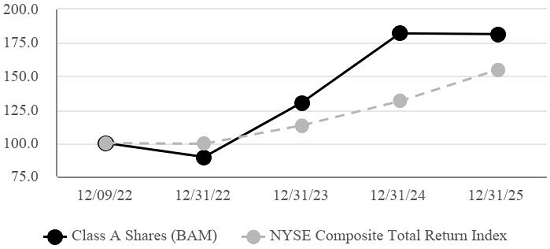
2026 MANAGEMENT INFORMATION CIRCULAR/ 56
| December 9, 2022 | December 31, 2022 | December 31, 2023 | December 31, 2024 | December 31, 2025 | |
| Class A Shares (BAM) | 100 | 89.6 | 130.4 | 182.1 | 181.6 |
| NYSE Composite Total Return Index | 100 | 99.5 | 113.3 | 131.4 | 154.9 |
TSX (Symbol: BAM)
The following shows the cumulative total shareholder return for BAM’s Class A Shares (assuming reinvestment of dividends) since December 9, 2022, in comparison with the cumulative total return of the S&P/TSX Composite Total Return Index.
Cumulative Total Return on C$100 Investment Assuming Dividends are
Reinvested
December 9, 2022 - December 31, 2025
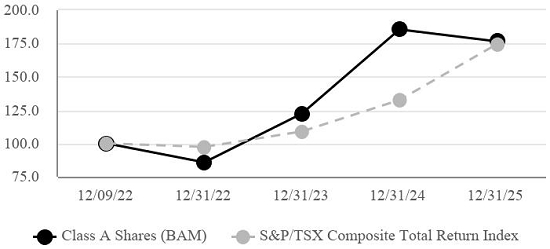
| December 9, 2022 | December 31, 2022 | December 31, 2023 | December 31, 2024 | December 31, 2025 | |
| Class A Shares (BAM) | 100 | 85.8 | 122.4 | 185.6 | 176.6 |
| S&P/TSX Composite Total Return Index | 100 | 97.4 | 109.0 | 132.6 | 174.6 |
Ratio of Named Executive Officer Compensation to Fee-Related Earnings
The following table illustrates the total compensation awarded to the Named Executive Officers for 2023, 2024 and 2025 as a percentage of FRE:
| 2025 | 2024 | 2023 | ||||
| Aggregate Named Executive Officer Compensation(a) | $22,498,943 | $32,419,360 | $27,951,689 | |||
| As a Percentage of FRE(b)(c) | 0.75% | 1.32% | 1.25% |
| (a) | Aggregate Named Executive Officer Compensation is defined as the Total Compensation as it appears in the Summary Compensation Table on page 58 of this Circular |
| (b) | FRE totaled $2.995 billion, $2.456 billion and $2.241 billion in 2025, 2024, and 2023, respectively. |
| (c) | FRE is a non-GAAP measure. See the “Cautionary Statement Regarding the Use of Non-GAAP Measures” on page 65 of this Circular. |
2026 MANAGEMENT INFORMATION CIRCULAR/ 57
Compensation of Named Executive Officers
The compensation paid and disclosed in the table below represents aggregate amounts earned by the Named Executive Officers for the years ended December 31, 2025, 2024 and 2023. Mr. Flatt, who served as CEO of both BAM and BN, also received, compensation paid and disclosed by BN in the year ended December 31, 2025, December 31, 2024 and December 31, 2023.
Summary Compensation Table(a)
| Annual Base | Annual Incentive | Restricted | Escrowed Shares / |
All Other | Total | ||
| Name and Principal | Salary | Cash | Shares/DSUs | Options(f) | Compensation(g) | Compensation | |
| Position | Year | ($) | ($) | ($) | ($) | ($) | ($) |
| Bruce Flatt(b) | 2025 | 375,000 | — | — | 3,221,160 | — | 3,596,160 |
| CEO | 2024 | 375,000 | — | — | 4,470,600 | — | 4,845,600 |
| 2023 | 375,000 | — | — | 2,755,485 | — | 3,130,485 | |
| Hadley Peer Marshall | 2025 | 900,000 | 900,000 | — | 2,041,209 | — | 3,841,209 |
| CFO | 2024 | 690,000 | 690,000 | — | 2,889,125 | — | 4,269,125 |
| 2023 | 675,000 | 675,000 | — | 1,136,484 | — | 2,486,484 | |
| Connor Teskey(c) | 2025 | 1,000,000 | 1,000,000 | — | 4,026,450 | 174,063 | 6,200,513 |
| President | 2024 | 1,000,000 | 1,000,000 | — | 5,588,250 | 234,598 | 7,822,848 |
| 2023 | 923,370 | 923,370 | 2,835,040 | 4,362,851 | 91,171 | 9,135,802 | |
| Brian W. Kingston(d) | 2025 | 750,000 | 750,000 | — | 5,360,400 | — | 6,860,400 |
| Head of U.S. | 2024 | 750,000 | 750,000 | — | 5,588,250 | — | 7,088,250 |
| 2023 | 750,000 | 750,000 | — | 4,592,475 | — | 6,092,475 | |
| Cyrus Madon(e) | 2025 | 375,000 | — | — | 1,610,580 | 15,082 | 2,000,662 |
| Executive Vice Chair | 2024 | 750,000 | — | — | 4,470,600 | 29,604 | 5,250,204 |
| 2023 | 536,925 | — | — | 3,520,898 | 28,796 | 4,086,619 |
| (a) | Messrs. Flatt and Madon’s compensation consists of an annual Base Salary and Escrowed Shares. Each other Named Executive Officer is awarded an annual incentive which they can elect to receive in cash, DSUs or Restricted Shares. |
| (b) | Mr. Flatt also received compensation paid by BN in recognition of his role as CEO of BN for the year ended December 31, 2025. Such compensation consisted of a salary of $375,000 and an Escrowed Share award with a grant date fair value of $5,360,400 based on the grant date price of a BN Class A Share on the NYSE on February 23, 2026 of $47.11. This value awarded is determined by the BN board of directors and considers the stock market price of the BN Class A Shares at the time of the award and the potential increase in value based on a hold period of 7.5 years, a volatility of 30.71%, a risk free rate of 3.88% and a dividend yield of 0.8%. This values has been discounted by 25% to reflect the five-year vesting. |
| (c) | To provide for alignment with BN (as majority shareholder of BAM) consistent with that of other BAM Named Executive Officers, Mr. Teskey also received an award of BN Escrowed Shares granted by BN on February 23, 2026. The BN Escrowed Shares have a grant date fair value of $6,700,500 based on the grant date price of a BN Class A Share on the NYSE on February 23, 2026 of $47.11.This value awarded is determined by the BN board of directors and considers the stock market price of the BN Class A Shares at the time of the award and the potential increase in value based on a hold period of 7.5 years, a volatility of 30.71%, a risk free rate of 3.88% and a dividend yield of 0.8%. This value has been discounted by 25% to reflect the five-year vesting. |
| (d) | The 2025 Escrowed Shares amount for Mr. Kingston reflects an award of BN Escrowed Shares granted by BN on February 23, 2026. The BN Escrowed Shares have a grant date fair value of $5,360,400 based on the grant date price of a BN Class A Share on the NYSE on February 23, 2026 of $47.11. This value awarded is determined by the BN board of directors and considers the stock market price of the BN Class A Shares at the time of the award and the potential increase in value based on a hold period of 7.5 years, a volatility of 30.71%, a risk free rate of 3.88% and a dividend yield of 0.8%. This value has been discounted by 25% to reflect the five-year vesting. |
| (e) | Mr. Madon also received compensation paid by BN in recognition of his role as Executive Vice Chair of BN for the year ended December 31, 2025. Such compensation consisted of a salary of $375,000 and an Escrowed Share award with a grant date fair value of $2,680,200 based on the grant date price of a BN Class A Share on the NYSE on February 23, 2026 of $47.11. This value awarded is determined by the BN board of directors and considers the stock market price of the BN Class A Shares at the time of the award and the potential increase in value based on a hold period of 7.5 years, a volatility of 30.71%, a risk free rate of 3.88% and a dividend yield of 0.8%. This value has been discounted by 25% to reflect the five-year vesting. |
| (f) | The amounts for 2025 reflect grants of BAM Escrowed Shares for all Named Executive Officers except for Mr. Kingston whose amount reflects a grant of BN Escrowed Shares. The value awarded under the Escrowed Stock Plan for annual grants is determined by the Board and considers the stock market price of the Class A Shares at the time of the award and the potential increase in value based on a hold period of 7.5 years, a volatility of 31.34%, a risk free rate of 3.88% and a dividend yield of 4.94%. These values, for the annual grants, have been discounted by 25% to reflect the five-year vesting. |
| (g) | These amounts include annual retirement savings contributions and participation in the executive medical program. These amounts also include advance payments in 2023, 2024 and 2025 made to Mr. Teskey under the carried interest plans for Brookfield Capital Partners IV. |
2026 MANAGEMENT INFORMATION CIRCULAR/ 58
Incentive Plan Awards
Mr. Flatt is not eligible for an annual cash incentive award; he receives an annual Base Salary and Escrowed Shares. BAM has no long-term non-equity incentive plan programs. The following four tables show, for each Named Executive Officer (i) outstanding vested and unvested options at December 31, 2025, (ii) unvested Escrowed Shares, Restricted Shares and DSUs and the market value of vested and unvested Escrowed Shares, Restricted Shares and DSUs at December 31, 2025, and (iii) the value of all option and share-based awards which vested during 2025.
Outstanding Option and Share-Based Awards at December 31, 2025
Options
| Name
and Principal Position |
Number of
Securities Underlying Unexercised Option (#) |
Option
Exercise Price ($) |
Option Expiration Date | Market
Value of Unexercised Options at December 31, 2025(a) ($) |
| Hadley Peer Marshall | 2,118 | 32.75 | February 24, 2030 | 41,594 |
| CFO | 3,031 | 31.46 | February 21, 2031 | 63,447 |
| 10,825 | 41.24 | February 17, 2032 | 120,692 | |
| 91,575 | 35.13 | February 15, 2033 | 1,580,722 | |
| 185,600 | 40.07 | February 15, 2034 | 2,286,889 | |
| Total | 293,149 | 4,093,344 | ||
| Connor Teskey | 151,368 | 32.75 | February 24, 2030 | 2,972,640 |
| President | 25,000 | 31.46 | February 21, 2031 | 523,315 |
| Total | 176,368 | 3,495,955 | ||
| Brian W. Kingston | 225,000 | 17.81 | February 16, 2027 | 7,780,230 |
| Head of U.S. | ||||
| Total | 225,000 | 7,780,230 | ||
| Grand Total | 694,517 | 15,369,529 |
| (a) | The market value of the options is the amount by which the closing price of the Class A Shares on December 31, 2025 exceeded the exercise price of the options. All values are calculated using the closing price of a Class A Share on December 31, 2025 on the NYSE of $52.39. |
Escrowed Shares, Restricted Shares and DSUs(a)
| Escrowed Shares | Share-Based Awards Restricted Shares (RSs) |
Deferred Share Units (DSUs) | |||||||
| Number of Unvested Escrowed Shares |
Market Value of Unvested Escrowed Shares(b) |
Market Value of Vested Escrowed Shares(b) |
Number of Unvested RSs |
Market Value of Unvested RSs |
Market Value of Vested RSs |
Number of Unvested DSUs |
Market Value of Unvested DSUs(c) |
Market Value of Vested DSUs(c) | |
| Name | (#) | ($) | ($) | (#) | ($) | ($) | (#) | ($) | ($) |
| Bruce Flatt | 1,901,357 | 28,834,937 | 33,608,080 | — | — | — | — | — | 22,709,778 |
| Hadley Peer Marshall | 258,500 | — | — | 288 | 15,080 | 7,382 | — | — | — |
| Connor Teskey | 1,779,657 | 20,697,440 | 10,584,041 | — | — | — | — | — | 122,095 |
| Brian W. Kingston | 1,762,346 | 20,484,586 | 16,307,228 | — | — | — | — | — | 10,345,389 |
| Cyrus Madon | 1,831,967 | 25,884,830 | 26,779,644 | — | — | — | — | — | 18,554,052 |
| (a) | The values do not include the most recent Escrowed Share, Restricted Share and DSU awards made to the Named Executive Officers on February 23, 2026. |
| (b) | The value of the Escrowed Shares is equal to the value of the Class A Shares held by the Escrowed Company less the net liabilities and preferred share obligations of the Escrowed Company. |
| (c) | Includes DSUs issued by BN, which track the value of a Class A Share. Values are calculated using the closing price of the Class A Shares on the TSX on December 31, 2025 of $52.39 (C$71.90, converted into U.S. dollars at the Bloomberg mid-market exchange rate on that date of C$1.00 = US$0.7286) and $52.39 on the NYSE, as applicable. |
2026 MANAGEMENT INFORMATION CIRCULAR/ 59
Option and Share-Based Awards Vested During 2025
| Named Executive Officer | Value Vested During 2025(a) | |||
| Options(b) ($) |
DSUs(c) ($) |
Restricted Shares ($) |
Escrowed Shares(d) ($) | |
| Bruce Flatt | — | — | — | 13,779,368 |
| Hadley Peer Marshall | 1,255,310 | — | 16,859 | — |
| Connor Teskey | 901,727 | — | — | 7,727,144 |
| Brian W. Kingston | — | — | — | 9,336,928 |
| Cyrus Madon | — | 417,437 | — | 12,181,398 |
| (a) | All values are calculated using the closing price of a Class A Share on the vesting date on the TSX and NYSE, as applicable, and converted into U.S. dollars using the average Bloomberg mid-market exchange rate for 2025 of C$1.00 = US$0.7159. |
| (b) | The value represents the amount by which the value of the Class A Shares exceeded the exercise price on the day the options vested. |
| (c) | Values in this column represent the value of DSUs vested in 2025. |
| (d) | The value of the Escrowed Shares is equal to the Class A Shares held by the Escrowed Company less the net liabilities and preferred share obligations of the Escrowed Company. |
Security-Based Compensation Arrangements
BAM’s only security-based compensation arrangements are its Option Plans and its Escrowed Stock Plan.
2022 Management Share Option Plan
The 2022 Management Share Option Plan (the “2022 Plan”) was approved by the BN board of directors on September 23, 2022 and by the holders of Class A Shares of BN at the Special Meeting of Shareholders held on November 9, 2022. The 2022 Plan provides for the issuance of 17,500,000 Class A Shares (representing approximately 1.07% of BAM’s issued and outstanding Class A Shares as at December 31, 2025. Options to acquire 8,559,987 Class A Shares have been granted but not exercised, representing approximately 0.52% of BAM’s issued and outstanding Class A Shares as at December 31, 2025. 3,520,804 Class A Shares are available for future option grants, representing approximately 0.21% of BAM’s issued and outstanding Class A Shares as at December 31, 2025.
2022 Non-Qualified Management Share Option Plan
The 2022 Non-Qualified Management Share Option Plan (the “2022 Non-Qualified Plan”) was approved by the BN Board on September 23, 2022 and by the holders of Class A Shares of BN at the Special Meeting of Shareholder held on November 9, 2022. The 2022 Non-Qualified Plan provides for the issuance of 12,500,000 Class A Shares (representing approximately 0.76% of BAM’s issued and outstanding Class A Shares as at December 31, 2025. As at December 31, 2025, 960,561 Class A Shares were issuable pursuant to options granted under the 2022 Non-Qualified Plan, representing approximately 0.06% of BAM’s issued and outstanding Class A Shares as at December 31, 2025. As at December 31, 2025, 11,440,343 Class A Shares remained available for future option grants, representing 0.70% of BAM’s issued and outstanding Class A Shares as at December 31, 2025.
2026 Plan
The 2026 Plan was approved by the Board on February 3, 2026 and approval of the 2026 Plan by shareholders is being sought at the meeting. The 2026 Plan provides for the issuance of 20 million Class A Shares (representing approximately 1.22% of BAM’s issued and outstanding Class A Shares as at December 31, 2025). No options to acquire Class A Shares under the 2026 Plan have been granted. If the 2026 Plan is approved by shareholders at the meeting, the Class A Shares which remain available for future option grants under the 2022 Plan will remain available for future option grants under the 2022 Plan.
General Terms of Option Plans
The Board establishes the exercise price of each option at the time it is granted, which may not be less than the volume-weighted average price of a Class A Share on the NYSE for the five trading days preceding the effective grant date. If options are approved during a restricted trading period, the effective grant date may not be less than six business days after the restricted trading period ends.
2026 MANAGEMENT INFORMATION CIRCULAR/ 60
The following is a summary of the other key provisions of the Option Plans. Employees, officers and consultants of BAM and its affiliates and others designated by the Board are eligible to participate in the Option Plans. Non-employee directors are not eligible to participate in the Option Plans. The number of Class A Shares issuable to insiders at any time, or issued in any one year to insiders, under any of BAM’s security-based compensation arrangements cannot exceed in either case 10% of the issued and outstanding shares of this class; and no more than 5% of the issued and outstanding shares may be issued under these arrangements to any one person. The Board determines the vesting period for each option grant, which is normally 20% per year over five years commencing the first year after the grant. The Board also sets the expiry period for each option grant, which may not exceed 10 years, except where the expiry date falls during or shortly after a restricted trading period, in which case the expiry date is 10 days after the restricted trading period ends.
The Option Plans set out provisions regarding the exercise and cancellation of options following a change in the employment status of a plan participant. In general, all vested options must be exercised by, and all unvested options are cancelled on, a participant’s termination date, except as follows: in the event of termination by BAM for reasons other than cause or due to a continuous leave of absence as a result of a disability, vested options must be exercised within 60 days following the termination date; in the event of retirement, vested options continue to be exercisable until the applicable expiry date; and in the event of death, all granted options continue to vest and be exercisable for six months following death. No incremental entitlements are triggered by a change in control of BAM under the Option Plans.
The Option Plans permit participants to exercise vested options in exchange for a number of Class A Shares equivalent in value to (i) the aggregate fair market value of the Class A Shares underlying the options on the exercise date over the aggregate exercise price of the options, less (ii) applicable withholding taxes (only to the extent such taxes have not otherwise been satisfied by the participant). This provides for a reduction in shareholder dilution upon the exercise of options using this feature.
The Option Plans also provide that each person that is an officer, employee or consultant of BN or any of its affiliates shall, for so long as such person remains an officer, employee or consultant of BN or any of its affiliates, be permitted to hold and exercise his or her options in accordance with their terms as though such person was an officer, employee or consultant, as applicable, of BAM or any of its affiliates. The 2022 Plan also permits participants to pay the applicable exercise price and acquire the full number of Class A Shares underlying the options.
Procedure for Amending Option Plans
The Option Plans contain an amending provision setting out the types of amendments which can be approved by the Board without shareholder approval and those which require shareholder approval. Shareholder approval is required for any amendment that increases the number of shares issuable under the Option Plans, that lengthens the period of time after a restricted trading period during which options may be exercised, results in the exercise price being lower than fair market value of a Class A Share at the date of grant, reduces the exercise price or any cancellation and reissuance of an option which would be considered a repricing under TSX rules, expands insider participation, extends the term of an option beyond its expiry date, adds a provision which results in participants receiving shares for no consideration or other amendments required by law to be approved by shareholders. The Option Plans also require shareholder approval for any amendment which would permit options to be transferable or assignable other than for normal estate planning purposes, any amendment to the amendment provisions, any amendment expanding the categories of eligible participants which may permit the introduction or reintroduction of non-employee directors on a discretionary basis and any amendment to remove or exceed the insider participation limit. Shareholder approval is not required for any amendment to the Option Plans or any option that is of a housekeeping or administrative nature, that is necessary to comply with applicable laws or to qualify for favorable tax treatment, that is to the vesting, termination or early termination provisions (provided that the amendment does not entail an extension beyond the expiry period of the options), that adds or modifies a cashless exercise feature that provides for a full deduction of the number of Class A Shares from the Option Plan reserve, and to suspend or terminate an Option Plan. No amendments to the Option Plans were made in 2025.
Other Features of the Option Plans
BAM does not provide any financial assistance to plan participants to facilitate the purchase of Class A Shares issued pursuant to the exercise of options under the Option Plans. Options granted under the Option Plans may be assigned by the plan participant to (i) his or her spouse, descendants or any other immediate family member; or (ii) a trust, the beneficiaries of which are one or more of the plan participant and the participant’s spouse, descendants or immediate family members; or
2026 MANAGEMENT INFORMATION CIRCULAR/ 61
(iii) a corporation or limited liability company controlled by the plan participant or by one or more of the participant and the participant’s spouse, and/or the immediate family members, the shares or interests of which are held directly or indirectly by the plan participant, participant’s spouse and/or immediate family members; or (iv) such other transferees for estate planning purposes as may be permitted by the Board in its discretion.
The Board, on the recommendation of the GNCC, approves all option awards. The GNCC recommends the long-term incentive award for the CEO. All other option awards are recommended by the CEO to the GNCC.
BAM has established a number of policies related to its long-term share ownership plans, including option exercise hold periods, to reinforce the importance of equity ownership by its senior executives over the longer term. See also “Key Policies and Practices to Support Alignment” on page 51 of this Circular.
The Escrowed Stock Plan
The Escrowed Stock Plan was approved by the BN board of directors on September 23, 2022 and by holders of Class A Shares of BN at the Special Meeting of Shareholders held on November 9, 2022. The Escrowed Stock Plan governs the award of Escrowed Shares of one or more Escrowed Company to executives or other individuals designated by the Board. Each Escrowed Company is capitalized with common shares and preferred shares issued to BAM or BN in exchange for shares of Brookfield Asset Management ULC, Class A Shares or cash proceeds. Each Escrowed Company may use its cash resources to directly or indirectly purchase Class A Shares in the open market or, subject to obtaining exemptive relief (if applicable), in private purchases. Participants are either awarded Escrowed Shares or provided an election to contribute Class A Shares or previously awarded Escrowed Shares as consideration for the Escrowed Shares. Dividends paid to each Escrowed Company on the shares of Brookfield Asset Management ULC or the Class A Shares acquired by the Escrowed Company will be used to pay dividends on the preferred shares which are held by BAM or BN. If a participant elects to contribute Class A Shares as consideration, dividends paid to the Escrowed Company on the contributed Class A Shares will be paid on the common shares held by the participants.
Except as otherwise determined by the Board, 20% of Escrowed Shares will vest on the first anniversary of the granting of such shares, with an additional 20% vesting on each subsequent anniversary, up to and including the fifth anniversary of the grant of the Escrowed Shares.
On date(s) determined by the holders of the Escrowed Shares no later than 10 years after the initial grant, the vested Escrowed Shares will be acquired by BAM in exchange for the issuance of Class A Shares from treasury, where the value of the Class A Shares being issued is equal to the value of the Escrowed Shares being acquired. The value of the Escrowed Shares will be equal to the increase in value of the Class A Shares and shares of Brookfield Asset Management ULC held by the Escrowed Company since the grant date of the Escrowed Shares, as applicable, based on the volume-weighted average price of a Class A Share on the NYSE on the date of the exchange. Participants are not permitted to exchange Escrowed Shares during a restricted trading period, except with the consent of the Board. Once all participants of an Escrowed Company have elected to exchange their Escrowed Shares, the Escrowed Company will be wound up or merged and BAM will cancel at least that number of Class A Shares that is equivalent to the number of Class A Shares that have been issued to holders of the Escrowed Shares of the Escrowed Company on exchanges such that the dilutive effect of the issuance of Class A Shares is wholly offset.
A maximum of 11,000,000 Class A Shares may be issued under the Escrowed Stock Plan, representing approximately 0.67% of BAM’s issued and outstanding Class A Shares as at December 31, 2025. When Class A Shares are issued in exchange for Escrowed Shares, the number of Class A Shares remaining for future issuance under the Escrowed Stock Plan will be reduced. On the wind-up or merger of an Escrowed Company, the number of Class A Shares held by one or more Escrowed Companies that are cancelled in respect of Class A Shares issued by BAM in exchange for Escrowed Shares are added back to the number of Class A Shares available for future issuance. The combined effect on wind-up or merger of an Escrowed Company is that the dilutive effect of the Class A Share issuance is wholly offset. 186,136 Class A Shares have been issued (representing approximately 0.01% of BAM’s issued and outstanding Class A Shares as at December 31, 2025) and 110,038 Class A Shares have been cancelled under the Escrowed Stock Plan. As at December 31, 2025, 10,923,902 Class A Shares are available for future issuance, representing approximately 0.67% of BAM’s issued and outstanding Class A Shares as at December 31, 2025.
2026 MANAGEMENT INFORMATION CIRCULAR/ 62
Eligibility for participation in the Escrowed Stock Plan is restricted to designated executives of BAM and its affiliates or any other persons designated by the Board. The number of Escrowed Shares to be granted to each participant is determined at the discretion of the Board, on the recommendation of the GNCC. The GNCC recommends the award of Escrowed Shares for the CEO. All other awards of Escrowed Shares are recommended by the CEO to the GNCC. The number of Class A Shares issuable to insiders at any time, or issued in any one year to insiders, under any of BAM’s security-based compensation arrangements cannot exceed in either case 10% of the issued and outstanding shares of this class; and no more than 5% of the issued and outstanding shares may be issued under these arrangements to any one person. Aside from transfers to BAM (in the case of termination of employment, described in the table under “Termination and Change of Control Provisions” on page 53 of this Circular) or for personal tax planning purposes, transfers of Escrowed Shares are not permitted. No incremental entitlements are triggered by a change in control of BAM under the Escrowed Stock Plan.
The number of Escrowed Shares granted under the Escrowed Stock Plan annually, expressed as a percentage of the weighted average number of Class A Shares outstanding in the year, was 0.15% in 2023, 0.29% in 2024, and 0% in 2025. See also “Dilution of Class A Shares” on page 63 of this Circular for information on the rate of Class A Share issuances under the Escrowed Stock Plan.
The Escrowed Stock Plan also provides that each person that is an officer, employee or consultant of BN or any of its affiliates shall, for so long as such person remains an officer, employee or consultant of BN or any of its affiliates, be permitted to hold and exchange his or her Escrowed Shares in accordance with their terms as though such person was an officer, employee or consultant, as applicable, of BAM or any of its affiliates.
Recent and Proposed Amendments to the Escrowed Stock Plan
The Board has approved amendments to the Escrowed Stock Plan that requires shareholder approval at the meeting. See “Amendments to Escrowed Stock Plan” on page 20 of this Circular for further details.
Procedure for Amending Escrowed Stock Plan
The Escrowed Stock Plan contains an amending provision setting out the types of amendments which can be approved by the Board without shareholder approval and those which require shareholder approval. Shareholder approval is required for any amendment that increases the number of Class A Shares issuable under the Escrowed Stock Plan, expands insider participation, expands participation to include non-employee directors of BAM, any amendment to the amendment provisions or other amendments required by law to be approved by shareholders. Shareholder approval is not required for any amendment to the Escrowed Stock Plan that is of a housekeeping or administrative nature, that is necessary to comply with applicable laws or to qualify for favorable tax treatment, that is to vesting provisions, that is to the termination or early termination provisions (provided that the amendment does not entail an extension beyond the tenth anniversary of the award date for any particular Escrowed Company), and to suspend or terminate the Escrowed Stock Plan.
Dilution of Class A Shares
Options Outstanding under the 2022 Plan and Class A
Shares Issued under the 2022 Non-Qualified Plan and the Escrowed Stock Plan as a
Percentage of Issued and Outstanding Class A Shares
| 2025 | 2024 | 2023 | |
| 2022 Plan | 0.5% | 2.0% | 2.7% |
| 2022 Non-Qualified Plan(a) | 0.1% | 0.8% | — |
| Escrowed Stock Plan(b) | 0.3% | 1.9% | — |
| (a) | Reflects the number of Class A Shares to be issued upon exchange of the in-the-money Options under the 2022 Non-Qualified Plan during the applicable year. |
| (b) | Reflects the number of Class A Shares to be issued upon exchange of the in-the-money Escrowed Shares, less the number of Class A Shares cancelled under the Escrowed Stock Plan during the applicable year. Although the number of Class A Shares outstanding may increase over time as a result of issuances of Class A Shares pursuant to the Escrowed Stock Plan, the Escrowed Stock Plan continues to be non-dilutive as BAM will cancel Class A Shares held by Escrowed Companies that are wound up or merged. |
Grants Issued as a Percentage of Shares Outstanding
The following table shows the number of Class A Shares issuable under awards granted under each of the Option Plans and the Escrowed Stock Plan as a percentage of the average Class A Shares outstanding (the “rate of grants issued”) in the
2026 MANAGEMENT INFORMATION CIRCULAR/ 63
applicable year. The rate of grants issued is defined as the number of Class A Shares issuable under awards granted in a fiscal year, divided by the basic weighted average number of Class A Shares outstanding in that year.
| 2025 | 2024 | 2023 | |
| Grants under the 2022 Plan(a) | 1,019,300 | 354,248 | 1,706,775 |
| Rate of Grants Issued | 0.06% | 0.08% | 0.41% |
| Grants under the 2022 Non Qualified Plan(a) | — | 1,465,020 | 741,852 |
| Rate of Grants Issued | — | 0.34% | 0.18% |
| Grants under the Escrowed Stock Plan(b) | — | 1,261,666 | 600,628 |
| Rate of Grants Issued | — | 0.29% | 0.15% |
| (a) | Includes Class A Shares issuable on exercise of the options as of each fiscal year end. Holders of options under the 2022 Non-Qualified Plan are only entitled to receive a number of Class A Shares equal to the in-the-money value of the options at the time of exercise. |
| (b) | Includes Class A Shares issuable on exchange as of each fiscal year end for information purposes. Although the number of Class A Shares outstanding may increase over time as a result of issuances of Class A Shares pursuant to the Escrowed Stock Plan, the Escrowed Stock Plan continues to be non-dilutive as BAM will cancel Class A Shares held by Escrowed Companies that are wound up or merged. |
Securities Authorized for Issue Under Incentive Plans
The following table sets out information on BAM’s Option Plans and Escrowed Stock Plan as at December 31, 2025.
| Plan Category | Number of securities to be issued upon exercise of outstanding options, warrants and rights |
Weighted-average exercise price of outstanding options, warrants and rights(a) |
Number of securities remaining available for future issuance under equity compensation plans |
| Equity compensation plans approved by security holders | |||
| 2022 Plan | 8,599,987 | $32.22 | 3,520,804 |
| 2022 Non-Qualified Plan(b) | 960,561 | $37.01 | 11,440,343 |
| Escrowed Stock Plan(c) | 4,189,648 | — | 10,923,902 |
| Total | 13,750,196 | 25,885,049 |
| (a) | Converted into U.S. dollars using the average Bloomberg mid-market exchange rate for 2025 of C$1.00 = US$0.7159. |
| (b) | This value represents the number of Class A Shares at December 31, 2025 which could be issued under this plan. Up to December 31, 2025, 99,096 Class A Shares have been issued in connection with this plan. |
| (c) | This value represents the number of Class A Shares at December 31, 2025 which could be issued under this plan. Up to December 31, 2025, 186,136 Class A Shares have been issued and 110,038 Class A Shares have been cancelled in connection with this plan. |
Pension and Retirement Benefits
BAM’s Named Executive Officers and its other senior executives do not participate in a registered defined benefit plan or any other post-retirement supplementary compensation plans. The Named Executive Officers do not have any entitlement to future pension benefits or other post-employment benefits from BAM. BAM has not entered into contractual termination, post-termination or change of control arrangements, employment contracts or golden parachutes with any of its Named Executive Officers.
2026 MANAGEMENT INFORMATION CIRCULAR/ 64
PART SIX - OTHER INFORMATION
Indebtedness of Directors, Officers and Employees
The amount of debt outstanding by current and former directors, officers and employees of BAM as at March 10, 2026 to BAM and its subsidiaries is approximately $21.2 million, which loans bear interest at a minimum rate of 2.25%. The purpose of such loans is to enable certain employees of BAM to fund certain near-term expenses without monetizing previously granted equity awards under Brookfield’s long-term share ownership plans, thereby preserving long-term alignment with BAM.
Audit Committee
Additional information about the Audit Committee required by Part 5 of NI 52-110 can be found on page 26 of this Circular. BAM’s Audit Committee Charter is posted on BAM’s website, https://bam.brookfield.com under “Governance—Governance Documents”.
Share Repurchase Program
Class A Limited Voting Shares
On January 9, 2026, BAM renewed its share repurchase program for market purchases of its Class A Shares for a period extending from January 13, 2026 until January 12, 2027, or an earlier date should BAM complete its purchases. The share repurchase program allows BAM to repurchase, during the period mentioned above, on the NYSE or TSX, a maximum of 36.9 million Class A Shares, representing approximately 10% of the public float of the outstanding Class A Shares. All Class A Shares acquired by BAM under the share repurchase program are cancelled or purchased by a non-independent trustee to support our long-term incentive plan.
The share repurchase program is in place because BAM believes that, from time to time, the trading price of Class A Shares may not fully reflect the underlying value of BAM’s business and future business prospects, and in such circumstances acquiring Class A Shares may represent an attractive investment. Between January 13, 2026 and March 10, 2026, BAM has purchased 3,683,352 Class A Shares at an average price of $48.37. Shareholders may obtain, free of charge, a copy of the notice of intent regarding the share repurchase program, which was approved by the TSX, by writing to the Corporate Secretary of BAM at Brookfield Place, 225 Liberty Street, 8th Floor, New York, NY 10281-1048.
Cautionary Statement Regarding the Use of Non-GAAP Measures and Forward-Looking Statements
BAM prepares its financial statements in conformity with the accounting principles generally accepted in the United States of America (“U.S. GAAP”). This Circular discloses a number of non-GAAP financial and supplemental financial measures which are utilized in monitoring our asset management business, including for performance measurement, capital allocation and valuation purposes. BAM believes that providing these performance measures is helpful to investors in assessing the overall performance of our asset management business. These non-GAAP financial measures should not be considered as the sole measure of BAM’s performance and should not be considered in isolation from, or as a substitute for, similar financial measures calculated in conformity with U.S. GAAP financial measures. These non-GAAP financial measures are not standardized financial measures and may not be comparable to similar financial measures used by other issuers. Non-GAAP measures include, but are not limited to, distributable earnings, fee revenues, and fee-related earnings. Supplemental financial measures include assets under management, fee-bearing capital and uncalled fund commitments. See page 59 of the Annual Report for further information on non-GAAP financial measures or other financial metrics and reconciliations of these non-GAAP financial measures to the most directly comparable financial measures calculated and presented in accordance with U.S. GAAP, where applicable, which pages are also incorporated by reference in this Circular.
This Circular also contains forward-looking statements and forward-looking information (collectively, “forward-looking statements”) within the meaning of U.S. and Canadian securities laws, as applicable. See pages 4, 7, and 8 of the Annual Report for further information on forward-looking statements, which pages are also incorporated by reference in this Circular. The Annual Report is available on EDGAR at www.sec.gov/edgar and SEDAR+ at www.sedarplus.ca.
2026 MANAGEMENT INFORMATION CIRCULAR/ 65
Availability of Disclosure Documents
BAM will provide any person or company, upon request in accordance with the directions in the Notice, a copy of this Circular and the Annual Report. Upon request to the Corporate Secretary of BAM, BAM will provide any person or company the Annual Report, together with a copy of any document or the pertinent pages of any document incorporated therein by reference; management’s discussion and analysis of financial condition and results of operation from its most recently completed financial year (“MD&A”) and/or the interim financial statements of BAM for the periods subsequent to the end of its fiscal year (the “Interim Statements”). Financial information on BAM is provided in its comparative annual financial statements and MD&A. Requests for the Annual Report, MD&A and the Interim Statements can be made to BAM by mail at Brookfield Place, 225 Liberty Street, 8th Floor, New York, NY 10281-1048, by telephone at (212) 417-7000, or by email at bam.enquiries@brookfield.com. All of these documents and additional information related to BAM are also available on BAM’s website, https://bam.brookfield.com, on EDGAR at www.sec.gov/edgar and SEDAR+ at www.sedarplus.ca.
Shareholder Proposals
Pursuant to the Business Corporations Act (British Columbia) (the “BCBCA”), shareholder proposals must be submitted by a “qualified shareholder” that has held Class A Shares or Class B Shares for an uninterrupted period of at least two years. Shareholder proposals can be validly submitted for consideration at any annual meeting of shareholders. The deadline for shareholder proposals for BAM’s 2026 annual general meeting of shareholders is February 5, 2026. Shareholder proposals should be submitted to BAM’s registered office at 1055 West Georgia Street, 1500 Royal Centre, P.O. Box 11117, Vancouver, British Columbia, Canada, V6E 4N7. In order to be considered valid, shareholder proposals must also meet the additional requirements enumerated under section 188 of the BCBCA.
Other Business
BAM knows of no other matter to come before the meeting other than the matters referred to in the Notice of Meeting of Shareholders and Availability of Investor Materials dated March 23, 2026.
Directors’ Approval
The contents and posting of this Circular have been approved by the directors of BAM.
“Kathy Sarpash”
Kathy Sarpash
Corporate Secretary
March 23, 2026
2026 MANAGEMENT INFORMATION CIRCULAR/ 66
APPENDIX A - CHARTER OF THE BOARD1
| 1. | Role of the Board |
The role of the board of directors (the “Board”) of Brookfield Asset Management Ltd. (the “Corporation”) is to oversee, directly and through its committees, the business and affairs of the Corporation, which are conducted by the Corporation’s officers and employees under the direction of the Chief Executive Officer (“CEO”).
| 2. | Authority and Responsibilities |
The Board meets regularly to review reports by management on the Corporation’s performance and other relevant matters of interest. In addition to the general supervision of management, the Board performs the following functions:
| (a) | Strategic Planning — overseeing the long-term strategic-planning process within the Corporation and, at least annually, reviewing, approving and monitoring the strategic plan for the Corporation, including fundamental financial and business strategies and objectives; |
| (b) | Risk Assessment — assessing the major risks facing the Corporation and reviewing, approving and monitoring the manner of managing those risks; |
| (c) | CEO — selecting the CEO; reviewing and approving the position description for the CEO including the corporate objectives that the CEO is responsible for meeting; and reviewing and approving the compensation of the CEO as recommended by the Governance, Nominating and Compensation Committee; |
| (d) | Officers and Senior Management — overseeing the selection of corporate officers and the evaluation and compensation of senior management; |
| (e) | Succession Planning — monitoring the succession of key members of senior management; |
| (f) | Communications and Disclosure Policy — adopting a communications and disclosure policy for the Corporation that ensures the timeliness and integrity of communications to shareholders, and establishing suitable mechanisms to receive stakeholder views; |
| (g) | Sustainability — overseeing the Corporation’s approach to sustainability matters within its corporate and asset management activities as reported to the Board by the Governance, Nominating and Compensation Committee; |
| (h) | Corporate Governance — developing and promoting a set of effective corporate governance principles and guidelines applicable to the Corporation; |
| (i) | Internal Controls — reviewing and monitoring the controls and procedures within the Corporation to maintain its integrity, including its disclosure controls and procedures, and its internal controls and procedures for financial reporting and compliance; |
| (j) | Culture — on an ongoing basis, satisfy itself that the CEO and other executive officers create a culture of integrity throughout the Corporation, including compliance with the Corporation’s Code of Business Conduct and Ethics and its anti-bribery and corruption policies and procedures; and |
| (k) | Whistleblowers — in conjunction with the Audit Committee of the Board, establish whistleblower policies for the Corporation providing employees, officers, directors and other stakeholders, including the public, with the opportunity to raise, anonymously or not, questions, complaints or concerns regarding the Corporation’s practices, including fraud, policy violations, any illegal or unethical conduct, and any accounting, auditing or internal control matters. The Board or a committee thereof will provide oversight over the Corporation’s whistleblower policies and practices, with management being responsible for reviewing the Corporation’s Whistleblowing Policy on an annual basis, to ensure that any questions, complaints or concerns are adequately received, reviewed, investigated, documented and resolved. |
1 Capitalized terms used in this Charter but not otherwise defined herein have the meaning attributed to them in the Board’s “Definitions for Board and Committee Charters” which is annexed hereto as “Annex A”.
2026 MANAGEMENT INFORMATION CIRCULAR/A- 1
| 3. | Composition and Procedures |
| (a) | Size of Board and Selection Process — The directors of the Corporation are elected each year by the shareholders at the annual meeting of shareholders. The Governance, Nominating and Compensation Committee recommends to the full Board the nominees for election to the Board and the Board proposes individual nominees to the shareholders for election. Any shareholder may propose a nominee for election to the Board either by means of a shareholder proposal or at the annual meeting itself, upon compliance with the requirements prescribed by the Business Corporations Act (British Columbia). The Board also recommends the number of directors on the Board to shareholders for approval. Between annual meetings, the Board may appoint directors to serve until the next annual meeting. |
| (b) | Qualifications — Directors should have the highest personal and professional ethics and values and be committed to advancing the best interests of the Corporation. They should possess skills and competencies in areas that are relevant to the Corporation’s activities. The Lead Independent Director and, other than in temporary circumstances2, a majority of the directors will be Independent Directors, based on the rules and guidelines of applicable stock exchanges and securities regulatory authorities, and Unaffiliated Directors. The Board is committed to developing and promoting diversity, including ethnic and gender diversity. The Board has adopted a gender diversity target that at least 30% of the entire Board be women. |
| (c) | Director Education and Orientation — The Corporation’s management team is responsible for providing an orientation program for new directors in respect of the Corporation and the role and responsibilities of directors. In addition, directors will, as required, receive continuing education about the Corporation to maintain a current understanding of the Corporation’s business and operations, industries and sectors in which we operate globally, material developments and trends in asset management and the Corporation’s strategic initiatives. |
| (d) | Meetings — The Chair is responsible for approving the agenda for each Board meeting. Prior to each Board meeting, the Chair of the Board reviews agenda items for the meeting with the CEO, Chief Financial Officer and Corporate Secretary, before circulation to the full Board. The Board meets at least once each quarter to review and approve the Corporation’s quarterly earnings report and consider dividend payments and to review specific items of business including transactions and strategic initiatives. The Board holds additional meetings as necessary to consider special business. The Board also meets once a year to review the Corporation’s annual business plan and long-term strategy. Materials for each meeting are distributed to the directors in advance of the meeting. At the conclusion of each Board meeting, the independent and unaffiliated directors meet without any other person present. The Lead Independent Director chairs these in-camera sessions. |
| (e) | Committees — The Board has established the following standing committees to assist it in discharging its responsibilities: (i) Audit and (ii) Governance, Nominating and Compensation. Special committees are established, from time to time, to assist the Board in connection with specific matters. The Chair of each committee reports to the Board following meetings of their committee. The governing charter of each standing committee is reviewed and approved annually by the Board. |
| (f) | Evaluation — The Governance, Nominating and Compensation Committee performs an annual evaluation of the effectiveness of the Board as a whole, the standing committees of the Board and the contributions of individual directors and provides a report to the Board on the findings of this process. In addition, each individual director and each standing committee assesses its own performance annually. |
| (g) | Compensation — The Governance, Nominating and Compensation Committee recommends to the Board the compensation for non-management directors (it is the policy of the Corporation that management directors do not receive compensation for their service on the Board). In reviewing the adequacy and form of compensation, the Governance, Nominating and Compensation Committee seeks to ensure that director compensation reflects the responsibilities and risks involved in being a director of the Corporation and aligns the interests of the directors with the best interests of the Corporation. |
2 Temporary circumstances include vacancies or changes to the Board’s composition or size that are approved by the Board in its discretion, provided that the duration of such circumstances is expected to be less than one year.
2026 MANAGEMENT INFORMATION CIRCULAR/A- 2
| (h) | Access to Outside Advisors — The Board and any committee may at any time retain outside financial, legal or other advisors at the expense of the Corporation. Any director may, subject to the approval of the Chair of the Board, retain an outside advisor at the expense of the Corporation. |
| (i) | Charter of Expectations — The Board has adopted a Charter of Expectations for Directors which outlines the basic duties and responsibilities of directors and the expectations the Corporation places on them in terms of professional and personal competencies, performance, behavior, share ownership, conflicts of interest, change of circumstances and resignation events. Among other things, the Charter of Expectations outlines the role of directors in stakeholder engagement and the requirement of directors to attend Board meetings and review meeting materials in advance of such meetings. |
This Board of Directors Charter was reviewed and approved by the Board on May 5, 2025.
2026 MANAGEMENT INFORMATION CIRCULAR/A- 3
Annex A
Definitions for Board and Committee Charters
“Audit Committee” means the audit committee of the Board.
“Audit Committee Financial Expert” means a person who has the following attributes:
| (a) | an understanding of GAAP and financial statements; |
| (b) | the ability to assess the general application of such principles in connection with the accounting for estimates, accruals and reserves; |
| (c) | experience preparing, auditing, analyzing or evaluating financial statements that present a breadth and level of complexity of accounting issues that are generally comparable to the breadth and complexity of issues that can reasonably be expected to be raised by the Corporation’s financial statements, or experience actively supervising one or more persons engaged in such activities; |
| (d) | an understanding of internal controls and procedures for financial reporting; and |
| (e) | an understanding of audit committee functions, acquired through any one or more of the following: |
| (i) | education and experience as a chief financial officer, principal accounting officer, corporate controller, certified public accountant or auditor or experience in one or more positions that demonstrate meaningful experience overseeing such functions as a senior executive officer; |
| (ii) | experience actively supervising a principal financial officer, principal accounting officer, controller, public accountant, auditor or person performing similar functions; |
| (iii) | experience overseeing or assessing the performance of companies or public accountants with respect to the preparation, auditing or evaluation of financial statements; or |
| (iv) | other relevant experience. |
“Board Interlocks” means when two directors of one public company sit together on the board of another company.
“Committee Interlocks” means when a Board Interlock exists, plus the relevant two directors also sit together on a board committee for one or both of the companies.
“Financially Literate” means the ability to read and understand a set of financial statements that present a breadth and level of complexity of accounting issues that are generally comparable to the breadth and complexity of the issues that can reasonably be expected to be raised by the Corporation’s financial statements.
“GAAP” means generally accepted accounting principles in the United States of America that the SEC has identified as having substantial authoritative support, as supplemented by Regulation S-X under the 1934 Act, as amended from time to time.
“Governance, Nominating and Compensation Committee” means the Governance, Nominating and Compensation Committee of the Board.
“Immediate Family Member” means an individual’s spouse, parent, child, sibling, mother or father-in-law, son or daughter-in-law, brother or sister-in-law, and anyone (other than an employee of either the individual or the individual’s immediate family member) who shares the individual’s home.
“Independent Director(s)” means a director who has been affirmatively determined by the Board to have no material relationship with the Corporation, either directly or as a partner, shareholder or officer of an organization that has a relationship with the Corporation. A material relationship is one that could reasonably be expected to interfere with a director’s exercise of independent judgment. In addition to any other requirement of applicable securities laws or stock exchange provisions, a director who:
2026 MANAGEMENT INFORMATION CIRCULAR/A- 4
| (a) | is or was an employee or executive officer, or whose Immediate Family Member is or was an executive officer, of the Corporation is not independent until three years after the end of such employment relationship; |
| (b) | is receiving or has received, or whose Immediate Family Member is an executive officer of the Corporation and is receiving or has received, during any 12-month period within the last three years more than CA$75,000 in direct compensation from the Corporation, other than director and committee fees and pension or other forms of fixed compensation under a retirement plan (including deferred compensation) for prior service (provided such compensation is not contingent in any way on continued service), is not independent; |
| (c) | is or was a partner of, affiliated with or employed by, or whose Immediate Family Member is or was a partner of or employed in an audit, assurance, or tax compliance practice in a professional capacity by, the Corporation’s present or former internal or external auditor, is not independent until three years after the end of such partnership, affiliation or employment relationship, as applicable, with the auditor; |
| (d) | is or was employed as, or whose Immediate Family Member is or was employed as, an executive officer of another company (or its parent or a subsidiary) where any of the present (at the time of review) executive officers of the Corporation serve or served on that company’s (or its parent’s or a subsidiary’s) compensation committee, is not independent until three years after the end of such service or the employment relationship, as applicable; and |
| (e) | is an executive officer or an employee of, or whose Immediate Family Member is an executive officer of, another company (or its parent or a subsidiary) that has made payments to, or received payments from, the Corporation for property or services in an amount which, in any of the last three fiscal years exceeds the greater of US$1 million or 2% of such other company’s consolidated gross revenues, in each case, is not independent. |
Additionally, an Independent Director for the purposes of the Audit Committee and the Governance, Nominating and Compensation Committee, specifically may not:
| (a) | accept directly or indirectly, any consulting, advisory, or other compensatory fee from the Corporation, other than director and committee fees and pension or other forms of fixed compensation under a retirement plan (including deferred compensation) for prior service (provided such compensation is not contingent in any way on continued service); or |
| (b) | be an affiliated person of the Corporation (within the meaning of applicable rules and regulations). |
Furthermore, an Independent Director for the purposes of the Governance, Nominating and Compensation Committee, specifically may not:
| (a) | have a relationship with senior management that would impair the director’s ability to make independent judgments about the Corporation’s executive compensation. |
For the purposes of the definition of Independent Director, the term “Corporation” includes any parent or subsidiary in a consolidated group with the Corporation and includes Brookfield Asset Management ULC and any of its subsidiaries.
In addition to the requirements for independence set out in paragraph (c) above, Members of the Audit and Governance, Nominating and Compensation Committees must disclose any other form of association they have with a current or former external or internal auditor of the Corporation to the Governance, Nominating and Compensation Committee for a determination as to whether this association affects the Member’s status as an Independent Director.
“Lead Independent Director” is responsible for facilitating the functioning of the board independent of management and non-independent Chair.
“Statement of Corporate Governance Practices” means the statement of corporate governance practices section of the Corporation’s management information circular.
“Sustainability” includes but is not limited to responsibility or experience overseeing and/or managing: climate change risks; GHG emissions; natural resources; waste management; energy efficiency; biodiversity; water use; environmental regulatory and/or compliance matters; health and safety; human rights; labour practices; diversity and inclusion; talent attraction and
2026 MANAGEMENT INFORMATION CIRCULAR/A- 5
retention; human capital development; community/stakeholder engagement; board composition and engagement; business ethics; anti-bribery & corruption; audit practices; regulatory functions; and data protection and privacy.
“Unaffiliated Director” means any director who (a) does not own greater than a de minimis interest in the Corporation (exclusive of any securities compensation earned as a director) and (b) within the last two years has not directly or indirectly (i) been an officer of or employed by the Corporation, or any of its respective affiliates, (ii) performed more than a de minimis amount of services for the Corporation, or any of its affiliates, or (iii) had any material business or professional relationship with the Corporation or its affiliates other than as a director of the Corporation or any of its affiliates. “De minimis” for the purpose of this test includes factors such as the relevance of a director’s interest in the Corporation.
2026 MANAGEMENT INFORMATION CIRCULAR/A- 6
BROOKFIELD ASSET MANAGEMENT
Brookfield.com
NYSE: BAM
TSX: BAM
BROOKFIELD CORPORATE OFFICES
| United States | Canada | United Kingdom | Australia | |||
| Brookfield Place | Brookfield Place | One Canada Square | Brookfield Place | |||
| 225 Liberty Street, 8th Floor | 181 Bay Street, Suite 100 | Level 25 | Level 19 | |||
| New York, NY | Bay Wellington Tower | Canary Wharf | 10 Carrington Street | |||
| 10281-1048 | Toronto, ON M5J 2T3 | London E14 5AA | Sydney, NSW 2000 | |||
| +1.212.417.7000 | +1.416.363.9491 | +44.20.7659.3500 | +61.2.9158.5100 | |||
| Brazil | United Arab Emirates | India | China | |||
| Avenida das Nações Unidas, | Level 24, ICD Brookfield Place | Unit 1 | Unit 01, 11F, Tower C | |||
| 14.401 | AI Mustaqbal Street, DIFC | 4th Floor, Godrej BKC | One East, No. 768 | |||
| Parque da Cidade-Torre Paineira | P.O. Box 507234 | Bandra Kurla Complex | South Zhongshan 1st Road | |||
| 15° andar | Dubai | Mumbai 400 051 | Huangpu District, | |||
| São Paulo–SP | +971.4.597.0100 | +91.22.6600.0700 | Shanghai, China | |||
| CEP 04794-000 | +86.21.2306.0700 | |||||
| +55 (11) 2540.9150 | ||||||
| OAKTREE CORPORATE OFFICES | ||||||
| United States | United States | United Kingdom | Hong Kong | |||
| 333 South Grand Avenue | 1301 Avenue of the Americas | Verde | Suite 6101, 61/Floor | |||
| 28th Floor | 34th Floor | 10 Bressenden Place | Two International Finance Centre | |||
| Los Angeles, CA 90071 | New York, NY 10019 | London SW1E 5DH | 8 Finance Street | |||
| +1.213.830.6300 | +1.212.284.1900 | +44.20.7201.4600 | Central, Hong Kong | |||
| +852 3655.6800 | ||||||
| REGIONAL OFFICES | ||||||
| North America | South America | Europe / Middle East | Asia Pacific | |||
| Bermuda | Bogotá | Amsterdam | Sydney | |||
| Brentwood | Dublin | Beijing1 | ||||
| Calgary | Frankfurt | Hong Kong | ||||
| Chicago | Luxembourg | Mumbai | ||||
| Dallas | Madrid | Seoul | ||||
| Houston | Paris | Shanghai | ||||
| Los Angeles | Stockholm | Singapore | ||||
| Stamford | Zurich | Tokyo | ||||
| Dubai | ||||||
| Riyadh | ||||||