
Worthington Steel Investor Presentation | October 2026 .2
Safe Harbor Statement Selected statements contained in this presentation constitute "forward-looking statements," as that term is used in the Private Securities Litigation Reform Act of 1995 (the "Act"). The Company wishes to take advantage of the safe harbor provisions included in the Act. Forward-looking statements reflect the Company's current expectations, estimates or projections concerning future results or events. These statements are often identified by the use of forward-looking words or phrases such as "believe," "expect," "anticipate," "may," "could," "should," "would," "intend," "plan," "will," "likely," "estimate," "project," "position," "strategy," "target," "aim," "seek," "foresee" and similar words or phrases. These forward-looking statements include, without limitation, statements relating to: future or expected cash positions, liquidity and ability to access financial markets and capital; outlook, strategy or business plans; expected financial and operational performance and future opportunities; future or expected growth, growth potential, forward momentum, performance, competitive position, sales, volumes, cash flows, earnings, margins, balance sheet strengths, debt, financial condition or other financial measures; pricing trends for raw materials and finished goods and the impact of pricing changes; the ability to improve or maintain margins; expected demand or demand trends; industry and market forecasts and expected trends relating to vehicle electrification, decarbonization and electric-grid modernization and expansion; additions to product lines and opportunities to participate in new markets; expected benefits from transformation, innovation, artificial intelligence, machine learning and other technology initiatives; the ability to improve performance and competitive position at the Company's operations; anticipated working capital needs, capital expenditures and asset sales; anticipated improvements and efficiencies in costs, operations, sales, inventory management, sourcing, the supply chain and corporate functions and the results thereof; projected profitability potential; capital allocation priorities, including the payment of dividends; the ability to make acquisitions, form joint ventures and consolidate operations, and the projected timing, results, benefits, costs, charges and expenditures related to acquisitions, joint ventures, headcount reductions and facility dispositions, shutdowns and consolidations; the Company's plans and objectives related to its acquisition of Klöckner & Co SE ("Kloeckner") (the "Kloeckner Acquisition"), including the Company's path to eventual operating control of Kloeckner and expected value capture, anticipated cost, operating, commercial, revenue and working capital synergies, integration plans, and the anticipated effects on the Company's market position, geographic footprint, product and service offerings, earnings and margins; the Company's expected pro forma net leverage ratio and deleveraging goals following the Kloeckner Acquisition; the Domination and Profit and Loss Transfer Agreement with Kloeckner (the "DPLTA"), including the approval, timing and effectiveness of the DPLTA and the anticipated combination and integration of the Company and Kloeckner; projected capacity and the alignment of operations with demand; the ability to operate profitably and generate cash in down markets; the ability to capture and maintain market share and to develop or take advantage of future opportunities, customer initiatives, new businesses, new products and new markets; expectations for Company and customer inventories, jobs and orders; expectations for the economy and markets or improvements therein; expectations for generating improving and sustainable earnings, earnings potential, margins or shareholder value; effects of judicial rulings, laws and regulations; anticipated improvements in business and efficiencies to be gained from the use of artificial intelligence and machine learning and other technologies; effects of cybersecurity breaches and other disruptions to information technology infrastructure; effects of public health emergencies and the various responses of governmental and nongovernmental authorities thereto on economies and markets and on the Company's customers, counterparties, employees and third-party service providers; and other non-historical matters. Because they are based on beliefs, estimates and assumptions, forward-looking statements are inherently subject to risks and uncertainties that could cause actual results to differ materially from those projected, and forward-looking statements are not guarantees of future performance. Any number of factors could affect actual results, including, without limitation, those that follow: the effect of conditions in national and worldwide financial markets, including inflation, increases in interest rates and economic recession, and the ability of financial institutions to provide capital; the risks, uncertainties and impacts related to public health emergencies, the duration, extent and severity of which are impossible to predict, and actions taken by governmental authorities or others in connection therewith; changing commodity prices and supply; product demand and pricing; changes in product mix, product substitution and market acceptance of the Company's products; changes in or the failure to realize anticipated trends in vehicle electrification, decarbonization and electric-grid modernization and expansion; the possibility that industry forecasts, market projections and other estimates or assumptions included in this presentation may prove inaccurate; volatility or fluctuations in the pricing, quality or availability of raw materials, particularly steel, supplies, transportation, utilities, energy, labor and other items required by operations; effects of sourcing and supply chain constraints, including interruptions in deliveries of raw materials and supplies or the loss of key supplier relationships; the outcome of adverse claims experience with respect to workers' compensation, product recalls or product liability, casualty events or other matters; effects of critical equipment failures, facility closures and the consolidation of operations; the effect of financial difficulties, consolidation and other changes within the steel, automotive, construction and other industries in which the Company participates; failure to maintain appropriate levels of inventories; financial difficulties, including bankruptcy filings, of original equipment manufacturers, end-users and customers, suppliers, joint venture partners and others with whom the Company does business; the ability to realize targeted expense reductions from headcount reductions, facility closures and other cost reduction efforts; the ability to realize cost savings and operational, sales and sourcing improvements and efficiencies and other expected benefits from transformation initiatives on a timely basis; the effects of the Kloeckner Acquisition on the Company's and Kloeckner's operations, including their future financial condition and performance, operating results, strategy and plans, anticipated tax treatment, unforeseen liabilities, future capital expenditures, revenues, expenses, earnings, synergies, economic performance, indebtedness, losses, future prospects and business and management strategies; the possibility that anticipated synergies, working capital reductions, cost savings, revenue opportunities, operational improvements, deleveraging, liquidity, integration benefits, margin expansion and other benefits of the Kloeckner Acquisition may not be realized when expected or at all, may be less than anticipated or may cost more to achieve than expected; the time and effort required to integrate the Company's and Kloeckner's businesses and the risk that the businesses may not be integrated successfully or within the expected timeframe; the impact of limited financial flexibility and increased interest expense resulting from the Kloeckner Acquisition; the Company's ongoing financial obligations under the DPLTA to Kloeckner and its minority shareholders; risks associated with litigation or appraisal proceedings relating to the Kloeckner Acquisition or the DPLTA; the adverse impact of failing to continue to retain, recruit and motivate executives and other key employees; the overall success of, and the ability to integrate, newly acquired businesses and joint ventures, maintain and develop their customers, and achieve synergies and other expected benefits and cost savings therefrom; the ability to realize expected benefits of strategically deployed capital expenditures; capacity levels and efficiencies, within facilities, within major product markets and within the industries in which the Company participates as a whole; the effect of disruption in the business of suppliers, customers, facilities and shipping operations due to adverse weather, casualty events, equipment breakdowns, labor shortages, interruption in utility services, civil unrest, international conflicts, terrorist activities or other causes; changes in customer demand, inventories, spending patterns, product choices, and supplier choices; risks associated with doing business internationally, including economic, political and social instability, foreign currency exchange rate exposure and the acceptance of the Company's products in global markets; the effect of national, regional and global economic conditions generally and within major product markets, including significant economic disruptions from public health emergencies, the actions taken in connection therewith and the implementation of related fiscal stimulus packages; the impact of tariffs, the adoption of trade restrictions affecting the Company's products, suppliers or customers, a United States withdrawal from or significant renegotiation of trade agreements, the occurrence of trade wars, the closing of border crossings and other changes in trade regulations or relationships; the ability to improve and maintain processes and business practices to keep pace with the economic, competitive and technological environment; the effect of inflation, interest rate increases and economic recession, which may negatively impact the Company's operations and financial results; deviation of actual results from estimates or assumptions used by the Company, including in the application of its significant accounting policies; impairment of the recorded value of inventory, equity investments, fixed assets, goodwill and other assets; competitive pressure on sales and pricing, including pressure from imports and substitute materials; the level of imports and import prices in the Company's markets and foreign currency exchange rate exposure; the impact of environmental laws and regulations or the actions of the United States Environmental Protection Agency or similar regulators that increase costs or limit the Company's ability to use or sell certain products; the impact of increasing environmental, greenhouse gas emission and sustainability regulations; the impact of judicial rulings and governmental regulations, both in the United States and abroad, including those adopted by the United States Securities and Exchange Commission (the "SEC") and other governmental agencies; the effect of healthcare laws in the United States and potential changes for such laws, which may increase the Company's healthcare and other costs and negatively impact the Company's operations and financial results; the effect of tax laws in the United States and potential changes for such laws, which may increase the Company's costs and negatively impact its operations and financial results; the operational, data privacy, security, regulatory and legal risks associated with the Company's reliance on artificial intelligence and machine learning technologies, its ability to stay abreast of technological advancements and its dependence on third parties that rely on such technologies; cybersecurity risks; the effects of privacy and information security laws and standards; the cyclical nature of the steel industry; the Company's safety performance; the effects of competition and price pressures from competitors; the Company's ability to pay dividends, which is subject to business performance, capital requirements, financing arrangements, applicable law and the discretion of the Company's Board of Directors; and other risks described from time to time in the Company's filings with the SEC, including those described in "Part I – Item 1A. – Risk Factors" of the Company's most recent Annual Report on Form 10-K and its subsequent filings with the SEC. Forward-looking statements should be construed in the light of such risks. The Company notes these factors for investors as contemplated by the Act. It is impossible to predict or identify all potential risk factors. Consequently, you should not consider the foregoing list to be a complete set of all potential risks and uncertainties. Readers are cautioned not to place undue reliance on any forward-looking statements, which speak only as of the date made. The Company does not undertake, and hereby disclaims, any obligation to update any forward-looking statements, whether as a result of new information, future developments or otherwise, except as required by applicable law. Non-GAAP Financial Measures This presentation includes certain financial measures that are not calculated and presented in accordance with U.S. generally accepted accounting principles ("GAAP"), including EBIT, adjusted EBIT, adjusted EBITDA, adjusted EBITDA margin, adjusted diluted EPS, free cash flow, net debt and net leverage. These non-GAAP financial measures should be considered together with, and not as substitutes for or superior to, the most directly comparable GAAP financial measures, and may not be comparable to similarly titled measures used by other companies. Definitions of these measures and reconciliations to the most directly comparable GAAP financial measures are included in the "Reconciliation of Non-GAAP Financial Measures" slides in the Appendix to this presentation. The Company does not provide a reconciliation of forward-looking non-GAAP financial measures, including targeted net leverage, because it cannot do so without unreasonable efforts due to the inherent difficulty of predicting the occurrence and financial impact of excluded items.
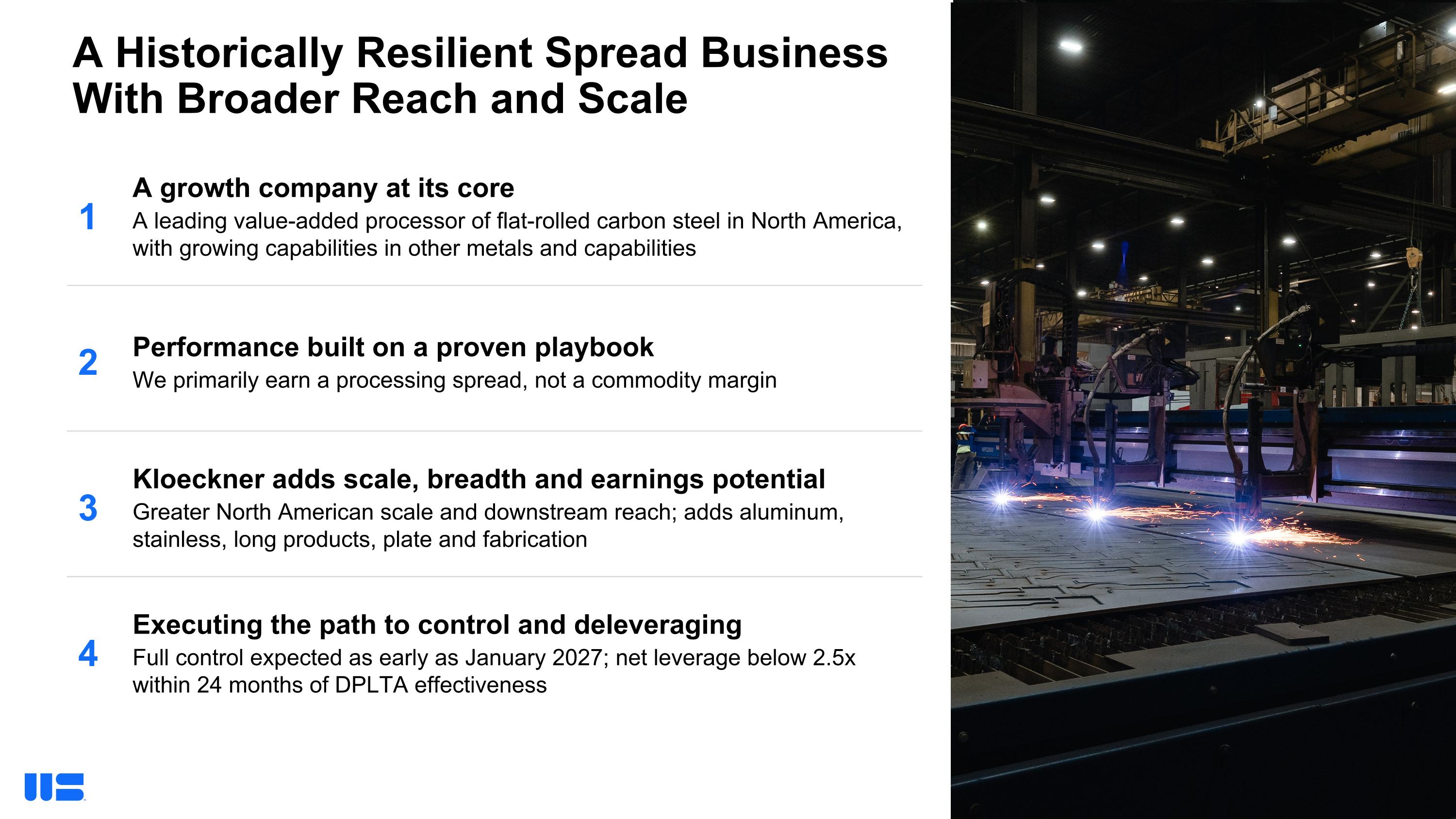
A Historically Resilient Spread Business With Broader Reach and Scale 2 Performance built on a proven playbook We primarily earn a processing spread, not a commodity margin 1 A growth company at its core A leading value-added processor of flat-rolled carbon steel in North America, with growing capabilities in other metals and capabilities 3 Kloeckner adds scale, breadth and earnings potential Greater North American scale and downstream reach; adds aluminum, stainless, long products, plate and fabrication Executing the path to control and deleveraging Full control expected as early as January 2027; net leverage below 2.5x within 24 months of DPLTA effectiveness 4
Performance Built on a Proven Playbook
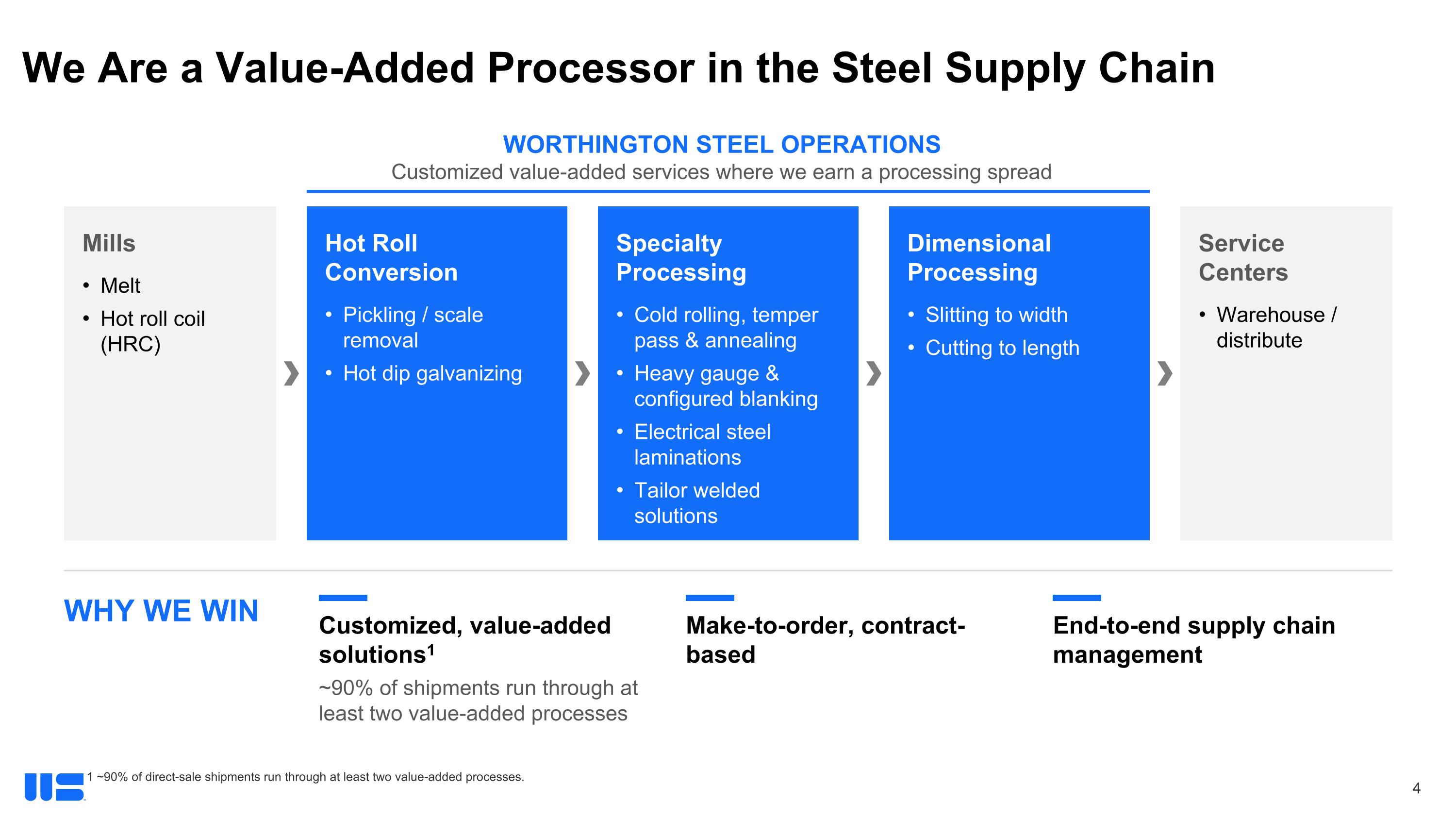
We Are a Value-Added Processor in the Steel Supply Chain 1 ~90% of direct-sale shipments run through at least two value-added processes. WORTHINGTON STEEL OPERATIONS Customized value-added services where we earn a processing spread Mills Melt Hot roll coil (HRC) Hot Roll Conversion Pickling / scale removal Hot dip galvanizing Specialty Processing Cold rolling, temper pass & annealing Heavy gauge & configured blanking Electrical steel laminations Tailor welded solutions Dimensional Processing Slitting to width Cutting to length Service Centers Warehouse / distribute WHY WE WIN Customized, value-added solutions1 ~90% of shipments run through at least two value-added processes Make-to-order, contract-based End-to-end supply chain management
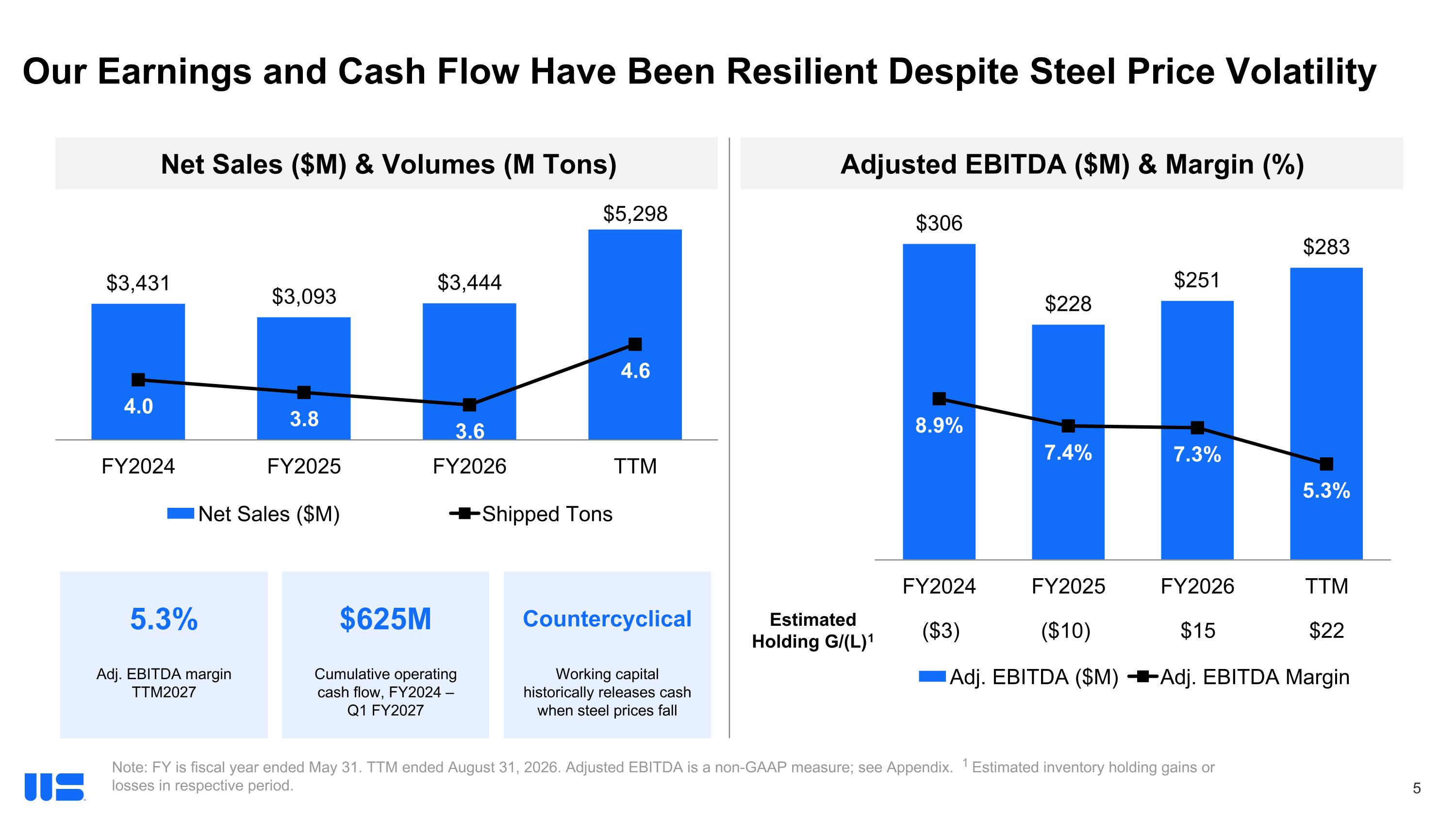
Our Earnings and Cash Flow Have Been Resilient Despite Steel Price Volatility Net Sales ($M) & Volumes (M Tons) Adjusted EBITDA ($M) & Margin (%) Estimated Holding G/(L)1 ($3) ($10) $15 $22 Note: FY is fiscal year ended May 31. TTM ended August 31, 2026. Adjusted EBITDA is a non-GAAP measure; see Appendix. 1 Estimated inventory holding gains or losses in respective period. 5.3% Adj. EBITDA margin TTM2027 $625M Cumulative operating cash flow, FY2024 –Q1 FY2027 Countercyclical Working capital historically releases cash when steel prices fall
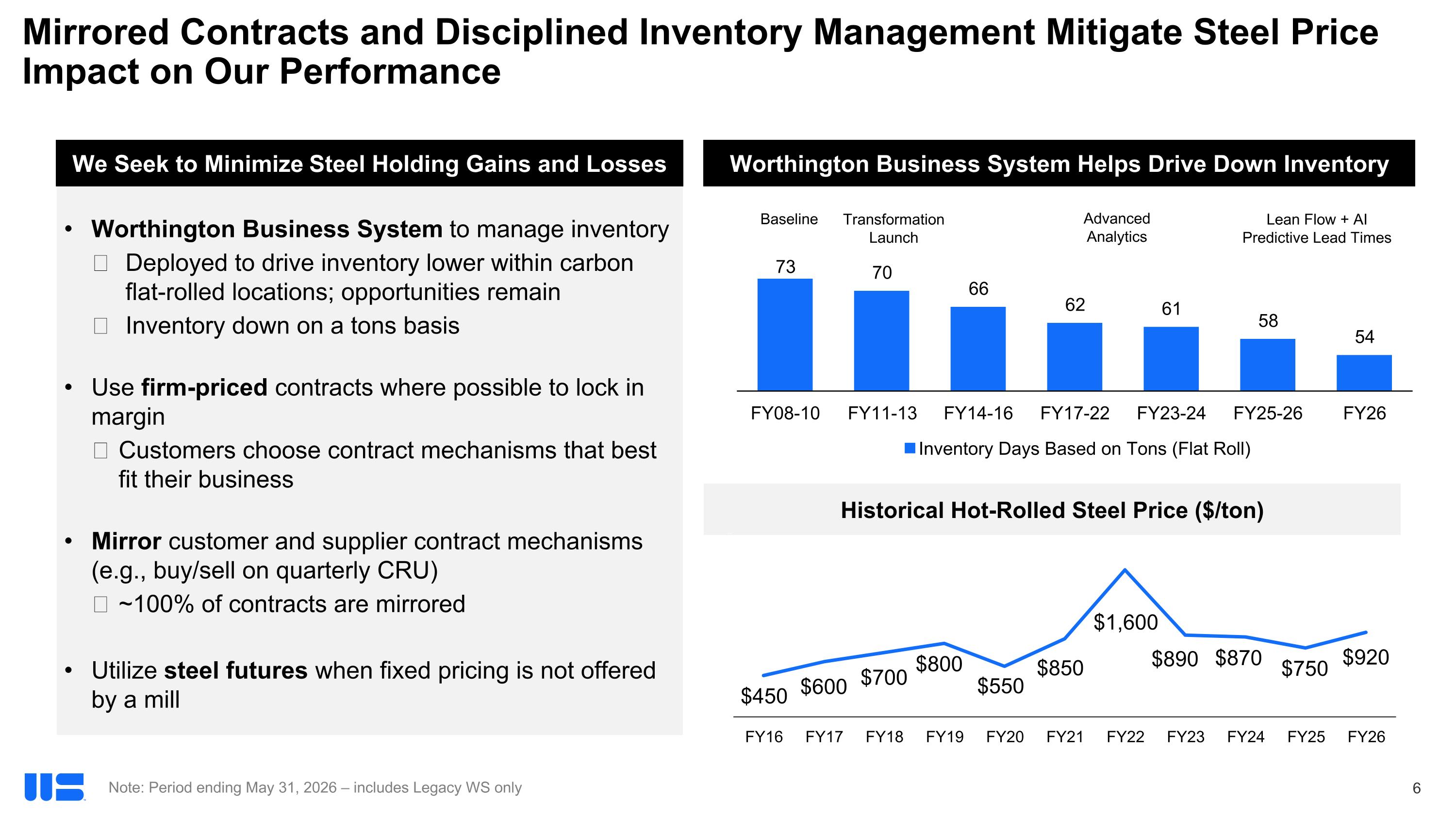
Mirrored Contracts and Disciplined Inventory Management Mitigate Steel Price Impact on Our Performance Worthington Business System to manage inventory Deployed to drive inventory lower within carbon flat-rolled locations; opportunities remain Inventory down on a tons basis Use firm-priced contracts where possible to lock in margin Customers choose contract mechanisms that best fit their business Mirror customer and supplier contract mechanisms (e.g., buy/sell on quarterly CRU) ~100% of contracts are mirrored Utilize steel futures when fixed pricing is not offered by a mill We Seek to Minimize Steel Holding Gains and Losses Note: Period ending May 31, 2026 – includes Legacy WS only Worthington Business System Helps Drive Down Inventory Transformation Launch Advanced Analytics Lean Flow + AI Predictive Lead Times Baseline Historical Hot-Rolled Steel Price ($/ton)
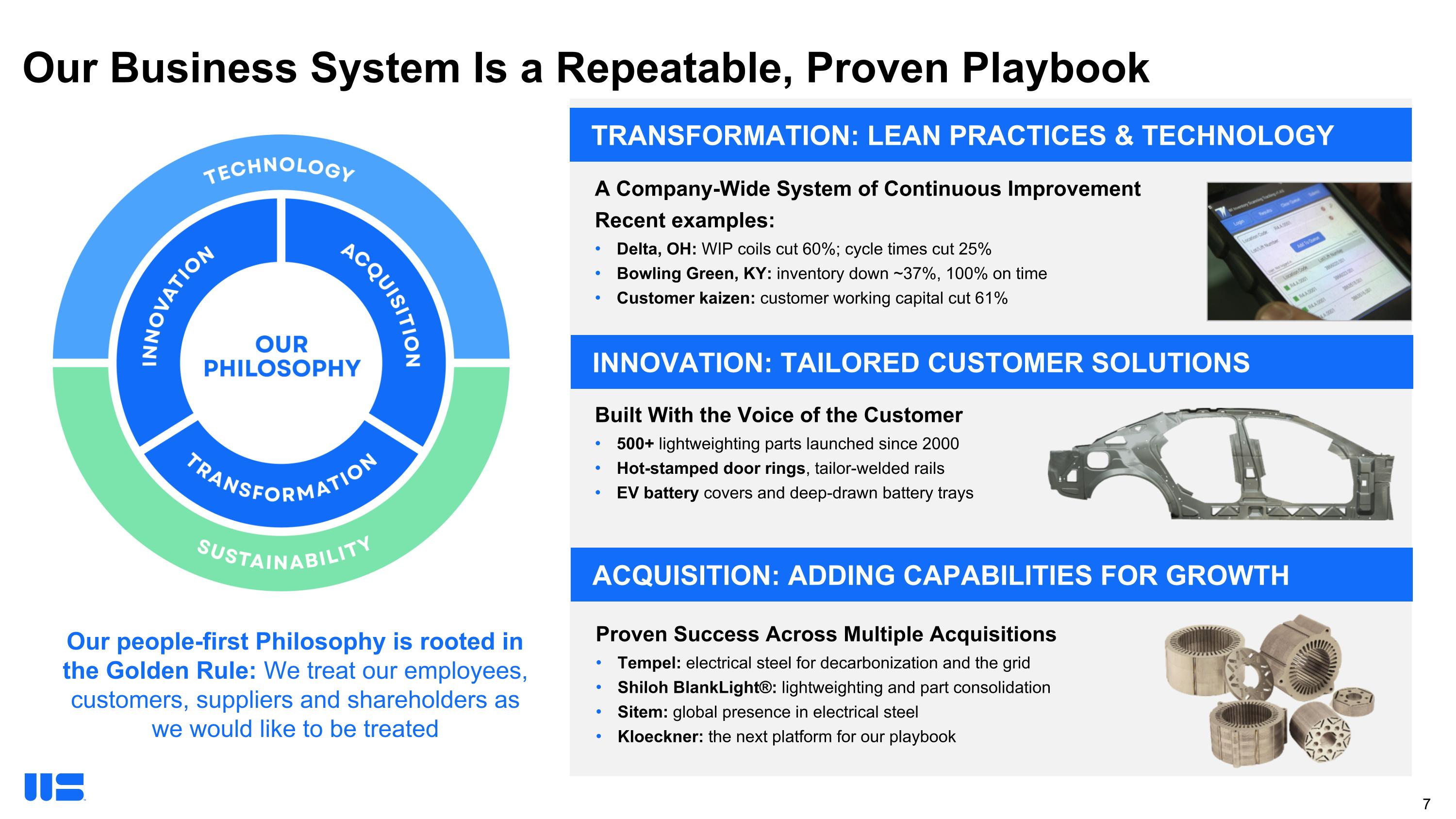
TRANSFORMATION: LEAN PRACTICES & TECHNOLOGY A Company-Wide System of Continuous Improvement Recent examples: Delta, OH: WIP coils cut 60%; cycle times cut 25% Bowling Green, KY: inventory down ~37%, 100% on time Customer kaizen: customer working capital cut 61% INNOVATION: TAILORED CUSTOMER SOLUTIONS Built With the Voice of the Customer 500+ lightweighting parts launched since 2000 Hot-stamped door rings, tailor-welded rails EV battery covers and deep-drawn battery trays ACQUISITION: ADDING CAPABILITIES FOR GROWTH Proven Success Across Multiple Acquisitions Tempel: electrical steel for decarbonization and the grid Shiloh BlankLight®: lightweighting and part consolidation Sitem: global presence in electrical steel Kloeckner: the next platform for our playbook Our Business System Is a Repeatable, Proven Playbook Our people-first Philosophy is rooted in the Golden Rule: We treat our employees, customers, suppliers and shareholders as we would like to be treated

Kloeckner Adds Scale, Breadth, and Earnings Potential
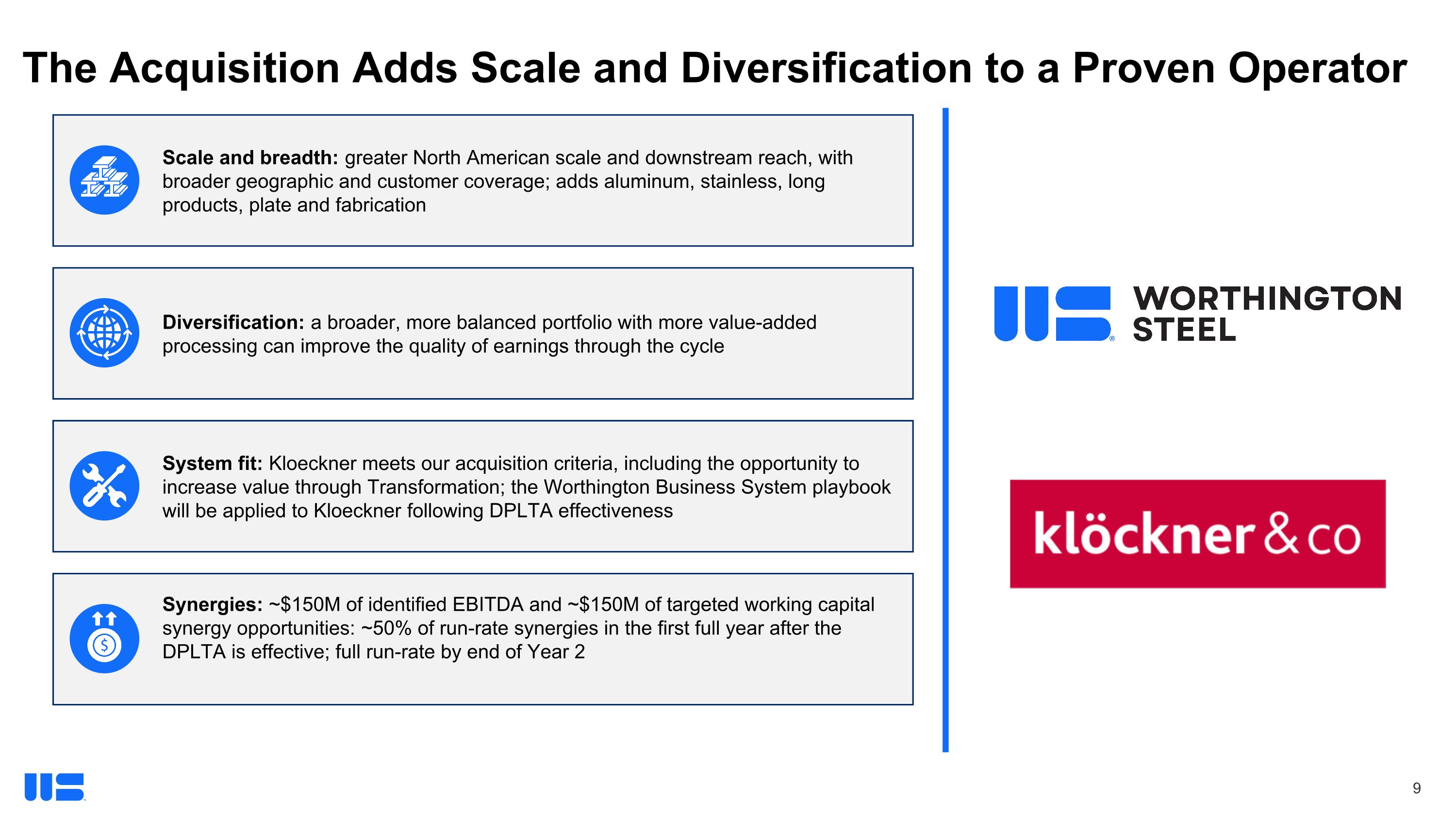
System fit: Kloeckner meets our acquisition criteria, including the opportunity to increase value through Transformation; the Worthington Business System playbook will be applied to Kloeckner following DPLTA effectiveness The Acquisition Adds Scale and Diversification to a Proven Operator Diversification: a broader, more balanced portfolio with more value-added processing can improve the quality of earnings through the cycle Scale and breadth: greater North American scale and downstream reach, with broader geographic and customer coverage; adds aluminum, stainless, long products, plate and fabrication Synergies: ~$150M of identified EBITDA and ~$150M of targeted working capital synergy opportunities: ~50% of run-rate synergies in the first full year after the DPLTA is effective; full run-rate by end of Year 2
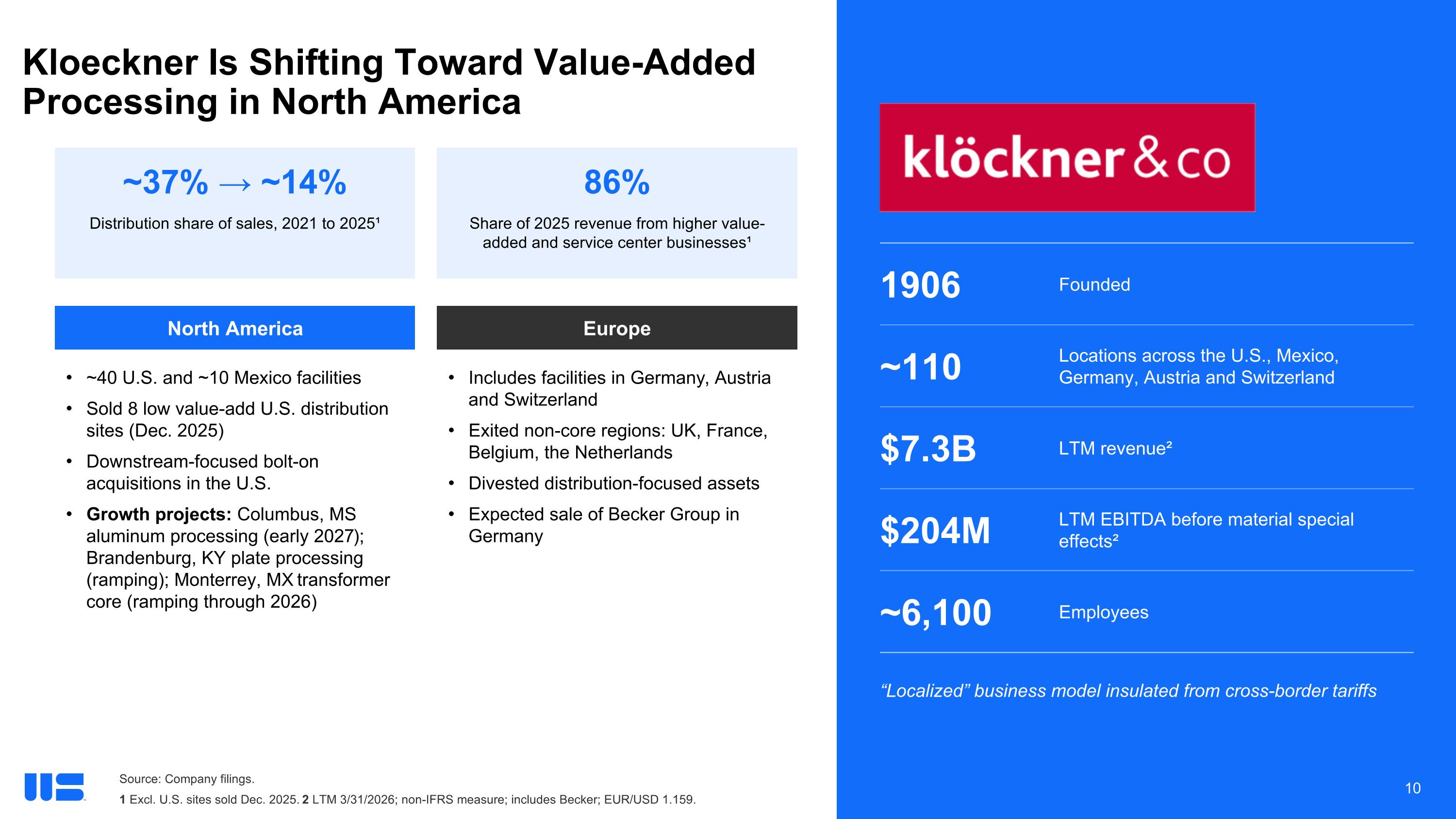
Kloeckner Is Shifting Toward Value-Added Processing in North America ~37% → ~14% Distribution share of sales, 2021 to 2025¹ 86% Share of 2025 revenue from higher value-added and service center businesses¹ North America Europe ~40 U.S. and ~10 Mexico facilities Sold 8 low value-add U.S. distribution sites (Dec. 2025) Downstream-focused bolt-on acquisitions in the U.S. Growth projects: Columbus, MS aluminum processing (early 2027); Brandenburg, KY plate processing (ramping); Monterrey, MX transformer core (ramping through 2026) Includes facilities in Germany, Austria and Switzerland Exited non-core regions: UK, France, Belgium, the Netherlands Divested distribution-focused assets Expected sale of Becker Group in Germany 1906 Founded ~110 Locations across the U.S., Mexico, Germany, Austria and Switzerland $7.3B LTM revenue² $204M LTM EBITDA before material special effects² ~6,100 Employees “Localized” business model insulated from cross-border tariffs Source: Company filings. 1 Excl. U.S. sites sold Dec. 2025. 2 LTM 3/31/2026; non-IFRS measure; includes Becker; EUR/USD 1.159.
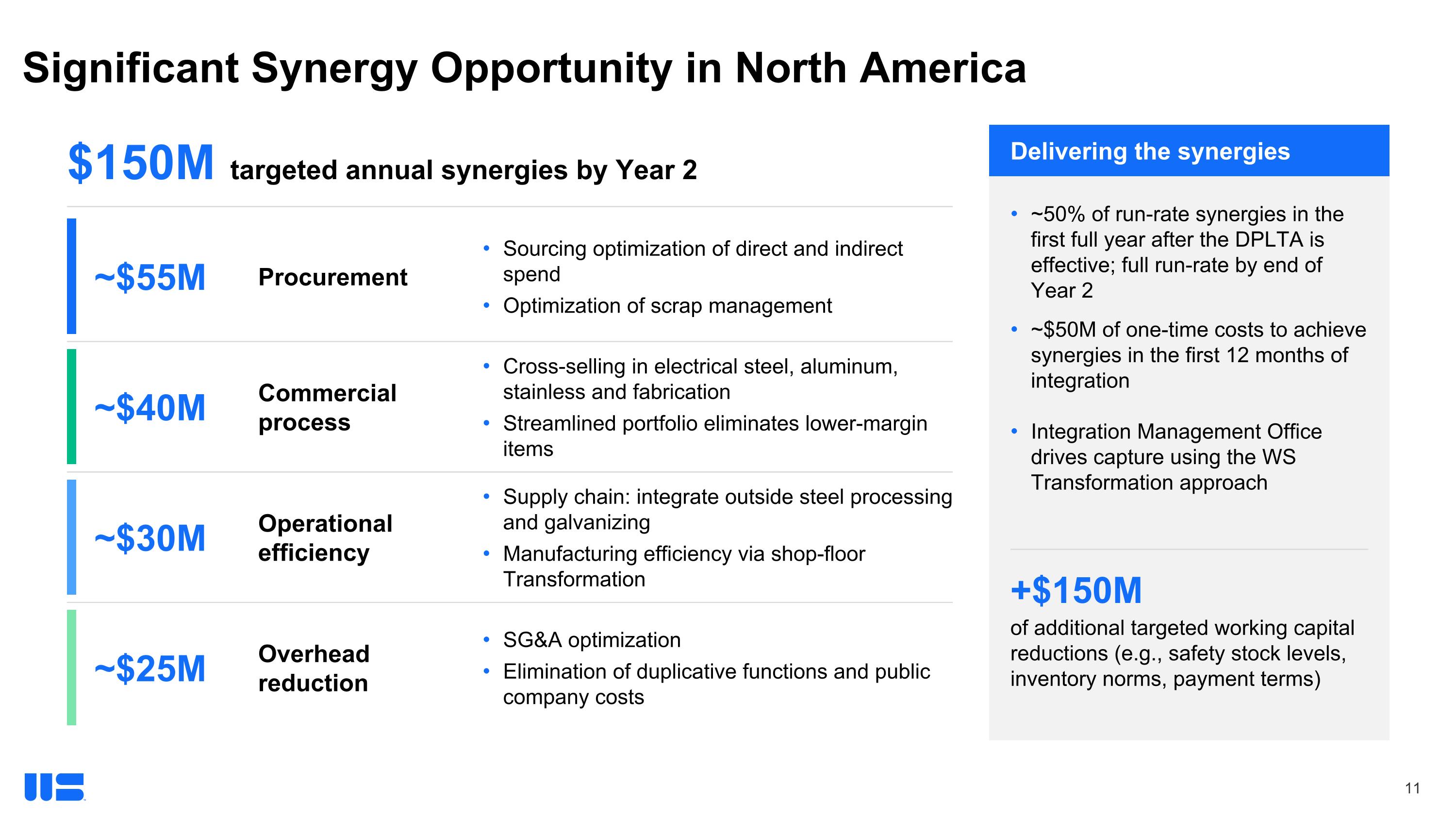
Significant Synergy Opportunity in North America $150M targeted annual synergies by Year 2 ~$55M Procurement Sourcing optimization of direct and indirect spend Optimization of scrap management ~$40M Commercial process Cross-selling in electrical steel, aluminum, stainless and fabrication Streamlined portfolio eliminates lower-margin items ~$30M Operational efficiency Supply chain: integrate outside steel processing and galvanizing Manufacturing efficiency via shop-floor Transformation ~$25M Overhead reduction SG&A optimization Elimination of duplicative functions and public company costs Delivering the synergies ~50% of run-rate synergies in the first full year after the DPLTA is effective; full run-rate by end of Year 2 ~$50M of one-time costs to achieve synergies in the first 12 months of integration Integration Management Office drives capture using the WS Transformation approach +$150M of additional targeted working capital reductions (e.g., safety stock levels, inventory norms, payment terms)
Focused on Executing the Path to Control and Deleveraging
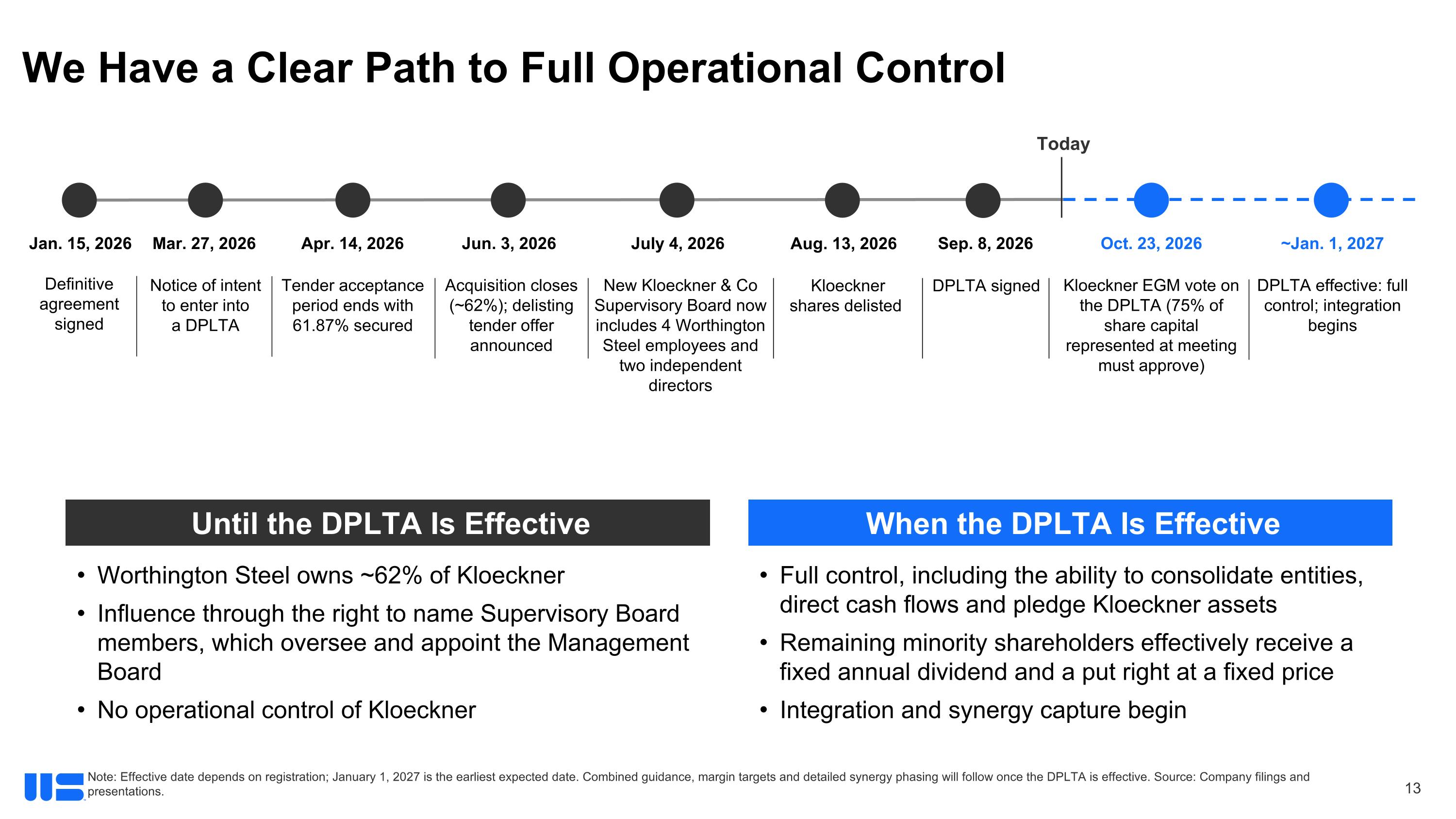
We Have a Clear Path to Full Operational Control Jan. 15, 2026 Definitive agreement signed Mar. 27, 2026 Notice of intent to enter into a DPLTA Apr. 14, 2026 Tender acceptance period ends with 61.87% secured Jun. 3, 2026 Acquisition closes (~62%); delisting tender offer announced Sep. 8, 2026 DPLTA signed Oct. 23, 2026 Kloeckner EGM vote on the DPLTA (75% of share capital represented at meeting must approve) ~Jan. 1, 2027 DPLTA effective: full control; integration begins Until the DPLTA Is Effective Worthington Steel owns ~62% of Kloeckner Influence through the right to name Supervisory Board members, which oversee and appoint the Management Board No operational control of Kloeckner When the DPLTA Is Effective Full control, including the ability to consolidate entities, direct cash flows and pledge Kloeckner assets Remaining minority shareholders effectively receive a fixed annual dividend and a put right at a fixed price Integration and synergy capture begin Note: Effective date depends on registration; January 1, 2027 is the earliest expected date. Combined guidance, margin targets and detailed synergy phasing will follow once the DPLTA is effective. Source: Company filings and presentations. Today July 4, 2026 New Kloeckner & Co Supervisory Board now includes 4 Worthington Steel employees and two independent directors Aug. 13, 2026 Kloeckner shares delisted
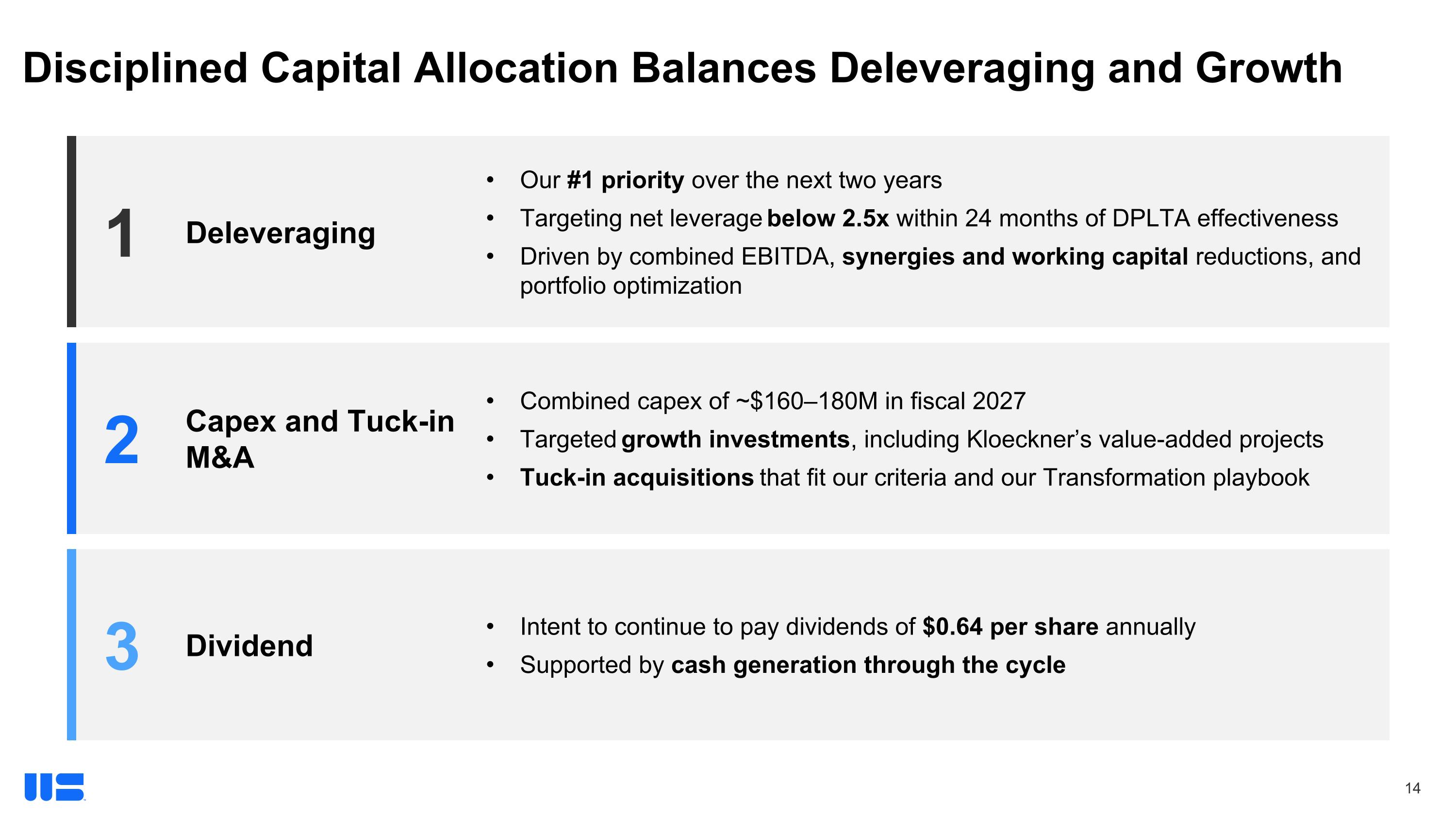
Disciplined Capital Allocation Balances Deleveraging and Growth 1 Deleveraging Our #1 priority over the next two years Targeting net leverage below 2.5x within 24 months of DPLTA effectiveness Driven by combined EBITDA, synergies and working capital reductions, and portfolio optimization 2 Capex and Tuck-in M&A Combined capex of ~$160–180M in fiscal 2027 Targeted growth investments, including Kloeckner’s value-added projects Tuck-in acquisitions that fit our criteria and our Transformation playbook 3 Dividend Intent to continue to pay dividends of $0.64 per share annually Supported by cash generation through the cycle
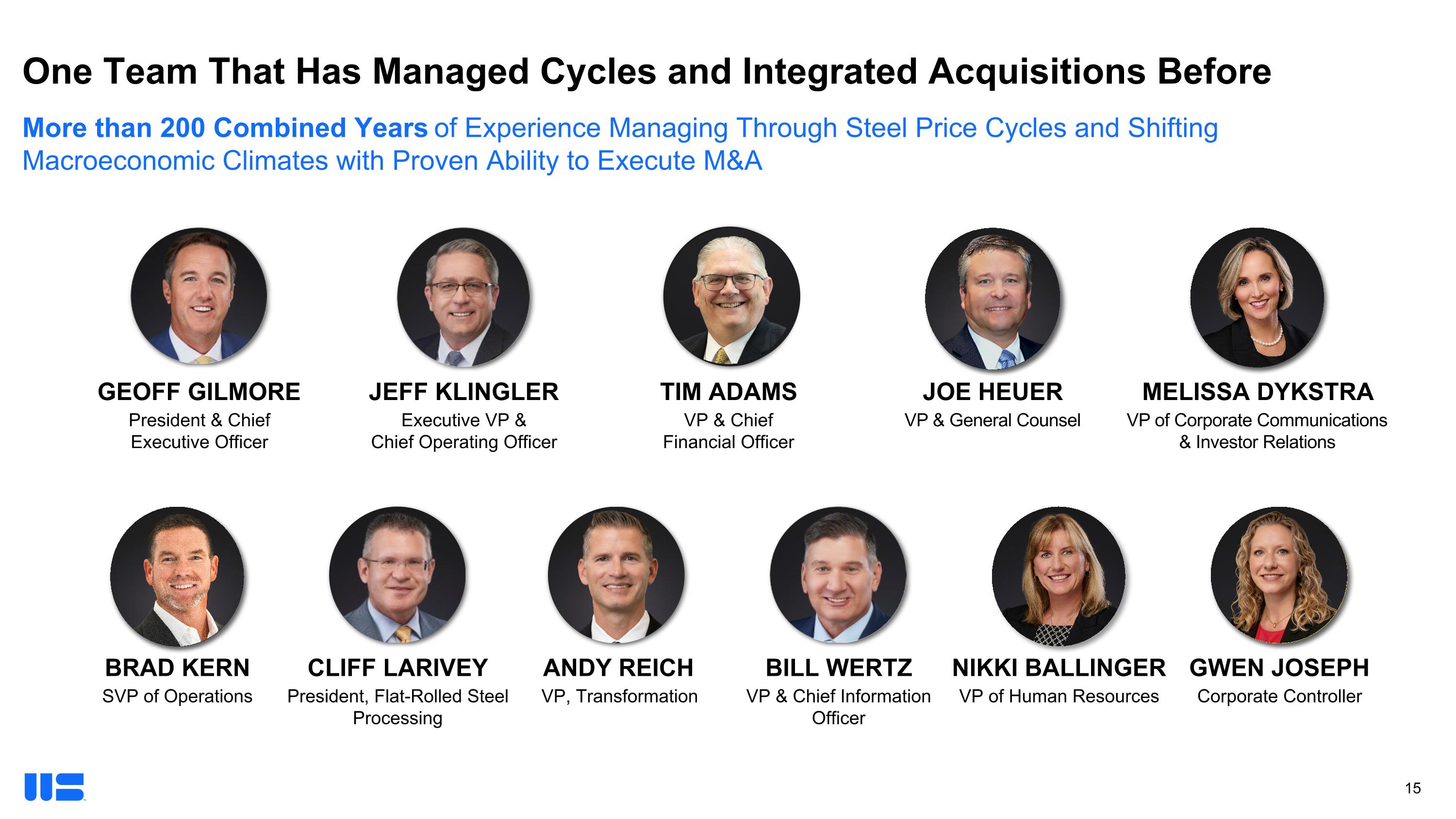
More than 200 Combined Years of Experience Managing Through Steel Price Cycles and Shifting Macroeconomic Climates with Proven Ability to Execute M&A One Team That Has Managed Cycles and Integrated Acquisitions Before CLIFF LARIVEY President, Flat-Rolled Steel Processing BILL WERTZ VP & Chief Information Officer GEOFF GILMORE President & Chief Executive Officer JEFF KLINGLER Executive VP & Chief Operating Officer TIM ADAMS VP & Chief Financial Officer JOE HEUER VP & General Counsel MELISSA DYKSTRA VP of Corporate Communications & Investor Relations BRAD KERN SVP of Operations NIKKI BALLINGER VP of Human Resources GWEN JOSEPH Corporate Controller ANDY REICH VP, Transformation
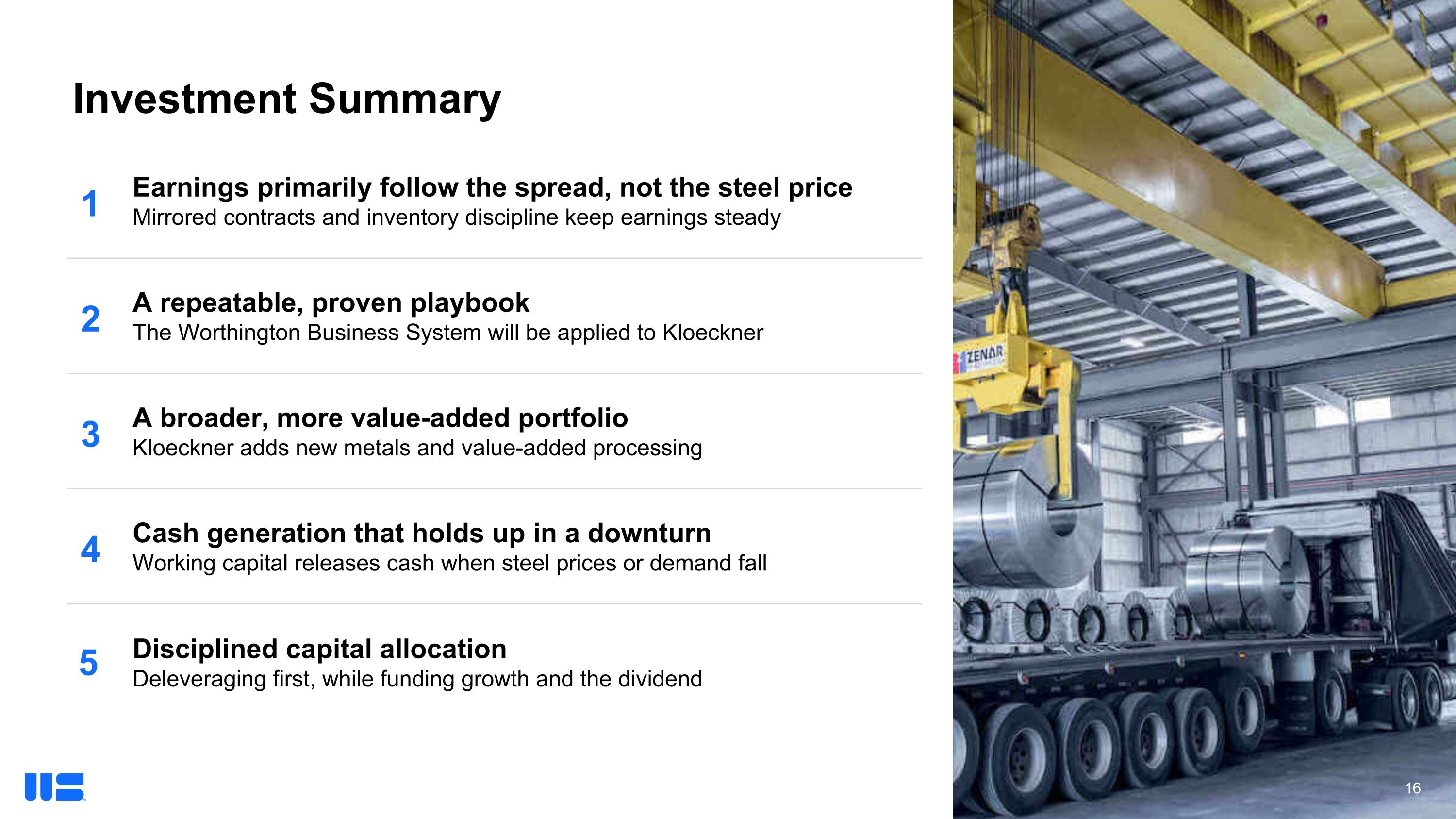
Investment Summary 2 A repeatable, proven playbook The Worthington Business System will be applied to Kloeckner 1 Earnings primarily follow the spread, not the steel price Mirrored contracts and inventory discipline keep earnings steady 3 A broader, more value-added portfolio Kloeckner adds new metals and value-added processing Cash generation that holds up in a downturn Working capital releases cash when steel prices or demand fall 5 Disciplined capital allocation Deleveraging first, while funding growth and the dividend 4
Appendix
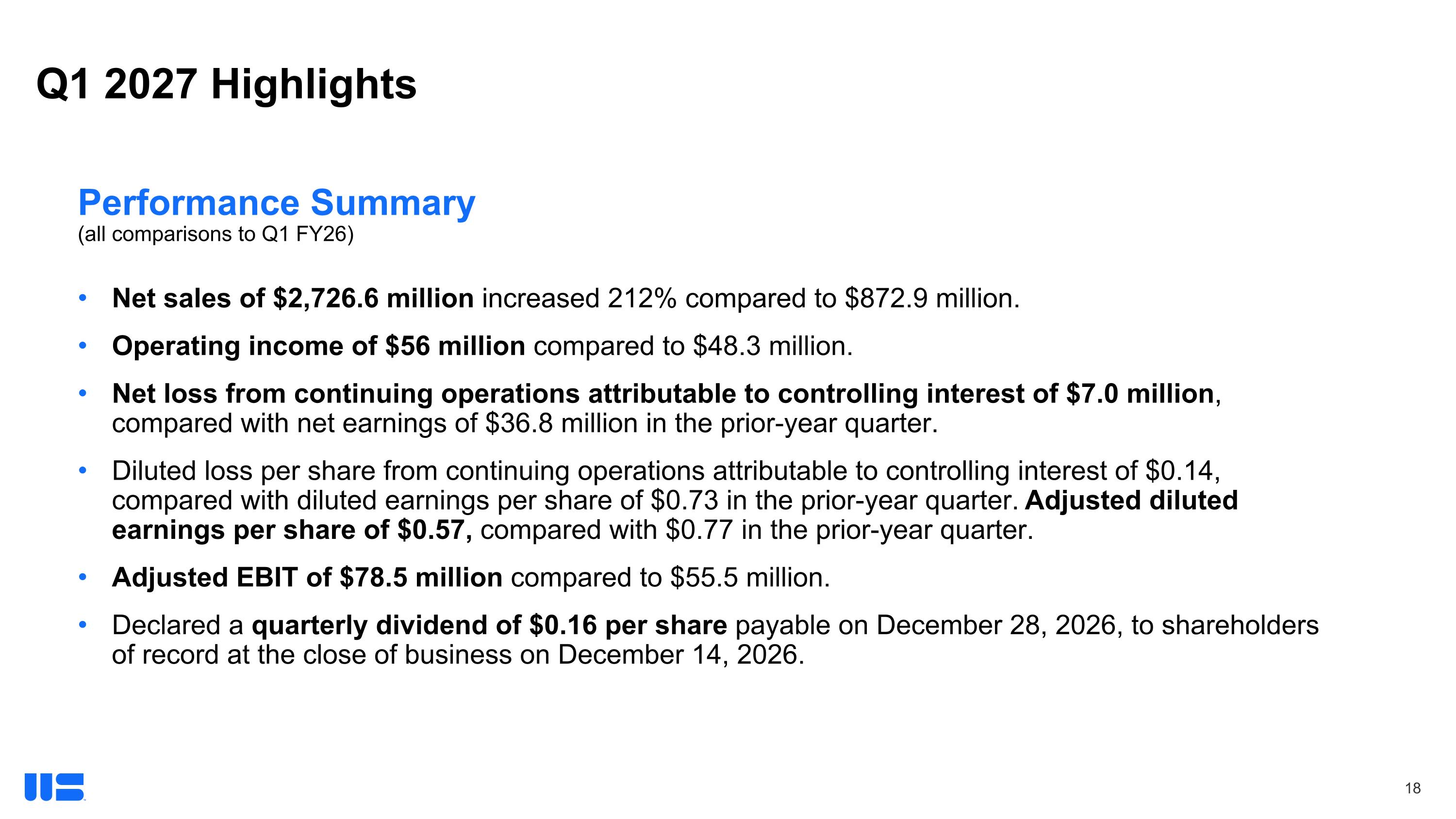
Performance Summary (all comparisons to Q1 FY26) Net sales of $2,726.6 million increased 212% compared to $872.9 million. Operating income of $56 million compared to $48.3 million. Net loss from continuing operations attributable to controlling interest of $7.0 million, compared with net earnings of $36.8 million in the prior-year quarter. Diluted loss per share from continuing operations attributable to controlling interest of $0.14, compared with diluted earnings per share of $0.73 in the prior-year quarter. Adjusted diluted earnings per share of $0.57, compared with $0.77 in the prior-year quarter. Adjusted EBIT of $78.5 million compared to $55.5 million. Declared a quarterly dividend of $0.16 per share payable on December 28, 2026, to shareholders of record at the close of business on December 14, 2026. Q1 2027 Highlights
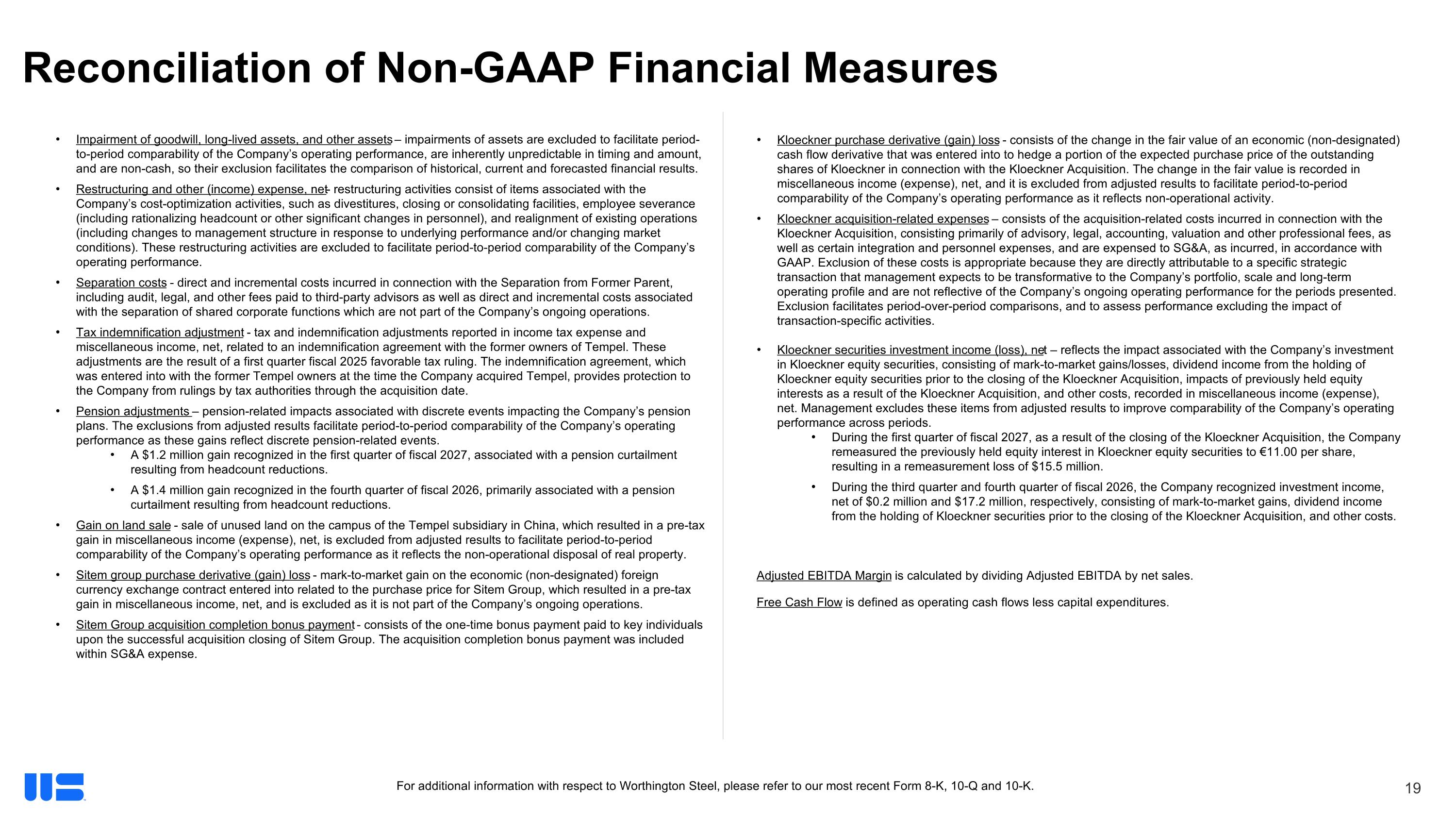
Impairment of goodwill, long-lived assets, and other assets – impairments of assets are excluded to facilitate period-to-period comparability of the Company’s operating performance, are inherently unpredictable in timing and amount, and are non-cash, so their exclusion facilitates the comparison of historical, current and forecasted financial results. Restructuring and other (income) expense, net- restructuring activities consist of items associated with the Company’s cost-optimization activities, such as divestitures, closing or consolidating facilities, employee severance (including rationalizing headcount or other significant changes in personnel), and realignment of existing operations (including changes to management structure in response to underlying performance and/or changing market conditions). These restructuring activities are excluded to facilitate period-to-period comparability of the Company’s operating performance. Separation costs - direct and incremental costs incurred in connection with the Separation from Former Parent, including audit, legal, and other fees paid to third-party advisors as well as direct and incremental costs associated with the separation of shared corporate functions which are not part of the Company’s ongoing operations. Tax indemnification adjustment - tax and indemnification adjustments reported in income tax expense and miscellaneous income, net, related to an indemnification agreement with the former owners of Tempel. These adjustments are the result of a first quarter fiscal 2025 favorable tax ruling. The indemnification agreement, which was entered into with the former Tempel owners at the time the Company acquired Tempel, provides protection to the Company from rulings by tax authorities through the acquisition date. Pension adjustments – pension-related impacts associated with discrete events impacting the Company’s pension plans. The exclusions from adjusted results facilitate period-to-period comparability of the Company’s operating performance as these gains reflect discrete pension-related events. A $1.2 million gain recognized in the first quarter of fiscal 2027, associated with a pension curtailment resulting from headcount reductions. A $1.4 million gain recognized in the fourth quarter of fiscal 2026, primarily associated with a pension curtailment resulting from headcount reductions. Gain on land sale - sale of unused land on the campus of the Tempel subsidiary in China, which resulted in a pre-tax gain in miscellaneous income (expense), net, is excluded from adjusted results to facilitate period-to-period comparability of the Company’s operating performance as it reflects the non-operational disposal of real property. Sitem group purchase derivative (gain) loss - mark-to-market gain on the economic (non-designated) foreign currency exchange contract entered into related to the purchase price for Sitem Group, which resulted in a pre-tax gain in miscellaneous income, net, and is excluded as it is not part of the Company’s ongoing operations. Sitem Group acquisition completion bonus payment - consists of the one-time bonus payment paid to key individuals upon the successful acquisition closing of Sitem Group. The acquisition completion bonus payment was included within SG&A expense. Reconciliation of Non-GAAP Financial Measures For additional information with respect to Worthington Steel, please refer to our most recent Form 8-K, 10-Q and 10-K. Kloeckner purchase derivative (gain) loss - consists of the change in the fair value of an economic (non-designated) cash flow derivative that was entered into to hedge a portion of the expected purchase price of the outstanding shares of Kloeckner in connection with the Kloeckner Acquisition. The change in the fair value is recorded in miscellaneous income (expense), net, and it is excluded from adjusted results to facilitate period-to-period comparability of the Company’s operating performance as it reflects non-operational activity. Kloeckner acquisition-related expenses – consists of the acquisition-related costs incurred in connection with the Kloeckner Acquisition, consisting primarily of advisory, legal, accounting, valuation and other professional fees, as well as certain integration and personnel expenses, and are expensed to SG&A, as incurred, in accordance with GAAP. Exclusion of these costs is appropriate because they are directly attributable to a specific strategic transaction that management expects to be transformative to the Company’s portfolio, scale and long-term operating profile and are not reflective of the Company’s ongoing operating performance for the periods presented. Exclusion facilitates period-over-period comparisons, and to assess performance excluding the impact of transaction-specific activities. Kloeckner securities investment income (loss), net – reflects the impact associated with the Company’s investment in Kloeckner equity securities, consisting of mark-to-market gains/losses, dividend income from the holding of Kloeckner equity securities prior to the closing of the Kloeckner Acquisition, impacts of previously held equity interests as a result of the Kloeckner Acquisition, and other costs, recorded in miscellaneous income (expense), net. Management excludes these items from adjusted results to improve comparability of the Company’s operating performance across periods. During the first quarter of fiscal 2027, as a result of the closing of the Kloeckner Acquisition, the Company remeasured the previously held equity interest in Kloeckner equity securities to €11.00 per share, resulting in a remeasurement loss of $15.5 million. During the third quarter and fourth quarter of fiscal 2026, the Company recognized investment income, net of $0.2 million and $17.2 million, respectively, consisting of mark-to-market gains, dividend income from the holding of Kloeckner securities prior to the closing of the Kloeckner Acquisition, and other costs. Adjusted EBITDA Margin is calculated by dividing Adjusted EBITDA by net sales. Free Cash Flow is defined as operating cash flows less capital expenditures.
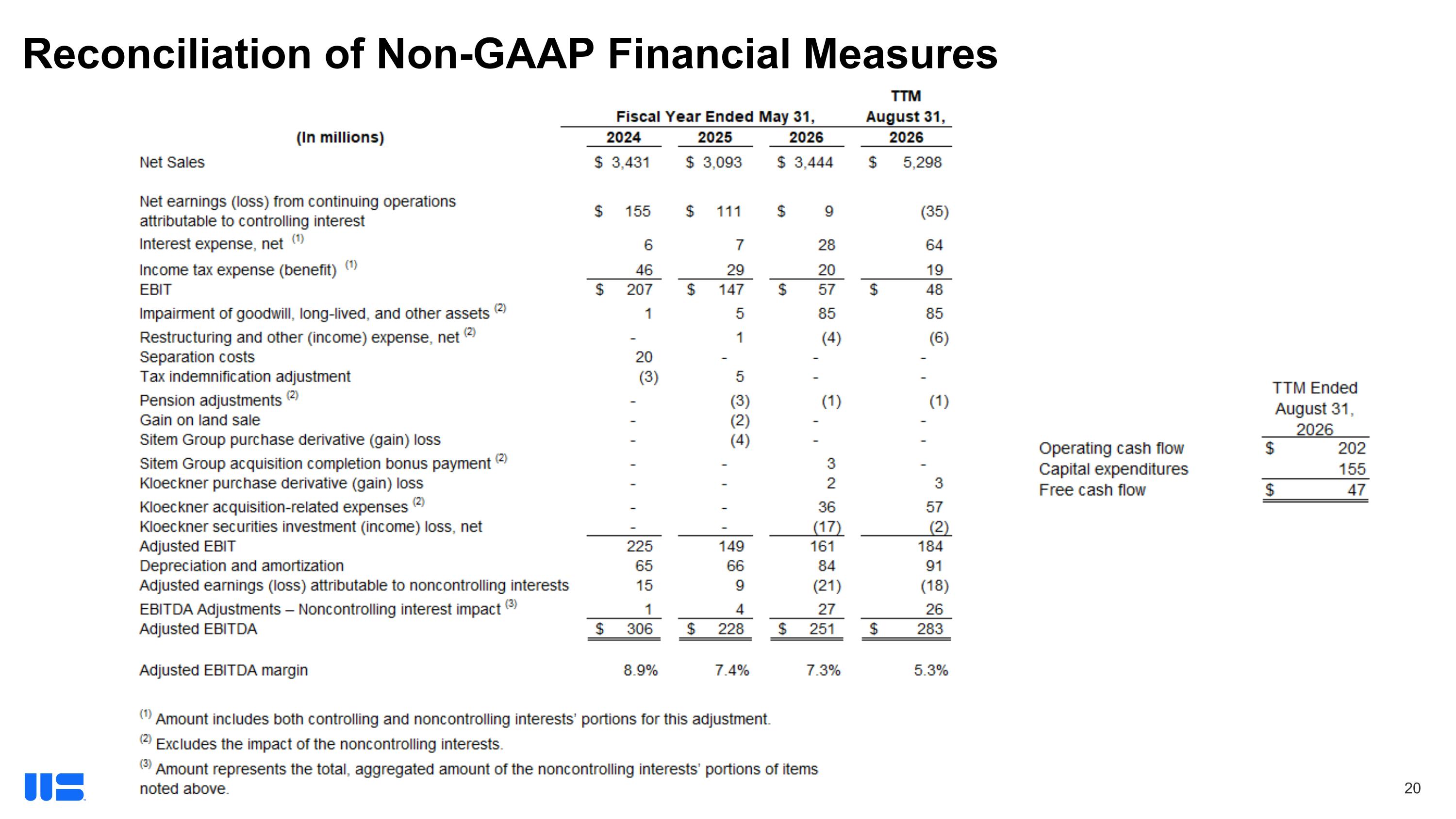
Reconciliation of Non-GAAP Financial Measures