Please wait
false2024FY0001973832P2YP3Y0.3330.66633.3366.6733.3366.67xbrli:sharesiso4217:USDiso4217:USDxbrli:sharesxbrli:pureau:MWhutr:tau:employeeau:employeeSchemeiso4217:ZARiso4217:ZARxbrli:sharesiso4217:USDau:Ounceiso4217:USDutr:oziso4217:AUDiso4217:USDutr:MWiso4217:AUDiso4217:TZS00019738322024-01-012024-12-310001973832dei:BusinessContactMember2024-01-012024-12-310001973832exch:XNYS2024-01-012024-12-310001973832exch:XNYSau:A3375NotesDue2028Member2024-01-012024-12-310001973832exch:XNYSau:A375NotesDue2030Member2024-01-012024-12-310001973832exch:XNYSau:A650NotesDue2040Member2024-01-012024-12-3100019738322024-12-3100019738322023-01-012023-12-3100019738322022-01-012022-12-3100019738322023-12-3100019738322022-12-310001973832au:G2GoldfieldsInc.Member2024-12-3100019738322021-12-310001973832au:IssuedCapitalandSharePremiumMember2021-12-310001973832au:ReorganisationAndMergerReserveMember2021-12-310001973832ifrs-full:OtherReservesMember2021-12-310001973832ifrs-full:RetainedEarningsMember2021-12-310001973832ifrs-full:FinancialAssetsAtFairValueThroughOtherComprehensiveIncomeCategoryMember2021-12-310001973832ifrs-full:ReserveOfRemeasurementsOfDefinedBenefitPlansMember2021-12-310001973832ifrs-full:ReserveOfExchangeDifferencesOnTranslationMember2021-12-310001973832ifrs-full:EquityAttributableToOwnersOfParentMember2021-12-310001973832ifrs-full:NoncontrollingInterestsMember2021-12-310001973832ifrs-full:RetainedEarningsMember2022-01-012022-12-310001973832ifrs-full:EquityAttributableToOwnersOfParentMember2022-01-012022-12-310001973832ifrs-full:NoncontrollingInterestsMember2022-01-012022-12-310001973832ifrs-full:FinancialAssetsAtFairValueThroughOtherComprehensiveIncomeCategoryMember2022-01-012022-12-310001973832ifrs-full:ReserveOfRemeasurementsOfDefinedBenefitPlansMember2022-01-012022-12-310001973832ifrs-full:ReserveOfExchangeDifferencesOnTranslationMember2022-01-012022-12-310001973832au:ReorganisationAndMergerReserveMember2022-01-012022-12-310001973832ifrs-full:OtherReservesMember2022-01-012022-12-310001973832au:IssuedCapitalandSharePremiumMember2022-12-310001973832au:ReorganisationAndMergerReserveMember2022-12-310001973832ifrs-full:OtherReservesMember2022-12-310001973832ifrs-full:RetainedEarningsMember2022-12-310001973832ifrs-full:FinancialAssetsAtFairValueThroughOtherComprehensiveIncomeCategoryMember2022-12-310001973832ifrs-full:ReserveOfRemeasurementsOfDefinedBenefitPlansMember2022-12-310001973832ifrs-full:ReserveOfExchangeDifferencesOnTranslationMember2022-12-310001973832ifrs-full:EquityAttributableToOwnersOfParentMember2022-12-310001973832ifrs-full:NoncontrollingInterestsMember2022-12-310001973832ifrs-full:RetainedEarningsMember2023-01-012023-12-310001973832ifrs-full:EquityAttributableToOwnersOfParentMember2023-01-012023-12-310001973832ifrs-full:NoncontrollingInterestsMember2023-01-012023-12-310001973832ifrs-full:FinancialAssetsAtFairValueThroughOtherComprehensiveIncomeCategoryMember2023-01-012023-12-310001973832ifrs-full:ReserveOfRemeasurementsOfDefinedBenefitPlansMember2023-01-012023-12-310001973832ifrs-full:ReserveOfExchangeDifferencesOnTranslationMember2023-01-012023-12-310001973832au:ReorganisationAndMergerReserveMember2023-01-012023-12-310001973832ifrs-full:OtherReservesMember2023-01-012023-12-310001973832au:IssuedCapitalandSharePremiumMember2023-01-012023-12-310001973832au:IssuedCapitalandSharePremiumMember2023-12-310001973832au:ReorganisationAndMergerReserveMember2023-12-310001973832ifrs-full:OtherReservesMember2023-12-310001973832ifrs-full:RetainedEarningsMember2023-12-310001973832ifrs-full:FinancialAssetsAtFairValueThroughOtherComprehensiveIncomeCategoryMember2023-12-310001973832ifrs-full:ReserveOfRemeasurementsOfDefinedBenefitPlansMember2023-12-310001973832ifrs-full:ReserveOfExchangeDifferencesOnTranslationMember2023-12-310001973832ifrs-full:EquityAttributableToOwnersOfParentMember2023-12-310001973832ifrs-full:NoncontrollingInterestsMember2023-12-310001973832ifrs-full:RetainedEarningsMember2024-01-012024-12-310001973832ifrs-full:EquityAttributableToOwnersOfParentMember2024-01-012024-12-310001973832ifrs-full:NoncontrollingInterestsMember2024-01-012024-12-310001973832ifrs-full:FinancialAssetsAtFairValueThroughOtherComprehensiveIncomeCategoryMember2024-01-012024-12-310001973832ifrs-full:ReserveOfRemeasurementsOfDefinedBenefitPlansMember2024-01-012024-12-310001973832ifrs-full:ReserveOfExchangeDifferencesOnTranslationMember2024-01-012024-12-310001973832au:IssuedCapitalandSharePremiumMember2024-01-012024-12-310001973832ifrs-full:OtherReservesMember2024-01-012024-12-310001973832au:ReorganisationAndMergerReserveMember2024-01-012024-12-310001973832au:IssuedCapitalandSharePremiumMember2024-12-310001973832au:ReorganisationAndMergerReserveMember2024-12-310001973832ifrs-full:OtherReservesMember2024-12-310001973832ifrs-full:RetainedEarningsMember2024-12-310001973832ifrs-full:FinancialAssetsAtFairValueThroughOtherComprehensiveIncomeCategoryMember2024-12-310001973832ifrs-full:ReserveOfRemeasurementsOfDefinedBenefitPlansMember2024-12-310001973832ifrs-full:ReserveOfExchangeDifferencesOnTranslationMember2024-12-310001973832ifrs-full:EquityAttributableToOwnersOfParentMember2024-12-310001973832ifrs-full:NoncontrollingInterestsMember2024-12-310001973832ifrs-full:RevaluationSurplusMember2024-12-310001973832ifrs-full:RevaluationSurplusMember2023-12-310001973832ifrs-full:RevaluationSurplusMember2022-12-310001973832ifrs-full:ReserveOfGainsAndLossesFromInvestmentsInEquityInstrumentsMember2024-12-310001973832ifrs-full:ReserveOfGainsAndLossesFromInvestmentsInEquityInstrumentsMember2023-12-310001973832ifrs-full:ReserveOfGainsAndLossesFromInvestmentsInEquityInstrumentsMember2022-12-310001973832ifrs-full:ReserveOfSharebasedPaymentsMember2024-12-310001973832ifrs-full:ReserveOfSharebasedPaymentsMember2023-12-310001973832ifrs-full:ReserveOfSharebasedPaymentsMember2022-12-310001973832au:TropicanaSite70Member2024-01-012024-12-310001973832au:ObuasiSiteMemberifrs-full:GrossCarryingAmountMember2022-01-012022-12-310001973832au:GeitaSiteMemberifrs-full:GrossCarryingAmountMember2023-01-012024-12-310001973832ifrs-full:OperatingSegmentsMembersrt:AfricaMember2024-01-012024-12-310001973832ifrs-full:OperatingSegmentsMembersrt:AfricaMember2023-01-012023-12-310001973832ifrs-full:OperatingSegmentsMembersrt:AfricaMember2022-01-012022-12-310001973832ifrs-full:OperatingSegmentsMembersrt:AfricaMemberau:KibaliSite45Member2024-01-012024-12-310001973832ifrs-full:OperatingSegmentsMembersrt:AfricaMemberau:KibaliSite45Member2023-01-012023-12-310001973832ifrs-full:OperatingSegmentsMembersrt:AfricaMemberau:KibaliSite45Member2022-01-012022-12-310001973832ifrs-full:OperatingSegmentsMembersrt:AfricaMemberau:IduapriemSiteMember2024-01-012024-12-310001973832ifrs-full:OperatingSegmentsMembersrt:AfricaMemberau:IduapriemSiteMember2023-01-012023-12-310001973832ifrs-full:OperatingSegmentsMembersrt:AfricaMemberau:IduapriemSiteMember2022-01-012022-12-310001973832ifrs-full:OperatingSegmentsMembersrt:AfricaMemberau:ObuasiSiteMember2024-01-012024-12-310001973832ifrs-full:OperatingSegmentsMembersrt:AfricaMemberau:ObuasiSiteMember2023-01-012023-12-310001973832ifrs-full:OperatingSegmentsMembersrt:AfricaMemberau:ObuasiSiteMember2022-01-012022-12-310001973832ifrs-full:OperatingSegmentsMembersrt:AfricaMemberau:SiguiriSiteMember2024-01-012024-12-310001973832ifrs-full:OperatingSegmentsMembersrt:AfricaMemberau:SiguiriSiteMember2023-01-012023-12-310001973832ifrs-full:OperatingSegmentsMembersrt:AfricaMemberau:SiguiriSiteMember2022-01-012022-12-310001973832ifrs-full:OperatingSegmentsMembersrt:AfricaMemberau:GeitaSiteMember2024-01-012024-12-310001973832ifrs-full:OperatingSegmentsMembersrt:AfricaMemberau:GeitaSiteMember2023-01-012023-12-310001973832ifrs-full:OperatingSegmentsMembersrt:AfricaMemberau:GeitaSiteMember2022-01-012022-12-310001973832ifrs-full:OperatingSegmentsMembersrt:AfricaMemberau:SukariSiteMember2024-01-012024-12-310001973832ifrs-full:OperatingSegmentsMembersrt:AfricaMemberau:SukariSiteMember2023-01-012023-12-310001973832ifrs-full:OperatingSegmentsMembersrt:AfricaMemberau:SukariSiteMember2022-01-012022-12-310001973832ifrs-full:OperatingSegmentsMembercountry:AU2024-01-012024-12-310001973832ifrs-full:OperatingSegmentsMembercountry:AU2023-01-012023-12-310001973832ifrs-full:OperatingSegmentsMembercountry:AU2022-01-012022-12-310001973832ifrs-full:OperatingSegmentsMembercountry:AUau:SunriseDamSiteMember2024-01-012024-12-310001973832ifrs-full:OperatingSegmentsMembercountry:AUau:SunriseDamSiteMember2023-01-012023-12-310001973832ifrs-full:OperatingSegmentsMembercountry:AUau:SunriseDamSiteMember2022-01-012022-12-310001973832ifrs-full:OperatingSegmentsMembercountry:AUau:TropicanaSite70Member2024-01-012024-12-310001973832ifrs-full:OperatingSegmentsMembercountry:AUau:TropicanaSite70Member2023-01-012023-12-310001973832ifrs-full:OperatingSegmentsMembercountry:AUau:TropicanaSite70Member2022-01-012022-12-310001973832ifrs-full:OperatingSegmentsMembersrt:AmericasMember2024-01-012024-12-310001973832ifrs-full:OperatingSegmentsMembersrt:AmericasMember2023-01-012023-12-310001973832ifrs-full:OperatingSegmentsMembersrt:AmericasMember2022-01-012022-12-310001973832ifrs-full:OperatingSegmentsMembersrt:AmericasMemberau:CerroVanguardiaSiteMember2024-01-012024-12-310001973832ifrs-full:OperatingSegmentsMembersrt:AmericasMemberau:CerroVanguardiaSiteMember2023-01-012023-12-310001973832ifrs-full:OperatingSegmentsMembersrt:AmericasMemberau:CerroVanguardiaSiteMember2022-01-012022-12-310001973832ifrs-full:OperatingSegmentsMembersrt:AmericasMemberau:AngloGoldAshantiMineraoSiteMember2024-01-012024-12-310001973832ifrs-full:OperatingSegmentsMembersrt:AmericasMemberau:AngloGoldAshantiMineraoSiteMember2023-01-012023-12-310001973832ifrs-full:OperatingSegmentsMembersrt:AmericasMemberau:AngloGoldAshantiMineraoSiteMember2022-01-012022-12-310001973832ifrs-full:OperatingSegmentsMembersrt:AmericasMemberau:SerraGrandeSiteMember2024-01-012024-12-310001973832ifrs-full:OperatingSegmentsMembersrt:AmericasMemberau:SerraGrandeSiteMember2023-01-012023-12-310001973832ifrs-full:OperatingSegmentsMembersrt:AmericasMemberau:SerraGrandeSiteMember2022-01-012022-12-310001973832ifrs-full:OperatingSegmentsMember2024-01-012024-12-310001973832ifrs-full:OperatingSegmentsMember2023-01-012023-12-310001973832ifrs-full:OperatingSegmentsMember2022-01-012022-12-310001973832ifrs-full:EliminationOfIntersegmentAmountsMemberau:EquityAccountedInvestmentsSegmentMember2024-01-012024-12-310001973832ifrs-full:EliminationOfIntersegmentAmountsMemberau:EquityAccountedInvestmentsSegmentMember2023-01-012023-12-310001973832ifrs-full:EliminationOfIntersegmentAmountsMemberau:EquityAccountedInvestmentsSegmentMember2022-01-012022-12-310001973832currency:XAUau:ThreeCustomersMember2024-01-012024-12-310001973832currency:XAUau:ThreeCustomersMember2023-01-012023-12-310001973832currency:XAUau:ThreeCustomersMember2022-01-012022-12-310001973832currency:XAUau:ANZInvestmentBankLtdMember2024-01-012024-12-310001973832currency:XAUau:ANZInvestmentBankLtdMember2023-01-012023-12-310001973832currency:XAUau:ANZInvestmentBankLtdMember2022-01-012022-12-310001973832currency:XAUau:StandardCharteredBankMember2024-01-012024-12-310001973832currency:XAUau:StandardCharteredBankMember2023-01-012023-12-310001973832currency:XAUau:StandardCharteredBankMember2022-01-012022-12-310001973832currency:XAUau:JPMorganChaseN.AMember2024-01-012024-12-310001973832currency:XAUau:JPMorganChaseN.AMember2023-01-012023-12-310001973832currency:XAUau:JPMorganChaseN.AMember2022-01-012022-12-310001973832ifrs-full:OperatingSegmentsMembercountry:AUau:AustraliaAdminAndOtherMember2024-01-012024-12-310001973832ifrs-full:OperatingSegmentsMembercountry:AUau:AustraliaAdminAndOtherMember2023-01-012023-12-310001973832ifrs-full:OperatingSegmentsMembercountry:AUau:AustraliaAdminAndOtherMember2022-01-012022-12-310001973832ifrs-full:OperatingSegmentsMembersrt:AmericasMemberau:AmericasAdminAndOtherMember2024-01-012024-12-310001973832ifrs-full:OperatingSegmentsMembersrt:AmericasMemberau:AmericasAdminAndOtherMember2023-01-012023-12-310001973832ifrs-full:OperatingSegmentsMembersrt:AmericasMemberau:AmericasAdminAndOtherMember2022-01-012022-12-310001973832ifrs-full:OperatingSegmentsMemberau:CorporateAndOther1Member2024-01-012024-12-310001973832ifrs-full:OperatingSegmentsMemberau:CorporateAndOther1Member2023-01-012023-12-310001973832ifrs-full:OperatingSegmentsMemberau:CorporateAndOther1Member2022-01-012022-12-310001973832ifrs-full:OperatingSegmentsMembersrt:AfricaMemberau:AfricaAdminAndOtherMember2024-01-012024-12-310001973832ifrs-full:OperatingSegmentsMembersrt:AfricaMemberau:AfricaAdminAndOtherMember2023-01-012023-12-310001973832ifrs-full:OperatingSegmentsMembersrt:AfricaMemberau:AfricaAdminAndOtherMember2022-01-012022-12-310001973832ifrs-full:OperatingSegmentsMembersrt:AfricaMember2024-12-310001973832ifrs-full:OperatingSegmentsMembersrt:AfricaMember2023-12-310001973832ifrs-full:OperatingSegmentsMembersrt:AfricaMember2022-12-310001973832ifrs-full:OperatingSegmentsMembersrt:AfricaMemberau:KibaliSite45Member2024-12-310001973832ifrs-full:OperatingSegmentsMembersrt:AfricaMemberau:KibaliSite45Member2023-12-310001973832ifrs-full:OperatingSegmentsMembersrt:AfricaMemberau:KibaliSite45Member2022-12-310001973832ifrs-full:OperatingSegmentsMembersrt:AfricaMemberau:IduapriemSiteMember2024-12-310001973832ifrs-full:OperatingSegmentsMembersrt:AfricaMemberau:IduapriemSiteMember2023-12-310001973832ifrs-full:OperatingSegmentsMembersrt:AfricaMemberau:IduapriemSiteMember2022-12-310001973832ifrs-full:OperatingSegmentsMembersrt:AfricaMemberau:ObuasiSiteMember2024-12-310001973832ifrs-full:OperatingSegmentsMembersrt:AfricaMemberau:ObuasiSiteMember2023-12-310001973832ifrs-full:OperatingSegmentsMembersrt:AfricaMemberau:ObuasiSiteMember2022-12-310001973832ifrs-full:OperatingSegmentsMembersrt:AfricaMemberau:SiguiriSiteMember2024-12-310001973832ifrs-full:OperatingSegmentsMembersrt:AfricaMemberau:SiguiriSiteMember2023-12-310001973832ifrs-full:OperatingSegmentsMembersrt:AfricaMemberau:SiguiriSiteMember2022-12-310001973832ifrs-full:OperatingSegmentsMembersrt:AfricaMemberau:GeitaSiteMember2024-12-310001973832ifrs-full:OperatingSegmentsMembersrt:AfricaMemberau:GeitaSiteMember2023-12-310001973832ifrs-full:OperatingSegmentsMembersrt:AfricaMemberau:GeitaSiteMember2022-12-310001973832ifrs-full:OperatingSegmentsMembersrt:AfricaMemberau:SukariSiteMember2024-12-310001973832ifrs-full:OperatingSegmentsMembersrt:AfricaMemberau:SukariSiteMember2023-12-310001973832ifrs-full:OperatingSegmentsMembersrt:AfricaMemberau:SukariSiteMember2022-12-310001973832ifrs-full:OperatingSegmentsMembersrt:AfricaMemberau:AfricaAdminAndOtherMember2024-12-310001973832ifrs-full:OperatingSegmentsMembersrt:AfricaMemberau:AfricaAdminAndOtherMember2023-12-310001973832ifrs-full:OperatingSegmentsMembersrt:AfricaMemberau:AfricaAdminAndOtherMember2022-12-310001973832ifrs-full:OperatingSegmentsMembercountry:AU2024-12-310001973832ifrs-full:OperatingSegmentsMembercountry:AU2023-12-310001973832ifrs-full:OperatingSegmentsMembercountry:AU2022-12-310001973832ifrs-full:OperatingSegmentsMembersrt:AmericasMember2024-12-310001973832ifrs-full:OperatingSegmentsMembersrt:AmericasMember2023-12-310001973832ifrs-full:OperatingSegmentsMembersrt:AmericasMember2022-12-310001973832ifrs-full:OperatingSegmentsMembersrt:AmericasMemberau:CerroVanguardiaSiteMember2024-12-310001973832ifrs-full:OperatingSegmentsMembersrt:AmericasMemberau:CerroVanguardiaSiteMember2023-12-310001973832ifrs-full:OperatingSegmentsMembersrt:AmericasMemberau:CerroVanguardiaSiteMember2022-12-310001973832ifrs-full:OperatingSegmentsMembersrt:AmericasMemberau:AngloGoldAshantiMineraoSiteMember2024-12-310001973832ifrs-full:OperatingSegmentsMembersrt:AmericasMemberau:AngloGoldAshantiMineraoSiteMember2023-12-310001973832ifrs-full:OperatingSegmentsMembersrt:AmericasMemberau:AngloGoldAshantiMineraoSiteMember2022-12-310001973832ifrs-full:OperatingSegmentsMembersrt:AmericasMemberau:SerraGrandeSiteMember2024-12-310001973832ifrs-full:OperatingSegmentsMembersrt:AmericasMemberau:SerraGrandeSiteMember2023-12-310001973832ifrs-full:OperatingSegmentsMembersrt:AmericasMemberau:SerraGrandeSiteMember2022-12-310001973832ifrs-full:OperatingSegmentsMembersrt:AmericasMemberau:AmericasAdminAndOtherMember2024-12-310001973832ifrs-full:OperatingSegmentsMembersrt:AmericasMemberau:AmericasAdminAndOtherMember2023-12-310001973832ifrs-full:OperatingSegmentsMembersrt:AmericasMemberau:AmericasAdminAndOtherMember2022-12-310001973832ifrs-full:OperatingSegmentsMemberau:ProjectsSegmentMember2024-12-310001973832ifrs-full:OperatingSegmentsMemberau:ProjectsSegmentMember2023-12-310001973832ifrs-full:OperatingSegmentsMemberau:ProjectsSegmentMember2022-12-310001973832ifrs-full:OperatingSegmentsMemberau:ColombianProjectsMemberau:ProjectsSegmentMember2024-12-310001973832ifrs-full:OperatingSegmentsMemberau:ColombianProjectsMemberau:ProjectsSegmentMember2023-12-310001973832ifrs-full:OperatingSegmentsMemberau:ColombianProjectsMemberau:ProjectsSegmentMember2022-12-310001973832ifrs-full:OperatingSegmentsMemberau:NorthAmericanProjectsMemberau:ProjectsSegmentMember2024-12-310001973832ifrs-full:OperatingSegmentsMemberau:NorthAmericanProjectsMemberau:ProjectsSegmentMember2023-12-310001973832ifrs-full:OperatingSegmentsMemberau:NorthAmericanProjectsMemberau:ProjectsSegmentMember2022-12-310001973832ifrs-full:OperatingSegmentsMemberau:CorporateAndOther1Member2024-12-310001973832ifrs-full:OperatingSegmentsMemberau:CorporateAndOther1Member2023-12-310001973832ifrs-full:OperatingSegmentsMemberau:CorporateAndOther1Member2022-12-310001973832ifrs-full:OperatingSegmentsMember2024-12-310001973832ifrs-full:OperatingSegmentsMember2023-12-310001973832ifrs-full:OperatingSegmentsMember2022-12-310001973832country:GB2024-12-310001973832country:GB2023-12-310001973832country:GB2022-12-310001973832ifrs-full:ForeignCountriesMember2024-12-310001973832ifrs-full:ForeignCountriesMember2023-12-310001973832ifrs-full:ForeignCountriesMember2022-12-310001973832country:CD2024-12-310001973832country:CD2023-12-310001973832country:CD2022-12-310001973832country:EG2024-12-310001973832country:EG2023-12-310001973832country:EG2022-12-310001973832country:GH2024-12-310001973832country:GH2023-12-310001973832country:GH2022-12-310001973832country:TZ2024-12-310001973832country:TZ2023-12-310001973832country:TZ2022-12-310001973832country:AU2024-12-310001973832country:AU2023-12-310001973832country:AU2022-12-310001973832country:BR2024-12-310001973832country:BR2023-12-310001973832country:BR2022-12-310001973832country:US2024-12-310001973832country:US2023-12-310001973832country:US2022-12-310001973832ifrs-full:OperatingSegmentsMemberau:ProjectsSegmentMember2024-01-012024-12-310001973832ifrs-full:OperatingSegmentsMemberau:ProjectsSegmentMember2023-01-012023-12-310001973832ifrs-full:OperatingSegmentsMemberau:ProjectsSegmentMember2022-01-012022-12-310001973832ifrs-full:OperatingSegmentsMemberau:ColombianProjectsMemberau:ProjectsSegmentMember2024-01-012024-12-310001973832ifrs-full:OperatingSegmentsMemberau:ColombianProjectsMemberau:ProjectsSegmentMember2023-01-012023-12-310001973832ifrs-full:OperatingSegmentsMemberau:ColombianProjectsMemberau:ProjectsSegmentMember2022-01-012022-12-310001973832ifrs-full:OperatingSegmentsMemberau:NorthAmericanProjectsMemberau:ProjectsSegmentMember2024-01-012024-12-310001973832ifrs-full:OperatingSegmentsMemberau:NorthAmericanProjectsMemberau:ProjectsSegmentMember2023-01-012023-12-310001973832ifrs-full:OperatingSegmentsMemberau:NorthAmericanProjectsMemberau:ProjectsSegmentMember2022-01-012022-12-310001973832au:ConcentrateRevenueMember2024-01-012024-12-310001973832au:ConcentrateRevenueMember2023-01-012023-12-310001973832au:ConcentrateRevenueMember2022-01-012022-12-310001973832au:IduapriemSiteMember2024-01-012024-12-310001973832au:IduapriemSiteMember2023-01-012023-12-310001973832au:ObuasiSiteMember2024-01-012024-12-310001973832au:ObuasiSiteMember2023-01-012023-12-310001973832country:AU2024-12-310001973832country:AU2023-12-310001973832country:AU2022-12-310001973832srt:AmericasMember2024-01-012024-12-310001973832srt:AfricaMember2024-01-012024-12-310001973832srt:AmericasMember2023-01-012023-12-310001973832au:ProjectsSegmentMember2023-01-012023-12-310001973832srt:AfricaMember2023-01-012023-12-310001973832srt:AmericasMember2022-01-012022-12-310001973832srt:AfricaMember2022-01-012022-12-310001973832au:ForeignEntitiesMember2024-12-310001973832au:SpotRevenueMember2024-01-012024-12-310001973832au:SpotRevenueMember2023-01-012023-12-310001973832au:SpotRevenueMember2022-01-012022-12-310001973832au:CentaminPlcMember2024-11-232024-12-310001973832au:CentaminPlcMember2023-01-012023-12-310001973832au:CentaminPlcMember2022-01-012022-12-310001973832srt:AfricaMember2022-01-012022-12-310001973832country:AU2024-01-012024-12-310001973832country:AU2023-01-012023-12-310001973832country:AU2022-01-012022-12-310001973832srt:AmericasMember2022-01-012022-12-310001973832au:OtherCountriesMember2024-01-012024-12-310001973832au:OtherCountriesMember2023-01-012023-12-310001973832au:OtherCountriesMember2022-01-012022-12-310001973832au:DeferredSharePlanMember2024-01-012024-12-310001973832au:DeferredSharePlanMember2023-01-012023-12-310001973832au:DeferredSharePlanMember2022-01-012022-12-310001973832au:PerformanceSharePlanPSPMember2024-01-012024-12-310001973832au:PerformanceSharePlanPSPMember2023-01-012023-12-310001973832au:PerformanceSharePlanPSPMember2022-01-012022-12-310001973832au:DeferredSharePlanTwoYearServicePeriodMember2024-01-012024-12-310001973832au:DeferredSharePlanThreeYearServicePeriodMember2024-01-012024-12-310001973832au:DeferredSharePlanFiveYearServicePeriodMember2024-01-012024-12-310001973832au:DeferredSharePlanMember2024-12-310001973832au:DeferredSharePlanMember2023-12-310001973832au:DeferredSharePlanMember2022-12-310001973832au:DeferredSharePlanMember2021-12-310001973832au:DeferredSharePlanMemberau:BonusSharePlanMember2024-01-012024-12-310001973832au:DeferredSharePlanMemberau:BonusSharePlanMember2023-01-012023-12-310001973832au:DeferredSharePlanMemberau:BonusSharePlanMember2022-01-012022-12-310001973832au:DeferredSharePlanMemberau:LongTermIncentivePlanMember2024-01-012024-12-310001973832au:DeferredSharePlanMemberau:LongTermIncentivePlanMember2023-01-012023-12-310001973832au:DeferredSharePlanMemberau:LongTermIncentivePlanMember2022-01-012022-12-310001973832au:PerformanceSharePlanPSPMember2024-02-260001973832au:PerformanceSharePlanPSPMember2023-12-310001973832au:PerformanceSharePlanPSPMember2024-12-310001973832au:TransitionSharePlanTSPMemberifrs-full:CashSettlementMember2024-01-012024-12-310001973832au:TransitionSharePlanTSPMemberifrs-full:EquitySettlementMember2024-01-012024-12-310001973832country:ZA2024-01-012024-12-310001973832country:ZA2023-01-012023-12-310001973832country:ZA2022-01-012022-12-310001973832ifrs-full:ForeignCountriesMember2024-01-012024-12-310001973832ifrs-full:ForeignCountriesMember2023-01-012023-12-310001973832ifrs-full:ForeignCountriesMember2022-01-012022-12-310001973832au:ObuasiSiteMember2024-01-012024-12-310001973832au:ObuasiSiteMember2023-01-012023-12-310001973832au:ObuasiSiteMember2022-01-012022-12-310001973832au:AngloGoldAshantiHoldingsplcIOMcoMember2024-01-012024-12-310001973832au:AngloGoldAshantiHoldingsplcIOMcoMember2023-01-012023-12-310001973832au:AngloGoldAshantiHoldingsplcIOMcoMember2022-01-012022-12-310001973832au:NorthAmerica1Member2024-01-012024-12-310001973832au:NorthAmerica1Member2023-01-012023-12-310001973832au:NorthAmerica1Member2022-01-012022-12-310001973832country:ZA2024-01-012024-12-310001973832country:ZA2023-01-012023-12-310001973832country:ZA2022-01-012022-12-310001973832au:SiguiriMember2024-01-012024-12-310001973832au:SiguiriMember2023-01-012023-12-310001973832au:SiguiriMember2022-01-012022-12-310001973832country:EG2024-01-012024-12-310001973832country:EG2023-01-012023-12-310001973832country:EG2022-01-012022-12-310001973832au:OtherSubsidiariesMember2024-01-012024-12-310001973832au:OtherSubsidiariesMember2023-01-012023-12-310001973832au:OtherSubsidiariesMember2022-01-012022-12-310001973832ifrs-full:NotLaterThanOneYearMember2024-12-310001973832ifrs-full:NotLaterThanOneYearMember2023-12-310001973832ifrs-full:NotLaterThanOneYearMember2022-12-310001973832ifrs-full:LaterThanOneYearAndNotLaterThanTwoYearsMember2024-12-310001973832ifrs-full:LaterThanOneYearAndNotLaterThanTwoYearsMember2023-12-310001973832ifrs-full:LaterThanOneYearAndNotLaterThanTwoYearsMember2022-12-310001973832ifrs-full:LaterThanTwoYearsAndNotLaterThanFiveYearsMember2024-12-310001973832ifrs-full:LaterThanTwoYearsAndNotLaterThanFiveYearsMember2023-12-310001973832ifrs-full:LaterThanTwoYearsAndNotLaterThanFiveYearsMember2022-12-310001973832au:LaterThanFiveYearsAndNotLaterThanTwentyYearsMember2024-12-310001973832au:LaterThanFiveYearsAndNotLaterThanTwentyYearsMember2023-12-310001973832au:LaterThanFiveYearsAndNotLaterThanTwentyYearsMember2022-12-310001973832au:LaterThanTwentyYearsMember2024-12-310001973832au:LaterThanTwentyYearsMember2023-12-310001973832au:LaterThanTwentyYearsMember2022-12-310001973832au:UnrecognisedUnusedTaxLossesMember2024-12-310001973832au:UnrecognisedUnusedTaxLossesMember2023-12-310001973832au:UnrecognisedUnusedTaxLossesMember2022-12-3100019738322022-02-222022-02-2200019738322022-03-252022-03-2500019738322022-08-052022-08-0500019738322022-09-092022-09-0900019738322023-02-222023-02-2200019738322023-03-312023-03-3100019738322023-08-042023-08-0400019738322023-09-082023-09-0800019738322024-02-232024-02-2300019738322024-03-282024-03-2800019738322024-08-062024-08-0600019738322024-09-132024-09-130001973832au:CentaminPlcMember2024-11-220001973832au:CentaminPlcMember2024-11-222024-12-310001973832au:SukariMineralResourceMember2024-12-310001973832au:LifeOfMineMemberau:GoldPriceMeasurementInputMembersrt:MinimumMember2024-12-310001973832au:LifeOfMineMemberau:GoldPriceMeasurementInputMembersrt:MaximumMember2024-12-310001973832au:GoldPriceMeasurementInputMemberau:SukariMineralResourceMember2024-12-310001973832au:GoldPriceMeasurementInputMemberau:DoropoProjectMember2024-12-310001973832au:GoldPriceMeasurementInputMemberau:ABCProjectMember2024-12-310001973832au:GoldPriceMeasurementInputMemberau:EDXProjectMember2024-12-310001973832au:EDXProjectMember2024-01-012024-12-310001973832au:RunOfMineMemberau:GoldPriceMeasurementInputMembersrt:MinimumMember2024-12-310001973832au:RunOfMineMemberau:GoldPriceMeasurementInputMembersrt:MaximumMember2024-12-310001973832au:CrushedOreStockpilesGoldInCircuitAndFinishedGoodsMemberau:GoldPriceMeasurementInputMember2024-12-310001973832ifrs-full:GrossCarryingAmountMemberau:CentaminPlcMember2024-11-220001973832ifrs-full:AccumulatedImpairmentMemberau:CentaminPlcMember2024-11-220001973832au:SukariMineralResourceMember2024-01-012024-12-310001973832au:CentaminPlcMember2024-11-222024-11-220001973832au:TaxExemptionRequestedMemberau:CentaminPlcMember2025-03-012025-03-310001973832au:SukariGoldMinesCompanyMember2024-01-012024-12-310001973832au:SukariGoldMinesCompanyMember2024-01-012024-12-310001973832ifrs-full:GrossCarryingAmountMemberau:MiningDevelopmentCostsMember2021-12-310001973832ifrs-full:GrossCarryingAmountMemberifrs-full:MiningAssetsMember2021-12-310001973832ifrs-full:GrossCarryingAmountMemberifrs-full:MiningPropertyMember2021-12-310001973832ifrs-full:GrossCarryingAmountMemberifrs-full:TangibleExplorationAndEvaluationAssetsMember2021-12-310001973832ifrs-full:GrossCarryingAmountMemberifrs-full:ConstructionInProgressMember2021-12-310001973832ifrs-full:GrossCarryingAmountMemberifrs-full:LandAndBuildingsMember2021-12-310001973832ifrs-full:GrossCarryingAmountMember2021-12-310001973832ifrs-full:GrossCarryingAmountMemberau:MiningDevelopmentCostsMember2022-01-012022-12-310001973832ifrs-full:GrossCarryingAmountMemberifrs-full:MiningAssetsMember2022-01-012022-12-310001973832ifrs-full:GrossCarryingAmountMemberifrs-full:MiningPropertyMember2022-01-012022-12-310001973832ifrs-full:GrossCarryingAmountMemberifrs-full:TangibleExplorationAndEvaluationAssetsMember2022-01-012022-12-310001973832ifrs-full:GrossCarryingAmountMemberifrs-full:ConstructionInProgressMember2022-01-012022-12-310001973832ifrs-full:GrossCarryingAmountMemberifrs-full:LandAndBuildingsMember2022-01-012022-12-310001973832ifrs-full:GrossCarryingAmountMember2022-01-012022-12-310001973832ifrs-full:GrossCarryingAmountMemberau:MiningDevelopmentCostsMember2022-12-310001973832ifrs-full:GrossCarryingAmountMemberifrs-full:MiningAssetsMember2022-12-310001973832ifrs-full:GrossCarryingAmountMemberifrs-full:MiningPropertyMember2022-12-310001973832ifrs-full:GrossCarryingAmountMemberifrs-full:TangibleExplorationAndEvaluationAssetsMember2022-12-310001973832ifrs-full:GrossCarryingAmountMemberifrs-full:ConstructionInProgressMember2022-12-310001973832ifrs-full:GrossCarryingAmountMemberifrs-full:LandAndBuildingsMember2022-12-310001973832ifrs-full:GrossCarryingAmountMember2022-12-310001973832ifrs-full:AccumulatedDepreciationAmortisationAndImpairmentMemberau:MiningDevelopmentCostsMember2021-12-310001973832ifrs-full:AccumulatedDepreciationAmortisationAndImpairmentMemberifrs-full:MiningAssetsMember2021-12-310001973832ifrs-full:AccumulatedDepreciationAmortisationAndImpairmentMemberifrs-full:MiningPropertyMember2021-12-310001973832ifrs-full:AccumulatedDepreciationAmortisationAndImpairmentMemberifrs-full:TangibleExplorationAndEvaluationAssetsMember2021-12-310001973832ifrs-full:AccumulatedDepreciationAmortisationAndImpairmentMemberifrs-full:ConstructionInProgressMember2021-12-310001973832ifrs-full:AccumulatedDepreciationAmortisationAndImpairmentMemberifrs-full:LandAndBuildingsMember2021-12-310001973832ifrs-full:AccumulatedDepreciationAmortisationAndImpairmentMember2021-12-310001973832ifrs-full:AccumulatedDepreciationAmortisationAndImpairmentMemberau:MiningDevelopmentCostsMember2022-01-012022-12-310001973832ifrs-full:AccumulatedDepreciationAmortisationAndImpairmentMemberifrs-full:MiningAssetsMember2022-01-012022-12-310001973832ifrs-full:AccumulatedDepreciationAmortisationAndImpairmentMemberifrs-full:MiningPropertyMember2022-01-012022-12-310001973832ifrs-full:AccumulatedDepreciationAmortisationAndImpairmentMemberifrs-full:TangibleExplorationAndEvaluationAssetsMember2022-01-012022-12-310001973832ifrs-full:AccumulatedDepreciationAmortisationAndImpairmentMemberifrs-full:ConstructionInProgressMember2022-01-012022-12-310001973832ifrs-full:AccumulatedDepreciationAmortisationAndImpairmentMemberifrs-full:LandAndBuildingsMember2022-01-012022-12-310001973832ifrs-full:AccumulatedDepreciationAmortisationAndImpairmentMember2022-01-012022-12-310001973832ifrs-full:AccumulatedDepreciationAmortisationAndImpairmentMemberau:MiningDevelopmentCostsMember2022-12-310001973832ifrs-full:AccumulatedDepreciationAmortisationAndImpairmentMemberifrs-full:MiningAssetsMember2022-12-310001973832ifrs-full:AccumulatedDepreciationAmortisationAndImpairmentMemberifrs-full:MiningPropertyMember2022-12-310001973832ifrs-full:AccumulatedDepreciationAmortisationAndImpairmentMemberifrs-full:TangibleExplorationAndEvaluationAssetsMember2022-12-310001973832ifrs-full:AccumulatedDepreciationAmortisationAndImpairmentMemberifrs-full:ConstructionInProgressMember2022-12-310001973832ifrs-full:AccumulatedDepreciationAmortisationAndImpairmentMemberifrs-full:LandAndBuildingsMember2022-12-310001973832ifrs-full:AccumulatedDepreciationAmortisationAndImpairmentMember2022-12-310001973832au:MiningDevelopmentCostsMember2022-12-310001973832ifrs-full:MiningAssetsMember2022-12-310001973832ifrs-full:MiningPropertyMember2022-12-310001973832ifrs-full:TangibleExplorationAndEvaluationAssetsMember2022-12-310001973832ifrs-full:ConstructionInProgressMember2022-12-310001973832ifrs-full:LandAndBuildingsMember2022-12-310001973832ifrs-full:GrossCarryingAmountMemberau:MiningDevelopmentCostsMember2023-01-012023-12-310001973832ifrs-full:GrossCarryingAmountMemberifrs-full:MiningAssetsMember2023-01-012023-12-310001973832ifrs-full:GrossCarryingAmountMemberifrs-full:MiningPropertyMember2023-01-012023-12-310001973832ifrs-full:GrossCarryingAmountMemberifrs-full:TangibleExplorationAndEvaluationAssetsMember2023-01-012023-12-310001973832ifrs-full:GrossCarryingAmountMemberifrs-full:ConstructionInProgressMember2023-01-012023-12-310001973832ifrs-full:GrossCarryingAmountMemberifrs-full:LandAndBuildingsMember2023-01-012023-12-310001973832ifrs-full:GrossCarryingAmountMember2023-01-012023-12-310001973832ifrs-full:GrossCarryingAmountMemberau:MiningDevelopmentCostsMember2023-12-310001973832ifrs-full:GrossCarryingAmountMemberifrs-full:MiningAssetsMember2023-12-310001973832ifrs-full:GrossCarryingAmountMemberifrs-full:MiningPropertyMember2023-12-310001973832ifrs-full:GrossCarryingAmountMemberifrs-full:TangibleExplorationAndEvaluationAssetsMember2023-12-310001973832ifrs-full:GrossCarryingAmountMemberifrs-full:ConstructionInProgressMember2023-12-310001973832ifrs-full:GrossCarryingAmountMemberifrs-full:LandAndBuildingsMember2023-12-310001973832ifrs-full:GrossCarryingAmountMember2023-12-310001973832ifrs-full:AccumulatedDepreciationAmortisationAndImpairmentMemberau:MiningDevelopmentCostsMember2023-01-012023-12-310001973832ifrs-full:AccumulatedDepreciationAmortisationAndImpairmentMemberifrs-full:MiningAssetsMember2023-01-012023-12-310001973832ifrs-full:AccumulatedDepreciationAmortisationAndImpairmentMemberifrs-full:MiningPropertyMember2023-01-012023-12-310001973832ifrs-full:AccumulatedDepreciationAmortisationAndImpairmentMemberifrs-full:TangibleExplorationAndEvaluationAssetsMember2023-01-012023-12-310001973832ifrs-full:AccumulatedDepreciationAmortisationAndImpairmentMemberifrs-full:ConstructionInProgressMember2023-01-012023-12-310001973832ifrs-full:AccumulatedDepreciationAmortisationAndImpairmentMemberifrs-full:LandAndBuildingsMember2023-01-012023-12-310001973832ifrs-full:AccumulatedDepreciationAmortisationAndImpairmentMember2023-01-012023-12-310001973832ifrs-full:AccumulatedDepreciationAmortisationAndImpairmentMemberau:MiningDevelopmentCostsMember2023-12-310001973832ifrs-full:AccumulatedDepreciationAmortisationAndImpairmentMemberifrs-full:MiningAssetsMember2023-12-310001973832ifrs-full:AccumulatedDepreciationAmortisationAndImpairmentMemberifrs-full:MiningPropertyMember2023-12-310001973832ifrs-full:AccumulatedDepreciationAmortisationAndImpairmentMemberifrs-full:TangibleExplorationAndEvaluationAssetsMember2023-12-310001973832ifrs-full:AccumulatedDepreciationAmortisationAndImpairmentMemberifrs-full:ConstructionInProgressMember2023-12-310001973832ifrs-full:AccumulatedDepreciationAmortisationAndImpairmentMemberifrs-full:LandAndBuildingsMember2023-12-310001973832ifrs-full:AccumulatedDepreciationAmortisationAndImpairmentMember2023-12-310001973832au:MiningDevelopmentCostsMember2023-12-310001973832ifrs-full:MiningAssetsMember2023-12-310001973832ifrs-full:MiningPropertyMember2023-12-310001973832ifrs-full:TangibleExplorationAndEvaluationAssetsMember2023-12-310001973832ifrs-full:ConstructionInProgressMember2023-12-310001973832ifrs-full:LandAndBuildingsMember2023-12-310001973832ifrs-full:GrossCarryingAmountMemberau:MiningDevelopmentCostsMember2024-01-012024-12-310001973832ifrs-full:GrossCarryingAmountMemberifrs-full:MiningAssetsMember2024-01-012024-12-310001973832ifrs-full:GrossCarryingAmountMemberifrs-full:MiningPropertyMember2024-01-012024-12-310001973832ifrs-full:GrossCarryingAmountMemberifrs-full:TangibleExplorationAndEvaluationAssetsMember2024-01-012024-12-310001973832ifrs-full:GrossCarryingAmountMemberifrs-full:ConstructionInProgressMember2024-01-012024-12-310001973832ifrs-full:GrossCarryingAmountMemberifrs-full:LandAndBuildingsMember2024-01-012024-12-310001973832ifrs-full:GrossCarryingAmountMember2024-01-012024-12-310001973832ifrs-full:GrossCarryingAmountMemberau:MiningDevelopmentCostsMember2024-12-310001973832ifrs-full:GrossCarryingAmountMemberifrs-full:MiningAssetsMember2024-12-310001973832ifrs-full:GrossCarryingAmountMemberifrs-full:MiningPropertyMember2024-12-310001973832ifrs-full:GrossCarryingAmountMemberifrs-full:TangibleExplorationAndEvaluationAssetsMember2024-12-310001973832ifrs-full:GrossCarryingAmountMemberifrs-full:ConstructionInProgressMember2024-12-310001973832ifrs-full:GrossCarryingAmountMemberifrs-full:LandAndBuildingsMember2024-12-310001973832ifrs-full:GrossCarryingAmountMember2024-12-310001973832ifrs-full:AccumulatedDepreciationAmortisationAndImpairmentMemberau:MiningDevelopmentCostsMember2024-01-012024-12-310001973832ifrs-full:AccumulatedDepreciationAmortisationAndImpairmentMemberifrs-full:MiningAssetsMember2024-01-012024-12-310001973832ifrs-full:AccumulatedDepreciationAmortisationAndImpairmentMemberifrs-full:MiningPropertyMember2024-01-012024-12-310001973832ifrs-full:AccumulatedDepreciationAmortisationAndImpairmentMemberifrs-full:TangibleExplorationAndEvaluationAssetsMember2024-01-012024-12-310001973832ifrs-full:AccumulatedDepreciationAmortisationAndImpairmentMemberifrs-full:ConstructionInProgressMember2024-01-012024-12-310001973832ifrs-full:AccumulatedDepreciationAmortisationAndImpairmentMemberifrs-full:LandAndBuildingsMember2024-01-012024-12-310001973832ifrs-full:AccumulatedDepreciationAmortisationAndImpairmentMember2024-01-012024-12-310001973832ifrs-full:AccumulatedDepreciationAmortisationAndImpairmentMemberau:MiningDevelopmentCostsMember2024-12-310001973832ifrs-full:AccumulatedDepreciationAmortisationAndImpairmentMemberifrs-full:MiningAssetsMember2024-12-310001973832ifrs-full:AccumulatedDepreciationAmortisationAndImpairmentMemberifrs-full:MiningPropertyMember2024-12-310001973832ifrs-full:AccumulatedDepreciationAmortisationAndImpairmentMemberifrs-full:TangibleExplorationAndEvaluationAssetsMember2024-12-310001973832ifrs-full:AccumulatedDepreciationAmortisationAndImpairmentMemberifrs-full:ConstructionInProgressMember2024-12-310001973832ifrs-full:AccumulatedDepreciationAmortisationAndImpairmentMemberifrs-full:LandAndBuildingsMember2024-12-310001973832ifrs-full:AccumulatedDepreciationAmortisationAndImpairmentMember2024-12-310001973832au:MiningDevelopmentCostsMember2024-12-310001973832ifrs-full:MiningAssetsMember2024-12-310001973832ifrs-full:MiningPropertyMember2024-12-310001973832ifrs-full:TangibleExplorationAndEvaluationAssetsMember2024-12-310001973832ifrs-full:ConstructionInProgressMember2024-12-310001973832ifrs-full:LandAndBuildingsMember2024-12-310001973832ifrs-full:PropertyPlantAndEquipmentMember2024-01-012024-12-310001973832ifrs-full:RightofuseAssetsMember2024-01-012024-12-310001973832ifrs-full:GoodwillMember2024-01-012024-12-310001973832ifrs-full:PropertyPlantAndEquipmentMember2023-01-012023-12-310001973832ifrs-full:RightofuseAssetsMember2023-01-012023-12-310001973832ifrs-full:GoodwillMember2023-01-012023-12-310001973832ifrs-full:PropertyPlantAndEquipmentMember2022-01-012022-12-310001973832ifrs-full:RightofuseAssetsMember2022-01-012022-12-310001973832ifrs-full:GoodwillMember2022-01-012022-12-310001973832au:SiguiriCILTankMember2024-01-012024-12-310001973832ifrs-full:NotLaterThanOneYearMemberau:GoldPriceMeasurementInputMember2024-12-310001973832ifrs-full:NotLaterThanOneYearMemberau:GoldPriceMeasurementInputMember2023-12-310001973832ifrs-full:NotLaterThanOneYearMemberau:GoldPriceMeasurementInputMember2022-12-310001973832ifrs-full:NotLaterThanOneYearMember2024-01-012024-12-310001973832ifrs-full:NotLaterThanOneYearMember2023-01-012023-12-310001973832ifrs-full:NotLaterThanOneYearMember2022-01-012022-12-310001973832ifrs-full:LaterThanOneYearAndNotLaterThanTwoYearsMemberau:GoldPriceMeasurementInputMember2024-12-310001973832ifrs-full:LaterThanOneYearAndNotLaterThanTwoYearsMemberau:GoldPriceMeasurementInputMember2023-12-310001973832ifrs-full:LaterThanOneYearAndNotLaterThanTwoYearsMemberau:GoldPriceMeasurementInputMember2022-12-310001973832ifrs-full:LaterThanOneYearAndNotLaterThanTwoYearsMember2024-01-012024-12-310001973832ifrs-full:LaterThanOneYearAndNotLaterThanTwoYearsMember2023-01-012023-12-310001973832ifrs-full:LaterThanOneYearAndNotLaterThanTwoYearsMember2022-01-012022-12-310001973832ifrs-full:LaterThanTwoYearsAndNotLaterThanThreeYearsMemberau:GoldPriceMeasurementInputMember2024-12-310001973832ifrs-full:LaterThanTwoYearsAndNotLaterThanThreeYearsMemberau:GoldPriceMeasurementInputMember2023-12-310001973832ifrs-full:LaterThanTwoYearsAndNotLaterThanThreeYearsMemberau:GoldPriceMeasurementInputMember2022-12-310001973832ifrs-full:LaterThanTwoYearsAndNotLaterThanThreeYearsMember2024-01-012024-12-310001973832ifrs-full:LaterThanTwoYearsAndNotLaterThanThreeYearsMember2023-01-012023-12-310001973832ifrs-full:LaterThanTwoYearsAndNotLaterThanThreeYearsMember2022-01-012022-12-310001973832ifrs-full:LaterThanThreeYearsAndNotLaterThanFourYearsMemberau:GoldPriceMeasurementInputMember2024-12-310001973832ifrs-full:LaterThanThreeYearsAndNotLaterThanFourYearsMemberau:GoldPriceMeasurementInputMember2023-12-310001973832ifrs-full:LaterThanThreeYearsAndNotLaterThanFourYearsMemberau:GoldPriceMeasurementInputMember2022-12-310001973832ifrs-full:LaterThanThreeYearsAndNotLaterThanFourYearsMember2024-01-012024-12-310001973832ifrs-full:LaterThanThreeYearsAndNotLaterThanFourYearsMember2023-01-012023-12-310001973832ifrs-full:LaterThanThreeYearsAndNotLaterThanFourYearsMember2022-01-012022-12-310001973832ifrs-full:LaterThanFourYearsAndNotLaterThanFiveYearsMemberau:GoldPriceMeasurementInputMember2024-12-310001973832ifrs-full:LaterThanFourYearsAndNotLaterThanFiveYearsMemberau:GoldPriceMeasurementInputMember2023-12-310001973832ifrs-full:LaterThanFourYearsAndNotLaterThanFiveYearsMemberau:GoldPriceMeasurementInputMember2022-12-310001973832ifrs-full:LaterThanFourYearsAndNotLaterThanFiveYearsMember2024-01-012024-12-310001973832ifrs-full:LaterThanFourYearsAndNotLaterThanFiveYearsMember2023-01-012023-12-310001973832ifrs-full:LaterThanFourYearsAndNotLaterThanFiveYearsMember2022-01-012022-12-310001973832ifrs-full:LaterThanFiveYearsMemberau:GoldPriceMeasurementInputMember2024-12-310001973832ifrs-full:LaterThanFiveYearsMemberau:GoldPriceMeasurementInputMember2023-12-310001973832ifrs-full:LaterThanFiveYearsMemberau:GoldPriceMeasurementInputMember2022-12-310001973832ifrs-full:LaterThanFiveYearsMember2024-01-012024-12-310001973832ifrs-full:LaterThanFiveYearsMember2023-01-012023-12-310001973832ifrs-full:LaterThanFiveYearsMember2022-01-012022-12-310001973832ifrs-full:MiningAssetsMemberifrs-full:BottomOfRangeMember2024-01-012024-12-310001973832ifrs-full:MiningAssetsMemberifrs-full:TopOfRangeMember2024-01-012024-12-310001973832au:CuiabaMember2022-01-012022-12-310001973832au:CuiabaMember2023-01-012023-12-310001973832au:CuiabaMember2023-12-312023-12-310001973832au:CuiabaMember2024-01-012024-12-310001973832au:CuiabaMember2024-12-310001973832srt:AmericasMemberau:MiningDevelopmentCostsMemberau:CuiabaMember2024-01-012024-12-310001973832srt:AmericasMemberifrs-full:MiningAssetsMemberau:CuiabaMember2024-01-012024-12-310001973832srt:AmericasMemberifrs-full:TangibleExplorationAndEvaluationAssetsMemberau:CuiabaMember2024-01-012024-12-310001973832srt:AmericasMemberifrs-full:MiningPropertyMemberau:CuiabaMember2024-01-012024-12-310001973832srt:AmericasMemberifrs-full:ConstructionInProgressMemberau:CuiabaMember2024-01-012024-12-310001973832srt:AmericasMemberifrs-full:LandAndBuildingsMemberau:CuiabaMember2024-01-012024-12-310001973832au:CuiabaMembersrt:AmericasMember2024-01-012024-12-310001973832au:MiningDevelopmentCostsMember2024-01-012024-12-310001973832ifrs-full:MiningAssetsMember2024-01-012024-12-310001973832ifrs-full:TangibleExplorationAndEvaluationAssetsMember2024-01-012024-12-310001973832ifrs-full:MiningPropertyMember2024-01-012024-12-310001973832ifrs-full:ConstructionInProgressMember2024-01-012024-12-310001973832ifrs-full:LandAndBuildingsMember2024-01-012024-12-310001973832srt:AmericasMemberau:MiningDevelopmentCostsMemberau:CorregoDoSitioMember2023-01-012023-12-310001973832srt:AmericasMemberifrs-full:MiningAssetsMemberau:CorregoDoSitioMember2023-01-012023-12-310001973832srt:AmericasMemberifrs-full:TangibleExplorationAndEvaluationAssetsMemberau:CorregoDoSitioMember2023-01-012023-12-310001973832srt:AmericasMemberifrs-full:MiningPropertyMemberau:CorregoDoSitioMember2023-01-012023-12-310001973832srt:AmericasMemberifrs-full:ConstructionInProgressMemberau:CorregoDoSitioMember2023-01-012023-12-310001973832srt:AmericasMemberifrs-full:LandAndBuildingsMemberau:CorregoDoSitioMember2023-01-012023-12-310001973832au:CorregoDoSitioMembersrt:AmericasMember2023-01-012023-12-310001973832srt:AmericasMemberau:MiningDevelopmentCostsMemberau:CuiabaMember2023-01-012023-12-310001973832srt:AmericasMemberifrs-full:MiningAssetsMemberau:CuiabaMember2023-01-012023-12-310001973832srt:AmericasMemberifrs-full:TangibleExplorationAndEvaluationAssetsMemberau:CuiabaMember2023-01-012023-12-310001973832srt:AmericasMemberifrs-full:MiningPropertyMemberau:CuiabaMember2023-01-012023-12-310001973832srt:AmericasMemberifrs-full:ConstructionInProgressMemberau:CuiabaMember2023-01-012023-12-310001973832srt:AmericasMemberifrs-full:LandAndBuildingsMemberau:CuiabaMember2023-01-012023-12-310001973832au:CuiabaMembersrt:AmericasMember2023-01-012023-12-310001973832srt:AmericasMemberau:MiningDevelopmentCostsMemberau:SerraGrandeMember2023-01-012023-12-310001973832srt:AmericasMemberifrs-full:MiningAssetsMemberau:SerraGrandeMember2023-01-012023-12-310001973832srt:AmericasMemberifrs-full:TangibleExplorationAndEvaluationAssetsMemberau:SerraGrandeMember2023-01-012023-12-310001973832srt:AmericasMemberifrs-full:MiningPropertyMemberau:SerraGrandeMember2023-01-012023-12-310001973832srt:AmericasMemberifrs-full:ConstructionInProgressMemberau:SerraGrandeMember2023-01-012023-12-310001973832srt:AmericasMemberifrs-full:LandAndBuildingsMemberau:SerraGrandeMember2023-01-012023-12-310001973832au:SerraGrandeMembersrt:AmericasMember2023-01-012023-12-310001973832au:ProjectsSegmentMemberau:MiningDevelopmentCostsMemberau:GramaloteMember2023-01-012023-12-310001973832au:ProjectsSegmentMemberifrs-full:MiningAssetsMemberau:GramaloteMember2023-01-012023-12-310001973832au:ProjectsSegmentMemberifrs-full:TangibleExplorationAndEvaluationAssetsMemberau:GramaloteMember2023-01-012023-12-310001973832au:ProjectsSegmentMemberifrs-full:MiningPropertyMemberau:GramaloteMember2023-01-012023-12-310001973832au:ProjectsSegmentMemberifrs-full:ConstructionInProgressMemberau:GramaloteMember2023-01-012023-12-310001973832au:ProjectsSegmentMemberifrs-full:LandAndBuildingsMemberau:GramaloteMember2023-01-012023-12-310001973832au:GramaloteMemberau:ProjectsSegmentMember2023-01-012023-12-310001973832au:MiningDevelopmentCostsMember2023-01-012023-12-310001973832ifrs-full:MiningAssetsMember2023-01-012023-12-310001973832ifrs-full:TangibleExplorationAndEvaluationAssetsMember2023-01-012023-12-310001973832ifrs-full:MiningPropertyMember2023-01-012023-12-310001973832ifrs-full:ConstructionInProgressMember2023-01-012023-12-310001973832ifrs-full:LandAndBuildingsMember2023-01-012023-12-310001973832srt:AmericasMemberau:MiningDevelopmentCostsMemberau:CorregoDoSitioMember2022-01-012022-12-310001973832srt:AmericasMemberifrs-full:MiningAssetsMemberau:CorregoDoSitioMember2022-01-012022-12-310001973832srt:AmericasMemberifrs-full:TangibleExplorationAndEvaluationAssetsMemberau:CorregoDoSitioMember2022-01-012022-12-310001973832srt:AmericasMemberifrs-full:MiningPropertyMemberau:CorregoDoSitioMember2022-01-012022-12-310001973832srt:AmericasMemberifrs-full:ConstructionInProgressMemberau:CorregoDoSitioMember2022-01-012022-12-310001973832srt:AmericasMemberifrs-full:LandAndBuildingsMemberau:CorregoDoSitioMember2022-01-012022-12-310001973832au:CorregoDoSitioMembersrt:AmericasMember2022-01-012022-12-310001973832srt:AmericasMemberau:MiningDevelopmentCostsMemberau:CuiabaMember2022-01-012022-12-310001973832srt:AmericasMemberifrs-full:MiningAssetsMemberau:CuiabaMember2022-01-012022-12-310001973832srt:AmericasMemberifrs-full:TangibleExplorationAndEvaluationAssetsMemberau:CuiabaMember2022-01-012022-12-310001973832srt:AmericasMemberifrs-full:MiningPropertyMemberau:CuiabaMember2022-01-012022-12-310001973832srt:AmericasMemberifrs-full:ConstructionInProgressMemberau:CuiabaMember2022-01-012022-12-310001973832srt:AmericasMemberifrs-full:LandAndBuildingsMemberau:CuiabaMember2022-01-012022-12-310001973832au:CuiabaMembersrt:AmericasMember2022-01-012022-12-310001973832srt:AmericasMemberau:MiningDevelopmentCostsMemberau:SerraGrandeMember2022-01-012022-12-310001973832srt:AmericasMemberifrs-full:MiningAssetsMemberau:SerraGrandeMember2022-01-012022-12-310001973832srt:AmericasMemberifrs-full:TangibleExplorationAndEvaluationAssetsMemberau:SerraGrandeMember2022-01-012022-12-310001973832srt:AmericasMemberifrs-full:MiningPropertyMemberau:SerraGrandeMember2022-01-012022-12-310001973832srt:AmericasMemberifrs-full:ConstructionInProgressMemberau:SerraGrandeMember2022-01-012022-12-310001973832srt:AmericasMemberifrs-full:LandAndBuildingsMemberau:SerraGrandeMember2022-01-012022-12-310001973832au:SerraGrandeMembersrt:AmericasMember2022-01-012022-12-310001973832au:MiningDevelopmentCostsMembersrt:AmericasMember2022-01-012022-12-310001973832ifrs-full:MiningAssetsMembersrt:AmericasMember2022-01-012022-12-310001973832ifrs-full:TangibleExplorationAndEvaluationAssetsMembersrt:AmericasMember2022-01-012022-12-310001973832ifrs-full:MiningPropertyMembersrt:AmericasMember2022-01-012022-12-310001973832ifrs-full:ConstructionInProgressMembersrt:AmericasMember2022-01-012022-12-310001973832ifrs-full:LandAndBuildingsMembersrt:AmericasMember2022-01-012022-12-310001973832ifrs-full:MotorVehiclesMember2024-01-012024-12-310001973832ifrs-full:ComputerEquipmentMember2024-01-012024-12-310001973832ifrs-full:GrossCarryingAmountMemberifrs-full:MiningAssetsMember2021-12-310001973832ifrs-full:GrossCarryingAmountMemberifrs-full:LandAndBuildingsMember2021-12-310001973832ifrs-full:GrossCarryingAmountMemberifrs-full:MiningAssetsMember2022-01-012022-12-310001973832ifrs-full:GrossCarryingAmountMemberifrs-full:LandAndBuildingsMember2022-01-012022-12-310001973832ifrs-full:GrossCarryingAmountMemberifrs-full:MiningAssetsMember2022-12-310001973832ifrs-full:GrossCarryingAmountMemberifrs-full:LandAndBuildingsMember2022-12-310001973832ifrs-full:AccumulatedDepreciationAmortisationAndImpairmentMemberifrs-full:MiningAssetsMember2021-12-310001973832ifrs-full:AccumulatedDepreciationAmortisationAndImpairmentMemberifrs-full:LandAndBuildingsMember2021-12-310001973832ifrs-full:AccumulatedDepreciationAmortisationAndImpairmentMemberifrs-full:MiningAssetsMember2022-01-012022-12-310001973832ifrs-full:AccumulatedDepreciationAmortisationAndImpairmentMemberifrs-full:LandAndBuildingsMember2022-01-012022-12-310001973832ifrs-full:AccumulatedDepreciationAmortisationAndImpairmentMemberifrs-full:MiningAssetsMember2022-12-310001973832ifrs-full:AccumulatedDepreciationAmortisationAndImpairmentMemberifrs-full:LandAndBuildingsMember2022-12-310001973832ifrs-full:MiningAssetsMember2022-12-310001973832ifrs-full:LandAndBuildingsMember2022-12-310001973832ifrs-full:GrossCarryingAmountMemberifrs-full:MiningAssetsMember2023-01-012023-12-310001973832ifrs-full:GrossCarryingAmountMemberifrs-full:LandAndBuildingsMember2023-01-012023-12-310001973832ifrs-full:GrossCarryingAmountMemberifrs-full:MiningAssetsMember2023-12-310001973832ifrs-full:GrossCarryingAmountMemberifrs-full:LandAndBuildingsMember2023-12-310001973832ifrs-full:AccumulatedDepreciationAmortisationAndImpairmentMemberifrs-full:MiningAssetsMember2023-01-012023-12-310001973832ifrs-full:AccumulatedDepreciationAmortisationAndImpairmentMemberifrs-full:LandAndBuildingsMember2023-01-012023-12-310001973832ifrs-full:AccumulatedDepreciationAmortisationAndImpairmentMemberifrs-full:MiningAssetsMember2023-12-310001973832ifrs-full:AccumulatedDepreciationAmortisationAndImpairmentMemberifrs-full:LandAndBuildingsMember2023-12-310001973832ifrs-full:MiningAssetsMember2023-12-310001973832ifrs-full:LandAndBuildingsMember2023-12-310001973832ifrs-full:GrossCarryingAmountMemberifrs-full:MiningAssetsMember2024-01-012024-12-310001973832ifrs-full:GrossCarryingAmountMemberifrs-full:LandAndBuildingsMember2024-01-012024-12-310001973832ifrs-full:GrossCarryingAmountMemberifrs-full:MiningAssetsMember2024-12-310001973832ifrs-full:GrossCarryingAmountMemberifrs-full:LandAndBuildingsMember2024-12-310001973832ifrs-full:AccumulatedDepreciationAmortisationAndImpairmentMemberifrs-full:MiningAssetsMember2024-01-012024-12-310001973832ifrs-full:AccumulatedDepreciationAmortisationAndImpairmentMemberifrs-full:LandAndBuildingsMember2024-01-012024-12-310001973832ifrs-full:AccumulatedDepreciationAmortisationAndImpairmentMemberifrs-full:MiningAssetsMember2024-12-310001973832ifrs-full:AccumulatedDepreciationAmortisationAndImpairmentMemberifrs-full:LandAndBuildingsMember2024-12-310001973832ifrs-full:MiningAssetsMember2024-12-310001973832ifrs-full:LandAndBuildingsMember2024-12-3100019738322023-06-012023-06-300001973832srt:ScenarioForecastMember2025-01-012025-12-310001973832ifrs-full:GrossCarryingAmountMemberifrs-full:GoodwillMember2021-12-310001973832ifrs-full:GrossCarryingAmountMemberifrs-full:IntangibleAssetsOtherThanGoodwillMember2021-12-310001973832ifrs-full:GrossCarryingAmountMemberifrs-full:GoodwillMember2022-01-012022-12-310001973832ifrs-full:GrossCarryingAmountMemberifrs-full:IntangibleAssetsOtherThanGoodwillMember2022-01-012022-12-310001973832ifrs-full:GrossCarryingAmountMemberifrs-full:GoodwillMember2022-12-310001973832ifrs-full:GrossCarryingAmountMemberifrs-full:IntangibleAssetsOtherThanGoodwillMember2022-12-310001973832ifrs-full:AccumulatedDepreciationAmortisationAndImpairmentMemberifrs-full:GoodwillMember2021-12-310001973832ifrs-full:AccumulatedDepreciationAmortisationAndImpairmentMemberifrs-full:IntangibleAssetsOtherThanGoodwillMember2021-12-310001973832ifrs-full:AccumulatedDepreciationAmortisationAndImpairmentMemberifrs-full:GoodwillMember2022-01-012022-12-310001973832ifrs-full:AccumulatedDepreciationAmortisationAndImpairmentMemberifrs-full:IntangibleAssetsOtherThanGoodwillMember2022-01-012022-12-310001973832ifrs-full:AccumulatedDepreciationAmortisationAndImpairmentMemberifrs-full:GoodwillMember2022-12-310001973832ifrs-full:AccumulatedDepreciationAmortisationAndImpairmentMemberifrs-full:IntangibleAssetsOtherThanGoodwillMember2022-12-310001973832ifrs-full:GoodwillMember2022-12-310001973832ifrs-full:IntangibleAssetsOtherThanGoodwillMember2022-12-310001973832au:GrossCarryingAmountLessImpairmentsMemberifrs-full:GoodwillMember2022-12-310001973832au:GrossCarryingAmountLessImpairmentsMemberifrs-full:IntangibleAssetsOtherThanGoodwillMember2022-12-310001973832au:GrossCarryingAmountLessImpairmentsMember2022-12-310001973832au:GrossCarryingAmountLessImpairmentsMemberifrs-full:GoodwillMember2023-01-012023-12-310001973832au:GrossCarryingAmountLessImpairmentsMemberifrs-full:IntangibleAssetsOtherThanGoodwillMember2023-01-012023-12-310001973832au:GrossCarryingAmountLessImpairmentsMember2023-01-012023-12-310001973832au:GrossCarryingAmountLessImpairmentsMemberifrs-full:GoodwillMember2023-12-310001973832au:GrossCarryingAmountLessImpairmentsMemberifrs-full:IntangibleAssetsOtherThanGoodwillMember2023-12-310001973832au:GrossCarryingAmountLessImpairmentsMember2023-12-310001973832au:AccumulatedDepreciationAmortisationAndImpairmentLessImpairmentWriteOffNettingMemberifrs-full:GoodwillMember2022-12-310001973832au:AccumulatedDepreciationAmortisationAndImpairmentLessImpairmentWriteOffNettingMemberifrs-full:IntangibleAssetsOtherThanGoodwillMember2022-12-310001973832au:AccumulatedDepreciationAmortisationAndImpairmentLessImpairmentWriteOffNettingMember2022-12-310001973832au:AccumulatedDepreciationAmortisationAndImpairmentLessImpairmentWriteOffNettingMemberifrs-full:GoodwillMember2023-01-012023-12-310001973832au:AccumulatedDepreciationAmortisationAndImpairmentLessImpairmentWriteOffNettingMemberifrs-full:IntangibleAssetsOtherThanGoodwillMember2023-01-012023-12-310001973832au:AccumulatedDepreciationAmortisationAndImpairmentLessImpairmentWriteOffNettingMember2023-01-012023-12-310001973832au:AccumulatedDepreciationAmortisationAndImpairmentLessImpairmentWriteOffNettingMemberifrs-full:GoodwillMember2023-12-310001973832au:AccumulatedDepreciationAmortisationAndImpairmentLessImpairmentWriteOffNettingMemberifrs-full:IntangibleAssetsOtherThanGoodwillMember2023-12-310001973832au:AccumulatedDepreciationAmortisationAndImpairmentLessImpairmentWriteOffNettingMember2023-12-310001973832ifrs-full:GoodwillMember2023-12-310001973832ifrs-full:IntangibleAssetsOtherThanGoodwillMember2023-12-310001973832au:GrossCarryingAmountLessImpairmentsMemberifrs-full:GoodwillMember2024-01-012024-12-310001973832au:GrossCarryingAmountLessImpairmentsMemberifrs-full:IntangibleAssetsOtherThanGoodwillMember2024-01-012024-12-310001973832au:GrossCarryingAmountLessImpairmentsMember2024-01-012024-12-310001973832au:GrossCarryingAmountLessImpairmentsMemberifrs-full:GoodwillMember2024-12-310001973832au:GrossCarryingAmountLessImpairmentsMemberifrs-full:IntangibleAssetsOtherThanGoodwillMember2024-12-310001973832au:GrossCarryingAmountLessImpairmentsMember2024-12-310001973832au:AccumulatedDepreciationAmortisationAndImpairmentLessImpairmentWriteOffNettingMemberifrs-full:GoodwillMember2024-01-012024-12-310001973832au:AccumulatedDepreciationAmortisationAndImpairmentLessImpairmentWriteOffNettingMemberifrs-full:IntangibleAssetsOtherThanGoodwillMember2024-01-012024-12-310001973832au:AccumulatedDepreciationAmortisationAndImpairmentLessImpairmentWriteOffNettingMember2024-01-012024-12-310001973832au:AccumulatedDepreciationAmortisationAndImpairmentLessImpairmentWriteOffNettingMemberifrs-full:GoodwillMember2024-12-310001973832au:AccumulatedDepreciationAmortisationAndImpairmentLessImpairmentWriteOffNettingMemberifrs-full:IntangibleAssetsOtherThanGoodwillMember2024-12-310001973832au:AccumulatedDepreciationAmortisationAndImpairmentLessImpairmentWriteOffNettingMember2024-12-310001973832ifrs-full:GoodwillMember2024-12-310001973832ifrs-full:IntangibleAssetsOtherThanGoodwillMember2024-12-310001973832au:SunriseDamCashGeneratingUnitsMember2024-12-310001973832au:SunriseDamCashGeneratingUnitsMemberau:LongTermRealGoldPriceMember2024-01-012024-12-310001973832au:SunriseDamCashGeneratingUnitsMember2023-12-310001973832au:SunriseDamCashGeneratingUnitsMemberau:LongTermRealGoldPriceMember2023-01-012023-12-310001973832au:SunriseDamCashGeneratingUnitsMemberifrs-full:ActuarialAssumptionOfDiscountRatesMember2023-12-310001973832au:SunriseDamCashGeneratingUnitsMemberau:AUDUSDExchangeRateMember2023-01-012023-12-310001973832au:SunriseDamCashGeneratingUnitsMember2022-12-310001973832au:SunriseDamCashGeneratingUnitsMemberau:LongTermRealGoldPriceMember2022-01-012022-12-310001973832au:SunriseDamCashGeneratingUnitsMemberifrs-full:ActuarialAssumptionOfDiscountRatesMember2022-12-310001973832au:AngloGoldAshantiAustraliaLimitedMember2024-01-012024-12-310001973832au:AngloGoldAshantiAustraliaLimitedMember2023-01-012023-12-310001973832au:AngloGoldAshantiAustraliaLimitedMember2022-01-012022-12-310001973832au:AngloGoldAshantiPtyLtdMember2024-01-012024-12-310001973832au:AngloGoldAshantiPtyLtdMember2023-01-012023-12-310001973832au:AngloGoldAshantiPtyLtdMember2022-01-012022-12-310001973832au:AngloGoldAshantiHoldingsPlcMember2024-01-012024-12-310001973832au:AngloGoldAshantiHoldingsPlcMember2023-01-012023-12-310001973832au:AngloGoldAshantiHoldingsPlcMember2022-01-012022-12-310001973832au:AngloGoldAshantiUSAIncorporatedMember2024-01-012024-12-310001973832au:AngloGoldAshantiUSAIncorporatedMember2023-01-012023-12-310001973832au:AngloGoldAshantiUSAIncorporatedMember2022-01-012022-12-310001973832au:AngloGoldAshantiCorregoDoSitioMineracaoS.A.Member2024-01-012024-12-310001973832au:AngloGoldAshantiCorregoDoSitioMineracaoS.A.Member2023-01-012023-12-310001973832au:AngloGoldAshantiCorregoDoSitioMineracaoS.A.Member2022-01-012022-12-310001973832au:AngloGoldAshantiGhanaLimitedMember2024-01-012024-12-310001973832au:AngloGoldAshantiGhanaLimitedMember2023-01-012023-12-310001973832au:AngloGoldAshantiGhanaLimitedMember2022-01-012022-12-310001973832au:AngloGoldAshantiIduapriemLimitedMember2024-01-012024-12-310001973832au:AngloGoldAshantiIduapriemLimitedMember2023-01-012023-12-310001973832au:AngloGoldAshantiIduapriemLimitedMember2022-01-012022-12-310001973832au:CerroVanguardiaS.A.Member2024-01-012024-12-310001973832au:CerroVanguardiaS.A.Member2023-01-012023-12-310001973832au:CerroVanguardiaS.A.Member2022-01-012022-12-310001973832au:GeitaGoldMiningLimitedMember2024-01-012024-12-310001973832au:GeitaGoldMiningLimitedMember2023-01-012023-12-310001973832au:GeitaGoldMiningLimitedMember2022-01-012022-12-310001973832au:MineracaoSerraGrandeS.A.Member2024-01-012024-12-310001973832au:MineracaoSerraGrandeS.A.Member2023-01-012023-12-310001973832au:MineracaoSerraGrandeS.A.Member2022-01-012022-12-310001973832au:SocieteAngloGoldAshantiDeGuineeS.A.Member2024-01-012024-12-310001973832au:SocieteAngloGoldAshantiDeGuineeS.A.Member2023-01-012023-12-310001973832au:SocieteAngloGoldAshantiDeGuineeS.A.Member2022-01-012022-12-310001973832au:SukariGoldMinesCompanyMember2023-01-012023-12-310001973832au:SukariGoldMinesCompanyMember2022-01-012022-12-310001973832au:TropicanaJointOperationMember2024-01-012024-12-310001973832au:TropicanaJointOperationMember2023-01-012023-12-310001973832au:TropicanaJointOperationMember2022-01-012022-12-310001973832au:SukariGoldMinesCompanyMember2024-12-310001973832au:SukariGoldMinesCompanyMember2024-01-012024-12-310001973832au:SukariGoldMinesCompanyMember2024-12-310001973832ifrs-full:AggregatedIndividuallyImmaterialAssociatesMember2024-01-012024-12-310001973832ifrs-full:AggregatedIndividuallyImmaterialAssociatesMember2023-01-012023-12-310001973832ifrs-full:AggregatedIndividuallyImmaterialAssociatesMember2022-01-012022-12-310001973832au:KibaliGoldminesSAMember2024-01-012024-12-310001973832au:KibaliGoldminesSAMember2023-01-012023-12-310001973832au:KibaliGoldminesSAMember2022-01-012022-12-310001973832au:KibaliJerseyLimitedMember2024-01-012024-12-310001973832au:KibaliGoldminesSAMemberau:KibaliJerseyLimitedMember2024-01-012024-12-310001973832au:KibaliJerseyLimitedMember2024-12-310001973832au:KibaliJerseyLimitedMember2023-12-310001973832au:KibaliJerseyLimitedMember2022-12-310001973832au:SocieteDExploitationDesMinesDOrDeYatelaMember2024-01-012024-12-310001973832au:SocieteDExploitationDesMinesDOrDeYatelaMember2023-01-012023-12-310001973832au:SocieteDExploitationDesMinesDOrDeYatelaMember2022-01-012022-12-310001973832au:SocieteDExploitationDesMinesDOrDeYatelaMember2024-12-310001973832au:SocieteDExploitationDesMinesDOrDeYatelaMember2023-12-310001973832au:SocieteDExploitationDesMinesDOrDeYatelaMember2022-12-310001973832au:AngloGoldAshantiPtyLtdMemberau:SocieteDExploitationDesMinesDOrDeYatelaMember2024-10-170001973832au:IAMGOLDCorporationMemberau:SocieteDExploitationDesMinesDOrDeYatelaMember2024-10-170001973832au:KibaliGoldminesSAMember2024-12-310001973832au:KibaliGoldminesSAMember2023-12-310001973832au:KibaliGoldminesSAMember2022-12-310001973832au:EntitysShareOfNetAssetsForJointVenturesMemberau:KibaliGoldminesSAMember2024-12-310001973832au:EntitysShareOfNetAssetsForJointVenturesMemberau:KibaliGoldminesSAMember2023-12-310001973832au:EntitysShareOfNetAssetsForJointVenturesMemberau:KibaliGoldminesSAMember2022-12-310001973832au:EntitysShareOtherForJointVenturesMemberau:KibaliGoldminesSAMember2024-12-310001973832au:EntitysShareOtherForJointVenturesMemberau:KibaliGoldminesSAMember2023-12-310001973832au:EntitysShareOtherForJointVenturesMemberau:KibaliGoldminesSAMember2022-12-310001973832au:DividendInSpecieMemberau:KibaliGoldminesSAMember2023-12-310001973832ifrs-full:LoansAndReceivablesCategoryMemberau:KibaliGoldminesSAMember2023-12-310001973832ifrs-full:LoansAndReceivablesCategoryMemberau:KibaliGoldminesSAMember2022-12-310001973832ifrs-full:LoansAndReceivablesCategoryMemberau:KibaliGoldminesSAMember2024-01-012024-12-310001973832ifrs-full:LoansAndReceivablesCategoryMemberau:KibaliGoldminesSAMember2023-01-012023-12-310001973832ifrs-full:LoansAndReceivablesCategoryMemberau:KibaliGoldminesSAMember2024-12-310001973832ifrs-full:JointVenturesWhereEntityIsVenturerMemberau:KibaliGoldminesSAMember2024-01-012024-12-310001973832ifrs-full:JointVenturesWhereEntityIsVenturerMemberau:KibaliGoldminesSAMember2024-12-310001973832ifrs-full:JointVenturesWhereEntityIsVenturerMemberau:KibaliGoldminesSAMember2023-01-012023-12-310001973832ifrs-full:JointVenturesWhereEntityIsVenturerMemberau:KibaliGoldminesSAMember2023-12-310001973832au:AfricaRegionMember2024-12-310001973832au:AfricaRegionMember2023-12-310001973832au:AfricaRegionMember2022-12-310001973832au:ReinsuranceOverpaymentMember2024-12-310001973832au:InsuranceReceivableMember2024-12-310001973832au:GeitaGoldMiningLimitedMember2024-12-310001973832au:GeitaGoldMiningLimitedMember2023-12-310001973832au:GeitaGoldMiningLimitedMember2022-12-310001973832au:CashRestrictionsPrudentialSolvencyRequirementsMember2024-12-310001973832au:CashRestrictionsPrudentialSolvencyRequirementsMember2023-12-310001973832au:CashRestrictionsPrudentialSolvencyRequirementsMember2022-12-310001973832au:RestrictedCashHeldByJointOperationMember2024-12-310001973832au:RestrictedCashHeldByJointOperationMember2023-12-310001973832au:RestrictedCashHeldByJointOperationMember2022-12-310001973832ifrs-full:JointOperationsMember2024-12-3100019738322024-11-220001973832au:BonusSharePlanCoInvestmentPlanAndLongTermIncentivePlanMember2022-01-012022-12-310001973832ifrs-full:FixedInterestRateMemberau:UnsecuredSevenHundredAndFiftyMillionDollarBondsIssued2021Member2024-12-310001973832ifrs-full:FixedInterestRateMemberau:UnsecuredSevenHundredAndFiftyMillionDollarBondsIssued2021Memberifrs-full:GrossCarryingAmountMember2024-12-310001973832ifrs-full:FixedInterestRateMemberau:UnsecuredSevenHundredAndFiftyMillionDollarBondsIssued2021Memberifrs-full:GrossCarryingAmountMember2023-12-310001973832ifrs-full:FixedInterestRateMemberau:UnsecuredSevenHundredAndFiftyMillionDollarBondsIssued2021Memberifrs-full:GrossCarryingAmountMember2022-12-310001973832ifrs-full:FixedInterestRateMemberau:UnsecuredBondsIssuedOctoberTwentyTwentyMember2024-12-310001973832ifrs-full:FixedInterestRateMemberau:UnsecuredBondsIssuedOctoberTwentyTwentyMemberifrs-full:GrossCarryingAmountMember2024-12-310001973832ifrs-full:FixedInterestRateMemberau:UnsecuredBondsIssuedOctoberTwentyTwentyMemberifrs-full:GrossCarryingAmountMember2023-12-310001973832ifrs-full:FixedInterestRateMemberau:UnsecuredBondsIssuedOctoberTwentyTwentyMemberifrs-full:GrossCarryingAmountMember2022-12-310001973832ifrs-full:FixedInterestRateMemberau:UnsecuredThreeHundredMillionDollarBondsIssuedAprilTwoThousandandTenMember2024-12-310001973832ifrs-full:FixedInterestRateMemberau:UnsecuredThreeHundredMillionDollarBondsIssuedAprilTwoThousandandTenMemberifrs-full:GrossCarryingAmountMember2024-12-310001973832ifrs-full:FixedInterestRateMemberau:UnsecuredThreeHundredMillionDollarBondsIssuedAprilTwoThousandandTenMemberifrs-full:GrossCarryingAmountMember2023-12-310001973832ifrs-full:FixedInterestRateMemberau:UnsecuredThreeHundredMillionDollarBondsIssuedAprilTwoThousandandTenMemberifrs-full:GrossCarryingAmountMember2022-12-310001973832au:DeferredFinancingCostsNettingMemberifrs-full:FixedInterestRateMember2024-12-310001973832au:DeferredFinancingCostsNettingMemberifrs-full:FixedInterestRateMember2023-12-310001973832au:DeferredFinancingCostsNettingMemberifrs-full:FixedInterestRateMember2022-12-310001973832au:AccruedInterestMemberifrs-full:FixedInterestRateMember2024-12-310001973832au:AccruedInterestMemberifrs-full:FixedInterestRateMember2023-12-310001973832au:AccruedInterestMemberifrs-full:FixedInterestRateMember2022-12-310001973832ifrs-full:FixedInterestRateMember2024-12-310001973832ifrs-full:FixedInterestRateMember2023-12-310001973832ifrs-full:FixedInterestRateMember2022-12-310001973832ifrs-full:FloatingInterestRateMemberau:UnsecuredOneHundredAndFiftyMillionDollarRevolvingCreditFacility2021Memberau:SecuredOvernightFinancingRateSOFRMember2024-12-310001973832ifrs-full:FloatingInterestRateMemberau:UnsecuredOneHundredAndFiftyMillionDollarRevolvingCreditFacility2021Member2024-12-310001973832ifrs-full:FloatingInterestRateMemberau:UnsecuredOneHundredAndFiftyMillionDollarRevolvingCreditFacility2021Memberifrs-full:GrossCarryingAmountMember2024-12-310001973832ifrs-full:FloatingInterestRateMemberau:UnsecuredOneHundredAndFiftyMillionDollarRevolvingCreditFacility2021Memberifrs-full:GrossCarryingAmountMember2023-12-310001973832ifrs-full:FloatingInterestRateMemberau:UnsecuredOneHundredAndFiftyMillionDollarRevolvingCreditFacility2021Memberifrs-full:GrossCarryingAmountMember2022-12-310001973832ifrs-full:FloatingInterestRateMemberau:UnsecuredSiguiriRevolvingCreditFacilitiesIssued2022Memberau:SecuredOvernightFinancingRateSOFRMember2024-12-310001973832ifrs-full:FloatingInterestRateMemberau:UnsecuredSiguiriRevolvingCreditFacilitiesIssued2022Member2024-12-310001973832ifrs-full:FloatingInterestRateMemberau:UnsecuredSiguiriRevolvingCreditFacilitiesIssued2022Memberifrs-full:GrossCarryingAmountMember2024-12-310001973832ifrs-full:FloatingInterestRateMemberau:UnsecuredSiguiriRevolvingCreditFacilitiesIssued2022Memberifrs-full:GrossCarryingAmountMember2023-12-310001973832ifrs-full:FloatingInterestRateMemberau:UnsecuredSiguiriRevolvingCreditFacilitiesIssued2022Memberifrs-full:GrossCarryingAmountMember2022-12-310001973832ifrs-full:FloatingInterestRateMemberau:UnsecuredOnePointFourBillionDollarMultiCurrencySyndicatedRevolvingCreditFacilityIssued2022Memberau:SecuredOvernightFinancingRateSOFRMember2024-12-310001973832ifrs-full:FloatingInterestRateMemberau:UnsecuredOnePointFourBillionDollarMultiCurrencySyndicatedRevolvingCreditFacilityIssued2022Memberau:BankBillSwapBidRateBBSYMember2024-12-310001973832ifrs-full:FloatingInterestRateMemberau:UnsecuredOnePointFourBillionDollarMultiCurrencySyndicatedRevolvingCreditFacilityIssued2022Member2024-12-310001973832ifrs-full:FloatingInterestRateMemberau:UnsecuredOnePointFourBillionDollarMultiCurrencySyndicatedRevolvingCreditFacilityIssued2022Memberifrs-full:GrossCarryingAmountMember2024-12-310001973832ifrs-full:FloatingInterestRateMemberau:UnsecuredOnePointFourBillionDollarMultiCurrencySyndicatedRevolvingCreditFacilityIssued2022Memberifrs-full:GrossCarryingAmountMember2023-12-310001973832ifrs-full:FloatingInterestRateMemberau:UnsecuredOnePointFourBillionDollarMultiCurrencySyndicatedRevolvingCreditFacilityIssued2022Memberifrs-full:GrossCarryingAmountMember2022-12-310001973832ifrs-full:FloatingInterestRateMemberau:FirstRandBankLimitedDemandFacilityMember2024-12-310001973832ifrs-full:FloatingInterestRateMemberau:FirstRandBankLimitedDemandFacilityMemberifrs-full:GrossCarryingAmountMember2024-12-310001973832ifrs-full:FloatingInterestRateMemberau:FirstRandBankLimitedDemandFacilityMemberifrs-full:GrossCarryingAmountMember2023-12-310001973832ifrs-full:FloatingInterestRateMemberau:FirstRandBankLimitedDemandFacilityMemberifrs-full:GrossCarryingAmountMember2022-12-310001973832ifrs-full:FloatingInterestRateMember2024-12-310001973832ifrs-full:FloatingInterestRateMember2023-12-310001973832ifrs-full:FloatingInterestRateMember2022-12-310001973832ifrs-full:LaterThanFiveYearsMember2024-12-310001973832ifrs-full:LaterThanFiveYearsMember2023-12-310001973832ifrs-full:LaterThanFiveYearsMember2022-12-310001973832au:UnsecuredOnePointFourBillionDollarMultiCurrencySyndicatedRevolvingCreditFacilityIssued2022Member2024-07-012024-07-310001973832srt:MaximumMember2024-12-310001973832srt:MinimumMember2024-12-310001973832au:ProvisionForDecommissioningMember2023-12-310001973832au:ProvisionForRestorationMember2023-12-310001973832au:SilicosisProvisionMember2023-12-310001973832ifrs-full:MiscellaneousOtherProvisionsMember2023-12-310001973832au:ProvisionForDecommissioningMemberau:RecognisedInProfitLossMember2024-01-012024-12-310001973832au:ProvisionForRestorationMemberau:RecognisedInProfitLossMember2024-01-012024-12-310001973832au:SilicosisProvisionMemberau:RecognisedInProfitLossMember2024-01-012024-12-310001973832ifrs-full:MiscellaneousOtherProvisionsMemberau:RecognisedInProfitLossMember2024-01-012024-12-310001973832au:RecognisedInProfitLossMember2024-01-012024-12-310001973832au:ProvisionForDecommissioningMemberau:CapitalisedToStatementOfFinancialPositionMember2024-01-012024-12-310001973832au:ProvisionForRestorationMemberau:CapitalisedToStatementOfFinancialPositionMember2024-01-012024-12-310001973832au:SilicosisProvisionMemberau:CapitalisedToStatementOfFinancialPositionMember2024-01-012024-12-310001973832ifrs-full:MiscellaneousOtherProvisionsMemberau:CapitalisedToStatementOfFinancialPositionMember2024-01-012024-12-310001973832au:CapitalisedToStatementOfFinancialPositionMember2024-01-012024-12-310001973832au:ProvisionForDecommissioningMember2024-01-012024-12-310001973832au:ProvisionForRestorationMember2024-01-012024-12-310001973832au:SilicosisProvisionMember2024-01-012024-12-310001973832ifrs-full:MiscellaneousOtherProvisionsMember2024-01-012024-12-310001973832au:ProvisionForDecommissioningMember2024-12-310001973832au:ProvisionForRestorationMember2024-12-310001973832au:SilicosisProvisionMember2024-12-310001973832ifrs-full:MiscellaneousOtherProvisionsMember2024-12-310001973832ifrs-full:LaterThanTwoYearsAndNotLaterThanFiveYearsMember2024-01-012024-12-310001973832au:A10IncreaseInDiscountRateMemberau:ProvisionForDecommissioningMember2024-01-012024-12-310001973832au:A10IncreaseInCashFlowsMemberau:ProvisionForDecommissioningMember2024-01-012024-12-310001973832au:A10DecreaseInDiscountRateMemberau:ProvisionForDecommissioningMember2024-01-012024-12-310001973832au:A10DecreaseInCashFlowsMemberau:ProvisionForDecommissioningMember2024-01-012024-12-310001973832au:A10IncreaseInDiscountRateMemberau:ProvisionForRestorationMember2024-01-012024-12-310001973832au:A10IncreaseInCashFlowsMemberau:ProvisionForRestorationMember2024-01-012024-12-310001973832au:A10DecreaseInDiscountRateMemberau:ProvisionForRestorationMember2024-01-012024-12-310001973832au:A10DecreaseInCashFlowsMemberau:ProvisionForRestorationMember2024-01-012024-12-310001973832ifrs-full:MiscellaneousOtherProvisionsMemberifrs-full:TopOfRangeMember2024-01-012024-12-310001973832ifrs-full:ProvisionForDecommissioningRestorationAndRehabilitationCostsMembercountry:AU2024-01-012024-12-310001973832ifrs-full:ProvisionForDecommissioningRestorationAndRehabilitationCostsMembercountry:AU2023-01-012023-12-310001973832ifrs-full:ProvisionForDecommissioningRestorationAndRehabilitationCostsMembercountry:AU2022-01-012022-12-310001973832ifrs-full:ProvisionForDecommissioningRestorationAndRehabilitationCostsMemberau:IduapriemSiteMember2024-12-310001973832ifrs-full:ProvisionForDecommissioningRestorationAndRehabilitationCostsMemberau:IduapriemSiteMember2023-12-310001973832ifrs-full:ProvisionForDecommissioningRestorationAndRehabilitationCostsMemberau:IduapriemSiteMember2022-12-310001973832ifrs-full:ProvisionForDecommissioningRestorationAndRehabilitationCostsMemberau:ObuasiSiteMember2024-12-310001973832ifrs-full:ProvisionForDecommissioningRestorationAndRehabilitationCostsMemberau:ObuasiSiteMember2023-12-310001973832ifrs-full:ProvisionForDecommissioningRestorationAndRehabilitationCostsMemberau:ObuasiSiteMember2022-12-310001973832ifrs-full:ProvisionForDecommissioningRestorationAndRehabilitationCostsMemberau:CorregoDoSitioMember2024-12-310001973832ifrs-full:ProvisionForDecommissioningRestorationAndRehabilitationCostsMembercountry:USifrs-full:BottomOfRangeMember2024-12-310001973832ifrs-full:ProvisionForDecommissioningRestorationAndRehabilitationCostsMembercountry:USifrs-full:TopOfRangeMember2024-12-310001973832ifrs-full:ProvisionForDecommissioningRestorationAndRehabilitationCostsMembercountry:AUifrs-full:BottomOfRangeMember2024-12-310001973832ifrs-full:ProvisionForDecommissioningRestorationAndRehabilitationCostsMembercountry:AUifrs-full:TopOfRangeMember2024-12-310001973832ifrs-full:ProvisionForDecommissioningRestorationAndRehabilitationCostsMembercountry:BRifrs-full:BottomOfRangeMember2024-12-310001973832ifrs-full:ProvisionForDecommissioningRestorationAndRehabilitationCostsMembercountry:BRifrs-full:TopOfRangeMember2024-12-310001973832ifrs-full:PostemploymentMedicalDefinedBenefitPlansMember2024-12-310001973832ifrs-full:PostemploymentMedicalDefinedBenefitPlansMember2023-12-310001973832ifrs-full:PostemploymentMedicalDefinedBenefitPlansMember2022-12-310001973832au:OtherPostretirementBenefitsPlan1Member2024-12-310001973832au:OtherPostretirementBenefitsPlan1Member2023-12-310001973832au:OtherPostretirementBenefitsPlan1Member2022-12-310001973832ifrs-full:PostemploymentMedicalDefinedBenefitPlansMember2021-12-310001973832ifrs-full:PostemploymentMedicalDefinedBenefitPlansMember2024-01-012024-12-310001973832ifrs-full:PostemploymentMedicalDefinedBenefitPlansMember2023-01-012023-12-310001973832ifrs-full:PostemploymentMedicalDefinedBenefitPlansMember2022-01-012022-12-310001973832ifrs-full:PresentValueOfDefinedBenefitObligationMemberifrs-full:PostemploymentMedicalDefinedBenefitPlansMember2024-12-310001973832ifrs-full:PresentValueOfDefinedBenefitObligationMemberifrs-full:PostemploymentMedicalDefinedBenefitPlansMember2023-12-310001973832ifrs-full:PresentValueOfDefinedBenefitObligationMemberifrs-full:PostemploymentMedicalDefinedBenefitPlansMember2022-12-310001973832ifrs-full:ActuarialAssumptionOfMedicalCostTrendRatesMemberifrs-full:PostemploymentMedicalDefinedBenefitPlansMember2024-12-310001973832ifrs-full:ActuarialAssumptionOfMedicalCostTrendRatesMemberifrs-full:PostemploymentMedicalDefinedBenefitPlansMember2023-12-310001973832ifrs-full:ActuarialAssumptionOfMedicalCostTrendRatesMemberifrs-full:PostemploymentMedicalDefinedBenefitPlansMember2022-12-310001973832au:NotLaterThanTwoYearsMemberifrs-full:PostemploymentMedicalDefinedBenefitPlansMember2023-08-012023-08-310001973832ifrs-full:PostemploymentMedicalDefinedBenefitPlansMember2023-08-310001973832ifrs-full:PlanAssetsMemberifrs-full:PostemploymentMedicalDefinedBenefitPlansMember2024-12-310001973832ifrs-full:LaterThanTwoYearsAndNotLaterThanThreeYearsMember2024-12-310001973832ifrs-full:LaterThanThreeYearsAndNotLaterThanFourYearsMember2024-12-310001973832ifrs-full:LaterThanFourYearsAndNotLaterThanFiveYearsMember2024-12-310001973832au:TemporaryDifferencesAssociatedwithTangibleAssetsMember2024-12-310001973832au:TemporaryDifferencesAssociatedwithTangibleAssetsMember2023-12-310001973832au:TemporaryDifferencesAssociatedwithTangibleAssetsMember2022-12-310001973832ifrs-full:RightofuseAssetsMember2024-12-310001973832ifrs-full:RightofuseAssetsMember2023-12-310001973832ifrs-full:RightofuseAssetsMember2022-12-310001973832au:TemporaryDifferencesAssociatedWithInventoryMember2024-12-310001973832au:TemporaryDifferencesAssociatedWithInventoryMember2023-12-310001973832au:TemporaryDifferencesAssociatedWithInventoryMember2022-12-310001973832ifrs-full:OtherTemporaryDifferencesMember2024-12-310001973832ifrs-full:OtherTemporaryDifferencesMember2023-12-310001973832ifrs-full:OtherTemporaryDifferencesMember2022-12-310001973832ifrs-full:TemporaryDifferenceMember2024-12-310001973832ifrs-full:TemporaryDifferenceMember2023-12-310001973832ifrs-full:TemporaryDifferenceMember2022-12-310001973832au:TemporaryDifferencesAssociatedWithProvisionsMember2024-12-310001973832au:TemporaryDifferencesAssociatedWithProvisionsMember2023-12-310001973832au:TemporaryDifferencesAssociatedWithProvisionsMember2022-12-310001973832ifrs-full:LeaseLiabilitiesMember2024-12-310001973832ifrs-full:LeaseLiabilitiesMember2023-12-310001973832ifrs-full:LeaseLiabilitiesMember2022-12-310001973832ifrs-full:UnusedTaxLossesMember2024-12-310001973832ifrs-full:UnusedTaxLossesMember2023-12-310001973832ifrs-full:UnusedTaxLossesMember2022-12-310001973832ifrs-full:AssociatesMember2024-01-012024-12-310001973832ifrs-full:AssociatesMember2023-01-012023-12-310001973832ifrs-full:AssociatesMember2022-01-012022-12-310001973832ifrs-full:JointVenturesWhereEntityIsVenturerMember2024-12-310001973832ifrs-full:JointVenturesWhereEntityIsVenturerMember2023-12-310001973832ifrs-full:JointVenturesWhereEntityIsVenturerMember2022-12-310001973832au:ExecutiveDirectorsMember2024-01-012024-12-310001973832au:ExecutiveDirectorsMember2023-01-012023-12-310001973832au:ExecutiveDirectorsMember2022-01-012022-12-310001973832srt:ManagementMember2024-01-012024-12-310001973832srt:ManagementMember2023-01-012023-12-310001973832srt:ManagementMember2022-01-012022-12-310001973832au:NonExecutiveDirectorsMember2024-01-012024-12-310001973832au:NonExecutiveDirectorsMember2023-01-012023-12-310001973832au:NonExecutiveDirectorsMember2022-01-012022-12-310001973832ifrs-full:NotLaterThanOneYearMemberau:NonSustainingCapitalMember2024-12-310001973832ifrs-full:NotLaterThanOneYearMemberau:NonSustainingCapitalMember2023-12-310001973832ifrs-full:NotLaterThanOneYearMemberau:NonSustainingCapitalMember2022-12-310001973832ifrs-full:LaterThanOneYearMemberau:NonSustainingCapitalMember2024-12-310001973832ifrs-full:LaterThanOneYearMemberau:NonSustainingCapitalMember2023-12-310001973832ifrs-full:LaterThanOneYearMemberau:NonSustainingCapitalMember2022-12-310001973832au:NonSustainingCapitalMember2024-12-310001973832au:NonSustainingCapitalMember2023-12-310001973832au:NonSustainingCapitalMember2022-12-310001973832ifrs-full:NotLaterThanOneYearMemberau:SustainingCapitalMember2024-12-310001973832ifrs-full:NotLaterThanOneYearMemberau:SustainingCapitalMember2023-12-310001973832ifrs-full:NotLaterThanOneYearMemberau:SustainingCapitalMember2022-12-310001973832ifrs-full:LaterThanOneYearMemberau:SustainingCapitalMember2024-12-310001973832ifrs-full:LaterThanOneYearMemberau:SustainingCapitalMember2023-12-310001973832ifrs-full:LaterThanOneYearMemberau:SustainingCapitalMember2022-12-310001973832au:SustainingCapitalMember2024-12-310001973832au:SustainingCapitalMember2023-12-310001973832au:SustainingCapitalMember2022-12-310001973832ifrs-full:JointVenturesMember2024-12-310001973832ifrs-full:JointVenturesMember2023-12-310001973832ifrs-full:JointVenturesMember2022-12-310001973832ifrs-full:LaterThanOneYearMember2024-12-310001973832ifrs-full:LaterThanOneYearMember2023-12-310001973832ifrs-full:LaterThanOneYearMember2022-12-3100019738322023-03-270001973832au:BrazilTaxAuthorityMember2024-01-012024-12-310001973832ifrs-full:FinancialAssetsAtFairValueThroughProfitOrLossCategoryMember2024-12-310001973832ifrs-full:FinancialAssetsAtFairValueThroughOtherComprehensiveIncomeCategoryMember2024-12-310001973832ifrs-full:FinancialAssetsAtAmortisedCostCategoryMember2024-12-310001973832ifrs-full:FinancialLiabilitiesAtAmortisedCostCategoryMember2024-12-310001973832ifrs-full:FinancialAssetsAtFairValueThroughProfitOrLossCategoryMember2023-12-310001973832ifrs-full:FinancialAssetsAtAmortisedCostCategoryMember2023-12-310001973832ifrs-full:FinancialLiabilitiesAtAmortisedCostCategoryMember2023-12-310001973832ifrs-full:FinancialLiabilitiesAtFairValueThroughProfitOrLossCategoryMember2023-12-310001973832ifrs-full:FinancialAssetsAtFairValueThroughProfitOrLossCategoryMember2022-12-310001973832ifrs-full:FinancialAssetsAtFairValueThroughOtherComprehensiveIncomeCategoryMember2022-12-310001973832ifrs-full:FinancialAssetsAtAmortisedCostCategoryMember2022-12-310001973832ifrs-full:FinancialLiabilitiesAtAmortisedCostCategoryMember2022-12-310001973832ifrs-full:FinancialLiabilitiesAtFairValueThroughProfitOrLossCategoryMember2022-12-310001973832ifrs-full:CommodityPriceRiskMemberau:ZeroCostCollarContractsMember2024-12-310001973832ifrs-full:CommodityPriceRiskMemberau:ZeroCostCollarContractsMember2024-01-012024-12-310001973832ifrs-full:CommodityPriceRiskMemberau:ZeroCostCollarContractsMember2023-12-310001973832ifrs-full:CommodityPriceRiskMemberau:ZeroCostCollarContractsMember2023-01-012023-12-310001973832ifrs-full:CommodityPriceRiskMemberifrs-full:ForwardContractMember2024-12-310001973832ifrs-full:CommodityPriceRiskMemberifrs-full:ForwardContractMember2024-01-012024-12-310001973832ifrs-full:CommodityPriceRiskMemberifrs-full:ForwardContractMember2023-12-310001973832ifrs-full:CommodityPriceRiskMemberifrs-full:ForwardContractMember2023-01-012023-12-310001973832au:CashandCashEquivalentsMembercurrency:ARSifrs-full:CurrencyRiskMember2024-12-310001973832au:CashandCashEquivalentsMembercurrency:ARSifrs-full:CurrencyRiskMember2023-12-310001973832au:CashandCashEquivalentsMembercurrency:ARSifrs-full:CurrencyRiskMember2022-12-310001973832au:CashandCashEquivalentsMembercurrency:ZARifrs-full:CurrencyRiskMember2024-12-310001973832au:CashandCashEquivalentsMembercurrency:ZARifrs-full:CurrencyRiskMember2023-12-310001973832au:CashandCashEquivalentsMembercurrency:ZARifrs-full:CurrencyRiskMember2022-12-310001973832au:CashandCashEquivalentsMembercurrency:AUDifrs-full:CurrencyRiskMember2024-12-310001973832au:CashandCashEquivalentsMembercurrency:AUDifrs-full:CurrencyRiskMember2023-12-310001973832au:CashandCashEquivalentsMembercurrency:AUDifrs-full:CurrencyRiskMember2022-12-310001973832au:CashandCashEquivalentsMembercurrency:GHSifrs-full:CurrencyRiskMember2024-12-310001973832au:CashandCashEquivalentsMembercurrency:GHSifrs-full:CurrencyRiskMember2023-12-310001973832au:CashandCashEquivalentsMembercurrency:GHSifrs-full:CurrencyRiskMember2022-12-310001973832au:FinancialInstrumentsBorrowingsMembercurrency:AUDifrs-full:CurrencyRiskMember2024-12-310001973832au:FinancialInstrumentsBorrowingsMembercurrency:AUDifrs-full:CurrencyRiskMember2023-12-310001973832au:FinancialInstrumentsBorrowingsMembercurrency:AUDifrs-full:CurrencyRiskMember2022-12-310001973832au:FinancialInstrumentsBorrowingsMembercurrency:TZSifrs-full:CurrencyRiskMember2024-12-310001973832au:FinancialInstrumentsBorrowingsMembercurrency:TZSifrs-full:CurrencyRiskMember2023-12-310001973832au:FinancialInstrumentsBorrowingsMembercurrency:TZSifrs-full:CurrencyRiskMember2022-12-310001973832au:CashandCashEquivalentsMembercurrency:ARSifrs-full:CurrencyRiskMember2024-01-012024-12-310001973832au:CashandCashEquivalentsMembercurrency:ARSifrs-full:CurrencyRiskMember2023-01-012023-12-310001973832au:CashandCashEquivalentsMembercurrency:ARSifrs-full:CurrencyRiskMember2022-01-012022-12-310001973832au:CashandCashEquivalentsMembercurrency:ZARifrs-full:CurrencyRiskMember2024-01-012024-12-310001973832au:CashandCashEquivalentsMembercurrency:ZARifrs-full:CurrencyRiskMember2023-01-012023-12-310001973832au:CashandCashEquivalentsMembercurrency:ZARifrs-full:CurrencyRiskMember2022-01-012022-12-310001973832au:CashandCashEquivalentsMembercurrency:AUDifrs-full:CurrencyRiskMember2024-01-012024-12-310001973832au:CashandCashEquivalentsMembercurrency:AUDifrs-full:CurrencyRiskMember2023-01-012023-12-310001973832au:CashandCashEquivalentsMembercurrency:AUDifrs-full:CurrencyRiskMember2022-01-012022-12-310001973832au:CashandCashEquivalentsMembercurrency:GHSifrs-full:CurrencyRiskMember2024-01-012024-12-310001973832au:CashandCashEquivalentsMembercurrency:GHSifrs-full:CurrencyRiskMember2023-01-012023-12-310001973832au:CashandCashEquivalentsMembercurrency:GHSifrs-full:CurrencyRiskMember2022-01-012022-12-310001973832au:FinancialInstrumentsBorrowingsMembercurrency:AUDifrs-full:CurrencyRiskMember2024-01-012024-12-310001973832au:FinancialInstrumentsBorrowingsMembercurrency:AUDifrs-full:CurrencyRiskMember2023-01-012023-12-310001973832au:FinancialInstrumentsBorrowingsMembercurrency:AUDifrs-full:CurrencyRiskMember2022-01-012022-12-310001973832au:FinancialInstrumentsBorrowingsMembercurrency:TZSifrs-full:CurrencyRiskMember2024-01-012024-12-310001973832au:FinancialInstrumentsBorrowingsMembercurrency:TZSifrs-full:CurrencyRiskMember2023-01-012023-12-310001973832au:FinancialInstrumentsBorrowingsMembercurrency:TZSifrs-full:CurrencyRiskMember2022-01-012022-12-310001973832ifrs-full:FixedInterestRateMemberau:FinancialInstrumentsBorrowingsMemberifrs-full:InterestRateRiskMember2024-12-310001973832ifrs-full:FixedInterestRateMemberau:FinancialInstrumentsBorrowingsMemberifrs-full:InterestRateRiskMember2023-12-310001973832ifrs-full:FixedInterestRateMemberau:FinancialInstrumentsBorrowingsMemberifrs-full:InterestRateRiskMember2022-12-310001973832ifrs-full:FloatingInterestRateMemberau:ReceivablesDueFromRelatedPartiesMemberifrs-full:InterestRateRiskMember2024-12-310001973832ifrs-full:FloatingInterestRateMemberau:ReceivablesDueFromRelatedPartiesMemberifrs-full:InterestRateRiskMember2023-12-310001973832ifrs-full:FloatingInterestRateMemberau:ReceivablesDueFromRelatedPartiesMemberifrs-full:InterestRateRiskMember2022-12-310001973832ifrs-full:FloatingInterestRateMemberau:RestrictedCashAndCashEquivalentsMemberifrs-full:InterestRateRiskMember2024-12-310001973832ifrs-full:FloatingInterestRateMemberau:RestrictedCashAndCashEquivalentsMemberifrs-full:InterestRateRiskMember2023-12-310001973832ifrs-full:FloatingInterestRateMemberau:RestrictedCashAndCashEquivalentsMemberifrs-full:InterestRateRiskMember2022-12-310001973832ifrs-full:FloatingInterestRateMemberau:CashandCashEquivalentsMemberifrs-full:InterestRateRiskMember2024-12-310001973832ifrs-full:FloatingInterestRateMemberau:CashandCashEquivalentsMemberifrs-full:InterestRateRiskMember2023-12-310001973832ifrs-full:FloatingInterestRateMemberau:CashandCashEquivalentsMemberifrs-full:InterestRateRiskMember2022-12-310001973832ifrs-full:FloatingInterestRateMemberau:FinancialInstrumentsBorrowingsMemberifrs-full:InterestRateRiskMember2024-12-310001973832ifrs-full:FloatingInterestRateMemberau:FinancialInstrumentsBorrowingsMemberifrs-full:InterestRateRiskMember2023-12-310001973832ifrs-full:FloatingInterestRateMemberau:FinancialInstrumentsBorrowingsMemberifrs-full:InterestRateRiskMember2022-12-310001973832au:CashandCashEquivalentsMembercurrency:USDifrs-full:InterestRateRiskMember2024-01-012024-12-310001973832au:CashandCashEquivalentsMembercurrency:USDifrs-full:InterestRateRiskMember2023-01-012023-12-310001973832au:CashandCashEquivalentsMembercurrency:USDifrs-full:InterestRateRiskMember2022-01-012022-12-310001973832au:CashandCashEquivalentsMembercurrency:AUDifrs-full:InterestRateRiskMember2024-01-012024-12-310001973832au:CashandCashEquivalentsMembercurrency:AUDifrs-full:InterestRateRiskMember2023-01-012023-12-310001973832au:CashandCashEquivalentsMembercurrency:AUDifrs-full:InterestRateRiskMember2022-01-012022-12-310001973832au:CashandCashEquivalentsMembercurrency:ZARifrs-full:InterestRateRiskMember2024-01-012024-12-310001973832au:CashandCashEquivalentsMembercurrency:ZARifrs-full:InterestRateRiskMember2023-01-012023-12-310001973832au:CashandCashEquivalentsMembercurrency:ZARifrs-full:InterestRateRiskMember2022-01-012022-12-310001973832au:CashandCashEquivalentsMembercurrency:ARSifrs-full:InterestRateRiskMember2024-01-012024-12-310001973832au:CashandCashEquivalentsMembercurrency:ARSifrs-full:InterestRateRiskMember2023-01-012023-12-310001973832au:CashandCashEquivalentsMembercurrency:ARSifrs-full:InterestRateRiskMember2022-01-012022-12-310001973832au:FinancialInstrumentsBorrowingsMembercurrency:USDifrs-full:InterestRateRiskMember2024-01-012024-12-310001973832au:FinancialInstrumentsBorrowingsMembercurrency:USDifrs-full:InterestRateRiskMember2023-01-012023-12-310001973832au:FinancialInstrumentsBorrowingsMembercurrency:USDifrs-full:InterestRateRiskMember2022-01-012022-12-310001973832au:FinancialInstrumentsBorrowingsMembercurrency:AUDifrs-full:InterestRateRiskMember2024-01-012024-12-310001973832au:FinancialInstrumentsBorrowingsMembercurrency:AUDifrs-full:InterestRateRiskMember2023-01-012023-12-310001973832au:FinancialInstrumentsBorrowingsMembercurrency:AUDifrs-full:InterestRateRiskMember2022-01-012022-12-310001973832au:FinancialInstrumentsBorrowingsMembercurrency:TZSifrs-full:InterestRateRiskMember2024-01-012024-12-310001973832au:FinancialInstrumentsBorrowingsMembercurrency:TZSifrs-full:InterestRateRiskMember2023-01-012023-12-310001973832au:FinancialInstrumentsBorrowingsMembercurrency:TZSifrs-full:InterestRateRiskMember2022-01-012022-12-310001973832ifrs-full:NotLaterThanOneYearMemberifrs-full:LiquidityRiskMember2024-12-310001973832ifrs-full:LaterThanOneYearAndNotLaterThanTwoYearsMemberifrs-full:LiquidityRiskMember2024-12-310001973832ifrs-full:LaterThanTwoYearsAndNotLaterThanFiveYearsMemberifrs-full:LiquidityRiskMember2024-12-310001973832ifrs-full:LaterThanFiveYearsMemberifrs-full:LiquidityRiskMember2024-12-310001973832ifrs-full:LiquidityRiskMember2024-12-310001973832au:ZeroCostCollarContractsMemberifrs-full:NotLaterThanOneYearMemberifrs-full:LiquidityRiskMember2023-12-310001973832au:ZeroCostCollarContractsMemberifrs-full:LaterThanOneYearAndNotLaterThanTwoYearsMemberifrs-full:LiquidityRiskMember2023-12-310001973832au:ZeroCostCollarContractsMemberifrs-full:LaterThanTwoYearsAndNotLaterThanFiveYearsMemberifrs-full:LiquidityRiskMember2023-12-310001973832au:ZeroCostCollarContractsMemberifrs-full:LaterThanFiveYearsMemberifrs-full:LiquidityRiskMember2023-12-310001973832ifrs-full:LiquidityRiskMemberau:ZeroCostCollarContractsMember2023-12-310001973832ifrs-full:NotLaterThanOneYearMemberifrs-full:LiquidityRiskMember2023-12-310001973832ifrs-full:LaterThanOneYearAndNotLaterThanTwoYearsMemberifrs-full:LiquidityRiskMember2023-12-310001973832ifrs-full:LaterThanTwoYearsAndNotLaterThanFiveYearsMemberifrs-full:LiquidityRiskMember2023-12-310001973832ifrs-full:LaterThanFiveYearsMemberifrs-full:LiquidityRiskMember2023-12-310001973832ifrs-full:LiquidityRiskMember2023-12-310001973832ifrs-full:ForwardContractMemberifrs-full:NotLaterThanOneYearMemberifrs-full:LiquidityRiskMember2022-12-310001973832ifrs-full:ForwardContractMemberifrs-full:LaterThanOneYearAndNotLaterThanTwoYearsMemberifrs-full:LiquidityRiskMember2022-12-310001973832ifrs-full:ForwardContractMemberifrs-full:LaterThanTwoYearsAndNotLaterThanFiveYearsMemberifrs-full:LiquidityRiskMember2022-12-310001973832ifrs-full:ForwardContractMemberifrs-full:LaterThanFiveYearsMemberifrs-full:LiquidityRiskMember2022-12-310001973832ifrs-full:LiquidityRiskMemberifrs-full:ForwardContractMember2022-12-310001973832ifrs-full:NotLaterThanOneYearMemberifrs-full:LiquidityRiskMember2022-12-310001973832ifrs-full:LaterThanOneYearAndNotLaterThanTwoYearsMemberifrs-full:LiquidityRiskMember2022-12-310001973832ifrs-full:LaterThanTwoYearsAndNotLaterThanFiveYearsMemberifrs-full:LiquidityRiskMember2022-12-310001973832ifrs-full:LaterThanFiveYearsMemberifrs-full:LiquidityRiskMember2022-12-310001973832ifrs-full:LiquidityRiskMember2022-12-310001973832au:AAAToARatingMemberau:CashandCashEquivalentsMemberifrs-full:CreditRiskMember2024-12-310001973832au:AAAToARatingMemberau:CashandCashEquivalentsMemberifrs-full:CreditRiskMember2023-12-310001973832au:AAAToARatingMemberau:CashandCashEquivalentsMemberifrs-full:CreditRiskMember2022-12-310001973832au:BBBToBRatingMemberau:CashandCashEquivalentsMemberifrs-full:CreditRiskMember2024-12-310001973832au:BBBToBRatingMemberau:CashandCashEquivalentsMemberifrs-full:CreditRiskMember2023-12-310001973832au:BBBToBRatingMemberau:CashandCashEquivalentsMemberifrs-full:CreditRiskMember2022-12-310001973832au:CCCAndBelowRatingMemberau:CashandCashEquivalentsMemberifrs-full:CreditRiskMember2024-12-310001973832au:CCCAndBelowRatingMemberau:CashandCashEquivalentsMemberifrs-full:CreditRiskMember2023-12-310001973832au:CCCAndBelowRatingMemberau:CashandCashEquivalentsMemberifrs-full:CreditRiskMember2022-12-310001973832au:AAAToARatingMemberau:RestrictedCashAndCashEquivalentsMemberifrs-full:CreditRiskMember2024-12-310001973832au:AAAToARatingMemberau:RestrictedCashAndCashEquivalentsMemberifrs-full:CreditRiskMember2023-12-310001973832au:AAAToARatingMemberau:RestrictedCashAndCashEquivalentsMemberifrs-full:CreditRiskMember2022-12-310001973832au:BBBToBRatingMemberau:RestrictedCashAndCashEquivalentsMemberifrs-full:CreditRiskMember2024-12-310001973832au:BBBToBRatingMemberau:RestrictedCashAndCashEquivalentsMemberifrs-full:CreditRiskMember2023-12-310001973832au:BBBToBRatingMemberau:RestrictedCashAndCashEquivalentsMemberifrs-full:CreditRiskMember2022-12-310001973832ifrs-full:FinancialAssetsPastDueButNotImpairedMemberau:TradeandOtherReceivablesMember2024-12-310001973832ifrs-full:FinancialAssetsPastDueButNotImpairedMemberau:TradeandOtherReceivablesMember2023-12-310001973832ifrs-full:FinancialAssetsPastDueButNotImpairedMemberau:TradeandOtherReceivablesMember2022-12-310001973832ifrs-full:Level3OfFairValueHierarchyMemberau:MponengMemberifrs-full:RecurringFairValueMeasurementMember2024-12-310001973832au:MponengMemberifrs-full:Level3OfFairValueHierarchyMember2024-12-310001973832ifrs-full:Level3OfFairValueHierarchyMemberau:MponengMemberifrs-full:RecurringFairValueMeasurementMember2023-12-310001973832au:MponengMemberifrs-full:Level3OfFairValueHierarchyMember2023-12-310001973832ifrs-full:Level3OfFairValueHierarchyMemberau:MponengMemberifrs-full:RecurringFairValueMeasurementMember2022-12-310001973832au:MponengMemberifrs-full:Level3OfFairValueHierarchyMember2022-12-310001973832ifrs-full:Level3OfFairValueHierarchyMemberau:GramaloteMemberifrs-full:RecurringFairValueMeasurementMember2024-12-310001973832ifrs-full:Level3OfFairValueHierarchyMemberau:GramaloteMember2024-12-310001973832ifrs-full:Level3OfFairValueHierarchyMemberau:GramaloteMemberifrs-full:RecurringFairValueMeasurementMember2023-12-310001973832ifrs-full:Level3OfFairValueHierarchyMemberau:GramaloteMember2023-12-310001973832ifrs-full:Level3OfFairValueHierarchyMemberau:GramaloteMemberifrs-full:RecurringFairValueMeasurementMember2022-12-310001973832ifrs-full:Level3OfFairValueHierarchyMemberau:GramaloteMember2022-12-310001973832ifrs-full:Level2OfFairValueHierarchyMemberau:ZeroCostCollarContractsMemberifrs-full:RecurringFairValueMeasurementMember2024-12-310001973832ifrs-full:Level2OfFairValueHierarchyMemberau:ZeroCostCollarContractsMember2024-12-310001973832ifrs-full:Level2OfFairValueHierarchyMemberau:ZeroCostCollarContractsMemberifrs-full:RecurringFairValueMeasurementMember2023-12-310001973832ifrs-full:Level2OfFairValueHierarchyMemberau:ZeroCostCollarContractsMember2023-12-310001973832ifrs-full:Level2OfFairValueHierarchyMemberau:ZeroCostCollarContractsMemberifrs-full:RecurringFairValueMeasurementMember2022-12-310001973832ifrs-full:Level2OfFairValueHierarchyMemberau:ZeroCostCollarContractsMember2022-12-310001973832ifrs-full:Level2OfFairValueHierarchyMemberifrs-full:ForwardContractMemberifrs-full:RecurringFairValueMeasurementMember2024-12-310001973832ifrs-full:Level2OfFairValueHierarchyMemberifrs-full:ForwardContractMember2024-12-310001973832ifrs-full:Level2OfFairValueHierarchyMemberifrs-full:ForwardContractMemberifrs-full:RecurringFairValueMeasurementMember2023-12-310001973832ifrs-full:Level2OfFairValueHierarchyMemberifrs-full:ForwardContractMember2023-12-310001973832ifrs-full:Level2OfFairValueHierarchyMemberifrs-full:ForwardContractMemberifrs-full:RecurringFairValueMeasurementMember2022-12-310001973832ifrs-full:Level2OfFairValueHierarchyMemberifrs-full:ForwardContractMember2022-12-310001973832ifrs-full:Level1OfFairValueHierarchyMemberifrs-full:EquityInvestmentsMemberifrs-full:RecurringFairValueMeasurementMember2024-12-310001973832ifrs-full:Level1OfFairValueHierarchyMemberifrs-full:EquityInvestmentsMember2024-12-310001973832ifrs-full:Level1OfFairValueHierarchyMemberifrs-full:EquityInvestmentsMemberifrs-full:RecurringFairValueMeasurementMember2023-12-310001973832ifrs-full:Level1OfFairValueHierarchyMemberifrs-full:EquityInvestmentsMember2023-12-310001973832ifrs-full:Level1OfFairValueHierarchyMemberifrs-full:EquityInvestmentsMemberifrs-full:RecurringFairValueMeasurementMember2022-12-310001973832ifrs-full:Level1OfFairValueHierarchyMemberifrs-full:EquityInvestmentsMember2022-12-310001973832ifrs-full:Level1OfFairValueHierarchyMemberau:RatedBondsMemberifrs-full:RecurringFairValueMeasurementMember2024-12-310001973832ifrs-full:Level1OfFairValueHierarchyMemberau:RatedBondsMember2024-12-310001973832ifrs-full:Level1OfFairValueHierarchyMemberau:RatedBondsMemberifrs-full:RecurringFairValueMeasurementMember2023-12-310001973832ifrs-full:Level1OfFairValueHierarchyMemberau:RatedBondsMember2023-12-310001973832ifrs-full:Level1OfFairValueHierarchyMemberau:RatedBondsMemberifrs-full:RecurringFairValueMeasurementMember2022-12-310001973832ifrs-full:Level1OfFairValueHierarchyMemberau:RatedBondsMember2022-12-310001973832ifrs-full:Level2OfFairValueHierarchyMemberau:RevolvingCreditFacilitiesMemberifrs-full:RecurringFairValueMeasurementMember2024-12-310001973832ifrs-full:Level2OfFairValueHierarchyMemberau:RevolvingCreditFacilitiesMember2024-12-310001973832ifrs-full:Level2OfFairValueHierarchyMemberau:RevolvingCreditFacilitiesMemberifrs-full:RecurringFairValueMeasurementMember2023-12-310001973832ifrs-full:Level2OfFairValueHierarchyMemberau:RevolvingCreditFacilitiesMember2023-12-310001973832ifrs-full:Level2OfFairValueHierarchyMemberau:RevolvingCreditFacilitiesMemberifrs-full:RecurringFairValueMeasurementMember2022-12-310001973832ifrs-full:Level2OfFairValueHierarchyMemberau:RevolvingCreditFacilitiesMember2022-12-310001973832ifrs-full:Level2OfFairValueHierarchyMemberifrs-full:RecurringFairValueMeasurementMember2024-12-310001973832ifrs-full:Level2OfFairValueHierarchyMember2024-12-310001973832ifrs-full:Level2OfFairValueHierarchyMemberifrs-full:RecurringFairValueMeasurementMember2023-12-310001973832ifrs-full:Level2OfFairValueHierarchyMember2023-12-310001973832ifrs-full:Level2OfFairValueHierarchyMemberifrs-full:RecurringFairValueMeasurementMember2022-12-310001973832ifrs-full:Level2OfFairValueHierarchyMember2022-12-310001973832au:MponengMember2024-12-310001973832au:MponengMember2023-12-310001973832au:GramaloteMember2024-12-310001973832au:GramaloteMember2023-12-310001973832au:DeclarationofDividendsMember2025-02-192025-02-190001973832ifrs-full:EnteringIntoSignificantCommitmentsOrContingentLiabilitiesMemberau:A2025GeitaMultiCurrencyRevolvingCreditFacilityMember2025-02-012025-02-280001973832ifrs-full:EnteringIntoSignificantCommitmentsOrContingentLiabilitiesMemberau:A2025GeitaMultiCurrencyRevolvingCreditFacilityTanzanianShillingComponentMember2025-02-280001973832ifrs-full:FloatingInterestRateMemberau:A2025GeitaMultiCurrencyRevolvingCreditFacilityTanzanianShillingComponentMemberifrs-full:EnteringIntoSignificantCommitmentsOrContingentLiabilitiesMember2025-02-280001973832ifrs-full:FloatingInterestRateMemberau:A2025GeitaMultiCurrencyRevolvingCreditFacilityTanzanianShillingComponentMemberau:TanzanianTreasuryBillRateMemberifrs-full:EnteringIntoSignificantCommitmentsOrContingentLiabilitiesMembersrt:MinimumMember2025-02-280001973832ifrs-full:FloatingInterestRateMemberau:A2025GeitaMultiCurrencyRevolvingCreditFacilityTanzanianShillingComponentMemberau:TanzanianTreasuryBillRateMemberifrs-full:EnteringIntoSignificantCommitmentsOrContingentLiabilitiesMembersrt:MaximumMember2025-02-280001973832ifrs-full:EnteringIntoSignificantCommitmentsOrContingentLiabilitiesMemberau:A2025GeitaMultiCurrencyRevolvingCreditFacilityUSDollarComponentMember2025-02-280001973832ifrs-full:FloatingInterestRateMemberau:A2025GeitaMultiCurrencyRevolvingCreditFacilityUSDollarComponentMemberau:SecuredOvernightFinancingRateSOFRMemberifrs-full:EnteringIntoSignificantCommitmentsOrContingentLiabilitiesMember2025-02-280001973832ifrs-full:EnteringIntoSignificantCommitmentsOrContingentLiabilitiesMemberau:A2025GeitaMultiCurrencyRevolvingCreditFacilityMember2025-02-28
As filed with the Securities and Exchange Commission on 15 April 2025
UNITED STATES SECURITIES AND EXCHANGE COMMISSION
Washington, D.C. 20549
FORM 20-F
REGISTRATION STATEMENT PURSUANT TO SECTION 12(B) OR 12(G) OF THE SECURITIES EXCHANGE ACT OF 1934
OR
ANNUAL REPORT PURSUANT TO SECTION 13 OR 15(D) OF THE SECURITIES EXCHANGE ACT OF 1934 OR
TRANSITION REPORT PURSUANT TO SECTION 13 OR 15(D) OF THE SECURITIES EXCHANGE ACT OF 1934 OR
SHELL COMPANY REPORT PURSUANT TO SECTION 13 OR 15(D) OF THE SECURITIES EXCHANGE ACT OF 1934
FOR THE FINANCIAL YEAR ENDED 31 DECEMBER 2024
Commission file number: 001-41815
AngloGold Ashanti plc
(Exact Name of Registrant as Specified in its Charter)
England and Wales
(Jurisdiction of Incorporation or Organisation)
4th Floor, Communications House, South Street
Staines-upon-Thames, Surrey, TW18 4PR
United Kingdom
6363 S. Fiddlers Green Circle, Suite 1000
Greenwood Village, CO 80111
United States of America
(Address of Principal Executive Offices)
Gillian Ann Doran, Chief Financial Officer, Telephone: +1 (720) 9538283
E-mail: gdoran@aga.gold, 6363 S. Fiddlers Green Circle, Suite 1000, Greenwood Village, CO 80111, United States of America
(Name, Telephone, E-mail and/or Facsimile number and Address of Company Contact Person)
Securities registered pursuant to Section 12(b) of the Act:
Title of each class
Trading Symbols
Name of each exchange on which registered
Ordinary Shares
AU
New York Stock Exchange
3.375% Notes due 2028
AU/28
New York Stock Exchange
3.75% Notes due 2030
AU/30
New York Stock Exchange
6.50% Notes due 2040
AU/40
New York Stock Exchange
Securities registered pursuant to Section 12(g) of the Act:
None
Securities for which there is a reporting obligation pursuant to Section 15(d) of the Act:
None
Indicate the number of outstanding shares of each of the issuer’s classes of capital or common stock as of the close of the period covered by the
annual report:
Ordinary Shares of $1.00 each
503,527,052
Indicate by check mark if the registrant is a well-known seasoned issuer, as defined in Rule 405 of the Securities Act.
Yes No
If this report is an annual or transition report, indicate by check mark if the registrant is not required to file reports pursuant to Section 13
or 15(d) of the Securities Exchange Act of 1934.
Yes No
Indicate by check mark whether the registrant (1) has filed all reports required to be filed by Section 13 or 15(d) of the Securities
Exchange Act of 1934 during the preceding 12 months (or for such shorter period that the registrant was required to file such reports),
and (2) has been subject to such filing requirements for the past 90 days.
Yes No
Indicate by check mark whether the registrant  has submitted electronically every Interactive Data File required to be submitted pursuant
to Rule 405 of Regulation S-T (§232.405 of this chapter) during the preceding 12 months (or for such shorter period that the registrant
was required to submit such files).
Yes No
Indicate by check mark whether the registrant is a large accelerated filer, an accelerated filer, a non-accelerated filer, or an emerging growth company.
See definition of “large accelerated filer”, “accelerated filer,” and “emerging growth company” in Rule 12b-2 of the Exchange Act.
Check one:
Large accelerated filer 
  
Accelerated filer
Non-accelerated filer  
Emerging growth company
If an emerging growth company that prepares its financial statements in accordance with U.S. GAAP, indicate by check mark if the registrant has elected not to use
the extended transition period for complying with any new or revised financial accounting standards† provided pursuant to Section 13(a) of the Exchange Act.  ☐
† The term “new or revised financial accounting standard” refers to any update issued by the Financial Accounting Standards Board to its Accounting Standards
Codification after April 5, 2012.
Indicate by check mark whether the registrant has filed a report on and attestation to its management’s assessment of the effectiveness of its internal control over
financial reporting under Section 404(b) of the Sarbanes-Oxley Act (15 U.S.C. 7262(b)) by the registered public accounting firm that prepared or issued its audit
report.
If securities are registered pursuant to Section 12(b) of the Act, indicate by check mark whether the financial statements of the registrant
included in the filing reflect the correction of an error to previously issued financial statements.
Indicate by check mark whether any of those error corrections are restatements that required a recovery analysis of incentive-based
compensation received by any of the registrant’s executive officers during the relevant recovery period pursuant to §240.10D-1(b).
Indicate by check mark which basis of accounting the registrant has used to prepare the financial statements included in this filing:
  
U.S. GAAP ☐
International Financial Reporting Standards as issued by the International Accounting Standards Board                                        ☒                        Other ☐
If “Other” has been checked in response to the previous question, indicate by check mark which financial statement item the registrant
has elected to follow.
Item 17 ☐ Item 18 ☐ 
If this is an annual report, indicate by check mark whether the registrant is a shell company (as defined in Rule 12b-2 of the Exchange
Act).
  
Yes  No ☒
4
TABLE OF CONTENTS
Page
Item 1:
Item 2:
Item 3:
3A.
[Reserved]
3B.
3C.
3D.
Item 4:
4A.
4B.
4C.
4D.
Item 4A:
Item 5:
5A.
5B.
5C.
5D.
5E.
Item 6:
6A.
Directors and senior management
6B.
6C.
6D.
6E.
6F.
Item 7:
7A.
7B.
7C.
Item 8:
8A.
Legal proceedings
8B.
5
Item 9:
9A.
9B.
9C.
9D.
9E.
9F.
Item 10:
10A.
10B.
10C.
10D.
10E.
10F.
10G.
10H.
10I.
10J.
Item 11:
Item 12:
12A.
12B.
12C.
12D.
Item 13:
Item 14:
Item 15:
Item 16A:
Item 16B:
Item 16C:
Item 16D:
Item 16E:
Item 16F:
Item 16G:
Item 16H:
Item 16I:
Item 16J:
Item 16K:
Item 17:
Item 18:
F-1
Item 19:
E-1
6
PRESENTATION OF INFORMATION
In this annual report on Form 20-F, unless the context otherwise requires, references to AngloGold, AngloGold Ashanti, AGA, the
company, the Company, we, us, our, the group and the Group are references to (i) subsequent to the implementation of the
corporate restructuring described below, AngloGold Ashanti plc including, as appropriate, subsidiaries and associate companies
of AngloGold Ashanti plc and (ii) prior to the implementation of the corporate restructuring described below, AngloGold Ashanti
Limited including, as appropriate, subsidiaries and associate companies of AngloGold Ashanti Limited.
Corporate restructuring
In September 2023, the Group completed a corporate restructuring whereby its operations were reorganised under a new parent
company, AngloGold Ashanti plc, incorporated in England and Wales and tax resident in the United Kingdom (UK), with a primary
listing of its ordinary shares on the New York Stock Exchange (NYSE), and secondary listings of its ordinary shares on the
Johannesburg Stock Exchange (JSE) and A2X Market (A2X) in South Africa and of its ordinary shares and Ghanaian Depositary
Shares on the Ghana Stock Exchange (GSE) in Ghana.
Upon completion of the corporate restructuring, AngloGold Ashanti plc became the listed UK parent company of the Group and
the successor issuer to AngloGold Ashanti Limited. The previous South African parent company of the Group, AngloGold Ashanti
Limited, became a direct, wholly-owned subsidiary of AngloGold Ashanti plc and was renamed AngloGold Ashanti (Pty) Ltd.
AngloGold Ashanti Holdings plc, the Isle of Man company holding all of the Group’s operations and assets located outside South
Africa, also became a direct, wholly-owned subsidiary of AngloGold Ashanti plc.
In addition, upon completion of the corporate restructuring, the Group’s global headquarters were moved to Denver, Colorado in
the United States. The Company’s registered office and principal executive office are located in the United Kingdom. The Group
also retains a substantial corporate office in Johannesburg, South Africa.
IFRS financial statements and reporting
As a company incorporated in the United Kingdom, AngloGold Ashanti prepares annual audited consolidated financial
statements and unaudited consolidated quarterly financial statements in accordance with IFRS Accounting Standards as issued
by the International Accounting Standards Board (IASB). These financial statements are distributed to shareholders and are
submitted to the NYSE, JSE as well as the GSE.
AngloGold Ashanti qualifies as a foreign private issuer (“FPI”) in the United States for purposes of the U.S. Securities Exchange
Act of 1934, as amended (the “Exchange Act”), is filing annual reports on Form 20-F with the U.S. Securities and Exchange
Commission (the “SEC”) and is furnishing current reports on Form 6-K with the SEC as the SEC has prescribed for FPIs.
AngloGold Ashanti is continuing its preparation in order to be able to comply with the more comprehensive reporting framework
applicable to U.S. domestic issuers in the event that it becomes required to do so upon any loss of FPI status. In the meantime,
AngloGold Ashanti intends to continue to provide financial and operational updates, including unaudited condensed consolidated
interim financial statements, on a quarterly basis. Such quarterly financial and operational updates will be furnished on current
reports on Form 6-K to the SEC.
Currency
AngloGold Ashanti presents its consolidated financial statements in United States dollars.
In this annual report on Form 20-F, references to US dollar, dollar, USD, US$ or $ are to the lawful currency of the United States,
references to € or Euro are to the lawful currency of the European Union, references to ARS or Argentinean peso are to the
lawful currency of Argentina, references to AUD, Australian dollar or A$ are to the lawful currency of Australia, references to BRL
or Brazilian real are to the lawful currency of Brazil, references to TZS or Tanzanian shilling are to the lawful currency of the
United Republic of Tanzania, references to Ghanaian cedi, GHS, cedi or Gh¢ are to the lawful currency of Ghana, references to
CDF or Congolese franc are to the lawful currency of the Democratic Republic of the Congo, references to rand, ZAR or R are to
the lawful currency of the Republic of South Africa, references to GBP, British pounds or £ are to the lawful currency of the United
Kingdom, references to Canadian dollar, CAD or C$ are to the lawful currency of Canada, references to Colombian peso or COP
are to the lawful currency of Colombia and references to EGP or Egyptian pounds are to the lawful currency of Egypt.
Non-GAAP financial measures
From time to time AngloGold Ashanti may publicly disclose certain “Non-GAAP” financial measures in the course of its financial
presentations, earnings releases, earnings conference calls and otherwise.
In this annual report on Form 20-F, AngloGold Ashanti presents the financial items “total cash costs”, “total cash costs per
ounce”, “all-in sustaining costs”, “all-in sustaining costs per ounce”, “average gold price received per ounce”, “sustaining capital
expenditure” and “non-sustaining capital expenditure”, which have been determined using industry guidelines and practices and
are not measures under IFRS. An investor should not consider these items in isolation or as alternatives to cost of sales, gold
7
income, capital expenditure or any other measure of financial performance presented in accordance with IFRS or as an indicator
of the Group’s performance. The Group uses certain Non-GAAP performance measures and ratios in managing the business
and may provide users of this financial information with additional meaningful comparisons between current results and results in
prior operating periods. Non-GAAP financial measures should be viewed in addition to, and not as an alternative to, the reported
operating results or any other measure of performance prepared in accordance with IFRS. In addition, the presentation of these
measures may not be comparable to similarly titled measures that other companies use.
During the financial year ended 31 December 2024, AngloGold Ashanti’s reporting for managed operations shifted from an
attributable basis of reporting to a consolidated basis of reporting. The change in reporting only impacts managed operations
with non-controlling interests (i.e., Siguiri, Cerro Vanguardia and Sukari), whereas joint operations (i.e., Tropicana), which are
proportionately consolidated, remain unaffected. Non-managed joint ventures (i.e., Kibali), which are accounted for under the
equity method, also remain unaffected and their gold production, related unit revenue and cost metrics continue to be reported
on an attributable basis. As a result of this change in reporting, certain adjustments to exclude non-controlling interests on gold
production, related unit revenue and cost metrics have been discontinued. The metrics for the financial years ended 31
December 2023 and 31 December 2022 have been adjusted to reflect this change in reporting.
The term “managed operations” refers to subsidiaries managed by AngloGold Ashanti and included in its consolidated reporting,
while the term “non-managed joint ventures” refers to equity-accounted joint ventures that are reported based on AngloGold
Ashanti’s share of attributable earnings and are not managed by AngloGold Ashanti. Managed operations are reported on a
consolidated basis. Non-managed joint ventures are reported on an attributable basis.
See “Glossary of selected terms—Financial terms—Total cash costs”, “Glossary of selected terms—Financial terms—All-in
sustaining costs”, “Glossary of selected terms—Financial terms—Average gold price received per ounce”, “Glossary of selected
terms—Financial terms—Sustaining capital (expenditure)” and “Glossary of selected terms—Financial terms—Non-sustaining
capital (expenditure)” for definitions.
During 2018, the World Gold Council (“WGC”), an industry body, published a revised Guidance Note on “all-in sustaining costs”
and “all-in costs” metrics, which gold mining companies can use to supplement their overall Non-GAAP disclosure. The WGC
worked closely with its members (including AngloGold Ashanti) to develop these Non-GAAP measures which are intended to
provide further transparency into the full cost associated with producing gold. It is expected that these metrics, in particular, the
“all-in sustaining cost” metric which AngloGold Ashanti provides herein, will be helpful to investors, governments, local
communities and other stakeholders in understanding the economics of gold mining.
“Total cash costs” is calculated in accordance with the guidelines of the Gold Institute industry standard and industry practice and
is a Non-GAAP measure. The Gold Institute, which has been incorporated into the National Mining Association, is a non-profit
international association of miners, refiners, bullion suppliers and manufacturers of gold products, which developed a uniform
format for reporting total cash costs on a per ounce basis. The guidance was first adopted in 1996 and revised in November
1999.
While the Gold Institute provided definitions for the calculation of “total cash costs” and the WGC published a revised Guidance
Note on “all-in sustaining costs” and “all-in costs” metrics during 2018, the calculation of “total cash costs”, “total cash costs per
ounce”, “all-in sustaining costs”, “all-in sustaining costs per ounce”, “all-in costs” and “all-in costs per ounce” may vary
significantly among gold mining companies, and by themselves do not necessarily provide a basis for comparison with other gold
mining companies. However, AngloGold Ashanti believes that “total cash costs” and “all-in sustaining costs” in total by mine and
per ounce by mine as well as “average gold price received per ounce”, “sustaining capital expenditure” and “non-sustaining
capital expenditure” are useful indicators to investors and management as they provide:
an indication of profitability, efficiency and cash flows;
the trend in costs as the mining operations mature over time on a consistent basis; and
an internal benchmark of performance to allow for comparison against other mines, both within the Group and at other gold
mining companies.
Management prepares its internal management reporting documentation, for use and decision making by the Chief Operating
Decision Maker (CODM), on a total basis. The key metrics are based on the total ounces, gold income, “total cash costs”, “all-in
sustaining costs”, “sustaining capital expenditure” and “non-sustaining capital expenditure” from each operation and as a
consequence includes AngloGold Ashanti’s share of the “total cash costs”, “all-in sustaining costs”, “sustaining capital
expenditure” and “non-sustaining capital expenditure” of its non-managed joint ventures that are accounted for under the equity
method. In a capital intensive industry, this basis allows management to make operating and resource allocation decisions on a
comparable basis between mining operations irrespective of whether they are consolidated or accounted for under the equity
method. This basis of calculating the metrics is consistent with the WGC’s Guidance Note on “all-in sustaining costs” and “all-in
costs” metrics.
Although AngloGold Ashanti has shareholder rights and board representation commensurate with its ownership interests in its
non-managed joint ventures and reviews the underlying operating results including “total cash costs”, “all-in sustaining costs”,
“sustaining capital expenditure” and “non-sustaining capital expenditure” with them at each reporting period, it does not have
8
direct control over their operations or resulting revenue and expenses, nor does it have a proportionate legal interest in each
financial statement line item. AngloGold Ashanti’s use of “total cash costs”, “all-in sustaining costs”, “sustaining capital
expenditure” and “non-sustaining capital expenditure” on a total basis, is not intended to imply that it has any such control or
proportionate legal interest, but rather to reflect the Non-GAAP measures on a basis consistent with its internal and external
segmental reporting.
A reconciliation of cost of sales as included in the Company’s audited financial statements to “all-in sustaining costs”, “all-in
sustaining costs per ounce”, “total cash costs” and “total cash costs per ounce” for each of the three financial years in the period
ended 31 December 2024 is presented on a total (managed operations/non-managed joint ventures) and segment basis herein.
In addition, the Company has provided detail of the consolidated ounces of gold produced and sold by mine (for managed
operations) and the attributable ounces of gold produced and sold by mine (for non-managed joint ventures) for each of those
periods herein. 
A reconciliation of gold income as included in the Company’s audited financial statements to “average gold price received per
ounce” for each of the three financial years in the period ended 31 December 2024 is presented on a total (managed operations/
non-managed joint ventures) basis herein.
A reconciliation of capital expenditure as included in the Company’s audited financial statements to “sustaining capital
expenditure” and “non-sustaining capital expenditure” for each of the three financial years in the period ended 31 December
2024 is presented on a total (managed operations/non-managed joint ventures) and segment basis herein.
See “Item 5A: Operating Results—Non-GAAP analysis—Reconciliations” for reconciliations.
Shares and shareholders
In this annual report on Form 20-F, references to ordinary shares, ordinary shareholders, equity shareholders and shareholders/
members, should be read as common stock, common stockholders and stockholders, respectively, and vice versa.
Rounding
Rounding of figures in this annual report on Form 20-F may result in computational discrepancies.
9
CERTAIN FORWARD-LOOKING STATEMENTS
Certain statements contained in this annual report on Form 20-F, other than statements of historical fact, including, without
limitation, those concerning the economic outlook for the gold mining industry, expectations regarding gold prices, production,
total cash costs, all-in sustaining costs, cost savings and other operating results, return on equity, productivity improvements,
growth prospects and outlook of AngloGold Ashanti’s operations, individually or in the aggregate, including the achievement of
project milestones, commencement and completion of commercial operations of certain of AngloGold Ashanti’s exploration and
production projects and the completion of acquisitions, dispositions or joint venture transactions, AngloGold Ashanti’s liquidity
and capital resources and capital expenditures, the consequences of the COVID-19 pandemic and the outcome and
consequences of any potential or pending litigation or regulatory proceedings or environmental, health and safety issues, are
forward-looking statements regarding AngloGold Ashanti’s financial reports, operations, economic performance and financial
condition.
These forward-looking statements or forecasts are not based on historical facts, but rather reflect our current beliefs and
expectations concerning future events and generally may be identified by the use of forward-looking words, phrases and
expressions such as “believe”, “expect”, “aim”, “anticipate”, “intend”, “foresee”, “forecast”, “predict”, “project”, “estimate”, “likely”,
“may”, “might”, “could”, “should”, “would”, “seek”, “plan”, “scheduled”, “possible”, “continue”, “potential”, “outlook”, “target” or other
similar words, phrases, and expressions; provided that the absence thereof does not mean that a statement is not forward-
looking. Similarly, statements that describe our objectives, plans or goals are or may be forward-looking statements.
These forward-looking statements or forecasts involve known and unknown risks, uncertainties and other factors that may cause
AngloGold Ashanti’s actual results, performance, actions or achievements to differ materially from the anticipated results,
performance, actions or achievements expressed or implied in these forward-looking statements. Although AngloGold Ashanti
believes that the expectations reflected in such forward-looking statements and forecasts are reasonable, no assurance can be
given that such expectations will prove to have been correct. Accordingly, results, performance, actions or achievements could
differ materially from those set out in the forward-looking statements as a result of, among other factors, changes in economic,
social, political and market conditions, including related to inflation or international conflicts, the success of business and
operating initiatives, changes in the regulatory environment and other government actions, including environmental approvals,
fluctuations in gold prices and exchange rates, the outcome of pending or future litigation proceedings, any supply chain
disruptions, any public health crises, pandemics or epidemics (including the COVID-19 pandemic), the failure to maintain
effective internal control over financial reporting or effective disclosure controls and procedures, the inability to remediate one or
more material weaknesses, or the discovery of additional material weaknesses, in the Company’s internal control over financial
reporting, and other business and operational risks and challenges and other factors, including mining accidents. For a
discussion of such risk factors, refer to “Item 3D: Risk Factors” and elsewhere in this annual report on Form 20-F. These factors
are not necessarily all of the important factors that could cause AngloGold Ashanti’s actual results, performance, actions or
achievements to differ materially from those expressed in any forward-looking statements. Other unknown or unpredictable
factors could also have material adverse effects on AngloGold Ashanti’s future results, performance, actions or achievements.
Consequently, readers are cautioned not to place undue reliance on forward-looking statements.
AngloGold Ashanti undertakes no obligation to update publicly or release any revisions to these forward-looking statements to
reflect events or circumstances after the date of this annual report on Form 20-F or to reflect the occurrence of unanticipated
events, except to the extent required by applicable law. All subsequent written or oral forward-looking statements attributable to
AngloGold Ashanti or any person acting on its behalf are qualified by the cautionary statements herein.
10
GLOSSARY OF SELECTED TERMS
Financial terms
2028 notes: The $750 million aggregate principal amount of 3.375 percent notes due 2028 issued by AngloGold Ashanti
Holdings plc and fully and unconditionally guaranteed by AngloGold Ashanti plc.
2030 notes: The $700 million aggregate principal amount of 3.750 percent notes due 2030 issued by AngloGold Ashanti
Holdings plc and fully and unconditionally guaranteed by AngloGold Ashanti plc.
2040 notes: The $300 million aggregate principal amount of 6.50 percent notes due 2040 issued by AngloGold Ashanti
Holdings plc and fully and unconditionally guaranteed by AngloGold Ashanti plc.
Adjusted EBITDA: “Adjusted EBITDA” is a Non-GAAP measure and, as calculated and reported by AngloGold Ashanti,
includes profit (loss) before taxation, amortisation of tangible, intangible and right of use assets, retrenchment costs at the
operations, finance income, other gains (losses), care and maintenance costs, finance costs and unwinding of obligations,
impairment and derecognition of assets, impairment of investments, profit (loss) on disposal of assets and investments, gain
(loss) on early settlement of hedge contracts, fair value adjustments, repurchase premium and costs on settlement of issued
bonds and the share of associates EBITDA. The Adjusted EBITDA calculation is based on the formula included in AngloGold
Ashanti’s Revolving Credit Facility Agreements for compliance with the debt covenant formula.
Adjusted net debt: “Adjusted net debt” is a Non-GAAP measure and, as calculated and reported by AngloGold Ashanti,
includes total borrowings adjusted for the unamortised portion of borrowing costs and IFRS 16 lease adjustments; less cash
restricted for use and cash and cash equivalents (net of bank overdraft). The Adjusted net debt calculation is based on the
formula included in AngloGold Ashanti’s Revolving Credit Facility Agreements for compliance with the debt covenant formula.
All-in sustaining costs (AISC): “All-in sustaining costs” is a Non-GAAP measure which is an extension of the existing “total
cash costs” metric and incorporates all costs related to sustaining production and in particular, recognises sustaining capital
expenditures associated with developing and maintaining gold mines. In addition, this metric includes the cost associated with
Corporate Office structures that support these operations, the community and environmental rehabilitation costs attendant with
responsible mining and any exploration and evaluation cost associated with sustaining current operations. “All-in sustaining
costs per ounce - managed operations” ($/oz) is calculated by dividing the consolidated US dollar value of this cost metric by
the consolidated ounces of gold sold. “All-in sustaining costs per ounce - non-managed joint ventures” ($/oz) is calculated by
dividing the attributable US dollar value of this cost metric by the attributable ounces of gold sold.
Attributable: Share of gold ounces, gold income, capital expenditure, Mineral Resource and Mineral Reserve and other items,
as applicable, based on ownership interest.
Average gold price received per ounce ($/oz): “Average gold price received per ounce” is a Non-GAAP measure which gives
an indication of revenue earned per ounce of gold sold and serves as a benchmark of performance against the market spot
gold price. “Average gold price received per ounce - managed operations” is calculated by dividing the consolidated US dollar
value of this revenue metric by the consolidated ounces of gold sold. “Average gold price received per ounce - non-managed
joint ventures” is calculated by dividing the attributable US dollar value of this revenue metric by the attributable ounces of gold
sold. 
Average number of employees: The monthly average number of production and non-production employees and contractors
employed during the year, where contractors are defined as individuals who have entered into a fixed-term contract of
employment with a group company or subsidiary. Employee numbers of joint ventures represent the Group’s attributable share.
Capital or total capital (expenditure): Total capital expenditure on tangible assets.
Effective tax rate: Current and deferred taxation charge for the year as a percentage of profit before taxation.
Free cash flow: “Free cash flow” is a Non-GAAP measure and, as calculated and reported by AngloGold Ashanti, includes
cash inflow from operating activities, less cash outflow from investing activities and after finance costs, adjusted to exclude
once-off acquisitions, disposals and corporate restructuring costs, and movements in restricted cash.
Market spot gold price: The price of gold traded at any given moment on the Over-The-Counter (OTC) wholesale market of
which the transaction will be settled in two business days’ time.
Non-sustaining capital (expenditure): “Non-sustaining capital (expenditure)” is a Non-GAAP measure comprising capital
expenditure incurred at new operations and capital expenditure related to ‘major projects’ at existing operations where these
projects will materially increase production.
Ounces of gold produced: The consolidated number of gold ounces produced by managed and joint operations. The
attributable number of gold ounces produced by non-managed joint ventures.
Ounces of gold sold: The consolidated number of gold ounces sold by managed and joint operations. The attributable number
of gold ounces sold by non-managed joint ventures.
Rated bonds: Collectively, the 2028 notes, the 2030 notes and the 2040 notes.
Region: Defines the operational management divisions within AngloGold Ashanti, namely Africa (DRC, Egypt, Ghana, Guinea
and Tanzania and projects in Côte d’Ivoire), Australia and the Americas (Argentina and Brazil and projects in the United States
and Colombia).
Related party: Parties are considered related if one party has the ability to control the other party or exercise significant
influence over the other party in making financial and operating decisions or if such parties are under common control.
11
Significant influence: The ability, directly or indirectly, to participate in, but not exercise control over, the financial and
operating policy decision of an entity so as to obtain economic benefit from its activities.
Sustaining capital (expenditure): “Sustaining capital (expenditure)” is a Non-GAAP measure comprising capital expenditure
incurred to sustain and maintain existing assets at their current productive capacity in order to achieve constant planned levels
of productive output and capital expenditure to extend useful lives of existing production assets. This includes replacement of
vehicles, plant and machinery, Mineral Reserve development, deferred stripping and capital expenditure related to financial
benefit initiatives, safety, health and the environment.
Total cash costs: “Total cash costs” is a Non-GAAP measure and, as calculated and reported by AngloGold Ashanti, include
costs for all mining, processing, onsite administration costs, royalties and production taxes, as well as contributions from by-
products, but exclude amortisation of tangible, intangible and right of use assets, rehabilitation costs and other non-cash costs,
retrenchment costs, corporate administration, marketing and related costs, capital costs and exploration costs. “Total cash
costs per ounce - managed operations” ($/oz) is calculated by dividing the consolidated US dollar value of this cost metric by
the consolidated ounces of gold produced. “Total cash costs per ounce - non-managed joint ventures” ($/oz) is calculated by
dividing the attributable US dollar value of this cost metric by the attributable ounces of gold produced. 
Weighted average number of ordinary shares: The number of ordinary shares in issue at the beginning of the year,
increased by shares issued during the year, weighted on a time basis for the period during which they have participated in the
income of the Group, and increased by share options that are virtually certain to be exercised.
12
Currencies
$, US$, USD, US dollar or dollar
United States dollar
ARS or Argentinean peso
Argentinean peso
A$, AUD or Australian dollar
Australian dollar
BRL or Brazilian real
Brazilian real
£, GBP or British pound
British pound
C$, CAD or Canadian dollar
Canadian dollar
COP or Colombian peso
Colombian peso
CDF or Congolese franc
Congolese franc
E£, EGP or Egyptian pound
Egyptian pound
€, EUR or Euro
European euro
Gh¢, GHS, Ghanaian cedi or cedi
Ghanaian cedi
TZS or Tanzanian shilling
Tanzanian shilling
ZAR, R, South African rand or rand
South African rand
13
Mining terms
Banded iron formation (BIF): A chemical sediment, typically thin-bedded or laminated with greater than 15 percent iron of
sedimentary origin.
By-products: Any potentially economic or saleable products that emanate from the core process of producing gold or copper,
including silver, molybdenum and sulphuric acid.
Carbon-in-leach (CIL): Gold is leached from a slurry of ore where cyanide and carbon granules are added to the same
agitated tanks. The gold loaded carbon granules are separated from the slurry and treated in an elution circuit to remove the
gold.
Carbon-in-pulp (CIP): Gold is leached conventionally from a slurry of ore with cyanide in agitated tanks. The leached slurry
then passes into the CIP circuit where activated carbon granules are mixed with the slurry and gold is adsorbed on to the
activated carbon. The gold-loaded carbon is separated from the slurry and treated in an elution circuit to remove the gold.
Comminution: Comminution is the crushing and grinding of ore to make gold available for physical or chemical separation
(see also “Milling”).
Contained gold or Contained copper: The total gold or copper content (tonnes multiplied by grade) of the material being
described.
Cut-off grade: Cut-off grade is the grade (i.e., the concentration of metal or mineral in rock) that determines the destination of
the material during mining. For purposes of establishing “prospects of economic extraction,” the cut-off grade is the grade that
distinguishes material deemed to have no economic value (it will not be mined in underground mining or if mined in surface
mining, its destination will be the waste dump) from material deemed to have economic value (its ultimate destination during
mining will be a processing facility). Other terms used in similar fashion as cut-off grade include net smelter return, pay limit,
and break-even stripping ratio.
Depletion: The decrease in the quantity of ore in a deposit or property resulting from extraction or production.
Development: The process of accessing an orebody through shafts and/or tunneling in underground mining operations.
Development stage property: A development stage property is a property that has Mineral Reserve disclosed, but no material
extraction.
Diamond drilling (DD): A form of core drilling which uses a rotary drill with a diamond drill bit attached in order to create
precisely measured drill holes.
Diorite: An igneous rock formed by the solidification of molten material (magma).
Doré: Impure alloy of gold and silver produced at a mine to be refined to a higher purity.
Economically viable: Economically viable, when used in the context of Mineral Reserve determination, means that the
Qualified Person has determined, using a discounted cash flow analysis, or has otherwise analytically determined, that
extraction of the Mineral Reserve is economically viable under reasonable investment and market assumptions.
Electrowinning: A process of recovering gold from solution by means of electrolytic chemical reaction into a form that can be
smelted easily into gold bars.
Elution: Recovery of the gold from the activated carbon into solution before zinc precipitation or electrowinning.
Exploration results: Exploration results are data and information generated by mineral exploration programmes (i.e.,
programmes consisting of sampling, drilling, trenching, analytical testing, assaying, and other similar activities undertaken to
locate, investigate, define or delineate a mineral prospect or mineral deposit) that are not part of a disclosure of Mineral
Resource or Mineral Reserve. A registrant must not use exploration results alone to derive estimates of tonnage, grade, and
production rates, or in an assessment of economic viability.
Exploration stage property: An exploration stage property is a property that has no Mineral Reserve disclosed.
Exploration target: An exploration target is a statement or estimate of the exploration potential of a mineral deposit in a
defined geological setting where the statement or estimate, quoted as a range of tonnage and a range of grade (or quality),
relates to mineralisation for which there has been insufficient exploration to estimate a Mineral Resource.
Feasibility study: A feasibility study is a comprehensive technical and economic study of the selected development option for
a mineral project, which includes detailed assessments of all applicable modifying factors, as defined by this section, together
with any other relevant operational factors, and detailed financial analyses that are necessary to demonstrate, at the time of
reporting, that extraction is economically viable. The results of the study may serve as the basis for a final decision by a
proponent or financial institution to proceed with, or finance, the development of the project. A feasibility study is more
comprehensive, and with a higher degree of accuracy, than a pre-feasibility study. It must contain mining, infrastructure, and
process designs completed with sufficient rigour to serve as the basis for an investment decision or to support project financing.
The confidence level in the results of a feasibility study is higher than the confidence level in the results of a pre-feasibility
study. Terms such as full, final, comprehensive, bankable, or definitive feasibility study are equivalent to a feasibility study.
14
Flotation: Concentration of gold and gold-hosting minerals into a small mass by various techniques (e.g. collectors, frothers,
agitation, air-flow) that collectively enhance the buoyancy of the target minerals, relative to unwanted gangue, for recovery into
an over-flowing froth phase.
Gold produced or Gold production: Refined gold in a saleable form derived from the mining process.
Grade: The quantity of ore contained within a unit weight of mineralised material generally expressed in grams per metric tonne
(g/t) or ounce per short tonne for gold bearing material or Percentage copper (%Cu) for copper bearing material.
Greenschist: A schistose metamorphic rock whose green colour is due to the presence of chlorite, epidote or actinolite.
Indicated Mineral Resource: An Indicated Mineral Resource is that part of a Mineral Resource for which quantity and grade or
quality are estimated on the basis of adequate geological evidence and sampling. The level of geological certainty associated
with an Indicated Mineral Resource is sufficient to allow a Qualified Person to apply modifying factors in sufficient detail to
support mine planning and evaluation of the economic viability of the deposit. Because an Indicated Mineral Resource has a
lower level of confidence than the level of confidence of a Measured Mineral Resource, an Indicated Mineral Resource may
only be converted to a Probable Mineral Reserve.
Inferred Mineral Resource: An Inferred Mineral Resource is that part of a Mineral Resource for which quantity and grade or
quality are estimated on the basis of limited geological evidence and sampling. The level of geological uncertainty associated
with an Inferred Mineral Resource is too high to apply relevant technical and economic factors likely to influence the prospects
of economic extraction in a manner useful for evaluation of economic viability. Because an Inferred Mineral Resource has the
lowest level of geological confidence of all Mineral Resource, which prevents the application of the modifying factors in a
manner useful for evaluation of economic viability, an Inferred Mineral Resource may not be considered when assessing the
economic viability of a mining project, and may not be converted to a Mineral Reserve.
Initial assessment (also known as concept study, scoping study, conceptual study and preliminary economic
assessment): An initial assessment is a preliminary technical and economic study of the economic potential of all or parts of
mineralisation to support the disclosure of Mineral Resource. The initial assessment must be prepared by a Qualified Person
and must include appropriate assessments of reasonably assumed technical and economic factors, together with any other
relevant operational factors, that are necessary to demonstrate at the time of reporting that there are reasonable prospects for
economic extraction. An initial assessment is required for disclosure of Mineral Resource but cannot be used as the basis for
disclosure of Mineral Reserve.
Leaching: Dissolution of gold from crushed or milled material, including reclaimed slime, prior to adsorption on to activated
carbon or direct zinc precipitation.
Life-of-mine (LOM): Number of years for which an operation is planning to mine and treat ore, and is taken from the current
mine plan.
Localised uniform conditioning (LUC): A technique developed to spatially locate selective mining unit grades that have been
derived using uniformed conditioning.
Long hole open stoping (LHOS): A form of sub-level open stoping which involves excavating ore in a series of horizontal or
sub-horizontal levels, known as stopes. This method is used in both hard rock and soft rock mining operations and is ideal for
mining steeply dipping ore bodies, where it is more challenging to drill parallel drifts and cross cuts.
Longitudinal retreat stoping (LRS): A mining method used for continuous extraction along the length of narrow veins and can
be mechanised to some extent.
Measured Mineral Resource: A Measured Mineral Resource is that part of a Mineral Resource for which quantity and grade or
quality are estimated on the basis of conclusive geological evidence and sampling. The level of geological certainty associated
with a Measured Mineral Resource is sufficient to allow a Qualified Person to apply modifying factors, as defined in this section,
in sufficient detail to support detailed mine planning and final evaluation of the economic viability of the deposit. Because a
Measured Mineral Resource has a higher level of confidence than the level of confidence of either an Indicated Mineral
Resource or an Inferred Mineral Resource, a Measured Mineral Resource may be converted to a Proven Mineral Reserve or to
a Probable Mineral Reserve.
Metallurgical plant / gold plant / plant: A processing plant constructed to treat ore and extract gold or copper in the case of
Quebradona (and, in some cases, valuable by-products).
Metallurgical recovery factor (MetRF): A measure of the efficiency in extracting gold, silver or copper from the ore.
Milling: A process of reducing broken ore to a size at which concentrating or leaching can be undertaken (see also
“Comminution”).
Mine call factor (MCF): The ratio, expressed as a percentage, of the total quantity of recovered and unrecovered mineral
product after processing with the amount estimated in the ore based on sampling. The ratio of contained gold delivered to the
metallurgical plant divided by the estimated contained gold of ore mined based on sampling.
Mineable shape optimiser (MSO): A widely recognised industry-standard software tool used to generate the optimal size,
shape and location of stopes for underground mine design.
15
Mineralisation: The process or processes by which a mineral or minerals are introduced into rock, resulting in a potentially
valuable deposit.
Mineral deposit: A mineral deposit is a concentration (or occurrence) of material of possible economic interest in or on the
earth’s crust.
Mineral Reserve: A Mineral Reserve is an estimate of tonnage and grade or quality of Indicated and Measured Mineral
Resource that, in the opinion of the Qualified Person, can be the basis of an economically viable project. More specifically, it is
the economically mineable part of a Measured or Indicated Mineral Resource, which includes diluting materials and allowances
for losses that may occur when the material is mined or extracted. Mineral Reserve is subdivided in order of increasing
confidence into Probable Mineral Reserve and Proven Mineral Reserve. Mineral Reserve is aggregated from the Proven and
Probable Mineral Reserve categories. A Measured Mineral Resource may be converted to either a Proven Mineral Reserve or a
Probable Mineral Reserve depending on uncertainties associated with modifying factors that are taken into account in the
conversion from Mineral Resource to Mineral Reserve. The Mineral Reserve tonnages and grades are estimated and reported
as delivered to plant (i.e., the point where material is delivered to the processing facility).
Mineral Resource: A Mineral Resource is a concentration or occurrence of material of economic interest in or on the Earth's
crust in such form, grade or quality, and quantity that there are reasonable prospects for economic extraction. A Mineral
Resource is a reasonable estimate of mineralisation, taking into account relevant factors such as cut-off grade, likely mining
dimensions, location or continuity, that, with the assumed and justifiable technical and economic conditions, is likely to, in whole
or in part, become economically extractable. It is not merely an inventory of all mineralisation drilled or sampled. Mineral
Resource is subdivided and must be so reported, in order of increasing confidence in respect of geoscientific evidence, into
Inferred, Indicated or Measured categories. The Mineral Resource tonnages and grades are reported in situ and stockpiled
material is reported as broken material.
Mining recovery factor (MRF): This factor reflects a mining efficiency factor relating to the recovery of material during the
mining process and is the variance between the tonnes called for in the mining design and what the plant receives. It is
expressed in both a grade and tonnage number.
Modifying Factors: Modifying factors are the factors that a Qualified Person must apply to Indicated and Measured Mineral
Resource and then evaluate in order to establish the economic viability of Mineral Reserve. A Qualified Person must apply and
evaluate modifying factors to convert Measured and Indicated Mineral Resource to Proven and Probable Mineral Reserve.
These factors include, but are not restricted to: mining; processing; metallurgical; infrastructure; economic; marketing; legal;
environmental compliance; plans, negotiations, or agreements with local individuals or groups; and governmental factors. The
number, type and specific characteristics of the modifying factors applied will necessarily be a function of and depend upon the
mineral, mine, property, or project.
Open pit mining: An excavation made at the surface of the ground for the purpose of extracting minerals, inorganic and
organic, from their natural deposits, which excavation is open to the surface.
Ounce (oz) (troy): Used in imperial statistics. A kilogram is equal to 32.1507 ounces. A troy ounce is equal to 31.1035 grams.
Pay limit: The grade of a unit of ore at which the revenue from the recovered mineral content of the ore is equal to the sum of
total cash costs, closure costs, Mineral Reserve development and stay-in-business capital. This grade is expressed as an in-
situ value in grams per tonne or ounces per short ton (before dilution and mineral losses).
Precipitate: The solid product formed when a change in solution chemical conditions results in conversion of some pre-
dissolved ions into solid state.
Preliminary feasibility study (pre-feasibility study): is a comprehensive study of a range of options for the technical and
economic viability of a mineral project that has advanced to a stage where a Qualified Person has determined (in the case of
underground mining) a preferred mining method, or (in the case of surface mining) a pit configuration, and in all cases has
determined an effective method of mineral processing and an effective plan to sell the product. A pre-feasibility study includes a
financial analysis based on reasonable assumptions, based on appropriate testing, about the modifying factors and the
evaluation of any other relevant factors that are sufficient for a Qualified Person to determine if all or part of the Indicated and
Measured Mineral Resource may be converted to Mineral Reserve at the time of reporting. The financial analysis must have
the level of detail necessary to demonstrate, at the time of reporting, that extraction is economically viable. A pre-feasibility
study is less comprehensive and results in a lower confidence level than a feasibility study. A pre-feasibility study is more
comprehensive and results in a higher confidence level than an initial assessment.
Probable Mineral Reserve: A Probable Mineral Reserve is the economically mineable part of an Indicated and, in some cases,
a Measured Mineral Resource.
Production stage property: A production stage property is a property with material extraction of Mineral Reserve.
Productivity: An expression of labour productivity based on the ratio of ounces of gold produced per month to the total number
of employees in mining operations.
Proven Mineral Reserve: A Proven Mineral Reserve is the economically mineable part of a Measured Mineral Resource and
can only result from conversion of a Measured Mineral Resource.
16
Qualified Person: A Qualified Person, in respect of the Company's material properties, is an individual who is (1) a mineral
industry professional with at least five years of relevant experience in the type of mineralisation and type of deposit under
consideration and in the specific type of activity that person is undertaking on behalf of the registrant; and (2) an eligible
member or licensee in good standing of a recognised professional organisation at the time the technical report is prepared.
Regulation S-K 1300 details further recognised professional organisations and also relevant experience.
Quartz: A hard mineral consisting of silica dioxide found widely in all rocks.
Recovered grade: The recovered mineral content per unit of ore treated.
Reef: A gold-bearing horizon, sometimes a conglomerate band, that may contain economic levels of gold. Reef can also be any
significant or thick gold bearing quartz vein.
Refining: The final purification process of a metal or mineral.
Regulation S-K 1300: Subpart 1300 of Regulation S-K (17 CFR § 229.1300) which contains the SEC’s mining property
disclosure requirements for mining registrants.
Rehabilitation: The process of reclaiming land disturbed by mining to allow an appropriate post-mining use. Rehabilitation
standards are defined by country-specific laws, including but not limited to the US Bureau of Land Management, the US Forest
Service, and the relevant Australian mining authorities, and address among other issues, ground and surface water, topsoil,
final slope gradient, waste handling and re-vegetation issues. 
Resource modification factor (RMF): This factor is applied when there is an historic reconciliation discrepancy in the Mineral
Resource model (e.g. between the Mineral Resource model tonnage and the grade control model tonnage). It is expressed in
both a grade and tonnage number.
Reverse circulation (RC) drilling: A form of percussion drilling that uses compressed air to flush material cuttings out of the
drill hole.
Run-of-mine (ROM): The unprocessed mined material which consists of the soil and rock of overburden, minerals, middlings,
contamination and impurities.
Scats: Within the metallurgical plants, scats is a term used to describe ejected ore or other uncrushable / grinding media
arising from the milling process. This, typically oversize material (ore), is ejected from the mill and stockpiled or re-crushed via a
scats retreatment circuit. Retreatment of scats is aimed at fracturing the material such that it can be returned to the mills and
processed as with the other ores to recover the gold locked up within this oversize material.
Seismic event: A sudden inelastic deformation within a given volume of rock that radiates detectable seismic energy.
Selective mining unit (SMU): This concept comes out of geostatistical estimation and relates to the smallest unit that can be
mined selectively. This will vary with the style of the mineralisation, the mining method and equipment size. The concept is to
select the smallest regular cell size that can be practically mined by appropriately sized mining equipment.
Shaft: A vertical or subvertical excavation used for accessing an underground mine; for transporting personnel, equipment and
supplies; for hoisting ore and waste; for ventilation and utilities; and/or as an auxiliary exit.
Smelting: A pyro-metallurgical operation in which gold precipitate from electro-winning or zinc precipitation is further separated
from impurities.
Stoping: The process of excavating ore underground.
Stripping ratio: The ratio of waste tonnes to ore tonnes mined calculated as total tonnes mined less ore tonnes mined divided
by ore tonnes mined.
Sub-level open stoping (SLOS): This method is a variation of open stoping that involves dividing the ore body into horizontal
slices or sub-levels. Each sub-level is mined progressively, starting from the bottom, with drilled holes for blasting and ore
removal. The method allows for selective ore mining and can be adapted to varying vein widths.
Tailings: Finely ground rock of low residual value from which valuable minerals have been extracted.
Tailings storage facility: Facility designed to store discarded tailings.
Tonnage: Quantity of material measured in tonnes.
Tonne: Used in metric statistics. Equal to 1,000 kilograms.
17
Tonnes treated: This is the volume of gold-bearing ore processed and treated at our on-site gold plants to extract the gold and
silver. Tonnes treated are often used to calculate efficiency or intensity of use data such as GHG emissions and water used per
tonne treated.
Total recordable injury frequency rate (TRIFR): The total number of recordable injuries and fatalities that occurs per million
hours worked.
Traverse open stoping (TOS): One of the most used underground mining methods is open stope mining which involves
extracting a large body of ore through drilling and blasting. This mining method allows for complex stope sequencing, and is
considered more efficient for mining wide, steep orebodies.
Underground mining: The extraction of rocks, minerals and industrial materials, other than coal, oil and gas, from the earth by
developing entries or shafts from the surface to the seam or deposit before recovering the product by underground extraction
methods.
Underhand drift and fill (UHDF): A mining method which follows the local variations to the orebody and is considered to
provide greater control on excavation and stability, with reduced dilution and increased mining recovery outcomes.
Uniform conditioning (UC): The uniform conditioning method estimates a tonnage and grade of mineralisation that can be
recovered using the selective mining unit at the chosen cut-off value.
Waste: Material that contains insufficient mineralisation for consideration for future treatment and, as such, is discarded.
Yield: The amount of valuable mineral or metal recovered from each unit mass of ore expressed as grams per metric tonne.
Zinc precipitation: Zinc precipitation is the chemical reaction using zinc dust that converts gold in solution to a solid form for
smelting into unrefined gold bars.
18
Abbreviations
°
Degree
%
Percentage
%Cu
Percentage copper
$
United States dollar
$/oz
United States dollar per ounce
$/lb
United States dollar per pound
µm
Micron
3D
Three-dimensional space
A2X
A2X Markets
AAIL
AngloGold Ashanti (Iduapriem) Limited
AARL
Anglo American Research Laboratories
ABC
Archean-Birimian Contact
ABU
African Business Unit
ACCU
Australian Carbon Credit Unit
ACH Committee
Aboriginal Cultural Heritage Committee
ADS
American Depositary Share
AFIP
Argentinean Tax Authority
Ag
Silver
AGA
AngloGold Ashanti plc
AGA Mineração
AngloGold Ashanti Córrego do Sítio Mineração
AGAC
AngloGold Ashanti Colombia S.A.S.
AGAG
AngloGold Ashanti (Ghana) Limited
AGAH
AngloGold Ashanti Holdings plc
AGANA
AngloGold Ashanti North America Inc.
AGM
Annual General Meeting
AIG
The Australian Institute of Geoscientists
AIM
Alternative Investment Market (London Stock Exchange)
AISC
All-in sustaining costs
ANAIM
Guinean national agency for the development of mining infrastructures
ANLA
Colombian National Environmental Licencing Authority
ANM
Brazilian National Mining Agency or Colombian Mining Authority (as applicable)
APPA
Colombian protected area for food production
ARK
Agbarabo-Kombokolo-Rhino
Au
Gold
AusIMM
The Australasian Institute of Mining and Metallurgy
B2Gold
B2Gold Corp.
Barrick
Barrick Gold Corporation
BBSY
Bank Bill Swap Bid Rate
BEng
Bachelor of Engineering
BEPS
Base erosion and profit shifting
BIF
Banded iron formation
BIOX
Bacterial oxidation
BIT
Bilateral investment treaty
BLM
United States Federal Bureau of Land Management
BMRR
State of Nevada Division of Environmental Protection’s Bureau of Mining Regulation and Reclamation
B2Gold
B2Gold Corp.
Board
Company’s board of directors
BSc
Bachelor of Science
BSc Eng
Bachelor of Science in Engineering
BSc Hons
Bachelor of Science Honours
CCD
Counter Current Decant system in thickeners
CDI
Chess Depositary Interests
CdS
Córrego do Sítio
Centamin
Centamin plc
CEO
Chief Executive Officer
CFEM
Brazilian Compensação Financeira pela Exploração Mineral
CFO
Chief Financial Officer
19
CGU
Cash Generating Unit
CIL
Carbon-in-leach
CIO
Chief Information Officer
CIP
Carbon-in-pulp
CIS
Center for Internet Security
CISO
Chief Information Security Officer
CO2
Carbon Dioxide
CODM
Chief Operating Decision Maker
Coeur Sterling
Coeur Sterling, Inc.
CompCo
Compensation and Human Resources Committee
Corvus Gold
Corvus Gold Inc.
COSO
Committee of Sponsoring Organisations of the Treadway Commission
CPI
Consumer Prices index
CPO
Chief People Officer
Cu
Copper
CVSA
Cerro Vanguardia S.A.
Cyanisorb
Cyanide Recovery Plant
DCE
Declaração de Condição de Estabilidade
DCO
Declaração de Conformidade e Operacionalidade
DCP
Disclosure controls and procedures
DD
Diamond drilling
DEI
Declaration of Environmental Impact
DIAN
Colombian Tax Office
DNU
Argentinean Decreto de Necesidad y Urgencia
Dodd-Frank Act
United States Dodd-Frank Wall Street Reform and Consumer Protection Act of 2010, as amended
DRC
Democratic Republic of the Congo
DSP
Deferred Share Plan
DTC
The Depository Trust Company
ECSA
The Engineering Council of South Africa
EEAA
Egyptian Environment Affairs Agency
EHS
Environmental, health and safety
EIA
Environmental Impact Assessment
EMRA
Egyptian Mineral Resources Authority
EPS
Enhanced Production Scheduler
ERP
Enterprise resource planning
ESG
Environmental, social and governance
EU
European Union
EVP/COO
Executive Vice President/Chief Operating Officer
Exchange Act
United States Securities Exchange Act of 1934, as amended
ExCom
Executive Committee
EY
Ernst & Young Inc.
FAP
Full Asset Potential Programme
FAusIMM
Fellow of the Australasian Institute of Mining and Metallurgy
FCCA
Fellow Member of Association of Chartered Certified Accountants
FMA
Argentinean Federal Mining Agreement
FMSHRC
United States Federal Mine Safety and Health Review Commission
Fomicruz SE
Fomento Minero de Santa Cruz Sociedad del Estado
FPI
Foreign Private Issuer
FS
Feasibility Study
FTSE
Financial Times Stock Exchange
FVTOCI
Fair value through other comprehensive income
FVTPL
Fair value through profit or loss
G or g
Grams
g/t
Grams per metric tonne
GGM
Geita Gold Mine
Ghana EPA
Ghana Environmental Protection Agency
GhDS
Ghanaian Depositary Share
GHG
Greenhouse gas
20
GSE
Ghana Stock Exchange
GSL
Ghanaian Growth and Sustainability Levy
GISTM
Global Industry Standard on Tailings Management
GJ
Gigajoule
GMM Act
Ghanaian Minerals and Mining Act, 2006 (Act 703), as amended
Gold Fields
Gold Fields Limited
GRA
Ghana Revenue Authority
GRI
Global Reporting Initiative
GRIDCo
Ghana Grid Company Limited
GSSA
The Geological Society of South Africa
H2O-CO2
Water-carbon dioxide
HME
Heavy mining equipment
HMRC
His Majesty’s Revenue and Customs
IASB
International Accounting Standards Board
ICFR
Internal control over financial reporting
ICMM
International Council on Mining & Metals
ID&E
Inclusion, Diversity and Equity
IFRS
International Financial Reporting Standards as issued by the IASB
IMF
International Monetary Fund
IMMM
The Institute of Materials, Minerals and Mining
Iron Quadrangle
Quadrilátero Ferrífero
IRS
United States Internal Revenue Services
iSIMS
Integrated Sustainability Information Management System
IT
Information technology
ITGC
Information Technology General Controls
JSE
JSE Limited (Johannesburg Stock Exchange)
JV
Joint venture
KCD
Karagba, Chauffeur and Durba
Kg or kg
Kilograms
Km or km
Kilometres
Km2
Square kilometres
Koz
Thousand ounces
ktpa
Kilometric tonnes per annum
kV
Kilovolt
LBMA
London Bullion Market Association
LHOS
Long Hole Open Stoping
LIBOR
London Interbank Offer Rate
LOM
Life-of-mine
LOS
Longitudinal Open Stoping
LRS
Longitudinal Retreat Stoping
LUC
Localised Uniform Conditioning
M or m
Metre or million, depending on the context
m3
Cubic metre
m3/s
Cubic metre per second
MAusIMM
Member of the Australasian Institute of Mining and Metallurgy
MCF
Mine call factor
MCQ
Minera de Cobre Quebradona S.A.S. B.I.C.
MetRF
Metallurgical recovery factor
Mine Act
United States Federal Mine Safety and Health Act of 1977, as amended
Mlb
Million pounds
MME
Brazilian Ministry of Mines and Energy
MMEA
Egyptian Model Mining Exploitation Agreement
Mo
Molybdenum
MoP
Egyptian Minister of Petroleum and Mineral Resources
Moto
Moto Goldmines Limited
Moz
Million ounces
MPhil
Master of Philosophy
MRD
Mineral Reserve Development
21
MRF
Mining recovery factor
mRL
Metres relative level
MSc
Master of Science
MSG
Mineração Serra Grande Sociedade Anônima
MSHA
United States Department of Labor's Mine Safety and Health Administration
MSO
Mineable Shape Optimiser
MSR
Minimum Shareholding Requirement
Mt
Million tonnes
Mtpa
Million tonnes per annum
MW
Megawatt
NED
Non-Executive Director
NGO
Non-governmental organisation
NHIL
Ghanaian National Health Insurance Levy
NIHL
Noise-induced hearing loss
NSR
Net Smelter Return
Northern Star Resources
Northern Star Resources Limited
NYSE
New York Stock Exchange
PGM
Pharaoh Gold Mines NL
PSA
Production sharing and cost recovery agreement
PTO
Colombian Plan de Trabajos y Obras
OFS
Optimised feasibility study
OLD
Occupational lung diseases
OTC
Over-The-Counter
Oz or oz
Ounces
oz/t
Ounces per tonne
PCAOB
United States Public Company Accounting Oversight Board
PFIC
Passive foreign investment company
PMMC
Precious Minerals Marketing Company Ltd
POX
Pressure oxidation
Pr.Sci.Nat
Professional Natural Scientist of the South African Council for Natural Scientific Professions
PSP
Performance Share Plan
PwC
PricewaterhouseCoopers Inc.
QA/QC
Quality Assurance/Quality Control
QKNA
Quantitative Kriging Neighbourhood Analysis
QLD
State of Queensland (Australia)
Randgold
Randgold Resources Limited
RC
Reverse circulation drilling
RCubed
Resource and Reserve Reporting System
RMF
Resource modification factor
ROM
Run of mine
RRLT
Mineral Resource and Mineral Reserve Leadership Team
S
Sulphur
SACNASP
South African Council for Natural Scientific Professions
SAG
Société AngloGold Ashanti de Guinée S.A.
SAG mills
Semi-Autogenous Grinding mills
SASB
Sustainability Accounting Standards Board
SBB
South Brasilia Belt
SDG
Sustainable development goals
SDRT
Stamp Duty Reserve Tax
SEC
United States Securities and Exchange Commission
Securities Act
United States Securities Act of 1933, as amended
SES
Social, ethics and sustainability
SGM
Sukari Gold Mines Company
SLOS
Sub-Level Open Stoping
SME
Society for Mining, Metallurgy and Exploration
SMS
Short messaging system
SMU
Selective mining unit
SOC
Cyber Security Operations Centre
22
SOFR
Secured Overnight Financing Rate
SOKIMO
Société Minière de Kilo-Moto S.A.
SOX
United States Sarbanes-Oxley Act of 2002, as amended
SW
Southwest
SWNVF
Southwestern Nevada volcanic field
T or t
Tonnes
Tanesco
Tanzania Electric Supply Company Limited
TCFD
Task Force on Climate-related Financial Disclosures
TOS
Transverse Open Stoping
Tpa or tpa
Tonnes per annum
Tpd or tpd
Tonnes per day
TRA
Tanzania Revenue Authority
TRIFR
Total recordable injury frequency rate
TSF
Tailings storage facility
TSR
Total Shareholder Return
UC
Uniform Conditioning
UHDF
Underhand drift and fill (mining method)
UK
United Kingdom
UK Companies Act
UK Companies Act 2006, as amended
UNCITRAL
United Nations Commission on International Trade Law
UNECA
United Nations Economic Commission for Africa
UNGC
United Nations Global Compact
UNGPs
United Nations Guiding Principles for Business and Human Rights
UNSDGs
United Nations Sustainable Development Goals
US/U.S./USA/United States
United States of America
VAT
Value added tax
VPSHR
Voluntary Principles on Security and Human Rights
WA
State of Western Australia (Australia)
WGC
World Gold Council
XBRL
eXtensible Business Reporting Language (including in-line XBRL, i-XBRL)
ZAPPA
Colombian protection zone for food production
23
PART I
ITEM 1:  IDENTITY OF DIRECTORS, SENIOR MANAGEMENT AND ADVISORS
Not applicable.
ITEM 2:  OFFER STATISTICS AND EXPECTED TIMETABLE
Not applicable.
ITEM 3:  KEY INFORMATION
3A.[Reserved]
3B.CAPITALISATION AND INDEBTEDNESS
Not applicable.
3C.REASONS FOR THE OFFER AND USE OF PROCEEDS
Not applicable.
3D.RISK FACTORS
This section describes many of the risks that could affect AngloGold Ashanti. There may, however, be additional risks currently
unknown to AngloGold Ashanti as well as other risks, currently believed to be immaterial, that could turn out to be material.
Additional risks may arise or become material subsequent to the date of this document. These risks, either individually or
collectively, could significantly affect the Group’s business, operational and financial results and the price of its securities.
SUMMARY OF RISK FACTORS
1.Risks Related to AngloGold Ashanti’s Industry
AngloGold Ashanti is increasingly expected to operate in a sustainable manner and to provide benefits and mitigate
adverse impacts to communities affected by its operations. Failure to do so can result in legal suits, additional costs to
address social or environmental impacts of operations, investor disinvestment, and loss of “social licence to operate”,
and could adversely impact AngloGold Ashanti’s reputation and financial condition.
AngloGold Ashanti is subject to risks related to the development of existing and new mining projects that may adversely
affect its results of operations and profitability.
AngloGold Ashanti is subject to extensive and rapidly changing environmental, health and safety laws and regulations.
Failure to comply with these requirements could result in enforcement proceedings, claims, suspension of operations,
community protest and/or additional capital or operating expenditures that could adversely impact AngloGold Ashanti’s
financial condition or reputation.
Compliance with tailings management requirements and standards, and potential liabilities in the event of a failure to
timely comply with these requirements or an incident involving a tailings storage facility, could adversely impact
AngloGold Ashanti’s financial condition, results of operations and reputation.
AngloGold Ashanti’s ability to replace Mineral Reserve is subject to uncertainty and risks inherent in exploration,
technical and economic pre-feasibility and feasibility studies and other project evaluation activities as well as
competition within the industry for exploration, development and operational projects which meet AngloGold Ashanti’s
investment criteria.
Mining is inherently hazardous and the related risks of events that cause disruptions to AngloGold Ashanti’s mining
operations may adversely impact the environment or the health, safety or security of its workers or the local community,
production, cash flows and overall profitability.
Mining operations and projects are vulnerable to supply chain disruptions such that operations and development
projects could be adversely affected by shortages of, as well as extended lead times to deliver, strategic spares, critical
consumables, mining equipment or metallurgical plant.
24
AngloGold Ashanti’s operations are vulnerable to infrastructure constraints.
AngloGold Ashanti faces strong competition and industry consolidation.
2.Risks Related to AngloGold Ashanti’s Operations and Business
AngloGold Ashanti’s mineral deposits, Mineral Reserve and mining operations are located in countries where political,
tax and economic laws and policies may change rapidly and unpredictably and such changes and policies may
adversely affect both the terms of its mining concessions, as well as its ability to conduct operations in certain countries.
The prevalence of occupational health diseases and other diseases and the potential costs and liabilities related thereto
may have an adverse effect on the business and results of operations of AngloGold Ashanti.
AngloGold Ashanti’s inability to retain its senior management may have an adverse effect on its business.
AngloGold Ashanti competes with mining and other companies for key human resources with critical skills and its
inability to retain key personnel could have an adverse effect on its business.
Increased labour costs could have a material adverse effect on AngloGold Ashanti’s results of operations and financial
condition.
The use of contractors at certain of the Company’s operations may expose AngloGold Ashanti to delays or suspensions
in mining activities and increased mining costs.
AngloGold Ashanti’s Mineral Reserve, deposits and mining operations are located in countries that face instability,
public health and security risks that may adversely affect both the terms of its mining concessions, as well as its ability
to conduct operations in certain countries.
Labour unrest, activism and disruptions (including protracted stoppages) could have a material adverse effect on
AngloGold Ashanti’s results of operations and financial condition.
Artisanal and illegal mining occurs on AngloGold Ashanti’s properties, which can disrupt the Company’s business, have
adverse environmental, health, safety and security impacts, and expose the Company to liability.
AngloGold Ashanti’s mining rights in the countries in which it operates could be altered, suspended or cancelled for a
variety of reasons, including breaches in its obligations in respect of such mining rights.
Title to AngloGold Ashanti’s properties may be uncertain and subject to challenge.
3.Risks Related to AngloGold Ashanti’s Corporate and Financing Structure and Strategy
AngloGold Ashanti expects to have significant financing requirements.
Sales of large quantities of AngloGold Ashanti’s ordinary shares, or the perception that these sales may occur or other
dilution of the Company’s equity, could adversely affect the prevailing market price of the Company’s securities.
AngloGold Ashanti may not pay dividends or make similar payments to shareholders in the future.
Certain factors may affect AngloGold Ashanti’s ability to support the carrying amount of its property, plant and
equipment, intangible assets and goodwill on the balance sheet. If the carrying amount of its assets is not recoverable,
AngloGold Ashanti may be required to recognise an impairment charge, which could be significant.
AngloGold Ashanti does not have full management control over some of its significant joint ventures and other projects.
If the operators of these joint ventures or projects do not manage these effectively and efficiently, the Company’s
investment in these joint ventures or projects could be adversely affected and its reputation could be harmed.
Any downgrade of credit ratings assigned to AngloGold Ashanti’s debt securities could increase future interest costs and
adversely affect the availability of new financing.
The level of AngloGold Ashanti’s indebtedness could adversely impact its business.
Any acquisition or acquisitions that AngloGold Ashanti may complete may expose the Company to new geographic,
political, legal, social, operating, financial and geological risks.
The occurrence of events for which AngloGold Ashanti is not insured or for which its insurance is inadequate may
adversely affect cash flows and overall profitability.
4.Market Risks
The price of gold, AngloGold Ashanti’s principal product, and other commodity market price fluctuations could adversely
affect the profitability of operations.
Foreign exchange fluctuations could have a material adverse effect on AngloGold Ashanti’s results of operations and
financial condition.
The profitability of mining companies’ operations and the cash flows generated by these operations are significantly
affected by fluctuations in input production prices, many of which are linked to the prices of oil and steel.
Fluctuations in the exchange rate of currencies may reduce the market value of AngloGold Ashanti’s securities, as well
as the market value of any dividends or distributions paid by the Company.
Global political and economic conditions could adversely affect the profitability of operations.
Energy cost increases and power fluctuations and stoppages could adversely impact AngloGold Ashanti’s results of
operations and financial condition.
Inflation may have a material adverse effect on results of operations.
25
5.Other Regulatory and Legal Risks
Failure to comply with laws, regulations, standards and contractual obligations, breaches in governance processes or
fraud, bribery and corruption may lead to regulatory penalties, loss of licences or permits, negative effects on AngloGold
Ashanti’s reported financial results, and adversely affect its reputation.
AngloGold Ashanti is subject to the risk of litigation, the causes and costs of which are uncertain.
Compliance with “conflict minerals” and “responsible gold” legislation and standards could result in significant costs.
AngloGold Ashanti’s operations are subject to various climate change-related physical risks which may adversely
impact its production activities, mine sites and personnel and/or result in resource shortages or environmental
damages.
Compliance with emerging climate change-related requirements, including stricter regulations and the potential
imposition of carbon taxes or greenhouse gas (“GHG”) emissions cap-and-trade schemes or the elimination of related
subsidies, could result in significant additional costs and expose AngloGold Ashanti to additional liabilities.
Increasing scrutiny and changing expectations from AngloGold Ashanti’s stakeholders, including communities,
governments and NGOs as well as investors, lenders and other market participants, with respect to AngloGold Ashanti’s
Environmental, Social and Governance (“ESG”) performance and policies may impact AngloGold Ashanti’s reputation,
result in additional costs to meet the expectations of stakeholders, hinder access to capital or expose AngloGold Ashanti
to additional risks, including disinvestment and litigation.
Transfers of AngloGold Ashanti ordinary shares may be subject to stamp duty or SDRT in the United Kingdom, which
would increase the cost of dealing in AngloGold Ashanti ordinary shares.
AngloGold Ashanti’s inability to maintain effective disclosure controls and procedures and an effective system of internal
control over financial reporting can be expected to negatively impact its ability to accurately and timely report its
financial results and other material disclosures or otherwise cause it to fail to meet its reporting obligations, which could
have a material adverse effect on its operations, investor confidence in its business and the reliability of its financial
statements, and the trading price of AngloGold Ashanti’s ordinary shares.
Breaches in cybersecurity and violations of data protection laws may adversely impact or disrupt AngloGold Ashanti’s
business.
U.S. securities laws do not require AngloGold Ashanti to disclose as much information to investors as a U.S. issuer is
required to disclose, and investors may receive less information about the Company than they might otherwise receive
from a comparable U.S. company.
Risks Related to AngloGold Ashanti’s Industry
AngloGold Ashanti is increasingly expected to operate in a sustainable manner and to provide benefits and mitigate
adverse impacts to communities affected by its operations. Failure to do so can result in legal suits, additional costs to
address social or environmental impacts of operations, investor disinvestment, and loss of “social licence to operate”,
and could adversely impact AngloGold Ashanti’s reputation and financial condition.
As a result of public concern about the perceived ill effects of economic globalisation and resource extraction activities,
businesses in general and large multinational mining corporations in particular face increasing public scrutiny of their activities.
The cost of measures and other issues relating to the sustainable development and operation of mining projects could place
significant demands on personnel resources, could increase capital and operating costs and could have an adverse impact on
AngloGold Ashanti’s reputation, results of operations and financial condition.
Mining companies are under increasing pressure to demonstrate that, whilst they seek a satisfactory return on investment for
shareholders, other social partners, including employees, host communities and more broadly, the countries in which they
operate, also benefit from their commercial activities. Such pressures tend to be particularly targeted towards companies whose
activities are perceived to have, or have, a high impact on their social and physical environment. Social media and other web-
based tools to share user-generated content further increase the potential scope and force of public scrutiny. Adverse publicity in
cases where companies are perceived as failing to create sufficient social and economic benefit may result in reputational
damage, active community opposition, allegations of human rights abuses, legal suits and investor disinvestment.
Mining projects, including exploration sites, are often located at or near existing towns and villages, natural waterways and other
infrastructure or natural resources and the current and historical , as well as potential future, environmental and health  impacts
of dust generation or other air quality issues, waste storage, surface or ground water quality or water shortages may be directly
adverse to those communities. Accordingly, poor operational or management practices, whether actual or perceived, or, in
particular, adverse changes in the supply or quality of water, in the areas where AngloGold Ashanti’s mining operations are
located can result in community groups, non-governmental organisations (“NGOs”) and institutional investors raising concerns or
commencing litigation, community protest, regulatory sanctions or ultimately in the withdrawal of, or failure to obtain, community
and government support for company operations. For example, popular consultations have been held in the Colombian
municipalities of Piedras and Cajamarca in the Tolima department to oppose mining activities in those areas in 2013 and 2017,
respectively. See “Item 8A: Legal Proceedings—Colombia”.
If AngloGold Ashanti is unsuccessful in securing or maintaining community support for its projects, or groups opposed to mining
successfully pursue similar or other legal mechanisms to attempt to block exploration or extraction activities, there could be an
26
adverse impact on AngloGold Ashanti’s reputation, its ability to develop its mining concessions, and its results of operations and
financial condition.
Disputes with surrounding communities may also affect mining operations, particularly where they result in restrictions of access
to supplies and to mining operations. The miners’ access to land may be subject to the rights or asserted rights of various
community stakeholders, including indigenous people. Access to land and land use is of critical importance to the Company for
exploration and mining, as well as for ancillary infrastructure. In some cases, AngloGold Ashanti has had difficulty gaining access
to new land because of perceived poor community compensation practices. For example, compensation remains a significant
area of concern at Siguiri in Guinea, Geita in Tanzania and Iduapriem and Obuasi in Ghana. Delays in projects as well as
increased costs attributable to a lack of community support can translate directly into a decrease in the value of a project or into
an inability to bring the project to production. Where consultation with stakeholders is statutorily or otherwise mandated and
relations do not remain amicable, disputes may lead to reduced access to properties or delays in operations.
AngloGold Ashanti is subject to risks related to the development of existing and new mining projects that may
adversely affect its results of operations and profitability.
Development of AngloGold Ashanti’s existing and new mining projects may be subject to unexpected problems, costs and delays
that could impact the Company’s ability to develop or operate the relevant project as planned. For example, constraints on the
supply of mining and processing equipment, increases in capital and operating costs, or reduced availability of consistent skilled
labour, utilities, transportation and/or appropriate smelting and refining arrangements and other logistical issues  could result in
delays in completing projects.
AngloGold Ashanti may prove unable to successfully operate existing mine sites or to develop potential exploration sites due to,
for example, social and community opposition, litigation and governmental regulatory or administrative proceedings, changes in
applicable regulations or other requirements, the classification of land covered by mining titles as an environmentally-protected
area or a protected area for food production, ore body grades, the inability of any such project to meet AngloGold Ashanti’s
investment hurdle rate, and delays that could result in the expiry of permits. For example, in 2016, the Colombian government
designated certain wetlands and moorlands in and around the La Colosa project as “paramos” areas, or paramos transition
areas, in Resolution 1987/2016, thereby declaring them environmentally important protected areas. As there are limitations, and
in some instances outright bans, on mining and mining-related activities in such areas, AngloGold Ashanti is challenging
Resolution 1987/2016  before the Colombian courts. See “Item 8A: Legal Proceedings—Colombia”. In January 2024, the
Colombian government adopted rules which empower it to issue specific resolutions declaring environmental protected areas, on
a temporary basis, which would result in the restriction, and possibly prohibition, of mining activities in those areas. In addition, in
December 2024, the Colombian government declared, based on Colombia’s National Development Plan 2022-2026, a protection
zone for food production which overlaps with the area of the Quebradona project. In February 2025, the Colombian government
issued a draft resolution proposing to declare a temporary renewable natural resources reserve zone (which is a form of
environmental protected area) over multiple municipalities in the southwest of the Department of Antioquia, including the area in
which the Quebradona project is located. AngloGold Ashanti is currently evaluating the potential impact of this draft resolution on
the Quebradona project. While any future impacts on the La Colosa project, the Quebradona project or the Company’s
operations in Colombia in general can only be determined in light of any specific resolutions that declare an environmental
protected area (or a renewable natural resources reserve zone) or a specific protected area for food production, including the
geographical coverage and scope of restrictions provided in such resolutions, and the interpretation thereof by the relevant
authorities, such resolutions could result in the restriction, and possibly prohibition, of mining activities in those areas.  See “Item
4B: Business Overview—The Regulatory Environment Enabling AngloGold Ashanti to Mine—Americas—Colombia”. See also
“—AngloGold Ashanti is subject to extensive and rapidly changing environmental, health and safety laws and regulations. Failure
to comply with these requirements could result in enforcement proceedings, claims, suspension of operations, community protest
and/or additional capital or operating expenditures that could adversely impact AngloGold Ashanti’s financial condition or
reputation”. The remote location of many mining properties, delays in obtaining or failure to obtain necessary environmental and
other governmental permits and approvals, the impact of public health crises, epidemics or pandemics (for example the
COVID-19 pandemic) as well as third-party legal challenges to individual mining projects and broader social or political
opposition to mining may increase the cost, timing and complexity of mine development and construction. For example, in
November 2021, the National Environmental Licensing Authority of Colombia (Autoridad Nacional de Licencias Ambientales or
“ANLA”) officially notified AngloGold Ashanti of its decision to ‘archive’ AngloGold Ashanti’s 2019 environmental licence
application relating to the development of the Quebradona project. ANLA neither denied nor granted the licence, but deemed that
the information provided by AngloGold Ashanti was not sufficient for this authority to make a substantive decision, and the
archiving decision was confirmed on appeal in April 2022. AngloGold Ashanti is in the process of preparing a new Environmental
Impact Assessment in connection with its environmental licence application for the project, which is currently expected to be
submitted to ANLA in 2027.
Accordingly, AngloGold Ashanti’s future development activities may not result in an increase to or the replacement of current
production, one or more new production sites or facilities may not be developed as planned or may be less profitable than
anticipated or even be loss-making, or such challenges and difficulties may lead to a reduction in its Mineral Resource and
Mineral Reserve, which may be significant. A failure in the Company’s ability to develop and operate mining projects in
accordance with, or in excess of, expectations could negatively impact its results of operations, as well as its financial condition
and prospects.
27
AngloGold Ashanti is subject to extensive and rapidly changing environmental, health and safety laws and regulations.
Failure to comply with these requirements could result in enforcement proceedings, claims, suspension of operations,
community protest and/or additional capital or operating expenditures that could adversely impact AngloGold Ashanti’s
financial condition or reputation.
AngloGold Ashanti’s operations are subject to extensive and stringent  environmental, health and safety laws and regulations in
the various jurisdictions in which it operates. These regulations, as well as international standards for the industry, establish limits
and conditions on the Company’s ability to conduct its operations and govern, among other things, extraction, use, conservation
and discharge of water; air emissions (including dust control and GHGs); mine and dam safety; regulatory and community
reporting; clean-up of environmental contamination; land use and conservation of protected areas; protection of threatened and
endangered species; rehabilitation and closure of mined land; worker health and safety and community health; and the
generation, use, transportation, storage and disposal of solid and hazardous wastes, such as reagents, radioactive materials and
mine tailings.
The cost of compliance with environmental, health and safety laws and regulations is expected to continue to be significant to
AngloGold Ashanti. From time to time, new or updated laws, regulations and standards are introduced and may be more
stringent than those to which AngloGold Ashanti is currently subject, including with respect to tailings management and TSFs.
See Compliance with tailings management requirements and standards, and potential liabilities in the event of a failure to
timely comply with these requirements or an incident involving a tailings storage facility, could adversely impact AngloGold
Ashanti’s financial condition, results of operations and reputation”. Should compliance with these laws, regulations and standards
require a material increase in expenditures or material changes or interruptions to operations or production, including as a result
of any incident or failure to comply with applicable regulations, the Company’s results of operations and financial condition could
be adversely affected. For example, AngloGold Ashanti expects to incur approximately $62 million to $66 million in capital
expenditure and operating costs during 2025-2031 in connection with the treatment and disposal of a quantity of legacy arsenic
trioxide waste located at the Obuasi mine. AngloGold Ashanti could also incur fines, penalties and other sanctions, clean-up
costs and third-party claims for personal injury or property damage, suffer reputational damage, or be required to install costly
pollution control equipment or to modify or suspend operations, as a result of actual or alleged violations of environmental, health
and safety laws and regulations or the terms of AngloGold Ashanti’s permits. For example, in 2022, AngloGold Ashanti was
informed of two incidents involving potentially unauthorised cutting of vegetation in an area designated as forest reserve, one by
a tenant in 2020 and the other by a contractor in 2021, at the La Colosa project near Cajamarca. With respect to the incident
involving the tenant, Cortolima, the regional environmental authority in the Tolima department, issued a resolution pressing
charges against AngloGold Ashanti  and, in 2023, AngloGold Ashanti opposed the charges in its answer to Cortolima’s resolution.
Cortolima referred the incident involving the contractor to the Colombian Ministry of Environment and Sustainable Development
and, in late 2024, the Ministry provided notice that it had commenced an environmental sanctioning process against AngloGold
Ashanti in respect of such incident. Both matters are still pending.
In some of the jurisdictions in which AngloGold Ashanti operates, the government may enforce a total or partial shutdown of
facilities, including TSFs, or other aspects of mining operations, to conduct investigations into the cause of safety or
environmental incidents involving those facilities or at those operations. SeeCompliance with tailings management
requirements and standards, and potential liabilities in the event of a failure to timely comply with these requirements or an
incident involving a tailings storage facility, could adversely impact AngloGold Ashanti’s financial condition, results of operations
and reputation.” AngloGold Ashanti’s reputation could be damaged by any significant governmental investigation or enforcement
action for non-compliance with health and safety laws, regulations or standards. Any of these factors could have a material
adverse effect on AngloGold Ashanti’s results of operations and financial condition.
Failure to comply with applicable environmental, health and safety laws and regulations may also result in the suspension or
revocation of operating permits. For example, in Colombia, AngloGold Ashanti’s core mining concession contracts provide that
the Colombian mining authority, having regard to due process, could declare the underlying concession void if the Company
repeatedly or continually breaches applicable environmental laws or regulations or engages in acts of corruption or other serious
misconduct. In the event the concession is voided, AngloGold Ashanti could be required to abandon the relevant project and,
depending on the severity of the violations or misconduct, the Colombian mining authority may cancel its other existing, or reject
its proposals for new, mining concession contracts and the Company could be banned from doing business with the Colombian
government for a period of five years.
AngloGold Ashanti’s ability to obtain and maintain permits and to successfully operate in particular communities may be
adversely impacted by real or perceived effects on the environment or human health and safety associated with AngloGold
Ashanti’s or other mining companies’ activities. For example, in Colombia, various plaintiffs, including certain governmental
authorities and various associations that represent local communities, brought legal proceedings against AngloGold Ashanti in
order to stop exploration, development and mining activities in certain areas in which its exploration projects are located, due to
environmental concerns. For instance, a consolidated class action with respect to the La Colosa project is currently pending
before the Council of State of Colombia (the highest court for administrative matters) with respect to the impact of the project on
the environment. If AngloGold Ashanti does not prevail before the Council of State, it may have to perform one or more technical
studies in relation to the La Colosa project, which if they were to conclude that a “threat” to the environment exists, could result in
28
the suspension of certain development activities or even the abandonment of the project. See “Item 8A: Legal Proceedings—
Colombia”.
Environmental impacts arising in connection with AngloGold Ashanti’s current or historical operations could lead to the imposition
of legal obligations, including the remediation of environmental contamination, claims for property damage and personal injury
from adjacent communities and regulatory enforcement resulting in penalties or restrictions on mining operations. For example,
temporary gold processing stoppages after environmental incidents, such as TSF leaks, pipeline failures or deficiencies in water
management systems, have occurred previously at AngloGold Ashanti’s operations. In February 2025, process water and related
solids were released through a breach in the liner at the Beposo TSF, which services the Iduapriem mine, resulting in temporarily
elevated levels of cyanide in several downstream watercourses. The leak was contained, and environmental monitoring and
remediation activities as well as liner repairs are ongoing. The national environmental authority issued a notice cautioning the
public from using impacted surface waters until further notice. Leaks or discharges of hazardous materials, or the discovery of
previously unknown contamination, could result in liabilities for clean-up or personal injury or penalties that may not be covered
by insurance. The Company has identified groundwater contamination plumes at certain of its operations that have occurred
primarily as the result of seepage from surface operations and facilities, including tailings storage facilities and waste rock piles,
or from sulphide or other substances in local rock formations which are exposed to water. In addition, closure of a mine could
trigger or accelerate regulatory or other obligations, including to conduct environmental rehabilitation activities and/or to address
historical impacts on environmental quality in the area surrounding the mine. Costs incurred by AngloGold Ashanti in excess of
its existing provisions for such matters, or on a more accelerated or compressed timeline than currently anticipated, could have a
material adverse impact on AngloGold Ashanti’s results of operations and financial condition.
In addition, the use of hazardous materials in metallurgical processing remains under continued scrutiny. As there are few, if any,
effective substitutes for such materials in the process for extracting gold from the ore, any ban or material restrictions on the use
of such materials in mining operations in the jurisdictions where AngloGold Ashanti conducts its operations could adversely affect
the Company’s results of operations and financial condition.
AngloGold Ashanti’s operations are  dependent upon access to substantial volumes of water for use in the mining and extractive
processes and typically are subject to water-use permits or rights to abstract water from certain natural sources that govern
usage and require, among other things, that mining operations maintain certain water quality upon discharge. Water supply,
quality and usage are areas of focus and potential concern across all of AngloGold Ashanti’s mining operations , its mine
development projects in Nevada, and its mine development project at Quebradona in Colombia.  Any failure by AngloGold
Ashanti to secure access to sufficient water supplies or volumes, or achieve and maintain compliance with applicable
requirements of the permits or rights, could result in curtailment or halting of production at the affected operations. Incidents of
water pollution or shortage can, in certain cases, lead to community protest and ultimately to the withdrawal of community and
government support for AngloGold Ashanti’s operations. A failure by AngloGold Ashanti to comply with water contamination
related directives may result in further, more stringent, directives being issued against AngloGold Ashanti, which may, in some
cases, result in a temporary or partial shutdown of some of the Company’s operations.
Mining companies are required by law to close their operations at the end of the mine life and rehabilitate the impacted areas.
Estimates of the total ultimate closure, reclamation and rehabilitation costs for gold mining operations are significant and based
principally on life-of-mine profiles, changing inflation and discount rate assumptions, changing infrastructure and facilities design
and current legal and regulatory requirements that may change materially. Environmental liabilities are accrued when they
become known, are probable and can be reasonably estimated. Increasingly, regulators are seeking security in the form of cash
collateral or bank guarantees in respect of environmental obligations. See “Item 4B: Business Overview—The Regulatory
Environment Enabling AngloGold Ashanti to Mine”.
AngloGold Ashanti’s provisions for decommissioning and for restoration (excluding non-managed joint ventures) totaled $700
million in 2024, $625 million in 2023, and $578 million in 2022. Costs associated with rehabilitating land disturbed by mining
processes and addressing environmental, health, safety and community issues are estimated and financial provision made
based upon current available information based on AngloGold Ashanti’s commitments, applicable environmental legislation or
agreements with governments. Estimates notably relate to discount rates, which may vary due to changes in global economic
and political risk conditions and assumptions, each of which is subject to change and certain changes may not be reasonably
foreseen, and mine plans, which may change in line with variations in cash flows, designs of tailings storage facilities and
methodologies used to compute liabilities (including as a result of a request from environmental regulatory authorities). As such,
estimates may be insufficient and further costs may be identified at any stage that may exceed the provisions that AngloGold
Ashanti has made. Any underestimated or unidentified rehabilitation costs would reduce earnings and could materially and
adversely affect AngloGold Ashanti’s asset values, earnings and cash flows. Further, sudden changes in a life-of-mine plan or the
accelerated closure of a mine may give rise to the recognition of additional liabilities that are not anticipated.
Environmental laws, regulations and standards are subject to  change and are generally becoming more stringent. Changes to
AngloGold Ashanti’s environmental compliance obligations or operating requirements, or its anticipated obligations for
remediation or rehabilitation of environmental impacts, could adversely affect its operations, rate of production and revenue.
Variations in laws and regulations, assumptions made to estimate liabilities, standards or operating procedures, more stringent
emission or pollution thresholds or controls, or the occurrence of unanticipated conditions, may require operations to be
29
suspended or permanently closed, and could increase AngloGold Ashanti’s expenses and provisions. These expenses and
provisions could adversely affect AngloGold Ashanti’s results of operations and financial condition.
Compliance with tailings management requirements and standards, and potential liabilities in the event of a failure to
timely comply with these requirements or an incident involving a tailings storage facility, could adversely impact
AngloGold Ashanti’s financial condition, results of operations and reputation.
Mining and mineral processing operations generate waste rock and tailings. The impact of managing related solid and hazardous
materials, including dust and residual chemicals and metals, or a breach, leak, or other failure of a waste rock pile, facility or TSF,
including any associated dam, can be significant. A significant incident at AngloGold Ashanti’s operations could result, among
other things, in the voluntary or mandatory shutdown of a TSF, penalties or other enforcement actions, obligations to remediate
environmental contamination, negative press coverage, and claims for property or natural resources damages and personal
injury by adjacent communities. Incidents at other mining companies’ operations could also result in governmental action to
tighten regulatory requirements and restrict certain mining activities, in particular with respect to TSFs. See “—AngloGold Ashanti
is subject to extensive and rapidly changing environmental, health and safety laws and regulations. Failure to comply with these
requirements could result in enforcement proceedings, claims, suspension of operations, community protest and/or additional
capital or operating expenditures that could adversely impact AngloGold Ashanti’s financial condition or reputation”. In addition,
AngloGold Ashanti expects that affected communities will increasingly seek engagement and information with respect to the
adequacy of the safety measures in place to protect them from TSF-related incidents and perceived risks.
In recent years, environmental licensing processes for mining companies have become more stringent, and especially those
involving TSFs in Brazil. Brazilian authorities, both at the federal and state levels, have generally increased scrutiny of mining
operations in Brazil, and of TSFs and tailings piles in particular, and have adopted strict laws and regulations applicable to the
approval, licensing, construction, management, closure and decharacterisation (or “descaracterização”, which generally means
that the structure no longer serves its primary purpose of acting as a tailings containment) of TSFs in Brazil. It is likely that there
will be further changes in federal and state legislation and regulation, as well as much more intense scrutiny and control of
(including through risk assessments, required engineering certifications and mandatory installation of monitoring devices), as
well as increased costs associated with inspecting, maintaining and constructing TSFs. Additionally, public prosecutors in Brazil
have been pursuing an active role in the enforcement of new state and federal laws and regulations relating to TSFs by way of
legal action against several mining companies to compel compliance with these new rules; the outcome of such lawsuits
generally cannot be predicted. For example, a lawsuit against one of the Company’s Brazilian subsidiaries in the state of Goiás
in respect of the Serra Grande tailings dam is currently pending appeal. See “Item 8A: Legal Proceedings—Brazil”. If such
lawsuit or any future lawsuits of a similar nature are resolved adversely to AngloGold Ashanti, such outcome may result in
additional and accelerated operating or capital costs for the Company, including costs exceeding its current provisions for
decharacterising its TSFs in Brazil, which may adversely affect AngloGold Ashanti’s financial condition and results of operations.
Furthermore, operational, technical or safety issues at a TSF could lead to a partial or full suspension of operating activities at a
mining operation, which may adversely affect AngloGold Ashanti’s financial condition and results of operations. For example, 
tailings deposition at the Calcinados TSF in Brazil, as well as processing of gold concentrate at the Queiroz metallurgical plant,
which services the Cuiabá mine complex (composed of the Cuiabá and Lamego mines), was suspended between December
2022 and September 2024 while engineering and geotechnical work was conducted and the decharacterisation plan for the
Calcinados TSF was updated and submitted to the relevant authority. See “Item 4B: Business Overview—The Regulatory
Environment Enabling AngloGold Ashanti to Mine—Americas—Brazil—Environmental laws relating to mining” and “Item 4B:
Business Overview—Sustainability and Environmental, Social and Governance (“ESG”) Matters—Waste Management”.
In addition, a new Global Industry Standard on Tailings Management (“GISTM”) was established in August 2020 by a panel
composed of industry and NGO experts. AngloGold Ashanti has committed to conform with the GISTM at all of its TSFs by
August 2025. Failure, or perceived failure, to achieve such commitment, or higher than expected costs to achieve conformity with
the GISTM, could adversely impact AngloGold Ashanti’s financial condition or reputation.
AngloGold Ashanti’s ability to replace Mineral Reserve is subject to uncertainty and risks inherent in exploration,
technical and economic pre-feasibility and feasibility studies and other project evaluation activities as well as
competition within the industry for exploration, development and operational projects which meet AngloGold Ashanti’s
investment criteria.
AngloGold Ashanti must continually replace Mineral Reserve depleted by mining and production to maintain or increase
production levels in the long term. This process includes exploration activities that are speculative in nature. The ability of
AngloGold Ashanti to sustain or increase its present levels of gold production depends in part on the success of its exploration
activities and related project studies and it may be unable to sustain or increase such production levels.
Project studies and exploration activities necessary to determine the current or future viability of a mining operation, including the
estimation of tonnages, grades and metallurgical characteristics of the ore, are often unpredictable and may be unsuccessful.
Such activities often require substantial expenditure on exploration drilling to determine the presence, extent and grade (metal
content) of mineralised material. Following, and in parallel with, ongoing exploration activities AngloGold Ashanti undertakes
project studies to estimate the technical and economic viability of mining projects and to determine appropriate mining methods
and metallurgical recovery processes. For example, during 2023, AngloGold Ashanti completed a feasibility study at North
30
Bullfrog and a pre-feasibility study is currently underway at the Expanded Silicon project, which includes the Merlin and Silicon
deposits.
Once mineralisation is discovered, it may take several years to determine whether an adequate Mineral Reserve exists, during
which time the economic viability of the project may change due to fluctuations in factors that affect both revenue and costs,
including:
prevailing and anticipated prices of metals and other commodities, including gold, silver, copper and related by-
products;
prevailing and anticipated local or foreign currency exchange rates;
the required return on investment as based on the cost and availability of capital;
applicable regulatory requirements, including those relating to environmental or health and safety matters;
metallurgical recovery rates of gold and other metals from the ore; and
capital expenditure and cash operating costs (which may be impacted by inflation).
These estimates depend on assumptions available during the particular project phase. Mineral Reserve estimates are not
precise calculations and depend on the interpretation of limited information on the location, shape and continuity of the mineral
occurrence and on available current and historical sampling results. Estimates are appropriate for the level of the study and
further exploration and project studies may result in new data becoming available that may change previous or historical Mineral
Reserve estimates and impact the project’s technical and economic viability. Changes in the forecast prices of commodities,
exchange rates, production costs or metallurgical recovery rates may change the economic viability of the Mineral Reserve
resulting in revisions to previous or historical Mineral Reserve estimates. These revisions in Mineral Reserve estimates as well
as changes in life-of-mine estimates could also impact depreciation and amortisation rates, asset carrying values and/or
estimates for closure, restoration and environmental rehabilitation costs.
AngloGold Ashanti undertakes annual revisions to its Mineral Reserve estimates based upon ongoing exploration and production
results, depletion, new geological/geotechnical information, model revisions, revised mine planning, and fluctuations in
production, forecasts of commodity prices, economic assumptions and operating and other costs as well as asset sales and
acquisitions. These factors may result in reductions in Mineral Reserve estimates, which could adversely affect life-of-mine plans
and consequently the total value of AngloGold Ashanti’s mining asset base. Mineral Reserve restatements could negatively affect
the Company’s results of operations, as well as its financial condition and prospects.
Due to a declining rate of discovery of new gold deposits in recent years, AngloGold Ashanti faces increased competition for the
acquisition of exploration and development projects, as well as  operating  mines which meet AngloGold Ashanti’s investment
criteria. From time to time, AngloGold Ashanti evaluates the acquisition of such assets. For example, in November 2024,
AngloGold Ashanti completed the acquisition of Centamin plc, which owns the Sukari gold mine in Egypt as well as the Doropo
and ABC projects in Côte d’Ivoire. AngloGold Ashanti’s decision to acquire assets is based on a variety of factors, including
historical operating and production results, estimates, forecasts and assumptions regarding potential Mineral Resource and
Mineral Reserve, as well as capital and operating expenditure, and takes into account gold prices, projected economic returns
and evaluations of existing or potential liabilities associated with the relevant asset. Other than historical operating results, these
factors are uncertain and could have an impact on revenue, cash and other operating costs, as well as the process used to
estimate the relevant Mineral Reserve.
As a result of these uncertainties and declining grades, AngloGold Ashanti’s exploration, project studies and acquisitions may not
result in the expansion or replacement of current production, the maintenance of its existing Mineral Reserve net of production or
yield an increase in Mineral Reserve. AngloGold Ashanti’s results of operations and financial condition are directly related to the
success of its exploration, project development and acquisition efforts and the ability to replace or increase the existing Mineral
Reserve as it is depleted. If AngloGold Ashanti is not able to maintain or increase its Mineral Reserve, its results of operations as
well as its financial condition and prospects could be adversely affected.
Mining is inherently hazardous and the related risks of events that cause disruptions to AngloGold Ashanti’s mining
operations may adversely impact the environment or the health, safety or security of its workers or the local
community, production, cash flows and overall profitability.
Gold mining operations are subject to risks of hazards and other events that may adversely impact AngloGold Ashanti’s ability to
produce gold and meet production and cost targets. These hazards and events include, but are not limited to:
accidents or incidents, including due to human error, during exploration, production, drilling, blasting or transportation
resulting in injury, disease, loss of life or damage to equipment or infrastructure;
air, land and water pollution;
social or community disputes or interventions;
security, environmental or safety incidents, including as the result of the activities of artisanal or illegal miners;
surface or underground fires or explosions;
labour force disputes and disruptions;
loss of information integrity or data;
mechanical failure or breakdowns and ageing infrastructure;
31
failure of unproven or evolving technologies;
unusual or unexpected geological formations, ground conditions, including lack of mineable face length and ore-pass
blockages;
fall-of-ground accidents in underground operations;
cave-ins, sinkholes, subsidence, rock falls, rock bursts or landslides;
failure of mining pit slopes, heap-leach facilities, water or solution dams, waste stockpiles and tailings facility walls;
flooding or inundation of mine pits;
safety-related stoppages;
seismic activity; and
other natural phenomena, such as floods, droughts or weather conditions, potentially exacerbated by climate change.
For example, at Obuasi, during the third quarter of 2023, some underground mining equipment was lost as a result of a fall-of-
ground incident in one of the mine’s high-grade stopes. The challenges experienced due to poor ground conditions in some of
the higher-grade stopes at Obuasi had an adverse impact on gold production and total operating costs at the mine and ultimately
led the Company to start employing a hybrid mining method, using both the traditional Sub-Level Open Stoping (“SLOS”) mining
method and the underhand drift and fill (“UHDF”) mining method in select areas at Obuasi. In March 2024, a significant rainfall
event impacted both of AngloGold Ashanti’s Australian operations, in particular Tropicana. Mining and processing activities were
temporarily suspended at those mines due to the subsequent flooding, and site access roads were closed, which delayed ore
mining. In addition, an accident was recorded during May 2024 at Geita, in Tanzania, where an employee of a contractor was
fatally injured when the light motor vehicle he was driving overturned. At Kibali, in the DRC, which is a mine co-owned by
AngloGold Ashanti but operated by Barrick Gold Corporation (“Barrick”), two employees were fatally injured in two separate
incidents. Any of these or other hazards or events could, individually or in the aggregate, have a material adverse effect on
AngloGold Ashanti’s results of operations and financial condition.
Mining operations and projects are vulnerable to supply chain disruptions such that operations and development
projects could be adversely affected by shortages of, as well as extended lead times to deliver, strategic spares, critical
consumables, mining equipment or metallurgical plant.
AngloGold Ashanti’s operations and development projects could be adversely affected by both shortages and long lead times to
deliver strategic spares, critical consumables, mining equipment and metallurgical plant, as well as transportation delays. Import
restrictions can also delay the delivery of parts and equipment. In the past, AngloGold Ashanti and other gold mining companies
experienced shortages in critical consumables, particularly as production capacity in the global mining industry expanded in
response to increased demand for commodities. AngloGold Ashanti has also experienced increased delivery times for these
items. Shortages in essential commodities, including, for example, ammonium nitrate, have resulted in unanticipated price
increases and production delays and shortfalls, resulting in both increased operating costs and capital expenditure necessary to
maintain and develop mining operations.
Individually, AngloGold Ashanti and other mining companies have limited influence over manufacturers and suppliers of these
items. In certain cases, there are a limited number of suppliers for certain strategic spares, critical consumables, mining
equipment or metallurgical plant who command superior bargaining power relative to AngloGold Ashanti. AngloGold Ashanti
could at times face limited supply or increased lead time in the delivery of such items.
AngloGold Ashanti’s procurement policy is to source mining, processing equipment and consumables from suppliers that meet its
corporate values and ethical standards. Although AngloGold Ashanti monitors and assesses suppliers on their governance
conduct, there is a risk that the Company may fail to identify actual instances of unethical conduct by those suppliers or other
activities that are inconsistent with its values and standards.  In certain locations, where only a limited number of suppliers meet
these standards, additional strain is placed on the supply chain, thereby increasing the cost of supply and delivery times. In
addition, AngloGold Ashanti’s efforts to monitor supply chain activities, including freight and logistics routes, and its engagement
with its suppliers to identify disruptions on its ability to source materials or equipment or otherwise impact its operations, may not
be sufficient to avoid disruptions that could have a material adverse effect on AngloGold Ashanti’s business or operations.
Furthermore, supply chains and rates can be impacted by natural disasters, such as earthquakes, severe weather, such as
storms, heavy rainfall and other impacts that may be increasing due to climate change, as well as other phenomena that include
unrest, strikes, theft and fires. If AngloGold Ashanti experiences shortages, or increased lead times in the delivery of strategic
spares, critical consumables, mining equipment or processing plants, AngloGold Ashanti might be forced to suspend some of its
operations and its results of operations and financial condition could be adversely impacted.
Similarly, an outbreak of infectious diseases, a pandemic or other public health threat, such as the outbreak of the SARS-CoV-2
virus responsible for COVID-19 or an outbreak of the Ebola, Marburg or monkeypox virus, the actions taken by governments in
response thereto or a fear of any of the foregoing, could adversely impact AngloGold Ashanti’s operations by causing supply
chain delays and disruptions, import restrictions or shipping disruptions, as well as operational shutdowns (including as part of
government-mandated containment measures). For example, governments can impose significant restrictions on the movement
of goods, services and persons (including travel), including nationwide lockdowns of businesses and their citizens (quarantine)
and even temporary suspension of mining activities, as was done in response to the COVID-19 outbreak. Such disruptions and
other manufacturing and logistical restraints could result in extended lead times in supply and distribution networks, as well as
32
the exercise of force majeure measures, the impacts of which could eventually result in stoppage of mining operations. They
could also result in the need to increase inventories on long lead time items and critical consumables and spares which may lead
to an increase in working capital. In addition, restrictions in travel, including air travel, and border access may impact AngloGold
Ashanti’s ability to source and transport goods and services required to operate mines, transport gold doré to refineries and ship
refined gold from refineries as well as increase the cost. AngloGold Ashanti cannot guarantee that its crisis management
measures will be adequate, that the supply chain and operations will not be adversely affected by future epidemic or pandemic
outbreaks or that there would be no related consequences, such as severe food shortages and social impact. Export restrictions
related to any epidemic or pandemic (including as a result of government regulation and prevention measures) could similarly
adversely impact AngloGold Ashanti’s financial condition and results of operations. See also “—AngloGold Ashanti’s Mineral
Reserve, deposits and mining operations are located in countries that face instability, public health and security risks that may
adversely affect both the terms of its mining concessions, as well as its ability to conduct operations in certain countries”.
AngloGold Ashanti’s operations are vulnerable to infrastructure constraints.
Mining, processing, development and exploration activities depend on adequate infrastructure. Reliable rail, ports, roads,
bridges, power sources, power transmission facilities and water supply are critical to AngloGold Ashanti’s business operations
and affect capital and operating costs. These infrastructures and services are often provided by third parties whose operational
activities are outside the control of the Company.
Interferences in the maintenance or provision of infrastructure, including unusual weather phenomena, sabotage and social
unrest could impede AngloGold Ashanti’s ability to deliver its products on time and adversely affect its business, results of
operations and financial condition.
Establishing infrastructure for AngloGold Ashanti’s development projects requires significant resources, identification of adequate
sources of raw materials and supplies, and necessary cooperation from national and regional governments, none of which can
be assured.
AngloGold Ashanti has operations or potential development projects in countries where government-provided infrastructure is
inadequate and regulatory regimes for access to infrastructure are uncertain, which could adversely impact the efficient operation
and expansion of its business. AngloGold Ashanti may not secure and maintain access to adequate infrastructure in the future, or
it may not do so on reasonable terms which may adversely affect AngloGold Ashanti’s business, results of operations and
financial condition.
AngloGold Ashanti faces strong competition and industry consolidation.
AngloGold Ashanti competes with other mining companies and individuals for the acquisition of mining and exploration assets,
for mining claims and leases on exploration properties, as well as for specialised equipment, components and supplies
necessary for exploration, development and mining of the relevant mining or exploration asset. These competitors may have
greater financial resources, operational experience and technical capabilities than AngloGold Ashanti and may also be lower on
the industry cost curve or have lower cost of capital and better access to scarce capital than AngloGold Ashanti. Competition
may increase AngloGold Ashanti’s cost of acquiring suitable claims, properties and assets, which could have a material adverse
effect on its financial condition and results of operations.
Further, industry consolidation may lead to increased competition due to lesser availability of mining and exploration assets.
Several transactions have been completed in the gold mining industry in recent years. In this regard, some of AngloGold
Ashanti’s competitors have made acquisitions or entered into business combinations, joint ventures, partnerships or other
strategic relationships. Similar consolidations in the form of acquisitions, business combinations, joint ventures, partnerships or
other strategic relationships may continue in the future. The companies or alliances resulting from these transactions or any
further consolidation involving AngloGold Ashanti’s competitors may benefit from greater economies of scale as well as
significantly larger, more diversified, lower cost and higher quality asset bases than AngloGold Ashanti. In addition, following
such transactions certain of AngloGold Ashanti’s competitors may decide to sell specific mining assets increasing the availability
of such assets in the market, which could adversely impact any sale process that AngloGold Ashanti may undertake at the same
time, including such sales processes taking longer to complete or not completing at all or not realising the full value of the assets
being disposed of. Such developments may adversely affect AngloGold Ashanti’s business, operating results and financial
condition.
33
Risks Related to AngloGold Ashanti’s Operations and Business
AngloGold Ashanti’s mineral deposits, Mineral Reserve and mining operations are located in countries where political,
tax and economic laws and policies may change rapidly and unpredictably and such changes and policies may
adversely affect both the terms of its mining concessions, as well as its ability to conduct operations in certain
countries.
Based on the Company’s past experience, political, tax and economic laws and policies in countries in which AngloGold Ashanti
operates can change rapidly. As mining assets are fixed and largely immovable, the adverse impacts of such changes may be
unavoidable and immediate.
Any existing and new mining, exploration operations and projects that AngloGold Ashanti carries out are subject to various
national and local laws, policies and regulations governing the ownership, prospecting, development and mining of Mineral
Reserve, taxation and royalties, exchange controls, import and export duties and restrictions, investment approvals, employee
and social community relations and other matters.
In many of the countries in which AngloGold Ashanti operates, there is an ongoing focus by governments seeking greater
economic benefit and increased financial and social benefits from extractive industries and mining in particular. This entails the
review of mining codes and stability agreements, which were in many cases designed under particular economic conditions, and
the formulation or amendment of laws, policies and regulations relating to issues such as mineral rights and asset ownership,
royalties, taxation and taxation disputes, “windfall” or “super” taxation, non-recovery of taxation refunds, import and export duties,
currency transfers, restrictions on foreign currency holdings and repatriation of earnings. The laws, policies and regulations are
increasingly uncertain, changing and generally require progressively higher payments to governments, notably in the form of
increased royalties and taxes, mandated beneficiation, export levies and increasing or retaining state or national ownership of
resources (including by way of free-carried interests in mining companies for governments). In particular, changes to the fiscal
terms governing AngloGold Ashanti’s operations may have a material adverse impact on its results of operations or financial
condition, threaten the viability of existing operations, and discourage future investments in certain jurisdictions. This may
therefore have an adverse impact on AngloGold Ashanti’s ability to access new assets and potentially reduce future growth
opportunities.
For example, in July 2017, the government of Tanzania enacted new legislation which purports to make a number of changes to
the operating environment for Tanzania’s extractive industries, including its mining sector. These changes include, among other
things, (i) listing requirements; (ii) an increase in the rate of revenue royalties from four to six percent and a one percent
clearance fee; and (iii) a right for the Government of Tanzania to (a) renegotiate existing mining agreements at its discretion, (b)
receive a non-dilutable, free-carried interest of no less than 16 percent in all mining projects, and (c) acquire up to 50 percent of
the shares of the mining company commensurate with the total tax expenditure incurred by the Government in favour of the
mining company. The government of Tanzania enacted further legislation regarding state participation in 2022.  See “Item 4B:
Business Overview—The Regulatory Environment Enabling AngloGold Ashanti to Mine—Africa Region—Tanzania”. Any future
amendments to the mining codes of the countries in which AngloGold Ashanti operates or attempts to renegotiate its existing
mining conventions in such countries could have further adverse effects on its financial condition and results of operations.
In addition, some of AngloGold Ashanti’s mineral deposits and mining and exploration operations are located in countries that are
experiencing social and political instability as well as economic uncertainty. In such countries, there is a risk that political
influence may delay or hinder strategic imperatives for cost rationalisation especially in the areas of procurement and labour
reductions. See “—AngloGold Ashanti’s Mineral Reserve, deposits and mining operations are located in countries that face
instability, public health and security risks that may adversely affect both the terms of its mining concessions, as well as its ability
to conduct operations in certain countries”.
AngloGold Ashanti is subject to an uncertain tax environment. Increased taxes are expected in most countries of operation.
Changes in tax laws could result in higher tax expense and payments and could materially impact AngloGold Ashanti’s tax
receivables and liabilities as well as deferred tax assets and deferred tax liabilities. In addition, the uncertain tax environment in
some regions in which AngloGold Ashanti operates could limit its ability to enforce its rights. As a global company, AngloGold
Ashanti conducts its business in countries subject to complex tax rules, which may be interpreted in different ways. The
interpretation and application of tax rules by tax authorities and courts in the countries in which the Company operates may be
uncertain and unpredictable and could result in higher tax expense and payments than anticipated, even if such tax exposure is
considered to be remote by the Company. Further interpretations or developments of tax regimes may affect the Company’s tax
liabilities, return on investments and business operations. AngloGold Ashanti is regularly the subject of tax audits in its various
jurisdictions of operation. In Tanzania, the Tanzania Revenue Authority (“TRA”) has been raising audit findings on various tax
matters in relation to fiscal years 2009 to 2023. A total amount of $449 million was in dispute as of 31 December 2024 (2023:
$369 million) in Tanzania. AngloGold Ashanti has challenged those audit findings through the applicable administrative and
judicial processes. These matters are at different stages of appeal, including before two administrative bodies, the Tax Revenue
Appeals Board and the Tax Revenue Appeals Tribunal, and the Court of Appeal of Tanzania. In March 2020, the Tax Revenue
Appeals Board found in favour of the TRA in a tax dispute relating to AngloGold Ashanti’s tax assessment for fiscal year 2012.
AngloGold Ashanti appealed this decision to the Tax Revenue Appeals Board. In Colombia, the Colombian tax authorities
(Dirección de Impuestos y Aduanas Nacionales) challenged AngloGold Ashanti’s tax treatment of exploration expenditure in
34
relation to fiscal years 2010, 2011, 2013 and 2014, resulting in claims for additional taxes as well as interest and penalties.
During 2022, the Council of State of Colombia ruled against the Company in respect of certain of these lawsuits. The Company’s
other lawsuits are still pending on appeal before the Colombian courts awaiting final judgement. See “Item 8A: Legal
Proceedings—Tax matters”. In addition, governmental authorities, whether tax, judicial or other, may also issue claims against
the Company or its operations, which may be unfounded and without merit, involving substantial penalties and interest. For
example, in the DRC, Kibali Goldmines S.A., which owns and operates the Kibali gold mine, has received in the past few years
several claims from the DRC customs and fiscal authorities regarding customs duties, VAT and other fiscal issues, which in
management’s opinion are unfounded and without merit. AngloGold Ashanti’s inability to resolve such claims and other tax
disputes favourably or to enforce its rights, may have a material adverse impact on its financial performance, cash flow and
results of operations.
In Guinea, DRC and Tanzania, AngloGold Ashanti is due refunds of input tax and fuel duties which have remained outstanding
for periods longer than those provided for in the respective statutes. In Tanzania, AngloGold Ashanti calculates that net overdue
recoverable input tax, fuel duties and appeal deposits (after discounting provisions) of $232 million (2023: $204 million) (including
$163 million (2023: $153 million) of VAT input credit refunds) were owed to AngloGold Ashanti as of 31 December 2024 and held
by the Tanzanian government and it is not certain if and when AngloGold Ashanti will be refunded these amounts. See “Item 4B:
Business Overview—The Regulatory Environment Enabling AngloGold Ashanti to Mine—Africa Region—Tanzania”. In the DRC,
AngloGold Ashanti calculates that its attributable share of the net recoverable VAT balance (including recoverable fuel duty and
after discounting provisions) owed to it by the DRC government amounted to $65 million (2023: $60 million) at 31 December
2024. In December 2023, an agreement was reached with the DRC government for the reimbursement of a portion of the
refundable VAT, which resulted in VAT refunds of $34 million attributable to AngloGold Ashanti as at 31 December 2023. In
September 2024, a further agreement was reached with the DRC government, which resulted in VAT refunds of $11 million
attributable to AngloGold Ashanti as of 31 December 2024. However, uncertainty remains regarding the timing and level of cash
receipts and offsets against other taxes for purposes of the recovery of AngloGold Ashanti’s remaining VAT receivables in the
DRC. See “Item 4B: Business Overview—The Regulatory Environment Enabling AngloGold Ashanti to Mine—Africa Region—
Democratic Republic of the Congo (DRC)”. Similarly, as a general matter, it is not certain when or whether AngloGold Ashanti will
be refunded all tax-related amounts due from any other government.
The countries in which AngloGold Ashanti operates may also introduce export restrictions, exchange controls, impose restrictions
to source materials and services locally, or impose other similar restrictions that hinder foreign companies’ operations within such
countries as well as adversely affect their results of operations and financial condition. For example, in March 2017, the
Tanzanian government announced an immediate ban on gold, silver, copper and nickel ore exports, in an attempt to ensure that
mineral value-addition activities would be carried out in-country. Further, in 2018, the DRC government imposed new exchange
control rules, as part of its reform of the DRC’s mining code, which resulted in AngloGold Ashanti’s inability to repatriate cash
from its DRC operations. The Company’s attributable share of the outstanding cash balances awaiting repatriation from the DRC
amounted to $39 million (2023: $51 million) at 31 December 2024. In this respect, AngloGold Ashanti’s temporary or permanent
inability to repatriate cash from the countries in which AngloGold Ashanti operates could have a material adverse effect on the
Company’s results of operations and financial condition. See “Item 4B: Business Overview—The Regulatory Environment
Enabling AngloGold Ashanti to Mine—Africa Region—Democratic Republic of the Congo (DRC)”.
Additionally, from 2011 to 2015, the Argentinean government introduced stricter exchange controls and related protracted
approval processes which limited the Company’s ability to repatriate dividends from its Argentinean subsidiaries. From
September 2018 until 31 December 2023, export duties were re-imposed by the Argentinean government, which were set at
eight percent for certain goods, including doré bars and gold alloys. AngloGold Ashanti’s net export duty receivables (after
discounting provisions) in Argentina amounted to $3 million (2023: $4 million) at 31 December 2024. The devaluation of the
Argentinean peso during December 2023 had a material adverse impact on the receivable amount. These re-imposed export
duties, if not compensated with other tax reductions, affect the tax stability guarantee granted to Cerro Vanguardia S.A.
(“CVSA”). Export duties could have a material adverse impact on the Company’s results of operations and financial condition.
Furthermore, in September 2019, the Argentinean government re-established foreign exchange and export controls. CVSA had a
cash balance equivalent to $134 million (2023: $89 million) at 31 December 2024. The cash remains available for CVSA’s
operational and exploration requirements.  In addition, increased socio-political tensions and hyper-inflation over the past few
years have greatly increased the country risk which in turn has lowered the potential future earnings of AngloGold Ashanti’s
investment in CVSA. Despite recent improvements, Argentina’s economy continues to suffer from a persistent recession coupled
with high inflation (118 percent in 2024) and widespread unemployment (an estimate of approximately seven percent in 2024).
See “Item 4B: Business Overview—The Regulatory Environment Enabling AngloGold Ashanti to Mine—Americas—Argentina”.
If, in one or more of the countries in which it operates, AngloGold Ashanti were not able to obtain or maintain necessary permits,
authorisations or agreements to implement planned projects or continue its operations under conditions or within timeframes that
make such plans and operations economically viable, or if the applicable legal, ownership, fiscal (including all royalties and
duties), exchange control, employment, environmental and social laws or regimes change materially, or if the governing political
authorities change resulting in amendments to such laws and regimes, this could have a material adverse effect on AngloGold
Ashanti’s operating results, financial condition, and, in extreme situations, on the viability of an operation. See “—AngloGold
Ashanti’s mining rights in the countries in which it operates could be altered, suspended or cancelled for a variety of reasons,
including breaches in its obligations in respect of such mining rights” and “Item 4B: Business Overview—The Regulatory
Environment Enabling AngloGold Ashanti to Mine”.
35
In December 2021, the OECD/ G20 Inclusive Framework on Base Erosion and Profit Shifting (“BEPS”) released Model Global
Anti-Base Erosion rules under Pillar Two (the “ Model Rules”), outlining a framework for a global minimum tax rate of 15 percent
for multinational companies with consolidated group revenues of at least €750 million. In response to this, the UK has
implemented legislation that broadly aligns with the Model Rules, effective from 2024, pursuant to which AngloGold Ashanti is
liable to pay a top-up tax for the difference between its Pillar Two effective tax rate (per jurisdiction) and the global minimum tax
rate of 15 percent. As a result, AngloGold Ashanti will be subject to additional reporting requirements and may be subject to
additional tax in the UK if the tax liability in any of the countries that it operates in falls below the minimum rate. AngloGold
Ashanti has recognised an estimated current tax expense relating to Pillar Two which amounts to $6 million for the year ended
31 December 2024.
The prevalence of occupational health diseases and other diseases and the potential costs and liabilities related thereto
may have an adverse effect on the business and results of operations of AngloGold Ashanti.
The primary areas of focus in respect of occupational health of employees within the Company’s operations are noise-induced
hearing loss and occupational lung diseases (“OLD”), which include pulmonary diseases such as tuberculosis from various
causes and silicosis in individuals exposed to silica dust, and which require active dust management strategies in underground
operations. If the costs associated with providing occupational health services, implementing dust control measures or supplying
protective equipment increase significantly beyond anticipated or budgeted amounts, this could have an adverse effect on
AngloGold Ashanti’s results of operations and financial condition. Actual and alleged health and safety incidents or breaches of
standards may also adversely impact the Company’s reputation.
In South Africa, AngloGold Ashanti has historically been subject to numerous claims, including class action litigation with respect
to alleged OLD with two certified industry-wide classes, i.e., a Silicosis Class and a Tuberculosis Class. The settlement
agreement in relation to this silicosis and tuberculosis class action came into effect in December 2019, following the approval of
the settlement by the High Court in Johannesburg in July 2019. As a result, a trust (Tshiamiso Trust) was established for a
minimum of 13 years responsible for making payments to eligible beneficiaries. The amount of monetary compensation will vary
depending on the nature and seriousness of the disease. As of 31 December 2024, AngloGold Ashanti has recorded a provision
of $14 million (2023: $17 million and 2022: $35 million) to cover the estimated settlement costs and related expenditure of the
silicosis litigation. Although significant judgement was applied in estimating the costs incurred to settle the silicosis and
tuberculosis class action claim, the final costs and related expenditure may differ from current cost estimates. In addition, even
though management believes the assumptions are appropriate, changes in the assumptions may materially affect the provision
and final costs of settlement. For example, the final settlement costs and related expenditure may be higher than the recorded
provision depending on various factors, such as, among other things, potential changes in the settlement terms, differences in
the number and profile of eligible claimants actually compensated compared to current estimates and fluctuations in foreign
exchange rates. There can be no assurance that ultimately this matter will not result in losses in excess of the recorded
provision, which may have a material adverse effect on AngloGold Ashanti’s financial position. The sale of the Company’s South
African operating assets and liabilities to Harmony did not include the silicosis obligation relating to South African employees,
which was retained by AngloGold Ashanti. For further information, see Item 18: Financial Statements—Note 25—Environmental
rehabilitation and other provisions.
AngloGold Ashanti also faces certain risks in dealing with HIV/AIDS and with tropical disease outbreaks such as malaria, and
other diseases which may have an adverse effect on its results of operations and financial condition. Malaria and other tropical
diseases pose significant health risks at all of the Company’s operations in Central, West and East Africa where such diseases
may assume epidemic proportions because of ineffective national control programmes. Malaria is a major cause of ill-health and
mortality in young children and pregnant women in these areas but also gives rise to fatalities and absenteeism in adult men.
Other conditions such as heart disease, chronic diseases, mental health conditions and obesity are also of increasing incidence
and concern. Such diseases impair the health of workers and negatively affect productivity and profitability as a result of workers’
diminished focus or skill, absenteeism, treatment costs and allocated resources. Any current or future medical programme may
not be successful in preventing or reducing the infection rate among AngloGold Ashanti’s employees or in affecting consequent
illness or mortality rates. AngloGold Ashanti may incur significant costs in addressing these issues in the future, which could also
adversely impact the Company’s results of operations and financial condition.
AngloGold Ashanti may face additional health care challenges as a result of other public health crises, pandemics or epidemics,
which may significantly impair the health or mobility of the Company’s labour force and, as a result, AngloGold Ashanti’s ability to
maintain its production levels or operations. Uncertainties remain with respect to the possibility of the emergence, or the re-
emergence, of infectious diseases (such as COVID-19, Ebola, Marburg or monkeypox) that may lead to excessive absenteeism
in, or travel restrictions impacting, the Company’s workforce and may lead to operational disruptions, including a halt or
significant slowdown in mining operations. A curtailment or suspension at AngloGold Ashanti’s mining operations in certain or all
regions due to full or partial shutdowns, either those requested or mandated by governmental authorities or otherwise elected by
the Company, including for safety or staffing reasons, may have a material adverse impact on AngloGold Ashanti’s results of
operations and financial condition.
In South Africa, AngloGold Ashanti retained the legal and financial obligations in respect of a historical post-retirement medical
scheme for certain employees and their dependents following the sale of the Company’s South African operating assets and
36
liabilities to Harmony. AngloGold Ashanti’s responsibility extends to South African employees who historically qualified for such
scheme (which was discontinued about two decades ago) and who were either not transferred to Harmony in connection with the
asset sale but remained employed by the Company as of the consummation of the sale or who had retired prior to the
completion of the transaction. As of 31 December 2024, AngloGold Ashanti has recorded a provision of approximately $52 million
(2023: $59 million and 2022: $66 million) to cover the estimated contribution costs of the post-retirement medical scheme for
such current and retired employees. In the event that the required contribution costs ultimately exceed the estimates on which
the recorded provision is based, the additional costs incurred by the Company may have a material adverse effect on AngloGold
Ashanti’s financial position. For further information, see Item 18: Financial Statements—Note 26—Provision for pension and
post-retirement benefits”.
AngloGold Ashanti’s inability to retain its senior management may have an adverse effect on its business.
AngloGold Ashanti’s success depends largely upon the continued service of its senior management, including its chief executive
officer, its chief financial officer, the executive officers at each of its business divisions, the general managers at its mines and
other senior managers. The departure of one or more members of AngloGold Ashanti’s senior management may have an
adverse effect on its business, results of operations and financial condition. In addition, the loss of one or more members of the
senior management team, coupled with any reduced attractiveness of the gold mining sector, could lead to the departures of
other members of the management team. The inability of AngloGold Ashanti to retain its senior management could disrupt its
operations, and have a material adverse impact on its business, results of operations and financial condition.
AngloGold Ashanti competes with mining and other companies for key human resources with critical skills and its
inability to retain key personnel could have an adverse effect on its business.
AngloGold Ashanti competes on a global basis with mining and other companies to attract and retain key human resources at all
levels with the appropriate technical skills and operating and managerial experience necessary to operate and supervise its
business. This is exacerbated by the global shortage of persons with critical mining skills, including geologists, mining engineers,
metallurgists and skilled artisans. Furthermore, the often remote locations of mining operations may make the mining industry
unattractive to potential employees. The significant decrease in enrolments in higher education programmes focused on mining
qualifications globally may also have an adverse impact on the future supply of employees with critical mining skills. Changes in
taxation and the regulatory environment where AngloGold Ashanti operates may also impact the Company’s ability to attract and
retain key personnel, especially those from abroad.
For example, despite the scale of mining activities in many African countries, recruitment of skilled personnel has been
challenging as the local development of critical skills struggles to match an increasing demand. Recruitment remains difficult due
to university offerings and other training institution offerings often not well-suited to the specific needs of the mining industry, as
well as other factors such as language barriers and low literacy skills. Furthermore, local workers with critical skills, such as
jumbo operators and tele-remote bogger operators from the DRC, Ghana and Tanzania are increasingly being targeted for
expatriate opportunities across the continent. In addition, it has become increasingly difficult to secure work permits for
AngloGold Ashanti’s expatriate workforce in Tanzania as a result of the Tanzanian government’s efforts to promote the
employment of Tanzanian citizens. Difficulties in obtaining such non-citizen work permits due to increased pressure for
localisation of labour, if continuing, may have an adverse impact on the Company’s operations in Tanzania. Similar impacts may
occur elsewhere, including in the DRC, Ghana and Guinea. Certain jurisdictions, such as Ghana, have also adopted local
content and local participation policies.
Other regions experience similar challenges. For example, while there is a high concentration of specialised and skilled mining
workers in Australia and Brazil, there is significant competition for such personnel in those markets. Additionally, the Company
may incur significant costs to develop talent, capacity and expertise across its global operations. Despite AngloGold Ashanti’s
investments, the Company may not be able to retain and attract sufficient skilled and experienced employees in all areas of the
business. Should it fail to do so or lose any of its key personnel with critical skills, business and growth prospects may be harmed
and this could have an adverse impact on AngloGold Ashanti’s results of operations and financial condition.
Increased labour costs could have a material adverse effect on AngloGold Ashanti’s results of operations and financial
condition.
Labour costs represent a substantial proportion of the Company’s total operating costs (approximately 40 percent in 2024). At
many mining operations in the Americas, labour costs constitute approximately 28 to 32 percent of such operations’ total
operating costs. Absent any simultaneous increase in productivity, any change to the Company’s wage agreements or other
factors that could increase labour costs may have a material adverse effect on AngloGold Ashanti’s results of operations and
financial condition.
AngloGold Ashanti’s results may be further impaired if the Company incurs penalties for failing to meet standards set by labour
laws regarding workers’ rights or incurs costs to comply with new labour laws, rules and regulations. For example, Ghanaian law
contains broad provisions requiring mining companies to recruit and train Ghanaian personnel and to use the services of
Ghanaian companies. Penalties and compliance costs, as well as increased costs due to laws and regulations less favourable to
employers, could have a material adverse effect on the Company’s results of operations and financial condition.
37
The use of contractors at certain of the Company’s operations may expose AngloGold Ashanti to delays or
suspensions in mining activities and increased mining costs.
AngloGold Ashanti uses contractors at certain of its operations to mine and deliver ore to processing plants as well as for other
purposes. At mines employing mining contractors, contracting costs represent a significant proportion of the total operating costs
of these operations. In the past, AngloGold Ashanti has experienced disputes with its contractors after the termination of the
contractual relationship or the sale of the applicable mine and any such disputes may also arise in the future.
AngloGold Ashanti’s operations could be disrupted, resulting in additional costs and liabilities, if the mining contractors at affected
mines have financial difficulties, or if a dispute arises in renegotiating a contract, or if there is a delay in replacing an existing
contractor and its operating equipment to meet business needs at expected cost levels. Increases in contract mining rates, in the
absence of associated productivity increases, may also have an adverse impact on the Company’s results of operations and
financial condition.
In addition, AngloGold Ashanti’s reduced control over those aspects of operations which are the responsibility of contractors,
their failure to comply with applicable legal, human rights and regulatory requirements, or their inability to manage their workforce
or provide high quality services or a high level of productivity could adversely affect AngloGold Ashanti’s reputation, results of
operations and financial condition, and may result in the Company’s incurrence of liability to third parties due to the actions of
contractors.
AngloGold Ashanti’s Mineral Reserve, deposits and mining operations are located in countries that face instability,
public health and security risks that may adversely affect both the terms of its mining concessions, as well as its ability
to conduct operations in certain countries.
Mining is a long-term activity and assets may be located in jurisdictions with elevated risk. Political instability and the resulting
unstable business environment in such countries in which companies operate may discourage future investment in those
jurisdictions, and may have an adverse impact on AngloGold Ashanti’s ability to access new assets, potentially reducing growth
opportunities. Some of AngloGold Ashanti’s mineral deposits and mining and exploration operations are located in countries that
are experiencing political and economic instability and other uncertainty. For example, in Guinea, a military coup in September
2021, during which the president was detained, resulted in political instability. In addition, allegations of corruption in Brazil, the
DRC and Guinea against top political and industry leaders have increased political instability and distrust. Efforts at political and
economic reforms in Brazil and such other countries may lead to increased instability. Furthermore, elections in the countries in
which AngloGold Ashanti operates may be accompanied by social, political and economic uncertainty and instability. The high
levels of unemployment, poverty and inequality remain in each of these countries, further increasing the risk of social instability
that will continue to negatively impact their economies, business and the mining industry.
Certain of the countries in which AngloGold Ashanti has mineral deposits or mining or exploration operations, including the DRC,
Guinea, Ghana, Tanzania, Colombia and Brazil, have in the past experienced, and in certain cases continue to experience, a
difficult security environment. In particular, various illegal groups active in regions in which the Company is present may pose a
credible threat of organised crime, military repression, terrorism, civil unrest and disturbances, sabotage, extortion and
kidnapping, which could have an adverse effect on its operations in these and other regions.
Attacks on mining companies (for example, attacks targeting gold rooms where smelted gold bars are stored before being
transported to other facilities) have also been occurring over the last couple of years, especially in South America and Africa, and
the risk of future attacks remains a threat and could adversely affect the Company’s activities.
Intrusions onto AngloGold Ashanti’s tenement and operational areas, including artisanal and illegal mining-related activities in
particular, continue to be a challenge. The most significant security challenges remain in Guinea, Ghana and Tanzania, in areas
where there is endemic poverty, high levels of unemployment and an increased level of organisation and funding of criminal
activity. See “—Artisanal and illegal mining occurs on AngloGold Ashanti’s properties, which can disrupt the Company’s
business, have adverse environmental, health, safety and security impacts, and expose the Company to liability”. If the security
environment surrounding AngloGold Ashanti’s operations that are most exposed to these challenges deteriorates, employee,
third party and community member injuries and fatalities could also increase. Any such increase could disrupt the Company’s
operations in certain mines and adversely affect its reputation, results of operations and financial condition. In some instances,
risk assessments categorise threats as serious enough to require resorting to public security forces, such as national police or
military units on a near-permanent basis. In January 2025, a large group of armed, illegal miners attempted to forcibly gain
unauthorised access to the fenced operational area of the Obuasi mining concession. The Ghanaian military responded in an
effort to restore security and, in an armed confrontation that followed, a number of illegal miners were fatally injured. In the event
that continued invasions in any of the Company’s countries of operations compromise the Company’s security or business
principles, AngloGold Ashanti may withdraw from any such countries on a temporary or permanent basis. This could have a
material adverse impact on AngloGold Ashanti’s results of operations and financial condition.
Furthermore, AngloGold Ashanti continues to experience strained relationships with certain of its host communities. AngloGold
Ashanti operates in several regions where poverty, unemployment and the lack of access to alternative livelihoods mean that the
38
creation and distribution of economic benefit from mining operations is a significant area of focus for community and government.
AngloGold Ashanti has also been publicly accused of inadequate resettlement practices at its Siguiri operation in Guinea by local
and international NGOs, which poses reputational risk.
In addition, infectious diseases, such as COVID-19, Ebola, Marburg or monkeypox, are also a threat to the stability of some of
the countries in which AngloGold Ashanti operates, where limited local health infrastructure weakens governments’ ability to
manage and contain outbreaks effectively, in particular prolonged or sustained outbreaks. AngloGold Ashanti operates mines in
regions that have experienced serious infectious disease outbreaks of public health concern and resulting deaths. For example,
an Ebola outbreak was detected in early 2021 in Guinea, which continued until the summer of 2021. The DRC also experienced
an outbreak of the Ebola virus at the end of 2021 and during the summer of 2022. In September 2022, Uganda, which borders
Tanzania and the DRC, countries in which AngloGold Ashanti operates, declared an outbreak of Ebola that lasted until January
2023. Tanzania also experienced an outbreak of Marburg disease between March 2023 and June 2023. Depending on the
nature and severity of the outbreak, national or state governments in some countries could declare a state of emergency
empowering such governments to take actions or impose restrictions to contain any outbreak that otherwise would not be
permitted under the applicable legal and regulatory framework. Governments could also impose certain restrictions on travel or
business activities as protective measures, including nationwide lockdowns (quarantine), which may disrupt, and have disrupted
in the case of COVID-19, the Company’s activities and operations and even lead, and have led in the case of COVID-19, to a full
or partial shutdown of the Company’s mining operations in those countries. Any such emergency governmental action may have
a material adverse effect on AngloGold Ashanti’s operating and financial results, which may result in a negative impact on the
Company’s cash flows, funding requirements and overall liquidity.
Labour unrest, activism and disruptions (including protracted stoppages) could have a material adverse effect on
AngloGold Ashanti’s results of operations and financial condition.
AngloGold Ashanti’s employees in Ghana, Guinea, Tanzania, Brazil and Argentina are highly unionised and unions are active at
some of the Company’s other operations. Trade unions working with communities and NGOs, therefore, have a significant
impact on the general labour relations environment, including labour relations at an operational level and operational stability at
times. Unions are characterised by their robust engagement with the Company, both in the context of existing collective
bargaining structures to improve and advance conditions of employment, and in the context of changing economic conditions,
downsizing and downscaling of operations. These factors expose the Company’s operations to potential strike action and work
stoppages. Any future labour unrest and disruptions could have a material adverse effect on AngloGold Ashanti’s results of
operations and financial condition. For example, at Siguiri in Guinea, local community protests related to employment demands,
in addition to incursions by artisanal and small-scale miners, caused sporadic mining disruptions in November 2023.
Unions are also increasingly affiliated to global union federations and championing broader political, economic and social issues
such as GHG emissions, environmental issues, health and safety, human rights, job losses, unemployment and restructuring,
gender and inclusion issues, and migrant labour, as rallying points. Rolling mass action, picketing, protests and community
involvement may create safety, security and related risks to the Company and its assets. Future disruptions, strikes, and protest
actions cannot be excluded and may have a material adverse effect on the Company’s results of operations and financial
condition, especially if these actions have a long duration. Furthermore, IndustriALL, representing more than 50 million workers
globally, is expected to continue its attempts to enter into a global framework agreement with mining and resource companies. A
global framework agreement will expose AngloGold Ashanti to the risk of standardisation and equalisations of labour terms and
conditions across the Group, irrespective of the peculiar conditions applicable in the various jurisdictions in which the Group
operates. Any labour unrest and disruptions caused by such international trade unions could have a material adverse effect on
AngloGold Ashanti’s results of operations and financial condition.
Artisanal and illegal mining occurs on AngloGold Ashanti’s properties, which can disrupt the Company’s business,
have adverse environmental, health, safety and security impacts, and expose the Company to liability.
Artisanal and illegal miners are active on, or adjacent to, at least eight of AngloGold Ashanti’s properties, which at times has
resulted in and may in the future  lead to interference with the Company’s operations and can result in conflicts that present a
security threat to property as well as a threat to human safety and life. AngloGold Ashanti’s operations and projects affected and
potentially at risk by artisanal and/or illegal small-scale mining are mainly situated in Guinea, Ghana, Tanzania and Brazil.
Artisanal and illegal small-scale mining is associated with a number of negative impacts, including environmental degradation,
flouting of land rights, poor safety practices, erosion of civil society, human rights abuse and funding of conflict. The
environmental, social, safety and health impacts of artisanal mining are frequently attributed to formal mining activity, and it is
often assumed that artisanally-mined gold is channelled through large-scale mining operators, even though artisanal and large-
scale miners have distinct supply and distribution chains. These misconceptions have a negative impact on the reputation of the
industry.
The activities of the illegal miners, which include theft and shrinkage, have resulted in and could in the future  cause damage to
AngloGold Ashanti’s properties, as well as impacts to surface water, pollution, disruptions to previously rehabilitated areas,
underground fires, or, as the result of security interventions or poor safety practices by the illegal miners, personal injury or
death, for which AngloGold Ashanti could potentially be held responsible. Illegal mining could also result in the depletion of
mineral deposits, potentially making the future mining of such deposits uneconomical. The presence of illegal miners could lead
39
to project delays and disputes regarding the development or operation of commercial gold deposits. In addition, illegal mining
could lead to an increase in the level of organisation and funding of criminal activity around some of the Company’s operations.
The most significant security challenges have occurred in Guinea, Ghana and Tanzania in areas where there is endemic poverty
and high levels of unemployment. These conditions may increase expectations and demands to relinquish land for other
economic development, or to support host communities through, for example, the formalisation of artisanal mining activities.
More generally, illegal mining and theft could also result in lost gold production, a reduction in Mineral Reserve, mine stoppages,
and have other material adverse effects on AngloGold Ashanti’s results of operations or financial condition.
AngloGold Ashanti’s mining rights in the countries in which it operates could be altered, suspended or cancelled for a
variety of reasons, including breaches in its obligations in respect of such mining rights.
AngloGold Ashanti’s right to own and develop Mineral Reserve and deposits is governed by the laws and regulations of the
jurisdictions in which the mineral properties are located. See “Item 4B: Business Overview—The Regulatory Environment
Enabling AngloGold Ashanti to Mine”. Currently, a significant portion of AngloGold Ashanti’s Mineral Reserve and deposits are
located in countries where mining rights could be suspended or cancelled should it breach its obligations in respect of these
rights.
In each of the countries in which AngloGold Ashanti operates, the formulation or implementation of government policies on
certain issues may be unpredictable. This may include changes in laws relating to mineral rights, ownership of mining assets and
the right to prospect and mine in certain areas or at all, and in extreme cases, nationalisation, expropriation or nullification of
existing concessions, licences, permits, agreements and contracts.
Any existing and new mining and exploration operations and projects are subject to various national and local laws, policies and
regulations governing the ownership and the right to prospect or mine or develop proposed projects. For more details on the
risks surrounding ownership of mining assets, see “—Title to AngloGold Ashanti’s properties may be uncertain and subject to
challenge”,“—AngloGold Ashanti’s mineral deposits, Mineral Reserve and mining operations are located in countries where
political, tax and economic laws and policies may change rapidly and unpredictably and such changes and policies may
adversely affect both the terms of its mining concessions, as well as its ability to conduct operations in certain countries” and “—
AngloGold Ashanti is subject to risks related to the development of existing and new mining projects that may adversely affect its
results of operations and profitability”. In addition, there may be, and in some cases are, discrepancies or potential discrepancies
between the mining rights AngloGold Ashanti believes it has and the mining rights that the relevant government authority
considers have been granted (including in relation to the duration of such mining rights).
Project implementation delays could result in mining concessions, authorisations, licences and permits not being obtained or
renewed and the loss of mining rights. Some of AngloGold Ashanti’s mining concessions, authorisations, licences and permits
are subject to expiry, limitations or restrictions on renewal or extension and various other risks and uncertainties. Obtaining,
renewing and extending such mining concessions, authorisations, licences and permits may be costly or time-consuming,
subject to the discretion of governments or require the cooperation or consent of such governments or other stakeholders, and
may not be guaranteed to be issued, granted or approved on favourable terms or at all. For example, in Guinea, a renewal
request for the Siguiri mining concession, which was filed in February 2022, remains pending. Furthermore, in Egypt, an
extension of the exploitation lease for the Sukari mine upon expiry of the initial exploitation period may not be guaranteed and
will require cooperation and consent from the Egyptian government.
In addition, any dispute with governments or other stakeholders, including labour unions, involving one of AngloGold Ashanti’s
operations, as a result of rationalisation efforts or otherwise, could negatively affect AngloGold Ashanti’s relationship with such
government or stakeholders in respect of other operations within the same country, which could result in adverse consequences,
including unfavourable regulatory action, claims and labour disputes. Such adverse consequences could be exacerbated due to
the holding Company structure of AngloGold Ashanti’s subsidiaries in some of the countries in which it operates.
In Colombia, a government agency grants exclusive concession contracts for exploration and development which contain
specified timelines for the completion of the various phases of a mining project. The Company must comply with these timelines
unless performance is suspended, for example, due to force majeure or these timelines are extended or modified. If AngloGold
Ashanti does not comply, due to negligence or abandonment, with the specified timelines for the completion of the various
phases of a mining project, it may be found in breach of its concession contract or mining licence and such breach could
constitute grounds for the mining authority to seek to terminate such concession contract, or exploration or mining licence. Force
majeure was declared in 2017 at the La Colosa project by the Colombian mining authority, stopping all activities, pending
issuance of permits required to continue the next phase of operations. During the period when force majeure is in force, the
specified timelines for completing the various phases of the mining project under the concession contract are suspended.
Following expiry of the force majeure, mining project activities need to be restarted within six months. The force majeure was
extended multiple times and expired in June 2024. AngloGold Ashanti applied for an extension of the force majeure declaration
prior to its expiry. On 8 April 2025, the Colombian mining authority issued a resolution declaring that force majeure ended at La
Colosa in October 2024, which is the date that AngloGold Ashanti’s application for the environmental permit for La Colosa was
denied by the environmental ministry. The permit denial was issued on the basis of the restrictions resulting from the 2017
popular consultation in Cajamarca with respect to mining activities in the region, which basis AngloGold Ashanti has challenged
as unconstitutional. See “Item 8A: Legal Proceedings”. Meanwhile, the underlying circumstances which led to the initial
40
declaration of force majeure, namely that AngloGold Ashanti has not obtained an environmental permit allowing it to conduct
exploration activities, persist. AngloGold Ashanti has filed a legal challenge to the environmental ministry’s denial of the
application for the environmental permit and is evaluating its legal options with respect to the mining authority’s decision not to
extend the force majeure declaration. In addition, AngloGold Ashanti has been conducting preparatory work and activities at La
Colosa since 2017. See also Item 4B: Business Overview—The Regulatory Environment Enabling AngloGold Ashanti to Mine—
Americas—Colombia”.
AngloGold Ashanti’s insurance does not cover most losses caused by the risks described in this section. See “—The occurrence
of events for which AngloGold Ashanti is not insured or for which its insurance is inadequate may adversely affect cash flows and
overall profitability”.
If AngloGold Ashanti is not able to obtain or maintain necessary permits, authorisations or agreements to prospect or mine or to
implement planned projects, or continue its operations, or comply with all laws, regulations or requirements, or do so within
timeframes that make such plans and operations economically viable, or if the laws impacting the Company’s ownership of its
mineral rights or the right to prospect or mine change materially, or if governments increase their ownership in the mines or
nationalise them, AngloGold Ashanti’s results of operations and financial condition could be adversely affected. In addition, such
challenges and difficulties may negatively affect the outcome of the Company’s project studies, which could, in some cases, lead
to a reduction in its Mineral Resource and Mineral Reserve, which may be significant.
AngloGold Ashanti may also prove unable to deliver on production targets, including in potentially critical areas, as well as on the
timely, cost-effective and successful execution, including ramping-up, of key capital projects. For example, Colombia is an
untested jurisdiction for the Company, so permitting, licensing, stakeholder expectations and demands and other external factors,
including with respect to the La Colosa and Quebradona projects, could affect timelines and cause capital overruns. Unforeseen
difficulties, including delays or costs related to permitting, litigation or other matters, may adversely affect the successful
implementation of the Company’s business strategy and projects, and such strategy and projects may not result in the
anticipated benefits, which could have a material adverse effect on its results of operations, financial condition and prospects.
Title to AngloGold Ashanti’s properties may be uncertain and subject to challenge.
AngloGold Ashanti has operations in several countries where ownership of land is uncertain and where disputes may arise in
relation to ownership. Certain of AngloGold Ashanti’s properties may be subject to the rights or the asserted rights of various
community stakeholders, including indigenous people. The presence of those stakeholders or any legal challenges by such
stakeholders to AngloGold Ashanti’s title to its properties may have a material adverse impact on its ability to develop or operate
its mining interests. Title legislation is complex and difficult to predict and disputes or failure to maintain title could negatively
affect the business results of new or existing projects.
For example, in Australia, the Native Title Act 1993 (Cth) provides for the establishment and recognition of native title under
certain circumstances. Once a native title claim is registered, the native title party has a right to negotiate prior to the grant of
certain mining tenements within the native title claim area. Registration of a native title claim, or a determination of native title,
does not affect operations on mining tenements that were validly granted prior to the registration of the native title claim, although
registered or determined native title holders will ordinarily have a right to claim compensation from the relevant Commonwealth
or State government in respect of the impact of the tenement on their property rights. However, in the state of Western Australia,
the Mining Act 1978 (WA) provides that an applicant for the grant of, or the holder of, a mining tenement is responsible for native
title compensation, if determined to be payable, to native title holders. Separately, in Australia, the Nangaanya-ku native title
claim group initiated legal proceedings before the Federal Court of Australia against the state of Western Australia claiming that
the consolidated mining lease for Tropicana (M39/1096) is invalid due to an alleged failure by the state of Western Australia to
comply with certain procedural requirements of the Native Title Act 1993 (Cth) during the consolidation process. AngloGold
Ashanti was joined as a party to such legal proceedings for the sole purpose of responding to the claim regarding the validity of
the Tropicana mining lease. In July 2024, the Court ruled in favour of AngloGold Ashanti, finding that the lease had been validly
granted, which decision was subsequently appealed. The appeal is currently pending. See “Item 4B: Business Overview—The
Regulatory Environment Enabling AngloGold Ashanti to Mine—Australia”.
Title to AngloGold Ashanti’s properties, particularly undeveloped ones, may also be defective or subject to challenge. Title
insurance generally is not available, and title review does not necessarily preclude third parties from contesting ownership. The
precise area and location of the Company’s claims may be in doubt and concessions granted under various titles in a single area
may turn out not to be perfectly contiguous, leaving title to areas between concessions open to challenge. Accordingly,
AngloGold Ashanti’s mineral properties may be subject to prior unregistered liens, agreements, transfers or claims, including
native land claims, and title may be affected by, among other things, undetected defects. Further, title to the Company’s
properties depends in some cases upon compliance with complex statutes and regulations, including those imposing periodic
claim maintenance requirements. Failure to strictly comply with these requirements could invalidate the Company’s title to such
properties, and such defects may not be readily curable.
Risks Related to AngloGold Ashanti’s Corporate and Financing Structure and Strategy
AngloGold Ashanti expects to have significant financing requirements.
41
AngloGold Ashanti’s existing board-approved development projects and exploration initiatives as well as its potential
development projects will require significant funding. The Company’s capital expenditure plans and requirements are subject to a
number of risks, contingencies and other factors, some of which are beyond its control, including volatile or sustained lower gold
prices, and therefore the actual future capital expenditure and investments may differ significantly from the current planned
amounts.
As a result, new sources of capital may be needed to help meet the funding requirements of these developments, and to fund
ongoing business activities. AngloGold Ashanti’s ability to further raise and service significant new sources of capital will be a
function of macroeconomic conditions, the condition of the financial markets, future gold prices, the Company’s operational
performance and operating cash flow and debt position, among other factors. AngloGold Ashanti’s ability to raise further debt,
equity or quasi-equity financing in the future and the cost of such financing will depend on, among other factors, its prevailing
credit rating, which may be affected by the Company’s ability to maintain its outstanding debt and financial ratios at levels
acceptable to the credit ratings agencies, its business prospects, risks relating to the countries in which it operates and other
factors. As a result, in the event of depressed gold prices, unanticipated operating or financial challenges, any dislocation in
financial markets (including due to the impact of public health crises, epidemics or pandemics) or new funding limitations,
AngloGold Ashanti’s ability to pursue new business opportunities on reasonable terms, invest in existing and new projects, fund
its ongoing business activities, exit projects and retire or service outstanding debt and pay dividends could be significantly
constrained, all of which could adversely impact the Company’s results of operations and financial condition.
Sales of large quantities of AngloGold Ashanti’s ordinary shares, or the perception that these sales may occur or other
dilution of the Company’s equity, could adversely affect the prevailing market price of the Company’s securities.
The bulk of AngloGold Ashanti’s ordinary shares are held by a relatively small number of investors. According to information
available to the Company, AngloGold Ashanti’s three largest shareholders beneficially owned approximately 23 percent of
AngloGold Ashanti’s ordinary shares at 31 December 2024. Subject to applicable securities laws, holders of AngloGold Ashanti’s
ordinary shares may decide to sell them at any time. As a result, the market price of the Company’s securities could fall if large
quantities of ordinary shares are sold in the public market, if there is disinvestment by certain types or groupings of investors, or
if there is the perception in the marketplace that such sales could occur.
The market price of the Company’s ordinary shares could also fall as a result of any future offerings AngloGold Ashanti makes of
its ordinary shares, or securities exchangeable or exercisable for the Company’s ordinary shares, or the perception in the
marketplace that these offerings might occur. AngloGold Ashanti may make such offerings, including offerings of additional share
rights or similar securities, at any time or from time to time in the future and such offerings could adversely affect the prevailing
market price of the Company’s securities.
AngloGold Ashanti may not pay dividends or make similar payments to shareholders in the future.
AngloGold Ashanti pays cash dividends only if there are sufficient funds available for that purpose. Fund availability depends
upon many factors, including the amount of cash available, taking into account AngloGold Ashanti’s capital expenditure on
existing infrastructure and exploration and other projects. Under English law, a public company is only entitled to pay a dividend
or otherwise make a distribution to its shareholders: (i) if the company has sufficient distributable reserves (on a standalone
basis) (such distributable reserves demonstrated by reference to a set of accounts drawn to a specific date); (ii) if at the time the
dividend is paid or other distribution is made, the amount of its net assets is not less than the aggregate of its called-up share
capital and non-distributable reserves; and (iii) if and to the extent that the distribution does not reduce the amount of those net
assets to less than such aggregate.
Given these factors, including the capital and investment needs of AngloGold Ashanti, and the board of directors’ discretion to
declare a dividend (including the amount and timing thereof), cash dividends may not be paid in the future.
Certain factors may affect AngloGold Ashanti’s ability to support the carrying amount of its property, plant and
equipment, intangible assets and goodwill on the balance sheet. If the carrying amount of its assets is not recoverable,
AngloGold Ashanti may be required to recognise an impairment charge, which could be significant.
With the exception of goodwill, AngloGold Ashanti reviews and tests the carrying amount of its assets when events or changes in
circumstances suggest that the carrying amount may not be recoverable. The carrying amount of goodwill associated with the
Company’s mines is tested on annual basis. The Company values individual mining assets at the lowest level for which cash
flows are identifiable and independent of cash flows of other mining assets and liabilities.
If there are indications that impairment may have occurred, AngloGold Ashanti prepares estimates of a recoverable amount for
each group of assets. Expected future cash flows are inherently uncertain and could materially change over time. Recoverable
amounts are significantly affected by Mineral Reserve and production estimates, together with economic factors such as spot
and consensus gold prices and currency exchange rates, as well as discount rates and estimates of costs to produce Mineral
Reserve and future capital expenditure. Estimated rehabilitation and closure costs could also materially affect the Company’s
financial performance and could result in the need to recognise an impairment charge.
42
If any of these uncertainties occur, either alone or in combination, management could be required to recognise an impairment,
which could have a material adverse effect on the Company’s results of operations and financial condition. For example, during
2023, AngloGold Ashanti recognised impairment losses (net of taxation) of $32 million, $17 million and $90 million in respect of
its CdS mine, Cuiabá mine and Serra Grande mine, respectively, as well as impairment losses (net of taxation) of $25 million in
respect of the Gramalote project (in which it sold its entire 50 percent indirect interest in September 2023). During 2024,
AngloGold Ashanti recognised an impairment reversal (net of taxation) of $44 million in respect of its Cuiabá mine.
AngloGold Ashanti does not have full management control over some of its significant joint ventures and other
projects. If the operators of these joint ventures or projects do not manage these effectively and efficiently, the
Company’s investment in these joint ventures or projects could be adversely affected and its reputation could be
harmed.
AngloGold Ashanti’s joint venture at Kibali in the DRC is managed by the Company’s joint venture partner Barrick following the
completion of the merger between Randgold Resources Limited and Barrick in January 2019. In addition, certain of AngloGold
Ashanti’s existing or proposed joint ventures and projects could be managed by the relevant joint venture or project partner. For
example, in March 2023, AngloGold Ashanti announced that it intends to form a joint venture with Gold Fields Limited related to
the neighbouring Iduapriem and Tarkwa mines located in Ghana and that if the proposed joint venture is implemented it will be
managed by Gold Fields Limited.
As AngloGold Ashanti is not the operator of these non-managed joint ventures or projects, the Company cannot ensure that
these joint ventures or projects are operated, particularly on a day-to-day basis, in compliance with the standards that AngloGold
Ashanti applies to its other operations. If these joint ventures or projects are not operated effectively or efficiently, including as a
result of weaknesses in the policies, procedures and controls implemented by AngloGold Ashanti’s joint venture or project
partners, the Company’s investment in the relevant joint venture or project could be adversely affected. In addition, negative
publicity associated with operations that are ineffective or inefficiently operated, particularly relating to any resulting accidents or
environmental incidents, could harm the Company’s reputation and therefore its prospects and potentially its financial condition.
Furthermore, any failure of joint venture or project partners to meet their obligations to AngloGold Ashanti or to third parties, or
any disputes with respect to the parties’ respective rights and obligations, could have a material adverse impact on AngloGold
Ashanti’s results of operations and financial condition. For example, with respect to the Kibali project in the DRC, AngloGold
Ashanti and Barrick retain equal representation, with neither party holding a deciding vote, on the board of the company that has
overall management control of the joint venture and all major management decisions for this project, including approval of the
budget, require board approval. If a dispute arises between AngloGold Ashanti and Barrick with respect to the Kibali project and
the parties are unable to amicably resolve such dispute, it may be difficult for the parties to make strategic decisions relating to
the project affected by such dispute, the day-to-day operations and the development of such project may be adversely affected
and AngloGold Ashanti may have to participate in proceedings to resolve the dispute, which could adversely affect the
Company’s results of operations and financial condition.
AngloGold Ashanti’s joint venture or project partners may have economic or business interests or goals that are not consistent
with the Company’s or may, as a result of financial or other difficulties, be unable or unwilling to fulfill their obligations under the
joint venture or other project agreements. Disputes between AngloGold Ashanti and its joint venture or project partners may lead
to legal action, including litigation between the Company and its joint venture or project partners. For example, a joint venture or
project partner could decide to sell its shares in the joint venture or project in breach of any pre-emptive rights which the
Company may have under the relevant joint venture or other project agreement. Such disputes could adversely affect the
operation of the joint venture or project, may prevent the realisation of the joint venture’s or project’s goals and could adversely
affect AngloGold Ashanti’s investment in the joint venture or project or harm the Company’s reputation. There is no assurance
that AngloGold Ashanti’s joint venture or project partners will continue their relationship with the Company in the future or that the
Company will be able to achieve its financial or strategic objectives relating to such joint ventures or projects.
Any downgrade of credit ratings assigned to AngloGold Ashanti’s debt securities could increase future interest costs
and adversely affect the availability of new financing.
An actual, anticipated or unexpected negative development of AngloGold Ashanti’s results of operations or cash flows, country
risk, financial metrics, or an increase in its net debt position could result in a deterioration of the Company’s credit ratings. 
AngloGold Ashanti’s ratings are influenced inter alia by the location of its domicile and its operations. Furthermore, AngloGold
Ashanti operates in a number of jurisdictions which have a deteriorating credit quality and rating. Any downgrade of AngloGold
Ashanti or any jurisdiction in which the Company has significant operations by any rating agency could increase the Company’s
cost of capital, reduce its investor base and have a material adverse effect on AngloGold Ashanti’s business, results of
operations and financial condition.
The level of AngloGold Ashanti’s indebtedness could adversely impact its business.
At 31 December 2024, AngloGold Ashanti had total borrowings of $1.984 billion (2023: $2.239 billion and 2022: $1.983 billion),
excluding all leases. See “Item 18: Financial Statements—Note 24—Borrowings”.
43
AngloGold Ashanti’s indebtedness could have a material adverse effect on its flexibility to conduct business. For example, the
Company may be required to use a large portion of its cash flow from operations to pay the principal and interest on its debt,
which will reduce funds available to finance existing operations and the development of new organic growth opportunities and
potential acquisitions. In addition, under the terms of the Company’s borrowing facilities from its banks, AngloGold Ashanti is
obliged to meet certain financial and other covenants. AngloGold Ashanti’s ability to continue to meet these covenants and to
service its debt will depend on its future financial performance, which will be affected by its operating performance as well as by
financial and other factors, including in particular the gold price, certain of which are beyond its control.
Should the cash flow from operations be insufficient, AngloGold Ashanti could breach its financial and other covenants. Covenant
breaches, if interpreted as events of default under one or more debt agreements, could allow lenders to accelerate payment of
such debt. Any such acceleration could result in the acceleration of indebtedness under other financial instruments. As a result,
the Company may be required to refinance all or part of the existing debt, use existing cash balances, issue additional equity or
sell assets. However, the Company may be unable to sell assets on reasonable or profitable terms as and when necessary.
Additionally, AngloGold Ashanti cannot be sure that it will be able to refinance its debt on commercially reasonable terms, if at all.
AngloGold Ashanti’s ability to access the bank, public debt or equity capital markets on an efficient basis may be constrained by
dislocation in the credit markets or capital and liquidity constraints in the banking, debt or equity markets at the time of issuance.
For example, the outbreak of the SARS-CoV-2 virus responsible for COVID-19, which reached pandemic proportions, the
geopolitical tensions and war between Russia and Ukraine, the conflict in the Middle East and the recent inflationary pressures in
the world economy led to disruption and volatility in financial and capital markets. Any prolonged dislocations in financial and
capital markets could impact the Company’s ability to refinance its debt on commercially reasonable terms, if at all, and could as
a result have a material adverse effect on the Company’s funding requirements and overall liquidity.
Any acquisition or acquisitions that AngloGold Ashanti may complete may expose the Company to new geographic,
political, legal, social, operating, financial and geological risks.
AngloGold Ashanti may pursue the acquisition of assets, properties or companies, which may include producing, development as
well as advanced stage exploration assets or properties. Any such acquisition may change the scale of the Company’s business
and operations and may expose it to new geographic, geological, political, social, operating, financial, fiscal, legal, regulatory and
contractual risks as well as jurisdictions which have a deteriorating credit quality and rating. For example, there may be a
significant change in the legal, regulatory and fiscal framework applicable to the Company after it has completed a relevant
transaction; commodity prices may also significantly change after the Company has committed to complete the transaction and
established the purchase price or share exchange ratio; a material ore body may prove below expectations; AngloGold Ashanti
may have more stringent criteria to recognise Mineral Reserve than any acquired business, which may lead to an amount of
Mineral Reserve being recognised by the Company that is lower than the amount determined by such acquired business prior to
the relevant acquisition; AngloGold Ashanti may have difficulty integrating and assimilating the operations and personnel of any
acquired companies, realising anticipated synergies and maximising the financial and strategic position of the combined
enterprise, and maintaining uniform standards, policies and controls; the integration may disrupt the Company’s ongoing
business and its relationships with employees, suppliers and contractors; and the acquisition may divert management’s attention
from AngloGold Ashanti’s day-to-day business. Furthermore, the Company operates and acquires businesses in different
countries, with different regulatory, business and operating cultures, which may exacerbate the risks described in this section. In
addition, the acquired business may have undetected liabilities which may be significant. For example, in November 2024,
AngloGold Ashanti completed its acquisition of Centamin plc, thereby acquiring the Sukari gold mine in Egypt and certain
exploration properties in Côte d’Ivoire. Since the completion of this transaction, the Company is exposed to two new jurisdictions
in Africa (i.e., Egypt and Côte d’Ivoire).
In the event that AngloGold Ashanti chooses to raise debt capital to finance any acquisition, its level of indebtedness will be
increased. Should the Company choose to use equity as consideration for an acquisition, existing shareholders may suffer
dilution. Alternatively, the Company may choose to finance any acquisition with its existing cash resources, which could decrease
its ability to fund future capital expenditures and to service its debt. For example, the consideration offered by AngloGold Ashanti
in connection with its acquisition of Centamin plc consisted of new AngloGold Ashanti shares and a cash component.
AngloGold Ashanti may not be successful in overcoming these risks or any other problems encountered in connection with
acquisitions. Failure by AngloGold Ashanti to implement its acquisition strategy or to integrate acquired businesses successfully
could have material adverse effects on its growth, financial performance and results of operations.
The occurrence of events for which AngloGold Ashanti is not insured or for which its insurance is inadequate may
adversely affect cash flows and overall profitability.
AngloGold Ashanti maintains insurance to protect against events which could have a significant adverse effect on its operations
and profitability. This insurance is maintained in amounts that the Company believes to be reasonable depending upon the
circumstances surrounding each identified risk. However, damage and third-party claims arising from catastrophic events may
exceed the limit of liability covered under these insurance policies. Furthermore, AngloGold Ashanti’s insurance does not cover
all potential risks associated with its business and may exclude certain parts of its business. For example, there are specific
exclusions for third-party and public liability insurance cover with respect to certain of the Company’s TSFs. AngloGold Ashanti
44
may elect not to insure certain risks due to the high premia or for various other reasons, including an assessment that the risks
are remote. For example, while AngloGold Ashanti’s insurance programme includes coverage for cyber-related crimes and
incidents as part of the global insurance programme, such coverage is limited due to its relatively high cost and the sophisticated
nature of cyber-crime. AngloGold Ashanti’s insurance coverage also contains customary exclusions for acts of war and terrorism.
In order to reduce or maintain the cost of its insurance programme, AngloGold Ashanti may in some instances retain a portion of
the financial loss associated with an insurable event. These financial losses could be significant and could have an adverse
effect on its financial condition.
Insurance for certain risks in particular, such as loss of title to mineral property, political risks in certain jurisdictions,
environmental pollution, or other hazards resulting from exploration and production, is not generally available to mining
companies on acceptable terms. The availability and cost of insurance coverage can vary considerably from year to year as a
result of events beyond the Company’s control or as a result of previous claims. This can result in higher premia and periodically
being unable to maintain the levels or types of insurance the Company typically carries.
The failure to obtain adequate insurance could impair the Company’s ability to continue to operate in the normal course of its
business. This could adversely impact its cash flows, results of operations and financial condition.
Market Risks
The price of gold, AngloGold Ashanti’s principal product, and other commodity market price fluctuations could
adversely affect the profitability of operations.
AngloGold Ashanti’s revenues are primarily derived from the sale of gold and, to a lesser extent, silver and sulphuric acid. The
market prices for these commodities fluctuate significantly. These fluctuations are caused by numerous factors beyond the
Company’s control. For example, the market price of gold may change for a variety of reasons, including:
speculative positions taken by investors or traders in gold;
monetary policies announced or implemented by central banks, including the U.S. Federal Reserve, such as changes in
interest rates;
changes in the demand for gold as an investment;
changes in the demand for gold used in jewellery and for other industrial uses, including as a result of prevailing
economic conditions;
changes in the supply of gold from production, divestment, scrap and hedging;
financial market expectations regarding interest rates and the rate of inflation;
the strength of the U.S. dollar (the currency in which gold trades internationally) relative to other currencies;
actual or anticipated sales or purchases of gold by central banks and the International Monetary Fund (“IMF”);
gold hedging and unwinding of hedging by gold producers;
global or regional political or economic events; and
the cost of gold production in major gold-producing countries.
The market price of gold has been and continues to be significantly volatile. During 2024, the market spot gold price traded
between a low of $1,993 per ounce and a high of $2,788 per ounce. Between 1 January 2025 and 9 April 2025, the market spot
gold price traded between a low of $2,624 per ounce and a high of $3,167 per ounce. On 9 April 2025, the market spot gold price
was $3,082 per ounce. In addition to protracted declines, the price of gold is also often subject to sharp, short-term changes. For
example, the market spot gold price decreased from a high of $1,674 per ounce on 6 March 2020 to a low of $1,470 per ounce
on 19 March 2020 in the midst of a wider market dislocation related to the COVID-19 pandemic and despite the alleged investor
perception of gold as a relatively safe haven in periods of market volatility.
Any sharp or prolonged fluctuations in the price of gold can have a material adverse impact on the Company’s profitability and
financial condition.
In addition, any announcements or proposals by central banks, such as the U.S. Federal Reserve, or any of its board members
or regional presidents or other similar officials in other major economies, may materially and adversely affect the price of gold
and, as a result, AngloGold Ashanti’s financial condition and results of operations.
Events that affect the supply and demand of gold may have an impact on the price of gold. Demand for gold is also significantly
impacted by trends in China and India, which account for the highest gold consumption worldwide. Government policies in these
countries or other large gold-importing countries could adversely affect demand for, and consequently prices of, gold and, as a
result, may adversely affect AngloGold Ashanti’s financial condition and results of operations.
Furthermore, the shift in demand from physical gold to gold-related investments and speculative instruments may exacerbate the
volatility of the gold price. Slower consumption of physical gold, resulting from a move toward gold-tracking investments or
otherwise, may have an adverse impact on global demand for, and prices of, gold.
45
A sustained period of significant gold price volatility may adversely affect the Company’s ability to evaluate the feasibility of
undertaking new capital projects or the continuity of existing operations, to meet its operational targets or to make other long-
term strategic decisions. Lower and more volatile gold prices, together with other factors, have led AngloGold Ashanti in the past
and may lead AngloGold Ashanti in the future to alter its expansion and development strategy and consider ways to align its
asset portfolio to take account of such expectations and trends. As a result, the Company may decide to curtail or temporarily or
permanently shut down certain of its exploration and production operations, which may be difficult and costly to effect. A
sustained decrease in the price of gold could also have a material adverse effect on AngloGold Ashanti’s financial condition and
results of operations, as it may be unable to quickly adjust its cost structure to reflect the reduced gold price environment.  Mines
with marginal headroom may be subject to decreases in value that are not temporary, which may result in impairment losses.
See “—Certain factors may affect AngloGold Ashanti’s ability to support the carrying amount of its property, plant and equipment,
intangible assets and goodwill on the balance sheet. If the carrying amount of its assets is not recoverable, AngloGold Ashanti
may be required to recognise an impairment charge, which could be significant”. The market value of gold inventory may be
reduced, and marginal stockpile and heap leach inventories may be written down to net realisable value or may not be
processed further as it may not be economically viable at lower gold prices. In addition, AngloGold Ashanti is obliged to meet
certain financial covenants under the terms of its borrowing facilities and its ability to continue to meet these covenants could be
adversely affected by a further sustained decrease in the price of gold. The use of lower gold prices in Mineral Reserve estimates
or life-of-mine plans from those prices used previously to determine Mineral Reserve or life-of-mine plans could also result in
material impairments of the Company’s investment in mining properties or a reduction in its Mineral Reserve estimates and
corresponding restatements of its Mineral Reserve and increased amortisation, reclamation and closure charges.
Whilst, from time to time, AngloGold Ashanti may enter, and has in the past entered, into gold price hedges on an ad hoc basis
on a portion of its production, the Company does not systematically do so. In addition, even when AngloGold Ashanti enters into
gold price hedges, there is no certainty that such hedges will adequately protect the Company against gold price volatility. For
example, during the fourth quarter of 2023, AngloGold Ashanti entered into zero-cost collars for a total of approximately 300,000
ounces of gold for the period from January 2024 to December 2024 in order to manage gold price downside risk of the high costs
associated with the Brazilian operations. During 2024, AngloGold Ashanti recorded a total realised loss of $86 million in respect
of these gold derivatives, which was partially offset with a $15 million reversal of unrealised losses recorded in prior years,
resulting in a net $71 million loss recorded in 2024. All gold hedges expired at 31 December 2024 and there are no gold hedges
in place for 2025.
The price of silver has also experienced significant fluctuations in past years. During 2024, the silver price varied between a low
of $22.10 per ounce and a high of $34.81 per ounce. On 9 April 2025, the price of silver was $31.03 per ounce.
Factors affecting the price of silver include investor demand, physical demand for silver bars, industrial and retail off-take, and
silver coin minting.
If revenue from sales of gold, silver or sulphuric acid falls below their respective cost of production for an extended period,
AngloGold Ashanti may experience losses and curtail or suspend some or all of its exploration projects and existing operations or
sell underperforming assets. Declining commodities prices, including gold, copper and silver, may also force a reassessment of
the feasibility of a particular project or projects, which could cause substantial delays or interrupt operations until the
reassessment can be completed.
Foreign exchange fluctuations could have a material adverse effect on AngloGold Ashanti’s results of operations and
financial condition.
Gold is principally a U.S. dollar-priced commodity and most of AngloGold Ashanti’s revenues are realised in, or linked to, U.S.
dollars, whilst cost of sales are partly incurred in the local currency where the relevant operation is located. Given AngloGold
Ashanti’s global operations and local foreign exchange regulations, some of its funds are held in local currencies, such as the
Brazilian real, Argentinean peso, Australian dollar, Ghanaian cedi and the South African rand. The weakness of the U.S. dollar
against local currencies results in higher cost of sales and other costs in U.S. dollar terms. Conversely, the strengthening of the
U.S. dollar lowers local cost of sales and other costs in U.S. dollar terms.
Exchange rate movements may have a material impact on AngloGold Ashanti’s operating results. For example, based on
average exchange rates in 2024, the Company estimates that a one percent strengthening of all of the Brazilian real,
Argentinean peso, Australian dollar, Ghanaian cedi, Egyptian pound and the South African rand against the U.S. dollar, other
factors remaining equal (and excluding the effect of any foreign currency hedging arrangements entered into by the Company (if
any)), would have resulted in an increase in cost of sales and total cash costs per ounce of approximately $15 million and $6 per
ounce, respectively.
The profitability of mining companies’ operations and the cash flows generated by these operations are significantly
affected by fluctuations in input production prices, many of which are linked to the prices of oil and steel.
Fuel, energy and consumables, including diesel, heavy fuel oil, chemical reagents, explosives, tyres, steel and mining equipment
used or consumed in mining operations form a significant part of the operating costs and capital expenditure of any mining
company.
46
AngloGold Ashanti has no influence over the cost of these consumables, many of which are linked to some degree to the price of
oil and steel. Whilst, from time to time, AngloGold Ashanti may implement, and has in the past implemented, financial derivatives
intended to reduce exposure to changes in the oil price, such input cost protection strategies may not always be successful, and
any of the Company’s diesel consumption not covered by these derivatives will continue to be subject to market fluctuations.
The price of oil has fluctuated between $69 and $92 per barrel of Brent Crude oil in 2024. During the year, as a result of
geopolitical tensions, such as the war between Russia and Ukraine, and the conflict in the Middle East, the oil price has been
volatile. As of 9 April 2025, the price of oil was at $63 per barrel of Brent Crude oil.
AngloGold Ashanti estimates that for each $5.00 per barrel rise or fall in the oil price, other factors remaining equal (and
excluding the effect of any oil hedging arrangements entered into by the Company (if any)), cost of sales and total cash costs per
ounce of all its operations change by approximately $16 million or $6.60 per ounce, respectively. The cost of sales and total cash
costs per ounce of certain of the Company’s mines, particularly Siguiri, Geita, Iduapriem, Sukari and Tropicana, which are more
dependent on fuel, are most sensitive to changes in the price of oil. Even when fuel prices are in decline, expected savings may
be partly offset by increases in governments’ fixed fuel levies or the introduction of new levies.
Furthermore, the price of steel has also been volatile. Steel is used in the manufacture of most forms of fixed and mobile mining
equipment, which is a relatively large contributor to the operating costs and capital expenditure of a mine. The price of steel has
fluctuated between a low of $655 and a high of $1,135 per tonne in 2024. On 9 April 2025, the price of flat hot rolled coil (North
American Domestic FOB) was $920 per tonne.
Fluctuations in oil and steel prices have a significant impact on operating costs and capital expenditure estimates and, in the
absence of other economic fluctuations, could result in significant changes in the total expenditure estimates for new mining
projects or render certain projects non-viable, which could have a material adverse impact on the Company’s results of
operations and financial condition.
Fluctuations in the exchange rate of currencies may reduce the market value of AngloGold Ashanti’s securities, as well
as the market value of any dividends or distributions paid by the Company.
AngloGold Ashanti will declare dividends and other distributions, if any, in U.S. dollars.  As a result, exchange rate movements
affect the British pound, the South African rand and the Ghanaian cedi value of these dividends, as well as of any other
distributions paid by the relevant depositary to holders of the Company’s securities. Moreover, since the Company’s securities
are denominated in U.S. dollars, and any dividends to be paid in respect of them are expected to be declared in U.S. dollars, an
investment in the Company’s securities by a person whose principal currency is not the U.S. dollar likely exposes the
shareholder or investor to foreign currency risk.
Furthermore, unless the rights attaching to or terms of issue of the relevant shares say otherwise, the Company’s articles of
association allow for dividends and any other money payable in respect of a share to be paid in any currency at the discretion of
the board of directors using an exchange rate selected by the directors for any currency conversions required. If, and to the
extent that, AngloGold Ashanti opts to declare dividends and distributions in any currency other than U.S. dollars, exchange rate
movements will affect the U.S. dollar value of such dividends or distributions. This may reduce the value of the Company’s
securities to investors. Additionally, the market value of AngloGold Ashanti’s securities as expressed in Ghanaian cedis, U.S.
dollars and South African rands will fluctuate in part as a result of foreign exchange fluctuations.
Global political and economic conditions could adversely affect the profitability of operations.
AngloGold Ashanti’s operations and performance depend significantly on worldwide economic conditions. Despite signs of
economic recovery in certain geographic markets, global economic conditions remain fragile with significant uncertainty
regarding recovery prospects, levels of recovery and long-term economic growth effects.
Disruptions to international credit markets and financial systems have caused in the past, and may cause in the future, a loss of
investor confidence resulting in widening credit spreads, a lack of price transparency, increased credit losses and tighter credit
conditions. Any economic recovery may remain limited in geographic scope. A significant risk also remains that this recovery
could be slow or that the global economy could quickly fall back into an even deeper and longer lasting recession or even a
depression.
Global economic turmoil, or the expectation that economic turmoil could worsen, could have follow-on effects on AngloGold
Ashanti’s business that include inflationary cost pressures, interest rate fluctuations and commodity market fluctuations.
Deterioration in economic conditions could lead to a decline, which may be prolonged, in demand for gold and negatively impact
AngloGold Ashanti’s business, and any such negative impact may be material. Furthermore, the geopolitical tensions and war
between Russia and Ukraine and the retaliatory measures that have been taken, and could be taken in the future, by the United
States, the European Union (“EU”), the United Kingdom, NATO and other jurisdictions, as well as the conflict in the Middle East,
have created global security concerns that could result in a regional or global conflict and otherwise have a lasting impact on
regional and global economies, any or all of which could adversely affect AngloGold Ashanti’s business.
47
Other factors that could negatively affect AngloGold Ashanti’s financial results and results of operations include, for example:
the insolvency of key suppliers or contractors, which could result in contractual breaches and a supply chain
breakdown;
the insolvency of one or more joint venture partners, which could result in contractual breaches and disruptions at the
operations of the Company’s joint ventures;
changes in other income and expense, which could vary materially from expectations, depending on gains or losses
realised on the sale or exchange of financial instruments and impairment charges that may be incurred with respect to
investments;
a reduction in the availability of credit, which may make it more difficult for the Company to obtain financing for its
operations and capital expenditures or make that financing more costly;
exposure to the liquidity and insolvency risks of the Company’s lenders and customers; and
impairment of the carrying value of operations in AngloGold Ashanti’s financial statements.
In addition to the potentially adverse impact on the profitability of the Company’s operations, any deterioration in or increased
uncertainty regarding global economic conditions may increase volatility or negatively impact the market value of AngloGold
Ashanti’s securities.
Energy cost increases and power fluctuations and stoppages could adversely impact  AngloGold Ashanti’s results of
operations and financial condition.
Increasing global demand for energy, concerns about nuclear power and the limited growth of new supply are impacting the price
and supply of energy. The transition of emerging markets to higher energy consumption, actual and proposed pricing or taxation
of GHG emissions, climate change-related physical risks, the war between Russia and Ukraine as well as the conflict in the
Middle East, among other factors, could result in increased demand or constrained supply and sharply escalating oil and energy
prices. For example, in Australia, in order to meet the emissions reduction targets outlined in the Safeguard Mechanism and
encourage investment in renewable energy projects, AngloGold Ashanti may be required to purchase Australian Carbon Credit
Units (“ACCUs”) and invest in renewable energy sources.
Electricity sourced from fossil fuel based generation is currently used for most of AngloGold Ashanti’s business and safety-critical
operations, including cooling, hoisting and dewatering. Loss of power can therefore impact production and employee safety, and
prolonged outages could lead to flooding of workings and ore sterilisation. AngloGold Ashanti’s mining operations are
substantially dependent upon a mix of electrical power generated by local power utilities and by its own power generation plants
situated at some of its operations.
The unreliability of local power utilities in some of the countries in which AngloGold Ashanti operates could have a material
adverse effect on the Company’s operations, as significant amounts of power are required for ventilation, exploration,
development, extraction, processing and other mining activities. For example, in Tanzania, government policies have placed
increased pressure on companies to utilise the national grid, which could adversely impact the Company’s mining operations in
the country due to potential power quality supply concerns as the national grid expands to meet increasing load demands while
transitioning from a thermal to hydroelectric base.
Certain of AngloGold Ashanti’s mining operations depend on supplies of fuel delivered by road which have been disrupted in the
past and may be disrupted again in the future. Any such disruptions could negatively impact operating costs and cash flows from
these operations. For example, in December 2023, Guinea’s fuel supply distribution within the country was impacted due to an
oil terminal blast that damaged fuel tanks and pipelines at the main oil terminal handling fuel imports, creating widespread
shortages of fuel in the country. Similarly, Western Australia experienced an exceptional flooding event in March 2024, resulting
in site access roads being temporarily closed and disrupting operations for several weeks.
Inflation may have a material adverse effect on results of operations.
Many of AngloGold Ashanti’s operations are located in countries that have experienced high rates of inflation during certain
periods and inflationary pressures have been exacerbated by geopolitical tensions and supply constraints resulting in increases
in energy and other input commodity costs. It is possible that significantly higher future inflation in the countries in which the
Company operates may result in an increase in operational costs in local currencies (without a concurrent devaluation of the
local currency of operations against the U.S. dollar or an increase in the U.S. dollar price of gold). This could have a material
adverse effect on the Company’s results of operations and financial condition. Significantly higher and sustained inflation, with a
consequent increase in operational costs, could result in the rationalisation (including closure) of higher-cost mines or projects.
Furthermore, when inflation reaches highly inflationary levels in a country in which the Company operates, social unrest and
union activity may increase, which in turn may have an adverse effect on AngloGold Ashanti’s operational costs and results of
operation in that country.
Of particular concern is the high inflation rate in Argentina which was recorded at 118 percent in 2024, 193 percent in 2023, 95
percent in 2022, 51 percent in 2021, and 36 percent in 2020. Hyper-inflationary reporting will be reflected in the financial
48
statements of the Company’s local subsidiaries. However, hyper-inflationary movements are not reflected in the Group’s
consolidated financial statements as AngloGold Ashanti’s local Argentinean subsidiary is deemed to have a U.S. dollar functional
currency.
49
Other Regulatory and Legal Risks
Failure to comply with laws, regulations, standards and contractual obligations, breaches in governance processes or
fraud, bribery and corruption may lead to regulatory penalties, loss of licences or permits, negative effects on
AngloGold Ashanti’s reported financial results, and adversely affect its reputation.
AngloGold Ashanti’s operations must comply with the U.S. Foreign Corrupt Practices Act, the UK Bribery Act and similar anti-
corruption and anti-bribery laws of the jurisdictions in which AngloGold Ashanti operates. There has been a substantial increase
in the global enforcement of these laws and an increased focus on the actions of mining companies. Any violation of such laws
could result in significant criminal or civil sanctions. Conversely, in certain circumstances, strict compliance with anti-bribery laws
may conflict with certain local customs and practices. Since AngloGold Ashanti operates globally in multiple jurisdictions,
including those with less developed political and regulatory environments, and within numerous and complex frameworks, its
governance and compliance processes may not prevent potential breaches of law, accounting principles or other governance or
customary practices.
AngloGold Ashanti’s Code of Business Principles and Ethics, Business Integrity Group Policy and Anti-Bribery and Anti-
Corruption Group Standard, among other policies, standards and guidance, and training thereon may not prevent instances of
unethical or unlawful behaviour, including bribery or corruption. They also may not guarantee compliance with legal and
regulatory requirements and may fail to enable management to detect breaches of such requirements.
Sanctions for failure by the Company or others acting on its behalf to comply with these laws, regulations, standards and
contractual obligations could include fines, penalties, resignation or removal of officers, imprisonment of officers, litigation, and
loss of operating licences or permits, suspensions of operations and negative effects on AngloGold Ashanti’s reported financial
results and may damage its reputation. Such sanctions could have a material adverse impact on the Company’s financial
condition and results of operations.
AngloGold Ashanti is subject to the risk of litigation, the causes and costs of which are uncertain.
AngloGold Ashanti is subject to litigation, arbitration and other legal proceedings arising in the normal course of business and
may be involved in disputes that may result in litigation. The causes of potential future litigation cannot be known and may arise
from, among other things, business activities, environmental, health and safety concerns, share price volatility or failure to
comply with disclosure obligations. The results of litigation cannot be predicted with certainty but could include costly damage
awards or settlements, fines, and the loss of licences, concessions, or rights, among other things. Should AngloGold Ashanti be
unable to resolve disputes favourably or to enforce its rights, this may have a material adverse impact on its financial
performance, cash flow and results of operations. For information on certain legal and other proceedings involving the Company,
see “Item 8A: Legal Proceedings”.
In addition, in the event of a dispute, AngloGold Ashanti may not be successful in establishing the jurisdiction of the courts in
England and Wales and/or may be subject to the jurisdiction of courts outside of England and Wales. An adverse or arbitrary
decision of a foreign court could have a material adverse impact on AngloGold Ashanti’s financial performance, cash flow and
results of operation.
Compliance with “conflict minerals” and “responsible gold” legislation and standards could result in significant costs.
Stringent standards relating to “conflict minerals” and “responsible” gold including, but not limited to, the U.S. Dodd-Frank Act,
the EU Regulation 2017/821 on supply chain due diligence obligations for EU importers of gold originating from conflict-affected
and high-risk areas, the OECD Due Diligence Guidelines for Responsible Supply Chains of Minerals from Conflict-Affected and
High-Risk Areas, the World Gold Council Conflict-Free Gold Standard and the London Bullion Market Association Responsible
Gold Guidance have been introduced. Any such legislation and standards may result in significant costs to ensure and
demonstrate compliance (particularly where standards change rapidly or lack certainty due to court challenges) and may
complicate the sale of gold emanating from certain areas. The complexities of the gold supply chain, especially as they relate to
“scrap” or recycled gold, and the fragmented and often unregulated supply of artisanal and small-scale mined gold are such that
there may be significant uncertainties at each stage in the chain as to the provenance of the gold. As a result of the uncertainties
in the process, the costs of due diligence and audit, or the reputational risks of defining their product or a constituent part as
containing a “conflict mineral” may be too burdensome for the Company’s customers. Accordingly, manufacturers may decide to
switch supply sources or to substitute gold with other minerals not covered by the initiatives. This could have a material negative
impact on the gold industry, including on AngloGold Ashanti’s results of operations and financial condition.
AngloGold Ashanti’s operations are subject to various climate change-related physical risks which may adversely
impact its production activities, mine sites and personnel and/or result in resource shortages or environmental
damages.
AngloGold Ashanti’s operations are exposed to a number of physical risks resulting from or exacerbated by climate change, such
as changes in rainfall rates or patterns leading to increased water stress or floods, rising sea levels, higher temperatures, fires
and severe weather events such as tropical cyclones. These events or conditions could disrupt the Company’s  mining, transport
50
and supply chain operations, mineral processing and environmental rehabilitation efforts, create resource or energy shortages,
damage the Company’s property or equipment and increase on-site health and safety risks due to, for example, erosion and
geotechnical instability.  Extreme rainfall events are also a significant risk for AngloGold Ashanti’s Australian operations. For
example, in March 2024, significant rains, and subsequent flooding in the area where the Tropicana mine is located, resulted in
the temporary suspension of mining and processing operations. The 375-kilometre-long Tropicana access road, which is used to
transport supplies of fuel, consumables and reagents to the site, was closed for approximately three and a half weeks due to
flooding in several areas. When reagent supplies were exhausted the processing plant was taken offline for approximately one
week. Open pit mining was suspended for approximately three weeks, and underground mining was suspended for six days. A
significant increase in rainfall also has the potential to adversely impact normal TSF operating procedures, as well AngloGold
Ashanti’s ability to operate processing plants in the event it is unable to discharge process water due to insufficient capacity in
the receiving TSF pool. In contrast, increasing water stress at some of AngloGold Ashanti’s operations in Africa could in the
future, negatively impact the Company’s ability to successfully implement its environmental rehabilitation programmes and/or to
suppress dust from its operations. These events or conditions also could have adverse effects on AngloGold Ashanti’s workforce
and on the communities around its mines, such as an increased risk of food insecurity, drinking water scarcity, access to power
and prevalence of disease.
In 2021, AngloGold Ashanti completed climate change-related physical risk assessments for all of its operated assets as well as
the Quebradona project. While the assessments indicated that many of the identified physical climate risks were already included
in the risk management strategy for these sites, AngloGold Ashanti may not have identified all potential risks or all the potential
impacts of such risks. Events or conditions that are unprecedented or unanticipated, or are otherwise not adequately addressed
by AngloGold Ashanti’s adaptation and risk management strategies, could have a material adverse effect on its production
activities, assets, results of operations and financial condition.
Compliance with emerging climate change-related requirements, including stricter regulations and the potential
imposition of carbon taxes or greenhouse gas (“GHG”) emissions cap-and-trade schemes or the elimination of related
subsidies, could result in significant additional costs and expose AngloGold Ashanti to additional liabilities.
GHGs are emitted directly by AngloGold Ashanti’s operations as well as by external utilities from which AngloGold Ashanti
purchases electricity. As a result of commitments made at the UN Climate Change Conference in Durban, South Africa in
December 2011, certain members of the international community negotiated a treaty at the Conference of the Parties of the UN
Framework Convention on Climate Change in Paris in December 2015 (the “Paris Agreement”). The Paris Agreement, which
came into force in November 2016, requires signatory countries to set targets for GHG emissions reductions. In order to meet
national reduction commitments, including a goal of “net zero” GHG emissions or carbon neutrality by 2050 set by numerous
jurisdictions,  various countries have adopted, and in the future will likely continue to implement or adopt additional measures
addressing GHG emissions, including stricter GHG emissions limits and/or some form of carbon pricing. In 2021, AngloGold
Ashanti committed to the International Council on Mining & Metals (“ICMM”) target of achieving net zero Scope 1 and Scope 2
GHG emissions by 2050. Additionally, in partnership with targeted suppliers, AngloGold Ashanti expects to continue to work on
Scope 3 GHG emissions accounting and to explore opportunities, where feasible, to address material Scope 3 GHG emissions
consistent with its commitment, as a member of the ICMM, to set Scope 3 GHG emissions reduction targets. In 2022, AngloGold
Ashanti announced a 2030 target to achieve a 30 percent reduction in its absolute Scope 1 and 2 GHG emissions, as compared
to a 2021 baseline, through a combination of renewable energy projects, fleet electrification, lower-emission power sources and
alternative fuels. The capital cost for these investments is currently anticipated to be approximately $1.1 billion, the majority of
which is anticipated to be funded through third-party funding, including from providers of renewable energy infrastructure.
Carbon pricing refers to various initiatives that seek to internalise the social or environmental cost of carbon emissions on
industries by imposing taxes, cap-and-trade schemes and/or elimination of free credits for GHG emissions. As governments
continue to set aggressive decarbonisation targets to meet the commitments made as a result of the Paris Agreement, carbon
pricing systems have been and are likely to continue to be implemented in jurisdictions where AngloGold Ashanti operates
including, for example, Australia’s Safeguard Mechanism. Such measures could require AngloGold Ashanti to reduce its direct
GHG emissions or energy use or to incur significant costs for GHG emissions allowances or taxes, including as a result of costs
or taxes passed on by electricity utilities which supply the Company’s operations. AngloGold Ashanti could also incur significant
costs associated with capital equipment to reduce GHG emissions, as well as GHG monitoring and reporting and other
obligations to comply with applicable requirements. Such measures could drive up the costs of capital goods, energy and other
utility costs that are critical inputs to the Company’s mining operations. Certain countries, including  Brazil, are developing or are
considering GHG trading or tax schemes and/or other regulation of GHG emissions, although the precise impact on AngloGold
Ashanti’s operations cannot yet be determined for pending or proposed schemes or regulations until final requirements are
issued or enacted by the relevant authority.
AngloGold Ashanti’s ability to implement changes to decarbonise its operations varies across its portfolio. In regions which
currently rely more on fossil fuels for energy, such as the Company’s mines in Australia and Tanzania, mandated GHG reductions
and/or carbon pricing measures could have a material adverse effect on AngloGold Ashanti’s production activities, results of
operations and financial condition. See also “Item 4B: Business Overview—Sustainability and Environmental, Social and
Governance (“ESG”) Matters”.
51
Additionally, a number of regulators are adopting or considering new environmental disclosure rules. For example, in March
2024, the U.S. Securities and Exchange Commission (“SEC”) adopted final rules under SEC Release No. 34-99678 and No.
33-11275, The Enhancement and Standardization of Climate-Related Disclosures for Investors (the “Final Rules”), which  require
registrants to provide certain climate-related information in their registration statements and annual reports. The SEC stayed the
effectiveness of the Final Rules in April 2024 and in March 2025 announced it was ending its defense of the rules in pending
litigation, meaning it is uncertain if or when compliance will be mandated. However, a number of other jurisdictions, including the
United Kingdom, are also mandating disclosure of climate-related risks and effects. These recently enacted and proposed
regulations may impose meaningful costs and demand significant attention from management, all of which could affect
AngloGold Ashanti’s business and its results of operations.
Climate change and the transition to a lower carbon global economy may also result in heightened market volatility and an
uncertain environment for investment demand for gold.  Any related sustained economic downturn or disruptions in certain
industrial sectors where gold is integral to manufacturing, including electronic devices such as phones, computers and global
positioning systems as well as jewellery, could reduce the demand for gold and, consequently, have an adverse impact on
AngloGold Ashanti’s production, financial condition and results of operations.
Increasing scrutiny and changing expectations from AngloGold Ashanti’s stakeholders, including communities,
governments and NGOs as well as investors, lenders and other market participants, with respect to AngloGold
Ashanti’s ESG performance and policies may impact AngloGold Ashanti’s reputation, result in additional costs to meet
the expectations of stakeholders, hinder access to capital or expose AngloGold Ashanti to additional risks, including
disinvestment and litigation.
Companies across all industries are facing increasing scrutiny related to ESG issues, including their internal ESG policies and
governance practices. Investor advocacy groups, certain institutional investors, investment funds, lenders and other market
participants are increasingly focused on ESG-related matters and in recent years have placed increasing importance on the
environmental and social costs and impact of their investments. The increased focus and activism related to ESG and similar
matters may hinder access to capital, as investors and lenders may decide to reallocate capital or to not commit capital as a
result of their assessment of a company’s ESG practices. In addition, host communities, as well as certain governmental and
non-governmental actors, are increasingly focused on a company’s ability to operate in a sustainable manner and to mitigate
related risks, as well as the public commitments and quantitative metrics used to demonstrate ESG-related performance and
track progress. For AngloGold Ashanti, this includes, in particular, the safe operation of its mines, mitigating its impact to local
environments and communities affected by its operations and reducing GHG emissions in line with the Company’s voluntary
commitments. If AngloGold Ashanti’s performance fails, or is perceived to fail, to meet internal, mandatory or adopted external
ESG standards, or AngloGold Ashanti otherwise fails to satisfy stakeholder expectations with respect to its commitments and
performance, regardless of whether there is a legal requirement to do so, such failure could result in reputational damage to and
litigation against the Company and its business, financial condition, and/or stock price could be materially and adversely affected.
In particular, AngloGold Ashanti faces growing pressures from stakeholders, who are increasingly focused on climate change, to
prioritise energy efficiency in its operations, reduce its carbon footprint and improve water and other resource consumption, as
well as to be transparent about how climate-related risks and opportunities are managed to foster and promote business
resiliency, accountability and stakeholder value. AngloGold Ashanti has implemented numerous initiatives to reduce its GHG
emissions, by installing new technology, such as heat pumps and underground cooling and water treatment systems, reducing
power consumption and improving energy efficiency. AngloGold Ashanti has also made certain voluntary commitments to take
future actions, including with respect to GHG emissions reductions. AngloGold Ashanti continues to maintain its governance
around climate-related risks and opportunities, including implementing the action plans of its Climate Change Strategy, which
was approved by its board in November 2021. Nevertheless, AngloGold Ashanti may be required to implement even more
stringent ESG practices or standards to meet the expectations of existing and future stakeholders and, if the Company fails to
achieve these objectives or to adhere to internal, mandatory or adopted external standards, or is perceived to be insufficiently
committed to addressing ESG concerns across all of its operations and activities, the Company’s reputation and brand image
could be damaged, it could lose the trust of its stakeholders (including governments, NGOs, investors, customers and
employees) or be subject to litigation brought by those stakeholders, and its business, financial condition and results of
operations could be adversely impacted.
In January 2024, along with other ICMM member companies, AngloGold Ashanti voluntarily committed to a new Nature Position
Statement containing five overarching objectives that support a nature positive future by 2030, expanding on the previous
existing ICMM biodiversity commitments. Pursuit of the new commitments are expected to be spread over the operational life of
operations and may require material investment of resources, including financial, specialist and technological resources. Failure
to achieve these commitments, whether actual or as perceived by the Company’s stakeholders, may pose reputational and
disinvestment risks to the Company.
ESG practices, especially regarding inclusion, diversity and equity (“ID&E”), have been increasingly subject to political
controversy in the United States in recent years. AngloGold Ashanti’s policies and practices regarding ID&E and other ESG-
related matters, including previously established goals and initiatives, or disclosures that may be required by non-U.S. law, may
expose the Company to legal, reputational and other risks, including anti-ESG and anti-ID&E-related orders, investigations,
legislation, litigation, media coverage and scrutiny, boycotts and negative publicity from investors and other stakeholders.
52
AngloGold Ashanti cannot predict what regulatory or other changes may occur in the future as a result of this controversy, and
the Company may not be able to meet the conflicting expectations of some or all of its investors, customers, vendors, employees
and other third parties (including governmental entities and officials and non-governmental organisations) regarding various
aspects of its business, including with respect to ID&E and other ESG matters.
Transfers of AngloGold Ashanti ordinary shares may be subject to stamp duty or SDRT in the United Kingdom, which
would increase the cost of dealing in AngloGold Ashanti ordinary shares.
Stamp duty and/or stamp duty reserve tax (“SDRT”) are generally imposed in the United Kingdom on certain transfers of
chargeable securities (which include shares in companies incorporated in the United Kingdom) at a rate of 0.5 percent of the
amount or value of the consideration paid for the transfer. Certain transfers of shares (a) to, or to a nominee or an agent for, a
person whose business is or includes the provision of clearance services (including DTC or its nominees) (a “Clearance
Service”); or (b) to, or to a nominee or an agent for, a person whose business is or includes issuing depositary receipts (a
“Depositary Receipt System”), are charged at a higher rate of 1.5 percent.
Pursuant to arrangements that AngloGold Ashanti has entered into with DTC, AngloGold Ashanti ordinary shares are currently
eligible to be held in book-entry form through the facilities of DTC. Based on the Company’s understanding that DTC has not
made an election under section 97A(1) of the UK Finance Act 1986, transfers of AngloGold Ashanti ordinary shares held in book-
entry form through DTC should not attract a charge to UK stamp duty or SDRT.
A transfer of AngloGold Ashanti ordinary shares (a) from within the DTC system out of DTC, (b) on sale of the AngloGold Ashanti
ordinary shares outside of DTC, or (c) in connection with a redeposit of AngloGold Ashanti ordinary shares into DTC, may be
liable to UK stamp duty or SDRT. See “Item 10E: Taxation—United Kingdom Taxation—UK Tax Consequences of Holding
AngloGold Ashanti’s Ordinary Shares”.
It is possible that the United Kingdom may amend its laws applicable to UK stamp duty or SDRT, or enact new laws in this field,
which could have a material adverse effect on the cost of trading in, or issuing, AngloGold Ashanti ordinary shares.
AngloGold Ashanti’s inability to maintain effective disclosure controls and procedures and an effective system of
internal control over financial reporting can be expected to negatively impact its ability to accurately and timely report
its financial results and other material disclosures or otherwise cause it to fail to meet its reporting obligations, which
could have a material adverse effect on its operations, investor confidence in its business and the reliability of its
financial statements, and the trading price of AngloGold Ashanti’s ordinary shares.
Internal control over financial reporting is a process designed to provide reasonable assurance regarding the reliability of
financial reporting and the preparation of AngloGold Ashanti’s financial statements for external purposes in accordance with IFRS
Accounting Standards as issued by the International Accounting Standards Board (“IASB”). Disclosure controls and procedures
are designed to ensure that information required to be disclosed by a company in reports that it files or submits under the U.S.
Securities Exchange Act of 1934, as amended (the “Exchange Act”) is recorded, processed, summarised and reported within the
time periods specified in the rules and forms of the SEC. These disclosure controls and procedures include without limitation,
controls and procedures designed to ensure that information required to be disclosed by the Company in reports that it files or
submits under the Exchange Act is accumulated and communicated to the Company’s management, including its chief executive
officer and chief financial officer, as appropriate to allow timely decisions regarding disclosure. See “Item 15: Controls and
Procedures”.
As previously reported, the Company had identified material weaknesses that caused its disclosure controls and procedures and
its internal control over financial reporting to be ineffective as of 31 December 2023. As of the date of this annual report on Form
20-F, one of the previously identified material weaknesses has not been remediated and accordingly the Company’s disclosure
controls and procedures and its internal control over financial reporting remain ineffective. The Company’s management is
actively engaged in the planning for, and implementation of, remediation efforts to address the material weakness but there can
be no assurance those efforts will be successful. Additionally, the Company has incurred and expects to continue to incur
additional expenses and to spend significant management time and resources in complying with testing requirements and
working to establish effective disclosure controls and procedures and internal control over financial reporting.
A material weakness is a deficiency, or a combination of deficiencies, in internal control over financial reporting such that there is
a reasonable possibility that a material misstatement of a company’s annual or interim financial statements will not be prevented
or detected on a timely basis. As such, if the Company does not remediate this material weakness in a timely manner, or if
additional material weaknesses are discovered, they may adversely affect the Company’s ability to record, process, summarise
and report financial information timely and accurately and, as a result, the Company’s financial statements may contain material
misstatements or omissions. Additionally, the Company’s internal control environment and remediation efforts do not provide
absolute assurance with regard to timely detection or prevention of control deficiencies and thus do not insulate the Company
from the possibility of future failures to meet its financial reporting obligations.
It is possible that additional control deficiencies could be identified by the Company’s management or by its independent
registered public accounting firm in the future or may occur without being identified. Such a failure could require the Company to
53
again incur the challenges and expenses associated with remediation, result in regulatory scrutiny, investigations, enforcement
actions or litigation, cause investors to lose confidence in the Company’s reported financial condition and have a negative effect
on the trading price of AngloGold Ashanti’s ordinary shares, lead to a default or event of default under the Company’s
indebtedness, reduce the Company’s ability to obtain debt, equity or quasi-equity financing or increase the cost of any such
financing, and otherwise have a material adverse effect on its business, financial condition, results of operations and cash flows.
Breaches in cybersecurity and violations of data protection laws may adversely impact or disrupt AngloGold Ashanti’s
business.
AngloGold Ashanti maintains global information, digital technology and communication networks and applications to support its
business activities. AngloGold Ashanti outsources several digital technology functions and applications to third-party vendors and
these engagements may have an impact on the overall cybersecurity position of the Company. The primary company systems
managed by third-party vendors include, cloud infrastructure, data centre management, server/personal computing support,
enterprise resource planning business applications, email and digital documents and the Cyber Security Operations Centre.
The sophistication and magnitude of cybersecurity incidents are increasing and include malicious software, ransomware and
other attempts to gain unauthorised access to data and other electronic security and protected information breaches that could
lead to production downtimes, operational delays, safety incidents, the compromising of confidential or otherwise protected
information, destruction or corruption of data, other manipulation or improper use of AngloGold Ashanti’s systems and networks.
Continuous cyber breaches via third-party solutions have also become increasingly frequent.
Digital technology security processes may not prevent future malicious actions, denial-of-service attacks, or fraud, which could
result in the corruption of operating systems, theft of commercially sensitive data, misappropriation of funds and business and
operational disruption. AngloGold Ashanti’s insurance programme includes limited coverage for cyber-related crimes and
incidents as part of the global insurance programme and there can be no assurance that any cybersecurity incident will be
adequately covered by insurance, if at all. Any cybersecurity attacks of breaches could significantly disrupt AngloGold Ashanti’s
business operations and cause the Company to suffer financial losses, including the cost of remedial actions, the loss of
business or customers, and reputational harms.
AngloGold Ashanti must continuously monitor the solutions implemented to support its global digital technology and
communication networks and applications to maintain a suitable and well-managed environment. There can be no assurance
that these efforts will always be successful. See “Item 16K: Cybersecurity”.
In addition, the interpretation and application of consumer and data protection laws in England and Wales, the United States and
elsewhere are evolving. It is possible that these laws may be interpreted and applied in a manner that is inconsistent with
AngloGold Ashanti’s data practices. Complying with these various laws is essential and could cause the Company to incur
substantial costs or require it to change its business practices in a manner adverse to its business.
U.S. securities laws do not require AngloGold Ashanti to disclose as much information to investors as a U.S. issuer is
required to disclose, and investors may receive less information about the Company than they might otherwise receive
from a comparable U.S. company.
AngloGold Ashanti is currently subject to the periodic reporting requirements of the SEC and the New York Stock Exchange that
apply to “foreign private issuers”. The periodic disclosure required of foreign private issuers under applicable rules is more limited
than the periodic disclosure required of U.S. issuers. Accordingly, there may be less publicly available information concerning
AngloGold Ashanti than there is for U.S. public companies as long as the Company avails itself of the exemptions afforded to
foreign private issuers. In addition, AngloGold Ashanti is not required to file or furnish periodic reports and financial statements
with the SEC as frequently or as promptly as U.S. companies whose securities are registered under the Exchange Act. As a
result, investors will also receive less timely financial reports than they otherwise might receive from a comparable U.S. company
or from certain of the Company’s peers in the industry. This may have an adverse impact on investors’ ability to make decisions
about their investment in AngloGold Ashanti.
ITEM 4:  INFORMATION ON THE COMPANY
4A.HISTORY AND DEVELOPMENT OF THE COMPANY
GROUP INFORMATION
The Group was initially formed in June 1998 with the consolidation of the gold mining interests of Anglo American plc and it
underwent a business combination with Ashanti Goldfields Company Limited in April 2004.
In September 2023, the Group completed a corporate restructuring whereby its operations were reorganised under a new parent
company, AngloGold Ashanti plc, incorporated in England and Wales and tax resident in the United Kingdom, with a primary
listing of its ordinary shares on the NYSE. Upon completion of the corporate restructuring, AngloGold Ashanti plc became the
54
listed UK parent company of the Group and the successor issuer to AngloGold Ashanti Limited. The previous South African
parent company of the Group, AngloGold Ashanti Limited, became a direct, wholly-owned subsidiary of AngloGold Ashanti plc
and was renamed AngloGold Ashanti (Pty) Ltd.  AngloGold Ashanti Holdings plc, the Isle of Man company holding all of the
Group’s operations and assets located outside South Africa, also became a direct, wholly-owned subsidiary of AngloGold Ashanti
plc.
CURRENT PROFILE
AngloGold Ashanti plc (Registration No. 14654651; LEI No. 2138005YDSA7A82RNU96) was incorporated as a private limited
company under the laws of England and Wales on 10 February 2023 and was re-registered as a public limited company and
changed its name to AngloGold Ashanti plc on 22 June 2023 for the purposes of carrying out the corporate restructuring. On 25
September 2023, upon completion of the corporate restructuring, AngloGold Ashanti plc became the parent company of the
Group. The Company operates under the UK Companies Act 2006, as amended (the “UK Companies Act”).
The Company’s legal and commercial name is AngloGold Ashanti plc. Its registered office is located at 4th Floor, Communications
House, South Street, Staines-upon-Thames, Surrey, TW18 4PR, United Kingdom. The Company’s principal executive office is
located at 4th Floor, Communications House, South Street, Staines-upon-Thames, Surrey, TW18 4PR, United Kingdom. The
Group’s global headquarters are located at 6363 S. Fiddlers Green Circle, Suite 1000, Greenwood Village, CO 80111, United
States of America. AngloGold Ashanti’s agent for service of process in the United States is AngloGold Ashanti North America
Inc., 6363 S. Fiddlers Green Circle, Suite 1000, Greenwood Village, CO 80111, United States of America. The general telephone
number is +44 (0) 203 968 3320 and the internet address is https://www.anglogoldashanti.com. No material on the AngloGold
Ashanti website forms any part of, or is incorporated by reference into, this annual report on Form 20-F. References herein to the
Company’s website shall not be deemed to cause such incorporation.
While AngloGold Ashanti’s primary listing is on the NYSE, the Company also maintains secondary listings on the JSE and A2X in
South Africa and the GSE in Ghana.
The SEC maintains a public internet site that contains AngloGold Ashanti’s filings with the SEC and reports, proxy and
information statements, and other information regarding issuers that file electronically with the SEC (http://www.sec.gov).
HISTORY AND SIGNIFICANT DEVELOPMENTS
Below are highlights of key corporate activities from 1998:
1998
Formation of AngloGold Limited through the consolidation of East Rand Gold and Uranium Company Limited; Eastvaal Gold
Holdings Limited; Southvaal Holdings Limited; Free State Consolidated Gold Mines Limited; Elandsrand Gold Mining
Company Limited; H.J. Joel Gold Mining Company Limited and Western Deep Levels Limited into a single, focused,
independent gold mining company. Vaal Reefs Exploration and Mining Company Limited (Vaal Reefs), the vehicle for the
consolidation, changed its name to AngloGold Limited and increased its authorised share capital, effective 30 March 1998.
1998-2004
Expansion of AngloGold Limited’s operations outside of South Africa.
2004
Conclusion of the business combination with Ashanti Goldfields Company Limited, at which time the Company changed its
name to AngloGold Ashanti Limited.
2007
Sale by Anglo American plc of 69,100,000 ordinary shares of AngloGold Ashanti, thereby reducing Anglo American’s
shareholding in AngloGold Ashanti from 41.7 percent to 16.6 percent.
2009
Sale by Anglo American plc of its remaining shareholding in AngloGold Ashanti to Paulson & Co. Inc.
2012
Acquisition of the remaining 50 percent interest in Serra Grande in Brazil for $215 million.
Acquisition of 100 percent of First Uranium (Proprietary) Limited for $335 million.
2013
Commission of two new gold projects — Tropicana and Kibali — in the second half of 2013.
2015
Sale of the Cripple Creek & Victor gold mine in Colorado, USA for $819 million.
55
2017
South Africa region restructured — TauTona mine placed on orderly closure.
2018
Completion of the sales of the Moab Khotsong and Kopanang mines in South Africa for $300 million and $9 million,
respectively.
2020
Sale of the remaining South African producing assets and related liabilities to Harmony for $200 million plus deferred
consideration based on future production at the Mponeng mine.
Completion of the sales of the Sadiola and Morila mines in Mali for cash proceeds of $25 million and $1 million, respectively.
2022
Acquisition of the remaining 80.5 percent interest in Corvus Gold Inc. (“Corvus Gold”), in Nevada, USA for a cash
consideration of $365 million.
Acquisition of 100 percent of Coeur Sterling, Inc. (“Coeur Sterling”), in Nevada, USA for a cash consideration of $152 million.
2023
Completion of AngloGold Ashanti’s corporate restructuring resulting in incorporation in England and Wales, tax residency in
the United Kingdom and primary listing on the NYSE.
Córrego do Sítio (CdS) mine in Brazil placed on care and maintenance.
Sale of Gramalote Project in Colombia for a total consideration of up to $60 million (subject to certain conditions).
2024
On 19 January 2024, AngloGold Ashanti completed its initial acquisition of an 11.7 percent interest in G2 Goldfields Inc., a
Canadian gold mining company with exploration properties in Guyana, South America, for a consideration of approximately
C$22.1 million. Throughout the remainder of 2024, AngloGold Ashanti increased its ownership interest in G2 Goldfields Inc. to
approximately 15 percent for an additional consideration of approximately C$16.7 million, bringing the total consideration paid
to approximately C$38.8 million.
On 17 October 2024, AngloGold Ashanti and IAMGOLD Corporation completed the sale of each of their 40 percent interests
in Société d’Exploitation des Mines d’Or de Yatela S.A. (“Yatela”), the company operating the Yatela gold mine, to the
Government of Mali. Following completion of this transaction, AngloGold Ashanti no longer owns any mining operations in
Mali.
On 22 November 2024, AngloGold Ashanti completed its acquisition of Centamin plc, a Jersey gold mining and exploration
company whose primary asset is the Sukari gold mine in Egypt, for a consideration of approximately $2.2 billion comprising a
combination of AGA shares and cash.
CAPITAL EXPENDITURE AND DIVESTITURES
For information concerning the Company’s principal capital expenditures currently in progress, including the distribution of these
investments geographically and the method of financing, refer to Item 4B: Business Overview—AngloGold Ashanti Global
Operations: 2024”, “Item 5A: Operating Results—Comparison of capital expenditure in 2024, 2023 and 2022” and “Item 5B:
Liquidity and Capital Resources”.
For information concerning the Company’s divestitures since 1 January 2022, including the sale of its 40 percent indirect interest
in Yatela to the Government of Mali on 17 October 2024 and the sale of its 50 percent indirect interest in the Gramalote Project to
B2Gold Corp. on 29 September 2023, refer to “Item 5: Operating and Financial Review and Prospects—Overview”.
4B.BUSINESS OVERVIEW
AngloGold Ashanti plc (AngloGold Ashanti) is an independent, global gold mining company with a diverse portfolio of operations,
projects and exploration activities across 11 countries on four continents. While gold is our principal product, we also produce
silver (Argentina) and sulphuric acid (Brazil) as by-products. We have projects in Colombia, including the Quebradona mine that
is expected to produce both gold and copper, in Côte d’Ivoire and in the United States where we are also continuing exploration
activities. The Group is headquartered in Denver, Colorado in the United States. The Company’s registered office and principal
executive office are located in the United Kingdom. The Group also retains a substantial corporate office in Johannesburg, South
Africa.
PRODUCTS
AngloGold Ashanti’s main product is gold. Once mined, the gold ore is processed into doré (unrefined gold bars) on site and then
dispatched to precious metals refineries for refining to a purity of at least 99.5 percent, in accordance with the standards of ‘good
delivery’ as determined by the London Bullion Market Association (LBMA). This refined gold is then sold directly to bullion banks.
56
By-products of our gold mining operations, often a function of local geological characteristics, include silver in Argentina and
sulphuric acid in Brazil.
OPERATIONS
We have developed a high-quality, well-diversified asset portfolio, including production from 11 operations in eight countries
(Argentina, Australia, Brazil, Egypt, Ghana, Guinea, the DRC and Tanzania) supported by greenfields projects in the United
States, Colombia and Côte d’Ivoire. We also have a focused global exploration programme. Our portfolio comprises long-life,
operating assets with differing ore body types, located in key gold-producing regions around the world. 
Our operations and projects are grouped regionally as follows:
Africa (DRC, Egypt, Ghana, Guinea and Tanzania, and projects in Côte d’Ivoire);
Americas (Argentina and Brazil, and projects in the United States and Colombia); and
Australia (Australia).
EXPLORATION
Our exploration programme is focused on creating significant value for the Company’s stakeholders by providing long-term
optionality and improving the quality of our asset portfolio. We have a successful track record of growth through our greenfields
and brownfields exploration programmes.
Greenfields exploration aims to discover large, high-value deposits that will lead to the development of new, stand-alone gold
mines. Brownfields exploration focuses on delivering value-accretive additions to sustain and grow our existing mines, as well as
driving development of future mines at our advanced projects. AngloGold Ashanti’s discoveries include La Colosa and
Quebradona (Nuevo Chaquiro) in Colombia and Silicon-Merlin in Nevada, USA.
GOLD MARKET
According to the World Gold Council (WGC), total gold demand in 2024 (including over-the-counter (OTC) investment) was the
highest on record and saw an annual average market spot gold price of $2,386 per ounce. Demand for gold rose one percent to
4,974 tonnes in 2024 due to continued OTC investment and stock flows. Demand for gold in investment grew by 25 percent.
Increased demand for gold ETFs fuelled the rise in overall investment as demand for bars and coin remained in line with 2023,
although there was a shift in composition as bar investment grew 10 percent and coin buying decreased 25 percent. Annual
technology demand for gold saw an increase of seven percent, largely driven by continued growth in AI adoption. Jewellery
consumption decreased 11 percent to 1,877 tonnes due to lower demand from consumers. However, consumer spend on gold
jewellery jumped 9 percent to $144 billion.
Central banks net purchasing in the fourth quarter of 2024 was 333 tonnes with full year buying at 1,045 tonnes. Central banks
have now been net buyers for 15 consecutive years.
For more information, see “Item 5A: Operating Results—Introduction”.
COMPETITION
As gold mining is a mature and regulated industry, and very significant volumes of gold and gold derivatives trade in the world
markets independent of gold mine supply, AngloGold Ashanti does not consider that competition for sales plays any role in its
operations as a gold producer. For more information on a geographical analysis of gold income by destination, refer to “Item 18:
Financial Statements—Note 2—Segmental information”.
However, gold producers do compete against each other for acquisition of mining assets, exploration opportunities and human
resources. See “Item 3D: Risk Factors—AngloGold Ashanti faces strong competition and industry consolidation.
SEASONALITY
Subject to other factors and unforeseen circumstances, in the first quarter gold production is generally lower than gold production
during the rest of the year as a result of the ramp-up of operations after annual holiday production declines.
RAW MATERIALS
AngloGold Ashanti uses chemicals, including cyanide and lime, in the production of gold. These chemicals are available from a
large number of suppliers and do not represent a material portion of the Company’s costs. We are not currently experiencing any
supply shortages on critical consumables utilised in the production of gold across our global operations. In addition, our stocking
strategies account for potential lead time variation and supply constraints, thus minimising the risk of changes in the
marketplace. While commodity pricing is subject to volatility over time, our contractual terms limit future changes. Oil and energy
57
prices are important costs for the Company’s business. During 2024, persistent geopolitical tensions drove volatility in oil prices
with failed economic stimulus measures in China contributing to the downward trend in oil prices compared to 2023. The prices
of other key input commodities, including caustic soda, ammonia and steel prices, decreased during 2024. Caustic soda prices
declined as energy prices decreased in 2024, leading to lower production costs. Similarly, ammonia prices softened in 2024 as
upstream prices fell. The steel industry experienced weak demand from major end users, resulting in a decrease in price. On the
other hand, rubber prices escalated globally, driven by higher feedstock costs, robust demand and logistical constraints
tightening the supply of rubber.
STRATEGY
The overall aim of our strategy is to generate sustainable cash flow improvements and returns over the longer term and, in so
doing, to create and preserve value for all our stakeholders.
We have five key strategic focus areas which enable us to deliver on our overall strategy. They guide decision-making and are
aimed at generating increased cash flows; extending mine lives; creating an organic pipeline of economically viable orebodies;
and enhancing our social licence to operate.
Strategic focus areas
AngloGold Ashanti’s five strategic focus areas are set out below:
Prioritise people, safety, health and sustainability. This strategic focus area embodies our corporate ethos and
encompasses our sustainability performance. It underpins our business strategy and the delivery of sustained, long-term
value creation and is aligned with our values and responsibilities as a corporate citizen. This strategic focus area covers our
employees, their safety, health and wellbeing, the diversity of our employee base, and also our sustainability performance,
which encompasses our social and environmental responsibilities.
Maintain financial flexibility. We aim to ensure our balance sheet is able to meet our core funding needs, while maintaining
a focus on cash generation.
Optimise overhead costs and capital expenditure. We aim to optimise efficiencies and cost effectiveness, improve
productivity and ensure that all spending decisions are thoroughly scrutinised and optimally structured.
Improve portfolio quality. We aim to enhance the quality of our operating portfolio through initiatives such as our Full Asset
Potential (“FAP”) review programme to ensure optimal mine performance. We are flexible in delivering on our mine plans,
allowing for optimised results, as we progress our projects to more than replace production with a growing Mineral Reserve
and Mineral Resource base.
Maintain long-term optionality. As part of focused and responsible management of our Mineral Resource and Mineral
Reserve, our exploration programme and related planning is vital in optimising the operating lives of our portfolio. Through
continued exploration and the acquisition of properties that fit with our business and offer Mineral Reserve potential, we aim
to add to the long-term sustainability of AngloGold Ashanti.
INTELLECTUAL PROPERTY
AngloGold Ashanti, as a group, is not dependent on intellectual property (including patents or licences), industrial, commercial or
financial contracts (including contracts with customers or suppliers) or new manufacturing processes for the conduct of its
business as a whole.
THE REGULATORY ENVIRONMENT ENABLING ANGLOGOLD ASHANTI TO MINE
AngloGold Ashanti’s rights to own and develop Mineral Resource, Mineral Reserve and deposits are governed by the laws and
regulations of the jurisdictions in which these mineral properties are located. A description of such laws and regulations is
included in this annual report on Form 20-F in respect of the following jurisdictions:
Africa region: Democratic Republic of the Congo (DRC), Egypt, Ghana, Guinea and Tanzania;
Australia region: Australia; and
Americas region: Argentina, Brazil, Colombia and United States of America (Nevada).
As part of the South African asset sale, AngloGold Ashanti Limited sold its remaining three mining rights in the West Wits area in
South Africa to Harmony in 2020. Following such sale, a series of administrative steps had to be taken with respect to the formal
transfer of those mining rights. The final step (i.e., the South African government’s approval of the Harmony consolidation
application) was completed in September 2024. Consequently, AngloGold Ashanti ceased to be a holder of any mining rights in
South Africa and therefore is no longer subject to South African mining laws.
In October 2024, AngloGold Ashanti and IAMGOLD Corporation completed the sale of each of their 40 percent interests in
Société d’Exploitation des Mines d’Or de Yatela S.A., the company operating the Yatela gold mine, to the Government of Mali.
Following completion of this transaction, AngloGold Ashanti no longer owns any mining operations in Mali and therefore is no
longer subject to Malian mining laws.
58
In November 2024, AngloGold Ashanti completed the acquisition of Centamin plc whose main operating asset is the Sukari gold
mine in Egypt. Following completion of the acquisition, AngloGold Ashanti became a holder of mining rights in Egypt and
therefore became subject to Egyptian mining laws. For further information, see “—Africa Region—Egypt” below.
AngloGold Ashanti is subject to a wide range of laws and regulations governing all aspects of its operations, including with
respect to environmental protection, including with respect to toxic substances and wastes, reclamation, exploration,
development, production, taxes, immigration, labour standards and employment issues, occupational health, mine safety, dam
safety, securities and foreign corrupt practices. AngloGold Ashanti has made, and expects to make in the future, significant
expenditures to comply with these laws and regulations. Non-compliance with legal requirements can result in enforcement for
violations and legal claims, as well as substantial fines, penalties, reputational damage and delays in or suspension of day-to-day
operations. Pending or proposed changes to existing laws and regulations, as well as any proposed or enacted new laws or
regulations, could also have significant impacts on AngloGold Ashanti’s business and results of operations, the extent of which
cannot always be predicted.
There are in some cases certain restrictions on AngloGold Ashanti’s ability to independently move assets out of certain countries
in which it has operations, or transfer assets within the Group, without the prior consent of the local government or minority
shareholders involved.
For more information on the risks and uncertainties associated with AngloGold Ashanti’s mining rights, see “Item 3D: Risk
Factors”, in particular the risk factors entitled “AngloGold Ashanti’s mining rights in the countries in which it operates could be
altered, suspended or cancelled for a variety of reasons, including breaches in its obligations in respect of such mining rights”,
“Failure to comply with laws, regulations, standards and contractual obligations, breaches in governance processes or fraud,
bribery and corruption may lead to regulatory penalties, loss of licences or permits, negative effects on AngloGold Ashanti’s
reported financial results, and adversely affect its reputation”, “Title to AngloGold Ashanti’s properties may be uncertain and
subject to challenge”, “AngloGold Ashanti’s mineral deposits, Mineral Reserve, and mining operations are located in countries
where political, tax and economic laws and policies may change rapidly and unpredictably and such changes and policies may
adversely affect both the terms of its mining concessions, as well as its ability to conduct operations in certain countries” and
“AngloGold Ashanti’s Mineral Reserve, deposits and mining operations are located in countries that face instability, public health
and security risks that may adversely affect both the terms of its mining concessions, as well as its ability to conduct operations
in certain countries”.
AFRICA REGION
Democratic Republic of the Congo (DRC)
General laws relating to mining
The mining industry in the DRC is primarily regulated by Law No. 007/2002 dated 11 July 2002 (the “2002 DRC Code”), as
amended and supplemented by Law No. 18/001 dated 9 March 2018 (the “Reformed DRC Mining Code”) and Decree No.
038/2003 dated 26 March 2003, as amended and supplemented by Decree No. 18/024 dated 8 June 2018 (the “Reformed DRC
Mining Regulations”). 
With respect to the application of the Reformed DRC Mining Code and Reformed DRC Mining Regulations, Kibali Goldmines
S.A. (“Kibali Goldmines”) has reserved and continues reserving its rights, including, without limitation, its stability rights under,
among other legal sources, the 2002 DRC Code. Discussions with the DRC government on these matters and the possible
application of incentives that may be available under the Reformed DRC Mining Code and Reformed DRC Mining Regulations, in
particular under article 220 of the Reformed DRC Mining Code which provides that the Prime Minister of the DRC may grant a
number of incentives to provinces with infrastructure deficits to encourage economic development from mining resources, are
ongoing.
Companies holding mining titles issued prior to the entry into force of the Reformed DRC Mining Code and Reformed DRC
Mining Regulations have claims to a ten-year stability provision in accordance with prior mining legislation. Notwithstanding the
adoption of the new regulatory regime, those companies’ rights with respect to such stability provision are reserved.
The Reformed DRC Mining Code grants the DRC Minister of Mines the authority to grant, refuse, suspend or terminate mineral
rights, subject to conditions set out in the Reformed DRC Mining Code. Mineral rights may be granted in the form of exploration
permits for an initial period of five years, renewable once for an additional five-year period, or in the form of exploitation permits
which are granted for an initial period of 25 years, renewable several times for 15-year periods until the end of the mine’s life.
Prior to commencing exploration work, the holder of an exploration permit must submit for approval a mitigation and rehabilitation
plan pursuant to which it must undertake to carry out certain mitigation measures relating to the impact of its activities on the
environment, as well as rehabilitation measures. Exploitation permits are granted upon successful completion of exploration work
and satisfaction of certain requirements, including approval of a feasibility study, an environmental and social impact study and
an environmental and social management plan. The holder of an exploitation permit is required to commence development and
mine construction within three years of the grant of such permit. Failure to do so may lead to forfeiture of the exploitation permit.
To protect and enforce rights acquired under an exploration or exploitation permit, the Reformed DRC Mining Code provides,
59
depending on the nature of the dispute or controversy, recourse through administrative, judicial and national or international
arbitral forums.
Mining companies are required to grant a free-carried and non-contributory participation to the DRC government. The DRC
government’s free participation was originally set at five percent, which was increased to ten percent in respect of exploitation
permits issued after the entry into force of the Reformed DRC Mining Code. All mining companies are required to grant an
additional five percent free-carried participation to the DRC government upon each renewal of their exploitation permit. Under the
Reformed DRC Mining Code, a ten percent local contributory participation is also mandatory for exploitation permits issued after
its entry into force.
Tax laws relating to mining
The Reformed DRC Mining Code sets out an exclusive and comprehensive tax and customs regime that is applicable to mining
activities. Mining title holders are subject, amongst other things, to a corporate income tax of 30 percent, a windfall tax of 50
percent (subject to certain prerequisites) and are required to pay mining royalties to the DRC government. The royalty rate
applicable to gold has been set at 3.5 percent. Mining title holders are also required to contribute a minimum of 0.3 percent of
total turnover to community development.
The standard rate of VAT is 16 percent and is applicable to all mining companies. In the DRC, Kibali Goldmines is due certain
refunds of VAT which, to date, remain outstanding. AngloGold Ashanti calculates that its attributable share of the net recoverable
VAT balance (including recoverable fuel duty and after discounting provisions) owed to it by the DRC government amounted to
$65 million as of 31 December 2024. In December 2023, an agreement was reached with the DRC government for the
reimbursement of a portion of the refundable VAT, which resulted in VAT refunds of $34 million attributable to AngloGold Ashanti
as of 31 December 2023. In September 2024, a further agreement was reached with the DRC government, which resulted in
VAT refunds of $11 million attributable to AngloGold Ashanti as of 31 December 2024. However, uncertainty remains regarding
the timing and level of cash receipts and offsets against other taxes for purposes of the recovery of AngloGold Ashanti’s
remaining VAT receivables in the DRC.
Since 1 January 2025, the export of mining products, including gold, is subject to the general laws governing custom duties as
the DRC Finance Act No. 47 of 2025 (the “2025 Finance Act”) amended the Reformed DRC Mining Code to remove a prior
custom duty exemption. The 2025 Finance Act set the custom duty rate applicable to gold at three percent. The 2025 Finance
Act also introduced a priority dividend right for the DRC government in relation to the net distributable profit of mining companies
which are part of the DRC government’s portfolio.
Foreign exchange control regime
The Reformed DRC Mining Code imposed new exchange control rules requiring that mining title holders repatriate onshore 60
percent of sale revenues received during the investment amortisation period and 100 percent once the investment amortisation
is completed.
During 2024, AngloGold Ashanti repatriated $237 million from its operations in the DRC, of which $88 million (net of withholding
taxes) in the form of dividends and $149 million in the form of loan repayments (net of bank fees). Our attributable share of the
outstanding cash balances awaiting repatriation from the DRC amounted to $39 million as of 31 December 2024. The cash is
fully available for the operational requirements of Kibali Goldmines. The cash and cash equivalents held at Kibali Goldmines are
subject to various steps before they can be distributed to Kibali (Jersey) Limited and are held across four banks in the DRC,
including two domestic banks.
AngloGold Ashanti’s rights and permits
AngloGold Ashanti holds a significant stake in the Kibali gold mine which is located in the Haut-Uélé province in the north-eastern
part of the DRC. The Kibali gold mine is owned by Kibali Goldmines which is a joint venture between Barrick Gold Corporation
(45 percent), AngloGold Ashanti (45 percent) and Société Minière de Kilo-Moto S.A. (“SOKIMO”) (10 percent) which represents
the interest of the DRC government. AngloGold Ashanti and Barrick Gold Corporation each have a 50 percent interest in Kibali
(Jersey) Limited which holds their respective 45 percent interest in Kibali Goldmines.
The Kibali gold project is operated by Barrick Gold Corporation and comprises ten exploitation permits, of which seven expire in
2029 and three in 2030. Those exploitation permits (11447, 11467, 11468, 11469, 11470, 11471, 11472, 5052, 5073 and 5088)
cover an area of approximately 1,836 km2 in the Moto goldfields.
60
Egypt
General laws relating to mining and land ownership
General regime
In Egypt, the exploitation of natural resources is regulated by the Egyptian Constitution of 2014 (as amended in 2019), which
states that all natural resources belong to the people. In general, under the Egyptian legal regime, all mineral rights are vested in
the Arab Republic of Egypt. Pursuant to the Egyptian Constitution, the right to exploit natural resources, including precious
metals such as gold, can only be granted by a special law adopted by the Egyptian Parliament for a period not exceeding 30
years. Mining exploration, exploitation and development operations in Egypt are generally governed by Law No. 198/2014 on
Mineral Resources (as amended by Law No. 145/2019) and the executive regulations issued pursuant to Prime Minister Decree
No. 108/2020 (collectively, the “Mineral Resources Law”). In addition, some mining operations are  granted as concession
agreements that are issued in the form of  a special law adopted by the Egyptian Parliament which specifically relate to such
individual mining operations. The Egyptian Mineral Resources Authority (“EMRA”) is the governmental regulatory entity
responsible for mineral resources in Egypt, as established by Presidential Decrees No. 452/1970, No. 45/1986 and No. 336/2004
(EMRA was formerly known as the Egyptian Geological Surveys and Mining Authority).
The Mineral Resources Law authorises the Egyptian Minister of Petroleum and Mineral Resources (“MoP”) to grant licences for
the exploration of gold. The Egyptian Ministry of Petroleum and Mineral Resources (the “Ministry”) was established and is
regulated by Presidential Decree No. 409/1973 concerning the formation of ministries and Presidential Decree No. 1451/1973
concerning competencies of the Ministry and the MoP. Following the grant of a licence for the exploration of gold, several
additional permits are required for mining projects, including permits issued by the Egyptian Ministry of Environment and the
Egyptian Ministry of Defence.
Exploration and exploitation models
There are generally two mechanisms to obtain the required mining approvals to engage in gold mining operations in Egypt under
the Egyptian legal regime: (i) the rent, royalty and tax-based licensing model and (ii) the concession model.
Rent, royalty and tax-based licensing model
The Mineral Resources Law provides for a dual licences mechanism in the form of an initial exploration licence to be granted by
the MoP, typically following a public international tender process.  The exploration licence will be granted with an initial term of
two years , which can be renewed twice for two years each as of right and a third time upon presentation and approval of
technical justification for such extension by EMRA (i.e., for a maximum duration of eight years). Upon commercial discovery, an
exploitation licence is required to be obtained prior to developing mining operations, and such licence requires the adoption of a
special law by the Egyptian Parliament. This dual licensing mechanism is based on a rent, royalty and tax-based model which
would also include a net profit interest for EMRA.
Concession model
Exploration and exploitation rights can also be obtained through a special law adopted by the Egyptian Parliament in the form of
a production sharing and cost recovery agreement (“PSA”) with the Egyptian Government and EMRA. This is known as the
concession model.
Concession-based projects are generally regulated by the terms and conditions of an individual concession agreement which
prevail in case of conflict with the Mineral Resources Law or other applicable legislation. A gold mining concession agreement
typically covers exploration and exploitation rights (subject to commercial discovery). A concession agreement is entered into by
the MoP (as a representative of the Egyptian Government), the EMRA (in its capacity as the Egyptian mining regulator) and the
contractor (i.e., the mining company or other party engaged in mining operations). The concession agreement is issued as a
special law following ratification by the Egyptian Parliament and therefore it can only be amended by the adoption of a
subsequent law.
A concession agreement typically sets out the number of exploration phases, and the duration thereof, as well as the percentage
of land to be relinquished during each period. An exploitation lease is issued, upon commercial discovery, with respect to the
specific areas of the mining concession that will be developed for gold production. The term of the exploitation lease, including
any extensions thereof, is determined in the concession agreement.
Under a concession agreement, royalties are generally required to be paid to the Egyptian Government. The royalty rate for gold
concessions usually ranges from three to five percent. By comparison, the minimum royalty rate for gold is currently set at five
percent in the Mineral Resources Law. Under the concession model, the contractor is solely responsible for funding the joint
operating company, but is entitled to recover set percentages of exploration and exploitation costs set out in the relevant
concession agreement.
61
Sukari Concession Agreement
The Sukari gold mine follows the concession model. In 1994, Pharaoh Gold Mines NL (“PGM”), one of AngloGold Ashanti’s
Australian wholly-owned subsidiaries, entered into a concession agreement with EMRA and the Egyptian Government
(represented by the MoP) (the “Sukari Concession Agreement”). The Sukari Concession Agreement was ratified by the Egyptian
Parliament through the adoption of Law No. 222/1994 and came into effect on 13 June 1995. The Sukari Concession Agreement
grants PGM and EMRA the right to explore, develop, mine and sell gold and associated minerals in the Sukari concession area
located in the Eastern Desert of Egypt. In the event of a conflict between the provisions of the Sukari Concession Agreement and
the Mineral Resources Law or other applicable legislation, the provisions of the Sukari Concession Agreement prevail.
On 24 May 2005, PGM, EMRA and the MoP executed an exploitation lease covering an area of approximately 160 km2
surrounding the Sukari gold mine site within the Sukari concession. On 7 June 2005, Sukari Gold Mines Company (“SGM”) was
incorporated under the laws of Egypt as the joint operating company of the Sukari gold mine. SGM was formed to conduct
exploration, development, exploitation and marketing operations in accordance with the Sukari Concession Agreement. SGM
acts as an agent for PGM and EMRA in carrying out the operations at the Sukari gold mine. Responsibility for the day-to-day
management of the Sukari gold mine rests with the SGM general manager, who is appointed by PGM.
The fiscal terms of the Sukari Concession Agreement require that PGM solely funds SGM, and PGM is entitled to recover from
sales revenue recoverable costs, as defined in the Sukari Concession Agreement. EMRA is entitled to a share of SGM’s profit 
(defined as revenue less payment of the fixed royalty to the Egyptian Government and recoverable costs).
In the Sukari Concession Agreement, the royalty rate is set at three percent of net sales revenue from the sale of gold and
associated minerals from SGM, payable to the Egyptian Government, in cash in each calendar half year.
EDX Exploration Licences
In 2021, certain AngloGold Ashanti wholly-owned Egyptian subsidiaries (the “EDX Companies”) were granted several exploration
licences by the MoP in the Eastern Desert of Egypt outside of the Sukari mining concession area (the “EDX Exploration
Licences”). The EDX Exploration Licences are based on a rent, royalty and tax-based model which includes a net profit interest
for EMRA. AngloGold Ashanti will be the sole operator of the EDX mining operations and no joint operating company will be
established with EMRA. Unlike the Sukari Concession Agreement, the Mineral Resources Law and other applicable legislation
prevail in case of conflict between such legislation and the provisions of the EDX Exploration Licences.
Under the EDX Exploration Licences, the royalty rate is set at five percent of the value of the sales revenue of gold and
associated minerals, payable quarterly to EMRA, with the method of calculation to be set out in detail in the exploitation
agreement pursuant to which the exploitation licence will be issued. Upon commencement of commercial production, a 15
percent net profit interest is to be paid to EMRA in line with such exploitation agreement. In addition, a community development
contribution shall be set out in such exploitation agreement. 
In December 2024, AngloGold Ashanti finalised an in-principle agreement around the terms and conditions of a new Model
Mining Exploitation Agreement (“MMEA”) with EMRA and the MoP in respect of the EDX mining operations. The MMEA sets out
the provisions of a comprehensive legal and fiscal framework applicable to any future commercial discoveries in the EDX blocks
that complements the agreed exploration terms finalised in 2021. It governs the route to mining, exploitation and development in
the exploitation areas of the EDX blocks. The MMEA is expected to be signed by EMRA and the MoP, following which it will be
submitted to the Egyptian Parliament for ratification by special law. Upon commercial discovery, the exploitation licence for the
EDX mining operations will be issued pursuant to the MMEA.
Ownership and title to land and assets
AngloGold Ashanti’s access to the area of the Sukari gold mine as well as to the EDX area is secured by virtue of the Sukari
Concession Agreement and the EDX Exploration Licences, respectively. Legal ownership of both those areas remains with the
Egyptian State.
Under the concession model, neither the mining company nor the joint operating company shall at any point own any land in the
concession or hold title thereto. As a result, any land purchased by PGM or SGM in the Sukari concession area during the term
of the Sukari Concession Agreement will become the property of EMRA. Title to fixed and movable assets owned or purchased
by PGM or SGM will be transferred to EMRA upon cost recovery. After such transfer, PGM and SGM remain entitled to use all
such fixed and movable assets for the remainder of the term of the Sukari exploitation lease and any extensions thereof. By
contrast, with respect to the EDX Companies, as the EDX Exploration Licences are based on a rent, royalty and tax-based
licensing model (instead of a concession model), fixed and movable assets owned or purchased by the EDX Companies will
remain their property and legal title thereto will not be transferred to EMRA.
Tax laws relating to mining
Mining projects carried out under the concession model usually enjoy special tax and customs duty arrangements. The Sukari
Concession Agreement provides for a 15-year tax exemption from any taxes imposed by the Egyptian Government on the
62
revenues generated from SGM. As a result, SGM is currently exempt from Egyptian corporate income tax. The tax exemption
does not include (i) the fixed three percent royalty attributable to the Egyptian Government, (ii) rental income on property and (iii)
interest income on cash and cash equivalents. The tax exemption covers the period from 10 March 2010 (being the date of
commencement of commercial production) to 9 March 2025. SGM has filed an application with the MoP to extend the tax-free
period on the same terms for a further 15-year period to 9 March 2040. This renewal application is currently pending.
In addition, the Sukari Concession Agreement includes various exemptions from custom taxes and duties with respect to the
import of machinery, equipment and consumable items required for the purpose of exploration and exploitation activities (as long
as there is no local substitution available with the same or similar quality to the imported items). Furthermore, under the Sukari
Concession Agreement, there is an exemption from duties or taxes on the export of gold and associated minerals produced from
SGM. Finally, PGM is at all times free to transfer, whether in US dollar or other freely convertible foreign currency, any cash of
PGM representing its share of net proceeds and recovery of costs, without any Egyptian Government limitation, tax or duty.
By contrast, mining exploration projects carried out under the rent, royalty and tax-based model with a net profit interest for
EMRA are subject to all applicable taxes and customs regulations in Egypt, including corporate income tax, value added tax
(“VAT”) and custom taxes and duties, unless separate tax concessions have been agreed with the Egyptian Government and
ratified by the Egyptian Parliament. The corporate income tax rate in Egypt is 22.5 percent on the net taxable profits of a
company. As a result, the EDX mining operations are currently subject to all applicable Egyptian taxes and customs regulations.
However, the MMEA for the EDX mining operations provides for a separate fiscal framework for exploitation activities, which will
only enter into force once the MMEA has been passed as a special law by the Egyptian Parliament.
Environmental laws relating to mining
Environmental matters are primarily regulated by Law No. 4/1994 on Environmental Protection and the executive regulations
issued by Prime Minister Decree No. 338/1995 (collectively, the “Environmental Laws”). The Egyptian Environment Affairs
Agency (“EEAA”) is the regulatory agency responsible for implementing and enforcing the Environmental Laws, including by
formulating general policies and administering plans designed to protect the environment. Under this environmental regulatory
framework, environmental reviews are required to be completed by the EEAA as part of the approval process for all proposed
mining projects. Non-compliance with the Environmental Laws could lead to the imposition of substantial civil fines and penalties
and, in certain cases, criminal charges.
In addition, all mining projects must comply with Law No. 117/1983 on the Protection of Antiquities and Law No. 102/1983 on
Natural Reserves and obtain required environmental permits and approvals following completion of an environmental impact
assessment. All of AngloGold Ashanti’s entities engaging in mining in Egypt currently hold valid environmental permits.
AngloGold Ashanti’s rights and permits
Sukari gold mine is located in the Red Sea Governorate in the Eastern Desert of Egypt. It is jointly owned by PGM (a wholly-
owned subsidiary of AngloGold Ashanti) and EMRA through their respective 50 percent equity stake in SGM which operates the
Sukari gold mine. The Sukari Concession Agreement was ratified by the Egyptian Parliament through the adoption of Law No.
222/1994 and came into effect on 13 June 1995. The Sukari exploitation lease covers an area of approximately 160 km2
surrounding the Sukari gold mine site within the Sukari concession. Under the terms of the Sukari Concession Agreement, the
exploitation lease is valid for 30 years from the first date of commercial discovery and may be renewed for a further 30-year
period, at the option of PGM, with reasonable commercial justification and upon six months written notice to EMRA prior to the
expiry of the initial 30-year period. The renewal of the exploitation lease will need to be ratified by the Egyptian Parliament.
Certain AngloGold Ashanti wholly-owned Egyptian subsidiaries, the EDX Companies, hold the EDX Exploration Licences which
cover approximately 2,460 km2 of prospective greenfield exploration tenements in the Red Sea Governorate in the Eastern
Desert of Egypt outside of the Sukari mining concession area. The EDX Exploration Licences currently comprise two separate
exploration licences covering the Nugrus block and the Najd Fault Corridor block, respectively. The exploration licence for the
Nugrus block, covering an area of approximately 848 km2 located adjacent to the Sukari gold mine, is held by Centamin Central
Mining S.A.E. It is currently in its second exploration phase which has a duration of two years and will expire on 25 May 2026,
subject to renewal. The exploration licence for the Najd Fault Corridor block covering approximately 1,374 km2  located southeast
of the former El Sid gold mine is held by Centamin North Mining S.A.E. It is currently in its first exploration phase which has a
duration of two years and will expire on 30 September 2025, subject to renewal.
Ghana
General laws relating to mining
Control of minerals and mining companies
The Constitution of Ghana as well as the Minerals and Mining Act, 2006 (Act 703) (the “GMM Act”) provide that all minerals in
Ghana in their natural state are the property of the State and title to them is vested in the President on behalf of and in trust for
the people of Ghana, with rights of reconnaissance, prospecting, recovery and associated land usage being granted under
licence or lease. The grant of a mining lease by the Ghana Minister of Lands and Natural Resources (the “LNR Minister”) upon
63
the advice of the Minerals Commission is subject to parliamentary ratification unless the mining lease falls into a class of
transactions exempted by the Ghanaian Parliament. The LNR Minister has the power to object to a person becoming or
remaining a controller of a company which has been granted a mining lease if the LNR Minister believes, on reasonable grounds,
that the public interest would be prejudiced by the person concerned becoming, or remaining, a controller.
Stability and development agreements
The GMM Act provides for stability and development agreements. Stability agreements guarantee for a period of 15 years certain
terms and conditions (mainly fiscal) to which a company’s operations are subject. Development agreements may be granted to a
mineral right holder that proposes to invest over $500 million in its mineral operations in Ghana. The GMM Act permits stability
provisions to be incorporated into development agreements. Stability and development agreements are subject to parliamentary
ratification. In January 2020, it was proposed that the GMM Act be amended to abolish development agreements and shorten the
maximum term of stability agreements from 15 years to five years (with a possible extension for a further five years). If the GMM
Act were amended along these lines, such amendments would not apply retroactively and would therefore not have an impact on
existing development agreements, including the Obuasi Development Agreement (as described below). Such amendments to the
GMM Act have not yet been adopted.
Ghana Stability Agreement
In 2004, following the implementation of the business combination between AngloGold Limited and Ashanti Goldfields Company
Limited, AngloGold Limited and the Government of Ghana signed a stability agreement (the “Ghana Stability Agreement”)
governing certain aspects of the fiscal and regulatory framework within which the Company would operate in Ghana for a period
of 15 years. In June 2018, the Ghana Stability Agreement ceased to apply to the Obuasi mine because of the parliamentary
ratification of a new development agreement and a new tax concession agreement in relation to that mine (as described below).
The Ghana Stability Agreement continued to apply to the Iduapriem mine until it expired in April 2019. Since then, AngloGold
Ashanti (Iduapriem) Limited (“AGA Iduapriem”) no longer benefits from the Ghana Stability Agreement. AGA Iduapriem benefits
from certain concessions under two deeds of warranty, including exemptions from withholding taxes on dividends, interest and
payments for foreign services, and allowable deductions.
Obuasi Development Agreement
AngloGold Ashanti (Ghana) Limited (“AGA Ghana”) negotiated a new development agreement in relation to the Obuasi mine (the
“Obuasi DA”) with the Government of Ghana. On 21 June 2018, the Ghanaian Parliament ratified the Obuasi DA which contains
stability terms as provided for in stability agreements. The Obuasi DA confers a number of rights and obligations on AGA Ghana
with respect to the Obuasi mine, including, among other matters, (i) the stabilisation of the fiscal and regulatory framework
(except for enactments promoting the use of Ghanaian goods and services) for a period of ten years (with a potential five-year
extension); (ii) the right to hold up to 80 percent of proceeds received from exporting minerals in foreign currencies outside of
Ghana; (iii) obligation to give preference to materials and goods made in Ghana as well as services provided by Ghanaians; and
(iv) the right to peaceful enjoyment and protection against expropriation.
Obuasi Tax Concession Agreement
Fiscal terms, which would ordinarily form part of a single stabilisation document, were separated from the Obuasi DA. Hence a
separate tax concession agreement in relation to the Obuasi mine (the “Obuasi TCA”) was signed with the Government. On 21
June 2018, the Ghanaian Parliament ratified the Obuasi TCA with a concession period until 31 December 2027. The Obuasi TCA
contains a number of tax concessions for AGA Ghana with respect to the Obuasi mine, including, among other matters, (i) a
corporate income tax rate of 32.5 percent or such lower rates as may be fixed by law (instead of the current statutory rate of 35
percent); (ii) exemption of certain transactions from capital gains tax; (iii) a sliding scale royalty rate ranging from three percent to
five percent for a price ranging from $1,300 up to $2,000 and above per ounce (instead of the current flat rate of five percent);
and (iv) certain VAT exemptions and refunds.
Government’s Golden Share
Section 60(1) of the GMM Act provides that the Government of Ghana can require a mining company to issue to the Republic of
Ghana for no consideration a special share (a “Golden Share”). A Golden Share in AGA Ghana was issued to the Government of
Ghana and the Obuasi DA confirms that the Government’s rights with respect to its Golden Share apply only in respect of AGA
Ghana’s assets and operations in Ghana. The Golden Share confers certain rights on the Government in respect of AGA Ghana.
For example, written consent of the holder of the Golden Share is required for, among other matters, (i) any amendment of the
rights and restrictions in respect of the Golden Share; (ii) the voluntary winding-up or voluntary liquidation of AGA Ghana; (iii) the
disposal of any mining lease held by AGA Ghana; and (iv) the disposal of all or substantially all of the assets of AGA Ghana. The
holder of the Golden Share does not have the right to participate in the profits or assets of AGA Ghana (by way of dividend or
other capital issuances), but is entitled to attend any general meeting of shareholders. 
64
Tax laws relating to mining
Currently, the main tax laws in Ghana include the following acts and regulations, which have been frequently amended over the
years:
Income Tax Act, 2015 (Act 896) (as amended) and Income Tax Regulations, 2016 (L.I. 2244);
Customs Act, 2015 (Act 891) (as amended) and Customs Regulations, 2016 (L.I. 2248);
Value Added Tax, 2013 (Act 870) (as amended) and Value Added Tax Regulations, 2016 (L.I. 2243);
Revenue Administration Act, 2016 (Act 915) (as amended);
Exemptions Act, 2022 (Act 1083); and
Growth and Sustainability Levy Act, 2023 (Act 1095) (as amended).
The Income Tax Act, 2015 (Act 896) ringfences and taxes income derived from mining operations at the rate of 35 percent. The
Obuasi TCA for AGA Ghana provides for a stabilised income tax rate of 32.5 percent. AGA Iduapriem currently pays income tax
at the rate of 35 percent.
Furthermore, mining companies must pay ground rent and royalties. Ground rent is payable annually and is calculated based on
the number of cadastral units of land held. Royalties are calculated as a percentage of total revenue from minerals obtained by
the mining company. The Government of Ghana currently applies a five percent royalty rate to mining companies who have not
agreed a different royalty rate under an agreement with the State. AGA Ghana pays royalties on a sliding scale ranging between
three percent and five percent as provided for by the Obuasi TCA. AGA Iduapriem pays royalties at a rate of five percent.
The provision of goods and services is liable to value added tax (“VAT”) at a revised rate of 15 percent. In addition, there are
separate levies, including a 2.5 percent National Health Insurance Levy (“NHIL”), a 2.5 percent Ghana Education Trust Fund
Levy (“GetFund Levy”) and a one percent COVID-19 Levy. By virtue of the Obuasi TCA, AGA Ghana is exempt from the payment
of the NHIL and GetFund Levy. In addition, while AGA Ghana is technically exempt from the payment of the COVID-19 Levy (as
it became operational subsequent to the effective date of the Obuasi DA), the Company decided to pay the COVID-19 Levy
voluntarily. AGA Iduapriem is not exempt from any of these levies. In March 2025, the Government of Ghana indicated its
intention to abolish the COVID-19 Levy.
In addition, the Growth and Sustainability Levy Act, 2023 (Act 1095) (the “GSL Act”) introduced a Growth and Sustainability Levy
(“GSL”) on certain companies and institutions initially for the 2023, 2024 and 2025 years of assessment. In March 2025, the
Ghanaian Parliament extended its duration until the 2028 year of assessment. With respect to mining companies, the non-
deductible GSL initially amounted to one percent of gross production. In March 2025, the Ghanaian Parliament increased the
GSL for mining companies to three percent of gross production. While the GSL Act contains a provision to the effect that the GSL
applies to the specified companies or institutions despite any provision to the contrary in any agreement or enactment relating to
a tax holiday or exemption from direct or indirect tax applicable to such company or institution, AGA Ghana believes such
provision is incompatible with the Obuasi DA. AGA Iduapriem is subject to payment of the GSL.
In March 2025, the Ghanaian Parliament repealed the Emissions Levy Act, 2023 (Act 1112) which was originally intended to
impose a levy on carbon dioxide equivalent emissions from specified sectors, including companies in the mining sector, at the
rate of GHS 100 (approx. USD 7.15) per tonne of emissions per month. The Ghana Revenue Authority had not implemented the
emissions levy prior to its abolition in March 2025.
The Exemptions Act, 2022 (Act 1083) (“Exemptions Act”) defines the scope of tax exemptions that may be granted under
Ghanaian law, and sets out the administrative process for obtaining a tax exemption. The Exemptions Act required a person with
the benefit of an existing tax exemption to apply to the Ghana Minister of Finance by 11 March 2023 in order to continue to
benefit from that tax exemption. The requirement to apply to the Minister of Finance does not affect AGA Ghana (as, by virtue of
the Obuasi DA, AGA Ghana is stabilised against the adverse effects of, or obligations imposed by, any new laws). By contrast,
AGA Iduapriem is subject to the provisions of the Exemptions Act.
Environmental laws relating to mining
Mining companies are required, under the GMM Act, Environmental Assessment Regulations, 1999 (L.I. 1652), Environmental
Protection (Mining in Forest Reserves) Regulations, 2022 (L.I. 2462) and Water Use Regulations, 2001 (L.I. 1692), to obtain all
necessary approvals from the Environmental Protection Agency (the “Ghana EPA”) and, in appropriate cases, the Water
Resources Commission, the Forestry Commission and/or the Minerals Commission before undertaking mining operations. This
includes undergoing an environmental impact assessment process and, following the issuance of the environmental permit,
periodically preparing (i) environmental management plans, which include details of the anticipated impacts of mining operations
on the environment and local communities, as well as a comprehensive plan and timetable for actions to mitigate and remediate
any such adverse effects of the mining operations, and (ii) annual environmental reports in respect of their businesses, for
submission to the Ghana EPA. The Minerals and Mining (Health, Safety and Technical) Regulations, 2012 (L.I. 2182) also require
mining operations to obtain certain permits from the Inspectorate Division of the Minerals Commission for the operation of mines.
The environmental permits of AGA Ghana (for the Obuasi redevelopment project and for construction at a tailings storage facility)
expired in June 2024 and November 2022, respectively. There are five environmental permits for operations at AGA Iduapriem,
one of which expired in July 2024, and the rest of which will expire on various dates between December 2025 and June 2027.
65
The renewal processes for the expired AGA Iduapriem and AGA Ghana environmental permits, which were commenced in
advance of the expiry date of the permits, are underway.
Environmental laws in Ghana also require mining operators to rehabilitate land negatively impacted by mining operations
according to an environmental cost reclamation plan agreed with the Ghana EPA. The environmental cost reclamation plan
includes two cost estimates, namely the cost of rehabilitating the mining area at the end of the life of the mine as well as the cost
of rehabilitating the mine as of the date of the reclamation plan. These estimates are reviewed annually and updated every two
years. Each mining company is typically required to secure a percentage (typically between 50 percent and 100 percent) of the
estimated rehabilitation costs by posting reclamation bonds underwritten by banks and restricted cash. The terms of each
reclamation bond are determined by a reclamation security agreement between that company and the Ghana EPA. Both AGA
Ghana and AGA Iduapriem have bank guarantees in place for environmental reclamation liabilities as well as escrow accounts
with joint signatories from the Ghana EPA. The bank guarantees for AGA Iduapriem expired in October 2024, December 2024
and January 2025, and the bank guarantees for AGA Ghana expired in December 2024. The AGA Iduapriem bank guarantees
have been renewed and will now expire in October 2025, November 2025 and February 2026. The AGA Ghana bank guarantees
have been renewed and will now expire in January 2026 and March 2026.
Foreign exchange, export and other rules
Retention of foreign earnings
Pursuant to Section 30 of the GMM Act, a mining company may retain a percentage of its foreign exchange earnings to satisfy its
external payment obligations. The Obuasi mine is permitted to retain 80 percent of its foreign exchange earnings in an offshore
foreign exchange account, whereas the Iduapriem mine is allowed to retain up to 45 percent. In addition, the Company has
permission from the Bank of Ghana to retain and use U.S. dollars outside of Ghana to fulfil payment obligations to the
Company’s hedge counterparties which cannot be met from the cash resources of its treasury company.
Rules regarding the export of gold and diamonds
The Bank of Ghana introduced new measures to regulate and monitor the export of gold and diamonds from Ghana in 2015.
From September 2015, all exports of gold and diamonds must be carried out through the Precious Minerals Marketing Company
Ltd (“PMMC”), except where the exporter is the holder of a licence that permits it to export directly. The Ghana Revenue Authority
(Customs Division) only permits gold to be exported by a licensed gold exporter who has a completed Form FEX A4 bearing
Bank of Ghana’s embossment. The export measures do not apply to AngloGold Ashanti because the Company holds a licence
granted by the LNR Minister to sell and export its production.
Local assaying and refinement policies
In November 2016, the Ministry of Lands and Natural Resources issued a ministerial directive appointing the PMMC as
designated laboratory for assaying in Ghana. The directive requests all persons holding export licences for gold to submit all gold
to be exported to the PMMC for assay before export. Mining businesses, including AngloGold Ashanti, acting through the Ghana
Chamber of Mines were opposed to this directive due to its potential negative impact on mining companies in the region. As a
result, the Chamber initiated proceedings to reverse or modify the directive. Following discussions in respect of the mining
industry’s concerns, the Chamber and Government agreed on the modalities for implementing the national assaying policy and it
was introduced in February 2018 following a one-month pilot among certain mining companies. Subsequently, in June 2019, the
LNR Minister released a statement reiterating the Government of Ghana’s plans to locally refine 30 percent of the gold produced
in the country. Discussions between the Ghana Chamber of Mines and the Government of Ghana’s economic management team
in 2019 led to the Chamber agreeing to consider the proposal and for the parties to discuss detailed modalities to ensure that a
move to locally refined gold does not become detrimental to the mining industry.
Local content and local participation policy
Mining companies must submit a detailed programme for the recruitment and training of Ghanaians with a view to achieving
“localisation”, which is the replacement of expatriate personnel in a company’s Ghanaian operations by Ghanaian personnel. In
addition, mining companies must give preference to Ghanaian products and personnel, to the maximum extent possible,
consistent with safety, efficiency and economies, as further set out in the Minerals and Mining (Local Content and Local
Participation) Regulations, 2020 (L.I. 2431). These regulations aim to develop Ghanaian participation in the mining industry value
chain by imposing an obligation on mining companies to procure goods and services with Ghanaian content to the maximum
extent possible. A new Procurement List (6th edition) was published by the Minerals Commission in January 2025 which expands
the list of goods and services to be sourced locally and increased local content and participation targets for certain categories. In
particular, the new Procurement List prohibits owner mining in favour of contract mining by mining contractors incorporated in
Ghana. In addition, all directors and shareholders of mining contractors for surface operations should be Ghanaian. For
underground operations, at least 50 percent of directors and shareholders should be Ghanaian. AGA Ghana and AGA
Iduapriem’s existing contract mining arrangements are exempt from the application of the new Procurement List as they predate
its adoption.
66
The Government’s election to purchase gold
In June 2021, the Bank of Ghana launched a “Domestic Gold Purchase Programme” through which the Bank of Ghana intends
to purchase refined gold from AGA Ghana, AGA Iduapriem and other large-scale mining companies through voluntary
arrangements pursuant to the Bank of Ghana Act, 2002 (Act 612). The LNR Minister indicated in November 2022 that the
Government of Ghana intended to exercise its statutory right of pre-emption pursuant to the GMM Act to compel large-scale
mining companies to sell 20 percent of their Ghana gold production and/or the resultant refined gold to the Bank of Ghana in
exchange for Ghanaian cedis. Each of AGA Ghana and AGA Iduapriem executed voluntary gold purchase agreements with the
Bank of Ghana in December 2022, which were amended in June 2023, April 2024 and March 2025, and has been selling 20
percent of their annual gold production to the Bank of Ghana.
Ghana Gold Board
In March 2025, the Ghanaian Parliament passed a bill establishing the Ghana Gold Board (to replace the PMMC) with a
mandate to (i) oversee, monitor and undertake the buying, selling, assaying, refining, export or other related activity in respect of
gold, (ii) generate foreign exchange for the country, (iii) promote responsible sourcing of gold, (iv) promote value addition to the
gold resources of the country, and (v) support the accumulation of gold reserves by the Bank of Ghana. The Ghana Gold Board’s
legal and operational framework is currently being developed. It is expected that the Ghana Gold Board will assume the Bank of
Ghana’s current 20 percent gold purchase arrangement with large-scale mining companies.
AngloGold Ashanti’s rights and permits
The Obuasi mine, which is located in the Ashanti region of Ghana, originally held four contiguous mining leases, namely, the
Obuasi, Binsere 1, Binsere 2 and Binsere 3 Mining Leases. The Obuasi Mining Lease was granted by the Government of Ghana
on 5 March 1994, covering an area of approximately 338 km2 in the Amansie East and Adansi West districts of the Ashanti
region, for a term of 30 years from the date of the agreement. The Binsere Mining Leases were granted on 9 April 1998, covering
an area of 140 km2, for a term of 30 years from the date of the agreement. All leases in respect of the Obuasi mine had been
duly ratified in accordance with Ghanaian law. In March 2007, the Government of Ghana agreed to extend the term of the Obuasi
Mining Lease for a further term of 30 years. The amended Obuasi Mining Lease was also ratified by Parliament on 23 October
2008. The Obuasi Mining Lease will expire in March 2054 and the Binsere Mining Leases in April 2028. The mining leases are
renewable. On 3 March 2016, the Minerals Commission approved AGA Ghana’s application to surrender approximately 273.54
km2 of the area to the Government of Ghana, reducing the combined area under AGA Ghana’s lease areas to 201.46 km2. The
remaining parcel of land that will be subject to the mining lease is situated within various villages and townships in the region but
excludes the municipality of Obuasi. On 15 January 2021, the Minerals Commission approved AGA Ghana’s application to
surrender a further 60.24 km2 of lease area, thereby reducing the total lease area to 141.22 km2 under three mining leases,
namely, the Obuasi Mining Lease (87.48 km2), the Binsere 1 Mining Lease (29.03 km2) and the Binsere 2 Mining Lease (24.71
km2). These mining leases are covered by the Obuasi DA and Obuasi TCA.
The Iduapriem mine, which is located in the Western region of Ghana, operates under four different mining leases, namely, the
Iduapriem Mining Lease (LVB1539/89) (36.47 km2), the Ajopa Mining Lease (LVB/WR326/09) (46.12 km2), the Teberebie Mining
Lease (LVB3722H/92) (28.53 km2) and the Ajopa South Mining Lease (LR#1109/1999) (28.10 km2). On 17 February 2020, the
mining leases were extended for a further period of 15 years and such leases will now expire in February 2035. All leases in
respect of the Iduapriem mine have been duly ratified in accordance with Ghanaian law.
Guinea
General laws relating to mining
In Guinea, the mining industry is primarily regulated by Law L/2011/006/CNT dated 9 September 2011 as amended by Law
L/2013/053/CNT dated 8 April 2013 and promulgated by Decree D/2013/075/PRG/SGG dated 17 April 2013 (together, the
“Guinea Mining Code”).
The Guinea Mining Code is implemented by various decrees and orders, including Decree D/2014/015/PRG/SGG adopting a
model of mining convention, dated 17 January 2014, Order A/2016/1584/MMG/SGG related to the administration’s capacities for
the management of integrated mining projects (PARCA-GPI) and its steering committee, dated 6 June 2016, and Decree
D/2016/163/PRG/SGG on the national agency for the development of mining infrastructures (ANAIM), dated 13 June 2016.
In 2017, Decree D/2017/285/PRG/SGG was adopted, which sets forth the conditions for the constitution and management of the
Local Development Fund (“Fodel”), as well as Joint Order A/2017/6326/MMG/MATD/SGG, which sets forth the conditions for the
use, management and control of the Fodel. Together, these set forth the use of the mining companies’ financial contribution to
the development of the local communities and the rules applying to the Fodel, which was created under the Guinea Mining Code.
On 13 July 2018, a Joint Order A/2018/5212/MEF/MMG/MB/MATD/SGG was issued, which regulates the use, management and
monitoring of the resources allocated to local authorities pursuant to article 165 of the Guinea Mining Code. In 2019, an inter-
ministerial committee was created to supervise and control the Fodel through the adoption of Joint Order AC/2019/089/MMG/
MATD/SGG setting out the conditions for the constitution, powers and management of said inter-ministerial committee. On 6
September 2019, Decree D/2019/263/PRG/SGG was issued, which sets forth local content requirements in the framework of the
67
implementation of public and private projects in Guinea. On 27 May 2021, Order A/2021/1229/MMG/SGG was issued to
establish the Steering Committee for local content in the mining sector. On 21 October 2022, Law L/2022/010/CNT, dated 22
September 2022, setting up the legal framework for local content in public and private projects was enacted (the “Local Content
Act”). In particular, the Local Content Act regulates local employment, procurement of goods and services, and subcontracting
requirements. As the Local Content Act does not expressly repeal the provisions of Decree D/2019/263/PRG/SGG, those
provisions remain in force to the extent that they do not conflict with the Local Content Act.
On 16 June 2020, a new procedure for the export of gold by mining companies was enacted through the adoption of Decree
D/2020/113/PRG/SGG, which sets out, amongst other things: (i) when the industrial production tax referred to in article 161-1 of
the Guinea Mining Code shall be paid, and (ii) the process to be followed to export gold bullion.
On 27 April 2021, a Joint Order AC/2021/824/MMG/BCRG/SGG was issued establishing the fees and costs charged by the
Guinean mining authorities and the Guinean Central Bank in connection with the administrative procedures for the export of gold
by industrial and semi-industrial companies.
AngloGold Ashanti’s rights and permits
The Group’s Guinean subsidiary, Société AngloGold Ashanti de Guinée S.A. (“SAG”), has title to the Siguiri mine in the form of a
mining concession, originally granted by virtue of Presidential Decree D/97/171/PRG/SGG, dated 4 August 1997, for a period of
25 years (the “Mining Concession”). The Mining Concession covers exploration and mining for gold, silver, diamonds and
associated ores, and was originally covered by a mining convention entered into with the Republic of Guinea in 1993 and
amended in 2005. On 28 June 2016, SAG and the Government of Guinea concluded a revised and consolidated mining
convention (Convention de Base Révisée et Consolidée) (the “Revised Mining Convention”) which encompasses a renewal of
the term of the original mining convention and other amendments necessary to support an expansion project to extend the life of
the Siguiri mine (the “Expansion”). In compliance with the provisions of the Guinea Mining Code, the Revised Mining Convention
was ratified by the Guinean National Assembly (Law L/2016/N°067/AN dated 30 December 2016, promulgated by Decree
D/2017/015/PRG/SGG dated 24 January 2017), submitted to the Guinean Supreme Court which rendered a favourable opinion
(Judgement N°AC 005 dated 16 January 2017), and ratified by the President of the Republic of Guinea (Decree D/2017/021/
PRG/SGG dated 24 January 2017), following which it replaced the original mining convention and became effective on 24
January 2017. The Mining Concession expired on 4 August 2022; however, a renewal request was filed prior to its expiry in
accordance with the provisions of the Revised Mining Convention on 1 February 2022.
Key elements of the Revised Mining Convention include the following:
a duration of 25 years, expiring on 23 January 2042, subject to further renewal if mining operations continue;
the term of the Mining Concession is aligned with the term of the Revised Mining Convention since the Republic of
Guinea committed to maintain the Mining Concession for the entire duration of the Revised Mining Convention;
SAG’s operations remain governed by the 1995 Guinea Mining Code (the prior mining code) and are only subject to the
provisions of the Guinea Mining Code to the extent they are expressly set out in the Revised Mining Convention;
the stability of the customs and tax regime is guaranteed for the entire initial term of the Revised Mining Convention,
and subject to certain conditions being met, any renewal period(s);
the Republic of Guinea holds a 15 percent free-carried/non-contributory interest;
the Republic of Guinea is entitled to a royalty on gold of five percent based on a spot gold price as per LBMA fixing (PM)
up until the date of steady state commercial production of the first phase of the Expansion, after which the royalty rate
applicable to gold will vary depending on threshold prices as per LBMA fixing (PM), namely: three percent if the gold
price is $1,300 or less, five percent, if above $1,300 and up to $2,000 and seven percent if above $2,000;
SAG benefits from five-year income tax holiday from the beginning of steady state commercial production of the first
phase of the Expansion, after which the income tax rate is set at a maximum of 30 percent;
a local development tax of 0.4 percent is payable on the sale price for gold and silver received by SAG up until 31
December 2027, after which it will be increased to 0.6 percent;
salaries of expatriate employees are subject to a ten percent income tax;
goods imported into Guinea for purposes related to the construction and commissioning of the first phase of the
Expansion are exempt from all customs taxes and duties; and
SAG is committed to adopting and progressively implementing a plan for the effective rehabilitation of the mining areas
disturbed or affected by its operations.
The Siguiri mine is located in the Kankan region of Guinea. The Mining Concession covers an area divided into four blocks
totalling approximately 1,495 km2. SAG has the exclusive right to explore and mine in any part of the concession area for the
duration of the Revised Mining Convention. The Revised Mining Convention also grants SAG the option to secure certain land
rights over additional areas currently covered by exploration permits, but to which SAG may need access for purposes of
establishing roads or storage of tailings. Pursuant to the Revised Mining Convention, the Mining Concession can be renewed for
one or more period(s) that cannot exceed ten years each as long as the Revised Mining Convention is in force.
The Revised Mining Convention is subject to early termination if the parties formally and expressly agree to it, if the last of the
mining title held by SAG expires or is relinquished without any renewal application having been filed, if all project activities are
68
voluntarily suspended for a continuous period of 12 months or are permanently abandoned by SAG, or if SAG goes into
voluntary liquidation or is placed into liquidation by a court of competent jurisdiction.
Tanzania
General laws relating to mining
Tanzania Mining Act and Tanzania Mining Regulations
Mineral rights in the United Republic of Tanzania are principally governed by the Mining Act, Chapter 123 (R.E. 2019), as
amended (the “Tanzania Mining Act”) and the Mining Regulations, 2018 (the “Tanzania Mining Regulations”). The Tanzania
Mining Act and the Tanzania Mining Regulations came into force in November 2010 followed by amendments to the Tanzania
Mining Act in 2017 and subsequent amendments to the Tanzania Mining Regulations in 2018, 2019 and 2022. The Mining (Local
Content) Regulations were amended and came into force on 23 September 2022. Those amendments, together with an
Executive Order, introduced, among other matters, (i) the Tanzania Mining Commission (“MC”); (ii) local content requirements in
employment and for procurement of goods and services; (iii) Mining Licence requirements of five percent of a licencee’s equity to
be held by Tanzanians, with at least 80 percent of its managerial positions to be held by Tanzanians and 100 percent of non-
managerial and other positions to be held by Tanzanians, in addition to the shareholding of the Government of Tanzania pursuant
to Section 10 of the Tanzania Mining Act (i.e., free-carried interest); and (iv) regulations for the government warehousing of
minerals prior to export/sale.
Minimum shareholding and public offering
In 2016, the Mining (Minimum Shareholding and Public Offering) Regulations, 2016, as amended, were adopted. The regulations
set out the requirement to sell shares to Tanzanian nationals, by way of a public offering and listing on the Dar es Salaam Stock
Exchange, which will apply to companies that are carrying out large scale mining operations. The regulations also require all
existing holders of a special mining licence to list a minimum of 30 percent of their shares on either the Main Investment Market
or the Enterprise Growth Market Segment of the Dar es Salaam Stock Exchange within six months of the regulations coming into
force, which was on 24 February 2017. However, the Company believes the listing requirement conflicts with the mining
development agreement. In September 2020, the Government of Tanzania published the Mining (Minimum Shareholding and
Public Offering) (Amendment) Regulations, 2020, which exempt companies holding special mining licences from local listing
requirements if such mining company has entered into an agreement with the Government of Tanzania that provides for a non-
dilutable free-carried interest in such mining company and an economic benefits sharing arrangement.
Arbitration
Along with other major mining companies, AngloGold Ashanti’s subsidiaries are seeking a constructive dialogue with the
Government of Tanzania to gain assurances that the Geita gold mine will not be affected by recent legal and fiscal changes
adopted by the Government in light of their existing mining development agreements which guarantee (i) fiscal and regulatory
stability, and (ii) an agreement between all parties before material legal and regulatory changes are made. As a precautionary
step to safeguard its interests, AngloGold Ashanti commenced international arbitration proceedings against the Government of
Tanzania in connection with the enactment of this legislation in July 2017. Declaratory relief is sought in accordance with the
terms of the Company’s existing mining development agreement to preserve its and its shareholders’ rights and interests in the
Geita gold mine. AngloGold Ashanti is seeking confirmation from the Government of Tanzania that, as a result of its existing
mining development agreement, the Company does not fall within the scope of the new mining legislation that includes, among
other things, (i) listing requirements; (ii) an increase in the rate of revenue royalties from four to six percent and a one percent
clearance fee; and (iii) a right for the Government of Tanzania to (a) re-negotiate existing mining agreements at its discretion, (b)
receive a non-dilutable, free-carried interest of no less than 16 percent in all mining projects, and (c) acquire up to 50 percent of
the shares of the mining company commensurate with the total tax expenditure incurred by the Government in favour of the
mining company. AngloGold Ashanti can provide no assurance that the new mining legislation, including the listing requirements,
will not apply to its operations in Tanzania and the outcome of the arbitration action may have a material adverse impact on the
Company’s results of operations and financial condition. See also “Item 8A: Legal Proceedings—Tanzania”.
Categories of mineral right licences
Ownership of and control over minerals on, in or under the land vest in the President of the United Republic of Tanzania. No
person is allowed to prospect for minerals or carry on mining operations except pursuant to the authority of a mineral right
licence granted, or deemed to have been granted, under the Tanzania Mining Act or its predecessor acts. To enable a company
to prospect or mine, the MC initially grants an exclusive prospecting licence. Upon presentation of a feasibility study, together
with certain other environmental, social and financial assurances, the MC may then grant a form of licence for mining. Three
categories of licences can be applied for under the Tanzania Mining Act: licences for exploration, licences for mining, and
licences for ancillary activities. Licences for exploration include prospecting licences and gemstone prospecting licences.
Licences for mining include special mining licences (if the proposed capital investment is equal to at least $100 million), mining
licences (if the proposed capital investment is equal to between $100,000 and $100 million) and primary mining licences
(reserved for Tanzanian citizens).
69
A prospecting licence grants the holder the exclusive right to prospect in the area covered by the licence for all minerals within
the class of minerals applied for. An application for a prospecting licence is made to the MC and the licence, once granted, is
valid for an initial term of four years. After the initial term, the licence is renewable for a further period of three years, with no
option for renewal thereafter. Upon renewal, 50 percent of the area covered by the licence must be relinquished.
Mining is mainly carried out through either a mining licence or a special mining licence, both of which confer on the holder the
exclusive right to conduct mining operations in or on the area covered by the licence. A special mining licence is granted for the
shorter of either the estimated life of the ore body indicated in the feasibility study report or such period as the applicant may
request. The holder of a special mining licence may apply for renewal of its licence at any time but no later than one year before
the expiry of the licence and such renewal shall not be for a period exceeding the estimate life of the remaining ore body. Special
mining licences have certain fiscal and other advantages over mining licences, as the holder of a special mining licence may
enter into a mining development agreement with the Government of Tanzania to guarantee the fiscal stability of a long-term
mining project and make special provision for the payment of royalties, taxes, fees and other fiscal imposts. A special mining
licence holder may, in certain circumstances, amend the programme of the mining operations agreed with the MC.
Tax laws relating to mining
Currently, the main tax laws in Tanzania comprise the Finance Act, 2015 (No. 16), which came into force on 1 July 2015, the
Finance Act, 2017 (No. 4), which came into force on 1 July 2017, and currently the Finance Act, 2022 (No. 5), which came into
force on 1 July 2022. All tax laws impose and revise certain taxes, duties, levies and fees. Among other provisions, inspection or
clearance fees on the exportation or domestic use of minerals were introduced. Such exportation or domestic use is restricted
unless such minerals have been inspected or cleared at the mining areas, ports, airports, border or posts and the clearing fee of
one percent of the gross value of the minerals has been paid by the exporter or any other person in possession thereof. Local
government levies and environmental management fees and charges apply as well.
Effective 20 July 2017, the Value Added Tax Act, 2014 (No. 5) (the “VAT Act”) was amended in order to restrict VAT relief for VAT
input tax paid by mining companies on goods and services. Prior to the enactment of this amendment to the VAT Act, mining
companies were entitled to 100 percent VAT relief in respect of the goods and services they purchased. The amendment
prohibits refunds for VAT input tax incurred on a series of raw products, including the exportation of “raw minerals”.
Subsequently, the Tanzania Revenue Authority (“TRA”) denied our applications for VAT input credit refunds, which amounted to a
total of $120 million (after discounting provisions) as of 31 December 2024, covering the period from July 2017 onwards, on the
basis that all of the gold doré that we export constitutes “raw minerals” for purposes of the VAT Act. In response, the Company
filed formal notices of objection with the TRA stating that the exportation of gold doré is, in its view, not covered by the restriction
since doré does not fall within the category of “raw minerals” as used in the VAT Act. On 22 February 2019, the Tanzania Mining
Act was amended to introduce a definition for “raw minerals” which supports our interpretation that gold doré is excluded from the
prohibition. On 1 July 2020, the Finance Act, 2020 (No. 8), amended the VAT Act, without retrospective effect, in order to remove
the restrictions on VAT input tax credits for the exportation of “raw minerals” as well as a series of other raw products. This recent
amendment confirms the technical basis for VAT input tax recovery for mineral exporters from July 2020 onwards. VAT claims
from July 2020 onwards are subject to verification procedures by the TRA before any refunds will be received. In 2024, the
Company was able to offset $88 million of verified VAT claims (from July 2020 onwards) against its corporate tax liability in
Tanzania. Discussions with the TRA are ongoing to resolve our historical claims for VAT input credit refunds for the period from
July 2017 to June 2020.
Environmental laws relating to mining
On 17 May 2024, the Environmental Management (Environmental Performance Bond) Regulations, 2024 came into force. The
regulations aim to provide for and promote environmental sustainability with respect to safe decommissioning of a project, site
rehabilitation, and ecosystem restoration during and after the closure of a project. The regulations require preparation of a
detailed decommissioning plan and placement of an environmental performance bond in the form of an escrow account, bank
guarantee, capital bond or other permitted form of guarantee. Upon placement of an environmental performance bond, an
environmental performance bond certificate will be issued by the relevant minister.
In addition, on the same date, the Environmental Management (Right to Compensation) Regulations, 2024 also came into force.
The regulations establish a liability and compensation regime for certain types of environmental damages. In particular, the
regulations create a third party right to compensation in cases of personal injury or damage to property that result from, among
other things, the violation of environmental protection standards and accidents or incidents that result in harm to persons,
property or the environment. The owner of an area or premises where hazardous activity occurs, the owner of machinery or
equipment used in a hazardous activity or an operator who exercises control of a hazardous activity, whose act or omission
results in a violation of applicable legal requirements or that otherwise directly or indirectly causes injury to a person or damage
to property or the environment may be held liable under the regulations. Liability may be administrative, civil or criminal in nature,
depending on the nature, motive, manner and gravity of injury suffered by a person or the damages to property or the
environment. The owner or operator has the burden of proof to establish that the alleged injury or damage did not occur.
70
Natural resources, export and other rules
Natural resources legislation
In Tanzania, two laws in respect of natural resources came into force in July 2017: the Natural Wealth and Resources Contracts
(Review and Re-negotiation of Unconscionable Terms) Act, 2017 (No. 6) (the “Unconscionable Terms Act”) and the Natural
Wealth and Resources (Permanent Sovereignty) Act, 2017 (No. 5) (the “Permanent Sovereignty Act” and together with the
Unconscionable Terms Act, the “Natural Resources Laws”). Implementing regulations were published in January 2020. The
Natural Resources Laws provide that Tanzania has sovereignty over its natural resources and that all arrangements or
agreements that relate to “natural wealth and resources” are subject to review by the National Assembly to ensure that they are
in the interests of the people of Tanzania. As a result of such review, all unconscionable terms as interpreted in accordance with
the law may be re-negotiated or expunged from the agreement. In addition, under the laws, disputes over natural wealth and
resources are not subject to any proceedings in any foreign court or tribunal. As a result, investors are restricted from accessing
international dispute resolution mechanisms. Accordingly, companies are now required to adopt Tanzanian law and local dispute
resolution in all mining agreements. As such, all disputes are handled by Tanzanian judicial bodies or any other Tanzania
government body vested with powers to resolve disputes. In addition, to ensure that the Government and the people of Tanzania
obtain an equitable stake in the exploitation of mining resources, all project earnings must be retained in Tanzanian banks.
Investors are also prevented from freely exporting raw minerals and repatriating funds.
Section 6 of the Unconscionable Terms Act specifically provides that where there is an unconscionable term, the National
Assembly may pass a resolution for re-negotiation of the agreement whereupon the Government shall serve notice to the
investor to re-negotiate the term or agreement. The Government and the particular investor have 90 days from the notice date to
re-negotiate the term or agreement. If both parties fail to revise the unconscionable term, the term will be deemed removed from
the agreement. A term is considered “unconscionable” under the Unconscionable Terms Act if, among other grounds, the
requirements or provisions of the agreement restrict the right of the state to exercise authority over foreign investment within the
country, and in accordance with the laws of Tanzania, are inequitable and onerous to the state, secure preferential treatment
designed to create a separate legal regime to be applied discriminatorily for the benefit of a particular investor, deprive the
people of Tanzania of the economic benefits derived from subjecting natural wealth and resources to beneficiation in the country,
or subject the state to the jurisdiction of foreign laws and foreign courts or tribunals.
State participation
On 23 September 2022, the Mining (State Participation) Regulations, 2022 (the “SPR 2022”) came into force. The SPR 2022
required every mining licence or special mining licence holder to give notice to the MC to initiate negotiations to enable the
Government of Tanzania to acquire a shareholding in the mining operation by 23 December 2022. On 9 December 2022, the
Company notified the MC that it had already initiated negotiations with the Government of Tanzania prior to the coming into force
of the SPR 2022. The Government’s equity interest must consist of a non-dilutable free-carried interest in the mining operation
ranging between 16 percent and 50 percent depending, in part, on the quantification of tax expenditures enjoyed by the mining
entity during its establishment and on the extent of Government development of public infrastructure servicing the mining
operation. The free-carried interest shares (the “FCI shares”) will be regarded as preferred shares and will entitle the
Government to a dividend. Further, the FCI shares give the Government the right to appoint two directors (out of five) of the
company engaged in the mining operation and the right to approve at least two suitable persons to the top executive
management of the company engaged in the mining operation as may be agreed in the shareholders agreement. Any other
management positions created by the company engaged in the mining operation shall be shared with the Government on a ratio
of 3:1. The SPR 2022 also provides for the non-deductibility of royalty payments in the calculation of corporate income tax.
Local participation policy
On 15 September 2015, the Non-Citizens (Employment Regulation) Act, 2015 (No. 1) (the “Non-Citizens Act”) came into force
which vests powers concerning work permits with the Labour Commissioner. Therefore, non-citizens wishing to be employed in
the country are required to apply and be granted a work permit before applying for a residence permit. Before granting the work
permit, the Labour Commissioner must be satisfied that all efforts have been explored to acquire a local expert. Further, the
company is required to submit a succession plan to both the Labour Commissioner and the MC which sets out a well-articulated
plan for the transfer of the non-citizen’s knowledge and expertise to Tanzanian citizens. Moreover, the Commissioner General of
Immigration is required to take into consideration conditions of the work permit issued by the Labour Commissioner when
granting a residence permit.
The Tanzania Investment Act No. 10 of 2022
On 2 December 2022, the Tanzania Investment Act, 2022 (No. 10) (the “Investment Act”) came into force. The Investment Act
restores the right to international arbitration and grants foreign investors access to settle disputes with the Tanzania Investment
Centre or the Government of Tanzania through arbitration. Pursuant to the Investment Act, parties to a dispute may agree to the
use of a local or foreign arbitration venue.
71
AngloGold Ashanti’s rights and permits
The Geita gold mine is located in the Lake Victoria goldfields in the Geita region of Tanzania. AngloGold Ashanti has concluded a
mining development agreement with the Ministry of Minerals on 24 June 1999 and was issued a special mining licence
(SML45/99) covering approximately 196 km2 for an initial period of 25 years, which expired on 26 August 2024. The special
mining licence (SML45/99) was renewed by the MC for a further period of 15 years with effect from 27 August 2024 and will now
expire in 2039. The renewed special mining licence (SML45/99) currently contains a number of new conditions which remain
under discussion between AngloGold Ashanti and the Government of Tanzania, related to the implementation of the 2017 mining
regulations in Tanzania. AngloGold Ashanti believes that the terms and conditions of its mining development agreement prevail in
case of inconsistencies with any terms and conditions included in the renewed special mining licence (SML45/99).
On 9 October 2014, an addendum to the mining development agreement was entered into ratifying, among other matters, an
increase in the royalty rate from three percent to four percent with effect from 1 May 2012. In March 2020, Geita Gold Mining
Limited received the consent of the Minister of Minerals to change the mining method under its special mining licence from open
pit to underground method, subject to the requisite terms and conditions. Within the special mining licence area, there are also
seven primary mining licences of approximately 0.63 km2 in total which belong to third parties. Furthermore, AngloGold Ashanti
holds prospecting licences covering (i) an area of 23 km2 in the immediate vicinity of its special mining licence area, and (ii) an
area of 649 km2 located in the Dodoma, Singida and Shinyanga regions, but none of these areas contain any Mineral Reserve.
All licences are in good standing.
AUSTRALIA REGION
Australia
General laws relating to mining
In Australia, with a few exceptions, all onshore minerals are owned by the Crown. The respective Minister for each state and
territory is responsible for administering the relevant mining legislation enacted by the states and territories. Native title legislation
applies to certain mining tenements within Australia. Australia recognises and protects a form of native title that reflects the
entitlement of Aboriginal people to their traditional lands in accordance with their traditional custom and laws. Should native title
claims or determinations exist, certain native title processes and procedures will apply under the Native Title Act 1993 (Cth) (the
“Native Title Act”) before the tenure is granted. Tenure may be granted subject to conditions relating to native title rights. In the
mining context, native title matters are managed as part of the tenement grant process. If disputes arise in relation to the grant of
a particular tenement, they can be referred to the National Native Title Tribunal, established under the Native Title Act, for
resolution. Native title legislation also provides a framework for compensation to be paid for acts that affect native title rights and
interests. Ordinarily, the relevant Commonwealth or State government is liable to pay compensation for acts attributable to it.
However, in the state of Western Australia, the Mining Act 1978 (WA) provides that an applicant for the grant of, or the holder of,
a mining tenement is responsible for native title compensation, if determined to be payable, to native title holders.
Federal, state and territory Aboriginal and non-Aboriginal heritage laws operate in parallel to the native title legislation. State and
territory heritage laws exist predominantly for the purposes of managing the impact of developments on sites, objects and areas
of heritage significance. In Western Australia, impacts to Aboriginal heritage are once again regulated by the Aboriginal Heritage
Act 1972 (WA) (“AH Act”) since the Aboriginal Cultural Heritage Act 2021 (WA) was repealed on 15 November 2023. The AH Act
establishes a framework for the protection of “Aboriginal sites” in Western Australia. Where it is not possible for development
plans to avoid damaging or altering any Aboriginal site, the land owner must submit written notice to the Aboriginal Cultural
Heritage Committee ("ACH Committee") identifying that use of the land is required for a purpose which would likely result in a
breach of the AH Act without ministerial consent. The competent minister will consider the recommendation of the ACH
Committee and decide whether to consent to the use of the land which is the subject of the notice. Where an area of heritage
significance is placed on the national or world heritage registers, federal approval processes may also apply. To date, there has
not been any significant impact on any of AngloGold Ashanti’s tenure due to native title or heritage legislation.
AngloGold Ashanti’s operating properties are located in the state of Western Australia where tenure is issued under, and mining
operations are governed by, the Mining Act 1978 (WA). The most common forms of tenure in Western Australia are exploration
and prospecting licences, mining leases, miscellaneous licences and general purpose leases. In most Australian states, if the
holder of an exploration licence establishes indications of an economic mineral deposit in the area covered by the exploration
licence and complies with the conditions of the grant, the holder of the exploration licence has a priority right against all others to
be granted a mining lease which gives the holder exclusive mining rights with respect to minerals on the property.
It is possible for an individual or entity to own an area of land (including for infrastructure purposes) and for another individual or
entity to be granted the right to explore for or mine any minerals located on or under the surface of the same area. The maximum
initial term of a mining lease in Western Australia is 21 years and the holder has the right to renew the lease for an additional 21
years. Subsequent renewals are granted at the discretion of the respective state or territory’s minister responsible for mining
rights. In Western Australia, mining leases can only be assigned with the prior written consent of the minister.
72
Tax laws relating to mining
Government royalties are payable by the holder of mining tenure in respect of minerals obtained from the relevant area of land at
the rates specified in the relevant legislation in each state or territory. The royalty on gold production in Western Australia is
payable quarterly at a fixed rate of 2.5 percent of the royalty value of gold metal produced. The royalty value is calculated by
multiplying the amount of gold produced during a given month by the average gold spot price for that month. In addition, the
holder of a mining tenement is required to pay annual rent in respect of the tenement. In Western Australia there is a minimum
annual expenditure requirement for prospecting and exploration licences and mining leases. Exemptions from the expenditure
requirement can be obtained if certain conditions are satisfied.
Environmental laws relating to mining
Mining tenements will be granted with endorsements and conditions relating to protection of the environment. Exploration and
mining operations may also require separate approval from the state, territory or federal environment minister, which may require
completion of an environmental impact assessment (including a public consultation period) pursuant to applicable environmental
protection legislation prior to commencement. Further, a works “construction” approval and an operating licence under the
relevant environmental protection legislation in the state or territory may also be required for certain mine processing or mining-
related operations. In Western Australia, legislation removing the distinction between “works approvals” and “licences” was
previously expected to enter into force in 2024 such that, following the effective date, only a “licence” would be required for
“prescribed activities”, which include relevant works and operations on a mining lease, and not a separate “works approval”.
Depending on the jurisdiction, additional approvals may be required for the removal of native vegetation within the tenement, and
the taking and use of water for exploration and mining operations. It is currently unclear as to when this legislation will enter into
force.
AngloGold Ashanti’s rights and permits
AngloGold Ashanti has been granted 21-year term mining leases with rights of renewal to all of its mining areas in Australia,
including its proportionate share of joint venture operations and accordingly it has, together with its joint venture partners where
applicable, the exclusive right to mine in those areas. Both the Group and its joint venture partners are fully authorised to conduct
operations in accordance with relevant laws and regulations. The mining leases and rights of renewal cover the current life-of-
mine at AngloGold Ashanti’s operations in Australia.
At Sunrise Dam in the state of Western Australia, one mining lease (M39/1116) covers the deposit and mine infrastructure
(approximately 7,808 hectares) and another mining lease (M39/1117) covers the water extraction infrastructure used to supply
the operation with water (approximately 1,768 hectares). Both leases are currently in good standing, with expiry dates in 2038.
Both mining leases are within an area which is the subject of the Nyalpa Pirniku native title determination, which determination
was made by the Federal Court of Australia on 31 October 2023. In relation to the area of M39/1116 and M39/1117, the native
title rights and interests are non-exclusive in nature. The determination records that these mining leases prevail over native title.
The Butcher Well joint venture in the state of Western Australia has security of tenure for all current exploration licences and for
the contiguous mining leases that covers its Mineral Resource. There are three mining leases: mining lease (M39/165) which
covers 602.35 hectares with expiry date in 2030, mining lease (M39/166) which covers 990 hectares with expiry date in 2030 and
mining lease (M39/230) which covers 446.4 hectares with expiry date in 2032. These mining leases are also within the area of
the Nyalpa Pirniku native title determination (see above). In relation to the area of M39/165, M39/166 and M39/230, the native
title rights and interests are non-exclusive in nature. The determination records that these mining leases prevail over native title.
At Tropicana in the state of Western Australia, the deposit is situated upon a single mining lease (M39/1096) covering
approximately 27,228 hectares, which is currently in good standing, with an expiry date in 2036. This mining lease is wholly
surrounded by an area which is the subject of the Nangaanya-ku Part A native title determination, which determination was made
by the Federal Court of Australia on 29 November 2021, although the determination excludes M39/1096 itself. In relation to the
area surrounding M39/1096, the native title rights and interests are exclusive in nature. M39/1096 itself is subject to Part B of the
Nangaanya-ku native title claim, which is pending determination of the remaining issues by the Federal Court of Australia.
AngloGold Ashanti Australia Limited is also conducting early stage exploration activities in the state of Queensland under the
Mineral Resources Act 1989 (QLD). AngloGold Ashanti holds 45 exploration permits covering 1,210,900 hectares. Each permit is
granted with an initial term of five years, renewable for two further periods of not more than five years each.
73
AMERICAS REGION
Argentina
General laws relating to mining and land ownership
Mining regime
The Argentinean Mining Code governs mining activity in the country. Special regimes exist for hydrocarbons and nuclear
minerals. In the case of most minerals, the Argentinean Mining Code establishes that the owner of the land is not the owner of
the mineral rights; these are held by the national or provincial governments (depending on the location of the minerals). The
national or provincial government, as applicable, is required by the Argentinean Mining Code to grant whomever discovers a new
mine title to the mining concession.
The Argentinean Mining Code regulates exploration permits as well as mining concessions, or exploitation rights. Exploration
permits grant their holders exclusivity rights to any mineral discoveries, including those made by a third party within the
exploration area covered by the permit. Exploration permits are limited in time, are required to pay a one-time fee relating to the
extent of the exploration area, and require a minimum exploration work programme and schedule to keep the permit in force.
Priority for receiving a mining concession is given to the registered discoverer of the mine, which holds the exploration permit.
Once the application for a mine has been submitted, the applicant may commence works and must submit a legal survey of the
units requested for the new mine. The application and the legal survey may be opposed by third parties following specific
proceedings set forth in the Argentinean Mining Code. Approval and registration of the legal survey by the provincial mining
authority constitutes formal title to the mining concession.
Holders of mining concessions must comply with three main conditions: payment of an annual fee, investment of a minimum
amount of capital, and the carrying out of a reasonable level of exploitation. Failure to do so could lead to forfeiture of the mining
concession, which would then revert back to the Province.
In addition to the Argentinean Mining Code, between 1993 and 1995, Argentina implemented several federal laws to offer foreign
companies attractive incentives for exploration and mining in Argentina, the Mining Investment Law (Law No. 24, 196), as
amended (the “Mining Investment Law”), and related legal provisions being the most important one. Such incentives include,
among other matters, import duty exemptions, accelerated depreciation of fixed assets, a three percent cap on provincial
royalties set at pit-head value on the mineral extracted, value added tax refunds for exploration-related expenses incurred by
companies registered under the Mining Investment Law, and, subject to the filing of a feasibility study for the relevant mining
project, a 30-year stability as to the tax burden on the project and the customs and foreign exchange regimes and duties. Cerro
Vanguardia S.A. (“CVSA”) obtained its tax, customs and foreign exchange stability certificate in 1996.
Glacier Law
In Argentina, the National Law on Minimum Requirements for the Protection of Glaciers (Law No. 26, 639) (the “Glacier Law”)
was enacted in 2010. The Glacier Law bans new mining exploration and exploitation activities on glaciers and “peri-glacial” areas
and establishes a broad definition of “peri-glacial” areas that, together with glacial areas, must be surveyed by an existing
national government agency specifically appointed to this end every five years. The area where the Cerro Vanguardia project is
located does not include any glaciers or peri-glacial areas according to the inventory of glaciers which was last published in June
2018.
Rural Land Law
In 2011, the Argentinean National Congress passed a law on the Regime for Protection of National Domain over Ownership,
Possession or Tenure of Rural Land (Law No. 26, 737) (the “Rural Land Law”) which implemented a set of rules restricting the
ownership of rural land by foreigners (including foreign individuals or any kind of legal entity controlled by foreign individuals or
legal entities). The main restrictions are as follows: (i) foreigners cannot own in the aggregate more than 15 percent of the entire
rural land of Argentina, the same cap being applicable to each Province and Municipality; (ii) foreigners will not be allowed to
purchase more than 1,000 hectares in the so-called “zona núcleo”, which comprises the main agricultural areas of central
Argentina or an “equivalent” surface depending on the location of the land and its productive potential; and (iii) foreigners will not
be allowed to buy land that contains, or is adjacent to, nationally significant and permanent water bodies (such as rivers and
lakes). Although exploration permits and mining concessions are not the subject matter of the restrictions placed by the Rural
Land Law, certain rights granted to foreign mining companies under the Argentinean Mining Code may be restricted by this law.
For example, the right that holders of mining concessions currently have to force the surface owner to sell the land to the holder
of the mining concession might be restricted if the concession holder is a foreign individual or a legal entity controlled by
foreigners.
While the Rural Land Law was initially repealed by means of Emergency Decree No. 70/2023 (Decreto de Necesidad y
Urgencia) (“DNU”) on 29 December 2023, the provision of the DNU repealing the Rural Land Law was declared unconstitutional
by a federal court on 21 March 2024. This decision was subsequently appealed by the national government to the Supreme
Court of Argentina, where the case is currently pending. Meanwhile, the Rural Land Law remains in force.
74
Federal Mining Agreement
On 13 June 2017, the national government and the provinces in whose territories the main mining projects of Argentina are
located, signed the New Federal Mining Agreement (“FMA”). The purpose of the FMA is, amongst other things, to increase
provincial revenues from the mining industry by creating legal entities owned by provincial governments that would work in
association with private mining companies. This scheme is not new in Argentina and it has been used by some provincial
governments, amongst them the Santa Cruz Province (through Fomicruz), in which the Cerro Vanguardia project is located. The
FMA also contemplates other forms of revenues such as the formation of special trusts to be funded by mining companies to
finance education, health and other programmes. Additionally, the FMA included setting forth mining royalties up to three percent
of the gross value of commercialised minerals, without any deductions other than VAT. As the FMA has not yet been converted
into law by the National Congress, its provisions are neither binding nor enforceable.
In Argentina, the regulatory regime for royalty payments was modified on 8 July 2024 through Law No. 27,743/2024 which
amended the Mining Investment Law. Under this amended regime, provinces that collect royalties or choose to do so may not
charge more than three percent of the pit-head value of the extracted mineral. However, for mining projects that had not
commenced construction of their exploitation phase before the law came into effect, provinces may collect royalties up to five
percent of the pit-head value, subject to certain conditions. In December 2012, the Santa Cruz Province changed the mining
royalty from one percent to three percent calculated at pit-head value of the mineral extracted thus bringing it to the cap of the
Mining Investment Law.
Foreign exchange and export rules
Foreign exchange controls
On 1 September 2019, by means of Executive Decree No. 609/2019 (the “Export Controls Decree”), the Argentinean national
government reinstated foreign exchange controls. The Export Controls Decree and related regulations of the Central Bank of
Argentina, among other measures, impose the obligation of Argentinean residents to transfer to Argentina and/or sell for
Argentinean pesos in the Argentinean foreign exchange market (mercado de cambios) the countervalue (contravalor) from their
exports of goods and services within a specified period as well as limit the ability of both Argentinean and non-Argentinean
residents to acquire foreign currency in the Argentinean foreign exchange market and to transfer such foreign currency to and
from Argentina. The Consolidated Text on “Foreign Trade and Exchange” issued by the Argentinean Central Bank (as amended
from time to time) establishes the specific regulatory requirements to implement the measures adopted by the national
government in this area.
In order to access the foreign exchange market, Argentinean residents, such as CVSA, must comply with certain general
supplementary provisions in addition to certain requirements which are specific to a particular transaction. In general, access to
the foreign exchange market for the payment of dividends to non-resident shareholders is subject to prior approval from the
Argentinean Central Bank, unless certain requirements are complied with.
CVSA had a cash balance equivalent to $134 million at 31 December 2024. The cash remains fully available for CVSA’s
operational and exploration requirements. During 2024, CVSA paid the remaining offshore dividends of $75 million to AngloGold
Ashanti by entering into a currency swap to obtain the necessary US dollars.
Export duties
On 21 December 2019, the National Law on Social Solidarity and Productive Reactivation (Law No. 27, 541) (the “Solidarity
Law”) was enacted. The Solidarity Law granted the national government power until 31 December 2021 to impose export duties
which may not exceed certain caps. For example, the Solidarity Law provides that export duties on mining exports cannot
exceed eight percent of the taxable value or official FOB price. On 2 October 2020, the national government published Decree
No. 785/2020 (the “Export Duties Decree”) which sets an export duty rate of eight percent for certain goods, including doré bars
and gold alloys, and revoked the provisions of Decree No. 793/2018 which had previously set the export duty at 12 percent ad
valorem. While the Export Duties Decree was set to expire at the end of 2021, on 31 December 2021, the national government
published Decree No. 908/2021, extending the deadline of export duties on certain goods, including doré bars and gold alloys,
until 31 December 2023. Until a new bill has been formally adopted by the Argentinean National Congress to maintain export
duties on doré bars and gold alloys, there are no such export duties in force. Any export duties, if not compensated with other tax
reductions, affect the tax stability guarantee granted to CVSA in 1996 in light of the fact that at the time export duties were zero
percent.
On 26 February 2019, the Argentinean tax and mining authorities published a resolution (RC 4428/2019) establishing an
administrative procedure to be followed to obtain the reimbursement or compensation of federal taxes paid in excess of the total
tax burden provided for by the applicable tax stability guarantee (the “2019 Procedure”). CVSA initiated the 2019 Procedure to
claim compensation for the export duties it paid in 2018, 2019 and 2020 as export duties are not contemplated by its tax stability
guarantee. Prior to the publication of RC 4428/2019, CVSA had already submitted to the tax authorities claims for reimbursement
of the export duties it paid from 2008 to 2015.
75
Pursuant to the 2019 Procedure, the National Mining Secretariat issued favourable opinions regarding CVSA’s claims in respect
of fiscal years 2018 and 2019, which amounted to approximately $0.4 million and $1.1 million, respectively, as of 31 December
2024. These claims are currently under review by the relevant customs authorities. On 14 July 2021, CVSA submitted its claim in
respect of fiscal year 2020, which amounted to approximately $2.1 million as of 31 December 2024. The National Mining
Secretary has not yet issued an opinion regarding this claim.
Furthermore, CVSA has requested the tax authorities to apply the 2019 Procedure in respect of its historical claims for fiscal
years 2008 to 2015 during which the imposition of export duties also exceeded CVSA’s total tax burden under its tax stability
guarantee. However, these claims, which amounted to approximately $0.6 million as of 31 December 2024, are still being
reviewed under the rules to challenge export duties instead of the 2019 Procedure. CVSA has appealed the application of those
rules and a decision on this issue is pending.
On 9 June 2022, the Argentinean tax and mining authorities published a resolution (RC 5205/2022) establishing a new
administrative procedure to be followed to obtain the reimbursement or compensation of federal taxes paid in excess of the total
tax burden provided for by the applicable tax stability guarantee (the “2022 Procedure”). This 2022 Procedure replaces the 2019
Procedure established by RC 4428/2019. The Argentinean tax and mining authorities have requested CVSA to update its claims
in respect of fiscal years 2018 and 2019 to the 2022 Procedure, which CVSA is currently in the process of doing.
On 20 September 2022, CVSA submitted its claim for compensation for the export duties and income tax for the payment of
dividends to its foreign shareholders in respect of fiscal year 2021, which amounted to approximately $1.9 million as of 31
December 2024, pursuant to the 2022 Procedure. In addition, on 4 October 2023, CVSA submitted its claim for compensation for
the export duties and income tax for the payment of dividends to its foreign shareholders in respect of fiscal year 2022, which
amounted to approximately $2.8 million as of 31 December 2024, pursuant to the 2022 Procedure. On 8 January 2025, CVSA
submitted its claim for compensation for the export duties in respect of fiscal year 2023, which amounted to approximately $7.5
million as of 31 December 2024, pursuant to the 2022 Procedure. These claims are currently under review by the National
Mining Secretary.
In total, AngloGold Ashanti’s net export duty receivables (after discounting provisions) in Argentina amounted to $3.2 million as of
31 December 2024.
Environmental laws relating to mining
Any mining company intending to commence or modify any mining-related activity, as defined by the Argentinean Mining Code,
including prospecting, exploration, exploitation, development, preparation, extraction, and storage of mineral substances, as well
as property abandonment or mine closure activity, is required to prepare and submit to the competent provincial environmental
authority an Environmental Impact Assessment (“EIA”) prior to commencing the work. Each EIA is required to describe the nature
of the proposed work, its potential risk to the environment, and the measures that will be taken to mitigate that risk. If accepted
by the competent authority (after a public consultation stage), the EIA is used as the basis to create a Declaration of
Environmental Impact (“DEI”) to which the mining company is required to adhere during the mining-related activity. The DEI is
required to be updated at least on a biannual basis. Sanctions and penalties for non-compliance with the DEI are outlined in the
Environmental Protection section of the Argentinean Mining Code, and may include warnings, fines, suspension of quality
certifications, obligations to restore the environment, temporary or permanent closure of activities, and withdrawal of
authorisation to conduct mining-related activities.
Mining activities are also subject to general regulations addressing a wide spectrum of environmental matters, including
authorisation for the management of hazardous substances, wastes, air emissions and liquid effluents, as well as use of certain
equipment. Authorities are generally entitled to impose administrative sanctions when they identify violations of such
environmental regulations, including, among other matters, fines, closure of facilities, suspension of activities and revocation of
permits.
AngloGold Ashanti’s rights and permits
The Cerro Vanguardia mine is located in the Province of Santa Cruz in Argentina.  The mining concession holder of Cerro
Vanguardia is AngloGold Ashanti’s partner, Fomento Minero de Santa Cruz S.E. (“Fomicruz”), which is wholly owned by the
Santa Cruz Province. On 27 December 1996, Fomicruz entered into a usufruct agreement whereby CVSA was granted an
irrevocable right to exploit the Cerro Vanguardia deposit (encompassing an area of approximately 543 km2) for a 40-year period.
The mining licence (402642/CV/97), which covers the full Mineral Reserve, expires on 26 December 2036. CVSA is a
corporation incorporated in Argentina indirectly controlled by AngloGold Ashanti (92.5 percent), with Fomicruz as minority
shareholder (7.5 percent). On 14 August 1996, CVSA obtained its tax, customs and foreign exchange stability certificate, which
expires in 2026.
76
Brazil
General laws relating to mining and land ownership
The Brazilian Constitution of 1988 states that, for purposes of exploration and exploitation, deposits and other Mineral Resources
constitute property separate from the soil and belong to the Federal Union. Exploration and exploitation of such Mineral
Resources may take place only with the Federal Union’s concession and in such a way as to protect the national interest.
Federal law sets out civil, penal and administrative sanctions for conduct and activities deemed harmful to the environment.
In Brazil, the National Mining Agency (“ANM”) is the state body within the Mines and Energy Ministry (“MME”) that is responsible
for: (i) the registration of mining titles, (ii) the grant of authorisations and concessions, (iii) the supervision of mining activities and
mining titleholders, and (iv) the issuance of supplementary rules in relation to mining activity.
Under the current Brazilian Mining Code, there are two types of mines: (i) claimstake mines (minas manifestadas), for which
rights were acquired before 1934 and exist independently of any mining licence or authorisation from the Federal Government
and for which the Mineral Resources constitute property of the landowner, and (ii) granted mines, which are those that rely on
grants from the Federal Government for mineral exploration or exploitation (pursuant to the Brazilian Constitution of 1988).
AngloGold Ashanti’s operations in Brazil consist of both claimstake mines and granted mines.
Mining activities in granted mines must be performed in two defined stages: (i) exploration, which entails defining and evaluating
the deposit and determining the feasibility of exploitation, and (ii) exploitation, which involves coordinating operations aimed at
the industrial exploitation of the mineral deposit, from the extraction of useful minerals to their processing. Exploration
authorisations issued by the ANM are valid for one to three years. One extension can be obtained automatically as long as it is
justified. For more than one extension, the extension request will have to satisfy specific legal requirements. In contrast,
exploitation rights, once granted, are valid for the lifetime of the deposit, provided the mining titleholder complies with all legal
requirements. Pursuant to these requirements, for example, titleholders must (i) start work on mineral exploitation within six
months from the date of publication of the Exploitation Concession, (ii) continue their mining activities until the mineral deposit
has been exhausted, in accordance with the Economic Exploitation Plan (Plano de Aproveitamento Econômico) approved by the
ANM, and (iii) refrain from suspending mining activities without prior notice to the ANM.
Tax laws relating to mining
During the exploration period, the mining titleholder has to pay an Annual Rate per Hectare (Taxa Annual por Hectare or “TAH”),
subject to a maximum value set by law. In the exploitation period, regardless of the legal regime governing the project (whether
claimstake or granted mines), the mining titleholder has to pay the Financial Compensation for Exploiting Mineral Resources
(Compensação Financeira pela Exploração Mineral or “CFEM”). The CFEM which is 1.5 percent for gold is currently calculated
based on revenues.
At the end of 2011 and the beginning of 2012, the states of Minas Gerais, Pará, Amapá and Mato Grosso do Sul each created a
new “inspection and control” tax (duty) on extraction and exploration activities as well as on the use of Mineral Resource carried
out in those states. In the state of Minas Gerais, gold ore and silver ore are exempted from the collection of this new duty. At the
end of 2020, the state of Goiás created a new “inspection and control” tax (duty) on extraction and exploration activities carried
out in this state, which currently still needs to be implemented. The constitutionality of these “inspection and control” taxes was
upheld by the Supreme Court of Brazil in August 2022.
In December 2022, the legislature of the state of Goiás voted to create Fundeinfra (Fundo Estadual de Infraestrutura), a fund to
invest in infrastructure projects in the state. The fund is financed by a new tax imposed on certain agricultural and mining
products at a rate between 0.50 percent and 1.65 percent depending on the product. The tax on gold amounts to 1.65 percent of
the declared export value. A lawsuit challenging the constitutionality of this tax is currently pending before the Supreme Court of
Brazil.
In December 2023, the National Congress adopted a comprehensive tax reform in Brazil which replaced five separate
consumption taxes with a dual VAT system (i.e., one charged by the federal authorities and the other at a regional level). In
addition, a selective tax was introduced targeting goods and services that are considered harmful to the environment and health.
With respect to the extractive sector, it is expected that such selective tax will not exceed one percent of the market value of the
goods, regardless of its destination. The full implementation of the new tax regime, including the selective tax, is expected at a
later stage.
Environmental laws relating to mining
In recent years, Brazilian authorities, both at the federal and state levels, have generally increased scrutiny of mining operations,
and of TSFs and tailings piles in particular, and have adopted strict laws and regulations applicable to the approval, licensing,
construction, management, closure, decommissioning and decharacterisation (or “descaracterização” of TSFs, which generally
means that the structure no longer serves its primary purpose of acting as a tailings containment) of TSFs in Brazil.
77
At the federal level, a 2019 resolution adopted by the ANM (ANM Resolution No. 13/19) prohibited the upstream method for the
construction or heightening of tailings dams throughout the national territory of Brazil and required operators to cease all storage
and disposal activities at such TSFs (known as “deactivation” or “desativação”). Operators were further required to
decharacterise such TSFs by the applicable compliance date (i.e., by 2022 to 2027, depending on the capacity volume). In
addition, Federal Law No. 14.066/20, adopted in October 2020, also imposed requirements on companies to decharacterise
upstream TSFs by February 2022, with extensions to the original compliance deadline permitted by consent of the ANM based
on the technical plan for decharacterisation. Serra Grande submitted timely requests to obtain an extension of the compliance
deadline for decharacterisation until 2025 in line with the timeline set forth in ANM Resolution No. 13/19 and, in May 2022, the
ANM issued a technical note allowing the extension of the compliance deadline until 15 September 2025.  Additional extensions
may be warranted for purposes of ensuring worker safety and stability of the structure during decharacterisation activities. The
Serra Grande mine has ceased hydraulic deposition at the TSF and migrated to dry-stacking operations.
With respect to downstream (or “centerline”) TSFs, Federal Law No. 14.066/20 also required companies, to the extent that
communities are located in the self-rescue zone of those TSFs, to implement one of the following measures for such structures:
either (i) the structure must be deactivated and decharacterised, (ii) the population must be relocated, with reparations for loss of
cultural heritage, or (iii) reinforcement works that guarantee the effective stability of the structure must be carried out, by decision
of the public authorities, taking into account the previous nature of the dam in relation to the occupation and technical-financial
viability of the alternatives. Even if reinforcement works are completed, decharacterisation of those TSFs will be required at the
end of the life of the mine. All of the TSFs operated by AngloGold Ashanti in Brazil have communities located in self-rescue
zones.
At the state level, the state legislator in the state of Minas Gerais has also adopted laws, as well as several related decrees, with
respect to TSF safety which are required to be implemented in conjunction with the federal requirements.
As of 31 December 2022, AngloGold Ashanti had fully transitioned to dry-stacking operations for tailings storage at each location
in Brazil. Total expenditures in 2024 to deactivate and decharacterise existing structures amounted to approximately $31 million.
Total expenditures for work required to comply with TSF-related requirements during the period 2025-2027 are expected to be
material but, based on preliminary estimates to date, AngloGold Ashanti anticipates that annual expenditures during that period
will decline over time. Neither ANM Resolution No. 95/22 (see below) nor Federal Law No. 14.066/20 requires removal of all
tailings material in connection with the decharacterisation of TSFs.
In addition, ANM Resolution No. 95/22, which became effective in February 2022, established new criteria for the operational
management of TSF structures, changed the criteria related to the risk classification of TSF structures and emergency levels and
set new criteria for the suspension, embargo (order to stop operations) and interdiction of TSF activities. Operators of TSFs were
mandated to conduct and submit risk assessments to the ANM by December 2022 and are required to update those risk
assessments every two years. Operators are also required to periodically obtain certifications from external consultants of the
geotechnical stability of TSF structures and the adequacy of emergency response plans. As of the date hereof, all of AngloGold
Ashanti’s TSFs in Brazil have received certification by external consultants of on-site emergency response plans (Declaração de
Conformidade e Operacionalidade (“DCO”)) as well as certification by external consultants of geotechnical stability (Declaração
de Condição de Estabilidade (“DCE”)) consistent with the new standards. In addition, at the Calcinados TSF, a risk assessment
conducted in December 2022 with oversight from external consultants, as required by Brazilian regulations, concluded that
additional buttressing should be completed to align the TSF’s post liquefaction factor of safety with international standards
currently considered best practice. Engineering and geotechnical work was conducted by external consultants in 2023 to
evaluate other potential options for alignment of the Calcinados TSF with international standards, which concluded in March
2024 that additional buttressing was not required. Subsequently, the decharacterisation plan for the Calcinados TSF was
updated and presented to the ANM in October 2024. Tailings deposition at the Calcinados TSF, as well as processing and
refining of gold concentrate at the Queiroz metallurgical plant, which services the Cuiabá mine complex (composed of the Cuiabá
and Lamego mines), which had been suspended pending completion of the engineering and geotechnical work and submission
to the relevant authority of an updated decharacterisation plan for the Calcinados TSF, resumed in September 2024. Mining of
ore continues at Serra Grande and the Cuiabá mine complex, except at CdS which was placed on care and maintenance in
August 2023.
The Company’s operations in Brazil are also subject to ANM resolutions relating to administrative sanctions for non-compliance
with mining and dam safety regulations which significantly increased the potential amount of applicable fines and penalties. ANM
resolutions also set forth guidelines related to the active and passive monitoring of TSFs following decharacterisation of such
TSFs and new technical criteria to be considered in connection with the construction of new TSFs.
AngloGold Ashanti’s rights and permits
At AGA Mineraçao in the state of Minas Gerais in Brazil, Cuiabá has a series of ANM mining concessions and exploration
permits. Cuiabá’s mining concessions include mining concession No. 000.323/1973 (covering an area of 3,661.52 hectares),
mining concession No. 830.937/1979 (covering an area of 433.60 hectares) and mining concession No. 831.027/1980 (covering
an area of 382.42 hectares). Cuiabá has requested the ANM to consolidate these three mining concessions in a single mining
group concession No. 931.006/2022 (4,477.54 hectares), which request was approved by ANM in June 2024.
78
Lamego has a series of ANM mining concessions and exploration permits. Lamego’s mining concessions include mining
concession No. 830.720/1981 (covering an area of 577.14 hectares), mining concession No. 831.554/1983 (covering an area of
462.09 hectares) and mining concession No. 832.238/2003 (covering an area of 583.45 hectares). These three individual mining
concessions are consolidated in a single mining group concession No. 932.710/2017 (1,622.68 hectares).
Córrego do Sítio (“CdS”) has a series of ANM mining concessions and exploration permits. CdS’s mining concessions include
mining concession No. 001.463/1963 (covering an area of 198.05 hectares), mining concession No. 002.429/1935 (covering an
area of 794.43 hectares), mining concession No. 002.887/1936 (covering an area of 1,221.11 hectares), mining concession No.
830.129/1982 (covering an area of 460.13 hectares), mining concession No. 830.351/1979 (covering an area of 920.56
hectares), mining concession No. 830.353/1979 (covering an area of 859.22 hectares), mining concession No. 830.767/1981
(covering an area of 1,000.00 hectares), mining concession No. 830.943/1979 (covering an area of 556.37 hectares) and mining
concession No. 833.472/2003 (covering an area of 7.57 hectares). These nine individual mining concessions are consolidated in
a single mining group concession No. 930.065/2018 (6.017,44 hectares). In August 2023, the Company placed the CdS mine on
care and maintenance.
At Serra Grande in the state of Goiás in Brazil, the Company has a series of concessions and exploration permits. Serra
Grande’s mining concessions include mining concession No. 002.286/1935 (covering an area of 4,206.92 hectares), mining
concession No. 860.352/1979 (covering an area of 947.04 hectares), mining concession No. 860.824/1979 (covering an area of
1,000.06 hectares), mining concession No. 860.746/2005 (covering an area of 88.31 hectares), mining concession No.
862.103/1994 (covering an area of 125.37 hectares) and mining concession No. 804.366/1975 (covering an area of 196.05
hectares). These six individual mining concessions are consolidated in a single mining group concession No. 960.658/1987
(6,563.75 hectares).
All of the Company’s mining concessions in Brazil are currently active, in good legal and operational standing, and free of
material liabilities and/or obligations. Brazilian mining concessions remain valid up to the depletion of the Mineral Reserve and
Mineral Resource pursuant to the Economic Exploitation Plan approved by the ANM and in accordance with the required
environmental permits, and as a result do not have an explicit expiry date.
Colombia
General laws relating to mining and land ownership
General regime
The Colombian Constitution declares that the sub-soil and the non-renewable natural resources located within the Colombian
territory are the property of the Colombian State. The underlying principle of Colombian mining legislation for the granting of
mining concession contracts over free areas is first in time, first in law. Mining activities are regulated by the Colombian Mining
Code, Act 685, 2001.
The filing of an exploration and exploitation proposal triggers a right of preference to obtain rights over the targeted area,
provided it is available. Such area cannot exceed 10,000 hectares. Upon receipt of a proposal, the relevant government agency
determines whether another proposal or contract already governs the area. If there are no pre-existing claims, the government
agency grants the applicant a “free area”.
With respect to land ownership, a mining concession in Colombia does not grant the rights over the surface required to develop a
mining project. Therefore, in order to develop a mining project, it is required to acquire and secure access to the land (soil). This
can be achieved in several ways, such as (i) purchase of the land, (ii) a transit easement, (iii) a mining easement, and (iv) the
special acquisition process or expropriation.
Concession contract
As the sub-soil and the non-renewable natural resources located within the Colombian territory are property of the Colombian
State, the Colombian Mining Authority (Agencia Nacional de Minería) grants the authorisation to explore and exploit minerals
through a concession contract.
Such concessions allow concessionaires to conduct the studies, works and facilities necessary to establish the existence of
minerals and to organise their exploitation. Upon being awarded a mining concession, a company must take out an insurance
policy to cover the costs associated with potential environmental damage as well as breaches of its mining obligations. It may
then proceed with exploration activities. Once the exploration phase is complete, the concessionaire files a new plan regarding
proposed works and facilities. With the award of the mining concession or tenement contract, there are specified timelines for the
completion of the various phases of a mining project, e.g. exploration, construction, exploitation. The company must comply with
these timelines unless performance is suspended, for example, due to force majeure or these timelines are extended or
modified. A grant of force majeure is for one year and must be renewed on an annual basis. Following expiry of a force majeure,
mining project activities need to be restarted within six months. If the company does not comply with the specified timelines for
the completion of the various phases of a mining project due to negligence or abandonment, the mining authority may
commence a process to revoke the company's concession contracts or mining licences. As a general matter, any company that
79
wishes to obtain a renewal of its concession contract must be up to date in all its legal and contractual obligations and must
present a new plan of works and facilities to be implemented after the contract is renewed.
PINES programme
In 2013, the national government instituted the PINES programme designed to aid promoting certain projects that are deemed to
have a national interest. This designation provides for greater oversight from the national government. Both of our current
advanced exploration projects (La Colosa and Quebradona) were considered of national strategic interest. Currently,
Quebradona remains in the PINES programme, but La Colosa was temporarily removed as such.
Tax laws relating to mining
From the moment the concession contract is registered with the Mining Register, the concessionaire has several financial
obligations, including the payment of (i) a surface fee during the exploration, construction and assembly stage and (ii) royalties.
Once exploration is complete and the mining infrastructure in place, the concessionaire must begin paying royalties to the
Colombian government, consisting of a percentage of the primary product and sub-products being exploited. The percentage of
the royalty depends on the regulation in force when the concession contract is registered. In the case of the Quebradona project,
the deposit mainly consists of copper followed by gold and silver. There is a five percent royalty for copper on the production
value at the mine’s or well’s edge (i.e., when extracted from the subsoil). In case of gold and silver, a royalty of four percent on
the production valued at the mine’s or well’s edge (i.e., when extracted from the subsoil) was established.
Furthermore, Colombian law establishes that once the environmental licence is granted the concessionaire must invest one
percent of the project’s value to benefit the basins covered by the environmental licence.
Environmental laws relating to mining
In order to obtain an authorisation to carry out a mining project, a company must prepare an Environmental Impact Study (“EIA”)
for approval by the National Environmental Licensing Authority of Colombia (Autoridad Nacional de Licencias Ambientales or
“ANLA”). Global environmental licences are granted for the entire life of the project and cover all phases: construction, assembly,
operation, maintenance, dismantling, final restoration, abandonment and/or termination. Construction and assembly permits
(Plan de Trabajos y Obras or “PTO”) are granted by the mining authority with jurisdiction over the project.
In Colombia, the mining authority has the discretion to declare the underlying concession void if the specific company which
holds the concession breaches applicable environmental laws or regulations. If the mining authority were to exercise such
discretion, a company whose concession was voided would be required to abandon its projects and all of its other existing
mining concession contracts. Pending proposals for new mining concession contracts would also be cancelled and the company
would be banned from doing business with the Colombian government for a period of five years. As a result, the company would
be unable to conduct any mining exploration or development activities during such period. However, this would not affect other
subsidiaries of the company operating in Colombia, if those concession contracts are held singularly or in concert with joint
venture partners.
Mining activity is prohibited, or in some cases, limited in national parks, regional parks, protected forest reserves, paramos
(included in Act 1753, introduced in 2015) and wetlands, pursuant to the Ramsar Convention on Wetlands of International
Importance.  Some forest reserves are not “protected” but are set aside for active forestry purposes and the concessionaire must
obtain a specific permit to partially and temporarily change the use of the soil before pursuing exploration activities in such areas.
In addition, Resolution 1987/2016, passed by the national government in late 2016, identifies areas that the Ministry of the
Environment has determined to be “paramos” areas, or paramos transition areas. In these areas there are limitations and, in
some instances, outright bans on industrial or commercial work being performed, including mining. Resolution 1987/2016 also
specifies a process to determine what work, if any, can be performed in a paramos-designated area. Certain wetlands and
moorlands in and around the La Colosa project have been designated as paramos areas, or paramos transition areas, in
Resolution 1987/2016. As a result, AngloGold Ashanti is challenging Resolution 1987/2016 before the Colombian courts. See
“Item 8A: Legal Proceedings—Colombia”.
On 30 January 2024, the Colombian Ministry of Environment and Sustainable Development issued Decree No. 044, which
empowers the national government to issue specific resolutions declaring environmental protected areas, on a temporary basis,
which would result in the restriction, and possibly prohibition, of mining activities in those areas. Once declared, an
environmental protected area will remain in place for a period of up to five years (with one extension possible) while technical
studies regarding the conservation value of the area are conducted by the relevant authorities. Based on the results of those
studies, the relevant authorities are required to decide whether to convert the area to a permanent environmental protected area
or to withdraw the temporary designation as an environmental protected area and the related restrictions. During the period of
such review, no mining-related concessions may be granted for the environmental protected area. Decree No. 044 requires the
issuance of specific resolutions by the national government declaring environmental protected areas and, as a result, does not in
and of itself have an impact on any of the Company’s projects in Colombia. In February 2025, the Colombian government issued
a draft resolution proposing to declare a temporary renewable natural resources reserve zone (which is a form of environmental
protected area) over multiple municipalities in the southwest of the Department of Antioquia, including the area in which the
80
Quebradona project is located. AngloGold Ashanti is currently evaluating the potential impact of this draft resolution on the
Quebradona project.
In addition, Colombia’s National Development Plan 2022-2026 (which forms part of Act 2294, 2023) (the “National Plan”)
includes provisions authorising the national government to protect food production in the country. On 26 December 2024, based
on the National Plan, the Colombian Ministry of Agriculture and Rural Development issued Resolution No. 377 of 2024 which
declared a protection zone for food production (a “ZAPPA”) in the southwest region of the Department of Antioquia covering
multiple towns, including Jericó which overlaps with the area of the Quebradona project (the “Antioquia ZAPPA”). Within a
ZAPPA, and based on social and technical studies, additional resolutions may be issued to declare specific protected areas for
food production (an “APPA”). The declaration of a ZAPPA does not in and of itself have any impact on mining-related activities,
and Resolution No. 377 of 2024 alone does not have an impact on the Quebradona project. The Colombian Ministry of
Agriculture and Rural Development has a period of one-year (which can be extended once by an additional year) from the date
of declaration of the Antioquia ZAPPA to issue a specific resolution declaring an APPA within the Antioquia ZAPPA. The
declaration of an APPA would result in the restriction, and possibly prohibition, of mining activities in such area.
While any future impacts on the La Colosa project, the Quebradona project or the Company’s operations in Colombia in general
can only be determined in light of any specific resolutions that declare an environmental protected area (or a renewable natural
resources reserve zone) or an APPA, including the geographical coverage and scope of restrictions provided in such resolutions,
and the interpretation thereof by the relevant authorities, such resolutions could result in the restriction, and possibly prohibition,
of mining activities in those areas.
AngloGold Ashanti’s rights and permits
The La Colosa project, which is managed by AngloGold Ashanti Colombia S.A.S. (“AGA Colombia”), is situated in the
Department of Tolima in Colombia. It was placed in force majeure in 2017 due to delays in granting environmental permits by
national and local environmental authorities, thereby preventing AGA Colombia from undertaking further exploration activities.
The most recent one-year grant of force majeure, during which time the specified timelines for completing the various phases of
the mining project under the concession contract were suspended, expired in June 2024. Although AGA Colombia applied for an
extension of the grant of force majeure prior to its expiry, the Colombian Mining Authority issued a resolution on 8 April 2025
declaring that force majeure ended at La Colosa in October 2024, which is the date that AngloGold Ashanti’s application for the
environmental permit for La Colosa was denied by the Colombian Ministry of Environment and Sustainable Development.  The
permit denial was issued on the basis of the restrictions resulting from the 2017 popular consultation in Cajamarca with respect
to mining activities in the region, which basis AngloGold Ashanti has challenged as unconstitutional. See “Item 8A: Legal
Proceedings”. Meanwhile, the underlying circumstances which led to the initial declaration of force majeure, namely that
AngloGold Ashanti has not obtained an environmental permit allowing it to conduct exploration activities, persist. AngloGold
Ashanti has filed a legal challenge to the denial by the Ministry of Environment and Sustainable Development of the application
for the environmental permit and is evaluating its legal options with respect to the Colombian Mining Authority’s decision not to
extend the force majeure declaration.  In addition, AngloGold Ashanti has been conducting preparatory work and activities at La
Colosa since 2017. In addition, AGA Colombia applied for a mining area integration (consolidation) of its concession contracts
related to La Colosa, in respect of which AGA Colombia was not in compliance with some of the specified timelines. The
application for mining area integration (consolidation) was approved in March 2017, which remedied the non-compliance of each
consolidated concession and reset the specified timelines. La Colosa now has a single integrated mining concession contract
(EIG-163) which covers a total area of 9,210 hectares and expires on 28 February 2037.
The Quebradona project, which is managed by Minera de Cobre Quebradona S.A.S. B.I.C. (“MCQ”), is situated in the
Department of Antioquia in Colombia. MCQ obtained the integration of concession agreement 5881 in October 2016 and
registered in December 2016. As a result, MCQ was granted the exclusive right to explore, take ownership and dispose of the
mineral reserves (ore) extracted from the concession area. MCQ has the right to request an extension of up to 30 years, at least
two years before the expiration of the operating period. This extension is not automatic, and the request must be filed with new
technical, economic, environmental and social studies that demonstrate the status of the mineral resources. Concession contract
5881 initially covered a total area of 7,593 hectares, which was reduced to 4,881.89 hectares by the relevant mining authority
(Secretaría de Minas de Antioquia) on 4 March 2022. It will expire in May 2037 and is currently in its ninth year of the integrated
exploration phase. In September 2021, the permits for the construction and mining operation were approved by the relevant
mining authority (Secretaría de Minas de Antioquia). On 4 November 2021, ANLA officially notified AngloGold Ashanti of its
decision to ‘archive’ the environmental licence application relating to the Quebradona project. ANLA has neither denied nor
granted the licence, but deemed that the information provided by AngloGold Ashanti is not enough for this authority to take a
substantive decision. On 18 November 2021, AngloGold Ashanti appealed the archiving decision in order to secure further
details on the specific additional information ANLA requires to make a determination. ANLA denied the appeal on 29 April 2022
and the archiving decision was confirmed. AngloGold Ashanti is in the process of preparing a new Environmental Impact
Assessment for the Quebradona project, which is expected to be submitted to ANLA in 2027 in connection with its environmental
licence application.
United States of America (Nevada)
General laws relating to mining and land ownership
81
General regime
Mineral and surface rights in the United States are owned by private parties, state governments or the federal government. The
majority of land utilised for precious metals exploration, development and mining in the western United States is owned by the
federal government. The right to mine on such federal land in western states is governed by the U.S. General Mining Law of
1872, as amended (the “General Mining Law”), as well as relevant state statutes and regulations. The General Mining Law
allows mining claims on certain federal lands after proper compliance with claim location and maintenance requirements.
Mineral exploration activities in Nevada are also generally subject to applicable federal, state, and local permitting requirements,
but the specific regulatory authorisations required for the Company’s activities are based on the nature and location of the
exploratory work. Several of the Company’s Nevada exploration operations are currently conducted under what is generally
referred to under federal law as a notice-level operation subject to 43 CFR § 3809.21, while projects that are more advanced
require additional permitting, including a Plan of Operations approved by the federal Bureau of Land Management (“BLM”). The
State of Nevada Division of Environmental Protection’s Bureau of Mining Regulation and Reclamation (“BMRR”) also regulates
mining within the state of Nevada. However, exploration projects of five acres or less on federal land, the scope of a notice-level
operation under federal law, are exempt from BMRR regulation. Certain of the Company’s early-stage exploration activities fall
within this exemption.
The Company is currently engaged in exploration activities on certain of its unpatented claims that include, but are not limited to,
geological and spectral mapping, surface geochemical sampling, geophysical surveying and RC and/or diamond drilling.
Potential regulatory changes
Over the years, the U.S. Congress has considered a number of proposed amendments to the General Mining Law and other
federal statutes relating to mining. Among the significant features contained in previously proposed legislation were a production
royalty obligation, new and more stringent environmental standards and conditions, additional reclamation requirements,
extensive new procedural steps which would likely result in extended permitting timelines, and granting counties and other
entities the ability to petition the U.S. Secretary of the Interior to make certain areas unavailable for the location of unpatented
mining claims. By contrast – and consistent with his approach during his first term in office – U.S. President Trump has begun his
second term by taking executive actions designed to streamline and expedite the review processes associated with permitting of
natural resources projects. In addition, competing bills related to the permitting of mines have been introduced in both chambers
of the U.S. Congress during the current Congressional session. It is not possible, however, to determine if any proposed changes
– whether favorable or unfavorable from the Company’s perspective – will actually be enacted in any form during the current
session or future sessions of the U.S. Congress.
AGA is currently unaware of any other new federal or state legislative or regulatory changes that have been enacted that would
adversely affect its current exploration programmes. On 12 September 2023, the Interagency Working Group on Mining Laws,
Regulations, and Permitting led by the U.S. Department of the Interior released its final report on “Recommendations to Improve
Mining on Public Lands”. Many of the recommendations in that report, if eventually enacted, would complicate and delay the
mining process in the United States. It is not possible to determine at this point which, if any, of the recommendations will be
enacted by the current or future administrations. Further, based on two decisions in federal court (Rosemont and Thacker Pass),
BLM has modified its procedures addressing the review and approval of permit applications as they relate to companies utilising
mining claims for  ancillary uses such as waste rock facilities. The new procedures and rules, while potentially adding additional
steps to the permitting process, are not expected to materially increase either the time required to obtain a permit or the cost of
permitting. If any requirements, standards or conditions are adopted in the future that impose additional or new obligations or
costs on AGA in connection with our exploration or extraction activities in the United States, the Company’s operations in Nevada
could be adversely affected.
AngloGold Ashanti’s rights and permits
In the state of Nevada, the Company’s wholly-owned subsidiaries hold a significant number of mining claims on federal lands.
This includes approximately 7,000 claims (covering approximately 140,000 acres) in the vicinity of Beatty, Nevada, which cover a
number of different projects and deposits, including the Expanded Silicon project, the North Bullfrog project, the Mother Lode
project, and the Sterling mine. Although the Sterling mine is currently in care and maintenance status, it remains subject to
complex permitting and regulatory requirements, including compliance with relevant provisions of the U.S. Federal Mine Safety
and Health Act of 1977 and oversight by the U.S. Department of Labor’s Mine Safety and Health Administration (“MSHA”).
MINE SITE REHABILITATION AND CLOSURE
Closure planning, an integral part of operations
All mining operations eventually cease.  An integral aspect of operating AngloGold Ashanti’s mines is ongoing planning for site
closure and, where feasible, implementation of concurrent rehabilitation, together with an estimation of associated liability costs
and the placement of adequate financial provisions and assurances to cover these costs.
82
AngloGold Ashanti integrates mine closure planning throughout the mine life cycle as follows:
Exploration stage: developing a plan and programme for cessation and closure of exploration activities in a manner that
complies with local laws and AngloGold Ashanti’s mine closure planning standard.
Project phase: developing conceptual closure plans and cost estimates for all projects and including them in project
feasibility studies, designs and evaluations.
Operational phase: developing and periodically updating mine closure plans and cost estimates with increasing levels of
detail and confidence over the operational phase as part of the business planning process.  Closure plan updates take
into account operational conditions, planning and regulatory requirements as well as advances in technology and
international industry good practice (e.g., the ICMM Integrated Mine Closure Good Practice Guide). AngloGold Ashanti
believes that concurrent rehabilitation, which is carried out while a mine is still operational, is a good practice that serves
to decrease the final rehabilitation and closure work as well as the ultimate liability.
Closure period: implementing the final closure plan starting at cessation of operations through a period of
decommissioning, dismantling and rehabilitation until management of the site is largely limited to monitoring and
maintenance.
AngloGold Ashanti’s group mine closure planning standard stipulates that closure planning must be undertaken in consultation
with relevant stakeholders. In the course of these consultations, different issues are raised which require site-specific solutions.
Each mine closure plan includes a social transition plan which seeks to minimise impacts and maximise opportunities for local
communities, including with respect to human resource, social infrastructure, mine infrastructure and socio-economic
development issues with the aim of enhancing the self-sustainability of mine communities after mine closure.
Provisions for decommissioning and restoration costs are made when there is a present obligation, it is probable that expenditure
on decommissioning and restoration work will be required and the cost can be estimated within a reasonable range of possible
outcomes. These costs are based on currently available facts, technology expected to be available at the time of the
rehabilitation, laws and regulations presently or virtually certain to be enacted and previous experience in the rehabilitation of
mine sites.
Decommissioning costs and restoration costs are provided at the present value of the expenditures expected to settle the
obligation, using estimated cash flows based on current prices. Estimates are discounted at a pre-tax rate that reflects current
market assessments of the time value of money.
Total provisions for decommissioning and for environmental restoration activities (excluding non-managed joint ventures)
increased by $75 million from $625 million in 2023 to $700 million in 2024. This increase was mainly due to changes in estimates
resulting from changes in discount rates, changes in global economic assumptions, changes in mine plans resulting in a change
in cash flows as well as changes in the designs for closure of TSFs.
SUSTAINABILITY AND ENVIRONMENTAL, SOCIAL AND GOVERNANCE (“ESG”) MATTERS
AngloGold Ashanti’s sustainability approach is fundamental to how the Company operates its business, as well as its ability to
create long-term value for its shareholders, employees and social partners through safely and responsibly exploring, mining and
marketing its products. Sustainability and safety are integrated into the Company’s business and operations at all levels through
various frameworks, standards and policies, and the Company measures its performance in achieving its goals against its
sustainability and other ESG metrics, as well as its engagement with stakeholders.
AngloGold Ashanti’s board of directors, assisted by the Social, Ethics and Sustainability Committee (“SES Committee”), has
ultimate responsibility over environmental, safety, health, social and ethical matters and for the integration of sustainability
objectives into AngloGold Ashanti’s business. This includes oversight of the Company’s stakeholder engagement framework and
structures, which apply to investors, employees, governments, suppliers and communities, at every stage of its business from
exploration to mine closure. Group Corporate Affairs and Sustainability is responsible for development of management systems
and supports the Company’s general managers in the day-to-day implementation of its sustainability strategy.
AngloGold Ashanti maintains a set of policies and procedures to guide the Company in acting as a responsible corporate citizen,
including the Code of Business Principles and Ethics which sets requirements for the implementation of key corporate policies
and guidelines and applies to all management and employees, and in maintaining compliance with applicable environmental,
health and safety (“EHS”) laws. In 2024, AngloGold Ashanti continued with the implementation of the Integrated Sustainability
Information Management System (“iSIMS”), in order to improve internal reporting and better integrate, manage and monitor
sustainability activities with respect to its broader business. This common management and reporting application for all
sustainability disciplines, from safety, health and security to community and environmental management, is expected to help
provide timely information in each of these areas, and to facilitate transparency and decision-making in the Company’s
processes and practices.
AngloGold Ashanti’s ESG reporting is informed by an annual assessment of its key ESG issues. This process is aligned with
guidance published by the Sustainability Accounting Standards Board (“SASB”) and the Global Reporting Initiative (“GRI”)
Standards. The assessment is annually reviewed by AngloGold Ashanti’s senior leadership, as well as the SES Committee, and
is approved by the board. In addition, AngloGold Ashanti’s ESG reporting is informed by the United Nations Sustainable
83
Development Goals (“SDGs”), the Accountability AA1000 Stakeholder Management Standard and the Recommendations of the
Task Force on Climate-related Financial Disclosures (“TCFD”), the latter having informed the design of the Company’s Climate
Change Strategy. The Company’s ESG reporting is also aligned with the Mining Principles of the International Council on Mining
and Metals (“ICMM”), of which AngloGold Ashanti is a member.
Significant EHS requirements and ESG risks and trends affecting the Company’s mining and processing operations are
described below.
EHS Regulatory Compliance
AngloGold Ashanti is subject to extensive EHS laws and regulations in the various jurisdictions in which the Company operates.
These requirements govern, among other things, extraction, use, conservation and discharge of water; air emissions (including
dust control and greenhouse gases (“GHGs”)); mine and dam safety; regulatory and community reporting; clean-up of
contamination; land use and conservation of protected areas; protection of threatened and endangered species; rehabilitation
and closure of mined land; worker health and safety and community health; and the generation, transportation, storage and
disposal of solid and hazardous wastes, such as reagents, radioactive materials and mine tailings. Environmental laws and
regulations applicable to the Company’s operations, including the requirements contained in environmental permits, are
generally becoming more restrictive.
Capital and operating costs to comply with EHS laws and regulations have been, and are expected to continue to be, significant
to AngloGold Ashanti. In addition, AngloGold Ashanti could incur fines, penalties and other sanctions, environmental clean-up
costs, and third-party claims for personal injury or property or natural resources damages; suffer reputational damage; and be
required to install costly pollution control equipment or to modify or suspend facilities, such as TSFs, or operations, as a result of
actual or alleged violations of, or liabilities under, EHS laws and regulations. Failure to comply with applicable EHS laws and
regulations may also result in the suspension or revocation of permits and, in some jurisdictions, the right to mine a given
concession. AngloGold Ashanti’s ability to obtain and maintain permits and other approvals and to successfully operate near host
communities may be adversely impacted by real or perceived effects on the environment or human health and safety associated
with AngloGold Ashanti’s or other mining companies’ activities. In addition, unknown environmental hazards may exist at the
Company’s properties which may have been caused by previous owners or operators.
Water Management
AngloGold Ashanti’s operations are dependent upon access to substantial volumes of water for use in the mining and extractive
processes and typically are subject to water-use permits or rights to extract water from certain natural sources.  In addition to
governing usage, these permits or rights typically require, among other things, that mining operations maintain certain water
quality upon discharge. Water supply, quality and usage are areas of concern across all of the Company’s mining operations,
including its mine development projects in Nevada and its mine development project at Quebradona in Colombia. A failure by the
Company to secure access to sufficient water supplies, or achieve and maintain compliance with applicable requirements of the
permits or rights, could result in curtailment or halting of production at the affected operations. Incidents of water pollution or
shortage can, in certain cases, result in community protest and ultimately lead to the withdrawal of community and government
support for AngloGold Ashanti’s operations. A failure by the Company to comply with water contamination-related directives may
result in additional or more stringent directives being issued against the Company, which may, in some cases, result in a
temporary or partial shutdown of some of the Company’s operations.
Where feasible, the Company operates a “closed loop” system which recycles the water used in its operations without
discharging it to the environment. In some areas, however, such as Ghana and Brazil, high levels of rainfall and surface water
runoff mean that a closed loop system is not feasible and that discharges, after water treatment where necessary, must take
place.
Waste Management
During open-pit mining, large volumes of soil and/or rock (overburden) are mined to expose the ore body. Similarly, waste rock is
mined during drilling and developing access to underground ore bodies. Overburden and waste rock typically contain sub-
economic levels of gold and are deposited at large waste rock facilities. Mine tailings are the process waste generated once
grinding and extraction of gold from the ore is completed in the milling process and are typically deposited in large tailing storage
facilities (“TSFs”) specifically designed for this purpose.
The impact of dust generation, breach, leak or other failure of a waste rock facility or TSF, including any associated dam, can be
significant, and the Company therefore monitors such facilities closely in accordance with the Company’s internal standards,
independent review, national and other applicable regulatory requirements, industry standards and commitments made to local
communities. Past, occasional but well-publicised, failures of third-party TSFs and the potential impacts of any such failures in
the future, have generally resulted in strict regulations for these facilities in many of the jurisdictions in which the Company
operates. A safety or environmental incident at the Company’s operations could result, among other things, in enforcement,
including mandatory shutdown of a TSF and related facilities, obligations to remediate environmental contamination, negative
press coverage and claims for property or natural resources damages and personal injury by adjacent communities. Incidents at
84
other mining companies’ operations could result in governmental action to tighten regulatory requirements for mine operators
generally and to restrict certain mining activities, in particular with respect to TSFs.
For example, in recent years there has been considerable regulatory scrutiny in Brazil and other areas on mining operations
generally and, in some jurisdictions, new and more stringent requirements applicable to the approval, licensing, construction,
management, closure and decommissioning of TSFs have been enacted. For further information on the regulatory framework
governing TSFs in Brazil, see “Item 4B: Business Overview—The Regulatory Environment Enabling AngloGold Ashanti to Mine
—Americas—Brazil”.
In addition, a new Global Industry Standard on Tailings Management (“GISTM”) was established in August 2020 by a panel
composed of industry and NGO experts. AngloGold Ashanti has committed to conform with the GISTM at all of its TSFs by
August 2025, and the costs related to meeting such standard are not expected to be material to AngloGold Ashanti.
In addition, AngloGold Ashanti could incur liabilities or material costs to manage solid and hazardous waste generated by its
mining activities, including dust and residual chemicals and metals. For example, AngloGold Ashanti expects to incur
approximately $62 million to $66 million in capital expenditure and operating costs during 2025-2031 in connection with the
treatment and disposal of a quantity of legacy arsenic trioxide waste located at the Obuasi mine.
Groundwater Impacts and Environmental Remediation
As AngloGold Ashanti or its predecessors have a long history of mining operations in certain regions, issues may arise regarding
historical, as well as potential future, environmental or health impacts in those areas, for which AGA, as the current owner/
operator, may be legally responsible. For example, AngloGold Ashanti has identified groundwater contamination plumes at
certain of its operations. Scientific, technical and legal studies have been undertaken to assist in determining the magnitude of
the impact as well as any associated risks and to find sustainable remediation solutions where necessary. Based on those
studies as well as discussions with regulators, the Company has taken steps, including monitored natural attenuation, phyto-
technologies and bioremediation, to address soil and groundwater contamination, including at the Geita mine in Tanzania, where
Phase 1 of an in-situ biological remediation project to address sulfate in groundwater commenced operations in late 2022. Work
undertaken in 2023 and early 2024 yielded encouraging results and technical, scientific and financial assessments supported
targeted expansion of the in-situ remediation zone in Phase 2 of the project, which is expected to commence in 2025.
Subject to the completion of site-specific trials and potential technologies being confirmed as viable remediation techniques, no
reliable estimate can be made at this time for these obligations. Should these obligations be significant, this could have a
material adverse impact upon AngloGold Ashanti’s results and its financial condition.
Climate Change and GHG Regulation
At AngloGold Ashanti, climate change is a board of directors-level governance issue, overseen primarily by the SES Committee
as well as the Audit and Risk Committee which oversees assurance. AngloGold Ashanti’s Climate Change Strategy, which was
approved by the board of directors in November 2021, seeks to embed the management of physical, regulatory and transition
climate change-related risks, as well as climate change-related opportunities, into the Company’s strategic and operational
planning processes.
In 2021, AngloGold Ashanti committed to the International Council on Mining & Metals (“ICMM”) target of achieving net zero
Scope 1 and Scope 2 GHG emissions by 2050. In 2022, AngloGold Ashanti announced its commitment to achieve a 30 percent
reduction in its absolute Scope 1 and Scope 2 GHG emissions by 2030 (as compared to a 2021 baseline). Additionally, in
partnership with targeted suppliers, AngloGold Ashanti expects to continue to work on Scope 3 GHG emissions accounting and
to explore opportunities, where feasible, to address material Scope 3 GHG emissions consistent with its commitment, as a
member of the ICMM, to set Scope 3 GHG emissions reduction targets.
In December 2015, certain members of the international community negotiated a treaty at the Conference of the Parties of the
UN Framework Convention on Climate Change in Paris (the “Paris Agreement”). The Paris Agreement, which came into force in
November 2016, requires developed countries that are signatories to set targets for GHG emissions reductions. As a result,
measures designed to limit or reduce GHG emissions, both mandatory and voluntary, have been, and are expected to be,
implemented at national or regional levels in various countries.
New regulatory requirements, or changes required to effectively transition to a low-carbon economy, could require AngloGold
Ashanti to reduce its direct GHG emissions or energy use, change its fuel mix or incur significant costs for GHG emissions
permits or taxes, including for those costs or taxes passed on by electricity utilities which supply the Company’s operations.
AngloGold Ashanti could also incur significant costs associated with capital equipment, GHG monitoring and reporting and other
obligations to comply with applicable requirements. The most likely source of these obligations is through nation state-level
implementation of new emissions or financial obligations pursuant to evolving climate change regulatory regimes.
For example, in 2010, Brazil launched the National Climate Change Policy, which established a voluntary national target to
reduce GHG emissions by 36.1 percent to 38.9 percent below the country’s projected emissions in 2020 (i.e., its baseline or
85
“business as usual” emissions). The policy required the development of sector-specific plans in order to meet the target and
provided for a Brazilian GHG trading scheme. While Brazil does not yet require mandatory GHG emissions reporting at the
national level, some state environmental agencies have requested companies to voluntarily submit GHG emissions management
plans. However, the states of Goiás and Minas Gerais (in which AngloGold Ashanti operates) do not currently require GHG
emissions management plans for mining projects. In 2015, Brazil announced, in connection with its commitments under the Paris
Agreement, an economy-wide goal to reduce GHG emissions by 43 percent by 2030 as compared to 2005 levels. In 2024, Brazil
announced an updated target to reduce GHG emissions by 59 percent to 67 percent by 2035, as compared to 2005 levels.
On 12 December 2024, Federal Law No. 15,042/2024 was enacted which establishes parameters for a regulated carbon market
in Brazil. The market is expected to become operational beginning in 2030 and will include phase-in periods at the outset.
Certain facilities that emit more than 10,000 tons of CO2 per year will be regulated under the law, except for such facilities that
conduct treatment and disposal of solid waste and liquid effluents that adopt systems and technologies to neutralize emissions
resulting from such operations. In accordance with the law, emission allowances, referred to as Brazilian Emission Allowances,
may be granted to facilities based on GHG emission limits established by the government. The allowances will be valid for a
period that will be determined by the National Allocation Plan (which is still pending finalisation). Implementing regulations under
the law have not yet been promulgated, and the government is currently conducting tests of methodologies for the
implementation of the law and for defining emissions calculation criteria, as well as developing systems for entities to report
voluntary emissions. AngloGold Ashanti, along with several companies in the Brazilian mining sector, has made a commitment to
reduce its absolute Scope 1 and Scope 2 GHG emissions by 30 percent by 2030 (as compared to a 2021 baseline). AngloGold
Ashanti has also committed to achieving net zero Scope 1 and Scope 2 GHG emissions by 2050.
In addition, in Australia, the national Safeguard Mechanism sets legislated limits, known as baselines, on the GHG emissions of
certain facilities that emit GHGs above a certain threshold amount, including the Tropicana and Sunrise Dam mines. These
baselines gradually decline on a trajectory consistent with achieving Australia’s GHG emission reduction targets of 43 percent
below 2005 levels by 2030, and net zero GHG emissions by 2050. Covered facilities that emit GHGs above the applicable
baseline are required to purchase Australian Carbon Credit Units (“ACCUs”) equivalent to the excess emissions. The Safeguard
Mechanism, which first came into force in 2016, was amended in 2023 to implement production-adjusted baselines for covered
facilities based on GHG intensity factors which are specific to the industry and the commodity.
In 2024, both Sunrise Dam and Tropicana applied for a Safeguard Mechanism emissions intensity determination, which was
subsequently approved. These emissions intensities were utilised to calculate each facility’s 2024 production-adjusted baseline
in accordance with the Clean Energy Regulator’s site-specific default emissions intensity transition and decline framework. As a
result, both Sunrise Dam and Tropicana are currently in an excess emissions position. In response, AngloGold Ashanti has
proactively acquired ACCUs and will surrender ACCUs to ensure compliance. The cost of the ACCUs was not material to
AngloGold Ashanti.
In addition to more stringent requirements and commitments, AngloGold Ashanti’s operations are subject to a number of physical
risks from climate change, such as changes in rainfall rates or patterns resulting in floods or droughts, reduced water availability,
higher temperatures and extreme weather events. Such events or conditions, particularly including flooding or inadequate water
supplies, could disrupt mining and transport operations, mineral processing and rehabilitation efforts, create resource or energy
shortages or damage the Company’s property or equipment and increase health and safety risks on site. In consultation with
external consultants, physical climate risk assessments were undertaken for all operations using current climate models for the
business and various decarbonisation scenarios and climate adaptation plans were outlined. These physical climate risks were
further reviewed and refined in 2024.
Occupational Safety and Health
AngloGold Ashanti is subject to a variety of laws and regulations in each of the jurisdictions where the Company operates that
are designed to protect and improve the safety and health of employees. In some of the jurisdictions in which AngloGold Ashanti
operates, the government enforces compulsory shutdowns of operations to enable investigations into the cause of accidents and
introduce corrective measures at those operations.
Safety remains a priority for AngloGold Ashanti and a focus of AngloGold Ashanti’s long-term sustainability approach, as well as
the Company’s continuing efforts to manage the risks inherent to its operations, to model critical controls and to strengthen safety
protocols and preventative measures. AngloGold Ashanti has made significant strides in improving safety. In 2024, there was a
10 percent reduction in year-on-year Total Recordable Injury Frequency Rate (“TRIFR”) to 0.98 injuries per million hours worked,
which represents the lowest TRIFR figure recorded to date. Sadly, an accident was recorded during May 2024 at Geita, in
Tanzania, where an employee of a contractor was fatally injured when the light motor vehicle he was driving overturned. An
independent investigation was completed and actions were implemented to mitigate risks identified and help to prevent such
incidents in the future.
AngloGold Ashanti’s Group Health and Safety Strategy, which is updated every three years, seeks to integrate operational risk
management and key performance indicators at all levels of the organisation and maintain alignment with global health and
safety standards. In connection with a Group occupational health and safety strategy review session in 2023, a number of
strategic items were evaluated and focus areas for the 2024-2026 strategy cycle were defined. AngloGold Ashanti continues to
86
make progress on an integral approach to safety and health, as well as a Safety and Health Playbook, which will seek to define
AngloGold Ashanti’s approach to safety and health protocols and management.
Community Health and Tropical Diseases
AngloGold Ashanti is also subject to health and safety regulations relating to occupational disease. The primary areas of focus in
respect of occupational health of employees within the Company’s operations are noise-induced hearing loss (“NIHL”) and
occupational lung diseases (“OLD”). OLD includes occupational tuberculosis and silicosis in individuals exposed to silica dust.
Silicosis has been particularly prevalent in South Africa and has also arisen at the Company’s Africa region and Brazilian
operations, albeit to a far lesser extent. AngloGold Ashanti provides occupational health services to its employees at its
occupational health centres, clinics, and through outsourced service centres. The Company continues to expand preventative
occupational hygiene initiatives, such as implementing various control measures to prevent hazardous exposures and providing
employees with Personal Protective Equipment. In 2023, the Company finalised a major health hazard management standard to
facilitate systematic implementation of preventative critical controls and compliance company requirements at AngloGold
Ashanti’s operations and projects. In 2024, the Company advanced the implementation of these major health hazard standards
through integration of health critical control verifications into the operational supervisory checklists.
In 2019, the Johannesburg High Court approved the settlement of existing silicosis and tuberculosis class actions against
AngloGold Ashanti and other gold mining companies in South Africa. The sale of the Company’s South African operating assets
and liabilities in 2020 did not include the silicosis or tuberculosis settlement obligations relating to former South African
employees, which were retained by AngloGold Ashanti. For further information, see “Item 18: Financial Statements—Note 25—
Environmental rehabilitation and other provisions”.
In addition to OLD, HIV and AIDS and associated diseases remain major health care challenges faced by AngloGold Ashanti’s
Africa region operations. AngloGold Ashanti continues to implement programmes to help those infected with HIV and prevent
new infections from spreading.
Malaria and other tropical diseases also pose health risks at all of the Company’s operations in Central, West and East Africa
where such diseases may assume epidemic proportions because of ineffective national control programmes.  Malaria is a major
cause of ill-health in young children and pregnant women and can also give rise to deaths and absenteeism in adults.  All
affected Company operations in Africa have malaria control programmes in place. The Ghana Obuasi malaria control annual
programme activities have been completed in 16 districts of Ghana as planned for 2024 and a new cycle of indoor residual
spraying will commence in 2025 in partnership with the Global Fund and the Ghana Department of Health.
The COVID-19 pandemic was declared over by the World Health Organization in 2023, and it is now considered an established
and ongoing disease entity. As a result, it has been integrated into the Company’s long-term infectious disease risk management
strategy which is part of the overall health risk management systems and processes. Nevertheless, AngloGold Ashanti continued
to direct resources for close surveillance and maintenance of controls against COVID-19 or any other infectious disease
outbreak that may arise in its areas of operation. In 2024, the Marburg virus outbreak reported in Eastern Africa and the global
monkeypox outbreak did not adversely affect AngloGold Ashanti’s operations and there were therefore no disruptions as a result
of these outbreaks.
The emergence of COVID-19, in conjunction with the Company’s experience with Ebola in Guinea in recent years, led the
Company to take steps to better integrate broad health risk management beyond occupational health into its overall business
strategy, which contributed to productivity as well as the social licence to operate and improved various prevention and risk
management protocols in place to address the potential risk of an epidemic or pandemic. The Company continues to collaborate
with local stakeholders and authorities to ensure health system preparedness and effective responses in the event of health
emergencies and crisis.
In addition to seeking to eliminate harmful occupational exposures and disease, the Company endeavors to optimise physical
and mental wellbeing and fitness for duty, minimise non-communicable diseases associated with lifestyle as well as contribute to
health system strengthening, local skill development and overall community development in the jurisdictions in which it operates.
Impairments to the mental and physical health of workers can negatively affect productivity and profitability as a result of workers’
diminished focus or skill, absenteeism, treatment costs and allocated resources. As part of AngloGold Ashanti’s continuing
efforts, the Company is working on implementing the newly updated health, hygiene and wellbeing standards based on identified
major health hazards or risks which include gender, cultural and other applicable diversity considerations for risk management
and controls.
Inclusion, Diversity and Equity (“ID&E”)
With more than 30,000 employees (including contractor workforce) on five continents, AngloGold Ashanti believes that having an
inclusive workplace culture and a workforce with a broad range of backgrounds and experiences is important to continuing to
retain and attract talent to maintain competitiveness and the long-term sustainability of its business. In addition, the Company
strives to have a workforce that is connected to the societies in which AngloGold Ashanti operates in connection with maintaining
its social licence to operate.
87
AngloGold Ashanti’s ID&E approach is aligned to several of the UNSDGs (SDGs 5, 8 and 10) and the United Nations Global
Compact (“UNGC”). The Company has developed an ID&E Framework which aims to foster the empowerment of all staff,
irrespective of race, gender, ethnicity, religion and sexual orientation and has established a Global Inclusion and Diversity
Strategy with Business Unit specific priorities and actions aimed at making progress toward a more inclusive and equitable
culture. This global strategy was informed by internal learning and ID&E efforts since 2021.
Human Rights and Indigenous Peoples
AngloGold Ashanti believes in the right of every person to enjoy their universal human rights and the importance of reflecting this
in the way the Company does business. This is evident in AngloGold Ashanti’s values which underpin its commitment and
responsibility to respect human rights. AngloGold Ashanti has in place a Human Rights Governance Framework supported by a
Sustainability Group Policy, Health, Safety and Security Group Policy, People Group Policy and a Human Rights Group
Standard, which are aligned to the United Nations Guiding Principles on Business and Human Rights (“UNGPs”) and The
Voluntary Principles on Security and Human Rights (“VPSHR”). AngloGold Ashanti works to ensure that its broader governance
is human rights-compliant, recognises its responsibility to respect human rights with regard to all its operations and communities,
and respect the laws of the countries in which it operates.
AngloGold Ashanti’s approach is mandated by its Management Standard Framework, which is inclusive of the standards on
human rights, cultural heritage and sacred sites management. These standards are in line with the International Finance
Corporation’s Performance Standard #7 on Indigenous Peoples. In August 2024, the ICMM adopted the Indigenous Peoples
position statement to reaffirm and reinforce the commitment of its members to respect the rights of indigenous peoples.
Reflecting the mining industry’s broader commitment to ethical and sustainable business practices, the statement aims to
strengthen company approaches to upholding the rights of indigenous peoples by encouraging meaningful engagement and
support for fair and equitable participation in the development of mining projects on their lands and territories.
88
ANGLOGOLD ASHANTI GLOBAL OPERATIONS: 2024
R&R MAP 20F-12-03-25.jpg
Operations and projects
Americas
Africa
Australia
1
Argentina
Cerro Vanguardia (92.5%)
5
Guinea
Siguiri (85%)
11
Australia
Sunrise Dam
Butcher Well (70%)
Tropicana (70%)
2
Brazil
AGA Mineração
Serra Grande   
6
Côte d'Ivoire
Doropo (3)
ABC (3)(4)
Projects
7
Ghana
Iduapriem
Obuasi
3
Colombia
La Colosa
Quebradona
8
Democratic Republic of the Congo
(DRC)
Kibali (45%) (5)
4
United States of America
Expanded Silicon (1)
North Bullfrog
Mother Lode                                 
Sterling (2)
9
Tanzania
Geita
10
Egypt
Sukari (50%) (3)
Notes
(1)Includes the Silicon and Merlin deposits.
(2)Sterling includes the Crown Block.
(3)Acquired by AngloGold Ashanti through its acquisition of Centamin plc (“Centamin”) in November 2024.
(4)Archean-Birimian Contact (“ABC”) project.
(5)Kibali is operated by Barrick Gold Corporation (“Barrick”).
89
OPERATING PERFORMANCE
Group description
AngloGold Ashanti is an independent global gold mining company with a diverse high-quality portfolio of operations, projects and
exploration activities. The Group is headquartered in Denver, Colorado in the United States. The Company’s registered office
and principal executive office are located in the United Kingdom. The Group also retains a substantial corporate office in
Johannesburg, South Africa.
In 2024, our portfolio of 11 continuing mining operations in eight countries includes long-life operating assets with differing ore
body types located in key gold-producing regions around the world. These operating assets were supported by greenfields
projects in Colombia, Côte d’Ivoire and the United States and a focused global exploration programme, including exploration in
the United States.
Our operations and projects are grouped into the following regions: Africa, Americas and Australia.
AngloGold Ashanti’s operations and joint arrangements employed, on average, 39,484 people (including contractors) in 2024
(2023: 33,658).
Performance
Production, cost of sales and all-in sustaining costs
In 2024, AngloGold Ashanti produced attributable 2.661 million ounces of gold (2023: 2.644 million ounces), excluding the
Córrego do Sítio (“CdS”) operation (that was placed on care and maintenance in August 2023), as well as 3.7 million ounces of
silver (2023: 4.7 million ounces) and 19 tonnes of sulphuric acid (2023: nil tonnes) as by-products. See “Item 5A: Operating
Results—Key factors affecting results—Comparison of gold production in 2024 with 2023” and “Item 5A: Operating Results—Key
factors affecting results—Comparison of gold production in 2023 with 2022”.
In 2024, AngloGold Ashanti’s cost of sales was $3.7 billion for managed operations (2023: $3.5 billion) and $380 million for non-
managed joint ventures (2023: $372 million), and all-in sustaining cost was $1,672 per ounce for managed operations (2023:
$1,657 per ounce) and $1,146 per ounce for non-managed joint ventures (2023: $951 per ounce). See “Item 5A: Operating
Results—Comparison of operating performance on a segment basis in 2024 with 2023—Cost of sales” and “Item 5A: Operating
Results—Comparison of operating performance on a segment basis in 2024 with 2023—All-in sustaining costs per ounce”.
Mineral Resource and Mineral Reserve
The AngloGold Ashanti gold Measured and Indicated Mineral Resource increased from 59.9Moz at 31 December 2023 to
67.1Moz at 31 December 2024. The AngloGold Ashanti gold Inferred Mineral Resource increased from 46.4Moz at 31 December
2023 to 55.0Moz at 31 December 2024. The AngloGold Ashanti gold Mineral Reserve increased from 28.1Moz at 31 December
2023 to 31.2Moz at 31 December 2024.
The AngloGold Ashanti copper Mineral Resource remained unchanged at 1.32Mt (2,902Mlb) Measured and Indicated Mineral
Resource and 1.47Mt (3,231Mlb) Inferred Mineral Resource at 31 December 2024 as compared to 31 December 2023. The
AngloGold Ashanti copper Mineral Reserve remained unchanged at 1.47Mt (3,250Mlb) at 31 December 2024 as compared to 31
December 2023.
For further information, see “Item 4D: Property, Plants and Equipment—Mineral Resource and Mineral Reserve”.
Capital expenditure
Capital expenditure, including non-managed joint ventures, in 2024 amounted to $1,215 million (2023: $1,127 million).
Safety
Sadly, AngloGold Ashanti recorded a fatal safety incident at Geita, in Tanzania, in May 2024 where an employee of a contractor
was fatally injured when the light motor vehicle he was driving overturned. The Total Recordable Injury Frequency Rate (“TRIFR”)
improved by 10 percent to 0.98 injuries per million hours worked in 2024 (2023: 1.09 injuries per million hours worked).
Full Asset Potential Programme
The Full Asset Potential (“FAP”) programme and related initiatives aim to enhance the quality of the Company’s operating
portfolio and ensure optimal performance. Implementation of the various FAP initiatives enabled flexible delivery on AngloGold
Ashanti’s mine plans, allowing for optimised results as it progressed its projects during 2024. Ultimately, these projects will
replace production as they contribute to growing the Company’s Mineral Reserve and Mineral Resource base.
90
Operational Excellence
Operational Excellence is the continued efforts to maximise value from the Company’s assets. Continued work is undertaken to
ensure an optimal organisational structure to support execution on the Company’s strategy.
AFRICA REGION
2024 Continental Africa operations IR_GP07.jpg
Africa is currently home to six of our operations, with one – Kibali – managed by Barrick Gold Corporation. These operations,
which contributed 59 percent or 1.6 million ounces to total annual group production in 2024, are in Egypt (Sukari), Ghana
(Iduapriem and Obuasi), Guinea (Siguiri), Tanzania (Geita) and the DRC (Kibali) and a greenfields project in Côte d’Ivoire.
Gold production
(000oz)
Average number of  
employees  
Managed operations
Egypt
Sukari (1)
40
5,503
Ghana
Iduapriem
237
2,538
Obuasi
221
5,595
Guinea
Siguiri (1)
273
4,271
Tanzania
Geita
483
7,035
Non-managed joint ventures
Democratic Republic of the Congo
Kibali (Attr. 45%)
309
2,988
91
Africa Region - Key Statistics
Unit
2024
2023
2022
Managed operations
Tonnes treated/milled (2)
Mt
24.5
23.2
23.4
Recovered grade
oz/t
0.046
0.048
0.052
g/t
1.59
1.66
1.79
Gold production
000oz
1,254
1,237
1,348
Cost of sales
$m
1,924
1,739
1,666
Total cash costs per ounce (3)
$/oz
1,212
1,138
1,034
All-in sustaining costs per ounce (3)
$/oz
1,709
1,576
1,296
Capital expenditure (4)
$m
689
625
486
Safety
Number of fatalities
1
0
0
TRIFR
Injuries per million hours worked
0.49
0.39
0.33
People
Average number of employees: Total
24,942
18,851
17,076
Permanent employees
8,991
6,296
5,780
Contractors
15,951
12,555
11,296
Unit
2024
2023
2022
Non-managed joint ventures
Tonnes treated/milled
Mt
3.8
3.7
3.5
Recovered grade
oz/t
0.073
0.084
0.087
g/t
2.51
2.89
2.98
Gold production (attributable)
000oz
309
343
337
Cost of sales (5)
$m
380
372
342
Total cash costs per ounce (3)
$/oz
935
802
725
All-in sustaining costs per ounce (3)
$/oz
1,146
951
979
Capital expenditure (5)
$m
125
85
90
People
Average number of employees: Total
2,988
2,883
2,731
Permanent employees
950
1,014
957
Contractors
2,038
1,869
1,774
(1)On a consolidated basis. Siguiri and Sukari are owned 85 percent and 50 percent by AngloGold Ashanti, respectively.
(2)Includes surface and dump tonnes milled. Comparative figures have been revised.
(3)“Total cash costs per ounce” and “all-in sustaining costs per ounce” are non-GAAP financial measures. For further information on these non-GAAP financial
measures, see “Item 5A: Operating Results—Non-GAAP analysis”.
(4)100 percent (not attributable).
(5)The Group’s non-managed joint ventures are recorded on the equity basis of accounting. Therefore, costs of sales and capital expenditure of the non-
managed joint ventures are not included within the Group’s consolidated financial statements.
92
Performance summary
For more information regarding production performance in the Africa region, refer to “Item 5A: Operating Results—Key factors
affecting results—Comparison of gold production in 2024 with 2023”.
For more information regarding operating performance in the Africa region, refer to “Item 5A: Operating Results—Comparison of
operating performance on a segment basis in 2024 with 2023”.
For more information regarding capital expenditure in the Africa region, refer to “Item 5A: Operating Results—Comparison of
capital expenditure in 2024, 2023 and 2022—Comparison of capital expenditure in 2024 with 2023”.
Safety performance was maintained in 2024. The Total Recordable Injury Frequency Rate (TRIFR) improved by 26 percent to
0.49 injuries per million hours worked in 2024 (2023: 0.39 injuries per million hours worked). Sadly, an accident was recorded
during May 2024 at Geita, in Tanzania, where an employee of a contractor was fatally injured when the light motor vehicle he
was driving overturned.
Regional community investment totalled $14.34 million (2023: $12.60 million) in 2024.
All operations are certified under the ISO 45001 (health and safety) and ISO 14001 (environmental management). All operations
are certified under the Cyanide Code.
Across the Company’s African operations, the FAP programme continued. It remains a cornerstone of the Company’s ability to
operate predictably, to drive better cash flows and to improve the long-term value of its business. At Siguiri, FAP work lifted
metallurgical recoveries which stabilised above 90 percent in the second half of 2024. At Geita, the FAP programme contributed
to an improvement in ore tonnes mined in the higher grade Nyankanga underground area, offsetting lower open pit grades and
lower tonnes processed.
Obuasi update
The last phase of the Obuasi redevelopment project, Phase 3, was completed on 20 December 2024 and the project was
handed over to the operations team for final testing, ramp-up and commissioning. This marked the end of a project which started
in 2018 with the aim of getting the mine both refurbished and modernised while addressing the historical production challenges
centred around dewatering, ventilation, and material handling.
Phase 1, completed in 2019, returned a refurbished plant to production with capacity to treat 2,000 tonnes per day. Phase 2
further increased the plant capacity to 6,000 tonnes per day and introduced the first underground shaft (KRS) to the Obuasi
system in 2021. The last phase, Phase 3, refurbished the deeper KMS and BSVS shafts, which will support ore production up to
6,000 tonnes per day to match the plant capability. Phase 3, which was delayed by nine months due to the unexpected presence
of significant mud build-up at 50 and 51 levels, has successfully dewatered the mine which had been flooded since 2018. The
entire KMS surface infrastructure has been rebuilt and refurbished, to support production from existing areas and allow access to
the deeper ore bodies of block 10 lower and future high-grade block 11.
Phase 3 also introduced a new exhaust ventilation system, adding 750m3/sec of ventilation while increasing dewatering capacity
to above 21 million litres per day. This increased capability will support mining in the central and lower blocks.
Lastly, to support underground ore handing and hoisting, Phase 3 introduced an electric rail haulage system, allowing
underground material to be efficiently transported from the southern mining blocks to KMS for hoisting, thereby decongesting the
decline system while relieving some of the ventilation requirements. Phase 3 introduced a centralised control centre to monitor
and manage all mining and haulage activities. Other Phase 3 activities included replacing the entire electrical system, removing
centralised compressed air systems, returning an underground crusher plant to service and introducing shaft loading systems at
4400L. Together, these systems will add a cost-effective, energy-efficient, and reliable material handling infrastructure to the
Obuasi mine. Phase 3 closes at $140 million against a budget of $161 million, and the overall Obuasi redevelopment project
closes at $812 million.
Centamin acquisition
On 22 November 2024, AngloGold Ashanti completed its acquisition of Centamin plc, a Jersey gold mining and exploration
company whose primary asset is the Sukari gold mine in Egypt, for a consideration of approximately $2.2 billion, comprising a
combination of AGA shares and cash. In addition to Sukari, Centamin holds exploration licences in Egypt’s Eastern Desert. In
Côte d’Ivoire, Centamin has the Doropo Project as well as the Archean-Birimian Contact (“ABC”) exploration programme which is
currently active.
Centamin shareholders approved the acquisition by AngloGold Ashanti by an overwhelming majority. The acquisition provides a
compelling strategic fit for AngloGold Ashanti, aligning with the Company’s core competencies in exploration, operation of large
open pit and underground gold mines in Africa, and asset optimisation.
93
THE AMERICAS
Regional Maps - Americas_GP02.jpg
The Americas hosts three of our operations – one in Argentina and two in Brazil – as well as greenfields projects in Colombia and
a significant greenfields development in Nevada in the United States.
Gold production
(000oz)
Average number of  
employees  
Operations
Argentina
Cerro Vanguardia (1)
175
1,867
Brazil
AGA Mineração (2)
271
4,968
Serra Grande
80
1,674
94
Americas - Key Statistics
Unit
2024
2023
2022
Operation
Tonnes treated/milled (2)
Mt
5.7
5.8
6.2
Recovered grade (2)
oz/t
0.083
0.079
0.076
g/t
2.85
2.70
2.59
Gold production (2)
000oz
526
502
512
Silver production
Moz
3.4
4.4
3.5
Cost of sales
$m
858
931
913
Total cash costs per ounce (2) (3)
$/oz
1,027
1,122
956
All-in sustaining costs per ounce (2) (3)
$/oz
1,514
1,710
1,549
Capital expenditure (4)
$m
247
281
339
Safety
Number of fatalities
0
0
0
TRIFR
Injuries per million hours worked
1.80
2.11
2.33
People
Average number of employees: Total
8,509
8,565
9,498
Permanent employees
5,008
5,519
6,093
Contractors
3,501
3,046
3,405
(1)On a consolidated basis. Cerro Vanguardia is owned 92.50 percent by AngloGold Ashanti.
(2)Adjusted to exclude the Córrego do Sítio (“CdS”) operation that was placed on care and maintenance in August 2023. CdS produced nil ounces, 42,000 ounces
and 70,000 ounces for the years ended 31 December 2024, 2023 and 2022, respectively.
(3)Total cash costs per ounce” and “all-in sustaining costs per ounce” are non-GAAP financial measures. For further information on these non-GAAP financial
measures, see “Item 5A: Operating Results—Non-GAAP analysis”.
(4)Includes projects in Colombia and USA.
Performance summary
For more information regarding production performance in the Americas region, refer to “Item 5A: Operating Results—Key
factors affecting results—Comparison of gold production in 2024 with 2023”.
For more information regarding operating performance in the Americas region, refer to “Item 5A: Operating Results—Comparison
of operating performance on a segment basis in 2024 with 2023”.
For more information regarding capital expenditure in the Americas region, refer to “Item 5A: Operating Results—Comparison of
capital expenditure in 2024, 2023 and 2022—Comparison of capital expenditure in 2024 with 2023”.
Safety performance improved in 2024. There were no occupational fatalities and the TRIFR improved to 1.80 injuries per million
hours worked (2023: 2.11 injuries per million hours worked).
Regional community investment amounted to $5.13 million (2023: $5.01 million) in 2024.
All operations in the Americas maintained their certification in terms of International Cyanide Management Code, ISO 45000
(health and safety) and ISO 14001 (environmental management) in 2024.
Regionally, the FAP programme’s focus on enhancing productivity and optimising spend contributed to savings of more than $40
million in procurement spend (materials and services).
The FAP programme at Cerro Vanguardia contributed positively to results, a highlight of which was the payload project, with the
increase of the open pit trucks payload from an average of 77 tonnes per trip to 90 tonnes per trip (nominal capacity), an
improvement of 17 percent, by ensuring the full use of the trucks’ nominal capacity during material transportation. Mine recovery
and dilution, mainly in the underground mine, also improved in 2024.
The focus of the FAP programme at Cuiabá in 2024 was to increase the quality of mine development with the insourcing of
services and improved fleet availability. FAP initiatives contributed to improved mine dilution, from 33 percent in 2023 to 28
percent in 2024, a result of the reduction in the volume of waste material moved from the mine and fed into the plant.
In Serra Grande, under the FAP programme, two key projects focused on increasing operational flexibility - the ‘remaining
ounces’ initiative revisited areas of opportunity in the mine that had not been planned for 2024, contributing 13,000 ounces to
production for the year, while the Open Pit Mina III project contributed 6,000 ounces. In line with the site strategy, these projects
prioritised development, which increased by 17 percent year-on-year and focused on exploration in shallower mining areas that
helped expand Mineral Resources and future mine flexibility.
95
Queiroz update
An important milestone for the Cuiabá complex was the return to operation of the Queiroz metallurgical plant in September 2024
with the processing and refining of gold concentrate contributing approximately $40 million to cash flow for 2024. The resumption
of operations was a result of detailed work and the collaboration of all involved, enabling the removal of previous operating
restrictions and compliance with environmental legal requirements.
CdS update
The Córrego do Sítio (“CdS”) mine in Brazil’s Minas Gerais state was placed on care and maintenance in August 2023 following
a sustained period of challenging operating results characterised by poor gold production and costs that were well above the
gold price. CdS currently remains on care and maintenance with ongoing efforts to optimise costs.
Nevada strategy
In the United States, two greenfields projects are being progressed within the Beatty District in southern Nevada. Detailed
engineering is ongoing at the North Bullfrog project and, as part of the Expanded Silicon project, a prefeasibility study and
Mineral Resource delineation and definition drilling focused on the Merlin deposit are underway. At 31 December 2024, a gold
Mineral Reserve of 1.1 million ounces, a gold Measured and Indicated Mineral Resource of 5.4 million ounces and a gold
Inferred Mineral Resource of 14.3 million ounces were recorded for the Beatty District.
AUSTRALIA
2025 Australia operations 2024 report_gp03.jpg
The two AngloGold Ashanti operations in Australia are Sunrise Dam and Tropicana, both of which are in the north-eastern
goldfields in the state of Western Australia. Sunrise Dam is wholly owned. We have a 70 percent holding in, and manage,
Tropicana. Regis Resources Limited, our partner in Tropicana, holds the balance (30 percent) through its subsidiary AFB
Resources Pty Limited. Sunrise Dam includes the Butcher Well project, which is a joint venture between AngloGold Ashanti (70
percent) and Northern Star Resources (30 percent).
Gold production
(000oz)
Average number of  
employees  
Operations
Australia
Sunrise Dam
259
767
Tropicana (Attr. 70 percent)
313
1,010
96
Australia - Key Statistics
Unit
2024
2023
2022
Operation
Tonnes treated/milled
Mt
10.1
10.5
10.7
Recovered grade
oz/t
0.050
0.050
0.050
g/t
1.75
1.66
1.56
Gold production (1)
000oz
572
562
538
Cost of sales (1)
$m
945
867
783
Total cash costs per ounce (2)
$/oz
1,287
1,251
1,157
All-in sustaining costs per ounce (2)
$/oz
1,526
1,487
1,345
Capital expenditure (1)
$m
153
135
202
Safety
Number of fatalities
0
0
0
TRIFR
Per million hours worked
2.36
3.20
3.82
People
Average number of employees: Total
1,777
1,741
1,532
Permanent employees
364
347
314
Contractors
 
1,413
1,394
1,218
(1)On an attributable basis.
(2)“Total cash costs per ounce” and “all-in sustaining costs per ounce” are non-GAAP financial measures. For further information on these non-GAAP financial
measures, see “Item 5A: Operating Results—Non-GAAP analysis”.
Performance summary
For more information regarding production performance in the Australia region, refer to “Item 5A: Operating Results—Key factors
affecting results—Comparison of gold production in 2024 with 2023”.
For more information regarding operating performance in the Australia region, refer to “Item 5A: Operating Results—Comparison
of operating performance on a segment basis in 2024 with 2023”.
For more information regarding capital expenditure in the Australia region, refer to “Item 5A: Operating Results—Comparison of
capital expenditure in 2024, 2023 and 2022—Comparison of capital expenditure in 2024 with 2023”.
Safety performance improved in 2024. There were no occupational fatalities and a TRIFR of 2.36 injuries per million hours
worked was recorded (2023: 3.20 injuries per million hours worked).
Regional community investment amounted to $0.74 million (2023: $0.85 million) in 2024.
Sunrise Dam and Tropicana certification under the Cyanide Code, ISO 45000 (health and safety) and ISO 14001 (environmental
management) were renewed during 2024.
FAP benefits were delivered at both Australian sites.
At Sunrise Dam, FAP programme projects in the processing plant saw improved run time and carbon management which, along
with an optimal blend of underground, open pit and stockpiled ore, contributed to improved metallurgical recoveries. The FAP 
programme identified 37 improvement opportunities, including a concentrate leach project which was under construction by the
end of 2024 and on track for commission during 2025. Concentrate leach is expected to improve metallurgical recoveries up to
three percent.
At Tropicana, the FAP programme in 2024 contributed to improvements in the mining fleet maintenance, and open-pit waste
movement. Processing plant throughput was slightly lower in 2024 at 8.9 million tonnes (2023: 9.5 million tonnes), largely due to
the March 2024 weather event and unplanned downtime with the high-pressure grinding roll circuit. Metallurgical recoveries were
steady at 90 percent. The renewable energy project was completed in February 2025. Comprising four 6 megawatt wind
turbines, a 24 megawatt solar farm and a 13 megawatt battery storage system, the facility will integrate 61 megawatt of clean
energy into Tropicana’s existing 54 megawatt diesel- and gas-powered system.
97
EXPLORATION REVIEW
Our exploration covers greenfields and brownfields exploration programmes to support sustainability and growth of our business.
Greenfields exploration aims to discover large, high-value deposits that will lead to the development of new, stand-alone gold
mines. Brownfields exploration focuses on delivering value-accretive additions to sustain and grow our existing mines, as well as
driving development of future mines at our advanced projects.
Greenfields exploration
In 2024, $47.6 million was spent on greenfields exploration. Our greenfields exploration tenements cover over 23,700 km2 of
highly prospective ground in seven countries: Australia, Argentina, Brazil, Côte d’Ivoire, Egypt, Tanzania and the United States.
AFRICA
In Tanzania, geological mapping was conducted at the Kame project, and the aircore drilling campaign was concluded at the
Mchanga project.
In Egypt, delineation drilling continued at the Little Sukari prospect in the Nugrus Block, for a total of 15,144m of reverse
circulation drilling (“RC drilling”) and 10,089m of diamond drilling (“DD drilling”). A pole-dipole survey commenced at the Umm
Majal prospect and was concluded during the first quarter of 2025.
In Côte d’Ivoire, at the ABC Project, termite mound sampling was undertaken, with 21,476 samples collected for 2024.
AngloGold Ashanti acquired the Doropo project with the acquisition of Centamin in November 2024. Doropo is located in a
remote area in the far northeast of Côte d’Ivoire, in the Bounkani region, which is one of the least developed in the country. A
definitive feasibility study completed by Centamin prior to our acquisition confirmed the economics of the project and its potential
for a commercial scale operation. The study also sought to minimise the social impact on local communities. The required
physical, biological and social baseline studies and draft management plans in support of the impact assessment were also
completed prior to acquisition with regulatory approval of the Environmental and Social Impact Assessment being received
together with the environmental permit in June 2024.
AMERICAS
In the United States, 2,629m of RC drilling and 2,645m of DD drilling were completed at the Midnight Star project in Nevada, with
low level results returned. One additional project (Duke) was added to the greenfields Nevada portfolio in 2024.
In Brazil, stream sediment and soil sampling continued at the Unai District and Claro Prospect within the South Brasilia Belt
(“SBB”) terrane. Two drill targets were tested at Claro, with 2,628m of RC drilling completed in the fourth quarter of 2024. In the
Unai District, the Cafazel prospect was tested with 2,572m of RC drilling completed in the third quarter of 2024.
At the 100 percent El Cori project in Argentina, environmental surveys were completed for 2,931m to test the Indigo high-
sulphidation epithermal target.
AUSTRALIA
In Australia, exploration was carried out in the Laverton district of Western Australia, in northern Queensland, and central New
South Wales. The Laverton exploration focused on the Pearl Project, with 850m DD drilling completed.
In Queensland, reconnaissance mapping, rock chip sampling and soil sampling were completed at several early-stage targets in
the Connors and Auburn Arc tenements in the New England terrane. 
Mud-rotary and DD drilling (eight holes for 5,337m of DD drilling) was completed at the Macquarie Arc project in New South
Wales, which is under an option agreement with Inflection Resources to test for porphyry-related copper-gold mineralisation. The
drilling returned alteration assemblages indicative of a near-porphyry environment at the Duck Creek, Moonagee and Trangie
projects. Also in the Macquarie Arc, a farm-in agreement with Kincora Copper commenced in the second quarter of 2024. Six
mud rotary and DD drill holes were completed for 1,057m of DD drilling, targeting magmatic complexes in the Nyngan District.
Brownfields exploration
In 2024, brownfield exploration teams across the operations completed a total of 1,039 km of drilling for a total cost of $156.3
million. This covers both capitalised drilling to delineate and define Mineral Resource, and expensed exploration to test new
targets or extensions of known orebodies. Costs presented are attributable to AngloGold Ashanti and include the Kibali joint
venture.
Additionally, 135 km of drilling was completed at the Nevada project at a total cost of $79.9 million, the majority of which was
allocated to the Merlin deposit that underpins the Expanded Silicon project.
98
AFRICA
Geita
Exploration drilling programmes at Geita completed a total of 171 km for both capitalised and expensed projects. Exploration to
delineate and define the underground Mineral Resource was done at Star & Comet Cut 3 and 5, Ridge 8, Nyankanga Blocks 1, 2
and 4, and Geita Hill Blocks 1 to 5. Results overall confirmed and increased confidence in existing models. Surface drilling at
Nyamulilima Open Pit, including the ‘Saddle’ area between Cut 2 and 3, also confirmed existing models and demonstrated open-
ended down-dip potential below currently planned pit shells.
At Nyankanga, drill-testing of extensions in both Block 1 and Block 4 showed potential continuity of high-grade zones along the
Nyankanga Shear. In Block 1, this was south-east along strike towards Lone Cone. Block 4 was tested along strike to east and
west, and several hundred metres beyond previous intersections down-dip. At Geita Hill, delineation drilling showed continuity of
the main orebody at Geita Hill Block 5 both up-dip towards the pit and down-dip. At the Geita Hill-Lone Cone area and Copcot,
drilling tested a sub-parallel shear zone with encouraging results.
Within the Central Trend between Nyankanga and Star & Comet, surface drilling took place at Kalondwa Hill and westwards to
the Fikiri-Jumanne target, with narrow high-grade intersections reported. Delineation drilling at Kalondwa Hill also showed upside
potential 500m northwest of the designed pit.
Kibali
Step-out drilling of KCD down-plunge confirmed extension of high-grade mineralisation in the 3000 and 5000 lodes, with infill
supporting Mineral Resource delineation and definition in the lodes. Further down-plunge step-out drilling is planned.
The Agbarabo-Kombokolo-Rhino (ARK) area continues to show good prospectivity for open pit and underground, with potential
for further undiscovered high-grade shoots between, below, and above known lodes. Along the ARK trend, drilling at Airbo Hill
followed up a significant mineralised intercept down-plunge, supporting combined Airbo-Kombokolo open pit potential.
Southwest of KCD, drilling was also completed at the Aindi Watsa target to assess open pit potential with encouraging results
confirming mineralisation within a 1.8 km strike along the shear.
In Dembu, 10 km west of KCD, several prospective, structurally complex, trends were identified. Mapping and sampling validated
the prospectivity of the area and generated three targets (Lulu, Gombari and Hotel) for follow-up exploration.
Sukari
Exploration drilling in 2024 totaled 25 km, targeting the southern extensions of Horus - Horus South and Horus Deeps South,
with a focus on delineating Mineral Resource. Drilling results confirmed the continuity of the granodiorite and mineralisation at
Horus Deeps South. Significant ore-grade intercepts supported the development of the Horus 485mRL exploration drive, with the
first drilling phase in Horus South planned for January 2025.
Geological modelling of Horus South places the granodiorite between the Sukari Transfer Fault and the Akbah Wahid Fault. Initial
interpretations suggested the two structures converged and terminated the granodiorite to the south. However, initial drilling
results indicate that the structures merge into a shear zone where the granodiorite is emplaced. This opens potential for the
mineralised granodiorite to extend further south than previously expected.
Obuasi
Exploration activities were focused underground with a total of 44 km drilled. Drilling took place in Sansu, Block 1, Block 8 and
Block 10. The drilling has refined modelling of the Obuasi fissure and improved confidence in the Mineral Resource ahead of
mining. The exploration drilling is also testing fringes and extensions of modelled areas as access allows. In Block 8, this
approach had identified an unmodelled splay of the East Lode system towards Sansu, which is proving to have good continuity in
some areas and seems particularly well-developed around 32-level.
Drilling also took place below the backfilled Old Chief Pit from the ore development drive at shallow levels to assess potential for
near-surface stope areas to support operational flexibility. The drilling encountered groundwater issues but is ongoing and has
confirmed continuity of the Obuasi Fissure.
Iduapriem
A total of 33 km of exploration drilling was completed at Iduapriem during 2024, most of which was allocated to the upgrading of
Mineral Resource confidence down-dip in Blocks 2, 3, 4 and 5 of the Teberebie basin. At Block 7 and 8, wide step-out drilling was
completed below the Waste Dump 4 extension area while it remains accessible, which confirmed and refined deeper Teberebie
basin mineralisation in that area.
99
Reconnaissance RC drilling along the Mile 8 hydrothermal target tested surface geochemical anomalism along the Kawere
Trend, with DD drilling initiated to follow up on encouraging results from a priority zone along the trend. Regional mapping also
supported targeting in the Mile 5 and Mile 8 areas.
Siguiri
During 2024, exploration at Siguiri totaled 76 km of drilling. An additional 18 km of close-spaced drilling was performed in support
of the Kounkoun Feasibility Study in Block 3. Kami and Kosise were priority projects in Block 1 for Mineral Resource delineation
and definition, as well as testing of extensions at Kami North, below pit and south of Kosise. Results were generally positive and
support an increase in Mineral Resource in both areas. Exploration teams also supported geometallurgical drilling for the Siguiri
Metallurgical Recovery Project across several key pits and stockpiles.
Reconnaissance exploration in Block 1 included testing of Balato North, Silakoro North, and Sokunu NW targets. Good intercepts
were reported from each area, although the core drilling at Silakoro North was of a lower tenor than expected from RC drilling,
which is being investigated. In Block 3, several targets were drilled, including Kolita North, Kolita South, and KK3 East. Moderate
to weak results were returned from the Kolita targets, despite some positive visual observations. Assay results are pending for
KK3 East.
AMERICAS
Nevada Projects, USA
Exploration in the Beatty District focused on drilling at the Merlin deposit at a spacing deemed suitable for defining an Indicated
Mineral Resource, with the aim to support development of Mineral Reserve and inform pre-feasibility studies.
The programme used two reverse circulation and seven diamond core rigs, with 132 km drilled during 2024. High-grade zones
and well-mineralised stratigraphic units were refined and expanded, enhancing the mineralisation model and leading to an
increase in the declared Inferred Mineral Resource. Exploration also supported technical studies, with geotechnical drilling
completed and installation of several water wells and piezometers for hydrogeological purposes.
At the North Bullfrog Project in the western Beatty District, 3 km drilling was completed early in 2024, mainly for geotechnical
purposes, as well as five core holes drilled to twin existing RC holes and support Mineral Resource evaluation. A drone-based
geophysical survey was completed late in 2024 over the area to ensure good baseline data is available prior to development and
inform future exploration targeting.
Colombia Projects
No exploration drilling took place at the Colombia projects during 2024.
AGA Mineração, Brazil
At Cuiabá-Lamego, a total of 153 km exploration drilling was completed, with 105 km at Cuiabá and 48 km at Lamego. The
drilling programme at Cuiabá made extensive use of the dedicated exploration hanging-wall drive at level 20 to test for the Fonte
Grande Sul and Serrotinho main orebodies between levels 23 and 25. Good results were reported throughout 2024 from both
orebodies; additionally, projection down-plunge of the Fonte Grande Left Side oreshoot was confirmed.
Drilling of the Narrow Vein orebodies took place at Balancão (level 21), Galinheiro (levels 15 and 20), and testing extensions at
Canta Galo from level 23 with some encouraging results. The focus for the secondary orebodies was on Viana between levels 22
and 23, which returned consistently high grades, and the ‘bulk zone’ of the VQZ orebody between levels 13 and 14, as well as
the VQZ central domain at levels 15, 16 and 20.
At Lamego, the drilling programme at Carruagem focused on the deeper edges of the modelled Mineral Resource between
levels 10 and 11, as well as testing remnant shallow opportunities at levels 1 and 5. In the deeper drilling, a relatively low tenor
area was identified, associated with a foliation zone; however, this seems locally developed with indications of improved grades
down-plunge. Delineation drilling at level 5 returned good results from the overturned limb of the Carruagem SW orebody. Drilling
also took place at the Queimada orebody, testing remnant areas at level 3, and potential extensions at level 6 that confirmed
continuity of the orebody along strike to the north.
Serra Grande, Brazil
Exploration at Serra Grande completed 51 km of drilling during 2024, the majority allcoated to Mineral Resource delineation and
definition drilling in support of the mine plan. The focus areas were the Structure III orebodies at Ingá, Mina Nova, and Mina III,
and the Structure IV orebodies at Pequizão, Mangaba and Limoeiro. Good results were received from most areas, confirming the
100
models and providing potential mining flexibility in shallow areas such as Mina Nova and Mina III. Definition drilling was also
done at Baru.
Several of the programmes also allowed for testing of additional targets such as the Ingá Superior Zone, which returned
encouraging results. Exploration drilling also tested extensions to main mining areas at VQZ, Ingá and Pequizão, and
opportunities within near-infrastructure shallow areas such as Ingá (up-plunge), Mina III and Corpo Sul.
Cerro Vanguardia, Argentina
A total of 85 km of exploration drilling was completed at Cerro Vanguardia, with the exploration emphasis towards testing priority
vein targets and delineating Mineral Resource within the mining lease. Good results were received from several veins, including
Dora and Doriana in the western lease area, El Lazo in the south, Vanguardia in the north, and Lucy, Potrero, Osvaldo Diez and
Tres Patas in the central area. Exploration also included trenching and channel sampling of several veins, and a ground
magnetic survey was completed in the southern lease to aid targeting of blind veins under gravel cover.
Exploration was completed over the adjoining Cóndor tenement, northwest of the mining lease, early in 2024, with several
targets drill tested. At the Claudia joint venture, south of the mining lease, two phases of drilling took place during 2024, with the
first programme testing targets in the northern JV and the second informed by a ground geophysical survey over the central
Curahue trend.
AUSTRALIA
Sunrise Dam
Exploration drilling programmes completed a total of 124 km during 2024. Underground exploration was focused on Astro and
Frankie in the northern underground mine area and the Vogue orebody in the south. Exploration at Astro was notably successful,
exceeding expected ounce delivery. Elsewhere, drilling helped refine the geological model and specific domains, such as Frankie
2B, performed well. Other underground targets tested during 2024 were MWS, Wobbegong and Western Ramps.
Up-plunge extensions of the Astro orebody were drill-tested from surface to identify potential near-surface upside and aid
positioning of the planned exploration drive to surface. During 2024, surface mining opportunities were prioritised and the
exploration team accelerated drilling accordingly to support near-term open pit assessment, with Mineral Resource delineation
and definition drilling at Neville East, Pink Lady, New Mexico and Superbowl.
Potential extensions at Neville East and Pink Lady were also tested. Regionally, reconnaissance drilling was completed at the
Wilga West target.
Tropicana
Exploration at Tropicana mine lease and across the Tropicana Joint Venture exploration tenements completed a total of 160 km
of drilling in 2024. Capitalised Mineral Resource delineation and definition drill programmes were focused on underground drilling
at Boston Shaker and Tropicana. Underground targets were also tested at Havana South, Havana Offset and Cobbler, with some
encouraging results.
Regional surface exploration programmes were completed across several targets to the north and south of the mine. Drilling to
the north of the mine returned several encouraging intercepts at North Corridor, Rosetta, Hat Trick and Angel Eyes. Work is
ongoing along this northern trend to improve geological interpretations and advance priority targets, with the aim of delineating
new open pit potential along the trend.
PROJECTS
Quebradona
The Colombia team completed a thorough review and gap analysis of the Environmental Impact Assessment (“EIA”) for the
project, incorporating additional information identified as a result of ANLA’s decision to archive the 2019 environmental license
application in November 2021. Since then, the team has focused on developing a strategy to collect the additional
hydrogeological, hydrological and geotechnical data that ANLA is requiring. AngloGold Ashanti expects to submit a new EIA to
ANLA in 2027 in connection with its environmental license application.
101
4C.ORGANISATIONAL STRUCTURE
GROUP STRUCTURE
AngloGold Ashanti’s operations are divided into the following regions:
Africa — operations in Egypt, Ghana, Guinea and Tanzania, a joint venture operation in the DRC and projects in Côte
d’Ivoire;
Australia — operations in Australia; and
Americas — operations in Argentina and Brazil, exploration and development projects in the United States and
exploration projects in Colombia.
The above regions correspond to AngloGold Ashanti’s business segments.
Day-to-day management of the Group is entrusted to AngloGold Ashanti’s executive management team, chaired by the
Chief Executive Officer. See “Item 6: Directors, Senior Management and Employees”.
Support is provided to the executive management team in managing AngloGold Ashanti’s corporate activities at both the central
and local levels.
SUBSIDIARIES
AngloGold Ashanti plc has investments in principal subsidiaries and joint venture interests, see “Item 19: Exhibits—Exhibit 19.8
List of AngloGold Ashanti plc subsidiaries” for details.
On 16 March 2023, AngloGold Ashanti and Gold Fields announced that they have agreed on the key terms of a proposed joint
venture in Ghana between Gold Fields’ Tarkwa and AngloGold Ashanti's neighbouring Iduapriem Mines (the “Proposed Joint
Venture”). Notwithstanding constructive engagement with the Government of Ghana since the announcement of the Proposed
Joint Venture, the requisite approvals by the Government of Ghana for the Proposed Joint Venture have not yet been obtained.
Following the recent national elections, Gold Fields and AngloGold Ashanti are working to engage with the new Government on
the potential joint venture. Gold Fields and AngloGold Ashanti continue to believe that a combination of the two neighbouring
mines into a single managed entity is compelling, given that it is anticipated to extend life of mine, increase production and lower
costs, thereby creating value for all stakeholders. In the absence of the requisite approvals from the Government of Ghana and
clear timelines for execution of an agreement, Gold Fields and AngloGold Ashanti will maintain engagement in relation to a
potential asset combination while separately continuing to pursue improvements to their respective assets. There can be no
certainty that the parties will enter into a definitive agreement with respect to the Proposed Joint Venture or about the timing,
terms and conditions of any such definitive agreement. Implementation of the Proposed Joint Venture is subject to, among other
matters, reaching agreement with the Government of Ghana regarding the Proposed Joint Venture, conclusion of confirmatory
due diligence and securing all requisite regulatory approvals.
102
4D.PROPERTY, PLANTS AND EQUIPMENT
R&R MAP 20F-12-03-25.jpg
Locations of properties
Americas
Africa
Australia
1
Argentina
Cerro Vanguardia (92.5%)
5
Guinea
Siguiri (85%)
11
Australia
Sunrise Dam
Butcher Well (70%)
Tropicana (70%)
2
Brazil
AGA Mineração
Serra Grande   
Côte d’Ivoire
Doropo (3)(6)
ABC (3)(4)
Projects
Ghana
Iduapriem
Obuasi
3
Colombia
La Colosa
Quebradona
Democratic Republic of the Congo
(DRC)
Kibali (45%) (5)
4
United States of America
Expanded Silicon (1)
North Bullfrog
Mother Lode                                 
Sterling (2)
Tanzania
Geita
Egypt
Sukari (50%) (3)
Notes:
(1) Includes the Silicon and Merlin deposits.
(2) Sterling includes the Crown Block.
(3) Acquired by AngloGold Ashanti through its acquisition of Centamin in November 2024.
(4)Archean-Birimian Contact (ABC) project.
(5)Kibali is operated by Barrick Gold Corporation (“Barrick”).
(6)The Mineral Resource and Mineral Reserve for the Doropo project are limited to the Mineral Resource and Mineral Reserve expected to be attributable to
AngloGold Ashanti (90%).
The locations of AngloGold Ashanti’s properties are shown above. Percentages indicate the ownership interest held by
AngloGold Ashanti. All operations are 100 percent wholly-owned unless otherwise indicated.
Overview of mining properties and operations
The overview for each mining property is disclosed below and includes information on the following items:
Location of the properties;
For each material property, locality maps showing the location of such properties as well as infrastructure and licences;
Type and amount of ownership interests;
Identity of the operator or operators;
Titles, mineral rights, leases or options and acreage involved;
Stages of the properties (exploration, development or production);
103
Key permit conditions;
Mine types and mineralisation styles; and
Processing plants and other available facilities.
Refer to Item 5A: Operating Results—Key factors affecting results—Comparison of gold production in 2024 with 2023 and “Item
5A: Operating Results—Key factors affecting results—Comparison of gold production in 2023 with 2022” for the aggregate
annual production for each of the Company’s mining properties during each of the fiscal years ended 31 December 2024, 2023
and 2022. For more information about AngloGold Ashanti’s mines, including a summary of the Company’s titles, mining rights,
leases and licences with acreage, refer to “Item 4B: Business Overview—The Regulatory Environment Enabling AngloGold
Ashanti to Mine”.
The mining property information stated herein was prepared in compliance with Subpart 1300 of Regulation S-K (17 CFR
§229.1300) (“Regulation S-K 1300”), which contains the SEC’s mining property disclosure requirements for mining registrants.
AngloGold Ashanti has developed a process to determine which properties are material to its business or financial condition for
purposes of the individual property disclosure requirements of Item 1304 of Regulation S-K (17 CFR § 229.1304). The key
considerations taken into account by AngloGold Ashanti in its materiality assessment include (i) certain quantitative factors such
as contribution to the Mineral Resource and Mineral Reserve, actual and planned production and Net Present Value, as well as
(ii) certain qualitative factors, which are assessed in the context of the Company’s overall business and financial condition. The
materiality assessment covers all of the Company’s mining properties (regardless of the stage of the mining property) and all of
its mining and related activities from exploration through extraction, and is reviewed by the Company on an annual basis.
Based on the above considerations, AngloGold Ashanti has determined that, as of 31 December 2024, its material properties for
purposes of Regulation S-K 1300 are Geita, Kibali, Obuasi and Sukari. With respect to Sukari, a Technical Report Summary
(effective date: 31 December 2024) has been prepared by the relevant Qualified Persons, and is filed for the first time as Exhibit
19.15.10 hereto. With respect to Kibali, Geita and Obuasi, AngloGold Ashanti has determined that, as of 31 December 2024, (i)
there have not been any material changes to the Mineral Resource or Mineral Reserve reported in the Technical Report
Summaries for these properties (which were first filed as exhibits to AngloGold Ashanti’s annual report on Form 20-F for the fiscal
years ended 31 December 2021, 31 December 2022 and 31 December 2023, respectively), and (ii) all material assumptions and
information pertaining to the disclosure of the Mineral Resource and Mineral Reserve for Kibali, Geita and Obuasi remain current
in all material respects, based on all facts and circumstances, both quantitative and qualitative. As a result, the previously filed
Technical Report Summaries for Kibali (effective date: 31 December 2021), Geita (effective date: 31 December 2022) and
Obuasi (effective date: 31 December 2023) are re-filed as Exhibits 19.15.8, 19.15.4 and 19.15.6, respectively, hereto.
AngloGold Ashanti’s operating mines are all accessible by road, although for some, personnel access is better achieved by air.
AngloGold Ashanti’s exploration programmes are based on consistent standards and processes across its portfolio and are
guided by peer review. Part of AngloGold Ashanti’s investment strategy is focused on exploration drilling and Mineral Reserve
development to grow the Mineral Resource and by converting these, the Company allows for expansion of the Mineral Reserve.
The process involves identifying the best group of drill targets and prioritising those that have the highest potential for success to
be advanced first. Greenfields exploration aims to discover large, high-value Mineral Resource, which will eventually lead to the
development of new gold mines. Brownfields exploration focuses on delivering value through accretive additions to the Mineral
Reserve at existing mines as well as new discoveries in defined areas around operations.
This annual report on Form 20-F is not being submitted in support of the disclosure of exploration results and therefore no
disclosure of drilling or sample results is provided. AngloGold Ashanti has elected not to provide drilling results for its operating
mines as drilling at its brownfields operations is generally intended to provide incremental additions, or conversions to already
reported Mineral Resource and therefore they are not seen as material. While drilling at the Company’s brownfields operations
increases confidence in its Mineral Resource as well as adds life-of-mine (“LOM”) extensions, the incremental additions that
occur on a yearly basis are not material to that operation or the Company as a whole. In cases where the drilling projects are
supporting a non-sustaining addition, these projects are commented on. In the Company’s major greenfields projects, if any
single drill result is considered material and may change the reported Mineral Resource significantly then it is reported. Refer to
“Item 4B: Business Overview—Exploration review”.
AFRICA
AngloGold Ashanti has six mining operations and two projects within the Africa region:
Kibali Gold Mine in the Democratic Republic of the Congo (“DRC”), a joint venture (“JV”) between AngloGold Ashanti (45
percent), Barrick Gold Corporation (“Barrick”) (following its merger with Randgold Resources Limited (“Randgold”)) (45
percent), and Société Minière de Kilo-Moto S.A. (“SOKIMO”), a state-owned gold mining company (10 percent);
Iduapriem Gold Mine (“Iduapriem”) and Obuasi Gold Mine (“Obuasi”) in Ghana;
Siguiri Gold Mine (“Siguiri”) in Guinea, co-owned by AngloGold Ashanti (85 percent) and the government of Guinea (15
percent);
Geita Gold Mine (“GGM” or “Geita”) in Tanzania;
104
Sukari Gold Mine (“Sukari”) in Egypt, co-owned by AngloGold Ashanti (50 percent) and the Egyptian Mineral Resources
Authority (“EMRA”) (50 percent);
The Doropo project (“Doropo”) in Côte d’Ivoire; and
The Archean-Birimian Contact project (“ABC”) in Côte d’Ivoire.
Mining in the Africa Region is from both open pit and underground, with Obuasi being an underground mine, Iduapriem and
Siguiri being open pit mines, and Kibali, Geita and Sukari being a combination of open pit and underground mines.
DRC
KIBALI
The Company has determined that, as of 31 December 2024, Kibali continues to be a material property for purposes of
Regulation S-K 1300. For additional information, refer to the Technical Report Summary for Kibali (effective date: 31 December
2021) filed as Exhibit 19.15.8 hereto.
Property description
Kibali is a joint venture co-owned by AngloGold Ashanti (45 percent), Barrick (45 percent), and SOKIMO (10 percent). SOKIMO
is wholly-owned by the DRC government. The metallurgical plant comprises a twin-circuit sulphide and oxide plant with
conventional carbon-in-leach (CIL), including gravity recovery as well as a float and ultra-fine grind circuit. Barrick operates the
mine, which comprises both open pit and underground operations.
Kibali is a gold mining, processing and exploration project. Operations currently focus on open pit and underground mining. The
mine was originally developed and operated by Randgold. Following the completion of the merger of Randgold and Barrick in
2019, Barrick became the operator at Kibali for both exploration and mining. Kibali is currently a production stage property.
Location
Kibali is located in the northeastern part of the DRC near the international borders with Uganda and South Sudan. The mine is
located adjacent to the village of Doko, which is located to the west of the lease area. Kibali is approximately 210 km by road
from Arua and immediately north of the district capital of Watsa. The operational area falls within the administrative territory of
Watsa in Haut-Uélé province. The geographic coordinates of the processing plant at Kibali are latitude 3°6’50”N and longitude
29°35’38”E.
Mineralisation style
Gold deposits of the Kibali district are classified as Archaean orogenic gold deposits. At Kibali, the gold deposits are largely
hosted in siliciclastic rocks, banded iron formations (“BIFs”) and chert that were deformed, altered and transposed during several
events. This occurred at or near greenschist metamorphic conditions. Ore-forming H2O-CO2-rich fluids migrated along a linked
network of gently northeast-dipping shears and north-northeast plunging fold axes that are commonly referred to as the KZ
Trend. The auriferous KZ Trend is a complexly deformed fault system specifically developed along the boundary between the
younger sedimentary basin in the west of the belt that juxtaposes the older rocks to the east. Mineralisation occurred during the
later stages of subsequent regional deformation which resulted in inversion of the basin and the development of reverse faults
and folds. Ongoing deformation during hydrothermal activity resulted in the development of lodes in a variety of related structural
settings within the KZ Trend.
History
On 15 October 2009, AngloGold Ashanti acquired a 50 percent indirect interest in Moto Goldmines Limited (“Moto”) through a JV
with Randgold, with Moto holding a 70 percent stake in Kibali and the DRC parastatal SOKIMO holding the remaining 30 percent
stake. On 21 December 2009, Randgold and AngloGold Ashanti increased their JV interest in Kibali to 90 percent, while
SOKIMO retained a 10 percent holding. On 2 January 2019, Randgold merged with Barrick, and its JV interest is now held by the
combined company, trading as Barrick.
Legal aspects and tenure
Refer to “Item 4B: Business Overview—The Regulatory Environment Enabling AngloGold Ashanti to Mine—Africa Region—
Democratic Republic of the Congo (DRC)—AngloGold Ashanti’s rights and permits”.
Mining method
The operation comprises both open pit and underground mining. Open pit mining is carried out using conventional drill, blast,
load and haul surface mining methods. From 2025 onwards, open pit production will come from the Sessenge, Sessenge SW,
Aerodrome, Pamao, Pamao South, Gorumbwa, Megi-Marakeke-Sayi, Kalimva-Ikamva (including Ikamva East), Oere, Pakaka,
Rhino, Mengu Hill, and Karagba, Chauffeur and Durba (“KCD”) deposits. Open pit mining is conducted primarily by contractor
Kibali Mining Services, a local subsidiary of DTP Terrassement, using either free-dig or conventional drill, blast, load and haul
methods. Smaller satellite pits are mined by local contractors.
For the underground operation, longitudinal and transverse longitudinal stoping methods with paste backfill are the mining
methods. The Kibali KCD underground mine is designed to extract the KCD deposit directly beneath the KCD open pit. A 50m
crown pillar separates the pit bottom from the top of the underground mine. The first gold was poured in September 2013 from
105
the open pit operations and development of the underground mine commenced in the same year. Stoping commenced in 2015
and production has continued to ramp up since 2022. Initial production was truck hauled by a twin decline to surface. In 2017,
the haulage shaft (740m deep) and materials handling system was commissioned. From 2018 onwards, underground ore has
predominantly been hoisted up the shaft. The decline to surface will continue to be used to haul some of the shallower zones and
to supplement shaft haulage.
Processing plants and other available facilities
Infrastructure in the DRC is generally poor as a result of limited investment in maintenance, upgrades and extensions of the road
networks established during colonial times. The mine site is located within 160 km of the border with Uganda and all transport
links take place through Uganda to Kenya or Tanzania. Access by air to Kibali involves a commercial flight to Entebbe in Uganda
followed by a charter flight to Doko airport, situated on the mine property. The Doko airstrip was upgraded by Kibali and is
equipped with runway lights and precision approach path indicator lights. For the number of persons employed at the mine, refer
to “Item 4B: Business Overview—Operating Performance—Africa Region”.
Kibali is a large-scale gold mining operation, with a number of sources of ore, that has been in operation since 2013. The
physical condition of the equipment, facilities, and infrastructure at Kibali is in good working order, with the mine investing heavily
in maintaining and upgrading its assets to ensure that they remain reliable and efficient. Surface infrastructure associated with
the overall Kibali operation includes a processing plant, tailings storage facility (“TSF”), camp, airstrip, underground shaft,
workshops and offices. Power to the mine is self-generated by a combination of hydroelectric and diesel generators. The primary
source of raw water supply is rain and spring water catchments with top-up from a borehole system and a final backup from the
Kibali River. Raw water is collected and stored in the raw water dam, which has a storage capacity of 16,000m3. The
underground mine has also been extensively developed, with the construction of both shaft and portal and strategically placed
development drives that access and further explore the gold-bearing ore. 
The “Property, Plant, and Equipment” as of 31 December 2024, including lease assets, buildings and mine infrastructure, mining
assets, mineral rights and dumps, decommissioning assets, capitalised exploration costs and deferred stripping, had a carrying
value of $1,004 million (reported as attributable; 45 percent owned by AngloGold Ashanti).
Mineral processing
The current processing plant can treat both oxide and fresh sulphide material and uses flotation with ultra-fine grind of the
flotation concentrate, a treatment that is required for the sulphide ore type before leaching. Kibali has a processing operation
capable of at least 7.2Mtpa throughput. The ore is blended using both KCD underground ore plus ore sourced from satellite open
pits.
Mineral Resource
The below table, prepared in accordance with Table 1 to Paragraph (d)(1) of Item 1304 of Regulation S-K,  summarises the gold
Mineral Resource (exclusive of Mineral Reserve) for Kibali at the end of the fiscal year ended 31 December 2024, based on a
gold price estimate of $1,900/oz, unless otherwise stated.
Mineral Resource
Category
Tonnes
Grade
Contained Gold
at 31 December 2024
million
g/t
tonnes
Moz
Kibali (45 percent)
Measured
6.16
2.94
18.12
0.58
Indicated
27.83
2.71
75.34
2.42
Measured & Indicated
33.99
2.75
93.46
3.00
Inferred
12.44
2.32
28.80
0.93
Notes:
Rounding of numbers may result in computational discrepancies in the Mineral Resource tabulations. All figures are expressed on an attributable basis unless
otherwise indicated. The net difference between the Mineral Resource at the end of the last completed fiscal year and the preceding fiscal year is detailed in the
table below. To reflect that figures are not precise calculations and that there is uncertainty in their estimation, AngloGold Ashanti reports tonnage, grade and
content for gold to two decimals. All ounces are Troy ounces. “Moz” refers to million ounces.
1.All disclosure of Mineral Resource is exclusive of Mineral Reserve. The Mineral Resource exclusive of Mineral Reserve is defined as the inclusive Mineral
Resource less the Mineral Reserve before dilution and other factors are applied.
2.Mineral Resource attributable to AngloGold Ashanti’s percentage interest shown.
3.The Mineral Resource tonnages and grades are reported in situ and stockpiled material is reported as broken material.
4.“Tonnes” refers to a metric tonne which is equivalent to 1,000 kilograms.
5.Operated by Barrick. AngloGold Ashanti has recognised that in preparing this information, the Qualified Persons have relied on information provided by Barrick.
The Mineral Resource estimates have been prepared by Qualified Persons employed by AngloGold Ashanti at the time of preparing the Technical Report
Summary. Mr. Richard Peattie, who provided information for the Technical Report Summary (effective date: 31 December 2021) in respect of the Kibali Mineral
Resource, is no longer employed by AngloGold Ashanti. Mr. Richard Peattie is currently employed by Barrick and is the current Qualified Person for the Kibali
Mineral Resource and Mineral Reserve. Refer to “—Qualified Persons—Qualified Persons in respect of the material properties” for more information on the
Qualified Persons.  AngloGold Ashanti has determined that there is no material change to the Mineral Resource reported in the 2021 Technical Report Summary
for Kibali (effective date: 31 December 2021) filed as Exhibit 19.15.8 hereto if the updated gold price of $1,900/oz is used (instead of $1,500/oz, the gold price
used to estimate the Mineral Resource in 2021).
6.Property currently in a production stage.
7.In 2024, a metallurgical recovery factor range from 75.5% to 91.0% (varying according to area) was applied to the open pit and stockpile, and a metallurgical
recovery factor of 90.0% was applied to the underground.
8.In 2024, a cut-off grade range from 0.61g/t to 0.96g/t (varying according to rock type) was applied to the open pit, a cut-off grade of 0.50g/t was applied to
the stockpile, and a cut-off grade of 0.94g/t was applied to the underground.
106
Year-on-year changes in Mineral Resource - Moz
at 31 December 2024
Kibali
Category
Measured
Indicated
Measured &
Indicated
Inferred
Previous Year
0.68
1.65
2.33
0.79
Exploration and Methodology
(0.07)
0.43
0.36
(0.16)
Economic Assumptions
(0.01)
0.34
0.32
0.14
Other
(0.01)
0.01
0.00
0.15
Acquisition / Disposal
Current Year
0.58
2.42
3.00
0.93
Net Difference
(0.10)
0.78
0.68
0.14
% Difference
(14)
47
29
17
Note:
All figures are expressed on an attributable basis unless otherwise indicated. AngloGold Ashanti has recognised that in preparing this annual report on Form 20-F, the
Qualified Persons have relied on information provided by Barrick.
The increase in Indicated Mineral Resource was mainly driven by exploration drilling and modelling at Rhino, Gorumbwa and
Kombokolo as well as an increase in the Mineral Resource price from $1,700/oz to $1,900/oz, except for Mengu Hill which was
reported at $1,700/oz. The increase in Indicated Mineral Resource was partially offset by increased actualised costs and
depletion. The Measured Mineral Resource has decreased as a result of excluding unrecoverable mineralisation from KCD UG
around fully mined out areas. The increase in Inferred Mineral Resource was mainly due to an increase in the Mineral Resource
price from $1,700/oz to $1,900/oz, partially offset by exploration drilling and modelling.
Estimation
Mineral Resource estimation is undertaken by Barrick in-house technical experts or by approved external consultants. The
results of both diamond drilling (“DD”) and reverse circulation (“RC”) drilling are used in the estimation process. 3D mineralised
envelopes are established using grade and geology, and these are then statistically verified to confirm their validity for use in
grade estimation. Appropriate domaining of homogeneous zones is conducted whereby high-grade central core areas are
modelled separately from the lower-grade surrounding halos. Volumes are filled with block model cells and interpolated for
density, rock type and grade – the latter using ordinary kriging.
Grade top cuts and restricted searches are applied to drill hole data to prevent the spread of high-grades during the estimation
process. Drill hole spacing is used to guide the Mineral Resource classification. The open pit Mineral Resource is quoted within a
limiting shell. The underground Mineral Resource is constrained by the application of optimised mineable Mineral Resource
shapes, which applies reasonable mineability constraints including a minimum mining width, a reasonable distance from current
or planned development, and a measure of assumed profitability at the related Mineral Resource cut-off grade.
Mineral Reserve
The below table, prepared in accordance with Table 2 to Paragraph (d)(1) of Item 1304 of Regulation S-K, summarises the gold
Mineral Reserve for Kibali at the end of the fiscal year ended 31 December 2024, based on a gold price estimate of  $1,400/oz,
unless otherwise stated.
Mineral Reserve
Category
Tonnes
Grade
Contained Gold
at 31 December 2024
million
g/t
tonnes
Moz
Kibali (45 percent)
Proven
13.44
3.28
44.10
1.42
Probable
33.47
2.93
98.00
3.15
Total
46.91
3.03
142.10
4.57
Notes:
Rounding of numbers may result in computational discrepancies in the Mineral Reserve tabulations. All figures are expressed on an attributable basis unless
otherwise indicated. The net difference between the Mineral Reserve at the end of the last completed fiscal year and the preceding fiscal year is detailed in the table
below. To reflect that figures are not precise calculations and that there is uncertainty in their estimation, AngloGold Ashanti reports tonnage, grade and content for
gold to two decimals. All ounces are Troy ounces. “Moz” refers to million ounces.
1.Mineral Reserve attributable to AngloGold Ashanti’s percentage interest shown.
2.The Mineral Reserve tonnages and grades are estimated and reported as delivered to the plant (i.e., the point where material is delivered to the processing
facility).
3.“Tonnes” refers to a metric tonne which is equivalent to 1,000 kilograms.
4.Operated by Barrick. AngloGold Ashanti has recognised that in preparing this information, the Qualified Persons have relied on information provided by Barrick. 
The Mineral Reserve estimates have been prepared by Qualified Persons employed by AngloGold Ashanti at the time of preparing the Technical Report
Summary. Mr. Romulo Sanhueza, who provided information for the Technical Report Summary (effective date: 31 December 2021) in respect of the Kibali
Mineral Reserve, is no longer employed by AngloGold Ashanti. In 2024, the Pamao and Pamao South pit shells were determined based on a gold price of
$1,700/oz, but financially evaluated and found to be profitable at a gold price of $1,400/oz (supporting the 2024 Mineral Reserve declaration). This is exceptional
and is driven by the need to create space for in pit tailings, further saving on capital costs. Refer to “—Qualified Persons—Qualified Persons in respect of the
material properties” for more information on the Qualified Persons. AngloGold Ashanti has determined that there is no material change to the Mineral Reserve
reported in the 2021 Technical Report Summary for Kibali (effective date: 31 December 2021) filed as Exhibit 19.15.8 hereto if the updated gold price of $1,400/
oz is used (instead of $1,200/oz, the gold price used to estimate the Mineral Reserve in 2021).
5.Property currently in a production stage.
6.In 2024, a metallurgical recovery factor range from 75.5% to 91.0%  (varying according to area) was applied to the open pit and stockpile, and a metallurgical
recovery factor of 90.0% was applied to the underground.
107
7.In 2024, a cut-off grade range from 0.88g/t to 1.30g/t (varying according to area) was applied to the open pit, a cut-off grade of 0.50g/t was applied to the
stockpile, and a cut-off grade of 2.06g/t was applied to the underground.
Year-on-year changes in Mineral Reserve - Moz
at 31 December 2024
Kibali
Category
Proven
Probable
Total
Previous Year
1.53
3.13
4.66
Depletion
(0.36)
(0.36)
Exploration and Methodology
0.31
(0.03)
0.28
Economic Assumptions
(0.06)
(0.06)
Other
(0.01)
0.05
0.04
Acquisition / Disposal
Current Year
1.42
3.15
4.57
Net Difference
(0.11)
0.02
(0.09)
% Difference
(7)
1
(2)
Note:
All figures are expressed on an attributable basis unless otherwise indicated. AngloGold Ashanti has recognised that in preparing this annual report on Form 20-F, the
Qualified Persons have relied on information provided by Barrick.
The decrease in Mineral Reserve was mainly due to depletion and open pit cost increases, which was partially offset by
exploration and Mineral Resource conversion gains, operational changes and an increase in the Mineral Reserve price from
$1,300/oz to $1,400/oz.
Estimation
The open pit Mineral Reserve shell optimisations were run on the Mineral Resource models. The process incorporated the
mining layout, operating factors, stripping ratio, relevant cut-off grades and modifying factors for reporting the Mineral Reserve.
A cut-off grade analysis of $1,400/oz was used to determine a cut-off grade of 2.06g/t for the underground mine. Longitudinal
and transverse longhole open stoping methods with paste backfill are the current preferred mining methods. Underground stope
designs were updated from the previously reported Mineral Reserve using the latest Mineral Resource models. Modifying factors
for planned and unplanned rock dilution, backfill dilution and ore loss were applied to obtain the reported Mineral Reserve. 
Metallurgical, environmental, social, legal, marketing and economic factors were adequately considered in the Kibali feasibility
study and have been updated as the project has developed.
Map showing Kibali planned infrastructure and licences
Below is a map that shows Kibali infrastructure and licences, with the total mining lease area insert shown in the top right corner.
The coordinates of the mine, as represented by the plant, are depicted on the map and are in the geographic coordinate system.
108
Kibali 2024_v3.jpg
109
GHANA
AngloGold Ashanti has two mines in Ghana. Obuasi and Iduapriem are both wholly-owned and operated by AngloGold Ashanti. 
Obuasi is an underground mine operating at depths of up to 1,500m with a continuous history of mining dating back to the 1890s.
Iduapriem is an open pit mine.
Obuasi is located in the Ashanti region of southern Ghana, approximately 60 km south of Kumasi. Mining was temporarily
suspended at the end of 2014 while a series of economic studies progressed. Obuasi underground development resumed in the
first half of 2019, with the first gold produced in December 2019. The ramp-up of the redevelopment project was delayed by the
temporary stoppage of underground activities after a fall of ground incident in May 2021. Production remained suspended for
several months to allow for reviews and investigations, but slowly resumed in the latter part of 2021.
Iduapriem is located in the Western region of Ghana, some 85 km from the coast and south of Obuasi, near the town of Tarkwa.
OBUASI
The Company has determined that, as of 31 December 2024, Obuasi continues to be a material property for purposes of
Regulation S-K 1300. For additional information, refer to the Technical Report Summary for Obuasi (effective date: 31 December
2023) filed as Exhibit 19.15.6 hereto.
Property description
Obuasi is wholly-owned by AngloGold Ashanti and is a production stage property. The mine is an underground operation, and it
has been in operation since 1897 (more than 120 years). It has been operated by AngloGold Ashanti since 2004.
Location
The mine is in the municipality of Obuasi, in the Ashanti region of Ghana, about 240 km northwest of the capital, Accra, and 60
km south of Kumasi. The geographic coordinates of the processing plant at Obuasi are latitude 6°10’11”N and longitude
1°41’16”W.
Mineralisation style
Geologically, Obuasi is in the Ashanti belt on the eastern margin of the Pre-Cambrian West African craton. This craton consists of
Lower Proterozoic volcanic and flysch sediments which make up the Birimian system, overlain in part by the molasse sediments
of the Middle Proterozoic Tarkwaian. The Ashanti belt is the most prominent of the five Birimian Supergroup gold belts found in
Ghana.
Gold mineralisation is associated with shear zones and pervasive silica, carbonate and sulphide hydrothermal alteration which
occur in tightly folded Lower Birimian schists, phyllites, meta-greywackes, and tuffs, along the eastern limb of the Kumasi
anticlinorium. They are found near the contact with harder metamorphosed and metasomatically altered intermediate to basic
upper Birimian volcanics. There are two broad styles of gold mineralisation including free milling quartz vein gold and sulphide-
rich, disseminated and refractory gold which form alteration haloes around the quartz vein lodes. Sulphide mineralisation is
dominated by arsenopyrite and quartz mineralisation, which is associated with spatially variable, but exceptionally high-grade
visible gold in quartz veins.
History
Obuasi has a long mining history dating back to 1897. It has been owned and operated by various operators during this time.
The current operator became involved in 2004 following the merger of former AngloGold Limited of South Africa and the Ashanti
Goldfields Company Limited of Ghana. However, for several years leading up to 2014, the mine began to struggle due to ailing
infrastructure and outdated methodologies. The Company realised that significant rationalisation and/or replacement of current
infrastructure would be necessary to enable the delivery of better utilisation and productivity metrics.
In 2014, a feasibility study commenced that considered the optimum mining methodology and schedules for the underground
mine, based on modern mechanised mining methods and refurbishment of underground, surface and process plant
infrastructure. During this time, Obuasi operated in a limited operating phase with underground activities essentially restricted to
the continued development of the Obuasi deeps decline and underground infill drilling. The limited operating phase was brought
to a halt after an incursion by illegal miners on Obuasi’s concession in February 2016, at which point the mine was placed under
care and maintenance. However, the study continued and in 2017, a favourable feasibility study was completed and indicated a
strong technical and economic case with an anticipated 20-year LOM. In 2018, approval was received from the AngloGold
Ashanti board and the government of Ghana to proceed with the project.
The redevelopment project began in late 2018 and first gold was poured during the fourth quarter of 2019. Phase 1 of the
redevelopment project was completed by the end of September 2020, and the mine began commercial production on 1 October
2020. Phase 2 of the redevelopment project, which focused on construction and mine development, was completed in 2021.
Phase 3 of the redevelopment project to develop the infrastructure necessary to support the planned ramp-up in production is
currently ongoing.
110
Legal aspects and tenure
Refer to “Item 4B: Business Overview—The Regulatory Environment Enabling AngloGold Ashanti to Mine—Africa Region—
Ghana—AngloGold Ashanti’s rights and permits”.
Mining method
Obuasi is an underground operation, utilising both vertical shafts and declines as main access routes to the underground
workings. The mine has seen extensive historical mining activities with varying applications of different mining methods to date.
The current LOM design employs mostly the long hole open stoping (“LHOS”) mining method for ore extraction. LHOS is a highly
selective and productive method of mining that can be employed for orebodies of varying thicknesses and dips. The main distinct
variations of the LHOS used at Obuasi are longitudinal retreat stoping (“LRS”), and transverse open stoping (“TOS”). The blind
upper stoping is a form of LRS or TOS used for partial sill pillar recovery. During 2024, Obuasi mine successfully trialled the
underhand drift and fill (“UHDF”) mining method, intended to be applied in areas of poor ground conditions, typically associated
with high-grade areas. UHDF is a selective mining method suitable for following the local variations of an orebody. It is
considered to provide greater control on excavation stability, with reduced dilution and increased mining recovery outcomes. The
method has been incorporated into the LOM design for localised areas in Blocks 8 and 10. Given the anticipated complex and
challenging grounds at depth, Block 11 has also been fully redesigned for the UHDF method.
Processing plants and other available facilities
All significant surface activities, including ore processing, environmental management and community engagement are carried
out by Obuasi staff. Existing infrastructure includes a 2.2Mtpa processing plant with flotation and bacterial oxidation (“BIOX”),
extensive underground development, hoisting shafts and associated infrastructure, mine ventilation and refrigeration facilities,
emergency standby power and water reticulation, office complexes, workshops, and company housing estates. Power is
supplied to the mine by the Volta River Authority and Ghana Grid Company Limited (“GRIDCo”). The mine is authorised by the
Ghanaian Water Resources Commission to extract water from the Jimi Dam, which is treated for domestic use. Additionally,
underground water is extracted for operational purposes. There is a focus mine development plan supported by the existing
infrastructure, and ongoing upgrades of critical underground infrastructure to sustain the operations. The mine can be accessed
by paved road network from Kumasi and by road or chartered air transport from the capital, Accra. For the number of persons
employed at the mine, refer to “Item 4B: Business Overview—Operating Performance—Africa Region”.
The “Property, Plant, and Equipment” as of 31 December 2024, including buildings and mine infrastructure, mining assets,
decommissioning assets and assets under construction, had a carrying value of $1,282 million.
Mineral processing
The plant is configured for both conventional and flash flotation and BIOX treatment which is required for the refractory sulphide
ore. The gravity gold recovery system is also integrated with Knelson concentrators and inline leach reactors.
Mineral Resource
The below table, prepared in accordance with Table 1 to Paragraph (d)(1) of Item 1304 of Regulation S-K,  summarises the gold
Mineral Resource (exclusive of Mineral Reserve) for Obuasi at the end of the fiscal year ended 31 December 2024, based on a
gold price estimate of $1,900/oz, unless otherwise stated.
Mineral Resource
Category
Tonnes
Grade
Contained Gold
at 31 December 2024
million
g/t
tonnes
Moz
Obuasi
Measured
5.59
6.74
37.67
1.21
Indicated
45.70
5.19
237.33
7.63
Measured & Indicated
51.29
5.36
275.00
8.84
Inferred
47.81
7.49
358.09
11.51
Notes:
Rounding of numbers may result in computational discrepancies in the Mineral Resource tabulations. All figures are expressed on an attributable basis unless
otherwise indicated. The Mineral Resource estimates with respect to our material properties have been prepared by the Qualified Persons (employed by
AngloGold Ashanti unless stated otherwise). The net difference between the Mineral Resource at the end of the last completed fiscal year and the preceding
fiscal year is detailed in the table below. To reflect that figures are not precise calculations and that there is uncertainty in their estimation, AngloGold Ashanti
reports tonnage, grade and content for gold to two decimals. All ounces are Troy ounces. “Moz” refers to million ounces.
1.All disclosure of Mineral Resource is exclusive of Mineral Reserve. The Mineral Resource exclusive of Mineral Reserve is defined as the inclusive Mineral
Resource less the Mineral Reserve before dilution and other factors are applied.
2.“Tonnes” refers to a metric tonne which is equivalent to 1,000 kilograms.
3.The Mineral Resource tonnages and grades are reported in situ and stockpiled material is reported as broken material.
4.Property currently in a production stage.
5.The Mineral Resource estimates have been prepared by Qualified Persons employed by AngloGold Ashanti at the time of preparing the Technical Report
Summary. Mr. Eric Kofi Owusu Acheampong is the Qualified Person for the Obuasi Mineral Resource. Refer to “—Qualified Persons—Qualified Persons in
respect of the material properties” for more information on the Qualified Persons. AngloGold Ashanti has determined that there is no material change to the
Mineral Resource reported in the 2023 Technical Report Summary for Obuasi (effective date: 31 December 2023) filed as Exhibit 19.15.6 hereto if the
updated gold price of $1,900/oz is used (instead of $1,750/oz, the gold price used to estimate the Mineral Resource in 2023).
6.In 2024, a metallurgical recovery factor of 88.0% was applied to the open pit and underground.
7.In 2024, a cut-off grade of 1.07g/t was applied to the open pit, and a cut-off grade range from 2.75g/t to 3.79g/t (varying according to area) was applied to
the underground.
111
Year-on-year changes in Mineral Resource - Moz
at 31 December 2024
Obuasi
Category
Measured
Indicated
Measured & Indicated
Inferred
Previous Year
0.87
6.44
7.30
9.64
Exploration and Methodology
0.10
0.14
0.24
0.42
Economic Assumptions
0.04
0.48
0.51
1.03
Other
0.21
0.58
0.79
0.42
Acquisition / Disposal
Current Year
1.21
7.63
8.84
11.51
Net Difference
0.34
1.19
1.54
1.87
% Difference
40
19
21
19
Note:
All figures are expressed on an attributable basis unless otherwise indicated.
The increase in Mineral Resource was driven by exploration drilling, along with underground model revisions, an increase in the
Mineral Resource price from $1,750/oz to $1,900/oz, cost reduction initiatives including block redesigns leading to lower capital
development and mining costs, and a reduction in minimum safety pillar thickness supported by a strategy of sequential mining
with paste filling.
Estimation
The estimation technique is ordinary kriging and the primary estimation unit size is 20m x 5m x 15m. This estimation unit size is
representative of the underground mining units and is considered appropriate given the style of mineralisation and mining
methods. Compositing by length is employed and the influence of extreme grades is restricted by grade capping. Sample
spacing is highly variable across the deposit and ranges from 10m x 10m (for grade control areas) up to 200m x 200m (for
exploration targets). However, for the Mineral Resource, the maximum extrapolation from data points is 100m. Any areas beyond
this are not classified and are considered to be upside potential rather than Mineral Resource.
Mineral Reserve
The below table, prepared in accordance with Table 2 to Paragraph (d)(1) of Item 1304 of Regulation S-K,  summarises the gold
Mineral Reserve for Obuasi at the end of the fiscal year ended 31 December 2024, based on a gold price estimate of $1,600/oz,
unless otherwise stated.
Mineral Reserve
Category
Tonnes
Grade
Contained Gold
at 31 December 2024
million
g/t
tonnes
Moz
Obuasi
Proven
3.52
10.92
38.42
1.24
Probable
15.73
10.90
171.50
5.51
Total
19.25
10.91
209.92
6.75
Notes:
Rounding of numbers may result in computational discrepancies in the Mineral Reserve tabulations. All figures are expressed on an attributable basis unless
otherwise indicated. The Mineral Reserve estimates with respect to our material properties have been prepared by the Qualified Persons (employed by AngloGold
Ashanti unless stated otherwise). The net difference between the Mineral Reserve at the end of the last completed fiscal year and the preceding fiscal year is detailed
in the table below. To reflect that figures are not precise calculations and that there is uncertainty in their estimation, AngloGold Ashanti reports tonnage, grade and
content for gold to two decimals. All ounces are Troy ounces. “Moz” refers to million ounces.
1.“Tonnes” refers to a metric tonne which is equivalent to 1,000 kilograms.
2.The Mineral Reserve tonnages and grades are estimated and reported as delivered to the plant (i.e., the point where material is delivered to the processing
facility).
3.Property currently in a production stage.   
4.The Mineral Reserve estimates have been prepared by Qualified Persons employed by AngloGold Ashanti at the time of preparing the Technical Report
Summary. Mr. Douglas Atanga is the Qualified Person for the Obuasi Mineral Reserve. Refer to “—Qualified Persons—Qualified Persons in respect of the
material properties” for more information on the Qualified Persons. AngloGold Ashanti has determined that there is no material change to the Mineral Reserve
reported in the 2023 Technical Report Summary for Obuasi (effective date: 31 December 2023) filed as Exhibit 19.15.6 hereto if the updated gold price of $1,600/
oz is used (instead of $1,400/oz, the gold price used to estimate the Mineral Reserve in 2023).   
5.In 2024, a metallurgical recovery factor of 88.0% was applied to the open pit and underground.
6.In 2024, a cut-off grade range from 5.69g/t to 7.42g/t was applied to the underground (varying according to area).                                                                                                                                                                                                                                                                                                                                                                                                                                                                                                                                                                                                                         
Year-on-year changes in Mineral Reserve - Moz
at 31 December 2024
Obuasi
Category
Proven
Probable
Total
Previous Year
1.23
5.87
7.11
Depletion
(0.28)
(0.28)
Exploration and Methodology
0.12
0.16
0.28
Economic Assumptions
(0.22)
(0.80)
(1.02)
Other
0.37
0.29
0.66
Acquisition / Disposal
112
at 31 December 2024
Obuasi
Category
Proven
Probable
Total
Current Year
1.24
5.51
6.75
Net Difference
0.00
(0.36)
(0.36)
% Difference
0
(6)
(5)
Note:
All figures are expressed on an attributable basis unless otherwise indicated.
The decrease in Mineral Reserve was mainly due to an increase in costs, depletion and changes due to assurance checks. This
reduction was partially offset by methodology changes due to block model updates informed by additional infill drill data in the
Blocks 8 and 10, geotechnical parameter changes and mining recovery changes.
Estimation
The Mineral Reserve estimation considers mining criteria for the economic cut-off grade and minimum mining width for the
anticipated mining method. All design and scheduling work is undertaken to an applicable level of detail by mine planning
engineers in consultation with other technical specialists using Datamine Studio UGTM and Enhanced Production SchedulerTM
(“EPS”) software.
The cut-off grade parameters used include projected mining, processing, and general and administrative costs. A Mineral
Reserve gold price of $1,600/oz was used. The cut-off grade also considers the metallurgical recovery factor (88 percent applied
for all blocks), mining dilution and recovery, tonne-kilometre haulage cost from all blocks, as well as the backfill type.
Stopes are designed using the Datamine Mineable Shape OptimiserTM (“MSO”) Software where the outputs are further
optimised by manual edits. The stope shapes are generated at section intervals of 15m to 20m based on geotechnical guidance
for each block. The MSO allows the class field to be assigned to each stope generated. The mine design is reviewed taking into
consideration the updated stope shapes, existing development and future infrastructure need. A LOM plan is generated which
considers fleet and infrastructure capacities. All mining blocks are designed for the LHOS mining method, with the exception of
localised areas in Blocks 8 and 10, as well as Block 11 which have been designed for the UHDF method. The Mineral Reserve is
reported from the LOM plan and only includes Measured and Indicated Mineral Resource.
113
Map showing Obuasi planned infrastructure and licences
Below is a map that shows the location, infrastructure and mining licence area for Obuasi. The coordinates of the mine, as
represented by the plant, are depicted on the map and are in the geographic coordinate system.
ObuasiInfras2024.jpg
114
IDUAPRIEM
Property description
Iduapriem mine is wholly-owned and operated by AngloGold Ashanti and a production stage property. The mine is a multiple
open pit operation that currently sources ore from the Block 5, Ajopa, and Blocks 7 and 8 pits. In March 2023, AngloGold Ashanti
and Gold Fields announced that they had agreed the key terms of a proposed joint venture in Ghana between Gold Fields’
Tarkwa and AngloGold Ashanti’s neighbouring Iduapriem mines. Despite constructive engagement with the government of
Ghana, the requisite approvals by the government for the proposed joint venture have not yet been obtained. Following the
recent national elections, Gold Fields and AngloGold Ashanti are working to engage with the new government on the potential 
joint venture. There can be no certainty that the parties will enter into a definitive agreement with respect to the proposed joint
venture or about the timing, terms and conditions of any such definitive agreement. Implementation of the proposed joint venture
is subject to, among other matters, reaching agreement with the government of Ghana regarding the proposed joint venture,
conclusion of confirmatory due diligence and securing all requisite regulatory approvals. Consequently, the Mineral Resource
and Mineral Reserve for Iduapriem are reported on the basis of a stand-alone Iduapriem mine.
Location
The mine is located in the Western region of Ghana, some 70 km north of the coastal city of Takoradi and approximately 10 km
southwest of the town of Tarkwa. The Iduapriem mine is bordered to the north by Gold Fields Ghana Limited (Tarkwa Mine) and
to the east by the Ghana Manganese Company Limited (a manganese mine in existence since the 1920s).
Mineralisation style
There are four recognised conglomerate reefs namely A, B, C and D (in stratigraphic sequence, from bottom upwards). The B
and C reefs are oligomictic and consist of well-sorted conglomerates. They have been mined underground in some areas since
more than a century ago. The A and D reefs have a lower gold tenor and are polymictic, containing both well-rounded and
angular fragments. Gold is found within the matrix that binds the pebbles together. The gold content is a function of the size and
amount (packing) of quartz pebbles present within a conglomeratic unit. The gold is fine-grained, particulate and free-milling.
Legal aspects and tenure
Refer to “Item 4B: Business Overview—The Regulatory Environment Enabling AngloGold Ashanti to Mine—Africa Region—
Ghana—AngloGold Ashanti’s rights and permits”.
Processing plants and other available facilities
Surface infrastructure associated with Iduapriem’s operation includes a three-stage crushing circuit, overland conveyor, CIL
processing plant next to the main office building, a TSF and four camp areas for contractors and company employees. Tarkwa
town is also adjacent to the tenement. Power is supplied to the mine by the Volta River Authority and GRIDCo. An on-site
336kVA solar power plant serves the mine residences.
Mineral processing
The current processing plant treats free-milling material from open pit mining, by a conventional crush with a semi-autogenous
ball milling circuit and cyanide leach. Iduapriem operates a three-stage crushing circuit consisting of a Metso Superior MKIII
primary gyratory crusher, two GP550 gyratory crushers for secondary crushing and two CH660 Sandvik tertiary crushers. The
Iduapriem treatment plant has two semi-autogenous grinding mills (“SAG mills”) and two ball mills which run in two parallel
circuits, each with a SAG mill and a ball mill. The second ball mill, a new thickener, a cluster of cyclones and a Knelson
concentrator were commissioned in March 2009. In July 2017, three of the four leach tanks were converted into CIL tanks by
introducing carbon into the each of the tanks with the installation of inter-tank screens and carbon recovery screens. Carbon for
elution is harvested from one of the leach tanks to the acid wash column, and the carbon recovery screen underflow is pumped
back to the leach tanks.
GUINEA
SIGUIRI
Property description
Siguiri is AngloGold Ashanti’s only operation in the Republic of Guinea. The mine is co-owned by AngloGold Ashanti (85 percent)
and the government of Guinea (15 percent). The mine is a conventional open pit operation situated in the Siguiri district in the
northeast of Guinea.
Siguiri is a production stage property, operated by AngloGold Ashanti. Gold-bearing ore is mined from several pits (generally
three pits at any one time). Mining occurs primarily at Kami, Bidini and Kosise pits in Block 1, as well as Saraya pit in Block 2.
Location
Siguiri is located in the Kankan region of Guinea, approximately 850 km north-northeast of Conakry, 25 km northwest of the town
of Siguiri and 220 km southeast of the Malian capital Bamako, near the Malian border.
115
Mineralisation style
Siguiri is situated in the northern part of the Siguiri Basin of Guinea, and is underlain by Lower Proterozoic rocks of the Birimian
metasedimentary and volcano-sedimentary formations. Primary gold mineralisation occurs in all three lithostratigraphic units of
the Siguiri region, although most of the known mineralisation is found in the central and more competent Fatoya Formation. In
some deposits, the mineralisation shows strong lithological control and is preferentially developed in coarser-grained units with
higher fracture or vein densities than fine-grained rocks. Mineralised veins are more intensely developed along major structural
trends, with quartz-carbonate-sulphide veining developed along structures. Some of these structures have developed as incipient
faults and are represented by discrete stockworks of mineralised quartz-carbonate veins occurring along a trend instead of
clearly defined continuous structures.
Legal aspects and tenure
Refer to “Item 4B: Business Overview—The Regulatory Environment Enabling AngloGold Ashanti to Mine—Africa Region—
Guinea—AngloGold Ashanti’s rights and permits”.
Processing plants and other available facilities
Siguiri includes a processing plant, a TSF, and other infrastructure such as a mine village, a water supply system, roads, power
supply by on-site generators and communications systems. Additional infrastructure includes on-site offices, accommodation and
workshops to support remote mining. Power to the mine is self-generated using heavy fuel oil.
The town of Siguiri can be accessed via a small airfield and a well-paved road that connects Siguiri to Bamako in the north and
Kouroussa in the south. Access to the mine via roads and to Siguiri is easily passable through most of the year, although some
secondary roads are seasonal with limited access during the wet season. While Siguiri encounters encroachment of villages
onto, and artisanal and small-scale mining invasion in, its mining areas as well as increasing community demands and
expectations, mitigation plans are in place to significantly reduce the impact of these issues.
Mineral processing
The mined ore is processed using an upgraded CIL plant that can treat up to 50 percent fresh rock and 50 percent soft ore,
resulting in a total throughput of 11.8Mtpa. Unit operations include comminution, leaching, carbon adsorption and desorption,
smelting, and tailings disposal.
Recovery challenges posed by the treatment of Bidini ore and other feed blends could impact the economic extraction of the
estimated Mineral Resource and Mineral Reserve until targeted improvement actions are completed. A recovery project study
proposes a critical upgrade to the gravity gold recovery circuit, improvements in milling product size, and increased dissolved
oxygen levels in the leach tanks. Additional work is ongoing to unlock the full potential recovery of the difficult-to-treat ore blends.
Strengthening of CIL tanks to avert a tank failure in the future, as happened in May 2023 (which negatively impacted production),
is ongoing.
Mitigation plans are in place to address any TSF capacity issues.
TANZANIA
GEITA
The Company has determined that, as of 31 December 2024, Geita continues to be a material property for purposes of
Regulation S-K 1300. For additional information, refer to the Technical Report Summary for Geita (effective date: 31 December
2022) filed as Exhibit 19.15.4 hereto.
Property description
Geita (“GGM”), one of AngloGold Ashanti’s flagship mines, is located in northwestern Tanzania, in the Lake Victoria goldfields in
the Geita region, about 120 km west of Mwanza and 4 km west of the town of Geita. The Geita gold deposits are mined as a
multiple open pit and underground operation, with ore production from Star and Comet, Nyankanga and Geita Hill underground
mines, and from Nyamulilima open pit. The mine is currently serviced by a CIL processing plant with an annual capacity of 5.4Mt.
GGM is wholly-owned and operated by AngloGold Ashanti. The property is currently in a production stage.
Location
GGM is located in the Geita region of Tanzania, approximately 1,200 km from the main Tanzanian business centre of Dar es
Salaam. It falls within the Lake Zone of northwestern Tanzania, approximately 120 km west of Mwanza and 4 km west of the
town of Geita. The mining lease area falls within the Archaean Sukumaland Greenstone Belt of the Lake Victoria goldfields. The
geographic coordinates of the processing plant at Geita are latitude 2°51’53”N and longitude 32°11’12”W.
Mineralisation style
Geita is hosted in the Geita Greenstone Belt, which is a northern segment of the Sukumaland Greenstone Belt, located in the
north-western part of the Tanzania Craton and south of Lake Victoria. Gold mineralisation occurred late in the tectonic history of
the greenstone belt, synchronous with the development of brittle-ductile shear zones. Mineralisation is dominantly sulphide
116
replacement of magnetite-rich layers in ironstone, with local replacement of ferromagnesian phases and magnetite in the diorite
intrusions. Primary gold mineralisation is associated with the intersection of the brittle-ductile shear zones and pre-existing fold
hinges, with higher grade concentrations associated with banded iron formation lithologies and with diorite dyke and sill contacts.
History
Gold mineralisation is reported to be first discovered in the Geita district in 1898 by a German prospector. A regional survey by a
Kenyan company, Saragura Prospecting Syndicate, followed in 1930. The first mine was developed in 1934, and between 1936
and 1966, Geita was the largest gold mine in East Africa, producing 1Moz of gold from underground operations.
In 1996, Ashanti Goldfields Company Limited acquired the Geita tenure through the acquisition of Cluff Resources, and acquired
the Kukuluma and Matandani in 1998 from Samax Resources Limited. In December 2000, Ashanti Goldfields Company Limited
reached an agreement to sell a 50 percent interest in Geita to AngloGold Limited for $324 million. AngloGold Limited added its
neighbouring Nyamulilima Hill deposits into the JV company. In 2004, the merger of AngloGold Limited and Ashanti Goldfields
Company Limited resulted in the operation being wholly run by the combined company AngloGold Ashanti.
GGM commenced open pit mining in 1999, with open pit mining at Nyankanga between 1999 and 2020, at Geita Hill between
2001 and 2019, at Kukuluma and Matandani between 2002 and 2007, and at Star and Comet between 2007 and 2014. In 2015,
a decision was taken to go underground at Star and Comet, and the underground development started in 2016. In 2017, the
Nyankanga underground operation commenced. In late 2020, the Geita Hill underground operation commenced and reached full
production in mid-2023 in Geita Hill West. In April 2021, the Nyamulilima open pit commenced operations, with Cut 1 completed
in 2023 and Cut 2 advancing.
Legal aspects and tenure
Refer to “Item 4B: Business Overview—The Regulatory Environment Enabling AngloGold Ashanti to Mine—Africa Region—
Tanzania—AngloGold Ashanti’s rights and permits”.
Mining method
Mining at Geita uses both open pit and underground mining methods. The Nyamulilima open pit commenced production in April
2021 and reached full production during 2022. Open pit mining is by conventional truck and shovel methods, where production
mining equipment is operated by GGM with Capital Mining Services Tanzania Limited providing production and grade control
drilling services, and Orica providing blasting and explosives services. Underground mining commenced at Star and Comet in
2016 and subsequently at Nyankanga in 2017, and most recently Geita Hill in 2020. Star and Comet underground has
successfully transitioned to owner mining and the mining contractor African Underground Mining Services is used at Nyankanga
and Geita Hill for underground development and stoping. The underground mining method is a combination of LOS and TOS.
Cemented aggregate fill backfill is used at Nyankanga to fill the primary stopes and allows for the mining of secondary stopes.
Ore is hauled from the Nyamulilima open pit (22 km) and from Star and Comet (17 km), Nyankanga (4 km) and Geita Hill (2 km)
underground operations to the central run-of-mine (“ROM”) pad by the Geita surface mining fleet.
Processing plants and other available facilities
Surface infrastructure associated with the overall Geita operation includes a 5.4Mtpa CIL processing plant, a TSF, a camp, an
airstrip, service bays, fuel depots, open pit and underground workshops and offices, contractor yards, backfill plants and
explosives suppliers. In September 2024, Geita connected to the national electricity grid, where power to the mine is supplied by
Tanzania Electric Supply Company Limited (“Tanesco”), with a 40MW power plant using diesel generators onsite providing
backup power supply. The mine is permitted to extract water by pumping approximately 25,000m3 of raw water from Lake
Victoria per day. In addition, there is sustainable use of raw water through recycling of the process water. The physical condition
of the equipment, facilities, and infrastructure at GGM is generally considered to be in good working order. The mine has
invested heavily in maintaining and upgrading its assets to ensure they remain reliable and efficient. The underground
development of the mine has also been extensively developed, with the construction of a number of portals, declines and
strategically placed development drives that access and further explore the gold-bearing ore. Overall, the GGM is a well-
established operation implementing fit-for-purpose technologies once proven in the market. For the number of persons employed
at the mine, refer to “Item 4B: Business Overview—Operating Performance—Africa Region”.
The “Property, Plant, and Equipment” as of 31 December 2024, including lease assets, buildings and mine infrastructure, mining
assets, capitalised exploration costs, decommissioning assets, assets under construction and deferred stripping, had a carrying
value of $612 million.
Mineral processing
Geita’s ore processing method is a conventional CIL process with a throughput capacity of 5.4Mtpa. The circuit contains a
primary gyratory crusher, secondary and tertiary crushers, a SAG mill, a ball mill and 12 leach tanks. This is coupled with a
gravity circuit using two Knelson concentrators. In planning the plant feed blend material, hardness grade, oxide and sulphide
content are considered in order to optimise throughput and recovery.
117
Mineral Resource
The below table, prepared in accordance with Table 1 to Paragraph (d)(1) of Item 1304 of Regulation S-K, summarises the gold
Mineral Resource (exclusive of Mineral Reserve) for Geita at the end of the fiscal year ended 31 December 2024, based on a
gold price estimate of $1,900/oz, unless otherwise stated.
Mineral Resource
Category
Tonnes
Grade
Contained Gold
at 31 December 2024
million
g/t
tonnes
Moz
Geita
Measured
10.28
2.58
26.58
0.85
Indicated
49.84
1.84
91.86
2.95
Measured & Indicated
60.12
1.97
118.45
3.81
Inferred
48.80
2.21
107.84
3.47
Notes:
Rounding of numbers may result in computational discrepancies in the Mineral Resource tabulations. All figures are expressed on an attributable basis unless
otherwise indicated. The Mineral Resource estimates with respect to our material properties have been prepared by the Qualified Persons (employed by AngloGold
Ashanti unless stated otherwise). The net difference between the Mineral Resource at the end of the last completed fiscal year and the preceding fiscal year is
detailed in the table below. To reflect that figures are not precise calculations and that there is uncertainty in their estimation, AngloGold Ashanti reports tonnage,
grade and content for gold to two decimals. All ounces are Troy ounces. “Moz” refers to million ounces.
1.All disclosure of Mineral Resource is exclusive of Mineral Reserve. The Mineral Resource exclusive of Mineral Reserve is defined as the inclusive Mineral
Resource less the Mineral Reserve before dilution and other factors are applied.
2.“Tonnes” refers to a metric tonne which is equivalent to 1,000 kilograms.
3.The Mineral Resource tonnages and grades are reported in situ and stockpiled material is reported as broken material.
4.Property currently in a production stage.
5.The Mineral Resource estimates have been prepared by Qualified Persons employed by AngloGold Ashanti at the time of preparing the Technical Report
Summary. Mr. Damon Elder is the Qualified Person for the Geita Mineral Resource. Refer to “—Qualified Persons—Qualified Persons in respect of the material
properties” for more information on the Qualified Persons. AngloGold Ashanti has determined that there is no material change to the Mineral Resource reported
in the 2022 Technical Report Summary for Geita (effective date: 31 December 2022) filed as Exhibit 19.15.4 hereto if the updated gold price of $1,900/oz is used
(instead of $1,750/oz, the gold price used to estimate the Mineral Resource in 2022).
6.In 2024, a metallurgical recovery factor of 91.70% was applied to the open pit, a metallurgical recovery factor range from 91.07% to 91.63% (varying according to
area) was applied to the stockpile, and a metallurgical recovery factor range from 78.02% to 93.37% (varying according to area) was applied to the underground.
7.In 2024, a cut-off grade range from 0.50g/t to 1.40g/t (varying according to area) was applied to the open pit, and a cut-off grade range from 0.88g/t to     
2.72g/t (varying according to area) was applied to the underground.
Year-on-year changes in Mineral Resource - Moz
at 31 December 2024
Geita
Category
Measured
Indicated
Measured &
Indicated
Inferred
Previous Year
0.75
2.76
3.51
2.81
Exploration and Methodology
0.11
0.11
0.21
0.51
Economic Assumptions
0.00
0.09
0.09
0.15
Other
Acquisition / Disposal
Current Year
0.85
2.95
3.81
3.47
Net Difference
0.11
0.19
0.30
0.65
% Difference
15
7
9
23
Note:
All figures are expressed on an attributable basis unless otherwise indicated.
The increase in Mineral Resource was largely a result of exploration success due to accelerated drilling activities, methodology
as a result of revised estimation parameters and refined ore wireframes, and an increase in the Mineral Resource price from
$1,750/oz to $1,900/oz. The increase was partially offset by higher costs related to both open pit and underground mining.
Estimation
For the open pits, mineralisation boundaries for the individual deposits are defined from detailed logging of all geological drill
holes. This information is validated and then geological wireframes are interpreted to create a 3D geological model. The
geological model is subsequently used in conjunction with an appropriately dimensioned block model. Ordinary kriging is used to
interpolate values into block models, and uniform conditioning (“UC”) and localised uniform conditioning (“LUC”) methods are
used to generate a recoverable Mineral Resource block model, which estimates the proportion of ore that occurs above the
Mineral Resource cut-off grade assuming a specified selective mining unit (“SMU”). The open pit Mineral Resource is reported
within a $1,900/oz optimised pit shell and above the calculated mineralised waste cut-off grade per pit.
For the underground Mineral Resource, the geological model is generated in the same way as for the open pits. However, a
high-grade wireframe is delineated within the broader, lower-grade mineralised envelope. In this instance, all geological controls
are adhered to when determining this domain. Ordinary kriging models are then constructed within the low- and high-grade
domains, and numerous validation exercises are completed to ensure robust estimates are achieved. The underground Mineral
Resource is reported inside a MSO volume generated using a unique underground cut-off grade for each deposit.
The ultimate open pit designs are used as the limiting boundaries between the open pits and underground during model
compilation. The underground stopes and development are evaluated using the ordinary kriging block models and the open pit
designs are evaluated using the LUC block models.
118
Stockpiled material above mineralised waste cut-off grade is included in the Mineral Resource.
Mineral Reserve
The below table, prepared in accordance with Table 2 to Paragraph (d)(1) of Item 1304 of Regulation S-K, summarises the gold
Mineral Reserve for Geita at the end of the fiscal year ended 31 December 2024, based on a gold price estimate of $1,400/oz,
unless otherwise stated.
Mineral Reserve
Category
Tonnes
Grade
Contained Gold
at 31 December 2024
million
g/t
tonnes
Moz
Geita
Proven
15.84
0.99
15.76
0.51
Probable
37.04
2.30
85.20
2.74
Total
52.89
1.91
100.96
3.25
Notes:
Rounding of numbers may result in computational discrepancies in the Mineral Reserve tabulations. All figures are expressed on an attributable basis unless
otherwise indicated. The Mineral Reserve estimates with respect to our material properties have been prepared by the Qualified Persons (employed by AngloGold
Ashanti unless stated otherwise). The net difference between the Mineral Reserve at the end of the last completed fiscal year and the preceding fiscal year is detailed
in the table below. To reflect that figures are not precise calculations and that there is uncertainty in their estimation, AngloGold Ashanti reports tonnage, grade and
content for gold to two decimals. All ounces are Troy ounces. “Moz” refers to million ounces.
1.“Tonnes” refers to a metric tonne which is equivalent to 1,000 kilograms.
2.The Mineral Reserve tonnages and grades are estimated and reported as delivered to the plant (i.e., the point where material is delivered to the processing
facility).
3.Property currently in a production stage.
4.The Mineral Reserve estimates have been prepared by Qualified Persons employed by AngloGold Ashanti at the time of preparing the Technical Report
Summary. Mr. Duan Campbell is the Qualified Person for the Geita Mineral Reserve. Refer to “—Qualified Persons—Qualified Persons in respect of the material
properties” for more information on the Qualified Persons.
5.In 2024, a metallurgical recovery factor of 91.70% was applied to the open pit, a metallurgical recovery factor range from 91.07% to 91.63% (varying according to
area) was applied to the stockpile, and a metallurgical recovery factor range from 78.02% to 93.37% (varying according to area) was applied to the underground.
6.In 2024, a cut-off grade of 1.00g/t was applied to the open pit, a cut-off grade range from 0.70g/t to 0.80g/t (varying according to area) was applied to the
stockpile, and a cut-off grade range from 1.98g/t to 2.88g/t (varying according to area) was applied to the underground.
Year-on-year changes in Mineral Reserve - Moz
at 31 December 2024
Geita
Category
Proven
Probable
Total
Previous Year
0.46
2.86
3.33
Depletion
0.10
(0.64)
(0.54)
Exploration and Methodology
0.66
0.66
Economic Assumptions
(0.02)
(0.13)
(0.15)
Other
(0.03)
(0.03)
(0.06)
Acquisition / Disposal
Current Year
0.51
2.74
3.25
Net Difference
0.04
(0.13)
(0.08)
% Difference
9
(4)
(2)
Note:
All figures are expressed on an attributable basis unless otherwise indicated.
The decrease in Mineral Reserve was mainly due to depletion, increase in operating costs and changes in geotechnical
parameters at Nyankanga, which was partially offset by the ongoing exploration drilling success and improved processing
recoveries.
Estimation
The Mineral Resource models are used as the basis for Mineral Reserve estimation. Input parameters for estimating the Mineral
Reserve include gold price, mining dilution and recovery, geotechnical information, stay-in-business capital expenditure,
operating costs, metallurgical recovery, processing capacity and mining equipment capacities.
Appropriate Mineral Reserve cut-off grades are applied and optimised pit shells are generated for the open pit sources. Pit
designs are then done on selected shells and signed off by all relevant parties to ensure compliance to specifications.
Underground designs are completed and evaluated. These designs are incorporated into the production and treatment
scheduling stages to yield ore tonnes and grades. Financial evaluations are completed for production and treatment schedules to
check the cash flow analysis from the estimated Mineral Reserve.
The Mineral Reserve for Geita’s operating and prospective pits, as well as underground mine areas is estimated using updated
economic factors, latest Mineral Resource models, geological, geotechnical, mining engineering and metallurgical parameters.
Environmental, sociopolitical, legal and regulatory factors are also considered.
119
Map showing Geita planned infrastructure and licences
Below is a map that shows the location, infrastructure and mining licence area for Geita. The coordinates of the mine, as
represented by the plant, are depicted on the map and are in the geographic coordinate system.
Geita 2024 (no changes).jpg
EGYPT
SUKARI
The Company has determined that, as of 31 December 2024, Sukari is a material property for purposes of Regulation S-K 1300.
For additional information, refer to the Technical Report Summary for Sukari (effective date: 31 December 2024) filed as Exhibit
19.15.10 hereto.
Property description
Sukari is jointly owned by Pharaoh Gold Mines NL (“PGM”) (a wholly-owned subsidiary of AngloGold Ashanti) and EMRA through
their respective 50 percent equity stake in Sukari Gold Mines Company (“SGM”), the joint operating company of the Sukari gold
mine. It is a production stage property. The mine is an underground and open pit operation, and it has been in operation since
2009. AngloGold Ashanti acquired Sukari on 22 November 2024.
Location
Sukari is located in the Red Sea Governorate in the Eastern Desert of Egypt, approximately 750 km southeast of Cairo and 25
km via road, southwest of Marsa Alam on the Red Sea coast. The geographic coordinates of the processing plant at Sukari are
latitude 24°57’34”N and longitude 34°42’42”E.
Mineralisation style
Geologically, Sukari is located within the Neoproterozoic Arabian-Nubian Shield, formed during the Pan-African Orogeny around 
650 to 900 million years ago. The shield consists of mid-to-upper-greenschist facies metamorphic rocks, with predominantly calc-
alkaline igneous and sedimentary sequences. The Sukari deposit is classified as an orogenic gold deposit, hosted primarily
within a granodiorite porphyry extensively deformed by shear zones and vein systems. The granodiorite body, striking north-
northeast and dipping steeply east, spans 2.3 km in length and varies from 100m to 600m in thickness.
Gold mineralisation is closely associated with sulphides, primarily pyrite and arsenopyrite, and is spatially correlated with sericite
and silica alteration. Mineralisation occurs in structurally controlled zones influenced by reactivated fault systems. High-grade
120
zones, often characterised by visible gold in quartz veins, are key targets for mining operations. Alteration systems, dominated by
sericitisation and silicification, are particularly prominent around mineralised veins and shear zones.
The deposit’s geological model has been refined through detailed relogging, integrating lithological, structural, and alteration
data. This robust 3D framework enhances Mineral Resource estimation and supports exploration to extend the mine’s life and
expand Mineral Resource.
History
Sukari has a rich mining history, with evidence of gold extraction during the Pharaonic and Roman eras. Modern mining at Sukari
began in the early 20th century, with small-scale operations established between 1912 and 1914. More significant underground
mining activities took place from 1937 to 1951 before ceasing in 1958 due to political factors.
Systematic modern exploration resumed in the 1970s, supported by the Egyptian government and the USSR, confirming gold
mineralisation at depth. PGM and EMRA established SGM in 2005 as a joint operating company to oversee the Sukari project’s
development. On 22 November 2024, AngloGold Ashanti completed its acquisition of Centamin plc thereby bringing Sukari into
AngloGold Ashanti’s portfolio.
Open pit mining at Sukari began in 2009, with underground operations commencing in 2011. The mine has steadily expanded,
incorporating modern mechanised mining methods and infrastructure upgrades, including a state-of-the-art processing plant.
Sukari is Egypt’s first large-scale modern gold mine, producing over five million ounces of gold since commercial production
began in 2010. The mine continues to focus on Mineral Resource expansion and operational optimisation, supported by ongoing
exploration and development projects.
Legal aspects and tenure
Refer to “Item 4B: Business Overview—The Regulatory Environment Enabling AngloGold Ashanti to Mine—Africa Region—
Egypt—AngloGold Ashanti’s rights and permits”.
Mining method
Sukari comprises both open pit and underground mining operations, each employing specialised mining methods tailored to the
orebody characteristics and operational requirements.
Sukari’s open pit operation utilises conventional truck-and-shovel mining methods. Ore and waste material are drilled and
blasted before being loaded by hydraulic excavators and transported using CAT 785 haul trucks. Ore is either direct-tipped into
the crusher or stockpiled on the ROM pad for blending and feeding into the processing plant. Working benches are typically 10m
in height, with final benches ranging from 10m to 20m depending on geotechnical considerations. Waste material is hauled to
dedicated waste rock dumps around the pit perimeter. This highly mechanised approach enables efficient extraction of Sukari’s
large, bulk-tonnage, low-grade orebody.
Sukari’s underground operations employ modern mechanised mining techniques, primarily LHOS - a method which is well-suited
to Sukari’s steeply dipping, high-grade zones. Two variations of LHOS are used:
Longitudinal LHOS: Applied in narrower ore zones, where mining follows the length of the orebody.
Transverse LHOS: Applied in wider ore zones, where mining occurs perpendicular to the orebody’s strike.
Access to the underground workings is via twin declines: the Amun decline in the south and the Ptah decline in the north. These
declines serve as primary haulage and ventilation routes.
In 2023, the underground mine transitioned to a cemented paste fill system, replacing the previous cemented rock fill method.
This upgrade enhances stope stability, enabling the safe extraction of adjacent stopes and improving recovery.
Exploration continues in deeper ore zones, such as Horus Deeps, using techniques that balance selective mining with
operational efficiency. Ongoing optimisation ensures alignment with Sukari’s LOM plan while maintaining high safety and
productivity standards.
Processing plants and other available facilities
All significant surface activities at Sukari, including ore processing, environmental management, and community engagement,
are managed on-site by SGM. The processing plant has a capacity of 12Mtpa and features crushing, grinding, flotation and CIL
circuits. Over the years, significant expansions have been undertaken, including:
Installation of secondary crushers;
Addition of a flotation concentrate regrind circuit; and
Commissioning of a second carbon regeneration kiln to optimise recovery and throughput.
The site is equipped with essential infrastructure to support efficient operations. It includes an on-site thermal power generation
plant, supplemented by a 36MW solar farm, which reduces reliance on diesel generators and improves cost efficiency. In 2023, a
modern paste fill plant was commissioned, enhancing underground stability and mining efficiency.
Water supply for the operation is sourced from desalinated seawater, which is pumped through three pipelines from the Red Sea
to the mine, supported by dedicated pumping stations. Additional infrastructure includes extensive onsite workshops,
121
administrative office complexes and worker accommodation facilities. TSFs are in place, with TSF 2 currently in use to support
ongoing operations. Waste management and environmental monitoring systems have been implemented in accordance with
international standards.
The Sukari site is accessible by road from both Marsa Alam and Cairo, ensuring logistical efficiency. For details on the number of
persons employed at the mine, refer to “Item 4B: Business Overview—Operating Performance—Africa Region”.
The mine’s robust infrastructure supports a focused development plan, with ongoing upgrades designed to sustain and enhance
operations over the LOM.
The “Property, Plant, and Equipment” as of 31 December 2024, including buildings, mine infrastructure, mining assets,
decommissioning assets and assets under construction, had a carrying value of $3,419 million.
Mineral processing
The Sukari processing plant is designed to treat both oxide and sulphide ores, employing a robust flowsheet to maximise gold
recovery. The plant incorporates conventional crushing, grinding, and flotation circuits, along with CIL processing for sulphide
ores.
While the current configuration does not include a gravity gold recovery circuit, plans are underway to install one, featuring
Knelson concentrators to enhance recovery of coarse gold and reduce operating costs.
Oxide material is treated via a dump method, an efficient method for extracting gold from low-grade oxide ore. The process
involves stacking the ore on a lined pad, applying cyanide solution, and collecting the gold-rich solution for further processing.
The flotation circuit plays a critical role in processing sulphide ore, producing a concentrate that undergoes ultra-fine grinding and
leaching. This dual-pathway approach ensures high recovery rates for both free-milling and refractory ores. The plant recovery
rates are supported by rigorous metallurgical testing and continuous operational improvements.
Future enhancements, including the addition of a gravity circuit, are expected to further optimise recovery and cost efficiency.
Mineral Resource
The below table, prepared in accordance with Table 1 to Paragraph (d)(1) of Item 1304 of Regulation S-K, summarises the gold
Mineral Resource (exclusive of Mineral Reserve) for Sukari at the end of the fiscal year ended 31 December 2024, based on a
gold price estimate of $2,000/oz, unless otherwise stated.
Mineral Resource
Category
Tonnes
Grade
Contained Gold
at 31 December 2024
million
g/t
tonnes
Moz
Sukari
Measured
39.43
1.03
40.69
1.31
Indicated
28.12
0.86
24.31
0.78
Measured & Indicated
67.55
0.96
65.01
2.09
Inferred
20.97
0.80
16.88
0.54
Notes:
Rounding of numbers may result in computational discrepancies in the Mineral Resource tabulations. All figures are expressed on an attributable basis unless
otherwise indicated. The Mineral Resource estimates with respect to our material properties have been prepared by the Qualified Persons (employed by AngloGold
Ashanti unless stated otherwise). The net difference between the Mineral Resource at the end of the last completed fiscal year and the preceding fiscal year is
detailed in the table below. To reflect that figures are not precise calculations and that there is uncertainty in their estimation, AngloGold Ashanti reports tonnage,
grade and content for gold to two decimals. All ounces are Troy ounces. “Moz” refers to million ounces.
1.All disclosure of Mineral Resource is exclusive of Mineral Reserve. The Mineral Resource exclusive of Mineral Reserve is defined as the inclusive Mineral
Resource less the Mineral Reserve before dilution and other factors are applied.
2.“Tonnes” refers to a metric tonne which is equivalent to 1,000 kilograms.
3.The Mineral Resource tonnages and grades are reported in situ and stockpiled material is reported as broken material.
4.Property currently in a production stage.
5.Mr. Craig Barker is the Qualified Person for the Sukari Mineral Resource. Mr. Craig Barker, who provided information for the Technical Report Summary
(effective date: 31 December 2024) in respect of the Sukari Mineral Resource, was employed by AngloGold Ashanti until March 2025. Refer to “—Qualified
Persons—Qualified Persons in respect of the material properties” for more information on the Qualified Persons.
6.In 2024, a metallurgical recovery factor of 88.40% was applied to the open pit, stockpile and underground.
7.In 2024, a cut-off grade of 0.30g/t was applied to the open pit, a cut-off grade of 0.40g/t was applied to the stockpile, and a cut-off grade of 1.00g/t was applied to
the underground.
Year-on-year changes in Mineral Resource - Moz
at 31 December 2024
Sukari
Category
Measured
Indicated
Measured &
Indicated
Inferred
Previous Year
Acquisition / Disposal
1.24
1.09
2.33
0.38
Exploration and Methodology
(0.13)
(0.31)
(0.45)
0.15
Economic Assumptions
0.26
0.03
0.29
0.04
Other
(0.06)
(0.01)
(0.08)
(0.03)
Current Year
1.31
0.78
2.09
0.54
122
at 31 December 2024
Sukari
Category
Measured
Indicated
Measured &
Indicated
Inferred
Net Difference
1.31
0.78
2.09
0.54
% Difference
100
100
100
100
Notes:
All figures are expressed on an attributable basis unless otherwise indicated.
AngloGold Ashanti acquired the Sukari operation on 22 November 2024 as part of the Centamin acquisition. AngloGold Ashanti is reporting Mineral
Resource for Sukari for the first time.
Since its acquisition in November 2024, the decrease in Measured and Indicated Mineral Resource was mainly due to
methodology changes in the reporting using MSO and some sterilisation of unmineable underground material and minor
depletion, partially offset by improved costs. The increase in Inferred Mineral Resource was mainly due to methodology changes
and economic assumptions. A Mineral Resource price of $2,000/oz is used.
Estimation
The estimation techniques used at Sukari vary depending on the mining methods and mineralisation styles, with distinct
approaches for open pit and underground Mineral Resource estimation.
For the open pit Mineral Resource, multiple indicator kriging with indirect lognormal change of support is used to model
recoverable tonnes and grade. The estimation block size is 20m x 25m x 10m, regularised to align with the SMU, ensuring
practical Mineral Resource estimates that account for mining selectivity. Length-weighted compositing is applied and the average
of the mean and medium grades for the top indicator class is used. Sample spacing varies, from tight 12m x 8m spacing in grade
control areas to broader 100m x 100m spacing for Mineral Resource definition drilling. Extrapolation from data points is limited to
100m for classification purposes; beyond this, areas are considered exploration potential rather than classified Mineral Resource.
For the underground Mineral Resource, ordinary kriging is employed - a well-established technique for modelling high-grade,
discrete mineralised zones. Block dimensions are set at 40m x 50m x 20m, with an SMU of 1.25m x 1.25 x 1.25mRL to align with
mine stope dimensions and to accurately reflect underground mining units. Length-weighted compositing is used, and grade
capping and high-yielding techniques are applied to mitigate the impact of high-grade outliers. Drill hole spacing varies, with
tighter 20m x 20m coverage in active mining areas and broader spacings of 50m x 50m for deeper exploration zones. The
classification and confidence levels of the underground Mineral Resource are determined based on factors such as drill density,
mine development, estimation outputs (including slope of regression and kriging efficiency) and geological continuity.
These tailored estimation techniques ensure robust and reliable Mineral Resource models for both open pit and underground
operations, supporting effective mine planning and optimisation.
Mineral Reserve
The below table, prepared in accordance with Table 2 to Paragraph (d)(1) of Item 1304 of Regulation S-K, summarises the gold
Mineral Reserve for Sukari at the end of the fiscal year ended 31 December 2024, based on a gold price estimate of $1,450/oz,
unless otherwise stated.
Mineral Reserve
Category
Tonnes
Grade
Contained Gold
at 31 December 2024
million
g/t
tonnes
Moz
Sukari
Proven
49.82
1.18
58.56
1.88
Probable
12.39
1.32
16.34
0.53
Total
62.21
1.20
74.90
2.41
Notes:
Rounding of numbers may result in computational discrepancies in the Mineral Reserve tabulations. All figures are expressed on an attributable basis unless
otherwise indicated. The Mineral Reserve estimates with respect to our material properties have been prepared by the Qualified Persons (employed by AngloGold
Ashanti unless stated otherwise). The net difference between the Mineral Reserve at the end of the last completed fiscal year and the preceding fiscal year is detailed
in the table below. To reflect that figures are not precise calculations and that there is uncertainty in their estimation, AngloGold Ashanti reports tonnage, grade and
content for gold to two decimals. All ounces are Troy ounces. “Moz” refers to million ounces.
1.“Tonnes” refers to a metric tonne which is equivalent to 1,000 kilograms.
2.The Mineral Reserve tonnages and grades are estimated and reported as delivered to the plant (i.e., the point where material is delivered to the processing
facility).
3.Property currently in a production stage.
4.The Mineral Reserve estimates have been prepared by Qualified Persons employed by AngloGold Ashanti at the time of preparing the Technical Report
Summary. Mr. Gavin Harris is the Qualified Person for the Sukari underground Mineral Reserve and Mr. Andrew Murray is the Qualified Person for the Sukari
open pit Mineral Reserve. Refer to “—Qualified Persons—Qualified Persons in respect of the material properties” for more information on the Qualified Persons.
5.In 2024, a metallurgical recovery factor of 88.40% was applied to the open pit, stockpile and underground.
6.In 2024, a cut-off grade of 0.44g/t was applied to the open pit and stockpile, and a cut-off grade of 2.34g/t was applied to the underground.
Year-on-year changes in Mineral Reserve - Moz
at 31 December 2024
Sukari
Category
Proven
Probable
Total
Previous Year
Acquisition / Disposal
2.20
0.69
2.89
Depletion
(0.41)
(0.07)
(0.48)
123
at 31 December 2024
Sukari
Category
Proven
Probable
Total
Exploration and Methodology
0.07
(0.12)
(0.05)
Economic Assumptions
0.05
0.03
Other
(0.04)
(0.01)
(0.05)
Current Year
1.88
0.53
2.41
Net Difference
1.88
0.53
2.41
% Difference
100
100
100
Notes:
All figures are expressed on an attributable basis unless otherwise indicated.
AngloGold Ashanti acquired the Sukari operation on 22 November 2024 as part of the Centamin acquisition. AngloGold Ashanti is reporting Mineral Reserve for
Sukari for the first time.
Since its acquisition in November 2024, the decrease in Mineral Reserve was mainly due to depletion, methodology and
metallurgical updates, which was partially offset by improved costs and operational changes. A Mineral Reserve price of $1,450/
oz is used.
Estimation
The Mineral Reserve estimation process at Sukari incorporates key mining, processing, and economic parameters. The process
involves detailed design and scheduling by mine planning engineers, supported by geotechnical, metallurgical, and cost analysis.
Various software tools are used to optimise designs and schedules.
For the open pit Mineral Reserve, estimation is based on a cut-off grade that accounts for projected mining, processing, and
administrative costs, as well as the gold price assumption and metallurgical recovery factor indicated in the above table. The
estimation also incorporates:
Mining dilution and recovery factors;
Blocks regularised to an SMU of 20m x 25m x 10m; and
Geotechnical parameters, pit slope angles, and haulage costs to optimise pit designs and ensure economic viability.
Only Measured and Indicated Mineral Resource within the optimised pit shell are classified as Mineral Reserve. Inferred Mineral
Resource is excluded from the Mineral Reserve estimation.
For the underground Mineral Reserve, a Deswik Stope Optimiser™ is used to generate initial stope designs, which are then
manually refined. Stopes are generated at sectional intervals of 10m to 20m based on:
Geotechnical parameters, including rock mass characteristics and numerical modelling;
Minimum mining widths suitable for the LHOS method;
A cut-off grade that factors in mining and processing costs, backfill type, and haulage distance; and
The gold price assumption and metallurgical recovery factor indicated in the above table.
The LOM plan integrates fleet capacity, infrastructure needs, and scheduling constraints. Mineral Reserve estimates are reported
only for Measured and Indicated Mineral Resource and are designed to ensure that all included blocks are economically
mineable under the proposed conditions.
Map showing Sukari planned infrastructure and licences
Below is a map that shows the location, infrastructure and mining licence area for Sukari, including the Nugrus Block. The
coordinates of the mine, as represented by the plant, are depicted on the map and are in the geographic coordinate system.
124
Sukari Nugrus_updated.jpg
CÔTE D’IVOIRE
DOROPO
Property description
Doropo is a development stage property owned by AngloGold Ashanti. Upon issuance of an exploitation permit, the government
of Côte d'Ivoire is entitled to a free-carried interest in the Doropo project. Consequently, the Mineral Resource for the Doropo
project is limited to the Mineral Resource expected to be attributable to AngloGold Ashanti (90 percent).
The project’s planned open pit mining operation will consist of a cluster of pits in the main project development area,
supplemented by regional satellite pits.
Location
Doropo is located in north-eastern Côte d’Ivoire, within the Bounkani region, in the Zanzan district, approximately 480 km north of
Abidjan and 50 km north of Bouna.
Mineralisation style
The Doropo permits lie within the tonalite-trondhjemite-granodiorite domain, which is bounded to the east by the Boromo-Batie
greenstone belt in Burkina Faso and bounded to the west by the Tehini greenstone belt. At the project scale, the geology consists
of granite-gneiss terrain, predominantly granodioritic granite, intruded by a series of pegmatitic veins and quartz veins ranging
from decimetres to several hundreds of metres in scale. Some of these veins host gold mineralisation, primarily as native gold,
creating dispersed gold anomalies in surface geochemistry. While these veins have been a source of gold for artisanal miners,
they are largely uneconomic at an industrial scale.
The Doropo gold deposits are hosted within a medium to coarse-grained granite-granodiorite complex, locally intruded by
gabbro-dolerite dykes and pegmatite veins. In addition, biotite-rich and aplitic dykes occur, particularly at the Enioda deposit,
which also contains some amphibolite layers. Recognisable outcrops are rare and generally confined to erosional valleys, while
interfluvial ridge lines are covered by laterite cuirasse. Drainage lines are filled with lateritic soils and transported sediments
(alluvium and colluvium). 
Economically viable mineralisation is associated with  intensely silica-sericite-altered shear zones, typically 5m to 10m wide, but
locally expanding from 20m to 25m wide. Outside of these zones, the granodiorite remains undeformed.
125
The alteration sequence at Doropo progresses from epidote-chlorite (distal) to silica flooding with pyrite and gold (proximal),
passing through intermediate stages of chlorite-magnetite, hematite-silica, silica-sericite-leucoxene.
Legal aspects and tenure
Mineral rights in Côte d’Ivoire are generally governed by the 2014 Mining Code of Côte d’Ivoire, which establishes rules for
exploration, development and production, and the 2023 UEMOA Mining Code. Under the 2014 Mining Code, an exploration
permit is valid for four years and may be renewed twice for a period of three years at each renewal. An exceptional renewal of up
to two years may be granted, if such renewal is justified by progressing the relevant project to a feasibility study or definitive
feasibility study. The holder of an exploration permit may apply for an exploitation permit, which is granted for the duration of the
life of the mine, and subject to a maximum term of 20 years. The exploitation permit may then be renewed for consecutive ten-
year terms.
The Doropo project is contained within six exploration permits (Kalamon, Varale, Danoa, Tehini 1, Tehini 2, and Tehini 3) which
were granted to Ampella Mining Côte d’Ivoire S.A.R.L. and Ampella Mining Exploration in Côte d’Ivoire S.A.R.L., both of which
are wholly-owned Ivorian subsidiaries of AngloGold Ashanti. The total permit area covers approximately 1,461 km2. Five of these
permits are partially covered by the consolidated exploitation permit application, which was submitted to the Ministry of Mines in
August 2024 and is currently undergoing the review and validation process by the relevant Ivorian mining authorities. The Tehini
3 permit does not form part of the consolidated exploitation permit application and is valid until May 2025. A further three-year
renewal request has been submitted and is contingent on approval from the Ivorian mining authorities.
Processing plants and other available facilities
Doropo is in the development phase and is not yet an operating entity of AngloGold Ashanti. Currently, there are no processing
plants, facilities or infrastructure in the project development area.
Project development activities are predominantly out of the Danoa exploration camp, which is located east of the project
development area. The Danoa exploration camp comprises core and sample storage areas, core sheds, core processing
facilities, a preparation laboratory and canteen, accommodation and office facilities. Administrative support is provided from
AngloGold Ashanti’s Abidjan office.
Mineral processing
The process plant design is configured for a traditional whole-of-ore leach process at a rate of 4Mtpa of fresh ore. A primary jaw
crusher will crush and size the material, which is then stored in a 24-hour stockpile facility. Ore will be fed to a semi-autogenous,
ball mill and secondary crushing circuit, which includes a gold gravity circuit. The 75μm product from the cyclone overflow will be
leached in a CIL circuit, followed by Zadra elution, electrowinning and smelting to a doré bar for export.
ABC
Property description
Archean-Birimian Contact (“ABC”) is a wholly-owned exploration stage property of AngloGold Ashanti. ABC consists of gold
exploration activities along the under-explored ABC zone.
Location
ABC is located in northwestern Côte d’Ivoire, within the Kabadougou region in the Denguélé district, approximately 550 km
northwest of Abidjan.
Mineralisation style
The mineralisation at Kona is hosted within the Sassandra Shear Zone, a major north-south regional structure on the Leo Shield,
located along the Birimian-Archean contact. At the project scale, the geology comprises a Birimian-Amphibolite facies
metasedimentary package, including psammite, calcsilicate units, and paragneiss. The mineralisation is spatially linked to the
Lolosso structure, a prominent north-south trending feature interpreted as a splay of the transcurrent Sassandra Fault. This
structure hosts a narrow keel of Birimian volcano-sediments, enclosed within Archean granitic and gneissic sheets, forming the
primary mineralisation host.
Gold mineralisation is characterised by tabular zones that strike north-south and dip steeply (approximately 70°) to the west. The
primary host lithology is a feldspathic psammite unit, which lies at the contact with a calcsilicate unit, facilitating strain
partitioning. The psammite, with an average true thickness of 100m in Kona South and 200m in Kona Central, consists of fine to
medium-grained, well-sorted sediments of feldspathic to arkosic composition, deposited in a shallow marine shelf
paleoenvironment. Mineralisation lacks quartz veining, with gold spatially associated with two to five percent arsenopyrite
disseminations but occurring as fine free particles (<10µm). Bands of arsenopyrite with diffuse boundaries correlate with higher
gold grades, while silica alteration is observed locally.
In Kona South, mineralisation is confined within the psammite unit, which is sandwiched between calcsilicate (hanging wall) and
paragneiss (footwall) within a tightly folded and interlayered lithostratigraphy.
Kona Central (3.7 km to the north of Kona South) features a wider psammite unit (up to 200m true thickness), with mineralisation
occurring in similar stratigraphy but at lower average grades. The calcsilicate lithology is less prominent, likely due to limited
drilling to the west. The mineralisation extends over a 1.6 km strike length and remains open along strike and at depth.
126
The Kona mineralisation style is defined by simple lithostratigraphy, high continuity in the mineralised position, lack of shear-
related veining, and pervasive silica alteration. The progressive partial melting in the footwall migmatite and the presence of
arsenopyrite disseminations serve as key markers of the deposit. This distinctive style of mineralisation underpins the geological
model and guides exploration strategies for Mineral Resource expansion.
Legal aspects and tenure
Mineral rights in Côte d’Ivoire are generally governed by the 2014 Mining Code of Côte d’Ivoire, which establishes rules for
exploration, development and production, and the 2023 UEMOA Mining Code. Under the 2014 Mining Code, an exploration
permit is valid for four years and may be renewed twice for a period of three years at each renewal. An exceptional renewal of up
to two years may be granted, if such renewal is justified by progressing the relevant project to a feasibility study or definitive
feasibility study. The holder of an exploration permit may apply for an exploitation permit, which is granted for the duration of the
life of the mine, and subject to a maximum term of 20 years. The exploitation permit may then be renewed for consecutive ten-
year terms.
ABC is contained within three exploration permits (Farako-Nafana, Kona and Windou) that were granted to Centamin Côte
d’Ivoire S.A.R.L., a wholly-owned Ivorian subsidiary of AngloGold Ashanti. The total permit area covers approximately 1,042 km2.
Mineral Resource is located at Kona Central and Kona South within the Kona exploration permit.
Processing plants and other available facilities
ABC is in the exploration phase and is not yet an operating entity of AngloGold Ashanti. Currently, there are no processing
plants, facilities or infrastructure in the project development area.
Exploration activities are managed primarily from the Kona village exploration camp, centrally located within the Kona Permit.
Additional satellite camps support exploration at Farako-Nafana (north) and Windou (south). The Kona exploration camp
includes core and sample storage areas, core sheds, core processing facilities, and canteen, accommodation and office facilities.
Administrative support is provided from AngloGold Ashanti’s Abidjan office.
Mineral processing
ABC is an exploration stage property, with no established mineral processing facilities. However, a conventional CIL process is
considered as a treatment option.
AMERICAS
The Americas region includes the mining jurisdictions Brazil and Argentina, in which AngloGold Ashanti has three operations. In
Argentina, the Company has one mining operation: the Cerro Vanguardia Mine, co-owned by AngloGold Ashanti (92.5 percent)
and Fomento Minero de Santa Cruz Sociedad del Estado (“Fomicruz SE”) (7.5 percent). In Brazil, the Company has two mining
operations: (i) the AngloGold Ashanti Córrego do Sítio Mineração operations (“AGA Mineração”) which include the Cuiabá,
Lamego and Córrego do Sítio (“CdS”) mines, and (ii) Mineração Serra Grande S.A. (“Serra Grande”).
ARGENTINA
CERRO VANGUARDIA
Property description
Cerro Vanguardia, a production stage gold-silver operation, is the Company’s sole operation in Argentina. The mine is operated
by Cerro Vanguardia S.A. (“CVSA”), which is a company formed by AngloGold Ashanti (92.5 percent) and Fomicruz SE, a state-
owned company operating in the province of Santa Cruz (7.5 percent). The climate is semi-arid and although snow does occur,
winter is mild and exploration activities are normally possible all year round. Cerro Vanguardia operates multiple small open pits
with high stripping ratios and multiple narrow-vein underground mines located within the property and mined simultaneously.
Cerro Vanguardia has been in operation for more than 20 years. Silver is produced as a by-product.
Location
Cerro Vanguardia is located in the Province of Santa Cruz, southern Patagonia, Argentina, approximately 110 km north-
northwest of the coastal town of Puerto San Julián. Access to the area is by aircraft from Buenos Aires to Comodoro Rivadavia
(380 km) or Rio Gallegos (510 km) and then by road to the mine site.
Mineralisation style
Cerro Vanguardia is in the core of the 60,000 km2 Deseado Massif, one of the most extensive volcanic complexes in southern
Patagonia. The Deseado Massif is deposited over Paleozoic low-grade metamorphic basement rocks. The mineralisation is
concentrated in steeply-dipping quartz veins that cut the flat-lying ignimbrites and volcanoclastic rocks. The Cerro Vanguardia
district contains more than 100 gold and silver-bearing epithermal veins for a cumulative exposed vein strike extension of more
than 240 km, of which 55 veins are currently known to contain economic gold and silver mineralisation. The veins at Cerro
Vanguardia consist mainly of quartz and adularia and contain minor electrum, native gold, silver sulphides and native silver as
fine-grained disseminations.
127
Legal aspects and tenure
Refer to “Item 4B: Business Overview—The Regulatory Environment Enabling AngloGold Ashanti to Mine—Americas—
Argentina—AngloGold Ashanti’s rights and permits”.
Processing plants and other available facilities
Infrastructure for Cerro Vanguardia is mostly located on-site. It includes a camp site with a capacity of 1,300 people, a Merrill
Crowe plant, heap leaching facilities, cyanide recycling plant, mine laboratory, maintenance facilities, warehouses and sewage
processing plant. Four natural gas power generators, fed by a 40 km long pipeline, provide electricity to the operation. Natural
gas is also used for heating. Mine office facilities are located in the main mining area.
Dewatering supplies water for use both as processing water and camp consumption. Due to the particular features of the mine,
and in order to optimise hauling, all pits have local, single or multiple waste dumps. The TSF is located in and is contained by a
natural depression.
Mineral processing
The metallurgical plant has a daily capacity estimated at 3,500tpd (1.2Mtpa), with gold and silver grade of around 3.50g/t and
100g/t, respectively. The plant comprises the following stages: crushing, milling, conventional leaching in tanks, counter current
decant system in thickeners (CCD circuit), a CIL process, acid wash, elution, conventional Merrill Crowe process to recover
gold and silver with metallic zinc, and a cyanide recovery plant (“Cyanisorb”). The tailings go directly to a conventional TSF, with
a reclaim water system for the plant.
In addition to the processing plant there is a heap leach pad, with an annual capacity of 2Mtpa, and gold and silver grades of
around 0.6g/t and 20g/t, respectively. The pregnant solution from this process goes directly to the CCD circuit in the process
plant and to the Merrill Crowe process for gold and silver recovery.
BRAZIL
AngloGold Ashanti’s operations in Brazil comprise AGA Mineração in the Quadrilátero Ferrífero (Iron Quadrangle), Minas Gerais
state and Serra Grande in the Goiás state. AGA Mineração consists of several operations, namely Cuiabá, Lamego, and CdS.
Ore from the Cuiabá and Lamego underground mines is processed at the Cuiabá gold plant. The concentrate produced is
transported by aerial ropeway to the Queiroz plant for processing and refining. The Queiroz hydrometallurgical plant also
produces sulphuric acid as a by-product. Tailings deposition at the Calcinados TSF, as well as processing of gold concentrate at
the Queiroz plant, which services the Cuiabá mine complex (composed of the Cuiabá and Lamego mines), which had been
suspended, resumed in September 2024. Refer to “Item 4B: Business Overview—The Regulatory Environment Enabling
AngloGold Ashanti to Mine—Americas—Brazil—Environmental laws relating to mining”.
CdS consists of open pit and underground mines. The oxide ore mined is treated by heap leach and a pressure leaching plant
treats sulphide ore. The distance from the main underground mine to the metallurgical plant is around 15 km. The property was
placed on care and maintenance in August 2023.
Serra Grande comprises three mechanised underground mines, Mina III, Mina Nova and Mina Palmeiras, and an open pit as
well as a dedicated metallurgical plant.
AGA MINERAÇÃO
AGA Mineração encompasses mining operations at Cuiabá, Lamego and CdS. The AGA Mineração mining complex is located in
southeastern Brazil in the state of Minas Gerais. Operations are 30 km from the capital of the state (Belo Horizonte) in the case
of Cuiabá and Lamego, and approximately 100 km in the case of CdS.
AGA MINERAÇÃO - CÓRREGO DO SÍTIO
Property description
CdS is wholly-owned by AngloGold Ashanti. It began operations in 1989 and consists of multiple open pit (conventional bench
mining) and underground mines (mainly using sub-level stoping). The property was placed on care and maintenance in August
2023.
Location
The CdS complex is located in the municipalities of Santa Bárbara and Barão de Cocais, that are located 100 km east of the city
of Belo Horizonte in the state of Minas Gerais, in the southeast of Brazil. These operations are included in an important mining
district referred to as the Iron Quadrangle, the second biggest Brazilian area for the production of iron, gold and manganese.
Mineralisation style
The CdS gold deposit is located in the eastern part of the lower to middle greenschist facies of the Rio das Velhas Archaean, in
the Iron Quadrangle region, on the southern margin of the São Francisco Craton in Brazil. CdS is an orogenic gold deposit
hosted in intensely deformed clastic, volcanoclastic, carbonaceous schists and metagreywackes in an approximately 30 km
northeast-southwest striking shear zone. Hydrothermal alteration phases associated with the mineralisation are dominated by
sericite and carbonate.
128
The CdS I, II and III, gold deposits and associated targets are located in a gold trend that extends for approximately 14 km in a
north-easterly direction, from Grota Funda (CdS I) in the south to Anomalia (CdS III) in the north, which developed in a
compressional tectonic regime. Gold is associated with quartz and fine grained acicular arsenopyrite. The main gold targets and
deposits are distributed over three trends, namely the CdS Trend and the Cristina Trend hosted in metasedimentary rocks, and
the Donana Trend hosted in BIF. 
Legal aspects and tenure
Refer to “Item 4B: Business Overview—The Regulatory Environment Enabling AngloGold Ashanti to Mine—Americas—Brazil—
AngloGold Ashanti’s rights and permits”.
Processing plants and other available facilities
CdS infrastructure consists of the sulphide plant at CdS II (used to process refractory sulphide material), and the heap leach
plant at CdS I (for oxide ore mined by open pit). The site also has a TSF for the sulphide plant, a neutralised tailings deposit for
the oxide material and numerous waste dumps for the open pit mines at CdS I. For further information on the regulatory
framework governing TSFs in Brazil, see “Item 4B: Business Overview—The Regulatory Environment Enabling AngloGold
Ashanti to Mine—Americas—Brazil”.
Ancillary facilities comprise a water treatment facility, effluent treatment facilities, equipment workshops, laboratory, warehouses,
explosives and accessories magazines, fuel stations, electric substations as well as offices, medical clinic, mess rooms, dressing
rooms, bathrooms, storerooms, garage, fuel stations, a centre of environmental studies, nursery and other facilities required to
operate the mine.
Water is primarily sourced from recycling the underground mine water and supplementary water catchment wells. The power for
the operations is supplied and purchased on the open market. Good communication infrastructure is available in the area.
Mineral processing
There are two metallurgical plants at CdS: the heap leach plant for oxide ore and the sulphide plant. The sulphide process
consists of crushing, grinding and gravity concentration, flotation, thickening, pressure oxidation (POX autoclave), CIL extraction,
elution, neutralisation, electrowinning and dry stack tailings. The sulphide plant and POX circuit have a capacity of 900ktpa. The
heap leaching process consists of crushing, agglomeration, stacking, leaching, adsorption, elution and electrowinning, with
capacity of 860ktpa.
AGA MINERAÇÃO - CUIABÁ
Property description
Cuiabá is an underground operation (mainly using sub-level long hole open stoping) that is wholly-owned by AngloGold Ashanti,
within one of the most important metallogenetic provinces in Brazil, known as the Iron Quadrangle. This region is an important
producer of iron ore, manganese and gold in Brazil. The property is currently in a production stage and operated by AGA
Mineração.
Location
Cuiabá is located 30 km to the east of Belo Horizonte in the state of Minas Gerais, in the southeast of Brazil.
Mineralisation style
The Cuiabá mine is located in the Iron Quadrangle, a geotectonic unit on the southern edge of the São Francisco Craton. This
area comprises Archaean and Proterozoic terrains and is bordered by Neoproterozoic mobile belts. Regionally, the Cuiabá mine
is in the eastern extension of the Serra do Curral inverted homocline, on the northeastern edge of the Iron Quadrangle. The
mine’s lithostratigraphy consists of an intermediate metavolcanic sedimentary sequence of the greenstone belt type hosted in the
Nova Lima Group at the bottom of the Rio das Velhas Supergroup.
Gold mineralisation is associated with sulphides and quartz veins in BIF and volcanic sequences. Structural control and fluid flow
are the most important factors for gold mineralisation with a common association between large-scale shear zones and their
associated structures. Within the BIF, mineralisation appears strongly stratiform due to the selective sulphidation of the iron-rich
layers. Steeply plunging shear zones tend to control the ore shoots, which commonly plunge parallel to intersections between the
shears and other structures. Mineralisation is hosted in the limbs of a fold system.
Legal aspects and tenure
Refer to “Item 4B: Business Overview—The Regulatory Environment Enabling AngloGold Ashanti to Mine—Americas—Brazil—
AngloGold Ashanti’s rights and permits”.
Processing plants and other available facilities
The metallurgical plants (Cuiabá gold plant and Queiroz plant) are connected by an aerial ropeway. Power to the Cuiabá mine
and the Cuiabá gold plant is provided by a 230kV transmission line from the grid. Power to the Queiroz plant is supplied by
Cemig, a state-owned company, as well as by a set of small hydropower plants (Rio de Peixe hydroelectric complex). The Rio de
Peixe hydroelectric complex, which is directly connected to the Queiroz plant, consists of a set of seven small hydropower plants
that generate energy from three dams (Ingleses, Miguelão and Codorna) and is currently on care and maintenance. The Cuiabá
129
mine has a shaft system (846m deep) for production and personnel transport, the current nominal airflow capacity for which is
955m3/s, of which 240m3/s are refrigerated. Tailings deposition is at one of four sites located at Cuiabá, Calcinados, Rapaunha
and Cocuruto. Refer to “Item 4B: Business Overview—The Regulatory Environment Enabling AngloGold Ashanti to Mine—
Americas—Brazil” for further information on, and current operating status of, the Company’s TSFs in Brazil.
Mineral processing
Cuiabá and Lamego mines feed the Cuiabá gold (crushing, milling and flotation) and Queiroz (roaster, carbon circuit and
refinery) plants. At the Cuiabá gold plant, ore is crushed and milled followed by flotation and filtration to produce a concentrate
(32 percent sulphur), which is transported by an aerial ropeway to Queiroz for further treatment. Approximately 30 percent of gold
is recovered through a gravity circuit at the Cuiabá gold plant. The concentrate, transported by aerial ropeway, is received at the
Queiroz plant which is located in Nova Lima and comprises the refractory ore circuit (from Cuiabá or Lamego) with facilities for
pyrometallurgy and hydrometallurgy. The concentrate is roasted and the calcine proceeds to a carbon-in-pulp (“CIP”) with Merrill
Crowe circuits for further refining. The sulphide gas is captured for processing at the acid plant. Sulphuric acid is produced as a
by-product. Refer to “Item 4B: Business Overview—The Regulatory Environment Enabling AngloGold Ashanti to Mine—
Americas—Brazil” for further information on, and current operating status of, the Company’s TSFs in Brazil.
AGA MINERAÇÃO - LAMEGO
Property description
Lamego is an underground operation (mainly using sub-level long hole open stoping) that is wholly-owned by AngloGold Ashanti,
within one of the most important metallogenetic provinces in Brazil, known as the Iron Quadrangle. This region is an important
producer of iron ore, manganese and gold in Brazil. The property is currently in a production stage and operated by AGA
Mineração.
Location
Lamego is located 30 km to the east of Belo Horizonte in the state of Minas Gerais, in the southeast of Brazil.
Mineralisation style
The Lamego mine is located in the Iron Quadrangle, which is a geotectonic unit on the southern edge of the São Francisco
Craton, comprising Archaean and Proterozoic terrains, and bordered by Neoproterozoic mobile belts. From a regional viewpoint,
the Lamego mine is located in the eastern extension of the Serra do Curral inverted homocline, located on the northern edge of
the Iron Quadrangle.
Gold mineralisation is characterised by two horizons of chemical sedimentary rocks: BIF and metachert, both intersected by
shear zones with abundant quartz veinlets. In the BIF, gold is associated with sulphides, while in the metachert it is associated
with quartz veins. Gold occurs either as native gold or in sulphides. Lamego shares a similar rock assemblage with the Cuiabá
mine, but exhibits higher structural complexity. The mineralised BIF is more structurally deformed and contains more silica
compared to the Cuiabá mine, which has undergone less reaction with hydrothermal fluids.
Legal aspects and tenure
Refer to “Item 4B: Business Overview—The Regulatory Environment Enabling AngloGold Ashanti to Mine—Americas—Brazil—
AngloGold Ashanti’s rights and permits”.
Processing plants and other available facilities
Lamego operates as a satellite mine to the Cuiabá mine. Ore is transported to surface via ramps where it is crushed, stockpiled
and transported daily to the Cuiabá gold plant, where it is blended with Cuiabá ore on the ROM pad.
The metallurgical plants (Cuiabá gold plant and Queiroz plant) are connected by an aerial ropeway. Power to the Lamego mine is
provided by two 13.8kV powerlines from Cemig, a state-owned company. Power to the Queiroz plant is supplied by Cemig as
well as by a set of small hydropower plants (Rio de Peixe hydroelectric complex). The Rio de Peixe hydroelectric complex, which
is directly connected to the Queiroz plant, consists of a set of seven small hydropower plants that generate energy from three
dams (Ingleses, Miguelão and Codorna) and is currently on care and maintenance. Tailings deposition is at one of four sites
located at Cuiabá, Calcinados, Rapaunha and Cocuruto. Refer to “Item 4B: Business Overview—The Regulatory Environment
Enabling AngloGold Ashanti to Mine—Americas—Brazil” for further information on, and current operating status of, the
Company’s TSFs in Brazil.
Lamego has a natural water supply system and a plant for water and sewage treatment.
Mineral processing
Cuiabá and Lamego mines feed the Cuiabá gold (crushing, milling and flotation) and Queiroz (roaster, carbon circuit and
refinery) plants. At the Cuiabá gold plant, ore is crushed and milled followed by flotation and filtration to produce a concentrate
(32 percent sulphur), which is transported by an aerial ropeway to Queiroz for further treatment. Approximately 30 percent of gold
is recovered through a gravity circuit at the Cuiabá gold plant. The concentrate, transported by aerial ropeway, is received at the
Queiroz plant which is located in Nova Lima and comprises the refractory ore circuit (from Cuiabá or Lamego) with facilities for
pyrometallurgy and hydrometallurgy. The concentrate is roasted and the calcine proceeds to a CIP with Merrill Crowe circuits for
further refining. The sulphide gas is captured for processing at the acid plant. Sulphuric acid is produced as a by-product. Refer
130
to “Item 4B: Business Overview—The Regulatory Environment Enabling AngloGold Ashanti to Mine—Americas—Brazil” for
further information on, and current operating status of, the Company’s TSFs in Brazil.
SERRA GRANDE
Property description
Mineração Serra Grande S.A. (“MSG” or “Serra Grande”) is wholly-owned and operated by AngloGold Ashanti and is located in
the northwest of the state of Goiás, in central Brazil. It operates three underground mines (using sub-level stoping (bottom-up
and top-down) and room-and-pillar mining methods) and one open pit mine. The property is currently in a production stage.
Location
Serra Grande is located in the state of Goiás, 5 km south of the town of Crixás, 420 km from the Brazilian capital, Brasília and
approximately 350 km from the state capital of Goiás, Goiânia. The employment of approximately 1,000 people in this largely
rural area makes mining the principal economic activity in the region.
Mineralisation style
The Serra Grande gold deposit is an orogenic mesothermal deposit, associated with the development of shear zones within the
Upper Archaean Crixás Group. Gold mineralisation is associated with metasediments and metavolcanics from the Ribeirão das
Antas and Rio Vermelho Formations respectively. It is linked to quartz veins and massive to disseminated sulphides in
metasedimentary, metavolcanoclastic and metabasalt rocks, with varying degrees of hydrothermal alteration developed over
orogenic stacked thrust layers (duplexes).
The Crixás Greenstone Belt is surrounded by granitic gneiss terrains from the Ribeirão das Antas and Caiamar complexes and
metasedimentary rocks from the Santa Terezinha Group, which is part of the Goiás magmatic arc.
Legal aspects and tenure
Refer to “Item 4B: Business Overview—The Regulatory Environment Enabling AngloGold Ashanti to Mine—Americas—Brazil—
AngloGold Ashanti’s rights and permits”.
Processing plants and other available facilities
Serra Grande operates a single TSF, to support the LOM production. The water used in metallurgical processing comes from the
underground mines. The state road GO-337 passes close to the operation providing access for logistics. The power for the mine
is supplied by a 69kV power line by Equatorial Energia S.A., a private Goiás-state energy company. Refer to “Item 4B: Business
Overview—The Regulatory Environment Enabling AngloGold Ashanti to Mine—Americas—Brazil” for further information on, and
current operating status of, the Company’s TSFs in Brazil, including the Serra Grande tailings dam.
Mineral processing
The metallurgical plant has the capacity to process 1.35Mtpa, combining CIL and gravimetric circuits. The ore is blended to feed
the crushing circuit, which has a capacity of 4,100tpd. There are two mills in operation, and 20 leach tanks with a capacity of
4,800m3 divided between pre-liming and cyanidation stages. Approximately 45 percent of gold is captured in the parallel gravity
circuit. The tailings are filtered and stacked in piles. The rest of the gold is recovered by the CIL process to form the doré that is
sent to Nova Lima for refining. The total gold recovery is approximately 95 percent.
AUSTRALIA
AngloGold Ashanti operates two mines and has one project in Western Australia.
Sunrise Dam, wholly-owned by AngloGold Ashanti, is located 205km north-northeast of Kalgoorlie and 55km south of Laverton.
Tropicana is a joint operation between AngloGold Ashanti (70 percent and the operator), and AFB Resources Pty Limited (30
percent), a subsidiary of Regis Resources Limited. Tropicana is located 200km east of Laverton and 330km east-northeast of
Kalgoorlie.
The Butcher Well project is a joint venture between AngloGold Ashanti (70 percent) and Northern Star Resources Limited
(“Northern Star Resources”) (30 percent). The project is managed by AngloGold Ashanti. Butcher Well is located 20km southwest
of the Sunrise Dam mine and is considered to be a potential satellite operation.
SUNRISE DAM
Property description
Sunrise Dam is a production stage property with an active underground and open pit mine that is wholly-owned and operated by
AngloGold Ashanti. AngloGold Ashanti conducts brownfield exploration activities on the site.
Location
Sunrise Dam is approximately 205km north-northeast of Kalgoorlie and 55km south of Laverton in the state of Western Australia.
131
Mineralisation style
Sunrise Dam is a mesothermal gold deposit located in the Archaean greenstone belts of Western Australia. The deposit is
complex and structurally controlled with multiple ore zones displaying differing characteristics, from ductile shear zones to brittle
stockwork complexes to intrusive hosted mineralisation. Mineralisation is typically hosted within quartz-carbonate veins with
varying quantities of pyrite and arsenopyrite. Strong alteration of the country host rock is common proximal to controlling
structures.
Legal aspects and tenure
Refer to “Item 4B: Business Overview—The Regulatory Environment Enabling AngloGold Ashanti to Mine—Australia—
AngloGold Ashanti’s rights and permits”.
Processing plants and other available facilities
All required infrastructure is in place including a fully functional camp, process plant, tailings facility, gas pipeline, power plant and
electrical reticulation, offices, airstrip and road system. The underground infrastructure caters for all ventilation and dewatering
needs with provisions made in the budget for extensions and upgrades.
Mineral processing
Processing at Sunrise Dam is via a conventional three-stage crushing / two-stage milling, CIL circuit, with a pyrite flotation and
ultrafine grinding circuit commissioned in 2018. The gravity circuit recovers approximately 30 percent of the gold, with the CIL
circuit, AcaciaTM reactor and Anglo American Research Laboratories (“AARL”) elution used to recover the remainder.
Electrowinning recovers gold from the Acacia reactor and is eluted to produce gold doré. Plant throughput at Sunrise Dam is
approximately 4.1Mtpa.
BUTCHER WELL
Property description
Butcher Well is a joint venture between AngloGold Ashanti (70 percent) and Northern Star Resources (30 percent). Butcher Well
encompasses two tenement packages, Butcher Well and Lake Carey, covering approximately 339.56km2. AngloGold Ashanti
also holds a significant tenement package adjacent to the Northern Star joint venture properties.
The project is in the exploration stage in the early stages of study, with no Mineral Reserve declared. An Inferred Mineral
Resource is stated, which has been the focus of a conceptual study. As the project is still in a concept study phase, no mining
has taken place. Both open pit and underground mining options (using conventional open cut, drill and blast and transverse
longhole open stoping, respectively) are being explored.
Location
The Butcher Well project is located in the Laverton district in the state of Western Australia, 20km southwest of AngloGold
Ashanti’s Sunrise Dam mine and 180km northeast of Kalgoorlie. Butcher Well is considered as a potential satellite operation to
Sunrise Dam.
The Sunrise Dam airstrip is approximately 70km by road from the project, with a travel time of approximately 90 minutes on the
road on the circumference of the southern part of Lake Carey. Lake Carey is a large salt lake that covers a part of the western
project area, with Sunrise Dam located to the east of the lake and the Butcher Well project located on the western shore.
Mineralisation style
The Butcher Well Mineral Resource is an orogenic-style gold system hosted within the Laverton Greenstone Belt. The
mineralisation is hosted within a basalt and is spatially associated with syenite dykes. Gold mineralisation within fresh rock
principally occurs within steeply dipping north-south trending panels. Supergene gold dispersion and enrichment broadens the
mineralised envelope within the near-surface saprolitic material. Much of this material has been previously exploited in shallow
open pits.
Legal aspects and tenure
Refer to “Item 4B: Business Overview—The Regulatory Environment Enabling AngloGold Ashanti to Mine—Australia—
AngloGold Ashanti’s rights and permits”.
Processing plants and other available facilities
Power is likely to be generated on-site via diesel generators. Water can be sourced from the existing flooded pits or bores. Ore
material will be trucked to Sunrise Dam via existing secondary roads.
Mineral processing
Ore from Butcher Well will be processed at AngloGold Ashanti’s Sunrise Dam processing plant. Processing at Sunrise Dam is via
a conventional three-stage crushing, two-stage milling CIL circuit, with a pyrite flotation and ultrafine grinding circuit
commissioned in 2018. The gravity circuit recovers approximately 30 percent of the gold, with the CIL circuit and AARL elution
used to recover the remainder. Electrowinning recovers gold from the Acacia reactor and eluate to produce gold doré. Plant
132
throughput at Sunrise Dam is 4.1Mtpa, and Butcher Well ore will supplement ore production from the Sunrise Dam underground
mine to maintain the mill throughput.
TROPICANA
Property description
Tropicana mine is a production stage property. Several open pits have been developed along the strike extent of the ore body,
named from north to south: Boston Shaker, Tropicana, Havana and Havana South. Underground mines are also in operation
beneath the Boston Shaker and Tropicana open pits with a Mineral Reserve declared for the Havana underground. The project is
a joint operation between AngloGold Ashanti (70 percent), as operator, and AFB Resources (Pty) Limited, a subsidiary of Regis
Resources Limited (30 percent).
Location
Tropicana is located 330 km northeast of Kalgoorlie and 200 km east of Laverton in the state of Western Australia.
Mineralisation style
The Tropicana deposit is hosted in an Archaen quartz-feldspathic gneiss within a major tectonic suture zone between the Yilgarn
Craton and the Albany-Fraser Orogen. Mineralisation is associated with a strong hydrothermal alteration assemblage of biotite-
sericite-pyrite, which post-dates peak graulite facies metamorphism. Gold is found within the pyrite.
Legal aspects and tenure
Refer to “Item 4B: Business Overview—The Regulatory Environment Enabling AngloGold Ashanti to Mine—Australia—
AngloGold Ashanti’s rights and permits”.
Processing plants and other available facilities
All surface infrastructure facilities are in place and operational. The underground infrastructure caters for all ventilation and
dewatering needs with provisions made in the budget for extensions and upgrades. The processing plant and TSF are operating
well, consistent with design specifications. The infrastructure includes, but is not limited to water supply, processing plant, mine,
dewatering infrastructure, TSF, workshops, camp facilities and airstrips. Until recently, power supplied to the mine was
exclusively through on-site gas and diesel power stations, and natural gas is supplied via an APA Operations (Pty) Limited
pipeline. In June 2023, the Company entered into an agreement with an independent power producer to construct, operate and
integrate 61MW of clean energy, consisting of solar, wind and battery, into its existing 54MW gas- and diesel-fired power system.
The solar component of the new facility consists of 42,120 panels with 24MW of generation capacity, underpinned by a 13MW
battery storage system. The four, 6MW wind turbines are 130m in height with rotor diameter of 165m, the blade tip at its highest
point would reach about 213m. The system reached full commercial operation in February 2025.
Mineral processing
The processing plant has a capacity of 9.4Mtpa. The crushing circuit consists of a primary gyratory crusher, feeding a set of
secondary cone crushers and tertiary rolls crushers. A 14MW and 6MW ball mill in parallel completes the grinding circuit. A CIL
circuit is used to extract the gold from the ore, and a standard AARL elution and recovery systems is used to form gold doré bars.
The power provider, Kalgoorlie Power Systems, has built a dedicated power station consisting of a combination of diesel and gas
powered generators with a capacity of 48.6MW.
PROJECTS
The projects in Colombia form a significant contribution to AngloGold Ashanti’s Mineral Resource and comprise two projects: La
Colosa and Minera de Cobre Quebradona (“Quebradona”).
The projects in Nevada in the United States include North Bullfrog, Expanded Silicon, Mother Lode and Sterling (which includes
the Crown Block deposits of SNA, Secret Pass and Daisy).
COLOMBIA
AngloGold Ashanti Colombia has two greenfields projects: La Colosa and Quebradona.
The La Colosa project is wholly-owned and managed by AngloGold Ashanti. It is located in the Department of Tolima, 150 km
west of Bogotá, and 30 km west of the major town of Ibagué.
The Quebradona project is wholly-owned and managed by AngloGold Ashanti and comprises the Nuevo Chaquiro deposit, a
significant copper-gold porphyry. The Quebradona project is situated in the Middle Cauca region of Colombia, in the Department
of Antioquia, 90 km southwest of Medellín.
133
LA COLOSA
Property description
La Colosa is wholly-owned and managed by AngloGold Ashanti. La Colosa is an exploration stage project with no Mineral
Reserve declared. However, open pit mining (with potentially some underground mining) is the preferred mining method.
The La Colosa project is currently at an early project stage and a number of possible technical options have been identified, all of
which are capital intensive. It was placed in force majeure in 2017 through October 2024.  For further information on the force
majeure condition and the status of the project, refer to “Item 4B: Business Overview—The Regulatory Environment Enabling
AngloGold Ashanti to Mine—Americas—Colombia—AngloGold Ashanti’s rights and permits”. In addition, the delineation of the
Los Nevados Páramo by Resolution 1987/2016 in November 2016 is considered a risk or uncertainty to the Mineral Resource
estimate, and Resolution 1987/2016 is currently being contested before the Colombian courts. This puts potentially
approximately 13.99Moz (50 percent) of the Mineral Resource at risk. Refer to “Item 8A: Legal Proceedings—Colombia”.
Location
The project is located in the Department of Tolima, 150 km west of Bogotá, and 30 km west of the major town of Ibagué, which is
the capital of the Tolima Department. Ibagué is the location of local government entities monitoring the project.
Mineralisation style
La Colosa is a large porphyry gold deposit located on the eastern flank of the Central Cordillera of Colombia. Mineralisation is
exposed on the surface. The La Colosa site contains an intrusive complex with two magmatic centers known as the La Colosa
and San Antonio porphyry stocks, hosted by schistose country rocks. The complex is present over a map area of 3.5 km2 and
includes a series of porphyry intrusions with compositions ranging from diorite to tonalite. The predominant type of hydrothermal
alteration in the early porphyries is moderately intense potassic alteration. Pyrite is the most abundant sulphide, followed by
pyrrhotite, which is commonly found close to the contacts with the country rocks. Gold mineralisation at La Colosa occurs
predominantly as native gold and electrum. Sub-microscopic gold has been observed in sulphides (pyrite, due to its abundance)
and iron oxide (magnetite-hematite).
Legal aspects and tenure
Refer to “Item 4B: Business Overview—The Regulatory Environment Enabling AngloGold Ashanti to Mine—Americas—
Colombia—AngloGold Ashanti’s rights and permits”.
Processing plants and other available facilities
Currently, the project has field infrastructure that supports access to the Mineral Resource with roads, accommodation, and office
and surface infrastructure for pre-logging and organisation of the drilling core. There is a core shed facility in the city of Ibagué
where geological and geotechnical logging was performed in the past.
Mineral processing
The project is currently at an early stage. However, flotation of sulphide ore is being considered as a treatment option.
QUEBRADONA
Property description
The Quebradona project is wholly-owned and managed by AngloGold Ashanti and comprises the Nuevo Chaquiro deposit, a
significant copper-gold porphyry. The project was previously a joint venture between AngloGold Ashanti and B2Gold. It
completed a conceptual study in 2016 as well as a pre-feasibility study in 2018, which supported first-time reporting of a Mineral
Reserve. Quebradona will be a copper mine with gold and silver as by-products and is at a development stage. The preferred
mining method is sub-level caving to extract the mineral deposit from underground.
When B2Gold’s participation dropped below five percent during 2019, AngloGold Ashanti became the 100 percent owner and
manager of the project. B2Gold will be entitled to a royalty equal to two percent of the net profit generated from the sale of any
mineral product by the project.
Location
The Quebradona project is situated in the Middle Cauca region of Colombia, in the Department of Antioquia, 90 km southwest
(104 km commute via the national highway) of Medellín, the capital of the Antioquia Department.
Mineralisation style
Five main targets have been identified in the exploration work, namely Nuevo Chaquiro, Aurora, Tenedor, Isabela, and La Sola.
Nuevo Chaquiro is the most advanced and the sole mineral deposit considered in the feasibility study and licensing process.
Nuevo Chaquiro, a significant copper-gold porphyry-style mineralised system, is one of three known porphyry centres on the
property and has been the focus of exploration activities since the beginning of 2011 with more than 75 km of drilling.
Quebradona will be a copper mine with gold and silver as by-products.
134
Legal aspects and tenure
Refer to “Item 4B: Business Overview—The Regulatory Environment Enabling AngloGold Ashanti to Mine—Americas—
Colombia—AngloGold Ashanti’s rights and permits”.
Processing plants and other available facilities
The Quebradona project site is close to an existing national highway, as well as state and rural roads, and high or medium
voltage power infrastructure. The planned underground infrastructure consists of twin adits to access the orebody and number of
internal vertical ore passes that gravity feeds ore from the upper production levels to the main ore transfer level. The material will
be transferred to a centralised (underground) crusher by load and haul dump vehicles.
Crushed material will then be transferred downhill to surface via a 6 km conveyor, through a dedicated adit to a single coarse ore
stockpile. Processing and filtered tailings storage activities will be carried out on surface, and final copper concentrate will be
loaded in containers and trucked to an existing main port.
Mineral processing
Feasibility study test work confirmed that the ore will be treated by a typical porphyry copper flotation circuit producing copper
and gold concentrate from the processing of approximately 6.2Mtpa of underground ore over a 23-year operating period. Ore
extracted from the sub-level cave is crushed underground where tramp metal is removed before loading onto the underground
conveyor system for delivery to the surface processing coarse ore stockpile with a 24-hour live capacity (approximately 21,300t).
The feasibility study proposes a processing circuit that includes primary crushing underground, secondary crushing, high
pressure grinding rolls, ball milling, rougher-scavenger flotation for all elements (copper, gold, silver as well as pyrite), followed
by regrinding of the concentrate and cleaning using a mix of column and mechanically agitated cells. The majority of the pyrite in
the ore reports to the cleaner circuit tails and will be stored in a lined and eventually sealed impoundment within the TSF to avoid
any potential acid rock drainage from the bulk high volume rougher tails. Molybdenum is present in the ore and is not planned for
recovery in the initial stages of production.
UNITED STATES OF AMERICA (NEVADA)
All projects in the Beatty district in southern Nevada are wholly-owned by AngloGold Ashanti. The North Bullfrog project is a
development stage property and the Expanded Silicon, Mother Lode and Sterling projects are exploration stage properties. The
North Bullfrog project and Mother Lode were acquired through the acquisition of Corvus Gold Inc. (“Corvus Gold”)  in January
2022. Sterling, which includes the Crown Block deposits of SNA, Secret Pass and Daisy, was acquired through the acquisition of
Coeur Sterling, Inc. (“Coeur Sterling”) in November 2022.
North Bullfrog, Mother Lode and Sterling declared Mineral Resource for the first time in 2022. The addition of the North Bullfrog
project as well as the Mother Lode and Sterling projects into the AngloGold Ashanti North America portfolio, together with the
Expanded Silicon project and other exploration targets, provides the opportunity to develop a world-class operational cluster
within the Beatty district in Nevada.
The North Bullfrog project is the most advanced of AngloGold Ashanti’s projects within the Beatty district. AngloGold Ashanti’s
board approved the feasibility study for the North Bullfrog project in the fourth quarter of 2023 and a Mineral Reserve at North
Bullfrog was declared for the first time in 2023.
A first-time Mineral Resource for the Silicon open pit at the Expanded Silicon project was declared in 2021. The Expanded
Silicon project completed an initial assessment incorporating the Silicon and Merlin deposits during the fourth quarter of 2023
and a Mineral Resource was declared for the Merlin deposit in the Expanded Silicon project for the first time in 2023.
NORTH BULLFROG
Property description
The North Bullfrog project is a development stage property wholly-owned and managed by AngloGold Ashanti. AngloGold
Ashanti acquired North Bullfrog as part of the Corvus Gold acquisition in January 2022. The proposed mining method is
conventional open pit mining. A Mineral Reserve at North Bullfrog was declared for the first time in 2023.
Location
The North Bullfrog project is located approximately 14 km northwest of the town of Beatty in Nye County, Nevada, USA. The
project is within the Bullfrog Hills sub-district, of the Bullfrog Hills-Bare Mountains District. The Bullfrog Hills-Bare Mountains
District is an historic mining centre that produced approximately 3Moz of gold and 4Moz of silver, primarily from the Barrick-
owned Bullfrog pit.
Mineralisation style
The project lays within the Walker Lane mineral belt and the Southwestern Nevada Volcanic Field (“SWNVF”). The regional
stratigraphy includes a basement of Late Proterozoic to Late Paleozoic metamorphic and sedimentary rocks.  The North Bullfrog
project is a combination of four mineralised deposits comprised of YellowJacket, Sierra Blanca, Jolly Jane, and Mayflower. The
YellowJacket deposit is a very continuous high-grade vein within the moderate-grade stockwork mineralisation. The other three
deposits are low to medium-grade.
135
Gold mineralisation at North Bullfrog is primarily hosted in the middle Miocene Sierra Blanca tuff. Two styles of precious metal
epithermal mineralisation are present at the project: high-grade, structurally controlled fissure veins and associated stockwork
zones, and low-grade disseminated or replacement deposits within altered volcanic rocks. Two district-scale north striking normal
faults are the dominant structural features in the project area, but several smaller-scale faults between them are important
controls for distribution of hydrothermal alteration and gold mineralisation.
Legal aspects and tenure
Refer to “Item 4B: Business Overview—The Regulatory Environment Enabling AngloGold Ashanti to Mine—Americas—United
States of America (Nevada)—AngloGold Ashanti’s rights and permits”.
Processing plants and other available facilities
Currently, there is minimal infrastructure on-site, as it is an exploration area. Current access roads are unsealed and will require
upgrading prior to commencing the project. The North Bullfrog project is in Nevada, which has several large mining operations
currently in production, and as such provides access to all required major mining and processing equipment. The transport
infrastructure in Nevada is very well established and maintained.
The town of Beatty and urban centres in the region such as Pahrump and Las Vegas offer infrastructure and services that can
support the operation.
Mineral processing
Processing will include heap leaching of lower grade oxide ores that have demonstrated amenability to this process during
metallurgical characterisation programmes. Higher grade material containing some coarse gold will be processed in a mill. The
leached tails from the mill will be filtered and combined with heap leach material delivered from the mine. The processing
infrastructure will include a heap leach pad, an oxide mill, and a combined facility for collecting gold on carbon and producing
gold/silver doré in an on-site refinery. The leach pad will be built in two phases and will include ponds to collect gold and silver
bearing solution and run-off from the heap leach pad. The mill will include a three-stage crushing circuit, ball mill, gravity
concentrators with intensive leach, agitated leach tanks, and horizontal vacuum belt filters for dewatering the leached tails.
EXPANDED SILICON
Property description
The Expanded Silicon project is an exploration stage property wholly-owned and managed by AngloGold Ashanti. Mineral
Resource conversion drilling was a focus during 2024, which supported an updated initial assessment incorporating the Silicon
and Merlin deposits. The successful completion of the project concept study in 2023 allowed the project to proceed to the next
stage gate of the pre-feasibility study. The nature of the Expanded Silicon project mineralisation lends itself to conventional large
scale open pit mining. No Mineral Reserve has been declared at the Expanded Silicon project.
Location
The Expanded Silicon project is located approximately 12 km east of the town of Beatty in Nye County, Nevada, USA. The
project is within the Bare Mountains sub-district, of the Bullfrog Hills-Bare Mountains District.
Mineralisation style
The project resides within the southern extension of the Walker Lane trend and overlies the far-western margins of the SWNVF.
The SWNVF comprises an overlapping complex of calderas (Timber Mountain-Oasis Valley caldera complex) about 30km
northeast of Silicon, that developed between 15 and 11 million years ago.
The geology of the Expanded Silicon project comprises a stack of ignimbrite sheets, cut by complex listric faulting. Mineralisation
occurred approximately 11.6 million years ago in the hiatus between large-scale ignimbrite events, in apparent association with
rhyolitic volcanism. There is both a strong structural and stratigraphic control to the mineralisation, most likely resulting from at
least two separate mineralisation events.
Legal aspects and tenure
Refer to “Item 4B: Business Overview—The Regulatory Environment Enabling AngloGold Ashanti to Mine—Americas—United
States of America (Nevada)—AngloGold Ashanti’s rights and permits”.
Processing plants and other available facilities
The Expanded Silicon project area currently has minimal infrastructure on site, as it is an exploration area. However, the project
area is amenable to establishing infrastructure such as site access and facilities for processing and mining activities. Current
access roads are unsealed and will require upgrading prior to commencing the project. Water requirements will be drawn from
the Amargosa Valley water basin and local dewatering wells, subject to permitting. Power is expected to be provided by a new
transmission line interconnected at Valley Electric Association’s Beatty substation. The scope of the Expanded Silicon project is
similar to several large mining operations currently in production, and existing suppliers are well established in Nevada to support
mining and processing operations. The transport infrastructure in Nevada is very well established and maintained. The town of
Beatty and urban centres in the region such as Pahrump and Las Vegas offer infrastructure and services that can support the
operation. Average number of employees is estimated at 708 personnel for the mining operation.
136
Mineral processing
Mineralised rock from the Merlin and Silicon open pits will be processed in an oxide mill or on a heap leach pad with tertiary
crushing. Mineralised material will be delivered to a primary crusher located near the open pit mine. Crushed rock will be
conveyed to a coarse ore stockpile that will feed higher grade material to a grinding circuit or lower grade material to a secondary
and tertiary crushing circuit. Ground material will be processed in a conventional CIL circuit. Tails will be filtered and placed in a
dedicated impoundment for tailings. Crushed material will be placed on a permanent heap leach pad. Loaded carbon produced
from either the heap leach pad or the CIL circuit will be processed in common desorption and regeneration equipment. Gold doré
will be produced in an on-site facility and sold to a third-party refinery.
MOTHER LODE
Property description
The Mother Lode project is an exploration stage property wholly-owned and managed by AngloGold Ashanti. A preliminary
economic assessment was completed by Corvus Gold in 2020, resulting in the declaration of a Mineral Resource. AngloGold
Ashanti acquired Mother Lode as part of the Corvus Gold acquisition in January 2022. The Mother Lode gold deposits contain
mineralisation at or near the surface that is suitable for open pit mining methods. No Mineral Reserve has been declared at
Mother Lode.
Location
The Mother Lode project is located approximately 10 km east of the town of Beatty in Nye County, Nevada, USA. The project is
within the Bare Mountains sub-district, of the Bullfrog Hills-Bare Mountains District.
Mineralisation style
The Mother Lode project consists of structurally and stratigraphically-controlled disseminated gold mineralisation hosted primarily
in rhyolite porphyry dykes, sedimentary rocks of Joshua Hollow, and to a lesser degree, Paleozoic sedimentary rocks. The
primary structural control feeding mineralisation at Mother Lode is a series of north-trending, 50° to 70° west-dipping rhyolite
dyke-filled structures. Mineralisation is both semi-tabular and highly irregular as fluids ascended along dyke-filled structures in
the underlying Paleozoic rocks through the Tertiary unconformity and expanded upward into the Tertiary section. Mineralising
fluids appear to have bled out laterally away from mineralised dykes into favourable permeable lithologies and secondary
structures.
Legal aspects and tenure
Refer to “Item 4B: Business Overview—The Regulatory Environment Enabling AngloGold Ashanti to Mine—Americas—United
States of America (Nevada)—AngloGold Ashanti’s rights and permits”.
Processing plants and other available facilities
The Mother Lode project area currently has minimal infrastructure on-site, as it is an exploration area with a reclaimed
overburden facility and a small open pit. Current access roads are unsealed and will require upgrading prior to commencing the
project. The Mother Lode project is in Nevada, which has several large mining operations currently in production, and as such
provides access to all required major mining and processing equipment. The transport infrastructure in Nevada is very well
established and maintained.
The town of Beatty and urban centres in the region such as Pahrump and Las Vegas offer infrastructure and services that can
support the operation.
Mineral processing
Previous operations included crushing and heap leaching of oxide ores from the Mother Lode pit. Mineralised material from the
expanded pit will be processed either without crushing on a heap leach pad (oxidised material) or in a mill using agitated tank
bio-oxidation and cyanidation (sulphide). Although the sulphide mineral samples responded well to this method, additional work
will need to be done to ensure that bio-oxidation is the most appropriate pre-oxidation process for this project.
STERLING
Property description
The Sterling project is wholly-owned and managed by AngloGold Ashanti. AngloGold Ashanti acquired Sterling as part of the
Coeur Sterling acquisition in November 2022. Sterling includes the Sterling Mine, a mining property currently on care and
maintenance. It also includes the Crown Block deposits of SNA, Secret Pass and Daisy and the tenements surrounding those
properties, which are all in exploration stage. The elevation of the property is around 1,200m, on the lower, eastern slopes of
Bare Mountain. The local terrain is characterised by rounded or craggy ridges separated by ephemeral washes. The northern
“Crown” strip comprises the general area of Fluorspar Canyon. No Mineral Reserve has been declared at Sterling.
Open pit mining of the Sterling mine deposit began in 1980 and continued until 1989. Underground mining began in 1980 and
proceeded until mid-1997 when market conditions impacted profitability. The Crown deposits contain mineralisation at or near the
surface that is suitable for open pit mining methods.
137
The Mineral Resource is based on estimates that contain inherent risk and depend upon geological interpretation and statistical
inferences drawn from drilling and sampling analyses. Based on uncertainty due to geological interpretation from widespread drill
hole information, an Inferred Mineral Resource confidence was applied to all of the Sterling Mineral Resource. Further Mineral
Resource drilling and appropriate analyses will be required to upgrade the confidence to an Indicated Mineral Resource.
Location
The Sterling property is situated in southern Nye County, Nevada, near the town of Beatty, about 185 km northwest of Las
Vegas. The project is within the Bare Mountains sub-district, of the Bullfrog Hills-Bare Mountains District. The Secret Pass, SNA
and Daisy deposits of the Crown Block in the Sterling project are located 6 km east of the town of Beatty. The remaining deposits
of the Sterling project are located 14 km southeast of the town of Beatty.
Mineralisation style
The Sterling deposits are characterised as either epithermal deposits (Secret Pass) like the North Bullfrog and Silicon deposits or
sediment-hosted deposits (Daisy, Sterling, and SNA). Oxidised gold appears to be controlled by thrust domains and steep north-
striking faults in these deposits.
Legal aspects and tenure
Refer to “Item 4B: Business Overview—The Regulatory Environment Enabling AngloGold Ashanti to Mine—Americas—United
States of America (Nevada)—AngloGold Ashanti’s rights and permits”.
Processing plants and other available facilities
Sterling is accessible by road from Las Vegas, a distance of 185 km via U.S. Highway 95. A good secondary, 13 km long gravel
road turns off the north side of the highway at mile 45.9, 24 km southeast of the town of Beatty. Las Vegas is the nearest major
airport. The Sterling mine site contains office, maintenance and storage facilities to support care and maintenance activities.
Power is supplied to the office and maintenance facility with small local generator sets. Water is supplied from a well located
about 4 km from the administration building.
The town of Beatty and urban centres in the region such as Pahrump and Las Vegas offer infrastructure and services that can
support the operation.
Mineral processing
Previous processing included heap leaching the oxidised Sterling mine ore. After mine production ceased, the heap leach pad
continued to be turned over until October 2001, with additional ore from a low-grade stockpile added in early 2001. Gold recovery
continued until August 2002 when a final strip was carried out. Mineralised material from the Crown deposits will be processed
either without crushing on a heap leach pad (oxidised material) or in a mill using agitated tank bio-oxidation and cyanidation
(sulphide material).
138
MINERAL RESOURCE AND MINERAL RESERVE
The Mineral Resource and Mineral Reserve stated herein were prepared in compliance with Regulation S-K 1300, which
contains the SEC’s mining property disclosure requirements for mining registrants. Mineral Resource and Mineral Reserve are
estimates that contain inherent risk and depend upon geological interpretation and statistical inferences drawn from drilling and
sampling analysis, which may prove to be unreliable. For additional information on the risks and uncertainties associated with
AngloGold Ashanti’s mining properties, refer to “Item 3D: Risk Factors”.
Price assumptions
The Mineral Resource and Mineral Reserve are based on the use of economic assumptions which provide a reasonable basis
for establishing the prospects of economic extraction for the Mineral Resource, and for establishing the expected price for the
Mineral Reserve to be economically viable. These economic assumptions are based on the Company’s assessment of multiple
factors, which include long-range commodity price trends, consensus exchange rate and price forecasts, historical price
averages, impacts on inflation and the resulting high-interest rate environment. AngloGold Ashanti selects a Mineral Reserve
price to fit into its strategy of including a margin in the mine planning process. The resultant plan is then valued at a higher
business planning price.
Key Mineral Resource and Mineral Reserve assumptions
The following prices and exchange rates were used as the basis for estimation, unless otherwise stated:
At December 31,
2024
2023
Mineral Resource gold price (US$/oz)
1,900
1,750
Mineral Resource copper price (US$/lb) (1)
3.50
3.50
Mineral Resource silver price (US$/oz)
23.00
21.64
Mineral Resource molybdenum price (US$/lb)
12.00
12.00
Mineral Reserve gold price (US$/oz)
1,600
1,400
Mineral Reserve copper price (US$/lb) (1)
2.90
2.90
Mineral Reserve silver price (US$/oz)
19.50
19.58
Exchange Rate Mineral Resource – Australia (AUD / US$)
0.67
0.72
Exchange Rate Mineral Resource – Brazil (US$ / BRL)
5.20
5.32
Exchange Rate Mineral Resource – Argentina (US$ / ARS)
1,185
350
Exchange Rate Mineral Resource – Colombia (US$ / COP)
3,558
3,558
Exchange Rate Mineral Reserve – Australia (AUD / US$)
0.67
0.72
Exchange Rate Mineral Reserve – Brazil (US$ / BRL)
5.20
5.53
Exchange Rate Mineral Reserve – Argentina (US$ / ARS)
1,185
350
Exchange Rate Mineral Reserve – Colombia (US$ / COP)
3,208
3,208
Notes:
2024 prices and exchange rates consider ten-year historical averages, forward-looking market consensus, and management estimates in the establishment of the
metal price and foreign exchange assumptions
(1)Only applicable to the Quebradona project
The Mineral Resource, as reported, is exclusive of the Mineral Reserve component before dilution and other factors are applied.
Mineral Resource and Mineral Reserve estimates are reported at 31 December 2024 and are net of depletion.
MINERAL RESOURCE
Gold
The AngloGold Ashanti gold Measured and Indicated Mineral Resource increased from 59.9Moz at 31 December 2023 to
67.1Moz at 31 December 2024. Additions included the acquisition of Centamin assets (Sukari and Doropo) of 2.8Moz,
exploration and modelling changes of 2.6Moz, changes in economic assumptions of 1.6Moz and other changes of 0.2Moz. As a
result, the net year-on-year gold Measured and Indicated Mineral Resource addition was 7.2Moz.
The AngloGold Ashanti gold Inferred Mineral Resource increased from 46.4Moz at 31 December 2023 to 55.0Moz at 31
December 2024. Additions included the acquisition of Centamin assets (Sukari, Doropo and ABC) of 3.0Moz, exploration and
modelling changes of 3.6Moz and changes in economic assumptions of 2.1Moz. The additions were partially offset by reductions
which included other factors of 0.1Moz. As a result, the net year-on-year gold Inferred Mineral Resource addition was 8.6Moz.
139
The gold Mineral Resource at 31 December 2024 was estimated using a gold price of $1,900/oz, unless otherwise stated (2023:
$1,750/oz). Refer to the gold Mineral Resource table below, prepared in accordance with Table 1 (Summary Mineral Resource)
to Paragraph (b) of Item 1303 of Regulation S-K.
Copper
The AngloGold Ashanti copper Mineral Resource remained unchanged at 1.32Mt (2,902Mlb) Measured and Indicated Mineral
Resource and 1.47Mt (3,231Mlb) Inferred Mineral Resource at 31 December 2024 as compared to 31 December 2023, as a
feasibility study optimisation is still ongoing and no additional exploration has been completed at Quebradona.
The copper Mineral Resource at 31 December 2024 was estimated using a copper price of $3.50/lb (2023: $3.50/lb). Refer to the
copper Mineral Resource table below, prepared in accordance with Table 1 (Summary Mineral Resource) to Paragraph (b) of
Item 1303 of Regulation S-K.
MINERAL RESERVE
Gold
The AngloGold Ashanti gold Mineral Reserve increased from 28.1Moz at 31 December 2023 to 31.2Moz at 31 December 2024.
Additions included the acquisition of Centamin assets (Sukari and Doropo) of 4.1Moz, exploration and modelling changes of
2.4Moz and other changes of 0.8Moz.  The additions were partially offset by reductions which included depletion of 2.8Moz and
changes in economic assumptions of 1.4Moz. As a result, the net year-on-year gold Mineral Reserve addition was 3.1Moz.
The gold Mineral Reserve at 31 December 2024 was estimated using a gold price of $1,600/oz, unless otherwise stated (2023:
$1,400/oz). Refer to the gold Mineral Reserve table below, prepared in accordance with Table 2 (Summary Mineral Reserve) to
Paragraph (b) of Item 1303 of Regulation S-K.
Copper
The AngloGold Ashanti copper Mineral Reserve remained unchanged at 1.47Mt (3,250Mlb) at 31 December 2024 as compared
to 31 December 2023, as a feasibility study optimisation is still ongoing and no additional exploration has been completed at
Quebradona.
The copper Mineral Reserve at 31 December 2024 was estimated using a copper price of $2.90/lb (2023: $2.90/lb). Refer to the
copper Mineral Reserve table below, prepared in accordance with Table 2 (Summary Mineral Reserve) to Paragraph (b) of Item
1303 of Regulation S-K.
140
The below summary table is prepared in accordance with Table 1 to Paragraph (b) of Item 1303 of Regulation S-K - Summary Mineral Resource for gold at the end
of the fiscal year ended 31 December 2024, based on an estimated gold price of $1,900/oz, unless otherwise stated.
Mineral Resource (1)
At 31 December 2024
Measured
Indicated
Total Measured and Indicated
Inferred
Gold
Tonnes
(3)
Grade
Contained Gold
Tonnes
(3)
Grade
Contained Gold
Tonnes
(3)
Grade
Contained Gold
Tonnes
(3)
Grade
Contained Gold
Million
g/t
Tonnes
Moz
Million
g/t
Tonnes
Moz
Million
g/t
Tonnes
Moz
Million
g/t
Tonnes
Moz
Africa Region
61.60
2.00
123.19
3.96
380.84
1.83
697.70
22.43
442.44
1.86
820.90
26.39
319.24
2.31
739.01
23.76
Democratic Republic of the Congo
6.16
2.94
18.12
0.58
27.83
2.71
75.34
2.42
33.99
2.75
93.46
3.00
12.44
2.32
28.80
0.93
Kibali (45 %) (2)(4)(13)
6.16
2.94
18.12
0.58
27.83
2.71
75.34
2.42
33.99
2.75
93.46
3.00
12.44
2.32
28.80
0.93
Ghana
5.68
6.64
37.75
1.21
111.63
2.95
329.67
10.60
117.32
3.13
367.42
11.81
85.18
4.85
413.56
13.30
Iduapriem (13)
0.09
0.91
0.08
0.00
65.93
1.40
92.33
2.97
66.02
1.40
92.42
2.97
37.38
1.48
55.47
1.78
Obuasi (5)(13)
5.59
6.74
37.67
1.21
45.70
5.19
237.33
7.63
51.29
5.36
275.00
8.84
47.81
7.49
358.09
11.51
Guinea
139.75
1.09
152.42
4.90
139.75
1.09
152.42
4.90
94.07
1.21
113.88
3.66
Siguiri (85%) (2)(13)
139.75
1.09
152.42
4.90
139.75
1.09
152.42
4.90
94.07
1.21
113.88
3.66
Tanzania
10.28
2.58
26.58
0.85
49.84
1.84
91.86
2.95
60.12
1.97
118.45
3.81
48.80
2.21
107.84
3.47
Geita (6)(13)
10.28
2.58
26.58
0.85
49.84
1.84
91.86
2.95
60.12
1.97
118.45
3.81
48.80
2.21
107.84
3.47
Egypt
39.43
1.03
40.69
1.31
28.12
0.86
24.31
0.78
67.55
0.96
65.01
2.09
20.97
0.80
16.88
0.54
Sukari (50%) (2)(7)(8)(13)
39.43
1.03
40.69
1.31
28.12
0.86
24.31
0.78
67.55
0.96
65.01
2.09
20.97
0.80
16.88
0.54
Côte d’Ivoire
0.05
0.87
0.04
0.00
23.67
1.02
24.10
0.77
23.71
1.02
24.14
0.78
57.79
1.00
58.05
1.87
Doropo (90%) (2)(7)(12)(17)
0.05
0.87
0.04
0.00
23.67
1.02
24.10
0.77
23.71
1.02
24.14
0.78
6.63
1.23
8.16
0.26
ABC (7)(11)
51.16
0.98
49.89
1.60
Americas Region
16.51
3.70
61.11
1.96
35.16
3.09
108.61
3.49
51.68
3.28
169.72
5.46
49.99
3.92
195.83
6.30
Argentina
7.02
2.48
17.43
0.56
12.40
2.53
31.40
1.01
19.41
2.52
48.83
1.57
3.99
3.01
12.02
0.39
Cerro Vanguardia (92.5 %) (2)(13)
7.02
2.48
17.43
0.56
12.40
2.53
31.40
1.01
19.41
2.52
48.83
1.57
3.99
3.01
12.02
0.39
Brazil
9.50
4.60
43.68
1.40
22.77
3.39
77.21
2.48
32.26
3.75
120.89
3.89
46.01
4.00
183.81
5.91
AGA Mineração - Córrego do Sítio (9)
3.03
3.31
10.04
0.32
7.80
3.16
24.66
0.79
10.83
3.20
34.70
1.12
20.45
3.94
80.56
2.59
AGA Mineração - Cuiabá (13)
2.57
7.87
20.22
0.65
4.13
5.20
21.51
0.69
6.70
6.23
41.73
1.34
10.47
5.19
54.33
1.75
AGA Mineração - Lamego (13)
1.05
3.32
3.49
0.11
2.93
2.47
7.23
0.23
3.98
2.69
10.71
0.34
2.14
2.36
5.05
0.16
Serra Grande (13)
2.84
3.49
9.94
0.32
7.91
3.01
23.81
0.77
10.75
3.14
33.75
1.08
12.95
3.39
43.88
1.41
Australia Region
42.12
1.65
69.37
2.23
35.10
1.91
66.95
2.15
77.21
1.77
136.32
4.38
47.40
2.21
104.66
3.37
Sunrise Dam (13)
31.29
1.75
54.75
1.76
25.79
1.87
48.17
1.55
57.09
1.80
102.92
3.31
27.66
2.04
56.46
1.82
Butcher Well (70%) (2)(11)
2.70
3.84
10.35
0.33
Tropicana (70 %) (2)(13)
10.83
1.35
14.62
0.47
9.30
2.02
18.78
0.60
20.13
1.66
33.40
1.07
17.04
2.22
37.85
1.22
Projects
69.48
0.46
32.19
1.03
1,185.81
0.78
927.81
29.83
1,255.29
0.76
960.00
30.86
996.82
0.67
670.28
21.55
Colombia
45.15
0.37
16.93
0.54
982.40
0.79
776.20
24.96
1,027.55
0.77
793.13
25.50
523.83
0.43
225.50
7.25
La Colosa (10)(11)
833.49
0.87
726.31
23.35
833.49
0.87
726.31
23.35
217.89
0.71
154.86
4.98
Quebradona (12)(14)
45.15
0.37
16.93
0.54
148.91
0.34
49.89
1.60
194.06
0.34
66.82
2.15
305.94
0.23
70.64
2.27
United States of America
24.33
0.63
15.26
0.49
203.41
0.75
151.61
4.87
227.74
0.73
166.87
5.37
472.98
0.94
444.78
14.30
North Bullfrog (12)
45.94
0.28
12.70
0.41
45.94
0.28
12.70
0.41
38.58
0.24
9.31
0.30
Expanded Silicon (11)(16)
121.56
0.87
105.90
3.40
121.56
0.87
105.90
3.40
391.14
1.03
401.65
12.91
Mother Lode (11)(14)
24.33
0.63
15.26
0.49
35.91
0.92
33.01
1.06
60.24
0.80
48.28
1.55
9.86
0.55
5.39
0.17
Sterling (15)
33.41
0.85
28.43
0.91
AngloGold Ashanti Total
189.72
1.51
285.86
9.19
1,636.91
1.10
1,801.08
57.91
1,826.63
1.14
2,086.94
67.10
1,413.45
1.21
1,709.78
54.97
141
Notes:
Rounding of numbers may result in computational discrepancies in the Mineral Resource tabulations. The Mineral Resource estimates with respect to our material properties have been prepared by the Qualified
Persons (employed by AngloGold Ashanti unless stated otherwise). The net difference between the Mineral Resource at the end of the last completed fiscal year and the preceding fiscal year (if applicable) is
detailed for material properties in this annual report on Form 20-F. To reflect that figures are not precise calculations and that there is uncertainty in their estimation, AngloGold Ashanti reports tonnage, grade
and content for gold to two decimals. All ounces are Troy ounces. “Moz” refers to million ounces. The Mineral Resource tonnages and grades are reported in situ and stockpiled material is reported as broken
material.
(1)All disclosure of Mineral Resource is exclusive of Mineral Reserve. The Mineral Resource exclusive of Mineral Reserve is defined as the inclusive Mineral Resource less the Mineral Reserve before dilution
and other factors are applied.
(2)Mineral Resource attributable to AngloGold Ashanti’s percentage interest shown.
(3)“Tonnes” refers to a metric tonne which is equivalent to 1,000 kilograms.
(4)Kibali is operated by Barrick Gold Corporation (“Barrick”).  AngloGold Ashanti has recognised that in preparing this information, the Qualified Persons have relied on information provided by Barrick. In 2024,
a cut-off grade range from 0.61g/t to 0.96g/t (varying according to rock type) was applied to the open pit, a cut-off grade of 0.50g/t was applied to the stockpile, and a cut-off grade of 0.94g/t was applied to
the underground. In 2024, a metallurgical recovery factor range from 75.5% to 91.0%  (varying according to area) was applied to the open pit and stockpile, and a metallurgical recovery factor of 90.0% was
applied to the underground.
(5)In 2024, for Obuasi, a cut-off grade of 1.07g/t was applied to the open pit, and a cut-off grade range from 2.75g/t to 3.79g/t (varying according to area) was applied to the underground. In 2024, a
metallurgical recovery factor of 88.0% was applied to the open pit and underground.
(6)In 2024, for Geita, a cut-off grade range from 0.50g/t to 1.40g/t (varying according to area) was applied to the open pit, and a cut-off grade range from 0.88g/t to 2.72g/t (varying according to area) was
applied to the underground. In 2024, a metallurgical recovery factor of 91.70% was applied to the open pit, a metallurgical recovery factor range from 91.07% to 91.63% (varying according to area) was
applied to the stockpile, and a metallurgical recovery factor range from 78.02% to 93.37% (varying according to area) was applied to the underground.
(7)Acquired by AngloGold Ashanti through its acquisition of Centamin plc in November 2024. Mineral Resource based on a gold price of $2,000/oz.
(8)In 2024, for Sukari, a cut-off grade of 0.30g/t was applied to the open pit, a cut-off grade of 0.40g/t was applied to the stockpile, and a cut-off grade of 1.00g/t was applied to the underground. In 2024, a
metallurgical recovery factor of 88.40% was applied to the open pit, stockpile and underground.
(9)The Córrego do Sítio (“CdS”) operation was placed on care and maintenance in August 2023.
(10)Based on a gold price of $1,400/oz. The delineation of the Los Nevados Páramo by Resolution 1987/2016 in November 2016 is considered a risk or uncertainty to the Mineral Resource estimate, and
Resolution 1987/2016 is currently being contested before the Colombian courts. This puts potentially approximately 13.99Moz (50%) of the Mineral Resource at risk.
(11)Property currently in an exploration stage.
(12)Property currently in a development stage.
(13)Property currently in a production stage.
(14)Based on a gold price of $1,500/oz.
(15)Based on a gold price of $1,700/oz. The Sterling project includes the Sterling mine, a mining property currently on care and maintenance, and the Crown Block deposits of SNA, Secret Pass and Daisy and
the tenements surrounding the properties which are all in exploration stage.
(16)The Expanded Silicon project includes the Silicon and Merlin deposits. The Mineral Resource Silicon deposit is based on a gold price of $1,750/oz.
(17)Upon issuance of an exploitation permit, the government of Côte d'Ivoire is entitled to a free-carried interest in the Doropo project. Consequently, the Mineral Resource for the Doropo project is limited to the
Mineral Resource expected to be attributable to AngloGold Ashanti (90%).
The below summary table is prepared in accordance with Table 1 to Paragraph (b) of Item 1303 of Regulation S-K - Summary Mineral Resource for copper at the
end of the fiscal year ended 31 December 2024, based on an estimated copper price of $3.50/lb.
Mineral Resource (1)
At 31 December 2024
Measured
Indicated
Total Measured and Indicated
Inferred
Copper
Tonnes
(2)
Grade
Contained Copper
Tonnes
(2)
Grade
Contained Copper
Tonnes
(2)
Grade
Contained Copper
Tonnes
(2)
Grade
Contained Copper
Million
%Cu
Tonnes
Million
Pounds
Million
Million
%Cu
Tonnes
Million
Pounds
Million
Million
%Cu
Tonnes
Million
Pounds
Million
Million
%Cu
Tonnes
Million
Pounds
Million
Projects
45.15
0.69
0.31
684
148.91
0.68
1.01
2,218
194.06
0.68
1.32
2,902
305.94
0.48
1.47
3,231
Colombia
45.15
0.69
0.31
684
148.91
0.68
1.01
2,218
194.06
0.68
1.32
2,902
305.94
0.48
1.47
3,231
Quebradona (3)
45.15
0.69
0.31
684
148.91
0.68
1.01
2,218
194.06
0.68
1.32
2,902
305.94
0.48
1.47
3,231
AngloGold Ashanti Total
45.15
0.69
0.31
684
148.91
0.68
1.01
2,218
194.06
0.68
1.32
2,902
305.94
0.48
1.47
3,231
142
Notes:
Rounding of numbers may result in computational discrepancies in the Mineral Resource tabulations. To reflect that figures are not precise calculations and that there is uncertainty in their estimation, AngloGold
Ashanti reports tonnage and grade to two decimals and content for copper with no decimals. “Mlb” refers to million pounds. The Mineral Resource tonnages and grades are reported in situ and stockpiled
material is reported as broken material.
(1)All disclosure of Mineral Resource is exclusive of Mineral Reserve. The Mineral Resource exclusive of Mineral Reserve is defined as the inclusive Mineral Resource less the Mineral Reserve before dilution
and other factors are applied.
(2)“Tonnes” refers to a metric tonne which is equivalent to 1,000 kilograms.
(3)Property currently in a development stage.
The below summary table is prepared in accordance with Table 1 to Paragraph (b) of Item 1303 of Regulation S-K - Summary Mineral Resource for silver at the
end of the fiscal year ended 31 December 2024, based on an estimated silver price of $23.00/oz, unless otherwise stated.
Mineral Resource (1)
At 31 December 2024
Measured
Indicated
Total Measured and Indicated
Inferred
Silver
Tonnes
(3)
Grade
Contained Silver
Tonnes
(3)
Grade
Contained Silver
Tonnes
(3)
Grade
Contained Silver
Tonnes
(3)
Grade
Contained Silver
Million
g/t
Tonnes
Moz
Million
g/t
Tonnes
Moz
Million
g/t
Tonnes
Moz
Million
g/t
Tonnes
Moz
Americas Region
7.02
50.04
351.20
11.29
12.40
63.96
792.83
25.49
19.41
58.93
1,144.03
36.78
3.99
91.04
362.95
11.67
Argentina
7.02
50.04
351.20
11.29
12.40
63.96
792.83
25.49
19.41
58.93
1,144.03
36.78
3.99
91.04
362.95
11.67
Cerro Vanguardia (92.5%) (2)(6)
7.02
50.04
351.20
11.29
12.40
63.96
792.83
25.49
19.41
58.93
1,144.03
36.78
3.99
91.04
362.95
11.67
Projects
69.48
3.25
226.09
7.27
352.32
3.43
1,210.01
38.90
421.80
3.40
1,436.10
46.17
745.52
2.59
1,932.76
62.14
Colombia
45.15
4.52
203.91
6.56
148.91
4.63
688.92
22.15
194.06
4.60
892.84
28.71
305.94
3.66
1,121.25
36.05
Quebradona (5)(7)
45.15
4.52
203.91
6.56
148.91
4.63
688.92
22.15
194.06
4.60
892.84
28.71
305.94
3.66
1,121.25
36.05
United States of America
24.33
0.91
22.18
0.71
203.41
2.56
521.09
16.75
227.74
2.39
543.26
17.47
439.58
1.85
811.51
26.09
North Bullfrog (5)
45.94
0.28
13.03
0.42
45.94
0.28
13.03
0.42
38.58
0.32
12.46
0.40
Expanded Silicon (4)(8)
121.56
3.98
483.31
15.54
121.56
3.98
483.31
15.54
391.14
2.01
786.63
25.29
Mother Lode (4)(9)
24.33
0.91
22.18
0.71
35.91
0.69
24.75
0.80
60.24
0.78
46.93
1.51
9.86
1.26
12.42
0.40
AngloGold Ashanti Total
76.50
7.55
577.29
18.56
364.71
5.49
2,002.84
64.39
441.21
5.85
2,580.13
82.95
749.51
3.06
2,295.71
73.81
Notes:
Rounding of numbers may result in computational discrepancies in the Mineral Resource tabulations.To reflect that figures are not precise calculations and that there is uncertainty in their estimation, AngloGold
Ashanti reports tonnage, grade and content for silver to two decimals.All ounces are Troy ounces. “Moz” refers to million ounces. The Mineral Resource tonnages and grades are reported in situ and stockpiled
material is reported as broken material. The reported tonnages for the silver by-product are an outcome from the associated conceptual pit shell or mineable shapes, that have been determined based on the
extraction of the primary mineral. The primary mineral for all properties is gold (except for Quebradona where the primary mineral is copper and a net smelter return (NSR) approach has been adopted).
(1)All disclosure of Mineral Resource is exclusive of Mineral Reserve. The Mineral Resource exclusive of Mineral Reserve is defined as the inclusive Mineral Resource less the Mineral Reserve before dilution
and other factors are applied.
(2)Mineral Resource attributable to AngloGold Ashanti’s percentage interest shown.
(3)“Tonnes” refers to a metric tonne which is equivalent to 1,000 kilograms.
(4)Property currently in an exploration stage.
(5)Property currently in a development stage.
(6)Property currently in a production stage.
(7)Based on a silver price of $25.15/oz.
(8)The Expanded Silicon project includes the Silicon and Merlin deposits. The Mineral Resource Silicon deposit is based on a silver price of $26.25/oz.
(9)Based on a silver price of $18.75/oz.
143
The below summary table is prepared in accordance with Table 1 to Paragraph (b) of Item 1303 of Regulation S-K - Summary Mineral Resource for molybdenum at
the end of the fiscal year ended 31 December 2024, based on an estimated molybdenum price of $12.00/lb.
Mineral Resource (1)
At 31 December 2024
Measured
Indicated
Total Measured and Indicated
Inferred
Molybdenum
Tonnes
(2)
Grade
Contained
Molybdenum
Tonnes
(2)
Grade
Contained
Molybdenum
Tonnes
(2)
Grade
Contained
Molybdenum
Tonnes
(2)
Grade
Contained
Molybdenum
Million
ppm
Kilo-
tonnes
Pounds
Million
Million
ppm
Kilo-
tonnes
Pounds
Million
Million
ppm
Kilo-
tonnes
Pounds
Million
Million
ppm
Kilo-
tonnes
Pounds
Million
Projects
45.15
168
7.58
17
148.91
155
23.12
51
194.06
158
30.70
68
305.94
135
41.35
91
Colombia
45.15
168
7.58
17
148.91
155
23.12
51
194.06
158
30.70
68
305.94
135
41.35
91
Quebradona (3)
45.15
168
7.58
17
148.91
155
23.12
51
194.06
158
30.70
68
305.94
135
41.35
91
AngloGold Ashanti Total
45.15
168
7.58
17
148.91
155
23.12
51
194.06
158
30.70
68
305.94
135
41.35
91
Notes:
Rounding of numbers may result in computational discrepancies in the Mineral Resource tabulations. To reflect that figures are not precise calculations and that there is uncertainty in their estimation, AngloGold
Ashanti reports tonnage and content (kilotonnes) to two decimals and grade and content (pounds million) with no decimals for molybdenum. The Mineral Resource tonnages and grades are reported in situ and
stockpiled material is reported as broken material. The reported tonnages for the molybdenum by-product are an outcome from the associated conceptual pit shell or mineable shapes, that have been
determined based on the extraction of the primary mineral. The primary mineral for Quebradona is copper and a net smelter return (NSR) approach has been adopted.
(1)All disclosure of Mineral Resource is exclusive of Mineral Reserve. The Mineral Resource exclusive of Mineral Reserve is defined as the inclusive Mineral Resource less the Mineral Reserve before dilution
and other factors are applied.
(2)“Tonnes” refers to a metric tonne which is equivalent to 1,000 kilograms.
(3)Property currently in a development stage.
The below summary table is prepared in accordance with Table 1 to Paragraph (b) of Item 1303 of Regulation S-K - Summary Mineral Resource for sulphur at the
end of the fiscal year ended 31 December 2024.
Mineral Resource (1)
At 31 December 2024
Measured
Indicated
Total Measured and Indicated
Inferred
Sulphur
Tonnes
(2)
Grade
Contained Sulphur
Tonnes
(2)
Grade
Contained Sulphur
Tonnes
(2)
Grade
Contained Sulphur
Tonnes
(2)
Grade
Contained Sulphur
Million
%S
Tonnes
Million
Pounds
Million
Million
%S
Tonnes
Million
Pounds
Million
Million
%S
Tonnes
Million
Pounds
Million
Million
%S
Tonnes
Million
Pounds
Million
Americas Region
3.62
5.6
0.20
445
7.06
3.1
0.22
475
10.68
3.9
0.42
920
12.61
4.0
0.50
1,101
Brazil
3.62
5.6
0.20
445
7.06
3.1
0.22
475
10.68
3.9
0.42
920
12.61
4.0
0.50
1,101
AGA Mineração - Cuiabá (3)
2.57
6.2
0.16
353
4.13
3.3
0.14
298
6.70
4.4
0.30
651
10.47
4.0
0.42
923
AGA Mineração - Lamego (3)
1.05
4.0
0.04
92
2.93
2.7
0.08
177
3.98
3.1
0.12
269
2.14
3.8
0.08
179
AngloGold Ashanti Total
3.62
5.6
0.20
445
7.06
3.1
0.22
475
10.68
3.9
0.42
920
12.61
4.0
0.50
1,101
Notes:
Rounding of numbers may result in computational discrepancies in the Mineral Resource tabulations. To reflect that figures are not precise calculations and that there is uncertainty in their estimation, AngloGold
Ashanti reports tonnage and content (tonnes million) to two decimals, grade to one decimal, and content (pounds million) with no decimals for sulphur. The Mineral Resource tonnages and grades are reported in
situ and stockpiled material is reported as broken material. The reported tonnages for the sulphur by-product are an outcome from the associated conceptual pit shell or mineable shapes, that have been
determined based on the extraction of the primary mineral which is gold.
(1)All disclosure of Mineral Resource is exclusive of Mineral Reserve. The Mineral Resource exclusive of Mineral Reserve is defined as the inclusive Mineral Resource less the Mineral Reserve before dilution
and other factors are applied.
(2)“Tonnes” refers to a metric tonne which is equivalent to 1,000 kilograms.
(3)Property currently in a production stage. A sulphuric acid price of $168/t is used.
144
The below summary table is prepared in accordance with Table 2 to Paragraph (b) of Item 1303 of Regulation S-K - Summary Mineral Reserve for gold at the end
of the fiscal year ended 31 December 2024, based on an estimated gold price of $1,600/oz, unless otherwise stated.
Mineral Reserve
At 31 December 2024
Proven
Probable
Total Mineral Reserve
Gold
Tonnes (2)
Grade
Contained Gold
Tonnes (2)
Grade
Contained Gold
Tonnes (2)
Grade
Contained Gold
Million
g/t
Tonnes
Moz
Million
g/t
Tonnes
Moz
Million
g/t
Tonnes
Moz
Africa Region
92.34
1.80
166.04
5.34
242.00
2.22
536.54
17.25
334.34
2.10
702.58
22.59
Democratic Republic of the Congo
13.44
3.28
44.10
1.42
33.47
2.93
98.00
3.15
46.91
3.03
142.10
4.57
Kibali (45%) (1)(3)(8)
13.44
3.28
44.10
1.42
33.47
2.93
98.00
3.15
46.91
3.03
142.10
4.57
Ghana
7.35
5.75
42.28
1.36
53.99
4.14
223.47
7.18
61.34
4.33
265.75
8.54
Iduapriem (8)(11)
3.84
1.01
3.86
0.12
38.26
1.36
51.97
1.67
42.10
1.33
55.82
1.79
Obuasi (4)(8)
3.52
10.92
38.42
1.24
15.73
10.90
171.50
5.51
19.25
10.91
209.92
6.75
Guinea
4.74
0.71
3.38
0.11
71.83
0.88
62.98
2.03
76.57
0.87
66.37
2.13
Siguiri (85%) (1)(8)(14)
4.74
0.71
3.38
0.11
71.83
0.88
62.98
2.03
76.57
0.87
66.37
2.13
Tanzania
15.84
0.99
15.76
0.51
37.04
2.30
85.20
2.74
52.89
1.91
100.96
3.25
Geita (5)(8)(11)
15.84
0.99
15.76
0.51
37.04
2.30
85.20
2.74
52.89
1.91
100.96
3.25
Egypt
49.82
1.18
58.56
1.88
12.39
1.32
16.34
0.53
62.21
1.20
74.90
2.41
Sukari (50%) (1)(6)(7)(8)
49.82
1.18
58.56
1.88
12.39
1.32
16.34
0.53
62.21
1.20
74.90
2.41
Côte d’Ivoire
1.13
1.73
1.96
0.06
33.27
1.52
50.54
1.63
34.40
1.53
52.51
1.69
Doropo (90%) (1)(6)(9)(16)
1.13
1.73
1.96
0.06
33.27
1.52
50.54
1.63
34.40
1.53
52.51
1.69
Americas Region
7.51
3.89
29.20
0.94
15.11
3.55
53.57
1.72
22.62
3.66
82.78
2.66
Argentina
2.43
3.16
7.68
0.25
5.62
2.35
13.19
0.42
8.05
2.59
20.87
0.67
Cerro Vanguardia (92.5%) (1)(8)
2.43
3.16
7.68
0.25
5.62
2.35
13.19
0.42
8.05
2.59
20.87
0.67
Brazil
5.08
4.23
21.52
0.69
9.49
4.25
40.39
1.30
14.57
4.25
61.91
1.99
AGA Mineração - Córrego do Sítio (10)(11)
0.84
3.10
2.62
0.08
2.01
4.42
8.89
0.29
2.86
4.03
11.50
0.37
AGA Mineração - Cuiabá (8)(12)
1.92
6.26
12.03
0.39
3.80
5.61
21.36
0.69
5.72
5.83
33.38
1.07
AGA Mineração - Lamego (8)(12)
0.74
3.04
2.26
0.07
1.06
3.18
3.36
0.11
1.80
3.12
5.62
0.18
Serra Grande (8)
1.58
2.93
4.63
0.15
2.62
2.59
6.78
0.22
4.20
2.72
11.40
0.37
Australia Region
24.31
1.34
32.61
1.05
16.99
2.33
39.52
1.27
41.30
1.75
72.13
2.32
Sunrise Dam (8)(15)
10.55
1.64
17.29
0.56
4.42
2.90
12.84
0.41
14.97
2.01
30.13
0.97
Tropicana (70%) (1)(8)(11)
13.77
1.11
15.32
0.49
12.57
2.12
26.68
0.86
26.33
1.59
42.00
1.35
Projects
197.03
0.58
114.47
3.68
197.03
0.58
114.47
3.68
Colombia
120.01
0.67
80.83
2.60
120.01
0.67
80.83
2.60
Quebradona (9)(13)
120.01
0.67
80.83
2.60
120.01
0.67
80.83
2.60
United States of America
77.01
0.44
33.64
1.08
77.01
0.44
33.64
1.08
North Bullfrog (9)
77.01
0.44
33.64
1.08
77.01
0.44
33.64
1.08
AngloGold Ashanti Total
124.16
1.84
227.86
7.33
471.12
1.58
744.11
23.92
595.29
1.63
971.97
31.25
Notes:
Rounding of numbers may result in computational discrepancies in the Mineral Reserve tabulations. The Mineral Reserve estimates with respect to our material properties have been prepared by the Qualified
Persons (employed by AngloGold Ashanti unless stated otherwise). The net difference between the Mineral Reserve at the end of the last completed fiscal year and the preceding fiscal year (if applicable) is
detailed for material properties in this annual report on Form 20-F. To reflect that figures are not precise calculations and that there is uncertainty in their estimation, AngloGold Ashanti reports tonnage, grade
145
and content for gold to two decimals. All ounces are Troy ounces. “Moz” refers to million ounces. The Mineral Reserve tonnages and grades are estimated and reported as delivered to plant (i.e., the point
where material is delivered to the processing facility).
(1)Mineral Reserve attributable to AngloGold Ashanti’s percentage interest shown.
(2)“Tonnes” refers to a metric tonne which is equivalent to 1,000 kilograms.
(3)Kibali is operated by Barrick. AngloGold Ashanti has recognised that in preparing this information, the Qualified Persons have relied on information provided by Barrick. Based on a gold price of $1,400/oz. 
In 2024, the Pamao and Pamao South pit shells were determined based on a gold price of $1,700/oz, but financially evaluated and found to be profitable at a gold price of $1,400/oz (supporting the 2024
Mineral Reserve declaration). This is exceptional and is driven by the need to create space for in pit tailings, further saving on capital costs. In 2024, a cut-off grade range from 0.88g/t to 1.30g/t (varying
according to area) was applied to the open pit, a cut-off grade of 0.50g/t was applied to the stockpile, and a cut-off grade of 2.06g/t was applied to the underground. In 2024, a metallurgical recovery factor
range from 75.5% to 91.0%  (varying according to area) was applied to the open pit and stockpile, and a metallurgical recovery factor of 90.0% was applied to the underground.
(4)In 2024, for Obuasi, a cut-off grade range from 5.69g/t to 7.42g/t was applied to the underground (varying according to area). In 2024, a metallurgical recovery factor of 88.0% was applied to the open pit
and underground.
(5)In 2024, for Geita, a cut-off grade of 1.00g/t was applied to the open pit, a cut-off grade range from 0.70g/t to 0.80g/t (varying according to area) was applied to the stockpile, and a cut-off grade range from
1.98g/t to 2.88g/t (varying according to area) was applied to the underground. In 2024, a metallurgical recovery factor of 91.70% was applied to the open pit, a metallurgical recovery factor range from
91.07% to 91.63% (varying according to area) was applied to the stockpile, and a metallurgical recovery factor range from 78.02% to 93.37% (varying according to area) was applied to the underground.
(6)Acquired by AngloGold Ashanti through its acquisition of Centamin plc in November 2024. Mineral Reserve based on a gold price of $1,450/oz.         
(7)In 2024, for Sukari, a cut-off grade of 0.44g/t was applied to the open pit and stockpile, and a cut-off grade of 2.34g/t was applied to the underground. In 2024, a metallurgical recovery factor of 88.40%
was applied to the open pit, stockpile and underground.
(8)Property currently in a production stage.
(9)Property currently in a development stage.
(10)The CdS operation was placed on care and maintenance in August 2023.
(11)Based on a gold price of $1,400/oz.
(12)Based on a gold price of $1,500/oz.
(13)Based on a gold price of $1,200/oz.
(14)Based on a gold price of $1,475/oz.
(15)  Based on a gold price of $1,550/oz.
(16)Upon issuance of an exploitation permit, the government of Côte d'Ivoire is entitled to a free-carried interest in the Doropo project. Consequently, the Mineral Reserve for the Doropo project is limited to the
Mineral Reserve expected to be attributable to AngloGold Ashanti (90%).
The below summary table is prepared in accordance with Table 2 to Paragraph (b) of Item 1303 of Regulation S-K - Summary Mineral Reserve for copper at the
end of the fiscal year ended 31 December 2024, based on an estimated copper price of $2.90/lb.
Mineral Reserve
At 31 December 2024
Proven
Probable
Total Mineral Reserve
Copper
Tonnes (1)
Grade
Contained Copper
Tonnes (1)
Grade
Contained Copper
Tonnes (1)
Grade
Contained Copper
Million
%Cu
Tonnes
Million
Pounds
Million
Million
%Cu
Tonnes
Million
Pounds
Million
Million
%Cu
Tonnes
Million
Pounds
Million
Projects
120.01
1.23
1.47
3,250
120.01
1.23
1.47
3,250
Colombia
120.01
1.23
1.47
3,250
120.01
1.23
1.47
3,250
Quebradona (2)
120.01
1.23
1.47
3,250
120.01
1.23
1.47
3,250
AngloGold Ashanti Total
120.01
1.23
1.47
3,250
120.01
1.23
1.47
3,250
Notes:
Rounding of numbers may result in computational discrepancies in the Mineral Reserve tabulations. To reflect that figures are not precise calculations and that there is uncertainty in their estimation, AngloGold
Ashanti reports tonnage and grade to two decimals and content for copper with no decimals. “Mlb” refers to million pounds.  The reference point for the Mineral Reserve is the point of delivery to the process
plant. The Mineral Reserve tonnages and grades are estimated and reported as delivered to plant (i.e., the point where material is delivered to the processing facility). 
(1)“Tonnes” refers to a metric tonne which is equivalent to 1,000 kilograms.
(2)Property currently in a development stage.
146
The below summary table is prepared in accordance with Table 2 to Paragraph (b) of Item 1303 of Regulation S-K - Summary Mineral Reserve for silver at the end
of the fiscal year ended 31 December 2024, based on an estimated silver price of $19.50/oz, unless otherwise stated.
Mineral Reserve
At 31 December 2024
Proven
Probable
Total Mineral Reserve
Silver
Tonnes (2)
Grade
Contained Silver
Tonnes (2)
Grade
Contained Silver
Tonnes (2)
Grade
Contained Silver
Million
g/t
Tonnes
Moz
Million
g/t
Tonnes
Moz
Million
g/t
Tonnes
Moz
Americas Region
2.43
61.07
148.48
4.77
5.62
69.52
390.58
12.56
8.05
66.97
539.06
17.33
Argentina
2.43
61.07
148.48
4.77
5.62
69.52
390.58
12.56
8.05
66.97
539.06
17.33
Cerro Vanguardia (92.5%) (1)(4)
2.43
61.07
148.48
4.77
5.62
69.52
390.58
12.56
8.05
66.97
539.06
17.33
Projects
197.03
5.00
985.65
31.69
197.03
5.00
985.65
31.69
Colombia
120.01
7.29
874.33
28.11
120.01
7.29
874.33
28.11
Quebradona (3)(5)
120.01
7.29
874.33
28.11
120.01
7.29
874.33
28.11
United States of America
77.01
1.45
111.32
3.58
77.01
1.45
111.32
3.58
North Bullfrog (3)(6)
77.01
1.45
111.32
3.58
77.01
1.45
111.32
3.58
AngloGold Ashanti Total
2.43
61.07
148.48
4.77
202.64
6.79
1,376.23
44.25
205.08
7.43
1,524.71
49.02
Notes:
Rounding of numbers may result in computational discrepancies in the Mineral Reserve tabulations. To reflect that figures are not precise calculations and that there is uncertainty in their estimation, AngloGold
Ashanti reports tonnage, grade and content for silver to two decimals. All ounces are Troy ounces. “Moz” refers to million ounces. The Mineral Reserve tonnages and grades are estimated and reported as
delivered to plant (i.e., the point where material is delivered to the processing facility). The reported tonnages for the silver by-product are an outcome from the associated pit or underground mine plans, that
have been determined based on the extraction of the primary mineral. The primary mineral for all properties is gold (except for Quebradona where the primary mineral is copper and a net smelter return (NSR)
approach has been adopted).
(1)Mineral Reserve attributable to AngloGold Ashanti’s percentage interest shown.
(2)“Tonnes” refers to a metric tonne which is equivalent to 1,000 kilograms.
(3)Property currently in a development stage.
(4)Property currently in a production stage.
(5)Based on a silver price of $18.67/oz.   
(6)Based on a silver price of $19.58/oz.   
147
The below summary table is prepared in accordance with Table 2 to Paragraph (b) of Item 1303 of Regulation S-K - Summary Mineral Reserve for sulphur at the
end of the fiscal year ended 31 December 2024.
Mineral Reserve
At 31 December 2024
Proven
Probable
Total Mineral Reserve
Sulphur
Tonnes (1)
Grade
Contained Sulphur
Tonnes (1)
Grade
Contained Sulphur
Tonnes (1)
Grade
Contained Sulphur
Million
%S
Tonnes
Million
Pounds
Million
Million
%S
Tonnes
Million
Pounds
Million
Million
%S
Tonnes
Million
Pounds
Million
Americas Region
2.66
4.5
0.12
265
4.86
3.6
0.17
384
7.52
3.9
0.29
649
Brazil
2.66
4.5
0.12
265
4.86
3.6
0.17
384
7.52
3.9
0.29
649
AGA Mineração - Cuiabá (2)
1.92
5.3
0.10
226
3.80
3.9
0.15
330
5.72
4.4
0.25
556
AGA Mineração - Lamego (2)
0.74
2.4
0.02
40
1.06
2.3
0.02
54
1.80
2.4
0.04
93
AngloGold Ashanti Total
2.66
4.5
0.12
265
4.86
3.6
0.17
384
7.52
3.9
0.29
649
Notes:
Rounding of numbers may result in computational discrepancies in the Mineral Reserve tabulations. To reflect that figures are not precise calculations and that there is uncertainty in their estimation, AngloGold
Ashanti reports tonnage and content (tonnes million) to two decimals, grade to one decimal, and content (pounds million) with no decimals for sulphur. The Mineral Reserve tonnages and grades are estimated
and reported as delivered to plant (i.e., the point where material is delivered to the processing facility). The reported tonnages for the sulphur by-product are an outcome from the associated pit or underground
mine plans, that have been determined based on the extraction of the primary mineral which is gold.
(1)“Tonnes” refers to a metric tonne which is equivalent to 1,000 kilograms.
(2)Property currently in a production stage. A sulphuric acid price of $168/t is used.
148
BY-PRODUCTS
Several by-products are expected to be recovered as a result of processing of the gold Mineral Reserve and copper Mineral
Reserve. These include 0.29Mt of sulphur from Brazil, 17.33Moz of silver from Argentina, 28.11Moz of silver from Colombia and
3.58Moz of silver from Nevada, USA. Molybdenum, at present, is not planned for recovery at Quebradona. The Quebradona
processing plant has been designed to treat underground ore and to produce copper concentrate with provision of space in the
plant site for a molybdenum plant in the future.
CORPORATE GOVERNANCE
AngloGold Ashanti has an established Mineral Resource and Mineral Reserve Leadership Team (“RRLT”) that is responsible for
setting and overseeing its Mineral Resource and Mineral Reserve Group Standard, and for ensuring that it meets the Company’s
goals and objectives while complying with all relevant regulatory codes.
AngloGold Ashanti makes use of a web-based Group reporting database called the Resource and Reserve Reporting System
(“RCubed”) for the compilation and authorisation of Mineral Resource and Mineral Reserve reporting. It is a fully integrated
system for the reporting and reconciliation of Mineral Resource and Mineral Reserve that supports various regulatory reporting
requirements, including the SEC reporting requirements under Regulation S-K 1300. AngloGold Ashanti uses RCubed to ensure
a documented chain of responsibility exists from the technical experts at the operations to the Company’s RRLT.
The Company’s board of directors (“board”) reviews the Mineral Resource and Mineral Reserve and provides the final approval
for the publication of the Mineral Resource and Mineral Reserve estimates.
AngloGold Ashanti has developed and implemented a rigorous system of internal and external reviews aimed at providing
assurance in respect of Mineral Resource and Mineral Reserve estimates. In 2024, the following operations and projects were
subject to an external review on the basis that each operation or project will be reviewed by an independent third-party on
average once every three years:
Mineral Resource and Mineral Reserve at Obuasi;
Mineral Resource and Mineral Reserve at AGA Mineração (Cuiabá and Lamego);
Mineral Resource and Mineral Reserve at Serra Grande;
Mineral Resource and Mineral Reserve at Sunrise Dam; and
Mineral Resource and Mineral Reserve at Tropicana.
No material risks were identified following completion of these external reviews. Certificates of sign-off were received for the
operations and projects audited to state that the applicable Mineral Resource and Mineral Reserve estimates are reported in
accordance with Regulation S-K 1300 as well as AngloGold Ashanti’s internal Group Standard and guidelines. Matters raised
during these audits are systematically addressed through the submission of formal audit responses from each respective
property. The progress in addressing these issues is then monitored and tracked.
In addition, numerous internal Mineral Resource and Mineral Reserve process reviews were completed by suitably qualified
technical experts from within AngloGold Ashanti and no significant deficiencies were identified. The Mineral Resource and
Mineral Reserve governance framework is underpinned by appropriate Mineral Resource management processes and protocols
that ensure adequate corporate governance. These procedures have been developed to be compliant with the guiding principles
of the U.S. Sarbanes-Oxley Act of 2002 (“SOX”).
AngloGold Ashanti has an enterprise-wide risk management approach that allows for visibility of risks and actions across the
Group. The risk management systems facilitate, control and monitor material risks to the Mineral Resource and Mineral Reserve,
ensuring that the appropriate risk management and mitigation plans are in place.
If the Qualified Persons or technical experts involved in the estimation of Mineral Resource or Mineral Reserve feel that their
technical advice has been ignored which may represent a risk to the Mineral Resource or Mineral Reserve to be published, they
are obliged to inform the RRLT in writing.  In addition, AngloGold Ashanti’s “Speak-up” programme can also be used if the
Qualified Persons or technical experts deem they may be compromised in the process.
QUALIFIED PERSONS
The information in this annual report on Form 20-F relating to Mineral Resource and Mineral Reserve on AngloGold Ashanti’s
material properties is based on information compiled by, or under the supervision of, Qualified Persons, as defined in Regulation
S-K 1300. All Qualified Persons were employed by AngloGold Ashanti at the time of preparing the Technical Report Summaries
in respect of AngloGold Ashanti’s material properties filed as exhibits hereto.
However, the Qualified Persons who provided the information for the Technical Report Summary (effective date: 31 December
2021) in respect of Kibali are no longer employed by AngloGold Ashanti. Both Mr. Richard Peattie and Mr. Romulo Sanhueza
have provided updated consents to the use of their names, or any quotation from, or summarisation of, the Technical Report
Summary prepared by them in this annual report on Form 20-F, and to the filing of the Technical Report Summary as an exhibit 
hereto. In addition, Mr. Craig Barker, the Qualified Person who provided the information for the Technical Report Summary
(effective date: 31 December 2024) in respect of the Sukari Mineral Resource, was employed by AngloGold Ashanti until March
149
2025 and has provided consent to the use of his name, or any quotation from, or summarisation of, the Technical Report
Summary prepared by him in this annual report on Form 20-F, and to the filing of the Technical Report Summary as an exhibit 
hereto.
AngloGold Ashanti has internal controls for documenting the information supporting the Mineral Resource and Mineral Reserve
estimates, describing the methods used and ensuring the validity of the estimates. Information that is utilised to compile the
Mineral Resource and Mineral Reserve in this annual report on Form 20-F is prepared and reviewed by the relevant Qualified
Persons at each property.
All Qualified Persons have sufficient experience relevant to the style of mineralisation and the type of deposit under
consideration, and relevant to the activity which they are undertaking. AngloGold Ashanti has recognised that in preparing the
information with respect to Kibali, the Qualified Persons have relied on information provided by Barrick. The legal tenure of each
material property has been verified to the satisfaction of the accountable Qualified Person and all of the Mineral Reserve has
been confirmed to be covered by the required mining permits or there exists a realistic expectation that these permits will be
issued. The Qualified Persons have provided consent to the inclusion of the Mineral Resource and Mineral Reserve information
in this annual report on Form 20-F, in the form and context in which it appears, as well as the public filing of the Technical Report
Summary for each respective material mining property filed as exhibits hereto.
Qualified Persons in respect of the material properties
Responsibility
Qualified Person
Professional
organisation
Membership
number
Relevant
experience
Qualification
Kibali Mineral
Resource and
Mineral Reserve
Richard Peattie (1)
FAusIMM
301029
28 years
MPhil (Geostatistics)
Kibali Mineral
Reserve
Romulo Sanhueza (2)
FAusIMM
211794
27 years
BSc Eng (Mining)
Obuasi Mineral
Resource
Eric Kofi Owusu
Acheampong
MAusIMM (CP)
220644
27 years
MSc (Mineral Resource Evaluation), BSc
(Geological Engineering)
Obuasi Mineral
Reserve
Douglas Atanga
MAusIMM
334391
16 years
BSc (Mining Engineering)
Geita Mineral
Resource
Damon Elder
FAusIMM
208240
28 years
BSc Hons (Geology)
Geita Mineral
Reserve
Duan Campbell
Pr. Eng
202101953
22 years
BEng (Mining)
Sukari Mineral
Resource
Craig Barker (3)
FAIG
3141
29 years
BSc Hons (Geology)
Sukari Mineral
Reserve
(underground)
Gavin Harris
CEng MIMMM QMR
0460702
20+ years
BEng (Mining)
Sukari Mineral
Reserve (open pit)
Andrew Murray
FAusIMM
208304
30+ years
Certificate IV (Project Management),
Graduate Diploma (Mining), BSc (Minerals
Estate Management)
Notes:
All Qualified Persons were employed by AngloGold Ashanti at the time of preparing the Technical Report Summaries in respect of AngloGold Ashanti’s material
properties.
(1)The Qualified Person who provided the information for the Technical Report Summary (effective date: 31 December 2021) in respect of the Kibali Mineral
Resource is no longer employed by AngloGold Ashanti. Mr. Richard Peattie is currently employed by Barrick and is the current Qualified Person for the Kibali
Mineral Resource and Mineral Reserve. Barrick is the operator of the Kibali joint venture.
(2)The Qualified Person who provided the information for the Technical Report Summary (effective date: 31 December 2021) in respect of the Kibali Mineral
Reserve is no longer employed by AngloGold Ashanti. Mr. Romulo Sanhueza is currently employed by Gramalote, which is wholly-owned by B2Gold Corp.
(“B2Gold”). B2Gold is a Canadian gold mining company not affiliated with AngloGold Ashanti. In September 2023, AngloGold Ashanti had completed the sale of
its entire 50 percent indirect interest in the Gramalote project to B2Gold.
(3)The Qualified Person who provided the information for the Technical Report Summary (effective date: 31 December 2024) in respect of the Sukari Mineral
Resource was employed by AngloGold Ashanti until March 2025.
150
Administrative information for Professional Organisations
AIG
The Australian Institute of Geoscientists. PO Box 576, Crows Nest, NSW 1585, Australia.
Telephone: +61 2 9431 8662
AusIMM
The Australasian Institute of Mining and Metallurgy.  204 Lygon Street, Carlton , VIC 3053, Australia.
Telephone: +61 3 9658 6100
ECSA
The Engineering Council of South Africa.  Waterview Corner Building, 2 Ernest Oppenheimer Avenue, Bruma 2198, South
Africa. Telephone: +27 86 122 5555
GSSA
The Geological Society of South Africa. Mandela Mining Precinct, Corner of Rustenburg and Carlow Roads, Melville 2092,
South Africa. Telephone: +27 11 358 0028
IMMM
The Institute of Materials, Minerals and Mining. 297 Euston Road, London, NW1 3AS, United Kingdom.
Telephone: +44 020 7451 7300
SACNASP
South African Council for Natural Scientific Professions. 1 Mark Shuttleworth Street, Lynwood 0087, South Africa.                                                                                                                                               
Telephone: +27 12 748 6500
SME
Society for Mining, Metallurgy and Exploration. 12 999 E Adam Aircraft Circle, Englewood, CO 80112, United States of
America. Telephone: +1 720 574 1256
The Company has a tiered internal review process whereby the Mineral Resource and Mineral Reserve is reviewed by the
Qualified Persons at a regional level, before review at the corporate level prior to publication.
Accordingly, the Chairperson of the RRLT, Mrs. TM Flitton, Vice President Resource and Reserve, Master of Engineering
(Mining), Bachelor of Science (Honours, Geology), SME RM, Pr.Sci.Nat (SACNASP), FGSSA, assumes responsibility for the
Mineral Resource and Mineral Reserve processes for AngloGold Ashanti. Mrs. TM Flitton has 23 years’ experience in mining with
12 years directly leading and managing Mineral Resource and Mineral Reserve reporting. She is employed full-time by
AngloGold Ashanti and can be contacted at the following address: 6363 S. Fiddlers Green Circle, Suite 1000, Greenwood
Village, CO 80111, United States. Mrs. TM Flitton consents to the inclusion of the Mineral Resource and Mineral Reserve
information in this annual report on Form 20-F, in the form and context in which it appears in the narrative disclosure and in the
exhibits filed hereto.
GENERAL CONSIDERATIONS
The following considerations should be noted in respect of the information in this Item 4D: Property, Plants and
Equipment”:
All figures are expressed on an attributable basis unless otherwise indicated;
All disclosure of Mineral Resource is exclusive of Mineral Reserve before dilution and other factors are applied;
Unless otherwise stated, $ or dollar refers to U.S. dollars;
Group and Company are used interchangeably;
Mine, operation, business unit and property are used interchangeably;
Rounding of numbers may result in computational discrepancies;
To reflect that figures are not precise calculations and that there is uncertainty in their estimation, AngloGold Ashanti reports
tonnage, grade and content for gold to two decimals and content for copper with no decimals;
Metric tonnes (t) are used throughout this annual report on Form 20-F and all ounces are Troy ounces;
Abbreviations used in this annual report include: gold– Au, copper – Cu, silver – Ag, Sulphur – S, molybdenum – Mo;
Internal controls are discussed in the “—Corporate Governance” section above as well as in the “—Mineral Resource and
Mineral Reserve Internal Controls Disclosure” section below;
Maps presented for material properties in this Item 4D show infrastructure, licences and coordinates of the property, as
represented by the plant (or stated otherwise), in the geographic coordinate system.
Refer to the “Glossary of selected terms—Mining terms” for terminology and definitions used in Mineral Resource and Mineral
Reserve reporting under Regulation S-K 1300. In addition, the Mineral Resource exclusive of Mineral Reserve is defined as the
inclusive Mineral Resource less the Mineral Reserve before dilution and other factors are applied. The exclusive Mineral
Resource consists of one or more of the following components:
The open pit Mineral Resource between the Mineral Reserve open pit design shell and the Mineral Resource open pit shell
defined by the Mineral Resource criteria;
The underground Mineral Resource that lies outside the underground mine design used to generate the Mineral Reserve but
within conceptual mineable stope shapes;
Measured and Indicated Mineral Resource inside the Mineral Reserve open pit design that does not meet the Mineral
Reserve criteria and has not been incorporated as dilution within the Mineral Reserve;
Inferred Mineral Resource inside the Mineral Reserve open pit design or underground mine design that has not been
incorporated as dilution within the Mineral Reserve;
Mineral Resource for which technical studies to generate a Mineral Reserve have not yet been completed, or for which
economics support a Mineral Resource but do not meet Mineral Reserve criteria; and
Stockpiles, or tailings dams, that contain mineralised material that qualifies as a Mineral Resource, but not as a Mineral
Reserve, to which Mineral Resource criteria and reasonable prospects for economic extraction principles have been applied.
All reports of Mineral Resource must satisfy the requirement that there are reasonable prospects for economic extraction,
regardless of the classification of the Mineral Resource. Portions of a deposit that do not have reasonable prospects for
151
economic extraction are not included in a Mineral Resource. The Mineral Resource is estimated using all relevant drilling and
sampling information along with a detailed geological model.
The geological models are based on combinations of core and/or chip logging, mapping, geophysics, geochemistry and
geological understanding and have been developed for each deposit. 
The grade estimation for each deposit has been developed over the life of the mine, and is constantly reviewed in terms of grade
control information and reconciliation with the metallurgical plant. In general, the open pits use kriging with post processing by
Uniform Conditioning (“UC”) or Localised Uniform Conditioning (“LUC”) to generate a recoverable Mineral Resource model
where appropriate.
In order to comply with the economic requirement of the definition of Mineral Resource, all our Mineral Resource is constrained
at an upside price, with all other parameters being kept the same as used for estimation of the Mineral Reserve. In the
underground mines, scoping studies are conducted on all coherent blocks of ground that lie above the calculated Mineral
Resource cut-off grade. These studies include all cost and capital requirements to access the block. In the case of open pit
operations, pit optimisations are conducted at the Mineral Resource price and all material outside these shells is excluded from
the Mineral Resource unless it is potentially mineable from underground.
It is the opinion of AngloGold Ashanti that the Mineral Resource represents a realistic view of an upside potential to the Mineral
Reserve. In interpreting the Mineral Resource it is critical to factor in the following:
That there is a reasonable expectation of economic extraction;
The Mineral Resource is quoted in situ and has not been corrected for dilution, mining losses or recovery; and
Many of the areas lying in the exclusive Mineral Resource are currently being actively drilled and are the subject of
economic and technical studies. It can, however, not be assumed at this stage that the Company has intent to mine these
areas.
The Inferred Mineral Resource category is intended to cover situations in which a mineral concentration or occurrence has been
identified and limited measurements and sampling have been completed, but in which the data are insufficient to allow the
geological or grade continuity to be interpreted with confidence. While it would be reasonable to expect that the majority of
Inferred Mineral Resource would upgrade to Indicated Mineral Resource with continued exploration, due to the uncertainty of
Inferred Mineral Resource, it should not be assumed that such upgrading will always occur.
In order to reduce this risk, AngloGold Ashanti limits the use of Inferred Mineral Resource in its Mineral Reserve estimation
process but the Inferred Mineral Resource is included in the pit shell or underground extraction shape determination. As such the
Inferred Mineral Resource may influence the extraction shape. The quoted Mineral Reserve from these volumes includes only
the converted Measured and Indicated Mineral Resource and no Inferred Mineral Resource is converted to Mineral Reserve. The
cash flow analysis does not include the Inferred Mineral Resource in demonstrating the economic viability of the Mineral
Reserve.
AngloGold Ashanti requires that the Mineral Reserve that is an outcome of this process is generated at a minimum of a pre-
feasibility study level that demonstrates the viability of the project and meets the Company’s investment requirements. This study
must be signed off at the appropriate executive level in order to demonstrate an intent on the part of the Company to proceed to
the feasibility study level.
Notes on the Mineral Resource and Mineral Reserve estimates
The Mineral Resource and Mineral Reserve stated herein were prepared in compliance with Subpart 1300 of Regulation S-K (17
CFR § 229.1300) (“Regulation S-K 1300”). Refer to Item 1300 (Definitions) of Regulation S-K for the meaning of the terms used
in AngloGold Ashanti’s Mineral Resource and Mineral Reserve reporting. The Mineral Resource and Mineral Reserve represent
the amount of gold, copper, silver, sulphur and molybdenum estimated at 31 December 2024 and are based on information
available at the time of estimation. Such estimates are, or will be, to a large extent, based on the prices of the respective
commodities and interpretations of geologic data obtained from drill holes and other exploration techniques, which data may not
necessarily be indicative of future results. The Mineral Resource and Mineral Reserve estimates are published at 31 December
2024, taking into account economic assumptions, changes to future production and capital costs, depletion, additions as well as
any acquisitions or disposals during 2024. The legal tenure of each material property has been verified to the satisfaction of the
accountable Qualified Person and all of the Mineral Reserve has been confirmed to be covered by the required mining permits or
there exists a realistic expectation, based on applicable laws and regulations, that issuance of permits or resolution of legal
issues necessary for mining and processing at a particular deposit will be accomplished in the ordinary course and in a
timeframe consistent with AngloGold Ashanti’s (or its joint venture partners’) current mine plans. For the Mineral Reserve, the
term “economically viable” means that profitable extraction or production has been established or analytically demonstrated in, at
a minimum, a pre-feasibility study, to be economically viable under reasonable investment and market assumptions. Mineral
Reserve is subdivided and reported, in order of increasing geoscientific knowledge and confidence, into Probable and Proven
Mineral Reserve categories. Mineral Reserve is aggregated from the Probable and Proven Mineral Reserve categories. Ounces
of gold or silver or pounds of copper or sulphur included in the Probable and Proven Mineral Reserve are estimated and reported
as delivered to plant  (i.e., the point where material is delivered to the processing facility) and exclude losses during metallurgical
treatment. In compliance with Regulation S-K 1300, the Mineral Resource herein is reported as exclusive of the Mineral Reserve
before dilution and other factors are applied, unless otherwise stated. Mineral Resource is subdivided and reported, in order of
increasing geoscientific knowledge and confidence, into Inferred, Indicated and Measured Mineral Resource categories. Ounces
of gold or silver or pounds of copper, sulphur or molybdenum included in the Inferred, Indicated and Measured Mineral Resource
152
are those contained in situ prior to losses during metallurgical treatment. While it would be reasonable to expect that the majority
of Inferred Mineral Resource would upgrade to Indicated Mineral Resource with continued exploration, due to the uncertainty of
Inferred Mineral Resource, it should not be assumed that such upgrading will always occur. 
If estimations are required to be revised using significantly lower commodity prices, increases in operating costs, reductions in
metallurgical recovery or other modifying factors, this could result in the Mineral Resource or Mineral Reserve not being mined or
processed profitably, material write-downs of AngloGold Ashanti’s investment in mining properties, goodwill and increased
amortisation, reclamation and closure charges. If AngloGold Ashanti determines that certain of its Mineral Resource or Mineral
Reserve have become uneconomic, this may ultimately lead to a reduction in its aggregate reported Mineral Resource or Mineral
Reserve, respectively. Consequently, if AngloGold Ashanti’s actual Mineral Resource and Mineral Reserve is less than current
estimates, its business, prospects, results of operations and financial position may be materially impaired.
The pre-feasibility and feasibility studies for undeveloped ore bodies derive estimates of capital expenditure and operating costs
based upon anticipated tonnage and grades of ore to be mined and processed, the predicted configuration of the ore body,
expected recovery rates of metals from the ore, the costs of comparable facilities, the costs of operating and processing
equipment and other factors. Actual operating and capital expenditure cost and economic returns on projects may differ
significantly from original estimates. Further, it may take many years from the initial phases of exploration until commencement of
production, during which time, the economic feasibility of production may change. The Mineral Resource is subject to further
exploration and development, and is subject to additional risks, and no assurance can be given that they will eventually convert
to future Mineral Reserve.
MINERAL RESOURCE AND MINERAL RESERVE INTERNAL CONTROLS DISCLOSURE
AngloGold Ashanti has internal controls for documenting the information supporting the Mineral Resource and Mineral Reserve
estimates, describing the methods used, and ensuring the validity of the estimates. Information that is utilised to compile the
Mineral Resource and Mineral Reserve in this annual report on Form 20-F is prepared and reviewed by the relevant Qualified
Persons at each property. The Company has a tiered internal review process whereby the Mineral Resource and Mineral
Reserve is reviewed by the relevant Qualified Persons at a regional and corporate level prior to publication. Each property has
an external Mineral Resource and Mineral Reserve audit on a three-year rolling basis, and matters raised during these audits are
systematically addressed through the submission of formal audit responses from each respective property. The progress in
addressing these issues is then monitored and tracked.
AngloGold Ashanti’s Mineral Reserve is an outcome of the Company’s business planning process which runs annually. This
process operates within a comprehensive framework where all inputs, including costs and capital requirements, are generated by
the operation, and reviewed at a regional and corporate level within the Company, thereby providing confidence in the estimates.
The Mineral Resource and Mineral Reserve Reporting Group Standard sets the minimum requirements that must be followed for
the public reporting of Mineral Resource and Mineral Reserve to ensure timely compliance with, and accountability to, the
relevant regulatory requirements. The RRLT updates the internal Group Standard and guidelines for the reporting of the Mineral
Resource and Mineral Reserve which provide direction and best practice for the reporting of the Mineral Resource and Mineral
Reserve to allow for consistency and transparency across the Company in the processes followed.
A Group-wide Mineral Resource to production reconciliation system is also in place whereby the Mineral Resource mined each
month is reconciled all the way to the produced gold doré. Oversight for this process is handled at the Group level. A
comprehensive sample and assay QA/QC process is in place, and our laboratories are inspected frequently by on-site teams.
ITEM 4A:UNRESOLVED STAFF COMMENTS
Not applicable.
ITEM 5:OPERATING AND FINANCIAL REVIEW AND PROSPECTS
The following discussion provides information that management believes is relevant to an assessment and understanding of the
consolidated financial condition and results of operations of AngloGold Ashanti plc under IFRS as at and for the three financial
years ended 31 December 2024, 2023 and 2022. Upon completion of the corporate restructuring in September 2023, AngloGold
Ashanti plc became the listed UK parent company of the Group and the successor issuer to AngloGold Ashanti Limited. See
“Presentation of information—Corporate restructuring” for additional information.
This item should be read in conjunction with the Company’s consolidated financial statements and the notes thereto which are
included under Item 18 of this annual report on Form 20-F.
During the financial year ended 31 December 2024, AngloGold Ashanti’s reporting for managed operations shifted from an
attributable basis of reporting to a consolidated basis of reporting. The change in reporting only impacts managed operations
with non-controlling interests (i.e., Siguiri, Cerro Vanguardia and Sukari), whereas joint operations (i.e., Tropicana), which are
proportionately consolidated, remain unaffected. Non-managed joint ventures (i.e., Kibali), which are accounted for under the
153
equity method, also remain unaffected and their gold production, related unit revenue and cost metrics continue to be reported
on an attributable basis. As a result of this change in reporting, certain adjustments to exclude non-controlling interests on gold
production, related unit revenue and cost metrics have been discontinued. The metrics for the financial years ended 31
December 2023 and 31 December 2022 have been adjusted to reflect this change in reporting.
The term “managed operations” refers to subsidiaries managed by AngloGold Ashanti and included in its consolidated reporting,
while the term “non-managed joint ventures” refers to equity-accounted joint ventures that are reported based on AngloGold
Ashanti’s share of attributable earnings and are not managed by AngloGold Ashanti. Managed operations are reported on a
consolidated basis. Non-managed joint ventures are reported on an attributable basis.
Overview
AngloGold Ashanti is a global gold mining company with its Group global headquarters in Denver, Colorado in the United States.
Both the Company’s registered office and principal executive office are located in the United Kingdom. The Group also retains a
substantial corporate office in Johannesburg, South Africa. AngloGold Ashanti’s main product is gold. For the financial year
ended 31 December 2024, AngloGold Ashanti reported gold production of approximately 2.35 million ounces from managed
operations and 0.31 million ounces from non-managed joint ventures. As part of extracting gold, the Company also produces
silver and sulphuric acid as by-products. By-product revenue amounted to $120 million in 2024 (2023: $102 million; 2022: $113
million) out of total revenue from product sales of $5,793 million in 2024 (2023: $4,582 million; 2022: $4,501 million). See “Item
18: Financial Statements—Note 3—Revenue from product sales” for additional information. The Company sells its products on
world markets.
AngloGold Ashanti has 11 continuing mining operations in the following regions: Africa (the Democratic Republic of the Congo
(“DRC”), Egypt, Ghana, Guinea and Tanzania), Australia and the Americas (Argentina and Brazil) comprising open-pit and
underground mines, which are supported by global exploration activities. In addition, AngloGold Ashanti has greenfields projects
located in Colombia, Côte d’Ivoire and Nevada, USA. In August 2023, AngloGold Ashanti placed its CdS operation on care and
maintenance. In September 2023, AngloGold Ashanti completed the sale of its entire 50 percent indirect interest in the
Gramalote project to B2Gold Corp. On 17 October 2024, AngloGold Ashanti and IAMGOLD Corporation completed the sale of
each of their 40 percent interests in Société d’Exploitation des Mines d’Or de Yatela S.A. (“Yatela”), the company operating the
Yatela gold mine, to the government of Mali. Following completion of this transaction, AngloGold Ashanti no longer owns any
mining operations in Mali. On 22 November 2024, AngloGold Ashanti completed its acquisition of Centamin plc, a Jersey gold
mining and exploration company whose primary asset is the Sukari gold mine in Egypt, for a consideration of approximately $2.2
billion comprising a combination of AGA shares and cash. For more information on the Company’s business and operations, see
“Item 4B: Business Overview”.
AngloGold Ashanti’s operating segments are divided into geographical regions, in addition to a Projects segment, which
comprises all the major non-sustaining capital projects with the potential to be developed into operating entities. Consequently,
the Company’s financial results are reported to the chief operating decision maker per geographical region (in addition to the
Projects segment). AngloGold Ashanti’s segmental information is described in “Item 18: Financial Statements—Note 2—
Segmental information”.
For information on the Company’s Mineral Resource and Mineral Reserve, see “Item 4D: Property, Plants and Equipment”.
AngloGold Ashanti’s costs and expenses consist primarily of total operating costs, amortisation, corporate administration, other
expenses, and exploration and evaluation costs. Total operating costs include operating costs (such as salaries and wages,
consumable stores, explosives, reagents, logistics, fuel, power, water, contractors’ costs, services and other charges) and
royalties paid. The Company’s mining operations consist of deep-level underground mines as well as open-pit operations, both of
which are labour intensive, therefore salaries and wages are a significant component of total operating costs.
154
5A:OPERATING RESULTS
Introduction
The gold price hit a record high in 2024, reaching $2,788/oz (an annual gain of 27 percent). This highlights gold’s traditional
role as a safe haven investment, providing a hedge against political uncertainty and inflation.
According to the World Gold Council’s Q4 and 2024 Gold Demand Trends reports, total annual gold demand reached a new
record high of 4,974 tonnes in 2024. This was driven by sustained central bank buying and growth in investment demand.
Global investment demand increased 25 percent year-on-year to 1,180 tonnes, a four-year high, propelled by revived gold
exchange-traded fund (ETF) demand in the second half of 2024. The report notes that sales to the technology sector in the
fourth quarter of 2024 were the highest since the fourth quarter of 2021 at 84 tonnes. Gold used in artificial intelligence and
electronics contributed to a seven percent year-on-year increase. Jewellery consumption decreased 11 percent to 1,877
tonnes as consumers could only afford to buy in lower quantities. However, spend on gold jewellery jumped nine percent to
$144 billion.
Central banks net purchasing in the fourth quarter of 2024 was 333 tonnes with full year buying at 1,045 tonnes. Central banks
have now been net buyers for 15 consecutive years.
For the 2024 year, the average market spot gold price was $2,386 per ounce, gold income of the Company was $5,673 million
and the average gold price received by the Company was $2,394 per ounce. The market spot gold price increased by 27
percent over 2024, starting at approximately $2,066 per ounce on 1 January 2024 and ending on 31 December 2024 at
approximately $2,624 per ounce. Management uses the market spot gold price and the average gold price received to monitor
the performance of the gold price and its effect on the Company’s results. It gives an investor insight into the performance of
the gold price and its impact on company results.
Key factors affecting results
Gold prices
AngloGold Ashanti’s operating results are directly related to the market spot gold price, which can fluctuate widely and is
affected by numerous factors beyond its control, including investment, jewellery and industrial demand (particularly in China
and India), expectations with respect to the rate of inflation, the strength of the US dollar (the currency in which the price of
gold is generally quoted) and of other currencies, interest rates, actual or expected gold sales and purchases by central banks
and the International Monetary Fund (“IMF”), global or regional political or economic events or conditions, and production and
cost levels in major gold-producing regions.
The current demand for and supply of gold may affect gold prices, but not necessarily in the same manner as current supply
and demand affects the prices of other commodities. The supply of gold consists of a combination of new production and
fabricated gold held by governments, public and private financial institutions, industrial organisations and private individuals.
As the global gold production in any single year constitutes a small portion of the total potential supply of gold, short-term
variations in current production do not necessarily have a significant impact on the supply of gold or on its price.
The market for gold bullion bar, the Company’s primary product, is generally limited to the bullion banks. The number of these
banks has declined over the last decade. Additionally, due to the diversity and depth of the total gold market, the bullion banks
do not possess significant pricing power.
The price of gold is often subject to sharp, short-term changes. The shift in gold demand from physical demand to investment
and speculative demand may exacerbate the volatility of gold prices.
Yearly average market spot gold prices have changed during the three years under review as follows:
2022 - $1,802 per ounce
2023 - $1,942 per ounce
2024 - $2,386 per ounce
Gold income of the Company has changed during the three years under review as follows:
2022 - $4,388 million
2023 - $4,480 million
2024 - $5,673 million
155
Yearly average gold prices received by the Company have changed during the three years under review as follows:
2022 - $1,794 per ounce
2023 - $1,930 per ounce
2024 - $2,394 per ounce
Gold income of the Company increased by $1,193 million, or 27 percent, from $4,480 million in 2023 to $5,673 million in 2024
primarily due to a 24 percent increase in the average gold price received by the Company and, to a lesser extent, a less than
one percent increase in ounces sold, from 2,667,000 ounces in 2023 (of which 43,000 ounces from CdS) to 2,679,000 ounces
in 2024.
The market spot gold price opened the year on 1 January 2024 at $2,066 per ounce (compared to $1,823 per ounce on 2
January 2023). The market spot gold price in 2024 has been subject to volatile short-term swings, with a year high of $2,788
per ounce on 30 October 2024 and a year low of $1,933 per ounce on 13 February 2024. The average market spot gold price
for 2024 was $2,386 per ounce. The market spot gold price at closing on 31 December 2024 was $2,624 per ounce (compared
to $2,062 per ounce on 29 December 2023). Between 1 January 2025 and 9 April 2025, the market spot gold price traded
between a low of $2,624 per ounce and a high of $3,167 per ounce. On 9 April 2025, the market spot gold price was $3,082
per ounce.
If income from gold sales falls for an extended period below the Company’s total operating costs at its operations, AngloGold
Ashanti could determine that it is not economically feasible to continue production at some or all of its operations. Declining
gold prices may also force a reassessment of the feasibility of a particular exploration or development project or projects, and
could lead to the curtailment or suspension of such projects. A sustained decrease in gold prices may force the Company to
change its dividend payment policy, reduce expenditures and undertake measures to address its cost base. In addition, the
use of lower gold prices in Mineral Reserve and Mineral Resource estimates and life-of-mine plans could result in material
write downs of the Company’s investment in mining properties and increase amortisation, environmental rehabilitation and
mine closure charges.
During the first quarter of 2023, AngloGold Ashanti entered into zero-cost collars on approximately 136,000 ounces of gold for
the period from February 2023 to December 2023 in order to manage gold price downside risk associated with Cuiabá partially
transitioning to gold concentrate sales and the high cost associated with CdS. During the second quarter of 2023, AngloGold
Ashanti entered into zero-cost collars on approximately 47,000 ounces of gold for the period from January 2024 to June 2024.
During the fourth quarter of 2023, AngloGold Ashanti entered into zero-cost collars on approximately 300,000 ounces of gold
for the period from January 2024 to December 2024 in order to manage gold price downside risk of the high costs associated
with the Brazilian operations.
For the financial year ended 31 December 2023, AngloGold Ashanti recorded a realised gain of $2 million in respect of these
gold derivatives. At 31 December 2023, the mark-to-market value of the remaining open positions was an unrealised loss of
$15 million. For the financial year ended 31 December 2024, AngloGold recorded a total realised loss of $86 million in respect
of these gold derivatives, which was partially offset with a $15 million reversal of unrealised losses recorded in prior years,
resulting in a net $71 million loss recorded in 2024. All gold hedges expired at 31 December 2024 and the Company is fully
unhedged with respect to its gold production since 1 January 2025.
Gold production levels
In addition to gold prices, AngloGold Ashanti’s gold income in any year is also influenced by its level of gold production. Gold
production levels are in turn influenced by grades, tonnages mined and processed through the plant, and metallurgical
recoveries. In August 2023, AngloGold Ashanti placed its CdS operation on care and maintenance. Attributable gold production
(including non-managed joint ventures) fluctuated between 2022 to 2024, from 2.81 million ounces (of which 70,000 ounces
from CdS) in 2022 to 2.69 million ounces (of which 42,000 ounces from CdS) in 2023 to 2.66 million ounces (of which nil
ounces from CdS) in 2024. For more information on the Company’s business and operations, see “Item 4B: Business
Overview”.
Geopolitical tensions
Geopolitical tensions and war between Russia and Ukraine, as well as the conflict in the Middle East, and the retaliatory
measures that have been taken, and could be taken in the future, by the United States, the EU, the United Kingdom, NATO
and other jurisdictions have created global security concerns that could result in a regional or global conflict and otherwise
have a lasting impact on regional and global economies, any or all of which could adversely affect AngloGold Ashanti’s
business. See “Item 3D: Risk Factors—Global political and economic conditions could adversely affect the profitability of
operations”.
156
Climate change and other environmental factors
2024 was the Earth’s warmest year since modern record-keeping began. Rising temperatures, changing rainfall patterns,
flooding, drought and severe weather conditions believed to be caused or exacerbated by climate change remain growing
concerns for businesses, investors, broader society and governments. This has led to increased pressure on companies,
including those in the mining sector, to reduce greenhouse gas (“GHG”) emissions consistent with national commitments made
by numerous countries under the Paris Agreement, to promote responsible corporate practices, including with respect to the
mitigation of climate-related risks, and to increase transparency about the risks and opportunities of transitioning to a low-
carbon economy. Pressure from governments, investors and broader society for mining companies to improve environmental
stewardship and, specifically, to reduce GHG emissions, both in terms of absolute emissions and in intensity of emissions per
tonne mined, is likely to increase in the future.
For further information, see “Item 3D: Risk Factors—Compliance with emerging climate change-related requirements,
including stricter regulations and the potential imposition of carbon taxes or greenhouse gas (“GHG”) emissions cap-and-trade
schemes or the elimination of related subsidies, could result in significant additional costs and expose AngloGold Ashanti to
additional liabilities” and “Item 4B: Business Overview—Sustainability and Environmental, Social and Governance (ESG)
Matters—Climate Change and GHG Regulation”.
Foreign exchange fluctuations
Total operating costs in all business segments are partially incurred in local currency where the relevant operation is located.
US dollar denominated total operating costs and net income tend to be adversely impacted by local currency strength and
favourably impacted by local currency weakness, assuming there are no other offsetting factors. AngloGold Ashanti’s financial
results can be influenced significantly by the fluctuations in the exchange rate of the Brazilian real, the Australian dollar, and, to
a lesser extent, the Argentinean peso and other local currencies against the US dollar. As set out below, during the financial
year ended 31 December 2024, the Brazilian real, Australian dollar and Argentinean peso all weakened against the US dollar,
which collectively had a favourable impact on AngloGold Ashanti’s US dollar denominated total operating costs.
Average annual exchange rates to the US dollar
2024
2023
2022
Brazilian real
5.39
5.00
5.16
Australian dollar
1.52
1.51
1.44
Argentinean peso
916.78
293.67
130.87
In 2024, the Company derived 48 percent of its revenues from Brazil, Australia and Argentina, and incurred 48 percent of its
total operating costs in Brazil, Australia and Argentina. Based on average exchange rates in 2024, the Company estimates that
an average one percent strengthening of all of the Brazilian real, Argentinean peso, Australian dollar, Ghanaian cedi, Egyptian
pound and the South African rand against the US dollar, other factors remaining equal (and excluding the effect of any foreign
currency hedging arrangements entered into by the Company (if any)), would have resulted in an increase in cost of sales and
total cash costs per ounce of approximately $15 million and $6 per ounce, respectively.
Certain exchange controls were in force in emerging markets in which the Company operates during the period under review,
including, for example in Argentina. In the case of Argentina, although the exchange rate of the Argentinean peso is primarily
market determined, its value at any time may not be considered a true reflection of the underlying value while exchange
controls exist. It is not possible to predict whether or when the Argentinean government will relax exchange controls or the
future value of the Argentinean peso. See “Item 4B: Business Overview—The Regulatory Environment Enabling AngloGold
Ashanti To Mine—Americas—Argentina—Foreign exchange and export rules—Foreign exchange controls”.
Total operating costs and effects of inflation
Total operating costs include operating costs (such as salaries and wages, consumable stores, explosives, reagents, logistics,
fuel, power, water, contractors’ costs, services and other charges) and royalties paid. The mining industry continues to
experience price increases for costs of inputs used in the production of gold, which leads to higher total operating costs
reported by many gold producers.
AngloGold Ashanti is unable to control the prices at which it sells its gold. Accordingly, in the event of significant inflation in
Brazil, Argentina or Australia, without a concurrent devaluation of the local currency or an increase in the price of gold, there
could be a material adverse effect upon the Company’s results and financial condition. See “Item 3D: Risk Factors—Inflation
may have a material adverse effect on results of operations”.
At 31 December 2024, AngloGold Ashanti employs globally on average approximately 39,484 people, including contractors,
most of whom are members of trade unions, particularly in Africa and the Americas. Salaries and wages account for a
significant component of local total operating costs and are impacted by annual wage increases.
157
Energy costs, comprising power, fuel and lubricants, are another material component of total operating costs. Due to the
remote location of some of its mines in Africa, AngloGold Ashanti uses fuel to generate power and uses fuel and lubricants at
its mines to run its fleet and processing plants. The average price of Brent Crude oil has decreased from $97 per barrel in
2022 to $84 per barrel in 2023 and decreased to $79 per barrel in 2024, an $18, or a 19 percent per barrel decrease over the
three-year period. AngloGold Ashanti estimates that for each $5 per barrel rise or fall in the oil price, other factors remaining
equal (and excluding the effect of any oil hedging arrangements entered into by the Company (if any)), cost of sales and total
cash costs per ounce of all its operations change by approximately $16 million or $6.60 per ounce, respectively. During July
2022, AngloGold Ashanti entered into forward contracts for a total of 999,000 barrels of Brent Crude oil for the period from
January 2023 to December 2023 that would be cash settled on a monthly basis against the contract price. This comprised
approximately 40 percent of the Company’s total anticipated 2023 consumption. The average price achieved on the forward
contracts was $89.20 per barrel of Brent Crude oil. For the financial year ended 31 December 2023, AngloGold Ashanti
recorded a realised loss of $7 million and a reversal of the prior year unrealised loss of $6 million in respect of these oil
derivatives. There have been no open contracts since the end of December 2023. As a result, the Company is currently fully
unhedged with respect to Brent Crude oil. The cost of sales and total cash costs per ounce of certain of the Company’s mines,
particularly Siguiri, Geita, Iduapriem, Sukari and Tropicana, which are more dependent on fuel, are most sensitive to changes
in the price of oil. During the year, as a result of geopolitical tensions, such as the war between Russia and Ukraine, and the
conflict in the Middle East, the oil price has been volatile and, as of 9 April 2025, the price of oil was at $63 per barrel of Brent
Crude oil. See “Item 3D: Risk Factors—The profitability of mining companies’ operations and the cash flows generated by
these operations are significantly affected by fluctuations in input production prices, many of which are linked to the prices of
oil and steel”.
AngloGold Ashanti has no influence over the cost of most consumable stores. Furthermore, there has also been volatility in the
price of steel, used in the manufacture of most forms of fixed and mobile mining equipment, which is a relatively large
contributor to the operating costs and capital expenditure of a mine. Fluctuations in oil and steel prices as well as cost
increases in respect of labour, explosives, cyanide and other production inputs have a significant impact on operating costs
and capital expenditure.
Royalties paid (excluding non-managed joint ventures), which are generally calculated as a percentage of revenue, increased
over the past three years from $185 million in 2022 to $190 million in 2023 to $246 million in 2024, a 33 percent increase over
the three-year period, primarily due to the increase in the average gold price received per ounce and royalty rates. Royalties
are likely to continue to vary in the coming years due to the variations in the gold prices and the fact that, in a number of
jurisdictions, host governments increasingly seek to obtain a higher share of revenue by increasing the royalty rates for gold
mines.
Environmental rehabilitation costs
Total provisions for decommissioning and for environmental restoration activities (excluding non-managed joint ventures)
totaled $578 million in 2022, $625 million in 2023 and $700 million in 2024. The provisions for decommissioning and
restoration increased by $47 million and $75 million in 2023 and 2024, respectively, largely due to the recognition of a change
in estimates resulting from changes in discount rates, changes in global economic assumptions, changes in mine plans
resulting in a change in cash flows as well as changes in the designs for closure of tailings storage facilities (“TSFs”). See also
“Item 4B: Business Overview—Regulatory Environment Enabling AngloGold Ashanti to Mine”, “Item 4B: Business Overview—
Mine Site Rehabilitation and Closure” and “Item 4B: Business Overview—Sustainability and Environmental, Social and
Governance (“ESG”) Matters”.
Comparison of gold production in 2024 with 2023
In 2024, gold production of managed operations was 2,352,000 ounces, a marginal increase of 9,000 ounces, or less than one
percent, compared with gold production of 2,343,000 ounces (of which 42,000 ounces from CdS) in 2023. On 22 November
2024, AngloGold Ashanti acquired the Sukari gold mine in Egypt as part of the Centamin acquisition. Excluding CdS in 2023,
gold production of managed operations marginally increased by 51,000 ounces in 2024, or two percent, from 2,301,000
ounces in 2023 to 2,352,000 ounces in 2024.
In 2024, gold production of non-managed joint ventures (on an attributable basis) was 309,000 ounces, a decrease of 34,000
ounces, or ten percent, compared with gold production of 343,000 ounces in 2023. The Kibali mine in the DRC was the only
operating asset that was a non-managed joint venture in 2024 and 2023.
In the Africa region – managed operations, gold production marginally increased by 17,000 ounces, or one percent, from
1,237,000 ounces in 2023 to 1,254,000 ounces in 2024. This marginal increase was mainly due to increased gold production
from Siguiri and an incremental 40,000 ounces of gold produced at Sukari, partially offset by lower gold production from
Iduapriem, Obuasi and Geita. Gold production at Iduapriem decreased by 31,000 ounces, or 12 percent, from 268,000 ounces
in 2023 to 237,000 ounces in 2024. Gold production was lower year-on-year mainly due to adverse weather conditions, a 23
percent reduction in ore tonnes mined driven by operational challenges and lower equipment productivity. A decline in
158
recovered grades mainly from Block 7 and 8 Cut 2b and Block 5, further negatively impacted output. Gold production was also
adversely affected by the processing of increased volumes of lower-grade stock pile material. Gold production at Obuasi
marginally decreased by 3,000 ounces, or one percent, from 224,000 ounces in 2023 to 221,000 ounces in 2024. Gold
production was marginally lower year-on-year mainly due to a three percent decrease in treated grade, development delays,
supply challenges with slag-based binder for paste fill, poor ground conditions, and stope sterilisation in Block 10, partially
offset by a slight increase in tonnes treated. Gold production at Siguiri increased by 13,000 ounces, or five percent, from
260,000 ounces in 2023 to 273,000 ounces in 2024. Gold production increased year-on-year mainly due to improved
metallurgical recovery following the removal of Bidini carbonaceous material from the plant feed, partially offset by a reduction
in head grade due to changes in the mining sequence. Gold production at Geita marginally decreased by 2,000 ounces, or
less than one percent, from 485,000 ounces in 2023 to 483,000 ounces in 2024, mainly due to minor mining and processing
activity variances. Gold production at Sukari was 40,000 ounces in 2024 since its acquisition by the Company on 22 November
2024.
In the Africa region – non-managed joint ventures, gold production at Kibali (on an attributable basis) decreased by 34,000
ounces, or ten percent, from 343,000 ounces in 2023 to 309,000 ounces in 2024. Gold production was lower year-on-year
mainly due to lower recovered grades from open-pit areas mined, driven by operational challenges and high initial waste
stripping, partially offset by higher open-pit tonnes treated.
In the Americas region, gold production decreased by 18,000 ounces, or three percent, from 544,000 ounces (of which 42,000
ounces from CdS) in 2023 to 526,000 ounces in 2024 (of which nil ounces from CdS). This decrease was mainly due to lower
gold production from AGA Mineração and Serra Grande, partially offset by higher gold production from Cerro Vanguardia.
Excluding CdS, gold production in the Americas region increased by 24,000 ounces, or five percent, from 502,000 ounces in
2023 to 526,000 ounces in 2024. Gold production at AGA Mineração decreased by 23,000 ounces, or eight percent, from
294,000 ounces (of which 42,000 ounces from CdS) in 2023 to 271,000 ounces in 2024 (of which nil ounces from CdS).
Excluding CdS, gold production at AGA Mineração increased by 19,000 ounces, or eight percent, from 252,000 ounces in
2023 to 271,000 ounces in 2024. Gold production increased year-on-year mainly due to higher recovered grades at Cuiabá
despite a 12 percent reduction in ore-treated volumes. Improved mining performance and the implementation of Full Asset
Potential initiatives enhanced dilution control and recovery rates. Gold production at Cerro Vanguardia increased by 11,000
ounces, or seven percent, from 164,000 ounces in 2023 to 175,000 ounces in 2024. Gold production was higher year-on-year
mainly due to improved feed grades and better heap leach performance. Gold production at Serra Grande decreased by 6,000
ounces, or seven percent, from 86,000 ounces in 2023 to 80,000 ounces in 2024 mainly due to reduced tonnes processed,
partially offset by a slightly higher recovered grade.
In the Australia region, gold production (on an attributable basis) marginally increased by 10,000 ounces, or two percent, from
562,000 ounces in 2023 to 572,000 ounces in 2024. This marginal increase was mainly due to higher gold production from
Sunrise Dam and Tropicana. The Australian assets continue their recovery from flooding which occurred towards the end of
the first quarter of 2024. Gold production at Sunrise Dam increased by 7,000 ounces, or three percent, from 252,000 ounces in
2023 to 259,000 ounces in 2024. Gold production was higher year-on-year mainly due to higher grades from the underground
mine and higher recoveries. Gold production at Tropicana (on an attributable basis) marginally increased by 3,000 ounces, or
one percent, from 310,000 ounces in 2023 to 313,000 ounces in 2024. Gold production was marginally higher year-on-year
mainly due to higher grades from the open pit and underground mines, partially offset by lower tonnes milled.
Comparison of gold production in 2023 with 2022
In 2023, gold production of managed operations was 2,343,000 ounces (of which 42,000 ounces from CdS), a decrease of
125,000 ounces, or five percent, compared with gold production of 2,468,000 ounces (of which 70,000 ounces from CdS) in
2022. Gold production was lower year-on-year mainly due to lower ore tonnes processed and lower recovered grades.
Excluding CdS, gold production of managed operations decreased by 97,000 ounces, or four percent, from 2,398,000 ounces
in 2022 to 2,301,000 ounces in 2023.
In 2023, gold production of non-managed joint ventures (on an attributable basis) was 343,000 ounces, a marginal increase of
6,000 ounces, or two percent, compared with gold production of 337,000 ounces in 2022. The Kibali mine in the DRC was the
only operating asset that was a non-managed joint venture in 2023 and 2022.
In the Africa region – managed operations, gold production decreased by 111,000 ounces, or eight percent, from 1,348,000
ounces in 2022 to 1,237,000 ounces in 2023. This decrease was mainly due to lower gold production from Siguiri, Geita and
Obuasi, partially offset by higher gold production from Iduapriem. Gold production at Iduapriem increased by 20,000 ounces,
or eight percent, from 248,000 ounces in 2022 to 268,000 ounces in 2023. Gold production was higher year-on-year mainly
due to higher grades mined as the mine accessed higher grade ore tonnes from Teberebie Cut 2 compared to 2022, partially
offset by lower ore tonnes processed as the site commissioned the new TSF. Gold production at Obuasi decreased by 26,000
ounces, or ten percent, from 250,000 ounces in 2022 to 224,000 ounces in 2023. Gold production was lower year-on-year
mainly due to lower grades mined and poor ground conditions in some of the higher-grade stopes, partially offset by higher ore
tonnes processed. Obuasi was undertaking a trial of the underhand cut and fill mining method in high-grade areas. This is a
more selective mining method suited to challenging ground conditions often associated with higher grades. Gold production at
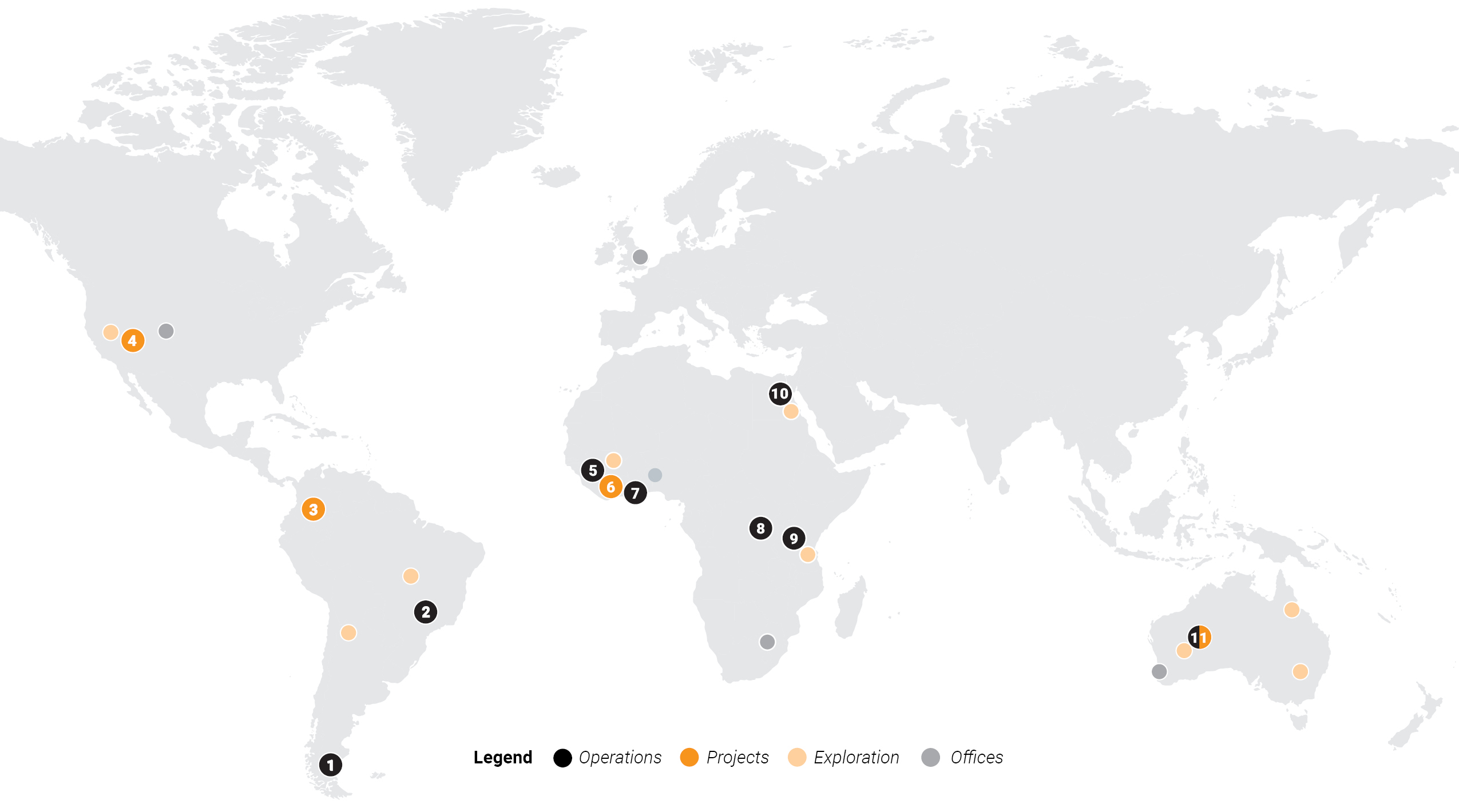
159
Siguiri decreased by 69,000 ounces, or 21 percent, from 329,000 ounces in 2022 to 260,000 ounces in 2023. Gold production
was lower year-on-year mainly due to lower ore tonnes processed due to the CIL tank failure during the second quarter of
2023, which impacted metallurgical recoveries, and lower grades mined. Gold production was further adversely impacted by
community protests in relation to additional employment opportunities. These protests have since subsided. Gold production at
Geita decreased by 36,000 ounces, or seven percent, from 521,000 ounces in 2022 to 485,000 ounces in 2023. Gold
production was lower year-on-year mainly due to lower ore tonnes processed on the back of a planned mill shutdown in the
first half of 2023 and lower grades mined.
In the Africa region – non-managed joint ventures, gold production at Kibali (on an attributable basis) marginally increased by
6,000 ounces, or two percent, from 337,000 ounces in 2022 to 343,000 ounces in 2023. Gold production was marginally higher
year-on-year mainly due to higher ore tonnes processed, partially offset by lower grades mined.
In the Americas region, gold production decreased by 38,000 ounces, or seven percent, from 582,000 ounces (of which 70,000
ounces from CdS) in 2022 to 544,000 ounces (of which 42,000 ounces from CdS) in 2023. This decrease was mainly due to
lower gold production from Cerro Vanguardia, AGA Mineração and Serra Grande. Excluding CdS, gold production in the
Americas region marginally decreased by 10,000 ounces, or two percent, from 512,000 ounces in 2022 to 502,000 ounces in
2023. Gold production at AGA Mineração decreased by 17,000 ounces, or five percent, from 311,000 ounces (of which 70,000
ounces from CdS) in 2022 to 294,000 ounces (of which 42,000 ounces from CdS) in 2023. Gold production was lower year-on-
year mainly due to lower ore tonnes processed and the CdS mine being placed on care and maintenance in August 2023,
partially offset by higher recovered grades at the Cuiabá mine. During 2023, Cuiabá produced 252,000 ounces, which
comprised 83,000 ounces of gravimetric gold and 169,000 ounces of gold-in-concentrate. Excluding CdS, gold production at
AGA Mineração increased by 11,000 ounces, or five percent, from 241,000 ounces in 2022 to 252,000 ounces in 2023. Gold
production at Serra Grande marginally decreased by 2,000 ounces, or two percent, from 88,000 ounces in 2022 to 86,000
ounces in 2023. Gold production was marginally lower year-on-year mainly due to lower ore tonnes processed, partially offset
by higher recovered grades. Gold production at Cerro Vanguardia decreased by 19,000 ounces, or ten percent, from 183,000
ounces in 2022 to 164,000 ounces in 2023. Gold production was lower year-on-year mainly due to a combination of lower ore
tonnes processed and lower grades mined.
In the Australia region, gold production (on an attributable basis) increased by 24,000 ounces, or four percent, from 538,000
ounces in 2022 to 562,000 ounces in 2023. This increase was mainly due to higher gold production from Sunrise Dam and
Tropicana. Gold production at Sunrise Dam increased by 20,000 ounces, or nine percent, from 232,000 ounces in 2022 to
252,000 ounces in 2023. Gold production was higher year-on-year mainly due to higher grades mined, partially offset by lower
ore tonnes processed. Gold production at Tropicana (on an attributable basis) marginally increased by 4,000 ounces, or one
percent, from 306,000 ounces in 2022 to 310,000 ounces in 2023. Gold production was marginally higher year-on-year mainly
due to higher grades mined, partially offset by lower ore tonnes processed.
Comparison of financial performance in 2024, 2023 and 2022
The following table presents summarised financial performance of AngloGold Ashanti for the three-year period ended
31 December 2024:
Financial performance of AngloGold Ashanti
Year ended 31 December
(in $ millions)
2024
2023
2022
Revenue from product sales
5,793
4,582
4,501
Cost of sales
(3,726)
(3,541)
(3,366)
Total of all other (expenses) income
(550)
(1,185)
(824)
Share of associates and joint ventures’ profit (loss)
155
207
161
Taxation
(623)
(285)
(221)
Profit (loss) for the period
1,049
(222)
251
Net profit (loss) attributable to equity shareholders
1,004
(235)
233
Net profit (loss) attributable to non-controlling interests
45
13
18
160
Comparison of total cost of sales in 2024, 2023 and 2022
The following table presents cost of sales for AngloGold Ashanti for the three-year period ended 31 December 2024:
Cost of sales for AngloGold Ashanti
Year ended 31 December
(in $ millions)
2024
2023
2022
Total cost of sales
3,726
3,541
3,366
Inventory change
(18)
12
30
Amortisation of tangible assets
(666)
(579)
(555)
Amortisation of intangible assets
(1)
(1)
(1)
Amortisation of right of use assets
(85)
(78)
(81)
Retrenchment costs
(3)
(4)
(6)
Environmental rehabilitation and other non-cash costs
(42)
(21)
Total operating costs
2,911
2,870
2,753
Comparison of financial performance in 2024 with 2023
Our gold income is materially impacted by price and volume variances. A majority of our costs are impacted by the
consequences of average exchange rate movements.
Exchange fluctuations in, and the average exchange rates for, the Brazilian real, Australian dollar, Argentinean peso and other
local currencies have effects on the various components that make up our costs based on the level of local procurement of
each of these costs. For a discussion of the effect of foreign exchange fluctuations on our financial results, see “Item 5A:
Operating Results—Key factors affecting results—Foreign exchange fluctuations”.
Revenue from product sales
Revenue from product sales (excluding non-managed joint ventures) increased by $1,211 million, or 26 percent, from $4,582
million in 2023 to $5,793 million in 2024, mainly as a result of an increase in gold income and an increase in by-product
revenue. Gold income (excluding non-managed joint ventures) increased by $1,193 million, or 27 percent, from $4,480 million
in 2023 to $5,673 million in 2024. This increase was mainly due to an increase in the average gold price received per ounce
and an increase in ounces of gold sold. The average gold price received per ounce (excluding non-managed joint ventures)
increased by $466 per ounce, from $1,927 per ounce during 2023 to $2,393 per ounce in 2024, which resulted in an increase
in gold income of $1,099 million. Gold sold (excluding non-managed joint ventures) marginally increased by 46,000 ounces, or
two percent, from 2,324,000 ounces in 2023 to 2,370,000 ounces in 2024, which resulted in an increase in gold income of $94
million. By-product revenue (excluding non-managed joint ventures) increased by $18 million, or 18 percent, from $102 million
in 2023 to $120 million in 2024, mainly due to an increase in silver sold in Argentina.
Revenue from product sales from the Africa operations (excluding non-managed joint ventures) increased by $616 million, or
26 percent, from $2,403 million in 2023 to $3,019 million in 2024, mainly as a result of an increase in gold income. Gold
income (excluding non-managed joint ventures) increased by $615 million, or 26 percent, from $2,400 million in 2023 to
$3,015 million in 2024. This increase was mainly due to an increase in the average gold price received per ounce and higher
ounces of gold sold. The increase in the average gold price received per ounce of $466 per ounce from 2023 to 2024 resulted
in an increase in gold income of $570 million. Gold sold (excluding non-managed joint ventures) marginally increased by
22,000 ounces, or two percent, from 1,233,000 ounces in 2023 to 1,255,000 ounces in 2024, which resulted in an increase in
gold income of $45 million. The acquisition of the Sukari gold mine in November 2024 contributed an additional 40,000 ounces
of gold sold in 2024. Increase in gold production at Siguiri and the contribution of Sukari in 2024 were partially offset by
decreased gold production at Iduapriem, Obuasi and Geita. For a discussion of the increase in gold production at the Africa
operations during 2024, see “Item 5A: Operating Results—Key factors affecting results—Comparison of gold production in
2024 with 2023”. By-product revenue (excluding non-managed joint ventures) increased $1 million from $3 million in 2023 to
$4 million in 2024.
Revenue from product sales from the Americas operations increased by $281 million, or 26 percent, from $1,094 million in
2023 to $1,375 million in 2024, mainly as a result of an increase in gold income and by-product revenue. Gold income
increased by $265 million, or 27 percent, from $999 million in 2023 to $1,264 million in 2024. This increase was mainly due to
an increase in the average gold price received per ounce and higher ounces of gold sold. The increase in the average gold
price received per ounce of $466 per ounce from 2023 to 2024 resulted in an increase in gold income of $257 million. Gold
sold marginally increased by 3,000 ounces, or less than one percent, from 534,000 ounces in 2023 to 537,000 ounces in 2024,
which resulted in a marginal increase in gold income of $8 million. There was an increase in gold production at Cerro
Vanguardia, partially offset by a decrease in gold production at AGA Mineração and Serra Grande. For a discussion of the
161
decrease in gold production at the Americas operations during 2024, see “Item 5A: Operating Results—Key factors affecting
results—Comparison of gold production in 2024 with 2023”. By-product revenue increased by $16 million, or 17 percent, from
$95 million in 2023 to $111 million in 2024, mainly due to an increase in silver sold in Argentina.
Revenue from product sales from the Australia operations increased by $314 million, or 29 percent, from $1,085 million in
2023 to $1,399 million in 2024, mainly as a result of an increase in gold income. Gold income increased by $313 million, or 29
percent, from $1,081 million in 2023 to $1,394 million in 2024. This increase was mainly due to an increase in the average gold
price received per ounce and higher ounces of gold sold. The increase in the average gold price received per ounce of $466
per ounce from 2023 to 2024 resulted in an increase in gold income of $272 million. Gold sold increased by 21,000 ounces, or
four percent, from 557,000 ounces in 2023 to 578,000 ounces in 2024, which resulted in an increase in gold income of $41
million. There was an increase in gold production at Tropicana and at Sunrise Dam. For a discussion of the increase in gold
production at the Australia operations during 2024, see “Item 5A: Operating Results—Key factors affecting results—
Comparison of gold production in 2024 with 2023”. By-product revenue increased $1 million from $4 million in 2023 to $5
million in 2024.
Cost of sales
Cost of sales (excluding non-managed joint ventures) increased by $185 million, or five percent, from $3,541 million in 2023 to
$3,726 million in 2024. This increase was primarily due to an increase in royalties paid of $56 million, or 29 percent, from $190
million in 2023 to $246 million in 2024, an increase in environmental rehabilitation and other non-cash costs by $21 million, or
100 percent, from $21 million in 2023 to $42 million in 2024, an increase in amortisation of tangible assets by $87 million, or 15
percent, from $579 million in 2023 to $666 million in 2024, an increase in amortisation of right of use assets by $7 million, or
nine percent, from $78 million in 2023 to $85 million in 2024 and an inventory change of $30 million from a credit of $12 million
in 2023 to a debit of $18 million in 2024. This increase in cost of sales was partially offset by a  marginal decrease in operating
costs of $15 million, or less than one percent, from $2,680 million in 2023 to $2,665 million in 2024 and a decrease in
retrenchment costs by $1 million, or 25 percent, from $4 million in 2023 to $3 million in 2024.
For a discussion of cost of sales on a segment basis during 2024, see “Item 5A: Operating Results—Comparison of operating
performance on a segment basis in 2024 with 2023—Cost of sales”.
Total operating costs
Total operating costs marginally increased by $41 million, or one percent, from $2,870 million in 2023 to $2,911 million in 2024.
This marginal increase was primarily due to an increase in royalties paid, partially offset by a decrease in operating costs. Total
operating costs include operating costs (such as salaries and wages, consumable stores, explosives, reagents, logistics, fuel,
power, water, contractors’ costs, services and other charges) and royalties paid.
Operating costs marginally decreased by $15 million, or less than one percent, from $2,680 million in 2023 to $2,665 million in
2024, primarily due to lower mining contractors’ costs, partially offset by higher labour and consumable stores. The weakening
of local currencies against the US dollar in Australia, Brazil and Argentina also contributed to lower operating costs.
Royalties paid, which are generally calculated as a percentage of revenue, increased by $56 million, or 29 percent, from $190
million in 2023 to $246 million in 2024. This increase was primarily due to an increase in the average gold price received per
ounce, partially offset by a decrease in gold sales at Iduapriem, Obuasi, AGA Mineração and Serra Grande.
Retrenchment costs
Retrenchment costs included in cost of sales decreased by $1 million, or 25 percent, from $4 million in 2023 to $3 million in
2024.
Environmental rehabilitation and other non-cash costs
Environmental rehabilitation and other non-cash costs increased by $21 million, from $21 million in 2023 to $42 million in 2024.
This increase was mainly due to the recognition of changes in estimates resulting from changes in discount rates, changes in
global economic assumptions, changes in mine plans resulting in a change in cash flows as well as changes in the designs for
closure of TSFs.
Amortisation of tangible, intangible and right of use assets
Amortisation of tangible, intangible and right of use assets expense increased by $94 million, or 14 percent, from $658 million
in 2023 to $752 million in 2024.
Amortisation of tangible assets increased by $87 million, or 15 percent, from $579 million in 2023 to $666 million in 2024. This
increase was mainly due to higher amortisation at Obuasi (mainly due to mining fleet replacements to support underground
162
development and production), at Geita (mainly due to additional heavy mining equipment, an increase in Mineral Reserve
development, increased deferred stripping and leased assets), at Siguiri (mainly due to higher gold production, additional
heavy mining equipment and increased deferred stripping), at Sunrise Dam (mainly due to higher gold production), at AGA
Mineração (mainly due to the resumption of gold concentrate processing and refining activities at the Queiroz metallurgical
plant), at Cerro Vanguardia (mainly due to higher gold production) and the incremental impact of amortisation at Sukari since
the acquisition in November 2024, partially offset by lower amortisation at Serra Grande (mainly due to prior-year impairments
and derecognition of fixed assets) and at Iduapriem (mainly due to lower gold production combined with lower deferred
stripping at Teberebie Cut 2a).
Amortisation of intangible assets of $1 million in 2024 remain unchanged from $1 million in 2023.
Amortisation of right of use assets increased by $7 million, or nine percent, from $78 million in 2023 to $85 million in 2024.
This increase was mainly due to higher amortisation at Geita and Siguiri due to new leases and modifications to existing
leases.
Inventory change
Inventory change was a credit of $12 million in 2023 compared to a debit of $18 million in 2024, which represents a change of
$30 million. This change was primarily due to the acquisition of Sukari and gold inventory movement at Tropicana.
Reversal of impairment (impairment), (derecognition of assets) and profit (loss) on disposal
Reversal of impairment (impairment), (derecognition of assets) and profit (loss) on disposal was a loss of $221 million in 2023
as compared to a gain of $58 million in 2024, which represents a change of $279 million. This change was mainly due to the
reversal of impairment of Cuiabá of $60 million (gross of taxation) and profit on asset derecognition in Siguiri of $13 million,
partially offset by a loss of $2 million recorded on the sale of Yatela in Mali. For further information, refer to “Item 18: Financial
Statements—Note 14—Tangible assets—Net impairment, derecognition of assets and profit (loss) on disposal”.
Corporate restructuring costs
Corporate restructuring costs decreased by $314 million, from $314 million in 2023 to nil in 2024. Corporate restructuring costs
in 2023 were largely due to taxes associated with the corporate restructuring to reorganise the Group’s operations under a
new parent company and other transaction costs. The corporate restructuring was completed in September 2023.
Other (expenses) income
Other expenses increased by $40 million, from an expense of $104 million in 2023 to an expense of $144 million in 2024. The
increase during 2024 compared to 2023 was largely due to an increase of $42 million for legal fees and project costs (mainly
relating to the Centamin acquisition) and a positive deferred stripping adjustment of $26 million in 2023 not reflected in 2024,
partially offset by an increase in insurance claims at Siguiri of $4 million and lower rehabilitation provisions for legacy TSFs at
Obuasi of $24 million.
Finance costs and unwinding of obligations
Finance costs increased by $8 million, or six percent, from $131 million in 2023 to $139 million in 2024, mainly due to higher
borrowing costs on revolving credit facilities due to higher drawn balances in 2024 compared to 2023. Unwinding of obligations
increased by $2 million, or eight percent, from $26 million in 2023 to $28 million in 2024, mainly due to higher unwinding on the
environmental restoration provisions.
Share of associates and joint ventures’ profit
Share of associates and joint ventures’ profit decreased by $52 million, or 25 percent, from a profit of $207 million in 2023 to a
profit of $155 million in 2024, mainly as a result of a decrease in equity earnings of $53 million at Kibali due to an increase in
Kibali’s provision for taxes resulting from the application of a windfall tax, partially offset by an increase in equity earnings of $1
million at Rand Refinery (Pty) Limited.
Taxation
A taxation expense of $623 million was recorded in 2024, compared to a taxation expense of $285 million in 2023, which
represents a $338 million increase. Current tax in 2024 amounted to an expense of $454 million, compared to an expense of
$217 million in 2023, which represents a $237 million increase. The increase in current tax was mainly due to higher taxable
income resulting from the higher average gold price received and higher withholding taxes paid resulting from higher dividends
declared. Deferred tax in 2024 amounted to an expense of $169 million, compared to an expense of $68 million in 2023, which
represents a $101 million increase. The increase in deferred tax was mainly due to higher capital expenditure resulting in
163
additional taxable temporary differences and derecognition of deferred tax assets on tax losses at Obuasi recognised in the
prior year, as those losses will not be utilised in the future.
Comparison of financial performance in 2023 with 2022
Our gold income is materially impacted by price and volume variances. All of our costs are impacted by the consequences of
average exchange rate movements.
Exchange fluctuations in, and the average exchange rates for, the Brazilian real, Australian dollar, Argentinean peso and other
local currencies have effects on the various components that make up our costs based on the level of local procurement of
each of these costs. For a discussion of the effect of foreign exchange fluctuations on our financial results, see “Item 5A:
Operating Results—Key factors affecting results—Foreign exchange fluctuations”.
Revenue from product sales
Revenue from product sales (excluding non-managed joint ventures) marginally increased by $81 million, or two percent, from
$4,501 million in 2022 to $4,582 million in 2023, mainly as a result of an increase in gold income, partially offset by a decrease
in by-product revenue. Gold income (excluding non-managed joint ventures) marginally increased by $92 million, or two
percent, from $4,388 million in 2022 to $4,480 million in 2023. This marginal increase was mainly due to an increase in the
average gold price received per ounce, partially offset by a decrease in ounces of gold sold. The average gold price received
per ounce (excluding non-managed joint ventures) increased by $134 per ounce, from $1,793 per ounce during 2022 to
$1,927 per ounce in 2023, which resulted in an increase in gold income of $318 million. Gold sold (excluding non-managed
joint ventures) decreased by 123,000 ounces, or five percent, from 2,447,000 ounces in 2022 to 2,324,000 ounces in 2023,
which resulted in a decrease in gold income of $226 million. By-product revenue (excluding non-managed joint ventures)
decreased by $11 million, or ten percent, from $113 million in 2022 to $102 million in 2023, mainly due to a decrease in
revenue from sulphuric acid in Brazil.
Revenue from product sales from the Africa operations (excluding non-managed joint ventures) marginally increased by $15
million, or one percent, from $2,388 million in 2022 to $2,403 million in 2023, mainly as a result of an increase in gold income.
Gold income (excluding non-managed joint ventures) marginally increased by $15 million, or one percent, from $2,385 million
in 2022 to $2,400 million in 2023. This marginal increase was mainly due to an increase in the average gold price received per
ounce, partially offset by lower ounces of gold sold. The increase in the average gold price received per ounce of $134 per
ounce from 2022 to 2023 resulted in an increase in gold income of $189 million. Gold sold (excluding non-managed joint
ventures) decreased by 97,000 ounces, or seven percent, from 1,330,000 ounces in 2022 to 1,233,000 ounces in 2023, which
resulted in a decrease in gold income of $174 million. Except for Iduapriem, there was a decrease in gold production across all
Africa operations in 2023 when compared to 2022. For a discussion of the decrease in gold production at the Africa operations
during 2023, see “Item 5A: Operating Results—Key factors affecting results—Comparison of gold production in 2023 with
2022”. By-product revenue (excluding non-managed joint ventures) of $3 million in 2023 remained unchanged from $3 million
in 2022.
Revenue from product sales from the Americas operations decreased by $48 million, or four percent, from $1,142 million in
2022 to $1,094 million in 2023, mainly as a result of a decrease in gold income and by-product revenue. Gold income
decreased by $37 million, or four percent, from $1,036 million in 2022 to $999 million in 2023. This decrease was mainly due
to lower ounces of gold sold, partially offset by an increase in the average gold price received per ounce. Gold sold decreased
by 44,000 ounces, or eight percent, from 578,000 ounces in 2022 to 534,000 ounces in 2023, which resulted in a decrease in
gold income of $79 million. There was a decrease in gold production at Cerro Vanguardia , AGA Mineração and Serra Grande.
For a discussion of the decrease in gold production at the Americas operations during 2023, see “Item 5A: Operating Results
—Key factors affecting results—Comparison of gold production in 2023 with 2022”. The increase in the average gold price
received per ounce of $134 per ounce from 2022 to 2023 resulted in an increase in gold income of $42 million. By-product
revenue decreased by $11 million, or ten percent, from $106 million in 2022 to $95 million in 2023, mainly due to a decrease in
sulphuric acid revenue from lower sulphuric acid production in Brazil.
Revenue from product sales from the Australia operations increased by $114 million, or 12 percent, from $971 million in 2022
to $1,085 million in 2023, mainly as a result of an increase in gold income. Gold income increased by $114 million, or 12
percent, from $967 million in 2022 to $1,081 million in 2023. This increase was mainly due to an increase in the average gold
price received per ounce and higher ounces of gold sold. The increase in the average gold price received per ounce of $134
per ounce from 2022 to 2023 resulted in an increase in gold income of $82 million. Gold sold increased by 18,000 ounces, or
three percent, from 539,000 ounces in 2022 to 557,000 ounces in 2023, which resulted in an increase in gold income of $32
million. There was an increase in gold production at Tropicana and at Sunrise Dam. For a discussion of the increase in gold
production at the Australia operations during 2023, see “Item 5A: Operating Results—Key factors affecting results—
Comparison of gold production in 2023 with 2022”. By-product revenue of $4 million in 2023 remained unchanged from $4
million in 2022.
164
Cost of sales
Cost of sales (excluding non-managed joint ventures) increased by $175 million, or five percent, from $3,366 million in 2022 to
$3,541 million in 2023. This increase was primarily due to an increase in operating costs of $112 million, or four percent, from
$2,568 million in 2022 to $2,680 million in 2023, an increase in amortisation of tangible assets by $24 million, or four percent, 
from $555 million in 2022 to $579 million in 2023, an increase in environmental rehabilitation and other non-cash costs by $21
million, from nil in 2022 to $21 million in 2023, an inventory change of $18 million, or 60 percent, from a credit of $30 million in
2022 to a credit of $12 million in 2023 and an increase in royalties paid by $5 million, or three percent, from $185 million in
2022 to $190 million in 2023. This increase was partially offset by a decrease in amortisation of right of use assets by $3
million, or four percent, from $81 million in 2022 to $78 million in 2023 and a decrease in retrenchment costs by $2 million, or
33 percent, from $6 million in 2022 to $4 million in 2023.
For a discussion of cost of sales on a segment basis during 2023, see “Item 5A: Operating Results—Comparison of operating
performance on a segment basis in 2023 with 2022—Cost of sales”.
Total operating costs
Total operating costs increased by $117 million, or four percent, from $2,753 million in 2022 to $2,870 million in 2023. This
increase was primarily due to an increase in operating costs and royalties paid. Total operating costs include operating costs
(such as salaries and wages, consumable stores, explosives, reagents, logistics, fuel, power, water, contractors’ costs,
services and other charges) and royalties paid.
Operating costs increased by $112 million, or four percent, from $2,568 million in 2022 to $2,680 million in 2023, primarily due
to higher labour and contractors’ costs, commodity prices, logistics costs, consumable stores, services and other charges,
partially offset by lower fuel costs. The strengthening of the Brazilian real against the US dollar contributed to the increase in
operating costs, which was partially offset by the weakening of local currencies against the US dollar in Australia and
Argentina.
Royalties paid, which are generally calculated as a percentage of revenue, increased by $5 million, or three percent, from
$185 million in 2022 to $190 million in 2023. This increase was primarily due to an increase in the average gold price received
per ounce, partially offset by a decrease in gold sales across all mining operations with the exception of Iduapriem and Sunrise
Dam.
Retrenchment costs
Retrenchment costs included in cost of sales decreased by $2 million, or 33 percent, from $6 million in 2022 to $4 million in
2023.
Environmental rehabilitation and other non-cash costs
Environmental rehabilitation and other non-cash costs increased by $21 million, from nil in 2022 to $21 million in 2023. This
increase was mainly due to the recognition of changes in estimates resulting from changes in discount rates, changes in global
economic assumptions, changes in mine plans resulting in a change in cash flows as well as changes in the designs for
closure of TSFs.
Amortisation of tangible, intangible and right of use assets
Amortisation of tangible, intangible and right of use assets expense increased by $21 million, or three percent, from $637
million in 2022 to $658 million in 2023.
Amortisation of tangible assets increased by $24 million, or four percent, from $555 million in 2022 to $579 million in 2023.
This increase was mainly due to higher amortisation at Iduapriem (mainly due to higher gold production combined with higher
deferred stripping amortisation at Teberebie Cut 2c which commenced in 2023) and at Obuasi (mainly due to the mining fleet
and Mineral Reserve development amortisation as the assets were transferred from being under construction to Mineral
Reserve development assets in 2023 and the Obuasi redevelopment project continuing to ramp up to full production in 2023),
partially offset by lower amortisation at Siguiri (mainly due to lower gold production), at Geita (mainly due to lower Mineral
Reserve development amortisation as a result of the implementation of a Full Asset Potential initiative), at Serra Grande
(mainly due to lower gold production) and at CdS (mainly due to reduction in asset cost due to the impairment that occurred
during 2022 and 2023).
Amortisation of intangible assets of $1 million in 2023 remain unchanged from $1 million in 2022.
165
Amortisation of right of use assets decreased by $3 million, or four percent, from $81 million in 2022 to $78 million in 2023.
This decrease was mainly due to lower amortisation at AGA Mineração mainly due to the impact of impairments that occurred
during 2022 and 2023.
Inventory change
Inventory change was a credit of $30 million in 2022, compared to a credit of $12 million in 2023, which represents a change of
$18 million. This change was primarily due to the lower unsold gold and gold processed volumes at all operations except
Tropicana. This was further impacted by an increase in the cost of inventory due to higher gold production costs.
Net impairment, derecognition of assets and profit (loss) on disposal
Net impairment, derecognition of assets and profit (loss) on disposal was a loss of $315 million in 2022 as compared to a loss
of $221 million in 2023, which represents a change of $94 million. Net impairment, derecognition of assets and profit (loss) on
disposal in 2023 was mainly due to the impairment of the CdS mining complex of $47 million (gross of taxation), the
impairment of Serra Grande of $105 million (gross of taxation), the net impairment of Cuiabá of $15 million (gross of taxation),
the impairment of Gramalote of $25 million (gross of taxation) and loss on asset derecognitions in Brazil of $40 million during
2023, partially offset by profit on asset derecognitions in Siguiri of $5 million and profit on disposal of properties held in Brazil
of $6 million during 2023. For further information on the impairment losses in Brazil during 2023, refer to “Item 18: Financial
Statements—Note 14—Tangible assets—Net impairment, derecognition of assets and profit (loss) on disposal”.
Corporate restructuring costs
Corporate restructuring costs increased by $300 million, from $14 million in 2022 to $314 million in 2023. The significant
increase during 2023 was largely due to taxes associated with the corporate restructuring to reorganise the Group’s operations
under a new parent company and other transaction costs.
Other (expenses) income
Other (expenses) income increased by $92 million, from an expense of $12 million in 2022 to an expense of $104 million in
2023. The significant increase during 2023 compared to 2022 was largely due to an increase in the care and maintenance cost
of $52 million (mainly relating to the CdS mine and the Queiroz metallurgical plant), an increase in environmental provisions for
legacy TSFs of $51 million (mainly as a result of new legislation in Brazil relating to emergency response and safety
management for TSFs) and an increase in retrenchment and related costs of $15 million (mainly in Brazil), partially offset by
other movements of $26 million (mainly relating to deferred stripping and an insurance claim at Siguiri).
Finance costs and unwinding of obligations
Finance costs increased by $12 million, or ten percent, from $119 million in 2022 to $131 million in 2023, mainly due to higher
finance costs from borrowings compared to 2022. Unwinding of obligations decreased by $4 million, or 13 percent, from $30
million in 2022 to $26 million in 2023, mainly due to the unwinding of long-term receivables reclassified to finance income in
2023, partially offset by higher unwinding on the environmental rehabilitation provisions.
Share of associates and joint ventures’ profit
Share of associates and joint ventures’ profit increased by $46 million, or 29 percent, from a profit of $161 million in 2022 to a
profit of $207 million in 2023, mainly as a result of an increase in equity earnings of $42 million at Kibali due to higher revenues
and $4 million at Rand Refinery (Pty) Limited.
Taxation
A taxation expense of $285 million was recorded in 2023, compared to a taxation expense of $221 million in 2022, which
represents a $64 million, or 29 percent, increase. Current tax in 2023 amounted to an expense of $217 million, compared to an
expense of $231 million in 2022, which represents a $14 million, or six percent, decrease. The decrease in current tax was
mainly due to higher capital allowances on capital expenditure in Tanzania. Deferred tax in 2023 amounted to an expense of
$68 million, compared to a deferred tax credit of $10 million in 2022, which represents a $78 million increase. The increase in
deferred tax was mainly due to higher deferred tax liabilities and lower deferred tax assets on tax losses in Ghana.
166
Comparison of capital expenditure in 2024, 2023 and 2022
The following table presents capital expenditure data for AngloGold Ashanti for the three-year period ended
31 December 2024:
Capital expenditure data for managed operations and non-
managed joint ventures
Year ended 31 December
(in $ millions)
2024
2023
2022
Managed operations (1)
1,090
1,042
1,028
Sustaining capital expenditure (2)
864
842
708
Non-sustaining capital expenditure (3)
226
200
320
Non-managed joint ventures
125
85
90
Sustaining capital expenditure
68
52
71
Non-sustaining capital expenditure
57
33
19
(1) At CdS, total capital expenditure amounted to nil, $21 million and $55 million for the financial years ended 31 December 2024, 2023 and 2022, respectively.
(2)At CdS, sustaining capital expenditure amounted to nil, $19 million and $55 million for the financial years ended 31 December 2024, 2023 and 2022,
respectively.
(3)At CdS, non-sustaining capital expenditure amounted to nil, $2 million and nil for the financial years ended 31 December 2024, 2023 and 2022, respectively.
Comparison of capital expenditure in 2024 with 2023
Capital expenditure of managed operations increased by $48 million, or five percent, from $1,042 million in 2023 to $1,090
million in 2024. This increase was mainly due to an increase of $22 million in sustaining capital expenditure and an increase of
$26 million in non-sustaining capital expenditure. Capital expenditure of non-managed joint ventures increased by $40 million,
or 47 percent, from $85 million in 2023 to $125 million in 2024. This increase was mainly due to an increase of $16 million in
sustaining capital expenditure and an increase of $24 million in non-sustaining capital expenditure. The Kibali mine in the DRC
was the only operating asset that was a non-managed joint venture in 2024 and 2023. Excluding CdS, capital expenditure of
managed operations increased by $69 million, or seven percent, from $1,021 million in 2023 to $1,090 million in 2024.
In Africa – managed operations, capital expenditure increased by $64 million, or ten percent, from $625 million in 2023 to $689
million in 2024. At Iduapriem in Ghana, capital expenditure increased by $27 million, from $142 million in 2023 to $169 million
in 2024, mainly due to higher non-sustaining capital expenditure on the Beposo TSF and higher sustaining capital expenditure
related to community compensation payments and waste stripping activity at Ajopa, partially offset by lower waste stripping
capital expenditure at Teberebie Cut 2b. At Obuasi in Ghana, capital expenditure decreased by $12 million, from $214 million
in 2023 to $202 million in 2024, mainly due to lower expenditure on the mining fleet and a decrease in non-sustaining capital
expenditure. At Siguiri in Guinea, capital expenditure increased by $24 million, from $78 million in 2023 to $102 million in 2024,
mainly due to the acquisition of mining fleets for Block 1 and 2 to transition to the new owner mining operation model, higher
waste stripping at Kami and Saraya and additional infrastructure capital in preparation for Block 3 execution. At Geita in
Tanzania, capital expenditure increased by $5 million, from $191 million in 2023 to $196 million in 2024, mainly due to an
increase in sustaining capital expenditure primarily as a result of an increase in waste stripping, purchases of new equipment
and investment in infrastructure development, partially offset by lower sustaining stay-in-business capital expenditure due to
the completion of the Tanesco national power grid connection project and lower non-sustaining capital expenditure mainly from
lower Geita Hill East Mineral Reserve development and exploration drilling due to a delay in the start-up of the Geita Hill East
underground project. An additional $20 million of sustaining capital expenditure was incurred at the Sukari mine in Egypt since
its acquisition in November 2024.
In Africa – non-managed joint ventures, capital expenditure at Kibali in the DRC increased by $40 million, from $85 million in
2023 to $125 million in 2024, mainly due to increased waste stripping capital expenditure and higher non-sustaining capital
expenditure on the solar energy project and the cyanide recovery plant.
In the Americas, capital expenditure decreased by $45 million, or 18 percent, from $254 million in 2023 to $209 million in 2024.
At AGA Mineração in Brazil, capital expenditure decreased by $26 million, from $124 million in 2023 to $98 million in 2024,
mainly due to capital expenditure reduction initiatives, the temporary suspension of gold concentrate processing and refining
activities at the Queiroz metallurgical plant until September 2024 when the plant resumed operations and the CdS mine
continuing to be on care and maintenance since August 2023. At Serra Grande in Brazil, capital expenditure decreased by $15
million, from $55 million in 2023 to $40 million in 2024, mainly due to lower volume of development and capital expenditure
reduction initiatives. At Cerro Vanguardia in Argentina, capital expenditure decreased by $4 million, from $75 million in 2023 to
$71 million in 2024, mainly due to the heap leaching pad expansion in 2023. Excluding CdS, capital expenditure in the
Americas decreased by $24 million, or ten percent, from $233 million in 2023 to $209 million in 2024. Excluding CdS, capital
expenditure at AGA Mineração decreased by $5 million, or five percent, from $103 million in 2023 to $98 million in 2024.
167
In Australia, capital expenditure increased by $18 million, or 13 percent, from $135 million in 2023 to $153 million in 2024. At
Sunrise Dam in Australia, capital expenditure increased by $18 million, from $47 million in 2023 to $65 million in 2024, mainly
due to higher underground Mineral Reserve development and waste mining in the surface operation. At Tropicana in Australia,
capital expenditure increased by $1 million, from $87 million in 2023 to $88 million in 2024, mainly due to the Havana growth
project, partially offset by lower pre-stripping expenditure. At Australia other, capital expenditure decreased by $1 million, from
$1 million in 2023 to nil in 2024, mainly due to lower exploration equipment expenditure.
In Projects, capital expenditure increased by $11 million, or 41 percent, from $27 million in 2023 to $38 million in 2024. Capital
expenditure for the Colombian projects increased by $2 million, or 18 percent, from $11 million in 2023 to $13 million in 2024,
mainly due to the purchase of land. Capital expenditure for the Nevada projects increased by $9 million, from $16 million in
2023 to $25 million in 2024, mainly due to capital expenditure incurred on the North Bullfrog and Expanded Silicon projects.
Comparison of capital expenditure in 2023 with 2022
Capital expenditure of managed operations marginally increased by $14 million, or one percent, from $1,028 million in 2022 to
$1,042 million in 2023. This marginal increase was mainly due to an increase of $134 million in sustaining capital expenditure
and a decrease of $120 million in non-sustaining capital expenditure. Capital expenditure of non-managed joint ventures
decreased by $5 million, or six percent, from $90 million in 2022 to $85 million in 2023. This decrease was mainly due to a
decrease of $19 million in sustaining capital expenditure and an increase of $14 million in non-sustaining capital expenditure.
The Kibali mine in the DRC was the only operating asset that was a non-managed joint venture in 2023 and 2022. Excluding
CdS, capital expenditure of managed operations increased by $48 million, or five percent, from $973 million in 2022 to $1,021
million in 2023.
In Africa – managed operations, capital expenditure increased by $139 million, or 29 percent, from $486 million in 2022 to
$625 million in 2023. At Iduapriem in Ghana, capital expenditure decreased by $4 million, from $146 million in 2022 to $142
million in 2023, mainly due to lower waste stripping at Teberebie Cut 2c and lower non-sustaining capital expenditure for work
relating to buttressing the TSF, partially offset by higher waste stripping activities at Block 5 and Ajopa. At Obuasi in Ghana,
capital expenditure increased by $55 million, from $159 million in 2022 to $214 million in 2023, mainly due to the mining fleet
acquisition and an increase in Mineral Reserve development and underground infrastructure development, partially offset by
lower expenditure on Phase 3 of the Obuasi redevelopment project. At Siguiri in Guinea, capital expenditure increased by $51
million, from $27 million in 2022 to $78 million in 2023, mainly due to higher waste stripping activities at Bidini and Saraya,
increased sustaining capital expenditure to restore plant operations following the CIL tank failure, extend the life of the TSF to
2037 and transition to an owner mining operation model (instead of using contractors) to improve productivity. At Geita in
Tanzania, capital expenditure increased by $37 million, from $154 million in 2022 to $191 million in 2023, mainly due to an
increase in sustaining capital expenditure primarily as a result of an increase in waste stripping, the TSF lift and the Tanesco
national power grid connection project, partially offset by lower non-sustaining capital expenditure mainly due to the
Nyamulilima open pit being commissioned during 2022.
In Africa – non-managed joint ventures, capital expenditure at Kibali in the DRC decreased by $5 million, from $90 million in
2022 to $85 million in 2023, mainly due to lower waste stripping and Mineral Reserve development costs capitalised, partially
offset by higher non-sustaining capital expenditure on exploration, the cyanide recovery plant and a solar energy project.
In the Americas, capital expenditure decreased by $68 million, or 21 percent, from $322 million in 2022 to $254 million in 2023.
At AGA Mineração in Brazil, capital expenditure decreased by $75 million, from $199 million in 2022 to $124 million in 2023,
mainly due to the then continuing suspension of gold concentrate processing and refining activities at the Queiroz metallurgical
plant, the CdS mine being placed on care and maintenance in August 2023 and lower investment in TSF projects. At Serra
Grande in Brazil, capital expenditure decreased by $2 million, from $57 million in 2022 to $55 million in 2023, mainly due to
lower TSF expenditure. At Cerro Vanguardia in Argentina, capital expenditure increased by $9 million, from $66 million in 2022
to $75 million in 2023, mainly due to higher expenditure on the heap leaching pad expansion and higher waste stripping capital
expenditure compared to 2022. Excluding CdS, capital expenditure in the Americas decreased by $34 million, or 13 percent,
from $267 million in 2022 to $233 million in 2023. Excluding CdS, capital expenditure at AGA Mineração decreased by $41
million, or 28 percent, from $144 million in 2022 to $103 million in 2023.
In Australia, capital expenditure decreased by $67 million, or 33 percent, from $202 million in 2022 to $135 million in 2023. At
Sunrise Dam in Australia, capital expenditure decreased by $3 million, from $50 million in 2022 to $47 million in 2023, mainly
due to lower sustaining capital expenditure and lower underground development expenditure. At Tropicana in Australia, capital
expenditure decreased by $65 million, from $152 million in 2022 to $87 million in 2023, mainly due to lower non-sustaining
capital expenditure from decreased waste mining in the Havana cutback project during 2023. At Australia other, capital
expenditure increased by $1 million, from nil in 2022 to $1 million in 2023, mainly due to higher exploration equipment
expenditure.
In Projects, capital expenditure increased by $10 million, or 59 percent, from $17 million in 2022 to $27 million in 2023. Capital
expenditure for the Colombian projects decreased by $5 million, or 31 percent, from $16 million in 2022 to $11 million in 2023,
mainly due to the Gramalote project which was sold in September 2023. Capital expenditure for the Nevada projects increased
168
by $15 million, from $1 million in 2022 to $16 million in 2023, mainly due to the capital expenditure incurred on the new
Corporate Office in Denver and the purchase of land.
Comparison of operating performance on a segment basis for 2024, 2023 and 2022
The Company produces gold as its primary product and does not have distinct divisional segments in terms of principal
business activity, but manages its business on the basis of different geographical segments. Therefore, information regarding
separate geographical segments is provided.
Gold income
(in millions)
Year ended 31 December
2024
2023
2022
$
percent
$
percent
$
percent
Geographical analysis of gold income by
origin is as follows:
Africa
3,756
66
3,068
69
2,981
68
Australia
1,394
25
1,081
24
967
22
Americas
1,264
22
999
22
1,036
24
6,414
5,148
4,984
Less: Equity-accounted joint ventures
included above
(741)
(13)
(668)
(15)
(596)
(14)
5,673
100
4,480
100
4,388
100
Assets
(in millions)
Year ended 31 December
2024
2023
2022
$
percent
$
percent
$
percent
Geographical analysis of assets by origin
is as follows:
Africa
9,081
69
4,414
54
4,035
50
Australia
845
6
942
12
960
12
Americas
1,460
11
1,254
15
1,395
18
Projects
991
8
833
10
872
11
Other, including non-gold producing
managed operations
780
6
732
9
751
9
Total assets
13,157
100
8,175
100
8,013
100
Non-GAAP analysis
In this annual report on Form 20-F, AngloGold Ashanti presents the financial items “total cash costs”, “total cash costs per
ounce”, “all-in sustaining costs”, “all-in sustaining costs per ounce”, “average gold price received per ounce”, “sustaining capital
expenditure” and “non-sustaining capital expenditure”, which have been determined using industry guidelines and practices
and are not measures under IFRS. An investor should not consider these items in isolation or as alternatives to cost of sales,
gold income, capital expenditure or any other measure of financial performance presented in accordance with IFRS or as an
indicator of the Group’s performance. The Group uses certain Non-GAAP performance measures and ratios in managing the
business and may provide users of this financial information with additional meaningful comparisons between current results
and results in prior operating periods. Non-GAAP financial measures should be viewed in addition to, and not as an alternative
to, the reported operating results or any other measure of performance prepared in accordance with IFRS. In addition, the
presentation of these measures may not be comparable to similarly titled measures that other companies use. See
“Presentation of information—Non-GAAP financial measures” for additional information about the use of Non-GAAP financial
measures and “—Reconciliations” below for reconciliations. Refer to “Glossary of selected terms—Financial terms—Total cash
costs”, “Glossary of selected terms—Financial terms—All-in sustaining costs”, “Glossary of selected terms—Financial terms—
Average gold price received per ounce”, “Glossary of selected terms—Financial terms—Sustaining capital (expenditure)” and
“Glossary of selected terms—Financial terms—Non-sustaining capital (expenditure)” for definitions.
169
The following table presents selected total operating data for the AngloGold Ashanti Group for the three-year period ended 31
December 2024:
Operating data for AngloGold Ashanti operations - Total
Year ended 31 December
2024
2023
2022
Cost of sales (million US dollars) - Managed operations
3,726
3,541
3,366
Cost of sales (million US dollars) - Managed operations excluding CdS(2)
3,726
3,437
3,203
Cost of sales (million US dollars) - Non-managed joint ventures
380
372
342
All-in sustaining costs per ounce ($/oz) - Managed operations(1)
1,672
1,657
1,438
All-in sustaining costs per ounce ($/oz) - Managed operations excluding
CdS (1) (2)
1,672
1,634
1,396
All-in sustaining costs per ounce ($/oz) - Non-managed joint ventures(1)
1,146
951
979
Total cash costs per ounce ($/oz) - Managed operations(1)
1,187
1,181
1,070
Total cash costs per ounce ($/oz) - Managed operations excluding CdS(1) (2)
1,187
1,162
1,045
Total cash costs per ounce ($/oz) - Non-managed joint ventures(1)
935
802
725
(1)“All-in sustaining costs per ounce” and “total cash costs per ounce” are non-GAAP financial measures. For a detailed reconciliation of “all-in sustaining costs
per ounce” and “total cash costs per ounce” for the Company’s total operations (managed operations/non-managed joint ventures) for each of the three
financial years in the period ended 31 December 2024, refer to the relevant “AngloGold Ashanti operations - Total” tables below.
(2)Adjusted to exclude the Córrego do Sítio (CdS) operation that was placed on care and maintenance in August 2023.
Comparison of operating performance on a segment basis in 2024 with 2023
Cost of sales
Overall, the managed operations’ cost of sales increased by $185 million, or five percent, from $3,541 million in 2023 to $3,726
million in 2024. For a discussion of the breakdown of cost of sales for managed operations during 2024, see “Item 5A:
Operating Results—Comparison of financial performance in 2024 with 2023—Cost of sales”. Excluding CdS, the managed
operations’ cost of sales increased by $289 million, or eight percent, from $3,437 million in 2023 to $3,726 million in 2024.
In Africa - managed operations, cost of sales increased by $185 million, or 11 percent, from $1,739 million in 2023 to $1,924
million in 2024. This increase was largely due to the acquisition of the Sukari mine in Egypt in November 2024, higher
amortisation of intangible assets, increased royalties paid and increased labour cost, partially offset by an increase in
capitalised Mineral Reserve development costs. The Sukari mine contributed an incremental $83 million of cost of sales since
its acquisition in November 2024.
At Iduapriem in Ghana, cost of sales decreased by $36 million, or nine percent, from $387 million in 2023 to $351 million in
2024. Cost of sales at Iduapriem decreased year-on-year mainly due to lower amortisation of tangible assets as a result of
lower gold production due to ore supply challenges and lower deferred stripping amortisation at Teberebie Cut 2a, partially
offset by an increase in rehabilitation and other non-cash costs due to a change in the restoration provision resulting from
changes in the discount rates and mine plan and higher mining contractor costs.
At Obuasi in Ghana, cost of sales increased by $47 million, or 15 percent, from $313 million in 2023 to $360 million in 2024.
Cost of sales at Obuasi increased year-on-year mainly due to higher amortisation and increased labour, material, power and
contractor costs due to an increase of nine percent in tonnes mined and a one percent increase in tonnes treated, partially
offset by an increase in capitalised Mineral Reserve development costs.
At Siguiri in Guinea, cost of sales increased by $45 million, or ten percent, from $473 million in 2023 to $518 million in 2024.
Cost of sales at Siguiri increased year-on-year mainly due to higher mining and rehandle costs resulting from a 35 percent
increase in tonnes mined and one percent increase in tonnes treated, increased royalties paid as well as increased
amortisation on mining and waste capital assets, partially offset by favourable inventory movements.
At Geita in Tanzania, cost of sales increased by $46 million, or eight percent, from $566 million in 2023 to $612 million in 2024.
Cost of sales at Geita increased year-on-year mainly due to increased amortisation on deferred waste stripping assets, Mineral
Reserve development, heavy mining equipment and leased assets, an increase in rehabilitation and other non-cash costs due
to a change in the restoration provision resulting from changes in the discount rates and mine plan and an increase in royalties
paid.
In Africa - non-managed joint ventures, cost of sales marginally increased by $8 million, or two percent, from $372 million in
2023 to $380 million in 2024. This marginal increase was mainly due to higher operating costs resulting from higher open-pit
volumes mined, unfavourable inventory movements and higher royalties paid. The Kibali mine in the DRC was the only
operating asset in Africa - non-managed joint ventures in 2024 and 2023.
170
In the Americas, cost of sales decreased by $73 million, or eight percent, from $931 million in 2023 to $858 million in 2024.
This decrease was mainly due to lower operating costs achieved from the Full Asset Potential initiative and favourable
exchange rates against the US dollar, partially offset by higher direct costs as a result of inflationary pressures in Argentina,
increased costs arising from the resumption of gold concentrate processing and refining activities at the Queiroz metallurgical
plant in September 2024, increased royalties paid resulting from increased gold sales and higher amortisation charges.
Excluding CdS, cost of sales in the Americas increased by $31 million, or four percent, from $827 million in 2023 to $858
million in 2024.
At AGA Mineração in Brazil, cost of sales decreased by $101 million, or 22 percent, from $453 million in 2023 to $352 million in
2024. Cost of sales at AGA Mineração decreased year-on-year mainly due to cost reduction initiatives on labour and
insourcing operational activities as well as an average eight percent weakening of the Brazilian real against the US dollar,
partially offset by lower gold production, increased royalties paid resulting from the increase in the average gold price received
per ounce and higher amortisation for the Cuiabá mine complex as a result of the resumption of processing and refining of
gold concentrate at the Queiroz metallurgical plant in September 2024. Excluding CdS, cost of sales at AGA Mineração
marginally increased by $3 million, or one percent, from $349 million in 2023 to $352 million in 2024.
At Serra Grande in Brazil, cost of sales decreased by $33 million, or 20 percent, from $169 million in 2023 to $136 million in
2024. Cost of sales at Serra Grande decreased year-on-year mainly due to lower variable costs resulting from reduced mining
and processing volumes. In addition, cost savings were achieved through insourcing underground development activities,
which reduced contractor costs, and lower expenditure on technical consulting services related to Full Asset Potential
initiatives conducted in 2023. Additionally, an average eight percent weakening of the Brazilian real against the US dollar and
reduced costs for consumables and services further contributed to the improvement in cost of sales.
At Cerro Vanguardia in Argentina, cost of sales increased by $61 million, or 20 percent, from $307 million in 2023 to $368
million in 2024. Cost of sales at Cerro Vanguardia increased year-on-year mainly due to higher direct costs as a result of
inflationary pressures, higher royalties paid and higher amortisation as a result of higher gold production and the heap leach
pad expansion, which started to be amortised in 2024. This increase was partially offset by an average 212 percent weakening
of the Argentinean peso against the US dollar.
In the Americas other segment, cost of sales of $2 million in 2024 remained unchanged from $2 million in 2023.
In Australia, cost of sales increased by $78 million, or nine percent, from $867 million in 2023 to $945 million in 2024. This
increase was mainly due to higher operating costs in the underground mine, higher amortisation and unfavourable inventory
movements. A significant rain event during the first half of 2024 had an unfavourable impact on cost of sales at both Australian
operations, particularly at Tropicana.
At Sunrise Dam in Australia, cost of sales increased by $31 million, or eight percent, from $399 million in 2023 to $430 million
in 2024. Cost of sales at Sunrise Dam increased year-on-year primarily due to higher operating costs in the underground mine
resulting from longer haul distances, ground support requirements, plant shutdown activities during 2024 and higher
amortisation, partially offset by higher surface mining costs capitalised.
At Tropicana in Australia, cost of sales increased by $41 million, or nine percent, from $438 million in 2023 to $479 million in
2024. Cost of sales at Tropicana increased year-on-year mainly due to higher underground and surface mining costs resulting
from longer haul distances, higher amortisation and unfavourable inventory movements.
In the Australia other segment, cost of sales increased by $6 million, or 20 percent, from $30 million in 2023 to $36 million in
2024. Costs of sales in the Australia other segment increased year-on-year mainly due to increased global IT and other
charges, and additional audit fees.
All-in sustaining costs per ounce
All-in sustaining costs per ounce are impacted by cost of sales, sustaining capital expenditure and ounces of gold sold. For a
discussion of cost of sales for managed operations during 2024, see “Item 5A: Operating Results—Comparison of operating
performance on a segment basis in 2024 with 2023—Cost of sales”. For a discussion of capital expenditure for managed
operations during 2024, see “Item 5A: Operating Results—Comparison of capital expenditure in 2024, 2023 and 2022—
Comparison of capital expenditure in 2024 with 2023”. For a discussion of gold production, see “Item 5A: Operating Results—
Key factors affecting results—Comparison of gold production in 2024 with 2023”.
Overall, the managed operations’ all-in sustaining costs marginally increased by $15 per ounce, or one percent, from $1,657
per ounce in 2023 to $1,672 per ounce in 2024. Excluding CdS, the managed operations’ all-in sustaining costs marginally
increased by $38 per ounce, or two percent, from $1,634 per ounce in 2023 to $1,672 per ounce in 2024. This marginal
increase was mainly due to an increase in cost of sales and an increase in sustaining capital expenditure, partially offset by an
increase in ounces of gold sold. Excluding CdS, sustaining capital expenditure for the managed operations increased year-on-
year mainly due to higher waste stripping expenditure at Iduapriem, Siguiri, Geita and Sunrise Dam and the acquisition of
171
mining fleets at Siguiri. Additional sustaining capital expenditure was incurred at the Sukari mine in Egypt since its acquisition
in November 2024. Excluding CdS, gold sold for the managed operations increased by 89,000 ounces, or four percent, from
2,281,000 ounces in 2023 to 2,370,000 ounces in 2024. This increase was mainly due to incremental gold production from the
acquisition of the Sukari mine in November 2024 and higher gold production from Siguiri, AGA Mineração, Cerro Vanguardia,
Sunrise Dam and Tropicana, partially offset by lower gold production from Iduapriem, Obuasi, Geita and Serra Grande.
In Africa - managed operations, all-in sustaining costs increased by $133 per ounce, or eight percent, from $1,576 per ounce in
2023 to $1,709 per ounce in 2024. This increase was mainly due to an increase in cost of sales and an increase in sustaining
capital expenditure, partially offset by an increase in ounces of gold sold. At Iduapriem in Ghana, sustaining capital
expenditure increased year-on-year mainly due to a community compensation payment and higher waste stripping expenditure
at Ajopa, partially offset by lower waste stripping at Teberebie Cut 2b. At Obuasi in Ghana, sustaining capital expenditure
decreased year-on-year mainly due to lower expenditure on the mining fleet. At Siguiri in Guinea, sustaining capital
expenditure increased year-on-year mainly due to the acquisition of mining fleets for Block 1 and 2, higher waste stripping
activities and additional infrastructure capital in preparation for Block 3 execution. At Geita in Tanzania, sustaining capital
expenditure increased year-on-year mainly due to an increase in waste stripping and additional infrastructure capital, partially
offset by completion of the Tanesco national power grid connection project. Gold sold in Africa - managed operations
marginally increased by 22,000 ounces, or two percent, from 1,233,000 ounces in 2023 to 1,255,000 ounces in 2024. This
marginal increase was mainly due to increased gold production at Siguiri and incremental gold production from the acquisition
of the Sukari mine in November 2024, partially offset by decreased gold production at Iduapriem, Obuasi and Geita. Additional
sustaining capital expenditure was incurred at the Sukari mine in Egypt since its acquisition in November 2024.
In Africa - non-managed joint ventures, all-in sustaining costs increased by $195 per ounce, or 21 percent, from $951 per
ounce in 2023 to $1,146 per ounce in 2024. This increase was mainly due to an increase in cost of sales, higher sustaining
capital expenditure and a decrease in ounces of gold sold. Sustaining capital expenditure in Africa - non-managed joint
ventures increased year-on-year mainly due to higher waste stripping capitalisation. Gold sold in Africa - non-managed joint
ventures decreased by 34,000 ounces, or ten percent, from 343,000 ounces in 2023 to 309,000 ounces in 2024. This
decrease was mainly due to lower gold production at the Kibali mine. The Kibali mine in the DRC was the only operating asset
in Africa - non-managed joint ventures in 2024 and 2023.
In the Americas, all-in sustaining costs decreased by $291 per ounce, or 16 percent, from $1,805 per ounce in 2023 to $1,514
per ounce in 2024. Excluding CdS, all-in sustaining costs in the Americas decreased by $196 per ounce, or 11 percent, from
$1,710 per ounce in 2023 to $1,514 per ounce in 2024. This decrease was mainly due to a decrease in sustaining capital
expenditure, an increase in ounces of gold sold and a decrease in cost of sales. Excluding CdS, at AGA Mineração in Brazil,
sustaining capital expenditure decreased year-on-year mainly due to capital expenditure reduction initiatives and the
temporary suspension of gold concentrate processing and refining activities at the Queiroz metallurgical plant until September
2024 when the plant resumed operations. At Serra Grande in Brazil, sustaining capital expenditure decreased year-on-year
mainly due to lower volume of development and capital expenditure reduction initiatives. At Cerro Vanguardia in Argentina,
sustaining capital expenditure decreased year-on-year mainly due to expenditure on heap leaching pad expansion in 2023 not
repeated in 2024. Excluding CdS, gold sold in the Americas increased by 46,000 ounces, or nine percent, from 491,000
ounces in 2023 to 537,000 ounces in 2024. This increase was mainly due to higher gold production from AGA Mineração and
Cerro Vanguardia, partially offset by lower gold production from Serra Grande.
In Australia, all-in sustaining costs increased by $39 per ounce, or three percent, from $1,487 per ounce in 2023 to $1,526 per
ounce in 2024. This increase was mainly due to an increase in cost of sales and an increase in sustaining capital expenditure,
partially offset by an increase in ounces of gold sold. Sustaining capital expenditure increased in Australia year-on-year mainly
due to higher underground Mineral Reserve development and waste mining in the surface operation at Sunrise Dam, partially
offset by lower pre-stripping expenditure at Tropicana. Gold sold in Australia increased by 21,000 ounces, or four percent, from
557,000 ounces in 2023 to 578,000 ounces in 2024. This increase was mainly due to higher gold production at Sunrise Dam
and Tropicana.
Total cash costs per ounce
The currencies of Brazil, Argentina and Australia were, on average, weaker against the US dollar during 2024 as compared to
2023. Excluding CdS, total gold production in 2024 was higher as compared to 2023. These factors positively impacted total
cash costs per ounce for 2024. For a discussion of gold production during 2024, see “Item 5A: Operating Results—Key factors
affecting results—Comparison of gold production in 2024 with 2023”.
Overall, the managed operations’ total cash costs marginally increased by $6 per ounce, or less than one percent, from $1,181
per ounce in 2023 to $1,187 per ounce in 2024. Excluding CdS, the managed operations’ total cash costs marginally increased
by $25 per ounce, or two percent, from $1,162 per ounce in 2023 to $1,187 per ounce in 2024. This marginal increase was
mainly due to higher costs related to labour, material and contractors as a result of inflationary pressures, and the impact of
higher royalties paid, driven by the increase in the average gold price received per ounce.
172
In Africa - managed operations, total cash costs increased by $74 per ounce, or seven percent, from $1,138 per ounce in 2023
to $1,212 per ounce in 2024. This increase was mainly due to higher operating costs related to labour, mining contractor costs
and higher royalties paid, partially offset by an overall increase of 17,000 ounces in gold production.
At Iduapriem in Ghana, total cash costs increased by $175 per ounce, or 19 percent, from $943 per ounce in 2023 to 1,118 per
ounce in 2024. Total cash costs per ounce increased year-on-year mainly due to lower gold production and higher operating
costs. Operating costs increased mainly due to mining contractor costs, higher inventory movements due to reduced ore
delivery, and higher royalties paid as a result of a higher average gold price received per ounce. This increase was partially
offset by cost savings in fuel, power, service, and refinery expenses, as well as the earlier-than expected completion of certain
consultancy activities, and lower labour costs.
At Obuasi in Ghana, total cash costs increased by $100 per ounce, or nine percent, from $1,114 per ounce in 2023 to $1,214
per ounce in 2024. Total cash costs per ounce increased year-on-year mainly due to lower gold production and higher labour,
material and contractor costs. Elevated reagent, cement and power costs, and increased underground development expenses
were partially offset by lower consumption of other materials and stores.
At Siguiri in Guinea, total cash costs increased by $53 per ounce, or three percent, from $1,650 per ounce in 2023 to $1,703
per ounce in 2024. Total cash costs per ounce increased year-on-year mainly due to higher mining and rehandle costs
resulting from a 35 percent increase in tonnes mined and one percent more tonnes treated, partially offset by higher gold
production.
At Geita in Tanzania, total cash costs of $984 per ounce in 2024 remained unchanged from $984 per ounce in 2023, though
individual cost components varied. This was primarily due to a decrease in labour, reagents, stores and fuel costs, and higher
inventory credits, offset by higher royalties paid and higher production taxes resulting from a higher average gold price
received per ounce.
The Sukari mine in Egypt, acquired in November 2024, incurred total cash costs of $1,165 per ounce in 2024. An incremental
40,000 ounces of gold production by the mine partially offset the increase in total cash costs per ounce for Africa - managed
operations for 2024.
In Africa - non-managed joint ventures, total cash costs increased by $133 per ounce, or 17 percent, from $802 per ounce in
2023 to $935 per ounce in 2024. This increase was mainly due to higher operating costs and lower production volumes. The
cost increase was primarily attributable to greater open pit mining volumes, reduced stockpile credits due to less full-grade ore
mined and a higher stripping ratio, partially offset by increased waste-stripping capital credits. The Kibali mine in the DRC was
the only operating asset in Africa - non-managed joint ventures in 2024 and 2023.
In the Americas, total cash costs decreased by $180 per ounce, or 15 percent, from $1,207 per ounce in 2023 to $1,027 per
ounce in 2024. Excluding CdS, total cash costs in the Americas decreased by $95 per ounce, or eight percent, from $1,122 per
ounce in 2023 to $1,027 per ounce in 2024. This decrease was mainly due to higher by-product revenue, lower operating
costs mainly due to cost reduction initiatives and an average eight percent weakening of the Brazilian real and an average 212
percent weakening of the Argentinean peso against the US dollar.
At AGA Mineração in Brazil, total cash costs decreased by $334 per ounce, or 28 percent, from $1,210 per ounce in 2023 to
$876 per ounce in 2024. Excluding CdS, total cash costs at AGA Mineração decreased by $165 per ounce, or 16 percent, from
$1,041 per ounce in 2023 to $876 per ounce in 2024. Excluding CdS, total cash costs per ounce were lower year-on-year
mainly due to increased gold production, lower operating costs related to contractors, lower costs related to legal compliance
activities (including TSF management and emergency planning measures) as well as an average eight percent weakening of
the Brazilian real against the US dollar, partially offset by increased labour costs.
At Serra Grande in Brazil, total cash costs decreased by $87 per ounce, or six percent, from $1,498 per ounce in 2023 to
$1,411 per ounce in 2024. Total cash costs per ounce decreased year-on-year mainly due to cost savings achieved through
insourcing underground development activities, lower expenditure on technical consulting services related to Full Asset
Potential initiatives and lower consumable stores and services costs, partially offset by lower gold production. The average
eight percent weakening of the Brazilian real against the US dollar also had a favourable impact on total costs.
At Cerro Vanguardia in Argentina, total cash costs increased by $28 per ounce, or three percent, from $1,045 per ounce in
2023 to $1,073 per ounce in 2024. Total cash costs per ounce were higher year-on-year mainly due to cost increases related
to wages, materials and services, higher royalties paid and greater consumption of materials and services due to higher mining
activity. These increases were partially offset by increased gold production, higher by-product revenue and an average 212
percent weakening of the  Argentinean peso against the US dollar.
In Australia, total cash costs increased by $36 per ounce, or three percent, from $1,251 per ounce in 2023 to $1,287 per ounce
in 2024, mainly due to higher underground and surface mining costs, as well as logistical challenges, partially offset by a
173
10,000 ounce increase in gold production. The Australian operations, particularly Tropicana, were impacted by a significant
rain event that disrupted surface, underground and milling activities during the first half of 2024.
At Sunrise Dam in Australia, total cash costs marginally increased by $25 per ounce, or two percent, from $1,318 per ounce in
2023 to $1,343 per ounce in 2024. Total cash costs per ounce were marginally higher year-on-year mainly due to higher
operating costs in the underground mine resulting from longer haul distances, additional ground support requirements and
plant shutdown activities during 2024, partially offset by higher gold production.
At Tropicana in Australia, total cash costs marginally increased by $27 per ounce, or two percent, from $1,105 per ounce in
2023 to $1,132 per ounce in 2024. Total cash costs per ounce marginally increased year-on-year mainly due to higher
underground and surface mining costs driven by longer haul distances, partially offset by a marginal increase in gold
production.
Comparison of operating performance on a segment basis in 2023 with 2022
Cost of sales
Overall, the managed operations’ cost of sales increased by $175 million, or five percent, from $3,366 million in 2022 to $3,541
million in 2023. For a discussion of the breakdown of cost of sales for managed operations during 2023, see “Item 5A:
Operating Results—Comparison of financial performance in 2023 with 2022—Cost of sales”. Excluding CdS, the managed
operations’ cost of sales increased by $234 million, or seven percent, from $3,203 million in 2022 to $3,437 million in 2023.
In Africa - managed operations, cost of sales increased by $73 million, or four percent, from $1,666 million in 2022 to $1,739
million in 2023. This increase was largely due to the higher open pit and underground ore tonnes mined as well as higher
operating costs related to labour, contractors, commodity prices, consumable stores and services and higher amortisation of
tangible assets.
At Iduapriem in Ghana, cost of sales increased by $73 million, or 23 percent, from $314 million in 2022 to $387 million in 2023.
Cost of sales at Iduapriem increased year-on-year mainly due to higher amortisation of tangible assets as a result of higher
gold production and waste stripping at Teberebie Cut 2b which commenced in 2023, as well as higher operating costs relating
to labour, contractors and explosives, higher royalties paid and higher environmental rehabilitation provisions due to inflation
and changes in discount rates (due to changes in global economic assumptions) used in calculating environmental 
rehabilitation and other non-cash costs, partially offset by favourable ore stockpile movements.
At Obuasi in Ghana, cost of sales increased by $47 million, or 18 percent, from $266 million in 2022 to $313 million in 2023.
Cost of sales at Obuasi increased year-on-year mainly due to increased stoping activities during 2023 as the mine continued
to ramp up. Amortisation of heavy mining equipment increased mainly due to mining fleet and Mineral Reserve development
amortisation as the assets were transferred from being under construction to Mineral Reserve development assets in 2023.
Royalties paid were higher due to a higher average gold price received per ounce in 2023. This increase in cost of sales was
partially offset by favourable ore stockpile movements. 
At Siguiri in Guinea, cost of sales decreased by $19 million, or four percent, from $492 million in 2022 to $473 million in 2023.
Cost of sales at Siguiri decreased year-on-year mainly due to lower operating costs as a result of the transition to an owner
mining operation model (instead of using contractors) and royalties paid, lower environmental rehabilitation and other non-cash
costs and lower amortisation of tangible assets due to lower gold production, partially offset by unfavourable ore stockpile
movements.
At Geita in Tanzania, cost of sales decreased by $28 million, or five percent, from $594 million in 2022 to $566 million in 2023.
Cost of sales at Geita decreased year-on-year mainly due to favourable ore stockpile movements, lower environmental
rehabilitation and other non-cash costs and lower Mineral Reserve development amortisation. Mineral Reserve development
amortisation decreased mainly due to the implementation of a Full Asset Potential initiative relating to mine planning and
operational efficiencies.
In Africa - non-managed joint ventures, cost of sales increased by $30 million, or nine percent, from $342 million in 2022 to
$372 million in 2023. This increase was mainly due to higher operating costs relating to oil and commodity prices related to
diesel and reagent consumption costs, higher royalties paid and higher amortisation of tangible assets, partially offset by
favourable ore stockpile movements. The Kibali mine in the DRC was the only operating asset in Africa - non-managed joint
ventures in 2023.
In the Americas, cost of sales marginally increased by $18 million, or two percent, from $913 million in 2022 to $931 million in
2023. This marginal increase was mainly due to higher operating costs relating to labour, contractors, consumable stores and
services and an average three percent strengthening of the Brazilian real against the US dollar. This increase was partially
offset by lower operating costs due to the then continuing suspension of gold concentrate processing and refining activities at
the Queiroz metallurgical plant and the CdS mine being placed on care and maintenance in August 2023 as well as an
174
average 124 percent weakening of the Argentinean peso against the US dollar. Excluding CdS, cost of sales in the Americas
increased by $77 million, or ten percent, from $750 million in 2022 to $827 million in 2023.
At AGA Mineração in Brazil, cost of sales decreased by $24 million, or five percent, from $477 million in 2022 to $453 million in
2023. Cost of sales at AGA Mineração decreased year-on-year mainly due to lower royalties paid, lower amortisation of
tangible assets due to the impact of impairments recognised in 2022 and 2023 as well as lower operating costs due to the then
continuing suspension of gold concentrate processing and refining activities at the Queiroz metallurgical plant and the CdS
mine being placed on care and maintenance in August 2023, partially offset by higher operating costs relating to labour,
contractors and consumable stores, additional costs to produce and sell gold-in-concentrate, additional operating costs related
to TSF management and an average three percent strengthening of the Brazilian real against the US dollar. Excluding CdS,
cost of sales at AGA Mineração increased by $35 million, or 11 percent, from $314 million in 2022 to $349 million in 2023.
At Serra Grande in Brazil, cost of sales increased by $7 million, or four percent, from $162 million in 2022 to $169 million in
2023. Cost of sales at Serra Grande increased year-on-year mainly due to higher operating costs related to labour,
contractors, additional technical services and an average three percent strengthening of the Brazilian real against the US
dollar and unfavourable ore stockpile movements, partially offset by lower amortisation of tangible assets due to lower gold
production.
At Cerro Vanguardia in Argentina, cost of sales increased by $34 million, or 12 percent, from $273 million in 2022 to $307
million in 2023. Cost of sales at Cerro Vanguardia increased year-on-year mainly due to higher operating costs related to
labour, fuel, power, explosives and services, an increase in environmental rehabilitation and other non-cash costs and
unfavourable ore stockpile movements. This increase was partially offset by an average 124 percent weakening of the
Argentinean peso against the US dollar.
In the Americas other segment, cost of sales increased by $1 million, or 100 percent, from $1 million in 2022 to $2 million in
2023.
In Australia, cost of sales increased by $84 million, or 11 percent, from $783 million in 2022 to $867 million in 2023. This
increase was mainly due to higher operating costs related to labour, contractors, power (due to the increase in the price of gas)
and consumable stores and royalties paid (which increased mainly due to an increase in the ounces of gold sold and a higher
average gold price received per ounce in 2023). This increase was partially offset by an average five percent weakening of the
Australian dollar against the US dollar and a decrease in environmental rehabilitation and other non-cash costs.
At Sunrise Dam in Australia, cost of sales increased by $28 million, or eight percent, from $371 million in 2022 to $399 million
in 2023. Cost of sales at Sunrise Dam increased year-on-year primarily due to higher operating costs related to labour and
consumable stores, partially offset by favourable ore stockpile movements and an average five percent weakening of the
Australian dollar against the US dollar.
At Tropicana in Australia, cost of sales increased by $56 million, or 15 percent, from $382 million in 2022 to $438 million in
2023. Cost of sales at Tropicana increased year-on-year mainly due to higher waste stripping costs and higher mining costs
related to drilling and blasting and an increase in environmental rehabilitation and other non-cash costs. This increase was
partially offset by favourable ore stockpile movements and an average five percent weakening of the Australian dollar against
the US dollar.
In the Australia other segment, cost of sales of $30 million in 2023 remain unchanged from $30 million in 2022.
All-in sustaining costs per ounce
All-in sustaining costs per ounce are impacted by cost of sales, sustaining capital expenditure and ounces of gold sold. For a
discussion of cost of sales for managed operations during 2023, see “Item 5A: Operating Results—Comparison of operating
performance on a segment basis in 2023 with 2022—Cost of sales”. For a discussion of capital expenditure for managed
operations during 2023, see “Item 5A: Operating Results—Comparison of capital expenditure in 2024, 2023 and 2022—
Comparison of capital expenditure in 2023 with 2022”. For a discussion of gold production, see “Item 5A: Operating Results—
Key factors affecting results—Comparison of gold production in 2023 with 2022”.
Overall, the managed operations’ all-in sustaining costs increased by $219 per ounce, or 15 percent, from $1,438 per ounce in
2022 to $1,657 per ounce in 2023. Excluding CdS, the managed operations’ all-in sustaining costs increased by $238, or 17
percent, from $1,396 per ounce in 2022 to $1,634 per ounce in 2023. This increase was mainly due to an increase in cost of
sales and sustaining capital expenditure and a decrease in ounces of gold sold. Excluding CdS, sustaining capital expenditure
for the managed operations increased year-on-year mainly due to higher waste stripping expenditure at Iduapriem, Siguiri,
Geita, Cerro Vanguardia and Tropicana, the mining fleet acquisition at Obuasi, increased capital expenditure to restore plant
operations following the CIL tank failure at Siguiri, the TSF lift and the Tanesco national power grid connection project at Geita,
partially offset by decreased capital expenditure resulting from lower investment in TSF projects at AGA Mineração. Excluding
CdS, gold sold for the managed operations decreased by 97,000 ounces, or four percent, from 2,378,000 ounces in 2022 to
175
2,281,000 ounces in 2023. This decrease was mainly due to lower gold production from Obuasi, Siguiri, Geita, Serra Grande
and Cerro Vanguardia, partially offset by higher gold production from Iduapriem, AGA Mineração, Sunrise Dam and Tropicana.
In Africa - managed operations, all-in sustaining costs increased by $280 per ounce, or 22 percent, from $1,296 per ounce in
2022 to $1,576 per ounce in 2023. This increase was mainly due to an increase in cost of sales, an increase in sustaining
capital expenditure and a decrease in ounces of gold sold. Sustaining capital expenditure in Africa - managed operations
increased as the region continued to implement its reinvestment programme. At Iduapriem in Ghana, sustaining capital
expenditure increased year-on-year mainly due to higher waste stripping expenditure in Block 5 and Ajopa, partially offset by
lower waste stripping at Teberebie Cut 2c. At Obuasi in Ghana, sustaining capital expenditure increased year-on-year mainly
due to the mining fleet acquisition and an increase in underground infrastructure development. At Siguiri in Guinea, sustaining
capital expenditure increased year-on-year mainly due to higher waste stripping activities at Bidini and Saraya, increased
sustaining capital expenditure to restore plant operations following the CIL tank failure, extend the life of the TSF to 2037 and
transition to an owner mining operation model (instead of using contractors) to improve productivity. At Geita in Tanzania,
sustaining capital expenditure increased year-on-year mainly due to an increase in waste stripping, the TSF lift and the
Tanesco national power grid connection project. Gold sold in Africa - managed operations decreased by 97,000 ounces, or
seven percent, from 1,330,000 ounces in 2022 to 1,233,000 ounces in 2023. This decrease was largely due to lower gold
production across all operations in Africa other than Iduapriem.
In Africa - non-managed joint ventures, all-in sustaining costs decreased by $28 per ounce, or three percent, from $979 per
ounce in 2022 to $951 per ounce in 2023. This decrease was mainly due to lower sustaining capital expenditure and an
increase in ounces of gold sold, partially offset by higher cost of sales. Sustaining capital expenditure in Africa - non-managed
joint ventures decreased year-on-year mainly due to lower waste stripping and Mineral Reserve development costs
capitalised. Gold sold in Africa - non-managed joint ventures increased by 11,000 ounces, or three percent, from 332,000
ounces in 2022 to 343,000 ounces in 2023. This increase was mainly due to higher gold production from Kibali. The Kibali
mine in the DRC was the only operating asset in Africa - non-managed joint ventures in 2023 and 2022.
In the Americas, all-in sustaining costs increased by $97 per ounce, or six percent, from $1,708 per ounce in 2022 to $1,805
per ounce in 2023. Excluding CdS, all-in sustaining costs in the Americas increased by $161 per ounce, or ten percent, from
$1,549 per ounce in 2022 to $1,710 per ounce in 2023. This increase was mainly due to an increase in cost of sales and a
decrease in ounces of gold sold, partially offset by a decrease in sustaining capital expenditure. Excluding CdS, sustaining
capital expenditure in the Americas decreased year-on-year as the region had lower investment in TSF projects in 2023 as
compared to 2022. Excluding CdS, at AGA Mineração in Brazil, sustaining capital expenditure decreased year-on-year mainly
due to the lower investment in TSF projects.  At Serra Grande in Brazil, sustaining capital expenditure decreased year-on-year
mainly due to lower TSF expenditure. At Cerro Vanguardia in Argentina, sustaining capital expenditure increased year-on-year
mainly due to higher expenditure on heap leaching pad expansion and higher waste stripping capital expenditure compared to
2022. Excluding CdS, gold sold in the Americas decreased by 18,000 ounces, or four percent, from 509,000 ounces in 2022 to
491,000 ounces in 2023. This decrease was mainly due to lower gold production from Serra Grande and Cerro Vanguardia,
partially offset by higher gold production from AGA Mineração.
In Australia, all-in sustaining costs increased by $142 per ounce, or 11 percent, from $1,345 per ounce in 2022 to $1,487 per
ounce in 2023. This increase was mainly due to an increase in cost of sales and sustaining capital expenditure, partially offset
by an increase in ounces of gold sold. Sustaining capital expenditure increased in Australia year-on-year mainly due to higher
stripping and pre-stripping expenditure. At Sunrise Dam in Australia, sustaining capital expenditure decreased year-on-year
mainly due to lower Mineral Reserve development. At Tropicana in Australia, sustaining capital expenditure increased year-on-
year mainly due to higher stripping and pre-stripping expenditure. Gold sold in Australia increased by 18,000 ounces, or three
percent, from 539,000 ounces in 2022 to 557,000 ounces in 2023. This increase was mainly due to higher gold production at
Sunrise Dam and Tropicana.
Total cash costs per ounce
The currency of Brazil was, on average, stronger against the US dollar during 2023 as compared to 2022, which negatively
impacted total cash costs per ounce for 2023. This negative impact was partially offset by the currencies of Argentina and
Australia being, on average, weaker against the US dollar during 2023 as compared to 2022. Total  gold production in 2023
was lower as compared to 2022, which negatively impacted total cash costs per ounce for 2023. For a discussion of gold
production during 2023, see “Item 5A: Operating Results—Key factors affecting results—Comparison of gold production in
2023 with 2022”.
Overall, the managed operations’ total cash costs increased by $111 per ounce, or ten percent, from $1,070 per ounce in 2022
to $1,181 per ounce in 2023. Excluding CdS, the managed operations’ total cash costs increased by $117 per ounce, or 11
percent, from $1,045 per ounce in 2022 to $1,162 per ounce in 2023. This increase was mainly due to a 97,000 ounce
decrease in gold production (excluding CdS) and higher total operating costs as a result of higher labour and contractors
costs, commodity prices, logistics costs, power costs, consumable stores, services, other charges and royalties paid, the
strengthening of the Brazilian real against the US dollar, higher waste stripping costs at Tropicana in line with plan, as well as
176
additional costs related to Brazil and the CIL tank failure at Siguiri. This increase was partially offset by the weakening of the
Australian dollar and the Argentinean peso against the US dollar, lower fuel cost and favourable ore stockpile movements.
In Africa - managed operations, total cash costs increased by $104 per ounce, or ten percent, from $1,034 per ounce in 2022
to $1,138 per ounce in 2023. This increase was mainly due to a 111,000 ounce decrease in gold production.
At Iduapriem in Ghana, total cash costs decreased by $27 per ounce, or three percent, from $970 per ounce in 2022 to $943
per ounce in 2023. Total cash costs per ounce decreased year-on-year mainly due to higher gold production and favourable
ore stockpile movements, partially offset by higher royalties paid (due to the higher average gold price received per ounce).
At Obuasi in Ghana, total cash costs increased by $200 per ounce, or 22 percent, from $914 per ounce in 2022 to $1,114 per
ounce in 2023. Total cash costs per ounce increased year-on-year mainly due to lower gold production, partially offset by
favourable ore stockpile movements.
At Siguiri in Guinea, total cash costs increased by $331 per ounce, or 25 percent, from $1,319 per ounce in 2022 to $1,650 per
ounce in 2023. Total cash costs per ounce increased year-on-year mainly due to lower gold production and unfavourable ore
stockpile movements, partially offset by lower royalties paid.
At Geita in Tanzania, total cash costs increased by $40 per ounce, or four percent, from $944 per ounce in 2022 to $984 per
ounce in 2023. Total cash costs per ounce increased year-on-year mainly due to lower gold production and higher mining
costs resulting from an increase in open-pit mining at Nyamulilima and underground mining at Nyankanga, as well as an
increase in backfilling at Star and Comet and Nyankanga underground mines. This increase was partially offset by favourable
ore stockpile movements.
In Africa - non-managed joint ventures, total cash costs increased by $77 per ounce, or 11 percent, from $725 per ounce in
2022 to $802 per ounce in 2023. This increase was mainly due to higher total operating costs as a result of higher labour and
contractors’ costs, commodity prices, logistics costs, consumable stores, services, other charges, fuel costs and royalties paid,
partially offset by cost reduction initiatives in both underground and open-pit mining and a 6,000 ounce increase in gold
production. The Kibali mine in the DRC was the only operating asset in Africa - non-managed joint ventures in 2023 and 2022.
In the Americas, total cash costs increased by $133 per ounce, or 12 percent, from $1,074 per ounce in 2022 to $1,207 per
ounce in 2023. Excluding CdS, total cash costs in the Americas increased by $166 per ounce, or 17 percent, from $956 per
ounce in 2022 to $1,122 per ounce in 2023. This increase was mainly due to lower by-product revenue, higher operating costs
relating to labour, contractors, consumable stores and additional technical services, an average three percent strengthening of
the Brazilian real against the US dollar, additional costs to produce and sell gold-in-concentrate, additional operating costs
related to TSF management and an 11,000 ounce decrease in gold production (excluding CdS). This increase was partially
offset by an average 124 percent weakening of the Argentinean peso against the US dollar and lower royalties paid.
At AGA Mineração in Brazil, total cash costs increased by $122 per ounce, or 11 percent, from $1,088 per ounce in 2022 to
$1,210 per ounce in 2023. Excluding CdS, total cash costs at AGA Mineração increased by $200 per ounce, or 24 percent,
from $841 per ounce in 2022 to $1,041 per ounce in 2023. Excluding CdS, total cash costs per ounce were higher year-on-
year mainly due to lower by-product revenue as sulphuric acid sales remained suspended pending resumption of gold
concentrate processing and refining activities at the Queiroz metallurgical plant, higher operating costs relating to labour,
contractors and consumable stores, an average three percent strengthening of the Brazilian real against the US dollar,
additional costs to produce and sell gold-in-concentrate and additional operating costs related to TSF management. This
increase was partially offset by lower royalties paid.
At Serra Grande in Brazil, total cash costs increased by $143 per ounce, or 11 percent, from $1,355 per ounce in 2022 to
$1,498 per ounce in 2023. Total cash costs per ounce increased year-on-year mainly due to marginally lower gold production,
unfavourable ore stockpile movements as well as increases in operating costs relating to labour, contractors, additional
technical services and an average three percent strengthening of the Brazilian real against the US dollar.
At Cerro Vanguardia in Argentina, total cash costs increased by $132 per ounce, or 14 percent, from $913 per ounce in 2022
to $1,045 per ounce in 2023. Total cash costs per ounce were higher year-on-year mainly due to cost increases related to
labour, fuel, power, explosives and services, higher consumption of materials and services as well as unfavourable ore
stockpile movements. This increase was partially offset by higher by-product income, an average 124 percent weakening of
the Argentinean peso against the US dollar and capitalised stripping costs.
In Australia, total cash costs increased by $94 per ounce, or eight percent, from $1,157 per ounce in 2022 to $1,251 per ounce
in 2023, mainly due to higher waste stripping costs and higher mining costs related to labour, consumable stores and drilling
and blasting, partially offset by favourable ore stockpile movements, an average five percent weakening of the Australian dollar
against the US dollar and a 24,000 ounce increase in gold production.
177
At Sunrise Dam in Australia, total cash costs decreased by $84 per ounce, or six percent, from $1,402 per ounce in 2022 to
$1,318 per ounce in 2023. Total cash costs per ounce were lower year-on-year primarily due to higher gold production and
favourable gold in process movements as well as an average five percent weakening of the Australian dollar against the US
dollar, partially offset by higher royalties paid as well as higher labour and consumable stores costs.
At Tropicana in Australia, total cash costs increased by $224 per ounce, or 25 percent, from $881 per ounce in 2022 to $1,105
per ounce in 2023. Total cash costs per ounce increased year-on-year mainly due to higher waste stripping costs and higher
mining costs related to drilling and blasting, partially offset by favourable ore stockpile movements and an average five percent
weakening of the Australian dollar against the US dollar.
Reconciliations
All-in sustaining costs and total cash costs per ounce
A reconciliation of cost of sales as included in the Company’s audited financial statements to “all-in sustaining costs”, “all-in
sustaining costs per ounce”, “total cash costs” and “total cash costs per ounce” for each of the three financial years in the
period ended 31 December 2024 is presented on a total (managed operations/non-managed joint ventures) and segment
basis in Note A below. In addition, the Company has provided detail of the consolidated ounces of gold produced and sold by
mine for each of those periods below.
Average gold price received per ounce
A reconciliation of gold income as included in the Company’s audited financial statements to “average gold price received per
ounce” for each of the three financial years in the period ended 31 December 2024 is presented on a total (managed
operations/non-managed joint ventures) basis in Note B below.
Sustaining capital expenditure and non-sustaining capital expenditure
A reconciliation of capital expenditure as included in the Company’s audited financial statements to “sustaining capital
expenditure” and “non-sustaining capital expenditure” for each of the three financial years in the period ended 31 December
2024 is presented on a total (managed operations/non-managed joint ventures) and segment basis in Note C below.
178
Note A - All-in sustaining costs and total cash costs per ounce reconciliation
For the year ended 31 December 2024
(in US dollar million, except as otherwise noted)
AFRICA
AUSTRALIA
Corporate
and other(3)
Kibali
Other
Non-
managed
joint ventures
Iduapriem
Obuasi
Siguiri
Geita
Sukari
Africa other
Managed
operations
Sunrise Dam
Tropicana
Australia other
Australia
All-in sustaining costs
Cost of sales per segmental information(2)
(1)
380
380
351
360
518
612
83
1,924
430
479
36
945
By-product revenue
(2)
(2)
(1)
(1)
(2)
(4)
(2)
(3)
(5)
Realised other commodity contracts
Amortisation of tangible, intangible and right of use assets
(4)
(92)
(92)
(79)
(75)
(51)
(138)
(20)
(363)
(77)
(112)
(1)
(190)
Adjusted for decommissioning and inventory amortisation
(1)
(1)
(1)
(1)
Corporate administration, marketing and related expenses
115
Lease payment sustaining
1
(1)
(1)
6
3
22
31
18
10
1
29
Sustaining exploration and study costs
2
6
6
14
1
1
Total sustaining capital expenditure
1
68
68
108
145
93
181
20
547
65
37
102
All-in sustaining costs(4)
112
354
354
385
430
569
680
83
2,147
434
411
36
881
Gold sold - oz (000)
309
309
238
222
272
479
44
1,255
261
317
578
All-in sustaining costs per ounce - $/oz(1)
1,146
1,146
1,614
1,942
2,093
1,418
1,858
1,709
1,665
1,297
1,526
AMERICAS
Adjusted to exclude Sukari
Cerro
Vanguardia
AngloGold
Ashanti
Mineração
Serra Grande
Americas other
Americas
Projects
Non-managed
joint ventures
Managed
operations
Managed
operations
Africa (5)
Managed
operations (5)
All-in sustaining costs
Cost of sales per segmental information(2)
368
352
136
2
858
380
3,726
1,841
3,643
By-product revenue
(109)
(2)
(111)
(2)
(120)
(4)
(120)
Realised other commodity contracts
Amortisation of tangible, intangible and right of use assets
(61)
(112)
(22)
(195)
(92)
(752)
(343)
(732)
Adjusted for decommissioning and inventory amortisation
9
(1)
(1)
7
5
(1)
5
Corporate administration, marketing and related expenses
3
118
118
Lease payment sustaining
27
10
37
1
(1)
99
31
99
Sustaining exploration and study costs
6
2
8
1
24
14
24
Total sustaining capital expenditure
71
98
40
209
5
68
864
527
844
All-in sustaining costs(4)
284
365
162
2
813
10
354
3,963
2,064
3,880
Gold sold - oz (000)
183
274
80
537
309
2,370
1,211
2,326
All-in sustaining costs per ounce - $/oz(1)
1,544
1,334
2,039
1,514
1,146
1,672
1,704
1,668
(1) In addition to the operational performances of the mines, “all-in sustaining costs per ounce”  and “total cash costs per ounce” are affected by fluctuations in the foreign currency exchange rate. AngloGold Ashanti reports “all-in sustaining costs per ounce”  calculated to the nearest US dollar amount
and gold sold in ounces. AngloGold Ashanti reports “total cash costs per ounce” calculated to the nearest US dollar amount and gold produced in ounces. “All-in sustaining costs (per ounce)” and  “total cash costs (per ounce)” may not be calculated based on amounts presented in this table due to
rounding.
(2) Refer to “Item 18: Financial Statements—Note 2—Segmental information”.
(3) Corporate includes non-gold producing managed operations.
(4) “Total cash costs” and “all-in sustaining costs” may not be calculated based on amounts presented in this table due to rounding.
(5) Adjusted to exclude the Sukari operation which was acquired on 22 November 2024 as part of the Centamin acquisition.
Rounding of figures may result in computational discrepancies.
179
For the year ended 31 December 2024
(in US dollar million, except as otherwise noted)
AFRICA
AUSTRALIA
Corporate
and other(3)
Kibali
Non-
managed
joint ventures
Iduapriem
Obuasi
Siguiri
Geita
Sukari
Africa other
Managed
operations
Sunrise Dam
Tropicana
Australia other
Australia
Total cash costs
Cost of sales per segmental information(2)
(1)
380
380
351
360
518
612
83
1,924
430
479
36
945
- By-product revenue
(2)
(2)
(1)
(1)
(2)
(4)
(2)
(3)
(5)
- Inventory change
2
2
1
(2)
4
7
(17)
(7)
(3)
(7)
(10)
- Amortisation of tangible assets
(3)
(91)
(91)
(75)
(75)
(48)
(111)
(19)
(328)
(61)
(106)
(167)
- Amortisation of right of use assets
(1)
(1)
(1)
(4)
(3)
(27)
(1)
(35)
(16)
(6)
(1)
(23)
- Amortisation of intangible assets
- Environmental rehabilitation and other non-cash costs
1
1
(7)
(14)
(6)
(3)
(30)
(2)
(2)
(1)
(5)
- Retrenchment costs
Total cash costs (4)
(5)
289
289
265
268
465
476
46
(1)
1,519
347
354
34
735
Gold produced - oz (000)
309
309
237
221
273
483
40
1,254
259
313
572
Total cash costs per ounce - $/oz(1)
935
935
1,118
1,214
1,703
984
1,165
1,212
1,343
1,132
1,287
AMERICAS
Adjusted to exclude Sukari
Cerro
Vanguardia
AngloGold
Ashanti
Mineração
Serra Grande
Americas other
Americas
Projects
Non-managed
joint ventures
Managed
operations
Managed
operations
Africa (5)
Managed
operations (5)
Total cash costs
Cost of sales per segmental information(2)
368
352
136
2
858
380
3,726
1,841
3,643
- By-product revenue
(109)
(2)
(111)
(2)
(120)
(4)
(120)
- Inventory change
1
(2)
(1)
2
(18)
10
(1)
- Amortisation of tangible assets
(61)
(89)
(18)
(168)
(91)
(666)
(309)
(647)
- Amortisation of right of use assets
(23)
(4)
(27)
(1)
(86)
(35)
(86)
- Amortisation of intangible assets
- Environmental rehabilitation and other non-cash costs
(10)
2
(8)
1
(43)
(30)
(43)
- Retrenchment costs
(1)
(1)
(1)
(3)
(3)
(3)
Total cash costs (4)
189
237
113
2
541
289
2,790
1,473
2,744
Gold produced - oz (000)
175
271
80
526
309
2,352
1,214
2,312
Total cash costs per ounce - $/oz(1)
1,073
876
1,411
1,027
935
1,187
1,213
1,187
Rounding of figures may result in computational discrepancies.
180
For the year ended 31 December 2023
(in US dollar million, except as otherwise noted)
AFRICA
AUSTRALIA
Corporate and
other (3)
Kibali
Other
Non-managed
joint ventures
Iduapriem
Obuasi
Siguiri
Geita
Africa other
Managed
operations
Sunrise Dam
Tropicana
Australia other
Australia
All-in sustaining costs
Cost of sales per segmental information(2)
4
372
372
387
313
473
566
1,739
399
438
30
867
By-product revenue
(2)
(2)
(1)
(2)
(3)
(1)
(3)
(4)
Realised other commodity contracts
7
Amortisation of tangible, intangible and right of use assets
(5)
(99)
(99)
(129)
(61)
(39)
(91)
(320)
(58)
(104)
(1)
(163)
Adjusted for decommissioning and inventory amortisation
1
1
(1)
(1)
(1)
(1)
Corporate administration, marketing and related expenses
92
Lease payment sustaining
2
2
2
3
26
29
16
11
1
28
Sustaining exploration and study costs
2
6
12
(1)
19
2
1
3
Total sustaining capital expenditure
1
52
52
96
148
74
162
480
47
50
1
98
All-in sustaining costs(4)
101
326
326
357
401
514
672
(1)
1,943
404
393
31
828
Gold sold - oz (000)
343
343
268
226
260
479
1,233
256
301
557
All-in sustaining costs per ounce - $/oz(1)
951
951
1,329
1,777
1,976
1,403
1,576
1,583
1,304
1,487
AMERICAS
Adjusted to exclude the Córrego do Sítio
operation
Cerro
Vanguardia
AngloGold
Ashanti
Mineração
Serra Grande
Americas other
Americas
Projects
Non-managed
joint ventures
Managed
operations
Córrego do Sítio
AngloGold
Ashanti
Mineração (5)
Americas (5)
Managed
operations (5)
All-in sustaining costs
Cost of sales per segmental information(2)
307
453
169
2
931
372
3,541
104
349
827
3,437
By-product revenue
(93)
(2)
(95)
(2)
(102)
(2)
(95)
(102)
Realised other commodity contracts
7
7
Amortisation of tangible, intangible and right of use assets
(39)
(88)
(43)
(170)
(99)
(658)
(6)
(82)
(164)
(652)
Adjusted for decommissioning and inventory amortisation
1
(3)
(2)
(1)
1
(5)
(3)
(2)
(5)
Corporate administration, marketing and related expenses
2
94
94
Lease payment sustaining
33
8
(1)
40
1
2
100
7
26
33
93
Sustaining exploration and study costs
6
1
1
8
2
32
1
8
32
Total sustaining capital expenditure
75
122
55
252
11
52
842
19
103
233
823
All-in sustaining costs(4)
257
516
189
2
964
15
326
3,851
124
392
840
3,727
Gold sold - oz (000)
163
285
86
534
343
2,324
43
242
491
2,281
All-in sustaining costs per ounce - $/oz(1)
1,581
1,807
2,198
1,805
951
1,657
2,894
1,615
1,710
1,634
(1) In addition to the operational performances of the mines, “all-in sustaining costs per ounce”  and “total cash costs per ounce” are affected by fluctuations in the foreign currency exchange rate. AngloGold Ashanti reports “all-in sustaining costs per ounce”  calculated to the nearest US dollar amount
and gold sold in ounces. AngloGold Ashanti reports “total cash costs per ounce” calculated to the nearest US dollar amount and gold produced in ounces. “All-in sustaining costs (per ounce)” and  “total cash costs (per ounce)” may not be calculated based on amounts presented in this table due to
rounding.
(2) Refer to “Item 18: Financial Statements—Note 2—Segmental information”.
(3) Corporate includes non-gold producing managed operations.
(4) “Total cash costs” and “all-in sustaining costs” may not be calculated based on amounts presented in this table due to rounding.
(5) Adjusted to exclude the Córrego do Sítio (CdS) operation which was placed on care and maintenance in August 2023.
Rounding of figures may result in computational discrepancies.
181
For the year ended 31 December 2023
(in US dollar million, except as otherwise noted)
AFRICA
AUSTRALIA
Corporate
and other(3)
Kibali
Non-managed
joint ventures
Iduapriem
Obuasi
Siguiri
Geita
Africa other
Managed
operations
Sunrise Dam
Tropicana
Australia other
Australia
Total cash costs
Cost of sales per segmental information(2)
4
372
372
387
313
473
566
1,739
399
438
30
867
- By-product revenue
(2)
(2)
(1)
(2)
(3)
(1)
(3)
(4)
- Inventory change
2
2
(2)
4
1
5
(1)
7
(6)
14
8
- Amortisation of tangible assets
(3)
(98)
(98)
(126)
(61)
(39)
(68)
(294)
(43)
(97)
(140)
- Amortisation of right of use assets
(1)
(1)
(1)
(3)
(23)
(26)
(15)
(7)
(1)
(23)
- Amortisation of intangible assets
(1)
- Environmental rehabilitation and other non-cash costs
1
2
2
(3)
(6)
(6)
(1)
(16)
(1)
(2)
(1)
(4)
- Retrenchment costs
Total cash costs (4)
275
275
253
249
429
477
(1)
1,407
333
343
28
704
Gold produced - oz (000)
343
343
268
224
260
485
1,237
252
310
562
Total cash costs per ounce - $/oz(1)
802
802
943
1,114
1,650
984
1,138
1,318
1,105
1,251
AMERICAS
Adjusted to exclude the Córrego do Sítio
operation
Cerro
Vanguardia
AngloGold
Ashanti
Mineração
Serra Grande
Americas other
Americas
Projects
Non-managed
joint ventures
Managed
operations
Córrego do
Sítio
AngloGold
Ashanti
Mineração(5)
Americas(5)
Managed
operations(5)
Total cash costs
Cost of sales per segmental information(2)
307
453
169
2
931
372
3,541
104
349
827
3,437
- By-product revenue
(93)
(2)
(95)
(2)
(102)
(2)
(95)
(102)
- Inventory change
(2)
(2)
1
(3)
2
12
(2)
(1)
14
- Amortisation of tangible assets
(39)
(66)
(37)
(142)
(98)
(579)
(3)
(63)
(139)
(576)
- Amortisation of right of use assets
(22)
(6)
(28)
(1)
(78)
(3)
(19)
(25)
(75)
- Amortisation of intangible assets
(1)
(1)
- Environmental rehabilitation and other non-cash costs
(1)
(4)
3
(1)
(3)
2
(22)
(3)
(1)
(19)
- Retrenchment costs
(2)
(1)
(1)
(4)
(4)
(2)
(4)
(4)
Total cash costs (4)
172
355
128
1
656
275
2,767
93
262
563
2,674
Gold produced - oz (000)
164
294
86
544
343
2,343
42
252
502
2,301
Total cash costs per ounce - $/oz(1)
1,045
1,210
1,498
1,207
802
1,181
2,217
1,041
1,122
1,162
Rounding of figures may result in computational discrepancies.
182
For the year ended 31 December 2022
(in US dollar million, except as otherwise noted)
AFRICA
AUSTRALIA
Corporate
and other(3)
Kibali
Other
Non-managed
joint ventures
Iduapriem
Obuasi
Siguiri
Geita
Africa other
Managed
operations
Sunrise Dam
Tropicana
Australia other
Australia
All-in sustaining costs
Cost of sales per segmental information(2)
4
342
342
314
266
492
594
1,666
371
382
30
783
By-product revenue
(1)
(1)
(1)
(1)
(1)
(3)
(1)
(3)
(4)
Realised other commodity contracts
Amortisation of tangible, intangible and right of use assets
(4)
(95)
(95)
(80)
(40)
(54)
(102)
(276)
(54)
(117)
(1)
(172)
Adjusted for decommissioning and inventory amortisation
1
1
Corporate administration, marketing and related expenses
79
Lease payment sustaining
2
8
8
4
1
22
27
12
11
1
24
Sustaining exploration and study costs
2
5
8
15
1
1
2
Total sustaining capital expenditure
1
71
71
81
79
23
111
294
50
41
91
All-in sustaining costs(4)
82
325
325
320
304
467
632
1,723
379
316
30
725
Gold sold - oz (000)
332
332
247
241
327
515
1,330
228
311
539
All-in sustaining costs per ounce - $/oz(1)
979
979
1,299
1,264
1,428
1,227
1,296
1,666
1,014
1,345
AMERICAS
Adjusted to exclude the Córrego do Sítio
operation
Cerro
Vanguardia
AngloGold
Ashanti
Mineração
Serra Grande
Americas other
Americas
Projects
Non managed
joint ventures
Managed
operations
Córrego do Sítio
AngloGold
Ashanti
Mineração(5)
Americas(5)
Managed
operations(5)
All-in sustaining costs
Cost of sales per segmental information(2)
273
477
162
1
913
342
3,366
163
314
750
3,203
By-product revenue
(75)
(31)
(106)
(1)
(113)
(31)
(106)
(113)
Realised other commodity contracts
Amortisation of tangible, intangible and right of use assets
(39)
(106)
(40)
(185)
(95)
(637)
(24)
(82)
(161)
(613)
Adjusted for decommissioning and inventory amortisation
6
(1)
5
6
(3)
3
8
9
Corporate administration, marketing and related expenses
79
79
Lease payment sustaining
32
4
36
1
8
90
8
24
28
82
Sustaining exploration and study costs
3
1
4
21
1
4
21
Total sustaining capital expenditure
66
199
57
322
71
708
55
144
267
653
All-in sustaining costs(4)
234
572
182
1
989
1
325
3,520
199
373
790
3,321
Gold sold - oz (000)
179
310
89
578
332
2,447
69
241
509
2,378
All-in sustaining costs per ounce - $/oz(1)
1,301
1,841
2,053
1,708
979
1,438
2,887
1,543
1,549
1,396
(1) In addition to the operational performances of the mines, “all-in sustaining costs per ounce”  and “total cash costs per ounce” are affected by fluctuations in the foreign currency exchange rate. AngloGold Ashanti reports “all-in sustaining costs per ounce”  calculated to the nearest US dollar amount
and gold sold in ounces. AngloGold Ashanti reports “total cash costs per ounce” calculated to the nearest US dollar amount and gold produced in ounces. “All-in sustaining costs (per ounce)” and  “total cash costs (per ounce)” may not be calculated based on amounts presented in this table due to
rounding.
(2) Refer to “Item 18: Financial Statements—Note 2—Segmental information”.
(3) Corporate includes non-gold producing managed operations.
(4) “Total cash costs” and “all-in sustaining costs” may not be calculated based on amounts presented in this table due to rounding.
(5) Adjusted to exclude the Córrego do Sítio (CdS) operation which was placed on care and maintenance in August 2023.
Rounding of figures may result in computational discrepancies.
183
For the year ended 31 December 2022
(in US dollar million, except as otherwise noted)
AFRICA
AUSTRALIA
Corporate
and other(3)
Kibali
Non-managed
joint ventures
Iduapriem
Obuasi
Siguiri
Geita
Africa other
Managed
operations
Sunrise Dam
Tropicana
Australia other
Australia
Total cash costs
Cost of sales per segmental information(2)
4
342
342
314
266
492
594
1,666
371
382
30
783
- By-product revenue
(1)
(1)
(1)
(1)
(1)
(3)
(1)
(3)
(4)
- Inventory change
3
3
3
6
4
7
(1)
19
8
(5)
3
- Amortisation of tangible assets
(3)
(93)
(93)
(77)
(39)
(53)
(77)
(246)
(43)
(109)
(152)
- Amortisation of right of use assets
(1)
(2)
(2)
(3)
(1)
(25)
(29)
(11)
(8)
(1)
(20)
- Amortisation of intangible assets
(1)
(1)
- Environmental rehabilitation and other non-cash costs
(4)
(4)
4
(2)
(8)
(7)
(13)
2
12
(1)
13
- Retrenchment costs
(1)
(1)
Total cash costs (4)
245
245
240
229
434
491
(1)
1,393
326
269
27
622
Gold produced - oz (000)
337
337
248
250
329
521
1,348
232
306
538
Total cash costs per ounce - $/oz(1)
725
725
970
914
1,319
944
1,034
1,402
881
1,157
AMERICAS
Adjusted to exclude the Córrego do Sítio
operation
Cerro
Vanguardia
AngloGold
Ashanti
Mineração
Serra Grande
Americas other
Americas
Projects
Non-managed
joint ventures
Managed
operations
Córrego do
Sítio
AngloGold
Ashanti
Mineração(5)
Americas(5)
Managed
operations(5)
Total cash costs
Cost of sales per segmental information(2)
273
477
162
1
913
342
3,366
163
314
750
3,203
- By-product revenue
(75)
(31)
(106)
(1)
(113)
(31)
(106)
(113)
- Inventory change
9
1
(1)
(1)
8
3
30
(2)
3
10
32
- Amortisation of tangible assets
(39)
(79)
(36)
(154)
(93)
(555)
(19)
(60)
(135)
(536)
- Amortisation of right of use assets
(27)
(4)
(31)
(2)
(81)
(5)
(22)
(26)
(76)
- Amortisation of intangible assets
(1)
(1)
- Environmental rehabilitation and other non-cash costs
2
(1)
(1)
(4)
(2)
1
2
2
- Retrenchment costs
(2)
(2)
(1)
(5)
(6)
(2)
(5)
(6)
Total cash costs (4)
168
338
119
625
245
2,640
135
203
490
2,505
Gold produced - oz (000)
183
311
88
582
337
2,468
70
241
512
2,398
Total cash costs per ounce - $/oz(1)
913
1,088
1,355
1,074
725
1,070
1,946
841
956
1,045
Rounding of figures may result in computational discrepancies.
184
Note B - Average gold price received per ounce reconciliation
Year ended 31 December
2024
2023
2022
Managed Operations
Non-Managed Joint
Ventures
Managed Operations
Non-Managed Joint
Ventures
Managed Operations
Non-Managed Joint
Ventures
Gold income (million US dollars)
5,673
741
4,480
668
4,388
596
Adjustment for CdS gold income (1)
(84)
(123)
5,673
741
4,396
668
4,265
596
Gold sold - oz (000)
2,370
309
2,281
343
2,378
332
Average gold price received per ounce ($/oz)
2,393
2,401
1,927
1,948
1,793
1,795
(1)Adjusted to exclude the Córrego do Sítio (CdS) operation which was placed on care and maintenance in August 2023.
Rounding of figures may result in computational discrepancies.
Note C - Sustaining capital expenditure and non-sustaining capital expenditure reconciliation
For the year ended 31 December 2024
(in US dollar million, except as otherwise noted)
AFRICA
AUSTRALIA
Corporate
and other
Kibali
Other
Non-managed
joint ventures
Iduapriem
Obuasi
Siguiri
Geita
Sukari
Africa other
Managed
operations
Sunrise Dam
Tropicana
Australia other
Australia
Capital expenditure
Sustaining capital expenditure
1
68
68
108
145
93
181
20
547
65
37
102
Non-sustaining capital expenditure
57
57
61
57
9
15
142
51
51
Total capital expenditure
1
125
125
169
202
102
196
20
689
65
88
153
AMERICAS
Adjusted to exclude Sukari(1)
Cerro
Vanguardia
AngloGold
Ashanti
Mineração
Serra Grande
Americas other
Americas
Projects
Non-managed
joint operations
Managed
operations
Managed
operations
Africa(5)
Managed
operations
Capital expenditure
Sustaining capital expenditure
71
98
40
209
5
68
864
527
844
Non-sustaining capital expenditure
33
57
226
142
226
Total capital expenditure
71
98
40
209
38
125
1,090
669
1,070
(1) Adjusted to exclude the Sukari operation which was acquired on 22 November 2024 as part of the Centamin acquisition.
Rounding of figures may result in computational discrepancies.
185
For the year ended 31 December 2023
(in US dollar million, except as otherwise noted)
AFRICA
AUSTRALIA
Corporate
and other
Kibali
Other
Non-managed
joint ventures
Iduapriem
Obuasi
Siguiri
Geita
Africa other
Managed
operations
Sunrise Dam
Tropicana
Australia other
Australia
Capital expenditure
Sustaining capital expenditure
1
52
52
96
148
74
162
480
47
50
1
98
Non-sustaining capital expenditure
33
33
46
66
4
29
145
37
37
Total capital expenditure
1
85
85
142
214
78
191
625
47
87
1
135
AMERICAS
Adjusted to exclude the Córrego do Sítio
operation
Cerro
Vanguardia
AngloGold
Ashanti
Mineração
Serra Grande
Americas other
Americas
Projects
Non-managed
joint Ventures
Managed
operations
Córrego do Sítio
AngloGold
Ashanti
Mineração(1)
Americas(1)
Managed
operations(1)
Capital expenditure
Sustaining capital expenditure
75
122
55
252
11
52
842
19
103
233
823
Non-sustaining capital expenditure
2
2
16
33
200
2
198
Total capital expenditure
75
124
55
254
27
85
1,042
21
103
233
1,021
(1)Adjusted to exclude the Córrego do Sítio (CdS) operation which was placed on care and maintenance in August 2023
Rounding of figures may result in computational discrepancies.
186
For the year ended 31 December 2022
(in US dollar million, except as otherwise noted)
AFRICA
AUSTRALIA
Corporate
and other
Kibali
Other
Non-managed
joint ventures
Iduapriem
Obuasi
Siguiri
Geita
Africa other
Managed
operations
Sunrise Dam
Tropicana
Australia other
Australia
Capital expenditure
Sustaining capital expenditure
1
71
71
81
79
23
111
294
50
41
91
Non-sustaining capital expenditure
19
19
65
80
4
43
192
111
111
Total capital expenditure
1
90
90
146
159
27
154
486
50
152
202
AMERICAS
Adjusted to exclude the Córrego do Sítio
operation
Cerro
Vanguardia
AngloGold
Ashanti
Mineração
Serra Grande
Americas other
Americas
Projects
Non-managed
joint ventures
Managed
operations
Córrego do Sítio
AngloGold
Ashanti
Mineração(1)
Americas(1)
Managed
operations(1)
Capital expenditure
Sustaining capital expenditure
66
199
57
322
71
708
55
144
267
653
Non-sustaining capital expenditure
17
19
320
320
Total capital expenditure
66
199
57
322
17
90
1,028
55
144
267
973
(1)Adjusted to exclude the Córrego do Sítio (CdS) operation which was placed on care and maintenance in August 2023.
Rounding of figures may result in computational discrepancies.
187
5B.LIQUIDITY AND CAPITAL RESOURCES
In management’s opinion, AngloGold Ashanti’s working capital is sufficient to meet the Company’s present requirements.
Comparison of cash flows in 2024 with 2023
Cash flows from operating activities
Cash flows from operating activities increased by $997 million, or 103 percent, from $971 million in 2023 to $1,968 million in
2024. This increase in cash flows from operating activities was primarily due to increased revenue across AngloGold Ashanti’s
mining operations (the result of an increase in the average gold price received per ounce) and the absence of one-time corporate
restructuring costs of $314 million that occurred in 2023), partially offset by an increase in outflows from working capital items, an
increase in net tax paid and a decrease in dividends received from Kibali.
Net cash outflow from working capital items amounted to $254 million in 2024, compared with an outflow of $93 million in 2023.
The outflow from operating working capital in 2024 mainly related to an increase in inventories and an increase in trade, other
receivables and other assets, partially offset by an increase in trade, other payables and provisions. Movements in working
capital are generally timing-related.
Trade, other receivables and other assets were also impacted by movements in the lock-up of value added tax (“VAT”) at Geita in
Tanzania as well as foreign exchange controls and export duties at Cerro Vanguardia in Argentina. In Tanzania, net overdue
recoverable VAT input credit refunds (after discounting provisions) increased by $10 million, or seven percent, from $153 million
at 31 December 2023 to $163 million at 31 December 2024, as a result of new claims of $80 million submitted to the Tanzania
Revenue Authority (“TRA”) during 2024 and revaluation and discounting adjustments of $18 million, reduced by verified VAT
claims of $88 million offset against corporate tax payments in 2024. AngloGold Ashanti expects to continue offsetting verified VAT
claims against corporate taxes. See “Item 4B: Business Overview—The Regulatory Environment Enabling AngloGold Ashanti to
Mine—Africa—Tanzania”. In Argentina, the net export duty receivables (after discounting provisions) decreased by $1 million, or
25 percent, from $4 million at 31 December 2023 to $3 million at 31 December 2024. In addition, Cerro Vanguardia’s cash
balance increased by $45 million (equivalent), or 51 percent, from $89 million (equivalent) at 31 December 2023 to $134 million
(equivalent) at 31 December 2024. The cash remains fully available for Cerro Vanguardia’s operational and exploration
requirements. See “Item 4B: Business Overview—The Regulatory Environment Enabling AngloGold Ashanti to Mine—Americas
—Argentina”.
Dividends received from joint ventures decreased by $92 million, or 51 percent, from $180 million in 2023 to $88 million in 2024.
In this connection, cash flows from operating activities were impacted by the level of cash repatriation from, and movements in
the VAT lock-up at, the Kibali joint venture in the DRC. During 2024, AngloGold Ashanti’s cumulative cash receipts from Kibali
(Jersey) Limited amounted to $237 million, of which $88 million (net of withholding taxes) in the form of dividends and $149
million in the form of loan repayments (net of bank fees). Kibali (Jersey) Limited received such cash from Kibali Goldmines S.A.
in the form of loan repayments (net of bank fees) (AngloGold Ashanti’s attributable share: $149 million) and dividends (net of
withholding taxes) (AngloGold Ashanti’s attributable share: $88 million). AngloGold Ashanti’s attributable share of the outstanding
cash balances awaiting repatriation from the DRC decreased by $12 million, or 24 percent, from $51 million at 31 December
2023 to $39 million at 31 December 2024. The cash is fully available for the operational requirements of Kibali Goldmines S.A. In
addition, Kibali Goldmines S.A. is due certain refunds of VAT which, to date, remain outstanding. During 2024, AngloGold Ashanti
recovered VAT refunds of $11 million attributable to it from its operations in the DRC. AngloGold Ashanti’s attributable share of
the net recoverable VAT balance (including recoverable fuel duty and after discounting provisions) owed to AngloGold Ashanti by
the DRC government increased by $5 million, or eight percent, from $60 million at 31 December 2023 to $65 million at 31
December 2024. See “Item 4B: Business Overview—The Regulatory Environment Enabling AngloGold Ashanti to Mine—Africa
—Democratic Republic of the Congo (DRC)”.
Net taxation paid increased by $103 million, or 129 percent, from $80 million in 2023 to $183 million in 2024. This increase in net
taxation paid was mainly due to higher taxable income due to the increase in the average gold price received and higher
withholding taxes paid resulting from higher dividends declared.
Cash flows from investing activities
Cash flows from investing activities amounted to a net outflow of $762 million in 2024, $135 million, or 15 percent, lower than an
outflow of $897 million in 2023. This decrease in outflow from investing activities was largely due to loan repayments received
from the Kibali joint venture of $149 million, net cash acquired on the acquisition of Centamin of $68 million in 2024 and a net
decrease in restricted cash balances of $14 million (of which $11 million related to Tropicana reclassification to cash and cash
equivalents), partially offset by an increase in capital expenditure on tangible and intangible assets of $48 million, other
investments and assets acquired of $30 million (primarily related to the additional investments in G2 Goldfields Inc.), a tax
payment made upon the disposal of Yatela of $2 million and proceeds from the disposal of Gramalote of $20 million received in
2023 not being repeated in 2024.
188
Cash flows from financing activities
Cash flows from financing activities in 2024 amounted to a net outflow of $727 million, which is a change of $640 million from an
outflow of $87 million in 2023. This increase in outflow was mainly due to higher net repayments on borrowings, increased
finance costs on borrowings and higher dividends paid, partially offset by less cash outflows from share securities tax on
redomicile and reorganisation in 2023 not being repeated in 2024 and higher net proceeds from borrowings.
Cash inflows from proceeds from borrowings increased by $312 million, from $343 million in 2023 to $655 million in 2024. In
2024, AngloGold Ashanti partially drew $655 million on the $1.4 billion 2022 multi-currency RCF (as defined below).
Cash outflows from repayment of borrowings increased by $822 million, from $87 million in 2023 to $909 million in 2024. In 2024,
AngloGold Ashanti repaid $725 million under the $1.4 billion 2022 multi-currency RCF and $184 million under the $289 million
2021 Geita RCF (as defined below).
Finance costs paid on borrowings increased by $15 million, from $122 million in 2023 to $137 million in 2024, primarily due to
higher utilisation of the revolving credit facilities throughout 2024 compared to 2023. Interest paid increased on the $289 million
2021 Geita RCF, the $65 million 2022 Siguiri RCF (as defined below) and the $1.4 billion 2022 multi-currency RCF.
Other borrowing costs of $1 million in 2024 remained unchanged from $1 million in 2023. The other borrowing costs paid in 2024
mainly related to fees associated with the second extension of the $1.4 billion 2022 multi-currency RCF.
Dividends paid increased by $137 million, from $107 million in 2023 to $244 million in 2024. Dividends paid to external
shareholders increased by $81 million, from $91 million in 2023 to $172 million in 2024. Dividends paid to non-controlling
interests increased by $56 million, from $16 million in 2023 to $72 million in 2024, of which $62 million of dividends were paid to
the non-controlling interests of Centamin. Such dividends were paid by the Company’s non-wholly owned subsidiaries CVSA,
Siguiri and Sukari to their respective non-AGA related shareholders.
Cash outflows from share securities tax on redomicile and reorganisation decreased by $19 million, from $19 million in 2023 to
nil in 2024. This decrease was mainly due to the 2023 payment of $19 million in South African securities transfer tax in
connection with the corporate restructuring.
Comparison of cash flows in 2023 with 2022
Cash flows from operating activities
Cash flows from operating activities decreased by $833 million, or 46 percent, from $1,804 million in 2022 to $971 million in
2023. This decrease in cash flows from operating activities was mainly due to a decrease in dividends received from joint
ventures and an increase in payments to suppliers and employees as a result of higher gold production costs. This decrease was
partially offset by an increase in receipts from customers as a result of an increase in the average gold price received per ounce,
lower taxation paid due to lower profit before taxation in Brazil, lower provisional tax payments in Australia, and favourable
working capital movements.
Net cash outflow from working capital items amounted to $93 million in 2023, compared with an outflow of $140 million in 2022.
The outflow from operating working capital in 2023 mainly related to an increase in inventories and an increase in trade, other
receivables and other assets, partially offset by an increase in trade, other payables and provisions.
Trade, other receivables and other assets were impacted by movements in the lock-up of VAT at Geita in Tanzania as well as
foreign exchange controls and export duties at Cerro Vanguardia in Argentina. In Tanzania, net overdue recoverable VAT input
credit refunds (after discounting provisions) remained unchanged at $153 million at 31 December 2023 when compared to 31
December 2022, as a result of offsetting verified VAT claims of $73 million against corporate tax payments in 2023 and
revaluation and discounting adjustments of $8 million, fully offset by new claims of $81 million submitted to the TRA during 2023. 
See “Item 4B: Business Overview—The Regulatory Environment Enabling AngloGold Ashanti to Mine—Africa—Tanzania”. In
Argentina, the net export duty receivables (after discounting provisions) decreased by $5 million, or 56 percent, from $9 million at
31 December 2022 to $4 million at 31 December 2023. In addition, Cerro Vanguardia’s cash balance decreased by $27 million
(equivalent), or 23 percent, from $116 million (equivalent) at 31 December 2022 to $89 million (equivalent) at 31 December 2023. 
See “Item 4B: Business Overview—The Regulatory Environment Enabling AngloGold Ashanti to Mine—Americas—Argentina”.
Dividends received from joint ventures decreased by $514 million, or 74 percent, from $694 million in 2022 to $180 million in
2023. In this connection, cash flows from operating activities were impacted by the level of cash repatriation from, and
movements in the VAT lock-up at, the Kibali joint venture in the DRC. During 2023, AngloGold Ashanti’s cumulative cash receipts
from Kibali (Jersey) Limited amounted to $180 million (net of withholding taxes) in the form of dividends. Kibali (Jersey) Limited
received such cash from Kibali Goldmines S.A. in the form of loan repayments (net of bank fees) (AngloGold Ashanti’s
attributable share: $131 million) and dividends (net of withholding taxes) (AngloGold Ashanti’s attributable share: $49 million).
AngloGold Ashanti’s attributable share of the outstanding cash balances awaiting repatriation from the DRC increased by $11
million, or 28 percent, from $40 million at 31 December 2022 to $51 million at 31 December 2023. In addition, Kibali Goldmines
S.A. is due certain refunds of VAT which, to date, remain outstanding. During 2023, AngloGold Ashanti recovered VAT refunds of
189
$34 million attributable to it from its operations in the DRC. AngloGold Ashanti’s attributable share of the net recoverable VAT
balance (including recoverable fuel duty and after discounting provisions) owed to AngloGold Ashanti by the DRC government
decreased by $26 million, or 30 percent, from $86 million at 31 December 2022 to $60 million at 31 December 2023. See “Item
4B: Business Overview—The Regulatory Environment Enabling AngloGold Ashanti to Mine—Africa—Democratic Republic of the
Congo (DRC)”.
Net taxation paid decreased by $54 million, or 40 percent, from $134 million in 2022 to $80 million in 2023. This decrease in net
taxation paid was mainly due to lower profit before taxation in Brazil and lower provisional tax payments in Australia.
Cash flows from investing activities
Cash flows from investing activities amounted to a net outflow of $897 million in 2023, $564 million, or 39 percent, lower than an
outflow of $1,461 million in 2022. This decrease in outflow from investing activities was largely due to the acquisition of assets
(Corvus Gold Inc. (“Corvus Gold”) and Coeur Sterling, Inc. (“Coeur Sterling”)) for $517 million during 2022, proceeds from the
disposal of Gramalote of $20 million received during 2023 and higher interest income mainly due to higher interest rates received
during 2023.
Cash flows from financing activities
Cash flows from financing activities in 2023 amounted to a net outflow of $87 million, which is a change of $236 million from an
outflow of $323 million in 2022. This decrease in outflow was mainly due to higher net proceeds from borrowings and lower
dividends paid, partially offset by an increase in repayment of lease liabilities and finance costs.
Cash outflows from share securities tax on redomicile and reorganisation increased by $19 million, from nil in 2022 to $19 million
in 2023. This increase was mainly due to the payment of $19 million in South African securities transfer tax in connection with the
corporate restructuring.
Cash inflows from proceeds from borrowings increased by $77 million, from $266 million in 2022 to $343 million in 2023. In 2023,
AngloGold Ashanti drew the remaining undrawn commitments of $50 million under the $65 million 2022 Siguiri RCF, partially
drew a further $43 million on the $289 million 2021 Geita RCF and partially drew $250 million on the $1.4 billion 2022 multi-
currency RCF.
Cash outflows from repayment of borrowings decreased by $97 million, from $184 million in 2022 to $87 million in 2023. In 2023,
AngloGold Ashanti repaid $37 million under the $1.4 billion 2022 multi-currency RCF and $50 million under the $65 million 2022
Siguiri RCF.
Finance costs paid increased by $13 million, from $109 million in 2022 to $122 million in 2023. This increase was mainly due to
higher interest paid on the $289 million 2021 Geita RCF, the $65 million 2022 Siguiri RCF and the $1.4 billion 2022 multi-
currency RCF due to higher utilisation of these revolving credit facilities in 2023 and lower capitalised interest in 2023 compared
to 2022.
Other borrowing costs decreased by $10 million, from $11 million in 2022 to $1 million in 2023. The other borrowing costs paid in
2023 mainly related to the transaction costs to extend the maturity of the $1.4 billion 2022 multi-currency RCF by one year from 9
June 2027 to 9 June 2028.
Dividends paid decreased by $96 million, from $203 million in 2022 to $107 million in 2023. Dividends paid to external
shareholders decreased by $90 million, from $181 million in 2022 to $91 million in 2023. Dividends paid to non-controlling
interests decreased by $6 million, from $22 million in 2022 to $16 million in 2023. Such dividends were paid by the Company’s
non-wholly owned subsidiaries CVSA and Siguiri to their respective non-AGA related shareholders.
Cash outflows from share securities tax on redomicile and reorganisation increased by $19 million, from nil in 2022 to $19 million
in 2023. This increase was mainly due to the 2023 payment of $19 million in South African securities transfer tax in connection
with the corporate restructuring.
Liquidity
Sources of liquidity
To service the capital commitments and other operational requirements, AngloGold Ashanti is dependent on existing cash
resources, cash generated from operations and borrowings (in the form of bonds and credit facilities).
AngloGold Ashanti intends to finance its capital expenditure, capital lease obligations, other purchase obligations, environmental
rehabilitation expenditures and debt repayment requirements in 2025 from cash on hand, cash flow from operations, existing
credit facilities and, potentially, if deemed appropriate, long-term debt financing and the issuance of equity and equity-linked
instruments. As part of the management of liquidity, funding and interest rate risk, the Group regularly evaluates market
190
conditions and may enter into transactions, from time to time, to repurchase outstanding debt, pursuant to open market
purchases, privately negotiated transactions, tender offers or other means.
Cash and cash equivalents
AngloGold Ashanti’s cash and cash equivalents (net of bank overdraft) increased by $442 million, or 46 percent, from $955
million at 31 December 2023 to $1,397 million at 31 December 2024. At 31 December 2024, 80 percent of the Company’s cash
and cash equivalents were held in US dollars, four percent in Australian dollars, four percent in South African rands, seven
percent in Argentinean pesos and five percent in other currencies. Amounts are converted to US dollars at exchange rates as of
31 December 2024.
Cash generated from operations
Cash generated from operations is subject to operational, market and other risks. Distributions from operations may be subject to
foreign investment, exchange control laws and regulations and the quantity of foreign exchange available in offshore countries.
For example, in accordance with the rules and regulations of the Central Bank of Argentina, cash generated by our Argentinean
operations is held in Argentinean peso and is subject to monetary and exchange policy controls. In addition, distributions from
joint ventures are subject to relevant board approvals. AngloGold Ashanti’s revenues are derived primarily from the sale of gold
produced at its mines. Cash flows from operating activities are therefore the function of gold produced that is sold at a specific
price. The market price of gold can fluctuate widely, which impacts the profitability of the Company’s operations and the cash
flows generated by these operations.
Borrowings
The credit facilities contain financial covenants and other similar undertakings. To the extent that external borrowings are
required, the Company’s covenant performance indicates that existing financing facilities will be available to meet the above
commitments. To the extent that any of the financing facilities mature in the near future, the Company believes that sufficient
measures are in place to ensure that these facilities can be refinanced.
A full analysis of the borrowings as presented on the statement of financial position is included in “Item 18: Financial Statements
—Note 24—Borrowings”.
Bonds
Each of the series of notes described below were issued under the indenture dated as of 28 April 2010, as amended and
supplemented by the first supplemental indenture dated as of 23 September 2023 (as so amended and supplemented), among
AngloGold Ashanti Holdings plc, as issuer, AngloGold Ashanti plc, as successor guarantor to AngloGold Ashanti Limited
(currently known as AngloGold Ashanti (Pty) Ltd), and The Bank of New York Mellon, as trustee.
During April 2010, AngloGold Ashanti Holdings plc issued a rated bond, fully and unconditionally guaranteed by AngloGold
Ashanti plc. The 30-year ($300 million) bond with a semi-annual coupon of 6.50% per annum (the “2040 notes”) will mature on
15 April 2040, unless the Company redeems the bond earlier. See also “Item 10C: Material Contracts—Notes—2040 Notes”.
During October 2020, AngloGold Ashanti Holdings plc issued a rated bond, fully and unconditionally guaranteed by AngloGold
Ashanti plc. The 10-year ($700 million) bond with a semi-annual coupon of 3.750% per annum (the “2030 notes”) will mature on
1 October 2030, unless the Company redeems the bond earlier. See also “Item 10C: Material Contracts—Notes—2030 Notes”.
During October 2021, AngloGold Ashanti Holdings plc issued a rated bond, fully and unconditionally guaranteed by AngloGold
Ashanti plc. The 7-year ($750 million) bond with a semi-annual coupon of 3.375% per annum (the “2028 notes”) will mature on 1
November 2028, unless the Company redeems the bond earlier. See also “Item 10C: Material Contracts—Notes—2028 Notes”.
Credit facilities
During December 2021, Geita Gold Mining Limited, as borrower, entered into a three-year unsecured multi-currency revolving
credit facility of $150 million with Nedbank Limited (“Nedbank”), as underwriter and agent, and certain financial institutions party
thereto, as original banks (the “2021 Geita RCF”). The 2021 Geita RCF consisted of a Tanzanian shilling component capped at
the equivalent of $87 million bearing interest at 12.5% and a US dollar component bearing interest at LIBOR plus 6.7%. On 27
February 2023, the 2021 Geita RCF was amended to, among other matters, increase its size to $289 million and change the
reference rate to Term SOFR. The amended 2021 Geita RCF consists of a Tanzanian shilling component capped at the
equivalent of $160 million bearing interest at the Tanzanian treasury bill rate plus 5% and a US dollar component of $129 million
bearing interest at Term SOFR plus 6.7%. The 2021 Geita RCF matured in December 2024 and was fully settled (with the
proceeds from an intercompany loan from AngloGold Ashanti Holdings plc) and cancelled.
In February 2025, Geita Gold Mining Limited, as borrower, completed the negotiation of a new three-year unsecured multi-
currency revolving credit facility with Nedbank, as underwriter and agent, and certain financial institutions party thereto (the “2025
191
Geita RCF”). The 2025 Geita RCF consists of a Tanzanian shilling component capped at TZS 189.57 billion, bearing interest at
the Tanzanian treasury bill rate plus a 5% margin, with a floor of 12.5% and a ceiling of 17.5%, and a USD component capped at
$200 million, bearing interest at Term SOFR plus a margin of 6.7% and a credit adjustment spread. In addition, the 2025 Geita
RCF provides for an accordion option providing additional availability of up to a maximum of TZS 97.0 billion, capped at a total
commitment not to exceed an equivalent of $300 million in total borrowings. As of 9 April 2025, $180 million was drawn under the
USD component of the 2025 Geita RCF in order to repay the intercompany loan from AngloGold Ashanti Holdings plc and TZS
50.0 billion was drawn under the Tanzanian shilling component for in-country working capital expenses.
AngloGold Ashanti (Pty) Ltd, as borrower, seeks to renew its corporate overnight facility of ZAR 150 million (the “RMB corporate
overnight facility”) with FirstRand Bank Limited on an annual basis. As of 31 December 2024, the ZAR 150 million RMB
corporate overnight facility was undrawn. As of 9 April 2025, the ZAR 150 million RMB corporate overnight facility was undrawn.
On 9 June 2022, AngloGold Ashanti Holdings plc and AngloGold Ashanti Australia Limited, as borrowers, entered into a new five-
year unsecured multi-currency syndicated revolving credit facility of $1.4 billion (the “2022 multi-currency RCF”) with the Bank of
Nova Scotia, as facility agent, and certain financial institutions party thereto, as lenders. The 2022 multi-currency RCF refinanced
the 2018 multi-currency RCF. The loan consists of (i) a US dollar based facility with interest charged at a margin of 1.45% above
Compounded SOFR adjusted for CAS and (ii) an Australian dollar based facility capped at A$500 million with interest charged at
a margin of 1.45% above BBSY. The applicable margin is subject to a ratings grid. In this regard, the interest margin will reduce if
the Group’s credit rating improves from its current BB+/Baa3 status and will increase if its credit rating worsens. It is expected
that the A$500 million portion of the 2022 multi-currency RCF will be used to fund the working capital and development costs
associated with the Group’s mining operations within Australia without eroding the Group’s headroom under its other facilities
and exposing the Group to foreign exchange gains/losses each quarter. On 24 May 2023, the maturity of the 2022 multi-currency
RCF was extended by one year from 9 June 2027 to 9 June 2028, with the option, upon application, to extend it further by
another year. On 4 July 2024, the maturity of the 2022 multi-currency RCF was extended by another year from 9 June 2028 to 9
June 2029, with no further option to extend. As of 31 December 2024, the equivalent of $1,220 million remained undrawn under
the 2022 multi-currency RCF (with $180 million being drawn under the USD portion and nil drawn under the AUD portion). As of
9 April 2025, the 2022 multi-currency RCF was undrawn. See also “Item 10C: Material Contracts—Multi-currency Revolving
Credit Facility”.
On 13 October 2022, Société AngloGold Ashanti de Guinée S.A., as borrower, entered into a three-year unsecured revolving
credit facility of $65 million with Nedbank Limited, as lender (the “2022 Siguiri RCF”). The current interest rate charged is Term
SOFR plus 8%. The Siguiri RCF will mature on 13 October 2025. As of 31 December 2024, the 2022 Siguiri RCF was fully
drawn. As of 9 April 2025, the 2022 Siguiri RCF remained fully drawn.
Environmental obligations
Pursuant to environmental regulations in the countries in which the Group operates, in connection with plans for the eventual end
of life of its mines, the Group is obligated to rehabilitate the lands where such mines are located. In most cases, AngloGold
Ashanti is required to provide financial guarantees for such work, including reclamation bonds or letters of credit issued by third
party entities, independent trust funds or cash reserves maintained by the operation, to the respective environmental protection
agency, or such other government department with responsibility for environmental oversight in the respective country, to cover
the estimated environmental rehabilitation obligations.
In most cases, the environmental obligations will expire on completion of the rehabilitation although, in some cases, the Group
may be required to post bonds for potential events or conditions that could arise after the rehabilitation has been completed. In
Australia, since 2014, AngloGold Ashanti has paid into a Mine Rehabilitation Fund an amount of A$14.4 million (A$13 million as
of 31 December 2023). At Iduapriem, AngloGold Ashanti has provided a bond comprising a cash component of $12 million ($12
million as of 31 December 2023) with a further bond guarantee amounting to $45 million ($41 million as of 31 December 2023) 
issued by ABSA Bank Ghana Limited, Standard Chartered Bank Ghana Ltd, Ecobank Ghana Ltd, United Bank for Africa, First
Rand Bank Ghana Ltd and Stanbic Bank Ghana Ltd for a current carrying value of the liability of $47 million ($45 million as of 31
December 2023). At Obuasi, AngloGold Ashanti has provided a bond comprising a cash component of $22 million ($22 million as
of 31 December 2023) with a further bank guarantee amounting to $30 million ($30 million as of 31 December 2023) issued by
Stanbic Bank Ghana Ltd and Standard Chartered Bank Ghana PLC for a current carrying value of the liability of $148 million
($168 million as of 31 December 2023). At Córrego do Sítio, AngloGold Ashanti has provided a bank guarantee amounting to $7
million in 2024 issued by Banco De Desenvolvimento De Minas Gerais S.A. for a current carrying value of the liability of $91
million (nil as of 31 December 2023). In some circumstances AngloGold Ashanti may be required to post further bonds in due
course which will have a consequential income statement charge for the fees charged by the providers of the reclamation bonds.
Current borrowings
AngloGold Ashanti’s current borrowings decreased by $124 million, from $207 million at 31 December 2023 to $83 million at 31
December 2024. See Item 18: Financial Statements—Note 24—Borrowings.
192
Non-current borrowings
AngloGold Ashanti’s non-current borrowings decreased by $131 million, from $2,032 million at 31 December 2023 to $1,901
million at 31 December 2024. See Item 18: Financial Statements—Note 24—Borrowings.
As at 31 December 2024, AngloGold Ashanti’s total borrowings, including the short-term portion maturing within 2025, was made
up as follows:
$ (million)
Unsecured borrowings
1,984
Total borrowings
1,984
Less: Short-term maturities (current borrowings)
83
Total non-current borrowings
1,901
Amounts falling due are scheduled as follows:
$ (million) 
Within one year
83
Between one and two years
Between two and five years
918
After five years
983
Total
1,984
At 31 December 2024, all borrowings were denominated in US dollars.
At 31 December 2024, AngloGold Ashanti had the following undrawn amounts available under its borrowing facilities:
$ (million)
FirstRand Bank Limited corporate overnight facility (R150 million) – SA rand
8
Multi-currency syndicated revolving credit facility ($1.4 billion) – US dollar / Australian dollar
1,220
Siguiri revolving credit facility ($65 million) — US dollar
Total undrawn facilities
1,228
AngloGold Ashanti had no other committed lines of credit as of 31 December 2024.
At 31 December 2024, the Group was in compliance with all debt covenants and provisions related to potential defaults under its
bonds and credit facilities.
See Item 18: Financial Statements—Note 33—Financial risk management activities—Capital management” and “Item 10C:
Material Contracts”.
At 31 December 2024, lease liabilities were as follows:
$ (million)
Non-current
65
Current
76
Total
141
AngloGold Ashanti, through its executive committee, reviews its short-, medium- and long-term funding, treasury and liquidity
requirements and positions monthly.
Supplemental parent guarantor and subsidiary issuer financial information
AngloGold Ashanti Holdings plc (the “Issuer”), a direct wholly-owned subsidiary of AngloGold Ashanti plc (the “Guarantor”), has
issued three series of outstanding debt securities which are each fully and unconditionally guaranteed by the Guarantor (the
“guaranteed debt securities”). The Issuer is a company incorporated under the laws of the Isle of Man that holds all of AngloGold
Ashanti’s operations and assets located outside of South Africa. The guaranteed debt securities outstanding as of 31 December
2024 consisted of:
193
a $750 million 7-year bond, with a maturity date of 1 November 2028 and a fixed coupon of 3.375% payable semi-
annually (the “2028 notes”);
a $700 million 10-year bond, with a maturity date of 1 October 2030 and a fixed coupon of 3.750% payable semi-annually
(the “2030 notes”); and
a $300 million 30-year bond, with a maturity date of 15 April 2040 and a fixed coupon of 6.500% payable semi-annually
(the “2040 notes”).
The Guarantor fully and unconditionally guarantees the payment of the principal of, premium, if any, and interest on each of the
guaranteed debt securities, including any additional amounts, when and as any such payments become due, whether at maturity,
upon redemption or declaration of acceleration, or otherwise. Each guarantee constitutes unsecured and unsubordinated debt of
the Guarantor and ranks equally with all of its other unsecured and unsubordinated debt from time to time outstanding. Each
guarantee is or will be effectively subordinated to any of the Guarantor’s existing and future secured debt, to the extent of the
value of the assets securing such debt, and structurally subordinated to all of the existing and future liabilities (including trade
payables) of each of the Guarantor’s subsidiaries (other than the Issuer). As at 31 December 2024, all of the debt of the
Guarantor was unsecured. Under the terms of each full and unconditional guarantee, holders of the guaranteed debt securities
will not be required to exercise their remedies against the Issuer before they proceed directly against the Guarantor.
The following summarised financial information reflects, on a combined basis, the assets, liabilities, and results of operations of
the Issuer and the Guarantor (collectively, the “Obligor Group”). Intercompany balances and transactions within the Obligor
Group have been eliminated. Amounts attributable to the Obligor Group’s investment in consolidated subsidiaries that have not
issued or guaranteed the guaranteed debt securities (the “Non-Obligor Subsidiaries”) have been excluded. The Obligor Group’s
amounts due from, amounts due to and transactions with Non-Obligor Subsidiaries have been separately disclosed, if
considered to be material. The summarised financial information below should be read in conjunction with AngloGold Ashanti’s
consolidated financial statements as at and for the financial year ended 31 December 2024, see “Item 18: Financial Statements”.
Income statement information
Obligor Group (1)
$ (million)
Year ended 31 December 2024
Net intergroup dividends, interest, royalties and fees with Non-Obligor Subsidiaries
12
Loss for the period
(194)
(1)The Guarantor’s principal activity is to act as a holding company for AngloGold Ashanti’s operations and had no revenue or costs related to sales for the financial
year ended 31 December 2024. As a result, cost of sales and gross profit are not presented. The principal activity of the Issuer is to act as a holding company for
all of AngloGold Ashanti’s operations and assets located outside of South Africa.
194
Statement of financial position information
Obligor Group
$ (million)
As at 31 December 2024
ASSETS
Current assets
Receivables due from Non-Obligor Subsidiaries
2,399
Receivables due from other related parties
315
Other current assets
400
3,114
Non-current assets
Receivables due from other related parties
203
Other non-current assets
53
256
LIABILITIES
Current liabilities
Payables due to Non-Obligor Subsidiaries
493
Other current liabilities
95
588
Non-current liabilities
1,901
Contractual commitments and contingencies
For a detailed discussion of commitments and contingencies, see “Item 18: Financial Statements—Note 32—Contractual
commitments and contingencies”.
At 31 December 2024, capital commitments can be summarised over the periods shown below as follows:
Expiration per period
Commitment
Total
amount
Less than
1 year
1 – 3
years
4 – 5
years
Over 5
years
(in millions)
$
$
$
$
$
Capital expenditure (contracted and not yet contracted) (1)
569
569
(1)There were no commitments through contractual arrangements with equity-accounted joint ventures.
To service the above capital commitments and other operational requirements, the Group is dependent on existing cash
resources, cash generated from operations and borrowings (in the form of bonds and credit facilities).
195
Contractual obligations
At 31 December 2024, AngloGold Ashanti had the following known contractual obligations:
Total
Less than
1 year
1 – 3
years
4 – 5
years
More than
5 years
(in millions)
$
$
$
$
$
Long-term debt obligations including interest(1)
2,614
157
164
1,062
1,231
Right of use lease obligations
169
85
57
9
18
Purchase obligations
- Contracted capital expenditure(2)
224
224
- Other purchase obligations(3)
1,234
640
456
138
Environmental rehabilitation costs(4)
913
119
210
106
478
Provision for silicosis(5)
18
1
9
6
2
Pensions and other post-retirement medical
obligations(6)
52
6
12
12
22
Total
5,224
1,232
908
1,333
1,751
(1)Interest calculations are at the rate existing at the year end. Actual rates are set at floating rates for some of the borrowings (Refer to “Item 18: Financial
Statements—Note 24—Borrowings”).
(2)Represents contracted capital expenditure for which contractual obligations exist.
(3)Other purchase obligations represent contractual obligations for mining contract services, purchase of power, supplies, consumable stores, inventories,
explosives and activated carbon.
(4)Pursuant to environmental requirements, AngloGold Ashanti is obligated to close its operations and reclaim and rehabilitate the lands upon which it conducted its
mining and gold recovery operations. The present value of estimated closure costs at existing operating mines as well as mines in various stages of closure are
reflected in this table. Costs are calculated using undiscounted real cash flows, not nominal cash flows. The amount will change from year to year depending on
rehabilitation work undertaken, changes in design and methodology, and new occurrences. For more information on AngloGold Ashanti’s environmental
rehabilitation obligations, see “Item 4B: Business Overview—Mine Site Rehabilitation and Closure” and “Item 4B: Business Overview—Sustainability and
Environmental, Social and Governance (“ESG”) Matters”.
(5) In South Africa, AngloGold Ashanti has been subject to numerous claims, including class action litigation with respect to alleged occupational lung diseases. The
settlement agreement in relation to the silicosis and tuberculosis class action came into effect in December 2019, following the approval of the settlement by the
High Court in Johannesburg in July 2019. As a result, a trust (Tshiamiso Trust) was established for a minimum of 13 years responsible for making payments to
eligible beneficiaries. The amount of monetary compensation will vary depending on the nature and seriousness of the disease. See “Item 3D: Risk Factors—The
prevalence of occupational health diseases and other diseases and the potential costs and liabilities related thereto may have an adverse effect on the business
and results of operations of AngloGold Ashanti”, “Item 4B: Business Overview—Sustainability and Environmental, Social and Governance (“ESG”) Matters” and
“Item 18: Financial Statements—Note 25—Environmental rehabilitation and other provisions”. Amounts included above are undiscounted.
(6)Represents payments for unfunded plans or plans with insufficient funding. A $49 million reimbursive asset relating to annuities purchase to fund the asset has
been separately recognised.
Off-balance sheet arrangements
AngloGold Ashanti does not engage in off-balance sheet financing activities, and does not have any off-balance sheet debt
obligations, special purpose entities or unconsolidated associates.
Recent developments
Recent developments disclosed in “Item 18: Financial Statements—Note 34—Subsequent events” include the following details:
Dividend declaration - On 19 February 2025, AngloGold Ashanti plc announced the payment of a gross interim cash dividend
for the six months ended 31 December 2024 of 69 US cents per ordinary share.
Related party transactions
For a detailed discussion of related party transactions, see “Item 7B: Related Party Transactions”.
Recently adopted accounting standards and amendments to published accounting standards
AngloGold Ashanti’s adoption of new accounting standards and amendments to published accounting standards are described in
“Item 18: Financial Statements—Note 1—Statement of compliance—IFRS Accounting Standards, interpretations and
amendments to published IFRS Accounting Standards”.
Critical accounting policies
AngloGold Ashanti’s accounting policies are described in the relevant notes to “Item 18: Financial Statements” under the heading
Accounting Policies”.
196
Use of estimates and making of assumptions
The preparation of the Company’s financial statements requires management to make estimates and assumptions that affect the
reported amounts of assets and liabilities and disclosures of contingent assets and liabilities at the date of the financial
statements and the reported amounts of revenues and expenses during the year.
The more significant areas requiring the use of management estimates and assumptions relate to Mineral Reserve that are the
basis of future cash flow estimates and unit-of-production depreciation, depletion and amortisation calculations; environmental,
reclamation, rehabilitation and closure obligations; asset impairments/reversals (including impairments of goodwill); production
start dates; and write downs of inventory to net realisable value. Other estimates include employee benefit liabilities and
unrecognised tax positions.
The complex or subjective judgements that have the most significant effect on amounts recognised and the sources of estimation
uncertainty where there is a significant risk of material adjustment to the carrying amounts of assets or liabilities in the next
reporting period are continually evaluated and are based on historical experience and other factors, including expectations of
future events that are believed to be reasonable under the circumstances. On an ongoing basis, management evaluates its
estimates and assumptions; however, actual amounts could differ significantly due to the ultimate conclusion of uncertainties.
AngloGold Ashanti’s significant accounting judgements and estimates are described in the relevant notes to “Item 18: Financial
Statements” under the heading “Significant Accounting Judgements and Estimates”.
5C.RESEARCH AND DEVELOPMENT, PATENTS AND LICENSES, ETC.
Research and development expenditure included in the income statement amounted to less than $1 million, nil and $1 million
during 2024, 2023 and 2022, respectively.
5D.TREND INFORMATION
For a discussion of trends affecting AngloGold Ashanti’s business and operations, see “Item 5A: Operating Results—Key factors
affecting results”.
5E.CRITICAL ACCOUNTING ESTIMATES
Not applicable.
197
ITEM 6:DIRECTORS, SENIOR MANAGEMENT AND EMPLOYEES
In September 2023, the Group completed a corporate restructuring whereby its operations were reorganised under a new parent
company, AngloGold Ashanti plc, incorporated in England and Wales and tax resident in the UK, with a primary listing of its
ordinary shares on the NYSE. Upon completion of the corporate restructuring, AngloGold Ashanti plc became the successor
issuer to AngloGold Ashanti Limited and all members of the AngloGold Ashanti Limited board of directors became members of
the AngloGold Ashanti plc board of directors (the “Board”). The Group’s Executive Committee remained unchanged. The
previous South African parent company of the Group, AngloGold Ashanti Limited, became a direct, wholly-owned subsidiary of
AngloGold Ashanti plc and was renamed AngloGold Ashanti (Pty) Ltd.
6A.DIRECTORS AND SENIOR MANAGEMENT
Directors
As at 9 April 2025, AngloGold Ashanti has a unitary board comprising eleven directors – nine independent non-executive
directors and two executive directors. 
Certain information with respect to AngloGold Ashanti’s directors is set forth below:
Name
Age
Position
Year first
appointed (1)(2)
Jochen Tilk
61
Independent non-executive director and Chairperson
2019
Rhidwaan Gasant (3)
65
Lead independent non-executive director
2010
Kojo Busia
62
Independent non-executive director
2020
Bruce Cleaver
59
Independent non-executive director
2024
Alan Ferguson (4)
67
Independent non-executive director
2018
Albert Garner
69
Independent non-executive director
2015
Jinhee Magie
57
Independent non-executive director
2023
Nicky Newton-King
58
Independent non-executive director
2024
Diana Sands
59
Independent non-executive director
2023
Alberto Calderon
65
Executive director and Chief Executive Officer
2021
Gillian Doran
48
Executive director and Chief Financial Officer
2023
(1) Year of first appointment is shown for the parent company of the Group (AngloGold Ashanti plc and, prior to September 2023, AngloGold Ashanti Limited).
(2) The articles of association of AngloGold Ashanti require that at every annual general meeting of shareholders (“AGM”) all directors at the date of the notice
convening the AGM shall retire from office and may offer themselves for reappointment by shareholders.
(3) Mr. Rhidwaan Gasant has elected not to stand for re-election at the 2025 AGM (scheduled for 27 May 2025), following which he will retire from the Board as the
lead independent director and an independent non-executive director with effect from 27 May 2025.
(4) Mr. Alan Ferguson has been appointed as lead independent non-executive director with effect from 27 May 2025, subject to his re-election at the 2025 AGM
(scheduled for 27 May 2025).
Jochen Tilk (61)
Bachelors in Mining Engineering, Masters in Mining Engineering
Independent Non-Executive Director and Chairperson
Appointed to AngloGold Ashanti Board: 1 January 2019
Board committee memberships:
Nominations and Governance Committee
(Chairperson)
Jochen Tilk is the former executive chair of Nutrien Inc., a Canadian global supplier of agricultural products and services. Prior to
this he served as president and CEO of Potash Corporation. Jochen had a 25-year career with Inmet Mining Corporation, a
Canadian-based, international metals company, with five of those years as the company’s president and CEO. During this time
he helped significantly grow the company’s market capitalisation and led multi-billion dollar capital expenditure programmes. He
is currently chair of the Princess Margaret Cancer Foundation, a not-for-profit organisation.
198
Jochen has extensive leadership experience and is an expert in the mining industry. He has undertaken a broad range of
involvement in stakeholder engagement and considerations. Jochen has a proven track record of growing organisations and
leading large-scale capital expenditure programmes and change management.
Jochen is currently independent non-executive director of Emera Inc. (TSX: EMA).
Rhidwaan Gasant (65)
BCompt (Hons), CA (SA), ACIMA, CGMA, Executive Development
Programme
Lead Independent Non-Executive Director
Appointed to AngloGold Ashanti Board: 12 August 2010
Board committee memberships:
Audit and Risk Committee
Compensation and Human Resources
Committee
Nominations and Governance Committee
Social, Ethics and Sustainability Committee
Rhidwaan Gasant joined the AngloGold Ashanti Board in 2010 and has overseen significant change, expansion and
development during his tenure. He was the former CFO of Engen Limited and CEO of Energy Africa Limited. Rhidwaan was also
a former independent director and chair of the board audit committee at MTN Nigeria Communications Plc.
Rhidwaan brings broad industry, leadership and financial experience to the Board, complemented by strong communication skills
that help to guide and navigate complex organisational dynamics. He brings extensive board experience leading large scale
multinational organisations and has a wide-ranging technical and operational insight that is instrumental in offering support and
constructive challenge to management.
Rhidwaan is currently chair of Growthpoint Properties Limited and director of Victoria & Alfred (V&A) Waterfront.
Rhidwaan has elected not to stand for re-election at the 2025 AGM (scheduled for 27 May 2025), following which he will retire
from the Board as the lead independent non-executive director with effect from 27 May 2025.
Kojo Busia (62)
PhD, MA, BA
Independent Non-Executive Director
Appointed to AngloGold Ashanti Board: 1 August 2020
Board committee memberships:
Audit and Risk Committee
Social, Ethics and Sustainability Committee
Kojo Busia has over 25 years of experience in African natural resources governance and management, working at both bilateral
and multilateral organisations. Kojo was previously chief of the Natural Resources Management Section, Technology, Climate
Change and Natural Resource Management Division, at the United Nations Economic Commission for Africa (UNECA).
Kojo has significant experience in the governance of large-scale organisations. A sustainability strategist and international
development specialist, particularly in the context of African mineral resources, he brings extensive environmental, social and
governance experience to the boardroom.
Kojo is currently a director of Green Africa Minerals FZCo and AMV Resources Partners Ltd.
Bruce Cleaver (59)
BSc, LLB (Cape Town), LLB (Cantab)
Independent Non-Executive Director
Appointed to AngloGold Ashanti Board: 22 July 2024
Board committee memberships:
Audit and Risk Committee
Social, Ethics and Sustainability Committee
(Chairperson)
199
Bruce Cleaver was CEO of global diamond company De Beers Group from 2016 to early 2023 before becoming co-chair until the
end of 2023, during which time he led wide scale transformation initiatives. Bruce joined De Beers as general counsel and prior
to this was a partner at Webber Wentzel, a leading South African law firm. Bruce is also involved in various non-profit initiatives.
Bruce brings experience in strategic consultancy, government relations and stakeholder management. He has extensive
commercial and mining experience and a proven track record in managing complex global industrial businesses across
production, products, sales and innovation.
Bruce is currently chair of Gemfields Group Limited (JSE: GML and AIM: GEM).
Alan Ferguson (67)
BSc, CA (Scotland)
Independent Non-Executive Director
Appointed to AngloGold Ashanti Board: 1 October 2018
Board committee memberships:
Audit and Risk Committee (Chairperson)
Compensation and Human Resources
Committee
Nominations and Governance Committee
Alan Ferguson is the former CFO of FTSE-listed platinum producer, Lonmin Plc and prior to that was CFO at BOC plc and
Inchcape Plc. He has had an extensive non-executive director career serving on a number of boards including Johnson Matthey,
Croda International and The Weir Group. Alan is a member of the Business Policy Panel of the Institute of Chartered
Accountants of Scotland and a member of the leadership team of the UK Audit Committee Chair's Independent Forum.
As a chartered accountant and an ex-CFO of three FTSE-listed companies Alan is highly experienced in a range of finance roles
with over a decade of experience leading audit committees. He has extensive experience in a number of sectors including mining
and has deep financial, corporate governance and business experience.
Alan is currently an independent non-executive director of Harbour Energy plc (LSE: HBR).
Alan has been appointed as lead independent director with effect from 27 May 2025, subject to his re-election at the 2025 AGM
(scheduled for 27 May 2025), upon which he will step down as Chairperson of the Audit and Risk Committee, but will continue to
serve as a member of the Audit and Risk Committee.
Albert Garner (69)
BSE
Independent Non-Executive Director
Appointed to AngloGold Ashanti Board: 1 January 2015
Board committee memberships:
Audit and Risk Committee
Compensation and Human Resources
Committee (Chairperson)
Nominations and Governance Committee
Albert Garner worked with Lazard Frères & Co. LLC for over 40 years in various leadership positions, including vice chair and
managing director. He led their special committee practice and corporate finance practice and also chaired their fairness opinion
committee. Albert has acted as lead advisor to in excess of 50 companies and their boards on transformative transactions.
Albert has extensive experience in capital markets, corporate finance and mergers and acquisitions. He has an active
understanding of investor sentiment and is skilled at developing financial strategy. He has extensive knowledge of corporate
governance and business best practice.
200
Jinhee Magie (57)
CPA, CA (Ontario, Canada), BCom
Independent Non-Executive Director
Appointed to AngloGold Ashanti Board: 1 June 2023
Board committee memberships:
Audit and Risk Committee
Social, Ethics and Sustainability Committee
In her executive career, Jinhee Magie was the former CFO and senior vice president of Lundin Mining Corporation, a Canadian-
based international metals company, overseeing financial reporting, treasury, tax and information technology (including
cybersecurity). Prior to that, she was director of corporate compliance for LionOre Mining International.
Jinhee is a finance executive with extensive public company experience in the areas of corporate strategy, capital markets,
mergers and acquisitions and information technology, particularly within the mining industry. She has a proven track record for
developing and achieving strategic objectives leading to organisational change and business growth.
Jinhee is currently a director of Lithium Americas Corp (TSX, NYSE: LAC) and Star Royalties Limited (XTSX: STRR).
Nicky Newton-King (58)
BA, LLB, LLM, LLD (hc)
Independent Non-Executive Director
Appointed to AngloGold Ashanti Board: 22 July 2024
Board committee memberships:
Compensation and Human Resources
Committee
Social, Ethics and Sustainability Committee
Nicky Newton-King is the former CEO of the Johannesburg Stock Exchange. Nicky is a corporate finance and securities
regulation lawyer and a former partner at Webber Wentzel, a leading South African law firm. She currently chairs the Council at
Stellenbosch University and is trustee of the Johannesburg Holocaust and Genocide Centre.
Nicky has deep expertise in capital markets, corporate governance and broader business management. She has significant
experience serving on the boards of large listed companies and their risk and social and ethics committees and is a thought
leader on ESG matters.
Nicky is currently a director of Investec (LSE: INVP and JSE: INP) and a director of MTN Group Limited (JSE: MTN).
Diana Sands (59)
CPA, BBA, MBA
Independent Non-Executive Director
Appointed to AngloGold Ashanti Board: 1 June 2023
Board committee memberships:
Audit and Risk Committee
Compensation and Human Resources
Committee
Nominations and Governance Committee
In her executive career, Diana Sands held senior executive finance and governance positions at The Boeing Company including
SVP Office of Internal Governance and Administration which oversaw ethics and investigations, compliance risk management,
internal audit, security, and internal services. She also held roles as corporate controller, and head of investor relations and
financial planning. She previously served on the boards of PDC Energy Inc and SP Plus Corporation.
Diana has over 30 years of business experience across multiple industries and disciplines and is a Board-approved SEC
financial expert. She has experience serving on a variety of boards. Her deep understanding of accounting, audit and control
environments derives from knowledge gained during lengthy tenures in senior finance positions.
Diana is currently a director of VMO Aircraft Leasing.
Diana has been appointed as Chairperson of the Audit and Risk Committee with effect from 27 May 2025, subject to her re-
election at the 2025 AGM (scheduled for 27 May 2025).
201
Alberto Calderon (65)
PhD, MPhil, MA, Juris Doctor, BA
Chief Executive Officer and Executive Director
Appointed to AngloGold Ashanti Board: 1 September 2021
Board committee memberships:
None
Alberto Calderon’s career spans roles across the mining, petroleum, and energy sectors. Prior to joining AngloGold Ashanti, he
was the former CEO of Orica. He previously held key leadership positions at BHP Group Plc including group executive and chief
executive aluminum, nickel and corporate development, and group executive and chief commercial officer. He was the former
CEO of Cerrejón Coal Company, an integrated thermal coal mine in Colombia and CEO of the Colombian oil company,
Ecopetrol, as well as holding senior leadership positions in the International Monetary Fund and the Colombian government.
Alberto has a deep understanding of the mining industry and has held extensive leadership positions in the natural resources
sector. He has a proven track record of decisive action, balanced with the ability to develop strong and sustainable relationships
with stakeholders.
Alberto is currently a director of the International Council on Mining and Metals.
Gillian Doran (48)
Fellow Member of Association of Chartered Certified Accountants (FCCA)
Chief Financial Officer and Executive Director
Appointed to AngloGold Ashanti Board: 1 January 2023
Board committee memberships:
None
Gillian has over 25 years of experience in finance and commercial roles across a number of industries, predominantly natural
resources and also construction and manufacturing. Prior to joining AngloGold Ashanti, Gillian served as CFO for Rio Tinto’s
Global Aluminium division. Her career at Rio Tinto spanned over 15 years including a number of senior finance roles within
operations, regional business units and Group headquarters.
Gillian is an expert in financial accounting, planning and performance management and has extensive experience in investment,
transformation and strategy initiatives. She is a seasoned international executive leader having previously worked and lived in
Europe, North America and Australia.
Board movements during 2024 and subsequent to year-end
The following changes to the composition of the Board, and its committees, took place during the period from 1 January 2024 to
31 December 2024 and subsequent to year-end, or are expected to take place after the date hereof:
Ms. Maria Ramos retired from the Board as Chairperson and an independent non-executive director with effect from 28
May 2024. Ms. Ramos also stepped down from the Nominations and Governance Committee on the same date.
Ms. Maria Richter retired from the Board as an independent non-executive director with effect from 28 May 2024. Ms.
Richter also stepped down from the Compensation and Human Resources Committee (of which she was the
Chairperson), the Nominations and Governance Committee and the Social, Ethics and Sustainability Committee on the
same date.
Mr. Jochen Tilk was appointed as Chairperson of the Board with effect from 28 May 2024, and as Chairperson of the
Nominations and Governance Committee (of which he was already a member). Mr. Tilk also stepped down from the
Audit and Risk Committee and the Social, Ethics and Sustainability Committee on the same date.
Mr. Albert Garner was appointed as Chairperson of the Compensation and Human Resources Committee with effect
from 28 May 2024.
The Investment Committee ceased to exist on 31 March 2024 and, with effect from 1 April 2024, its duties and
responsibilities were assumed by the Board.
Mr. Bruce Cleaver was appointed to the Board as an independent non-executive director with effect from 22 July 2024.
Mr. Cleaver was also appointed as a member of the Audit and Risk Committee and the Social, Ethics and Sustainability
Committee on the same date.
Ms. Nicky Newton-King was appointed to the Board as an independent non-executive director with effect from 22 July
2024. Ms. Newton-King was also appointed as a member of the Compensation and Human Resources Committee and
the Social, Ethics and Sustainability Committee on the same date.
Mr. Scott Lawson resigned from the Board as an independent non-executive director with effect from 15 October 2024.
Mr. Lawson also stepped down from the Audit and Risk Committee and the Social, Ethics and Sustainability Committee
on the same date.
On 1 January 2025, the below changes to Board committee and Board roles became effective:
202
Ms. Diana Sands and Dr. Kojo Busia were appointed as members of the Audit and Risk Committee.
Mr. Albert Garner and Ms. Diana Sands were appointed as members of the Nominations and Governance
Committee. Dr. Kojo Busia stepped down as a member of the Nominations and Governance Committee.
Mr. Bruce Cleaver was appointed as Chairperson of the Social, Ethics and Sustainability Committee (of which
he was already a member). Dr. Kojo Busia stepped down as Chairperson of the Social, Ethics and
Sustainability Committee, but continued to serve as a member of the Social, Ethics and Sustainability
Committee. Ms. Diana Sands stepped down as a member of the Social, Ethics and Sustainability Committee.
Ms. Jinhee Magie was appointed as a member of the Social, Ethics and Sustainability Committee.
Mr. Rhidwaan Gasant has elected not to stand for re-election at the 2025 AGM (scheduled for 27 May 2025), following
which he will retire from the Board as the lead independent director and an independent non-executive director with
effect from 27 May 2025. As a result, Mr. Gasant will also step down from the Audit and Risk Committee, the
Compensation and Human Resources Committee, the Nominations and Governance Committee and the Social, Ethics
and Sustainability Committee on the same date.
Mr. Alan Ferguson has been appointed as lead independent director with effect from 27 May 2025, subject to his re-
election at the 2025 AGM (scheduled for 27 May 2025), upon which he will step down as Chairperson of the Audit and
Risk Committee, but will continue to serve as a member of the Audit and Risk Committee.
Ms. Diana Sands has been appointed as Chairperson of the Audit and Risk Committee with effect from 27 May 2025,
subject to her re-election at the 2025 AGM (scheduled for 27 May 2025).
The current membership of the Board committees as of the date hereof is set out below.
Board Committee
Membership
Audit and Risk Committee
Alan Ferguson (Chair) (1)
Kojo Busia
Bruce Cleaver
Rhidwaan Gasant (2)
Albert Garner
Jinhee Magie
Diana Sands (1)
Compensation and Human Resources Committee
Albert Garner (Chair)
Alan Ferguson
Rhidwaan Gasant (2)
Nicky Newton-King
Diana Sands
Nominations and Governance Committee
Jochen Tilk (Chair)
Alan Ferguson
Rhidwaan Gasant (2)
Albert Garner
Diana Sands
Social, Ethics and Sustainability Committee
Bruce Cleaver (Chair)
Kojo Busia
Rhidwaan Gasant (2)
Jinhee Magie
Nicky Newton-King
(1)Mr. Alan Ferguson will step down as Chairperson of the Audit and Risk Committee with effect from 27 May 2025 (but will continue to serve as a member of the Audit and Risk Committee) and
Ms. Diana Sands has been appointed as Chairperson of the Audit and Risk Committee with effect from the same date, subject to their re-election at the 2025 AGM (scheduled for 27 May 2025).
(2)Mr. Rhidwaan Gasant will step down from the Audit and Risk Committee, the Compensation and Human Resources Committee, the Nominations and Governance Committee and the Social,
Ethics and Sustainability Committee with effect from 27 May 2025.
The Company’s articles of association require that at every AGM all directors at the date of the notice convening the AGM shall
retire from office and may offer themselves for reappointment by the shareholders. All current directors, other than Mr. Rhidwaan
Gasant, will offer themselves for reappointment as directors of the Company at the 2025 AGM (scheduled for 27 May 2025).
203
EXECUTIVE COMMITTEE
AngloGold Ashanti’s executive management team (the “Executive Committee”) currently comprises eight members of whom two
are executive directors. The Executive Committee oversees the day-to-day management of the Group’s activities and is
supported by country and regional management teams as well as by Group corporate functions.
In addition to Mr. Alberto Calderon and Ms. Gillian Doran, the following people are members of the Executive Committee: 
Lisa Ali (57)
BSc (Hons) in Chemistry, Analytical Chemistry, Biochemistry; Executive MBA
Chief People Officer
Lisa Ali was appointed as Chief People Officer of the Group and a member of the Executive Committee with effect from 1 April
2022. In this role, Lisa is responsible for Group human resources.
Lisa has over 30 years of experience, mostly in the extractive industries. Prior to joining AngloGold Ashanti, Lisa has served as
Chief People and Sustainability Officer at Newcrest Mining Limited, which she joined in 2020. Before that, Lisa was Head of
Transformation at Trinidad Petroleum Holdings Ltd. and its subsidiary companies, and has held several senior positions at BP
International Plc.
Stewart Bailey (51)
Chief Sustainability and Corporate Affairs Officer
Stewart Bailey’s portfolio includes stakeholder relations and the broader ambit of sustainability policy and oversight. He leads a
strong team of specialists covering community and government relations, communications and investor relations, reporting,
environment, security and human rights. Throughout approximately 15 years with AngloGold Ashanti, based both in the US and
South Africa, he has built an in-depth knowledge of the Group, its operations and its stakeholders. He is a former financial
journalist with Bloomberg LP in New York and Johannesburg.
Terry Briggs (52)
BSc (Hons), MEng, FAusIMM
Chief Development Officer
Terry Briggs was appointed as Chief Development Officer of the Group and a member of the Executive Committee with effect
from 1 April 2022. His portfolio includes Corporate Strategy and Business Development and Greenfields Exploration, focusing on
optimisation and sustainable growth.
Terry has over 25 years of experience, in site-based technical and operations management roles at several underground and
open pit base and precious metal operations globally at all stages of development. Prior to joining the Group, Terry spent over a
dozen years at Newmont Corporation in various leadership roles in Technical Services, Corporate Development and Finance.
Marcelo Godoy (54)
PhD Strategic Mine Planning, Masters Geostatistics
Chief Technology Officer
Marcelo Godoy has over 25 years of experience in the mining industry and was previously Senior Vice President, Exploration at
Newmont Corporation where he led the development of numerous innovation programmes. Marcelo is a recognised leader in the
field of mine planning under uncertainty and a champion of diversity and inclusion. Prior to joining Newmont, he was Mining
Sector Leader for Golder Associates in South America and a Director at Golder's Global Board of Directors.
He brings to AngloGold Ashanti experience in resource modelling, mine planning and project development, as well as a track
record in leading technical teams and introducing technology to drive sustainable competitive advantage.
Richard Jordinson (64)
BSc ACSM
Chief Operating Officer
Richard Jordinson was appointed as Chief Operating Officer with effect from 1 October 2023. Richard joined AngloGold Ashanti
in 2012 as General Manager of Sunrise Dam and subsequently undertook a variety of roles including General Manager of Geita
Gold Mine and Senior Vice President of AngloGold Ashanti’s Ghana-Tanzania Business Unit. He has over 39 years of industry
experience from across the gold, iron ore, nickel, zinc and lead mining sectors. He also brings a proven track record of adding
value to the portfolios he has helped lead by bringing new operations into production on time and on budget and overseeing
complex transitions to underground mining.
204
Lizelle Marwick (47)
BProc, LLB, LLM
Chief Legal Officer
Lizelle Marwick was appointed as Executive Vice President: General Counsel and Compliance of the Group on 1 July 2020, after
previously serving as Senior Vice President: Deputy General Counsel.
She joined AngloGold Ashanti in 2011 establishing and heading up the legal function for the Africa operations. She is familiar with
all aspects of the organisation and well versed on multi-jurisdictional legal work covering a wide range of subjects, with extensive
experience in governance, corporate transactions and government negotiations.
Prior to joining AngloGold Ashanti, Lizelle practiced law at Bowman Gilfillan in South Africa and Herbert Smith in the United
Kingdom. She is admitted as an attorney in South Africa and a solicitor in England and Wales.
Executive Committee movements during 2024 and subsequent to year-end
No movements to the Executive Committee of the Group took place during the period from 1 January 2024 to 31 December 2024
or subsequent to year-end.
MINERAL RESOURCE AND MINERAL RESERVE LEADERSHIP TEAM
Tarryn Flitton (46)
MEng (Mining), BSc (Hons) (Geology), SME RM, Pr.Sci.Nat (SACNASP), FGSSA
Tarryn Flitton, the Chairperson of the AngloGold Ashanti Mineral Resource and Mineral Reserve Leadership Team, has over 23
years’ experience in mining. She has spent twelve years directly leading and managing Mineral Resource and Mineral Reserve
reporting. Tarryn joined AngloGold Ashanti in 2001 and currently holds the position of Vice President: Resource and Reserve.
205
6B.COMPENSATION
COMPENSATION AND HUMAN RESOURCES COMMITTEE
Compensation and Human Resources Committee
AngloGold Ashanti established the Compensation and Human Resources Committee (the “CompCo”) of the Board with effect
from 25 September 2023.
The CompCo shall be composed of no less than three (3) Board members, absent a temporary vacancy.  Each member is
“independent” in accordance with applicable law, including the rules and regulations of the SEC (including the independence
requirements of the provisions of Rule 10C-1(b)(1) under the Exchange Act) and the listing standards of the NYSE, taking into
account such additional independence requirements specific to membership on the CompCo as may be required by the listing
standards of the NYSE. CompCo members qualify as “Non-Employee Directors” for the purposes of Rule 16b-3 under the
Exchange Act.
The members of the CompCo are appointed by a majority vote of the independent directors on the Board from among its
members, taking into consideration the recommendations of the Nominations and Governance Committee, and each member
shall serve until such member’s successor is duly appointed and qualified or until such member’s resignation, removal by a
majority vote of the independent directors on the Board, or death.  The Chairperson of the CompCo (the “CompCo Chair”) shall
be designated by the independent directors on the Board.
Any member of the CompCo may resign at any time by delivering a letter of resignation to the Chairperson of the Board (the
“Board Chair”) with a copy to the Company Secretary and the CompCo Chair, if applicable; any resignation shall take effect at
the time specified therein, or, if the time when it shall become effective is not specified therein, then it shall take effect
immediately upon receipt by the Board Chair.
The CompCo ensures that the Company structures its compensation plans, policies and programmes as to attract and retain the
best available employees for positions of substantial responsibility within the Company, and provides incentives to ensure
employees perform to the best of their abilities to promote the success of the Company. In reviewing and approving the
Company’s overall compensation programme, the CompCo ensures continuous engagement with the shareholders. The
principal duties and responsibilities of the CompCo are described in “Item 6C: Board practices—Compensation and Human
Resources Committee”.
The CompCo, in discharging its duties, considers such factors as may be required by the listing standards of the NYSE or
applicable rules of the SEC with respect to the independence of its compensation consultants, independent legal, financial and
other advisers. Except as expressly provided in the CompCo Charter, the Company’s organisational documents, or as required
by law, regulation or NYSE listing standards, the CompCo shall set its own rules of procedure.
For the current composition of the CompCo, refer to “Item 6C: Board practices—Compensation and Human Resources
Committee”.
The meetings of the CompCo are attended by the Chief Executive Officer (CEO), the Chief Financial Officer (CFO), the Chief
People Officer (CPO), the Vice President Performance and Reward and advisers and specialists where required, except when
these parties are conflicted or have a personal financial interest, such as when their own remuneration or benefits are being
discussed.
Directors’ remuneration policy
As required by UK law, the compensation paid to our directors, including our executive directors, is determined in accordance
with the directors’ remuneration policy for AngloGold Ashanti that was approved by shareholders at the annual general meeting
for the year 2024 (the “2024 AGM”). This directors’ remuneration policy takes into consideration legislation applicable to UK-
incorporated, listed companies and market practices for companies headquartered in the United States.
The directors’ remuneration policy is designed to allow AngloGold Ashanti to compete in a global market, with a specific focus on
both market practices for US-listed companies and its peers in the global gold mining sector, and the overall goal of retaining and
remunerating the Company’s employees using fair, robust and appropriate remuneration and to reward them for their
contributions. Cost management and shareholder value remain fundamental drivers of the Company’s directors’ remuneration
policy.
Linking pay and performance for the Company’s executive directors is important and by having a large portion of executive pay
defined as at-risk pay, the directors’ remuneration policy ensures that executive compensation is aligned with the overall
performance of the Company, the regions in which it operates and its business units. The executive directors have an overriding
focus on social sustainability, including safety, and a significant percentage of variable pay is directly linked to keeping the
Company’s employees safe.
206
EXECUTIVE DIRECTORS’ AND EXECUTIVE MANAGEMENT REMUNERATION
For the amounts paid and benefits granted by AngloGold Ashanti to executive directors in 2024, see below, and for executive
management, see “Item 18: Financial Statements—Note 31—Related parties—Key management remuneration”. Remuneration
for 2023 has also been shown for comparison.
A comprehensive summary of all elements of the executive directors’ remuneration for the period 1 January to 31 December
2024 is provided below. Although the Company is only technically required to disclose the 2023 data for the period from the
appointment of the executive directors to the Board of AngloGold Ashanti plc on 25 September 2023, remuneration for the full
financial year has been shown in the interests of full transparency.
Director
Name
Year
Salary
Benefits
(1)
Pension
Total
fixed pay
Annual
Cash
Bonus /
DSP cash
DSP
shares (2)
Transition
Award (1/3
Cash
portion)
Transition
Award (2/3
Share
Award)
Buy-out
share
awards on
recruitment
(3)
Total
Variable Pay
Total
USD
A Calderon
2024
1,689,120
121,861
418,057
2,229,038
1,579,327
267,937
535,873
2,383,137
4,612,175
2023
1,656,000
622,585
409,860
2,688,445
1,493,050
2,986,099
0
0
4,479,149
7,167,594
GA Doran
2024
627,343
143,852
99,855
871,050
500,620
92,878
185,756
779,254
1,650,304
2023
545,516
253,012
41,996
840,524
418,062
909,899
563,005
1,890,966
2,731,490
(1)The executive directors are provided with family health insurance, group life insurance, social security and other benefits. This includes a final relocation
reimbursement for 2023 of $46,077 for A Calderon and $63,322 for GA Doran for their relocation to Denver, Colorado, reflected in 2024. The total value of all
benefits is included above. No further relocation benefits are expected for 2025. The relocation policy applied was consistent with the approach taken for other
senior executive roles.
(2) Only DSP Shares are illustrated for 2023, no share awards were earned during the 2024 performance year as the first vesting of the Performance Share Plan
awards will take place in 2027.
(3)Buy-out awards granted to GA Doran were in respect of incentive arrangements that were forfeited from her previous employer. These awards are deferred
awards which vest at the original vesting dates aligned to the forfeited awards.
Compensation for both executives has been disclosed for the full financial year – this includes compensation for AngloGold
Ashanti Limited prior to the completion of the corporate restructuring. There were no other executive directors and no payments
to past directors for either 2023 or 2024.
For details of the share-based awards and rights to subscribe for ordinary shares in the Company granted to, and exercised by
executive directors and executive management team members, see “Item 6E: Share Ownership—Participation by Executive
Directors and Executive Management Team Members in the AngloGold Ashanti Incentive Schemes”.
Total reward
When determining remuneration, AngloGold Ashanti considers all elements of short-term and long-term fixed and variable pay,
comprising base salary, benefits, retirement benefits, annual bonus and shares. The approach ensures that it is consistent with
the overall strategic direction of the Company and each employee’s individual performance.
Base pay
A competitive salary is provided to executives to ensure that their experience, skill/contribution and appropriate market
benchmarking are fairly reflected and applied.
In January 2024 the CEO and executive director, Mr. Alberto Calderon received a pay increase of 2% on his base salary to
maintain a level of purchasing parity (below the inflation and market rates of 4% considered for other employees).
When considering the annual increase for the year 2024 for Ms. Gillian Doran, CFO and executive director, a number of factors
were taken into consideration including: the Company’s philosophy, the competitiveness of the CFO's remuneration relative to
AngloGold Ashanti’s identified peer companies, the approach of fair, equitable and responsible pay, affordability and market
insights. The CompCo then determined that her base salary for 2024 be set at $627,343.
The Company’s executive directors do not receive additional payment of directors’ fees or committee fees.
Variable pay
In 2024 the Company replaced the AngloGold Ashanti Deferred Share Plan (the “DSP”), a backward looking single incentive
structure with a more standard incentive approach comprising two separate plans:
Annual cash bonus - a simple cash bonus based on short-term objectives covering both company and individual
performance.
207
Performance-based long-term incentive - annual grants of share awards that vest after three years if forward-looking
performance objectives are met. These metrics are directly linked to the execution of AngloGold Ashanti’s strategic
ambitions and creation of shareholder value.
To facilitate the move from a backward-looking scheme (DSP from 2021 to 2023 performance period) to the forward-looking
annual cash bonus (STI) and Performance Share Plan (“PSP”) (granted in 2024 to vest in 2026), transition incentives were
required to ensure that there were no gaps or overlaps in the performance periods under the scheme as well as no increase or
decrease in the target remuneration opportunity for participants. The transition arrangements were therefore required for the
periods 2022 to 2024 and 2023 to 2025. The Transition award is two grants for these periods equal to the relative TSR element
of the DSP and measured in accordance with the TSR vesting schedule and peer groups used under the DSP. The awards are
delivered one-third in cash and two-thirds in shares which will vest after three years.
The new incentive scheme maintains the aggregate on-target opportunities as the DSP, subject to temporary reductions for 2024
and 2025 to reflect the transition incentive awards described below (but with an aggregate on-target opportunity equal to that
under the DSP). In the case of the CEO, he had the opportunity to earn an annual bonus with an on-target opportunity of 85%
(maximum opportunity 150% of target) of salary and a performance-based long-term incentive under the PSP with an on-target
opportunity of 170% (maximum opportunity 200% of target) of salary, comparable to his on-target opportunity of 300% of salary
under the DSP for 2023. In the case of the CFO, she had the opportunity to earn an annual bonus with an on-target opportunity
of 76% (maximum opportunity 150% of target) of salary and a performance-based long-term incentive under the PSP with an on-
target opportunity of 152% (maximum opportunity 200% of target) of salary, comparable to her on-target opportunity of 270% of
salary under the DSP for 2023. The threshold opportunity is 50% of target.
For long-term incentive awards under the PSP granted in 2024, performance is measured over three years to 31 December 2026
and is based on relative TSR, relative cost improvement, delivery of growth projects and environmental, social and governance
goals. The goals and the outcome against them, will be disclosed in 2027 once the performance period is complete.
As noted above, since the 2023 DSP award was made based on multiyear performance over the period 2021 to 2023 and the
first PSP award was granted subject to performance over the period 2024 to 2026, transition arrangements were established to
incentivise performance over the periods 2022 to 2024 and 2023 to 2025. A transition incentive award in respect of each of these
periods was granted to each of the executive directors. Each transition incentive award has a value equal to the relative TSR
element of the DSP for that executive director (i.e., a target opportunity of 45% of salary for the CEO and 42% of salary for the
CFO with a maximum opportunity of 150% of target), and will be measured in accordance with the TSR vesting schedule and
peer groups used under the DSP. The awards are deliverable one third in cash and two thirds in shares which vest after three
years. To insure incentive opportunities remain appropriate, the target opportunities under the PSP for 2024 and 2025 awards
were reduced such that the overall target remuneration remains unchanged. The threshold opportunity is 50% of target.
Incentive awards that are denominated in shares accrue dividend equivalents, which are payable only if the underlying awards
vest. For a description of share-based compensation and awards (including cash awards), see “Item 6E: Share Ownership”.
Recovery Provisions
The CompCo has discretion to apply malus and reduce, including to zero, an award that has not yet accrued or vested to an
individual, including in certain specified circumstances relating to errors in the Company’s financial statements or the
determination of the performance outcomes or the negligence, incompetence or poor performance of the recipient.
The CompCo may claw back an award at any time during the three years following the date of vesting in certain specified
circumstances relating to: (1) material failures of risk management; (2) gross misconduct prior to the award vesting; (3) a material
error in the Company’s financial statements, which results in a restatement, and may have resulted in an over-allocation; (4)
events prior to vesting that have a significant detrimental reputational impact or lead to censure by a regulatory authority; or (5) a
performance condition is miscalculated, which results in an overpayment.
In addition, the Company has adopted a recovery policy in accordance with NYSE listing standards whereby the Company will
be required to recover incentive-based compensation awarded to certain executives of the Company, including the executive
directors, to the extent that (1) an accounting restatement is required, (2) the amount of compensation that was awarded,
allocated or vested would have been lower based on the restated financial results and (3) the compensation was received by the
executive during the three completed fiscal years immediately preceding the date the Company determines, reasonably should
have determined or is otherwise required to prepare a financial restatement.
Retirement benefits/pension
Retirement benefits are granted to all executives and employees typically based on their jurisdiction, which determines the plan
and contribution rate. All executives and employees receive retirement benefits under defined contribution plans. See “Item 18:
Financial Statements—Note 8—Employee benefits” and “Item 18: Financial Statements—Note 26—Provision for pension and
post-retirement benefits”.
208
Mr. Calderon is a member of the International Pension Plan, with the Company contributing 24.75% of his base salary to the plan
on a monthly basis. He also maintains his Australian Superannuation benefit, a defined contribution retirement plan, but this has
no Company contributions.
Ms. Doran is a member of the US Executive Deferral Plan which provides for a Company contribution of 12.5% of base salary
and cash bonus.
Other benefits
Both executive directors receive Company-provided healthcare, group life cover for both death and disability, tax services of an
independent tax adviser and their spouses may accompany them on one business class trip per annum paid for by the
Company.
Expatriate benefits may be provided to executive directors on international assignment, including housing, schooling,
international medical aid, home leave trips and tax equalization, with the exact benefits offered guided by the Mobility Standard
and varying depending on the nature, duration and location of the assignment.
In 2023, both executive directors relocated to Denver, Colorado, USA and received relocation allowances in line with the
Company’s standard policy. No further relocation allowances were paid in 2024 however, final reimbursements for 2023 to the
value of $46,077 for Mr. Calderon and $63,322 for Ms. Doran is reflected in 2024.
Benchmarking
The Company’s executive employees’ and non-executive directors’ remuneration is evaluated against a global group of
comparator companies. AngloGold Ashanti’s size and complexity as well as each individual executive’s role is reviewed against
the Company’s peer group and benchmarked based on guaranteed and variable pay. Performance (Company and individual) is a
key factor influencing the remuneration of the executive employees.
The Company’s salary benchmarks are generally targeted at the market median of a global market in the Company’s industry.
Where there is a shortage of specialist and/or key technically skilled employees, the Company may offer a salary that is higher
than the benchmark salary.
Each executive’s role is individually determined to ensure the best match possible. The comparison is done for the same or
similar roles irrespective of the executive’s location of work. Each component of remuneration (base salary, short-term incentives,
long-term incentives and employee benefits and allowances) is analysed and compared with AngloGold Ashanti’s global peer
group’s market range and the overall package is reviewed accordingly. In all cases, remuneration is evaluated within the context
of the executive’s skills, experience and job performance, which may justify deviations from the benchmark.
Overview of executive management pay
The CompCo is also responsible for oversight of the remuneration of the executive management team. Under English law, the
Company is not required to disclose remuneration details for executive roles other than the executive directors. However, to
provide continuity with previous disclosures an overview of the Company’s executive management remuneration outcomes for
2024, and the related incentive structures is provided below.
In 2024, in addition to the CEO and the CFO, the executive management team comprised Ms. Lisa Ali, Chief People Officer; Mr.
Stewart Bailey, Chief Sustainability and Corporate Affairs Officer; Mr. Terry Briggs, Chief Development Officer; Mr. Marcelo
Godoy, Chief Technology Officer; Mr. Richard Jordinson, Chief Operating Officer; and Ms. Lizelle Marwick, Chief Legal Officer.
Throughout 2024, the Company’s executive management team received a base salary, pension benefits, other benefits and
participated in the Company’s new incentive scheme, comprising the annual cash bonus (STI), the PSP and the Transition
Incentive Award  using the same performance scorecard measures and outcomes as that for executive directors set out below.
Based on performance achieved over 2024, the average outcome for the 2024 annual cash bonus for this group was 74.5% of
target (Company and individual performance), resulting in an overall total annual bonus award of $2.5 million, and the average
outcome for the 2022 – 2024 transition incentive award for this group was 42.3% of target, resulting in an overall transition award
of $1.5 million (one-third was paid in cash ($0.5 million), and two-thirds was delivered in shares ($1 million) deferred over a three
year period).
For a description of share-based compensation and awards (including cash awards), see “Item 6E: Share Ownership”.
209
NON-EXECUTIVE DIRECTORS’ FEES AND ALLOWANCES
The table below details the fees and allowances paid to non-executive directors during 2024 in line with the fee structure as
approved by the Company’s shareholders.  In addition to their compensation, the non-executive directors receive fees for their
participation on Board committees and allowances for travelling internationally to attend Board meetings. Non-executive directors
do not receive further payments from the Company.
Director’s
fees (1)
Committee
fees (2)
Travel
allowance
Total
Director’s
fees (1)
Committee
fees (2)
Travel
allowance
Total
2024
(USD)
2023
(USD)
JE Tilk (Chairperson) (3)
225,000
58,800
25,000
308,800
136,400
101,500
17,500
255,400
R Gasant (Lead
independent Director)
163,200
87,000
28,800
279,000
177,200
89,000
6,250
272,450
KOF Busia
122,400
57,500
27,500
207,400
136,400
78,000
38,750
253,150
B Cleaver (4)
54,300
17,800
72,100
AM Ferguson
122,400
85,500
5,000
212,900
136,400
87,500
17,500
241,400
AH Garner
122,400
64,400
22,500
209,300
136,400
62,000
16,250
214,650
SP Lawson (5)
96,800
36,600
16,300
149,700
136,400
62,000
18,750
217,150
J Magie
122,400
25,000
27,500
174,900
64,700
23,500
18,750
106,950
N Newton-King (4)
54,300
17,800
11,300
83,400
MDC Ramos (6)
120,800
13,300
10,000
144,100
328,800
36,375
6,250
371,425
MC Richter (6)
50,000
34,100
7,500
91,600
136,400
80,500
15,000
231,900
D Sands
122,400
43,500
21,300
187,200
64,700
20,000
18,750
103,450
Total
1,376,400
541,300
202,700
2,120,400
1,453,800
640,375
173,750
2,267,925
Notes:
(1)  Includes the annual base fee paid to the non-executive directors as well as the fees paid for special Board meetings.
(2) Includes the fee paid to the individual for their committee membership and committee Chairperson role, where applicable, as well as fees paid for special committee
meetings. In 2024 this included fees for the Transaction Committee convened to consider the Centamin acquisition.
(3) J Tilk became Board Chair on 28 May 2024.
(4) B Cleaver and N Newton-King were appointed to the Board on 22 July 2024.
(5) S Lawson resigned from the Board on 15 October 2024.
(6) M Ramos and M Richter retired from the Board on 28 May 2024.
210
The table below sets out the non-executive director fees that were approved by the Company’s shareholders in 2024:
USD
Board meetings
Chairperson allowance
295,800
Lead Independent Director allowance
163,200
Non-executive director allowance
122,400
Additional Chairperson allowance per special Board meeting (1)
13,000
Additional non-executive director allowance per special Board meeting (1)
3,500
Committee meetings
Chairperson of the Audit and Risk Committee
35,000
Members of the Audit and Risk Committee
20,000
Chairperson of the Compensation and Human Resources Committee
35,000
Members of the Compensation and Human Resources Committee
20,000
Chairperson of the Investment Committee (2)
32,500
Members of the Investment Committee (2)
20,000
Chairperson of the Social, Ethics and Sustainability Committee
32,500
Members of the Social, Ethics and Sustainability Committee
20,000
Chairperson of the Nominations and Governance Committee
32,500
Members of the Nominations and Governance Committee
20,000
Additional fee per meeting for ad hoc committee meetings (3)
3,500
Travel allowance for overnight away (4)
1,250
(1) Fees are paid for Board meetings that exceed five Board meetings annually.
(2)On 31 March 2024, the Investment Committee ceased to exist and, with effect from 1 April 2024, its duties and responsibilities were assumed by the Board.
(3)Fees are paid for committee meetings that exceed four committee meetings annually.
(4) In addition to the travel allowance payable, the Company will cover reasonable accommodations and sundry costs.
6C.BOARD PRACTICES
The Board of Directors
The Company is governed by a unitary board of directors, the composition of which promotes the balance of authority and
precludes any one director from dominating decision-making. The Company’s board membership at year-end comprised eleven
directors, nine independent non-executive directors and two executive directors.
The Board is supported by its committees and has delegated certain functions to these committees without abdicating any of its
own responsibilities. This process of formal delegation involves approved and documented charters, which are reviewed
annually. The Board currently has the following committees: an Audit and Risk Committee, a Compensation and Human
Resources Committee, a Social, Ethics and Sustainability Committee, and a Nominations and Governance Committee. On 31
March 2024, the Investment Committee ceased to exist and, with effect from 1 April 2024, its duties and responsibilities were
assumed by the Board.
See “Item 6A: Directors and Senior Management” for information about the composition of the Board and directors’ term of office
and month and year of appointment.
Appointment and rotation of directors
Several factors, including the requirements of relevant legislation and regulation, best practice recommendations, qualifications
and skills of a prospective Board member and the requirements of the Company’s Corporate Governance Guidelines, as well as
regional demographics, are considered in appointing Board members. New directors are appointed by the Board pursuant to the
recommendations of the Nominations and Governance Committee, which conducts a rigorous assessment of the credentials of
each candidate. A list of the criteria and qualifications for Board membership is contained in the Nominations and Governance
Committee Charter.
Pursuant to the Company’s articles of association, shareholders have the right to elect directors by ordinary resolution. The
Board is also entitled to appoint directors, either as an extra director or as a replacement for another director although such
director shall retire from office at the next annual general meeting (“AGM”) of shareholders and may offer themselves for
appointment by shareholders by way of ordinary resolution.
211
At every AGM of the Company all directors at the date of the notice convening the AGM shall retire from office and may offer
themselves for reappointment by the shareholders. The Nominations and Governance Committee considers annually the
eligibility for re-election of directors.
The Company’s articles of association and Corporate Governance Guidelines do not set a mandatory retirement age or term limit
for non-executive directors.
Non-Executive Directors Fees
AngloGold Ashanti is required to compensate its directors in accordance with a shareholder-approved directors’ remuneration
policy. The current directors’ remuneration policy was approved by shareholders at the 2024 AGM, following which the non-
executive directors were paid in accordance with the remuneration policy. Prior to the 2024 AGM, the non-executive directors
received fees for their services generally consistent with those provided for under the remuneration arrangements approved by
AngloGold Ashanti Limited’s shareholders prior to the completion of the corporate restructuring. The Nominations and
Governance Committee has responsibility for making recommendations to the Board on non-executive director remuneration. A
full review of non-executive director fees, including shareholding requirements, was initiated in 2024 and remains ongoing. This
review takes into account the governance frameworks applicable to the Group, as well as market and best practice for US-listed
companies, and is expected to be completed in 2025. See “Item 6B: Compensation—Compensation and Human Resources
Committee—Directors’ remuneration policy” and “Item 6B: Compensation—Non-executive directors’ fees and allowances” for
further information.
Service contracts
Non-Executive Directors
Non-executive directors are appointed via letters of appointment which can be terminated with one month’s notice. Continued
appointment is subject to the Company’s articles of association, satisfactory performance, election by shareholders at each
AGM, the relevant statutory provisions and an annual review of performance.
Executive Committee
New service contracts were adopted for the executive directors and members of the executive management team upon
completion of the corporate restructuring. The service contract of the CEO, Mr. Alberto Calderon has a defined expiry date of 31
August 2026 or it may expire earlier at 12 months’ notice by either party. The service contract of the CFO, Ms. Gillian Doran is
terminable on six months’ notice by either party. The remaining members of the executive management team have employment
contracts terminable on six months’ notice by either party which entitle them to standard group benefits as defined by their
specific geographic location and participation in the Company’s incentive scheme.
Members of the executive management team based in South Africa are paid a portion of their remuneration offshore, which is
detailed under a separate contract. This compensation arrangement reflects their global roles and responsibilities and takes into
account offshore business requirements of their roles.
The service contracts for members of the executive management team are reviewed annually and contain change of control
provisions which have been amended in 2024 to align with market practice. The change of control is subject to the following
triggers:
The acquisition of all or substantially all of AngloGold Ashanti; or
A number of shareholders holding less than 35 percent of the Company’s issued share capital consorting to gain a
majority of the Board and make management decisions; and
The contracts of executive committee members are either terminated or their role and employment conditions are
curtailed.
In the event of a change of control becoming effective, a member of the executive management team will in certain
circumstances be subject to both the notice period and the change of control contract terms. The notice and change of control
periods applied per category of executive (excluding interim appointments) are as follows:
Executive Committee member
Notice Period
Change of Control
Chief Executive Officer
12 months
18 months
Chief Financial Officer
6 months
12 months
Other Executive Management team members
6 months
12 months
212
Termination Provisions
In addition to the termination provisions in service contracts with our directors, our incentive scheme rules contain certain
termination provisions that apply in the event of the termination of employment of our executive directors. Under our annual
bonus scheme, no bonus is awarded in the event an executive director departs as a result of a voluntary resignation or
termination for cause. However, in the event of mutual separation, voluntary retirement, retrenchment or death, the Company has
discretion to provide for a prorated bonus. PSP, DSP and transition award scheme rules each provide that unvested awards will
lapse in the event of an executive director’s voluntary resignation or termination for cause. In the event of a mutually agreed
separation or a separation due to retirement or retrenchment, the Company has discretion to provide that PSP awards will
remain outstanding and eligible to vest, with or without time-proration, while DSP and transition awards will remain outstanding
and eligible to vest and the executive director will have 6 months from the later of the departure date and the vested date to
exercise any vested awards. In the event of the executive director’s death, PSP, DSP and transition awards will immediately vest.
Key activities of the Board and committees during 2024
The activities of the Board and its committees were aimed at discharging their duties and promoting the strategic priorities of the
business. This entailed ensuring that its operations were conducted with due regard to the expectations and needs of
stakeholders, the safety and health of employees and communities, and the development of systems to ensure proper access to
and dissemination of credible information.
Board and committee meeting attendance
In 2024, directors’ attendance at Board and committee meetings was as follows:
Board
Audit and Risk
Investment
Compensation
and Human
Resources
Social, Ethics
and
Sustainability
Nominations
and
Governance
Number of meetings of AngloGold
Ashanti in 2024
11
10
2
6
5
5
JE Tilk (1)
11/11
6/6
2/2
n/a
2/2
5/5
KOF Busia
11/11
n/a
2/2
n/a
5/5
5/5
A Calderon
11/11
n/a
n/a
n/a
n/a
n/a
B Cleaver (2)
5/5
3/3
n/a
n/a
2/2
n/a
GA Doran
11/11
n/a
n/a
n/a
n/a
n/a
AM Ferguson
11/11
10/10
n/a
6/6
n/a
5/5
AH Garner
11/11
10/10
2/2
6/6
n/a
n/a
R Gasant (3)
11/11
10/10
n/a
5/6
5/5
5/5
SP Lawson (4)
8/8
8/8
2/2
n/a
4/4
n/a
J Magie
11/11
10/10
2/2
n/a
n/a
n/a
N Newton-King (5)
5/5
n/a
n/a
2/2
2/2
n/a
MDC Ramos (6)
4/4
n/a
n/a
n/a
n/a
2/2
MC Richter (7)
4/4
n/a
n/a
3/3
2/2
2/2
D Sands
11/11
n/a
n/a
6/6
5/5
n/a
(1)Mr. Jochen Tilk was appointed Board Chair with effect from 28 May 2024 and stepped down as a member of the Audit and Risk Committee and the Social, Ethics
and Sustainability Committee on the same date.
(2)Mr. Bruce Cleaver joined the Board as a non-executive director and member of the Audit and Risk Committee and the Social, Ethics and Sustainability
Committee with effect from 22 July 2024.
(3)Mr. Rhidwaan Gasant was unable to attend the ad hoc Compensation and Human Resources Committee on 15 February 2024, due to a pre-existing
commitment.
(4)Mr. Scott Lawson served as a non-executive director from 2021 until he resigned as a non-executive director and member of the Audit and Risk Committee and
the Social, Ethics and Sustainability Committee on 15 October 2024.
(5)Ms. Nicky Newton-King joined the Board as a non-executive director and member of the Compensation and Human Resources Committee and the Social, Ethics
and Sustainability Committee with effect from 22 July 2024.
(6)Ms. Maria Ramos served as a non-executive director from 2019 until her retirement from the Board as Board Chair and member of the Nominations and
Governance Committee on 28 May 2024.
(7)Ms. Maria Richter served as a non-executive director from 2015 until her retirement from the Board as a non-executive director and member of the
Compensation and Human Resources Committee, the Social, Ethics and Sustainability Committee and the Nominations and Governance Committee on 28 May
2024.
213
Where directors have been unable to attend meetings due to illness or conflicts in their schedules, they have received and
reviewed the materials for that meeting and have been given the opportunity to relay their comments in advance, and follow up
with the relevant chairperson of the meeting if necessary.
Audit and Risk Committee
The Audit and Risk Committee comprises seven independent non-executive directors.
The current members of the Audit and Risk Committee as of the date hereof are:
Audit and Risk Committee Members
AM Ferguson (Chairperson and independent NED) (1)
K Busia (Independent NED)
B Cleaver (Independent NED)
AH Garner (Independent NED)
R Gasant (Independent NED) (2)
J Magie (Independent NED)
D Sands (Independent NED) (1)
(1) Mr. Alan Ferguson will step down as Chairperson of the Audit and Risk Committee with effect from 27 May 2025 (but will continue to serve as a member of the
Audit and Risk Committee) and Ms. Diana Sands has been appointed as Chairperson of the Audit and Risk Committee with effect from the same date, subject to
their re-election at the 2025 AGM (scheduled for 27 May 2025).
(2) Mr. Rhidwaan Gasant will step down from the Audit and Risk Committee with effect from 27 May 2025.
NED - Non-Executive Director
Number of meetings held by Audit and Risk Committee in 2024
Ten
The Audit and Risk Committee’s duties are set out in its Board-approved charter, the adequacy of which is reviewed at least
annually (the current version of which was approved by the Board in November 2024). The principal duties and responsibilities of
the Audit and Risk Committee include, among others:
to oversee and monitor the integrity of annual and other financial statements and financial information provided to
shareholders and others;
to oversee and monitor compliance with legal, regulatory and public disclosure requirements;
to oversee and monitor the independent registered public accounting firm (the “independent auditors”) including their
qualifications, independence and appointment;
to oversee and monitor the performance of the independent auditors;
to oversee and monitor the Company’s systems of internal controls, including the internal audit function;
to oversee and monitor the auditing, accounting and financial reporting process generally;
to oversee and monitor the Company’s financial risk exposures and risk management;
to periodically review the effectiveness of the Company’s finance function;
to establish procedures for (i) the receipt, retention and treatment of complaints received by the Company regarding,
among others, accounting, internal accounting controls or auditing matters and (ii) the confidential, anonymous
submission by employees of the Company or any subsidiary or affiliate of the Company whose financial information is
included in the Company’s financial statements of concerns regarding, among others, questionable accounting or auditing
matters; and
to monitor and review the Company’s cybersecurity programme and discuss with management any material cybersecurity
incidents, as well as the Company’s cybersecurity threats, vulnerabilities, defences and planned responses.
Proceedings and Performance Review
The Chief Executive Officer, Chief Financial Officer; Senior Vice President: Group Controller; Chief Legal Officer; Senior Vice
President: Group Internal Audit; Vice President: Group Tax; Vice President: SOX Compliance; Head of Group Risk; Senior Vice
President: Digital Technology; Vice President: Group Compliance; the external auditors, as well as other assurance providers
regularly attend committee meetings in an ex officio capacity and provide responses to questions raised by committee members
during meetings. The Audit and Risk Committee meets periodically with management, and external audit in separate non-
executive sessions to discuss any matters that the Audit and Risk Committee or any of these groups believe should be discussed
privately. The Audit and Risk Committee meets separately with internal audit at least once every quarter, generally at each
scheduled quarterly meeting.
The Company conducted an external effectiveness review of the Board and its committees, including the Audit and Risk
Committee, during the second half of 2024. The Nominations and Governance Committee together with the Board plans to
review the effectiveness of the Board and its committees regularly hereafter.
214
Compensation and Human Resources Committee
The Compensation and Human Resources Committee (“CompCo”) comprises five independent non-executive directors. The
current members of the CompCo as of the date hereof are:
Compensation and Human Resources Committee Members
A Garner (Chairperson and independent NED)
AM Ferguson (Independent NED)
R Gasant (Independent NED) (1)
N Newton-King (Independent NED)
D Sands (Independent NED)
Other individuals who regularly attended meetings (attended by
invitation or if needed to contribute pertinent insights and
information)
A Calderon (CEO)
GA Doran (CFO)
L Ali (Chief People Officer)
A Sidat representing Deloitte LLP (Independent
adviser to the CompCo)
EM Martinez (VP: Performance and Reward)
(1) Mr. Rhidwaan Gasant will step down from the CompCo with effect from 27 May 2025.
NED - Non-Executive Director
Number of meetings held by Compensation and Human Resources
Committee in 2024
Six
The CompCo activities were reviewed upon completion of the corporate restructuring and are governed by the Compensation
Committee Charter (the current version of which was approved by the Board in November 2024). The principal duties and
responsibilities of the CompCo include, among others:
to carry out the responsibilities delegated by the Board relating to the review and determination of the performance
objectives and outcomes, compensation (fixed and variable), and benefits of executives including the CEO, CFO and
members of the Executive Committee;
to approve or recommend, as applicable, compensation and incentive plans and programmes;
to oversee the Company’s human resources and development of human capital strategy;
to review and approve (or make recommendations to the Board regarding approval when appropriate) any employment
agreements, consulting arrangements, severance or retirement arrangements or change-in-control agreements and
similar provisions covering any current or former executive officer of the Company;
to ensure that the Company structures its compensation plans, policies and programmes as to attract and retain the
best available personnel for positions of substantial responsibility within the Company, to provide incentives for such
persons to perform to the best of their abilities for the Company and to promote the success of the Company’s business;
to ensure continuous engagement with the shareholders when reviewing and approving the Company’s overall
compensation programme;
to consider listing standards of the NYSE or applicable rules of the SEC with respect to the independence of any
remuneration consultant in discharging its duties;
to periodically review the Company’s directors’ remuneration policy considering whether it provides for fair, responsible
and transparent compensation and whether the Company’s long-term interests are being met;
to oversee the preparation of, and recommend to the Board for approval, a directors’ remuneration policy inclusive of
adoption or amendment of equity compensation plans and programmes that require shareholder approval;
to oversee the implementation and administration of the compensation programmes;
to periodically determine stock ownership guidelines for the CEO and other senior executives of the Company and
monitor compliance with such guidelines;
to develop, implement and maintain a clawback policy, oversee any clawback recovery efforts and oversee disclosures
regarding the Company’s clawback policy;
to consider and discuss with the Board the results of the most recent non-binding advisory shareholder vote on
executive compensation and the most recent shareholder binding vote on the Company’s directors’ remuneration policy.
to oversee regulatory compliance with respect to compensation matters; and
to review, oversee and, where appropriate, approve the Company’s human resources policies and strategies aimed at
supporting the attainment of the Company’s global objectives and achieving a globally competitive workforce.
See “Item 6B: Compensation—Compensation and Human Resources Committee—Compensation and Human Resources
Committee” for further information.
215
Remuneration Consultants
When appropriate, the CompCo obtains advice from independent remuneration consultants. These consultants are employed
directly by the CompCo and engage directly with them to ensure independence. Deloitte LLP (“Deloitte”) was appointed as the
independent remuneration adviser by the Remuneration Committee of the board of directors of AngloGold Ashanti Limited with
effect from May 2022.
Deloitte is a member of the Company’s Remuneration Consulting Group and, as such, operates under the Code of Conduct in
relation to executive remuneration consulting. During 2024, the CompCo reviewed the advice provided by Deloitte and confirmed
that it has been objective and independent. The CompCo also determined that the Deloitte partner who provides remuneration
advice to it does not have any connections with the Company that may impact their independence.
During 2024, Deloitte provided advice to the CompCo on a range of remuneration topics including market updates, advice on
share incentive schemes, annual reporting and legislative and governance guidance. The Deloitte consultants attended all
CompCo meetings. Deloitte provided the Company with unrelated advice and consultancy in respect of salary benchmarking,
performance metric setting, communication plans and annual reporting.  In addition, Deloitte also provided technical accounting
advisory services, as well as other employee and tax-related services to the Group during 2024.
The CompCo also made use of the services and output of Mercer LLC, who provided global survey data and analysis primarily
around salary benchmarking for executive pay.
216
6D.EMPLOYEES
The average number of attributable employees (including contractors) in the AngloGold Ashanti Group for each of the last three
financial years was:
2024*
2023
2022
Africa **
27,930
21,734
19,807
Australia
1,777
1,741
1,532
Americas
8,509
8,565
9,498
Other, including corporate and non-gold producing subsidiaries
1,268
1,618
1,757
Total
39,484
33,658
32,594
*The approximate number of contractors employed on average during 2024 was 23,367.
**The acquisition of Centamin plc, which was completed on 22 November 2024, contributed 5,503 attributable employees (including contractors) in 2024.
Labour relations and collective bargaining
At AngloGold Ashanti, we continuously endeavor to build and maintain constructive relations with our employees and their union
representatives, which are underpinned by our Company values.
The Global Employee Relations Standard, has been amended and will be approved and launched in the second half of 2025.
This standard governs employee and labour relations and enables an effective mechanism for communication and participation
for our employees.
Employees in Australia, Colombia and the United States are not unionised. However, the Company ensures that we have
appropriate relations with our employees in these countries through compliance with labour legislation in these countries, fair
company policies and procedures and promoting healthy relationships through effective line management practices. The
Company does not seek to restrict the right to freedom of association or collective bargaining at any of our operations.
All employees in the Australian Region (including all employees in global teams employed through the Australian business unit)
are engaged on individual common law contracts. Union membership amongst private sector employees continues to fall in
Australia, with approximately 7.9 percent of private sector employees reporting union membership in 2024.
The ‘Same Job, Same Pay’ laws, which came into effect in Australia on 1 November 2024, require that labour hire workers
receive at least the same pay as permanent employees who are conducting similar work. The laws apply to base rates of pay,
overtime rates, penalty rates and casual loading.
Employees covered by collective bargaining agreements
Argentina
90 percent
Brazil
99 percent
Ghana
86 percent
Guinea
95 percent
Tanzania
85 percent
Wage negotiations and conditions of service review were concluded successfully at all sites in Ghana, Tanzania and Guinea, and
were within the official inflation ranges. There is heightened competition in the labour markets at these sites, which are within the
Africa Business Unit (“ABU”), and therefore the retention of key critical staff is paramount. The ABU participated in total
remuneration surveys to meet the benchmark at competing markets in Ghana, Guinea and Tanzania. Overall, the wage
negotiations took into consideration the various inflationary and labour market demands of unions.
In Africa, there were no labour incidents that stopped our operations in 2024.
In Brazil, three collective agreements, for Santa Bárbara, Nova Lima/Sabará and Crixás, were successfully negotiated and
signed with the unions, effective August 2024. These agreements incorporated salary adjustments that were directly aligned with
the inflation rate for the period. A transformative breakthrough was achieved in Nova Lima with the introduction of a “4 on, 4 off”
twelve-hour work schedule for underground operations, which was intended to improve employees’ quality of life while enhancing
productivity. With this initiative, AngloGold Ashanti became the first company in the country to implement such a schedule for
underground work, setting a significant milestone. The country experienced a slight increase in inflation, recording a rate of
4.06% in 2024, up from 3.53% in 2023.
217
In Argentina, the inflation rate remained high in 2024 at 118% (down from 211% in 2023). Due to the persistently high inflation
rates, officially published percentage increases are currently being matched in monthly salary increases.
Full time employees receive a number of benefits not afforded to contractor employees. These include retirement,
accommodation for select employees, production and safety related bonus schemes, and reasonable and fair conditions of
services in addition to resultant benefits emanating from collective bargaining.
The minimum notice period regarding operational changes varies from country to country.
6E.SHARE OWNERSHIP
MINIMUM SHAREHOLDING REQUIREMENT FOR EXECUTIVE DIRECTORS AND EXECUTIVE MANAGEMENT
The CompCo is of the opinion that share ownership by the executive directors and members of the executive management team
demonstrates their commitment to AngloGold Ashanti’s success and serves to reinforce alignment between executive and
shareholder interests. AngloGold Ashanti has a minimum shareholder requirement (“MSR”) for executive directors, which has
subsequently been revised, as per the table below:
Role
Within six years of
appointment/from
introduction of MSR
Holding
requirement
Post-termination holding effective 1 January 2022
CEO
300% of net annual base
salary
Throughout
employment
as a director
or an
executive
officer
The post-termination MSR will be required based on the MSR
policy at the time of termination. Should the executive depart (or
no longer serve as a director or executive management team
member before they have achieved the MSR, all vested shares
allocated effective 1 January 2022 onwards from the Company’s
share incentive scheme will be held for one-year post-termination.
The holding will be up to their required MSR.
CFO
250% of net annual base
salary
Executive
Management
Team
200% of net base salary
The following count towards an individual MSR:
Shares purchased on the market, either directly or indirectly.
Vested shares from AngloGold Ashanti’s share incentive schemes.
Previously granted DSP awards (vested and unvested). Unvested awards are not subject to further performance conditions
and are included on a post-tax basis.
The table below summarises each executive director and executive management member’s accomplishment of the MSR. As of
31 December 2024, the interests of directors and executive management in the ordinary shares of the Company did not
individually or in the aggregate exceed one percent of the Company’s issued ordinary share capital.
Executive
Ordinary
shares owned
as at
31 December
2024
DSP Share
Awards
exercised
during the
year
Vested and
unexercised
DSP share
awards as at
31 December
2024
Unvested DSP
shares awards
as at
31 December
2024
Unvested buy-
out share
awards as at
31 December
2024
Six-year target
achievement date
MSR holding as
at 31 December
2024 as a
percentage of
net base pay
Executive Directors
A Calderon
55,764
54,970
346,514
September-2027
625%
GA Doran
12,384
10,883
51,261
12,073
January-2029
262%
Other Members of Executive Management
L Ali
30,873
9,733
95,602
April-2028
453%
SD Bailey
8,969
34,311
70,372
123,209
January-2025
767%
TJ Briggs
25,958
19,825
73,697
April-2028
671%
MC Godoy
79,525
35,717
112,446
October-2027
790%
R Jordinson
19,319
48,910
October-2029
208%
L Marwick
11,715
28,071
49,494
108,265
July-2026
724%
218
MINIMUM SHAREHOLDING REQUIREMENT FOR NON-EXECUTIVE DIRECTORS
The non-executive directors have a minimum shareholding policy which requires them to hold shares in the Company equivalent
to 150% of their annual base fee. Normally non-executive directors are expected to meet this requirement within the later of four
years from appointment to the Board and the adoption of the policy, or any increase in fee level, with progress towards half of the
guideline expected after two years. If a decline in the share price causes a non-executive director to fall below the MSR based on
the prevailing market price, the non-executive director is not required to purchase further shares although the non-executive
director must refrain from disposing of any shares until compliance has been achieved.
The current policy was adopted by the Company in February 2024 and the Nominations and Governance Committee has
responsibility for reviewing this policy and is also responsible for making recommendations to the Board for non-executive
director fees.
A full review of non-executive director fees, including shareholder requirements, was initiated in 2024 and remains ongoing. This
review takes into account the governance frameworks applicable to the Group, as well as market and best practice for US-listed
companies, and is expected to be completed in 2025.
The following table illustrates the level of compliance with this MSR. It sets out the interests of the non-executive directors and
their connected persons in the share capital of the Company as at 31 December 2024, or their date of cessation if earlier, and at
31 December 2023.
Director Name
Shares held (Ordinary shares)
Minimum shareholding requirement
31 December 2024
31 December 2023
Four-year target
achievement date
Percentage of MSR
target achieved as at
31 December 2024 (1)
JE Tilk (Chairperson)  (2)
2,800
2,800
May-2028
15%
R Gasant (Lead Independent
director)
February-2028
KOF Busia
4,000
4,000
February-2028
50%
B Cleaver  (3)
July-2028
AM Ferguson
5,000
5,000
February-2028
63%
AH Garner
30,000
30,000
February-2028
377%
SP Lawson  (4)
2,830
2,830
February-2028
36%
J Magie
5,000
5,000
February-2028
63%
N Newton-King  (3)
July-2028
MDC Ramos  (5)
4,000
4,000
February-2028
21%
MC Richter (6)
11,300
11,300
February-2028
142%
D Sands
3,000
3,000
February-2028
38%
(1) For the purpose of the MSR, shares are valued on the basis of the greater of (a) the original purchase price, (b) the share price on the date on which this policy
was adopted (being 20 February 2024), and (c) the prevailing market price on 31 December each year.
(2) Mr. Jochen Tilk became Board Chair on 28 May 2024, which resulted in an increase in his annual base fee. As a result, compliance with the MSR is required
within four years from the date of this increase.
(3) Mr. Bruce Cleaver and Ms. Nicky Newton-King were appointed to the Board on 22 July 2024.
(4) Mr. Scott Lawson resigned from the Board on 15 October 2024, the 2024 information in this table reflects his interest at 15 October 2024.
(5) Ms. Maria Ramos retired from the Board on 28 May 2024, the 2024 information in this table reflects her interest at 28 May 2024.
(6) Ms. Maria Richter retired from the Board on 28 May 2024, the 2024 information in this table reflects her interest at 28 May 2024. 1,000 shares were held
indirectly by Ms. Maria Richter’s husband.
ANGLOGOLD ASHANTI INCENTIVE SCHEME
AngloGold Ashanti operated the DSP, which was implemented by AngloGold Ashanti Limited in 2018 as a single incentive
scheme comprising short- and long-term metrics. The last allocation under the DSP took place for the 2023 performance year
and was replaced by the annual cash bonus (STI) and the PSP, the long-term incentive element. In addition, a two-year transition
incentive scheme was implemented to facilitate the move from a backward-looking scheme to a forward-looking scheme
ensuring no gaps or overlaps and no increase or decrease in the target remuneration opportunities for all participants.
Importantly, the new structure maintains the on-target opportunities from the DSP. In particular, for the CEO, the current on-
target incentive opportunity is 300% of salary, with up to 100% of salary delivered in cash and 200% of salary delivered in
deferred shares. Under the new approach, subject to modification as described below for the transition incentive awards, the
structure will be an annual cash bonus with an on-target opportunity of 100% of salary, and a performance-based long-term
incentive with an on-target opportunity of 200% of salary:
219
Annual Cash Bonus (STI)
Performance Share Plan
Total Incentive
Level
On-Target Achievement
Chief Executive Officer
100%
200%
300%
Chief Financial Officer
90%
180%
270%
Executive Management Team
85%
165%
250%
For the transition periods 2022 to 2024 and 2023 to 2025,  the target opportunities depicted above will be reduced by 45% for the CEO, 42% for the CFO and 40% for
the executive management team and will be delivered as a transition incentive award, one-third cash and two-thirds shares.
LEGACY DEFERRED SHARE PLAN
The legacy DSP award was payable in cash and, where applicable (depending on stratum level), in either deferred cash or
deferred shares, vesting equally over either a two-, three-, or five-year period. The total DSP was determined based on a
combination of Company and individual performance measures, which were defined annually with weightings applied to each
measure. Each metric was weighted and had a threshold, target and stretch achievement level assigned, based on the Company
budget and the desired stretch targets for the year.
At the end of each financial year, the performance of each of the Company, the CEO, the CFO and executive management team
was assessed by the CompCo and the Board against the defined metrics to determine the quantum of the cash portion and the
quantum of the deferred portion as a percentage of base salary based on on-target achievement.
The last allocation of the awards under the legacy DSP was made in 2024 following the end of the 2021-2023 performance
period.
PERFORMANCE SHARE PLAN (PSP)
The PSP was implemented in 2024 as the long-term incentive scheme with vesting dependent on Company performance over a
period of three financial years.
The PSP allocation is done as a percentage of salary with the percentage being determined by stratum level. The CompCo
reviews the metrics, targets and weightings prior to each grant and at the end of the three-year performance period they apply
their discretion to approve the final allocation.
Under the PSP, the maximum vesting level will be set at 200% of target opportunity levels (DSP was set at 150% of target
opportunity). This reflects the forward-looking nature of the targets and typical market practice for US-listed companies.
Outcomes at the top-end would require significant outperformance of expectations.
The first PSP allocation took place in 2024 which means the first performance assessment and vesting will take place in 2027.
ANNUAL CASH BONUS (STI)
The STI was implemented in 2024 along with the PSP to replace the Company’s DSP.  The more market aligned STI is a cash
bonus with performance measures over a financial year. The STI payment value is determined by stratum level and the incentive
is calculated based on achieving a combination of Company and individual performance measures which are defined annually
with weightings apportioned to each of the measures. Each of the Company metrics has a threshold, target and stretch.
The CompCo approved the 2024 STI Company performance achievement of 100% of target.
Prior to determining the overall outcome from the scorecard, the CompCo also considered the broader context for performance.
This review is to ensure that the outcomes fairly reflects performance during the year. In particular the CompCo noted:
Significant year-on-year growth in actual free cash flow increase and a significant year-on-year increase in Adjusted
EBITDA.
Robust balance sheet enabling the delivery of an enhanced dividend policy, with total payouts of $439 million for 2024.
Acquisition of Centamin which provides the Company with a highly cash generative Tier 1 asset.
Disruption to production caused by the unprecedented rainfall and flooding in Tropicana in March 2024 when 312mm of
rain fell in a 72-hour period resulting in several days of closure as well as power reliability issues in Obuasi and Geita,
and multiple abnormal weather events impacting the broader portfolio, which materially impacted outcomes under the
financial and production metrics.
Marked turnaround in operational performance of the Brazilian operations versus the prior year, along with notable
resilience demonstrated by the teams in Obuasi, which pivoted to a hybrid mining approach after encountering
dangerous and disruptive brittle ground conditions in its high-grade stopes, and at Geita, Siguiri and Iduapriem in
recovering from setbacks including significantly higher than average rainfall, which hampered open-pit production.
220
Although the Company delivered a 10% improvement in TRIFR, which remains well ahead of industry benchmarks, the
safety performance was marred by a fatality during the year following a light motor vehicle accident at Geita. In light of
this fatality, management recommended and the CompCo agreed that the safety element be reduced by 5%.
Considering all these factors alongside the strong final operational and financial results, the CompCo agreed on a final Company
performance achievement of 100%.
The CompCo is satisfied that this outcome appropriately rewards our employees who participate in the STI and more closely
matches the shareholder experience. The table below summarises the performance measures, their weightings, and
performance against those metrics applicable to the STI for 2024:
Theme
Measures
Target
Weighting
Threshold
measures
(50% of
target)
Target
measures
(100% of
target)
Stretch
measures
(150% of
target)
2024
Performance
(2)
2024
Achievement
Financial
Performance
Free cash flow (pre growth
capital) (1)
10.0%
$766m
$1,075m
$1,384m
$1,163m
11.7%
Optimise
overheads, costs,
and capital
expenditure
Total cash cost
15.0%
$1,175/oz
$1,154/oz
$1,071/oz
$1,157/oz
13.8%
All-in sustaining cost
15.0%
$1,650/oz
$1,617/oz
$1,508/oz
$1,607/0z
15.7%
Improve portfolio
quality
Production
25.0%
2,633koz
2,699koz
2,792koz
2,621koz
—%
Maintain long-term
optionality
Mineral Reserve additions
(pre-depletion, asset sales,
mergers, and acquisitions)
7.5%
Plus 1.4Moz
Plus 2.8Moz
Plus 4.1Moz
1.9Moz
5.0%
Mineral Resource additions
(pre-depletion, asset sales,
mergers, and acquisitions)
7.5%
Plus 2.8Moz
Plus 5.5Moz
Plus 6.9Moz
12.3Moz
11.3%
People and ESG
People:
Gender diversity (female
representation)
Succession planning
outcomes
2.5%
2.5%
20.0% 
40.0%
23.0%
50.0%
26.0%
80.0%
19.0%
56.0%
0.0%
2.8%
Safety and Health (one
leading indicator applicable
to both Health and Safety):
Major Hazard Control
Verification Compliance
All supervisors and
managers conduct critical
control verifications on
Health and Safety
Total Recordable Injury
Frequency Rate (TRIFR)
5.0%
5.0%
90.0%
1.49
(0.0%
Improvement)
95.0%
1.42
(5.0%
Improvement)
100.0%
1.38
(7.5%
Improvement)
127.0%
0.97
7.5%
7.5%
Community – % of
Community grievances
cleared in 45 days.
Environment – Operating
assets develop a set of
meaningful and achievable
context-based Water
Stewardship Goals that
consider the operational,
environmental, and social
priorities within their
catchment.
5.0%
60.0% of
grievances
closed out/
cleared within
45 days
80.0% of the
operations
have goals in
place
70.0% of
grievances
closed out/
cleared within
45 days
90.0% of the
operations
have goals in
place
100.0% of
grievances
closed out/
cleared within
45 days
100.0% of the
operations
have goals in
place
74.0%
100.0%
2.7%
3.8%
(1)Free cash flow (pre-growth capital) captures performance verses budgeted FCF (excluding growth capital), flexed for gold price movements versus budgeted
gold prices. The FCF threshold, target and stretch measures will be normalised each quarter for the impact of gold price and CPI movements compared to the
budget, as well as the resultant effect of these variables on cash taxes and royalties.
(2)All performance results exclude Centamin for 2024.
221
TRANSITION INCENTIVE AWARD
In moving from the backward-looking performance periods under the DSP, to the forward-looking performance assessment of the
PSP, the CompCo was aware of the need to manage the transition in a balanced and fair way for management and
shareholders, with no gaps or overlaps in the performance periods that apply under the PSP, and no increase or decrease in
target remuneration opportunity for participants.
Therefore, as the 2023 DSP award was made based on multi-year performance over the period 2021 to 2023 and the first PSP
award will be granted in 2024, subject to performance over the period 2024 to 2026, transition arrangements needed to be put in
place to ensure that proper incentives were in place to achieve the Company’s performance goals over the next two years (i.e.,
2024 and 2025), since the PSP will not provide for a payout until 2026.
This was achieved by granting two separate transition incentive awards in respect of these periods. These awards will be of
equal value to the relative TSR element of the DSP (i.e., a target opportunity of 45% of salary for the CEO and 42% of salary for
the CFO), and will be measured in accordance with the TSR vesting schedule and peer groups used under the DSP. These
awards will be delivered one-third in cash and two-thirds in shares, which will vest after three years. No transition arrangements
will be put in place for the other three-year look back metrics of the DSP scorecard.
In order to ensure that overall incentive opportunities remain appropriate, the target bonus and PSP opportunity for 2024 and
2025 awards were reduced so that the total target remuneration remains unchanged.
The Relative TSR metric for the Transition Incentive Award was measured on a three-year average based against six peers in
line with the methodology under the legacy DSP (Agnico Eagle, Barrick Gold, Gold ETF, Gold Fields, Kinross Gold, and
Newmont Mining). For the three-year period to 31 December 2024, AngloGold Ashanti was ranked third and was therefore
positioned halfway between the median and upper quartile resulting in a 21.15% payout.
Performance
Metrics
Target
weighting
Threshold
measures
Target
measures
Stretch
measures
Performance
(%)
Achievement
(%)
Relative Total
Shareholder
Return (TSR)
20.0%
Median TSR of
Comparators
Halfway between
Median and
Upper Quartile
Upper quartile
TSR of
Comparators
48.86
21.15
222
Impact on Executive Directors
CEO:  Key Objectives and Achievements for 2024 (20% weighting on annual cash bonus):
Scorecard
Weighting
Comments
Production, Financial Performance
and Growth
Achievement against budget
production oz’s, cash cost / oz, AISC
and FCF
Growth Pipeline
Continue to deliver on the Full Asset
Potential (FAP) assessments driving
the delivery of both productivity and
cost benefits over the twelve month
period
Develop and grow the portfolio both
organically and inorganically to create
greater optionality for the business.
Specifically, complete Obuasi KMS
shaft, ramp up production, keep
progressing Nevada through its major
development stages
60%
Measured against gold production, total cash cost, all-in sustaining cost and free cash
flow performance.
Clear turnaround in Brazil and strong delivery on Full Asset Potential, now embedded
into our operations and showing demonstrable cost and productivity.                                                                                                       
Completion of value accretive Centamin acquisition; purchase of strategic 14.99%
stake in G2 Goldfields for a foothold in Guyana and ongoing evaluation of growth and
divestment options.
Obuasi’s KMS shaft completed and new hybrid mining method, employing both bulk
and selective mining implemented to safely ramp up production. Obuasi continued to
generate free cash flow to the business during this period.
Nevada projects continue to progress. Continued exploration success takes our
Nevada projects to a gold Measured and Indicated Mineral Resource of 5.4Moz and a
gold Inferred Mineral Resource of 14.3Moz.
Environmental, Social, and
Corporate Governance (ESG)
Health and Safety
Continued focus on delivering zero
fatalities.
Driving a proactive safety culture and
implementing leading health and safety
initiatives with global standardisation.
Environment and Community
Ensuring a clear strategy to address
emerging requirements and
stakeholder expectations. Focus on
community relations and operational,
environmental and social priorities,
implementation of water stewardship
goals and driving the strategic direction
of the Decarbonisation Strategy to
reduce absolute Scope 1 and 2 GHG
emissions by 30% by 2030.
10%
A tragic fatality at Geita following a light vehicle accident. We continue to implement
lessons learned from High Potential Incidents, improving the quality of Critical Control
Verifications and holding regular global leadership safety meetings led by the CEO.
Total recordable injury frequency rate of 0.98 injuries per million hours is below 1.0 for
first time and among lowest in global mining industry.
Significant stakeholder engagements were held across all jurisdictions with
employees, government officials, shareholders, prospective investors and lenders,
analysts and media.
Continued to drive  decarbonisation strategy, with the Tropicana renewables project
complete and commissioned in first half of 2025, and the switch to grid power in
Tanzania, which has a hydropower element, completed in 2024. Projects in Ghana
and Guinea are moving through the evaluation phase.
Other strategic priorities
Continued embedding of AngloGold
Ashanti into the US markets building
strong positive sentiment with current
and prospective shareholders and
establishing AGA as a US recognized
organization at state and federal level.
Deliver the implementation of the
operating model in line with the
approved blueprint and in the
timeframe outlined in the
implementation plan.
Reputation Management.
Delivering on the people pipeline with
focus on executive team succession,
critical skills, and a continued focus on
diversity.
30%
Introductory meetings held at various levels of government in the US, as well as with
US diplomatic corps in our other operating jurisdictions. Will establish relationship
with new administration in 2025.
Operating model delivered in line with plan for 2024 with enhanced effectiveness
already being seen. Additional work planned for 2025.
Progress on talent pipeline with a solid bench of successors for each executive
member. All critical skills roles have identified successors. Gender diversity has
progressed to approximately 20% at executive and senior leadership levels
combined.
Conducted media engagements and interviews around results and acquisition to
ensure performance and strategy were clearly explained.
Total
100%
223
CEO: Performance incentive outcome 2024
2024 Performance outcome
Transition Award
outcome
Annual Cash
Bonus award
outcome
Total
Incentive
Award for
2024
Total % for Company performance
105.75%
100.00%
x
Weighting:
100.00%
80.00%
A - Company performance weighted outcome:
105.75%
80.00%
Individual performance results
20.00%
Individual performance weighting:
X
Performance rating award correlation:
150.00%
B - Opportunity based on individual performance:
30.00%
Total % of Pay opportunity (A+B)
105.75%
110.00%
x
x
On-target total cash bonus opportunity (as % of base pay)
15.00%
85.00%
On-target total share award opportunity (as % of base pay)
30.00%
%
Final cash bonus result (as % of base pay)
15.86%
93.50%
Final share award result (as % of base pay)
31.73%
%
Base pay as at 31 December 2024
x
x
1,689,120
1,689,120
Annual cash bonus:
267,937
1,579,327
1,847,264
Annual deferred share portion (to vest after three years):
535,873
535,873
Total Incentive Award for 2024
803,810
1,579,327
2,383,137
224
CFO:  Key Objectives and Achievements for 2024 (20% weighting on annual cash bonus):
Scorecard
Weighting
Comments
Leadership and stakeholder engagement
10%
Maintained the established relationships with external
stakeholders; met with all three rating agencies and established a
good cadence with the new auditors.
Through engagement with the COO, established a reporting
framework and annual business plan.
Projects
10%
Contribution in assessing the value of the Centamin transaction
and ensuring our technical due diligence review had the
appropriate level of value assigned. 
Significant work done on the implementation of our finance and
supply chain operating model based on the newly developed
finance design and vision, significantly enhancing the
effectiveness of the function.
Liquidity, credit ratings and balance sheet
management
15%
Maintained a strong balance sheet bolstered by record gold
pricing and absolute focus on working capital management with
an Adjusted net debt to Adjusted EBITDA ratio of 0.2x.
Outperformed the market expectations on free cash flow
conversion in Q3 and Q4 2024 due to the focus of the regional
CFOs and the engagement with our operations.
Credit rating agencies moved from negative to stable. Dividends
paid out of Argentina for the first time in two years.
Cost discipline and cash preservation
measures
40%
Strong focus on external reporting and supporting the transition
to US GAAP.
Completed the design of our cost leadership and contractor
management frameworks.
Governance and risk management
15%
Significant improvement in Delegation of Authority discipline with
no capital spend outside of the appropriate management
investment committee guidelines.  
People
10%
Building and maintaining the talent within the discipline through
senior recruitment and managing talent and succession. 
Total
100%
CFO: Performance incentive outcome 2024
2024 Performance outcome
Transition
Annual Cash
Total Incentive
Total % for Company performance
105.75%
100.00%
x
Weighting:
100.00%
80.00%
A - Company performance weighted outcome:
105.75%
80.00%
Individual performance results
20.00%
Individual performance weighting:
X
Performance rating award correlation:
125.00%
B - Opportunity based on individual performance:
25.00%
Total % of Pay opportunity (A+B)
105.75%
105.00%
x
x
On-target total cash bonus opportunity (as % of base pay)
14.00%
76.00%
On-target total share award opportunity (as % of base pay)
28.00%
%
Final cash bonus result (as % of base pay)
14.81%
79.80%
Final share award result (as % of base pay)
29.61%
%
Base pay as at 31 December 2024
x
x
627,343
627,343
Annual cash bonus:
92,878
500,620
593,498
Annual deferred share portion (to vest after three years):
185,756
185,756
Total Incentive Award for 2024
278,634
500,620
779,254
225
PARTICIPATION BY EXECUTIVE DIRECTORS AND EXECUTIVE MANAGEMENT TEAM MEMBERS IN THE ANGLOGOLD
ASHANTI INCENTIVE SCHEMES
For details of the share-based awards and rights to subscribe for ordinary shares in the Company granted to, and exercised by,
executive directors and executive management team members on an aggregate basis during the year ended 31 December 2024
through 9 April 2025, see below.
Number of unvested DSP awards and movement during the reporting period
DSP awards
Balance at 1
January
Granted
Vested,
deemed
settled
Forfeited /
Lapsed
Balance at 31
December
Fair value of
granted
awards (1)
Fair value of
vested
awards (2)
Fair value of
unvested
awards at 31
December (3)
Executive
Directors
USD ‘000
A Calderon
2024
224,933
168,231
46,650
346,514
2,986
842
7,998
2023
41,601
191,652
8,320
224,933
3,388
140
4,204
GA Doran
2024
51,261
51,261
910
1,183
2023
Total Executive
Directors
2024
224,933
219,492
46,650
397,775
3,896
842
9,181
2023
41,601
191,652
8,320
224,933
3,388
140
4,204
Executive
management
L Ali
2024
48,669
56,666
9,733
95,602
1,006
176
2,206
2023
48,669
48,669
860
910
SD Bailey
2024
120,388
37,132
34,311
123,209
659
619
2,844
2023
98,452
46,873
24,937
120,388
829
418
2,250
TJ Briggs
2024
31,540
36,573
6,308
61,805
649
114
1,426
2023
31,540
31,540
558
589
MC Godoy
2024
69,202
57,491
14,247
112,446
1,020
257
2,595
2023
10,180
61,058
2,036
69,202
1,080
34
1,293
R Jordinson
2024
51,025
26,805
28,920
48,910
476
562
1,129
2023
41,757
25,317
16,049
51,025
448
269
954
L Marwick
2024
88,229
41,730
21,694
108,265
741
392
2,499
2023
60,592
43,442
15,805
88,229
768
265
1,649
Total executive
management
2024
409,053
256,397
115,213
550,237
4,551
2,120
12,699
2023
210,981
256,899
58,827
409,053
4,543
986
7,645
Notes:
(1) The fair value of granted awards represents the value of awards, calculated using a five business day volume-weighted average share
price prior to the grant date, 26 February 2024.
(2) The fair value of vested awards represents the value deemed received on the settlement date.
(3) The fair value of unvested awards is calculated using the closing share price as at 31 December.
226
Number of unvested PSP awards and movement during the reporting period
PSP awards
Balance at
1 January
Granted
Vested,
deemed
settled
Forfeited /
Lapsed
Balance at
31
December
Fair value
of granted
awards (1)
Fair value
of vested
awards (2)
Fair value of
unvested
awards at 31
December (3)
Executive
Directors
USD ‘000
A Calderon
2024
161,774
161,774
2,871
3,734
2023
GA Doran
2024
53,721
53,721
954
1,240
2023
Total Executive
Directors
2024
215,495
215,495
3,825
4,974
2023
Executive
management
L Ali
2024
52,086
52,086
925
1,202
2023
SD Bailey
2024
37,889
37,889
673
874
2023
TJ Briggs
2024
37,319
37,319
662
861
2023
MC Godoy
2024
52,845
52,845
938
1,220
2023
R Jordinson
2024
42,502
42,502
754
981
2023
L Marwick
2024
38,357
38,357
681
885
2023
Total executive
management
2024
260,998
260,998
4,633
6,023
2023
Notes:
(1) The fair value of granted awards represents the value of awards, calculated using a five business day volume-weighted average share
price prior to 26 February 2024. As noted above, there was a delay in implementing the PSP, which was necessitated by the requirement
to receive shareholder approval of the Omnibus Plan at the 2024 AGM on 28 May 2024. Therefore, to ensure recipients of the grants were
neither advantaged nor disadvantaged by the change in the Company’s stock price between 26 February 2024 (the date awards would
have normally been granted) and the grant date, the Company determined the number of awards granted to recipients as it would have
done in the ordinary course, using the five business day volume-weighted average share price prior to 26 February 2024.
(2) The fair value of vested awards represents the value deemed received on the settlement date.
(3) The fair value of unvested awards is calculated using the closing share price as at 31 December.
227
Number of unvested Buy-out share awards and movement during the reporting period
Buy-out share
awards
Balance at 1
January
Granted
Vested,
deemed
settled
Forfeited /
Lapsed
Balance at 31
December
Fair value of
granted
awards (1)
Fair value of
vested
awards (2)
Fair value of
unvested
awards at 31
December (3)
Executive
Directors
USD ‘000
GA Doran
2024
22,956
10,883
12,073
205
279
2023
31,844
8,888
22,956
563
155
429
Total
Executive
Directors
2024
22,956
10,883
12,073
205
279
2023
31,844
8,888
22,956
563
155
429
Executive
management
L Ali
2024
2023
23,896
23,896
585
TJ Briggs
2024
25,409
13,517
11,892
300
274
2023
47,004
21,595
25,409
529
475
MC Godoy
2024
21,470
21,470
419
2023
59,044
37,574
21,470
644
401
Total
executive
management
2024
46,879
34,987
11,892
719
274
2023
129,944
83,065
46,879
1,758
876
Notes:
(1) The fair value of granted awards represents the value of awards, calculated using a five business day volume-weighted average share
price prior to the grant date. The share awards were granted on start date and will vest over a two- or three-year period in equal tranches.
(2) The fair value of the vested awards represents the value received on the settlement date.
(3) The fair value of unvested awards is calculated using the closing share price as at 31 December.
PARTICIPATION BY EMPLOYEES IN THE ANGLOGOLD ASHANTI SHARE INCENTIVE SCHEME
For details of the share-based awards and rights to subscribe for ordinary shares in the Company granted to, and exercised by,
employees on an aggregate basis during the financial year to 31 December 2024, see “Item 18: Financial Statements—Note 9—
Share-based payments”.
6F.DISCLOSURE OF A REGISTRANT’S ACTION TO RECOVER ERRONEOUSLY AWARDED COMPENSATION
Not applicable.
228
ITEM 7:  MAJOR SHAREHOLDERS AND RELATED PARTY TRANSACTIONS
Overview
Description of share capital
AngloGold Ashanti’s share capital currently consists of one class of stock: ordinary shares with a par value of US$1.00 each. At
31 December 2024, the issued share capital of AngloGold Ashanti consisted of 503,527,052 ordinary shares. All the issued
ordinary shares of AngloGold Ashanti are fully paid and are not subject to any further calls or assessments by AngloGold Ashanti.
The movements in the issued ordinary share capital of AngloGold Ashanti in 2024 are described in the below table.
Number of Ordinary
Shares
US$
At 31 December 2023
419,729,856
419,729,856
Issued after 1 January 2024:
Exercise of options by participants in the AngloGold Ashanti Deferred
Share Plan and Performance Share Plan
1,299,967
1,299,967
Shares issued in connection with the acquisition by AngloGold Ashanti of
the entire share capital of Centamin plc
82,497,229
82,497,229
At 31 December 2024
503,527,052
503,527,052
During the period from 1 January 2025 to and including 9 April 2025, 560,235 ordinary shares were issued at a nominal issue
price of $1.00 per share, resulting in 504,087,287 ordinary shares being in issue at 9 April 2025.
229
7A.MAJOR SHAREHOLDERS
According to information available to the Company, the following are the only shareholders holding, directly or indirectly, in
excess of five percent of the issued ordinary share capital of the Company:
Ordinary Shares Held At
31 December 2024 (2)
31 December 2023 (2)
31 December 2022 (3)
Shareholder (1)
Number of
Ordinary
Shares
Percent
Voting
Rights (4)
Number of
Ordinary
Shares
Percent
Voting
Rights (5)
Number of
Ordinary
Shares
Percent
Voting
Rights (6)
Public Investment Corporation of
South Africa
56,445,405(7)
11.21
74,537,976 (8)
17.76
65,834,877 (7)
15.73
BlackRock, Inc.
38,747,508 (8)
7.70
34,192,912 (9)
8.15
28,084,210 (10)
6.71
Van Eck Associates Corporation
n/a(8)
n/a
25,813,417 (8)
6.15
23,586,972 (11)
5.63
(1)Shares may not necessarily reflect the beneficial shareholder.
(2)Relates to the ordinary shares of AngloGold Ashanti plc.
(3)Relates to the ordinary shares of AngloGold Ashanti Limited.
(4)Based upon the total number of ordinary shares issued, which at 31 December 2024, amounted to 503,527,052 ordinary shares of AngloGold Ashanti plc.
(5) Based upon the total number of ordinary shares issued, which at 31 December 2023, amounted to 419,729,856 ordinary shares of AngloGold Ashanti plc.
(6) Based upon the total number of ordinary shares issued, which at 31 December 2022, amounted to 418,600,473 ordinary shares of AngloGold Ashanti Limited.
(7) Based on management’s analysis of available sources of information. A TR-1 Major shareholding notification filed by Public Investment Corporation of South
Africa on 10 February 2025 noted a holding of 75,739,566 shares (representing 15.04 percent).
(8) Based on management’s analysis of available sources of information.
(9) Based solely on the Schedule 13G filed on 2 February 2024, by BlackRock, Inc., a Delaware corporation.
(10)Based solely on the Schedule 13G filed on 1 February 2023, by BlackRock, Inc., a Delaware corporation.
(11) Based solely on the Schedule 13G filed on 14 February 2023, by Van Eck Associates Corporation, a Delaware corporation.
All ordinary shareholders have the same voting rights.
As at 31 December 2024, there were 156 holders of record of AngloGold Ashanti ordinary shares. Of these holders, 144 had
registered addresses in the United States and held a total of 503,522,948 ordinary shares, or 99.99 percent of the total
outstanding ordinary shares. The shares held by Cede & Co. as record holder are held for underlying beneficial holders holding
in “street name”. As a result, the number of holders of record or registered holders in the United States is not representative of
the number of beneficial holders or of the residence of beneficial holders.
Insofar as is known to AngloGold Ashanti, there was no person who, directly or indirectly, jointly or severally, exercised or could
exercise control over AngloGold Ashanti, nor is AngloGold Ashanti aware of any arrangements which might result in a change in
control of AngloGold Ashanti.
7B.RELATED PARTY TRANSACTIONS
AngloGold Ashanti’s related party transactions are described in “Item 18: Financial Statements—Note 31—Related parties”.
7C.INTERESTS OF EXPERTS AND COUNSEL
Not applicable.
ITEM 8:FINANCIAL INFORMATION
8A.CONSOLIDATED FINANCIAL STATEMENTS AND OTHER FINANCIAL INFORMATION
See “Item 18: Financial Statements”.
LEGAL PROCEEDINGS
There is no material proceeding in which a director, officer or affiliate of AngloGold Ashanti is either a party adverse or has a
material interest adverse to the Company.
In addition to the proceedings described below, the Company becomes involved, from time to time, in various claims, legal
proceedings and complaints incidental to the ordinary course of its business.
230
TAX MATTERS
The State of Minas Gerais v. Mineração Serra Grande S.A. (MSG): In Brazil, MSG received a tax assessment in October
2003 from the State of Minas Gerais related to VAT on gold bullion transfers. The tax administrators rejected MSG’s appeal
against the assessment, which amounted to approximately $4.3 million. MSG appealed the dismissal of the case to the State
Court of Minas Gerais, where the matter is currently pending.
Brazilian tax authorities v. AngloGold Ashanti Córrego do Sítio Mineração SA and Mineração Serra Grande S.A.
(MSG): AngloGold Ashanti’s subsidiaries in Brazil, including AGA Mineração (formerly AngloGold Ashanti Brasil Mineração
Ltda) and MSG, are involved in various disputes with the Brazilian tax authorities. These disputes date back as far as 2007
and involve federal tax assessments including income tax, royalties, social contributions, VAT and annual property tax.
Collectively, the total possible amount involved across all tax disputes in Brazil is approximately $36.7 million, which include
VAT claims and social security payments of $32.5 million.
Colombian Tax Office (DIAN) v. AngloGold Ashanti Colombia S.A.S. (AGAC): Since 2013, AGAC received various
notices from the DIAN that it disagreed with AGAC’s tax treatment of exploration expenditure in its 2010, 2011, 2013 and
2014 income tax returns and its 2011 equity tax return. However, AGAC believes that the DIAN has applied the tax legislation
incorrectly and subsequently filed lawsuits before the Administrative Court of Cundinamarca (the trial court for tax litigation)
challenging each of the DIAN’s rulings in respect of those tax returns. In 2018, the Administrative Court of Cundinamarca
denied AGAC’s arguments with respect to the 2010 and 2011 tax litigation. AGAC subsequently appealed these judgments to
the Council of State of Colombia (the highest court for tax matters). In 2022, the Council of State ruled against AGAC upon
appeal. The Council of State ordered AGAC to pay $34 million of additional taxes (which included interest) in respect of the
2010 and 2011 tax returns, but it fully waived any related penalties (which were originally assessed in the amount of $47
million). In December 2022, a tax reform was adopted in Colombia, enacting changes which may lead to a reduction of
interest charged on outstanding tax obligations in certain circumstances. In February 2023, AGAC paid $25 million of
additional taxes (which included interest) in respect of the 2011 income and equity tax returns, after taking into account a
reduction of $6 million in interest under the tax reform. Following this payment, the 2011 tax litigation was fully settled. In April
2023, AGAC paid $3 million of additional taxes (which included interest) in full settlement of the 2010 income tax claim. In
February and April 2024, the Administrative Court of Cundinamarca ruled against AGAC’s tax treatment of exploration
expenditure in respect of its 2013 and 2014 tax returns, respectively. AGAC appealed these rulings in February and May
2024, respectively. The appeals are currently pending before the Council of State for resolution and may take up to two years
to be resolved. The Company has disclosed a contingent liability of $8 million in respect of the lawsuits with respect to its
2013 and 2014 tax returns (mainly covering related penalties). Following a judgment of the Council of State in July 2019
holding that duplicate penalties may not be charged, the Company expects that the majority of the remaining balance of $8
million (mainly covering penalties) will likely be waived. In addition, from 2017 onwards, the deduction of exploration costs is
prohibited following a change in Colombian tax legislation. As a result, exploration costs have been treated in accordance
with the amended tax legislation subsequent to that date.
Argentina Tax Authority (AFIP) v. Cerro Vanguardia S.A. (CVSA):  In July 2013, CVSA received a notification from the
AFIP requesting corrections to the 2007, 2008 and 2009 income tax returns of about $0.1 million relating to the non-
deduction of tax losses previously claimed on hedge contracts. The AFIP is of the view that the financial derivatives could not
be considered as hedge contracts, as hedge contract losses could only be offset against gains derived from the same kind of
hedging contracts. Penalties and interest on the disputed amounts are estimated at a further $0.9 million. CVSA and AFIP
have corresponded on this issue over the past several years, and the Argentinian tax authorities continue to assert their
position regarding the use of the financial derivatives. CVSA filed an appeal with the Tax Court in June 2015, and the parties
submitted their final reports in July 2017. The matter is pending with the Tax Court.
AngloGold Ashanti (Ghana) Limited (AGAG) withholding tax audits:  AGAG received final tax audit reports from the
Ghana Revenue Authority (“GRA”) in which, out of the total liabilities demanded by the GRA, AGA contests an outstanding
amount of $4.3 million in respect of withholding taxes on payments to non-residents during the 2004 to 2011 tax years.
AGAG’s objection to the GRA’s assessment is based on an exemption from withholding tax on payments to non-residents
during the relevant period granted to it by the government of Ghana. In 2013, an initial meeting was held with the
Commissioner-General of the GRA to confirm AGAG’s position on the matter, following which the GRA committed to refer the
matter to the Ghanaian Ministry of Finance for advice. As of the date hereof, AGAG has not received a response from the
GRA on this matter.
COLOMBIA
Santa María-Montecristo and La Colosa class action lawsuits:  Class action lawsuits have been filed in relation to each of
AngloGold Ashanti Colombia S.A.S.’s (AGAC) Santa María-Montecristo and La Colosa projects. Each of the two lawsuits
aims to stop exploration and mining in certain restricted areas affected by the projects due to environmental concerns.
In respect of the Santa María-Montecristo class action lawsuit, in September 2011, the Administrative Court of Tolima granted
one of the plaintiffs a preliminary injunction suspending AGAC’s mining concession contracts in relation to this project. AGAC
231
has challenged this injunction, nevertheless, it remains in place during the course of the court proceedings. In May 2019, the
Administrative Court of Tolima ruled that a technical study be prepared to define the places in which mining activities could be
performed in the Combeima canyon without posing any threat to the water reservoirs of Ibagué, the capital of the Tolima
department. In September 2020, the Council of State of Colombia (the highest court for administrative matters) on appeal
overruled the decision of the Administrative Court of Tolima. The Council of State’s decision, which is final and not subject to
further appeal, determined that AGAC, as concessionaire, has a right to develop the project if it can demonstrate to the
mining and environmental authorities on the basis of technical studies that its mining exploration and, eventually, exploitation
activities, will not impact the water resources of the Coello River basin and its tributaries. In October 2022, AGAC returned all
of its tenements involved in the Santa María-Montecristo project to the government of Colombia. In January 2023, the
Colombian Mining Authority (Agencia Nacional de Minería) (ANM) duly registered AGAC’s waiver of ownership of three of
those tenements in the mining cadaster. The return of AGAC’s remaining tenement involved in the Santa María-Montecristo
project was duly registered by the ANM in May 2023. While AGAC no longer has a legal interest in the class action lawsuit
following its waiver of ownership of those tenements, the Administrative Court of Tolima has not yet dismissed the case for
AGAC or formally excluded AGAC from the legal proceedings.
The consolidated La Colosa class action lawsuit originally consisted of four separate class actions. In relation to this project,
in October 2016, Tolima’s Administrative Court ordered that a technical study be prepared by a panel of seven experts
(selected by the plaintiff, AGAC, universities, the Colombian government and an NGO) to determine whether the La Colosa
project presents a “threat” to the environment during its exploration phase. In December 2017, Ibagué’s Third Administrative
Court ordered that another technical study, similar to the one described in the October 2016 order, be prepared for the La
Colosa project. AGAC appealed both orders. In September 2018, Tolima’s Administrative Court consolidated all class actions
in relation to the La Colosa project into one single class action lawsuit which is currently pending before the Council of State.
The orders to prepare the technical studies have been temporarily suspended pending resolution by the Council of State. If
AGAC’s appeal before the Council of State is not successful, the Company may have to perform one or more technical
studies in relation to the La Colosa project. If the studies were to conclude that a “threat” exists, certain development activities
at the La Colosa project may be suspended.
Further, while the plaintiffs in the La Colosa class action have petitioned the courts to cancel the mining concession contracts,
the Company believes that the judiciary system in Colombia does not have the authority to order such cancellation. Such
power, by law, vests solely in the Colombian government which, through the relevant Colombian mining authorities, has the
discretion to declare concessions void if a concession holder breaches applicable environmental laws or regulations. The
Colombian government, as the authority granting the mining concession contracts, is also a defendant in this class action
lawsuit together with AGAC. AGAC continues to oppose, through a variety of integrated legal and political strategies, the
class action lawsuit that was filed against it. However, if the plaintiffs prevail and AGAC is unable to perform its core
concession contracts as a result of the judicial decision, the Company would be required to abandon the project.
Cortolima’s injunction against AngloGold Ashanti Colombia S.A.S. (AGAC):  In March 2013, Cortolima, a regional
environmental authority in the Tolima department, issued a regulatory injunction against AGAC alleging, among other things,
that in relation to certain of AGAC’s La Colosa mine design-related activities in the municipality of Piedras, AGAC engaged in
drilling and other activities that could have negative effects on the environment. The injunction did not include any allegation
that AGAC’s actions actually caused any environmental damages in Piedras. AGAC’s challenge of the injunction was
unsuccessful before Cortolima. In August 2013, AGAC initiated legal proceedings before the Council of State of Colombia
(the highest court for administrative matters) seeking annulment of the injunction as well as restoration of its rights to continue
its activities in the area. In November 2019, the Council of State ruled that the competent judicial authority to decide on this
matter is the Administrative Court of Tolima and referred the case to that court. In July 2020, the Twelfth Administrative Court
of Tolima ruled that since the injunction is a preliminary and temporary measure imposed as part of the administrative
approval process within Cortolima and not a final decision, it is not yet amenable to administrative judicial review. In July
2021, this decision was reversed on appeal by the Administrative Superior Court of Tolima in a ruling that such injunctions are
amenable to administrative judicial review. The appellate court ordered the Twelfth Administrative Court of Tolima to review
the matter and issue a decision thereon. Consequently, the Twelfth Administrative Court of Tolima admitted the case and a
first hearing was held in April 2022. Trial evidence was accepted. In October 2022, another hearing was held to gather
testimonies. The case remains pending. The Company expects that a final resolution of this matter will include payment of a
penalty by AGAC in an amount that is not expected to be material. While the injunction remains in place, AGAC is not able to
engage in certain of its activities related to the La Colosa project.
Piedras and Cajamarca popular consultations:  In 2013, the local council of the city of Piedras, near the La Colosa
project, organised a popular consultation to ban all mining activities in Piedras (Piedras popular consultation), the result of
which was validated by the Administrative Court of Tolima as part of an administrative procedure. Although the Piedras
popular consultation did not have an immediate impact on the La Colosa project (due to its distant location from the project),
AGAC believes the Piedras popular consultation was in violation of national law in Colombia. In 2013, AGAC filed a ‘tutela’
action (a legal action alleging a violation of constitutional rights) with the Council of State of Colombia (the highest court for
administrative issues). In 2014, AGAC’s ‘tutela’ action was dismissed by the Council of State for lack of standing on the
grounds that AGAC did not have mining tenements in Piedras. In addition, in 2015, AGAC filed a request for annulment of the
administrative acts adopted by the local authorities in furtherance of the results of the Piedras popular consultation, which
232
was rejected by the Second Administrative Court of Ibagué. AGAC subsequently appealed this ruling. In July 2021, AGAC
was notified that the Administrative Superior Court of Tolima ruled on appeal that, in light of the 2018 decision of the
Constitutional Court of Colombia (the highest court for constitutional issues) holding that local municipalities or regions are
not entitled to veto mining activities through popular consultations (as further described below), the results of the Piedras
popular consultation, and the administrative acts adopted in furtherance thereof, were not enforceable. An extraordinary
appeal against this ruling was submitted in March 2022, which is pending.
In March 2017, the residents of the municipality of Cajamarca also voted in a popular consultation to disapprove mining
projects in the municipality, including the La Colosa project (Cajamarca popular consultation). However, the Mining Minister of
Colombia subsequently publicly confirmed that Cajamarca’s vote does not apply retroactively implying the Cajamarca popular
consultation did not have an immediate impact on AGAC’s rights with respect to the La Colosa project. In April 2017, AGAC
nevertheless suspended all exploration activities at the La Colosa project until there is more certainty about mining activity in
Colombia. In October 2018, the Colombian Constitutional Court issued ruling SU-095-2018 stating that local municipalities or
regions were not entitled to veto mining activities through popular consultations. The Constitutional Court also ordered the
national legislative body, the Congress of Colombia, to enact a law within two years to ensure that local communities and
groups are adequately consulted in the approval of mining activities in accordance with specific criteria set out in its ruling.
Subsequently, a group of citizens submitted an annulment claim before the Administrative Court of Cundinamarca to cancel
AGAC’s mining contract in Cajamarca on the grounds of the results of the Cajamarca popular consultation. After having
admitted the annulment claim in December 2019, the Administrative Court of Cundinamarca dismissed the plaintiffs’ claim in
May 2021 on procedural grounds. The plaintiffs subsequently appealed this decision and the appeal is currently pending
before the Council of State. 
Paramo Delimitation: In November 2016, the Colombian government issued Resolution 1987/2016 delineating certain
wetlands or moorlands as environmentally important protected areas, which designation includes certain areas in and around
the La Colosa project. In these areas there are limitations, or in some instances outright bans, on mining and mining-related
activities. These limitations and bans could potentially adversely impact the design, operations and production of the mining
project at the La Colosa project. In June 2017, AGAC filed suit against the Colombian Ministry of the Environment in the
Administrative Court of Cundinamarca to annul Resolution 1987/2016 on technical and other grounds. The lawsuit was
admitted in April 2019. The Ministry of the Environment, as defendant in this action, is expected to file its response to the
annulment claim.
GHANA
Ghana Mining Leases Litigation:  In January 2019, AGAG and AngloGold Ashanti (Iduapriem) Limited (AAIL), along with
other Ghanaian mining companies, were served with writs by two members of the Ghanaian Parliament seeking to invoke the
jurisdiction of the Ghanaian Supreme Court (highest court in Ghana) for a declaration that the mining companies were not
entitled to carry out any exploitation of minerals otherwise allowed under their relevant mining leases unless the leases had
been timely ratified by the Parliament of Ghana. In January 2019, the Ghanaian Attorney General filed its statement of case,
agreeing with the position of the plaintiffs (that the mining leases required parliamentary ratification) and requesting that the
Supreme Court order the mining companies to pay the Ghanaian government all revenue related to mining activities accrued
during the time such mining leases were unratified. In April 2019, AGAG and AAIL, in coordination with the other mining
companies, filed their statement of case. The Supreme Court has not yet set a date for the first hearing to commence the
case.
GUINEA
Government of Guinea (National Claim Commission) v. Société AngloGold Ashanti Goldfields de Guinée SA (SAG): A
national claim recovery commission established by the government of Guinea has demanded that SAG pay $43 million in
dividends and penalties that would allegedly have been owed to the government of Guinea for the accounting years 2004 -
2007. SAG opposes the claim. Even though both parties had originally decided to submit their dispute to an independent
audit firm to be appointed by a common accord, the independent audit firm was never appointed. In December 2010, the
national claim recovery commission was disbanded and the matter was turned over to the Inspector General of the Ministry of
Finance of Guinea. This matter has been dormant since it was handed over to the Inspector General.
TANZANIA
Geita Gold Mining Limited (GGM):  In January 2007, Jackson Manyelo and other plaintiffs filed a suit against GGM in the
High Court of Tanzania, Mwanza District Registry alleging that they were affected by blasting activities in the Katoma area
carried out by GGM and had suffered damages in the amount of TZS9.6 billion (approximately $6 million). In April 2015, the
High Court issued a judgment in favour of GGM. In 2016, plaintiffs appealed to the Court of Appeal. On 24 June 2024, GGM
filed a motion to dismiss the matter for want of prosecution by the plaintiffs. This motion is currently pending before the Court
of Appeal.
Geita Gold Mining Limited (GGM) and Samax Resources Limited (Samax) v. Government of Tanzania:  In July 2017,
GGM and Samax filed a notice of arbitration against the government of Tanzania arising from the enactment by the
233
government of certain legislation that purports to make a number of changes to the operating environment of Tanzania’s
extractive industries, including mining. The notice of arbitration was submitted in accordance with Article 12 of the Agreement
for the Development of a Gold Mine at Geita between the government of Tanzania and each of GGM and Samax (the MDA),
and under the 1976 Arbitration Rules of the United Nations Commission on International Trade Law (UNCITRAL). The Arbitral
Tribunal has been duly constituted. Since January 2019, at the request of the parties, the arbitral proceedings have been
stayed several times in order to afford the parties the opportunity to achieve an amicable resolution of the dispute and as a
result of the impact of the COVID-19 pandemic. On 5 November 2024, the parties agreed to stay the arbitration proceedings
for a further period of 18 months until 4 May 2026.
Arbitration under the United Kingdom-Tanzania Bilateral Investment Treaty (UK-Tanzania BIT):  Unrelated to the
arbitration proceedings under the MDA described above, in September 2017, GGM and Samax, together with Cluff Oil
Limited and Cluff Mineral Exploration Limited, notified the government of Tanzania in writing that the Tanzanian government’s
conduct amounted to a breach of its commitments under the UK-Tanzania BIT. This notice triggered a ‘cooling-off’ period
under the UK-Tanzania BIT, pursuant to which the parties had six months to achieve an amicable resolution to their dispute.
Following the expiry of the ‘cooling off’ period in March 2018, GGM, Samax, Cluff Oil Limited and Cluff Mineral Exploration
Limited are now entitled to submit their dispute with the government of Tanzania to ICSID arbitration in accordance with the
terms of the UK-Tanzania BIT to the extent that they may deem this necessary.
BRAZIL
Public Civil Action between Mineração Serra Grande S.A. (MSG) and the Goiás State Public Prosecutor's Office
(Prosecutor):  In August 2019, the Prosecutor filed a public civil action against MSG in the local court of Crixás (Court)
arguing that the Serra Grande tailings dam should be deactivated and decommissioned due to its size and upstream
construction method. The Prosecutor requested the Court to grant an injunction ordering MSG to, inter alia, completely
deactivate the tailings dam by 15 September 2021 and decommission the tailings dam, including complete removal of tailings
material, by 15 September 2022. Further, the Prosecutor requested that a daily penalty of approximately $245,000 be
imposed for MSG’s failure to comply with such injunction. MSG submitted its defence in September 2019 and contends that it
has not violated any Brazilian laws or regulations applicable to operations of the Serra Grande tailings dam. In February
2020, the Court granted an injunction in respect of a number of the requests made by the Prosecutor. In line with the legal
requirements of ANM Resolution No. 13/19, the injunction ordered the deactivation of the Serra Grande tailings dam by 15
September 2021, but did not include requirements to decommission the tailings dam, or to conduct complete removal of
tailings material, by 15 September 2022. MSG filed a motion for clarification in relation to certain items of the Court’s
decision. In May 2020, the Court clarified that its injunction should be interpreted in line with the legal requirements of ANM
Resolution No. 13/19. In June 2020, the Prosecutor presented further technical arguments in court, reiterating its request for
an injunction ordering MSG to, inter alia, deactivate the tailings dam by September 2021 and to decommission the tailings
dam, including complete removal of tailings material. Afterwards, MSG filed an interlocutory appeal against the preliminary
injunction granted in February 2020 and a motion for further clarification. In August 2020, both MSG and the Prosecutor filed
petitions informing the Court that the parties did not wish to produce oral evidence at a hearing. In May 2021, the Court
upheld the preliminary injunction ordering the deactivation of the Serra Grande tailings dam by 15 September 2021 and its
decommissioning by 15 September 2025, both of which are consistent with the deadlines established by existing legal and
regulatory requirements. In June 2021, the Prosecutor appealed this decision. The Court of Appeals of Goiás tried the case in
August 2022 and affirmed the first instance decision. In November 2022, the Prosecutor appealed this Court of Appeals
decision to the Superior Court of Justice.  In February 2023, the Vice-President of the Court of Appeals denied the
Prosecutor’s appeal to the Superior Court of Justice. In April 2023, the Prosecutor filed an interlocutory appeal against this
decision of the Vice-President of the Court of Appeals before the Superior Court of Justice, which was granted in October
2023. On 22 May 2024, the Superior Court of Justice remanded the matter to the Court of Appeals of Goiás, where it is
currently pending.
NORTH AMERICA
Arbitration between AngloGold Ashanti North America Inc. (AGANA) and Altius Royalty Corporation (Altius): On 27
March 2023, Altius initiated arbitration proceedings in Vancouver, B.C., Canada against AGANA regarding the geographic
scope of a 1.5 percent net smelter returns royalty. Altius asserted the royalty should be broadly interpreted to cover nearly all
claims controlled by AGANA in the Beatty, Nevada mining district, including claims related to the Expanded Silicon project as
well as claims acquired in 2022 as part of the Corvus Gold Inc. and Coeur Sterling, Inc. acquisitions. On 7 January 2025, the
arbitration panel delivered a partial award which made final rulings regarding the proper interpretation of the royalty
agreement and scope of the royalty. The partial award directed the parties to confer in an attempt to reach mutual agreement
regarding how its rulings in the partial award would apply to the lands controlled by AGANA.  When agreement was not
reached, the parties subsequently made further submissions to the arbitration panel advancing their respective
understandings of the application of the partial award. The parties are currently awaiting further instruction or a final award
from the arbitration panel.
234
DIVIDENDS
Dividends may be approved by the board of directors of AngloGold Ashanti (the “board”) from time to time. The board’s approval
is based on the Company’s financial performance and compliance with applicable laws and the Company’s articles of
association, including in respect of capital maintenance requirements contemplated in the UK Companies Act.
AngloGold Ashanti’s dividend policy allows the board to declare an annual dividend based on a 50 percent payout of free cash
flow, where free cash flow is defined as operating cash flow less capital expenditure of managed operations, subject to
maintaining an Adjusted net debt to Adjusted EBITDA ratio of 1.0 times. The calculations of Adjusted net debt and Adjusted
EBITDA are based on the formulae included in AngloGold Ashanti’s Revolving Credit Facility Agreements for compliance with the
debt covenant formula. The dividend policy includes a minimum base dividend of $0.50 per share per annum, payable in
quarterly increments of $0.125 per share.
Dividends are subject to applicable laws required to be complied with before a dividend may be declared by the board. The
dividend policy and the quantum of any dividend are subject to the board’s discretion.
Dividends are declared in U.S. dollars and paid in U.S. dollars, South African rands and Ghanaian cedis. Exchange rate
fluctuations may therefore affect the value of the dividends received by registered shareholders and distributions paid by the
relevant depositary to investors holding AngloGold Ashanti securities. For details on taxation and exchange controls applicable to
holders of ordinary shares, see “Item 10D: Exchange controls”, “Item 10E: Taxation—United Kingdom Taxation—UK Tax
Consequences of Holding AngloGold Ashanti’s Ordinary Shares—Dividends” and “Item 10E: Taxation—United States Taxation
—U.S. Tax Consequences of Holding AngloGold Ashanti’s Ordinary Shares—Taxation of Dividends”.
8B.SIGNIFICANT CHANGES
Refer to “Item 18: Financial Statements—Note 34—Subsequent events”.
ITEM 9:  THE OFFER AND LISTING
9A.OFFER AND LISTING DETAILS
The principal trading markets for AngloGold Ashanti’s ordinary shares are the NYSE under the symbol “AU” and the JSE under
the symbol “ANG”.
9B.PLAN OF DISTRIBUTION
Not applicable.
9C.MARKETS
NATURE OF TRADING MARKET
The principal trading markets for AngloGold Ashanti’s ordinary shares are the NYSE under the symbol “AU” and the JSE under
the symbol “ANG”.
AngloGold Ashanti’s ordinary shares are also listed on the GSE, as ordinary shares under the symbol “AGA” and in the form of
Ghanaian Depositary Shares or GhDSs (each representing one one-hundredth of an ordinary share) under the symbol “AAD”,
and on the A2X in South Africa under the symbol “ANG”.
9D.SELLING SHAREHOLDERS
Not applicable.
235
9E.DILUTION
Not applicable.
9F.EXPENSES OF THE ISSUE
Not applicable.
ITEM 10:ADDITIONAL INFORMATION
10A.SHARE CAPITAL
Not applicable.
10B.ARTICLES OF ASSOCIATION
General
Unless stated otherwise, the following is a description of the material terms of the AngloGold Ashanti articles of association. This
description is a summary only and is not a complete description of such terms. The rights of holders of AngloGold Ashanti’s
ordinary shares are governed by the AngloGold Ashanti articles of association, the UK Companies Act and the laws of England
and Wales more generally.
AngloGold Ashanti plc (Registration No. 14654651; LEI No. 2138005YDSA7A82RNU96) was incorporated as a private limited
company under the laws of England and Wales on 10 February 2023 and was re-registered as a public limited company and
changed its name to AngloGold Ashanti plc on 22 June 2023 for the purposes of carrying out the corporate restructuring. On 25
September 2023, upon completion of the corporate restructuring, AngloGold Ashanti plc became the parent company of the
Group. The Company operates under the UK Companies Act, and is governed by the AngloGold Ashanti articles of association.
The AngloGold Ashanti articles of association are not required to include, and do not include, the details of the objects and
purposes of the Company.
The following description of the material terms of the AngloGold Ashanti articles of association includes a summary of certain
specific provisions of the AngloGold Ashanti articles of association. This summary does not contain all the information pertaining
to the rights of holders of AngloGold Ashanti’s ordinary shares and is qualified in its entirety by reference to the laws of England
and Wales and AngloGold Ashanti’s governing corporate documents. You are encouraged to read the AngloGold Ashanti articles
of association, a copy of which is filed as Exhibit 19.1 and is incorporated herein by reference.
In respect of AngloGold Ashanti, references to a “shareholder” are references to the registered legal owner of AngloGold
Ashanti’s ordinary shares and references to a “beneficial owner” are references to the owner of a beneficial interest in AngloGold
Ashanti’s ordinary shares.
Each of AngloGold Ashanti’s ordinary shares is fully paid, and is not subject to any further calls or assessments by AngloGold
Ashanti. There are no conversion rights or redemption provisions relating to any of AngloGold Ashanti’s ordinary shares.
Under English law, a person who is neither a resident nor national of the United Kingdom may freely hold (both legally and
beneficially), vote and transfer AngloGold Ashanti’s ordinary shares in the same manner and under the same terms as a UK
resident or national.
Under English law, the AngloGold Ashanti articles of association may only be amended by means of a special resolution of the
shareholders. The AngloGold Ashanti board is not authorised to change the AngloGold Ashanti articles of association.
Election of directors
Under English law, public companies such as AngloGold Ashanti must have at least two directors, and at least one director must
be a natural person – the AngloGold Ashanti articles of association can however set out a higher minimum. English law does not
prescribe a maximum number of directors, although the AngloGold Ashanti articles of association can impose a maximum. The
AngloGold Ashanti articles of association provide that AngloGold Ashanti must have a minimum of four directors and a maximum
of 20 directors (disregarding alternate directors).
Pursuant to the AngloGold Ashanti articles of association, shareholders have the right to elect directors by ordinary resolution.
Subject to the written approval of a majority of AngloGold Ashanti directors, the AngloGold Ashanti board is also entitled to
236
appoint directors, although such appointment must then be approved by shareholders by way of ordinary resolution at the next
general meeting.
The AngloGold Ashanti articles of association impose requirements with respect to the content of a shareholder notice submitted
by a shareholder nominating a director for election (in addition to the requirements imposed generally to requisition a resolution
at a shareholders meeting). The notice must include, among other things, information regarding any voting commitments or
compensation arrangements of such nominee, as well as material relationships of the person requisitioning the resolution and/or
certain associated persons and the nominee and any other information that may be required to be disclosed in connection with
the election of such director pursuant to Regulation 14A under the Exchange Act. The above must be provided within the
timeframes specified for requisitioning shareholder proposals.
If a shareholder fails to comply with the notice requirements set out in the AngloGold Ashanti articles of association, AngloGold
Ashanti will not be obliged to put the resolution for appointment of the nominee to the general meeting (and such resolution may
not be properly moved at the annual general meeting).
If Rule 14a-19 promulgated under the Exchange Act applies to AngloGold Ashanti:
for any shareholder nominating a person for appointment as director to the AngloGold Ashanti board (and the beneficial
owner, if any, on whose behalf the nomination is being made), such letter must include a representation that the
shareholder giving notice and/or beneficial owner will, to the extent any proxies in support of director nominees other
than AngloGold Ashanti’s nominees are solicited, (a) solicit proxies from holders of AngloGold Ashanti’s outstanding
shares representing at least 67 percent of the voting power of shares entitled to vote on the election of directors, (b)
include a statement to that effect in its proxy statement and/or the proxy form, (c) otherwise comply with Rule 14a-19
promulgated under the Exchange Act and (d) provide the secretary of AngloGold Ashanti not less than five days prior to
the meeting or any adjournment, rescheduling or postponement thereof, with reasonable documentary evidence (as
determined by the secretary of AngloGold Ashanti in good faith) that such shareholder and/or beneficial owner complied
with such representations;
if a shareholder providing notice and/or beneficial owner that intends to solicit proxies in support of director nominees
other than AngloGold Ashanti’s nominees no longer intends to solicit proxies in accordance with its representation
pursuant to the above requirements, such shareholder and/or beneficial owner will inform AngloGold Ashanti of this
change by delivering a writing to the secretary of AngloGold Ashanti no later than two business days after the
occurrence of such change; and
if a shareholder and/or beneficial owner providing such notice is not in compliance with such representations and the
AngloGold Ashanti articles of association, no action will be taken on such nomination and such nominee will be deemed
disqualified, notwithstanding that proxies in respect of such nominee may have been received by AngloGold Ashanti.
If at a general meeting of AngloGold Ashanti, the number of directors approved to be appointed will exceed the maximum
number of directors set out in the AngloGold Ashanti articles of association, the first 20 directors approved to be appointed at the
general meeting will be so appointed and no further directors will be appointed at such meeting.
As a public company, AngloGold Ashanti may not appoint more than one person as a director by a single resolution at a general
meeting of its shareholders, unless a resolution approving the motion has first been unanimously agreed by the meeting – this is
intended to ensure the meeting is free to reject individual candidates, so the meeting cannot be presented with only the option of
electing a team to the AngloGold Ashanti board.
English law permits companies to provide for terms of different lengths for its directors. Any director’s employment agreement
with a guaranteed term of more than two years must be subject to the prior approval of shareholders by way of ordinary
resolution at a general meeting. Pursuant to the AngloGold Ashanti articles, at every annual general meeting, all the directors at
the date of the notice convening the annual general meeting will retire from office and may offer themselves for reappointment by
the shareholders.
Under English law:
a person may not be appointed as a director unless they are at least 16 years of age at the time the appointment takes
effect;
at least one director of each company must be a natural person;
except with the leave of the court, a person is prohibited from acting as a director of a company if:
the person is an undischarged bankrupt;
a moratorium period under a debt relief order applies in relation to the person;
237
a bankruptcy restrictions order or undertaking, or a debt relief restrictions order or undertaking, is in force in
respect of the person; or
the person is subject to an order made under section 429(2)(b) (disabilities on revocation of administration
order against an individual) of the UK Insolvency Act 1986; and
a court may or, in some cases, must make an order disqualifying a person from acting as a director, including without
limitation:
where they are convicted of an indictable offence (whether on indictment or summarily) in connection with the
promotion, formation, management, liquidation or striking off of a company, with the receivership of a
company’s property or with their being an administrative receiver of a company;
where it appears they have been persistently in default in relation to requirements for any return, account or
other document to be filed with, delivered or sent, or notice of any matter to be given, to the UK Registrar of
Companies; and
where they have been convicted of a relevant foreign offence, including offences committed in connection with
the promotion, formation or management of a company overseas which corresponds to an indictable offence
under the law of England and Wales or Scotland.
The AngloGold Ashanti articles of association impose requirements with respect to certain directors nominated for appointment
or reappointment (as applicable) at each annual general meeting. Pursuant to the AngloGold Ashanti articles of association, the
directors shall:
at each annual general meeting during the period from 25 September 2023 until the date which is five years following
such date, nominate for appointment or reappointment (as applicable) a minimum of two representatives from South
Africa; and
at each annual general meeting following expiry of the period referred to above, nominate for appointment or
reappointment (as applicable) a minimum of one representative from South Africa.
Removal of directors
Under English law, irrespective of any provisions in the AngloGold Ashanti articles of association to the contrary, the
shareholders may remove any of the AngloGold Ashanti directors without cause by ordinary resolution at a meeting, provided
notice of the proposal is given to AngloGold Ashanti by the shareholder making such proposal at least 28 days prior to the
general meeting at which such proposal is to be put to shareholders. An AngloGold Ashanti director subject to the procedure has
the right to (i) make certain written representations as to why he should not be removed (which AngloGold Ashanti must then
circulate to its shareholders) and (ii) be heard orally at the general meeting. Additionally, under the AngloGold Ashanti articles of
association, the shareholders may remove any of the AngloGold Ashanti directors without cause by special resolution at a
meeting, in which case the aforementioned procedural requirements shall not apply.
Further, under the AngloGold Ashanti articles of association, any AngloGold Ashanti director automatically stops being a director
if:
the AngloGold Ashanti director gives AngloGold Ashanti written notice of resignation and the resignation becomes
effective;
the AngloGold Ashanti director gives AngloGold Ashanti a written notice in which the AngloGold Ashanti director offers to
resign, the AngloGold Ashanti board decides to accept this offer and the resignation becomes effective;
all of the other AngloGold Ashanti directors (who must comprise at least three people) pass a resolution or sign a written
notice removing the AngloGold Ashanti director as a director;
the AngloGold Ashanti director is or has been suffering from mental or physical ill health and the AngloGold Ashanti
directors pass a resolution removing the AngloGold Ashanti director from office;
the AngloGold Ashanti director has missed AngloGold Ashanti directors’ meetings (whether or not an alternate director
appointed by the absent AngloGold Ashanti director attends those meetings) for a continuous period of six months
without permission from the AngloGold Ashanti directors and the AngloGold Ashanti directors pass a resolution
removing the AngloGold Ashanti director from office;
238
a bankruptcy order is made against the AngloGold Ashanti director or the AngloGold Ashanti director makes any
arrangement or composition with their creditors generally;
the AngloGold Ashanti director is prohibited from being an AngloGold Ashanti director under any statute (and any
orders, regulations or other subordinate legislation made under it) applying to AngloGold Ashanti; or
the AngloGold Ashanti director ceases to be an AngloGold Ashanti director under any statute (and any orders,
regulations or other subordinate legislation made under it) applying to AngloGold Ashanti, or is removed from office
under the AngloGold Ashanti articles of association.
If an AngloGold Ashanti director stops being an AngloGold Ashanti director for any reason, that person will also automatically
cease to be a member of any committee or sub-committee of the AngloGold Ashanti board.
Board remuneration
AngloGold Ashanti is required to put in place a directors’ remuneration policy containing details of the components of the
remuneration payments that may be made to AngloGold Ashanti’s directors (executive and non-executive). AngloGold Ashanti
must submit its directors’ remuneration policy to a binding shareholder vote every three years. Subject to the terms of the
remuneration policy, the directors or any committee authorised by the directors may decide how much to pay each director by
way of fees.
AngloGold Ashanti can pay the reasonable travel, hotel and incidental expenses of each director incurred in attending and
returning from general meetings, meetings of the directors or committees of the directors, or any other meetings which the
director is entitled to attend as a director. AngloGold Ashanti will pay all other expenses properly and reasonably incurred by
each director in connection with AngloGold Ashanti’s business or in the performance of their duties as directors.
Share Capital
Pursuant to the AngloGold Ashanti articles of association, the AngloGold Ashanti board is authorised to allot shares in AngloGold
Ashanti, and to grant rights to subscribe for or convert any security into shares in AngloGold Ashanti, up to a nominal amount of
$253,659,735 (representing approximately 60 percent of the aggregate nominal amount of AngloGold Ashanti’s issued share
capital immediately following implementation of the corporate restructuring), such authority to apply until the date that is five
years after the date of adoption of the AngloGold Ashanti articles of association. Notwithstanding the preceding sentence, the
AngloGold Ashanti articles of association provide that AngloGold Ashanti will comply with Rule 312.03(c) under the NYSE’s
Listed Company Manual (the “20% rule”). Pursuant to the 20% rule, any allotment of shares, or of securities convertible into or
exercisable for shares, that results in the issuance of 20 percent or more of either the number of shares outstanding or the voting
power outstanding before the issuance, will require shareholder approval via ordinary resolution of shareholders, other than any
such issuance that is (1) a public offering for cash or (2) another financing for cash at a price which is at least equal to the
“Minimum Price” (as defined below), other than, in the case of item (2), issuances in connection with an acquisition, when the
shares issued, combined with any other issuance in connection with the acquisition, equal or exceed 20 percent of either the
number of shares outstanding or the voting power outstanding before the issuance. “Minimum Price” is defined in accordance
with Rule 312.04 under the NYSE’s Listed Company Manual as the lower of: (i) the official closing price on the NYSE
immediately preceding the signing of the binding agreement with respect to the applicable issuance; or (ii) the average official
closing price on the NYSE for the five trading days immediately preceding the signing of the binding agreement with respect to
the applicable issuance. Authority to allot additional shares, or to allot shares after the expiry of this authority, may be granted to
the AngloGold Ashanti board by way of an ordinary resolution of the shareholders.
AngloGold Ashanti submitted a pre-transaction clearance application to HMRC in order to confirm the SDRT treatment of the
issuances of AngloGold Ashanti’s ordinary shares by AngloGold Ashanti as part of the corporate restructuring. In the event of a
future issuance of shares, AngloGold Ashanti may need to obtain a further clearance from HMRC at the relevant time.
Pre-emptive rights
English law generally provides shareholders with pre-emptive rights when new shares are issued for cash. However, it is
possible for a company’s articles of association or shareholders in a general meeting to exclude pre-emptive rights. Such an
exclusion of pre-emptive rights may be for a maximum period of five years from: (i) the date of adoption of the relevant articles of
association, if the exclusion is contained in the articles of association; or (ii) the date of the shareholder resolution, if the
exclusion is granted by shareholder resolution. In either case, this exclusion needs to be renewed by the company’s
shareholders on expiration (i.e., at least every five years), but may be sought more frequently for additional five-year periods (or
any shorter period).
Pursuant to the AngloGold Ashanti articles of association, the AngloGold Ashanti board is authorised to exclude pre-emptive
rights for a period of five years after the date of adoption of the AngloGold Ashanti articles of association in respect of the
allotment of equity securities or the sale of AngloGold Ashanti’s ordinary shares held as treasury shares for cash up to a
239
maximum nominal amount of $253,659,735. This authorisation under the AngloGold Ashanti articles of association will be in
addition to any power granted to the AngloGold Ashanti board by the shareholders by means of a special resolution.
Voting Rights and Restrictions on Voting
All AngloGold Ashanti’s ordinary shares have equal voting rights and all registered holders of AngloGold Ashanti’s ordinary
shares are entitled to attend and vote at all general meetings of AngloGold Ashanti. AngloGold Ashanti may issue, subject to the
restrictions discussed above under the caption “—Share Capital”, shares with preferential voting rights. This section assumes
that all shares have equal voting rights and that no preferential shares are issued.
Under English law, resolutions to be voted on by shareholders at a general meeting can be either (i) an ordinary resolution, which
means that the resolution must be passed by a simple majority of the votes cast by those entitled to vote (if the vote is by show
of hands) or a simple majority of the total voting rights of shareholders who (being entitled to do so) vote in person, by proxy or in
advance on the resolution (if the vote is by poll), or (ii) a special resolution, which means that the resolution must be passed by a
majority of not less than 75 percent of the votes cast by those entitled to vote (if the vote is by show of hands) or shareholders
representing not less than 75 percent of the total voting rights of the shareholders who (being entitled to do so) vote in person, by
proxy or in advance on the resolution (if the vote is by poll). For a resolution to be regarded as a special resolution, the notice of
the general meeting must specify the intention to propose the resolution as a special resolution.
For the purposes of determining which persons are entitled to attend or vote at a general meeting, AngloGold Ashanti may
specify in the notice convening the general meeting a time by which a person must be entered on the register in order to have
the right to attend or vote at the meeting.
Pursuant to the AngloGold Ashanti articles of association, any resolution put to the vote at a general meeting held partly by
means of an electronic facility will, unless the chair of the meeting directs that it will be decided on a show of hands, be decided
by way of a vote on a poll. Any such poll will be treated as having been validly demanded at the time fixed for the holding of the
meeting. If a general meeting is not held by means of an electronic facility, a resolution put to the vote at any general meeting will
be decided on a show of hands, unless a poll is demanded (in one of the manners set out below) when, or before, the chair of
the meeting declares the result of the show of hands.
A poll may be demanded by:
the chair of the meeting;
at least five persons at the meeting who are entitled to vote;
one or more shareholders at the meeting who are entitled to vote (or their proxies) and who hold between them at least
ten percent of the total votes of all shareholders who have the right to vote at the meeting, provided that where a
shareholder is present by one or more proxies, each proxy will be treated as holding only the shares in respect of which
it is authorised to exercise voting rights; or
one or more shareholders at the meeting who are entitled to vote (or their proxies) and whose shares are fully paid up
and represent at least ten percent of the total sum paid up on all shares which give the right to vote at the meeting,
provided that where a shareholder is present by one or more proxies, each proxy will be treated as holding only the
shares in respect of which it is authorised to exercise voting rights.
The chair of the meeting can also demand a poll before a resolution is put to the vote on a show of hands.
Notwithstanding the foregoing, for so long as any of AngloGold Ashanti’s ordinary shares are held in a settlement system
operated by DTC, any resolution put to the vote of a general meeting (held in whatever form) must be decided on a poll.
On a vote by way of a show of hands, each shareholder who is present at the general meeting in person and each duly
appointed proxy has one vote, except that if the proxy has been duly appointed by more than one shareholder entitled to vote
and is instructed by one or more of those shareholders to vote for the resolution and by one or more others to vote against it, or
is instructed by one or more of those shareholders to vote in one way and is given discretion as to how to vote by one or more
others (and wishes to use that discretion to vote in the other way) the proxy will then have one vote for and one vote against the
resolution.
On a vote on a resolution by way of a poll, each shareholder present in person or by proxy has one vote for every AngloGold
Ashanti share of which it is the holder.
If more than one joint shareholder votes (including voting by proxy), the only vote that will count is the vote of the person whose
name is listed before the other voters on the register for the share.
If a shareholder appoints more than one proxy and gives those proxies the apparent right to exercise votes on behalf of that
shareholder in a general meeting over more shares than are held by the shareholder, then each of the proxy forms will be invalid.
240
Notwithstanding the foregoing, if more than one valid proxy form is received in respect of the same share (or shares) for use at
the same meeting or poll, the one which is dated with the latest date will be treated as the valid form.
In the event Rule 14a-19 promulgated under the Exchange Act applies to AngloGold Ashanti and AngloGold Ashanti receives
proxies for disqualified or withdrawn nominees for the AngloGold Ashanti board, such votes for such disqualified or withdrawn
nominees in the proxies will be disregarded and not taken into account at any shareholders’ meeting.
Any vote or demand for a poll made under the authority of a valid proxy will be valid unless written notice has been received by
AngloGold Ashanti that (i) the person who appointed the proxy has died or is of unsound mind; (ii) the proxy form has been
revoked; or (iii) the authority of the person who signed the proxy form for the shareholder has been revoked. Such written notice
must be received before the deadline for when the proxy form should have been received to be valid for use.
Shareholders do not have a right to cumulative voting.
Dividends and Other Distributions
Declaring and paying dividends – Under English law, before a company can lawfully make a distribution or dividend, it must first
ensure it has sufficient distributable reserves (on a non-consolidated basis). The basic rule is that a company’s profits available
for distribution are its accumulated realised profits (which have not been previously utilised by distribution or capitalisation) less
its accumulated realised losses (which have not been previously written off in a reduction or reorganisation of capital duly made).
This requirement applies to AngloGold Ashanti and to each of AngloGold Ashanti’s subsidiaries which has been (or will be)
incorporated under English law. Dividends received by AngloGold Ashanti from its subsidiaries would contribute to its
accumulated realised profits.
Further, AngloGold Ashanti is also subject to certain capital maintenance requirements to ensure the net worth of AngloGold
Ashanti is at least equal to the amount of AngloGold Ashanti’s capital. As a public limited company, AngloGold Ashanti can only
make a distribution: (i) if, at the time that the distribution is made, the amount of its net assets (that is, the total excess of assets
over liabilities) is not less than the total of its called up share capital and distributable reserves; and (ii) if and to the extent that
the distribution itself, at the time that it is made, does not reduce the amount of AngloGold Ashanti’s net assets to less than that
total.
Subject to the foregoing, shareholders can declare dividends in accordance with their rights by passing an ordinary resolution.
No such dividend can exceed the amount recommended by the AngloGold Ashanti board. The AngloGold Ashanti board may pay
the fixed or other dividends on AngloGold Ashanti’s ordinary shares on the dates prescribed for the payment of those dividends.
The AngloGold Ashanti board may also, if the AngloGold Ashanti board considers that the financial position of AngloGold Ashanti
justifies such payment, pay interim dividends on AngloGold Ashanti’s ordinary shares on any dates and for any periods which
they decide. If the AngloGold Ashanti board acts in good faith, it will not be liable for any loss that any shareholders may suffer
because a lawful dividend has been paid on other shares which rank equally with or behind their shares, including the AngloGold
Ashanti ordinary shares.
Amount – All dividends on AngloGold Ashanti’s ordinary shares will be declared and paid in proportions based on the amounts
paid up on such shares during any period for which the dividend is paid. AngloGold Ashanti may issue shares that rank prior to
AngloGold Ashanti’s ordinary shares in respect of payment of dividends.
Interest – Unless the rights attaching to the relevant shares or the terms of issue of the relevant shares state otherwise, no
dividend or other sum payable by AngloGold Ashanti on or in respect of its shares carries a right to interest from AngloGold
Ashanti. Dividends and other sums payable on or in respect of AngloGold Ashanti’s ordinary shares will not bear interest.
Currency – Unless the rights attaching to or terms of issue of the relevant shares say otherwise, a dividend or any other money
payable in respect of a share may be paid in whatever currency the AngloGold Ashanti board decides. Dividends and other
money payable in respect of AngloGold Ashanti’s ordinary shares may be paid in any currency selected by the AngloGold
Ashanti board, although AngloGold Ashanti is expected to pay dividends and other distributions, if any, in U.S. dollars and South
African rand. The AngloGold Ashanti board may decide the rate of exchange for any currency conversions which may be
required, as well as how any costs involved (in relation to the currency of any dividend) are to be met.
Amounts due on shares can be deducted from dividends – If a shareholder owes AngloGold Ashanti any money for calls on
shares or money in any other way relating to its shares, the AngloGold Ashanti board can deduct any of this money from any
dividend or other money payable to the shareholder on or in respect of any share held by the shareholder. Money deducted in
this way can be used to pay amounts owed to AngloGold Ashanti.
Dividend not in cash – If recommended by the AngloGold Ashanti board, shareholders may, by ordinary resolution, direct and the
directors can decide (without any shareholder approval requirement) that the payment of all or any part of the dividend be
satisfied by the distribution of specific assets. The AngloGold Ashanti board can also decide that the payment of all or any part of
an interim dividend be satisfied by the distribution of specific assets. Where any difficulty arises in regard to the distribution, the
AngloGold Ashanti board may settle the same as it thinks fit.
241
Unclaimed dividends – Where any dividends or other amounts payable on an AngloGold Ashanti ordinary share have not been
claimed, the AngloGold Ashanti board can invest them or use them in any other way for AngloGold Ashanti’s benefit until they are
claimed. AngloGold Ashanti will not be a trustee of the money and will not be liable to pay interest on it. If a dividend or other
money has not been claimed for six years after being declared or becoming due for payment, it will be forfeited and go back to
AngloGold Ashanti unless the AngloGold Ashanti board decides otherwise.
Manner of payment – The AngloGold Ashanti board may elect to pay dividends solely by means of electronic transfer to an
account nominated in writing by the shareholder, or such other method as the AngloGold Ashanti board deems appropriate and
which method may be different for different shareholders or groups of shareholders. Amounts due to shareholders who provide
no, or invalid, account details will be treated as unclaimed.
AngloGold Ashanti may cease sending dividend payments in respect of any shares if these payments have been returned
undelivered to, or left uncashed by, the shareholder on at least two consecutive occasions or, if following one such occasion,
reasonable inquiries have failed to establish a shareholder’s new address. AngloGold Ashanti must recommence sending
payments for dividends payable on that share if the person(s) entitled so request and have supplied in writing a new address or
account to be used for that purpose.
Once a dividend has been paid to a shareholder, AngloGold Ashanti’s obligation in respect of such dividend will be discharged
and no person may bring a claim against AngloGold Ashanti in respect of such dividend.
Scrip Dividends – The AngloGold Ashanti board can offer holders of AngloGold Ashanti’s ordinary shares (excluding any
shareholder holding shares as treasury shares) the right to choose to receive extra AngloGold Ashanti ordinary shares, which are
credited as fully paid up, instead of some or all of their cash dividend. Before they can do this, shareholders must have passed
an ordinary resolution authorising the AngloGold Ashanti board to make this offer (in the case of both final and interim dividends).
The ordinary resolution can apply to some or all of a particular dividend or dividends, or it can apply to some or all of the
dividends which may be declared or paid in a specified period. The specified period must not end later than the third anniversary
of the date on which the ordinary resolution is passed.
Record Date – The AngloGold Ashanti board may select a date as the record date by reference to which a dividend will be
declared or paid or a distribution, allotment or issue made, and that date may be before the date on which the dividend,
distribution, allotment or issue is made or paid, including before any relevant resolution was passed.
Transferability
Any person whose AngloGold Ashanti ordinary shares are held through DTC may transfer the beneficial interest in some or all of
their AngloGold Ashanti ordinary shares to another person through DTC although the legal title to such shares will remain with
Cede & Co., as nominee for DTC.
Any shareholder holding shares in certificated form may transfer some or all of its certificated shares to another person by way of
a written instrument of transfer in the usual standard form or in any other form approved by the AngloGold Ashanti board. Any
written instrument of transfer for certificated shares must be signed or made effective in some other way by, or on behalf of, the
transferor and (in the case of a partly paid-up share) the transferee. The person transferring AngloGold Ashanti’s ordinary shares
will continue to be treated as a shareholder until the shareholder register is updated to include the name of the person to whom
the share is being transferred as the holder of that share.
As a matter of general principle, the AngloGold Ashanti board may decline to register any transfer of the legal title to any share:
which is not a fully paid share;
where the transfer is not lodged at the registered office or such other place as the AngloGold Ashanti board has
appointed;
where the share transfer form is not properly stamped to show payment of any applicable stamp duty or certified or
otherwise shown to the satisfaction of the AngloGold Ashanti board to be exempt from stamp duty;
where the transfer is not accompanied by the share certificate to which it relates (unless the transfer is being made by a
person to whom AngloGold Ashanti was not required to, and did not send, a certificate), or such other evidence as the
AngloGold Ashanti board may reasonably require to show the transferor’s right to make the transfer, or evidence of the
right of someone other than the transferor to make the transfer on the transferor’s behalf;
where the share transfer form is used to transfer more than one class of share;
where the number of joint holders to whom the share is to be transferred exceeds four;
in other circumstances set out in the uncertificated securities rules; and
242
in the case of shares held by an Identified Person or a Breaching Person (see “—Disclosure of interest in shares” and
—Takeover Code” below).
If the AngloGold Ashanti board declines to register a transfer, it must give the transferee notice of the refusal to register the
transfer together with its reasons for the refusal.
No Fee For Registration
No fee is payable to AngloGold Ashanti for transferring shares or registering changes relating to the ownership of shares.
Redemption and Cancellation; Conversion and Redesignation
Under English law, AngloGold Ashanti may redesignate or rename a class or description of its shares by way of ordinary
resolution of the shareholders. AngloGold Ashanti may, by way of ordinary resolution of the shareholders, also redenominate its
share capital into a different currency by converting shares with a fixed nominal value in one currency into a fixed nominal value
in another currency. Following a redenomination of share capital, AngloGold Ashanti may also cancel part of its share capital by
special resolution so as to round its post-redenomination share values to a more suitable value.
Subject to any rights attaching to existing shares, AngloGold Ashanti can issue shares which can be redeemed. This can include
shares which can be redeemed if the holders want to do so, as well as shares which AngloGold Ashanti can insist on redeeming.
The AngloGold Ashanti board can decide on the terms and conditions and the manner of redemption of any redeemable share.
These terms and conditions will apply to the relevant shares as if they were set out in the AngloGold Ashanti articles of
association.
Under English law, convertible securities are typically issued with limited rights upon issue and may, in accordance with their
terms, be converted into securities “of a different description” (most often ordinary shares in the company). The conversion of the
securities may be automatic upon occurrence of a particular event, or may be an exercisable right of the holder or issuer.
Pursuant to the AngloGold Ashanti articles of association, the AngloGold Ashanti board is generally and unconditionally
authorised to convert any security into shares in AngloGold Ashanti. AngloGold Ashanti may also convert any security into shares
pursuant to an ordinary resolution.
Variation of rights
The rights attaching to any class of shares can be changed in a way provided by those rights or if no such provision is made, if
the change is approved either in writing by shareholders representing at least three quarters of the issued shares of that class by
amount (excluding any shares of that class held as treasury shares) or by a special resolution passed at a separate meeting of
the holders of the relevant class of shares. To every such separate class meeting the provisions of the AngloGold Ashanti articles
of association relating to general meetings will apply, except that (i) the quorum for any such meeting is one or more
shareholders present in person or by proxy, and who together hold at least one third in amount of the issued shares of the class
in question (excluding treasury shares) provided that where a shareholder is present by one or more proxies, each proxy will be
treated as holding only the shares in respect of which it is authorised to exercise voting rights; (ii) any shareholder who is present
in person or by proxy and entitled to vote can demand a poll; and (iii) at an adjourned meeting, the quorum will be one person
entitled to vote holding shares of the class in question (excluding treasury shares) or its proxy.
English law also confers a right of objection on shareholders who did not vote in favour of the variation – if shareholders
representing 15 percent or more of the issued shares of the relevant class apply to court to cancel the variation, the variation will
have no effect unless and until it is confirmed by the court. In such circumstances, the court may disallow the variation if it is
satisfied, having regard to all the circumstances, that the variation would unfairly prejudice the shareholders of the class being
represented by the applicant.
If new shares are created or issued which rank equally with, or subsequent to, any other existing shares, or if AngloGold Ashanti
purchases or redeems any of its own shares or makes any other return of capital on any other class of shares, the rights of the
existing shares will not be regarded as changed or abrogated unless the terms of the existing shares expressly say otherwise.
Alteration to share capital
AngloGold Ashanti may, by way of ordinary resolution of its shareholders, consolidate all or any of its share capital into shares of
larger amount per share than its existing shares, or sub-divide its shares or any of them into shares of smaller amount. Any
resolution authorising AngloGold Ashanti to subdivide any of its shares can provide that, as between the shareholders of the
divided shares, different rights (including deferred rights) and restrictions of a kind which AngloGold Ashanti can apply to new
shares can apply to different divided shares.
The UK Companies Act contains the procedural requirements for a reduction of capital. A reduction of capital must be approved
by shareholders by special resolution, and must be approved by a court. The decision to approve the reduction is at the court’s
243
discretion, and it will consider whether (i) the reduction is for a discernible purpose, (ii) all shareholders are treated equally, (iii)
the reduction has been properly explained to shareholders and (iv) AngloGold Ashanti’s creditors are safeguarded. Subject to
these requirements and to the requirements of the UK legislation, AngloGold Ashanti may reduce its share capital, its capital
redemption reserve and any share premium amount in any way.
Following completion of the corporate restructuring, AngloGold Ashanti undertook a capital reduction to create distributable
reserves.
Borrowing powers
Pursuant to the AngloGold Ashanti articles of association, the directors of AngloGold Ashanti can exercise all of the powers of
AngloGold Ashanti to: (i) borrow money; (ii) guarantee; (iii) indemnify; (iv) mortgage or charge all or any of the Company’s
undertaking, property and assets (present and future) and uncalled capital; (v) issue debentures and other securities; and (vi)
give security, either outright or as collateral security, for any debt, liability or obligation of the Company or of any third party.
Untraced shareholders
AngloGold Ashanti is entitled to sell at the best price reasonably obtainable any share held by a shareholder, or any share to
which a person is entitled by transmission of the title of such share if:
for a period of 12 years, the shares have been in issue and at least three cash dividends have become payable
(whether interim or final) but no such dividend has been cashed or otherwise satisfied by the transfer of funds to a bank
account or through a relevant system by the shareholder or person concerned;
AngloGold Ashanti has, after the expiration of that period, sent a notice to the last known address AngloGold Ashanti
has for the relevant shareholder stating that it intends to sell the shares; and
AngloGold Ashanti has not, during such period and the further period of three months after sending the notice and prior
to the sale of the AngloGold Ashanti share, received any communication from the shareholder or person concerned.
The net proceeds of sale (after payment of the costs of sale) will be forfeited by the relevant holder of, or person entitled by
transmission to, the shares and will belong to AngloGold Ashanti and AngloGold Ashanti will not be liable in any respect, nor be
required to account, for such proceeds to the former holder of the shares.
General meetings and notices
Under English law, AngloGold Ashanti is required to hold an annual general meeting of its shareholders within six months of the
end of its fiscal year. Shareholders may also request that AngloGold Ashanti convene a general meeting. If AngloGold Ashanti
receives a request to hold a general meeting from a shareholder or shareholders representing at least five percent of the voting
rights of AngloGold Ashanti (excluding any voting rights attached to treasury shares) then the AngloGold Ashanti board must call,
and give notice of, a general meeting within 21 days of receiving the request. The general meeting must then be held within 28
days of the notice being given.
An annual general meeting must be called by not less than 21 clear days’ notice (i.e., excluding the deemed date of receipt of the
notice and the date of the meeting itself). All other general meetings may be called by not less than 14 clear days’ notice if: (a)
AngloGold Ashanti offers an electronic voting facility; and (b) a special resolution reducing the notice period to not less than 14
days clear days has been passed by shareholders at the most recent annual general meeting or a general meeting held since
the most recent annual general meeting. Notice of a meeting must be given to every shareholder and director of AngloGold
Ashanti and AngloGold Ashanti’s auditors.
Under English law, shareholders holding five percent of the shares or at least 100 shareholders who hold an average (per
shareholder) of paid up capital of at least £100 have the right to include resolutions in the notice for an AngloGold Ashanti annual
general meeting provided the resolution may be properly moved at the annual general meeting. A resolution may be properly
moved at a general meeting unless (i) it would, if passed, be ineffective (whether by reason of inconsistency with any enactment
or the AngloGold Ashanti articles of association or otherwise), (ii) it is defamatory of any person or (iii) it is frivolous or vexatious.
The AngloGold Ashanti articles of association impose requirements with respect to the content of any shareholder notice to either
(i) request a general meeting for the purposes of proposing a resolution or (ii) propose a resolution for a general meeting. The
provisions require the notice to include (without limitation) the reasons for proposing such resolution or requesting such general
meeting and matters relating to the identity of the relevant person requisitioning the resolution and certain associated persons
(including those acting in concert), and their respective interests in AngloGold Ashanti, any arrangements between the
requisitioning person and its associated persons or with any other person in connection with the proposed resolution and other
information that may be required to be disclosed in (i) a proxy statement or other filings required to be made in connection with
solicitations of proxies pursuant to Section 14 of the Exchange Act (whether or not Regulation 14A under the Exchange Act
244
applies to AngloGold Ashanti) or (ii) a Schedule 13D filed pursuant to Rule 13d-1(a) or an amendment pursuant to Rule 13d-2(a)
if such a statement were required to be filed under the Exchange Act and the rules and regulations promulgated thereunder.
Additionally, the AngloGold Ashanti articles of association impose requirements as to when such notices must be delivered. The
provisions require the person requisitioning a resolution to be put to an annual general meeting (other than a resolution to
remove a director in accordance with the requirements of English law) to deliver any such request in writing to the registered
office of AngloGold Ashanti, marked for the attention of “The Company Secretary”, not less than 90 nor more than 120 days
before the day prior to the date of the first anniversary of the preceding year’s annual general meeting, provided, however, that in
the event that the date of an annual general meeting is more than thirty calendar days before or more than sixty calendar days
after the date of the first anniversary of the preceding year’s annual general meeting, notice by the relevant shareholder must be
so delivered in writing not earlier than the close of business on the 120th calendar day prior to the scheduled date for such
annual general meeting and not later than the close of business on the later of (i) the 90th calendar day prior to the scheduled
date for such annual general meeting and (ii) the 10th calendar day after the day on which public announcement of the date of
such annual general meeting is first made by AngloGold Ashanti. In no event will any adjournment or postponement of an annual
general meeting or the announcement thereof commence a new time period for the delivery of a notice or request.
The AngloGold Ashanti articles of association impose further requirements with respect to the content of a shareholder notice
submitted by a shareholder nominating a director for election. The notice must include, among other things, information
regarding any voting commitments or compensation arrangements of such nominee, as well as material relationships of the
person requisitioning the resolution and/or certain associated persons and the nominee and any other information that may be
required to be disclosed in connection with solicitations of proxies for the election of such director, or is otherwise required, in
each case pursuant to Regulation 14A under the Exchange Act (whether or not Regulation 14A under the Exchange Act applies
to AngloGold Ashanti). The above must be provided within the timeframes specified for requisitioning shareholder proposals.
If the person requisitioning a resolution fails to comply with the notice requirements set out in the AngloGold Ashanti articles of
association (which shall be determined by AngloGold Ashanti), AngloGold Ashanti will not be obliged to put the resolution to the
annual general meeting (and such resolution may not be properly moved at the annual general meeting) or to call the general
meeting.
An Identified Person or a Breaching Person (see “—Disclosure of interest in shares” and “—Takeover Code” below) will not be
entitled to requisition that a resolution be put to an annual general meeting or to requisition that AngloGold Ashanti calls a
general meeting.
If Rule 14a-19 promulgated under the Exchange Act applies to AngloGold Ashanti:
for any shareholder nominating a person for appointment as director to the AngloGold Ashanti board (and the beneficial
owner, if any, on whose behalf the nomination is being made), such letter must include a representation that the
shareholder giving notice and/or beneficial owner will, to the extent any proxies in support of director nominees other
than AngloGold Ashanti’s nominees are solicited, (a) solicit proxies from holders of AngloGold Ashanti’s outstanding
shares representing at least 67 percent of the voting power of shares entitled to vote on the election of directors, (b)
include a statement to that effect in its proxy statement and/or the proxy form, (c) otherwise comply with Rule 14a-19
promulgated under the Exchange Act and (d) provide the secretary of AngloGold Ashanti not less than five days prior to
the meeting or any adjournment, rescheduling or postponement thereof, with reasonable documentary evidence (as
determined by the secretary of AngloGold Ashanti in good faith) that such shareholder and/or beneficial owner complied
with such representations;
if a shareholder providing notice and/or beneficial owner that intends to solicit proxies in support of director nominees
other than AngloGold Ashanti’s nominees no longer intends to solicit proxies in accordance with its representation
pursuant to the above requirements, such shareholder and/or beneficial owner will inform AngloGold Ashanti of this
change by delivering a writing to the secretary of AngloGold Ashanti no later than two business days after the
occurrence of such change; and
if a shareholder and/or beneficial owner providing such notice is not in compliance with such representations and the
AngloGold Ashanti articles of association, no action will be taken on such nomination and such nominee will be deemed
disqualified, notwithstanding that proxies in respect of such nominee may have been received by AngloGold Ashanti.
Pursuant to the AngloGold Ashanti articles of association, if at a general meeting of AngloGold Ashanti, the number of directors
approved to be appointed will exceed the maximum number of directors set out in the AngloGold Ashanti articles of association,
the first 20 directors approved to be appointed at the general meeting will be so appointed and no further directors will be
appointed at such meeting.
A notice of meeting will specify: (i) the time, date and place of the meeting (including any satellite meeting place, identified as
such in the notice); (ii) the general nature of the business to be dealt with; (iii) whether the meeting is an annual general meeting;
and (iv) if any special resolutions have been proposed by the AngloGold Ashanti board.
245
The quorum for a general meeting is at least one or more shareholders present in person or by proxy who together hold at least
25 percent of the issued shares (excluding any shares held as treasury shares), provided that where a shareholder is present at
the meeting by one or more proxies, each proxy will be treated as holding only the shares in respect of which it is authorised to
exercise voting rights. The shareholders making up the quorum can be shareholders who are personally present or proxies for
shareholders or a combination of both.
If the AngloGold Ashanti board considers that it is impracticable or undesirable to hold a general meeting, whether generally or
on the date or at the time or place, or otherwise considers it appropriate to change other arrangements in relation to a general
meeting, it can move or postpone the meeting or change, cancel or introduce any electronic facility or make other changes in
respect of the meeting (or do any of these things). If a meeting is rearranged in this way, proxy forms are valid if they are
received as required by the AngloGold Ashanti articles of association not less than 48 hours before the time of the rearranged
meeting.
Annual accounts
Under English law, AngloGold Ashanti must deliver to the UK Registrar of Companies a copy of:
AngloGold Ashanti’s annual accounts;
the directors’ remuneration report;
the directors’ report;
a strategic report; and
the auditor’s report on those accounts, the auditable part of the directors’ remuneration report, the directors’ report and
the strategic report.
The annual reports and accounts must be presented to shareholders at a general meeting. Copies of the annual accounts and
reports must, unless a shareholder agrees to receive more limited information in accordance with the UK Companies Act, be sent
to shareholders, debenture holders and everyone entitled to receive notice of general meetings at least 21 days before the date
of the meeting at which copies of the documents are to be presented. English law allows AngloGold Ashanti to distribute such
documents in electronic form or by means of a website, provided that the AngloGold Ashanti articles of association contain
provisions to that effect and individual consent has been obtained from each shareholder to receive such documents in electronic
form or by means of a website. The AngloGold Ashanti articles of association provide that such documents may be distributed in
electronic form or by means of a website.
AngloGold Ashanti must appoint an independent auditor to report on the annual accounts of AngloGold Ashanti. The auditor is
usually appointed by ordinary resolution at the general meeting of AngloGold Ashanti at which AngloGold Ashanti’s annual
accounts are laid. The AngloGold Ashanti board can also appoint auditors at any time to fill a casual vacancy.
The remuneration of an auditor is fixed by the shareholders by ordinary resolution or in a manner that the shareholders by
ordinary resolution determine.
Squeeze-out
Under English law, where a takeover offer has been made for AngloGold Ashanti and the offeror has acquired or unconditionally
contracted to acquire 90 percent or more in value of the shares to which the offer relates and 90 percent or more of the voting
rights carried by those shares, the offeror may give notice to the holder of any shares to which the offer relates which the offeror
has not acquired or unconditionally contracted to acquire, stating that it wishes to acquire, and is entitled to compulsorily acquire,
the outstanding shares on the same terms as the general takeover offer.
A dissenting shareholder may then object to the transfer on the basis that the compulsory acquisition would constitute unfair
prejudice (typically on the grounds that the offeror is not entitled to acquire shares or that the terms of acquisition should be
different to those offered) by application to court within six weeks of the date on which notice of mandatory transfer was given.
Absent any fraud or oppression, the court is unlikely to order that the mandatory acquisition will not take effect, although it may
specify terms of the transfer that it finds to be appropriate.
Such notice must be sent within three months of the last day on which the offer can be accepted in the prescribed manner. The
squeeze-out of the minority shareholders can be completed at the end of six weeks from the date the notice has been given,
subject to the minority shareholders failing to successfully lodge an application to court to prevent such squeeze-out any time
prior to the end of those six weeks. Following this period, the offeror can execute a transfer of the outstanding shares in its favour
and pay the consideration to AngloGold Ashanti to hold in trust for the outstanding minority shareholders. The consideration
offered to the outstanding minority shareholders whose shares are compulsorily acquired must, in general, be the same as the
consideration that was available under the takeover offer.
246
Sell-out
English law also gives outstanding minority shareholders a right to be bought out in certain circumstances by an offeror who has
made a takeover offer for all of a target’s shares. A holder of shares to which the offer relates, and who has not otherwise
accepted the offeror’s offer, may require the offeror to acquire its shares if, prior to the expiry of the acceptance period for such
offer, the offeror has acquired or unconditionally agreed to acquire (i)  90 percent or more in value of the target’s shares, and (ii) 
90 percent or more of the voting rights carried by those shares. The offeror must notify the outstanding minority shareholders of
their sell-out right within one month of the above thresholds being met, and the outstanding minority shareholders then have
three months from the end of the offer period (or, if later, from the date of the notice from the offeror) to exercise their sell-out
rights. Should a shareholder exercise its right to be bought out, the offeror is required to acquire such shareholder’s shares on
the terms of the general takeover offer or on such other terms as may be agreed.
Disclosure of interest in shares
Under English law, AngloGold Ashanti is empowered to give notice in writing to any person whom it knows or has reasonable
cause to believe to have an interest in its shares, or to have had an interest at any time during the three years immediately
preceding the date on which the notice is issued, requiring such person, within a reasonable period and in any event within 14
days, to disclose to AngloGold Ashanti particulars of the person’s interest and (so far as is within its knowledge) particulars of any
other interest that subsists or subsisted in those shares.
Pursuant to the AngloGold Ashanti articles of association, AngloGold Ashanti will have powers to impose restrictions on any
person who defaults in supplying AngloGold Ashanti with the required particulars within the prescribed period (an “Identified
Person”), including (i) restricting the Identified Person’s ability to attend, either personally or by proxy, a shareholders’ meeting,
(ii) disregarding any votes cast or purported to be cast by or on behalf of such Identified Person (or any person acting in concert
with them), (iii) restricting the ability of such Identified Person to requisition a resolution at an annual general meeting and/or to
call a general meeting, (iv) withholding any dividends on any shares held by such Identified Person, and (v) refusing to register
any transfer of shares held by such Identified Person or any person acting in concert with them (unless the AngloGold Ashanti
directors are satisfied that the transfer is to an independent third party).
Moreover, pursuant to the AngloGold Ashanti articles of association, where the Identified Person is not a shareholder, AngloGold
Ashanti has the power to require the shareholder holding the shares in which the Identified Person is interested to transfer, at
AngloGold Ashanti’s discretion, such shares to the Identified Person or to such other nominee as AngloGold Ashanti may
determine in its sole discretion for nil consideration and on such other terms and conditions as AngloGold Ashanti may determine
and AngloGold Ashanti is appointed as the shareholder’s attorney for this purpose. This provision does not apply to any of
AngloGold Ashanti’s ordinary shares that are held through DTC.
If AngloGold Ashanti decides to exercise any of the enforcement powers described above, it will send out a notice to the
Identified Person notifying them of such and the exercise of such powers will not be effective until such notice has been
delivered.
Disclosure of significant share ownership
Pursuant to the AngloGold Ashanti articles of association and subject to certain exemptions, a person must notify AngloGold
Ashanti in the event that the percentage of the voting rights in AngloGold Ashanti held by such person reaches, exceeds or falls
below (i) three percent, four percent, five percent and (ii) each one percent threshold thereafter up to 100 percent, whether as a
result of an acquisition or disposal of shares or as a result of a change in voting rights attaching to the shares. The notification
must be made within two days of the day on which the notification requirement arises.
Purchase of own shares
AngloGold Ashanti may purchase its own shares out of distributable profits or the proceeds of a fresh issue of shares made by it
for the purposes of financing such purchase. However, AngloGold Ashanti may not purchase its own shares if, as a result of the
purchase, there would no longer be any shares of AngloGold Ashanti left in issue other than redeemable shares and/or shares
held as treasury shares. Shares must be fully paid in order to be repurchased.
AngloGold Ashanti will require shareholder authority in order to purchase its own shares, which will be periodically sought at
each annual general meeting. Such shareholder authority must specify the maximum number of AngloGold Ashanti shares that
may be repurchased pursuant to it and the minimum and maximum price that may be paid for such shares. In addition,
AngloGold Ashanti may only purchase its own shares otherwise than on a recognised investment exchange if it does so pursuant
to a contract authorised by an ordinary resolution of its shareholders before the purchase takes place. The shareholder authority
will not be effective if any shareholder(s) from whom AngloGold Ashanti proposes to purchase its own shares votes on the
resolution, and the resolution would not have passed if they had not so voted. The resolution authorising the purchase must
specify a date on which the authority to purchase will expire, such date not being later than five years after the passing of the
relevant shareholder resolution.
247
If purchased out of distributable profits, any shares that have been repurchased may be held as treasury shares or, if not so held,
must be cancelled immediately upon the completion of the purchase, thereby reducing the amount of AngloGold Ashanti’s issued
share capital. If purchased from the proceeds of a new issue of shares, they must be cancelled immediately upon completion of
the purchase.
Liquidation
The liquidation of an English company is a statutory process governed by the UK Insolvency Act 1986, where assets of the
company are realised for the benefit of creditors or shareholders and the company is dissolved. Liquidation may be voluntary,
where it is initiated by shareholders, or compulsory, where it is typically initiated by creditors and approved by the court.
There are two types of voluntary liquidation: a shareholders’ voluntary liquidation and a creditors’ voluntary liquidation. Each is
instigated by a special resolution of the shareholders and cannot be initiated by creditors directly. The essential difference is that
a shareholders’ voluntary liquidation applies to solvent companies and a creditors’ voluntary liquidation applies to insolvent
companies. Accordingly, voluntary liquidation is not always an insolvency procedure.
If AngloGold Ashanti is in liquidation, AngloGold Ashanti’s liquidator may, amongst other things, divide among shareholders
(excluding holders of treasury shares) in specie or in kind the whole or any part of AngloGold Ashanti’s assets (whether or not the
assets consist of property of one kind or consist of properties of different kinds and the liquidator may for such purpose set such
value as the liquidator deems fair upon any one or more class or classes of property and may determine how such division will
be carried out as between the holders of AngloGold Ashanti’s ordinary shares or different classes of shareholders), or vest all or
any part of such assets in trustees upon such trusts for the benefit of shareholders as the liquidator determines (and the
liquidation of AngloGold Ashanti may thereby be closed and AngloGold Ashanti thereby dissolved), but no shareholder will be
compelled to accept any shares or other assets upon which there is any liability or potential liability.
Upon a winding-up of AngloGold Ashanti, the holders of AngloGold Ashanti’s ordinary shares will be entitled to the whole of any
surplus assets remaining after AngloGold Ashanti’s liabilities have been satisfied and will share equally on a share for share
basis in AngloGold Ashanti’s assets remaining for distribution to the holders of AngloGold Ashanti’s ordinary shares.
Compromises and arrangements
Where AngloGold Ashanti and its creditors or shareholders or a class of either of them propose a compromise or arrangement
between AngloGold Ashanti and its creditors or its shareholders or a class of either of them (as applicable), the High Court of
Justice in England and Wales may order a meeting of the creditors or class of creditors or of the shareholders or class of
shareholders (as applicable) to be called in such manner as the court may direct. Any compromise or arrangement approved by
a majority in number present and voting at the meeting representing 75 percent or more in value of the creditors or 75 percent or
more of the voting rights of shareholders or class of either of them (as applicable), if sanctioned by the court, is binding upon
AngloGold Ashanti and all the creditors, shareholders of the specific class of either of them (as applicable).
Whether the capital of AngloGold Ashanti is to be treated as being a single class or divided into multiple classes of shares is a
matter to be determined by the court. The court may, in its discretion, treat a single class of shares as multiple classes, or
multiple classes of shares as a single class, for the purposes of the above shareholder approval taking into account all relevant
circumstances, which may include certain circumstances other than the rights attached to the shares themselves.
Disclosure and Takeovers
Takeover Code – The UK City Code on Takeovers and Mergers (the “Takeover Code”) aims to ensure fair treatment for all
shareholders and to provide an orderly framework for takeover bids in the United Kingdom.
The Takeover Code, applies to, among other things, an offer for a public limited company which has its registered office in the
United Kingdom and which is considered by the Panel on Takeovers and Mergers (the “UK Takeover Panel”) (an independent
body whose main functions are to administer the Takeover Code and regulate takeovers to which the Takeover Code applies) to
have its place of central management and control in the United Kingdom, the Channel Islands or the Isle of Man. This is the
“residency test”.
Under the Takeover Code, the UK Takeover Panel will determine whether AngloGold Ashanti has its place of central
management and control in the United Kingdom, the Channel Islands or the Isle of Man by looking at, in the first instance,
whether a majority of the AngloGold Ashanti directors are resident in the United Kingdom, the Channel Islands or the Isle of Man.
If a majority of the AngloGold Ashanti directors are so resident, then the “residency test” will normally be satisfied.
If at the time of a takeover offer, the UK Takeover Panel determines that the residency test is satisfied, AngloGold Ashanti would
be subject to the jurisdiction of the Takeover Code which sets out a number of rules and restrictions, including the following:
AngloGold Ashanti’s ability to enter into deal protection arrangements with a bidder would be limited;
248
AngloGold Ashanti might not, without the approval of its shareholders, be able to perform certain actions that could have
the effect of frustrating an offer, such as issuing shares or carrying out material acquisitions or disposals; and
AngloGold Ashanti would be obliged to provide equality of information to any competing offerors or bona fide potential
offerors.
Following completion of the corporate restructuring, a majority of the AngloGold Ashanti directors are resident outside of the
United Kingdom, the Channel Islands and the Isle of Man. Based on its current and intended plans for the AngloGold Ashanti
board and management, AngloGold Ashanti anticipates that the residency test will not be met under the Takeover Code and
accordingly the Takeover Code should not apply to AngloGold Ashanti. However, it is possible that future changes in the
AngloGold Ashanti board’s composition, changes in the UK Takeover Panel’s interpretation of the Takeover Code, or other
events may result in AngloGold Ashanti falling within the jurisdiction of the Takeover Code.
Notwithstanding that the Takeover Code does not currently apply to AngloGold Ashanti, the AngloGold Ashanti articles of
association incorporate a number of provisions based on provisions under the Takeover Code which provisions will apply for so
long as the Takeover Code does not apply to AngloGold Ashanti, including the following.
Acquisitions of shares – When a person (other than a depositary, custodian or nominee in their capacity as such) who, together
with persons acting in concert with it, is interested in shares which:
in the aggregate carry less than 30 percent of the voting rights of AngloGold Ashanti, such person may not acquire an
interest which (taken together with shares in which such person or persons acting in concert with such person are
interested) would carry 30 percent or more of the voting rights of AngloGold Ashanti; or
in the aggregate carry not less than 30 percent and not more than 50 percent of the voting rights in AngloGold Ashanti,
such person may not acquire an interest in any other shares in AngloGold Ashanti,
in each case, except in certain circumstances set out in the AngloGold Ashanti articles of association, including in the case of an
acquisition with the prior consent of AngloGold Ashanti.
Mandatory offers – If a person (other than a depositary, custodian or nominee in their capacity as such):
acquires an interest in AngloGold Ashanti’s shares that, when taken together with shares in which such person or
persons acting in concert with such person are interested, carry 30 percent or more of the voting rights of AngloGold
Ashanti; or
is, together with persons acting in concert with such person, interested in shares that in the aggregate carry not less
than 30 percent and not more than 50 percent of the voting rights in AngloGold Ashanti and such person, or any person
acting in concert with such person, acquires additional interests in shares that increase their voting rights in AngloGold
Ashanti,
that person would be required (except in certain circumstances set out in the AngloGold Ashanti articles of association, including
with the prior consent of AngloGold Ashanti) to make a cash offer (or an offer with a cash alternative) to the holders of all the
issued (and to be issued) shares in AngloGold Ashanti at a price that is not less than the highest price paid for any interests in
the shares acquired by the offeror or its concert parties during the preceding 12 months, and otherwise in accordance with the
requirements for such an offer set out in the AngloGold Ashanti articles of association.
Save with the prior consent of AngloGold Ashanti, no acquisition of any interest in shares in AngloGold Ashanti which would give
rise to a mandatory offer requirement under the AngloGold Ashanti articles of association may be made if the making or
implementation of such offer would or might be dependent on the passing of a resolution at any meeting of shareholders of the
offeror or upon any other conditions, consents or arrangements (save that the offer may be conditional on the offeror having
received acceptances resulting in the offeror holding shares carrying more than 50 percent of the voting rights in AngloGold
Ashanti).
Voluntary offers – Any voluntary offer for shares in AngloGold Ashanti will not be made on less favourable terms than the terms
on which the offeror (or any person acting in concert with it) has acquired interests in shares in AngloGold Ashanti during the
offer period, within the three month period prior to the commencement of the offer period, or at such earlier time if AngloGold
Ashanti considers that there are circumstances which render such a course necessary in order to ensure that all shareholders,
and other persons with an interest in AngloGold Ashanti’s shares, are treated equally.
The offer must be made in cash or with a cash alternative where:
during the offer period and within the 12-month period prior to its commencement, the offeror (together with any person
acting in concert with it) has acquired for cash an interest in shares which represents ten percent or more of the shares
of that class in issue, in which case the offer for that class will be in cash or accompanied by a cash alternative at not
less than the highest price paid by the offeror or any person acting in concert with it for any interest in shares of that
class acquired during the offer period and within 12 months prior to its commencement;
249
during the offer period, the offeror (together with any person acting in concert with it) acquires any interest in shares for
cash, in which case the offer for that class will be in cash or accompanied by a cash alternative at not less than the
highest price paid by the offeror or any person acting in concert with it for any interest in shares of that class acquired
during the offer period; or
AngloGold Ashanti considers that there are circumstances which render a cash offer or cash alternative necessary in
order to ensure that all shareholders, and other persons with an interest in AngloGold Ashanti’s shares, are treated
equally.
Each of the above requirements may be disapplied with the consent of AngloGold Ashanti.
Where the offeror (or any person acting in concert with the offeror) has acquired an interest in ten percent or more of any class of
shares in AngloGold Ashanti in exchange for securities in the three month period prior to the commencement of and during the
offer period, equivalent securities should be offered to all other holders of shares of that class under the offer, except in the case
of prior consent of AngloGold Ashanti.
Any offer must be open for acceptance for a period of not less than 21 days and, if the offer becomes or is declared
unconditional, the offer must remain open for not less than 14 days and the offeror must give at least 14 clear days’ notice before
the offer is closed.
It must also be a condition of any offer which, if accepted in full, would result in the offeror holding shares carrying over 50
percent of the voting rights of AngloGold Ashanti, that the offer will not become or be declared unconditional as to acceptances
unless the offeror has acquired or agreed to acquire shares carrying at least 50 percent of the voting rights, except in the case of
prior consent of AngloGold Ashanti.
Save with the prior consent of AngloGold Ashanti, an offer must not be subject to any conditions or pre-conditions which depend
solely on subjective judgements by the offeror or its directors or the fulfilment of which is in their hands and an offer must not be
made subject to a condition or pre-condition relating to financing. Notwithstanding the foregoing, if an offer is for cash or includes
a cash element and the offeror proposes to finance the cash consideration by an issue of new securities, the offer must be made
subject to any condition required, as a matter of law or regulatory requirement, in order validly to issue such securities or to have
them listed or admitted to trading.
Partial offers – AngloGold Ashanti consent is required for any offer which would constitute a partial offer under the Takeover
Code.
Disclosure requirements – The offeror must notify AngloGold Ashanti of any interest it (together with any person acting in concert
with the offeror) holds in the shares of AngloGold Ashanti within two business days of any announcement that first identifies it as
an offeror. Within 28 days of any announcement that first identifies it as an offeror, an offeror must either (i) announce its firm
intention to make an offer or (ii) announce that it does not intend to make an offer. If the offeror or any person acting in concert
with the offeror deals in any interests in shares of AngloGold Ashanti during an offer period, it must notify AngloGold Ashanti of
such dealing by no later than 12 p.m. (London time) on the business day following such dealing. For more information on
disclosure requirements in connection with share ownership, see “—Disclosure of significant share ownership”.
Non-compliance – Under the AngloGold Ashanti articles of association, AngloGold Ashanti will have powers to impose
restrictions on any person who fails to comply with the provisions described above relating to mandatory and voluntary offers
(and persists in such failure for 14 days after the date of service of a notice by AngloGold Ashanti on such person) or any person
acting in concert with them (a “Breaching Person”), including (i) restricting the Breaching Person’s ability to attend, either
personally or by proxy, a shareholders’ meeting, (ii) disregarding any votes cast or purported to be cast by or on behalf of such
Breaching Person, (iii) restricting the ability of such Breaching Person to requisition a resolution at an annual general meeting
and/or to call a general meeting, (iv) withholding any dividends on any shares held by such Breaching Person and (v) refusing to
register any transfer of shares held by such Breaching Person (unless the AngloGold Ashanti directors are satisfied that the
transfer is to an independent third party).
Moreover, where the Breaching Person is not a shareholder, AngloGold Ashanti has the power to require the shareholder holding
the shares in which the Breaching Person is interested to transfer, at AngloGold Ashanti’s direction, such shares to the Breaching
Person or to such other nominee as AngloGold Ashanti may determine in its sole discretion for nil consideration and on such
other terms and conditions as AngloGold Ashanti may determine, and AngloGold Ashanti is appointed as the shareholder’s
attorney for this purpose. This provision does not apply to any of AngloGold Ashanti’s ordinary shares that are held through DTC.
AngloGold Ashanti has full authority to determine the application of the offer provisions embedded in the AngloGold Ashanti
articles of association including as to the deemed application of relevant parts of the Takeover Code (as if it applied to AngloGold
Ashanti).
AngloGold Ashanti’s consent is required for any offer for interests in shares in AngloGold Ashanti that (i) purports to exclude U.S.
jurisdictional means; or (ii) is conducted in accordance with Rule 14d-1(c) (Tier I exemption) or Rule 14d-1(d) (Tier II exemption)
under the Exchange Act, or any successor provisions thereof.
250
The AngloGold Ashanti articles of association do not include all of the protections provided by the Takeover Code.
The AngloGold Ashanti articles of association include provisions that are intended to replicate certain provisions of the Takeover
Code relating to takeover offers and related protections afforded to a company and its shareholders. In the absence of the
jurisdiction of the UK Takeover Panel, the AngloGold Ashanti articles of association specify that the provisions embedded therein
are to be enforced by AngloGold Ashanti (as opposed to the UK Takeover Panel). AngloGold Ashanti may face challenges when
enforcing certain of these provisions against beneficial owners holding their shares through DTC.
Exchange controls
See “Item 10D: Exchange Controls”.
No sinking fund
AngloGold Ashanti’s ordinary shares have no sinking fund provisions.
Jurisdiction
The AngloGold Ashanti articles of association provide that:
any proceeding, suit or action (other than those arising under the Securities Act or the Exchange Act) between (i) a
shareholder or a beneficial owner (in its capacity as such) and AngloGold Ashanti and/or AngloGold Ashanti’s directors
arising out of or in connection with the AngloGold Ashanti articles of association or otherwise, and/or (ii) to the fullest
extent permitted by law, between AngloGold Ashanti and its directors (in their capacities as such or as employees of
AngloGold Ashanti), including all claims made by or on behalf of AngloGold Ashanti against its directors, may only be
brought in the courts of England and Wales;
the AngloGold Ashanti articles of association are governed by the laws of England and Wales; and
unless AngloGold Ashanti by ordinary resolution consents to the selection of an alternative forum, the federal district
courts of the United States of America will be the exclusive forum for the resolution of any proceeding, suit or action
arising under the Securities Act or the Exchange Act.
U.S. Securities Laws Disclosures
AngloGold Ashanti is currently subject to the periodic reporting requirements of the SEC and the NYSE that apply to “foreign
private issuers”. The periodic disclosure required of foreign private issuers under applicable rules is more limited than the
periodic disclosure required of U.S. issuers. For example, AngloGold Ashanti is not required to publish reviewed financial
statements and analyses of operating and financial results for the quarters ended March 31 and September 30 each year. If
AngloGold Ashanti avails itself of exemptions afforded to foreign private issuers, investors will receive less timely financial reports
than they otherwise might receive from a comparable U.S. company or from certain of the company’s peers in the industry. This
may have an adverse impact on investors’ ability to make decisions about their investment in AngloGold Ashanti.
Further, AngloGold Ashanti is subject to the beneficial ownership reporting requirements of the Exchange Act. Sections 13(d) and
13(g) of the Exchange Act and Regulation 13D-G thereunder require an investor with beneficial ownership of more than five
percent of a covered class of equity securities to report such beneficial ownership on a publicly filed Schedule 13D or Schedule
13G. A “covered class” generally means, with limited exceptions, a voting class of equity securities registered under Section 12
of the Exchange Act.
Differences in Corporate Law
The applicable provisions of the UK Companies Act differ from laws applicable to U.S. corporations and their shareholders. Set
forth below is a summary of certain differences between the provisions of the UK Companies Act applicable to us and the
General Corporation Law of the State of Delaware relating to shareholders’ rights and protections. This summary is not intended
to be a complete discussion of the respective rights and it is qualified in its entirety by reference to Delaware law and the laws of
England and Wales.
England and Wales
Delaware
Number of Directors
Under the UK Companies Act, a public limited
company must have at least two directors and the
number of directors may be fixed by or in the manner
provided in a company’s articles of association.
Under Delaware law, a corporation must have at
least one director and the number of directors shall
be fixed by or in the manner provided in the
bylaws.
251
Removal of Directors
Under the UK Companies Act, shareholders may
remove a director without cause by an ordinary
resolution (which is passed by a simple majority of
those voting in person or by proxy at a general
meeting) irrespective of any provisions of any
service contract the director has with the company,
provided 28 clear days’ notice of the resolution has
been given to the company and its shareholders. On
receipt of notice of an intended resolution to remove
a director, the company must forthwith send a copy
of the notice to the director concerned. Certain other
procedural requirements under the UK Companies
Act must also be followed, such as allowing the
director to make representations against his or her
removal either at the meeting or in writing.
Under Delaware law, any director or the entire
board of directors may be removed, with or without
cause, by the holders of a majority of the shares
then entitled to vote at an election of directors,
except (i) unless the certificate of incorporation
provides otherwise, in the case of a corporation
whose board of directors is classified, stockholders
may effect such removal only for cause, or (ii) in
the case of a corporation having cumulative voting,
if less than the entire board of directors is to be
removed, no director may be removed without
cause if the votes cast against such director’s
removal would be sufficient to elect such director if
then cumulatively voted at an election of the entire
board of directors, or, if there are classes of
directors, at an election of the class of directors of
which such director is a part.
Vacancies on the Board of
Directors
Under English law, the procedure by which directors,
other than a company’s initial directors, are
appointed is generally set out in a company’s articles
of association, provided that where two or more
persons are appointed as directors of a public limited
company by resolution of the shareholders,
resolutions appointing each director must be voted
on individually, unless at the meeting of the
shareholders during which the directors are
proposed to be appointed, a unanimous resolution is
first passed that two or more directors may be
appointed by a single resolution.
Under Delaware law, vacancies and newly created
directorships may be filled by a majority of the
directors then in office (even though less than a
quorum) or by a sole remaining director unless (i)
otherwise provided in the certificate of
incorporation or bylaws of the corporation or (ii)
the certificate of incorporation directs that a
particular class of stock is to elect such director, in
which case a majority of the other directors elected
by such class, or a sole remaining director elected
by such class, will fill such vacancy.
Annual General Meeting
Under the UK Companies Act, a public limited
company must hold an annual general meeting in
each six-month period beginning with the day
following the company’s annual accounting
reference date.
Under Delaware law, the annual meeting of
stockholders shall be held at such place, on such
date and at such time as may be designated from
time to time by the board of directors or as
provided in the certificate of incorporation or by the
bylaws.
General Meeting
Under the UK Companies Act, a general meeting of
the shareholders of a public limited company may be
called by the directors.
Shareholders holding at least 5% of the paid-up
capital of the company carrying voting rights at
general meetings (excluding any paid-up capital held
as treasury shares) can require the directors to call a
general meeting. If the directors fail to call a general
meeting within a certain period, the requisitioning
shareholders (or any of them representing more than
half of the total voting rights of the shareholders
requisitioning the meeting) may themselves convene
a general meeting.
Under Delaware law, special meetings of the
stockholders may be called by the board of
directors or by such person or persons as may be
authorised by the certificate of incorporation or by
the bylaws.
Notice of General Meetings
Subject to a company’s articles of association
providing for a longer period, under the UK
Companies Act,
(i) at least 21 days’ notice must be given for an
annual general meeting and any resolutions to be
proposed at the meeting and
(ii) at least 14 days’ notice is required for any other
general meeting of a public limited company. In
addition, certain matters, such as the removal of
directors or auditors, require special notice, which is
28 days’ notice. The shareholders of a company may
in all cases consent to a shorter notice period, the
proportion of shareholders’ consent required being
100% of those entitled to attend and vote in the case
of an annual general meeting and, in the case of any
other general meeting, a majority in number of the
members having a right to attend and vote at the
meeting, being a majority who together hold not less
than 95% in nominal value of the shares giving a
right to attend and vote at the meeting.
Under Delaware law, unless otherwise provided in
the certificate of incorporation or bylaws, written or
electronic notice of any meeting of the
stockholders must be given to each stockholder
entitled to vote at the meeting not less than ten nor
more than 60 days before the date of the meeting
and shall specify the place, date, hour and
purpose or purposes of the meeting.
252
Quorum
Subject to the provisions of a company’s articles of
association, the UK Companies Act provides that two
“qualifying persons” present at a meeting (in person,
by proxy or authorised representative under the UK
Companies Act (provided that the proxies and/or
authorised representatives, represent different
shareholders) shall constitute a quorum for
companies with more than one shareholder.
The certificate of incorporation or bylaws may
specify the number of shares, the holders of which
shall be present or represented by proxy at any
meeting in order to constitute a quorum, but in no
event shall a quorum consist of less than one-third
of the shares entitled to vote at the meeting. In the
absence of such specification in the certificate of
incorporation or bylaws, a majority of the shares
entitled to vote, present in person or represented
by proxy, shall constitute a quorum at a meeting of
stockholders.
Proxy
Under the UK Companies Act, at any meeting of
shareholders, a shareholder may designate another
person to attend, speak and vote at the meeting on
their behalf by proxy.
Under Delaware law, at any meeting of
stockholders, a stockholder may authorise another
person to act for such stockholder by proxy, but no
such proxy shall be voted or acted upon after three
years from its date, unless the proxy provides for a
longer period. A director of a Delaware corporation
may not issue a proxy representing the director’s
voting rights as a director.
Preemptive Rights
Under the UK Companies Act, “equity securities”,
being: (i) shares in the company other than shares
that, with respect to dividends and capital, carry a
right to participate only up to a specified amount in a
distribution, referred to as “ordinary shares”; or (ii)
rights to subscribe for, or to convert securities into,
ordinary shares in the company, proposed to be
allotted for cash must be offered first to the existing
holders of equity shares in the company in
proportion to the respective nominal value of their
holdings of ordinary shares, unless an exception
applies or a special resolution authorising the
disapplication of pre-emption rights has been passed
by shareholders in a general meeting or the articles
of association provide otherwise in each case in
accordance with the provisions of the UK Companies
Act.
Under Delaware law, stockholders have no
preemptive rights to subscribe to additional issues
of stock or to any security convertible into such
stock unless, and except to the extent that, such
rights are expressly provided for in the certificate
of incorporation.
Authority to Allot
Under the UK Companies Act, the directors of a
company may not exercise any power of the
company to allot shares, to grant rights to subscribe
for or convert any security into shares, unless an
exception applies or an ordinary resolution to the
contrary has been passed by shareholders in a
general meeting or the articles of association provide
otherwise, in each case in accordance with the
provisions of the UK Companies Act.
Under Delaware law, if the corporation’s certificate
of incorporation so provides, the board of directors
has the power to authorise the issuance of stock.
The board may authorise capital stock to be
issued for consideration consisting of cash, any
tangible or intangible property or any benefit to the
corporation or any combination thereof. It may
determine the amount of such consideration by
setting a minimum amount of consideration or
approving a formula. In the absence of actual
fraud in the transaction, the judgment of the
directors as to the value of such consideration is
conclusive.
253
Liability of Directors and Officers
Under the UK Companies Act, any provision,
whether contained in a company’s articles of
association or any contract or otherwise, that
purports to exempt a director of a company, to any
extent, from any liability that would otherwise attach
to him in connection with any negligence, default,
breach of duty or breach of trust in relation to the
company, is void. Any provision by which a company
directly or indirectly provides an indemnity, to any
extent, for a director of the company or of an
associated company against any liability attaching to
him in connection with any negligence, default,
breach of duty or breach of trust in relation to the
company of which he is a director is also void except
as permitted by the UK Companies Act, which
provides exceptions for the company to (i) purchase
and maintain insurance against such liability; (ii)
provide a “qualifying third party indemnity,” or an
indemnity against liability incurred by the director to
a person other than the company or an associated
company or criminal proceedings in which he is
convicted; and (iii) provide a “qualifying pension
scheme indemnity,” or an indemnity against liability
incurred in connection with the company’s activities
as trustee of an occupational pension plan.
Under Delaware law, a corporation’s certificate of
incorporation may include a provision eliminating
or limiting the personal liability of a director to the
corporation and its stockholders for damages
arising from a breach of fiduciary duty as a
director. However, no provision can limit the
liability of a director for:
any breach of the director’s duty of
loyalty to the corporation or its
stockholders;
acts or omissions not in good faith or
that involve intentional misconduct or a
knowing violation of law;
intentional or negligent payment of
unlawful dividends or stock purchases or
redemptions; or
any transaction from which the director
derives an improper personal benefit.
Voting Rights
Under English law, unless a poll is demanded by the
shareholders of a company or is required by the
chairman of the meeting or the company’s articles of
association, shareholders shall vote on all
resolutions on a show of hands. Under the UK
Companies Act, a poll may be demanded by (i) not
fewer than five shareholders having the right to vote
on the resolution;
(ii) any shareholder(s) representing not less than
10% of the total voting rights of all the shareholders
having the right to vote on the resolution (excluding
any voting rights attaching to treasury shares); or
(iii) any shareholder(s) holding shares in the
company conferring a right to vote on the resolution
(excluding any voting rights attaching to treasury
shares) being shares on which an aggregate sum
has been paid up equal to not less than 10% of the
total sum paid up on all the shares conferring that
right. A company’s articles of association may
provide more extensive rights for shareholders to call
a poll. Under English law, an ordinary resolution is
passed on a show of hands if it is approved by a
simple majority (more than 50%) of the votes cast by
shareholders present (in person or by proxy) and
entitled to vote. If a poll is demanded, an ordinary
resolution is passed if it is approved by holders
representing a simple majority of the total voting
rights of shareholders present, in person or by proxy,
who, being entitled to vote, vote on the resolution.
Special resolutions require the affirmative vote of not
less than 75% of the votes cast by shareholders
present, in person or by proxy, at the meeting.
Delaware law provides that, unless otherwise
provided in the certificate of incorporation, each
stockholder is entitled to one vote for each share
of capital stock held by such stockholder.
Shareholder Vote on Certain
Transactions
The UK Companies Act provides for schemes of
arrangement, which are arrangements or
compromises between a company and any class of
shareholders or creditors and used in certain types
of reconstructions, amalgamations, capital
reorganisations or takeovers. These arrangements
require:
the approval at a shareholders’ or
creditors’ meeting convened by order of
the court, of (i) a majority in number; and
(ii) representing 75% or more in value of
the members or class of members (as the
case may be), present and voting, either in
person or by proxy; and
the approval of the court.
Generally, under Delaware law, unless the
certificate of incorporation provides for the vote of
a larger portion of the stock, completion of a
merger, consolidation, sale, lease or exchange of
all or substantially all of a corporation’s assets or
dissolution requires:
the approval of the board of directors;
and
the approval by the vote of the holders
of a majority of the outstanding stock or,
if the certificate of incorporation provides
for more or less than one vote per
share, a majority of the votes of the
outstanding stock of the corporation
entitled to vote on the matter.
254
Standard of Conduct for Directors
Under English law, a director owes various statutory
and fiduciary duties to the company, including:
to act in the way he considers, in good
faith, would be most likely to promote the
success of the company for the benefit of
its members as a whole (and in doing so
to have regard (amongst other matters) to:
(i) the likely consequences of any decision
in the long term, (ii) the interests of the
company’s employees, (iii) the need to
foster the company’s business
relationships with suppliers, customers
and others, (iv) the impact of the
company’s operations on the community
and the environment, (v) the desirability to
maintain a reputation for high standards of
business conduct and (vi) the need to act
fairly as between members of the
company);
 to avoid a situation in which he has, or can
have, a direct or indirect interest that
conflicts, or possibly conflicts, with the
interests of the company;
 to act in accordance with the company’s
constitution and only exercise his powers
for the purposes for which they are
conferred;
 to exercise independent judgment;
 to exercise reasonable care, skill and
diligence;
 not to accept benefits from a third party
conferred by reason of his being a director
or doing, or not doing, anything as a
director; and
 to declare any interest that he has,
whether directly or indirectly, in a proposed
or existing transaction or arrangement with
the company.
Delaware law does not contain specific provisions
setting forth the standard of conduct of a director.
The scope of the fiduciary duties of directors is
generally determined by the courts of the State of
Delaware. In general, directors have a duty to act
without self-interest, on a well- informed basis and
in a manner they reasonably believe to be in the
best interest of the stockholders.
Directors of a Delaware corporation owe fiduciary
duties of care and loyalty to the corporation and to
its shareholders. The duty of care generally
requires that a director acts in good faith, with the
care that an ordinarily prudent person would
exercise under similar circumstances. Under this
duty, a director must inform himself of all material
information reasonably available regarding a
significant transaction. The duty of loyalty requires
that a director act in a manner he reasonably
believes to be in the best interests of the
corporation. He must not use his corporate
position for personal gain or advantage. In
general, but subject to certain exceptions, actions
of a director are presumed to have been made on
an informed basis, in good faith and in the honest
belief that the action taken was in the best
interests of the corporation.
However, this presumption may be rebutted by
evidence of a breach of one of the fiduciary duties.
Delaware courts have also imposed a heightened
standard of conduct upon directors of a Delaware
corporation who take any action designed to
defeat a threatened change in control of the
corporation.
In addition, under Delaware law, when the board of
directors of a Delaware corporation approves the
sale or break-up of a corporation, the board of
directors may, in certain circumstances, have a
duty to obtain the highest value reasonably
available to the shareholders.
Shareholder Litigation
Under English law, generally, the company, rather
than its shareholders, is the proper claimant in an
action in respect of a wrong done to the company or
where there is an irregularity in the company’s
internal management.
Notwithstanding this general position, the UK
Companies Act provides that:
(i) a court may allow a shareholder to bring a
derivative claim (that is, an action in respect of and
on behalf of the company) in respect of a cause of
action vested in the company arising from a
director’s negligence, default, breach of duty or
breach of trust and seeking relief on behalf of the
company; and
(ii) a shareholder may bring a claim for a court order
where the company’s affairs have been or are being
conducted in a manner that is unfairly prejudicial to
some or all of its shareholders.
Under Delaware law, a stockholder may initiate a
derivative action to enforce a right of a corporation
if the corporation fails to enforce the right itself.
The complaint must:
state that the plaintiff was a stockholder at
the time of the transaction of which the
plaintiff complains or that the plaintiff’s
shares thereafter devolved on the plaintiff by
operation of law; and
 allege with particularity the efforts made by
the plaintiff to obtain the action the plaintiff
desires from the directors and the reasons
for the plaintiff’s failure to obtain the action;
or
state the reasons for not making the effort.
Additionally, the plaintiff must remain a stockholder
through the duration of the derivative suit. The
action will not be dismissed or compromised
without the approval of the Delaware Court of
Chancery.
255
10C.MATERIAL CONTRACTS
Multi-currency Revolving Credit Facility
General
On 23 October 2018, AngloGold Ashanti Holdings plc (“AGAH”) and AngloGold Ashanti Australia Limited, as borrowers, entered
into a five-year unsecured multi-currency syndicated revolving credit facility of $1.4 billion (the “2018 multi-currency RCF”) with
the Bank of Nova Scotia, as facility agent, and certain financial institutions party thereto, as lenders. The loan consisted of (i) a
US dollar based facility with interest charged at a margin of 1.45 percent above LIBOR and (ii) an Australian dollar based facility
capped at A$500 million with interest charged at a margin of 1.45 percent above BBSY. The A$500 million portion of the 2018
multi-currency RCF was used to fund the working capital and development costs associated with the Group’s mining operations
within Australia without eroding the group’s headroom under its other facilities and exposing the Group to foreign exchange
gains/losses each quarter. On 9 June 2022, the 2018 multi-currency RCF was repaid and cancelled, and replaced with the 2022
multi-currency RCF (as defined below).
On 9 June 2022, AGAH and AngloGold Ashanti Australia Limited, as borrowers, entered into a new five-year unsecured multi-
currency syndicated revolving credit facility of $1.4 billion (the “2022 multi-currency RCF”) maturing in June 2027, with the option
of two one-year extensions on application. The 2022 multi-currency RCF was entered into with The Bank of Nova Scotia, as
facility agent, and certain financial institutions party thereto, as lenders. The 2022 multi-currency RCF consists of (i) a US dollar
based facility (base currency) and (ii) an Australian dollar based facility capped at A$500 million which will be used to fund the
working capital and development costs associated with the group's mining operations within Australia (without eroding the
group's headroom under its other facilities and exposing the group to foreign exchange gains/losses each quarter). The 2022
multi-currency RCF was entered into on substantially similar terms to the 2018 multi-currency RCF, save in respect of the basis
for the US dollar interest rate which transitioned from LIBOR to Compounded SOFR. On 24 May 2023, the maturity of the 2022
multi-currency RCF was extended by one year from 9 June 2027 to 9 June 2028. On 7 November 2023, certain technical
amendments were adopted to the 2022 multi-currency RCF in the context of AngloGold Ashanti’s corporate restructuring. On 4
July 2024, the maturity of the 2022 multi-currency RCF was extended by another year from 9 June 2028 to 9 June 2029, with no
further option to extend. As of 9 April 2025, the 2022 multi-currency RCF was undrawn.
Guarantees
The 2022 multi-currency RCF is guaranteed by AGAH and AngloGold Ashanti Australia Limited. The guarantees constitute
unconditional obligations of the guarantors and rank at least pari passu with all other future unsecured obligations of the
guarantors, except for obligations mandatorily preferred by law.
Security
Save as set out under the heading “—Guarantees” above, the obligations under the 2022 multi-currency RCF are unsecured.
Amount and repayment of borrowings
Loans under the 2022 multi-currency RCF must be for a minimum of $10 million, if the currency selected is the base currency
(US dollar), or a minimum of A$10 million (or for the balance of the undrawn total commitments at the time of the drawing), if the
currency selected is Australian dollars. No more than 14 loans may be outstanding at any time. Each loan must be repaid on the
maturity date in the same currency as the maturing loan. All loans must be repaid in full on the final maturity date. On 24 May
2023, the maturity of the 2022 multi-currency RCF was extended by one year from 9 June 2027 to 9 June 2028 and, on 4 July
2024, the maturity was extended by another year from 9 June 2028 to 9 June 2029. As a result, the 2022 multi-currency RCF
now matures in June 2029, with no further option to extend.
Interest rates and fees
The interest rate under the 2022 multi-currency RCF is calculated based on Compounded SOFR in the case of loans drawn in
US dollars and BBSY in the case of loans drawn in Australian dollars, in each case plus a margin. The initial margin is 1.45
percent per annum, but may vary between 0.90 percent and 2.15 percent per annum depending on the long-term debt rating of
AGAH. The applicable margin is subject to a ratings grid. In this regard, the interest margin will reduce if the group's credit rating
improves from its current BB+/Baa3 status and will increase if its credit rating worsens. Interest on each loan is payable on the
last day of the relevant loan’s interest period and, if the interest period exceeds six months, on the dates falling at six-monthly
intervals after the first day of the interest period.
The borrowers under the 2022 multi-currency RCF are required to pay a commitment fee in the base currency equal to 35
percent of the then applicable margin per annum on the undrawn and uncancelled amount of each lender’s commitment during
the commitment period. The borrowers are also required to pay a utilisation fee of 0.10 percent per annum (if the aggregate
outstanding loans are less than one third of the total commitments then in effect), 0.20 percent per annum (if the aggregate
outstanding loans are equal to or greater than one third but less than two-thirds of the total commitments then in effect) or 0.40
256
percent per annum (if the aggregate outstanding loans are equal to or greater than two-thirds of the total commitments then in
effect).
Financial covenant
The 2022 multi-currency RCF includes a financial maintenance covenant which requires that the ratio of Total Net Financial
Indebtedness to EBITDA (as such terms are defined in the revolving credit agreement) does not at any time exceed 3.50 to 1.00,
with the proviso that this ratio may exceed 3.50 to 1.00 once during the life of the revolving credit agreement, for one six-month
period subject to certain criteria.
Change of control
If a lender so requires, the commitment of such lender under the 2022 multi-currency RCF will be cancelled and the participation
of such lender in all outstanding loans, together with accrued interest and all other amounts accrued, will become immediately
due and payable in case any person or group of persons acting in concert becomes (directly or indirectly) the beneficial owner of
more than 50 percent of the issued share capital of AngloGold Ashanti plc, being the successor parent holding company of
AGAH.
Undertakings
The 2022 multi-currency RCF contains a negative pledge covenant, including restrictions on the granting of security, a change of
business of AGAH and its subsidiaries, acquisitions or participations in joint ventures, and mergers and disposals.
The 2022 multi-currency RCF also contains, among other things, the following affirmative covenants: mandatory periodic
reporting of financial and other information, notice upon the occurrence of events of default and certain other events, compliance
with environmental laws and other obligations requiring each of AGAH and its subsidiaries to maintain its corporate existence
and qualifications to conduct its business as currently conducted in all applicable jurisdictions and to maintain insurance
coverage. The covenants are subject to exceptions and materiality thresholds.
Events of default
The 2022 multi-currency RCF contains events of default including failure to make payment of amounts due, breach of obligations
under the loan documents, defaults under other agreements evidencing indebtedness, certain bankruptcy events and a
cessation of business and the occurrence of a material adverse change in the business and financial condition of the borrowers
and guarantors under the revolving credit agreement, or AngloGold Ashanti and its subsidiaries as a whole, or in the ability of the
borrowers and guarantors to perform their payment obligations under the loan documents.  The occurrence of an event of default
could result in the immediate and automatic cancellation of all commitments and the acceleration of all payment obligations
under the 2022 multi-currency RCF and the other loan documents.
The above description is only a summary of certain provisions of the 2022 multi-currency RCF and is qualified in its entirety by
reference to the provisions of the 2022 multi-currency RCF, including the extension request letters and amendment agreement,
copies of which are attached hereto as Exhibits 19.4.3.1, 19.4.3.2, 19.4.3.3 and 19.4.3.4 and are incorporated herein by
reference.
Notes
Each of the series of notes described below were issued under the indenture dated as of 28 April 2010, as amended and
supplemented by the first supplemental indenture dated as of 23 September 2023 (as so amended and supplemented, the
“Indenture”), among AngloGold Ashanti Holdings plc (“AGAH”), as issuer, AngloGold Ashanti plc, as successor guarantor to
AngloGold Ashanti Limited (currently known as AngloGold Ashanti (Pty) Ltd), and The Bank of New York Mellon, as trustee. The
below descriptions are only a summary of certain provisions of those series of notes and are qualified in their entirety by
reference to the provisions of the Indenture and such relevant series of notes, a copy of each – in respect of the outstanding
series of notes – is attached hereto as Exhibits 19.2.1, 19.2.2, 19.2.3, 19.2.4 and 19.2.5 and is incorporated herein by reference.
2028 Notes
On 22 October 2021, AGAH issued $750 million 3.375 percent Notes due 2028 (the “2028 notes”). The interest on the 2028
notes is payable semi-annually on 1 May and 1 November of each year, commencing on 1 May 2022. Unless redeemed earlier,
the 2028 notes will mature on 1 November 2028.  AGAH may on any one or more occasions redeem all or part of the 2028
notes, at a redemption price equal to the greater of (1) 100 percent of the principal amount of the 2028 notes to be redeemed
and (2) the sum of the present values of the remaining scheduled payments of principal and interest on the 2028 notes
(excluding any portion of such payments of interest accrued or unpaid as of the date of redemption) discounted to the
redemption date on a semiannual basis (assuming a 360-day year consisting of twelve 30-day months) at the treasury rate, plus
30 basis points, plus accrued and unpaid interest, if any, to the date of redemption. AGAH has agreed to pay certain additional
amounts in respect of any withholdings or deductions for certain types of taxes in certain jurisdictions on payments to holders of
257
the 2028 notes. The 2028 notes are unsecured and unsubordinated and are fully and unconditionally guaranteed by AngloGold
Ashanti plc. 
AGAH has agreed to observe certain covenants with respect to the 2028 notes restricting, subject to certain limitations, the ability
of AngloGold Ashanti plc and AGAH to amalgamate, reconstruct, consolidate or merge with another company or other legal
entity, and the ability of AngloGold Ashanti plc and its restricted subsidiaries to pledge their assets to secure certain borrowings,
create or incur liens on certain of their property or to engage in sale and leaseback transactions. In case of a change of control of
the guarantor and a downgrade, within a specified period, of the 2028 notes by three rating agencies, holders of the 2028 notes
have the right to require the issuer to repurchase all or any part of their 2028 notes in cash for a value equal to 101 percent of the
aggregate principal amount of 2028 notes repurchased, plus accrued and unpaid interest, if any, on the 2028 notes repurchased
to the date of repurchase.
The offering of the 2028 notes was registered under the Securities Act. The 2028 notes were listed on the New York Stock
Exchange.
2030 Notes
On 1 October 2020, AGAH issued $700 million 3.750 percent Notes due 2030 (the “2030 notes”). The interest on the 2030 notes
is payable semi-annually on 1 April and 1 October of each year, commencing on 1 April 2021. Unless redeemed earlier, the 2030
notes will mature on 1 October 2030.  AGAH may on any one or more occasions redeem all or part of the 2030 notes, at a
redemption price equal to the greater of (1) 100 percent of the principal amount of the 2030 notes to be redeemed and (2) the
sum of the present values of the remaining scheduled payments of principal and interest on the 2030 notes (excluding any
portion of such payments of interest accrued or unpaid as of the date of redemption) discounted to the redemption date on a
semiannual basis (assuming a 360-day year consisting of twelve 30-day months) at the treasury rate, plus 50 basis points, plus
accrued and unpaid interest, if any, to the date of redemption. AGAH has agreed to pay certain additional amounts in respect of
any withholdings or deductions for certain types of taxes in certain jurisdictions on payments to holders of the 2030 notes. The
2030 notes are unsecured and unsubordinated and are fully and unconditionally guaranteed by AngloGold Ashanti plc.
AGAH has agreed to observe certain covenants with respect to the 2030 notes restricting, subject to certain limitations, the ability
of AngloGold Ashanti plc and AGAH to amalgamate, reconstruct, consolidate or merge with another company or other legal
entity, and the ability of AngloGold Ashanti plc and its restricted subsidiaries to pledge their assets to secure certain borrowings,
create or incur liens on certain of their property or to engage in sale and leaseback transactions. In case of a change of control of
the guarantor and a downgrade, within a specified period, of the 2030 notes by three rating agencies, holders of the 2030 notes
have the right to require the issuer to repurchase all or any part of their 2030 notes in cash for a value equal to 101 percent of the
aggregate principal amount of 2030 notes repurchased, plus accrued and unpaid interest, if any, on the 2030 notes repurchased
to the date of repurchase.
The offering of the 2030 notes was registered under the Securities Act. The 2030 notes were listed on the New York Stock
Exchange.
2040 Notes
On 28 April 2010, AGAH issued inter alia $300 million 6.500 percent Notes due 2040 (the “2040 notes”). The interest on the 2040
notes is payable semi-annually on 15 April and 15 October of each year, commencing on 15 October 2010. Unless redeemed
earlier, the 2040 notes will mature on 15 April 2040. AGAH may on any one or more occasions redeem all or part of the 2040
notes, at a redemption price equal to the greater of (1) 100 percent of the principal amount of the 2040 notes to be redeemed
and (2) the sum of the present values of the remaining scheduled payments of principal and interest on the 2040 notes
(excluding any portion of such payments of interest accrued or unpaid as of the date of redemption) discounted to the
redemption date on a semiannual basis (assuming a 360-day year consisting of twelve 30-day months) at the treasury rate, plus
30 basis points, plus accrued and unpaid interest, if any, to the date of redemption. AGAH has agreed to pay certain additional
amounts in respect of any withholdings or deductions for certain types of taxes in certain jurisdictions on payments to holders of
the 2040 notes. The 2040 notes are unsecured and unsubordinated and are fully and unconditionally guaranteed by AngloGold
Ashanti plc.
AGAH has agreed to observe certain covenants with respect to the 2040 notes restricting, subject to certain limitations, the ability
of AngloGold Ashanti plc and AGAH to amalgamate, reconstruct, consolidate or merge with another company or other legal
entity, and the ability of AngloGold Ashanti plc and its restricted subsidiaries to pledge their assets to secure certain borrowings,
create or incur liens on certain of their property or to engage in sale and leaseback transactions. In case of a change of control of
the guarantor and a downgrade, within a specified period, of the 2040 notes below an investment grade rating by two rating
agencies, holders of the 2040 notes have the right to require the issuer to repurchase all or any part of their 2040 notes in cash
for a value equal to 101 percent of the aggregate principal amount of 2040 notes repurchased, plus accrued and unpaid interest,
if any, on the 2040 notes repurchased to the date of repurchase.
The offering of the 2040 notes was registered under the Securities Act. The 2040 notes were listed on the New York Stock
Exchange.
258
For further information, see “Item 18: Financial Statements—Note 24—Borrowings”, “Item 5B: Liquidity and Capital Resources”
and “Item 19: Exhibits”.
Former Deposit Agreement relating to AngloGold Ashanti ADSs
Prior to the implementation of the corporate restructuring, AngloGold Ashanti Limited maintained an American Depositary Share
(“ADS”) facility (the “ADS facility”). Each ADS represented the ownership interest of one ordinary share of AngloGold Ashanti
Limited and such ADSs were listed on the NYSE under the symbol “AU”. In this connection, AngloGold Ashanti Limited had
entered into an Amended and Restated Deposit Agreement dated 3 June 2008 with The Bank of New York Mellon as Depositary
and the owners and beneficial owners of ADSs, as amended (the “ADS Deposit Agreement”). The ADS Deposit Agreement set
out ADS holder rights as well as the rights and obligations of the Depositary and was governed by New York law.
On 25 September 2023, AngloGold Ashanti Limited and the Depositary amended the ADS Deposit Agreement (including the form
of American Depositary Receipt) to alter the procedures that follow termination of the ADS Deposit Agreement. On the same
date, upon implementation of the corporate restructuring, the ADS Deposit Agreement and ADS facility were terminated. Trading
in the ADSs on the NYSE had already ceased at the close of market on 22 September 2023. All outstanding ADSs were
converted into a right to receive delivery of a corresponding number of ordinary shares of AngloGold Ashanti plc. The ordinary
shares of AngloGold Ashanti plc were listed on the NYSE under the symbol “AU”, which had previously been used for the ADS
facility.
Corporate Restructuring Transaction Agreements
On 12 May 2023, AngloGold Ashanti Limited announced the intention to implement a corporate restructuring to reorganise its
operations under a new parent company, AngloGold Ashanti plc, incorporated in England and Wales and tax resident in the
United Kingdom, with a primary listing of its ordinary shares on the NYSE. The corporate restructuring was implemented in three
sequential, separate and fully interconditional steps consisting of (i) a spin-off, (ii) a sale of AngloGold Ashanti Holdings plc
(“AGAH”), and (iii) a scheme of arrangement. The main transaction agreements comprised the Scheme Implementation
Agreement and the Irrevocable Offer to Purchase (each as defined below).
Scheme Implementation Agreement
AngloGold Ashanti (UK) Limited (currently known as AngloGold Ashanti plc) and AngloGold Ashanti Limited (currently known as
AngloGold Ashanti (Pty) Ltd) entered into an agreement dated as of 12 May 2023, as amended by the first addendum dated as
of 23 June 2023, in relation to, amongst other things, the spin-off and the scheme of arrangement (the “Scheme Implementation
Agreement”). The Scheme Implementation Agreement contained, amongst other things, the conditions precedent to which the
completion of the corporate restructuring was subject, provisions regarding the implementation of the corporate restructuring,
and certain representations and warranties given by each of the parties.
Irrevocable Offer to Purchase
In addition, on 12 May 2023, AngloGold Ashanti (UK) Limited (currently known as AngloGold Ashanti plc) signed and delivered to
AngloGold Ashanti Limited (currently known as AngloGold Ashanti (Pty) Ltd) an offer document (the “Irrevocable Offer to
Purchase”) in terms of which, amongst other things, AngloGold Ashanti plc made an irrevocable offer to AngloGold Ashanti
Limited (currently known as AngloGold Ashanti (Pty) Ltd) to acquire all of the shares in AGAH. The Irrevocable Offer to Purchase
set out the terms and conditions of the irrevocable offer.
Centamin Acquisition
On 22 November 2024, AngloGold Ashanti acquired the entire share capital of Centamin plc (“Centamin”). The transaction was
implemented by way of a court-sanctioned scheme of arrangement between Centamin and its shareholders under Jersey law.
The consideration, valued at approximately $2.2 billion, was composed of 0.06983 new AngloGold Ashanti shares plus $0.125 in
cash in exchange for each Centamin share. The main transaction agreement between the parties consisted of the Co-Operation
Agreement (as defined below).
Co-Operation Agreement
AngloGold Ashanti and Centamin entered into a co-operation agreement dated as of 10 September 2024 (the “Co-Operation
Agreement”) in relation to the transaction. The Co-Operation Agreement contained, among other things, provisions regarding the
implementation of the transaction, undertakings in relation to satisfaction of the conditions precedent to which the transaction
was subject, certain restrictions to which AngloGold Ashanti was subject in the period prior to the completion of the transaction
and certain warranties and undertakings given by each of the parties. The Co-Operation Agreement is governed by English law,
with the courts of England and Wales having exclusive jurisdiction.
The above description is only a summary of the Co-Operation Agreement and is qualified in its entirety by reference to the Co-
Operation Agreement, a copy of which is attached hereto as Exhibits 19.4.5 and is incorporated herein by reference.
259
10D.EXCHANGE CONTROLS
Other than certain economic sanctions which may be in effect from time to time, there are currently no governmental laws,
decrees, regulations or other legislation in the United Kingdom which may affect (i) the import or export of capital, including the
availability of cash and cash equivalents for use by AngloGold Ashanti, or (ii) the remittance of dividends, interest, or other
payments by AngloGold Ashanti to holders of its ordinary shares who are non-residents of the United Kingdom (other than
customary withholding tax requirements). 
There are no limitations imposed by English law (subject to the effect of certain economic sanctions which may be in effect from
time to time) or in the AngloGold Ashanti articles of association on the right of non-UK residents to hold or vote ordinary shares of
AngloGold Ashanti plc.
260
10E.TAXATION
United Kingdom Taxation
General
The following discussion addresses the material UK income tax, corporation tax, capital gains tax, stamp duty, and stamp duty
reserve tax (“SDRT”) consequences of the ownership and disposition of AngloGold Ashanti’s ordinary shares generally expected
to be applicable to Non-UK Holders (as defined below).
It applies to Non-UK Holders only if (i) such Non-UK Holders are the absolute beneficial owner of AngloGold Ashanti’s ordinary
shares and any dividends paid in respect of them; (ii) such Non-UK Holders hold AngloGold Ashanti’s ordinary shares as an
investment (rather than, for example, as securities to be realised in the course of a trade); and (iii) such Non-UK Holders hold
AngloGold Ashanti’s ordinary shares other than under a regime providing for exemption from tax. This section does not apply to a
Non-UK Holder if such Non-UK Holder is a member of a special class of holders subject to special rules, including:
charities;
trustees;
persons carrying on certain financial activities (including market makers, brokers, dealers in securities, intermediaries
and persons connected with depository arrangements or clearance services);
persons who have or could be treated for tax purposes as having acquired their AngloGold Ashanti ordinary shares by
reason of their employment or as carried interest;
persons connected with AngloGold Ashanti;
collective investment schemes;
persons subject to UK tax on the remittance basis; and
insurance companies.
This section is based on current UK legislation, current published practice of His Majesty’s Revenue and Customs (“HMRC”)
(which may not be binding on HMRC), and court decisions, in each case, in effect on the date hereof, all of which are subject to
change, possibly with retroactive effect, and to differing interpretations. In addition, this section is based in part upon the
assumption that the AngloGold Ashanti’s ordinary shares do not, at any time, derive at least 75 percent of their value from UK
land.
Unless stated otherwise, this section addresses only Non-UK Holders. References in this section to ‘‘Non-UK Holders’’ are to
holders of AngloGold Ashanti’s ordinary shares who, at the relevant time, (i) are not resident or domiciled for tax purposes in the
United Kingdom, and to whom split-year treatment does not apply; (ii) do not have a permanent establishment or branch or
agency in the United Kingdom to which their AngloGold Ashanti ordinary shares are attributable; (iii) have not, in the case of
individuals, within the past five years been resident for tax purposes in the United Kingdom; and (iv) are not carrying on a trade,
profession, or vocation in the United Kingdom.
Shareholders should be aware that the tax legislation of the shareholder’s jurisdiction and/or the tax legislation of the United
Kingdom, as well as the interpretation or amendment of any such tax legislation, may alter the benefits of investment in
AngloGold Ashanti’s ordinary shares.
If a shareholder is in any doubt about their tax position, the shareholder should consult an appropriately qualified independent
professional advisor immediately.
UK Tax Consequences of Holding AngloGold Ashanti’s Ordinary Shares
Subsequent Disposals of AngloGold Ashanti’s Ordinary Shares
Non-UK Holders will not be liable to UK corporation tax or capital gains tax on a disposal of their AngloGold Ashanti ordinary
shares.
Dividends
AngloGold Ashanti is not required to withhold UK tax at source from dividends paid on AngloGold Ashanti’s ordinary shares.
Non-UK Holders will not, therefore, be subject to UK income tax or corporation tax in respect of dividends paid on AngloGold
Ashanti’s ordinary shares.
261
UK Stamp Duty and SDRT
Shareholders should note that the discussion in this section and in “—Depositary Receipt Systems and Clearance Services”
below does not cover any transfers of, or agreements to transfer, AngloGold Ashanti depositary interests, and shareholders
should seek specific professional advice before undertaking any such transfers.
Pursuant to arrangements that AngloGold Ashanti has entered into with DTC, AngloGold Ashanti’s ordinary shares are currently
eligible to be held in book-entry form through the facilities of The Depository Trust Company (“DTC”). Based on AngloGold
Ashanti’s understanding of the DTC system and how trading occurs therein (including that DTC has not made an election under
section 97A(1) of the UK Finance Act 1986), transfers of AngloGold Ashanti’s ordinary shares held in book-entry form through
DTC should not attract a charge to UK stamp duty or SDRT.
A transfer of AngloGold Ashanti’s ordinary shares from within the DTC system out of DTC may, and any transfers on sale of
AngloGold Ashanti’s ordinary shares outside of DTC will, subject in each case to the availability of any exemptions or reliefs,
generally be liable to UK stamp duty at the rate of 0.5 percent of the amount or value of the consideration payable (rounded up to
the nearest multiple of £5) or, in respect of an unconditional agreement to transfer AngloGold Ashanti’s ordinary shares, SDRT at
the rate of 0.5 percent of the amount or value of the consideration payable. Any such stamp duty must be paid (and the relevant
transfer document stamped by HMRC) before the transfer can be registered in the share register of AngloGold Ashanti. However,
where a transfer is executed in pursuance of the agreement (which gave rise to the SDRT) and the document is duly stamped
within six years of the date of the agreement, the SDRT should be cancelled and any SDRT paid should be repaid. UK stamp
duty and SDRT will, where applicable, generally be borne by the purchaser of the relevant AngloGold Ashanti ordinary shares.
In cases where AngloGold Ashanti’s ordinary shares are, outside of DTC, transferred to a connected company (or its nominee),
different rules may apply. If an AngloGold Ashanti shareholder decides to redeposit AngloGold Ashanti’s ordinary shares into
DTC, the redeposit will likely attract UK stamp duty and/or SDRT at a rate of 1.5 percent (see “—Depositary Receipt Systems
and Clearance Services” below).
Depositary Receipt Systems and Clearance Services
Where, from outside of DTC, AngloGold Ashanti’s ordinary shares are transferred: (a) to, or to a nominee or an agent for, a
person whose business is or includes the provision of clearance services (including DTC or its nominees) (a “Clearance
Service”); or (b) to, or to a nominee or an agent for, a person whose business is or includes issuing depositary receipts (a
“Depositary Receipt System”), UK stamp duty and/or SDRT may be chargeable at the higher rate of 1.5 percent of the amount or
value of the consideration given or, in certain circumstances, the value of the AngloGold Ashanti ordinary shares (rounded up to
the nearest multiple of £5 in the case of stamp duty). The rules regarding the application of this higher rate of stamp duty and
SDRT, and the exemptions therefrom, are complex, and specific professional advice should be sought before transferring shares
or depositary interests to a person within (a) or (b) of this paragraph. See “Item 3D: Risk Factors—Transfers of AngloGold
Ashanti ordinary shares may be subject to stamp duty or SDRT in the United Kingdom, which would increase the cost of dealing
in AngloGold Ashanti ordinary shares”.
If an AngloGold Ashanti shareholder decides to redeposit AngloGold Ashanti ordinary shares into DTC from outside of DTC, the
redeposit will likely attract UK stamp duty or SDRT at this higher rate of 1.5 percent. AngloGold Ashanti has put in place
arrangements with its transfer agent to require that AngloGold Ashanti ordinary shares held in certificated form cannot be
transferred into the DTC system until the transferor of the AngloGold Ashanti ordinary shares has first delivered the shares to a
depository specified by AngloGold Ashanti so that UK stamp duty or SDRT may be collected in connection with the initial delivery
to the depository. Any such AngloGold Ashanti ordinary shares will be evidenced by a receipt issued by the depository. Before
the transfer can be registered in AngloGold Ashanti’s share register, the transferor will also be required to provide the transfer
agent sufficient funds to settle the resultant liability for UK stamp duty or SDRT.
United States Taxation
General
The following discussion addresses the material U.S. federal income tax consequences generally expected to be applicable to
holders of AngloGold Ashanti’s ordinary shares. It applies to a holder only if they hold their AngloGold Ashanti ordinary shares as
a capital asset for U.S. federal income tax purposes. This section does not apply to a holder of AngloGold Ashanti’s ordinary
shares if they are a member of a special class of holders subject to special rules, including:
a bank or other financial institution;
a tax-exempt organisation;
a real estate investment trust or real estate mortgage investment conduit;
an entity or arrangement classified as a partnership for U.S. federal income tax purposes or other pass-through entity
such as a subchapter S corporation (or an investor in such an entity or arrangement);
an insurance company;
a regulated investment company;
262
a dealer or broker in stocks and securities, or currencies;
a trader in securities that elects mark-to-market treatment;
a person subject to the alternative minimum tax;
a person that received shares through the exercise of an employee stock option, through a tax qualified retirement plan
or otherwise as compensation;
a person that owns or has owned directly, indirectly or constructively, 10 percent or more of the voting stock of
AngloGold Ashanti;
a person that holds AngloGold Ashanti’s ordinary shares as part of a straddle, a hedge, constructive sale, conversion or
other integrated transaction;
a person that acquires or sells AngloGold Ashanti’s ordinary shares as part of a wash sale for tax purposes;
a person that acquires AngloGold Ashanti’s ordinary shares pursuant to the exercise of an employee stock option or
otherwise as compensation;
a U.S. Shareholder (as defined below) whose functional currency is not the U.S. dollar; or
a U.S. expatriate.
This section is based on the Internal Revenue Code of 1986, as amended, and the U.S. Treasury rules and regulations
promulgated thereunder (the “Code”), administrative rulings, court decisions and the income tax treaty between the U.S. and the
UK in effect on the date hereof, all of which are subject to change, possibly with retroactive effect, and to differing interpretations. 
A “U.S. Shareholder” is a beneficial owner of AngloGold Ashanti’s ordinary shares who is for U.S. federal income tax purposes:
1.a citizen or resident of the United States;
2.a corporation, or any entity treated as a corporation, created or organised under the laws of the United States or any of
its political subdivisions;
3.an estate the income of which is subject to U.S. federal income taxation regardless of its source; or
4.a trust that (i) a U.S. court can exercise primary supervision over the trust’s administration and one or more U.S.
persons are authorised to control all substantial decisions of the trust or (ii) has a valid election in effect under
applicable U.S. Treasury regulations to be treated as a U.S. person.
A “non-U.S. Shareholder” is a beneficial owner of AngloGold Ashanti’s ordinary shares that is not a U.S. person for U.S. federal
income tax purposes.
If an entity or arrangement treated as a partnership for U.S. federal income tax purposes holds AngloGold Ashanti’s ordinary
shares, the tax treatment of a partner will generally depend upon the status of the partner and the activities of the partnership.
Each such partner having an interest in AngloGold Ashanti’s ordinary shares is urged to consult his, her or its own tax advisor in
light of his, her or its particular circumstances.
This section addresses only U.S. federal income tax law.
U.S. Tax Consequences of Holding AngloGold Ashanti’s Ordinary Shares
Taxation of dividends
U.S. Shareholders. Under the U.S. federal income tax laws, and subject to the PFIC rules discussed below, the gross amount of
any dividend AngloGold Ashanti pays out of its current or accumulated earnings and profits (as determined for U.S. federal
income tax purposes) is subject to U.S. federal income taxation. For a noncorporate U.S. Shareholder, dividends that constitute
qualified dividend income will be taxable at the preferential rates applicable to long-term capital gains, provided that such a
noncorporate U.S. Shareholder holds the shares for more than 60 days during the 121-day period beginning 60 days before the
ex-dividend date and meets other holding period requirements. Dividends AngloGold Ashanti pays with respect to the shares
generally will be qualified dividend income, provided that in the year that the dividends are received, the shares are readily
tradable on an established securities market in the United States.
The dividend is taxable when the dividend is received, actually or constructively. The dividend will not be eligible for the
dividends-received deduction generally allowed to U.S. corporations in respect of dividends received from other U.S.
corporations. The amount of the dividend distribution that must be included in the income of a U.S. Shareholder will be the U.S.
dollar value of the payments made, determined at the spot conversion rate on the date the dividend distribution is includible in
the U.S. Shareholder’s income, regardless of whether the payment is in fact converted into U.S. dollars. Generally, any gain or
loss resulting from currency exchange fluctuations during the period from the date the dividend payment is included in income to
the date the payment is converted into U.S. dollars will be treated as ordinary income or loss and will not be eligible for the
special tax rate applicable to qualified dividend income. Distributions in excess of current and accumulated earnings and profits,
as determined for U.S. federal income tax purposes, will be treated as a non-taxable return of capital to the extent of the U.S.
Shareholder’s basis in the shares and thereafter as capital gain. However, AngloGold Ashanti does not expect to calculate
earnings and profits in accordance with U.S. federal income tax principles. Accordingly, a U.S. Shareholder should expect to
generally treat distributions AngloGold Ashanti makes as dividends.
263
Non-U.S. Shareholders. To a non-U.S. Shareholder, dividends paid in respect of AngloGold Ashanti’s ordinary shares will not be
subject to U.S. federal income tax unless the dividends are “effectively connected” with the non-U.S. Shareholder’s conduct of a
trade or business within the United States, and the dividends are attributable to a permanent establishment that the non-U.S.
Shareholder maintains in the United States if that is required by an applicable income tax treaty as a condition for subjecting the
non-U.S. Shareholder to United States taxation on a net income basis. In such cases the non-U.S. Shareholder generally will be
taxed in the same manner as a U.S. Shareholder. For a corporate non-U.S. Shareholder, “effectively connected” dividends may,
under certain circumstances, be subject to an additional “branch profits tax” at a 30 percent rate or at a lower rate if the corporate
non-U.S. Shareholder is eligible for the benefits of an income tax treaty that provides for a lower rate.
Taxation of Capital Gains
U.S. Shareholders. Subject to the PFIC rules discussed below, if a U.S. Shareholder sells or otherwise disposes of the U.S.
Shareholder’s AngloGold Ashanti ordinary shares, the U.S. Shareholder will recognise capital gain or loss for U.S. federal income
tax purposes equal to the difference between the U.S. dollar value of the amount that the U.S. Shareholder realises and the U.S.
Shareholder’s tax basis, determined in U.S. dollars, in the U.S. Shareholder’s AngloGold Ashanti ordinary shares. Capital gain of
a non-corporate U.S. Shareholder is generally taxed at preferential rates where the property is held for more than one year.  A
U.S. Shareholder’s ability to deduct capital losses is subject to limitations.
Non-U.S. Shareholders. A non-U.S. Shareholder will not be subject to U.S. federal income tax on gain recognised on the sale or
other disposition of the non-U.S. Shareholder’s AngloGold Ashanti ordinary shares unless:
1.the gain is “effectively connected” with the non-U.S. Shareholder’s conduct of a trade or business in the United
States, and the gain is attributable to a permanent establishment that the non-U.S. Shareholder maintains in the
United States if that is required by an applicable income tax treaty as a condition for subjecting the non-U.S.
Shareholder to United States taxation on a net income basis, or
2.the non-U.S. Shareholder is an individual, the non-U.S. Shareholder is present in the United States for 183 or more
days in the taxable year of the sale and certain other conditions exist.
“Effectively connected” gains recognised by a corporate non-U.S. Shareholder may also, under certain circumstances, be subject
to an additional “branch profits tax” at a 30 percent rate or at a lower rate if the corporate non-U.S. Shareholder is eligible for the
benefits of an income tax treaty that provides for a lower rate.
Medicare Tax
A U.S. Shareholder that is an individual or estate, or a trust that does not fall into a special class of trusts that is exempt from
such tax, is subject to a 3.8 percent tax on the lesser of (1) the U.S. Shareholder’s “net investment income” (or “undistributed net
investment income” in the case of an estate or trust) for the relevant taxable year and (2) the excess of the U.S. Shareholder’s
modified adjusted gross income (or adjusted gross income in the case of an estate or trust) for the taxable year over a certain
threshold (which in the case of individuals is between US$125,000 and US$250,000, depending on the individual’s
circumstances). A holder’s net investment income generally includes its dividend income and its net gains from the disposition of
AngloGold Ashanti’s ordinary shares, unless such dividend income or net gains are derived in the ordinary course of the conduct
of a trade or business (other than a trade or business that consists of certain passive or trading activities). A U.S. Shareholder
that is an individual, estate or trust is urged to consult the U.S. Shareholder’s tax advisors regarding the applicability of the
Medicare tax to the U.S. Shareholder’s income and gains in respect of the U.S. Shareholder’s individual investment in AngloGold
Ashanti’s ordinary shares.
PFIC Rules
AngloGold Ashanti expects that AngloGold Ashanti’s ordinary shares will not be treated as stock of a PFIC for U.S. federal
income tax purposes, but this conclusion is a factual determination that is made annually and thus may be subject to change. A
company is considered a PFIC if, for any taxable year after the application of applicable “look-through rules”, either (i) at least 75
percent of its gross income for the taxable year is passive income or (ii) at least 50 percent of the value, determined on the basis
of a quarterly average, of its assets is attributable to assets that produce or are held for the production of passive income. If
AngloGold Ashanti were to be treated as a PFIC, unless a U.S. Shareholder elects to be taxed annually on a mark-to-market
basis with respect to AngloGold Ashanti’s ordinary shares or makes a QEF election the first taxable year in which AngloGold
Ashanti is treated as a PFIC, gain realised on the sale or other disposition of the U.S. Shareholder’s AngloGold Ashanti ordinary
shares would in general not be treated as capital gain. Instead, a U.S. Shareholder would be treated as if the U.S. Shareholder
had realised such gain and certain excess distributions ratably over the U.S. Shareholder’s holding period for AngloGold
Ashanti’s ordinary shares and would be taxed at the highest tax rate in effect for each such year to which the gain was allocated,
together with an interest charge in respect of the tax attributable to each such year. With certain exceptions, a U.S. Shareholder’s
AngloGold Ashanti ordinary shares will be treated as stock in a PFIC if AngloGold Ashanti were a PFIC at any time during the
U.S. Shareholder’s holding period in AngloGold Ashanti’s ordinary shares. Dividends that a U.S. Shareholder receives from
AngloGold Ashanti will not be eligible for the special tax rates applicable to qualified dividend income if AngloGold Ashanti is
treated as a PFIC either in the taxable year of the distribution or the preceding taxable year, but instead will be taxable at rates
applicable to ordinary income. The QEF election is conditioned upon AngloGold Ashanti furnishing a U.S. Shareholder annually
264
with certain tax information. AngloGold Ashanti may not take the action necessary for a U.S. shareholder to make a QEF election
in the event AngloGold Ashanti is determined to be a PFIC.
Information with Respect to Foreign Financial Assets
Owners of “specified foreign financial assets” with an aggregate value in excess of US$50,000 (and in some circumstances, a
higher threshold) may be required to file an information report with respect to such assets with their tax returns. “Specified
foreign financial assets” may include financial accounts maintained by foreign financial institutions, as well as the following, but
only if they are held for investment and not held in accounts maintained by financial institutions: (i) stocks and securities issued
by non-U.S. persons, (ii) financial instruments and contracts that have non-U.S. issuers or counterparties, and (iii) interests in
foreign entities. Holders are urged to consult their tax advisors regarding the application of this reporting requirement to their
ownership of the AngloGold Ashanti’s ordinary shares in light of their particular circumstances.
Backup Withholding and Information Reporting
For a noncorporate U.S. Shareholder, information reporting requirements, on IRS Form 1099, generally will apply to dividend
payments or other taxable distributions made to the noncorporate U.S. Shareholder within the United States, and to the payment
of proceeds to the noncorporate U.S. Shareholder from the sale of AngloGold Ashanti’s ordinary shares effected at a United
States office of a broker.
Additionally, backup withholding (currently at a 24 percent rate) may apply to such payments if the noncorporate U.S.
Shareholder fails to comply with applicable certification requirements or is notified by the IRS that the noncorporate U.S.
Shareholder failed to report all interest and dividends required to be shown on the noncorporate U.S. Shareholder’s federal
income tax returns.
A non-U.S. Shareholder is generally exempt from backup withholding and information reporting requirements with respect to
dividend payments made to the non-U.S. Shareholder outside the United States by AngloGold Ashanti or another non-United
States payor. A non-U.S. Shareholder is also generally exempt from backup withholding and information reporting requirements
in respect of dividend payments made within the United States and the payment of the proceeds from the sale of AngloGold
Ashanti’s ordinary shares effected at a United States office of a broker, as long as either (i) the payor or broker does not have
actual knowledge or reason to know that the non-U.S. Shareholder is a United States person and the non-U.S. Shareholder has
furnished a valid IRS Form W-8 or other documentation upon which the payor or broker may rely to treat the payments as made
to a non-U.S. person, or (ii) the non-U.S. Shareholder otherwise establishes an exemption.
Payment of the proceeds from the sale of AngloGold Ashanti’s ordinary shares effected at a foreign office of a broker generally
will not be subject to information reporting or backup withholding. However, a sale effected at a foreign office of a broker could be
subject to information reporting in the same manner as a sale within the United States (and in certain cases may be subject to
backup withholding as well) if (i) the broker has certain connections to the United States, (ii) the proceeds or confirmation are
sent to the United States or (iii) the sale has certain other specified connections with the United States.
A shareholder generally may obtain a refund of any amounts withheld under the backup withholding rules that exceed the
shareholder’s income tax liability by filing a refund claim with the IRS.
The determination of the actual tax consequences to a shareholder will depend on the shareholder’s specific situation.
Shareholders should consult their own tax advisors as to the tax consequences in their particular circumstances,
including the applicability and effect of the alternative minimum tax and any state, local, foreign or other tax laws and
changes in those laws.
265
10F.DIVIDENDS AND PAYING AGENTS
Not applicable.
10G.STATEMENT BY EXPERTS
Not applicable.
10H.DOCUMENTS ON DISPLAY
AngloGold Ashanti files annual reports on Form 20-F and reports on Form 6-K with the SEC. You may access this information at
the SEC’s home page (http://www.sec.gov). Copies of the documents referred to herein may be inspected at AngloGold Ashanti’s
offices by contacting AngloGold Ashanti at 4th Floor, Communications House, South Street, Staines-upon-Thames, Surrey, TW18
4PR, United Kingdom, Attention: Company Secretary, telephone number: +44 (0) 203 968 3320.
No material on the AngloGold Ashanti website forms any part of, or is incorporated by reference into, this annual report on
Form 20-F. References herein to the Company’s website shall not be deemed to cause such incorporation.
10I.SUBSIDIARY INFORMATION
Not applicable.
10J. ANNUAL REPORT TO SECURITY HOLDERS
AngloGold Ashanti has submitted its annual report provided to security holders in electronic format as an exhibit to a current
report on Form 6-K.
266
ITEM 11:QUANTITATIVE AND QUALITATIVE DISCLOSURES ABOUT MARKET RISK
In the normal course of its operations, the Group is exposed to gold price and other commodity price risk, foreign exchange risk
and interest rate risk. In order to manage these risks, the Group may enter into transactions which make use of derivatives. The
Group does not acquire, hold or issue derivatives for speculative purposes. The Group has developed a comprehensive risk
management process to facilitate, control and monitor these risks.
Commodity price risk
Commodity price risk arises from the risk of an adverse effect on current or future earnings resulting from fluctuations in the price
of gold. In order to manage gold price downside risk the Group may from time to time enter into zero-cost collars for a portion of
its production. All zero-cost collars entered into by the Group in 2023 in relation to production have been fully settled and there
are no open positions at 31 December 2024. The Group did not enter into zero-cost collars for any portion of its production
during 2024.
Foreign exchange risk
The Group has transactional foreign exchange exposures, which arise from sales or purchases by an operating unit in currencies
other than the unit's functional currency. The gold market is predominantly priced in US dollars which exposes the Group to the
risk of fluctuations in the Brazilian real/US dollar, Argentinean peso/US dollar, Australian dollar/US dollar, South African rand/US
dollar, Tanzanian shilling/US dollar and Ghanaian cedi/US dollar exchange rates.
Interest rate risk
The Group's interest rate risk arises mainly from variable interest rate borrowings due to the volatility in the United States,
Australian and Tanzanian interest rates. Interest rate risk arising from borrowings is offset by cash and cash equivalents and
restricted cash held at variable rates.
The following is a breakdown of our financial instruments and a summary of fixed versus floating interest rate exposures.
US Dollar millions (1)
2025
2026
2027
2028
2029
Thereafter
Total
Fair value
Borrowings (2)
Fixed rate (US$)
750
1,000
1,750
1,631
Average interest rate
4.1%
4.1%
4.1%
4.1%
4.6%
4.6%
Variable rate (US$)
65
180
245
245
Average interest rate
7.8
5.9
5.9
5.9
5.9
65
750
180
1,000
1,995
1,876
Cash and cash equivalents
Variable rate (US$)
657
657
657
Average interest rate
3.0%
Variable rate (ARS)
97
97
97
Average interest rate
110.0%
Variable rate (ZAR)
66
66
66
Average interest rate
6.2%
Variable rate (AUD)
56
56
56
Average interest rate
4.0%
Variable rate (BRL)
27
27
27
Average interest rate
9.7%
Variable rate (GBP)
1
1
1
Average interest rate
1.5%
Variable rate (GHS)
22
22
22
Average interest rate
3.9%
Variable rate (EGP)
4
4
4
Average interest rate
21.0%
930
930
930
Restricted cash
267
Variable rate (US$)
20
7
34
61
61
Average interest rate
1.4%
9.6%
1.0%
20
7
34
61
61
(1) Information is presented in US dollar, which is the  reporting currency of AngloGold Ashanti.
(2) Borrowings reflect principal repayments in each year.
For further information on market risk, including on the sensitivity of our financial instruments to selected changes in interest
rates and foreign exchange rates, refer to “Item 3D: Risk Factors—The price of gold, AngloGold Ashanti’s principal product, and
other commodity market price fluctuations could adversely affect the profitability of operations”, “Item 3D: Risk Factors—Foreign
exchange fluctuations could have a material adverse effect on AngloGold Ashanti’s results of operations and financial condition”,
“Item 3D: Risk Factors—The profitability of mining companies’ operations and the cash flows generated by these operations are
significantly affected by fluctuations in input production prices, many of which are linked to the prices of oil and steel”, and “Item
18: Financial Statements—Note 33—Financial risk management activities”.
268
ITEM 12:DESCRIPTION OF SECURITIES OTHER THAN EQUITY SECURITIES
12A.DEBT SECURITIES
Not applicable.
12B.WARRANTS AND RIGHTS
Not applicable.
12C.OTHER SECURITIES
Not applicable.
12D.AMERICAN DEPOSITARY SHARES
Not applicable.
269
PART II
ITEM 13:DEFAULTS, DIVIDEND ARREARAGES AND DELINQUENCIES
Not applicable.
ITEM 14:MATERIAL MODIFICATIONS TO THE RIGHTS OF SECURITY HOLDERS AND
USE OF PROCEEDS
Not applicable.
ITEM 15: CONTROLS AND PROCEDURES
(a)Evaluation of Disclosure Controls and Procedures
As of 31 December 2024 (the “Evaluation Date”), the Company, under the supervision and with the participation of its
management, including the chief executive officer and chief financial officer, has evaluated the effectiveness of the Company’s
disclosure controls and procedures (as defined in Rules 13a-15(e) and 15d-15(e) under the Securities Exchange Act of 1934, as
amended (the “Exchange Act”)) (“DCP”) and its internal control over financial reporting (as defined in Rules 13a-15(f) and
15d-15(f) under the Exchange Act) (“ICFR”). Based on such evaluation, the chief executive officer and chief financial officer have
concluded that, as of the Evaluation Date, considering the material weakness in ICFR described below under Item 15(b), the
Company’s DCP were not effective at ensuring that information required to be disclosed by the Company in reports that it files or
submits under the Exchange Act is recorded, processed, summarised and reported within the time periods specified in the rules
and forms of the SEC. These DCP include without limitation, controls and procedures designed to ensure that information
required to be disclosed by the Company in reports that it files or submits under the Exchange Act is accumulated and
communicated to the Company’s management, including its chief executive officer and chief financial officer, as appropriate to
allow for timely decisions regarding required disclosure.
(b)Management’s Annual Report on Internal Control over Financial Reporting
Management is responsible for establishing and maintaining ICFR for the Company. The Company’s ICFR is a process designed
to provide reasonable assurance regarding the reliability of financial reporting and the preparation of the Company’s financial
statements for external purposes in accordance with IFRS Accounting Standards, as issued by the IASB.
The Company’s ICFR includes those policies and procedures that:
pertain to the maintenance of records that, in reasonable detail, accurately and fairly reflect transactions and
dispositions of the assets of the Company;
provide reasonable assurance that transactions are recorded as necessary to permit preparation of financial statements
in accordance with generally accepted accounting principles, and that receipts and expenditures of the Company are
being made only in accordance with authorisations of management and the directors of the Company; and
provide reasonable assurance regarding prevention or timely detection of unauthorised acquisition, use or disposition of
the Company’s assets that could have a material effect on the financial statements. 
Because of its inherent limitations, ICFR may not prevent or detect all misstatements on a timely basis.  Projections of any
evaluation of effectiveness to future periods is subject to the risk that controls may become inadequate because of changes in
conditions, or that the degree of compliance with policies and procedures may deteriorate.
The Company completed its acquisition of Centamin plc on 22 November 2024. Consistent with guidance from the SEC Staff,
the Company’s management has elected to exclude Centamin plc from its assessment of ICFR as of the Evaluation Date.
Centamin plc represented approximately 32 percent of the Company’s consolidated total assets and approximately two percent
of consolidated revenue from product sales as of and for the financial year ended 31 December 2024. The integration of the
acquired entity into the Company’s existing control framework is ongoing, and management is in the process of evaluating and
implementing necessary controls for the business acquired with Centamin plc and integrating those with the Company’s
established policies and procedures.
The Company’s management has assessed the effectiveness of the Company’s ICFR as of the Evaluation Date. In making this
assessment, management used the criteria set forth in Internal Control — Integrated Framework (2013) issued by the Committee
of Sponsoring Organizations of the Treadway Commission (“COSO”). Based on this assessment, and using those criteria,
270
considering the material weakness described below, management has concluded that the Company’s ICFR was not effective as
of the Evaluation Date.
Ineffective controls over the impairment and impairment reversal assessment processes
A material weakness is a deficiency, or combination of deficiencies, in ICFR, such that there is a reasonable possibility that a
material misstatement of financial statements will not be prevented or detected on a timely basis.
The Company’s management previously reported on a material weakness in respect of ineffective controls over the impairment
and impairment reversal assessment processes associated with goodwill, intangible assets and long-lived assets, as of 31
December 2023, as disclosed in the Company’s annual report on Form 20-F for the financial year ended 31 December 2023 (the
“2023 Form 20-F”). Management has determined that the design of the controls associated with the review of the underlying data
used in impairment models at the level of cash generating units (“CGUs”) requires further refinement, in particular with respect to
which type of mineral inventories are included in such impairment models and the reconciliation between (x) mineral inventories
included in the life-of-mine plans used in the impairment models and (y) mineral inventories included in the Company’s Mineral
Resource and Mineral Reserve reporting.
As a result, the Company’s management has concluded that the Company did not design and maintain effective controls related
to the impairment and impairment reversal assessment processes, in particular with respect to the level of precision applied in
the review of the underlying data used in impairment models at the CGU level, and that these control deficiencies constituted a
material weakness as of the Evaluation Date.
If not remediated, this material weakness could result in misstatements of impairments, impairment reversals, goodwill, intangible
assets, tangible assets and associated disclosures that would result in a material misstatement to the Company’s consolidated
financial statements that would not be prevented or detected on a timely basis. The Company’s management did not identify any
material misstatements in the Company's consolidated financial statements previously filed or included in this annual report on
Form 20-F that were related to this material weakness.
(c)Remediation Efforts
The Company is committed to ensuring a strong internal control environment by fostering a culture of accountability, risk
awareness, and continuous improvement in internal controls. Out of the three material weaknesses previously identified as of 31
December 2023 and disclosed in the 2023 Form 20-F, two material weaknesses have been remediated as of the Evaluation
Date.
Remediation of Previously Reported Material Weaknesses
The Company’s management previously reported material weaknesses, as of 31 December 2023, in relation to (i) the net
deferred tax asset at Obuasi and (ii) the Company’s ineffective Information Technology General Controls (“ITGC”) access
controls and control documentation over the SAP Enterprise Resource Planning (“ERP”) software system, as disclosed in the
2023 Form 20-F.
During 2024, the Company’s management, with oversight from the Company’s Audit and Risk Committee, successfully
implemented the remediation plans previously announced for these two material weaknesses, which were disclosed and
discussed in the 2023 Form 20-F. During 2024, the Company’s management also successfully completed the testing necessary
to conclude that the controls in respect thereof were effectively designed and operating effectively. As a result of the successful
implementation of the previously announced remediation plans and the testing of the design and operating effectiveness of the
newly designed and enhanced controls, the Company’s management has concluded that those two material weaknesses have
been remediated as of the Evaluation Date.
Remediation Efforts and Status of Remediation of Identified Material Weakness
As of the Evaluation Date, the Company’s management is in the process of implementing the following remediation steps in
relation to the previously identified material weakness in respect of ineffective controls over the impairment and impairment
reversal assessment processes. In particular, the Company’s management has:
formalised the roles and accountabilities of the internal stakeholders involved in the impairment and impairment reversal
assessment processes and provided targeted training to those employees responsible for conducting such processes;
redesigned and reallocated the underlying controls to the relevant management teams; and
developed and implemented a standardised template to enhance the evidence of its review of the impairment and
impairment reversal assessment processes, and formalised a consistent approach towards the review of impairment
models and the preparation of supporting control documentation, including with respect to the level of precision applied
in the review of the underlying data and assumptions used in the impairment models.
271
Furthermore, as of the date of this annual report on Form 20-F, the Company’s management, in consultation with the Company’s
Audit and Risk Committee, is also actively engaged in efforts to remediate the control deficiencies related to the design of the
controls associated with the review of the underlying data used in impairment models at the CGU level, in particular with respect
to which type of mineral inventories are included in such impairment models and the reconciliation between (x) mineral
inventories included in the life-of-mine plans used in the impairment models and (y) mineral inventories included in the
Company’s Mineral Resource and Mineral Reserve reporting, and has prepared a remediation plan therefor. The Company’s
management plans to formalise a detailed reconciliation of the underlying data used in impairment models to be prepared and
reviewed by the relevant management teams and also plans to refine the standardised template to enhance the evidence of its
review of such reconciliation. In particular, the Company’s management plans to define and formalise a control that will record in
detail the differences, and the reasons for those differences, between (x) mineral inventories included in the life-of-mine plans
used in the impairment models and (y) mineral inventories included in the Company’s Mineral Resource and Mineral Reserve
reporting. 
Although the Company’s management has made considerable progress in remediating the previously reported material
weakness in respect of ineffective controls over the impairment and impairment reversal assessment processes, the Company’s
management concluded, with oversight from the Company’s Audit and Risk Committee, that the previously reported material
weakness in respect of the ineffective controls over the impairment and impairment reversal assessment processes has not been
remediated as of the Evaluation Date.
The Company’s management believes that the measures described above, as well as other measures that may be implemented,
will remediate the material weakness described above. However, this material weakness will not be considered remediated until
the relevant remediation plan has been fully implemented and there has been appropriate time for the Company’s management
to conclude, through testing, that the related controls have been effectively designed and are operating effectively. As the
Company’s management continues to evaluate and improve its ICFR, it may decide to take additional measures to address any
control deficiencies or otherwise strengthen its controls, or it may determine to reconsider and modify certain of the remediation
measures identified above. The Company expects to next assess the effectiveness of its ICFR as of 31 December 2025.
(d)Attestation Report of the Registered Public Accounting Firm
The Company’s independent registered public accounting firm, PricewaterhouseCoopers Inc., has audited the effectiveness of
the Company’s ICFR as of the Evaluation Date, as stated in its report, which is provided in “Item 18: Financial Statements” in this
annual report on Form 20-F.
(e)Changes in Internal Control over Financial Reporting
As of the date of this annual report on Form 20-F, the Company’s management, in consultation with the Company’s Audit and
Risk Committee, is actively engaged in efforts to remediate the material weakness identified above and has prepared a
remediation plan for such material weakness, the key aspects of which are set out above in Item 15(c).
Other than the changes related to the ongoing integration of Centamin plc into the Company’s existing control framework
referred to in Item 15(b) above as well as the remediation efforts referred to under Item 15(c) above, during the period covered
by this annual report on Form 20-F, there were no changes in the Company’s ICFR identified in connection with the evaluation
required by Rules 13a-15(d) and 15d-15(d) under the Exchange Act that have materially affected, or are reasonably likely to
materially affect, the Company’s ICFR.
See also “Item 3D: Risk Factors—AngloGold Ashanti’s inability to maintain effective disclosure controls and procedures and an
effective system of internal control over financial reporting can be expected to negatively impact its ability to accurately and
timely report its financial results and other material disclosures or otherwise cause it to fail to meet its reporting obligations, which
could have a material adverse effect on its operations, investor confidence in its business and the reliability of its financial
statements, and the trading price of AngloGold Ashanti’s ordinary shares”.
272
ITEM 16A:AUDIT COMMITTEE FINANCIAL EXPERT
Membership of the Audit and Risk Committee comprises only independent non-executive directors, in accordance with the
requirements of Rule 10A-3 under the Exchange Act and Sections 303A.06 and 303A.07 of the NYSE Listed Company Manual,
which incorporate the rules concerning audit committees implemented by the SEC under the Sarbanes-Oxley Act.
The Board has determined that each of Mr. Alan Ferguson, Chairperson of the Audit and Risk Committee until the conclusion of
the Company’s 2025 AGM, and Ms. Diana Sands, independent non-executive director who will succeed Mr. Ferguson as
Chairperson of the Audit and Risk Committee after the conclusion of the Company’s 2025 AGM, is an audit committee financial
expert. The Board has also determined that each member of the Audit and Risk Committee meets the financial literacy
requirements applicable under NYSE listing standards.
273
ITEM 16B:CODE OF ETHICS
In order to comply with the Company’s obligation in terms of the Sarbanes-Oxley Act, and in the interests of good governance,
the Company has systems and procedures to introduce, monitor and enforce its ethical codes and has adopted inter alia (i) a
Code of Business Principles and Ethics applicable to all directors, officers, employees, contractors and consultants of the
Company, (ii) a Code of Ethics for Senior Financial Officers applicable to the Chief Executive Officer, Chief Financial Officer and
Senior Vice President: Group Finance of the Company, and (iii) a whistle-blowing policy (in the form of its Speak-up Group
Standard) that encourages employees to report anonymously if they wish and without fear of retaliation acts of an unethical or
illegal nature that affect the Company’s interests. The Code of Business Principles and Ethics expresses the Company’s
commitment to the conduct of its business in line with ethical standards and is designed to enable directors, officers, employees,
contractors and consultants to perform their roles and duties with integrity and responsibility.
The Speak-up Group Standard provides channels for employees to report acts and practices that are in conflict with the
Company’s Code of Business Principles and Ethics or are unlawful, including financial malpractice or dangers to the public or the
environment. Reports may be made to management or through several mediums including the intranet, internet, e-mail,
telephone, short messaging system (SMS), fax and post. All reports not made to management are administered by a third party,
Tip-Offs Anonymous, to ensure independence of the process. Reported cases are relayed to management through Group
Compliance. The reporting governance structure is designed to ensure that senior executives and Board members are not privy
to or have access to reports made against them, maintaining confidentiality and impartiality throughout the process. A report is
provided by Group Compliance to the Serious Concerns Committee, a management committee, on a quarterly basis as well as
the Social, Ethics and Sustainability Committee and the Audit and Risk Committee on a semi-annual basis. Reporters have the
option to request feedback on reported cases. The Speak-up Group Standard encourages reports to be made in good faith in a
responsible and ethical manner. Employees are encouraged to first seek resolution of alleged malpractices through discussion
with their direct managers, if appropriate, or other management including legal, compliance, human resources or internal audit.
The Code of Business Principles and Ethics for directors, officers, employees, contractors and consultants of the Company, the
Code of Ethics for Senior Financial Officers for the Chief Executive Officer, Chief Financial Officer and Senior Vice President:
Group Finance of the Company, and the whistle-blowing policy (in the form of its Speak-up Group Standard) are available on the
Company’s website at https://www.anglogoldashanti.com/sustainability/governance/policies-standards/.
274
ITEM 16C:PRINCIPAL ACCOUNTANT FEES AND SERVICES
PricewaterhouseCoopers Inc. (“PwC”) served as AngloGold Ashanti’s independent registered public accountants for each of the
two financial years in the two-year period ended 31 December 2024, for each of which audited financial statements appear in this
annual report on Form 20-F.
The following table presents the aggregate fees for professional services and other services rendered by PwC to AngloGold
Ashanti in 2024 and 2023.
2024 (5)
2023 (5)
(in millions)
$
$
Audit fees(1)
11.40
8.10
Audit-related fees(2)
2.60
2.40
Tax fees(3)
0.20
0.10
All other fees(4)
0.20
0.10
Total
14.40
10.70
(1)The Audit fees consist of fees billed for the annual audit services engagement and other audit services, which are those services that only the external auditor
reasonably can provide, and include the Company audit; statutory audits; attest services; and assistance with and review of documents filed with the SEC.
(2)Audit-related fees consist of fees billed for assurance and related services.
(3)Tax fees include fees billed for tax advice and tax compliance services.
(4)All other fees include non-audit services such as advisory fees for the court-sanctioned capital reduction of AngloGold Ashanti plc and subscription fees for
PwC’s digital platform on accounting and business insights.
(5)Also includes fees for professional services and other services rendered by PricewaterhouseCoopers LLP as the UK statutory auditors of the Company for the
purposes of the UK Companies Act.
Audit and Risk Committee Pre-Approval Policies and Procedures
Under the charter of the Audit and Risk Committee (the “A&RC Charter”), the Audit and Risk Committee must pre-approve all
audit and permissible non-audit services to be provided by the independent registered public accounting firm, as set forth in
Section 10A of the Exchange Act (subject to the de minimis exceptions for non-audit services described in Section 10A(i)(1)(B) of
the Exchange Act) and the rules and regulations promulgated thereunder by the SEC. As permitted under the A&RC Charter, the
Audit and Risk Committee has delegated the pre-approval authority to the chairman of the Audit and Risk Committee, Mr. Alan
Ferguson, or his designated official.
All non-audit services provided to AngloGold Ashanti by its independent registered public accounting firm during 2024 were
reviewed and approved according to the procedures described above. None of such services provided during 2024 were
approved under the de minimis exception allowed under the Exchange Act.
ITEM 16D:EXEMPTIONS FROM THE LISTING STANDARDS FOR AUDIT COMMITTEES
Not applicable.
ITEM 16E:PURCHASES OF EQUITY SECURITIES BY THE ISSUER AND AFFILIATED
PURCHASERS
During the financial year ended 31 December 2024, neither AngloGold Ashanti nor any of its affiliated purchasers purchased any
equity securities that are registered by AngloGold Ashanti pursuant to Section 12 of the Exchange Act.
ITEM 16F:CHANGE IN REGISTRANT’S CERTIFYING ACCOUNTANT
Not applicable.
275
ITEM 16G:CORPORATE GOVERNANCE
While AngloGold Ashanti is incorporated under the laws of England and Wales and therefore subject to the UK Companies Act
and its articles of association, its ordinary shares are not listed on any securities exchange in the United Kingdom and therefore
the Company is not subject to the UK Listing Rules.
AngloGold Ashanti’s ordinary shares are listed on the NYSE. We do not believe AngloGold Ashanti’s corporate governance
practices differ significantly from those followed by U.S. domestic companies under the NYSE Listing Standards other than as
described below.
The NYSE Listing Standards generally require shareholder approval for the adoption of, or any material revisions to, equity
compensation plans.  However, under the NYSE Listing Standards, AngloGold Ashanti is permitted to follow home country
practice in lieu of such requirements and has elected to do so. Under its articles of association and the UK Companies Act,
AngloGold Ashanti is not required to seek shareholder approval for the adoption of, or any material revisions to, equity
compensation plans.
The NYSE Listing Standards also generally require shareholder approval for certain issuances of securities. However, under the
NYSE Listing Standards, AngloGold Ashanti is permitted to follow home country practice in lieu of such requirements and has
generally elected to do so. While under its articles of association and the UK Companies Act, AngloGold Ashanti is not required
to seek shareholder approval for issuances of securities in all circumstances for which the NYSE Listing Standards applicable to
U.S. domestic companies require such shareholder approval, its articles of association provide that, with respect to any issuance
of common stock, or securities convertible into or exercisable for common stock, in which either the voting power or number of
such securities constitutes, or upon issuance will constitute, 20 percent or more of the voting power or number of securities
outstanding before such issuance, AngloGold Ashanti must obtain shareholder approval, which requirement is in compliance with
the NYSE Listing Standards applicable to U.S. domestic companies. Furthermore, if any issuance of securities were to exceed
the directors’ authority to allot securities or disapply pre-emption rights pursuant to AngloGold Ashanti’s articles of association,
shareholder approval would also be required in respect of such issuance.
276
ITEM 16H:MINE SAFETY DISCLOSURE
The information concerning certain mine safety violations or other regulatory matters required pursuant to Section 1503(a) of the
Dodd-Frank Wall Street Reform and Consumer Protection Act and this Item 16H of Form 20-F is included in Exhibit 19.16 to this
annual report on Form 20-F.
ITEM 16I:DISCLOSURE REGARDING FOREIGN JURISDICTIONS THAT PREVENT
INSPECTIONS
Not applicable.
ITEM 16J:INSIDER TRADING POLICIES
AngloGold Ashanti has adopted an insider trading group standard governing the purchase, sale and other dispositions of
AngloGold Ashanti’s securities by directors, senior management, employees, contractors and consultants of AngloGold Ashanti,
as well as their associates, that are reasonably designed to promote compliance with applicable insider trading laws, rules and
regulations, and any listing standards applicable to AngloGold Ashanti. A copy of the AngloGold Ashanti Insider Trading Group
Standard is filed as Exhibit 19.11 hereto.
ITEM 16K:CYBERSECURITY
Risk Management and Strategy
AngloGold Ashanti’s cybersecurity governance employs a comprehensive and integrated approach to risk management,
engaging both internal teams and third-party service providers. The Company has established protocols for continuous
monitoring and proactive management of cybersecurity threats through daily and weekly meetings and continuous interactions
with its third-party around-the-clock Cyber Security Operations Centre (the “SOC”). In addition to maintaining security scores
above industry benchmarks according to third-party rating services, the SOC regularly engages in discussions with AngloGold
Ashanti’s internal cyber safety team and other digital technology stakeholders to address identified threats and vulnerabilities.
The Company’s strategy includes monthly cross-departmental cyber risk management meetings and maintenance of a detailed
cyber risk register, continuously updated for thorough risk assessment. Annually, the Company conducts external penetration
tests and monthly internal phishing simulations to evaluate and enhance its incident response capabilities and employee
alertness to cyber threats. Regular tabletop exercises further reinforce the Company’s preparedness in responding to potential
cyber incidents, ensuring the security and trust of its stakeholders in its robust cyber governance practices.
The Company’s cybersecurity processes are integrated into its broader enterprise-wide risk management systems. The routine
engagement between AngloGold Ashanti’s internal cyber safety team and other digital technology stakeholders, other internal
departments and the SOC underscores the Company’s comprehensive approach to risk assessment and mitigation. To better
integrate with the Company’s risk management systems, weekly and monthly meetings between the cyber safety team and
representatives from the digital technology function and Group Risk Management, respectively, have been implemented.  The
Chief Information Security Officer (“CISO”) (designated the Vice President Cyber Safety) meets with the Chief Information Officer
(“CIO”) (designated the Senior Vice President Digital Technology) on a weekly basis. In addition, there are monthly Cyber Risk
Committee working group meetings involving members from Group Internal Audit, Group Risk Management, Group Security,
Group Safety and Group Compliance.
The Company routinely engages third parties in its cybersecurity operations. This engagement includes:
Periodically consulting with external experts to provide specialised services on cybersecurity (such as penetration test
exercises).
Annual reviews conducted by AngloGold Ashanti’s Group Internal Audit, using the Center for Internet Security (“CIS”)
framework as a benchmark to gauge the Company’s cybersecurity readiness.
Utilising a third-party training platform to conduct and report upon cyber safety awareness training, which includes a
range of predefined training modules (“Cyber Safety Awareness Training”). This mandatory training is designed to
ensure staff remain updated on the latest cyber safety practices.
Collaboration with a dedicated partner focused on operational technology cybersecurity. The Company believes
partnerships of this type are essential for addressing specific cybersecurity challenges in operational technology
environments.
Outsourcing AngloGold Ashanti’s SOC to a managed service provider. The SOC operates around the clock, offering
continuous monitoring and proactive response to potential cybersecurity threats.
277
AngloGold Ashanti has subscribed to well-established third-party risk management solutions to fortify its oversight of third-party
cyber risks, utilising their continuous monitoring and risk rating system to preemptively address and mitigate potential threats in
its vendor network. In addition to these proactive measures, the Company has reached out specifically to vendors with access to
the AngloGold Ashanti network, ensuring they comply with its mandatory Cyber Safety Awareness Training mandate. This
initiative emphasises the importance of completing training campaigns and increasing cyber awareness about various cyber
risks, such as clicking on malicious links. This targeted outreach to the Company’s vendors with access to the AngloGold Ashanti
network forms a vital part of AngloGold Ashanti’s strategy to manage cybersecurity threats from third-party service providers.
Further, starting from the first quarter of 2023, the Company has initiated a process to include a cybersecurity clause in new
vendor contracts to assert a proactive cyber defence posture, ensuring service level agreements, roles and responsibilities for
managing cybersecurity threats are established from the outset of its commercial relationships. For contracts that were in place
prior to this initiative, the Company expects to incorporate cybersecurity clauses upon their amendment and/or renewal. This
initiative is part of a broader effort to embed AngloGold Ashanti’s cybersecurity standards into all third-party relationships.
As of the date hereof, AngloGold Ashanti is not aware of any cybersecurity threats or incidents that have materially affected or
are reasonably likely to materially affect AngloGold Ashanti’s business strategy, results of operations or financial condition.
AngloGold Ashanti continually assesses and monitors potential threats and vulnerabilities. For additional information regarding
how risks from cybersecurity threats or incidents could materially affect AngloGold Ashanti’s business, financial condition, results
of operations, cash flows, ability to pay dividends and/or stock price, see “Item 3D: Risk Factors—Breaches in cybersecurity and
violations of data protection laws may adversely impact or disrupt AngloGold Ashanti’s business”.
Governance
Management Systems
AngloGold Ashanti has established governance procedures to manage cybersecurity threats. Several individuals in management
positions, including the CIO, the CISO and specific management committees are tasked with gauging cybersecurity threats and
formulating strategies to counteract them.
Management at AngloGold Ashanti plays a pivotal role in both assessing and managing the Company’s risks stemming from
cybersecurity threats. The Company’s CIO is accountable for the Company’s digital technology function. The Company’s CISO
leads the Company’s cybersecurity strategy and initiatives. Alongside internal legal expertise, the Company has engaged
external counsel for cybersecurity legal matters to provide specialised knowledge and legal insight. This partnership enhances
the Company’s cybersecurity framework and prioritises the Company being at the forefront of legal compliance and risk
management. Specialised management working groups such as the Cyber Risk Committee working group also play a pivotal
role, possessing a mix of technical cybersecurity skills and broad risk management capabilities to address the complexities of
cybersecurity challenges. With this collective expertise, both internal and external, each individual and committee member is
strategically positioned to further AngloGold Ashanti’s efforts against potential cybersecurity threats.
There are well-defined processes in place through which these individuals and management committees are kept informed about
cybersecurity matters. This includes regular updates on the prevention of potential threats, detection of actual threats, mitigation
strategies, and post-incident remediation efforts. These processes are designed so that the Company’s management is aware of
the current threat landscape and the actions being taken to address it. The CIO is consistently kept informed of any cyber-related
topics by the CISO during the weekly Digital Technology Management Committee meetings (when required) and/or in their
weekly one-on-one meetings. The CISO develops a comprehensive understanding of all activities within the cyber safety team
through weekly one-on-one meetings with each team lead. This structured and layered approach of communication is designed
to ensure that the CIO is equipped to provide updates on cybersecurity matters directly to the Audit and Risk Committee.
The Company’s Group Risk Management and Group Internal Audit functions have also incorporated cybersecurity into their
mandate, reinforcing the importance of cybersecurity across all levels of the Company. Members from Group Internal Audit and
Group Risk Management participate in monthly Cyber Risk Committee working group meetings together with members from
Group Security and Group Compliance. From a disclosure perspective, the Company assesses the materiality of reported
cybersecurity incidents exclusively through its Disclosure Committee, which provides a focused and expert evaluation of such
incidents against the relevant disclosure standards.
Key Cyber Management
Robin Fell (47)
Bsc (Hons), Physics, Durham University
TOGAF Certification Programme, The Open Group
Project Management Professional (PMP), Project Management Institute
Chief Information Officer (Senior Vice President Digital Technology)
Robin Fell was appointed as CIO of the Company with effect from 1 April 2022 and is the Company’s Senior Vice President
Digital Technology.
278
Mr. Fell is responsible for planning, implementing, managing and overseeing the overall use of digital technology across
business units, development projects and corporate offices within the Company. A key strategic aspect of his role is to manage
the successful convergence of information and operational technology to protect the business and achieve crucial competitive
advantage. Mr. Fell is also responsible for determining how various emerging digital technologies can benefit the Company and
improve business processes and outcomes. Mr. Fell is the owner of the Company’s “Digital Technology Roadmap” and
responsible for ensuring its alignment with the overall business strategy.
Mornay Walters (55)
PG DIP Information Systems, Leeds Becket University UK
Chief Information Security Officer (Vice President Cyber Safety)
Mornay Walters was appointed CISO of the Company with the effective date of 1 September 2017 and is the Company’s Vice
President Cyber Safety. Mr. Walters is responsible for the global Cyber Safety Strategy and Operations within the Company.
Board Oversight
The Company has set up mechanisms to regularly inform both the board of directors and the Audit and Risk Committee about
any potential cybersecurity threats and the measures and strategies taken to counteract them. The Audit and Risk Committee
charter has been tailored to grant the committee specific responsibilities in monitoring and reviewing the Company’s
cybersecurity programme. This includes active engagement in discussions with management on material cybersecurity incidents,
related threats, vulnerabilities, defences and planned responses. The quarterly committee meetings are designed to ensure
ongoing diligence in managing cybersecurity risks. Integral to this process is the role of the CIO. The Company’s CIO, who is
regularly updated about cybersecurity matters in weekly Digital Technology Management Committee meetings (when required)
and/or in weekly one-on-one meetings with the CISO, serves as the primary interface to the board of directors via the Audit and
Risk Committee. To this end, the CIO attends the Audit and Risk Committee meetings, accompanied by the CISO as required.
The CIO reports any questions and advice from the Audit and Risk Committee back to the management experts, providing for a
responsive approach to cyber risk management. Together, when appropriate, the CIO and CISO provide a robust channel of
communication with the board of directors through the Audit and Risk Committee, facilitating the escalation of cyber risks to the
board of directors where necessary via the Audit and Risk Committee. This approach aims to keep the board of directors
consistently informed about the state of cybersecurity threats and the strategies employed to tackle them. Furthermore, the Head
of the Company’s Group Internal Audit team (which has cybersecurity within its purview) also has a direct line of communication
with the Audit and Risk Committee as well as the Chairperson of the board of directors, which structure complements the
Company’s reporting mechanism in order to keep the board of directors informed from multiple perspectives about cybersecurity
matters.
279
PART III
ITEM 17:FINANCIAL STATEMENTS
Not applicable.
F - 1
ITEM 18:FINANCIAL STATEMENTS
The consolidated financial statements of AngloGold Ashanti plc for each of the three financial years in the period ended
31 December 2024 were authorised for issue by the Board of Directors on 15 April 2025 and were signed on its behalf by Gillian
A Doran, Chief Financial Officer, Jochen Tilk, Chairperson of the Board of Directors, and Alan M Ferguson, Chairperson of the
Audit and Risk Committee.
The report of independent registered public accounting firm PricewaterhouseCoopers Inc., Johannesburg, Republic of South
Africa (PCAOB ID # 1308) is included in this Item 18.
The report of independent registered public accounting firm Ernst & Young Inc., Johannesburg, Republic of South Africa (PCAOB
ID # 1698) is included in this Item 18.
The report of independent registered public accounting firm BDO LLP, London, United Kingdom (PCAOB ID # 1295) is included
in this Item 18.
F - 2
Report of Independent Registered Public Accounting Firm
To the Board of Directors and Shareholders of AngloGold Ashanti plc
Opinions on the Financial Statements and Internal Control over Financial Reporting
We have audited the accompanying group statements of financial position of AngloGold Ashanti plc and its subsidiaries (the
“Company”) as of  31 December 2024 and 31 December 2023, the related group income statements, and group statements of
comprehensive income, changes in equity and cash flows  for each of the two years in the period ended 31 December 2024,
including the related notes (collectively referred to as the “consolidated financial statements”). We also have audited the
Company’s internal control over financial reporting as of 31 December 2024, based on criteria established in Internal Control -
Integrated Framework (2013) issued by the Committee of Sponsoring Organizations of the Treadway Commission (COSO).
In our opinion, the consolidated financial statements referred to above present fairly, in all material respects, the financial position
of the Company as of 31 December 2024 and 31 December 2023, and the results of its operations and its cash flows for each of
the two years in the period ended 31 December 2024 in conformity with IFRS Accounting Standards as issued by the
International Accounting Standards Board. Also in our opinion, the Company did not maintain, in all material respects, effective
internal control over financial reporting as of 31 December 2024, based on criteria established in Internal Control - Integrated
Framework (2013) issued by the COSO because a material weakness in internal control over financial reporting existed as of
that date related to ineffective controls over the impairment and impairment reversal assessment processes.
A material weakness is a deficiency, or a combination of deficiencies, in internal control over financial reporting, such that there is
a reasonable possibility that a material misstatement of the annual or interim financial statements will not be prevented or
detected on a timely basis. The material weakness referred to above is described in Management’s Annual Report on Internal
Control over Financial Reporting appearing under Item 15(b). We considered this material weakness in determining the nature,
timing, and extent of audit tests applied in our audit of the consolidated financial statements, and our opinion regarding the
effectiveness of the Company’s internal control over financial reporting does not affect our opinion on those consolidated
financial statements.
We also have audited the adjustments to the 31 December 2022 consolidated financial statements to retrospectively recognize
the corporate restructuring, as described in Note 1.4. In our opinion, such adjustments are appropriate and have been properly
applied. We were not engaged to audit, review, or apply any procedures to the 31 December 2022 consolidated financial
statements of the Company other than with respect to the adjustments to the 31 December 2022 consolidated financial
statements to retrospectively recognize the corporate restructuring, as described in Note 1.4 and, accordingly, we do not express
an opinion or any other form of assurance on the 31 December 2022 consolidated financial statements taken as a whole.
Basis for Opinions
The Company’s management is responsible for these consolidated financial statements, for maintaining effective internal control
over financial reporting, and for its assessment of the effectiveness of internal control over financial reporting, included in
Management’s Annual Report on Internal Control over Financial Reporting appearing under Item 15(b). Our responsibility is to
express opinions on the Company’s consolidated financial statements and on the Company’s internal control over financial
reporting based on our audits. We are a public accounting firm registered with the Public Company Accounting Oversight Board
(United States) (PCAOB) and are required to be independent with respect to the Company in accordance with the U.S. federal
securities laws and the applicable rules and regulations of the Securities and Exchange Commission and the PCAOB.
We conducted our audits in accordance with the standards of the PCAOB. Those standards require that we plan and perform the
audits to obtain reasonable assurance about whether the consolidated financial statements are free of material misstatement,
whether due to error or fraud, and whether effective internal control over financial reporting was maintained in all material
respects. 
Our audits of the consolidated financial statements included performing procedures to assess the risks of material misstatement
of the consolidated financial statements, whether due to error or fraud, and performing procedures that respond to those risks. 
Such procedures included examining, on a test basis, evidence regarding the amounts and disclosures in the consolidated
financial statements. Our audits also included evaluating the accounting principles used and significant estimates made by
management, as well as evaluating the overall presentation of the consolidated financial statements. Our audit of internal control
over financial reporting included obtaining an understanding of internal control over financial reporting, assessing the risk that a
material weakness exists, and testing and evaluating the design and operating effectiveness of internal control based on the
assessed risk. Our audits also included performing such other procedures as we considered necessary in the circumstances. We
believe that our audits provide a reasonable basis for our opinions.
As described in Management’s Annual Report on Internal Control over Financial Reporting, management has excluded Centamin
plc from its assessment of internal control over financial reporting as of  31 December 2024 because it was acquired by the
Company in a purchase business combination during 2024. We have also excluded Centamin plc from our audit of internal
control over financial reporting. Centamin plc is a wholly owned subsidiary whose total assets and total revenues excluded from
management’s assessment and our audit of internal control over financial reporting represent 32% and 2%, respectively, of the
related consolidated financial statement amounts as of and for the year ended 31 December 2024.
F - 3
Definition and Limitations of Internal Control over Financial Reporting
A company’s internal control over financial reporting is a process designed to provide reasonable assurance regarding the
reliability of financial reporting and the preparation of financial statements for external purposes in accordance with generally
accepted accounting principles. A company’s internal control over financial reporting includes those policies and procedures that
(i) pertain to the maintenance of records that, in reasonable detail, accurately and fairly reflect the transactions and dispositions
of the assets of the company; (ii) provide reasonable assurance that transactions are recorded as necessary to permit
preparation of financial statements in accordance with generally accepted accounting principles, and that receipts and
expenditures of the company are being made only in accordance with authorizations of management and directors of the
company; and (iii) provide reasonable assurance regarding prevention or timely detection of unauthorized acquisition, use, or
disposition of the company’s assets that could have a material effect on the financial statements.
Because of its inherent limitations, internal control over financial reporting may not prevent or detect misstatements. Also,
projections of any evaluation of effectiveness to future periods are subject to the risk that controls may become inadequate
because of changes in conditions, or that the degree of compliance with the policies or procedures may deteriorate.
Critical Audit Matters
The critical audit matters communicated below are matters arising from the current period audit of the consolidated financial
statements that were communicated or required to be communicated to the audit committee and that (i) relate to accounts or
disclosures that are material to the consolidated financial statements and (ii) involved our especially challenging, subjective, or
complex judgments. The communication of critical audit matters does not alter in any way our opinion on the consolidated
financial statements, taken as a whole, and we are not, by communicating the critical audit matters below, providing separate
opinions on the critical audit matters or on the accounts or disclosures to which they relate.
Acquisition of Centamin plc
As described in Note 13 to the consolidated financial statements, the Company completed its acquisition of Centamin plc on 22
November 2024. Net consideration paid was $ 2,226 million, comprising $2,078 million of AngloGold Ashanti plc shares and cash
consideration of $148 million. The transaction was accounted for as a business combination in accordance with IFRS 3 Business
Combinations.  The fair value of the identifiable assets acquired, and liabilities assumed on the acquisition date was prepared on
a provisional basis for all balances.  In determining the fair value of identifiable net assets acquired management ascribed
provisional values of $3,677 million to tangible assets and attributed $1,884 million to non-controlling interest (NCI).  Tangible
assets consist of the Sukari Mineral Reserve and Mineral Resource, which have been included under mine development costs,
while the Doropo, ABC and the EDX exploration projects have been included under exploration and evaluation assets. 
Management applied significant judgment in determining and attributing provisional fair values to tangible assets and NCI. This
involved the use of significant estimates and assumptions in determining the provisional fair value of the Sukari Mineral Reserve
which was derived by applying an income approach using a discounted cash flow (DCF) model based on the life-of-mine (LOM)
plans of Sukari Gold Mine (SGM) while the provisional fair value of the exploration projects was determined using a market
multiple approach. Management elected to measure the NCI in the acquiree at fair value (determined on a provisional basis),
derived using a DCF model and taking into account the SGM profit share estimated to be paid to Egyptian Mineral Resources
Authority (EMRA) over the LOM of SGM. Significant assumptions used to estimate the fair value of tangible assets and
attributable NCI included gold price forecasts, discount rates, resource and reserve market multiples and cash flow forecasts
included within the SGM LOM plan. As part of the business combination, significant judgments were also applied by
management to the IFRS 10 Consolidated Financial Statements control assessment of SGM, an entity 50% owned by Centamin
plc’s wholly-owned subsidiary, Pharaoh Gold Mines NL (PGM), with the remaining 50% owned by EMRA.
The principal considerations for our determination that performing procedures relating to the acquisition of Centamin is a critical
audit matter are (i) the significant judgment by management in determining the provisional fair value of tangible assets acquired
and the provisional fair value attributed to NCI; (ii) a high degree of auditor judgment, subjectivity, and effort in evaluating
management’s significant assumptions related to gold price forecasts, discount rates, resource and reserve market multiples,
and cash flow forecasts included in the SGM LOM plan; (iii) the audit effort involved the use of professionals with specialized skill
and knowledge; and (iv) a high degree of auditor judgment, subjectivity, and effort in evaluating management’s significant
judgment applied to the SGM control assessment.
Addressing the matter involved performing procedures and evaluating audit evidence in connection with forming our overall
opinion on the consolidated financial statements. These procedures included testing the effectiveness of controls relating to the
provisional fair values of the identifiable assets acquired, and liabilities assumed, which included, amongst others, controls over
management’s valuation of tangible assets and the fair value attributed to NCI, controls over the development of key
assumptions used in the fair value exercise such as gold price forecasts, discount rates, resource and reserve market multiples,
and cash flow forecasts included in the LOM plan for SGM and controls over the judgments applied by management in the SGM
control assessment. These procedures also included, among others, (i) testing management’s process for developing the
provisional fair value estimates of tangible assets and NCI including the evaluation of the use of management’s specialists. As a
basis for using their work, management’s specialists’ qualifications and objectivity were understood as well as their methods and
assumptions applied for the fair value exercise; (ii) evaluating the appropriateness of the valuation methods, including the DCF
model and market multiple approach used by management; (iii) testing the completeness and accuracy of underlying data used
in the DCF model and market multiple approach; (iv) evaluating the reasonableness of the significant assumptions used by
management related to gold price forecasts, discount rates, resource and reserve market multiples, and cash flow forecasts
included in the SGM LOM plan. Evaluating the reasonableness of management’s key assumptions involved evaluating key
market-related assumptions (including gold price forecasts, discount rates and resource and reserve market multiples) used
against external market and third party data, and evaluating the reasonableness of the cash flow forecasts used in the
F - 4
discounted cash flow model against current and historical operational results; (v) Professionals with specialized skill and
knowledge were used to assist in evaluating (i) the appropriateness of the valuation methods, including the DCF model and
market multiple approach and (ii) the reasonableness of the gold price forecasts, discount rates and resource and reserve
market multiples; and (vi) evaluating management’s assessment of the Company’s power to direct SGM’s relevant activities,
including the review of relevant contracts, thereby concluding that the Company controls SGM and the criteria for consolidation
are met.
Environmental rehabilitation provisions
As described in Note 25 to the consolidated financial statements, the Company’s provision for environmental rehabilitation
comprises a provision for decommissioning of $203 million and a provision for restoration of $497 million at 31 December 2024.
The determination of these provisions is based on, among other considerations, judgments and estimates of current damage
caused, timing and amount of future costs to be incurred to rehabilitate mine sites, estimates of future inflation, exchange rates
and discount rates. Future changes to environmental laws and regulations, technology, LOM estimates, inflation rates, foreign
currency exchange rates and discount rates could affect the carrying amounts of these provisions.
The principal considerations for our determination that performing procedures relating to environmental rehabilitation provisions
is a critical audit matter are (i) the significant judgment by management in determining the timing and amount of future costs to
be incurred to rehabilitate mine sites (ii) a high degree of auditor judgment, subjectivity, and effort in evaluating management’s
assumptions relating to future costs estimates, with Brazil and Argentina being particularly complex due to changing regulations;
and (iii) the audit effort involved the use of professionals with specialized skill and knowledge.
Addressing the matter involved performing procedures and evaluating audit evidence in connection with forming our overall
opinion on the consolidated financial statements. These procedures included testing the effectiveness of controls relating to
management’s review of the environmental rehabilitation provisions calculations and in particular the review of underlying future
costs estimates to be incurred to rehabilitate the mine sites. These procedures also included, among others, testing
management’s process for calculating the environmental rehabilitation provisions, evaluating the competence and objectivity of
management’s experts who produced future cost estimates, evaluating the appropriateness of the methodology used in the
calculations, and testing the completeness, accuracy and relevance of the underlying data used in the calculations. In evaluating
the appropriateness of future cost estimates, we focused on validating that costs underpinning the accounting provision
represent management’s and the experts’ best estimate of expenditure, based on the current extent of mine damage as well as
any risk adjustments included in the estimate. Professionals with specialized skill and knowledge were used to assist in
evaluating the reasonableness of key assumptions including the timing and amount of future costs to be incurred to rehabilitate
the mine sites.
/s/ PricewaterhouseCoopers Inc.
Johannesburg, Republic of South Africa
15 April 2025
We have served as the Company’s auditor since 2022.
F - 5
Report of Independent Registered Public Accounting Firm
To the Shareholders and the Board of Directors of AngloGold Ashanti plc, successor issuer to AngloGold Ashanti
Limited
Opinion on the Financial Statements
We have audited the accompanying consolidated statement of financial position of AngloGold Ashanti Limited (the Company) as
of 31 December 2022, the related consolidated statements of income, comprehensive income, cash flows and changes in equity
for the year then ended, and the related notes (collectively referred to as the “consolidated financial statements”). In our opinion,
based on our audit and the report of other auditors, the consolidated financial statements present fairly, in all material respects,
the financial position of the Company at 31 December 2022, and the results of its operations and its cash flows for the year then
ended, in conformity with International Financial Reporting Standards (IFRS) as issued by the International Accounting
Standards Board.
We did not audit the financial statements of Kibali (Jersey) Limited (Kibali), a corporation in which the Company has a 50%
interest. In the consolidated financial statements, the Company’s investment in Kibali was stated at $1,054 million as of 31
December 2022 and the Company’s equity in the net income of Kibali was stated at $144 million in 2022. Those statements were
audited by other auditors whose report has been furnished to us, and our opinion, insofar as it relates to the amounts included for
Kibali, is based solely on the report of the other auditors.
The restatement of the equity balances for the year ended 31 December 2022, resulting from the change in reporting entity
described in Note 1.1 to the consolidated financial statements, were not audited by us and, accordingly, we do not express an
opinion on them.
Basis for Opinion
These financial statements are the responsibility of the Company's management. Our responsibility is to express an opinion on
the Company’s financial statements based on our audit. We are a public accounting firm registered with the Public Company
Accounting Oversight Board (United States) (PCAOB) and are required to be independent with respect to the Company in
accordance with the U.S. federal securities laws and the applicable rules and regulations of the U.S. Securities and Exchange
Commission and the PCAOB.
We conducted our audit in accordance with the standards of the PCAOB. Those standards require that we plan and perform the
audit to obtain reasonable assurance about whether the financial statements are free of material misstatement, whether due to
error or fraud. Our audit included performing procedures to assess the risks of material misstatement of the financial statements,
whether due to error or fraud, and performing procedures that respond to those risks. Such procedures included examining, on a
test basis, evidence regarding the amounts and disclosures in the financial statements. Our audit also included evaluating the
accounting principles used and significant estimates made by management, as well as evaluating the overall presentation of the
financial statements. We believe that our audit and the report of other auditors provide a reasonable basis for our opinion.
/s/ Ernst & Young Inc.
We served as the Company’s auditor from 1944 to 2023.
Johannesburg, Republic of South Africa
17 March 2023, except for the effects of the restatement disclosed in Note 1.3.2 to the consolidated financial statements included
in the Annual Report on Form 20-F of AngloGold Ashanti plc for the year ended 31 December 2023, as to which the date is 25
April 2024.
F - 6
REPORT OF INDEPENDENT REGISTERED PUBLIC ACCOUNTING FIRM
Shareholders and Board of Directors
Kibali (Jersey) Limited
Jersey, Channel Islands
Opinion on the Consolidated Financial Statements
 
We have audited the accompanying consolidated statement of financial position of Kibali (Jersey) Limited (the “Company”) as of
December 31, 2022, the related consolidated statements of profit or loss and other comprehensive income, changes in equity,
and cash flows for the year ended December 31, 2022, and the related notes (collectively referred to as the “consolidated
financial statements”). In our opinion, the consolidated financial statements present fairly, in all material respects, the financial
position of the Company at December 31, 2022, and the results of its operations and its cash flows for the year ended December
31, 2022, in conformity with International Financial Reporting Standards as issued by the International Accounting Standards
Board.
Basis for Opinion
These consolidated financial statements are the responsibility of the Company’s management. Our responsibility is to express an
opinion on the Company’s consolidated financial statements based on our audit. We are a public accounting firm registered with
the Public Company Accounting Oversight Board (United States) (“PCAOB”) and are required to be independent with respect to
the Company in accordance with the U.S. federal securities laws and the applicable rules and regulations of the Securities and
Exchange Commission and the PCAOB.
We conducted our audit in accordance with the standards of the PCAOB. Those standards require that we plan  and perform the
audit to obtain reasonable assurance about whether the consolidated financial statements are free of material misstatement,
whether due to error or fraud.
Our audit included performing procedures to assess the risks of material misstatement of the consolidated financial statements,
whether due to error or fraud, and performing procedures that respond to those risks. Such procedures included examining, on a
test basis, evidence regarding the amounts and disclosures in the consolidated financial statements. Our audit also included
evaluating the accounting principles used and significant estimates made by management, as well as evaluating the overall
presentation of the consolidated financial statements. We believe that our audit provides a reasonable basis for our opinion.
/s/ BDO LLP
BDO LLP
We have served as the Company's auditor from 2013 through 2023.
London, United Kingdom
March 17, 2023
F - 7
PAGE LEFT BLANK INTENTIONALLY
F - 8
ANGLOGOLD ASHANTI PLC
Group income statement
FOR THE YEARS ENDED December 31, 2024, 2023 and 2022
Figures in millions
Notes
2024
2023
2022
US Dollars
Revenue from product sales
3
5,793
4,582
4,501
Cost of sales
4
(3,726)
(3,541)
(3,366)
Loss on non-hedge derivatives and other commodity contracts (1)
(14)
(6)
Gross profit
2,067
1,027
1,129
Corporate administration, marketing and related expenses
(118)
(94)
(79)
Exploration and evaluation costs
(252)
(254)
(205)
Reversal of impairment (impairment), (derecognition of assets) and profit
(loss) on disposal
14
58
(221)
(315)
Corporate restructuring costs (2)
(314)
(14)
Other (expenses) income
5
(144)
(104)
(12)
Finance income
7
160
127
81
Foreign exchange and fair value adjustments (1)
(87)
(154)
(125)
Finance costs and unwinding of obligations
6
(167)
(157)
(149)
Share of associates and joint ventures’ profit
155
207
161
Profit before taxation
1,672
63
472
Taxation
10
(623)
(285)
(221)
Profit (loss) for the year
1,049
(222)
251
Attributable to:
Equity shareholders
1,004
(235)
233
Non-controlling interests
45
13
18
1,049
(222)
251
Earnings (loss) per ordinary share
Basic earnings (loss) per ordinary share (US cents)
11
233
(56)
55
Diluted earnings (loss) per ordinary share (US cents)
11
233
(56)
55
(1) The loss on non-hedge derivatives and other commodity contracts of $71m has been reclassified to the foreign exchange and fair value adjustments line during
the current year, as it does not form part of cost of sales and should therefore not be included in the gross profit measure.
(2) Corporate restructuring costs incurred with the AngloGold Ashanti corporate restructuring and related taxes in the prior year.
F - 9
ANGLOGOLD ASHANTI PLC
Group statement of comprehensive income
FOR THE YEARS ENDED December 31, 2024, 2023 and 2022
Figures in millions
2024
2023
2022
US Dollars
Profit (loss) for the year
1,049
(222)
251
Items that will be reclassified subsequently to profit or loss:
(46)
5
(27)
Exchange differences on translation of foreign operations (1)
(46)
5
(27)
Items that will not be reclassified subsequently to profit or loss:
26
(2)
(48)
Exchange differences on translation of non-foreign operations (1)
(10)
(2)
Fair value of equity securities through other comprehensive income
23
(2)
(50)
Actuarial gain (loss) recognised
4
11
(10)
Deferred taxation thereon
(1)
(1)
14
Other comprehensive (loss) income for the year, net of tax
(20)
3
(75)
Total comprehensive income (loss) for the year, net of tax
1,029
(219)
176
Attributable to:
Equity shareholders
984
(232)
158
Non-controlling interests
45
13
18
1,029
(219)
176
(1)The South African operations with a ZAR functional currency were regarded as a non-foreign operation for purposes of the translation to a USD presentation
currency prior to the corporate restructuring. Following the completion of the corporate restructuring transaction in September 2023, the Group’s parent company
changed from being a South African domiciled parent company to a UK parent company. As the functional currency of the UK parent company has been
assessed to be USD, the South African operations became a foreign operation and the exchange differences  arising on consolidation of these operations, post
the corporate restructuring transaction, will be re-cycled through the income statement on disposal.
F - 10
ANGLOGOLD ASHANTI PLC
Group statement of financial position
AS AT December 31, 2024, 2023 and 2022
Figures in millions
Notes
2024
2023
2022
US Dollars
ASSETS
Non-current assets
Tangible assets
14
8,512
4,419
4,208
Right of use assets
15
123
142
156
Intangible assets
16
98
107
106
Investments in associates and joint ventures
18
530
599
1,091
Other investments (1)
54
1
3
Loan receivable
18
203
358
Inventories
19
158
2
5
Trade, other receivables and other assets
20
243
254
231
Reimbursive right for post-retirement benefits
26
49
35
12
Deferred taxation
27
12
50
23
Cash restricted for use
21
41
34
33
10,023
6,001
5,868
Current assets
Loan receivable
18
260
148
Inventories
19
1,055
829
773
Trade, other receivables and other assets
20
374
199
237
Cash restricted for use
21
20
34
27
Cash and cash equivalents
22
1,425
964
1,108
3,134
2,174
2,145
Total assets
13,157
8,175
8,013
EQUITY AND LIABILITIES
Share capital and premium
23
526
420
Accumulated losses and other reserves
6,103
3,291
4,040
Shareholders’ equity
6,629
3,711
4,040
Non-controlling interests (2)
1,884
29
35
Total equity
8,513
3,740
4,075
Non-current liabilities
Borrowings
24
1,901
2,032
1,965
Lease liabilities
15
65
98
115
Environmental rehabilitation and other provisions
25
656
636
596
Provision for pension and post-retirement benefits
26
57
64
71
Trade and other payables
6
5
7
Deferred taxation
27
519
395
300
3,204
3,230
3,054
Current liabilities
Borrowings
24
83
207
18
Lease liabilities
15
76
73
71
Trade and other payables
28
957
772
667
Environmental rehabilitation and other provisions
25
109
80
81
Bank overdraft
22
28
9
2
Taxation
29
187
64
45
1,440
1,205
884
Total liabilities
4,644
4,435
3,938
Total equity and liabilities
13,157
8,175
8,013
(1)Increase is mainly due to the investment in G2 Goldfields Inc. of $47m.
(2)Increase is mainly due to the acquisition of Centamin plc, refer to Note 13.
F - 11
ANGLOGOLD ASHANTI PLC
Group statement of cash flows
FOR THE YEARS ENDED December 31, 2024, 2023 and 2022
Figures in millions
Notes
2024
2023
2022
US Dollars
Cash flows from operating activities
Cash generated from operations
30
2,063
871
1,244
Dividends received from joint ventures
18
88
180
694
Taxation refund
29
6
36
32
Taxation paid
29
(189)
(116)
(166)
Net cash inflow from operating activities
1,968
971
1,804
Cash flows from investing activities
Capital expenditure on tangible and intangible assets
14, 16
(1,090)
(1,042)
(1,028)
Interest capitalised and paid
(2)
Acquisition of assets
(517)
Dividends from associates and other investments
12
12
18
Proceeds from disposal of tangible assets
16
14
8
Acquisition of subsidiary, net of cash acquired
13
68
Other investments and assets acquired
(30)
(16)
Proceeds from disposal of other investments
20
Payment from disposal of  joint ventures and associates
(2)
Loans advanced to associates and joint ventures
(1)
(1)
(1)
Deferred compensation received
5
Repayment of loans advanced to joint ventures
149
Decrease (increase) in cash restricted for use
5
(9)
(4)
Interest received
106
109
81
Net cash outflow from investing activities
(762)
(897)
(1,461)
Cash flows from financing activities
Share securities tax on redomicile and reorganisation
(19)
Proceeds from borrowings
24
655
343
266
Repayment of borrowings
24
(909)
(87)
(184)
Repayment of lease liabilities
15
(91)
(94)
(82)
Finance costs - borrowings
24
(126)
(111)
(99)
Finance costs - leases
15
(11)
(11)
(10)
Other borrowing costs
(1)
(1)
(11)
Dividends paid
(244)
(107)
(203)
Net cash outflow from financing activities
(727)
(87)
(323)
Net increase (decrease) in cash and cash equivalents
479
(13)
20
Translation
(37)
(138)
(68)
Cash and cash equivalents at beginning of year (net of bank overdraft)
955
1,106
1,154
Cash and cash equivalents at end of year (net of bank overdraft)
22
1,397
955
1,106
F - 12
ANGLOGOLD ASHANTI PLC
Group statement of changes in equity
FOR THE YEARS ENDED December 31, 2024, 2023 and 2022
Equity holders of the parent
Figures in millions
Share
capital
and
premium
Reorganisati
on and
merger
reserve
Other
capital
reserves
(1)
Retained
earnings
(Accumulated
losses)
Fair
value
through
OCI
Actuarial
gains
(losses)
Foreign
currency
translation
reserve (2)
Total
Non-
controlling
interests
Total
equity
US Dollars
Balance at 31 December 2021
7,223
84
(1,899)
53
(2)
(1,412)
4,047
54
4,101
Profit for the year
233
233
18
251
Other comprehensive loss
(36)
(10)
(29)
(75)
(75)
Total comprehensive income (loss)
233
(36)
(10)
(29)
158
18
176
Shares issued
16
16
16
Dividends paid (Note 12)
(181)
(181)
(181)
Dividends paid to non-controlling
interests
(37)
(37)
Transfer on disposal and derecognition of
equity investments
69
(69)
Translation
(3)
4
(1)
Balance at 31 December 2022
7,239
81
(1,774)
(52)
(13)
(1,441)
4,040
35
4,075
(Loss) profit for the year
(235)
(235)
13
(222)
Other comprehensive (loss) income
(2)
10
(5)
3
3
Total comprehensive (loss) income
(235)
(2)
10
(5)
(232)
13
(219)
Shares issued
15
15
15
Share-based payment for share awards
net of exercised
(2)
(2)
(2)
Dividends paid (Note 12)
(91)
(91)
(91)
Dividends paid to non-controlling
interests
(19)
(19)
Redomicile and reorganisation
420
(420)
Share securities tax on redomicile
and reorganisation
(19)
(19)
(19)
Issue of bonus shares
6,500
6,500
6,500
Cancellation of bonus shares
(6,500)
(6,500)
(6,500)
Transfer on derecognition of equity
investments
(50)
50
Translation
(3)
2
1
Balance at 31 December 2023
420
6,815
76
(2,148)
(4)
(2)
(1,446)
3,711
29
3,740
Profit for the year
1,004
1,004
45
1,049
Other comprehensive income (loss)
23
3
(46)
(20)
(20)
Total comprehensive income (loss)
1,004
23
3
(46)
984
45
1,029
Employee share scheme issues
24
(24)
Equity-settled share-based payments
28
28
28
Dividends paid (Note 12)
(172)
(172)
(172)
Dividends paid to non-controlling
interests
(74)
(74)
Acquisition of Centamin (Note 13)
82
1,996
2,078
1,884
3,962
Balance at 31 December 2024
526
8,811
80
(1,316)
19
1
(1,492)
6,629
1,884
8,513
(1)Other capital reserves include a surplus on disposal of Company shares held by companies prior to the formation of AngloGold Ashanti Limited of $8m (2023$8m;
2022: $8m), surplus on equity transaction of joint venture of $36m (2023: $36m; 2022: $36m), equity items for share-based payments of $38m (2023: $33m; 2022:
$39m) and other reserves.
(2) Foreign currency translation reserve includes a loss of $1,411m (2023: $1,411m; 2022: $1,401m) that will not re-cycle through the income statement and a loss of
$81m (2023: $35m; 2022: $40m) relating to the foreign operations that will re-cycle through the income statement on disposal.
F - 13
Table of Contents
NOTES TO THE CONSOLIDATED FINANCIAL STATEMENTS
ANGLOGOLD ASHANTI PLC
Notes to the consolidated financial statements
FOR THE YEARS ENDED  31 December, 2024, 2023 and 2022
1STATEMENT OF COMPLIANCE
The consolidated financial statements have been prepared in accordance with IFRS Accounting Standards as issued by the
International Accounting Standards Board (IASB).
IFRS Accounting Standards, interpretations and amendments to published IFRS Accounting Standards
The following new IFRS Accounting Standards and amendments to published IFRS Accounting Standards which were effective
for the first time from 1 January 2024, were adopted by, and had no material impact on, the AngloGold Ashanti Group (Group):
Amendments to IFRS 7 ‘Financial Instruments: Disclosure’ and IAS 7 ‘Statement of Cash Flows’ relating to Supplier Finance
Arrangements
All other IFRS Accounting Standards, interpretations and amendments to published IFRS Accounting Standards are assessed as
not applicable to the Group.
IFRS Accounting Standards, amendments and interpretations issued which are relevant to the Group, but not yet
effective
The amendments to IFRS Accounting Standards issued which are or may become relevant to the Group, but are not yet effective
on 31 December 2024, include:
Amendments to the Classification and Measurement of Financial Instruments – Amendments to IFRS 9 ‘Financial
Instruments’ and IFRS 7 ‘Financial Instruments: Disclosures’ (effective 1 January 2026)
The amendments introduce an accounting policy option to derecognise financial liabilities that are settled through an electronic
payment system before settlement date if certain conditions are met. They also clarify how to assess the contractual cash flow
characteristics of financial assets that include environmental, social and governance linked features and other similar contingent
features as well as the treatment of non-recourse assets and contractually linked instruments.
IFRS 18 ‘Presentation and Disclosure in Financial Statements’ (IFRS 18) (effective 1 January 2027)
IFRS 18, which replaces IAS 1 ‘Presentation of Financial Statements’, introduces new requirements for presentation within the
statement of profit or loss, including specified totals and subtotals. Furthermore, entities are required to classify all income and
expenses within the statement of profit or loss into one of five categories: operating, investing, financing, income taxes and
discontinued operations, whereof the first three are new. It also requires disclosure of newly defined management-defined
performance measures, subtotals of income and expenses, and includes new requirements for aggregation and disaggregation
of financial information based on the identified ‘roles’ of the primary financial statements and the notes. In addition, narrow-scope
amendments have been made to IAS 7 ‘Statement of Cash Flows’, which include changing the starting point for determining
cash flows from operations under the indirect method, from ‘profit or loss’ to ‘operating profit or loss’ and removing the optionality
around classification of cash flows from dividends and interest. In addition, there are consequential amendments to several other
IFRS Accounting Standards.
The Group is in the process of assessing the impact; however, IFRS 18 is expected to have a material impact on the Group’s
presentation within the statement of comprehensive income.
1.1REPORTING ENTITY
On 25 September 2023, the Group completed its corporate restructuring to reorganise its operations under a new parent
company, AngloGold Ashanti plc, incorporated in England and Wales, with a primary listing of its ordinary shares on the New
York Stock Exchange (NYSE). The corporate restructuring was implemented through the issue of ordinary shares of AngloGold
Ashanti plc in exchange for the existing ordinary shares of AngloGold Ashanti Limited.
The Group is now headquartered in Denver, Colorado, USA and retains a substantial corporate office in Johannesburg. The
Company’s registered office and principal executive office are located in the UK. The AngloGold Ashanti plc consolidated
financial statements are a continuation of the previous AngloGold Ashanti Limited consolidated financial statements with the
comparative information for 2022 only adjusted to reflect the legal share capital of AngloGold Ashanti plc.
See Note 1.4 for the accounting treatment of the corporate restructuring transaction.
F - 14
Table of Contents
NOTES TO THE CONSOLIDATED FINANCIAL STATEMENTS
1.2BASIS OF PREPARATION
The consolidated financial statements have been prepared on a going concern basis under the historical cost convention, except
for the revaluation of certain assets and liabilities to fair value. The Group’s accounting policies are consistent in all material
respects with those applied in the previous year.
The Group financial statements are presented in US dollars and rounded to USD millions, unless otherwise stated. All results are
from continuing operations unless otherwise stated.
The Group financial statements incorporate the financial statements of the Company, its subsidiaries and its interests in joint
ventures and associates. The financial statements of all material subsidiaries, joint ventures and associates, are prepared for the
same reporting period as the Company, using the same accounting policies.
Subsidiaries are all entities over which the Group has control. The Group controls an entity when it is exposed to, or has rights
to, variable returns from its involvement with the entity and has the ability to affect those returns through its power over the entity.
In the event where the Group and other investors collectively control the entity and they act together to direct the relevant
activities, the investment is accounted for as a joint venture or a joint operation.  Subsidiaries are fully consolidated from the date
on which control is transferred to the Group. They are deconsolidated from the date on which control ceases. The Group re-
assesses whether or not it controls an investee if facts and circumstances indicate that there are changes to one or more of the
elements of control. Intra-group transactions, balances and unrealised gains and losses on transactions between Group
companies, including any resulting tax effects are eliminated.
Going concern
The going concern assessment included the preparation of detailed cash flow forecasts for at least 12 months and updated life-
of-mine plan models with longer-term cash flow projections, which demonstrate that the Group will have sufficient cash, other
liquid resources and undrawn credit facilities to enable it to meet its obligations as they fall due, for at least the 12 months
immediately following the date when the financial statements are authorised for issue.
The Group’s base case going concern assessment is based upon management’s best estimate of gold and foreign exchange
consensus prices, while simultaneously applying a risk adjustment factor to the estimated production which has been determined
in line with approved life-of-mine plans and ongoing capital requirements. A further stress test has been prepared reflecting a
10% reduction in the consensus gold price and a 10% reduction in gold production, prior to any mitigation strategies in order to
assess whether financial maintenance covenants per the Group’s  loan agreements are breached or financial liquidity headroom
runs out. The result of this stress test demonstrated that the likelihood of a decrease in the gold price and gold production
causing a risk of a financial liquidity shortfall or a breach in the financial maintenance covenants is remote.
Having assessed the financial position and future plans of the Group, the Directors believe that it is appropriate to adopt the
going concern basis of accounting in preparing the consolidated financial statements.
1.3 CLIMATE CHANGE CONSIDERATIONS
Climate change poses unique challenges and risks for mining companies, a result of both its potential direct physical impacts
and the risks arising from the transition to low-carbon operations. In 2022, the Group announced its target to reduce absolute
Scope 1 and Scope 2 GHG emissions by 30% by 2030 (compared to a 2021 baseline) through a defined renewable energy
project pipeline and initiatives to improve efficiency or use lower-emission power sources. As a member of the International
Council on Mining and Metals, the Group was also part of a landmark climate change target to achieve net zero Scope 1 and
Scope 2 GHG emissions by 2050. To achieve the Group’s 2030 targets, the Group is working with the sites to identify areas to
achieve potential emissions reductions. Many of the potential GHG abatement initiatives are currently in either pre-feasibility or
feasibility stage. For the initiatives that have been completed or where capital has been committed, costs have been recorded in
the consolidated financial statements once the accounting criteria for recognition or disclosure have been met.
Below are key projects that have progressed in 2024 along with their related financial impacts:
Tropicana renewable energy: The Group entered into an agreement in June 2023 with Pacific Energy to construct and
operate 62MWh of wind and solar generation capacity at the Tropicana mine in Western Australia. The facility, one of
Australia’s largest off-grid hybrid power systems, will significantly reduce Tropicana’s diesel and gas consumption for power
generation and is expected to reduce the site’s GHG emissions by an average of 65,000 tonnes annually over 10 years. The
project was commissioned in February 2025. The financial implications are disclosed in Note 15.
Obuasi upgrades: Trucks transporting rock on 41 level were replaced by a rail system, reducing diesel consumption and
contributing to a reduction in GHG emissions. In addition, surface compressors were replaced by smaller, more efficient
underground versions that contributed to a further reduction in GHG emissions. These upgrades, which  amounted to $9m,
were incurred in the current year and form part of the additions in Note 14.
F - 15
Table of Contents
NOTES TO THE CONSOLIDATED FINANCIAL STATEMENTS
Geita grid connection: Geita mine was connected into the national electricity grid in November 2024. The total project
investment in 2023 and 2024 was $25m and forms part of the additions in Note 14.
Management has also considered the impacts of the climate initiatives commenced by the Group as well as the implications of
climate change on the environmental rehabilitation provision. These considerations were factored in across various areas:
Estimates utilised in determining future cash flows in life-of-mine models utilised in the impairment process:
Mine sites are designed with a significant margin of safety to endure extreme weather events, such as heavy rainfall, high
winds and temperature fluctuations. This engineering means that the structures and operational activities are more
durable than what the average weather conditions would require, resulting in an increased level of resilience against the
increasing severity and frequency of weather events predicted by climate change models.
Estimates used in determining the environmental rehabilitation provision:
Rehabilitation designs are progressively adapted to address identified risks, including changing expectations of seasonal
weather patterns.
Rehabilitation plans and estimates include long-term monitoring and maintenance protocols, which also serve to address
unforeseen effects that may arise from changing climatic patterns.
Inclusion of a contingency allowance or risk factor, which may encompass climate change impacts on rehabilitation
success.
Rehabilitation and decommissioning works scheduling and costing considerations factor in weather conditions to mitigate
risks of schedule and cost overruns.
Determination of targets for the Group's Performance Share Plan (PSP).
The significant impacts of climate-related strategic decisions are reflected in management’s assessments and estimates,
particularly concerning future cash flow projections supporting the recoverable amounts of mining assets once the strategic
decisions have been approved by the Board, and the implementation of these is likely. While climate change considerations did
not significantly affect key accounting judgements and estimates in the current year, the focus on climate-related strategic
decisions, like decarbonisation projects and alternative energy sources, could potentially have a substantial impact in future
periods, when entered into and concluded.
1.4CORPORATE RESTRUCTURING
The corporate restructuring transaction was completed on 25 September 2023. The acquisition of AngloGold Ashanti Limited by
AngloGold Ashanti plc did not constitute a business combination as defined by IFRS 3 ‘Business Combinations’ and the
predecessor accounting method was followed for the transaction using existing carrying values of assets and liabilities. This was
because neither party to the transaction could be identified as the accounting acquirer and post the acquisition there was no
change of economic substance or ownership in the Group. The shareholders of AngloGold Ashanti plc have the same
commercial and economic interest as they had prior to the transaction and no new additional ordinary shares were issued as part
of the transaction.
Following the completion of the corporate restructuring transaction, the Group’s parent company changed from being a South
African domiciled parent company to a UK parent company with the functional currency of the UK parent company assessed to
be USD.
1.5 SUMMARY OF KEY JUDGEMENTS AND ESTIMATES
The preparation of the consolidated financial statements requires management to use judgement in applying accounting policies
and in making critical accounting estimates, which impacts the reported amounts of assets, liabilities, income and expenses.
Actual results may differ from these estimates.
Estimates and the underlying assumptions are reviewed on an ongoing basis and revisions to estimates are recognised
prospectively.
Areas of judgement in the application of accounting policies that have the most significant effect on the amounts recognised in
the consolidated financial statements and key sources of estimation uncertainty that have a significant risk of causing a material
adjustment to the carrying amounts of assets and liabilities within the next financial year are noted below.
F - 16
Table of Contents
NOTES TO THE CONSOLIDATED FINANCIAL STATEMENTS
Judgements
Control assessment of Sukari Gold Mine (part of the Centamin acquisition) (refer to Note 13)
Estimates
Mineral Reserve and Mineral Resource (refer to Note 14)
Estimates with regards to environmental rehabilitation provisions (refer to Note 25)
Estimates with regards to the valuation of the assets acquired and liabilities assumed in the Centamin acquisition (refer to
Note 13)
Other areas of judgements and estimates are contained in the notes to the consolidated financial statements.
F - 17
Table of Contents
NOTES TO THE CONSOLIDATED FINANCIAL STATEMENTS
2SEGMENTAL INFORMATION
AngloGold Ashanti’s operating segments are being reported based on the financial information regularly provided to the Chief
Executive Officer and the Executive Committee, collectively identified as the Chief Operating Decision Maker (CODM). Individual
members of the Executive Committee are responsible for geographic regions of the business.
Under the Group’s operating model, the financial results and the composition of the operating segments are reported to the
CODM per geographical region and the Projects segment which comprises all the major non-sustaining capital projects with the
potential to be developed into operating entities.
In addition to the geographical reportable segments structure, the Group has voluntarily disaggregated and disclosed the
financial information on a line-by-line basis for each mining operation to facilitate comparability of mine performance.
Figures in millions
Gold income
US Dollars
2024
2023
2022
Geographical analysis of gold income by origin is as follows:
Africa (1)
3,756
3,068
2,981
Kibali - Attributable 45%
741
668
596
Iduapriem
563
522
443
Obuasi
530
439
431
Siguiri
653
505
591
Geita
1,150
934
920
Sukari (8)
119
Australia
1,394
1,081
967
Sunrise Dam
626
495
410
Tropicana - Attributable 70%
768
586
557
Americas
1,264
999
1,036
Cerro Vanguardia
439
317
319
AngloGold Ashanti Mineração (2)
634
515
557
Serra Grande
191
167
160
6,414
5,148
4,984
Equity-accounted joint ventures included above
(741)
(668)
(596)
5,673
4,480
4,388
The Company is not economically dependent on a limited number of customers for the sale of its product as gold can be sold through numerous commodity market
traders worldwide.
Approximately 66% (2023 67%; 2022: 67%) of the Group's total gold produced is sold to ANZ Investment Bank Ltd in Australia 25% (2023: 24%; 2022: 22%) reported
in the Australia segment, Standard Chartered Bank in the UK 21% (2023: 23%; 2022: 31%) reported in the Africa segment, and JP Morgan Chase NA London in the
UK and JP Morgan Chase NA New York in the United States combined 20% (2023: 20%; 2022: 14%) reported in the Africa segment. Due to the diversity and depth
of the total gold market, the bullion banks do not possess significant pricing power.
F - 18
Table of Contents
NOTES TO THE CONSOLIDATED FINANCIAL STATEMENTS
Figures in millions
By-product revenue
US Dollars
2024
2023
2022
Africa (1)
6
5
4
Kibali - Attributable 45%
2
2
1
Iduapriem
1
Obuasi
1
1
1
Siguiri
1
Geita
2
2
1
Australia
5
4
4
Sunrise Dam
2
1
1
Tropicana - Attributable 70%
3
3
3
Americas
111
95
106
Cerro Vanguardia
109
93
75
AngloGold Ashanti Mineração
2
2
31
122
104
114
Equity-accounted joint ventures included above
(2)
(2)
(1)
120
102
113
Figures in millions
Cost of sales
US Dollars
2024
2023
2022
Africa (1)
2,304
2,111
2,008
Kibali - Attributable 45%
380
372
342
Iduapriem
351
387
314
Obuasi
360
313
266
Siguiri
518
473
492
Geita
612
566
594
Sukari (8)
83
Australia
945
867
783
Sunrise Dam
430
399
371
Tropicana - Attributable 70%
479
438
382
Administration and other
36
30
30
Americas
858
931
913
Cerro Vanguardia
368
307
273
AngloGold Ashanti Mineração
352
453
477
Serra Grande
136
169
162
Administration and other
2
2
1
Corporate and other
(1)
4
4
4,106
3,913
3,708
Equity-accounted joint ventures included above
(380)
(372)
(342)
3,726
3,541
3,366
F - 19
Table of Contents
NOTES TO THE CONSOLIDATED FINANCIAL STATEMENTS
Figures in millions
Gross profit (4)
US Dollars
2024
2023
2022
Africa (1)
1,459
961
977
Kibali - Attributable 45%
363
297
256
Iduapriem
213
135
130
Obuasi
171
127
165
Siguiri
136
31
99
Geita
540
370
327
Sukari (8)
36
Administration and other
1
Australia
453
220
188
Sunrise Dam
197
99
40
Tropicana - Attributable 70%
292
151
177
Administration and other
(36)
(30)
(29)
Americas
517
162
229
Cerro Vanguardia
180
102
122
AngloGold Ashanti Mineração
283
63
111
Serra Grande
56
(2)
(2)
Administration and other
(2)
(1)
(2)
Corporate and other
1
(19)
(9)
2,430
1,324
1,385
Equity-accounted joint ventures included above
(363)
(297)
(256)
2,067
1,027
1,129
Figures in millions
Amortisation
US Dollars
2024
2023
2022
Africa (1)
455
419
371
Kibali - Attributable 45%
92
99
95
Iduapriem
79
129
80
Obuasi
75
61
40
Siguiri
51
39
54
Geita
138
91
102
Sukari (8)
20
Australia
190
163
172
Sunrise Dam
77
58
54
Tropicana - Attributable 70%
112
104
117
Administration and other
1
1
1
Americas
195
170
185
Cerro Vanguardia
61
39
39
AngloGold Ashanti Mineração
112
88
106
Serra Grande
22
43
40
Corporate and other
4
5
4
844
757
732
Equity-accounted joint ventures included above
(92)
(99)
(95)
752
658
637
F - 20
Table of Contents
NOTES TO THE CONSOLIDATED FINANCIAL STATEMENTS
Figures in millions
Total assets (5)(6)
US Dollars
2024
2023
2022
Africa (1)
9,081
4,414
4,035
Kibali - Investment in joint venture and loan receivable
950
1,066
1,054
Iduapriem
579
526
436
Obuasi
1,481
1,288
1,219
Siguiri
591
486
457
Geita
1,231
1,042
864
Sukari (8)
4,243
Administration and other
6
6
5
Australia
845
942
960
Americas
1,460
1,254
1,395
Cerro Vanguardia
626
524
514
AngloGold Ashanti Mineração
668
584
625
Serra Grande
148
127
217
Administration and other
18
19
39
Projects
991
833
872
Colombian projects
207
194
244
North American projects
784
639
628
Corporate and other
780
732
751
13,157
8,175
8,013
Figures in millions
Non-current assets (7)
US Dollars
2024
2023 (9) (10)
2022 (10)
Non-current assets considered material, by country are:
UK
59
58
58
Foreign entities
9,575
5,423
5,739
DRC
487
561
1,054
Egypt (8)
3,617
Ghana
1,722
1,512
1,349
Tanzania
812
706
594
Australia
666
752
758
Brazil
577
510
648
United States
660
636
617
F - 21
Table of Contents
NOTES TO THE CONSOLIDATED FINANCIAL STATEMENTS
Figures in millions
Capital expenditure
US Dollars
2024
2023
2022
Africa (1)
814
710
576
Kibali - Attributable 45%
125
85
90
Iduapriem
169
142
146
Obuasi
202
214
159
Siguiri
102
78
27
Geita
196
191
154
Sukari (8)
20
Australia
153
135
202
Sunrise Dam
65
47
50
Tropicana - Attributable 70%
88
87
152
Administration and other
1
Americas
209
254
322
Cerro Vanguardia
71
75
66
AngloGold Ashanti Mineração
98
124
199
Serra Grande
40
55
57
Projects
38
27
17
Colombian projects
13
11
16
North American projects
25
16
1
Corporate and other
1
1
1
1,215
1,127
1,118
Equity-accounted joint ventures included above
(125)
(85)
(90)
1,090
1,042
1,028
(1)Includes equity-accounted investments.
(2)Includes income from sale of gold concentrate of $314m (2023: $267m; 2022: nil).
(3)With the introduction of new gold sales regulations in Ghana impacting Iduapriem 23% (2023: 18%) and Obuasi 24% (2023: 17%), a minimum of  20% of gold
produced in Ghana must be sold to the Bank of Ghana at arm’s length.
(4)The Group's segmental profit measure is gross profit, which excludes the results of associates and joint ventures. For the reconciliation of gross profit to profit
before taxation, refer to the Group income statement.
(5)Total assets include allocated goodwill of $95m (2023: $105m; 2022: $105m) for Australia (Note 16).
(6)For the year ended 31 December 2024, pre-tax impairment reversals and loss on derecognition of assets were accounted for in the Americas ($50m), partly
offset by a loss on derecognition of assets in Africa ($3m). For the year ended 31 December 2023, pre-tax net impairments and derecognition of assets of
$227m were accounted for in the Americas ($207m) and Projects ($25m), partly offset by a profit on derecognition of assets in Africa ($5m). For the year ended
31 December 2022, pre-tax impairments and derecognition of assets of $319m were accounted for in the Americas ($315m) and Africa ($4m).
(7)Non-current assets exclude financial instruments, deferred tax assets and reimbursive right for post-retirement benefits.
(8)During the year, the Group acquired Centamin plc, whose main operating mine is Sukari in Egypt. Refer to Note 13 for further details.
(9)The non-current assets have been revised to exclude financial instruments included in foreign entities ($400m) and the DRC ($358m).
(10)The non-current assets in South Africa have been excluded as they are no longer considered material.
F - 22
Table of Contents
NOTES TO THE CONSOLIDATED FINANCIAL STATEMENTS (continued)
3REVENUE FROM PRODUCT SALES
US Dollars
Figures in millions
2024
2023
2022
Revenue consists of the following principal categories:
Gold income (2)
5,673
4,480
4,388
Spot market sales
5,359
4,213
4,388
Concentrate sales (1)
314
267
By-products (2)
120
102
113
5,793
4,582
4,501
(1) The provisional price adjustments for the year ended 31 December 2024 were $7m (2023: $1m; 2022: nil). A reasonable change in the provisional price would
not result in a material impact on the concentrate sales revenue.
(2) The disaggregation of revenue from contracts with customers by primary geographical region is described in the segmental information note (Note 2).
Accounting policies
Revenue from product sales comprises sales of:
refined gold and doré bars;
by-products including silver and sulphuric acid;  and
gold concentrate.
Revenue from spot market sales is recognised at a point in time when control of the goods passes to the customer and the performance
obligations of transferring control have been met. Control of the goods passes to the customer on settlement date (except for specific
contracts with agreed-upon terms, where control passes earlier when the customer takes delivery of the goods). The amount of revenue
recognised reflects the consideration to which the entity is entitled in exchange for the goods transferred and is driven by the market prices of
gold.
Sales of gold concentrate are recorded when control of ownership passes to the customer, net of refining and treatment charges. Control of
ownership passes to the customer either at the warehouse, on the date of issuance of a holding certificate to the customer, or at the time of
shipment, depending on the terms agreed with the customer. Sales prices are provisionally set on a specified future date after shipment,
based on market prices. Revenue is recorded using forward market gold prices on the expected date that the final sales will be determined.
Changes in the fair value as a result of changes in forward gold prices are classified as provisional price adjustments and included as a
component of revenue.
4COST OF SALES
US Dollars
Figures in millions
2024
2023
2022
Operating costs (1)
2,665
2,680
2,568
Royalties
246
190
185
Total operating  costs
2,911
2,870
2,753
Retrenchment costs
3
4
6
Rehabilitation and other non-cash costs
42
21
Amortisation of tangible assets
666
579
555
Amortisation of right of use assets
85
78
81
Amortisation of intangible assets (Note 16)
1
1
1
Inventory change
18
(12)
(30)
3,726
3,541
3,366
(1)Operating costs include salaries and wages, stores and other consumables, fuel power and water, mining contractors (including variable lease payments), labour
contractors (including variable lease payments) and consultants, and other expenses (credits).
F - 23
Table of Contents
NOTES TO THE CONSOLIDATED FINANCIAL STATEMENTS (continued)
5OTHER EXPENSES (INCOME)
US Dollars
Figures in millions
2024
2023
2022
Care and maintenance
51
52
Governmental fiscal claims
13
15
11
Legacy tailings storage facilities obligations
34
52
(16)
Pension and medical defined benefit
3
6
7
Royalties received
(1)
(2)
Retrenchment and related costs (1)
14
15
Legal fees and project costs (2)
41
(1)
1
Other indirect taxes
(10)
(14)
11
Net other income
(2)
(20)
144
104
12
(1)Includes retrenchment costs of $14m (2023: $6m; 2022: nil).
(2)Includes transaction costs on the acquisition of Centamin plc of $31m (2023: nil; 2022: nil).
6FINANCE COSTS AND UNWINDING OF OBLIGATIONS
US Dollars
Figures in millions
2024
2023
2022
Finance costs
Finance costs on bonds, bank loans and other
121
113
102
Amortisation of fees
6
6
8
Lease finance charges
12
12
11
Less: interest capitalised
(2)
139
131
119
Unwinding of obligations
25
28
26
30
Total finance costs and unwinding of obligations
167
157
149
The interest included within finance costs is calculated at effective interest rates.
7FINANCE INCOME
US Dollars
Figures in millions
2024
2023
2022
Finance income on bank balances
100
104
77
Guarantee fees received
6
5
4
Interest on joint venture loan
18
36
142
109
81
Unwinding of long-term receivables
18
18
Total finance income and unwinding of long-term receivables
160
127
81
8EMPLOYEE BENEFITS
US Dollars
Figures in millions
2024
2023
2022
Salaries and wages (1)
721
691
656
Pension costs (2)
22
20
20
Share-based payment expense (Note 9)
28
15
18
Other (3)
25
26
22
Included in cost of sales, other expenses and corporate administration,
marketing and related expenses
796
752
716
(1) Salaries and wages includes executive directors’ and executive management’s salaries and other benefits and retrenchment costs.
(2) Includes defined contribution pension costs (refer to Note 26).
(3) Includes current medical expenses and defined benefit post-retirement medical expenses (refer to Note 26).
F - 24
Table of Contents
NOTES TO THE CONSOLIDATED FINANCIAL STATEMENTS (continued)
The average number of attributable employees (including contractors) was:
Average number of employees *
2024 #
2023
2022
Africa
27,930
21,734
19,807
Australia
1,777
1,741
1,532
Americas
8,509
8,565
9,498
Other, including corporate and non-gold producing subsidiaries
1,268
1,618
1,757
Total
39,484
33,658
32,594
* The approximate number of contractors employed on average during 2024 was 23,367 (2023: 19,615; 2022: 18,599).
#The approximate average  number of employees excluding Centamin for 2024 is 33,981 and the average number of contractors employed for 2024 excluding
Centamin is 20,299.
9SHARE-BASED PAYMENTS
US Dollars
Figures in millions
2024
2023
2022
Equity-settled share incentive schemes
Deferred Share Plan (DSP)
17
15
18
Performance Share Plan (PSP)
11
Total share-based payment expense
28
15
18
Equity-settled share incentive schemes
Previous equity schemes with outstanding awards exercisable include the Bonus Share Plan (BSP), the Long-Term Incentive
Plan (LTIP) and the Deferred Share Plan (DSP). Upon completion of the corporate restructuring in September 2023, the awards
outstanding under the BSP and LTIP were converted to awards with respect to AngloGold Ashanti plc awards and transferred to
the DSP, with the terms and conditions remaining unchanged. On 28 May 2024, at the Annual General Meeting of the Group, two
new employee share incentive schemes were approved by the shareholders which are effective for the 2024 performance year.
The Performance Share Plan (PSP) has replaced the DSP scheme, no new share awards will be made under the DSP scheme
and all share awards outstanding will remain outstanding in accordance with their terms (including vesting terms).
The new details of the share schemes and the IFRS Accounting Standards classification of each scheme are:
PSP scheme - annual grants that vest over three years based on the achievement of forward-looking objectives, directly
linked to the Group’s strategy. The PSP scheme will be settled in AngloGold Ashanti plc shares and classified as an
equity-settled share-based payment per IFRS 2; and
Transition Restricted Awards (TRA) scheme will be settled in cash. The cash payment does not meet the definition of a
share-based payment and is accounted for in accordance with IAS 19; and
Transition Share Plan (TSP) – this transition scheme is designed to close the gap from moving from the backward-
looking DSP scheme to the forward-looking PSP scheme and includes a “transition or gap award” for specific strata of
employees. The TSP scheme will be settled one third in cash and two thirds in equity and meets the definition of a cash-
settled and equity-settled share-based payment scheme and is accounted for in accordance with IFRS 2. The cash-
settled share-based payment portion for 2024 was not material and is included in employee benefits cost. The final
allocation of the equity-settled share-based payment awards under the TSP will occur following the end of the 2025
performance year.
Deferred Share Plan (DSP)
The DSP was implemented with effect from 1 January 2018, with the first awards for the scheme allocated in March 2019. This
represents a single scheme under which share awards have been allocated to certain employees from 2019 through early 2024,
vesting equally over a period of two, three and five years depending on the level of seniority of the participant. In September
2023, upon completion of the corporate restructuring in September 2023, the awards outstanding under the BSP and LTIP were
converted to awards with respect to AngloGold Ashanti plc awards and transferred to the DSP scheme. The DSP scheme was
replaced by the PSP scheme in May 2024. The existing DSP scheme will not be cancelled or modified and will continue to be
accounted for under the existing accounting treatment. No further DSP scheme awards will be allocated to participants from
2025 onwards.
Award date (unvested awards and awards vested during the year)
2024
2023
2022
Calculated fair value (in ZAR)
338.94
317.99
335.04
Award date
26 Feb 2024
24 Feb 2023
24 Feb 2022
Expiry date
26 Feb 2034
25 Feb 2033
24 Feb 2032
F - 25
Table of Contents
NOTES TO THE CONSOLIDATED FINANCIAL STATEMENTS (continued)
Number of shares
2024
2023
2022
Awards outstanding at beginning of year
3,231,930
2,483,608
2,692,383
Awards granted during the year (1)
1,223,717
1,436,917
793,955
Awards lapsed during the year
(78,617)
(224,391)
(163,697)
Awards exercised during the year
(1,297,924)
(863,641)
(839,033)
Awards transferred from BSP scheme
370,628
Awards transferred from LTIP scheme
28,809
Awards outstanding at end of year
3,079,106
3,231,930
2,483,608
Awards exercisable at end of year
726,440
1,157,900
693,211
(1)Disclosure in 2023 revised due to the exclusion of 119,532 awards.
Performance Share Plan (PSP)
The PSP scheme was implemented with effect from 26 February 2024, with the first awards for the scheme allocated in August
2024. The awards will vest over three years based on the achievement of forward-looking objectives, directly linked to the
Group’s strategy.
Award date (unvested awards)
2024
Calculated fair value (in USD)
14.28
Award date
26 Feb 2024
Expiry date
26 Feb 2034
Number of shares
2024
Awards outstanding at beginning of year
Awards granted during the year
2,129,875
Awards lapsed during the year
(52,141)
Awards exercised during the year
(7,685)
Awards outstanding at end of year
2,070,049
A Monte Carlo Simulation model was used to value the equity-settled performance share-based payment awards. The significant
valuation inputs and assumptions are:
Valuation inputs and assumptions
2024
Expected weighted average volatility
46.12%
Vesting period
3 years
Expected dividend yield
1.77%
US Risk-free interest rate
4.75%
Expected forfeiture rate
9.23%
Weighted average share price (in USD)
24.90
Weighted average fair value (in USD)
14.28
F - 26
Table of Contents
NOTES TO THE CONSOLIDATED FINANCIAL STATEMENTS (continued)
Accounting policies
The Group’s management awards certain employee bonuses in the form of equity-settled and cash-settled share-based payments on a
discretionary basis.
Equity-settled share-based payments
The fair value of the equity instruments granted is calculated at grant date. For transactions with employees, fair value is based on market
prices of the equity instruments granted, if available, taking into account the terms and conditions upon which those equity instruments were
granted. If market prices of the equity instruments granted are not available, the fair value of the equity instruments granted is estimated using
an appropriate valuation model. Vesting conditions, other than market conditions, are not taken into account when estimating the fair value of
shares or share options at measurement date.
Over the vesting period, the fair value at measurement date is recognised as an employee benefit expense with a corresponding increase in
other capital reserves based on the Group’s estimate of the number of instruments that will eventually vest. The income statement charge or
credit for a period represents the movement in cumulative expense recognised as at the beginning and end of that period. Vesting assumptions
for non-market conditions are reviewed at each reporting date to ensure they reflect current expectations.
When options are exercised or share awards vest, the proceeds received, net of any directly attributable transaction costs, are credited to share
capital (nominal value) and share premium.
Where the terms of an equity settled award are modified, as a minimum, an expense is recognised as if the terms had not been modified. In
addition, an expense is recognised for any modification which increases the total fair value of the share-based payment arrangement, or is
otherwise beneficial to the employee, as measured at the date of the modification.
Cash-settled share-based payments
A liability is recognised for the fair value of cash-settled share-based payment transactions. The fair value is measured initially and at each
reporting date up to and including the settlement date, with changes in fair value recognised in employee benefits expense. The fair value is
expensed over the period until the vesting date with recognition of a corresponding liability. The approach used to account for vesting conditions
when measuring equity-settled transactions also applies to cash-settled transactions.
F - 27
Table of Contents
NOTES TO THE CONSOLIDATED FINANCIAL STATEMENTS (continued)
10TAXATION
Figures in millions
US Dollars
2024
2023
2022
Current taxation
Current year
447
233
199
Prior year under (over) provision
7
(17)
32
Impairment and disposal of tangible assets
1
454
217
231
Deferred taxation
Current year
170
92
46
Prior year (over) under provision
(1)
10
4
Impairment and disposal of tangible assets
(34)
(60)
169
68
(10)
623
285
221
Figures in millions
US Dollars
2024
2023
2022
Reconciliation to UK taxation rate (1)
Implied tax charge at 25% (2023:25%; 2022: 28%)
418
16
132
Increase (decrease) due to:
Expenses not tax deductible (2)
21
90
83
Share of associates and joint ventures' profit
(39)
(52)
(45)
Tax rate differentials (3) and withholding taxes (4)
145
63
31
Exchange variations and translation adjustments
28
(17)
Top-up tax - Pillar Two
6
Current year tax losses (expense) not recognised:
Ghana
28
22
(64)
UK
34
26
24
  North America
33
38
22
  South Africa
3
20
Tax exempt operations:
  Guinea (5)
(30)
(6)
(27)
  Egypt (6)
(16)
Change in planned utilisation of deferred tax assets and impact of estimated deferred
tax rate change
1
25
3
Restructuring costs
79
4
Argentinian inflationary impact allowances
(32)
4
Adjustment in respect of prior years
7
(7)
36
Other (7)
19
1
2
Income tax expense
623
285
221
(1) With the change in domicile of the Group’s parent company from South Africa to the UK, as a result of the corporate restructuring in September 2023, the Group
tax rate reconciliation for 31 December 2023 and 2024 has been prepared using the enacted UK corporate tax rate of 25%. The comparative information for
2022 was presented using the South African corporate tax rate of 28%.
(2)Included in current and prior years are non-deductible corporate, legal, project, exploration and rehabilitation costs, net impairment in Brazil and Colombia and
British Virgin Islands group losses.
(3)Due to different tax rates in various jurisdictions, primarily Tanzania, Ghana, Guinea, Australia, Brazil and Argentina.
(4)Withholding taxes on dividends paid.
(5)    Siguiri current tax expense not recognised due to tax holiday.
(6)    Sukari Gold Mines Company’s current tax expense not recognised as the company is tax exempt.
(7)  Includes losses from the zero - cost collar gold price hedge.
F - 28
Table of Contents
NOTES TO THE CONSOLIDATED FINANCIAL STATEMENTS (continued)
10TAXATION (continued)
Organisation for Economic Co-operation and Development (OECD) Pillar Two model rules
The Group is within the scope of the OECD Pillar Two model rules as the Pillar Two legislation was enacted on 11 July 2023 in
the UK, the jurisdiction in which the Group’s parent company is incorporated, and came into effect from 1 January 2024.
The Group applies the exception to recognising and disclosing information about deferred tax assets and liabilities related to
Pillar Two income taxes, as provided in the amendments to IAS 12 ‘Income Taxes’ issued in May 2023.
Under the Pillar Two legislation, the Group is liable to pay a top-up tax for the difference between its Pillar Two effective tax rate
per jurisdiction and the 15% minimum rate.
The Group recognised an estimated current tax expense related to Pillar Two, which amounted to $6m for 2024.
Unrecognised deferred tax assets
Figures in millions
US Dollars
2024
2023
2022
Analysis of unrecognised tax losses
Available to be utilised against future profits
- utilisation required within one year
1,011
108
107
- utilisation required between one and two years
155
1,037
100
- utilisation required between two and five years
396
191
1,180
- utilisation required between five and twenty years
1,041
1,035
956
- utilisation in excess of twenty years
969
835
588
3,572
3,206
2,931
At the statutory tax rates, the unrecognised value of deferred tax assets is: $1,023m (2023: $921m; 2022: $801m), mainly
relating to tax losses incurred in the UK, North America, Ghana, Colombia, Brazil and South Africa.
The Group is subject to examination by tax authorities in the respective jurisdictions of operation, which give rise to tax litigation
and disputes resulting in uncertain tax positions. The Group assesses these uncertain tax positions to determine if a provision is
required by applying the appropriate accounting requirements, benchmarking to similar recent outcomes and, in some cases,
advice from independent experts. The economic outflow from these uncertain tax matters within the Group have been assessed
as remote except for those disclosed in Note 32.
Accounting policies
Deferred taxation is recognised on all qualifying temporary differences at the reporting date between the tax bases of assets and liabilities and
their carrying amounts for financial reporting purposes.
Deferred tax assets are only recognised to the extent that it is probable that the deductible temporary differences will reverse in the foreseeable
future and future taxable profit will be available against which the temporary difference can be utilised.
The future taxable income are based on detailed cash flow forecasts for at least 12 months and updated life-of-mine plan models with longer-
term cash flow projections from operations and the application of existing tax laws in each jurisdiction.
The carrying amount of deferred tax assets is reviewed at each reporting date.
Deferred tax assets and liabilities are measured at future anticipated tax rates, which have been enacted or substantively enacted at the
reporting date.
Current and deferred tax is recognised as income or expense and included in profit or loss for the period, except to the extent that the tax
arises from a transaction or event which is recognised, in the same or a different period in other comprehensive income or directly in equity, or
an acquisition that is a business combination.
Current tax is measured on taxable income at the applicable statutory rate enacted or substantively enacted at the reporting date. Interest and
penalties, if any, are recognised in the income statement as part of taxation expense if based on the specific facts and circumstances, the entity
has determined that the interest (receivable or payable) and penalties payable to the tax authorities are an income tax.
On an ad hoc basis when significant unusual transactions occur, the Group applies the approved tax strategy which includes obtaining external
legal opinions, if required, for guidance in applying the requirements of the legislation in various jurisdictions.
F - 29
Table of Contents
NOTES TO THE CONSOLIDATED FINANCIAL STATEMENTS
11EARNINGS (LOSS) PER ORDINARY SHARE
2024
2023
2022
US cents per share
Basic earnings (loss) per ordinary share
233
(56)
55
The calculation of basic earnings (loss) per ordinary share is based on profits/(loss)
attributable to equity shareholders of $1,004m (2023: ($235m); 2022: $233m) and
430,131,931 (2023: 421,105,111; 2022: 420,197,062) shares being the weighted
average number of ordinary shares in issue during the financial year.
Diluted earnings (loss) per ordinary share
233
(56)
55
The calculation of diluted earnings (loss) per ordinary share is based on profits/(loss)
attributable to equity shareholders of $1,004m (2023: ($235m); 2022: $233m) and
430,917,455 (2023: 421,105,111; 2022: 420,869,866) shares being the diluted
number of ordinary shares.
In calculating the basic and diluted number of ordinary shares outstanding for the year, the following were taken into
consideration:
Number of shares
2024
2023
2022
Weighted average number of ordinary shares (1)
430,131,931
421,105,111
420,197,062
Dilutive potential of share options (2)
785,524
672,804
Diluted weighted average number of ordinary shares
430,917,455
421,105,111
420,869,866
(1)Employee compensation awards are included in basic earnings per ordinary share from the date that all necessary conditions have been satisfied and it is
virtually certain that shares will be issued as a result of employees exercising their options.
(2)Effect of share options for 2023 is anti-dilutive.
F - 30
Table of Contents
NOTES TO THE CONSOLIDATED FINANCIAL STATEMENTS (continued)
11EARNINGS (LOSS) PER ORDINARY SHARE (continued)
US Dollars
Figures in millions
2024
2023
2022
Headline earnings (loss) (1)
The profit (loss) attributable to equity shareholders was adjusted by the following to
arrive at headline earnings (loss):
Profit (loss) attributable to equity shareholders
1,004
(235)
233
(Reversal of impairment)/impairment of tangible assets, right of use assets and
investment in joint venture, net
(52)
165
256
(Reversal of impairment)/impairment of tangible and right of use assets
(60)
192
315
Impairment of investment in joint venture
2
1
1
Taxation on (reversal of impairment)/impairment of tangible assets, right of use assets
and investment in joint venture
6
(28)
(60)
Loss on derecognition and disposal of tangible assets and right of use assets, net
2
24
Loss on derecognition of tangible assets and right of use assets
35
4
Loss/(profit) on disposal of tangible assets
2
(6)
(4)
Taxation on derecognition and disposal of tangible assets
(5)
954
(46)
489
US Cents
Headline earnings (loss) per ordinary share (1)
Headline earnings (loss) per ordinary share (2)
221
(11)
116
Diluted headline earnings (loss) per ordinary share (3)
221
(11)
116
(1)The financial measures “headline earnings (loss)” and “headline earnings (loss) per share” are not calculated in accordance with IFRS. These measures are
calculated according to the Headline Earnings Circular 1/2023, issued by the South African Institute of Chartered Accountants (SAICA) at the request of the JSE
Limited (JSE). These measures, however, are required to be disclosed by the JSE Listings Requirements and therefore do not constitute Non-GAAP financial
measures for purposes of the rules and regulations of the U.S. Securities and Exchange Commission (SEC) applicable to the use and disclosure of Non-GAAP
financial measures.
(2)Calculated on the basic weighted average number of ordinary shares.
(3)Calculated on the diluted weighted average number of ordinary shares.
12DIVIDENDS
US Dollars
Figures in millions
2024
2023
2022
Ordinary shares (1)
Dividend number 124 of 217 SA cents per share was declared on 22 February 2022
and paid on 25 March 2022 (15 US cents per share)
62
Dividend number 125 of 493 SA cents per share was declared on 5 August 2022 and
paid on 9 September 2022 (28 US cents per share)
119
Dividend number 126 of 322 SA cents per share was declared on 22 February 2023
and paid on 31 March 2023 (18 US cents per share)
76
Dividend number 127 of 70 SA cents per share was declared on 4 August 2023 and
paid on 8 September 2023 (4 US cents per share)
15
Dividend number 1 of 19 US cents per share was declared on 23 February 2024 and
paid on 28 March 2024
80
Dividend number 2 of 22 US cents per share was declared on 6 August 2024 and
paid on 13 September 2024
92
172
91
181
(1) For proposed dividends subsequent to year-end, refer to Note 34.
The Group has elected to classify dividends paid as financing activities on the statement of cash flows.
F - 31
Table of Contents
NOTES TO THE CONSOLIDATED FINANCIAL STATEMENTS (continued)
13ACQUISITION OF CENTAMIN
On 10 September 2024, the Centamin Board announced a recommended acquisition of the entire share capital of Centamin by
AngloGold Ashanti. The acquisition date was 22 November 2024, while the consideration comprised 0.06983 new AngloGold
Ashanti shares plus $0.125 in cash for each Centamin share.
Centamin’s primary asset is the Sukari Gold Mines Company (Sukari), located in Egypt, which is North Africa’s pre-eminent gold
producing mine, consisting of both open pit and underground operations. Centamin also has an exploration and development
foothold in Côte d’Ivoire with its Doropo and the Archean-Birimian Contact (ABC) gold projects.
For the period from acquisition to 31 December 2024, Centamin contributed revenue of $119m and a net profit of $33m to the
Group's results. The Group’s pro forma consolidated revenue and consolidated net profit would have been $6,836m and
$1,313m, respectively, had the acquisition been effective from 1 January 2024. In determining these amounts, management
assumed that the fair value adjustments that arose on the date of acquisition would have been the same if the acquisition had
occurred on 1 January 2024.
Since the acquisition date was close to the financial year end of the Group, and did not allow sufficient time to complete the initial
accounting for the business combination, the fair value exercise on the acquisition date was prepared on a provisional basis in
accordance with IFRS 3 for all balances. If new information is obtained, within a maximum of one year from the acquisition date,
about facts and circumstances that existed at the acquisition date, then the accounting for the acquisition will be revised.
Consideration paid
The fair value of the consideration is as follows:
Figures in millions - US Dollars
2024
Fair value of AngloGold Ashanti plc shares issued
2,078
Cash
148
Total consideration paid
2,226
AngloGold Ashanti plc issued 82,497,229 ordinary shares as consideration for the 100% interest in Centamin. The fair value of
the shares is calculated with reference to the share price on the effective date of the transaction of $25.20 per share. In the
statement of changes in equity, the $2,078m was included in share capital ($82m) and a merger reserve ($1,996m). Since all
conditions for a merger relief in terms of Section 612 of the UK Companies Act 2006 were met, AGA was unable to recognise
share premium arising from the issuance of new shares and instead had to apply the merger relief guidance and recognise a
merger reserve. There was no contingent consideration payable as part of the business combination.
The Group incurred total acquisition-related costs of $31m for the year ended 31 December 2024 on advisory and legal fees
which are recognised as transaction costs in the income statement in the other (expenses)/income line.
Identified assets acquired and liabilities assumed
The following table summarises the fair value of assets acquired, and liabilities assumed at the acquisition date on a provisional
basis, including the key assumptions in determining the fair values:
Figures in millions - US Dollars
2024
Tangible assets (1)
3,677
Right-of-use assets
4
Inventories (2)
330
Trade and other receivables (3)
56
Cash and cash equivalents
216
Provisions (4)
(51)
Lease liabilities
(4)
Trade and other payables
(118)
Net identifiable assets
4,110
Less: Non-controlling interest (5)
(1,884)
Total consideration paid
2,226
F - 32
Table of Contents
NOTES TO THE CONSOLIDATED FINANCIAL STATEMENTS (continued)
(1)Tangible assets consist of  the Sukari Mineral Reserve and Mineral Resource, which have been included under mine
development costs while the Doropo, ABC and the EDX exploration projects have been included under exploration and
evaluation assets. The valuation approaches and main assumptions applied are described below.
The fair value of the Sukari Mineral Reserve was provisionally determined by applying an income approach using a
discounted cash flow (DCF) model and taking into account 100% of the attributable cash flows and the life-of-mine (LOM)
plans (until 2037) and a discount rate of 12.8%. The  nominal gold price forecasts used for the LOM ranged between $2,234/
oz and $2,659/oz.
The Sukari Mineral Resource and the Doropo and ABC exploration projects were provisionally valued using declared
resources and a market multiple approach, considering transactions involving African gold assets. The resource market
multiples used for the Sukari Mineral Resource was $40.95/oz, for the Doropo project $56.15/oz and for the ABC project
$13.16/oz.
The EDX exploration project was provisionally valued using mined ounces and a market multiple approach considering
transactions involving African gold assets. The reserve market multiple of $453.52/oz was risk adjusted using a price/net
asset value adjustment factor of 0.26.
For other tangible assets, a depreciated replacement cost (DRC) valuation method was used.
(2)The provisional fair value of inventories was based on an assessment of net realisable value, taking into account the quantity
of ounces included in the various inventory categories (run-of-mine, crushed ore stockpiles, gold-in-circuit and finished
goods).
A plant recovery rate (based on historical information) was applied to run-of-mine, gold-in-circuit and crushed ore stockpiles
of 88.99%. No recovery rate was applied to finished goods.
The gold price applied was the spot price expected to be realised based on the expected estimated timing of the plant
throughput. This includes a nominal gold price for run-of-mine between $2,437/oz and $2,651/oz and a nominal gold price of
$2,651/oz for crushed ore stockpiles, gold-in-circuit and finished goods.
A holding period return of 6.7%, which is based on the average holding period expected and a rate of return for net working
capital (risk free rate + 200 basis points), was applied to account for the impact of run-of-mine stockpiles which will be
processed at a later stage.
Costs to completion includes crushing, treatment and refining costs and reduces as inventory moves from run-of-mine to
finished goods.
(3) Trade receivables comprise gross contractual amounts due of $56m. None of the trade receivables balance was expected to
be uncollectible at the date of acquisition.
(4)Provisions consist of environmental rehabilitation obligations. The provisional fair value of the environmental rehabilitation
obligation was calculated using a discounted cash flow model considering the cost of rehabilitating and decommissioning the
mine and relevant infrastructure and discounted at a risk-free rate of 4.7%.
(5)The Group has elected to measure the non-controlling interest (NCI) in the acquiree at fair value (determined on a provisional
basis), derived using a DCF model and taking into account the Sukari profit share estimated to be paid to the Egyptian
Mineral Resources Authority (EMRA) over the LOM. The NCI includes 50% of the fair value relating to the Sukari Mineral
Resource which will accrue to EMRA in addition to the profit share estimates. The nominal gold price forecasts used for the
LOM ranged between $2,234/oz and $2,659/oz. The cash flows were discounted using a discount rate of 12.8%.
(6)No deferred tax is recognised, as Sukari has a 15-year exemption from any taxes imposed by the Egyptian government on
the revenues generated from Sukari. This exemption from taxes expired in March 2025 and the Group, having met all the
requirements for renewal, is in the process of renewing the tax exemption for a further 15 years.
Acquisition of net cash
The following table summarises the net cash received at the acquisition date per the statement of cash flows:
Figures in millions - US Dollars
2024
Cash consideration paid on effective date
(148)
Cash and cash equivalents acquired
216
Net cash and cash equivalents acquired
68
F - 33
Table of Contents
NOTES TO THE CONSOLIDATED FINANCIAL STATEMENTS (continued)
Significant accounting judgements and estimates
Control over Sukari Gold Mines Company (SGM, Sukari)
As part of the business combination, the Group has assessed that it has control over Sukari (or SGM). Sukari is an entity 50% owned by the
Group’s wholly-owned subsidiary, Pharaoh Gold Mines NL (PGM), with the remaining 50% owned by EMRA. IFRS 10 ‘Consolidated Financial
Statements’ (IFRS 10) defines control as encompassing three distinct principles, which are:
Power over the relevant activities of the investee;
Exposure, or rights, to variable returns from its involvement with the investee; and
The ability to use its power over the investee to affect the amount of the investor’s returns.
The relevant activities cover the operations throughout the life-of-mine (LOM) from exploration and evaluation of Mineral Reserve through to
development and commercial mining production and relates to governing the strategic operating and financial policies of Sukari. The rights and
duties of the Group (through PGM), which have resulted in the Group concluding that it has control over Sukari, are as follows:
PGM controls the appointment and replacement of the General Manager (GM) at Sukari; and
By controlling the appointment of the GM and directing their activities, the GM will make all day-to-day decisions to allow the mine to
operate in a manner that aligns with Sukari’s objectives. These decisions, which are considered the main relevant activities, are as follows:
Preparing Sukari’s work programmes through determination of the daily and longer-term mine plans, as well as the budgets covering the
operations to be carried out throughout the LOM;
Managing capital expenditure, procurement, cost control and treasury;
Conducting exploration, development, production, and marketing operations;
Co-ordinating Sukari’s operations and activities, including its dealings with all contractors and subcontractors;
Bearing ultimate responsibility for all costs and expenses required in carrying out any and all operations under the Sukari Concession
Agreement (Sukari CA) (entered into between PGM, EMRA and the Egyptian government);
Funding the operations of Sukari and recovering costs and expenses throughout the LOM (i.e., exploration, development, and
production phases);
Funding additional exploration and expansion programmes within the mine during the production phase;
Taking custody of Sukari’s stock and management of its funds;
Selling and shipping of all gold and associated metals produced; and
Entering into and managing gold sales or hedging contracts and forward sale agreements.
The duties of EMRA under the terms of the Sukari CA are to provide the required approvals to allow the mine to operate.
The Board of Directors of Sukari (Sukari Board) has six members, three of whom are appointed by PGM and three by EMRA. The executive
chairman, as one of the EMRA-appointed board members, is a representative of EMRA and is appointed by the Egyptian Ministry of Finance.
The Sukari Board convenes twice a year to facilitate a forum for information sharing between both shareholders of Sukari and provide a
mechanism to scrutinise the timing and amounts of expenses, rather than as a decision-making body over Sukari’s most significant relevant
activities. The Sukari Board considers, reviews, and approves the budget, the annual financial statements, the cost recovery position and other
compliance matters. The Sukari Board is not allowed to unreasonably withhold approval of any of the above.
If there is a disputed matter or deadlock position within the Sukari Board, such matter is resolved through open discussion at the board level;
however, the executive chairman does not have a veto or casting vote. Where matters cannot be agreed upon, an ad-hoc committee is
appointed with each party having equal representation. This committee will then recommend an appropriate course of action to the Sukari Board
with the best interest of all shareholders in mind; and should the Sukari Board still not agree on a course of action, there is a provision for final
and binding arbitration.
The Sukari Board cannot appoint or remove the GM, this right belongs solely to PGM, under the terms of the Sukari CA.
EMRA and/or the Egyptian government have no downside risk in their share of Sukari. If Sukari were to become loss-making or insolvent, these
costs are absorbed in their entirety by PGM, in accordance with the Sukari CA.
The Group, through PGM, is therefore exposed to the variable returns of Sukari, has the ability to affect the amount of those returns, has power
over Sukari through its ability to direct its relevant activities and therefore meets all the criteria of control to consolidate Sukari’s results within the
Group to reflect the substance and economic reality of the Sukari CA.
Fair value of net identifiable assets
In determining the fair value of the identifiable net assets, management has applied certain judgements and estimates which have been
disclosed in the “identified assets acquired and liabilities assumed” section above.
F - 34
Table of Contents
NOTES TO THE CONSOLIDATED FINANCIAL STATEMENTS (continued)
Accounting policies
The acquisition method of accounting is used to account for business combinations by the Group. The consideration transferred
for the acquisition of the business is the fair value of the assets transferred, the liabilities incurred, and the equity interests
issued by the Group. Acquisition-related costs are expensed as incurred. Identifiable assets acquired and liabilities and
contingent liabilities assumed in a business combination are measured initially at their fair values at the acquisition date.
On an acquisition-by-acquisition basis, the Group recognises any non-controlling interest (NCI) in the acquiree at the NCI’s
proportionate share of the acquiree’s net assets or the fair value. Subsequently, the carrying amount of NCI is the amount of the
interest at initial recognition plus the NCI’s share of the subsequent changes in equity.
Goodwill is initially measured at cost (being the excess of the aggregate of the consideration transferred and the amount
recognised for NCI and any previous interest held over the net identifiable assets acquired and liabilities assumed).
F - 35
Table of Contents
NOTES TO THE CONSOLIDATED FINANCIAL STATEMENTS
14TANGIBLE ASSETS
Figures in millions
Mine
development
costs
Mine
infrastructure
Mineral
rights
and
dumps
Exploration
and
evaluation
assets
Assets
under
construction
Land and
buildings (2)
Total
US Dollars
Cost
Balance at 1 January 2022
4,716
3,734
185
12
899
126
9,672
Additions
407
8
1
610
2
1,028
Acquisition of assets
614
614
Finance costs capitalised (3)
2
2
Disposals
(2)
(14)
(16)
Derecognition of assets
(12)
(22)
(1)
(35)
Transfers and other movements (1)
302
401
(1)
(752)
1
(49)
Translation
(120)
(8)
(4)
(1)
(133)
Balance at 31 December 2022
5,291
4,099
795
12
757
129
11,083
Accumulated amortisation and impairments
Balance at 1 January 2022
3,208
2,765
159
7
26
6,165
Amortisation for the year
378
174
8
1
561
Impairment of assets
114
152
16
8
290
Disposals
(1)
(14)
(15)
Derecognition of assets
(11)
(20)
(1)
(32)
Transfers and other movements (1)
1
1
Translation
(86)
(5)
(3)
(1)
(95)
Balance at 31 December 2022
3,602
3,052
180
7
26
8
6,875
Net book value at 31 December 2022
1,689
1,047
615
5
731
121
4,208
Cost
Balance at 1 January 2023
5,291
4,099
795
12
757
129
11,083
Additions
423
10
607
2
1,042
Disposals
(2)
(43)
(4)
(23)
(22)
(94)
Derecognition of assets
(5)
(183)
(188)
Transfers and other movements (1)
415
456
(873)
7
5
Translation
1
(1)
(1)
(1)
Balance at 31 December 2023
6,123
4,338
795
8
467
116
11,847
Accumulated amortisation and impairments
Balance at 1 January 2023
3,602
3,052
180
7
26
8
6,875
Amortisation for the year
410
171
1
582
Impairment of assets
77
72
1
56
14
220
Impairment reversals of assets
(27)
(7)
(1)
(35)
Disposals
(2)
(43)
(3)
(9)
(57)
Derecognition of assets
(3)
(149)
(152)
Transfers and other movements (1)
2
(11)
(9)
Translation
4
4
Balance at 31 December 2023
4,063
3,085
180
6
82
12
7,428
Net book value at 31 December 2023
2,060
1,253
615
2
385
104
4,419
F - 36
Table of Contents
NOTES TO THE CONSOLIDATED FINANCIAL STATEMENTS (continued)
Figures in millions
Mine
development
costs
Mine
infrastructure
Mineral
rights
and
dumps
Exploration
and
evaluation
assets
Assets
under
construction
Land and
buildings (2)
Total
US Dollars
Cost
Balance at 1 January 2024
6,123
4,338
795
8
467
116
11,847
Additions
426
4
651
7
1,088
Acquired through business combination
2,784
469
297
127
3,677
Disposals
(6)
(18)
(24)
Derecognition of assets
(4)
(81)
(85)
Transfers and other movements (1)
248
262
7
(516)
1
2
Translation
(200)
(9)
(4)
(2)
(215)
Balance at 31 December 2024
9,371
4,965
791
312
727
124
16,290
Accumulated amortisation and impairments
Balance at 1 January 2024
4,063
3,085
180
6
82
12
7,428
Amortisation for the year
473
195
668
Impairment reversals of assets
(2)
(30)
(28)
(60)
Disposals
(6)
(18)
(24)
Derecognition of assets
(3)
(67)
(70)
Transfers and other movements (1)
13
(13)
Translation
(153)
(5)
(4)
(1)
(1)
(164)
Balance at 31 December 2024
4,385
3,147
176
5
53
12
7,778
Net book value at 31 December 2024
4,986
1,818
615
307
674
112
8,512
(1)Transfers and other movements include amounts from deferred stripping, changes in estimates of decommissioning assets and asset reclassifications.
(2)Assets of $6m (2023: $7m; 2022: $7m) have been pledged as security.
(3)The weighted average capitalisation rate used to determine the amount of borrowing costs eligible for capitalisation was nil (2023: nil; 2022: 4.96%).
Net impairment, derecognition of assets and profit (loss) on disposal:
Figures in millions
Tangible Assets
Right of Use
Assets
Goodwill
Total
US Dollars
2024
Group income statement
Reversal of impairment of assets
60
60
Profit (loss) on derecognition of assets (1)
(2)
2
Net loss on disposal of assets
(2)
(2)
Reversal of impairment, (derecognition of assets) and profit (loss) on disposal
56
2
58
2023
Group income statement
Impairment of assets
(220)
(10)
(230)
Reversal of impairment of assets
35
3
38
Derecognition of assets
(36)
1
(35)
Net profit on disposal of assets
6
6
Net impairment, derecognition of assets and profit (loss) on disposal
(215)
(6)
(221)
2022
Group income statement
Impairment of assets
(290)
(17)
(8)
(315)
Derecognition of assets
(3)
(1)
(4)
Net profit on disposal of assets
4
4
Net impairment, derecognition of assets and profit (loss) on disposal
(289)
(18)
(8)
(315)
(1)Includes profit on derecognition of assets of $13m relating to insurance proceeds for the Siguiri CIL tank failure.
F - 37
Table of Contents
NOTES TO THE CONSOLIDATED FINANCIAL STATEMENTS (continued)
14TANGIBLE ASSETS (continued)
Impairment calculation assumptions – goodwill, tangible, right of use and intangible assets
The Group’s non-financial assets, other than inventories and deferred tax assets, are assessed for impairment or reversal of
impairment indicators at each reporting date or whenever events or changes in circumstances indicate that the carrying value
may not be recoverable. Sunrise Dam is required to have an annual impairment test as the cash-generating unit (CGU) contains
goodwill (refer to Note 16). At 31 December 2024, a reversal of impairment trigger was identified for Cuiabá due to the restart of
the Queiroz metallurgical plant. No impairment or reversal of impairment triggers were identified for the remaining CGUs.
Assumptions used for the impairment calculations:
Cash flows used in impairment calculations are initially derived in nominal terms using inflation factors and nominal assumptions.
Cash flows are then converted to real terms using the corresponding inflation factor and discounted using a real discount rate.
The gold price assumption used in the impairment calculations represents management’s best estimate of the expected real
short-term and long-term future price of gold based on consensus outlooks
The exchange rate input used in the impairment calculation of Sunrise Dam (refer to Note 16) represents the expected short-
term and long-term exchange rates based on consensus outlooks
Assumptions
Real gold price per oz
Exchange rate (A$/US$)
2024
2023
2022
2024
2023
2022
Year 1
2,650
1,995
1,785
0.65
0.68
0.70
Year 2
2,477
1,998
1,777
0.68
0.71
0.70
Year 3
2,101
1,785
1,763
0.70
0.72
0.71
Year 4
2,026
1,694
1,729
0.70
0.70
0.71
Year 5
1,988
1,666
1,710
0.69
0.70
0.71
Long-term
1,950
1,666
1,731
0.68
0.70
0.71
Annual life-of-mine plans take into account the following:
Proven and Probable Mineral Reserve
Value beyond Proven and Probable Mineral Reserve (including Inferred Mineral Resource and undeclared mineral inventory
ounces) which are determined using the gold price assumption referred to above. The inclusion of the undeclared mineral
inventory ounces is supported by the repeated ability of the operation to replenish depleted resources from exploration
success providing confidence that the undeclared mineral inventory ounces included in the plan will be drilled, converted and
mined over the life-of-mine. The capital investment and exploration required to convert and mine these additional ounces are
included in the life-of-mine plan. These ounces are included in the discounted cash flow model based on the Group’s rigorous
framework for transitioning ounces from potential inventory through various stages to mined ounces. The sliding scale of
conversion factors used ensures risk-adjusted progression reflecting geological confidence and economic feasibility. The
conversion factors applied reflect a risk adjusted cash flow
Foreign currency cash flows translated at estimated exchange rates, based on consensus outlooks, and then discounted
using appropriate discount rates for that currency
Cash flows used in impairment calculations are based on life-of-mine plans which range from five years to 31 years
Cuiabá
Cuiabá is owned and operated by AGA Mineração in Brazil. It has been in operation since 1834 and is an underground mine.
The property is currently in the production stage. In 2022, an impairment loss of $57m ($70m gross of taxes) was recognised in
respect of the Cuiabá mine CGU. During 2023, the Cuiabá mine CGU recognised further impairment losses of $45m ($53m
gross of taxes) largely due to the suspension of operating activities at the Queiroz metallurgical plant. At the end of 2023, the
Cuiabá mine CGU recognised an impairment reversal of $28m ($38m gross of taxes) which was largely due to certainty in the
processing of gold concentrate and improved operating results at the Cuiabá mine.
At 31 December 2024, the Cuiabá mine CGU recognised a further impairment reversal of $44m ($60m gross of taxes) which was
due to the Queiroz metallurgical plant resuming operations in September 2024. The recoverable amount of $948m was
determined with reference to the CGU’s fair value less costs to dispose derived from a discounted cash flow model, using a real
discount rate of 8.4%, compared to the CGU’s carrying amount of $262m. This is a level 3 fair value measurement. The
impairment loss in 2022 and the net impairment reversals in 2023 and 2024 were recognised and included in the Americas
segment.
F - 38
Table of Contents
NOTES TO THE CONSOLIDATED FINANCIAL STATEMENTS (continued)
14TANGIBLE ASSETS (continued)
Impairment allocation
Cash Generating Unit
Mine
Development
Cost
Mine
Infrastructure
Exploration
and
evaluation
costs
Mineral
Rights
and
Dumps
Assets under
construction
Land and
buildings
Total
Tangible
Asset
Impairment
(Impairment
Reversal)
Goodwill
Right of
use
assets
Total
Impairment
(Impairment
Reversal)
Figures in millions
US Dollars
2024
Americas segment
Cuiabá
(2)
(2)
(30)
(28)
(60)
(60)
(2)
(30)
(28)
(60)
(60)
2023
Americas segment
CdS
30
9
5
1
45
2
47
Cuiabá
(27)
17
29
(1)
18
(3)
15
Serra Grande
47
39
7
4
97
8
105
Projects
Gramalote
1
15
9
25
25
50
65
1
56
13
185
7
192
2022
Americas segment
CdS
58
98
16
6
178
11
189
Cuiabá
34
30
1
65
5
70
Serra Grande
22
24
1
47
8
1
56
114
152
16
8
290
8
17
315
Sensitivity analysis - impairment of assets
The assumptions that had the most influence on the life-of-mine plans which form the basis of the assessment was the long-term
gold commodity price, discount rate, foreign exchange and production (including undeclared mineral inventory ounces).
Management has determined that a reasonable possible change in these assumptions would not result in a material adjustment
to the carrying values of property, plant and equipment.
F - 39
Table of Contents
NOTES TO THE CONSOLIDATED FINANCIAL STATEMENTS (continued)
Significant accounting judgements and estimates
Mineral Reserve estimates
The Group reports its Mineral Resource and Mineral Reserve in accordance with Subpart 1300 of Regulation S-K (17 CFR § 229.1300)
(“Regulation S-K 1300”). A Mineral Reserve estimate is an estimate of tonnage and grade or quality of Indicated and Measured Mineral
Resource that can be the basis of an economically viable project. More specifically, it is the economically mineable part of a Measured or
Indicated Mineral Resource, which includes diluting materials and allowances for losses that may occur when the material is mined or
extracted. In order to estimate the Mineral Reserve, estimates and assumptions are required about a range of geological, technical and
economic factors, including quantities, grades, production techniques, recovery rates, production costs, transport costs, commodity demand,
commodity prices and exchange rates.
Estimating the quantity and/or grade of the Mineral Reserve requires the size, shape and depth of ore bodies to be determined by analysing
geological data such as the logging and assaying of drill samples. This process may require complex and difficult geological judgements and
calculations to interpret the data.
With the change in the economic assumptions used to estimate the Mineral Reserve from period to period, and because additional geological
data is generated during the course of operations, estimates of the Mineral Reserve may change from period to period. Changes in the reported
Mineral Reserve may affect the Group’s financial results and financial position in a number of ways, including the following:
asset carrying values may be affected due to changes in estimated future cash flows;
depreciation, depletion and amortisation charged in the income statement may change where such charges are determined by the
units-of-production method, or where the useful economic lives of assets change;
overburden removal costs, including production stripping activities, recorded on the statement of financial position or charged in the
income statement may change due to changes in stripping ratios or the units-of-production method of depreciation;
decommissioning site restoration and environmental provisions may change where changes in the estimated Mineral Reserve affect
expectations about the timing or cost of these activities; and
the carrying value of deferred tax assets may change due to changes in estimates of the likely recovery of the tax benefits.
Accounting policies
Tangible assets are recorded at cost less accumulated amortisation, accumulated impairments and reversal of impairments. Cost includes the
present value of related future decommissioning costs.
Interest on borrowings relating to the financing of major capital projects under construction (which is considered to be qualifying assets that
necessarily take a substantial period of time to get ready for their intended use or sale) is capitalised during the construction phase as part of
the cost of the project. Such borrowing costs are capitalised over the period during which the asset is being acquired or constructed and
borrowings have been incurred. Capitalisation ceases when construction is interrupted for an extended period or when the asset is substantially
complete. Other borrowing costs are expensed as incurred.
For assets amortised on the units-of-production method, amortisation is calculated to allocate the cost of each asset to its residual value over its
estimated useful life. For assets not amortised on the units-of-production method, amortisation is calculated on a straight line basis over its
expected useful life.
Mine development costs
Capitalised mine development costs include expenditure incurred to develop new ore bodies, to define further mineralisation in existing ore
bodies and, to expand the capacity of a mine and include acquired Proven and Probable Mineral Reserve and Mineral Resource at fair value at
the acquisition date when a business is acquired.
Depreciation, depletion and amortisation of mine development costs are computed by the units-of-production method based on estimated
Proven and Probable Mineral Reserve. The Proven and Probable Mineral Reserve reflects estimated quantities of Mineral Reserve which can
be recovered economically in the future from known mineral deposits.
Capitalised mine development costs also include stripping activity assets relating to production stripping activities incurred in the production
phase of open-pit operations of the Group. Stripping activity assets are amortised on a units-of-production method based on the Mineral
Reserve of the component of the orebody to which these assets relate. Amortisation of stripping activity assets is included in cost of sales.
Mine infrastructure
Mine plant facilities, including decommissioning assets, are amortised using the lesser of their useful life or units-of-production method based
on estimated Proven and Probable Mineral Reserve.
The straight-line method is used if the estimated useful life of the asset is used for amortisation as follows:
plant and machinery up to life-of-mine;
equipment and motor vehicles up to five years; and
computer equipment up to three years.
Assets are amortised to residual values. Residual values and useful lives are reviewed, and adjusted if appropriate, at the beginning of each
financial year.
Land and assets under construction
Land and assets under construction are not depreciated and are measured at historical cost less impairments.
F - 40
Table of Contents
NOTES TO THE CONSOLIDATED FINANCIAL STATEMENTS (continued)
Accounting policies continued
Mineral rights and dumps
Mineral rights and dumps are amortised from the date on which the assets are ready for use as intended by management.
Mineral rights are amortised using the units-of-production method based on the estimated Proven and Probable Mineral Reserve. Dumps are
amortised over the period of treatment.
Exploration and evaluation assets
All pre-licence and exploration costs, including geological and geographical costs, labour and exploratory drilling cost, are expensed as
incurred, until it is concluded that a future economic benefit will more likely than not be realised. In evaluating if expenditures meet this criterion
to be capitalised, several different sources of information are used depending on the level of exploration. Exploration and evaluation assets also
include the fair value of exploration potential attributable at the acquisition date when a business is acquired.
While the criterion for concluding that expenditure should be capitalised is always probable, the information used to make that determination
depends on the level of exploration:
Costs on greenfield sites, being those where the Group does not have any mineral deposits which are already being mined or developed
under the planned method of extraction, are expensed as incurred until the Group is able to demonstrate that future economic benefits are
probable, which generally will be the establishment of Proven and Probable Mineral Reserve at this location;
Costs on brownfield sites, being those adjacent to mineral deposits which are already being mined or developed under the planned
method of extraction, are expensed as incurred until the Group is able to demonstrate that future economic benefits are probable, which
generally will be the establishment of increased inclusive Proven and Probable Mineral Resource after which the expenditure is capitalised
as mine development cost; and
Costs relating to extensions of mineral deposits, which are already being mined or developed, including expenditure on the definition of
mineralisation of such mineral deposits, are capitalised as mine development.
Stripping costs
The Group has a number of surface mining operations that are in the production phase for which production stripping costs are incurred. The
benefits that accrue to the Group as a result of incurring production stripping costs include (a) ore that can be used to produce inventory and (b)
improved access to a component of the ore body that will be mined in future periods.
Components of the various ore bodies at the operations of the Group are determined based on the geological areas identified for each of the
ore bodies and are reflected in the Mineral Reserve reporting of the Group. In determining whether any production stripping costs are
capitalised as a stripping activity asset, the Group uses the average stripping ratio measure over the life of the particular open pit operation as
an indicator of the quantum of production stripping costs that should be capitalised. Once determined that any portion of the production
stripping costs should be capitalised, the Group determines the amount of the production stripping costs that should be capitalised with
reference to the average mine costs per tonne of the component and the actual waste tonnes that should be expensed.
The average mine cost per tonne of the component is calculated as the total expected costs to be incurred to mine the relevant component of
the ore body, divided by the number of tonnes expected to be mined from the component. The average mine cost per tonne of the component
to which the stripping activity asset relates are recalculated annually in light of additional knowledge and changes in estimates.
Development expenditure
Development activities commence after project sanctioning by the appropriate level of management. Judgement is applied by management in
determining when a project has reached a stage at which economically recoverable Mineral Reserves exist such that development may be
sanctioned. In exercising this judgement, management is required to make certain estimates and assumptions that may change as new
information becomes available. If, after having started the development activity, a judgement is made that a development asset is impaired, the
appropriate amount will be written off to the income statement.
Production start date
The Group assesses the stage of each mine construction project to determine when a project moves into the production stage. The criteria
used to assess the start date are determined by the unique nature of each mine construction project and include factors such as the complexity
of a plant and its location. The Group considers various relevant criteria to assess when the construction project is substantially complete and
ready for its intended use and moves into the production stage. The criteria used in the assessment would include, but are not limited to the
following:
the level of capital expenditure compared to the construction cost estimates;
completion of a reasonable period of testing of the constructed asset;
adequacy of stope face;
ability to produce metals in saleable form (within specifications); and
ability to sustain ongoing production of metal.
When a mine construction project moves into the production stage, the capitalisation of certain mine construction costs ceases and costs are
either regarded as inventory or expensed, except for capitalisable costs related to mining asset additions or improvements, underground mine
development, deferred stripping activities, or Mineral Reserve development.
F - 41
Table of Contents
NOTES TO THE CONSOLIDATED FINANCIAL STATEMENTS (continued)
Accounting policies continued
Impairment of non-financial assets
The Group’s non-financial assets, other than inventories and deferred tax assets, are reviewed at each reporting date or whenever events or
changes in circumstances indicate that the carrying amount may not be recoverable, to determine whether there is any indication of impairment.
An impairment test is performed annually on all goodwill, intangible assets not yet in use and intangible assets with indefinite useful lives
irrespective of whether any impairment indicators have been identified.
For non-financial assets or cash generating units (CGUs), in circumstances in which indicators of impairment are identified, a formal impairment
test is required to be carried out. The impairment test compares the assets or CGUs carrying amount with its recoverable amount. The
recoverable amount is the higher of the amounts calculated under the fair value less cost of disposal and value in use approaches. The Group
generally uses fair value less cost of disposal to determine the recoverable amount of each CGU.
The future cash flows are adjusted for risks specific to the asset and is adjusted where applicable to consider any specific risks relating to the
country where the asset or cash-generating unit is located. Future cash flows are discounted to their present value using a discount rate that
reflects current market assessments of the time value of money.
A CGU is the smallest identifiable Group of assets that generates cash inflows that are largely independent of the cash inflows from other
assets or groups of assets. The composition and nature of the Group’s CGUs vary and is determined largely by identifying the smallest
identifiable group of assets that generates independent cash inflows and factors specific to the Group’s mining operations. The Group’s CGUs
are generally at the individual mine level, with some operating mines consisting of a combination of shafts and/or pits.
Exploration assets are tested for impairment whenever facts and circumstances indicate that the carrying amount is not recoverable. Assets will
be allocated to CGUs or groups of CGUs based on how the entity manages its operations, i.e., by mineral within a specific geographic area. An
impairment loss is recognised for the amount by which the asset’s or CGU’s carrying amount exceeds their recoverable amount.
At the reporting date the Group assesses whether any of the indicators which gave rise to previously recognised impairments have changed
such that the impairment loss no longer exists or may have decreased. The impairment loss is then assessed on the original factors for reversal
and if indicated, such reversal is recognised.
F - 42
Table of Contents
NOTES TO THE CONSOLIDATED FINANCIAL STATEMENTS (continued)
15  RIGHT OF USE ASSETS AND LEASE LIABILITIES
RIGHT OF USE ASSETS
Figures in millions
Mine
Infrastructure
Land and
buildings
Total
US Dollars
Cost
Balance at 1 January 2022
297
16
313
Additions
90
1
91
Derecognition and other movements (1)
(34)
(34)
Translation
(8)
(2)
(10)
Balance at 31 December 2022
345
15
360
Accumulated amortisation and impairments
Balance at 1 January 2022
135
3
138
Amortisation for the year
78
3
81
Impairment
17
17
Derecognition and other movements (1)
(29)
(29)
Translation
(4)
1
(3)
Balance at 31 December 2022
197
7
204
Net book value at 31 December 2022
148
8
156
Cost
Balance at 1 January 2023
345
15
360
Additions
77
6
83
Derecognition and other movements (1)
(48)
(48)
Translation
(1)
1
Balance at 31 December 2023
373
22
395
Accumulated amortisation and impairments
Balance at 1 January 2023
197
7
204
Amortisation for the year
77
3
80
Derecognition and other movements (1)
(38)
(38)
Impairment
10
10
Impairment reversal
(3)
(3)
Balance at 31 December 2023
243
10
253
Net book value at 31 December 2023
130
12
142
Cost
Balance at 1 January 2024
373
22
395
Additions
69
69
Acquisition through business combination
2
2
4
Derecognition and other movements (1)
(15)
(15)
Translation
(18)
1
(17)
Balance at 31 December 2024
411
25
436
Accumulated amortisation and impairments
Balance at 1 January 2024
243
10
253
Amortisation for the year
83
3
86
Derecognition and other movements (1)
(14)
(14)
Translation
(12)
(12)
Balance at 31 December 2024
300
13
313
Net book value at 31 December 2024
111
12
123
(1)Derecognition and other movements include amounts relating to modifications and terminations of leased assets.
F - 43
Table of Contents
NOTES TO THE CONSOLIDATED FINANCIAL STATEMENTS (continued)
LEASE EXPENSES
Figures in millions
2024
2023
2022
US Dollars
Amounts recognised in the statement of cash flows including expenses on short-
term leases, variable lease payments and leases on low value assets
Total cash outflow on leases including expenses on short-term leases, variable lease
payments and leases on low value assets
861
939
875
Amounts recognised in the income statement for lease payments not included in
lease liabilities 
Expenses on short-term leases
23
32
19
Expenses on variable lease payments (1)
734
800
749
Expenses on leases of low value assets
2
2
15
(1) The variable lease payments consist mainly of mining and drilling contracts and constitutes 85% (2023: 85%; 2022: 86%) of total lease payments made during
the period. The variable nature of these contracts is to allow equal sharing of pain and gain between the Group and its contractors. These payments are
predominantly driven by performance measures on a per tonne or a per meter basis. The future cash flows to which the Group is potentially exposed to are not
disclosed as their variability does not permit reliable forecasts.
LEASE LIABILITIES
Figures in millions - US Dollars
2024
2023
2022
Reconciliation of lease liabilities (1)
A reconciliation of the lease liabilities included in the statement of financial position is set out
in the following table:
Opening balance
171
186
185
Acquisition through business combination
4
Lease liabilities recognised
69
83
90
Repayment of lease liabilities
(91)
(94)
(82)
Finance costs paid on lease liabilities
(11)
(11)
(10)
Interest charged to the income statement
12
12
11
Modifications and terminations
(3)
(7)
(7)
Translation
(10)
2
(1)
Closing balance
141
171
186
Lease liabilities
Non-current
65
98
115
Current
76
73
71
Total
141
171
186
(1) The Group leases a number of assets as part of its activities. These primarily include gas pipelines, ore haulage and site services, mining equipment and
property. All lease contracts contain market review clauses in the event that the Group exercises its option to renew. A maturity analysis of lease liabilities is
provided in Note 33.
In June 2023, AngloGold Ashanti Australia Limited signed a 10-year power purchase agreement with Pacific Energy Pty Ltd for
the procurement of 48MW of renewable energy from a hybrid wind and solar plant, aimed at the decarbonisation of the Tropicana
mine in Western Australia. The Group concluded that the arrangement does include a lease and will be recognised in terms of
IFRS 16 ‘Leases’ (IFRS 16). The project has achieved commercial operation on 7 February 2025, which is also the
commencement date of the lease. The expected cash flows over the 10 years commencing in 2025 is $107m.
F - 44
Table of Contents
NOTES TO THE CONSOLIDATED FINANCIAL STATEMENTS (continued)
Accounting policies
The Group assesses whether a contract is or contains a lease, at inception of a contract. Various factors are considered in assessing whether
an arrangement contains a lease, including whether a service contract includes the implicit right to substantially all the economic benefits from
assets used in providing the service and whether the Group directs how and for what purpose the assets are used.
In determining the lease term, the Group considers all facts and circumstances that create an economic incentive to exercise an extension
option, or not exercise a termination option. Extension options (or periods after termination options) are only included in the lease term if the
lease is reasonably certain to be extended (or not terminated). The assessment is reviewed if a significant event or a significant change in
circumstances occurs which affects this assessment and that is within the control of the lessee. The Group applies the considerations for short-
term leases where leases are modified to extend the period by 12 months or less on expiry and these modifications are assessed on a
standalone basis.
The Group recognises a right of use asset and a corresponding lease liability with respect to all lease agreements in which it is the lessee,
except for short-term leases (defined as leases with a lease term of 12 months or less with no purchase option) and leases of low value assets,
where the recognition exemption is applied. For these leases, the Group recognises the lease payments as an operating expense on a straight-
line basis over the term of the lease unless another systematic basis is more representative of the time pattern in which economic benefits from
the leased asset are consumed. The lease liability is initially measured at the present value of the lease payments that are not paid at the
commencement date, discounted by using the rate implicit in the lease. If this rate cannot be readily determined, the Group uses its incremental
borrowing rate. The incremental borrowing rate is the rate that the Group would have to pay to borrow the funds necessary to obtain an asset of
similar value to the right of use asset in a similar economic environment with similar terms, security and conditions. The Group applies a single
discount rate for contracts that share similar characteristics. The Group has determined that contracts that are denominated in the same
currency will use a single discount rate. Contracts may contain both lease and non-lease components. The Group allocates the consideration in
the contract to the lease and non-lease components based on their relative stand-alone prices.
Lease payments included in the measurement of the lease liability comprise:
fixed lease payments (including in-substance fixed payments), less any lease incentives;
variable lease payments that depend on an index or rate, initially measured using the index or rate at the commencement date;
amount expected to be payable by the lessee under residual value guarantees;
the exercise price of purchase options, if the lessee is reasonably certain to exercise the options; and
payments of penalties for terminating the lease, if the lease term reflects the exercise of an option to terminate the lease.
The lease liability is subsequently measured by increasing the carrying amount to reflect interest on the lease liability (using the effective
interest method) and by reducing the carrying amount to reflect the lease payments made. The Group has made the accounting policy choice to
classify finance costs paid in relation to a lease liability as financing activities in the statement of cash flows.
The Group remeasures the lease liability (and makes a corresponding adjustment to the related right of use asset) whenever:
the lease term has changed or there is a change in the assessment of exercise of a purchase option, in which case the lease liability
is remeasured by discounting the revised lease payments using a revised discount rate;
the lease payments change due to changes in an index or rate or a change in expected payment under a guaranteed residual value,
in which cases the lease liability is remeasured by discounting the revised lease payments using the initial discount rate (unless the
lease payments change is due to a change in a floating interest rate, in which case a revised discount rate is used); or
a lease contract is modified and the lease modification is not accounted for as a separate lease, in which case the lease liability is
remeasured by discounting the revised lease payments using a revised discount rate.
The right of use assets comprise the initial measurement of the corresponding lease liability, lease payments made at or before the
commencement day, any initial direct costs and restoration costs as described below. They are subsequently measured at cost less
accumulated depreciation and impairment losses.
The lease term is determined as the non-cancellable period of a lease, together with:
periods covered by an option to extend the lease if the Group is reasonably certain to make use of that option; and / or
periods covered by an option to terminate the lease, if the Group is reasonably certain not to make use of that option.
Whenever the Group incurs an obligation for costs to dismantle and remove a leased asset, restore the site on which it is located or restore the
underlying asset to the condition required by the terms and conditions of the lease, a provision is recognised and measured under IAS 37
‘Provisions, Contingent Liabilities and Contingent Assets’. The costs are included in the related right of use asset, unless those costs are
incurred to produce inventories.
Right of use assets are depreciated over the shorter period of lease term and useful life of the underlying asset. If a lease transfers ownership
of the underlying asset or the cost of the right of use asset reflects that the Group expects to exercise a purchase option, the related right of use
asset is depreciated over the useful life of the underlying asset. The depreciation starts at the commencement date of the lease.
The Group applies IAS 36 ‘Impairment of Assets’ to determine whether a right of use asset is impaired and accounts for any identified
impairment loss accordingly.
F - 45
Table of Contents
NOTES TO THE CONSOLIDATED FINANCIAL STATEMENTS (continued)
16INTANGIBLE ASSETS
Figures in millions - US Dollars
Goodwill
Other
Total
Cost
Balance at 1 January 2022
119
95
214
Additions
1
1
Translation
(6)
(1)
(7)
Balance at 31 December 2022
113
95
208
Accumulated amortisation and impairments
Balance at 1 January 2022
92
92
Amortisation for the year
1
1
Impairment of goodwill
8
8
Translation
1
1
Balance at 31 December 2022
8
94
102
Net book value at 31 December 2022
105
1
106
Cost
Balance at 1 January 2023
105
95
200
Additions
1
1
Transfers and other movements(1)
1
1
Translation
(2)
(2)
Balance at 31 December 2023
105
95
200
Accumulated amortisation and impairments
Balance at 1 January 2023
94
94
Amortisation for the year
1
1
Translation
(2)
(2)
Balance at 31 December 2023
93
93
Net book value at 31 December 2023
105
2
107
Cost
Balance at 1 January 2024
105
95
200
Additions
1
1
Translation
(10)
(10)
Balance at 31 December 2024
95
96
191
Accumulated amortisation and impairments
Balance at 1 January 2024
93
93
Amortisation for the year
1
1
Translation
(1)
(1)
Balance at 31 December 2024
93
93
Net book value as 31 December 2024
95
3
98
(1)Transfers and other movements include amounts from asset reclassifications and amounts written off.
Impairment calculation assumptions for goodwill
2024
Based on an analysis carried out by the Group in 2024, the carrying value and fair value less costs to dispose of the CGU that
includes significant goodwill is:
2024
Figures in millions - US Dollars
Carrying
Value
Fair value less
costs to
dispose
Sunrise Dam
166
566
As at 31 December 2024, the recoverable amount of Sunrise Dam exceeded its carrying amount by $400m. Sunrise Dam had
$95m goodwill at 31 December 2024. The approved life-of-mine of Sunrise Dam is planned until 2032. The fair value less costs
to dispose is derived from a discounted cash flow model using a post-tax, real discount rate of 5%, which reflects specific market
risk factors for the CGU. This is a level 3 fair value measurement.
The estimates of future cash flows were derived from the life-of-mine plans where the life-of-mine plans include a material portion
of value beyond Proven and Probable Mineral Reserve ounces (including Inferred Mineral Resource and undeclared mineral
inventory ounces). The attributable Mineral Resource value ounces included in the discounted cash flow model, is based on
F - 46
Table of Contents
NOTES TO THE CONSOLIDATED FINANCIAL STATEMENTS (continued)
historical conversion factors in converting Mineral Resources to Mineral Reserves. The conversion factors are applied to reflect a
risk adjusted cash flow.
Life-of-mine plans are also impacted by estimated production as well as Mineral Reserve and Mineral Resource determination
(including undeclared mineral inventory ounces). The Group continuously monitors production targets, including yield targets
from currently mined ore-bodies, and models these results to other areas of the orebody and makes the required amendments.
These amendments are manifested in the impairment models as changes in the years of the life-of-mine from year-to-year.
Sensitivity analysis
The key assumption that influences the recoverable amount is the expected gold prices. It is estimated that a decrease of the
gold price assumptions by 16.1% would cause the recoverable amount of this CGU to equal its carrying amount. Management
has determined that a reasonable possible change in the discount rate, foreign exchange and production (including undeclared
mineral inventory ounces) would not result in a material adjustment to the carrying value. The sensitivity analysis has been
provided on the basis that the key assumption changes without a change in the other assumptions. However, for a change in
each of the assumptions used, it is impracticable to disclose the consequential effect of changes on the other variables used to
measure the recoverable amount because these assumptions and others used in impairment testing of goodwill are inextricably
linked.
2023
Based on an analysis carried out by the Group in 2023, the carrying value and fair value less costs to dispose of the CGU that
includes significant goodwill is:
2023
Figures in millions - US Dollars
Carrying
Value
Fair value less
costs to
dispose
Sunrise Dam
228
263
As at 31 December 2023, the recoverable amount of Sunrise Dam exceeded its carrying amount by $35m. Sunrise Dam had
$105m goodwill at 31 December 2023. The approved life-of-mine of Sunrise Dam is planned until 2028; however, for impairment
testing purposes, Mineral Resources not included in the current approved life-of-mine plan where management has high
confidence in the orebody and economical recovery of gold, based on historical and similar geological experience, were included
in the discounted cash flow model. The attributable Mineral Resource value ounces have been included in the discounted cash
flow model applied based on historical conversion factors in converting Mineral Resources to Mineral Reserves. The fair value
less costs to dispose is derived from a discounted cash flow model using a real discount rate of 5%. This is a level 3 fair value
measurement.
It is estimated that a decrease of the gold price assumptions by 2.3%, or an increase in the discount rate of 5.1% to 10.1%, or an
increase of 2.4% in the A$/US$ exchange rate, would cause the recoverable amount of this CGU to equal its carrying amount.
The sensitivity analysis has been provided on the basis that the key assumption changes without a change in the other
assumptions. However, for a change in each of the assumptions used, it is impracticable to disclose the consequential effect of
changes on the other variables used to measure the recoverable amount because these assumptions and others used in
impairment testing of goodwill are inextricably linked.
The assumptions that had the most influence on the life-of-mine plans which form the basis of the assessment was the discount
rate, foreign exchange and production. Management has determined that a reasonable possible change in these assumptions
would not result in a material adjustment to the carrying value.
2022
Based on an analysis carried out by the Group in 2022, the carrying value and value in use of the CGU that includes significant
goodwill is:
2022
Figures in millions - US Dollars
Carrying
Value
Value in
use
Sunrise Dam
230
293
As at 31 December 2022, the recoverable amount of Sunrise Dam exceeded its carrying amount by $63m. Sunrise Dam had
$105m goodwill at 31 December 2022. The approved life-of-mine of Sunrise Dam is planned until 2028. The value in use is
derived from a discounted cash flow model using a real discount rate of 4.6%.
It is estimated that a decrease of the long-term real gold price of $1,731/oz by 4.5%, or an increase in the discount rate of 4.6%
to 13.9%, would cause the recoverable amount of this CGU to equal its carrying amount. The sensitivity analysis has been
F - 47
Table of Contents
NOTES TO THE CONSOLIDATED FINANCIAL STATEMENTS (continued)
provided on the basis that the key assumption changes without a change in the other assumptions. However, for a change in
each of the assumptions used, it is impracticable to disclose the consequential effect of changes on the other variables used to
measure the recoverable amount because these assumptions and others used in impairment testing of goodwill are inextricably
linked.
Significant accounting judgements and estimates
For the significant assumptions relating to impairments in general see Note 14.
The forecasted gold price is considered a significant input with estimation uncertainty.
Value beyond Proven and Probable Mineral Reserve (including Inferred Mineral Resources and undeclared mineral inventory ounces) have
been included in the life-of-mine plan for the Sunrise Dam CGU. The inclusion of the undeclared mineral inventory ounces is supported by the
repeated ability of the operation to replenish depleted Mineral Resources from exploration success providing confidence that the undeclared
mineral inventory ounces included in the plan will be drilled, converted and mined over the life-of-mine. The capital investment and exploration
required to convert and mine these additional ounces are included in the life-of-mine plan. These ounces are included in the discounted cash
flow model based on the Group’s rigorous framework for transitioning ounces from potential inventory through various stages to mined ounces.
The sliding scale of conversion factors used ensures risk-adjusted progression reflecting geological confidence and economic feasibility. The
conversion factors applied reflect a risk adjusted cash flow.
Accounting policies
Where an investment in a subsidiary, joint venture or an associate is made, any excess of the consideration transferred, the amount of any non-
controlling interest in the acquiree and the acquisition date fair value of any previous equity interest in the acquiree over the fair value of the
identifiable net assets acquired is recorded as goodwill.
Goodwill is not amortised, is tested annually for impairment or whenever events or changes in circumstances indicate that the carrying amount
may not be recoverable and carried at cost less accumulated impairment losses. Gains and losses on the disposal of an entity include the
carrying amount of goodwill relating to the entity sold. Goodwill is allocated to CGUs for the purpose of impairment testing. No unallocated
goodwill exists within the Group.
F - 48
Table of Contents
NOTES TO THE CONSOLIDATED FINANCIAL STATEMENTS (continued)
17 PRINCIPAL OPERATING SUBSIDIARIES AND JOINT OPERATIONS
AngloGold Ashanti plc is the ultimate parent of the Group. Its wholly-owned subsidiary, AngloGold Ashanti Holdings plc, a
company incorporated in the Isle of Man, primarily holds all of the Group’s interests in companies incorporated outside of South
Africa. The following table presents each of the Group’s principal operating subsidiaries and joint operations (including direct and
indirect holdings), the percentage of shares of each subsidiary and joint operation owned and the country of incorporation at 31
December 2024. There are no significant restrictions on the ability of the Group’s subsidiaries or joint operations to transfer funds
to AngloGold Ashanti plc in the form of cash dividends or repayment of loans or advances.
Percentage held
For the year ended 31 December
Country of incorporation
Holding
2024
2023
2022
Principal operating subsidiaries
AngloGold Ashanti Australia Limited (1)
Australia
Indirect
100
100
100
AngloGold Ashanti (Pty) Ltd (formerly AngloGold Ashanti Limited)
South Africa
Direct
100
100
AngloGold Ashanti Holdings plc
Isle of Man
Direct
100
100
100
AngloGold Ashanti USA Incorporated
United States of America
Indirect
100
100
100
AngloGold Ashanti Córrego do Sítio Mineração S.A.
Brazil
Indirect
100
100
100
AngloGold Ashanti (Ghana) Limited (2)
Ghana
Indirect
100
100
100
AngloGold Ashanti (Iduapriem) Limited
Ghana
Indirect
100
100
100
Cerro Vanguardia S.A.
Argentina
Indirect
92.50
92.50
92.50
Geita Gold Mining Limited
Tanzania
Indirect
100
100
100
Mineração Serra Grande S.A.
Brazil
Indirect
100
100
100
Société AngloGold Ashanti de Guinée S.A.
Republic of Guinea
Indirect
85
85
85
Sukari Gold Mines Company (3)
Egypt
Indirect
50
Unincorporated joint operation
Tropicana joint operation
Australia
Indirect
70
70
70
(1)Owner of the Sunrise Dam operation and the Tropicana joint operation in Australia.
(2)Operates the Obuasi mine in Ghana.
(3)Acquired by AngloGold Ashanti as part of the acquisition of Centamin plc in November 2024.
Non-controlling interests
The Group has subsidiaries with non-controlling interests. Except for the newly acquired Sukari Gold Mines Company (Sukari),
which is part of the Centamin group (refer to Note 13), none of the remaining non-controlling interests were material to the
statement of financial position. Sukari and the Group have non-coterminous year-ends, with Sukari’s year-end being 30 June.
2024
Name
Non-controlling
interest % holding
Country of
incorporation
Sukari Gold Mines Company
50
Egypt
Financial information of the Sukari Gold Mines Company is provided below:
Figures in millions - US Dollars
2024
Profit allocated to material non-controlling interests
14
Accumulated balances of material non-controlling interests
1,836
F - 49
Table of Contents
NOTES TO THE CONSOLIDATED FINANCIAL STATEMENTS (continued)
Summarised financial information of Sukari at 100% is as follows. The information is based on amounts including intercompany
balances.
Figures in millions - US Dollars
2024
Statement of profit or loss (1)
Revenue
119
Profit for the period
33
Total comprehensive income for the period, net of tax
33
Attributable to non-controlling interests
14
Dividends paid to non-controlling interests
(62)
Statement of financial position as at 31 December
Non-current assets
3,558
Current assets
319
Non-current liabilities
(54)
Current liabilities
(245)
Total equity
3,578
Statement of cash flows for the period ended 31 December (1)
Cash inflow from operating activities
82
Cash outflow from investing activities
(19)
Cash outflow from financing activities
(74)
Net decrease in cash and cash equivalents
(11)
(1)Representing movement post- acquisition.
Accounting policies
Foreign currency translations
Items included in the financial statements of each of the Group’s entities are measured using the currency of the primary economic
environment in which the entity operates (the ‘functional currency’). The functional currency of the parent company is United States Dollars.
Foreign currency transactions are translated into the functional currency using the exchange rates prevailing at the dates of the transactions.
Foreign exchange gains and losses resulting from the settlement of such transactions, and from the translation of monetary assets and
liabilities denominated in foreign currencies, are recognised in profit or loss.
The results and financial position of all Group entities (none of which has the currency of a hyperinflationary economy) that have a functional
currency different from the presentation currency are translated into the presentation currency using closing rates of exchange at the reporting
date for assets and liabilities, average rates of exchange for the year for income and expense items and historical rates of exchange for equity
items. All resulting exchange differences are recognised in other comprehensive income and presented as a separate component of equity
(foreign currency translation reserve, or FCTR).
Exchange differences arising from the translation of the net investment in foreign operations are accounted for as other comprehensive income
on consolidation. On realisation of net investments in foreign operations, the resulting FCTR is recycled to the income statement. On disposal
of non-foreign operations, where the parent’s functional currency, is the same as the subsidiary’s, associate’s, joint venture’s or branch’s
functional currency, no reclassification of FCTR is required.
F - 50
Table of Contents
NOTES TO THE CONSOLIDATED FINANCIAL STATEMENTS (continued)
18INVESTMENTS IN ASSOCIATES AND JOINT VENTURES
US Dollars
Figures in millions
2024
2023
2022
Carrying value
Investments in associates
43
38
37
Investments in joint ventures (1)
487
561
1,054
530
599
1,091
(1)Cash dividends received from joint ventures of $88m (2023: $180m; 2022: $694m).
Detailed disclosures are provided for the years in which investments in associates and joint ventures are considered to be
material.
Summarised financial information of immaterial associates is as follows:
US Dollars
Figures in millions
2024
2023
2022
Aggregate statement of profit or loss for associates (attributable)
Revenue
50
39
31
Operating expenses
(26)
(18)
(16)
Taxation
(7)
(5)
(3)
Profit for the year (1)
17
16
12
Total comprehensive income for the year, net of tax
17
16
12
(1) Includes share of non-controlling interest.
Investments in material joint ventures comprise:
Name
Effective %
Description
Country of incorporation and
operation
2024
2023
2022
Kibali Goldmines S.A. (1)
45.0
45.0
45.0
Exploration and mine
development
The Democratic Republic of the
Congo
(1)AngloGold Ashanti plc (AGA) has a 50% interest in Kibali (Jersey) Limited (Kibali) which holds a 90% interest in Kibali Goldmines S.A.
US Dollars
Figures in millions
2024
2023
2022
Carrying value of joint ventures
Kibali (Jersey) Limited
487
561
1,054
Impairment of investment in joint venture
Société d’Exploitation des Mines d’Or de Yatela (1)
(2)
(1)
(1)
The cumulative unrecognised share of losses of the joint ventures:
Société d’Exploitation des Mines d’Or de Yatela (1)
2
2
(1) On 17 October 2024, AngloGold Ashanti and IAMGOLD Corporation completed the sale of each of their 40%interests in Société d’Exploitation des Mines d’Or de
Yatela S.A. to the government of Mali.
F - 51
Table of Contents
NOTES TO THE CONSOLIDATED FINANCIAL STATEMENTS (continued)
18INVESTMENTS IN ASSOCIATES AND JOINT VENTURES
Summarised financial information of the Kibali joint venture is as follows (not attributable) (1):
US Dollars
Figures in millions
2024
2023
2022
Statement of profit or loss
Revenue
1,652
1,488
1,329
Other operating costs and expenses
(689)
(682)
(588)
Amortisation of tangible and intangible assets
(197)
(214)
(208)
Finance costs, unwinding of obligations and cash repatriation fee
(80)
(19)
(50)
Interest received
3
4
5
Share of profits of equity accounted joint venture
1
1
Taxation
(376)
(185)
(156)
Profit for the year
314
393
332
Total comprehensive income for the year, net of tax
314
393
332
Dividends received from joint venture (attributable)
88
180
694
Statement of financial position
Non-current assets
2,537
2,485
2,420
Current assets
302
215
201
Cash and cash equivalents
89
123
92
Total assets
2,928
2,823
2,713
Non-current financial liabilities (2)
72
55
51
Other non-current liabilities
494
409
320
Current financial liabilities (2)
958
1,023
56
Other current liabilities
347
144
105
Total liabilities
1,871
1,631
532
Net assets
1,057
1,192
2,181
Group’s share of net assets
529
596
1,091
Other (1)
(42)
(35)
(37)
Carrying amount of interest in joint venture
487
561
1,054
(1)Includes amounts relating to additional costs and contributions at acquisition as well as non-controlling interests related to Société Minière de Kilo-Moto S.A.
(SOKIMO)
(2)During 2023, Kibali declared a dividend in specie through the distribution of a loan receivable to its shareholders which was classified as current financial
liabilities ($296m) and non-current financial liabilities ($715m) by Kibali. The loan is repayable on demand and the full loan should therefore have been classified
as a current financial liability. The non-current portion of $715m was reclassified from non-current financial liabilities to current financial liabilities.
Joint venture loan receivable
Kibali declared a dividend in specie through the distribution of a loan receivable to its shareholders. The loan receivable is set out
in the following table:
Figures in millions
2024
2023
Opening balance
506
Dividend in specie declared (1)
70
506
Repayments
(149)
Interest accrued
36
Closing balance (2)
463
506
(1) During December 2024, a loan of $70m was granted which bears semi-annual interest at 7.675% and is repayable on demand. During December 2023, a loan
of $506m was granted which bears semi-annual interest at 7.875% and is repayable on demand.
(2)Included in the statement of financial position as a short-term loan receivable of $260m (2023 : $148m) and a long-term loan receivable of $203m (2023 : $358m)
based on the Kibali Goldmines S.A. future estimated cash flows and the intention of when AGA expects to receive settlement of the loan.
F - 52
Table of Contents
NOTES TO THE CONSOLIDATED FINANCIAL STATEMENTS (continued)
Accounting policies
A joint venture is an entity in which the Group holds a long-term interest and which the Group and one or more other ventures jointly control
under a contractual arrangement, that provides for strategic, financial and operating policy decisions relating to the activities requiring
unanimous consent of the parties sharing control. In a joint venture, the Group has rights to the net assets of the arrangement, rather than
rights to its assets and obligations for its liabilities. An associate is an investment over which the Group exercises significant influence, but not
control or joint control, over the financial and operating policies and normally owns between 20% and 50% of the voting equity.
Joint ventures and Associates are equity-accounted from the effective date of acquisition to the effective date of disposal. Any losses of equity-
accounted investments are accounted for in the consolidated financial statements until the investment in such investments is written down to
zero. Thereafter, losses are accounted for only insofar as the Group is committed to providing financial support to such investees.
The carrying value of equity-accounted investments represents the cost of each investment, including goodwill, balance outstanding on loans
advanced if the loan forms part of the net investment in the investee, any impairment / impairment reversals recognised, the share of post-
acquisition retained earnings and losses, and any other movements in reserves. The carrying value of equity-accounted investments is
reviewed when indicators arise and if any impairment / impairment reversal has occurred; it is recognised in the period in which the impairment
arose. If necessary, impairment and impairment reversals on loans and equity are reported under share of joint ventures and associates profit
and loss.
In the statement of cash flows, dividends received from joint ventures are included in operating activities as the Group has joint control over the
strategic, financial and operating policy decisions. Dividends received from associates are included in investing activities as the Group only
exercises significant influence over the financial and operating policies.
F - 53
Table of Contents
NOTES TO THE CONSOLIDATED FINANCIAL STATEMENTS (continued)
19INVENTORIES
US Dollars
Figures in millions
2024
2023
2022
Non-current (2)
Raw materials - ore stockpiles
158
2
5
Current (2)
Raw materials
- ore stockpiles
289
238
225
- heap-leach inventory
17
14
10
Work in progress
- metals in process
66
51
66
- gold concentrate in process
1
Finished goods
- gold doré/bullion
77
64
51
- by-products
2
2
- gold concentrate
5
Total metal inventories
451
373
354
Mine operating supplies
604
456
419
1,055
829
773
Total inventories(1)
1,213
831
778
(1)The amount of the write down of ore stockpiles, heap-leach inventory, work in process, finished goods and mine operating supplies to net realisable value, and
recognised as an expense is $14m (2023: $6m; 2022: $12m).
(2)Inventory includes Centamin balances of $138m in non-current and $161m in current.
Accounting policies
Inventories are valued at the lower of cost and net realisable value after appropriate allowances for redundant and obsolete items. Cost is
determined on the following bases:
metals in process are valued at the average total production cost at the relevant stage of production;
gold doré/bullion is valued on an average total production cost method;
gold concentrate is valued on an average total production cost method;
ore stockpiles are valued at the average moving cost of mining and stockpiling the ore. Stockpiles are classified as a non-current asset
where the stockpile exceeds current processing capacity and not expected to be processed in the next 12 months;
by-products, which include silver and sulphuric acid, are valued using an average total production cost method;
mine operating supplies are valued at average cost; and
heap leach pad materials are measured on an average total production cost basis.
Surface and underground stockpiles and metals in process are measured by estimating the number of tonnes added and removed from the
stockpile, the number of contained ounces based on assay data, and the estimated recovery percentage based on the expected processing
method. Stockpile ore tonnages are verified by periodic surveys.
A portion of the related depreciation, depletion and amortisation charge is included in the cost of inventory. Inventory write downs are included
in cost of sales.
Net realisable value tests are performed at least annually and represent the estimated future sales price of the product, based on prevailing and
long-term metals prices, less estimated costs to complete production and bring the product to sale.
F - 54
Table of Contents
NOTES TO THE CONSOLIDATED FINANCIAL STATEMENTS (continued)
20TRADE, OTHER RECEIVABLES AND OTHER ASSETS
US Dollars
Figures in millions
2024
2023
2022
Non-current
Deferred compensation assets (financial assets)
30
42
12
Prepayments
7
14
19
Recoverable tax, rebates, levies and duties
192
198
200
Other receivables (financial assets)
14
243
254
231
Current
Trade receivables (financial assets)
47
25
20
Deferred compensation asset (financial assets)
18
6
Prepayments
59
41
58
Recoverable tax, rebates, levies and duties (1)
145
119
148
Dividend receivable from Kibali joint venture
55
Other receivables (financial assets) (2)
50
8
11
374
199
237
Total trade, other receivables and other assets
617
453
468
There is a concentration risk of recoverability in respect of amounts due from
Revenue Authorities for recoverable tax, rebates, levies and duties from subsidiaries
in the Africa Region segment. The Group uses probability weighted discounting
models together with the expected timing of recovery of these refunds to quantify the
current fair value and related discounting effects which are updated at each reporting
period. Timing of the recoverability and the resultant probabilities is updated based on
several factors including ongoing correspondence and meetings with the relevant
authorities and income taxes available for off-sets, if applicable. A reasonable possible
change in the risk-free discount rate and/or expected timing of recovery used in the
weighted probability model would not have a material impact on the fair value
recognised.
These values are summarised as follows:
Recoverable value added tax (3)
215
229
231
Appeal deposits
70
51
43
(1) Includes taxation asset, refer to Note 29.
(2) Includes AGRe re-insurance overpayment of $21m and Siguiri insurance receivable of $21m in the current year.
(3)  Geita Gold Mining Limited in Tanzania VAT receivable balance was $163m (2023: $153m; 2022: $153m).
F - 55
Table of Contents
NOTES TO THE CONSOLIDATED FINANCIAL STATEMENTS (continued)
21CASH RESTRICTED FOR USE
US Dollars
Figures in millions
2024
2023
2022
Non-current
Cash restricted for environmental and rehabilitation obligations (1)
41
34
33
Current
Cash restricted by prudential solvency requirements (2)
20
23
18
Cash balances held by joint operations (3)
11
9
20
34
27
Total cash restricted for use
61
68
60
(1)Reclamation bonds provided to the Environmental Protection Agency in Ghana and guarantees provided to Minas Gerais State Government in Brazil for
environmental and rehabilitation obligations.
(2)Cash held by the Group's captive insurance company to maintain the solvency capital requirement.
(3)Cash balances held by joint operations of $13m have been reclassified to cash and cash equivalents during the current year as these balances are no longer
considered restricted cash.
Accounting policies
Cash restricted for use comprises cash and cash equivalents including amounts held in escrow, trust, and separate bank accounts. Cash
restricted for use for more than 12 months after year-end is classified as a non-current financial asset.
22CASH AND CASH EQUIVALENTS
US Dollars
Figures in millions
2024
2023
2022
Cash and cash equivalents (1)
1,425
964
1,108
Bank overdraft
(28)
(9)
(2)
Per Statement of Cash Flows
1,397
955
1,106
(1) Cash and cash equivalents include cash and deposits on call of $1,425m (2023: $964m; 2022: $870m) and money market instruments of nil (2023: nil; 2022:
$238m). Money market instruments were readily available for use by the Group.
Accounting policies
Cash and cash equivalents comprise cash on hand, deposits on call and other short-term highly liquid investments with a maturity period of
three months or less at date of purchase. Cash and cash equivalents are stated at carrying amount which fairly approximates its fair value. For
the purposes of the statement of cash flows, cash and cash equivalents is net of bank overdrafts as it forms an integral part of the Group’s cash
management.
The Group has made the accounting policy choice to classify interest received as investing activities in the statement of cash flows.
23SHARE CAPITAL AND PREMIUM
Number of shares
2024
2023
2022
Issued and fully paid ordinary shares at a nominal value of $1
Ordinary shares issued at the beginning of the year
419,729,856
Issued in terms of the corporate restructuring
419,685,792
Issued in terms of acquisition of Centamin
82,497,229
Issued in terms of employee share awards
1,299,967
44,064
Ordinary shares issued at the end of the year
503,527,052
419,729,856
F - 56
Table of Contents
NOTES TO THE CONSOLIDATED FINANCIAL STATEMENTS (continued)
Accounting policies
Ordinary shares are classified as equity and incremental costs directly attributable to the issue of new shares or options are shown directly in
equity as a deduction, net of tax, from the proceeds.
F - 57
Table of Contents
NOTES TO THE CONSOLIDATED FINANCIAL STATEMENTS (continued)
24BORROWINGS
Figures in millions
US Dollars
2024
2023
2022
Expiry date
Currency
Interest Rate
Contract
Amount
Available
facilities (2)
Utilised
facilities
Utilised
facilities
Utilised
facilities
Unsecured
Debt arrangements (1)
Rated bonds
November 2028
US dollar
3.375%
750
750
750
750
Rated bonds
October 2030
US dollar
3.75%
700
700
700
700
Rated bonds
April 2040
US dollar
6.5%
300
300
300
300
Unamortised loan costs
(20)
(23)
(26)
Interest accrued
11
11
11
1,741
1,738
1,735
Banking facilities
Geita revolving credit facility (3)
December 2024
US dollar, Tanzanian shilling
SOFR+credit adj+6.7%,
Tanzanian Treasury Bill+5%
189
151
Siguiri revolving credit facility
October 2025
US dollar
SOFR+8%
65
68
68
67
Multi-currency revolving credit facility
June 2029 (4)
US dollar, Australian dollar
SOFR+credit adj+1.45%,
BBSY+1.45%
1,400
1,220
175
244
30
Commercial banking facilities
None
Rand
Linked to an overnight bank
lending rate
8
8
243
501
248
Total borrowings
1,984
2,239
1,983
F - 58
Table of Contents
NOTES TO THE CONSOLIDATED FINANCIAL STATEMENTS (continued)
24      BORROWINGS (continued)
US Dollars
Figures in millions
2024
2023
2022
Total borrowings
1,984
2,239
1,983
Current portion of borrowings
(83)
(207)
(18)
Total non-current borrowings
1,901
2,032
1,965
Amounts falling due
Within one year
83
207
18
Between one and two years
65
149
Between two and five years
918
985
102
After five years
983
982
1,714
1,984
2,239
1,983
Change in liabilities arising from financing activities:
Reconciliation of borrowings (excluding lease liabilities) (5)
A reconciliation of the total borrowings included in the statement of financial position is
set out in the following table:
Opening balance
2,239
1,983
1,909
Proceeds from borrowings
655
343
266
Repayment of borrowings
(909)
(87)
(184)
Finance costs paid on borrowings
(114)
(99)
(89)
Deferred loan fees
(2)
(8)
Interest charged to the income statement
114
108
97
Translation
(1)
(7)
(8)
Closing balance
1,984
2,239
1,983
Reconciliation of finance costs paid:
A reconciliation of the finance cost paid included in the statement of cash flows is set
out in the following table:
Finance costs paid on borrowings
114
99
89
Capitalised finance cost
(2)
Commitment fees, utilisation fees and other borrowing costs
12
12
12
Total finance costs paid
126
111
99
(1) The rated bonds are fully and unconditionally guaranteed by AngloGold Ashanti plc.
(2)Represents undrawn capital on borrowings facilities.
(3) During December 2024, the Geita revolving credit facility was cancelled and repaid.
(4) During July 2024, the multi-currency revolving credit facility (RCF) was extended by one year to June 2029. Extension options of borrowing facilities are treated
as loan commitments. In terms of the RCF agreement, the leverage ratio of Adjusted net debt to Adjusted EBITDA should not exceed 3.5 times. The RCF
agreement also makes provision for the ability of the Group to have a leverage ratio of greater than 3.5 times but less than 4.5 times, subject to certain
conditions, for one measurement period not exceeding six months, during the tenor of the RCF. The Group is required to demonstrate compliance with its
financial maintenance covenant requirement every six months (i.e., at the end of each financial year and each half-year of each financial year). At 31 December
2024, the Group was in compliance with its financial maintenance covenant per the RCF agreement.
(5) Refer to Note 15 for changes in lease liabilities arising from financing activities.
F - 59
Table of Content
NOTES TO THE CONSOLIDATED FINANCIAL STATEMENTS (continued)
25ENVIRONMENTAL REHABILITATION AND OTHER PROVISIONS
Figure in millions
Provision for
decommissioning
Provision for
restoration
Provision for
silicosis (5)
Other
provisions (2)
Total
Balance at 1 January 2024
173
452
17
74
716
Changes in estimates - recognised in profit or loss (1)
46
(3)
28
71
Change in estimates - capitalised (1)
(4)
(4)
Reclassifications
10
(10)
Acquired through business combination
20
31
51
Transfer (4)
(19)
(19)
Utilised during the year
(38)
(1)
(22)
(61)
Unwinding of provision
7
19
2
28
Translation
(3)
(3)
(1)
(10)
(17)
Balance at 31 December 2024
203
497
14
51
765
Current portion
3
90
1
15
109
Non-current portion
200
407
13
36
656
US Dollars
Figures in millions
2024
Expected cash flows
Within one year
109
Between one and two years
54
Between two and five years
232
After five years
370
765
Sensitivity analysis - Provision for decommissioning (3)
A change in discount rates and cash flows have a significant impact on the amounts recognised in the statement
of financial position. A 10% change in the discount rate and cash flows would have the following impact:
Effect of increase in assumptions:
10% change in discount rate
(10)
10% change in cash flows
20
Effect of decrease in assumptions:
10% change in discount rate
10
10% change in cash flows
(20)
Sensitivity analysis - Provision for restoration (3)
A change in discount rates and cash flows have a significant impact on the amounts recognised in the income
statement. A 10% change in the discount rate and cash flows would have the following impact:
Effect of increase in assumptions:
10% change in discount rate
(14)
10% change in cash flows
50
Effect of decrease in assumptions:
10% change in discount rate
15
10% change in cash flows
(50)
(1)The change in estimates relating to the provision for decommissioning and restoration is attributable to shifts in discount rates from global economic assumption
changes, alterations in mine plans affecting cash flows, updates in design for closure of tailings storage facilities and in revised methodology following requests
from the environmental regulatory authorities. These provisions are expected to unwind beyond the end of the life-of-mine.
(2)Other provisions comprise claims filed by former employees in respect of loss of employment, work-related accident injuries and diseases, governmental fiscal
claims relating to levies, surcharges and environmental legal disputes. These liabilities are expected to be settled over the next five-year period.
(3)The sensitivity analysis is based on the change of a single assumption, keeping all other assumptions constant. This may not be the case in practice where
changes in assumptions may result in correlated changes in other assumptions, and a change in the provision amount.
(4)Transfer of the Yatela provision for rehabilitation and social obligations to trade and other payables, as the settlement amount has now been agreed with the sale
of Yatela.
(5)      The Group has provided for the estimated cost of the settlement based on actuarial assessments, discounted to its present value. The undiscounted provision at
31 December 2024 is $18m.
F - 60
Table of Content
NOTES TO THE CONSOLIDATED FINANCIAL STATEMENTS (continued)
Environmental obligations
Pursuant to environmental regulations in the countries in which the Group operates, in connection with plans for the eventual
end-of-life of its mines, the Group is obligated to rehabilitate the lands where such mines are located. In most cases, AngloGold
Ashanti is required to provide financial guarantees for such work, including reclamation bonds or letters of credit issued by third
party entities, independent trust funds or cash reserves maintained by the operation, to the respective environmental protection
agency, or such other government department with responsibility for environmental oversight in the respective country, to cover
the estimated environmental rehabilitation obligations.
In most cases, the environmental obligations will expire on completion of the rehabilitation although, in some cases, the Group
may be required to post bonds for potential events or conditions that could arise after the rehabilitation has been completed.
In Australia, since 2014, AngloGold Ashanti has paid into a Mine Rehabilitation Fund an amount of AUD $14m (2023: AUD $13m;
2022: AUD $11m). At Iduapriem, AngloGold Ashanti has provided a bond comprising a cash component of $12m  (2023: $12m;
2022:$12m) with a further bond guarantee amounting to $45m (2023: $41m; 2022: $14m) issued by ABSA Bank Ghana Limited,
Standard Chartered Bank Ghana Ltd, Ecobank Ghana Ltd, United Bank for Africa, First Rand Bank Ghana Ltd and Stanbic Bank
Ghana Ltd for a current carrying value of the liability of $47m (2023: $45m; 2022: $46m). At Obuasi, AngloGold Ashanti has
provided a bond comprising a cash component of $22m (2023: $22m; 2022: $22m) with a further bank guarantee amounting to
$30m (2023: $30m; 2022: $30m) issued by Stanbic Bank Ghana Ltd and Standard Chartered Bank Ghana PLC for a current
carrying value of the liability of $148m (2023: $168m; 2022: $171m). At Córrego do Sítio, AngloGold Ashanti has provided a bank
guarantee amounting to $7m in 2024 issued by Banco De Desenvolvimento De Minas Gerais S.A. for a current carrying value of
the liability of $91m. In some circumstances AngloGold Ashanti may be required to post further bonds in due course which will
have a consequential income statement charge for the fees charged by the providers of the reclamation bonds.
Significant accounting estimates and judgements
Significant judgement is applied in estimating the cost of rehabilitation that will be required in future to rehabilitate the Group’s
mines, related surface infrastructure and tailings dams. The final cost may significantly differ from current estimates. The
following rates were used in the calculation of the provision:
2024
Group environmental rehabilitation (excluding Australia and Brazil environmental rehabilitation)
USD inflation rate (range)
2.0% - 3.0%
USD discount rate (range)
4.2% - 4.7%
Australia environmental rehabilitation
AUD inflation rate (range)
2.5% - 2.6%
AUD discount rate (range)
3.9% - 4.1%
Brazil environmental rehabilitation
Brazil inflation rate (range)
3.5% - 4.5%
Brazil discount rate (range)
6.2% - 6.3%
Accounting policies
The Group incurs obligations to close, restore and rehabilitate its mine sites affected by mining and exploration activities which are subject to
various laws and regulations governing the protection of the environment. The Group recognises management’s best estimate for
decommissioning and restoration obligations in the period in which they are incurred and the costs can be reasonably estimated. The
determination of the provision is based on, among other considerations, judgements and estimates of current damage caused, timing and
amount of future costs to be incurred to rehabilitate the mine sites, estimates of future inflation, exchange rates and discount rates.
Contingencies are included in the provision to cater for specific risks. Where the rehabilitation plans are only at a planning or conceptual stage
and there is a low level of detail, this will require a higher contingency to cater for the risk and conversely a lower contingency is required
where more detailed plans are available. This is in line with the engineering and environmental project management standard practice.
Environmental expenditure
The Group has long-term remediation obligations comprising decommissioning and restoration liabilities relating to its past operations which
are based on the Group’s environmental management plans, in compliance with current environmental and regulatory requirements.
Provisions for non-recurring remediation costs are made when there is a present obligation, it is probable that expenditure on remediation work
will be required and the cost can be estimated within a reasonable range of possible outcomes. The costs are based on currently available
facts, technology expected to be available at the time of the clean-up, laws and regulations presently or virtually certain to be enacted and prior
experience in remediation of contaminated sites.
F - 61
Table of Content
NOTES TO THE CONSOLIDATED FINANCIAL STATEMENTS (continued)
Decommissioning costs
The provision for decommissioning represents the cost that will arise from dismantling and removing an asset and restoring the site on which it
is located. The obligation is incurred at the time the asset is put in place or as a consequence of using the asset for purposes other than to
produce inventories. Accordingly, a provision and a decommissioning asset is recognised and included within mine infrastructure.
Decommissioning costs are provided at the present value of the expenditures expected to settle the obligation, using estimated cash flows
based on current prices. The unwinding of the decommissioning obligation is included in the income statement as finance costs. Estimated
future costs of decommissioning obligations are reviewed regularly and adjusted as appropriate for new circumstances or changes in law or
technology. Changes in estimates are capitalised or reversed against the relevant asset. Estimates are discounted at a pre-tax rate that
reflects current market assessments of the time value of money.
Gains or losses from the expected disposal of assets are not taken into account when determining the provision.
Restoration costs
The provision for restoration represents the cost of restoring site damage as a result of operating the asset to produce inventories. Changes in
the provision are recorded in the income statement as a cost of production.
Restoration costs are estimated at the present value of the expenditures expected to settle the obligation, using estimated cash flows based
on current prices and adjusted for risks specific to the liability. The estimates are discounted at a pre-tax rate that reflects current market
assessments of the time value of money.
Other
Litigation and administrative proceedings are evaluated on a case-by-case basis considering the information available, including that of legal
counsel, to assess potential outcomes. Where it is considered probable that an obligation will result in an outflow of resources, a provision is
recorded for the present value of the expected cash outflows if these are reasonably measurable. These provisions cover the estimated
payments to plaintiffs, court fees and the cost of potential settlements.
Where some or all of the expenditure required to settle a provision is expected to be reimbursed by another party, the reimbursement is
recognised only when the reimbursement is virtually certain. The amount to be reimbursed is recognised as a separate asset. Where the
Group has a joint and several liability with one or more other parties, no provision is recognised to the extent that those other parties are
expected to settle part or all of the obligation.
F - 62
Table of Contents
NOTES TO THE CONSOLIDATED FINANCIAL STATEMENTS (continued)
26PROVISION FOR PENSION AND POST-RETIREMENT BENEFITS
US Dollars
Figures in millions
2024
2023
2022
Defined benefit plans
The retirement schemes consist of the following:
Post-retirement medical scheme for AngloGold Ashanti's South African employees
52
59
66
Other defined benefit plans
5
5
5
57
64
71
Post-retirement medical scheme for AngloGold Ashanti's South African employees
The provision for post-retirement medical funding represents the provision for healthcare
benefits for employees and retired employees and their registered dependents.
The post-retirement benefit costs are assessed in accordance with the advice of
independent professionally qualified actuaries. The actuarial method used is the projected
unit credit funding method. The last valuation was performed as at 31 December 2024.
Information with respect to the defined benefit liability is as follows:
Benefit obligation
Balance at beginning of year
59
66
71
Interest cost
6
6
6
Benefits paid
(6)
(6)
(7)
Actuarial gain
(6)
(2)
(1)
Translation
(1)
(5)
(3)
Balance at end of year
52
59
66
Assumptions
Assumptions used to determine benefit obligations at the end of the year are as follows:
Discount rate
9.92%
10.77%
10.88%
Expected increase in healthcare costs
6.86%
7.37%
7.49%
Assumed healthcare cost trend rates have a significant effect on the amounts reported for
healthcare plans. A 1% point change in assumed healthcare cost trend rates would have
the following effect:
Effect on post-retirement benefit obligation – 1% point increase
3
4
4
Effect on post-retirement benefit obligation – 1% point decrease
(3)
(3)
(4)
During 2022 and 2023, the Company purchased annuities to partly meet its obligations to
pay medical aid contributions. The remaining premium of $20m was paid on 1 August
2024. The annuities are payable monthly and cover 100% of the medical aid contributions
payable to retired members.
F - 63
Table of Content
NOTES TO THE CONSOLIDATED FINANCIAL STATEMENTS (continued)
Figures in millions
2024
2023
Reimbursive right for post-retirement benefits
Balance at the beginning of the year
35
12
Premiums paid
20
21
Benefits paid
(6)
(6)
Interest income
4
2
Actuarial (loss) gain
(2)
7
Translation
(2)
(1)
Balance at end of year
49
35
The fair value of the right of reimbursement has been determined as the present value of expected future
annuity payments payable by the insurer in respect of continuation members. The future annuity payments
make appropriate allowance for future increases in line with CPI. The main input used in the valuation
model are healthcare cost inflation of 5.61%, demographic assumptions and medical aid contribution
increases of 6.86%. This is considered a level 3 fair value input.
Cash flows
Estimated future benefit payments
The following medical benefit payments, which reflect the expected future service, as appropriate, are expected to be paid through the
purchased annuities:
2025
6
2026
6
2027
6
2028
6
2029
6
Thereafter
22
Accounting policies
Post-employment benefit obligations
Some Group companies provide post-retirement healthcare benefits to their retirees. The entitlement to these benefits is usually conditional on
the employee remaining in service up to retirement age and completion of a minimum service period. The expected costs of these benefits are
accrued over the period of employment using an accounting methodology on the same basis as that used for defined benefit pension plans.
Actuarial gains and losses arising from experience adjustments and changes in actuarial assumptions are recorded in other comprehensive
income immediately. These obligations are valued annually by independent qualified actuaries.
The determination of the Group's obligation and expense for post-retirement liabilities, including the Group’s reimbursive asset relating to
annuities purchased to fund the obligation, depends on the selection of certain assumptions used by actuaries to calculate amounts. These
assumptions include, among others, the discount rate, healthcare inflation costs, rates of increase in compensation costs and the number of
employees who reach retirement age before the mine reaches the end of its life. While AngloGold Ashanti believes that these assumptions are
appropriate, significant changes in the assumptions may materially affect post-retirement obligations as well as future expenses, which may
result in an impact on earnings in the periods that the changes in these assumptions occur.
Some of these obligations are funded with a purchased insurance policy to which the Group contributes premiums to. As this insurance policy
does not meet the definition of a qualifying insurance policy the Group recognises its right to reimbursement under the insurance policy as a
separate asset measured at fair value, similar to a defined benefit plan asset. Actuarial gains and losses arising from experience adjustments
and changes in actuarial assumptions are recorded in other comprehensive income immediately. These assets are valued annually by
independent qualified actuaries.
F - 64
Table of Contents
NOTES TO THE CONSOLIDATED FINANCIAL STATEMENTS (continued)
27DEFERRED TAXATION
US Dollars
Figures in millions
2024
2023
2022
Deferred taxation relating to temporary differences is made up as follows:
Liabilities
Tangible assets (owned)
702
630
536
Right of use assets
35
45
52
Inventories
24
26
19
Other (1)
40
25
14
801
726
621
Assets
Provisions
202
207
187
Lease liabilities
39
50
57
Tax losses
41
110
91
Other
12
14
9
294
381
344
Net deferred taxation liability
507
345
277
Included in the statement of financial position as follows:
Deferred tax assets
12
50
23
Deferred tax liabilities
519
395
300
Net deferred taxation liability
507
345
277
(1)Provision has been made for taxes that may result from future remittances of undistributed earnings of foreign subsidiaries or foreign corporate joint ventures and
associates, where the Group is able to assert that the undistributed earnings are not permanently reinvested. In all other cases, the foreign subsidiaries reinvest
the undistributed earnings into future capital expansion projects, maintenance capital and ongoing working capital funding requirements. Unrecognised taxable
temporary differences pertaining to undistributed earnings totalled $2,904m (2023: $1,334m; 2022$1,393m). If remitted, the undistributed earnings may be
subject to withholding taxes between 0% - 10%.
28TRADE AND OTHER PAYABLES
US Dollars
Figures in millions
2024
2023
2022
Financial liabilities
Trade payables (1) (2)
566
432
356
Accruals
141
128
151
Derivative financial liabilities
15
6
Other financial liabilities (3)
20
Non financial liabilities
Employee related payables
137
114
116
Other payables (1) (4)
93
83
38
Total trade and other payables
957
772
667
(1)Social security and other taxes of $44m, which were previously reported as part of trade payables, are now being reported as other payables as these are
considered non financial liabilities. Comparative figures (2023: $32m; 2022: $35m) have been reclassified.
(2)      Current trade and other payables are non-interest bearing and normally settled within 60 days.
(3)Rehabilitation and social obligations resulting from the sale of the Yatela mine in October 2024.
(4)Includes landholder duties of $45m (2023: $49m) in respect of the corporate restructuring, which are expected to be settled in 2025.
F - 65
Table of Contents
NOTES TO THE CONSOLIDATED FINANCIAL STATEMENTS (continued)
29TAXATION LIABILITY
US Dollars
Figures in millions
2024
2023
2022
Balance at beginning of year
46
8
(10)
Refunds during the year
6
36
32
Payments during the year
(189)
(116)
(166)
Taxation of items included in the income statement
454
217
231
Offset of VAT and other taxes
(114)
(87)
(84)
Transfer of Siguiri tax asset to non-current trade, other receivables and other assets
4
Translation
(17)
(12)
1
Balance at end of year
186
46
8
Included in the statement of financial position as follows:
Taxation asset included in trade, other receivables and other assets
(1)
(18)
(37)
Taxation liability
187
64
45
186
46
8
30CASH GENERATED FROM OPERATIONS
US Dollars
Figures in millions
2024
2023
2022
Profit before taxation
1,672
63
472
Adjusted for:
Movement on non-hedge derivatives and other commodity contracts
(15)
9
6
Amortisation of tangible and right of use assets (Note 4)
751
657
636
Amortisation of intangible assets (Note 4)
1
1
1
Finance costs and unwinding of obligations (Note 6)
167
157
149
Environmental, rehabilitation, silicosis and other provisions
(57)
(75)
(85)
(Reversal of impairment)/net impairment and derecognition of assets
(47)
234
319
Profit on sale of assets
(14)
(14)
(8)
Other expenses (non cash portion)
33
71
9
Interest income
(160)
(127)
(81)
Share of associates and joint ventures’ profit
(155)
(207)
(161)
Other non-cash movements
116
27
25
Other exchange losses
25
168
102
Movements in working capital
(254)
(93)
(140)
2,063
871
1,244
Movements in working capital:
Increase in inventories
(78)
(58)
(54)
Increase in trade, other receivables and other assets
(182)
(117)
(152)
Increase in trade, other payables and provisions
6
82
66
(254)
(93)
(140)
F - 66
Table of Contents
NOTES TO THE CONSOLIDATED FINANCIAL STATEMENTS
31RELATED PARTIES
US Dollars
Figures in millions
2024
2023
2022
Material related party transactions were as follows (not attributable):
Purchases and services acquired from related parties
Associates
12
12
14
Loan advanced to joint ventures and associates
Joint ventures
463
506
Key management remuneration
Key management remuneration includes executive and non-executive directors as well as executive management that held
office in the current year.
US Dollar thousands
2024
2023
2022
Base
salary
Pension
scheme
benefits
Other
benefits(1)
Annual
cash
bonus /
DSP cash
DSP / PSP
award (2)
Transition
award (3)
Total
Total
Total
Executive Directors
2,316
518
266
2,080
1,082
6,262
9,899
8,764
(1)  Other benefits include family health insurance, group life insurance, social security, relocation reimbursements and other benefits.
(2)  No regular share awards were earned during the 2024 performance year as the first vesting of the PSP awards will take place in 2027.
(3) Transition awards comprised one-third cash and two-thirds share awards.
US Dollar thousands
2024
2023
2022
Base
salary
Pension
scheme
benefits
Other
benefits(1)
Annual
cash
bonus /
DSP
cash
DSP /
PSP
award (2)
Transitio
n award
(3)
Buy-out
recruitme
nt (4)
Total
Total
Total
Executive Management
3,329
403
613
2,480
1,408
84
8,317
12,029
14,314
(1)Other benefits include family health insurance, group life insurance, social security, relocation reimbursements and other benefits.
(2)No regular share awards were earned during the 2024 performance year as the first vesting of the PSP awards will take place in 2027.
(3)Transition awards comprised one-third cash and two-thirds share awards.
(4)Buy-out awards granted to executive management are in respect of incentive arrangements that were forfeited from previous employer.
US Dollar thousands
2024
2023
2022
Director fees (1)
Committee fees (2)
Travel
allowance
Total
Total
Total
Non-executive Directors
1,376
541
203
2,120
2,268
2,151
(1)Includes the annual base fee paid to NEDs as well as fees paid for special Board meetings.
(2)Includes the fee paid to the individual for their committee membership and committee chairperson role, where applicable, as well as fees paid for special
committee meetings. In 2024, this included fees for the Transaction Committee convened to consider the Centamin acquisition.
F - 67
Table of Contents
NOTES TO THE CONSOLIDATED FINANCIAL STATEMENTS (continued)
32CONTRACTUAL COMMITMENTS AND CONTINGENCIES
US Dollars
Figures in millions
2024
2023
2022
Capital commitments
Acquisition of tangible assets
Contracted for
224
141
178
Not contracted for
345
392
259
Authorised based on Group’s approval framework
569
533
437
Allocated to:
Non-sustaining capital
- within one year
289
240
155
- thereafter
74
39
289
314
194
Sustaining capital
- within one year
280
205
243
- thereafter
14
280
219
243
Share of underlying capital commitments of joint ventures included above
Purchase obligations
Contracted for
- within one year
640
428
436
- thereafter
595
271
575
1,235
699
1,011
Purchase obligations
Purchase obligations represent contractual obligations for the purchase of mining contract services, power, supplies,
consumables, inventories, explosives and activated carbon.
To service these capital commitments, purchase obligations and other operational requirements, the Group is dependent on
existing cash resources, cash generated from operations and borrowings (in the form of bonds and credit facilities). As part of the
management of liquidity, funding and interest rate risk, the Group regularly evaluates market conditions and may enter into
transactions, from time to time, to repurchase outstanding debt, pursuant to open market purchases, privately negotiated
transactions, tender offers or other means.
Cash generated from operations is subject to operational, market and other risks. Distributions from operations may be subject to
foreign investment, exchange control laws and regulations, and the quantity of foreign exchange available in offshore countries.
In addition, distributions from joint ventures are subject to relevant Board approvals.
The credit facilities and other finance arrangements contain financial covenants and other similar undertakings. To the extent that
external borrowings are required, the Group’s covenant performance indicates that existing financing facilities will be available to
meet the above commitments. The financing facilities which mature in the near future are disclosed in current liabilities. The
Group believes that sufficient measures are in place to ensure that these facilities can be refinanced.
Litigation claims
On 27 March 2023, Altius Royalty Corporation (Altius) initiated arbitration proceedings in Vancouver, B.C., Canada against
AngloGold Ashanti North America Inc. (AGANA) regarding the geographic scope of a 1.5 percent net smelter returns royalty.
Altius asserted the royalty should be broadly interpreted to cover nearly all claims controlled by AGANA in the Beatty, Nevada
mining district, including claims related to the Expanded Silicon project as well as claims acquired in 2022 as part of the Corvus
Gold Inc. and Coeur Sterling, Inc. acquisitions. On 7 January 2025, the arbitration panel delivered a partial award which made
final rulings regarding the proper interpretation of the royalty agreement and scope of the royalty. The partial award directed the
parties to confer in an attempt to reach mutual agreement regarding how its rulings in the partial award would apply to the lands
controlled by AGANA. When agreement was not reached, the parties subsequently made further submissions to the arbitration
panel advancing their respective understandings of the application of the partial award. The parties are currently awaiting further
instruction or a final award from the arbitration panel.  In view of the uncertainty that remains regarding the area that will be
determined subject to the royalty and the limitation of current information for the estimation of a liability, no reasonable estimate
can be made for the obligation that may arise in relation to this arbitration.
Brazil - AngloGold Ashanti Mineração and Serra Grande
The Brazil Tax Authority has challenged various aspects of the companies’ tax returns for periods from 2005 to 2016 on VAT,
social security contributions, property taxes and federal contributions on royalties. The collective contingent liability on the
various matters is $37m. There is uncertainty whether the amounts are due under the applicable laws, but the Group believes
there is a chance of an adverse outcome.
F - 68
Table of Contents
NOTES TO THE CONSOLIDATED FINANCIAL STATEMENTS
33FINANCIAL RISK MANAGEMENT ACTIVITIES
The Group’s financial assets and liabilities are classified as set out below:
Figures in millions - US Dollars
At fair value
through profit or
loss
At fair value
through other
comprehensive
income
At amortised cost
2024
Financial assets
Other investments
1
53
Trade, other receivables and other assets
48
111
Loan receivable
463
Cash restricted for use
61
Cash and cash equivalents
1,425
Financial liabilities
Borrowings
1,984
Lease liabilities
141
Trade and other payables
727
Derivative financial liabilities
Bank overdraft
28
2023
Financial assets
Other investments
1
Trade, other receivables and other assets
48
33
Loan receivable
506
Cash restricted for use
68
Cash and cash equivalents
964
Financial liabilities
Borrowings
2,239
Lease liabilities
171
Trade and other payables (1)
560
Derivative financial liabilities
15
Bank overdraft
9
2022
Financial assets
Other investments
1
2
Trade, other receivables and other assets
12
31
Cash restricted for use
60
Cash and cash equivalents
1,108
Financial liabilities
Borrowings
1,983
Lease liabilities
186
Trade and other payables (1)
507
Derivative financial liabilities
6
Bank overdraft
2
(1) Comparative figures have been reclassified. Refer to Note 28.
F - 69
Table of Contents
NOTES TO THE CONSOLIDATED FINANCIAL STATEMENTS (continued)
33FINANCIAL RISK MANAGEMENT ACTIVITIES (continued)
In the normal course of its operations, the Group is exposed to gold price and other commodity price risk, foreign exchange risk, interest
rate risk, liquidity risk and credit risk. In order to manage these risks, the Group may enter into transactions which make use of
derivatives. The Group does not acquire, hold or issue derivatives for speculative purposes. The Group has developed a
comprehensive risk management process to facilitate, control and monitor these risks. The Board has approved and monitors
this risk management process, inclusive of documented treasury policies, counterparty limits and controlling and reporting
structures.
Managing risk in the Group
Risk management activities within the Group are the ultimate responsibility of the board of directors. The Chief Financial Officer
is responsible to the board of directors for the design, implementation and monitoring of the risk management plan. The Audit
and Risk Committee is responsible for overseeing risk management plans and systems, as well as financial risks which include a
review of treasury activities and the Group’s counterparties.
The financial risk management objectives of the Group are defined as follows:
safeguarding the Group's core earnings stream from its major assets through the effective control and management of
gold price risk, other commodity risk, foreign exchange risk and interest rate risk
effective and efficient usage of credit facilities in both the short and long-term through the adoption of reliable liquidity
management planning and procedures
ensuring that investment and hedging transactions are undertaken with creditworthy counterparties and
ensuring that all contracts and agreements related to risk management activities are co-ordinated, consistent
throughout the Group and that they comply with all relevant regulatory and statutory requirements.
Capital management
The primary objective of managing the Group's capital is to ensure that there is sufficient capital available to support the funding
requirements of the Group, including capital expenditure, in a way that optimises the cost of capital, maximises shareholders'
returns and ensures that the Group remains in a sound financial position.
The capital structure of the Group consists of net debt (borrowings as detailed in Note 24, offset by cash and bank balances
detailed in Note 22) and equity of the Group (comprising share capital and premium and accumulated reserves and non-
controlling interests).
The Group manages and makes adjustments to the capital structure as opportunities arise in the market place, as and when
borrowings mature, or as and when funding is required. This may take the form of raising equity, market or bank debt or hybrids
thereof.
The Group manages capital using various financial metrics including the ratio of Adjusted net debt to Adjusted EBITDA (leverage
ratio). Both the calculation of Adjusted net debt and Adjusted EBITDA are based on the formula included in the Group’s
Revolving Credit Facility (RCF) agreements. The leverage ratio of Adjusted net debt to Adjusted EBITDA should not exceed
3.5 times. The RCFs also make provision for the ability of the Group to have a leverage ratio of greater than 3.5 times but less
than 4.5 times, subject to certain conditions, for one measurement period not exceeding six months, during the tenor of the
RCFs. At 31 December 2024, the Group was in compliance with all of the financial maintenance covenants per its loan
agreements.
Market risk
Commodity price risk
Commodity price risk arises from the risk of an adverse effect on current or future earnings resulting from fluctuations in the price
of gold and Brent Crude oil. In order to manage gold price downside risk, the Group may enter into zero-cost collars for a portion
of its production from time to time. All zero-cost collars entered into by the Group in 2023 have been fully settled and there were
no open positions at 31 December 2024.
The Group has not designated the instruments for hedge accounting.
F - 70
Table of Contents
NOTES TO THE CONSOLIDATED FINANCIAL STATEMENTS (continued)
Figures in millions - US Dollars
2024
2023
Financial
asset/(liability)
Income statement
loss
Financial liability
Income statement
gain / (loss)
Summary of derivatives
Gold zero-cost collars
(71)
(15)
(13)
Brent Crude oil forward contracts
1
Foreign exchange risk
The Group has transactional foreign exchange exposures, which arise from sales or purchases by an operating unit in currencies
other than the unit's functional currency. The gold market is predominately priced in US dollars which exposes the Group to the
risk of fluctuations in foreign exchange rates.
The table below shows the significant currency exposure which arises mainly on borrowings and cash denominated in a currency
other than the functional currency of entities within the Group. The amounts have been presented in US dollar by converting the
foreign currency amount at the closing rate at the reporting date.
US Dollars
Figures in millions
2024
2023
2022
Cash and cash equivalents
Argentinean peso
97
89
116
South African rand
56
50
88
Australian dollar
59
47
33
Ghanaian cedi
51
28
4
Borrowings
Australian dollar
38
Tanzanian shilling
126
88
Sensitivity analysis
The following table discloses the approximate foreign exchange risk sensitivities at 31 December (assuming all other variables
remain constant). Management reasonably expects profit or loss to increase/(decrease) by the following sensitivities:
US Dollar millions
Figures in millions
2024
2023
2022
Cash and cash equivalents
Argentinean peso (ARS/$)
Spot +10%
(9)
(8)
(6)
South African rand (ZAR/$)
Spot +10%
(5)
(5)
(7)
Australian dollar (AUD/$)
Spot +10%
(5)
(4)
(2)
Ghanaian cedi (GHS/$)
Spot +10%
(5)
(3)
Argentinean peso (ARS/$)
Spot -10%
11
10
7
South Africa rand (ZAR/$)
Spot -10%
6
6
9
Australian dollar (AUD/$)
Spot -10%
7
5
2
Ghanaian cedi (GHS/$)
Spot -10%
6
3
Borrowings
Tanzanian shilling (TZS/$)
Spot +10%
11
9
Australian dollar (AUD/$)
Spot +10%
2
Tanzanian shilling (TZS/$)
Spot -10%
(14)
(11)
Australian dollar (AUD/$)
Spot -10%
(2)
F - 71
Table of Contents
NOTES TO THE CONSOLIDATED FINANCIAL STATEMENTS (continued)
Interest rate risk
The Group's interest rate risk arises mainly from variable interest rate borrowings due to the volatility in the United States,
Australian and Tanzanian interest rates. Interest rate risk arising from borrowings is offset by cash and cash equivalents and
restricted cash held at variable rates.
US Dollar millions
Figures in millions
2024
2023
2022
Fixed rate instruments
Borrowings
1,741
1,738
1,735
Joint venture loan receivable
463
506
Variable rate instruments
Cash restricted for use
61
68
60
Cash and cash equivalents
929
742
805
Borrowings
243
501
248
Sensitivity analysis
The following table shows the approximate interest rate sensitivities of financial assets and financial liabilities at 31 December
(assuming that all other variables remain constant).
Management reasonably expects profit or loss to increase/(decrease) by the following sensitivities:
US Dollar millions
Figures in millions
2024
2023
2022
Cash and cash equivalents
United States dollar
1% increase
7
5
5
Australian dollar
1% increase
1
1
South African rand
1% increase
1
1
Argentinean peso
1% increase
1
1
3
Borrowings
United States dollar
1% increase
(2)
(4)
(1)
Australian dollar
1% increase
(1)
Tanzanian shilling
1% increase
(1)
(2)
A decrease in interest rates would have the equal and opposite effect to the amounts disclosed above.
Liquidity risk
Liquidity risk is the risk that an entity will encounter difficulty in meeting obligations associated with financial liabilities that are
settled by delivering cash or another financial asset. The Group manages liquidity risk by ensuring that it has sufficient committed
borrowing and banking facilities after taking into consideration the actual and forecast cash flows, in order to meet the Group's
short-, medium- and long-term funding and liquidity management requirements.
In the ordinary course of business, the Group receives cash from the proceeds of its gold sales and is required to fund its
working capital and capital expenditure requirements. This cash is managed to ensure surplus funds are invested in a manner to
achieve market-related returns whilst minimising risks. The Group is able to actively source financing at competitive rates. The
counterparties are financial and banking institutions and their credit ratings are regularly monitored.
The Group has sufficient undrawn borrowing facilities available to fund its working capital and capital requirements (Note 24).
The contractual maturities of undiscounted financial liabilities, including interest payments, are as follows:
F - 72
Table of Contents
NOTES TO THE CONSOLIDATED FINANCIAL STATEMENTS (continued)
Figures in millions - US Dollars
Within one year
Between one
and two years
Between two
and five years
After five years
Total
2024
Non-derivative financial liabilities
Trade and other payables
727
727
Bank overdraft
28
28
Borrowings
157
82
1,144
1,231
2,614
Lease liabilities
85
35
27
22
169
997
117
1,171
1,253
3,538
2023
Derivative financial liabilities
Gold zero-cost collar
15
15
Non-derivative financial liabilities
Trade and other payables (1)
560
560
Bank overdraft
9
9
Borrowings
312
160
1,255
1,277
3,004
Lease liabilities
75
65
18
29
187
971
225
1,273
1,306
3,775
2022
Derivative financial liabilities
Oil forward contracts
6
6
Non-derivative financial liabilities
Trade and other payables (1)
507
507
Bank overdraft
2
2
Borrowings
102
249
326
2,098
2,775
Lease liabilities
79
63
59
2
203
696
312
385
2,100
3,493
(1)Comparative figures have been reclassified. Refer to Note 28.
Credit risk
Credit risk arises from the risk that a counterparty may default or not meet its obligations timeously. The Group minimises credit
risk by ensuring that credit risk is spread over a number of counterparties. These counterparties are financial and banking
institutions. Counterparty credit limits and exposures are reviewed by the Audit and Risk Committee. No set-off is applied to the
statement of financial position due to the different maturity profiles of assets and liabilities.
Overview of the credit risk profile of financial institutions is as follows:
US Dollars
Figures in millions
2024
2023
2022
Cash and cash equivalents
Low (AAA to A-)
83%
82%
81%
Medium (BBB to B-)
14%
12%
11%
High (CCC+ and below)
3%
6%
8%
Restricted cash
Low (AAA to A-)
%
16%
14%
Medium (BBB to B-)
100%
84%
86%
Trade receivables which are recognised on settlement mainly comprise banking institutions purchasing gold bullion and normal
market settlement terms are two working days, therefore expected credit losses are not expected to be material. Trade and other
F - 73
Table of Contents
NOTES TO THE CONSOLIDATED FINANCIAL STATEMENTS (continued)
receivables, that are past due but not impaired totalled $14m (2023: $14m; 2022: $12m). In addition, the Kibali loan receivable is
considered to have insignificant credit risk and no allowance for expected credit losses is recognised.
The Group does not generally obtain collateral or other security to support financial instruments subject to credit risk, but
monitors the credit standing of counterparties.
Fair value of financial instruments
Fair value is determined using valuation techniques as outlined below, unless the instrument is traded in an active market. Where
possible, inputs are based on quoted prices and other market determined variables.
Fair value hierarchy
The Group uses the following hierarchy for determining and disclosing the fair value of financial instruments:
Level 1:quoted prices (unadjusted) in active markets for identical assets or liabilities;
Level 2:inputs other than quoted prices included in level 1 that are observable for the asset or liability, either directly
(as prices) or indirectly (derived from prices); and
Level 3:inputs for the asset or liability that are not based on observable market data (unobservable inputs).
F - 74
Table of Contents
NOTES TO THE CONSOLIDATED FINANCIAL STATEMENTS (continued)
The table below represents financial instruments measured at fair value at the reporting date, or for which fair value is disclosed at 31 December.
Figures in millions
US Dollars
Fair value
Carrying
value
Fair value
Carrying
value
Fair value
Carrying
value
Valuation method                             
Significant inputs
Fair value
hierarchy
of inputs
As at
December
As at
December
As at
December
As at
December
As at
December
As at
December
Financial instrument
2024
2023
2022
At fair value through profit and
loss
Deferred compensation asset -
Mponeng (1)
23
23
26
26
12
12
Probability weighted
discounted
cash flow
The production plan
over the deferred
compensation period and
discount rates.
Level 3
Deferred compensation asset –
Gramalote (1)
25
25
22
22
Probability weighted
discounted
cash flow
Stage gate payments over the
deferred compensation period
and discount rates.
Level 3
Derivative financial liability - gold
zero-cost collar contracts (2)
15
15
Black-Scholes-Merton
option pricing model
Forward and spot
prices, the number of
outstanding ounces of gold on
open contracts, risk free rates
and volatilities.
Level 2
Derivative financial liability - Brent
Crude oil forward contracts (2)
6
6
Black-Scholes-Merton
option pricing model
Forward and spot
prices, the number of
outstanding barrels of
oil on open contracts, risk free
rates and volatilities.
Level 2
At fair value through other
comprehensive income
Listed equity investments
53
53
2
2
Level 1
At amortised cost
Borrowings - Rated bonds
1,631
1,741
1,567
1,738
1,578
1,735
Level 1
Borrowings - Revolving Credit
Facilities
243
243
501
501
248
248
Discounted cash flow
Market related interest rates
Level 3
Joint venture loan receivable
463
463
506
506
Discounted cash flow
Market related interest rates
Level 3
(1)Included in the statement of financial position in current and non-current trade, other receivables and other assets.
(2)Included in the statement of financial position in current trade and other payables.
F - 75
Table of Contents
NOTES TO THE CONSOLIDATED FINANCIAL STATEMENTS (continued)
Reconciliation of the deferred compensation assets
A reconciliation of the deferred compensation assets included in the statement of financial position is set out in the following table:
US Dollar millions
Figures in millions
2024
2023
2022
Opening balance
48
12
25
Unwinding of the deferred compensation assets
4
1
1
Changes in estimates - fair value adjustments (1)
3
14
(13)
Sale of Gramalote
22
Part repayment of deferred compensation asset
(6)
Translation
(1)
(1)
(1)
Closing balance (2)
48
48
12
(1)Included in the income statement in foreign exchange and fair value adjustments.
(2)Included in the statement of financial position in current and non-current trade, other receivables and other assets.
Deferred compensation asset – Mponeng
As at 31 December 2024, the deferred compensation asset ($23m) was valued using a discount rate of 8.0% (2023: 8.4%) and
production plans over the deferred compensation period as received from Harmony. The fair value calculated for the deferred
compensation asset is level 3 in the fair value hierarchy due to the use of unobservable inputs. As at 31 December 2024, no
portion of the deferred compensation related to Harmony developing below infrastructure has been included in the deferred
compensation asset as this project is at an early stage.
A reasonable possible change in the number of ounces used in the weighted probability calculation would not have a material
impact on the fair value of the deferred compensation asset.
Deferred compensation asset – Gramalote
As at 31 December 2024, the deferred compensation asset ($25m) was valued using a discount rate of 9.4% (2023: 9.4%) and
future contingent considerations as per the purchase agreement. The assumptions used in the valuation included the timing and
probability of contingent considerations.
A reasonable possible change in the assumptions used in the weighted probability calculation would not have a material impact
on the fair value of the deferred compensation asset.
F - 76
Table of Contents
NOTES TO THE CONSOLIDATED FINANCIAL STATEMENTS (continued)
Accounting policies
Financial instruments are initially recognised at fair value when the Group becomes a party to their contractual arrangements. Transaction costs
directly attributable to the instrument’s acquisition or issue are included in the initial measurement of financial assets and financial liabilities,
except financial instruments classified as at fair value through profit or loss (FVTPL), which are expensed. The subsequent measurement of
financial instruments is dealt with below.
Financial liabilities
Financial liabilities are classified as measured at amortised cost using the effective interest method. Financial liabilities subsequently measured
at amortised cost compromises interest bearing borrowings, bank overdrafts and trade and other payables.
A financial liability is derecognised when the obligation under the liability is discharged, cancelled or expires. The Group also derecognises a
financial liability when its terms are modified and the cash flows of the modified liability are substantially different. In this case, a new financial
liability based on the modified terms is recognised at fair value.
The Group has elected the accounting policy choice to classify finance costs paid in relation to borrowings as financing activities in the
statement of cash flows.
Financial assets
A financial asset is classified as measured at:
Amortised cost;
Fair value through other comprehensive income (FVTOCI) - equity instruments; or
FVTPL.
Assets at amortised cost include trade, other receivables and other assets, cash restricted for use and cash and cash equivalents. Interest
income from these financial assets is included in finance income using the effective interest method. The trade receivables from provisional
gold concentrate sales are carried at fair value through profit or loss and are marked-to-market at the end of each period until final settlement
occurs, with changes in fair value classified as provisional price adjustments and included as a component of revenue.
On derecognition of a financial asset, the difference between the proceeds received or receivable and the carrying amount of the asset is
included in profit or loss. Impairment losses are presented in the statement of profit or loss. A gain or loss on a debt investment that is
subsequently measured at FVTPL is recognised in profit or loss and presented net within foreign exchange and fair value adjustments in the
period in which it arises.
34SUBSEQUENT EVENTS
Dividend declaration - On 19 February 2025, AngloGold Ashanti plc announced the payment of a gross interim cash dividend
for the six months ended 31 December 2024  of 69 US cents per ordinary share.
2025 Geita multi-currency revolving credit facility - In February 2025, Geita Gold Mining Limited, as borrower, completed the
negotiation of a new three-year unsecured multi-currency revolving credit facility with Nedbank, as underwriter and agent, and
certain financial institutions. The RCF consists of a Tanzanian shilling component capped at TZS 189.57 billion, bearing interest
at the Tanzanian treasury bill rate plus a 5% margin, with a floor of 12.5% and a ceiling of 17.5%, and a USD component capped
at $200 million, bearing interest at Term SOFR plus a margin of 6.7% and a credit adjustment spread. In addition, the RCF
provides for an accordion option providing additional availability of up to a maximum of TZS 97.0 billion, capped at a total
commitment not to exceed an equivalent of $300 million in total borrowings.
F - 77
PAGE LEFT BLANK INTENTIONALLY
E-1
ITEM 19:EXHIBITS
Exhibit Number
Description
Remarks
Exhibit 19.1
Incorporated by reference to Exhibit 19.1 to
AngloGold Ashanti plc’s Annual Report on
Form 20-F (No. 001-41815) filed with the
Securities and Exchange Commission on
25 April 2024
Exhibit 19.2.1
Incorporated by reference to Exhibit 4.2 to
AngloGold Ashanti (Pty) Ltd (formerly known as
AngloGold Ashanti Limited) and AngloGold
Ashanti Holdings plc’s Registration Statement on
Form F-3 (Nos. 333-182712 and 333-182712-02)
filed with the Securities and Exchange
Commission on 17 July 2012
Exhibit 19.2.2
Incorporated by reference to Exhibit 19.2.2 to
AngloGold Ashanti plc’s Annual Report on
Form 20-F (No. 001-41815) filed with the
Securities and Exchange Commission on
25 April 2024
Exhibit 19.2.3
Incorporated by reference to Exhibit 99(C) to
AngloGold Ashanti (Pty) Ltd (formerly known as
AngloGold Ashanti Limited) and AngloGold
Ashanti Holdings plc’s Registration Statement on
Form 8-A (Nos. 001-14846 and 001-34725) filed
with the Securities and Exchange Commission
on 28 April 2010
Exhibit 19.2.4
Incorporated by reference to Exhibit 4.1 to
AngloGold Ashanti (Pty) Ltd (formerly known as
AngloGold Ashanti Limited) and AngloGold
Ashanti Holdings plc’s report on Form 6-K (Nos.
001-14846 and 001-34725) filed with the
Securities and Exchange Commission on 1
October 2020
Exhibit 19.2.5
Incorporated by reference to Exhibit 4.1 to
AngloGold Ashanti (Pty) Ltd (formerly known as
AngloGold Ashanti Limited) and AngloGold
Ashanti Holdings plc’s report on Form 6-K
(Nos. 001-14846 and 001-34725) filed with the
Securities and Exchange Commission on 22
October 2021
Exhibit 19.2.6
Filed herewith
Exhibit 19.4.1
Incorporated by reference to Exhibit 99.1 to
AngloGold Ashanti plc’s Registration Statement
on Form S-8 (No. 333-274681) filed with the
Securities and Exchange Commission on 25
September 2023
Exhibit 19.4.2
Incorporated by reference to Exhibit 99.1 to
AngloGold Ashanti plc’s Registration Statement
on Form S-8 (No. 333-278925) filed with the
Securities and Exchange Commission on 25
April 2024
E-2
Exhibit Number
Description
Remarks
Exhibit 19.4.3.1
Incorporated by reference to Exhibit 19.4.4.1 to
AngloGold Ashanti (Pty) Ltd’s (formerly known as
AngloGold Ashanti Limited’s) Annual Report on
Form 20-F (No. 001-14846) filed with the
Securities and Exchange Commission on 17
March 2023
Exhibit 19.4.3.2
Incorporated by reference to Exhibit 19.4.2.2 to
AngloGold Ashanti plc’s Annual Report on
Form 20-F (No. 001-41815) filed with the
Securities and Exchange Commission on
25 April 2024
Exhibit 19.4.3.3
Incorporated by reference to Exhibit 19.4.2.3 to
AngloGold Ashanti plc’s Annual Report on
Form 20-F (No. 001-41815) filed with the
Securities and Exchange Commission on
25 April 2024
Exhibit 19.4.3.4
Filed herewith
Exhibit 19.4.4.1
Incorporated by reference to Exhibit 19.4.3.1 to
AngloGold Ashanti plc’s Annual Report on
Form 20-F (No. 001-41815) filed with the
Securities and Exchange Commission on 25
April 2024
Exhibit 19.4.4.2
Incorporated by reference to Exhibit 19.4.3.2 to
AngloGold Ashanti plc’s Annual Report on
Form 20-F (No. 001-41815) filed with the
Securities and Exchange Commission on
25 April 2024
Exhibit 19.4.5
Filed herewith
Exhibit 19.8
Filed herewith
Exhibit 19.11
Filed herewith
Exhibit 19.12.1
Filed herewith
Exhibit 19.12.2
Filed herewith
Exhibit 19.13
Filed herewith
E-3
Exhibit Number
Description
Remarks
Exhibit 19.15.1
Filed herewith
Exhibit 19.15.2
Filed herewith
Exhibit 19.15.3
Filed herewith
Exhibit 19.15.4
Filed herewith
Exhibit 19.15.5
Incorporated by reference to Exhibit 19.15.4
to AngloGold Ashanti (Pty) Ltd’s
(formerly known as AngloGold Ashanti
Limited’s) Annual Report on Form 20-F (No.
001-14846) filed with the Securities and
Exchange Commission on 17 March 2023
Exhibit 19.15.6
Filed herewith
Exhibit 19.15.7
Incorporated by reference to Exhibit 19.15.7 to
AngloGold Ashanti plc’s Annual Report on
Form 20-F (No. 001-41815) filed with the
Securities and Exchange Commission on
25 April 2024
Exhibit 19.15.8
Filed herewith
Exhibit 19.15.9
Incorporated by reference to
Exhibit 19.15.7 to AngloGold Ashanti (Pty)
Ltd’s (formerly known as AngloGold Ashanti
Limited’s) Annual Report on Form 20-F (No.
001-14846) filed with the Securities and
Exchange Commission on 17 March 2023
Exhibit 19.15.10
Filed herewith
Exhibit 19.15.11
Filed herewith
Exhibit 19.15.12
Filed herewith
Exhibit 19.16
Filed herewith
Exhibit 19.17
Filed herewith
E-4
Exhibit Number
Description
Remarks
Exhibit 19.97
Incorporated by reference to Exhibit 19.97 to
AngloGold Ashanti plc’s Annual Report on Form
20-F (No. 001-41815) filed with the Securities
and Exchange Commission on 25 April 2024.
Exhibit 19.101
Interactive Data Files
Exhibit 19.104
Cover Page Interactive Data File (formatted
as Inline XBRL and contained in Exhibit
19.101)
SIGNATURES
The registrant hereby certifies that it meets all of the requirements for filing on Form 20-F and that it has duly
caused and authorised the undersigned to sign this annual report on its behalf.
ANGLOGOLD ASHANTI PLC
/s/ G A Doran
Name
:
Gillian Ann Doran
Title
:
Chief Financial Officer
Date
:
15 April 2025